
COMPUTING WITH HOMOTOPY 1- AND 2-TYPES WHY? HOW? Graham Ellis NUI Galway, Ireland
|
|
|
- Eugene Small
- 10 years ago
- Views:
Transcription
1 COMPUTING WITH HOMOTOPY 1- AND 2-TYPES WHY? HOW? Graham Ellis NUI Galway, Ireland
2 Why: 1. potential applications to data analysis 2. examples for generating theory How: 3. discrete Morse theory 4. homological perturbation
3 An n-type is a CW complex X with π i X = 0 for i > n.
4 An n-type is a CW complex X with π i X = 0 for i > n. A connected 1-type is modelled by the fundamental group π 1 X.
5 An n-type is a CW complex X with π i X = 0 for i > n. A connected 1-type is modelled by the fundamental group π 1 X. A connected 2-type is modelled by the homomorphism : π 2 (X,X 1 ) π 1 X 1 and action of π 1 X 1 on π 2 (X,X 1 ). The algebraic abstraction is a crossed module.
6 A filtered chain complex over a field C 1 C 2 C 3 C 4 induces for s t. ι s t n : H n (C s ) H n (C t ) The Persistent Betti numbers are β s t n = rank(ι s t n ) s t β s t n = 0 s > t.
7 β n bar code has β s,t n horizontal lines from column s to column t (β s t 2 ) =
8 1. Data Analysis Toy data points: v 1,v 2,...,v 72 R

9 1. Data Analysis Toy data points: v 1,v 2,...,v 72 R generated from
10 Fix a sequence of real numbers ǫ 1 < ǫ 2 < < ǫ T. The Rips simplicial complex X t has vertex set V = {v 1,...,v 72 }. n-simplices the subsets σ V with n+1 vertices and v v ǫ t for all v,v σ.
11 Persistent β 0 for C (X ):
12 Persistent β 1 for C (X ):
13 Data Model: A homotopy retract Y X 20
14 Data Model: A homotopy retract Y X 20 Y S 1 S 1
15 Different toy data: v 1,v 2,...,v 256 R 9
16 Different toy data: v 1,v 2,...,v 256 R 9 generated from
17 β 0 and β 1 bar codes for the 256 patches:
18 Data Model: A homotopy retract Y X 9 with π 1 Y = x,y xyx 1 y and just four (critical) cells e 0, e 1 1, e1 2, e2.
19 Data Model: A homotopy retract Y X 9 with π 1 Y = x,y xyx 1 y and just four (critical) cells e 0, e 1 1, e1 2, e2. Lyndon s theorem on one-relator groups implies π 2 Y = 0,
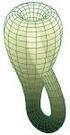
20 Data Model: A homotopy retract Y X 9 with π 1 Y = x,y xyx 1 y and just four (critical) cells e 0, e 1 1, e1 2, e2. Lyndon s theorem on one-relator groups implies and Y Klein Bottle. π 2 Y = 0,π n Y = 0 for n 2
21 Data Model: A homotopy retract Y X 9 with π 1 Y = x,y xyx 1 y and just four (critical) cells e 0, e 1 1, e1 2, e2. Lyndon s theorem on one-relator groups implies and Y Klein Bottle. π 2 Y = 0,π n Y = 0 for n 2 Caveat: [Kan-Thurston] For any space X there is a map K(G,1) X inducing H (K(G,1)) = H (X).
22 3-dimensional Euclidean data

23
24 Proposition: The alpha carbon atoms of the Thermus Thermophilus protein determine a knot K with peripheral system π 1 ( K) = a,b aba 1 b 1 π 1 (R 3 \K) = x,y xyx = yxy a x 2 yx 2 y b x. gap> K:=ReadPDBfile("1V2X.pdb"); Pure permutahedral complex of dimension 3 gap> Y:=RegularCWComplex(PureComplexComplement(K));; Regular CW-complex of dimension 3 gap> i:=boundary(y); Map of regular CW-complexes gap> phi:=fundamentalgroup(i,22495); [ f1, f2 ] -> [ f1^-3*f2*f1^2*f2*f1, f1 ]
25 A number of useful invariants are easily computed from a presentation of the fundamental group.
26 A number of useful invariants are easily computed from a presentation of the fundamental group. Computing low-index groups of a finitely presented group G Index n subgroup H G corresponds to a homomorphism G S n into the group of permutations of X = {gh g G}.
27 A number of useful invariants are easily computed from a presentation of the fundamental group. Computing low-index groups of a finitely presented group G Index n subgroup H G corresponds to a homomorphism G S n into the group of permutations of X = {gh g G}. Only finitely many such homomorphisms.
28 A number of useful invariants are easily computed from a presentation of the fundamental group. Computing low-index groups of a finitely presented group G Index n subgroup H G corresponds to a homomorphism G S n into the group of permutations of X = {gh g G}. Only finitely many such homomorphisms. Index n subgroups H G are finitely presented (Reidemeister- Schreier).
29 Proposition (Brendel, E, Juda, Mrozek ) The abelian invariants of subgroups G π 1 (R 3 \K) of index 7 distinguish between the ambient isotopy classes of prime knots with fourteen or fewer crossings, up to chirality.
30 A more quickly computed invariant: Construct the link K red K blue as a voxel image and then X = [0,1] 3 \(K red K blue ) as a CW complex with cells.
31 A more quickly computed invariant: Construct the link K red K blue as a voxel image and then X = [0,1] 3 \(K red K blue ) as a CW complex with cells. Compute π 1 X = x 1,x 2,x 3 : r 1,r 2,r 3,r 4.
32 A more quickly computed invariant: For generators α red,α blue H 1 (X,Z), β H 2 (X,Z) α red α blue = β r r 4π K red Kblue r r 3 dr dr = 6β
33 A more quickly computed invariant: For generators α red,α blue H 1 (X,Z), β H 2 (X,Z) α red α blue = β r r 4π K red Kblue r r 3 dr dr = 6β is instantly computed from P = x 1,x 2,x 3 : r 1,r 2,r 3,r 4 and : K(P) K(P) K(P).
34 For P = x,y : xyx = yxy the diagonal is given by: y x y y x y y x y y x y x x x x x y x x y x y y
35 For P = x,y : xyx = yxy the diagonal is given by: y x y y x y y x y y x y x x x x x y x x y x y y Only need orientations of quadrilaterals for cup product.
36 A more challenging invariant to compute: L = L = Y = R 3 \L Y = R 3 \L
37 A more challenging invariant to compute: L = L = Y = R 3 \L Y = R 3 \L H 3 ( π 1 Y/[[π 1 Y,π 1 Y],π 1 Y],Z) = Z 40 H 3 ( π 1 Y /[[π 1 Y,π 1 Y ],π 1 Y ],Z) = Z 6
38 2. A computation leading to some theory A crystallographic group is a discrete subgroup G < Isom(R n ) with finite index translation subgroup T G.
39 2. A computation leading to some theory A crystallographic group is a discrete subgroup G < Isom(R n ) with finite index translation subgroup T G. Set γ 1 T = T, γ i+1 T = [γ i T,G].
40 2. A computation leading to some theory A crystallographic group is a discrete subgroup G < Isom(R n ) with finite index translation subgroup T G. Set γ 1 T = T, γ i+1 T = [γ i T,G]. β s,t n = rank(h n (G/γ t T,F) H n (G/γ s T,F))
41 Illustration t: R R,x x +1 g: R R,x x G = t,g : g 2 = 1,tg = gt 1 = D
42 Illustration t: R R,x x +1 g: R R,x x G = t,g : g 2 = 1,tg = gt 1 = D G/γ n T = D 2 n 1
43 Illustration t: R R,x x +1 g: R R,x x G = t,g : g 2 = 1,tg = gt 1 = D G/γ n T = D 2 n 1 β 3 bar code
44 Proposition (E) Let G be an n-dimensional crystallographic group and let F = F p. We have H i (G/γ c T,F) = H i (G/γ c+d T,F) for all i 0,c k if:
45 Proposition (E) Let G be an n-dimensional crystallographic group and let F = F p. We have H i (G/γ c T,F) = H i (G/γ c+d T,F) for all i 0,c k if: P = G/T is a p-group;
46 Proposition (E) Let G be an n-dimensional crystallographic group and let F = F p. We have H i (G/γ c T,F) = H i (G/γ c+d T,F) for all i 0,c k if: P = G/T is a p-group; there exists an integer k 1 such that T/γ c+1 T is an n-generator abelian p-group for c k and, in the case p = 2, T/γ c+1 T is a direct product of cyclic groups of exponent > 2; and
47 Proposition (E) Let G be an n-dimensional crystallographic group and let F = F p. We have H i (G/γ c T,F) = H i (G/γ c+d T,F) for all i 0,c k if: P = G/T is a p-group; there exists an integer k 1 such that T/γ c+1 T is an n-generator abelian p-group for c k and, in the case p = 2, T/γ c+1 T is a direct product of cyclic groups of exponent > 2; and γ c T Z F and γ c+d T Z F are isomorphic FP-modules for all c k.
48 Proposition (E) Let G be an n-dimensional crystallographic group and let F = F p. We have H i (G/γ c T,F) = H i (G/γ c+d T,F) for all i 0,c k if: P = G/T is a p-group; there exists an integer k 1 such that T/γ c+1 T is an n-generator abelian p-group for c k and, in the case p = 2, T/γ c+1 T is a direct product of cyclic groups of exponent > 2; and γ c T Z F and γ c+d T Z F are isomorphic FP-modules for all c k. So a finite computation can yield the mod-p homology of an infinite family of groups.

49 3. Discrete vector fields A finite regular CW complex is readily stored on a computer
50 A simple homotopy collapse X e n e n 1 ց X e n 1 e n X
51 A simple homotopy collapse X e n e n 1 ց X e n 1 e n X is stored in computer as a pair (e n 1,e n ) or arrow e n 1 e n.
52
53 A discrete vector field is a collection of arrows e n 1 e n with e n 1 in the boundary of e n and with any cell involved in at most one arrow. It is admissible if there is no chain (e n 1 1,e n 1 ),(en 1 2,e n 2 ),(en 1 3,e n 3 ), with each e n 1 i+1 in the boundary of en i and with infinitely many (not necessarily distinct) terms to the right.
54 A regular CW complex X with admissible discrete vector field represents a homotopy equivalence X Y where Y is a CW complex whose cells correspond to those of X that are neither source nor target of any arrow.
55 A regular CW complex X with admissible discrete vector field represents a homotopy equivalence X Y where Y is a CW complex whose cells correspond to those of X that are neither source nor target of any arrow. Such cells of X are critical.
56 A regular CW complex X with admissible discrete vector field represents a homotopy equivalence X Y where Y is a CW complex whose cells correspond to those of X that are neither source nor target of any arrow. Such cells of X are critical. An admissible discrete vector field on X 2 with just one critical 0-cell represents a presentation for π 1 X.
57 A G-CW complex is a CW complex X with an action of a group G that permutes cells. A computer representation is straighforward if X is regular and has only finitely many orbits of cells.
58 A G-CW complex is a CW complex X with an action of a group G that permutes cells. A computer representation is straighforward if X is regular and has only finitely many orbits of cells. C (X) is an exact chain complex of free ZG-modules
59 A G-CW complex is a CW complex X with an action of a group G that permutes cells. A computer representation is straighforward if X is regular and has only finitely many orbits of cells. C (X) is an exact chain complex of free ZG-modules and moreover a resolution with homotopy h : C (X) C +1 (X) dh+hd = 1 if G acts freely and X has a discrete vector field with just one critical cell.
60 A G-CW complex is a CW complex X with an action of a group G that permutes cells. A computer representation is straighforward if X is regular and has only finitely many orbits of cells. C (X) is an exact chain complex of free ZG-modules and moreover a resolution with homotopy h : C (X) C +1 (X) dh+hd = 1 if G acts freely and X has a discrete vector field with just one critical cell. C (Nerve(G)) C (X/G)
61 G = a,b aba = b a: R 2 R 2,(x,y) (x +1, y) b: R 2 R 2,(x,y) (x,y +1) X = R 2 X/G C (Nerve(G)) C (X/G)

62 G = a,b aba = b a: R 2 R 2,(x,y) (x +1, y) b: R 2 R 2,(x,y) (x,y +1) X = R 2 X/G C (Nerve(G)) C (X/G)
63 4. Perturbations and homology of 2-types Joint with Le Van Luyen
64 Theorem (JHC Whitehead): There is an exact sequence of groups π 2 (Y) π 2 (X) π 2 (X,Y) in which is a crossed module: π 1 (Y) π 1 (X) A crossed module is a group homomorphism : M G with action (g,m) g m statisfying ( g m) = g (m)g 1 m m = mm m 1
65 Theorem (JHC Whitehead): There is an exact sequence of groups π 2 (Y) π 2 (X) π 2 (X,Y) in which is a crossed module: π 1 (Y) π 1 (X) A crossed module is a group homomorphism : M G with action (g,m) g m statisfying ( g m) = g (m)g 1 m m = mm m 1 We define π 1 ( ) = G/image π 2 ( ) = ker.
66 Taking Y = X 1 we get Whitehead s functor Ho(CW spaces) Σ 1 (crossed modules) which is faithful on homotopy types X with π n X = 0 for n 1,2. Σ 1 is localization with respect to quasi-isomorphisms
67 Taking Y = X 1 we get Whitehead s functor Ho(CW spaces) Σ 1 (crossed modules) which is faithful on homotopy types X with π n X = 0 for n 1,2. Σ 1 is localization with respect to quasi-isomorphisms Let B(M G) denote a CW-space with π n X = 0 for n 1,2 that maps to.
68 : Q Aut(Q),g {x gxg 1 } is a crossed module for any group Q.
69 : Q Aut(Q),g {x gxg 1 } is a crossed module for any group Q. H 5 ( B(D 216 Aut(D 216 )), Z) = (Z2 ) 11 (Z 3 ) 2 gap> Q:=DihedralGroup(216);; gap> C:=AutoCrossedModule(Q);; gap> Homology(C,5); [ 2, 2, 2, 2, 2, 2, 2, 2, 2, 2, 18 ]
70 N : (crossed modules) (simplicial groups) Given : M G we consider the category A = M G s: A A, (m,g) (1,g) t: A A, (m,g) (1, (m)g) : A G A A, ((m,g),(m,g ) (m,( m) 1 g )
71 N : (crossed modules) (simplicial groups) Given : M G we consider the category A = M G s: A A, (m,g) (1,g) t: A A, (m,g) (1, (m)g) : A G A A, ((m,g),(m,g ) (m,( m) 1 g ) s, t, are group homomorphisms and A is a category internal to the category of groups. The nerve N(A) is thus a simplicial group.
72 B: (crossed modules) N (simplicial groups) N (bisimplicial sets) (simplicial sets)
73 B: (crossed modules) N (simplicial groups) F: (sets) (free abelian groups) N (bisimplicial sets) (simplicial sets)
74 B: (crossed modules) N (simplicial groups) F: (sets) (free abelian groups) N (bisimplicial sets) (simplicial sets) C (B( : M G)) is the total complex of the bicomplex: FN 2 N 2 (A) FN 2 N 1 (A) FN 2 N 0 (A) FN 1 N 2 (A) FN 1 N 1 (A) FN 1 N 0 (A) FN 0 N 2 (A) FN 0 N 1 (A) FN 0 N 0 (A)
75 The jth column FN (N j (A)) is the bar complex for the group N j (A).
76 The jth column FN (N j (A)) is the bar complex for the group N j (A). We could replace each column by R N j(a) ZNj (A) Z where R N j(a) is an arbitrary free ZN j (A)-resolution of Z.
77 The jth column FN (N j (A)) is the bar complex for the group N j (A). We could replace each column by R N j(a) ZNj (A) Z where R N j(a) is an arbitrary free ZN j (A)-resolution of Z. But the horizontally induced maps won t square to zero if the resolutions aren t functorial.
78 The jth column FN (N j (A)) is the bar complex for the group N j (A). We could replace each column by R N j(a) ZNj (A) Z where R N j(a) is an arbitrary free ZN j (A)-resolution of Z. But the horizontally induced maps won t square to zero if the resolutions aren t functorial. Homological Perturbation Lemma solves this problem by providing a filtered complex ZN (A) Z R N (A)
79 A homotopy equivalence data (L,d) p i (M,d), h ( ) consists of chain complexes L,M, quasi-isomorphisms i,p and a homotopy ip 1 = dh+hd. A perturbation on ( ) is a homomorphism ǫ: M M of degree 1 such that (d +ǫ) 2 = 0.
80 A homotopy equivalence data (L,d) p i (M,d), h ( ) consists of chain complexes L,M, quasi-isomorphisms i,p and a homotopy ip 1 = dh+hd. A perturbation on ( ) is a homomorphism ǫ: M M of degree 1 such that (d +ǫ) 2 = 0. Perturbation Lemma (M. Crainic 2004): If A = (1 ǫh) 1 ǫ exists then p (L,d i ) (M,d +ǫ), h ( ) is a homotopy equivalence data where i = i +hai, p = p +pah, h = h+hah, d = d +pai.
81 0 0 FN 2 N 2 (A) 0 FN 2 N 1 (A) FN 2 N 0 (A) 0 FN 1 N 2 (A) 0 FN 1 N 1 (A) 0 FN 1 N 0 (A) (M,d) 0 FN 0 N 2 (A) 0 FN 0 N 1 (A) 0 0 FN 0 N 0 (A) 0 R N 2(A) 2 Z 0 R N 1(A) 0 2 Z R N 0(A) 2 Z 0 R N 2(A) 1 Z 0 R N 1(A) 1 Z 0 R N 0(A) 1 Z (L,d) 0 N 2 (A) 0 N 1 (A) 0 N 0 (A)
82 FN 2 N 2 (A) FN 2 N 1 (A) FN 2 N 0 (A) FN 1 N 2 (A) FN 1 N 1 (A) FN 1 N 0 (A) (M,d +ǫ) FN 0 N 2 (A) FN 0 N 1 (A) FN 0 N 0 (A) R N 2(A) 2 Z R N 1(A) 2 Z R N 0(A) 2 Z R N 2(A) 1 Z R N 1(A) 1 Z R N 0(A) 1 Z N 2 (A) N 1 (A) N 0 (A) (L,d )
83 A morphism of crossed modules induces a group homomorphism on π 1 = coker( ) (1) and a π 1 -module homomorphism on π 2 = ker( ). (2) Quasi-isomorphsm is the equivalence relation generated by morphisms where (1) and (2) are isomorphisms. So is quasi-isomorphic to if there exists some sequence of quasi-isomorphisms k
84 : Q Aut(Q) gap> C:=AutoCrossedModule(DihedralGroup(216));; gap> Size(C); # = Q x Aut(Q) gap> IdQuasiCrossedModule(C); [ 72, 68 ]
85 : Q Aut(Q) gap> C:=AutoCrossedModule(DihedralGroup(216));; gap> Size(C); # = Q x Aut(Q) gap> IdQuasiCrossedModule(C); [ 72, 68 ] gap> D:=SmallQuasiCrossedModule(72,68); Crossed module
86 : Q Aut(Q) gap> C:=AutoCrossedModule(DihedralGroup(216));; gap> Size(C); # = Q x Aut(Q) gap> IdQuasiCrossedModule(C); [ 72, 68 ] gap> D:=SmallQuasiCrossedModule(72,68); Crossed module gap> Homology(D,5); [ 2, 2, 2, 2, 2, 2, 2, 2, 2, 2, 18 ]
87 A curiosity The crossed module : Z 2 0 yields a homotopy 2-type B = B( ) with π 2 (B) = Z 2, π k (B) = 0 for k 2.
88 A curiosity The crossed module : Z 2 0 yields a homotopy 2-type B = B( ) with π 2 (B) = Z 2, π k (B) = 0 for k 2. gap> B:=EilenbergMacLaneComplex(CyclicGroup(2),2,11);; gap> C:=ChainComplex(B);; gap> List([0..11],CK!.dimension); [ 1, 1, 2, 4, 8, 16, 32, 64, 128, 256, 512, 1024 ]
89 A curiosity The crossed module : Z 2 0 yields a homotopy 2-type B = B( ) with π 2 (B) = Z 2, π k (B) = 0 for k 2. gap> B:=EilenbergMacLaneComplex(CyclicGroup(2),2,11);; gap> C:=ChainComplex(B);; gap> List([0..11],CK!.dimension); [ 1, 1, 2, 4, 8, 16, 32, 64, 128, 256, 512, 1024 ] gap> D:=CoreducedChainComplex(C);; gap> List([0..10],D!.dimension); [ 1, 0, 1, 1, 2, 3, 5, 8, 13, 21, 34 ]
Computational homology of n-types
 Computational homology of n-types Graham Ellis Graham Ellis, School of Mathematics, National University of Ireland, Galway Le Van Luyen Le Van Luyen, School of Mathematics, National University of Ireland,
Solutions to TOPICS IN ALGEBRA I.N. HERSTEIN. Part II: Group Theory
 Solutions to TOPICS IN ALGEBRA I.N. HERSTEIN Part II: Group Theory No rights reserved. Any part of this work can be reproduced or transmitted in any form or by any means. Version: 1.1 Release: Jan 2013
GROUP ALGEBRAS. ANDREI YAFAEV
 GROUP ALGEBRAS. ANDREI YAFAEV We will associate a certain algebra to a finite group and prove that it is semisimple. Then we will apply Wedderburn s theory to its study. Definition 0.1. Let G be a finite
How To Prove The Dirichlet Unit Theorem
 Chapter 6 The Dirichlet Unit Theorem As usual, we will be working in the ring B of algebraic integers of a number field L. Two factorizations of an element of B are regarded as essentially the same if
Mathematics Course 111: Algebra I Part IV: Vector Spaces
 Mathematics Course 111: Algebra I Part IV: Vector Spaces D. R. Wilkins Academic Year 1996-7 9 Vector Spaces A vector space over some field K is an algebraic structure consisting of a set V on which are
I. GROUPS: BASIC DEFINITIONS AND EXAMPLES
 I GROUPS: BASIC DEFINITIONS AND EXAMPLES Definition 1: An operation on a set G is a function : G G G Definition 2: A group is a set G which is equipped with an operation and a special element e G, called
(0, 0) : order 1; (0, 1) : order 4; (0, 2) : order 2; (0, 3) : order 4; (1, 0) : order 2; (1, 1) : order 4; (1, 2) : order 2; (1, 3) : order 4.
 11.01 List the elements of Z 2 Z 4. Find the order of each of the elements is this group cyclic? Solution: The elements of Z 2 Z 4 are: (0, 0) : order 1; (0, 1) : order 4; (0, 2) : order 2; (0, 3) : order
EXERCISES FOR THE COURSE MATH 570, FALL 2010
 EXERCISES FOR THE COURSE MATH 570, FALL 2010 EYAL Z. GOREN (1) Let G be a group and H Z(G) a subgroup such that G/H is cyclic. Prove that G is abelian. Conclude that every group of order p 2 (p a prime
Class One: Degree Sequences
 Class One: Degree Sequences For our purposes a graph is a just a bunch of points, called vertices, together with lines or curves, called edges, joining certain pairs of vertices. Three small examples of
Chapter 7: Products and quotients
 Chapter 7: Products and quotients Matthew Macauley Department of Mathematical Sciences Clemson University http://www.math.clemson.edu/~macaule/ Math 42, Spring 24 M. Macauley (Clemson) Chapter 7: Products
ON GENERALIZED RELATIVE COMMUTATIVITY DEGREE OF A FINITE GROUP. A. K. Das and R. K. Nath
 International Electronic Journal of Algebra Volume 7 (2010) 140-151 ON GENERALIZED RELATIVE COMMUTATIVITY DEGREE OF A FINITE GROUP A. K. Das and R. K. Nath Received: 12 October 2009; Revised: 15 December
G = G 0 > G 1 > > G k = {e}
 Proposition 49. 1. A group G is nilpotent if and only if G appears as an element of its upper central series. 2. If G is nilpotent, then the upper central series and the lower central series have the same
4.1 Modules, Homomorphisms, and Exact Sequences
 Chapter 4 Modules We always assume that R is a ring with unity 1 R. 4.1 Modules, Homomorphisms, and Exact Sequences A fundamental example of groups is the symmetric group S Ω on a set Ω. By Cayley s Theorem,
NOTES ON CATEGORIES AND FUNCTORS
 NOTES ON CATEGORIES AND FUNCTORS These notes collect basic definitions and facts about categories and functors that have been mentioned in the Homological Algebra course. For further reading about category
Math 231b Lecture 35. G. Quick
 Math 231b Lecture 35 G. Quick 35. Lecture 35: Sphere bundles and the Adams conjecture 35.1. Sphere bundles. Let X be a connected finite cell complex. We saw that the J-homomorphism could be defined by
How To Prove The Cellosauric Cardinal Compactness (For A Cardinal Cardinal Compact)
 Cellular objects and Shelah s singular compactness theorem Logic Colloquium 2015 Helsinki Tibor Beke 1 Jiří Rosický 2 1 University of Massachusetts tibor [email protected] 2 Masaryk University Brno [email protected]
ADDITIVE GROUPS OF RINGS WITH IDENTITY
 ADDITIVE GROUPS OF RINGS WITH IDENTITY SIMION BREAZ AND GRIGORE CĂLUGĂREANU Abstract. A ring with identity exists on a torsion Abelian group exactly when the group is bounded. The additive groups of torsion-free
On the existence of G-equivariant maps
 CADERNOS DE MATEMÁTICA 12, 69 76 May (2011) ARTIGO NÚMERO SMA# 345 On the existence of G-equivariant maps Denise de Mattos * Departamento de Matemática, Instituto de Ciências Matemáticas e de Computação,
Homological Algebra Workshop 02-03-15/06-03-15
 Homological Algebra Workshop 02-03-15/06-03-15 Monday: Tuesday: 9:45 10:00 Registration 10:00 11:15 Conchita Martínez (I) 10:00 11:15 Conchita Martínez (II) 11:15 11:45 Coffee Break 11:15 11:45 Coffee
Chapter 13: Basic ring theory
 Chapter 3: Basic ring theory Matthew Macauley Department of Mathematical Sciences Clemson University http://www.math.clemson.edu/~macaule/ Math 42, Spring 24 M. Macauley (Clemson) Chapter 3: Basic ring
Universitat de Barcelona
 Universitat de Barcelona GRAU DE MATEMÀTIQUES Final year project Cohomology of Product Spaces from a Categorical Viewpoint Álvaro Torras supervised by Prof. Carles Casacuberta January 18, 2016 2 3 Introduction
GROUPS ACTING ON A SET
 GROUPS ACTING ON A SET MATH 435 SPRING 2012 NOTES FROM FEBRUARY 27TH, 2012 1. Left group actions Definition 1.1. Suppose that G is a group and S is a set. A left (group) action of G on S is a rule for
Elements of Abstract Group Theory
 Chapter 2 Elements of Abstract Group Theory Mathematics is a game played according to certain simple rules with meaningless marks on paper. David Hilbert The importance of symmetry in physics, and for
SOME PROPERTIES OF FIBER PRODUCT PRESERVING BUNDLE FUNCTORS
 SOME PROPERTIES OF FIBER PRODUCT PRESERVING BUNDLE FUNCTORS Ivan Kolář Abstract. Let F be a fiber product preserving bundle functor on the category FM m of the proper base order r. We deduce that the r-th
Classification of Bundles
 CHAPTER 2 Classification of Bundles In this chapter we prove Steenrod s classification theorem of principal G - bundles, and the corresponding classification theorem of vector bundles. This theorem states
BP-cohomology of mapping spaces from the classifying space of a torus to some p-torsion free space
 BP-cohomology of mapping spaces from the classifying space of a torus to some p-torsion free space 1. Introduction Let p be a fixed prime number, V a group isomorphic to (Z/p) d for some integer d and
Chapter 7. Permutation Groups
 Chapter 7 Permutation Groups () We started the study of groups by considering planar isometries In the previous chapter, we learnt that finite groups of planar isometries can only be cyclic or dihedral
A REMARK ON ALMOST MOORE DIGRAPHS OF DEGREE THREE. 1. Introduction and Preliminaries
 Acta Math. Univ. Comenianae Vol. LXVI, 2(1997), pp. 285 291 285 A REMARK ON ALMOST MOORE DIGRAPHS OF DEGREE THREE E. T. BASKORO, M. MILLER and J. ŠIRÁŇ Abstract. It is well known that Moore digraphs do
MATRIX ALGEBRA AND SYSTEMS OF EQUATIONS. + + x 2. x n. a 11 a 12 a 1n b 1 a 21 a 22 a 2n b 2 a 31 a 32 a 3n b 3. a m1 a m2 a mn b m
 MATRIX ALGEBRA AND SYSTEMS OF EQUATIONS 1. SYSTEMS OF EQUATIONS AND MATRICES 1.1. Representation of a linear system. The general system of m equations in n unknowns can be written a 11 x 1 + a 12 x 2 +
NOTES ON LINEAR TRANSFORMATIONS
 NOTES ON LINEAR TRANSFORMATIONS Definition 1. Let V and W be vector spaces. A function T : V W is a linear transformation from V to W if the following two properties hold. i T v + v = T v + T v for all
FIBER BUNDLES AND UNIVALENCE
 FIBER BUNDLES AND UNIVALENCE TALK BY IEKE MOERDIJK; NOTES BY CHRIS KAPULKIN This talk presents a proof that a universal Kan fibration is univalent. The talk was given by Ieke Moerdijk during the conference
FOUNDATIONS OF ALGEBRAIC GEOMETRY CLASS 22
 FOUNDATIONS OF ALGEBRAIC GEOMETRY CLASS 22 RAVI VAKIL CONTENTS 1. Discrete valuation rings: Dimension 1 Noetherian regular local rings 1 Last day, we discussed the Zariski tangent space, and saw that it
CLUSTER ALGEBRAS AND CATEGORIFICATION TALKS: QUIVERS AND AUSLANDER-REITEN THEORY
 CLUSTER ALGEBRAS AND CATEGORIFICATION TALKS: QUIVERS AND AUSLANDER-REITEN THEORY ANDREW T. CARROLL Notes for this talk come primarily from two sources: M. Barot, ICTP Notes Representations of Quivers,
FIBRATION SEQUENCES AND PULLBACK SQUARES. Contents. 2. Connectivity and fiber sequences. 3
 FIRTION SEQUENES ND PULLK SQURES RY MLKIEWIH bstract. We lay out some foundational facts about fibration sequences and pullback squares of topological spaces. We pay careful attention to connectivity ranges
COHOMOLOGY OF GROUPS
 Actes, Congrès intern. Math., 1970. Tome 2, p. 47 à 51. COHOMOLOGY OF GROUPS by Daniel QUILLEN * This is a report of research done at the Institute for Advanced Study the past year. It includes some general
TOPOLOGY OF SINGULAR FIBERS OF GENERIC MAPS
 TOPOLOGY OF SINGULAR FIBERS OF GENERIC MAPS OSAMU SAEKI Dedicated to Professor Yukio Matsumoto on the occasion of his 60th birthday Abstract. We classify singular fibers of C stable maps of orientable
PUTNAM TRAINING POLYNOMIALS. Exercises 1. Find a polynomial with integral coefficients whose zeros include 2 + 5.
 PUTNAM TRAINING POLYNOMIALS (Last updated: November 17, 2015) Remark. This is a list of exercises on polynomials. Miguel A. Lerma Exercises 1. Find a polynomial with integral coefficients whose zeros include
The Open University s repository of research publications and other research outputs
 Open Research Online The Open University s repository of research publications and other research outputs The degree-diameter problem for circulant graphs of degree 8 and 9 Journal Article How to cite:
4. FIRST STEPS IN THE THEORY 4.1. A
 4. FIRST STEPS IN THE THEORY 4.1. A Catalogue of All Groups: The Impossible Dream The fundamental problem of group theory is to systematically explore the landscape and to chart what lies out there. We
Group Theory. Contents
 Group Theory Contents Chapter 1: Review... 2 Chapter 2: Permutation Groups and Group Actions... 3 Orbits and Transitivity... 6 Specific Actions The Right regular and coset actions... 8 The Conjugation
The cover SU(2) SO(3) and related topics
 The cover SU(2) SO(3) and related topics Iordan Ganev December 2011 Abstract The subgroup U of unit quaternions is isomorphic to SU(2) and is a double cover of SO(3). This allows a simple computation of
Lecture 18 - Clifford Algebras and Spin groups
 Lecture 18 - Clifford Algebras and Spin groups April 5, 2013 Reference: Lawson and Michelsohn, Spin Geometry. 1 Universal Property If V is a vector space over R or C, let q be any quadratic form, meaning
Quotient Rings and Field Extensions
 Chapter 5 Quotient Rings and Field Extensions In this chapter we describe a method for producing field extension of a given field. If F is a field, then a field extension is a field K that contains F.
1 Local Brouwer degree
 1 Local Brouwer degree Let D R n be an open set and f : S R n be continuous, D S and c R n. Suppose that the set f 1 (c) D is compact. (1) Then the local Brouwer degree of f at c in the set D is defined.
GENERATING SETS KEITH CONRAD
 GENERATING SETS KEITH CONRAD 1 Introduction In R n, every vector can be written as a unique linear combination of the standard basis e 1,, e n A notion weaker than a basis is a spanning set: a set of vectors
GROUPS WITH TWO EXTREME CHARACTER DEGREES AND THEIR NORMAL SUBGROUPS
 GROUPS WITH TWO EXTREME CHARACTER DEGREES AND THEIR NORMAL SUBGROUPS GUSTAVO A. FERNÁNDEZ-ALCOBER AND ALEXANDER MORETÓ Abstract. We study the finite groups G for which the set cd(g) of irreducible complex
FINITE DIMENSIONAL ORDERED VECTOR SPACES WITH RIESZ INTERPOLATION AND EFFROS-SHEN S UNIMODULARITY CONJECTURE AARON TIKUISIS
 FINITE DIMENSIONAL ORDERED VECTOR SPACES WITH RIESZ INTERPOLATION AND EFFROS-SHEN S UNIMODULARITY CONJECTURE AARON TIKUISIS Abstract. It is shown that, for any field F R, any ordered vector space structure
8.1 Examples, definitions, and basic properties
 8 De Rham cohomology Last updated: May 21, 211. 8.1 Examples, definitions, and basic properties A k-form ω Ω k (M) is closed if dω =. It is exact if there is a (k 1)-form σ Ω k 1 (M) such that dσ = ω.
. 0 1 10 2 100 11 1000 3 20 1 2 3 4 5 6 7 8 9
 Introduction The purpose of this note is to find and study a method for determining and counting all the positive integer divisors of a positive integer Let N be a given positive integer We say d is a
A NOTE ON TRIVIAL FIBRATIONS
 A NOTE ON TRIVIAL FIBRATIONS Petar Pavešić Fakulteta za Matematiko in Fiziko, Univerza v Ljubljani, Jadranska 19, 1111 Ljubljana, Slovenija [email protected] Abstract We study the conditions
Notes on finite group theory. Peter J. Cameron
 Notes on finite group theory Peter J. Cameron October 2013 2 Preface Group theory is a central part of modern mathematics. Its origins lie in geometry (where groups describe in a very detailed way the
Galois representations with open image
 Galois representations with open image Ralph Greenberg University of Washington Seattle, Washington, USA May 7th, 2011 Introduction This talk will be about representations of the absolute Galois group
2. Let H and K be subgroups of a group G. Show that H K G if and only if H K or K H.
 Math 307 Abstract Algebra Sample final examination questions with solutions 1. Suppose that H is a proper subgroup of Z under addition and H contains 18, 30 and 40, Determine H. Solution. Since gcd(18,
4. CLASSES OF RINGS 4.1. Classes of Rings class operator A-closed Example 1: product Example 2:
 4. CLASSES OF RINGS 4.1. Classes of Rings Normally we associate, with any property, a set of objects that satisfy that property. But problems can arise when we allow sets to be elements of larger sets
Geometric Transformations
 Geometric Transformations Definitions Def: f is a mapping (function) of a set A into a set B if for every element a of A there exists a unique element b of B that is paired with a; this pairing is denoted
Abstract Algebra Cheat Sheet
 Abstract Algebra Cheat Sheet 16 December 2002 By Brendan Kidwell, based on Dr. Ward Heilman s notes for his Abstract Algebra class. Notes: Where applicable, page numbers are listed in parentheses at the
6 Commutators and the derived series. [x,y] = xyx 1 y 1.
![6 Commutators and the derived series. [x,y] = xyx 1 y 1.](/thumbs/19/254057.jpg "6 Commutators and the derived series. [x,y] = xyx 1 y 1.") 6 Commutators and the derived series Definition. Let G be a group, and let x,y G. The commutator of x and y is [x,y] = xyx 1 y 1. Note that [x,y] = e if and only if xy = yx (since x 1 y 1 = (yx) 1 ). Proposition
6 Commutators and the derived series Definition. Let G be a group, and let x,y G. The commutator of x and y is [x,y] = xyx 1 y 1. Note that [x,y] = e if and only if xy = yx (since x 1 y 1 = (yx) 1 ). Proposition
MATH PROBLEMS, WITH SOLUTIONS
 MATH PROBLEMS, WITH SOLUTIONS OVIDIU MUNTEANU These are free online notes that I wrote to assist students that wish to test their math skills with some problems that go beyond the usual curriculum. These
Linear Algebra I. Ronald van Luijk, 2012
 Linear Algebra I Ronald van Luijk, 2012 With many parts from Linear Algebra I by Michael Stoll, 2007 Contents 1. Vector spaces 3 1.1. Examples 3 1.2. Fields 4 1.3. The field of complex numbers. 6 1.4.
ON GALOIS REALIZATIONS OF THE 2-COVERABLE SYMMETRIC AND ALTERNATING GROUPS
 ON GALOIS REALIZATIONS OF THE 2-COVERABLE SYMMETRIC AND ALTERNATING GROUPS DANIEL RABAYEV AND JACK SONN Abstract. Let f(x) be a monic polynomial in Z[x] with no rational roots but with roots in Q p for
POLYNOMIAL RINGS AND UNIQUE FACTORIZATION DOMAINS
 POLYNOMIAL RINGS AND UNIQUE FACTORIZATION DOMAINS RUSS WOODROOFE 1. Unique Factorization Domains Throughout the following, we think of R as sitting inside R[x] as the constant polynomials (of degree 0).
THREE DIMENSIONAL GEOMETRY
 Chapter 8 THREE DIMENSIONAL GEOMETRY 8.1 Introduction In this chapter we present a vector algebra approach to three dimensional geometry. The aim is to present standard properties of lines and planes,
Survey and remarks on Viro s definition of Khovanov homology
 RIMS Kôkyûroku Bessatsu B39 (203), 009 09 Survey and remarks on Viro s definition of Khovanov homology By Noboru Ito Abstract This paper reviews and offers remarks upon Viro s definition of the Khovanov
How To Solve The Group Theory
 Chapter 5 Some Basic Techniques of Group Theory 5.1 Groups Acting on Sets In this chapter we are going to analyze and classify groups, and, if possible, break down complicated groups into simpler components.
Discrete Mathematics & Mathematical Reasoning Chapter 10: Graphs
 Discrete Mathematics & Mathematical Reasoning Chapter 10: Graphs Kousha Etessami U. of Edinburgh, UK Kousha Etessami (U. of Edinburgh, UK) Discrete Mathematics (Chapter 6) 1 / 13 Overview Graphs and Graph
Similarity and Diagonalization. Similar Matrices
 MATH022 Linear Algebra Brief lecture notes 48 Similarity and Diagonalization Similar Matrices Let A and B be n n matrices. We say that A is similar to B if there is an invertible n n matrix P such that
Module MA3411: Abstract Algebra Galois Theory Appendix Michaelmas Term 2013
 Module MA3411: Abstract Algebra Galois Theory Appendix Michaelmas Term 2013 D. R. Wilkins Copyright c David R. Wilkins 1997 2013 Contents A Cyclotomic Polynomials 79 A.1 Minimum Polynomials of Roots of
COMMUTATIVITY DEGREE, ITS GENERALIZATIONS, AND CLASSIFICATION OF FINITE GROUPS
 COMMUTATIVITY DEGREE, ITS GENERALIZATIONS, AND CLASSIFICATION OF FINITE GROUPS ABSTRACT RAJAT KANTI NATH DEPARTMENT OF MATHEMATICS NORTH-EASTERN HILL UNIVERSITY SHILLONG 793022, INDIA COMMUTATIVITY DEGREE,
Mathematical Research Letters 1, 249 255 (1994) MAPPING CLASS GROUPS ARE AUTOMATIC. Lee Mosher
 Mathematical Research Letters 1, 249 255 (1994) MAPPING CLASS GROUPS ARE AUTOMATIC Lee Mosher Let S be a compact surface, possibly with the extra structure of an orientation or a finite set of distinguished
ON TORI TRIANGULATIONS ASSOCIATED WITH TWO-DIMENSIONAL CONTINUED FRACTIONS OF CUBIC IRRATIONALITIES.
 ON TORI TRIANGULATIONS ASSOCIATED WITH TWO-DIMENSIONAL CONTINUED FRACTIONS OF CUBIC IRRATIONALITIES. O. N. KARPENKOV Introduction. A series of properties for ordinary continued fractions possesses multidimensional
Online publication date: 11 March 2010 PLEASE SCROLL DOWN FOR ARTICLE
 This article was downloaded by: [Modoi, George Ciprian] On: 12 March 2010 Access details: Access Details: [subscription number 919828804] Publisher Taylor & Francis Informa Ltd Registered in England and
Test1. Due Friday, March 13, 2015.
 1 Abstract Algebra Professor M. Zuker Test1. Due Friday, March 13, 2015. 1. Euclidean algorithm and related. (a) Suppose that a and b are two positive integers and that gcd(a, b) = d. Find all solutions
CHAPTER SIX IRREDUCIBILITY AND FACTORIZATION 1. BASIC DIVISIBILITY THEORY
 January 10, 2010 CHAPTER SIX IRREDUCIBILITY AND FACTORIZATION 1. BASIC DIVISIBILITY THEORY The set of polynomials over a field F is a ring, whose structure shares with the ring of integers many characteristics.
An Introduction to Braid Theory
 An Introduction to Braid Theory Maurice Chiodo November 4, 2005 Abstract In this paper we present an introduction to the theory of braids. We lay down some clear definitions of a braid, and proceed to
The Clar Structure of Fullerenes
 The Clar Structure of Fullerenes Liz Hartung Massachusetts College of Liberal Arts June 12, 2013 Liz Hartung (Massachusetts College of Liberal Arts) The Clar Structure of Fullerenes June 12, 2013 1 / 25
MATRIX ALGEBRA AND SYSTEMS OF EQUATIONS
 MATRIX ALGEBRA AND SYSTEMS OF EQUATIONS Systems of Equations and Matrices Representation of a linear system The general system of m equations in n unknowns can be written a x + a 2 x 2 + + a n x n b a
Introduction to Topology
 Introduction to Topology Tomoo Matsumura November 30, 2010 Contents 1 Topological spaces 3 1.1 Basis of a Topology......................................... 3 1.2 Comparing Topologies.......................................
Turing Degrees and Definability of the Jump. Theodore A. Slaman. University of California, Berkeley. CJuly, 2005
 Turing Degrees and Definability of the Jump Theodore A. Slaman University of California, Berkeley CJuly, 2005 Outline Lecture 1 Forcing in arithmetic Coding and decoding theorems Automorphisms of countable
Notes on Algebraic Structures. Peter J. Cameron
 Notes on Algebraic Structures Peter J. Cameron ii Preface These are the notes of the second-year course Algebraic Structures I at Queen Mary, University of London, as I taught it in the second semester
IRREDUCIBLE OPERATOR SEMIGROUPS SUCH THAT AB AND BA ARE PROPORTIONAL. 1. Introduction
 IRREDUCIBLE OPERATOR SEMIGROUPS SUCH THAT AB AND BA ARE PROPORTIONAL R. DRNOVŠEK, T. KOŠIR Dedicated to Prof. Heydar Radjavi on the occasion of his seventieth birthday. Abstract. Let S be an irreducible
NOTES ON GROUP THEORY
 NOTES ON GROUP THEORY Abstract. These are the notes prepared for the course MTH 751 to be offered to the PhD students at IIT Kanpur. Contents 1. Binary Structure 2 2. Group Structure 5 3. Group Actions
Geometry and Topology from Point Cloud Data
 Geometry and Topology from Point Cloud Data Tamal K. Dey Department of Computer Science and Engineering The Ohio State University Dey (2011) Geometry and Topology from Point Cloud Data WALCOM 11 1 / 51
BOUNDED COHOMOLOGY CHARACTERIZES HYPERBOLIC GROUPS
 BOUNDED COHOMOLOGY CHARACTERIZES HYPERBOLIC GROUPS by IGOR MINEYEV (University of South Alabama, Department of Mathematics & Statistics, ILB 35, Mobile, AL 36688, USA) [Received June 00] Abstract A finitely
COMBINATORIAL PROPERTIES OF THE HIGMAN-SIMS GRAPH. 1. Introduction
 COMBINATORIAL PROPERTIES OF THE HIGMAN-SIMS GRAPH ZACHARY ABEL 1. Introduction In this survey we discuss properties of the Higman-Sims graph, which has 100 vertices, 1100 edges, and is 22 regular. In fact
WORKSHOP ON TOPOLOGY AND ABSTRACT ALGEBRA FOR BIOMEDICINE
 WORKSHOP ON TOPOLOGY AND ABSTRACT ALGEBRA FOR BIOMEDICINE ERIC K. NEUMANN Foundation Medicine, Cambridge, MA 02139, USA Email: [email protected] SVETLANA LOCKWOOD School of Electrical Engineering
MA651 Topology. Lecture 6. Separation Axioms.
 MA651 Topology. Lecture 6. Separation Axioms. This text is based on the following books: Fundamental concepts of topology by Peter O Neil Elements of Mathematics: General Topology by Nicolas Bourbaki Counterexamples
it is easy to see that α = a
 21. Polynomial rings Let us now turn out attention to determining the prime elements of a polynomial ring, where the coefficient ring is a field. We already know that such a polynomial ring is a UF. Therefore
GROUP ACTIONS KEITH CONRAD
 GROUP ACTIONS KEITH CONRAD 1. Introduction The symmetric groups S n, alternating groups A n, and (for n 3) dihedral groups D n behave, by their very definition, as permutations on certain sets. The groups
Ideal Class Group and Units
 Chapter 4 Ideal Class Group and Units We are now interested in understanding two aspects of ring of integers of number fields: how principal they are (that is, what is the proportion of principal ideals
State of Stress at Point
 State of Stress at Point Einstein Notation The basic idea of Einstein notation is that a covector and a vector can form a scalar: This is typically written as an explicit sum: According to this convention,
F. ABTAHI and M. ZARRIN. (Communicated by J. Goldstein)
 Journal of Algerian Mathematical Society Vol. 1, pp. 1 6 1 CONCERNING THE l p -CONJECTURE FOR DISCRETE SEMIGROUPS F. ABTAHI and M. ZARRIN (Communicated by J. Goldstein) Abstract. For 2 < p
Fixed Point Theory. With 14 Illustrations. %1 Springer
 Andrzej Granas James Dugundji Fixed Point Theory With 14 Illustrations %1 Springer Contents Preface vii 0. Introduction 1 1. Fixed Point Spaces 1 2. Forming New Fixed Point Spaces from Old 3 3. Topological
Split Nonthreshold Laplacian Integral Graphs
 Split Nonthreshold Laplacian Integral Graphs Stephen Kirkland University of Regina, Canada [email protected] Maria Aguieiras Alvarez de Freitas Federal University of Rio de Janeiro, Brazil [email protected]
Factoring Polynomials
 UNIT 11 Factoring Polynomials You can use polynomials to describe framing for art. 396 Unit 11 factoring polynomials A polynomial is an expression that has variables that represent numbers. A number can
FUNCTIONAL ANALYSIS LECTURE NOTES: QUOTIENT SPACES
 FUNCTIONAL ANALYSIS LECTURE NOTES: QUOTIENT SPACES CHRISTOPHER HEIL 1. Cosets and the Quotient Space Any vector space is an abelian group under the operation of vector addition. So, if you are have studied
MATH 4330/5330, Fourier Analysis Section 11, The Discrete Fourier Transform
 MATH 433/533, Fourier Analysis Section 11, The Discrete Fourier Transform Now, instead of considering functions defined on a continuous domain, like the interval [, 1) or the whole real line R, we wish
Sets of Fibre Homotopy Classes and Twisted Order Parameter Spaces
 Communications in Mathematical Physics Manuscript-Nr. (will be inserted by hand later) Sets of Fibre Homotopy Classes and Twisted Order Parameter Spaces Stefan Bechtluft-Sachs, Marco Hien Naturwissenschaftliche