
EMPLOYEE RELATIONS INFORMATION FOR CONTRACTORS ON BHP BILLITON IRON ORE PROJECTS
|
|
|
- Melina Freeman
- 10 years ago
- Views:
Transcription
1 EMPLOYEE RELATIONS INFORMATION FOR CONTRACTORS ON BHP BILLITON IRON ORE PROJECTS PREPARED BY: CONSTRUCTION SERVICES GROUP CCIWA CCIWA Project Contact : Version Revision date -1- Ken Dwyer Carl Morgan

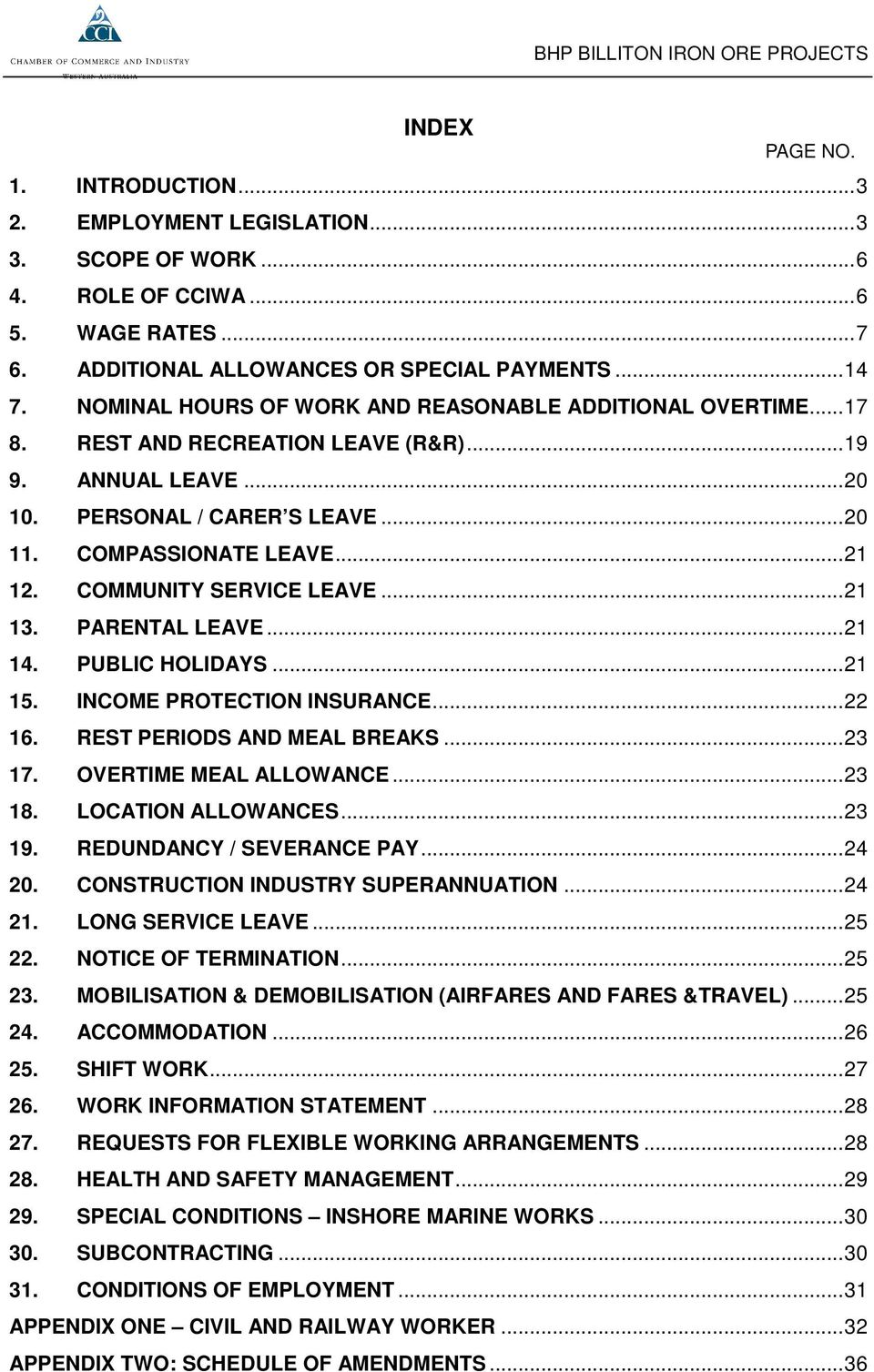
2 BHP BILLITON IRON ORE PROJECTS INDEX PAGE NO. 1. INTRODUCTION EMPLOYMENT LEGISLATION SCOPE OF WORK ROLE OF CCIWA WAGE RATES ADDITIONAL ALLOWANCES OR SPECIAL PAYMENTS NOMINAL HOURS OF WORK AND REASONABLE ADDITIONAL OVERTIME REST AND RECREATION LEAVE (R&R) ANNUAL LEAVE PERSONAL / CARER S LEAVE COMPASSIONATE LEAVE COMMUNITY SERVICE LEAVE PARENTAL LEAVE PUBLIC HOLIDAYS INCOME PROTECTION INSURANCE REST PERIODS AND MEAL BREAKS OVERTIME MEAL ALLOWANCE LOCATION ALLOWANCES REDUNDANCY / SEVERANCE PAY CONSTRUCTION INDUSTRY SUPERANNUATION LONG SERVICE LEAVE NOTICE OF TERMINATION MOBILISATION & DEMOBILISATION (AIRFARES AND FARES &TRAVEL) ACCOMMODATION SHIFT WORK WORK INFORMATION STATEMENT REQUESTS FOR FLEXIBLE WORKING ARRANGEMENTS HEALTH AND SAFETY MANAGEMENT SPECIAL CONDITIONS INSHORE MARINE WORKS SUBCONTRACTING CONDITIONS OF EMPLOYMENT...31 APPENDIX ONE CIVIL AND RAILWAY WORKER...32 APPENDIX TWO: SCHEDULE OF AMENDMENTS...36
3 BHP BILLITON IRON ORE PROJECTS 1. INTRODUCTION This preliminary Information Booklet has been prepared for the benefit of contractors undertaking work on the BHP Billiton Iron Ore Projects ( The Project ). The purpose of the document is to assist contractors in preparing their tenders in respect to employee relations issues and conditions of employment. It should not be circulated among the general workforce and can not be used as a substitute for an enterprise agreement or contract of employment. It is not an exhaustive document and therefore must be read in conjunction with the applicable legislation, employer/employee policies, site rules and other industrial instruments which may cover the work. The Chamber of Commerce and Industry of Western Australia (CCIWA) is committed to providing quality service to its clients and has made every attempt to ensure the accuracy and reliability of the information contained in this document. CCIWA will accept no responsibility for any loss occasioned to any person acting or not acting as a result of the information contained herein and any person relying on this information does so at his or her own risk. The Booklet is provided as a guide only. Reproduction of any CCI material is not permitted without written authorisation. 2. EMPLOYMENT LEGISLATION The Labor Government s Fair Work Act 2009 ( the FWA ), retained the general structure of its predecessor the Workplace Relations Act 1996 via a unitary national industrial relations system with a safety net of minimum conditions (the NES). Employers are urged to consider the effect of these laws on their employee and industrial relations strategies and their existing awards and agreements as well as when developing new agreements. You should seek advice from CCIWA in relation to your own particular circumstances. The Act implemented, amongst other things, the following major reforms (with the pertinent matters being discussed more fully below): Established a safety net comprising: National Employment Standards which apply to all employees and guarantee maximum weekly hours of work, a right to request flexible working arrangements, parental leave and related entitlements, annual leave, personal/carer s leave and compassionate leave, community service leave, long service leave, public holidays, notice of termination and redundancy pay and provision of a Fair Work Statement; Modern Awards which may include additional minimum terms and conditions of employments (such as minimum wages, overtime and penalty rates, allowances, representation and dispute settlement); National minimum wage orders that apply to award/agreement free employees.
4 BHP BILLITON IRON ORE PROJECTS Established a new institutional framework for the administration of the new workplace relations system comprising: Fair Work Australia, an independent, statutory body with a range of functions and powers; and The Fair Work Ombudsman who will be able to undertake enforcement activities including, investigation, issuing compliance notices and initiating court proceedings. Introduced a new union-oriented regime for the making of collective Agreements and taking away provisions for individual Agreement making; Expanded the circumstances in which union right of entry can be exercised; and Changed the unfair dismissal laws. Agreement Making The Act provides for the making of agreements through collective bargaining with no further access to Employer Greenfields Agreements after 1 July 2009 or statutory individual agreements after 1 January The capacity to conduct enterprise bargaining without engaging with the relevant union is very limited. Agreement options consist of single-enterprise agreements made between a single employer and group of employees or multi-enterprise agreements made between two or more employers (voluntarily) and their employees. One significant change is that multi-enterprise agreements are no longer subject to a public interest test. Union greenfields agreements are still available but the employer must notify the major eligible union that the employer intends to make a greenfields agreement. Each union is then a bargaining representative for the agreement and the agreement will cover any union who signs it. When a greenfields agreement has been made, any union that was a bargaining agent can notify Fair Work Australia that it wants to be covered by the agreement. When negotiating a collective agreement, the employer must notify all employees of their right to be represented by a bargaining agent. If the employee is a member of an eligible union, the union will automatically become a bargaining representative unless the employee appoints someone else and advises the employer of the appointment. An employer cannot refuse to recognize, or bargain with, a bargaining representative. However there is no obligation to make concessions or reach agreement the only obligation is to negotiate. Changes have also been made to content rules for agreements. Permitted matters include any matters pertaining to the employment relationship; any matters relating to the relationship between employer(s) and union parties, including union training leave, paid leave to attend union business, delegate rights etc; deductions from wages authorized by the employee and how the agreement will operate.
5 BHP BILLITON IRON ORE PROJECTS Right of Entry The most significant change to union right of entry rules is when unions enter to hold discussions with employees. This right no longer depends upon the relevant employee being subject to an industrial award or agreement which is binding on the union. This change significantly expands the circumstances in which union right of entry to hold discussions with employees can be used. Other significant changes include certain union right of entry provisions being allowed in enterprise agreements which are not limited to the types of entry specified in the Act. A term that provides for right of entry for the purpose of having discussions with employees, investigating suspected breaches or OSH matters, other than in accordance with the Act is unlawful. However paragraph 838 of the explanatory memorandum provides that agreements can include terms allowing union access for other purposes. The examples used include: to assist in representation of employees; attend induction meetings and meet with the employee for bargaining future agreements. Unions, in some circumstances, will also have the right to inspect or make copies of any record or document related to a suspected breach, even where the record or document related to a non-member of that union. This is in direct contrast to the previous legislation. Further, the Fair Work Act specifies a number of circumstances in which a request by an employer for a union to hold interviews and/or meetings in a particular room or area will be unreasonable. The Act requires that the room must be fit for the purpose of conducting the interview or meeting, and that the request cannot be made with the intention of intimidating, discouraging or making it difficult for persons who wish to participate in the interview or discussions. Provision must be made for a suitable facility for these meetings to take place in close proximity to or adjacent to the employees crib rooms. Contractors are invited to seek further advice from CCIWA on your own particular circumstances. Industrial Instrument / Agreement CCI recommends that contractors pursue an industrial instrument / agreement that will cover the duration of the work on site and be competitive so as to attract and retain quality, skilled and experienced labour. Further, an industrial instrument that will minimise industrial disputation should be considered essential Modern Awards The Award modernisation process has established a new system of Modern Awards which replaced Federal Awards and State Awards operating as NAPSAs (Notional Agreements Preserving State Awards) from 1 January The Awards, together with the National Employment Standards (also operative from 1 January 2010), form the safety net of employment conditions and entitlements. However, some provisions of Modern Awards did not commence until 1 July 2010 and some are still being phased in according to transitional provisions included in the Modern Awards.
6 BHP BILLITON IRON ORE PROJECTS The Building and Construction Industry General On-site Award 2010 and the Electrical, Electronic and Communications Contracting Award 2010 are likely to underpin terms and conditions for the vast majority of works on the Project. However, it is important that contractors confirm the Award that underpins their business for work on the Project. Other Modern Awards that may impact the major resource industry include: Mobile Crane Hiring Award 2010 Plumbing and Fire Sprinklers Award 2010 Security Services Industry Award 2010 Hospitality Industry (General) Award 2010 Joinery and Building Trades Award 2010 Therefore it is important that Contractors seek advice on the impact of Modern Awards in their own particular circumstances. 3. SCOPE OF WORK This booklet is designed to assist contractors who are tendering for civil, structural, mechanical and / or electrical work on the Project. This booklet is not for the assistance of contractors who are tendering for any mining, maintenance or minor modification works that may be undertaken on BHP Billiton Iron Ore sites located in the Pilbara region of Western Australia. 4. ROLE OF CCIWA The Construction Services Group of CCIWA has been engaged to provide independent industrial and employee relations advice and assistance to contractors on the Project. Past experience has shown that where industrial relations on major construction work is approached in a sound and consistent manner, industrial disruption is significantly minimised or eliminated. Past experience has also shown that good HR practice contributes to a happy and productive workforce. Time spent prior to commencement of work in developing an industrial relations management plan followed by careful implementation will greatly assist your industrial relations performance on the Project. The CCIWA contacts for this Project are: Ken Dwyer Senior Project Industrial Relations Adviser(Perth Based) Mob: Carl Morgan Project Industrial Relations Adviser (Site based) Mob:

7 BHP BILLITON IRON ORE PROJECTS 5. WAGE RATES Although various Agreements, Awards and Legislation are binding on employers, the construction industry has historically provided for more generous conditions. Below are rates which have historically emerged as market rates on similar projects. These wage rates and conditions take into consideration such factors as local conditions and forecast trends within this industry and region. These rates are provided to employers to aid with the tender process. The rates of pay set out on the following pages are the ordinary rates of pay, which, together with the all purpose allowances are used to calculate overtime, shift premiums, and also apply for all paid approved leave. The allowances set out on the following pages and in the remaining sections of this booklet are either expressed as all purpose or flat allowances. Tenderers are urged to pay particular attention to the following definitions and if you are unclear call CCIWA for further advice:- All Purpose: Any all purpose allowance should be added to the employee s relevant hourly rate of pay (rates hereunder divided by 36)to establish the all purpose hourly rate. This is then the basis for calculating overtime and shift premiums as well as being the rate used to be used for all approved paid leave i.e. they are included for all purposes. Flat: Flat allowances may be expressed as hourly, daily or weekly amounts. They are a set flat amount and are not included for calculating overtime or shift premiums. Flat allowances may be paid for some forms of approved paid leave, but not others. Payment whilst on leave is outlined later in this booklet. Please pay particular attention to the following wage rates and seek assistance from CCIWA for further clarification.

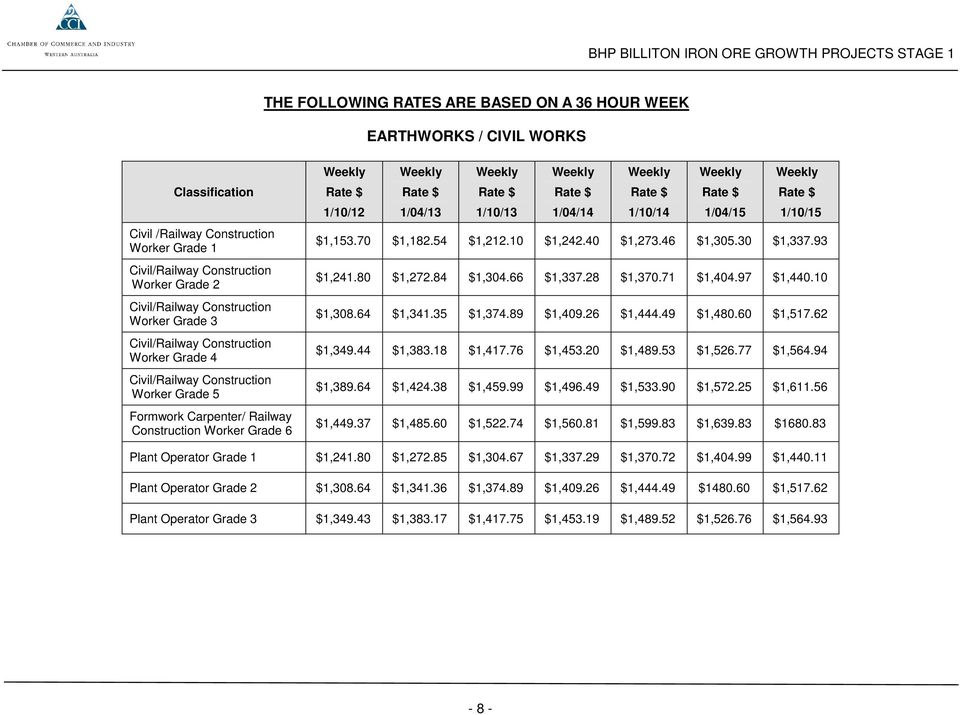
8 THE FOLLOWING RATES ARE BASED ON A 36 HOUR WEEK EARTHWORKS / CIVIL WORKS Classification Civil /Railway Construction Worker Grade 1 Civil/Railway Construction Worker Grade 2 Civil/Railway Construction Worker Grade 3 Civil/Railway Construction Worker Grade 4 Civil/Railway Construction Worker Grade 5 Formwork Carpenter/ Railway Construction Worker Grade 6 1/10/12 1/04/13 1/10/13 1/04/14 1/10/14 1/04/15 1/10/15 $1, $1, $1, $1, $1, $1, $1, $1, $1, $1, $1, $1, $1, $1, $1, $1, $1, $1, $1, $1, $1, $1, $1, $1, $1, $1, $1, $1, $1, $1, $1, $1, $1, $1, $1, $1, $1, $1, $1, $1, $1, $ Plant Operator Grade 1 $1, $1, $1, $1, $1, $1, $1, Plant Operator Grade 2 $1, $1, $1, $1, $1, $ $1, Plant Operator Grade 3 $1, $1, $1, $1, $1, $1, $1,
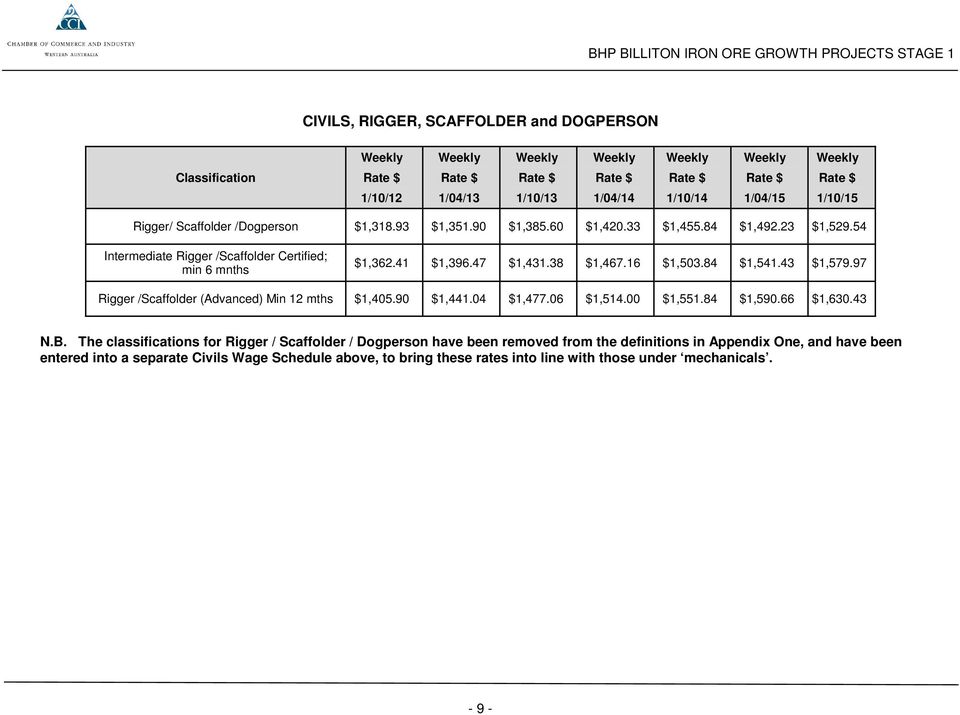
9 CIVILS, RIGGER, SCAFFOLDER and DOGPERSON Classification 1/10/12 1/04/13 1/10/13 1/04/14 1/10/14 1/04/15 1/10/15 Rigger/ Scaffolder /Dogperson $1, $1, $1, $1, $1, $1, $1, Intermediate Rigger /Scaffolder Certified; min 6 mnths $1, $1, $1, $1, $1, $1, $1, Rigger /Scaffolder (Advanced) Min 12 mths $1, $1, $1, $1, $1, $1, $1, N.B. The classifications for Rigger / Scaffolder / Dogperson have been removed from the definitions in Appendix One, and have been entered into a separate Civils Wage Schedule above, to bring these rates into line with those under mechanicals
10 CRANE OPERATORS Classification 1/10/12 1/04/13 1/10/13 1/04/14 1/10/14 1/04/15 1/10/ tonnes $1, $1, $1, $1, $1, $1, $1, tonnes $1, $1, $1, $1, $1, $1, $1, tonnes $1, $1, $1, $1, $1, $1, $1, tonnes $1, $1, $1, $1, $1, $1, $1, tonnes $1, $1, $1, $1, $1, $1, $1, tonnes $1, $1, $1, $1, $1, $1, $1, tonnes $1, $1, $1, $1, $1, $1, $1, tonnes $1, $ $1, $1, $1, $1, $1, tonnes $1, $1, $1, $1, $1, $1, $1, tonnes $1, $1, $1, $1, $1, $1, $1, tonnes $1, $1, $1, $1, $1, $1, $1, tonnes $1, $1, $1, $1, $1, $1, $1, tonnes $1, $1, $1, $1, $1, $1, $1, Over 420 tonnes $1, $1, $1, $1, $1, $1, $2,

11 MECHANICAL CLASSIFICATIONS Classification 1/10/12 1/04/13 1/10/13 1/04/14 1/10/14 1/04/15 1/10/15 Welder Special Class $1, $1, $1, $1, $1, $1, $1, Metal Tradesperson $1, $1, $1, $1, $1, $1, $1, Rigger & Scaffolder (Advanced) 12 months exp $1, $1, $1, $1, $1, $1, $1, Intermediate Rigger or Scaffolder (Certified) Minimum 6 months exp Rigger / Scaffolder Other (basic) or Dog person $1, $1, $1, $1, $1, $1, $1, $1, $1, $1, $1, $1, $1, $1, Store person $1, $1, $1, $1, $1, $1, $1, Trades Assistant $1, $1, $1, $1, $1, $1, $1,

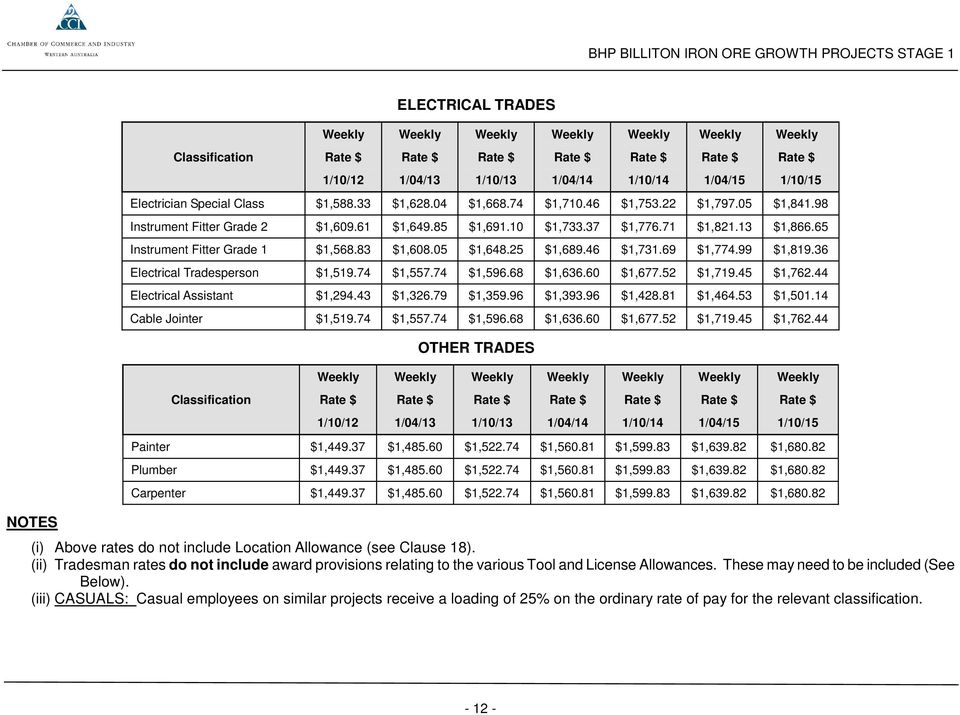
12 ELECTRICAL TRADES Classification 1/10/12 1/04/13 1/10/13 1/04/14 1/10/14 1/04/15 1/10/15 Electrician Special Class $1, $1, $1, $1, $1, $1, $1, Instrument Fitter Grade 2 $1, $1, $1, $1, $1, $1, $1, Instrument Fitter Grade 1 $1, $1, $1, $1, $1, $1, $1, Electrical Tradesperson $1, $1, $1, $1, $1, $1, $1, Electrical Assistant $1, $1, $1, $1, $1, $1, $1, Cable Jointer $1, $1, $1, $1, $1, $1, $1, OTHER TRADES Classification 1/10/12 1/04/13 1/10/13 1/04/14 1/10/14 1/04/15 1/10/15 NOTES Painter $1, $1, $1, $1, $1, $1, $1, Plumber $1, $1, $1, $1, $1, $1, $1, Carpenter $1, $1, $1, $1, $1, $1, $1, (i) Above rates do not include Location Allowance (see Clause 18). (ii) Tradesman rates do not include award provisions relating to the various Tool and License Allowances. These may need to be included (See Below). (iii) CASUALS: Casual employees on similar projects receive a loading of 25% on the ordinary rate of pay for the relevant classification
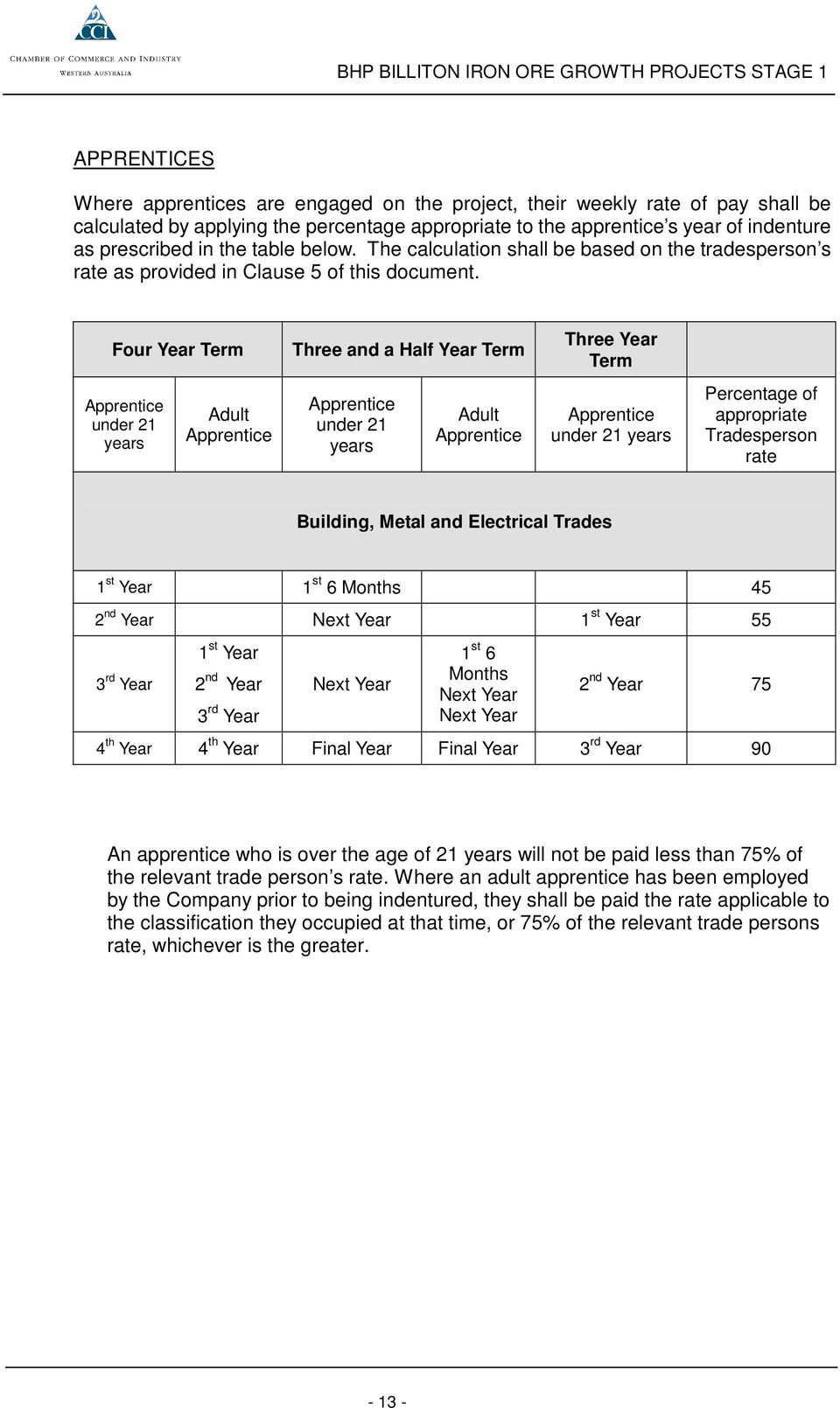
13 APPRENTICES Where apprentices are engaged on the project, their weekly rate of pay shall be calculated by applying the percentage appropriate to the apprentice s year of indenture as prescribed in the table below. The calculation shall be based on the tradesperson s rate as provided in Clause 5 of this document. Four Year Term Three and a Half Year Term Three Year Term Apprentice under 21 years Adult Apprentice Apprentice under 21 years Adult Apprentice Apprentice under 21 years Percentage of appropriate Tradesperson rate Building, Metal and Electrical Trades 1 st Year 1 st 6 Months 45 2 nd Year Next Year 1 st Year 55 3 rd Year 1 st Year 2 nd Year 3 rd Year Next Year 1 st 6 Months Next Year Next Year 2 nd Year 75 4 th Year 4 th Year Final Year Final Year 3 rd Year 90 An apprentice who is over the age of 21 years will not be paid less than 75% of the relevant trade person s rate. Where an adult apprentice has been employed by the Company prior to being indentured, they shall be paid the rate applicable to the classification they occupied at that time, or 75% of the relevant trade persons rate, whichever is the greater
14 6. ADDITIONAL ALLOWANCES OR SPECIAL PAYMENTS Historically the construction industry has attracted additional allowances that are designed to compensate employees for extraordinary conditions that occur on such projects. Below are examples of current market allowances for this region: A. SITE ALLOWANCE On commencement on the project, a flat rate Site Allowance of $5.10 per hour, paid for all hours worked. From the first pay period on or after 1 April, 2013, the Site Allowance is to be increased to $5.40 per hour, and from the first pay period commencing on or after 1 April 2015, it will be increased to $5.72. The disabilities shall be seen to include, but not be limited to heat, height, dust, confined space, dirty work and extremes of terrain and all special rates and provisions which would otherwise have applied under a relevant Award. B. PROJECT INCENTIVE PAYMENT On commencement on the project, a flat rate Project Incentive Payment of $ per week is paid for each completed week of service, where an employee is ready, willing and available to work. This will increase to $ from the first pay period commencing on or after 1 April, 2013, and to $ from the first pay period on or after 1 April, Generally this payment is accrued weekly and paid out at the end of an employee s period of employment on the works. Employees may elect to have this payment paid out at the end of each four week cycle prior to exiting on R&R. The Productivity Payment is forfeited in full in any week industrial action of any form takes place. Productivity payments usually continue to apply for any period of authorised absence including, for example R&R leave, RDO s, jury service and unapproved unpaid leave taken in conjunction with R&R leave, but are forfeited for days of unauthorized absence. For the purpose of pro rata entitlements under this clause, the allowance will be calculated at the rate of $27.86 per day. This will increase to $30.00 per day from the first pay period commencing on or after 1 April 2013, and to $30.72 from the first pay period commencing on or after 1 April A completed week of service generally includes time not worked due to annual leave, paid personal leave (including sick and carers leave), compassionate leave, jury service, R&R leave days, public holidays, RDO s, workers compensation to a maximum of two (2) weeks, and approved unpaid leave taken in conjunction with R&R Leave. C. LEADING HAND ALLOWANCE In addition to an employee s total wage a Leading Hand appointed in writing as such by the employer is usually paid an all purpose allowance: i) If placed in charge of not less than three (3) and not more than ten (10) other employees $36.00 per week. This will increase to $37.80 with effect from the first pay period on or after 1 April

15 ii) If placed in charge of ten (10) or more other employees $46.62 per week. This will increase to $ $49.00 with effect from the first pay period on or after 1 April D. TOOL ALLOWANCE On commencement of the project, where at the company s request a metal tradesperson, provides their own tools, the employee shall be paid an all purpose tool allowance of $16.20 per week. This will increase to $17.90 per week from the first pay period on or after 1 April Where a tradesperson Painter at the company s request, provides their own tools, the employee shall on commencement on the project, be paid an all purpose tool allowance of $6.85 per week from 1 April This will increase to $7.50 per week from 1 April Where a tradesperson Carpenter / Plumber at the company s request, provides their own tools, the employee shall on commencement on the project, be paid an all purpose tool allowance of $28.80 per week. This will increase to $31.70 per week from 1 April Where an electrical tradesperson, at the company s request, provides his or her own tools, the employee shall on commencement of the project, be paid an all purpose tool allowance of $16.20 per week. This will increase to $17.90 from the first pay period commencing on or after 1 April The tool allowance is all purpose and should form a component of the employee s ordinary rate of pay. An apprentice shall receive a percentage of the all purpose tool allowance, being the percentage which appears against their year of apprenticeship in Clause 5 Apprentices. E. ELECTRICIANS LICENSE A tradesperson who holds and in the course of employment may be required to use a current A or B Grade License issued pursuant to the relevant regulation in force under the Electrical Licensing Regulations 1991 usually attracts an all purpose allowance of $55.10 per week. This will increase to $60.00 per week from the first pay period commencing on or after 1 April F. ELECTRICIAN S SPECIAL ALLOWANCE A special allowance of $31.00 flat per week is payable to electrical employees engaged in the electrical trades classifications set out in the Electrical Wage Rates schedule. This will increase to $32.70 per week from the first pay period commencing on or after 1 April An electrical apprentice shall receive a percentage of the special allowance, being the percentage which appears against their year of apprenticeship in Clause 5 Apprentices
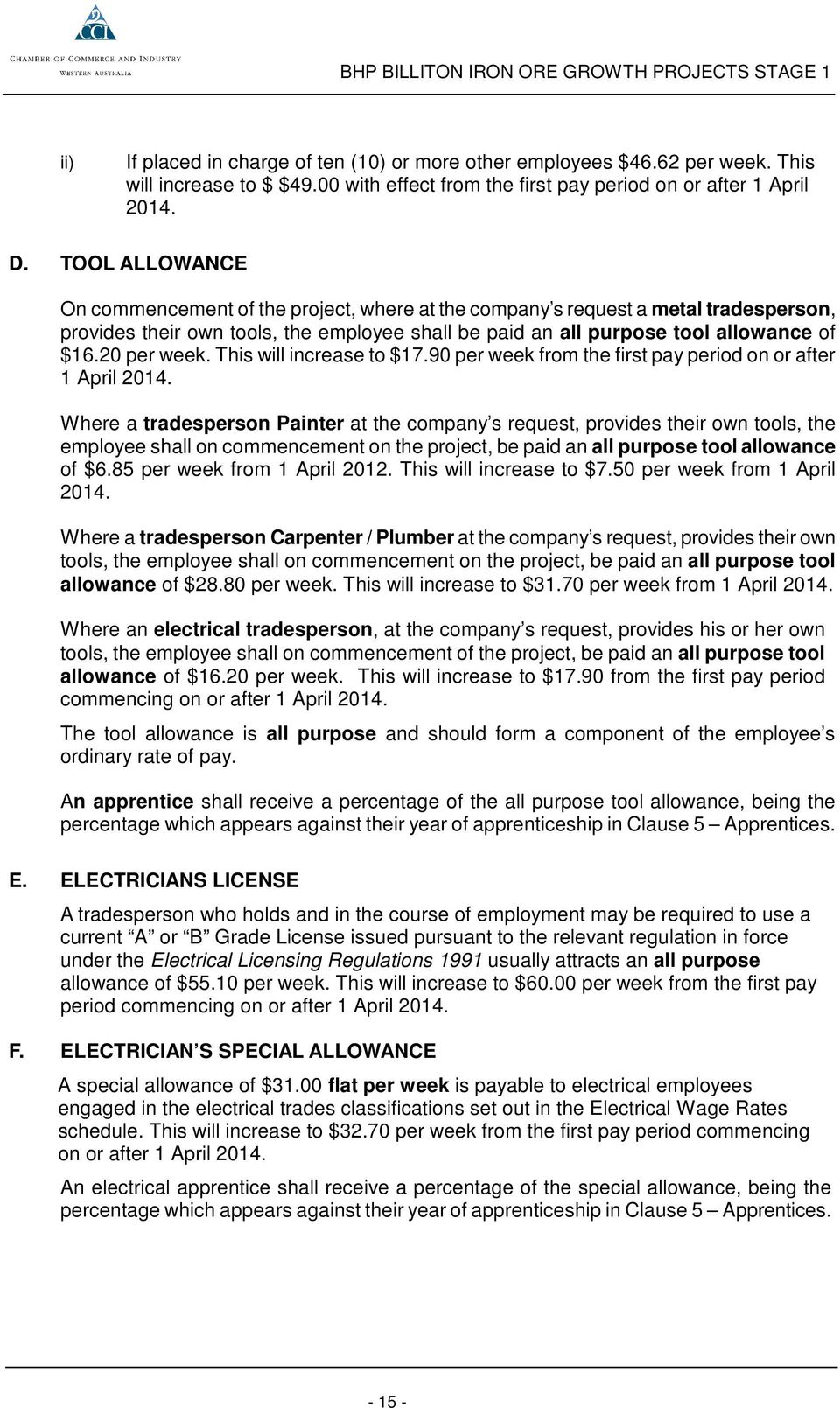
16 G. ELECTRICAL COMMISSIONING ALLOWANCE An electrical tradesperson who has not less than two (2) years on the job experience and who during commissioning work is engaged on complex or intricate circuitry and is able to perform such work without supervision historically attracts an all-purpose allowance of $35.10 per week while performing such work. This will increase to $38.60 per week from the first pay period commencing on or after 1 April H. WELDING ALLOWANCE Welders qualified and required to carry out coded welding work in accordance with AS1554 or similar standard have traditionally been paid an all purpose allowance of $1.30 per hour. This will increase to $1.45 per hour from the first pay period commencing on or after 1 April I. MECHANICAL FITTER SPECIAL CLASS A Mechanical Fitter holding a current Tradesperson Certificate or Tradesperson Rights Recognition and is able to and/or required to perform work on fluid power circuitry and/or diagnose fluid power circuitry, has been paid an all purpose allowance of $0.80 per hour. This will increase to $0.88 per hour from the first pay period commencing on or after 1 April J. TRADESPERSON SPECIAL CLASS A Boilermaker or Pipefitter holding a current Tradesperson Certificate or Tradesperson Rights Recognition and is able to and/or required to mark off, read plans, make templates, set out, fit up pipes or fit up plates, may attract an all purpose allowance of $0.80 per hour. This will increase to $0.88 per hour from the first pay period commencing on or after 1 April K. METAL ALLOWANCES NOT CUMULATIVE The allowances prescribed in H Welding Allowance, I Mechanical Fitter Special Class, J Tradesperson Special Class are not cumulative. An employee is not entitled to be paid more than one (1) allowance at a time. Should two (2) or more allowances be applicable, (e.g. Welding Allowance and Mechanical Fitter Special Class) the employee shall be entitled to receive the highest allowance only. L. CARPENTERS ALLOWANCE A Carpenter holding a current Tradesperson Certificate and working on the project as a Carpenter (setting out) has traditionally been paid an all purpose allowance of $ $0.49 per hour. This will increase to $0.54 per hour from the first pay period commencing on or after 1 April
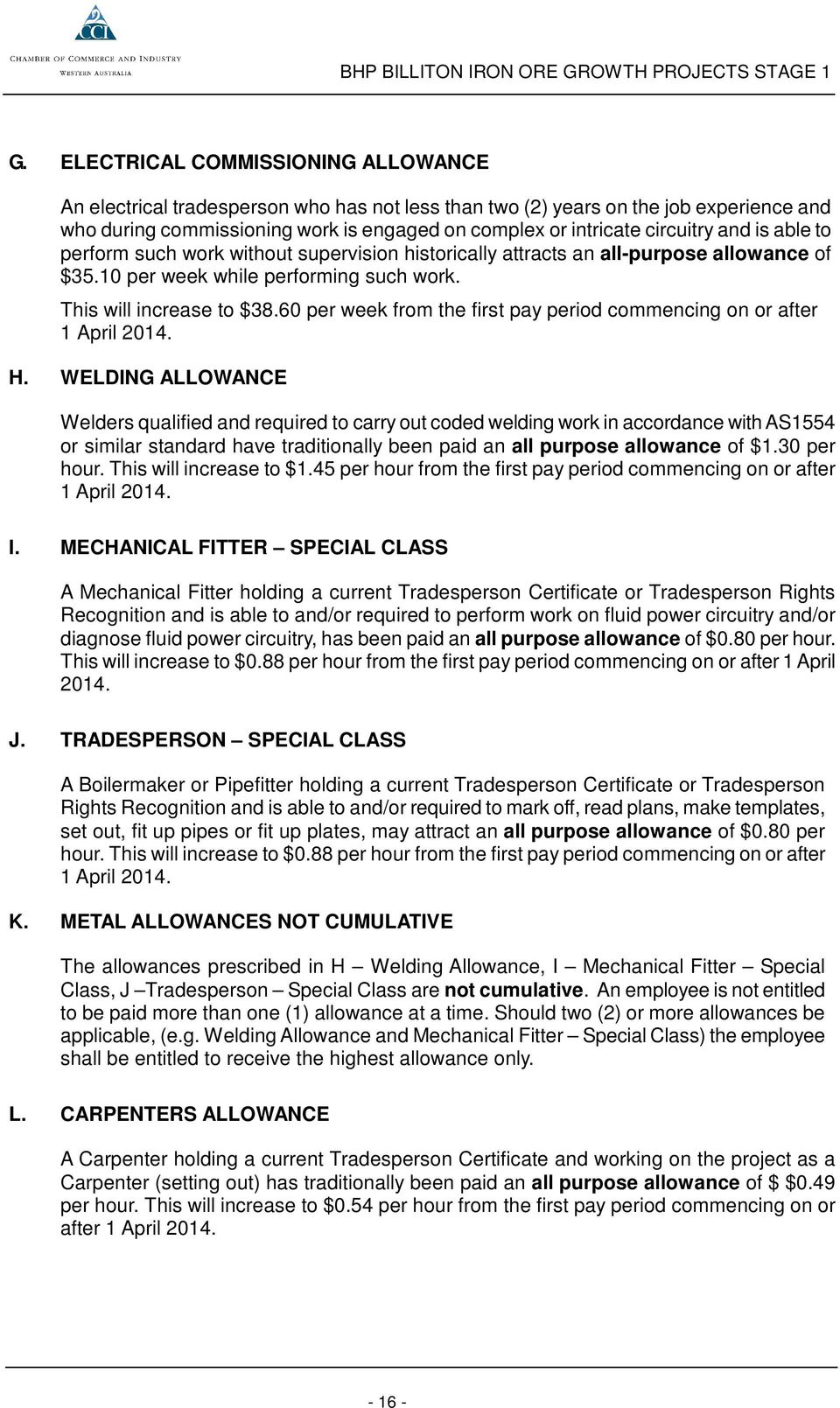
17 M. TRAVEL ALLOWANCE Where, other than in Port Hedland, an employee is required to travel from the accommodation established on the project to the place of work in company provided transport and the actual time spent in traveling to the place of work exceeds twenty (20) minutes that excess time shall be paid at ordinary rates. The same applies when the actual time spent traveling back to the accommodation on the project exceeds twenty (20) minutes. A local employee, or an employee in receipt of LAFHA and residing in Port Hedland who is not provided with transport or is not offered transport from their home to the work site and is required to travel there in his or her own vehicle and/or is required to travel to the nominated Project Village and then provided with transport to and from the work site will be paid a flat allowance of $20.00 per day. This allowance will increase to $21.00 per day from the first pay period on or after 1 April 2013, and to $22.05 from the first pay period on or after 1 April This allowance is not payable where Company transport is provided or offered. There shall be no additional costs to the Company other than the travel allowance provided for in this clause for employees travelling to and from the work site. N. FIRST AID ALLOWANCE An employee holding either a Senior First Aid of the St John Ambulance Association or the equivalent qualification from the Australian Red Cross Society, appointed in writing by the company to perform first aid duties, shall on commencement be paid a flat allowance of $9.90 per week in addition to the ordinary rate of pay. This First Aid Allowance shall be increased to $10.40 per week with effect from the first pay period on or after 1 April 2013, and to $10.92 per week with effect from the first pay period on or after 1 April NOMINAL HOURS OF WORK AND REASONABLE ADDITIONAL OVERTIME Hours of work are generally based on 36 (thirty six) ordinary hours per week Monday to Friday (i.e. 7.2 hours per day). In addition, a further 4 ordinary hours per week (i.e. 0.8 hours per day) are worked and accrued towards 2 paid rostered days off (RDO) per four weekly work cycle. RDO s accumulated are taken with R&R leave (See below): Generally hours worked in excess of 8 ordinary hours Monday to Friday are at time and a half for the first 2 hours and then double time. Hours worked on Saturday are at time and a half for the first 2 hours and then double time. Hours worked on a Sunday are all at double time. Traditionally every second Saturday or Sunday is an unpaid non-working day (SNWD). A Casual Hire employee shall be paid a loading of 25% on their ordinary rate of wage which shall become their ordinary all purpose rate of pay, subject to the addition of all purpose allowances. Where a Casual employee commences overtime they shall be paid the relevant overtime penalty on their ordinary all purpose rate
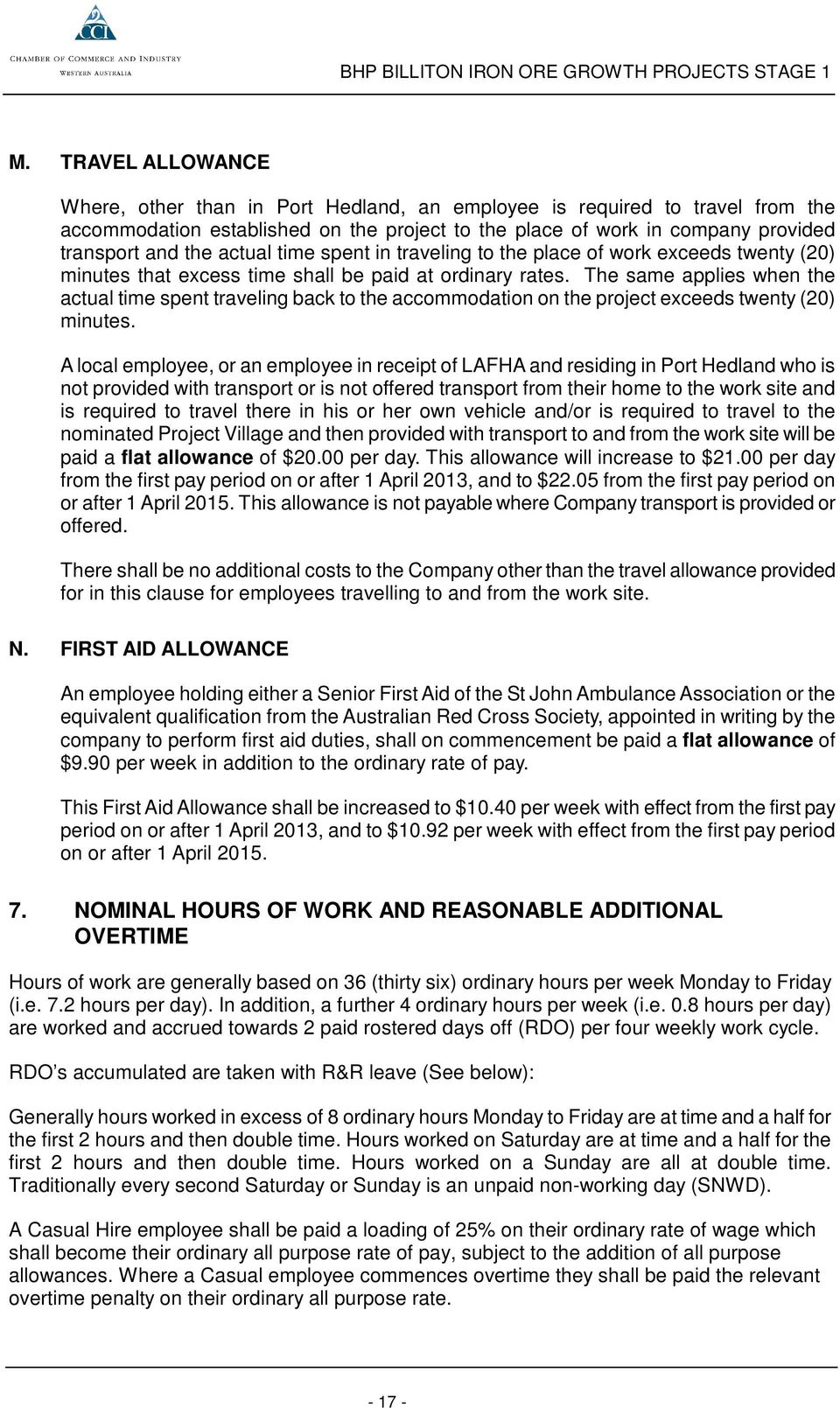
18 Operational requirements will require significant overtime. Rostered working hours will need to be established to meet the overall production and manning requirements of the site. Employees may be required to work day work or night shift and to work on Saturdays, Sundays and Public Holidays. The NES provides that an employer must not request or require an employee to work more than 38 hours (full time) per week unless the additional hours are reasonable. In determining whether the additional hours are reasonable, the following factors may be considered: Any risk to employee safety and health from working additional hours; the employee s personal circumstances, including family responsibilities; the needs of the workplace; whether employees are entitled to overtime/penalty payments; notice given by the employer of any request to work additional hours; notice given by the employee of their intention to refuse additional hours; usual patterns of work in the industry; the nature of the employee s role and level of responsibility. In light of the above considerations, it is unlikely that the NES will impact the normal working hours to meet the operational requirements of the Project. However, this minimum standard of employment has yet to be tested in Fair Work Australia. If an employee raises a concern about the hours they are required to work, you should consult with CCIWA s site representative. Contractors should check the application of the hour s terms of any relevant awards or agreements in their particular circumstances. Contractors should ensure that employment conditions provide for flexibility to meet site operating requirements
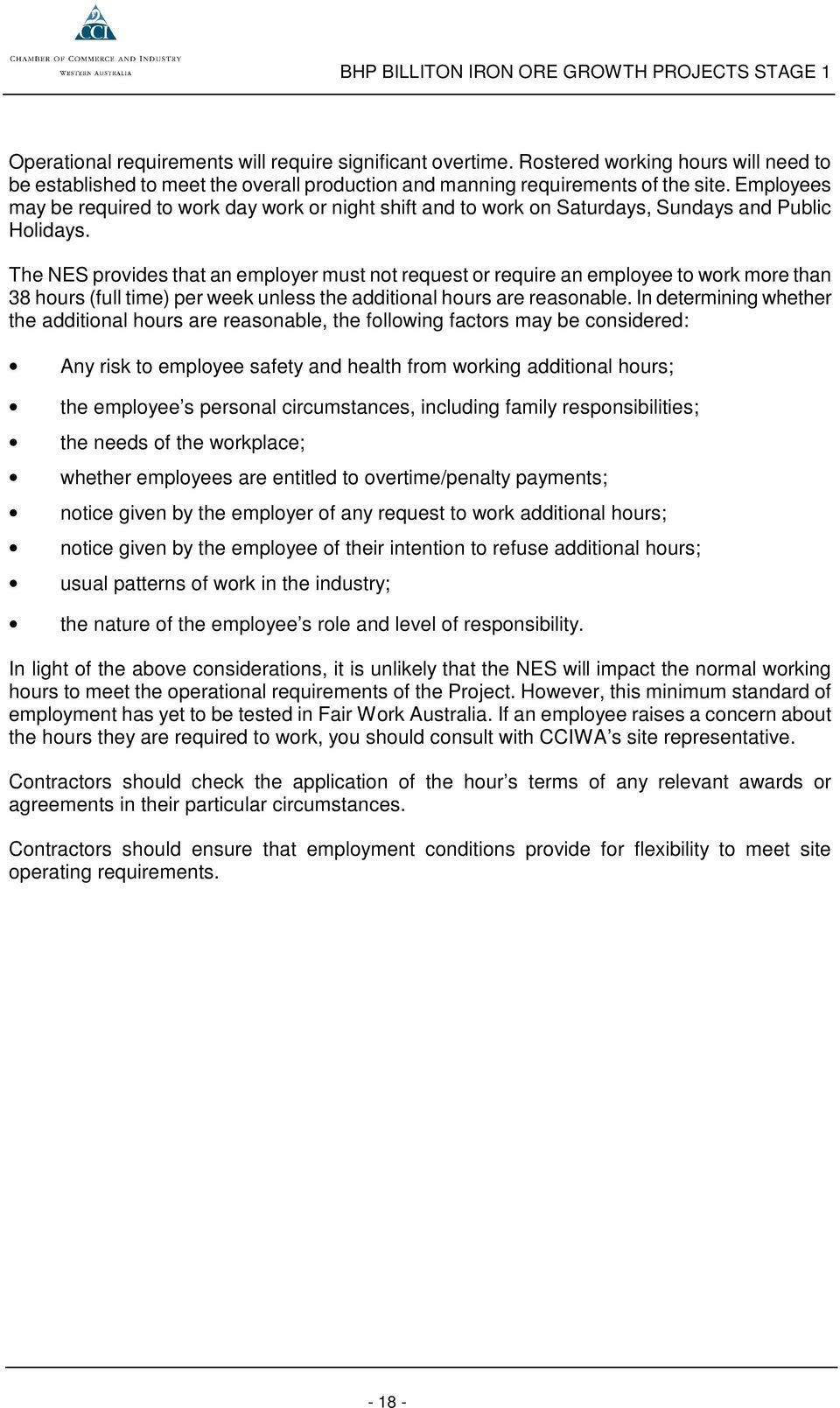
19 8. REST AND RECREATION LEAVE (R&R) GENERAL An employee s usual place of residence and not their place of engagement will determine whether an employee is a distant worker or engaged locally. Employers should be mindful when engaging distant workers, (particularly interstate distant workers) of their obligation to repatriate them to their point of hire on R&R and termination of employment. Point of Hire is defined in Clause23 and in essence it is the employees usual place of residence at appointment. It is customary for distant workers to take R&R after completing a minimum of twenty-eight (28) days on site. As a minimum, employees are entitled to a weekend and two (2) days of R&R leave. The usual time spent off site on R&R is seven (7) days, which may be shortened to a minimum of four (4) days after consultation and agreement with the employee. Interstate Employees may request an additional days unpaid R & R to a maximum of eight (8) days each cycle. Interstate employees who request this arrangement will work 27 days on and have 8 days R&R to ensure all distant employees remain on a 35 day cycle. On the first R & R leave, an employee is entitled to two (2) days R & R leave on ordinary pay in addition to the unpaid weekend. On the second and subsequent occasions, only one (1) of the two (2) days is ordinary pay, the other being unpaid. These payments are only made when the leave is actually taken. As indicated above (clause 7) accumulated RDO`s are taken on R & R. Local employees may request to have an extra three (3) days unpaid leave with their RDO and weekend, in order to have off seven (7) consecutive days. TRANSPORT ARRANGEMENTS / TIME OFF ON R&R It is industry practice to provide Distant Workers with an entitlement to a return airfare to their Point of Hire after four (4) continuous weeks service. Point of Hire is defined in Clause 23. While there is no legal requirement to pay travel time on R&R leave, if an employee is required to cease work before the completion of ordinary time hours to meet transport requirements for the purposes of R&R leave, you are obligated to make up ordinary time hours for the day (7.2). Conversely should an employee seek to leave work early for genuine reasons to catch an earlier flight than scheduled you are only required to pay for time worked. In addition employees who choose to return from R&R at a time that prevents them from commencing at the ordinary starting time are only paid from the time they commence work. EMPLOYEES TRAVELLING TO A PLACE OTHER THAN POINT OF HIRE Traditionally, employees have been allowed to travel to a place other than their point of hire provided that the cost does not exceed a return economy airfare to their point of hire. Contractors must obtain suitably qualified advice regarding the taxation implications for such
20 travel. 9. ANNUAL LEAVE An employee is entitled to 144 ordinary hours of paid annual leave for each 12 months of continuous service i.e. 4 X 36. Annual leave accumulates progressively. Time not worked due to authorised absences such as sick leave, annual leave, bereavement leave, public holidays and workers compensation to a maximum of two weeks, or R&R, will count as continuous service for the purpose of this clause. An employee before going on annual leave will be paid the wages the employee would have received in respect of the ordinary time the employee would have worked, had the employee not been on leave during the relevant period together with a leave loading of 17.5% calculated on the wage rates and all-purpose allowances. Annual leave shall be given and taken as agreed between the Company and employee. If a public holiday is observed on an ordinary working day during the period of annual leave that day will not be counted as annual leave (i.e. the leave is increased by one (1) day for each public holiday.) Where the Company seeks to close down the site or sections of the site for the purposes of allowing annual leave to be taken by most of its employees, it shall give its employees at least four (4) weeks notice of its intention to do so. Upon lawful termination all untaken accrued annual leave shall be paid out. 10. PERSONAL / CARER S LEAVE Personal leave can be used when an employee is unable to attend work on account of personal illness or injury (i.e. Sick leave) or because the employee is required to provide care for a member of the employee s immediate family or household (i.e. Carer s leave). Payment for each day or shift of personal leave will be in accordance with the NES, relevant modern award or applicable industrial agreement, as most favourable to the employee. Under the NES, an employee (other than a casual employee) is entitled to accrue 10 days (72 hours) of paid personal leave per year of service with an employer. Personal leave accrues progressively. Current construction industry practice provides that on termination of employment (other than for serious misconduct) an employee with a balance of accrued personal leave on the Project, is paid the amount of outstanding personal leave hours at the relevant base ordinary rate of pay and all purpose allowances as outlined at item 5 of this booklet. An employee who is required to provide care or support to a member of the employee s immediate family or household who has exhausted their entitlement to paid personal leave and does not have any accrued annual leave, or is a casual employee, is entitled to take up to 2 days unpaid carer s leave for each such occasion

21 11. COMPASSIONATE LEAVE An employee (other than a casual employee with less than 12 months continuous service) is entitled to take up to 2 days compassionate leave when a member of the employee s immediate family or household has a personal injury or illness that poses a serious threat to their life, or when a member of that immediate family or household dies. Under the NES and relevant modern awards, payment for compassionate leave will be at the employee s base ordinary wage rate for the employee s ordinary hours of work in the period of leave. Applicable industrial agreements may provide for payment of what the employee would reasonably have expected to be paid if they had worked during the period of leave. 12. COMMUNITY SERVICE LEAVE An employee may be granted community service leave for the following: Jury Service, including attendance for jury selection Voluntary emergency management such as fire fighting. An employee who seeks approval for absence on community service leave must provide notice to the employer as soon as possible. The employee must also provide evidence of having attended such community service for the purposes of being paid for such community service leave. An employee who attends approved community service leave shall be paid at the employee s basic rate of pay. 13. PARENTAL LEAVE An employee may be entitled to unpaid parental leave in accordance with the provisions of the National Employment Standards and prevailing legislation. 14. PUBLIC HOLIDAYS An employee will be entitled to the following days that will be observed as holidays without deduction of ordinary hours pay: New Year s Day Australia Day Good Friday Easter Monday Anzac Day Labour Day Foundation Day Sovereign s Birthday or the day prescribed in the Government Gazette in substitution for the Sovereign s Birthday for the locality
22 Christmas Day Boxing Day Where any of the days above fall on a Saturday or Sunday, the holiday shall be observed on the next succeeding Monday, In each case, the substituted day shall be a holiday without deduction of ordinary pay and the day for which it is substituted shall not be a holiday. By arrangement, the Company and the employees may agree to substitute another day for any of the public holidays prescribed in this clause in which event an employee who works on a day which otherwise would have been a public holiday will be paid at ordinary rates. Pay for work on a public holiday for all employees will be 2.5 times the hourly rate. Subject to clause 7, this clause does not apply to casuals. 15. INCOME PROTECTION INSURANCE It is usual practice for this industry to provide Income Protection Insurance for employees on the Project. Currently agreements provide: On commencement, cover for 100% of an employee s average earnings up to a maximum of $2,000 (whichever is less) for 104 weeks applying to personal injury or sickness (other than illnesses or injuries not normally covered by the employer s policy); o From 1 April 2013, cover for earnings up to $2,100, and o From 1 April 2015, cover for earnings up to $2,200. An excess (waiting) period of fourteen (14) days (except sporting injuries 28 days) applying to personal injury or sickness; Cover for casual employees with greater than one (1) weeks continuous employment under the Agreement; The general Insurance Code of Practice shall apply including operation of a claims review panel run by Insurance Enquiries and Complaints Ltd (IEC); A requirement that claimant employees undertake reasonable rehabilitation programmes as directed by the employer and/or the insurer; The Income Protection Insurance shall not include workers compensation top up or lump sum benefits; and All employees making a claim for a period of absence will be reviewed immediately and thereafter on a regular basis as requested by the employer nominated medical examiner. The cost to the Company shall not exceed 1.8% (plus GST) of employees gross earnings
23 Where an employee is in receipt of income protection insurance payments they shall not be entitled to any other payments under this Agreement. 16. REST PERIODS AND MEAL BREAKS It is industry practice to allow for a rest period of fifteen (15) minutes without deduction of pay each morning at a time determined by the Company. In the case of shift work this rest period is at a time determined by the Company, no later than four (4) hours after commencement of work. The rest period may be staggered to suit the operational requirements of the site. If the rostered day is scheduled for 10 hours or more then the break is extended to thirty (30) minutes without deduction of pay. Except in the case of shift work, employees are entitled to an unpaid meal break not exceeding thirty (30) minutes duration on each day worked, Monday to Friday. On Saturdays, Sundays and Public Holidays this break is paid at the ordinary rate of pay. In the case of shift work this break is taken without the deduction of pay. Unless agreed otherwise between the employer and employee, the meal break shall be taken no later than six (6) hours after commencement of ordinary hours of work on any day Monday to Friday or in the case of weekend overtime no later than six (6) hours after the commencement of work. In the event of a twelve hour day, the meal break shall be taken no later than eight (8) hours after commencement of ordinary hours of work on any day Monday to Friday or in the case of weekend overtime no later than eight (8) hours after the commencement of work. The Company may stagger the meal break to meet operational requirements but may not, without first obtaining agreement of an employee to postpone the meal break beyond the normal scheduled commencement time. If the meal break is delayed by more than one hour, the employee shall be paid at overtime rates for all time worked after the one-hour delay until the break is taken. 17. OVERTIME MEAL ALLOWANCE Where an employee is not provided with full board and lodging or a Living Away From Home Allowance (LAFHA) and is required to work additional overtime for one and a half hours or more beyond the usual rostered overtime and has not received prior notice of this from at least the previous day from his or her employer then the employee is entitled to be paid a meal allowance of $ LOCATION ALLOWANCES In Western Australia, Location Allowances have been preserved in accordance with the terms of a Notional Agreement Preserving a State Award or an award made under the Fair Work Act 2009 (Cth), until 31 December, For the purposes of costing on this project, Contractors should consider that an employee is entitled to payment of a Location Allowance in accordance with the Location Allowance General Order issued by the Western Australian Industrial Relations Commission. This Location Allowance is intended to compensate for such factors as isolation, climatic conditions and cost of living factors which affect living conditions in the remote locations in the state of Western Australia. Currently in terms of the legislation, similar projects in the North West would provide a location
24 allowance of $27.60 per week in the Port Hedland locality and $19.10 per week for mine and rail work outside the Port Hedland locality. Where an employee is provided with board and lodging by his employer, free of charge, or in receipt of LAFHA, such employee shall be paid 66.66% (sixty-six and two thirds per cent) of the relevant allowance, i.e. $18.40 for Port Hedland and $12.70 for works outside the Port Hedland locality. An Apprentice shall receive a percentage of the location allowance, being the percentage which appears against their year of apprenticeship in Clause 5 Apprentices. The location allowance specified above may be varied by, and such variation will operate in accordance with, the Location Allowance General Order issued from time to time by the Western Australian Industrial Relations Commission. 19. REDUNDANCY / SEVERANCE PAY Redundancy/severance pay provisions exist under the NES and/or relevant modern awards as well as the WAIRC General Order on Redundancy (2005 WAIRC 01715) which will continue to apply until at least 1 January 2014 in relation to employees of constitutional corporations in Western Australia. You should discuss the applicable severance/redundancy pay provisions for your particular circumstances with CCI. However, for tendering purposes you should allow a flat payment of $65.00 per week per employee on commencement. The allowance is to be increased to $75.00 per week from or after the first pay period after 1 April 2013, and again to $80.00 per week from 1 April This payment is accrued for each completed week of service and paid out at the end of an employee s period of employment on the Project. An employee, who terminates their employment before the completion of four (4) weeks continuous service, shall not be entitled to the provisions of this clause. 20. SUPERANNUATION Contractors must ensure that superannuation arrangements meet employer obligations under the Superannuation Guarantee Legislation as supplemented by any relevant award provision. The current contribution rate is 9% of Ordinary Time Earnings. Since 1 July 2008, all employers must use ordinary time earnings as the basis for calculating superannuation contributions. Contractors should review what payments and allowances must now be included (for example PIP, RDO payments and some allowances which may previously not have been included). Overtime is generally NOT included in OTE. On 13 May 2009, the Australian Taxation Office issued Superannuation Guarantee Ruling 2009/2 which explains the meaning of ordinary time earnings. Employers should seek advice on your own particular circumstances
25 21. LONG SERVICE LEAVE It usually a legislative requirement that employers in the construction industry register with the Construction Industry Long Service Leave Board to facilitate payments of long service leave contributions for their employees under the terms of the Construction Industry Portable Paid Long Service Leave Act The current contribution level for employers is 2% of an employee s ordinary time earnings as defined. 22. NOTICE OF TERMINATION You should be familiar with requirements for terminating employees from their employment. If you have a Federal industrial agreement in place, you must still comply minimally with the National Employment Standards (NES) which provide notice or payment in lieu of notice as follows Period of Continuous Service at end of the day notice is given: Not more than 1 year More than 1 year but not more than 3 years More than 3 years but not more than 5 years More than 5 years Period of Notice 1 week 2 weeks 3 weeks 4 weeks In addition to the notice periods above, employees over 45 years of age at the time of the giving of the notice with at least two years continuous service are entitled to an additional week s notice. The notice provisions in the NES do not apply to a daily hire employee working in the construction industry. Termination payments in lieu of notice must be paid as if the employee had worked during that time, including making superannuation payments. So, payments must be based on the hours the employee would have worked had their employment not been terminated. Contractors must also ensure the employee is given written notice of the day of termination, so all terminations must be communicated in writing. 23. MOBILISATION & DEMOBILISATION (AIRFARES AND FARES &TRAVEL) Generally the contractor shall pay the cost and expense incurred by an employee directed by the employer to travel to distant jobs from their Point of Hire on engagement and returning to their Point of Hire on termination, together with travelling time, paid at ordinary time rates of pay. Point of Hire for distant employees shall be the closest capital city or where applicable the closest airport in the cities and towns, listed in Schedule 3 to this Booklet, to the employees usual place of residence as stipulated in a statement in writing at the time the employee is engaged. However if requested by an employee the company may agree to a point of hire which is not the usual place of residence
26 For the purposes of mobilisation and demobilisation of employees, similar projects allow three (3) hours travel time at ordinary rates for all West Australian employees and up to a maximum of eight (8) hours for interstate employees. 24. ACCOMMODATION In respect to the accommodation village, contractors are responsible for their employees while in the village and would have to review the continuing employment of individuals if their conduct was unsatisfactory to the harmonious operation of the village. Normal discipline practices should be clearly spelt out to employees in company procedures or Conditions of Employment. LIVING AWAY FROM HOME ALLOWANCE (LAFHA) Where appropriate if an employee is not residing in the camp/village a Living Away From Home Allowance (LAFHA) or some other arrangement in lieu of being provided free board and lodging may be arranged. Current LAFHA provisions provide for a payment of $ per week. This allowance will increase by $20 per week from the first pay period commencing on or after 1 January each year. It is the Company s preferred position that board and lodging supplied by the Company be utilized unless good reason to do so otherwise exists. A distant employee may, with the prior written approval of the employer, seek private accommodation. Factors an employer may wish to take into consideration: Compassionate grounds; The availability of suitable alternative accommodation; There is no additional cost to the company; and Suitable transport arrangements to and from the job site. LOCAL LIVING SUBSIDY Employees employed by the company and who live in Port Hedland are usually paid a Local Living Subsidy. The local living subsidy on similar projects in Port Hedland is $ per week. This subsidy shall be increased by $20 per week from the first pay period commencing on or after 1 January each year. The LAFHA and Local Living Subsidy payments are deducted in any week that the employee is absent without authorisation. Deduction is on a pro rata basis at the rate of one-seventh of the payment for each day or part day the employee is absent without authorisation. The payment continues to be made when the employee is on any form of approved paid leave
27 25. SHIFT WORK Shift work which involves day and night shift is likely to be worked on the Project and as a condition of employment employees may be required to work shifts. The consecutive nature of a shift process is deemed not to be broken when work is not carried out because of a weekend, public holiday, RDO or industrial action. Night shift will be defined as any shift that commences at or after 6.00pm and finishes subsequent to midnight and at or before 8.00am. As a minimum, contractors should give no less than twenty-four (24) hours notice of their intention to introduce shift work, including notice of start and finish times, except in the event of a safety requirement or emergency. In the absence of an industrial instrument, the following shift conditions typically operate on construction sites as a minimum standard. SHIFT LOADING Usually a flat loading of 25% of the ordinary rate for each hour worked is payable for employees who work night shift. OVERTIME PENALTIES Where five (5) or less than five (5) consecutive shifts are worked employees are deemed not to be shift workers, but are usually paid at overtime rates for this period of work in lieu of the shift loading. MEAL BREAKS Where an employee is required to work during a scheduled shut down or tie in that will require 24 hours continuous coverage on site, arranged on the basis of two 12-hour shifts, that employee shall be entitled to be paid a 30 minute meal break paid at the ordinary rate of pay whilst on day work. TIME OFF DUTY BEFORE AND AFTER NIGHT SHIFT Rotating shift employees who move from day shift to night shift to be provided with a rest day prior to commencing the night shift. Similarly, where an employee moves back to day shift from night shift they will be provided a rest day on the day after their last night shift
28 For example: Week 1. Mon Tues Wed Thurs Fri Sat Sun Day 8 Hours Rest Night 8 Hours 8 Hours 8 Hours 8 Hours 8 Hours 8 Hours Week 2. Mon Tues Wed Thurs Fri Sat Sun Day Rest 8 Hours 8 Hours 8 Hours 8 Hours WDO Night 8 Hours Using the above example an employee will be entitled to payment for eight (8) ordinary hours on the rest day Tuesday prior to commencing back on day shift. ADDITIONAL ANNUAL LEAVE ENTITLEMENTS FOR SHIFT WORKERS There is an additional leave entitlement of one weeks leave (36 hours) for shift workers which accumulates pro-rata during their service 26. WORK INFORMATION STATEMENT Fair Work Australia has developed a Fair Work Information Statement that must be issued to all new employees. Contractors must give the Fair Work Information Statement to all new employees before or as soon as practicable after, the employee starts employment. 27. REQUESTS FOR FLEXIBLE WORKING ARRANGEMENTS An employee who is a parent, or has responsibility for the care of a child (either under school age or under 18 if the child has a disability) and who has 12 months continuous service, may request a change in working arrangements to assist the employee to care for the child. For a casual employee, they must be a long term casual employee (i.e. 12 months continuous service) and have a reasonable expectation of regular and systematic employment. The employee s request must be made in writing and set out the change requested and the reasons for the request. The employer must provide a written response to the employee within 21 days of receiving the request. The employer may refuse the request on reasonable business grounds
29 28. HEALTH AND SAFETY MANAGEMENT Health and Safety management is one issue to which successful tenders will be expected to pay considerable attention. Accordingly, tenders will be required to demonstrate how they intend to manage this important function. The site will be subject to relevant safety legislation (eg. The Mines Safety and Inspection Act 1994, Occupational Safety & Health Act 1984 and/or Rail Safety Act 1998 and associated regulations). Employers have an obligation to provide a safe system of work under this legislation and at common law. If contractors do not already have a Company Health and Safety management plan relating to the construction industry then one should be developed. Some of the areas that will require specific attention on this Project are the management of working in the heat and fitness for work, including fatigue and alcohol and other drug testing. Contractors should factor in costs of education and testing processes. Contractors should ensure that employees agree to co-operate with random testing processes and develop policies and procedures for dealing with these issues. Employee education and awareness programs and supervisor training in these areas is essential. SAFETY BOOT SUPPLY AND CLOTHING For tender purposes the cost of the following protective clothing should be allowed for each employee:- An initial issue of Four (4) sets of clothing, consisting of four (4) shirts (collar/sleeves) and trousers or four (4) pairs of overalls; and one pair of safety boots, to be replaced on a fair wear and tear basis. Employees, who have at least two weeks continuous service on site between the months of April and September, will be issued with a one-off winter jacket in April, provided the employee has not received a jacket of an equivalent standard from the Company on site or elsewhere within the last six months
30 29. SPECIAL CONDITIONS INSHORE MARINE WORKS We recommend that tenders allow for the following conditions on the inshore marine works: BARGE DISABILITY ALLOWANCE We recommend that on commencement on the project, a flat barge allowance of $24.00 per day be provided for each week worked by an employee on a crane barge. This flat allowance is in recognition of the type of work to be performed including pile driving and other activities associated with wharf extensions and the installation of other inshore marine structures. It will increase to $25.20 per day with effect from the first pay period on or about 1 April 2013, and increase to $26.46 per day from 1 April WORKING ARRANGEMENTS Where for reasons beyond the control of the contractor, work is unable to be carried out on the barge employees can be transferred to other alternate work within the scope of the contractor s work on the project. The alternate work should be allocated on the basis of the employee s skill, competencies and training to undertake the work. The spread of hours may be altered to enable better utilisation of hours available for work and productivity improvement by agreement with the majority of employees in the area or areas concerned, or, where no agreement can be reached, by the contractor providing forty-eight (48) hours notice to the employees concerned. Contractors should give employees twenty-four (24) hours notice of afternoon shift work including the intended starting and finishing times. An afternoon shift means any shift commencing at or after 10.00am and before 6.00pm. It is recommended that a flat loading of 25% of the ordinary rate for each hour worked be provided for afternoon shift work. 30. SUBCONTRACTING Contractors should ascertain if they have the right to further sub-contract work under the terms of their contract. If a subcontractor is to be used, it is important that they have knowledge of this Booklet, experienced site supervisors and the capacity to carry out work in a remote area. It is your responsibility to inform sub-contractors of the importance of good IR and HR planning and practices. It is recommended that any subcontractors that a contractor may utilise on the site are aware of and meet the legislative requirements regarding:- Workers Compensation; Construction Industry Portable Long Service Leave; Occupational Health and Safety; and Superannuation. It is further recommended that any subcontractors are put in contact with the site CCI representative at an early stage of planning for the work
31 31. CONDITIONS OF EMPLOYMENT Successful tenders / contractors (and sub-contractors) must provide the terms and conditions of employment in writing to each employee who is employed on the Project. The Contractor should make every effort to ensure each employee understands the terms and conditions under which they will work while engaged on the Project. Preferably the contractor should arrange a one-on-one interview with each prospective employee. During such interview the proposed conditions of employment must be explained and queries answered. This session should be followed by signing of all relevant acknowledgements by the employee. Employees should also be informed of and understand all company policies and procedures, site procedures and policies together with any village rules which might apply during their time on the Project. As a minimum, the following information should be included in any employee letter of offer / contract of employment: Probation maximum probation for new employees can be no more than eight (8) weeks Drug and Alcohol Policy and Procedure Including testing information and procedures Any motelling arrangements Strict adherence to camp rules, and Terms and conditions relating to charter flights, site transport etc. Contractors should also consider their contractual requirements in the tender for the approval of their employment conditions on the project
32 APPENDIX ONE: CIVIL AND RAILWAY WORKERS CIVIL CLASSIFICATION DEFINITIONS CIVIL CONSTRUCTION WORKER GRADE 1 Labourer with less than three (3) months experience CIVIL CONSTRUCTION WORKER GRADE 2 & Plant Operator Grade 1 Operator Forklift < 3 tonnes capacity Spotter Chainman Formwork, Stripping Concrete Floater Concrete Gang Worker Fencer Bitumen Worker CIVIL CONSTRUCTION WORKER GRADE 3 & Plant Operator Grade 2 Note removal of Rigger or scaffolder classification Operator Bobcat Operator Backhoe Trenching Machine capable of 2.4m depth, 0.45m width Pile Driver < 105 kw Steel Fixer Drainer Crusher Operator Operator Roller > 8 tonnes Operator Water Cart Operator Dump Truck Operator Loader < 15 tonnes Operator Dozer < 15 tonnes Operator Excavator < 15 tonnes Operator Scraper < 10m3 struck capacity Concrete Paving Machine Concrete Finisher CIVIL CONSTRUCTION WORKER GRADE 4 & Plant Operator Grade 3 Note removal of Rigger or scaffolder classification Multi-skilled Civil Worker Pile Driver > 105 kw Operator Dozer > 15 tonnes Operator Grader > 10m3 struck capability Operator Scraper > 10m3 struck capability Operator Loader > 15 tonnes Operator Excavator > 15 tonnes
33 CIVIL CONSTRUCTION WORKER GRADE 5 Final Trim Grader Operator RAILWAY CONSTRUCTION WORKER CLASSIFICATIONS & DEFINITIONS RAILWAY CONSTRUCTION WORKER GRADE 1 (RCW1) Competency required: An employee with less than three (3) months working experience in the Construction Industry. Works under direct supervision. Exercises minimal judgment. Undertaking training so as to enable them to perform work at higher levels. Indicative tasks: General and Railway Construction labouring duties. RAILWAY CONSTRUCTION WORKER GRADE 2 (RCW2) Competency required: Works under routine supervision with intermittent checking, either individually or in a team environment. Able to operate small tools and equipment. May hold B class license. Understands basic Quality Control / Assurance procedures. Able to recognize basic quality deviations and faults. Able to carry out basic servicing and maintenance of vehicles and equipment. Indicative tasks: Bus or Truck Driver. Able to completely operate the majority of the following small tools and equipment: Sledge Hammers, Pan Pullers, Rail Saws and Sleeper Drills, Manual Rail Jacks, Generators, Compressors. Service Person. RAILWAY CONSTRUCTION WORKER GRADE 3 (RCW3) Competency required: Able to perform work beyond the skills of an RCW2 employee. Takes responsibility for the quality of own work undertaken subject to general supervision. May hold Senior First Aid Certificate. Experience with the special processes of Thermit Welding and Flashbutt Welding. Holds Certificate of Competency for Non Slewing Mobile Crane greater than 3 tonnes. Dogman. Rigger or Scaffolder holding a certificate other than an advanced certification
34 Able to operate a wider range of small tools and equipment than an RCW2 employee. Indicative tasks: Non Slewing Crane Operator. Dogging. Rigging and Scaffolding Able to competently operate the majority of the following small tools and equipment: power operated Spike Puller, Clip Applicator, Spike Driver, Hand Tampers. Assist with Thermit and Flashbutt welding. RAILWAY CONSTRUCTION WORKER GRADE 4 (RCW4) Competency required: Able to operate equipment beyond the skills of an RCW3 employee. Works under general supervision and will be responsible for the productivity and quality of their own work and/or the work of a team no larger than five (5) persons. Able to operate a range of Railway Construction equipment including: Forklifts, Front End Loaders, Gemcos, Tie Crane, Scarifiers, Rail Lifting Jack Rail Threader, and Pettibone Crane. Holds Certificate of Competency for Slewing Mobile Cranes up to 20 tonnes. Rigger or Scaffolder holding an advanced certification. Indicative tasks: Operation of plant specified within this skill level. Leading Hand in charge of a small team of less than five (5) persons. Thermit Welding Classification (Thermit/Boutet). Advanced Rigging or Scaffolding. RAILWAY CONSTRUCTION WORKER GRADE 5 (RCW5) Competency required: Able to operate a majority of equipment specified in lower levels. Able to carry out routine maintenance and servicing to equipment referred to in lower levels. Able to operate major items of Track Construction equipment including: Pony Express, Tampers and Regulators. May hold Certificate of Competency for Ratio Coverage and Mainline Track Machine under clients operating system. Indicative tasks: Routine maintenance and servicing work. Operate Pony Express, Tamper or Regulator. RAILWAY CONSTRUCTION WORKER GRADE 6 (RCW6) Competency required: Competent in operating a range of Construction Equipment referred to in lower levels. Trade Qualification Electrical or Mechanical or able to operate and maintain major track equipment specified in RCW
35 Works under limited guidance and may be responsible for controlling a large team of people to carry out general Rail Construction and maintenance tasks. Understands and applies Quality Control / Assurance techniques. Track Machine Operators must hold Certificate of Competency for Radio Coverage and Mainline Track Machine under clients operating system. Indicative tasks: Travel and operate major track machines referred to in level RCW5 including the maintenance and repair work required to keep the equipment operational
36 APPENDIX TWO: SCHEDULE OF AMENDMENTS Version Number Revision date Clauses affected Operative date Order no. (if any) 2 28/08/10 15 Increase in location allowance Newman: increase from $18.10 to $18.50 Port Hedland: increase from $26.20 to $ /7/ of /07/11 Clause 15 - LOCATION ALLOWANCE Newman increased from $ $18.90 Pt Hedland increased fm $ $ /07/11 n/a Re-numbering and grammar n/a Increases to allowances, and payments. Change to Point of Hire, Mobilisation travel time, winter jacket and probation. Reduction in LSL payments to 2%. Consolidate electrical apprentice wage rates in line with other trades under Clause and leading hand allowances Update LAFHA Clause 3.10 and LSS Clause n/a n/a n/a Increase in location allowance Newman: increase from $18.90 to $19.10 Port Hedland: increase from $27.30 to $ n/a Removal of redundant rates and general editing n/a
37 - 37 -
38 APPENDIX 3 - Cities and towns referred to in -clause 23 Gladstone Rockhampton Cairns Mackay Townsville Coolangatta Newcastle Wollongong Whyalla Geraldton Kalgoorlie Mildura Broome Albury/Wodonga Albany
EMPLOYEE RELATIONS INFORMATION FOR CONTRACTORS WORKING ON WHEATSTONE PROJECT LNG PLANT
 EMPLOYEE RELATIONS INFORMATION FOR CONTRACTORS WORKING ON WHEATSTONE PROJECT LNG PLANT PREPARED BY: CONSTRUCTION SERVICES GROUP CCIWA The CCIWA contact for this Project Daniel Lee by phone 0419 045 781or
44. FAIR PAY AND CONDITIONS STANDARD
 Australian Master Human Resources Guide 45. NATIONAL EMPLOYMENT STANDARDS (NES) Janet Wood Workplace Relations Writer and Consultant [ 45-010] Introduction Under the Fair Work Act 2009 (FW Act), the National
COMPARISON TABLE - CURRENT AWARDS/MODERN AWARD
 COMPARISON TABLE - CURRENT AWARDS/MODERN AWARD AWARD MATTER HEALTH AND ALLIED SERVICES - PRIVATE SECTOR - VICTORIA CONSOLIDATED AWARD 1998 HEALTH PROFESSIONALS and SUPPORT SERVICES AWARD 2010 Definitions
TABLE OF CONTENTS PART A.
 TABLE OF CONTENTS PART A. TECHNICAL MATTERS... 4 1. Objectives of the Agreement... 4 2. Title of this Agreement... 4 3. Coverage, parties and persons bound... 4 4. Categories of employment... 4 5. Commencement
MISSION AUSTRALIA COMMUNITY SERVICES ENTERPRISE AGREEMENT 2011-2014 COMMISSIONER MCKENNA SYDNEY, 9 AUGUST 2011
 [2011] FWAA 5229 DECISION Fair Work Act 2009 s.185 Enterprise agreement Mission Australia (AG2011/10881) MISSION AUSTRALIA COMMUNITY SERVICES ENTERPRISE AGREEMENT 2011-2014 Social, community, home care
Western Power and CEPU Enterprise Agreement 2013
 Western Power and CEPU Enterprise Agreement 2013 Page Number 1 Contents Page 1. Title... 3 2. Coverage... 3 3. No Extra Claims... 3 4. The Objectives of this Agreement... 3 5. Mutual Obligations... 4 6.
Plumbing apprentices
 Master Builders INDUSTRIAL RELATIONS IR14 07/2012 Plumbing apprentices WAGES & ALLOWANCES FOR PLUMBING APPRENTICES EFFECTIVE 1 JULY 2012 As a result of the transition of state awards to modern awards,
TASMANIAN INDUSTRIAL COMMISSION. Industrial Relations Act 1984 s23 application for award or variation of award
 TASMANIAN INDUSTRIAL COMMISSION Industrial Relations Act 1984 s23 application for award or variation of award The Minister administering the State Service Act 2000 (T13841 of 2011) HEALTH AND HUMAN SERVICES
General practice registrar employment agreement. 2015 and 2016 training year
 General practice registrar employment agreement 2015 and 2016 training year 1 This employment agreement template contains the standard contractual agreements as per the Fair Work Act 2009, and the 2015
Telecommunications Services Award 2010
 The above award was first made on 3 April 2009 [PR986383] This consolidated version of the award includes variations made on 11 September 2009 [PR988405] NOTE: Transitional provisions may apply to certain
370 group Limited trading as 370 apprenticeships Enterprise Agreement 2011 2015
 370 group Limited trading as 370 apprenticeships Enterprise Agreement 2011 2015 Page 1 of 54 TABLE OF CONTENTS 1. SCOPE AND APPLICATION... 3 2. PARTIES BOUND... 3 3. DATE AND PERIOD OF OPERATION... 3 4.
ETU And Gippsland Group Training Ltd. t/a Apprenticeships Group Australia Enterprise Agreement 2011-2015
 ETU And Gippsland Group Training Ltd. t/a Apprenticeships Group Australia Enterprise Agreement 2011-2015 1 P a g e Contents 1. SCOPE AND APPLICATION... 3 2. PARTIES BOUND... 3 3. DATE AND PERIOD OF OPERATION...
General Retail Industry Award 2010
 Table of Contents Part 1 Application and Operation... 3 1. Title... 3 2. Commencement date... 3 3. Definitions and interpretation... 3 4. Coverage... 5 5. Access to the award and the National Employment
Victorian Public Health Sector Maintenance Multi-Employer Agreement 2013-2016
 Victorian Public Health Sector Maintenance Multi-Employer Agreement 2013-2016 page 1 PART 1 APPLICATION AND OPERATION OF THE AGREEMENT 1 TITLE This Agreement shall be known as the Victorian Public Health
PLUMBING PTY LTD ENTERPRISE AGREEMENT 2011-2015
 PLUMBING PTY LTD ENTERPRISE AGREEMENT 2011-2015 For SYDNEY, WOLLONGONG, CENTRAL COAST, NEWCASTLE & NSW AREAS 19 th December 2011 1 Clause No Name Page No 1 Title 4 2 Parties and Persons Bound 4 3 Objectives
MCDONALD'S AUSTRALIA ENTERPRISE AGREEMENT 2013 COMMISSIONER BULL SYDNEY, 24 JULY 2013
 [2013] FWCA 5001 DECISION Fair Work Act 2009 s.185 - Application for approval of a single-enterprise agreement McDonald's Australia Limited (AG2013/7236) MCDONALD'S AUSTRALIA ENTERPRISE AGREEMENT 2013
SPI POWERNET & SPI ELECTRICITY ETU ENTERPRISE AGREEMENT 2010-2013
 SPI POWERNET & SPI ELECTRICITY ETU ENTERPRISE AGREEMENT 2010-2013 Final Table of Contents PART 1 FORMAL REQUIREMENTS... 4 1. TITLE... 4 2. ARRANGEMENT... 4 3. APPLICATION AND PARTIES COVERED... 4 4. RELATIONSHIP
Part B: Employment 9. Part C: Other conditions of service 17. Schedule 1: Salary Scales 32. Schedule 2: Casual staff 35
 Part A: Agreement formalities 3 1 Title 3 2 Operation of agreement 3 3 Definitions 3 4 Application 4 5 Access to Agreement 4 6 Entire Agreement 4 7 Savings Provision and Relationship with Other Awards
WELCOME ABOARD. Enterprise Agreement 2012-2015
 WELCOME ABOARD Enterprise Agreement 2012-2015 Contents PART 1 - INTRODUCTION TO THE AGREEMENT 1 1. TITLE...1 2. LIFE OF AGREEMENT...1 3. APPLICATION AND PARTIES COVERED...1 4. AGREEMENT OBJECTIVES...2
Westmead Rehabilitation Hospital Pty Ltd T/A Westmead Rehabilitation Hospital (AG2014/5818)
 [2014] FWCA 3308 DECISION Fair Work Act 2009 s.185 Enterprise agreement Westmead Rehabilitation Hospital Pty Ltd T/A Westmead Rehabilitation Hospital (AG2014/5818) WESTMEAD REHABILITATION HOSPITAL PTY
WORKCOVER QUEENSLAND EMPLOYEES AWARD STATE 2014
 CITATION: WorkCover Queensland Employees Award - State 2014 - Modern Award WORKCOVER QUEENSLAND EMPLOYEES AWARD STATE 2014 Table of Contents PART 1 Title and Operation... 3
b. Any change in the standard work week for full-time employees shall require approval of the appropriate employer representative and the President.
 Page: 45 C. Civil Service Employees 1. Coverage This Subsection C. applies to all civil service employees of the Board unless otherwise provided by these Regulations, by law, or by the terms of a collective
St John of God Health Care HSU Health Professionals, Administrative, Clerical and Technical Enterprise Agreement 2015
 St John of God Health Care HSU Health Professionals, Administrative, Clerical and Technical Enterprise Agreement 2015 Introduction St John of God Health Care is committed to the dignity and worth of each
Workers Rights A guide for employees
 Workers Rights A guide for employees 2 Workers rights A guide for employees Workers Rights is a simple guide to workplace entitlements under the Fair Work Act 2009 designed to assist workers to understand
Fitness Industry Award 2010
 Fitness ndustry Award 2010 NOTE: Transitional provisions may apply to certain clauses see clause 2 and Schedule A Table of Contents Part 1 Application and Operation... 3 1. Title... 3 2. Commencement and
Holidays and leave. Annual holidays entitlements. Principles underpinning the Holidays Act. Establishing entitlements
 Holidays and leave This guide provides information on employees minimum legal entitlements to: annual holidays public holidays sick leave, and bereavement leave. Principles underpinning the Holidays Act
AUSTRALIAN FISHERIES MANAGEMENT AUTHORITY ENTERPRISE AGREEMENT
 AUSTRALIAN FISHERIES MANAGEMENT AUTHORITY ENTERPRISE AGREEMENT 2011 2 PART 1 - INTRODUCTION AND BACKGROUND... 7 1. APPLICATION... 7 2. PERIOD OF OPERATION... 7 3. PARTIES TO THE AGREEMENT... 7 4. CLOSED
Australian Rail Track Corporation Services Company Pty Ltd. Australian Rail Track Corporation Services Company Enterprise Agreement 2008
 Australian Rail Track Corporation Services Company Pty Ltd Australian Rail Track Corporation Services Company Enterprise Agreement 2008 Page 1 of 37 Contents Clause Page 1. Introduction...5 1.1 Introduction...5
DSS Enterprise Agreement. 2015 to 2018
 DSS Enterprise Agreement 2015 to 2018 Contents PART 1 SCOPE OF THE AGREEMENT... 5 AGREEMENT TITLE... 5 PARTIES BOUND... 5 COMMENCEMENT AND DURATION... 5 DSS GUIDELINES AND POLICIES... 5 DELEGATION... 5
REGISTER OF ENTERPRISE AGREEMENT NO: TITLE: DDP Electrical Services Pty Ltd Enterprise Agreement 2005-2008
 REGISTER OF ENTERPRISE AGREEMENTS ENTERPRISE AGREEMENT NO: EA06/111 TITLE: DDP Electrical Services Pty Ltd Enterprise Agreement 2005-2008 I.R.C. NO: IRC6/928 DATE APPROVED/COMMENCEMENT: 3 March 2006 /
Neami Limited National Employment Agreement 2012
 Neami Limited National Employment Agreement 2012 CONTENTS PART 1 APPLICATION AND OPERATION OF AGREEMENT... 4 1. OBJECTIVES 4 2. APPLICATION 4 3. PERIOD OF OPERATION 4 4. DEFINITIONS AND INTERPRETATION
From Hiring to Firing
 From Hiring to Firing A Basic Guide to the Australian Employment Law Life Cycle HIRING For many employers, the key to having a productive and high-performing workforce is recruiting the right people. It
STAFF SICKNESS AND ABSENCE MANAGEMENT POLICY
 STAFF SICKNESS AND ABSENCE MANAGEMENT POLICY AIMS To ensure that staff absence is managed in a way which safeguards the interests of the students and other staff whilst at the same time showing understanding
Retail Agreement 2003
 Retail Agreement 2003 PART 1 -APPLICATION & OPERATION OF AGREEMENT 1.1 Title 1.2 Arrangement This Agreement shall be known as the Target Retail Agreement 2003. PART 1 -APPLICATION & OPERATION OF AGREEMENT
www.superstaff.co.nz PO Box 11766 Ellerslie 1542 Auckland 0800 787379 TERMS OF BUSINESS
 The Engagement of Temporary Employees TERMS OF BUSINESS 1. You ( the Client ) are deemed to have accepted the Terms of Business by engaging a Temporary Employee ( Temporary ) introduced to the Client by
NATIONAL JOINT COUNCIL FOR STABLE STAFF MEMORANDUM OF AGREEMENT BETWEEN THE NATIONAL TRAINERS FEDERATION AND THE NATIONAL ASSOCIATION OF STABLE STAFF
 NATIONAL JOINT COUNCIL FOR STABLE STAFF MEMORANDUM OF AGREEMENT BETWEEN THE NATIONAL TRAINERS FEDERATION AND THE NATIONAL ASSOCIATION OF STABLE STAFF Preamble 1 The Agreement provides for a Racing Industry
Independent Schools NSW. (Teachers) Multi-Enterprise Agreement 2015-2017
 AGREEMENT ISSUED WITH UNDERTAKINGS Independent Schools NSW (Teachers) Multi-Enterprise Agreement 2015-2017 page 1 PART A Application and Operation 1. Title This Agreement shall be known as the Independent
Parental Leave Procedure
 Parental Leave Procedure Application Overview Definitions Procedure Responsibilities and/or authorities Further assistance APPLICATION This procedure applies to continuing, fixed-term and eligible casual
EMPLOYMENT RELATIONS Holidays and leave
 EMPLOYMENT RELATIONS Holidays and leave DOL 11657D FEB 13 Ministry of Business, Innovation and Employment (MBIE) Hikina Whakatutuki Lifting to make successful MBIE develops and delivers policy, services,
Woolworths Ltd (Trading as Woolworths / Safeway Supermarkets) and AUSTRALASIAN MEAT INDUSTRY EMPLOYEES UNION AGREEMENT 2008
 Woolworths Ltd (Trading as Woolworths / Safeway Supermarkets) and AUSTRALASIAN MEAT INDUSTRY EMPLOYEES UNION AGREEMENT 2008 Clause No. Subject Matter Page No. PART 1 APPLICATION OF THE AGREEMENT 1. GENERAL
Unfair Dismissal Overview Definitions What is a dismissal? Constructive Dismissal not What is unfair dismissal? unfairly dismissed
 Unfair Dismissal Overview This module contains information on the new unfair dismissal laws and covers off the following matters: Definitions surrounding unfair dismissal The Small Business Fair Dismissal
Enterprise Agreement 2011 2014. Australian Securities and Investments Commission
 Enterprise Agreement 2011 2014 Australian Securities and Investments Commission Contents Australian Securities and Investments Commission Enterprise Agreement 2011 2014 PAGE 2 CONTENTS DEFINITIONS... 4
INDEPENDENT PRIVATE HOSPITALS OF AUSTRALIA AND NURSING STAFF ENTERPRISE AGREEMENT 2009-2010 DEPUTY PRESIDENT SAMS SYDNEY, 10 FEBRUARY 2010
 [2010] FWAA 1009 DECISION Fair Work Act 2009 s.185 Approval of enterprise agreement Independent Private Hospitals of Australia (AG2009/24336) INDEPENDENT PRIVATE HOSPITALS OF AUSTRALIA AND NURSING STAFF
Section 9: JIB Benefits. Section 9. JIB Benefits
 Section 9: JIB Benefits Section 9 JIB Benefits 241 JIB Handbook 2015 INDEX Page 1. JIB BENEFITS SCHEMES 243 1.1 General Rules 243 1.2 Private Medical Cover 244 1.3 Sick Pay 245 1.4 Death in Service Cover
RAMSAY HEALTH CARE WA LHMU Union COLLECTIVE AGREEMENT 2008. Clause CONTENTS Page No
 RAMSAY HEALTH CARE WA LHMU Union COLLECTIVE AGREEMENT 2008 Clause CONTENTS Page No 1. TITLE 2 2. PARTIES, AREA AND SCOPE 2 3. TERM 2 4. OPERATION 2 5. INTENT OF PARTIES 2 6. INTERPRETATION 3 7. DUTIES
Hotel and Tavern Workers State Award Summary
 Hotel and Tavern Workers State Award Summary Things to check as an employee or employer include: Pay rates Employment of children Allowances Overtime rates Public holidays Meal breaks Leave entitlements
LEGAL PROTECTION FOR YOUR BUSINESS
 Legal Sense (PTY) Ltd. is an Authorised Financial Services Provider FSP No: 26702 LEGAL PROTECTION FOR YOUR BUSINESS Criminal Civil Labour Contracts Debt Collection www.legalsense.co.za 0861 573 673 [email protected]
Wages definition manual
 Wages definition manual Information for employers Controlled uncontrolled if printed/copied Page 1 of 14 Table of contents 1. Introduction... 4 1.1 Reviews and queries... 4 1.2 Definitions dictionary...
MODERN AWARD NUMBER MA 000002 CLERKS PRIVATE SECTOR AWARD 2010 MODERN AWARD THIS AWARD APPLIES TO ALL EMPLOYERS FROM 01 JANUARY 2010
 MAKNG HUMAN RESOURCES AND NDUSTRAL RELATONS WORK FOR YOUR BUSNESS MODERN AWARD NUMBER MA 000002 CLERKS PRVATE SECTOR AWARD 2010 MODERN AWARD THS AWARD APPLES TO ALL EMPLOYERS FROM 01 JANUARY 2010 WAGE
EMPLOYMENT RELATIONS Pay and the minimum wage
 EMPLOYMENT RELATIONS Pay and the minimum wage DOL 11669.5 MAY 13 Ministry of Business, Innovation and Employment (MBIE) Hikina Whakatutuki Lifting to make successful MBIE develops and delivers policy,
Northern Territory of Australia. Government Gazette. No. S60 11 June 2015
 Northern Territory of Australia Government Gazette ISSN-0157-833X No. S60 11 June 2015 Northern Territory of Australia Children's Commissioner Act Appointment of Children's Commissioner I, John Laurence
ALL TRADES QUEENSLAND PTY LTD APPRENTICE/TRAINEE UNION COLLECTIVE AGREEMENT 2012-2015
 ALL TRADES QUEENSLAND PTY LTD APPRENTICE/TRAINEE UNION COLLECTIVE AGREEMENT 2012-2015 Clause Content Page Number Number 1 Parties to the Agreement 2 2 Definitions 2 3 Relationship to Awards, Agreements,
Practical guide... termination of employment
 The decision to dismiss an employee is an area of the employment relationship that requires an understanding of a wide range of legislative and other obligations of an employer. The decision is also a
ORGANISATION OF WORKING TIME ACT, 1997. Explanatory Booklet on Holidays and Public Holidays for Employers and Employees. Web: www.entemp.
 ORGANISATION OF WORKING TIME ACT, 1997 Explanatory Booklet on Holidays and Public Holidays for Employers and Employees Web: www.entemp.ie Issued by Department of Enterprise, Trade and Employment 21955
Long Term Disability Insurance
 Long Term Disability Insurance Group Insurance for School Employees FERRIS STATE UNIVERSITY INSTRUCTOR,FACULTY,LIBRARIAN Underwritten by Connecticut General Life Insurance Company 1475 Kendale Boulevard
TEACHERS' (NSW HEALTH EARLY CHILDHOOD SERVICE CENTRES) SALARIES AND MISCELLANEOUS CONDITIONS AWARD
 IRC784 of 2015 Commissioner Tabbaa - New Award effective 1 September 2015 TEACHERS' (NSW HEALTH EARLY CHILDHOOD SERVICE CENTRES) SALARIES AND MISCELLANEOUS CONDITIONS AWARD INDUSTRIAL RELATIONS COMMISSION
Award Maintenance. Agreement Maintenance. 1. Recruitment and retention initiatives
 ANF Medical Centres & Clinics Claim Part A Award Maintenance The new Agreement is to contain all conditions contained in the Nurses Award 2010 and the National Employment Standards (where these are beneficial)
Dental Therapists, Dental Hygienists and Oral Health Therapists. Victorian Public Sector. Multi-Enterprise Agreement
 Dental Therapists, Dental Hygienists and Oral Health Therapists Victorian Public Sector Multi-Enterprise Agreement 2009-2013 DENTAL THERAPISTS, DENTAL HYGIENISTS AND ORAL HEALTH THERAPISTS VICTORIAN PUBLIC
Outsourcing Housekeeping Services in Australia: Compliance Considerations
 Outsourcing Housekeeping Services in Australia: Compliance Considerations PLAN SOURCE ASSESS DEVELOP MANAGE CHANDLERMACLEOD.COM Overview The hospitality industry in Australia has seen a remarkable increase
Trans Canada Trail Ontario
 TABLE OF CONTENTS Section PAGE 1.0 Purpose and Scope of Policy 1 2.0 Introduction and Regulations 1 3.0 Recruitment and Selection 1 4.0 Probation 2 5.0 Hours of Work 3 6.0 Performance Appraisal 3 7.0 Employee
REGISTERED NURSES AND ENROLLED MENTAL HEALTH NURSES AUSTRALIAN NURSING FEDERATION DEPARTMENT OF HEALTH CERTIFIED AGREEMENT
 REGISTERED NURSES AND ENROLLED MENTAL HEALTH NURSES AUSTRALIAN NURSING FEDERATION DEPARTMENT OF HEALTH CERTIFIED AGREEMENT 2005 PART 1 - APPLICATION & OPERATION OF AGREEMENT 1. TITLE This Agreement shall
Pay Guide - Electrical, Electronic and Communications Contracting Award 2010 [MA000025]
![Pay Guide - Electrical, Electronic and Communications Contracting Award 2010 [MA000025]](/thumbs/39/18648866.jpg "Pay Guide - Electrical, Electronic and Communications Contracting Award 2010 [MA000025]") Pay Guide - Electrical, Electronic and Communications Contracting Award 2010 [MA000025] Published 28 June 2016 Pay rates change from 1 July each year, the rates in this guide apply from 01 July 2016. Information
Pay Guide - Electrical, Electronic and Communications Contracting Award 2010 [MA000025] Published 28 June 2016 Pay rates change from 1 July each year, the rates in this guide apply from 01 July 2016. Information
SECTION 6: LEAVE PROVISIONS
 SECTION 6: LEAVE PROVISIONS 35. Annual leave 35.1 Full-time employees will accrue an annual leave credit of 20 days (150 hours) for each full year that they are employed. Annual leave will accrue and be
Supplementary Information on the Terms and Conditions of Employment in the Final Agreement
 THE UNIVERSITY OF MANCHESTER Supplementary Information on the Terms and Conditions of Employment in the Final Contents 1. Introduction 2. Pay and Grading structure 2.1 Pay on appointment (amended December
UNIVERSITY OF OTAGO GENERAL PRACTITIONER INDIVIDUAL EMPLOYMENT AGREEMENT
 UNIVERSITY OF OTAGO GENERAL PRACTITIONER INDIVIDUAL EMPLOYMENT AGREEMENT 1 July 2012 Contents UNIVERSITY OF OTAGO... 1 GENERAL PRACTITIONER... 1 INDIVIDUAL EMPLOYMENT... 1 AGREEMENT... 1 EMPLOYMENT AGREEMENT...
QUEENSLAND INDUSTRIAL RELATIONS COMMISSION. Industrial Relations Act 1999 s. 156 Certification of an agreement
 QUEESLAD IDUSTRIAL RELATIOS COMMISSIO Industrial Relations Act 1999 s. 156 Certification of an agreement State Government Security Certified Agreement 2013 (CA/2013/53) DEPUTY PRESIDET BLOOMFIELD 19 July
Legal Services Award 2010
 Legal Services Award 2010 An introductory guide Version 2.0 28-06-2011 Practice support a. User Warning This Introductory Guide to the Legal Services Award 2010 has been prepared as an indicative guide
HR Services. Employee Handbook. Conditions of Service for Support Staff. Working Week. (a) Support Staff
 HR Services Employee Handbook Conditions of Service for Support Staff Working Week (a) Support Staff (i) Full time staff are contractually required to work a 35 hour week, consisting of 9.00 a.m. -5.00
LONG TERM DISABILITY INSURANCE CERTIFICATE BOOKLET
 LONG TERM DISABILITY INSURANCE CERTIFICATE BOOKLET GROUP INSURANCE FOR MONROE CO COMMUNITY COLLEGE SCHOOL NUMBER 704 TEACHERS The benefits for which you are insured are set forth in the pages of this booklet.
We are committed to equality and diversity and the provision of practices which enable staff members to manage their work/life balance.
 HR Services Employee Handbook Maternity, Paternity and Adoption Leave Policy 1. Policy Statement We are committed to equality and diversity and the provision of practices which enable staff members to
WAGE SHEET. These minimum wage rates apply to ALL BUSINESSES that were operating a hairdressing and / or beauty salon in VICTORIA before 27 March 2006
 WAGE SHEET HAIR AND BEAUTY INDUSTRY MODERN AWARD 2010 These minimum wage rates come into effect from the first full pay period starting on or after Thursday 1 July 2010 These minimum wage rates apply to
& Waitemata District Health Board. Dental Therapists and Dental Assistants. Collective Agreement
 & Waitemata District Health Board Dental Therapists and Dental Assistants Collective Agreement 1 May 2012 30 April 2014 OBJECTIVES: The parties to this agreement: a) Are committed to promoting, protecting
DEECD Corporate WorkSafe policy guide January 2013
 DEECD Corporate WorkSafe policy guide January 2013 Published by the Communications Division for Human Resources Division Department of Education and Early Childhood Development Melbourne January 2013 State
Australian Electoral Commission
 Australian Electoral Commission Commonwealth Electoral Act 1918 Collective Determination 2015/1 I, Kevin Kitson, A/g Electoral Commissioner, and delegate of the Australian Electoral Commission, make the
MANAGING SICKNESS ABSENCE POLICY
 MANAGING SICKNESS ABSENCE POLICY Policy Devised: March 2013 Adopted on: 5 th December 2013 Review date: December 2014 1. BACKGROUND 1.1 From time to time employees may suffer ill health and it is essential
Exposure Draft (Version 2.2-25 September 2015) HEALTH PRACTITIONERS AND DENTAL OFFICERS (QUEENSLAND HEALTH) AWARD - STATE 2015
 Exposure Draft (Version 2.2-25 September 2015) HEALTH PRACTITIONERS AND DENTAL OFFICERS (QUEENSLAND HEALTH) AWARD - STATE 2015 Table of Contents Page PART 1 - Title and Operation... 3 1. Title... 3 2.
Error! Unknown document property name. Enterprise Agreement 2010-2014
 Error! Unknown document property name. Enterprise Agreement 2010-2014 TABLE OF CONTENTS Page no. INTRODUCTION... 5 1 Application of Agreement... 5 2 Date and iod of Operation... 5 3 Contents... 5 4 No
General Terms of Public Procurement in Service Contracts JYSE 2014 SERVICES
 General Terms of Public Procurement in Service Contracts January 2015 Contents Introduction...3 Issues to be observed in applying...5 General Terms of Public Procurement in Service Contracts ()...9 1 Definitions...9
LONG TERM DISABILITY INSURANCE CERTIFICATE BOOKLET
 LONG TERM DISABILITY INSURANCE CERTIFICATE BOOKLET GROUP INSURANCE FOR SOUTH LYON COMMUNITY SCHOOL NUMBER 143 TEACHERS The benefits for which you are insured are set forth in the pages of this booklet.
SOUTHEND UNIVERSITY HOSPITAL NHS FOUNDATION TRUST TERMS & CONDITIONS OF SERVICE
 SOUTHEND UNIVERSITY HOSPITAL NHS FOUNDATION TRUST TERMS & CONDITIONS OF SERVICE 1 October 2013 INDEX Pages SECTION 1 ~ PAY 1 Employee Pay 3 2 Implementation of Agenda for Change 3 3 Incremental Progression
LONG TERM DISABILITY INSURANCE CERTIFICATE BOOKLET
 LONG TERM DISABILITY INSURANCE CERTIFICATE BOOKLET GROUP INSURANCE FOR WAYNE WESTLAND COMMUNITY SCHOOLS SCHOOL NUMBER 944 TEACHERS The benefits for which you are insured are set forth in the pages of this
PURCHASE OF HOLIDAY CREDITS DURING PERIODS OF SICKNESS OR TEMPORARY LAY-OFF
 REFERENCE: SNIJIB 2010/6 30 July 2010 NOTICE OF PROMULGATION TO THE INDUSTRY IN SCOTLAND & NORTHERN IRELAND PURCHASE OF HOLIDAY CREDITS DURING PERIODS OF SICKNESS OR TEMPORARY LAY-OFF The Scottish & Northern
Provincial Collective Bargaining Agreement
 Provincial Collective Bargaining Agreement Effective September 1, 2010 to August 31, 2013 Between the Boards of Education and the Government of Saskatchewan and the Teachers of Saskatchewan Index Preamble...
WA HEALTH HEALTH SERVICES UNION PACTS INDUSTRIAL AGREEMENT 2011. Agreement No. PSAAG 18 of 2011
 WA HEALTH HEALTH SERVICES UNION PACTS INDUSTRIAL AGREEMENT 2011 Agreement No. PSAAG 18 of 2011 PART 1 APPLICATION OF AGREEMENT 1. TITLE This Agreement will be known as the WA Health Health Services Union
Pay Guide - Educational Services (Schools) General Staff Award 2010 [MA000076]
![Pay Guide - Educational Services (Schools) General Staff Award 2010 [MA000076]](/thumbs/39/18617116.jpg "Pay Guide - Educational Services (Schools) General Staff Award 2010 [MA000076]") Pay Guide - Educational Services (Schools) General Staff Award 2010 [MA000076] Published 28 June 2016 Pay rates change from 1 July each year, the rates in this guide apply from 01 July 2016. Information
Pay Guide - Educational Services (Schools) General Staff Award 2010 [MA000076] Published 28 June 2016 Pay rates change from 1 July each year, the rates in this guide apply from 01 July 2016. Information
Understand Your Pay and Working Conditions as a Graduate Nurse/Midwife Paul Gilbert
 Understand Your Pay and Working Conditions as a Paul Gilbert Assistant Secretary Australian Nursing and Midwifery Federation (Victorian Branch) Award Annual Leave Personal Leave Long Service Leave Parental
[EMPLOYERS NAME AND ADDRESS]
![[EMPLOYERS NAME AND ADDRESS]](/thumbs/30/14286809.jpg "[EMPLOYERS NAME AND ADDRESS]") THIS CONTRACT HAS BEEN PROVIDED BY WITHY KING SOLICITORS FOR MEMBERS OF ANA THIS IS FOR GUIDANCE ONLY. IS YOUR RESPONSIBILITY TO ENSURE ITS LEGAL CONTENT. Contracts Drawing up a contract at the beginning
THIS CONTRACT HAS BEEN PROVIDED BY WITHY KING SOLICITORS FOR MEMBERS OF ANA THIS IS FOR GUIDANCE ONLY. IS YOUR RESPONSIBILITY TO ENSURE ITS LEGAL CONTENT. Contracts Drawing up a contract at the beginning
Tourism Australia Enterprise Agreement 2013-2016
 Tourism Australia Enterprise Agreement 2013-2016 SECTION A TITLE AND SCOPE OF AGREEMENT 5 1. TITLE 5 2. COVERED 5 3. COMMENCEMENT AND DURATION 5 4. RELATIONSHIP WITH OTHER AGREEMENTS, AWARDS, LEGISLATION
Determination 2015/19: Principal Executive Office - Classification Structure and Terms and Conditions
 REMUNERATION TRIBUNAL Determination 2015/19: Principal Executive Office - Classification Structure and Terms and Conditions The Remuneration Tribunal has determined a Principal Executive Office (PEO) classification
South Australian Building Industry. Redundancy Scheme Trust EMPLOYERS GUIDE
 South Australian Building Industry Redundancy Scheme Trust EMPLOYERS GUIDE Contents Page The Trust 3 Registering as an Employer 4 Registering your Employees 4 Paying Contributions 5 Lodging and Paying