
L TABLE GAMES OPERATIONS PLAN APPENDIX A
|
|
|
- Dennis Payne
- 10 years ago
- Views:
Transcription
1 L TABLE GAMES OPERATIONS PLAN APPENDIX A 1

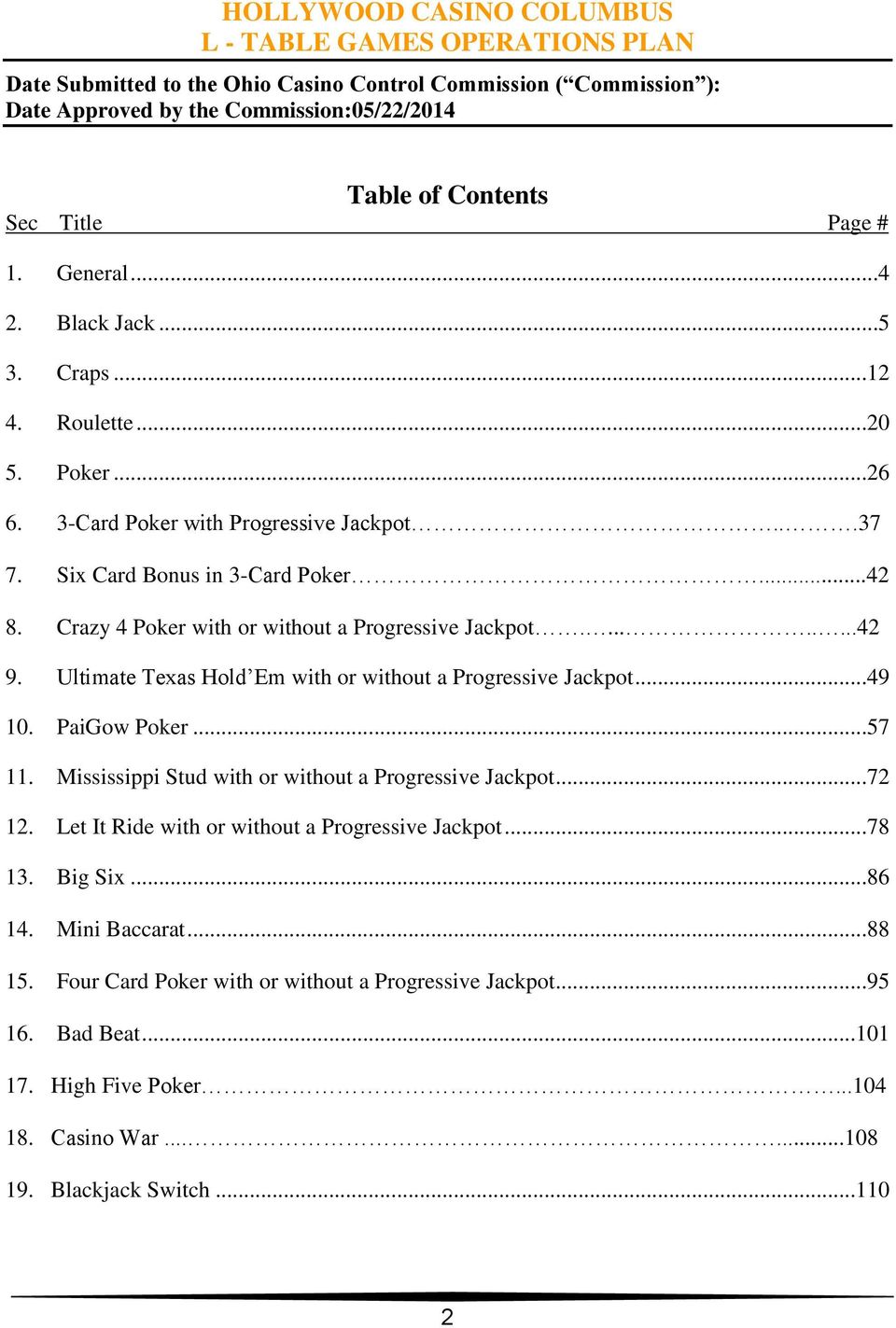
2 Table of Contents Sec Title Page # 1. General Black Jack Craps Roulette Poker Card Poker with Progressive Jackpot Six Card Bonus in 3-Card Poker Crazy 4 Poker with or without a Progressive Jackpot Ultimate Texas Hold Em with or without a Progressive Jackpot PaiGow Poker Mississippi Stud with or without a Progressive Jackpot Let It Ride with or without a Progressive Jackpot Big Six Mini Baccarat Four Card Poker with or without a Progressive Jackpot Bad Beat High Five Poker Casino War Blackjack Switch
3 20. Rapid Fusion
4 Section One - General A. The purpose of this appendix is to detail the general rules that govern each table game utilized at Hollywood Casino Columbus (HCCO). B. Physical Characteristics: 1. Each table game has on one side places for the players and on the opposite side a place for the dealer. 2. Excluding poker (i.e. poker within the poker room), the cloth covering each table game will have areas to indicate placement of wagers. 3. Each table game will have a detachable drop box and a transparent toke box. 4. Each table game that uses cards as part of the game may also use an automatic card shuffler device. 5. Blackjack table games may utilize a "peek" device attached to them to enable the dealer to determine if the hole card is an ace or ten-value card (to determine if a blackjack has been obtained). 6. Craps will be played on a long table with rounded corners and high walled sides. C. Suspected cheating and/or irregularities (Applicable to all Table Games): 1. If an automated shuffling device is being used and the device jams, stops shuffling during a shuffle, or fails to complete a shuffle cycle, the cards will be removed from the shuffling device, verified and shuffled by hand in accordance with shuffling procedures. 2. If gaming equipment is suspected to be defective or malfunctioning, the equipment will be inspected by the table games supervisor or above, the Commission gaming agent on duty will be notified in a timely manner, and an attempt will be made to repair the defective or malfunctioning equipment. If malfunctioning equipment cannot be easily repaired, replacement equipment will be used in its place at the direction of the assistant shift manager or above. If replacement equipment cannot be located, the game will continue using manual procedures. 4

5 3. Any evidence of suspected tampering with gaming equipment or cheating by patrons and/or employees will be reported to the Commission gaming agent on duty in a timely manner. D. Suspected cheating and/or irregularities (Applicable to Carnival Table Games Only): 1. If any player or the dealer is dealt an incorrect number of cards, all hands shall be void and the cards shall be reshuffled. 2. If one or more of the dealer s cards is inadvertently exposed prior to the dealer revealing his or her cards then all hands shall be void and the cards shall be reshuffled. 3. If an automated shuffling device is being used and the device jams, stops dealing cards, or fails to deal all cards during a round of play, the round of play shall be void, the dealt cards collected, and the cards removed from the device, verified and reshuffled. Section Two - Black Jack A. The purpose of this appendix is to detail the general rules that govern Blackjack. B. Number of decks of cards and value of each card: 1. This game is played with not less than one (1) and no more than eight (8) decks of cards with the backs of cards being the same color and design and two (2) additional cutting cards. Hollywood Casino Columbus (HCCO) reserves the option at any time to select and designate the number of decks and cutting cards utilized on the gaming tables. 2. The cards contained in each deck will be as follows: a. Four suits consisting of clubs, diamonds, hearts, and spades with each suit containing 13 cards for a total of 52 cards; and b. The values of each card per suit range from 2 to 10 plus one of each of the following: Jack, Queen, King, and Ace. 3. The value of the cards contained in each deck will be as follows: a. Any card from "2" to "10" will have its face value. 5
6 b. Any Jack, Queen or King will have a value of ten (10). c. An Ace will have a value of eleven (11) unless that would give a player or a Dealer a score in excess of 21 in which case an Ace will have a value of one (1). C. Object of Game, method of play, and wagers: 1. Prior to the first card being dealt for each round of play, each player will make a wager against the Dealer which will win if: a. The count of the player is 21 or less and the score of the dealer is in excess of 21. b. The count of the player exceeds that of the dealer without either exceeding 21. c. The player has achieved a count of 21 in two cards (a "Blackjack") and the dealer has achieved a score of 21 in more than two cards. 2. A wager will be a push (tie) when the score of the player is the same as the dealer. 3. Except as otherwise provided, no wager will be made, increased or withdrawn after the first card of the respective round has been dealt. 4. All wagers will be made by the player placing gaming chips on the appropriate area of the blackjack layout. 5. After each round of play is complete, the dealer working from right to left will collect all losing wagers and pay off all winning wagers. 6. All winning wagers will be paid off at odds of 1 to 1 with the exception of blackjack which will be paid off at odds of 3 to 2 or 6 to 5. The payoff odds for a blackjack will be clearly printed on each table game layout. 7. Once a wager on the Insurance Line, to Double Down or to Split Pairs has been made and confirmed by the dealer, no player will handle, remove or alter such wagers until a decision has been rendered and implemented with respect to that wager. 8. At the discretion of HCCO, a person who has not made a wager on the first round of play may be restricted from entering the game on subsequent rounds of play until a reshuffling of the cards occurs. (No Mid-Shoe Entry). 9. At the discretion of HCCO, a player who, after placing a wager on a round of play, declines to place a wager on a subsequent round of play may be precluded from placing 6

7 any further wagers until that shoe of cards is completed and a re-shuffling of the cards occurs. 10. At the discretion of HCCO, a person who does not wager on every hand may be asked to either play every hand or be restricted from further sitting at the table. D. Payment of blackjack: 1. If the first face up card dealt to the dealer is a "2", "3", "4", "5", "6", "7", "8" or "9" and a player has a blackjack, the dealer will announce the blackjack and pay the blackjack. The dealer will remove the winning player's cards before any other player receives a third card. 2. If the first face up card dealt to the dealer is an ace (at this point the dealer will offer insurance) or ten-value card and a player has a blackjack, the dealer will announce the blackjack. If the dealer's second card does not give him/her blackjack, the player having blackjack will be paid. If the dealer does have blackjack, the wager of the player having blackjack will be considered a push. E. Supplemental wagers may be offered at the discretion of HCCO: 1. Surrender - After the first two (2) cards are dealt to the player and the player's point total is determined, the player may elect to discontinue play on his/her hand for that round by surrendering one-half his/her wager. All decisions to surrender will be made after it has been determined that the dealer does not have blackjack by peeking at the hole card and prior to the player indicating whether he wishes to Double Down, Split Pairs, Stand, or Draw. Should the first card dealt to the dealer be other than an ace or 10-value card, the dealer will immediately collect one-half of the wager and return one-half to the player. 2. Insurance - Whenever the first card dealt to the dealer is an ace, each player will have the right to make an insurance wager which will win if the dealer's second card is a ten-value card and lose if the second card is an Ace, "2", "3", "4", "5", "6", "7", "8" or "9." a. An insurance wager will be made by placing an amount not more than half the amount staked on the player's initial wager on the Insurance Line of the layout. b. All insurance wagers will be placed prior to any additional cards being dealt to any player at the table. c. All winning insurance wagers will be paid at odds of 2 to 1 and all losing insurance wagers will be collected by the dealer immediately after "peeking" at the hole card. 7

8 3. Double Down - Except for blackjack or a point count of 21 in two cards, a player may elect to Double Down on the first two (2) cards dealt to him/her or the first two (2) cards of any Split Pair. In such circumstances, one additional card will be dealt to the double hand and will be dealt face up or down and sideways on the layout. A Double Down wager may be made in an amount up to but not in excess of the original wager. 4. Splitting Pairs - Whenever the initial two (2) cards dealt to a player are the same value, the player may split the hand into two (2) separate hands provided that the wager placed on the second hand is equal to the original wager. Patron can split up to three times for a total of four hands. a. When a player Splits Pairs, the dealer will deal a second card to the first of the hands and will complete the player's decisions with respect to that hand before proceeding to deal any cards to the next hand. b. A player splitting aces will only have one card dealt to each ace; however, the resplitting of aces may be offered at the discretion of HCCO. A 10 value card on a split Ace counts as 21, not as a Blackjack. F. Other Supplemental Wagers: Bet the Set An optional side bet for the game of Blackjack that considers the first two cards a player receives. To begin each round, players make the standard Blackjack wager and the optional Bet the Set wager on the appropriate area of the layout. Player s will then receive their first two (2) cards, if the player s first two (2) cards are a Pair or Suited Pair the player shall win according to the pay table below. Pair 10 to 1 Suited Pair 15 to 1 Royal Match 21 An optional side bet for the game of Blackjack that considers the first two (2) cards a player receives. To begin each round, players make the standard blackjack wager and the optional Royal Match wager on the appropriate area of the layout. Player s will then receive their first two (2) cards, if the player s first two (2) cards are the same suit or a Royal Match (King and Queen of the same suit) the player shall win according to the pay table below. Royal Match 50 to 1 8

9 Two (2) Suited Cards 2 to 1 Crown Treasure Bonus* $1,000 *A Crown Treasure Bonus is awarded when both the patron and the dealer have a King and Queen of identical suit within the same hand. King s Bounty An optional side bet for the game of Blackjack that considers the first two (2) cards a player receives. 1. Players must make a blackjack bet in order to participate in the Kings Bounty side bet. 2. HCCO will set the minimum and maximum bets. 3. Players make the Kings Bounty side bet by betting in the marked area. 4. The dealer follows house procedures for blackjack. 5. When each player and the dealer has two starting cards, the dealer settles Kings Bounty wagers. a. Exception: If a player has two Kings of Spades and the dealer has a potential blackjack, the dealer will settle that bet at the end of the round. 6. Kings Bounty payouts are below: King's Bounty Paytable KB01 2 Kings of Spades + Dealer BJ 1,000 to 1 2 Kings of Spades 100 to 1 2 Suited Kings 30 to 1 2 Suited Queens, Jacks or 10s 20 to 1 Suited 20 9 to 1 2 Kings 6 to 1 Unsuited 20 4 to 1 G. Shuffling, cutting, and burning of cards: 1. Immediately prior to commencement of play, before any round of play as determined by HCCO, and after each shoe of cards is dealt, the dealer will shuffle the cards: a. A shuffle procedure will be utilized so that a random intermix of cards is administered through any combination of washing, stripping and/or riffling so as to provide a thorough mix. b. HCCO reserves the right to change or alter its shuffle procedure to acquire such a mix at any time. 9

10 2. After the cards have been shuffled, the dealer will offer the stack of cards with backs facing away from him/her to the players to be cut. The player designated will cut the cards by placing the cutting card in the stack approximately fifty-two (52) cards in from either end. 3. The dealer must make a reasonable attempt to alternate the cut among all patrons. 4. Once the cutting card has been inserted by the player, the dealer will take all cards in front of the cutting card and place them to the back of the stack after which the dealer will insert the second cutting card. The stack of cards will then be inserted in the dealing shoe for commencement of play. a. If the player designated refuses to cut the cards, the cards will be offered to each player moving clockwise around the table until a player accepts the cut. If no player accepts the cut, the dealer will cut the cards. 5. After each full set of cards is placed in the shoe, HCCO reserves the right to employ a burn card procedure whereby the dealer will remove the first card face down and place it in the discard rack. H. Procedures for dealing of cards: 1. At the commencement of each round of play, starting on his/her left and continuing around the table, the dealer will deal the cards in the following order: a. One card face up or face down to each box on the layout in which a wager is contained. b. One card face up or down to himself/herself (i.e. the dealer). c. A second card face up or face down to each box in which a wager is contained. d. A second card face down to himself/herself. The dealer may "peek" at all aces and ten-value cards i. After the dealer has dealt two (2) cards to each player and himself/herself and the dealer's face up card is a ten-value card, the dealer may immediately "peek" at the hole card. If the dealer peeks and determines hole card is an ace, the dealer will announce "Blackjack", collect all losing bets and conclude the round of play. ii. After the dealer has dealt two (2) cards to each player and himself/herself and the dealer's face up card is an ace, each player will have the option to make an 10

11 insurance wager. After all insurance wagers are placed, the dealer may "peek" at the hole card. If the dealer peeks and determines the hole card is a ten-value card, the dealer will announce "Blackjack;" collect all losing bets, pay all winning insurance bets in normal order around the table, and conclude the round of play. iii. After the dealer has dealt two (2) cards to each player and himself/herself and the dealer's face up card is an ace and the player has a blackjack, a player may elect to take even money instead of Insurance. If exercised, the dealer will pay the player even money and remove the player's cards from the layout and place them in the discard rack before acting on any other player's hands or "peeking" to determine the hole card. 2. After two (2) cards have been dealt to each player and the appropriate number to the dealer except where otherwise noted, the player will indicate whether he wishes to Double Down, Split Pairs, Stand, Draw or Surrender, if permitted by HCCO. 3. As each player indicates his/her decision, the dealer will deal face up or face down any additional cards requested. 4. After the decisions of each player have been implemented and all additional cards have been dealt, the dealer will turn over his/her hole card. Any additional cards required to be dealt to the dealer will be dealt face up at this time. 5. At the conclusion of a round of play, all cards still remaining on the layout will be picked up by the dealer. The dealer will pick up the cards beginning with those of the dealer, sliding their cards underneath the cards of the player to his/her far right and move counter-clockwise around the table. This will allow the dealer s hand to be on top of the stack in the discard rack. The dealer will place the cards face down in the discard rack. 6. Whenever the cutting card is reached in the deal of the cards, the dealer will continue dealing the cards until that round of play is completed after which he will re-shuffle the cards. The cards will be re-shuffled when the cutting card is drawn as the first card of a new round. 7. Each player at the table will be responsible for correctly computing the point count of his/her hand and no player may rely on the point count announced by the dealer, if any. I. Drawing additional cards: 1. Except as otherwise provided, a dealer will draw additional cards until he/she has a total of 17 or greater; at which point, no additional cards will be drawn. 11

12 a. All HCCO blackjack tables will either stand on a soft 17 or draw on a soft 17. This decision will be clearly posted at each table. 2. A player may elect to draw additional cards whenever his/her point count total is less than 21 except that: a. A player having blackjack or a hard or soft total of 21 will not draw additional cards. b. A player electing to Double Down will only draw one additional card. c. A player splitting aces will only have one card dealt to each ace and may not elect to receive additional cards, with the exception of the re-split of aces, if permitted. 3. A dealer will draw no additional cards to his/her hand, regardless of the point count, if decisions have been made on all players' hands and the point count of the dealer's hand will have no effect on the outcome of the round of play. Section Three - Craps A. The purpose of this appendix is to detail the general rules that govern Craps. B. The game of craps is played with one stick of five dice with each die containing the number one opposite the side with the number six, the number two opposite the side with the number five, and the number three opposite the side with the number four. 1. To begin the game, the stickperson (i.e. boxperson or dealer maintaining control of the dice) will empty the bowl of dice onto the table. The stickperson will push all of the dice in front of the patron who is shooting (the Shooter). The shooter will select two (2) of the five (5) dice and the stickperson will bring the other dice to the center. The remaining dice will be returned to the dice cup which will be placed in front of the stickperson. a. The shooter must throw both dice simultaneously to the furthest end of the table using only one hand. b. A roll of the dice will be deemed invalid whenever either or both of the dice go off the table or whenever one (1) die comes to rest on top of the other die. 12
13 c. The stickperson or a table games supervisor or above has the option to call "No roll" for any of the following reasons: i. The dice do not leave the shooter's hand simultaneously; ii. Either or both of the dice come to rest on the chip bank; iii. Either or both of the dice fail to strike the furthest end of the table away from the shooter; iv. Either or both of the dice come to rest in the dice cup in front of the stickperson or on one of the rails surrounding the table; v. If a die (dice) hits a patron and the travel of the die (dice) is stopped; vi. Any other throws the stickperson or a table games supervisor or above deems to be improper. C. Permitted Wagers: 1. "Pass Bet" - A wager placed on the Pass Line. a. The Pass Bet will win if, on the Come Out Roll: ("Come Out Roll" shall mean the first roll of the dice at the opening of the game and the first roll of the dice after a decision with respect to a Pass Bet and Don t Pass Bet has been affected.) i. A total of 7 or 11 is thrown on the Come Out Roll. ii. A total of 4, 5, 6, 8, 9 or 10 is thrown on the Come Out Roll and that total is again thrown before a 7 appears. b. The Pass Bet will lose if, on the Come Out Roll: i. A total of 2, 3, or 12 is thrown on the Come Out Roll. ii. A total of 4, 5, 6, 8, 9 or 10 is thrown on the Come Out Roll and a 7 subsequently appears before that total is thrown again. 2. "Don't Pass Bet" - A wager placed on the Don't Pass Line immediately prior to the Come Out Roll. a. The Don't Pass Bet will win if, on the Come Out Roll: 13

14 i. A total of 2 or 3 is thrown on the Come Out Roll. ii. A total of 4, 5, 6, 8, 9 or 10 is thrown on the Come Out Roll and a 7 subsequently appears before that total is thrown again. b. The Don't Pass Bet will lose if, on the Come Out Roll: i. A total of 7 or 11 is thrown on the Come Out Roll. ii. A total of 4, 5, 6, 8, 9 or 10 is thrown and that total is again thrown before a 7 appears. c. The Don't Pass Bet will be a push if, on the Come Out Roll a total of 12 is thrown. 3. "Come Bet" - A wager placed on the Come Line. a. The Come Bet will win if, on the roll immediately following the placement of such bet: i. A total of 7 or 11 is thrown. ii. A total of 4, 5, 6, 8, 9 or 10 is thrown and that total is again thrown before a 7 appears. b. The Come Bet will lose if, on the roll immediately following the placement of such bet: i. A total of 2, 3, or 12 is thrown. ii. A total of 4, 5, 6, 8, 9 or 10 is thrown and a 7 subsequently appears before that total is thrown again. 4. "Don't Come Bet" - A wager placed on the Don't Come area at any time after the Come Out Roll. a. The Don't Come Bet will win if on the roll immediately following placement of such bet: i. A total of 2 or 3 is thrown. 14

15 ii. A total of 4, 5, 6, 8, 9 or 10 is thrown and a 7 subsequently appears before that total is again thrown. b. The Don't Come Bet will lose if on the roll immediately following placement of such bet: i. A total of 7 or 11 is thrown. ii. A total of 4, 5, 6, 8, 9 or 10 is thrown and that total is again thrown before a 7 appears. c. The Don't Come Bet will be a push if, on the roll immediately following placement of such bet, a total of 12 is thrown. 5. "Place Bet to Win" - A wager made at any time on 4, 5, 6, 8, 9 or 10 which will win if the number on which the wager was placed is thrown before a 7 appears and lose if a 7 is thrown before such number. 6. "Buy Bet" - A wager made at any time where the player has the option of receiving true odds on a Place Bet to Win in return for the player paying to the Hollywood Casino five percent (5%) of the amount of the wager at the time of making the bet. 7. "Lay Bet" - A wager made at any time where players are offered true odds on a Place Bet to Lose in return for the player paying to the Hollywood Casino five percent (5%) of the amount the player could win on such bet. 8. "Four the Hard Way" - A wager made at any time which will win if a total of 4 is thrown the hard way (i.e. with a 2 appearing on each die) before 4 is thrown in any other way and before a 7 is thrown. 9. Six the Hard Way" - A wager made at any time which will win if a total of 6 is thrown the hard way before 6 is thrown in any other way and before a 7 is thrown. 10. "Eight the Hard Way" - A wager made at any time which will win if a total of 8 is thrown the hard way before 8 is thrown in any other way and before a 7 is thrown. 11. "Ten the Hard Way" - A wager made at any time which will win if a total of 10 is thrown the hard way before 10 is thrown in any other way and before a 7 is thrown. 12. "Field Bet - A one roll wager made at any time which will win if a total of 2, 3, 4, 9, 10, 11 or 12 is thrown on the roll immediately following placement of such bet and will lose if any other total is thrown. 15

16 13. "Any Seven" - A one roll wager made at any time which will win if a total of 7 is thrown on the roll immediately following placement of such bet and will lose if any other total is thrown. 14. Any Craps; or a C - A one roll wager made at any time which will win if a total of 2, 3 or 12 is thrown on the roll immediately following placement of such bet and will lose if any other total is thrown. 15. "Craps Two" - A one roll wager made at any time which will win if a total of 2 is thrown on the roll immediately following placement of such bet and will lose if any other total is thrown. 16. "Craps Three" - A one roll wager made at any time which will win if a total of 3 is thrown on the roll immediately following placement of such bet and will lose if any other total is thrown. 17. "Craps Twelve" - A one roll wager made at any time which will win if a total of 12 is thrown on the roll immediately following placement of such bet and will lose if any other total is thrown. 18. "11 in One Roll, or an E or a Yo " - A one roll wager made at any time which will win if a total of 11 is thrown on the roll immediately following the placement of such bet and will lose if any other total is thrown. 19. "Horn Bet" - A one roll wager made at any time which will win if a total of 2, 3, 11 or 12 is thrown on the roll immediately following placement of such bet and will lose if any other total is thrown. 20. "Horn High Bet" - A one roll wager made in units of five (5) with four (4) units wagered as a Horn Bet and the remaining unit wagered on either 2, 3, 11 or 12. The player will win if 2, 3, 11 or 12 is thrown on the roll immediately following placement of such bet and lose if any other total is thrown. 21. "World Bet - A one roll wager placed in units of five (5) with four (4) units wagered as a Horn Bet and the remaining unit wagered on Any Seven. The player will win if 2, 3, 7, 11 or 12 is thrown on the roll immediately following placement of such bet and lose if any other total is thrown. D. Permitted Wagers - Supplemental Wagers: 16

17 1. "Hop Bet" - A one roll wager that may be made at any time on a specific combination designated by the player which will win if the combination is thrown on the roll immediately following placement of such bet and will lose if any other combination is thrown. 2. Put Bet - A wager that is put on a number 4, 5, 6, 8, 9 or 10 which will win if the number is thrown before a 7 appears and will lose if a 7 appears before the number is thrown. 3. Fire Bet - Players are paid odds based on how many "individual points" a shooter can successfully make before he or she sevens-out. The term "individual points" refers to when the shooter successfully makes a point from the pool of points (4, 5, 6, 8, 9 or 10) that has not been previously made. Successfully making the same point more than once will only count as one "individual point" towards a payoff threshold. "Individual Points" DO NOT have to be made in any specific order. Only a seven out results in the bet losing. E. Placing and Removing Wagers: 1. Wagers will be made before the dice are thrown, but they may be made between the time the dice leave the shooter's hand and the time the dice come to rest, provided that they are confirmed orally by the dealer or table game supervisor or above. 2. A wager made on any bet may be removed/reduced at any time prior to the roll of the dice that decides the outcome of such wager except that a Pass Bet and a Come Bet will not be removed or reduced after a Come Out Point or Come Point is established with respect to such bet. 4. A Don't Come and a Don't Pass Bet may be removed/reduced at any time, but may not be replaced or increased after such removal or reduction. 5. All Buy, Place, Come Odds and Hard Way bets will be inactive on any Come Out Roll unless called "On" by the player and confirmed by the dealer through placement of an "On" marker button on the top of each player's wager. All other wagers will be considered "On." F. Payout Odds: 1. All winning wagers will be paid off at the odds listed below: Come Bet 1 to 1 Don't Come Bet 1 to 1 17
18 Pass Bet 1 to 1 Don't Pass Bet 1 to 1 Four or Ten the Hard Way 7 to 1 Six or Eight the Hard Way 9 to 1 Field Bet (2,12) 2 to 1 Field Bet (3, 4, 9, 10 or 11) 1 to 1 Place Bet 4 or 10 9 to 5 Place Bet 5 or 9 to Win 7 to 5 Place Bet 6 or 8 to Win 7 to 6 Buy Bet 4 or 10 to Win 2 to 1 Buy Bet 5 or 9 to Win 3 to 2 Buy Bet 6 or 8 to Win 6 to 5 Any Seven 4 to 1 Lay Bet 4 or 10 to Lose 1 to 2 Lay Bet 6 or 8 to Lose 5 to 6 Any Craps (or C ) 7 to 1 Craps Two or Twelve 30 to 1 Craps Three 15 to 1 Lay Bet 5 or 9 to Lose 2 to 3 11 in One Roll (or E ) 15 to 1 Hop Bet - Pairs 30 to 1 Hop Bet - All Others 15 to 1 Put Bet 1 to 1 Fire Bet (6) "Individual Points" pays 1000 to 1 Fire Bet (5) "Individual Points" pays 250 to 1 Fire Bet (4) "Individual Points" pays 25 to 1 2. A Horn Bet and Horn High Bet will be paid as if it were four (4) separate wagers on 2, 3, 11 and A World Bet will be paid as if were five (5) separate wagers on 2, 3, 11, 12 and any If an uneven wager is accepted, HCCO will pay the player odds on the even portion of the bet and even money on the balance. Uneven odds payoffs will be rounded up to the nearest dollar unit. G. Supplemental Wagers Made After the Come-Out Roll in Support of Pass, Don't Pass, Come and Don't Come Bets. 18

19 1. Whenever a player makes a Pass Bet and a total of 4, 5, 6, 8, 9 or 10 is thrown on the Come Out Roll, the player will have the right to make an additional wager (Odds) in support of the Pass Bet which will be limited by HCCO to an amount up to One Hundred (100) times the original Pass Bet for the points of 4&10, 5&9, and 6&8. If the Pass Bet wins, the original Pass Bet will be paid at odds of 1 to 1 and the supplemental wager will be paid at odds of 2 to 1 if the Come Out Point was 4 or 10, 3 to 2 if the Come Out Point was 5 or 9, and 6 to 5 if the Come Out Point was 6 or Whenever a player makes a Don't Pass Bet and a total of 4, 5, 6, 8, 9 or 10 is thrown on the Come Out Roll, the player will have the right to make an additional wager (odds) in support of the Don't Pass Bet which will be limited by HCCO to an amount to win up to One Hundred (100) times the original Don t Pass Bet for the points of 4&10, 5&9, and 6&8. If the Don't Pass Bet wins, the original Don't Pass Bet will be paid at odds of 1 to 1 and the supplemental wager will be paid at odds of 1 to 2 if the Come Out Point was 4 or 10, 2 to 3 if the Come Out Point was 5 or 9, and 5 to 6 if the Come Out Point was 6 or Whenever a player makes a Come Bet and a total of 4, 5, 6, 8, 9 or 10 is thrown on the roll immediately following placement of such bet, the player will have the right to make an additional wager (odds) in support of the Come Bet which will be limited by the Hollywood Casino Columbus to an amount up to one hundred (100) times the original Come Bet for the points of 4&10, 5&9, and 6&8. If the Come Bet wins, the original Come Bet will be paid at odds of 1 to 1 and the supplemental wager will be paid at odds of 2 to 1 if the Come Point was 4 or 10, 3 to 2 if the Come Point was 5 or 9, and 6 to 5 if the Come Point was 6 or Whenever a player makes a Don't Come Bet and a total of 4, 5, 6, 8, 9 or 10 is thrown on the roll immediately following placement of such bet, the player will have the right to make an additional wager (odds) in support of the Don't Come Bet which will be limited by HCCO to an amount to win up to one hundred (100) times the original Don t Come Bet for the points of 4&10, 5&9, and 6&8. If the Don't Come Bet wins, the original Don't Come Bet will be paid at odds of 1 to 1 and the supplemental wager will be paid at odds of 1 to 2 if the Come Point was 4 or 10, 2 to 3 if the Come Point was 5 or 9, and 5 to 6 if the Come Point was 6 or The maximum amount allowable as an additional wager (odds) in support of a pass/don t pass or Come/Don t Come Bet will be posted on each game. 19
20 Section Four - Roulette A. The purpose of this appendix is to detail the general rules that govern Roulette. B. Physical Characteristics: 1. Roulette will be played on a table having a roulette wheel capable of spinning on its back at one end and a roulette layout imprinted on the opposite end of the table. a. Single 0 Wheel - There are 37 numbers in total on the single 0 roulette wheel (1 to 36 plus the single 0). Half are red, half are black, plus a single 0 which is green. The numbers on the wheel are not in consecutive order as they are on the layout. They are placed randomly with red and black numbers alternating except when broken up by the single 0. b. Double 00 Wheel - There are 38 numbers on the double 00 roulette wheel (1 to 36 plus the single 0 and double 00). Half are red, half are black, plus a 0 and 00 which are green. The numbers on the wheel are not in consecutive order as they are on the layout. They are placed opposite the corresponding high and low number with red and black numbers alternating except when broken up by the single 0 and double 00. C. Cards and dice are not used for this game. Instead, a non-metallic ball of varying sizes is used per spin to determine the outcome. D. Object of Game, method of play, and wagers: 1. The object of roulette is to pick the winning number that will appear on the roulette wheel as a result of the ball landing in a pocket with a corresponding number at the conclusion of each spin of the wheel and the ball respectively. 2. The game starts with a patron placing a bet of the patron s choice on the layout. The dealer will spin the ball in the opposite direction of the wheel. The spin will involve a minimum of four revolutions around the inside of the wheel. Before the ball drops, the dealer will announce no more bets and will refuse any bets thereafter. When the ball stops, the dealer will announce and mark the winning number (the number on which the ball landed) and proceed to clear off losing bets and pay winning bets. 20

21 a. If the ball is spun in the same direction as the wheel, the dealer shall announce "No Spin" and shall attempt to remove the roulette ball from the wheel prior to its coming to rest in one of the compartments. b. If the roulette ball does not complete four revolutions around the track of the wheel, the dealer shall announce "No Spin" and shall attempt to remove the roulette ball from the wheel prior to its coming to rest in one of the compartments. c. If a foreign object enters the wheel prior to the ball coming to rest, the dealer shall announce "No Spin" and shall attempt to remove the roulette ball from the wheel prior to its coming to rest in one of the compartments. d. If it appears that the roulette ball is not going to come to rest in a compartment (a Floater ), the Dealer or Casino Supervisor will announce, No Spin and shall attempt to remove the roulette ball from the wheel prior to its coming to rest in one of the compartments. e. If the ball is expelled from the wheel head area, it will be called NO Spin. Once the roulette ball is retrieved, it will be visually inspected to ensure that it has not been tampered with and/or damaged. 3. Procedures for exchange of currency and value gaming chips for non-value roulette chips: a. Currency or value gaming chips will be spread in front of the dealer's work area; b. The value of each non-value chip will be indicated through the use of a lammer placed on a non-value chip of the same color in the receptacle located by the rim of the wheel head; c. The amount of non-value chips will be assembled in front of the dealer; d. The dealer will then push the non-value chips, and/or any value chips to the player; e. Currency will be dropped in the drop box and value gaming chips will be added to the bankroll; and f. Non-value chips can be exchanged for value gaming chips or a different color nonvalue chip at the roulette table. 4. In accordance with Ohio Administrative Revised Code : 21
22 a. Non-value chips issued at a roulette table will be used only for gaming at that particular table and will not be redeemed or exchanged at any other location in Hollywood Casino Columbus (HCCO). When so presented, the dealer at the issuing table will exchange these chips for an equivalent amount of value chips. b. Neither HCCO nor any of its employees will knowingly allow any patron to remove non-value chips from the table from which the chips were issued. c. No person at a roulette table will be issued or permitted to wager with non-value chips that are identical in color and design to value chips or to non-value chips being used by another person at the same table. When a patron purchases non-value chips, a non-value chip of the same color shall be placed in a slot or receptacle attached to the outer rim of the roulette wheel. At that time, a marker denoting the value of a stack of twenty chips of that color will be placed in the slot or receptacle. 5. Each player shall be responsible for the correct positioning of his or her wager on the roulette layout regardless of whether he or she is assisted by the dealer. Each wager shall be settled strictly in accordance with its position on the layout when the ball falls to rest in a compartment of the wheel. E. Permitted Wagers: 1. "Straight Up" - A wager that the roulette ball will come to rest in the compartment of the roulette wheel that corresponds to a single number selected by the player. The player shall select a number by placing a wager within the box on the roulette layout that contains the selected number. 2. "Split" - A wager that the roulette ball will come to rest in a compartment of the roulette wheel that corresponds to either of two numbers selected by the player. The player shall select the numbers by placing a wager on the line between the two boxes on the roulette layout that contain the two selected numbers, except that a split wager on "0" and "00" may also be placed on the line between the "2nd 12" box and the "3rd 12" box (i.e. courtesy line). 3. "Street" - A wager that the roulette ball will come to rest in a compartment of the roulette wheel that corresponds to any one of three numbers in a single row on the roulette layout selected by the player. The player shall select a row of numbers by placing a wager on the outside line of the box on the roulette layout that contains the first number in the selected row. a. "Street" shall also include a wager that the Roulette ball will come to rest in a compartment of the Roulette wheel that corresponds to any one of the three numbers 22
23 contained in one of the following groups of numbers: "0", "1" and "2", "0", "2" and "00"; or "00", "2" and "3". b. The player shall select one of the "three numbers" wagers identified in (a) above by placing a wager on the common corner of the three boxes containing the selected numbers. 4. "Corner" - A wager that the roulette ball will come to rest in a compartment of the roulette wheel that corresponds to any one of four numbers in contiguous boxes on the roulette layout selected by the player. The player shall select the four numbers by placing a wager on the common corner of the four boxes containing the selected numbers. 5. "Top Line" - A wager that the roulette ball will come to rest in a compartment of the roulette wheel that corresponds to any one of the numbers "0", "00", "1", "2" or "3". The player shall bet on the "first five numbers" by placing a wager on the common corner of the boxes on the roulette layout that contains the label "1st 12" and the numbers "0" and "1". 6. "Line Bet" - A wager that the roulette ball will come to rest in a compartment of the roulette wheel that corresponds to any one of six numbers contained in two contiguous rows of numbers on the roulette layout selected by the player. The player shall select the two rows of numbers by placing a wager on the outside common corner of the boxes on the roulette layout that contains the first number in each of the rows being selected. 7. "Column" - A wager that the roulette ball will come to rest in a compartment of the roulette wheel that corresponds to any one of 12 numbers contained in a single column on the roulette layout selected by the player. The player shall select a column of 12 numbers by placing a wager in the box on the roulette layout that is at the bottom of the column being selected. 8. "Dozen" - A wager that the roulette ball will come to rest in a compartment of the roulette wheel that corresponds to any one of 12 consecutive numbers from "1" through "12", "13" through "24" or "25" through "36" selected by the player. The player shall select the 12 numbers by placing a wager in the box on the roulette layout labeled "1st 12" ("1" through "12"), "2nd 12" ("13" through "24"), or "3rd 12" ("25" through "36"). 9. "Red" - A wager that the roulette ball will come to rest in any compartment of the roulette wheel that corresponds to a number with a red background on the roulette wheel. The player shall bet on "Red" by placing a wager within the red box on the roulette layout used for such wagers. 23
24 10. "Black" - A wager that the roulette ball will come to rest in any compartment of the roulette wheel that corresponds to a number with a black background on the roulette wheel. The player shall bet on "Black" by placing a wager within the black box on the roulette layout used for such wagers. 11. "Odd" - A wager that the roulette ball will come to rest in any compartment of the roulette wheel that corresponds to an odd number. The player shall bet on "Odd" by placing a wager within the box on the roulette layout that is labeled "Odd". 12. "Even" A wager that the roulette ball will come to rest in any compartment of the roulette wheel that corresponds to an even number. The player shall bet on "Even" by placing a wager within the box on the roulette layout that is labeled "Even". 13. "1 to 18" - A wager that the roulette ball will come to rest in a compartment of the roulette wheel that corresponds to any one of 18 consecutive numbers from "1" through "18". The player shall bet on "1 to 18" by placing a wager within the box on the roulette layout that is labeled "1 to 18". 14. "19 to 36" - A wager that the roulette ball will come to rest in a compartment of the roulette wheel that corresponds to any one of 18 consecutive numbers from "19" through "36". The player shall bet on "19 to 36" by placing a wager within the box on the roulette layout that is labeled "19 to 36". 15. When roulette is played on a double 00 wheel and the roulette ball comes to rest in a compartment marked single 0 or double 00, wagers on Red, Black, Odd, Even, columns, dozens, 1 to 18, and 19 to 36 will be lost. 16. Wagers on Red, Black, Odd, Even, columns, dozens, 1 to 18, and 19 to 36 must individually meet table minimum, whereas Line Bets, Top Line Bets, Corner, Street, Split, and Straight Up Bets may have an aggregate total that meets table minimum. F. Payout Odds: 1. All winning wagers will be paid off at the odds listed below: Straight Up 35 to 1 Single 0 or Double to 1 Split 17 to 1 Street 11 to 1 Corner 8 to 1 Top Line 6 to 1 24
25 Line Bet 5 to 1 Column 2 to 1 Dozen 2 to 1 Red 1 to 1 Black 1 to 1 Odd 1 to 1 Even 1 to 1 1 to 18 1 to 1 19 to 36 1 to 1 25
26 Section Five - Poker A. The purpose of this appendix is to detail the general rules that govern Poker. B. Number of decks of cards and value of each card: 1. Each poker game may be set-up with two decks of cards of different colors. However, only one deck of cards will be used at any given time. 2. The cards contained in each deck will be as follows: C. Wagers: a. Four suits consisting of clubs, diamonds, hearts, and spades with each suit containing 13 cards for a total of 52 cards; and b. The values of each card per suit range from 2 to 10 plus one of each of the following: Jack, Queen, King, and Ace. 1. Only players who are seated at the poker table may be permitted to receive cards and participate in each betting round. 2. Depending upon the type of poker game being dealt, a player may be required to: a. Place a predetermined blind bet prior to receiving any cards. i. A blind bet is a mandatory wager put up in "flop" games before any cards are dealt. ii. Traditionally, there are two blind bets in these types of games. They are referred to as small blind and big blind. iii. The blind bets are put up by the two player's seated directly clockwise from the Dealer button. The Dealer button moves on position each hand, thus the blind bets also move. iv. The amount and number of blind bets are determined by HCCO and will be posted on a sign on the poker room table. 26
27 b. Place a forced bet to initiate a betting round based on that player's up card. c. Place an ante; i.e. a predetermined wager that each player is required to make in some poker games prior to any cards being dealt in order to participate in the round of play. 3. A player may only participate in the wagering during a round of play with the chips that were already on the poker table in front of the player when the round of play commenced. 4. A player who fulfills the requirements of the above but who commits all of their chips to the pot on the poker table prior to completion of a round of play will be "all-in". The all-in player will receive an all-in button. This button will be placed in front of a player by the Dealer to provide a visual method by which other players in the game, HCCO staff and Surveillance will be aware that the player is all-in. 5. An "all-in" player shall retain financial interest in the outcome of the round of play, but shall only be eligible to win the amount of the pot to which they have contributed. 6. An "all-in" player shall continue to receive any cards to which they would normally be entitled, and; 7. Betting shall continue among the other players by generating a separate secondary pot that only those active players shall be eligible to win. 8. A verbal statement of "fold", "check", "call" "raise" or an announcement of a specific size wager by a player, shall be binding on the player if it is that player's turn to act. 9. A player who announces a bet or raise of a certain amount but places a different amount of gaming chips in the pot shall be required to correct his or her bet or raise to the announced amount in accordance with the instructions of the dealer. 10. HCCO will make use of a betting line on its poker table layouts. Only the amount of chips released in a continuous motion toward the pot or inside the betting line shall be considered a player s wager. Chips not placed in such a way, or remaining in the player s hand, will not be considered a wager. A player shall be considered to have placed a bet if the player: a. Pushes gaming chips forward, toward the pot or betting line, to indicate the intent of placing a bet or raise. b. Releases gaming chips into the pot inside the betting line. 27
28 c. Releases gaming chips at a sufficient distance from the player and towards the pot or betting line, to make it obvious that it is intended as a bet or raise. 11. Unless a raise has been verbally announced by a player, that player who puts into the pot or across the betting line a single gaming chip that is larger than required is assumed to have only called the preceding bet and to be awaiting change from the dealer. 12. Check-raising is permitted. D. New Set-up Procedures: 1. When a new "set-up" is put into play, in the presence of a supervisor, the dealer will perform the following: a. Inspect the first deck of cards; b. Randomly intermix the cards; c. Place the cards in a shuffle machine; or if the machine is not working, proceed with a hand shuffle; and then d. Repeat steps 1 to 3 for the second deck of cards. 2. HCCO may reshuffle the cards or exchange the set-up at its discretion. E. Shuffling Procedures: 1. A shuffle procedure will be utilized so that a random intermix of cards is administered through any combination of washing, stripping and/or riffling so as to provide a thorough mix. 2. HCCO reserves the right to change or alter its shuffle procedure to acquire such a mix at any time. F. Dealing Procedures: 1. Start the action and announce bets or raises as necessary. Make sure the blinds get their option if dealing flop games like Hold Em. 2. Gather folded hands into the muck pile immediately. Collect the mucked cards in the appropriate area. 3. When the action is complete, gather the chips into the center of the table. Take note of how much money is in the pot so that the posted rake can be taken. 28
29 4. Tap the table, announce the amount of players left in the hand and deal the next round of cards. Whether it's a flop game or the next street in a stud game, always tap the table before you deal the next round, giving any player who has not acted the opportunity to announce their intention to do so. 5. Start the action and then take the rake as necessary. 6. Burn another card and deal the next round. Start the action again; repeat bullet points 2, 3, and 4 of the "Dealing Procedures" until you are finished with the hand. Make sure you check to see there are enough cards when dealing 7-card stud before you deal the last card. 7. After you deal the last round, spread the stub below the community cards and in front of the rack. 8. Have the players show their hands for the showdown as necessary. Read and announce the hands. Determine the winning hand; push the winning combination of cards forward, kill the losing hands and leave the winning hand in the possession of the player. G. Poker Hand Rankings: 1. The rank of the cards used in all types of poker other than low poker, for the determination of winning hands, in order from highest to lowest in rank, shall be: Ace, King, Queen, Jack, 10, 9, 8, 7, 6, 5, 4, 3, 2. All suits shall be considered equal in rank. Notwithstanding the foregoing, an Ace may be used to complete a "Straight Flush" or a "Straight" formed with a 2, 3, 4, The permissible high poker hands are determined by the holding of a full five card hand in order of highest to lowest rank, shall be: a. Royal Flush: Five cards of the same suit in sequential orderas follows: ace, king, queen, jack, and ten. b. Straight Flush: Five cards of the same suit in sequential order. The highest combination is the king, queen, jack, ten, and nine of the same suit. The lowest combination is the ace, two, three, four, and five of the same suit. c. Four of a Kind: Four cards of the same rank (i.e. value). The highest combination is four aces. The lowest combination is four twos. 29
30 d. Full House: Five cards consisting of one "Three of a Kind" and one Pair."The highest combination is three aces combined with one pair of kings. The lowest combination is three twos combined with one pair of threes. e. Flush: Five cards of the same suit not in sequential order. The highest combination is the ace, king, queen, jack, and nine. The lowest combination is the two, three, four, five, and seven. f. Straight: Five cards of different suits in sequential order. The highest combination is the ace, king, queen, jack, and ten. The lowest combination is the ace, two, three, four and five. g. Three of a Kind: Three cards of the same rank (i.e. value). The highest combination is three Aces. The lowest combination is three twos. h. Two Pair: One pair of two cards of the same rank plus another pair of two cards of the same rank; the ranks of each respective pair are different. The highest combination is having a pair of aces and a pair of kings. The lowest combination is having a pair of twos and a pair of threes. i. One Pair: Two cards of the same rank. The highest combination is having a pair of aces. The lowest combination is having a pair of twos. 3. The rank of the cards used in low poker, for the determination of winning hands, in order of highest to lowest rank, shall be: Ace, 2, 3, 4, 5, 6, 7, 8, 9, 10, Jack, Queen, and King. All suits shall be considered equal. 4. The ranking of a low poker hand is determined by the holding of a full 5 card hand, shall be the opposite of the rankings for a high poker hand, as set forth in 2 above; provided however, that Straights and Flushes shall not be considered for purposes of determining a winning hand of low poker. H. 7- Card Stud: 1. Each poker table shall be restricted to a maximum of eight players. Each player who plays in a round of play may be required to place an ante. 2. Starting with the first player to the left of the dealer and continuing in a clockwise rotation around the poker table, the dealer will deal two rounds of cards face down and one round of cards face-up to each player. 3. Once each player has received three cards, the first betting round shall begin 30
31 by comparing the up-card of each player. The player with the lowest card will start the betting round. In the event that two or more up-cards are of the same rank, the up-cards shall then be ranked by suit, with the highest to lowest ranked suits in order as follows: Spades, Hearts, Diamonds and Clubs. 4. Following the bet placed by the player with the low card, each following player might, proceeding in a clockwise rotation may, fold, call or raise the bet. After the last player has responded to the most recent bet, the betting round is complete. 5. Upon completion of the first betting round, the dealer will bring the chips into the center of the table and burn the top card of the deck and place it under the pot. Starting with the first remaining player to the dealers left, deal a fourth card face up to each player remaining in the game. The player with the highest-ranking poker hand showing will initiate the action by betting or checking. If the highest ranking poker hand showing is held by two or more players, the player closest to the left of the Dealer shall be required to bet or check. 6. Following the initial bet or check, each subsequent player, proceeding in a clockwise rotation, may fold, call, raise or, if the preceding players have not made a bet, check. Each player may check until a bet has been made. Once a bet has been made, the next player in a clockwise rotation may fold, call or raise. After the last player has responded to the most recent bet, the betting round is complete. 7. The dealer shall then deal two additional rounds of cards face-up to each player remaining in the game, with each round followed by a betting round. Prior to each round of cards being dealt, the dealer shall burn the top card of the deck and place it under the pot. 8. If there are enough cards remaining in the deck/stub, give each remaining player a seventh and final card. If there are not enough cards remaining in the deck to give each remaining player a seventh and final card, the dealer will shuffle the stub in with the burn cards, cut, then burn a card and deal to the remaining players. If there are not enough cards left with the burn cards then a common card will be dealt after the burn card, face- up in the center of the table. 9. If more than one player remains after the final betting round, a showdown will be used to determine the winner of the pot. Each player remaining in the game shall form a five- card poker hand from the seven cards that they were dealt. The winner of the pot will be the player with the highest-ranking five-card high hand. I. 7 Card Stud Hi-Low Split Eight or Better: 31
32 1. A variation of 7- Card Stud. The best high hand splits the pot with the best low hand. However, in order to win the low half, the player must have an 8-low or better. If there is no low qualifier, the high hand wins the entire pot. J. 7 Card Stud Razz: 1. Razz is a low ball game. The lowest hand wins the pot. Aces are low and straight and flushes have no effect on the value of the hand. In razz, the high card has the forced opening and the low hand is the first to act thereafter. K. Texas Hold Em: 1. A flat disk called the "Button" shall be used to indicate an imaginary dealer. 2. At the commencement of play, the button will either start in the seat to the immediate right of the Dealer or the dealer will high card for the button. 3. The button will move around the table in a clockwise manner after each round of play. 4. The player to the immediate left of the button is required to place a Small Blind bet. The player to the immediate left of the Small Blind bet is required to place a Big Blind bet. The amount and number of blind bets will be posted on a poker table sign. 5. Starting with the player to the immediate left of the button and continuing in a clockwise rotation around the Poker table, the dealer shall deal two rounds of cards face down to each player, the player with the button being the last player to receive a card each time. 6. Each player in turn, in a clockwise rotation starting with the player to the left of the Big Blind bet, has the option to Call, Raise or Fold. If no player has raised the bet, then the option to raise is given to both Blind bets. After the last player has responded to the most recent bet, the betting round shall be considered complete. 7. The Dealer will Tap the table in front of the rack, burn the top card of the deck and place it under the pot, and proceed to deal three community cards (the flop) face-up in the center of the table. 8. The next betting round will begin with the option to bet or check belonging to the first player to the left of the button who has not folded. Each player may, in clockwise rotation, fold, call, raise the bet or, if preceding players have not made a bet, make an opening bet or check. The betting round shall be considered complete when each player has either folded or called in response to the most recent bet. 32
33 9. Upon completion of the betting round the dealer will again burn the top card of the deck and then deal a fourth community card (the Turn) face-up to the right of the Flop. 10. The next betting round will begin with the option to bet or check belonging to the first player to the left of the button who has not folded. 11. Upon completion of the betting round the dealer will again burn the top card of the deck and then deal a fifth community card (the River) face-up to the right of the Turn card. 12. The final betting round will begin with the option to check or bet belonging to the first player to the left of the button who has not folded. 13. If more than one player remains in the round of play after the final betting round has been completed, a showdown shall be used to determine the winner of the pot. 14. Each player remaining in the game will turn his cards over and the dealer will read the cards to determine the highest ranking five-card high poker hand using, in any combination their own two cards and the five community cards. 15. The winner of the pot will be the player with the highest-ranking five-card high poker hand. 16. In the event of a tie the excess chip is awarded to the first player with cards clockwise from the dealer button. L. Limit Hold Em, No Limit Hold Em and Pot limit Hold Em: 1. Limit Hold Em is played with a structured betting sequence. One bet and three raises are allowed in Limit Hold Em. There is no limit on the number of raises on No Limit or Pot limit Hold Em. In No Limit Hold Em, players can bet up to the amount of their table stakes in any round while in Pot Limit Hold Em, players can bet up to the amount of the pot for that particular round. M. Omaha Hi/Low: 1. Hi/Low Eight or Better poker. 2. A flat disk called the "Button" shall be used to indicate an imaginary dealer. 3. At the commencement of play, the button will either start in the seat to the immediate right of the Dealer or the dealer will high card for the button. 33
34 4. The button will move around the table in a clockwise manner after each round of play. The player to the immediate left of the button is required to place a Small Blind bet. The player to the immediate left of the Small Blind bet is required to place a Big Blind bet. The amount and number of all Blind bets will be posted on a Poker Table sign. 5. Starting with the player to the immediate left of the button and continuing in a clockwise rotation around the poker table, the dealer shall deal four rounds of cards face down to each player, with the player with the button being the last player to receive a card each time. 6. Each player in turn, in a clockwise rotation starting with the player to the left of the Big Blind bet, has the option to Call, Raise or Fold. If no player has raised the bet, then the option to raise is given to both Blind bet/s. After the last player has responded to the most recent bet, the betting round shall be considered complete. 7. The dealer will tap the table in front of the rack, burn the top card of the deck and place it under the chips in the pot, and proceed to deal three community cards (the flop) face-up in the center of the table. 8. The next betting round shall commence with the option to bet or check belonging to the first player to the left of the button who has not folded. Each player may, in clockwise rotation, fold, call, raise the bet or, if preceding players have not made a bet, make an opening bet or check. The betting round shall be considered complete when each player has either folded or called in response to the most recent bet. 9. Upon completion of the betting round the dealer will again burn the top card of the deck and then deal a fourth community card (the Turn) face-up to the right of the Flop. 10. The next betting round will begin with the option to bet or check belonging to the first player to the left of the button who has not folded. 11. The final betting round will begin with the option to bet or check belonging to the first player to the left of the button who has not folded. 12. If more than one player remains in the round of play after the final betting round has been completed, a showdown shall be used to determine the winner of the pot. 13. Each player remaining in the game shall form a five-card poker hand by using two of the four cards dealt to the player and three of the five community cards. 14. In High-Low Split Eight or Better poker, the player with the highest ranking fivecard Poker hand and the player with the lowest ranking five-card poker hand, will divide 34
35 the pot equally. If there is an extra $1.00, that chip will be given to the player with the high hand. 15. In Omaha High-Low Split Eight or Better Poker, if in the event that none of the remaining players has a low hand, the entire pot will be awarded to the player with the highest- ranking High Poker hand. 16. A player may form two different hands of five cards each, enabling that player to contend for both the High hand and Low hand share of the pot. 17. A player may use the same five-card grouping to make a high hand and a low hand. 18. An Ace may be used concurrently as a low ranking card to satisfy a Low hand and as high-ranking card to satisfy a high hand. N. Omaha High: 1. Omaha High is played in the same fashion as Omaha Hi-Lo except that the pot will be awarded solely to the player with the highest ranking High poker hand. All other procedures for Omaha Hi-Lo apply. O. Pineapple Hold Em: 1. A flat disk call the "Button" shall be used to indicate an imaginary Dealer. 2. At the commencement of play, the button will start at the seat to the immediate right of the dealer. 3. The button will move around the table in a clockwise manner after each round of play. 4. The player to the immediate left of the button is required to place a Small Blind bet. The player to the left of the Small blind bet is required to place a Big Blind bet. The amount and number of blind bets will be posted on a poker table sign. 5. Starting with the player to the immediate left of the button and continuing in a clockwise rotation around the poker table, the dealer shall deal three rounds of cards face down to each player, the player with the button being the last player to receive a card each time. 6. Each player in turn, in a clockwise rotation starting with the player to the left of the big Blind bet, has the option to Call, Raise of Fold. If no player has raised the bet, then the option to raise is given to both Blind bets. After the last player has responded to the most recent bet, the betting round shall be considered complete. 35
36 7. After the initial round of betting, players must discard one of their hole cards when it is their turn to act. 8. The dealer will tap the table in front of the rack, burn the top card of the deck and place it under the pot, and proceed to deal three community cards (the flop) face-up in the center of the table. 9. The next betting round will begin with the option to bet or check belonging to the first player to the left of the button who has not folded. Each player may, in clockwise rotation, fold, call, raise the bet or, if preceding players have not made a bet, make an opening bet of check. The betting round shall be considered complete when each player has either folded or called in response to the most recent bets. 10. Upon completion of the betting round the dealer will again burn the top card of the deck and then deal a fourth community card (the Turn) face-up to the right of the flop. 11. The next betting round will begin with option to bet or check belonging to the first player to the left of the player who has not folded. 12. Upon completion of the betting round the dealer will again burn the top card of the deck and then deal a fifth community card (the River) face-up to the right of the turn card. 13. The final betting round will begin with the option to check or bet belonging to the first player to the left of the button who has not folded. 14. If more than one player remains in the round of play after the final betting round has been completed, a showdown shall be used to determine the winner of the pot. 15. Each player remaining in the game will turn his cards over and the dealer will read the cards to determine the highest ranking five-card high poker hand using, in any combination of their own two cards and the five community cards P. Crazy Pineapple Hold Em: 1. In Crazy Pineapple Hold Em, players will be dealt 3 cards each. Unlike Pineapple Hold Em, players will discard one of their hole cards after the flop has been placed. All other procedures apply. 36
37 Section Six - 3-Card Poker with Progressive Jackpot A. The purpose of this appendix is to detail the general rules that govern Three Card Poker w/progressive Jackpot. B. Number of decks of cards and value of each card: 1. Each table game may be set-up with two decks of cards of different colors. However, only one deck of cards will be used at any given time. 2. The cards contained in each deck will be as follows: a. Four suits consisting of clubs, diamonds, hearts, and spades with each suit containing 13 cards for a total of 52 cards; and b. The values of each card per suit range from 2 to 10 plus one of each of the following: Jack, Queen, King, and Ace. 3. Hollywood Casino Columbus (HCCO) reserves the option at any time to select and designate the use of a cutting card on the gaming table. C. Object of Game, method of play, and wagers: 1. The object of the game is to create the best three card poker hand using only the cards dealt to the patron. 2. Hands are ranked from highest to lowest as follows: a. Straight Flush: Three cards of the same suit in sequential order. The highest combination is the ace, king, and queen of the same suit. This is also known as a Mini Royal Flush. The lowest combination is the ace, two, and three of the same suit. b. Three of a Kind: Three cards of the same rank (i.e. value). The highest combination is three Aces. The lowest combination is three twos. c. Straight: Three cards of different suits in sequential order. The highest combination is the ace, king, and queen. The lowest combination is the ace, two, and three. 37
38 d. Flush: Three cards of the same suit not in sequential order. The highest combination is the ace, king, and jack. The lowest combination is the two, three, and five. e. Pair: Two cards of the same rank. The highest combination is having a pair of aces. The lowest combination is having a pair of twos. f. High Card: Any hand consisting of three non-sequential cards that are also of at least two different suits. The highest combination is the ace, king, and jack; unsuited. The lowest combination is the two, three, and five; unsuited. 3. Wagers: a. This game involves two independent bets: Pair Plus and Ante. A player may make a wager on either one or both of these bets wager before the deal commences. At the discretion of HCCO, a patron may play multiple positions at the table if they are adjacent to one another, all secondary hands must be played in the blind. An optional $1.00 bonus wager may also be made but must be done so prior to the commencement of the game. b. The patron may bet a different amount on the Pair Plus bet and the Ante. c. Pair Plus: i. The result of this wager is determined only by the hand rank of the patron s hand; the dealer s hand is irrelevant. The patron wins a pre-determined payout on hand rankings of a pair or better. A patron s wager is forfeited on hand rankings of less than a pair. Actual payout odds are as follows: Hand Ranking Payout Straight Flush 40 to 1 Three of a Kind 30 to 1 Straight 6 to 1 Flush 3 to 1 Pair 1 to 1 D. Ante and Play: i. The result of this wager is determined by the player (dealer and patron(s)) with the highest ranking hand. 38
39 ii. After the patron receives his/her cards, the patron may either 1) Fold and lose the ante bet; or 2) Play and make a further wager equal to the ante bet. In determining the winning hand, the dealer must have at least a queen or higher to be considered a qualifying hand. Result Ante bet Pays Play bet Pays Dealer doesn t qualify Win Even Money Push Dealer qualifies; Patron s hand wins Win Even Money Win Even Money Dealer qualifies; Patron s hand ties Push Push Dealer qualifies; Patron s hand loses Lose Lose iii. Hand rankings of a straight or better pay a bonus payout as follows: Hand Ranking Bonus Payout Straight Flush 5 to 1 Three of a Kind 4 to 1 Straight 1 to 1 E. A table games supervisor or above will verify all patron s hands equaling a straight flush. 4. Progressive Jackpot: a. A winning hand that has a progressive payout will be paid pursuant to the pay table listed and prior to the collection of the cards. Folded hands do not qualify for payouts on the progressive wager. b. Prior to paying a progressive payout: i. The dealer shall verify the hand. ii. A table games supervisor or above will validate the progressive payout. iii. The table games supervisor or above will ensure that all hands have been satisfied, then verify the players hand and ensure that the appropriate jackpot button has been activated. iv. If the hand is correct, the Assistant Table Games Manager or above will press the button on the control panel that correlates to the winning hand, then swipe the appropriate Nexus Control key card. When not being used these key cards will be kept in a locked drawer in the main pit podium. The winning jackpot will be subtracted from the progressive display. 39
40 v. For linked games (games that share a progressive meter) and a Mini Royal Spades is the winning hand: At the conclusion of the hand on the linked table, the hands will be checked. If a second Mini Royal Spades is discovered, the original progressive jackpot will go to the first Mini Royal Spades hand to register on the meter. The second winning hand will receive the reset jackpot. c. The patron wins a pre-determined payout on hand rankings of a straight or better as follows: Hand Ranking Payout Straight Flush (Mini-Royal: all spades) 100% of the progressive meter (at least 1,000 to 1) Straight Flush (Mini-Royal: other suits) 500 to 1 Straight Flush (non-royal) 70 to 1 Three of a Kind 60 to 1 Straight 6 to 1 d. Notwithstanding the payout odds in the above table, the payout limit on each progressive bet wagered for any hand will be based on the amount wagered in accordance with the posted table limits. e. The rate of progression for the meter used for the progressive payouts in the above table shall be no less than10%. The initial and reset amount shall be a minimum of $1,000. f. Winning progressive hands will be paid in accordance with the amount on the meter when it is the player's turn to be paid. g. Before paying a mini-royal spades on the progressive jackpot meter, the remaining cards will be counted down and posted into their suits and checked by the floor supervisor (or above). The dealer may count down the complete deck after any progressive jackpot payout, or any time at the request of a floor supervisor (or above) in front of the players. h. Envy Bonus: A patron making the progressive side bet also qualifies to win an envy payout. If another patron at the table hits a hand associated with an envy payout, all patrons who made the progressive side bet wins the envy payout. The patron playing 40
41 the actual hand wins the normal payout only but does not receive the envy payout. (You cannot win an envy bonus from your own hand or the dealer s hand. Hand Ranking Envy Payout Straight Flush (Mini-Royal: all spades) $ Straight Flush (Mini-Royal: other suits) $ F. Shuffling, cutting, and burning of cards: 1. Immediately prior to commencement of play, before any round of play as determined by HCCO, and after each round of cards is dealt, the dealer will shuffle the cards: a. A shuffle procedure will be utilized so that a random intermix of cards is administered through any combination of washing, stripping and/or riffling so as to provide a thorough mix. b. HCCO reserves the right to change or alter its shuffle procedure to acquire such a mix at any time. c. HCCO also reserves the right to burn cards at any time. G. Dealing Procedures: 1. With an automated shuffler: Cards are dealt three cards face down at a time starting from the dealer s left and moving to the right until each patron and the dealer receives a total of three cards. 2. Manually (i.e. no automated shuffler): Cards are dealt one card face down at a time starting from the dealer s left and moving to the right until each patron and the dealer receives a total of three cards. Section Seven 6 Card Bonus on 3 Card Poker: 1. Three Card Poker 6 Card Bonus features an optional bonus side bet. 2. This Bonus Sidebet is based on the best 5-card Poker hand that can be made from the six cards dealt to the Dealer and Player. Thus, each Player uses his own 3 cards and combines them with the Dealer s 3 cards. 41
42 3. The Player is eligible to win this wager even if he folds his Ante/Play Wager. Hand TCP-6B2 Royal Flush 1,000 to 1 Straight Flush 200 to 1 Four of a Kind 50 to 1 Full House 25 to 1 Flush 15 to 1 Straight 10 to 1 Three of a Kind 5 to 1 House advantage 15.28% Hit frequency % 4. This bet is a $1-$25 bonus wager. 5. To begin each round, players must make their standard wagers and, if they like, the 6 Card Bonus wager. 6. The dealer then follows house procedures for dealing the regular game. 7. Bonus payouts: If the player s hand qualifies for bonus payouts, the dealer pays him according to the posted pay table. If the player s hand doesn t qualify for payouts, the dealer removes the cards. Section Eight - Crazy 4 Poker with or without a Progressive Jackpot A. The purpose of this appendix is to detail the general rules that govern Crazy Four Poker. B. Number of decks of cards and value of each card: 1. Each table game may be set-up with two decks of cards of different colors. However, only one deck of cards will be used at any given time. 2. The cards contained in each deck will be as follows: a. Four suits consisting of clubs, diamonds, hearts, and spades with each suit containing 13 cards for a total of 52 cards; and b. The values of each card per suit range from 2 to 10 plus one of each of the following: Jack, Queen, King, and Ace. 42
43 3. Hollywood Casino Columbus (HCCO) reserves the option at any time to select and designate the use of a cutting card on the gaming table. C. Object of Game, method of play, and wagers: 1. The object of the game is to create the best four card poker hand using only the cards dealt to the patron. 2. Hands are ranked from highest to lowest as follows: a. Four of a Kind: Four cards of the same rank (i.e. value). The highest combination is four aces. The lowest combination is four twos. b. Straight Flush: Four cards of the same suit in sequential order. The highest combination is the ace, king, queen, and jack of the same suit. The lowest combination is the ace, two, three, and four of the same suit. c. Three of a Kind: Three cards of the same rank (i.e. value). The highest combination is three Aces. The lowest combination is three twos. d. Flush: Four cards of the same suit not in sequential order. The highest combination is the ace, king, queen, and ten. The lowest combination is the two, three, four, and six. e. Straight: Four cards of different suits in sequential order. The highest combination is the ace, king, queen, and jack. The lowest combination is the ace, two, three, and four. f. Two Pair: One pair of two cards of the same rank plus another pair of two cards of the same rank; the ranks of each respective pair are different. The highest combination is having a pair of aces and a pair of kings. The lowest combination is having a pair of twos and a pair of threes. g. Pair: Any hand consisting of two cards of the same rank. h. Highest ranking card. 3. Wagers: a. This game involves three different bets: Ante, Super Bonus and Queens Up, The Ante and Super Bonus bets are mandatory and must be equal, while the Queens Up bet is optional. At the discretion of HCCO, a patron may play multiple 43
44 different positions at the table if they are adjacent to one another, all secondary hands must be played blind. An optional $1.00 progressive bonus wager may also be made but must be done so prior to the commencement of the game. b. Ante: i. The patron must make an ante bet to receive cards. ii. After the patron receives his/her cards, the patron may either 1) Fold and lose the ante bet; or 2) Play and make a further wager equal to the ante bet, unless the player has a pair of aces or better. With a pair of aces or better, the play wager may be up to three times the ante. In determining the winning hand, the dealer must have at least a king or higher to be considered a qualifying hand. Result Ante bet Pays Play bet Pays Dealer doesn t qualify Push Win Even Money Dealer qualifies; Patron s hand wins Win Even Money Win Even Money Dealer qualifies; Patron s hand ties Push Push Dealer qualifies; Patron s hand loses Lose Lose c. Super Bonus: iii. This is a wager versus the attached pay table that the patron s four card hand is a straight or better. If the hand is folded, the super bonus wager is forfeited. However, failure to get at least a straight does not result in an automatic loss of the super bonus if wagering on the play. This bet pushes when the player gets less than a straight but beats or ties the dealer, or the dealer does not qualify. Hands of a straight or better always receive a super bonus payout. When the player has a straight or better but loses to the dealer s qualifying hand, he still receives the super bonus payout and the original wager stays on the table. Hand Ranking Payout Four Aces 200 to 1 Four of a Kind (non-aces) 30 to 1 Straight Flush 15 to 1 Three of a Kind 2 to 1 Flush 3 to 2 Straight 1 to 1 44
45 d. Queens Up: iv. This is a wager versus the attached pay table that the patron s four card hand is a pair of queens or better. Hand Ranking Payout Four of a Kind 50 to 1 Straight Flush 40 to 1 Three of a Kind 8 to 1 Flush 4 to 1 Straight 3 to 1 Two Pair 2 to 1 Queens or Better 1 to 1 e. A table games supervisor or above will verify all patron s hands equaling a four of a kind or higher. D. Shuffling, cutting, and burning of cards: 1. Immediately prior to commencement of play, before any round of play as determined by HCCO, and after each round of cards is dealt, the dealer will shuffle the cards: a. A shuffle procedure will be utilized so that a random intermix of cards is administered through any combination of washing, stripping and/or riffling so as to provide a thorough mix. b. HCCO reserves the right to change or alter its shuffle procedure to acquire such a mix at any time. c. HCCO also reserves the right to burn cards at any time. E. Dealing Procedures: 1. With an automated shuffler: Cards are dealt five cards face down at a time starting from the dealer s left and moving to the right until each patron and the dealer receives a total of five cards. 45
46 2. Manually (i.e. no automated shuffler): Cards are dealt one card face down at a time starting from the dealer s left and moving to the right until each patron and the dealer receives a total of five cards. F. Optional Progressive Wager: (OAC ) 1. If the patron bets the optional progressive wager and receives a Three of a Kind or better it will be paid using the following pay table: Hand Ranking Pay Table Envy Royal Flush 100% $1,000 Straight Flush 10% $300 Four of a Kind $300 Full House $50 Flush $40 Straight $30 Three of a Kind $9 2. Crazy Four poker still plays as usual for the base game, using the best four card hand from five cards dealt. All five cards are combined to determine the progressive wager outcome. Folded hands do not qualify for payouts on the progressive wager. 3. If any part of the distribution to the progressive jackpots is being used to fund a secondary jackpot, visible signage informing players of this supplemental distribution shall be placed in the immediate area of the table. 4. At least five days before the cancellation of any table game that includes a progressive jackpot that has not been awarded, the casino operator shall submit a plan for disbursement of that jackpot for approval by the Executive Director. G. Progressive Winners: 1. The percentage pays are paid from the progressive jackpot shown on the progressive meter. 2. Other hands are paid from the tray; they do not come off the meter. 46
47 3. When a player has a progressive winner (royal flush or straight flush), the dealer shall press the appropriate hand button on the keypad. If the hand button is pressed by accident, pressing it again will turn it off. 4. If the winning hand is a Straight Flush or Royal Flush and the coin-in light is lit, the cards are left exposed on the layout and the remaining hands are finished. Once the round is finished, the Assistant Table Games Shift Manager or above will be notified. The progressive meter must remain locked out and no further wagering will occur on that table until the Jackpot payout has been completed. 5. Once the jackpot has been verified the Assistant Table Games manager or above will then swipe the appropriate Nexus Control key card. When not being used these cards will be kept in a locked drawer in the main pit podium. (if applicable W-2G will be completed), the meter will be unlocked and play will resume as normal. 6. If a second Royal Flush and Straight Flush is discovered, the original progressive jackpot will go to the first Royal Flush or Straight Flush hand to register on the meter. The second winning hand will receive the reset jackpot. 7. Envy Bonus: A patron making the progressive side bet also qualifies to win an envy payout. If another patron at the table hits a hand associated with an envy payout, all patrons who made the progressive side bet win the envy payout. The patron playing the actual hand wins the normal payout only but does not receive the envy payout. (You cannot win an envy bonus from your own hand or the dealer s hand). H. Nexus Progressive Controller: 1. HCCO must retain a record of the amount shown on a progressive meter. 2. Supporting documentation must be maintained to explain any reduction in the payoff amount from previous entry. 3. The records and documents must be retained for a period of five (5) years. 4. The Crazy Four poker utilizes the progressive feature that is linked to the Nexus Progressive link system. The progressive meter will show the current payoff to all patrons who are playing at a table that the Nexus link system is used. 5. During normal operating mode of the Nexus link progressive controller, the controller will do the following: a. Continuously monitor each table attached to the controller to detect any credits wagered. 47
48 b.the rate of progression for the meter used for the progressive payouts shall be no less than 10%. The initial and reset amount shall be a minimum of $1, The Progressive display must be constantly updated as play on the link is continued. It is acceptable to have a slight delay in the updates as long as when a jackpot is triggered the jackpot amount is shown immediately. 7. At least one (1) progressive display to which a group of Nexus-linked tables must continuously display the amount of the progressive jackpot that a patron may win. 8. Reconciling Multiple Progressive Meter Wins: a. In the event more than one progressive hand, payable from the progressive meter, hits at the same table during the same round, the dealer will first pay the player farthest on his/her right and then move counter-clockwise to pay other players. 9. Incorrect number of cards in player s/dealer s hand will warrant a voided hand and a reshuffle. Section Nine - Ultimate Texas Hold Em with or without a Progressive Jackpot A. The purpose of this appendix is to detail the general rules that govern Ultimate Texas Hold Em. B. Number of decks of cards and value of each card: 1. Each table game may be set-up with two decks of cards of different colors. However, only one deck of cards will be used at any given time. 2. The cards contained in each deck will be as follows: a. Four suits consisting of clubs, diamonds, hearts, and spades with each suit containing 13 cards for a total of 52 cards; and 48
49 b. The values of each card per suit range from 2 to 10 plus one of each of the following: Jack, Queen, King, and Ace. 3. Hollywood Casino Columbus (HCCO) reserves the option at any time to select and designate the use of a cutting card on the gaming table. C. Object of Game, method of play, and wagers: 1. The object of the game is to beat the dealer by creating the best five card poker hand using any combination of cards either dealt to the patron (two cards dealt face down) or dealt as community cards (five cards in total dealt face up) in the center of the table (Flop - three cards placed in the community; Turn one card dealt to the community after the flop; and the River one card dealt to the community after the turn). In determining the winning hand, the dealer must have at least one pair or higher to be considered a qualifying hand. 2. Hands are ranked from highest to lowest as follows: a. Royal Flush: Five cards of the same suit in sequential order as follows: ace, king, queen, jack, and ten. b. Straight Flush: Five cards of the same suit in sequential order. The highest combination is the king, queen, jack, ten, and nine of the same suit. The lowest combination is the ace, two, three, four, and five of the same suit. c. Four of a Kind: Four cards of the same rank (i.e. value). The highest combination is four aces. The lowest combination is four twos. d. Full House: Five cards consisting of one "Three of a Kind" and one Pair." The highest combination is three aces combined with one pair of kings. The lowest combination is three twos combined with one pair of threes. e. Flush: Five cards of the same suit not in sequential order. The highest combination is the ace, king, queen, jack, and nine. The lowest combination is the two, three, four, five, and seven. f. Straight: Five cards of different suits in sequential order. The highest combination is the ace, king, queen, jack, and ten. The lowest combination is the ace, two, three, four and five. g. Three of a Kind: Three cards of the same rank (i.e. value). The highest combination is three Aces. The lowest combination is three twos. 49
50 h. Two Pair: One pair of two cards of the same rank plus another pair of two cards of the same rank; the ranks of each respective pair are different. The highest combination is having a pair of aces and a pair of kings. The lowest combination is having a pair of twos and a pair of threes. i. One Pair: Two cards of the same rank. The highest combination is having a pair of aces. The lowest combination is having a pair of twos. 3. Wagers: a. This game involves four different bets: Ante, Blind, Play, and Trips. A patron must make both an equal ante and an equal blind wager to participate in the game. Once a game commences, a play wager may be made. An optional trips wager may be made in additional to the ante or blind wager but the patron must do so prior to the commencement of the game. A patron may not play two different positions at the same table at any time. An optional $1.00 progressive bonus wager may also be made but must be done so prior to the commencement of the game. b. After the patron receives and views his/her cards, he/she has the option to: i. Check the play wager and not bet; or ii. Place a play wager which will be equal to either three times or four times the ante wager. c. After seeing the flop (the first three community cards), if the patron has not already made a play wager, the patron will have the option to: i. Check the play wager and not bet; or ii. Place a play wager which will be equal to two times the ante wager. d. After seeing the turn and river (the last two community cards), if the patron has not already made a play wager, the patron will have the option to: i. Fold his/her hand; therefore, forfeiting his/her ante and blind wager; or ii. Place a play wager that is equal to one times the ante wager. iii. NOTE: If a patron has made a trips wager and has folded with a three of a kind or better, he/she still wins. However, it is the patron s responsibility to inform the 50
51 dealer that he/she has a winning trips wager on a hand that has been folded. The dealer will then place the patron s cards face down under the trips wager on the table. e. Ante and play payouts: i. Dealer has a qualifying hand and the patron s hand wins: Pays even money. ii. Dealer has a qualifying hand and the patron s hand ties the dealer: Push. f. Blind payouts: i. Blind wager is paid when the patron wins with a straight or better whether the dealer qualifies or not. However, if the dealer does qualify, to win a hand, the patron must beat the dealer s hand. All ties (dealer qualifies) and any three of kind or less (dealer does not qualify) will be a push. Actual payouts noted in the following table: g. Trips payouts: Hand Ranking Payout Royal Flush 500 to 1 Straight Flush 50 to 1 Four of a Kind 10 to 1 Full House 3 to 1 Flush 3 to 2 Straight 1 to 1 Three of a Kind and less Push i. A trips wager will win if the patron s final five card hand is three of a kind or higher. Actual payouts noted in the following table: Hand Ranking Payout Royal Flush 50 to 1 Straight Flush 40 to 1 Four of a Kind 20 to 1 51
52 Full House 7 to 1 Flush 6 to 1 Straight 5 to 1 Three of a Kind 3 to 1 h. A table games supervisor or above will verify all patron s hands equaling a four of a kind or higher. D. Shuffling, cutting, and burning of cards: 1. Immediately prior to commencement of play, before any round of play as determined by HCCO, and after each round of cards is dealt, the dealer will shuffle the cards: a. A shuffle procedure will be utilized so that a random intermix of cards is administered through any combination of washing, stripping and/or riffling so as to provide a thorough mix. b. HCCO reserves the right to change or alter its shuffle procedure to acquire such a mix at any time. c. HCCO also reserves the right to burn cards at any time. E. Dealing Procedures: 1. After the dealer has dealt the five community cards, cards are then dealt two cards face down at a time starting from the dealer s left and moving to the right until each patron and the dealer receives a total of two cards (automated shuffler or manual). F. Optional Progressive Wager: (OAC ) 1. A winning hand that has a progressive payout it will be paid pursuant to the pay table listed and prior to the collection of the cards. All pays from these progressive pay tables. Hand Ranking Pay Table Envy Royal Flush 100% $1,000 Straight Flush 10% $300 52
53 Four of a Kind $300 Full House $50 Flush $40 Straight $30 Three of a Kind $9 2. Ultimate Texas Hold Em still plays as usual for the base game, but will use the first five (5) cards for the progressive jackpot. That is, the player s two cards, and the first three (3) community cards (the flop). All five cards are combined to determine the progressive wager outcome. Folded hands do not qualify for payouts on the progressive wager. 3. If any part of the distribution to the progressive jackpots is being used to fund a secondary jackpot, visible signage informing players of this supplemental distribution shall be placed in the immediate area of the table. 4. At least five days before the cancellation of any table game that includes a progressive jackpot that has not been awarded, the casino operator shall submit a plan for disbursement of that jackpot for approval by the executive director. G. Progressive winners: 1. The percentage pays are paid from the progressive jackpot shown on the progressive meter. 2. Other hands are paid from the tray; they do not come off the meter. 3. When a player has a progressive winner (royal flush or straight flush), the dealer shall press the appropriate hand button on the keypad. (If the hand button is pressed by accident, pressing it again will turn it off.) 4. If the winning hand is a Straight Flush or Royal Flush and the coin-in light is lit, the cards are left exposed on the layout and the remaining hands are finished. Once the round is finished, the Assistant Table Games Shift Manager or above will be notified. The progressive meter must remain locked out and no further wagering will occur on that table until the Jackpot payout has been completed. 5. Once the jackpot has been verified the Assistant Table Games manager or above will then swipe the appropriate Nexus Control key card. When not being used these cards will be 53
54 kept in a locked drawer in the main pit podium. (if applicable W-2G will be completed), the meter will be unlocked and play will resume as normal. 6. If a second Royal Flush and Straight Flush is discovered, the original progressive jackpot will go to the first Royal Flush or Straight Flush hand to register on the meter. The second winning hand will receive the reset jackpot. 7. Envy Bonus: A patron making the progressive side bet also qualifies to win an envy payout. If another patron at the table hits a hand associated with an envy payout, all patrons who made the progressive side bet win the envy payout. The patron playing the actual hand wins the normal payout only but does not receive the envy payout. (You cannot win an envy bonus from your own hand or the dealer s hand). H. Nexus Progressive Controller: a. HCCO must retain a record of the amount shown on a progressive meter. b. Supporting documentation must be maintained to explain any reduction in the payoff amount from previous entry. c. The records and documents must be retained for a period of five (5) years. d. Ultimate Texas Hold Em poker utilizes the progressive feature that is linked to the Nexus Progressive link system. The progressive meter will show the current payoff to all patrons who are playing at a table that the Nexus link system is used. e. During normal operating mode of the Nexus link progressive controller, the controller will do the following: i. Continuously monitor each table attached to the controller to detect any credits wagered. ii. The rate of progression for the meter used for the progressive payouts shall be no less than 10%. The initial and reset amount shall be a minimum of $1,000. f. The Progressive display must be constantly updated as play on the link is continued. It is acceptable to have a slight delay in the updates as long as when a jackpot is triggered the jackpot amount is shown immediately. g. At least one (1) progressive display to which a group of Nexus-linked tables must continuously display the amount of the progressive jackpot that a patron may win. 54
55 h. Reconciling Multiple Progressive Meter Wins: i. In the event more than one progressive hand, payable from the progressive meter, hits at the same table during the same round, the dealer will first pay the player farthest on his/her right and then move counterclockwise to pay other players. i. Incorrect number of cards in player s/dealer s hand will warrant a voided hand and a reshuffle. Section Ten - Pai Gow Poker A. The purpose of this appendix is to detail the general rules that govern Pai Gow Poker. B. Number of decks of cards and value of each card: 1. Each table game may be set-up with two decks of cards of different colors. However, only one deck of cards will be used at any given time. 2. The cards contained in each deck will be as follows: a. 53 cards in total: Four suits consisting of clubs, diamonds, hearts, and spades with each suit containing 13 cards plus the use of one joker card; and b. The values of each card per suit range from 2 to 10 plus one of each of the following: Jack, Queen, King, and Ace. 3. Hollywood Casino Columbus (HCCO) reserves the option at any time to select and designate the use of a cutting card on the gaming table. C. Object of Game, method of play, and wagers: 1. The object of the game is to create the best five card poker hand and two card poker hand using only the cards dealt to the patron. The patron must arrange the cards so that the five card hand is higher than the two card hand. 55
56 2. Hands are ranked from highest to lowest as follows: a. Five Aces: All four aces plus the joker. b. Royal Flush: Five cards of the same suit in sequential order as follows: ace, king, queen, jack, and ten. c. Straight Flush: Five cards of the same suit in sequential order. The highest combination is the king, queen, jack, ten, and nine of the same suit. The lowest combination is the ace, two, three, four, and five of the same suit. d. Four of a Kind: Four cards of the same rank (i.e. value). The highest combination is four aces. The lowest combination is four twos. e. Full House: Five cards consisting of one "Three of a Kind" and one Pair." The highest combination is three aces combined with one pair of kings. The lowest combination is three twos combined with one pair of threes. f. Flush: Five cards of the same suit not in sequential order. The highest combination is the ace, king, queen, jack, and nine. The lowest combination is the two, three, four, five, and seven. g. Straight: Five cards of different suits in sequential order. The highest combinations are 1) The ace, king, queen, jack, and ten; and 2) The ace, two, three, four, and five. The lowest combination is the two, three, four, five, and six. h. Three of a Kind: Three cards of the same rank (i.e. value). The highest combination is three Aces. The lowest combination is three twos. i. Two Pair: One pair of two cards of the same rank plus another pair of two cards of the same rank; the ranks of each respective pair are different. The highest combination is having a pair of aces and a pair of kings. The lowest combination is having a pair of twos and a pair of threes. j. One Pair: Two cards of the same rank. The highest combination is having a pair of aces. The lowest combination is having a pair of twos. k. High Card. D. Shaker and dice; Random Number Generator: 56
57 1. The starting position for the deal or delivery of cards in Pai Gow Poker shall be determined by using one of the following methods: a. Three dice and a Pai Gow Poker shaker, which shall meet the requirements of the section pertaining to dice characteristics respectively, and be used in accordance with the section pertaining to shaker use and design. i. The three dice shall be maintained at all times within the Pai Gow Poker shaker. ii. The Pai Gow Poker shaker and the dice contained when in use will be the responsibility of the dealer and shall never be left unattended while at the table. b. A computerized random number generator shall automatically select and display a number from 1 through 7 inclusive. 2. A button or Chung is used to indicate if a player or the house is banking on each hand. E. Wagering: a. If HCCO is banking, the Chung will be placed on top of the dealer s hand. b. If a player is banking, the Chung will be placed on top of that player s hand. 1. Before the first card is dealt in a round of play, a player may make a wager in an amount not less than the table minimum or more than the table maximum. 2. All wagers must be made by placing gaming chips on the appropriate areas of the PaiGow Poker layout. 3. The player wins if the sums of both of the player s hands are higher in rank than both of the dealer s hands. 4. Winning wagers will be paid at odds of one (1) to one (1) except that a commission or vigorish may be taken from the amount won. The amount of the vigorish shall be 5%.The vigorish shall be collected at the time that the winning wager is paid. This may include the use of US Coin. Any US Coin given as tips may be placed in a chip tray and colored up prior to placing them in the tip box. No wagers with US Coin or currency will be accepted. 5. The following outcomes are possible in the game of Pai Gow Poker: 57
58 a. The player wins if both of the player s hands are higher in rank that the both of the dealer s hands. b. If all cards of one (1) hand are identical in value to all cards of another hand, the hand shall be considered a copy hand. The player loses a copy hand. c. The wager is void and returned to the player when the player wins one (1) hand and the dealer wins the other hand. d. A player s wager is lost if both of the dealer s hands are higher in ranking than those of the player. 6. No player may handle, remove or alter any wagers that have been made after the first card of the hand has been dealt by the dealer until the hand has been completed. 7. No dealer or other occupational licensee may permit a player to violate the rules of Pai Gow Poker. F. Wagering on more than one betting area: H. HCCO will permit players to place wagers on one (1) or two (2) betting areas if adjacent. a. Players betting on more than one (1) area must look at and arrange one (1) hand at a time and cannot rearrange a hand already set after looking at the other. i. If the two wagers are not equal, the player shall be required to rank and set the hand with the larger wager before ranking and setting the other hand. ii. If the amounts wagered are equal, each hand shall be played separately in a counterclockwise rotation with the first hand being ranked and set before the player proceeds to rank and set the second hand. b. Once a hand has been ranked and set and placed face down on the appropriate area of the layout, the hand may not be changed. G. Dealing Procedures: 1. Cards are dealt seven cards at a time starting from the dealer s left and moving to the right until each patron and the dealer receives a total of seven cards. H. Determining the starting position for dealing cards or delivering stacks of cards: 58
59 1. In order to determine the starting position for the dealing of cards or the delivery of stacks of cards for the game of PaiGow Poker, HCCO may, in its discretion, use the procedure authorized in (2) or (3) below. 2. The dealer shall shake the PaiGow Poker shaker and dice at least three times so as to cause a random mixture of the dice. a. The dealer shall then remove the lid covering the PaiGow Poker shaker, total the dice and announce the total. b. To determine the starting position, the dealer shall count counterclockwise around the table, with the position of the dealer considered number one (1), and continuing around the table with each betting position counted in order, including the dealer, regardless of whether there is a wager at the position, until the count matches the total of the three dice. i. Examples are as follows: If the dice total 8, the dealer would receive the first card or stack of cards; or If the dice total 14, the sixth betting position would receive the first card or stack of cards. c. After the dealing or delivery of the cards has been completed, the dealer shall place the cover on the Pai Gow Poker shaker and shake the shaker once. The PaiGow Poker shaker shall then be placed to the right of the dealer. 3. The dealer may use a computerized random number generator approved by the Commission to select and display a number from 1 through 7 inclusive, and verbally announce the number. a. To determine the starting position, the dealer shall count counterclockwise around the table, with the position of the dealer considered number one, and continuing around the table with each betting position counted in order, including the dealer, regardless of whether there is a wager at the position, until the count matches the number displayed by the random number generator. I. Setting the Hands: 59
60 1. Once the cards are dealt by the dealer, the player shall set the player s own hand, without the assistance of the dealer, by arranging the seven (7) cards into two (2) hands, one being a high hand and the other a second hand. 2. When setting the two hands, the five (5) card high hand must be higher in rank than the two (2) card low hand. Both of the player s hands must beat the dealer s hands in order to win. If a player fails to set the player s hand with the highest-ranking cards in the five (5)-card hand, it is considered a foul hand and it will lose immediately. 3. Each player at the table is responsible for setting his/her own hands. Each player shall keep the seven (7) cards in full view of the dealer at all times. 4. Once the player has set the player s own hands, the high and low hand shall be placed face down in the appropriate area of the layout. Once a player places the cards in these areas, the player may not touch them again. 5. Once all players have set the their hands and placed them in the layout, the dealer shall turn over the seven (7) cards dealt to the dealer s position, setting the dealer s hands, and arrange them into two (2) hands, a high hand and a low hand in the House Way. The dealer shall then place the dealer s hands on the appropriate area of the layout. 6. The dealer shall expose both hands of each player, starting from the far right and proceeding counterclockwise around the table. The dealer shall compare the high hand and low hand of each player to the high hand and low hand of the dealer and then announce if a player s wager wins, loses, or is considered a copy hand. 7. The dealer shall immediately collect each losing wager, pay each winning wager or indicate which wagers are a tie or pushes and collects the cards. 8. All cards collected by the dealer when completing the round of play shall immediately be placed in the discard holder in the manner collected to allow reconstruction of the hand if a dispute or question arises. J. House Way: 1. The House Way chart for HCCO are contained in the following chart. 2. Any player may choose to have their hand set using the House Way. HCCO may determine the method used to designate this choice. a. No Pair Put 2 nd & 3 rd highest cards in the low hand. 60
61 b. One Pair Put the Pair in High hand and the next two highest cards in the low hand. c. Two Pair Pairs are classified as 2 6 Small 7 T Medium J A Large Small-Small Medium-Medium Small-Medium Large-Large Large-Small Medium-Large Split unless an Ace, Joker or King can be placed in the low hand. Split unless an Ace or Joker can be placed in the low hand. Always split. d. Three Pair Always play the highest Pair in the low hand and the smaller Pair in the high hand e. Three-of-a-Kind Always play Three-of-a-Kind in the high hand and the next highest in the low hand. e. Straight, Flush, Straight Flush With three Aces play pair of Aces in high hand and the third Ace in the low hand with next highest card. With two Three-of-a-Kinds, Split the highest Three-of-a-Kind to play in low hand. With No Pair: Always play the hand that yields the highest low hand. One Pair: Exception: Play the pair in the low hand if you can maintain the straight or flush in the high hand. with 10 s thru King and an Ace break up the hand if the low hand can be improved to a Straight with a pair. Straight v. Flush Play the hand that yields the highest low hand. 61
62 With Two Pair With Three-of-a-Kind Use Two Pair rule. Place the complete hand in the high hand and the pair in the low hand. g. Full House Put the pair in low hand. With two Pair Put highest pair in low hand. h. Four of a Kind With Three-of-a-Kind never split. Jack Ace Always split With no Aces or Kings always split With Aces or Kings never split and put Aces or Kings in the low hand. 2-6 Never split. i. Five Aces Play pair of Aces in low hand unless a pair of Kings can be played in the low hand. K. Player bank; co-banking; selection of bank; procedures for dealing: 1. HCCO may, in its discretion, offer to all players at a Pai Gow Poker table the opportunity to bank the game. 2. A player may not be the bank at the start of the game. For the purposes of this section, the start of the game shall mean the first round of play after the dealer is required to open the table. 3. After the first round of play pursuant to (2) above, each player at the table shall have the option to either be the bank or pass the bank to the next player. a. The dealer shall, starting with the player farthest to the right of the dealer, offer the bank to each player in a counterclockwise rotation around the table until a player accepts the bank. b. The dealer shall place a marker designating the bank in front of the player who accepts the bank. c. If the first player offered the bank accepts, the player seated to the right of that player shall first be offered the bank on the next round of play. 62
63 d. The initial offer to be the bank shall rotate counterclockwise around the table until it returns to the dealer. In no event may any player bank two consecutive rounds of play. e. If no player wishes to be the bank, the round of play shall proceed in accordance with the rules of play provided in this subchapter. 4. Before a player may be permitted to bank a round of play, the dealer shall determine that: a. The player placed a wager against the dealer during the last round of play in which there was no player banking the game; and b. The player has sufficient gaming chips on the table to cover all of the wagers placed by other players at the table for that round of play. 5. If a player is the bank, the player may only wager on one betting area. 6. Once the dealer has determined that a player may be the bank pursuant to (4) above and after the cards have been shuffled; a. The dealer shall remove gaming chips from the table inventory container in an amount equal to the last wager made by that player against the dealer or in an amount, the calculation of which has been approved by the Commission. b. This amount shall be the amount the dealer wagers against the bank. The bank may direct that the sum wagered by the dealer be a lesser amount or that the dealer places no wager during that round of play. Any amount wagered by the dealer shall be placed in front of the table inventory container. 7. If the cards are to be dealt from the hand, the procedures set forth in that section shall apply, except as follows: a. Once the dealer has completed dealing the seven stacks and placed the four remaining cards in the discard rack, the bank shall select the first stack to be delivered by the dealer. This stack shall be designated as the first stack by the dealer moving it toward the players. b. If a Pai Gow Poker shaker and dice are being used to determine the starting position for the delivery of the first stack, the bank shall shake the PaiGow Poker shaker three times instead of the dealer. 63
64 c. It shall be the responsibility of the dealer to ensure that the bank shakes the PaiGow Poker shaker at least three times so as to cause a random mixture of the dice. d. Once the bank has completed shaking the PaiGow Poker shaker, the dealer shall remove the lid covering the PaiGow Poker shaker, total the dice and announce the total. e. The dealer shall always remove the lid from the PaiGow Poker shaker. If the bank inadvertently removes the lid, the dealer shall require the PaiGow Poker shaker to be covered and reshaken by the bank. 8. If a computerized random number generator is used to determine the starting position for the delivery of the first stack, the device shall be operated in accordance with procedures approved by the Commission. a. When counting the betting positions, including the dealer, to determine the starting position for delivering the seven stacks of cards, the position of the bank, instead of the dealer, shall be considered number one. b. The dealer shall deliver the first stack to the starting position. c. The dealer shall deliver the remaining stacks in a clockwise rotation beginning with the stack closest to the right of the first stack and proceeding until all stacks to the right of the first stack have been dealt and then moving to the stack farthest to the left of the dealer and proceeding left to right. d. If there are no stacks to the right of the first stack, the dealer will begin with the stack farthest to the left and proceed to the right. The dealer shall deliver each stack face down to each position, including the dealer, regardless of whether there is a wager at the position. 9. If the cards are to be dealt from an automated shuffle machine, the procedures set forth in that section shall apply, except as follows: a. If a Pai Gow Poker shaker and dice are being used to determine the starting position for the delivery of the first stack of cards dispensed by the automated dealing shoe, i. The bank shall shake the Pai Gow Poker shaker three times instead of the dealer. ii. It shall be the responsibility of the dealer to ensure that the bank shakes the Pai Gow Poker shaker at least three times so as to cause a random mixture of the dice. 64
65 iii. Once the bank has completed shaking the Pai Gow Poker shaker, the dealer shall remove the lid covering the Pai Gow Poker shaker, total the dice and announce the total. iv. The dealer shall always remove the lid from the Pai Gow Poker shaker and if the bank inadvertently removes the lid, the dealer shall require the Pai Gow Poker shaker to be covered and reshaken by the bank. b. If a computerized random number generator is used to determine the starting position, the device shall be operated in accordance with procedures approved by the Commission. i. When counting the betting positions, including the dealer, to determine the starting position for delivering the stacks of cards as they are dispensed by the shoe, the position of the bank, instead of the dealer shall be considered number one. 10. If the cards dealt to the dealer have not been previously collected, after each player has set his or her two hands and placed them on the appropriate area of the layout, the two hands of the dealer shall then be set. 11. Once the dealer has formed a high and low hand, the dealer shall expose the hands of the bank and determine if the hands of the dealer are higher in rank than the hands of the bank. a. If the dealer wins, the cards of the dealer shall be stacked face up to the right of the table inventory container with the amount wagered by the dealer against the bank placed on top. b. If the dealer pushes, the dealer shall return the amount wagered by the dealer against the bank to the table inventory container. c. If the dealer loses, the amount wagered by the dealer against the bank shall be moved to the center of the layout. 12. If banking is in effect, once the dealer has determined the outcome of the wager of the dealer against the bank, if any, the dealer shall expose the hands of each player starting with the player farthest to the right of the dealer and proceeding counterclockwise around the table. a. The dealer shall compare the high and low hand of each player to the high and low hand of the bank and shall announce if the wager shall win, lose or be considered a 65
66 push against the bank. b. All losing wagers shall be immediately collected and placed in the center of the table. c. After all hands have been exposed, all winning wagers, including the dealer s wager, shall be paid by the dealer with the gaming chips located in the center of the table. i. If this amount becomes exhausted before all winning wagers have been paid, the dealer shall collect from the bank, an amount equal to the remaining winning wagers and place that amount in the center of the layout. ii. The remaining winning wagers shall be paid from the amount in the center of the layout. iii. If, after collecting all losing wagers and paying all winning wagers, there is a surplus in the center of the table, this amount shall be charged a 5% vigorish. Once the vigorish has been paid, the remaining amount shall be given to the bank. 13. Immediately after a winning wager of the dealer is paid, this amount and the original wager shall be returned to the table inventory container. 14. Each player who has a winning wager against the bank shall pay a 5% vigorish on the amount won to the dealer. L. Optional bonus wager; Payment of envy bonus: 1. HCCO may, in its discretion, offer to each player at a Pai Gow Poker table the opportunity to make a bonus wager and receive an envy bonus payment in accordance with the provisions of this section. a. Any player who has made a Pai Gow Poker wager may, at the same time, make a bonus wager by placing gaming chips in the area designated for a bonus wager at his or her betting position. b. A bonus wager shall be no less than $1.00. c. Any player who makes a bonus wager of at least $5.00 shall qualify to receive an envy bonus payment. The dealer shall place an envy bonus marker immediately in front any bonus wager of $5.00 or more. 66
67 d. If a bonus wager has been made by one or more players, the dealer shall observe the procedures set forth but with the following modifications. i. The dealer shall, starting from the dealer s right and moving counterclockwise around the table, settle the Pai Gow Poker wager of each player and collect any vigorish that is due; provided, however, that: 1. The cards of any player who has placed a bonus wager shall remain on the layout regardless of the outcome of his or her Pai Gow Poker wager until removed and; 2. If any player has placed a bonus wager of at least $5.00, the cards of each player shall remain on the layout regardless of the outcome of his or her Pai Gow Poker wager until removed. ii. After settling the Pai Gow Poker wager of a player who has placed a bonus wager, the dealer shall rearrange the seven cards of the player to form the best possible hand and shall be ultimately responsible for creating such hand for purposes of the bonus wager. iii. A joker may be used as any card to complete any straight, flush, straight flush or royal flush other than a seven-card straight flush with no joker. iv. If any player at the table has placed a bonus wager of at least $5.00, the dealer shall rearrange the cards of each player at the table regardless whether that player has placed a bonus wager. 1. If the player does not have a qualifying poker hand or a pai gow, the dealer shall collect the bonus wager, if applicable, and place the cards of the player in the discard rack. 2. If the player has a qualifying poker hand or a pai gow, the dealer shall, if and as applicable, pay the winning bonus wager and place the cards of the player in the discard rack. 3. If the player has a premium qualifying poker hand, the dealer shall verbally acknowledge the premium qualifying poker hand and leave the bonus wager, if applicable, and the cards of the player face up on the table. v. After all other bonus wagers have been settled, the dealer shall, starting from the dealer s right and moving counterclockwise around the table, settle with each 67
68 player who has an envy bonus marker at his or her betting position or who has a bonus wager and a premium qualifying poker hand. 1. If the player has an envy bonus marker, the dealer shall pay the player the appropriate envy bonus payment set forth and collect the envy bonus marker. 2. If the player has a bonus wager and a premium qualifying poker hand, the dealer shall pay the winning bonus wager and place the cards of the player in the discard rack. 3. After all envy bonuses and premium qualifying poker hands are paid, the dealer shall collect the cards of any player who had a premium qualifying poker hand but did not place a bonus wager and place the cards of the player in the discard rack. M. Payout odds for bonus wagers; Envy bonus payments: 1. Bonus wagers shall be paid pursuant to the following schedule: Hand Payout Seven-card straight flush with no joker 5,000 to 1 Royal flush plus royal match 1,000 to 1 Seven-card straight flush with joker 500 to 1 Five aces 300 to 1 Royal flush 110 to 1 Straight flush 45 to 1 Four-of-a-kind 25 to 1 Full house 5 to 1 Flush 4 to 1 Three-of-a-kind 3 to 1 Straight 2 to 1 I. Envy bonus payouts shall be paid pursuant to the following schedule: Hand Bonus Seven card straight flush with no joker $2,500 Royal flush plus royal match $500 68
69 Seven card straight flush with joker $250 Five aces $150 Royal flush $55 Straight flush $25 Four of a kind $6 J. HCCO may establish a maximum payout amount as approved by the Commission that is payable to a player for one round of play, which amount shall be at least $25,000 or the maximum amount that one player could win per round when betting the minimum permissible wagers, whichever is greater. Any maximum payout limit established by HCCO shall apply only to payouts of Pai Gow bonus wagers. Section Eleven - Mississippi Stud with or without a Progressive Jackpot A. The purpose of this appendix is to detail the general rules that govern Mississippi Stud. B. Number of decks of cards and value of each card: 1. Each table game may be set-up with two decks of cards of different colors. However, only one deck of cards will be used at any given time. 2. The cards contained in each deck will be as follows: a. Four suits consisting of clubs, diamonds, hearts, and spades with each suit containing 13 cards for a total of 52 cards; and b. The values of each card per suit range from 2 to 10 plus one of each of the following: Jack, Queen, King, and Ace. 3. Hollywood Casino Columbus (HCCO) reserves the option at any time to select and designate the use of a cutting card on the gaming table. C. Object of Game, method of play, and wagers: 1. The object of the game is to beat the pay table by creating the best five card poker hand using any combination of cards either dealt to the patron (two cards dealt face down) or dealt as community cards (three cards in total dealt face up) in the center of the table (3 rd Street - one card placed in the community; 4 th Street one card dealt to the community after the 3 rd Street; and the 5 th Street one card dealt to the community after the 4 th Street). 69
70 2. Hands are ranked from highest to lowest as follows: a. Royal Flush: Five cards of the same suit in sequential order as follows: ace, king, queen, jack, and ten. b. Straight Flush: Five cards of the same suit in sequential order. The highest combination is the king, queen, jack, ten, and nine of the same suit. The lowest combination is the ace, two, three, four, and five of the same suit. c. Four of a Kind: Four cards of the same rank (i.e. value). The highest combination is four aces. The lowest combination is four twos. d. Full House: Five cards consisting of one "Three of a Kind" and one Pair." The highest combination is three aces combined with one pair of kings. The lowest combination is three twos combined with one pair of threes. e. Flush: Five cards of the same suit not in sequential order. The highest combination is the ace, king, queen, jack, and nine. The lowest combination is the two, three, four, five, and seven. f. Straight: Five cards of different suits in sequential order. The highest combination is the ace, king, queen, jack, and ten. The lowest combination is the ace, two, three, four and five. g. Three of a Kind: Three cards of the same rank (i.e. value). The highest combination is three Aces. The lowest combination is three twos. h. Two Pair: One pair of two cards of the same rank plus another pair of two cards of the same rank; the ranks of each respective pair are different. The highest combination is having a pair of aces and a pair of kings. The lowest combination is having a pair of twos and a pair of threes. i. One Pair of Jacks or Better: Two cards of the same rank. The highest combination is having a pair of aces. The lowest combination is having a pair of jacks. j. One Pair ranging from Sixes to Tens: Two cards of the same rank. The highest combination is having a pair of tens. The lowest combination is having a pair of sixes. 3. Wagers: 70
71 a. A patron must make an ante wager and optional progressive to participate in the game. At the discretion of HCCO, a patron may play multiple betting positions at the table if they are adjacent to one another, all secondary hands must be played in the blind. An optional $1.00 bonus wager may also be made but must be done prior to the commencement of the game. b. A patron must make an ante wager to participate in the game. c. After the patron receives and views his/her cards, he/she has the option to: i. Fold his/her hand; therefore, forfeiting all wagers or ii. Buy the first community card (3 rd Street) by making a wager at one, two, or three times the ante wager. d. After seeing the 3 rd Street (the first community card), if the patron has not already made a play wager, the patron will have the option to: i. Fold his/her hand; therefore, forfeiting all wagers ; or ii. Buy the second community card (4 th Street) by making a wager at one, two, or three times the ante wager. e. After seeing the 4 th Street (the second community card), if the patron has not already made a play wager, the patron will have the option to: i. Fold his/her hand; therefore, forfeiting the ante wager; or ii. Buy the third and final community card (5 th Street) by making a wager at one, two, or three times the ante wager. f. Payouts: Hand Ranking Payout Royal Flush 500 to 1 Straight Flush 100 to 1 Four of a Kind 40 to 1 Full House 10 to 1 Flush 6 to 1 Straight 4 to 1 Three of a Kind 3 to 1 71
72 Two Pair 2 to 1 Pair of Jacks or Better 1 to 1 Pair of 6 s to 10 s Push g. A table games supervisor or above will verify all patron s hands equaling a four of a kind or higher. D. Shuffling, cutting, and burning of cards: 1. Immediately prior to commencement of play, before any round of play as determined by HCCO, and after each round of cards is dealt, the dealer will shuffle the cards: a. A shuffle procedure will be utilized so that a random intermix of cards is administered through any combination of washing, stripping and/or riffling so as to provide a thorough mix. b. HCCO reserves the right to change or alter its shuffle procedure to acquire such a mix at any time. c. HCCO also reserves the right to burn cards at any time. E. Dealing Procedures: 1. With an automated shuffler: First, three community cards are placed face down in an assigned area on the layout; then cards are dealt two cards face down at a time starting from the dealer s left and moving to the right until each patron receives a total of two cards. 2. Manually (i.e. no automated shuffler): First, cards are dealt one card face down at a time starting from the dealer s left moving to the right until each patron receives a total of two cards; then three community cards are placed face down in an assigned area on the layout. 3. After either step 1 or 2 above, community cards are then dealt as follows: a. 3 rd Street - one card placed in the community; b. 4 th Street one card dealt to the community after the 3 rd Street; and 72
73 c. 5 th Street one card dealt to the community after the 4 th Street. F. Optional Progressive Wager: (OAC ) 1. A winning hand that has a progressive payout it will be paid pursuant to the pay table listed and prior to the collection of the cards. All pays from these progressive pay tables. Hand Ranking Pay Table Envy Royal Flush 100% $1,000 Straight Flush 10% $300 Four of a Kind $300 Full House $50 Flush $40 Straight $30 Three of a Kind $9 2. Mississippi Stud still plays as usual for the base game, all five cards combined the three (3) community and the player stwo (2) cards are used for the payment of Progressive jackpots. Folded hands do not qualify for payouts on the progressive wager. 3. If any part of the distribution to the progressive jackpots is being used to fund a secondary jackpot, visible signage informing players of this supplemental distribution shall be placed in the immediate area of the table. 4. At least five days before the cancellation of any table game that includes a progressive jackpot that has not been awarded, the casino operator shall submit a plan for disbursement of that jackpot for approval by the executive director. G. Progressive winners: 1. The percentage pays are paid from the progressive jackpot shown on the progressive meter. 2. Other hands are paid from the tray; they do not come off the meter. 73
74 3. When a player has a progressive winner (royal flush or straight flush), the dealer shall press the appropriate hand button on the keypad. (If the hand button is pressed by accident, pressing it again will turn it off.) 4. If the winning hand is a Straight Flush or Royal Flush and the coin-in light is lit, the cards are left exposed on the layout and the remaining hands are finished. Once the round is finished, the Assistant Table Games Shift Manager or above will be notified. The progressive meter must remain locked out and no further wagering will occur on that table until the Jackpot payout has been completed. 5. Once the jackpot has been verified the Assistant Table Games manager or above will then swipe the appropriate Nexus Control key card. When not being used these cards will be kept in a locked drawer in the main pit podium. (if applicable W-2G will be completed), the meter will be unlocked and play will resume as normal. 6. If a second Royal Flush and Straight Flush is discovered, the original progressive jackpot will go to the first Royal Flush or Straight Flush hand to register on the meter. The second winning hand will receive the reset jackpot. 7. Envy Bonus: A patron making the progressive side bet also qualifies to win an envy payout. If another patron at the table hits a hand associated with an envy payout, all patrons who made the progressive side bet win the envy payout. The patron playing the actual hand wins the normal payout only but does not receive the envy payout. (You cannot win an envy bonus from your own hand or the dealer s hand). I. Nexus Progressive Controller: 1. HCCO must retain a record of the amount shown on a progressive meter. 2. Supporting documentation must be maintained to explain any reduction in the payoff amount from previous entry. 3. The records and documents must be retained for a period of five (5) years. 4. Mississippi Stud utilizes the progressive feature that is linked to the Nexus Progressive link system. The progressive meter will show the current payoff to all patrons who are playing at a table that the Nexus link system is used. 5. During normal operating mode of the Nexus link progressive controller, the controller will do the following: 74
75 a. Continuously monitor each table attached to the controller to detect any credits wagered. b.the rate of progression for the meter used for the progressive payouts shall be no less than 10%. The initial and reset amount shall be a minimum of $1, The Progressive display must be constantly updated as play on the link is continued. It is acceptable to have a slight delay in the updates as long as when a jackpot is triggered the jackpot amount is shown immediately. 7. At least one (1) progressive display to which a group of Nexus-linked tables must continuously display the amount of the progressive jackpot that a patron may win. 8. Reconciling Multiple Progressive Meter Wins: a. In the event more than one progressive hand, payable from the progressive meter, hits at the same table during the same round, the dealer will first pay the player farthest on his/her right and then move counter-clockwise to pay other players. 9. Incorrect number of cards in player s/dealer s hand will warrant a voided hand and a reshuffle. Section Twelve - Let It Ride Bonus (with 3-Card Bonus) with or without a Progressive Jackpot A. The purpose of this appendix is to detail the general rules that govern Let it Ride Bonus. B. Number of decks of cards and value of each card: 1. Each table game may be set-up with two decks of cards of different colors. However, only one deck of cards will be used at any given time. 2. The cards contained in each deck will be as follows: 75
76 a. Four suits consisting of clubs, diamonds, hearts, and spades with each suit containing 13 cards for a total of 52 cards; and b. The values of each card per suit range from 2 to 10 plus one of each of the following: Jack, Queen, King, and Ace. 3. Hollywood Casino Columbus (HCCO) reserves the option at any time to select and designate the use of a cutting card on the gaming table. C. Object of Game, method of play and wagers: 1. The object of the game is to beat the dealer by creating the best five card poker hand using any combination of cards either dealt to the patron (three cards dealt face down) or dealt as community cards (two cards in total dealt face up) in the center of the table. 2. Hands are ranked from highest to lowest as follows: a. Royal Flush: Five cards of the same suit in sequential order as follows: ace, king, queen, jack, and ten. b. Straight Flush: Five cards of the same suit in sequential order. The highest combination is the king, queen, jack, ten, and nine of the same suit. The lowest combination is the ace, two, three, four, and five of the same suit. c. Four of a Kind: Four cards of the same rank (i.e. value). The highest combination is four aces. The lowest combination is four twos. d. Full House: Five cards consisting of one "Three of a Kind" and one Pair." The highest combination is three aces combined with one pair of kings. The lowest combination is three twos combined with one pair of threes. e. Flush: Five cards of the same suit not in sequential order. The highest combination is the ace, king, queen, jack, and nine. The lowest combination is the two, three, four, five, and seven. f. Straight: Five cards of different suits in sequential order. The highest combination is the ace, king, queen, jack, and ten. The lowest combination is the ace, two, three, four and five. g. Three of a Kind: Three cards of the same rank (i.e. value). The highest combination is three Aces. The lowest combination is three twos. 76
77 h. Two Pair: One pair of two cards of the same rank plus another pair of two cards of the same rank; the ranks of each respective pair are different. The highest combination is having a pair of aces and a pair of kings. The lowest combination is having a pair of twos and a pair of threes. i. One Pair of Tens or Better: Two cards of the same rank. The highest combination is having a pair of aces. The lowest combination is having a pair of tens. 3. Wagers: a. At the discretion of HCCO, a patron may play multiple betting positions at the table if they are adjacent to one another. All secondary wagers must be played in the blind. b. A patron must make three equal but separate wagers to participate in the game (referred to as Bet #1, Bet #2, and Bet #3). An optional $1.00 progressive bonus wager may also be made but must be done so prior to the commencement of the game. c. After the patron receives and views his/her cards, he/she has the option to: i. Withdraw Bet #1 from the table (at which time the dealer will slide the bet towards the patron); or ii. Let the bet ride (the bet must stay on the table until the end of the hand). d. After seeing the first community card, the patron will have the option to: i. Withdraw Bet #2 from the table (at which time the dealer will slide the bet towards the patron); or ii. Let the bet ride (the bet must stay on the table until the end of the hand). At this time, the patron must place his cards face down on the table under Bet #3. e. The dealer then reveals the second community card. f. Working from right to left, the dealer reveals each player s card s and combines them with the community cards to make a five-card poker hand. g. The dealer resolves each player in order, first the basic bets; then the 3-Card Bonus; then the $1progressive bonus wager.. 4. Optional wagers: 77
78 a. 3-Card Bonus: An optional wager that the patron must make prior to receiving and viewing his/her cards to be eligible to play against the 3-Card Bonus pay table. 5. Payouts: i. Regular: ii. 3-Card Bonus: Hand Ranking Payout Royal Flush 500 to 1 Straight Flush 200 to 1 Four of a Kind 50 to 1 Full House 11 to 1 Flush 8 to 1 Straight 5 to 1 Three of a Kind 3 to 1 Two Pair 2 to 1 Pair of Tens or Better 1 to 1 Hand Ranking Payout Straight Flush 40 to 1 Three of a Kind 30 to 1 Straight 6 to 1 Flush 3 to 1 Pair 1 to 1 b. A table games supervisor or above will verify all patron s hands equaling a four of a kind or higher. D. Shuffling, cutting, and burning of cards: 1. Immediately prior to commencement of play, before any round of play as determined by HCCO, and after each round of cards is dealt, the dealer will shuffle the cards: a. A shuffle procedure will be utilized so that a random intermix of cards is administered through any combination of washing, stripping and/or riffling so as to provide a thorough mix. 78
79 b. HCCO reserves the right to change or alter its shuffle procedure to acquire such a mix at any time. c. HCCO also reserves the right to burn cards at any time. E. Dealing Procedures: 1. With an automated shuffler: First, three cards are dealt face down at a time starting from the dealer s left and moving to the right until each patron receives three cards and the dealer receives three community cards; the dealer will then burn the bottom card from the community cards so that only two community cards remain. 2. Manually (i.e. no automated shuffler): Cards are dealt one card face down at a time starting from the dealer s left and moving to the right until each patron receives three cards and the dealer receives three community cards; the dealer will then burn the bottom card from the community cards so that only two community cards remain 3. After either step 1 or 2 above, community cards are then dealt as follows: a. First card placed in the community; b.second card dealt to the community. F. Optional Progressive Wager: (OAC ) 1. If the patron bets the optional progressive wager and receives a Three of a Kind or better it will be paid using the following pay table. Hand Ranking Pay Table Envy Royal Flush 100% $1,000 Straight Flush 10% $300 Four of a Kind $300 Full House $50 Flush $40 Straight $30 Three of a Kind $9 79
80 2. Let It Ride still plays as usual for the base game, all five cards (the player s three cards and the dealer s two community cards) are combined to determine the progressive wager outcome. Folded hands do not qualify for payouts on the progressive wager. 3. If any part of the distribution to the progressive jackpots is being used to fund a secondary jackpot, visible signage informing players of this supplemental distribution shall be placed in the immediate area of the table. 4. At least five days before the cancellation of any table game that includes a progressive jackpot that has not been awarded, the casino operator shall submit a plan for disbursement of that jackpot for approval by the executive director. 1. When a player has a progressive winner (royal flush or straight flush), the dealer shall press the appropriate hand button on the keypad. (If the hand button is pressed by accident, pressing it again will turn it off.) 2. If the winning hand is a Straight Flush or Royal Flush and the coin-in light is lit, the cards are left exposed on the layout and the remaining hands are finished. Once the round is finished, the Assistant Table Games Shift Manager or above will be notified. The progressive meter must remain locked out and no further wagering will occur on that table until the Jackpot payout has been completed. 3. Once the jackpot has been verified and the higher jackpot key turned (if applicable W-2G will be completed), the meter will be unlocked and play will resume as normal. 4. If a second Royal Flush and Straight Flush is discovered, the original progressive jackpot will go to the first Royal Flush or Straight Flush hand to register on the meter. The second winning hand will receive the reset jackpot. 5. Envy Bonus: A patron making the progressive side bet also qualifies to win an envy payout. If another patron at the table hits a hand associated with an envy payout, all patrons who made the progressive side bet win the envy payout. The patron playing the actual hand wins the normal payout only but does not receive the envy payout. (You cannot win an envy bonus from your own hand or the dealer s hand). G. Progressive winners: 1. The percentage pays are paid from the progressive jackpot shown on the progressive meter. 80
81 2. Other hands are paid from the tray; they do not come off the meter. 3. When a player has a progressive winner (royal flush or straight flush), the dealer shall press the appropriate hand button on the keypad. (If the hand button is pressed by accident, pressing it again will turn it off.) 4. If the winning hand is a Straight Flush or Royal Flush and the coin-in light is lit, the cards are left exposed on the layout and the remaining hands are finished. Once the round is finished, the Assistant Table Games Shift Manager or above will be notified. The progressive meter must remain locked out and no further wagering will occur on that table until the Jackpot payout has been completed. 5. Once the jackpot has been verified the Assistant Table Games manager or above will then swipe the appropriate Nexus Control key card. When not being used these cards will be kept in a locked drawer in the main pit podium. (if applicable W-2G will be completed), the meter will be unlocked and play will resume as normal. 6. If a second Royal Flush and Straight Flush is discovered, the original progressive jackpot will go to the first Royal Flush or Straight Flush hand to register on the meter. The second winning hand will receive the reset jackpot. 7. Envy Bonus: A patron making the progressive side bet also qualifies to win an envy payout. If another patron at the table hits a hand associated with an envy payout, all patrons who made the progressive side bet win the envy payout. The patron playing the actual hand wins the normal payout only but does not receive the envy payout. (You cannot win an envy bonus from your own hand or the dealer s hand). H. Nexus Progressive Controller: 1. HCCO must retain a record of the amount shown on a progressive meter. 2. Supporting documentation must be maintained to explain any reduction in the payoff amount from previous entry. 3. The records and documents must be retained for a period of five (5) years. 4. Let It Ride utilizes the progressive feature that is linked to the Nexus Progressive link system. The progressive meter will show the current payoff to all patrons who are playing at a table that the Nexus link system is used. 5. During normal operating mode of the Nexus link progressive controller, the controller will do the following: 81
82 a. Continuously monitor each table attached to the controller to detect any credits wagered. b.the rate of progression for the meter used for the progressive payouts shall be no less than 10%. The initial and reset amount shall be a minimum of $1, The Progressive display must be constantly updated as play on the link is continued. It is acceptable to have a slight delay in the updates as long as when a jackpot is triggered the jackpot amount is shown immediately. 7. At least one (1) progressive display to which a group of Nexus-linked tables must continuously display the amount of the progressive jackpot that a patron may win. 8. Reconciling Multiple Progressive Meter Wins: c. In the event more than one progressive hand, payable from the progressive meter, hits at the same table during the same round, the dealer will first pay the player farthest on his/her right and then move counter-clockwise to pay other players. 9. Incorrect number of cards in player s/dealer s hand will warrant a voided hand and a reshuffle. Section Thirteen - Big Six A. The purpose of this appendix is to detail the general rules that govern Big Six. B. This game does not use cards or dice. Instead, it utilizes a large table with pictorial representations that correspond to symbols on a large wheel. C. Object of Game, method of play, and wagers: 1. The object of the game is to wager on the winning symbol that the clapper of the wheel comes to rest on. 82
83 2. The wheel may be spun by the dealer in either direction, must make three complete rotations, and must have the clapper come to rest on a single symbol to constitute a valid spin. 3. Payouts: Symbol Payout HCCO Logo or Symbol 45 to 1 Joker or other Symbol 45 to 1 $ 20 Insignia 20 to 1 $ 10 Insignia 10 to 1 $ 5 Insignia 5 to 1 $ 2 Insignia 2 to 1 $ 1 Insignia 1 to 1 83
84 Section Fourteen - Mini Baccarat A. The purpose of this Appendix is to detail the general rules that govern Mini Baccarat. B. Number of decks of cards and value of each card: 1. This game is played with no more than eight (8) decks of cards with the backs of cards being the same color and design and two (2) additional cutting cards. Hollywood Casino Columbus (HCCO) reserves the option at any time to select and designate the number of decks and cutting cards utilized on the gaming tables. 2. The cards contained in each deck will be as follows: a. Four suits consisting of clubs, diamonds, hearts, and spades with each suit containing 13 cards for a total of 52 cards; and b. The ranks of each card per suit range from 2 to 10 plus one of each of the following: Jack, Queen, King, and Ace. c. The values of each card are as follows: i. Any card from 2 to 9 will have its face value; ii. Any ten, jack, queen, or king will have a value of zero; and iii. Any ace will have a value of one. C. Object of Game, method of play, and wagers: 1. The object of Mini Baccarat is to predict whether the banker s hand or the player s hand will get a point value closest to 9, keeping in mind that all ten-value cards count as zero and acescount as one. The hand with the highest point value wins. 2. The patron may bet either on the banker, the player, the tie, the banker and the tie, or the player and the tie. If the patron chooses to bet on the banker, the casino will collect a 5% commission on the winnings. This may include the use of US Coin. Any US Coin given as tips may be placed in a chip tray and colored up prior to placing them in the tip box. No wagers with US Coin or currency will be accepted. A winning wager on either the banker or players hand pays 1 to 1. A tie wager pays 8 to 1. 84
85 3. All cards are dealt by the Dealer. The game starts with four cards being dealt, which create two hands: the Banker's hand and the player's hand. These cards are dealt alternately from the shoe. The first card is dealt face down and placed in the player box. The second card is dealt face down and placed in the banker box. The third card is dealt face down and placed in the player s box. The fourth card is pulled out of the dealing shoe and placed in the banker box face down with the second card. The Dealer will first reveal the player hand, and secondly reveal the banker hand. The cards are dealt according to fixed rules which dictate when a third card can be dealt to the banker's or player's hand. No more than one additional card will be drawn to each hand. 4. Patrons may be allowed to touch the cards at the table. A sign reading Handling cards permitted will be placed on the table to indicate that cards may be touched by patrons..the following procedures will be completed for dealing when the patrons are allowed to touch the cards. All cards are dealt by the Dealer. The game starts with four cards being dealt face down, which create two hands: the Banker's hand and the player's hand. The first card is dealt face down and placed in the player box. The second card is dealt face down is tucked underneath the right corner of the dealing shoe. The third card is dealt face down and placed in the player s box. The fourth card is pulled out of the dealing shoe and is tucked underneath the right corner of the dealing. The Dealer will offer the Player cards to the patron with the highest Player wager to open the hand. A player may elect to cede control of the cards. If so, the patron with the next highest wager that bets on Player shall have the option to control the cards. If all players cede their rights to player s hands, the dealer will expose the cards. Once the patron exposes the cards they are returned to the dealer and placed face up in the player box.if no guests have a bet on the Banker bet, the dealer will expose the cards. Next the dealer will offer the Banker cards to the patron with the highest Banker hand to expose the banker cards. A player may elect to cede control of the cards. If so, the patron with the next highest wager that bets on Banker shall have the option to control the cards. If all players cede their rights to player s hands, the dealer will expose the cards.once the banker hand is exposed the cards will be returned to the dealer and placed in banker area. If no guests have a bet on the Banker bet, the dealer will expose the cards. At this time the dealer will announce the point totals for both hands. The cards are dealt according to fixed rules which dictate when a third card can be dealt to the banker's or player's hand. No more than one additional card will be drawn to each hand. 5. The "point count" of a hand shall be a single digit number from 0 to 9 inclusive and shall be determined by totaling the value of the cards in the hand. If the total of the cards in a hand is a two-digit number, the left digit of such number shall be discarded having no value and the right digit shall constitute the point count of the hand. Examples of this rule are as follows: 85
86 a. A hand composed of an ace, a 2 and a 4 has a point count of 7; and b. A hand composed of an ace, a 2 and a 9 has a total of 12, but only a point count of 2 since the digit 1 in the number 12 is discarded. 6. Natural - First two cards dealt to either player or banker total eight (8) or nine (9). Neither side may draw any more cards. 7. In the absence of a banker natural: player will draw a card when his first two cards total five (5) or less. Player will stand when his first two cards total six (6) or more. 8. In the absence of a player natural: banker will draw a card when his first two cards total two (2) or less. When player stands on his first two cards, banker will draw on five (5) or less and stand on six (6) or more. 9. Third Card Rule a. If the point count of either the "player's hand" or the "banker's hand" after the initial two cards are dealt to each is an 8 or 9 (which shall be called a "natural") no more cards shall be dealt to either hand. b. If the point count of the "banker's hand" on the first two cards is 0 to 7 inclusive, the "player's hand" shall draw (that is, take a third card) or stand (that is, not take a third card) in accordance with the requirements of Table 1 below. TABLE 1 Player's Hand Point Count Third Card Determination 0 to 5 Draws 6 to 9 Stands c. The "banker's hand" shall draw (that is, take a third card) or stand (that is, not take a third card) in accordance with the requirements of Table 2 below. When the player does not have a natural, the banker will always draw on totals of 0, 1, or 2. TABLE 2 When Banker's First Two Cards Total: And Player's Third Card Is: Action Banker Must Stand Banker Must Draw 3 8 7,6,5,4,3,2,1,0,9 4 1,0,9,8 7,6,5,4,3,2 86
87 D. Wagers: d. Tie Bets: 5 1,2,3,0,9,8 7,6,5,4 6 5,4,3,2,1,0,9,8 7,6 7 Banker Must Stand i. Each patron has the option of betting that the banker and the player hand will tie. If the hands do tie and a patron has placed a bet in the "tie" section of the gaming table (which has the same number as the patron's area), that patron is paid 8 to 1. Tie bets win or lose on the hand being played. A wager placed on the player's hand or the banker's hand shall be a "push" if the point counts of the player's hand and the banker's hand are equal. 1. Permissible Wagers and Payout Odds a. Permissible Wagers i. A wager on the "banker's hand" which shall: 1. Win if the banker s hand" has a point count higher than that of the "player's hand"; 2. Lose if the "banker's hand" has a point count lower than that of the "player's hand"; and 3. Push if the point counts of the "banker's hand" and the "player's hand" are equal. ii. A wager on the "player's hand" which shall: 1) Win if the "player's hand" has a point count higher than that of the "banker's hand"; 2) Lose if the "player's hand" has a point count lower than that of the "banker's hand"; and 3) Push if the point counts of the "banker's hand" and the "player's hand" are equal. 87
88 iii. A "tie bet" wager shall win if the point counts of the "banker's hand" and the "player's hand" are equal and shall lose if such point counts are not equal. iv Dragon Bonus is an optional side bet for mini baccarat. Players have two ways to win: 1) If their selected hand for the dragon bonus wager is a natural winner; 2) If their selected hand for the dragon bonus wager is a non-natural that wins by four of more points. With non-natural winners, the higher the margin of victory, the higher the payout. Naturals Odds Natural Winners 1 to 1 Natural Ties Push Non-Natural Ties Lose Non-Naturals Odds Win by 9 points 30 to 1 Win by 8 points 10 to 1 Win by 7 points 6 to 1 Win by 6 points 4 to 1 Win by 5 points 2 to 1 Win by 4 points 1 to 1 3) The Dragon Bonus is optional. Players do not have to make a traditional mini baccarat wager. If betting Dragon Bonus, only the table minimum must be met. Players may hedge their bets. They may, for example, make a traditional wager on player and a Dragon Bonus on banker. b. Payout Odds i. A winning wager made on the "player's hand" shall be paid off by HCCO at odds of 1 to 1. ii. A winning wager made on the "banker's hand" shall be paid off by HCCO at odds of 1 to 1 except that HCCO shall normally extract a charge (to be known as a "commission") of five percent on the amount won, (provided, however, HCCO will round off the commission or to twenty-five cents or the next highest multiple of twenty-five cents when the or commission is not exactly twenty-five cents or a 88
89 multiple thereof). HCCO may collect the commission from a participant at the time the winning payoff is made or may defer it to a later time provided, however, that all outstanding commission shall be collected prior to reshuffling the cards in a shoe and in no event shall the collection of any commission be deferred beyond such point. The amount of any commission not collected at the time of the winning payout shall be evidenced by the placing of a marker button containing the amount of the commission owed in a rectangular space in front of the dealer on the layout imprinted with the number of the participant owing such commission. iii. A winning tie bet shall be paid off by HCCO at odds of 8 to 1. E. Shuffling, cutting, and burning of cards: 1. Immediately prior to commencement of play, before any round of play as determined by HCCO, and after each shoe of cards is dealt, the dealer will shuffle the cards: a. A shuffle procedure will be utilized so that a random intermix of cards is administered through any combination of washing, stripping and/or riffling so as to provide a thorough mix. b. HCCO reserves the right to change or alter its shuffle procedure to acquire such a mix at any time. c. HCCO also reserves the right to burn cards at any time. d. HCCO reserves the right to allow patrons the right to cut the deck prior to commencing the game. 2. When the cards are handled by players, the cards will be removed after the shoe is finished as a complete set by a table games supervisor or above, sealed in a clear plastic bag, and identified with the date, table game, number of decks of cards, reason for removal, and signature of the employee removing the cards. Before being placed into play, each deck of cards will be inspected by the dealer, with the inspection verified by a table games supervisor or above. Since HCCO will not utilize an automated deckchecking device, card inspection at the gaming table will require the dealer to spread the cards face up to ensure that all 52 cards per deck are present. The dealer will also check each card to ensure that there is no indication of tampering, flaws, scratches, marks, or other defects that might affect the integrity of the game. The cards will be placed in a clear plastic bag, signed, dated, and locked in the pit stand until ready for usage. If the pre-inspected cards placed in the pit stand were not used during the gaming day, the cards will be cancelled. If the pre-checked cards stock is depleted, each deck of cards will be 89
90 inspected by the dealer, with the inspection verified by a table games supervisor or above before being placed into play. F. Dealing Procedures: 1. There shall be two hands dealt in the game of Mini Baccarat one of which shall be denominated the "player's hand" and the other denominated the "banker's hand". 2. At the start of each round of play, the Dealer calling the game shall announce "No More Bets". 3. The Dealer shall deal an initial four cards from the shoe face down. The first and third cards dealt shall be placed face down in the area on the layout designated for the "player's hand". The second and fourth cards dealt shall be placed face down, underneath the right corner of the dealing shoe until the "player's hand" is announced, at which time the second and fourth cards shall be placed face up in the area on the layout designated for the "banker's hand". 4. Procedure for Dealing Additional Cards: a. After the cards are dealt to each hand, the Dealer shall turn the "player's hand" face upwards and announce the point count of the "player's hand". The Dealer shall then turn the "banker's hand" face upwards and announce the point count of the "banker's hand". b. Following the announcement of the point counts of each hand, the Dealer shall determine whether to deal a third card to each hand. c. Any third card required to be dealt shall first be dealt face upwards to the "player's hand" and then to the "banker's hand" by the Dealer. d. In no event shall more than one additional card be dealt to either hand. e. Whenever the cutting card appears during play, the cutting card will be removed and placed to the side and the hand will be completed. Upon completion of that hand, the Dealer calling the game shall announce "last hand". At the completion of one more hand, no more cards will be dealt until the reshuffle occurs. Section Fifteen - Four-Card Poker with or without a Progressive Jackpot 90
91 A. The purpose of this appendix is to detail the general rules that govern Four Card Poker. B. Number of decks of cards and value of each card: 1. Each table game may be set-up with two decks of cards of different colors. However, only one deck of cards will be used at any given time. 2. The cards contained in each deck will be as follows: a. Four suits consisting of clubs, diamonds, hearts, and spades with each suit containing 13 cards for a total of 52 cards; and b. The values of each card per suit range from 2 to 10 plus one of each of the following: Jack, Queen, King, and Ace. 3. Hollywood Casino Columbus (HCCO) reserves the option at any time to select and designate the use of a cutting card on the gaming table. C. Object of Game, method of play, and wagers: 1. The object of the game is to create the best four card poker hand using only the cards dealt to the patron. 2. Hands are ranked from highest to lowest as follows: a. Four of a Kind: Four cards of the same rank (i.e. value). The highest combination is four aces. The lowest combination is four twos. b. Straight Flush: Four cards of the same suit in sequential order. The highest combination is the ace, king, queen, and jack of the same suit. The lowest combination is the ace, two, three, and four of the same suit. c. Three of a Kind: Three cards of the same rank (i.e. value). The highest combination is three Aces. The lowest combination is three twos. d. Flush: Four cards of the same suit not in sequential order. The highest combination is the ace, king, queen, and ten. The lowest combination is the two, three, four, and six. e. Straight: Four cards of different suits in sequential order. The highest combination is the ace, king, queen, and jack. The lowest combination is the ace, two, three, and four. 91
92 f. Two Pair: One pair of two cards of the same rank plus another pair of two cards of the same rank; the ranks of each respective pair are different. The highest combination is having a pair of aces and a pair of kings. The lowest combination is having a pair of twos and a pair of threes. g. One pair. Any hand containing two cards of the same rank. h. High Card 3. Wagers: a. This game involves three different bets: Ante, Aces Up, and Play 1x to 3x ANTE.A player may make a wager on the Ante or Aces Up bet before the deal commences. At the discretion of HCCO, a patron may play multiple positions at the table if they are adjacent to one another, all secondary wagers must be played in the blind. An optional $1.00 bonus wager may also be made but must be done so prior to the commencement of the game. b.ante: i. The patron must make an ante or aces up bet to receive cards. ii. After the patron receives his/her cards, the patron may either 1) Fold and lose the ante bet; or 2) Play and make a further wager 1x to 3x their ante bet. c. Aces up wager: i. This is a wager versus the attached pay table that the patron s four card hand is a pair of aces or better. Patrons that fold with a Pair of Aces or better will still win the Aces up Wager. Hand Ranking Payout Four of a Kind 50 to 1 Straight Flush 40 to 1 Three of a Kind 8 to 1 Flush 5 to 1 Straight 4 to 1 Two Pair 3 to 1 Pair of Aces 1 to 1 92
93 D. Automatic bonus are identified as the top three poker hands, four of a kind, straight flush and three of a kind. All receive an automatic bonus payout on the Ante Bet per the pay table below. Hand Ranking Payout Four of a Kind 25 to 1 Straight Flush 20 to 1 Three of a Kind 2 to 1 i. The Automatic Bonuses are paid even if the dealer has a better four card poker hand. ii. A table games supervisor or above will verify all patron s hands equaling a four of a kind or higher. E. Shuffling, cutting, and burning of cards: i. Immediately prior to commencement of play, before any round of play as determined by HCCO, and after each round of cards is dealt, the dealer will shuffle the cards: ii. iii. iv. A shuffle procedure will be utilized so that a random intermix of cards is administered through any combination of washing, stripping and/or riffling so as to provide a thorough mix. HCCO reserves the right to change or alter its shuffle procedure to acquire such a mix at any time. HCCO also reserves the right to burn cards at any time. F. Dealing Procedures: 1. With an automated shuffler: Cards are dealt face down one spot at a time starting from the dealer s left and moving to the right until each patron receives five cards and the dealer receives a total of six cards to make the best four card hand. 2. Manually (i.e. no automated shuffler): Cards are dealt one card face down at a time starting from the dealer s left and moving to the right until each patron receives five cards and the dealer receives a total of six cards. G. Optional Progressive Wager: (OAC ) 93
94 1. A winning hand that has a progressive payout it will be paid pursuant to the pay table listed and prior to the collection of the cards. All pays from these progressive pay tables. Hand Ranking Pay Table Envy Royal Flush 100% $1,000 Straight Flush 10% $300 Four of a Kind $300 Full House $50 Flush $40 Straight $30 Three of a Kind $9 2. Four Card Poker still plays as usual for the base game; all five cards combined are used for the payment of Progressive jackpots. Folded hands do not qualify for payouts on the progressive wager. 3. If any part of the distribution to the progressive jackpots is being used to fund a secondary jackpot, visible signage informing players of this supplemental distribution shall be placed in the immediate area of the table. 4. At least five days before the cancellation of any table game that includes a progressive jackpot that has not been awarded, the casino operator shall submit a plan for disbursement of that jackpot for approval by the executive director. I. Progressive winners: 1. The percentage pays are paid from the progressive jackpot shown on the progressive meter. 2. Other hands are paid from the tray; they do not come off the meter. 3. When a player has a progressive winner (royal flush or straight flush), the dealer shall press the appropriate hand button on the keypad. (If the hand button is pressed by accident, pressing it again will turn it off.) 94
95 4. If the winning hand is a Straight Flush or Royal Flush and the coin-in light is lit, the cards are left exposed on the layout and the remaining hands are finished. Once the round is finished, the Assistant Table Games Shift Manager or above will be notified. The progressive meter must remain locked out and no further wagering will occur on that table until the Jackpot payout has been completed. 5. Once the jackpot has been verified the Assistant Table Games manager or above will then swipe the appropriate Nexus Control key card. When not being used these cards will be kept in a locked drawer in the main pit podium. (if applicable W-2G will be completed), the meter will be unlocked and play will resume as normal. 6. If a second Royal Flush and Straight Flush is discovered, the original progressive jackpot will go to the first Royal Flush or Straight Flush hand to register on the meter. The second winning hand will receive the reset jackpot. 7. Envy Bonus: A patron making the progressive side bet also qualifies to win an envy payout. If another patron at the table hits a hand associated with an envy payout, all patrons who made the progressive side bet win the envy payout. The patron playing the actual hand wins the normal payout only but does not receive the envy payout. (You cannot win an envy bonus from your own hand or the dealer s hand). I. Nexus Progressive Controller: a. HCCO must retain a record of the amount shown on a progressive meter. b. Supporting documentation must be maintained to explain any reduction in the payoff amount from previous entry. c. The records and documents must be retained for a period of five (5) years. d. Four Card Poker utilizes the progressive feature that is linked to the Nexus Progressive link system. The progressive meter will show the current payoff to all patrons who are playing at a table that the Nexus link system is used. e. During normal operating mode of the Nexus link progressive controller, the controller will do the following: i. Continuously monitor each table attached to the controller to detect any credits wagered. 95
96 ii. The rate of progression for the meter used for the progressive payouts shall be no less than 10%. The initial and reset amount shall be a minimum of $1,000. f. The Progressive display must be constantly updated as play on the link is continued. It is acceptable to have a slight delay in the updates as long as when a jackpot is triggered the jackpot amount is shown immediately. g. At least one (1) progressive display to which a group of Nexus-linked tables must continuously display the amount of the progressive jackpot that a patron may win. h. Reconciling Multiple Progressive Meter Wins: i. In the event more than one progressive hand, payable from the progressive meter, hits at the same table during the same round, the dealer will first pay the player farthest on his/her right and then move counterclockwise to pay other players. i. Incorrect number of cards in player s/dealer s hand will warrant a voided hand and a reshuffle. Section Sixteen - Bad Beat A. The purpose of this appendix is to detail the general rules that govern Bad Beat Jackpot. B. Texas Hold Em Bad Beat Jackpot: 1. The initial jackpot seed will be at $2, After the initial seed, the jackpots will be funded by the $1.00 collected from qualifying games when the pot reaches $20.00 or more. Twenty five percent (25%) of the funds collected will go to the current jackpot, twenty five percent (25%) will fund the reset jackpot amount after the jackpot has been awarded and fifty percent (50%) will be diverted to a player fund. 100% of this player 96
97 fund will be returned to players in various forms of daily and weekly cash rewards and promotional programs. The promotions include High Hands, Hot Seat Drawings, Tier Loyalty Program, Splash the Pot and any other promotions that are approved by the Ohio Casino Control Commission. 2. No administration fee shall be extracted from the Jackpot fund regardless of the amount of the Jackpot. 3. The count room will be responsible for the counting of the jackpot funds. Revenue Audit will be responsible for reporting the jackpot funds. The Poker department will be responsible for collecting, posting, and awarding jackpot funds. 4. The reset amount will be a minimum of $2,500. If the reset fund is not adequate, then Hollywood Casino Columbus will temporarily fund the difference so that the minimum jackpot is $2, In the event the promotional player fund ever fall into a negative balance, HCCO will fund the account up to a zero daily balance using separate funds provided solely by HCCO. The player fund shall not be liable for repaying this supplemental promotional funding provided by HCCO. C. Collection of Bad Beat Jackpot Funds: 1. The dealer will take out $1.00 from each pot when it reaches $20.00 or more on all Texas Hold Em games. This is in addition to the normal rake. The $1.00 will be dropped into a secured box located on the dealer s left side of the poker table. At the discretion of HCCO, a tube for the purpose of collecting up to five (5) $1.00 chips may be placed on the left side of the dealer tray for the purpose of coloring up five (5) $1.00 chips to a single $5.00 chip. The $5.00 chip will then be dropped into the secured box located on the dealer s left side of the poker table. 2. At the end of the gaming day, the Bad Beat Jackpot boxes will be removed from the tables by Security personnel and transported, under surveillance, to the count room. This will be done either in a locked cart separate from the normal rake or in a cart with separate locking compartments designed to keep the aforementioned boxes separate. In the event that a Bad Beat drop box is filled before the end of the gaming day, Security will be summoned to remove the filled box. A new box will be put in place and the filled box will be transported by the Security personnel to the cage. 97
98 3. Count Room personnel will count and record the total funds collected on a Bad Beat Jackpot drop log. The funds will be transferred to the vault accountability utilizing normal drop buy procedures. 4. Revenue Audit will maintain a spreadsheet for the calculation of the Texas Hold Em Jackpots. The spreadsheet will list the amount of the jackpot and the seed liability. 5. Revenue Audit will forward the current spreadsheets to the Poker department each day. The Poker Supervisor designee or above will post the current information from the spreadsheets into the Poker Bad Beat Jackpot Log. The new Bad Beat Jackpot amount will be posted by approximately 3:00pm each day for the players in the Poker Room. The jackpot will always be paid at the posted amount. D. Bad Beat Jackpot Procedures: 1. When a Bad Beat Jackpot is to be paid out, provided the pot is over $20.00 and the appropriate hands are shown, the Poker Supervisor or above will contact the surveillance department and the Ohio Casino Control Commission and review the surveillance coverage. The Poker Supervisor or above will have the dealer count and inspect the deck of cards. If there are an incorrect number of cards, the jackpot will be voided. 2. The Poker Supervisor or above will complete a two-part Bad Beat Jackpot Payout Form with the following information: a. Date b. Time c. Shift d. Game Type e. Table Number f. The Amount of the funds needed for payout g. List of players names on the Bad Beat Jackpot table, seat number of each player, percentage, dollar amount to be awarded (prior to any tax withheld), amount of tax withheld if applicable, post-tax amount received by each player and the initials of each player to indicate the receipt of funds. 3. The Poker Supervisor or above will verify the proper jackpot log that the most current entry is recorded and the amount of the current jackpot in the Bad Beat Jackpot Log. The Poker Supervisor or above will take the Bad Beat Jackpot Form to the Casino Cage. A payout form with the net amount after taxes listed will be generated at the cage. Once this amount is verified, the Poker Supervisor or above and Poker dealer will sign the Bad Beat Jackpot form. 98
99 4. The poker supervisor or above will accompany all players at the table to the cage. Funds for the players share will be distributed first, having each player initial by their names on the Bad Beat Jackpot Form. Jackpot winner and the Jackpot High Hand winner will then fill out applicable tax forms before receiving their prize money. Jackpot funds may be distributed in the form of checks, cash or chips. 5. When all transactions are complete, the cage personnel will sign the Bad Beat Jackpot Form. The original copy will be retained at the cage. The duplicate copy will be placed in the Bad Beat drop box attached to the gaming table and the Poker Room will retain the triplicate copy. 6. Should the poker room offer Room Shared Jackpots, every active player will receive a portion of the Jackpot. The poker supervisor or above will tally the total amount to be paid to players not in the Jackpot table, obtain the total amount in chips via a transfer slip and distribute the chips to patrons upon obtaining their proper ID and signatures. E. Texas Hold Em Bad Beat Jackpot General Rules 1. The Bad Beat Progressive Jackpot shall apply to the game of Texas Hold- em only. To qualify for the Bad Beat, a hand of Four of a Kind or better must lose to a higher-ranking hand that must either be Four of a Kind or a Straight Flush or Royal Flush. 2. Both the winning and losing players must use both of their hole cards to create the highest possible hand. For four of a kind, both the winning and losing player s hand must contain a pocket pair. 3. A $1.00 maximum amount will be removed from each pot that totals $20.00 or more including the rake. In order for a hand to be eligible for the Bad Beat Payout, the pot must meet the $20.00 minimum. The hand must go to a showdown (played to the end, where all cards have been dealt and players have completed betting and show their cards to determine the winner) in order for the jackpot to be awarded. 4. There must be a minimum of four (4) players at the table. No Jackpot rake will be taken with fewer players. 5. Only best and second best hands qualify. 6. Players must play their hands independently. If any player, whether directly or indirectly involved in the hand, passes information or instructs another on how to act or reveals their hand to other players, the Jackpot will be disqualified. 99
100 7. In order to collect any Bad Beat Progressive Jackpot payout, proper ID will be required. Payouts of the Bad Beat Progressive Jackpot are as follows: a. When the jackpot amount is $100,000 or less: i. 50% of the jackpot will be awarded to the Bad Beat hand (losing player); ii. 25% of the jackpot will be awarded to the winner of the hand; iii. 25% of the jackpot will be awarded equally divided among the balance of the seated players on the game who received cards at the beginning of the hand b. When the Jackpot amount is $100,001 - $200,000, and if the poker room is offering a Room Share at the time the jackpot is won, $100 will be distributed to each seated player in the room except players at the Jackpot table. The balance of the Jackpot fund shall then be distributed to the Jackpot table according to the schedule listed above. c. When the Jackpot amount is $200,001 or higher, and if the poker room is offering a Room Share at the time the jackpot is won, $200 will be distributed to each seated player in the room except players at the Jackpot table. The balance of the Jackpot fund shall then be distributed to the Jackpot table according to the schedule listed above. 8. A player who removes his or her chips from the game prior to a showdown on a hand where a jackpot is won forfeits his or her right to any prize money. 9. If a player walks away from the game but leaves chips on the table and he or she was in the hand at the beginning, they will retain their rights to their share of the jackpot if a jackpot hand occurs. 10. In the rare occurrence of a Bad Beat Jackpot being hit on more than one game at the same time, the total jackpot will be divided by the number of Bad Beat winning games then the jackpot will be distributed on each game according to the percentages set forth in rule 5 above. 11. Players are eligible to win the posted Jackpot amount. Such amount will be updated once every gaming day. 100
101 Section Seventeen - High Five Poker A. The purpose of this appendix is to detail the general rules that govern High Five Poker. 1. High Five Poker is played with a 53-card deck that includes one Joker. a. Casinos should set the ideal shuffler to pai gow poker. In this mode, the ideal will dispense sets of seven cards. 2. The joker is used as an Ace, or to complete straights or flushes. 3. Players and the dealer each get seven cards to make their best five-card poker hand. Rankings below: Five Aces Royal Flush Straight Flush Four of a Kind Full House Flush Straight Three of a Kind Two Pair Pair High Card 4. To start the game, players make an Ante bet to compete against the dealer. They may also make a Trips bet to compete against a bonus pay table. 5. The dealer, working from his left to his right, will give each player and himself a set of seven cards. The dealer keeps his cards face down. 6. Once everyone has a set of cards, the dealer will press the green button on the ideal Shuffler dispensing the remaining cards and shuffling the second deck. 7. Players now look at their hands and make a decision: Play or fold. a. If the player folds, his Ante and optional Trip bet loses. 101
102 b. If the player plays, he makes a Play wager equal to his Ante. 8. Once all players act, the dealer reveals his cards and makes his best five-card poker hand. 9. The dealer will then work from his right to his left and reconcile all player bets left in action. 10. If the dealer has less than a pair of 6s, he does not qualify. a. The player s Play bet pushes and the Ante wins 1 to 1. b. Exception: If the player has a straight or better, the Play also wins 1 to 1. c. The Trips bet wins if the player has three of a kind or better. See layout for odds. 11. If the dealer qualifies, he compares his hand to each player s. a. If the dealer wins, the player s Play and Ante lose. b. If the player wins, the Play and Ante win 1 to 1. c. The Trips bet wins if the player has three of a kind or better. See layout for odds. 12. If the dealer and player tie, the Ante and Play bet push. a. The Trips bet wins if the player has three of a kind or better. See layout for odds. Trips Payouts Hand Pay Tables Five Aces 200 to 1 Royal Flush 100 to 1 Straight Flush 50 to 1 Four of a Kind 40 to 1 Full House (Aces Up) 15 to 1 Full House (Other) 7 to 1 Flush 4 to 1 Straight 2 to 1 Three of a Kind 1 to 1 House edge: 7.01% Hit Frequency: 19.19% 102
103 Section Eighteen - Casino War The purpose of this appendix is to detail the general rules that govern Casino War. A. Number of decks of cards and value of each card: a. This game is played with no less than six (6) decks of cards and no more than eight (8) decks with the backs of cards being the same color and design. Hollywood Casino Columbus (HCCO) reserves the option at any time to select and designate the number of decks utilized on the gaming tables. b. The cards contained in each deck will be as follows: i. Four suits consisting of clubs, diamonds, hearts, and spades with each suit containing 13 cards for a total of 52 cards; and c. The value of the cards contained in each deck will be as follows: i. The value goes from Ace being the highest and the 2 being the lowest. B. Object of Game, method of play, and wagers: 1. In Casino War, players compete against the dealer. 2. Players must make a primary bet. They may also make the optional Tie wager. Dealing procedures and Wagering: A. Working from left to right, the dealer gives each player and himself a card face-up. B. The dealer then works from right to left and resolves the action. 1. If the player s card is higher than the dealer s, the player wins even money on his primary bet. The Tie wager, if made, would lose. 2. If the dealer s card is higher than the player s, the player loses his primary bet. The Tie wager, if made, would also lose. 3. If the dealer s card ties the player, the Tie wager, if made wins 10 to 1. Regarding the primary wager, the player has a choice: a. Surrender half his primary wager. 103
104 b.go to war. If the player goes to war, the player and the dealer must match the original wager, leaving three units in action. Example: If the player had bet $5, he and the dealer would each post another $5, for a total of $15. i. The dealer then burns three cards and gives each additional player going to war one card, face-up. The dealer burns three more cards and gives himself the next one, face-up. a. If the player beats the dealer, he wins the three-units available. b. If the player ties the dealer, he not only wins the three-units available, but he wins an additional unit. c. If the dealer beats the player, the house wins the three units available. c. As they move from left to right, dealers should pick and pay or lay and pay, according to house preference. d.pay Tables Pay Tables Pays Beat dealer 1 to 1 Surrender instead of war lose half Win after going to war 1 to 2 Tie after going to war 1 to 1 House advantage 2.33% Tie bet 10 to 1 House advantage 18.65% C. Shuffling, cutting, and burning of cards: 1. Immediately prior to commencement of play, before any round of play as determined by HCCO, the dealer may utilize the automatic continuous shuffler or shuffle the cards by hand: 2. If using the automatic continuous shuffler, the cards will be automatically shuffled. 3. If shuffling the cards by hand, the hand shuffle procedure will be utilized so that a random intermix of cards is administered through any combination of washing, stripping and/or riffling so as to provide a thorough mix. 104
105 4. HCCO reserves the right to change or alter its shuffle procedure to acquire such a mix at any time. 5. HCCO also reserves the right to burn cards at any time Section Nineteen Blackjack Switch A. The purpose of this appendix is to detail the general rules that govern Blackjack Switch. B. Number of decks of cards and value of each card: 1. This game is played with not less than six (6) and no more than eight (8) decks of cards with the backs of cards being the same color and design and two (2) additional cutting cards. Hollywood Casino Columbus (HCCO) reserves the option at any time to select and designate the number of decks and cutting cards utilized on the gaming tables. 2. The cards contained in each deck will be as follows: a. Four suits consisting of clubs, diamonds, hearts, and spades with each suit containing 13 cards for a total of 52 cards; and b. The values of each card per suit range from 2 to 10 plus one of each of the following: Jack, Queen, King, and Ace. 3. The value of the cards contained in each deck will be as follows: a. Any card from "2" to "10" will have its face value. b. Any Jack, Queen or King will have a value of ten (10). c. An Ace will have a value of eleven (11) unless that would give a player or a Dealer a score in excess of 21 in which case an Ace will have a value of one (1). C. Object of Game, method of play, and wagers: 105
106 1. Blackjack Switch will only be played on tables with a Blackjack Switch layout. Blackjack Switch will be played with six or eight standard decks of cards and may be dealt from either a multi-deck shoe or a continuous shuffler. a. 2. In the game of Blackjack Switch each player is required to play two hands of Blackjack and will be required to place two equal wagers in the designated betting areas in front of each player s position. An optional third betting area designated Push 22 may also have a wager placed. A player is not permitted to play only the Push 22. Players must have Blackjack Switch wagers in order to wager on the Push 22. The Push 22 side bet wins if the dealer s final point count is a total of 22. Signage for the Push 22 side bet will display min & max bets. 3. Once all players have placed their wagers the dealer will deal two hands to each player face-up consisting of two cards for each hand. Each card will be dealt one at a time in rotation around the table beginning with the player to the far left of the dealer and dealt lastly to the dealer. Each player will end up with four cards (two cards each for the two Blackjack Switch hands) and the dealer will end up with one card face up and one card face down. 4. a. If the dealer has been dealt an Ace face-up then the dealer will offer Insurance and each player may insure one or both hands. b. If the dealer has a Blackjack any player hand which is also a Blackjack will tie the dealer and their wager will be pushed. All other hands will lose. Any Insurance wagers would be paid at two to one (2 to 1)odds. c. If the dealer doesn t have a Blackjack play will then start with the player to the dealer s left. d. With each player having two hands the dealer will work with the hand to the player s left and complete the action on that hand before working on the player s other hand (the hand on the right). 5. Switching Cards a. In the game of Blackjack Switch player s get an additional option to perform a switch. A switch is when the second(or top card) cards of the player s two Blackjack hands may be interchanged or switched around. Only the second card of each hand may be switched 106
107 and all switches are handled by the dealer as the player is not permitted to touch the cards. b. If a player who switches wishes to switch back this is permitted providing no further action has been performed by the dealer. c. The dealer must get a confirmation on whether a player wants to switch or not. The player can give a verbal indication as well as a twisting motion of the hand above the cards to signal the switch. d. Whether a player wishes to switch or not, all further play regarding standing, hitting, splitting or doubling will follow regular multi-deck Blackjack rules and procedures with the exception that player Blackjacks will be paid at odds of one to one. e. If a player switches to make a hand consisting of an Ace and a face card (ten value), the hand will be counted as having a value of twenty-one. Only two card hands, of an Ace and face (ten value) that have not been switched will count as a Blackjack. f. When the dealer has completed action on both of the player s hands, the dealer shall move to the next player in rotation and offer the same options as the first player starting with a confirmation on whether or not the player would like to take the switch option. g. Players can only switch after the dealer has checked for Blackjack. 7. Blackjack a. Players who have been dealt a Blackjack may nottake even money if the dealer is showing an Ace. If the player wishes to protect their Blackjack then an insurance bet must be made. If the player has Blackjack in both of their hands they may insure one or both hands. 8. Payment of Wagers & the dealer 22 rule b. When the dealer has acted on all player s hands, the dealer will then play out the dealer s hand in the same manner as regular Blackjack by paying winning wagers and collecting losing wagers. The exception to this will be when the dealer s hand has a hard total of (22) twenty-two. 107
108 c. An optional betting area designated Push 22 may also have a wager placed. A player is not permitted to play only the Push 22. Players must have Blackjack Switch wagers in order to wager on the Push 22. The Push 22 side bet wins if the dealer s final point count is a total of 22. Signage for the Push 22 side bet will display min & max bets. d. If the dealer s hand has a hard total of (22) twenty-two then all remaining player s wagers on the table are pushed. Player Blackjacks will still be paid one to one (even money) with a dealer s hard total of (22) twenty-two. e. Any bet made on the Push 22 wager will be paid according to the following pay table: Dealer Suited to-1 All cards of the same Suit Dealer Colored to-1 All cards with suits of same color Dealer Other-22 7-to-1 Any combination of 22 Dealer Hand Not 22 lose D. Wagers: Wagering Rules; Outcomes 1. Before the first card is dealt, a patron must wager at least the minimum wager and no more than the maximum, within both betting areas. Any chips between circles are to be considered no wager. a. Once the first card is delivered the patron is not allowed to handle, alter or make a new wager except for splitting pairs, doubling down, or insurance. 2. The patron wins an amount as determined by the odds visible on the table, when: a. The sum of the patron s cards is twenty-one (21) or less, and the sum of the dealer s cards is more than twenty-two (22). b. The sum of the patron s cards exceeds that of the dealer without exceeding twenty-one (21). c. The patron has a blackjack, and the dealer does not. d. Other cards or combinations of cards based on promotions offered and approved by the executive director or his/her designee. 108
109 3. A wager is pushed and retained by the player when the sum of the patron s cards is the same as the dealer or when both the dealer and the patron have a blackjack. If the dealers hand has a total of twenty-two (22) all remaining wagers will push and will be returned to the patron A patrons wager is lost if the dealer has a blackjack and the sum of the patrons cards is twenty-one (21), but not a blackjack. 4. After a wager on the insurance line, a wager to double down, or a wager to split pairs has been confirmed by the dealer, no patron may handle, remove or alter any wager until the hand is completed. E. Payment of Wagers 1. Winning wagers (including Blackjacks ) must be paid at odds of at least one (1) to one (1). 2. All winning insurance wagers must be paid at odds of at least two (2) to one (1). 3. All winning even money wagers must be paid at odds of at least one (1) to one (1). 4. Any promotional wagers must be paid at odds approved by the executive director or his/her designee. F. Shuffling, cutting, and burning of cards: 1. Immediately prior to commencement of play, before any round of play, before any round of play as determined by HCCO, and after each shoe of cards is dealt, the dealer will shuffle the cards: a. A shuffle procedure will be utilized so that a random intermix of cards is administered through any combination of washing, stripping and/or riffling so as to provide a thorough mix. b. HCCO reserves the right to change or alter its shuffle procedure to acquire such a mix at any time. 2. After the cards have been shuffled, the dealer will offer the stack of cards with backs facing away from him/her to the players to be cut. The player designated will cut the cards by placing the cutting card in the stack approximately fifty-two 109
110 (52) cards in from either end. 3. The dealer must make a reasonable attempt to alternate the cut among all patrons. 4. Once the cutting card has been inserted by the player, the dealer will take all cards in front of the cutting card and place them to the back of the stack after which the dealer will insert the second cutting card. The stack of cards will then be inserted in the dealing shoe for commencement of play. G. Procedures for Dealing Cards 1. Cards used at a Blackjack Switch game must be dealt from the hand or a dealing shoe which is located on the table to the left of the dealer. A continuous shuffle machine may also be used when dealing. 2. If the dealer deals the cards by hand, the dealer may not turn the deck upside down and must keep the deck flat. The cards must be held and dealt in a manner that does not expose the value of any card to a patron or a spectator. H. HandlingOf the Cards 1. At no time is a patron allowed to touch and or hold the cards dealt to him/her. 2. The patrons may not contact the cards with the patron s person or any instrument in any manner that would alter, mark, bend, or otherwise allow any card to be distinguished from any other card. 3. A dealer may not contact the cards with the dealer s person or any instrument in any manner that would alter, mark, bend, or otherwise allow any card to be distinguished from any other cards I. Burn Procedure 1. The dealer will deal the first card face down, not shown, and place it in the discard rack, which is located on the table immediately to the right of the dealer. This card will not be shown unless the patron requests to see it and the Table Games Supervisor or above approves it. 110
111 J. The Deal and Play 1. The dealer will remove the cards from the shoe or a continuous shuffle machine by turning and placing them face upwards. 2. All patrons cards will be delivered face up, starting on the dealer s left and continuing clockwise around the table. 3. After each patron has received one (1) card face up (on both spots), the second (2) card will be dealt face up (on both spots) to each patron face up and the dealer s final card will be dealt. 4. If the cutting card is reached during the deal of the cards, the dealer must continue dealing until that round of play is completed. M. Hand Signals The HCCO will insure that all patrons are aware of the correct hand motions that are to be utilized to signify the patron wants to receive an additional card or wants to stand. When switching cards the patron may use a twisting of the hand motion to indicate a switch move. N. Point Count A patron is responsible for correctly computing the point count of the patron s hand. A patron may not rely on the point counts announced by the dealer. O. Drawing Additional Cards 1. A patron may elect to draw additional cards if the patron s count total is less than twenty-one (21). A patron with a blackjack or a hard or soft total of twenty-one (21) may not draw additional cards. 2. A dealer must draw additional cards to the dealer s hand until the dealer has a hard or soft total of seventeen (17) or above. A dealer may not draw additional cards to the dealer s hand once a point total of hard seventeen (17) or above has been reached
112 P. Patrons Wagering on Multiple Hands At the discretion of HCCO, a player may wager on more than one (1) gaming position or may limit the positions played during hours when there are insufficient seats to accommodate the patron s demands. Q. Double Down (including after switch ) 1. A patron may elect to double down with any two (2) cards except blackjack, wager up to the amount of his/her original wager, on the condition that only one (1) additional card shall be dealt to him/her. 2. The additional wager shall be within the circle before the double down card is dealt. 3. The double down card will be exposed and placed perpendicular to the two (2) cards involved in such a manner as to keep the number exposed on the player s second card. R. Splitting Hands (including after switch ) 1. Whenever the initial two (2) cards to a patron (on either hand) are of the same face value, the patron may elect to split the cards into two separate hands, the wager is equal to the amount of his/her original wager. 2. When a patron splits pairs, the dealer will deal a second card to the first hand. The patron will signal either additional cards or stand. The dealer will then deal to the second hand. Again the patron will signal either additional cards or stand. a. The patron can split again if the hit card is of equal value to the original cards, up to three (3) times or four (4) hands. This applies to both hands. b. The patron must receive at least one additional card to each card split. c. Aces can be split only one time and doubling down does not apply. The player splitting aces may only receive one card on each ace. The additional card will be placed perpendicular to each ace. 112
113 S. Insurance 1. When the dealer receives an ace on the up card, insurance will be offered to the patrons at the table. The patron has the option on insurance up to one-half (½) of the original wager on both hands. Insurance shall be placed on the insurance line. 2. If the patrons hand has been insured it will pay at a rate of 2 to 1 when the dealer receives a blackjack. Procedure for Switching the Cards Starting position of the player s hand Using the right hand only, the dealer will first pull the left hand card to be switched. Next, the dealer will move the right hand card into the position originally taken by the left card. Finally, the dealer will move the original left card into the position left vacant by the right card. 113
114 Section Twenty One Rapid Fusion A. The purpose of this appendix is to detail the general rules that govern Rapid Fusion. B. Physical Characteristics: 1. Rapid Fusion will be played on a table having a roulette wheel, a mini bac table using an ishoe, automated transaction stations (ATS) (8-14) for placing wagers, a Streamline gaming console (SGC), back of the house PC and a back of the house printer. a. The Automated transaction station will feature touch screen monitors designed to allow players to place wagers on a virtual roulette, a live roulette or mini bac table. b. The Streamline gaming console is designed to: 1. Allow the dealer to enter all information required for operation of the game system, including player buys-in amounts. 2. Provide the dealer with the required information to operate the game. c. Double 00 Wheel - There are 38 numbers on the double 00 roulette wheel (1 to 36 plus the single 0 and double 00). Half are red, half are black, plus a 0 and 00 which are green. The numbers on the wheel are not in consecutive order as they are on the layout. They are placed opposite the corresponding high and low number with red and black numbers alternating except when broken up by the single 0 and double 00. D. non-metallic ball of varying sizes is used per spin to determine the outcome when linked up to a roulette table E. Activation and operation of Rapid Fusion will require the use of dual swipe cards. One card will be used to identify the dealer and the other will be used to identify the table games supervisor or above. When not in use, the dual swipe cards will be kept in a locked drawer in the main pit podium. While in use, the dual swipe cards shall not leave the pit and will be transferred to the appropriate pit personnel during breaks or shift changes. G. Object of Game, method of play, and wagers: 1. The object of rapid fusion is to pick the winning number that will appear on the roulette wheel as a result of the ball landing in a pocket with a corresponding number at the conclusion of each spin of the wheel and the ball respectively or by determining the outcome of a winning hand on a set mini bac table. 114
115 Roulette Screen Shot Mini Baccarat Screen Shot 115
116 2. ATS Buy-ins, once a ATC is registered as open a player can buy-in: a. Players place chips or cash on top of their play station for the dealer to exchange. The dealer will place all chips or cash on a clipboard, verify the amount in his/her working area. The dealer will then select the station where the player is located in the SGC and select Buy-in and record the amount of chips or cash received. b. Next the dealer will hit the confirm button, this will register the amount received on the ATS monitor. 3. ATS Cash out, player selects cash out on the ATS terminal. a. Player verifies when asked to confirm cash-out. b. Dealer receives indication at the dealer console of the requested cash-out. c. Dealer selects player station and selects cash-out. d. Dealer removes chips equal to the value shown on the dealer console from the chip tray. e. Dealer verifies chip count and presses the confirm button on console. Using a clipboard/chip holder the dealer delivers the chips to the player. 4. The game starts with a patron placing bets of their choice on the touch screen monitor to a selected table that is linked to the Rapid Fusion system. HCCO will offer Roulette and or Mini Bac. 116
117 5. The dealer will spin the ball in the opposite direction of the wheel. The spin will involve a minimum of four revolutions around the inside of the wheel. The system will announce via visual and/or audio cues No More Bets when either the time clock reaches zero or the Rapid Fusion ball-in-rim sensor detects that the ball is slowing to a point it may drop prior to the clock reaching zero, whichever occurs first. When a dealer draws a card from the mini bacishoe betting will no longer be accepted and the No More bets notice will be triggered. At this point all player touch screen monitors become disabled. 6. When the roulette ball comes to rest or the mini bac hand is complete, the dealer will confirm the winning number or hand. When the winning number has been entered into the SGC the system will; a) Display the outcome of the spin/hand on each touch screen monitor. b) Automatically calculate and display the amount of all winning wagers and will then automatically calculate and display the balance on each monitor. 7. Each player shall be responsible for the correct positioning of his or her wager on the ATS monitor regardless of whether he or she is assisted by the dealer. H. Permitted Wagers on Roulette: 1. "Straight Up" - A wager that the roulette ball will come to rest in the compartment of the roulette wheel that corresponds to a single number selected by the player. The player shall select a number by placing a wager within the box on the ATS monitor that contains the selected number. 2. "Split" - A wager that the roulette ball will come to rest in a compartment of the roulette wheel that corresponds to either of two numbers selected by the player. The player shall select the numbers by placing a wager on the line between the two boxes on the ATS monitor that contain the two selected numbers, except that a split wager on "0" and "00" may also be placed on the line between the "2nd 12" box and the "3rd 12" box (i.e. courtesy line). 3. "Street" - A wager that the roulette ball will come to rest in a compartment of the roulette wheel that corresponds to any one of three numbers in a single row on the ATS monitor selected by the player. The player shall select a row of numbers by placing a wager on the outside line of the box on the ATS monitor that contains the first number in the selected row. a. "Street" shall also include a wager that the Roulette ball will come to rest in a compartment of the Roulette wheel that corresponds to any one of the three numbers contained in one of the following groups of numbers: "0", "1" and "2", "0", "2" and "00"; or "00", "2" and "3". 117
118 b. The player shall select one of the "three numbers" wagers identified in (a) above by placing a wager on the common corner of the three boxes containing the selected numbers. 4. "Corner" - A wager that the roulette ball will come to rest in a compartment of the roulette wheel that corresponds to any one of four numbers in contiguous boxes on the ATS monitor selected by the player. The player shall select the four numbers by placing a wager on the common corner of the four boxes containing the selected numbers. 5. "Top Line" - A wager that the roulette ball will come to rest in a compartment of the roulette wheel that corresponds to any one of the numbers "0", "00", "1", "2" or "3". The player shall bet on the "first five numbers" by placing a wager on the common corner of the boxes on the ATS monitor that contains the label "1st 12" and the numbers "0" and "1". 6. "Line Bet" - A wager that the roulette ball will come to rest in a compartment of the roulette wheel that corresponds to any one of six numbers contained in two contiguous rows of numbers on the ATS monitor selected by the player. The player shall select the two rows of numbers by placing a wager on the outside common corner of the boxes on the ATS monitor that contains the first number in each of the rows being selected. 7. "Column" - A wager that the roulette ball will come to rest in a compartment of the roulette wheel that corresponds to any one of 12 numbers contained in a single column on the ATS monitor selected by the player. The player shall select a column of 12 numbers by placing a wager in the box on the ATS monitor that is at the bottom of the column being selected. 8. "Dozen" - A wager that the roulette ball will come to rest in a compartment of the roulette wheel that corresponds to any one of 12 consecutive numbers from "1" through "12", "13" through "24" or "25" through "36" selected by the player. The player shall select the 12 numbers by placing a wager in the box on the ATS monitor labeled "1st 12" ("1" through "12"), "2nd 12" ("13" through "24"), or "3rd 12" ("25" through "36"). 9. "Red" - A wager that the roulette ball will come to rest in any compartment of the roulette wheel that corresponds to a number with a red background on the roulette wheel. The player shall bet on "Red" by placing a wager within the red box on the ATS monitor used for such wagers. 10. "Black" - A wager that the roulette ball will come to rest in any compartment of the roulette wheel that corresponds to a number with a black background on the roulette 118
119 wheel. The player shall bet on "Black" by placing a wager within the black box on the ATS monitor used for such wagers. 11. "Odd" - A wager that the roulette ball will come to rest in any compartment of the roulette wheel that corresponds to an odd number. The player shall bet on "Odd" by placing a wager within the box on the ATS monitor that is labeled "Odd". 12. "Even" A wager that the roulette ball will come to rest in any compartment of the roulette wheel that corresponds to an even number. The player shall bet on "Even" by placing a wager within the box on the ATS monitor that is labeled "Even". 13. "1 to 18" - A wager that the roulette ball will come to rest in a compartment of the roulette wheel that corresponds to any one of 18 consecutive numbers from "1" through "18". The player shall bet on "1 to 18" by placing a wager within the box on the ATS monitor that is labeled "1 to 18". 14. "19 to 36" - A wager that the roulette ball will come to rest in a compartment of the roulette wheel that corresponds to any one of 18 consecutive numbers from "19" through "36". The player shall bet on "19 to 36" by placing a wager within the box on the ATS monitor that is labeled "19 to 36". 15. When roulette is played on a double 00 wheel and the roulette ball comes to rest in a compartment marked single 0 or double 00, wagers on Red, Black, Odd, Even, columns, dozens, 1 to 18, and 19 to 36 will be lost. 16. Wagers on Red, Black, Odd, Even, columns, dozens, 1 to 18, and 19 to 36 must individually meet table minimum, whereas Line Bets, Top Line Bets, Corner, Street, Split, and Straight up Bets may have an aggregate total that meets table minimum. I. Roulette Payout Odds: 1. All winning wagers will be paid off at the odds listed below: Straight Up 35 to 1 Double to 1 Split 17 to 1 Street 11 to 1 Corner 8 to 1 Top Line 6 to 1 Line Bet 5 to 1 119
120 Column 2 to 1 Dozen 2 to 1 Red 1 to 1 Black 1 to 1 Odd 1 to 1 Even 1 to 1 1 to 18 1 to 1 19 to 36 1 to 1 2. The Rapid fusion system resolves all placed bets on the ATS simultaneously after the winning number has been confirmed by the dealer. J. Wagers on Mini Bac: 1. Permissible Wagers and Payout Odds a. Permissible Wagers i. A wager on the "banker's hand" which shall: 1. Win if the banker s hand" has a point count higher than that of the "player's hand"; 2. Lose if the "banker's hand" has a point count lower than that of the "player's hand"; and 3. Push if the point counts of the "banker's hand" and the "player's hand" are equal. ii. A wager on the "player's hand" which shall: 1) Win if the "player's hand" has a point count higher than that of the "banker's hand"; 2) Lose if the "player's hand" has a point count lower than that of the "banker's hand"; and 3) Push if the point counts of the "banker's hand" and the "player's hand" are equal. 120
121 iii. A "tie bet" wager shall win if the point counts of the "banker's hand" and the "player's hand" are equal and shall lose if such point counts are not equal. iv Dragon Bonus is an optional side bet for mini baccarat. Players have two ways to win: 1) If their selected hand for the dragon bonus wager is a natural winner; 2) If their selected hand for the dragon bonus wager is a non-natural that wins by four of more points. With non-natural winners, the higher the margin of victory, the higher the payout. Naturals Odds Natural Winners 1 to 1 Natural Ties Push Non-Natural Ties Lose Non-Naturals Odds Win by 9 points 30 to 1 Win by 8 points 10 to 1 Win by 7 points 6 to 1 Win by 6 points 4 to 1 Win by 5 points 2 to 1 Win by 4 points 1 to 1 3) The Dragon Bonus is optional. Players do not have to make a traditional mini baccarat wager. If betting Dragon Bonus, only the table minimum must be met. Players may hedge their bets. They may, for example, make a traditional wager on player and a Dragon Bonus on banker. a. Mini Bac Payout Odds i. A winning wager made on the "player's hand" shall be paid off by HCCO at odds of 1 to 1. ii. A winning wager made on the "banker's hand" shall be paid off by HCCO at odds of 1 to 1 except that HCCO shall normally extract a charge (to be known as a "commission") of five percent on the amount won. iii. A winning tie bet shall be paid off by HCCO at odds of 8 to
122 K. Irregularities: 1) The Rapid Fusion system resolves all placed bets on the ATS simultaneously after the winning hand has been determined and confirmed by the dealer. a. In the event that a dealer confirms a number that is not correct, there is the availability of a void game function. This functionality will require a table games supervisor or above to swipe the allotted swipe card and all original balances on the players terminals will return to the amounts that were present prior to the spin. b. If the ball is spun in the same direction as the wheel, the dealer shall announce "No Spin" and shall attempt to remove the roulette ball from the wheel prior to its coming to rest in one of the compartments. If the ball comes to rest in one of the compartments and registers a winning number, the dealer will then void that game via the dealer s console c. If the roulette ball does not complete four revolutions around the track of the wheel, the dealer shall announce "No Spin" and shall attempt to remove the roulette ball from the wheel prior to its coming to rest in one of the compartments. If the ball comes to rest in one of the compartments and registers a winning number, the dealer will then void that game via the dealer s console d. If a foreign object enters the wheel prior to the ball coming to rest, the dealer shall announce "No Spin" and shall attempt to remove the roulette ball from the wheel prior to its coming to rest in one of the compartments. If the ball comes to rest in one of the compartments and registers a winning number, the dealer will then void that game via the dealer s console e. If it appears that the roulette ball is not going to come to rest in a compartment (a Floater ), the Dealer or Table Games Supervisor or above, will announce No Spin and shall attempt to remove the roulette ball from the wheel. The dealer will then void that game via the dealer s console. f. If the ball is expelled from the wheel head area, it will be called NO Spin. Once the roulette ball is retrieved, it will be visually inspected to ensure that it has not been tampered with and/or damaged. The dealer will then void that game via the dealer s console. g. If the dealer reasonably forms the view that he or she has entered an incorrect outcome into the SGC, the dealer will freeze all ATS chip accounts and cause the results to be re-calculated based on the correct outcome via the dealer s console. 122
123 h. If a player claims that an incorrect outcome has been entered into the SGC or any part of the game system has malfunctioned the dealer will call the table games supervisor. The table games supervisor or above may invalidate the outcome of a game if the result of that game is affected by the malfunction of any gaming equipment approved for use on that game. i. Incorrect Buy-ins; if a dealer buys-in a patron for the incorrect amount and the buy-in has been confirmed and a new game has not commenced the table games supervisor or above can void that buy-in in the dealer console. If a new game has commenced, that game will resume and the buy-in will be reconciled after the game has ended and the dealer has called for a Supervisor or above to correct the buy-in. j. Terminal goes offline; in the event of a terminal going offline and prior to a new game the dealer will select the ATS history tab of the terminal experiencing the issue, payout any balance with value chips. If a terminal goes offline while a game is in play a Supervisor will be required to void that game and pay the player(s) out their balance. k. Power Outage; in the event a power outage occurs on the Rapid Fusion system, there are UPS devices allocated to each terminal and the dealers console computers that have battery backups of approximately 2 minutes. The dealer will complete cash outs during this time. Once all cash outs are completed a table games supervisor or above will physically turn off the Rapid Fusion system. 123
1. General...3. 2. Black Jack...5. 3. Double Deck Black Jack...13. 4. Free Bet Black Jack...20. 5. Craps...28. 6. Craps Free Craps...
 Table of Contents Sec Title Page # 1. General...3 2. Black Jack...5 3. Double Deck Black Jack...13 4. Free Bet Black Jack...20 5. Craps...28 6. Craps Free Craps...36 7. Roulette...43 8. Poker...49 9. 3-Card
PENNSYLVANIA GAMING CONTROL BOARD REMAINING TEMPORARY TABLE GAMES REGULATIONS TITLE 58. RECREATION CHAPTERS: 581, 583, 585, 587, 588, 589,
 PENNSYLVANIA GAMING CONTROL BOARD REMAINING TEMPORARY TABLE GAMES REGULATIONS TITLE 58. RECREATION CHAPTERS: 581, 583, 585, 587, 588, 589, 590, 591, 592 & 593 THIS DOCUMENT CONTAINS THE REMAINING TEMPORARY
Slots... 1. seven card stud...22
 GAMING GUIDE table of contents Slots... 1 Blackjack...3 Lucky Ladies...5 Craps...7 Roulette... 13 Three Card Poker... 15 Four Card Poker... 17 Texas Hold em Bonus Poker... 18 omaha Poker... 21 seven card
1 Bet Threat Texas Hold Em Gaming Equipment Rules of the Games Temporary Amendments: N.J.A.C. 19:40-1.2; and 19:46-1.17, 1.18 and 1.
 1 Bet Threat Texas Hold Em Gaming Equipment Rules of the Games Temporary Amendments: N.J.A.C. 19:40-1.2; and 19:46-1.17, 1.18 and 1.19 Temporary New Rules: N.J.A.C. 19:46-1.13X and 19:47-35 Authority:
Casino Gaming Rule 2010
 Queensland Office of Liquor and Gaming Regulation Casino Gaming Rule 2010 This Rule is prepared by the Queensland Office of Liquor and Gaming Regulation 2010 V6 1 Queensland Contents Part 1 Preliminary...
How to Play. Player vs. Dealer
 How to Play You receive five cards to make your best four-card poker hand. A four-card Straight is a Straight, a four-card Flush is a Flush, etc. Player vs. Dealer Make equal bets on the Ante and Super
PLACE BETS (E) win each time a number is thrown and lose if the dice ODDS AND LAYS HARDWAYS (F) BUY & LAY BETS (G&H)
 craps PASS LINE BET (A) must be rolled again before a 7 to win. If the Point is and the shooter continues to throw the dice until a Point is established and a 7 is rolled before the Point. DON T PASS LINE
Know it all. Table Gaming Guide
 Know it all. Table Gaming Guide Winners wanted. Have fun winning at all of your favorite games: Blackjack, Craps, Mini Baccarat, Roulette and the newest slots. Add in seven mouthwatering dining options
players on one side of the table and a place for the dealer on the opposite side.
 13:69E-1.10D Switch Hands table; physical characteristics (a) Switch Hands shall be played at a table having betting positions for no more than six players on one side of the table and a place for the
on a table having positions for six players on one side of the table 1. A true to scale rendering and a color photograph of the
 Full text of the proposal follows (additions indicated in boldface thus; deletions indicated in brackets [thus]): 13:69E 1.13M Boston 5 stud poker table; boston 7 stud poker table; physical characteristics
FOUR CARD POKER EXPERIENCEEVERYTHING. 24/7 ACTION SilverReefCasino.com (866) 383-0777
 FOUR CARD POKER Four Card Poker is a game that rewards skill, patience and nerve. It is similar to Three Card poker but with one major difference. In Three Card Poker, the play wager must equal the ante;
The cloth covering a Three Card Poker 6 Card Bonus table (the layout) shall have wagering areas for eight players.
 *Three Card Poker 6 Card Bonus is owned, patented and/or copyrighted by SHFL Entertainment, Inc. Please submit your agreement with Owner authorizing play of Game in your gambling establishment together
1. Shuffling Machine: Cards used to play Casino War shall be dealt from an automatic card shuffling device ( shuffler ).
 *Casino War is owned, patented and/or copyrighted by SHFL Entertainment, Inc. Please submit your agreement with Owner authorizing play of Game in your gambling establishment together with any request for
RULES FOR TEXAS HOLD EM POKER
 RULES FOR TEXAS HOLD EM POKER DEFINITIONS In these rules Action means a player acting in turn All-in means a player has invested all of his/her remaining chips in the outcome of a hand. His/her wager cannot
2urbo Blackjack 21.99. 2 9 Hold their face value
 2urbo Blackjack Type of Game The game of 2urbo Blackjack utilizes a player-dealer position and is a California game. The player-dealer shall collect all losing wagers, pay all winning wagers, and may not
The dealer starts the game. Every player gets two cards, faceup.
 BLACKJACK Here s a card game where the object is for you to draw cards that total 21 or come closer to 21 than the dealer. All cards count at face value, except for the King, Queen and Jack which count
Champion Poker Texas Hold em
 Champion Poker Texas Hold em Procedures & Training For the State of Washington 4054 Dean Martin Drive, Las Vegas, Nevada 89103 1 Procedures & Training Guidelines for Champion Poker PLAYING THE GAME Champion
Ultimate Texas Hold'em features head-to-head play against the player/dealer and an optional bonus bet.
 *Uultimate Texas Hold'em is owned, patented and/or copyrighted by ShuffleMaster Inc. Please submit your agreement with Owner authorizing play of Game in your gambling establishment together with any request
Rules of core casino games in Great Britain
 Rules of core casino games in Great Britain June 2011 Contents 1 Introduction 3 2 American Roulette 4 3 Blackjack 5 4 Punto Banco 7 5 Three Card Poker 9 6 Dice/Craps 11 2 1 Introduction 1.1 This document
cachecreek.com 14455 Highway 16 Brooks, CA 95606 888-77-CACHE
 Baccarat was made famous in the United States when a tuxedoed Agent 007 played at the same tables with his arch rivals in many James Bond films. You don t have to wear a tux or worry about spies when playing
Casino Control (3 Card Poker) Approval 2006 (No 1)
 Australian Capital Territory Casino Control (3 Card Poker) Approval 2006 (No 1) Notifiable Instrument NI2006 481 made under the Casino Control Act 2006, section 96 (Rules for Authorised Games). 1 Name
LIVE CASINO 1. ROULETTE GAME RULES. 1.1 Game Overview. 1.2 How to Play. 1.3 Bet Type Explanation
 LIVE CASINO 1 Roulette Game Rules 2 Blackjack Game Rules 3 Baccarat Game Rules 1. ROULETTE GAME RULES 1.1 Game Overview The game of Roulette is played by spinning a small ball on a round wheel with thirty-seven
Object of the Game The object of the game is for each player to form a five-card hand that ranks higher than the player-dealer s hand.
 *Ultimate Texas Hold em is owned, patented and/or copyrighted by Bally Technologies, Inc. Please note that the Bureau is making the details of this game available to the public as required by subdivision
(1) American Wheel: Thirty-eight (38) compartments containing the numbers one through thirty-six (1-36) and a zero (0) and double zero (00).
 BASIS AND PURPOSE FOR RULE 22 The purpose of Rule 22 is to establish playing rules for authorized types of roulette and management procedures for conducting roulette games in compliance with section 12-47.1-302
TEXAS HOLD EM POKER FOR SIGHT
 Lions Club TEXAS HOLD EM POKER FOR SIGHT Official Rules (April 2016) Buy-in/Rebuy/Add-on: The dollar amount of the initial buy-in shall be posted in plain view of the playing table(s). The buy-in ($135)
1. Introduction 3. 2. General Rules 7. 3. Roulette 9. 4. Blackjack 15. 6. Punto Banco 28. 8. Dice/Craps 40. 9. Sic Bo 46. 12.
 Rules of casino games in Great Britain August 2007 Contents 1. Introduction 3 2. General Rules 7 3. Roulette 9 4. Blackjack 15 5. Three Card Poker 24 6. Punto Banco 28 7. Casino Stud Poker 35 8. Dice/Craps
RULES FOR PLAY TEXAS HOLD EM
 RULES FOR PLAY TEXAS HOLD EM The player to the left of the dealer s button places the small blind which will be a stipulated amount. The player seated second from the dealer s left places the big blind
Blackjack...5. Craps...8. Roulette... 10. Mini/Midi-Baccarat...11. Pai Gow Poker... 12. Pai Gow... 14. Let It Ride... 16. Three Card Poker...
 GAMING GUIDE 2 3 W E L C O M E Blackjack...5 Craps...8 Roulette... 10 Mini/Midi-Baccarat...11 Pai Gow Poker... 12 Pai Gow... 14 Let It Ride... 16 Three Card Poker... 18 Spanish 21...20 Big Six Wheel...22
Contents 1. Introduction 3 2. General Rules 5 3. Roulette 7 4. Blackjack 16 5. Three Card Poker 25 6. Punto Banco 29 7. Casino Stud Poker 38 8.
 Rules of casino games in Great Britain Archive version Effective only until June 2011 Contents 1. Introduction 3 2. General Rules 5 3. Roulette 7 4. Blackjack 16 5. Three Card Poker 25 6. Punto Banco 29
THE 101 CASINO BLACKJACK X with BUSTER BLACKJACK BONUS BET v1.2
 THE 101 CASINO BLACKJACK X with BUSTER BLACKJACK BONUS BET v1.2 The 101 Casino 1 Type of Game The game of Blackjack X with Buster Blackjack Bonus Bet v1.2 utilizes a player-dealer position and is a California
Casino Control (American Roulette) Approval 2006 (No 1)*
 Australian Capital Territory Casino Control (American Roulette) Approval 2006 (No 1)* Notifiable Instrument NI2006 146 made under the Casino Control Act 2006, s 96 (Rules for Authorised Games). 1 Name
UNDERGROUND TONK LEAGUE
 UNDERGROUND TONK LEAGUE WWW.TONKOUT.COM RULES Players are dealt (5) five cards to start. Player to left of dealer has first play. Player must draw a card from the deck or Go For Low. If a player draws
13:69E-1.13B Pai gow poker table; pai gow poker shaker; physical. characteristics; computerized random number generator
 13:69E-1.13B Pai gow poker table; pai gow poker shaker; physical characteristics; computerized random number generator (a) (No change.) (b) The layout for a pai gow poker table shall be approved by the
The game also features three optional bonus bets.
 Type of Game The game of Commission Free Fortune Gow Poker utilizes a player-dealer position and is a California game. The player-dealer shall collect all losing wagers, pay all winning wagers, and may
Standards of play: Type of gaming table utilized for this game:
 *Let It Ride Bonus is owned, patented and/or copyrighted by SHFL Entertainment, Inc. Please submit your agreement with Owner authorizing play of Game in your gambling establishment together with any request
Fire Bet Rules of Play
 Fire Bet Rules of Play Description: A Fire Bet is an optional wager that can be made in conjunction with the operation of a standard casino Craps game. *All casino policies, procedures and house rules
gaming guide GAMBLING PROBLEM? CALL 1-800-GAMBLER. PaSands.com Follow Us GA MING HOTEL DINING OUTLETS ENTERTAINMENT
 gaming guide GAMBLING PROBLEM? CALL 1-800-GAMBLER. PaSands.com Follow Us GA MING HOTEL DINING OUTLETS ENTERTAINMENT Premier Gaming AT THE Sands Bethlehem Welcome to Sands Bethlehem. This guide is provided
BAD BEAT. Bad Beat will reset at $10,000 with a qualifier of four deuces beaten. Every Monday at 6:00 AM the Bad Beat will increase by $10,000.
 BAD BEAT Bad Beat will reset at $10,000 with a qualifier of four deuces beaten. Every Monday at 6:00 AM the Bad Beat will increase by $10,000. OFFICIAL RULES Horseshoe may change or cancel this promotion
The game of roulette is played by throwing a small ball onto a rotating wheel with thirty seven numbered sectors.
 LIVE ROULETTE The game of roulette is played by throwing a small ball onto a rotating wheel with thirty seven numbered sectors. The ball stops on one of these sectors. The aim of roulette is to predict
The temporary new rules and amendments authorize casino licensees to. offer a supplemental wager in the game of three card poker known as the three
 Progressive Wager and Envy Bonus In Three Card Poker Accounting And Internal Controls Gaming Equipment Rules Of The Game Temporary Amendments: N.J.A.C. 19:45-1.20; 19:46-1.10A; and 19:47-20.1, 20.6, 20.10
k o G ob in d m n a a G H
 Gaming Handbook Welcome to a world of excitement This MGM Grand Detroit Gaming Guide is designed to enhance your gaming fun and total casino experience. The guide provides you with concise, easy-to-understand
Baccarat Gold. 1 Copyright 2007 Dolchee, LLC. All rights reserved.
 Baccarat Gold 1 Copyright 2007 Dolchee, LLC. All rights reserved. SUMMARY OF GAME The object of the game is to assemble two hands of two or three cards with a point value as close to nine as possible.
Training Manual. Shuffle Master Gaming Three Card Poker Training Manual R20020325
 Training Manual 2001 Shuffle Master, Inc. First Printing All Rights Reserved Printed in the United States of America No part of this publication may be reproduced or distributed in any form or by any means,
GAME DESCRIPTION AND RULES HOLD'EM
 GAME DESCRIPTION AND RULES HOLD'EM Hold'Em uses a flat disc called a dealer button to indicate the player in the dealer position for that hand (even though the game is actually dealt by a non-playing casino
CASINO GAMING AMENDMENT RULE (No. 1) 2002
 Queensland Subordinate Legislation 2002 No. 100 Casino Control Act 1982 CASINO GAMING AMENDMENT RULE (No. 1) 2002 TABLE OF PROVISIONS Section Page 1 Short title....................................................
Quick gaming Guide 1
 Quick gaming Guide 1 A quick and easy way to start gaming at any of our tables. For more information visit our websites: www.casino-barcelona.com www.casino-peralada.com www.casino-tarragona.com The information
COME OUT POINT The number (4, 5, 6, 8, 9 or 10) thrown by the shooter on the Come Out roll.
 CRAPS A lively Craps game is the ultimate when it comes to fun and excitement. In this fast-paced game, there are many ways to bet and just as many ways to win! It s as simple as placing a bet on the Pass
Optional 6 Card Bonus Wager In Three Card Poker Gaming Equipment Rules of the Games Proposed Amendments: N.J.A.C. 19:46-1.10A; 19:47-20.1, 20.
 Optional 6 Card Bonus Wager In Three Card Poker Gaming Equipment Rules of the Games Proposed Amendments: N.J.A.C. 19:46-1.10A; 19:47-20.1, 20.6, 20.10 and 20.11 Proposed New Rule: N.J.A.C. 19:47-20.12A
Training Manual. SHFL entertainment Three Card Poker Training Manual 2013.04.10
 Training Manual SHFL entertainment Three Card Poker Training Manual 2013.04.10 2001 SHFL entertainment First Printing All Rights Reserved Printed in the United States of America No part of this publication
The number (4, 5, 6, 8, 9 or 10) thrown by the shooter on the Come Out roll.
 CRAPS A lively Craps game is the ultimate when it comes to fun and excitement. In this fast-paced game, there are many ways to bet and just as many ways to win! It s as simple as placing a bet on the Pass
2016 POKER TOURNAMENT CONTEST RULES
 2016 POKER TOURNAMENT CONTEST RULES SECTION 1 Code of Conduct: Temple Etz Chaim will attempt to maintain a pleasant environment for all players, staff and volunteers, but is not responsible for the conduct
Texas Hold em. From highest to lowest, the possible five card hands in poker are ranked as follows:
 Texas Hold em Poker is one of the most popular card games, especially among betting games. While poker is played in a multitude of variations, Texas Hold em is the version played most often at casinos
13:69E-1.10 Blackjack table; card reader device; physical characteristics; inspections
 13:69E-1.10 Blackjack table; card reader device; physical characteristics; inspections (a) (t) (No change.) (aa) If a casino licensee offers Free Bet Blackjack pursuant to N.J.A.C. 3:69F- 2.31, the blackjack
Note: To increase your bet by another amount, select another chip from the bottom right of the game panel.
 Roulette Advanced Image not readable or empty Roulette /images/uploads/game-desc/netent-roulette-advenced2.jpg Advanced Roulette Advanced Game Rules Welcome to Roulette Advanced! Information about the
SPANISH 21. 3. Player blackjack always beats a dealer blackjack and is paid 3 to 2.
 SPANISH 21 Spanish 21 is standard blackjack with optional bonus wagers. All rules pertaining to blackjack as posted on the WSGC website will remain the same and are not altered in this game except as noted
game on ARIA Resort & Casino
 game on ARIA Resort & Casino WELCOME TO ARIA RESORT & CASINO This guide is an introduction to the casino at ARIA and is designed to instruct you on the basics of gaming. If you have any questions that
TAble of CoNTeNTS poker rule book
 TABLE OF CONTENTS poker rule book General Rules 1 Poker Etiquette 1-2 House Policies 2-3 Operating Procedures 4-5 The Buy-In/All-In/Table Stakes 5 Exposed Cards 5-6 Boxed Cards 6 Misdeals 6-7 Uncalled
How to Play Blackjack Alex Powell, Jayden Dodson, Triston Williams, Michael DuVall University of North Texas TECM 1700 10/27/2014
 How to Play Blackjack Alex Powell, Jayden Dodson, Triston Williams, Michael DuVall University of North Texas TECM 1700 10/27/2014 Blackjack Blackjack is a fun game that can be played either for money at
Texas Hold em No Limit Freeze Poker Tournament
 Texas Hold em No Limit Freeze Poker Tournament Tournament Overview and Rules & Regulations South Beach Casino and Resort will be conducting Texas Hold em No Limit Poker Tournaments. The entry fee for each
CaLw BLACKJACK NO BUST WITH ELECTRO-MECHANICAL SHUFFLER
 CaLw L. A. ' s F R I E N D L I E S T NO BUST BLACKJACK WITH ELECTRO-MECHANICAL SHUFFLER OBJECT OF THE GAME Players compete against a rotating player-dealer to obtain the better hand. There are six player
How To Play Classic Slots
 Table of Contents Casino Help... 1 Introduction... 1 Introduction... 1 Using This Help Guide... 1 Getting Started... 2 Getting Started... 2 Web Casino... 3 Game Client... 4 To Play the Games... 4 Common
THE OFFICIAL RULEBOOK
 1 THE OFFICIAL RULEBOOK Welcome to the Player s Casino. Your presence in this establishment means that you agree to abide by these rules and procedures. By taking a seat at one of the card games, you are
You can place bets on the Roulette table until the dealer announces, No more bets.
 Roulette Roulette is one of the oldest and most famous casino games. Every Roulette table has its own set of distinctive chips that can only be used at that particular table. These chips are purchased
Collusion with another player or any other form of cheating. Creating a disturbance by arguing, shouting, or making excessive noise.
 THE OFFICIAL RULEBOOK FOR OUR CARDROOM Welcome to our card room. Your presence in our establishment means that you agree to abide by our rules and procedures. By taking a seat in one of our card games,
TABLE GAMES APPROVED FOR PLAY IN MISSISSIPPI CASINOS
 GAME Type DATE Baccarat / Mini-Baccarat MCA 75-76-5 (k) Beat the Banker MCA 75-76-5 (k) Big Injun MCA 75-76-5 (k) Blackjack MCA 75-76-5 (k) Chemin de fer MCA 75-76-5 (k) Chuck-a-Luck (DaiShu) MCA 75-76-5
Introduction to Discrete Probability. Terminology. Probability definition. 22c:19, section 6.x Hantao Zhang
 Introduction to Discrete Probability 22c:19, section 6.x Hantao Zhang 1 Terminology Experiment A repeatable procedure that yields one of a given set of outcomes Rolling a die, for example Sample space
How to Beat Online Roulette!
 Martin J. Silverthorne How to Beat Online Roulette! Silverthorne Publications, Inc. How to Beat Online Roulette! COPYRIGHT 2015 Silverthorne Publications Inc. All rights reserved. Except for brief passages
Learn How to Use The Roulette Layout To Calculate Winning Payoffs For All Straight-up Winning Bets
 Learn How to Use The Roulette Layout To Calculate Winning Payoffs For All Straight-up Winning Bets Understand that every square on every street on every roulette layout has a value depending on the bet
THREE CARD BRAG (FLASH)
 THREE CARD BRAG (FLASH) Introduction Three Card Brag is a gambling game played with a standard 52 card pack without jokers. The cards in each suit rank in the usual order from high to low: A-K-Q-J-10-9-8-7-6-5-4-3-2.
Introduction to the Rebate on Loss Analyzer Contact: [email protected] 702-436-7954
 Introduction to the Rebate on Loss Analyzer Contact: [email protected] 702-436-7954 One of the hottest marketing tools used to attract the premium table game customer is the "Rebate on Loss." The rebate
TEXAS HOLD'EM TEXAS HOLD'EM RULES
 TEXAS HOLD'EM In Texas Hold'Em each player receives two uninterruptedcards singly dealt face down as their initial hand. There is a round of betting after these cards have been delivered. Three board cards
The Ultimate Blackjack System
 The Ultimate Blackjack System Thank you Thank you for your interest in this incredible system. Soon you will be making money from online Blackjack. This book comes with full resale rights. Please feel
Commission-Free. Baccarat Dragon Bonus
 Commission-Free Baccarat Dragon Bonus *Commission Free Baccarat is NOT owned, patented and/or copyrighted. *The Dragon Bonus is owned, patented and/or copyrighted by SHFL Entertainment, Inc. Please submit
TABLE GAME PRODUCTS CATALOGUE - ASIA 2013
 TABLE GAME PRODUCTS CATALOGUE - ASIA 2013 INTRODUCTION Our Solutions Drive Profitability and Demand With table games continuing to grow in popularity, enhancing your game selection with proprietary table
We { can see that if U = 2, 3, 7, 11, or 12 then the round is decided on the first cast, U = V, and W if U = 7, 11 X = L if U = 2, 3, 12.
 How to Play Craps: Craps is a dice game that is played at most casinos. We will describe here the most common rules of the game with the intention of understanding the game well enough to analyze the probability
POKER LOTTO LOTTERY GAME CONDITIONS These Game Conditions apply, until amended or revised, to the POKER LOTTO lottery game.
 POKER LOTTO LOTTERY GAME CONDITIONS These Game Conditions apply, until amended or revised, to the POKER LOTTO lottery game. 1.0 Rules 1.1 POKER LOTTO is governed by the Rules Respecting Lottery Games of
EZ BACCARAT SUMMARY OF GAME
 EZ BACCARAT *EZ Baccarat is owned, patented and/or copyrighted by DEQ Systems Corp. Please submit your agreement with the Owner authorizing play of Game in your gambling establishment together with any
Presents ITALIAN QUALITY & DESIGN. New AR Side Bet
 Presents New AR Side Bet Main Features: There are 4 different coloured bets available for players to choose Each bet is a separate independent bet on an individual Lucky Ball Each bet is colour coded and
Terms and Conditions for Charitable Texas Hold em Poker Tournaments
 Terms and Conditions for Tournaments Under subsection 34(2) of the Gaming Control Act, a license is subject to terms and conditions as may be imposed by the Registrar. These are the terms and conditions
A UNIQUE COMBINATION OF CHANCE & SKILL
 A UNIQUE COMBINATION OF CHANCE & SKILL The popularity of blackjack stems from its unique combination of chance and skill. The object of the game is to form a hand closer to 21 than the dealer without going
Acing Math (One Deck At A Time!): A Collection of Math Games. Table of Contents
 Table of Contents Introduction to Acing Math page 5 Card Sort (Grades K - 3) page 8 Greater or Less Than (Grades K - 3) page 9 Number Battle (Grades K - 3) page 10 Place Value Number Battle (Grades 1-6)
Elementary Statistics and Inference. Elementary Statistics and Inference. 16 The Law of Averages (cont.) 22S:025 or 7P:025.
 Elementary Statistics and Inference 22S:025 or 7P:025 Lecture 20 1 Elementary Statistics and Inference 22S:025 or 7P:025 Chapter 16 (cont.) 2 D. Making a Box Model Key Questions regarding box What numbers
General Rules/Concepts
 The National Poker League has partnered with the Tournament Directors Association (TDA) to adopt a set of globally recognized rules to help govern games across the league. The TDA is the official association
OFFICIAL GAME RULES 5 Card Cash. Table of Contents Page Number
 OFFICIAL GAME RULES 5 Card Cash Table of Contents Part Page Number PART I Term and Brief Game Description 1 PART II Definitions 1 PART III Game Description, Characteristics and 3 Drawing Information A.
ACEY DEUCEY-21 Copyright 2007 Warren Montney 509-308-4173 [email protected] WAR ACEY DEUCEY
 ACEY DEUCEY-21 Copyright 2007 Warren Montney 509-308-4173 [email protected] This is a blackjack game with two bonus wagers. The Blackjack portion may be dealt by any rules approved by the WSGC, with the
Probabilities of Poker Hands with Variations
 Probabilities of Poker Hands with Variations Jeff Duda Acknowledgements: Brian Alspach and Yiu Poon for providing a means to check my numbers Poker is one of the many games involving the use of a 52-card
GAMING GUIDE. 3355 Las Vegas Boulevard South, Las Vegas, Nevada 89109 877.883.6423 venetian.com palazzo.com GR-GAM-0246-12-15
 GAMING GUIDE 3355 Las Vegas Boulevard South, Las Vegas, Nevada 89109 877.883.6423 venetian.com palazzo.com GR-GAM-0246-12-15 NEVADA STATE LAW STATES THAT NO PERSON UNDER THE AGE OF 21 YEARS SHALL BE PERMITTED
EZ BACCARAT PANDA 8. Natural 9. Natural 8. Seven through Zero
 EZ BACCARAT PANDA 8 *EZ Baccarat Panda 8 is owned, patented and/or copyrighted by DEQ Systems Corp. Please submit your agreement with the Owner authorizing play of Game in your gambling establishment together
CAESARS ENTERTAINMENT WORLD SERIES OF POKER LIVE-ACTION POKER RULES
 CAESARS ENTERTAINMENT WORLD SERIES OF POKER LIVE-ACTION POKER RULES SECTION I GENERAL HOUSE RULES 1. As used herein, Caesars Entertainment means Caesars Entertainment and its parent, affiliates and subsidiaries
(SEE IF YOU KNOW THE TRUTH ABOUT GAMBLING)
 (SEE IF YOU KNOW THE TRUTH ABOUT GAMBLING) Casinos loosen the slot machines at the entrance to attract players. FACT: This is an urban myth. All modern slot machines are state-of-the-art and controlled