
Multiple sclerosis information
|
|
|
- Raymond Malone
- 10 years ago
- Views:
Transcription
1 Multiple sclerosis information for health and social care professionals MS: an overview Diagnosis Types of MS Prognosis Clinical measures A multidisciplinary approach to MS care Self-management Relapse and drug therapies Relapse Steroids Disease modifying drug therapies Symptoms, effects and management Vision Fatigue Cognition Depression Women s health Bladder Bowel Sexuality Mobility Spasticity Tremor Communication and swallowing Pressure ulcers Advanced MS Complementary and alternative medicine Index Fourth Edition

2 Symptoms, effects and management is common in people with MS. Studies have reported prevalence ranging from 30% 1 to 90% 2-5 and it is often one of the presenting symptoms 6. in MS includes altered sensations such as pins and needles, numbness, crawling or burning feelings through to more classical symptoms of musculoskeletal pain. The pain experienced by people with MS can be persistent or paroxysmal. negatively impacts upon quality of life for people with MS 7 and this includes impairment of physical and emotional functioning. Management of pain in MS is complex and success can be elusive. The pain experienced by people with MS can be: primary, or neuropathic, a direct result of nerve damage, or secondary, or nociceptive, a consequence of musculoskeletal complications of posture, seating etc. The NICE Clinical Guideline for the management of MS in primary and secondary care 8 recommends that each professional in contact with a person with MS should ask whether pain is a significant problem for the person, or whether it is a contributing factor to their current clinical state all pain, including hypersensitivity and spontaneous sharp pain, suffered by a person with MS should be subject to full clinical diagnosis, including a referral to an appropriate specialist service if needed. Assessment and treatment of pain is a complex, multidimensional phenomenon. It is an unpleasant experience, particularly when combined with the other symptoms of MS. It impacts upon many aspects of an individual s psychosocial and spiritual well-being, is often difficult for the person with MS to articulate or describe, and can be difficult to cope with. A number of factors can amplify existing pain; heat, cold, fatigue, loss of sleep, mobility problems, financial insecurity, feelings of low self-esteem, loneliness and depression. The importance of developing coping strategies is paramount and can include relaxation, distraction, exercise regimes and self-administered therapies such as TENS and massage. People with MS can experience pain due to problems other than their MS. 7% of the general population have experienced pain for three months or more 9 and other factors such as arthritis, rheumatism, previous injuries and surgery need to be taken into consideration. Simply acknowledging the validity of pain felt brings some reassurance, particularly if the individual has experienced a negative response from some health professionals. When people with MS present with pain they must be assessed to identify causative factors and the impact of pain on their life, prior to drawing up a treatment plan. If pain remains unresolved, a referral should be made to a specialist multidisciplinary pain team 8 or pain clinic. Broadly speaking, there are two types of pain: neuropathic (neurogenic) pain and nociceptive pain. People with MS may experience either type or both types and the pain may be continuous or intermittant and constant or variable in intensity. Treatment aims to minimise the level of pain and to develop coping strategies for day to day living. Neuropathic pain People with MS can experience neuropathic pain due to demyelination of the nerves in the brain and spinal cord. Neuropathic pain or nerve pain can be experienced in different ways by individuals. It can manifest as dysaethesia or paraesthesia. These abnormal sensations may be variously described as burning, shooting, stabbing, crawling, prickling, itching, tingling, pins and needles, tightness and/or hypersensitivity. Trigeminal neuralgia is a severe facial pain, which occurs 300 times more frequently in people with MS than in the general population 10. In extreme cases surgery may be performed to alleviate the pain but this may leave the face numb. L hermitte s sign is an unpleasant sensation similar to an electric shock that shoots down the spine into the legs, often triggered by head movement and attributed to demyelination in the cervical area. Banding, also known as the MS hug is a feeling of constriction, tightness or being squeezed around the chest. Optic neuritis is a common early symptom of MS although it can occur at any time. A sharp knife-like 72

3 Multiple Sclerosis Information for Health and Social Care Professionals pain behind the eyes is caused by inflammation of the optic nerve, often accompanied by disruption to vision. It usually responds successfully to treatment with steroids. Ligament damage can also occur in MS because of hyperextension of the knee when walking; the subsequent swelling of the knee can cause significant pain. Treatment of neuropathic pain The main focus of the treatment of neuropathic pain is drug therapy 5,11. The NICE guideline for MS 8 recommends anticonvulsants such as carbamazepine or gabapentin, or using antidepressants such as amitriptyline. The NICE guideline for neuropathic pain 12 indicates amitriptyline or pregabalin as first line treatments. These drugs affect the chemical transmission of pain signals with a resultant reduction of symptoms, but they can cause unpleasant side effects such as drowsiness, dizziness, nausea and blurred vision. Some people find the side effects of the drugs intolerable and therefore choose not to take them. Controlled titration of the dose and support from health professionals minimises side effect risk and builds tolerance until side effects wear off. Other treatments for neuropathic pain include TENS (see below) and complementary therapies such as acupuncture and aromatherapy 13. If the neuropathic pain remains uncontrolled after initial treatments have been tried, the individual must be referred to a specialist pain service 8. Nociceptive pain Nociceptive pain, commonly referred to as musculoskeletal pain, is the type of pain experienced when someone hurts themself, has an accident or surgery. Damage to muscles, tendons, ligaments and soft tissue results in nociceptive pain. Muscle spasm and spasticity, common symptoms of MS, can also be a source of nociceptive pain. Many people with MS experience lower back pain, especially if immobility or fatigue means that they are sitting down for much of the time. Sitting places the lower back under more strain than standing and nerves can easily become compressed or pinched. Equally, an alteration of gait may place unusual stresses on the discs between the vertebrae. Such stress can cause damage to the discs and trapped nerves which results in pain in the part of the body served by these nerves. Heavy lifting and awkward turning and bending can also contribute to back and leg pain. These movements may irritate the spinal nerves causing the muscles at the side of the spine to go into spasm; these muscle flexor spasms can be very painful and disabling. Treatment of nociceptive pain Nociceptive pain is generally managed more successfully than neuropathic pain. The NICE guideline for MS 8 recommends that every person with MS who has musculoskeletal pain secondary to reduced or abnormal movement, should be assessed by specialist therapists to see whether exercise, passive movement, better seating or other procedures might be of benefit. If these approaches are unsuccessful, the individual should be offered appropriate analgesic medicines. These range from paracetamol and codeine-based preparations, through to anti-inflammatory drugs and opiates, in combination with drugs such as baclofen, tizanidine and Sativex for spasm if indicated. Any person with MS who has continuing unresolved secondary musculoskeletal pain should be considered for transcutaneous nerve stimulation (TENS see below) or antidepressant medication 14. Cognitive behavioural and imagery treatment methods should be considered in a person with MS who has musculoskeletal pain only if the person has sufficiently well-preserved cognition to participate actively. Other treatments indicated include trigger point injections, nerve blocks and complementary therapies such as acupuncture and aromatherapy 13. Relaxation techniques can also be helpful. Treatments that should not be used routinely for musculoskeletal pain include ultrasound, low-grade laser treatment and anticonvulsant medicines. Use of TENS for the management of pain Transcutaneous electrical nerve stimulation (TENS) is the application of electricity to relieve pain. It is not a new treatment; carvings from Egypt dating back to 2500BC illustrate the use of electric fish for the treatment of pain 15. TENS units deliver a small electrical current to the sensory cutaneous nerve endings through electrically conductive pads. A buzzing, prickling, tingling sensation is experienced when the machine is switched on. TENS is recommended in the NICE guideline 8 for people with musculoskeletal pain who have not responded to medication, but it can be used in conjunction with medication and also for neuropathic pain telephone

4 Symptoms, effects and management TENS machines are battery powered, usually by a regular 9 volt battery. Machines should have the facility for a constant mode (also known as continuous or conventional), a burst mode (also known as acupuncture TENS), and a modulation mode. On the constant mode (high frequency/low intensity) a constant tingling sensation is felt, on burst mode (low frequency/high intensity) a pulsing sensation, and on modulation mode (variation of pulse duration and frequency in a cyclical pattern) an increase and decrease in the tingling sensation is felt. To accommodate these three modes the machine should have the facility to alter the pulse rate (frequency) and pulse width. TENS units either have one or two channels allowing the use of either two or four pads. The dual channel machines are preferable to allow coverage of a larger area or treatment of two separate areas. The self-adhesive pads are recommended if the machine is to be used over a long period of time, as they are much easier to use. It is thought that TENS relieves pain by several mechanisms. The main principle behind the effect of TENS is the gate control theory of pain 18. Electrical impulses are conducted more quickly than pain impulses and subsequently provide a competitive barrage of sensory input in the dorsal horns. This enhanced sensation inhibits the activity of the spinal cord pain neurons. Researchers hypothesise that TENS may stimulate the production of endorphins and encephalins, the body s own natural analgesics at spinal cord level especially if used at low frequency when sharper and more intense pulses are experienced 19. TENS has been found to be as effective as the antidepressant drug nortryptiline for pain in multiple sclerosis and has fewer potential side effects 20. McAlpine s multiple sclerosis. 4th ed. London: Churchill Livingstone; p Motl RW, McAuley E. Symptom cluster and quality of life: preliminary evidence in multiple sclerosis. J Neurosci Nurs 2010:42(4): National Institute for Health and Clinical Excellence. Multiple sclerosis: management of multiple sclerosis in primary and secondary care. NICE Clinical Guideline 8. London: NICE; Bowsher D. In: Carroll D, Bowsher D, editors. : management and nursing care. Oxford: Butterworth-Heinemann; Thompson AJ. Multiple sclerosis: symptomatic treatment. J Neurol 1996;243(8): Thompson AJ, Toosy AT, Ciccarelli O. Pharmacological management of symptoms in multiple sclerosis: current approaches and future directions. Lancet Neurol 2010;9(12): National Institute for Health and Clinical Excellence. Neuropathic pain - pharmacological management of neuropathic pain in adults in non-specialist settings. NICE Clinical Guideline 96. London: NICE; Howarth AL, Freshwater D. Examining the benefits of aromatherapy massage as a pain management strategy for patients with multiple sclerosis. J Res Nurs 2004;9(2): Saarto T, Wiffen PJ. Antidepressants for neuropathic pain. Cochrane Database Syst Rev 2007;17(4):CD Walsh DM. TENS: Clinical applications and related theory. New York: Churchill Livingstone; Mattison PG. Transcutaneous electrical nerve stimulation in the management of painful muscle spasm in patients with multiple sclerosis. Clin Rehabil 1993;7(1): Cruccu G, Aziz TZ, Garcia-Larrea L, et al. EFNS guidelines on neurostimulation therapy for neuropathic pain. Eur J Neurol 2007;14(9): McMahon S, Koltzenburg M, editors. Wall and Melzack s textbook of pain. 5th edition. Edinburgh: Churchill Livingstone; Sjolund BH, Eriksson M, Loeser JD. Transcutaneous nerve stimulation of peripheral nerves. In: Bonica JJ, editor. The management of pain. 2nd edition. Philadelphia: Lea & Febiger; p Chitsaz A, Janghorbani M, Shaygannejad V, et al. Sensory complaints of the upper extremities in multiple sclerosis: relative efficacy of nortryptiline and transcutaneous electrical nerve stimulation. Clin J 2009;25(4): References 1. Clifford DB, Trotter JL. in multiple sclerosis. Arch Neurol 1984;41(12): Hirsh AT, Turner AP, Ehde DM, et al. The prevalence and impact of pain in multiple sclerosis: physical and psychologic contributors. Arch Phys Med Rehabil 2009;90(4): O Connor AB, Schwid SR, Herrmann DN, et al. associated with multiple sclerosis: systematic review and proposed classification. 2008;137(1): Archibald CJ, McGrath PJ, Ritvo PG, et al. prevalence, severity and impact in a clinic sample of multiple sclerosis patients. 1994;58(1): Solaro C, Messmer Uccelli M. Pharmacological management of pain in patients with multiple sclerosis. Drugs 2010;70(10): Miller D, Compston A. The differential diagnosis of multiple sclerosis. In: Compston A, Confavreux C, Lassmann H, editors. MS Trust resources factsheet Spasticity and spasms factsheet Further resources Kerns RD, Kassirer M, Otis J. in multiple sclerosis: a biopsychosocial perspective. J Rehabil Res Dev 2002;39(2): The British Society. Recommended guidelines for pain management programmes for adults: a consensus statement prepared on behalf of the British Society. London: British Society;

5 Multiple Sclerosis Information for Health and Social Care Professionals Index We hope you find the information in this book helpful. If you would like to speak with someone about any aspect of MS, contact the MS Trust information team and they will help find answers to your questions. This book has been provided free by the Multiple Sclerosis Trust, a small UK charity which works to improve the lives of people affected by MS. We rely on donations, fundraising and gifts in wills to be able to fund our services and are extremely grateful for every donation received, no matter what size. MS Trust information service Helping you find the information you need The MS Trust offers a wide range of publications, including a newsletter for health and social care professionals Way Ahead and the MS Information Update, which provides an ongoing update on research and developments in MS management. For a full list of MS Trust publications, to sign up for Way Ahead and much more visit our website at Freephone write (Lines are open Monday - Friday 9am-5pm) [email protected] MS Trust Spirella Building Letchworth Garden City SG6 4ET This publication will be reviewed in three years MS Trust Multiple sclerosis information for health and social care professionals. Fourth edition. ISBN X 2011 Multiple Sclerosis Trust Registered charity no All rights reserved. No part of this book may be produced, stored in a retrieval system or transmitted in any form by any means, electronic, electrostatic, magnetic tape, mechanical, photocopying, recording or otherwise without written permission of the publisher. telephone

National Hospital for Neurology and Neurosurgery. Managing Spasticity. Spasticity Service
 National Hospital for Neurology and Neurosurgery Managing Spasticity Spasticity Service If you would like this document in another language or format, or require the services of an interpreter please contact
Clinically isolated syndrome (CIS)
 Clinically isolated syndrome (CIS) Spirella Building, Letchworth, SG6 4ET 01462 476700 www.mstrust.org.uk reg charity no. 1088353 We hope you find the information in this factsheet helpful. If you would
Multiple sclerosis information
 Multiple sclerosis information for health and social care professionals MS: an overview Diagnosis Types of MS Prognosis Clinical measures A multidisciplinary approach to MS care Relapse and drug therapies
Neck Pain Overview Causes, Diagnosis and Treatment Options
 Neck Pain Overview Causes, Diagnosis and Treatment Options Neck pain is one of the most common forms of pain for which people seek treatment. Most individuals experience neck pain at some point during
Multiple sclerosis and pain
 9 Multiple sclerosis and pain 2ND EDITION Multiple Sclerosis Society of New Zealand CONTENTS Introduction-------------------------------------------------------------------------------------------3 How
Sciatica Yuliya Mutsa PTA 236
 Sciatica Yuliya Mutsa PTA 236 Sciatica is a common type of pain affecting the sciatic nerve, which extends from the lower back all the way through the back of the thigh and down through the leg. Depending
Medications for chronic pain
 Medications for chronic pain When it comes to treating chronic pain with medications, there are many to choose from. Different types of pain medications are used for different pain conditions. You may
Neck Injuries and Disorders
 Neck Injuries and Disorders Introduction Any part of your neck can be affected by neck problems. These affect the muscles, bones, joints, tendons, ligaments or nerves in the neck. There are many common
Pain is a common symptom reported
 MULTIPLE SCLEROSIS FACT SHEET MANAGING YOUR PAIN Pain is a common symptom reported by people with multiple sclerosis (MS). Approximately 50-60% of people with MS experience acute or chronic pain at some
Temple Physical Therapy
 Temple Physical Therapy A General Overview of Common Neck Injuries For current information on Temple Physical Therapy related news and for a healthy and safe return to work, sport and recreation Like Us
Chronic Low Back Pain
 Chronic Low Back Pain North American Spine Society Public Education Series What is Chronic Pain? Low back pain is considered to be chronic if it has been present for longer than three months. Chronic low
Introduction: Anatomy of the spine and lower back:
 Castleknock GAA club member and Chartered Physiotherapist, James Sherry MISCP, has prepared an informative article on the common causes of back pain and how best it can be treated. To book a physiotherapy
INFORMATION FOR YOU. Lower Back Pain
 INFORMATION FOR YOU Lower Back Pain WHAT IS ACUTE LOWER BACK PAIN? Acute lower back pain is defined as low back pain present for up to six weeks. It may be experienced as aching, burning, stabbing, sharp
Treating symptoms. An introduction to. Everyone diagnosed with MS can get treatment for their symptoms. The symptoms of MS. Who can get treatment?
 Everyone diagnosed with MS can get treatment for their symptoms This resource is an introduction to the treatments that are available. The symbol will point you to further resources. An introduction to
Herniated Lumbar Disc
 Herniated Lumbar Disc North American Spine Society Public Education Series What Is a Herniated Disc? The spine is made up of a series of connected bones called vertebrae. The disc is a combination of strong
Multiple Sclerosis (MS)
 Multiple Sclerosis (MS) Purpose/Goal: Care partners will have an understanding of Multiple Sclerosis and will demonstrate safety and promote independence while providing care to the client with MS. Introduction
BACK PAIN: WHAT YOU SHOULD KNOW
 BACK PAIN: WHAT YOU SHOULD KNOW Diane Metzer LOWER BACK PAIN Nearly everyone at some point has back pain that interferes with work, recreation and routine daily activities. Four out of five adults experience
CHPN Review Course Pain Management Part 1 Hospice and Palliative Nurses Association
 CHPN Review Course Pain Management Part 1 Disclosures Bonnie Morgan has no real or perceived conflicts of interest that relate to this presentation. Copyright 2015 by the. HPNA has the exclusive rights
Whiplash Associated Disorder
 Whiplash Associated Disorder Bourassa & Associates Rehabilitation Centre What is Whiplash? Whiplash is a non-medical term used to describe neck pain following hyperflexion or hyperextension of the tissues
http://images.tutorvista.com/content/control5coordination/human5brain.jpeg!! 387
 http://images.tutorvista.com/content/control5coordination/human5brain.jpeg!! 387! 388! http://my.fresnounified.org/personal/lygonza/gonzalez/neuron/neuron5synapse%20communication.png!! http://www.urbanchildinstitute.org/sites/all/files/databooks/2011/ch15fg25communication5between5neurons.jpg!!
Whiplash and Whiplash- Associated Disorders
 Whiplash and Whiplash- Associated Disorders North American Spine Society Public Education Series What Is Whiplash? The term whiplash might be confusing because it describes both a mechanism of injury and
CBT IN THE CITY. adjusted to the news of being with MS? April 2013. Experts at your fingertips call now. Check out our new services in you local area
 April 2013 Experts at your fingertips call now CBT IN THE CITY Check out our new services in you local area contents. A message from Susie, Information Multiple Sclerosis CBT can make a difference on the
What are Core Muscles?... 2. A Healthy Lumbar Spine...3. What is Low Back Pain?...4. Rehabilitation...6. Stages of Rehabilitation...
 Table of Contents What are Core Muscles?... 2 A Healthy Lumbar Spine...3 What is Low Back Pain?...4 Rehabilitation...6 Stages of Rehabilitation...7 Pain Management....................... 8 Heat/Ice What
WHIPLASH! Therapeutic Massage by Lucy Lucy Dean, LMT, NMT, MMT. Helpful and effective treatment with Neuromuscular Therapy. What does Whiplash mean?
 WHIPLASH! Helpful and effective treatment with Neuromuscular Therapy Therapeutic Massage by Lucy Lucy Dean, LMT, NMT, MMT What does Whiplash mean? Whiplash is a non-medical term used to describe neck pain
1st Edition 2015. Quick reference guide for the management of acute whiplash. associated disorders
 1 1st Edition 2015 Quick reference guide for the management of acute whiplash associated disorders 2 Quick reference guide for the management of acute whiplash associated disorders, 2015. This quick reference
Webinar title: Know Your Options for Treating Severe Spasticity
 Webinar title: Know Your Options for Treating Severe Spasticity Presented by: Dr. Gerald Bilsky, Physiatrist Medical Director of Outpatient Services and Associate Medical Director of Acquired Brain Injury
Drug treatments for neuropathic pain
 Understanding NICE guidance Information for people who use NHS services Drug treatments for neuropathic pain NICE clinical guidelines advise the NHS on caring for people with specific conditions or diseases
Herniated Disk. This reference summary explains herniated disks. It discusses symptoms and causes of the condition, as well as treatment options.
 Herniated Disk Introduction Your backbone, or spine, has 24 moveable vertebrae made of bone. Between the bones are soft disks filled with a jelly-like substance. These disks cushion the vertebrae and keep
 More information >>> HERE
 m y f o u n d a t i o n i n f o s h e e t
 Pain and Myeloma m y f o u n d a t i o n i n f o s h e e t Pain is the most common symptom of myeloma and can greatly affect all areas of your life, especially if it is untreated or poorly managed. This
Musculoskeletal System
 CHAPTER 3 Impact of SCI on the Musculoskeletal System Voluntary movement of the body is dependent on a number of systems. These include: The brain initiates the movement and receives feedback to assess
Fact Sheet. Queensland Spinal Cord Injuries Service. Pain Management Following Spinal Cord Injury for Health Professionals
 Pain Management Following Injury for Health Professionals and Introduction Pain is a common problem following SCI. In the case where a person with SCI does have pain, there are treatments available that
Fibromyalgia. Factsheet
 Factsheet Fibromyalgia Fibromyalgia can cause similar symptoms to multiple sclerosis (MS) including muscle weakness and pain in the arms and legs. In fibromyalgia, the pain is musclespecific, and not in
Herniated Cervical Disc
 Herniated Cervical Disc North American Spine Society Public Education Series What Is a Herniated Disc? The backbone, or spine, is composed of a series of connected bones called vertebrae. The vertebrae
MOTOR VEHICLE ACCIDENT QUESTIONNAIRE
 MOTOR VEHICLE ACCIDENT QUESTIONNAIRE Thank you in advance for taking the time to complete this form, this will help us to better assess all of your pain concerns and provide you with the best treatment.
Multiple Sclerosis Ireland, September 2013. Contents Summary 2 Commentary 3 Recommendations 5 Information on MS 6 Personal testimonies 9
 Submission to the Department of Health Consultation on Draft Misuse of Drugs (Amendment) Regulations 2013 which will amend the Misuse of Drugs Regulations, 1988 Multiple Sclerosis Ireland, September 2013
Background. Physiotherapy Management
 Mr. Alex Wong, Senior physiotherapist, QEH Mr. Barry Ma, Physiotherapist, QEH Background Trigeminal neuralgia is a neuropathic pain syndrome that affects the trigeminal or 5 th cranial nerve, one of the
Cerebral Palsy. 1995-2014, The Patient Education Institute, Inc. www.x-plain.com nr200105 Last reviewed: 06/17/2014 1
 Cerebral Palsy Introduction Cerebral palsy, or CP, can cause serious neurological symptoms in children. Thousands of children are diagnosed with cerebral palsy every year. This reference summary explains
ALL ABOUT SPASTICITY. www.almirall.com. Solutions with you in mind
 ALL ABOUT SPASTICITY www.almirall.com Solutions with you in mind WHAT IS SPASTICITY? The muscles of the body maintain what is called normal muscle tone, a level of muscle tension that allows us to hold
.org. Cervical Radiculopathy (Pinched Nerve) Anatomy. Cause
 Cervical Radiculopathy (Pinched Nerve) Page ( 1 ) Cervical radiculopathy, commonly called a pinched nerve occurs when a nerve in the neck is compressed or irritated where it branches away from the spinal
Acute Oncology Service Patient Information Leaflet
 Spinal cord compression Acute Oncology Service Patient Information Leaflet Introduction If you have been diagnosed with cancer, you need to know about spinal cord compression and the warning signs. What
Acute Low Back Pain. North American Spine Society Public Education Series
 Acute Low Back Pain North American Spine Society Public Education Series What Is Acute Low Back Pain? Acute low back pain (LBP) is defined as low back pain present for up to six weeks. It may be experienced
Cerebral Palsy. In order to function, the brain needs a continuous supply of oxygen.
 Cerebral Palsy Introduction Cerebral palsy, or CP, can cause serious neurological symptoms in children. Up to 5000 children in the United States are diagnosed with cerebral palsy every year. This reference
Muscular Dystrophy and Multiple Sclerosis. ultimately lead to the crippling of the muscular system, there are many differences between these
 Battles 1 Becky Battles Instructor s Name English 1013 21 November 2006 Muscular Dystrophy and Multiple Sclerosis Although muscular dystrophy and multiple sclerosis are both progressive diseases that ultimately
Neck Pain HealthshareHull Information for Guided Patient Management
 HealthshareHull Information for Guided Patient Management Index Introduction 2 The neck (cervical spine) anatomy 2 What are the common types of neck pain? 3 What are the common symptoms associated with
LUMBAR. Hips R L B R L B LUMBAR. Hips R L B R L B LUMBAR. Hips R L B R L B
 1 Patient Name In order to properly assess your condition, we must understand how much your BACK/LEG (SCIATIC) PAIN has affected your ability to manage everyday activities. For each item below, please
A Definition of Multiple Sclerosis
 English 182 READING PRACTICE by Alyx Meltzer, Spring 2009 Vocabulary Preview (see bolded, underlined words) gait: (n) a particular way of walking transient: (adj) temporary; synonym = transitory remission:
Nerve Root Pain. Your back pain diagnosis. Contact Details. Spinal Triage Nuffield Orthopaedic Centre Windmill Road Headington Oxford OX3 7LD
 Nerve Root Pain Contact Details Spinal Triage Nuffield Orthopaedic Centre Windmill Road Headington Oxford OX3 7LD Phone: 01865 738051 Fax: 01865 738027 Web Site www.noc.nhs.uk Nerve Pain Patient Information
.org. Herniated Disk in the Lower Back. Anatomy. Description
 Herniated Disk in the Lower Back Page ( 1 ) Sometimes called a slipped or ruptured disk, a herniated disk most often occurs in your lower back. It is one of the most common causes of low back pain, as
X-Plain Rheumatoid Arthritis Reference Summary
 X-Plain Rheumatoid Arthritis Reference Summary Introduction Rheumatoid arthritis is a fairly common joint disease that affects up to 2 million Americans. Rheumatoid arthritis is one of the most debilitating
Spine Care Centre (SCC) protocols for Multiple Sclerosis Update 1 August 2015
 Spine Care Centre (SCC) protocols for Multiple Sclerosis Update 1 August 2015 Introduction Multiple sclerosis (MS) affects nerves in the brain and spinal cord, causing a wide range of symptoms including
The Role of the Haematology Specialist Nurse. Catherine Chapman RN. BSc (Hons)
 The Role of the Haematology Specialist Nurse Catherine Chapman RN. BSc (Hons) Key Roles Information Support Advice Patient advocate Education Coordination of care Information Patient Family Carers Health
Sativex (nabiximols)
 Sativex (nabiximols) We hope you find the information in this factsheet helpful. If you would like to speak with someone about any aspect of MS, contact the MS Trust information team and they will help
PAIN MANAGEMENT. Louise Smith Clinical Nurse Specialist
 PAIN MANAGEMENT Louise Smith Clinical Nurse Specialist Objectives To understand:- The concept of Total Pain The types of Physical Pain Holistic assessment Pain management; pharmaceutical & non pharmaceutical
06/06/2012. The Impact of Multiple Sclerosis in the Pacific Northwest. James Bowen, MD. Swedish Neuroscience Institute
 The Impact of Multiple Sclerosis in the Pacific Northwest James Bowen, MD Multiple Sclerosis Center Multiple Sclerosis Center Swedish Neuroscience Institute 1 2 Motor Symptoms of MS Weakness Spasticity
Preventing & Treating Low Back Pain
 Preventing & Treating Low Back Pain An Introduction to Low Back Pain Low back pain is the number two reason that Americans see a health care practitioner second only to colds and flu. While most people
Shared Decision Making
 Deciding what to do about osteoarthritis of the knee This short decision aid is to help you decide what to do about your knee osteoarthritis. You can use it on your own, or with your doctor, to help you
Cervical Spondylosis (Arthritis of the Neck)
 Copyright 2009 American Academy of Orthopaedic Surgeons Cervical Spondylosis (Arthritis of the Neck) Neck pain is extremely common. It can be caused by many things, and is most often related to getting
Sativex. Spirella Building, Letchworth, SG6 4ET 01462 476700 www.mstrust.org.uk reg charity no. 1088353
 Sativex Spirella Building, Letchworth, SG6 4ET 01462 476700 www.mstrust.org.uk reg charity no. 1088353 Sativex Date of issue: July 2010 Review date: July 2011 Contents 1. Introduction 1 2. What is Sativex?
Any rapid head movement can cause a Whiplash. ALTERNATIVE CARE CHIROPRACTIC Reston, Virginia
 ALTERNATIVE CARE CHIROPRACTIC Reston, Virginia P ROV E N R E L I E F F RO M W H I P L A S H Any rapid head movement can cause a Whiplash injury. Although whiplash is commonly associated with car accidents
Spinal cord stimulation
 Spinal cord stimulation This leaflet aims to answer your questions about having spinal cord stimulation. It explains the benefits, risks and alternatives, as well as what you can expect when you come to
About MS. An introduction to. An introduction to multiple sclerosis for people who have recently been diagnosed. What is MS? Is it common?
 An introduction to multiple sclerosis for people who have recently been diagnosed When you have just been diagnosed with multiple sclerosis, you will probably have many questions about the condition and
Lumbar Disc Herniation/Bulge Protocol
 Lumbar Disc Herniation/Bulge Protocol Anatomy and Biomechanics The lumbar spine is made up of 5 load transferring bones called vertebrae. They are stacked in a column with an intervertebral disc sandwiched
Orthopaedic Spine Center. Anterior Cervical Discectomy and Fusion (ACDF) Normal Discs
 Orthopaedic Spine Center Graham Calvert MD James Woodall MD PhD Anterior Cervical Discectomy and Fusion (ACDF) Normal Discs The cervical spine consists of the bony vertebrae, discs, nerves and other structures.
PAIN MANAGEMENT During Your Hospital Stay
 PAIN MANAGEMENT During Your Hospital Stay TABLE OF CONTENTS Understanding Pain...2 Pain Assessment...2 Describing Your Pain...5 Pain Treatment...5 Comfort Measures...6 Medication...7 Specialty Procedures...8
.org. Cervical Spondylosis (Arthritis of the Neck) Anatomy. Cause
 Cervical Spondylosis (Arthritis of the Neck) Page ( 1 ) Neck pain can be caused by many things but is most often related to getting older. Like the rest of the body, the disks and joints in the neck (cervical
JAMES PETROS, M.D., INC. PHONE: (408) 528-8833 FAX: (408) 528-8557
 FIGHTING PAIN. TOUCHING LIVES. JAMES PETROS, M.D., INC. PHONE: (408) 528-8833 FAX: (408) 528-8557 Personal Information Emergency Contact Today s Date: Name: Patient: Realtionship: Birth Date: Age: Sex:
Massage Therapy & Multiple Sclerosis
 Massage Therapy & Multiple Sclerosis National Massage Therapy Awareness Week October 2008 Presented by the Massage Therapist Association of Saskatchewan, Inc. MTAS Inc., 2008 Researched & written by Cynthia
Recognizing and Understanding Pain
 Because multiple myeloma is a cancer involving the bone marrow, a common myeloma symptom is bone pain. But the good news is that most pain can be managed. This resource can help you better understand pain
Cervical Spondylosis. Understanding the neck
 Page 1 of 5 Cervical Spondylosis This leaflet is aimed at people who have been told they have cervical spondylosis as a cause of their neck symptoms. Cervical spondylosis is a 'wear and tear' of the vertebrae
University College Hospital. Metastatic spinal cord compression (MSCC) information for patients at risk of developing MSCC.
 University College Hospital Metastatic spinal cord compression (MSCC) information for patients at risk of developing MSCC Cancer Services 2 If you would like this document in another language or format,
Teriflunomide (Aubagio)
 Teriflunomide (Aubagio) Spirella Building, Letchworth, SG6 4ET 01462 476700 www.mstrust.org.uk reg charity no. 1088353 We hope you find the information in this factsheet helpful. If you would like to speak
Mellen Center Approaches: Pain in Multiple Sclerosis
 Cleveland Clinic Mellen Center for Multiple Sclerosis Treatment and Research 216.444.8600 Mellen Center Approaches: Pain in Multiple Sclerosis How often do MS patients have pain? The point prevalence of
Cancer Pain. Relief from PALLIATIVE CARE
 PALLIATIVE CARE Relief from Cancer Pain National Clinical Programme for Palliative Care For more information on the National Clinical Programme for Palliative Care, go to www.hse.ie/palliativecareprogramme
THE LUMBAR SPINE (BACK)
 THE LUMBAR SPINE (BACK) At a glance Chronic back pain, especially in the area of the lumbar spine (lower back), is a widespread condition. It can be assumed that 75 % of all people have it sometimes or
Whiplash and Cervical Spine Disorders: Evaluation and Management
 Whiplash and Cervical Spine Disorders: Evaluation and Management Dr. Corrie Graboski Definition by Quebec Task Force Pain Generators an acceleration-deceleration mechanism of energy transfer to the neck
What is Multiple Sclerosis? Gener al information
 What is Multiple Sclerosis? Gener al information Kim, diagnosed in 1986 What is MS? Multiple sclerosis (or MS) is a chronic, often disabling disease that attacks the central nervous system (brain and spinal
Lumbar Spinal Stenosis
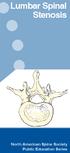 Lumbar Spinal Stenosis North American Spine Society Public Education Series What Is Lumbar Spinal Stenosis? The vertebrae are the bones that make up the lumbar spine (low back). The spinal canal runs through
There are four main regions of the back; the cervical (C), thoracic (T), lumbar (L), and sacral (S) regions
 Low Back Pain Overview Low back pain is one of the most common disorders in the United States. About 80 percent of people have at least one episode of low back pain during their lifetime. Factors that
Whiplash Associated Disorder
 Whiplash Associated Disorder The pathology Whiplash is a mechanism of injury, consisting of acceleration-deceleration forces to the neck. Mechanism: Hyperflexion/extension injury Stationary vehicle hit
Avoid The Dreaded Back Injury by Proper Lifting Techniques
 Avoid The Dreaded Back Injury by Proper Lifting Techniques If you ve ever strained your back while lifting something, you ll know the importance of lifting safely. Agenda Introduction About the Back The
Is Your Neck Or Back Pain Caused By A Herniated Disc?
 Is Your Neck Or Back Pain Caused By A Herniated Disc? The bones in your spine are called the vertebrae. The vertebrae are held together and in place by ligaments and small discs that act as shock absorbers.
Physiotherapy in Rheumatoid Arthritis. Information for patients Gina Wall Senior Physiotherapist
 Physiotherapy in Rheumatoid Arthritis Information for patients Gina Wall Senior Physiotherapist What do Physiotherapists do? We conduct assessments by asking detailed questions about your symptoms, medical
CHIROPRACTIC WELLNESS AWARENESS ONE FREE MASSAGE SESSION
 CHIROPRACTIC WELLNESS AWARENESS Do you want to have a healthy body? Do you like to maintain your high energy level? Do you want to be stress-less? Do you like to be pain free? Please call Conrad Nieh D.C.
Tension-type headache Non-pharmacological and pharmacological treatment
 Danish Headache Center Tension-type headache Non-pharmacological and pharmacological treatment Lars Bendtsen Associate professor, MD, PhD, Dr Med Sci Danish Headache Center, Department of Neurology Glostrup
Many people with MS use some form of conventional medical treatment, and many people also use complementary and alternative medicine (CAM).
 Complementary and alternative medicine (CAM) CAM therapies can generally be divided into the following categories: Biologically based therapies (eg, dietary supplements, diets, bee venom therapy, hyperbaric
.org. Plantar Fasciitis and Bone Spurs. Anatomy. Cause
 Plantar Fasciitis and Bone Spurs Page ( 1 ) Plantar fasciitis (fashee-eye-tiss) is the most common cause of pain on the bottom of the heel. Approximately 2 million patients are treated for this condition
Test Content Outline Effective Date: June 9, 2014. Pain Management Nursing Board Certification Examination
 Pain Management Nursing Board Certification Examination There are 175 questions on this examination. Of these, 150 are scored questions and 25 are pretest questions that are not scored. Pretest questions
Spinal Cord Injury Education. An Overview for Patients, Families, and Caregivers
 Spinal Cord Injury Education An Overview for Patients, Families, and Caregivers Spinal Cord Anatomy A major component of the Central Nervous System (CNS) It is 15 to 16 inches long, and weighs 1 to 2 ounces
Epidural Continuous Infusion. Patient information Leaflet
 Epidural Continuous Infusion Patient information Leaflet April 2015 Introduction You may already know that epidural s are often used to treat pain during childbirth. This same technique can also used as