
m y f o u n d a t i o n i n f o s h e e t
|
|
|
- Douglas Summers
- 10 years ago
- Views:
Transcription
1 Pain and Myeloma m y f o u n d a t i o n i n f o s h e e t Pain is the most common symptom of myeloma and can greatly affect all areas of your life, especially if it is untreated or poorly managed. This Information Sheet will explore what the main types and causes of pain in myeloma are, as well as looking at the different approaches used to manage pain effectively. It will also emphasise the need for honest communication with your doctor about the impact that pain is having on your life and highlight some of the things that you can do for yourself to help relieve your pain. Pain will affect up to 80% of people with myeloma at some point. The type and intensity of pain will vary considerably and will affect each of you differently; it can be localised to one area of your body or it can affect many different areas. The causes of pain in myeloma are varied and can include: Myeloma bone disease Bone disease is the most frequent and often the most debilitating feature of myeloma and therefore bone pain is a very common symptom. The areas usually affected include the middle or lower back, the hips and the rib cage. The long bones of the upper arms and legs can also be affected. Bone disease occurs as a result of myeloma cells in the bone marrow affecting the surrounding bone, causing the bone to be broken down faster than it can be repaired. Sometimes the bones can become so weak that they can break without undue force or injury this is called a pathological fracture. The thinning of the vertebrae (bones of the spine) can also result in fractures. They tend to collapse and become compressed. This is known as a vertebrae compression fracture and can be very painful. Peripheral neuropathy Peripheral neuropathy is the term used to describe damage to the nerves that make up the peripheral nervous system. In myeloma the nerves that are most commonly affected are those of the hands and feet. There are several possible causes of peripheral neuropathy in myeloma including its treatments, infiltration of nerve tissue and complications such as infection. Common symptoms of peripheral neuropathy include pain, numbness or a pins and needles sensation in the affected nerves. Infection Myeloma can weaken the immune system, leaving you more susceptible to picking up recurring infections, some of which can be accompanied by pain Common infections include chest and kidney bacterial infection and the viral infection shingles. 1


2 Sore mouth A sore mouth (or mucositis ) is one of the side-effects of chemotherapy, especially when given in high doses before a stem cell transplant. The lining of your mouth can become red and inflamed and can sometimes result in extreme pain and discomfort. Fortunately, this is normally a temporary side effect and your mouth should return to normal once you have recovered from your treatment. Describing your pain In order for your doctor or nurse to treat your pain effectively it is important that they know exactly how it is affecting you and what it feels like to you. You may be asked a range of questions to try to establish the exact nature of your pain this helps to work out which treatment is most appropriate for you and also provides a baseline measure to see which pain medications are working. It may be helpful, therefore to consider asking yourself these questions before you see your doctor or nurse: Where do you feel the pain? When did it begin? What does it feel like? Sharp? Dull? Throbbing? Burning? Steady? Does it prevent you from carrying out your daily activities? What makes it worse? What have you tried for pain relief? Is your pain constant? If not, how many times a day (or week) does it occur? Some people find that keeping a diary of their pain, over a few days, helps them to describe it more accurately and detect any triggers, or periods of the day when it is worse. You may also experience other symptoms associated with your pain. These can include nausea, headaches, dizziness, weakness, drowsiness, constipation and or diarrhoea. Pain can also have a huge emotional impact, so it is important to let your doctor or nurse know if you feel that living with pain is affecting your mood. Treatment It is important to emphasis that you do not have to put up with pain: there are many different treatment options available and most hospitals will have access to a specialised pain team which consists of a range of professionals who are experts at assessing and relieving pain. The aim of any pain relieving treatment is to provide continuous pain relief, whenever possible, with a minimum of unwanted side-effects. Pain control must be tailored specifically to you and must be regularly reviewed. Medical Treatments Bisphosphonates Bisphosphonates are a specific group of drugs that inhibit bone destruction in myeloma. They have been shown to reduce bone pain and the need for strong pain killers as well as reducing the likelihood of pathological fractures. Bisphosphonates treatment is now recommended for all patients with myeloma requiring treatment whether or not bone lesions are evident. 2

3 Chemotherapy Chemotherapy is a key component of pain management as it is aimed at treating the myeloma itself, which may be the underlying cause of pain. If your myeloma responds to your chemotherapy treatment then you may find that you are able to come off or reduce strong painkillers once you have finished your treatment. Radiotherapy Radiotherapy can be a very effective measure in relieving bone pain in localised areas throughout the body. It is also effective in relieving pressure on the nerves or spinal cord. Surgical interventions Vertebroplasty and balloon kyphoplasty are two new minimally invasive surgical procedures used for stabilising or reversing vertebral compression fractures. These procedures may occasionally be used to offer considerable pain relief as well as strengthening the bones of the vertebrae. Painkillers You may be prescribed painkilling medications (also known as analgesia ) to try to gain control of your pain. Again it is important to point out that an individual approach must be taken in order to achieve pain control there is no correct formula and it often comes down to trial and error as to what works best. Many people are reluctant to take pain killers, so it is useful to emphasise that, when used to treat severe pain, morphine (or any other strong painkiller) is not addictive. Nor is it a sign of weakness or giving up to admit to needing help with your pain. As with any medication, most painkillers have some side-effects, most of which, if caught early, can be managed effectively. Therefore, it is extremely important that you inform your doctor or nurse about any side-effects you are experiencing. Some of the common side-effects are: constipation, nausea, loss of appetite and drowsiness; however, your doctor or nurse will explain to you which side-effects you are likely to experience. The painkillers that are most commonly used in myeloma are listed in the table. Additional drugs that are not normally used as painkillers may also be helpful in certain circumstances e.g. amitriptyline, gabapentin or pregabalin may help relieve neuropathic pain. Steroids, particularly dexamethasone, may also be used to relieve bone pain. Over the counter non-steroidal anti-inflammatory painkillers (e.g. ibuprofen) are not generally recommended for use in myeloma as they can contribute to kidney damage. 3

4 Class Examples Comments Simple non-opioid analgesics Paracetamol Useful in mild to moderate pain. Non-steroidal antiinflammatory drugs Weak opioids Strong (natural) opioids Synthetic Opioids Others Ibuprofen, Voltaren Provide effective pain relief for moderate pain, e.g. Panadeine Forte, tramadol. Provide effective pain relief for moderate to severe pain. Morphine as liquid or tablets can be converted to slow release preparations when daily requirements are established e.g. MS Contin Provide effective pain relief for moderate to severe pain; some can be less toxic than natural opioids Include: Oxycodone may be given orally (immediate or slow release formulations) e.g. Oxycontin Fentanyl given as slow release patches Gabapentin and pregabalin Should be avoided or used only with caution Confusion and drowsiness may be experienced initially: can cause constipation: caution required in renal impairment. As above As above Commonly used for neuropathic pain NON MEDICAL TREATMENTS There is a range of non-medical interventions that can be used to help relieve pain, some of which are listed below. They may help you feel that you are getting more control over your pain and relieve some of the anxiety related to living with pain. It is important, however, that you inform your doctor or nurse if you choose to use any of these treatments. TENS machine TENS (Transcutaneous Electrical Nerve Stimulation) machines deliver small electrical pulses to the body via electrodes placed on the skin. TENS machines are thought to affect the way pain signals are sent to the brain. You can get TENS machines from a physiotherapist or buy one from most pharmacies. 4

5 Acupuncture Acupuncture is part of traditional Chinese medicine and uses the balance of the body s own life force to restore wellbeing. Acupuncture can be used to alleviate pain and to relax muscles. Gentle massage Gentle massage can be used to relieve muscle pain and tension and can be both therapeutic and relaxing. Remember to tell the massage therapist that you have myeloma. Hot and cold packs Hot water bottles and ice packs can be very effective in providing short term pain relief. It s best not to apply them directly onto your skin and often alternating between hot and cold works best. Relaxation techniques Tense muscles can contribute to any pain that you are experiencing. Learning relaxation techniques can not only ease your pain but can help you cope with it better. Correct positioning Often the way that you sit, or lie down can affect your pain. Use supportive cushions or pillows and ask to be seen by a physiotherapist for expert advice. SELF-HELP STRATEGIES As well as the non-medical treatments listed above, things that you can do for yourself to try to get control of your pain may include: Asking for help when needed Again, this is not a sign of weakness so don t be afraid to ask for help from those around you most people are glad to be able to offer some assistance. If you think you need help around the home speak to your doctor or nurse who will be able to arrange for an occupational therapist to assess you. Taking painkillers regularly as prescribed Don t wait until you are in pain try to stick to the regime that your doctor has prescribed for you this will help them assess if your current level of pain relief is working. Distraction therapy Some people find that watching TV or listening to the radio can help by taking their mind off the pain for a short while. Achieving a balance between regular rest and activity It s important to have some structure to your day whilst not over-tiring yourself. Moderate gentle exercise (e.g. walking) will help strengthen your muscles. It will also take your mind off your pain and can help lift your mood. Be honest with your doctor or nurse Let your doctor or nurse know about the pain that you are experiencing, especially any new sites of pain or if it is increasing in intensity. Talking about your feelings Anxiety and stress can aggravate pain so try and talk about your worries and concerns. If you would like to speak to a trained counsellor, your GP or local cancer centre should be able to organise this for you. 5

6 CONCLUSION Pain may affect the majority of you at some point: however I hope I have shown that with honest communication with your doctor or nurse, and with the correct treatment for you, pain can be controlled, allowing you to get on with your life. Original article written by Mandy Calder, Myeloma Information Nurse Specialist of Myeloma UK reprinted with permission from Living with Myeloma the newsletter of Myeloma UK. Adapted to Australian standards by Dr Simon Wein, Peter MacCallum Cancer Centre. The information in this fact sheet is not intended to replace medical care or the advice of a physician. Your doctor should always be consulted regarding diagnosis and treatment. Myeloma Foundation of Australia Inc. PO Box 862 KEW VIC 3101 Administration: Support Line: 1800 MYELOMA ( ) [email protected] Website: 6

The Role of the Haematology Specialist Nurse. Catherine Chapman RN. BSc (Hons)
 The Role of the Haematology Specialist Nurse Catherine Chapman RN. BSc (Hons) Key Roles Information Support Advice Patient advocate Education Coordination of care Information Patient Family Carers Health
A Guide to pain relief medicines For patients receiving Palliative Care
 A Guide to pain relief medicines For patients receiving Palliative Care 1 Which pain medicines are you taking? Contents Page No. Amitriptyline 8 Codeine 9 Co-codamol 10 Co-dydramol 11 Diclofenac (Voltarol
Questions and answers on breast cancer Guideline 10: The management of persistent pain after breast cancer treatment
 Questions and answers on breast cancer Guideline 10: The management of persistent pain after breast cancer treatment I ve had breast cancer treatment, and now I m having pain. Does this mean the cancer
Recognizing and Understanding Pain
 Because multiple myeloma is a cancer involving the bone marrow, a common myeloma symptom is bone pain. But the good news is that most pain can be managed. This resource can help you better understand pain
Cancer Pain. Relief from PALLIATIVE CARE
 PALLIATIVE CARE Relief from Cancer Pain National Clinical Programme for Palliative Care For more information on the National Clinical Programme for Palliative Care, go to www.hse.ie/palliativecareprogramme
Breast Cancer Surgery and Pain
 Breast Cancer Surgery and Pain Princess Margaret Information for women who have had breast surgery Read this pamphlet to learn about: Pain after surgery What you need to know about pain What you need to
Pain Management after Surgery Patient Information Booklet
 Pain Management after Surgery Patient Information Booklet PATS 509-15-05 Your Health Care Be Involved Be involved in your healthcare. Speak up if you have questions or concerns about your care. Tell a
Herniated Lumbar Disc
 Herniated Lumbar Disc North American Spine Society Public Education Series What Is a Herniated Disc? The spine is made up of a series of connected bones called vertebrae. The disc is a combination of strong
Medications for chronic pain
 Medications for chronic pain When it comes to treating chronic pain with medications, there are many to choose from. Different types of pain medications are used for different pain conditions. You may
Multiple Myeloma. Understanding your diagnosis
 Multiple Myeloma Understanding your diagnosis Multiple Myeloma Understanding your diagnosis When you first hear that you have cancer, you may feel alone and afraid. You may be overwhelmed by the large
Herniated Cervical Disc
 Herniated Cervical Disc North American Spine Society Public Education Series What Is a Herniated Disc? The backbone, or spine, is composed of a series of connected bones called vertebrae. The vertebrae
Drug treatments for neuropathic pain
 Understanding NICE guidance Information for people who use NHS services Drug treatments for neuropathic pain NICE clinical guidelines advise the NHS on caring for people with specific conditions or diseases
Fact Sheet. Queensland Spinal Cord Injuries Service. Pain Management Following Spinal Cord Injury for Health Professionals
 Pain Management Following Injury for Health Professionals and Introduction Pain is a common problem following SCI. In the case where a person with SCI does have pain, there are treatments available that
It can be devastating to be diagnosed with a cancer like multiple myeloma. But there are treatments that can help you live longer and feel better.
 Patient information from the BMJ Group It can be devastating to be diagnosed with a cancer like multiple myeloma. But there are treatments that can help you live longer and feel better. What is multiple
Collaborative Care Plan for PAIN
 1. Pain Assessment *Patient s own description of pain is the most reliable indicator for pain assessment. Pain intensity to be assessed using the ESAS (Edmonton Symptom Assessment Scale) Use 5 th Vital
National Hospital for Neurology and Neurosurgery. Managing Spasticity. Spasticity Service
 National Hospital for Neurology and Neurosurgery Managing Spasticity Spasticity Service If you would like this document in another language or format, or require the services of an interpreter please contact
Acute Oncology Service Patient Information Leaflet
 Spinal cord compression Acute Oncology Service Patient Information Leaflet Introduction If you have been diagnosed with cancer, you need to know about spinal cord compression and the warning signs. What
University College Hospital. Metastatic spinal cord compression (MSCC) information for patients at risk of developing MSCC.
 University College Hospital Metastatic spinal cord compression (MSCC) information for patients at risk of developing MSCC Cancer Services 2 If you would like this document in another language or format,
Australian and New Zealand College of Anaesthetists and Faculty of Pain Medicine. Managing Acute Pain. A Guide for Patients.
 Australian and New Zealand College of Anaesthetists and Faculty of Pain Medicine Managing Acute Pain A Guide for Patients Approved by MANAGING ACUTE PAIN AGUIDE FOR PATIENTS Australian and New Zealand
METASTASES TO THE BONE
 RADIATION THERAPY FOR METASTASES TO THE BONE Facts to Help Patients Make an Informed Decision TARGETING CANCER CARE AMERICAN SOCIETY FOR RADIATION ONCOLOGY WHAT ARE BONE METASTASES? Cancer that starts
Oxford University Hospitals. NHS Trust. Oxford Centre for Head and Neck Oncology. Pain Relief. Information for patients
 Oxford University Hospitals NHS Trust Oxford Centre for Head and Neck Oncology Pain Relief Information for patients Introduction This booklet has been written to give you information about pain relief.
Cancer Pain. What is Pain?
 Cancer Pain What is Pain? The International Association for the Study of Pain says that pain is "an unpleasant sensory and emotional experience associated with actual or potential tissue damage." Pain
Teriflunomide (Aubagio) 14mg once daily tablet
 Teriflunomide (Aubagio) 14mg once daily tablet Exceptional healthcare, personally delivered Your Consultant Neurologist has suggested that you may benefit from treatment with Teriflunomide. The decision
PAIN MANAGEMENT During Your Hospital Stay
 PAIN MANAGEMENT During Your Hospital Stay TABLE OF CONTENTS Understanding Pain...2 Pain Assessment...2 Describing Your Pain...5 Pain Treatment...5 Comfort Measures...6 Medication...7 Specialty Procedures...8
Cervical Spondylosis. Understanding the neck
 Page 1 of 5 Cervical Spondylosis This leaflet is aimed at people who have been told they have cervical spondylosis as a cause of their neck symptoms. Cervical spondylosis is a 'wear and tear' of the vertebrae
Day Case Unit, Horton General Hospital Information and advice following a surgical procedure under spinal anaesthetic
 Oxford University Hospitals NHS Trust Day Case Unit, Horton General Hospital Information and advice following a surgical procedure under spinal anaesthetic What is a spinal anaesthetic? Spinal anaesthesia
Multiple Myeloma. This reference summary will help you understand multiple myeloma and its treatment options.
 Multiple Myeloma Introduction Multiple myeloma is a type of cancer that affects white blood cells. Each year, thousands of people find out that they have multiple myeloma. This reference summary will help
Nerve Root Pain. Your back pain diagnosis. Contact Details. Spinal Triage Nuffield Orthopaedic Centre Windmill Road Headington Oxford OX3 7LD
 Nerve Root Pain Contact Details Spinal Triage Nuffield Orthopaedic Centre Windmill Road Headington Oxford OX3 7LD Phone: 01865 738051 Fax: 01865 738027 Web Site www.noc.nhs.uk Nerve Pain Patient Information
Chronic Low Back Pain
 Chronic Low Back Pain North American Spine Society Public Education Series What is Chronic Pain? Low back pain is considered to be chronic if it has been present for longer than three months. Chronic low
PAIN MANAGEMENT AT UM/SYLVESTER
 PAIN MANAGEMENT AT UM/SYLVESTER W HAT IS THE PURPOSE OF THIS BROCHURE? We created this brochure for patients receiving care from the University of Miami Sylvester Comprehensive Cancer Center and their
Guidance on competencies for management of Cancer Pain in adults
 Guidance on competencies for management of Cancer Pain in adults Endorsed by: Contents Introduction A: Core competencies for practitioners in Pain Medicine B: Competencies for practitioners in Pain Medicine
Epidural Continuous Infusion. Patient information Leaflet
 Epidural Continuous Infusion Patient information Leaflet April 2015 Introduction You may already know that epidural s are often used to treat pain during childbirth. This same technique can also used as
SHINGLES (Herpes zoster infection)
 SHINGLES (Herpes zoster infection) What are the aims of this leaflet? This leaflet has been written to help you understand more about shingles. It will tell you what it is, what causes it, what can be
Pain and problem drug use
 Pain and problem drug use Information for patients Prepared by the British Pain Society in consultation with the Royal College of Psychiatrists, the Royal College of General Practitioners and the Advisory
Controlling symptoms of mesothelioma
 Controlling symptoms of mesothelioma This information is an extract from the booklet Understanding mesothelioma. You may find the full booklet helpful. We can send you a free copy see page 9. Contents
Neck Pain. www.physiofirst.org.uk
 Neck Pain www.physiofirst.org.uk Neck pain is common. The cause can be obvious like an accident or more subtle when related to a repetitive task or prolonged position. There are many triggers for neck
The Pharmacological Management of Cancer Pain in Adults. Clinical Audit Tool
 The Pharmacological Management of Cancer Pain in Adults Clinical Audit Tool 2015 This clinical audit tool accompanies the Pharmacological Management of Cancer Pain in Adults NCEC National Clinical Guideline
X-Plain Rheumatoid Arthritis Reference Summary
 X-Plain Rheumatoid Arthritis Reference Summary Introduction Rheumatoid arthritis is a fairly common joint disease that affects up to 2 million Americans. Rheumatoid arthritis is one of the most debilitating
A Patient s Guide to PAIN MANAGEMENT. After Surgery
 A Patient s Guide to PAIN MANAGEMENT After Surgery C o m p a s s i o n a n d C o m m i t m e n t A Patient s Guide to Pain Management After Surgery If you re facing an upcoming surgery, it s natural to
Multiple sclerosis and pain
 9 Multiple sclerosis and pain 2ND EDITION Multiple Sclerosis Society of New Zealand CONTENTS Introduction-------------------------------------------------------------------------------------------3 How
August Is Palliative Care and Cancer Pain Awareness Month
 August Is Palliative Care and Cancer Pain Awareness Month What Is Palliative Care? Palliative care is a growing research area that focuses on improving the quality of life of all people living with cancer,
Objectives. Pain Management Knowing How To Help Yourself. Patients and Family Requirements. Your Rights As A Consumer
 Objectives Pain Management Knowing How To Help Yourself Jackie Carter, RN MSN CNS Become familiar with the definitions of pain Be aware of your rights to have your pain treated Become familiar with the
The Radiotherapy Department Radiotherapy to the chest wall and lymph nodes
 Oxford University Hospitals NHS Trust The Radiotherapy Department Radiotherapy to the chest wall and lymph nodes Information for patients Introduction This leaflet is for people who have had surgery for
Temozolomide (oral) with concurrent radiotherapy to the brain
 Temozolomide (oral) with concurrent radiotherapy to the brain Temozolomide (oral) with concurrent radiotherapy to the brain This leaflet is offered as a guide to you and your family. You will find it useful
Auto Accident Questionnaire
 Auto Accident Questionnaire Patient s Name: Date Of Accident: Date: Social History: (please complete the following, check all boxes that apply) Are you: Married Single Divorced Widowed # of Children: #
Opioids in Palliative Care- Patient Information Manual
 Version 2.0 with MST example Introduction The following pages explain what opioids are and what we think you may want to know about them. There is quite a lot of information here, most of it is based on
Whiplash. Whiplash is part of our modern lives. One in 200 of us will suffer from it at some point but it is rarely serious.
 Whiplash www.physiofirst.org.uk Whiplash is part of our modern lives. One in 200 of us will suffer from it at some point but it is rarely serious. Most people make a full return to health. What you do
Whiplash Recovery Important Facts 1
 02866328200 Whiplash Recovery Important Facts 1 What is whiplash? You can get whiplash if your head is suddenly jolted backwards and forwards in a whip-like movement. The tissues around your neck are overstretched,
Sciatica Yuliya Mutsa PTA 236
 Sciatica Yuliya Mutsa PTA 236 Sciatica is a common type of pain affecting the sciatic nerve, which extends from the lower back all the way through the back of the thigh and down through the leg. Depending
WHEN PROSTATE CANCER RETURNS: ADVANCED PROSTATE CANCER. How Will I Know If My Prostate Cancer Returns?
 WHEN PROSTATE CANCER RETURNS: ADVANCED PROSTATE CANCER (The following information is based on the general experiences of many prostate cancer patients. Your experience may be different.) How Will I Know
Multiple Myeloma Understanding your diagnosis
 Multiple Myeloma Understanding your diagnosis Multiple Myeloma Understanding your diagnosis When you first hear that you have cancer you may feel alone and afraid. You may be overwhelmed by the large amount
Clinical Algorithm & Preferred Medications to Treat Pain in Dialysis Patients
 Clinical Algorithm & Preferred Medications to Treat Pain in Dialysis Patients Developed by the Mid Atlantic Renal Coalition and the Kidney End of Life Coalition September 2009 This project was supported,
PAIN RELIEF GUIDE. Tips and advice from your pharmacist.
 PAIN RELIEF GUIDE Tips and advice from your pharmacist. Rite Aid Pharmacists: Your Pain Relief Managers Rite Aid is committed to providing everyday products and services that help our valued customers
Children s Cancer Pain Can Be Relieved A Guide for Parents and Families
 Children s Cancer Pain Can Be Relieved A Guide for Parents and Families This booklet is dedicated to Shaney Banks and all other children with cancer. Wisconsin Cancer Pain Initiative 1989 This booklet
Your A-Z of Pain Relief A guide to pain relief medicines. We care, we discover, we teach
 Your A-Z of Pain Relief A guide to pain relief medicines We care, we discover, we teach Which pain medicines are you taking? Abstral (see Fentanyl Instant Tablets) Amitriptyline 5 Brufen (see Ibuprofen)
Controlling Pain Part 2: Types of Pain Medicines for Your Prostate Cancer
 Controlling Pain Part 2: Types of Pain Medicines for Your Prostate Cancer The following information is based on the general experiences of many prostate cancer patients. Your experience may be different.
How to treat your injured neck
 How to treat your injured neck Exceptional healthcare, personally delivered Your neck is made up of a number of bones bound together by strong discs and ligaments. It is also protected by strong muscles.
Shared Decision Making
 Deciding what to do about osteoarthritis of the knee This short decision aid is to help you decide what to do about your knee osteoarthritis. You can use it on your own, or with your doctor, to help you
Effect of breast cancer treatment
 Effect of breast cancer treatment on the bones 1 Effect of breast cancer treatment on the bones This information is from the booklet Managing the late effects of breast cancer treatment. You may find the
Getting the best result from Opioid medicine. in the management of chronic pain
 Getting the best result from Opioid medicine in the management of chronic pain Your doctor has prescribed you opioid medicine to help you manage your chronic pain. This patient information leaflet gives
Strong opioids (painkillers) in palliative care what you should know
 Strong opioids (painkillers) in palliative care what you should know Patient Information Author ID: JG Leaflet Number: PC 006 Version: 1 Name of Leaflet: Strong opioids (painkillers) in palliative care
CHPN Review Course Pain Management Part 1 Hospice and Palliative Nurses Association
 CHPN Review Course Pain Management Part 1 Disclosures Bonnie Morgan has no real or perceived conflicts of interest that relate to this presentation. Copyright 2015 by the. HPNA has the exclusive rights
Clinical and Therapeutic Cannabis Information. Written by Cannabis Training University (CTU) All rights reserved
 Clinical and Therapeutic Cannabis Information Written by Cannabis Training University (CTU) All rights reserved Contents Introduction... 3 Chronic Pain... 6 Neuropathic Pain... 8 Movement Disorders...
Cervical Spondylosis (Arthritis of the Neck)
 Copyright 2009 American Academy of Orthopaedic Surgeons Cervical Spondylosis (Arthritis of the Neck) Neck pain is extremely common. It can be caused by many things, and is most often related to getting
How To Take A Strong Opioid Painkiller
 Using strong painkillers for cancer pain This information is an extract from the booklet Controlling cancer pain. You may find the full booklet helpful. We can send you a copy free see page 8. Contents
Preventing & Treating Low Back Pain
 Preventing & Treating Low Back Pain An Introduction to Low Back Pain Low back pain is the number two reason that Americans see a health care practitioner second only to colds and flu. While most people
PAIN MANAGEMENT. Louise Smith Clinical Nurse Specialist
 PAIN MANAGEMENT Louise Smith Clinical Nurse Specialist Objectives To understand:- The concept of Total Pain The types of Physical Pain Holistic assessment Pain management; pharmaceutical & non pharmaceutical
Temple Physical Therapy
 Temple Physical Therapy A General Overview of Common Neck Injuries For current information on Temple Physical Therapy related news and for a healthy and safe return to work, sport and recreation Like Us
Herniated Disk. This reference summary explains herniated disks. It discusses symptoms and causes of the condition, as well as treatment options.
 Herniated Disk Introduction Your backbone, or spine, has 24 moveable vertebrae made of bone. Between the bones are soft disks filled with a jelly-like substance. These disks cushion the vertebrae and keep
Treating symptoms. An introduction to. Everyone diagnosed with MS can get treatment for their symptoms. The symptoms of MS. Who can get treatment?
 Everyone diagnosed with MS can get treatment for their symptoms This resource is an introduction to the treatments that are available. The symbol will point you to further resources. An introduction to
Treating Severe Migraine Headaches in the Emergency Room A Review of the Research for Adults
 Treating Severe Migraine Headaches in the Emergency Room A Review of the Research for Adults Is This Information Right for Me? Yes, this information is right for you if: Your doctor* has told you that
.org. Herniated Disk in the Lower Back. Anatomy. Description
 Herniated Disk in the Lower Back Page ( 1 ) Sometimes called a slipped or ruptured disk, a herniated disk most often occurs in your lower back. It is one of the most common causes of low back pain, as
Headache after an epidural or spinal injection What you need to know. Patient information Leaflet
 Headache after an epidural or spinal injection What you need to know Patient information Leaflet April 2015 We have produced this leaflet to give you general information about the headache that may develop
SPINE AND NECK SURGERY: MAKING A DECISION THAT S RIGHT FOR YOU
 1. GET THE FACTS: Back and neck pain affects 8 out of 10 people at some point in their life. Acute back and neck pain comes on suddenly and usually lasts from a few days to a few weeks. Chronic back and
Lumbar Spinal Stenosis
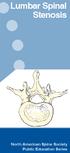 Lumbar Spinal Stenosis North American Spine Society Public Education Series What Is Lumbar Spinal Stenosis? The vertebrae are the bones that make up the lumbar spine (low back). The spinal canal runs through
Patient information. Using strong Opioids to control your pain
 Patient information Using strong Opioids to control your pain Published: April 2013. Date for review: April 2016 Introduction This leaflet explains what strong opioids (pronounced oh-pee-oyds) e are and
medicineupdate Tramadol for pain Asking the right questions about new medicines Page Section 1: What tramadol is 1 Section 2: What tramadol is for 1
 medicineupdate Asking the right questions about new medicines Tramadol for pain Page Section 1: What tramadol is 1 Section 2: What tramadol is for 1 Section 3: Who can take tramadol 2 Section 4: What does
Introduction: Anatomy of the spine and lower back:
 Castleknock GAA club member and Chartered Physiotherapist, James Sherry MISCP, has prepared an informative article on the common causes of back pain and how best it can be treated. To book a physiotherapy
POST-TEST Pain Resource Professional Training Program University of Wisconsin Hospital & Clinics
 POST-TEST University of Wisconsin Hospital & Clinics True/False/Don't Know - Circle the correct answer T F D 1. Changes in vital signs are reliable indicators of pain severity. T F D 2. Because of an underdeveloped
VAD Chemotherapy Regimen for Multiple Myeloma Information for Patients
 VAD Chemotherapy Regimen for Multiple Myeloma Information for Patients The Regimen contains: V = vincristine (Oncovin ) A = Adriamycin (doxorubicin) D = Decadron (dexamethasone) How Is This Regimen Given?
Physiotherapy and arthritis. Therapy Physiotherapy and arthritis. This booklet provides information and answers to your questions about this therapy.
 Therapy Physiotherapy and arthritis Physiotherapy and arthritis This booklet provides information and answers to your questions about this therapy. In association with Arthritis Research UK produce and
Neck Pain HealthshareHull Information for Guided Patient Management
 HealthshareHull Information for Guided Patient Management Index Introduction 2 The neck (cervical spine) anatomy 2 What are the common types of neck pain? 3 What are the common symptoms associated with
Palliative Care The Relief You Need When You re Experiencing the Symptoms of Serious Illness
 Palliative Care The Relief You Need When You re Experiencing the Symptoms of Serious Illness Dealing with the symptoms of any painful or serious illness is difficult. However, special care is available
Musculoskeletal System
 CHAPTER 3 Impact of SCI on the Musculoskeletal System Voluntary movement of the body is dependent on a number of systems. These include: The brain initiates the movement and receives feedback to assess
Managing Chronic Pain
 Managing Chronic Pain Chronic pain can cripple the body, mind and spirit. Feeling broken? You may benefit from Cleveland Clinic s Section of Pain Medicine, which tailors comprehensive, innovative treatment
Secondary liver cancer Patient Information Booklet
 Secondary liver cancer Patient Information Booklet Delivering the best in care UHB is a no smoking Trust To see all of our current patient information leaflets please visit www.uhb.nhs.uk/patient-information-leaflets.htm
Your spinal Anaesthetic
 Your spinal Anaesthetic Information for patients Your spinal anaesthetic This information leaflet explains what to expect when you have an operation with a spinal anaesthetic. It has been written by patients,
A handbook for patients COPING WITH CANCER PAIN
 A handbook for patients COPING WITH CANCER PAIN Introduction This booklet is about pain and how to control it. Many patients with cancer fear that they will have pain. Although pain is a common problem,
Breast Cancer. Breast Cancer Page 1
 Breast Cancer Summary Breast cancers which are detected early are curable by local treatments. The initial surgery will give the most information about the cancer; such as size or whether the glands (or
Like cocaine, heroin is a drug that is illegal in some areas of the world. Heroin is highly addictive.
 Heroin Introduction Heroin is a powerful drug that affects the brain. People who use it can form a strong addiction. Addiction is when a drug user can t stop taking a drug, even when he or she wants to.
Acute Low Back Pain. North American Spine Society Public Education Series
 Acute Low Back Pain North American Spine Society Public Education Series What Is Acute Low Back Pain? Acute low back pain (LBP) is defined as low back pain present for up to six weeks. It may be experienced
Betaferon (interferon beta 1b)
 Betaferon (interferon beta 1b) What is Betaferon? Betaferon (interferon beta-1b) is a type of medicine known as an interferon, which is used to treat MS. Interferons are proteins found naturally in the
Headaches. This chapter will discuss:
 C H A P T E R Headaches 1 1 Almost everyone gets an occasional headache at some time or another. Some people get frequent headaches. Most people do not worry about headaches and learn to live with them
Understanding Your Pain
 Toll Free: 800-462-3636 Web: www.endo.com Understanding Your Pain This brochure was developed by Margo McCaffery, RN, MS, FAAN, and Chris Pasero, RN, MS, FAAN authors of Pain: Clinical Manual (2nd ed.