
Evolution leads to Kantian morality
|
|
|
- Eleanor Briggs
- 10 years ago
- Views:
Transcription
1 Evolution leads to Kantian morality Ingela Alger (Toulouse School of Economics and IAST) Jörgen Weibull (Stockholm School of Economics and IAST) Oslo, 6 October 6, 2015
2 Introduction For decades economics was based on homo oeconomicus, a species motivated by material self-interest Focus on: extrinsic incentives to work, to pay taxes, etc the role of institutions in mitigating information problems
3 Then came behavioral economics Focus on preferences: altruism (Becker) warm glow (Andreoni) fairness, inequity aversion (Rabin, Fehr and Schmidt) reciprocal altruism (Levine) honesty (Alger and Ma) esteem (Bénabou and Tirole, Ellingsen and Johannesson)

4 Moral values sometimes included by economists: Smith (1759) and Edgeworth (1881) Arrow (1973), Laffont (1975), Sen (1977) Brekke, Kverndokk and Nyborg (2003), Tabellini (2008), Bénabou and Tirole (2011)

5 But how can differences between countries be explained? Could the Nordic model have arisen in, say, South America?

6 Since institutions are built by people, preferences should matter How are preferences formed in the first place? study evolutionary foundations of human motivation! behavioral ecology approach

7 What preferences and/or moral values should we expect humans to have from first principles? Evolutionary logic: 1. Human populations have evolved under scarcity of resources 2. Not all who are born survive and not all who survive reproduce 3. Darwinian logic: those alive today had ancestors who were successful at surviving and reproducing; we have inherited their traits
8 The approach in today s paper: preferences behaviors material payoff consequences evolutionary selection pressure on preferences place minimal restrictions on the set of possible preferences which preferences are evolutionarily stable?

9 This sounds too general to give anything... But... the math leads to a new class of social preferences cum moral values: those of homo moralis

10 The model A continuum population Individuals are randomly matched into n-player groups Strategy set: X Each individual has a preference type θ Θ, which defines a continuous function u θ : X n R Each individual s type is his/her private information Material payoff from using strategy x X against x i X n 1 : π (x, x i )

11 Each randomly matched group of n individuals play some (Bayesian Nash) equilibrium under incomplete information (as if individuals would know the type-distribution they meet, but not the types of the other individuals in their group)

12 Definition 1 A type θ Θ is evolutionarily stable against type τ Θ if, for all sufficiently small ε > 0, individuals of type θ on average earn a higher material payoff than individuals of type τ in all equilibria under incomplete information. Definition 2 A type θ is evolutionarily stable if it is evolutionarily stable against every type τ θ. Definition 3 A type θ is evolutionarily unstable if there exists a type τ such that, irrespective of how small ε > 0 is, there exists an equilibrium in which individuals of type τ earn a higher material payoff than individuals of type θ.

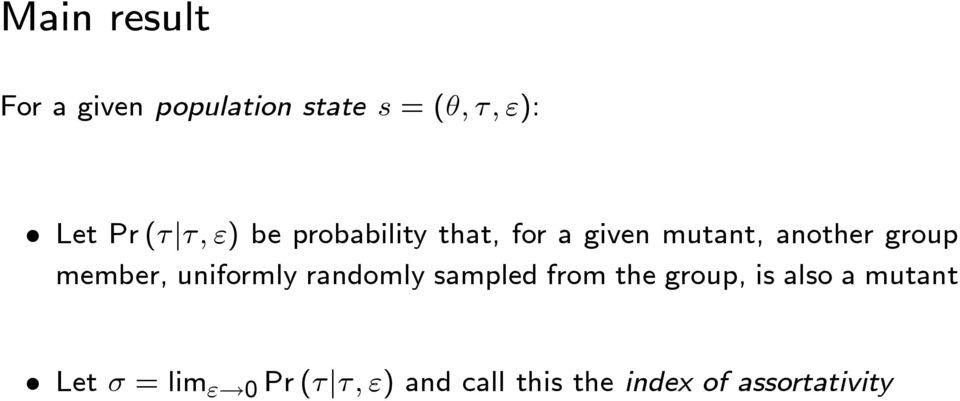
13 Main result For a given population state s = (θ, τ, ε): Let Pr (τ τ, ε) be probability that, for a given mutant, another group member, uniformly randomly sampled from the group, is also a mutant Let σ = lim ε 0 Pr (τ τ, ε) and call this the index of assortativity
14 Theorem 1 Assume conditionally independent random matching, with index of assortativity σ [0, 1]. (i) Homo moralis with degree of morality κ = σ is evolutionarily stable against all types τ that are not its behavioral alikes. (ii) A type θ Θ is evolutionarily unstable if its carrier does not behave like homo moralis with degree of morality κ = σ. So what is a homo moralis?

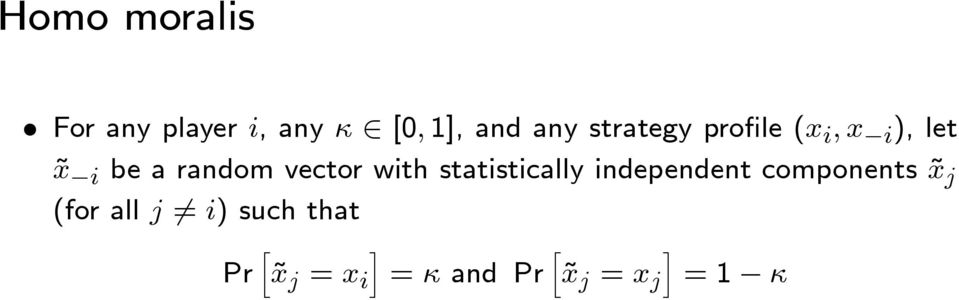
15 Homo moralis For any player i, any κ [0, 1], and any strategy profile (x i, x i ), let x i be a random vector with statistically independent components x j (for all j i) such that Pr [ x j = x i ] = κ and Pr [ xj = x j ] = 1 κ
16 Definition 4 A homo moralis is an individual with utility function u κ (x i, x i ) = E κ [π (x i, x i )] for some κ [0, 1], the individual s degree of morality.
![i, x i ) = E κ [π (x i, x i )] for some](/docs-images/54/10386845/images/page_16.jpg "κ [0, 1], the individual s degree of")
17 n = 2: u κ (x, y) = (1 κ) π (x, y) + κ π (x, x) n = 3: u κ (x, y, z) = (1 κ) 2 π (x, y, z) +κ (1 κ) [π (x, x, z) + π (x, y, x)] +κ 2 π (x, x, x)
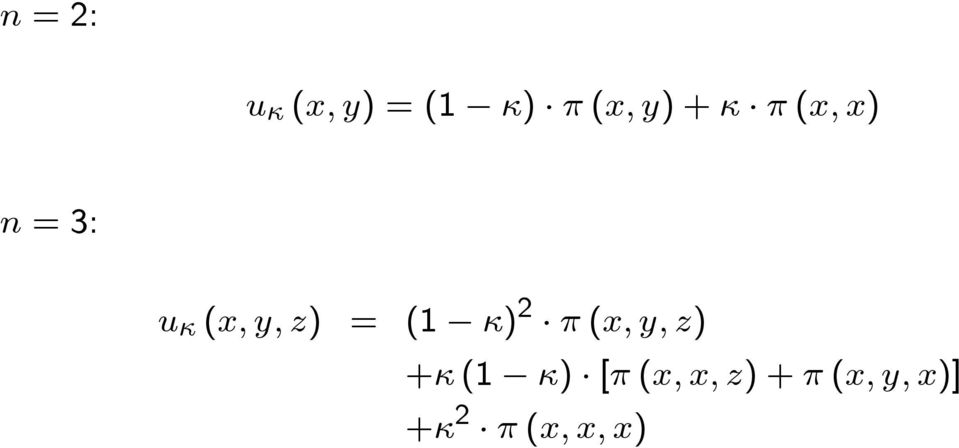
18 Remarks: Homo moralis with degree of morality κ = 0 is purely self-interested, while homo moralis with degree of morality κ = 1 always does the right thing according to Kant s categorical imperative: Act only according to that maxim whereby you can, at the same time, will that it should become a universal law [Grundlegung zür Metaphysik der Sitten, 1785] For intermediate degrees of morality, 0 < κ < 1, homo moralis chooses a strategy that would maximize her expected material payoff if others were to choose that same strategy with probability κ
![that it should become a universal law [Grundlegung zür Metaphysik der Sitten, 1785] For intermediate degrees of morality, 0 < κ < 1, homo](/docs-images/54/10386845/images/page_18.jpg "moralis chooses a strategy that would maximize her expected material payoff if others were to choose that same strategy with probability")
19 Intuition for the theorem: (i) HM with κ = σ preempts mutants. For instance, for n = 2: a resident population of HM with κ = σ play some x σ arg max x X (1 σ) π (x, x σ) + σ π (x, x), while a vanishingly rare mutant type, who plays some z X, obtains expected material payoff (1 σ) π (z, x σ ) + σ π (z, z) (ii) Any resident type θ that does not behave like HM with κ = σ can be invaded by a mutant that is committed to a strategy that would maximize the mutant s material payoff in the limit as the mutant population share ε 0

20 How does homo moralis behave? An example A public goods game π (x i, x i ) = n 1/2 x i x 2 i i=1 x = n 1/3 [ 1 + σ (n 1) 4 ] 2/3
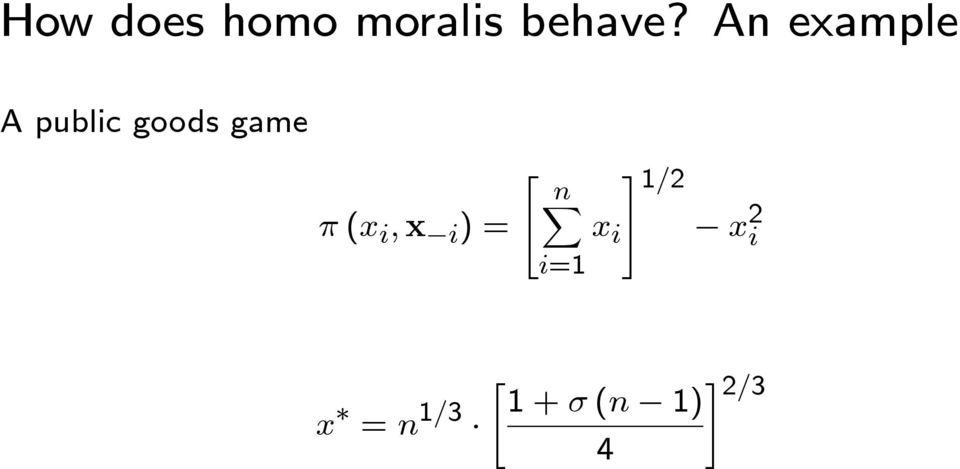
21 x* n σ = 0.5 (pink), σ = 0.25 (blue), σ = 0.1 (red), σ = 0 (black)
22 Discussion A new class of preferences, that springs out of stability under natural selection This preference class connects with moral philosophy Implications of homo moralis preferences for economics? principal-agent relations bargaining participation and voting in elections taxation environmental economics
23 The Nordic model? Small degrees of morality can lead to high levels of contributions to public goods even in large groups Our theory predicts that high degrees of morality should be expected where assortativity is high
24 The Nordic model? The size of the welfare system Alger and Weibull (AER 2010) Kinship, incentives and evolution Main finding: natural selection leads to weaker family ties in harsher environments
25 The great achievement of... the ethical and ascetic sects of Protestantism was to shatter the fetters of the sib. These religions established... a common ethical way of life in opposition to the community of blood, even to a large extent in opposition to the family. (Max Weber: The Religion of China) Evolution by way of natural selection may explain Weber s observation about the fetters of the sib without recourse to Protestantism as a cause: perhaps nature selects family ties, and families select religions that fit their values
26 The Nordic model? Family structure Alger (WP 2015) How many wives? On the evolution of preferences over polygyny rates Main finding: natural selection leads to preference for monogamy in harsher environments Implications for incentives for males to fight to accumulate resources...
Ingela Alger CV June 2015
 Ingela Alger CV June 2015 TSE (LERNA, CNRS, IDEI) and IAST e-mail: [email protected] Université de Toulouse 1 Capitole phone: + 33 5 61 12 85 17 Manufacture des Tabacs, Bât. S fax: + 33 5 61 12 85
10 Evolutionarily Stable Strategies
 10 Evolutionarily Stable Strategies There is but a step between the sublime and the ridiculous. Leo Tolstoy In 1973 the biologist John Maynard Smith and the mathematician G. R. Price wrote an article in
Mistakes Allow Evolutionary Stability in the Repeated Prisoner's Dilemma Game. I. Introduction
 J. theor. Biol. (1989) 136, 47-56 Mistakes Allow Evolutionary Stability in the Repeated Prisoner's Dilemma Game ROBERT BOYD Department of Anthropology, University of California, Los Angeles, California
Microeconomic Theory Jamison / Kohlberg / Avery Problem Set 4 Solutions Spring 2012. (a) LEFT CENTER RIGHT TOP 8, 5 0, 0 6, 3 BOTTOM 0, 0 7, 6 6, 3
 Microeconomic Theory Jamison / Kohlberg / Avery Problem Set 4 Solutions Spring 2012 1. Subgame Perfect Equilibrium and Dominance (a) LEFT CENTER RIGHT TOP 8, 5 0, 0 6, 3 BOTTOM 0, 0 7, 6 6, 3 Highlighting
Online Appendix to Stochastic Imitative Game Dynamics with Committed Agents
 Online Appendix to Stochastic Imitative Game Dynamics with Committed Agents William H. Sandholm January 6, 22 O.. Imitative protocols, mean dynamics, and equilibrium selection In this section, we consider
Computational Learning Theory Spring Semester, 2003/4. Lecture 1: March 2
 Computational Learning Theory Spring Semester, 2003/4 Lecture 1: March 2 Lecturer: Yishay Mansour Scribe: Gur Yaari, Idan Szpektor 1.1 Introduction Several fields in computer science and economics are
University of Oslo Department of Economics
 University of Oslo Department of Economics Exam: ECON3200/4200 Microeconomics and game theory Date of exam: Tuesday, November 26, 2013 Grades are given: December 17, 2013 Duration: 14:30-17:30 The problem
AN INTRODUCTION TO GAME THEORY
 AN INTRODUCTION TO GAME THEORY 2008 AGI-Information Management Consultants May be used for personal purporses only or by libraries associated to dandelon.com network. MARTIN J. OSBORNE University of Toronto
Individual security and network design
 Individual security and network design Diego Cerdeiro Marcin Dziubiński Sanjeev Goyal FIT 2015 Motivation Networks often face external threats in form of strategic or random attacks The attacks can be
6.254 : Game Theory with Engineering Applications Lecture 1: Introduction
 6.254 : Game Theory with Engineering Applications Lecture 1: Introduction Asu Ozdaglar MIT February 2, 2010 1 Introduction Optimization Theory: Optimize a single objective over a decision variable x R
Cournot s model of oligopoly
 Cournot s model of oligopoly Single good produced by n firms Cost to firm i of producing q i units: C i (q i ), where C i is nonnegative and increasing If firms total output is Q then market price is P(Q),
Game Theory 1. Introduction
 Game Theory 1. Introduction Dmitry Potapov CERN What is Game Theory? Game theory is about interactions among agents that are self-interested I ll use agent and player synonymously Self-interested: Each
Dynamics and Equilibria
 Dynamics and Equilibria Sergiu Hart Presidential Address, GAMES 2008 (July 2008) Revised and Expanded (November 2009) Revised (2010, 2011, 2012, 2013) SERGIU HART c 2008 p. 1 DYNAMICS AND EQUILIBRIA Sergiu
CURRICULUM VITAE. Roberta Dessí
 CURRICULUM VITAE Roberta Dessí August 2012 Address IDEI, Toulouse School of Economics, Manufacture des Tabacs, Aile Jean-Jacques Laffont, 21 Allée de Brienne, 31000 Toulouse France. Telephone +33-(0)5
6.254 : Game Theory with Engineering Applications Lecture 2: Strategic Form Games
 6.254 : Game Theory with Engineering Applications Lecture 2: Strategic Form Games Asu Ozdaglar MIT February 4, 2009 1 Introduction Outline Decisions, utility maximization Strategic form games Best responses
Imperfect monitoring in communication networks
 Journal of Economic Theory (00) www.elsevier.com/locate/jet Imperfect monitoring in communication networks Michael McBride University of California, Irvine, Social Science Plaza, Irvine, CA -00, USA Received
Internet Advertising and the Generalized Second Price Auction:
 Internet Advertising and the Generalized Second Price Auction: Selling Billions of Dollars Worth of Keywords Ben Edelman, Harvard Michael Ostrovsky, Stanford GSB Michael Schwarz, Yahoo! Research A Few
On the Efficiency of Competitive Stock Markets Where Traders Have Diverse Information
 Finance 400 A. Penati - G. Pennacchi Notes on On the Efficiency of Competitive Stock Markets Where Traders Have Diverse Information by Sanford Grossman This model shows how the heterogeneous information
Games of Incomplete Information
 Games of Incomplete Information Jonathan Levin February 00 Introduction We now start to explore models of incomplete information. Informally, a game of incomplete information is a game where the players
Chapter 7. Evolutionary Game Theory
 From the book Networks, Crowds, and Markets: Reasoning about a Highly Connected World. By David Easley and Jon Kleinberg. Cambridge University Press, 2010. Complete preprint on-line at http://www.cs.cornell.edu/home/kleinber/networks-book/
Bayesian Nash Equilibrium
 . Bayesian Nash Equilibrium . In the final two weeks: Goals Understand what a game of incomplete information (Bayesian game) is Understand how to model static Bayesian games Be able to apply Bayes Nash
Ecology - scientific study of how individuals interact with their environment 34.1
 Biology 1407 Exam 4 Notes - Ecology Ch.35-36 Ecology - scientific study of how individuals interact with their environment 34.1 - organisms have adapted to - evolved in - a particular set of conditions;
How to Solve Strategic Games? Dominant Strategies
 How to Solve Strategic Games? There are three main concepts to solve strategic games: 1. Dominant Strategies & Dominant Strategy Equilibrium 2. Dominated Strategies & Iterative Elimination of Dominated
An Introduction to Sponsored Search Advertising
 An Introduction to Sponsored Search Advertising Susan Athey Market Design Prepared in collaboration with Jonathan Levin (Stanford) Sponsored Search Auctions Google revenue in 2008: $21,795,550,000. Hal
CPC/CPA Hybrid Bidding in a Second Price Auction
 CPC/CPA Hybrid Bidding in a Second Price Auction Benjamin Edelman Hoan Soo Lee Working Paper 09-074 Copyright 2008 by Benjamin Edelman and Hoan Soo Lee Working papers are in draft form. This working paper
ECONOMICS 470 - Advanced Microeconomic Theory TENTATIVE COURSE OUTLINE
 ECONOMICS 470 - Advanced Microeconomic Theory TENTATIVE COURSE OUTLINE INSTRUCTOR: Maria Gallego OFFICE: P3100 OFFICE HOURS: Tuesday and Thursday 11:30 am 1:00 pm or by appointment PHONE: 884-0710 x 2635#;
On the effect of taxation in the online sports betting market
 On the effect of taxation in the online sports betting market Juan Vidal-Puga Research Group in Economic Analysis Departamento de Estatística e IO Universidade de Vigo, Spain June 8, 2 We analyze the effect
6.207/14.15: Networks Lecture 15: Repeated Games and Cooperation
 6.207/14.15: Networks Lecture 15: Repeated Games and Cooperation Daron Acemoglu and Asu Ozdaglar MIT November 2, 2009 1 Introduction Outline The problem of cooperation Finitely-repeated prisoner s dilemma
Price Dispersion. Ed Hopkins Economics University of Edinburgh Edinburgh EH8 9JY, UK. November, 2006. Abstract
 Price Dispersion Ed Hopkins Economics University of Edinburgh Edinburgh EH8 9JY, UK November, 2006 Abstract A brief survey of the economics of price dispersion, written for the New Palgrave Dictionary
Why Plaintiffs Attorneys Use Contingent and Defense Attorneys Fixed Fee Contracts
 Why Plaintiffs Attorneys Use Contingent and Defense Attorneys Fixed Fee Contracts Winand Emons 1 Claude Fluet 2 1 Department of Economics University of Bern, CEPR, CIRPEE 2 Université du Québec à Montréal,
Social cooperation, niche construction, and the core role of intergenerational bonding in human evolution. Agustín Fuentes University of Notre Dame
 Social cooperation, niche construction, and the core role of intergenerational bonding in human evolution Agustín Fuentes University of Notre Dame Complexity in evolutionary theory helps think about human
Application of Game Theory in Inventory Management
 Application of Game Theory in Inventory Management Rodrigo Tranamil-Vidal Universidad de Chile, Santiago de Chile, Chile [email protected] Abstract. Game theory has been successfully applied
Work incentives and household insurance: Sequential contracting with altruistic individuals and moral hazard
 Work incentives and household insurance: Sequential contracting with altruistic individuals and moral hazard Cécile Aubert Abstract Two agents sequentially contracts with different principals under moral
Evolution, Natural Selection, and Adaptation
 Evolution, Natural Selection, and Adaptation Nothing in biology makes sense except in the light of evolution. (Theodosius Dobzhansky) Charles Darwin (1809-1882) Voyage of HMS Beagle (1831-1836) Thinking
Working Paper Series
 RGEA Universidade de Vigo http://webs.uvigo.es/rgea Working Paper Series Endogenous Social Preferences, Heterogeneity and Cooperation Michele Biavati, Marco Sandri and Luca Zarri 7-08 Facultade de Ciencias
2. Information Economics
 2. Information Economics In General Equilibrium Theory all agents had full information regarding any variable of interest (prices, commodities, state of nature, cost function, preferences, etc.) In many
0.0.2 Pareto Efficiency (Sec. 4, Ch. 1 of text)
 September 2 Exercises: Problem 2 (p. 21) Efficiency: p. 28-29: 1, 4, 5, 6 0.0.2 Pareto Efficiency (Sec. 4, Ch. 1 of text) We discuss here a notion of efficiency that is rooted in the individual preferences
Chapter 7. Sealed-bid Auctions
 Chapter 7 Sealed-bid Auctions An auction is a procedure used for selling and buying items by offering them up for bid. Auctions are often used to sell objects that have a variable price (for example oil)
Moral hazard, insurance, and some collusion
 Journal of Economic Behavior & Organization Vol. 50 (2003) 225 247 Moral hazard, insurance, and some collusion Ingela Alger a,, Ching-to Albert Ma a,b,c a Department of Economics, Boston College, Chestnut
A Hands-On Exercise To Demonstrate Evolution
 HOW-TO-DO-IT A Hands-On Exercise To Demonstrate Evolution by Natural Selection & Genetic Drift H ELEN J. YOUNG T RUMAN P. Y OUNG Although students learn (i.e., hear about) the components of evolution by
Discrete Strategies in Keyword Auctions and their Inefficiency for Locally Aware Bidders
 Discrete Strategies in Keyword Auctions and their Inefficiency for Locally Aware Bidders Evangelos Markakis Orestis Telelis Abstract We study formally two simple discrete bidding strategies in the context
Computing the Electricity Market Equilibrium: Uses of market equilibrium models
 Computing the Electricity Market Equilibrium: Uses of market equilibrium models Ross Baldick Department of Electrical and Computer Engineering The University of Texas at Austin April 2007 Abstract We discuss
Shifting the Blame: On Delegation and Responsibility
 Shifting the Blame: On Delegation and Responsibility Björn Bartling a) University of Zurich Urs Fischbacher b) University of Konstanz July 21, 2008 Abstract: To fully understand the motives for delegating
STRONG RECIPROCITY, HUMAN COOPERATION, AND THE ENFORCEMENT OF SOCIAL NORMS
 STRONG RECIPROCITY, HUMAN COOPERATION, AND THE ENFORCEMENT OF SOCIAL NORMS Ernst Fehr, Urs Fischbacher and Simon Gächter University of Zürich University of St. Gallen This paper provides strong evidence
Exploiting moral wiggle room: experiments demonstrating an illusory preference for fairness
 Economic Theory (2007) 33: 67 80 DOI 10.1007/s00199-006-0153-z SYMPOSIUM Jason Dana Roberto A. Weber Jason Xi Kuang Exploiting moral wiggle room: experiments demonstrating an illusory preference for fairness
Working Paper Series
 RGEA Universidade de Vigo http://webs.uvigo.es/rgea Working Paper Series A Market Game Approach to Differential Information Economies Guadalupe Fugarolas, Carlos Hervés-Beloso, Emma Moreno- García and
T28 OLIGOPOLY 3/1/15
 T28 OLIGOPOLY 3/1/15 1. Oligopoly is a market structure in which there are a small number of firms that engage in strategic interactions. If there are only two firms then we refer to the situation as a
A HYBRID GENETIC ALGORITHM FOR THE MAXIMUM LIKELIHOOD ESTIMATION OF MODELS WITH MULTIPLE EQUILIBRIA: A FIRST REPORT
 New Mathematics and Natural Computation Vol. 1, No. 2 (2005) 295 303 c World Scientific Publishing Company A HYBRID GENETIC ALGORITHM FOR THE MAXIMUM LIKELIHOOD ESTIMATION OF MODELS WITH MULTIPLE EQUILIBRIA:
ECO 199 B GAMES OF STRATEGY Spring Term 2004 PROBLEM SET 4 B DRAFT ANSWER KEY 100-3 90-99 21 80-89 14 70-79 4 0-69 11
 The distribution of grades was as follows. ECO 199 B GAMES OF STRATEGY Spring Term 2004 PROBLEM SET 4 B DRAFT ANSWER KEY Range Numbers 100-3 90-99 21 80-89 14 70-79 4 0-69 11 Question 1: 30 points Games
Cheap Talk : Multiple Senders and Multiple Receivers
 Corso di Laurea in Economia indirizzo Models and Methods of Quantitative Economics Prova finale di Laurea Cheap Talk : Multiple Senders and Multiple Receivers Relatore Prof. Piero Gottardi Laureando Arya
On the Interpretation of Giving in Dictator Games
 On the Interpretation of Giving in Dictator Games John A. List University of Chicago and National Bureau of Economic Research The dictator game represents a workhorse within experimental economics, frequently
Linear Programming: Chapter 11 Game Theory
 Linear Programming: Chapter 11 Game Theory Robert J. Vanderbei October 17, 2007 Operations Research and Financial Engineering Princeton University Princeton, NJ 08544 http://www.princeton.edu/ rvdb Rock-Paper-Scissors
ECONOMICS OF DEBT COLLECTION: ENFORCEMENT OF CONSUMER CREDIT CONTRACTS
 ECONOMICS OF DEBT COLLECTION: ENFORCEMENT OF CONSUMER CREDIT CONTRACTS Viktar Fedaseyeu Bocconi University Bob Hunt Federal Reserve Bank of Philadelphia BEROC, May 28, 2014 Debt collection Debt collection
EconS 503 - Advanced Microeconomics II Handout on Cheap Talk
 EconS 53 - Advanced Microeconomics II Handout on Cheap Talk. Cheap talk with Stockbrokers (From Tadelis, Ch. 8, Exercise 8.) A stockbroker can give his client one of three recommendations regarding a certain
GAMES FOR BUSINESS AND ECONOMICS
 GAMES FOR BUSINESS AND ECONOMICS ROY/GARDNER Indiana University Nachrichtentechnische BibliotHek TUD Inv.-Nr.: /S.JOtUM- John Wiley & Sons, Inc. 5" New York Chichester Brisbane Toronto Singapore Contents
ECON 459 Game Theory. Lecture Notes Auctions. Luca Anderlini Spring 2015
 ECON 459 Game Theory Lecture Notes Auctions Luca Anderlini Spring 2015 These notes have been used before. If you can still spot any errors or have any suggestions for improvement, please let me know. 1
MobLab Game Catalog For Business Schools Fall, 2015
 MobLab Game Catalog For Business Schools Fall, 2015 CORE COURSE COVERAGE Economics For Business Principles of Business Microeconomic Analysis Decisions Game Theory Negotiation Strategy Managerial Economics
Department of Economics The Ohio State University Economics 817: Game Theory
 Department of Economics The Ohio State University Economics 817: Game Theory Syllabus and Reading List James Peck M-W 11:30-1:18 Autumn 2011 Arps Hall 177 www.econ.ohio-state.edu/jpeck/econ817.htm Office
15 Limit sets. Lyapunov functions
 15 Limit sets. Lyapunov functions At this point, considering the solutions to ẋ = f(x), x U R 2, (1) we were most interested in the behavior of solutions when t (sometimes, this is called asymptotic behavior
Course Outline. Parental care and sexual conflict. Papers for 22 October. What is sexual conflict? 10/19/2009
 Parental and sexual conflict Course Outline 1. Sexual selection * 2. Parent offspring conflict * 3. Sexual conflict over parental René van Dijk Email: [email protected] 19 October 2009 4. Genomic
Modeling Internet Security Investments Tackling Topological Information Uncertainty
 Modeling Internet Security Investments Tackling Topological Information Uncertainty Ranjan Pal Department of Computer Science University of Southern California, USA Joint Work with Pan Hui Deutsch Telekom
Equilibrium: Illustrations
 Draft chapter from An introduction to game theory by Martin J. Osborne. Version: 2002/7/23. [email protected] http://www.economics.utoronto.ca/osborne Copyright 1995 2002 by Martin J. Osborne.
Midterm March 2015. (a) Consumer i s budget constraint is. c i 0 12 + b i c i H 12 (1 + r)b i c i L 12 (1 + r)b i ;
 Masters in Economics-UC3M Microeconomics II Midterm March 015 Exercise 1. In an economy that extends over two periods, today and tomorrow, there are two consumers, A and B; and a single perishable good,
Price competition with homogenous products: The Bertrand duopoly model [Simultaneous move price setting duopoly]
![Price competition with homogenous products: The Bertrand duopoly model [Simultaneous move price setting duopoly]](/thumbs/24/4353364.jpg "Price competition with homogenous products: The Bertrand duopoly model [Simultaneous move price setting duopoly]") ECON9 (Spring 0) & 350 (Tutorial ) Chapter Monopolistic Competition and Oligopoly (Part ) Price competition with homogenous products: The Bertrand duopoly model [Simultaneous move price setting duopoly]
ECON9 (Spring 0) & 350 (Tutorial ) Chapter Monopolistic Competition and Oligopoly (Part ) Price competition with homogenous products: The Bertrand duopoly model [Simultaneous move price setting duopoly]
Oligopoly. Oligopoly is a market structure in which the number of sellers is small.
 Oligopoly Oligopoly is a market structure in which the number of sellers is small. Oligopoly requires strategic thinking, unlike perfect competition, monopoly, and monopolistic competition. Under perfect
Nash Equilibria and. Related Observations in One-Stage Poker
 Nash Equilibria and Related Observations in One-Stage Poker Zach Puller MMSS Thesis Advisor: Todd Sarver Northwestern University June 4, 2013 Contents 1 Abstract 2 2 Acknowledgements 3 3 Literature Review
Game-Theoretic Analysis of Attack and Defense in Cyber-Physical Network Infrastructures
 Proceedings of the Industrial and Systems Engineering Research Conference G. Lim and J.W. Herrmann, eds. Game-Theoretic Analysis of Attack and Defense in Cyber-Physical Network Infrastructures Fei He,
Perfect Bayesian Equilibrium
 Perfect Bayesian Equilibrium When players move sequentially and have private information, some of the Bayesian Nash equilibria may involve strategies that are not sequentially rational. The problem is
ECON 40050 Game Theory Exam 1 - Answer Key. 4) All exams must be turned in by 1:45 pm. No extensions will be granted.
 1 ECON 40050 Game Theory Exam 1 - Answer Key Instructions: 1) You may use a pen or pencil, a hand-held nonprogrammable calculator, and a ruler. No other materials may be at or near your desk. Books, coats,
Moral Hazard. Itay Goldstein. Wharton School, University of Pennsylvania
 Moral Hazard Itay Goldstein Wharton School, University of Pennsylvania 1 Principal-Agent Problem Basic problem in corporate finance: separation of ownership and control: o The owners of the firm are typically
Lecture V: Mixed Strategies
 Lecture V: Mixed Strategies Markus M. Möbius February 26, 2008 Osborne, chapter 4 Gibbons, sections 1.3-1.3.A 1 The Advantage of Mixed Strategies Consider the following Rock-Paper-Scissors game: Note that
Computational Game Theory and Clustering
 Computational Game Theory and Clustering Martin Hoefer [email protected] 1 Computational Game Theory? 2 Complexity and Computation of Equilibrium 3 Bounding Inefficiencies 4 Conclusion Computational
1 Nonzero sum games and Nash equilibria
 princeton univ. F 14 cos 521: Advanced Algorithm Design Lecture 19: Equilibria and algorithms Lecturer: Sanjeev Arora Scribe: Economic and game-theoretic reasoning specifically, how agents respond to economic
ALMOST COMMON PRIORS 1. INTRODUCTION
 ALMOST COMMON PRIORS ZIV HELLMAN ABSTRACT. What happens when priors are not common? We introduce a measure for how far a type space is from having a common prior, which we term prior distance. If a type
Bonus Maths 2: Variable Bet Sizing in the Simplest Possible Game of Poker (JB)
 Bonus Maths 2: Variable Bet Sizing in the Simplest Possible Game of Poker (JB) I recently decided to read Part Three of The Mathematics of Poker (TMOP) more carefully than I did the first time around.
Other-Regarding Preferences in General Equilibrium
 Review of Economic Studies (2011) 78, 613 639 doi: 10.1093/restud/rdq026 The Author 2011. Published by Oxford University Press on behalf of The Review of Economic Studies Limited. Advance access publication
Unraveling versus Unraveling: A Memo on Competitive Equilibriums and Trade in Insurance Markets
 Unraveling versus Unraveling: A Memo on Competitive Equilibriums and Trade in Insurance Markets Nathaniel Hendren January, 2014 Abstract Both Akerlof (1970) and Rothschild and Stiglitz (1976) show that
Behavior-Based Price Discrimination and Customer Recognition*
 Behavior-Based Price Discrimination and Customer Recognition* Drew Fudenberg (Harvard University) J. Miguel Villas-Boas (University of California, Berkeley) September 2005 ABSTRACT When firms are able
Congestion Games with Player-Specific Payoff Functions
 GAMES AND ECONOMIC BEHAVIOR 13, 111 124 (1996) ARTICLE NO. 0027 Congestion Games with Player-Specific Payoff Functions Igal Milchtaich Department of Mathematics, The Hebrew University of Jerusalem, Jerusalem
Role of Network Topology in Cybersecurity
 Role of Network Topology in Cybersecurity Richard J. La Abstract We study how an underlying network property affects network security when nodes are rational and have four choices i) invest in protection,
21. Unverifiable Investment, Hold Up, Options and Ownership
 21. Unverifiable Investment, Hold Up, Options and Ownership This chapter applies the tools of games with joint decisions and negotiation equilibrium to study the hold up problem in economics. We first
Peer Effects on Charitable Giving: How Can Social Ties Increase Charitable Giving Through Cognitive Dissonance?
 Russell Ackoff Doctoral Student Fellowship for Research on Human Decision Processes and Risk Management 2015 Application Peer Effects on Charitable Giving: How Can Social Ties Increase Charitable Giving