
Multiobjective Multicast Routing Algorithm
|
|
|
- Frank Davidson
- 10 years ago
- Views:
Transcription
1 Multiobjective Multicast Routing Algorithm Jorge Crichigno, Benjamín Barán P. O. Box 9 - National University of Asunción Asunción Paraguay. Tel/Fax: (+9-) 89 {jcrichigno, bbaran}@cnc.una.py Abstract. This paper presents a new multiobjective multicast routing algorithm (MMA) based on the Strength Pareto Evolutionary Algorithm (SPEA), which simultaneously optimizes the cost of the tree, the maximum end-to-end delay, the average delay and the maximum link utilization. In this way, a set of optimal solutions, known as Pareto set, is calculated in only one run, without a priori restrictions. Simulation results show that MMA is able to find Pareto optimal solutions. They also show that for the constrained end-to-end delay problem in which the traffic demands arrive one by one, MMA outperforms the shortest path algorithm in maximum link utilization and total cost metrics. Introduction Multicast consists of concurrently data transmission from a source to a subset of all possible destinations in a computer network []. In recent years, multicast routing algorithms have become more important due the increased use of new point to multipoint applications, such as radio and TV, on-demand video and teleconferences. Such applications have an important quality-of-service (QoS) parameter, which is the end-to-end delay along the individual paths from the source to each destination. Another consideration in multicast routing is the cost of the tree. It is given by the sum of the costs of its links. A particular case is given with unitary cost. In this case, a multicast tree with minimum number of links is preferred, such that bandwidth consumption is minimized. To improve the network resource utilization and to reduce hot spots, it is also important for a multicast routing algorithm to be able to balance traffic. In order to improve load balancing, minimization of the maximum link utilization is proposed []. Most algorithms deal with two of these metrics: cost of the tree and the end-to-end delay. They address the multicast routing as a mono-objective optimization problem, minimizing the cost subjected to a maximum end-to-end delay restriction. In [], Kompella et al. present an algorithm (KPP) based on dynamic programming that minimizes the cost of the tree with a bounded end-to-end delay to each destination. For the same problem, Ravikumar et al. [] present a method based on a simple genetic algorithm. This work was improved in turn by Zhengying et al. [] and Araujo et al. []. The main disadvantage with this approach is the necessity of an a priory upper bound for the end-to-end delay that may discard good solutions.

2 Lee et al. [] present a multicast routing algorithm which finds a multicast tree minimizing the maximum link utilization subject to a hop-count constrained. In contrast to the traditional mono-objective algorithms, a MultiObjective Evolutionary Algorithm (MOEA) simultaneously optimizes several objective functions; therefore, they can consider the maximum end-to-end delay, the average delay, the cost of the tree and the maximum link utilization as simultaneous objective functions. MOEAs provide a way to solve a multiobjective problem (MOP), finding a whole set of Pareto solutions in only one run [7]. This paper presents a Multiobjective Multicast Routing Algorithm (MMA), a new approach to solve the multicast routing problem based on a MOEA with an external population of Pareto Optimal solutions, called the Strength Pareto Evolutionary Algorithm (SPEA) [7]. The remainder of this paper is organized as follow. A general definition of a multiobjective optimization problem is presented in Section. The problem formulation and the objective functions are given in Section. The proposed algorithm is explained in Section. Experimental results are shown in Section. Finally, the conclusions are presented in Section. Multiobjective Optimization Problem A general Multiobjective Optimization Problem (MOP) includes a set of n decision variables, k objective functions, and m restrictions. Objective functions and restrictions are functions of decision variables. This can be expressed as: Optimize y = f(x) = (f (x), f (x),..., f k (x)) Subject to e(x) = (e (x), e (x),...,e m (x)) where x = (x, x,..., x n ) X is the decision vector, and y = (y, y,..., y k ) Y is the objective vector. X denotes the decision space while the objective space is denoted by Y. The set of restrictions e(x) determines the set of feasible solutions X f and its corresponding set of objective vectors Y f. The problem consists of finding x that optimizes f(x). In general, there is no unique best solution but a set of solutions. Thus, a new concept of optimality should be established for MOPs. Given two decision vectors u, v X, f(u)=f(v) iff i {,,...,k}: f i (u)=f i (v); f(u) f(v) iff i {,,...,k}: f i (u) f i (v); f(u)<f(v) iff f(u) f(v) f(u) f(v). Then, they comply with one of three conditions: u dominates v iff f(u)<f(v); u and v are non-comparable iff f(u) f(v) f(v) f(u); and v dominates u iff f(v) < f(u). uv denotes that u dominates or is equal to v. A decision vector x X f is nondominated with respect to a set V X f iff: x dominates v or they are noncomparables, v V. When x is non-dominated with respect to the whole set X f, it is called an optimal Pareto solution. The Pareto optimal set X true may be defined as X true ={x X f x is non-dominated with respect to X f }. The corresponding set of objective vectors Y true =f(x true ) constitutes the Optimal Pareto Front.

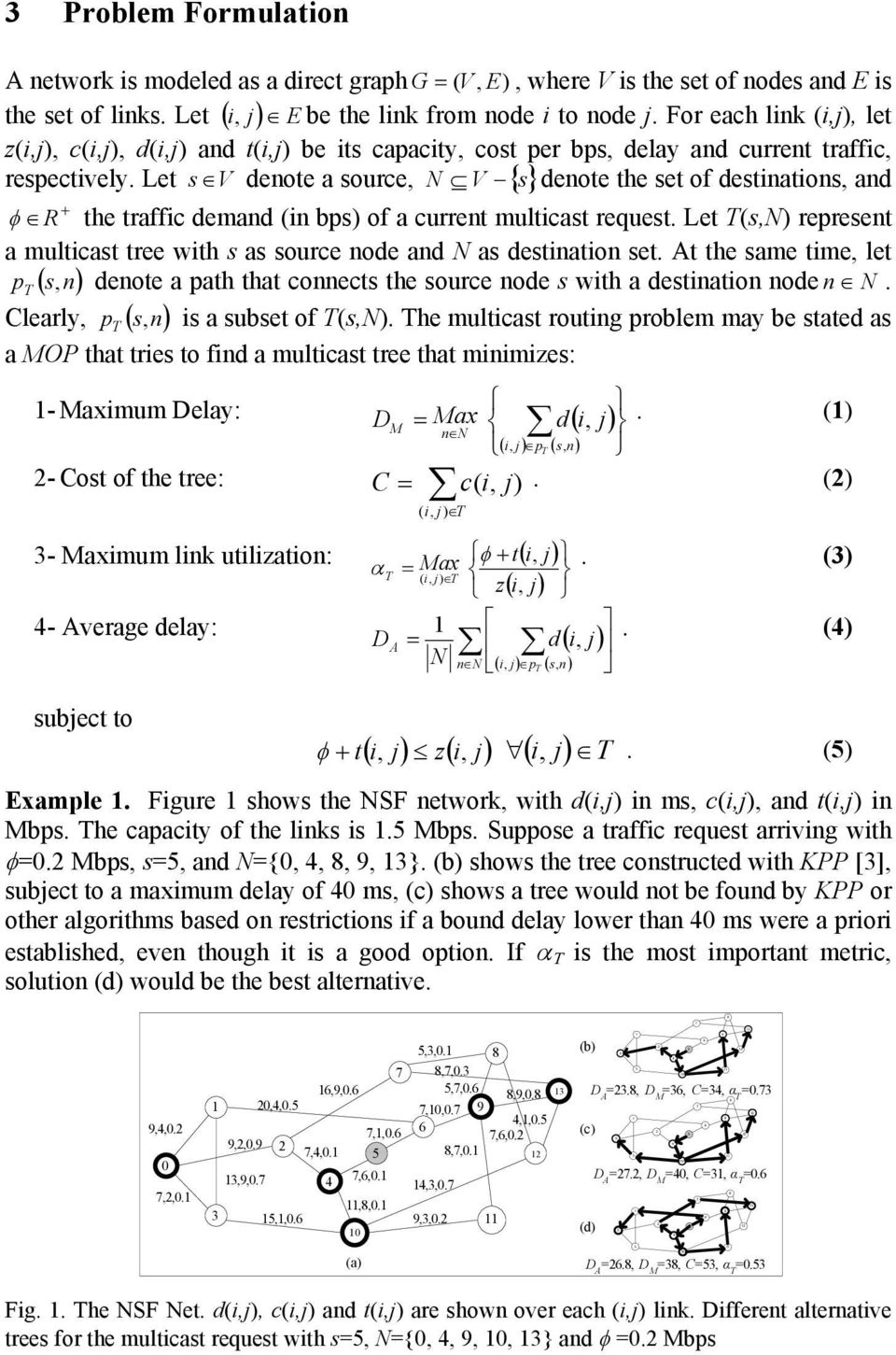
3 Problem Formulation A network is modeled as a direct graph G = ( V, E), where V is the set of nodes and E is the set of links. Let ( i, E be the link from node i to node j. For each link (i,, let z(i,, c(i,, d(i, and t(i, be its capacity, cost per bps, delay and current traffic, respectively. Let s V denote a source, N V {} s denote the set of destinations, and + φ R the traffic demand (in bps) of a current multicast request. Let T(s,N) represent a multicast tree with s as source node and N as destination set. At the same time, let p T ( s, n) denote a path that connects the source node s with a destination node n N. Clearly, p T ( s, n) is a subset of T(s,N). The multicast routing problem may be stated as a MOP that tries to find a multicast tree that minimizes: M =, ( ) ( ). () n N i, j pt s, n - Cost of the tree: C = c( i,. () - Maximum Delay: D Max d( i ( i, T - Maximum link utilization: + ( ) = Max φ t i, j ( ). () αt ( i, T z i, j - Average delay: D = d( i,. () subject to A N n N ( i, j ) p ( s, n) T φ + t ( i, z( i, ( i T,. () Example. Figure shows the NSF network, with d(i, in ms, c(i,, and t(i, in Mbps. The capacity of the links is. Mbps. Suppose a traffic request arriving with φ=. Mbps, s=, and N={,, 8, 9, }. (b) shows the tree constructed with KPP [], subject to a maximum delay of ms, (c) shows a tree would not be found by KPP or other algorithms based on restrictions if a bound delay lower than ms were a priori established, even though it is a good option. If α Τ is the most important metric, solution (d) would be the best alternative. 9,,. 7,,.,, ,7,.,9,.,7,. 8,9,.8,,. 7,,.7 9,,. 7,,. 7,,. 9,,.9 7,,. 8,7,.,9,.7 7,,.,,.7,8,.,,. 9,,. (a) (b) (c) (d) D A =.8, D M =, C=, α T =.7 D A =7., D M =, C=, α T =. D A =.8, D M =8, C=, α T =. Fig.. The NSF Net. d(i,, c(i, and t(i, are shown over each (i, link. Different alternative trees for the multicast request with s=, N={,, 9,, } and φ =. Mbps
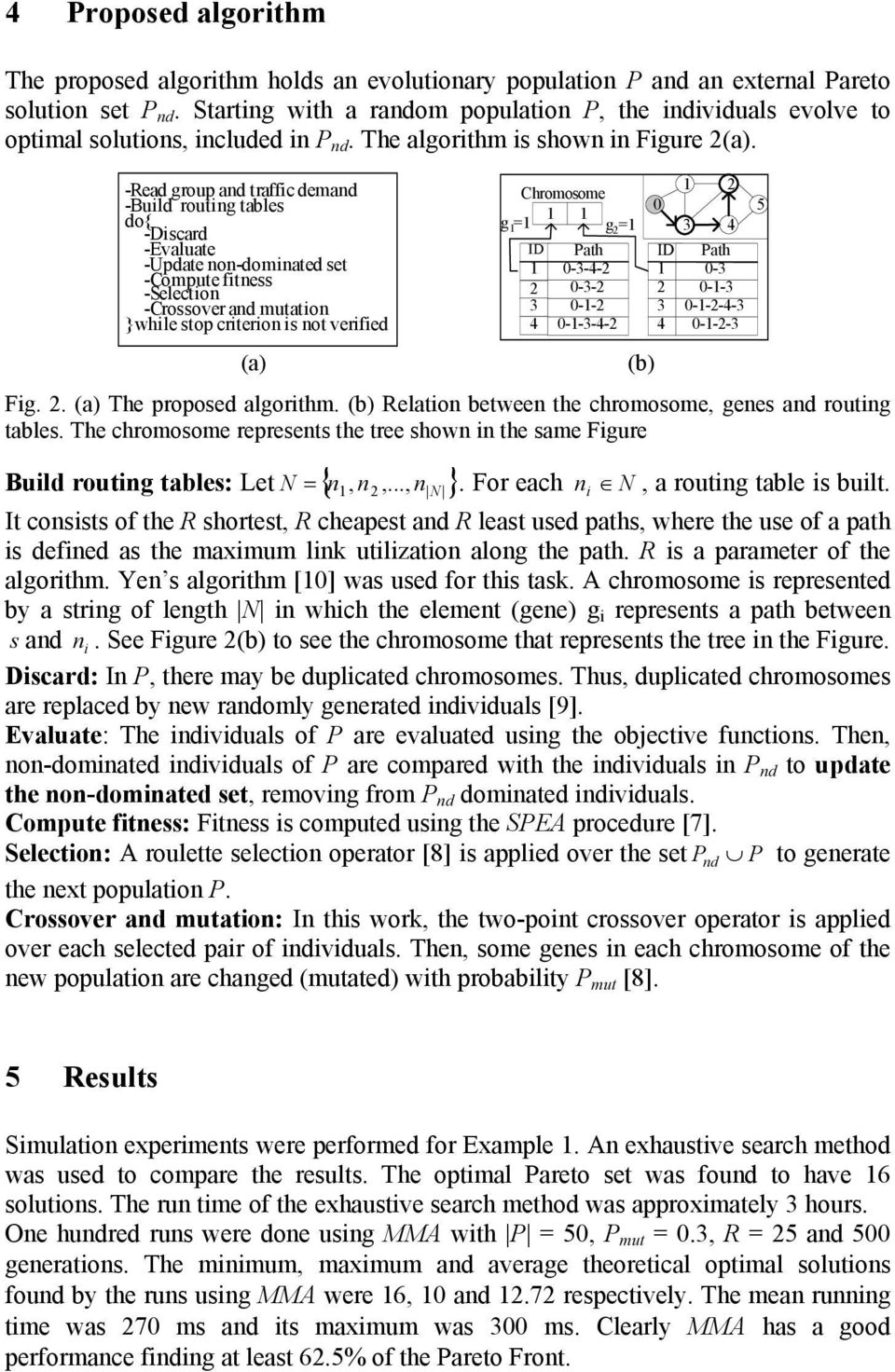
4 Proposed algorithm The proposed algorithm holds an evolutionary population P and an external Pareto solution set P nd. Starting with a random population P, the individuals evolve to optimal solutions, included in P nd. The algorithm is shown in Figure (a). -Read group and traffic demand -Build routing tables do{ -Discard -Evaluate -Update non-dominated set -Compute fitness -Selection -Crossover and mutation }while stop criterion is not verified Chromosome g = g = ID Path ID Path (a) (b) Fig.. (a) The proposed algorithm. (b) Relation between the chromosome, genes and routing tables. The chromosome represents the tree shown in the same Figure N =,,..., N. For each n i N, a routing table is built. It consists of the R shortest, R cheapest and R least used paths, where the use of a path is defined as the maximum link utilization along the path. R is a parameter of the algorithm. Yen s algorithm [] was used for this task. A chromosome is represented Build routing tables: Let { n n n } by a string of length N in which the element (gene) g i represents a path between s and n i. See Figure (b) to see the chromosome that represents the tree in the Figure. Discard: In P, there may be duplicated chromosomes. Thus, duplicated chromosomes are replaced by new randomly generated individuals [9]. Evaluate: The individuals of P are evaluated using the objective functions. Then, non-dominated individuals of P are compared with the individuals in P nd to update the non-dominated set, removing from P nd dominated individuals. Compute fitness: Fitness is computed using the SPEA procedure [7]. Selection: A roulette selection operator [8] is applied over the set P nd P to generate the next population P. Crossover and mutation: In this work, the two-point crossover operator is applied over each selected pair of individuals. Then, some genes in each chromosome of the new population are changed (mutated) with probability P mut [8]. Results Simulation experiments were performed for Example. An exhaustive search method was used to compare the results. The optimal Pareto set was found to have solutions. The run time of the exhaustive search method was approximately hours. One hundred runs were done using MMA with P =, P mut =., R = and generations. The minimum, maximum and average theoretical optimal solutions found by the runs using MMA were, and.7 respectively. The mean running time was 7 ms and its maximum was ms. Clearly MMA has a good performance finding at least.% of the Pareto Front.
5 MMA was also compared against the delay shortest path (SP). Two hundred random requests of traffic demands of. Mbps were generated. The multicast group was randomly selected with a size between and 7. The duration of each traffic demand was exponentially distributed (with an average of s) and the inter-arrival time randomly distributed between and minutes. The maximum end-to-end delay for a group was set to. times the maximum end-to-end delay of the tree constructed with SP. MMA was set to P =, P mut =. and R =. The mean time consumed to construct a multicast tree was 7 ms. Given that MMA may provide several solutions, two different scenarios were simulated: firstly, the trees with minimum α T subject to end-to-end delay restriction; secondly, trees with minimum C satisfying the restriction. To compare performance, normalized values of maximum link utilization, total cost, which is calculated as the sum of the tree costs of the multicast groups already in the net, and the total delay, which is given by the sum of the total delay of the multicast groups already in the net, were calculated. For example, normalized total cost was given by C N = ( C SP C MMA ) / C. Figure (a) shows MMA that MMA leads to better link utilizations than SP. Note that the maximum link utilization using SP is sometimes times greater than using MMA. Besides, from Figure (b), it can be seen that at almost all time, SP total cost is more expensive than MMA. As it was expected, the total delay using SP was lower than MMA, since SP produces optimal trees. Figures (a) to (c) show normalized values for the second scenario. Now the cost difference between SP and MMA has increased since the select criterion of MMA is the cost. Note that at almost all time, SP total cost is at least % more expensive than MMA. In contrast, α is even worse than with the first scenario. Conclusion This paper presents a new multiobjective multicast routing algorithm (MMA) to solve the multicast routing problem. This new algorithm minimizes simultaneously four objective functions: - maximum end-to-end delay, - cost of a tree, - maximum link utilization and - average delay. MMA has a purely multiobjective approach, based on SPEA. This approach calculates an optimal Pareto set of solutions in only one run, without a priori restrictions, an importance feature of MMA. Experimental results show that MMA was able to found Pareto optimal solutions. They also show that α and the total cost of MMA were lower than those of the shortest path algorithm. As future work, we will consider a traffic engineering scheme using different distribution trees over larger problems. References. A. Tanenbaum, Computer Networks, Prentice Hall,.. Y. Lee, Y. Seok, and Y. Choi, Explicit Multicast Routing Algorithm for Constrained Traffic Engineering, Proc. of 7th Int. Symp. on Computer and Comm. (ISCC ),.

6 . V. Kompella, J. Pasquale, and G. Polyzos, Multicast routing in multimedia communication, IEEE/ACM Transactions on Networking, Vol. No., 99, pp C. P. Ravikumar, and R. Bajpai, Source-based delay bounded multicasting in multimedia networks, Computer Communications, Vol., 998, pp. -.. W. Zhengying, S. Bingxin, and Z. Erdun, Bandwidth-delay-constraint least-cost multicast routing based on heuristic genetic algorithm, Computer Communications, Vol.,, pp P. T. de Araujo, and G. M. Barbosa, Multicast Routing with Quality of Service and Traffic Engineering Requirements in the Internet, Based On Genetic Algorithm, Proceedings of the VII Brazilian Symposium on Neural Networks (SBRN ),. 7. E. Zitzler, and L. Thiele, Multiobjective Evolutionary Algorithms: A comparative Case Study and the Strength Pareto Approach, IEEE Trans. Evolutionary Computation, Vol., No., 999, pp D. Goldberg, Genetic Algorithm is Search, Optimization & Machine Learning, Addison Wesley, R.H. Hwang, W.Y. Do, and S.C. Yang, Multicast Routing Based on Genetic Algorithms, Journal of Information Science and Engineering, Vol.,, pp J. Yen, Finding the k shortest loopless path in a network, Management Science, 7:7-7, 97. (a) (b)

7 (c) Fig.. Values for scenario Fig.. Values for scenario

Traffic Engineering approaches using Multicriteria Optimization Techniques
 Traffic Engineering approaches using Multicriteria Optimization Techniques Pedro Sousa, Paulo Cortez 3, Miguel Rio 2, Miguel Rocha Dept. of Informatics, University of Minho, Portugal, {pns,mrocha}@di.uminho.pt
A hierarchical multicriteria routing model with traffic splitting for MPLS networks
 A hierarchical multicriteria routing model with traffic splitting for MPLS networks João Clímaco, José Craveirinha, Marta Pascoal jclimaco@inesccpt, jcrav@deecucpt, marta@matucpt University of Coimbra
Multi-service Load Balancing in a Heterogeneous Network with Vertical Handover
 1 Multi-service Load Balancing in a Heterogeneous Network with Vertical Handover Jie Xu, Member, IEEE, Yuming Jiang, Member, IEEE, and Andrew Perkis, Member, IEEE Abstract In this paper we investigate
Introduction To Genetic Algorithms
 1 Introduction To Genetic Algorithms Dr. Rajib Kumar Bhattacharjya Department of Civil Engineering IIT Guwahati Email: [email protected] References 2 D. E. Goldberg, Genetic Algorithm In Search, Optimization
Study of Different Types of Attacks on Multicast in Mobile Ad Hoc Networks
 Study of Different Types of Attacks on Multicast in Mobile Ad Hoc Networks Hoang Lan Nguyen and Uyen Trang Nguyen Department of Computer Science and Engineering, York University 47 Keele Street, Toronto,
An Improved ACO Algorithm for Multicast Routing
 An Improved ACO Algorithm for Multicast Routing Ziqiang Wang and Dexian Zhang School of Information Science and Engineering, Henan University of Technology, Zheng Zhou 450052,China [email protected]
QUALITY OF SERVICE METRICS FOR DATA TRANSMISSION IN MESH TOPOLOGIES
 QUALITY OF SERVICE METRICS FOR DATA TRANSMISSION IN MESH TOPOLOGIES SWATHI NANDURI * ZAHOOR-UL-HUQ * Master of Technology, Associate Professor, G. Pulla Reddy Engineering College, G. Pulla Reddy Engineering
Genetic Algorithm Based Interconnection Network Topology Optimization Analysis
 Genetic Algorithm Based Interconnection Network Topology Optimization Analysis 1 WANG Peng, 2 Wang XueFei, 3 Wu YaMing 1,3 College of Information Engineering, Suihua University, Suihua Heilongjiang, 152061
Multi-Objective Optimization to Workflow Grid Scheduling using Reference Point based Evolutionary Algorithm
 Multi-Objective Optimization to Workflow Grid Scheduling using Reference Point based Evolutionary Algorithm Ritu Garg Assistant Professor Computer Engineering Department National Institute of Technology,
An Interactive Visualization Tool for the Analysis of Multi-Objective Embedded Systems Design Space Exploration
 An Interactive Visualization Tool for the Analysis of Multi-Objective Embedded Systems Design Space Exploration Toktam Taghavi, Andy D. Pimentel Computer Systems Architecture Group, Informatics Institute
An Evolutionary Algorithm in Grid Scheduling by multiobjective Optimization using variants of NSGA
 International Journal of Scientific and Research Publications, Volume 2, Issue 9, September 2012 1 An Evolutionary Algorithm in Grid Scheduling by multiobjective Optimization using variants of NSGA Shahista
ISSN: 2319-5967 ISO 9001:2008 Certified International Journal of Engineering Science and Innovative Technology (IJESIT) Volume 2, Issue 3, May 2013
 Transistor Level Fault Finding in VLSI Circuits using Genetic Algorithm Lalit A. Patel, Sarman K. Hadia CSPIT, CHARUSAT, Changa., CSPIT, CHARUSAT, Changa Abstract This paper presents, genetic based algorithm
A Service Revenue-oriented Task Scheduling Model of Cloud Computing
 Journal of Information & Computational Science 10:10 (2013) 3153 3161 July 1, 2013 Available at http://www.joics.com A Service Revenue-oriented Task Scheduling Model of Cloud Computing Jianguang Deng a,b,,
Shared Backup Network Provision for Virtual Network Embedding
 Shared Backup Network Provision for Virtual Network Embedding Tao Guo, Ning Wang, Klaus Moessner, and Rahim Tafazolli Centre for Communication Systems Research, University of Surrey Guildford, GU2 7XH,
Hiroyuki Sato. Minami Miyakawa. Keiki Takadama ABSTRACT. Categories and Subject Descriptors. General Terms
 Controlling election Area of Useful Infeasible olutions and Their Archive for Directed Mating in Evolutionary Constrained Multiobjective Optimization Minami Miyakawa The University of Electro-Communications
Path Selection Methods for Localized Quality of Service Routing
 Path Selection Methods for Localized Quality of Service Routing Xin Yuan and Arif Saifee Department of Computer Science, Florida State University, Tallahassee, FL Abstract Localized Quality of Service
A NETWORK CONSTRUCTION METHOD FOR A SCALABLE P2P VIDEO CONFERENCING SYSTEM
 A NETWORK CONSTRUCTION METHOD FOR A SCALABLE P2P VIDEO CONFERENCING SYSTEM Hideto Horiuchi, Naoki Wakamiya and Masayuki Murata Graduate School of Information Science and Technology, Osaka University 1
Dynamic Establishment of All-Optical Connections in Wavelength-Routed Optical Networks Using Genetic Algorithms
 D. Bisbal, F. González, I. de Miguel, J. Blas, J. C. Aguado, P. Fernández, R. M. Lorenzo, E. J. Abril, M. López, Dynamic establishment of alloptical connections in wavelength-routed optical networks using
DataCenter optimization for Cloud Computing
 DataCenter optimization for Cloud Computing Benjamín Barán National University of Asuncion (UNA) [email protected] Paraguay Content Cloud Computing Commercial Offerings Basic Problem Formulation Open Research
A Power Efficient QoS Provisioning Architecture for Wireless Ad Hoc Networks
 A Power Efficient QoS Provisioning Architecture for Wireless Ad Hoc Networks Didem Gozupek 1,Symeon Papavassiliou 2, Nirwan Ansari 1, and Jie Yang 1 1 Department of Electrical and Computer Engineering
A Fast and Elitist Multiobjective Genetic Algorithm: NSGA-II
 182 IEEE TRANSACTIONS ON EVOLUTIONARY COMPUTATION, VOL. 6, NO. 2, APRIL 2002 A Fast and Elitist Multiobjective Genetic Algorithm: NSGA-II Kalyanmoy Deb, Associate Member, IEEE, Amrit Pratap, Sameer Agarwal,
QoSIP: A QoS Aware IP Routing Protocol for Multimedia Data
 QoSIP: A QoS Aware IP Routing Protocol for Multimedia Data Md. Golam Shagadul Amin Talukder and Al-Mukaddim Khan Pathan* Department of Computer Science and Engineering, Metropolitan University, Sylhet,
Performance Analysis of AQM Schemes in Wired and Wireless Networks based on TCP flow
 International Journal of Soft Computing and Engineering (IJSCE) Performance Analysis of AQM Schemes in Wired and Wireless Networks based on TCP flow Abdullah Al Masud, Hossain Md. Shamim, Amina Akhter
Chapter 4. VoIP Metric based Traffic Engineering to Support the Service Quality over the Internet (Inter-domain IP network)
 Chapter 4 VoIP Metric based Traffic Engineering to Support the Service Quality over the Internet (Inter-domain IP network) 4.1 Introduction Traffic Engineering can be defined as a task of mapping traffic
Stability of QOS. Avinash Varadarajan, Subhransu Maji {avinash,smaji}@cs.berkeley.edu
 Stability of QOS Avinash Varadarajan, Subhransu Maji {avinash,smaji}@cs.berkeley.edu Abstract Given a choice between two services, rest of the things being equal, it is natural to prefer the one with more
Performance Analysis of QoS Multicast Routing in Mobile Ad Hoc Networks Using Directional Antennas
 I.J.Computer Network and Information Security, 21, 2, 26-32 Published Online December 21 in MECS (http://www.mecs-press.org/) Performance Analysis of QoS Multicast Routing in Mobile Ad Hoc Networks Using
Memory Allocation Technique for Segregated Free List Based on Genetic Algorithm
 Journal of Al-Nahrain University Vol.15 (2), June, 2012, pp.161-168 Science Memory Allocation Technique for Segregated Free List Based on Genetic Algorithm Manal F. Younis Computer Department, College
Multi-Objective Genetic Test Generation for Systems-on-Chip Hardware Verification
 Multi-Objective Genetic Test Generation for Systems-on-Chip Hardware Verification Adriel Cheng Cheng-Chew Lim The University of Adelaide, Australia 5005 Abstract We propose a test generation method employing
Model-based Parameter Optimization of an Engine Control Unit using Genetic Algorithms
 Symposium on Automotive/Avionics Avionics Systems Engineering (SAASE) 2009, UC San Diego Model-based Parameter Optimization of an Engine Control Unit using Genetic Algorithms Dipl.-Inform. Malte Lochau
Multiobjective Optimization and Evolutionary Algorithms for the Application Mapping Problem in Multiprocessor System-on-Chip Design
 358 IEEE TRANSACTIONS ON EVOLUTIONARY COMPUTATION, VOL. 10, NO. 3, JUNE 2006 Multiobjective Optimization and Evolutionary Algorithms for the Application Mapping Problem in Multiprocessor System-on-Chip
ENHANCED PROVISIONING ALGORITHM FOR VIRTUAL PRIVATE NETWORK IN HOSE MODEL WITH QUALITY OF SERVICE SUPPORT USING WAXMAN MODEL
 R. RAVI: ENHANCED PROVISIONING ALGORITHM FOR VIRTUAL PRIVATE NETWORK IN HOSE MODEL WITH QUALITY OF SERVICE SUPPORT USING WAXMAN MODEL ENHANCED PROVISIONING ALGORITHM FOR VIRTUAL PRIVATE NETWORK IN HOSE
A Fast Path Recovery Mechanism for MPLS Networks
 A Fast Path Recovery Mechanism for MPLS Networks Jenhui Chen, Chung-Ching Chiou, and Shih-Lin Wu Department of Computer Science and Information Engineering Chang Gung University, Taoyuan, Taiwan, R.O.C.
An Efficient Primary-Segmented Backup Scheme for Dependable Real-Time Communication in Multihop Networks
 IEEE/ACM TRANSACTIONS ON NETWORKING, VOL. 11, NO. 1, FEBRUARY 2003 81 An Efficient Primary-Segmented Backup Scheme for Dependable Real-Time Communication in Multihop Networks Krishna Phani Gummadi, Madhavarapu
Entropy-Based Collaborative Detection of DDoS Attacks on Community Networks
 Entropy-Based Collaborative Detection of DDoS Attacks on Community Networks Krishnamoorthy.D 1, Dr.S.Thirunirai Senthil, Ph.D 2 1 PG student of M.Tech Computer Science and Engineering, PRIST University,
Path Selection Analysis in MPLS Network Based on QoS
 Cumhuriyet Üniversitesi Fen Fakültesi Fen Bilimleri Dergisi (CFD), Cilt:36, No: 6 Özel Sayı (2015) ISSN: 1300-1949 Cumhuriyet University Faculty of Science Science Journal (CSJ), Vol. 36, No: 6 Special
4. Zastosowania Optymalizacja wielokryterialna
 4. Zastosowania Optymalizacja wielokryterialna Tadeusz Burczyński 1,2) 1), Department for Strength of Materials and Computational Mechanics, Konarskiego 18a, 44-100 Gliwice, Poland 2) Cracow University
A Multiple Access Protocol for Multimedia Transmission over Wireless Networks
 A Multiple Access Protocol for Multimedia Transmission over Wireless Networks Hong Yu and Mohammed Arozullah Department of Electrical Engineering and Computer Science Capitol College, Maryland, USA [email protected]
A Multi-Objective Optimisation Approach to IDS Sensor Placement
 A Multi-Objective Optimisation Approach to IDS Sensor Placement Hao Chen 1, John A. Clark 1, Juan E. Tapiador 1, Siraj A. Shaikh 2, Howard Chivers 2, and Philip Nobles 2 1 Department of Computer Science
Load Balancing Routing Algorithm for Data Gathering Sensor Network
 Load Balancing Routing Algorithm for Data Gathering Sensor Network Evgeny Bakin, Grigory Evseev State University of Aerospace Instrumentation Saint-Petersburg, Russia {jenyb, egs}@vu.spb.ru Denis Dorum
Comparative Analysis of Congestion Control Algorithms Using ns-2
 www.ijcsi.org 89 Comparative Analysis of Congestion Control Algorithms Using ns-2 Sanjeev Patel 1, P. K. Gupta 2, Arjun Garg 3, Prateek Mehrotra 4 and Manish Chhabra 5 1 Deptt. of Computer Sc. & Engg,
Influence of Load Balancing on Quality of Real Time Data Transmission*
 SERBIAN JOURNAL OF ELECTRICAL ENGINEERING Vol. 6, No. 3, December 2009, 515-524 UDK: 004.738.2 Influence of Load Balancing on Quality of Real Time Data Transmission* Nataša Maksić 1,a, Petar Knežević 2,
CoMPACT-Monitor: Change-of-Measure based Passive/Active Monitoring Weighted Active Sampling Scheme to Infer QoS
 CoMPACT-Monitor: Change-of-Measure based Passive/Active Monitoring Weighted Active Sampling Scheme to Infer QoS Masaki Aida, Keisuke Ishibashi, and Toshiyuki Kanazawa NTT Information Sharing Platform Laboratories,
Locality Based Protocol for MultiWriter Replication systems
 Locality Based Protocol for MultiWriter Replication systems Lei Gao Department of Computer Science The University of Texas at Austin [email protected] One of the challenging problems in building replication
AN OVERVIEW OF QUALITY OF SERVICE COMPUTER NETWORK
 Abstract AN OVERVIEW OF QUALITY OF SERVICE COMPUTER NETWORK Mrs. Amandeep Kaur, Assistant Professor, Department of Computer Application, Apeejay Institute of Management, Ramamandi, Jalandhar-144001, Punjab,
Distributed Explicit Partial Rerouting (DEPR) Scheme for Load Balancing in MPLS Networks
 Distributed Eplicit Partial Rerouting (DEPR) Scheme for Load Balancing in MPLS Networks Sherif Ibrahim Mohamed [email protected] Khaled M. F. Elsayed, senior member IEEE [email protected] Department
PERFORMANCE STUDY AND SIMULATION OF AN ANYCAST PROTOCOL FOR WIRELESS MOBILE AD HOC NETWORKS
 PERFORMANCE STUDY AND SIMULATION OF AN ANYCAST PROTOCOL FOR WIRELESS MOBILE AD HOC NETWORKS Reza Azizi Engineering Department, Bojnourd Branch, Islamic Azad University, Bojnourd, Iran [email protected]
Load Balanced Optical-Network-Unit (ONU) Placement Algorithm in Wireless-Optical Broadband Access Networks
 Load Balanced Optical-Network-Unit (ONU Placement Algorithm in Wireless-Optical Broadband Access Networks Bing Li, Yejun Liu, and Lei Guo Abstract With the broadband services increasing, such as video
AN EFFICIENT STRATEGY OF AGGREGATE SECURE DATA TRANSMISSION
 INTERNATIONAL JOURNAL OF REVIEWS ON RECENT ELECTRONICS AND COMPUTER SCIENCE AN EFFICIENT STRATEGY OF AGGREGATE SECURE DATA TRANSMISSION K.Anusha 1, K.Sudha 2 1 M.Tech Student, Dept of CSE, Aurora's Technological
Comparison between Vertical Handoff Decision Algorithms for Heterogeneous Wireless Networks
 Comparison between Vertical Handoff Decision Algorithms for Heterogeneous Wireless Networks Enrique Stevens-Navarro and Vincent W.S. Wong Department of Electrical and Computer Engineering The University
Managing End-to-end Network performance via. Optimized Monitoring Strategies
 Managing End-to-end Network performance via Optimized Monitoring Strategies H. Cenk Ozmutlu [email protected] Dept. of Industrial Engineering School of Engineering and Architecture Uludag University Gorukle,
Consecutive Geographic Multicasting Protocol in Large-Scale Wireless Sensor Networks
 21st Annual IEEE International Symposium on Personal, Indoor and Mobile Radio Communications Consecutive Geographic Multicasting Protocol in Large-Scale Wireless Sensor Networks Jeongcheol Lee, Euisin
Performance of networks containing both MaxNet and SumNet links
 Performance of networks containing both MaxNet and SumNet links Lachlan L. H. Andrew and Bartek P. Wydrowski Abstract Both MaxNet and SumNet are distributed congestion control architectures suitable for
A REPORT ON ANALYSIS OF OSPF ROUTING PROTOCOL NORTH CAROLINA STATE UNIVERSITY
 A REPORT ON ANALYSIS OF OSPF ROUTING PROTOCOL Using OPNET 14.5 Modeler NORTH CAROLINA STATE UNIVERSITY SUBMITTED BY: SHOBHANK SHARMA [email protected] Page 1 ANALYSIS OF OSPF ROUTING PROTOCOL A. Introduction
A Multi-objective Scheduling Model for Solving the Resource-constrained Project Scheduling and Resource Leveling Problems. Jia Hu 1 and Ian Flood 2
 A Multi-objective Scheduling Model for Solving the Resource-constrained Project Scheduling and Resource Leveling Problems Jia Hu 1 and Ian Flood 2 1 Ph.D. student, Rinker School of Building Construction,
Sensors & Transducers 2015 by IFSA Publishing, S. L. http://www.sensorsportal.com
 Sensors & Transducers 2015 by IFSA Publishing, S. L. http://www.sensorsportal.com A Dynamic Deployment Policy of Slave Controllers for Software Defined Network Yongqiang Yang and Gang Xu College of Computer
On the Interaction and Competition among Internet Service Providers
 On the Interaction and Competition among Internet Service Providers Sam C.M. Lee John C.S. Lui + Abstract The current Internet architecture comprises of different privately owned Internet service providers
International Journal of Advanced Research in Computer Science and Software Engineering
 Volume 2, Issue 9, September 2012 ISSN: 2277 128X International Journal of Advanced Research in Computer Science and Software Engineering Research Paper Available online at: www.ijarcsse.com An Experimental
Monitoring Performances of Quality of Service in Cloud with System of Systems
 Monitoring Performances of Quality of Service in Cloud with System of Systems Helen Anderson Akpan 1, M. R. Sudha 2 1 MSc Student, Department of Information Technology, 2 Assistant Professor, Department
Performance Evaluation of AODV, OLSR Routing Protocol in VOIP Over Ad Hoc
 (International Journal of Computer Science & Management Studies) Vol. 17, Issue 01 Performance Evaluation of AODV, OLSR Routing Protocol in VOIP Over Ad Hoc Dr. Khalid Hamid Bilal Khartoum, Sudan [email protected]
BRAESS-LIKE PARADOXES FOR NON-COOPERATIVE DYNAMIC LOAD BALANCING IN DISTRIBUTED COMPUTER SYSTEMS
 GESJ: Computer Science and Telecommunications 21 No.3(26) BRAESS-LIKE PARADOXES FOR NON-COOPERATIVE DYNAMIC LOAD BALANCING IN DISTRIBUTED COMPUTER SYSTEMS Said Fathy El-Zoghdy Department of Computer Science,
Proxy-Assisted Periodic Broadcast for Video Streaming with Multiple Servers
 1 Proxy-Assisted Periodic Broadcast for Video Streaming with Multiple Servers Ewa Kusmierek and David H.C. Du Digital Technology Center and Department of Computer Science and Engineering University of
Performance Evaluation of VoIP using Shortest-Widest and Modified Widest-Shortest QoS Routing Algorithms
 Performance Evaluation of VoIP using Shortest-Widest and Modified Widest-Shortest QoS Routing Algorithms Ala F. Khalifeh, and Ali H. El-Mousa Abstract Implementation of current real time services (of which
Thesis work and research project
 Thesis work and research project Hélia Pouyllau, INRIA of Rennes, Campus Beaulieu 35042 Rennes, [email protected] July 16, 2007 1 Thesis work on Distributed algorithms for endto-end QoS contract
EINDHOVEN UNIVERSITY OF TECHNOLOGY Department of Mathematics and Computer Science
 EINDHOVEN UNIVERSITY OF TECHNOLOGY Department of Mathematics and Computer Science Examination Computer Networks (2IC15) on Monday, June 22 nd 2009, 9.00h-12.00h. First read the entire examination. There
A Multi-Objective Performance Evaluation in Grid Task Scheduling using Evolutionary Algorithms
 A Multi-Objective Performance Evaluation in Grid Task Scheduling using Evolutionary Algorithms MIGUEL CAMELO, YEZID DONOSO, HAROLD CASTRO Systems and Computer Engineering Department Universidad de los
Efficient File Sharing Scheme in Mobile Adhoc Network
 Efficient File Sharing Scheme in Mobile Adhoc Network 1 Y. Santhi, 2 Mrs. M. Maria Sheeba 1 2ndMECSE, Ponjesly College of engineering, Nagercoil 2 Assistant professor, Department of CSE, Nagercoil Abstract:
A Link-state QoS Routing Protocol for Ad Hoc Networks
 A Link-state QoS Routing Protocol for Ad Hoc Networks Anelise Munaretto 1 Hakim Badis 2 Khaldoun Al Agha 2 Guy Pujolle 1 1 LIP6 Laboratory, University of Paris VI, 8, rue du Capitaine Scott, 75015, Paris,
A New Forwarding Policy for Load Balancing in Communication Networks
 A New Forwarding Policy for Load Balancing in Communication Networks Martin Heusse Yvon Kermarrec ENST de Bretagne BP 83, 985 Brest Cedex, France [email protected] Abstract We present in this
EXTENDING NETWORK KNOWLEDGE: MAKING OLSR A QUALITY OF SERVICE CONDUCIVE PROTOCOL
 EXTENDING NETWORK KNOWLEDGE: MAKING OLSR A QUALITY OF SERVICE CONDUCIVE PROTOCOL by Pedro Eduardo Villanueva-Pena, Thomas Kunz Carleton University January, 2006 This report examines mechanisms to gradually
CLOUD DATABASE ROUTE SCHEDULING USING COMBANATION OF PARTICLE SWARM OPTIMIZATION AND GENETIC ALGORITHM
 CLOUD DATABASE ROUTE SCHEDULING USING COMBANATION OF PARTICLE SWARM OPTIMIZATION AND GENETIC ALGORITHM *Shabnam Ghasemi 1 and Mohammad Kalantari 2 1 Deparment of Computer Engineering, Islamic Azad University,
A Non-Linear Schema Theorem for Genetic Algorithms
 A Non-Linear Schema Theorem for Genetic Algorithms William A Greene Computer Science Department University of New Orleans New Orleans, LA 70148 bill@csunoedu 504-280-6755 Abstract We generalize Holland
NEW applications of wireless multi-hop networks, such
 870 IEEE/ACM TRANSACTIONS ON NETWORKING, VOL. 17, NO. 3, JUNE 2009 Delay Aware Link Scheduling for Multi-Hop TDMA Wireless Networks Petar Djukic, Member, IEEE, and Shahrokh Valaee, Senior Member, IEEE
A Network Flow Approach in Cloud Computing
 1 A Network Flow Approach in Cloud Computing Soheil Feizi, Amy Zhang, Muriel Médard RLE at MIT Abstract In this paper, by using network flow principles, we propose algorithms to address various challenges
WORKFLOW ENGINE FOR CLOUDS
 WORKFLOW ENGINE FOR CLOUDS By SURAJ PANDEY, DILEBAN KARUNAMOORTHY, and RAJKUMAR BUYYA Prepared by: Dr. Faramarz Safi Islamic Azad University, Najafabad Branch, Esfahan, Iran. Workflow Engine for clouds
Maintenance scheduling by variable dimension evolutionary algorithms
 Advances in Safety and Reliability Kołowrocki (ed.) 2005 Taylor & Francis Group, London, ISBN 0 415 38340 4 Maintenance scheduling by variable dimension evolutionary algorithms P. Limbourg & H.-D. Kochs
MULTI-OBJECTIVE OPTIMIZATION USING PARALLEL COMPUTATIONS
 MULTI-OBJECTIVE OPTIMIZATION USING PARALLEL COMPUTATIONS Ausra Mackute-Varoneckiene, Antanas Zilinskas Institute of Mathematics and Informatics, Akademijos str. 4, LT-08663 Vilnius, Lithuania, [email protected],
Log-Likelihood Ratio-based Relay Selection Algorithm in Wireless Network
 Recent Advances in Electrical Engineering and Electronic Devices Log-Likelihood Ratio-based Relay Selection Algorithm in Wireless Network Ahmed El-Mahdy and Ahmed Walid Faculty of Information Engineering
Quality of Service Routing in Ad-Hoc Networks Using OLSR
 Quality of Service Routing in Ad-Hoc Networks Using OLSR Ying Ge Communications Research Centre [email protected] Thomas Kunz Carleton University [email protected] Louise Lamont Communications Research
COMPARATIVE ANALYSIS OF ON -DEMAND MOBILE AD-HOC NETWORK
 www.ijecs.in International Journal Of Engineering And Computer Science ISSN:2319-7242 Volume 2 Issue 5 May, 2013 Page No. 1680-1684 COMPARATIVE ANALYSIS OF ON -DEMAND MOBILE AD-HOC NETWORK ABSTRACT: Mr.Upendra
Role of Clusterhead in Load Balancing of Clusters Used in Wireless Adhoc Network
 International Journal of Electronics Engineering, 3 (2), 2011, pp. 283 286 Serials Publications, ISSN : 0973-7383 Role of Clusterhead in Load Balancing of Clusters Used in Wireless Adhoc Network Gopindra
A Robust Method for Solving Transcendental Equations
 www.ijcsi.org 413 A Robust Method for Solving Transcendental Equations Md. Golam Moazzam, Amita Chakraborty and Md. Al-Amin Bhuiyan Department of Computer Science and Engineering, Jahangirnagar University,
Single-Link Failure Detection in All-Optical Networks Using Monitoring Cycles and Paths
 Single-Link Failure Detection in All-Optical Networks Using Monitoring Cycles and Paths Satyajeet S. Ahuja, Srinivasan Ramasubramanian, and Marwan Krunz Department of ECE, University of Arizona, Tucson,
Simple Population Replacement Strategies for a Steady-State Multi-Objective Evolutionary Algorithm
 Simple Population Replacement Strategies for a Steady-State Multi-Objective Evolutionary Christine L. Mumford School of Computer Science, Cardiff University PO Box 916, Cardiff CF24 3XF, United Kingdom
A Method of Cloud Resource Load Balancing Scheduling Based on Improved Adaptive Genetic Algorithm
 Journal of Information & Computational Science 9: 16 (2012) 4801 4809 Available at http://www.joics.com A Method of Cloud Resource Load Balancing Scheduling Based on Improved Adaptive Genetic Algorithm
Comparison of RIP, EIGRP, OSPF, IGRP Routing Protocols in Wireless Local Area Network (WLAN) By Using OPNET Simulator Tool - A Practical Approach
 Comparison of RIP, EIGRP, OSPF, IGRP Routing Protocols in Wireless Local Area Network (WLAN) By Using OPNET Simulator Tool - A Practical Approach U. Dillibabau 1, Akshay 2, M. Lorate Shiny 3 UG Scholars,
QoS Guaranteed Intelligent Routing Using Hybrid PSO-GA in Wireless Mesh Networks
 BULGARIAN ACADEMY OF SCIENCES CYBERNETICS AND INFORMATION TECHNOLOGIES Volume 15, No 1 Sofia 2015 Print ISSN: 1311-9702; Online ISSN: 1314-4081 DOI: 10.1515/cait-2015-0007 QoS Guaranteed Intelligent Routing
Smart Queue Scheduling for QoS Spring 2001 Final Report
 ENSC 833-3: NETWORK PROTOCOLS AND PERFORMANCE CMPT 885-3: SPECIAL TOPICS: HIGH-PERFORMANCE NETWORKS Smart Queue Scheduling for QoS Spring 2001 Final Report By Haijing Fang([email protected]) & Liu Tang([email protected])
OPTIMIZED SENSOR NODES BY FAULT NODE RECOVERY ALGORITHM
 OPTIMIZED SENSOR NODES BY FAULT NODE RECOVERY ALGORITHM S. Sofia 1, M.Varghese 2 1 Student, Department of CSE, IJCET 2 Professor, Department of CSE, IJCET Abstract This paper proposes fault node recovery
Efficient Load Balancing Routing in Wireless Mesh Networks
 ISSN (e): 2250 3005 Vol, 04 Issue, 12 December 2014 International Journal of Computational Engineering Research (IJCER) Efficient Load Balancing Routing in Wireless Mesh Networks S.Irfan Lecturer, Dept