
The prevention of. Medication Errors: A Year in Review. medication errors;
|
|
|
- Kenneth Gaines
- 10 years ago
- Views:
Transcription
1 PRINTER-FRIENDLY VERSION AVAILABLE AT SPECIALTYPHARMACYCONTINUUM.COM Medication Errors: A Year in Review Horsham, Pennsylvania The prevention of medication errors is an essential component of pharmaceutical care and must be a core mission of every pharmacy. For medication error-prevention efforts to be effective, they must become a priority. The first step in setting up an error-reduction program is to establish a multidisciplinary team to improve medication use. The team must be given reasonable time and resources to assess medication safety and implement system-wide changes that make it difficult or impossible for practitioners to make mistakes that reach the patient. This multidisciplinary team should accept ownership of the medication-use process and enthusiastically embrace the opportunity to improve medication safety. The goals of the team should include the following: Promote a culture of safety to lower medication errors; Increase detection and reporting of medication errors and potentially hazardous drug-use situations; Explore and understand the root causes of medication errors; Educate practitioners about the system-based causes of errors and their prevention; Recommend methods to facilitate the implementation of organization-wide, system-based changes to prevent medication errors; Respond to potentially hazardous situations before errors occur; and Learn from errors occurring in other organizations through the ISMP Medication Safety Alert! and other published accounts of medication errors, and proactively take measures to prevent similar errors. Text continues on page 7 KEY TO TABLES Computerized prescriber 1order entry (CPOE) A fully integrated CPOE system includes the capability to build medication safety alerts (eg, look-alike names) and clinical decision rules. Additionally, the CPOE system should directly interface with the laboratory system and pharmacy, list drug drug and drug disease interactions, and offer clinical order-screening capability. Bar-code enabled point-of- (BPOC) systems These 2care systems are designed to prevent medication errors at the point of medication administration. BPOC systems verify and record all medications administered to the patient through the use of a bar-code scanner that matches the medication to the patient by scanning a bar code on the medication and a bar code on the patient s wristband. Smart infusion pumps These 3 infusion systems allow users to enter various drug infusion protocols into a drug library with predefined dose limits. If a dose is programmed outside of established limits or clinical parameters, the pump halts or sounds an alarm, informing the clinician that the dose is outside the recommended range. Some pumps can integrate patient monitoring and other patient parameters, such as age or clinical condition. Robust pharmacy order entry 4 system This order entry system is fully interfaced with a CPOE system. The pharmacy system must be able to produce medication safety alerts as well as directly interface with a health care facility s information systems, such as the laboratory system. Additionally, this system must be used to generate a computerized medication administration record (MAR) to be used by the nursing staff while they administer medications. SPECIALTY PHARMACY CONTINUUM SPRING

2 Table 1. Safety Issues Related to Labeling, Packaging, and Nomenclature Acetaminophen suspension labeling The word Children s is on the labels of unitdose containers of 325 and 650 mg cups of acetaminophen oral suspension from Precision Dose, implying that the total dose in the cup is suitable for children. Depending on the child s age and weight, 325 or 650 mg might be an overdose. For children, pharmacies should dispense patientspecific doses of acetaminophen suspension in oral syringes. The unit-dose cups should only be dispensed if the child s dose is exactly the total dose in the cups (325 or 650 mg). 1,2 Confusion between ado-trastuzumab emtansine (KADCYLA, Genentech) and trastuzumab (HERCEPTIN, Genentech) The ISMP and the ASHP sent a warning through the NAN about possible name confusion between the newly approved ado-trastuzumab emtansine and trastuzumab. Ado-trastuzumab emtansine may not be fully communicated or may be misread when prescribed, leading to confusion with trastuzumab. Alert practitioners to the risk for incomplete presentation or miscommunication of the generic name of Kadcyla. Promote the use of both brand and generic names when communicating orders on order sets or computerized prescriber order entry systems. For more information, view the recent NAN Alert: hazardalerts.asp. Confusion between factor and PCC Historically, several bleeding reversal products have been referred to as prothrombin complex concentrate, or PCC. Since there is a newly approved product, KCENTRA (CSL Behring), with the actual generic name prothrombin complex concentrate, the use of prothrombin complex concentrate or PCC may result in confusion regarding which drug is intended. Determine which of these reversal products will be on the formulary, and educate staff about the appropriate use of each agent and the risk for confusion when using the terms prothrombin complex concentrate or PCC. Always clarify orders requesting prothrombin complex concentrate or PCC to determine the specific brand name. An alert in electronic systems may help remind staff to do this. 1,2,4 Heparin label changes As of May 2013, the labeling of heparin vials must express the total amount of units in the container as well as include the units per ml in parentheses, rather than just listing the units per ml. Older labels only list the per ml amount, leading to overdoses in which the amount per ml was thought to be the amount in the entire vial. If heparin vials with both the old and new labels are available, the risk for mistaking the per ml amount as the total vial amount is high. To minimize the risk for confusion, facilities should consider transitioning fully to the newly labeled heparin, even if this means discarding older vials. Alternatively, at a minimum, pharmacists should apply auxiliary labels to the older-style vial to highlight the total number of units in the container. As space permits, pharmacy and nursing databases should express drug amounts the same way they are expressed on the vial label (ie, 10,000 units/10 ml [1,000 units/ml]). Influenza vaccine always shake well! An immunization-certified pharmacist said he was not aware that all injectable influenza vaccine products must be shaken before use. He said that he had not been doing this, although the implications of this omission are not clear. The vaccine cartons are labeled shake well, but the vial and syringe labels of influenza vaccine that the ISMP has examined do not have this label. Injectable influenza vaccines are suspensions with the exception of FLUBLOK (Protein Sciences), which is a solution. All injectable influenza vaccines including Flublok must be shaken before use, whether they are packaged in a single- or multiple-dose vial, or in a prefilled syringe. This is a reminder for health professionals and office-based staff who administer influenza vaccine. Name confusion between pazopanib and ponatinib Two new oral chemotherapy agents, pazopanib, used to treat renal cell cancer, thyroid cancer, and soft tissue sarcoma, and ponatinib, used to treat chronic myelogenous leukemia and Philadelphia chromosome positive acute lymphoblastic leukemia, have names that may cause confusion. Fortunately, tablet strengths and dosages differ between the drugs, which should help prevent and detect errors. Computer systems that list oral chemotherapeutic agents linked to available dosage strengths will help to minimize the potential for error, as will listing appropriate dosing information for labeled indications. The use of tall man lettering with the unique letter characters differentiated (PONATinib and PAZOPanib) also can be helpful. ASHP, American Society of Health-System Pharmacists; ISMP, Institute for Safe Medication Practices; NAN, National Alert Network 2

3 Table 2. Safety Issues Associated With Order Communication (continued) Apothecary strengths confused There is a risk for errors when apothecary strengths such as gr (grains) are used for certain drugs such as ferrous sulfate and PHENobarbital. Grains could be confused with g (grams). Consider purchasing products from manufacturers that do not use apothecary strengths on labels to minimize the risk for confusion. If this is not possible, ensure that labels generated from the pharmacy for these products do not contain apothecary strengths. DOXOrubicin liposome injection A safety concern might exist in the product description field for some listings of a generic liposomal DOXOrubicin product, which was approved by the FDA in February Listings of this product may not be reflected correctly in various drug information databases or computer systems. Mistaking the drug for a conventional product could cause death. Check to see if the drug is listed correctly as DOXOrubicin HCl liposome injection in your computer systems. The ISMP suggests using HCl instead of hydrochloride to place liposome closer to DOXOrubicin, which will make it easier to read. The word pegylated or peg- (which sometimes precedes liposomal), seen in some listings, is unnecessary in formulary systems. To make the word liposome stand out, some organizations include asterisks around it (*liposome*). Methadone mistaken for metoprolol A nurse obtaining a drug history of a new patient inadvertently selected methadone 100 mg BID from the computer screen instead of metoprolol 100 mg BID. The physician reviewed the medication list and continued all the medications. The pharmacist questioned the high methadone dose, but the physician instructed to give the medication as written. After receiving 2 doses, the patient experienced cardiorespiratory arrest. Require prescribers to specify the indication if methadone is prescribed. If the patient is being treated for opioid addiction, confirm the dose with a methadone clinic. Have the patient/caregiver confirm (even sign) the medication reconciliation list to verify accuracy. Reinforce an expectation that all questionable orders are fully resolved before dispensing and administering the medication. NoAC is an unsafe abbreviation Recently the abbreviation NoAC was mistakenly interpreted to mean no anticoagulation. The prescriber intended the abbreviation to stand for New (or novel) oral anticoagulant. The ISMP will be adding NoAC to the do not use list of potentially dangerous abbreviations, and strongly suggests cautioning providers not to use it clinically. Null sign misread A null sign (Ø) has been misread as various numbers: the number 8 for a lockout interval; the number 4 for a basal rate for PCA; the number 6, especially if the circle is not closed above the hash mark; and the number 9, especially if the tail of the hash mark through the circle is long. The null sign appears on the ISMP List of Error- Prone Abbreviations, Symbols, and Dose Designations, and should not be used on medical orders. Also, a setting of zero for a lockout interval, which may not be an available choice with some PCA infusion pumps, is dangerous, even if the number of boluses is limited within a certain timeframe. 1,3,4 Protecting vulnerable patients Medication errors that occur in a LTC facility often originate in the hospital. Studies show large inconsistencies between medications on discharge summaries and transfer forms, leading to error rates of 21% or higher during transitions between hospitals and LTC facilities, particularly with warfarin, insulin, opioids, and cardiovascular medications. For example, unnecessarily including the strength of insulin (100 units per ml) without the actual dose on a transfer form led a LTC nurse to misunderstand a new resident s dose as 100 units, which led to his death. Establish a list of drugs that often are not continued after hospitalization, and refer to the list during discharge medication reconciliation to determine if clarifications are needed. Require prescribers to cosign (verify) transcribed discharge summaries, and reconcile the transfer/ referral form with the discharge summary to enhance comparison and consistency. Have pharmacists review the prescribed medications for patients being transferred to LTC facilities, and provide reasons for differences between the discharge medications and the medications administered in the hospital. Standardize the documents that accompany transfer forms. Table continues on page 4 3

4 Table 2. Safety Issues Associated With Order Communication (continued) Search function leads to wrong medication choice A prescriber who typed aceta to enter an electronic order for acetaminophen chose acetazolamide from the search results. Fortunately, differences in the dose and frequency led to discovery of the error. Other drug name pairs that have resulted in this kind of error are: hydroxychloroquine/ hydroxyurea; MUCOMYST (acetylcysteine)/ MUCINEX (guaifenesin); valacyclovir/ valganciclovir; and penicillamine/penicillin. Use tall man lettering to differentiate drugs with look-alike names. Require more than just a few letters when searching for drugs in electronic databases. (Some systems require a certain number of letters before a list will appear.) Require entry of the intended purpose of drugs with similar names or alert the pharmacist to match the patient s condition to the drug s indication. Tiotropium (SPIRIVA, Boehringer Ingelheim) dose confusion The recommended dose of tiotropium is 2 inhalations of the powder contents of 1 capsule. Many order entry systems will default to a dose of 1 inhalation, and if this is changed to 2 inhalations, it may result in the patient receiving the contents of 2 capsules. If the dose is entered as 1 capsule, the patient might receive the product orally. Make sure the dosing for tiotropium is expressed clearly in your order entry system to avoid use of the wrong dose or the wrong route. Express the dose in a way that lessens the risk for confusion (eg, 1 capsule = 2 inhalations). Provide patient education, and ensure the patient understands how to properly use the medication (and the inhalation device). Topotecan overdoses The FDA and the ISMP have received reports of medication errors involving 10-fold topotecan overdoses. Several of these errors occurred because the decimal point in the dose was overlooked when the order was read (eg,.7 mg dose misread as 7 mg; 2.5 mg dose misread as 25 mg) or because a trailing zero was used after a whole number dose (4.0 mg mistaken as 40 mg). Always include a leading zero (eg, topotecan 0.7 mg) and avoid using trailing zeros (eg, topotecan 2.0 mg) when expressing doses. Include the intended dose in mg/m 2, in addition to the total calculated dose, to allow other health care providers to verify that the calculated dose is correct. Consider the use of standardized order sets to avoid topotecan dosage confusion. 1,3,4 ISMP, Institute for Safe Medication Practices; LTC, long-term care Table 3. Addressing Concerns Involving Infection Control Sterile compounding practices Transitioning from insulin pens to vials An ISMP survey revealed that up to 29% of pharmacy technicians reported that contamination of compounded sterile products occurred in their facility during the past year. The survey revealed that only 50% of the pharmacists responding were confident that contamination had not occurred. In Massachusetts, a governor-commissioned report on sterile compounding recommends stronger oversight and licensure of compounding pharmacies and calls for pharmacy boards to review compounding activities in hospitals and other locations, such as physician offices. Staff accustomed to using insulin pens may lack knowledge about drawing insulin doses from a vial. The U-100 designation on insulin vials has been misinterpreted to mean 100 units per vial, leading to overdoses. The dose in units has been measured in ml by staff unfamiliar with the differences between an insulin syringe and other parenteral syringes, and there is a risk for these doses to be unlabeled. Insulin vials often look alike, leading to mix-ups. Facilities should use the Proceedings from the ISMP Sterile Preparation Compounding Safety Summit: Guidelines for Safe Preparation of Sterile Compounds as a resource to identify opportunities for improvements in sterile compounding practices. Before transitioning from insulin pens, conduct a FMEA to proactively address problems that may arise, and reeducate staff regarding the processes associated with measuring doses, injection techniques and using insulin syringes. Where possible, pharmacy should prepare, label, and dispense daily patient-specific basal insulin. Rapid-acting insulin vials (3 ml preferred) should be dispensed and labeled for specific patients. Provide insulin syringes in appropriate sizes (1 ml, 0.5 ml, 0.3 ml) to units where insulin may be administered and in hyperkalemia treatment kits. FMEA, failure mode and effects analysis; ISMP, Institute for Safe Medication Practices 4

5 Table 4. Problems Involving Drug Information, Patient Information and Staff Education Chemotherapy overfill confusion More than 1,100 patients may have received lower doses of cyclophosphamide and gemcitabine than prescribed because the hospital and compounding pharmacy that provided the chemotherapy did not have a common understanding of the amount of overfill in the containers. Although the total amount of drug in the bag was correct, the failure to understand the final concentration and the need to infuse the total amount of fluid in the bag resulted in some patients receiving a lower dose than intended when the full volume was not infused. Several methods can be used to prepare sterile products, each with specific means for managing the overfill volume, which can lead to confusion. Establish a standard process to identify the overfill volume on the pharmacy label for compounded IV chemotherapy/biotherapy solutions. Ensure that nurses who administer these products can locate the final volume on the label, and can recognize that the correct dose requires the full volume to be infused (unless otherwise stated). Choose the most appropriate method of preparing each medication infusion according to whether or not the volume/concentration is critical. Obtain a list of overfill amounts of commonly used products from vendors for reference as needed. For continuous infusions titrated to effect, ensure consistency in the preparation process to avoid variations in concentration and inconsistencies in the dose delivered. For a single-dose drug infusion, the most critical aspect of the process is ensuring that the entire dose in the container is administered. The label should include a reminder: Infuse entire contents for full dose. FentaNYL patch fatalities A 15-month-old child who had been sleeping with his mother gained access to her fentanyl patch, ingested it, and was found unresponsive when his mother awoke. Similar events before this one have been just as tragic. Why has so little action been taken by those in positions to educate patients about proper use and storage of fentanyl patches? Until every health care professional and health system accepts personal responsibility for promoting safe use of this powerful opioid, we are exposing one of the most troubling examples of bystander apathy in health care: a belief that we don t need to intervene because others will. No patient should be allowed to leave a doctor s office, hospital, clinic, or pharmacy without face-to-face instructions on the use of the fentanyl patch and related safety concerns, as well as verification of consumer understanding. All health professionals must individually instruct patients and caregivers on the use of the patch and not rely on others to do it. The ISMP has developed a free patient education checklist and consumer leaflet that can be used during consumer education and then given to the patient for reference. Fleet ENEMA SALINE, not plain saline Syringe pull-back method unreliable Fleet Enema Saline contains the active ingredients sodium phosphate monohydrate 19 g and dibasic sodium phosphate 7 g. Because the label states saline, the phosphate content may be overlooked. Phosphate toxicity is possible from even a single enema, although elderly patients with renal insufficiency, those using more than one enema per 24 h, and patients who do not expel the enema as directed are at highest risk. A pharmacy technician mixed the volumes required (0.27 ml magnesium, 5.13 ml diluent) and combined 0.27 ml of a diluent with 5.13 ml of magnesium sulfate. The syringe pull-back method was used for checking the admixture, so the error was unnoticed because it was not clear which syringe was associated with which vial. The syringe pull-back method for checking admixtures is unreliable. Avoid Fleet enemas in elderly patients with renal insufficiency and patients with diseases that decrease intestinal motility. When they are used for other patients, the enemas should be expelled as directed after use, and a second dose should not be administered for at least 24 h. Patients should be warned to carefully follow label directions and avoid using more than one enema in 24 h. The ISMP s compounding safety guidelines ( strongly discourage the syringe pull-back method for verifying the contents of parenteral admixtures. This method should never be used to verify contents in chemotherapy, complex solutions, pediatric/neonatal solutions, or CSPs with other high-alert medications. The contents of these solutions should be verified immediately before adding them to the diluent, and syringes should be labeled if the verification process is not completed shortly after drawing the solution into the syringe. CSPs, compounded sterile products; ISMP, Institute for Safe Medication Practices 5

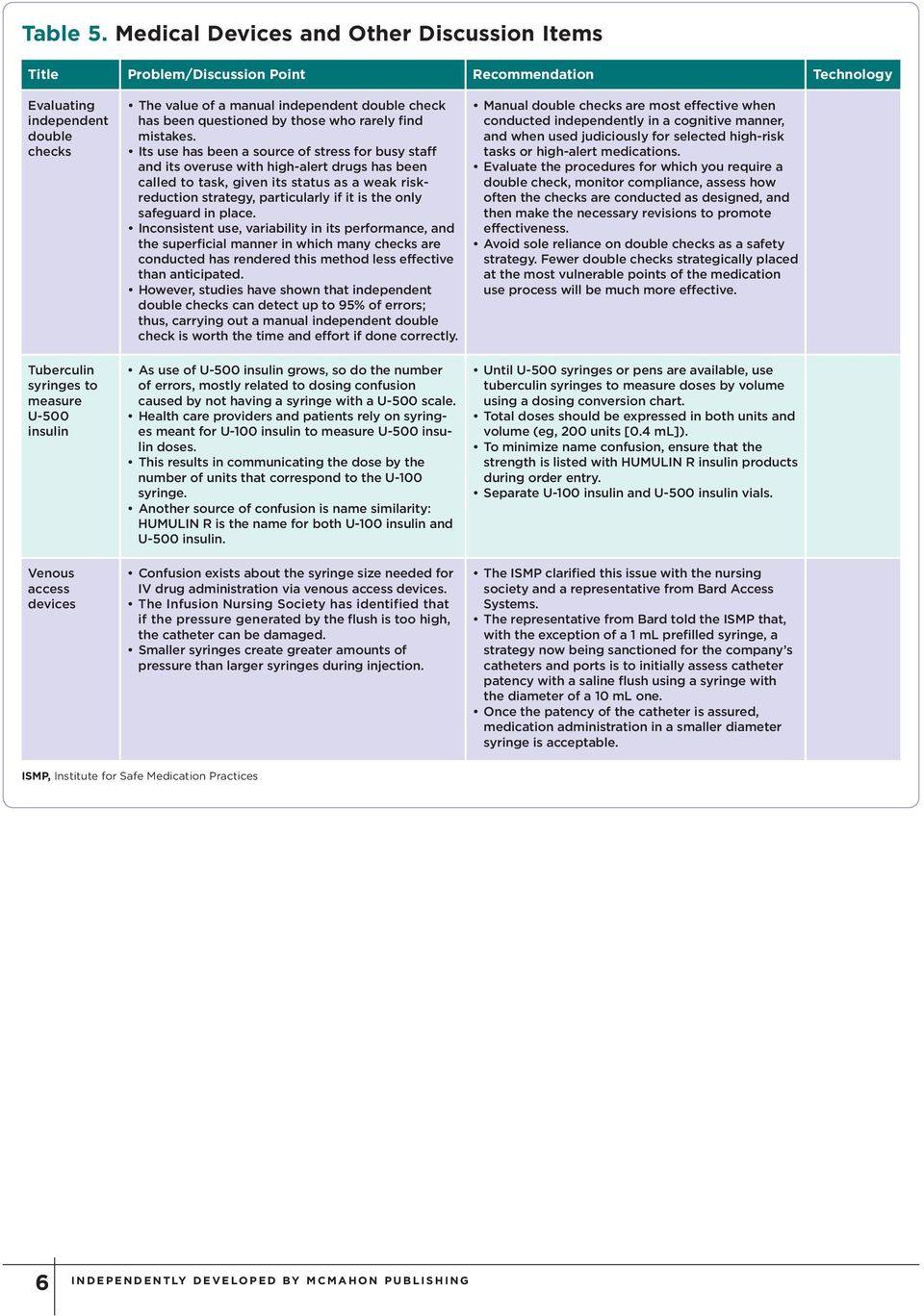
6 Table 5. Medical Devices and Other Discussion Items Evaluating independent double checks The value of a manual independent double check has been questioned by those who rarely find mistakes. Its use has been a source of stress for busy staff and its overuse with high-alert drugs has been called to task, given its status as a weak riskreduction strategy, particularly if it is the only safeguard in place. Inconsistent use, variability in its performance, and the superficial manner in which many checks are conducted has rendered this method less effective than anticipated. However, studies have shown that independent double checks can detect up to 95% of errors; thus, carrying out a manual independent double check is worth the time and effort if done correctly. Manual double checks are most effective when conducted independently in a cognitive manner, and when used judiciously for selected high-risk tasks or high-alert medications. Evaluate the procedures for which you require a double check, monitor compliance, assess how often the checks are conducted as designed, and then make the necessary revisions to promote effectiveness. Avoid sole reliance on double checks as a safety strategy. Fewer double checks strategically placed at the most vulnerable points of the medication use process will be much more effective. Tuberculin syringes to measure U-500 insulin Venous access devices As use of U-500 insulin grows, so do the number of errors, mostly related to dosing confusion caused by not having a syringe with a U-500 scale. Health care providers and patients rely on syringes meant for U-100 insulin to measure U-500 insulin doses. This results in communicating the dose by the number of units that correspond to the U-100 syringe. Another source of confusion is name similarity: HUMULIN R is the name for both U-100 insulin and U-500 insulin. Confusion exists about the syringe size needed for IV drug administration via venous access devices. The Infusion Nursing Society has identified that if the pressure generated by the flush is too high, the catheter can be damaged. Smaller syringes create greater amounts of pressure than larger syringes during injection. Until U-500 syringes or pens are available, use tuberculin syringes to measure doses by volume using a dosing conversion chart. Total doses should be expressed in both units and volume (eg, 200 units [0.4 ml]). To minimize name confusion, ensure that the strength is listed with HUMULIN R insulin products during order entry. Separate U-100 insulin and U-500 insulin vials. The ISMP clarified this issue with the nursing society and a representative from Bard Access Systems. The representative from Bard told the ISMP that, with the exception of a 1 ml prefilled syringe, a strategy now being sanctioned for the company s catheters and ports is to initially assess catheter patency with a saline flush using a syringe with the diameter of a 10 ml one. Once the patency of the catheter is assured, medication administration in a smaller diameter syringe is acceptable. ISMP, Institute for Safe Medication Practices 6
7 Table 6. ISMP s Targeted Medication Safety Best Practices (continued) Title Problem/Discussion Point Goal/Recommendations Technology Methotrexate dosing regimens Since early 1996, and as recently as 2013, fatal errors have been reported to the ISMP about the accidental daily dosing of oral methotrexate that was intended for weekly administration. Prescribing errors occur when physicians, who are accustomed to prescribing many medications for daily administration, erroneously prescribe this medication daily instead of weekly use. Dispensing errors occur in much the same way, when pharmacy technicians and pharmacists inadvertently select/approve daily instead of weekly administration during order entry or verification. The goal of this best practice is to prevent errors involving inadvertent daily dosing of oral methotrexate, both in the inpatient setting and after discharge. Use a weekly dosage regimen default for oral methotrexate. If weekly default is overridden to daily, require a hard stop verification of an appropriate oncologic indication. Provide patient education by a pharmacist for all weekly oral methotrexate discharge orders. Ensure that patients are given written drug information leaflets that contain clear instructions about the weekly dosing schedule. Have patients repeat back the instructions to ensure that they understand the weekly dosing schedule and that the medication is not to be used as needed for symptom control. Oral dosing devices The ISMP has received more than 50 reports of mix-ups between milliliter (ml) and household measures such as drops and teaspoonfuls, some leading to injuries requiring hospitalization. Use of the apothecary system also has caused mix-ups between drams and ml and other non-metric measurements, such as ounces and tablespoons. The ISMP first reported confusion in 2000 and has continued to receive reports of medication errors related to mix-ups between metric and non-metric units of measure. The goal of this best practice is to use liquid medication dosing devices (specifically oral syringes, cups, and droppers) that display volume using only the metric scale. Purchase oral liquid dosing devices (oral syringes, cups, droppers) that display only the metric scale. Additionally, if patients are taking an oral liquid medication after discharge, supply them with (or provide a prescription for) oral syringes, to enable them to measure oral liquid volumes in ml. Oral liquid preparation The ISMP continues to receive reports of patients accidentally being given an oral liquid medication by IV, which on some occasions has been fatal. This happens most often when an oral liquid is prepared extemporaneously or dispensed in a parenteral syringe that connects to vascular access lines. Fatalities also have occurred when the contents of liquid-filled capsules (eg, nimodipine) were drawn for oral administration via a nasogastric or other tube with a parenteral syringe and then administered IV. The oral syringe tip is designed to be incompatible with vascular lines to prevent it from being attached inadvertently. The goal of this best practice is to prevent the unintended administration of oral medications via the IV route. Ensure that all oral liquids that are not commercially available as unit-dose products are dispensed by the pharmacy in an oral syringe. Use only oral syringes that are marked For oral use only. Ensure that oral syringes that are used cannot connect to any type of parenteral tubing. Also, use of an auxiliary label For oral use only is recommended if it does not obstruct critical information because the print on the oral syringe is small. Table continues on page 8 Text continued from page 1 Effective results depend on understanding the entire medication-use process through varied perspectives and disciplines. ISMP is a nonprofit organization that works closely with health care practitioners and institutions, regulatory agencies, professional organizations, and the pharmaceutical industry to provide education about medication errors and their prevention. ISMP independently reviews medication errors that practitioners and patients have submitted voluntarily to the ISMP Medication Error Reporting Program. ISMP is an accessible resource for any pharmacist or organization interested in implementing the actions recommended herein. Among the many products and services that ISMP offers is the ISMP Medication Safety Alert! Acute Care Edition, a biweekly newsletter that provides timely information related to error prevention. It identifies errors that have been reported by other organizations and offers recommendations to prevent those errors from occurring in the pharmacy. The information in the tables of this review summarizes many of the significant error-prevention Text continues on page 8 7

8 Table 6. ISMP s Targeted Medication Safety Best Practices (continued) Title Problem/Discussion Point Goal/Recommendations Technology Patient weight Official product labeling for medications provides weight-based dosing using only the metric system (eg, mg/kg). Significant medication errors have occurred when the patient s weight is documented in non-metric units of measure (eg, pounds) and it was confused with kilograms (or grams). Numerous mistakes have been reported when practitioners convert weights from one measurement system to another, or weigh a patient in pounds but accidentally document the value as kilograms in the medical record, resulting in more than a twofold dosing error. The goal of this best practice is to standardize the measurement and communication of patient weight using only metric units of measure (grams [g] and kilograms [kg]). Measure and express patient weight in metric units only. Ensure that scales used for weighing patients are set and measure only in metric units. Replace current scales that measure in pounds with new scales that only measure weight in grams or kilograms. If scales can measure in pounds and grams/kilograms, modify the scale to lock out the ability to weigh in pounds. Ensure that computer information systems and medication device screens (eg, infusion pumps), printouts, and preprinted order forms list or prompt for weight only in grams (for neonates) or kilograms. Discontinue the documentation of patient weight in pounds in all locations, and instead document patient weight using only metric designations. Use measured weight rather than a stated, historical, or estimated weight. 1,3,4 VinCRIStine in a minibag To date, there are 120 published cases of accidental administration of vincristine by the intrathecal route when the drug was dispensed in a syringe, and zero cases when it is dispensed in a minibag. When vinca alkaloids are injected intrathecally, destruction of the central nervous system occurs. Despite repeated warnings from national and international safety agencies, deaths from this kind of error continue to occur. The goal of this best practice is to ensure that vinca alkaloids are administered by the IV route only. Dispense IV vinca alkaloids in a minibag of a compatible solution, and never dispense and/or administer these drugs using a syringe. Dilute the drug in a minibag that contains a volume that is too large for intrathecal administration (eg, 25 ml for pediatric patients and 50 ml for adult patients). Prohibit IV vinca alkaloids in areas where intrathecal medications are administered and/or stored. Confirm that any prescribed intrathecal medications have been administered before dispensing IV vinca alkaloids. Text continued from page 7 strategies that were recommended in the ISMP Medication Safety Alert! Acute Care Edition during The errors presented in the tables are actual or potential errors reported to ISMP. Each table consists of 4 columns. The first column lists the medications, devices, or other problematic issues involved. The second column describes the specific error or problem involved. The third column contains ISMP s recommendations to proactively address and prevent errors from occurring. The fourth column lists technology that may help prevent these errors. Technology can be a powerful tool in the fight against medication errors but only when it is used appropriately within a well-designed medication-use system. The key summarizes the technology addressed in the tables, along with specific criteria that ISMP recommends should be included. Suggested Reading Cohen MR, ed. Medication Errors. 2nd ed. Washington, DC: American Pharmacists Association; Institute for Safe Medication Practices. ISMP Medication Safety Alert! Acute Care Edition newsletters default.asp. Accessed March 20, Institute for Safe Medication Practices website: 8

Safe IV Compounding Procedures: The Release of ISMP Guidelines
 Safe IV Compounding Procedures: The Release of ISMP Guidelines Matthew P. Fricker, Jr., MS, RPh, FASHP, Program Director Institute for Safe Medication Practices 1 Objectives List system based causes of
Reducing the risk of patient harm: A focus on insulin
 Reducing the risk of patient harm: A focus on insulin New York State Partnership for Patients (NYSPFP) Initiative Regional Educational Session November 2013 1 1 Disclosure Matt Fricker, Matt Grissinger,
Objective. Failure Modes & Effects Analysis: A U-500 Insulin Case Study. What is a FMEA? Assembling a Team. Steps to Conducting a FMEA 5/12/2011
 5/12/2011 Objective Failure Modes & Effects Analysis: A U-500 Insulin Case Study Understand the role of a failure mode and effects analysis (FMEA) in developing U-500 insulin use criteria Ryan J. Bickel,
Incorporating Pediatric Medication Safety into your Health System
 Incorporating Pediatric Medication Safety into your Health System Julie Kasap, Pharm.D. Margaret CHOI Heger, Pharmacy PharmD, Supervisor BCPS January 2015 Pediatric Antimicrobial Stewardship Conference
DISPENSING HIGH RISK/ALERT MEDICATIONS. Lana Gordineer, MSN, RN Diabetes Educator
 DISPENSING HIGH RISK/ALERT MEDICATIONS Lana Gordineer, MSN, RN Diabetes Educator HIGH RISK/ALERT MEDICATIONS (or DRUGS) Medications that have a high risk of causing serious injury or death to a patient
GUIDELINES ON PREVENTING MEDICATION ERRORS IN PHARMACIES AND LONG-TERM CARE FACILITIES THROUGH REPORTING AND EVALUATION
 GUIDELINES GUIDELINES ON PREVENTING MEDICATION ERRORS IN PHARMACIES AND LONG-TERM CARE FACILITIES THROUGH REPORTING AND EVALUATION Preamble The purpose of this document is to provide guidance for the pharmacist
National Patient Safety Agency. Risk Assessment of Injectable Medicines. STEP 1 Local Risk Factor Assessment. STEP 2 Product Risk Factor Assessment
 NPSA Injectable Medicines Risk Assessment Tool National Patient Safety Agency Risk Assessment of Injectable Medicines STEP 1 Local Risk Factor Assessment. Carry out a baseline assessment in a near patient
NCC MERP Taxonomy of Medication Errors 1
 Preamble NCC MERP Taxonomy of Medication Errors 1 This document provides a standard taxonomy of medication errors to be used in combination with systems analysis in recording and tracking of medication
SafetyFirst Alert. Errors in Transcribing and Administering Medications
 SafetyFirst Alert Massachusetts Coalition for the Prevention of Medical Errors January 2001 This issue of Safety First Alert is a publication of the Massachusetts Coalition for the Prevention of Medical
MEDICAL CENTER ADMINISTRATIVE POLICY AND PROCEDURES SCOPE KFH Hospital, City Section No.
 of 22 I. Purpose To establish safe medication practices for High Alert medications to maximize the safety of the medication processes associated with these medications. II. Policy. High alert medications
Format. Layout and directions for use. Institute for Safe Medication Practices
 W ell-designed standard order sets both electronic and paper formats have the potential to: Integrate and coordinate care by communicating best practices through multiple disciplines, levels of care, and
EDUCATOR S LESSON PLAN
 EDUCATOR S LESSON PLAN Pharmacy Technician Training Program Student Version Orientation Orientation introduces the student to basic terms and definitions. An introduction to the Pharmacy Technician Certification
Administrative Policies and Procedures for MOH hospitals /PHC Centers. TITLE: Organization & Management Of Medication Use APPLIES TO: Hospital-wide
 Administrative Policies and Procedures for MOH hospitals /PHC Centers TITLE: Organization & Management Of Medication Use APPLIES TO: Hospital-wide NO. OF PAGES: ORIGINAL DATE: REVISION DATE : السیاسات
Medication Guidelines
 Medication Guidelines January 2014 Approved by the College and Association of Registered Nurses of Alberta Provincial Council, January 2014. Second printing with editorial change (p16), November 2014.
Key Element VIII: Staff Competency and Education
 Key Element VIII: Staff Competency and Education Practitioners and support staff receive sufficient training and orientation to the dispensing process and medication error prevention, and undergo baseline
Medication Safety and Error Prevention
 Medication Safety and Error Prevention 16 LEARNING OBJECTIVES By the end of this chapter, students will be able to competently: 1. Explain the process for reporting errors. 2. Explain the difference between
The Massachusetts Coalition for the Prevention of Medical Errors. MHA Best Practice Recommendations to Reduce Medication Errors
 The Massachusetts Coalition for the Prevention of Medical Errors MHA Best Practice Recommendations to Reduce Medication Errors Executive Summary In 1997, the Massachusetts Coalition for the Prevention
Example of a Health Care Failure Mode and Effects Analysis for IV Patient Controlled Analgesia (PCA) Failure Modes (what might happen)
 Prescribing Assess patient Choose analgesic/mode of delivery Prescribe analgesic Institute for Safe Medication Practices Example of a Health Care and Effects Analysis for IV Patient Controlled Analgesia
MEDICATION MANUAL Policy & Procedure
 MEDICATION MANUAL Policy & Procedure TITLE: High Alert Medication NUMBER: MM 50-010 Effective Date: September 13, 2013 Page 1 of 6 Applies To: Holders of Medication Manual This policy is applicable to
Electronic Medication Administration Record (emar) (For Cerner Sites Only)
 POLICY NO. 1009 Approved: 12/05 Effective: 12/05 Reviewed: 9/10; 5/12 1. Purpose: Electronic Medication Administration Record (emar) (For Cerner Sites Only) To provide direction for the transcription and
National Patient Safety Goals Effective January 1, 2015
 National Patient Safety Goals Goal 1 Nursing are enter ccreditation Program Improve the accuracy of patient and resident identification. NPSG.01.01.01 Use at least two patient or resident identifiers when
National Patient Safety Goals Effective January 1, 2015
 National Patient Safety Goals Effective January 1, 2015 Goal 1 Improve the accuracy of resident identification. NPSG.01.01.01 Long Term are ccreditation Program Medicare/Medicaid ertification-based Option
Section 2 Solving dosage problems
 Section 2 Solving dosage problems Whether your organization uses a bulk medication administration system or a unit-dose administration system to prepare to administer pediatric medications, you may find
BOARD OF PHARMACY DIVISION 41 OPERATION OF PHARMACIES (RETAIL AND INSTITUTIONAL DRUG OUTLETS) CONSULTING PHARMACISTS AND OPERATION OF DRUG ROOMS
 BOARD OF PHARMACY DIVISION 41 OPERATION OF PHARMACIES (RETAIL AND INSTITUTIONAL DRUG OUTLETS) CONSULTING PHARMACISTS AND OPERATION OF DRUG ROOMS 855-041-6050 Definitions Hospitals with Pharmacies (1) In
Calculating Drug Dosages
 Calculating Drug Dosages Calculating Doses from Prepared Strength Liquids, Tablets, and Capsules Calculating With Proportions 1. Convert to a consistent unit of measure. 2. Set up a proportion: Original
Automating the Pharmacy Medication Cycle in Acute Care Settings
 Automating the Pharmacy Medication Cycle in Acute Care Settings Costs, Benefits and Potential Unintended Consequences Enterprise Information Systems Steering Committee Nursing Informatics Committee and
Health Professions Act BYLAWS SCHEDULE F. PART 2 Hospital Pharmacy Standards of Practice. Table of Contents
 Health Professions Act BYLAWS SCHEDULE F PART 2 Hospital Pharmacy Standards of Practice Table of Contents 1. Application 2. Definitions 3. Drug Distribution 4. Drug Label 5. Returned Drugs 6. Drug Transfer
How to Use Liquid Medications
 How to Use Liquid Medications Liquid medications include products such as solutions, suspensions, syrups, and elixirs. These prescription and nonprescription products are mostly used for children, but
Reconstitution of Solutions
 Chapter 12 Reconstitution of Solutions Reconstitution Process of mixing and diluting solutions Some medications supplied in powder form and must be mixed with liquid before administration Parts of Solutions
Pharmacy. Page 1 of 10
 Department: Pharmacy PP # RX 6007.1 Policy and Procedure Effective Date: August, 2010 Page 1 of 10 Subject/Title: Pharmacy Tech-Check-Tech Program Dates of Review/Revision: Approved By and Title: Director,
Collaboration Anesthesia
 HPC hpcconnection.ca Nursing Neuro - axial Analgesia cross sector Pharmacists Intractable patient centered Opioids Interventional Consensus Collaboration Anesthesia Physicians epidural evidence based Intraspinal
Key Element V: Drug Standardization, Storage, and Distribution
 Key Element V: Drug Standardization, Storage, and Distribution Prescribed medications are accessible to patients and dispensed in a safe and secure manner. Medications and other necessary drug supplies
PHARMACY TECHNICIAN COURSE DESCRIPTIONS
 PHARMACY TECHNICIAN COURSE DESCRIPTIONS OCCUPATIONAL COMPLETION POINTS AND PROGRAM LENGTH: * Basic Healthcare Worker OCP A 90 Hours (COURSE #HSC 0003) * Community Pharmacy Technician OCP B 360 Hours (COURSE
Chapter 3: Medicines. Teacher s Guide
 Chapter 3: Medicines Teacher s Guide 39 Chapter 3: Medicines Teacher s Guide Learning Objectives: Students will understand the difference between over-the-counter medicines and prescription medicines Students
Humulin R (U500) insulin: Prescribing Guidance
 Leeds Humulin R (U500) insulin: Prescribing Guidance Amber Drug Level 2 We have started your patient on Humulin R (U500) insulin for the treatment of diabetic patients with marked insulin resistance requiring
Technician. Chapter 5: A Dose of Professionalism for the Pharmacy. 3 Contact Hours. Learning objectives. Introduction
 Chapter 5: A Dose of Professionalism for the Pharmacy Technician 3 Contact Hours By Katie Ingersoll, RPh, PharmD, and Staff Pharmacist for a national chain. Author Disclosure: Katie Ingersoll and Elite
Labelling and Packaging: An Aggregate Analysis of Medication Incident Reports Project Report
 Labelling and Packaging: An Aggregate Analysis of Medication Incident Reports Project Report Institute for Safe Medication Practices Canada Institut pour l utilisation sécuritaire des médicaments du Canada
March 2015. Medication Guidelines
 March 2015 Medication Guidelines Approved by the College and Association of Registered Nurses of Alberta Provincial Council, March 2015. Permission to reproduce this document is granted. Please recognize
If you have any questions, please do not hesitate to contact us. We look forward to meeting you!
 Welcome to Children s Mercy. We are pleased that you will be joining the nursing staff. As the Education Specialists coordinating Nursing Orientation we look forward to meeting you this week. We want to
Medications or therapeutic solutions may be injected directly into the bloodstream
 Intravenous Therapy Medications or therapeutic solutions may be injected directly into the bloodstream for immediate circulation and use by the body. State practice acts designate which health care professionals
Avoiding Medication Errors
 Avoiding Medication Errors with Insulin Therapy Supported by an educational grant from Novo Nordisk Inc. Created in conjunction with the Institute for Safe Medication Practices Avoiding Medication Errors
ExCPT Certified Pharmacy Technician (CPhT) Detailed Test Plan* 100 scored items, 20 pretest items Exam time: 2 hours 10 minutes
 ExCPT Certified Pharmacy Technician (CPhT) Detailed Test Plan* 100 scored items, 20 pretest items Exam time: 2 hours 10 minutes # scored items 1. Regulations and Pharmacy Duties 35 A. Overview of technician
Don t Make Me Think: Essential Pharmacy Math for Pharmacy Technicians Made Easy
 J & D Educational Services, Inc. In association and co-sponsorship with Texas Tech University HSC School of Pharmacy Provides continuing education for certified pharmacy technicians. Texas Tech University
Safe Medication Administration Preparation Guide C.O.R.E Essentials
 Safe Medication Administration Preparation Guide C.O.R.E Essentials As a new IU Health employee, a portion of your orientation will focus on Safe Medication Administration practices. You will participate
SAFE HANDLING OF HAZARDOUS MEDICATIONS. Cytotoxic and Non-Cytotoxic. Winnipeg Regional Health Authority Policy # 110.160.010
 SAFE HANDLING OF HAZARDOUS MEDICATIONS Cytotoxic and Non-Cytotoxic Winnipeg Regional Health Authority Policy # 110.160.010 By the end of this presentation staff should be able to 1. Understand what information
GUIDELINES FOR NUCLEAR PHARMACY TECHNICIAN TRAINING PROGRAMS
 GUIDELINES FOR NUCLEAR PHARMACY TECHNICIAN TRAINING PROGRAMS Prepared by Ad Hoc Committee on Nuclear Pharmacy Technicians Nuclear Pharmacy Section Academy of Pharmacy Practice and Management American Pharmaceutical
ISMP Safe Practice Guidelines for Adult IV Push Medications
 Safe Practice Guidelines for Adult IV Push Medications A compilation of safe practices from the Adult IV Push Medication Safety Summit Prepared by the Institute for Safe Medication Practices () Table of
Educational Outcomes for Pharmacy Technician Programs in Canada
 Canadian Pharmacy Technician Educators Association (CPTEA) Educational Outcomes for Pharmacy Technician Programs in Canada March 2007 Educational Outcomes for Pharmacy Technician Page 1 of 14 Framework
Bishop State Community College. Dosage Calculation Review Study Booklet
 Bishop State Community College Dosage Calculation Review Study Booklet Table of Contents Page Numbers Conversion Table. 2 Conversions Facts. 3, 4 Conversion Practice Problems 5 Oral and Parenteral Calculations..
Roles and Responsibilities Policy
 Roles and Responsibilities Policy Contents Policy... 2 Scope/Audience... 2 Associated Documents... 2 Definitions... 2 Accountability... 2 Scope of Practice Statement:... 2 Anaesthetic Technicians... 3
Policies & Procedures. ID Number: 1118
 Policies & Procedures Title: INTRAVENOUS AND/OR PERIPHERAL SALINE LOCK INSERTION AND MAINTENANCE ID Number: 1118 Authorization [X] SHR Nursing Practice Committee Source: Nursing Date Revised: September
CORONER S REPORT REPORT
 CORONER S REPORT 26 THE CORONER HAS RECOMMENDED THAT THE ONTARIO COLLEGE OF PHARMACISTS EDUCATE CLINICIANS ON THE DEFINITION OF OPIOID TOLERANCE, AND REVIEW THE PATIENT CONDITIONS AND COMORBIDITIES THAT
Parenteral Dosage of Drugs
 Chapter 11 Parenteral Dosage of Drugs Parenteral Route of administration other than gastrointestinal Intramuscular (IM) Subcutaneous (SC) Intradermal (ID) IV Parenteral Most medications prepared in liquid
Coventry Health Care of Georgia, Inc. Coventry Health and Life Insurance Company
 Coventry Health Care of Georgia, Inc. Coventry Health and Life Insurance Company PRESCRIPTION DRUG RIDER This Prescription Drug Rider is an attachment to the Coventry Health Care of Georgia, Inc. ( Health
Pathways for Medication Safety. Looking. Collectively. At Risk. A Partnership: American Hospital Association. Health Research and Educational Trust
 Pathways for Medication Safety SM Looking Collectively At Risk A Partnership: American Hospital Association Health Research and Educational Trust Institute for Safe Medication Practices Pathways for Medication
Medicines reconciliation on admission and discharge from hospital policy April 2013. WHSCT medicines reconciliation policy 1
 Medicines reconciliation on admission and discharge from hospital policy April 2013 WHSCT medicines reconciliation policy 1 Policy Title Policy Reference Number Medicines reconciliation on admission and
Addressing safety concerns about U-500 insulin in a hospital setting
 Addressing safety concerns about U-500 insulin in a hospital setting Karen Hamrick Samaan, Megan Dahlke, and Judy Stover U-500 regular insulin has been used since the 1950s to treat diabetic patients with
Healthcare Math: Calculating Dosage
 Healthcare Math: Calculating Dosage Industry: Healthcare Content Area: Mathematics Core Topics: Applying medical abbreviations to math problems, using formulas, solving algebraic equations Objective: Students
Optimizing medication safety:
 Optimizing medication safety: At King Abdullah Medical City advanced technologies help improve safety, security and control of N&C medications Authored and produced by CareFusion, June 2015 Summary At
Billing with National Drug Codes (NDCs) Frequently Asked Questions
 Billing with National Drug Codes (NDCs) Frequently Asked Questions NDC Overview Converting HCPCS/CPT Units to NDC Units Submitting NDCs on Professional/Ancillary Claims Reimbursement Details For More Information
DRUG CALCULATIONS FOR REGISTERED NURSES ADULT SERVICES
 Serving the people of north east Essex DRUG CALCULATIONS FOR REGISTERED NURSES ADULT SERVICES A Programmed Approach - It is essential you read this pack & practice the questions prior to your drug calculation
ADMINISTRATION OF INTRAVENOUS PUSH/DIRECT MEDICATIONS
 SASKATOON DISTRICT HEALTH Department of Nursing Affairs ADMINISTRATION OF INTRAVENOUS PUSH/DIRECT MEDICATIONS SPECIAL NURSING PROCEDURE LEARNING PACKAGE This package provides the basic information necessary
Chapter 15. Reconstitution and Dosages Measured in Units. Copyright 2012, 2007 Mosby, Inc., an affiliate of Elsevier Inc. All rights reserved.
 Chapter 15 Reconstitution and Dosages Measured in Units 1 Objectives Calculating drug dosage problems that first require reconstitution of a powdered drug into a liquid form Using a proportion to solve
02 DEPARTMENT OF PROFESSIONAL AND FINANCIAL REGULATION REGULATIONS RELATING TO ADMINISTRATION OF INTRAVENOUS THERAPY BY LICENSED NURSES
 02 DEPARTMENT OF PROFESSIONAL AND FINANCIAL REGULATION 380 BOARD OF NURSING Chapter 10: REGULATIONS RELATING TO ADMINISTRATION OF INTRAVENOUS THERAPY BY LICENSED NURSES SUMMARY: This chapter identifies
Licensed Pharmacy Technician Scope of Practice
 Licensed Scope of Practice Adapted from: Request for Regulation of s Approved by Council April 24, 2015 Definitions In this policy: Act means The Pharmacy and Pharmacy Disciplines Act means an unregulated
INSTITUTIONAL POLICY AND PROCEDURE (IPP) Department: Manual: Section: EFFECTIVE DATE REVIEW DUE REPLACES NUMBER NO. OF PAGES
 HOSPITAL NAME INSTITUTIONAL POLICY AND PROCEDURE (IPP) Department: Manual: Section: TITLE/DESCRIPTION POLICY NUMBER HIGH RISK MEDICATIONS EFFECTIVE DATE REVIEW DUE REPLACES NUMBER NO. OF PAGES APPROVED
DRUG CALCULATIONS. Mathematical accuracy is a matter of life and death. [Keighley 1984]
![DRUG CALCULATIONS. Mathematical accuracy is a matter of life and death. [Keighley 1984]](/thumbs/39/19297070.jpg "DRUG CALCULATIONS. Mathematical accuracy is a matter of life and death. [Keighley 1984]") DRUG CALCULATIONS Mathematical accuracy is a matter of life and death. [Keighley 1984] At the end of this practice sheet, you will be able to: Perform simple arithmetical tasks. Accurately calculate drug
DRUG CALCULATIONS Mathematical accuracy is a matter of life and death. [Keighley 1984] At the end of this practice sheet, you will be able to: Perform simple arithmetical tasks. Accurately calculate drug
Evolution of a Closed Loop Medication Use Process
 Evolution of a Closed Loop Medication Use Process Paul J. Vitale, Pharm.D. [email protected] Vice President and Chief Pharmacy Officer The Mercy Medical Center Baltimore, Maryland Agenda Hospital Background
EMPLOYER BASED QUALIFIED PHARMACY TECHNICIAN EXAMS GUIDANCE
 Steven W. Schierholt, Esq. Executive Director John R. Kasich Governor EMPLOYER BASED QUALIFIED PHARMACY TECHNICIAN EXAMS GUIDANCE Thank you for your interest in creating an Employer Based Qualified Pharmacy
Driving Patient Safety and Pharmacy Efficiency
 CASE STUDY Driving Patient Safety and Pharmacy Efficiency Sterile Compounding, Error Reduction and Workflow Management at Indiana University Health Bloomington Hospital Steve I am totally sold on the benefits
BRIEFING 7 LABELING DEFINITION
 Page 1 of 10 BRIEFING 7 Labeling. This general chapter provides definitions and standards for labeling of official articles. Note that, as with compendial quality standards, labeling requirements also
Health Canada Manufacturing and Compounding Drug Products in Canada: A Policy Framework Guidelines for P.E.I. Community and Hospital Pharmacists
 Health Canada Manufacturing and Compounding Drug Products in Canada: A Policy Framework Guidelines for P.E.I. Community and Hospital Pharmacists October 2001 In response to pharmacists questions about
Acetylcysteine Inhalation Solution
 Drug Shortage information Action Plan delays and another manufacturer voluntarily suspending production. Hospira has a limited supply available and other manufacturers are unable to estimate a release
HOW TO PREVENT MEDICATION ERRORS
 These books provide more information: Safe use of Medications by Older People. National Institutes of Health, National Institute on Aging. Bethesda, MD: U.S. Department of Health and Human Services, 2000
Dosage Calculations INTRODUCTION. L earning Objectives CHAPTER
 CHAPTER 5 Dosage Calculations L earning Objectives After completing this chapter, you should be able to: Solve one-step pharmaceutical dosage calculations. Set up a series of ratios and proportions to
REGULATION 3 PHARMACY TECHNICIANS
 REGULATION 3 PHARMACY TECHNICIANS 03-00 PHARMACY TECHNICIANS REGISTRATION/PERMIT REQUIRED 03-00-0001 DEFINITIONS (a) Pharmacy technician means those individuals, exclusive of pharmacy interns, who assist
UNIVERSITY OF WISCONSIN HOSPITAL AND CLINICS DEPARTMENT OF PHARMACY SCOPE OF PATIENT CARE SERVICES FY 2014 October 1 st, 2014
 UNIVERSITY OF WISCONSIN HOSPITAL AND CLINICS DEPARTMENT OF PHARMACY SCOPE OF PATIENT CARE SERVICES FY 2014 October 1 st, 2014 Department Name: Department of Pharmacy Department Director: Steve Rough, MS,
Inpatient Anticoagulation Safety. To provide safe and effective anticoagulation therapy through a collaborative approach.
 Inpatient Anticoagulation Safety Purpose: Policy: To provide safe and effective anticoagulation therapy through a collaborative approach. Upon the written order of a physician, Heparin, Low Molecular Weight
Briefing Document on Sound-Alike Look-Alike Drugs (SALADs)
 Briefing Document on Sound-Alike Look-Alike Drugs (SALADs) About the IMSN The Irish Medication Safety Network (IMSN) is an independent group of pharmacists and other specialists working in the acute sector,
Nursing 131 Household to Metric Conversion
 Nursing 3 Household to Metric Conversion Slide 2 & 3 In the metric system liquid volumes are measured in milliliters or liters. Weight is measured in micrograms, milligrams, grams, or kilograms. liter
Pharmacy Technician Training Program. Minimum Competencies
 1. Pharmacy Practice Pharmacy Technician Training Program Minimum Competencies 1.1 The candidate shall be familiar with the mission of pharmacy and the various permitted pharmacy practice sites. The candidate
Inventory Management
 Inventory Management Chapter Outline Inventory Management Inventory Systems Computer & Inventory Ordering Forms Stocking & Storing Inventory Management Inventory A listing of medication of the goods or
ISMP Canada. Dangerous abbreviations: U can make a difference!
 ISMP Canada Dangerous abbreviations: U can make a difference! By Christine Koczmara, RN, BScPsy, Valentina Jelincic, RPh, BScPhm, and Carol Dueck, RN, BScN Abstract Dangerous abbreviations are also known
COMPUTERIZED PROVIDER ORDER ENTRY: AD-HOC ORDERS
 COMPUTERIZED PROVIDER ORDER ENTRY: AD-HOC ORDERS Find Field Enter the desired order in the Find field. You may press Enter or select the Binoculars Icon to view all existing orderables. Orderable This
UW School of Dentistry Comprehensive Medication Policy
 UNIVERSITY OF WASHINGTON SCHOOL OF DENTISTRY Subject: UW School of Dentistry Comprehensive Medication Policy Policy Number: Effective Date: December 2014 Revision Dates: June 2015 PURPOSE This policy provides
LESSON ASSIGNMENT. After completing this lesson, you should be able to: 2-1. Compute medication dosages by the ratio and proportion method.
 LESSON ASSIGNMENT LESSON 2 Pharmacology TEXT ASSIGNMENT Paragraphs 2-1 through 2-34. LESSON OBJECTIVES After completing this lesson, you should be able to: 2-1. Compute medication dosages by the ratio
Medications that are associated
 Pharmacists role in ensuring safe and effective hospital use of insulin Michael R. Cohen Purpose. To highlight the potential errors that may occur with insulin use in the inpatient setting and to describe
How to Measure and Give Medicine
 59 How to Measure and Give Medicine CHAPTER 8 SYMBOLS: = means: is equal to or is the same as + means: and or plus HOW FRACTIONS ARE SOMETIMES WRITTEN: 1 + 1 = 2 One plus one equals two. 1 tablet = one
Patient Safety Applications for Bar Code and RFID Technology APPLICATION WHITE PAPER
 Patient Safety Applications for Bar Code and RFID Technology APPLICATION WHITE PAPER Copyrights 2006 ZIH Corp. All product names and numbers are Zebra trademarks, and Zebra and the Zebra head graphic are
FMEA Failure Risk Scoring Schemes
 FMEA Failure Risk Scoring Schemes 1-10 Scoring for Severity, Occurrence and Detection CATEGORY Severity 10 9 8 7 6 5 3 2 1 Hazardous, without warning Hazardous, with warning Very High High Moderate Low
RECONSTITUTING MEDICATIONS: HOW TO FLUFF UP MEDICATIONS
 RECONSTITUTING MEDICATIONS: HOW TO FLUFF UP MEDICATIONS After the completion of this module you will be able to: Define medication reconstitution. Read a medication label. Reconstitute a medication. Calculate
Collaborative Practice Agreement for Nurse Practitioner Management of Patients in the Specialty of Pediatric Critical Care
 Collaborative Practice Agreement for Nurse Practitioner Management of Patients in the Specialty of Pediatric Critical Care Purpose Section I Introduction/Overview This document authorizes the nurse practitioner
ASHP Guidelines on Home Infusion Pharmacy Services
 ASHP Guidelines on Home Infusion Pharmacy Services Practice Settings Guidelines 469 Background and Purpose Background. Home infusion services are provided by a variety of organizations, including hospitals,
03 PHARMACY TECHNICIANS
 03 PHARMACY TECHNICIANS 03-00 PHARMACY TECHNICIANS REGISTRATION/PERMIT REQUIRED 03-00-0001 DEFINITIONS: A. PHARMACY TECHNICIAN: This term refers to those individuals identified as Pharmacist Assistants
Foreword by Director of Medical Services... Foreword by Chief Pharmacist... Acknowledgements... iii. Executive summary... 1
 Contents page Foreword by Director of Medical Services... Foreword by Chief Pharmacist... i ii Acknowledgements... iii Executive summary...... 1 Section 1 Introduction: Medication safety 3 1.1 Definitions