
Toilet Flapper Study: Final Report
|
|
|
- Caroline Nelson
- 10 years ago
- Views:
Transcription
1 Toilet Flapper Study: Final Report Prepared for The California Urban Water Conservation Council 455 Capitol Mall, Suite 703 Sacramento, California (916) December 15, 2004 By Koeller and Company 5962 Sandra Drive Yorba Linda, California (714)

2 Study Participants The Metropolitan Water District of Southern California 700 North Alameda Street Los Angeles, CA Los Angeles Department of Water and Power P. O. Box 51111, Room 1463 Los Angeles, CA City of San José 777 North First Street, Suite 300 San Jose, CA Santa Clara Valley Water District 5750 Almaden Parkway San Jose, CA Contra Costa Water District 1331 Concord Avenue Concord, CA Sonoma County Water Agency 2227 Capricorn Way, Suite 108 Santa Rosa, CA 95406

3 Prepared by: John Koeller, P.E. Koeller and Company 5962 Sandra Drive Yorba Linda, CA (714) Field Investigations by: PEAK International 5536 Paseo Tortuga Yorba Linda, CA (714)

4 Preface This study and report are an outgrowth of concerns that have developed over the past 10 years regarding the vulnerability of toilet flush valve seals (commonly termed flappers) to normal aging, to possible degradation caused by consumers use of in-tank bowl cleaning tablets, and to tampering and replacement. In addition, there is evidence that consumers may not be able to locate and install the proper replacement flappers when their original product fails. It is the belief of many water conservation practitioners that these factors are resulting in seal failure, leakage, and excessive flush volumes in 1.6-gallons per flush (gpf) toilets. These, then, could result in a serious decline or decay in the water-efficiency of the toilet fixture, thereby negating the water savings that had been predicted by the water utilities subsidizing toilet replacements. However, the above scenario has only been partially documented and, as such, water utilities are uncertain as to the magnitude of such failures and resultant water losses. This study is intended to supplement previous work in this area, answer questions about the frequency of seal failure and flush volumes of aging toilets, and provide a basis for further quantification of water losses (if any) resulting from seal failure. In addition to the main objectives of the study, the City of San José also contracted for second visits to some of the residences within its service area that were subject to first visits and inspections. Between the first and second visits, the City contacted the first-visit customers by mail to encourage them to check for a toilet leak and replace their flapper. The second visit was designed to confirm that the customer received the letter and to determine what action the customer took in response. Exhibit B provides information on the results of the second visits. Acknowledgements The California Urban Water Conservation Council (Council) is very grateful to Fluidmaster, Inc. and PEAK International for their contributions to this study. Fluidmaster, Inc. provided technical advice and leak detection materials. PEAK International performed all of the inresidence surveys and measurements. Furthermore, this study could not have been conducted without the financial commitments of the following sponsors: Metropolitan Water District of Southern California City of San José Contra Costa Water District Santa Clara Valley Water District Sonoma County Water Agency

5 Table of Contents Executive Summary Page 1 Introduction 4 Objectives and Methodology 5 Database 8 Results 10 Conclusions 24 Recommendations 27 Exhibit A: Flappers 1990 to 2004 Exhibit B: Special Task for City of San José Figures Figure 1. Flush Volumes: Toilet Fixtures Sold and Installed Page 10 Figure 2. Distribution of Flush Volumes - Manufacturer 12 Figure 3. Flush Volumes vs. Fixture Age 13 Figure 4 Toilet Leaks According to Manufacturer 15 Figure 5. Leaking Toilet Fixtures and the Use of Bowl Cleaners 16 Figure 6. Bowl Cleaner Use and Toilet Fixture Lakes 16 Figure 7. Replacement Flappers 21 Figure 8. Flush Volume Comparison: OEM vs. Replacement Flappers 22 Tables Table 1. Toilet Fixture Models Page 7 Table 2. In-Residence Inspections Completed by Service Area 7 Table 3. Age of Toilet Fixtures Inspected by Service Area 9 Table 4. Age of Toilet Fixtures Inspected Stratified to Manufacturer 9 Table 5. Flush Volumes Stratified According to Fixture Manufacturer 11 Table 6. Adjusted Flush Volumes After Removing <1.4-gpf Fixtures 12 Table 7. Leaking Toilet Fixtures According to Fixture Manufacturer 14 Table 8. Leakage by Toilet Fixture Age 14 Table 9. Historical Use of Bowl Cleaners According to Service Area 17 Table 10. Current Use of Bowl Cleaners According to Service Area 17 Table 11. Historical Use of Bowl Cleaners Fixture Manufacturer 18 Table 12. Customers Choice of Bowl Cleaning Products 18 Table 13. Customer Replacement of the OEM Flush Valve Seal Manufacturer 20 Table 14. Customer Replacement of the OEM Flush Valve Seal Fixture Age 20 Table 15. Flush Volume Comparison: OEM vs. Replacement Flush Valve Seal 22 Table 16. Customer Replacement of OEM Flush Valve Seal Flush Volumes 23 Table 17. Replacement Flappers for Most Common ULFTs 29

6 Executive Summary For about 15 years, water utilities in California have funded and encouraged residential toilet fixture replacements as one means to achieving water demand reductions. The availability of low-flow 1.6-gallons per flush (gpf) toilet fixtures in the early 1990s provided a new avenue to residential water efficiency. Millions of 1.6-gpf fixtures are now installed in homes throughout the state, many of which were paid for (in whole or in part) by water utilities. However, during the past 10 years, concerns have escalated among water conservation practitioners over toilet flapper leakage, increasing flush volumes, and other issues related to the gravity-fed fixture models. Widespread problems of this type could lead to a rapid decline in the water savings that were predicted by the water utilities when the toilet replacement programs were initiated. Except for an Arizona study conducted in 2000 and a small study conducted subsequently by the Los Angeles Department of Water and Power, there has been little field information to validate or dispel these concerns. This field study was designed to identify the real world magnitude of flush valve seal (flapper) failure, toilet leakage through the flush valve, and flush volumes of aging toilet fixtures. Six water utilities participated in the work by providing funding and permitting technicians to visit the homes of customers within their service area, inspect the toilets, and survey the residents. Those water utilities were: Metropolitan Water District of Southern California Los Angeles Department of Water and Power City of San José Santa Clara Valley Water District Contra Costa Water District Sonoma County Water Agency Out of water utility databases identifying approximately 840,000 toilet replacements, a total of 892 toilet fixtures (of 1992 to 2002 vintage) in northern and southern California residences were randomly selected and inspected. Of these, flush volumes of 852 fixtures were measured using the T5 Flushmeter. Finally, customers were surveyed as to their past and current actions with respect to the use of bowl cleaning tablets and flapper replacement. Following are the primary conclusions from the field inspections and surveys: 1. The average flush volume of all 852 toilet fixtures measured was 1.76-gpf. (Note: Refer to Figure 1 on page 10 to view the full distribution of measured flush volumes.) However, 14 percent of those fixtures flush at a volume of less than 1.4-gpf, possibly leading to doubleflushing or the user s hold-down of the flush handle, a common practice when water is insufficient to evacuate the waste with a normal flush. If one assumes that double-flushing does occur with the 14 percent group, the average (computed) flush volume of all fixtures then climbs to about 2.0-gpf. -1-

7 2. Less than six (6) percent of the toilet fixtures were found to be leaking through the flush valve seal. There was no apparent correlation of leakage to fixture age. The low leakage rate may be due to the improved materials used by the manufacturers of flush valve seals and/or to the limited use by consumers of the chlorine-based in-tank bowl cleaning tablets. 3. About 23 percent (205) of the customers indicated that they had used an in-tank bowl cleaner at one time or another. However, only 15 percent stated that they were using these products today. Of the 205 customers that had used bowl cleaners, the toilet fixtures of only 17 were found to be leaking. Of the remaining 188 customers, only 40 had ever replaced their flush valve seal (flapper). 4. Nearly 90 percent of the toilet fixtures inspected had their original flush valve seal (flapper). For the oldest fixtures (9 to 12 years old), less than 20 percent of the customers reported that they had replaced the original seal. Comparing fixtures with their original seal to those with a replacement seal showed that flush volumes increased by an average of 0.1-gpf when the seal was replaced. 5. Study results indicate that flapper failures (leaks) occur irrespective of the use of bowl cleaning tablets. Furthermore, bowl cleaner use did not lead directly to seal replacement. Only 43 of the 205 bowl cleaner users had ever replaced their flush valve seal (flapper). 6. Overall, the study findings indicate that leakage through the flush valve seal (flapper) and flush volume increases in aging toilet fixtures are not as detrimental to water savings as might have been expected. However, the need for water utilities to continue to protect against savings decay is paramount. Insistence upon flapper durability and limits on flush volume adjustability in new fixtures (as provided for in the Los Angeles Supplementary Purchase Specification) is one method of assuring persistence of water savings. A summary of study recommendations follows: 1. In view of the study findings on flapper failure and resultant leakage, water utilities should first carefully consider the costs and benefits of a flapper replacement program before undertaking one. Creative, cost-effective methods to reach customers and encourage flapper replacement are essential. A very focused approach should be adopted that: Targets only those fixtures that may be the most vulnerable to leaks and flush volume increases; Initially targets fixtures installed prior to 1998; Identifies the specific flush valve seal (flapper) for each targeted fixture that would cause the fixture to be restored to its original design flush volume; and Utilizes the studies, information, methodologies, and similar resources that have been developed, explored or implemented by other water utilities in the U.S. to stimulate toilet fixture flapper replacements. -2-

8 2. Water utilities that are sponsoring, designing, and/or implementing new toilet fixture replacement programs should: Consider the adoption of an approved toilet list that qualifies fixtures as to their ability to sustain water savings through their lifetime and as to flush performance. The Los Angeles Supplementary Purchase Specification (SPS) provides for flapper durability and limits flush volume adjustability. The Maximum Performance (MaP) testing threshold of 250 grams of waste assures customer satisfaction with the toilet. With satisfied customers, water utilities can be confident that there will be less tampering and fewer adjustments with these fixtures that would otherwise lead to increased flush volumes. Keep customers informed of their toilet fixture s maintenance requirements: checking for leaks, adjusting water levels, inspecting for damage, etc. Maintain an up-to-date list of the correct replacement flush valve seal (flapper) for all eligible toilet fixtures in their program. Support efforts to incorporate flush valve seal (flapper) durability in the codes and standards in California and the U.S. Support efforts to develop and market toilet fixtures that use flush mechanisms that are non-adjustable, tamperproof, durable, and that either do not require a conventional seal OR incorporate a durable seal of a non-elastomeric material. -3-

9 Introduction For over 15 years, water agencies and municipalities in the U.S. have relied upon toilet fixture replacements as a key component of their residential water-efficiency programs. The exchange of a 5.0- or 3.5-gallons per flush (gpf) toilet for a 1.6-gpf toilet is expected to yield substantial savings within the typical household. The entities funding these replacement programs generally assume the physical or useful life of the new gravity-fed 1.6-gpf fixtures at 20 or 25 years 1 and, thus, the sustainability of water savings is forecasted accordingly. Yet, certain components of these fixtures have been known to fail or begin to leak much sooner. For example, flush valve seals (flappers and other types of seals) have been known to begin leaking in less than five years. When this occurs, the consumer may find it extremely difficult to obtain the after-market replacement seal that maintains the original design flush volume of the fixture. The result may be an unacceptable increase in flush volume. (Further background on flappers and the identification of the causes of failures, as well as the Metropolitan Water District s extensive work in this area, may be found in Exhibit A.) Seal failure jeopardizes the 20 or 25 years of forecasted water savings (and, as a result, the economics of the carefully crafted toilet replacement programs). With the exception of a study completed in Arizona in , very little authoritative data exists on either aging toilet performance or flapper failure and the effect upon water savings sustainability. With over 12 years of active toilet replacement programs in California, it was now possible to begin examining the aging characteristics of an array of the 1.6-gpf fixtures installed here In contrast to the gravity-fed fixture, the life of toilet fixtures using other technologies have been assumed as follows: pressure-assist/flushometer tank 25 years; flushometer valve 30 years. 2 Henderson, Jim and Woodard, Gary. Functioning of Aging Low-Consumption Toilets in Tucson: A follow-up with rebate program participants. Prepared for the Water Conservation Office, Water Services Department, City of Phoenix and the U.S. Bureau of Reclamation, Phoenix Area Office. University of Arizona: Water Resources Research Center, Issue Paper #22. October 2000.

10 Objectives Objectives and Methodology Recognizing the need to develop more definitive information on the possible decay of water savings, a toilet performance measurement and flapper study was initiated in 2003 by the Council. That study was designed to attempt to answer the following series of questions: (a) Of the installed base of agency-funded ULF toilet fixtures, what percentage of those fixtures is leaking? (b) Of those found to be leaking, what are the causes of those leaks? Toilet bowl cleaners degrading the flapper Ordinary wear and tear of the flapper Incorrect physical fit of replacement flappers (c) Of the installed base of the non-leaking agency-funded fixtures, what is the: Percentage of customers using bowl cleaners? Portion with OEM 3 flappers installed? After-market flappers installed? Flush volume of the toilets? (d) What practices and policies can be implemented by water agencies and municipalities to reduce the water savings decay? Water Provider Partners Six water providers partnered with the Council to provide funding and/or their toilet replacement program databases for the study. In addition, they granted permission for representatives of the Council to contact their customers for in-residence visits. Those partners were: (a) Metropolitan Water District of Southern California (b) Los Angeles Department of Water and Power (c) City of San Jose (d) Contra Costa Water District (e) Santa Clara Valley Water District (f) Sonoma County Water Agency Study Design The essential element of the study was the in-residence visits with the customers of the retail water providers. To meet the study objectives, however, other important elements surrounded the visits. Study design, therefore, encompassed five tasks: (a) Databasing the most popular ULF toilet fixtures that were part of the water efficiency programs in California for the past 12 years. (b) In-residence field inspections of installed aging ULF toilet fixtures, including flush volume measurements and flapper inspections OEM: Original Equipment Manufacturer

11 (c) Customer surveys of flapper replacement habits. (d) To the extent possible, assessing the consumers use of bowl cleaners and the market penetration of these products. (e) To the extent that field inspection data allowed, development of aging profiles of the most popular ULF toilet fixtures. Databasing and Targeting The identification of the installed ULFTs was critical to the study analysis. From its existing databases, study partners identified the number and model of ULFTs installed on one or more of their toilet replacement programs for the following four groups of calendar years: 1991 through Contained within these databases were the important facts required for the study: customer name, phone number, and replacement toilet installation date, address, manufacturer and (in most cases) model name and/or number. A cross-section of toilet models was developed from the databases that potentially represents the majority of the universe of 1.6-gpf toilets installed through water provider conservation programs. Those toilet models are shown in Table Nearly all ULF toilet models sold in the period from 1991 through 1995 contained OEM flappers that were NOT necessarily resistant to the bowl cleaning chemicals. Subsequently, as new material and compounds were developed by the flapper manufacturers, new chemically resistant flappers were developed and supplied as OEM products for the ULFT manufacturers.

12 Table 1. Toilet Fixture Models Manufacturer Model American Standard 2164/2174/2898-Cadet II 2116-Hydra Briggs T /4277/4278/4759/4764 Eljer ,1125, Patriot / Savoy /1595-Berkeley /3230-Laguna St. Clair Fabricas F145 Gerber , Legend - HCG 9001 Kohler K3421-K3422-K3423 Wellworth K3591 Portrait Rosario Mansfield / Allegro, Alto, et.al., incl. Norris & Kilgore Niagara 2202 Vitromex-St Thomas 6201/601 Sterling (by Kohler) /402012/ Toto CST703/CST704 Universal-Rundle 4090/4092/4093/ 4171/4191/4196 Western Pottery 822 Aris The databases contained information on about 840,000 residential toilet replacements. Random samples were taken from those databases for the in-residence visits. To the extent possible, samples were stratified as to year of installation, and to toilet make and model. However, in some cases, the distribution or rebating of certain models was concentrated in a single year and, as a result, stratification to all four calendar year groups was not always possible. In-residence visits and surveys The study encompassed the inspection of a total of gpf toilet fixture within California residences (both single family and multi-family dwellings). Those were divided among the partner water providers as follows: Table 2. In-residence Inspections Completed by Service Area Water Provider Service Area Completed In- Residence Inspections Los Angeles Department of Water and Power 608 City of San Jose 103 Santa Clara Valley Water District 60 Contra Costa Water District 60 Sonoma County Water Agency 61 Total

13 The field inspection process included an oral survey and a physical inspection at the residence site as follows: Oral survey of customer Use of bowl cleaners and what type Frequency of use of bowl cleaners and application Flapper replacement history Physical inspection of 1.6-gpf toilet fixture Verification of manufacturer and model Leak test Determination of flapper type OEM, after-market, type or manufacturer Assessment of flapper appearance Flush volume measurement All flush volumes were measured using the T5 Flushmeter from Strategic Instruments, Inc., whose website can be accessed through: However, because of the unique design of the Western Pottery Aris bowl, the T5 Flushmeter could not be used to measure the flush volume on that fixture and, therefore, volume data for the Aris is not available.

14 Database The study derived inspection samples from the water conservation program databases provided by five partner water utilities. Those databases contained about 840, gpf toilet fixture installations that occurred in the period and that were subsidized in one form or another by water utilities. The 892 in-residence inspections were randomly selected from this set of databases. One of the sampling criteria for the study was to provide the ability to stratify results by fixture age and manufacturer. The age and manufacturer distributions are shown in Tables 3 and 4. Table 3. Age of Toilet Fixtures Inspected by Service Area Water Provider Service Area TOTAL Los Angeles Department of Water and Power City of San Jose Contra Costa Water District Santa Clara Valley Water Dist Sonoma County Water Agcy Total Table 4. Age of Toilet Fixtures Inspected Stratified To Manufacturer Manufacturer TOTAL American Standard Briggs Eljer Fabricas Gerber Legend - HCG Kohler Mansfield Niagara Vitromex-St Thomas Sterling (by Kohler) Toto Universal-Rundle Western Pottery Other Total

15 Flush Volumes Results Overall, the mean flush volume of the 852 measured fixtures 6 was 1.76-gpf. Figure 1 illustrates the distribution of flush volumes of all 852 fixtures. 120 Figure 1. Flush Volumes: Toilet Fixtures Sold & Installed* gpf Number of fixtures Possible doubleflushing OR "hold down" (116 fixtures - 14% of total measured) MEDIAN flush volume of fixtures at 1.4-gpf or greater (736 fixtures - 86% of total measured) gpf MEAN flush volume of fixtures at 1.4- gpf and greater (736 fixtures - 86% of total measured) gpf *-852 toilet fixtures were measured for flush volume Flush Volume (gallons per flush - gpf) While most of the flush volume attention is usually focused on those fixtures that are flushing at levels in excess of 1.6-gpf (and presumably wasting water), it is also important to learn what proportion of the fixtures are flushing at less than 1.4-gpf 7. It would be incorrect to interpret the 6 Although 892 fixtures were selected and inspected, 40 Western Pottery fixtures could not be measured for flush volume due to their unique bowl design (see footnote 4). As such, 852 flush volume measurements were performed. 7 It is generally believed in the plumbing industry that, unless a fixture is specifically designed to fully function at 1.4-gpf, most 1.6-gpf toilet fixtures cannot function effectively at less than 1.4-gpf. When a fixture is consistently flushing at 1.3-gpf or less, it is very likely that it is either being double- or triple-flushed or the end-user is holding the flush handle down to keep the flush valve open ( hold-down or hold-open ) until the flush is completed. In both cases, the effective flush volume is significantly greater than 1.6-gpf. A 2001 study by Veritec, Inc. (ULF Toilet Performance Monitoring Program, August 2001; this study is available for download from: found that customers with marginally performing toilets routinely held the flush handle down as the accepted method of evacuating the bowl. The study then went further to determine the actual flush volume that resulted from such a practice. Quoting from the study report regarding homeowners typical practice: A toilet with a measured flush volume of 6 litres (1.6 gallons) used 10 litres (2.6 gallons) when the homeowner demonstrated their normal flush to the inspector. The study also assessed the frequency of double-flushing by the customer.

16 1.76-gpf mean flush volume as indicative of the universe without considering this proportion in determining actual water consumption. Table 5 depicts the impact of these toilet fixtures on mean flush volumes if they are removed from the calculation. Furthermore, if one assumes that the fixtures flushing below 1.4-gpf are, in fact, double-flushed or subject to flush handle hold-down 7, then the aggregate for all 852 measured fixtures climbs to an average of about 2.0-gpf. However, without further investigation of customer habits, it is difficult to determine whether double-flushing or handle hold-down dominate. Measured flush volumes for the aging fixtures in this study varied significantly among the manufacturers (see Table 5). This variance above and below their rated flush volumes 8 may be attributable to several factors: improper installation and set-up of the toilet fixture (whether intentional or unintentional), normal aging of the fixture internal parts, operating water pressure variances within the residence, failure of the resident to maintain the fixture and/or re-set the water level on a periodic basis, replacement of the flush valve seal with an incorrect after-market product, tampering with the product after installation, and similar actions. The scope of this study did not include an attempt to determine the cause of the many flush volume variances. Table 5. Flush volumes Stratified According To Fixture Manufacturer Manufacturer Total No. of Mean No. Percent of No. Percent of Fixtures Flush Fixtures Total No. Fixtures Total No. Measured Volume at <1.4 of at >1.65 of for Flush (gpf) gpf Fixtures gpf Fixtures Volume American Standard Briggs Eljer Fabricas Gerber Legend - HCG Kohler Mansfield Niagara Vitromex-St Thomas Sterling (by Kohler) Toto Universal-Rundle Other Total/Composite Some toilet fixtures are rated by their manufacturer at 1.5-gpf while others are rated at 1.6-gpf.

17 Figure 2 illustrates the flush volumes for each manufacturer s product as listed in Table 5. Figure 2. Distribution of Flush Volumes - Manufacturer 140 Number of Fixtures Fixtures flushing at 1.4 to 1.6-gpf Fixtures flushing above 1.65-gpf Fixtures flushing below 1.4-gpf 20 0 American Standard Briggs Eljer Fabricas Gerber Kohler Legend Manufacturer Mansfield Niagara St Thomas Sterling Toto Universal Rundle Table 6 lists the adjusted flush volumes if those fixtures performing at less than 1.4-gpf are removed. Figure 3 shows average flush volumes for the four calendar periods studied. Table 6. Adjusted Flush Volumes After Removing <1.4-gpf Fixtures Manufacturer Mean Flush Volume as Originally Measured ADJUSTED Mean Flush Volume After Removing <1.4-gpf Fixtures American Standard Briggs Eljer Fabricas Gerber Legend - HCG Kohler Mansfield Niagara Vitromex-St Thomas Sterling (by Kohler) Toto Universal-Rundle Other Composite

18 Figure 3. Flush Volumes vs. Fixture Age 2.00 Average Gallons per Flush (gpf) Mean flush volume: all measured fixtures Mean flush volume: fixtures of 1.4-gpf and above Year of Toilet Fixture Manufacture/Sale/Installation Leaking Toilet Fixtures and Bowl Cleaning Tablets Each of the 892 toilets was subjected to a leak test using dye tablets in the tank water and observing the flow (if any) through the flush valve into the bowl. The leak test did not attempt to determine if intermittent leaks might occur as a result of changing static water pressures that could cause the fill valve to open and allow water to escape the tank through the overflow tube 9. Tables 7 and 8 display leakage data from the field inspections Measuring the extent of this type of leakage is best accomplished through the use of data loggers wherein water flows into and through the plumbing system are traced over long continuous periods.

19 Table 7. Leaking Toilet Fixtures According to Fixture Manufacturer Total No. Manufacturer of No. of Fixtures Percentage of Fixtures Found to be Fixtures Inspected Leaking Inspected for Leakage American Standard % Briggs % Eljer % Fabricas % Gerber % Legend - HCG % Kohler % Mansfield % Niagara % Vitromex-St Thomas % Sterling (by Kohler) % Toto % Universal-Rundle % Western Pottery % Other % Total/Composite % Table 8. Leakage by Toilet Fixture Age Year of Toilet Fixture Manufacture/Sale/Installation Total no. of fixtures Leaking fixtures Leakage percent 4.9% 9.4% 2.2% 7.2% Figure 4 provides a graphical display of the information in Table

20 Figure 4. Toilet Leaks According to Manufacturer 16% 14% Percentage of leaking fixtures 12% 10% 8% 6% 4% 2% 0% American Standard Briggs Eljer Fabricas Gerber Kohler Legend Mansfield Niagara St Thomas Sterling Toto Universal Rundle Western Manufacturer At the time that this study was conceived, it was pre-supposed that accelerated flapper failure was caused largely by consumer use of chlorine-based bowl cleaning tablets, namely those of the drop-in type that are periodically added to the tank water 10. Exhibit A details the background on this issue and the responses by the water utility industry and the flapper manufacturers to the problem. The results of this study appear to indicate that flapper failure (leaks) occur irrespective of the use of bowl cleaning tablets. Figure 5 illustrates the tally of responses from residents with leaking toilet fixtures when quizzed about their use of bowl cleaners. In fact, of the 52 households with a toilet leak, only 17 indicated that they had used a bowl cleaner in their toilet at any time. Figure 6 displays graphically the overlap of bowl cleaner users with leaking toilets within the context of all 892 inspections and surveys. Clearly, the universe of leaking fixtures is not large enough to infer that the use of bowl cleaners either does or does not lead to leaks through the toilet flapper. Nor do the responses of the 52 household residents provide any indication either way Consult the following two studies for more information on the topic of flapper degradation: Toilet Flapper Materials Integrity Tests, The Metropolitan Water District of Southern California, May 1998; and Toilet Flappers Materials Integrity Tests, The Metropolitan Water District of Southern California, January 2000.

21 Figure 5. Leaking Toilet Fixtures and the Use of Bowl Cleaners 20 Number of Leaking Toilet Fixtures Leak detected: Bowl cleaner use Leak detected: No bowl cleaner use Drop-in Bowl Cleaner Used by Household No Drop-in Bowl Cleaner Use by Household Year of Toilet Fixture Manufacture/Sale/Installation Figure 6. Bowl Cleaner Use and Toilet Fixture Leaks (not to scale) TOTAL OF 892 FIXTURES INSPECTED Leaking Fixtures 17 Bowl Cleaner Leaks Users with Fixture Leaks Leaks 95 Flapper Replacements Bowl Cleaner Users -16-
22 Of the 892 households with inspected toilets, 205 (23 percent) indicated that they had used bowl cleaners at one time or another (of those, 134 stated that they were using them at the time of the visit and inspection). Tables 9 and 10 show the usage within each service area; Table 11 shows usage stratified by manufacturer. Table 9. HISTORICAL Use of Bowl Cleaners According to Service Area No. of No. of Households Household That Have Water Provider Service Area s Visited & Percentage Used Fixtures Cleaners at Inspected Any Time Los Angeles Department of Water and % Power City of San Jose % Santa Clara Valley Water District % Contra Costa Water District % Sonoma County Water Agency % Total/Composite % Table 10. CURRENT Use of Bowl Cleaners According to Service Area Water Provider Service Area No. of Household s Visited & No. of Households Currently Percentage Fixtures Inspected Using Cleaners Los Angeles Department of Water and % Power City of San Jose % Santa Clara Valley Water Dist % Contra Costa Water District % Sonoma County Water Agency % Total/Composite % -17-
23 Table 11. HISTORICAL Use of Bowl Cleaners - Fixture Manufacturer Manufacturer No. of Households Visited & Fixtures Inspected No. of Households That Have Used Cleaners at Any Time Percentage American Standard % Briggs % Eljer % Fabricas % Gerber % Legend - HCG % Kohler % Mansfield % Niagara % Vitromex-St Thomas % Sterling (by Kohler) % Toto % Universal-Rundle % Western Pottery % Other % Total/Composite % In-tank drop-in bowl cleaners exist in several forms. Those products whose principal ingredient is chlorine (bleach) are the greatest threat to the elastomeric materials that comprise most flush valve seals 11. The white versions of 2000 Flushes, Clorox Automatic, and Vanish appear to represent the dominant products in the marketplace that fall into that category. Therefore, one element of the in-residence survey was to learn what bowl cleaning products the customers had been using. Table 12 summarizes customer responses to the survey. Table 12. Customers Choice of Bowl Cleaning Products Bowl Cleaning Product No. of Customers That Used the Product 2000 Flushes 51 Clorox Automatic 48 Vanish 18 Other (includes liquid bleach, pool cleaning tablets, Ty-D-Bowl, Fluidmaster and Longs Drug products, 88 and various other miscellaneous bowl cleaners) Total Ibid
24 Toilet Leaks and the Residential End Uses of Water Study (REUWS) The 1999 AWWARF study of residential dwellings and their water use 12 found that within the 1,188 study sites (residential dwellings), the average leakage per home amounted to 9.5 gallons per capita per day. The authors admit that it was impossible to determine the exact source of the leakage in each study house but go on to conclude that toilet flapper leaks were the primary contributor to the leak rate based upon an interpretation of the software-generated trace used in the REUWS. The authors of that study determined that 5.5 percent of the homes within the study appeared to be responsible for the largest portion of the aggregate leakage. This may appear to be somewhat consistent with the results of this study wherein it was found that 5.8 percent toilet fixtures were leaking at the flapper. However, other sources of leaks may occur. As noted earlier in this report, additional intermittent leakage is possible for those fixtures that are susceptible to water pressure changes within the home, particularly in the hours between 12 midnight and 5AM. Technically, these are not leaks, nor are they necessarily due to faulty or failing fixtures 13. They are instead caused by the operating variances in the municipal water system, in some cases by excessive pressure in the system. Neither this study nor the REUWS attempted to quantify the water wasted as a direct result of such variances. Replacement of Flush Valve Seals (Flappers) by the Customer Customers were questioned as to whether they had ever replaced the flush valve seal or flapper on their 1.6-gpf toilet. A little over 89 percent of the customers indicated that their toilet fixture contained the original OEM flush valve seal. Table 13 displays this information stratified according to manufacturers of the toilet fixtures American Water Works Association Research Foundation, Residential End Uses of Water, 1999, Aquacraft, Inc. 13 The fixtures that may experience increases in tank water level (and water escaping through the overflow tube) when water pressure increases are usually those with a traditional ballcock type fill valve. Use of pilot fill valve technology may avoid this problem. The REUWS did not address this phenomenon, even though it could be measured with the data loggers and software used in that study. The REUWS further cites the Boulder Heatherwood Studies where leakage was reduced from 11.5 percent of indoor water use to 5.5 percent after a toilet retrofit. Unfortunately, it could be implied by the REUWS that the reduction in leakage was due to elimination of flapper leaks, yet, in fact, the cause of a major portion of the reduction could have been from a change in toilet fixture fill valve technology (from ballcock to pilot valve). Neither the REUWS nor this study attempted to determine how much water is wasted as a result of pressure increases upon ballcock-type fill valves.
25 When aggregated and analyzed as to the age of the toilet fixtures, the flapper replacement trend becomes somewhat more apparent. The data within Table 14 and the Figure 7 graphical representation of that data indicate that flapper replacement is not as prevalent as some may have previously believed. As noted, less than 20 percent of the fixtures within the years of age category have had their flappers replaced at some time during their lifetime. Table 14. Customer Replacement of the OEM Flush Valve Seal by Fixture Age Year of Toilet Fixture Manufacture/Sale/Installation Total no. of fixtures Customer replaced OEM flush valve seal (flapper) Replacement percent 19.3% 11.3% 9.2% 3.4% Table 13. Customer Replacement of the OEM Flush Valve Seal Manufacturer Fixtures With a No. of Fixtures With the Replacement Fixtures Original Flush Valve Manufacturer Flush Valve Seal Inspected Seal - Flapper - Flapper Percen- Number tage Number American Standard % 13 Briggs % 6 Eljer % 11 Fabricas % 1 Gerber % 1 Legend - HCG % 4 Kohler % 5 Mansfield % 4 Niagara % 2 Vitromex-St Thomas % 6 Sterling (by Kohler) % 10 Toto % 17 Universal-Rundle % 13 Western Pottery % 2 Other % 0 Total/Composite % Customer replaced the flush valve seal (flapper) at some undetermined date since the fixture was installed.
26 Figure 7. Replacement Flappers Number of Toilet Fixtures Total No. of Fixtures Fixtures With Replacement Flappers % 11.3% 9.2% 3.4% Year of Toilet Fixture Manufacture/Sale/Installation The flush volume impacts of flapper replacement are of special interest, particularly when it is believed that most consumers are unable to locate the correct after-market product for their toilet 15. As such, water conservation professionals have concluded that consumers, when confronted with a leaking toilet, will usually replace their flapper with one that increases the flush volume. An objective of this study was to determine, to the extent possible, the incremental increase in flush volume occurring with flush valve seal (flapper) replacement by the consumer. Of the 852 fixtures measured for flush volume, only 95 were operating with replacement flappers 16. Table 15 and Figure 8 compare the flush volumes of those fixtures containing their original OEM flush valve seal with those with replacement seals The difficulty facing consumers in their search for the correct after-market replacement flapper was studied in the report: Metropolitan Water District of Southern California, After-Market Toilet Flappers: A Study of Compatibility and Flush Volumes, November The information on flapper replacement was derived from survey questions of the householder at the time of the inspection visit. Some survey respondents, however, may not have been a resident in the home until some time after toilet installation and therefore would not necessarily know if the toilet s original flapper had been replaced. In addition, some survey respondents may not have knowledge of a possible flapper replacement by another member of the household. Finally, some respondents simply would not remember the small task of flapper replacement that could have taken place many years earlier. As such, the data presented and the conclusions drawn from that data should be considered only as one indicator of actual field conditions.
27 Table 15. Flush Volume Comparison: OEM vs. Replacement Flush Valve Seal Year of Toilet Fixture Manufacture/Sale/Installation Composite Flush volume of fixtures with original OEM flush valve seal 1.68-gpf 1.88-gpf 1.70-gpf 1.75-gpf 1.75-gpf Flush volume of fixtures with replacement flush valve seal 1.79-gpf 2.00-gpf 1.79-gpf 1.85-gpf 1.85-gpf Flush volume differential 0.11-gpf 0.12-gpf 0.09-gpf 0.10-gpf 0.10-gpf Figure 8. Flush Volume Comparison: OEM vs. Replacement Flappers Toilet fixtures with replacement flush valve seals-flappers (95) gpf avg Toilet fixtures with original OEM flapper (754) Year of Toilet Fixture Manufacture/Sale/Installation With the reservations noted 16, it can be concluded that flapper replacement adds an average of about a tenth of a gallon to the flush volume of a low-flow toilet fixture. However, certain toilet fixture models are designed to function at close to 1.6-gpf even when the flush valve seal is replaced with a product other than that recommended by the fixture manufacturer. Conversely, other toilet fixtures use early-closure or other flush valve seals that, when replaced, lead to significantly increased flush volumes 17. Table 16 compares flush volume variances for the fixture models included in this study It is this situation that led, in 2000, to the adoption of the Supplementary Purchase Specification (SPS) by the Los Angeles Department of Water and Power. Among other requirements, the SPS limits flush volumes on fixtures with replacement flappers. To download full details on the SPS and a list of toilet fixtures that meet its requirements, consult the Council s website:
28 Table 16. Customer Replacement of the OEM Flush Valve Seal Manufacturer Manufacturer Fixtures With Original OEM Flush Valve Seal Fixtures With Replacement Flush Valve Seal No. of Fixtures Mean Flush Volume No. of Fixtures Mean Flush Volume American Standard Briggs Eljer Fabricas Gerber Legend - HCG Kohler Mansfield Niagara Vitromex-St Thomas Sterling (by Kohler) Toto Universal-Rundle Composite The samples taken for this study are not large enough to necessarily provide a statistically valid representation of all of the fixture models. Further, the samples were taken from a database of installations covering a period of about 12 years and, during that time, product designs change. In fact, some of the models are no longer available in the marketplace. Therefore, the data collected with this study should be viewed as a general indicator of past conditions; to draw specific conclusions from the above data about an individual manufacturer s current product line is not warranted. -23-
29 Conclusions Without authoritative field investigative results, water agencies and municipalities have feared the worst when considering the possible decay of water savings from flapper failure within the 1.6-gpf toilet fixtures that they subsidized. Recent laboratory studies show that flapper materials and the flappers themselves deteriorate rapidly when in the chemical environment created by many in-tank bowl cleaning tablets 18. Yet, no real world information existed as to: (a) the extent to which consumers actually used bowl cleaners or (b) the actual deterioration of flappers within a typical household and the resultant effect upon flush volumes. This study was designed as a first step toward gathering that information. The following conclusions are based upon completing 892 field inspections of toilet fixtures within both single- and multi-family residences in northern and southern California: 1. The average flush volume of all 852 measured fixtures was 1.76-gpf. (Refer to Figure 1 on page 10 for a view of the distribution of flush volumes.) Approximately 54 percent of all aging toilet fixtures inspected were flushing at a rate of 1.7-gpf or higher (Table 5). Some of this may be due to: (1) natural creep of the adjustments within the toilet tank, (2) improper adjustment of the fixture at installation, (3) incorrect flush valve seal (flapper) replacement, or (4) tampering by the homeowner or others. 2. About 14 percent of all toilet fixtures were flushing at a rate below 1.4-gpf (Table 5). These fixtures are likely to be subject to frequent double or triple flushing or hold down of the flush handle, both of which increase the effective flush volume. As with toilet fixtures flushing at excessive rates, flushing at a low rate could also be the result of improper adjustment, incorrect flapper replacement, or tampering. In any case, the effective flush volumes of these fixtures will likely approach or even exceed 2.5-gpf and, as such, may be more threatening to water efficiency than those single-flushing toilets described in item 1. above. 3. Flush volumes of the aging toilet fixtures (when adjusted to remove from the calculation those flushing below 1.4-gpf) do not appear to be excessively high at 1.85-gpf (Table 6). However, this figure does not then account for the possible double- or triple-flushing and flush handle hold down of those fixtures that are probably adjusted below the water level necessary to remove waste in a single flush. If one assumes that the fixtures flushing below 1.4-gpf are, in fact, double-flushed or subject to hold down, then the aggregate for all 852 measured fixtures climbs to an average of about 2.0-gpf Those studies were as follows: Toilet Flapper Materials Integrity Tests, The Metropolitan Water District of Southern California, May Toilet Flappers Materials Integrity Tests, The Metropolitan Water District of Southern California, January Toilet Flapper Materials Integrity Tests, Supplement to Report dated January 2000, The Metropolitan Water District of Southern California, May 2001.
30 4. Flush volumes varied among the five service areas 19. Two important factors could be influencing this: (1) the method by which toilet fixtures were provided to the customer and installed 20 and (2) the manufacturer and model of toilet fixtures Similarly (and as expected), volumes varied among the manufacturers (Tables 5 and 6). There are numerous causes for such variations, including flush valve design, seal or flapper design and its susceptibility to wear and tear, chemical attack, degradation, and leakage. Other factors could include the type of fill valve in the fixture and its tendency (if any) to increase the tank water level when subjected to changing water pressures, the adjustments made to the tank trim (by the plumber or homeowner upon installation, for example), flush valve seal replacement, and other practices and habits of the end-user. 6. Less than six (6) percent of the fixtures were found to be leaking through the flush valve seal (Tables 7 and 8), less than some water conservation practitioners and end-use studies had predicted or inferred. This may be due to two factors: (1) the limited use of bowl cleaning tablets (Tables 9, 10 and 11) and (2) the improved durability of flapper materials since the late 1990s. It must be noted, however, that the leakage identified in this study does not include any intermittent water flows through the overflow tube when excessive or varying supply line pressure increases cause the water level in the tank to rise and causing water to escape to waste. Identification or measurement of this type of leakage was outside the scope of this flapper study. 7. While 23 percent of the customers (205 out of 892) reported that they had used bowl cleaning tablets (of various types) in their toilet at one time or another, only 15 percent reported that they were currently using them (Tables 9, 10 and 11). About 57 percent of the customers that had used bowl cleaners reported that they had used one of the dominant three products, the white versions of 2000 Flushes, Clorox Automatic, and Vanish (Table 12). These three products were the subject of several previous studies of flapper degradation by the Metropolitan Water District of Southern California. 8. Of the 205 customers reporting that they had used bowl cleaners, only 17 were found to currently have leaking toilet fixtures. Only three of those 17 customers had ever replaced their flush valve seal (flapper). Of the remaining users of bowl cleaners (188 customers) with non-leaking toilet fixtures, 40 had replaced their flapper at some time in the past Flush volume comparisons among the participating water agencies are not shown within this report, but are available upon request. 20 Three different methods were employed in the toilet replacement programs of the five water providers: rebates, direct (free) distributions, and full-service direct installs. Water utilities engaged in free distribution or direct installation programs qualified and chose only certain toilet fixture models for those programs. On the other hand, rebate programs gave the fixture model choice to the customer. Therefore, the models included in this study (refer to Table 1) are not necessarily representative of the mix of models in the retail marketplace. 21 The flush volumes on some models are relatively easy to adjust (by replacing the flapper or adjusting the fill valve or flush valve), while the flush volume on others cannot be adjusted.
31 9. Nearly 90 percent of the customers surveyed reported that they had not replaced the original flush valve seal (flapper) on their toilet fixture (Tables 13 and 14). In fact, less than 20 percent of the customers reported that they had replaced the seal on their 9-12 year old toilets. This is quite remarkable when considering the negative attention that has been given to the performance and leakage of the early-vintage 1.6-gpf fixtures. Overall, the lack of after-market flapper replacements could be due to the improved durability of the OEM product, to the limited use of bowl cleaners, and to the resulting low number of leaks. 10. The differential in flush volumes between those fixtures with their original OEM flush valve seal (flapper) and those with a replacement product amounted to an average of 0.1-gpf (Table 15). Although the sample was small, the results for individual fixture models were quite varied (Table 16). Overall, the results of this study provide important insights into the changes in water savings that might occur over time with 1.6-gpf toilet fixtures. To further identify specific characteristics associated with each of the toilet fixture models in this study would require the inspection of a significantly larger sample of installations. Such an extended study could prove somewhat valuable for the installed base of existing 1.6-gpf toilet fixtures and could aid water utilities in better targeting a flapper replacement program. However, it would not provide much guidance for the design of a new toilet replacement program or in the selection of specific toilet fixture models for that replacement program, since product designs are always evolving and tank trim components are regularly changed. -26-
32 Recommendations The findings from this study may contradict some of the predictions and anecdotal information that has previously been communicated about aging 1.6-gpf toilet fixtures, their flappers and their flush volumes. For the most part, the findings indicate that the 1.6-gpf fixtures that were subsidized through toilet replacement programs of the water utility industry in California are not leaking in great numbers nor functioning with exceedingly large flush volumes. Moreover, the use of bowl cleaning tablets by consumers is not as widespread as some may have believed, which may contribute to the low leakage percentages. In view of these findings, following are recommendations for water utilities considering the implementation of flapper replacement programs: 1. The findings of this study indicate that while aging fixtures are experiencing flapper failures and leakage, these conditions may not be of sufficient magnitude to warrant an aggressive flapper replacement program. As such, water utilities must carefully consider the economic costs and benefits of embarking on such a program. They must develop creative, costeffective ways to get replacement flappers into the hands of those customers AND assure that those customers actually complete the installation For those water utilities that do decide to implement a flapper replacement program for the aging fixtures that they subsidized, outreach to their customers should be directed as follows: Focus only upon those fixtures that have been identified as the most vulnerable to flush volume increases and leakage (see Tables 5 and 7). Target fixture installations that occurred prior to Identify the manufacturer-specified replacement flapper for the targeted fixtures. Either purchase and provide those replacements directly to the customer or provide the customer with the means to easily obtain the replacement. In the absence of the manufacturerspecified product, identify the appropriate after-market flapper that will cause the targeted fixtures to be restored to their design flush volume. This information can be acquired from manufacturers websites, from manufacturer technical literature, or from reports available at the Council s website 23. Table 17 on page 29 provides information on replacement flappers for many of the toilet fixtures measured in this study. It is recommended that water utilities focusing on sponsoring, designing, and/or implementing new toilet fixture replacement programs: 3. Consider the adoption of an approved toilet list that qualifies fixtures as to their (a) ability to sustain water savings through their lifetime and (b) flush performance. Consideration should also be given to a follow-on relationship with the program participants. Specifically The reader is advised to consult the 2004 report by Tampa Bay Water, ULF Toilet Flapper Marketing and Implementation Strategies Program Final Report, downloadable from the Council website:
33 Adopt the Los Angeles Supplementary Purchase Specification (SPS) as a program requirement. The SPS provides for certification of only those toilet fixtures that are fitted with a durable flapper. It further specifies a maximum flush volume when equipped with a standard flapper, thereby protecting against the situation where the customer replaces the original OEM flapper with an after-market flapper that significantly increases the flush volume. Information on the SPS may be downloaded from the Council website 23. Adopt the recommended performance threshold of 250 grams of waste as defined in the Maximum Performance (MaP) testing protocol. The MaP test was developed by 22 water utility sponsors and qualifies fixtures as to their flush performance. The MaP testing results are also used by water utilities to educate their customers with scientifically based, independently developed information on performance. By adopting a minimum performance requirement that assures customer satisfaction with the toilet, water utilities can minimize the adjustments and tampering with these fixtures that lead to increased flush volumes. Refer to the Council s website for further information on MaP 23. Regularly inform participating customers of their new toilet s maintenance needs, i.e., checking for leaks, adjusting water levels, inspecting for damage, etc. Follow this at a pre-determined interval (e.g., five years) with either the correct replacement flapper or a bar-coded coupon redeemable for that same flapper at their local retail store or plumbing supply outlet. 4. Maintain an up-to-date listing of the correct replacement flush valve seals (flappers) for each of the toilet fixtures included within the water efficiency program and make this information available to all customers upon request. The most current such listing is maintained by Tampa Bay Water and may be downloaded from the Council s website Support the current proposals to incorporate flush valve seal (flapper) durability, identification and marking requirements into the U.S. national standard for toilet fixture tank trim Continue to support efforts to develop and market toilet fixtures that do not rely upon traditional flush valve seals and, instead, use flush mechanisms that are non-adjustable, tamperproof, durable, and that do not require a conventional seal OR incorporate a durable seal of a non-elastomeric material ASME A
34 Table 17. Replacement Flappers for Most Common ULFTs OEM & Replacement Flappers Brand Model OEM Manufacturer Other After-Market Supplier Part No. American Standard 2164/2898-Cadet and Cadet II A Coast: or New Cadet II EL A Coast: or Hydra A Coast: or Briggs 4775 Abingdon Fluidmaster 502: Setting = /4277/4278/4759/4764 unknown unknown Eljer Patriot Fluidmaster 502: Setting = / Savoy unknown /1595-Berkeley Coast: or /3230-Laguna unknown St. Clair unknown Gerber , Aqua Saver Kohler K Wellworth Mansfield K3422-K Wellworth K3591 Portrait unknown unknown Hoov-R-Line clear OR Fluidmaster 502: Setting = 1 Fluidmaster 502: Setting = 1 OR Coast: or Fluidmaster 502: Setting = 1 OR Coast: or K Rosario Coast: or / incl. Norris & Kilgore (Allegro, Alto, et.al.) 211 (Service Kit ) unknown Niagara N2202 Ultimate Flush unknown unknown Vitromex/ St Thomas N2219 Constant (ADA) N3144T 6201/ Sterling /402012/ unknown unknown Coast: or OR any standard flapper Hoov-R-Line OR Fluidmaster 502: Setting = 1 Toto CST703 CST704 THU112 Fluidmaster 502: Setting = 5 Universal-Rundle 4090/4092/4093/ 4171/4191/4196 unknown Western Pottery 822 Aris FLA8-B-F Coast: or OR any standard flapper Fluidmaster 502: Setting = 1 OR WDI B
35 Toilet Fixtures Water Savings Expectations Flappers 1990 to 2004 Exhibit A Over the past 15 years, the replacement of water-wasting residential toilets with efficient (1.6 gallons-per-flush gpf) toilet fixtures has been a key strategy of a number of U.S. water utilities for achieving their water conservation goals. The economics of these replacement programs are usually based upon a 20-year (or more) functional life for a water-efficient toilet fixture. Therefore, for the projected water savings to be achieved, these toilet fixtures must perform as designed for that entire period. This, in turn, demands that flush valve flapper seals and their readily available replacements continue to function at 1.6-gpf throughout the 20-year lifetime of the fixture. Flapper Failure Erodes Water Savings However, beginning with the some of the earliest water agency-sponsored toilet replacement program in the late 1980s and early 1990s, there began a concern that the real-world longevity of the water savings associated with those replacements was not living up to the 20-year expectation. Specifically, because gravity-fed fixtures rely upon a elastomeric seal (typically a flapper) as part of the fixture s flush valve, these seals became the weak link within the fixture and therefore was likely to fail well before 20 years. In fact, not only did the flappers fail before the remainder of the fixture was in need of replacement, but their expected life was generally less than five years, significantly less than the 20 useful years expected out of the fixture. Flapper failures are due either to aging (normal wear and tear ) or to chemicals introduced into the tank water that attack the compounds from which the flappers are made. Failure leads to water leaks that could, unless corrected, substantially erode the water savings anticipated over the 20-year life. Flapper Failure Escalates Then, in 1993, fixture manufacturers began to experience new, severe problems with the degradation of original-equipment flush valve flappers installed in their new product. Anecdotal information was gathered by the manufacturers indicating that new toilets were sometimes leaking within months of installation. In some cases, warranty demands were being made upon the fixture manufacturers by the residential customers for repairs and/or replacements of the new toilet or its internal trim. Although many of these problems surfaced in Florida and Texas at that time, they were not exclusive to that region of the country. The toilet manufacturers attributed this new flapper leak phenomena to the use of chloramines by the water providers and certain chlorine-based in-tank bowl cleaners by the consumer 25. Flapper A-1 25 In the early 1990s, a change in the dominant consumer method of "bowl cleaning" or "sanitizing" occurred. Whereas previously, consumers had been using in-bowl cleaners that hung on the side of the bowl and dispensed chemical(s) directly into the bowl as the toilet was flushed, in the early 1990s, the chemical manufacturers began to successfully market a more "convenient" product to achieve the same goal. This product was the in-tank drop-in tablet that slowly dissolved in the tank water. Consumers dropped the tablet in the tank water and were no longer required to touch the bowl. This type of product is now manufactured by several firms and now dominates the market for bowl cleaners.
36 deterioration led to failure of the flush valve seal and a continuing flow of water through the flush valve into the bowl, and through the bowl trapway into the drain 26. Metropolitan Water District Responds By 1993, the Metropolitan Water District s (Metropolitan) aggressive toilet replacement program was a year old and successful beyond its original forecasts. Replacements of toilets within the region were approaching 20,000 per month and investments by Metropolitan were over $12 million annually. As such, the invested value in replacement toilets could be in jeopardy and Metropolitan determined that action was required. Metropolitan began a major study of flapper materials in 1994 to identify the cause and magnitude of the failures, specifically those failures related to chemical attack resulting from intank bowl cleaners. Working in close consultation with the flapper manufacturers, Metropolitan completed its first round of independent testing by The results of that study 27 indicated that certain in-tank bowl cleaners could cause severe warping, swelling, blistering, and cracking of the typical flapper, leading to a leaking flush valve. While that study of 1994 flapper materials was underway during the period, most manufacturers aggressively addressed the failure issue by investigating, developing and testing new, more chemical-resistant elastomeric compounds and materials for their flapper products. Many of these new materials found their way into the product marketplace. Manufacturers claimed by 1998 that the best of these flappers would now readily withstand the attacks of bowl cleaning chemicals. In 1999, Metropolitan confirmed that fact with a second round of testing 28. New Flapper Standards Developed As a result of the Metropolitan laboratory studies, the American Society of Mechanical Engineers (ASME) plumbing standards team proposed a new national standard for materials durability of flush valve seals. Based largely upon the work by Metropolitan, new requirements and test protocols were developed, written into a proposal to amend the existing standard 29 and now await approval. The amended standard, if adopted, would serve to further reduce flapper failure on all new toilets manufactured after the standard becomes effective, but will not guarantee that a flapper will remain leak-free for the full 20 years of fixture life. The Missing Pieces Although a new materials durability standard will soon be in place and, as such, the new toilet fixtures will be less subject to leaks through the flapper, the use of bowl cleaning tablets by some consumers continues. Furthermore, millions of older 1.6-gpf toilet fixtures exist in the State without being equipped with the new, durable flappers. It may be necessary to develop costeffective approaches to replacing the older flappers with the durable products. A-2 26 In most cases, flapper failure occurred when a toilet remained unflushed for an extended period of time (vacation, etc.) and the resident had dropped a fresh tablet into the tank before leaving. 27 Toilet Flapper Materials Integrity Tests, The Metropolitan Water District of Southern California, May Toilet Flappers Materials Integrity Tests, The Metropolitan Water District of Southern California, January ASME/ANSI A
37 Supplementary Task for the City of San José Exhibit B In addition to the 103 surveys and inspections conducted within the City of San José and discussed in the main body of this report, the City also contracted for second visits to some of the same residences. Between the first and the second visits, surveyed residents received a mailing from the City that encouraged them to maintain their toilet fixture and recommended that they check for toilet flapper leaks. The mailing also provided the customer with information on the correct replacement flapper for their specific toilet, although it did not provide specific information on where to purchase that replacement. A second visit was scheduled with willing customers after approximately 30 days from the date the letter was received by the them. The purpose of the second visit was to determine: If the customer had purchased a flapper for the toilet. If not, why the customer had decided not to purchase a flapper. Where the customer had purchased the flapper, if such a purchase had been made. If the customer had difficulty in locating the replacement flapper. If the toilet leak was eliminated with the installation of the new flapper. If the customer had ever replaced the flapper previous to receiving the letter. If the customer uses in-tank bowl cleaners and, if so, the brand. If the customer was satisfied with the outreach method regarding flappers. If the customer had suggestions with regard to the outreach. In addition, the flush volume of the fixture was confirmed and another leak test performed during the second visit. Of the 103 visited initially, 49 appointments were made for a second visit, of which six denied entry at the door. As a result, 43 customers consented to a follow-up survey in their residence. Only one of the 43 customers had replaced their toilet flapper as suggested in the City s mailing. Following are the results of the survey: Received the mailing from the City? Yes 35 No 8 Replaced flapper on the toilet? No 42 Yes 1 Flapper purchased? Universal Where purchased? Local hardware store Difficulty locating flapper? No Stop Leak? Yes Flapper previously replaced? No Use bowl cleaners? No Flush volume after flapper replacement? 1.9-gpf B-1
38 Reason for not replacing flapper? Toilet works fine, not broken 28 Previously replaced the flapper 2 No time to replace 1 Not the owner of the house 1 Toilet not used much, no need to replace 1 No reason given 1 Flapper previously replaced? Yes 5 No 37 No response 1 Currently use bowl cleaners? Yes 13 No 29 No response 1 Satisfied with outreach by the City? Yes 39 No 4 Leak detected? Yes 1 No 42 B-2
High-Efficiency Plumbing Fixture Direct Install Water Savings Analysis
 High-Efficiency Plumbing Fixture Direct Install Water Savings Analysis for Santa Clara Valley Water District 5750 Almaden Expressway San Jose, California and California Urban Water Conservation Council
LOS ANGELES DEPARTMENT OF WATER AND POWER. Requirements for Ultra-Low-Flush Toilets. Supplementary Purchase Specification to ASME A112.19.
 LOS ANGELES DEPARTMENT OF WATER AND POWER Requirements for Ultra-Low-Flush Toilets Supplementary Purchase Specification to ASME A112.19.2-2003 Effective: July 1, 2000 Revised: October 1, 2004 The following
7.1 Conservation Programs for Industrial, Commercial, and Institutional Accounts
 Industrial, Commercial, and Institutional Accounts Applicability This BMP is intended for all Municipal Water User Groups ( utility ) which serve industrial, commercial, and institutional ( ICI ) customers.
RESIDENTIAL END USES OF WATER
 RESIDENTIAL END USES OF WATER Prepared by: Peter W. Mayer and William B. DeOreo Aquacraft, Inc. Water Engineering and Management 2709 Pine St. Eva M. Opitz, Jack C. Kiefer, William Y. Davis, and Benedykt
Calculation of Potential Water Savings in
 1 Appendix D Single-Family Homes Calculation of Potential Water Savings in Current Single-Family Residential Water Use In 2004, the Southern Nevada Water Authority (SNWA) delivered more than 198 thousand
Codes and Standards Research Report. California s Residential Indoor Water Use
 Codes and Standards Research Report California s Residential Indoor Water Use Codes and Standards Research Report California s Residential Indoor Water Use FUNDED THROUGH A GRANT FROM: 1215 K Street, Ste.
Municipal Water District of Orange County. Regional Urban Water Management Plan
 Municipal Water District of Orange County Regional Urban Water Management Plan Municipal Water District of Orange County Water Reliability Challenges and Solutions Matt Stone Associate General Manager
Codes and Standards Research Report. California s Residential Indoor Water Use. 2 nd Edition (Revised May 8, 2015)
 Codes and Standards Research Report California s Residential Indoor Water Use 2 nd Edition (Revised May 8, 2015) Codes and Standards Research Report California s Residential Indoor Water Use 2 nd Edition
A Study of Individual Household Water Consumption
 A Study of Individual Household Water Consumption Maisie Borg, Orion Edwards & Sarah Kimpel Abstract Over the past several decades concerns have been raised over the amount of water used in California.
Research report. Housing Technology Series. Dual-Flush Toilet Project
 Research report Housing Technology Series Dual-Flush Toilet Project CMHC Home to Canadians Canada Mortgage and Housing Corporation (CMHC) has been Canada's national housing agency for over 60 years. Together
Water/Sewer Billing, Metering, and Water Efficiency. May 3, 2011
 Water/Sewer Billing, Metering, and Water Efficiency May 3, 2011 Two Types of Water/Sewer Billing Flat Rate ( Frontage ) A series of set fees based on the size of a building and the number of water-using
Water Meter Basics leak detection and water consumption calculations
 Water Meter Basics leak detection and water consumption calculations Calculating Water Use Have you ever received your water bill and thought to yourself, How could I have used that much water in two months?
Before repairing your toilet, you must determine
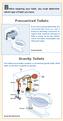 Before repairing your toilet, you must determine which type of toilet you have. Pressurized Toilets If you have a pressurized toilet, it is recommended that you call a licensed plumbing contractor to repair
Leak Detector Guide. Your Guide to Home Water Conservation
 E v e r y D r o p C o u n t s! Leak Detector Guide Your Guide to Home Water Conservation M i a m i - D a d e W a t e r a n d S e w e r D e p a r t m e n t A High Bill Usually Means a Leak Did you know
San Francisco Public Utilities Commission
 San Francisco Public Utilities Commission Wholesale Customer Water Conservation Potential Technical Report Prepared by: URS Corporation Oakland, California Maddaus Water Management Alamo, California Jordan
How to Locate and Stop Costly Water Leaks
 Chesterfield County, Virginia How to Locate and Stop Costly Water Leaks Water leaks are a waste of a valuable resource: pure, clean drinking water. An undetected leak may result in a costly utility bill.
SEATTLE HOME WATER CONSERVATION STUDY
 SEATTLE HOME WATER CONSERVATION STUDY THE IMPACTS OF HIGH EFFICIENCY PLUMBING FIXTURE RETROFITS IN SINGLE-FAMILY HOMES December 2000 Submitted to: Seattle Public Utilities and The United States Environmental
MATERIAL FAILURES OF PLASTIC PLUMBING FIXTURES AND PIPING
 MATERIAL FAILURES OF PLASTIC PLUMBING FIXTURES AND PIPING Donald Waltz, Esquire Cozen O Connor Suite 1500, 222 South Riverside Plaza Chicago, IL 60606 (312) 382-3100 [email protected] Atlanta Charlotte
STATE OF ILLINOIS. Issued by. Department of Registration and Education. NOBLE J. PUFFER, Director. State Water Survey Division
 Circular No. 33 1951 STATE OF ILLINOIS Issued by Department of Registration and Education NOBLE J. PUFFER, Director State Water Survey Division A. M. BUSWELL, Chief Urbana, Illinois REPRINTED FROM AND
THE PEOPLE OF THE CITY OF LOS ANGELES DO ORDAIN AS FOLLOWS: Section 1. Article V of Chapter XII of the Los Angeles Municipal Code is added to read:
 ORDINANCE NO. 1,;...8_U_8_2_2_ An ordinance adding Article V to Chapter XII, and amending Section 94.103.1.2.9, of the Los Angeles Municipal Code establishing water efficiency requirements for new development
Property Tax Reductions to Diminish as Housing Market Improves
 Property Tax Reductions to Diminish as Housing Market Improves MAC TAYLOR LEGISLATIVE ANALYST MAY 5, 2014 Executive Summary Property Tax Reductions for Millions of Properties Due to Real Estate Crisis.
POLLUTION PREVENTION FACT SHEET: AUTOMOBILE MAINTENANCE
 POLLUTION PREVENTION FACT SHEET: AUTOMOBILE MAINTENANCE Description This pollution prevention measure involves creating a program of targeted outreach and training for businesses involved in automobile
When it rains, it stores! [email protected]. Rainwater Harvesting in Australia
 When it rains, it stores! [email protected] Rainwater Harvesting in Australia Australia Overview Geography: Tropical in the north, temperate in the south, desert in the center. Great Dividing Range
Shaw Limited Lifetime Stain Warranty
 Shaw Limited Lifetime Stain Warranty Who is covered This warranty protects you, the original purchaser, if you have purchased a Shaw Industries carpet covered under this warranty for your own residential
How To Fix A Leaky Water Heater
 Preventing water damage caused by plumbing fixtures Thousands of home insurance claims are filed every year. Some losses are major, others aren t, but they re always inconvenient and usually avoidable!
City of Modesto WATER-USE HOME SURVEY
 City of Modesto WATER-USE HOME SURVEY Water is a precious natural resource important to our health, community and the quality of life. Because water is precious, it is essential to conserve and use water
How To Get Water In Los Angelesa
 LOS ANGELES COUNTY DEPARTMENT OF PUBLIC HEALTH ENVIRONMENTAL HEALTH Bureau of Environmental Protection Drinking Water Program 5050 Commerce Drive, Baldwin Park, CA 91706 (626) 430-5420 Fax (626) 813-3016
FLUSHMATE FLUSHMATE FLUSHOMETER - TANK SYSTEM. Owner s Service Manual 503 and 504 Series
 Owner s Service Manual 503 and 504 Series FLUSHMATE FLUSHOMETER - TANK SYSTEM 503 504 FLUSHMATE A Division of Sloan Valve Company 30075 Research Drive New Hudson, MI 48165 800-533-3460 248-446-5300 http://www.flushmate.com
Innovative Solutions in the Water Industry: Leak Detection
 Maureen Duffy 856-309-4546 [email protected] Innovative Solutions in the Water Industry: Leak Detection Introduction Meeting current water demand and supplying water for future generations is a
In-Home Supportive Services:
 In-Home Supportive Services: Since Recent Legislation Changes the Way Counties Will Administer the Program, The Department of Social Services Needs to Monitor Service Delivery September 1999 96036 The
A High Bill Usually Means a Leak
 A High Bill Usually Means a Leak Did you know that approximately 50 percent of all households have some kind of plumbing leak? Most of these leaks are due to worn out washers, flappers or faulty tank valves,
Technical Support for ENERGY STAR Windows Version 6.0 Specification Revision. Gregory K. Homan, Christian Kohler, Emily Zachery* and Dariush Arasteh
 Technical Support for ENERGY STAR Windows Version 6.0 Specification Revision Gregory K. Homan, Christian Kohler, Emily Zachery* and Dariush Arasteh Lawrence Berkeley National Laboratory 1 Cyclotron Road
Introduction. Kitchens
 Chapter 10 Water Fixtures and Conservation Introduction Responsible use of fresh water means WATER AT-A-GLANCE ensuring that all water-consuming fixtures Introduction in public areas are operating properly,
LEAK DETECTION GUIDE
 LEAK DETECTION GUIDE Your Guide to Home Water Conservation CITY OF BELLEVUE UTILITIES WATER & SEWER DEPARTMENTS LEAK DETECTION GUIDE PAGE: 1 WHERE TO START If you receive a high water bill, or think there
Selling Residential Solar A Market Based Approach
 http://dialogue.usaee.org/index.php/component/content/article/28 dialogue articles/v17 no3/104 selling residential solara market based approach United States Association for Energy Economics (USAEE) DIALOGUE,
Common Causes of High Water Bills
 Common Causes of High Water Bills An unusually high water bill is most often caused by a leak or change in water use. Some common causes of high water bills include: A leaking toilet, or a toilet that
If You Have a Flushmate III System in Your Toilet, You May Be Eligible for Cash Payments from a Proposed $18 Million Settlement
 UNITED STATES DISTRICT COURT FOR THE CENTRAL DISTRICT OF CALIFORNIA If You Have a Flushmate III System in Your Toilet, You May Be Eligible for Cash Payments from a Proposed $18 Million Settlement A Federal
MEMORANDUM. Date: September 28, 2012. Francie Stefan, City of Santa Monica Peter James, City of Santa Monica Liz Bar-El, City of Santa Monica
 MEMORANDUM Date: September 28, 2012 To: Francie Stefan, City of Santa Monica Peter James, City of Santa Monica Liz Bar-El, City of Santa Monica From: Dena Belzer, Strategic Economics Amanda Gehrke, Strategic
Section 5.900 - Emergency Water Shortage Regulations and Staged Water Use Reduction Plan Section 5.905 - Scope and Purpose
 Section 5.900 - Emergency Water Shortage Regulations and Staged Water Use Reduction Plan Section 5.900 of Chapter 5 of the District Code shall be known and cited as the Heritage Ranch Community Services
PUBLIC DISCLOSURE COMMUNITY REINVESTMENT ACT PERFORMANCE EVALUATION
 Comptroller of the Currency Administrator of National Banks Wholesale Institution PUBLIC DISCLOSURE July 19, 1999 COMMUNITY REINVESTMENT ACT PERFORMANCE EVALUATION U.S. Trust Company, N.A. Charter Number
North San Jose Neighborhoods Planning Taskforce
 North San Jose Neighborhoods Planning Taskforce Key Topics Water Supply Flooding Related Topics Storm Water Storm Sewer Sanitary Sewer Water Conservation Treatment Plant Water Background Responsible Agencies
Shaw Premium Touch Limited Life of the Home Cushion Warranty
 Shaw Premium Touch Limited Life of the Home Cushion Warranty Who is covered This warranty protects you, the original purchaser, if you have purchased a Shaw Premium Touch cushion for your own residential
AMOUNT New Account Deposit $50.00 Service Delinquent $10.00 Delinquency Notification $15.00 NSF Check processing $20.00
 RIVERGROVE WATER DISTRICT FREQUENTLY ASKED QUESTIONS 1. WHERE DOES THE WATER COME FROM? Rivergrove Water District s water source is groundwater and comes from wells that we have drilled into the Columbia
ELECTRIC ENERGY EFFICIENCY POTENTIAL FOR PENNSYLVANIA
 GDS Associates, Inc. Engineers and Consultants ELECTRIC ENERGY EFFICIENCY POTENTIAL FOR PENNSYLVANIA Final Report Prepared for: PENNSYLVANIA PUBLIC UTILITY COMMISSION May 10, 2012 Prepared by GDS Associates
Simplified Service Plan
 Plan Number 1624- A Cross Beam Drive Charlotte, NC 28217 (704) 847-1198 www.charlottemechanical.com Simplified Service Plan Plumbing System PARTS, LABOR & EMERGENCY REPAIR Effective Date: Approved By:
California Energy Commission 2015 Accomplishments
 California Energy Commission 2015 Accomplishments Responding to California s Drought Responded to the state's historic drought and Governor Edmund G. Brown Jr. s Executive Order B-29-15 by approving new
Blue Shield Medicare Supplement plans
 Blue Shield Medicare Supplement plans Summary of benefits and provisions Benefit Plans A, C, D, F, High Deductible F, K, and N Last updated: November 2014 Blue Shield of California rates effective: August
Internship Opportunities Compiled by: Michelle Rippy May 2015
 Internship Opportunities Compiled by: Michelle Rippy May 2015 Federal Level Internships Bureau of Alcohol, Tobacco, Firearms and Explosives Internship o Pathways Internship Program: http://www.atf.gov/content/careers/careers-at-
6. Principles of effective plumbing systems
 6. Principles of effective plumbing systems This chapter summarizes the aims and objectives of a good local plumbing system that is, the drinking-water supply that serves a building and the system for
The Impacts of High Efficiency Toilets on Plumbing Drainlines and Sewers
 The Impacts of High Efficiency Toilets on Plumbing Drainlines and Sewers July 1, 2011 This article addresses key questions and concerns as well as misperceptions about the impacts of reduced water use
FINDINGS FROM THE GRADUATE STUDENT SUPPORT SURVEY: TRENDS IN THE COMPARABILITY OF GRADUATE STUDENT STIPENDS
 UNIVERSITY OF CALIFORNIA OFFICE OF THE PRESIDENT FINDINGS FROM THE GRADUATE STUDENT SUPPORT SURVEY: TRENDS IN THE COMPARABILITY OF GRADUATE STUDENT STIPENDS BASED ON FINDINGS FROM THE 2010 GRADUATE STUDENT
Water Efficiency Self-Assessment Guide from
 Water Efficiency Self-Assessment Guide from 1 Water Efficiency Self-Assessment Guide from Anglian Water Introduction More than 97% of the water in the world is too salty to drink, 2% is locked in glaciers
Energy Efficiency Finance in Pennsylvania
 Energy Efficiency Finance in Pennsylvania Summary: Propel increases in non-utility delivered demand-side energy efficiency by providing education, access and funding for innovative energy efficiency finance
Estimated Water Savings
 Easy Plumbing Fixes Estimated Water Savings A family of 4 could save: 200 gpd by fixing toilet leaks 20 gpd by fixing faucet leaks 100 gpd by installing low-flow showerheads 40 gpd using faucet aerators
3 3 3 3 50% 75% 3 3. 2015 Outline of Medicare Supplement Coverage Cover Page (1 of 2) Plans A, F & N
 Administrative Office: P.O. Box 906, Oxnard, CA 90-906 Toll Free Telephone Number: -888--98 Benefit Chart of Medicare Supplement Plans Sold for Effective Dates On or After June, 00 This chart shows the
Report on Urban Household Water Use Pilot Survey in Beijing and Tianjin
 Report on Urban Household Water Use Pilot Survey in Beijing and Tianjin 1. Summary 2. Introduction 3. Current State of Knowledge 4. Study Area 5. Methodology 6. Interim Results 7. Area for Future Research
SWAN. The Value of Online Water Network Monitoring SUMMARY
 SWAN S m a r t W a t e r N e t w o r k s F o r u m The Value of Online Water Network Monitoring SUMMARY Online water monitoring is the use of data transmitted from network elements, meters and sensors
RESIDENTIAL WATER DEMAND IN LAS VEGAS, NEVADA
 RESIDENTIAL WATER DEMAND IN LAS VEGAS, NEVADA Christa Brelsford, Santa Fe Institute 3/31/2015 population area cartogram based on 1996 population population area cartogram based on 2007 population Atlanta,
Sample Customer 123 Conservation Way TAMPA FL 33626 Tracking Number: 000675309
 Thank you for completing the Online Home Energy Audit. Based on the answers that you provided in the questionnaire, the following is a complete analysis of your household's energy consumption. We have
Storm Drain System Operation and Maintenance
 Santa Clara Valley Urban Runoff Pollution Prevention Program PUBLIC AGENCY ACTIVITIES Performance Standard and Supporting Documents for Storm Drain System Operation and Maintenance December 19, 1996 March
Is There a Shortage of Dental Hygienists and Assistants in California?
 Is There a Shortage of Dental Hygienists and Assistants in California? UCLA Center for Health Policy Research November 2005 Findings From the 2003 California Dental Survey Nadereh Pourat, PhD Dylan Roby,
SEPTIC SYSTEMS. 1. Building sewer connects the building plumbing to the septic tank.
 SEPTIC SYSTEMS Who Has A Septic System? Approximately 30 percent of Connecticut s population is served by on-site subsurface sewage disposal systems (a.k.a. septic systems). This means a large percentage
Small Business Health Options Program (SHOP) Health Insurance Plans
 Small Business Health Options Program (SHOP) Health Insurance Plans Aug. 1, 2013 p About Covered California Covered California is charged with creating a new insurance marketplace in which individuals
Metering of Individual Units
 Metering of Irrigation Use and Individual Dwelling Units at Apartments, Condominiums, Townhouses, Mobile-home Parks, and Commercial Facilities From a water management perspective it makes sense to meter
Natural Gas End-use Report
 San Diego County Greenhouse Gas Inventory An Analysis of Regional Emissions and Strategies to Achieve AB 32 Targets Natural Gas End-use Report Scott J. Anders Director, Energy Policy Initiatives Center
Section 5: Conserve to Enhance Program Goals What is Conserve to Enhance All About?
 Section 5: Conserve to Enhance Program Goals What is Conserve to Enhance All About? Conserve to Enhance (C2E) was originally conceptualized as an approach to giving the environment a seat at the table
MARICOPA COUNTY ENVIRONMENTAL HEALTH CODE
 MARICOPA COUNTY ENVIRONMENTAL HEALTH CODE CHAPTER II SEWAGE AND WASTES SECTION 6 CHEMICAL TOILETS, PORTABLE RESTROOM UNITS, PORTABLE WASTE HOLDING TANKS REGULATION 1. Definitions a. "Chemical toilet" means