
Public / private mix in health care financing
|
|
|
- Allan Phillips
- 10 years ago
- Views:
Transcription
1 Public / private mix in health care financing Dominique Polton Director of strategy, research and statistics National Health Insurance, France Couverture
2 Public / private mix in health care financing 1. The rationale for increasing private financing in health care systems 2. Forms of private health care financing 2.1. Out-of-pocket expenditure 2.2. Health insurance Pros and cons of different schemes of public / private mix in health insurance Issues raised and possible solutions 2.3. Funding of capital investment Conclusion
3 Public / private mix in health care financing 1. The rationale for increasing private financing in health care systems 2. Forms of private health care financing 2.1. Out-of-pocket expenditure 2.2. Health insurance Pros and cons of different schemes of public / private mix in health insurance Issues raised and possible solutions 2.3. Funding of capital investment Conclusion

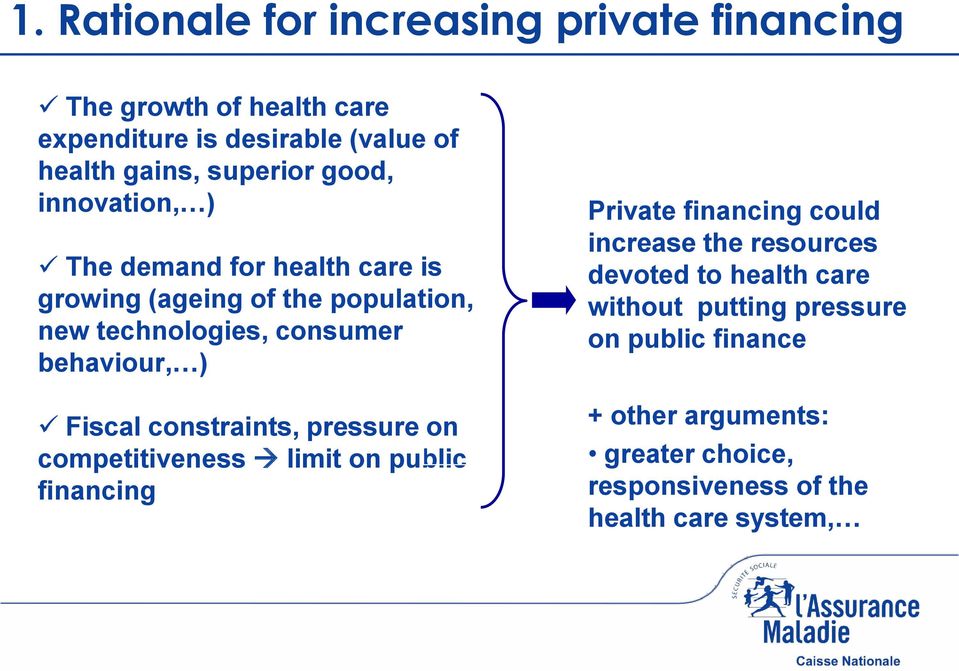
4 1. Rationale for increasing private financing The growth of health care expenditure is desirable (value of health gains, superior good, innovation, ) The demand for health care is growing (ageing of the population, new technologies, consumer behaviour, ) Fiscal constraints, pressure on competitiveness limit on public financing Private financing could increase the resources devoted to health care without putting pressure on public finance + other arguments: greater choice, responsiveness of the health care system,
5 Public / private mix in health care financing 1. The rationale for increasing private financing in health care systems 2. Forms of private health care financing 2.1. Out-of-pocket expenditure 2.2. Health insurance Pros and cons of different schemes of public / private mix in health insurance Issues raised and possible solutions 2.3. Funding of capital investment Conclusion
6 2. Forms of private health care financing Forms of private health care financing Funding of current health expenditure Funding of capital investment Out-of-pocket expenditures Private health insurance Private finance initiative

7 Public / private mix in health care financing 1. The rationale for increasing private financing in health care systems 2. Forms of private health care financing 2.1. Out-of-pocket expenditure 2.2. Health insurance Pros and cons of different schemes of public / private mix in health insurance Issues raised and possible solutions 2.3. Funding of capital investment Conclusion

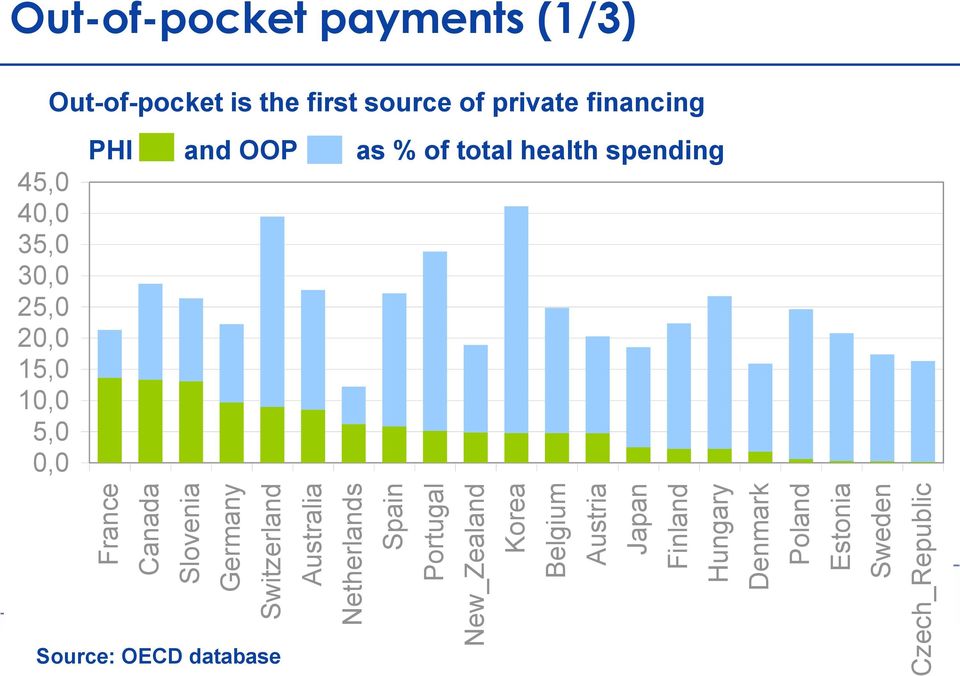
8 France Canada Slovenia Germany Switzerland Australia Netherlands Spain Portugal New_Zealand Korea Belgium Austria Japan Finland Hungary Denmark Poland Estonia Sweden Czech_Republic Out-of-pocket payments (1/3) Out-of-pocket is the first source of private financing 45,0 40,0 35,0 30,0 25,0 20,0 15,0 10,0 5,0 0,0 PHI and OOP as % of total health spending Source: OECD database
9 Out-of-pocket payments (2/3) Given the distribution of health care expenditure, there is a limit to the level of OOP: a large part of the costs is concentrated on a small proportion of individuals who could not pay their health care bills from their own resources (this is precisely why social insurance exists). Increasing out-of-pocket payments has consequences both for equity It increases vertical inequity (fairness of contribution) It can hinder access to care (which is again why public insurance exists) and efficiency They affect in the same way low value care and high value care They are often higher on less expensive care, which is contradictory with the wish of Gouvernments to move care from hospital to ambulatory care (wrong price signal given to the patient)
10 Out-of-pocket payments (3/3) What could be a «rational» increase of OOP payments? Either design them in a way that enhances efficiency, i.e. differentiated according to the value of care: Examples: brand drugs versus generics (reference price in Germany), choice of a referring doctor (France since 2005), but then they do not provide additional funding (there would be no user charges in a system which is totally cost-effective), Or finance services that are explicitely excluded from the statutory benefits package Which dividing line? Cf below
11 Public / private mix in health care financing 1. The rationale for increasing private financing in health care systems 2. Forms of private health care financing 2.1. Out-of-pocket expenditure 2.2. Health insurance Pros and cons of different schemes of public / private mix in health insurance Issues raised and possible solutions 2.3. Funding of capital investment Conclusion

12 Coverage by PHI Source: Thomson et al., 2009

13 in commercial insurance in 2006 ( in 2001) Coverage by PHI An heterogeneous situation Ireland Source: OECD, 2004 France - % covered by PHI % % (1) (1) Including free meanstested complementary coverage (7%) Source: Thomson et al., 2009 A rapid growth of coverage in some countries, but not the case everywhere

14 Public / private mix in health care financing 1. The rationale for increasing private financing in health care systems 2. Forms of private health care financing 2.1. Out-of-pocket expenditure 2.2. Health insurance Pros and cons of different schemes of public / private mix in health insurance Issues raised and possible solutions 2.3. Funding of capital investment Conclusion

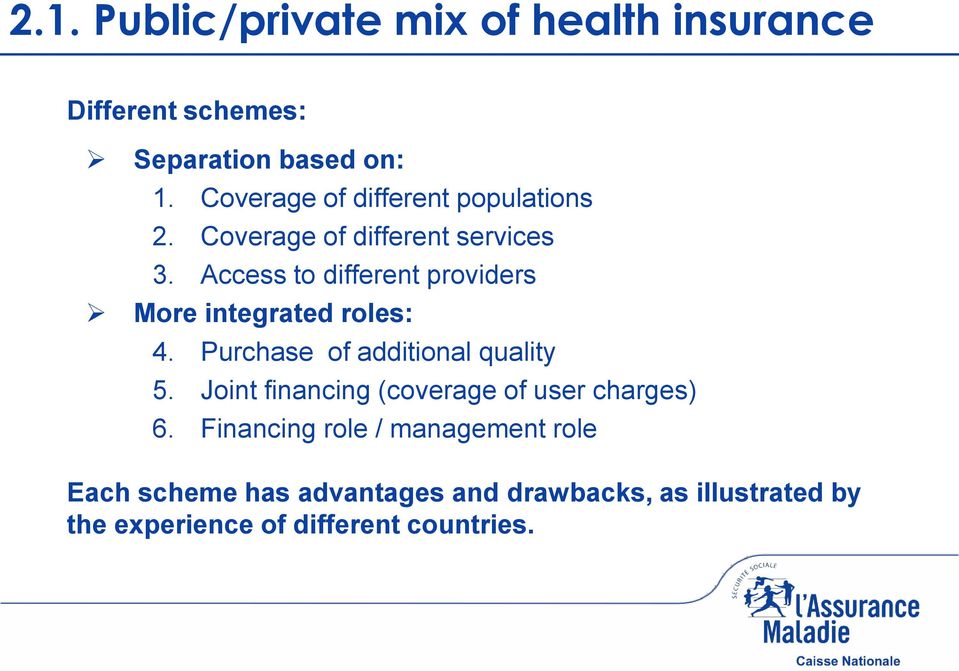
15 2.1. Public/private mix of health insurance Different schemes: Separation based on: 1. Coverage of different populations 2. Coverage of different services 3. Access to different providers More integrated roles: 4. Purchase of additional quality 5. Joint financing (coverage of user charges) 6. Financing role / management role Each scheme has advantages and drawbacks, as illustrated by the experience of different countries.
16 Scheme 1: coverage of different populations (1/2) Public insurance Private insurance Population 1 Population 2 Same basket of goods & services Same providers US Germany: 11% of the population NL 2nd pillar before 2006 reform: >30% of the population Ireland before the extension of entitlements to public hospital care: 15%

17 Scheme 1: coverage of different populations (2/2) The population covered by private insurance is (generally) an affluent minority public financing is directed towards those who are more in need of social protection But Fairness of the financial contribution Loss of contributions of high earners for the public system Less support for the public system from upper-income individuals? If the providers have higher tariffs (e.g. Germany) or additional payments (e.g. Ireland) incentives to pay more attention to privately insured patients A scheme of the past?

18 Scheme 2: coverage of different health care services and goods (1/2) Public insurance Private insurance Population Goods & services 1 Goods & services 2 Same providers (or different because of the nature of services) e.g. : US : Medigap NL 3rd pillar, dental care for adults, patient transport, physiotherapy France : single room in private hospitals
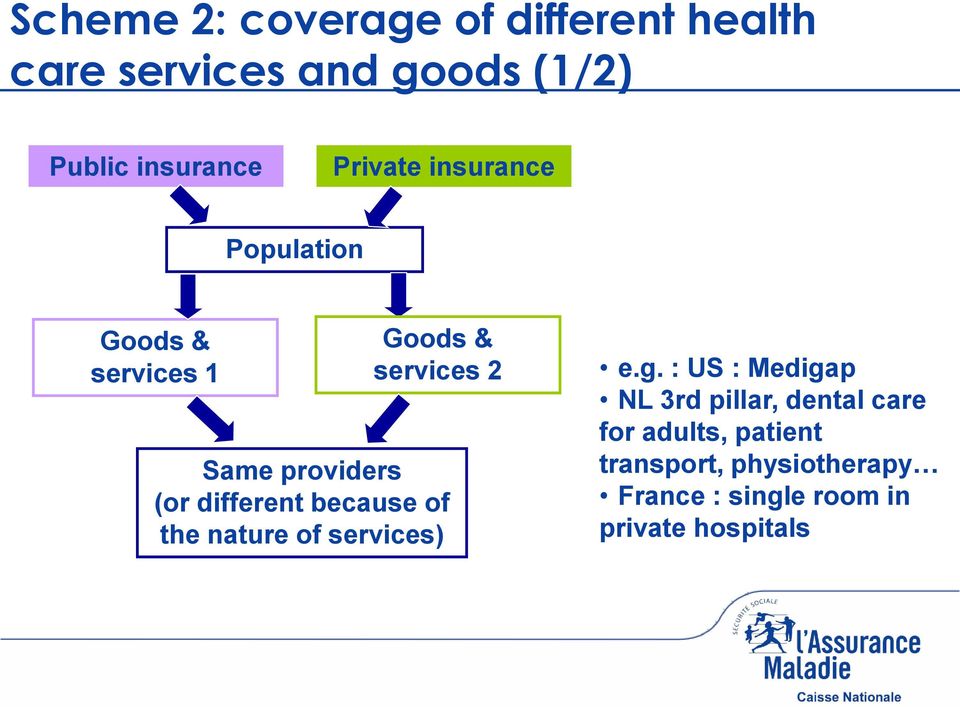
19 Scheme 2: coverage of different health care services and goods (2/2) May appear as a more rational approach, allowing explicit and democratic choices on the boundaries of the benefit package that should be publicly financed But How to define the dividing line? Necessary care e.g. Canada : Physician & hospital care versus other services: drugs, physiotherapist, but technological change have shifted services out of hospital Care showing no effectiveness or low effectiveness e.g. France, delisting of drugs Minor risk (in terms of severity of disease) e.g. dental care in several countries (but does it help in terms of sustainability if the dynamic of costs is on chronic and severe diseases e.g. France) Care considered too expensive for the value they bring: e.g. UK: cancer drugs, reimbursement by PHI (BUPA, Axa PPP, ) socially acceptable?

20 Scheme 3: access to different providers (1/2) Public insurance Private insurance Same population Same basket of goods & services e.g. : UK, Ireland : hospital care in private hospitals Provider 1 Provider 2 Voir aussi Italie, Espagne pays scandinaves
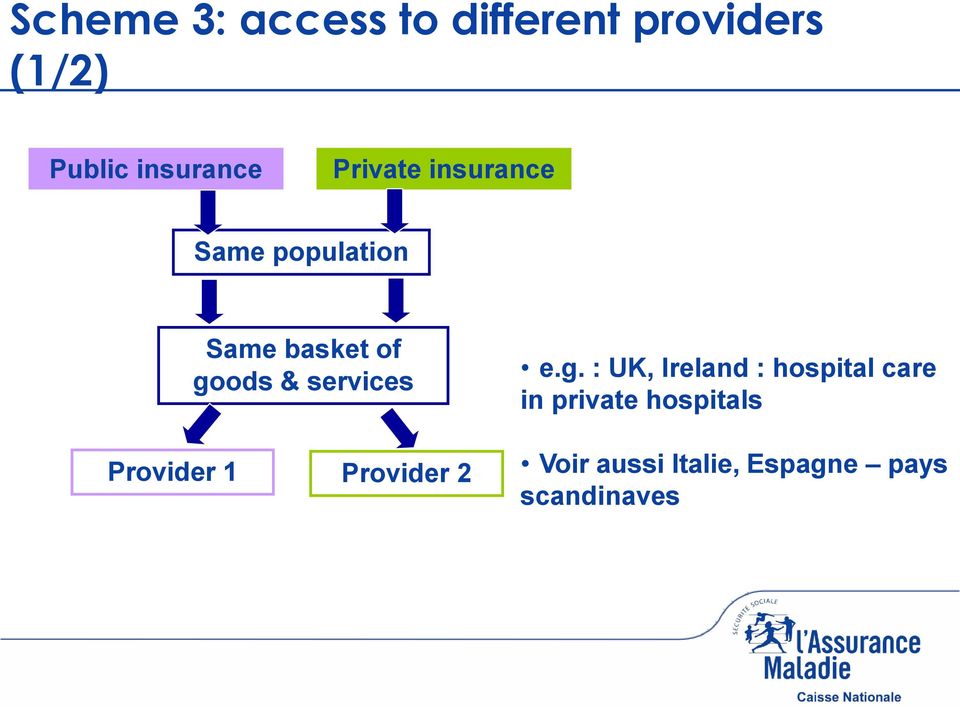
21 Scheme 3: access to different providers (2/2) Provides more choice and may lead to a reduction in waiting times in the public health care system since people with PHI are treated outside. But If physicians are allowed to work both in public and private facilities, which is often the case, And if they are better paid in the private sector than in the public sector (which is also often the case), Then they have incentives to develop their private activity rather than invest in the public sector, and possibly to treat their patients better + competition to attract skilled staff
22 Scheme 4: financing additional quality (1/2) Public insurance Private insurance Same population Same basket of goods & services Private insurance allows to bypass waiting lists and get more attention (private bed, consultant treatment, ) Same providers UK, Ireland, Demmark, Spain, France to a lesser extent
23 Scheme 4: financing additional quality (2/2) Provides flexibility for people who are dissatisfied with the public health care system (safety valve reducing the pressure) But Inequity of treatment Same potential perverse consequences than the previous scheme (shared resources between public and private sector): The incentives created may exacerbate public-sector waiting lists instead of reducing them Often indirect subsidies (e.g. in Ireland Insurers have a financial incentive to have their members treated in private beds in public hospitals rather than in private hospitals because until now they did not pay the full economic cost of private beds in public hospitals).
24 Scheme 4: joint financing (copayments) (1/2) Public insurance Private insurance Same population Same basket of goods & services Same providers Public insurance covers a % of the tariff or up to a certain amount Private insurance covers user charges e.g. : France copaymets are the rule - 94% of the population is covered by VHI
25 Scheme 4: joint financing (copayments) (2/2) Might be a way to spread the financial burden with a second layer of coverage (partial solidarity) and maintains a common interest in the quality of the public system But Problems of moral hazard & conflicts of interest between public and private insurance neutralisation by PHI of financial incentives for patients & providers (e.g. copayments, billing above the schedule ) regulation: e.g. banning private insurance for these copayments (Australia), contrats responsables in France Equity & access to care subsidy for the low income population (e.g. CMU, ACS in France) with problems of non take up and efficiency (management costs)
26 Scheme 6: financing vs management (1/2) Public insurance = financing Same population Same basket of goods & services Private insurers = management For some populations: US Medicare / Medicaid: enrollment in managed care organisations For the entire population: NL: 2006 reform Same providers
27 Scheme 6: financing vs management (1/2) This scheme might not be classified in «private financing» since the financing stays publicly organised The exemple of the Netherlands shows that Risk selection by health insurers for basic health insurance can be avoided by a careful design, but the risk adjustment scheme needs constant refining to eliminate perverse incentives for insurers and to ensure fair competition. Concerns have also been expressed over the use of voluntary health insurance (VHI) as a tool to select individuals with expected higher profitability levels (which raises the issue of basic and complementary insurance) The competing insurers have been able to make efficiency gains in some areas (e.g. generic drug prices) and are increasingly putting pressure on hospitals and engaging in selective contracting with health care providers (results are yet to see)
28 Public / private mix in health care financing 1. The rationale for increasing private financing in health care systems 2. Forms of private health care financing 2.1. Out-of-pocket expenditure 2.2. Health insurance Pros and cons of different schemes of public / private mix in health insurance Issues raised and possible solutions 2.3. Funding of capital investment Conclusion
29 3. Issues raised and possible solutions (1/4) Issues Does private finance simply augment the resources devoted to health care, or does it drain resources from the publicly financed system? Is it a safety valve that reduces pressure on the public system and helps meeting demand, or does it leverage an increase in public expenditure rather than complementing / substituting for it? Does an increased role for private finance erode political support for the publicly financed system? How to set the dividing line between publicly and privately financed health services? VHI is often subsidised by tax deductions for companies. Would the money be better spent in direct resources for the public health care system?
30 3. Issues raised and possible solutions (2/4) Efficiency issues Avoid risk selection (as a source of inefficiency) Response = Regulation of PHI, e.g. NL, Ireland: Community rating, open enrolment and lifetime cover, risk equalization scheme Consider the efficiency of subsidies (explicit or indirect) to PHI Direct (tax relief) but also indirect subsidies (e.g. public funding of coverage of low income people in France, payment of a fraction of full economic costs (Ireland), Response: billing of full economic costs, regulation of management costs,
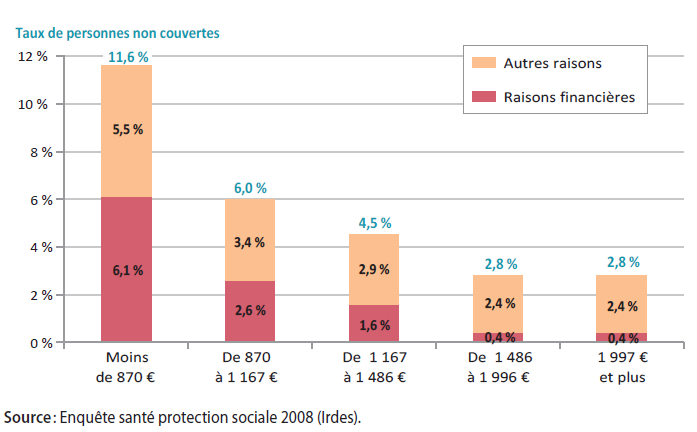
31 3. Issues raised and possible solutions (3/4) Equity issues Ireland Source: Sarah Thomson and Elias Mossialos, Private health insurance in the European Union, 2009 France PHI non take-up by social class
32 3. Issues raised and possible solutions (4/4) Equity issues Avoid risk selection (as a source of inequity in access to care) Réponse :Regulation of PHI, e.g. NL, Ireland: Community rating, open enrolment and lifetime cover, risk equalization scheme Debate in France : generalisation of complementary health insurance?
33 Public / private mix in health care financing 1. The rationale for increasing private financing in health care systems 2. Forms of private health care financing 2.1. Out-of-pocket expenditure 2.2. Health insurance Pros and cons of different schemes of public / private mix in health insurance Issues raised and possible solutions 2.3. Funding of capital investment Conclusion
34 2.3 Funding of capital investment Private finance initiative: the least we can say is that there is no unanimous opinion. The world of PFI attracts an almost religious fervour with passionate advocates and equally vociferous detractors. (National Audit Office, 2009). Report of the National Audit Office (February 2003) : a positive view Most construction work under the Private Finance Initiative (PFI) is being delivered on time and at the cost expected by the public sector. Central government has generally obtained a much higher degree of price certainty and timely delivery of good quality built assets, compared to previous conventional government building projects.
35 2.3 Funding of capital investment But the recent reports are less positive. Report of the Treasury select committee (August 2011) The use of PFI has the effect of increasing the cost of finance for public investments relative to what would be available to the government if it borrowed on its own account. Government has always been able to obtain cheaper funding than private providers of project finance but the difference between direct government funding and the cost of this finance has increased significantly since the financial crisis. The substantial increase in private finance costs means that (this) method is now extremely inefficient.( ) PFI will only provide value for money if this differential in the cost of finance, which has significantly increased, is outweighed by savings and efficiencies during the life of a PFI project. Evidence we have seen suggests that the high cost of finance in PFI has not been offset by operational efficiencies.
36 2.3 Funding of capital investment Report of the National Audit Office (August 2011) There has not been a systematic value for money evaluation of operational PFI projects by departments. There is, therefore, insufficient data to demonstrate whether the use of private finance has led to better or worse value for money than other forms of procurement. In France, an experience of PPP to build a new hospital near Paris is now considered as a public scandal (delays, defects, additional costs, ) Issue of governance and negociation skills?
37 Public / private mix in health care financing 1. The rationale for increasing private financing in health care systems 2. Forms of private health care financing 2.1. Out-of-pocket expenditure 2.2. Health insurance Pros and cons of different schemes of public / private mix in health insurance Issues raised and possible solutions 2.3. Funding of capital investment Conclusion
38 To conclude: The rationale for more private financing may look good, but in practice the international experience shows that the benefits of raising additional funds (in a field in which there is probably a willingness to pay) may be offset by adverse impacts on the equity and efficiency of the system. Collective choices, management of the performance of the system to get the best value for money and public financing: this would be the most rational thing to do in theory, but it is theory! In practice our systems are mixed, and the experience shows that a careful design of the relationship between public and private finance is necessary. In this area there is a need for more research, empirical work and benchmarking.
Public and private health insurance: where to mark to boundaries? June 16, 2009 Kranjska Gora, Slovenia Valérie Paris - OECD
 Public and private health insurance: where to mark to boundaries? June 16, 2009 Kranjska Gora, Slovenia Valérie Paris - OECD 1 Outline of the presentation Respective roles of public and private funding
Private health insurance: second-best or second-worst solution? Sarah Thomson EHMA VHI MASTERCLASS Milan, 27 June 2013
 Private health insurance: second-best or second-worst solution? Sarah Thomson EHMA VHI MASTERCLASS Milan, 27 June 2013 VHI as a policy tool Policy goals Research findings Policy design Regulation Over
Waiting times and other barriers to health care access
 Dr. Frank Niehaus Wissenschaftliches Institut der PKV (Scientific Research Institute of the Association of German Private Health Insurers) Waiting times and other barriers to health care access 31.8 %
Voluntary health insurance and health care reforms
 Voluntary health insurance and health care reforms Sarah Thomson Senior Research Fellow, European Observatory Deputy Director, LSE Health IMF conference, Paris, 21 st June 2011 Health financing policy
Social insurance, private insurance and social protection. The example of health care systems in some OECD countries
 Social insurance, private insurance and social protection. The example of health care systems in some OECD countries References OECD publications on Health care Swiss Re publications Sigma No 6/2007 on
Private Health Insurance in OECD Countries
 Private Health Insurance in OECD Countries Health Insurance for an Expanded Europe: New Public-Private Options The Prague Symposium 2004 Nicole Tapay(Novartis)* *Based on work performed under OECD private
POLICY BRIEF. Private Health Insurance in OECD Countries. Introduction. Organisation for Economic Co-operation and Development
 POLICY BRIEF Private Health Insurance in OECD Countries September 04 What is the role of private health insurance in OECD countries? Does private health insurance improve access to care and cover? Does
Private Health insurance in the OECD
 Private Health insurance in the OECD Benefits and costs for individuals and health systems Francesca Colombo, OECD AES, Madrid, 26-28 May 2003 http://www.oecd.org/health 1 Outline Background, method Overview
Private Health insurance in the OECD
 Private Health insurance in the OECD Benefits and costs for individuals and health systems Francesca Colombo, OECD AES, Madrid, 26-28 May 2004 http://www.oecd.org/health 1 Outline Q Background, method
http://mig.tu-berlin.de
 Voluntary health insurance in Europe a structured introduction into objectives and status-quo Reinhard Busse, Prof. Dr. med. MPH FFPH Dept. Health Care Management, Technische Universität Berlin (WHO Collaborating
VOLUNTARY HEALTH INSURANCE AS A METHOD OF HEALTH CARE FINANCING IN EUROPEAN COUNTRIES
 VOLUNTARY HEALTH INSURANCE AS A METHOD OF HEALTH CARE FINANCING IN EUROPEAN COUNTRIES Marta Borda Department of Insurance, Wroclaw University of Economics Komandorska St. No. 118/120, 53-345 Wroclaw, Poland
Health Care a Public or Private Good?
 Health Care a Public or Private Good? Keith Schenone December 09, 2012 Economics & Institutions MGMT 7730-SIK Thesis Health care should be treated as a public good because it is not an ordinary commodity
PUBLIC VS. PRIVATE HEALTH CARE IN CANADA. Norma Kozhaya, Ph.D Economist, Montreal economic Institute CPBI, Winnipeg June 15, 2007
 PUBLIC VS. PRIVATE HEALTH CARE IN CANADA Norma Kozhaya, Ph.D Economist, Montreal economic Institute CPBI, Winnipeg June 15, 2007 Possible private contribution Possible private contribution in the health
Private Health Insurance in OECD Countries
 1 Private Health Insurance in OECD Countries Francesca Colombo & Nicole Tapay http://www.oecd.org/health click on OECD Health Project, then on Private Health Insurance Purpose of the Study Assess the role
Expenditure and Outputs in the Irish Health System: A Cross Country Comparison
 Expenditure and Outputs in the Irish Health System: A Cross Country Comparison Paul Redmond Overview This document analyzes expenditure and outputs in the Irish health system and compares Ireland to other
What are the equity, efficiency, cost containment and choice implications of private health-care funding in western Europe?
 What are the equity, efficiency, cost containment and choice implications of private health-care funding in ABSTRACT This is a Health Evidence Network (HEN) synthesis report on private health-care funding
Health Care Systems: Efficiency and Policy Settings
 Health Care Systems: Efficiency and Policy Settings Summary in English People in OECD countries are healthier than ever before, as shown by longer life expectancy and lower mortality for diseases such
Health Systems: Type, Coverage and Financing Mechanisms
 Health Systems: Type, Coverage and Mechanisms Austria Belgium Bulgaria (2007) Czech Republic Denmark (2007) Estonia (2008). Supplementary private health Complementary voluntary and private health Public
INEQUALITIES IN HEALTH CARE SERVICES UTILISATION IN OECD COUNTRIES
 INEQUALITIES IN HEALTH CARE SERVICES UTILISATION IN OECD COUNTRIES Marion Devaux, OECD Health Division 2014 QICSS International Conference on Social Policy and Health Inequalities, Montreal, 9-May-2014
TOWARDS PUBLIC PROCUREMENT KEY PERFORMANCE INDICATORS. Paulo Magina Public Sector Integrity Division
 TOWARDS PUBLIC PROCUREMENT KEY PERFORMANCE INDICATORS Paulo Magina Public Sector Integrity Division 10 th Public Procurement Knowledge Exchange Platform Istanbul, May 2014 The Organization for Economic
PUBLIC & PRIVATE HEALTH CARE IN CANADA
 PUBLIC & PRIVATE HEALTH CARE IN CANADA by Norma Kozhaya, Ph.D. Economist, Montreal Economic Institute before the Canadian Pension & Benefits Institute Winnipeg - June 15, 2007 Possible private contribution
EUROPE 2020 TARGETS: RESEARCH AND DEVELOPMENT
 EUROPE 2020 TARGETS: RESEARCH AND DEVELOPMENT Research, development and innovation are key policy components of the EU strategy for economic growth: Europe 2020. By fostering market take-up of new, innovative
What Are the Incentives to Invest in Education?
 Indicator What Are the Incentives to Invest in Education? On average across 25 OECD countries, the total return (net present value), both private and public, to a man who successfully completes upper secondary
Social health insurance in Belgium. Charlotte Wilgos & Thomas Rousseau
 Social health insurance in Belgium Charlotte Wilgos & Thomas Rousseau Attachés NIHDI Content History Today Values Organizational overview Financial overview Evolutions and challenges Content History Today
HEALTH INSURANCE COVERAGE AND ADVERSE SELECTION
 HEALTH INSURANCE COVERAGE AND ADVERSE SELECTION Philippe Lambert, Sergio Perelman, Pierre Pestieau, Jérôme Schoenmaeckers 229-2010 20 Health Insurance Coverage and Adverse Selection Philippe Lambert, Sergio
(OECD, 2012) Equity and Quality in Education: Supporting Disadvantaged Students and Schools
 (OECD, 2012) Equity and Quality in Education: Supporting Disadvantaged Students and Schools SPOTLIGHT REPORT: NETHERLANDS www.oecd.org/edu/equity This spotlight report draws upon the OECD report Equity
(OECD, 2012) Equity and Quality in Education: Supporting Disadvantaged Students and Schools
 (OECD, 2012) Equity and Quality in Education: Supporting Disadvantaged Students and Schools SPOTLIGHT REPORT: SPAIN www.oecd.org/edu/equity This spotlight report draws upon the OECD report Equity and Quality
relating to household s disposable income. A Gini Coefficient of zero indicates
 Gini Coefficient The Gini Coefficient is a measure of income inequality which is based on data relating to household s disposable income. A Gini Coefficient of zero indicates perfect income equality, whereas
4/17/2015. Health Insurance. The Framework. The importance of health care. the role of government, and reasons for the costs increase
 Health Insurance PhD. Anto Bajo Faculty of Economics and Business, University of Zagreb The Framework The importance of healthcare, the role of government, and reasons for the costs increase Financing
ORGANISATION FOR ECONOMIC CO-OPERATION AND DEVELOPMENT
 2 OECD RECOMMENDATION OF THE COUNCIL ON THE PROTECTION OF CRITICAL INFORMATION INFRASTRUCTURES ORGANISATION FOR ECONOMIC CO-OPERATION AND DEVELOPMENT The OECD is a unique forum where the governments of
Review of R&D Tax Credit. Invitation for Submissions
 Review of R&D Credit invitation for submissions Review of R&D Credit Invitation for Submissions February 2013 Economic and Fiscal Divisions Department of Finance Government Buildings, Upper Merrion Street,
(OECD, 2012) Equity and Quality in Education: Supporting Disadvantaged Students and Schools
 (OECD, 2012) Equity and Quality in Education: Supporting Disadvantaged Students and Schools SPOTLIGHT REPORT: AUSTRIA www.oecd.org/edu/equity This spotlight report draws upon the OECD report Equity and
UTILISATION IN OECD COUNTRIES
 INEQUALITIES IN HEALTH CARE UTILISATION IN OECD COUNTRIES Marion Devaux, OECD Health Division EU Expert Group Meeting on Social Determinants and Health Inequalities, 21-Jan-2013 1 Equity OECD framework
Lecture 7: Policy Design: Health Insurance & Adverse Selection
 Health Insurance Spending & Health Adverse Selection Lecture 7: Policy Design: Health Insurance & Adverse Selection Johannes Spinnewijn London School of Economics Lecture Notes for Ec426 1 / 25 Health
Expenditure on Health Care in the UK: A Review of the Issues
 Expenditure on Health Care in the UK: A Review of the Issues Carol Propper Department of Economics and CMPO, University of Bristol NIERC 25 April 2001 1 Expenditure on health care in the UK: The facts
Health Care in Crisis
 Health Care in Crisis The Economic Imperative for Health Care Reform James Kvaal and Ben Furnas February 19, 2009 1 Center for American Progress Health Care in Crisis U.S. spends twice as much per capita
What Proportion of National Wealth Is Spent on Education?
 Indicator What Proportion of National Wealth Is Spent on Education? In 2008, OECD countries spent 6.1% of their collective GDP on al institutions and this proportion exceeds 7.0% in Chile, Denmark, Iceland,
Preventing fraud and corruption in public procurement
 Preventing fraud and corruption in public procurement CRIM, European Parliament 24 September 2012 Brussels János Bertók Head of division Public Sector Integrity OECD Data on trends in procurement Size
Eliminating Double Taxation through Corporate Integration
 FISCAL FACT Feb. 2015 No. 453 Eliminating Double Taxation through Corporate Integration By Kyle Pomerleau Economist Key Findings The United States tax code places a double-tax on corporate income with
INTERNATIONAL PRICE COMPARISON: THE CYPRIOT EXAMPLE. Athos Tsinontides Health Insurance Organisation
 INTERNATIONAL PRICE COMPARISON: THE CYPRIOT EXAMPLE Athos Tsinontides Health Insurance Organisation CYPRUS CYPRUS Kypros Demographics Population (2004): Gross Domestic Product (GDP): Total Health Expenditure
A European Unemployment Insurance Scheme
 A European Unemployment Insurance Scheme Necessary? Desirable? Optimal? Grégory Claeys, Research Fellow, Bruegel Zsolt Darvas, Senior Fellow, Bruegel Guntram Wolff, Director, Bruegel July, 2014 Key messages
Hong Kong s Health Spending 1989 to 2033
 Hong Kong s Health Spending 1989 to 2033 Gabriel M Leung School of Public Health The University of Hong Kong What are Domestic Health Accounts? Methodology used to determine a territory s health expenditure
What Is the Total Public Spending on Education?
 What Is the Total Public Spending on Education? Indicator On average, OECD countries devote 12.9% of total public expenditure to, but values for individual countries range from less than 10% in the Czech
How many students study abroad and where do they go?
 From: Education at a Glance 2012 Highlights Access the complete publication at: http://dx.doi.org/10.1787/eag_highlights-2012-en How many students study abroad and where do they go? Please cite this chapter
THE ORGANISATION AND FINANCING OF HEALTH CARE SYSTEM IN LATVIA
 THE ORGANISATION AND FINANCING OF HEALTH CARE SYSTEM IN LATVIA Eriks Mikitis Ministry of Health of the Republic of Latvia Department of Health Care Director General facts, financial resources Ministry
Social Insurance: Pooling Risks for a More Inclusive Singapore. Donald Low Vice President, Economic Society of Singapore
 Social Insurance: Pooling Risks for a More Inclusive Singapore Donald Low Vice President, Economic Society of Singapore Outline A more volatile economy, a more unequal society Why does inequality matter?
APPENDIX C HONG KONG S CURRENT HEALTHCARE FINANCING ARRANGEMENTS. Public and Private Healthcare Expenditures
 APPENDIX C HONG KONG S CURRENT HEALTHCARE FINANCING ARRANGEMENTS and Healthcare Expenditures C.1 Apart from the dedication of our healthcare professionals, the current healthcare system is also the cumulative
Delegation in human resource management
 From: Government at a Glance 2009 Access the complete publication at: http://dx.doi.org/10.1787/9789264075061-en Delegation in human resource management Please cite this chapter as: OECD (2009), Delegation
Health Care Systems: An International Comparison. Strategic Policy and Research Intergovernmental Affairs May 2001
 Health Care Systems: An International Comparison Strategic Policy and Research Intergovernmental Affairs May 21 1 Most industrialized countries have established hybrid systems in which the public sector,
Insurance corporations and pension funds in OECD countries
 Insurance corporations and pension funds in OECD countries Massimo COLETTA (Bank of Italy) Belén ZINNI (OECD) UNECE, Expert Group on National Accounts, Geneva - 3 May 2012 Outline Motivations Insurance
PROPOSAL FOR A TAXONOMY OF HEALTH INSURANCE
 PROPOSAL FOR A TAXONOMY OF HEALTH INSURANCE OECD Study on Private Health Insurance OECD Health Project Organisation for Economic Cooperation and Development June 2004 1 SUMMARY 1. This paper proposes a
PRIVATE HEALTH INSURANCE IN OECD COUNTRIES: THE BENEFITS AND COSTS FOR INDIVIDUALS AND HEALTH SYSTEMS. Francesca Colombo and Nicole Tapay
 PRIVATE HEALTH INSURANCE IN OECD COUNTRIES: THE BENEFITS AND COSTS FOR INDIVIDUALS AND HEALTH SYSTEMS Francesca Colombo and Nicole Tapay Forthcoming, OECD Health Working Papers No. 15, Paris: OECD The
How To Tax On Pension Income For Older People In European Countries
 Austria Belgium Czech Republic Tax credit of EUR 400 for low pension income up to EUR 17,000; the tax credit is fully phased out once pension income equals EUR 25,000. pension income of maximum EUR 1,901.19.
SWECARE FOUNDATION. Uniting the Swedish health care sector for increased international competitiveness
 SWECARE FOUNDATION Uniting the Swedish health care sector for increased international competitiveness SWEDEN IN BRIEF Population: approx. 9 800 000 (2015) GDP/capita: approx. EUR 43 300 (2015) Unemployment
10. STUDENT LOANS IN EUROPE: AN OVERVIEW 1
 90 10. STUDENT LOANS IN EUROPE: AN OVERVIEW 1 Marianne Guille Education is expensive. In 1995 the average global effort in favour of education represented 6.7% of GDP in OECD countries, and this effort
Student loans. Goals and European experiences. Policy. Education
 Student loans Goals and European experiences Hans Vossensteyn Center for Higher Education Policy Studies International conference of the Rectorate of the University of Lisbon Increasing accessibility to
Approaching health system financing policy decisions: objectives, instruments and the sustainability dilemma
 Approaching health system financing policy decisions: objectives, instruments and the sustainability dilemma Health Systems Financing Programme Division of Country Health Systems Tamás Evetovits Senior
Private health insurance
 Private health insurance Elias Mossialos Professor of Health Policy, LSE Health What is VHI? Health insurance that is taken up and paid for at the discretion of individuals or employers (including the
Insuring long-term care needs. Christophe Courbage
 Insuring long-term care needs Christophe Courbage Introduction Low public coverage and increasing budgetary constraints prompt a move towards developing insurance solutions to cover LTC. Market evolution
The State of Oral Health in Europe. Professor Kenneth Eaton Chair of the Platform for Better Oral Health in Europe
 The State of Oral Health in Europe Professor Kenneth Eaton Chair of the Platform for Better Oral Health in Europe 1 TOPICS TO BE COVERED What is the Platform? Its aims and work The report (State of Oral
Size and Development of the Shadow Economy of 31 European and 5 other OECD Countries from 2003 to 2015: Different Developments
 January 20, 2015 ShadEcEurope31_January2015.doc Size and Development of the Shadow Economy of 31 European and 5 other OECD Countries from 2003 to 2015: Different Developments by Friedrich Schneider *)
Private Voluntary Health Insurance under NHI
 HEALTH REFORM NOTE 13 APRIL 2011 Private Voluntary Health Insurance under NHI In this note we explore the possible future role of private voluntary health insurance in South Africa (SA) under the proposed
Health and Healthcare Systems
 Health and Healthcare Systems Lectures 9 and 10 Le Grand, Propper and Smith (2008): Chp 2 Bochel, Bochel, Page and Sykes (2009): Chp 15 Stiglitz (2000): Chp 12 Outline Healthcare, efficiency and equity
Cross-country comparison of health care system efficiency
 Cross-country comparison of health care system efficiency Isabelle Joumard, OECD, Economics Department IMF conference, June 21, 2011 Public Health Care Reforms: Challenges and Lessons for Advanced and
International comparisons of obesity prevalence
 International comparisons of obesity prevalence June 2009 International Comparisons of Obesity Prevalence Executive Summary Obesity prevalence among adults and children has been increasing in most developed
DEMOGRAPHICS AND MACROECONOMICS
 1 UNITED KINGDOM DEMOGRAPHICS AND MACROECONOMICS Data from 2008 or latest available year. 1. Ratio of over 65-year-olds the labour force. Source: OECD, various sources. COUNTRY PENSION DESIGN STRUCTURE
How To Calculate Tertiary Type A Graduation Rate
 Indicator How Many Students Finish Tertiary Education? Based on current patterns of graduation, it is estimated that an average of 46% of today s women and 31% of today s men in OECD countries will complete
Capital Markets, Savings Division Annual Report 2011. Insurance
 Capital Markets, Insurance and Savings Division Annual Report 2011 Insurance Table of Contents 4.1 Non-life Insurance 76 4.1.1 Introduction 76 4.1.2 Insurance Premiums 77 4.1.3 Concentration Indices and
HEALTH CARE DELIVERY IN BRITAIN AND GERMANY: TOWARDS CONVERGENCE?
 HEALTH CARE DELIVERY IN BRITAIN AND GERMANY: TOWARDS CONVERGENCE? Background: Two different health care systems Generally speaking, the British and the German health care systems differ not only with respect
Healthcare and Population Aging
 Healthcare and Population Aging Comisión Nacional de Seguros y Fianzas Seminario Internacional Mexico D.F. 10 11 Noviembre 2003 Howard J. Bolnick, FSA, MAAA, HonFIA Presidente, Sección de Salud, AAI Healthcare
Japan 1. 0 25 50 75 100 % of students who benefit from public loans AND/OR scholarships/grants
 Indicator How Much Do Tertiary Students Pay and What Public Subsidies Do They Receive? In eight OECD countries, public charge no tuition fees, but in one- third of countries with available data, public
32 nd National Conference on Law & Higher Education
 32 nd National Conference on Law & Higher Education Improving the Quality of Student Learning Improving the quality of student learning and the level of degree attainment through common degree requirements
Government at a Glance 2015
 Government at a Glance 2015 Size of public procurement Strategic public procurement E-procurement Central purchasing bodies 135 Size of public procurement Public procurement refers to the purchase by governments
4. ROLE OF PRIVATE SECTOR IN HEALTH CARE IN INDIA CHALLENGES, OPPORTUNITIES & STARTEGIES
 4. ROLE OF PRIVATE SECTOR IN HEALTH CARE IN INDIA CHALLENGES, OPPORTUNITIES & STARTEGIES * G K Lath Type of Health Care Systems 3 Basic Types Type Finance Sector Delivery Sector Examples I Private Private
How To Understand The Economic And Social Costs Of Living In Australia
 Australia s retirement provision: the decumulation challenge John Piggott Director CEPAR Outline of talk Introduction to Australian retirement policy Issues in Longevity Current retirement products in
The Role of a Public Health Insurance Plan in a Competitive Market Lessons from International Experience. Timothy Stoltzfus Jost
 The Role of a Public Health Insurance Plan in a Competitive Market Lessons from International Experience Timothy Stoltzfus Jost All developed countries have both public and private health insurance plans,
Health Insurance in Ireland: Issues and Challenges
 Health Insurance in Ireland: Issues and Challenges Brian Nolan Working Paper No. 10 Research Programme on Health Services, Health Inequalities and Health and Social Gain This programme is supported by
Friends Life Protection Account Key features of Mortgage Income Protection Cover
 Protection Friends Life Protection Account Key features of Mortgage Income Protection Cover Why is this document important? The Financial Services Authority is the independent financial services regulator.
The Economics of Regulated Prices: mapping the issue
 The Economics of Regulated Prices: mapping the issue Catherine Waddams Centre for Competition Policy, University of East Anglia & Centre on Regulation in Europe CREG Annual Conference, Brussels, 28 th
Bahrain Telecom Pricing International Benchmarking. April 2014
 Bahrain Telecom Pricing International Benchmarking April 2014 2014 Contents of this report Report overview 3 PSTN basket results for GCC countries, including time series 4 Mobile basket results for GCC
Health Insurance. Perception & Reality. Salman Rawaf MD PhD FRCP FFPH. Professor of Public Health Erbil Iraq 2-4 Feb 2011 [email protected].
 WHO Collaborating Centre Imperial College London Health Insurance Perception & Reality Salman Rawaf MD PhD FRCP FFPH Professor of Public Health Erbil Iraq 2-4 Feb 2011 [email protected] Content Health
Friends Life Protection Account Key features of Income Protection Cover
 Protection Friends Life Protection Account Key features of Income Protection Cover Why is this document important? The Financial Services Authority is the independent financial services regulator. It requires
Higher education institutions as places to integrate individual lifelong learning strategies
 Higher education institutions as places to integrate individual lifelong learning strategies Andrzej Krasniewski Warsaw University of Technology Bologna Expert QUALIFICATIONS FRAMEWORKS AS INSTRUMENTS