
FIVE ERAS IN COMPUTER DEVELOPMENT Pre-History Electronics Mini Micro Network
|
|
|
- Bruno Powers
- 10 years ago
- Views:
Transcription
1
2

3 FIVE ERAS IN COMPUTER DEVELOPMENT Pre-History Electronics Mini Micro Network
4 PRE-HISTORY ERA The abacus is believed to have been invented in 4 th century B.C.

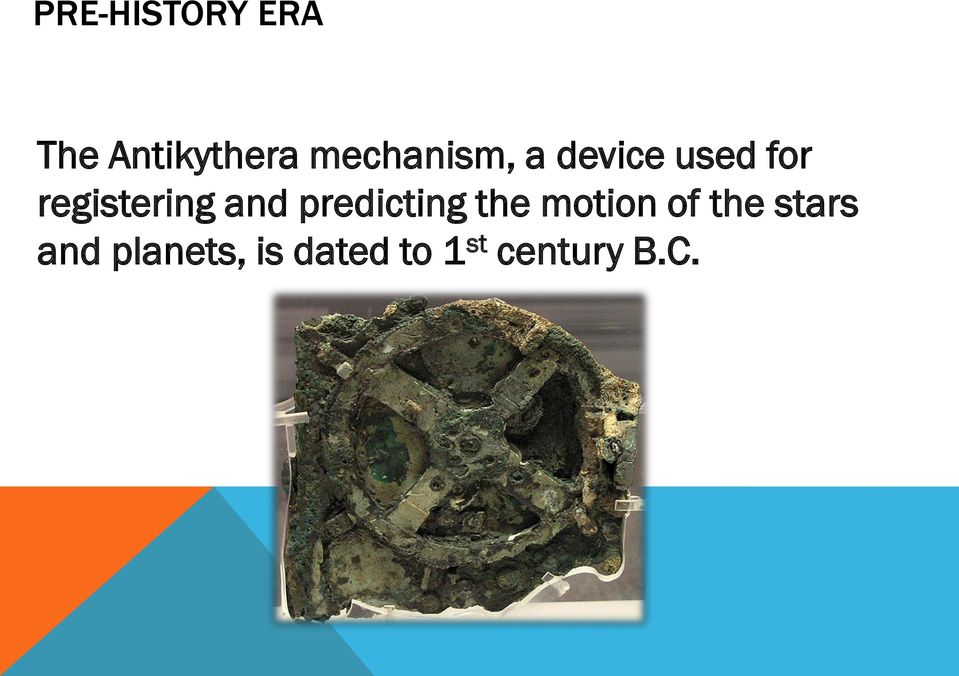
5 PRE-HISTORY ERA The Antikythera mechanism, a device used for registering and predicting the motion of the stars and planets, is dated to 1 st century B.C.
6 MECHANICAL ERA John Napier of Scotland invents logs in 1614 to allow multiplication and division to be converted to addition and subtraction.

7 MECHANICAL ERA Wilhelm Schickard, a professor at the University of Tubingen, Germany builds a mechanical calculator in 1623 with a 6-digit capacity. The machine worked, but it never makes it beyond the prototype stage.

8 MECHANICAL ERA Leonardo Da Vinci is now given credit for building the first mechanical calculator around Evidence of Da Vinci s machine was not found until papers were discovered in 1967.

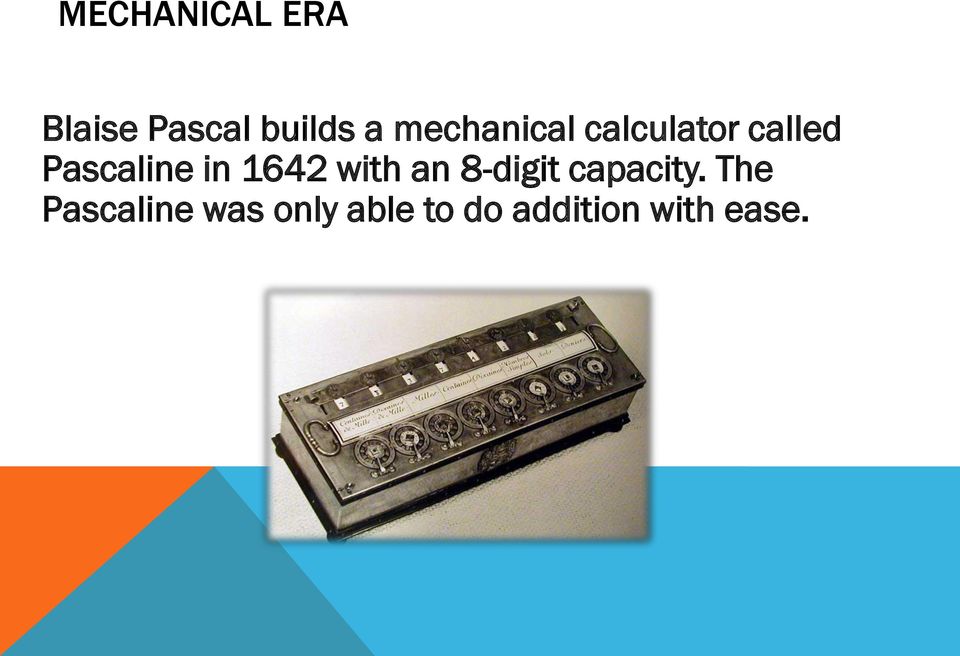
9 MECHANICAL ERA Blaise Pascal builds a mechanical calculator called Pascaline in 1642 with an 8-digit capacity. The Pascaline was only able to do addition with ease.
10 MECHANICAL ERA Gottfried Leibniz (1617) invented Stepped Reckoner that could multiply 5 digit and 12 digit numbers yielding up to 16 digit numbers.

11 MECHANICAL ERA Joseph-Marie Jacquard invents an automatic loom controlled by punch-cards in the early 1800s.

12 MECHANICAL ERA Charles Xavier Thomas de Colmar developed Arithmometer (the first mass produced calculator).

13 MECHANICAL ERA Charles Babbage designs a Difference Engine in 1820 or 1821 with a massive calculator designed to print astronomical tables. The British government cancelled the project in Babbage then conceives the Analytical Engine, a mechanical computer that can solve any mathematical problem and uses punch-cards. Difference Engine Analytical Engine

14 MECHANICAL ERA Augusta Ada Byron, Countess of Lovelace and daughter of English poet Lord Byron, worked with Babbage and created a program for the Analytical Engine. Ada is now credited as being the 1 st computer programmer.

15 MECHANICAL ERA Samuel Morse invents the Electric Telegraph in George Boole invents Boolean Algebra in the late 1840s. Boolean Algebra was destined to remain largely unknown and unused for the better part of a century, until a young student called Claude E. Shannon recognized its relevance to electronics design.

16 MECHANICAL ERA In 1857, only twenty years after the invention of the telegraph, Sir Charles Wheatstone (the inventor of the accordian) introduced the first application of paper tapes as a medium for the preparation, storage, and transmission of data.

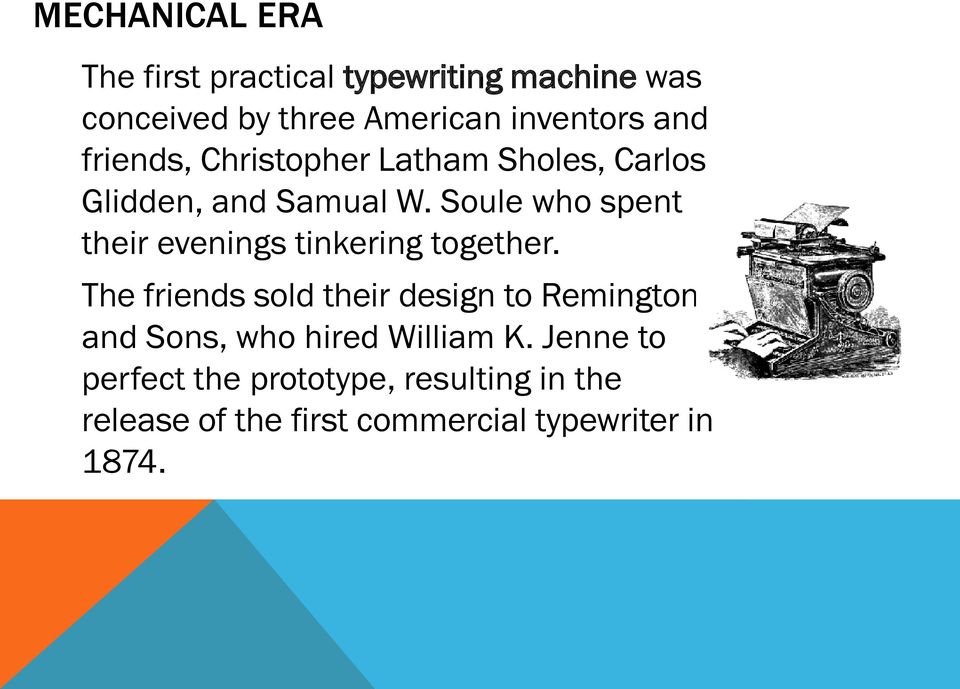
17 MECHANICAL ERA The first practical typewriting machine was conceived by three American inventors and friends, Christopher Latham Sholes, Carlos Glidden, and Samual W. Soule who spent their evenings tinkering together. The friends sold their design to Remington and Sons, who hired William K. Jenne to perfect the prototype, resulting in the release of the first commercial typewriter in 1874.
18 MECHANICAL ERA Herman Hollerith s Tabulating Machines were used for the 1890 census; the machines used Jacquard s punched cards.

19 ELECTRONICS ERA In 1926, Dr. Julius Edgar Lilienfield from New York filed for a patent on a transistor. Konrad Zuse, a German engineer, completes the 1 st general purpose programmable calculator in 1941.

20 ELECTRONICS ERA First Generation of computer. It is the era of vacuum tubes. The computers of this era were huge, very expensive, slow and had limited application capabilities.

21 ELECTRONICS ERA ENIAC (Electronic Numerical Integrator Analyzor and Computer) is developed by Ballistics Research Lab in Maryland and built by the University of Pennsylvania and completed in 1945.

22 ELECTRONICS ERA Second Generation of Computer The vacuum tubes were replaced by transistors. The invention of transistor allowed computer to became smaller, faster and cheaper. These computer also were more efficient and more reliable that the computers of the first generation.
23 ELECTRONICS ERA UNIVAC (Universal Automatic Computer) is developed in 1951 and can store 12,000 digits in random access mercury-delay lines. EDVAC (Electronic Discrete Variable Computer) is completed for the Ordinance Department in UNIVAC EDVAC
24 MINI ERA Third Generation of Computer The appearance of integrated circuits allowed to place miniaturized transistors on silicon chips. This technological invention allowed computers to increase speed and to become more efficient.
25 MINI ERA Texas Instruments and Fairchild Semiconductor both announce the integrated circuit in The IBM 360 is introduced in April of 1964 and quickly becomes the standard institutional mainframe computer. By the mid-80s the 360 and its descendents have generated more than $100 billion in revenue for IBM.
26 MINI ERA The Mini Era began with the development of the integrated circuit in 1959 by Texas Instruments and Fairchild Semiconductor. Ivan Sutherland demonstrates a program called Sketchpad (makes engineering drawings with a light pen) on a TX-2 mainframe at MIT s Lincoln Labs in 1962.
27 MINI ERA Doug Engelbart demonstrates a word processor in Also in 1968, Gordon Moore and Robert Noyce founded a company called Intel. Xerox creates its Palo Alto Research Center (Xerox PARC) in Fairchild Semiconductor introduces a 256-bit RAM chip in In late 1970 Intel introduces a 1K RAM chip and the 4004, a 4-bit microprocessor. Two years later comes the 8008, an 8-bit processor.
28 MICRO ERA Fourth Generation of Computer Microprocessor is a device that have thousand integrated circuits (millions of transistors) built in one silicon chip. The greatest thing in computer evolution was that the whole computer that in first generation filled the whole room, now was integrated into a small chip.
29 MICRO ERA Bill Gates and Paul Allen form Traf-O-Data in 1971 to sell their computer traffic-analysis sytems. Gary Kildall writes PL/M, the first high-level programming language for the Intel Microprocessor. Steve Jobs and Steve Wozniak are building and selling blue boxes in Southern California in Intel introduces the 8008, the first 8-bit microprocessor in April of Bill Gates Steve Jobs
30 MICRO ERA Jonathan A. Titus designs the Mark-8 and is featured in the July 1974 Radio Electronics. In January 1975 Popular Electronics features the MITS Altair 8800; it is hailed as the first personal computer. Paul Allen and Bill Gates develop BASIC for the Altair Microsoft is born!!! Mark-8 Prototype
31 MICRO ERA Apple is selling its Apple II for $1,195, including 16K of RAM but no monitor by Software Arts develops the first spreadsheet program, Visicalc by the spring of copies per month are shipped in 1979 and sales increase to 12,000 per month by By 1980 Apple has captured 50% of the personal computer market. Apple II
32 MICRO ERA In 1980 Microsoft is approached by IBM to develop BASIC for its personal computer project. The IBM PC is released in August, The Apple Macintosh, featuring a simple graphical interface using the 8-MHz, 32-bit Motorola CPU and a built-in 9-inch B/W screen, debuts in Microsoft Windows 1.0 ships in November, Microsoft s sales for 1989 reach $1 billion. IBM PC
33 NETWORK ERA Timesharing, the concept of linking a large numbers of users to a single computer via remote terminals, is developed at MIT in the late 50s and early 60s. Paul Baran of RAND develops the idea of distributed, packet-switching networks. ARPANET goes online in Bob Kahn and Vint Cerf develop the basic ideas of the Internet in 1973.
34 NETWORK ERA In 1974 BBN opens the first public packet-switched network Telenet. A UUCP link between the University of North Carolina at Chapel Hill and Duke University establishes USENET in TCP/IP (Transmission Control Protocol and Internet Protocol) is established as the standard for ARPANET in 1982.
35 NETWORK ERA The number of network hosts breaks 10,000 in 1987; two years later, the number of hosts breaks 100,000. Tim Berners-Lee develops the World Wide Web. CERN releases the first Web server in By 1992, the number of network hosts breaks 1,000,000. The World Wide Web sports a growth rate of 341,634% in service traffic in its third year
36 WEBSITES m s/historical.html
CSCA0201 FUNDAMENTALS OF COMPUTING. Chapter 1 History of Computers
 CSCA0201 FUNDAMENTALS OF COMPUTING Chapter 1 History of Computers 1 Topics 1. Definition of computer 2. Earliest computer 3. Computer History 4. Computer Generations 2 Definition of Computer Computer is
Science in History: From the Abacus to the Modern Computer Part 1: The Abacus
 Part 1: The Abacus Even before humans could read or write, they needed to count. First they used their fingers, but when they had to deal with figures over ten, a counting device became necessary. Pebbles
Connecting with Computer Science Chapter 1 Review:
 Connecting with Computer Science Chapter 1 Review: Key Terms: Abacus: (6) Assembly Language: (13) A counting device with sliding beads. Used mainly for adding and subtracting. A Human-readable language
CHAPTER 1: Our Digital Planet
 CHAPTER 1: Our Digital Planet Multiple Choice: 1. One of the purposes of MySpace is to: A. play games. B. create personal Web sites. C. hear music videos. D. post photographs. Answer: B Reference: Creating
01 Introduction. The timeline
 01 Introduction The pre-mechanical era The mechanical era The electromechanical era The electronic era The microelectronic era The roadmap for the next 10 years alessandro bogliolo isti information science
CS 140: Introduction to Computer Science A Brief History of Computer Science. Edwin Rodríguez
 CS 140: Introduction to Computer Science A Brief History of Computer Science Edwin Rodríguez Cal Poly Pomona Department of Computer Science CS 140 - A Brief History of Computer Science / 1 What is Computing
Computer Science. Information. Computer Science - what s this? References - textbooks. Contact. Cezary Bolek [email protected]
 Computer Science Cezary Bolek [email protected] University of Lodz Faculty of Management Department of Computer Science Contact Exam dr Cezary Bolek Information room 142, Department of Computer Science,
Chapter 4 IT Infrastructure: Hardware and Software
 1 Chapter 4 IT Infrastructure: Hardware and Software LEARNING TRACK 1: THE EVOLUTION OF IT INFRASTRUCTURE Evolution of IT Infrastructure: 1950 2005 The IT infrastructure in organizations today is an outgrowth
ELE 356 Computer Engineering II. Section 1 Foundations Class 6 Architecture
 ELE 356 Computer Engineering II Section 1 Foundations Class 6 Architecture History ENIAC Video 2 tj History Mechanical Devices Abacus 3 tj History Mechanical Devices The Antikythera Mechanism Oldest known
Technological Diffusion in the Development of the Mainframe. Computer and Early Semiconductors
 Technological Diffusion in the Development of the Mainframe Computer and Early Semiconductors Lav Varshney Inventing an Information Society ENGRG/ECE 298 and S&TS/HIST 292 Third Essay Assignment Question
Introduction to Microprocessors
 Introduction to Microprocessors Yuri Baida [email protected] [email protected] October 2, 2010 Moscow Institute of Physics and Technology Agenda Background and History What is a microprocessor?
CSCI 4717 Computer Architecture. Function. Data Storage. Data Processing. Data movement to a peripheral. Data Movement
 CSCI 4717/5717 Computer Architecture Topic: Functional View & History Reading: Sections 1.2, 2.1, & 2.3 Function All computer functions are comprised of four basic operations: Data processing Data storage
A Selective History of Computing version 0.1
 A Selective History of Computing version 0.1 Gerald Recktenwald Department of Mechanical Engineering Portland State University [email protected] September 26, 2001 Overview The development of computers
Early Computer VS Modern Computer: A Comparitive Study and an Approach to Advance Computer
 Global Journal of Computer Science and Technology Interdisciplinary Volume 12 Issue 11 Version 1.0 Year 2012 Type: Double Blind Peer Reviewed International Research Journal Publisher: Global Journals Inc.
Lecture 3: History of Networking & Storage. Based on slides 2011 Pearson Education, Inc. Publishing as Pearson Addison-Wesley
 Lecture 3: History of Networking & Storage It s Possible to Control New Technologies Extreme example: the Amish does it bring us together, or draw us apart? BBQ vs. telephone A more mainstream example
Early Developments: From Difference Engine to IBM 701
 1 Early Developments: From Difference Engine to IBM 701 Computer Science & Artificial Intelligence Lab M.I.T. Based on the material prepared by and Krste Asanovic Charles Babbage 1791-1871 Lucasian Professor
Charles Dierbach. Wiley
 Charles Dierbach Wiley Contents Preface Acknowledgments About the Author XXI xxv xxvii Introduction 1 MOTIVATION 2 FUNDAMENTALS 2 1.1 What Is Computer Science? 2 1.1.1 The Essence of Computational Problem
Steve Jobs, Bill Gates, and the PC and Course Review
 Steve Jobs, Bill Gates, and the PC and Course Review Radical Innovation and the Transformation of Daily Life CEE 102: Prof. Michael G. Littman Course Administrator: Jack Reilly [email protected] Computers
Star System. 2004 Deitel & Associates, Inc. All rights reserved.
 Star System Apple Macintosh 1984 First commercial OS GUI Chapter 1 Introduction to Operating Systems Outline 1.1 1.2 1.3 1.4 1.5 1.6 1.7 1.8 1.9 1.10 1.11 1.12 Introduction What Is an Operating System?
A Brief History of Educational Technology
 A Brief History of Educational Technology Han Liu, Ph.D. Department of Teacher Education Shippensburg University Reference http://www.coe.unco.edu/donnaferguson/ethistory/machi.htm Abacus The invention
Definition of Computers. INTRODUCTION to COMPUTERS. Historical Development ENIAC
 Definition of Computers INTRODUCTION to COMPUTERS Bülent Ecevit University Department of Environmental Engineering A general-purpose machine that processes data according to a set of instructions that
History of health informatics
 History of health informatics BRANKO CESNIK Those who cannot remember the past are condemned to repeat it. George Santayana (1863-1952) American philosopher, poet In considering a history of Health Informatics
A Brief History of the Internet. Chris Brooks Computing, Python, and Robots
 A Brief History of the Internet Chris Brooks Computing, Python, and Robots Outline Prehistory Birth of the Internet The Web is Born The Dot-Com Gold Rush Web 2.0 - everything old is new again The future?
Transforming the Computer from a Calculating Machine Into a Global Telecommunication
 Transforming the Computer from a Calculating Machine Into a Global Telecommunication Network Susan B. Barnes, Rochester Institute of Technology In 1945, Alan Turing envisioned the computer as a general
Computer System: User s View. Computer System Components: High Level View. Input. Output. Computer. Computer System: Motherboard Level
 System: User s View System Components: High Level View Input Output 1 System: Motherboard Level 2 Components: Interconnection I/O MEMORY 3 4 Organization Registers ALU CU 5 6 1 Input/Output I/O MEMORY
TYPES OF COMPUTERS AND THEIR PARTS MULTIPLE CHOICE QUESTIONS
 MULTIPLE CHOICE QUESTIONS 1. What is a computer? a. A programmable electronic device that processes data via instructions to output information for future use. b. Raw facts and figures that has no meaning
Computer Science PLUS I Volume 1 : Concepts Government of Tamilnadu
 Computer Science PLUS I Volume 1 : Concepts Government of Tamilnadu Government of Tamilnadu First Edition 2005 Chairman Syllabus Committee Dr. Balagurusamy E, Vice Chancellor, Anna University, Chennai
HISTORY OF COMPUTATION
 HISTORY OF COMPUTATION Sotirios G. Ziavras, Department of Electrical and Computer Engineering, New Jersey Institute of Technology, Newark, New Jersey 07102, U.S.A. Keywords Computer Systems, Early Computers,
Logical Operations. Control Unit. Contents. Arithmetic Operations. Objectives. The Central Processing Unit: Arithmetic / Logic Unit.
 Objectives The Central Processing Unit: What Goes on Inside the Computer Chapter 4 Identify the components of the central processing unit and how they work together and interact with memory Describe how
a brief history of computing chapter
 1 chapter a brief history of computing in this chapter you will: Learn why today almost everyone is a computer operator Learn about the predecessors of modern computer hardware and software Trace the development
INTRODUCTION TO COMPUTER SYSTEM
 Chapter 1 INTRODUCTION TO COMPUTER SYSTEM 1.0 Objectives 1.1 Introduction Computer? 1.2 Evolution of Computers 1.3 Classification of Computers 1.4 Applications of Computers 1.5 Advantages and Disadvantages
Operating Systems Introduction
 Operating Systems Introduction Chester Rebeiro IIT Madras Webpage : http://www.cse.iitm.ac.in/~chester/courses/15o_os/index.html The Layers in Systems Applications Operating Systems Computer Organization
Chapter 1 Introduction to The Semiconductor Industry 2005 VLSI TECH. 1
 Chapter 1 Introduction to The Semiconductor Industry 1 The Semiconductor Industry INFRASTRUCTURE Industry Standards (SIA, SEMI, NIST, etc.) Production Tools Utilities Materials & Chemicals Metrology Tools
Steve Jobs, Bill Gates, and the PC and Course Review
 Steve Jobs, Bill Gates, and the PC and Course Review Radical Innovation and the Transformation of Daily Life CEE 102: Prof. Michael G. Littman Course Administrator: Catherine Eiben [email protected]
A Revolution Begun AN EXPLORATION OF PAUL E. CERUZZI S COMPUTING: A CONCISE HISTORY. Created by Derick Lock
 A Revolution Begun AN EXPLORATION OF PAUL E. CERUZZI S COMPUTING: A CONCISE HISTORY Created by Derick Lock A Revolution Begun An exploration of Paul Ceruzi s Computing: A Concise History German civil engineer
Chapter 01: Introduction. Lesson 02 Evolution of Computers Part 2 First generation Computers
 Chapter 01: Introduction Lesson 02 Evolution of Computers Part 2 First generation Computers Objective Understand how electronic computers evolved during the first generation of computers First Generation
Licensed to: CengageBrain User
 This is an electronic version of the print textbook. Due to electronic rights restrictions, some third party content may be suppressed. Editorial review has deemed that any suppressed content does not
EECS 678: Introduction to Operating Systems
 EECS 678: Introduction to Operating Systems 1 About Me Heechul Yun, Assistant Prof., Dept. of EECS Office: 3040 Eaton, 236 Nichols Email: [email protected] Research Areas Operating systems and architecture
Hackers Built the Internet. Eric S. Raymond http://catb.org/~esr/
 Hackers Built the Internet Eric S. Raymond http://catb.org/~esr/ Who are the Hackers? There is a community, a shared culture, of expert programmers and networking wizards that traces its history back through
Date Steve Jobs Events Peter Hirsch/IBM/Microsoft Events
 Date Steve Jobs Events Peter Hirsch/IBM/Microsoft Events February-55 Steve Jobs born in Madison, Wisconsin Bill Gates born in Seattle, Washington August-55 Steve Jobs Adopted by Paul and Clara Jobs June-57
Fall 2009. Lecture 1. Operating Systems: Configuration & Use CIS345. Introduction to Operating Systems. Mostafa Z. Ali. [email protected].
 Fall 2009 Lecture 1 Operating Systems: Configuration & Use CIS345 Introduction to Operating Systems Mostafa Z. Ali [email protected] 1-1 Chapter 1 Introduction to Operating Systems An Overview of Microcomputers
How To Understand The History Of Computer Technology
 Introduction to Computer Technology, Network Economics, and Intellectual Property Law Computer software and Internet commerce are among the fastest growing and most promising industries in the United States.
CS 4300 Computer Graphics. Prof. Harriet Fell Fall 2012 Lecture 1 September 5, 2011
 CS 4300 Computer Graphics Prof. Harriet Fell Fall 2012 Lecture 1 September 5, 2011 1 Course Overview - Topics This course will chart a path through all the major aspects of mainstream computer graphics.
SWE 444 Internet and Web Application Development. Introduction to Web Technology. Dr. Ahmed Youssef. Internet
 SWE 444 Internet and Web Application Development Introduction to Web Technology Dr. Ahmed Youssef Internet It is a network of networks connected and communicating using TCP/IP communication protocol 2
Management Challenge. Managing Hardware Assets. Central Processing Unit. What is a Computer System?
 Management Challenge Managing Hardware Assets What computer processing and storage capability does our organization need to handle its information and business transactions? What arrangement of computers
Virtualization and Cloud Computing. Sorav Bansal
 Virtualization and Cloud Computing Sorav Bansal Administrivia Instructors: Sorav Bansal, Huzur Saran, Gautam Shroff (Tata Consultancy Services) Webpage: http://www.cse.iitd.ernet.in/~sbansal/csl862 Syllabus:
The Entry of Established Electronics Companies into the Early Computer Industry in the UK and USA
 The Entry of Established Electronics Companies into the Early Computer Industry in the UK and USA Anthony Gandy Daiwa Institute of Research Europe LTD. It seems obvious that when a new product is developed
Mainframe Computers. By: Lyndsey Farris. Mainframe Computers are large and expensive computers that were used for large
 Mainframe Computers By: Lyndsey Farris Mainframe Computers are large and expensive computers that were used for large organizations, mostly government agencies and banks to process manage and store data.
Operating System Software
 Operating System Software Lecture 7 The operating system Defines our computing experience. First software we see when we turn on the computer, and the last software we see when the computer is turned off.
From Concept to Production in Secure Voice Communications
 From Concept to Production in Secure Voice Communications Earl E. Swartzlander, Jr. Electrical and Computer Engineering Department University of Texas at Austin Austin, TX 78712 Abstract In the 1970s secure
What is this course is about? Design of Digital Circuitsit. Digital Integrated Circuits. What is this course is about?
 What is this course is about? Design of Digital Circuitsit Design of digital microelectronic circuits.» CMOS devices and manufacturing technology.» Digital gates. Propagation delay, noise margins, and
Ch. 10 Software Development. (Computer Programming)
 Ch. 10 Software Development (Computer Programming) 1 Definitions Software or Program Instructions that tell the computer what to do Programmer Someone who writes computer programs 2 Instruction Set A vocabulary
Introduction to computer systems architecture and programming
 Introduction to computer systems architecture and programming J. Matravers IS1168, 2790168 2011 Undergraduate study in Economics, Management, Finance and the Social Sciences This is an extract from a subject
Microprocessor or Microcontroller?
 Microprocessor or Microcontroller? A little History What is a computer? [Merriam-Webster Dictionary] one that computes; specifically : programmable electronic device that can store, retrieve, and process
Introduction to Computer Architecture Concepts
 to Computer Architecture Concepts 1. We will start at the very beginning, first with the fundamental concepts behind the modern digital computer, and then some details of their implementation. Many people,
Unit- I Introduction and Web Development Strategies
 Introduction to Web Technology 1 (ECS-604) Unit- I Introduction and Web Development Strategies 1. World Wide Web: The World Wide Web is a system of interlinked hypertext documents accessed via the Internet.
1 Catalysts for Change
 CHAPTER 1 Catalysts for Change A tourist came in from Orbitville, parked in the air, and said: The creatures of this star are made of metal and glass. Through the transparent parts you can see their guts.
MICROSOFT SOFTWARE DEVELOPMENT. Microsoft Secrets book
 MICROSOFT SOFTWARE DEVELOPMENT Many consider Bill Gates a techo-nerd, who got lucky. But he is one of the few CEOs of a major company, who not only understands the technology, he also understands business.
HISTORY AND APPLICATIONS OF COMPUTERS
 HISTORY AND APPLICATIONS OF COMPUTERS A.O.Babatunde and O.V. Mejabi Faculty of Communication and Information Sciences, University of Ilorin, Ilorin. 6.0 INTRODUCTION When more than one thing is needed
Main Memory & Backing Store. Main memory backing storage devices
 Main Memory & Backing Store Main memory backing storage devices 1 Introduction computers store programs & data in two different ways: nmain memory ntemporarily stores programs & data that are being processed
1.1 Electronic Computers Then and Now
 1.1 Electronic Computers Then and Now The first electronic computer was built in the late 1930s by Dr.John Atanasoff and Clifford Berry at Iowa State University in USA. They designed their computer to
Digital Circuit Design
 Test and Diagnosis of of ICs Fault coverage (%) 95 9 85 8 75 7 65 97.92 SSL 4,246 Shawn Blanton Professor Department of ECE Center for Silicon System Implementation CMU Laboratory for Integrated Systems
Computer Basics: Chapters 1 & 2
 Computer Basics: Chapters 1 & 2 Definition of a Computer What does IPOS stand for? Input Process Output Storage Other types of Computers Name some examples of other types of computers, other than a typical
HISTORY OF THE COMPUTER
 HISTORY OF THE COMPUTER ARTICLE WRITTEN BY: ADEBOWALE ONIFADE ELECTRICAL ELECTRONIC ENGINEERING DEPARTMENT UNIVERSITY OF IBADAN NIGERIA REGION 8 HISTORY OF THE COMPUTER ABSTRACT This paper takes a keen
what operations can it perform? how does it perform them? on what kind of data? where are instructions and data stored?
 Inside the CPU how does the CPU work? what operations can it perform? how does it perform them? on what kind of data? where are instructions and data stored? some short, boring programs to illustrate the
By : Khalid Alfalqi Department of Computer Science, Umm Al-Qura University
 By : Khalid Alfalqi Department of Computer Science, Umm Al-Qura University History of Web History of the Internet Basic Web System Architecture URL DNS Creating Static and Dynamic Information Security
Masters of Science in Information Technology
 Objective: At the end of this module, you must be able to 1. Establish a basic understanding of the Internet 2. Understand the Internet's evolution What is Internet? Internet is a vast collection of different
The Art and Science of Java. Preliminary Draft
 The Art and Science of Java Preliminary Draft Eric S. Roberts Stanford University Stanford, California January 2006 Preface This text is an early draft for a general introductory textbook in computer science
Educator s Resource Guide. The Triumph of the Nerds
 Educator s Resource Guide The Triumph of the Nerds Educator's Guide by: Bill Roberts Published and Distributed by... Ambrose Video Publishing 145 West 45th St. Suite 1115 New York, NY 10036 1-800-526-4663
Understanding operating systems (OSs) is critical to your future success. Introduction to Operating Systems. chapter
 chapter 1 Introduction to Operating Systems Physics is the universe s operating system. Steven R. Garman I do not fear computers. I fear lack of them. Isaac Asimov The computer was born to solve problems
Data Protection History, Evolution, Best Practices By Global Data Vault
 Data Protection History, Evolution, Best Practices By Global Data Vault Introduction As business data processing has evolved, so have the methods and best practices for data protection. This white paper
Database trends: XML data storage
 Database trends: XML data storage UC Santa Cruz CMPS 10 Introduction to Computer Science www.soe.ucsc.edu/classes/cmps010/spring11 [email protected] 25 April 2011 DRC Students If any student in the class
History of Informatics: Ada Lovelace
 History of Informatics: Ada Lovelace Renske Weeda (9913467) e-mail: [email protected] 10th May 2004 Contents 1 Introduction 3 2 Biographical facts 3 3 Contributions 4 3.1 The Notes......................................
Introducing Basic Network Concepts
 1 Introducing Basic Network Concepts In the beginning, there were no networks. Life was bad. MIKE MEYERS In this chapter, you will learn how to: Identify human and computer networks Describe the benefits
CA106 Web Design. Dr. Dónal Fitzpatrick, School of Computing Room l2.48, Extension 8929, [email protected]
 CA106 Web Design Dr. Dónal Fitzpatrick, School of Computing Room l2.48, Extension 8929, [email protected] History of the Internet Terminals attached to mainframe computer From mid 1960 s packet-switching
Introducción. Diseño de sistemas digitales.1
 Introducción Adapted from: Mary Jane Irwin ( www.cse.psu.edu/~mji ) www.cse.psu.edu/~cg431 [Original from Computer Organization and Design, Patterson & Hennessy, 2005, UCB] Diseño de sistemas digitales.1
Area 3: Analog and Digital Electronics. D.A. Johns
 Area 3: Analog and Digital Electronics D.A. Johns 1 1970 2012 Tech Advancements Everything but Electronics: Roughly factor of 2 improvement Cars and airplanes: 70% more fuel efficient Materials: up to
CMPE 003: Computer Concepts Exam #1 Review of Chapters 1-3, 8, and the appendix
 CMPE 003: Computer Concepts Exam #1 Review of Chapters 1-3, 8, and the appendix Appendix The Continuing Story of the Computer Age: Past, Present, and Future Important Points: 1. DESCRIBE THE GENERATIONS
Page 1 of 7. Computer Networking
 Page 1 of 7 Computer Networking 7.1 What Is Computer Networking? A computer network consists of several computers that are connected to one another using devices that allow them to communicate. Computer
Intel Corporation: A Global Technology Leader Innovating and Investing in the United States 2011
 Intel Corporation: A Global Technology Leader Innovating and Investing in the United States 2011 INNOVATION THAT S CHANGING THE WORLD Intel has been making headlines since 1968, when two American entrepreneurs,
INTRODUCTION (Syllabus, Numerical Methods & Computational Tools)
 INTRODUCTION (Syllabus, Numerical Methods & Computational Tools) A. J. Clark School of Engineering Department of Civil and Environmental Engineering by Dr. Ibrahim A. Assakkaf Spring 2001 ENCE 203 - Computation
Digital Integrated Circuit (IC) Layout and Design
 Digital Integrated Circuit (IC) Layout and Design! EE 134 Winter 05 " Lecture Tu & Thurs. 9:40 11am ENGR2 142 " 2 Lab sections M 2:10pm 5pm ENGR2 128 F 11:10am 2pm ENGR2 128 " NO LAB THIS WEEK " FIRST
Introduction to CMOS VLSI Design
 Introduction to CMOS VLSI esign Slides adapted from: N. Weste,. Harris, CMOS VLSI esign, Addison-Wesley, 3/e, 24 Introduction Integrated Circuits: many transistors on one chip Very Large Scale Integration
Computer Science, Telecommunication, and Artificial Intelligence (Classes QA75-76.9, TK5101-TK6720, TK7800-TK7895, and Q334-Q390)
 LIBRARY OF CONGRESS COLLECTIONS POLICY STATEMENTS ±² Collections Policy Statement Index Computer Science, Telecommunication, and Artificial Intelligence (Classes QA75-76.9, TK5101-TK6720, TK7800-TK7895,