
Spring 2010
|
|
|
- Willis Harrison
- 10 years ago
- Views:
Transcription
1

2
3 Grant awarded by the European Commission, Education, Audiovisual and Culture Executive Agency, for the project 08/0025-G/1057 within the Lifelong Learning Programme Grundtvig : Learning partnership. Sole responsibility for the content of publication lies with the author and the Agency is not responsible for any use that may be made of the information contained herein. Spring 2010
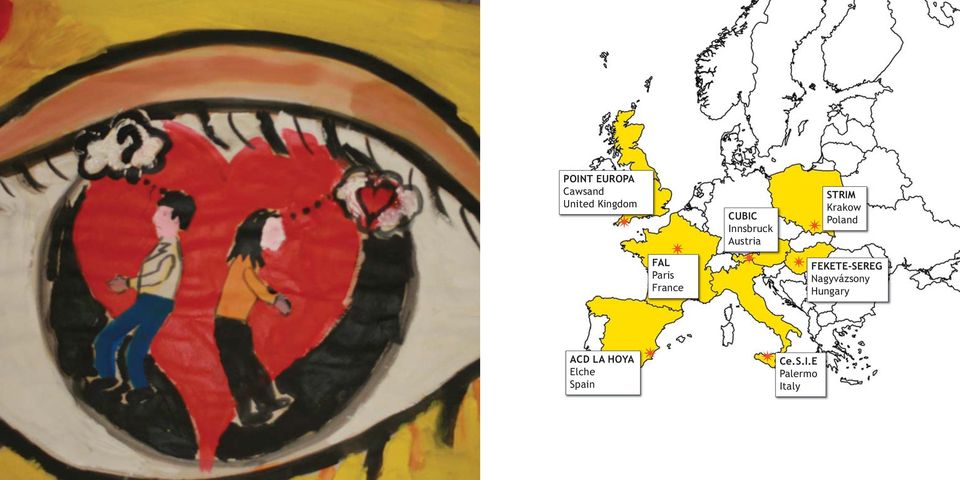
4 POINT EUROPA Cawsand United Kingdom CUBIC Innsbruck Austria STRIM Krakow Poland FAL Paris France FEKETE-SEREG Nagyvázsony Hungary ACD LA HOYA Elche Spain Ce.S.I.E Palermo Italy
5 Preface This booklet forms an integral part of Minorities, Migrants, Motilities, M3 project. Its role is to introduce the work of the partner groups. It gives a glimpse into how they work, what methods they use and it shows how diverse the methods of youth work are in dealing with immigrants and minorities. The text is divided into three parts. First there is a short introduction of the given organisation. After that you can read about the applied methods, the basic principles and the effective work that has been done. Finally you will find Participant s comment which show the lives of young people they give face to our work. Within this framework you will read many types of texts. This is very well in this way: one of the most important principles of our methods is diversity: the organizations have very different backgrounds regarding organization and methodology but what s even more important; they face different problems and different challenges. United Kingdom. The Krakow association is reknown for its diverse methods of voluntarism and cultural diversity. The French and Italian partners have decades of experience and are part of a wide international network. The Spanish and Hungarian organisations are non-profit organisations that carry out youth work both in national and international level, reliable and are strongly woven into their society. What is common in all these organisations is the topic of M3 project: inclusion and integration of young immigrants or members of minorities. During the motilities of our Grundtvig project we shared many of our experiences, strengthening our common principles and learning different methods from each other. We learnt from reality how diverse the European methodology is, how many ways there exist in dealing with the given challenges. We wish that reading our examples will inspire you to innovate, to develop your own methods! The Austrian organization, recognized internationally for its multiplier role in youth work and its diversity projects, has trained young adults with migration background to become actors in intercultural youth work.the English partner is a professional NGO, who among many other activities promotes inclusion of immigrants who arrive in the

6 Asociación Cultural y Deportiva de la Hoya ACD la Hoya Country: Spain Promoters address: Calle Ingeniero Serra nº Elche Website: [email protected] Telephone: We are a nonprofit organization. The main aim is to give the youth of the village possibilities to spend their free time by doing useful activities, to support bottom up initiatives of the young living in the village, also to open international exchange for young people, promote youth initiative in improving social work and facilitating the integration of young people into society especially those of rural areas by involving them in our work, and encouraging their creative spirit that helps increasing youth participation in both local community and society in general. We collaborate with municipalities, foundations, and other regional and national, international organizations, cooperate with experts and people supporting the young. The participation in our activities gives a better opportunity to get a positive and varied personal development. We are looking as well to increase the youth participation in the international events, which could make them open to a multitude of life styles, cultures, point of Elche

7 views, and get them within a spirit of creativity. We encourage them by creating clubs of different activities and especially spaces for free discussions to initiate them to the main objectives of the youth program like the fight against racism, xenophobia, segregation in all its features and promote the values of peace, democratic representation, mutual respect, human rights and tolerance. We offer to youth: informal education, promotion of voluntarism, preventing of unwanted forms of behaviors (delinquency, drug addiction), developing of healthy ways of living, positive affirmation among youth... We have different groups in our organization, theater, football, youth, and international projects. We organize local, departmental and regional, national, international events, trainings, youth exchanges, short study visits, EVS projects and seminars. METHODOLOGY Temporary shelter houses in Spain When immigrants arrive in Spain from Africa with "Patera" boats, are sent to different temporary shelter houses for immigrants in Spain, to give them a formation and possible work. The objectives of these "temporary shelter houses for immigrants" are: 1. Basic needs of food and accommodation. 2. Comprehensive diagnostic assessment of the psycho-social situation in which we find the person or family for further development of the individual action plan, designed to show the different areas of social intervention (educational, employment, health, social, etc.). designed to achieve social inclusion, drawing on the resources of the institution (staff, activities, etc..) and area (health centers, hospitals, SSSS Basic, employment agencies, adult education centers, schools, nurseries, etc..) 3. Monitoring and evaluation plan for each user intervention and coordination in collaboration with technicians. 4. Coordination with social services in the territory of reference of the person, in order to facilitate their social integration as quickly and efficiently. 5. Promote voluntary return to their countries for the persons that want, ensuring that such returns are performed under the best conditions possible, setting up of two basic lines of action: Personal support Relationship with social and support networks in their countries of origin. Users who are serving in these centers include: 1. Immigrants that don t have personal and social resources (don t have social skills, housing, employment, knowing the language, customs...), which prevents them from leading a normal life and access to resources, hence need temporary support to enable them to regain their autonomy and stability. 2. Immigrants who suffer injuries or illnesses that disable them temporarily to carry out their normal life, having no alternative host and lacking financial means to address these points in their lives.

8 3. Other immigrants whose social circumstances so indicate, provided they are substantiated by documentary and are valued positively by the Technical Committees of assessment and monitoring. Since the temporary shelter houses are trying to send them to various associations to start working with them, teach them the language and could be out for possible employment. The actions that the temporary shelter houses do for immigrants are: The accommodation of immigrants. Information, guidance and advice in different fields (legal, social work, education, housing,...). Promoting the integration of immigrant workers in the market through the development of integrated pathways individualized employability. The temporary accommodation of immigrants is particularly vulnerable. Support for access to decent housing and improved living conditions. Study of the migration situation in our region as a fundamental source of information key to developing our business Intercultural mediation in the different fields (education, neighborhood, social, health) The community awareness to promote interculturalism and facilitate the acceptance of diversity in society. psychosocial intervention from a gender perspective in order to implement development strategies that balance opportunities for both sexes and promote access, participation and involvement of immigrant women in all spheres of social life Promote social participation of immigrants Deal with complaints in manifestly unfair situations experienced by the immigrant community The assertion of rights inherent to every human being regardless of race, sex, religion, social status or legal situation documentary. Promote volunteerism as a fundamental form of citizen participation in public affairs. Collaboration with other entities, both public and private, in relation tohieving our mission PARTICIPANT S COMMENT We have selected those most illustrative sentences that migrants said about their background and problems with comments regarding our work as well as typical phenomena in Spain connected to this issue. "I decided to come to Spain for lack of work in my country, I need food for everyone, and I had a hard time in my country Algeria." "In my country very badly, I want to live here."

9 "First to get Spanish classes because, when I want to ask for work I need to speak Spanish." One way to learn Spanish are the organizations that teach Spanish for immigrants teaching immigrants. "What I mean is we need to understand that the Spanish are not all equal world "" There are good and bad people in every country." "The immigrant is in a very bad and is in a situation where is frowned upon by the Spanish people because the immigrant is selling its work much cheaper than the Spanish, the overall easy prey for immigrant entrepreneurs as they pay at will and by Then there is the constant harassment of government agencies because they do not have roles, being undocumented is illegal, almost a criminal, we are under a triple pressure, Spanish people, entrepreneurs who exploit us and police that haunts us or that we are watching, you are illegal and the smallest incident to your country. I decided to come to Elche because it has a lot of work, that first, and it is not racist. Here in Elche not much racism. There is so much work and also cheaper rent. I got a little aggressive because I felt a bit strange then I started to miss, I was afraid, not now because we have rights as everyone. We are far from the family. I have to start small, validating my title, and ready. "I was doing during mating For us the big problem is our language that is very different. Nor do we know we have rights. I'm very good Spanish friends have helped me a lot. Among Russians there is a site every week our husbands are going to play football. Well actually I came to Spain to work, to earn more money than they earned in my country and to Elche I got here by a friend. Because in my country is paying too little. Most people think it makes more here in our country. It is the image given. Here I have never lacked work, but also because I have a lot of willingness and I lend to people like me because, as one is an immigrant you pay less above have to do a few more hours and all these abuses. Here the work for women is easier because the Spanish woman loves America. Well friction among ourselves but we have a much better understanding between us than with Spanish. I have friends here Romanian, Polish, Russian friends, working in all types, to prostitutes. If no opportunities, no integration. To go to my people can not go because I'm used to Europe I have the papers when I go to another country. Spain have never had as a goal. You can not restrict anyone's right to live wherever they want. Everyone has their circumstances, their mentality, their customs, their education. Having the same religion have no reason to pay. What matters is what's inside a person.

10 Centro Studi ed Iniziative Europeo (CE.S.I.E) Country: Italy Partners: CENTRO STUDI E DOCUMENTAZIONE SULLE MIGRAZIONI Municipality of Palermo [email protected] Promoters address: Via Roma 94, Palermo Website: [email protected]; [email protected] Telephone: Palermo We are engaged in the growth and development of the communities and contexts with which we cooperate, through the active involvement of people, civil society, institutions and the enrichment of diversity. The organisation works towards the promotion of cultural, educational, scientific and economic development at both local and international levels through the employment of innovative and participative tools and methodologies. CE.S.I.E has 6 operative offices and coordinates a global federation. Objectives: Promote intercultural dialogue Support social inclusion and equal opportunities Facilitate lifelong education and training Foster responsible and supportive global development Develop and support networking at local and international levels Encourage international cooperation

11 Within the project M3 CE.S.I.E works mainly with young adults from migrant background trying to stimulate their interest in European active citizenship and in social work for their own communities. We working together for an easier access to their civil rights, to identify and to apply for them. Through M3 at local level CE.S.I.E is willing to: - Contribute to provide and improve, among the local population, awareness of NGOs and Associations and all the services offered to immigrants and political refugees in Palermo. - Collect and distribute all existing information on NGOs and associations involved in care and protection of the rights of immigrants / refugees in Palermo. - Give visibility to NGOs and Associations of Palermo active in this field, better known and more accessible to potential users. - Create connections among all the associations working in Palermo which are involved in social issues, in migration and asylum policy in order to promote and facilitate a future and more prosperous partnership. The methodology is intended to create a safe context for people to express themselves, to discover, to be creative, to learn relational and communicational competencies, to feel valued as a human being. The aims of this method are: to learn to share individual points of view with other people; learn to communicate in a non-violent way; develop listening and verbal communication skills; to learn to value and respect others; learn to value the group and to cooperate; develop active participation awareness and skills; to strengthen democratic competences; to facilitate and reinforce the integration between migrants and local people. The positive experience is appealing for the immigrants because they have a real possibility to talk in a mutually respective atmosphere with local people and without prejudice. One of the difficulties that we have using this method is the language barrier, because often the immigrants do not speak the native language and therefore need translation. Translation is necessary and it permits all to express their own ideas. The subject matter that participants discuss is decided before the session as its necessary that all agree about METHODOLOGY CE.S.I.E constantly seeks out new methodologies, acting as a bridge between research and knowledge in both formal and non-formal education spheres. The Reciprocal Maieutic Approach (RMA) and grassroots participatory planning methods developed by Danilo Dolci characterises CE.S.I.E s work.

12 the theme. However it can also be a decision of the coordinator who then suggests and shares it with the group rather than imposes it. Other methods employed include UNESCO s Four Pillars of Education, Lateral Thinking and Learning by Doing. SUCCESSFUL PROJECT EXAMPLES CE.S.I.E aims in planning and implementing projects in order to promote the encounter of the local and the international dimension. Successful projects from the past in field of migration and respect of cultural and religious diversity: Inventing the future in Ballarò Objectives: - Offer to girls, aged 15-18, autochthones and immigrants, through a training course, specific professional competences to permit them to integrate into the labour market; - Facilitate re-entry into the education system; - Promote personal and professional development; - Develop instruments (I) social; (II) cultural; (III) territorial that respond to socio-economic issues and needs; - Promote educational success in children and youth from target territory; - Promote the acquisition of parenting competences; - Stimulate intercultural dialogue and understanding between different cultures; - Promote intergenerational relationships; - Valorise the target territory - Albergheria - by developing activities that have a positive impact on the area and the community. Results: - training course in "Care for Children" which targets 15 young girls who dropped out from formal education system and are unemployed; - opening of Community Centre with the following services: playgroup, after-baby parking, workshops on parenting; - development of pedagogical material; - valorisation of target area thus promoting investment and development of positive image NEWSLETTER on young migrant women, their rights and the realization of those rights in European countries Objectives: - Develop policy and practical responses to situations of discrimination and intolerance affecting young migrant women (racism, xenophobia and gynophobia); - Enhance the participation of youth migrants women and to ensure appropriate follow up to the recommendation on the promotion of the participation of minority youth; - Foster equal opportunities for young migrant women by providing exchange of knowledge and practice and by supporting the devel-

13 opment of a sense of solidarity; - Support the development of a network of young migrant women in Europe; - Further explore responses to the challenges of young women migrants accessing to the erased employment; - Empower young people to be actors in violence prevention against young migrant women; - Defend the dignity of migrants, regardless of arriving legally or illegally and promote the solidarity between European citizens. Results: - Creation of 3 newsletters on young migrant women issue; - Kick off meeting between partners; - Awareness raising of policy makers and NGO s on situation of migrants women in Europe; - Raising awareness of migrant women towards their own rights. Tales from hidden Migration Objectives: Tales from Hidden Migration has been developed in order to fight against racism and discrimination, a constantly increasing problem throughout Europe, particularly in Italy and to raise awareness of the situation faced by young women who immigrate into Europe. In fact, these women and their stories often remain invisible to the public and even the communities in which they live. To immigrate into Europe is an increasingly difficult decision for potential migrants as passing through the borders and the unwelcoming conditions in our countries are becoming more and more difficult for immigrants. The north/south immigration is mostly suffered (to escape from war, political crisis, humanitarian crisis, violence, gender violence, poverty, scorned human rights, etc) and not chosen. In recent years the question of immigration has developed into more of a political issue. Consequently, nowadays the human dimension of immigration is too often placed outside the awareness of EU and national politicians that at times treat the issue as a set of statistics. Our last decades have known a general tendency of feminization of the people migrating in Europe (women now represent 54% of the immigrants in Europe). These women, often young, mostly migrate alone and are more vulnerable and subject to violence than men. But it s important to note the positive aspects of this feminization such as the courage of these women. In addition, over the diverse forms of inequality experienced by women, this feminization proves a certain mutation of the status of women around the world (it was in fact previously unthinkable that they would travel alone). Aim of this book is to give life and a face to immigration through the story of 10 young women from Morocco, Ukraine, Ivory Coast, Romania, Sri Lanka, Bangladesh, China, who now live in Palermo, Italy. These women have come forward to tell us their individual stories: their life before, the situation they escaped from, the heartbreaking experience of immigrating; of leaving your country and the people you know without knowing if you will ever have the possibility to return, the fear of having to begin a journey on which you are not even sure that you will ever arrive at your destination; then finally about life in Palermo, the cultural
14 shock, the new life that they have built, and their continuing links with their home country. The book has been presented to the local community of Palermo by young artists managed by the Tanto di Cappello Company. Results: - Fight against racism and discrimination by appreciating cultural diversity and intercultural dialogue - Social inclusion of the migrant community into the local one - Improvement of the situation of young women from the migrant community - Promotion of intercultural understanding PARTICIPANT S COMMENT MOROCCO The story of T. The story of T. begins in her beloved Morocco, that beautiful and wild country where she spent a happy childhood. Two years ago her father told her about Italy and immediately she was thinking about the chance to carry on her studies and then to find a satisfying job there. This is the reason why she came here to Sicily. Her father had chosen Sicily because his brothers have lived here for many years. He started to sell hats, then clothes, but what he earned was never enough to maintain the family. For this reason T., student of promise in Morocco, had to face a different and less promising situation. For a while she was even attending a school in Palermo and this made her really happy, but above all she loved the atmosphere of respect between her classmates. All of them were free to express their own thoughts, without any interruption or exclusion. But soon hope became disillusion. After her sister s disease she thought that a diploma would never help her family and so her dream to become a doctor faded away. T. now has many responsibilities that she can t ignore as she has the rent and bills to pay. To T. it is nonsense to work all day long only for and then to see your hard earned money used only for bills and rent, never to buy something to have fun. T. is just 19, but she is very mature and responsible, she knows what it means to make a sacrifice for someone you love. She always fights with her younger sister when she doesn t show interest in family needs. Life for T. is not easy here in Palermo. She arrived in a town where she didn t know anyone, where she couldn t speak her mother tongue and where curious, searching and often mean looks made her feel uncomfortable. In her bag there were only pictures of her dear friend and a huge quantity of courage, strength and pride. After her childhood, T. was seen by everybody to be a very strong girl who knows how to face misfortunes. In her life here in Sicily she has met people who have supported her, encouraged her, respected her and treated as a child, a friend to chat with and with whom they can create a relationship. But it hasn t always been so easy: many people have treated her with no regard. Some people she has worked for have not treated her very well: no respect and lunch breaks before she finished her work. There s one thing she can t really stand,

15 when people don t greet her back. Good manners and kindness are the most important things for her. The integration process in a different environment is very difficult and it becomes harder and harder when you don t have your family or friends close to you and local people treat you with suspicion. This is why T. doesn t feel good in Palermo. She misses the atmosphere during celebrations in Morocco, the food they used to prepare; she misses the chance to be who she wants to be, without any linguistic or religious problem. Even the food is a problem to her, because there are a few things that she isn t allowed to eat for her Religion, but the shopkeepers often don t care about her special needs. The only way to avoid unpleasant inconveniences is to personally check the ingredients of dubious food. Going away from this country she would put in her bag only her dearest friends, the ones who have treated her like a friend or a daughter but nothing or no one else. She can t understand why people are so wary: they don t do anything to understand cultural differences, which obviously exist between people coming from different countries and with different traditions. The idea of Italians about Muslims, in her opinion, is racist: they think that all Muslims are terrorists, fundamentalists, who treat women badly, forcing them to wear the veil and to stay home. But the reality is so different: everyone is free to do, to think, to believe what he/she wants, everyone is responsible only for himself/herself. T. tells us that many people think about immigrants as poor people, beggars, people with no rights, with no hope. They are thought to be guilty for all crimes. It s the same process of all Arabs are terrorist. As T. says, what Italian people don t understand is that beyond wrong actions there is often a story of pain and sadness. They are people without documents, without residence permit, without money or hope. The only help they can receive is the one from associations that try to improve their situation. Actually, in her opinion, their work is not always positive, because it s only for immigrants with residence permit. The same problems exist for health services and education. There are many other problems with their work, above all for globalization and the strong Chinese concurrence: it is no more possible to sell different products or making money. T. is convinced that it is better to think carefully before moving to other countries: news from abroad is always positive, but the real situation is not always so perfect. Maybe it would have been better to stay in Morocco and do what was possible, without feeling forced to live in these conditions. Life is cruel, it really is. There are no countries like Morocco! T. has been participating to several CESIE projects during the last 2 years. She attended and participated actively at the local projects Inventing the future in Ballarò (a disadvantaged area of Palermo), Tales from hidden Migration and Open doors on other Cultures. She developed personal and professional skills which will allow her to get in the labour market and to integrate easier and faster into Italian social fabric. She is a young woman with deep motivation and human understanding.

16 Cultur & Bildung im Context CUBIC Country: Austria Partners: Department for Integration and Youth Department of the Regional Government of Tyrol Promoter s address: 6020 Innsbruck, Bäckerbühelgasse 5. Website: [email protected] Telephone: Innsbruck CUBIC Culture and Education in Context is a non profit organization founded in 2005 by a team of youth and social workers, active in the field of non-formal education and in the European youth work field. We are developing international long term projects, mostly within the framework of the educational programmes of the European Union: Youth in Action (non formal learning, intercultural dialogue) and Grundtvig (adult education, life long learning). We are providing training and educational activities on European and on regional level. Our aim is to open opportunities and to provide support for young people and young adults, paying particular attention to the inclusion of

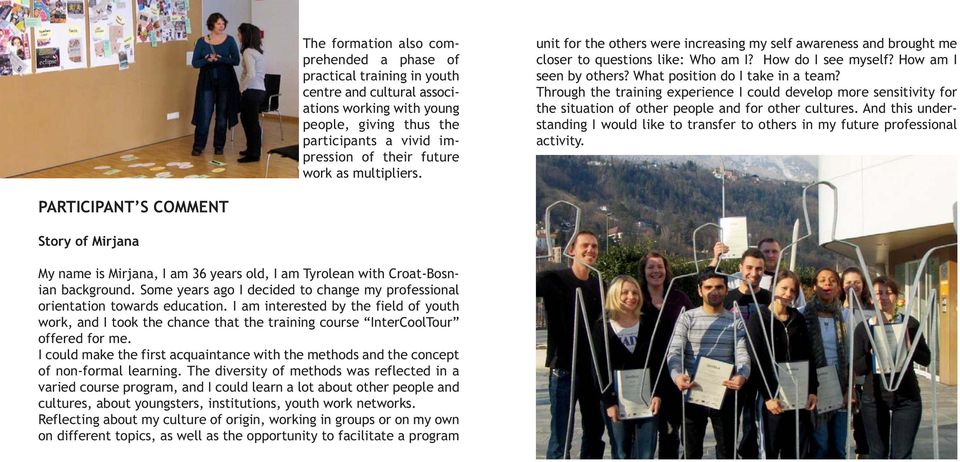
17 young people with fewer opportunities, to facilitate learning processes and promote personal development and to encourage intercultural exchange. CUBIC is committed to the values of inclusion and empowerment, mutual support and respect, intercultural dialogue and cultural diversity, participation and solidarity, creativity and sustainability. METHODS The applied methods, following the principles of non-formal learning, are needs-orientated, inclusive, empathic, empowering, and fostering self-responsibility and autonomy. EXAMPLE InterCoolTour InterCoolTour was the regional activity realized in Innsbruck from October 2009 to March 2010, within the Grundtvig learning partnership M3. The longterm training course for empowerment and capacity building of young adults from diverse migration backgrounds (former Yugoslavia, Turkey, Bulgaria, Armenia, Africa) was intended to lay the grounds for future activities in intercultural youth work. The underlying idea of this pilot project was to increase migrant participation in youth work in the region, or in other words, to achieve better migrant representation amongst regional youth workers, as a first step towards professional inclusion in this field. As role models, migrant youth workers are giving positive signals of cultural coexistence and can provide through their cultural and pedagogical expertise valid support for youth centre visitors which in a high percentage are from migrant backgrounds. The training course counted with the support of the Departments for Youth and for Integration Issues of the Tyrolean government. In a 6 months period and several modules the training course Inter- CoolTour gave an introduction to the concepts of Open Youth Work in Austria and the principles of non formal education and intercultural work. Building on the rich knowledge and experience the participants brought in, the course could settle the grounds for their future work on intercultural and youth topics.

18 The formation also comprehended a phase of practical training in youth centre and cultural associations working with young people, giving thus the participants a vivid impression of their future work as multipliers. unit for the others were increasing my self awareness and brought me closer to questions like: Who am I? How do I see myself? How am I seen by others? What position do I take in a team? Through the training experience I could develop more sensitivity for the situation of other people and for other cultures. And this understanding I would like to transfer to others in my future professional activity. PARTICIPANT S COMMENT Story of Mirjana My name is Mirjana, I am 36 years old, I am Tyrolean with Croat-Bosnian background. Some years ago I decided to change my professional orientation towards education. I am interested by the field of youth work, and I took the chance that the training course InterCoolTour offered for me. I could make the first acquaintance with the methods and the concept of non-formal learning. The diversity of methods was reflected in a varied course program, and I could learn a lot about other people and cultures, about youngsters, institutions, youth work networks. Reflecting about my culture of origin, working in groups or on my own on different topics, as well as the opportunity to facilitate a program
19 Fekete Sereg Ifjúsági Egyesület (Youth Association) Country: Hungary Partners: Diagonál Magyarország Promoter s address: 8291-Nagyvázsony, Petőfi u. 2. Website: [email protected];[email protected] Telephone: Nagyvázsony The Fekete Sereg Youth Association was founded in 1997 and is mainly composed by young aged between 13 and 30, living in Nagyvázsony (1800 inhabitants) and in the Vázsony-valley in Hungary. The association s duty is to represent the interest of the young living in the village at regional, national and international level. Our village is situated in the rural area. The target groups of our association are diverse: students, unemployed ones, minorities (gipsy/roma), disadvantaged and handicapped people etc. Our mission is to give the youth of the village possibilities to spend their free time by doing useful activities, to support bottom-up initiatives of the young living in the village. Our aim is also to give the same possibilities to our youngsters as others have in the European Union. We collaborate with municipalities, foundations, other regional, national and international organisations, experts and other people supporting youth. Due to our wide national and European connections, partners and networks, we try to provide the possibility for young people to get to know different cultures, people with the subvention of the Youth in Action Program. We usually organize local, regional, national, international events, trainings, youth exchanges, study visits, seminars. Fekete Sereg is an accredited European Voluntary Service hosting, sending and coordinating association. By this way of working we not only try to give them an international experience but we aim to facilitate their tolerance and abolish all kinds of discrimination and prejudices they can have. We regularly cooperate in formal and non-formal networks on national level. Our international

20 partners come from all around Europe and we have a very valuable network of partners in the Mediterranean and South American region. Our organization is member of the national network of the Anna Lindh Foundation. In our organization has a Grundtvig Long Life Learning Partnership Project. In 2009 Fekete Sereg coordinated a Youth in the World project between Europe and Latin America (Argentina, Brazil, Paraguay, Uruguay) and we have the opportunity to participate in a project with Africa (Senegal) and Asia (India, Indonesia, Thailand). METHODOLOGY There are some characteristics of our work in the Diagonal Hungary association. As an umbrella organization, our aim is to support youth work in rural areas, mainly in small settlements where there are very few opportunities for youngsters. Our strategy is called White Spots. Our primary method in inclusion is using our network of youth workers and specialists in reaching young people. As we see, many programmes fail right from the start because of the inefficient way of reaching young people or because they miss the target group. They invite people to trainings, workshop or exchanges through or writing professionally sounding letters. This method works as a filter and proves inappropriate for reaching young people who live in small, remote settlements and who hardly have access to the world whatsoever. Therefore our main method in reaching young people is that during the preparation phase we pay personal visits to young people, finding them one by one. Our network is growing year by year and we include more and more youth workers and peers. Our primary method is the so-called motivation day. It is a mixture of training methods and informal meeting, a day when we feed in information. It involves at least three parties: the professional who is working on the preparation of a given programme, a local youth worker and a youngster who lives in the given settlement. They all work together in organizing a half-day programme for the young to raise their attention, to grab their interest. We call them coach, mentor and peer. The coach is a pro, a member of our organization, coming from far who initially does not have much knowledge of the group. S/he is a person who is professional in a field or fields of youth work: methods of education through sport, settlement development, team building, knows how to write applications for calls of tenders, works as a project manager or knows a lot about drama pedagogy or could be a specialist of organisational development. S/he represents the new knowledge who can bring fresh insight into the community. Besides s/he also represents the given project, s/he will activate and include young people. The mentor is a person who usually lives in or nearby the settlement, who has tight contacts with the community. It could be a professional, a youth or social worker, a teacher, a cultural organizer or even an amateur : an adult or parent who supports youth work. S/he is the
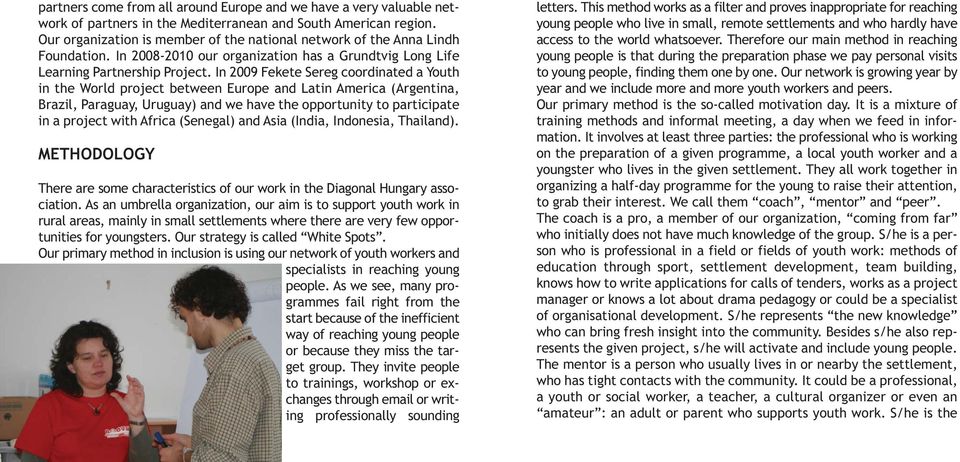
21 one who is listened to in the community, who calls the people, invites youngsters to come to see the event. On the long term s/he guarantees the sustainability of the programme, makes sure that young people participate and do not drop out. We cannot emphasize enough the importance of sustainability. Especially in depressed areas it is not fair to involve young people in training and show them hopes, then let them disperse due to the lack of further support that would help maintain motivation on the long run. We need to provide support on how to carry on, how to nurture their plans after the training is over. A peer is a youngster who is one of the given community, similar to them, speaking their own language. His or her main characteristic is that s/he has great intrinsic motivation and power to activate and support others. Naturally it goes side by side with other abilities and talents however, it is this motivation as basic attitude that plays the chief role and decides if one is suitable for the role of a peer or not. S/he is the one who is one of us, comes from the same age group, shares the same feelings and can be set as an example, who shows that it is worth participating in the programme, if s/he can do it, you can do it. The motivation day is usually tailored to the needs of the youngsters and may consist of several parts. An integral part of it is an activity based workshop. It could be sport with equal chances, outdoor activity, mural painting, a drama play that fits the topic or a discussion involving every side. The main point is active involvement: before youngsters are provided with any kind of information, they have to have their own, hands-on experience of what the programme will be like, what we are going to do. Then we shortly introduce the given training, possibly through experiences or the work of the peer, and also we also show a short video. Short videos play an increasingly important role in catching the attention of generation Y. Finally we set aside the time for getting to know each other, letting ourselves sink deeper into the reality of the youngsters, getting to know them a little more, establishing relationships and contacts with them. This moment is of primary importance: after we have given a strong input and raised interest, we pass the initiative to them ( Show us how you live, where do you spend your time, what do you like in here? ) that s how we lay the association for mutual cooperation. After the programme we make food together, have a walk together in the village or sit in the local pub we take part in their lives a little and in so doing we build trust further trust has overall importance in our relationship in working with youngsters with fewer opportunities. After the well-prepared introduction, the next step is the training itself. It usually consists of three integral parts. Since these projects are realized by using different funds or grants, we introduce the given grant system and the priorities of it. Besides, we also introduce our basic principles, such as community de-
22 velopment, sustainability, inclusion of people with fewer opportunities, complex development of the personality they are also very important in putting together these programmes. Last but not least we give open space to the expectations and needs of the young people, especially with regards to the methods i.e. how the training should go. If they like sport and like being outdoors, we will do it this way. If they prefer arts, music or drama more, then we apply methods suitable to their needs. We think that the most important element of our training is how to adapt what they have learnt to their own lives. We try to achieve, that by the end of the training every youngster or every group of them have exact plans of how to implement, how to adapt what has been learnt into their own reality. Naturally, it might happen that someone arriving with individual goals would rather like to break away from the barriers of his or her community. In this case we help him concentrate on his inner self, turning the methods working outside in. The next element also connects to this. This is the so called creating sample projects and supporting them to come reality in the coaching phase. We make a deal with each participant of how big assignment he or she wants to undertake during the project. You have to think of very diverse activities. It could be a weekly or monthly plan of how the youngsters going to integrate what has been learnt into their lives. In the case of some more active young people it could be the task of developing their own group. It could be a motivation day or internal training where young people can have a chance to try out things with others, something that they had themselves done in the training and in this way they multiply what has been internalized. And there are always one or two of the most active ones, who would try themselves out with organizing a youth exchange or a youth camp taking the responsibility for arranging it, raising funds for it, doing all the bits and pieces that it requires. During the coaching period we support them in realizing their own objectives. It is also important that this coaching period is neither short nor long two or four-month periods have proved to be the best. We make a personal arrangement with every youngster on how they wish to be supported. Some prefer weekly s; some ask us to be available on the phone or MSN. Many of them prefer encounters in person to distant calls, in these occasions we usually involve their whole group as well. Our projects finish with an evaluation meeting. During them we assess all our successes and failures and work on maintaining the effects of the projects on the long term. The wash back effects can be manyfold. Some get inspiration to move on or learn on, some of them get clearer ideas of what to choose for a career for themselves. For a group of young people a training like ours can give a chance to develop, to move to a higher level.
23 Many of them get to like working with young people and they themselves become youth workers they start working for NGOs or other civil organisation or become professionals, mentors, coaches, project managers and so on. Naturally, the methods of non-formal education have their limits, too. We cannot create new workplaces or handle problems with authorities. However, what we can achieve is bring fresh wind to remote places, shake people up and help people working on these places tackle frustration and burnout. And most importantly, we believe that we widen horizons for young people and help them develop. SAMPLE PROJECT: TRIN PASURA THREE STEPS Our association together with our partners works on the integration of the Romani youngsters. We launch programmes that support youth workers and social workers through youth work. Between we made a project called Trin Pasura whose aim was to strengthen the collaboration between the professional workers and create a valuable network among us in the field of Romani integration. The main elements of the project were: study trips for our professionals and volunteers, preparatory meetings and seminars and several bilateral and multilateral projects. The main part of the project were two training courses and one coaching-part between the training courses, which were supported by the Youth in Action Programme of the European Union. The training courses were organized in the eastern part of Hungary in Túristvándi, which is a village mainly inhabited by Romani people. This territory is one of the most underdeveloped part of the country, extremely poor, ideal for field study and gaining hands-on experience for the participants. The place was ideal also because in this community there is a group of young people where Romani and non-romani people work togehter. This example is uniqe in the country because it shows that Romani and non-romani are not enemies and they can work and live together. In all three sections of the project our professionals took care of promoting the training among the Romani youngsters and lended a hand them during the coaching period as well. During the preparation - with the help of a local community developer - we involved a lot of people: the local Romani who take part in the youth community, the ex-president of the municipality, Romani people with
24 big families and a great part of the religious community who constitute most of the Romani people. We involved the participants in the ususal way: through our personal network, which has so far proved effective. They all shared one thing - all of them have done field work with Romani youngsters but apart from that they made a very heterogenous group: social workers and assistants, people who deal with unemployed people, teachers and exlocal MPs were among them. During the trainings we implemented the methodology of experimental learning and non-formal education and we counted on the active involment of the participants. During the first training course we were feeding in actual information regarding the Romani community, to understand Romani culture and to develop our competencies related to the meeting of different cultures. Regarding the ars poetica of the trainings we got closer to the local community as well. Among the adults we made a research about their presevering traditions and the transformation of them. We met the religious local community and we ate traditional Romani food. During these meetings we spoke about the power of the modern religious behaviour and it s power to gather people. This mentality lives its Renessaince in this territory. We involved the youngsters in several parts of the training the movie club, the cultural evening and we organized a sport day for them. Throughout the activities we used the co-operative learning methods, tailor-made to the needs of the youngsters. We also introduced the Youth in Action Programme. During the coaching period the youngsters received personal support on how to develop their own projects at home. Nearly half of the participants chose a personal goal, such as to learn about the details of the application system for youths, to develop their communication competence in English language and youthwork and increase their knowledge about the Romani reality. The other part of the participants set goals regarding their own groups for example team building processes through sport, music, art and organizing events. Some of them made and wrote the applications in the frame of the Youth in Action programme. That is how great projects were born to make Romani youth more active through dance and football and the
25 projects for two international exchanges were also born. From the group 4 people participated in the M3 Mobility of Innsbruck and with their strong and active participation they made a very serious effect on the representatives of the partners. During the Hungarian session of the M3 project, on the so called Minority Mosaics Seminar several members of our network helped us with their job. Through the second training we examined the possibilities of the EU foundings, we went deeply into the methodology of leading groups and we discussed the possibility of mediation between the Romani and non- Romani groups. Besides a lot of individual results the great succes for us was that we established the base for a future network cooperation, and we also took some practical actions to start our common network. The group expressed a strong intention to maintain the cooperation among the members of the project this cooperation and supervision could be the stronghold for those working on supporting and fostering the peaceful coexistence between Romani and non-romani people. Apart from this it seems that we managed to achieve long-lasting effects on the settlement that was hosting the events of the project, too. Based on the ideas of the youngsters they are planning an international exchange on peer education. We believe that this project has great chances to win support. Should they succeed, youngsters who have never had a chance even for a good holiday, will stand a chance to get great input and motivation to choose their own carreer! PARTICIPANT S COMMENT Strory of Misi I am a 23 year-old Roma guy. I was raised in an orphanage and I still live there. I have been participating in youth programmes. Since I have a deeply rooted fear for starting my own career and becoming independent, I think what I need mostly is encouragement. I have acquired two professions, one as a painter and the other one is a waiter, and besides this I dance and sing in a band that plays authentic Roma music. In spite of this I don t really see how I can make a living on my own without any family support. While I was looking for a job I felt it on my skin what it was like to be a Roma: although I applied to many places I was not hired because of my Roma origin. The fact that I was able to participate in the M3 project gave me a lot of strength and inspiration. In Paris I saw that young people of Afro- American origin are in an even more disadvantageous situation than I am. Meanwhile I learnt that I can also manage to speak in a foreign language, I simply have to start and do it without fear. I can see it a lot more clearly how I can use my abilities in my every day life.
26 Story of Ervin I live in Devecser, which is a settlement half inhabited by Roma people. I would have to live the typical life of Roma people in Hungary if I hadn t decided when I was young that I would be successful not only among Roma but even among people of not Roma origin. That is why with my childhood friends we established a band called Flare Beás which has become a success. We are Beás Roma, but we also play the songs of Oláh Roma and Romungro origin. We would like to show a positive picture of Roma people and together with the Hungarian folk musicians promote peaceful coexistence. Besides this in my town I work as a social assistant where every Roma knows me. I mediate in different cases for people from all walks of life, in schools, kindergartens, the local magistrate or any other authority. It would be good to have partners or fellows! Within the framework of M3 project I went to Innsbruck where what most surprised me was that the problems that they have regarding immigrants are greatly similar to the problems that we have here regarding Roma people. Life is not a bed of roses not even in the West. One of my most memorable experiences is that many foreigners frankly told me that encountering me and my peers helped reduce their prejudices against Roma people. Story of Tufa I am a youth worker in one of the small settlements of the Trans- Danubian region. I am of Romungro origin, but I myself don t speak the language and don t keep the traditions. I am Hungarian. In my youth group it has never been a question. It disturbs me when we deal with this question too much. The actions and abilities of a person should speak for a person and it is better to leave the question of origin for sunny afternoons sipping wine under the shadow of a tree. For the first time in my life I noticed in the Trin Pasura project how colourful and many-sided the Hungarian Roma society is. What I heard during the project made me even stronger in my decision to continue youth work. At the moment I am working on a photo exhibition which shows the traditions and values of my village and I keep on organizing youth programs.
27 Story of Laci Because I wanted it so It has been more than 25 spring since I was born in Kisvárda. My mother was very young (only 15 years old) when I was born. So naturally my mother s parents raised me together with my mother. Besides them the whole street were my parents since my mother s girlfriends also loved and caressed me. I was raised in Demecser in the Roma slums. We were very poor. My grandmother and grandfather were visiting villages and collected metal waste and feather, and my mother worked in the household. I was about 12 years old when I came to the decision that I do not want a life similar to those who live in our street. A life without plans, goals, aims, a life with no opportunities. Therefore I decided, when I grow old I will live differently - I will have my own goals. Unfortunately I could not go to the kindergarten but I liked going to school all the better. Because of my Oláh origin Hungarian words were strange for me during the elementary school, but when I became 10 I was able to speak clearly the language of the country. I really loved school and my non-roma friends because I just got good things from them. They encouraged me and told me to go on, to continue. I was among the good students and it remained so during the secondary school. During the years of the secondary school I already knew that I will stand up for the interests of the Roma people and I made everything for making myself well-known and be understood. I wanted that when people hear my name, they associate it with positive and good things. I took part in several things: I was a dancer, a singer, a musician, the editor of a newspaper so I can say that I have been active in the field of youth work. I play soccer and I participate in youth forums also. By the time of the third year in college I reached that I had become the member of the Local Roma Municipality and I became a member of the Social and Health Commission of my town. I made my degree in the field of Social Work and nowadays I work as a case manager for programme sponsored by the European Union: I am helping unemployed people. I worked for the municipality of Nyíregyháza which is the closest biggest city and for the children welfare centre too. Besides my permanent job, I still write articles for the local newspaper and I help youngsters to create their ides for their community, I teach Lovari Romani language, do counselling, I am a football referee and I actively participate in the life of the civil society. I have been living with my bride, Adrienn for 5 years in a very happy relationship. Thanks God everything in my life is going well on the way I decided when I was 12. I hope that we will have a happy and calm life in our future house. Ashen le dragone Devlesa!
28 France Amérique Latine (FAL) Country: France Partners: Direction Régional et Départementale de la Jeunesse et des Sports de Paris-Ile de France; Amicale Internationale des Sportifs;Association Théatre Compagnie á Bulles; Jeunesse Pour le Monde Promoters address: 37, Boulevard Saint Jacques Paris Website: Telephone: France Amérique Latine (FAL) is an NGO for Defense of the Human Rights. It was created in 1970 in order to develop solidarity with the Latin American people. It helped and received in France a lot of persecuted activists from all nationalities, exiled, victims of military dictatorship, lawyers, artists, writers, priests and bishops, union leaders, NGO and youth leaders. As an NGO of development, FAL took many actions co-financed by the European Union, the French Government (Ministry of Foreigner Affaires, Ministry of Culture, Youth and Sports Ministry), in Nicaragua, Chile, Peru, El Salvador, Colombia, Ecuador, Guatemala, Bolivia, etc. Since 1993 FAL has intensified the youth intercultural exchanges with its Latin American partners: training courses in Colombia, Venezuela, Paraguay, Brazil, Mexico, Guatemala, Peru invitations from associations in Europe and Latin America, reception in France of the Children s Ambassadors from almost all the countries in Latin America, youth exchanges and so on METHODOLOGY Paris Our trip to the World Social Forum- Belem do para, January 2009 To understand our methodology how we work with young people here is a project example: In January 2009 we had a project with 15 people from 18 to 30: Tarik, Abdel, Hicham, Naima, Noureddine. They re French citizens from the second generation of migrants. Twelve of them are from North Africa, two were black and one Chinese. The majority were Muslims but they
29 don t like to be called Arabs, because they are proud of their Kabilian origin (Kabils are a pre-arabic people of Algerian mountains). So you may consider our group as migrants or as a minority, at any case as youngsters in mobility. They live in the same district called Yuri Gagarin of the city of Ivry sur Seine, close to Paris. Their study level is the end of the obligatory school in France at 16. Little success for the few, who enter the University of Music, Enterprise management, Informatics Departments Often unemployed, with badly paid summer jobs. With the financial help of the city of Ivry they carried out past years solidarity actions in Mali (Africa): building a school, painting a common house, digging water wells Two of them went to Malmoë (Sweden) for the last European Social Forum. During our common work with them the group decided to imagine a performance with Brazilian youngsters on the theme of Periferia what favellas, slums and shanty towns mean An adult scriptwriter, their leader, would film it. They didn t speak Portuguese. So the first step consisted in learning this new language with a professor. In Autumn 2008, Ivry invited three Brazilian professors of theatre, dance and music for two weeks, in order to imagine the script of the performance all together: they decided to show violence, misery, drugs, prostitution, police abuses, sadness of mothers in front of their dead sons, and how to overcome this violence, singing, dancing, laughing As we visited them in Ivry, we could testify they were not artists, but shy players, with slow rhythm and short imagination. Once in Rio de Janeiro, we met the three Brazilian professors and young people of the favela La Maré, one of the most dangerous place in the city. We lived in the same school, without any bed, but with showers. In this way we were easily accepted by the local neighbours: their sons and daughters were rehearsing the performance with us. The Brazilian team seemed a lot more at ease artistic and happier than us. They first showed us their talent and our group became jealous and ashamed of their poor performances. So we tried to be as good as them, learning capoeira dance, teaching Frère Jacques dormezvous?, speaking some sentences in Portuguese The fourth day, we presented the performance to the families and inhabitants of La Maré and that was great! Everybody looked confident. Then we travelled (Brazilian and French young people together) in the same bus to Belem. Most of young Brazilian were leaving their families for the first time; travelling is not cheap for Brazilian workers. I let you imagine their emotions (tears). We arrived at Belem and our performance was repeated and improved by actors, professors and a film-maker. After that, we went to the World Social Forum, unfortunately not very organized: no indication
30 of the way; no translation; various kilometres between two stages; tropical rain; endless waiting for the buses We tried seriously to get a place for our performance; even the Major of Belem promised what he couldn t give: a square in the centre of the city, a place near the boats where Three World activists were supposed to rest, a stadium Finally our efforts made us run into the Union s tent, where World Union s leaders accepted, received and applauded us; the following day we came across a podium reserved for folkloric dances: our 20 minute performance in both languages exposing suburban violence resulted in real success, two hundred people of the audience joining our dancers in a spontaneous Carnival procession! The performance was not the only activity of the French group. One of the best moments was the direct video conference with the youngsters staying in Ivry: as announced before, we met an Ivryan radio reporter in Belem, and our guys could express to their friends and families what it was like living in the WSF. Thanks to these 15 girls and boys, Ivry inhabitants got the impression as if they themselves were participating in this four-day international meeting in the mysterious homeland of football called Brazil. My group seemed very proud of it. OUR RESULTS In the plane back to France, we all noticed that our group had changed during these 12 days. They looked more mature. Less children games and more citizen attitude. A feeling of responsibility. They discovered what solidarity at world level means. They could see with their own eyes that millions of people are building alternatives to live better. In particular, in Amazonia our Parisian youngsters met a lot of Indians: each tribe claimed for the link between Man and Nature. The Indian world is a true society of sharing and welfare, and not of accumulation of goods or money. Facing the different actual crisis, solutions may be invented to avoid destruction of natural resources. The non-formal education we bring to this group may represent at least one semester in a famous university. WSF gave another new example: the presence of fairness and celebration in political struggle. For example in the political meeting Another world is possible claimed new ways - without blood, without arms, without guerrillas. Violence is common in France and in Europe, because of the two World Wars and other colonialist conflicts. But we all know that strikes are not
31 only serious demands for better salaries: workers on strike use to sing and dance and assemble barbecues and play football in their occupied factories! Not only fighting policemen or burning tyres! So our group discovered there is another way to make politics, friendly and not dramatic. We (youth workers) have a special role in these situations. We simple have to be present. We guarantee security to young people. We don t give orders, just example, eating the same meal, sleeping on the same floor, travelling by bus and not by plane, being always respectful and cool in hard circumstances. As a conclusion, integration of minorities (or sons of migrants) is always facilitated by the relationship with other countries. Young people who travelled to Belem felt themselves French (as Brazilian perceived them), but at the same time Algerian (as their parents passports show), and Kabil (with their own Kabilian language, original traditions on women s freedom, popular arts etc.) They are citizens of the world. PARTICIPANT S COMMENT BRUNO BOUDJELAL Who am I? Everyone tells me Lemaouche but I don t dare tell them that nowadays my father calls himself Jean-Claude; even when I was young I d never heard my father s true name. It was only one day when I needed a copy of my birth certificate that I chanced on his real first name: Lemaouche. It was the same day when collecting this birth certificate, at home with her parents, carrying the child of an anonymous man from the other side of the Mediterranean. And when I was born, what my mother s family did after all, that they acknowledged me by giving me their French name, Sombret. I was known by this name for a year after that; my name was Bruno Sombret. But the fact that they d acknowledged me didn t stop them from abandoning me in a home for illegitimate children the day after my birth. I was the burden too heavy to be carried. I d hardly been born and I d already been abandoned twice: by my father, and then by my mother and her family who couldn t accept me as one of their own. When they ask me how was my life as a child in France, I tell them that after living a while with my parents, they left me with my grandparents. This period seems comfortable to me. I didn t even know what it means to live with an Algerian origin other than on a few occasions, such as when my classmates at secondary school nicknamed me Mohamed the wog. Or when my grandfather explained to my father, that I needed to have the French nationality to go on
32 a school trip to England, while my father wanted me to wait until I was an adult to choose. And between them, me, crying and begging not to let me be an Algerian, without even knowing what that meant. Who is my father? He always pretended he was from Italy. He remained forty five years without speaking of Algeria, nor sending news to his family. He changed his name in 1981, trying to become a French citizen without past or history. He never dreamed to go back to Algeria, even during holidays. But the family reminded him. When I discovered Algeria in 1993, I was 32 years old. Before travelling I would ask my father some details about his family; he never appeared at our appointment. The family received me with such love and proofs of affection that I convinced him to come with me the next time. Once there, he asked for his brother Hamid. My father was the only one who didn t know that Hamid was tortured and thrown into a well by the French forces during the Independence War. My grandfather told us how he took the body out. Eight days before, Hamid was back from France, where he tried to convince my father to fight for Independence. The whole family admired the photos my father brought with him: his houses, his cars, his wives French middle class way of life is unimaginable for Algerian peasants. All young people think of migration to a country of employment, peace, liberty. But when we got back to the airport to return to France, the police didn t accept his passport: it was necessary to call the officer who recognized he was a French citizen. So the policeman threw the passport on to the floor, and my father picked it up and ran away from the accusation of traitor! and he forgot about me once again. Some years after this incident, he invited my aunt Zohra in a holidays summer centre in Tabarka, in Tunes. Zohra was just back from pilgrimage to Mecca. She was actually so shocked seeing ladies with topless on the swimming pool and at my father drinking wine with his last wife that she didn t leave her room till the end of the week. Who is Algerian? I am Algerian but I d never thought of characterizing myself. I was an Islamist with the Islamists, a modernist with the modernists, more nationalist than anyone, and always in agreement with my interlocutor in times of war, and ready to contradict him in time of peace. In the most terrible years of war, I helped some but not others, I betrayed some but not others, and I took care to try to cope by judging which way the wind was blowing. It may not be pretty. But that s the way it is. Wars of liberation, when you win them, have the merit of giving grounds for collective pride. At least that is the way we like to hold them in our memory. But civil wars are an irritation that lasts. You scratch for a long time before you realise that tearing your skin achieves nothing. You need proper treatment, from within, to be cured. For those who survived the second Algerian war, the overriding feeling now is of a huge unlearning. To overcome the terrible idea that behind so much death and so much suffering, there has been such superficiality, inconsistency, irresponsibility. And how easy it is to confuse hatred of the other, with a depth of conviction.
33 To forget. To forget yesterday, and before. To forget that in theory we were brothers. And ferociously opposed. To forget feelings, illusions. The restless wandering. Not the facts. Not the dead, not the thousands who disappeared, not the torture, not the camps in the desert, not the massacres, not the humiliations, not the lies. Not the sacrificed youth. Not old age devastated by despair. Not he widows, not the orphans To forget the evil passions. To forget the myths of a fraternity founded on nation, religion, or through struggle. A fraternity so often betrayed that one should blush just at the thought of evoking its distant memory. After the state of siege declaration, June 1991, the world became blurred again. As it was before independence. Despite the passing of time, I cannot stop myself thinking bitterly, and with real anger, of all the criminals sitting at home in luxury, honing their vile weapons, while watching the naïve innocents who thought their liberty had finally arrived. These criminals are not just dim-witted generals. There were also lawyers with international reputation, multi-millionaire businessmen, diplomats, imams, writers, ministers, intellectuals, public officials The Withdrawal of the State, as the government called its politics since riots of October 1988, heralded the start of great massacres and the terrible isolation of villages of the Mitidja, the plains of the Moulouya, and the mountains of Blida and Ouarsenis. First of all the hutting down of state services: no more police stations, no more civil defence, no more telephone, nor water, gas, electricity. Hordes doped on amphetamines or some even worse substance swarmed into these communities, and after nights of terror, corpses of entire families were exhibited, from the grandfather to the baby at the breast, filmed on camera to be shown on TV evening news. COMMENTS OF THE YOUTH WORKER Bruno Boudjelal is a photographer who is exposing in Paris. His book Disquiet Days was postfaced by Salima Ghezali, a journalist and writer, laureate of Sakharov and Olof Palme prices in I ve tried to respect their opinions. Most migrants are coming from countries without democracy, without state, but with civil wars. To overcome their fears is the first necessary step is of their integration. Democratic progress in their homeland makes their arriving in the European Union easier.
34 Point Europa Country: United Kingdom Promoters address: The Manse Garrett Street Cawsand Cornwall PL10 1PD Website: Telephone: Cawsand LOCSP (Leyton Orient Community Sports Programme) Barking and Dagenham Positive Futures Economic well being. anti-bullying anti-racism be healthy breaking barriers bringing communities together. building communities cadiz careers advice crime prevention crime-prevention daat develop positive realtionships. develop self confidence drug and alcohol abuse prevention drug and alcohol prevention drug awareness east London economic well being economic well being. economic well-being enjoy and achieve enjoy and achieve. enterprising behaviour estate rivalries european social fund. every child matters frank gazmend's journey girls and boys healthier lifestyles and reduced alcohol and drug misuse. healthy life styles healthy lifestyle healthy lifestyles inclusion increased self-esteem and inclusion in the community increased tolerance and respect of eachother inter-borough inter-estates intergration law abiding behavior locsp making a contribution to the community making a positive contribution metally healthy multi-agency multi-cultural tolerance multi-ethnic multi-racial over 300 girls and boys patti boulaye pct. physical and emotional wellbeing picture police positive behaviour positive contribution positive experience positive futures prevention of alchol and drug misuse progression through programme racial tollerance religious tollerance respect for authority role models safe from bullying safe from bullying and discrimination safe from crime safe from crime and bullying. safe from harm semi-pro football sexual and drug awareness sexual awareness sexually healthy sports development stay safe support team work thank you youth development youth training
35 THE ORGANIZATION We commenced work in the Barking and Dagenham in 2000 and currently deliver a comprehensive daytime, early evening and holiday programme to young people (in particular those at risk) aged 7-19 across Barking and Dagenham. This programme has been established over a number of years and we have developed strong links with the Youth Service, Community Safety and the Youth Offending Team. The sport provisions offer a range of sporting activities which includes Football, Basketball and multi sports. We have also established a good working link with the local Pupil referral units who we work with on a weekly basis. The evening programme focuses on parks and hard-court areas such as Gascogine estate, thamesview and Scratton Farm estates. Through the evening programme we have introduced estates based football tournaments and leagues with the winners playing at SCORE against our other estates based teams in Hackney, Newham, Tower Hamlets and Waltham Forest during every holiday. We have established a number of strong working partnerships with the key providers in Barking. This includes the Youth Offending Team who regularly refer clients onto our provision. METHODOLOGY Gascogine Estate The estate based football has proved to be a major success in a 5-Aside tournament format, providing young people with the opportunities to lead and deliver sessions as volunteers, and gaining sports leadership awards. It has been very successful in attracting higher numbers of regular participation from young people. The 7-11's has increased its participation levels to between 35 and 50 young people who attend on a regular basis. Members of the age group now volunteer and help deliver the session. A positive culture has been created and young people have responded well to the respectful boundaries of conduct in place. The age group has also become a great success with between 25 and 30 young people regularly participating and the format following that of the younger session. Shaun Frazer of Gascoigne Safer Neighborhood Team said in December "When this session is on, there s hardly any trouble occurring on the estate. These sessions are Flagships for the way we are engaging and developing young people in Barking and Dagenham. Goals, Dagenham This is a provision for year olds and is an organized league with an average of 20 teams participating consistently and regularly. Up to and over 150 young people (including spectators) are engaged weekly. The league is now a show piece to the work we are doing in the borough with support from The Mayor who enjoys making the presenta-
36 tions at the end of each league period. Many young people are given the opportunity to participate and socialize in a safe and positive environment, with the new development of the Terrence Higgins Trust attending for sexual health and Chlamydia testing. Basketball The basketball programme has gone from strength to strength, with many young people being introduced to the world of basketball and good partnerships being formed with other agencies as the programme has grown. The programme is a great advert for joined up multi-agency thinking with links being formed with Barking and Dagenham Schools Sports Partnership and Basildon/Southend Positive Futures. In the past few months the creation of the Junior Basketball League held in Dagenham Park in partnership with SSP is really helping to attract young people into basketball and to sister training sessions, providing a positive diversionary indoor session for young people to be involved with. Volunteers are used in the same manner as the estate based sessions and this format is proving to be effective for basketball aswell. Over year olds are being attracted each week and this is expected to grow organically. SSP runs an under 16 s league on the same day and this session links in so that young people can develop and sustain their basketball sporting culture throughout their teens. Most Committed Young People Awards A new award scheme has been introduced in order to reward positive behavior and the commitment/responsibility of young volunteers. Each Estate has a nominated most committed young person and there is also an overall winner for Barking and Dagenham. Four young people received awards in 2007 and had a pitch side presentation at a Leyton Orient game by the Mayor of Barking and Dagenham. It was a great success and word has spread amongst young people on the estates resulting in more young people wishing to volunteer their time and be role models for their peers. Eastbrook Gypsy s and Travellers This has been a truly challenging piece of work, but is also proving to be the most rewarding. LOCSP has assisted the education co-ordinator at the site to help engage with the young people and their families through sport. Before LOCSP s intervention, the co-ordinator was finding it difficult to be accepted in the community and a great level of subtle befriending mediation was required in order to be to gain the trust of the community. At the commencement of the sessions the young people were unruly to the point of being barbaric in some instances. There was little or no respect in existence and no parental support for the work we were doing. Over a period of time, in which boundaries were slowly introduced and re-inforced, the session began to change into a peaceful and progressive environment in which the young people enjoyed being a part of. Parental support has also been achieved and now all the young people participate, not only in the sporting activities, but also in the arts and crafts and literature sessions the co-ordinator provides. The co-ordinator acknowledges and is grateful for the contribution that LOCSP has made.
37 PARTICIPANT S COMMENT From the moment of first contact with Billy at the Gascoigne sessions (April 2006), he's proved to be a well liked person amongst his peers in the session. However, due to the fact that he is obese he was always the last to be picked during session games and was always expected to go in goal by his peers due to his lack of perceived athletic fitness. It was apparent that his confidence and self-esteem were being dramatically affected by this. As he was a reliable lad, we offered him the opportunity to volunteer at the younger Gascoigne session in an effort to rebuild his confidence and give him back a sense of self worth. He accepted and the results have been fantastic! Billy has completed his Junior Sports Leaders Award and has been a very reliable and effective volunteer sports leader in the under 12 sports sessions. He has discovered a new found confidence and has imposed himself on the under 15's session with dramatic effect and to a point where his peers no longer expect him to go in goal and he is no longer the last pick! Instead, his newly discovered right foot shot and his commanding heading ability mean he is now a well respected and deadly goal scorer who is now seen as an asset to his peers! Billy has received a Leyton Orient Referees T-shirt, whistle and JJB/VUE Cinemas vouchers for his continued effort and commitment during the under 12 Gascoigne session. Florence Flo is a refugee from Albania, living on the Gascoigne estate, and he entered the programme in 2004 with the basketball programme in Barking. His enthusiasm and commitment at the time was significant in the establishment of a LOCSP basketball team in Barking and consequently the setting up of a LOCSP East London summer league for the team to play in. Flo, with the help of the programme, has inter-grated and adapted well into English society and continues to participate with the Gascoigne team in the Goals 5-a-side league. His leadership qualities have been recognised and he has completed various sports qualifications, with the support of LOCSP, and now is employed with LOCSP coaching and delivering sessions at Gascoigne, Goresbrook and Dagenham Park. He is a very positive role model to other young people. PARTICIPANT S COMMENT - NICKO AND EWA Nicko and Ewa are a young Polish couple who have been living and working in England for two years. Nicko is working as a kitchen assistant in a local hospital and Ewa works in a local hotel. In March 2009 they contacted Point Europa after seeing a local advert to improve their English. They were very keen to enrol and soon after they started sessions with tutor Eileen Ginnelly, at Link into Learning, Truro. During the course of their learning, they studied Speaking and Listening, Reading and Writing and successfully attained qualifications in their respective levels. During Initial Assess-
38 ments, their Individual Learning Goals were established. Nicko expressed a longing to improve communication skills to aid his everyday life activities both socially and in his workplace, whilst Ewa aspired to improve her grammar and definitely pass exams. Both students achieved these goals and more, due to their hard work and determination. The course in itself has instilled great confidence participating in a variety of lessons of a diverse nature. During their learning, they visited a local Police Station to engage in a Road Safety Awareness lesson. Whilst there they were able to openly communicate with local police, view equipment and even experience a ride in a police car. This particular outing prompted ongoing lesson activities in all skills and they were able to observe and compare cultural differences first hand. They also attended a party with other foreign students which contributed to enabling them to feel welcome, comfortable and interact with a diverse range of learners, exchanging their knowledge, concerns, views and opinions, all of which allows students to gain confidence in new environments. Their tutor also invited them to a family B-B-Q where they were encouraged to mingle with extended family members of all ages and practise their communicative skills, giving and asking for information. This was a really fun day and Ewa was able to confidently explain cultural methods and assist in making a variety of food items, which made the B-B-Q a great success. By the end of the celebration she was comparing Irish coffees and giving extended information about her duties in her place of work at a local hotel. Both students have experienced several changes in themselves and life in the UK since first attending English sessions. Their evaluating comments were: Ewa I feel definitely more confident with my writing and spelling but I still need to continue my English lessons. I enjoyed all the lessons especially the outside lesson with the policemen. This was very useful, helpful and funny (not boring lessons). I wrote my CV and supporting statement to help me apply for a better job as I would really like to work with youth especially to become a youth worker. Nicko I feel more confident to speak with people at work. I searched web sites and could read lots of words to use in my own web site. I enjoyed using the computer to practise grammar. The pictures are useful to help with my sentences. Maybe in my future I would also like to work as a youth worker and help young people who find living in the UK hard. PERSONAL ACHIEVEMENTS Ewa Oleksiewicz Ewa has gained recognition in her work place and was promoted to
39 Restaurant Manager. She is very highly thought of and has gained much confidence in face to face and telephone conversations, dealing with prospective customers and enquiries. She has been provided with positive and rewarding personal feedback from both staff and customers on her excellence in the trade and her ability to communicate with a sensitive, warm, welcoming and confidential manner. This was highlighted by her employer who put her name forward to participate in a local conference, which was to Show Case Cornwall to delegates from Poland, Finland and other countries. Ewa was extremely nervous prior to this event but on completion was very pleased and satisfied with her individual performance and new boost of confidence. This also gave her a taste of new beginnings and she felt her course of study had been extremely beneficial. Ewa has made great progress, lots of new friends and really gained confidence. She independently registered with an agency for possible work as an interpreter and has assisted with language barriers in surgeries and schools. Now in 2010 she is looking into working as a youth worker along with Nicko. They both have realised what a difference they could make to the young people in their area. Especially ones who are from migrant backgrounds like themselves. Nicko Nosowski Since attending English sessions, Nicko has become more independent and is far more confident with his reading and writing skills. The knowledge and confidence he attained through attending the classes inspired his entrepreneurial spirit and together with Ewa, they explored the opportunities to create a personal website to advertise Man with a van and aid the driving needs of the local community and beyond. In conclusion, it is obvious that both Ewa and Nicko have strong work ethics and have both settled confidently in the local community and by their own admission, the lessons provided by Point Europa have had a great impact on their personal development and progression. This example only highlights the ever expanding opportunities learning can also provide, apart from the obvious; meeting new friends, feeling more comfortable in strange settings and gaining qualifications to promote job prospects. Ewa was asked to write about the advantages and disadvantages of learning English. The following is what she wrote; unchanged. I started to attend English lessons about four months ago. I think it s a great idea to provide free English lessons for foreign people. I am attending every week for two hours and this is the only disadvantage I can find. I think it is not enough! It would be much better if they would give us about six hours a week. Our class is small but nice and comfortable. We can use computers if we need them. The group is small which is very good because our tutor had more time for us. I feel more confident to speak to people at work or on the phone. I don t have to ask somebody to help me when I have to make an appointment anymore because I can do that myself now. The most important thing for me is that my grammar is getting better. The English lessons are just great.
40 Strim Country: Poland Partners: Polish Humanitarian Organisation, Kurdish Centre for Information and Documentation, Armenian Cultural Association Promoters address: Krakow, Ul. Pawlikowskiego 5/5 Website: Telephone: Krakow Youth Development and Integration Association STRIM was established in 2001 in Krakow. The association assembles active young people who are willing to undertake actions aimed at building an open-minded society, interested in the youth problems, international education and culture. Through our work we wish to develop awareness of various issues. Therefore, we initiate and promote all forms of activities among young people. We are especially interested in the topics of intercultural education. That is why we try to develop regional, national and European projects aimed at removing barriers and creating bases for better understanding between Eastern and Western nations. We spread knowledge about Poland and Malopolska region, as well as create possibilities for Polish people to take an active part in social and cultural life of our region, our country and Europe, promote well-tried standards of local democracy; development of economical awareness. In order to reach our goals we organize youth exchanges, workshops, courses, seminars, trainings, conferences, public events, meetings and study visits. At the same time most of the activities concern international projects, realized within such programmes as: Youth in Action, Grundtvig, Leonardo da Vinci. Additionally, we cooperate and exchange experiences with cultural, social and political authorities, local government and other national and foreign organizations. Even though STRIM Association has always been promoting the topics of intercultural learning, active participation and non-discrimination, it is just recently that we have fully opened up for new beneficiaries and participants of our projects. We made a strong commitment to in-
41 volve in the activities people with fewer opportunities e.g. of different ethnic origin, migrant background, refugees, disabled (physically and mentally), representatives of sexual minorities etc. This stems from the belief that everyone has an equal right to be involved in public actions, particularly the ones affecting their own well-being. This newly-defined target group is encouraged to take part in the already existing activities e.g. foreign voluntary service, local social campaigns, workshops etc. Although no special methodology is employed we spread the knowledge of various sources of funding for international projects (mainly owing to being a regional office for information on EVS opportunities), thus increasing the number of people with fewer opportunities involved in the activities. METHODOLOGY For a few months now STRIM Association has been actively involved in the local activities realised within much bigger international project M3-Migrants-Minorities-Mobilities. As the core of our actions we chose to develop a social campaign in order to bring the problems of migration and ethnicity closer to the society. Krakow is truly one of the most culturally diverse cities in Poland. It is here that foreign languages can be heard more often in the streets, or people of very different skin colour or facial features can be noticed in the crowds. This is partly a result of post 89 changes, partly Polish accession in the European Union structures in 2004 and hence much bigger mobility of people. On the other hand, for hundreds of years Krakow has been home for many of our ethnic and national minorities, Jewish, Roma, Tatar, Lemko, Armenian, etc. to name just a few. This great social variety of people living together in Krakow gave us an idea of building a bridge connecting Polish with our old/new neighbours. Therefore the social campaign we have been developing successively pays special attention to the city of Krakow as our joint home and little world in itself. The idea was welcomed by other organisations (both governmental and NGOs) which are now cooperating with us on the activities. The most important are: Office of Plenipotentiary of Malopolska Voivodship for National Minority and Ethnic Issues, Polish Humanitarian Organisation, Kurdish Centre for Information and Documentation, Armenian Cultural Association. Apart from this a number of university students and young people of migrant and ethnic backgrounds take part in the activities. As part of the joint M3 and 2 regions and 2 continents projects (both concentrated on the issues of minorities) a social campaign in form of My Krakow exhibition was prepared in December As the first step we asked 24 people (representatives of ethnic, national minorities and migrants) to tell us about Krakow, how they came here and what made them stay over. Next young people carrying out interviews took photos of our models in their favourite places in the city. These were later developed and hanged, together with descriptions, in Kawiarnia Naukowa, cafe situated in the very heart of Jewish District in Krakow, Kazimierz. As we wrote in the official letter opening the event: The idea for this exhibition was born in the hearts of people who are in love. In love with Krakow. They come either from behind the Eastern
42 border or faraway countries. They were brought up in very different cultures. They believe or not. They claim they experienced openness, tolerance and warm-heartedness here. Krakow reminds them about the places from their childhood and fascinates with its being different. They found here their place in the world. And the places they especially like visiting. Maybe this will help you, dear visitor, to fall in love as well with Krakow? The success of the exhibition made us believe that the topic of the M3 project, although well known, is still to be discovered much deeper. Therefore within the next few months we are planning to organize more events like this, this time connected with movie shows, thematic and artistic workshops, etc. PARTICIPANT S COMMENT Each of us has a personal story to tell. These are sometimes simple, full of happiness and joy, sometimes sad and depressing. As we encountered some of these great stories in our local project, we wish to share further. Joanna Bocheńska graduated from the Jagiellonian University with the PhD degree having written dissertation about the Kurdish identity and literature. Now works for Znak Foundation and cooperates with the UJ Institute of Oriental Philology, where she tries to develop the newly opened Workroom for Kurdish Studies. She is a publicist, lecturer and an interpreter, from time to time a photographer and a poet. About herself and Krakow: Although Cracow is my hometown, my roots are not only from here this brings about some distance. My mother was Tatar from Podlasie and even though she was bound to Cracow herself she kept the distance. Searching for my own identity I discovered the Muslim and Middle East culture which became close to me, the second homeland. Cracow is now the place I always come back to, yet each time it is a different city. Cracow is open for multiculturalism and will remain like that as long as fashion for multiculturalism will be connected with deepening the meaning of multiculturalism. Living here permanently look for similarities and difference with the Oriental world, which I long for, yet I cannot live in. It is life in the space Between, which becomes a lifestyle in itself. I try to share my East with Cracow, the one I got to now, understand and love. It is not the same world as ours, but it does not mean it cannot be close to us. I wish Cracow could become the space Between searching for the mutual understanding of the people from the East and West.
43 Many places in Krakow are close to me, yet the yard in front of my house is especially close with its ordinary looks, it is the place you look at every morning, in the rhythm of one s own thoughts and plans, and in the evening within the rhythm of one s reflections. Almost all the trees here grew and changed with me and the whole city. It is just a tiny drop, an element of the puzzle of streets, squares, yards, houses and people s fates. Adrian Bryk 26-year old repatriate from Ukraine About his favourite place in Krakow: When I walk down Grodzka Street and look around, I look up, feel as if time stopped. I think about Lvov. Lvov is in me, it is beautiful and close to my heart. I was born there and spent there 17 years. But what can I do now? I am far away. Fortunately, I am in Krakow where it is easier to keep my memories alive. Izabela Buassa English teacher from Kenya, came to Poland to do her M.A. degree in journalism. After graduation she stayed in Poland with her Congolese husband (also student in Krakow). They run a family business African catering and together with other members of African community in Krakow they promote the culture and traditions of the Black Land in Poland. About her favourite place is Krakow: I love this place. It reminds me of Nairobi, capital of Kenya, where I come from. Each time I look at the rocks and breathe in the fresh air, I feel that I am closer home. I often come here for a walk with my children. Abdulkarim Karim - Kurdish PhD student at Jagiellonian University. He comes from Iraqi Kurdistan. About himself and his favourite place in Krakow: I came to Krakow five years ago for studying PhD in Biotechnology at UJ under the cooperation between UJ and Salahaddin University in Erbil (capital of Iraqi Kurdistan). The first impression for me was the tolerance of Polish people living in Krakow. I during these five years I didn't have any problems with anyone, everyone is kind, nice and helpful, friendly, there is hospitality and tolerance. To be honest I didn't expect that before my coming, because my people always said: be careful when going to Europe, Europeans - they hate you and always look at you like some stranger and do not treat you good. Fortunately, it was not true and did not apply to Polish people. Friendly and welcoming people of Poland await students in Krakow!
44 About the places: Adam statue, I like this place because, in the beginning I didn't know any place in the market square so for me this place was an indicator that I m in the center, and always when I wanted to meet my friends I just made appointment next to Adam. I also arranged the first meeting with a girl in Poland in this place. While I am sitting next to the statue I feel I am settled down in the heart of Cracow. In the meantime I can admire St. Mary s Church, Emoik, Cloth Hall (Sukiennice), Grodzka and Floriańska Streets, full of tourists from all over the world. This makes me happier and therefore Adam became my favorite place in Krakow. An energetic tree, I love this tree because whenever I see it, it gives me a lot of energy and strength. It makes me feel that I am the strongest man in the world (Kurdish Budzan), especially when I am in bad temper or when I have some problem, this tree encourages me and makes me eager to forget about all the problems I have. While walking along Planty towards the Wawel Royal Castle and Vistula River, I take a short break to visit my wonderful tree.
45
46
47
Joint conclusions of the Spanish Presidency EU Youth Conference youth employment and social inclusion, Jerez, Spain 13-15 April 2010
 Joint conclusions of the Spanish Presidency EU Youth Conference youth employment and social inclusion, Jerez, Spain 13-15 April 2010 Youth Employment is the common theme of the three EU Youth Conferences
RAGUSA DECLARATION on Youth, Migration and Development
 RAGUSA DECLARATION on Youth, Migration and Development A Euro-Arab youth contribution to intercultural dialogue and global solidarity for the International Year of Youth Euro-Arab Youth Conference Tunis
Response on the Green paper; Promoting the learning mobility of young people
 Response on the Green paper; Promoting the learning mobility of young people Learning by leaving a joint conference for European mobility networks, was arranged in Uppsala on the 19-20 of November 2009,
Poverty game: poverty and social inequality
 Social Work > Poverty Game Poverty game: poverty and social inequality Target group(s): Objective: Pupils from 7th school grade upwards Examination of poverty and other forms of social inequality Method:
School Partnerships between Denmark and Kenya
 School Partnerships between Denmark and Kenya A case study report on the Danish experiences in the North-South Connection Project Case study report: School Partnerships between Denmark and Kenya A case
IN A SMALL PART OF THE CITY WEST OF
 p T h e L a s t L e a f IN A SMALL PART OF THE CITY WEST OF Washington Square, the streets have gone wild. They turn in different directions. They are broken into small pieces called places. One street
Young Europeans Commemorating the Roma Genocide
 Young Europeans Commemorating the Roma Genocide 1. Short details: Dates: 30.07.-04.08.2013 (including travel, 4 program days) Place: Krakow, Auschwitz (Poland) Participants: 300 young Roma and non-roma
What people who attend Linton Sellen s Leadership Training have to say:
 What people who attend Linton Sellen s Leadership Training have to say: Excellent course, couldn t have been better. Training content and knowledge and delivery are exceptional. I've been to many management
INTRODUCTION THE 2ND EUROPEAN YOUTH WORK CONVENTION
 INTRODUCTION This Declaration, prepared within the framework of the Belgian Chairmanship of the Committee of Ministers of the Council of Europe, is addressed to the Member States of the Council of Europe,
Adolescent drug abuse and the impact of the family dynamic. This is Stay Happily Married: Episode #279.
 Announcer: Adolescent drug abuse and the impact of the family dynamic. This is Stay Happily Married: Episode #279. Welcome to Stay Happily Married; your source for weekly updates on the latest tips and
EVS GRECJA TECHNOLOGY EDUCATION SPORT PLACE: VRONTADOS GREECE DIRECTOR: MR. DIMITRIOS PSORAS NAME OF ORGANIZATION: EXPERIMENTAL
 EVS GRECJA NAME OF ORGANIZATION: EXPERIMENTAL TECHNOLOGY EDUCATION SPORT PLACE: VRONTADOS GREECE DIRECTOR: MR. DIMITRIOS PSORAS PROJECT ENVIRONMENT: Our project focus is on helping the young people who
Human trafficking is the buying and selling of men, women and children within countries and across borders in order to exploit them for profit.
 Learn. Act. Share. Human trafficking is the buying and selling of men, women and children within countries and across borders in order to exploit them for profit. The trafficker takes away the basic human
Manifesto for Education Empowering Educators and Schools
 Manifesto for Education Empowering Educators and Schools As the world faces new challenges with the growing threat of violent extremism, schools and educators are confronted with expressions and sentiments
PHOENIX HELPING YOUTH RISE ABOVE
 PHOENIX HELPING YOUTH RISE ABOVE Amy arrived in Nova Scotia as a young mother escaping an abusive relationship. She wanted to work and pursue an education while being the best mom she could be. That s
Community Learning Fund Bedfordshire and Luton 2012-13. Evaluation Report
 Community Learning Fund Bedfordshire and Luton 2012-13 Evaluation Report September 2013 Christopher Cooper Senior Partnership Co-ordinator T: 01234 853201 E: [email protected] The Learning
With this influx in population comes a set of challenges that schools and teachers are facing on a daily basis:
 January 19, 2015 Volunteers for Literacy at Ridgemont High School Background Ottawa s prosperity depends on its success in attracting, welcoming and retaining new Canadians. Each year, over 6,000 new Canadians
JOINT RECOMMENDATIONS OF THE BELGIAN PRESIDENCY EU YOUTH CONFERENCE ON YOUTH EMPLOYMENT LEUVEN / LOUVAIN-LA-NEUVE, BELGIUM, 2-4 OCTOBER 2010
 JOINT RECOMMENDATIONS OF THE BELGIAN PRESIDENCY EU YOUTH CONFERENCE ON YOUTH EMPLOYMENT LEUVEN / LOUVAIN-LA-NEUVE, BELGIUM, 2-4 OCTOBER 2010 The EU Presidency Trio Spain-Belgium-Hungary together with the
The IBIS Education for Change strategy states the overall objective
 CONCEPT PAPER: YOUTH EDUCATION & TRAINING 1 Concept Paper youth education & training Photo: Ricardo Ramirez The IBIS Education for Change strategy states the overall objective of IBIS work with education
Graz Declaration on Principles of Human Rights Education and Human Security
 Graz Declaration on Principles of Human Rights Education and Human Security 5 th Ministerial Meeting of the Human Security Network Graz, 8 10 May 2003 Preamble We, the Members of the Human Security Network
Youth in Action makes a difference!
 Youth in Action makes a difference! youth in action Youth in Action (YiA) is a programme of the European Union supporting European youth projects. YiA fosters participation, active citizenship and competence
The European Youth Parliament: 20 years of educating political participation
 The European Youth Parliament: 20 years of educating political participation Ragnar Siil Director of Department Estonian Ministry of Culture Former Adviser to the Minister of Culture Former EYP participant
Intercultural Research: Australia and Canada
 Intercultural Research: Australia and Canada Pierce Coordinator SHine South Australia Janet Kelly SHine South Australia Pierce and Janet Kelly are Registered Nurses in Australia who work with Aboriginal
THE CONCEPT of State Migration Policy
 The Decree of the President of Ukraine, #622/2011 On the Concept of State Migration Policy With a purpose of creation of proper conditions for realization of state policy in the sphere of migration I hereby
Crucial development areas for organizations and how to succeed in them. Leadership Development & Coaching
 INNONews Crucial development areas for organizations and how to succeed in them Innotiimi newsletter 2010 Leadership Development & Coaching Change Team Innovation Meaningful Meetings Global Challenges
Routes to intervention
 Respekt Project Respekt project is a part of Safer Families Edinburgh and is based within the Children and Families Department of City of Edinburgh Council We work both with voluntary and Court mandated
My friends, I am honored to be here with you this morning. This Rotary Club is such a distinguished group, such a historic organization.
 Immigration and the Next America Most Reverend José H. Gomez Archbishop of Los Angeles Rotary Club of Los Angeles Los Angeles, California January 10, 2013 My friends, I am honored to be here with you this
OUR FUTURE TOGETHER. New Zealand Settlement Strategy
 OUR FUTURE TOGETHER New Zealand Settlement Strategy Foreword Over the last 20 years, the world has changed there is more competition for skills, more risks at the border and people are more mobile. These
A GERMAN-FINNISH SCHOOL PROJECT AND SOME DIFFERENCES BETWEEN THE GERMAN CARL-FUHLROTT-GYMNASIUM AND THE FINNISH LAAJASALO YLÄASTE
 26.05.2002 A GERMAN-FINNISH SCHOOL PROJECT AND SOME DIFFERENCES BETWEEN THE GERMAN CARL-FUHLROTT-GYMNASIUM AND THE FINNISH LAAJASALO YLÄASTE By Mr. Mikko Hakala IDENTITY PROJECT Laajasalo yläaste and the
Text of a speech by Mr Stefan Löfven, Party Leader
 Socialdemokraterna January 27, 2012 Venue: Museum of Photo A forum for photography, Stockholm Summary Text of a speech by Mr Stefan Löfven, Party Leader Thank you very much, I am nervous, I can promise
»the most important were great people, who changed my mind, opened my heart and taught me what is really important in our lives.« Dagmar Valovcinová
 Egmont Højskolen offers 15 places on our international programme focusing on intensive Danish training and preparation to get employment as a personal assistant for a person with a disability. The study
Child Abuse, Child Neglect. What Parents Should Know If They Are Investigated
 Child Abuse, Child Neglect What Parents Should Know If They Are Investigated Written by South Carolina Appleseed Legal Justice Center with editing and assistance from the Children s Law Center and the
Connectedness and the Emotional Bank Account
 Connectedness and the Emotional Bank Account Directions This is a self-guided activity that can be completed by parents, teens or both. It contains five parts and should take about 45 minutes to complete.
Key Learnings: Six Ways of Tackling Inequality in Higher Education
 Alpbach Higher Education Symposium, August 26 to 27, 2015 Key Learnings: Six Ways of Tackling Inequality in Higher Education The dancer Eva Müller opened the Alpbach Higher Education Symposium with a performance
DANISH ENTREPRENEURSHIP AWARD
 DANISH ENTREPRENEURSHIP AWARD The DNA of Danish Entrepreneurship Award THE DNA OF DANISH ENTREPRENEURSHIP AWARD Why do we undertake Danish Entrepreneurship Award? With Danish Entrepreneurship Award we
UK hiking tourism. CH - Visitnorway.com
 UK hiking tourism CH - Visitnorway.com Contents 1. Executive Summary 3 2. Introduction 4 3. Research on the Internet: Phase 1 5 3.01: Tour operators: 5 3.02: Websites/forums: 5 3.03: Hiking/Outdoor magazines
INVITATION TO. the youth exchange Youth Entrepreneurship Cefalu, Italy. Please, confirm your arrival/departure dates before booking the tickets!
 INVITATION TO the youth exchange Youth Entrepreneurship Cefalu, Italy DATE: 19.09-27.09.2015 (7 activity days) (19 th is arrival day, 26 rd evening or 27 th morning is departure) Please, confirm your arrival/departure
RESOLUTION. Protection and Integration of Young Refugees in Europe COUNCIL OF MEMBERS/ EXTRAORDINARY GENERAL ASSEMBLY
 RESOLUTION Protection and Integration of Young Refugees in Europe COUNCIL OF MEMBERS/ EXTRAORDINARY GENERAL ASSEMBLY MADRID, SPAIN, 27-28 NOVEMBER 2015 1 Introduction The on-going war in Syria since 2011
Lesson Four: Meet Panjy / Child Labour
 Lesson Four: Meet Panjy / Child Labour About this lesson In this lesson students will meet Panjy who lives in rural Tamil Nadu, India and was taken out of school to work in the local fi reworks factory.
Think Green, Act Green!
 Think Green, Act Green! March November 2015 Lastours, France Starting date: 1st March 2015 Ending date: 30th November 2015 Number of volunteers: 4 Venue: Lastours, France Hosting organization: Initiative
PRESCHOOL. Curriculum for the Preschool Lpfö 98
 PRESCHOOL Curriculum for the Preschool Lpfö 98 Revised 2010 Orders to: Fritzes kundservice SE-106 47 Stockholm Telephone: +46 (0)8 598 191 90 Fax: +46 (0)8 598 191 91 E-mail: [email protected] www.fritzes.se
Rock-N-Happy Heart: The Devotional By Yancy. by Yancy
 Rock-N-Happy Heart: The Devotional By Yancy by Yancy 1 73 Day 1-Dreams Will Come True Once upon a time a long time ago, I was a little girl with a dream. I loved to sing. (My parents have told that me
THE STATESMAN. A GWC Student Attends Law School. New 2005 George Wythe College Campus. Happy Holidays! From George Wythe College. On Campus Seminars:
 THE STATESMAN Volume 8 Issue 12 December 2005 Happy Holidays! From George Wythe College On Campus Seminars: Dec 16-17 Mar 4-5 Mar 7-8 May 2-27 May 30-31 July 15-16 Roots of America How to Read a Book A
Our action is coordinated by a team led by the Prime Minister s Office - Department for Equal Opportunities. It consists of the Ministries of Justice
 Madame Chair, First of all, let me thank the IOM and ILO for organizing this side event together with the Permanent Mission of Italy. We agreed enthusiastically to be co-host of this event, knowing that
Back to School: Working with Teachers and Schools
 Back to School: Working with Teachers and Schools Starting school each fall is a challenge for the student and parents. The following article offers some valuable suggestions as your child starts a new
Working the Australian Way
 AMES Research Report AMES Working the Australian Way A corporate workshop for professionally qualified migrants About AMES Vision Full participation for all in a cohesive and diverse society. AMES is the
Parent Guide Exploring Higher Education with Your Child. The Great College Mystery
 Parent Guide Exploring Higher Education with Your Child The Great College Mystery This guide will let you know what your child is learning in school about preparing for high school graduation and further
Providing Support for Special Needs Children By The U.S. Department of Education, Office of Educational Research and Improvement. Posted June 1998.
 Providing Support for Special Needs Children By The U.S. Department of Education, Office of Educational Research and Improvement. Posted June 1998. All children can succeed with the right support. Being
T.I.P.S. T-learning to Improve Professional Skills for Intercultural dialogue
 T.I.P.S. T-learning to Improve Professional Skills for Intercultural dialogue Consorzio FOR.COM - Formazione per la Comunicazione and IRIV - Institute for Research and Information on Volunteering 1 TIPS
BBC Learning English Talk about English Who on Earth are we? Part 1
 BBC Learning English Part 1 Callum: Hello and welcome to. Today we start a new series about culture and inter-cultural communication. It s called - - and is presented by Marc Beeby. Hello. I m Marc Beeby.
THEME: God has a calling on the lives of every one of His children!
 Devotion NT298 CHILDREN S DEVOTIONS FOR THE WEEK OF: LESSON TITLE: Paul s First Missionary Journey THEME: God has a calling on the lives of every one of His children! SCRIPTURE: Acts 12:25 13:52 Dear Parents
Alexis Naugle 2-15-13. Intro to Special Education. Dr. Macy
 Running head: MOVIE REVIEW: MY LEFT FOOT 1 Alexis Naugle 2-15-13 Intro to Special Education Dr. Macy 2 The movie I chose to review was called My Left Foot, The story of Christy Brown filmed in 1989. The
such as loneliness and computer/ict illiteracy. (see also the staff working paper Ageing well in the information Society )
 Contribution of the European Network of Occupational Therapy in Higher Education to the Debate around the Consultation Paper Europe s Social Reality by Roger Liddle and Fréderic Lerais ENOTHE The European
LLP Partner Search Form 2013 Grundtvig Learning Partnerships
 LLP Partner Search Form 2013 Grundtvig Learning Partnerships Preliminary project title (if any) Multi-country seminars on Transnational Family Organisation Name Type of organisation Address City Country
ANNEX E. Czech Republic
 Czech Republic Population: 10.24 m. Fertility rate: 1.18. GDP per capita: USD 15 100. Children under 6years: 540 000. Female labour force participation: Female labour force participation rate for women
Advisory Committee on Equal Opportunities for Women and Men
 Advisory Committee on Equal Opportunities for Women and Men Opinion on an EU initiative on female genital mutilation The Opinion of the Advisory Committee does not necessarily reflect the positions of
Creative Scotland, Youth Music Initiative. Case Study Young Music Makers in Edinburgh. Helping young people believe in themselves.
 Creative Scotland, Youth Music Initiative Case Study Young Music Makers in Edinburgh Helping young people believe in themselves. About this case study This case study was developed as part of Creative
Can peacebuilding practice help build more inclusive societies in Europe?
 Can peacebuilding practice help build more inclusive societies in Europe? Christelle Mestre and Renée Larivière Over the last decade, several European cities have witnessed an increasing number of social
It s Not Right! Neighbours, Friends and Families for Older Adults. What You Can Do to Keep Yourself Safe From Abuse
 It s Not Right! Neighbours, Friends and Families for Older Adults What You Can Do to Keep Yourself Safe From Abuse Everyone has the right to be safe and free from abuse. No one should experience abuse.
ATOL: Art Therapy OnLine
 ATOL: Art Therapy OnLine Interview with Art Therapist Eileen P. McGann By Lucia Šimončičová Biography Eileen P. McGann, MA, ATR-BC, LCAT has over thirty years experience working with people who have experienced
Sexual Assault of a Child VOIR DIRE QUESTIONS
 ATTORNEYS Sexual Assault of a Child VOIR DIRE QUESTIONS 1. What are your feelings or opinions about criminal defense attorneys? 2. Have you ever had a bad experience with a criminal defense attorney? If
How people with learning disabilities use TV, telephones, mobiles and the internet. Shop.
 How people with learning disabilities use TV, telephones, mobiles and the internet. Shop. EasyRead version of the report: People with learning disabilities and communications services. Shop. What is in
ONE DOLLAR AND EIGHTY-SEVEN CENTS.
 T h e G i f t o f t h e M a g i p T h e G i f t o f t h e M a g i ONE DOLLAR AND EIGHTY-SEVEN CENTS. That was all. She had put it aside, one cent and then another and then another, in her careful buying
Alternative report from UNICEF Sweden re. the UPR process re. Sweden
 To The Human rights council Geneva Stockholm 13 June 2014 Alternative report from UNICEF Sweden re. the UPR process re. Sweden Introduction This is a comment to the coming Universal Periodic Review (UPR)
B. Questions and answers 74. Youthpass in practice. Youthpass in Training Courses. 1 What is Youthpass in Training Courses?
 B. Questions and answers 74 B4 Youthpass in practice Mark Taylor 1 What is? The simple answer is that is a Certificate which describes the activity itself and confirms the participation of a youth worker/youth
Exchange Semester at Daniels College of Business
 Exchange Semester at Daniels College of Business Background I felt that going on an exchange semester as a part of my MSc degree was the right choice for me since I had not been on exchange during my undergraduate
RESOLUTIONS ADOPTED BY THE GENERAL ASSEMBLY. [without reference to a Main Committee (A/53/L.79)]
![RESOLUTIONS ADOPTED BY THE GENERAL ASSEMBLY. [without reference to a Main Committee (A/53/L.79)]](/thumbs/40/21788104.jpg "RESOLUTIONS ADOPTED BY THE GENERAL ASSEMBLY. [without reference to a Main Committee (A/53/L.79)]") UNITED NATIONS A General Assembly Distr. GENERAL A/RES/53/243 6 October 1999 Fifty-third session Agenda item 31 The General Assembly, RESOLUTIONS ADOPTED BY THE GENERAL ASSEMBLY [without reference to a
UNITED NATIONS A General Assembly Distr. GENERAL A/RES/53/243 6 October 1999 Fifty-third session Agenda item 31 The General Assembly, RESOLUTIONS ADOPTED BY THE GENERAL ASSEMBLY [without reference to a
prepared in making referrals through Choose and Book, which doesn t create any additional work for me.
 Health Management Limited has been appointed as the supplier to deliver Fit for Work (previously Health and Work Service) in England and Wales. The following is a personal account of a service user s journey.
WakeTheLion AY FGM FOURTEEN FGM. an interview with Sonyanga Ole Ngais
 AY FGM FOURTEEN FGM WakeTheLion an interview with Sonyanga Ole Ngais Sonyanga is Captain of the Maasai Cricket Warriors, coach of the Maasai Cricket Ladies team, and one of the stars of the highly acclaimed
Related KidsHealth Links
 Grades 9 to 12 Personal Health Series KidsHealth.org/classroom Teacher s Guide This guide includes: Standards Related Links Discussion Questions Activities for Students Reproducible Materials Standards
A beautiful sunny day in July; I m walking on a street in the middle of a city, being surrounded by
 A Trip to Cambridge By Iina Lahti A beautiful sunny day in July; I m walking on a street in the middle of a city, being surrounded by stunning old buildings. Colleges and churches seem to be in every corner,
Collaborative partnerships with families
 NQS PLP e-newsletter No.35 2012 Collaborative partnerships with families Setting the scene The National Quality Framework and the national Early Years Learning Framework (EYLF) ask educators to go beyond
The Official Newsletter of Projects Abroad Bolivia
 The Official Newsletter of Projects Abroad Bolivia www.projects-abroad.net January 2014 1 Hi all, Carmen Herbas Country Director Welcome to the January edition of our Newsletter for Projects Abroad Bolivia.
My name is Ana Maria Alvarez
 I had come to the United States dreaming of finding my mother but I ended up discovering so much more about myself. My name is Ana Maria Alvarez and I am 20 years old. I am from Guatemala I came to Mary
Comprehension and Discussion Activities for the Movie Bend it Like Beckham
 Comprehension and Discussion Activities for the Movie Bend it Like Beckham This module is designed to accompany the award-winning 2002 British film Bend it Like Beckham. Bend it like Beckham is about football,
Case Studies on Best Practice in External Marketing Communication. [COMPANY 2] Intdea
![Case Studies on Best Practice in External Marketing Communication. [COMPANY 2] Intdea](/thumbs/26/8551493.jpg "Case Studies on Best Practice in External Marketing Communication. [COMPANY 2] Intdea") Case Studies on Best Practice in External Marketing Communication Cases on [COMPANY 2] Intdea Written in April, 2015 by the Spain, León team: Sarah Rebeyrotte and Marita Schneider Company2: Domestic market
Case Studies on Best Practice in External Marketing Communication Cases on [COMPANY 2] Intdea Written in April, 2015 by the Spain, León team: Sarah Rebeyrotte and Marita Schneider Company2: Domestic market
Opening Our Hearts, Transforming Our Losses
 Preface Alcoholism is a disease of many losses. For those of us who are the relatives and friends of alcoholics, these losses affect many aspects of our lives and remain with us over time, whether or not
Creating Online Professional Development for Educators
 Teaching the ESL Learner Transcript of Speaker II. Methods of Sheltered English Introduction, Ruth DeCrescentis, Satrina Chargualaf, Vicki Duerre, Lori Garcia Welcome, everyone. We are going to spend the
Material for Peers: Portfolios
 TOPSIDE Training Opportunities for Peer Supporters with Intellectual Disabilities in Europe Material for Peers: Portfolios Inclusion Europe www.peer-training.eu Authors: TOPSIDE partners Hugh Savage, ENABLE
THERE IS ONE DAY THAT IS OURS. THERE IS ONE
 p T w o T h a n k s g i v i n g D a y G e n t l e m e n THERE IS ONE DAY THAT IS OURS. THERE IS ONE day when all Americans go back to the old home and eat a big dinner. Bless the day. The President gives
SPECIAL EDUCATION: BY UNITS AND HOME-SCHOOLS. Adam B. Gudalefsky and Concepcion (Ching) Madduma.. 100 Tsui Ping Rd., Kwun Tong, KIn.
 SPECIAL EDUCATION: BY UNITS AND HOME-SCHOOLS By Adam B. Gudalefsky and Concepcion (Ching) Madduma.. 100 Tsui Ping Rd., Kwun Tong, KIn., Hong Kong Purpose: The use of UNITS and of HOME-SCHOOLS as an optional
Young People in Recovery Recovery Messaging and Q & As
 1 Young People in Recovery Recovery Messaging and Q & As There are many ways to support young people in or seeking recovery. One very effective way is for other young people in recovery to be recovery
DERBY CITY COUNCIL S EQUALITY AND DIVERSITY POLICY
 Achieving equality and valuing diversity DERBY CITY COUNCIL S EQUALITY AND DIVERSITY POLICY November 2009 Translations and making the booklet accessible This policy booklet gives details of the Council
Building Out the Mission: My Mission Statement
 TIME: 30 Minutes Building Out the Mission: My Mission Statement Exercise SP1 PURPOSE: To provide participants with the opportunity to develop their own personal mission statements. INSTRUCTIONS: 1. Key
Advice for Recommenders: How to write an effective Letter of Recommendation for applicants to the Stanford MBA Program
 Advice for Recommenders: How to write an effective Letter of Recommendation for applicants to the Stanford MBA Program -- Edited Transcript of Interview updated 27 July 2011 What are some of your responsibilities
LESSON TITLE: Spiritual Gifts. THEME: God gives us all different gifts to serve Him and to serve others! SCRIPTURE: 1 Corinthians 12:1-31; 14:1-40
 Devotion NT319 CHILDREN S DEVOTIONS FOR THE WEEK OF: LESSON TITLE: Spiritual Gifts THEME: God gives us all different gifts to serve Him and to serve others! SCRIPTURE: 1 Corinthians 12:1-31; 14:1-40 Dear
THE FORGIVING FATHER
 BOOK 1, PART 3, LESSON 4 THE FORGIVING FATHER THE BIBLE: Luke 15:11-32 THEME: We can discover what Jesus wants us to do and be by hearing the parables Jesus told. PREPARING FOR THE LESSON MAIN IDEA: Jesus
IMPROVING QUALITY. Quality criteria for global education school visits
 IMPROVING QUALITY Quality criteria for global education school visits Organisations that have worked on these quality criteria: Pro Ethical Trade Finland Kepa Service Centre for Development Cooperation
Fact Sheet: Youth and Education
 Fact Sheet: Youth and Education 11% of the world s youth (15-24 years old) are non-literate. Data from 2005-2008 indicates that in developing countries, the percentage of nonliterate youth is 13%, with
Informal meeting of European Union Education Ministers. Paris, Tuesday 17 March 2015. Declaration on
 Informal meeting of European Union Education Ministers Paris, Tuesday 17 March 2015 Declaration on Promoting citizenship and the common values of freedom, tolerance and non-discrimination through education
EVS TRAINING AND EVALUATION CYCLE GUIDELINES AND MINIMUM QUALITY STANDARDS
 EVS TRAINING AND EVALUATION CYCLE GUIDELINES AND MINIMUM QUALITY STANDARDS Erasmus+ Programme January 2014 1. INTRODUCTION Taking part in the European Voluntary Service (EVS) is a truly non-formal learning
CONCLUSIONS AND RECOMMENDATIONS OF THE 48 TH SESSION OF THE INTERNATIONAL CONFERENCE ON EDUCATION (ICE)
 Distribution: limited ED/BIE/CONFINTED 48/5 Geneva, 28 November 2008 Original: English UNITED NATIONS EDUCATIONAL, SCIENTIFIC AND CULTURAL ORGANIZATION INTERNATIONAL CONFERENCE ON EDUCATION Forty eighth
CISV WHO WE ARE CISV PUBLIC RELATIONS GUIDE. CISV PUBLIC RELATIONS GUIDE (Published 19-05-09) Contents
 CISV PUBLIC RELATIONS GUIDE (Published 19-05-09) CISV PUBLIC RELATIONS GUIDE Contents 1. Plan your Public Relations...2 2. Select someone (or some people) to be responsible...2 3. Communicate your news...3
NGO Self-assessment through a SWOT exercise
 NGO Self-assessment through a SWOT exercise Step 1: Analyse your NGO s Capacity > page 2 Step 2: Do the SWOT Exercise > page 5 Step 3: Make a Strategic Plan > page 8 Step 4: Implement, Monitor, Evaluate