
Traffic crash report local information
|
|
|
- Gwenda Wilkins
- 10 years ago
- Views:
Transcription
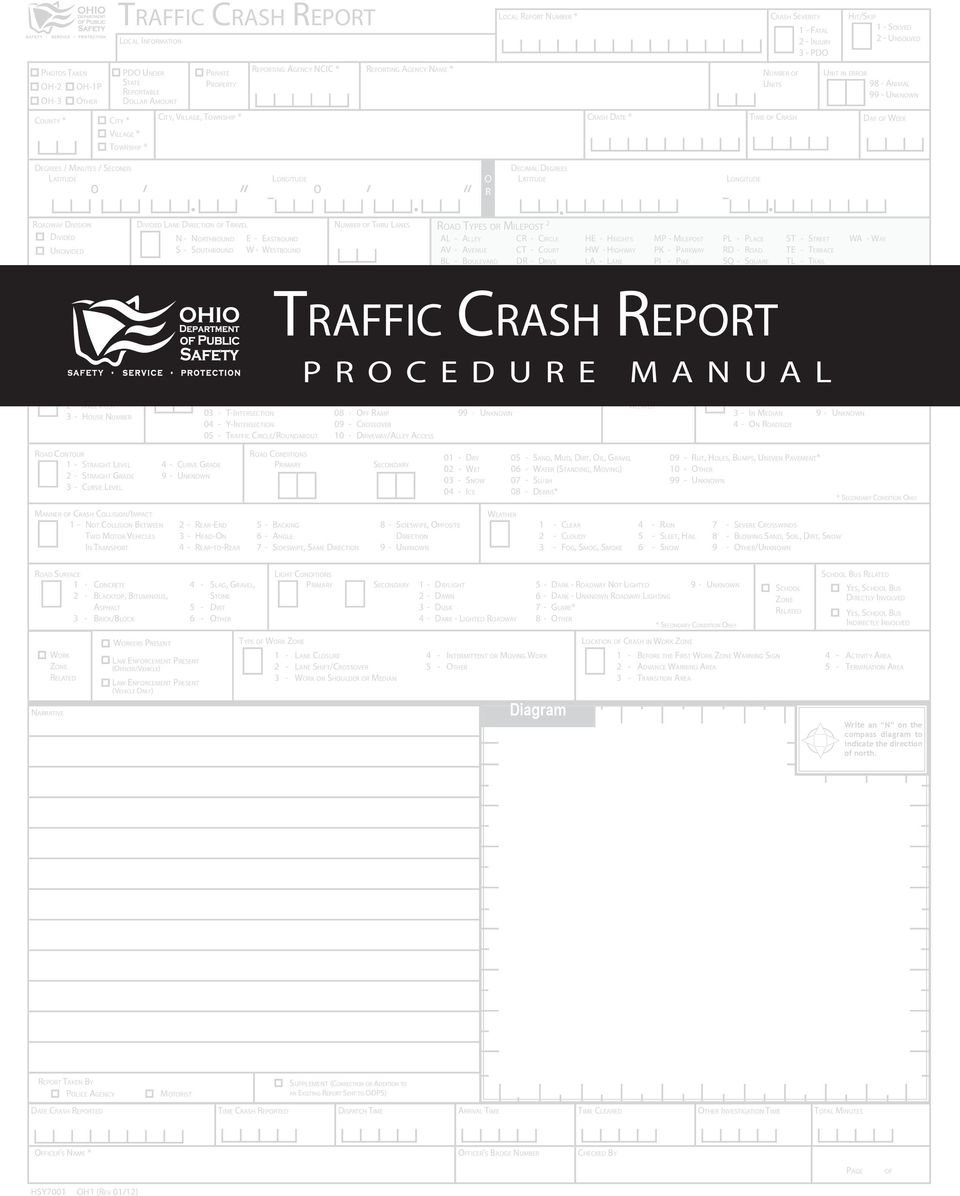
1 photos Taken oh-2 oh-3 oh-1p other Traffic crash report local information pdo under state reportable dollar amount private property reporting agency ncic * reporting agency name * local report number * county * city * city, village, Township * crash date * TiMe of crash village * Township * crash severity number of units 1 - fatal 2 - injury 3 - pdo hit/skip 1 - solved 2 - unsolved unit in error 98 - animal 99 - unknown day of week degrees / MinuTes / seconds latitude longitude o r decimal degrees latitude longitude roadway division divided undivided location route Type 1 distance from reference reference point used 1 - intersection 2 - Mile post 3 - house number divided lane direction of Travel location route number Miles feet yards n - northbound s - southbound dir from ref n,s, e,w loc prefix n,s, e,w o f e - eastbound w - westbound crash location 01 - not an intersection 02 - four-way intersection 03 - T-inTersecTion 04 - y-intersection 05 - Traffic circle/roundabout number of Thru lanes road Types or MileposT five-point, or More 07 - on ramp 08 - off ramp 09 - crossover 10 - driveway/alley access al - alley av - avenue Bl - Boulevard cr - circle ct - court dr - drive 11 - railway grade crossing 12 - shared-use paths or Trails 99 - unknown he - heights hw - highway la - lane Mp - MileposT pk - parkway pi - pike pl - place rd - road sq - square location road name location route Types 1 road ir - interstate route (inc. Turnpike) Type 2 us - us route sr - state route Traffic reference route number ref prefix reference crash reference name (road, MileposT, house report #) n,s, route e,w Type 1 st - street Te - Terrace Tl - Trail PROCEDURE MANUAL intersection related wa - way cr - numbered county route Tr - numbered Township route location of first harmful event 1 - on roadway 5 - on gore 2 - on shoulder 6 - outside Trafficway 3 - in Median 9 - unknown 4 - on roadside reference road Type 2 road contour 1 - straight level 2 - straight grade 3 - curve level 4 - curve grade 9 - unknown road conditions primary secondary 01 - dry 02 - wet 03 - snow 04 - ice 05 - sand, Mud, dirt, oil, gravel 06 - water (standing, Moving) 07 - slush 08 - debris* 09 - rut, holes, BuMps, uneven pavement* 10 - other 99 - unknown * secondary condition only Manner of crash collision/impact 1 - not collision BeTween Two MoTor vehicles in TransporT 2 - rear-end 3 - head-on 4 - rear-to-rear 5 - Backing 6 - angle 7 - sideswipe, same direction 8 - sideswipe, opposite direction 9 - unknown weather 1 - clear 2 - cloudy 3 - fog, smog, smoke 4 - rain 5 - sleet, hail 6 - snow 7 - severe crosswinds 8 - Blowing sand, soil, dirt, snow 9 - other/unknown road surface 1 - concrete 2 - BlackTop, BiTuMinous, asphalt 3 - Brick/Block 4 - slag, gravel, stone 5 - dirt 6 - other light conditions primary secondary 1 - daylight 2 - dawn 3 - dusk 4 - dark - lighted roadway 5 - dark - roadway not lighted 6 - dark - unknown roadway lighting 7 - glare* 8 - other 9 - unknown * secondary condition only school Zone related school Bus related yes, school Bus directly involved yes, school Bus indirectly involved workers present Type of work Zone location of crash in work Zone work Zone related narrative law enforcement present (officer/vehicle) law enforcement present (vehicle only) 1 - lane closure 2 - lane shift/crossover 3 - work on shoulder or Median 4 - intermittent or Moving work 5 - other Diagram 1 - Before The first work Zone warning sign 2 - advance warning area 3 - TransiTion area 4 - activity area 5 - TerMinaTion area Write an N on the compass diagram to indicate the direction of north. report Taken By police agency MoTorisT supplement (correction or addition To an existing report sent To odps) date crash reported TiMe crash reported dispatch TiMe arrival TiMe TiMe cleared other investigation TiMe ToTal MinuTes officer s name * officer s Badge number checked By page of hsy7001 oh1 (rev 01/12)
2

3 John R. Kasich, Governor John Born, Director Bureau of Motor Vehicles Emergency Management Agency Emergency Medical Services 1970 West Broad Street Office of Criminal Justice Services P.O. Box Ohio Homeland Security Columbus, Ohio Ohio State Highway Patrol (614) October 13, 2011 Law Enforcement Partner: As a result of the hard work of many different jurisdictions and safety partners working together to save lives, Ohio has seen near-historic laws of traffic fatalities on our roads the last few years. As we look to continue this trend, it is more important than ever that we receive timely, accurate information regarding crashes. The Ohio Department of Public Safety (ODPS) has completed an updated version of the OH-1 Ohio s statewide uniform crash report form. The new version of the form contains additional data fields, an improved layout and a new design that will ultimately ease the transition to electronic data capture for every Ohio law enforcement agency. Futhermore, this new version will bring Ohio into compliance with the current edition of Model Minimum Uniform Crash Criteria standards a program funded by the National Highway Traffic Safety Administration, managed jointly with the Governor s Highway Safety Administration. The new OH-1 will be available for use beginning January 1, At that time agencies may begin submitting paper and electronic crash reports using the new OH-1 form. Crash report submissions using the old form will be accepted through the end of 2012; however, agencies are encouraged to transition to the new form as soon as possible. As of January 1, 2013, only the new OH-1 form will be accepted by ODPS. There are numerous advantages to using this new form, including: The forms will provide you with a blueprint for conducting your investigation and they assist our department in compiling statistics; You and your department will have a record that can be used in civil or criminal proceedings, weeks, months or even years later; The data from your report will provide precise information on location, road conditions, weather conditions, signs, signals, pavement and markings, vehicle sizes and mode data which will be used by engineers to remove hazards and design safer roadways and vehicles for the future; and Your office, this department and many others concerned about highway safety will be using the statistics generated for educational efforts, and enlisting help from the media to pinpoint and further inform the driving public of the serious problems being encountered on Ohio s roads. A sample (pdf) version of the new OH-1, a user instruction manual and crash data manual for IT developers are now available on the ODPS website: We appreciate your continued support and cooperation and look forward to working with you as well as we all strive to make Ohio s roads as safe as possible. Sincerely, John Born, Director Ohio Department of Public Safety Mission Statement to save lives, reduce injuries and economic loss, to administer Ohio s motor vehicle laws and to preserve the safety and well being of all citizens with the most cost-effective and service-oriented methods available. An Equal Opportunity Employer
4

5 CONTENTS PAGE 1 CRASH...9 Local Report Number Crash Severity Hit/Skip Local Information Associated Documentation PDO Under State Reportable Dollar Amount Private Property Reporting Agency NCIC Reporting Agency Name Number of Units Unit in Error County City, Village, Township Name of City, Village, Township Crash Date Time of Crash Day of Week Latitude/Longitude Roadway Division Divided Lane Direction of Travel Number of Thru Lanes Location Information Location Route Type Location Route Number Loc. Prefix Location Road Name Location Road Type Distance From Reference Dir From Ref Reference Information Reference Route Type Reference Route Number Ref Prefix Reference Name Reference Road Type Reference Point Used Crash Location Intersection Related Location of First Harmful Event Road Contour Road Conditions Manner of Crash Collision/Impact Weather Road Surface Light Conditions School Zone Related School Bus Related Work Zone Related/Workers Present/Law Enforcement in Work Zone... 20

6 CONTENTS Type of Work Zone Location of Crash in Work Zone Narrative Diagram Report Taken By Supplement Date Crash Reported Time Crash Reported Dispatch Time Arrival Time Time Cleared Other Investigation Time Total Minutes Officer s Name Officer s Badge Number Checked By Page of PAGE 2 UNIT...25 Local Report Number Unit Number Owner Name Owner Phone Number Owner Address Damage Scale Damaged Area LP State License Plate Number Vehicle Identification Number Number of Occupants Vehicle Year Vehicle Make Vehicle Model Vehicle Color Proof of Insurance Insurance Company Policy Number Towed By Carrier Name, Address City, State and Zip Carrier Phone US DOT HM Placard ID Number HM Class Number Vehicle Weight GVWR/GCWR Hazardous Material Released Cargo Body Type Trafficway Description Hit/Skip Unit Non-Motorist Prior to Impact... 32

7 CONTENTS Type of Use In Emergency Response Unit Type and HM Placard Special Function Most Damaged Area and Impact Area Action Pre-Crash Action Contributing Circumstances Vehicle Defects Sequence of Events, First Harmful Event and Most Harmful Event Unit Speed Posted Speed Traffic Control Unit Direction Page of PAGE 3 MOTORIST/NON-MOTORIST/OCCUPANT...39 Local Report Number Unit Number Motorist/Non-Motorist Name Date of Birth Age Gender Address Contact Phone Injuries Injured Taken By EMS Agency Medical Facility Injured Taken To Safety Equipment Used DOT Compliant Motorcycle Helmet Seating Position Air Bag Usage Ejection Trapped OL State Operator License Number OL Class No Valid OL M/C End Condition Alcohol/Drug Suspected Alcohol Test Status Alcohol Test Type Alcohol Test Value Drug Test Status Drug Test Type Offense Charged, Local Code Offense Description Citation Number Hands-Free Device Used... 46

8 CONTENTS Driver Distracted By Page of PAGE 4 OCCUPANT/WITNESS ADDENDUM...47 Local Report Number Unit Number Motorist/Non-Motorist Name Date of Birth Age Gender Address Contact Phone Injuries Injured Taken By EMS Agency Medical Facility Injured Taken To Safety Equipment Used DOT Compliant Motorcycle Helmet Seating Position Air Bag Usage Ejection Trapped Page of APPENDIX A COUNTY CODES...52 APPENDIX B STATE CODES...53 APPENDIX C DIAGRAM OF A WORK ZONE...54 APPENDIX D FMCSA VISOR CARDS...55 APPENDIX E TRAFFICWAY DESCRIPTION...63 APPENDIX F ROADWAY BREAKDOWN AND GORE DIAGRAMS...64

9 Photos Taken OH-2 OH-3 OH-1P Other Traffic Crash Report Local Information PDO Under State Reportable Dollar Amount Private Property Reporting Agency NCIC * Reporting Agency Name * Local Report Number * County * City * City, Village, Township * Crash Date * Time of Crash Village * Township * Crash Severity Number of Units 1 - Fatal 2 - Injury 3 - PDO Hit/Skip 1 - Solved 2 - Unsolved Unit in error 98 - Animal 99 - Unknown Day of Week Degrees / Minutes / Seconds Latitude Longitude O R Decimal Degrees Latitude Longitude Roadway Division Divided Undivided Location Route Number Location Route Type 1 Distance From Reference Divided Lane Direction of Travel Miles Feet Yards N - Northbound S - Southbound Dir From Ref N,S, E,W Loc Prefix N,S, E,W O F E - Eastbound W - Westbound Location Road Name Reference Route Type 1 Number of Thru Lanes Road Types or Milepost 2 AL - Alley AV - Avenue BL - Boulevard CR - Circle CT - Court DR - Drive HE - Heights HW - Highway LA - Lane Location Road Type 2 Reference Route Number Ref Prefix Reference Name (Road, Milepost, House #) N,S, E,W MP - Milepost PK - Parkway PI - Pike PL - Place RD - Road SQ - Square Route Types 1 IR - Interstate Route (inc. turnpike) US - US Route SR - State Route ST - Street TE - Terrace TL - Trail WA - Way CR - Numbered County Route TR - Numbered Township Route Reference Road Type 2 Reference Point Used 1 - Intersection 2 - Mile Post 3 - House Number Crash Location 01 - Not an intersection 02 - Four-way Intersection 03 - T-Intersection 04 - Y-Intersection 05 - Traffic Circle/Roundabout 06 - Five-point, or more 07 - On Ramp 08 - Off Ramp 09 - Crossover 10 - Driveway/Alley Access 11 - Railway Grade Crossing 12 - Shared-Use Paths or Trails 99 - Unknown Intersection Related Location of First Harmful Event 1 - On Roadway 5 - On Gore 2 - On Shoulder 6 - Outside Trafficway 3 - In Median 9 - Unknown 4 - On Roadside Road Contour 1 - Straight Level 2 - Straight Grade 3 - Curve Level 4 - Curve Grade 9 - Unknown Road Conditions Primary Secondary 01 - Dry 02 - Wet 03 - Snow 04 - Ice 05 - Sand, Mud, Dirt, Oil, Gravel 06 - Water (Standing, Moving) 07 - Slush 08 - Debris* 09 - Rut, Holes, Bumps, Uneven Pavement* 10 - Other 99 - Unknown * Secondary Condition Only Manner of Crash Collision/Impact 1 - Not Collision Between Two Motor Vehicles in Transport 2 - Rear-End 3 - Head-On 4 - Rear-to-Rear 5 - Backing 6 - Angle 7 - Sideswipe, Same Direction 8 - Sideswipe, Opposite direction 9 - Unknown Weather 1 - Clear 2 - Cloudy 3 - Fog, Smog, Smoke 4 - Rain 5 - Sleet, Hail 6 - Snow 7 - Severe Crosswinds 8 - Blowing Sand, Soil, Dirt, Snow 9 - Other/Unknown Road Surface 1 - Concrete 2 - Blacktop, Bituminous, asphalt 3 - Brick/Block 4 - Slag, Gravel, stone 5 - Dirt 6 - Other Light Conditions Primary Secondary 1 - Daylight 2 - Dawn 3 - Dusk 4 - Dark - Lighted Roadway 5 - Dark - Roadway Not Lighted 6 - Dark - Unknown Roadway Lighting 7 - Glare* 8 - Other 9 - Unknown * Secondary Condition Only School Zone Related School Bus Related Yes, School Bus Directly Involved Yes, School Bus Indirectly Involved Workers Present Type of Work Zone Location of Crash in Work Zone Work Zone Related Narrative Law Enforcement Present (Officer/Vehicle) Law Enforcement Present (Vehicle Only) 1 - Lane Closure 2 - Lane Shift/Crossover 3 - Work on Shoulder or Median 4 - Intermittent or Moving Work 5 - Other Diagram 1 - Before the First Work Zone Warning Sign 2 - Advance Warning Area 3 - Transition Area 4 - Activity Area 5 - Termination Area Write an N on the compass diagram to indicate the direction of north. Report Taken By Police Agency Motorist Supplement (Correction or Addition to an Existing Report Sent to ODPS) Date Crash Reported Time Crash Reported Dispatch Time Arrival Time Time Cleared Other Investigation Time Total Minutes Officer s Name * Officer s Badge Number Checked By Page of HSY7001 OH1 (Rev 01/12)

10

11 PAGE 1 CRASH 1 Local Report Number* Local Report Number * Enter the unique identifier within a given year that identifies a crash within the agency. The local report number is recorded on every page of the crash report and all associated reports (i.e., OH-2, OH-3, OH-1 P, etc.). Complete from left to right. 2 Crash Severity Crash Severity 1 - Fatal 2 - Injury 3 - PDO Enter corresponding number for most severe injury. In the absence of reported injury, indicate property damage only (PDO). Record possible injuries as, #2 Injury. In the absence of a reported injury, carry the crash as property damage only. In the case of a hit/skip crash, assume the hit/skip driver was not injured unless there is evidence to the contrary. 3 Hit/Skip Hit/Skip 1 - Solved 2 - Unsolved Enter whether a Hit/Skip crash is Solved or Unsolved. Boxes that may be left blank for the Hit/Skip Unit are: Traffic Crash Report PDO Under State Reportable Dollar Amount; School Bus Related; Work Zone Related. Unit Owner Name, Phone and Address; LP State; License Plate Number; Vehicle Identification Number; Vehicle Year, Make, Model and Color; Proof of Insurance Shown; Insurance Company; Policy Number; Towed By; Carrier Name, Address, City, State, Zip, Phone; US DOT; Vehicle Weight GVWR/GCWR; HM Placard ID No.; HM Class Number; Has HM Placard; Non- Motorist Location Prior to Impact; Type of Use; In Emergency Response; Special Function; Vehicle Defects; Unit Speed. Motorist/Non-Motorist/Occupant Name; Date of Birth; Age; Gender; Address; EMS Agency; Medical Facility Injured Taken To; DOT Compliant Motorcycle Helmet; Ejection; Trapped; OL State; Operator License Number; OL Class; No Valid OL; M/C End.; Condition; Alcohol Test Value; Offense Charged; Offense Description; Citation Number; Hands-Free Device Used. Other boxes should be completed with the number designating Unknown for the specific data requested. 4 Local Information Local Information Local Information is an optional area used by the reporting agency for its use. 5 Associated Documentation Photos Taken OH-2 OH-1P OH-3 Other X boxes for any associated documentation. Photos taken include photos taken of the scene, vehicles or the people involved. Do not send photos to Ohio Department of Public Safety, file photos locally. The OH-1U (Unit page) and OH-1M (Motorist/Non-Motorist/Occupant page) are considered part of the OH-1 itself. Do not X the Other box for an OH-1U or OH-1M. Send the OH-3 to the Ohio Department of Public Safety for fatal crashes only. 6 PDO Under State Reportable Dollar Amount PDO Under State Reportable Dollar Amount X if there is no reported injury or fatality AND there is less than $1000 in property damage. If this box is checked, DO NOT SEND THE OH1 TO ODPS. 11

12 PAGE 1 CRASH 7 Private Property Private Property X to indicate a private property crash only if all the events in the sequence of events occur on private property. If this box is checked, DO NOT SEND THE OH1 TO ODPS (except in the case of a fatal crash). Leave blank if not on private property. If, during the sequence of events, any event occurs on the roadway, then it would not qualify as a private property crash, e.g., a car loses control, goes off the right side of the roadway and strikes a house. Although the first harmful event was striking the house on private property, the unit was on the roadway when it lost control. A crash qualifies as private property if: The entire sequence of events occurs on private property. So, when a unit did not lose control, and is pulling or has pulled onto private property, and the vehicle strikes something or someone on that private property this is to be considered a private property crash. The issue is that the vehicle was still under control until the vehicle was actually on private property. However; according to ANSI 2.2.2, the space between the roadway and the far side of the sidewalk would be considered part of the trafficway and not private property. 8 Reporting Agency NCIC* Reporting Agency NCIC * Enter the N.C.I.C. agency identifier for the reporting agency. Drop the OH at the beginning and the last two digits of the agency s assigned N.C.I.C. identifier. Examples: CIP00, 03107, OHP76, (OH is recorded as 02903). Be sure N.C.I.C. is 5 characters in length. Do not leave off leading zeros. NOTE: if you do not have an N.C.I.C. agency identifier, contact LEADS at Reporting Agency Name* Reporting Agency Name * Enter the name of the agency completing the crash report. Examples: Findlay PD, Knox County SO, Perry Twp. PD. Do not use abbreviations such as FPD, KCSO, and PTPD. 10 Number of Units Number of Units Enter the actual number of motor vehicles and non-motorists involved in the crash. Animals with riders and animals pulling a buggy, etc., are to be included, but animals such as deer should not be counted as units, nor should fixed objects struck (tree, mailbox, trailers without a power unit, etc.). This should be the total number of units involved (e.g., 01, 02, 03, etc.). 11 Unit in Error Unit in error 98 - Animal 99 - Unknown Enter the unit number of the motorist/non-motorist which had the most causative bearing on the crash. Enter 98 for animals (deer, dog, cow, etc.). Enter 99 if unknown/undetermined. 12 County* County * Enter the county where the crash (first event in the sequence of events NOT the first harmful event) occurred, using the two digit county code. See Appendix A for list of County Codes. 12

13 PAGE 1 CRASH 13 City, Village, Township* City * Village * Township * X where the crash occurred based on the location of the first event in the sequence of events, NOT the first harmful event. Example: A car goes off the right side of the road in Goshen Township, and then hits a tree in the City of Mechanicsburg. The car going off the right side of the road in Goshen Township would be the first event in the sequence of events. The first harmful event would be the car hitting the tree in the City of Mechanicsburg. The crash location would be the car going off the right side of the road in Goshen Township, NOT where the tree was struck in the City of Mechanicsburg. 14 Name of City, Village, Township* City, Village, Township * Enter the name of the political subdivision where crash occurred, based on the location of the first event in the sequence of events, NOT the first harmful event. Examples: (City) Cincinnati, (Village) Mariemont, (Township) Union. 15 Crash Date* Crash Date * Enter numerical date on which the crash occurred in the following format: MMDDYYYY Example: August 14, 2012, is recorded as If the exact date is unknown, determine the time frame for the crash. Enter the first date of the time frame in this box and enter the entire time frame in the narrative. Example: A hit-skip occurred between 2030 hours on January 23, 2012, and 0715 hours on January 24, Enter in Crash Date and enter the time frame in the narrative. 16 Time of Crash Time of Crash Enter time of the crash using military (2400 clock) time. Examples: 8:20 a.m. enter as 0820; 8:05 p.m. enter as Enter midnight as If the exact time is unknown, determine the time frame for the crash. Enter the first time of the time frame in this box and enter the entire time frame in the narrative. Example: A hit-skip occurred between hours on March 3, Enter 1630 in Time of Crash and enter the time frame in the narrative. 17 Day of Week Day of Week Enter day of week the crash occurred using the first three characters. Examples: MON, TUE, WED. 18 Latitude/Longitude Required for all crashes. This area is completed in cooperation with Global Positioning Systems (GPS). GPS coordinates may be obtained from several Internet sites. Enter without regard to + or numbers. Areas are identified either in Degrees (DD), Minutes (MM), Seconds and decimal seconds (SS.SS): (Latitude) 52:54:54.12, (Longitude) 85:54:45.21 OR in Decimal Degrees (DD.DDDDDD): (Latitude) (Longitude)

14 PAGE 1 CRASH 19 Roadway Division Roadway Division Divided Undivided X if the Roadway is Divided or Undivided. A divided roadway is one on which roadways for travel in opposite directions are separated by a median. Median includes physical barrier, depressed or raised area, or painted area four or more feet wide. Median does not include a turn lane or a continuous turn lane. A median is defined from inside painted edge line to inside painted edge line. 20 Divided Lane Direction of Travel Divided Lane Direction of Travel N - Northbound S - Southbound E - Eastbound W - Westbound On a divided roadway, indicate the direction of travel for lanes on which the crash occurred. Leave blank if crash did not occur on a divided roadway as specified in box Roadway Division. This box is intended to reflect the general direction that the roadway travels over its entire length. Example: IR70 is generally an east/west route even though there are small segments of the roadway that are actually oriented north/south. Therefore, vehicles traveling in the westbound lanes on IR70 would be specified as W. For ambiguous routes such as IR270 or IR275, indicate the general compass direction of travel for the lanes where the crash occurred. Example: Vehicles going westbound on IR270 would be specified as W. 21 Number of Thru Lanes Number of Thru Lanes Enter the number of thru driving lanes only. Do not include designated turn lanes. For example, if you were to go straight in the lane you are in, thru an intersection with no turns, and not risk running into oncoming traffic, then that would be a thru lane. Total number of thru lanes in the roadway on which the crash occurred. In the case of a T-Intersection, when the crash occurs while turning off the T road, use the number of thru lanes on the receiving roadway. When a crash occurs on the T road, use the number of thru lanes on the roadway prior to the establishment of the turn only lanes. For undivided highways, enter the total thru lanes in both directions, excluding designated turn lanes. For divided highways, enter the total thru lanes for the roadway on which the crash occurred. Do not include the lanes on the other side of the divider/median for a divided highway. LOCATION INFORMATION Fields are used for describing the roadway on which the crash occurred. Fields are used if the roadway has a route number, fields are used if the roadway has a name. Complete the location information on all crashes including animal and deer crashes. Both boxes may be completed for a route that has a number and a name. The route number must be used if available. 22 Location Route Type 1 Location Route Type 1 Route Types 1 IR - Interstate Route (inc. turnpike) US - US Route SR - State Route CR - Numbered County Route TR - Numbered Township Route Enter the Route Type if the road on which the crash occurred is identified as a route. 14

15 PAGE 1 CRASH 23 Location Route Number Location Route Number Enter the route number and suffix, if applicable, on which the crash actually occurred. Example: US 20 Alternate would be shown as 20A, not 20. Do not include directions (N, S, E or W). When a crash occurs within an intersection, this field is determined by using the highest priority route in the following Route Type order: IR, US, SR, CR, TR. If the intersection routes have the same Route Type, then the lowest numbered route has priority. If it is an intersection between a route number and a road name, the route number has priority. Examples: for US 40 and CR 10, US 40 is priority and CR 10 is secondary, for US 40 and US 23, US 23 is priority and US 40 is secondary, for US 40 and Hague Ave, US 40 is priority and Hague is secondary. NOTE: This is not a zero fill box. Start at left box and work to right. Enter 45, not 00045, for SR Loc. Prefix Loc Prefix N,S, E,W N = North S = South E = East W = West Enter the prefix for the Location Road Name if the road is designated as north/south or east/west. Examples: W for West Broad Street, E for East Broad Street or E for East North Broadway. Leave blank if no designation. 25 Location Road Name Location Road Name Enter the name of the road on which the crash occurred, such as Main. For crashes that occur in an unnamed alley, record the parallel street name closest to the alley. Mark AL in the Location Road Type Location Road Type 2 Location Road Type 2 Road Types or Milepost 2 AL - Alley CR - Circle AV - Avenue CT - Court BL - Boulevard DR - Drive HE - Heights HW - Highway LA - Lane MP - Milepost PK - Parkway PI - Pike PL - Place RD - Road SQ - Square ST - Street TE - Terrace TL - Trail WA - Way Enter the Road Type if a Location Road Name was entered. 27 Distance from Reference Distance From Reference Miles Feet Yards Enter the distance from the Reference Point used and X the box with the appropriate unit of measure. Leave blank if the value is zero. Do not use more than three spaces. If the number is greater than 999, change to the next higher unit of measure. If this box is completed, then the Direction from Reference box (#28) must also be completed. 28 Dir From Ref Dir From Ref N,S, E,W N = North S = South E = East W = West Enter the direction the crash is from the reference point used, whether a route number and/or road name, house number, or milepost number. This is the direction the crash is from the given reference. Example: The crash happens on High St., 45 feet south of E. Main St. Record S in this field. In the Distance from Reference box, record 45 and X the Feet box. This field must be completed if, and only if, there is an entry in the Distance from Reference box. 15

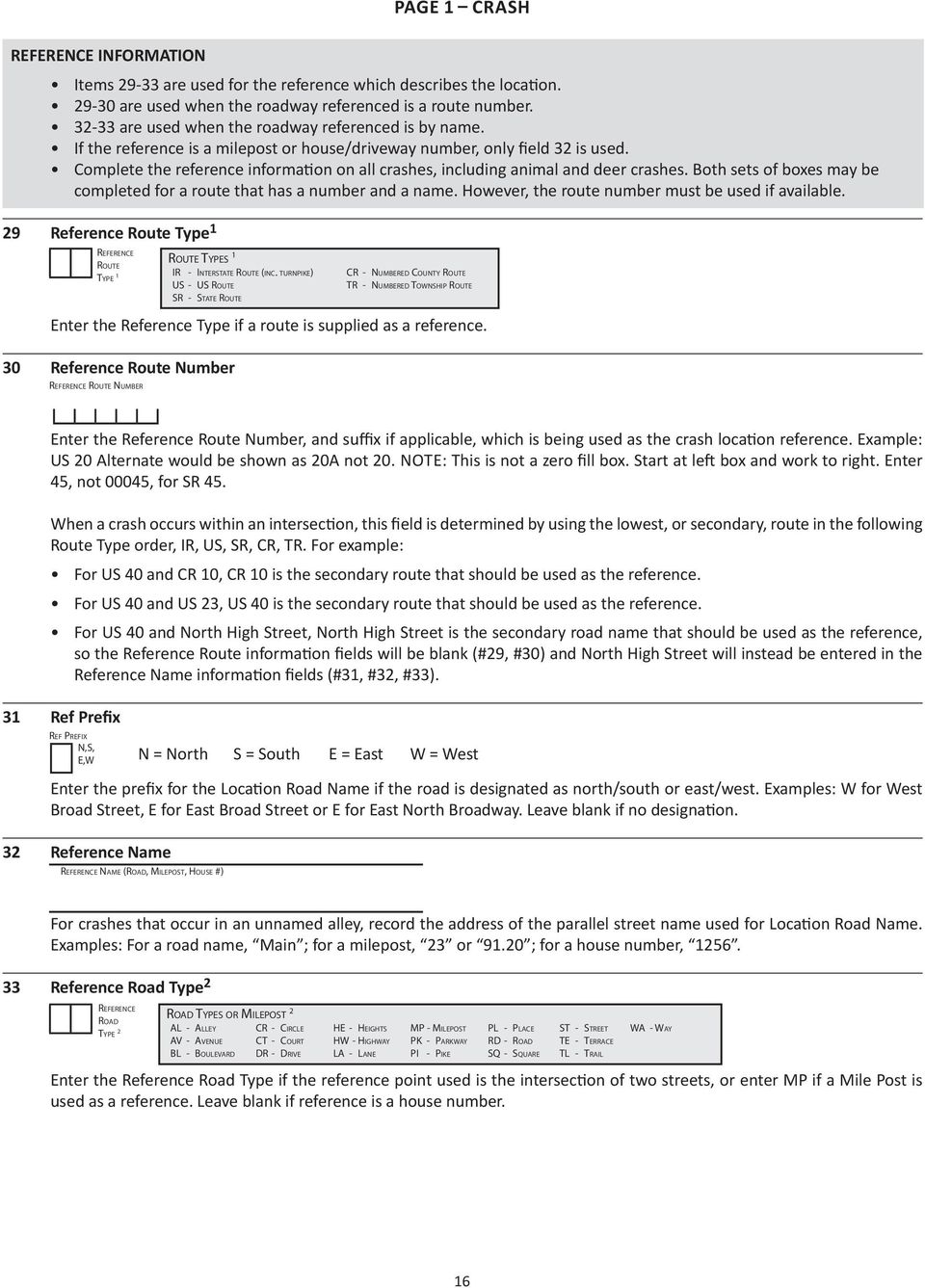
16 PAGE 1 CRASH REFERENCE INFORMATION Items are used for the reference which describes the location are used when the roadway referenced is a route number are used when the roadway referenced is by name. If the reference is a milepost or house/driveway number, only field 32 is used. Complete the reference information on all crashes, including animal and deer crashes. Both sets of boxes may be completed for a route that has a number and a name. However, the route number must be used if available. 29 Reference Route Type 1 Reference Route Type 1 Route Types 1 IR - Interstate Route (inc. turnpike) US - US Route SR - State Route CR - Numbered County Route TR - Numbered Township Route Enter the Reference Type if a route is supplied as a reference. 30 Reference Route Number Reference Route Number Enter the Reference Route Number, and suffix if applicable, which is being used as the crash location reference. Example: US 20 Alternate would be shown as 20A not 20. NOTE: This is not a zero fill box. Start at left box and work to right. Enter 45, not 00045, for SR 45. When a crash occurs within an intersection, this field is determined by using the lowest, or secondary, route in the following Route Type order, IR, US, SR, CR, TR. For example: For US 40 and CR 10, CR 10 is the secondary route that should be used as the reference. For US 40 and US 23, US 40 is the secondary route that should be used as the reference. For US 40 and North High Street, North High Street is the secondary road name that should be used as the reference, so the Reference Route information fields will be blank (#29, #30) and North High Street will instead be entered in the Reference Name information fields (#31, #32, #33). 31 Ref Prefix Ref Prefix N,S, E,W N = North S = South E = East W = West Enter the prefix for the Location Road Name if the road is designated as north/south or east/west. Examples: W for West Broad Street, E for East Broad Street or E for East North Broadway. Leave blank if no designation. 32 Reference Name Reference Name (Road, Milepost, House #) For crashes that occur in an unnamed alley, record the address of the parallel street name used for Location Road Name. Examples: For a road name, Main ; for a milepost, 23 or ; for a house number, Reference Road Type 2 Reference Road Type 2 Road Types or Milepost 2 AL - Alley CR - Circle AV - Avenue CT - Court BL - Boulevard DR - Drive HE - Heights HW - Highway LA - Lane MP - Milepost PK - Parkway PI - Pike PL - Place RD - Road SQ - Square ST - Street TE - Terrace TL - Trail WA - Way Enter the Reference Road Type if the reference point used is the intersection of two streets, or enter MP if a Mile Post is used as a reference. Leave blank if reference is a house number. 16
17 PAGE 1 CRASH 34 Reference Point Used Reference Point Used 1 - Intersection 2 - Mile Post 3 - House Number Select the corresponding value for the reference being used to locate where the crash occurred. 35 Crash Location Crash Location 01 - Not an intersection 02 - Four-way Intersection 03 - T-Intersection 04 - Y-Intersection 05 - Traffic Circle/Roundabout 06 - Five-point, or more 07 - On Ramp 08 - Off Ramp 09 - Crossover 10 - Driveway/Alley Access 11 - Railway Grade Crossing 12 - Shared-Use Paths or Trails 99 - Unknown Enter the type of location that best describes where the first event of the crash occurred. Do not leave blank. On Ramp and Off Ramp locations are directly related to what was coded as the Location Route Number. For a crash identified as on IR70 in the Location Route Number field, then the on/off would be in relation to that route number. Example 1: On IR70 with reference of IR270, where the crash occurred getting off IR70 onto IR270, the crash location would be Off Ramp. Example 2: On IR70 with reference of IR270, where the crash occurred getting on IR70 from IR270, the crash location would be On Ramp. 36 Intersection Related Intersection Related X if this crash is intersection related. A traffic crash that: 1) occurs within, on an approach to, or exit from an intersection and 2) results from an activity, behavior or control related to the movement of traffic units through the intersection, is considered an intersection related crash. Example: If five cars are stopped in a line at a stop sign and the fifth vehicle is struck in the rear by another vehicle, the crash would be intersection related because it occurred on the approach to an intersection and resulted from the activity of the units related to the movement through the intersection. If traffic is backed up as a result of a traffic control device at the intersection and the vehicles are involved in a crash as a result of that traffic control device, it would meet the definition of an intersection related crash. If a crash occurs in an intersection and involves an animal, it is not intersection related unless the other criteria apply. There is no maximum distance from the intersection that would exclude the crash from being intersection related. 17

18 PAGE 1 CRASH 37 Location of First Harmful Event Location of First Harmful Event 1 - On Roadway 5 - On Gore 2 - On Shoulder 6 - Outside Trafficway 3 - In Median 9 - Unknown 4 - On Roadside Enter the location of the first harmful event for the crash as it relates to its position within or outside the trafficway. See Roadway Breakdown & Gore Diagrams in Appendix F for more information if necessary. The first harmful event is defined as that place where the first fatality, personal injury, or property damage occurs. Example: if a car goes off the right side of the roadway and strikes a traffic sign post, striking the traffic sign post would be the first harmful event. Leaving the roadway would be the first event in the sequence. The location of the first harmful event would be #4, On Roadside. Example of Sequence of Events, First Harmful Event and Most Harmful Event 38 Road Contour Road Contour 1 - Straight Level 2 - Straight Grade 3 - Curve Level 4 - Curve Grade 9 - Unknown Enter alignment and grade characteristics that best describe the roadway at the location of the first event. 39 Road Conditions Road Conditions Primary Secondary 01 - Dry 02 - Wet 03 - Snow 04 - Ice 05 - Sand, Mud, Dirt, Oil, Gravel 06 - Water (Standing, Moving) 07 - Slush 08 - Debris* 09 - Rut, Holes, Bumps, Uneven Pavement* 10 - Other 99 - Unknown * Secondary Condition Only Enter the roadway surface condition at the location of the first event. PRIMARY = Overall road surface condition. SECONDARY = Additional road condition associated with the crash location. Debris and Rut, Holes, Bumps, and Uneven Pavement are secondary conditions ONLY and cannot be used as primary conditions. Secondary conditions can be blank. Secondary conditions cannot be the same as primary. 18

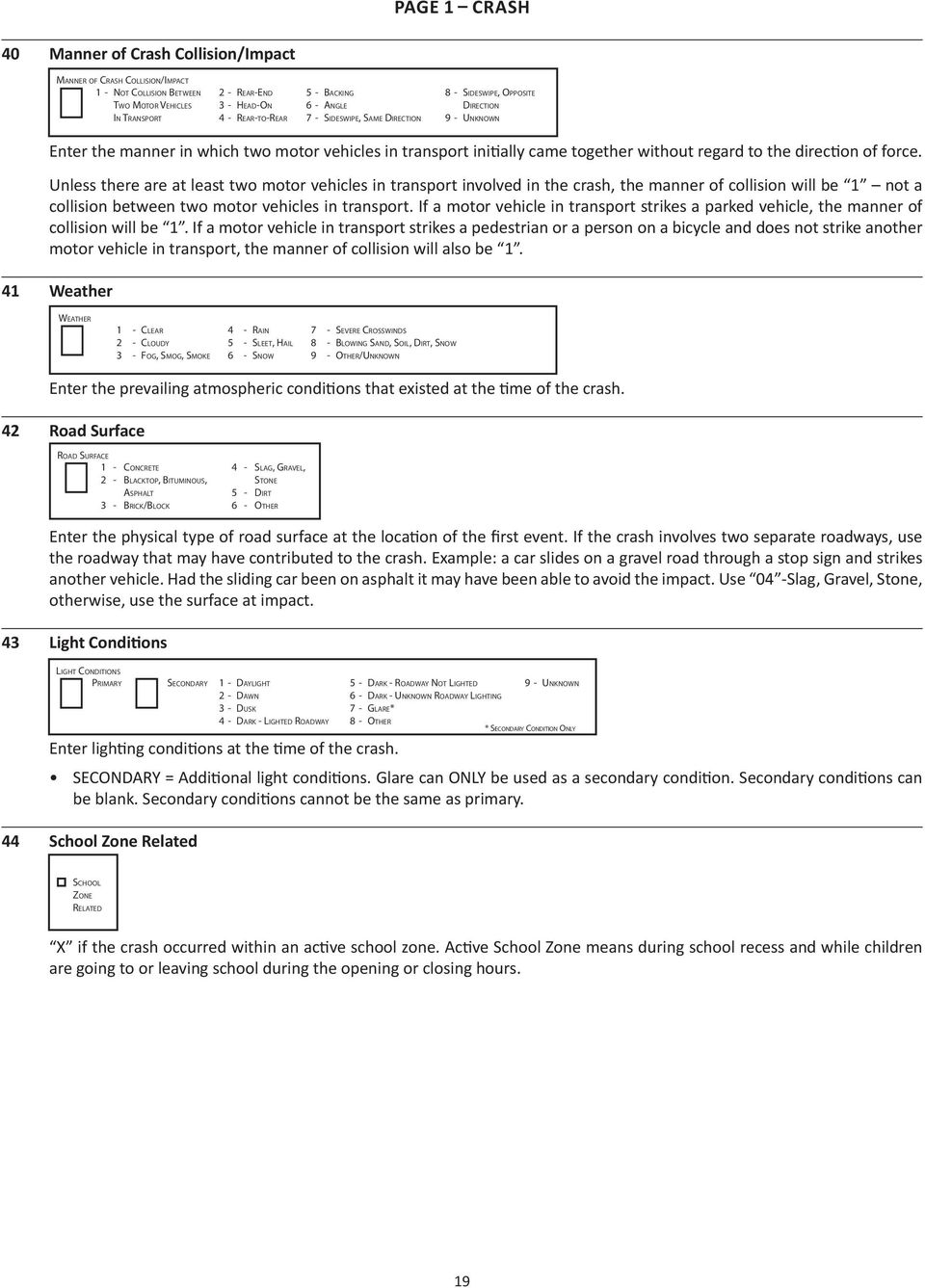
19 PAGE 1 CRASH 40 Manner of Crash Collision/Impact Manner of Crash Collision/Impact 1 - Not Collision Between Two Motor Vehicles in Transport 2 - Rear-End 3 - Head-On 4 - Rear-to-Rear 5 - Backing 6 - Angle 7 - Sideswipe, Same Direction 8 - Sideswipe, Opposite direction 9 - Unknown Enter the manner in which two motor vehicles in transport initially came together without regard to the direction of force. Unless there are at least two motor vehicles in transport involved in the crash, the manner of collision will be 1 not a collision between two motor vehicles in transport. If a motor vehicle in transport strikes a parked vehicle, the manner of collision will be 1. If a motor vehicle in transport strikes a pedestrian or a person on a bicycle and does not strike another motor vehicle in transport, the manner of collision will also be Weather Weather 1 - Clear 2 - Cloudy 3 - Fog, Smog, Smoke 4 - Rain 5 - Sleet, Hail 6 - Snow 7 - Severe Crosswinds 8 - Blowing Sand, Soil, Dirt, Snow 9 - Other/Unknown Enter the prevailing atmospheric conditions that existed at the time of the crash. 42 Road Surface Road Surface 1 - Concrete 2 - Blacktop, Bituminous, asphalt 3 - Brick/Block 4 - Slag, Gravel, stone 5 - Dirt 6 - Other Enter the physical type of road surface at the location of the first event. If the crash involves two separate roadways, use the roadway that may have contributed to the crash. Example: a car slides on a gravel road through a stop sign and strikes another vehicle. Had the sliding car been on asphalt it may have been able to avoid the impact. Use 04 -Slag, Gravel, Stone, otherwise, use the surface at impact. 43 Light Conditions Light Conditions Primary Secondary 1 - Daylight 2 - Dawn 3 - Dusk 4 - Dark - Lighted Roadway 5 - Dark - Roadway Not Lighted 6 - Dark - Unknown Roadway Lighting 7 - Glare* 8 - Other 9 - Unknown Enter lighting conditions at the time of the crash. SECONDARY = Additional light conditions. Glare can ONLY be used as a secondary condition. Secondary conditions can be blank. Secondary conditions cannot be the same as primary. 44 School Zone Related * Secondary Condition Only School Zone Related X if the crash occurred within an active school zone. Active School Zone means during school recess and while children are going to or leaving school during the opening or closing hours. 19
20 PAGE 1 CRASH 45 School Bus Related School Bus Related Yes, School Bus Directly Involved Yes, School Bus Indirectly Involved X if a School Bus was directly or indirectly involved. A school bus is a motor vehicle used for the transportation of any school pupil at or below the 12th grade level, to or from a public or private school, or school-related activity. A motor vehicle is not a school bus while on trips which involve the transportation exclusively of other passengers or exclusively for other purposes. A motor vehicle is a school bus only if it is externally identifiable by all of the following characteristics: 1) Its color is yellow (School Bus Chrome). 2) The words SCHOOL BUS must appear on the front and rear. 3) Flashing red lights are located on the front and rear (without regard to whether or not the lights were on at the time of the crash). 4) Lettering on the bus identifies the school or school district, or the company operating the bus. 46 Work Zone Related/Workers Present/Law Enforcement in Work Zone Work Zone Related Workers Present Law Enforcement Present (Officer/Vehicle) Law Enforcement Present (Vehicle Only) X if any boxes apply to crash location. Boxes left blank default to NO. If the first box is checked Yes, Workers Present and Law Enforcement information must also be completed, if applicable. If the first box is checked Yes, #47-Type of Work Zone and #48-Location of Crash in Work Zone must be completed. These boxes are used for a crash that occurs in, or related to, a construction, maintenance, or utility work zone area, whether or not workers were actually present at the time of the crash. Work zone-related crashes may also include those involving motor vehicles slowed or stopped because of the work zone, even if the first harmful event occurred before the first warning sign. A Work Zone Crash is a traffic crash in which the first harmful event occurs within the boundaries of a work zone or on an approach to or exit from a work zone, resulting from an activity, behavior or control related to the movement of the traffic units through the work zone. Includes collision and non-collision crashes occurring within the signs or markings indicating a work zone or occurring on approach to, exiting from or adjacent to work zones that are related to the work zone. Examples: 1) An automobile on the roadway loses control within a work zone due to a shift or reduction in the travel lanes and crashes into another vehicle in the work zone. 2) A van in an open travel lane strikes a highway worker in the work zone. 3) A highway construction vehicle working on the edge of the roadway is struck by a motor vehicle in transport in a construction zone. 4) a rear-end collision crash occurs before the signs or markings indicating a work zone due to vehicles slowing or stopped on the roadway because of the work zone activity. 5) A pickup in transport loses control in an open travel lane within a work zone due to a shift or reduction in the travel lanes and crashes into another vehicle which exited the work zone. 6) A tractor-trailer approaching an intersection where the other roadway has a work zone strikes a pedestrian outside the work zone because of lack of visibility caused by the work zone equipment. 20

21 PAGE 1 CRASH Excludes crashes involving, or between, only work zone vehicles, equipment, and/or work zone pedestrians, when the crash occurred within the restricted work zone area, and as a result of normal work zone job functions. Examples: 1) A highway maintenance truck strikes a highway worker inside the work site. 2) A utility worker repairing the electrical lines over the trafficway falls from the bucket of a cherry picker. For a larger version of the work zone, refer to Appendix C. 47 Type of Work Zone Type of Work Zone 1 - Lane Closure 2 - Lane Shift/Crossover 3 - Work on Shoulder or Median 4 - Intermittent or Moving Work 5 - Other If the crash is a work zone related crash, indicate work zone type. Leave blank if not in a work zone. 48 Location of Crash in Work Zone Location of Crash in Work Zone 1 - Before the First Work Zone Warning Sign 2 - Advance Warning Area 3 - Transition Area 4 - Activity Area 5 - Termination Area If work zone related crash, indicate the location of the crash in relation to the work zone. See Work Zone Related/Workers Present/Law Enforcement in Work Zone. 21
22 PAGE 1 CRASH 49 Narrative Narrative DO NOT include social security numbers in the narrative. Print a brief and concise view of the crash, explaining how and why the crash happened in simple, easy-to-understand English. Refer to units by number and be sure the narrative corresponds to the codes recorded in other fields and the crash diagram. Do not use the narrative as a place to write a statement of facts for court. If, as the investigating officer, you are able to determine how the crash occurred, even if you can t prove fault, then put your opinion as to how the crash occurred. NOTE: If the drivers statements conflict and the evidence is insufficient to determine how the crash occurred, write a brief synopsis of each driver s statement. Example: Unit #1 stated.., Unit #2 stated.. Example of a poorly written statement taken from an actual report: Unit #1 was going south on Court St. the light changed from red to green and Unit #2 turned from East Main onto Court St. and sideswiped Unit #1. Unit #1 then followed Unit #2 to get license number. Questions left unanswered: 1) For which unit did the light change from red to green? 2) Was Unit #2 eastbound or westbound on East Main Street? 3) Who contributed to the crash? If submitting electronically, append all new information to the end of the current narrative before submitting new complete narrative. DO NOT DELETE THE FIRST NARRATIVE THAT WAS SUBMITTED. 50 Diagram A diagram should be made on all crashes, except for animal crashes where no injuries are reported. If the only diagram for the crash is found on an OH-2, write See OH-2 in the diagram area and include the OH-2 in the crash submission to ODPS. A diagram is a picture of what the investigating officer believes happened based on the information available. It is not what the scene looked like upon arrival, nor does it matter if all the vehicles had been moved prior to the officer s arrival. Each unit should be shown in its position at each harmful event and at the position of their uncontrolled final rest. Indicate north by writing an N on the compass within the diagram. Refer to units by number. Label streets and other physical features necessary to explain the crash. Do not show multiple pictures of the same unit to indicate direction of travel. Use a solid line to show the direction of the vehicle prior to the first harmful event. Use a dotted line to show the direction of the vehicle after the first harmful event to final rest. 22
23 PAGE 1 CRASH 51 Report Taken By Report Taken By Police Agency Motorist X the appropriate box to indicate by whom the report was completed. 52 Supplement Supplement (Correction or Addition to an Existing Report Sent to ODPS) X if this report is being used for a correction or addition to a report previously sent to ODPS. Data that might be supplemented would be: results from a chemical test for drugs; a person s injury status; a hit skip crash was solved after the OH1 was forwarded to ODPS; errors were found after the crash was submitted; or any data that would be changed if the OH1 had not yet been sent. With the exception of the boxes with the *, only complete the boxes that need changed. Put the new information in the box(es) and make a note at the end of the Narrative section advising what data was changed. Do not delete what was originally provided in the Narrative. Do not mark supplement just to indicate that OH2s and/or OH3s were done at the scene. Complete all boxes with an * for a supplement. Those boxes are: Local Report #; NCIC #; Reporting Agency; Date of Crash; City, Village, Twp.; Name (of City, Village or Township) and County #. Forward all pages of the report to ODPS. 53 Date Crash Reported Date Crash Reported Enter numerical date on which the crash was reported to the agency in the following format: MMDDYYYY. Example: August 14, 2012, would be recorded as Time Crash Reported Time Crash Reported Enter time the crash was reported to the agency using military (2400 clock) time. Examples: 8:00 a.m. enter as 0800; 08:00 p.m. enter as Dispatch Time Dispatch Time Using military time, enter time law enforcement was dispatched to the crash scene. Examples: 8:05 a.m. enter as 0805; 8:05 p.m. enter as Arrival Time Arrival Time Using military time, enter the time the first law enforcement officer arrived at the crash scene. Examples: 8:00 a.m. enter as 0800; 8:05 p.m. enter as Time Cleared Time Cleared Using military time, enter the time the investigating officer left the crash scene. Examples: 8:00 a.m. enter as 0800; 8:00 p.m. enter as
24 PAGE 1 CRASH 58 Other Investigation Time Other Investigation Time Enter actual number of minutes required to complete the crash investigation/report after leaving the crash scene. This would include additional time at a hospital, interviews, and/or notifications. 59 Total Minutes Total Minutes Enter the total number of minutes required to complete the crash investigation from the time law enforcement arrived at scene until all follow up investigations are complete. Fill blocks from left to right. Example: Arrived time: 1700 Cleared scene: 1800 Other investigation = 35 Minutes 95 Minutes 60 Officer s Name Officer s Name * Enter reporting officer s name. Print legibly. Does not require a signature. 61 Officer s Badge Number Officer s Badge Number Enter reporting officer s identification number assigned by his/her law enforcement agency. 62 Checked By Checked By Enter name, initials or badge number of person checking the report for completeness, accuracy and legibility. Print legibly. Does not require a signature. 63 Page of Page of THIS BOX IS FOR LOCAL LAW ENFORCEMENT USE ONLY. 24
25 Unit Local Report Number Unit Number Owner Name: Last, First, Middle ( Same As Driver) Owner Phone Number - inc. area code ( Same As Driver) Damage Scale Damaged Area Front Owner Address: City, State, Zip ( Same As Driver) 1 - None LP State License Plate Number Vehicle Identification Number # Occupants 2 - Minor Functional Vehicle Year Vehicle Make Vehicle Model Vehicle Color Proof of Insurance Shown Insurance Company Policy Number Towed By 4 - Disabling 9 - Unknown Rear 05 Carrier Name, Address, City, State, Zip Carrier Phone- include area code US DOT HM Placard ID No. HM Class Number Vehicle Weight GVWR/GCWR 1 - Less Than or Equal to 10k Lbs. 2-10,001 to 26,000 Lbs 3 - More Than 26,000 Lbs. Hazardous Material Released Cargo Body Type 01 - No Cargo Body Type/Not Applicable 02 - Bus/Van (9-15 Seats, Inc Driver) 03 - Bus (16+ Seats, Inc Driver) 04 - Vehicle Towing Another Vehicle 05 - Logging 06 - Intermodal Container Chassis 07 - Cargo Van/Enclosed Box 08 - Grain, Chips, Gravel 09 - Pole 10 - Cargo Tank 11 - Flat Bed 12 - Dump 13 - Concrete Mixer 14 - Auto Transporter 15 - Garbage/Refuse 99 - Other/Unknown Trafficway Description 1 - Two-Way, Not Divided 2 - Two-Way, Not Divided, Continuous Left Turn Lane 3 - Two-Way, Divided, Unprotected(Painted or Grass >4 Ft.) Median 4 - Two-Way, Divided, Positive Median Barrier 5 - One-Way Trafficway Hit / Skip Unit Non-Motorist Location Prior to Impact 01 - Intersection - Marked Crosswalk 02 - Intersection - No Crosswalk 03 - Intersection - Other 04 - Midblock - Marked Crosswalk 05 - Travel Lane - Other Location 06 - Bicycle Lane 07 - Shoulder/Roadside 08 - Sidewalk 09 - Median/Crossing Island 10 - Driveway Access 11 - Shared-Use Path or Trail 12 - Non-Trafficway Area 99 - Other/Unknown Type of Use 1 - Personal 2 - Commercial 3 - Government In Emergency Response Unit Type 99 - Unknown or Hit / Skip Passenger Vehicles (less than 9 passengers) 01 - Sub-Compact 02 - Compact 03 - Mid Size 04 - Full Size 05 - Minivan 06 - Sport Utility Vehicle 07 - Pickup 08 - Van 09 - Motorcycle 10 - Motorized Bicycle 11 - Snowmobile/ATV 12 - Other Passenger Vehicle Med/Heavy Trucks or Combo Units > 10k lbs 13 - Single Unit Truck or Van 2axle, 6 tires 14 - Single Unit Truck; 3+ axles 15 - Single Unit Truck / Trailer 16 - Truck/Tractor (Bobtail) 17 - Tractor/Semi-Trailer 18 - Tractor/Double 19 - Tractor/Triples 20 - Other Med/Heavy Vehicle Has HM Placard Bus/Van/Limo (9 or More Including Driver) 21 - Bus/Van (9-15 Seats, Inc Driver) 22 - Bus (16+ Seats, Inc Driver) Non-Motorist 23 - Animal with Rider 24 - Animal with Buggy, Wagon, Surrey 25 - Bicycle/Pedacyclist 26 - Pedestrian/Skater 27 - Other Non-Motorist Special Function 01 - None 02 - Taxi 03 - Rental Truck (Over 10k Lbs) 04 - Bus - School (Public or Private) 05 - Bus - Transit 06 - Bus - Charter 07 - Bus - Shuttle 08 - Bus - Other 09 - Ambulance 10 - Fire 11 - Highway/Maintenance 12 - Military 13 - Police 14 - Public Utility 15 - Other Government 16 - Construction Equip Farm Vehicle 18 - Farm Equipment 19 - Motorhome 20 - Golf Cart 21 - Train 22 - Other (Explain in Narrative) Most Damaged Area 01 - None 02 - Center Front 03 - Right Front Impact Area 04 - Right Side 05 - Right Rear 06 - Rear Center 07 - Left Rear 08 - Left Side 09 - Left Front 10 - Top and Windows 11 - Undercarriage 12 - Load/Trailer 13 - Total(All Areas) 14 - Other 99 - Unknown Action 1 - Non-Contact 2 - Non-Collision 3 - Striking 4 - Struck 5 - Striking/Struck 9 - Unknown Pre-Crash Actions 99 - Unknown Motorist 01 - Straight Ahead 02 - Backing 03 - Changing Lanes 04 - Overtaking/Passing 05 - Making Right Turn 06 - Making Left Turn 07 - Making U-Turn 08 - Entering Traffic Lane 09 - Leaving Traffic Lane 10 - Parked 11 - Slowing or Stopped in Traffic 12 - Driverless 13 - Negotiating a Curve 14 - Other Motorist Action Non-Motorist 15 - Entering or Crossing Specified Location 16 - Walking, Running, Jogging, Playing, Cycling 17 - Working 18 - Pushing Vehicle 19 - Approaching or Leaving Vehicle 20 - Standing 21 - Other Non-Motorist Action Contributing Circumstances Vehicle Defects Primary Secondary 99 - Unknown Motorist 01 - None 02 - Failure to Yield 03 - Ran Red Light 04 - Ran Stop Sign 05 - Exceeded Speed Limit 06 - Unsafe Speed 07 - Improper Turn 08 - Left of Center 09 - Followed Too Closely/ACDA 10 - Improper Lane Change /Passing/Off Road 11 - Improper Backing 12 - Improper Start From Parked Position 13 - Stopped or Parked Illegally 14 - Operating Vehicle in Negligent Manner 15 - Swerving to Avoid (Due to External Conditions) 16 - Wrong Side/Wrong Way 17 - Failure to Control 18 - Vision Obstruction 19 - Operating Defective Equipment 20 - Load Shifting/Falling/Spilling 21 - Other Improper Action Non-Motorist 22 - None 23 - Improper Crossing 24 - Darting 25 - Lying and/or Illegally in Roadway 26 - Failure to Yield Right of Way 27 - Not Visible (Dark Clothing) 28 - Inattentive 29 - Failure to Obey Traffic Signs /Signals/Officer 30 - Wrong Side of the Road 31 - Other Non-Motorist Action 01 - Turn Signals 02 - Head Lamps 03 - Tail Lamps 04 - Brakes 05 - Steering 06 - Tire Blowout 07 - Worn or Slick tires 08 - Trailer Equipment Defective 09 - Motor Trouble 10 - Disabled From Prior Accident 11 - Other Defects Sequence of Events First Harmful Event Most Harmful Event Collision with Person, Vehicle or Object Not Fixed 14 - Pedestrian 15 - Pedalcycle 16 - Railway Vehicle (Train,Engine) 17 - Animal - Farm 18 - Animal - Deer 19 - Animal - Other 20 - Motor Vehicle in Transport 99 - Unknown 21 - Parked Motor Vehicle 22 - Work Zone Maintenance Equipment 23 - Struck by Falling, Shifting Cargo or Anything Set in Motion by a Motor Vehicle 24 - Other Movable Object Non-Collision Events 01 - Overturn/Rollover 02 - Fire/Explosion 03 - Immersion 04 - Jackknife 05 - Cargo/Equipment Loss or Shift Collision With Fixed Object 25 - Impact Attenuator/Crash Cushion 26 - Bridge Overhead Structure 27 - Bridge Pier or Abutment 28 - Bridge Parapet 29 - Bridge Rail 30 - Guardrail Face 31 - Guardrail End 32 - Portable Barrier 06 - Equipment Failure (Blown Tire, Brake Failure, etc) 07 - Separation of Units 08 - Ran Off Road Right 09 - Ran Off Road Left 33 - Median Cable Barrier 34 - Median Guardrail Barrier 35 - Median Concrete Barrier 36 - Median Other Barrier 37 - Traffic Sign Post 38 - Overhead Sign Post 39 - Light/Luminaries Support 40 - Utility Pole 10 - Cross Median 11 - Cross Center Line opposite Direction of Travel 12 - Downhill Runaway 13 - Other Non-Collision 41 - Other Post, Pole or Support 42 - Culvert 43 - Curb 44 - Ditch 45 - Embankment 46 - Fence 47 - Mailbox 48 - Tree 49 - Fire Hydrant 50 - Work Zone Maintenance Equipment 51 - Wall, Building, Tunnel 52 - Other Fixed Object Unit Speed Stated Estimated Posted Speed Traffic Control 01 - No Controls 02 - Stop Sign 03 - Yield Sign 04 - Traffic Signal 05 - Traffic Flashers 06 - School Zone 07 - Railroad Crossbucks 08 - Railroad Flashers 09 - Railroad Gates 10 - Construction Barricade 11 - Person (Flagger, Officer) 12 - Pavement Markings 13 - Crosswalk Lines 14 - Walk/Don t Walk 15 - Other 16 - Not Reported Unit Direction From To 1 - North 2 - South 3 - East 4 - West 5 - Northeast 6 - Northwest 7 - Southeast 8 - Southwest Page 9 - Unknown of HSY8304 OH1U (Rev 01/12)
26 PAGE 2 UNIT 64 Local Report Number Local Report Number Enter the Local Report Number as recorded on the Traffic Crash Report page. The local report number is recorded on every page of the crash report and all associated reports (i.e., OH-2, OH-3, OH-1 P, etc.). Complete from left to right. 65 Unit Number Unit Number Enter a sequential number starting with 01 for each motorist/non-motorist involved in the crash, using two digits. Neither a trailer nor an animal qualify as a unit. In the case of a trailer, even if the trailer was the only thing damaged, record the information of the vehicle that was towing the trailer as the unit. If the trailer was not being towed, it should not be carried as a unit. Examples: 01, 02, 03, etc. 66 Owner Name Owner Name: Last, First, Middle ( Same As Driver) Enter name of vehicle owner in order of last, first, middle. If same as driver, X the Same As Driver box. 67 Owner Phone Number Owner Phone Number - inc. area code ( Same As Driver) Enter owner contact phone number including area code. If same as driver, X the Same As Driver box. 68 Owner Address Owner Address: City, State, Zip ( Same As Driver) Enter the address, city, state and zip code of the vehicle owner. If same as driver, X the Same As Driver box. 69 Damage Scale Damage Scale Estimate of total damage to vehicle as result of crash. 1) None: No damage. 1 - None 2) Minor Damage: Damage that does not affect the operation of or disable any part of the unit. This damage would be cosmetic in nature. 2 - Minor 3) Functional Damage: Damage that affects the operation of the unit or its parts but is not disabling. 3 - Functional 4) Disabling Damage: Damage that precludes departure of the unit from the scene of the crash, in its usual 4 - Disabling daylight-operating manner, after simple repairs. As a result, the unit had to be towed, or carried from crash scene, or assisted by an emergency motor vehicle. 9 - Unknown 70 Damaged Area Damaged Area Front Shade in damaged areas for units The areas of damage to the unit caused by the crash. These areas should include the area of the unit that received the initial impact and the area that was most damaged Rear 26
27 PAGE 2 UNIT 71 LP State LP State Enter the two-digit state code, Canadian province or MX for Mexico, of state that issued the vehicle s license plate. See Appendix A for listing of state codes and Canadian provinces. Use XX if there is no state code for the vehicle s license plate or if the plate was not issued by a state. 72 License Plate Number License Plate Number Enter the license plate number of the vehicle supplying the power. Example: Car pulling a trailer and the trailer strikes another vehicle. Vehicle pulling the trailer is the power unit listed as unit #1. The trailer information should be carried in the narrative or on the OH-2. Do not record validation sticker number. If a vehicle does not have a state issued license plate (XX used in LP State), but has a unique combination of alpha-numeric characters that is designated by the agency and assigned to this unit, enter those characters in License Plate Number. Example: A police car that does not have state issued license plates but is designated as 1106 by the local police department. Record 1106 here. 73 Vehicle Identification Number Vehicle Identification Number Enter the Vehicle Identification Number for this vehicle. Manufacturer assigned number (permanently affixed to the motor vehicle). 74 Number of Occupants # Occupants Enter the total number of occupants in, or on, this vehicle involved in the crash using two digits. Examples: 01, 02, 03, etc. Include driver in the total number of occupants. If no occupants, fill with 00. Record 00 for an unoccupied parked vehicle. Leave blank if unit type is 26 pedestrian/skater. If the total number of occupants is unknown, determine the minimum number of occupants and record it here. Explain further in the narrative or on an OH-2. Every attempt should be made to identify every occupant within a vehicle. Example: A bus accident where the exact number of people on the bus is unknown (i.e., occupants left prior to law enforcement arrival). If the investigation concludes there were 25 to 35 people on the bus, but no less than 25, record 25 and explain further in the narrative or on an OH Vehicle Year Vehicle Year Enter the 4-digit model year that is assigned to this motor vehicle by its manufacturer. 76 Vehicle Make Vehicle Make Enter the make given by the manufacturer to a line of vehicles. Example: Ford, Chevrolet, Chrysler, Volkswagen. Use Buggy for animal pulled unit. 27
28 PAGE 2 UNIT 77 Vehicle Model Vehicle Model Enter the model name or number given by the manufacturer to a given model of vehicle. The code assigned by the manufacturer denoting a family of motor vehicles (within a make) that has a degree of similarity in construction, such as body, chassis, etc. Example: Explorer, Lumina, 230I, F-150. Use Buggy for animal pulled unit. 78 Vehicle Color Vehicle Color List the color of the vehicle using general colors. LT Blue, DK Blue, etc. When a vehicle is more than one color, the order of listing is from top to bottom, or front to rear. Use a diagonal line (/) to separate top/bottom or front/rear colors. 79 Proof of Insurance Proof of Insurance Shown X only if proof of insurance is shown. 80 Insurance Company Insurance Company Enter the name of the insurance company and/or agent which insures the vehicle and/or driver. The information for the vehicle s insurance is preferred over the driver s insurance, if both are presented. Leave blank if no proof is shown or a nonmotorist is involved. The order of preference for insurance information is the owner s information first. If the owner s information is not available, use the driver s insurance information. 81 Policy Number Policy Number Enter the insurance policy number if insurance company has been entered or proof of insurance has been shown. 82 Towed By Towed By Enter the towing company s name or if private tow, write private. 83 Carrier Name, Address City, State and Zip Carrier Name, Address, City, State, Zip Enter the carrier s business name and full address including city, state and zip code. This box must be filled out for all: commercial vehicles government vehicles HM placarded vehicles all buses including school and transit authorities Do not assume the owner of the vehicle and the responsible carrier are the same. See How to Find the Responsible Carrier and Correct U.S. DOT Number on next page and in Appendix D for more information. 84 Carrier Phone Carrier Phone- include area code Enter the carrier s company phone number including area code. 28
29 PAGE 2 UNIT 85 US DOT US DOT Enter the US DOT number of carrier. See How to Find the Responsible Carrier and Correct U.S. DOT Number below and in Appendix D for more information. 29
30 PAGE 2 UNIT 86 HM Placard ID Number HM Placard ID No. Enter the 4-digit ID number from the hazardous materials placard, white square-on-point display configuration or orange rectangular box. When more than one placard type is present, select the ID number according to the Hazard Class or Division in the order below: HM Priority Order (1) Class 1 (Explosives) (2) Class 7 (Radioactive Materials) (3) Division 2.3 (Poisonous Gases) (4) Division 2.1 (Flammable Gases) (5) Division 2.2 (Nonflammable Gases) (6) Division 6.1 (Poisonous Liquids) (7) Division 5.1 (Oxidizer) (8) Division 4.3 (Dangerous When Wet) (9) Division 5.2 (Organic Peroxide) (10) Division 4.2 (Spontaneously Combustible) (11) Division 4.1 (Flammable Solid) (12) Class 3 (Flammable Liquids) (13) Class 8 (Corrosive Materials) (14) Class 3 (Combustible Liquids) Reference box number 2 on the below guidance document (Reporting Hazardous Materials Information, also in Appendix D) for additional information regarding the entering of the Hazardous Materials 4-digit Identification Number. 30
31 PAGE 2 UNIT 87 HM Class Number HM Class Number Enter the single-digit Hazardous Materials Class Number from the bottom of the diamond placard. If more than one placard is present, refer to the chart found in HM Placard ID Number, Box 86. Only report the single digit hazard class number and not the 2-digit class/division number (i.e., 5 instead of 5.1). For a full size view of the above guidance document, please see Appendix D. 88 Vehicle Weight GVWR/GCWR Vehicle Weight GVWR/GCWR 1 - Less Than or Equal to 10k Lbs. 2-10,001 to 26,000 Lbs 3 - More Than 26,000 Lbs. Enter the weight rating of the vehicle. Weight rating is normally found inside of driver s door or door pillar on the FID sticker. The gross vehicle weight rating (GVWR) is the maximum weight a vehicle can carry including the truck and its load. The GVWR is a value specified by the manufacturer(s) as the recommended maximum loaded weight of a single vehicle. The gross combination weight rating (GCWR) is the sum of the gross vehicle weight ratings (GVWR) of all units, power unit and its trailer(s). This is for truck tractors and single-unit trucks pulling a trailer(s). 89 Hazardous Material Released Hazardous Material Released X if hazardous materials were released. Indicate whether or not hazardous materials were released from the cargo compartment. Leakage of fuel or oil carried by the vehicle for its own use DOES NOT qualify. Reference box number 4 on field 86 guidance document (Reporting Hazardous Materials Information) for additional information regarding entering Hazardous Materials Released. 31
32 PAGE 2 UNIT 90 Cargo Body Type Cargo Body Type 01 - No Cargo Body Type/Not Applicable 02 - Bus/Van (9-15 Seats, Inc Driver) 03 - Bus (16+ Seats, Inc Driver) 04 - Vehicle Towing Another Vehicle 05 - Logging 06 - Intermodal Container Chassis 07 - Cargo Van/Enclosed Box 08 - Grain, Chips, Gravel 09 - Pole 10 - Cargo Tank 11 - Flat Bed 12 - Dump 13 - Concrete Mixer 14 - Auto Transporter 15 - Garbage/Refuse 99 - Other/Unknown Enter the body type of the vehicle. For a full-size view of the guidance document, please see Appendix D. 91 Trafficway Description Trafficway Description 1 - Two-Way, Not Divided 2 - Two-Way, Not Divided, Continuous Left Turn Lane 3 - Two-Way, Divided, Unprotected(Painted or Grass >4 Ft.) Median 4 - Two-Way, Divided, Positive Median Barrier 5 - One-Way Trafficway Enter the best description of the trafficway (i.e., from right-of-way to right-of-way) for this vehicle. If the crash happens within an intersection, show the appropriate trafficway for each vehicle prior to reaching the intersection. See Appendix E. Unprotected Median would be a painted or grassy area four or more feet wide. Positive Median Barrier includes a physical barrier, and depressed or raised areas. A median is defined from inside painted edge line to inside painted edge line. 92 Hit/Skip Unit Hit / Skip Unit X if this unit is a hit and run unit. Refers to cases where the vehicle, or the driver of the vehicle in transport, involved in the crash departs the scene without stopping to render aid or report the crash. NOTE: Even if there was no contact between the units, and the driver of one of the units didn t realize they contributed to the crash, the crash will be shown as a Hit/Skip crash. 93 Non-Motorist Location Prior to Impact Non-Motorist Location Prior to Impact 01 - Intersection - Marked Crosswalk 02 - Intersection - No Crosswalk 03 - Intersection - Other 04 - Midblock - Marked Crosswalk 05 - Travel Lane - Other Location 06 - Bicycle Lane 07 - Shoulder/Roadside 08 - Sidewalk 09 - Median/Crossing Island 10 - Driveway Access 11 - Shared-Use Path or Trail 12 - Non-Trafficway Area 99 - Other/Unknown Enter the location of the non-motorist with respect to the roadway prior to the time of crash. Leave blank if unit is a motorist. 32
33 PAGE 2 UNIT 94 Type of Use Type of Use 1 - Personal 2 - Commercial 3 - Government Enter the type of use for this vehicle. Choose the type that best describes the use of this vehicle. Leave blank if Non-Motorist. Personal = Private individual citizen. Not used in affiliation with any organization, company, government, etc. Commercial/Business = Used for the purposes of any business or other organization. Examples: Bob s Towing, First Baptist Church, J.B. Hunt, March of Dimes, U.P.S. Government = Police, fire, EMS (not private ambulances), military, school buses. 95 In Emergency Response In Emergency Response X if this vehicle was on an emergency response, whether or not the emergency warning equipment was in use. 96 Unit Type and HM Placard Unit Type Passenger Vehicles (less than 9 passengers) Med/Heavy Trucks or Combo Units > 10k lbs 13 - Single Unit Truck or Van 2axle, 6 tires 14 - Single Unit Truck; 3+ axles 15 - Single Unit Truck / Trailer 16 - Truck/Tractor (Bobtail) 17 - Tractor/Semi-Trailer 18 - Tractor/Double 19 - Tractor/Triples 20 - Other Med/Heavy Vehicle 99 - Unknown or Hit / Skip 01 - Sub-Compact 02 - Compact 03 - Mid Size 04 - Full Size 05 - Minivan 06 - Sport Utility Vehicle 07 - Pickup 08 - Van 09 - Motorcycle 10 - Motorized Bicycle 11 - Snowmobile/ATV 12 - Other Passenger Vehicle Has HM Placard Bus/Van/Limo (9 or More Including Driver) 21 - Bus/Van (9-15 Seats, Inc Driver) 22 - Bus (16+ Seats, Inc Driver) Non-Motorist 23 - Animal with Rider 24 - Animal with Buggy, Wagon, Surrey 25 - Bicycle/Pedalcyclist 26 - Pedestrian/Skater 27 - Other Non-Motorist Enter the vehicle type indicating the general configuration or shape of a motor vehicle distinguished by characteristics such as number of doors, rows of seats, windows, or roof line. For van/bus vehicles: Any motor vehicle with seating to transport nine or more people, including the driver s seat. Personal conveyances such as skateboards, motorized toy cars, and wheelchairs are considered non-motorists. #99 - Unknown applies to both motorist and non-motorist. X the Has HM Placard box if the vehicle has a hazardous materials placard displayed. Vehicle Configuration For a full size view of the guidance document, please see Appendix D. 33
34 PAGE 2 UNIT 97 Special Function Special Function Enter the type of special function being served by this vehicle, whether or not the function is marked on the vehicle. 98 Most Damaged Area and Impact Area Most Damaged Area - Enter the area with the most damage. Impact Area - Enter the area that was impacted during the first harmful event. 99 Action 01 - None 02 - Taxi 03 - Rental Truck (Over 10k Lbs) 04 - Bus - School (Public or Private) 05 - Bus - Transit 06 - Bus - Charter 07 - Bus - Shuttle 08 - Bus - Other Most Damaged Area 01 - None 02 - Center Front 03 - Right Front Impact Area 04 - Right Side 05 - Right Rear 06 - Rear Center 07 - Left Rear Action 1 - Non-Contact 2 - Non-Collision 3 - Striking 4 - Struck 5 - Striking/Struck 9 - Unknown 08 - Left Side 09 - Left Front 10 - Top and Windows 11 - Undercarriage 12 - Load/Trailer 13 - Total(All Areas) 14 - Other 09 - Ambulance 10 - Fire 11 - Highway/Maintenance 12 - Military 13 - Police 14 - Public Utility 15 - Other Government 16 - Construction Equip Unknown 17 - Farm Vehicle 18 - Farm Equipment 19 - Motorhome 20 - Golf Cart 21 - Train 22 - Other (Explain in Narrative) Enter the action of the vehicle. Leave blank for non-motorist. 1 - Non-Contact: A vehicle that is directly or indirectly involved in a crash where the vehicle did not come in contact with another vehicle, non-motorist, or property during the crash. Possible examples are: a school bus discharging a student and the student is struck by another vehicle; a vehicle stops abruptly which results in several other vehicles rear ending each other; a vehicle changes lanes and cuts off another vehicle resulting in the other vehicle colliding with a sign. 2 - Non-Collision: A vehicle that is directly involved in a crash where the crash itself did not involve a collision between a vehicle and another vehicle, non-motorist, or property. Possible examples are: rollover, fire/explosion, immersion, jackknife, cargo/equipment shift or loss, carbon monoxide poisoning, object falling on this vehicle, this vehicle is hit by a thrown object, etc. 3 - Striking: A vehicle that impacted/collided with another vehicle, object or pedestrian; though it is not necessarily the vehicle at fault. Possible examples: a vehicle hits a tree; a vehicle sideswipes a parked car; a vehicle strikes another vehicle in transport. 4 - Struck: A vehicle that is impacted by another vehicle, object or pedestrian. Possible examples: a pedestrian walks into the side of this vehicle; a bicyclist rear ends this vehicle; this vehicle is struck by another vehicle. 5 - Striking/Struck: Any combination of 3 - Striking and 4 - Struck. Possible example: Two vehicles collided at an intersection, one of the vehicles gets struck by another vehicle and the vehicle that was struck is forced into another vehicle. The vehicle will be shown as striking and struck. 34
35 PAGE 2 UNIT 100 Pre-Crash Action Pre-Crash Actions Motorist 01 - Straight Ahead 02 - Backing 03 - Changing Lanes 04 - Overtaking/Passing 05 - Making Right Turn 06 - Making Left Turn Non-Motorist 15 - Entering or Crossing Specified Location 16 - Walking, Running, Jogging, Playing, Cycling 17 - Working 18 - Pushing Vehicle 19 - Approaching or Leaving Vehicle 20 - Standing 99 - Unknown 07 - Making U-Turn 08 - Entering Traffic Lane 09 - Leaving Traffic Lane 10 - Parked 11 - Slowing or Stopped in Traffic 12 - Driverless 13 - Negotiating a Curve 14 - Other Motorist Action 21 - Other Non-Motorist Action Enter what the motorist/non-motorist was doing immediately prior to the crash. Do not confuse 11 - Slowing or Stopped in Traffic with 10 - Parked. If a vehicle is merely stopped in traffic when the crash occurred, it is NOT a parked vehicle Negotiating a Curve indicates a motorist was following a section of curved roadway. It is not to be used when a motorist is making a turn of any kind Unknown applies to both motorist and non-motorist. 101 Contributing Circumstances Contributing Circumstances Primary Secondary 99 - Unknown Motorist 01 - None 02 - Failure to Yield 03 - Ran Red Light 04 - Ran Stop Sign 05 - Exceeded Speed Limit 06 - Unsafe Speed 07 - Improper Turn 08 - Left of Center 09 - Followed Too Closely/ACDA 10 - Improper Lane Change /Passing/Off Road 11 - Improper Backing 12 - Improper Start From Parked Position 13 - Stopped or Parked Illegally 14 - Operating Vehicle in Negligent Manner 15 - Swerving to Avoid (Due to External Conditions) 16 - Wrong Side/Wrong Way 17 - Failure to Control 18 - Vision Obstruction 19 - Operating Defective Equipment 20 - Load Shifting/Falling/Spilling 21 - Other Improper Action Non-Motorist 22 - None 23 - Improper Crossing 24 - Darting 25 - Lying and/or Illegally in Roadway 26 - Failure to Yield Right of Way 27 - Not Visible (Dark Clothing) 28 - Inattentive 29 - Failure to Obey Traffic Signs /Signals/Officer 30 - Wrong Side of the Road 31 - Other Non-Motorist Action Enter the PRIMARY and SECONDARY (if applicable) actions by the motorist/non-motorist that may have contributed to the crash. This is based on the judgment of the law enforcement officer investigating the crash and need not match the Offense Charged field or result in any offense being charged. The primary and secondary circumstance cannot be the same. 102 Vehicle Defects Vehicle Defects 01 - Turn Signals 02 - Head Lamps 03 - Tail Lamps 04 - Brakes 05 - Steering 06 - Tire Blowout 07 - Worn or Slick tires 08 - Trailer Equipment Defective 09 - Motor Trouble 10 - Disabled From Prior Accident 11 - Other Defects Enter the pre-existing motor vehicle defects or maintenance conditions that may have contributed to the crash. May be completed even if the defect did not contribute to the crash. If 19 - Operating Defective Equipment is entered as either a primary or secondary contributing circumstance, this box must be completed. 35
36 PAGE 2 UNIT 103 Sequence of Events, First Harmful Event and Most Harmful Event Sequence of Events Non-Collision Events 01 - Overturn/Rollover 02 - Fire/Explosion 03 - Immersion 04 - Jackknife 05 - Cargo/Equipment Loss or Shift First Harmful Event Most Harmful Event Collision with Person, Vehicle or Object Not Fixed 14 - Pedestrian 15 - Pedalcycle 16 - Railway Vehicle (Train,Engine) 17 - Animal - Farm 18 - Animal - Deer 19 - Animal - Other 20 - Motor Vehicle in Transport 99 - Unknown 21 - Parked Motor Vehicle 22 - Work Zone Maintenance Equipment 23 - Struck by Falling, Shifting Cargo or Anything Set in Motion by a Motor Vehicle 24 - Other Movable Object Collision With Fixed Object 25 - Impact Attenuator/Crash Cushion 26 - Bridge Overhead Structure 27 - Bridge Pier or Abutment 28 - Bridge Parapet 29 - Bridge Rail 30 - Guardrail Face 31 - Guardrail End 32 - Portable Barrier 06 - Equipment Failure (Blown Tire, Brake Failure, etc) 07 - Separation of Units 08 - Ran Off Road Right 09 - Ran Off Road Left 33 - Median Cable Barrier 34 - Median Guardrail Barrier 35 - Median Concrete Barrier 36 - Median Other Barrier 37 - Traffic Sign Post 38 - Overhead Sign Post 39 - Light/Luminaries Support 40 - Utility Pole 10 - Cross Median 11 - Cross Center Line opposite Direction of Travel 12 - Downhill Runaway 13 - Other Non-Collision 41 - Other Post, Pole or Support 42 - Culvert 43 - Curb 44 - Ditch 45 - Embankment 46 - Fence 47 - Mailbox 48 - Tree 49 - Fire Hydrant 50 - Work Zone Maintenance Equipment 51 - Wall, Building, Tunnel 52 - Other Fixed Object Enter the events in sequence for this vehicle. Enter as many as six events. If the number of events exceeds six, include the first harmful event and most harmful event and then list the next four most relevant events, giving preference to other harmful events. A harmful event is defined as an event that causes property damage, injury or death Portable Barrier: Portable barriers are moveable pieces of interlocking barrier made of concrete or steel used to protect the traveling public from a work zone, oncoming traffic, or other hazard for limited periods of time Median Cable Barrier: Cable barrier is a flexible barrier made of galvanized steel cables and galvanized posts. It is installed to reduce the number of cross median crashes Median Guardrail Barrier: Guardrail is a semi-rigid barrier made of galvanized steel rail, plastic or wood block outs, and steel or wood posts. It is installed to protect the traveling public from oncoming traffic or other hazards Median Concrete Barrier: Concrete center wall is rigid barrier made of concrete and rebar. It is installed to protect the traveling public from oncoming traffic or other hazards Median Other Barrier: Any other barrier not listed above Unknown applies to any of the three categories: Non-Collision Events; Collision with Person, Vehicle or Object Not Fixed; or Collision With Fixed Object. Example #1: A car leaves the right side of road, strikes a tree, overturning. Code sequence would be: 08, 48, and 01. Example #2: A car strikes another vehicle in the rear. Code sequence would be: 20. Example #3: Right front tire blowout, car leaves right side of road, striking ditch. Code sequence would be: 06, 08, and 44. Example #4: A car leaves the right side of road, overcorrects crossing road leaving left side of roadway, overturning and catching fire. Code sequence would be: 08, 09, 01, and 02. First Harmful Event Enter the box number from the sequence of events that produced the first property damage, injury or death. Example #1: The first harmful event was striking the tree. The tree was recorded in box #2 in the sequence of events. The first harmful event would then be a 2. Example #2: The first harmful event was striking the vehicle in the rear. This was recorded in box #1 in the sequence of events. The first harmful event would then be a 1. Example #3: The first harmful event was the blown front tire. This was recorded in box #1 in the sequence of events. The first harmful event would be a 1. Example #4: The first harmful event was the vehicle overturning. This was recorded in box #3 in the sequence of events. The first harmful event would be a 3. Most Harmful Event Enter the box number from the sequence of events that produced the most property damage, most severe injury or death. If injury occurs, record the event that caused the most serious injury or death. Injuries always supersede property damage. If only property damage occurs, record the box number from the sequence of events that caused greatest degree of damage. 36
37 PAGE 2 UNIT Leave the First Harmful Event and Most Harmful Event boxes blank if this unit did not incur damage, injury or death (as in the case of a non-contact vehicle). A non-contact vehicle is that vehicle that contributed to the crash but was neither struck by nor struck another unit. An example of a non-contact vehicle would be that vehicle that pulls into the roadway from a stop sign to turn right and does so into the path of an oncoming vehicle. The oncoming vehicle swerves off the roadway to avoid striking the other vehicle and crashes into a pole. The driver of the vehicle turning right is oblivious as to what happened. The vehicle turning right would be considered a non-contact unit and it would be appropriate to record 13 Other Non-Collision for this vehicle in the Sequence of Events. If a vehicle was just in the area and didn t contribute to the crash it should not be considered part of the crash, carry the driver of such a vehicle as a witness. Example of Sequence of Events, First Harmful Event and Most Harmful Event 104 Unit Speed Unit Speed Stated Estimated Enter the vehicle s speed in miles per hour based on driver s statement, or officer s estimate. Enter 0 for a vehicle that is stopped in traffic, parked, or otherwise not in motion. Fill blocks left to right. X either the Stated or Estimated box to indicate the source of information for the Unit Speed. Unit Speed may be left blank if speed is unknown and not able to be estimated. However, Unit Speed must be recorded if either the Stated or Estimated box has an X. 105 Posted Speed Posted Speed The posted/statutory speed limit for the motor vehicle at the time of the crash. The authorization may be indicated by the posted speed limit, blinking sign at construction zones, etc. 37
38 PAGE 2 UNIT 106 Traffic Control Traffic Control 01 - No Controls 02 - Stop Sign 03 - Yield Sign 04 - Traffic Signal 05 - Traffic Flashers 06 - School Zone 07 - Railroad Crossbucks 08 - Railroad Flashers 09 - Railroad Gates 10 - Construction Barricade 11 - Person (Flagger, Officer) 12 - Pavement Markings 13 - Crosswalk Lines 14 - Walk/Don t Walk 15 - Other 16 - Not Reported Enter the type of traffic control device most applicable to the motorist/non-motorist at crash location. 107 Unit Direction Unit Direction From To 1 - North 2 - South 3 - East 4 - West 5 - Northeast 6 - Northwest 7 - Southeast 8 - Southwest 9 - Unknown Indicate motorist/non-motorist direction by entering the direction the unit was coming from, and the direction the unit was going to. Example: A vehicle headed north on Vine Street turning west on 6th Street would be recorded as from 2 to Page of Page of THIS BOX IS FOR LOCAL LAW ENFORCEMENT USE ONLY. 38
39 Motorist / Non-Motorist / Occupant Local Report Number Unit Number Name: Last, First, Middle Date of Birth Age Gender F - Female M - Male Address, City, State, Zip Contact Phone- include area code Motorist/Non-Motorist Injuries OL State Injured Taken By EMS Agency Operator License Number OL Class No Valid OL Medical Facility Injured Taken To M/C End. Condition Alcohol/Drug Suspected Safety Equipment Used Alcohol Test Status Seating Position DOT Compliant Motorcycle Helmet Alcohol Test Type Alcohol Test Value. Air Bag Usage Ejection Trapped Drug Test Status Drug Test Type Offense Charged ( Local Code) Offense Description Citation Number Hands-Free Driver Distracted By Device Used Unit Number Name: Last, First, Middle Date of Birth Age Gender F - Female M - Male Address, City, State, Zip Contact Phone- include area code Motorist/Non-Motorist Injuries OL State Injured Taken By EMS Agency Operator License Number OL Class No Valid OL Medical Facility Injured Taken To M/C End. Condition Alcohol/Drug Suspected Safety Equipment Used Alcohol Test Status DOT Compliant Motorcycle Helmet Alcohol Test Type Alcohol Test Value. Seating Position Air Bag Usage Ejection Trapped Drug Test Status Drug Test Type Offense Charged ( Local Code) Offense Description Citation Number Hands-Free Driver Distracted By Device Used Injuries 1 - No Injury / None Reported 2 - Possible 3 - Non-Incapacitating 4 - Incapacitating 5 - Fatal Injured Taken By 1 - Not Transported / Treated at Scene 2 - EMS 3 - Police 4 - Other 9 - Unknown Safety Equipment Used Motorist 01 - None Used - Vehicle Occupant 02 - Shoulder Belt Only Used 03 - Lap Belt Only Used 04 - Shoulder and Lap Belt Used 99 - Unknown Safety Equipment 05 - Child Restraint System-Forward Facing 06 - Child Restraint System- Rear Facing 07 - Booster Seat 08 - Helmet Used Non-Motorist 09 - None Used 10 - Helmet Used 11 - Protective Pads Used (Elbows,Knees, Etc) 12 - Reflective Clothing 13 - Lighting 14 - Other Seating Position Air Bag Usage 01 - Front - Left Side (Motorcycle Driver) 02 - Front - Middle 03 - Front - Right Side 04 - Second - Left Side (Motorcycle Passenger) 05 - Second - Middle 06 - Second - Right Side 07 - Third - Left Side (Motorcycle Side Car) 08 - Third - Middle 09 - Third - Right Side 10 - Sleeper Section of Cab (Truck) 11 - Passenger in Other Enclosed Cargo Area (Non-Trailing Unit Such as a Bus, Pick-up with Cap) 12 - Passenger in Unenclosed Cargo Area 13 - Trailing Unit 14 - Riding on Vehicle Exterior (Non-Trailing Unit) 15 - Non-Motorist 16 - Other 99 - Unknown 1 - Not Deployed 2 - Deployed Front 3 - Deployed Side 4 - Deployed Both Front/Side 5 - Not Applicable 9 - Deployment Unknown Ejection 1 - Not Ejected 2 - Totally Ejected 3 - Partially Ejected 4 - Not Applicable Trapped 1 - Not Trapped 2 - Extricated by Mechanical Means 3 - Extricated by non-mechanical Means Operator License Class 1 - Class A 2 - Class B 3 - Class C 4 - Regular Class (Ohio is D ) 5 - MC/Moped Only Condition 1 - Apparently Normal 2 - Physical Impairment 3 - Emotional (Depressed, Angry, Disturbed) 4 - Illness 5 - Fell Asleep, Fainted, Fatigued 6 - Under The Influence of Medications, Drugs, Alcohol 7 - Other Alcohol/Drug Suspected 1 - None 2 - Yes - Alcohol Suspected 3 - Yes - HBD Not Impaired 4 - Yes - Drugs Suspected 5 - Yes - Alcohol and Drugs Suspected Alcohol Test Status Alcohol Test Type Drug Test Status Drug Test Type Driver Distracted By 1 - None Given 2 - Test Refused 3 - Test Given, Contaminated Sample/Unusable 4 - Test Given, Results Known 5 - Test Given, Results Unknown 1 - None 2 - Blood 3 - Urine 4 - Breath 5 - Other 1 - None Given 2 - Test Refused 3 - Test Given, Contaminated Sample/Unusable 4 - Test Given, Results Known 5 - Test Given, Results Unknown 1 - None 2 - Blood 3 - Urine 4 - Other 1 - No Distraction Reported 2 - Phone 3 - Texting/ ing 4 - Electronic Communication Device 5 - Other Electronic Device (Navigation Device, Radio, DVD) 6 - Other Inside the Vehicle 7 - External Distraction Unit Number Name: Last, First, Middle Date of Birth Age Gender F - Female M - Male Occupant Address, City, State, Zip Contact Phone- include area code Injuries Injured Taken By EMS Agency Medical Facility Injured Taken To Safety Equipment Used DOT Compliant Seating Position Air Bag Usage Ejection Trapped Motorcycle Helmet Unit Number Name: Last, First, Middle Date of Birth Age Gender F - Female M - Male Occupant Address, City, State, Zip Contact Phone- include area code Injuries Injured Taken By EMS Agency Medical Facility Injured Taken To Safety Equipment Used DOT Compliant Seating Position Air Bag Usage Ejection Trapped Motorcycle Helmet Page of HSY8306 OH1M (Rev 01/12)
40 PAGE 3 MOTORIST/NON-MOTORIST/OCCUPANT 109 Local Report Number Local Report Number Enter the Local Report Number as recorded on the Traffic Crash Report page. The local report number is recorded on every page of the crash report and all associated reports (i.e., OH-2, OH-3, OH-1 P, etc.). Complete from left to right. 110 Unit Number Unit Number Enter the 2 digit Unit Number of the unit for which each motorist/non-motorist/occupant is associated with. Examples: 01, 02, 03, etc. The sections labeled OCCUPANT are also used for recording witnesses. The only fields completed for a witness are Name, Date of Birth, Age, Gender, Address, and Phone Number. Leave all other fields blank for a witness. 111 Motorist/Non-Motorist Name Name: Last, First, Middle Enter full name of motorist/non-motorist in order of last, first, middle. 112 Date of Birth Date of Birth 113 Age Enter the 8 digit numerical date of birth of the motorist/non-motorist using the following format: MMDDYYYY. Example: August 14, 1985, is recorded as Age Enter the age of the motorist/non-motorist. Examples: 6, 15, 77. Less than 1 year old, enter Gender Gender F - Female M - Male Enter the gender of the motorist/non-motorist. 115 Address Address, City, State, Zip Enter street address, city, state and zip code of motorist/non-motorist. 116 Contact Phone Contact Phone- include area code Enter contact telephone, including area code, for motorist/non-motorist. 40
41 PAGE 3 MOTORIST/NON-MOTORIST/OCCUPANT 117 Injuries Injuries Injuries 1 - No Injury / None Reported 2 - Possible 3 - Non-Incapacitating 4 - Incapacitating 5 - Fatal Enter the injury level of this motorist/non-motorist. 1 - No Injury/None Reported: When there is no information about an individual being injured (i.e., a hit-skip driver) there would be no reported injury and this would be the appropriate selection. 2 - Possible Injury: Complaint of pain without visible injury. Examples: whiplash; headache. 3 - Non-Incapacitating Injury: Any injury, other than a fatal injury or an incapacitating injury, which is evident to observers at the scene. Examples: contusions (bruises); lacerations; bloody nose. 4 - Incapacitating Injury: Any injury, other than a fatal injury, which prevents the injured person from walking, driving or normally continuing the activities the person was capable of performing before the injury occurred. Often defined as needing help from the scene. 5 - Fatal Injury: Any injury that results in death within a 30-day period after the crash occurred. 118 Injured Taken By Injured Taken By Injured Taken By 1 - Not Transported / Treated at Scene 2 - EMS 3 - Police 4 - Other 9 - Unknown Enter the mode of transportation to a medical facility. Complete this field for every motorist/non-motorist reported as injured (including Possible, Non-incapacitating, Incapacitating or Fatal). Leave blank if the injury field was reported as No Injury/None Reported. 1 - Not Transported/Treated at Scene: Motorist/non-motorist was not transported. Does allow for the possibility, but does necessarily mean, that the motorist/non-motorist was treated at the scene. Leave blank for witnesses. 119 EMS Agency EMS Agency Enter the name of EMS agency/ambulance that responded to the scene, whether or not the EMS unit or ambulance transported anyone from the scene. If no transport was made, record the name of EMS agency that examined/treated the motorist/non-motorist at the scene. This box is not to be completed if the motorist/non-motorist was transported by an individual. 120 Medical Facility Injured Taken To Medical Facility Injured Taken To Enter the name of medical facility motorist/non-motorist was taken to. 41
42 PAGE 3 MOTORIST/NON-MOTORIST/OCCUPANT 121 Safety Equipment Used Safety Equipment Used Safety Equipment Used Motorist 01 - None Used - Vehicle Occupant 02 - Shoulder Belt Only Used 03 - Lap Belt Only Used 04 - Shoulder and Lap Belt Used 99 - Unknown Safety Equipment 05 - Child Restraint System-Forward Facing 06 - Child Restraint System- Rear Facing 07 - Booster Seat 08 - Helmet Used Non-Motorist 09 - None Used 10 - Helmet Used 11 - Protective Pads Used (Elbows,Knees, Etc) 12 - Reflective Clothing 13 - Lighting 14 - Other Enter the safety restraint/equipment in use by the motorist/non-motorist at the time of the crash. For motorist, use 01-08, 99 For non-motorist use, 09-14, Unknown applies to both motorist and non-motorist. 122 DOT Compliant Motorcycle Helmet DOT Compliant Motorcycle Helmet X if motorist/occupant was on a motorcycle or moped and was wearing a DOT Compliant Motorcycle Helmet. Motorcycle helmets that are compliant with Federal Motor Vehicle Safety Standards typically weigh approximately 3 pounds, have an inner liner at least one-inch thick of firm polystyrene foam, have an inside label that states the manufacturer, model, and date of manufacture, and have a DOT sticker on the back of the helmet. A DOT sticker alone is not sufficient evidence to indicate that the helmet is DOT-compliant, as counterfeit stickers have been found affixed to non-compliant helmets. 123 Seating Position Seating Position Seating Position 01 - Front - Left Side (Motorcycle Driver) 02 - Front - Middle 03 - Front - Right Side 04 - Second - Left Side (Motorcycle Passenger) 05 - Second - Middle 06 - Second - Right Side 07 - Third - Left Side (Motorcycle Side Car) 08 - Third - Middle 09 - Third - Right Side 10 - Sleeper Section of Cab (Truck) 11 - Passenger in Other Enclosed Cargo Area (Non-Trailing Unit Such as a Bus, Pick-up with Cap) 12 - Passenger in Unenclosed Cargo Area 13 - Trailing Unit 14 - Riding on Vehicle Exterior (Non-Trailing Unit) 15 - Non-Motorist 16 - Other 99 - Unknown Enter the location of this motorist/non-motorist in, on, or outside of the vehicle prior to the crash. 124 Air Bag Usage Air Bag Usage Air Bag Usage Enter the deployment status of an air bag relative to the Seating Position for this occupant. Leave blank for non-motorist. 125 Ejection 1 - Not Deployed 2 - Deployed Front 3 - Deployed Side 4 - Deployed Both Front/Side 5 - Not Applicable 9 - Deployment Unknown Ejection Ejection 1 - Not Ejected 2 - Totally Ejected 3 - Partially Ejected 4 - Not Applicable Enter ejection code for occupant. Leave blank for non-motorist. Record whether this occupant was completely or partially thrown from the passenger compartment of the motor vehicle as a result of a crash. If any part of the occupant is outside the vehicle, no matter how little, the partially ejected box should be checked. Record 4 - Not Applicable for any occupant who was seated in an area not commonly protected by safety belts (i.e., motorcycle, cargo area, etc.) 42
43 PAGE 3 MOTORIST/NON-MOTORIST/OCCUPANT 126 Trapped Trapped Trapped 1 - Not Trapped 2 - Extricated by Mechanical Means 3 - Extricated by non-mechanical Means Enter the occupant s ability to free himself/herself from the vehicle. Leave blank for non-motorist. Mechanical Means Jaws of Life, etc. Non-Mechanical Means Examples: 1) A car door is jammed and someone jerks it open or breaks a window to get a passenger out. 2) A pry bar is used to open the door to get a passenger out. 127 OL State OL State If the operator has a license, whether or not it is valid at the time of the crash, enter the 2 digit code of operator s license state/province of issuance. Examples: OH, KY, IN, NS (Nova Scotia). Use XX for jurisdictions not listed in the State Code Tables in Appendix B. 128 Operator License Number Operator License Number If the operator has a license, whether or not it is valid at the time of the crash, enter the operator license number of the driver. Definition: A unique set of alphanumeric characters assigned by the authorizing agent issuing a driver license to the individual. 129 OL Class OL Class Operator License Class 1 - Class A 2 - Class B 3 - Class C 4 - Regular Class (Ohio is D ) 5 - MC/Moped Only Enter the type of operator license issued by the State. Class indicates the type of operator s license issued by the State and the type of motor vehicle the driver is qualified to drive. 1 - Class A: Any combination of vehicles with a gross combination weight rating (GCWR) of 26,001 pounds or more provided the GVWR of the vehicle(s) being towed is in excess of 10,000 pounds. 2 - Class B: Any single vehicle with a GVWR of 26,001 or more pounds, or any such vehicle towing another vehicle not in excess of 10,000 pounds GVWR. 3 - Class C: Any single vehicle, or combination of vehicles, that does not meet the definition of Class A or Class B, but is either designed to transport 16 or more passengers, including the driver, or is used in the transportation of materials found to be hazardous which require the motor vehicle to be placarded. 4 - Regular Driver License Class: Any regular or standard driver s license issued for the operation of automobiles and light trucks by states that separate these vehicles from Class C. Class designation codes such as D, R and others may be used by states to indicate a regular driver s license class. 5 - Motorcycle/Moped Only: This is used if the license is only valid for motorcycle or moped operation. Do not use this class if the operator has a motorcycle endorsement on his/her operator s license. 43
44 PAGE 3 MOTORIST/NON-MOTORIST/OCCUPANT 130 No Valid OL No Valid OL X if the operator s license is expired, suspended or otherwise not valid. This includes the operation of a vehicle outside the class the driver is licensed to operate. Example: The operator has a regular operator s license, but was operating a commercial motor vehicle requiring a Class A CDL. 131 M/C End M/C End. X only if this driver was operating a motorcycle and has a motorcycle endorsement or motorcycle license. Leave blank if this driver was not operating a motorcycle, even if they have a motorcycle endorsement or motorcycle license. 132 Condition Condition Condition 1 - Apparently Normal 2 - Physical Impairment 3 - Emotional (Depressed, Angry, Disturbed) 4 - Illness 5 - Fell Asleep, Fainted, Fatigued 6 - Under The Influence of Medications, Drugs, Alcohol 7 - Other Enter the physical or emotional condition of the motorist/non-motorist at the time of the crash. 133 Alcohol/Drug Suspected Alcohol/Drug Suspected Alcohol/Drug Suspected 1 - None 2 - Yes - Alcohol Suspected 3 - Yes - HBD Not Impaired 4 - Yes - Drugs Suspected 5 - Yes - Alcohol and Drugs Suspected Enter the investigating officer s assessment of alcohol or drug use by the motorist/non-motorist. HBD = Had Been Drinking. Do not leave blank for motorist/non-motorist. 134 Alcohol Test Status Alcohol Test Status Alcohol Test Status 1 - None Given 2 - Test Refused 3 - Test Given, Contaminated Sample/Unusable 4 - Test Given, Results Known 5 - Test Given, Results Unknown Enter the status of the alcohol chemical test performed. If #4 is selected, the results must be given in the Alcohol Test Value box. If #5 is selected, the results must be supplemented to ODPS when they are received by the reporting agency. NOTE: When a driver/non-motorist is killed in a crash, the coroner will usually do a blood alcohol test. Check with the coroner and supplement the OH1 with the correct status for the subject. 135 Alcohol Test Type Alcohol Test Type Alcohol Test Type 1 - None 2 - Blood 3 - Urine 4 - Breath 5 - Other Indicate specimen type for alcohol test performed. NOTE: When a driver/non-motorist is killed in a crash, the coroner will usually do a blood alcohol test. Check with the coroner and supplement the OH1 with the correct status for the subject. 44
45 PAGE 3 MOTORIST/NON-MOTORIST/OCCUPANT 136 Alcohol Test Value Alcohol Test Value. Enter the three digits of any alcohol concentration known. Example: an alcohol result of.093% would be recorded as 093. If no test is given, leave blank. Entering zeros when no test is given is misinterpreted as having administered a test with no alcohol detected. Only enter zeros if that is the actual test result. Leave blank for test refusal. Supplement late results to ODPS. NOTE: When a driver/non-motorist is killed in a crash, the coroner will usually do a blood alcohol test. Check with the coroner and supplement the OH1 with the correct status for the subject. 137 Drug Test Status Drug Test Status Drug Test Status 1 - None Given 2 - Test Refused 3 - Test Given, Contaminated Sample/Unusable 4 - Test Given, Results Known 5 - Test Given, Results Unknown Enter the status of the drug chemical test performed. In the case of a fatal crash, if #4 is selected, a description of the drug should be noted on an OH2 and included in the initial report. Selecting #5 requires that the results be forwarded or supplemented to ODPS when they are received by the reporting agency. 138 Drug Test Type Drug Test Type Drug Test Type 1 - None 2 - Blood 3 - Urine 4 - Other Indicate specimen type for drug test performed. 139 Offense Charged, Local Code Offense Charged ( Local Code) Enter the offense number charged to the motorist/non-motorist directly related to the crash (causative factor). Example: Record only one offense per unit here. Do not record Hit/Skip, OVI, DUS, and seatbelt violations here. These violations and any others should be recorded in the narrative. X Local Code box if a city ordinance or township code is used instead of an ORC Section. Leave blank if ORC is used. 140 Offense Description Offense Description Enter the offense charged to motorist/non-motorist directly related to the crash. Example: Failure to control. Do not record Hit/Skip, OVI, DUS and seatbelt violations here. These violations and any others should be recorded in the narrative. 141 Citation Number Citation Number Enter the citation number of the Offense Charged to motorist/non-motorist directly related to the crash. List all letters and/ or numbers of the citation number. 45
46 PAGE 3 MOTORIST/NON-MOTORIST/OCCUPANT 142 Hands-Free Device Used Hands-Free Device Used X if the driver was using a hands-free device at the time of the crash, whether or not the use of the device contributed to the crash. 143 Driver Distracted By Driver Distracted By Driver Distracted By 1 - No Distraction Reported 2 - Phone 3 - Texting/ ing 4 - Electronic Communication Device 5 - Other Electronic Device (Navigation Device, Radio, DVD) 6 - Other Inside the Vehicle 7 - External Distraction Enter distractions which may have influenced the driver s performance. The distractions can occur inside the motor vehicle (internal) or outside the motor vehicle (external). Record up to two distractions. Investigating officer s assessment as to whether the mere use of a device, or the activity, was a distraction (actual or possible). 144 Page of Page of THIS BOX IS FOR LOCAL LAW ENFORCEMENT USE ONLY. 46
47 Occupant / Witness Addendum Local Report Number Unit Number Name: Last, First, Middle Date of Birth Age Gender F - Female M - Male Occupant Address, City, State, Zip Contact Phone- include area code Injuries Injured Taken By EMS Agency Medical Facility Injured Taken To Safety Equipment Used DOT Compliant Seating Position Air Bag Usage Ejection Trapped Motorcycle Helmet Unit Number Name: Last, First, Middle Date of Birth Age Gender F - Female M - Male Occupant Address, City, State, Zip Contact Phone- include area code Injuries Injured Taken By EMS Agency Medical Facility Injured Taken To Safety Equipment Used DOT Compliant Seating Position Air Bag Usage Ejection Trapped Motorcycle Helmet Unit Number Name: Last, First, Middle Date of Birth Age Gender F - Female M - Male Occupant Address, City, State, Zip Contact Phone- include area code Injuries Injured Taken By EMS Agency Medical Facility Injured Taken To Safety Equipment Used DOT Compliant Seating Position Air Bag Usage Ejection Trapped Motorcycle Helmet Unit Number Name: Last, First, Middle Date of Birth Age Gender F - Female M - Male Occupant Address, City, State, Zip Contact Phone- include area code Injuries Injured Taken By EMS Agency Medical Facility Injured Taken To Safety Equipment Used DOT Compliant Seating Position Air Bag Usage Ejection Trapped Motorcycle Helmet Unit Number Name: Last, First, Middle Date of Birth Age Gender F - Female M - Male Occupant Address, City, State, Zip Contact Phone- include area code Injuries Injured Taken By EMS Agency Medical Facility Injured Taken To Safety Equipment Used DOT Compliant Seating Position Air Bag Usage Ejection Trapped Motorcycle Helmet Unit Number Name: Last, First, Middle Date of Birth Age Gender F - Female M - Male Occupant Address, City, State, Zip Contact Phone- include area code Injuries Injured Taken By EMS Agency Medical Facility Injured Taken To Safety Equipment Used DOT Compliant Seating Position Air Bag Usage Ejection Trapped Motorcycle Helmet Injuries 1 - No Injury / None Reported 2 - Possible 3 - Non-Incapacitating 4 - Incapacitating 5 - Fatal Injured Taken By 1 - Not Transported / Treated at Scene 2 - EMS 3 - Police 4 - Other 9 - Unknown Safety Equipment Used Motorist 01 - None Used - Vehicle Occupant 02 - Shoulder Belt Only Used 03 - Lap Belt Only Used 04 - Shoulder and Lap Belt Used 99 - Unknown Safety Equipment 05 - Child Restraint System-Forward Facing 06 - Child Restraint System- Rear Facing 07 - Booster Seat 08 - Helmet Used Non-Motorist 09 - None Used 10 - Helmet Used 11 - Protective Pads Used (Elbows,Knees, Etc) 12 - Reflective Clothing 13 - Lighting 14 - Other Seating Position Air Bag Usage Ejection Trapped 01 - Front - Left Side (Motorcycle Driver) 02 - Front - Middle 03 - Front - Right Side 04 - Second - Left Side (Motorcycle Passenger) 05 - Second - Middle 06 - Second - Right Side 07 - Third - Left Side (Motorcycle Side Car) 08 - Third - Middle 09 - Third - Right Side 10 - Sleeper Section of Cab (Truck) 11 - Passenger in Other Enclosed Cargo Area (Non-Trailing Unit Such as a Bus, Pick-up with Cap) 12 - Passenger in Unenclosed Cargo Area 13 - Trailing Unit 14 - Riding on Vehicle Exterior (Non-Trailing Unit) 15 - Non-Motorist 16 - Other 99 - Unknown 1 - Not Deployed 2 - Deployed Front 3 - Deployed Side 4 - Deployed Both Front/Side 5 - Not Applicable 9 - Deployment Unknown 1 - Not Ejected 2 - Totally Ejected 3 - Partially Ejected 4 - Not Applicable 1 - Not Trapped 2 - Extricated by Mechanical Means 3 - Extricated by non-mechanical Means HSY8355 OH1P (Rev 01/12) Page of
48 PAGE 4 OCCUPANT/WITNESS ADDENDUM 145 Local Report Number Local Report Number Enter the Local Report Number as recorded on the Traffic Crash Report page. The local report number is recorded on every page of the crash report and all associated reports (i.e., OH-2, OH-3, OH-1 P, etc.). Complete from left to right. 146 Unit Number Unit Number Enter the 2 digit Unit Number of the unit for which each motorist/non-motorist/occupant is associated with. Example: 01, 02, 03, etc. The sections labeled OCCUPANT are also used for recording witnesses. The only fields completed for a witness are Name, Date of Birth, Age, Gender, Address, and Phone Number. Leave all other fields blank for a witness. 147 Motorist/Non-Motorist Name Name: Last, First, Middle Enter full name of motorist/non-motorist in order of last, first, middle. 148 Date of Birth Date of Birth 149 Age Enter the 8 digit numerical date of birth of the motorist/non-motorist using the following format: MMDDYYYY. Example: August 14, 1985, is recorded as Age Enter the age of the motorist/non-motorist. Example: 6, 15, 77. Less than 1 year old, enter Gender Gender F - Female M - Male Enter the gender of the motorist/non-motorist. 151 Address Address, City, State, Zip Enter street address, city, state and zip code of motorist/non-motorist. 152 Contact Phone Contact Phone- include area code Enter contact telephone, including area code, for motorist/non-motorist. 48
49 PAGE 4 OCCUPANT/WITNESS ADDENDUM 153 Injuries Injuries Injuries 1 - No Injury / None Reported 2 - Possible 3 - Non-Incapacitating 4 - Incapacitating 5 - Fatal Enter the injury level of this motorist/non-motorist. 1 - No Injury/None Reported: When there is no information about an individual being injured (e.g., a hit-skip unit occupant) there would be no reported injury and this would be the appropriate selection. 2 - Possible Injury: Complaint of pain without visible injury. Examples: whiplash; headache. 3 - Non-Incapacitating Injury: Any injury, other than a fatal injury or an incapacitating injury, which is evident to observers at the scene. Examples: contusions (bruises); lacerations; bloody nose. 4 - Incapacitating Injury: Any injury, other than a fatal injury, which prevents the injured person from walking, driving or normally continuing the activities the person was capable of performing before the injury occurred. Often defined as needing help from the scene. 5 - Fatal Injury: Any injury that results in death within a 30-day period after the crash occurred. 154 Injured Taken By Injured Taken By Injured Taken By 1 - Not Transported / Treated at Scene 2 - EMS 3 - Police 4 - Other 9 - Unknown Enter the mode of transportation to a medical facility. Complete this field for every motorist/non-motorist reported as injured (including Possible, Non-incapacitating, Incapacitating or Fatal). Leave blank if the injury field was reported as No Injury/None Reported. 1 - Not Transported/Treated at Scene: Motorist/non-motorist was not transported. Does allow for the possibility, but does necessarily mean, that the motorist/non-motorist was treated at the scene. Leave blank for witnesses. 155 EMS Agency EMS Agency Enter the name of EMS agency/ambulance that responded to the scene, whether or not the EMS unit or ambulance transported anyone from the scene. If no transport was made, record the name of EMS agency that examined/treated the motorist/non-motorist at the scene. This box is not to be completed if the motorist/non-motorist was transported by an individual. 156 Medical Facility Injured Taken To Medical Facility Injured Taken To Enter the name of medical facility motorist/non-motorist was taken to. 49
50 PAGE 4 OCCUPANT/WITNESS ADDENDUM 157 Safety Equipment Used Safety Equipment Used Safety Equipment Used Motorist 01 - None Used - Vehicle Occupant 02 - Shoulder Belt Only Used 03 - Lap Belt Only Used 04 - Shoulder and Lap Belt Used 99 - Unknown Safety Equipment 05 - Child Restraint System-Forward Facing 06 - Child Restraint System- Rear Facing 07 - Booster Seat 08 - Helmet Used Non-Motorist 09 - None Used 10 - Helmet Used 11 - Protective Pads Used (Elbows,Knees, Etc) 12 - Reflective Clothing 13 - Lighting 14 - Other Enter the safety restraint/equipment in use by the motorist/non-motorist at the time of the crash. For motorist, use 01-08, 99 For non-motorist, use 09-14, Unknown applies to both motorist and non-motorist. 158 DOT Compliant Motorcycle Helmet DOT Compliant Motorcycle Helmet X the box if motorist/occupant was on a motorcycle or moped and was wearing a DOT Compliant Motorcycle Helmet. Motorcycle helmets that are compliant with Federal Motor Vehicle Safety Standards typically weigh approximately 3 pounds, have an inner liner at least one-inch thick of firm polystyrene foam, have an inside label that states the manufacturer, model, and date of manufacture, and have a DOT sticker on the back of the helmet. A DOT sticker alone is not sufficient evidence to indicate that the helmet is DOT-compliant, as counterfeit stickers have been found affixed to non-compliant helmets. 159 Seating Position Seating Position Seating Position 01 - Front - Left Side (Motorcycle Driver) 02 - Front - Middle 03 - Front - Right Side 04 - Second - Left Side (Motorcycle Passenger) 05 - Second - Middle 06 - Second - Right Side 07 - Third - Left Side (Motorcycle Side Car) 08 - Third - Middle 09 - Third - Right Side 10 - Sleeper Section of Cab (Truck) 11 - Passenger in Other Enclosed Cargo Area (Non-Trailing Unit Such as a Bus, Pick-up with Cap) 12 - Passenger in Unenclosed Cargo Area 13 - Trailing Unit 14 - Riding on Vehicle Exterior (Non-Trailing Unit) 15 - Non-Motorist 16 - Other 99 - Unknown Enter the location of this motorist/non-motorist in, on, or outside of the vehicle prior to the crash. 160 Air Bag Usage Air Bag Usage Air Bag Usage Enter the deployment status of an air bag relative to the Seating Position for this occupant. Leave blank for non-motorist. 161 Ejection 1 - Not Deployed 2 - Deployed Front 3 - Deployed Side 4 - Deployed Both Front/Side 5 - Not Applicable 9 - Deployment Unknown Ejection Ejection 1 - Not Ejected 2 - Totally Ejected 3 - Partially Ejected 4 - Not Applicable Enter ejection code for occupant. Leave blank for non-motorist. Record whether this occupant was completely or partially thrown from the passenger compartment of the motor vehicle as a result of a crash. If any part of the occupant is outside the vehicle, no matter how little, the partially ejected box should be checked. Record 4 - Not Applicable for any occupant who was seated in an area not commonly protected by safety belts (i.e., motorcycle, cargo area, etc.) 50
51 PAGE 4 OCCUPANT/WITNESS ADDENDUM 162 Trapped Trapped Trapped 1 - Not Trapped 2 - Extricated by Mechanical Means 3 - Extricated by non-mechanical Means Enter the occupant s ability to free himself/herself from the vehicle. Leave blank for non-motorist. Mechanical Means Jaws of Life, etc. Non-Mechanical Means Examples: 1) A car door is jammed and someone jerks it open or breaks a window to get a passenger out. 2) A pry bar is used to open the door to get a passenger out. 163 Page of Page of THIS BOX IS FOR LOCAL LAW ENFORCEMENT USE ONLY. 51
52 APPENDIX A COUNTY CODES Ohio Counties 01 - Adams 02 - Allen 03 - Ashland 04 - Ashtabula 05 - Athens 06 - Auglaize 07 - Belmont 08 - Brown 09 - Butler 10 - Carroll 11 - Champaign 12 - Clark 13 - Clermont 14 - Clinton 15 - Columbiana 16 - Coshocton 17 - Crawford 18 - Cuyahoga 19 - Darke 20 - Defiance 21 - Delaware 22 - Erie 23 - Fairfield 24 - Fayette 25 - Franklin 26 - Fulton 27 - Gallia 28 - Geauga 29 - Greene 30 - Guernsey 31 - Hamilton 32 - Hancock 33 - Hardin 34 - Harrison 35 - Henry 36 - Highland 37 - Hocking 38 - Holmes 39 - Huron 40 - Jackson 41 - Jefferson 42 - Knox 43 - Lake 44 - Lawrence 45 - Licking 46 - Logan 47 - Lorain 48 - Lucas 49 - Madison 50 - Mahoning 51 - Marion 52 - Medina 53 - Meigs 54 - Mercer 55 - Miami 56 - Monroe 57 - Montgomery 58 - Morgan 59 - Morrow 60 - Muskingum 61 - Noble 62 - Ottawa 63 - Paulding 64 - Perry 65 - Pickaway 66 - Pike 67 - Portage 68 - Preble 69 - Putnam 70 - Richland 71 - Ross 72 - Sandusky 73 - Scioto 74 - Seneca 75 - Shelby 76 - Stark 77 - Summit 78 - Trumbull 79 - Tuscarawas 80 - Union 81 - Van - Wert 82 - Vinton 83 - Warren 84 - Washington 85 - Wayne 86 - Williams 87 - Wood 88 - Wyandot 52
53 APPENDIX B STATE CODES United States AL - Alabama AK - Alaska AZ - Arizona AR - Arkansas CA - California CO - Colorado CT - Connecticut DE - Delaware DC - District of Columbia FL - Florida GA - Georgia HI - Hawaii ID - Idaho IL - Illinois IN - Indiana IA - Iowa KS - Kansas KY - Kentucky LA - Louisiana ME - Maine MD - Maryland MA - Massachusetts MI - Michigan MN - Minnesota MS - Mississippi MO - Missouri MT - Montana NE - Nebraska NV - Nevada NH - New Hampshire NJ - New Jersey NM - New Mexico NY - New York NC - North Carolina ND - North Dakota OH - Ohio OK - Oklahoma OR - Oregon PA - Pennsylvania RI - Rhode Island SC - South Carolina SD - South Dakota TN - Tennessee TX - Texas UT - Utah VT - Vermont VA - Virginia WA - Washington WV - West Virginia WI - Wisconsin WY - Wyoming Canada AB - Alberta BC - British Columbia MB - Manitoba NB - New Brunswick NF - Newfoundland NT - Northwest Territory NS - Nova Scotia NU - Nunavut ON - Ontario PE - Prince Edward Island QC - Quebec SK - Saskatchewan YT - Yukon Territory Mexico - MX Other Jurisdictions - XX 53
54 APPENDIX C DIAGRAM OF A WORK ZONE 54
55 APPENDIX D FMCSA VISOR CARDS 55
56 APPENDIX D FMCSA VISOR CARDS 56
57 APPENDIX D FMCSA VISOR CARDS 57
58 APPENDIX D FMCSA VISOR CARDS 58
59 APPENDIX D FMCSA VISOR CARDS 59
60 APPENDIX D FMCSA VISOR CARDS 60
61 APPENDIX D FMCSA VISOR CARDS 61
62 APPENDIX D FMCSA VISOR CARDS 62
63 definitions in general use by police and by traffic engineers. See 2.) A median with a concrete traffic barrier, the Uniform Vehicle Code and the Manual on Uniform Traffic guardrail or other physical barrier, separating Control Devices (ANSI D6.1e-1989, page 1A-8). Other highway roads of a multi-lane divided highway engineers commonly use the term "roadway" as the term road is defined in below. See AASHO Highway APPENDIX Definitions, E TRAFFICWAY DESCRIPTION 3.) A flush painted median of four or more feet of American Association of State Highway Officials (now AASHTO, a divided highway American Diagram Association of the Trafficway of State Highway and transportation Officials), Source: January ANSI D For a Manual more recent on Classification reference, see of the Motor Vehicle Traffic Exclusions: Accidents, Seventh Edition definition of shoulder in A Policy on Geometric Design of Highways and Streets, AASHTO, 1984, page 362. Shoulder, separator (See ) Turn lane (See ) Continuous left-turn lane American Figure National 2 Trafficway Standard with Frontage Road (See 2.2.1, ) ANSI D Figure 3 Trafficway with Multiple Roadways in the Same Direction (See 2.2.1, ) separator: A separator is the area of a trafficway between parallel roads separating travel in the same direction or separating a frontage road (See ) from other roads (See Figures 2 and 3). Inclusions: Physical barrier separating roads with travel in the same direction roadside: Roadside is the outermost part of the trafficway from the property line or other boundary in to the edge of the first road (See Figure 1). Inclusions: Area between edge of trafficway and edge of roadway with no shoulder Area between edge of trafficway and edge of
64 Exclusions: related to the movement of traffic units onto or out of a driveway. Driveway access related accidents (See ) Inclusions: APPENDIX F - ROADWAY BREAKDOWN & GORE DIAGRAMS Examples: A traffic accident, other than a driveway access Diagram of an Interchange accident, which occurs at the connection of a Source: 1.) ANSI A car D on the roadway Manual waiting on Classification to turn into of Motor a Vehicle Traffic driveway Accidents, and Seventh a roadway Editionand is related to the driveway is rear-ended by another motor vehicle driveway access 2.) A truck in the process of turning out of a driveway, but is no longer on the driveway, strikes a motor vehicle (or non-motorist) on the roadway Figure 7 Interchange Accidents (Accidents which occur within the shaded area are interchange accidents [See 2.7.7])
65
66
67
68 HSY /15 [ ] PUBLIC
OHIO. T r a f f i c C r a s h F a c t s. 01/01/2011 to 12/31/2011. All Counties. for the County(s)
 OHIO T r a f f i c C r a s h F a c t s 01/01/2011 to 12/31/2011 for the County(s) All Counties Ohio Department of Public Safety Traffic Crash Facts List of Tables Chapter 1 - General Statistics Table 1.01
Accident Investigation Codes
 Accident Investigation Codes Accident Codes after 7/1/2000 1-Weather Conditions 1 Fog, Smog, Smoke 2 Sleet, Hail, Freezing Rain, Drizzle 3 Blowing Snow 4 Severe Crosswinds, Windy 5 Clear 6 Cloudy 7 Rain
1. Barrier Median 2.Curbed Median 3.Grass Median 4. Painted Median 5. None
 Format for Detailed Accident Investigation Report Road Divided By: 1. Barrier Median 2.Curbed Median 3.Grass Median 4. Painted Median 5. None Temporary Traffic Control Zone 1. None 2.Construction zone
S M T W TH F S TIME OF ACCIDENT (In Military Time) CITY FEMALE MALE DRIVER LICENSE LICENSE VEHICLE PLATE OWNER NAME TRAFFIC CONTROL DEVICE
 Use Black Ink DATE OF ACCIDENT LOCATION OF ACCIDENT VEHICLE PLATE State of Nebraska Driver s Motor Accident Report Questions? -40-479-4645 Mail within 0 days of accident to: Highway Safety, Nebraska Department
2011 NJTR-1 REFRESHER TRAINING Questions & Answers
 2011 NJTR-1 REFRESHER TRAINING Questions & Answers SECTION I / Reporting Question 1: How do you handle if a crash report is made, then the next day one or more parties come to the PD and challenge what
South Dakota s Motor Vehicle Traffic Accident Data Dictionary
 South Dakota s Motor Vehicle Traffic Accident Data Dictionary The Data Dictionary provides the data elements and codes recommended to be collected for the South Dakota Motor Vehicle Traffic Accident System.
Atlanta, Georgia Road Test
 1. When driving your car Into traffic from a parked position, you should: A. Sound your horn and pull Into the other lane. B. Signal and proceed when safe. C. Signal other traffic and pull directly into
OREGON TRAFFIC ACCIDENT AND INSURANCE REPORT
 DMV OREGON TRAFFIC ACCIDENT AND INSURANCE REPORT Tear this sheet off your report, read and carefully follow the directions. ONLY drivers involved in an accident resulting in any of the following MUST file
DMV. OREGON TRAFFIC ACCIDENT AND INSURANCE REPORT Tear this sheet off your report, read and carefully follow the directions.
 OREGON TRAFFIC ACCIDENT AND INSURANCE REPORT Tear this sheet off your report, read and carefully follow the directions. ONLY drivers involved in an accident resulting in any of the following MUST file
Bicycle Safety Quiz Answers Parental Responsibilities
 Bicycle riding is a great way to get into shape and enjoy the outdoors. To remain safe on Illinois roads, it is important to follow the same traffic safety laws that govern vehicle drivers. No amount of
Bicycle riding is a great way to get into shape
 Bicycle riding is a great way to get into shape and have fun. To remain safe on Illinois roads, it is important to follow the same traffic safety laws that govern vehicle drivers. No amount of bicycle
School Bus Accident Report
 School Bus Accident Report Regardless of severity, the following School Bus Accident Report must be submitted by a school division whenever a school bus is involved in an accident. This report can be submitted
ONLY drivers involved in an accident resulting in any of the following MUST file an Accident & Insurance Report:
 DMV OREGON TRAFFIC ACCIDENT AND INSURANCE REPORT Tear this sheet off your report, read and carefully follow the directions. ONLY drivers involved in an accident resulting in any of the following MUST file
DMV. OREGON TRAFFIC ACCIDENT AND INSURANCE REPORT Tear this sheet off your report, read and carefully follow the directions.
 DMV OREGON TRAFFIC ACCIDENT AND INSURANCE REPORT Tear this sheet off your report, read and carefully follow the directions. ONLY drivers involved in an accident resulting in any of the following MUST file
OREGON TRAFFIC ACCIDENT AND INSURANCE REPORT
 DMV OREGON TRAFFIC ACCIDENT AND INSURANCE REPORT Tear this sheet off your report, read and carefully follow the directions. ONLY drivers involved in an accident resulting in any of the following MUST file
How To Improve Safety
 Collision Diagrams Collision diagrams are used to display and identify similar accident patterns. They provide information on the type and number of accidents; including conditions such as time of day,
School Bus Accident Report Form
 School Bus Accident Report Form Regardless of severity, a School Bus Accident Report Form must be submitted by a school division whenever a school bus is involved in an accident. Please complete the following
Beginner s Permit. Survival Guide. Compliments of. (843) 263-5023 www.123drivedrivingacademy.com [email protected]
 Beginner s Permit Survival Guide Compliments of (843) 263-5023 www.123drivedrivingacademy.com [email protected] Please use this study guide to assist you in studying for your written knowledge
INSTRUCTIONS FOR COMPLETING THE FLORIDA UNIFORM TRAFFIC CRASH REPORT FORMS
 INSTRUCTIONS FOR COMPLETING THE FLORIDA UNIFORM TRAFFIC CRASH REPORT FORMS HSMV 90010S STATE OF FLORIDA Department of Highway Safety and Motor Vehicles Neil Kirkman Building Tallahassee, Florida 32399-0500
PART I TRAFFIC VIOLATIONS
 PART I TRAFFIC VIOLATIONS A. MOTOR VEHICLE STATUTES N.J.S.A. 39:3-4 Driving or parking unregistered motor vehicle 39:3-9a Failure to notify change in name $22 39:3-9a Failure to endorse license $42 39:3-10
PRAIRIE ROSE SCHOOL DIVISION SECTION E: SUPPORT SERVICES (PART 3: TRANSPORTATION)
 EMJ ACCIDENTS INVOLVING SCHOOL BUSES File EMJ The Bus Driver shall immediately verbally inform the Supervisor of Operations who shall call the police to the scene of all accidents involving the school
211 CMR: DIVISION OF INSURANCE 21 APPENDIX A: TRAFFIC LAW VIOLATIONS. The following abbreviations are used in Appendix A:
 211 CMR: DIVISION OF INSURANCE 21 APPENDIX A: TRAFFIC LAW VIOLATIONS The following abbreviations are used in Appendix A: "M.G.L. c., ", " CMR ", Chapter and Section of the Massachusetts General Laws Code
Massachusetts Private Passenger Automobile Statistical Plan Appendix C Traffic Law Violations
 The following abbreviations are used in Appendix C: M.G.L. c., Chapter and Section of the Massachusetts General Laws CMR Code of Massachusetts Regulations The following out-of-state incidents are to be
Commonwealth of Virginia Department of Motor Vehicles Police Crash Report DRIVER. Injured. Issued As Result of Crash VEHICLE. Cargo Spill.
 Crash Day of Week MILITARY Time ( hr clock) County of Crash Official DMV Use GPS Lat. GPS Long. City of City or Town Name Landmarks at Scene Location of Crash (route/street) Railroad Crossing ID no. (if
NASHVILLE BICYCLE LAW 3/18/09
 NASHVILLE BICYCLE LAW 3/18/09 12.60.010 Compliance with Title 12 provisions. It is unlawful for any person to do any act prohibited or fail to perform any act required by Title 12 of this code. (Prior
87-A DISTRICT DIVISION MOST COMMON TRAFFIC CIVIL INFRACTION VIOLATIONS
 87-A DISTRICT DIVISION MOST COMMON TRAFFIC CIVIL INFRACTION VIOLATIONS Revised as of 04/2016 Misdemeanor violations may require a hearing date at which time fine and costs will be assessed. Section Code
Scientific Issues in Motor Vehicle Cases
 Organized by Larry Coben and Jim Ronca, lawyers at Anapol Schwartz. 2011 All Rights Reserved. Scientific Issues in Motor Vehicle Cases Reconstruction and Crashworthiness The attorneys who call on accident
Bicycle Safety Enforcement Action Guidelines
 Introduction Bicycle Safety Enforcement Action Guidelines People ride bicycles for many different reasons: fitness, recreation, or for transportation. Regardless of the reason for riding, bicyclists young
OFFICIAL OKLAHOMA TRAFFIC COLLISION REPORT
 [ DO OT WRITE I THIS SPACE ] () Reporting Agency Case (Agency Use) Incident Report Investigation Completed Investigation Made at Scene Photographs Motor s Involved Y Injured Revised Fatality Hit and Run
CHART OF MOVING VIOLATIONS
 CHART OF MOVING VIOLATIONS The following chart lists the moving violations that are designated by the Texas Department of Public Safety pursuant to statutory authority. The violations listed are subject
TEST ON Driving Safely Among Bicyclists and Pedestrians
 TEST ON Driving Safely Among Bicyclists and Pedestrians Next you will take a 16 question test about driving safely among bicyclists and pedestrians. Please take out a sheet of paper to mark down and score
VERMONT CRASH DATA RESOURCE BOOK 2007
 VERMONT CRASH DATA RESOURCE BOOK 27 Vermont Crash Data Resource Book 27 James Douglas, Governor Thomas Tremblay Commissioner Department of Public Safety Francs X. Aumand, Director Criminal Justice Services
Document Name: Driving Skills. Purpose: To outline necessary driving skills required to maximize driving safety.
 Document Name: Driving Skills Date Created: 8 October 2013 Date Reviewed: 4 February 2014 Date Approved: 29 July 2015 Purpose: To outline necessary driving skills required to maximize driving safety. Overview:
Accident Analysis of Sheridan Road between Isabella Street and South Boulevard
 Accident Analysis of Sheridan Road between Isabella Street and South Boulevard Prepared for TranSystems Corporation for the City of Evanston Submitted by Regina Webster & Associates, Inc. Date: 08/15/2008
Clallam County Standard Tort Claim Form Packet
 Clallam County Standard Tort Claim Form Packet Please carefully read all of the information in this packet before completing and presenting your Standard Tort Claim. A New Law that Impacts Presenting a
Crash data may not contain complete information, some elements may be unknown
 Crash Data Introduction: Crash data are information that comes from a reportable crash. A reportable crash according to Title 75, Pennsylvania Consolidated Statutes, Section 3746(a) is: an incident that
RULES OF THE ROAD BY LWTL Staff Writer
 RULES OF THE ROAD BY LWTL Staff Writer Publisher s Note This is the First of a Three Part Series on Pedestrian and Bicycle Safety. This First Part is made available to all readers. The final two parts
a U.S. Department of Transportation National Highway Traffic Safety Administration Computer Accident Typing for Bicyclist Accidents Coder's Handbook
 a U.S. Department of Transportation National Highway Traffic Safety Administration Computer Accident Typing for Bicyclist Accidents Coder's Handbook INTRODUCTION This Coder's Handbook is part of a package
How To Read A Report On A Car Accident
 Align with top edge of Report - 9/16" from top of this overlay Cut here 21/32 " from left 96 97 98 99 100 101 102 103 104 105 106 Veh 1 107 Veh 2 108 Veh 1 109 Veh 2 110 Veh 1 111 Veh 2 112 Veh 1 113 Veh
If the vehicle is a CMV, check box 20 on the DMV-349. 1 Yes 2 No 3 Unknown
 1 2 3 4-5 6 7 (21) Vehicle Number 1, 2, 3, etc. (1) Locality 1 Rural (70% developed) (2) Predominant Development Type 1 Farms, woods, pastures 2
Owner/ Operator Hauling Asphalt Flux Dies After Driving into a Ravine and Striking Trees
 Owner/ Operator Hauling Asphalt Flux Dies After Driving into a Ravine and Striking Trees Incident Number: 11KY072 Photograph of semi involved in this incident. Property of KY FACE. Kentucky Fatality Assessment
Safe Driving Rules & Regulations
 Chapter 4 58 60 61 61 62 62 64 65 Speed Control Passing Keeping to the Right Yielding the Right-of-Way Pedestrians in a Crosswalk Intersections Entering Highways, Parkways and Turnpikes Leaving Highways,
State of Louisiana Uniform Motor Vehicle Traffic Crash Report
 State of Louisiana Uniform Motor Vehicle Traffic Crash Report Louisiana Uniform Crash Report iii State of Louisiana Uniform Motor Vehicle Traffic Crash Report Table of Contents Section Page Why We Investigate
City of Philadelphia Vehicle Crash Report Form Supervisor review instruction sheet
 City of Philadelphia Vehicle Crash Report Form Supervisor review instruction sheet This document provides instructions for completing a review of the Vehicle Crash Report Form. A thorough review of the
Model Fleet Safety Program Short
 TM Model Fleet Safety Program Short CORPORATE HEADQUARTERS 518 EAST BROAD STREET COLUMBUS, OHIO 43215 614.464.5000 STATEAUTO.COM TM Disclaimer: The information contained in this publication was obtained
Sharing the road safely
 6 sharing the road in this chapter Sharing the road safely Pedestrians Cyclists Motorcycle riders Passenger vehicles Large vehicles School buses Public transit buses Emergency vehicles Emergency workers
Incident Management Response Plan Hampton Roads Highway Incident Management Committee
 Incident Management Response Plan Hampton Roads Highway Incident Management Committee Multi-Jurisdictional Memorandum of Understanding Highway Incident Management Plan This memorandum of understanding
Recommendation for the Common Accident Data Set (CADaS)
 SAU workshop Valencia, June 14 th - 15 th 2007 Recommendation for the Common Accident Data Set (CADaS) Petros Evgenikos National Technical University of Athens SafetyNet Building the European Road Safety
PEDESTRIAN LAWS OF NORTH CAROLINA
 PEDESTRIAN LAWS OF NORTH CAROLINA Under North Carolina law, pedestrians have the right of way at all intersections and driveways. However, pedestrians must act responsibly, using pedestrian signals where
National Transportation Safety Board Washington, D.C. 20594
 E PLURIBUS UNUM NATIONAL TRA SAFE T Y N S PORTATION B OAR D National Transportation Safety Board Washington, D.C. 20594 Railroad Accident Brief Accident No.: ATL-00-FR-006 Location: Port Hudson, Louisiana
Chapter 4 DEFENSIVE DRIVING
 Chapter 4 DEFENSIVE DRIVING Chapter 4 Table of Contents Chapter 4 DEFENSIVE DRIVING... 4-1 DEFENSIVE DRIVING... 4-3 Positioning The Bus... 4-3 When Making a Turn at an Intersection... 4-3 Making the perfect
CLAIMS REPORTING KIT. Administered by
 CLAIMS REPORTING KIT Administered by 451 Diamond Drive Ephrata, Washington 98823 (509) 754-2027; Fax (509) 754-3406 Toll Free (800) 407-2027 Report all accidents and losses as soon as possible to your
chapter 3 basic driving skills
 chapter 3 basic driving skills When curving to the left, keep the front wheels close to the right edge of the lane to keep your driver s side rear wheels out of the next lane of traffic. Curve ahead slow
HISTORY OF FATAL ACCIDENTS ON ROADWAYS IN THE CITY OF BERKELEY
 Bike Fixed Parked Truck/ 10/23/10 21:26 10-64700 San Pablo/Gilman 1 v. - died, Driver violated CVC 21950(a), 20001 (failing to yield to pedestrian in a crosswalk and hit and run). 03/10/10 21:04 10-15293
Carolina Road Driving School Sample Test Questions
 Carolina Road Driving School Sample Test Questions 1. A driver's license is required for which of the following? 1. Sitting in the driver's seat of a car while the engine is running. 2. Steering a car
ORDINANCE CODES FOR PARKING TICKETS
 ORDINANCE CODES FOR PARKING TICKETS Ordinance Ordinance Fine Fine if towed Code 001 Expired Meter (Municipal Lot) - Did park a motor vehicle in a municipal lot without paying or depositing in the meter,
How To Design A Crash Investigation Site
 CHAPTER 7 CRASH INVESTIGATION SITES December, 2000 7. Crash Investigation Sites (CIS) 7.1. Introduction and Usage The idea of "crash investigation sites" or areas outside of the freeway mainline where
BIKE AND PEDESTRIAN CRASH SURVERY
 This survey includes questions regarding biking activity, accidents, and injuries, as well as the answer options provided by the Nashville MPO. Introduction 1. Have you ridden a bicycle within the past
FMCSA Webinar Nov.18th to Examine Large Truck Crash Fatalities Involving Pedestrians & Bicyclists. New Technology for Better Fleet Management
 In This Issue: FMCSA Webinar Nov.18th to Examine Large Truck Crash Fatalities Involving Pedestrians & Bicyclists Help Prevent Roadway Accidents involving Pedestrians How to Steer Clear of Accidents with
12 & 15- Passenger Van Defensive Driver Training
 12 & 15- Passenger Van Defensive Driver Training NHTS-national Highway Traffic Safety Administration Recognizes that 12-15 passenger vans (include driver) are similar type vehicle and offer the same hazards
Defensive Driving While Towing a Trailer By Elizabeth Koncki, Maryland Department of Agriculture
 Defensive Driving While Towing a Trailer By Elizabeth Koncki, Maryland Department of Agriculture Many of you have heard the term defensive driving, but maybe you may have not been taught the method or
What Every Driver Must Know Review Assignment
 What Every Driver Must Know Review Assignment 1. Who is the Michigan Secretary of State? What services does the Secretary of State office offer? What days and hours is your local Secretary of State branch
1What purpose do guard
 g u a r d F c a b A l e Q f re q u e n t l y a s k e d q u e s t i o n s 1What purpose do guard cables serve? Cross-Median Fatalities The purpose of high-tension guard cable is to prevent vehicles that,
Tennessee Traffic Laws Relating to Bicycles A HANDBOOK FOR MOTORISTS & BICYCLISTS
 Tennessee Traffic Laws Relating to Bicycles A HANDBOOK FOR MOTORISTS & BICYCLISTS About the Knoxville Regional Bicycle Program The Knoxville Regional Transportation Planning Organization (TPO) coordinates
Traffic Safety Tips. Edmonton
 Traffic Safety Tips Edmonton Contents HUEdmonton Traffic Safety TipsUH 3 HUBeing A Responsible Courteous DriverUH 3 HUSpeed LimitsUH 4 HUFollowing Too CloseUH 6 HUStopping DistancesUH 6 HUIntersection
Motor Vehicle Fatalities Accepted by the Workers Compensation Board
 Motor Vehicle Fatalities Accepted by the Workers Compensation Board Year to date, numbers as of January 1, 2008 to December 31, 2008 The fatalities listed represent motor vehicle fatalities that have been
TABLE OF CONTENTS. Contact Information Regarding Fleet Operations...2. Driver Qualifications...3. Fleet Operations...4. Use of Personal Vehicles...
 TABLE OF CONTENTS Contact Information Regarding Fleet Operations...2 Driver Qualifications...3 Fleet Operations...4 Use of Personal Vehicles...6 Commercial Motor Vehicles (CDL Drivers)...7 Driver License
GENIUS DMV. cheat sheets QUESTION 1 QUESTION 2 QUESTION 3 QUESTION 4. 2 Driving-Tests.org. All Rights Reserved.
 DMV GENIUS cheat sheets QUESTION 1 QUESTION 2 QUESTION 3 QUESTION 4 are a pair of white or longitudinal lines that mark where pedestrians are permitted to walk. Crosswalk lines Crosswalk lines are a pair
PLEASE MAKE COPIES AND DISTRIBUTE AS NEEDED
 Produced and Distributed by: Michigan Department of State Police Criminal Justice Information Center P.O. Box 30634 Lansing, Michigan 48909 Telephone (517) 241-1699 Fax (517) 241-1644 www.michigan.gov/crash
Bicycle Riding. WHAT ARE the. One Final Note... It is against the law to ride a bicycle under the influence of alcohol and/or drugs. (21200.
 One Final Note... It is against the law to ride a bicycle under the influence of alcohol and/or drugs. (21200.0 VC) Bicycle Riding WHAT ARE the CALIFORNIA HIGHWAY PATROL CHP 909 (12/11) OPI 013 94 75015
Driver Certification
 Driver Certification Environmental Health & Safety/Risk Management Department of Campus Operations 300 College Park Dayton, Ohio 45469-2904 937-229-4503 Agenda: Part I: Review of UD Driver Certification
Commercial Auto Claims Services
 Commercial Auto Claims Services Getting Businesses Back on the Road Commercial Auto Capabilities Collision and Glass Repair Networks Reporting an Auto Claim www.thehartford.com/losscontrol COMMERCIAL CLAIMS
Death in the line of duty...
 F-33 Fire Fighter Fatality Investigation A Summary of a NIOSH fire fighter fatality investigation Death in the line of duty... May 25, 2000 Motor-Vehicle Incident Claims the Life of a Volunteer Fire Fighter
SAMPLE VEHICLE FLEET SAFETY & USAGE POLICY
 SAMPLE VEHICLE FLEET SAFETY & USAGE POLICY Policy The purpose of this policy is to ensure the safety of those individuals who drive company vehicles and to provide guidance on the proper use of company
The partnership has selected three intersections where enforcement, education, and engineering initiatives are being implemented to improve safety:
 Hamilton-Finn Suite 310 Tel. (403) 207-6000 Road Safety 3016 5th Avenue N.E. Fax. (403) 273-3440 Consultants Ltd. Calgary, Alberta dawatt.dawatt.com www.hamiltonfinn.ca January 19, 2005 Mr. Don Szarko,
ILLINOIS TRAFFIC CRASH REPORT, SR 1050 C. FORM PREPARATION INSTRUCTIONS - CPD-63.470 (Rev. 6/14)
 ILLINOIS TRAFFIC CRASH REPORT, SR 1050 C FORM PREPARATION INSTRUCTIONS - CPD-63.470 (Rev. 6/14) PURPOSE OF THE REPORT The Traffic Crash Report is designed to record a Department member's investigation/citizen's
A Guide to Safe Bicycling in Hawai i
 A Guide to Safe Bicycling in Hawai i Sharing the Road: A Guide to Safe Bicycling in Hawai i What Motorists & Bicyclists Should Know Everyone has the right to be safe on Hawai i s roads. Law of the Splintered
Motorcycle Accident In-Depth Study (MAIDS)
 The Motorcycle In-Depth Study Jacques Compagne Secretary General of ACEM Vehicle population Vehicle population Time to decide What is commonly available In 99 ACEM confirmed that: Improvements in MC safety
GENERAL DRIVING TEST QUESTIONS
 GENERAL DRIVING TEST QUESTIONS 99 15 16 16 17 15 20 18 GENERAL TEST QUESTIONS 1. When you take a road test for a driver s license: 1. You must provide the vehicle. 2. The vehicle must be in safe operating
San Antonio Municipal Court Traffic Fines and Court Cost Total Fine & Code Violation Court Cost 1F SPEEDING-POSTED LIMIT (For the first 10 miles over
 1F SPEEDING-POSTED LIMIT (For the first 10 miles over the speed limit-additional mile is $5.00) 173.00 1G SPEEDING - NO POSTED LIMIT (For the first 10 miles over the speed limit-additional mile is $5.00)
Road Signs Recognition Quiz
 Road Signs Recognition Quiz Place your answer for each of the signs/pavement markings on the answer sheet. Ready to Roll? Here Comes Sign # 1... #1 A No right turn B Right turn only C Warning, no turn
PREVENTABILITY OF MOTOR VEHICLE COLLISIONS
 PREVENTABILITY OF MOTOR VEHICLE COLLISIONS Management and fleet supervisors should establish standards for defensive driving in any type of fleet safety program. The overall performance of the drivers
CHAPTER 2 TRAFFIC SIGNS AND HIGHWAY MARKINGS
 CHAPTER 2 TRAFFIC SIGNS AND HIGHWAY MARKINGS This chapter summarizes traffic signs, signals and road markings that control the flow of traffic, making streets and highways safer for motorists, bicyclists
How To Know The Laws Of A Bike Ride In California
 The Rules Of The Road For Colorado Cyclists Your Rights and Responsibilities as a Colorado Cyclist Crawford Weiss, LLC Phone (303) 741-0249 www.denversaccidentlawyer.com 2015 The Rules Of The Road For
FLORIDA BICYCLE LAW ENFORCEMENT GUIDE
 FLORIDA BICYCLE LAW ENFORCEMENT GUIDE A review of Florida s bicycle traffic laws to help with warnings, citations and crash reports July 2007 All citations are to the 2007 Florida Statutes Bicycles are
POCKET GUIDE TO DC BIKE LAWS
 POCKET GUIDE TO DC BIKE LAWS 1 2 INTRODUCTION Thanks for picking up a copy of the Pocket Guide to DC Bike Laws. This guide, which is produced by the Washington Area Bicyclist Association, the District