
Disabled Student Programs and Services (DSPS) Student Handbook
|
|
|
- Harvey Carson
- 10 years ago
- Views:
Transcription
1 CITY COLLEGE OF SAN FRANCISCO Disabled Student Programs and Services (DSPS) Student Handbook Main Office - Ocean Campus Rosenberg Library, Room Phelan Avenue San Francisco, CA (415) Voice (415) TTY

2 Table of Contents I. INTRODUCTION... 1 DSPS Mission Statement... 1 II. ELIGIBILITY REQUIREMENTS... 2 Eligible Conditions... 2 III. APPLICATION FOR SERVICES... 5 New Students... 5 First Appointment... 5 Continuing Students... 5 Returning Students... 6 DSPS Special Classes... 6 IV. STUDENT RIGHTS & RESPONSIBILITIES... 7 Student Rights... 7 Student Responsibilities... 7 V. DSPS RESPONSIBILITIES... 8 Termination of Services... 8 Measurable Progress... 8 Abuse of Services... 8 VI. CONFIDENTIALITY Liaison to Campus and Community VII. GENERAL INFORMATION Campus Access Priority Registration Absence Notification Guidelines for Classes Absence Notification Guidelines for Services Financial Aid Personal Emergencies Campus-Wide Emergencies/Disasters Service Animals Student Grievance Rights Classroom Relocation Telephones Important Points to Remember VIII. SERVICES Counseling How to Schedule a Counseling Appointment Accommodations Requesting Accommodations Testing Accommodations To obtain testing accommodations DSPS Test Taking Rules Priority Registration Campus Access/Mobility Assistance Classroom Relocation Library Access Audio Books i

3 Table of Contents Automatic Doors and Elevators Scooters Furniture Furniture Requests Reserved Seating Lockers Clear Path of Travel/Access Accessible Parking Access and Construction Alerts/Signage Equipment Loan Equipment Loan Procedures How to Borrow Equipment Notetakers/Scribes/Tape Recording Eligibility Lecture Notes Alpha Smart Keyboards Tape Recording Alternate Media Eligibility Audio Books Braille and Tactile Graphics Electronic Text (e-text) Magnifiers Print Enlarging CCTV and Clarity Carrymate(s) Procedures for Obtaining Alternate Media Services: High Tech Center To enroll in the High Tech Center Adaptive Software/Hardware for In-Class Use Services for students with hearing impairments To request Interpreters/Captioners DSPS Classes DSPS Strategies Lab and Academic Assistance Program DSPS M and DSPS O IX. TRANSITION FROM HIGH SCHOOL TO HIGHER EDUCATION X. Library Access Information XI. DSPS Forms Forms Available Online DSPS Forms Available in DSPS Links: 36 XII. Frequently Called Numbers Ocean Campus John Adams Campus Mission Campus ii

4 I. INTRODUCTION Since its inception, the Disabled Students Programs and Services at City College of San Francisco have grown to serve over 3000 students with disabilities each year. DSPS provides instruction and services to students with disabilities that are designed to increase access to college instructional programs and facilities at CCSF. Students with a wide range of disabilities including learning disabilities, psychological disabilities, mobility disabilities, chronic health conditions, acquired brain injuries, and vision or hearing loss may qualify for services. The purpose of this handbook is to help you learn more about the programs offered at CCSF, the services available to you and how to access those programs and obtain services. The San Francisco Community College District is committed to equal access to facilities. DSPS Mission Statement The overall mission of DSPS is to provide exemplary instruction, support services and access to students with disabilities. DSPS will support students with disabilities in educationally related activities consistent with the mission and vision of CCSF and in compliance with federal and state laws. With equal access as its hallmark, the faculty and staff of DSPS are committed to the following: Opportunity: To ensure equal educational opportunities and encourage retention of students with disabilities who have the potential to achieve academic, vocational and life skills goals consistent with the CCSF mission. Empowerment: To empower students with disabilities to achieve independence and integration leading to maximum participation in the college and community. Awareness: To provide information and support to CCSF employees and students in carrying out the institution s responsibilities to students with disabilities. Community: To serve both as resource to the community and a linkage between disabled students and community agencies. Contact DSPS at ( ) to request a copy of this handbook in Braille, large print or electronic format. This handbook is published for information purposes and every effort is made to ensure its accuracy. However, the provisions of this handbook are not to be regarded as a contract between the student and the college. Approved accommodations are determined on a case by case basis. Students with similar disabilities may not need similar accommodations. New technologies and standards in the field lead to changes in best practices. Please check the DSPS website for the most up-to-date information. Please consult with a DSPS counselor if you have any questions about services. 1

5 II. ELIGIBILITY REQUIREMENTS 1. Students receiving services through DSPS must be enrolled at CCSF. Students may enroll in credit classes, continuing education classes or non-credit programs. To receive DSPS services the student must provide documentation of a disability, including functional limitations which impact his/her education, signed by an appropriate professional. 2. Students requesting services and/or academic accommodations at CCSF are advised to arrange an appointment with a DSPS counselor to complete an application for services. The counselor will verify the disability by one or more of the following means: a) review of documentation provided by or contacting an appropriate agency or certified or licensed professionals outside of DSPS; b) assessment by appropriate DSPS professional staff; c) in limited instances (such as amputation) observation by the DSPS counselor with a review by the DSPS coordinator. 3. The disability must substantially limit one or more major life activities and impose an educational limitation. An educational limitation is a disability related limitation that prevents a student from fully benefiting from classes, activities, or services offered by the college without specific, additional support services or accommodations. Examples: A student with vision loss who does not have the ability to read standard print media may utilize enlarged print, Braille, e-text or Audio Books as a reasonable accommodation. A student with a learning disability may be allowed extended test time because s/he reads, writes or processes information at a significantly slower rate than the average student. Another student may need a specific schedule of classes to address chronic health issues. 4. Students must demonstrate the potential to benefit from programs and services. Students should be able to respond appropriately to questions and to follow directions. 5. Students must demonstrate appropriate adaptive and/or self-help behavior. DSPS staff does not provide personal attendant care or administer medication. Students are responsible for monitoring their own progress. 6. Students must demonstrate annual measurable academic progress. Failure to do so may result in termination of services. 7. Services may be denied if it is determined that a student does not meet one or more of the eligibility criteria. If a student is denied services and they wish to appeal they should refer to the DSPS Dispute Resolution and Grievance Procedures available on-line or from one of the DSPS offices. Eligible Conditions Services are provided to students with a wide range of disabilities. DSPS serves students with verified disabilities that generally fall within the following categories: 2

6 Mobility Impairment: any orthopedic or physical impairment that causes a serious limitation in locomotion or motor functions in the educational environment. Some general categories and examples of mobility impairments include: impairments caused by disease (such as polio), impairments caused by a congenital anomaly, impairments from other causes (such as amputation, spinal cord injury) or conditions (such as cerebral palsy, arthritis, degenerative disc disease, repetitive stress injury). Visual Impairment: total or partial loss of sight that adversely affects a student s educational performance. Blindness: visual acuity of 20/200 or less in the better eye after correction; or a loss so severe that vision no longer serves as a major channel for information processing. Partial Sightedness or Low Vision: visual acuity of 20/70 or less in the better eye after correction and vision still capable of serving as a major channel for information. Hearing Impairment: total deafness or a hearing loss so severe that a student is impaired in processing information through hearing, with or without amplification. Hard of hearing- a functional loss in hearing which impacts the ability to hear although hearing may still serve as a major channel for information processing. Hearing loss may be congenital or acquired. Speech Impairment: one or more speech and language disorders of voice, articulation, rhythm and/or the receptive and expressive processes of language that limits the quality, accuracy, intelligibility or fluency to produce the sounds that comprise spoken language. Learning Disability: a persistent condition of a presumed neurological impairment. This dysfunction continues despite instruction in standard classroom situations. Learning disabilities are exhibited by all of the following: Average to above average intellectual ability; Severe processing deficit(s); Severe aptitude-achievement discrepancy(ies) and measured achievement in an instructional or employment setting. Eligibility for services under this disability must be verified using the California Community College Learning Disability Eligibility Model. Developmentally Delayed Learner: a student who exhibits the following: Below average intellectual functioning and potential for measurable achievement in instructional and/or employment settings. 3

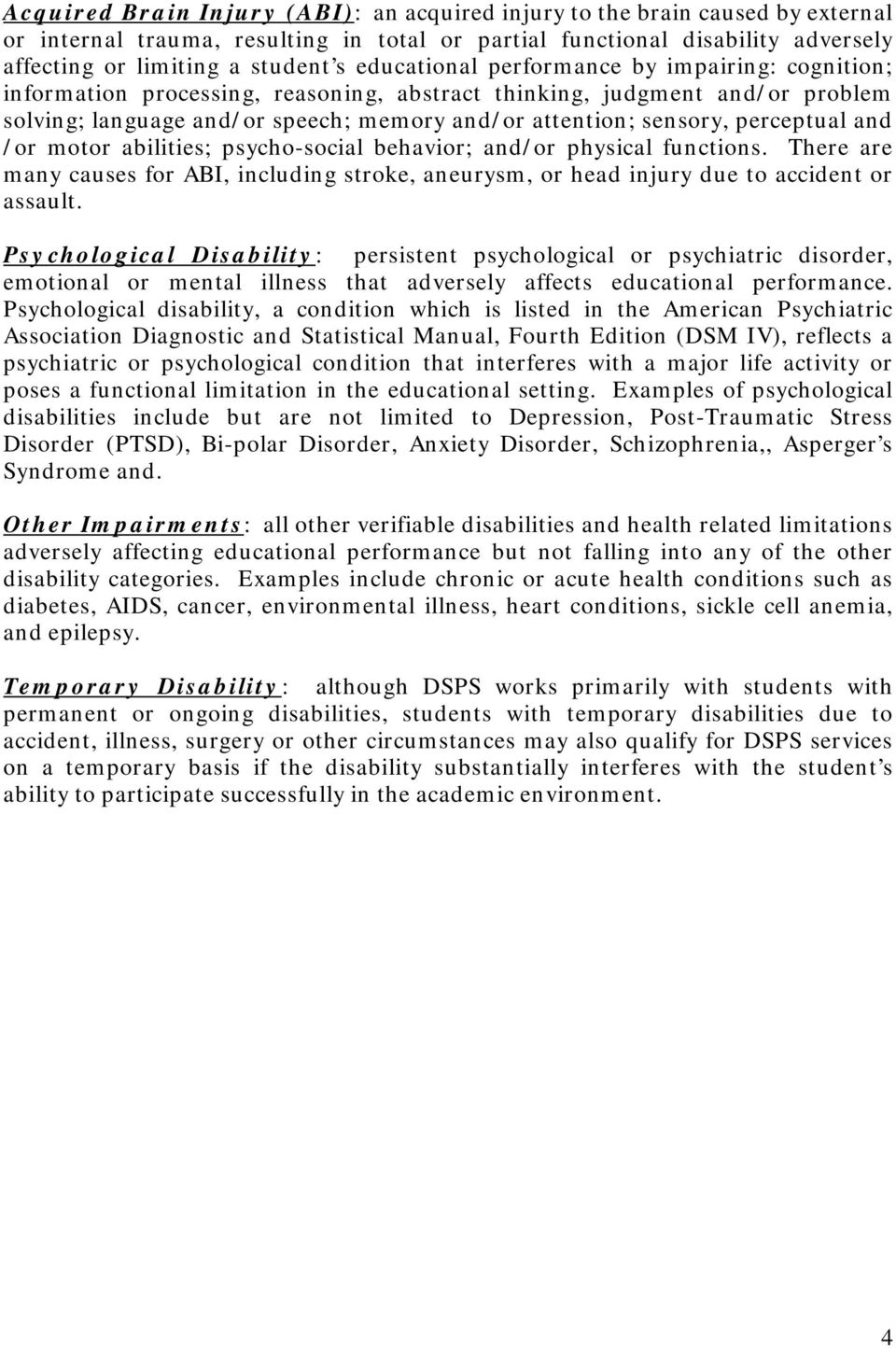
7 Acquired Brain Injury (ABI): an acquired injury to the brain caused by external or internal trauma, resulting in total or partial functional disability adversely affecting or limiting a student s educational performance by impairing: cognition; information processing, reasoning, abstract thinking, judgment and/or problem solving; language and/or speech; memory and/or attention; sensory, perceptual and /or motor abilities; psycho-social behavior; and/or physical functions. There are many causes for ABI, including stroke, aneurysm, or head injury due to accident or assault. Psychological Disability: persistent psychological or psychiatric disorder, emotional or mental illness that adversely affects educational performance. Psychological disability, a condition which is listed in the American Psychiatric Association Diagnostic and Statistical Manual, Fourth Edition (DSM IV), reflects a psychiatric or psychological condition that interferes with a major life activity or poses a functional limitation in the educational setting. Examples of psychological disabilities include but are not limited to Depression, Post-Traumatic Stress Disorder (PTSD), Bi-polar Disorder, Anxiety Disorder, Schizophrenia,, Asperger s Syndrome and. Other Impairments: all other verifiable disabilities and health related limitations adversely affecting educational performance but not falling into any of the other disability categories. Examples include chronic or acute health conditions such as diabetes, AIDS, cancer, environmental illness, heart conditions, sickle cell anemia, and epilepsy. Temporary Disability: although DSPS works primarily with students with permanent or ongoing disabilities, students with temporary disabilities due to accident, illness, surgery or other circumstances may also qualify for DSPS services on a temporary basis if the disability substantially interferes with the student s ability to participate successfully in the academic environment. 4
8 III. APPLICATION FOR SERVICES New Students If you are new to CCSF and/or DSPS you should begin by scheduling an appointment with a DSPS counselor. To schedule an appointment please call: Ocean Avenue Campus Rosenberg Library, Rm. 323 DSPS Office: TDD message: John Adams Campus 1860 Hayes St. Rm. 106 DSPS Office: TDD message: Mission Campus 1125 Valencia St. Rm. 151 DSPS Office: You are welcome to stop by our offices to request an appointment. Counselors are available to meet with students at other CCSF sites by appointment. Please contact the Ocean Avenue or John Adams DSPS office to schedule an appointment. First Appointment You can help facilitate enrollment by bringing these things to your first appointment: 1. Current written verification of disability, medical report, Department of Rehabilitation Plan, Individual Educational Plan (IEP) and/or Learning Disability Assessment. We recommend that you make copies of all documents you submit to DSPS in case you need them for future use. If you do not have documentation of your disability please bring the contact information for your provider. 2. Your student ID number. Your student ID is issued after you apply to City College of San Francisco. 3. A list of any questions you may have. You can schedule an appointment even if you do not have current verification of disability. DSPS can contact your provider, with your permission, to obtain the information. You can also schedule an appointment to discuss programs and services even if you have not yet applied to the college. Continuing Students You must meet with a DSPS counselor at least once a semester to maintain your eligibility for services. Please note that services need to be requested every semester and are adjusted depending on the courses you are taking. You may be asked to provide updated verification if you have a disability that changes over time, or if you 5

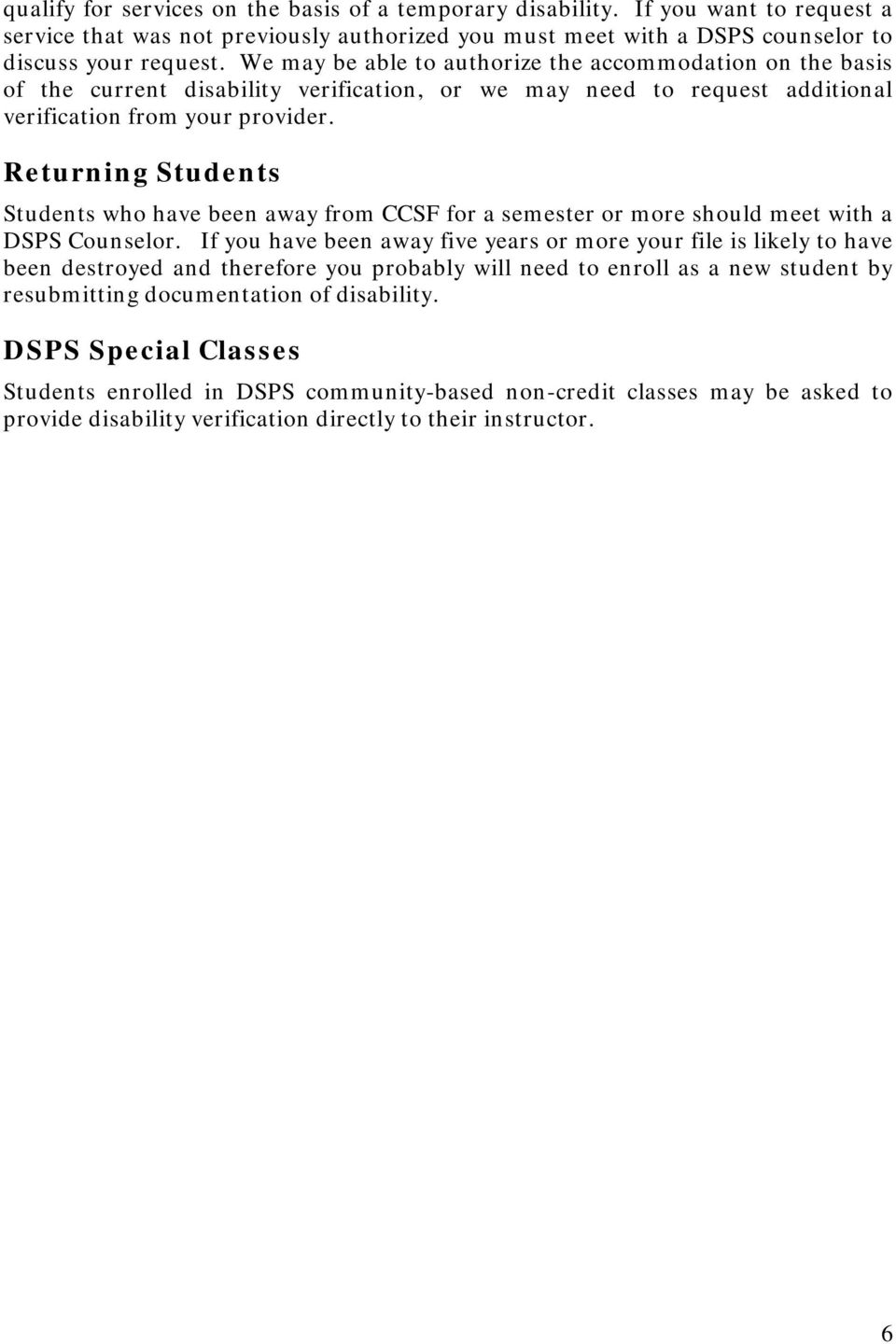
9 qualify for services on the basis of a temporary disability. If you want to request a service that was not previously authorized you must meet with a DSPS counselor to discuss your request. We may be able to authorize the accommodation on the basis of the current disability verification, or we may need to request additional verification from your provider. Returning Students Students who have been away from CCSF for a semester or more should meet with a DSPS Counselor. If you have been away five years or more your file is likely to have been destroyed and therefore you probably will need to enroll as a new student by resubmitting documentation of disability. DSPS Special Classes Students enrolled in DSPS community-based non-credit classes may be asked to provide disability verification directly to their instructor. 6
10 IV. STUDENT RIGHTS & RESPONSIBILITIES Student Rights 1. Registration by students with disabilities in DSPS is voluntary. Not all students with disabilities require accommodations. 2. Receiving support services from DSPS does not prevent a student from participating in any other course, program or activity offered by the college. 3. All records maintained by DSPS pertaining to students with disabilities are generally protected from disclosure and are subject to all other requirements for handling of student records. 4. Depending upon the level of services needed, students may choose to request accommodations without going through the complete DSPS registration process. For example, the use of service animal on district property requires only that a student register for eligibility with and obtain a tag from the DSPS (see Service Animals under Section VII of this handbook). Student Responsibilities Students receiving services and/or instruction through the DSPS office shall: 1. Provide DSPS with the necessary information, documentation and/or forms (medical, educational, etc.) to verify the disability. 2. Meet with a DSPS Counselor/Specialist to complete a Student Educational Contract. The student will meet at least annually (once a semester preferred) to update the Student Educational Contract. 3. The student will utilize DSPS services in a responsible manner and adhere to written service provision procedures adopted by DSPS. 4. Comply with the Student Code of Conduct adopted by the college and published in the college catalog. 5. Demonstrate measurable progress toward the goals established in the student s Student Educational Contract, and meet academic standards established by the college. Failure to comply with these standards may result in the termination of DSPS services. If you have any concerns regarding the continuation of services please do not hesitate to consult with a DSPS counselor. 7

11 V. DSPS RESPONSIBILITIES DSPS staff members assist students to obtain academic accommodations necessary to allow equal access to programs and services offered by City College of San Francisco. We establish policies and procedures that adhere to the CCSF and DSPS mission. It is the responsibility of DSPS to utilize resources in a responsible manner so that all students can receive equitable services. DSPS also has the responsibility of establishing requirements for measurable progress and continuation of services. If a student does not adhere to established policies, s/he will be notified of the possibility of termination of DSPS services. Termination of Services Services for DSPS eligible students may be discontinued for either of two reasons: 1. Lack of Measurable Progress or 2. Abuse of Services Measurable Progress DSPS services are intended to assist students in achieving their academic and/or vocational goals. Even with accommodations students may encounter difficulties due to disability, life circumstances, or other reasons that prevent them from achieving these goals. Students are encouraged to use authorized accommodations and support services, to choose appropriate classes and a reasonable course load and to meet regularly with DSPS and/or other college counselors. A lack of measurable progress can result in the termination of services. Lack of progress can be determined in any of the following ways: 1. Failure to pass (grades of W, NC, D or F) classes while utilizing appropriate accommodations 2. Failure to meet CCSF requirements for being a student in good standing. 3. Insufficient progress, as determined by instructor in consultation with the student. 4. Failure to make progress for two consecutive semesters, toward the goals established in the student s Student Educational Contract. Abuse of Services Policies and/or procedures are in place to protect the rights of all students receiving services through DSPS by ensuring fair and equitable use of resources. Abuse of services is defined as a failure to comply with the policies and/or procedures established to obtain or utilize authorized accommodations. Examples of abuse of services include excessive unexcused absences when a service is being provided, verbal abuse of DSPS staff, repeated failure to keep appointments for testing 8

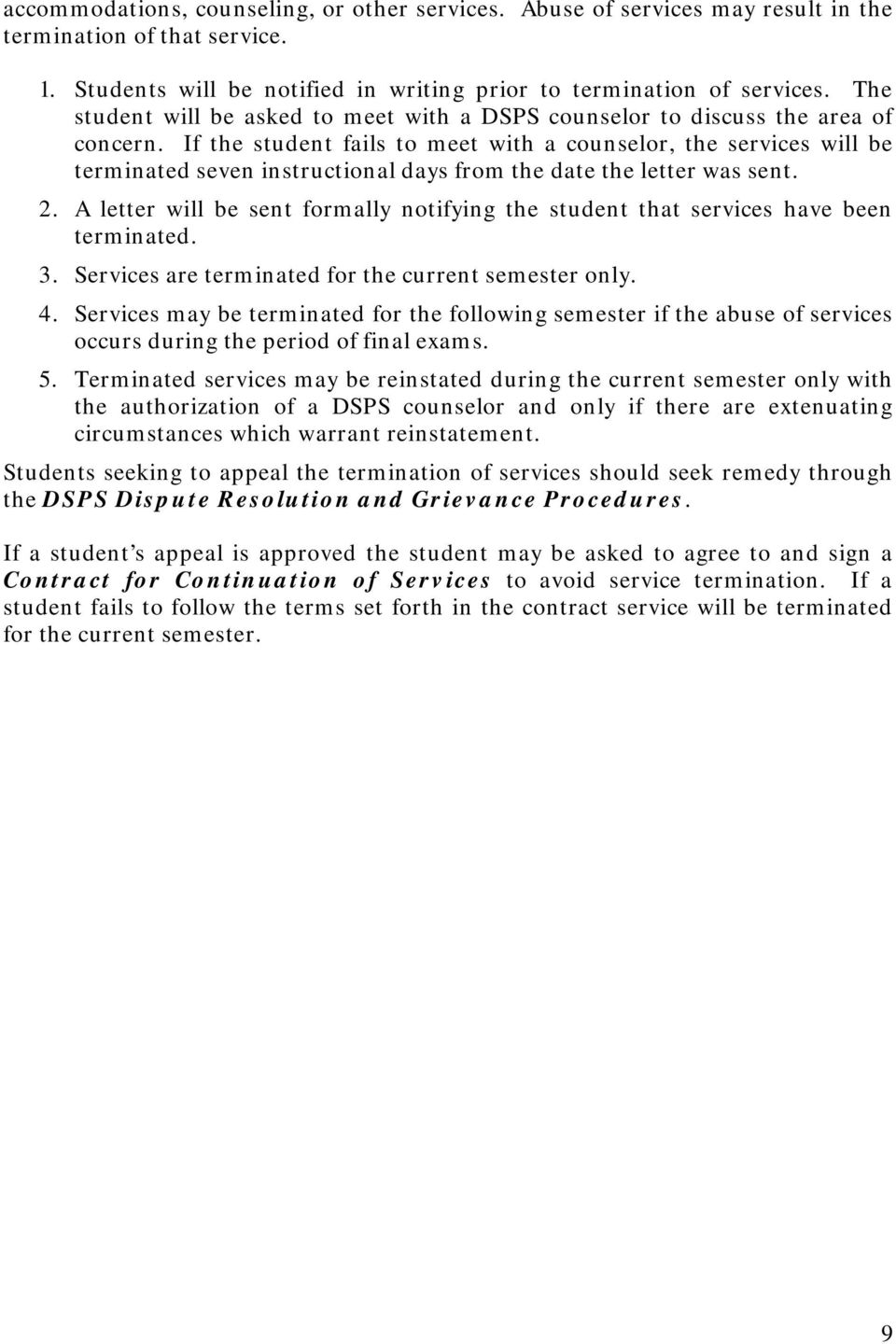
12 accommodations, counseling, or other services. Abuse of services may result in the termination of that service. 1. Students will be notified in writing prior to termination of services. The student will be asked to meet with a DSPS counselor to discuss the area of concern. If the student fails to meet with a counselor, the services will be terminated seven instructional days from the date the letter was sent. 2. A letter will be sent formally notifying the student that services have been terminated. 3. Services are terminated for the current semester only. 4. Services may be terminated for the following semester if the abuse of services occurs during the period of final exams. 5. Terminated services may be reinstated during the current semester only with the authorization of a DSPS counselor and only if there are extenuating circumstances which warrant reinstatement. Students seeking to appeal the termination of services should seek remedy through the DSPS Dispute Resolution and Grievance Procedures. If a student s appeal is approved the student may be asked to agree to and sign a Contract for Continuation of Services to avoid service termination. If a student fails to follow the terms set forth in the contract service will be terminated for the current semester. 9
13 VI. CONFIDENTIALITY The Right to Privacy Act ensures that all disability related contact with the DSPS office remains confidential unless students sign a written release. DSPS staff will not discuss anything pertaining to a student s disability with college instructors, staff or family members without the student s expressed written consent. DSPS is allowed to disclose limited information under an educational need to know clause in the student s application for services. Under the educational need to know clause DSPS counselors may verify eligibility for specific services, such as testing accommodations. Other exceptions to confidentiality occur when required by law, such as when a student is determined to be a danger to self or others, or when there is reasonable suspicion of child abuse or the abuse of a dependent adult. Liaison to Campus and Community For reasons of confidentiality DSPS staff members may not discuss a student s disability status with either faculty or staff. As a result, students are encouraged to talk with their instructors about their approved accommodations as written on their Classroom and Test Accommodations Verification (CATAV). If requested by the student, DSPS staff may intervene on a student s behalf to facilitate provision of services or to help students communicate their needs to others. DSPS staff may assist students by providing information and referrals related to community resources. Counselors will take care to ensure the student s right to privacy when gathering information about community resources or when making referrals to appropriate agencies. 10

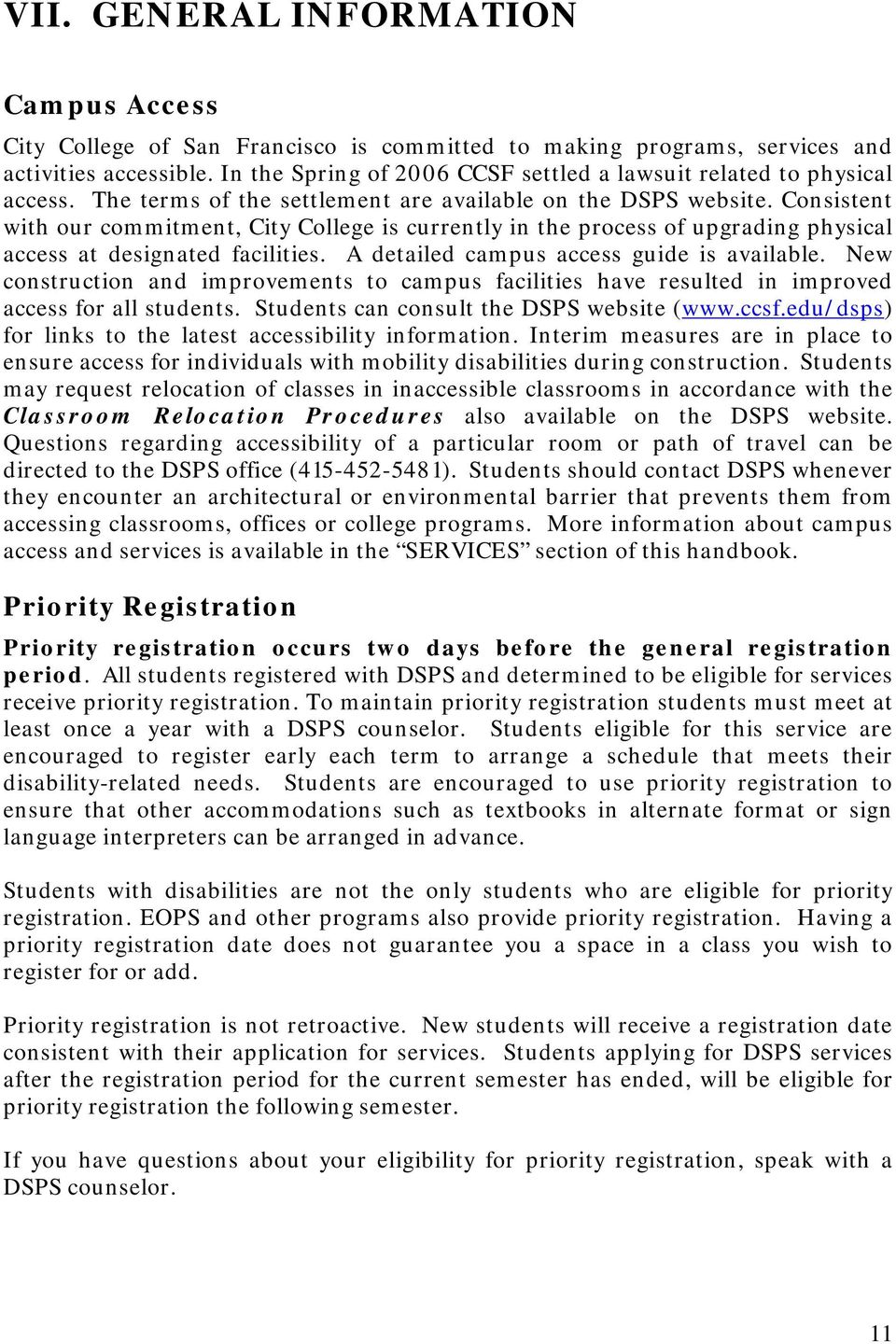
14 VII. GENERAL INFORMATION Campus Access City College of San Francisco is committed to making programs, services and activities accessible. In the Spring of 2006 CCSF settled a lawsuit related to physical access. The terms of the settlement are available on the DSPS website. Consistent with our commitment, City College is currently in the process of upgrading physical access at designated facilities. A detailed campus access guide is available. New construction and improvements to campus facilities have resulted in improved access for all students. Students can consult the DSPS website ( for links to the latest accessibility information. Interim measures are in place to ensure access for individuals with mobility disabilities during construction. Students may request relocation of classes in inaccessible classrooms in accordance with the Classroom Relocation Procedures also available on the DSPS website. Questions regarding accessibility of a particular room or path of travel can be directed to the DSPS office ( ). Students should contact DSPS whenever they encounter an architectural or environmental barrier that prevents them from accessing classrooms, offices or college programs. More information about campus access and services is available in the SERVICES section of this handbook. Priority Registration Priority registration occurs two days before the general registration period. All students registered with DSPS and determined to be eligible for services receive priority registration. To maintain priority registration students must meet at least once a year with a DSPS counselor. Students eligible for this service are encouraged to register early each term to arrange a schedule that meets their disability-related needs. Students are encouraged to use priority registration to ensure that other accommodations such as textbooks in alternate format or sign language interpreters can be arranged in advance. Students with disabilities are not the only students who are eligible for priority registration. EOPS and other programs also provide priority registration. Having a priority registration date does not guarantee you a space in a class you wish to register for or add. Priority registration is not retroactive. New students will receive a registration date consistent with their application for services. Students applying for DSPS services after the registration period for the current semester has ended, will be eligible for priority registration the following semester. If you have questions about your eligibility for priority registration, speak with a DSPS counselor. 11
15 Absence Notification Guidelines for Classes DSPS will not notify instructors of an absence except in limited and extenuating circumstances such as emergency hospitalization. Communication with instructors is the responsibility of the student. Absence Notification Guidelines for Services Students receiving special services (interpreting/real time captioning, testing accommodations) must notify DSPS in the event of any absence when a service is scheduled. Students should notify DSPS in advance of any planned absences. If a student has three or more unexcused absences they will be asked to meet with a DSPS counselor. Excessive absences may be considered an abuse of services. Students scheduled for testing accommodations also should inform DSPS if they will not keep a test accommodation appointment. Instructors are informed when a student does not keep a testing appointment. Tests proctored by DSPS cannot be rescheduled without the approval of the instructor and are subject to all policies and procedures regarding scheduling of testing accommodations. Financial Aid Financial Aid Office Financial Aid includes grants, loans and employment. The Financial Aid Office (FAO) is located in Cloud Hall, Room 324. The first three weeks of each semester, FAO will be open Monday through Thursday from 7:30am to 4:00pm. After the first three weeks, it will open Monday through Wednesday from 7:30am to 5:00pm, Thursday from 7:30am to 6:30pm and Fridays from 9:00am to 4:00pm. FAO representatives are available at other campuses. Please contact the student counseling office on that campus for details. Students who apply for financial aid must be admitted to CCSF and enroll for the purpose of obtaining a degree, a certificate or completing a transfer program to a four-year institution. Board of Governors fee waivers is available to eligible students. There are three methods (A,B & C to qualify for a Board of Governors Fee Waiver. (BOGW). If you (or your parents if you are a dependent student) are receiving funds from General Assistance (GA), TANF/CalWorks, Supplemental Security Income or State Supplemental Program (SSI/SSP) you may be eligible under method A. Check with the FAO for details on BOGW eligibility under methods A, B &. The BOGW application must be submitted in person. Do not mail it. Please bring documentation to show current proof of benefits. The BOGW is for fees only. If you need money to help with books, supplies, food, rent, transportation and other costs, please complete a free application for federal student aid (FAFSA) immediately. You will be responsible for the health fee, registrations fee and student activities fee. You may benefit from receiving BOGW if 12

16 you file a FAFSA even if you are not eligible for any other type of aid. The FAFSA is available at of the Financial Aid Office. This fee waiver is for California residents only. Persons applying for the BOGW need not come into FAO the first few weeks of the semester when things are most busy, but need to complete the process before midterms in order to avoid a hold being placed on your account. DSPS front of the line passes will be honored at the Financial Aid Office. Students wishing to go to the front of the line must first obtain a front of the line pass from DSPS. Students with disabilities are not able to receive a check any faster than any other student. Paperwork must be submitted in a timely fashion. Some DSPS students are granted a reduced course load of less than 12 units and are still considered full time. This is for Academic purposes only and is not valid for Financial Aid. DSPS students who want to receive full financial aid must take at least 12 units per semester, 9 to 11 units is considered ¾ time, 6 to 8 units is considered ½ time. Students who receive financial aid and then drop a portion of their credit load may need to repay some of the funds based on the difference between the higher and lower loads. Need a question answered? The Financial Aid Office has can be reached by phone at: (415) /3577 (415) (Audio Information) The phones are very busy at FAO. You will need to leave a message. Please leave a message including your Name, Phone Number and Student ID. Someone will call you back within 24 hours. Extended Opportunity Program and Services Extended Opportunity Program and Services (EOPS) offers support services and limited financial assistance for low income and educationally disadvantaged students. Funding is limited. Contact the EOPS office ( ) for information, application and deadline for applications. Scholarship Office The Scholarship Office grants scholarships for qualified incoming, continuing and transfer students. The Office is located in Batmale Room 366 ( ). California State Department of Rehabilitation Students with disabilities who hope to enter the workforce may qualify for assistance from the California State Department of Rehabilitation ( SF office ) 13
17 Personal Emergencies Some students have medical conditions that may require emergency or first aid response. This may include students who have seizures, students with cardiac disabilities or students with certain psychiatric disabilities. You may wish to designate an emergency contact person in the event that you require medical attention or transport to your home or medical facility. You may also want to consider providing this information to the Student Health Service and/or Campus Police. Campus-Wide Emergencies/Disasters In the event of a fire, earthquake or other disaster requiring campus-wide response, CCSF will implement its emergency evacuation plan. The plan includes periodic drills and evacuation of students and employees with disabilities. It is imperative that all students and employees take responsibility for personal safety and the welfare of the campus community and self-identify if they are in need of assistance in the event of an emergency. Emergency evacuation chairs are located in strategic, marked locations. Service Animals Service animals that have been trained to provide a service, such as Seeing Eye Dogs, Signal Dogs and Canine Companions are welcome on campus. In addition, animals that have been certified by an appropriate licensed professional as a necessary accommodation are also welcome as long as the animal is not disruptive in the educational environment. Students using service animals are required to register the animal with DSPS each semester. DSPS will issue a tag permitting the animal on campus. Service animals must be on leash at all times and meet health and safety standards. Pets are not allowed on campus. Complete service animal policy is available on the web ( ). Student Grievance Rights Students have a right to file an appeal when an accommodation they have requested has been denied. Students have a right to file a grievance concerning any allegations of failure to comply with the laws, regulations and procedures regarding accommodations for students with disabilities. Every attempt is made to resolve issues informally to the satisfaction of all parties. Complaints that cannot be resolved informally shall be processed through the existing CCSF DSPS Dispute Resolution and Grievance Procedures. Classroom Relocation If you have a mobility or health disability and you find that you cannot access the assigned classroom, please contact the DSPS office ( ) as soon as possible. When necessary, DSPS may assist in relocating the class to a classroom that is more readily accessible to you unless it would fundamentally alter the nature of a program, class or course or substantially modify academic or program 14

18 standards. Classes that are already offered in accessible locations may not be relocated. Telephones Telephones in the DSPS office are for staff use only. TDD pay telephones are located on the first floor entrance of the Rosenberg Library. Videophones are not currently available. Cell phones or any other non-assistive devices are not to be used in the DSPS offices, classes, or labs. Important Points to Remember Students assume responsibility for transportation, service animals, medications and the provision of personal attendant care. Students assume personal responsibility for their education and accommodations. Students are expected to work collaboratively with instructors and DSPS counselors and staff to ensure timely provision of services. If you have any questions regarding services or your eligibility for services please do not hesitate to contact our offices. 15

19 VIII. SERVICES COUNSELING DSPS counselors offer students with disabilities specialized counseling and guidance to assist with coordinating accommodations, decision making and educational planning. Counseling is available by appointment, same day appointments and when time permits on a drop in basis. Appointments are strongly advised. Disability Management: DSPS counselors coordinate necessary support services and recommend accommodations in the educational setting. Counselors also serve as a resource for information and referral to community based agencies. Academic Advising: DSPS does not duplicate services provided by other counseling units. DSPS counselors are available to consult with other counselors, to review recommendations with the student s disability in mind. Students are encouraged to make appointments with New Student Counselors, Continuing Student Counselors, Transfer Center or Counselors from other programs such as APASS, African American Scholastic Program, EOPS, or Latino Services Network. Sometimes a student s disability impacts the student in such a way that DSPS will provide educational advising or planning as an accommodation for that student or to facilitate enrollment. Career Counseling: Counseling related to career choice and decision making is available to students through the Career Development and Placement Center. Consultation is available for students and their career counselors regarding the impact the disability as it relates to the student s vocational goals. Personal Counseling: DSPS counselors know that difficult personal situations may arise for any student as they pursue their educational goals. The focus of short term personal counseling is to address how the current problem impacts their education and to develop strategies to manage the issue. DSPS counselors do not provide psychotherapy to students. When more in-depth counseling or therapy is indicated, DSPS counselors may refer students to Counseling and Psychological Services in the Student Health Center, or to appropriate community agencies. 16
20 How to Schedule a Counseling Appointment To schedule an appointment with a DSPS counselor, call or drop by our offices: Ocean Avenue Campus Rosenberg Library, Rm. 323 DSPS Office: TDD message: John Adams Campus 1860 Hayes St. Rm. 106 DSPS Office: TDD message: Mission Campus 1125 Valencia St. Rm. 151 DSPS Office: Counselors have regularly scheduled hours at many CCSF campuses. You may call the DSPS counseling office to schedule an appointment or inquire about availability of DSPS counseling at the Counseling Office of the campus you are attending. Appointments are usually scheduled for thirty minutes. Please be on time. If you must cancel, please call as soon as possible so that the time slot can be made available for another student. Please be aware that we may not be able to reschedule your appointment as soon as you would like. Delays can impact the timely authorization of services. Quick questions can often be taken care of in a short same day appointment or on a drop in basis. Due to the short time allowed for these appointments there might not be enough time to address all of your concerns. Your counselor can assist you in scheduling a follow up appointment. A limited number of evening and Saturday hours are available. Please refer to the DSPS home page for hours of operation. ACCOMMODATIONS Under provisions of Section 504 of the Rehabilitation Act of 1973 and the 1990 Americans with Disabilities Act (ADA), CCSF is required to provide accommodations for otherwise qualified students with disabilities. Accommodations are the means by which the college allows the student to compensate for limitations resulting from a disability. Accommodations are not designed to give students an advantage but rather to allow equal opportunity in the classroom and in student activities. Accommodations are determined on a case by case basis. Accommodations may differ based on the nature of the disability, the functional limitation and the requirements of the class. 17
21 Examples of Student Needs and Possible Accommodations in an Instructional Setting Limitations Based on a Verified Disability Unable to take tests in traditional manner Unable to climb stairs or successfully negotiate barriers Unable to produce class notes Unable to see or process visual information Deaf / hard of hearing; difficulty understanding oral presentations Unable to use standard classroom furniture or sit for long periods of time Difficulty with tasks involving manual dexterity (writing, typing) Requesting Accommodations Possible Accommodation Extended Test Time Reduced Distraction Environment Use of Computer Reader or Scribe Alternate Format Priority Registration Scooters Classroom relocated to accessible location Tape Recorder Note taker Alpha Smart Audio Books/Recordings for the Blind and Dyslexic Enlarged Print Note taker E-text Braille Preferential Seating Interpreter/Captioner Note taker Adaptive Listening Devices Special Classroom Seating Extra Breaks Testing Accommodations Note taker Voice Activated Software Extended Testing Time Tape Recorder for lectures Scribe for written tests It is important to remember that requesting, obtaining and implementing accommodations are a collaborative process. Students requesting accommodations should meet with a counselor to discuss the request for accommodation. After verifying disability and functional limitations the counselor will approve reasonable and appropriate accommodations. The student and counselor will complete a Student Educational Contract. The Student Educational Contract is completed every academic year and outlines educational goals and approved accommodations based on current verification and educational limitations. 18
22 Depending on the nature of your accommodations you may be issued a Classroom and Testing Accommodations Verification (CATAV). The CATAV allows you to inform your instructor of approved accommodations without revealing the nature of your disability. Students are encouraged to meet with their instructor during office hours to discuss relevant accommodations. Meeting with an instructor during office hours gives you a chance to explain your accommodation without the distractions that occur before and after class. If you cannot meet with your instructor during an office hour, you may wish to contact the instructor by phone or . By initiating a collaborative working relationship with your instructor, you are taking responsibility for your education. Testing Accommodations Testing accommodations may be approved as a reasonable accommodation if a disability prevents a student from taking tests under standard conditions. Testing accommodations are approved for students with a wide range of disabilities, including but not limited to learning disabilities, mobility disabilities, psychological disabilities, Attention Deficit and Hyperactivity Disorder (ADHD) and vision loss. Testing accommodations may also be approved for students taking medication for a chronic condition when the side effects of the medication impair concentration or cognitive functioning. The most appropriate method of administering a test depends upon the student s disability and the design of the test. Testing accommodations Extended Test Time Computer for Essays Reader Alternate Testing Format Reduced Distraction Room Scribe Enlarged Print To obtain testing accommodations 1. Schedule an appointment with a DSPS counselor to request authorization for testing accommodation services. The counselor will evaluate documentation, review functional limitations and make recommendations for accommodations. Continuing DSPS students return each semester to renew authorization for the current semester. The counselor will issue a Classroom and Testing Accommodation Verification (CATAV) which provides verification of authorized accommodations to your instructors. 2. Testing accommodations will not be provided until a student s eligibility for such service has been verified. Limited provisional services may be provided if the student has documentation of previous eligibility. 3. Testing accommodations will occur either before or during the scheduled test time. There are limited exceptions, for example: a student has a class immediately before and after the class where the test is occurring and would not have time to complete the test with accommodations. 19
23 4. Meet with your instructors, preferably during office hours, to let them know that you are eligible for testing accommodations and show them your original CATAV. Review the procedures for arranging accommodations. Ask your instructor to complete their side of the Testing Accommodation Request (TAR) form. The instructor will note all details and information regarding the test including how the test will be sent to DSPS and how it will be returned. 5. Students must submit a TAR to the DSPS Testing Desk at least 7 days in advance for tests and by posted deadlines for finals. The deadline for requesting accommodations for final exams are noted on the TAR. a) Fill out the student column of the TAR form. b) Have the instructor fill out their column. c) Return the TAR form to the DSPS testing desk signed by the instructor. Instructor will note any additional test taking materials. Note: It is the student s responsibility to return the TAR form to DSPS. d) Confirm scheduled testing time. Advance scheduling allows time to arrange for additional DSPS support, such as a scribe, or to resolve any problem related to test administration. Students may fax the Testing Accommodation Request to DSPS/ Attn: Testing Desk ( ) or drop it off in the DSPS office. Students are responsible for verifying receipt of request and confirming the testing appointment. Instructors may choose to provide the approved accommodation before or after class or during an office hour. If there is a disagreement regarding your accommodation that cannot be resolved please speak with a counselor or follow the steps for appeal. Deadlines for final exams, including summer session, are noted on the Testing Accommodation Request. Students may forfeit their right for testing accommodations if they fail to follow deadlines for accommodation requests. Students submitting late requests for final exams will be referred to the instructor. Your instructor may be willing to provide the extended time or reduced distraction environment but may not be required to do so. To ensure reasonable, appropriate accommodations it is imperative that students abide by deadlines and procedures for requesting testing accommodations. You may meet with a DSPS counselor to discuss special circumstances. Test integrity is important to DSPS. Cheating is a violation of the Student Code of Conduct. The provision of testing accommodations for all students depends on the ability of DSPS to assure instructors that the testing environment is secure. DSPS Test Taking Rules 1. Advance scheduling is required for all exams and quizzes. Students must schedule accommodations seven days in advance for regular tests. Deadlines for final exams are printed at the beginning of each semester. 20
24 2. You must contact DSPS and your instructor if you are unable to take your exam on the scheduled day and time for any reason. 3. Arrive on or before the scheduled test time. If you are late, that time will be counted as part of your test time just as it would for a student late for class on test day. 4. If you miss your exam, it will be returned to your instructor. It is up to you to see if the instructor will allow a make up exam. If your instructor approves, a new Testing Accommodation Request form must be submitted. 5. Cheating is a violation of the Student Code of Conduct. If a student is caught cheating, DSPS will a) stop the exam and the student will be informed why the test was stopped. b) The instructor will decide what grade to provide the student. c) DSPS will send the instructor a Notice of Faculty/Staff Discipline form and tell the instructor that the offices of Student Advocacy Rights and Responsibilities and DSPS recommends that he or she fills out the discipline form and submit it to the office of Student Advocacy Rights and Responsibilities with a photocopy to DSPS d) When DSPS receives the photocopy it will go in the student s file 6. Only materials authorized by the instructor in writing, prior to the test, will be allowed in the testing room. Clarify any questions you might have regarding the use of class notes, dictionaries, calculators, etc., prior to the test. Use of scratch paper may be limited to one sheet only. 7. Accommodation tools such as tape recorders, spell checkers, etc., will be allowed only when specifically approved in writing by you DSPS counselor and authorized by the instructor only when the accommodation does not compromise the test. 8. Use the restroom prior to your testing appointment. If you must use the restroom during your exam, your instructor will be notified. Restroom breaks are counted as part of your testing time. For longer exams, or when breaks are part of an accommodation, the test may be administered in parts to ensure test integrity. 9. Cell phones, pagers or other electronic devices are not allowed in the testing room. Students will be asked to keep all belongings in a locker, outside of the testing room. Students may bring their own lock to secure their belongings. 10. Eating and drinking, with the exception of water, are not allowed in the testing room. Special arrangements may be made for students with testing sessions over three hours or with medical conditions such as diabetes. 11. Family members, including children, or friends are not allowed in the testing area. 12. The Student Code of Conduct will be enforced. 21
25 PRIORITY REGISTRATION Campus Access/Mobility Assistance Students with mobility disabilities are strongly encouraged to use priority registration so that they can schedule classes that best suit their needs. For some students it is important to have classes in close proximity or with enough time between classes to ensure that he or she will arrive to class on time. Some students need to have classes in wheelchair accessible locations. Some students need classrooms that are accessible by ramp or elevator but may not require other accessibility features such as low light switches or door handles. Some students may need to have classes near accessible restrooms. In some instances assigned classrooms can be changed as an accommodation. Please see the section regarding classroom reassignment/relocation. If you have questions about the accessibility of a particular classroom contact the DSPS office ( ). The level of accessibility in all classroom locations at all City College campuses is available in the CCSF web site. CLASSROOM RELOCATION If you have a mobility or health disability and you find that you cannot access the assigned classroom please contact the DSPS office ( ) as soon as possible. When necessary, DSPS may assist in relocating the class to a classroom that is more readily accessible to you unless it would fundamentally alter the nature of a program, class or course or substantially modify academic or program standards. Courses with additional sections offered in accessible locations may not be relocated. LIBRARY ACCESS Library staff is available to retrieve books and reference materials for students whose disabilities prevent them from going through the stacks. Staff can also assist with the photocopy machines. For a complete list of branch library hours and accessibility, see section DSPS TABLES in this handbook. In the Rosenberg Library, near the East Reference Desk, 4th floor are: 1. A computer workstation for use by people with visual and/or motor disabilities. 2. A CCTV reader that magnifies print copy onto a screen for persons who are visually impaired 3. A magnifying reading lamp-check out from the East Reference Desk for use in the library. AUDIO BOOKS City College maintains an institutional membership with Recordings for the Blind and Dyslexic. This service is free for eligible students. Detailed instructional packets and application for services are available at DSPS. Please familiarize yourself with 22
26 procedures to obtain Audio Books. Librarians at the Circulation Desk are available to assist you in ordering Audio Books or other RFB&D materials. AUTOMATIC DOORS AND ELEVATORS Elevators and automatic doors are to remain in operation thirty minutes before the first class begins and thirty minutes after the end of the last class. Should you find an elevator or door to be out of order please report it immediately to DSPS. If you cannot reach DSPS, contact campus police ( ) or the nearest building administrator. SCOOTERS Scooters are available to assist students in traversing the Ocean Avenue Campus. Scooters can also be made available at other campuses, contact the DSPS office for locations. Students with temporary and permanent orthopedic or medical disabilities that affect their ability to traverse the campus may be eligible for this service. Students may not use scooters if medication or other disabilities impair their ability to safely operate equipment. Schedule an appointment with a DSPS Counselor to receive authorization for services. Bring verification of disability unless one is already on file with DSPS and be sure to bring your Student ID. It will be used to check out a scooter. You must schedule an appointment to be trained in safe operation of the scooter. 1. Scooters are available on a first-come-first-served basis 2. Scooters must be signed in and out at the DSPS office using your student ID 3. Scooters cannot be taken off campus for any reason. 4. Special arrangements may be made to pick up and/or return the scooter during hours the office is closed. FURNITURE Some students cannot use standard classroom furniture due to a verified disability. If you need specialized furniture, such as an accessible workstation, separate table and chair, or back support please make this request at DSPS. By using priority registration you can request this service in advance. Furniture requests take approximately one week to process. DSPS cannot arrange for specialized furniture solely for comfort purposes. If you are requesting specialized furniture for comfort reasons not related to a disability please ask your instructor to contact the Office of Instruction for assistance. Furniture Requests 1. To request adaptive furniture (accessible table or separate table and chair) schedule an appointment to meet with a counselor for authorization. 2. Bring a schedule of classes that indicates the time and place where the specialized furniture is needed. You will be asked to fill out a form requesting the accommodation. The Accommodations Specialist will contact Buildings and Grounds to procure the furniture. It may take a week or so for the 23
27 furniture to be placed. Your request can be expedited by using priority registration and making the request prior to the start of the semester. RESERVED SEATING Reserved seating may be arranged as an accommodation for a disability related limitations. Students with vision loss, hearing loss, attention deficit disorder, learning disabilities and/or mobility impairments can have seating arranged and reserved when eligible. Students must meet and discuss their need and eligibility for reserved or special seating with a counselor. This will be noted on their Classroom and Test Accommodations Verification. It typically takes several weeks in the beginning of the semester for all seat reservation signs to be placed. Please request this accommodation early. LOCKERS A limited number of lockers at our Ocean and Downtown Campuses are available. Students must provide documentation that verifies a limitation in carrying or lifting to qualify for this service. A refundable deposit of $6.00 is required for the lock. You may meet with a DSPS counselor to discuss special circumstances. CLEAR PATH OF TRAVEL/ACCESS It is the responsibility of the college community to maintain clear paths of travel for all students. If you notice a barrier, please bring it to the attention of the DSPS office ( ). ACCESSIBLE PARKING Parking is limited at all CCSF campuses. Students who have a designated parking placard issued by the Department of Motor Vehicles (DMV) are eligible to park in any blue zone. If these spaces are full, parking is permitted in faculty and staff parking stalls. Students with disabled placards are allowed to park for free in student parking lots. Students with blue placards must request a parking permit from the Campus police each semester. Students must display the parking permit and the DMV placard. Students with a valid temporary DMV disabled placards (red) are allowed to park in any legal parking space and do not need a CCSF permit. All parking is available on a first come, first served basis. Parking is not reserved for students with disabilities. It is important to arrange your schedule to allow adequate time for parking. ACCESS AND CONSTRUCTION ALERTS/SIGNAGE DSPS provides the campus community and visitors with updates on campus construction, related temporary barriers, and options for alternate access around campus. Check the CCSF DSPS website ( for updated alerts. Construction activities are a reminder that City College is growing. Facilities are constructed, repaired or renovated to better serve the campus community. Many of these projects require temporary adjustments to accustomed paths of travel, often 24
28 with little notice. Significant efforts are made to use on-site signage to indicate detours clearly, and to maintain accessible routes with a minimum of inconvenience. The web site alert is designed to provide general information for the campus community on the location and probable duration of significant interruptions or detours in accessible paths of travel through campus grounds and in access to buildings. Actual conditions on site may change with the flow of construction activity from day to day, so it is important to leave plenty of time for possible delays due to detours. EQUIPMENT LOAN Educational access sometimes means that students need equipment to compensate for their disability so they may benefit from instruction. Some of the items available for loan are tape recorders, assistive listening devices, handheld magnifiers, spellcheckers, Alpha Smart, and back supports. Equipment Loan Procedures 1. To determine eligibility for services, arrange a counseling appointment with a DSPS counselor if you have not already done so. 2. Equipment is loaned to students enrolled in classes and in possession of their own valid Student ID. Equipment shall not be loaned to a student for any purpose or activity that is not school sponsored. Availability may be limited depending on the number of students requesting the equipment. 3. Equipment must be returned as agreed, either after class, daily, or at the end of the semester. If the equipment is missing or has been damaged the student will forfeit the right for future equipment loan and a hold will be placed on college records until the equipment is returned or replaced. 4. If the equipment is not returned or replaced, the student will be responsible for replacement costs. How to Borrow Equipment 1. Meet with a DSPS counselor to request the accommodation 2. Read and sign the Equipment Loan Contract for borrowing equipment 3. Present your valid Student ID with photo 4. Check out equipment. Return equipment by agreed upon time/date. NOTETAKERS/SCRIBES/TAPE RECORDING Note taking services include services for writing, taking course lecture notes and manual manipulation of course materials (in the case of lab activities), and related academic activities (Title 5 Section IIIA b, 6) at the college. In order to comply with the guidelines, DSPS provides in-class course lecture notes and scribing for course exams. Alpha Smart keyboards and tape recorders are available to students on loan. 25
29 Eligibility A DSPS counselor may authorize note taking services for students who have a verified disability which prevents them from taking lecture notes and/or writing. Scribing services are defined as the physical act of writing on behalf of a student who is unable to do so. These services occur in courses that require in-class writing assignments, or as an accommodation for taking exams. Approved students may schedule a request for a scribe for in-class writing assignments by filling out a Testing Accommodation Request. DSPS staff provides the scribing service for exams while a student aide might be hired to provide the service for a writing assignment. Voice activated computer software may be recommended as an alternate accommodation to scribing. Lecture Notes Note taking services for lecture notes generally involve the request for in class peers to share their notes by using NCR note taking paper supplied by DSPS or copying the notes via a duplicating machine. Generally students are asked to recruit classmates as note takers. Students enrolled in the class have a vested interest in producing clear notes. DSPS makes available a Note Taker Recruitment Letter to assist you in obtaining a note taker. Some students are able to find note takers easily. Others ask for assistance from the instructor. If you are having trouble finding a note taker please discuss options with a DSPS counselor. Note takers may serve on a voluntary basis or they may choose to be paid a small stipend, about $100 per three unit class. Students requesting payment for services must be eligible to work in the U.S. to receive payment. Payment is prorated depending on the start or end date of services. Alpha Smart Keyboards Some students with good keyboarding skills and eligibility for note taker services have found that the Alpha Smart keyboard allows them to independently take notes. The Alpha Smart is quiet and easy to use (see for details). Alpha Smart keyboards are available for loan. Tape Recording Tape recording of lectures may be determined to be a reasonable accommodation for students with a wide range of disabilities. Students who have difficulty reading due to vision loss, learning disability, acquired brain injury, or other disabilities may benefit from this accommodation. Students who have difficulty taking notes due to a verified disability such as a learning disability, a repetitive stress injury or other mobility disability, ADHD or psychological disability may be eligible for this service. Tape recorders are available on loan. DSPS will provide one tape and one set of batteries. Students authorized to tape class lectures as an accommodation must sign a Tape Recording Agreement form. The agreement states that the 26
30 recording will be used only by the student as a reasonable accommodation. Recordings may not be shared with other students or used in any way other than as an accommodation. There may be some classes in which recording of class proceedings are not appropriate. Students are encouraged to work with DSPS and the instructor to make alternate arrangements. Any unauthorized use of the recording may result in a termination of the service. ALTERNATE MEDIA Alternate Media is defined as instructional materials, textbooks, college and/or library materials in formats accessible and usable by individuals with disabilities. The determination of the most suitable format of support should be made by credentialed staff, and where ever possible should be provided in the format preferred by the student. In an effort to comply with the fore mentioned guidelines DSPS will provide the following alternate media services: Braille, reading services (audio), tactile graphics conversion of course materials and handouts, print enlargement, electronic text (e-text). Eligibility Alternate media services will be provided to students who have a verified disability whose disability related limitations prevent them from accessing material in traditional print format. Students must be enrolled in the course for which they are receiving alternate media. Students are asked to use priority registration and to contact the DSPS office ( ) as soon as possible to avoid unnecessary delays in obtaining course materials. Audio Books City College maintains an institutional membership with Recordings for the Blind and Dyslexic. Students who meet eligibility requirements for RFB&D services may request textbooks or other reading materials through the Rosenberg Library. A limited number of Daisy Digital CD players are available in the library Media Center, DSPS Strategies Lab and High Tech Lab for student use. For a complete list of branch library accessibility, see section DSPS TABLES in this handbook. Braille and Tactile Graphics Braille is a system of reading and writing for blind individuals. Printed material can be transcribed into Braille by DSPS. Please contact the DSPS office ( ) to discuss any request for Braille materials. Graphics can be translated into tactile form by using special heat sensitive paper. A tactile map of the CCSF Campus is available upon request. Electronic Text (e-text) Electronic text is a version of textbooks and course materials available from a text file. This may take the form of a Microsoft Word document or Plain text. E-text has emerged as a convenient method of providing access for those who cannot use standard printed material. Individuals who are partially sighted can use e-text by taking advantage of options within many standard software applications (adjusting 27
31 font size, specialized screen magnification software). E-text can be used with screen reading software to output the text to a voice synthesizer or refreshable Braille display. The main advantage of e-text is that it is easily stored, can be searched and indexed, and can be converted to large print or Braille through use of a translation program. Magnifiers Hand held magnifiers are available for loan and are sometimes helpful for students with low vision. Print Enlarging Print enlarging is the magnification of print from e-text, textbooks and handouts. Relatively few textbooks are available in large print. Print enlarging is available through DSPS. Contact the DSPS office ( ) to discuss necessary arrangements regarding production of large print materials. CCTV and Clarity Carrymate(s) The use of a closed circuit (CCTV) television system and Clarity Carrymate permits magnification of the page being viewed or chalkboard and is a reasonable alternative to hard copy large print. This equipment is located in the High Tech Center and the Rosenberg Library. CCTV is available for in class use for eligible students upon request. Check with the DSPS office ( ) for availability of the Clarity Carrymate For a complete list of branch library accessibility, see section DSPS TABLES in this handbook. Procedures for Obtaining Alternate Media Services: 1. If they have not already done so students must meet with a DSPS counselor to verify their disability and educational limitations that necessitate textbooks and course materials in alternate format. 2. Students utilizing alternate media services are responsible for providing the Accommodations Specialist with course textbook information, a copy of the course syllabus and handouts and materials for each class in which alternate format is being requested. 3. Students must provide proof of purchase for textbooks in order to receive the textbook in alternate format. 4. Alternate Media services will initiate acquiring and/or creating the format preferred by the students. 5. The Accommodation Specialist will notify the student when the requested textbook or course materials have been formatted or received from the publisher and are available for pickup. 6. In most cases alternate media will be delivered in one of the following manners: a) audio-taped textbooks (Audio Books) through the Recordings for the Blind and Dyslexic (RFB&D) 28
32 b) the conversion of textbooks and handouts to CD or enlarged print text by DSPS c) obtaining alternate format (e-text) from the publisher d) the conversion of test and course materials into e-text by DSPS 7. Students are responsible for informing the Accommodations Specialist whenever changes (such as adding or dropping a class) affect the student s need for alternate media. 8. E-text, tapes, or CD will be used solely for the eligible student s educational purposes and must NOT be duplicated or copied for use by others. 9. Failure to pick up materials repeatedly may be considered an abuse of services and the service may be suspended. Failure to comply with procedures may result in termination of this service. When textbooks or course materials are required by students before they are available in alternate formats, students will be directed to the High Tech Center to utilize software that scans and reads printed materials. HIGH TECH CENTER Title 5 of the California Code of Regulations states High Tech Centers are for the use and benefit of students with disabilities enrolled in college classes. The HTC offers accessible workstations, and adaptive computer hardware and software technologies to assist students in meeting their educational goals. High Tech Centers are located at the John Adams and Ocean Avenue campuses. Instruction in the use of adaptive technology and self paced tutorials is available. Enrollment in the HTC is provided as a community services on a space as available basis so that members of the community can explore the potential benefit of adaptive computer technology. Technology Available in the HTC: Voice activated speech-to-text software (Dragon Natural Speaking ) Screen reader software (Jaws, Kurzweill ) Screen magnification software (ZoomText, Super Nova ) Scanner Braille Printer Refreshable Braille keyboard Many instructional self-paced tutorials are available for use in the HTC. To enroll in the High Tech Center 1. Discuss a referral with your counselor. 2. HTC services are available to qualified students with disabilities. 3. Students must demonstrate potential benefit from HTC services. 29
33 Adaptive Software/Hardware for In-Class Use If you are enrolled in a class that requires in class computer use and you need adaptive software or hardware installed in class please contact the DSPS office ( ). SERVICES FOR STUDENTS WITH HEARING IMPAIRMENTS City College provides a variety of accommodations for students with hearing loss including preferential seating, note taking services, and the loan of assistive listening devices (FM systems). Interpreting or captioning services are provided for students with documented severe to profound hearing and/or speech impairments. Services are provided upon request when it is determined to be a reasonable and appropriate accommodation. The request is made through the DSPS office. Services are provided for classes and activities that are requirements of the class, such as a field trip. Interpreting/captioning services are also provided with advance notice for meetings with instructors, counselors, or for other campus services. Scheduling interpreters takes time. Students are requested to use priority registration and to request services at the time of registration. Interpreters and/or captioners are assigned to classes based on a variety of factors. These factors include, but are not limited to availability, skill level, and knowledge of the subject area. Students may express preference for certain providers but DSPS does not guarantee a specific interpreter or captioner will be assigned. Every effort is made to provide accommodations for students requesting interpreting or captioning services. The need for interpreting and captioning services often exceeds the number of qualified, available providers. Students are expected to work closely with college personnel to develop reasonable alternatives when, despite good faith effort, DSPS is unable to secure the requested service. Sometimes creative solutions are necessary so that all who wish to enroll in classes can benefit from services. In some instances, for example, when two students are enrolled in the same class but in different sections, we may request that students consider enrolling in the same section. Should City College be unable to provide services to all who request services the college will prioritize provision of services based on the following criteria: 1. Academic classes necessary for graduation, transfer 2. Vocational classes necessary to prepare for employment 3. Prerequisites for a professional/vocational program 4. Academic classes in the pursuit of lifelong learning 5. Physical education or other recreational classes Alternatives to conventional accommodations may be explored. Interpreters and captioners are professionals hired by City College on an hourly, contractual basis. These independent contractors are free to accept or decline work 30
34 at CCSF. Your goodwill and courtesy will assist us in retaining the highly qualified pool of service providers currently working at CCSF. To request Interpreters/Captioners 6. If you are a Deaf or Hard of Hearing person planning to enroll at City College, please contact the DSPS office to request an appointment to meet with a counselor to apply for DSPS services. Meeting with a counselor is an important step. You can discuss your preference for accommodations. Please bring verification of your hearing loss (for example, an audiogram, or letter from your doctor or The Department of Rehabilitation (DOR)). Services may be delayed if you do not provide documentation. You will be asked to review the procedures for services. You will be asked to sign the Interpreter/Captioning Request Form. 7. Deaf students, like other students with disabilities, have priority registration. One reason for priority registration is to allow DSPS staff to recruit and schedule qualified interpreters/captioners for your classes in advance of the beginning of the semester. We ask that you use priority registration and make your request as soon as you have registered for classes. We understand that schedules can and do change. Careful planning on your part will assist us in providing quality, consistent service from the beginning of the semester. 8. Once you have registered for classes please submit an Interpreter/ Captioning Request Form along with your WEB 4 detail schedule, available through your student on-line account. This printout provides accurate information used in scheduling. Without complete information your request may be delayed. 9. Requests for all one time appointments or events should also be made on the Interpreter/Captioning Request Form. Please include all relevant information so that we can process your request without delay. You can download the Interpreter/Captioning Request Form from the DSPS website. You can fax your request to You can your request to [email protected], attaching the Interpreter/Captioning Request Form to the . It is always a good idea to verify that your request has been received. 10. Exams. Interpreters are not always needed for written exams. Interpreters for final exams or other course activities during the exam period must be requested by the established deadline for testing accommodations. Students should discuss any other request for testing accommodation, such as interpreting of test questions or extra time, with a DSPS counselor. 11. To cancel interpreters please [email protected]. DSPS CLASSES Under section 504 of the Rehabilitation Act of 1973, students with disabilities must have access to general college services. DSPS may offer specialized assistance or instruction but the services must be disability related. Tutoring such as those services offered in the Learning Assistance Center, Extended Opportunity Programs and Services (EOPS), Asian Pacific American Students Success (APASS), African 31
35 American Scholastic Program (AASP), etc. are not available through DSPS. DSPS services do not and should not replace or duplicate those services. DSPS Strategies Lab and Academic Assistance Program DSPS M and DSPS O DSPS offers academic support to students with disabilities through two semester long courses, DSPS M and DSPS O. A DSPS instructor and instructional aides are available to work with students individually or in small groups in Math, Study Skills and Written Language. The emphasis is on strategies based learning. Students learn and use specific techniques that are based on their individual learning styles and strengths to compensate for disability related limitations in the academic setting. Some strategies might include memory exercises, reading a textbook chapter more efficiently, how to approaches in writing or math exercises. Students register for the class as they would any other class but must meet with the instructor during the first week of classes to set scheduled lab times. DSPS M 3 hours of weekly lab attendance, plus one hour lecture (2 units) DSPS O 3 hours of weekly lab attendance (1 unit) Please refer to the CCSF catalog for information regarding the following classes: DSPS Q Main Ideas Strategies (1 unit) DSPS S Strategies for Problem Solving (2 units) In addition many non-credit classes are offered at the John Adams Campus and in the community. Classes are offered in American Sign Language, GED, drama, art, theatre, management of hearing loss, computer skills, job skills, and language and communication skills. Please check the catalog and schedule of classes regarding current course offerings. 32
36 IX. TRANSITION FROM HIGH SCHOOL TO HIGHER EDUCATION Section 504, 508 and ADA: Information Alert to Special Education Students, Parents and Educators Transitioning out of high school to post-secondary education can be difficult for any student. For students with disabilities the adjustment requires that the student also adapt to a new system of rights, protections and responsibilities. The special education policies and procedures under Individuals with Disabilities in Education Act (IDEA) cease to be valid in the new environment. The laws governing accommodation in the post-secondary educational setting are known as Sections 504 and 508 of the Rehabilitation Act of 1973 and the Americans with Disabilities Act (ADA). These laws prohibit discrimination on the basis of disability. These protections differ radically from the previous system. This new educational system requires that the individual with the disability be responsible for requesting support and services. To assist with this transition, we have identified below key features of Section 504, 508 and ADA and information web sites as they relate to college enrollment. Some key differences from IDEA are noted. Course modifications at the post-secondary level are not allowed. There are no provisions for or entitlements to differential grading standards. The college does not offer personal services such as attendant care. These services are the student s responsibility. Transportation to and from the college is the student s responsibility. Students are responsible for college tuition and fees, purchase of textbooks and payment of parking fees. Adjustments/Accommodations from high school may not transfer to college. Post-secondary education is not a guaranteed right. The student must meet academic criteria/qualifications for initial enrollment and/or continued enrollment. Confidentiality: colleges and agencies cannot disclose student information to parents or others without the student s permission. The student needs to have an understanding of the laws that determine accommodations and access in the college setting. Remember, IDEA does not apply to college. Students must self identify (disclose the disability) if an accommodation is requested. We recommend that students attend special DSPS orientations, or meet with a counselor to discuss services available to them as soon as they are reasonably certain they would like to attend City College. Students need to have or know how to get documentation of their disability/ies. Medical disabilities need to be verified by a physician. Learning disabilities need to be verified by current testing on an adult measure that documents both a significant processing disorder and a 33
37 significant aptitude achievement discrepancy. An Individualized Education Plan (IEP) may be used to determine initial eligibility for DSPS services but they do not authorize college accommodations. Students have the responsibility for planning, requesting accommodations and success in college. Students need to monitor their own progress. They need to know when and how to ask for help. Continued attendance in college depends upon the student s Grade Point Average (GPA) and/or successful completion of courses. If students do not make progress they will be placed on probation. Students may be disqualified from college if they are not successful. Students need to know what it means to be a college student. They need to know how to plan study time and use appropriate study skills. Certain courses may be recommended for new students. College Success Classes (Learning Assistance 50), Orientation to College (Guidance R) and The Strategies Lab (DSPS M/O) are a few examples of classes that may assist a student in learning the ropes of the new educational system. Students are responsible for talking with college instructors about accommodations. DSPS can facilitate this communication but DSPS is not responsible for arranging accommodations. All students, regardless of disability, need to follow the college code of conduct for behavior and maintain appropriate behavior in classes and on campus. Expect social changes in college. Some students are accustomed to small classes. Large classes can seem overwhelming at first. Some students experience loneliness and miss daily contact with old friends or teachers. Students need to know how to access college resources and services (i.e. counseling, peer mentoring, clubs, Associated Student Organizations activities, etc. 34
38 X. Library Access Information All library access information may be obtained directly by calling the specific branch. Rosenberg (415) Mission (415) South East (415) John Adams (415) Downtown (415) Note: If you are in need of access material not available at a CCSF library, please contact DSPS (415)
39 XI. DSPS Forms Forms Available Online Testing Accommodation Request Interpreter/Captioner Request Furniture Request DSPS Forms Available in DSPS Classroom and Testing Accommodation Verification Contract for Continuation of Services Equipment Loan Contract Note Taker Recruitment Letter Interpreter/Captioning Request Student Educational Contract Tape Recording Agreement Testing Accommodation Request Links: DSPS Dispute Resolution and Grievance Procedures Classroom Relocation Procedures Cherry vs. CCSF Service Animals Policy Access Map 36
40 XII. Frequently Called Numbers Ocean Campus... Campus Police DSPS Office DSPS Office TDD DSPS Office FAX High Tech. Lab Strategies Lab Alternate Media Office John Adams Campus... Campus Police DSPS Office DSPS Office TDD DSPS Office FAX High Tech. Lab High School GED Mission Campus... Campus Police DSPS Office
The students are: The most important people on our campuses, without them there would be no need for us.
 Student Handbook s 1 The students are: The most important people on our campuses, without them there would be no need for us. Not a cold enrollment statistic but flesh and blood human beings with emotions
BUTTE COLLEGE DISABLED STUDENT PROGRAMS AND SERVICES (DSPS) Main campus: SAS-238
 BUTTE COLLEGE DISABLED STUDENT PROGRAMS AND SERVICES (DSPS) Main campus: SAS-238 Appointments available Monday-Thursday, 8:00 to 3:00 p.m. 895.2455 [voice] 895.2308 [TTY] 895.2235 FAX Email: [email protected]
Handbook. for students with disabilities
 Handbook for students with disabilities TABLE OF CONTENTS Updated July 2014 Mission and Mandate.................................... 2 Counselling and Accessibility Services.................... 4 Flow chart.............................................
El Paso Community College
 El Paso Community College Table of Contents El Paso Community College... 1 Introduction... 3 Eligibility for Services... 3 Procedures for Becoming an EPCC Student and Requesting Services from CSD... 3
Chapter 4: Eligibility Categories
 23 Chapter 4: Eligibility Categories In this chapter you will: learn the different special education categories 24 IDEA lists different disability categories under which children may be eligible for services.
3030. Eligibility Criteria.
 3030. Eligibility Criteria. 5 CA ADC 3030BARCLAYS OFFICIAL CALIFORNIA CODE OF REGULATIONS Barclays Official California Code of Regulations Currentness Title 5. Education Division 1. California Department
2. SUPPORT SERVICES, ACADEMIC ACCOMMODATIONS, AND SPECIAL CLASS INSTRUCTION
 LOS ANGELES COMMUNITY COLLEGES OFFICE OF THE CHANCELLOR ADMINISTRATIVE REGULATIONS REFERENCE: Title 5, Sections 56000, 56002, 56004, 56005, 56006, 56010, 56026, 56027, 56028, 56029 ISSUE DATE: October
Disability Support Services
 INTRODUCTION 1 CAPE FEAR COMMUNITY COLLEGE Disability Support Services Faculty/Staff Handbook Cape Fear Community College is committed to encouraging persons with disabilities to participate in all programs
A Guide for Faculty and Staff Working with Students With Disabilities. Disability Support Services Clark Student Center, Room 168 (940) 397-4l40
 A Guide for Faculty and Staff Working with Students With Disabilities Disability Support Services Clark Student Center, Room 168 (940) 397-4l40 Working With Students Disabilities at Midwestern State University
Comprehensive Special Education Plan. Programs and Services for Students with Disabilities
 Comprehensive Special Education Plan Programs and Services for Students with Disabilities The Pupil Personnel Services of the Corning-Painted Post Area School District is dedicated to work collaboratively
Documentation Requirements ADHD
 Documentation Requirements ADHD Attention Deficit Hyperactivity Disorder (ADHD) is considered a neurobiological disability that interferes with a person s ability to sustain attention, focus on a task
VALENCIA COLLEGE, OSCEOLA CAMPUS PSYCHOLOGY 2012 32733 (General Psychology) Summer B, 2014 Dr. Nancy Small Reed
 I. GENERAL INFORMATION VALENCIA COLLEGE, OSCEOLA CAMPUS PSYCHOLOGY 2012 32733 (General Psychology) Summer B, 2014 Dr. Nancy Small Reed Instructor: Dr. Nancy Reed Office hours: The first 15 minutes of class
The Thirteen Special Education Classifications. Part 200 Regulations of the Commissioner of Education, Section 4401(1)
 The Thirteen Special Education Classifications Part 200 Regulations of the Commissioner of Education, Section 4401(1) Student With a Disability: A student as defined in section 4401(1), who has not attained
Special Education Process
 Special Education Process Special education is intended to provide services to students who have disabilities, and who, because of those disabilities, need help to make progress in the general education
Annual Public Notice of Special Education Services and Programs for Students with Disabilities
 1 Annual Public Notice of Special Education Services and Programs for Students with Disabilities Mastery Charter School publishes the following Annual Notice in the school s Parent-Student Handbook and
Office of Disability Support Service 0106 Shoemaker 301.314.7682 Fax: 301.405.0813 www.counseling.umd.edu/dss. A Guide to Services for Students with a
 Office of Disability Support Service 0106 Shoemaker 301.314.7682 Fax: 301.405.0813 www.counseling.umd.edu/dss A Guide to Services for Students with a Learning Disability (Revised 4.28.14) Do I Have A Learning
TESTING CENTER POLICY MANUAL
 TESTING CENTER POLICY MANUAL (revised July 2014) I. Introduction II. Testing Center Personnel III. Testing Center Facilities IV. Responsibilities of the Students V. Testing Practices VI. Honesty Policy
APPENDIX A GLOSSARY OF TERMS AND ABBREVIATIONS
 APPENDIX A GLOSSARY OF TERMS AND ABBREVIATIONS GLOSSARY OF TERMS AND ABBREVIATIONS Special Education Terms/Legal Terms Annual Goals Educational performance to be achieved by a student within one year.
Vocational Rehabilitation Handbook of Services
 Vocational Rehabilitation Handbook of Services Employment Services for People with Disabilities We help people with disabilities find employment. To help Kansas citizens with disabilities meet their employment
Your Family s Special Education Rights
 VIRGINIA DEPARTMENT OF EDUCATION DIVISION OF SPECIAL EDUCATION AND STUDENT SERVICES Your Family s Special Education Rights VIRGINIA PROCEDURAL SAFEGUARDS NOTICE SPECIAL EDUCATION PROCEDURAL SAFEGUARDS
CHILD FIND POLICY and ANNUAL PUBLIC NOTICE OF SPECIAL EDUCATION STUDENTS AND PROGRAMS FOR STUDENTS WITH DISABILITIES
 CHILD FIND POLICY and ANNUAL PUBLIC NOTICE OF SPECIAL EDUCATION STUDENTS AND PROGRAMS FOR STUDENTS WITH DISABILITIES It is the policy of YouthBuild Philadelphia Charter School that all students with disabilities,
Guidelines for Note Takers
 Services for Students with Disabilities Guidelines for Note Takers August, 2009 (Revised) Table of Contents Introduction..3 Documentation of Disability...3 Qualifications for Note Takers.. 4 Obtaining
Accommodations STUDENTS WITH DISABILTITES SERVICES
 Accommodations Otis College of Art and Design is committed to providing equality of education opportunity to all students. To assist in increasing the student s learning outcome, Students with Disabilities
Center for Student Academic Support University of Tulsa. http://www.utulsa.edu/csas
 Center for Student Academic Support University of Tulsa Services Guidebook 210 Lorton Hall 800 S. Tucker Drive Tulsa, OK 74104 918 631 2315 (Phone) 918 631 3329 (TDD) 918 631 3459 (Fax) http://www.utulsa.edu/csas
Handbook for Persons with Disabilities
 Handbook for Persons with Disabilities Purpose of the Disability Resource Center The purpose of the Disability Resource Center is to assist individuals with disabilities with accommodations and services
Athens Technical College Student Support Disability Services 800 U.S. Highway 29 North Athens, GA 30601-1500 706-355-5006 / jfelts@athenstech.
 Athens Technical College Student Support Disability Services 800 U.S. Highway 29 North 706-355-5006 / Dear Athens Technical College Applicant/Student: Thank you for contacting the Disability Services Office
Disability Services (DS) offers a wide range of support services and accommodations to Columbus State students with documented disabilities
 Disability Services @ Columbus State Training Module Adapted from Disability Services Instructor Training Module 2014 PowerPoint Disability Services (DS) offers a wide range of support services and accommodations
Wilmington College Disability Services Handbook
 Wilmington College Disability Services Handbook Wilmington College challenges students by providing an educational environment that fosters active learning, passionate engagement in service and leadership,
GUIDELINE: DEVELOPING INDIVIDUAL EDUCATIONAL ACCESS PLANS
 GUIDELINE: DEVELOPING INDIVIDUAL EDUCATIONAL ACCESS PLANS The University has chosen to adopt and adapt the principles of the International Classification of Functioning, Disability and Health (ICF; WHO,
BERGEN COMMUNITY COLLEGE DIVISION OF ARTS AND HUMANITIES. COURSE SYLLABUS- Speech Communication COM- 100
 BERGEN COMMUNITY COLLEGE DIVISION OF ARTS AND HUMANITIES COURSE SYLLABUS- Speech Communication COM- 100 Name: Office: Office Hours: E-mail: Course Description: 3 Class Hours, 3 Credits Through practical
Blinn College Dual Credit Student Handbook
 Blinn College Dual Credit Student Handbook 2015-2016 1 Blinn College Dual Credit Program Table of Contents Table of Contents Welcome... 3 Introduction...3 Student Records... 4 FERPA 4 Annual Notification
Special Education Advocacy for Children in Oregon. Brian V. Baker, Juvenile Rights Project, Inc. & Joel Greenberg, Oregon Advocacy Center, Inc.
 Special Education Advocacy for Children in Oregon Brian V. Baker, Juvenile Rights Project, Inc. & Joel Greenberg, Oregon Advocacy Center, Inc. Goals Understand eligibility for special education and Section
San Diego Continuing Education. Faculty Guide to Services and Instruction for Students with Disabilities. June 2, 2015
 San Diego Continuing Education Faculty Guide to Services and Instruction for Students with Disabilities June 2, 2015 A very special thank you to Brandi Behringer, San Diego Continuing Education Disability
Lone Star College System Disability Services Accommodations Definitions
 Lone Star College System Disability Services Accommodations Definitions This document is intended to provide both students and employees with a better understanding of the most common reasonable accommodations
MEMORANDUM OF UNDERSTANDING BETWEEN THE CALIFORNIA STATE UNIVERSITY AND THE CALIFORNIA DEPARTMENT OF REHABILITATION
 MEMORANDUM OF UNDERSTANDING BETWEEN THE CALIFORNIA STATE UNIVERSITY AND THE CALIFORNIA DEPARTMENT OF REHABILITATION Introduction This Memorandum of Understanding (MOU) expresses the commitment of the California
Teaching Students with Sensory Impairments Developed by Patricia Carlton and Jennifer Hertzfeld
 Introduction F AST FACTS FOR FACULTY Teaching Students with Sensory Impairments Developed by Patricia Carlton and Jennifer Hertzfeld The Ohio State University Partnership Grant Students with sensory disabilities
Summary of Vocational Rehabilitation Rights: Eligibility for Services
 Summary of Vocational Rehabilitation Rights: Eligibility for Services A Self-Advocacy Guide 5025 E. Washington 100 North Stone Avenue Suite 202 Suite 305 Phoenix, AZ 85034-2005 Tucson, AZ 85701 602-274-6287
EDUCATION RELATED EDUCATIONAL INTERVENTION: EVALUATION, EDUCATION AND THE LAW
 National(Association(of(Pediatric(Nurse(Practitioners,(April(2013 EDUCATION RELATED EDUCATIONAL INTERVENTION: EVALUATION, EDUCATION AND THE LAW Once a pediatric healthcare provider recommends that a child
Rehabilitation & Mental Health Counseling Program Manual 1
 Rehabilitation & Mental Health Counseling Program Manual 1 I. INTRODUCTION ILLINOIS INSTITUTE OF TECHNOLOGY DIVISION OF COUNSELING AND REHABILITATION SCIENCE MASTER OF SCIENCE IN REHABILITATION AND MENTAL
Instructions for Completing MEDICAL ASSESSMENT FORM For Students with Permanent Disabilities
 Instructions for Completing MEDICAL ASSESSMENT FORM For Students with Permanent Disabilities Nova Scotia Student Assistance requires this form to be completed by a qualified medical assessor in order to
INDIVIDUALS WITH DISABILITIES EDUCATION ACT NOTICE OF PROCEDURAL SAFEGUARDS
 INDIVIDUALS WITH DISABILITIES EDUCATION ACT NOTICE OF PROCEDURAL SAFEGUARDS Tennessee Department of Education Division of Special Education Department of Education February 11, 2008; Publication Authorization
SUFFOLK COUNTY COMMUNITY COLLEGE SCHOOL OF NURSING
 SUFFOLK COUNTY COMMUNITY COLLEGE SCHOOL OF NURSING Student Policy Manual 1/13/15, 3/23/15, 4/17/15 P a g e 1 Suffolk County Community School of Nursing Student Policy Manual The School of Nursing Student
Transition Planning Handbook
 Transition Planning Handbook A Checklist for Parents of Children with Disabilities Member: National Disability Rights Network The Protection and Advocacy System for Indiana Indiana Protection and Advocacy
ABNORMAL PSYCHOLOGY (PSYCH 238) Psychology Building, Rm.31 Spring, 2010: Section K. Tues, Thurs 1:45-2:45pm and by appointment (schedule via email)
 ABNORMAL PSYCHOLOGY (PSYCH 238) Psychology Building, Rm.31 Spring, 2010: Section K Instructor: Mikhail Lyubansky, Ph.D. Email: [email protected] Office: 723 Psychology Building Phone: 333-7740 Mailbox:
Practicum Handbook for School Counseling (COUN 583) (Updated 9/29/14)
 Practicum Handbook for School Counseling (COUN 583) (Updated 9/29/14) PRACTICUM OVERVIEW Practicum is a planned field-based clinical experience in which the student learns to develop basic counseling skills
Cochise College Administrative Policy
 Cochise College Administrative Policy Category: Students Policy Number: 4005 Title: Americans With Disabilities Act Cochise College fully recognizes all provisions of the Americans with Disabilities Act
Forensic Biology 3318 Syllabus
 #syl-biol3318.501.11s-@anwu-üu7606uj_page 1 of 5 Course Information BIOL 3318-501, Forensic Biology, Spring 2011 Mondays 7:00-9:45 PM, CN1.120 Forensic Biology 3318 Syllabus Instructor Contact Information
FLORIDA INTERNATIONAL UNIVERSITY
 FLORIDA INTERNATIONAL UNIVERSITY University Park Campus Department of Educational and Psychological Studies Medical Aspects of Disability EEX 6208 Spring 2009 Wednesdays, 5:00-7:40 pm Graham Center, Room
Assistive Technology and Augmentative and Alternative Communication Policies and Procedures for the Moriarty Edgewood School District
 Assistive Technology and Augmentative and Alternative Communication Policies and Procedures for the Moriarty Edgewood School District 1 Purpose The purpose of this manual is to assist teachers, case managers,
Dear Prospective Student:
 Dr. Shalamon Duke Dean, Support Services West Los Angeles College 9000 Overland Avenue Culver City, CA 90230 (310) 287-4423 Office (310) 287-4417 Fax www.wlac.edu Dear Prospective Student: Welcome to the
Annual Public Notice of Special Education Services and Programs
 Annual Public Notice of Special Education Services and Programs It is the responsibility of the Pennsylvania Department of Education to ensure that all children with disabilities residing in the Commonwealth,
Annual Public Notice of Special Education & Early Intervention Services and Programs
 Annual Public Notice of Special Education & Early Intervention Services and Programs It is the responsibility of the Pennsylvania Department of Education to ensure that all children with disabilities residing
disabilities may be eligible for certain services, and access to these resources can enhance their academic and co-curricular experience.
 Regis College is a community of diverse learners. Whether students have academic or physical accommodation needs, Regis uses an array of resources to support our students. Students with disabilities may
Sample Language for Interim and Supportive Measures to Protect Students Following an Allegation of Sexual Misconduct
 Sample Language for Interim and Supportive Measures to Protect Students Following an Allegation of Sexual Misconduct I. Introduction The Task Force to Protect Students from Sexual Assault is committed
Olsen-Sottile Insurance Brokers Inc. Human Resources Policy Manual
 Title: Customer Service Standard Last Updated: Dec. 2011 Section: 1 Policy Number: 22 Revision Number: 1 Approved by: Chris Sottile At Olsen-Sottile Insurance Brokers Inc., we are committed to meeting
Houston County Schools. Policy Regarding Homebound Services (Updated 2013)
 Houston County Schools Policy Regarding Homebound Services (Updated 2013) 1 Superintendent Date: 2 Houston County Schools Policy Regarding Homebound Services In accordance with School Board Policy, Houston
COURSE SYLLABUS Co-Occurring Disorders DAAC 1305 Number 3-0 - 3 Lecture - Lab - Credit. NONE Prerequisite
 COURSE SYLLABUS Co-Occurring Disorders Number 3-0 - 3 Lecture - Lab - Credit NONE Prerequisite This syllabus has been reviewed and is current on the date indicated. Prepared By Date Elizabeth Jones 05/22/15
Customer Service Policy: Providing Goods and Services to People with Disabilities
 Customer Service Policy: Providing Goods and Services to People with Disabilities Purpose To ensure all Dufferin Mutual Insurance Company programs and services are accessible to everyone in the community
Special Education Procedural Safeguards
 Special Education Procedural Safeguards Rights for Parents and Children School District of For more information or questions regarding your child s special education services contact: Director of Special
Biology 1008 Anatomy and Physiology II Spring 2015
 Course Syllabus Lecture: Wednesday 6:30pm D-225 Laboratory: 6:30pm A101 Monday (sections 300 and 301) Tuesday (sections 302 and 303) Lecture Instructor: Carmen Hartford Office A315 Phone: (815) 224-0321
PURPOSE ACCREDITATION
 It is our pleasure to provide you with the information regarding the Registered Nursing (R.N.) Program at City College of San Francisco. It is strongly recommended that you read this information brochure
UNIVERSITY OF NORTH GEORGIA CLINICAL MENTAL HEALTH COUNSELING CLINIC STUDENT HANDBOOK. For COMMUNITY COUNSELING CLINIC HANDBOOK
 UNIVERSITY OF NORTH GEORGIA CLINICAL MENTAL HEALTH COUNSELING CLINIC STUDENT HANDBOOK For COMMUNITY COUNSELING CLINIC HANDBOOK If you need this document in another format, please email Shanta Ghimire at
GENERAL PSYCHOLOGY PSYC 2301-63001 Learning Community
 GENERAL PSYCHOLOGY PSYC 2301-63001 Learning Community Spring 2013 January 23 May 16 Division: Communications and Social Science Professor: Dr. Daven Salmi Email: [email protected] Office Location W195A
Vocational Rehabilitation
 RIGHTS & REALITY II Vocational Rehabilitation Terri Fuller, Advocacy Specialist Tom Hlavacek, Milwaukee Office Director Wisconsin Coalition for Advocacy www.dwd.state.wi.us/dvr/ 1-800-442-3477 Chapter
INTERPRETER HANDBOOK
 INTERPRETER HANDBOOK Disability Access Services FEBRUARY 1, 2015 OREGON STATE UNIVERSITY A200 Kerr Admin Bldg, Corvallis, OR 97330 DISABILITY ACCESS SERVICES Interpreter Handbook Welcome to Disability
43 243.1. Criteria for Entry into Programs of Special Education for Students with Disabilities
 Document No. STATE BOARD OF EDUCATION CHAPTER 43 Statutory Authority: Individuals with Disabilities Education Improvement Act of 2004, 20 U.S.C. 1400 et seq. (2004) 43 243.1. Criteria for Entry into Programs
Faculty Handbook for the Deaf and Hard of Hearing Program
 Faculty Handbook for the Deaf and Hard of Hearing Program The Deaf and Hard of Hearing Program has been providing services for deaf and hard of hearing adults at Napa Valley College since 1964. Deaf and
California University Online Distance elearning Simplified Student Handbook. CONTENTS I. Introduction Welcome Mission Statement
 California University Online Distance elearning Simplified Student Handbook CONTENTS I. Introduction Welcome Mission Statement II. Open Distance elearning Program Overview Open Distance elearning Defined
General Psychology HONORS PSYC 1030 CRN: This Course Outline is subject to change with notice.
 The mission of Motlow State Community College is to enrich and empower its students and the community it serves. General Psychology HONORS PSYC 1030 CRN: This Course Outline is subject to change with notice.
BA 125 (054483) INTRODUCTION TO BUSINESS
 BA 125 (054483) INTRODUCTION TO BUSINESS Spring 2012 (WED 6:00pm 9:10pm, Room 3102) Hybrid Course INSTRUCTOR: Candice Nance MOBILE PHONE: (408) 826-1150 OFFICE HOURS: Room 2102 (Fremont Campus); MW 3pm
Introduction to Abnormal Psychology PSY 3604, section 001 University of Minnesota, Fall 2011
 Introduction to Abnormal Psychology PSY 3604, section 001 University of Minnesota, Fall 2011 Instructor: Jim Porter, M.A., [email protected] Class Location: 133 Tate (Physics Building) Time: Monday and Wednesday,
Psychology 2510: Survey of Abnormal Psychology (Section 2) Fall 2015
 Psychology 2510: Survey of Abnormal Psychology (Section 2) Fall 2015 Instructor: Julianne Gray Ludlam, Ph.D. Class Location: Psychology Building 313 Class Time: MWF, 9:00-9:50 AM CST Office Location: 25
Mental Health Services for Students with Disabilities
 School District & County Mental Health State law assigns responsibility for providing services to individuals with psychiatric disabilities to more than one agency. Understanding each agency s responsibility
Abnormal Child Psychology PSYC 4620.001 - Spring 2015 Wednesday 6:00-8:50pm, LANG 310 University of North Texas
 Abnormal Child Psychology PSYC 4620.001 - Spring 2015 Wednesday 6:00-8:50pm, LANG 310 University of North Texas Instructor: Daniel Steinberg, M.A. Teaching Assistant: Vivian Lam Email: [email protected]
Adapted with permission from the University of Texas at Austin School of Social Work Standards for Social Work Education. Revised 10/12/2013.
 STANDARDS FOR SOCIAL WORK EDUCATION Adapted with permission from the University of Texas at Austin School of Social Work Standards for Social Work Education. Revised 10/12/2013. Criteria for Evaluating
CIS 160 ST: Web Design and Technology
 CIS 160 ST: Web Design and Technology Cedar Crest College Spring 2006, CIS 160 90, Sa 9:30 12:00, ADM 8 Instructor Norman Lippincott, Asst. Professor Dept. of Mathematical and Information Sciences Curtis
CHAPTER 2 CERTIFICATES. Applications for Certificate by Examination.
 CHAPTER 2 CERTIFICATES Section 1. Issuance. A certificate as CPA may be issued to those who meet the requirements of W.S. 33-3-109(a)(i) - (iv) or W. S. 33-3-116, and can establish to the satisfaction
UNITED STATES DEPARTMENT OF EDUCATION OFFICE FOR CIVIL RIGHTS 50 BEALE ST., SUITE 7200 SAN FRANCISCO, CA 94105. July 18, 2014
 UNITED STATES DEPARTMENT OF EDUCATION OFFICE FOR CIVIL RIGHTS 50 BEALE ST., SUITE 7200 SAN FRANCISCO, CA 94105 REGION IX CALIFORNIA July 18, 2014 Patricia Hsieh President San Diego Miramar College 10440