
Opioid toxicity and alternative opioids. Palliative care fixed resource session
|
|
|
- Terence Manning
- 10 years ago
- Views:
Transcription
1 Opioid toxicity and alternative opioids Palliative care fixed resource session
2 Opioid toxicity and alternative opioids - aims Know the symptoms of opioid toxicity Understand which patients are at higher risk of opioid toxicity Know how to assess a patient with possible opioid toxicity Know the principles of managing opioid toxicity Understand the rationale for using alternative opioids
3 What is opioid toxicity? Build up of an opioid and/or its active metabolites in a patient s body producing significant functional and cognitive impairment Different to a side effect

4 Spotting opioid toxicity What are the symptoms of opioid toxicity? (think Train Spotting..)

5 Spotting opioid toxicity Mr P Mr P is a 65 year old man with prostate cancer which has metastasised to bone. He has a background of type 1 diabetes and has moderate renal impairment. He is complaining of severe back pain unrelieved by cocodamol 30/500 at maximum dose and his GP starts him on long acting morphine (MST)

6 Spotting opioid toxicity Mr P Initially his pain is better, but a month later he complains of severe pain on movement. His GP doubles his MST with an improvement in his pain, but unfortunately 3 days later he becomes confused and drowsy.
7 Spotting opioid toxicity Mr P You see Mr P in the medical ward. He struggles to give you a clear history and his AMT is 6/10. He complains of seeing shadows and spiders out of the corner of his eye and thinks there s someone standing next to him. On examination he s apyrexial. Every so often his limbs jerk and when he s sleeping he reaches for things that are not there
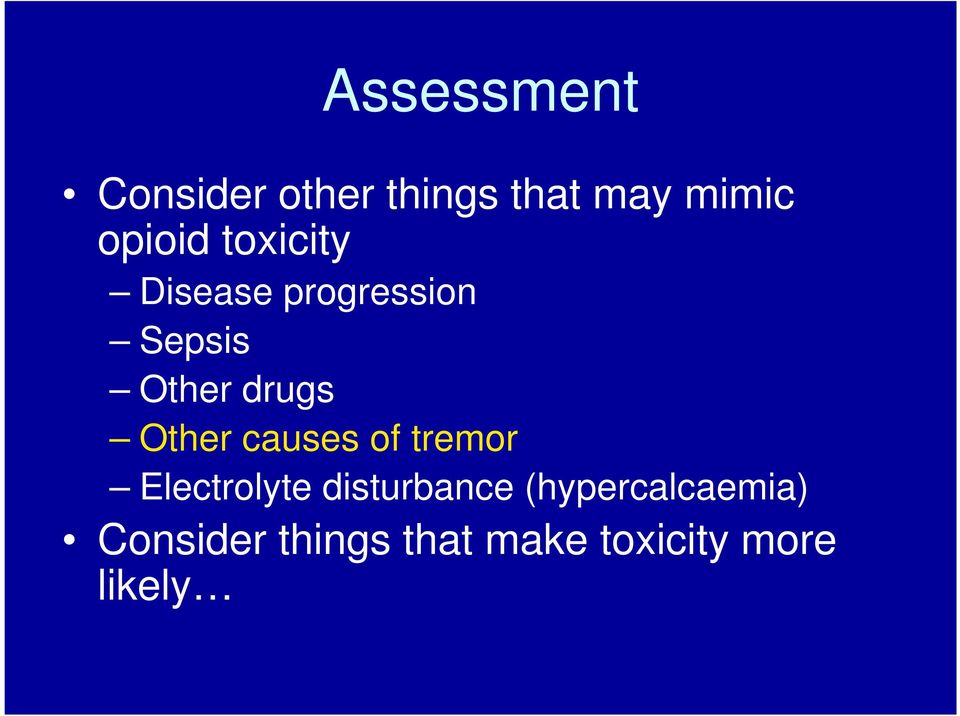
8 Spotting opioid toxicity Acute opioid use (A&E; post-op) can produce toxicity with drowsiness, hypotension and respiratory depression Chronic opioid use can produce toxicity, but respiratory depression is a late complication unless something else is making things worse (eg severe sepsis; renal or liver failure)
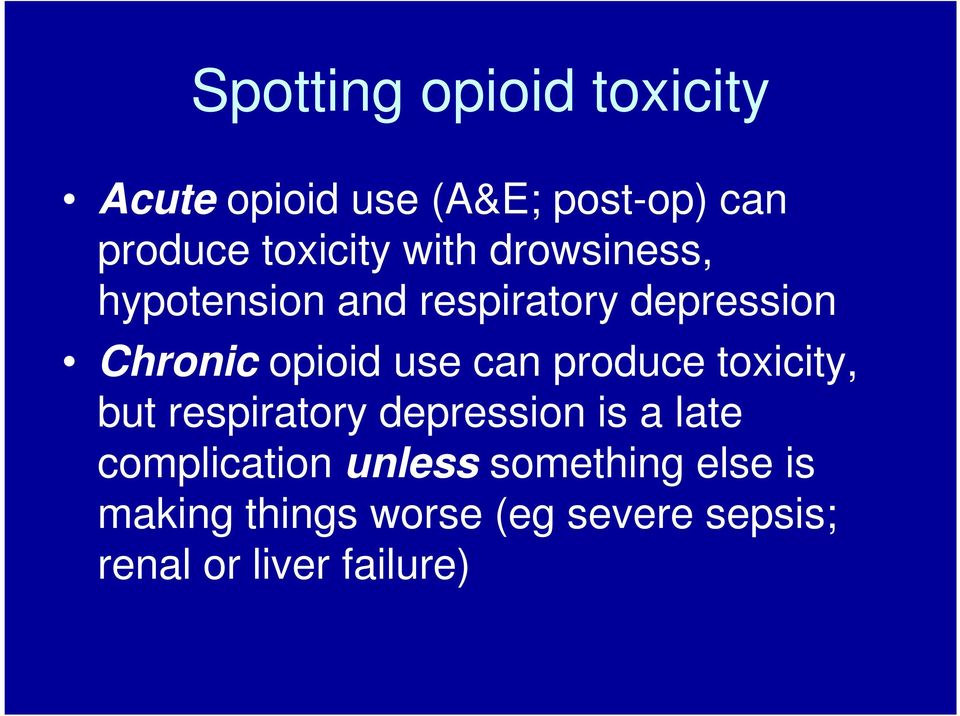
9 Spotting opioid toxicity progression (usually ) Subtle agitation Respiratory depression Sleepiness Confusion Hypotension Vivid dreams Bradycardia Hallucinations Coma Myoclonus Death
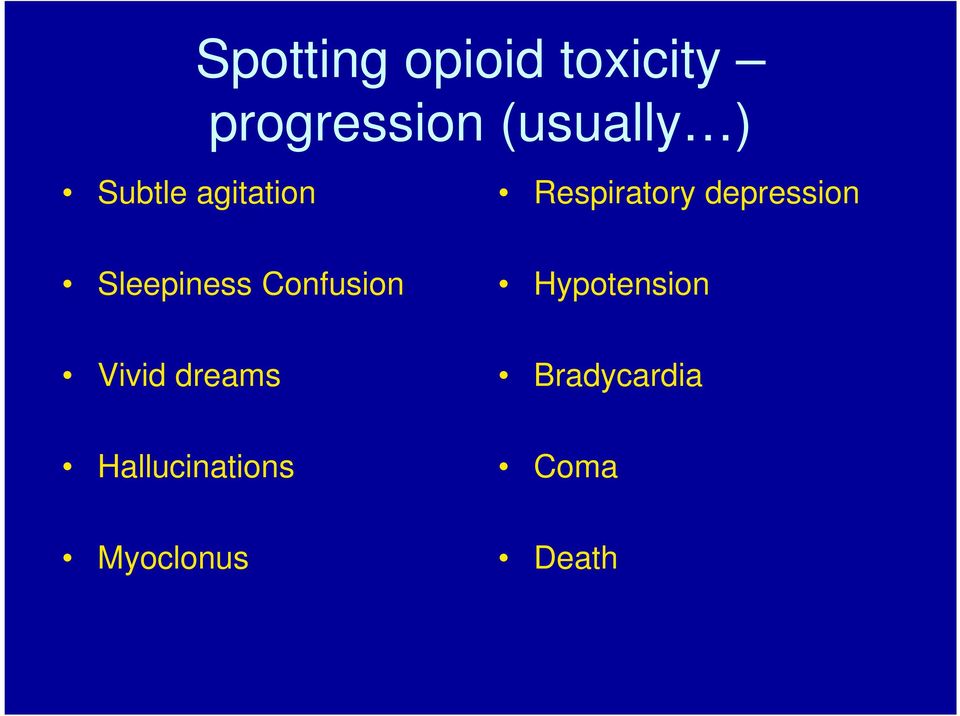
10 Assessment Consider other things that may mimic opioid toxicity Disease progression Sepsis Other drugs Other causes of tremor Electrolyte disturbance (hypercalcaemia) Consider things that make toxicity more likely
11 Opioid toxicity is more likely when Impaired excretion renal or liver failure Old age Co-existing pathology that make confusion more common (eg dementia, CVD) Rapidly increasing dose Movement related pain Neuropathic pain

12 GFR < 30ml/min greatly increased risk of drug induced toxicity

13 Recommended Drugs Alfentanil Transdermal buprenorphine Fentanyl Appear to be the safest opioids of choice

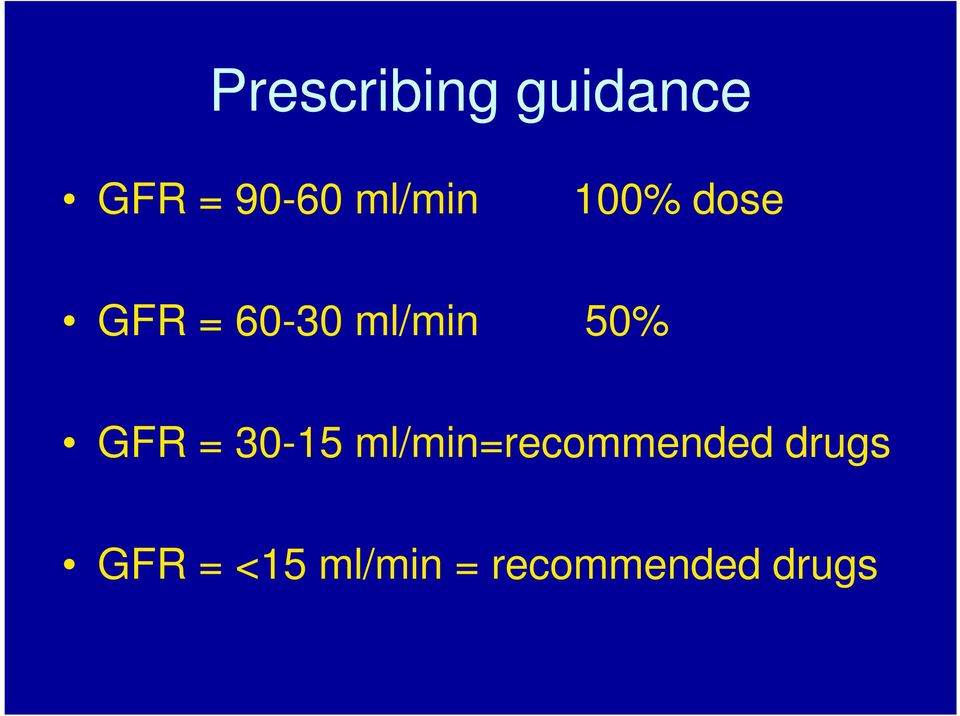
14 Prescribing guidance GFR = ml/min 100% dose GFR = ml/min 50% GFR = ml/min=recommended drugs GFR = <15 ml/min = recommended drugs
15 Excretion of opioids Codeine and dihydrocodeine converted to morphine Morphine converted in the liver to active and inactive metabolites and excreted by the kidney Oxycodone and hydromorphone metabolised in the liver then largely excreted by the kidney Fentanyl mainly metabolised by the liver (minimal (10%) renal excretion) Alfentanil metabolised by the liver (minimal renal excretion)

16 Which means. Care with codeine and morphine in patients with any renal impairment (lower dose; longer dose interval) Care with Oxycodone and hydromorphone in mild renal impairment (lower dose; longer dose interval) Other opioids may be safer in patients with moderate or severe renal impairment (eg fentanyl or alfentanil) Care with all drugs in liver failure (INR) Ask!!!
17 Managing opioid toxicity 1 End of life. What s appropriate? Make sure there s nothing else going on Reduce the dose 30-50% if mild Stop MR forms use NR PRN alone if severe Fluid support Increases excretion Drowsy patients don t drink

18 Managing opioid toxicity 2 Treat agitation Switch opioid? Other ways for treating the pain Adjuvant analgesics, radiotherapy, etc Get help from seniors/pct
19 Alternative opioids why? High risk of toxicity see above Some people do better on one than another Balance of side effects to effect Specific side effects (eg fentanyl possibly less constipating than morphine)

20 Alternative opioids - how One isn t better than another its about individuals Conversion ratio based on potency compared to morphine Aim low and ensure they have breakthrough medication

21 Conclusions Attention to choice of opioid Consider dose reduction and/or an increase in dosage interval Change from modified release to immediate release Carry out frequent clinical monitoring and review
22 Opioid toxicity and alternative opioids - aims Know the symptoms of opioid toxicity Know how to assess a patient with potential opioid toxicity Understand which patients are at higher risk of opioid toxicity Know the principles of managing opioid toxicity Understand the rationale for using alternative opioids
23 Opioid toxicity and alternative Any questions? opioids
Pain Control Aims. General principles of pain control. Basic pharmacokinetics. Case history demo. Opioids renal failure John Welsh 8/4/2010
 Pain Control Aims General principles of pain control Basic pharmacokinetics Case history demo Opioids renal failure John Welsh 8/4/2010 Pain Control Morphine is gold standard treatment for moderate to
GUIDELINES ON THE MANAGEMENT OF PAIN DUE TO CANCER IN ADULTS
 GUIDELINES ON THE MANAGEMENT OF PAIN DUE TO CANCER IN ADULTS Bristol Palliative Care Collaborative Contact Numbers: Hospital Specialist Palliative Care Teams: Frenchay 0117 340 6692 Southmead 0117 323
Clinical Algorithm & Preferred Medications to Treat Pain in Dialysis Patients
 Clinical Algorithm & Preferred Medications to Treat Pain in Dialysis Patients Developed by the Mid Atlantic Renal Coalition and the Kidney End of Life Coalition September 2009 This project was supported,
Review of Pharmacological Pain Management
 Review of Pharmacological Pain Management CHAMP Activities are possible with generous support from The Atlantic Philanthropies and The John A. Hartford Foundation The WHO Pain Ladder The World Health Organization
The Pharmacological Management of Cancer Pain in Adults. Clinical Audit Tool
 The Pharmacological Management of Cancer Pain in Adults Clinical Audit Tool 2015 This clinical audit tool accompanies the Pharmacological Management of Cancer Pain in Adults NCEC National Clinical Guideline
Opioids in Palliative Care- Patient Information Manual
 Version 2.0 with MST example Introduction The following pages explain what opioids are and what we think you may want to know about them. There is quite a lot of information here, most of it is based on
Use of opioids in Patients with Impaired Renal Function Dr Jane Neerkin, Dr Mary Brennan, Dr Humeira Jamal
 Use of opioids in Patients with Impaired Renal Function Dr Jane Neerkin, Dr Mary Brennan, Dr Humeira Jamal Great care is required when prescribing opioids to patients with impaired renal function. Many
POST-TEST Pain Resource Professional Training Program University of Wisconsin Hospital & Clinics
 POST-TEST University of Wisconsin Hospital & Clinics True/False/Don't Know - Circle the correct answer T F D 1. Changes in vital signs are reliable indicators of pain severity. T F D 2. Because of an underdeveloped
Pharmaceutical care of people requiring palliative care Course activities
 Pharmaceutical care of people requiring palliative care Course activities Case Study 1 Mrs Green, a 70 year-old lady, has metastatic carcinoma of the breast (breast cancer with spread to other areas).
Strong opioids (painkillers) in palliative care what you should know
 Strong opioids (painkillers) in palliative care what you should know Patient Information Author ID: JG Leaflet Number: PC 006 Version: 1 Name of Leaflet: Strong opioids (painkillers) in palliative care
OPIOID CONVERSIONS. 2. Add a rescue doses (IR) of same opioid if possible should be~10 20% of total daily opioid dose
 OPIOID CONVERSIONS 1. Converting Short acting Long Acting (IR SR) when pain is well controlled *Use for : CHRONIC pain Pts on scheduled IR opioids pain that recurs before the next dose PP: Can use equianalgesic
Abstral Prescriber and Pharmacist Guide
 Abstral Prescriber and Pharmacist Guide fentanyl citrate sublingual tablets Introduction The Abstral Prescriber and Pharmacist Guide is designed to support healthcare professionals in the diagnosis of
ABC of palliative care: Principles of palliative care and pain control
 Clinical review ABC of palliative care: Principles of palliative care and pain control Bill O'Neill, Marie Fallon Top Introduction Principles of palliative care Principles of managing cancer... Introduction
Pain management. The WHO analgesic ladder
 Pain management Successful treatment requires an accurate diagnosis of the cause and a rational approach to therapy. Most pains arise by stimulation of nociceptive nerve endings; the characteristics may
Opioid Analgesics. Week 19
 Opioid Analgesics Week 19 Analgesic Vocabulary Analgesia Narcotic Opiate Opioid Agonist Antagonist Narcotic Analgesics Controlled substances Opioid analgesics derived from poppy Opiates include morphine,
How To Take A Strong Opioid Painkiller
 Using strong painkillers for cancer pain This information is an extract from the booklet Controlling cancer pain. You may find the full booklet helpful. We can send you a copy free see page 8. Contents
Questions and answers on breast cancer Guideline 10: The management of persistent pain after breast cancer treatment
 Questions and answers on breast cancer Guideline 10: The management of persistent pain after breast cancer treatment I ve had breast cancer treatment, and now I m having pain. Does this mean the cancer
OPIOID NEUROTOXICITY - BACK TO BASICS. Dr. Suzy Pinnick (PGY-3): Palliative Medicine Fellow
 OPIOID NEUROTOXICITY - BACK TO BASICS Dr. Suzy Pinnick (PGY-3): Palliative Medicine Fellow OBJECTIVES Some Cases Definitions: Including what is opioid neurotoxicity A bit of biochemistry What patients
Nurses Self Paced Learning Module on Pain Management
 Nurses Self Paced Learning Module on Pain Management Dominican Santa Cruz Hospital Santa Cruz, California Developed by: Strategic Planning Committee Dominican Santa Cruz Hospital 1555 Soquel Drive Santa
Oxford University Hospitals. NHS Trust. Oxford Centre for Head and Neck Oncology. Pain Relief. Information for patients
 Oxford University Hospitals NHS Trust Oxford Centre for Head and Neck Oncology Pain Relief Information for patients Introduction This booklet has been written to give you information about pain relief.
Cancer Pain. Relief from PALLIATIVE CARE
 PALLIATIVE CARE Relief from Cancer Pain National Clinical Programme for Palliative Care For more information on the National Clinical Programme for Palliative Care, go to www.hse.ie/palliativecareprogramme
SELECTED OPIATES TOXICITY A MODERN DAY EPIDEMIC
 SELECTED OPIATES TOXICITY A MODERN DAY EPIDEMIC Learning Objectives: 1. Identify the names and reasons/circumstances for additional toxicity of SELECTED OPIATES hydromorphone DILAUDID Methadone Fentanyl/DURAGESIC
Opioid Conversion Ratios - Guide to Practice 2013
 Opioid s - Guide to Practice 2013 Released 1 st October 2013 2013. The EMR PCC grants permission to reproduce parts of this publication for clinical and educational use only, provided that the Eastern
Patient information. Using strong Opioids to control your pain
 Patient information Using strong Opioids to control your pain Published: April 2013. Date for review: April 2016 Introduction This leaflet explains what strong opioids (pronounced oh-pee-oyds) e are and
Medications for chronic pain
 Medications for chronic pain When it comes to treating chronic pain with medications, there are many to choose from. Different types of pain medications are used for different pain conditions. You may
A Guide to pain relief medicines For patients receiving Palliative Care
 A Guide to pain relief medicines For patients receiving Palliative Care 1 Which pain medicines are you taking? Contents Page No. Amitriptyline 8 Codeine 9 Co-codamol 10 Co-dydramol 11 Diclofenac (Voltarol
Pain and problem drug use
 Pain and problem drug use Information for patients Prepared by the British Pain Society in consultation with the Royal College of Psychiatrists, the Royal College of General Practitioners and the Advisory
Blueprint for Prescriber Continuing Education Program
 CDER Final 10/25/11 Blueprint for Prescriber Continuing Education Program I. Introduction: Why Prescriber Education is Important Health care professionals who prescribe extended-release (ER) and long-acting
MANAGEMENT OF CHRONIC NON MALIGNANT PAIN
 MANAGEMENT OF CHRONIC NON MALIGNANT PAIN Introduction The Manitoba Prescribing Practices Program (MPPP) recognizes the important role served by physicians in relieving pain and suffering and acknowledges
Pain relief at home. Information for adult patients
 Pain relief at home Information for adult patients 3 Contents Page 3 Page 3 Page 5 Page 7 Page 8 Introduction to pain relief Common pain relief medicines and their side effects More information about pain
MEDICATION ABUSE IN OLDER ADULTS
 MEDICATION ABUSE IN OLDER ADULTS Clifford Milo Singer, MD Adjunct Professor, University of Maine, Orono ME Chief, Division of Geriatric Mental Health and Neuropsychiatry The Acadia Hospital and Eastern
West of Scotland Chronic Non Malignant Pain Opioid Prescribing Guideline
 West of Scotland Chronic Non Malignant Pain Opioid Prescribing Guideline This guidance forms part of the West of Scotland Efficiency and Productivity Workstream, Acute Prescribing Group. Clinicians from
Pain Management in Palliative and Hospice Care
 Pain Management in Palliative and Hospice Care Donna Butler, MSN, ANP-BC, OCN, ACHPN, FAAPM Current Status of Pain Cancer patients at EOL- 54% have pain AIDS with prognosis < 6mons- intense pain Less research
Elements for a public summary. VI.2.1 Overview of disease epidemiology. VI.2.2 Summary of treatment benefits
 VI.2 Elements for a public summary VI.2.1 Overview of disease epidemiology Pain is one of the most common reasons for a patient to seek medical attention. Moderate or severe intensity pain can be acute
Role of the Anaesthetist/Pain Consultant in Palliative Care Medicine
 Role of the Anaesthetist/Pain Consultant in Palliative Care Medicine Dr Joan Hester Consultant in Pain Medicine King s College Hospital and St Christopher s Hospice, London Dame Cicely Saunders 1918-2005
Palliative Medicine, Pain Management, and Hospice. Devon Neale, MD Assistant Professor Dept of Internal Medicine UNM School of Medicine
 Palliative Medicine, Pain Management, and Hospice Devon Neale, MD Assistant Professor Dept of Internal Medicine UNM School of Medicine Pall-i- What??? Objectives: Provide information about Palliative Medicine
Objectives. Pain Management Knowing How To Help Yourself. Patients and Family Requirements. Your Rights As A Consumer
 Objectives Pain Management Knowing How To Help Yourself Jackie Carter, RN MSN CNS Become familiar with the definitions of pain Be aware of your rights to have your pain treated Become familiar with the
Narcotic drugs used for pain treatment Version 4.3
 Narcotic drugs used for pain treatment Version 4.3 Strategy to restrict the pack sizes or the type of packaging available in public pharmacies. 1. Introduction The document describing the strategy of the
Opioid Conversion Ratios - Guide to Practice 2013 Updated as Version 2 - November 2014
 Opioid s - Guide to Practice 2013 Updated as Version 2 - November 2014 2013. The EMR PCC grants permission to reproduce parts of this publication for clinical and educational use only, provided that the
Pain Handbook for Cancer Patients. A Guide for Management of Pain and Side Effects
 Pain Handbook for Cancer Patients A Guide for Management of Pain and Side Effects Relief of Pain Is Important There is no benefit from suffering with pain. Pain can actually be harmful to you. It can:
Guidance on competencies for management of Cancer Pain in adults
 Guidance on competencies for management of Cancer Pain in adults Endorsed by: Contents Introduction A: Core competencies for practitioners in Pain Medicine B: Competencies for practitioners in Pain Medicine
Getting the best result from Opioid medicine. in the management of chronic pain
 Getting the best result from Opioid medicine in the management of chronic pain Your doctor has prescribed you opioid medicine to help you manage your chronic pain. This patient information leaflet gives
CHARLES & SUE S SCHOOL OF HAIR DESIGN DRUG AND ALCOHOL POLICY DRUG AND ALCOHOL POLICY; SUBSTANCE ABUSE RESOURCES:
 CHARLES & SUE S SCHOOL OF HAIR DESIGN DRUG AND ALCOHOL POLICY DRUG AND ALCOHOL POLICY; SUBSTANCE ABUSE RESOURCES: At Charles & Sue s School of Hair Design, the illicit use of drugs and/or alcohol by staff
Questions about your pain medicines
 Questions about your pain medicines This information is an extract from the booklet Controlling cancer pain. You may find the full booklet helpful. We can send you a free copy see page 6. Contents Common
Iowa Governor s Office of Drug Control Policy
 Iowa Governor s Office of Drug Control Policy medicines or take them in a manner not prescribed, we increase the risk of negative effects. It is estimated that over 35 million Americans are ages 65 and
Cancer Pain. What is Pain?
 Cancer Pain What is Pain? The International Association for the Study of Pain says that pain is "an unpleasant sensory and emotional experience associated with actual or potential tissue damage." Pain
Adjunctive psychosocial intervention. Conditions requiring dose reduction. Immediate, peak plasma concentration is reached within 1 hour.
 Shared Care Guideline for Prescription and monitoring of Naltrexone Hydrochloride in alcohol dependence Author(s)/Originator(s): (please state author name and department) Dr Daly - Consultant Psychiatrist,
Alcohol Withdrawal. Introduction. Blood Alcohol Concentration. DSM-IV Criteria/Alcohol Abuse. Pharmacologic Effects of Alcohol
 Pharmacologic Effects of Alcohol Alcohol Withdrawal Kristi Theobald, Pharm.D., BCPS Therapeutics III Fall 2003 Inhibits glutamate receptor function (NMDA receptor) Inhibits excitatory neurotransmission
1. Which of the following would NOT be an appropriate choice for postoperative pain. C. Oral oxycodone 5 mg po every 4 to 6 hours as needed for pain
 Pain Management 1 Chapter 34. Pain Management, Self-Assessment Questions 1. Which of the following would NOT be an appropriate choice for postoperative pain management in a patient dependent on opioids?
Drug treatments for neuropathic pain
 Understanding NICE guidance Information for people who use NHS services Drug treatments for neuropathic pain NICE clinical guidelines advise the NHS on caring for people with specific conditions or diseases
Opioid Conversion Ratios - Guide to Practice 2010
 Opioid Conversion Ratios - Guide to Practice 2010 Released December 2010. 2010. The EMR PCC grants permission to reproduce parts of this publication for clinical and educational use only, provided that
Fentanyl patches (Durogesic) for chronic pain
 Fentanyl patches (Durogesic) for chronic pain FENT-a-nil Summary Oral morphine is preferred when an opioid is required for severe chronic pain, because of its familiarity, availability and the ease of
DRUGS OF ABUSE CLASSIFICATION AND EFFECTS
 Drug and Drug use DRUGS OF ABUSE CLASSIFICATION AND EFFECTS A pharmaceutical preparation or a naturally occurring substance used primarily to bring about a change in the existing process or state (physiological,
The TIRF REMS Access program is a Food and Drug Administration (FDA) required risk management program
 Subject: Important Drug Warning Announcement of a single shared REMS (Risk Evaluation and Mitigation Strategy) program for all Transmucosal Immediate Release Fentanyl (TIRF) products due to the potential
Weaning off your pain medicine
 Weaning off your pain medicine UHN Information for patients taking opioid pain medicines Read this booklet to learn about: why you need to wean off your pain medicine how to wean off slowly how to control
How To Get A Tirf
 Transmucosal Immediate Release Fentanyl (TIRF) Products Risk Evaluation and Mitigation Strategy (REMS) Education Program for Prescribers and Pharmacists Products Covered Under This Program Abstral (fentanyl)
Opioid Analgesic Medication Information
 Opioid Analgesic Medication Information This handout provides information about treating pain with opioid analgesics or narcotics. Please read this entire handout. We want to be sure that you understand
How to take your Opioid Pain Medication
 How to take your Opioid Pain Medication Today your doctor gave you a prescription for medication to help relieve your pain. The pain medication is called an opioid or narcotic. Taking pain medication,
Policy for the issue of permits to prescribe Schedule 8 poisons
 Policy for the issue of permits to prescribe Schedule 8 poisons May 2011 Introduction The Victorian Drugs, Poisons and Controlled Substances (DPCS) legislation sets out certain circumstances when a medical
Painkillers (analgesics)
 Drug information (analgesics) This leaflet provides information on painkillers and will answer any questions you have about the treatment. Arthritis Research UK produce and print our booklets entirely
Summary of the risk management plan (RMP) for Ionsys (fentanyl)
 EMA/764409/2015 Summary of the risk management plan (RMP) for Ionsys (fentanyl) This is a summary of the risk management plan (RMP) for Ionsys, which details the measures to be taken in order to ensure
Prescription Drug Abuse
 Prescription Drug Abuse Introduction Most people take medicines only for the reasons their health care providers prescribe them. But millions of people around the world have used prescription drugs for
Share the important information in this Medication Guide with members of your household.
 MEDICATION GUIDE BUPRENORPHINE (BUE-pre-NOR-feen) Sublingual Tablets, CIII IMPORTANT: Keep buprenorphine sublingual tablets in a secure place away from children. Accidental use by a child is a medical
What Parents Need to Know
 What Parents Need to Know About Prescription Drug Abuse Office of District Attorney Jonathan W. Blodgett A Message From the District Attorney Prescription drug abuse is a growing problem. According to
Pain Medication Taper Regimen Time frame to taper off 30-60 days
 Pain Medication Taper Regimen Time frame to taper off 30-60 days Medication to taper Taper Regimen Comments Methadone Taper by no more than 25% Morphine Taper by no more than 25% Tramadol Taper by no more
WITHDRAWAL OF ANALGESIA AND SEDATION
 WITHDRAWAL OF ANALGESIA AND SEDATION Patients receiving analgesia and/or sedation for longer than 5-7 days may suffer withdrawal if these drugs are suddenly stopped. To prevent this happening drug doses
Treatments for Major Depression. Drug Treatments The two (2) classes of drugs that are typical antidepressants are:
 Treatments for Major Depression Drug Treatments The two (2) classes of drugs that are typical antidepressants are: 1. 2. These 2 classes of drugs increase the amount of monoamine neurotransmitters through
Controlling Pain Part 2: Types of Pain Medicines for Your Prostate Cancer
 Controlling Pain Part 2: Types of Pain Medicines for Your Prostate Cancer The following information is based on the general experiences of many prostate cancer patients. Your experience may be different.
Guidelines for Cancer Pain Management in Substance Misusers Dr Jane Neerkin, Dr Chi-Chi Cheung and Dr Caroline Stirling
 Guidelines for Cancer Pain Management in Substance Misusers Dr Jane Neerkin, Dr Chi-Chi Cheung and Dr Caroline Stirling Patients with a substance misuse history are at increased risk of receiving inadequate
Quality Measures for Long-stay Residents Percent of residents whose need for help with daily activities has increased.
 Quality Measures for Long-stay Residents Percent of residents whose need for help with daily activities has increased. This graph shows the percent of residents whose need for help doing basic daily tasks
Section II When you are finished with this section, you will be able to: Define medication (p 2) Describe how medications work (p 3)
 Section II When you are finished with this section, you will be able to: Define medication (p 2) Describe how medications work (p 3) List the different medication effects (p5) List the ways that medications
Cancer Pain Role Model Program Case Studies and Faculty Guides. Wisconsin Cancer Pain Initiative Madison, Wisconsin
 Cancer Pain Role Model Program Case Studies and Faculty Guides Wisconsin Cancer Pain Initiative Madison, Wisconsin Developed by: David Weissman, MD June L. Dahl, PhD WISCONSIN CANCER PAIN INITIATIVE CANCER
Ultram (tramadol), Ultram ER (tramadol extended-release tablets); Conzip (tramadol extended-release capsules), Ultracet (tramadol / acetaminophen)
 Federal Employee Program 1310 G Street, N.W. Washington, D.C. 20005 202.942.1000 Fax 202.942.1125 5.02.35 Subject: Tramadol Acetaminophen Page: 1 of 8 Last Review Date: September 18, 2015 Tramadol Acetaminophen
Lora McGuire MS, RN Educator and Consultant [email protected]. Barriers to effective pain relief
 Lora McGuire MS, RN Educator and Consultant [email protected] Barriers to effective pain relief Freedom from pain is a basic human right -WHO Pain is whatever the experiencing person says it is and exists
Acute Pain Management in the Opioid Dependent Patient. Maripat Welz-Bosna MSN, CRNP-BC
 Acute Pain Management in the Opioid Dependent Patient Maripat Welz-Bosna MSN, CRNP-BC Relieving Pain in America (IOM) More then 116 Million Americans have pain the persists for weeks to years $560-635
Buprenorphine/Naloxone Maintenance Treatment for Opioid Dependence
 Buprenorphine/Naloxone Maintenance Treatment for Opioid Dependence Information for Family Members Family members of patients who have been prescribed buprenorphine/naloxone for treatment of opioid addiction
The ABCs of Medication Assisted Treatment
 The ABCs of Medication Assisted Treatment J E F F R E Y Q U A M M E, E X E C U T I V E D I R E C T O R C O N N E C T I C U T C E R T I F I C A T I O N B O A R D The ABCs of Medication Assisted Treatment
Guidelines for the Use of Naloxone in Palliative Care in Adult Patients
 Guidelines for the Use of Naloxone in Palliative Care in Adult Patients Date Approved by Network Governance May 2012 Date for Review May 2015 Changes between Version 1 and 2 1. Guideline background 2.
Opioid Prescribing for Chronic Pain: Guidelines for Marin County Clinicians
 Opioid Prescribing for Chronic Pain: Guidelines for Marin County Clinicians Although prescription pain medications are intended to improve the lives of people with pain, their increased use and misuse
Therapeutic strategies for the treatment of pain
 First EFIC Symposium - Societal Impact of Pain Brussells 4-5 May 2010 Therapeutic strategies for the treatment of pain Paolo D. Siviero Economic Strategy and Pharmaceutical Policy Department Office for
Secondary liver cancer Patient Information Booklet
 Secondary liver cancer Patient Information Booklet Delivering the best in care UHB is a no smoking Trust To see all of our current patient information leaflets please visit www.uhb.nhs.uk/patient-information-leaflets.htm
Like cocaine, heroin is a drug that is illegal in some areas of the world. Heroin is highly addictive.
 Heroin Introduction Heroin is a powerful drug that affects the brain. People who use it can form a strong addiction. Addiction is when a drug user can t stop taking a drug, even when he or she wants to.
Collaborative Care Plan for PAIN
 1. Pain Assessment *Patient s own description of pain is the most reliable indicator for pain assessment. Pain intensity to be assessed using the ESAS (Edmonton Symptom Assessment Scale) Use 5 th Vital
MEDICATION GUIDE. What is Morphine Sulfate Oral Solution?
 MEDICATION GUIDE Morphine Sulfate (mor-pheen) (CII) Oral Solution IMPORTANT: Keep Morphine Sulfate Oral Solution in a safe place away from children. Accidental use by a child is a medical emergency and
Considerations when Using Controlled Substances to Treat Chronic Pain
 Considerations when Using Controlled Substances to Treat Chronic Pain By Mary-Beth F. Plum, Pharm.D. Impact of Chronic Pain Acute pain is the body s response to environmental dangers, and it helps protect
Palliative Care The Relief You Need When You re Experiencing the Symptoms of Serious Illness
 Palliative Care The Relief You Need When You re Experiencing the Symptoms of Serious Illness Dealing with the symptoms of any painful or serious illness is difficult. However, special care is available
MEDICATION ASSISTED TREATMENT FOR OPIOID ADDICTION
 MEDICATION ASSISTED TREATMENT FOR OPIOID ADDICTION Mark Fisher Program Administrator State Opioid Treatment Adminstrator Kentucky Division of Behavioral Health OBJECTIVES Learn about types of opioids and
A practical guide to living with and after cancer. ControlliNG. cancer pain
 A practical guide to living with and after cancer ControlliNG cancer pain Contents About Controlling cancer pain 2 What is pain? 5 Causes of pain 6 Pain terms 8 Describing pain 10 Managing pain 13 Your
Your A-Z of Pain Relief A guide to pain relief medicines. We care, we discover, we teach
 Your A-Z of Pain Relief A guide to pain relief medicines We care, we discover, we teach Which pain medicines are you taking? Abstral (see Fentanyl Instant Tablets) Amitriptyline 5 Brufen (see Ibuprofen)
m y f o u n d a t i o n i n f o s h e e t
 Pain and Myeloma m y f o u n d a t i o n i n f o s h e e t Pain is the most common symptom of myeloma and can greatly affect all areas of your life, especially if it is untreated or poorly managed. This
What Codeine Phosphate Tablets are used for
 New Zealand Consumer Medicine Information CODEINE PHOSPHATE 15mg, 30mg & 60mg Tablets What is in this leaflet Please read this leaflet carefully before you start using Codeine Phosphate Tablets. This leaflet
Breast Cancer Surgery and Pain
 Breast Cancer Surgery and Pain Princess Margaret Information for women who have had breast surgery Read this pamphlet to learn about: Pain after surgery What you need to know about pain What you need to
Understanding Your Pain
 Toll Free: 800-462-3636 Web: www.endo.com Understanding Your Pain This brochure was developed by Margo McCaffery, RN, MS, FAAN, and Chris Pasero, RN, MS, FAAN authors of Pain: Clinical Manual (2nd ed.