
PRISON EDUCATION IN CALIFORNIA
|
|
|
- Avis Baldwin
- 10 years ago
- Views:
Transcription
1 PRISON EDUCATION IN CALIFORNIA TRANSITIONS; CERTIFICATES; AND ASSOCIATE DEGREES Presented by: Antelope Valley College and California Department of Corrections and Rehabilitation Ms. Ann Steinberg, MBA; Director, Job Placement Dr. Tom O Neil; Dean, Social &Behavioral Sciences, Child and Family Education, and Economic Development Mr. Ronald Underwood; Education Coordinator

2 TOPICS The Purpose of the Programs How we got involved The current programs The Transitions Program The current Education Programs GED High School College Certificate Programs Inmate Education Program Recap

3 IN THE BEGINNING Transitions Program Results Chancellors Office and CDCR Interagency Agreement/SB 1391 Proposal to offer CTE Certificate/Degree Programs Purpose Recidivism reduction Productive Citizens

4 GED High School College Correspondence Courses CTE Certificates: Microsoft, Plumbing, Painting, etc. Prison Industries

5 Shaping Offender Behavior Evidence-Based Best Practices

6 CDCR IS IN THE RISK MANAGEMENT BUSINESS Risk Control and Risk Reduction Risk Control aims to reduce crime by limiting the offenders CAPACITY to carry out new criminal acts Limitation: Risk to reoffend increases after control is removed

7 RISK CONTROL AND RISK REDUCTION Risk Reduction seeks to diminish the likelihood that an offender will ELECT to commit another crime Limitation: Risk to reoffend remains until skills, education, and desire are INTERNALIZED; may require control until intervention takes hold

8 INCREASE THE ODDS The goal is to increase the odds of a positive outcome

9 National Averages: Recidivism Rates The Revolving Door 67% rearrests rates for prison releases 30% reconviction rates for probationers Why are these rates so high?

10 WHY ARE THESE FAILURE RATES SO HIGH? SOME POSSIBLE EXPLANATIONS 1. We didn t have the research knowledge we have today Have been focusing on the wrong issues Gave too much attention to low risk and too little to high risk The system is not in alignment Lacked the knowledge and skills about what works in changing offender behavior 2. Workloads have been too high

11 WHAT HAVE WE LEARNED? IN THE PAST FIFTEEN YEARS Can You Trust Research? Yes, with Quality and Quantity Quantity, no single study proves anything Quantity, need to examine the number of studies that confirm findings, author s credentials, selfinterest, methodology, etc..

12 Research Finding #1 Ø Ø WHAT HAS THE RESEARCH TAUGHT US? Low risk offenders tend to recidivate at higher rates when services/interventions are overdelivered Give low risk offenders stabilization services (e.g., housing, job placement, transportation) rather than those that target behavioral change. Research Finding #2 Ø Ø Ø Services should be targeted to those offenders who are assessed as medium or high risk to reoffend. Offenders who are at low risk to reoffend are unlikely to benefit from correctional intervention designed to change their behavior. Assess the risk level of offenders to determine who (i.e., medium and high risk) should get services, and the length and intensity of those services Differentiate supervision levels based upon risk. Research Finding #3 Ø Risk of recidivism is greatly reduced when attention is paid to criminogenic needs (dynamic risk factors) such as antisocial attitudes, beliefs and values, certain personalities and temperamental factors, age, and education. There is a clear association between the number of criminogenic needs targeted, the lower the rate of recidivism.

13 What are the risk factors? Common Historical Risk Factors (Static Risk Factors) Ø Age at first arrest Ø Current age Ø Gender Ø Criminal history

14 What are the risk factors? Common Criminogenic Needs (Dynamic Risk Factors) Ø Anti-social attitudes, cognitions Ø Anti-social associates, peers Ø Anti-social behavior Ø Family, marital stressors Ø Substance abuse Ø Lack of employment opportunities Ø Lack of educational achievement Ø Lack of pro-social leisure activities

15 The Big Four Criminogenic Need Anti-social cognition Anti-social companions Anti-social personality Family and/or marital Response Reduce anti-social cognition, recognize risk thinking and feelings, adopt an alternative identity Reduce association with criminals, enhance contact with pro-social peers Build problem solving, selfmanagement, anger management, and coping skills Reduce conflict, build positive relationships and communication

16 The Other Four Criminogenic Need Substance Abuse Employment School Leisure and/or recreation Response Reduce usage, reduce the supports for abuse behavior, enhance alternatives to abuse Provide employment seeking and keeping skills Enhance opportunities for literacy, GED, CTE, and college education Enhance involvement and satisfaction in pro-social activities

17 Effectively directed interventions can reduce recidivism by 30% (or more) Research Finding #4: Ø Interventions that are matched to the individual offender increase their effectiveness. Average recidivism reduction/gain o Inappropriate treatment -.06 o Unspecified treatment.13 o Appropriate treatment.30

18 Cognitive-behavioral and Behavioral Intervention Research Finding #5: Ø The most impactful programs aimed at changing criminal behavior and reducing recidivism are cognitive-behavioral and behavioral interventions Ø Non-Behavioral intervention reduced recidivism by 7% Ø Behavioral intervention reduced recidivism by 29%

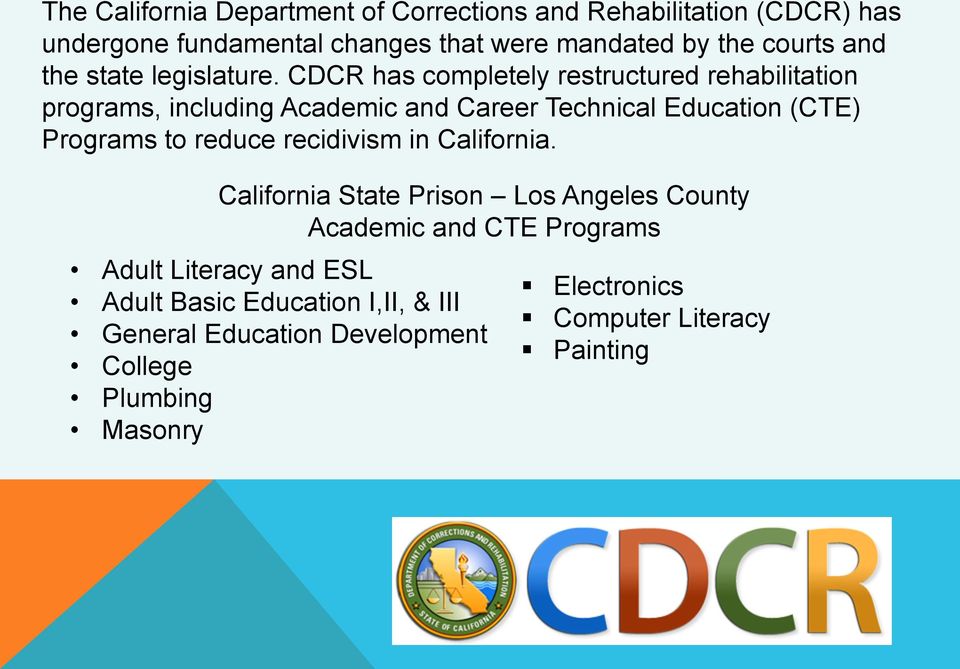
19 The California Department of Corrections and Rehabilitation (CDCR) has undergone fundamental changes that were mandated by the courts and the state legislature. CDCR has completely restructured rehabilitation programs, including Academic and Career Technical Education (CTE) Programs to reduce recidivism in California. California State Prison Los Angeles County Academic and CTE Programs Adult Literacy and ESL Adult Basic Education I,II, & III General Education Development College Plumbing Masonry Electronics Computer Literacy Painting
20 RAND Corporation 2013 Correctional Education Meta-analysis The RAND Corporation concluded that we no longer need to debate the benefits of correctional education. Prison-based education programs play a major role in reducing recidivism. Correctional Education programs reduce recidivism by 43% Correctional Education programs increases employment rates by 13%. CTE programs increase the employment rate by 48%. $1 dollar investment in education reduces incarceration costs by $4-5

21 COMPETENCY BASED ACADEMIC EDUCATION MODEL CSP-LAC GED and college programs utilize an individualized, self-paced learning format inherent in competency based instruction and consistent with Cognitive-Behavior Therapy techniques. The competency based education model fosters individualized, self-paced instruction. Open entry and exit into and from education programs allow inmates at all levels to progress.
22 Career Technical Education (CTE) Programs LAC offers Plumbing, Masonry, Industrial Painting, Office Services, Computer Literacy, Electronics, and Electrical Works. These are more structured classes and allow inmates to earn accredited trade certification with the National Center for Construction Education and Research (NCCER)
23 College Voluntary Education Program (VEP) CSP-LAC is currently partnering with seven universities and colleges to provide our inmate population expanded opportunities to obtain an associate or bachelor degree. The college program fosters positive rehabilitative programming consistent with CBT goals and ensures that all inmate participants are prepared with the needed education and skills to successfully compete in the workplace
24 In conclusion, we need to focus our efforts where best practices leads us, along with the efforts of thousands of dedicated correctional educators, including some 32 teachers, CTE instructors, librarians, and support staff at LAC, all of whom confirm and reinforce the idea that correctional education really works.
25 CHALLENGES Internal Space External Community connection Communication Image
26 OVERVIEW OF Topics Fiscal management Resume Writing Job Search Housing Agencies of support 5 weeks, 5 days weekly, 4 hours,11 classes per year 15/class, 2 classes per day One week off
27
28 CHALLENGES State rules vs Community College environment Collaboration with in the community Changing the picture for the public Employment opportunities Lockdowns Politics
29 INMATE EDUCATION PROGRAM What? MOU between the Chancellor and CDCR To set the standard for Community College Certificate and degree programs at CDCR institutions. Where? CDCR Hubs adjacent to: Lassen CCD, Chaffey CCD, Los Rios CCD and Antelope Valley CCD. How? Ground classrooms for face to face instruction FTE baring coursework
30 MORE CHALLENGES How to enroll students Assessment tools How to overcome maximum security Ordering books, ebooks, supplies Lockdown Internal with CCD: admissions, assessment, outreach, Academic Senate, and Faculty.
31 SUPPORT FROM SACRAMENTO Chancellors Office Dr. BJ Snowden Leslie LeBlanc CDCR Robert Soto, Warden Ron Underwood Nathan Wilcox, Counselor Prison University Project Dr. Jodi Lewen
32 RECAP Creating resources Changing Environments Understanding Reducing recidivism Responsibility Thank you!
Evidence Based Correctional Practices
 Evidence Based Correctional Practices What works in corrections is not a program or a single intervention but rather a body of knowledge that is accessible to criminal justice professionals. 1 The National
Reentry on Steroids! NADCP 2013
 Reentry on Steroids! NADCP 2013 Panel Introductions Judge Keith Starrett Moderator Judge Robert Francis Panelist Judge Stephen Manley Panelist Charles Robinson - Panelist Dallas SAFPF 4-C Reentry Court
California Rehabilitation Center
 California Rehabilitation Center STANDARDIZED STAFFING SUMMARY ing Category Classification ing July 2011 Standardized ing Totals July 2013 ing Changes Management Warden 1.0 1.0 0.0 Chief Deputy 1.0 1.0
Stopping the Revolving Door for Mentally Ill Offenders in the Criminal Justice System via Diversion and Re-entry Programs
 GEORGIA GEORGIA GEORGIA GEORGIA GEORGIA Department of Corrections ON THE MOVE Stopping the Revolving Door for Mentally Ill Offenders in the Criminal Justice System via Diversion and Re-entry Programs Academic
Best Practices in Juvenile Justice Reform
 The Case for Evidence-Based Reform Best Practices in Juvenile Justice Reform Over the past decade, researchers have identified intervention strategies and program models that reduce delinquency and promote
Clinical Skills for Evidence-Based Substance Abuse Treatment Practices with Offenders. Treatment of Co-Occurring Disorders
 Clinical Skills for Evidence-Based Substance Abuse Treatment Practices with Offenders Treatment of Co-Occurring Disorders National TASC Conference, Columbus, Ohio; May 8, 2013 Roger H. Peters, Ph.D., University
Risk/Needs Assessment 101: Science Reveals New Tools to Manage Offenders
 Issue Brief Project PUBLIC SAFETY NamePERFORMANCE PROJECT Risk/Needs Assessment 101: Science Reveals New Tools to Manage Offenders Every day, criminal justice officials make decisions that have enormous
An Overview Of The Windham School District
 An Overview Of The Windham School District Criminal Justice Policy Council February 2000 Tony Fabelo, Ph.D. Executive Director An Overview Of The Windham School District Criminal Justice Policy Council
APPENDIX C HALFWAY HOUSE PROGRAM PROFILES
 APPENDIX C HALFWAY HOUSE PROGRAM PROFILES Alternatives Agency Inc. Alternatives Agency is a Halfway House located in Cleveland, Ohio. This facility serves adult males and females who are county probationers,
EOPS Grantee Tools. Implementing a Reentry Program According to Best Practices
 EOPS Grantee Tools Implementing a Reentry Program According to Best Practices Report prepared by: Massachusetts Executive Office of Public Safety Research and Policy Analysis Division March 2007 This document
It s all apples and oranges. January 31, 2012 Nathan Brady OLRGC
 It s all apples and oranges. January 31, 2012 Nathan Brady OLRGC What is recidivism and what is the impact on the state? How does Utah compare nationally? What is Utah doing to address inmate recidivism
Rehabilitation programs for young offenders: Towards good practice? Andrew Day. Forensic Psychology Research Group. University of South Australia
 1 Rehabilitation programs for young offenders: Towards good practice? Andrew Day Forensic Psychology Research Group University of South Australia [email protected] Invited paper for the Understanding
DEPARTMENT OF CORRECTIONS PROBATION AND PAROLE DIVISION OPERATIONAL PROCEDURE. Subject: PROGRAM STRUCTURES
 DEPARTMENT OF CORRECTIONS PROBATION AND PAROLE DIVISION OPERATIONAL PROCEDURE Procedure No.: PPD 5.1.100 Reference: DOC 5.4.1; 53-1-203, MCA Page 1 of 6 Effective Date: 06/23/15 Revision Dates: Signature
Texas HOPE Literacy, Inc.
 Mission Statement Texas HOPE Literacy, Inc. Texas HOPE Literacy is an existing initiative that has served as the leading volunteer peer-driven literacy program in Texas prisons. The Texas Department of
In many jurisdictions, state and local government
 September 2012 States Report Reductions in Recidivism In many jurisdictions, state and local government officials have intensified their efforts to reduce recidivism. As policymakers are under tremendous
MANDATORY SUPERVISION COURT: Blueprint for Success
 MANDATORY SUPERVISION COURT: Blueprint for Success The FIRST YEAR OF REALIGNMENT 1906 Local Prison Sentences: 93% Drug & Property Crimes MSOs treated as high risk probationers Inconsistent approach amongst
SENTENCING REFORM FOR NONVIOLENT OFFENSES: BENEFITS AND ESTIMATED SAVINGS FOR ILLINOIS
 SENTENCING REFORM FOR NONVIOLENT OFFENSES: BENEFITS AND ESTIMATED SAVINGS FOR ILLINOIS LISE MCKEAN, PH.D. SUSAN K. SHAPIRO CENTER FOR IMPACT RESEARCH OCTOBER 2004 ACKNOWLEDGEMENTS PROJECT FUNDER Chicago
Effective Intervention Strategies for Offenders with Co-Occurring Mental and Substance Use Disorders
 Effective Intervention Strategies for Offenders with Co-Occurring Mental and Substance Use Disorders Utah Fall Substance Abuse Conference Act, St. George, Utah September 24, 2014 Roger H. Peters, Ph.D.,
Attachment EE - Grant Application RSAT Aftercare
 Attachment EE - Grant Application RSAT Aftercare Residential Substance Abuse Treatment (RSAT) for State Prisoners Program CFDA #16.593 Statement of the Problem The Maryland Department of Public Safety
DEPARTMENT OF JUSTICE. Remarks of U.S. Attorney General Janet Reno NATIONAL ASSEMBLY. Drugs, Alcohol Abuse, and the Criminal Offender
 DEPARTMENT OF JUSTICE Remarks of U.S. Attorney General Janet Reno NATIONAL ASSEMBLY Drugs, Alcohol Abuse, and the Criminal Offender P R O C E E D I N G S Wednesday, December 8, 1999 Omin Shoreham Hotel
Division of Alcoholism and Chemical Dependency Programs
 Division of Alcoholism and Chemical Dependency Programs Virginia N. Price Assistant Secretary Wrenn Rivenbark Clinical Director Current Prison Population Prison Inmates 39,463 Male Inmates 36,608 Female
Population, Alternatives to Incarceration and Budget Information
 Population, Alternatives to Incarceration and Budget Information 500 Employees 1,300 Offenders under supervision Lafayette Parish Correctional Center (LPCC), Transitional Housing Facility Community Corrections
When incarceration rates increase 10%, research shows that crime rates
 Evidence-Based Public Policy Options to Reduce Criminal Justice Costs and Crime Rates by Assistant Director Washington State Institute for Public Policy When incarceration rates increase 10%, research
CORRECTIONS PROGRAM COORDINATOR
 JOB DESCRIPTION MICHIGAN CIVIL SERVICE COMMISSION JOB SPECIFICATION CORRECTIONS PROGRAM COORDINATOR Employees in this job complete and oversee a variety of professional assignments to coordinate a correctional
Criminal Justice 101. The Criminal Justice System in Colorado and the Impact on Individuals with Mental Illness. April 2009
 Criminal Justice 101 The Criminal Justice System in Colorado and the Impact on Individuals with Mental Illness April 2009 Acronyms DOC = Department of Corrections DYC = Division of Youth Corrections DCJ
Results First Adult Criminal and Juvenile Justice Evidence-Based Program Inventory
 STATE OF CONNECTICUT Results First Adult Criminal and Juvenile Justice Evidence-Based Program Inventory October 2014 INSTITUTE FOR MUNICIPAL AND REGIONAL POLICY Central Connecticut State University Connecticut
AB 109 is DANGEROUS. Governor Brown signed AB 109 the Criminal Justice Realignment Bill into law on April 5, 2011.
 AB 109 is DANGEROUS Governor Brown signed AB 109 the Criminal Justice Realignment Bill into law on April 5, 2011. Governor Brown stated in his signing message on AB 109 - "For too long, the state s prison
Mental Health & Addiction Forensics Treatment
 Mental Health & Addiction Forensics Treatment Sheriffs: Help needed to cope with September 15, 2014 mentally ill INDIANAPOLIS - A sheriff says county jails have become the "insane asylums" for Indiana
Reentry & Aftercare. Reentry & Aftercare. Juvenile Justice Guide Book for Legislators
 Reentry & Aftercare Reentry & Aftercare Juvenile Justice Guide Book for Legislators Reentry & Aftercare Introduction Every year, approximately 100,000 juveniles are released from juvenile detention facilities
Improving the Effectiveness of Correctional Programs Through Research
 Improving the Effectiveness of Correctional Programs Through Research Presented by: Edward J. Latessa, Ph.D. Center for Criminal Justice Research Division of Criminal Justice University of Cincinnati www.uc.edu/criminaljustice
NORTH CAROLINA DEPARTMENT OF CORRECTION WORKFORCE DEVELOPMENT ACTIVITIES
 NORTH CAROLINA DEPARTMENT OF CORRECTION WORKFORCE DEVELOPMENT ACTIVITIES Prepared by Sandy C. Pearce Office of Research and Planning 3/17/04 NORTH CAROLINA DEPARTMENT OF CORRECTION Charged with the supervision
Phoenix House. Outpatient Treatment Services for Adults in Los Angeles and Orange Counties
 Phoenix House Outpatient Treatment Services for Adults in Los Angeles and Orange Counties Phoenix House s outpatient programs offer comprehensive and professional clinical services that include intervention,
John Keel, CPA State Auditor. An Audit Report on Selected Rehabilitation Programs at the Department of Criminal Justice. March 2007 Report No.
 John Keel, CPA State Auditor An Audit Report on Selected Rehabilitation Programs at the Department of Criminal Justice Report No. 07-026 An Audit Report on Selected Rehabilitation Programs at the Department
CURRENT STRATEGIES FOR REDUCING RECIDIVISM
 CURRENT STRATEGIES FOR REDUCING RECIDIVISM LISE MCKEAN, PH.D. CHARLES RANSFORD CENTER FOR IMPACT RESEARCH AUGUST 2004 ACKNOWLEDGEMENTS PROJECT FUNDER Chicago Community Organizing Capacity Building Initiative
County of San Diego SB 618 Reentry Program. May 3, 2007
 County of San Diego SB 618 Reentry Program May 3, 2007 1 California Recidivism - The Highest Return to Prison Rate in the Nation In FY 2006-07 it is estimated that San Diego County will convict over 16,000
Probation and Parole Officers Social Work Qualifications and Training in Evidence-Based Practices July 2014
 Probation and Parole Officers Social Work Qualifications and Training in Evidence-Based Practices July 2014 Social Work Qualifications Montana 46-23-1003 - Qualifications of probation and parole officers
Cell: (559) 630-0806 Office: (559) 934-2200 Work: [email protected]
 Education Doctorate in Education, 2005 University of California, Davis Summa Cum Laude California State University, Fresno Joint Doctoral Program in Educational Leadership Dissertation Topic: Leadership
The Second Chance Act Frequently Asked Questions
 The Second Chance Act Frequently Asked Questions What does the Second Chance Act do? The Second Chance Act primarily authorizes federal funding for state and federal reentry programs. It also directs but
Marin County s STAR Program: Support and Treatment for Mentally Ill Offenders
 Marin County s STAR Program: Support and Treatment for Mentally Ill Offenders Marcella Velasquez EXECUTIVE SUMMARY Overrepresentation of the mentally ill in prisons and jails and limited mental health
Promoting Public Safety Through Effective Correctional Interventions: What Works and What Doesn t?
 Promoting Public Safety Through Effective Correctional Interventions: What Works and What Doesn t? Edward J. Latessa University of Cincinnati T his chapter reviews the strides that science has made in
Drug Treatment and Education Fund. Legislative Report
 Drug Treatment and Education Fund Legislative Report Fiscal Year 1997-1998 Arizona Supreme Court Administrative Office of the Courts Adult Services Division March 1999 Drug Treatment and Education Fund
SANTA CLARA COUNTY REENTRY SERVICES SEAMLESS SYSTEM OF SERVICES, SUPPORT AND SUPERVISION Ready to Change: Promoting Safety and Health for the Whole
 SANTA CLARA COUNTY REENTRY SERVICES SEAMLESS SYSTEM OF SERVICES, SUPPORT AND SUPERVISION Ready to Change: Promoting Safety and Health for the Whole Community Vision/Mission Vision Build safer communities
Offender Screening. Oklahoma Department of Mental health and Substance Abuse Services
 Offender Screening Oklahoma Department of Mental health and Substance Abuse Services Presenters DR. DAVID WRIGHT, EVALUATION PROJECTS MANAGER NISHA WILSON, STATE DIRECTOR OF SPECIALTY COURTS The Problem
SUBSTANCE ABUSE INTERVENTION STUDY AT THE SPECIAL ALTERNATIVE INCARCERATION (SAI) PROGRAM
 SUBSTANCE ABUSE INTERVENTION STUDY AT THE SPECIAL ALTERNATIVE INCARCERATION (SAI) PROGRAM Conducted by Ann L. Date, Psy.D. LP Partners in Change: Psychological and Community Services, PLC 720 W. Wackerly
REDUCING STATEWIDE RECIDIVISM: CHECKLIST FOR STATE REENTRY COORDINATORS
 STATE REENTRY COORDINATORS are uniquely positioned to ensure that the policies and practices that go into a recidivism-reduction initiative are being implemented effectively, both in corrections settings
The Murphy Roadmap: Criminal Justice Reform
 The Murphy Roadmap: Criminal Justice Reform Paid for by Friends of Patrick Murphy. PAGE 2 THE MURPHY ROADMAP: CRIMINAL JUSTICE REFORM The Murphy Roadmap: Criminal Justice Reform We need to restore balance
Multisystemic Therapy With Juvenile Sexual Offenders: Clinical and Cost Effectiveness
 Multisystemic Therapy With Juvenile Sexual Offenders: Clinical and Cost Effectiveness Charles M. Borduin Missouri Delinquency Project Department of Psychological Sciences University of Missouri-Columbia
Supervising the Drug Addicted Offender. Jac A. Charlier, M.P.A. Director Consulting and Training
 Supervising the Drug Addicted Offender Jac A. Charlier, M.P.A. Director Consulting and Training Learning Objectives Learn your supervision philosophy Review some of the 13 NIDA Principles of Drug Abuse
Department of Criminal Justice
 The University of Texas at San Antonio 1 Department of Criminal Justice The Department of Criminal Justice offers a Bachelor of Arts degree which provides the opportunity for comprehensive study of criminal
YORK COUNTY TREATMENT COURTS COURT OF COMMON PLEAS
 YORK COUNTY TREATMENT COURTS COURT OF COMMON PLEAS NINETEENTH JUDICIAL DISTRICT Judges John S. Kennedy Craig T. Trebilcock Maria Musti Cook Harry M. Ness Todd R. Platts Coordinators Holly Wise Cameron
Delaware County Treatment Court
 Delaware County Treatment Court "The care of human life and happiness, and not their destruction, is the first and only legitimate object of good government." Thomas Jefferson Severely addicted people
Substance Abuse Treatment Alternatives
 Substance Abuse Treatment Alternatives What You Should Know Tim Chapman, CSAC February 1 4, 2009 Introduction The purpose of this white paper is to provide information that will help you better understand
SOUTH LOS ANGELES YOUTH OFFENDER RE-ENTRY PROGRAM A GRANT PROPOSAL
 SOUTH LOS ANGELES YOUTH OFFENDER RE-ENTRY PROGRAM A GRANT PROPOSAL www.campaignforyouthjustice.org Guadalupe Torres California State University, Long Beach May 2015 INTRODUCTION Arrest Rates In the City
24647 NORTH MILWAUKEE AVENUE VERNON HILLS, ILLINOIS 60061
 24647 NORTH MILWAUKEE AVENUE VERNON HILLS, ILLINOIS 60061 Our Guiding Philosophy FACE-IT is an innovative residential treatment program for juvenile probationers operated by the 19 th Judicial Circuit
WHAT IS THE ILLINOIS CENTER OF EXCELLENCE AND HOW DID IT START? MISSION STATEMENT
 WHAT IS THE ILLINOIS CENTER OF EXCELLENCE AND HOW DID IT START? MISSION STATEMENT The mission of the Illinois Center of Excellence for Behavioral Health and Justice is to equip communities to appropriately
Juvenile and Domestic Relations District Court
 LOB #190: LONG-TERM RESIDENTIAL CARE Purpose The Long-Term Residential Care (LTRC) Line of Business incorporates three programs: Boys Probation House (BPH) Foundations Transitional Living Program (TLP)
Criminal Justice Professionals Attitudes Towards Offenders: Assessing the Link between Global Orientations and Specific Attributions
 Criminal Justice Professionals Attitudes Towards s: Assessing the Link between Global Orientations and Specific Attributions Prepared by: Dale Willits, M.A. Lisa Broidy, Ph.D. Christopher Lyons, Ph.D.
POTTER, RANDALL AND ARMSTRONG COUNTIES DRUG COURT: A VIABLE COMMUNITY CORRECTIONS RESOURCE
 POTTER, RANDALL AND ARMSTRONG COUNTIES DRUG COURT: A VIABLE COMMUNITY CORRECTIONS RESOURCE HON. JOHN B. BOARD Judge, 181 st District Court State Bar of Texas SEX, DRUGS & SURVEILLANCE January 10-11, 2013
DARRON D. GARNER, PHD; LCSW
 DARRON D. GARNER, PHD; LCSW E-mail: [email protected] SUMMARY OF EXPERIENCE Nine years of experience an independent social work practitioner in Houston Texas. Combined eight years of demonstrated student
Denver Sheriff Department
 Denver Sheriff Department F U S E P R O G R A M C A P T A I N P A U L O L I V A About the Denver Sheriff Department The Denver Sheriff Department is the third largest criminal justice agency in the State
EFFECTIVENESS OF TREATMENT FOR VIOLENT JUVENILE DELINQUENTS
 EFFECTIVENESS OF TREATMENT FOR VIOLENT JUVENILE DELINQUENTS THE PROBLEM Traditionally, the philosophy of juvenile courts has emphasized treatment and rehabilitation of young offenders. In recent years,
The Goal of Correctional Counseling
 41140_CH03_Pass2.qxd 8/9/07 12:21 PM Page 45 Jones and Bartlett Publishers. NOT FOR SALE OR DISTRIBUTION The Goal of Correctional Counseling 3 The goal of correctional counseling is usually based on two
The Alameda County Model of Probation: Juvenile Supervision
 The Alameda County Model of Probation: Juvenile Supervision August 2011 Model of Probation Juvenile Supervision 1 The Alameda County Model of Probation: Juvenile Supervision August 2011 With the appointment
Redirection as Effective as Residential Delinquency Programs, Achieved Substantial Cost Avoidance
 March 2006 Report No. 06-34 Redirection as Effective as Residential Delinquency Programs, Achieved Substantial Cost Avoidance at a glance Although it experienced several start-up challenges, the Redirection
Career. A Career with the Correctional Service of Canada Join Us! Description. Learning objectives
 Correctional Service Canada Service correctionnel Canada Service correctionnel Canada Correctional Service Canada Career A Career with the Correctional Service of Canada Join Us! Description The Correctional
CORE PROGRAMS ADDITIONAL SERVICES
 Southern Peaks Regional Treatment Center is a Joint Commission accredited residential treatment center offering an array of specialized behavioral health programs for both male and female adolescents,
How To Change The Way A Prison System Works
 Moving the California Department of Corrections and Rehabilitation from an Offense- Based to Risk-Based System Susan Turner University of California, Irvine September 2010 Presentation Will Cover Size
ANNUAL EVALUATION OF CALIFORNIA DEPARTMENT OF CORRECTIONS AND REHABILITATION CONTRACTED SEX OFFENDER TREATMENT PROGRAMS
 ANNUAL EVALUATION OF CALIFORNIA DEPARTMENT OF CORRECTIONS AND REHABILITATION CONTRACTED SEX OFFENDER TREATMENT PROGRAMS State of California Department of Corrections and Rehabilitation Office of Research
Re-connecting Disconnected Youth with Community and Careers
 Re-connecting Disconnected Youth with Community and Careers NGA Policy Institute 9/20/2012 Toni Irving Deputy Chief of Staff Governor Quinn, Illinois In the beginning Illinois Juvenile Court Act of 1899
Evaluation of the Colorado Short Term Intensive Residential Remediation Treatment (STIRRT) Programs
 Evaluation of the Colorado Short Term Intensive Residential Remediation Treatment (STIRRT) Programs Christine M. Shea Adams, Ph.D. Linda Harrison, M.S. Kim English, M.A. Colorado Division of Criminal Justice
School Counseling. Master s in School Counseling with Pupil Personnel Services Credential
 School Counseling Master s in School Counseling with Pupil Personnel Services Credential Make a Lifelong Impact as a School Counselor Master s in School Counseling and Pupil Personnel Services Credential
Phoenix Houses of California Adult Residential & Outpatient Services
 s of California s of Los Angeles, Venice - Outpatient - Outpatient 1207 E. Fruit Street s of Los Angeles, Venice - Residential Santa Fe Springs - Residential 11015 South Bloomfield - Residential 1207 E.
Frequently Asked Questions (FAQs) of Drug Abuse Treatment for Criminal Justice Populations
 Frequently Asked Questions (FAQs) of Drug Abuse Treatment for Criminal Justice Populations From The National Institute on Drug Abuse (NIDA) 2. Why should drug abuse treatment be provided to offenders?
DRUG AND ALCOHOL TREATMENT IN BARBADOS. By: Laura Lee Foster National Council on Substance Abuse
 DRUG AND ALCOHOL TREATMENT IN BARBADOS By: Laura Lee Foster National Council on Substance Abuse STANDARDS & POLICIES DRUG & ALCOHOL TREATMENT: POLICIES & STANDARDS - THE CURRENT SITUATION At present, there
Phoenix House Services for Children & Adults in California
 Phoenix House Services for Children & Adults in California Call Center: 818 686 3079 (Monday Friday, 8am-5pm) 800 378 4435 (Evenings and Weekends) Phoenix Houses of California, Inc. 11600 Eldridge Ave.
ACE! The Risk-Need- Responsivity Simulation Tool. The Center for Advancing Correctional Excellence. Solutions For Justice Professionals.
 ACE! The Center for Advancing Correctional Excellence CRIMINOLOGY, LAW & SOCIETY, S GEORGE MASON UNIVERSITY J a n u a r y 2 0 1 3 Solutions For Justice Professionals With goals to safely manage the offender
PRISONER REENTRY IN MICHIGAN. History & Overview June 2, 2011
 PRISONER REENTRY IN MICHIGAN History & Overview June 2, 2011 Promoting public safety through effective policies and systems MCCD is the only statewide organization that partners with Michigan s citizens
Washington State Institute for Public Policy
 Washington State Institute for Public Policy EVALUATING EARLY INTERVENTION IN WASHINGTON STATE JUVENILE COURTS: A Six-Month Progress Report January 1997 EXECUTIVE SUMMARY The 1996 Washington State Legislature
Services Provided for Polk County Residents
 Providing Successful, Evidence-Based Substance Abuse and Mental Health Treatment to Men, Women and Adolescents in Polk, Highlands and Hardee Counties for over 39 years. 1 Services Provided for Polk County
A Preliminary Assessment of Risk and Recidivism of Illinois Prison Releasees
 A Preliminary Assessment of Risk and Recidivism of Illinois Prison Releasees David E. Olson & Gipsy Escobar Department of Criminal Justice Loyola University Chicago Presented at the Justice Research and