
Health portfolio review
|
|
|
- Mavis Quinn
- 10 years ago
- Views:
Transcription
1 Health portfolio review Health portfolio review pe of Publication Policy Division 2009 Report 2009 DFID Human Development Resource Centre 1
2 CONTENTS 1. DFID s health portfolio review Opportunities and challenges for investing in better health What has DFID s spending achieved? Support to countries (bilateral programme) What has DFID s spending achieved? Support to multilateral organisations What has DFID s spending achieved? Support to research Conclusions, next steps and recommendations...30 Annex 1: Disease control priorities project top 10 priorities for health policy action...36 DFID Human Development Resource Centre 2
3 HEALTH PORTFOLIO REVIEW REPORT ACRONYMS AIDS Acquired Immune Deficiency Syndrome AMC Advance Market Commitment ARVs Antiretroviral drugs ART Antiretroviral Therapy DALYs Disability-Adjusted Life Years EC European Commission GAVI Global Alliance for Vaccines and Immunisation GFATM Global Fund to Fight AIDS, TB and Malaria HIV Human Immunodeficiency Virus IDA International Development Association IFFIm International Financing Facility for Immunisation IHP+ International Health Partnership (and related initiatives) IMCI Integrated Management of Childhood Illnesses MDG Millennium Development Goal MoH Ministry of Health MDR TB Multi-Drug Resistant TB MMV Medicines for Malaria Venture NGO Non-Governmental Organisation PDP Product Development Partnership PSA Public Service Agreement RPC Research Programme Consortium STIs Sexually Transmitted Infections SWAp Sector Wide Approach TB Tuberculosis UN United Nations UNICEF United Nations Children's Fund UNFPA United Nations Population Fund UNAIDS The United Nations Joint Programme on HIV/AIDS. VSO Voluntary Services Overseas WHO World Health Organisation WHO-CHOICE WHO CHOosing Interventions that are Cost-effective DFID Human Development Resource Centre 3
4 EXECUTIVE SUMMARY DFID Health Portfolio Review 2009 The health portfolio review was carried out in 2009 to assess the value for money of DFID s investments in health, and to identify ways to get even better value for money. It covers bilateral, multilateral and research programmes. Ensuring good value for money is a priority for this government. The findings of this Portfolio Review are being used to inform the current reviews of the bilateral and multilateral programmes. The following summary of the 2009 work refers to DFID s portfolio at that time, and in the policy context of the previous government. Why this review? In 2009, DFID undertook a review of its health portfolio all its spending at country and global levels in health related programmes. Findings are being be used to support DFID s focus on achieving and demonstrating the results of UK development assistance for health. The purpose of the review was to assess the results of DFID s spend in health, and how DFID could better allocate resources to further improve value for money in the future. DFID provides approximately 1 billion a year to improve health in developing countries, about 15% of the UK s total development assistance. Making the most of the money spending it in the most effective and efficient way to achieve the most impact is a priority for the UK Government. The review posed three questions: 1. Investing for results: are DFID funds being invested in the countries and health issues where their impact is likely to be greatest? 2. Backing the most cost-effective policies: are DFID funds being used to support the interventions and the policies with the greatest potential impact on people s health? 3. Improving efficiency: are these policies and interventions being delivered in a way that minimises unit costs, so as to deliver more outcomes for the money available? DFID channels its funds through: the bilateral programme (mainly to countries); the multilateral system (the European Commission, UN system and global health initiatives); and to health research. In 2008/9, 720m was spent bilaterally on health, 240m multilaterally, and 50m on research. DFID staff have also helped national governments and other funders improve the value of their investments in health. DFID is achieving results In 2007/8, DFID s country programmes: delivered almost seven million insecticide-treated bednets in Africa, preventing around 80,000 deaths from malaria vaccinated over 3 million children against measles, preventing around 30,000 deaths from measles trained over 60,000 health professionals provided antiretroviral drugs (ARVs) to extend the lives of almost 100,000 people living with AIDS distributed half a billion condoms, preventing unwanted pregnancies and sexually transmitted infections including HIV. DFID Human Development Resource Centre 4

5 Through financial aid for health, DFID funded government health expenditure for around 60 million people in 2007/8. DFID s multilateral spend is also achieving some impressive results. DFID s support to the GFATM saved over 200,000 lives between 2001 and Support to the GAVI Alliance for immunisation between 2000 and 2008 prevented 130,000 future deaths 2. Is DFID investing in the right countries and health priorities? DFID is allocating its country spend to those where the health impact is likely to be high, according to what might be an ideal allocation based on need and likely effectiveness of health expenditure in each country. Multilaterals and global health initiatives that DFID supports also allocate reasonably. Half the 20 countries with the highest disease burden are among the 20 countries now receiving most of DFID s funds (with most of the remainder funded by other donors). With respect to research, DFID s allocation to improved strategies and products for HIV/AIDS, neglected diseases, and maternal, reproductive and child health, also accords reasonably with the major causes of death and disability in poor countries. Is DFID backing the policies and interventions likely to have most impact? DFID has a strong policy focus on promoting cost-effective interventions that contribute to the MDGs, as set out in its 2007 Health Strategy. Many of DFID s country programmes fund governments and other partners to deliver a national package of essential health services, which include the most cost-effective interventions for maternal, reproductive and child health services, and communicable diseases. Most of these interventions depend on a working health system. DFID has a long track record in promoting and investing in health systems strengthening. In particular DFID s support through sector programmes to strengthening human resources for health and to progressive health financing (including user fee removal) has improved health service utilisation and saved lives. Although hard to measure, strengthening health systems has considerable potential to improve value for money: it should have a longer-term payoff in providing the framework for better outcomes from the direct investment in basic services by government and all donors. Are DFID funds spent efficiently? The review found that DFID is doing well in some key areas. DFID investments and influencing are contributing to falling drug and vaccine prices, giving financial savings. In 2008, GAVI saved $20m due to the lower price of Hepatitis B vaccine, and UNITAID $40m due to lower prices for antiretroviral treatment for AIDS. DFID s own commodity procurement is cost-effective, against global benchmarks. Over 40% of DFID s health research budget is spent through product development partnerships (PDPs), which are cost-effective by comparison with commercial and public sector drug development. 1 Source: Global Fund for AIDS, TB & Malaria Scaling up for Results, March DFID has funded 5.8% of the GFATM s grants between 2000 and 2008, and so 5.8% of the 3.5m of the lives saved identified in that report have been attributed to DFID. Data accessed July gh_en.pdf 2 By the end of 2008, WHO projected that GAVI had prevented 3.4 million future deaths. DFID has provided 3.8% of total contributions ( ), and so 3.8% of prevented deaths are attributed to DFID. Data accessed July DFID Human Development Resource Centre 5

6 DFID is actively promoting both the measurement of what it costs to deliver an output or outcome and improvements in efficiency over time for example through specific indicators in its performance framework for the GFATM. However, in general, DFID could do more in its own programmes and in working with others to promote and assess value for money. Conclusions and recommendations Allocating DFID s health aid The distribution of DFID s total health spend is a result of separate decisions taken by DFID itself, and the agencies and countries it funds, rather than the allocation of a total budget earmarked to support health. That said, DFID s overall approach spreads and manages risk across its portfolio. In-country, DFID often takes a dual track approach, combining support to government budgets with targeted interventions through GAVI (for immunisation), and malaria programmes, for example. DFID balances longer term capacity building in health systems, with financing short term results such as social marketing of condoms and insecticide treated nets to prevent malaria. DFID also seeks to manage risk, as well as improve effectiveness, by providing technical assistance alongside financial aid. Research includes investments considered higher risk than the overall health portfolio. Some vaccine research investments, in particular, are indeed high risk (but high benefit if successful). DFID s spend is increasing in fragile states - where the government cannot or will not deliver core functions, including health services, to the majority of its people. However, there is little sound evidence for the cost-effectiveness of health service delivery or health systems strengthening in different types of fragile states. The institutions and instruments for financing health in developing countries (known as the health aid architecture) are notoriously numerous and fragmented, with associated transaction costs and loss of efficiency. DFID is committed to fulfilling the Paris Principles for aid effectiveness, including country ownership, alignment to government systems, and donor harmonisation. DFID will continue to support the International Health Partnership (IHP+), which addresses these problems at global and country level. DFID has also welcomed steps taken by the World Bank, GFATM, and GAVI, with the WHO, towards a health systems funding platform, in line with Paris Principles for aid effectiveness. Maximising the impact of policies and interventions The review has shown that DFID s spend backs the most important health priorities in developing countries, while identifying a number of areas where DFID could have greater impact. Strengthening health systems increases the cost-effectiveness of all other basic health interventions and is relatively neglected by other donors. Recommendation: DFID should continue to reverse the decline in its reproductive health spending, and increase spend on maternal and neonatal health (MDGs 4 and 5), and on nutrition (MDGs 1, 4 and 5). Recommendation: DFID should continue to prioritise support to health systems, and should fund more research on HSS to demonstrate and improve the cost-effectiveness of HSS investments. More operational research is needed on issues such as the relative cost-effectiveness of DFID Human Development Resource Centre 6

7 different approaches, (including using non-state providers versus public providers to increase coverage) and specifically in fragile states. The MDGs do not prioritise some of the emerging threats for which very costeffective policies and interventions are available, such as combating tobacco use and reducing road traffic injuries. DFID will continue to make some investment in these areas (including building on research funding on tobacco policy since 2005, urging for the inclusion of tobacco in tax policies). Improving the health of poor people is a key DFID objective, and some programmes have a good track record. However, DFID will put more emphasis on improving the data on how cost-effective DFID is in increasing the access of the poor either directly or through multilaterals. Recommendation: DFID should pay more attention to measuring impact on equity (e.g. using benefit incidence analysis and other approaches) and should continue to encourage government and development partners, especially multilaterals, to do the same. The non-state sector is a very important source of health care for poor people in developing countries. DFID is already supporting some work to improve the non-state sector, with examples of success. DFID also funds some research to assess the cost-effectiveness of such initiatives, but few others do; more research in this contentious area, especially on schemes involving commercial providers, is a high priority. DFID will continue to carefully design and tailor its support to the country context, taking into account the importance of the non-state sector, while building government capacity to work effectively with it. Equally it will work to build capacity and enable civil society to participate in accountability and transparency measures. Maximising efficiency At country and global levels, increasing attention is paid to exploring and promoting value for money, particularly for commodities. Recent DFID investment decisions in the global health initiatives have been informed by cost-benefit analysis. DFID will contribute to the global database on medicine purchases and prices; and ensure health advisers use its estimates in policy dialogue with governments. Evidence of what different multilaterals are delivering is not always available. Between them the World Bank and the EC accounted for almost half of DFID s multilateral spending on health in 2008/9. Both organisations score themselves relatively low on health, compared to other sectors, and have tended to move away from health systems financing in recent years even though they are particularly well placed to provide it. Neither has focused on value for money in their health investments. There is little data on costs per unit of output of the World Bank, EC and most UN bodies. The World Bank, EC and GFATM evaluations of their health portfolios all singled out poor monitoring and evaluation as an area of concern which needs more investment in future. Recommendation: DFID should allocate more staff time and develop a clear DFID-wide approach to influence the World Bank and the EC on health, HIV and nutrition. At a minimum, DFID should ensure that multilaterals track their spending on health systems strengthening, and improve their own monitoring and delivery of value for money in their health portfolios. This should include improvements in unit costs, including commodities. DFID Human Development Resource Centre 7

8 Ensuring overall value for money DFID s systems for resource management and programme design and monitoring have strengthened. The quality of DFID s pre-approval analysis of programmes is improving, but DFID recognises that there is more to be done including more robust cost-effectiveness and cost-benefit analysis to influence design. DFID will work to improve this and to ensure that programme monitoring frameworks include a value for money indicator. DFID s ability to influence others to follow best practice is critical in maximising impact. A specially-commissioned evaluation for this review suggested that DFID s influencing is probably very cost-effective through policy dialogue with government and development partners. The importance of influencing is reinforced by DFID s emphasis on strengthening health systems. The case studies demonstrated this, for example for the removal of health user fees in Zambia, or addressing human resource issues in Mozambique. DFID will continue to explore how best to finance and staff its influencing work at country and global levels, including in non-health sectors. Recommendation: DFID should improve assessment and monitoring of risk, value for money and cost-effectiveness across internal systems. Programme appraisals should include value for money components, and programme monitoring frameworks should have at least one indicator specifically for value for money. Recommendation: DFID should at least sustain the number of health advisers in regional divisions and develop mechanisms that better measure and document the impact and cost-effectiveness of time spent on influencing by its advisers. Recommendation: DFID should include on its influencing agenda significant causes of death and ill health that require non-health sector interventions, such as tobacco tax policies. DFID Human Development Resource Centre 8
9 1. DFID S HEALTH PORTFOLIO REVIEW Introduction and purpose of the review DFID s objective is to ensure that its aid spending in developing countries contributes as much as possible to reducing poverty, and to improving the lives and well being of poor people. DFID s development effort as a member of the global community contributes to achieving the internationally agreed targets, the Millennium Development Goals (MDGs). Three of these are explicitly focused on health 3 and MDG 1 includes undernutrition, but DFID s spending in health also contributes to the other goals 4. DFID provides over 1 billion a year for health, and is the second largest bilateral donor. Making the most of the money spending this investment in the most effective and efficient way to achieve the best outcomes - is a priority for the UK Government. In 2009, DFID undertook a review of its health portfolio: all its investments at country and global levels in health related programmes. The review is being used to support DFID s increased focus on achieving and demonstrating the results of UK development assistance for health. It will also inform policy makers about the effectiveness of different parts of the health portfolio and hence drive changes that will improve value for money over time. The overarching purpose of the review was to assess what DFID is achieving with its resources spent on health, and how DFID could reallocate resources to improve future value for money. The main objectives of the review were to assess if DFID s health spend is in the right countries, through the most cost-effective channels, the most cost-effective interventions and using the most efficient instruments. DFID channels its funds through its bilateral programme (mainly to countries), the multilateral system (the European Commission, UN system and new global health initiatives) and health research. DFID resources have also been used to influence national governments and other funders and to improve the value of their investments in health. Following introductory sections that describe DFID s health portfolio and the wider challenges to investing in health, the review answers the following questions for DFID s bilateral spending, multilateral spending and research funding: 1. Investing for results: are DFID funds being invested in the countries and areas where they are likely to have the greatest impact? 2. Backing the most cost-effective policies: are DFID funds being used to support the interventions and the policies that can have the greatest impact on people s health? 3. Improving efficiency: are these policies and interventions being delivered in a way that minimises unit costs, so as to deliver more outcomes for the money available? 3 MDG 4: reduce child mortality; MDG 5: improve maternal health; MDG 6: combat HIV/AIDS, malaria and other diseases. 4 Reproductive health services, for example, help prevent unintended pregnancy, and enable poor people to limit the size of their families, which has an impact on population growth and hence on all the MDGs. DFID Human Development Resource Centre 9

10 Final sections provide reflections on the findings and a summary of actions DFID will take to improve value for money in the future. Methods used in the review included document and data analysis from DFID and other organisations. Special reviews were commissioned, including case studies for DFID s country programmes in India, Uganda, Malawi and Zimbabwe, studies on DFID s influencing role and its support to the non-state sector, and a synthesis of the impact on commodity prices and quality by the global health initiatives. What does DFID fund in health? In 2008/09 DFID s health portfolio totalled over 1 billion around 15% of the total DFID aid programme. From 2008 to 2015 the UK is committed to spend a total of up to 7 billion, including a contribution of up to 1 billion to the Global Fund to Fight AIDS, TB and Malaria (GFATM). DFID uses a range of instruments to deliver this aid, in support of the health priorities set out in its Health Strategy. Support is channelled through bilateral country programmes, multilaterals and global health initiatives, and through DFID funded health research. In 2008/9, 720m was spent bilaterally on health, 240m multilaterally, and 50m on research. Figure 1: DFID bilateral spend on health in 2008/09, by modality Multilateral organisations (1) 19% Not for profit (2) 19% Technical Cooperation Humanitarian 17% 3% Other bilateral 2% Financial Aid 40% (1) This includes non-core contributions to multilateral organisations. These are contributions that are delivered through a multilateral organisation and are classed as bilateral as the recipient country, sector or project is known. (2) Grants to NGOs and civil society organisations. Support to countries: In 2008/09, about three-quarters of DFID s total health aid was provided through bilateral support. The biggest element is financial aid for country programmes - 311m, representing 41% of DFID s total bilateral expenditure on health and a third of total DFID health expenditure. Support to countries has increased significantly. By 2008/09, financial aid provided by DFID to the health sector was over two and a half times the level of 2002/03. This includes estimates for DFID Human Development Resource Centre 10

11 the proportion of support allocated directly to government general budgets 5, with about 190 million provided through general and sector budget support. In particular, funding to national health sector budgets rose, from just 5m to almost 133m. Other elements of bilateral support include technical co-operation (17%, down from 30% in 2002/03). Often provided alongside financial aid, this supports for example, HIV/AIDS activities and health systems strengthening. The bilateral programme also includes support to non-for-profit organisations (including through thirty Programme Partnership Agreements) and to the UN system (allocated by country programmes). Other significant funding includes 22m for health as part of DFID s humanitarian response. DFID currently prioritises 22 countries, mainly in Africa and Asia (as set out in its Public Service Agreement with HM Treasury). In 2008/09, just under half (46%) of bilateral expenditure in health was allocated to Africa, almost three times the level in 2002/03. About 80% of this was directed to ten countries. About one third of bilateral expenditure in health was allocated to Asia, again almost tripling since 2002/03. In 2008/09, 85% of bilateral health aid in Asia was directed to five countries, with the largest programmes in India and Pakistan. Between 2002/03 and 2008/09, the number of countries receiving bilateral health expenditure had fallen. In 2002/03 73 countries received a DFID bilateral health contribution. By 2008/09, this had fallen to 53 a reduction of 20. The number of programmes has been reduced mostly in Europe (from ten to three) and the Americas (fifteen to six), so that on balance DFID is supporting considerably fewer middle income countries, with greater focus on countries with greater need. The average size of programmes has also increased: in Asia, from 4.5m in 2002/03 to 15.9 million in 2008/09 and in Africa, from 4m to 12.6m. Figure 2: Bilateral health aid by sub sector ( million, allocable aid) 800 Other 600 Health research Reproductive health care million 400 Maternal and neonatal health Infectious diseases 200 HIV/AIDS Health systems / / / / / / /09 5 This is based on DFID s methodology for allocating general budget support (GBS) to sectors. DFID notionally allocates its GBS to sectors based on partner government expenditure patterns. The share allocated to health averages to 15% across countries. DFID Human Development Resource Centre 11

12 Figure 3: Bilateral health aid by sub sector in 2008/09 (% of allocable bilateral aid) Reproductive health care 6% Maternal and neonatal health 8% Health research 7% Other 4% Health systems 37% Infectious diseases 16% HIV/AIDS 22% In absolute terms, bilateral expenditure in all sub-sectors has increased during this period. Expenditure on reproductive health care halved, from 39m to 19m (with its share falling from 13% to 3%) between 2002/03 and 2007/08, but this was followed by a large increase in funding in 2008/09 to 45m. DFID bilateral support to HIV/AIDS increased significantly from 51m to 158m, with the share of total bilateral health expenditure attributed to HIV/AIDS rising from 18% to 22%. Between 2002/03 and 2008/09, DFID bilateral expenditure on health systems has increased from 106m to 268m. The share of total bilateral expenditure in health allocated to health systems was 37% in 2008/09. Multilaterals: About one quarter of DFID s health assistance was channelled through multilaterals, including global health initiatives. The health multilaterals include: the WHO as a normative, standard-setting agency UN agencies and programmes providing technical assistance and services UNICEF, UNFPA, UNAIDS (and also WHO) Global health initiatives and innovative financing mechanisms for specific diseases GFATM, the GAVI Alliance, UNITAID, and the International Financing Facility for Immunisation (IFFIm) the EC and World Bank (and to a much lesser extent, regional development banks) DFID financing to these organisations includes core funding, which can be used flexibly, and earmarked funding to a sector, programme or country. DFID is not able to directly track its multilateral expenditure to specific sectors, so the share of DFID s multilateral expenditure is based on each organisation s allocation to health. DFID multilateral expenditure to health is largely channelled through the GFATM (20% of total DFID multilateral health spend), the World Bank (23%), the EC (24%), and UN agencies (24%). DFID Human Development Resource Centre 12

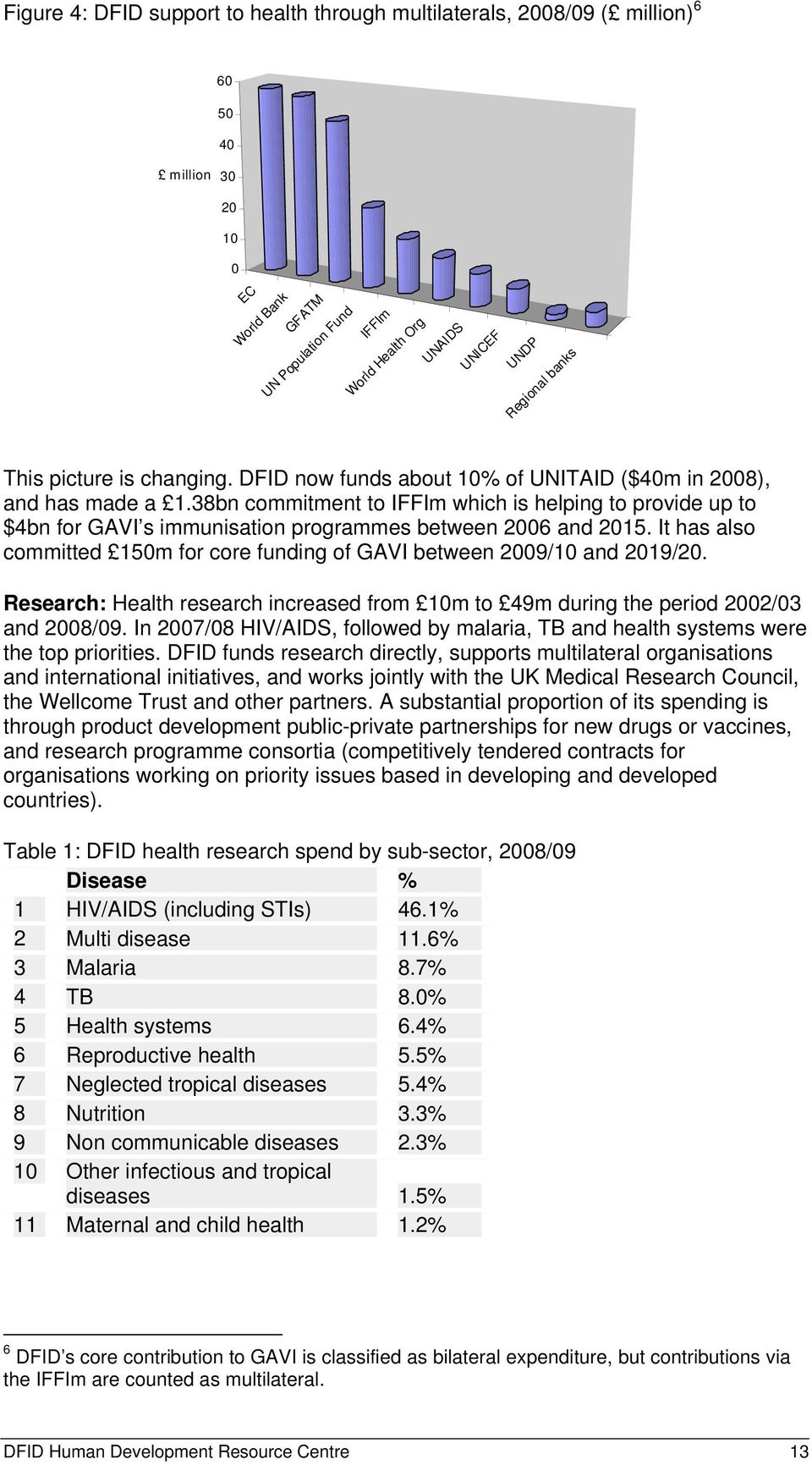
13 Figure 4: DFID support to health through multilaterals, 2008/09 ( million) million EC World Bank UN Populatio GFATM n Fund IFFIm World Health Org UNAIDS UNICEF UNDP Regional banks This picture is changing. DFID now funds about 10% of UNITAID ($40m in 2008), and has made a 1.38bn commitment to IFFIm which is helping to provide up to $4bn for GAVI s immunisation programmes between 2006 and It has also committed 150m for core funding of GAVI between 2009/10 and 2019/20. Research: Health research increased from 10m to 49m during the period 2002/03 and 2008/09. In 2007/08 HIV/AIDS, followed by malaria, TB and health systems were the top priorities. DFID funds research directly, supports multilateral organisations and international initiatives, and works jointly with the UK Medical Research Council, the Wellcome Trust and other partners. A substantial proportion of its spending is through product development public-private partnerships for new drugs or vaccines, and research programme consortia (competitively tendered contracts for organisations working on priority issues based in developing and developed countries). Table 1: DFID health research spend by sub-sector, 2008/09 Disease % 1 HIV/AIDS (including STIs) 46.1% 2 Multi disease 11.6% 3 Malaria 8.7% 4 TB 8.0% 5 Health systems 6.4% 6 Reproductive health 5.5% 7 Neglected tropical diseases 5.4% 8 Nutrition 3.3% 9 Non communicable diseases 2.3% 10 Other infectious and tropical diseases 1.5% 11 Maternal and child health 1.2% 6 DFID s core contribution to GAVI is classified as bilateral expenditure, but contributions via the IFFIm are counted as multilateral. DFID Human Development Resource Centre 13
14 2. OPPORTUNITIES AND CHALLENGES FOR INVESTING IN BETTER HEALTH Maximising the UK s contribution. DFID s priorities are set out in Working together for better health, its Health Strategy 7. This strategy sets out the strong case for DFID to invest its resources, both human and financial, in improving the health of poor people. First and foremost, better health is an end in itself and a basic human right, to which many poor people do not have access. Yet it can be achieved at low cost if the right interventions are chosen and are implemented in ways that minimise costs. Better health also contributes to higher productivity and hence economic growth. Investment in global public goods (such as communicable disease control and research) will also achieve broader benefits for wider society. The UK is a significant player in international health funding, one of the reasons why its spend must achieve as much as possible. In 2008, the world s donors spent $15bn on health 8. About two-thirds was bilateral, and the rest through multilaterals such as the World Bank/International Development Association (IDA) and the EC, and global health initiatives such as the GFATM. The USA was the largest donor of bilateral aid to health in 2008, followed by the UK, while GFATM, the World Bank/IDA and the EC were the largest multilateral channels. DFID staff have also helped national governments and other funders to improve the results for their investments in health. Reaching the health MDGs. The health MDGs are among the most challenging to reach, although in some areas real progress is being made. There have been significant successes in MDG 6 (communicable disease) and also in some regions in MDGs 4 and 5 9. MDGs 4 and 5 (maternal and child health) are the most off track, yet according to the Taskforce on Innovative International Financing for Health Systems, between 2002 and 2006, over half of all health aid supported MDG 6 commitments. Many MDG 4 and 5 interventions classified as best buys in value for money terms have not been scaled up nearly as significantly as cost-effective and important MDG 6 interventions. Estimates of the cost of reaching the MDGs globally vary widely but range from an additional $20bn to $70bn a year. It is therefore essential to ensure that all spending on meeting these goals provides good value for money. While DFID recognises that spending in other sectors such as water and sanitation or infrastructure can have a very significant impact on health, the review did not attempt to analyse the value for money of using these channels to achieve the health-related MDGs 10. Making the most of the money. Use of the most cost-effective interventions is still limited in developing countries in general, and among the poor in particular. As a result, mortality, morbidity and malnutrition rates are much higher than they need 7 Working Together for Better Health, DFID 2007 available at 8 OECD DAC CRS database 9 See for examples 10 Given that poor water and sanitation accounts for approximately 10% of the burden of disease in developing countries, DFID is allocating a proportionate amount of funds to this area (over 100 million in 07/08, and 1 billion over the next five years, as set out in DFID s Water and Sanitation Policy), as compared with DFID s overall health portfolio spend of over one billion per annum. DFID Human Development Resource Centre 14

15 be This is partly due simply to a lack of public spending on health. On average, low income countries spend only $25 per capita on health each year ($10 from outof-pocket payments by patients, $6 from external sources and only $9 from government). This is significantly less than the $54 per capita that a High Level Taskforce recently estimated would be needed to finance a package of essential health interventions for all low income countries 13. Recent econometric analysis has found strong impacts of government health spending on maternal and child mortality, and there is evidence that the impact of public health spending on the poor is greater than on the non-poor Support to system strengthening. Increased public spending on cost-effective interventions alone is not sufficient to significantly improve health status. Crosscountry analysis on the association between government health expenditure and health outcomes suggests that the effectiveness of increased health expenditure depends heavily on the quality of a country s policies and institutions 17. And there is evidence that some countries with low levels of health expenditure are more effective at reaching the poor because of the way services are organised and delivered - in other words, because they have strong health systems 18. A key challenge, therefore, is to strengthen countries health systems in such a way as to deliver interventions effectively, efficiently, and equitably. Box 1 Strengthening the health system is needed for results Strengthening the health system to deliver all the interventions needed to achieve the MDGs is recognised as an essential priority by DFID and others. WHO has identified six building blocks of health systems: service delivery; health workforce; information; medical products, vaccines and technologies; financing; and leadership and governance (stewardship) 19. There has been a tendency to underinvest in these building blocks. There is also limited quantitative evidence on the relationship between health systems strengthening investments and health outcomes, making cost-effectiveness and hence value for money more difficult to judge. There are some good examples, including the Tanzania Essential Health Intervention Project (TEHIP) study, which demonstrated that system level interventions can generate health gains 20. Implemented in two Tanzanian districts in 1997, TEHIP developed and implemented tools for strengthening district health planning within a system that provided support to district managers, increasing their funding by $1 per head of 11 Wagstaff, A. and M. Claeson (2004). The Millennium Development Goals for Health: rising to the challenges. Washington DC, World Bank. 12 Wagstaff, A., M. Claeson, et al. (2006). Millennium Development Goals for Health: What Will It Take to Accelerate Progress? Disease Control Priorities in Developing Countries. D. T. Jamison, J. G. Breman, A. R. Meashamet al, Oxford University Press and The World Bank. 13 High Level Taskforce on International Innovative Financing for Health Systems, Working Group 1 Technical Report,5 June Gottret, P. and G. Schieber (2006). Health Financing Revisited: A Practitioner s Guide. Washington DC, World Bank. 15 Bokhari, F. A. S., Y. Gai, et al. (2007). "Government health expenditures and health outcomes." Health Economics 16(3): Gupta, S., M. Verhoeven, et al. (2003). "Public spending on health care and the poor." Health Economics 12(8): See ref Rannan-Eliya R and Somantnan A. Access of the Very Poor to Health Services in Asia: Evidence on the role of health systems from Equitap. DFID Health Systems Resource Centre WHO (2007). Everybody's business : strengthening health systems to improve health outcomes : WHO s framework for action. Geneva, World Health Organisation. 20 Gilson, L. (2007). What sort of stewardship and health system management is needed to tackle health inequity, and how can it be developed and sustained? A literature review. WHO Social Determinants Knowledge Network. DFID Human Development Resource Centre 15
16 population, and generated district-specific data on prevailing health needs and other relevant health issues. The intervention enabled district health planners to target resources (financial and human) towards local health needs. Child mortality fell by over 40% in the five years following the introduction of the new planning approaches, and in one district, the death rate for those aged years fell by 18%. One of the most important lessons from this case study is that health systems strengthening cannot be a short-term investment. Investing in neglected diseases research. Health research for poor countries is comparatively under-funded. Even though 85% of the global burden of disability and premature mortality occurs in the developing world, less than 4% of global research funding is devoted to the communicable, maternal, neonatal and nutritional disorders that constitute the major burden of disease in developing countries 21. This is because there are few market incentives for investment by commercial pharmaceutical companies, which is why public sector funds are needed. On the positive side, given chronic under-funding, there are likely to be high social returns to stepping up research investments. DFID research funding makes up just 2% of the global spend on neglected tropical diseases, compared to the 42% by the US National Institutes for Health, and 18% by the Bill and Melinda Gates Foundation 22. However, DFID has been a prime mover in funding the new product development partnerships, which are well placed to make up for lost time in getting new products for neglected diseases to market. Box 2 Challenges for measuring value for money in health DFID needs to know that its funds are spent on strategies that most effectively and efficiently tackle the most common causes of ill health and death among poor people, and improve their health and wellbeing. Assessments of the burden of disease and of the cost-effectiveness of interventions and policies in health in low-income countries are usually made in terms of disability-adjusted life-years (DALYs). The DALY is a measure of the effect of ill health that takes into account both reduced life expectancy and reduced quality of life. The burden of disease is measured in terms of DALYs lost - the countries with the highest burden of disease are those that lose the largest numbers of DALYs each year. The cost-effectiveness of different interventions and policies is compared in terms of their relative cost of saving a DALY an intervention that costs only $5 per DALY averted is more cost-effective than one that costs $10 per DALY averted. There is far more evidence available about the cost-effectiveness of interventions in the health sector than in many other sectors (e.g. livelihoods). At the level of intervention against a particular disease or condition, there is substantial and growing evidence that large improvements in the health-related MDGs can be achieved at low cost, for individuals and for populations 23. Cost-effective interventions exist for malnutrition, child mortality, maternal mortality, and communicable diseases. According to the internationally agreed best buy lists and suggested thresholds for the cost per DALY, DFID health investment is very cost-effective when funds are used to promote and finance these interventions Jamison D, Breman J, Measham AR et al. Priorities in Health, Disease Control Priorities in Developing Countries Project (DCP2, 2006). 22 George Institute for International Health. G-finder neglected disease research and development: how much are we really spending? The World Health Report Health Systems: Improving Performance Geneva, World Health Organisation. WHO (2000). 24 Jamison D, Breman J, Measham AR et al. Disease Control Priorities in Developing Countries (DCP2, 2006). See Annex 1 and and the WHO-CHOICE (Choosing Interventions that are Cost-effective) project ( DFID Human Development Resource Centre 16

17 3. WHAT HAS DFID S SPENDING ACHIEVED? SUPPORT TO COUNTRIES (BILATERAL PROGRAMME) 3.1 Is DFID s health support going to countries where the greatest impact is likely? DFID does not allocate spending for health between countries. Rather, DFID adopts a country-led approach, and allocates total bilateral aid to countries on the basis of balancing a country s need for resources and its capacity to use the resources well. Country offices then allocate the resources to different sectors. For this review, DFID developed a health index to show how funds could be shared among the countries currently prioritised by DFID, according to their potential contribution to achieving health goals. The index used a formula for allocating funds according to the level of health need in each country and to an assessment of the country s capacity to spend effectively on health 25. The resulting pattern was compared with DFID s projected spend in those countries. The results show that overall DFID s planned pattern of health spending across countries for 2010/11 works well from the perspective of achieving health goals, with an 84% correlation between the health index and the planned spend in 2010/11. However, the analysis does identify some outliers where current health expenditure plans differ substantially from the expenditure levels suggested by the index. There are many possible reasons for this, such as the role that other donors are playing in health, and the expectation of more domestic funding in better off countries such as China and South Africa. The review also examined the extent to which DFID is funding countries with the highest burden of disease (in relation to the MDGs) 26. The 20 countries with the largest DFID health spend were mapped against their burden of disease in 2002/3 and 2008/9. The analysis shows that DFID has increased its spend towards the countries where burden of disease is highest, since Examples from country case studies developed for this review show how well DFID is allocating its resources towards the causes of the burden of disease. In Uganda, the government budget including DFID s budget support - allocates health funds to districts according to a formula that includes the burden of disease. DFID also funds programmes that are targeted to HIV/AIDS and malaria which together account for nearly a third of the impact of Uganda s disease burden. In India, health spending is split between the national India-wide level and the states. DFID spending follows this. National spending is used for communicable, maternal and nutrition related causes; 72% of the DALY loss in those areas is in reproductive and child health, so it is appropriate that DFID allocates 63% of its national spend to this sub-sector. In Zimbabwe, HIV/AIDS contributes 49% of the disease burden in terms of DALYs; direct HIV-related spend is appropriately half of DFID Zimbabwe s portfolio. The other specific area of DFID support is maternal and neo-natal health (7% of DALYs just for birth asphyxia, birth trauma, low birth weight, and maternal sepsis). Nevertheless, some areas of major disease burden remain underserved, especially mental health (5.6% of DALYs) and diarrhoeal diseases (3.5%). 25 The index is based a methodology developed by Chris Colclough (2007) The Challenges of Scaling up British Aid to Education which reviewed education indicators in over 94 countries. 26 Figures from WHO DFID Human Development Resource Centre 17

18 In Malawi, the government s essential health package (EHP) is built around the burden of disease. DFID is providing 94million to the health sector in for the EHP. Most causes of death and disability are adequately reflected in the package - except road traffic accidents, mental illness and unsafe abortion. But the EHP is not the total of the government s health spending treatment for non-ehp diseases and conditions continues to be provided. 3.2 Is DFID funding benefiting the poor? DFID is concerned above all with the health of the poor hence the priority in the 2007 Health Strategy for expanding access to basic health services. The India case study shows the importance of this the infant mortality rate for the poorest wealth quintile is 70 per 1000 compared to 29 for the richest quintile. The more DFID and partner government resources are allocated towards the poor, therefore, the more cost-effective they are in achieving the poverty objective. Recent evaluations of DFID s programmes in Pakistan, Cambodia, Ethiopia, Kenya and Zambia found that programme objectives do generally include access by the poor though the Kenya evaluation noted that it is difficult to judge effectiveness given the absence of disaggregated data for service utilisation. In India, DFID is focusing its state-level health support on poorer states, moving out of two relatively wealthy ones. These poorer states are in turn allocating more funds to their poorer districts. In West Bengal, the number of deliveries in institutions has risen by 30% in the six poorest districts compared to 14% in the other 12 districts. DFID has also influenced the design of the national reproductive and child health programme to include measurable indicators to reduce inequalities. 3.3 Are DFID funds backing the policies and interventions likely to have the most impact on people s health? DFID policy and strategy DFID s current and planned expenditures on health are shaped by its 2007 Health Strategy and by its country-led approach, where expenditures are driven by country needs and priorities. The strategy emphasises expanding access to basic services, drawing on internationally recognised best buys in health, as well as reinforcing the importance of a strong, integrated health system. At an overarching strategic level, therefore, DFID is seeking to promote cost-effective interventions. In practice, DFID s bilateral spend is invested in sector and targeted programmes which are delivering those cost-effective interventions for maternal and reproductive health, child health and communicable diseases. However, DFID (and other donor) funding is supporting interventions that are considerably more expensive per DALY than others that are neglected. This is because of unprecedented global support for the additional investments needed to accelerate progress in for example, reducing loss of life due to AIDS and common childhood illnesses. Anti-retroviral drugs to treat AIDS have an incremental cost per DALY over $500 (though this cost is falling, partly as a result of DFID s efforts) Country programmes It is difficult to quantify the overall cost-effectiveness of DFID country programmes. But in three of the four case study countries, DFID programmes explicitly support the national health policy and package which are built on evidence-based, cost-effective interventions. In the fourth, Zimbabwe, the political and economic crisis undermined the previously sound health system; but DFID can claim to have been the leading DFID Human Development Resource Centre 18
19 donor in ensuring that the health system remained viable and cost-effective treatments were still provided. For around a third of DFID s bilateral support, health assistance is provided either through health sector budget support (as in Malawi or the Indian states) or general budget support (as in Uganda). A recent multi-donor evaluation showed that general budget support has increased the scope of partner government discretion, resulting in clear gains in allocative and operational efficiency. The most obvious effects on health service delivery were through increased expenditure, expanded basic services, and a collective commitment of donors and government to service delivery targets though there remained a concern about how to maintain quality as coverage is expanded 27. DFID Country Programme Evaluations also suggest success in moving from general budget support to health sector budget support (see boxes 3 and 4 below). One key question is whether donor budget support becomes a substitute for government s own spending. However, DFID has addressed the issue by seeking commitments in advance: the Memorandum of Understanding with the Government of Malawi on health sector budget support specifies that the government will spend 10.7% of discretionary resources on health. In fact, government spend did increase from 52% of the health budget in 2002, to 58% in the four subsequent years under the SWAP at a time when the total health budget was increasing from $8 to $14 per head. DFID s bilateral technical assistance, at 17% of the bilateral budget, is performing well, according to country programme evaluations. This has strengthened capacity to develop health policy (in, for example, Pakistan, Zambia and Kenya) and flexible use of short-term technical support has responded well to demands and been able to inform the policy agenda (such as in Ethiopia). Box 3 Best practice: India In India, national programmes funded in part by DFID are highly cost-effective, according to WHO benchmarks. DFID inputs and policy dialogue promoted proven approaches. DFID robustly backed national scale-up of the most cost-effective approach for TB treatment. DFID s influence also contributed to a paradigm shift in the government s reproductive and child health programme, which has succeeded in increasing deliveries at health facilities by 30% from 2005 to 2007, twice the rate of increase in the two previous years, and averting around 6,600 maternal and 79,000 infant deaths. DFID also played an important role in arguing for an increased emphasis on HIV prevention, especially for vulnerable groups. HIV prevalence is stable in the adult population overall, and is falling amongst groups most at risk, for example among female sex-workers, from 10.3% in 2003 to 4.9% in In West Bengal, 3.4% of all primary and 53% of all secondary sexually transmitted infections affect female sex workers. Providing treatment services for the women could prevent new infections, at a cost per infection prevented of $150. In contrast, the cost per infection prevented for treatment in the general population was $12,900. Cost-effectiveness is also high in India because unit costs are low partly due to economies of scale because of the high volume of, for example vaccines, and partly to low costs of local inputs such as wages. 27 A Joint Evaluation of General Budget Support , IDD and Associates, May DFID Human Development Resource Centre 19

20 Box 4 Best practice: Malawi DFID is supporting Malawi s MDG targets through its funding for the health system, by providing 94 million to the health sector in for the Essential Health Package and to train, recruit and retain essential health workers. A further 15 million is being provided for technical assistance (including VSO) and for NGOs to support voice and accountability work. Malawi faced a human resource crisis in 2004, which led to a near breakdown of service delivery. The sector was losing large numbers of staff, mainly as a result of migration to higher salaried posts elsewhere in the region. DFID led an Emergency Human Resource Programme, which included funds to pay for a 52% increase in the basic salaries of health workers. Government and donor health sector funding has doubled since 2004, and there are 40% more practising nurses and doctors. As a result, the health sector has increased its activity, not just in terms of an increase in the number of patients, but an increase in the attendance rate of an increasing population. Staff numbers have improved, and so too, it appears, has productivity (though there are no national figures). For example, by 2008, the sector annual review reported that skilled attendance at delivery had increased from 38% to 45% nationally the programme has enabled more staff to be trained, recruited and retained, so providing better clinical cover to the facilities. It is also likely that the service level agreements which fund faith-based hospitals to provide deliveries free of charge have contributed to this rise in service use. DFID Malawi also engages in policy dialogue, presenting evidence to: argue for increasing government health spending funding year on year, and to ensure that donor funding (including DFID's) is additional improve financial management and procurement practices argue that the EHP should not be expanded to include much less costeffective interventions help GFATM and Government of Malawi to engage constructively. The results of support to the health sector in Malawi are impressive. DFID has contributed to saving around 1,000 mothers and 15,000 children s lives each year DFID s influencing role DFID s ability to influence others to follow best practice is critical in maximising impact. A specially-commissioned evaluation for this review suggested that DFID s influencing is probably very cost-effective through policy dialogue with government and development partners 28. The case studies on India and Malawi highlight some of DFID s successes (see boxes 3 and 4). In Uganda, the introduction of first a sector wide approach and then the International Health Partnership, pioneered internationally by the UK, has created a framework for more effective support to the health sector with donors moving towards common, and therefore lower cost, funding and monitoring arrangements. Within the country, outpatient attendance at government health facilities has doubled since Uganda eliminated user fees - something DFID had advocated strongly for. DFID Uganda was also instrumental in highlighting the importance of training and retaining skilled health workers and making this a focus of the budget support discussions DFID Human Development Resource Centre 20

21 3.4 Is DFID ensuring that these policies and interventions provide value for money? DFID supports substantial procurement of commodities at both the country and global levels. Value for money issues are described in Box 5. While commodity prices can be internationally benchmarked, this is more difficult for other health systems costs. All cost studies show great variation within countries, for reasons that are not well understood but include scale issues as well as operational efficiency differences. The country case studies show that DFID is working with governments to improve public sector efficiency. For example, in 2008/09 in Zimbabwe, DFID supported a process for enabling nearly 100% return of health workers in January 2009, following the near closure of health services in 2008, during which cholera hit most of the country. DFID advocated for the use of comparative unit costs in the design of the Zimbabwe health worker retention scheme: the amount of supplement paid is determined by a formula based on per capita gross national income across low income countries. Payments have been set at a realistic level that could both be funded, and gradually absorbed by government over a 5-10 year period. The allowance is linked to attendance in the previous month, place of work and is set by grade level. DFID led the process through a Task Force, which created confidence in the MoH to take the leadership role and brought other donors along with the process. In the short term the scheme is managed by an independent contracting agency. DFID also provided the technical input to ensure Zimbabwe s successful bid to GFATM included substantial five year funding for a continuation of the retention scheme until In Uganda, in 2006/07, 42% of the government resources available for health were wasted largely due to absenteeism (averaging 40%), and clinics not having medicines in stock. The 2008 Public Expenditure Review concluded that a better allocation of resources and measures to improve management and accountability could generate technical efficiency gains 29. In support of the government s efforts to strengthen the system, DFID is both supporting public sector reform and ensuring that donor support to the budget is linked to achieving targets for reduced absenteeism and drug stock-outs. In India, much of DFID s support at state level has also focused on improving the health system. A push on the health workforce reduced vacancy rates for doctors in low performing districts of West Bengal from 30% in 2005 to 18% in Uganda: Focus on Health in the Budget, Public Expenditure Review DFID Human Development Resource Centre 21
22 4. WHAT HAS DFID S SPENDING ACHIEVED? SUPPORT TO MULTILATERAL ORGANISATIONS Understanding how DFID s multilateral spend is contributing to health impact is critical. Around 23% of the UK s aid for health goes through multilaterals including the EC, World Bank, UN agencies and global health initiatives. There has been a major increase over the last five years, most of it accounted for by contributions to GFATM. One of the four priorities in the DFID Health Strategy is improving the effectiveness of international funding for health. The three biggest multilaterals in health the EC, the World Bank and GFATM have all recently undertaken evaluations, which have informed this review Is DFID s health support going through multilaterals to countries where the greatest impact is likely? It is not possible to compare the distribution of total funding from the multilaterals and the global health initiatives across countries with the distribution of the global burden of disease, because most multilaterals do not collect such data. Instead, the review used the same index to compare country allocations by the multilateral agencies as was used for DFID s bilateral spend. There is an 86% correlation between how funds would be allocated according to the health index and where multilaterals and global health initiatives actually allocate health resources. This is welcome. The countries included in the model account for about two-thirds of DFID s spending through multilaterals the remaining third is spent by multilaterals in other countries. This is to be expected. DFID complements its own narrower list of priority countries with funding to multilateral agencies and global health initiatives, which have much larger total budgets and a wider reach. 4.2 Does DFID funding through the multilaterals benefit the poor? There is little evidence on how far multilaterals and global health initiatives target the poor in their health programmes. The World Bank Independent Evaluation Group (IEG) evaluation found that a remarkably small share of projects had objectives to improve health outcomes among the poor 33, and no programmes were able to demonstrate an impact on the health of the poor. The EC evaluation noted that the high degree of focus by the EC on providing general budget support may mean that poverty and equity are under-recognised as objectives for the organisation s health funding, since health indicators used to assess general budget support may emphasise service utilisation but not quality and equity. 30 EC Development Assistance to Health Services in Sub-Saharan Africa, European Court of Auditors Special Report No 10, Improving Effectiveness and Outcomes for the Poor in Health, Nutrition and Population: an evaluation of World Bank Group support since 1997; World Bank Independent Evaluation Group GFATM Technical Evaluation Reference Group (2009): The Five-Year Evaluation of the Global Fund to Fight AIDS, TB & Malaria: Synthesis of Study Areas 1, 2 and 3 33 IEG, Improving Effectiveness and Outcomes for the Poor in Health, Nutrition, and Population: An Evaluation of World Bank Group Support Since Available at Page 28, Only one in eight projects (13% had an objective to target health status, access, use, quality, or demand, or to provide health insurance specifically among the poor. Beyond this, an additional 7% of projects had an objective to improve equity. DFID Human Development Resource Centre 22
23 Although GFATM s grants are targeting poorer countries, the evaluation found no evidence of widening or narrowing gaps in coverage between disadvantaged groups and those who are better off. A recent Lancet review also found that the global health initiatives have contributed to improvements in some aspects of health equity but have not directly addressed the causes of health inequity or the social determinants of health Are multilaterals using DFID funds to back the policies and interventions likely to have the most impact on people s health? The strategies pursued by the multilaterals are determined by their mandates and draw on internationally promoted norms, standards and guidelines, which are in turn informed by the evidence base. Examples include UNICEF s focus on prevention and management of childhood illness and UNFPA s support to sexual and reproductive health care, including family planning. Across the multilaterals, the global health initiatives provide the clearest data that investment in prevention, treatment and care is cost-effective. For example, the GAVI Alliance s investments in both traditional and new vaccines are considered to be highly cost-effective in terms of lives saved. Between 2000 and 2008, GAVI s funds helped immunise 213 million children, at an average cost-saving per DALY of $ However, the specific interventions supported by the global health initiatives rely on the existence of operational health systems to provide value for money. As the GFATM evaluation put it, going forward, the weaknesses of existing health systems critically limit the performance potential of the Global Fund. Although the global health initiatives are funding some health system strengthening, ultimately they are targeting specific goals and interventions, and their benefit to health systems is secondary. The World Bank and the EC, as generalised funders, are better placed to provide health systems financing, but recent evaluations have raised concerns. The EC provides a sizeable amount of funding as general budget support, but is not always able to complement this with appropriate country level technical support to influence health systems development. Despite an earlier policy commitment to health systems, the recent evaluation found that in practice the World Bank had increased the proportion of its spending on disease programmes. The Bank has recognised this and has a strategy to increase health systems effort. 4.4 Are multilateral policies and interventions provided in a way that maximises value for money? In general, it is difficult to compare costs and impact achieved across multilaterals and global funds. Different multilaterals do different things, which means they are not comparable. DFID recognises that health development requires a range of inputs and that specialisation amongst agencies is needed. The newer global initiatives, and those that purchase commodities, are making efforts to ensure their procurements deliver value for money. For example, UNICEF, UNFPA, the GAVI Alliance and UNITAID are all securing competitive prices for products including vaccines, AIDS and malaria medicines and contraceptives, for 34 Lancet 373: , June DFID Human Development Resource Centre 23
24 example. Box 5 shows some results of DFID s bi and multilateral effort to improve value for money in procurement. With respect to other efficiencies, the GFATM is developing a methodology to collect information through grants reporting that will allow it to measure unit costs - of inputs (e.g. commodities), processes (e.g. staff trained) and outputs (e.g. interventions delivered). By contrast, we know little about costs per unit of output of either of the generalised funders (the World Bank and EC), or most UN bodies. The main challenges lie in the lack of data from the multilaterals themselves, and from the monitoring systems of their recipients. Box 5 Achieving value for money in commodities at country and global levels Commodity costs, such as essential medicines, vaccines, contraceptives, and bednets make up a high proportion of national health budgets. Developing countries need to obtain essential commodities at good quality and low price. But often this is not the case: for example, there can be a two to three-fold price variation between the lowest and highest price paid in low income countries for AIDS treatment. Since 2006, DFID has been supporting various initiatives through its bilateral and multilateral support to ensure that countries get best value for money. International price benchmarks show that DFID itself is getting value for money in direct commodity purchase. Although only indicative (as yet the international figures are not always compiled on the same basis), the evidence shows reasonable value for money for the two main commodities purchased directly condoms and bednets. DFID directly purchased condoms in three countries: Nigeria, Cambodia and Vietnam. In these countries, the unit cost of male condoms was lower than that obtained by other funding agencies in 2008 (with the exception of UNFPA in Nigeria). DFID has committed to purchase 20 million bednets for malaria prevention by GFATM shows the average cost of a bednet in different PSA countries varied from $4.67 in Nepal to $7.44 in DRC. DFID is working on the basis of an average cost of $5.30. However, direct DFID procurement is rare, because DFID prefers to reinforce and use government systems (in line with UK aid effectiveness commitments). A DFID focus on support for government procurement in Orissa in India has reduced the cost of drugs by 25-40% between 2001 and Wastage due to poor quality medicines has fallen from 12% to 2%. Substantial procurement is carried out by and with multilateral funds (for example about 45% of GFATM s grants has been invested in commodities). There is evidence that value for money is improving. According to a Lancet review of the impact of global health initiatives, price reductions for vaccines and for treating HIV/AIDS, TB, malaria and onchocerciasis, are due to increased demand, more competition with more quality suppliers in the market, and global coordination of procurement of medicines and commodities Lancet 373: , June 2009 DFID Human Development Resource Centre 24
25 Table 2: Savings achieved by price reductions Commodity Initiative Year Annual Savings* Saving attributable to DFID Hep-B vaccine GAVI 2008 $20m $0.8m Paediatric ARVs UNITAID 2008 $23m $2.3m 2 nd line ARVs UNITAID 2008 $18m $1.8m Medicines GFATM Future $120m $7.2m Estimated 37 *The annual savings column refers only to the savings achieved by the each global health initiative in its own purchases, and takes no account of the likely further savings achieved by other purchasers at the lower prices. Agencies that procure on behalf of countries have strengthened their procurement systems. For example, UNICEF has improved its forecasting, so that it can now honour 80% of volume contracted for (up from 40%). The agency used to contract semi-annually, whereas now it plans 18 months in advance. Such measures should decrease industry s risks and give purchasers a better deal. Where countries are carrying out their own procurement using grants, efforts are also in place to ensure that they get good value for money. For example, GFATM has launched a Voluntary Pooled Procurement Scheme, whereby countries can benefit from agreed price deals with suppliers. DFID is also financing the Clinton HIV and AIDS Initiative to strengthen the market for AIDS and malaria medicines. Last but not least, DFID is supporting co-ordinated efforts for the collection, disclosure and use of information about global and local pharmaceutical markets and supply chains. Building on earlier work, DFID is financing GFATM, WHO and UNITAID to develop a searchable database, which should allow countries to procure efficiently, and provide inputs for forecasting and programme costing. DFID s success in influencing Where there is a wider institutional commitment as with the EC and UN system DFID influences multilateral policy and strategy through agreed agency performance frameworks and ongoing policy dialogue 38. This is shaped by the overall drive for improved multilateral effectiveness. For example, DFID identified the World Bank s health programming as one of six particular priorities for reform in the 2009 DFID White Paper. The Bank s own health evaluation in 2009 provides the evidence to continue to press the Bank on delivery of its 2007 health, nutrition & population strategy and its new reproductive health action plan, and to improve the performance of its HIV and AIDS projects. Progress is apparent, particularly in the Bank s proactive support for the International Health Partnership. A key test of Bank commitment to its strategy and the IHP+ principles will be the extent to which it operationalises new harmonised approaches in its own 37 There are no backward looking figures for GFATM. This estimate assumes conservatively that countries make savings of 10% annually on GFATM medicines procurement DFID Human Development Resource Centre 25
26 lending cycle - and allows Bank-specific appraisal processes to be dropped where appropriate. Equally, DFID works both at country and global levels, through its Board memberships, to shape policy of the global health initiatives. The GFATM has provided over $500m to Malawi. DFID Malawi gives priority to ensuring that these funds are spent effectively and for purpose. It has been instrumental in ensuring GFATM helps strengthen systems. Delays in GFATM grant disbursement early in 2009 led to a near stock-out of anti-retrovirals, threatening collapse of the successful national programme. Alerted by the country office, DFID made a representation at Board level, working together with Oxfam and others, to ensure due attention was given to the issue. DFID helped to ensure that the GFATM secretariat responded flexibly and in time to avoid a stock-out. DFID has also been a prime mover in setting up new aid delivery mechanisms such as the International Financing Facility for Immunisation (IFFIm) and Advanced Market Commitment (see next section). IFFIm represents good value for money because of the strong case for front-loading immunisation spend in term of economic and health impact and GAVI has proven itself as an effective beneficiary of the funds (see Box below). Box 6 The IFFIm Recognising the effectiveness of GAVI, the UK promoted the International Financing Facility for Immunisation (IFFIm), with the goal of raising $4bn of frontloaded and predictable funds from the capital markets, for GAVI. DFID provides 1.38bn to IFFIm over 20 years ( ). The WHO estimates that, if fully funded, IFFIm could save the lives of 5 million children by 2015 and a further 5 million adults 20 years later (due to the later preventive benefit of Hepatitis B vaccines). The returns to the IFFIm investment are high, with an estimated benefit to cost ratio of at least 20:1 and the economic rate of return between 25% and 90%. Benefits are high both because of the cost-effectiveness of GAVI, and because IFFIm s innovative financing mechanism increases long run health impact through frontloading and additional predictability. Barder and Yeh estimate that the health impact of spending on the same vaccines is increased by 22% with IFFIm; this outweighs the 3.5% increase in costs due to administration and interest payments for frontloading. Source: Barder, Owen and Yeh, Ethan, The Costs and Benefits of Front-Loading and Predictability of Immunization (February 2006). Center for Global Development Working Paper No. 80. DFID Human Development Resource Centre 26
27 5. WHAT HAS DFID S SPENDING ACHIEVED? SUPPORT TO RESEARCH 5.1 Is DFID funding research in the areas where the greatest impact is likely? In 2008/09 the largest share of DFID research expenditure went to HIV/AIDS, followed by malaria and other communicable diseases, and health systems. DFID s research spend needs to generate good returns while managing risk appropriately. DFID s spend is mainly through two channels: investments in new medicines and vaccines developed by public-private product development partnerships (PDPs), and through competitively tendered research programme consortia (RPCs), which include major academic and research institutions worldwide, including in developing countries. DFID s research activities are focused on strategies to understand and address the future burden of disease. Equally, DFID s investment is focused on the diseases of poverty that are not addressed by commercial markets. Looking forward to 2030, DFID s projected allocation reflects the reality that HIV/AIDS, together with other communicable diseases, will remain as very significant problems. However, as communicable diseases are overtaken by other causes of disease, DFID will need to respond to the emerging threats, while maintaining attention to neglected tropical diseases. Table 3: DFID health research spend by sub-sector Predicted disease burden in low income countries % of DALYs DFID current research by disease (excluding health systems and multi disease research) % of spend HIV/AIDS 14.5% HIV/AIDS 46.1% Perinatal conditions 5.8% Malaria 8.7% Unipolar depressive disorders 4.7% TB 8.0% Road traffic accidents 4.6% Reproductive Health 5.5% Ischaemic heart disease 4.5% Neglected tropical diseases 5.4% 5.2 Are DFID funds identifying the policies and interventions likely to have the most impact on people s health? The research task is not to back the policies with most impact, but to identify and demonstrate new interventions and approaches that are cost-effective. DFID has supported many successes. Research showed that giving a commonly available antibiotic to HIV-positive children reduced death from all causes by 43%. World Health Organization guidelines now advise giving HIV positive children the antibiotic. Cost of research: 476, Mathers and Loncar (2006) Projections of global mortality and burden of disease from 2002 to PLoS Medicine. Volume 6, Issue 11. DFID Human Development Resource Centre 27
28 DFID funded research can point the way to future savings. Data from WHO- CHOICE show that adding intensive monitoring to anti-retroviral therapy increases the cost per DALY averted significantly. DFID funded a large trial which established that intensive monitoring with regular laboratory tests also offered little additional clinical benefit. The study found that the savings from not carrying out such monitoring would mean that a third more people could be successfully treated for AIDS in Africa: countries can prioritise ART access over investment in expensive laboratory facilities. Cost of research: 2.5m. DFID funded researchers and their partners have helped provide evidence to decision makers in difficult settings which has led to real policy change. For instance a health financing pilot study in Afghanistan examined the impact of a policy of user fees compared to free services. Observed and perceived quality did not differ between groups but utilization increased by a greater amount in the free services group. In 2008 the Afghan Ministry of Public Health abolished fees at primary care facilities, citing this study. Cost of research: $140,000 DFID s research also emphasises getting research findings into policy and practice. A large share of the disease burden in low and middle income countries is attributable to diseases for which cost-effective interventions are already known and feasible. Evidence across different settings is needed to show how more people can have access to and use these interventions. This kind of operational and health system research is often neglected by other funders and DFID is recognised to have strengths in this field. DFID was an early supporter of the global Alliance for Health Policy and Systems Research; has two research programme consortia focusing on health systems; and health systems research (including for instance cost-effectiveness analysis and financing) is a major component in at least four of the other RPCs. 5.3 Is DFID funding research in a way that maximises value for money? Over 40% of DFID s health research budget is spent through product development partnerships (PDPs), such as the Medicines for Malaria Venture (MMV). PDPs are demonstrating capability to be a cost-effective model to develop new medicines and vaccines, working with the best of public and private sector expertise and approaches. This is partly due to their ability to leverage substantial in-kind inputs from partners. DFID s management of research is driving to improve value for money. Over 60% of the current research portfolio is now allocated competitively (either by DFID or by PDPs). DFID s influencing role DFID helped to pioneer, with others such as the Gates and Rockefeller Foundations, the emergence of PDPs. Their success means that DFID is leveraging almost ten times more funds from other donors ($246m in 2007 for $26m from DFID). The UK has also helped pioneer pull mechanisms to stimulate market interest in new products for neglected diseases. For example, Advance Market Commitments (AMC), for pneumococcal vaccines focus on the later stages of bringing new vaccines to the market, once plausible candidate vaccines have been identified. The DFID Human Development Resource Centre 28
29 mechanism is likely to be complementary, rather than competitive, with direct funding of more upstream vaccine research, for example through PDPs. The AMC is piloting a new way of funding research and development. Donors only pay for successful products, thereby incurring few opportunity costs for unproductive research so introducing performance-based financing. DFID Human Development Resource Centre 29
30 6. CONCLUSIONS, NEXT STEPS AND RECOMMENDATIONS 6.1 Is DFID making the right allocations, in the right ways? Countries and aid modalities This review has shown that DFID is investing in the right countries, and in the top health priorities, through effective and appropriate channels. The review has not attempted to explore whether the spread across the bilateral, multilateral and research programmes delivers the maximum benefit. The distribution of DFID s total health spend is a result of separate decisions, rather than the allocation of a budget earmarked to support health. For the very large spends through the EC and the World Bank, these decisions are taken by a mix of multilateral allocation decisions and country demand, and not by DFID; where DFID provides bilateral budget support, the decisions are taken by the country government. That said, DFID s overall approach spreads and manages risk. In-country, DFID s country-led approach mixes budget support, with targeted interventions such as GAVI and malaria programmes. The Kenya Country Programme Evaluation welcomed the twin-track approach of programmes for bednets and condoms through non-government agents, alongside slower-paced support to sector reform, moving towards a future sector wide programme in health, once fiduciary risk was reduced. DFID balances longer term capacity building in health systems, with short term results such as social marketing of condoms and nets. DFID also seeks to manage risk, as well as improve effectiveness, by providing technical assistance alongside financial aid Aid effectiveness DFID is committed to fulfilling the Paris Principles for aid effectiveness, including country ownership, alignment to government systems, and donor harmonisation. The institutions and instruments for financing health in developing countries (known as the health aid architecture) are notoriously numerous and fragmented, with associated transaction costs and loss of efficiency. One particular aspect of this inefficiency is a lack of coordination in resource allocation hence the relative underfunding of MDGs 4 and 5 and the existence of aid orphans. DFID will continue to promote the IHP+, which addresses these problems by providing a platform at global and country level where agencies working in health, and the countries they seek to benefit, can (a) hold each other to account and (b) follow a commonly agreed plan. DFID has also welcomed steps taken by the World Bank, GFATM, and GAVI, with WHO, for a health systems funding platform, in line with Paris Principles. DFID has encouraged these moves, including funding expert posts in World Bank regional offices Fragile states DFID s spend is increasing in fragile states - where the government cannot or will not deliver core functions, including health services, to the majority of its people. These states also tend to have the high disease burdens, and are most off track to meet the health-related MDGs. Total health spending per capita is half what it is in non-fragile states. Fragile states as a group get more aid per capita for health than non-fragile states, but the aid may buy less, because services are often expensive as a result of insecurity and weak infrastructure. DFID Human Development Resource Centre 30
31 In fragile states, common DFID practice has been to support non government organisations to deliver a basic package of health services for a fixed period of time, such as in Afghanistan and the Democratic Republic of Congo. But the longer term issue is (re)building a public health system, and this is more difficult. Where a country did recently have a reasonable health system, the most cost-effective intervention is likely to be to preserve the system as much as possible as in Zimbabwe. However, there is no sound cost-effectiveness evidence for health service delivery or health systems strengthening in different types of fragile states Equity and benefiting the poor DFID prioritises the health of the poor hence the emphasis in the 2007 Health Strategy and in DFID s bilateral programming for expanding access to basic health services. The review found limited evidence on which to base an assessment of the impact of bilateral or the multilateral programme on equity. Measuring the extent to which this is happening in health is difficult due a wide variety of factors. There is also surprisingly little systematic analysis of the cost-effectiveness of reaching the poor and hence of equity and efficiency trade-offs. Poor people tend to live more in rural areas than urban, where the costs of providing (and using) services can be higher. DFID s support to the Health Metrics Network and other efforts to build national information management capacity is part of its health system strengthening commitment. However, this is an area where more work is needed. Recommendation: DFID should pay more attention to measuring impact on equity (such as by using benefit incidence analysis and other approaches) and should continue to encourage government and development partners, especially multilaterals, to do the same The role of the non-state sector DFID recognises the importance of the non-state sector in delivering health care, especially to the poor. The poor get much of their medical care from the non-state sector. This includes not-for profit services, such as faith based hospitals and clinics, and international and local NGOs. In addition, the poor make extensive use of commercial sources of health care, which range from registered private pharmacies and clinics with a doctor or midwife, to unlicensed drug shops. Also non-state providers may be better able to be effective, for example, in reaching vulnerable groups such as injecting drug users, or deal with sensitive issues such as adolescent reproductive health or abortion related services. For DFID, strategies include direct funding to NGOs, social marketing and franchising, and working with government to commission or contract out services. Interventions targeted to the non-state sector make up a modest share of DFID funding for health in most countries, and a larger component in fragile states. So, for example, in Cambodia social marketing of family planning products and condoms receives 1.5m annually compared with health sector programme support of 7m. Meanwhile in Burma, where there is no direct funding to the government, all DFID support is channelled through NGOs and UN agencies, to pay for services delivered by NGO and private providers. However, as yet the evidence base for scaling up some of these interventions is limited. A review by the DFID-funded Consortium for Research on Equitable Health Systems concluded that the evidence for whether private sector interventions reach DFID Human Development Resource Centre 31
32 the poor is not yet strong enough to support robust conclusions 40. In general there needs to be more work to assess the cost-effectiveness of such initiatives, especially those involving commercial providers. There is limited data to show the relative costeffectiveness of working with the private sector compared with the public sector. What data there is suggests that there may not be much difference in costs. Also, interventions such as social marketing alone are unlikely to reach the poorest. DFID will continue to carefully design and tailor its support to the country context, taking into account the importance of the non-state sector, while building government capacity to work effectively with it. Equally it will work to build capacity and enable civil society to participate in accountability and transparency measures. 6.2 Is DFID addressing health priorities with the policies and interventions with most impact? The review has shown that DFID s spend backs the most important health priorities in developing countries and that DFID makes robust investments in cost-effective policies and interventions across its health portfolio. For reproductive, maternal and neonatal health, and nutrition there are cost-effective interventions that are not being adopted by developing countries, and DFID s spend in these areas is now increasing. DFID has been supporting a range of nutrition-related activities, ranging from direct interventions such as vitamin supplementation to support to governments, for legislation around food fortification. DFID s first Nutrition Strategy was published in March The strategy is based on peer-reviewed evidence on what nutrition interventions are cost-effective 41 and how to maximise impact on under-nutrition through actions in key sectors beyond health - with a commitment to improve that evidence. Strengthening health systems increases the cost-effectiveness of all other basic health interventions and is relatively neglected by other donors. DFID is recognised as being strong in health systems research, but in 2007/8 allocated only 5% of its research budget to this area. DFID will continue to make some investment in non-communicable diseases, where there is evidence for cost-effective interventions. Looking ahead, three emerging issues are: reducing the burden of cardiovascular disease; combating tobacco use; and reducing road traffic injuries. They are less central to the international MDG focus on maternal and child health and communicable diseases. There are costeffective interventions available to combat tobacco use and reduce road traffic injuries. DFID support has included research funding on tobacco policy since 2005 and in 2009 DFID made a White Paper commitment to become a sponsor of the World Bank Global Road Safety Facility. Recommendation: DFID should continue to reverse the decline in its reproductive health spending, and increase spend on maternal and neonatal health (MDGs 4 and 5), and on nutrition (MDGs1, 4 and 5). 40 Patouillard E, Goodman C, Hanson K, Mills A. Can working with the private sector improve utilization of quality health services by the poor? A systematic review of the literature. International Journal for Equity in Health 2007, 6: Summarised in a meta-analysis in The Lancet s Series on Maternal and Child Undernutrition, DFID Human Development Resource Centre 32
33 Recommendation: DFID should continue to prioritise support to health systems, and should fund more research on HSS to demonstrate and improve the cost-effectiveness of HSS investments. More operational research is needed on issues such as the relative cost-effectiveness of different approaches, (including using non-state providers versus public providers to increase coverage) and specifically in fragile states. Recommendation: DFID should include on its influencing agenda significant causes of death and ill health that require non-health sector interventions, such as tobacco tax policies. 6.3 Is DFID ensuring value for money through increased efficiency? At country and global levels, increasing attention is paid to exploring and promoting value for money, particularly for commodities. Recent DFID investment decisions in the global health initiatives have been informed by cost-benefit analysis. However, evidence of what different multilaterals are delivering is not always available. Between them the World Bank and the EC accounted for almost half of DFID s multilateral spending on health in 2008/9. Both organisations score themselves relatively low on health, compared to other sectors, and have tended to move away from health systems financing in recent years even though they are particularly well placed to provide it. Neither has focused on value for money in their health investments. The World Bank, EC and GFATM evaluations of their health portfolios singled out poor monitoring and evaluation as an area of concern which needs more investment in future. More specifically, the organisations reliance on country health systems and monitoring and evaluation frameworks was noted, the weakness of these systems highlighted, and the lack of investment by the organisations in improving them criticised. There is little data on costs per unit of output of the World Bank, EC and most UN bodies. One of the main causes is the lack of data from the multilaterals themselves, and from the monitoring and evaluation systems of their recipients. While best value for money is important, there are also good reasons why DFID should not always seek to maximise efficiency by seeking the lowest unit costs: (1) Low cost can imply low quality. In particular, health worker absenteeism can be a result of paying inadequate wages an issue tackled in Malawi. (2) While improving the health of many poor people can be achieved at low cost, providing health services to the most marginalised those geographically or socially isolated is likely to be more expensive. (3) Managing risk may require higher prices. In Zimbabwe, DFID chose UNICEF to source ARVs; UNICEF is reasonably competitive, but charges a 7% overhead. However, as a UN agency, it was also more protected from external interference. (4) Responding to a crisis also costs more. In 2008 Zimbabwe faced almost total stockouts of drugs in hospitals and clinics. DFID and the EC worked through UNICEF who could provide the first supply within three weeks. DFID will contribute to the global database on medicine purchases and prices, and ensure that health advisers use its estimates in policy dialogue with governments. DFID Human Development Resource Centre 33
34 Recommendation: DFID should allocate more staff time and develop a clear DFID-wide approach to influence the World Bank and the EC on health, HIV and nutrition. At a minimum, DFID should ensure that the World Bank and EC track their spending on health systems strengthening, and improve their own monitoring and delivery of value for money in their health portfolios, including unit costs of commodities. 6.4 How is DFID working overall to maximise impact? Measuring performance and value for money DFID subjects all its investments to regular review and external evaluation. Recent country programme and research evaluations find that DFID s health projects generally perform well, and better than other sectors at outcome level. Programme management frameworks, indicators and reporting in health are also said to be better than other sectors. The review and evaluation process is rigorous. DFID uses independent peer assessors to assess whether the project is on track and will deliver the expected outputs. If the findings suggest there is a serious risk of failure, DFID requires that programmes undergo substantial changes in project management. All UK core funding to multilaterals with the exception of the World Bank is supported by an Institutional Strategy containing a performance framework. Normally drawn from the organisation s own strategic plan, this tool ensures that dialogue with the organisation is focused on DFID s objectives. For some health multilaterals (including the GFATM, UNFPA, WHO and UNAIDS), a portion of funding is contingent on performance against this framework. The quality of DFID s pre-approval analysis of programmes is improving, but DFID recognises that there is more to be done to improve this including more robust cost-effectiveness and cost-benefit analysis in pre-approval processes. Similarly, indicators to measure value for money are not included in all monitoring frameworks. Recommendation: DFID should improve assessment and monitoring of value for money and cost-effectiveness across internal systems. This should include more attention to the process of assessing risk at the start (with special monitoring for projects identified as high value and high risk). Programme appraisals should include value for money components, and programme monitoring frameworks should have at least one indicator specifically for value for money. Annual reviews should report on value for money and cost-effectiveness Leveraging policy improvements and resources The review s influencing case studies demonstrated that policy dialogue and influencing activities are effective at country and global level, and that stakeholders rated DFID efforts highly 42. The importance of this influencing role is demonstrated in the fact that DFID s policy advisers are delivering results in their own right. In seven of the eight recent Country Programme Evaluations that include health, DFID advisers are shown to have significant influence over government policy and programming in the health sector DFID Human Development Resource Centre 34
35 A wide range of benefits have accrued from influencing: encouraging critical reforms (user fees in Zambia and human resources in Mozambique); mobilising and harmonising resources for the sector (Mozambique and Nigeria); reducing transaction costs (Nigeria); and encouraging take up of cost-effective approaches (Nepal and India). And, at the extreme, if DFID s influencing investment of $300,000 in GFATM led to just a 1% efficiency saving, this would yield a $30m tenfold efficiency gain. Influencing sector strategies other than health is also needed to address significant causes of ill health and death. Influencing appears likely to be very cost-effective, but this is not well-documented. A full quantitative cost-effectiveness analysis of influencing is likely to remain impractical. But the level of costs is very modest in comparison to potential benefits, or to the level of financial aid being spent in the sector. There is also a risk that DFID s limited influencing resources are spread too thinly. Since advisers are delivering results in their own right, their costs should not be seen as simply costs of administering programmes. The study suggests that it may be better to invest in a smaller number of areas where potential gains are great, and to ensure that sufficient resource are allocated to influencing work with both multilaterals and at country level. A clear DFID-wide position is needed to influence the World Bank and the EC on health, reproductive health and HIV, and nutrition, given weaknesses described in their own evaluations, and the high percentage of DFID health spend. Recommendation: DFID should at least sustain the number of health advisers in regional divisions and develop mechanisms that better measure and document the impact and cost-effectiveness of time spent on influencing by its advisers. DFID Human Development Resource Centre 35
36 ANNEX 1: DISEASE CONTROL PRIORITIES PROJECT TOP 10 PRIORITIES FOR HEALTH POLICY ACTION 43 Objective Health service measures Measures outside health services Ensure healthier Ensure access to family planning Improve women s status mothers and Train skilled birth attendants, including in Ensure good nutrition during pregnancy children resuscitation of newborns Provide proper treatment of major childhood killers (e.g. IMCI) Immunise all children against major diseases and childbirth Teach family to promote hygiene and use oral rehydration therapy Stop the AIDS Treat other STIs that increase the risk of HIV Promote 100% condom use, and Pandemic Provide ART especially for pregnant women Voluntary Counselling and Testing for HIV education, especially among high risk populations Harm reduction for injecting drug users Combat stigma and discrimination Promote good Supplements as a source of Ensure access to micronutrients through nutrition Micronutrients diet, fortified foods Promote breast feeding Regulate salt and saturated fats in food, public education campaigns Stem TB Treat active TB cases Manage MDR TB with new drugs Improve treatment of TB in HIV+ Develop a vaccine Control malaria Reduce burden of cardiovascular disease Combat tobacco use Reduce injuries Ensure equal access to health care Expand preventive treatment for pregnant women Use cost-effective drugs especially ACTs where needed Low cost cholesterol reducing drugs for those at risk Emergency medical response and trauma capacity Focus providers efforts on common causes of ill health Expand roles of non-doctors to deliver basic surgery and treat common conditions Choose cost-effective interventions Incentives to recruit and retain health workers Provide universal access to treated bednets Spray insecticide indoors Tackle tobacco see below Promote less salt, fat, calories Raise tobacco taxes to increase prices by at least 33% Anti-smoking laws ban advertising, restrict smoking in public places Nicotine replacement therapy Enforce traffic laws Make roads safer e.g. speed bumps, barriers Taxes/laws to limit alcohol, drugs Forge strong health system Support viable policies Make funding commitments Provide incentives for research and development Provide knowledge transfer Provide training in specialities with high disease burden 43 Source: Investing in Global Health, Best Buys and Priorities for Action in Developing Countries. Disease Control Priorities Project 2, April 2006, accessed at DFID Human Development Resource Centre 36
37 What is international development? International development is about helping people fight poverty. Thanks to the efforts of governments and people around the world, there are 500 million fewer people living in poverty today than there were 25 years ago. But there is still much more to do. 1.4 billion people still live on less than $1.25 a day. More needs to happen to increase incomes, settle conflicts, increase opportunities for trade, tackle climate change, improve people s health and their chances to get an education. Why is the UK government involved? Each year the UK government helps three million people to lift themselves out of poverty. Ridding the world of poverty is not just morally right, it will make the world a better place for everyone. Problems faced by poor countries affect all of us, including the UK. Britain s fastest growing export markets are in poor countries. Weak government and social exclusion can cause conflict, threatening peace and security around the world. All countries of the world face dangerous climate change together. What is the Department for International Development? The Department for International Development (DFID) leads the UK government s fight against world poverty. DFID has helped more than 250 million people lift themselves from poverty and helped 40 million more children to go to primary school. But there is still much to do to help make a fair, safe and sustainable world for all. Through its network of offices throughout the world, DFID works with governments of developing countries, charities, nongovernment organisations, businesses and international organisations, like the United Nations, European Commission and the World Bank, to eliminate global poverty and its causes. DFID also responds to overseas emergencies. DFID s work forms part of a global promise, the eight UN Millennium Development Goals, for tackling elements of global poverty by What is UKaid? UKaid is the logo DFID uses to demonstrate how the UK government s development work is improving the lives of the world s poorest people. Department for International Development 1 Palace Street London SW1E 5HE UK and at: Abercrombie House Eaglesham Road East Kilbride Glasgow G75 8EA UK Tel: +44 (0) Fax: +44 (0) Website: [email protected] Public enquiry point: or (if you are calling from abroad) Crown copyright 2010 You may re-use this information (not including logos) free of charge in any format or medium, under the terms of the Open Government Licence. To view this licence, visit This does not apply to any content where the copyright is owned by another organization or individual. Front cover image credit: Caroline Irby and Department for International Development. DFID Human Development Resource Centre 37 Published by the Department for International Development, 2010.
August 2012. Action for Global Health call for International Development Select Committee Inquiry into health systems strengthening
 August 2012 Action for Global Health call for International Development Select Committee Inquiry into health systems strengthening Introduction In recent years DFID has prioritised health and nutrition
Institute for Health Metrics and Evaluation (IHME) aidinfo use case. DevelopmentInitiatives
 Institute for Health Metrics and Evaluation (IHME) aidinfo use case DevelopmentInitiatives Institute for Health Metrics and Evaluation (IHME) aidinfo use case Contents Executive summary... 3 Background...
A proposal for measures under Norwegian foreign and international development policy to combat the global health workforce crisis
 A proposal for measures under Norwegian foreign and international development policy to combat the global health workforce crisis Report by the workgroup headed by the Ministry of Foreign Affairs, with
Dublin Declaration. on Partnership to fight HIV/AIDS in Europe and Central Asia
 Dublin Declaration on Partnership to fight HIV/AIDS in Europe and Central Asia Against the background of the global emergency of the HIV/AIDS epidemic with 40 million people worldwide living with HIV/AIDS,
Health in the post-2015 Development Framework: How to meet the needs of the most marginalized and excluded
 Policy briefing Health in the post-2015 Development Framework: How to meet the needs of the most marginalized and excluded Introduction For the past two years, UN Member States, UN agencies, civil society
Part 4 Burden of disease: DALYs
 Part Burden of disease:. Broad cause composition 0 5. The age distribution of burden of disease 6. Leading causes of burden of disease 7. The disease and injury burden for women 6 8. The growing burden
Health in the 2030 Agenda for Sustainable Development
 EXECUTIVE BOARD EB138/CONF./8 138th session 27 January 2016 Agenda item 7.2 Health in the 2030 Agenda for Sustainable Development Draft resolution proposed by Japan, Panama, South Africa, Thailand, United
UNAIDS ISSUES BRIEF 2011 A NEW INVESTMENT FRAMEWORK FOR THE GLOBAL HIV RESPONSE
 UNAIDS ISSUES BRIEF 2011 A NEW INVESTMENT FRAMEWORK FOR THE GLOBAL HIV RESPONSE Copyright 2011 Joint United Nations Programme on HIV/AIDS (UNAIDS) All rights reserved The designations employed and the
SIGNIFICANT IMPROVEMENTS IN THE HEALTH OF ETHIOPIANS
 Health in Ethiopia has improved markedly in the last decade, with government leadership playing a key role in mobilizing resources and ensuring that they are used effectively. A central feature of the
AFRICAN UNION ROADMAP: PROGRESS IN THE FIRST YEAR
 AFRICAN UNION ROADMAP: PROGRESS IN THE FIRST YEAR Update on progress to implement the African Union Roadmap on Shared Responsibility and Global Solidarity for AIDS, TB and Malaria Response in Africa (2012
The EU role in global health
 The EU role in global health Contribution of Dominique Kerouedan, MD, MPH, PHD Independent Expert International Health QUESTIONNAIRE: Question 1: In your opinion, does the proposed concept global health
4: Proposals for Best Practice Principles for GHP activities at country level
 DOC 2.05-8.1 From: WORKING GROUP ON GLOBAL HEALTH PARTNERSHIPS: REPORT --- BEST PRACTICE PRINCIPLES FOR GLOBAL HEALTH PARTNERSHIP ACTIVITIES AT COUNTRY LEVEL (Oct. 2005) 4: Proposals for Best Practice
The Healthy Asia Pacific 2020 Roadmap INTRODUCTION: THE HEALTHY ASIA PACIFIC 2020 INITIATIVE
 The Healthy Asia Pacific 2020 Roadmap INTRODUCTION: THE HEALTHY ASIA PACIFIC 2020 INITIATIVE In the 2014 APEC Leader s Declaration and Joint Ministerial Statement, it is recognized that the prospect of
XVIIth International Aids Conference, Mexico City
 XVIIth International Aids Conference, Mexico City 5 August 2008 Parliamentary Briefing on HIV/AIDS: parliamentarians as partners in the fight against HIV. Prof. Dr. Marleen Temmerman, Senator, Belgian
NO MORE MISSED MDG4 OPPORTUNITIES: OPTIMIZING EXISTING HEALTH PLATFORMS FOR CHILD SURVIVAL. Polio Campaigns
 NO MORE MISSED MDG4 OPPORTUNITIES: OPTIMIZING EXISTING HEALTH PLATFORMS FOR CHILD SURVIVAL Polio Campaigns With fewer than 600 days remaining to the Millennium Development Goal (MDG) deadline, new strategies
Monitoring and Evaluation Framework and Strategy. GAVI Alliance 2011-2015
 Monitoring and Evaluation Framework and Strategy GAVI Alliance 2011-2015 NOTE TO READERS The 2011-2015 Monitoring and Evaluation Framework and Strategy will continue to be used through the end of 2016.
Strengthening Policies on the Harmful Use of Alcohol, Gender-Based Violence and Infectious Disease
 Strengthening Policies on the Harmful Use of Alcohol, Gender-Based Violence and Infectious Disease A joint UNDP, WHO, IOGT, & FORUT initiative Dudley Tarlton [email protected] SVRI Forum, September
Health planning and management. Health planning and management. Question: HPM.1. Question: HPM.2
 Question: HPM.1 What kind of funding mechanisms do Sector Wide Approaches aim for? Question: HPM.2 Which economic quintile pays the highest proportion of its income on health? Question: HPM.3 Which items
Goal 1: Eradicate extreme poverty and hunger. 1. Proportion of population below $1 (PPP) per day a
 Annex II Revised Millennium Development Goal monitoring framework, including new targets and indicators, as recommended by the Inter-Agency and Expert Group on Millennium Development Goal Indicators At
Monitoring and evaluation of health systems strengthening 1
 Monitoring and evaluation of health systems strengthening 1 An operational framework WHO, Geneva. November 2009 1 Paper prepared by WHO (Ties Boerma and Carla Abou Zahr), World Bank (Ed Bos), GAVI (Peter
Health Care Challenges for the 21 st Century
 Health Care Challenges for the 21 st Century Between 1992 and 2002, overall health care spending rose from $827 billion to about $1.6 trillion; it is projected to nearly double to $3.1 trillion in the
Content Introduction. Pag 3. Introduction. Pag 4. The Global Fund in Zimbabwe. Pag 5. The Global Fund Grant Portfolio in Zimbabwe.
 Content Introduction The Global Fund in Zimbabwe The Global Fund Grant Portfolio in Zimbabwe Capacity Development 2009-2014 Capacity Development and Transition Planning 2014 Overview of the Capacity Development
1. Bank Group Support to Health Financing
 1. Bank Group Support to Health Financing Highlights The way that health services are financed affects human welfare because it influences how health systems perform in improving health outcomes, and more
Questions and Answers on Universal Health Coverage and the post-2015 Framework
 Questions and Answers on Universal Health Coverage and the post-2015 Framework How does universal health coverage contribute to sustainable development? Universal health coverage (UHC) has a direct impact
OneHealth Tool: Supporting integrated strategic health planning, costing and health impact analysis
 OneHealth Tool: Supporting integrated strategic health planning, costing and health impact analysis December 2013 Health Systems Financing and Governance Department OneHealth Tool: Launched May 2012 and
SIXTY-SEVENTH WORLD HEALTH ASSEMBLY. Agenda item 12.3 24 May 2014. Hepatitis
 SIXTY-SEVENTH WORLD HEALTH ASSEMBLY WHA67.6 Agenda item 12.3 24 May 2014 Hepatitis The Sixty-seventh World Health Assembly, Having considered the report on hepatitis; 1 Reaffirming resolution WHA63.18,
How To Help The Ghanian Hiv Recipe Cards
 UN AID S PROGRAM M E COORDIN AT ING BO ARD UNAIDS/PCB (32)/13.CRP 3 Issue date: 07 June 2013 THIRTY-SECOND MEETING Date: 25-27 June 2013 Venue: Executive Board Room, WHO, Geneva Agenda item 4 Joint United
The Global Economic Cost of Cancer
 The Global Economic Cost of Cancer About the Global Economic Cost of Cancer Report Cancer is taking an enormous human toll around the world and is a growing threat in low- to middle-income countries.
cambodia Maternal, Newborn AND Child Health and Nutrition
 cambodia Maternal, Newborn AND Child Health and Nutrition situation Between 2000 and 2010, Cambodia has made significant progress in improving the health of its children. The infant mortality rate has
BUSINESS PLAN. Global Financing Facility in Support of Every Woman Every Child
 BUSINESS PLAN Global Financing Facility in Support of Every Woman Every Child May 2015 Business Plan for the Global Financing Facility in Support of Every Women Every Child Executive Summary... i 1. Why:
Free healthcare services for pregnant and lactating women and young children in Sierra Leone
 Free healthcare services for pregnant and lactating women and young children in Sierra Leone November 2009 Government of Sierra Leone Contents Foreword 3 Country situation 4 Vision 5 Approach 6 Focus 6
WHO Consultation on the Zero Draft Global Mental Health Action Plan 2013-2020 International Diabetes Federation (IDF) Submission
 WHO Consultation on the Zero Draft Global Mental Health Action Plan 2013-2020 International Diabetes Federation (IDF) Submission The International Diabetes Federation (IDF), an umbrella organisation of
VII. IMPACT ON THE HEALTH SECTOR
 VII. IMPACT ON THE HEALTH SECTOR The HIV/AIDS epidemic has posed and will continue to pose tremendous challenges to the health systems of the developing countries, especially in the most severely affected
Education is the key to lasting development
 Education is the key to lasting development As world leaders prepare to meet in New York later this month to discuss progress on the Millennium Development Goals, UNESCO s Education for All Global Monitoring
disabilities THE GAP REPORT 2014
 THE GAP REPORT 2014 People with disabilities There are more than one billion people living with a physical, sensory, intellectual or mental health disability in the world four out of five live in low-
COMMUNITY SYSTEMS STRENGTHENING FRAMEWORK
 COMMUNITY SYSTEMS STRENGTHENING FRAMEWORK MAY 2010 i ACRONYMS & ABBREVIATIONS ACSM AIDS CBO CSO CSS DOTS FBO GF or GFATM GHI HIV HSS M&E MDGs NGO OGAC PMTCT SDA TB TWG UNAIDS UNDP UNGASS UNICEF US USAID
Country Ownership of Policy Reforms and Aid Effectiveness: The Challenge of Enhancing the Policy Space for Developing Countries in Aid Relationships
 Country Ownership of Policy Reforms and Aid Effectiveness: The Challenge of Enhancing the Policy Space for Developing Countries in Aid Relationships Statement by Louis Kasekende, Chief Economist, African
Borderless Diseases By Sunny Thai
 Borderless Diseases By Sunny Thai Millennium Development Goal #6 6. Combat HIV/AIDS, malaria and other borderless diseases. A. Halt and begin reversing spread of HIV by 2015. B. Achieve universal access
DEVELOPING WORLD HEALTH PARTNERSHIPS DIRECTORY
 DEVELOPING WORLD HEALTH PARTNERSHIPS DIRECTORY OVER 250 HEALTH PARTNERSHIPS THAT MAKE A DIFFERENCE TO PEOPLE S LIVES The global health community needs to overcome both new and current challenges in the
Translating System Thinking for Health Systems Strengthening and Development. 1. The journey from real world practice to systems thinking
 Translating System Thinking for Health Systems Strengthening and Development 1. The journey from real world practice to systems thinking Marcel Tanner & Don de Savigny Swiss Tropical & Public Health Institute
2014-2017. UNICEF/NYHQ2012-1868/Noorani
 UNICEF STRATEGIC PLAN 2014-2017 UNICEF/NYHQ2012-1868/Noorani UNICEF s Strategic Plan 2014-2017 is a road map for the realization of the rights of every child. The equity strategy, emphasizing the most
The Burgeoning Public Health Crisis: Demand Analysis and Market Opportunity for Advanced Trauma Systems in the Developing World
 The Burgeoning Public Health Crisis: Demand Analysis and Market Opportunity for Advanced Trauma Systems in the Developing World Globally, the causes of mortality will experience significant shifts over
Response from the London School of Hygiene & Tropical Medicine
 THE EU ROLE IN GLOBAL HEALTH: QUESTIONNAIRE Response from the London School of Hygiene & Tropical Medicine The School would be willing to host workshops on relevant issues (e.g. evaluation of EU investments,
Ouagadougou Declaration on Primary Health Care and Health Systems in Africa: Achieving Better Health in Africa in the New Millennium
 Ouagadougou Declaration on Primary Health Care and Health Systems in Africa: Achieving Better Health in Africa in the New Millennium Proposed Framework for Implementation Table of Contents Abbreviations
Rapid Assessment of Sexual and Reproductive Health
 BURKINA FASO Rapid Assessment of Sexual and Reproductive Health and HIV Linkages This summary highlights the experiences, results and actions from the implementation of the Rapid Assessment Tool for Sexual
Health, history and hard choices: Funding dilemmas in a fast-changing world
 Health, history and hard choices: Funding dilemmas in a fast-changing world Thomson Prentice Global Health Histories Health and Philanthropy: Leveraging change University of Indiana, August 2006 An embarrassment
The Global Fund to Fight AIDS, Tuberculosis and Malaria. The Framework Document
 The Global Fund to Fight AIDS, Tuberculosis and Malaria The Framework Document 2001 TITLE, PURPOSE, PRINCIPLES AND SCOPE OF THE FUND Section I: The TITLE of the Fund will be: The Global Fund to Fight AIDS,
Access to affordable essential medicines 1
 35 Access to affordable essential medicines 1 Target 8e In cooperation with pharmaceutical companies, provide access to affordable essential drugs in developing countries. Target 8e of the Millennium Development
NATIONAL HEALTH ACCOUNTS:
 THE REPUBLIC OF UGANDA MINISTRY OF HEALTH NATIONAL HEALTH ACCOUNTS: KEY MESSAGES (FY2010/11 & 2011/12) NATIIONAL HEALTH ACCOUNTS: KEY MESSAGES Introduction The overall purpose of the National Health Accounts
NCD Alliance Position Paper: Post- 2015 Global Health Thematic Consultation Submitted to WHO/UNICEF - December 2012
 NCD Alliance Position Paper: Post- 2015 Global Health Thematic Consultation Submitted to WHO/UNICEF - December 2012 The NCD Alliance (NCDA) was founded by four international NGO federations representing
Content. Introduction: Health in Zimbabwe. PSM Zimbabwe. Pag 3. Pag 4. Zimbabwe s Response: Key Achievements. Pag 5
 Content Introduction: Health in Zimbabwe Zimbabwe s Response: Key Achievements Strengthening the Procurement and Supply Chain in Zimbabwe Identification of Needs Central Storage and Distribution: The National
Global Action Plan for Prevention and Control of Pneumonia (GAPP)
 Global Action Plan for Prevention and Control of Pneumonia (GAPP) Technical Consensus statement Updated February 2008 The following consensus statement was formulated, and should be used widely for advocacy
The EU role in global health QUESTIONNAIRE: Question 1 Question 2 Question 3: Question 4: Question 5:
 The EU role in global health QUESTIONNAIRE: Question 1: In your opinion, does the proposed concept global health cover the most relevant dimensions? If not, which other essential factors would you suggest?
Nursing and midwifery actions at the three levels of public health practice
 Nursing and midwifery actions at the three levels of public health practice Improving health and wellbeing at individual, community and population levels June 2013 You may re-use the text of this document
Appeal to the Member States of the United Nations Early Childhood Development: The Foundation of Sustainable Human Development for 2015 and Beyond
 UNICEF/NYHQ2006-0450/Pirozzi Appeal to the Member States of the United Nations Early Childhood Development: The Foundation of Sustainable Human Development for 2015 and Beyond We, the undersigned, submit
Aids Fonds funding for programmes to prevent HIV drug resistance
 funding for programmes to prevent HIV drug resistance Call for proposals July 2012 Page 1 van 10 [email protected] Documentnumber 20120719/JKA/RAP Universal Access Lifting barriers to universal access
6 Key Financing for Development Initiatives for the Addis Conference and Beyond Issue Brief
 6 Key Financing for Development Initiatives for the Addis Conference and Beyond Issue Brief Prepared by the SDSN Secretariat May 7, 2015 A successful outcome of the Addis Ababa Conference on Financing
SOCIAL PROTECTION BRIEFING NOTE SERIES NUMBER 4. Social protection and economic growth in poor countries
 A DFID practice paper Briefing SOCIAL PROTECTION BRIEFING NOTE SERIES NUMBER 4 Social protection and economic growth in poor countries Summary Introduction DFID s framework for pro-poor growth sets out
How Universal is Access to Reproductive Health?
 How Universal is Access to Reproductive Health? A review of the evidence Cover Copyright UNFPA 2010 September 2010 Publication available at: http://www.unfpa.org/public/home/publications/pid/6526 The designations
Research Opportunities & Priorities: WHO/EMRO. Cost Effectiveness Workshop 14 th December, 2014
 Research Opportunities & Priorities: WHO/EMRO Cost Effectiveness Workshop 14 th December, 2014 RDI Units Research Promotion & Development (RPD), including Tropical Disease Research (TDR) Innovation & E-Health
FOREWORD. Member States in 2014 places patients and communities at the heart of the response. Here is an introduction to the End TB Strategy.
 FOREWORD We stand at a crossroads as the United Nations move from the 2015 Millennium Development Goals (MDGs) to the Sustainable Development Goals (SDGs) for 2030. Integral to this transition, the world
An Introduction to Global Health and Global Health Ethics: Global Health: The Current State of Affairs
 An Introduction to Global Health and Global Health Ethics: Global Health: The Current State of Affairs By M. A. Palilonis Learning Objectives: 1. Consider different features of global health and how they
UNAIDS 2013 AIDS by the numbers
 UNAIDS 2013 AIDS by the numbers 33 % decrease in new HIV infections since 2001 29 % decrease in AIDS-related deaths (adults and children) since 2005 52 % decrease in new HIV infections in children since
Please find below my answers to the questions on The EU role in global health
 Jean-Pierre Unger, MD, MPH, PhD Professor of Public Health Institute of Tropical Medicine Antwerp, Belgium [email protected] Tel 32 3 2476254 Antwerp, November the 18 th, 2009 Dear Sir, Please find below
Building Partnerships for Aid Effectiveness. 1. Introduction
 Building Partnerships for Aid Effectiveness 1. Introduction I would like to begin by expressing my gratitude to the Ugandan National Academy of Sciences for according me the honour of addressing this important
Each year, millions of women, newborns,
 POPULATION REFERENCE BUREAU P o l i c y P e r s p e c t i v e s o n N e w b o r n H e a l t h March 2006 SAVING NEWBORN LIVES The Maternal Newborn Child Health Continuum of Care: A Collective Effort to
Session 6: Budget Support
 Session 6: Budget Support Paper 6.1 - Introductory Paper on Budget Support [1] Introduction Budget support has become an increasingly important instrument of development assistance. It has not only received
Swiss Contributions to Human Resources for Health Development in Low- and Middle- Income Countries
 Swiss Contributions to Human Resources for Health Development in Low- and Middle- Income Countries Swiss TPH / SCIH Swiss Contributions to HRH Development in Low- and Middle- Income Countries Editorial
MONITORING AND EVALUATION TOOLKIT. HIV, Tuberculosis, Malaria and Health and Community Systems Strengthening
 MONITORING AND EVALUATION TOOLKIT HIV, Tuberculosis, Malaria and Health and Community Systems Strengthening Part 1: The Global Fund M&E requirements Fourth Edition November 2011 Disclaimers The geographical
Tuberculosis OUR MISSION THE OPPORTUNITY
 Tuberculosis OUR MISSION Guided by the belief that every life has equal value, the Bill & Melinda Gates Foundation works to help all people lead healthy, productive lives. Our Global Health Program is
Rethinking School Feeding EXECUTIVE SUMMARY. Social Safety Nets, Child Development, and the Education Sector. Human Development
 DIRECTIONS IN DEVELOPMENT Human Development EXECUTIVE SUMMARY Rethinking School Feeding Social Safety Nets, Child Development, and the Education Sector Donald Bundy, Carmen Burbano, Margaret Grosh, Aulo
Swiss Centre for International Health Improving Health Systems Worldwide
 Swiss Centre for International Health Improving Health Systems Worldwide Swiss Tropical and Public Health Institute Socinstrasse 57, P.O. Box, 4002 Basel, Switzerland, Telephone +41 61 284 81 11, www.swisstph.ch
IASC Inter-Agency Standing Committee
 IASC Inter-Agency Standing Committee Global Health Cluster Guidance Note Promotion and Advocacy for Stronger National and Local Capacities in Health Emergency Preparedness and Risk Reduction 1. Background
The Challenge of Appropriate Pneumonia Case Management and the Impact for Child Health
 The Challenge of Appropriate Pneumonia Case Management and the Impact for Child Health Dr. Shamim Qazi Department of Maternal, Newborn, Child and Adolescent Health 1 ASTMH New Orleans November 2014 Major
Monitoring Financial Flows for Health Research 2006
 Monitoring Financial Flows for Health Research 2006 The changing landscape of health research for development Edited by Andrés de Francisco and Stephen Matlin Contents List of figures... iv List of tables...vi
HEALTH SYSTEM. Introduction. The. jurisdictions and we. Health Protection. Health Improvement. Health Services. Academic Public
 FUNCTIONS OF THE LOCAL PUBLIC HEALTH SYSTEM Introduction This document sets out the local PH function in England. It was originally drafted by a working group led by Maggie Rae, FPH Local Board Member
Issues paper: The EU role in global health Comments from the Institute for Global Health, University College London 9 December 2009
 Issues paper: The EU role in global health Comments from the Institute for Global Health, 9 December 2009 IGH is submitting answers to 14 of the questions posed in the consultation document. Question 3:
Promoting the Sexual and Reproductive Rights and Health of Adolescents and Youth:
 August 2011 About the Youth Health and Rights Coalition The Youth Health and Rights Coalition (YHRC) is comprised of advocates and implementers who, in collaboration with young people and adult allies,
Electronic Patient Management System epms Zimbabwe
 Electronic Patient Management System epms Zimbabwe Collecting and Managing Data at the Patient Level for Better Treatment and Care Having access to patient health information enables medical professionals
Submission to the Medicare Benefits Schedule Review Taskforce Consultation. 9 November 2015. 1 P age
 Submission to the Medicare Benefits Schedule Review Taskforce Consultation 9 November 2015 1 P age Introduction The George Institute for Global Health is working to improve the health of millions of people
TRAINING ON COSTING METHODOLOGIES AND TOOLS FOR HIV AND AIDS PROGRAMS
 TRAINING ON COSTING METHODOLOGIES AND TOOLS FOR HIV AND AIDS PROGRAMS A FACILITATOR S GUIDE AUGUST 2013 This publication was produced for review by the U.S. Agency for International Development (USAID).
The Evolution and Future of Social Security in Africa: An Actuarial Perspective
 w w w. I C A 2 0 1 4. o r g The Evolution and Future of Social Security in Africa: An Actuarial Perspective Presented by Members of the Actuarial Society of South Africa Social Security Committee Fatima
Richard H. Needle, PhD, MPH Lin Zhao, PhD candidate (UCSF School of Nursing) CSIS Africa Program Roundtable June 10, 2010
 Richard H. Needle, PhD, MPH Lin Zhao, PhD candidate (UCSF School of Nursing) CSIS Africa Program Roundtable June 10, 2010 Reference Group to the United Nations on HIV and Injecting Drug Use 2010 Mathers:
Strategy for selective cooperation with. India. January 2009 December 2013
 Strategy for selective cooperation with India January 2009 December 2013 1 Ministry for Foreign Affairs 9 July 2009 Annex to UF2009/46329/ASO Strategy for selective cooperation with India for the period
National Health Research Policy
 National Health Research Policy The establishment of a Department of Health Research (DHR) in the Ministry of Health is recognition by the GOI of the key role that health research should play in the nation.
CORRELATIONAL ANALYSIS BETWEEN TEENAGE PREGNANCY AND MATERNAL MORTALITY IN MALAWI
 CORRELATIONAL ANALYSIS BETWEEN TEENAGE PREGNANCY AND MATERNAL MORTALITY IN MALAWI Abiba Longwe-Ngwira and Nissily Mushani African Institute for Development Policy (AFIDEP) P.O. Box 31024, Lilongwe 3 Malawi
Health Partnership Scheme Multi Country Partnership Grants
 Health Partnership Scheme Multi Country Partnership Grants Grant Overview 1 Purpose The Health Partnership Scheme supports the development of health services in poor countries. It is funded by the Department