
Monitoring Financial Flows for Health Research 2006
|
|
|
- Lorin Flowers
- 10 years ago
- Views:
Transcription
1
2 Monitoring Financial Flows for Health Research 2006 The changing landscape of health research for development Edited by Andrés de Francisco and Stephen Matlin

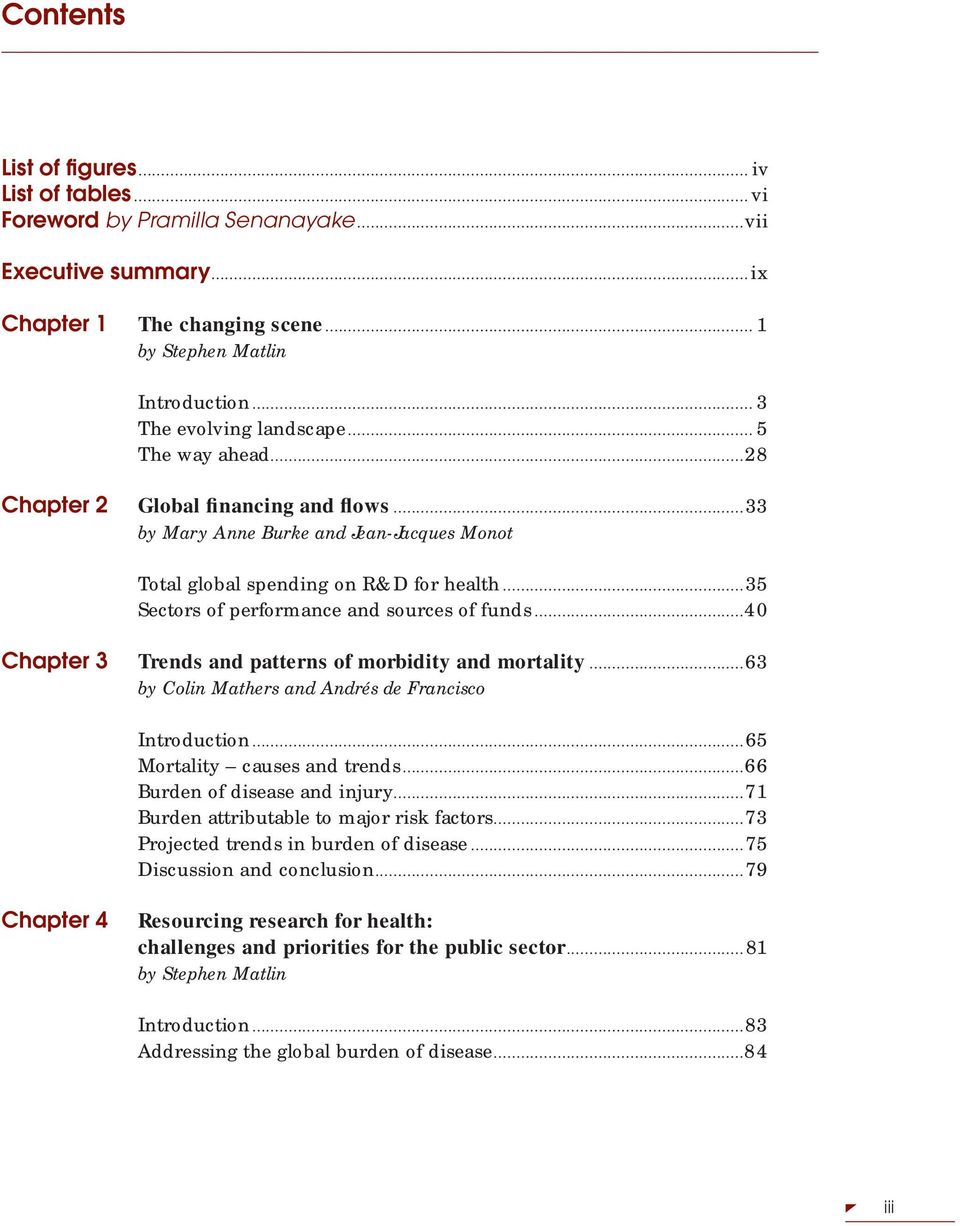
3 Contents List of figures... iv List of tables...vi Foreword by Pramilla Senanayake...vii Executive summary...ix Chapter 1 The changing scene... 1 by Stephen Matlin Introduction... 3 The evolving landscape... 5 The way ahead...28 Chapter 2 Global financing and flows...33 by Mary Anne Burke and Jean-Jacques Monot Total global spending on R&D for health...35 Sectors of performance and sources of funds...40 Chapter 3 Trends and patterns of morbidity and mortality...63 by Colin Mathers and Andrés de Francisco Introduction...65 Mortality causes and trends...66 Burden of disease and injury...71 Burden attributable to major risk factors...73 Projected trends in burden of disease...75 Discussion and conclusion...79 Chapter 4 Resourcing research for health: challenges and priorities for the public sector...81 by Stephen Matlin Introduction...83 Addressing the global burden of disease...84 iii
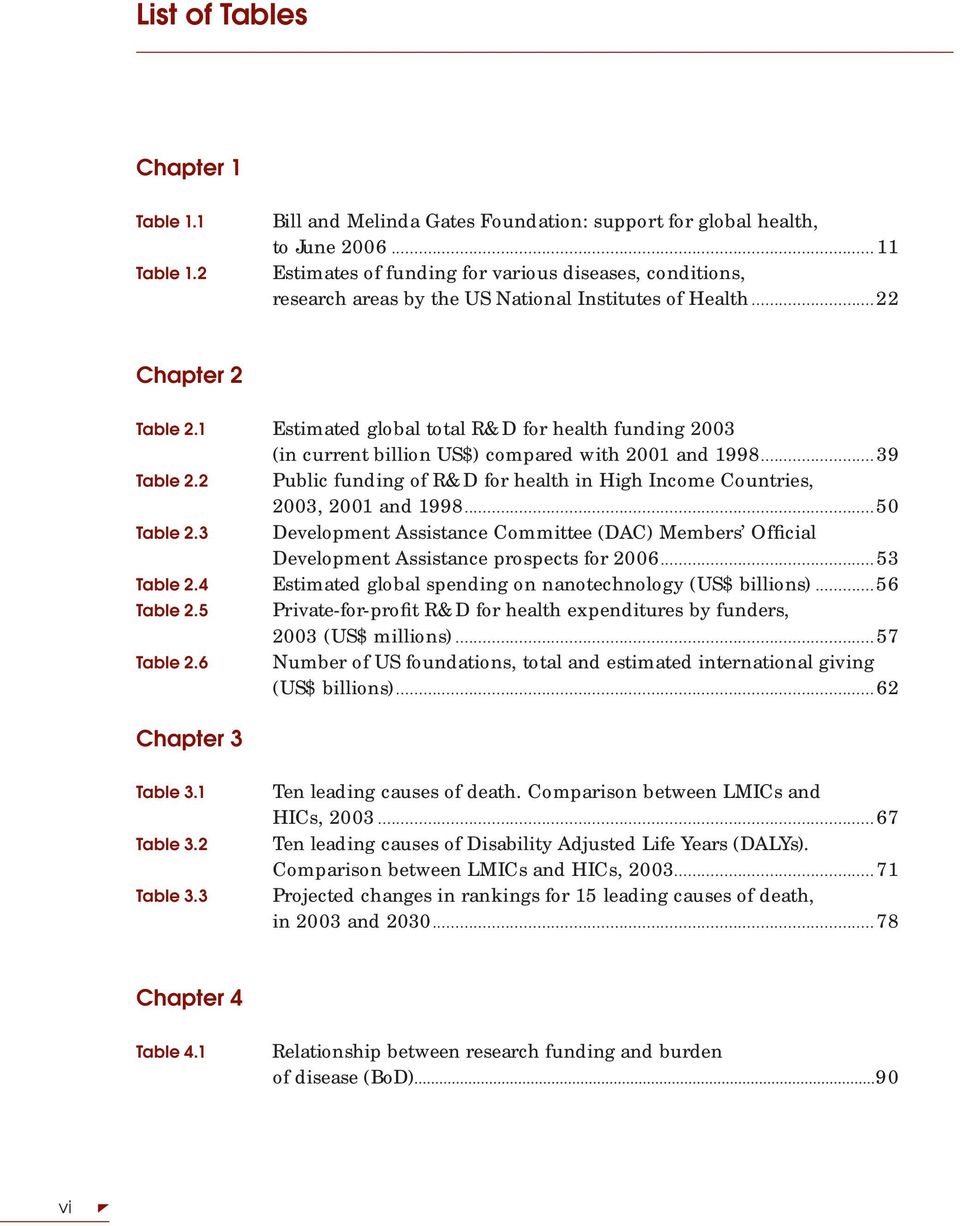
4 List of Figures Chapter 1 Figure 1.1 Priority diseases and conditions addressed by the Bill and Melinda Gates Foundation...11 Figure 1.2 Official Development Assistance in 2005 as a percentage of Gross National Income Figure 1.3 Additional Official Development Assistance required to meet 0.7% of Gross National Product...18 Figure Commitment to Development Index (aid effectiveness in 2005)...20 Figure 1.5 Government health expenditure as a percentage of total health expenditure...24 Figure 1.6 Economic strength and innovation capability Innovative Developing Countries...24 Chapter 2 Figure 2.1 Estimates of total expenditures on research for health (US$ billions)...35 Figure 2.2 Graphic representation of global research for health funding...36 Figure 2.3 Global total R&D expenditures, in constant 2000 US$ and current Purchasing Power Parity (PPP) adjusted US$...37 Figure 2.4 Annual R&D for health expenditures growth for High-Income Countries...40 Figure 2.5 Sectors of performance and sources of funds for health research, Figure 2.6 Estimates of R&D for health funding by sector, with and without taxpayers subsidies to industry, Figure 2.7 Global distribution of R&D for health expenditures, Figure 2.8 R&D for health and national R&D as a % of Gross Domestic Product...46 Figure 2.9 Strength of investments in R&D for health...48 Figure 2.10 R&D for health expenditures among OECD-reporting countries, in current and constant 2003 USD and Purchasing Power Parities (PPPs), 2001 and Figure 2.11 Distribution of Official Development Assistance...51 Figure 2.12 Development Assistance Committee (DAC) members total Official Development Assistance, at 2001 prices as a share of Gross National Income, Figure 2.13 Public funding of R&D for health as a % of public expenditure on health and of Gross Domestic Product, iv

5 Figure 2.14 Figure 2.15 Figure 2.16 Figure 2.17 Figure 2.18 Gap between actual and 2% target for public expenditure on research for health in Lower Middle Income Countries, 2003 estimates...55 Trends in pharmaceuticals R&D by US PhRMA companies (US$ millions)...58 Domestic R&D and R&D abroad, by PhRMA member companies, Basic research by pharmaceutical companies, as % of total R&D, 2003, (US$ millions)...59 Trends in health research funding, Bill and Melinda Gates Foundation, (US$ millions)...61 Chapter 3 Figure 3.1 Death rates by disease group and region in 1990 and 2003 for children aged 0-4 years...68 Figure 3.2 Death rates by disease group and region in 1990 and 2003 for adults aged years...70 Figure 3.3 Disability Adjusted Life Years (DALYs) per 1000 people in 2003, by region and cause...73 Figure 3.4 Burden of disease attributable to leading global risk factors, Figure 3.5 Baseline projections of deaths from Group I, Group II and Group III causes, world, Chapter 4 Figure 4.1 Figure 4.2 Figure 4.3 Figure 4.4 Figure 4.5 Health research spending by sectors (US$ millions) and % of annual total...83 United States National Institutes of Health (NIH) appropriations US-National Institutes of Health (NIH) funding for some infectious diseases Proportion of combined spending on health specific categories compared with Disability Adjusted Life Years (DALY) rates...88 UK-Medical Research Council (MRC) investment in global health research v

6 List of Tables Chapter 1 Table 1.1 Table 1.2 Bill and Melinda Gates Foundation: support for global health, to June Estimates of funding for various diseases, conditions, research areas by the US National Institutes of Health...22 Chapter 2 Table 2.1 Estimated global total R&D for health funding 2003 (in current billion US$) compared with 2001 and Table 2.2 Public funding of R&D for health in High Income Countries, 2003, 2001 and Table 2.3 Development Assistance Committee (DAC) Members Official Development Assistance prospects for Table 2.4 Estimated global spending on nanotechnology (US$ billions)...56 Table 2.5 Private-for-profit R&D for health expenditures by funders, 2003 (US$ millions)...57 Table 2.6 Number of US foundations, total and estimated international giving (US$ billions)...62 Chapter 3 Table 3.1 Table 3.2 Table 3.3 Ten leading causes of death. Comparison between LMICs and HICs, Ten leading causes of Disability Adjusted Life Years (DALYs). Comparison between LMICs and HICs, Projected changes in rankings for 15 leading causes of death, in 2003 and Chapter 4 Table 4.1 Relationship between research funding and burden of disease (BoD)...90 vi
7 Foreword The landscape of efforts to improve human health in developing countries has changed dramatically in recent years. There are new actors, new resources and funding channels, and new commitments to meet goals in health and development. Acknowledgement of the importance of health as a human right and as a determinant, outcome and central objective of development has been accompanied by a greater recognition of the vital roles that health research can and must play in achieving this objective. With the evolving landscape of new funds and initiatives for health come some important questions about health research. Where do the resources come from and how much is being spent? What is being funded? What priorities are being set, and by whom? Are the resources adequate for meeting current and predicted future health challenges as demographic and epidemiological patterns change across the world? As attention shifts from creating and delivering products and services that treat specific diseases and conditions towards learning more about the determinants of health and developing ways to promote and sustain it, are resources for health research becoming available to meet the needs? The Global Forum for Health Research regularly tracks the world s resources for health research and examines the information gathered in relation to the health challenges faced by developing countries. This year s report surveys the changing scene of global financing for health research and provides new estimates of the resources available and the patterns of ill-health for 2003, as well as projections of these patterns in It also examines the vital roles that the public sector across all countries must play in supporting health research, creating an enabling environment and strengthening research capacities to meet the present and future challenges. Pramilla Senanayake Chair of the Foundation Council Global Forum for Health Research

8 Executive summary The changing scene The 1990s saw a new awakening of interest in tackling global problems of poverty, development and health that culminated, in 2000, in governments committing to meet the Millennium Development Goals by The landscape has since become much more densely populated with a variety of actors engaged in efforts to improve health in developing countries. After a dip in the 1990s, Official Development Assistance (ODA) has significantly increased and many high-income countries have finally set timetables for raising the percentage of their gross national income devoted to ODA to the long-standing target of 0.7%. New funding sources such as the Bill and Melinda Gates Foundation have begun making very substantial contributions to tackling some of the most serious health problems in developing countries including high levels of infectious diseases and maternal and child mortality. Public-private partnerships, largely funded by philanthropic foundations, have begun creating a pipeline of potential vaccines, drugs, diagnostics and microbicides for infectious diseases of particular importance in developing countries, including HIV/ AIDS, tuberculosis (TB) and malaria. To ensure that these products can be bought for use in the poorest countries, new funding channels and initiatives have been developed, including the Global Fund to Fight AIDS, TB and Malaria, the President s Emergency Plan for AIDS Relief and the International Financing Facility for Immunization. Some developing countries have begun to make significant contributions to the process of innovation in health and health technologies, and industry is showing increasing willingness to engage in partnerships to ensure the availability and use of cheap, safe and effective drugs for a range of tropical infectious diseases. With these developments has come an increasing recognition of the vital roles that health research plays. These roles include uncovering the origins, determinants and biological processes involved in disease and ill health, creating and testing approaches to prevention and treatment, studying and evaluating factors that support or prevent the uptake and effectiveness of interventions, and providing evidence for policy-makers to use in setting and implementing their priorities. But a number of crucial issues now need to be addressed: Will the increases in resources for health research continue, eventually reaching the scale needed to ensure adequate financing for the full range of activities required, including product research and development (R&D) and research at country level to improve services, eliminate health inequities, elucidate the social determinants of health and provide evidence-based pathways to better health for all? Within this overall set of goals, will funding allocations take account of the changing epidemiological and demographic profiles of developing ix

9 countries, or remain concentrated on a few high-profile diseases and conditions? Will countries take up the challenge of building and resourcing national health research systems, to ensure that they create and systematically utilise research capacities as an integral part of their efforts to improve health? Will those countries that are rapidly developing their innovation capacities create legal frameworks and practical environments, including state investments where necessary, to ensure that innovation works to benefit the health of needy populations, rather than producing only expensive products for rich markets? Will the public sectors of all countries show the individual and collective commitments needed to finance the required spectrum of research for health research not only into disease states but also into the wider, underlying causes of ill health (e.g. social and other determinants of health that lie outside the health sector) and into developing a deeper understanding of the factors necessary for people to achieve and sustain overall good health and wellbeing? What the world spends on health research The Global Forum for Health Research has carried out a new assessment of how much the world is spending on health research. For 2003 the most recent year for which comprehensive data are available the total amount spent on R&D for health was US$ billion. This is a substantial increase compared with the Global Forum s estimate of US$ billion for The 2003 figure comprises three major components, with US$ 56.1 billion (45%) coming from the public sector, US$ 60.6 billion (48%) from the private for-profit sector and US$ 9.0 billion (7%) from not-for-profit organizations. This distribution between the three components is essentially unchanged from that in Spending among high-income countries (HICs) accounted for most of the increase globally and followed a similar distribution, with the public sector accounting for 43% of total spending on R&D for health, the private-for-profit sector for 47% and the private-not-for-profit sector for 7%. The private for-profit sector is estimated to be the largest investor in health research globally. Pharmaceutical companies accounted for 50% of overall funds for research for health in high-income countries and 32% in low- and middle-income countries. The private not-for-profit sector includes private universities, foundations and charities. It contributes approximately the same amount of funding in high-income countries (8%) and low- and middle-income countries (9%). Official Development Assistance (ODA) accounts for 7% of total health research funds in low- and middleincome countries (LMICs). Public sector contributions to global spending on health R&D are significant not only because of their size, but also because of the influence they have on the directions of basic and applied research. States bear the primary responsibility for the health and rights of their citizens and many are also signatories to international commitments on health. Governments are estimated to be the largest funders after the private sector, accounting in 2003 for 42% of overall health research funds in high-income countries and 59% in LMICs. Governments support research for health through their allocations to ODA, higher education and direct investments in R&D. x Executive Summary

10 Governments in HICs contributed US$ billion to health R&D in 2003, up from US$ 44.1 billion reported in 2001 and US$ 36.2 billion in 1998, excluding foreign ODA. The United States government was the biggest spender at US$ 33.8 billion and accounted for more than half of the total in these countries. Japan followed with US$ 5.6 billion, Germany US$ 3.2 billion, France US$ 3.1 billion, the United Kingdom US$ 2.2 billion, Italy US$ 2.0 billion and Canada US$ 1.7 billion. Together, the G7 countries invested more than 92% of publicly funded R&D for health in HICs, with all other HICs combined adding another US$ 4.4 billion. Few LMICs collect and report data on expenditures on research for health. Governments in those LMICs for which data are available spent at least US$ 2.4 billion on R&D for health in While this figure is down slightly from US$ 2.5 billion in 2001, the apparent decrease is due to incomplete reporting for LMICs in 2003, and does not reflect a real drop in R&D funding. Allocations to R&D for health by governments in LMICs are still relatively small. Only a few of such countries have met the target proposed by the 1990 Commission on Health Research for Development for expenditures on R&D for health to total at least two per cent of national health expenditures. Among LMICs, only Argentina and Brazil met this level in 2003, according to the data reported. The private not-for-profit sector has an increasingly strong commitment to R&D for health estimated at US$ 9.0 billion in 2003, up from US$ 8.0 billion in 2001 and US$ 6.0 billion in Almost all of this funding (US$ 8.6 billion) came from private foundations and universities in HICs for R&D carried out in these countries. In contrast, in 2003, domestic private foundations and universities in LMICs funded health research costing just US$ 0.08 billion (roughly the same amount as in 2001 and 1988). Foreign not-for-profit organizations, such as foundations and universities also provided US$ 0.3 billion for R&D for health in LMICs in 2003, a figure that has remained relatively stable since Foundations are substantively involved in key global and country level partnerships. This third sector creates institutional diversity, contributes to innovation, and adds an important actor to a field dominated by governments and markets. The financial contribution of private foundations to international development activities in recent years has been estimated at US$ 3 billion annually, although it was probably higher than that in 2000 and 2001 due to large contributions from the Gates Foundation. Global patterns in mortality and morbidity, Worldwide, 57.5 million people died in One third of these deaths were due to communicable, maternal, and perinatal conditions and nutritional deficiencies ( Group I in the Global Burden of Disease, or GBD, classification). This proportion has remained almost unchanged from Among Group I causes, HIV/AIDS accounted for 2% of deaths in 1990, but 17% in 2003, rising from 0.3 million deaths to 3.0 million in HIV/AIDS represented 5% of total global deaths in Excluding deaths due to HIV/AIDS, deaths due to Group I conditions fell from one-third of total deaths in 1990 to less than one-fifth in In all, 97% of the non-hiv/aids Group I deaths occurred in low- and middle-income countries. xi

11 Ischaemic heart disease (IHD) and cerebrovascular disease (stroke) were the leading causes of death in both HICs and LMICS in 2003, together responsible for more than 20% of all deaths worldwide. Four of the top 10 causes of death in the world are related to smoking (IHD, stroke, chronic obstructive pulmonary disease and lung cancer). Of the 7.3 million deaths from IHD worldwide, 1.4 million occurred in HICs. In all, 5.6 million people died of stroke, of which fewer than one million occurred in HICs. Lung cancer was the third leading cause of death in HICs, but was not among the top ten causes of death in LMICs, partly due to the prominence of other causes of death. In LMICs, five of the leading ten causes of death remain infectious diseases, including lower respiratory tract infections, HIV/AIDS, diarrhoeal diseases, TB and malaria. Nearly 20% of deaths (10 million) in 2003 were among children under five years of age. Enormous strides have been made since 1970 when over 17 million child deaths occurred. Nevertheless, today nearly all child deaths (99%) occur in LMICs, with over 40% in sub-saharan Africa alone. While some African countries have made considerable strides in reducing child mortality, the majority of African children live in countries where the survival gains of the past have been wiped out or even reversed, largely as a result of the HIV/AIDS epidemic. Child mortality (ages 0-4 years) declined between 1990 and 2003 in all regions of the world. These declines were around 30% or higher in high-income countries, in Latin America and the Caribbean, in the Middle East and North Africa, and in the LMICs of Europe and Central Asia. Death rates from communicable diseases and injuries have declined substantially in these regions, particularly for diarrhoeal and respiratory diseases. Almost half of all child deaths in 2003 were from five preventable and treatable conditions: acute respiratory infection, measles, diarrhoea, malaria, and HIV/AIDS. In Latin America and some Asian and Middle-Eastern countries, by 2003 conditions arising in the perinatal period, including birth asphyxia, birth trauma and low birth-weight replaced infectious diseases as the leading cause of death and became responsible for 20 36% of child deaths. Such a shift in the cause-of-death pattern has not occurred in sub-saharan Africa, where malaria, lower respiratory tract infections and diarrhoeal diseases continue to be the leading causes of death in children, accounting for 50% of all deaths. HIV/AIDS is now responsible for over 300,000 child deaths in sub-saharan Africa nearly 7% of all child deaths in the region. Mortality from diarrhoeal diseases fell from 2.4 million deaths in 1990 to about 1.6 million deaths in 2003 reflecting the substantial efforts in diarrhoea case management (e.g. using oral rehydration therapy). Deaths from measles also declined, most likely because of higher vaccination coverage. Death rates from acute respiratory infections declined less in South Asia and Sub-Saharan Africa than in other regions. Malaria mortality appears to have increased during the 1990s, primarily in sub-saharan Africa. Noncommunicable diseases ( Group II in the GBD classification) are now responsible for more than half of adult (aged 15 59) deaths in all regions except South Asia and sub-saharan Africa where Group I conditions, including HIV/AIDS, remain responsible for one-third and two-thirds of deaths, respectively. In LMICs, year xii Executive Summary
12 old adults face a 30% greater risk of death from non-communicable diseases than their counterparts in HICs. Despite the burden of communicable diseases in adults declining globally, HIV/AIDS has become the leading cause of mortality among adults aged 15 59, responsible for 2.5 million deaths or 15% of global deaths in this age group. HIV/ AIDS deaths are responsible for a slightly larger proportion of deaths than ischaemic heart disease and cerebrovascular disease combined, and for more than twice as many deaths as road traffic accidents in that age group. Road traffic accidents are the fourth leading cause of death in adults aged years, and three-quarters of these deaths are of men. Suicide and violence (homicide) are also among the top ten causes of death in adults aged years. Together with war, intentional injuries account for nearly one in 10 deaths in this age range globally. In 2003, five communicable diseases were among the leading ten contributors to the burden of disease in LMICs. Apart from road traffic accidents, the leading causes in HICs consisted entirely of noncommunicable diseases, including three diseases (unipolar depressive disorders, adult-onset hearing loss, and alcohol use disorders) with few direct deaths but large disability. Worldwide, there was a 20% reduction in the per capita disease burden due to communicable, maternal, perinatal and nutritional conditions between 1990 and Without the HIV/AIDS epidemic and the associated persistence of TB, this reduction would have been closer to 30%. Lost years of full health per capita (as measured by the disability-adjusted life year, or DALY) for LMICs are double those for HICs. The burden of disease is more than four times higher in Africa than in HICs, and just over twice as high in India as in HICs. People in Africa and India comprised one third of the world s population and together bore 53% of the total global burden of disease in Around 45% of the disease burden in LMICs is now from noncommunicable diseases, a rise of 10% in its relative share since Ischaemic heart disease and stroke are the largest sources of this burden, especially in the low- and middle-income countries of Europe and Central Asia where they account for 21% of the total disease burden. Injuries accounted for 17% of the disease burden in adults aged years in In Latin America and the Caribbean, the Middle East and North Africa, and Europe and Central Asia, more than one quarter of the entire burden of disease among men aged 15 to 44 years was from injuries. Violence is the third leading cause of burden in Latin America and Caribbean countries The World Health Organization (WHO) undertook recently a major analysis to provide reliable data on the mortality and burden of disease attributable to 26 major risk factors, across all regions of the world, using comparable methods and a common currency (the DALY) for health outcomes. This analysis limited itself to proximal risk factors, thereby excluding distal risk factors such as poverty and others. The regional distribution of the burden of disease attributable to 20 risk factors is summarized here. One-fifth of the global disease burden can be attributed to the effects of under-nutrition. The five leading global risks causing burden of disease are being underweight due to malnutrition, unsafe sex, raised blood xiii

13 pressure, tobacco smoking and alcohol. Risks are extraordinarily concentrated in low income countries, and relatively few risks are responsible for a considerable proportion of the burden of disease. For example, almost 15% of the total burden of disease in India and Africa is attributed to under-nutrition and being underweight. The burden from these risks alone exceeds that of the high income countries entire disease and injury burden. Unsafe sex is the second leading risk in LMICs, and in Africa accounts for almost one-fifth of the disease burden. In HICs, tobacco is the leading risk factor, accounting for 12% of the disease burden. Alcohol and blood pressure are responsible for 7-8% of healthy life years lost, with cholesterol and being overweight accounting for 5-6%. LMICs now face a double burden of disease from risk factors and diseases of poverty and lack of development, as well as the chronic diseases associated with smoking, overweight, diet and physical inactivity. Almost one half (47%) of all deaths in the year 2002 can be attributed to the 20 leading risk factors, when joint effects are taken into account. More than two-fifths (42%) of global deaths can be attributed to the leading 10 risk factors, and almost one third to the leading five. These top five risk factors are responsible for one quarter of the total loss of healthy years of life globally. The role of established risk factors is much greater than commonly thought, and the causes are known for more than two-thirds of major diseases, such as ischaemic heart disease, stroke, diabetes, HIV/AIDS. The potential is huge for improving health and reducing mortality through research to develop cost-effective interventions that reduce a relatively small number of risks. WHO has prepared updated projections of future trends for mortality and burden of disease from 2002 to 2030, based largely on projections of economic and social development, and using the historically observed relationships of these with causespecific mortality rates. Separate projections for HIV/AIDS mortality were prepared by UNAIDS and WHO, under a scenario in which coverage with anti-retroviral drugs reaches 80% by 2012, thereafter remaining constant, and assuming that there are no changes to current transmission rates due to increased prevention efforts. Large declines in mortality between 2002 and 2030 are projected for all of the main Group I causes with the exception of HIV/ AIDS. Total deaths due to other Group I causes are predicted to decline from 15.5 million in 2002 to nine million in Unfortunately, this would be substantially offset by the projected doubling in HIV/ AIDS mortality from the current annual toll of three million deaths. Avoiding this scenario must remain a major global health priority. Although age-specific death rates for most Group II conditions are projected to decline, as populations age over the next thirty years there will be a significant increase in total deaths due to most of these conditions. Global cancer deaths are projected to increase from 7.3 million in 2003 to 11.5 million in 2030, and global cardiovascular deaths from 17 million in 2003 to 23.3 million in Overall, Group II conditions will account for almost 70% of all deaths in 2030 under the baseline scenario. Major failures with tobacco and obesity control efforts could dramatically alter this prediction, as was seen in several industrialized countries in the 1950s and 60s. xiv Executive Summary

14 The projected 40% increase in global deaths due to injury between 2003 and 2030 is largely due to rising numbers of road traffic accidents, together with increases in population numbers more than offsetting small declines in age-specific death rates for other causes of injury. Road traffic accident deaths are projected to increase from 1.2 million in 2003 to 2.1 million in 2030, primarily associated with economic growth in LMICs. The three leading causes of burden of disease in 2030 are projected to include HIV/AIDS, unipolar depressive disorders and ischaemic heart disease. HIV/AIDS becomes the leading cause of burden of disease in middle-income countries, as well as low-income countries, by For some causes, projected changes in disease burden over the next 30 years are likely to result in dramatic changes in global importance. Lower respiratory tract infections and diarrhoeal diseases are expected to fall to 9th and 13th place in the global DALYs league table, from 2nd and 5th place respectively in Malaria is also expected to decline in relative importance, as are congenital anomalies. Conversely, by 2030, HIV/AIDS is expected to be the leading global cause of DALYs, followed by depression, ischaemic heart disease, chronic obstructive pulmonary disease and perinatal conditions. This rather diverse set of conditions will require very flexible and innovative responses from health systems worldwide in order to avoid what are largely avoidable or treatable conditions. Further research will help to focus these disease control efforts. These projections predict a dramatic shift in the distribution of deaths from younger to older ages and from communicable, maternal, perinatal and nutritional causes to non-communicable disease causes. The risk of death for children aged under five is projected to fall by nearly 50% between 2003 and Total tobacco-attributable deaths are projected to rise from 5.4 million in 2005 to 6.4 million in 2015 and 8.3 million in Tobacco is projected to kill 50% more people in 2015 than HIV/AIDS, and to be responsible for 10% of all deaths globally. The information presented can be summarized as follows: Mortality estimates are higher in LMICs than HICs, and people in LMICs die younger than in HICs. There is large mortality variation between LMICs: China has a higher mortality of populations above 60 years while in Africa younger populations die prematurely, a large proportion being of young children and caused by infectious diseases. Deaths due to noncommunicable diseases are highly prevalent in LMICs. Contrary to common belief, noncommunicable diseases play a key role in the disease burden in many LMICs, with rates comparable to those in HICs (two-thirds of the burden in China). Conversely, in Africa infectious diseases are predominant. Trends over time reflect increases in infectious diseases in Africa and increases in noncommunicable diseases in other LMICs. A large proportion of the disease and injury burden attributable to risk factors is preventable. Burden of disease estimates reflect, in contrast with mortality estimates, the importance of noncommunicable diseases in LMICs other than African nations. Disease burden captures not only premature death but also years living with disability. As such, xv

15 the weight of conditions before death can be quantified. While some of this disease burden can be averted through known interventions, applying and scaling up such interventions in LMICs is not straight forward. Research can help in identifying tools and programmatic pathways to put knowledge into action. The public sector and research for health Overall, resourcing the research that will lead to significant health benefits in developing countries will require greater effort by the public sector across the world. Some key points emerge regarding crucial public sector actions on resources and policy needed to achieve the necessary levels of resources and ensure that they are deployed effectively: Public sector in high-income countries should: give greater priority in national research programmes, such as those funded through the United Kingdom s Medical Research Council and the National Institutes of Health in the United States of America, to basic research on diseases endemic in poor countries; ensure the inclusion of more health research in development programmes funded through bilateral and multilateral channels at least achieving the target of 5% of health aid being earmarked for research and for strengthening research capacity; give greater support to product development partnerships creating drugs, vaccines and microbicides; and support research into the social, economic and political determinants of health and into finding ways to give all people the opportunity to be healthy. Public sector in low- and middle-income countries should: commit greater resources to health research at least achieving the target that an amount equal to 2% of government spending on health is allocated to research and to strengthening research capacity; engage with stakeholders including researchers and communities in setting priorities for research based on health needs, using a broad definition of health; develop funding streams and policy environments that foster capacity building across all aspects of research for health; develop and strengthen national health research systems that ensure that research capacities are effectively utilized on priority research and that results are translated into policy and action; and support the development of innovation systems that will enable new industries to produce the products needed to address endemic diseases and conditions. xvi Executive Summary

16 Chapter 1 The changing scene
17 The changing scene 1.1 Introduction The first decade of the 21st century may well be seen, with hindsight, as a turning point in the history of health research a decade in which a wide range of policy-makers, funders and researchers began to appreciate the contributions that health research can and must make to improving the health of populations in all countries; and a decade in which the resources to ensure that this potential benefit is achieved began to become more readily available both globally and nationally. Having now passed the mid-point of this decade, it is a good time to review the milestones that have been reached, take stock of the current landscape and consider the directions in which recent developments are pointing. In this context, the decade opened with the International Conference on Health Research for Development in Bangkok in September The Council on Health Research for Development (COHRED) initiated the conference in collaboration with the Global Forum for Health Research, WHO and the World Bank to review the status of health research 10 years after the Commission on Health Research for Development published its findings and recommendations in The commission s report, Health Research: Essential link to equity in development 1, made the observation that health research was significantly skewed towards diseases that affected the developed world. The commission estimated that only 5% of global spending on health research in 1986 was devoted to health problems in developing countries, where 93% of the world s burden of preventable mortality occurred. Later in the 1990s, while the size of the imbalance had become increasingly more complex and difficult to measure quantitatively, the term 10/90 gap began to be used as a shorthand reference to the issue. It has come to symbolise the gross mismatch between needs and investments in health research for development. 2 The Commission made four main recommendations to reduce this imbalance: 1) all countries, no matter how poor, should invest at least some resources in conducting essential national health research and, in the long-term, in building and sustaining capacity for health research; 2) productive research partnerships should link national health research efforts in developing and developed countries; 3) greater and more sustained funding for health research should be made available internationally; and 4) an international mechanism should be set up to monitor progress and promote financial and technical support for research on health problems of developing countries. The Commission s report resulted, in 1993, in the establishment of COHRED, which initially focused on working at countrylevel to promote the production and use of essential national health research. Further efforts to draw attention to the continuing health research gap were made by The changing scene 3

18 the Ad Hoc Committee on Health Research Relating to Future Intervention Options, created under the auspices of WHO in Its 1996 report 3 asserted a continuing conviction that research and development (R&D) had a vital role to play in the prevention and treatment of health problems, and that more resources were required for the whole spectrum from biomedical to health policy research. It highlighted that a new set of threats to health had joined the familiar problems of infection and malnutrition in developing countries, and predicted that noncommunicable diseases would become the leading causes of disability and premature death within 25 years. At the same time, HIV/AIDS and drugresistant strains of major pathogens were becoming global challenges. The committee recommended that a forum for investors in international health R&D should be formed to provide a mechanism to review the needs and opportunities for global health R&D making use of analytical data on disease burden, on R&D opportunities and on the level of ongoing efforts to help focus resources more sharply on the highest priorities. In 1997, parties interested in health research including donors, development agencies and health research leaders met and launched the Global Forum for Health Research, which began formal operations in January The Global Forum s overall objective is to help focus research efforts on the health problems of the poor through improvement in the allocation of research funds, support of better priority setting processes and methodologies, promotion of relevant research, support for concerted efforts in health research and dissemination of research findings. By the time of the Bangkok conference in 2000, 4 it was clear that the landscape of health research for development was poised for major changes. As noted by the Commission, the previous decade had opened dismally, with very few resources devoted to the field and very few actors engaged in it: In the area of communicable diseases, the UNICEF/UNDP/World Bank/WHO Special Programme for Research and Training in Tropical Diseases (TDR) was the only significant global effort. It was complemented by research sponsored by a handful of nationally-based programmes with an international focus on infectious diseases. These included those of the National Institutes of Health (NIH) and Walter Reed Army Institute for Research in the United States of America, the Medical Research Council and Wellcome Trust in the United Kingdom, the French INSERM and Pasteur Institutes, and tropical research institutes in countries such as Belgium, the Netherlands and Switzerland. Similarly, while the area of family planning was recognized to be of vital importance for developing countries, the UNDP/UNFPA/WHO/World Bank Special Programme for Research, Development and Research Training in Human Reproduction (HRP) was the leading but greatly under-resourced global effort. It was complemented by the Program for the Introduction and Adaptation of Contraceptive Technology/ Program for Appropriate Technology in Health (PIACT/PATH) and research programmes and institutes working on reproduction and contraception in a handful of developed and developing countries. Funding for these limited national and international efforts came mainly from multilateral organizations (such as the World Bank, UNDP, UNFPA, WHO), the 4 Chapter 1

19 governments of some member states of the Organization for Economic Cooperation and Development and a small number of philanthropic foundations (e.g. Rockefeller, Ford, McArthur, Mellon). There was a striking absence of significant interest on the part of the private sector in becoming involved in areas such as tropical (or other neglected) diseases and contraception an outstanding exception being Merck s donation of ivermectin to treat river blindness 5 so that support for product development was almost entirely left to the public and philanthropic sectors. Few governments of developing countries were investing significantly in health research for their own essential national needs, prompting the Commission on Health Research for Development to recommend 1 that governments devote at least 2% of the health budget to research and to strengthening research capacity, with 5% of donor support to health in these countries being similarly allocated. But the decade closed with an evolving landscape that was beginning to be more densely populated with a diverse array of actors, including new advocates for health research for development such as COHRED and the Global Forum, new philanthropic actors in particular the Bill and Melinda Gates Foundation, created in 2000 and an explosive growth in health product development partnerships 6 such as the International AIDS Vaccine Initiative and Medicines for Malaria Venture. Development assistance partners had begun to focus on improving health as an indispensable aspect of development; and several pharmaceutical giants were becoming involved in largescale drug donation programmes. 1.2 The evolving landscape This diversification of the landscape has continued at an increasing pace during the opening years of the 21st century and a number of important milestones have been passed since At the global level, there has been emphatic recognition of the challenges in tackling major health problems and, most importantly, of the need to create effective instruments to address them. The Millennium Development Goals (MDGs) were formulated in 2000 following a series of international agenda-setting conferences including two with a major health component the International Conference on Population and Development (Cairo, 1994) 7 and the Fourth World Conference on Women (Beijing, 1995) 8. The MDGs have been criticized in some quarters for being too limited in ambition, too narrowly focused on a few issues and lacking in explicit reference to the vital area of sexual and reproductive health. Nevertheless, they have galvanized efforts to tackle some major health problems (including maternal and child mortality and communicable diseases) and there are now substantially greater resources available to ensure people have access to pharmaceuticals they need: The changing scene 5
20 Following efforts by the G8, the European Commission and the United Nations, the Global Fund to Fight AIDS, Tuberculosis and Malaria was launched in Its aim is to raise money from governments, businesses and individuals worldwide and channel it into grant programmes. By the end of 2005, the Global Fund had disbursed a total US$ 1.9 billion in grants; 384,000 people had begun antiretroviral therapy through Global Fund-supported programmes (nearly triple the number of recipients funded one year earlier); programmes to combat malaria had distributed 7.7 million insecticide-treated bed nets (a 150% increase in six months); and tuberculosis (TB) programmes had detected and treated more than one million TB cases (a 67% increase from May 2005). By mid- 2006, the Global Fund had approved a total of US$ 5.5 billion in allocations to nearly 400 grants in 132 countries. 9 In parallel, the United States of America announced the President's Emergency Plan for AIDS Relief (PEPFAR) in It is providing US$ 15 billion in funding over five years to combat HIV/AIDS in more than 120 countries. By the end of March 2006, PEPFAR had supported antiretroviral therapy for men, women, and children through bilateral programmes in 15 of the most afflicted countries in Africa, Asia, and the Caribbean. 10 The Global Fund and PEPFAR have been complemented by the 3x5 Initiative launched by the Joint United Nations Programme on HIV/AIDS (UNAIDS) and WHO in It aimed to provide three million people living with HIV/AIDS in low- and middle-income countries (LMICs) with antiretroviral therapy by the end of While this specific target was not achieved (by mid-2005, around 1 million people in LMICs were receiving antiretroviral therapy), the initiative was an important step towards the goal of making HIV/AIDS prevention and treatment universally accessible for all who need them, as a human right. 11 Pre-dating the MDGs, but given additional impetus by their targets, is the GAVI Alliance (formerly known as the Global Alliance for Vaccines and Immunization) a public-private partnership formed in 1999 with the mission of ensuring that every child in the world will be protected against vaccine-preventable diseases. At present, roughly one child in four receives no vaccinations and the gap between the vaccines readily available to children in the poorest countries and to those in the industrialized world is growing, with the result that almost 3 million people, the majority children, still die annually from diseases that could be prevented with available vaccines. The GAVI Alliance works to close this gap through a global network of partners, including national governments, UNICEF, WHO, the World Bank, the Bill and Melinda Gates Foundation, the vaccine industry, public health and research institutions, and nongovernmental organizations. The GAVI Fund now has over U$ 3 billion in commitments over the next ten years. 12 As major new resources have begun to be made available to address some of the high priority health problems faced by poor countries and as programmes to apply these resources have begun to be implemented, there has been a growing recognition of the essential roles that health research is required to play in the processes of creating, refining, adapting, monitoring and evaluating health initiatives. The Commission on Macroeconomics and Health (CMH) was launched by WHO 6 Chapter 1

21 Director-General Gro Harlem Brundtland in January 2000, to analyse the impact of health on development and examine the appropriate modalities through which health related investments could have a positive impact on economic growth and equity in developing countries. Its report 13 recommended measures designed to maximize the beneficial effects of health sector investment on poverty reduction and economic development. These included increases in funding for health and development by both donors and developing countries. The CMH also recognized the vital role that research plays and called for a significant scaling up of financing for global R&D on the heavy disease burdens of the poor (see Box 1.1), to be fi nanced through a new funding channel (see Box 1.2). Box 1.1 The vital role of health research A sound global strategy for health will also invest in new knowledge. One critical area of knowledge investment is operational research regarding treatment protocols in low-income countries. There is still much to be learned about what actually works, and why or why not, in many low income settings, especially where interventions have not been used or documented to date. Even when the basic technologies of disease control are clear and universally applicable, each local setting poses special problems of logistics, adherence, dosage, delivery, and drug formulation that must be uncovered through operational research at the local level. We recommend that as a normal matter, country-specific projects should allocate at least 5 percent of all resources to project-related operational research in order to examine efficacy, the optimization of treatment protocols, the economics of alternative interventions, and delivery modes and population/patient preferences. There is also an urgent need for investments in new and improved technologies to fight the killer diseases. Recent advances in genomics, for example, bring us much closer to the long-sought vaccines for malaria and HIV/AIDS, and lifetime protection against TB. The science remains complex, however, and the outcomes unsure. The evidence suggests high social returns to investments in research that are far beyond current levels. Whether or not effective vaccines are produced, new drugs will certainly be needed, given the relentless increase of drug-resistant strains of disease agents. The Commission therefore calls for a significant scaling up of financing for global R&D on the heavy disease burdens of the poor. We draw particular attention to the diseases overwhelmingly concentrated in poor countries. For these diseases, the rich-country markets offer little incentive for R&D to cover the relatively few cases that occur in these rich countries. We also stress the need for research into reproductive health - for example, new microbicides that could block the transmission of HIV/AIDS and improved management of life-threatening obstetric conditions. We need increased investments in other areas of knowledge as well. Basic and applied scientific research in the biomedical and health sciences in the low-income The changing scene 7
22 countries needs to be augmented, in conjunction with increased R&D aimed at specific diseases. The state of epidemiological knowledge who suffers and dies and of which diseases must be greatly enhanced, through improved surveillance and reporting systems. In public health, such knowledge is among the most important tools available to successful disease control. Surveillance is also critically needed in the case of many NCDs, including mental health, the impact of violence and accidents, and the rapid rise of tobacco and diet/nutrition-related diseases. Finally, we need a greatly enhanced system of advising and training throughout the low-income countries, so that the lessons of experience in one country can be mobilized elsewhere. The international diffusion of new knowledge and best practices is one of the key forces of scaling up, a central responsibility of organizations such as the World Health Organization and the World Bank, and a goal now more readily achieved through low-cost methods available through the internet. Extract from the report of the Commission on Macroeconomics and Health. 13 Box 1.2 Proposed new fi nancing for health research To help channel the increased R&D outlays, we endorse the establishment of a new Global Health Research Fund (GHRF), with disbursements of around $1.5 billion per year. This fund would support basic and applied biomedical and health sciences research on the health problems affecting the world s poor and on the health systems and policies needed to address them. Another $1.5 billion per year of R&D support should be funded through existing channels. These include the Special Programme for Research and Training in Tropical Diseases (TDR), the Initiative for Vaccine Research (IVR), the Special Programme of Research, Development and Research Training in Human Reproduction (HRP) (all housed at WHO) and the public-private partnerships for AIDS, TB, malaria, and other disease control programs that have recently been established. In both cases, the predictability of increased funding would be vital, as the necessary R&D undertakings are long-term ventures. The existing Global Forum for Health Research could play an important role in the effective allocation of this overall assistance. To support this increased research and development, we strongly advocate the free internet-based dissemination of leading scientific journals, thereby increasing the access of scientists in the low-income countries to a vital scientific research tool. Extract from the report of the Commission on Macroeconomics and Health Chapter 1
23 The WHO Commission on Intellectual Property Rights, Innovation and Public Health (CIPIH) was set up in February 2004 to collect data and to analyse how incentives and funding mechanisms may be created for research into, and the development of, new diagnostics, vaccines and medicines for diseases that disproportionately affect developing countries. Its report 14 noted that recent developments had created real momentum for change but cautioned against complacent thinking that current efforts are yet sufficient, or commensurate with the scale of suffering. CIPIH saw continuing innovation to be crucial but recognized that it would be pointless without favourable conditions for poor people in developing countries to access existing, as well as new, products. Intellectual property rights (IPR) are important, but as a means not an end, with their relevance in the promotion of the needed innovation depending on context and circumstances. CIPIH considered that IPR can do little to stimulate innovation in the absence of a profitable market for the products of innovation, a situation which can clearly apply in the case of products principally for use in developing country markets. In successive phases of the innovation cycle from fundamental research to the discovery, development and delivery of new products the multiplicity of financial and other incentive mechanisms, and the scientific and institutional complexities of biomedical innovation have to be considered. In each phase, IPR may play some role in facilitating the innovation cycle, but other incentive and financing mechanisms to stimulate R&D of new products are equally necessary, along with complementary measures to promote access. CIPIH concluded that, in spite of the progress made in the past decade, the basis for continued progress in the development of new products needed by developing countries remains fragile. To assure sustainability, and guarantee that medicines, vaccines and diagnostics produced reach the people who need them, additional efforts are needed. Much more must be done to increase the funds available on a sustainable basis and to promote synergy among different partners. Governments have the major responsibility to mobilize funds and promote new financing and incentive mechanisms to meet the goals. An important development that coincided with the publication of the CIPIH report was that Brazil and Kenya sponsored a resolution 15 on R&D at the January 2006 Executive Board of the WHO. The resolution was later debated at the May 2006 World Health Assembly, resulting in the establishment of a working party to consider how to stimulate and reward innovation in health research for product development that will benefit poor countries. At the same time, WHO has been making efforts to consolidate and clarify its own role and responsibilities in health research. 16 The WHO Commission on Social Determinants of Health was created in March 2005 to draw the attention of governments, civil society, international organizations, and donors to pragmatic ways of creating better social conditions for health. It brings together leading scientists and practitioners to provide evidence on policies that improve health by addressing the social conditions which people live and work. The commission s main goals are: to support policy change in countries by promoting models and practices that address effectively the social determinants of health; to support countries in making health a shared goal to which many government departments and sectors of society contribute; The changing scene 9
24 to help build a sustainable global movement for action on health equity and social determinants, linking governments, international organizations, research institutions, civil society and communities. While these global initiatives have addressed diverse aspects of the overall framework affecting access to basic health services and essential products, there has also been a new impetus given to financing health research for the needs of developing countries. Thus, although no significant moves have been made to create a single global research fund on the scale recommended by the Commission on Macroeconomics and Health, several separate funding channels are substantially increasing the flow of investments into the field. Three elements of this are noteworthy: an overall growth in funding for health research, especially research related to product development for tropical and other neglected diseases; attention by national institutions, such as research councils and institutes of health, to priority health problems of LMICs; and a growing interest in tracking funding allocations and estimating funding needs. At the end of 2003, Business Week Magazine documented the unprecedented growth in philanthropic giving that was taking place in the United States of America. 17 It listed the 50 most generous philanthropists, headed by the Bill and Melinda Gates Foundation, who were collectively responsible for donations of more than US$ 50 billion during the previous five years a significant proportion of this going to health and related areas. The magazine noted the rise of a new conception of responsible philanthropy, characterized by a demand for measurable results, efficiency, and transparency, that was bringing a businesslike rigor to philanthropy. In addition, many of the leading givers are handing over the bulk of their fortunes to be used during their own lifetimes to tackle the worst problems plaguing society, instead of making promises to be fulfilled by bequest on their deaths. With an endowment of US$ 29.2 billion, the Bill and Melinda Gates Foundation (Gates Foundation) has already committed US$ 10.5 billion to development projects since its inception in In the health field, the foundation focuses on accelerating access to existing vaccines, drugs, and other tools to fight diseases that disproportionately affect developing countries, and supports research to discover new health solutions that are effective, affordable, and practical for use in such countries. Key criteria for the foundation s grant-making are diseases and conditions that (a) cause the greatest illness and death in developing countries (b) represent the greatest inequities in health between developed and developing countries and (c) receive inadequate attention and resources (see Figure 1.1). Grants allocated by the Gates Foundation s global health programmes up to June 2006 totalled US$ 6.5 billion (Table 1.1). 10 Chapter 1
25 Figure 1.1 Priority diseases and conditions addressed by the Bill and Melinda Gates Foundation 18 Total Global Health Burden (DALYs*) Foundation Focus (DALYs*) Acute lower respiratory infections 91,374,000 Non communicable conditions 687,815,000 Communicable diseases not addressed by the foundation 45,878,000 Injuries 181,991,000 Diseases and conditions addressed by the foundation 38% of the global health burden HIV/AIDS 84,458,000 Acute diarrheal illness 61,966,000 Vaccine-preventable diseases 43,650,000 Malaria 46,486,000 Tuberculosis 46,486,000 Malnutrition and undernutrition 34,417,000 Reproductive & maternal health 33,632,000 Child health 97,335,000 Other health conditions 36,389,000 * Disability-Adjusted Life Years Lost Table 1.1 Bill and Melinda Gates Foundation: support for global health, to June Global health programmes Amount, US$ HIV, TB and Reproductive Health Infectious Diseases Global Health Strategies Global Health Technologies Global Health Research, Advocacy and Policy Total The changing scene 11
26 As part of its overall effort, the Gates Foundation has partnered with the Canadian Institutes of Health Research, the Foundation for the National Institutes of Health, and the Wellcome Trust to develop fourteen grand challenges in global health research, which focus on the needs of developing countries (Box 1.3). By mid-2006, the initiative had offered 43 grants totalling US$ million to teams of scientists working in 33 countries on a broad range of innovative research projects. 20 Box 1.3 Fourteen Grand Challenges in Global Health An initiative of the Bill and Melinda Gates Foundation, the Canadian Institutes of Health Research, the Foundation for the National Institutes of Health and the Wellcome Trust, with seven long-term goals to improve health in the developing world: Improve childhood vaccines 1: Create effective single-dose vaccines 2: Prepare vaccines that do not require refrigeration 3: Develop needle-free vaccine delivery systems Create new vaccines 4: Devise testing systems for new vaccines 5: Design antigens for protective immunity 6: Learn about immunological responses Control insects that transmit agents of disease 7: Develop genetic strategy to control insects 8: Develop chemical strategy to control insects Improve nutrition to promote health 9: Create a nutrient-rich staple plant species Improve drug treatment of infectious diseases 10: Find drugs and delivery systems to limit drug resistance Cure latent and chronic infection 11: Create therapies that can cure latent infection 12: Create immunological methods to cure latent infection Measure health status accurately and economically in developing countries 13: Develop technologies to assess population health 14: Develop Versatile Diagnostic Tools 12 Chapter 1
27 Considerably more philanthropic funds will be available to support global health research in the coming years, following Warren Buffett s announcement 21 that from 2006 he would begin contributing the bulk of his US$ 44 billion assets to the Gates Foundation. Philanthropic foundations took the lead in the creation of a large number of publicprivate partnerships (PPPs) in the health field, some of which have focused on the creation of new drugs, vaccines, diagnostics and microbicides to address neglected diseases mainly endemic in developing countries. 6 In particular, the Rockefeller Foundation made major and innovative contributions to this field, fostering the creation of the International AIDS Vaccine Initiative (IAVI), which became an independent legal entity in IAVI was followed by other ventures launched after incubation by the Rockefeller Foundation. These include the Global Alliance for Tuberculosis Drug Development (TB Alliance) in 2000, the International Partnership for Microbicides (IPM) in 2001 and the Pediatric Dengue Vaccine Initiative (PDVI) in These and other initiatives also benefited from funding from the Bill and Melinda Gates Foundation, which included support for the Medicines for Malaria Venture (MMV) Sequella Global TB Vaccine Foundation, the Tuberculosis Diagnostics Initiative (the antecedent of the Foundation for Innovative New Diagnostics, FIND), the Institute for OneWorld Health, the Human Hookworm Vaccine Initiative (HHVI) and the Malaria Vaccine Initiative (MVI). The Rockefeller Foundation also created two additional initiatives to help facilitate and catalyse efforts to ensure more attention to products for neglected diseases. The Initiative on Public-Private Partnerships for Health 22 (IPPPH) and the Centre for the Management of Intellectual Property in Health Research and Development 23 (MIHR). IPPPH operated from 2000 to 2004 under the auspices of the Global Forum for Health Research. Its role was to monitor, analyse, and support the emerging field of public-private collaborations. It focused on partnerships targeting diseases predominantly affecting poor populations in developing countries, and those where the pharmaceutical or other health product companies were significant participants. MIHR was set up in 2002 on the premise that improved management of innovation and intellectual property by the public sector can make an important contribution to the goal of improving the availability of health products needed by the poorest in developing countries. As IPPPH noted, 24 public-private partnerships were already a known concept in the mid 1990s, but many of the new entities emerging since then (see Box 1.4) were distinguished by an important and novel aspect: instead of focusing on identifying and developing a single candidate, they adopted a portfolio approach that was more characteristic of industry, creating and managing a pipeline of several candidates for each targeted disease to manage the risks of failure and improve the chances of a successful outcome. The changing scene 13
28 Box 1.4 Examples of product development initiatives taking a portfolio approach HIV/AIDS International AIDS Vaccine Initiative (IAVI) South African AIDS Vaccine Initiative (SAAVI) Global Microbicide Project (GMP) International Partnership for Microbicides (IPM) Microbicide Development Project (MDP) Malaria Medicines for Malaria Venture (MMV) Malaria Vaccine Initiative (MVI) European Malaria Vaccine Initiative (EMVI) Tuberculosis Global Alliance for Tuberculosis Drug Development (TB Alliance) Aeras Global Tuberculosis Vaccine Foundation (Aeras) Foundation for Innovative New Diagnostics (FIND) Other neglected infectious diseases Drugs for Neglected Diseases initiative (DNDi) Institute for OneWorld Health (IOWH) Pediatric Dengue Vaccine Initiative (PDVI) Human Hookworm Vaccine Initiative (HHVI) Rotavirus Vaccine Accelerated Development and Introduction Plan (RotaADIP) Pneumococcal Vaccine Accelerated Development and Introduction Plan (PneumoADIP) The IPPPH identified a number of significant underlying characteristics common to these product development partnerships. In particular, they use some private sector approaches to attack R&D challenges; target one or more neglected diseases ; use or intend to use variants of the multi-candidate/ portfolio approach; have public health rather than a commercial goal as their primary objective; and focus on developing products suited for use in developing countries. 24 These similarities stem from a range of common needs that arise from the nature of the product development process: engagement of industry, public/ governmental agencies and civil society organizations as necessary; sufficient resources to implement their chosen strategies; strategies for management of intellectual property and leveraging R&D investments to assure product access for the poorest populations. access to clinical trial capacity; access to regulatory experience including that relevant to LMICs; access to expertise in assessing need, demand and markets for their products particularly in LMICs. 14 Chapter 1
29 access to expertise in assessing production options and their costs. knowledge of the best strategies for delivering products to the poorest, including ways to work effectively with/within the existing health services infrastructure. ways of measuring progress, in product development or delivery, or health status. strategies for ensuring that noncontractual allies in the collective efforts to develop and improve access to health products actually fulfil their responsibilities and obligations. Ten years after the launch of the first of this new breed of product development partnerships, they appear to hold considerable promise for fulfilling the expectations that have been generated. A review 25 of the new landscape of neglected disease drug development, published in 2005, concluded that the drug development partnerships were performing well by industry standards. Whereas only 13 new drugs had been developed for neglected tropical diseases in the last quarter of the 20th century, by the end of 2004 there were over 60 neglected disease drug development projects in progress, including two new drugs in registration stage and 18 new products in clinical trials, half of which were already at Phase III. PPPs were conducting threequarters of all the identified projects and, assuming sufficient funding and standard attrition rates, these PPP activities alone would be expected to deliver six to seven new drugs within five years. However, in terms of financing for these activities, the picture was worrying. The breakdown of cumulative philanthropic and public funding allocated and committed to the drug development partnerships up to April 2005 (amounting to US$ 255 million), showed that the major contributors had overwhelmingly been the philanthropic foundations (responsible for 78.5% of the total), with governments (United States of America, United Kingdom, the Netherlands, Switzerland, European Commission) contributing only 16.2%. Noting the substantial increases in funding that would be necessary as a number of promising candidates began to progress to Phase III clinical trials, the report concluded that large increases in public sector funding would be necessary within the next few years if the product development partnership approach is to succeed in delivering products into clinical use. Since the publication of the report, there have been some encouraging signs in this regard, with major new commitments to support product development partnerships announced by several governments, including Ireland, 26 the Netherlands, 27 the United Kingdom 28 and United States of America 29. Another welcome step was the formation of a coordinating group of the main donors that support PPPs for product development, which first met in Mexico at the time of Forum 8 in The expanding pipelines of candidate products for fighting a number of diseases has created an awareness of the need to ensure that these candidates can be efficiently tested and brought into clinical use. With a few notable exceptions, such as IAVI, the majority of product development partnerships have concentrated their meagre resources on the immediate challenge of identifying potential products and bringing these towards clinical trials. A crucial gap has become apparent in the capacities of many disease-endemic countries to conduct appropriate clinical trials. The European and Developing Countries Clinical Trials Partnership was established as a partnership The changing scene 15
30 between 14 European Union countries, Switzerland and Norway on one hand, and African countries on the other. Its mission is to accelerate the development of new or improved drugs and vaccines against HIV/ AIDS, malaria and tuberculosis, with a focus on Phase II and III clinical trials and on sub-saharan Africa. 30 Despite the welcome signs of growing attention to the big three diseases, a number of other tropical diseases continue to be severely neglected. According to one study, hookworm, schistosomiasis, leprosy, and 10 other neglected tropical diseases affect at least as many poor people as the big three, while for US$ 0.4 per person a year, four existing drugs could be used to quickly reduce the harm caused by seven of these scourges. 31 There have been increasing signs of commitments by governments to tackling global development and health priorities, including finding the necessary funds. At the 2002 International Conference on Financing for Development in Monterrey, Mexico, 32 world leaders pledged to make concrete efforts towards the target of 0.7% of their gross national income (GNI) being used in Official Development Assistance (ODA) a target first pledged in a 1970 United Nations General Assembly resolution. In 2003, total aid from the 22 richest countries to the world s developing countries amounted to US$ 69 billion a shortfall of US$ 130 billion from the 0.7% promised for international aid each year and equivalent to an average of 0.25% of GNI in ODA. Five countries have already met or surpassed the 0.7% target: Denmark, Luxembourg, the Netherlands, Norway and Sweden (Figure 1.2). 33 Collectively, the European Union (EU) is the world s largest donor, contributing over half of the world s development assistance. In May 2005 development ministers from the original EU-15 member states met in Brussels and announced that they would all set timetables to meet the 0.7% target by In addition, the new EU countries (which joined the EU after 2002) will achieve 0.33% by Several countries including Belgium, Finland, France, Ireland, Spain and the United Kingdom (Box 1.5), have committed to a timeline to reach the target before 2015, but other countries still have much to achieve in this regard (Figure 1.3). 35 Furthermore, as noted by the president of the World Bank (Box 1.6), the United States of America is paradoxically the world s largest donors of ODA in cash terms, but along with Japan is one of the smallest contributors (as a percentage of GNI) of OECD members Chapter 1
31 Figure 1.2 Offi cial Development Assistance in 2005 as a percentage of GNI As % of GNI Net ODA in 2005 as a percentage of GNI UN Target Average country effort Norway Sweden Luxembourg Netherlands Denmark Belgium Austria United Kingdom France Finland Switzerland Ireland Germany Canada Italy Spain Japan New Zealand Australia Greece United States Portugal TOTAL DAC Source: OECD 33 Box 1.5 Commitments to Reach 0.7% GNI Belgium 0.7% by 2010 Finland 0.44% by 2007 and 0.7% by 2010 France 0.5% by 2007 and 0.7% by 2012 Ireland 0.7% by 2007 United Kingdom 0.47% by and 0.7% by 2013 All members of the EU % by 2010 and 0.7% by 2015 Data from Sachs 35 The changing scene 17
32 Figure 1.3 Additional ODA required to meet 0.7% of GNP 100 Additional ODA Required to meet 0.7% of GNP ODA Needed to reach 0.7 Net ODA in US $ (Billions) Denmark Luxembourg Netherlands Norway Sweden New Zealand Finland Ireland Austria Belgium Portugal Greece Switzerland Australia Canada Spain France United Kingdom Italy Germany Japan United States Box 1.6 Foreign Aid: Challenges and opportunities The Gleneagles summit of G-8 countries in 2005 made a commitment to double aid to Africa from US$ 25 billion to US$ 50 billion by 2010, and to provide complete debt relief to some of the poorest countries in the world, most of them in Africa, with a debt cancellation package that will amount to US$ 37 billion when it is completed. The United States is one of the largest sources of development assistance in the world today. According to the OECD, US ODA in 2005 was US$ 27.5 billion, up from nearly US$ 20 billion the year before. But still it s only barely 0.2 percent of the gross national income. It s also true that Americans are doing a lot with security assistance, and it s also true that Americans are doing a lot as individuals. Americans give private charitable contributions to poor countries totaling approximately $10 billion per year. And it may well be argued that some of that is more effective than official assistance. That generosity is laudable in its flowering, but I don t think it removes either the moral obligation or the necessity for the U.S. government to do more. 18 Chapter 1
33 In 2005, the U.S. committed to doubling its aid to sub-saharan Africa by the year That s a welcome step toward increasing overall aid and concentrating more of it in countries that need it the most. The United States continues to be an important source of funding for the World Bank, including for more than 13 percent of IDA funding. However, U.S. commitment to IDA has declined from a historical level of 20 percent to the current 13. And when the U.S. wavers in its support, that becomes deeply worrying, because other donor countries look to the U.S. for leadership and adjust their own contributions in response. The discussions for replenishing IDA, the so-called IDA 15 replenishment, will start early next year, and I hope there will be a strong and positive U.S. engagement. Extract from speech by World Bank president Paul Wolfowitz at the Heritage Foundation, Washington, DC, 31 July 2006 The quality of development assistance is as important as its quantity, if the aid is to be effective. Much aid that currently is given is unpredictable, driven by donor objectives, and tied to contractors from donor countries. In low-income countries, only about 24% of bilateral aid actually finances investments on the ground. 35 A report from ActionAid 37 says that too much development aid is swallowed up by high consultancy fees, excessive administration costs, and poorly targeted actions that favour the interests of donors rather than recipients, so that only 50% of development aid is reaching the poor. According to ActionAid, 47% of the US$ 62 billion worth of global development aid is redundant because it is poorly allocated, tied to donor s own goods and services, highly conditional, badly coordinated and exaggerated through double counting of debt relief measures. The EU-15 doesn t score too badly compared to other donors, with eight countries (Belgium, Denmark, Finland, Ireland Luxembourg, the Netherlands, Sweden and the United Kingdom) among the top ten real aid donors. Nevertheless, because only around 57% of aid from EU countries is targeted effectively, ActionAid argues that real EU development aid amounted to only 0.2% of GNI in 2004 far from the 0.7% target. Furthermore, four EU members (Austria, Greece, Italy and Spain) are at the bottom of the donor league along with the USA and Japan. 38 The Center for Global Development publishes an annual Commitment to Aid Index which assesses both quantity and quality of development assistance. On the series of criteria used, some of the countries committing the lowest proportion of their wealth to international development assistance are also making this aid least effective (Figure 1.4). 39 The changing scene 19
34 Figure Commitment to Development Index (aid effectiveness in 2005) Denmark Sweden Norway Netherlands Ireland Belgium Switzerland United Kingdom France Finland Canada Germany Greece Austria Australia Spain Portugal New Zealand united States Italy Japan Source: Center for Global Development 39 In addition to the efforts by individual governments to increase their spending on development assistance, collective mechanisms have also gained attention: While the 2002 International Conference on Financing for Development had pledged to provide an additional US $16 billion a year from 2006, this still falls short of the estimated additional US$ 50 billion a year required to finance achievement of the MDGs. In January 2003 the United Kingdom launched a proposal for an International Finance Facility (IFF) to bridge this gap. The IFF mechanism would frontload aid, providing up to an additional US$ 50 billion a year in development assistance until This would be achieved through leveraging money from the international capital markets by issuing bonds, based on legally-binding longterm donor commitments; donors would be responsible for repaying bondholders using future donor payment streams; and the resources would be disbursed through existing multilateral and bilateral mechanisms. 40 Pending an agreement among all major donors to adopt the IFF, in September 2003 the United Kingdom, together with France, Italy, Spain and Sweden, initiated an International Finance Facility for Immunization (IFFIm) which will provide an extra US$ 4 billion over the next 10 years. IFFIm will support the work of the Vaccine Fund and GAVI to improve access to underused vaccines and to speed up the development and introduction of new vaccines in poorer countries. It is hoped that, by giving up- 20 Chapter 1
35 front long-term financial commitments from donors to provide additional resources in a more stable and a more predictable way, the facility will not only enable immediate vaccination of a much larger number of people than would otherwise have been possible, but will also provide more certainty for manufacturers to invest in new and under-used vaccines and accelerate the reduction of vaccine prices. 41 In March 2005, France called for a tax on airline fuel and tickets to provide funds to fight epidemics in Africa 42 a variation of the Tobin Tax, named after American Nobel laureate James Tobin who in 1971 suggested taxing capital flows as a way of reducing speculation on global markets. 43 On 1 July 2006, France and Gabon became the first countries to introduce a tax on aeroplane tickets to finance development aid for poor countries. 44 In France, the tax will range from 1 to 40, depending on the distance travelled and the type of ticket, and is expected to raise around 200 million a year. Gabon will impose a levy of 1 to 4. France has announced that 90% of the funds collected will be used to pay for AIDS drugs for the poor and the remaining 10% will be allocated to the International Finance Facility launched by the United Kingdom. The airline levy was approved, on a voluntary basis, by EU finance ministers in May 2005, despite strong opposition from the airline industry. By August 2006, Brazil, Chile, Congo, Côte d Ivoire, Cyprus, Jordan, Luxembourg, Madagascar, Mauritius, Nicaragua, Norway and the United Kingdom had committed to join the initiative. One important channel for the overall increases in development assistance in recent years has been in the form of debt relief to heavily indebted poor countries (HIPCs). Through the HIPC Initiative, nominal debt service relief of more than US$ 59 billion of multilateral debt to the World Bank and International Monetary Fund had been approved for 29 countries by mid-2006, reducing their net present value of external debt by approximately two-thirds. Of these countries, 19 reached the completion point and have been granted unconditional debt service relief of over US$ 37 billion. 45 Poverty reducing expenditures are expected to rise from less than twice that of debt-service payments to more than four times, financed in part from resources freed by HIPC debt relief. Some of this extra financing will support development of the health sector. Within high-income countries, some of the major agencies involved in funding and conducting health research have given increased attention to diseases endemic in developing countries. Estimates of funding for various diseases, conditions, research areas by the NIH are displayed in Table 1.3 and show significant increases in allocations for a number of areas of relevance to LMICs. 46 The changing scene 21
36 Table 1.2 Estimates of funding for various diseases, conditions, research areas by the US National Institutes of Health Research/Disease Areas (US$ in millions and rounded) a,b 2003 Actual 2004 Actual 2005 Actual 2006 Estimate 2007 Estimate Antimicrobial resistance Emerging infectious diseases 1,362 1,807 1,872 1,882 1,814 HIV/AIDS c 2,718 2,850 2,921 2,904 2,888 HPV and/or cervical cancer vaccines Infectious diseases 2,441 3,055 3,188 3,165 3,137 Malaria Malaria vaccine Topical microbicides Tuberculosis Tuberculosis vaccine a b c Note: the table is not additive. Funding included in one area may also be included in other areas. Table updated 10 March The data are based on actual grants, contracts, research conducted at NIH, and other mechanisms of support in 2003 through The 2006 and 2007 figures are estimates, and are based on the 2005 levels, the 2006 enacted level, and the 2007 Budget. Includes research on HIV/AIDS, its associated opportunistic infections, malignancies and clinical manifestations as well as basic science that also benefits a wide spectrum of non-aids disease research. The United Kingdom s Medical Research Council (MRC) collaborates with the Department for International Development (DFID) to tackle the priority health problems of people in developing countries. MRC funding for research in this area is focused on combating infectious diseases, including malaria, HIV/AIDS, TB and childhood infections. The MRC has an agreement with DFID to coordinate policies for research into the health of developing societies, and to help share resources. In 2002/3 the total MRC/DFID portfolio amounted to 22.5 million per annum, to which DFID contributed approximately 4 million. The MRC is currently funding extensive programmes of work on poverty-related disease in Africa, in the Gambia, Tanzania, Kenya and Uganda. The MRC also supports research programmes in China, India and Jamaica, addressing a narrower range of conditions including reproductive health, nutrition, and sickle-cell disease. MRCfunded research in developing countries is intended to help identify the mechanisms underlying infection, to design and test new therapeutic interventions which could be used globally, and to help strengthen research capacity within the host countries. 47 Commitments by developing countries to increase their own financing of health and health research have also increased. The Abuja Declaration 48 was issued in 2001 at a special summit of heads of state and government of the Organization of African Unity (now the African Union, or AU) devoted to addressing the exceptional challenges of HIV/AIDS, tuberculosis and other related infectious diseases. It 22 Chapter 1
37 acknowledged the need to secure adequate financial and human resources at national and international levels. The participants committed themselves to take all necessary measures to ensure that the needed resources are made available from all sources. They pledged to set a target of allocating at least 15% of their annual budgets to the improvement of the health sector. They also recognized the need to intensify their efforts in all areas of research such as traditional medicines and vaccine development. Four years after the International Conference on Health Research for Development in Bangkok, WHO convened a Ministerial Summit on health research, which was held alongside and interfaced with Forum 8 in Mexico City in November Both meetings had the overall theme of the health research needed to achieve the MDGs and the Ministerial Summit issued a declaration that included commitments to strengthen support for health research and for the translation of its results into effective policy and practice. 49 Fourteen health ministers and heads of delegations from Africa, Asia, the Middle East and South America met in Accra, Ghana on 17 June 2006 and called for collaborative efforts among countries and regional, bilateral and multilateral organizations to improve upon health research and its application to health needs. 50 They committed themselves to striving to ensure the allocation of at least 2% of the national health budget for health research and to further mobilize other resources from national and international sources. 51 Government-provided health services in India accounted for only about 18 percent of the overall health spending and 0.9 percent of the gross domestic product (GDP) in The Indian government has announced its intention to increase the national health budget from less than 1% of GDP to 2% of GDP and to double the proportion of the health budget devoted to health research to 2% by In China, as in India, the major share of public expenditure for health is borne at the sub-national levels and the national government spends a low proportion of its GDP on health (see Figure 1.5), 53 with substantial imbalances in provision between urban and rural areas. In 1999, public expenditures on health amounted to 11% of total health expenditures a fall from 28% of total health costs in 1978, while health costs spiralled up from 3% of GDP in 1981 to 5% in Total investment in health by the government in 2003 represented 4.54% of total government expenditure and accounted for 17% of the total expenditure on health. Government health spending was 0.95% of GDP, while according to the World Bank, it should ideally be about 2.4% of GDP, given China s existing per capita income level. 55 However, China s government has reaffirmed its determination to take on health system reforms as one of the top public policy issues. 56,57 The changing scene 23
38 Figure 1.5 Government health expenditure as a percentage of total health expenditure Government health expenditure as % of total health expenditure China India Indonesia Philippines In recent years, a number of developing countries have begun to demonstrate strengthening performance in innovation, characterized by a growing capacity to conduct research, generate intellectual property in the form of patents and translate inventions into manufactured products that are accessible to the public. These innovative developing countries (Figure 1.6), 58 which include Brazil, China, India Malaysia, South Africa and Thailand, have the potential to contribute significantly to the production of health-related products for low income countries. 59,60 To do so, they will require policy and legal frameworks that need to be set nationally and globally in effect, pointing to the need for a global health innovation system, 61 as well as significant levels of public sector investment to ensure that the system delivers products that are accessible and affordable to the poor. One of roles that the innovative developing countries can play is in South- South cooperation, exemplified by the recent announcement by Brazil that it plans to launch a project to boost public-health research in Portuguese-speaking countries in Africa. 62 Figure 1.6 Economic strength and innovation capability Innovative Developing Countries High Economic strength Low Low Innovation Capability Natural resource-rich countries G8 and small OECD countries Least developed countries and other non-idc developing countries Innovative developing countries (IDCs) High 24 Chapter 1
39 The private sector, which accounts for almost half of global health R&D, has been giving more attention to health products for developing countries in particular, through a range of partnerships that have encompassed research to develop new drugs and programmes to enhance their availability, accessibility and affordability in developing countries. 63,64 According to a survey conducted by the International Federation of Pharmaceutical Manufacturers & Associations (IFPMA) 65 and validated by a group at the London School of Economics, 66 in the five years since the setting of the MDGs, 126 health partnerships created by the pharmaceutical R&D industry (see Box 1.7) provided health interventions to help up to 539 million people. In the process, the industry made available medicines, vaccines, equipment, health education and manpower worth US$ 4.38 billion, with the cost of donated medicines valued conservatively at their wholesale price. Box 1.7 Pharmaceutical industry partnerships to improve health in developing countries HIV/AIDS Abbott Access to HIV Care Accelerating Access Initiative (AAI) African Comprehensive HIV/AIDS Partnership (ACHAP) Call to Action Cambodia Treatment Access Program China-MSD HIV/AIDS Partnership Diflucan Partnership Program Enhancing Care Initiative (ECI) Gilead Access GlaxoSmithKline s Positive Action on HIV/AIDS GSK s HIV-collaborative research program for resource-poor settings HIV/AIDS Awareness and Education HIV South Africa Infectious Diseases Institute Integrated Approach to addressing HIV/AIDS in the Caribbean International AIDS Vaccine Initiative (IAVI) International Partnership for Microbicides (IPM) Mission for Essential Drugs & Supplies (MEDS) PMTCT Donations Program Secure the Future Step Forward - Abbott Program Helping Children & Families Affected by AIDS Tanzania Care - Abbott Program for Strengthening Health Systems Viramune Donation Program Women s Global Health Imperative Tropical Diseases Bayer HealthCare Dengue Fever Health Campaign Global Alliance to Eliminate Lymphatic Filariasis (GAELF) Guinea Worm Eradication Program (GWEP International Trachoma Initiative (ITI) Leprosy Elimination Merck Mectizan Donation Program Singapore Dengue Consortium Sleeping Sickness Program Vaccine-Preventable Diseases Cervical Cancer EPIVAC GAVI Alliance Global Polio Eradication Initiative Infectious Disease Research Institute (IDRI) IFPMA Influenza Vaccine Supply International Task Force Merck Vaccine Network - Africa (MVN-A) Pediatric Dengue Vaccine Initiative (PDVI) Rotavirus Vaccine Program Additional Health Initiatives Abbott AstraZeneca Bayer HealthCare Bristol-Myers Squibb (BMS) GlaxoSmithKline (GSK) Johnson & Johnson The changing scene 25
40 Malaria ACCESS - Understanding and Improving Access to Effective Malaria Treatment Artekin International Development Program Chlorproguanil-dapsone (Lapdap ) - Artesunate (CDA) Drug Development Program GSK African Malaria Partnership Impact Malaria JPMW Alliance (Japanese Pharmaceutical Companies, Japanese Ministry of Health, Labor and Welfare, WHO) Malaria Vaccine Initiative (MVI) Medicines for Malaria Venture (MMV) Multilateral Initiative on Malaria (MIM) Novartis Coartem sanofi-aventis - DNDi Malaria Drug Development Tuberculosis Aeras Global TB Vaccine Foundation AstraZeneca-AMREF Partnership - Strengthening TB control in South Africa AstraZeneca Bangalore Research Institute AstraZeneca in Partnership with the Red Cross - Fight against TB in Central Asia Global Alliance for TB Drug Development (TB Alliance) GSK - TB Alliance Drug Discovery Program Lilly MDR-TB Partnership Moxifloxacin Clinical Trials to Shorten TB Treatment (Bayer HealthCare) Novartis Institute for Tropical Diseases (NITD) Novartis TB DOTS Donation Stop TB Partnership TB Free Eli Lilly & Co. Merck & Co. Novartis Pfi zer Roche sanofi-aventis Schering AG VFA German Pharma Association Wyeth Emergency Relief Efforts Abbott AstraZeneca Bayer HealthCare Boehringer Ingelheim Bristol-Myers Squibb (BMS) Johnson & Johnson Eli Lilly & Co. Merck & Co. LEEM Novartis Pfi zer Roche sanofi-aventis Wyeth Source: IFPMA (2006) 64 With the multiplication of funding sources and initiatives during recent years, a number of issues have emerged as being of vital importance in health research for development: the need to track resources, so that gaps and needs can be clearly identified within the complex pattern of myriad activities under way; 67 the requirement for rational mechanisms for setting priorities, so that the available resources can be mobilized in the most effective ways to address the gaps and needs; the importance of partnerships to optimize resource mobilization and use; the shortage of sufficient numbers of adequately trained health researchers in 26 Chapter 1
41 developing countries, as well as the lack of systematic organizational mechanisms to harness available capacities. The Global Forum for Health Research now undertakes the systematic tracking of resources for health research. This tracking is conducted at the level of global aggregates every 2-3 years, 68,69 based on the cycle of production of key data in particular, by the OECD. In the intervening years the Global Forum produces further reports 70 that analyse segments of the overall picture, such as flows to specific diseases (e.g. HIV/ AIDS and malaria) or the contributions of countries and of product development partnerships. The Global Forum has undertaken work with Brazil, India and South Africa, funded by a grant from the Rockefeller Foundation and in collaboration with COHRED, on tracking resource flows for health research. COHRED has also undertaken work in other countries to track research resources. 71 The Global Forum, COHRED and WHO have collaborated in this area to encourage country capacity building and recently, in collaboration with the Pan American Health Organizationm, have assisted in the publication of a study by Brazil s Ministry of Health on the funding of health research in that country. 72 Other work by WHO has examined the inclusion of health research data in National Health Accounts. 73 In addition to providing information that is essential for policy-makers, the collecting and publishing of information on expenditures in health research is vitally important to build public understanding and support for these investments. For example, studies 74,75 demonstrate that Americans rate research as a high national priority, and they strongly support greater investment by public and private funders, while at the same time they greatly overestimate how much their government spends on health research. Several approaches to priority setting have evolved since the 1990 report of the Commission on Health Research for Development. COHRED has played a leading role in priority setting in the context of its promotion of essential national health research in developing countries 76 and has continued to develop work on the management of the priority setting process. 77 Synthesizing the approaches of the WHO Ad Hoc Committee on Health Research 78 and others, the Global Forum created a combined approach matrix as a methodology to assist priority setting. This enables a mapping of the available information, as a key step in identifying the gaps in knowledge and tools and in the opportunities to address them. 79 New partnership arrangements have emerged as a major factor in achieving a critical mass of financial, human and institutional resources for health research applied to the needs of developing countries. As indicated in many of the examples above, these partnerships are extremely varied in their nature, encompassing a wide range of combinations and permutations of the public, philanthropic and private sectors; policy-makers, financers and researchers; and institutions and individuals (separately and in regional and global networks) in highmiddle- and low-income countries. COHRED and the Global Forum have built upon a longstanding, informal partnership with a new, formal agreement aimed at strengthening collaboration, reducing fragmentation of effort and increasing efficiency in their efforts to promote more health research for development. 80 A major focus on human resources for health has been seen during 2006, with the critical The changing scene 27
42 shortages, especially in Africa but also in many other LMICs, being highlighted in the World Health Report and in the World Health Assembly. 81 Alongside this, an initiative led by COHRED and supported by the Global Forum has drawn attention to the critical shortage of human resources for health research. In collaboration with several networks in sub-saharan Africa, a meeting supported by Canada s International Development Research Centre was held in Nairobi in July 2006 to examine this subject and to initiate work by the African networks to address the critical gaps The way ahead The great scope of changes observed in the landscape of funding for health research for development in recent years changes both in the range of actors and in the magnitude of funding available offers encouragement that this decade may indeed be seen as a turning point in history. However, for this hope to be fulfilled, several further questions need to be answered: Will the increases in resources for health research continue, eventually reaching the scale needed to ensure adequate financing for the full range of activities required, including product R&D and research at country level to improve services, eliminate health inequities, elucidate the social determinants of health and provide evidence-based pathways to better health for all? Within this overall set of goals, will funding allocations take account of the changing epidemiological and demographic profiles of developing countries, or remain concentrated on a few high-profile diseases and conditions? Will countries take up the challenge of building and resourcing national health research systems, to ensure that they create and systematically utilise research capacities as an integral part of their efforts to improve health? Will those countries that are rapidly developing their innovation capacities create legal frameworks and practical environments, including state investments with public resources where necessary, to ensure that innovation works to benefit the health of needy populations, rather than producing only expensive products for rich markets? Will the public sectors of all countries show the individual and collective commitments needed to finance the required spectrum of research for health research not only into disease states but also into the wider, underlying causes of ill health (e.g. social and other determinants of health that lie outside the health sector) and into developing a deeper understanding of the factors necessary for people to achieve and sustain overall good health and well-being? The following two chapters present the most recently available data, covering the year 2003, on the world s resources for health research, and examine global trends in mortality and morbidity. The final chapter looks at how far this information answers the questions about the road ahead. 28 Chapter 1
43 References Commission on Health Research for Development. Health Research: Essential link to equity in development. New York, Oxford University Press, 1990 ( Global Forum for Health Research. The 10/90 Report on Health Research, Geneva, Global Forum for Health Research, WHO Ad Hoc Committee on Health Research Relating to Future Intervention Options. Investing in Health Research and Development. Geneva, World Health Organization, International Conference on Health Research for Development, Bangkok October Conference Report. Geneva, Council on Health Research for Development, 2001 ( Sturchio JL. The Case of Ivermectin: Lessons and implications for improving access to care and treatment in developing countries. Community Eye Health Journal, 2001, 14:22 23 ( The Initiative on Public Private Partnerships for Health (IPPPH) is an initiative of the Global Forum for Health Research that operated from 2000 to It documented about 100 health partnerships, including about two dozen focusing on product development for drugs, vaccines, diagnostics and microbicides ( The International Conference on Population and Development was held in Cairo on 5 13 September 1994 ( The Fourth World Conference on Women was held in Beijing in September 1995 ( daw/beijing/). Monthly Progress Update 27 July Geneva, Global Fund to Fight AIDS, Tuberculosis and Malaria, 2006 ( theglobalfund.org/en/files/publications/basics/progress_update/progressupdate.pdf, accessed 10 September 2006). Fact Sheet 1 June Washington, DC, President s Emergency Plan for AIDS Relief Treatment, 2006 ( gov/documents/organization/67502.pdf). Antiretroviral therapy coverage in low- and middle-income countries, by region. Situation as of June Geneva, World Health Organization, 2005 ( GAVI Alliance ( Commission on Macroeconomics and Health. Macroeconomics and Health: Investing in Health for Economic Development. Geneva, World Health Organization, 2001 ( Commission on Intellectual Property Rights, Innovation and Public Health. Public health, Innovation and Intellectual Property Rights. Geneva, World Health Organization, 2006 ( thereport/en/index.html). Document EB117.R13. Global framework on essential health research and development. 117th Session of WHO Executive Board, Agenda item 4.10 ( Document EB117.R6. WHO's role and responsibilities in health research. 117th Session of WHO Executive Board, Agenda item 4.12 ( Conlin M. et al. The Top Givers. BusinessWeek Magazine (1 December 2003). Red Oak, Indiana, USA, 2003 ( The changing scene 29
44 Priority Diseases and Conditions. The Bill and Melinda Gates Foundation ( Grantseekers/GH_Strategy/Strategy_Diseases_Conditions.htm, accessed 10 September 2006). Recent Global Health Grants. The Bill and Melinda Gates Foundation, 2006: GlobalHealth/Grants/default.htm?showYear=2006 (Accessed on 7 August 2006). Grand Challenges in Global Health ( Loomis C. Warren Buffett gives away his fortune CNNMoney.com, 25 June ( magazines/fortune/charity1.fortune/index.htm, accessed 10 September 2006). Initiative on Public Private Partnerships for Health ( Centre for the Management of Intellectual Property in Health Research and Development ( Widdus R, White K. Combating Diseases Associated with Poverty: Financing strategies for product development and the potential role of public-private partnerships. Proceedings of Workshop held on April 2004 at the Wellcome Trust, London, UK. Geneva, Initiative on Public-Private Partnerships for Health / Global Forum for Health Research, 2004 ( Moran M et al The New Landscape of Neglected Disease Drug Development. London, The Wellcome Trust, 2005 ( World AIDS Day - Minister of State Conor Lenihan announces 18 million package. Irish Aid press release 1 December 2005 ( TB Alliance and BG Medicine Initiate Biomarker Discovery Program. TB Alliance / BG Medicine press release 21 February Eliminating World Poverty: Making governance work for the poor. London, Department for International Development, ( USAID Awards Tuberculosis (TB) Alliance $8 Million Grant. USAID press release 4 October 2004 ( gov/our_work/global_health/home/news/tb_grants1.html). European and Developing Countries Clinical Trials Partnership (EDCTP). Report of Second Annual Forum HIV/ AIDS, TB and Malaria in Africa: From knowledge to implementation. The Hague, 2005 ( leadmin/ documents/edctp_durban_forum.pdf). Molyneux DH, Hotez PJ, Fenwick A. Rapid-Impact Interventions: How a policy of integrated control for africa s neglected tropical diseases could benefit the poor. PLoS Medicine, 2005, 2:e336. Report of the International Conference on Financing for Development, Monterrey, Mexico, March New York, United Nations, 2002 ( Net Official Development Assistance in Paris, Organization for Economic Cooperation and Development, 2006 ( UN Millennium Project ( Sachs JD. The End of Poverty: Economic possibilities for our time. New York, The Earth Institute, Columbia University, 2006 ( Foreign Aid: Challenges and opportunities. Speech by World Bank president Paul Wolfowitz, 31 July 2006 ( web.worldbank.org/wbsite/external/news0,,contentmdk: ~pagepk:34370~pipk:42770~thesitepk: 4607,00.html). RealAid 2. Making Technical Assistance Work. Johannesburg, South Africa, ActionAid International, 2006 ( actionaid.org.uk/doc_lib/real_aid2.pdf). EurActiv. Only 50% of development aid reaching the poor. Tunbridge Wells, United Kingdom, EurActiv.com PLC, 5 July 2006 ( Commitment to Development Index 2005: Aid effectiveness. Washington, DC, Center for Global Development, (). International Finance Facility. London, HM Treasury, 2004 ( issues/int_gnd_intfinance.cfm). International Finance Facility for Immunisation ( Leclercq M. Chirac calls for airline tax to help Africa during contentious Japan visit. Agence France-Presse, 28 March ( 30 Chapter 1
45 Tobin Tax Initiative ( EurActiv. France introduces controversial air tax. Tunbridge Wells, United Kingdom, EurActiv.com PLC, 13 August 2006 ( The Enhanced HIPC Initiative. Washington DC, World Bank, 2006 ( TOPICS/EXTDEBTDEPT0,,contentMDK: ~menuPK:528655~pagePK: ~piPK: ~theSiteP K:469043,00.html). Estimates of funding for various diseases, conditions, research areas as at 10 March NIH, Bethesda, USA, National Institutes of Health, 2006 (see Research relevant to the health of Developing Countries. London, Medical Research Council, 2006 ( strategy-strategy/strategy-international_strategy/strategy-research_revevant_developing_countries.htm). Abuja Declaration on HIV/AIDS, Tuberculosis and Other Related Infectious Diseases, 27 April 2001 ( org/adf2000/abuja%20declaration.htm). Report from the Ministerial Summit on Health Research, Mexico City, November Geneva, World Health Organization, 2005 (see Health ministers from developing countries call for more support for health research. Report of High Level Ministerial Meeting on Health Research for Developing Countries, June Geneva, World Health Organization, 2006 (see Communique of the High Level Ministerial Meeting on Health Research for Developing Countries ( org/index.html). Speech by India s Minister of Health and Family Welfare, Dr Anbumani Ramadoss, at Forum 9 in Mumbai, 12 September 2005 ( Uchimura H, Jütting H. Decentralization in Asian Health Sectors: Friend or foe? Policy Insights 18:May Paris, OECD Development Centre, 2006 ( Ooi EW-L. The World Bank s Assistance to China s Health Sector. Washington, DC, World Bank, 2005 ( worldbank.org/oed/oeddoclib.nsf/docunidviewforjavasearche37ab8730bdd ff000592daa/$fi le/ china_cae_health.pdf). Zhengzhong M, Health System of China: Overview of challenges and reforms. Bangkok, United Nations Economic and Social Commission for Asia and the Pacific, Issues paper 15, 2005 ( ChineseHealthSystem.pdf). Liu Y. What is Wrong with China s Health System? Harvard China Review, March Cambridge, Harvard School of Public Health, China Minister of Health discusses avian flu and other public health challenges. Harvard Public Health Now, 10 November 2005 ( Morel C. Policies to build innovative capacity: Presentation to the WHO-CIPIH Open Forum, Geneva, 1 June ( Morel, CM et al. Health innovation in developing countries to address diseases of the poor. Innovation Strategy Today, 2005, 1:1 15 ( Morel, CM et al. Health Innovation Networks to Help Developing Countries Address Neglected Diseases. Science, : Mahoney RT, Morel CM. A Global Health Innovation System (GHIS). Innovation Strategy Today, 2006, 2:1 12. Esteves B. Brazil to boost health research capacity in Angola. SciDev.Net. ( tion=readnews&itemid=3028&language=1). Building Healthier Societies through Partnerships. Geneva, International Federation of Pharmaceutical Manufacturers & Associations, ( Partnerships to Build Healthier Societies in the Developing World. Geneva, International Federation of Pharmaceutical Manufacturers & Associations, ( IFPMA Survey of Pharmaceutical Sector s Contribution to Developing World is Conservative, Experts Say. International Federation of Pharmaceutical Manufacturers & Associations press release 8 March 2006 ( News/NewsReleaseDetail.aspx?nID=4467). The changing scene 31
46 Kanavos P. The IFPMA Health Partnerships Survey: A critical appraisal. International Federation of Pharmaceutical Manufacturers & Associations, 2005 ( LSE_08Mar06.pdf). Stearns BP. Poverty, Equity and Health Research: A report on Forum 9, Mumbai, September Geneva, Global Forum for Health Research, 2005 ( Monitoring Financial Flows for Health Research: Volume 1. Geneva, Global Forum for Health Research, 2001 ( globalforumhealth.org/site/002 What%20we%20do/005 Publications/004 Resource%20flows.php). Monitoring Financial Flows for Health Research: Volume 2. Geneva, Global Forum for Health Research, 2004 ( globalforumhealth.org/site/002 What%20we%20do/005 Publications/004 Resource%20flows.php). Monitoring Financial Flows for Health Research: Behind the global numbers. Geneva, Global Forum for Health Research, 2005 ( What%20we%20do/005 Publications/004 Resource%20flows.php). Health research expenditures: essential information for rational decision-making. Policy Brief No Geneva, Council on Health Research for Development, 2004 ( Ministry of Health, Secretariat for Science, Technology, and Strategic Inputs in Health, Department of Science and Technology, 2006, Flows of Financial Resources for Health Research and Development in Brazil, Ministry of Health, Brasilia. In press. Racelis R. et al. Getting Financial Flows Data for Health Research Above the Line in National Health Accounts: policy relevance, data requirements, disaggregation perspectives, and performer-based survey. Paper presented at Forum 9, Mumbai, India, September 2005 (see CD%20Forum%209/papers/Sadana%20R.pdf). Woolley MA, Propst SM. Public Attitudes and Perceptions About Health-Related Research. Journal of the American Medical Association, 2005, 294: ( Woolley MA, Propst SM, Connelly ET. US public attitudes on investment in research to improve health at home and worldwide. Presented at Forum 9, Mumbai, September 2005 ( forum9/cd%20forum%209/papers/woolley%20m.pdf). Health research: getting the priorities right. Policy Brief No Geneva, Council on Health Research for Development, 2004 ( Working Paper 1: Priority Setting for Health Research: Toward a management process for low and middle income countries. Geneva, Council on Health Research for Development, 2006 ( %20PrioritySetting.pdf). WHO Ad Hoc Committee on Health Research Relating to Future Intervention Options, Investing in health research and development. WHO, Geneva ( Ghaffar A, de Francisco A and Matlin SA., eds. The Combined Approach Matrix: A priority-setting tool for health research. Geneva, Global Forum for Health Research, 2004 ( COHRED and the Global Forum for Health Research. Memorandum of Agreement ( RenderDocument.action?DocumentId=3326&CategoryId=57). The World Health Report 2006 Working together for health. Geneva, World Health Organization, 2006 ( who.int/whr/2006/en/). Council on Health Research for Development, Human Resources for Health Research: an African Perspective. Executive Summary of an Expert Workshop, Nairobi, 2-5 July 2006 ( htm). 32 Chapter 1
47 Chapter 2 Global financing and flows
48
49 Global financing and flows 2.1 Total global spending on R&D for health Global spending Global spending on research and development (R&D) for health continues to increase. In 2003, an estimated US$ billion were spent globally on such R&D, up from US$ billion in 2001 and US$ 84.9 billion in 1998, see Figure 2.1. R&D spending represented 3.6% of total estimated national health expenditures worldwide in 2003, up from 3.5% in 2001 and 2.8% in Figure 2.1 Estimates of total expenditures on research for health (US$ billions) Source: Global Forum for Health Research estimates based on data from official reports to OECD and RICYT, national surveys, pharmaceutical association and other publications As in the 2001 and 2004 editions of this report, the expenditures described above correspond to the R&D for health funded by and carried out in high income countries (HICs corresponding to Area A in Figure 2.2, below); that funded by and carried out in low and middle income countries (LMICs Area B); and, where these efforts converge and overlap R&D primarily funded by HICs and carried out in and for the primary benefit of LMICs (Area A/B) Global fi nancing and fl ows 35
50 Figure 2.2 Graphic representation of global research for health funding A = R&D by high-income countries (HICs) B = R&D by low and middle-income countries (LMICs) A/B = R&D funded by HICs in or for application in LMICs and in LMICs for the benefit of HICs (see text for details) A A/B B 1 Proportions for surfaces A, B and A/B are indicative only Since 1990 when the Commission on Health Research for Development made the first attempt to track global spending on R&D for health, considerable efforts have been made to increase understanding of how much is being spent on research for health and by whom, what types of research it encompasses, how research funds flow within and among countries, and in particular, how well these expenditures are addressing the health needs of low- and middle-income countries. Since the commission s estimate of US$ 30 billions in 1990, WHO, COHRED, the Global Forum for Health Research, and others have continued to call for countrylevel tracking of investment in R&D for health, and have carried out various pilot projects, multi-country and one-off studies over the years. Despite these efforts, there is still not a single country in the world that routinely collects and reports on data on expenditures on R&D for health. 1 The data in this report, as in previous reports, are therefore very rough estimates derived from a sophisticated estimation methodology developed over years. 2 These estimates of R&D for health expenditures are calculated as a proportion of overall spending on R&D reported to the Organization for Economic Cooperation and Development (OECD) and to the Network on Science and Technology on Science and Technology Indicators Ibero- American and Inter-American (RICYT), and in the cases of non-reporting countries, from national data, and from pharmaceutical associations Growth in global investments in R&D for health While the overall estimated growth in global investments described in this report reflects a growing worldwide commitment to invest in R&D for health, it is clear that some of the increase is a function of the model used to produce the estimates. In the absence of real data, the model assumes a certain degree of stability in the relationship between total R&D expenditures and R&D for health expenditures over time. As such, caution should be exercised in analysing trends over time and among countries. Nonetheless, it is likely that there has been a real increase in global expenditures on R&D for health, given the steadily growing global commitment to overall R&D reported to the OECD. For example, in 2003, the global overall R&D spending reported to the OECD totalled US$ 603 billion in constant Chapter 2
51 US$, reflecting a relatively steady increase in expenditures since 1981 when the data were first collected and reported on by the OECD, see Figure 2.3. Figure 2.3 Global total R&D expenditures, in constant 2000 US$ and current Purchasing Power Parity (PPP) adjusted US$ Constant US$ 2000 prices Current PPP US$ Source: OECD Science, Technology and R&D Statistics, Volume 2005/2 Figure 2.3 shows a much steeper and more continuous increase in overall R&D expenditures when dollars are adjusted using Purchasing Power Parities (PPPs), increasing to US$ 645 billion in 2003 from US$ 163 billion in Section of this chapter examines data adjustment issues in more detail, focusing on R&D for health expenditures among OECD-reporting countries Global resource flows on research for health In 2003, approximately 20% of the total global R&D expenditure is estimated to have been for health research. As Table 2.1 shows, the increase in estimated expenditures on research for health has come from both the public and private sectors. Globally, public expenditures on such research accounted for an estimated US$ 56.1 billion, and private sector expenditures were US$ 69.6 billion, split between for-profit companies (US$ 60.6 billion) and not-forprofit organizations (US$ 9 billion). This distribution remains relatively unchanged from previous years, with the public sector accounting for 45% of overall R&D for health, the private-for-profit for 48%, and the private-not-for-profit for 7%, see Table 2.1. Global fi nancing and fl ows 37
52 Of the estimated US$ 20 billion increase in R&D for health expenditures since 2001, 48% or US$ 9.5 billion came from the public sector, 47% or US$ 9.4 billion from the private-for-profit sector, and 5% or US$ 0.9 billions from the private-not-forprofit sector. Spending among high-income countries (HICs) accounted for most of the increase globally and followed a similar distribution with the public sector accounting for 43% of total global R&D for health expenditures, the private-for-profit sector for 47% and the private-not-for-profit sector for 7%. The decrease in expenditures in 2003, noted for low- and middle-income countries (LMICs) in Table 2.1, is more reflective of data gaps then a real drop in spending. Of the 19 LMICs for which data were reported in 2001, just 11 reported new data for As such, the LMICs estimate for 2003 includes data from 2001 for the remaining countries, making it difficult to analyse changes over time. Some of the decrease in expenditures attributable to this data gap has been offset by the inclusion of data from several new LMICs to the data set, notably China (which includes expenditure data for China, province of Taiwan) and the Philippines. 38 Chapter 2
53 Table 2.1 Estimated global total R&D for health funding, 2003 (in current billion US$) compared with 2001 and $ % $ % $ % Total Total public sector Total private sector Total private for profit Total private not for profit HICs (a) Public sector Private for profit sector Domestic pharmaceuticals (b) Foreign pharmaceuticals (b) Private not-for-profit (c) Total HIC LMICs (d) Public sector Public sector domestic Public funding from foreign ODA (e) Public funding for international research (e) Private for profit sector: foreign and domestic pharmaceuticals Domestic private not-for-profit Foreign private not-for-profit (e) Total LMIC Sources: Global Forum for Health Research estimates based on data from official reports to OECD and RICYT, national surveys, pharmaceutical association and other publications. (a) (b) (c) (d) (e) HIC: Israel 2001, Singapore Foreign pharmaceutical R&D stands for R&D expenditure outside the United States by US-owned Pharmaceutical Research and Manufacturers of America (PhRMA) member companies and R&D conducted abroad by the US divisions of foreign-owned PhRMA member companies. Domestic pharmaceutical R&D corresponds to the global estimates for the pharmaceutical R&D in HICs reduced from foreign pharmaceuticals R&D. Private not-for-profit includes US$ 3.1 billion estimated for private General University Funds (GUF) in 2001, and $ 2.5 billion in The decline in expenditures noted for LMICs is due to data gaps as many LMICs did not report new data for Data for China (including China, Province of Taiwan) are from 2001; Brazil for the private sector for 2001 and the public sector 2003; Chile 2001; Cuba 2001; the Philippines 2001; Romania 2001; Russia 2001; Slovenia 2001; South Africa for the private sector for 2001 and the public sector 2003; and Venezuela International research, foreign PNP and foreign ODA data are very rough estimates. Global fi nancing and fl ows 39
54 2.1.4 Growth in global investments in R&D for health Among HICs, all sectors experienced growth in expenditures on R&D for health during , although growth varied across sectors. The higher education and private not-for-profit sectors experienced the highest growth, followed by the privatefor profit and government sectors. Growth in spending in the higher education sector more than doubled in 2002 and 2003, while growth dropped in all other sectors. The private not-for-profit sector expenditure growth dropped to about 10% from its peak of 16% in 2000, while the for-profit sector dropped only slightly. Growth in government expenditures on R&D for health returned to levels of , following the large spike in growth in 2001 (see Figure 2.4). Figure 2.4 Annual R&D for health expenditures growth for HIC Private-for-profit Government Higher Education Private Not-for-profit Source: Global Forum for Health Research estimates based on OECD data. 2.2 Sectors of performance and sources of funds Performance sectors R&D for health tends to be carried out by the same four sectors in both high-income and low- and middle-income countries (see Figure 2.5). Based on officially reported data, the 2003 estimates indicate that the private for-profit sector carried out the majority of research in HICs, accounting for 40 Chapter 2
55 51% of total R&D for health, compared to 40% for the public sector. Research funded by the private not-for-profit sector accounts for the remaining 9%, and is carried out by independent researchers in universities. In LMICs, most research was carried out within the public sector (61%), while 38% was carried out in the private-for-profit sector, and the remaining 1% by privatenot-for-profits. Figure 2.5 Sectors of performance and sources of funds for health research, 2003 Sector of Performance (HICs) Private Not-for-profit 9% Sector of Performance (LMICs) Higher Education 20% Private Not-for-profit 1% Higher Education 28% Government 12% Private For-profit 51% Government 41% Private For-profit 38% Source of Funds (HICs) Source of Funds (LMICs) Private Other Private Not-for-profit Not-for-profit General University Funds 5% 3% Public Higher Education 10% International Research 2% Domestic Private Not-for-profit 2% ODA from abroad 9% Public Higher Education 1% Foreign Private Not-for-profit 7% Domestic & Foreign Pharma 32% Direct Government 32% Domestic Pharma 45% Foreign Pharma Companies 5% Direct Government 47% Source: Global Forum for Health Research estimates based on data from official reports to OECD and RICYT, national surveys, pharmaceutical association, and other publications. Global fi nancing and fl ows 41
56 2.2.2 Funding sources As in earlier years, there were four main sources of funds for health research in 2003: private for-profit sector; public sector; not-for-profit sector; various public and private non-domestic sources. Private for-profit sector The private for-profit sector is estimated to be the largest investor in research for health globally, according to officially reported data. Pharmaceutical companies accounted for half of all funds for research for health in HICs and 32% in LMICs, see Figure 2.5. Companies based in high-income countries invested in their home countries, in other HICs and to a lesser extent, in LMICs. Private not-for-profit sector The private not-for-profit sector includes private universities, foundations and charities. It contributes approximately the same amount of funding in high-income countries (8%) and low- and middle-income countries (9%). ODA accounts for 7% of total funds in LMICs (see Figure 2.5). Public sector Public contributions to global expenditures on R&D for health are quite significant in size. They are also important as states bear the primary responsibility for the health and rights of their citizens and many are also signatories to international commitments on health. Governments are estimated to be the next-largest funders, in 2003 accounting for 42% of overall funds in high-income countries and 59% in low- and middle-income countries. Governments support research for health through their allocations to ODA, higher education, and direct investments in R&D. New evidence on public funding to industry A recent study 3 suggests, however, that estimates based on reported expenditures do not reflect accurately the division between funds provided by the public and private sectors. By factoring in tax deductions, credits and other indirect support private sector companies receive from government, for example as payments for graduate and advanced training of researchers and for the laboratories they use, the study estimates that taxpayers subsidies to industries would shift an additional 16% of overall global expenditures on R&D for health to the public sector. While acknowledging that these estimates and calculations are necessarily crude, because the industry does not provide verifiable figures and details about its R&D budget, the study suggests that estimated taxpayers subsidies to industry may in fact be underestimated. If these estimates are correct, the public sector would be the largest contributor globally to R&D for health. Taking this estimated taxpayers subsidy to industry into account, the public sector s share of global expenditures in 2003 would increase from 44 to 60%. Conversely, the private sector share would drop from 48 to 32%, see Figure Chapter 2
57 Figure 2.6 Estimates of R&D for health funding by sector, with and without taxpayers subsidies to industry, 2003 Estimates from reported data Estimates including tax payers subsidies to private sector 8% 8% 44% 32% 60% 48% Public Private for-profit Private not-for-profit Public (Includes taxpayer's subsidies) Private for-profit Private not-for-profit Source: GFHR estimates based on OECD and RICYT databases, national surveys, pharmaceutical associations and calculations from D. Light Global distribution of expenditures Global investments in R&D for health remain heavily dominated by just a few countries, led by the United States, which accounts for 50%. Japan (11%), the United Kingdom (7%), Germany (6.5%), France (5%) and Canada (3%) are the next largest investors, see Figure 2.7. Global fi nancing and fl ows 43
58 Figure 2.7 Global distribution of R&D for health expenditures, 2003 Netherland 1.1 Sweden 1.9 Belgium 1.2 Australia 1.1 Spain 1.1 Switzerland 1.7 Denmark 1.0 Others 5.6 Italy 2.3 Canada 2.8 France 5.0 United States 50.1 Germany 6.5 United Kingdom 7.2 Japan 11.4 Source: Global Forum for Health Research estimates based on data from official reports to OECD and RICYT, national surveys, pharmaceutical association and other publications. National commitments to R&D for health When a more complex measure than absolute dollars is used, it is evident other countries are also investing significantly in R&D for health. As in Monitoring Financial Flows for Health Research 2004, the following section analyses expenditures on research for health along four key dimensions: 1) national R&D expenditure as a percentage of GDP; 2) national R&D for health as a percentage of GDP; 3) national R&D for health as a percentage of national health expenditures; and 4) national R&D for health as a percentage of total R&D. Countries that score high on the first measure are investing in R&D in general. Countries that score well on the remaining three measures make relatively large investments in R&D for health. Scores for a number of countries are plotted on Figures 2.8 and Chapter 2
59 In Figure 2.8, the farther the score is from the vertical axis, the larger the investment in R&D as a proportion of total GDP. The higher up a score is on the vertical axis, the larger the investment in R&D for health as a proportion of GDP. The optimal position on the scatter graph is as far up and to the right as possible. Sweden scores very high in both overall R&D and R&D for health. Denmark, France and the United States also have strong investments in both areas, as they did in Finland, Germany, Japan and the Republic of Korea do well in overall R&D but relatively less so in R&D for health than other high-income countries, placing themselves below the diagonal axis, as in Australia and Austria were below the diagonal in Iceland and Switzerland were highest above the horizontal axis in 2003, and with the exception of Sweden, Finland and Japan, had higher expenditures on overall R&D relative to GDP than did other countries. The OECD estimates indicate that Iceland and Switzerland s investments in R&D for health relative to their GDPs are among the highest in the world. 4 The clustering of low- and middle-income countries at the low end of the diagonal line demonstrates low investments in R&D relative to GDP. Countries that fall above the diagonal line, even if they are near the bottom, such as Argentina, Mexico, Poland and South Africa, have relatively stronger economies and higher investments in R&D for health than countries below the diagonal such as China, India, Russia and Singapore. Typically, developing or transition countries invest first in bricks and mortar R&D to get their economies going. When they feel they are on firmer economic footing, they look to build social capital with increasing investment in areas such as R&D for health. Poland and Cuba were above the diagonal in 2003, while Brazil and Russia were below. An appropriate policy goal for all countries is to shift their scores into the upper-right quadrant of the chart. Global fi nancing and fl ows 45
60 Figure 2.8 R&D for health and national R&D as a % of GDP 1.1 Iceland 1.1 Switzerland Sweden 0.8 Total expenditure on health R&D as % of GDP UK Netherland Australia Belgium Canada Austria Denmark USA France Germany Japan Finland Cuba Hungary Italy Ireland Spain Norway Czech R. S-Africa New Zealand Mexico Brazil Poland Argentina Portugal Greece China India Luxembourg Ecuador Russia Korea Total expenditure on R&D as % of GDP Source: Global Forum for Health Research Estimates based on data from the WHO, the OECD and other publications. 46 Chapter 2
61 Figure 2.9 looks at countries investments in R&D for health relative to the size of their health and R&D sectors. In this framework, countries with scores above the diagonal line have above-average investments in R&D for health relative to the size of their health sectors. The farther away the score is from the vertical axis, the higher the investment in R&D for health as a proportion of total R&D. The data in Figure 2.9 signal a growing commitment to invest in R&D for health in some countries. Once again, Iceland placed first among all countries in its commitment to R&D for health within its overall R&D and in relation to its total health budget, placing it in the far upper right quadrant of the chart. Sweden has the next highest relative investment in research for health compared to the size of its health and overall R&D sectors, followed by Denmark, Switzerland and the United Kingdom. The relatively low score of the United States and its position below the diagonal once again in 2003, reflects an emphasis on private-sector investments in health in that country. Finland, Germany and Canada were above the diagonal in 2003, indictating higher spending on R&D for health relative to overall national health expenditures than for countries such as Norway, Ireland, Italy and Mexico, which were all below the diagonal. The Latin American countries and transition countries of the former Soviet bloc whose economies are recovering have relatively higher scores on R&D for health as a proportion of overall R&D than countries above the line such as China, India, the Republic of Korea and Russia data for Turkey placed it towards the bottom-left quadrant, close to Poland and Slovakia. Attention is being paid globally to research developments in a few countries known as Innovative Developing Countries (IDCs). These include: Argentina; Brazil; China; India, Indonesia; Malaysia;, South Africa and Thailand. As our data set includes some of these countries, with the exception of Indonesia, Malaysia and Thailand, we are able to see how they are faring relative to each other and to other countries. In 2003, these IDCs demonstrated relatively similar commitments to R&D for health as a percentage of total health budgets, hovering around a horizontal line representing investments in R&D for health that accounted for approximately 1% of their national health expenditures. There was considerable difference however in their commitment to research for health as a percentage of their overall R&D sectors, as reflected by their relative distance from the vertical axis. Argentina shows the strongest commitment, followed by South Africa, Brazil, India and China. Brazil is well positioned along the diagonal relative to the others, although it dropped slightly below the diagonal in 2003, signalling a drop in importance of research for health in its overall health and R&D budgets relative to Relative to 2001, India and China maintained their positions along the diagonal in As data for Argentina and South Africa were plotted for the first time in 2003, it is not possible to analyse changes over time. The 2004 report drew attention to Hungary, as illustrative of a transition country experiencing economic recovery. Data for 2003 show that both Hungary and the Czech Republic are moving towards the upper right quarter of the figure, as expected of countries with expanding economies. Global fi nancing and fl ows 47
62 Unfortunately, many low- and middleincome countries could not be plotted due to lack of data. We expect that more countries will be added for the next report. Figure 2.9 Strength of investments in R&D for health Iceland 10 9 Sweden Health R&D as % of national health expenditure Korea Finland Japan Austria France Germany Netherland Australia Ireland Italy Spain Czech R. Norway Denmark UK Switzerland Belgium Canada USA Hungary Cuba New Zealand Poland Slovak R. China India Brazil Turkey Portugal Argentina Luxembourg Greece Ecuador Russia Mexico Trinidad Panama Health R&D as % of total R&D expenditure 1 0 Source: Global Forum for Health Research Estimates based on data from the WHO, the OECD and other publications. 48 Chapter 2
63 2.2.4 Public expenditures in high-income countries Governments in high-income countries contributed US$ 53.8 billion to R&D for health in 2003, up from US$ 44.1 billion reported in 2001 and US$ 36.2 billion reported in 1998, excluding foreign ODA (see Table 2.1). Indications are that this growth in expenditures is real and not just a reflection of inflation or shifts in exchange rates. When data were standardized using either constant 2003 US$ or 2003 Purchasing Power Parities (PPPs), a similar pattern of growth was observed, see Figure Work is needed to develop PPPs that reflect the basket of goods specific to R&D for health. This is especially important for LMICs, as using such a basket of goods to assess their expenditures on R&D for health may give a fairer assessment of their investments in R&D. This is because one would assume that the costs of doing R&D in these countries may be considerably lower than in HICs, given differences in labour and other fixed costs. Figure 2.10 R&D for health expenditures among OECD-reporting countries, in current and constant 2003 USD and Purchasing Power Parities (PPPs), 2001 and USD billions Current $ Constant 2003 $ PPP Global distribution of expenditures The United States government was the biggest spender at US$ 33.8 billion and accounted for more than half of the total in these countries. Japan followed with US$ 5.6 billion, Germany US$ 3.2 billion, France US$ 3.1 billion, the United Kingdom US$ 2.2 billion, Italy US$ 2.0 billion and Canada US$ 1.7 billion. Together, the G7 countries invested more than 92% of publicly funded R&D for health in high-income countries. Together, all other high-income countries added another US$ 4.4 billion. Global fi nancing and fl ows 49
64 Table 2.2 Public funding of R&D for health in HICs, 2003, 2001 and Current million US$ Current Million US$ Current Million US$ % of GDP % of public expenditure on health Funder reported Austria Belgium Denmark Finland France 3,142 2,448 2, Germany 3,154 2,297 2, Greece Iceland Ireland Israel Italy 2,006 1, Korea Netherlands New Zealand Portugal Spain Sweden United Kingdom 2,184 1,692 1, United States 33,823 28,600 19, Performer reported Australia Canada 1, Japan 5,591 5,341 4, Norway Switzerland Total 55,997 43,303 32,137 Sources: Global Forum for Health Research estimates based on data from official reports to OECD and RICYT, national surveys, pharmaceutical association and other publications; revised estimates for Japan for 1998 & 2001 based on OECD Sector of performance data. 50 Chapter 2
65 Official development assistance (ODA) investment in research for health Bilateral and multilateral ODA are important sources of funding for health and research for health in low- and middleincome countries. ODA is administered by countries in a variety of ways through specialized development cooperation or development aid agencies. Sometimes these agencies are independent; sometimes they are within ministries of foreign affairs or development cooperation. Bilateral ODA may be administered through a different agency or ministry than multilateral ODA, see Figure Figure 2.11 Distribution of ODA Central Government Bilateral ODA Multilateral ODA Other Government Agencies (host country, transitional developing countries) Ministries Development Cooperation Agencies Specialized Research Agencies Voluntary Contributions UN Agencies The World Bank Group Regional Development Banks EC Intramural Researchers Intramural Researchers Intramural Researchers Universities Research Institutions Research Councils NGOs/Foundations/Charities/Trusts Companies Partnerships/Initiatives Public-Private Partnerships Researchers worldwide At a supranational level, ODA financial flows are monitored by the Development Assistance Committee (DAC) of OECD. DAC member countries account for at least 95% of worldwide ODA (see Table 2.3). Aggregated health and research for health data are collected annually from DAC members. Selected data are made available to the public in annual reports; health and population data are always reported, but health and population research data are not. ODA trends in funding 5 ODA funding has been increasing over the past several years, following a slump in the early 1990s when aid to low- and-middle income countries fell sharply. By 1997, aid reached an all-time low of 0.22% of donor Global fi nancing and fl ows 51
66 countries combined national income. By 2002, there was a 7.2% real increase in ODA (see Figure 2.12) and further increases are projected through 2006 (see Table 2.3). Figure 2.12 DAC members total ODA, at 2001 prices as a share of GNI, ODA as a % of GNI ODA (US$ billions) 10 5 ODA (US$ billions) ODA as a % of GNI Source: OECD 52 Chapter 2
67 Table 2.3 DAC Members ODA prospects for 2006 Austria Belgium Denmark Finland France Germany Greece Ireland Italy Luxembourg Netherlands Portugal Spain Sweden United Kingdom EU Members Total Australia Canada Japan New Zealand Norway Switzerland United States DAC Members Total Net ODA in 2002 US$ millions ODA/GNI in 2002 % Net ODA in US$ millions ODA/GNI in 2006 % Real change in ODA, 2006 over 2002 (at 2002 prices and exchange rates) 1 US$ millions % Notes include assumptions/commitments for projections: 1) Assumes average real growth in GNI of 2% per annum (3% for Canada, 4% for Greece, and 0% for Japan) from Austria committed to 0.33 by ) Belgium committed to 0.7% by ) Denmark committed to more than 0.7%. 4) Finland committed to 0.44% by ) France committed to 0.5% by 2007; ODA/GNI ratio for 2006 interpolated between 2002 and the year that the target is scheduled to be attained. 6) Greece committed to 0.33% by ) Ireland committed to 0.7% by 2007; ODA/GNI ratio for 2006 interpolated between 2002 and the year that the target is scheduled to be attained. 8) Italy committed to 0.33% by ) Luxembourg committed to 1% by ) The Netherlands committed to 0.8%. 11) Portugal committed to 0.33% by ) Spain committed to 0.33% by ) Sweden committed to at least 0.87% in ) The United Kingdom committed to 0.4% by ) Australia committed to 0.26% in ; estimated ODA/GNI 0.26% in ; assumes same ratio in future years. 16) Canada committed to 8% annual increase until ) Japan committed to average level in ) New Zealand commitments under review. 19) Norway committed to 1% in ) Switzerland committed to 0.4% by 2010; ODA/GNI ratio for 2006 interpolated between 2002 and the year that the target is scheduled to be attained. Source: OECD Global fi nancing and fl ows 53
68 2.2.5 Public Expenditures in lowand middle-income countries Governments in low- and middle-income countries for which data are available spent a minimum of US$ 2.4 billion on R&D for health in 2003, down slightly from US$ 2.5 billion in This decrease is due to incomplete reporting for LMICs in 2003, and does not reflect a real drop in R&D funding. As more countries report on research for health expenditures and the quality of reporting improves, adjustments to these data will be in order. Few LMICs collect and report data on expenditures on research for health. Nonetheless, many governments are funding such research, notably in many Central and Eastern European countries, some of which report to the OECD; also in countries in Central and South America, including Argentina, Brazil, Costa Rica, Cuba, Ecuador, El Salvador, Mexico, Trinidad and Tobago that report to RICYT. R&D for health efforts by governments in LMICs are still relatively small. Only a few LMICs have met the target set by the 1990 Commission on Health Research for Development for expenditures on R&D for health totalling at least 2% of national health spending. Among LMICs, only Argentina and Brazil have met this level, according to data reported for 2003, see Figure Figure 2.13 Public funding of R&D for health as a % of public expenditure on health and of GDP, 2003 Public expenditure on R&D for health as % public expenditure on health Public expenditure on health as % of GDP Target of 2% national health spending Argentina Brazil Mexico India Bolivia Poland Czech Republic South Africa Portugal Hungary Panama Uruguay Colombia Costa Rica Ecuador El Salvador Peru Sources: Global Forum for Health Research estimates of expenditure on R&D for health based on OECD, RICYT, and national surveys for countries reporting public expenditures on R&D for health in 2003; public expenditure on health estimates from the WHO. 54 Chapter 2
69 While this target may seem insurmountable for some countries, those with the lowest shares of expenditures on R&D for health may make notable gains with little effort. Countries with higher R&D investments relative to total health expenditures may require greater effort in absolute terms to meet the 2% target, see Figure While countries with few health resources may need to focus them on delivering services, investing in research on operational issues such as targeting would help to inform governments about how well their spending on service delivery, for example, is meeting the needs of their populations, and where programmes and services could be fine-tuned. Figure 2.14 Gap between actual and 2% target* for public expenditure on research for health in LMICs, 2003 estimates Brazil Mexico Argentina Poland India Portugal Czech Republic South Africa Hungary Colombia Slovakia Bolivia Costa Rica Ecuador Peru El Salvador $ gap between actual and targeted expenditures on R&D for health $ Public expenditures on R&D for health above 2% target $ Public expenditures on R&D for health Sources: Global Forum for Health Research estimates of expenditure on R&D for health based on OECD, RICYT, and national surveys for countries reporting public expenditures on R&D for health in 2003; Public expenditure on health estimates from the WHO. Global fi nancing and fl ows 55
70 BOX 2.1 Update on NBIC Technologies NBIC technologies were flagged in Monitoring Financial Flows 2004 as an emerging trend to watch. Nanoscience or nanotechnologies enable nanoscience (N); biotechnology and biomedicine (B); information technology (I); and cognitive science, including neuro engineering (C), to converge at the nanoscale. According to Lux Industries, this is a major emerging industry worldwide, with applications that run from antimicrobial refrigerators to nano-reformulated drugs. Emerging nanotechnology was incorporated into more than US$ 30 billion in manufactured goods in 2005 more than double the previous year. In 2014, we project that US$ 2.6 trillion in global manufactured goods will incorporate nanotech, or about 15% of total output. Governments, corporations, and venture capitalists spent US$ 9.6 billion on nanotechnology research and development (R&D) worldwide in 2005, up 10% from a In his 2006 State of the Union Address, President George W. Bush announced that the United States would double the federal commitment to the most critical basic research programs over the next 10 years to support development of nano and other emerging technologies. b Updated data from Lux Industries show the size of this industry globally, see Table 2.4. Table 2.4 Estimated global spending on nanotechnology c, US$ billions Year Total global spending Total global government spending North America (primarily US) Asia (primarily Japan) Europe (primarily Germany) Rest of World Total global corporate spending North America (primarily US) Asia (primarily Japan) Europe (primarily Germany) Rest of World < Venture capitalist spending a b c Holman MW et al. The Nanotech Report 4th Edition, Investment Overview and Market Research for Nanotechnology, Lux Research, 2006 ( accessed, 14 July 2006). see accessed 27 July The Nanotech Report, 2004 ( Chapter 2
71 2.2.6 Private funding Private for-profit financing The private for-profit sector accounted for 48% of total global expenditures on R&D for health in 2003, investing US$ 60.6 billion, up from US$ 51.2 billion in 2001 and US$ 40.6 billion in 1998 according to estimates derived from official reports. Multinational pharmaceutical, biotechnology, and medical instrument companies are the main actors in the private for-profit sector. Most of these companies are owned and operate in HICs; however, some operate in LMICs. In 2003, 88% of the US$ 60.6 billion private sector expenditures were domestic expenditures by companies from HICs, and another 10% were foreign expenditures by companies in HICs. Just US$ 1.4 billion, or 2% of investments by private sector companies both foreign and domestic were spent in LMICs, see Table 2.1 and Figure Globally, the biggest spenders were USbased companies, followed by companies from Japan, the United Kingdom, Germany, France, Switzerland, Sweden and Canada, see Table 2.5. Table 2.5 Private-for-profi t R&D for health expenditures by funders, 2003 (US$ millions) Global Total 60, % United States 27, Japan 8, United Kingdom 5, Germany 4, France 3, Switzerland 1, Sweden 1, Canada 1, Other HICs 6, Total HICs 59, China India Other LMICs Total LMICs 1, Sources: Global Forum estimates based on data from OECD, national sources and pharmaceutical associations. Global fi nancing and fl ows 57
72 A few innovative developing countries are also supporting the development of indigenous pharmaceutical and biotechnology industries, which bears watching over the coming years, especially with the explosive growth in investments in genomics research and the newly convergent NBIC technologies among some of these countries. While the NBIC industry may be poised to become a big player in the next few years, the pharmaceutical industry remains the biggest actor in the private-for-profit sector. Figure 2.15 Trends in pharmaceuticals R&D by US PhRMA companies, (US$ millions) 30,000 25, ,000 US$ million 15,000 10,000 5,000 0 Domestic Abroad HIC Abroad LMIC Notes: R&D Abroad includes expenditure outside the United Stated by US-owned PhRMA member companies and R&D conducted abroad by the US divisions of foreign owned PhRMA member companies. R&D performed abroad by the foreign divisions of foreign owned PhRMA member companies is excluded. Domestic R&D, however, includes R&D expenditures within the United States by all PhRMA member companies. Source: Pharmaceutical Industry Profile 2004, PhRMA By 2004, R&D expenditures by PhRMA member companies totalled US$ 37 billion. While most of this was spend on domestic R&D, US$ 7 billion or 20% of total PhRMA expenditures were spent abroad, see Figure Chapter 2
73 Figure 2.16 Domestic R&D and R&D abroad, by PhRMA member companies, Domestic R&D R&D abroad Billions US$ Year Source: Pharmaceutical Research and Manufacturers of America, PhRMA Annual Membership Survey, Figure 2.17 Basic research by pharmaceutical companies, as % of total R&D, 2003 (US$ millions) US UK Canada Note: No available data for 2004 for the United Kingdom. Sources: A comparison of Pharmaceutical Research and Development Spending in Canada and Selected Countries (2002), PMPRB, PMPRB annual reports, PhRMA report. Global fi nancing and fl ows 59
74 According to data from the pharmaceutical industry, the proportion of R&D spent on basic research dropped in the United States to 25.9% in 2004, from 36% in 1999, and increased in Canada to 19.7% in 2004 from 18.6% in No updated data are available for the United Kingdom. The portion of overall expenditures by pharmaceutical companies on basic research may be overestimated, according to a recent study. 3 Of the gross reported global expenditure of US$ 9.2 billion by pharmaceutical companies on basic research, US$ 2.9 billion were estimated to be subsidized by tax payers. This leaves a net contribution by private sector companies of US$ 6.3 billion, 32% lower than what industry reports. The study reports that the taxpayers contribution may in fact be understated, and that in the absence of verifiable data from industry, these estimates and calculations are necessarily crude. Private not-for-profit financing The private not-for-profit sector has an increasingly strong commitment to R&D for health estimated at US$ 9 billion in 2003, up from US$ 8 billion in 2001 and US$ 6 billion in Almost all of the 2003 funding (US$ 8.6 billion) came from private foundations and universities in high-income countries for R&D for health carried out in these countries. In contrast, in 2003, just US$ 0.08 billion of research was conducted in LMICs and financed by domestic private foundations and universities (roughly the same amount estimated for 2001 and 1988). Foreign not-for-profit organizations, such as foundations and universities also financed R&D for health in LMICs, an estimated US$ 0.3 billion in 2003, a figure that has remained relatively stable since Foundations are substantively involved in key global and country level partnerships. That this third sector creates institutional diversity, contributes to innovation, and adds an important actor to a field dominated by government and the market has been well documented. 6 Foundations vary greatly in number and types, but globally support remarkably similar activities 71% of foundation activities include education, research and health. 6 Public foundations rely mainly on voluntary public subscriptions to fund operations while private foundations typically are supported by endowments. The estimated annual financial contribution of private foundations to international development activities in recent years has been estimated at US$ 3 billion annually, although it was probably higher than that in 2000 and 2001 due to large contributions from the Gates Foundation. 7 More than half of this amount comes from foundations in the United States. The majority of foundations have no overseas activities; most international funding comes from a small number of foundations that directly fund activities abroad (e.g., the Wellcome Trust and Gates Foundation) and/or the activities relevant to international issues are addressed through giving to domestic institutions. By way of example, Figure 2.18 shows the heavy investment in R&D for health by the Gates Foundation. Its investments picked up beginning in 1997, and have been climbing rapidly since, with the exception of a brief decline over the period In principle, foundation expenditures on international / development activities are 60 Chapter 2
75 reported in OECD/DAC statistics as part of the roughly US$ 7 billion attributed to nongovernmental organizations. However, under-reporting within countries is evident; attempts to improve data collection are underway. Figure 2.18 Trends in health research funding, Bill and Melinda Gates Foundation*, (US$ millions) 300 Health R&D funding US$ millions Fiscal Year * William H. Gates Foundation, Bill & Melinda Gates Foundation Source: Gates Foundation, personal communication. Available data for American foundations show the extent of their investment, and the overall importance of this sector. In 2003, they gave an estimated US$ 30.3 billion, up substantially from its contribution of US$ 8.8 billion in International giving overseas accounted for 5.7% of this total in 2003, see Table 2.6. Global fi nancing and fl ows 61
76 Table 2.6 Number of US foundations, total and estimated international giving (US$ billions) Year Numbers of foundations Total giving International giving International International as a % of total giving overseas International giving overseas as a % of total , , , , , , n/a n/a , n/a n/a Table provides aggregate financial information on the 56,582 active independent, corporate, community, and grant-making foundations in the United States. Estimates on international giving and international giving overseas are based on the percentage of international giving of a sample of foundations as a proportion of total giving reported by all foundations. Source: Grantmaker Information, Foundation Center Statistics, fund_geo/2004/09_04.pdf, accessed July 2006 and October 2002, and International Grantmaking II, The Foundation Center, 2000, p. 15. References and notes See page 10 in Monitoring Financial Flows for Health Research 2005: Behind the numbers. Geneva, Global Forum for Health Research, See chapters by Alison Young and Andrew Kennedy in Monitoring Financial Flows for Health Research: Work in progress for discussion and feedback on the occasion of Forum 7. Geneva: Global Forum for Health Research, Light D. Basic research funds to discover new drugs: who contributes how much? Chapter 3 in: Monitoring Financial Flows for Health Research 2005: Behind the global numbers. Geneva, Global Forum for Health Research, OECD Biotechnology Statistics 2006 ( For more details on ODA see: Miller C. High-income Country Investors: Financial flows for international health research. Geneva, Global Forum for Health Research, 2005 ( This section of the report on private not-for-profit financing draws on material prepared by Caryn Miller in her report: High-income Country Investors: Financial Flows for International Health Research. Geneva, Global Forum for Health Research, 2005 ( Philanthropic Foundations and Development Cooperation (offprint) DAC Journal, 2003, 4 (OECD). 62 Chapter 2
77 Chapter 3 Trends and patterns of morbidity and mortality
78 Trends and patterns of morbidity and mortality 3.1 Introduction An important step in understanding the health status of a given population, and the factors that improve or harm health, is to document patterns of morbidity and mortality. These trends, after all, reflect important elements that affect health and can lead to specific interventions which may modify these patterns. To better understand these patterns, mortality and morbidity trends need to be explored in a disaggregated manner by exploring how they differ within populations by age, gender, social class, geographical distribution, disability status, caste, race and religion among others. This information is, however, scarce at the global level and even national mortality rates are unknown in a large proportion of low and middle income countries (LMICs). Understanding the relative health impacts of different diseases and injuries, and of risk factors and other determinants, is important for setting priorities in health research. To better understand these patterns, the Harvard School of Public Health in collaboration with the World Bank and WHO developed the Global Burden of Disease (GBD) methodology to assess the causes of loss of health in all regions of the world using a common currency: the disability adjusted life year (DALY). 1,2 The Ad Hoc Committee on Health Research Relating to Future Intervention Options report used this information to review gaps in information and research, and used the five step approach to identify priorities for health research. 3 In recent years, WHO has undertaken a progressive reassessment of the GBD for the years up to 2002, and new projections of the GBD forwards from 2002 to the year ,5 In the GBD context, this chapter presents estimates for the years 1990 and 2003 for the following two epidemiological indicators: mortality figures, which refers to the numbers of people who die and the cause of death; burden of disease, using the DALY metric, which quantifies equivalent healthy years of life lost due either to premature mortality or to living in states of less than full health one lost DALY represents one lost year of full health. There has been considerable controversy about the burden of disease methodology, particularly in its approach to the dealing with incomplete and missing data, and in the use of age and severity weights in the DALY. The DALY attempts to quantify only losses of individual health, and does not address well-being, quality of life, or other broader social impacts of diseases and injuries. Bearing in mind the wide uncertainty around the estimates in some developing regions, we find it useful to examine global and regional patterns of burden of disease in 2003 and to examine broad trends between 1990 and Trends and patterns of morbidity and mortality 65
79 3.2 Mortality causes and trends Worldwide, 57.5 million people died in One-third of these deaths were due to communicable, maternal, and perinatal conditions and nutritional deficiencies (the Group I causes in the GBD classification). This proportion has remained almost unchanged from Among Group I causes, HIV/AIDS accounted for 2% of deaths in 1990, but 17% in 2003, rising from 0.3 million deaths globally to 3.0 million in HIV/AIDS represented 5% of total global deaths in Excluding deaths due to HIV/AIDS, deaths due to Group I conditions fell from one-third of total deaths in 1990 to less than one-fifth in In all, 97% of the non-hiv/aids Group I deaths occurred in low- and middle-income countries Comparisons between countries Table 3.1 summarizes estimated numbers of deaths in 2003 for high-income countries (HICs) and LMICs, for diseases and injuries causing more than 1% of global deaths or global DALYs. Ischaemic heart disease (IHD) and cerebrovascular disease (stroke) were the leading causes of death in both groups of countries in 2003, together responsible for more than 20% of all deaths worldwide. Four of the top 10 causes of death in the world are related to smoking (ischaemic heart disease, stroke, chronic obstructive pulmonary disease and lung cancer). Of the 7.3 millions deaths from IHD worldwide, 1.4 million occurred in HICs. In all, 5.6 million people died of stroke, of which fewer than 1 million deaths occurred in HICs. Lung cancer was the third leading cause of death in HICs, but was not among the leading ten causes of death in LMICs, partly due to the prominence of other causes of death. In LMICs, five of the leading 10 causes of death remain infectious diseases, including lower respiratory tract infections, HIV/AIDS, diarrhoeal diseases, TB and malaria. 66 Chapter 3
80 Table 3.1 Ten leading causes of death. Comparison between LMICs and HICs, 2003 Low- and middle-income countries (LMICs) High-income countries (HICs) Percent of total deaths Percent of total deaths Cause Deaths (millions) Cause Deaths (millions) 1 Ischemic heart disease % 1 Ischaemic heart disease % 2 Cerebrovascular disease % 2 Cerebrovascular disease % 3 Lower respiratory % 3 Trachea, bronchus, lung % infections cancers 4 HIV/AIDS % 4 Lower respiratory % infections 5 Chronic obstructive % 5 Chronic obstructive % pulmonary disease pulmonary disease 6 Perinatal conditions % 6 Colon and rectum cancers % 7 Diarrhoeal diseases % 7 Alzheimer and other % dementias 8 Tuberculosis % 8 Diabetes mellitus % 9 Road traffic accidents % 9 Breast cancer % 10 Malaria % 10 Stomach cancer % Death trends in children Nearly 20% of deaths (10 million) in 2003 were among children under five years of age. Enormous strides have been made since 1970 when over 17 million children of this age-group died. Nevertheless, today nearly all child deaths (99%) occur in LMICs, and over 40% in sub-saharan Africa. While some African countries have made considerable strides in reducing child mortality, the majority of African children live in countries where the survival gains of the past have been wiped out or even reversed, largely because of the HIV/AIDS epidemic. While cause-specific death rates for may not be completely comparable to those for 2003 due to changes in data availability and methods, plus some approximations in mapping 1990 estimates to the 2003 regions, some broad conclusions can be drawn about trends in causes of child mortality. Child mortality (ages 0-4 years) declined between 1990 and 2003 in all regions of the world (Figure 3.1). These declines were around 30% or higher in HICs, in Latin America and the Caribbean, in the Middle East and North Africa, and in the LMICs of Europe and Central Asia. Death rates from communicable diseases and injuries have declined substantially in these regions, particularly for diarrhoeal and respiratory diseases. Almost fifty per cent of child deaths in 2003 were from five preventable and treatable conditions: acute respiratory infection, measles, diarrhoea, malaria, and HIV/AIDS. Trends and patterns of morbidity and mortality 67
81 Figure 3.1 Death rates by disease group and region in 1990 and 2003 for children aged 0-4 years. For all geographical regions, high-income countries have been excluded and are shown as a single group on the left side of the graph HICs Malaria Diarrhoeal diseases Respiratory infections Other infectious and parasitic Perinatal causes Nutritional deficiencies Noncommunicable Injuries LMICs Europe and Central Asia Latin America and Caribbean Middle East and North Africa East Asia and Pacific South Asia Sub- Saharan Africa The situation in 2003 in Latin America and some Asian and Middle-Eastern countries was that conditions arising in the perinatal period, including birth asphyxia, birth trauma and low birth weight replaced infectious diseases as the leading cause of death and became responsible for 20 36% of child deaths. Such a shift in the cause-of-death pattern has not occurred in sub-saharan Africa, where malaria, lower respiratory tract infections and diarrhoeal diseases continue to be the main causes of death in children, accounting for 50% of all deaths. HIV/AIDS is now responsible for over 300,000 child deaths in sub-saharan Africa nearly 7% of all child deaths in the region. Mortality from diarrhoeal diseases fell from 2.4 million deaths in 1990 to about 1.6 million deaths in 2003 reflecting the substantial efforts in diarrhoea case management (e.g. using oral rehydration therapy). Deaths from measles also declined, most likely because of higher vaccination coverage. Death rates from acute respiratory infections declined less in South Asia and sub-saharan Africa than in other regions. Malaria mortality appears to have increased during the 1990s, primarily in sub-saharan Africa (Figure 3.1). 68 Chapter 3
82 3.2.3 Deaths trends in adults There is a marked difference in the age distribution of mortality between HICs and LMICs. Almost 85% of deaths in the former occur beyond age 60, compared to about 45% in the latter. Adult mortality rates have been declining in recent decades in most regions of the world, with the exception of sub-saharan Africa and the former Soviet countries of Eastern Europe (Figure 3.2). The probability of premature adult death varies widely between regions. For example, in Africa it is much higher around three times as high than that observed in China and some middle income countries of the Western Pacific region. Even within more developed regions there are wide variations. Men in some Eastern European countries are three to four times more likely to die prematurely than men in HICs. Furthermore, male adult mortality in Eastern Europe is much greater than in the LMICs of the Americas, South-East Asia and the Eastern Mediterranean. Noncommunicable diseases are now responsible for more than half of deaths of adults aged in all regions except South Asia and sub-saharan Africa, where Group I conditions, including HIV/AIDS, remain responsible for one-third and two-thirds of deaths, respectively (Figure 2). Adults aged in LMICs face a 30% greater risk of death from non-communicable diseases than their counterparts in HICs. Despite the burden of communicable diseases burden declining globally in adults, HIV/AIDS has become the leading cause of mortality among adults aged 15 59, responsible for 2.5 million deaths or 15% of global deaths in this age group. HIV/ AIDS deaths are responsible for a slightly larger proportion of deaths than ischaemic heart disease and cerebrovascular disease combined, and for more than twice as many deaths as road traffic accidents in that age group. Road traffic accidents are the fourth leading cause of death in adults aged years, and three-quarters of these deaths are of men. Suicide and violence (homicide) are also among the top ten causes of death in adults aged years. Together with war, intentional injuries account for nearly one in ten deaths in this age range globally. HIV/AIDS has been a major factor in the rise in mortality in sub-saharan Africa; the increase in Europe and Central Asia has been due to cardiovascular diseases and injuries. Deaths from cardiovascular disease among adults aged years have declined in all regions except the LMICs countries of Europe and Central Asia, although the declines are lower in South Asia and sub-saharan Africa than elsewhere. Similarly, Europe and Central Asia was the only region where deaths from injuries increased. Trends and patterns of morbidity and mortality 69
83 Figure 3.2 Death rates by disease group and region in 1990 and 2003 for adults aged years. For all geographical regions, high-income countries have been excluded and are shown as a single group on the left side of the graph HICs HIV/AIDS Other infectious and parasitic* Maternal and nutritional Cardiovascular diseases Cancers Other noncommunicable Unintentional injuries Intentional injuries LMICs Europe and Central Asia Latin America and Caribbean Middle East and North Africa East Asia and Pacific South Asia Sub- Saharan Africa * Includes respiratory infections Gender differentials Globally, the male death rate from all causes was 11% higher than that for females in In all regions, male mortality is higher than female, and the discrepancy between the two sexes in adult mortality risk is much larger in adults than among children. 70 Chapter 3
84 3.3 Burden of disease and injury The DALY combines years of life lost from premature death and years of life lived with disabilities in a single indicator that allows the total loss of health from different causes to be assessed. The Global Burden of Disease study introduced the DALY concept and generated a comprehensive and consistent set of estimates of mortality and morbidity by age, sex and region. WHO has undertaken an assessment of the GBD for 2002 and updated projections for years 2003 to 2030 using similar general methods to those of the original GBD study, albeit with substantial improvements in data availability and some methods for dealing with incomplete and biased data 4 6. This information is used to provide an overview of the main causes of burden of disease in 2003 and of major trends since Trends over time In 2003, the leading ten causes of the burden of disease in LMICs included five communicable diseases (Table 3.2). Apart from road traffic accidents, the leading causes in HICs consisted entirely of noncommunicable diseases, including three (unipolar depressive disorders, adult-onset hearing loss, and alcohol use disorders) with few direct deaths but large disability. Table 2 summarizes estimated DALYs in 2003 for HICs and LMICs, for diseases and injuries causing more than 1% of deaths or DALYs. Table 3.2 Ten leading causes of DALYs. Comparison between LMICs and HICs, 2003 Low- and middle-income countries (LMICs) High-income countries (HICs) Cause DALYs (millions of years) Percent of total DALYs Cause DALYs (millions of years) Percent of total DALYs 1 Perinatal conditions % 1 Unipolar depressive % disorders 2 Lower respiratory % 2 Ischaemic heart disease % infections 3 HIV/AIDS % 3 Cerebrovascular disease % 4 Diarrhoeal diseases % 4 Alcohol use disorders % 5 Unipolar depressive % 5 Alzheimer and other % disorders dementias 6 Ischaemic heart disease % 6 Hearing loss, adult onset % 7 Cerebrovascular disease % 7 Chronic obstructive % pulmonary disease 8 Road traffic accidents % 8 Trachea, bronchus, lung % cancers 9 Malaria % 9 Diabetes mellitus % 10 Tuberculosis % 10 Road traffic accidents % Trends and patterns of morbidity and mortality 71
85 Table 3.2 reveals a marked difference between DALYs in LMICs and in HICs. Of the ten leading causes of DALYs in LMICs, five are infectious diseases. HIV/AIDS was the third leading cause of the burden of disease in LMICs in 2003, the fourth globally, but the leading cause in sub-saharan Africa, where it was followed by malaria. HICs had mainly noncommunicable disease and injuries among the ten most important causes of DALYs. Worldwide, the per capita disease burden due to communicable, maternal, perinatal and nutritional conditions fell by 20% between 1990 and Without the HIV/AIDS epidemic and the associated persistence of the burden of TB, this reduction would have been closer to 30%. Lost years of full health per capita (as measured by the DALY) for LMICs are double those for HICs (Figure 3.3). The rate of burden of disease is more than four times higher in Africa than in HICs, and just over twice as high in India as in HICs. People in Africa and India comprised one third of the world s population and together bore 53% of the total global burden of disease in Around 45% of disease burden in LMICs is now from noncommunicable diseases, a rise of 10% in its relative share since Ischaemic heart disease and stroke are the largest sources of this burden, especially in the LMICs of Europe and Central Asia where they account for 21% of the total disease burden (Figure 3.3). Injuries accounted for 17% of the disease burden in adults aged years in In Latin America and the Caribbean, the Middle East and North Africa, and Europe and Central Asia, more than one quarter of the entire health burden among men aged years was from injuries. Violence is the third leading cause of burden in Latin American and Caribbean countries. 72 Chapter 3
86 Figure 3.3 DALYs per 1000 people in 2003, by region and cause. For all geographical regions, high-income countries have been excluded and are shown as a single group on the left side of the graph HICs HIV/AIDS Other infectious and parasitic* Maternal, perinatal and nutritional Cardiovascular diseases Cancers Neuropsychiatric Other noncommunicable Unintentional injuries Intentional injuries LMICs High income Europe and Central Asia Latin America and Caribbean Middle East and North Africa East Asia and Pacific South Asia Sub-Saharan Africa * Includes respiratory infections 3.4 Burden attributable to major risk factors WHO undertook recently a major analysis to provide reliable data on the mortality and burden of disease attributable to 26 major risk factors, across all regions of the world, using comparable methods and a common currency (the DALY) for health outcomes. 7,8 This analysis limited itself to proximal risk factors, thereby excluding distal risk factors such as poverty and others. The regional distribution of burden of disease attributable to 20 risk factors is summarized here for HICs and LMICs (Figure 3.4). One-fifth of the global disease burden can be attributed to the effects of under-nutrition. The five leading global risks causing burden of disease are being underweight due to malnutrition; unsafe sex; raised blood pressure; tobacco smoking and alcohol are the five leading global risks causing burden of disease. Risks are extraordinarily concentrated in low income countries, and relatively few risks are responsible for a considerable proportion of the burden of disease. For example, almost 15% of the total burden of disease in India and Africa is attributed under-nutrition and being underweight. The burden from these risks alone exceeds that of the high income countries entire disease and injury burden. Trends and patterns of morbidity and mortality 73
87 Unsafe sex is the second leading risk in LMICs, and in Africa accounts for almost one fifth of the disease burden. For HICs, tobacco is the leading risk factor, accounting for 12% of the disease burden. Alcohol and blood pressure are responsible for 7-8% of healthy life years lost, with cholesterol and being overweight accounting for 5-6%. LMICs now face a double burden of disease from risk factors and diseases of poverty and lack of development, as well as the chronic diseases associated with smoking, being overweight, poor diet and physical inactivity. Underweight, under-nutrition, unsafe water and climate change affect children almost exclusively. The burden from addictive substances, unsafe sex, lack of contraception, risk factors for injury, unsafe injections and child sex abuse almost all occurs in middle-aged adults. Diet-related and environmental risks and unsafe sex are about equally distributed between the sexes, but four-fifths of the burden from addictive substances and 60-90% from occupational risks occurs among men. Women suffer most from child sex abuse and exclusively from lack of contraception. Almost one half (47%) of deaths in the world in the year 2002 can be attributed to the 20 leading risk factors, when joint effects are taken into account. More than two fifths (42%) of global deaths can be attributed to the leading 10 risk factors, and almost one third to the leading five risk factors, which are responsible for one quarter of the total loss of healthy years of life globally. The role of established risk factors is much greater than commonly thought, and the causes are known for more than two-thirds of many major diseases, such as ischaemic heart disease, stroke, diabetes, HIV/AIDS. The potential is huge for improving health and reducing mortality through research to develop cost-effective interventions to reduce a relatively small number of risks. 74 Chapter 3
88 Figure 3.4 Burden of disease attributable to leading global risk factors, 2000 Underweight Unsafe sex Blood pressure Tobacco Alcohol Unsafe water, sanitation and hygiene Cholesterol Indoor smoke from solid fuels Iron deficiency Overweight Zinc deficiency Low fruit and vegetable intake Vitamin A deficiency Physical inactivity Occupational injury Lead exposure Illicit drugs Unsafe health care injections Lack of contraception Childhood sexual abuse High income Other low and middle income India and Africa Attributable DALYs (millions) 3.5 Projected trends in burden of disease WHO has prepared updated projections of future trends for mortality and burden of disease from 2002 to 2030 using methods similar to those of the original GBD study. 5 A set of relatively simple models was used to project future health trends based largely on projections of economic and social development, and using the historically observed relationships of these with causespecific mortality rates. Separate projections for HIV/AIDS mortality were prepared by UNAIDS and WHO, under a scenario in which coverage with anti-retroviral drugs reaches 80% by 2012,thereafter remaining constant, and assuming that there are no changes to current transmission rates due to increased prevention efforts. Trends and patterns of morbidity and mortality 75
89 Figure 3.5 Baseline projections of deaths from Group I, Group II and Group III causes, world, Group I deaths 15 Deaths (millions) 10 5 HIV/AIDS Other Perinatal Respiratory infections Infectious excl. HIV Year 60 Group II and III deaths 40 Deaths (millions) 20 GROUP III GROUP II Year Source: Mathers and Loncar 5 76 Chapter 3
90 Figure 3.5 summarizes the contributions of major causes to global trends in numbers of deaths for the three major cause groups. Large declines in mortality between 2002 and 2030 are projected for all of the principal Group I causes with the exception of HIV/AIDS. Indeed, by 2030, global HIV/ AIDS mortality is expected to double from the current annual toll of 3 million deaths. Avoiding this scenario must remain a major global health priority. Total deaths due to other Group I causes decline from 15.5 million in 2002 to 9 million in Unfortunately, this is substantially offset by the projected rise in HIV/AIDS deaths. Although age-specific death rates for most Group II conditions are projected to decline, as populations age over the next thirty years there will be a significant increase in total deaths due to most of these conditions (Figure 3.5). Global cancer deaths are projected to increase from 7.3 million in 2003 to 11.5 million in 2030, and global cardiovascular deaths from 17 million in 2003 to 23.3 million in Overall, Group II conditions will account for almost 70% of all deaths in 2030 under the baseline scenario. Major failures with tobacco and obesity control efforts could dramatically alter this prediction, as was seen in several industrialized countries in the 1950s and 60s. The projected 40% increase in global deaths due to injury between 2003 and 2030 is largely due to rising numbers of road traffic accident deaths, together with increases in population numbers more than offsetting small declines in age-specific death rates for other causes of injury. Road traffic accident deaths are projected to increase from 1.2 million in 2003 to 2.1 million in 2030, primarily due economic growth in LMICs. The three leading causes of burden of disease in 2030 are projected to include HIV/AIDS, unipolar depressive disorders and ischaemic heart disease (Table 3.3). HIV/AIDS is predicted to be the leading cause of this burden in LMICs by For some causes, projected changes in disease burden over the next 30 years are likely to result in dramatic changes in global importance (Table 3.3). Lower respiratory tract infections and diarrhoeal diseases are expected to fall to 9th and 13th place in the global DALYs league table, from 2nd and 5th place respectively in Malaria is also expected to decline in relative importance, as are congenital anomalies. Conversely, by 2030, HIV/AIDS is expected to be the leading global cause of DALYs, followed by depression, ischaemic heart disease, chronic obstructive pulmonary disease and perinatal conditions. This rather diverse set of conditions will require very flexible and innovative responses from health systems worldwide in order to avoid what are largely avoidable, or treatable conditions. Further research will help to focus these disease control efforts. These projections predict a dramatic shift in the distribution of deaths from younger to older ages and from communicable, maternal, perinatal and nutritional causes to noncommunicable disease causes. The risk of death for children under five is projected to nearly halve between 2003 and Total tobacco-attributable deaths are projected to rise from 5.4 million in 2005 to 6.4 million in 2015 and 8.3 million in Tobacco is projected to kill 50% more people in 2015 than HIV/AIDS, and to be responsible for 10% of all deaths globally. Trends and patterns of morbidity and mortality 77
91 Table 3.3 Projected changes in rankings for 15 leading causes of death, in 2003 and 2030 Disease or injury 2003 rank 2030 rank Change in rank Within top 15 Ischaemic heart disease Cerebrovascular disease Lower respiratory infections HIV/AIDS Chronic obstructive pulmonary disease Perinatal conditions Diarrhoeal diseases Tuberculosis Trachea, bronchus, lung cancers Road traffic accidents Diabetes mellitus Hypertensive heart disease Malaria Self-inflicted injuries Stomach cancer Outside top 15 Nephritis and nephrosis Liver cancers Colon and rectum cancers These projections represent a vision of the future for population health, based on certain explicit assumptions. By their very nature, projections of the future are highly uncertain and should be interpreted with caution. The results depend strongly on the assumption that future mortality trends in LMICs will have a similar relationship to economic and social development as has occurred in the HICs. If this assumption is not correct, then the projections for LMICs will be overoptimistic in the rate of decline of communicable diseases. The projections have also not taken explicit account of trends in major risk factors apart from tobacco smoking, and to a limited extent overweight and obesity. If broad trends in risk factors are for worsening of risk exposures with development, rather than the improvements observed in recent decades in many HICs, then the projections for LMICs would again be too optimistic. 78 Chapter 3
92 3.6 Discussion and conclusion This chapter provides an overview of the causes of mortality and burden of disease for high and low-to-middle income countries across the regions of the world in 2003 and of causes predicted for It also summarizes the contribution of 20 known risk factors for the latest year that figures are available (2000). Burden of disease analysis offers a comprehensive, comparative overview of the state of population health, and the factors affecting the health of populations, which provide an important input to the assessment of areas of health that require attention. The latest GBD estimates, summarized here, are a much expanded effort compared to the original 1990 GBD study, with the incorporation of much new data and a greater understanding of the limitations of routinely available data sets. Yet, there remains substantial uncertainty about the comparative burden of diseases and injuries in many parts of the world, uncertainty that has substantially greater consequences for policy than the inclusion or otherwise of social choices such as age weighting into the basic burden of disease metric. 4 The information presented can be summarised as follows: Mortality estimates are higher in LMICs than HICs, and people in LMICs die younger than in HICs. There is large mortality variation between LMICs: China has a higher mortality of people above 60 years while in Africa younger populations die prematurely, with a large proportion of these deaths being of young children and caused by infectious diseases. Deaths due to noncommunicable diseases are highly prevalent in LMICs. Contrary to common belief, disease burden due to noncommunicable diseases plays a key role in some LMICs, with rates comparable to those in HICs (two thirds of the burden in China). Conversely, Africa has a pattern of disease burden in which infectious diseases predominate. Trends over time in Africa reflect increases in infectious diseases, while those in other LMICs show increases in noncommunicable diseases. A large proportion of the disease and injury burden attributable to risk factors is preventable. Burden of disease estimates reflect, in contrast with mortality estimates, the importance of noncommunicable diseases in LMICs other than African nations. Disease burden captures not only premature death but also years living with disability. As such, the weight of conditions before death can be quantified. While some of this disease burden can be averted through known interventions, applying and scaling up such interventions in LMICs is not straightforward. Research can help in identifying tools and programmatic pathways to put knowledge into action. Despite a continuing improvement in average health status in many developing countries, there are widening health inequities within countries, and some regions where health reversals have occurred. Across the world, children are at higher risk of dying if they are poor and malnourished, and the gaps in mortality between the haves and the have-nots are widening. In some parts of the world, particularly in sub-saharan Africa, mortality declines have reversed. Trends and patterns of morbidity and mortality 79
93 For example, overall, 35% of Africa s children are at higher risk of death than they were 10 years ago. Those that do make it past childhood are confronted with adult mortality rates that exceed those of 30 years ago. Indeed, the state of adult health is characterised by three major trends: slowing down of gains and widening health gaps, increasing complexity of the burden of disease, and the globalisation of adult health risks. References and notes World Bank. World Development Report Investing in health. New York, Oxford University Press for the World Bank, Murray CJL, Lopez AD, eds. The Global Burden of Disease: a comprehensive assessment of mortality and disability from diseases, injuries and risk factors in 1990 and projected to Cambridge, Harvard University Press, World Health Organization. Investing in health research and development. Report of the Ad Hoc Committee on Health Research Relating to Future Intervention Options. Geneva, WHO, Lopez AD et al. Global and regional burden of disease and risk factors, 2001: systematic analysis of population health data. The Lancet, 2006, 367: Mathers CD, Loncar D. Projections of global mortality and burden of disease from 2002 to Submitted for publication Mathers CD, Lopez AD, Murray CJL. The burden of disease and mortality by condition: data, methods and results for In: Lopez AD et al., eds. Global burden of disease and risk factors. New York, Oxford University Press, 2006: Ezzati M et al. Comparative Risk Assessment Collaborative Group. Selected major risk factors and global and regional burden of disease. The Lancet, 2002; 360: Ezzati M et al. Comparative quantification of health risks: global and regional burden of disease attributable to selected major risk factors. Geneva, WHO, Chapter 3
94 Chapter 4 Resourcing research for health: challenges and priorities for the public sector
95 Resourcing research for health: challenges and priorities for the public sector 4.1 Introduction The assessment of resource flows presented in Chapter 2 shows that, in 2003, 48% of the global total of US$ billion spent on health research was contributed by the private sector, 45% by the public sector and 7% by philanthropic foundations. Thus, while the totals have risen, the spread of contributions has not changed significantly from that observed in the Global Forum for Health Research s previous studies 1 (Figure 4.1). Figure 4.1 Health research spending by sectors , US$ millions (Y axis) and % of annual total (bar labels) US$ millions Total Public Sector Private for Profit Private Not for Profit Resourcing research for health: challenges and priorities for the public sector 83
96 As noted in Chapter 1, in the 1990s the landscape of research for health was relatively simple, with a few international organizations conducting research directed to the health needs of developing countries, where virtually no private-sector funded research was being conducted. Now, much more international development money is available. And there are also many more players in the field, including philanthropic foundations and public-private partnerships addressing specific areas such as products for neglected diseases. In some developing countries, the public sector has begun to make significant investments in diverse areas of health research, ranging from basic research and pharmaceutical R&D to health policy and systems research, social sciences and operational research. Pharmaceutical companies have become important contributors of resources such as expertise and products and are now substantial investors in health research in many developing countries through their funding of clinical trials. Within this complex array of actors and initiatives, the multiple roles of the public sector merit close examination. The public sector not only provides funding but also sets priorities and policy and legal frameworks, nationally and globally, within which the initiatives aiming to close health research gaps and to build country capacities operate. 4.2 Addressing the global burden of disease Globally, most of the public-sector funding for health research (more than US$ 56 billion in 2003) originates in HICs, where it is mainly used to support basic research in universities, medical schools and research institutes. Basic research in the chemical, biological and pharmaceutical sciences gives rise to leads for the creation of new drugs and vaccines. At least in commercially attractive areas, such leads are generally picked up by industry and a process of applied R&D then generates a pipeline of potential candidates for evaluation in clinical trials. In a recent study, Light 2 argued that public sources may be funding as much as 84% of all basic research in the health field either directly or indirectly, such as through subsidies and tax breaks to research conducted by the private sector. Consequently, if products are to be generated that are appropriate to the health needs of developing countries, there is clearly a crucial role for the public sector to ensure that relevant basic research is conducted. To what extent do the research priorities of major funding bodies reflect this need in practice? Precise data are not easily obtained, since information on research spending is rarely reported in disease-specific or geographically defined categories that can easily be related to health conditions of particular significance to low- and middleincome countries. This information gap is itself significant and requires attention. Moreover, the evidence that can be found points to major gaps in investment in relevant research in all three groups of conditions that contribute significantly to the burden of ill health in LMICs. 84 Chapter 4
97 Group I (communicable, maternal and perinatal conditions and nutritional deficiencies) accounted for one third of the 57.5 million deaths worldwide in 2003, the vast majority of which occurred in LMICs (see Chapter 3). Infectious diseases are responsible for about 10 million deaths and 350 million lost DALYs every year, and account for a third of all deaths in lowincome countries. Almost half of all child deaths in 2003 were due to preventable and treatable communicable diseases (acute respiratory infection, measles, diarrhoea, malaria, HIV/AIDS) and while deaths from some of these causes have fallen in the 0-4 age group, those due to malaria and HIV/ AIDS have risen since Research is not the only answer. Much of the observed mortality could be avoided by applying known treatment and prevention measures more effectively. The failure to implement available, proven interventions can be attributed to a complex series of inter-related causes, including poverty, political indifference, socio-cultural factors and, sometimes, corruption that lead to failures to commit adequate human, financial and institutional resources within countries and in the development agencies that assist them. But research certainly has many roles to play. It can demonstrate how well or poorly efforts are progressing and can help uncover which of the possible factors are proving to be the key barriers to implementation that need to be removed; it can provide experimental evidence about how best to adapt what is known to local contexts; and it can provide new knowledge, tools and products where existing ones are inadequate or are beginning to fail due to emerging problems such as drug resistance. Rapid and accurate diagnosis of infectious diseases is an essential prerequisite for timely and effective treatment. Recent research has demonstrated that a number of diagnostic kits for diseases such as TB 3 are unfit for purpose and has pointed to the need both for more such evaluations and for R&D to develop better diagnostic tools. The spectrum of necessary research requires action on several fronts. The creation of new products such as drugs, vaccines, diagnostics and microbicides to combat infectious diseases requires research that is often long-term, expensive and technologically challenging. Such research must take place across a range of biomedical disciplines, beginning with basic research to uncover the biological mechanisms of infection and resistance, progressing through R&D for product development and culminating with clinical trials and implementation studies as the new products are brought into use in disease-endemic countries. The market failure observed in the last quarter of the 20th century, when the pharmaceutical industry developed only a dozen or so new drugs for infectious diseases, clearly demonstrated that the public sector has vital roles to play in filling this gap. The largest single source of public sector financing for health research is the National Institutes of Health in the United States (NIH), whose appropriations from the United States government rose steeply from the mid-1990s (Figure 4.2). Resourcing research for health: challenges and priorities for the public sector 85
98 Figure 4.2 US-NIH appropriations US$ Billions Year 2005 Research conducted or funded by the NIH addresses a range of national and global health challenges. Within the NIH s broad portfolio, annual allocations for infectious diseases currently total around US$ 3 billion, with HIV/AIDS, TB and malaria being the main beneficiaries. Figure 4.3 shows actual and projected NIH funding for the period 2003 to 2007 for a range of infectious diseases (figures are NOT additive between research categories) Chapter 4
99 Figure 4.3 US-NIH funding for some infectious diseases Estimate 2006 Estimate 2005 Actual 2004 Actual 2003 Actual US$ Millions Antimicrobial Emerging Resistance Infectious Diseases HIV/AIDS HPV and/or Cervical Cancer Vaccines Infectious Diseases Malaria Malaria Vaccine Topical Tuberculosis Microbicides Tuberculosis Vaccine Two recent publications from the United Kingdom reflect the growing interest in research funding and its relationship with health problems. The first ever national study detailing the distribution of spending on all types of health research across all areas of health and disease, and comparing public investments in health research with national burden of disease was published in 2006 by the UK Clinical Research Collaboration. 5 Such analyses can be extremely valuable in helping to understand national patterns of spending and to help set priorities. However, the juxtaposition of spending alongside burden of disease must be used with caution, as it is not be expected that there should always be a simple 1:1 relationship between them. For some diseases there may be a lack of optimal drugs and very costly, long-term R&D could be necessary to create these, while for other diseases very effective tools may be available and any research needed may be in relatively inexpensive areas to understand factors such as social determinants or failures of access, compliance, etc. Priority setting should use the burden of disease information as one element of a complete mapping of what is known about disease, for which tools such as the Combined Approach Matrix can provide assistance. 6 Resourcing research for health: challenges and priorities for the public sector 87
100 Figure 4.4 Proportion of combined spending on health specifi c categories compared with DALY rates Skin Spend DALY Congenital Renal and Urogenital Respiratory Health Category Oral and Gastrointestinal Reproductive Health Ear, Eye Musculoskeletal Metabolic and Endocrine Blood, Cardiovascular, Stroke Infection Neurological, Mental Health Cancer 0% 5% 10% 15% Percentage 20% 25% 30% Estimated DALYs for United Kingdom 2002 (WHO Global Burden of Disease Project) Data excludes R&D support for NHS providers funded by the UK Health Departments, core support costs (e.g. for the Wellcome Trust Sanger Institute) and research taking place outside the UK. The United Kingdom s Medical Research Council (MRC) has reported its spending on global health research for This research focused on Group I conditions (Figure 4.5) and cost 30 million (c. US$ 55 million) Chapter 4
101 Figure 4.5 UK-MRC investment in global health research 2005 Viruses (excl. HIV/AIDS) Bacterial infections Reproductive health Protozoa (excl. malaria) Epidemiology Helminths Nutrition Malaria HIV/AIDS Insect vectors The size of the investment necessary to address a particular disease or condition cannot simply be related to the burden of disease: If there are no effective drugs or vaccines for a particular infectious disease, large investments will be required to create them. Estimates of the cost of creating a new drug vary substantially: industrybased figures place the full cost of development of certain drugs, which includes the opportunity cost of the capital invested, as high as around US$ 1 billion, 8 while other sources 2 suggest that more typical costs may be one-tenth of this. In principle, if the technological challenges are similar, it should cost about the same to develop a safe and effective drug for an infection that kills a thousand people a year as for one that kills a million. Burden of disease data can be used to help determine relative priorities for the allocation of scarce resources but if the health of individuals is taken as a human right, the lives of each of the one thousand dying from one infection should be valued equally with each of the million dying from another infection. For diseases that cause significant mortality (e.g. more than 1% of global deaths or DALYs annually) and where new drugs or vaccines are required, a combination of investment and burden of disease data can, however, provide a rough guide to whether the resources being committed are commensurate with the scale of the problem. - Using such data for , the Global Forum for Health Research estimated that the average expenditure on all health research amounted to Resourcing research for health: challenges and priorities for the public sector 89
102 about US$ 72 per DALY. But for the big three MDG-targeted diseases, HIV/AIDS, TB and malaria, which together accounted for over 11% of the global burden of disease in 2001, and which each require the development of new drugs and/or vaccines; the combined investments in research averaged around US$ 8 per DALY in The finance data for this assessment were drawn from the Global Forum s estimates of research spending based on reports of OECD, industry and other sources. In a related investigation, bibliometric techniques reviewing the costs of published research were used to assess spending. Compared to the previously described approach, the methodological differences result in some quantitative differences in absolute spending levels for research on different diseases and conditions. However, when combined with burden of disease data, a very similar pattern emerges: average spending levels to develop new drugs for conditions that have received considerable attention in high-income countries, such as cardiovascular disease and diabetes, are in the range of around US$ per DALY, while investments for diseases like HIV/AIDS, TB and malaria are up to an order of magnitude lower (Table 4.1). Table 4.1 Relationship between research funding and burden of disease (BoD) Condition Global BoD (Million DALYs) % of Total Global BoD R&D Funding US$ Millions All BoD 1 1, , HIV/AIDS + TB + Malaria , CVD , Diabetes , HIV/AIDS , Malaria TB R&D Funding US$ per DALY 1 Financial data for 2001 from Monitoring Financial Flows for Health Research, Volume 2, Global Forum for Health Research, 2004; BoD data from WHO Global Burden of Disease, World Health Organization, Based on bibliometric assessment of R&D spending presented by G Lewinson et al. (Forum 8, Mexico City, November 2004) and work by the Malaria R&D Alliance Chapter 4
103 The following are among the necessary new pharmaceutical products that require large investments to bring them into clinical use: - Novel antibacterial agents, since older ones are becoming increasingly less useful as bacteria grow resistant to them (e.g. methicillin-resistant Staphylococcus aureus, MRSA, is now a major problem throughout both the developed and developing word). There has been very little R&D in this sector for many years as the high investment needed and low expected profits have provided industry with few incentives. - New antimicrobial agents to combat re-emerging diseases: in the case of TB, such agents need to be both more effective against resistant strains and to provide a complete cure in a much shorter period of time than current drugs. TB also requires an effective vaccine that can protect adults and children. - New treatments for drug-resistant malaria are urgently needed especially in paediatric formulations, as malaria kills up to a million African children aged under five every year. A malaria vaccine is also urgently required. - While there are now a large number of anti-retroviral drugs for treating HIV/ AIDS, development of vaccines and microbicides to prevent transmission is an urgent priority. Smaller, but still substantial, investments (US$ 1 million US$ 10 million) are necessary to develop diagnostic kits for a wide range of diseases endemic in poor and tropical countries. The kits must be robust, reliable, sensitive, accurate and be useable by health workers under field conditions. Research into health policy and systems is generally less expensive than studies that require laboratories or sophisticated scientific equipment. The scale of costs will vary considerably, however, depending on factors such as duration, numbers of subjects under study and location. Similarly, costs of research on implementation of health interventions can vary greatly, depending on whether it involves clinical investigations or field studies related to factors such as access, compliance, etc. Group II or noncommunicable diseases (NCDs), such as cancers, diabetes, ischaemic heart disease, cerebrovascular disease (stroke) and mental and neurological conditions, have hitherto been largely regarded as diseases of affluence that reflect lifestyle changes (in diet, physical activity, work and the use of tobacco and other substances) as countries develop However, it has been predicted for some time (e.g. by the WHO Ad Hoc Committee on Health Relating to Future Intervention Options in 1996) that, within 1-2 generations, NCDs will increasingly affect poor populations and become the main sources of mortality and morbidity in many developing countries. Sadly, this prediction is proving to be accurate. NCDs have become the major sources of mortality and morbidity in all regions except Africa. Moreover, according to new projections (see chapter 3), there will be significant increases in total deaths due to most Group II conditions, with global cancer deaths rising from 7.3 million in 2003 to 11.5 million in 2030 and global cardiovascular deaths from 17.0 million in 2003 to 23.3 million in Rates of NCDs are rising steeply in LMICs, where year old adults now face a 30% greater risk Resourcing research for health: challenges and priorities for the public sector 91
104 of death from NCDs than their counterparts in high-income countries. Around 45% of the disease burden in LMICs is now from non-communicable diseases, a rise of 10% in its relative share since 1990 (Chapter 3). In 1999, in recognition of the growing seriousness of this problem, the Global Forum for Health Research created an Initiative on Cardiovascular Health in Developing Countries. This is now an independent foundation with a secretariat based in New Delhi. It conducts an active programme in research and advocacy, raising awareness of the problem and developing appropriate solutions. 10 This new epidemic of NCDs in developing countries raises important questions. A number of NCD prevention and treatment tools have been developed and effectively applied in high-income countries in recent years. These include long-term oral or injectable drugs for such conditions as diabetes and hypertension; combinations of drugs for reducing risks of cardiovascular events; chemotherapies for cancer; psychotropic and other neurologically active agents for a range of mental and neurological conditions; as well as dietary materials to influence risk factors such as lipid uptake and metabolism. To what extent are these approaches relevant to poor populations and in settings where health services and associated diagnostic facilities are inadequate, inaccessible or unaffordable? What adaptations are needed to prevent and treat chronic conditions, taking account of variations in cultural, economic, environmental, genetic and social contexts? Can developing countries adapt the lessons that have been learnt elsewhere concerning NCDs and avoid many of the mistakes that have proved so costly in lives and resources? How do globalization trends in diet, work, leisure, legislation and other factors impact on health? Should prevention focus on the regulation of food, alcohol and tobacco, or on information, education and communication to promote healthy behaviour? Will an approach based on responsibilities or rights be more effective in different settings, and how should these be defined? How can gender biases in diagnosis and treatment be avoided? What are the public health, ethical and practical issues in the mass treatment of poor populations, often with low average levels of education or scientific knowledge, with dietary and medical products aimed at reducing risk factors such as high serum LDL and blood pressure? Beyond the health issues, what are the economic and social impacts of the chronic disease epidemic for individuals, families and countries? Overall, it is evident that a substantial research agenda needs to be defined in developing responses to the new challenge of epidemic NCDs in low- and middleincome countries. With the mapping of this priority agenda will come a need to finance the necessary research. Much of the work will need to be done in local settings in developing countries, involving the populations at risk and engaging them not only as subjects but as collaborators in the design, conduct and analysis of the studies. Financing for this work will certainly need to come from public sector sources and be channelled through a range of sectors, disciplines and organizations. Rates of death and disability due to injuries (Group III) are growing in many developing countries and it is projected that there will be a 40% increase in global deaths due to injury between 2003 and Road traffic accidents are now the fourth leading cause of mortality in adults aged years and such deaths are projected to increase 92 Chapter 4
105 from 1.2 million in 2003 to 2.1 million in 2030, primarily due increased motor vehicle fatalities associated with economic growth in low and middle income countries (Chapter 3). Like NCDs, road traffic injuries are preventable, 11,12 but this requires a combination of adaptation of existing, effective interventions and research to develop new knowledge and tools. To date, there has been limited funding, particularly in LMICs, for traffic related research. 13 The Global Forum for Health Research, in collaboration with WHO, has established a Road Traffic Injuries Research Initiative to promote appropriate research in developing countries. 14 Investment by the public sector in research and implementation for prevention of road traffic accidents can yield very high rates of return, since these injuries drain developing economies of 1-2% of gross domestic product (about US$ 100 billion) each year, or twice the total development aid received worldwide by developing countries. 15 In addition to addressing the main categories of disease and disability, research on risk factors is also needed. As discussed in Chapter 3, a large proportion of the world s disease and injury burden, including a growing proportion of that burden in developing countries, is attributable to a handful of known risk factors and is preventable Widening the spectrum: research for health Moving beyond these factors, research into the social, economic and other determinants of health is beginning to emerge as part of the new research agenda. Research for health must have horizons that stretch far beyond the immediate, pressing needs of disease response. As overall resources are now increasing, this is an ideal opportunity to reconsider the patterns of investment. There could be great benefit to public health if the resources needed to develop disease treatments were complemented by funding of research into methods for eliminating malaria-carrying mosquitoes, cleaning up contaminated water, creating sustainable materials for affordable and good quality housing, developing efficient and environmentally friendly processes for handling sewage, and tackling many similar problems that impact on the day-to-day lives of the poor. This would ensure that people treated to cure their diseases do not return to the conditions that made them sick in the first place. The breadth of issues now encompassed by global health, and the correspondingly wide spectrum of research needed to address them, is illustrated by Finland s decision 16 to make promotion of the principle of Health in All Policies a core part of its EU presidency in The need to map out of a new research agenda and to delineate funding mechanisms and resources needed for such cross-sectoral and multi-disciplinary studies presents new challenges for the future The public sector and research for health Overall, resourcing the agenda of research that will lead to significant health benefits in developing countries will require greater effort by the public sector across the world. Some key points that emerge as crucial to achieving the necessary levels of resources and ensuring that they are effectively deployed are set out in Box 4.1. Resourcing research for health: challenges and priorities for the public sector 93
106 Box 4.1: Financing health research for development: some key public sector actions on resources and policy High-income countries should: give greater priority in national research programmes, such as those funded through the United Kingdom s Medical Research Council and the National Institutes of Health in the United States, to basic research on diseases endemic in poor countries; ensure the inclusion of more health research in development programmes funded through bilateral and multilateral channels at least achieving the target of 5% of health aid being earmarked for research and for strengthening research capacity; give greater support to product development partnerships creating drugs, vaccines and microbicides; support research into the social, economic and political determinants of health and into ways to give all people the opportunity to be healthy. Low- and middle-income countries should: commit greater resources to health research at least achieving the target that an amount equal to 2% of government expenditure on health is allocated for research and for strengthening research capacity; engage with stakeholders, including researchers and communities, in setting research priorities based on health needs, using a broad definition of health; develop both funding streams and policy environments that foster capacity building across all aspects of research for health; develop and strengthen national health research systems that ensure that research capacities are effectively utilized on priority research and that results are translated into policy and action; support the development of innovation systems that will enable new industries to produce the products needed to address endemic diseases and conditions. 94 Chapter 4
107 References and notes Monitoring Financial Flows for Health Research Geneva, Global Forum for Health Research, Light,D. Basic research funds to discover important new drugs. Chapter 3 in: Monitoring Financial Flows for Health Research, 2005: Behind the global numbers. Geneva, Global Forum for Health Research, Strategic Plan STOP TB New Diagnostics Working Group, 2006 ( Estimates of Funding for Various Diseases, Conditions, Research Areas. National Institutes of Health, United States, 2006( accessed 6 June 2006). UK Health Research Analysis. London, UK Clinical Research Collaboration, ( UKCRC_Health_Research_Analysis_Report.pdf). The Combined Approach Matrix. Geneva, Global Forum for Health Research, Improving health, improving lives MRC-funded research in Africa. London, UK Medical Research Council, 2006 ( DiMasi JA, Hansen RW, Grabowski HG. The price of innovation: new estimates of drug development costs. Journal of Health Economics, 2003, 22: ( 20Tufts%20costs%20of%20drug%20development%22). Malaria R&D Alliance. Malaria research and development: an assessment of global investment. Chapter 5 in: Monitoring Financial Flows for Health Research, 2005: Behind the global numbers. Geneva, Global Forum for Health Research, Initiative on Cardiovascular Health in Developing Countries ( Nantulya VM, Reich, MR, The neglected epidemic: road traffic injuries in developing countries. British Medical Journal, 324: The World Report on Road Traffic Injuries. Geneva, World Health Organization, Ameratunga S, Hijar M, Norton, R. Road-traffic injuries: confronting disparities to address a global-health problem. The Lancet, 2006, 367: Road Traffic Injuries Research Network ( Peder M, Hyder A, Road traffic injuries are a global public health problem. British Medical Journal, 2002, 324:1153 ( Employment, Social Policy, Health and Consumer Affair. Helsinki, Government of Finland, 2006, ( fi /eu_and_policy_areas/policy_areas/en_gb/employment/). Resourcing research for health: challenges and priorities for the public sector 95
108
Part 4 Burden of disease: DALYs
 Part Burden of disease:. Broad cause composition 0 5. The age distribution of burden of disease 6. Leading causes of burden of disease 7. The disease and injury burden for women 6 8. The growing burden
Health, history and hard choices: Funding dilemmas in a fast-changing world
 Health, history and hard choices: Funding dilemmas in a fast-changing world Thomson Prentice Global Health Histories Health and Philanthropy: Leveraging change University of Indiana, August 2006 An embarrassment
The Global Economic Cost of Cancer
 The Global Economic Cost of Cancer About the Global Economic Cost of Cancer Report Cancer is taking an enormous human toll around the world and is a growing threat in low- to middle-income countries.
Chapter 4. Priority areas in health research. Section 1 Burden of disease 1998 in low- and middle-income and in high-income countries
 Chapter 4 Priority areas in health research Section 1 Burden of disease 1998 in low- and middle-income and in high-income countries Section 2 Recommendation of priority research areas from various approaches
The Burgeoning Public Health Crisis: Demand Analysis and Market Opportunity for Advanced Trauma Systems in the Developing World
 The Burgeoning Public Health Crisis: Demand Analysis and Market Opportunity for Advanced Trauma Systems in the Developing World Globally, the causes of mortality will experience significant shifts over
DEVELOPING WORLD HEALTH PARTNERSHIPS DIRECTORY
 DEVELOPING WORLD HEALTH PARTNERSHIPS DIRECTORY OVER 250 HEALTH PARTNERSHIPS THAT MAKE A DIFFERENCE TO PEOPLE S LIVES The global health community needs to overcome both new and current challenges in the
Dimensions of Global Health
 Dimensions of Global Health James Plumb MD, MPH Francis Barchi MS, MBE DFCM - September - 2010 Global Health - Jefferson Global Health Working Group Inventory of current activities Courses Certificate
WHO Consultation on the Zero Draft Global Mental Health Action Plan 2013-2020 International Diabetes Federation (IDF) Submission
 WHO Consultation on the Zero Draft Global Mental Health Action Plan 2013-2020 International Diabetes Federation (IDF) Submission The International Diabetes Federation (IDF), an umbrella organisation of
Shutterstock TACstock
 Shutterstock TACstock 10 Introduction Since 2000, the IDF Diabetes Atlas has detailed the extent of diabetes and this seventh edition shows how it is impacting every country, every age group and every
Strengthening Policies on the Harmful Use of Alcohol, Gender-Based Violence and Infectious Disease
 Strengthening Policies on the Harmful Use of Alcohol, Gender-Based Violence and Infectious Disease A joint UNDP, WHO, IOGT, & FORUT initiative Dudley Tarlton [email protected] SVRI Forum, September
THE TOP TEN CAUSES OF DEATH
 FACT SHEET THE TOP TEN CAUSES OF DEATH THE TEN LEADING CAUSES OF DEATH BY BROAD INCOME GROUP 2002 High-income countries Deaths in millions % of deaths Coronary heart 1.34 17.1 Stroke and other s 0.77 9.8
UNAIDS ISSUES BRIEF 2011 A NEW INVESTMENT FRAMEWORK FOR THE GLOBAL HIV RESPONSE
 UNAIDS ISSUES BRIEF 2011 A NEW INVESTMENT FRAMEWORK FOR THE GLOBAL HIV RESPONSE Copyright 2011 Joint United Nations Programme on HIV/AIDS (UNAIDS) All rights reserved The designations employed and the
WHO in 60 years: a chronology of public health milestones
 WHO in 60 years: a chronology of public health milestones In 2008, WHO is celebrating its 60 th anniversary. The chronology below tells the story of WHO and public health achievements over the last 60
First Global Ministerial Conference on Healthy Lifestyles and Noncommunicable Disease Control Moscow, 28-29 April 2011 MOSCOW DECLARATION PREAMBLE
 First Global Ministerial Conference on Healthy Lifestyles and Noncommunicable Disease Control Moscow, 28-29 April 2011 MOSCOW DECLARATION PREAMBLE We, the participants in the First Global Ministerial Conference
Chronic Disease and Nursing:
 Chronic Disease and Nursing: A Summary of the Issues What s the issue? Chronic diseases are now the major global disease problem facing the world and a key barrier to development, to alleviating poverty,
Against the Growing Burden of Disease. Kimberly Elmslie Director General, Centre for Chronic Disease Prevention
 Kimberly Elmslie Director General, Centre for Chronic Disease Prevention Chronic diseases are an increasing global challenge Most significant cause of death (63%) worldwide 1 Chronic diseases cause premature
Healthy ageing and disease prevention: The case in South Africa and The Netherlands
 Healthy ageing and disease prevention: The case in South Africa and The Netherlands Sebastiana Kalula, 1 Ger Tielen 2 and Monica Ferreira 1 Medical advances, improved health care and prudent health behaviour
Health and Longevity. Global Trends. Which factors account for most of the health improvements in the 20th century?
 8 Health and Longevity The health of a country s population is often monitored using two statistical indicators: life expectancy at birth and the under-5 mortality rate. These indicators are also often
Tuberculosis OUR MISSION THE OPPORTUNITY
 Tuberculosis OUR MISSION Guided by the belief that every life has equal value, the Bill & Melinda Gates Foundation works to help all people lead healthy, productive lives. Our Global Health Program is
Health in the post-2015 Development Framework: How to meet the needs of the most marginalized and excluded
 Policy briefing Health in the post-2015 Development Framework: How to meet the needs of the most marginalized and excluded Introduction For the past two years, UN Member States, UN agencies, civil society
The Healthy Asia Pacific 2020 Roadmap INTRODUCTION: THE HEALTHY ASIA PACIFIC 2020 INITIATIVE
 The Healthy Asia Pacific 2020 Roadmap INTRODUCTION: THE HEALTHY ASIA PACIFIC 2020 INITIATIVE In the 2014 APEC Leader s Declaration and Joint Ministerial Statement, it is recognized that the prospect of
UNAIDS 2013 AIDS by the numbers
 UNAIDS 2013 AIDS by the numbers 33 % decrease in new HIV infections since 2001 29 % decrease in AIDS-related deaths (adults and children) since 2005 52 % decrease in new HIV infections in children since
Access to affordable essential medicines 1
 35 Access to affordable essential medicines 1 Target 8e In cooperation with pharmaceutical companies, provide access to affordable essential drugs in developing countries. Target 8e of the Millennium Development
SIGNIFICANT IMPROVEMENTS IN THE HEALTH OF ETHIOPIANS
 Health in Ethiopia has improved markedly in the last decade, with government leadership playing a key role in mobilizing resources and ensuring that they are used effectively. A central feature of the
World Population Growth
 3 World Population Growth Why is world population growing faster than ever before? Population dynamics are one of the key factors to consider when thinking about development. In the past years the world
SIXTY-SEVENTH WORLD HEALTH ASSEMBLY. Agenda item 12.3 24 May 2014. Hepatitis
 SIXTY-SEVENTH WORLD HEALTH ASSEMBLY WHA67.6 Agenda item 12.3 24 May 2014 Hepatitis The Sixty-seventh World Health Assembly, Having considered the report on hepatitis; 1 Reaffirming resolution WHA63.18,
50 years THE GAP REPORT 2014
 THE GAP REPORT 2014 People aged 50 years and older The ageing of the world s population is one of the most significant demographic trends of this era, and there are a growing number of people aged 50 and
Integrated Healthcare Technology Package: Introduction. Peter Heimann World Health Organization, Genève
 Integrated Healthcare Technology Package: Introduction Peter Heimann World Health Organization, Genève Why ihtp MILLENNIUM DEVELOPMENT GOALS T0 BE ACHIEVED BY 2015 1. Halve extreme poverty and hunger 2.
Institute for Health Metrics and Evaluation (IHME) aidinfo use case. DevelopmentInitiatives
 Institute for Health Metrics and Evaluation (IHME) aidinfo use case DevelopmentInitiatives Institute for Health Metrics and Evaluation (IHME) aidinfo use case Contents Executive summary... 3 Background...
Goal 1: Eradicate extreme poverty and hunger. 1. Proportion of population below $1 (PPP) per day a
 Annex II Revised Millennium Development Goal monitoring framework, including new targets and indicators, as recommended by the Inter-Agency and Expert Group on Millennium Development Goal Indicators At
cambodia Maternal, Newborn AND Child Health and Nutrition
 cambodia Maternal, Newborn AND Child Health and Nutrition situation Between 2000 and 2010, Cambodia has made significant progress in improving the health of its children. The infant mortality rate has
VII. IMPACT ON THE HEALTH SECTOR
 VII. IMPACT ON THE HEALTH SECTOR The HIV/AIDS epidemic has posed and will continue to pose tremendous challenges to the health systems of the developing countries, especially in the most severely affected
Global Urbanization: Trends, Patterns, Determinants, and Impacts. Abdullah Baqui, DrPH, MPH, MBBS Johns Hopkins University
 This work is licensed under a Creative Commons Attribution-NonCommercial-ShareAlike License. Your use of this material constitutes acceptance of that license and the conditions of use of materials on this
Medical Management Plan Philippines
 Medical Management Plan Philippines OVERVIEW Company Mission Our mission is to encourage young people to volunteer for worthwhile work in developing countries. We expect that doing this kind of voluntary
The cost of physical inactivity
 The cost of physical inactivity October 2008 The cost of physical inactivity to the Australian economy is estimated to be $13.8 billion. It is estimated that 16,178 Australians die prematurely each year
An Introduction to Global Health and Global Health Ethics: Global Health: The Current State of Affairs
 An Introduction to Global Health and Global Health Ethics: Global Health: The Current State of Affairs By M. A. Palilonis Learning Objectives: 1. Consider different features of global health and how they
FOREWORD. Member States in 2014 places patients and communities at the heart of the response. Here is an introduction to the End TB Strategy.
 FOREWORD We stand at a crossroads as the United Nations move from the 2015 Millennium Development Goals (MDGs) to the Sustainable Development Goals (SDGs) for 2030. Integral to this transition, the world
August 2012. Action for Global Health call for International Development Select Committee Inquiry into health systems strengthening
 August 2012 Action for Global Health call for International Development Select Committee Inquiry into health systems strengthening Introduction In recent years DFID has prioritised health and nutrition
ECONOMIC COSTS OF PHYSICAL INACTIVITY
 ECONOMIC COSTS OF PHYSICAL INACTIVITY This fact sheet highlights the prevalence and health-consequences of physical inactivity and summarises some of the key facts and figures on the economic costs of
Monitoring and Evaluation Framework and Strategy. GAVI Alliance 2011-2015
 Monitoring and Evaluation Framework and Strategy GAVI Alliance 2011-2015 NOTE TO READERS The 2011-2015 Monitoring and Evaluation Framework and Strategy will continue to be used through the end of 2016.
Technical guidance note for Global Fund HIV proposals in Round 11
 Technical guidance note for Global Fund HIV proposals in Round 11 UNAIDS I World Health Organization I August 2011 Rationale for including the development of a system in the proposal With the global momentum
State Health Assessment Health Priority Status Report Update. June 29, 2015 Presented by UIC SPH and IDPH
 State Health Assessment Health Priority Status Report Update June 29, 2015 Presented by UIC SPH and IDPH 1 Health Priority Presentation Objectives 1. Explain context of how this discussion fits into our
III. World Population Growth
 III. World Population Growth Population dynamics are one of the key factors to consider when thinking about development. In the past 50 years the world has experienced an unprecedented increase in population
Strengthening of palliative care as a component of integrated treatment throughout the life course
 EXECUTIVE BOARD EB134/28 134th session 20 December 2013 Provisional agenda item 9.4 Strengthening of palliative care as a component of integrated treatment throughout the life course Report by the Secretariat
HEALTH TRANSITION AND ECONOMIC GROWTH IN SRI LANKA LESSONS OF THE PAST AND EMERGING ISSUES
 HEALTH TRANSITION AND ECONOMIC GROWTH IN SRI LANKA LESSONS OF THE PAST AND EMERGING ISSUES Dr. Godfrey Gunatilleke, Sri Lanka How the Presentation is Organized An Overview of the Health Transition in Sri
NATIONAL HEALTH ACCOUNTS:
 THE REPUBLIC OF UGANDA MINISTRY OF HEALTH NATIONAL HEALTH ACCOUNTS: KEY MESSAGES (FY2010/11 & 2011/12) NATIIONAL HEALTH ACCOUNTS: KEY MESSAGES Introduction The overall purpose of the National Health Accounts
Workers health: global plan of action
 Workers health: global plan of action Sixtieth World Health Assembly 2 SIXTIETH WORLD HEALTH ASSEMBLY SIXTIETH WORLD HEALTH ASSEMBLY WHA60.26 Agenda item 12.13 23 May 2007 Workers health: global plan of
Health Care Challenges for the 21 st Century
 Health Care Challenges for the 21 st Century Between 1992 and 2002, overall health care spending rose from $827 billion to about $1.6 trillion; it is projected to nearly double to $3.1 trillion in the
Swiss Contributions to Human Resources for Health Development in Low- and Middle- Income Countries
 Swiss Contributions to Human Resources for Health Development in Low- and Middle- Income Countries Swiss TPH / SCIH Swiss Contributions to HRH Development in Low- and Middle- Income Countries Editorial
Central African Republic Country brief and funding request February 2015
 PEOPLE AFFECTED 2 700 000 affected with 2,000,000 target by Humanitarian response 1 472 000 of those in need, targeted for health service support by WHO 430 000 internally displaced 426 000 refugees HEALTH
Health portfolio review
 Health portfolio review Health portfolio review pe of Publication Policy Division 2009 Report 2009 DFID Human Development Resource Centre 1 CONTENTS 1. DFID s health portfolio review...9 2. Opportunities
What are the PH interventions the NHS should adopt?
 What are the PH interventions the NHS should adopt? South West Clinical Senate 15 th January, 2015 Debbie Stark, PHE Healthcare Public Health Consultant Kevin Elliston: PHE Consultant in Health Improvement
The Global Fund to Fight AIDS, Tuberculosis and Malaria. The Framework Document
 The Global Fund to Fight AIDS, Tuberculosis and Malaria The Framework Document 2001 TITLE, PURPOSE, PRINCIPLES AND SCOPE OF THE FUND Section I: The TITLE of the Fund will be: The Global Fund to Fight AIDS,
Healthy People in Healthy Communities
 Healthy People 2020 Alaska Hawaii American Samoa U.S. Virgin Islands Federated States of Micronesia Republic of Marshall Islands Commonwealth of Northern Mariana Islands Puerto Rico Palau Guam www.healthypeople.gov
Healthy People in Healthy Communities
 Healthy People 2020 Alaska Hawaii American Samoa U.S. Virgin Islands Federated States of Micronesia Republic of Marshall Islands Commonwealth of Northern Mariana Islands Puerto Rico Palau Guam www.healthypeople.gov
Scaling Up Nutrition (SUN) Movement Strategy [2012-2015]
![Scaling Up Nutrition (SUN) Movement Strategy [2012-2015]](/thumbs/27/12344538.jpg "Scaling Up Nutrition (SUN) Movement Strategy [2012-2015]") Scaling Up Nutrition (SUN) Movement Strategy [2012-2015] September 2012 Table of Contents Synopsis... 3 A: SUN Movement Vision and Goals... 4 B: Strategic Approaches and Objectives... 4 C: Principles of
Scaling Up Nutrition (SUN) Movement Strategy [2012-2015] September 2012 Table of Contents Synopsis... 3 A: SUN Movement Vision and Goals... 4 B: Strategic Approaches and Objectives... 4 C: Principles of
NCDs POLICY BRIEF - INDIA
 Age group Age group NCDs POLICY BRIEF - INDIA February 2011 The World Bank, South Asia Human Development, Health Nutrition, and Population NON-COMMUNICABLE DISEASES (NCDS) 1 INDIA S NEXT MAJOR HEALTH CHALLENGE
Evidence-Based Practice for Public Health Identified Knowledge Domains of Public Health
 1 Biostatistics Statistical Methods & Theory Evidence-Based Practice for Public Health Identified Knowledge Domains of Public Health General Public Health Epidemiology Risk Assessment Population-Based
The contribution of nurses and midwives to global health
 The contribution of nurses and midwives to global health Pat Hughes Consultant: Nursing, Health & Development C3 Collaborating for Health De Montfort University, 8 May 2015 Outline International Nurses
Please find below my answers to the questions on The EU role in global health
 Jean-Pierre Unger, MD, MPH, PhD Professor of Public Health Institute of Tropical Medicine Antwerp, Belgium [email protected] Tel 32 3 2476254 Antwerp, November the 18 th, 2009 Dear Sir, Please find below
PREVENTION OF OCCUPATIONAL DISEASES
 THE PREVENTION OF OCCUPATIONAL DISEASES World Day for safety and health at work 28 April 2013 Outline The hidden epidemic: a global picture Assessing the need for better data Steps for the prevention of
Borderless Diseases By Sunny Thai
 Borderless Diseases By Sunny Thai Millennium Development Goal #6 6. Combat HIV/AIDS, malaria and other borderless diseases. A. Halt and begin reversing spread of HIV by 2015. B. Achieve universal access
Dublin Declaration. on Partnership to fight HIV/AIDS in Europe and Central Asia
 Dublin Declaration on Partnership to fight HIV/AIDS in Europe and Central Asia Against the background of the global emergency of the HIV/AIDS epidemic with 40 million people worldwide living with HIV/AIDS,
3. The Global Burden of Disease concept
 3. The Global Burden of Disease concept 3.1 Introduction The GBD concept, first published in 1996, constituted the most comprehensive and consistent set of estimates of mortality and morbidity yet produced
Health in Camden. Camden s shadow health and wellbeing board: joint health and wellbeing strategy 2012 to 2013
 Health in Camden Camden s shadow health and wellbeing board: joint health and wellbeing strategy 2012 to 2013 2 Contents 1. Introduction - Reducing health inequalities - Building on strong partnerships
Draft Sri Lanka National Health Promotion Policy
 Draft Sri Lanka National Health Promotion Policy Table of contents Executive summary...1 Forewords...2 Preamble...3 The Concept for Health Promotion development...4 Guiding Principles...4 Current Sri Lanka
GLOBAL HEALTH RISKS. Mortality and burden of disease attributable to selected major risks
 GLOBAL HEALTH RISKS Mortality and burden of disease attributable to selected major risks GLOBAL HEALTH RISKS Mortality and burden of disease attributable to selected major risks World Health Organization
Health for learning: the Care for Child Development package
 Health for learning: the Care for Child Development package Charlotte Sigurdson Christiansen, Technical Officer, Chiara Servili, Technical Officer, Tarun Dua, Medical Officer, and Bernadette Daelmans,
AFRICAN UNION ROADMAP: PROGRESS IN THE FIRST YEAR
 AFRICAN UNION ROADMAP: PROGRESS IN THE FIRST YEAR Update on progress to implement the African Union Roadmap on Shared Responsibility and Global Solidarity for AIDS, TB and Malaria Response in Africa (2012
GLOBAL HEALTH ESSENTIAL CORE COMPETENCIES
 GLOBAL HEALTH ESSENTIAL CORE COMPETENCIES All medical graduates should understand the major factors that influence the health of individuals and populations worldwide. They should have a basic understanding
NO MORE MISSED MDG4 OPPORTUNITIES: OPTIMIZING EXISTING HEALTH PLATFORMS FOR CHILD SURVIVAL. Polio Campaigns
 NO MORE MISSED MDG4 OPPORTUNITIES: OPTIMIZING EXISTING HEALTH PLATFORMS FOR CHILD SURVIVAL Polio Campaigns With fewer than 600 days remaining to the Millennium Development Goal (MDG) deadline, new strategies
$ Post92015$Global$Thematic$Consultation$on$Food$and$Nutrition$Security$ Submitted$by$the$NCD$Alliance$ January$2013$
 $ Post92015$Global$Thematic$Consultation$on$Food$and$Nutrition$Security$ Submitted$by$the$NCD$Alliance$ January$2013$ The NCD Alliance (NCDA) was founded by four international NGO federations representing
 SLIDE 1: Good morning; I would like to thank the organizers for the opportunity to speak today on a significant issue the relationship between tobacco taxation and public health. Much of the background
2 Results GLOBAL HEALTH RISKS. 2.1 Global patterns of health risk
 Results. Global patterns of health risk More than one third of the world s deaths can be attributed to a small number of risk factors. The 4 risk factors described in this report are responsible for 44%
Health Innovation. Innovation for health includes the. diagnostics and medical devices, as
 BIO-INNOVATION Health Innovation Innovation for health includes the development of new drugs, vaccines, diagnostics and medical devices, as well as new techniques in process engineering and manufacturing,
XVIIth International Aids Conference, Mexico City
 XVIIth International Aids Conference, Mexico City 5 August 2008 Parliamentary Briefing on HIV/AIDS: parliamentarians as partners in the fight against HIV. Prof. Dr. Marleen Temmerman, Senator, Belgian
Helene D. Gayle, President and CEO, CARE USA
 The Atlanta Declaration U.S. Leadership in Improving the World s Health 21 May 2012 It is timely and important that we celebrate America s global health successes, and that we continue to lead investing
disabilities THE GAP REPORT 2014
 THE GAP REPORT 2014 People with disabilities There are more than one billion people living with a physical, sensory, intellectual or mental health disability in the world four out of five live in low-
Snapshot Report on Russia s Healthcare Infrastructure Industry
 Snapshot Report on Russia s Healthcare Infrastructure Industry According to UK Trade & Investment report, Russia will spend US$ 15bn in next 2 years to modernize its healthcare system. (Source: UK Trade
MONITORING AND EVALUATION TOOLKIT. HIV, Tuberculosis, Malaria and Health and Community Systems Strengthening
 MONITORING AND EVALUATION TOOLKIT HIV, Tuberculosis, Malaria and Health and Community Systems Strengthening Part 1: The Global Fund M&E requirements Fourth Edition November 2011 Disclaimers The geographical
2013-14 Report on Plans and Priorities Additional Information for Sub-programs and Sub-sub-programs
 2013-14 Report on Plans and Priorities Additional Information for Sub-programs and Sub-sub-programs Strategic Outcome: Protecting Canadians and empowering them to improve their health Program 1.1 Public
Dementia: a major health problem for Australia
 Dementia: a major health problem for Australia Position Paper 1 September 2001 Professor Anthony Jorm Director, Centre for Mental Health Research, Australian National University Dementia is one of the
The Smartest Targets For The WORLD 2016-2030
 The Smartest Targets For The WORLD 2016-2030 The World s Best Targets Right now, 193 governments negotiating Targets for 2016-2030 Most people don t know Development aid 2016-30: $2.5 trillion The World
WFP!""# World Food Programme Rome, Italy
 WFP!""# World Food Programme Rome, Italy 2 Having considered the document on the Global Framework for Action to End Child Hunger and Undernutrition, the Board: a) welcomes the Ending Child Hunger and Undernutrition
Youth and health risks
 SIXTY-FOURTH WORLD HEALTH ASSEMBLY A64/25 Provisional agenda item 13.16 28 April 2011 Youth and health risks Report by the Secretariat HEALTH STATUS OF YOUNG PEOPLE 1. There are various definitions of
Research Opportunities & Priorities: WHO/EMRO. Cost Effectiveness Workshop 14 th December, 2014
 Research Opportunities & Priorities: WHO/EMRO Cost Effectiveness Workshop 14 th December, 2014 RDI Units Research Promotion & Development (RPD), including Tropical Disease Research (TDR) Innovation & E-Health
NCD Alliance Position Paper: Post- 2015 Global Health Thematic Consultation Submitted to WHO/UNICEF - December 2012
 NCD Alliance Position Paper: Post- 2015 Global Health Thematic Consultation Submitted to WHO/UNICEF - December 2012 The NCD Alliance (NCDA) was founded by four international NGO federations representing
IDB Jointly surveilling diseases in the Caribbean
 IDB Jointly surveilling diseases in the Caribbean Organization(s): Ministries of Health of The Bahamas, Barbados, Belize, Guyana, Jamaica and Trinidad and Tobago. The strategic partners accompanying the
Nursing and midwifery actions at the three levels of public health practice
 Nursing and midwifery actions at the three levels of public health practice Improving health and wellbeing at individual, community and population levels June 2013 You may re-use the text of this document
Translating System Thinking for Health Systems Strengthening and Development. 1. The journey from real world practice to systems thinking
 Translating System Thinking for Health Systems Strengthening and Development 1. The journey from real world practice to systems thinking Marcel Tanner & Don de Savigny Swiss Tropical & Public Health Institute
Part 3 Disease incidence, prevalence and disability
 Part 3 Disease incidence, prevalence and disability 9. How many people become sick each year? 28 10. Cancer incidence by site and region 29 11. How many people are sick at any given time? 31 12. Prevalence
Mental Health Declaration for Europe
 WHO European Ministerial Conference on Mental Health Facing the Challenges, Building Solutions Helsinki, Finland, 12 15 January 2005 EUR/04/5047810/6 14 January 2005 52667 ORIGINAL: ENGLISH Mental Health