
Secondary Program of Studies
|
|
|
- Reynard Harrington
- 10 years ago
- Views:
Transcription
1 Secondary Program of Studies An Informational Guide for 6-12 Steven M. Constantino, Ed.D. Superintendent Williamsburg-James City County Public Schools

2 TABLE OF CONTENTS WJCC Secondary Schools/General Information... 2 MIDDLE SCHOOL PROGRAM OF STUDIES English... 6 Fine Arts... 6 Health & Physical Education... 9 Mathematics Science Social Studies Technology Education World Languages ADDITIONAL MIDDLE SCHOOL INFORMATION Middle School Credit Bearing Courses... 4 Middle School Program... 3 WJCC Eligibility for Middle School Athletics... 4 HIGH SCHOOL PROGRAM OF STUDIES Business & Information Technology English Family & Consumer Sciences Fine Arts Health & Medical Sciences Health & Physical Education Marketing Education Mathematics Science Social Studies Technology Education World Languages ADDITIONAL HIGH SCHOOL INFORMATION Career/Technical Courses at New Horizons Core Course Planning Guide Course Selection/Registration Process Course Selection Student Worksheet General Information Graduation Requirements/Diploma Requirements Honors Program New Horizons: Governor s School for Science & Technology VHSL Policy on Participation in Athletics/WJCC Athletic Eligibility Weighted Courses The Williamsburg- James City School Division is committed to a policy of non- discrimination based upon race, color, national origin, religion, sex, handicap, and age in the administration of any of its educational programs, activities, or with respect to employment. Inquiries should be directed to Stephanie Bourgeois, Title IX and Section 504 Compliance Officer, Student Services, Williamsburg- James City County Public Schools, 117 Ironbound Rd., Williamsburg, VA (Phone: ).

3 2 WJCC SECONDARY SCHOOLS The purpose of the Program of Studies is to describe programs and courses offered in the middle and high schools of the Williamsburg- James City County School Division. Descriptions of courses offered in grades 6-8 and grades 9-12 are grouped by discipline. Grade- level designations represent the grade at which most students take a described course. Exceptions to stated grade levels may be made to meet the educational needs of an individual student. Detailed information is available in the counseling department at each middle and high school. Families are asked to review this Program of Studies together. Our hope is that the Program of Studies will generate discussions about types of diplomas, career opportunities and preparation, college requirements, and the role of educational decisions on future opportunities. GENERAL INFORMATION Grading Scale/Class Rank Grading Scale Courses taught in WJCC middle and high schools are assigned grade- point values as follows: = A 4 points = B 3 points = C 2 points = D 1 point 59 and below = F 0 points Electives Electives must be approved by a school counselor and meet diploma requirements. Diploma Requirements Courses taken to meet the diploma requirements must be approved by a high school or middle school counselor. Alternatives to Animal Dissection Students may complete an alternative to animal dissection with written permission of a parent/guardian. High School Organization WJCC high schools have a modified four- by- four schedule configuration. A student enrolls in four courses during each semester or may select year- long options in some areas, including Advanced Placement classes. Middle School Organization The middle school teaching staff is organized into core teams of two to five teachers who provide instruction in English, math, reading, science and social studies in grade six. The core team provides a home base for students and a structure that allows teachers to get to know their students while working in specialized academic areas or in basic skills areas. The team organization allows teachers to make changes in instructional groupings and daily schedules as a learning situation may demand. The team model is modified in grades seven and eight. Special Education All WJCC students who are eligible for special education services must have a written Individual Education Plan (IEP) which states specific goals designed to meet each student s individual needs. English as a Second Language (ESL) This program is designed to improve the communication skills and vocabulary of non- native English speakers. Reading comprehension, writing, listening, conversation, pronunciation, vocabulary and grammar are emphasized. Students who are enrolled in verified credit courses must take the associated SOL test but may be given accommodations. Age Students shall not be allowed to enroll if they have passed their 20 th birthday on or before August 1 of the school year. Students who are receiving Special Education services may attend through age 21 if stipulated in their IEP.

4 3 MIDDLE SCHOOL PROGRAM The sixth grade instructional program emphasizes skills and knowledge closely tied to the Virginia Standards of Learning. The required courses include: English/Language Arts, Mathematics, Health and Physical Education, Science, and Social Studies. The elective options students may enroll in are Band, Choir, or Strings/Orchestra (yearlong courses) plus semester courses, some of which may be assigned at random rather than by student selection. The seventh grade instructional program builds upon sixth grade knowledge and skills and is closely aligned with the Virginia Standards of Learning. Specific course availability may depend upon enrollment. Required courses are: English/Language Arts, Mathematics, Health and Physical Education, Life Science, and Social Studies. Electives may be chosen according to one of the three following combinations: two full- year electives; one full- year elective and two semester electives; or four semester electives. Students are required to remain in the elective courses they choose the entire semester for a semester course or the entire year for a full- year course. Full- year electives are: Band, Choir, Orchestra, World Languages Level 1: Latin I, French I, German I, Spanish I. Semester electives are: Art, Theatre, Music, and Technology. The eighth grade instructional program reflects challenging course work that prepares students for high school and emphasizes skills and knowledge required for mastery of the Virginia Standards of Learning. Required courses are: Mathematics, English/Language Arts, Physical Science, World History, and Health and Physical Education. Students may choose a combination of full- year and/or semester classes. Semester electives include: Art, Theatre, and Music. Full- year electives are: Band, Choir, Orchestra/Strings, World Languages Level 1 French I, German I, Latin I, Spanish I, or World Languages Level 2 French II, German II, Latin II, Spanish II, and Technology. Specific course availability may depend upon enrollment numbers. Not all electives may be available every year. Gifted Program The Gifted Education Program serves identified academically gifted students in specific content areas of study. The student s academic, social, and emotional needs are addressed in Mathematics, English and Social Studies classes where differentiated curriculum and instructional strategies are implemented. Students are grouped in English and Social Studies classes where the curriculum is integrated, accelerated and rigorous. The WJCC middle school program for academically gifted students serves as a bridge between the elementary and high school programs during a time of rapid change in academic, emotional, social and physical development. Academic Support Academic support programs provide additional instruction for students who have difficulty completing grade- level objectives. Academic support programs provide students with modified instruction, differentiated teaching strategies, and additional time to complete and apply basic skills. The instruction provides frequent re- teaching of objectives, additional guided practice, and opportunities for hands- on activities which reinforce objectives. The selection of appropriate and interesting content with an emphasis on variety of materials is vital. The duration of an individual s support program is based upon the individual s progress. The amount of time per lesson and number of sessions is based upon the needs of the student. Virginia State Assessment Program Sixth grade students will take the Virginia Standards of Learning (SOL) tests for reading, mathematics, and US History 1. Seventh grade students will take the Virginia Standards of Learning (SOL) tests for reading, mathematics, and US History 2. Eighth grade students take Virginia Standards of Learning tests for reading, writing, mathematics, civics, and science (science covers material from 6-8 grade) in the spring. iready Reading Assessments are use as well for students who are reading below grade below in grades 6-8. In addition, Virginia Standards of Learning tests are taken by students who are completing Algebra I and/or Geometry. By passing both the course and the SOL test in these credit- bearing courses, the student shall earn one verified credit per course toward graduation.
5 4 MIDDLE SCHOOL CREDIT- BEARING COURSES The following courses are offered for high school credit: Algebra I Geometry World Languages (yearlong) Consult with a counselor concerning prerequisites for these classes. Very Important! In any high school credit- bearing course taken in middle school, parents may request that grades be omitted from the student s transcript and that the student not earn high school credit for the course. Parents requesting this option should contact the middle school counseling office after final middle school report cards but no later than August 1 of the school year in which the course was taken to complete the proper forms. Failures and Courses Dropped at Middle School Students who have failed any part of a yearlong course will register for the entire course and will receive 0.5 credit as a re- take and 0.5 credit upon successfully completing the course. Students who have dropped course(s) at the middle school but who have earned 0.5 credit will register for the entire course at the high school (if repeating the course) and will receive 0.5 credit as audit and 0.5 credit upon successful completion of the course. WJCC ELIGIBILITY FOR MIDDLE SCHOOL ATHLETICS - Highlights Academic Requirements: A student may not receive a grade of F in more than one subject during the previous or current marking period to be eligible to play. This includes semester and end- of- year grades as well. Summer school grades supersede an end- of- year grade of F. End- of- year grades for 6th graders will determine 7th grade fall eligibility. For teams that hold tryouts and make cuts, all athletes must attend tryouts in order to make the team. A student who moves to the area may try out for a team (given he/she meets eligibility requirements). For a team that holds tryouts and makes cuts, an athlete who is academically ineligible during the tryout period is not eligible to participate in that sport for that season. A student has a total of two years of eligibility. Athletic eligibility/ineligibility is determined two days after grades are turned in. A player must attend school for at least three periods of the day in order to be eligible to participate in an interscholastic event that day. Any athlete who is suspended from school (OSS) or placed in an alternative classroom setting (ACS/ISS) for any reason may not play in the next scheduled game. A student receiving a second OSS will be dismissed from the team. Any student who receives two out- of- school suspensions at the middle school level during the school year will be ineligible for athletics during the next nine- week period, even if it is in the next school year (at the middle school level), unless they fulfill requirements set by the principal. Students who fail to maintain an overall 2.0 grade point average must attend after- school tutoring during the off season for their sport. Non- Academic Regulations: On game days, team members will ride the athletic bus to all games and from games except for WJCC school division, Queens Lake, Williamsburg Christian and Walsingham Academy games. On practice days, athletes must be picked up by the time the activity/athletic bus leaves or the athletes will be required to ride the bus. An athlete ejected/dismissed from a game is not eligible to play in the next game. All athletes must pass a physical exam performed by a certified doctor. Athletes must have a signed physical form in order to try out or participate. Sixth grade students may not compete in interscholastic (between schools) or club sports. Sixth grade students may participate in intramural (between members of the same school) activities. All athletes must not turn 15 years old prior to August 1 to be eligible to participate.
6 5 Upper Elementary and Middle School Math Course Sequence 4 Grade 4 Math Math 4 SOL Through visions identification process 5 Grade 5 Math Math 5 SOL Grade 5 Visions Math Math 6 SOL 6 Foundations of Algebra Part 1 Math 6 SOL Foundations of Algebra Part 2 Math 7 SOL 7 Foundations of Algebra Part 2 Math 7 SOL High School Algebra I Algebra I EOC SOL Students who earn in Part 1: Grade 80 and an SOL = 400 Part 2: Grade 80 and an SOL = Foundations of Algebra Part 3 Math 8 SOL High School Algebra I Algebra I EOC SOL High School Geometry Geometry EOC SOL The 2009 VA DOE Mathematics Standards of Learning (SOL) curriculum sequence is structured so that students who successfully complete the Foundations of Algebra Part 1 and the Foundations of Algebra Part 2 courses will be prepared to enroll in Algebra I, which is a high school credit course. In order for a student to accelerate through a course in this sequence to the next course, the student must demonstrate mastery of the content that they will miss. The student s level of mastery is determined through the completion of a 50- question, free- response End- of- Course assessment. A student earns a point for each correct answer and a point for written work or explanations that demonstrate an understanding of the content. Students must earn 85 points in order to demonstrate mastery and proceed to the next course in the sequence. All EOC tests cover the 2009 VA DOE Math SOL Frameworks. Administration of these acceleration assessments occurs at each middle school during the first two weeks of June and the first two weeks of September during school hours. Please contact your child s school counselor for more information regarding this process.

7 6 MIDDLE SCHOOL PROGRAM OF STUDIES/COURSE OFFERINGS ENGLISH ENGLISH/LANGUAGE ARTS Grade 6 The balanced literacy components, listening, speaking, reading and writing are incorporated into this 6th grade course. These skills are taught within the framework of the Reading and Writing Workshop Model. Flexible grouping within each class provides the instructional arena for word study, composition, literacy understanding, and research and study skills. Grammar skills are sharpened as students write and publish regularly for a variety of purposes. These experiences prepare students for the reading and writing portion of the Virginia State Assessment Program. ENGLISH/LANGUAGE ARTS Grade 7 Balanced literature continues to be the philosophy that promotes the inclusion of listening, speaking, reading and writing in this 7th grade course. Students further develop their listening and oral communication skills in a variety of settings. Reading and writing continues to be taught through the Reading and Writing Workshops which allow students to be engaged in individual small groups and sometimes whole class exploration of authentic literature. Opportunities are provided to participate in general studies, author studies and thematic units. All of these experiences prepare students for the reading and writing components of the Virginia State Assessment Program. HONORS ENGLISH - GRADE 7 Prerequisite: Successful completion of English/Language Arts 6 Honors English 7 provides an in- depth study of 7th grade literature with Socratic Seminar discussion groups and various writing formats. Critical thinking and analysis form the basis of this course. Students write often for different purposes and critique these pieces before publishing. Participation in writing contests is encouraged and oral presentations are an integral part of the course. ENGLISH/LANGUAGE ARTS Grade 8 Students read a variety of fiction and non- fiction and do many types of writing. They read and write for information and for pleasure. Writing is used as a tool for learning, and the writing process is used to develop written products. Grammar and mechanics usage are reviewed in the context of writing. Oral skills are used in developing and making presentations. Attention is given to preparing students for the reading and writing components of the Virginia State Assessment Program and to teaching strategies that integrate reading and writing across the curriculum. Students who plan to pursue the Honors English courses at the high school level should plan to take Honors English 8 to prepare for the rigor of those courses. HONORS ENGLISH - Grade 8 The course is based upon and follows state and division curriculum guidelines for 8th grade English. This challenging class is designed to provide a rigorous course of study in the following language arts areas: high- level critical thinking, complex issues, conceptual learning, directed independent reading, writing preparation, and oral presentation and technique. FINE ARTS ART ART Grade 6 Semester Emphasis at this level is on use of the design elements for expression and communication. A focus is on the role of art in world cultures and contemporary life.

8 7 ART Grade 7 Semester Visual communication, design principles and drawing are stressed at this level. The objectives reflect students concerns for realistic representation and their interest in contemporary issues. ART Grade 8 Semester The elements and principles of design continue to be stressed at this level. Expression of feelings through art media and communication through mass media are also explored. ADVANCED ART Grade 8 Year Long Prerequisites: Art Grade 6, Art Grade 7 This course is designed for advanced art students who are ready for high- school level instruction. A successful portfolio review at the end of the course by the Art Coordinator will allow students to skip Art Foundations at the high school level. Students are introduced to the techniques and methods of creating and studying works of art. Fundamentals of pencil drawing and composition, color theory and design in painting and printmaking are included. Ceramics, sculpture, crafts, art history and career opportunities are explored. A sketchbook and notebook are required. MUSIC MUSIC Grade Semester The course is designed to explore music of different cultures. Emphasis will be on folk songs, popular music, instruments and dances unique to countries throughout the world. Students will be introduced to basic music reading skills and will be actively involved in performing during class. CHOIR Grade 6 Yearlong Students will learn the proper way to sing, handle various vocal problems, and learn the basic steps necessary to produce harmony. While learning the choral repertoire, students will also learn to read music. The choir is a performing and service group within the community. CHOIR Grade 7 Yearlong Students will learn the proper way to sing, handle various vocal problems, and learn the basic steps necessary to produce four- part harmony. While learning the choral repertoire, students will also learn to read music. The choir is a performing and service group within the community. The choir is called upon during the year to sing at various school assemblies and meetings. Because of the large number of students participating in choir, self- discipline on the part of the student is an expectation. CHOIR Grade 8 Yearlong Students will learn basic vocal techniques and music reading skills. Students will perform in concerts throughout the semester. Students will also have the opportunity to participate in district chorus and choral festivals. This course is designed to give students an opportunity to learn how to sing and become a member of the yearlong choral program. Choral instruction emphasizes basic technique, reading music and basic music theory. Students will be actively involved in performing during class.

9 8 BEGINNING CHOIR GRADE 7 OR GRADE 8 Semester This course is designed to give students an opportunity to learn how to sing and become a member of the year- long choral program. Choral instruction emphasizes basic technique, reading music and basic music theory. Students will be actively involved in performing during class. GUITAR 1 Grade 7 or 8 Semester Students will learn the fundamentals of guitar. Guitar instruction emphasizes basic technique, reading, progressions, and music theory. Instructional literature is selected from classical and contemporary repertoire. Students who use WJCC instruments are assessed a $25 fee per semester. GUITAR 2 Grade 8 Semester Prerequisite: Successful completion of Guitar 1 or teacher permission Students continue to develop skills on the guitar. Guitar instruction emphasizes intermediate technique, reading, progressions, and music theory. Instructional literature is selected from classical and contemporary repertoire. Students who use WJCC instruments are assessed a $25 fee per semester. BAND Grade 6 Yearlong Band is a program designed to continue to train the student to become a proficient musician on his/her individual instrument. The program is concentrated in three basic areas: brass, woodwinds, and percussion. Extracurricular music performance opportunities will be available to all students who demonstrate competence on a particular instrument. Students who use WJCC instruments are assessed a $25.00 fee per semester. BAND Grade 7 Yearlong Band is a program designed to train the student to become a proficient musician on his/her individual instrument. The program is concentrated in three basic areas: brass, woodwinds, and percussion. Extracurricular music performance opportunities will be available to all students who demonstrate competence on a particular instrument. Students who have demonstrated advanced skills will have the opportunity to participate in sanctioned VBODA band activities (i.e. All- District Band, District Concert Band Assessment, District Jazz Ensemble Festival and Solo & Ensemble). Students who use WJCC instruments are assessed a $25 fee per semester. BAND Grade 8 Yearlong Band is a program designed to train the student to become a proficient musician on his/her individual instrument. The program is concentrated in three basic areas: brass, woodwinds, and percussion. Extracurricular music performance opportunities will be available to all students who demonstrate competence on a particular instrument. Students who have demonstrated advanced skills will have the opportunity to participate in sanctioned VBODA band activities (i.e. All- District Band, District Concert Band Assessment, District Jazz Ensemble Festival and Solo & Ensemble). Students who use WJCC instruments are assessed a $25 fee per semester. ORCHESTRA Grade 6 Yearlong Strings/Orchestra is for the student to continue in the violin, viola, cello, or string bass. Bowing, fingering, correct posture, and correct manipulation of the instrument are studied with emphasis on music reading and listening skills.

10 9 ORCHESTRA Grade 7 Yearlong Grade 7 Orchestra is for the student who has one or more years of experience playing a string instrument. Emphasis is placed on the development of musicianship, preparation of music for concerts, development of appropriate rehearsal techniques, sight- reading, listening, and ensemble skills. Teamwork and responsibility for the overall effectiveness of the orchestra is emphasized through required participation in performances. Qualified students will have the opportunity to audition for events such as Regional Orchestra. Students who use WJCC instruments are assessed a $25 fee per semester. ORCHESTRA Grade 8 Yearlong Grade 8 Orchestra is for the student with two or more years of experience and involves advanced techniques in bowing, fingering, shifting positions, and tone production. Emphasis is placed on the development of musicianship, preparation of music for concerts, development of appropriate rehearsal techniques, sight- reading, listening, and responsibility in the overall effectiveness of the orchestra through required participation in performances. Qualified students will have the opportunity to audition for events such as Regional Orchestra. Students who use WJCC instruments are assessed a $25 fee per semester. THEATRE THEATRE Grade 6 Semester Sixth grade drama is a semester course which includes study in pantomime, parts of a stage, body positions and movement, vocal techniques, and various styles of communication: speech, interview, and non- verbal body language, and stage fright. Expression will occur through reading, writing, critical analysis of plays and films, and performing various aspects from within each of these areas. THEATRE Grade 7 Semester Seventh grade drama is a semester course which includes study in parts of a play, scene work, monologues, trust and teamwork exercises, characterization, vocalization, physicalization, and emotion of character, theatre technology, theatre etiquette, and performance critique. Expression will occur through reading, writing, critical analysis of plays and films, and performing various aspects from within each of these areas. THEATRE Grade 8 Semester Eighth grade drama is a semester course which includes study in various styles of theatre: musical theatre, reader s theatre, commercial radio, as well as a focus on theatre history including ancient Greek and Roman theatre, Commedia Del Arte, costume design, and makeup. Students will explore script writing, set and lighting design principles, and the role of the choreographer. Expression will occur through reading, writing, critical analysis of plays and films, and performing various aspects from within each of these areas. HEALTH & PHYSICAL EDUCATION Adapted Physical Education: Students will be scheduled into adapted physical education with a doctor s recommendation and approval of the child study committee. HEALTH 6 The curriculum includes family life, sex education, personal safety, nutrition, and fitness. The major focus is care and safety of the middle school student. The objectives for family life are outlined in the WJCC School Division s Handbook on Family Life and Sex Education. The course is taught by health and physical education teachers.
11 10 PHYSICAL EDUCATION Grade 6 Physical education is designed for lifelong physical skills and a healthy fitness level. The sixth grade program focuses on skill development and physical fitness. The program offers a variety of individual and team activities. Curriculum units include: aerobic dance, jump rope, climbing wall, volleyball, racket skills, pedometer skills, soccer, basketball, rollerblading, and fitness activities. Students are required to wear appropriate clothing suitable for an activity class: shorts, crew neck tee shirt, socks and tennis shoes. All clothing must meet the school s dress code requirements. HEALTH AND PHYSICAL EDUCATION Grade 7 Curriculum units include: volleyball, speedball, basketball, team handball, pickle ball, aerobics, physical fitness, mountain biking, roller blading, pedometer skills and fitness lab activities. Students are required to wear appropriate clothing suitable for an activity class: shorts, crew neck tee shirt, socks and tennis shoes. All clothing must meet the school s dress code requirements. The goal of the study of health is to empower students to take control of their lifestyle and their personal choices. Curriculum units include: fitness, nutrition, family life, personal choices and substance abuse. Fitness Lab curriculum includes: core fitness, cardio training, and strength training. HEALTH AND PHYSICAL EDUCATION Grade 8 Curriculum units include: volleyball, tchoukeball, pickle ball, team handball, mountain biking, in- line skating, strength training and fitness lab activities. Students are required to wear appropriate clothing suitable for an activity class: shorts, crew neck tee shirt, socks and tennis shoes. All clothing must meet the school s dress code requirements. The goal of eighth grade health is to continue to help students make healthful choices that enhance their wellness and safety. Curriculum units include: personal fitness and nutrition, family life, and first aid and safety. Fitness Lab curriculum includes: circuit training benefits, target heart rate, and interval training benefits. MATHEMATICS ALL HIGH SCHOOL CREDIT CLASSES FOLLOW ALL HIGH SCHOOL MIDTERM AND FINAL EXAMINATION TESTS AND EXPECTATIONS. FOUNDATIONS OF ALGEBRA (Part 1 Grade 6) This mathematics course will continue to build upon skills developed in the areas of whole numbers, decimals, and fractions. Ratios and integers will be introduced to the students to begin making the abstract connections in algebraic reasoning. Problem solving that applies real- life situations is emphasized throughout the course and within each of the six content strands: number and number sense, computation and estimation, measurement, geometry, probability and statistics, and patterns, functions and algebra. Manipulatives, calculators, and computers will be used where appropriate. Students enrolled in this course will take the Math 6 SOL assessment in the spring. FOUNDATIONS OF ALGEBRA (Part 2 Grade 7) This mathematics course will emphasize proportional reasoning and solving problems involving consumer applications. Properties of real numbers, solving linear equations and inequalities, and data analysis techniques will be studied. Problem solving that applies real- life situations is emphasized throughout the course and within each of the six content strands: number and number sense, computation and estimation, measurement, geometry, probability and statistics, and patterns, functions and algebra. Manipulatives, calculators, and computers will be used where appropriate. Students enrolled in this course will take the Math 7 SOL assessment in the spring.

12 11 FOUNDATIONS OF ALGEBRA (Part 3 Grade 8) This course will provide a challenging program designed for eighth grade students who will enter Algebra I in high school. Students will refine skills introduced in Math 6 and Math 7 and be introduced to concepts and skills necessary for Algebra I curriculum. Elements of the course include: the language of algebra, formulas, solving equations and inequalities, probability and relations, functions and graphs. Problem solving that applies real- life situations is emphasized throughout the course and within each of the six content strands: number and number sense, computation and estimation, measurement, geometry, probability and statistics, and patterns, functions and algebra. Manipulatives, calculators, and computers will be used where appropriate. Students enrolled in this course will take the Math 8 SOL assessment in the spring. ALGEBRA I High School Credit This is a high school credit course that will be on the high school transcript. A strong foundation for academic mathematics is provided in this course. Students will use algebra and the graphing calculator as tools for representing and solving a variety of practical problems. This course will establish a working understanding of the terminology, notations and symbolism of algebra. Topics include: rational numbers, equations, inequalities, polynomials, factoring, rational expressions, graphing linear equations, systems of equations and radical expressions. Students enrolled in this course will take the Algebra I End- of- Course SOL assessment in the spring to earn verified credit. GEOMETRY High School Credit Prerequisite: Algebra I This is a high school credit course that will be on the high school transcript. This course is designed for students who have successfully completed Algebra I. The course includes the deductive axiomatic method of proof to justify theorems and tell whether conclusions are valid. Emphasis will be placed on two- and three- dimensional reasoning skills, coordinate and transformational geometry and the use of geometric models to solve problems. Students enrolled in this course will take the Geometry End- of- Course SOL assessment in the spring to earn verified credit. SCIENCE SCIENCE Grade 6 At this grade level, students will develop culminating experiences in the general sciences in preparation for content specialization during subsequent grades. Emphasis will be placed on student- oriented activities employing the components of experimental design and science process skills. The course focuses on the role of the sun s energy in the Earth s systems, water in the environment, air and atmosphere, and basic chemistry concepts. A more detailed understanding of the solar system and space exploration becomes a focus of instruction. Natural resource management, its relation to public policy and cost/benefit tradeoffs in conservation policies are introduced. LIFE SCIENCE Grade 7 Seventh grade life science will provide students with experiences investigating natural cycles and living systems. A hands- on exploratory approach incorporating experimental design components will generate understanding and appreciation of all living things, their roles in nature, their habitats, and the means by which scientists study them. PHYSICAL SCIENCE Grade 8 During the academic year students will become actively acquainted with the physical sciences: chemistry and physics. Using hands- on investigative skills of experimental design, they will explore natural laws governing matter and energy interactions and the principles of work, mechanics, and motion. Application of these laws and principles will focus on technology in a changing world and the use of technology as tools for research and communication.

13 12 SOCIAL STUDIES SOCIAL STUDIES Grade 6 UNITED STATES HISTORY to 1865 Sixth grade Social Studies focuses on United States history to Major topics include the first Americans, early exploration, colonial America, the American Revolution, early nationhood, westward expansion, and the Civil War. Concepts from civics, economics, and geography are integrated with the history. Students learn about change and continuity in our history through reading stories and studying documents and speeches that lay the foundation of American ideals and institutions. They learn about well- known leaders as well as the everyday lives of a variety of common Americans. This course is based on the Virginia curriculum frameworks and is designed to prepare students for the Virginia SOL assessment on this topic. SOCIAL STUDIES Grade 7 UNITED STATES HISTORY: 1865 to the PRESENT Students in seventh grade Social Studies continue the study of United States History (1865 to the present). Major topics include post- Civil War industrialization, immigration, The Progressive Era, the two World Wars, the Cold War era, the Civil Rights movement, and contemporary times. As in 6th grade, concepts from geography, government, and economics are included in the historical analysis, as is a focus on both famous historical people and common everyday citizens. This course is based on the Virginia curriculum frameworks and is designed to prepare students for the Virginia SOL assessment on this topic. WORLD HISTORY Grade 8 CIVICS & ECONOMICS Eighth grade Social Studies is a focused, in- depth investigation of the structures and functions of America s government systems, and America s economic system. Students explore the characteristics of government at the federal, state, and local level, including an analysis of historical roots, citizens rights and responsibilities, the process of political decision- making, and aspects of the courts and legal systems. Students also study essentials of Economics, highlighted by a comparative investigation of various economic systems, classic economic principles, how the U.S. economy works, and the relationship of government to the economy. This course is based on the Virginia curriculum frameworks and is designed to prepare students for the Virginia SOL assessment on this topic. TECHNOLOGY EDUCATION TECHNOLOGY INVENTIONS & INNOVATIONS Grade 7 Semester Students use modeling, invention and cooperative learning to promote creativity through the following projects: designing a Lego creation, silk screening a design idea, creating a time line, redesigning a commonly used object, inventing a new product, and reporting on an existing product. Students also use Car Builder, Part II, and MacDraw software. Projects are presented through oral presentations. TECHNOLOGY SYSTEMS Grade 8 Semester As students apply technology to life and work, they participate in a problem simulation that requires a solution and an assessment of the chosen solution. In addition to simulations, computer- aided applications and group case studies are used. Students choose their area of study from one of the following units: CO2 Car Design, Glider Construction and Testing, rocket design and performance testing, city planning, bridge construction, satellite operation, hydroponics or space- age gardening, CAD design, modeling, and pneumatic systems.

14 13 WORLD LANGUAGES ALL HIGH SCHOOL CREDIT CLASSES FOLLOW ALL HIGH SCHOOL MIDTERM AND FINAL EXAMINATION TESTS AND EXPECTATIONS. WORLD LANGUAGES Grade 6 Latin for Word Power Throughout this course students will increase their English vocabulary through Latin roots, prefixes and suffixes and make connections with SOL words in the areas of science, social studies, math and English. Students will learn about Rome s civilization and contributions to the sciences, arts, social sciences and mathematics, as well as be exposed to the spread of Latin and to an overview of world language roots. WORLD LANGUAGES French, German, Spanish IA (7 th grade) and IB (8 th grade) These courses are the beginning of a sequence of World Language study. Successful completion of both the seventh grade IA and the eighth grade IB course is the credit equivalent of one full year of high school Level I World Language. The emphasis will be upon developing comprehension, listening, and speaking skills. In addition, beginning target language reading and writing skills will be taught. The courses will offer students a deeper understanding of the culture of the various countries in which the language is spoken. Latin IA (7 th grade) and IB (8 th grade) These courses provide students the fundamental principles of the language as well as an understanding of the history, culture and mythology of the classical world. Successful completion of both the seventh grade IA and the eighth grade IB course is the credit equivalent of one full year of high school Level I Latin. WORLD LANGUAGES Grade 8 LEVEL 1 High School Credit Yearlong French 1 This course enables the students to develop the ability to communicate about themselves and their immediate environment using simple sentences containing basic language structures. The students will actively participate in contextualized activities and use all three communicative modes (Interpretive, Interpersonal and Presentational) to increase their ability to communicate orally and in writing. Emphasis is placed on comparing and contrasting the culture of French- speaking peoples with American culture. German 1 This course enables the students to develop the ability to communicate about themselves and their immediate environment using simple sentences containing basic language structures. The students will actively participate in contextualized activities and use all three communicative modes (Interpretive, Interpersonal and Presentational) to increase their ability to communicate orally and in writing. Emphasis is placed on comparing and contrasting the culture of German- speaking peoples with American culture. Latin 1 Students will be introduced to Roman culture and its impact on Western civilization with a study of the Latin language, including basic grammar, syntax, and vocabulary through reading and translation. There will be a major emphasis on Roman history, culture and mythology. Spanish 1 This course enables the students to develop the ability to communicate about themselves and their immediate environment using simple sentences containing basic language structures. The students will actively participate in contextualized activities and use all three communicative modes (Interpretive, Interpersonal and Presentational) to increase their ability to communicate orally and in writing. Emphasis is placed on comparing and contrasting the culture of Spanish- speaking peoples with American culture.

15 14 WORLD LANGUAGES Grade 8 for 8 th graders in school year who have taken Level 1 LEVEL 2 High School Credit Yearlong French 2 Students continue to develop proficiency in all four language skills: listening, speaking, reading, and writing. The students will actively participate in contextualized activities and use all three communicative modes (Interpretive, Interpersonal and Presentational) to increase their ability to communicate orally and in writing. The students learn to function in real- life situations using more complex sentences and language structures. Familiarity with the culture of French- speaking peoples is increased through comparisons and connections to American culture. German 2 Students continue to develop proficiency in all four language skills: listening, speaking, reading, and writing. The students will actively participate in contextualized activities and use all three communicative modes (Interpretive, Interpersonal and Presentational) to increase their ability to communicate orally and in writing. The students learn to function in real- life situations using more complex sentences and language structures. Familiarity with the culture of German- speaking peoples is increased through comparisons and connections to American culture. Latin 2 Students will build on skills learned in Latin I. Students will expand their knowledge of grammar, syntax, and vocabulary through reading and translation. Students will continue to study Roman history and culture. Spanish 2 Students continue to develop proficiency in all four language skills: listening, speaking, reading, and writing. The students will actively participate in contextualized activities and use all three communicative modes (Interpretive, Interpersonal and Presentational) to increase their ability to communicate orally and in writing. The students learn to function in real- life situations using more complex sentences and language structures. Familiarity with the culture of Spanish- speaking peoples is increased through comparisons and connections to the American culture.

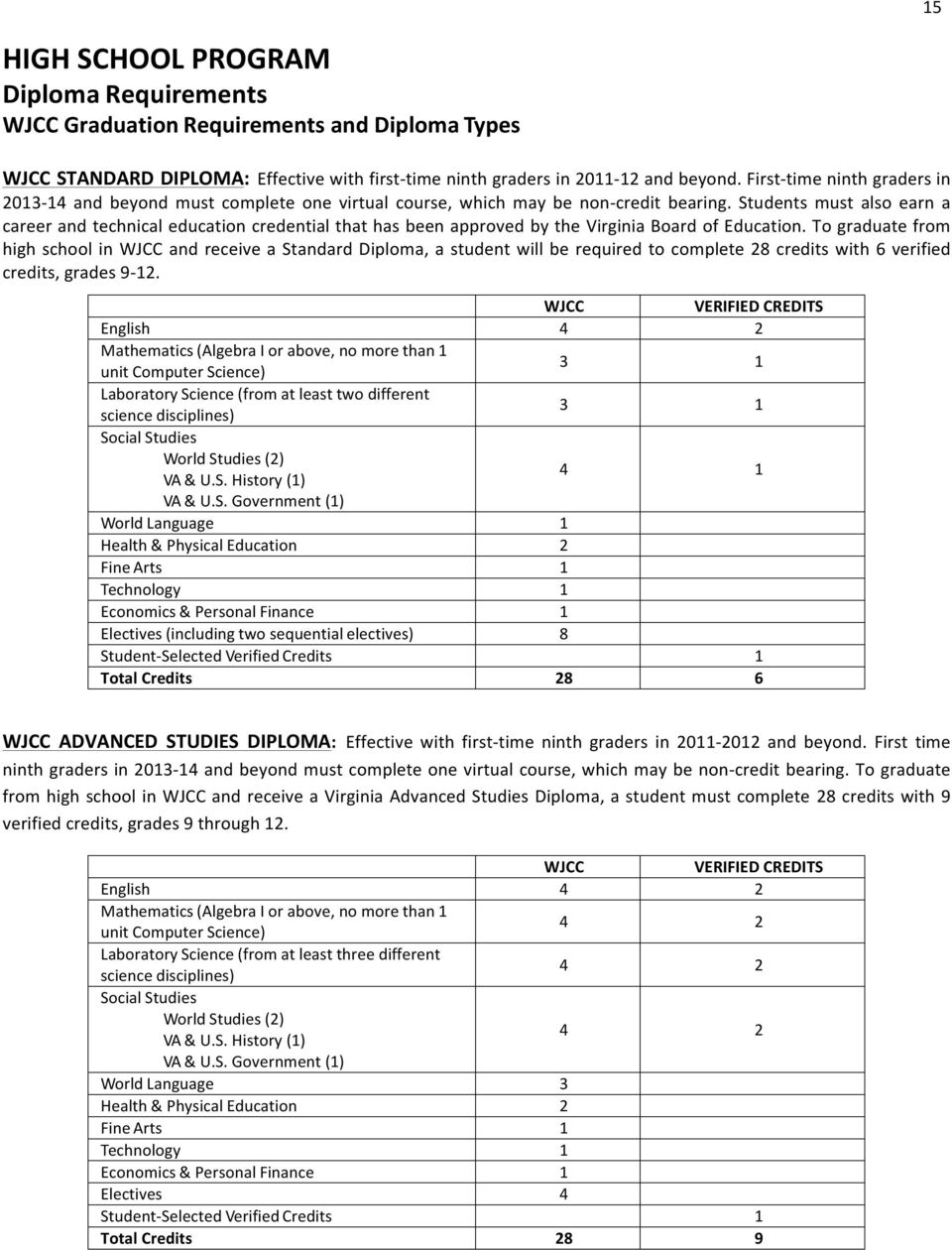
16 15 HIGH SCHOOL PROGRAM Diploma Requirements WJCC Graduation Requirements and Diploma Types WJCC STANDARD DIPLOMA: Effective with first- time ninth graders in and beyond. First- time ninth graders in and beyond must complete one virtual course, which may be non- credit bearing. Students must also earn a career and technical education credential that has been approved by the Virginia Board of Education. To graduate from high school in WJCC and receive a Standard Diploma, a student will be required to complete 28 credits with 6 verified credits, grades WJCC VERIFIED CREDITS English 4 2 Mathematics (Algebra I or above, no more than 1 unit Computer Science) 3 1 Laboratory Science (from at least two different science disciplines) 3 1 Social Studies World Studies (2) VA & U.S. History (1) 4 1 VA & U.S. Government (1) World Language 1 Health & Physical Education 2 Fine Arts 1 Technology 1 Economics & Personal Finance 1 Electives (including two sequential electives) 8 Student- Selected Verified Credits 1 Total Credits 28 6 WJCC ADVANCED STUDIES DIPLOMA: Effective with first- time ninth graders in and beyond. First time ninth graders in and beyond must complete one virtual course, which may be non- credit bearing. To graduate from high school in WJCC and receive a Virginia Advanced Studies Diploma, a student must complete 28 credits with 9 verified credits, grades 9 through 12. WJCC VERIFIED CREDITS English 4 2 Mathematics (Algebra I or above, no more than 1 unit Computer Science) 4 2 Laboratory Science (from at least three different science disciplines) 4 2 Social Studies World Studies (2) VA & U.S. History (1) 4 2 VA & U.S. Government (1) World Language 3 Health & Physical Education 2 Fine Arts 1 Technology 1 Economics & Personal Finance 1 Electives 4 Student- Selected Verified Credits 1 Total Credits 28 9
17 16 Other Virginia Diplomas and Certificates VIRGINIA MODIFIED STANDARD DIPLOMA The Modified standard diploma will no longer be available to first- time ninth graders in and beyond. The Modified Standard Diploma is folded into the Standard Diploma, with credit accommodations for students with disabilities. A Modified Standard Diploma shall be awarded to each qualified student who successfully completes the credit requirements for a Modified Standard Diploma, as set forth in the Standards of Accreditation, and who meets any additional criteria established by the Virginia Board of Education. Eligibility and participation in the Modified Standard Diploma Program shall be determined by the student s Individualized Education Program (IEP) and the student, where appropriate. The school in which the student is enrolled must secure the informed written consent of the parent or guardian and the student to choose this diploma program after review of the student s academic history and the full disclosure of the student s options. The School Board will notify parents of qualified students with disabilities who have an IEP and who fail to meet the requirements for graduation of the student s right to a free and appropriate education to age 21, inclusive, pursuant to Va. Code et seq. Standard Units of Credit Required English Mathematics Science History and Social Science Health and Physical Science Fine Arts or Practical Arts CTE Electives (including two sequential electives) Total Credits VIRGINIA SPECIAL DIPLOMA A Special Diploma shall be awarded to each qualified student who successfully completes the requirements set forth in his/her Individualized Educational Program (IEP), but does not meet the requirements for a diploma set forth in the Standards of Quality and the Standards of Accreditation. The School Board will notify parents of qualified students with disabilities who have an IEP and who fail to meet the requirements for graduation of the right to a free and appropriate education to age 21, inclusive, pursuant to Va. Code et seq.

18 VIRGINIA GENERAL ACHIEVEMENT DIPLOMA In order to be eligible for a General Achievement Diploma, a candidate must be at least 18 years of age and not enrolled in a public school or not otherwise meet the compulsory school attendance requirements of Va. Code Candidates must earn a total of 20 standard units of credit including the following: Standard Units of Credit Required 17 English Mathematics Science History and Social Science VA & US History VA & US Government Electives (including two sequential electives) Total Credits The required standard units of credit may be earned by enrolling in: a public school if the candidate meets the age requirements; a community college or other institution of higher education; an adult high school program; or a correspondence, distance learning, and/or online course. Candidates for a General Achievement Diploma must achieve a passing score on the GED Examination. Virginia General Educational Development (GED) Certificates The Board of Education has established a program of testing for general educational development (GED) through which persons may earn a high school equivalency certificate or a General Achievement Diploma. The following may participate in the testing program: 1. Persons who are at least 18 years of age and not enrolled in public school or not otherwise meeting the school attendance requirements set forth in Va. Code ; 2. Persons 16 years of age or older who have been instructed by their parents in their home pursuant to Va. Code and who have completed such home school instruction; 3. Persons who have been excused from school attendance pursuant to subsections B and C of Va. Code ; 4. Persons for whom an individual student alternative education plan has been granted pursuant to subsection D of Va. Code ; and 5. Persons 16 through 18 years of age who are housed in adult correctional facilities and who are actively pursuing a GED certificate but who are not enrolled in an individual student alternative education plan pursuant to subsection D of Va. Code Under no circumstances shall persons under the age of 16 be eligible for the testing program. Superintendent s Certification for Graduation Eligibility Students will be certified for graduation when they have completed the graduation requirements of WJCC and/or program for which diplomas are given as prescribed by the Virginia Board of Education. Students must meet the appropriate verified credit requirements set forth by the Virginia Board of Education. All students will be reviewed for on- time graduation expectations each semester. Approved summer school courses may be applied toward meeting graduation requirements. The review of all candidates will occur by the Superintendent or designee and follow the Commonwealth s expectations for the awarding of a diploma. The Superintendent or designee is responsible for

19 18 certifying eligibility for graduation in accordance with minimum standards established by the Commonwealth of Virginia. Student progress shall be reviewed by the Superintendent or designee to determine whether graduation requirements have been met. The Division will accept credits received from other accredited secondary schools, including summer school. Students entering WJCC secondary schools from a non- accredited school may establish credits by examination. Any exceptions to the WJCC diploma expectations shall be reviewed. Course offerings are listed in the WJCC Secondary Program of Studies which is updated biannually and posted on the WJCC website. Graduation: Recognition Seals The Standards for Accrediting Schools in Virginia establish high school graduation requirements and certain diploma seal recognitions. In addition, WJCC offers the Honors Program Seal. State Board of Education Seal Students who earn the Standard Diploma with an average grade of A or better will receive the State Board of Education Seal on the diploma. Governor s Seal Students who earn the Advanced Studies Diploma with an average grade of B of better and complete at least one Advanced Placement (AP) or college level course for credit will receive the Governor s Seal on the diploma. State Board of Education s Career & Technical Education Seal Students who earn the Standard or Advanced Studies Diplomas and complete a prescribed sequence of courses in a career/technical education concentration AND maintain a B average in those courses OR pass a certification examination OR acquire a professional license will receive the State Board of Education Career & Technical Education Seal on the diploma. State Board of Education s Advanced Mathematics & Technology Seal Students who earn the Standard or Advanced Studies Diploma and satisfy all of the mathematics requirements for the Advanced Studies Diploma and maintain a B average in those courses AND EITHER pass a certification examination from a recognized industry, trade or professional organization or acquire a professional license in a career/technical area OR pass an exam approved by the Board that confers college- level credit in a technology or computer science area will receive the State Board of Education Seal of Advanced Mathematics & Technology on the diploma. State Board of Education s Excellence in Civics Education Seal Students who earn the Standard or Advanced Studies Diploma AND complete Virginia and U.S. History and Virginia and U.S. Government with a grade of B or higher AND complete 50 hours of voluntary participation in community service or extracurricular activities (e.g., volunteering for an organization that provides services to the poor, sick, less fortunate OR participating in Boy Scouts, Girl Scouts, and similar organizations; in political campaigns or government internships, Boys State, Girls State, Model General Assembly; and/or in school- sponsored extracurricular activities that have a civic focus) OR enlisting in the United States military prior to graduation and have good attendance with no disciplinary infractions as determined by local school board policy receive the State Board of Education Seal for Excellence in Civics Education on the diploma. Williamsburg- James City County Public Schools Honors Seal Students who successfully complete the academic requirements, community service project, and individual honors project shall receive the WJCC Honors Seal. Williamsburg- James City County Public Schools expects that students enrolled in a WJCC high school for at least the last two years of high school will successfully complete course work in preparation for higher education and/or be a vocational completer and earn a diploma.

20 19 Advanced Placement/Weighted Courses Designated high school courses, because of the level of difficulty and time required for mastery, will carry a weighted grade when final grade point averages are computed. The course weights are based on the grade standard four- point scale. Grades of A, B, or C in designated weighted courses will receive increased point values (A = 5.0, B = 4.0, C = 3.0). A grade of D will receive a weight of one (D = 1.0), regardless of the course. Weighted courses will include: AP English Language & Composition AP English Literature & Composition AP American Government AP Comparative Government AP Microeconomics AP Calculus AB AP Calculus BC AP Computer Science AP Statistics Other Advanced Placement classes, as added College courses taken in grade 12 according to guidelines below AP Biology AP Chemistry AP Physics AP US History AP Art History AP Studio Art AP Music Theory AP French AP German AP Latin AP Spanish Language Weighting of Concurrent College Courses and Dual Enrollment Courses Concurrent College Courses: 1. Students should exhaust the available high school offerings in a particular subject prior to taking a concurrent college course. 2. Students are responsible for completion of the permission form required for college registration. 3. Except for in extenuating circumstances, the weighting of concurrent college courses option is limited to students who have completed their junior year. 4. Extenuating circumstances should be determined by the principal based on (a) academic necessity, (b) student academic record, and (c) student maturity. 5. Only one concurrent college course per semester will be granted additional weight. 6. The concurrent college course must be a 3- credit course in a content area. 7. College courses excluded from weighting are all introductory courses and world languages that do not exceed the rigor of Advanced Placement. 8. Students who take a college course to satisfy the full- enrollment requirement must supply official college transcripts prior to the end of the high school semester in which the course is taken. 9. Students who take a college course in addition to being fully enrolled in high school courses must supply an official college transcript prior to the end of the high school semester in which the course is taken if they wish to include the course on their high school transcript. 10. Students who drop a concurrent college course that is taken as part of the full- enrollment requirement will receive an F on the high school transcript for that course. 11. Students and their parents must assume the costs and risks associated with taking concurrent college courses. 12. Confer with your counselor to review expectations.

21 20 Dual- Enrolled College Courses: 1. Courses taught at the Governor s School for Science and Technology that offer dual enrollment at Christopher Newport University and Thomas Nelson Community College shall receive additional weight. 2. Courses that are dual- enrolled with Thomas Nelson Community College that are taught at the high school level will receive additional weight only if the course is the second course in a completer sequence. Flexible Learning Opportunities Dual Enrollment Dual Enrollment programs provide high school juniors and seniors a unique opportunity to jump- start their college career. These students are able to meet the requirements for high school graduation while simultaneously earning college credits. College courses are taught by faculty who meet college credentialing requirements and are provided through a division- wide agreement with Thomas Nelson Community College. The credits earned for these courses may be transferred to other colleges and universities. Students are responsible for verifying the transfer of college credits between TNCC and other colleges and universities as policies may vary. Information on courses offered in the dual enrollment program will be provided by the counseling office during the course selection process. Advantages of Dual Enrollment Earn college credit while still enrolled in high school Potential for reducing the cost of obtaining a college degree Enhances course opportunities for outstanding students in both academic courses and in career and technical education Provides college- level instruction to high school students during regular school hours Credit for dual enrollment courses is generally accepted at Virginia private and public colleges Admission requirements reflect admission standards at the college Admission Requirements Dual enrollment applicants must: Meet course prerequisites Complete the required college application process Successfully complete college placement tests Be prepared for the demands of college coursework Current Options for Dual Enrollment The following courses may be offered for dual enrollment depending upon availability of staff. Interactive Multimedia Word Processing Computer Information Systems I Computer Information Systems II Design Multimedia and Web Technologies Advanced Design Multimedia and Web Technologies Business Management Advanced Drawing and Design Digital Visualization AP Chemistry Emergency Medical Tech I Emergency Medical Tech II AP English Language & Composition AP U.S. History Humanities IT Fundamentals Engineering Exploration I Advanced Marketing AP Calculus AP Statistics
22 21 WJCC elearning elearning (electronic Learning) is a teaching and learning approach used in WJCC Public Schools where education takes place using computers, the Internet and other technologies. Students can experience elearning in courses they take in schools or through another form of distance delivery offering. elearning for students is supported through an elearning lab at each high school. Depending on the course and class schedule, students may work in the lab during the school day or may work from a computer outside the building. All work will be completed online except for tests, final exams and End- of- Course SOL exams if applicable. A staff member will administer these. Students desiring to work outside the school must provide their own reliable computer and Internet access. Advantages of elearning Flexibility anytime, anywhere learning Expanded course offerings including courses not currently offered face- to- face Advanced learning for enrichment or additional credit Increased technology aptitude Individualized learning Independent learning As the Commonwealth of Virginia requires every student to take Economics and Personal Finance as well as an online course to graduate, WJCC recommends that every student consider taking the Economics and Personal Finance course (ECON/PERSONAL FINANCE 6120) through the WJCC elearning portal after the completion of their sophomore year. In addition, WJCC offers a number of other elearning opportunities to students. Counselors will discuss all current learning opportunities during registration meetings with students. Current Options for Virtual Virginia Courses Virtual Virginia courses are available to students when courses are not offered face- to- face or in cases of extreme scheduling conflicts Advanced Placement Art History 5810 Chinese I 5860 Advanced Placement Chinese Language and 5820 Chinese II Culture 3185 Advanced Placement Computer Science A 5830 Chinese III 4270 Advanced Placement Environmental Science 5840 Chinese IV 2399 Advanced Placement European History 1171 Creative Writing 2803 Advanced Placement Macroeconomics 4260 Earth Science II Astronomy 2802 Advanced Placement Microeconomics 2804 Economics 2902 Advanced Placement Psychology 6640 Introduction to Game Design & Development 2380 Advanced Placement World History 2903 Psychology 5010 Arabic I 5700 Survey of World Language and Culture 5011 Arabic II 1165 World Mythology 5012 Arabic III
23 22 GENERAL INFORMATION Course Selection/Registration Process Families are invited to course selection meetings. Students and families should carefully consider diploma requirements, past academic performance, career goals, teacher/counselor recommendations, and interests. Through thoughtful course selection, a student should be able to pursue both an academic and/or career goal as well as a variety of electives. Families are encouraged to contact their student s counselor, Student Advancement Coach or Academic Advisor to discuss career goals, course selections and student academic achievement. Counselors are your ultimate partner in diploma requirements. Class Rank High School class rank is based on the grades earned in courses for which credit is awarded. The Grade Point Average (GPA) for students is based on the sum of quality points for grades in completed courses divided by the number of credits attempted. Students are ranked in their class by their GPA. GPA and rank are recomputed each semester. Transfer Students Credit courses transferred into a WJCC school from other school divisions will be accepted if the courses are compatible with local and state regulations. Weighted credits will be awarded to only those transfer courses which are also weighted in the WJCC School Division and will be computed according to the WJCC procedure rather than by the method used in the previous school. In conversion of the sending school s transcript, the letter grade previously applied is transferred. Electives Electives must be approved by a school counselor and must meet diploma requirements. Diploma Requirements Courses taken to meet diploma requirements must be approved by the high school or middle school. School counselors are available for questions on this topic. Alternatives to Animal Dissection Students may complete an alternative to animal dissections with written permission of their parent/guardian. Promotion High School students matriculate to grade 10 if they have 6 credits; to grade 11 with 14 credits; and to grade 12 with 21 credits. Low Enrollment Courses Courses with low enrollment may not be offered at all locations or may not be offered at all during the school year. When low- enrollment courses are offered at one high school, the course is considered shared and is available to students from all three high schools at the designated location. Shared Courses In addition to low- enrollment courses, courses that are only offered at one location are considered shared and are available to students from all three high schools at the designated location. Guidelines for Offering High School Classes At least 12 students should be registered in a class in order to offer the class at a high school. If there are fewer than 12 students who register for a class, the principal will explore the option of combining this class with another level of the same subject. When low enrollments occur in an Advanced Placement class, administrative leaders may elect to combine the enrollments at one high school location. There may be rare circumstances when course enrollment lower than 12 may be offered. Courses and Credits All courses in the Program of Studies are listed as one credit, two credits, etc. Course Fees Course descriptions indicate any fees that are required. Students who are eligible for free/reduced lunch may apply for a course fee waiver except for Driver s Education. Specialized Electives While it is not mandated that students take a career and technical program, the state of Virginia does require that students pursuing a standard diploma complete two sequenced electives. Those pursuing a standard diploma are strongly encouraged to complete a career and technical completer sequence (as defined by the Virginia Department of Education). Career and technical completer sequences are designed to help students develop marketable skills. Early Graduation Students who plan to graduate early should plan an appropriate program with their counselor.
24 Continuation of High School Students who have not met the requirements for a high school diploma within four years shall be allowed to continue to meet their requirements during a fifth year. Students in their fifth year will not have athletic eligibility. Enrollment Students shall not be allowed to enroll if they have passed their 20 th birthday on or before August 1 of the school year. Students who are receiving Special Education services may attend through age 21 if stipulated in their IEP. Sequenced Classes Students may request more than one math, science, world language, or health/pe classes during spring course requests. Such requests will be granted on a space- available basis with preference given to seniors, juniors, and sophomores in that order. This does not apply to courses which are designated as electives or to students who need to make up a required course which they have failed. Every effort will be made to schedule languages in consecutive semesters. Full acceleration may be allowed if scheduling and space permit. Students who fail will be able to repeat in the next semester on a space- available basis. Drop/Add The first seven days of each semester will constitute the drop period. A student may drop a class during this period if he/she adds another class in order to maintain a full class load. A student will not be allowed to drop a class if it will result in the student maintaining less than a full class load. Repeating a Class for Strength Students may re- enroll in a sequential class if they have a parent s signed request to re- take the class. Credit is given the first time a student takes a course. The grades for both enrollments are calculated into the GPA, but the credit is applied only during the first enrollment. Both grades become a permanent part of the student transcript. Students may only repeat one course per semester. Virginia High School League Rules regarding audits apply for those students who are athletes. Mentorships Mentorships are available on a limited basis to juniors and seniors. A student interested in a mentorship must first consult his or her counselor then complete the specified application process and interview with the mentorship coordinator by May 1 of the year prior to the beginning of the mentorship. Gifted Program The Gifted Education Program serves identified academically gifted students in specific content areas of study. The student s academic, social, and emotional needs are addressed in mathematics, English and Social Studies classes where differentiated curriculum and instructional strategies are implemented. Students are grouped in English and Social Studies classes where the curriculum is integrated, accelerated, and rigorous. English as a Second Language (ESL) This program is designed to improve the communication skills and vocabulary of non- native English speakers. Reading comprehension, writing, listening, conversation, pronunciation, vocabulary, and grammar are emphasized. Students who are enrolled in verified credit courses must take the associated SOL test but may be given accommodations. Career and Technical Education Within WJCC there are five career/technical programs that are offered for high school credit with concentrations that lead to career/technical completer status. Meeting the needs of students as they prepare to work in the 21st century are offerings in Business & Information Technology, Family & Consumer Sciences, Health and Medical Sciences, Marketing Education, and Technology Education. Governor s Academy for Innovation, Technology and Engineering (GAITE) GAITE prepares students as Engineering Technologists with careers in Electrical and Mechanical Engineering Technology. The GAITE Academy completer must possess a 2.5 GPA, 4 years of science, math beyond Algebra II, 2 years of foreign language, and completion of the divisional career pathway resulting in an industry credential and/or a minimum of 9 transferable college credits. GAITE completers will earn a Governor s seal, priority application review from partner colleges, and employer interview for internships. GAITE, located in each of the six Virginia Peninsula school divisions, is one of the first Governor s Academies for Career and Technical Education in Virginia. The Engineering Technology pathways are coordinated with the Engineering Technology programs at Thomas Nelson Community College and/or Rappahannock Community College, The Apprentice School at Newport News Shipbuilding, and Old Dominion University. The GAITE Academy involves partners from education, business (NASA, Canon, and Newport News Shipbuilding), postsecondary education, and non- profit organizations. 23
25 24 Visit to learn more about GAITE; the requirements, divisional course pathway, and enrichment opportunities to a career in Engineering Technology. Students can select courses offered at their high school or New Horizons Regional Education Centers. York County School of the Arts (SOA) The York County School of the Arts (SOA) provides high school students with an enriched and challenging fine arts educational opportunity. SOA programs emphasize academic growth and artistic development, the multidisciplinary nature of the arts, standards to differentiate between the meaningful and the mediocre in the arts, and fine arts career opportunities. SOA is located at Bruton High School and is open to students in WJCC on a space- available basis, after which students may pay tuition. Admission to SOA is by application/audition. Information about the SOA program may be obtained from the Coordinator at In addition to SOA acceptance, a letter of Intent Form must be received by the Coordinator of Fine Arts Programs no later than January 30. See your counselor for more information. The New Horizons Governor s School for Science and Technology is a shared- time program with students receiving instruction both at the Governor s School for two periods and at their home school for two blocks each day. Courses are available in the morning, afternoon or in the early evening. Students enrolled in a science course spend another five hours minimum a week in an after- school mentorship program. All New Horizons Governor s School courses are yearlong courses. New Horizons Regional Education Center Courses at the New Horizons Regional Education Center qualify students for skilled employment after graduation. The courses are open to all rising 11 th and 12 th graders. Rising 12 th graders, considering attendance at New Horizons for the first time should seek a detailed explanation from their counselor. Most courses carry 3 credits per year for each of the one or two years of study. All classes for Jamestown, Lafayette, and Warhill High School students require the first two blocks of each day. Students are picked up by bus at home to travel to one of the two New Horizons Centers. Students return to their home school by bus to attend the last two blocks of the day. Students are full- time Jamestown, Lafayette, or Warhill students, eligible to participate in activities and be members of any club or team. NOTE: Technology Credit Courses that satisfy the technology credit requirement are: Digital Input Technologies Information Technology Fundamentals Design, Multimedia and Web Technologies Advanced Design, Multimedia, and Web Technologies Computer Information Systems Office Specialist I- III Office Administration Word Processing Journalism II Computer Science Mass Media II Advanced Drawing and Design Architectural Drawing Design Engineering Exploration I Principles of Engineering Engineering Studies Digital Visualization Introduction to Engineering Design Geographic Information Systems Graphic Communications Systems Computer Integrated Manufacturing. Computer Network Essentials (at New Horizons) *These are denoted with a
26 25 WJCC Honors Program The Honors Program of Williamsburg- James City County Public Schools was instituted in fall Highly motivated students are encouraged to earn special recognition for their outstanding efforts. The program invites students to take advantage of the extensive Advanced Placement offerings at the secondary level, and to complete challenging, self- designed community service and Honors projects. Students who successfully complete the expectations of the Honors Program receive Honors recognition. Participation in the Honors Program provides an advantage to students in the increasingly competitive college application process. In addition to meeting the requirements of the Advanced Studies Diploma, candidates for the Honors Seal Recognition must: Complete a minimum of five Advanced Placement (AP) courses, in three different content areas, with a grade of C or better Take the AP course examinations Complete a four- course sequence in one global language Design and complete a Community Service Project of at least 25 hours (see detailed description) (HPCS/2010/ 1 and 2) Design and complete an in- depth Honors Project (see detailed description) Participants in the Honors Program submit proposals to and meet with the Division Honors Committee comprised of representatives from each high school and the Central Office. After receiving approval from the committee, students work with the school s Honors Program Coordinator and with a mentor to successfully fulfill the requirements of the program. Students return to the committee to report on the completed Community Service Project. Honors Projects are presented to a panel of professionals for approval. Students may enter the Honors Program as early as the freshman year. Projects may be completed at any time, but the Community Service Project ideally should be completed by the beginning of the senior year, and the Honors Project must be completed by the end of the third quarter of the senior year. Students are encouraged to discuss the Honors Program with their counselor or the Honors Facilitator. For proposal forms and additional information, contact: Jamestown High School, Mrs. Chrissie Wilson, JHS Room 232 Lafayette High School, Ms. Martha Hanks- Nicoll, LHS Room 600 Warhill High School, Ms. Debbie Crawford, WHS Room 1017
27 26 VHSL Policies on Participation in Athletics VHSL policy specifies that in order for students to compete in VHSL- sponsored activities, students must have received a minimum of 2.5 credits the previous semester. Summer school classes can only be used for the first semester of the year following the summer school. Audited classes (repeated classes) receive no credit. The VHSL activities include all varsity and junior varsity sports (including cheerleading), dramatic, forensic and literary competitions. This policy does not apply to band or clubs that are not sponsored by the VHSL or to any student who is enrolled in the first semester of the ninth grade for the first time. For example: First Semester Grade Credit Second Semester Grade Credit Algebra I (Audit) B 0 Spanish II (Audit) B 0 Health & PE A 1.0 Geometry D 1.0 English 10 D 1.0 Earth Science F 0 World Geography C 1.0 Art Foundations C 1.0 Total = 3.0 Total = 2.0 ELIGIBLE the next semester NOT ELIGIBLE the next semester unless he/she goes to summer school and earns a credit. VHSL policy specifies that all students who participate in athletic competition must have submitted a completed Athletic Participation/Parental Consent/Physical Examination Form before practice begins. This form, which must be submitted every year, permits the student to participate for an entire school year. All students new to the division must first be enrolled at Jamestown, Lafayette or Warhill High School before participation can begin. Eligibility for VHSL begins on the first day of enrollment in the ninth grade. WJCC Athletic Eligibility for High School Students Highlights Academic Requirements: Each student must earn at least 2.5 credits in the semester immediately preceding participation. In determining fall participation, the student s summer coursework will be included with the previous spring s coursework. Each student must receive 7 credits in the academic year immediately preceding participation. Each student must have a 1.25 GPA for the semester immediately preceding participation. The principal will decide on the specific eligibility of students enrolled in special programs such as New Horizons, Governor s School and special education. Behavior Requirements: Any athlete who is suspended from school (ISS or OSS) or is placed by an administrator in an alternative classroom setting (ACS) may not play in the next scheduled competitive event. A student who receives a second suspension (ISS or OSS) will be dismissed from the team for the remainder of the season. Attendance Requirements: Students may not have more than 3 unexcused absences during the semester immediately preceding participation or during the semester of participation. Three unexcused tardies to school will count as 1 unexcused absence for the purpose of determining eligibility. Students must attend tryouts to be considered for team membership. Exceptions may be made in case of a death in the family, student injury or a new student moving into the district. A copy of the complete WJCC Athletic Eligibility requirements may be obtained from the Athletic Director at each high school.
28 27 CORE COURSE PLANNING GUIDE English (Suggested Core Course Sequence) English 9 English 10 Ninth Grade Honors English 9 Tenth Grade Honors English 10 Eleventh Grade English 11* American Studies* Advanced American Studies* Honors English* AP English Language & Composition* Twelfth Grade English Literature 12 Advanced World Literature 12 AP English Literature & Composition *Students in these courses will take a Virginia Standards of Learning (SOL) test. AP English Language & Composition Social Studies (Suggested Core Course Sequence) World History* World Geography* Ninth Grade Tenth Grade AP Human Geography* Eleventh Grade VA & U.S. History* American Studies* Advanced American Studies* AP U.S. History* Twelfth Grade VA and U.S. Government AP Government *Students in these courses will take a Virginia Standards of Learning (SOL) test. Ninth Grade Earth Science* Tenth Grade Biology* Science (Suggested Core Course Sequence) Eleventh and Twelfth Grades Chemistry* Physics AP Physics 1 and 2 Field Biology Oceanography AP Biology AP Chemistry Anatomy & Physiology *Students in these courses will take a Virginia Standards of Learning (SOL) test.
29 28 High School Math Course Sequence Algebra I* (Year or Semester) Geometry* (Year or Semester) Algebra, Functions, & Data Analysis (Semester) Algebra II* (Year or Semester) Probability & Statistics (Semester) Functions/Trigonometry (Semester) Computer Science (Semester) Pre- Calculus (Semester) Calculus (Semester) AP Computer Science (Semester) AP Statistics (Semester) AP Calculus (AB) (Semester) AP Calculus (BC) (Semester) *Students in these courses will take a Virginia Standards of Learning (SOL) Test
30 29 COURSE SELECTION STUDENT WORKSHEET/ACP Education and Career Planning This worksheet is designed to assist you in planning your high school course of studies. Choose elective courses according to your developing interests, and educational and career goals. Complete your worksheet in pencil. Keep your Program of Studies and bring it with you as you plan with your school counselor.
31 30 HIGH SCHOOL PROGRAM OF STUDIES/COURSE OFFERINGS The philosophy of WJCC is that the Advanced Placement experience is not complete without the AP end- of- course examination. Therefore, it is the expectation that all students enrolled in AP courses will take the final examinations for those courses. BUSINESS & INFORMATION TECHNOLOGY ECON/PERSONAL FINANCE 6120 Grades Students learn how to navigate the financial decisions they must face and to make informed decisions related to career exploration, budgeting, banking, credit, insurance, spending, taxes, saving, investing, buying/leasing a vehicle, living independently, and inheritance. Development of financial literacy skills and an understanding of economic principles will provide the basis for responsible citizenship and career success. In addition to developing personal finance skills, students in this course will also study basic occupational skills and concepts in preparation for entry- level employment in the field of finance. All WJCC students will take this course online through our elearning portal to meet VDOE graduation requirements. The online course option is offered either during the school day directed by a teacher, or asynchronously, to be completed at the student s own pace during the semester. PRINCIPLES OF BUSINESS AND MARKETING 6116 Students explore the roles of business and marketing in the free enterprise system and global economy. They study how the American economy operates and prepare to make decisions as entrepreneurs, consumers, wage earners, and citizens. DIGITAL INPUT TECHNOLOGIES 6160FS /$15 Materials fee This course in secondary level keyboarding incorporates four input technologies: keyboarding, voice technology, writing tablets, and PDAs. Students apply skills to produce a variety of personal and business documents using MS Office INFORMATION TECHNOLOGY FUNDAMENTALS 6670 /$15 Materials fee Information Technology Fundamentals is a one- semester introduction to computer applications, maintenance and troubleshooting, programming, uses of the Internet to include security and privacy issues, basics of web design, using graphics and interactive multimedia, and careers in the IT industry. DESIGN, MULTIMEDIA AND WEB TECHNOLOGIES 6632 Grades /$15 Materials fee Students develop proficiency in using desktop publishing software to create a variety of business publications. Students work with sophisticated hardware and software to develop multimedia presentations and web pages. ADVANCED DESIGN, MULTIMEDIA, AND WEB TECHNOLOGIES 6633 /$15 Materials fee Prerequisite: Design, Multimedia, and Web Technologies
32 Students develop advanced proficiency in using desktop publishing software to create a variety of design projects. Students work with hardware and software to produce web pages and multimedia presentations. BUSINESS LAW 6132 Grades Students begin with a study of the legal system, then focus on the fundamentals of law including such topics as ethics, contracts, credit, consumer law, insurance, leases, employment, and family law. BUSINESS MANAGEMENT 6136 Grades Students discover basic management concepts and leadership styles as they explore business ownership, planning, economics, international business, and human relations such as employee motivation and conflict resolution. Student leadership skills are utilized through a business simulation experience. 31 COMPUTER INFORMATION SYSTEMS 6614 Grades /$15 Materials fee Prerequisite: Keyboarding skill Students enhance computer technology and business applications skills including word processing, spreadsheets, databases, graphics, and telecommunications. The course emphasizes correct use of the Internet, integration of skills, problem solving, and working both independently and as a part of a team. Students produce professional- looking documents using Microsoft Office. ADVANCED COMPUTER INFORMATION SYSTEMS 6615 Grades /$15 Materials fee Prerequisite: Computer Information Systems I Students apply problem- solving skills to real- life situations through advanced integrated software applications, programming, and expert systems. Students work individually and in groups to explore advanced computer maintenance activities, telecommunications, and networking. OFFICE SPECIALIST I- II 6740/6741 Grades Credits per year Prerequisite: Each level is a prerequisite to the next This program emphasizes progressive development of communications and personal employability skills such as organization, human relationships, and self- confidence. Students develop skills in areas including keyboarding, word processing, office procedures, and records management. OFFICE SPECIALIST III 6742 Grades Prerequisite: Office Specialist II Designed to refine skills in keyboarding, word processing, office procedures, and records management. Additional units of instruction include job- seeking and personal employability skills.
33 32 OFFICE ADMINISTRATION 6622 Grades /$15 Materials fee Prerequisite: Digital Input Technologies or Information Technology Fundamentals Students enhance word processing and communication skills as they develop competencies needed by administrative support professionals. Students study office procedures such as electronic records management and financial records management. WORD PROCESSING 6626 Grade 12 1 credit/$15 Materials fee Prerequisite: Digital Input Technologies or Information Technology Fundamentals Students develop advanced level word processing skills. They gain competence integrating other software applications into word processing activities such as desktop publishing. Classroom experiences also provide for skill development in communication. COOPERATIVE BUSINESS EDUCATION 6799 Grades Credits per year Prerequisites: Parental permission Cooperative Business Education is supervised, on- the- job instruction. Students attend classes part of the day and work in an approved office part of the day. The teacher- coordinator develops with the on- the- job training sponsor and the student an individualized training plan identifying learning experiences according to the student s occupational objective. The on- the- job instruction is an extension of the classroom instruction coordinated by the in- class teacher into a single learning package. A minimum 198 hours of on- the- job instruction is required each semester.
34 33 ENGLISH ENGLISH 9: READING/WRITING 1130FS The course is only open to those students who have not passed the 8th grade Reading and/or Writing SOL tests or whose IEP s or 504 plans specifically mandate placement in this class. The course will focus on reading, writing, and oral communication skills with particular emphasis placed on skill development, i.e., test- taking strategies, cloze reading passages, listening, and writing to a prompt. Students will read a variety of genre and will learn and practice the writing process. Interpersonal communication and other oral communication skills will be developed. ENGLISH Prerequisites: Passing score on the 8th grade Reading and Writing SOL tests English 9 focuses on the analysis and interpretation of literature. The course introduces a wide variety of reading, writing, and speaking activities and requires the ability to read and work both independently and cooperatively. Papers, projects and reading assignments will be literature based. Students will read world literature, will use the writing process to create papers in a variety of modes, and will be required to prepare and present informal and formal oral presentations. HONORS ENGLISH Prerequisites: Successful completion of English 8 Advanced proficiency on 8th grade SOL Reading, Literature, and Research test Advanced proficiency on 8th grade SOL Writing test Successful completion of summer reading assignment Honors English 9 is an advanced course designed to prepare and to challenge able and enthusiastic ninth grade students. This course focuses on the critical analysis and in- depth interpretation of complex literature for college- bound students. Students will analyze and sharpen writing skills with a focus on the expository mode. This rigorous course will allow students to select a tenth grade course responsibly. ENGLISH Prerequisite: Successful completion of English 9 English 10 focuses on the analysis and interpretation of literature. Students will read and analyze a variety of literary genre and develop oral communication skills. Research skills and well- organized, effectively developed expository writing are emphasized. HONORS ENGLISH Prerequisites: B or better in English 9 Advanced proficiency on the 8th grade SOL Reading, Literature and Research Test Advanced proficiency on the 8th grade SOL Writing Test Honors English 10 is an advanced course designed to prepare and to challenge enthusiastic tenth grade students. This course focuses on the critical analysis and in- depth interpretation of complex literature for college- bound students. Students will analyze a variety of literary genre and supplemental readings, develop Paideia skills, and extend and
35 34 sharpen writing skills with a focus on the expository mode. This rigorous course will allow students to select an eleventh grade course responsibly. An in- depth summer assignment is also required. ENGLISH Prerequisites: Successful completion of English 9 & 10 English 11 prepares students for post- secondary training at two or four year colleges or for immediate entry into the work force. Students will trace the development of American literature from the 1600s to the present. Emphasis will be placed on logical analysis of arguments, use or propaganda in the media, and persuasive writing. Students will write documented research papers dealing with issues, problems or questions. Group work, library research, and oral presentations are also required. AMERICAN STUDIES 1885 in English and in U.S. History Prerequisites: Successful completion of English 9 & 10 Students must commit to taking both semesters of this year- long, interdisciplinary, team- taught American literature/ American history course. Students explore the literature and history of the United States using a humanities approach. This course stresses creative and analytical writing with an emphasis on improving the writing process. Field Trips are planned to complement the curriculum and broaden the experiences of students. Students receive one grade which counts for both English and U.S. History credits. ADVANCED AMERICAN STUDIES 1183 in English and in U. S. History Prerequisites: Successful completion of English 9 & 10 This yearlong, interdisciplinary, team- taught English/history course is designed for motivated, college- bound students. Through the interrelationships of the humanities, the fine arts, and the social, intellectual, and political history of the United States, students explore themes such as the American Dream and how it has changed since the time of the early settlers. Regular attendance is essential. Outside reading and research are required. A variety of individual and group creative assignments will be required. It is recommended that students have at least a B average in 10th grade English. HONORS ENGLISH 11/ADVANCED PLACEMENT U.S. HISTORY 2000 in English and 1 Weighted Credit in U.S. History Prerequisites: Successful completion of English/Language Arts 9 & 10 Honors English 11/AP American History is a high- level course designed to stimulate and to challenge capable and well- motivated eleventh grade students. The two courses will be taught as parallel courses, following a chronological approach to the study of American history, literature, and culture. Both courses will use a cultural approach, drawing upon the events, personalities, art, and music of the period whenever possible. Both courses will focus on developing individual and group skills of analysis and interpretation. A continuing point of correlation between the courses is the Honors English 11 year- long independent study of an American writer. Examining the influence of historical events on the writer s work is an important aspect of this project. The two courses will remain separate on the transcript, and students will receive separate grades. Extensive summer reading is required.
36 35 ENGLISH LITERATURE Prerequisites: Successful completion of English 9, 10 & 11 This course is designed for both college or non- college bound students. The course focuses on modern literature and the relevance of classic works to contemporary issues. Readings, discussions, group projects, and written responses build understanding of human reactions and allow students to share opinions, develop alternatives for handling conflict, and relate events and images in literature to their own lives. Students complete senior research papers and an oral presentation. ADVANCED WORLD LITERATURE Prerequisites: Successful completion of English 9, 10 & 11 This course provides college preparatory work for students who appreciate meaningful and challenging literature from many cultures and time periods. Assignments require in- depth analysis and application of literary works to contemporary life through discussion and writing as well as independent and group work. Students must complete senior research papers and independent reading projects with oral presentations. ADVANCED PLACEMENT ENGLISH LITERATURE AND COMPOSITION 1195 NOTE: Students should not take two AP English classes during the same semester. Prerequisites: Successful completion of English 9, 10 & 11 This college- level course, AP English Literature and Composition emphasizes language, themes, structures, and values through intensive study of numerous literary genre and periods. Oral and written compositions, including personal, creative and analytical pieces, require structuring ideas and developing writing style. Students test their responses to literary works against those of other students and literary critics. The course prepares students for the AP Literature and Composition examination. Extensive summer reading and writing are required. COLLEGE COMPOSITION II at LHS only Prerequisites: Successful completion of AP Language and Composition/Dual Enrolled English 111 This course continues to develop college writing with increased emphasis on critical essays, argumentation, and research, developing these competencies through the examination of range of texts (to include multi- media and web) about the human experience. Requires students to locate, evaluate, integrate, and document academic sources, and effectively edit for style and usage. ADVANCED PLACEMENT ENGLISH 12/ HUMANITIES ENHANCED Weighted Credit in English and 1 Unweighted Elective Credit in Humanities Enhanced This AP English 12/Humanities Enhanced is a two- credit course designed to challenge the most able and enthusiastic twelfth grade students. As a college- level course, it emphasizes language, themes, structures, and values through an intensive interdisciplinary study of numerous genre with cultural/social/ historical and fine arts integration. The course prepares students for the AP Literature and Composition examination.
37 36 ADVANCED PLACEMENT ENGLISH LANGUAGE AND COMPOSITION 1213 Prerequisites: Successful completion of English 9, 10 & 11 This college- level composition class in nonfiction writing requires weekly papers based primarily on research. Assignments include essays of narration, analysis, and argument as well as news, feature and depth stories requiring interviewing and observation. Major fiction works will be studies as independent work. This course prepares students for the AP Language and Composition examination. THE FOLLOWING ENGLISH ELECTIVES DO NOT SATISFY GRADUATION REQUIREMENTS FOR FOUR UNITS OF ENGLISH. CREATIVE WRITING Prerequisite: Successful completion of English 9 This course is a writing workshop. Students will write every day, and will explore different writing techniques and styles. Writing skills will be developed through pre- writing, editing, re- writing, and critiquing. As a community, students will learn a great deal about each other by writing across various modes of art- in- language. JOURNALISM I 1205 Prerequisite: Successful completion of English 9 Students are introduced to the exciting world of the print media. In their study of journalism, students will learn the basic skills of accurately relaying information and of self- expression through print communication. Through this course, they will learn and practice journalistic skills used in reporting, writing, designing, and producing a publication. In addition, students will work on the student newspaper, further developing their journalism skills, basic business management principles, and interpersonal relationships by working in collaborative groups. Students will have use of state- of- the- art computer- aided publishing tools and other hands- on production tools such as InDesign, Photoshop, and digital cameras. This course will serve as a learning workshop for students interested in working on the student newspaper and may provide students insights into college and career choices. Some out- of- class time may be required. JOURNALISM II: NEWSPAPER PRODUCTION 1210 Prerequisite: Successful completion of Journalism I or teacher permission Students who serve as editors and staff members of the school newspaper may enroll in Journalism II. Students will plan, report, write, edit, and produce the school newspaper in class and during after- school production sessions. Reporters will research and write all newspaper content and will use digital photography, Photoshop, InDesign, and other available technology for design and production. JOURNALISM III: NEWSPAPER PRODUCTION 1211 Prerequisite: Successful completion of Journalism II Students who serve as editors and staff members of the school newspaper may enroll in Journalism III: Newspaper Production. In addition to enhancing their skills as reporters, Journalism III provides students advanced opportunities for learning editorial leadership, developing a personal sense of professionalism, understanding the role of the newspaper in society, and becoming productive members of the newspaper staff. Students will plan, report, write, edit and produce the school newspaper in class and during after- school production sessions. Reporters will research and write all newspaper content and will use available technology for design and production.
38 37 JOURNALISM IV: NEWSPAPER PRODUCTION 1212 Prerequisite: Successful completion of Journalism III Students who have successfully completed Journalism III and will serve as editors and staff members of the school newspaper may enroll in Journalism IV: Newspaper Production. Journalism IV students will serve as writing coaches, maestro team leaders and editors, assuming total responsibility for newspaper production. They will also complete a required independent study project related to current issues in journalism. The course may be repeated for elective credit. MASS MEDIA I 1218 Prerequisite: Successful completion of English 9 This course will provide students with the opportunity to acquire and apply communication and technical skills in a real world setting through work on production of the school yearbook. Students will use and strengthen their creative and critical thinking skills as well as use their knowledge of grammar and writing skills to produce the yearbook. Students will work independently and as part of an organized production staff for at least a semester. MASS MEDIA II 1219 Prerequisite: Successful completion of Mass Media I This course will provide students with the opportunity to acquire and apply communication and technical skills in a real world setting by work on production of the school yearbook. Students will use and strengthen their creative and critical thinking skills as well as their knowledge of grammar and writing skills to produce the yearbook. Students in Mass Media II will work independently and as part of an organized production staff and will enhance, refine and expand their knowledge and technical skills. MASS MEDIA III 1221 Prerequisite: Successful completion of Mass Media II This course will provide students with the opportunity to acquire and apply communication and technology- based skills in a real- world setting by work on the production of the school yearbook. Students will use and strengthen their creative and critical thinking skills as well as their knowledge of grammar and writing skills to produce the yearbook. Students will work independently and as part of an organized production staff. The three levels of Mass Media will be taught sequentially with the expectation that students will enhance, refine, and expand their knowledge and technical skills, bringing to each new level a higher level of expertise. It is recommended that students complete Mass Media II with a grade of B or better.
39 38 MASS MEDIA IV 1222 Prerequisite: Successful completion of Mass Media III This course is the last in the Mass Media series. It will provide experienced yearbook journalism students an opportunity to design and publish the high school yearbook in a real world internship- like atmosphere. By taking on leadership roles as editors, business managers, web masters, photography and technology editors, students will lead MM I- III students to excel in a similar setting. By using their knowledge of grammar and writing, their skills in photography and design and their learned marketing and advertising skills, MM IV students will peer teach, delegate, lead, refine, and enhance all aspects of the yearbook journalism process. It is recommended that students complete Mass Media III with a grade of B or better. Because publishing a yearbook is a yearlong activity and these students are in leadership positions, students can repeat this course for one credit. SPEECH 1300 Students will research, write, and deliver personal, informative, persuasive, and impromptu speeches. They also conduct interviews, prepare interpretive readings and learn storytelling. All speech assignments are presented to a classroom audience and some are videotaped. Many speeches are research based and require written outlines, so students must be able to work independently in the library. also conduct interviews, prepare interpretive readings and learn storytelling. All speech assignments are presented to a classroom audience and some are videotaped. Many speeches are research based and require written outlines, so students must be able to work independently in the library.
40 39 FAMILY & CONSUMER SCIENCES INTRODUCTION TO EARLY CHILDHOOD EDUCATION AND SERVICES 8233 The course will focus on early childhood education and services, the roles of physical care professionals, and healthy and safe environments for children. Students will also explore career skills and characteristics related to jobs/careers in the areas of child growth, child development, and child guidance. NUTRITION AND WELLNESS WITH GOURMET COOKING 8228 Grades /$15 Materials fee Students learn to make choices that promote wellness and good health, choosing foods that promote wellness, obtaining and storing food for self and family, preparing and serving nutritious meals and snacks, selecting and using equipment for food preparation, and identifying strategies to promote optimal nutrition and wellness of society. RESOURCE MANAGEMENT 8214 /$15 Materials fee Students will focus on managing resources to achieve individual goals; making informed consumer choices; creating and maintaining a living environment that supports the well- being of individuals; living in a global environment; making decisions related to nutrition, clothing and housing; and managing a household. A simple garment will be constructed. PARENTING 8231 Grades Students focus on the parenting role; taking responsibility for growth within the parenting role; preparing for a healthy beginning for parent and child; meeting developmental needs; promoting self- discipline, self- respect and socially responsible behavior; obtaining parenting information and support; and planning ways that families and society can share in nurturing children and adolescents. This course will give developmental background helpful to students seeking to continue in sociology, psychology and/or college.
41 40 FINE ARTS ART FOUNDATIONS 9120 /$12 Materials fee Art Foundations is an introductory course that serves as a prerequisite to all upper level art courses at the high school. Students are introduced to the techniques and methods of creating and studying works of art. Fundamentals of pencil drawing and composition, color theory and design in painting and printmaking are included. Ceramics, sculpture, crafts, art history and career opportunities are explored. A sketchbook and notebook are required. DRAWING 9130 /$12 Materials fee Prerequisite: Art Foundations A study of visual observation through drawing, stressing both technical skills and individual expression, is explored in graphite, charcoal and conte pencil. Mixed media and color drawings using ink washes, watercolor color pencils, oil pastels, and markers will also be included. Art history and criticism are integrated with appropriate units of study. Sketchbooks are required. A grade of C or better in Art Foundations. PAINTING AND PRINTMAKING 9147 /$18 Materials fee Prerequisite: Art Foundations Students will receive instruction in the techniques of acrylics, watercolors, oils and mixed media painting and printmaking techniques such as relief, intaglio, monotypes and screen printing. Color theory and composition are emphasized. Twentieth century painters and their influences on society will be explored. Painting and Printmaking is specifically designed for improving drawing, painting and printmaking skills. A grade of C or better in Art Foundations. PHOTOGRAPHY AND COMMUNICATION DESIGN 9193 /Materials fee Prerequisite: Art Foundations Students will receive instruction in digital and traditional 35mm photography. Adobe Photoshop applications, film development, and darkroom procedures will be taught. This course is specifically designed for improving visual skills. Students must have access to their own 35 mm or digital camera and are responsible for purchasing their own film and photographic paper. Cost of these materials may exceed $80 excluding camera. A grade of C or better in Art Foundations. CRAFTS 9161 /$15 Materials fee Prerequisite: Art Foundations Students will receive instruction in the technical skills of planning, designing and creating original works of art in a wide variety of media such as: tapestry and weaving, surface design on fabric, stained glass and mosaics. Crafts is specifically designed for improving design and technical skills in craft media. A grade of C or better in Art Foundations.
42 41 CERAMICS 9160 /$18 Materials fee Prerequisite: Art Foundations Ceramics will be interspaced with sculpture and design projects to allow coverage of basic hand building, wheel throwing, and glazing techniques (includes wax resist, slip, and underglaze decoration). The techniques of additive, subtractive, and relief sculpture, as well as assemblage, will be explored through a variety of materials such as clay, plaster, papier mache, and found objects. The history of ceramic development, as well as the study of modern sculpture, will be integrated with appropriate units of study. A grade of C or better in Art Foundations. PORTFOLIO ART I PORTFOLIO ART I/DRAWING 9137 PORTFOLIO ART I/ 2- D DESIGN 9138 PORTFOLIO ART I/ 3- D DESIGN 9139 /$35 Materials fee Prerequisites: Portfolio Art I/ Drawing: Art Foundations (9120FS), Drawing (9130FS), and one additional art elective Portfolio Art I/ 2- D Design: Art Foundations (9120FS), choice of Drawing (9130FS), Painting and Printmaking (9147FS), or Photography (9193FS), and one art elective Portfolio Art I/ 3- D Design: Art Foundations (9120FS), Ceramics and Sculpture (9160FS), and one additional art elective This course is for students with well- developed art skills seriously interested in developing a portfolio suitable for college entrance. It requires a high level of motivation, creativity, and independent thinking. The ability to observe, execute, and articulate a variety of visual problems is developed through studio work and critiques. Criteria set by The College Board will be followed. All portfolio options are equivalent. The course may be repeated for one additional credit with a different concentration. PORTFOLIO ART II Portfolio Art II/Drawing 9142: Pre Req: Portfolio Art I with a concentration in Drawing Portfolio Art II/ 2- D Design 9143: Pre Req: Portfolio Art I with a concentration in 2- D Design Portfolio Art II/ 3- D Design 9144: Pre Req: Portfolio Art I with a concentration in 3- D Design /$35 Materials fee This course is a continuation of Portfolio Art I with the emphasis placed on expanding the quality of artwork, individual exploration, and developing a concentration in subject matter and media. Criteria set by The College Board will be followed. All portfolio options are equivalent. The course may be repeated for one additional credit with a different concentration. Note: Portfolio Art II is optional, but highly recommended for students to more fully develop their portfolios. Students may go from Portfolio Art I directly into Advanced Placement Studio Art. ADVANCED PLACEMENT STUDIO ART AP STUDIO ART/DRAWING 9148 AP STUDIO ART/ 2- D DESIGN 9149 AP STUDIO ART/ 3- D DESIGN 9150 /$35 Materials fee Prerequisites: AP Studio Art Drawing: Portfolio Art I with a concentration in Drawing AP Studio Art/ 2- D Design: Portfolio Art I with a concentration in 2- D Design AP Studio Art/ 3- D Design: Portfolio Art I with a concentration in 3- D Design This course addresses a broad interpretation of drawing, 2- D design, or 3- D design issues. A variety of approaches to representations, abstraction, and expression may be part of the student s portfolio. Criteria set by the College Board will be followed. Original works, specific sets of slides, and written commentary will be sent to The College Board for
43 42 adjudication in May. All portfolio options carry equal weight. The course may be repeated for one additional credit with a different concentration. ADVANCED PLACEMENT ART HISTORY 9151 Grades AP Art History is designed to prepare students for the AP Art History examination. The class begins in the ancient world and continues to contemporary day art works and movements. The first half of the course explores art from the Near East to the Early Renaissance. The second part explores art from the High Renaissance to modern day. The history of art is examined through themes, reading, art production, lecture, outline questions, flashcards, games, activities, videos and research. This course requires a high degree of commitment to academic work. Successful completion of Art Foundations recommended but not required. *Does not fulfill the Fine Arts requirement for graduation.
44 43 MUSIC MUSIC APPRECIATION 9222 Music Appreciation is a non- performing introductory music course for novice students wishing to earn a fine arts credit in music. The course is designed to provide the beginning music listener basic skills to evaluate and appreciate varied forms of music. The elements of music construction such as melody, harmony and form will be discussed followed by a study of the evolution of music from classical music traditions to modern trends and styles. Much of the class will involve listening, both to recordings and live performances, while trying to develop an appreciation for all forms of music. ADVANCED PLACEMENT MUSIC THEORY 9226 AP Music Theory is an advanced music course for those students wishing to prepare for the AP examination in music theory. The course will develop a student s ability to recognize, understand and describe the basic materials and processes that are heard or presented in a score. Student s achievement of this goal will be through the integrated approaches to develop aural, sight- singing, written, compositional and analytical skills through listening, performance, written, creative and analytical exercises. INTERMEDIATE WINDS AND PERCUSSION 9233 Prerequisite: Audition or consent of instructor This non- performing class of mixed instruments emphasizes attainment of the necessary technical and musical skills to transfer to the Advanced Band. It also serves those students unable to attend the extra rehearsals and performances of the Advanced Band. Students who are currently in another band class and would like to learn a new instrument will also be accepted with the consent of the director. Students who use WJCC instruments are assessed a $25 fee per semester. BRASS 9235 per semester /$80 Materials Uniform fee Prerequisite: Audition or consent of the director Consisting of trumpets, horns, trombones, euphoniums and tubas, this class will emphasize detailed work on band and ensemble literature as well as individual concentration on tone production, technique, musicianship, sight- reading and expanded repertoire and listening skills. Students will be required to attend rehearsals and performances with the marching and concert bands outside of school hours. Students will have the opportunity to participate in sanctioned VBODA band activities (i.e. State Marching Band Assessment, All- District Band, District Concert Band Assessment, District Jazz Ensemble Assessment, Regional and State Auditions/Events). Students who use WJCC instruments are assessed a $25 fee per semester. High school band students enrolled in this class are assessed an $80 fee to cover the cost of uniform cleanings/alterations and accessories. (Addressed at top) WOODWIND 9236 per semester/$80 Materials Uniform fee Prerequisite: Audition or consent of the director Consisting of flutes, clarinets, saxophones and double reeds of the symphonic/marching band, the woodwind class will emphasize detailed work on band and woodwind literature as well as individual concentration on tone production, technique, musicianship, sight- reading and expanded repertoire. Students will be required to attend rehearsals and performances with the marching and concert bands outside of school hours. Students will have the opportunity to participate in sanctioned VBODA band activities (i.e. State Marching Band Assessment, All- District Band, District Concert
45 44 Band Assessment, District Jazz Ensemble Assessment, Regional and State Auditions/Events). Students who use WJCC instruments are assessed a $25 fee per semester. High school band students enrolled in this class are assessed an $80 fee to cover the cost of uniform cleanings/alterations and accessories. (Addressed at top) PERCUSSION 9237 per semester /$80 Materials Uniform fee Prerequisite: Audition or consent of the director Consisting of both mallet and non- pitched percussion, this class will emphasize detailed work on band and ensemble literature as well as individual concentration on tone production, technique, musicianship, sight- reading and expanded repertoire and listening skills. Students will be required to attend rehearsals and performances with the marching and concert bands outside of school hours. Students will have the opportunity to participate in sanctioned VBODA band activities (i.e. State Marching Band Assessment, All- District Band, District Concert Band Assessment, District Jazz Ensemble Assessment, Regional and State Auditions/Events). Students who use WJCC instruments are assessed a $25 fee per semester. High school band students enrolled in this class are assessed an $80 fee to cover the cost of uniform cleanings/alterations and accessories. (Addressed at top) HONORS WOODWIND/BRASS/PERCUSSION 9260 (no more than 4 credits total)/$80 Materials Uniform fee Prerequisites: Two semesters of band classes and audition Honors Woodwind/Brass/Percussion is an advanced elective band class for dedicated (advanced) students seeking a higher level ensemble experience. In addition to participating in regularly scheduled band classes, additional individualized course work such as compositional projects and solo performances will provide students an opportunity to develop their musical skills beyond those attained during regular large ensemble classes. An individualized honors contract developed by the instructor and the student will set forth requirements for the course. Students will prepare solo and ensemble literature for recital, will audition for All- District events, and will complete theory and compositional assignments. Students will be required to attend rehearsals and performances with the marching and concert bands outside of school hours. Students will have the opportunity to participate in sanctioned VBODA band activities (i.e. State Marching Band Assessment, All- District Band, District Concert Band Assessment, District Jazz Ensemble Assessment, Regional and State Auditions/Events).Students who use WJCC instruments are assessed a $25 fee per semester. High school band students enrolled in this class are assessed an $80 fee to cover the cost of uniform cleanings/alterations and accessories. (Addressed at top) JAZZ ENSEMBLE 9250 Prerequisite: Audition Instruction will emphasize the study of Jazz literature and improvisation. Participants must be enrolled in their regular band or string class in order to enroll. Students may not take Jazz Ensemble as a substitution for the regular band course. Students who use WJCC instruments are assessed a $25 fee per semester.
46 45 STRING ORCHESTRA 9239 per semester $25 Uniform fee Prerequisite: Consisting of violin, viola, cello, and bass, this string orchestra class will emphasize playing technique and hand position to develop a more professional and mature tone quality. Students will refine skills in using bow weight, speed, and placement to affect dynamic levels and tone. Instruction will include music aesthetics, theory, and history and will incorporate an interdisciplinary approach. Students are expected to attend additional rehearsals and performances outside of school hours. Students who use WJCC instruments are assessed a $25 fee per semester. CONCERT CHOIR 9285 per semester / $25.00 Uniform Maintenance Fee Concert Choir is an entry- level class for students interested in participating in the High School Choral Program. Students will study vocal production, sight- singing and beginning theory, stage presence and etiquette and various singing and performance styles. Students participate in public performances at school each semester and possibly in festivals. A handbook with contract developed by the instructor will set forth requirements for the course. As well as written tests, individual singing tests will be given and attendance at the all concerts is required. CHAMBER CHOIR 9289 per semester, $25.00 Uniform Maintenance Fee Prerequisite: Audition This yearlong class is for experienced singers with above- average talent and dedication. This non- choreographed group will perform music with a broad range of repertoire. Techniques studied in concert choir will be expanded including tone production, musicianship, and sight- reading. A contract developed by the instructor will set forth requirements for the course. Students are expected to attend additional rehearsals and performances outside of school hours as well as district choir auditions. Written tests, individual singing tests and attendance at all concerts are required. SHOW CHOIR/JAZZ CHOIR 9290 per semester/ $25.00 Uniform Maintenance Fee Prerequisite: Audition This yearlong class is for experienced singers with above- average talent and dedication and moderate ability in dance. The style of music and group composition will be at the teachers discretion based on enrollment. Techniques studied in concert choir will be expanded including vocal techniques, tone production, musicianship, sight- reading and expanded repertoire. A contract developed by the instructor will set forth requirements for the course. Students are expected to attend additional rehearsals and performances outside of school hours as well as district choir auditions. Written tests, individual singing tests and attendance at all concerts are required.
47 46 THEATRE THEATRE I 1410FS The purpose of this course is to provide an overview of theatre arts as an art form revealing drama in its unique function within past and present civilizations. Students will participate as performers and audience members. Students will improve their communication skills, develop an appreciation for the actor s craft and gain the understanding that theatre is a reflection of life. Class projects include pantomimes, improvisations, scene development, monologues, skits, critiques, play reviews, and short one- acts. Practical experience will be gained in the theatre as students work with the school productions. THEATRE II 1411 Prerequisite: Successful completion of Theatre I This course is an extension of the Theatre I class with reinforcement of the material on an advanced level. Course units include acting, directing, dramatic criticism, play structure, musical productions, and individual acting. Emphasis is placed upon student productions of monologues, skits, one- act plays, theatre criticism, play analysis, and parallel reading. THEATRE III 1412 Prerequisite: Successful completion of Theatre II Theatre III is a broad based, production- oriented course: hence, it is structured. Plays are written to be presented on a stage by actors for an audience. For this to happen, students must comprehend the various functions of theatrical productions that include: set design, makeup, costumes, lighting, set construction, sound effects, directing, and the why of production. Students research and compile a production notebook, including all the aspects learned throughout the course. The mastery of acting and technical skills will culminate in a short one- act play. THEATRE IV 1413 Prerequisite: Successful completion of Theatre III Theatre IV is an advanced production- oriented elective drama course for dedicated students seeking a career in the entertainment field. Students will produce various forms of theatre, which will form a firm foundation that will be applicable in community and/or college venues. Group and individual performances will be presented throughout this course following research, study, and the analysis of selected plays. Students will plan production schedules, design sets, construct scenery, develop lighting and sound plots, hold auditions, cast plays, develop characterizations, formulate blocking schemes, and apply many other learned skills developed in previous theatre classes. TECHNICAL THEATRE 1435 Prerequisite: Successful completion of Theatre I Technical Theater focuses on the application of stage and performance principles to the design, construction and operation of scenery, sound, lighting, make- up, costume, props and stage management. These goals are informed by reading and analyzing plays, exploring the changes that have occurred in theatrical design throughout history, and studying the contributions of important designers in the focus areas. This course provides basic information and hands- on experience needed by technicians to function responsibly and efficiently as part of a theatrical team.
48 47 HEALTH & MEDICAL SCIENCES INTRODUCTION TO HEALTH OCCUPATIONS 8302 This course explores many of the occupations that exist within the health and medical science area. This exploration includes job descriptions, education, personal qualifications, licensing requirements, specialties within careers, wages and earning potential, work environment, career ladder and advantages and disadvantages. Basic medical vocabulary, legal and ethical practices are also addressed. Infection control instruction is included. MEDICAL TERMINOLOGY 8383 /$15 Materials fee This course provides an understanding and ability to correctly use medical abbreviations and terms. It includes the study of prefixes, suffixes, word stems, and technical terms with emphasis on proper spelling, pronunciation, and usage. EMERGENCY MEDICAL TECHNICIAN (EMT) I and II 8333 / Credits (1 per semester; yearlong course) $25 Materials fee Prerequisites: Senior status. Minimum of 16 years of age. Parent permission if under 18. Current vaccinations to include hepatitis B. Ability to perform designated tasks. EMT Basic is a state certification that enables the holder to be a first- responder to medical emergencies. The student in this course will learn to assess the scene; take safety precautions in the absence of public safety personnel to protect the injured; use body substance isolation techniques; determine nature and extent of illness or injury; perform triage; and render emergency care. Skills performed include but are not limited to: establishing and maintaining an airway, ventilating patients, cardiac resuscitation, and use of automated external defibrillators where applicable. The student will learn to provide pre- hospital emergency care of single- and multiple- system traumas such as controlling hemorrhage, bandaging wounds, treatment of shock, primal immobilization, and splinting of painful swollen or deformed extremities. These are only a representative fraction of the skills learned. HEALTH & PHYSICAL EDUCATION Adapted Physical Education: Students will be scheduled into adapted physical education with a doctor s recommendation and approval of the child study committee. HEALTH & PHYSICAL EDUCATION I 7300 Health I topics include: wellness and fitness, nutrition, infectious diseases, AIDS, STDs, and family life and sex education. Physical Education I focuses on lifetime activities including: disc games, biking, speedminton, and orienteering, geocaching, rhythms and dance, and cooperative activities. A major emphasis is placed on fitness activities including: yoga, Pilates, stability ball and strength training.
49 48 HEALTH AND PHYSICAL EDUCATION II 7400 Health II topics include: emotional health, environmental health, non- infectious diseases, family life and sex education, and substance abuse prevention. Physical Education II focuses on individual activities including: tennis, golf, weight training, badminton, archery, bowling and dance. A major emphasis is placed on fitness activities including weight room activities and a performance portfolio. ADVANCED FIRST AID AND CPR 7635 /Materials fee Does not meet Health/PE graduation requirement This Health/Physical Education elective will give students a complete study of advanced first aid and CPR for the Professional Rescuer. It will expose students to agencies in the community involved in first aid and rescue. Students will have an opportunity to receive American Red Cross certifications in First Aid and CPR providing qualifications are met. The certification test is a course requirement. ADVANCED PHYSICAL CONDITIONING 7655 Does not meet Health/PE graduation requirement Prerequisites: Health and Physical Education I and II This course will offer students the opportunity to develop an optimal level of conditioning through a variety of advanced training techniques. Through the study of biomechanics of movement, students will learn to identify correct technique in performance. Students interested in personal fitness training and sports medicine may benefit from this intensified study of personal conditioning. LIFETIME FITNESS AND CONDITIONING 7650 Does not meet Health/PE graduation requirement Prerequisites: Completion of Physical Education I and II with teacher recommendation This course will focus on the study of the science of anatomy, physiology, kinesiology and biomechanics and their relationship to the performance of the human body. There will be approximately 40% classroom time and 60% lab time. Laboratory activities will focus on total body conditioning. DRIVER EDUCATION 7015 Grades /$175 Fee Does not meet Health/PE graduation requirement Prerequisite: Must possess a valid Virginia Instruction Permit by the first day of class Classroom: Course emphasizes traffic knowledge, Virginia laws, and a proper attitude toward the use of motor vehicles. Students will also learn basic automobile maintenance. Behind the Wheel: Course emphasizes driving skills and road experience, offered before school, after school and Saturdays.
50 49 MARKETING EDUCATION PRINCIPLES OF BUSINESS AND MARKETING 6115 Students explore the roles of business and marketing in the free enterprise system and the global economy. They study how the American economy operates and prepare to make decisions as entrepreneurs, consumers, wage earners, and citizens. MARKETING 8120 Grades Cooperative Class 3 Credits/$15 Materials fee Prerequisite: 16 years old Classroom instruction and on- the- job experiences provide skills for success in marketing and distribution. Students progress on the job in selling, human relations, merchandising, advertising, display, product information, and management and operations. Student must complete 396 hours of successful employment approved by the marketing coordinator. Participation in DECA allows the student to develop the social, leadership, vocational, and civic skills necessary for success in life. ADVANCED MARKETING 8130 Grade 12 Cooperative Class 3 Credits/$15 Materials fee Prerequisite: Marketing Advanced Marketing students build on what they have learned and perform independent study in their on- the- job settings to develop supervisory skills and management competencies. Students must complete 396 hours of successful employment approved by the marketing coordinator. Participation in DECA allows students to develop the social, leadership, vocational, and civic skills necessary for success in life. This is a sequence completer course. FASHION MARKETING 8140 Grades /$15 Materials fee (3 Credits with Occupational Experience/Optional) Prerequisite: Career interest Fashion Marketing is a specialized course for students with a career interest in apparel and accessories marketing. Occupational experiences in fashion marketing will consist of simulated school and community- based projects. Periodic employment in local businesses will be supervised by the Marketing Education Coordinator. Course topics such as: fashion trends, fashion selling and advertising, fashion careers, designers, and display of fashions will be covered. Students may enter Advanced Fashion Marketing after completion of this course. DECA activities will be provided with additional fees charged for selected activities. Students selecting the 3- credit option must meet the same requirements for work and DECA as marketing course students. ADVANCED FASHION MARKETING 8145 Grades /$15 Materials fee (3 Credits with Occupational Experience/Optional) This course is designed for eleventh and twelfth grade students who plan to attend college with a concentration in apparel and accessories marketing, business and management, or for students who plan to continue employment in the industry. The course is designed as a vocational completer offering to students who have completed Fashion Marketing.
51 50 SPORTS, ENTERTAINMENT AND RECREATION MARKETING 8175 /$15 Materials fee (3 Credits with Occupational Experience/Optional) Students develop skills in the areas of marketing analysis, event marketing, communication, and human relations, along with a thorough understanding of the sports, entertainment, and recreation industry and career options available. Basic marketing concepts are applied to the fields of sports, entertainment, and recreation. Topics include: college, amateur, and professional sports, marketing products and services through sports, marketing the entertainment industry, recreational marketing, legal issues, and marketing plans. ADVANCED SPORTS, ENTERTAINMENT AND RECREATION MARKETING 8177 /$15 Materials fee (3 Credits with Occupational Experience/Optional) Students will build on prior knowledge of sports, entertainment, and recreation marketing. This course focuses on the principles of management and planning supported by research, financial and legal concepts. Students will be able to plan and execute an event, develop a career plan, and establish a sports, entertainment, or recreation marketing product/business. Academic skills (mathematics, science, English, and history/ social science) related to the content are a part of this course. Computer/technology applications supporting the course are studied. The cooperative method is available for this course. Students combine classroom instruction and supervised on- the- job training in an approved position with continuing supervision throughout the school year.
52 51 MATHEMATICS FUNDAMENTALS OF MATH 3122FS 1 Elective Credit This course is open to those students who have not passed the SOL Math test in Grade 8 or who have previously failed Fundamentals of Mathematics. This course will focus on the review and mastery of arithmetic skills and the applications of these skills in problem solving. This course will also introduce selected topics in algebra. This course is graded on a pass/fail basis. Students completing the course with a pass grade will progress to Algebra I. ALGEBRA I (ONE SEMESTER) 3130 A strong foundation for academic mathematics is provided in this course. Students will use algebra and the graphing calculator as tools for representing and solving a variety of practical problems. This course will establish a working understanding of the terminology, notations and symbolism of algebra. Topics include: rational numbers, equations, inequalities, polynomials, factoring, rational expressions, graphing linear equations, systems of equations and radical expressions. ALGEBRA I (YEARLONG) 3132 A strong foundation for academic mathematics is provided in this course. Students will use algebra and the graphing calculator as tools for representing and solving a variety of practical problems. This course will establish a working understanding of the terminology, notations and symbolism of algebra. Topics include: rational numbers, equations, inequalities, polynomials, factoring, rational expressions, graphing linear equations, systems of equations and radical expressions. This course is paired with a required math lab to enhance a student s understanding of these abstract skills. GEOMETRY (ONE SEMESTER) 3143 This course is designed for students who have successfully completed Algebra I. The course, among other things, includes the deductive axiomatic method of proof to justify theorems and tell whether conclusions are valid. Methods of justification may include: paragraph proofs, flow charts, two- column proofs, indirect proofs, coordinate proofs, and verbal arguments, as well as formal proofs. Emphasis will be placed on two and three- dimensional reasoning skills, coordinate and transformational geometry, and the use of geometric models to solve problems. A variety of applications and general problem- solving techniques will be used including algebraic skills. Graphing calculators will be used where feasible. GEOMETRY (YEARLONG) 3144 This course is designed for students who have successfully completed Algebra I. The course, among other things, includes the deductive axiomatic method of proof to justify theorems and tell whether conclusions are valid. Methods of justification may include: paragraph proofs, flow charts, two- column proofs, indirect proofs, coordinate proofs, and verbal arguments, as well as formal proofs. Emphasis will be placed on two and three- dimensional reasoning skills, coordinate and transformational geometry, and the use of geometric models to solve problems. A variety of applications and general problem- solving techniques will be used including algebraic skills. Graphing calculators will be used where feasible. This course is paired with a required math lab to enhance a student s understanding of these abstract skills.
53 52 ALGEBRA, FUNCTIONS, AND DATA ANALYSIS 3134 Prerequisite: Successful completion of Geometry Through mathematical modeling and data analysis, students will study functions and their behaviors, systems of inequalities, probability, experimental design and implementation, and analysis of data. Students will solve problems that require the formulation of linear, quadratic, exponential, or logarithmic equations or a system of equations. Through the investigation of mathematical models and interpretation/analysis of data from real- life situations, students will strengthen conceptual understandings in mathematics and further develop connections between algebra and statistics. The infusion of technology (graphing calculator and/or computer software) in this course will assist in modeling and investigating functions and data analysis. ALGEBRA II 3135 Prerequisite: Successful completion of Geometry This course will cover advanced mathematical knowledge in algebraic concepts at a moderate pace. Topics include: linear equations and inequalities, functions, systems of equations and inequalities, sequence and series, polynomials, and problem solving, rational expressions, radicals, irrationals, quadratic functions, complex numbers, conics, and polynomial functions. It is recommended that students have at least a C average in Algebra I and Geometry before proceeding to Algebra II. FUNCTIONS/TRIGONOMETRY 3166 Prerequisite: Successful completion of Algebra II Functions/Trigonometry is a course for the college- bound student who may or may not pursue mathematics at the highest level. Topics include: a brief review of algebra, in- depth coverage of families of functions, and an introduction to unit circle, trigonometric functions, and problem- solving using trigonometric concepts. Graphing utilities will be used by students and teachers, when appropriate, to enhance understanding of applications. PRE- CALCULUS 3161 Prerequisite: Successful completion of Functions/Trigonometry For mathematically capable students who plan to continue in a field which emphasizes mathematics, science, engineering, etc. An abstract and theoretical approach to formal mathematics that extends and unifies algebra, geometry and trigonometry through analysis. Topics include: real and complex number fields, polynomial, rational, algebraic, circular, logarithmic and exponential functions, the algebra of functions, analytic trigonometry, systems of equations and inequalities, matrices, sequences and series, polar equations, and limits. It is strongly recommended that students have a graphing calculator.
54 53 CALCULUS 3175 Prerequisite: Successful completion of Pre- Calculus Calculus investigates fundamentals of the mathematics of change: limits, differentiation, and integration. Students will strengthen their understanding of functions as they study problems from geometric, numerical and algebraic viewpoints. Applications relate derivatives and integrals to a variety of real- world situations. The course includes extensive use of graphing calculators. ADVANCED PLACEMENT CALCULUS AB 3177 Prerequisite: Successful completion of Pre- Calculus AP Calculus AB is college- level mathematics for which many students will receive college credit according to their score on the AP exam. The AP syllabus for AB Calculus includes: limits, derivatives and their applications, the Mean Value Theorem, the Fundamental Theorem of Calculus, the definite and indefinite integral, volumes of solids, differentiation and integration of logarithmic, exponential and trigonometric functions, and techniques of integration. Graphing calculators are required. Students are prepared for the AP Calculus AB examination. ADVANCED PLACEMENT CALCULUS BC 3178 Prerequisite: Successful completion of Calculus AB This course covers the additional topics required for BC Calculus as stated in the AP syllabus for Calculus BC. These include: techniques of integration, derivatives of vector and parametrically defined functions, area bounded by polar curves, improper integrals, sequences and series. Students will be prepared for the Advanced Placement Calculus BC examination. COMPUTER SCIENCE 3181 Prerequisite: Successful completion of Pre- Calculus This course teaches structured programming in the C++ language. It includes problem- solving techniques, flow- charting, and modularization of programs. The students will use a C++ compiler in which they will learn all programming structures including subroutines, multi- line functions, procedures, arrays, and hi- resolution graphics. ADVANCED PLACEMENT COMPUTER SCIENCE 3185 Prerequisite: Computer Science Advanced programming in the C++ computer language with emphasis on data structures. Students must have a background in structural programming and be willing to devote additional hours outside class time.
55 54 PROBABILITY AND STATISTICS 3191 Prerequisite: Algebra II or Algebra, Functions, and Data Analysis The purpose of Probability and Statistics is to present fundamental concepts and techniques for collecting and analyzing data, for drawing conclusions from that data, and for making predictions based on the data. The course focuses on the applications of probability, statistics, and logic in business, industry, science, and government. This course provides practical preparation for a wide variety of career fields. ADVANCED PLACEMENT STATISTICS 3192 Prerequisite: Successful completion of Algebra II This college- level introductory statistics course focuses on the major concepts and tools for collecting, analyzing, and reaching conclusions from data. The four main themes of the course are: exploring data, planning a study, anticipating patterns, and making statistical inferences. Students will create and analyze data, consult, make decisions, and share results. The course is an excellent foundation for students pursuing careers in science, social science, mathematics, business, or engineering.
56 55 SCIENCE STUDENTS MAY REQUEST AN ALTERNATIVE TO ANIMAL DISSECTIONS. A NOTE FROM THE FAMILY TO THE TEACHER IS ALL THAT IS NEEDED. EARTH SCIENCE I 4211/4213 Earth Science is a ninth grade laboratory science course dealing with astronomy, geology, oceanography, and meteorology. Investigations emphasize the social relevance of Earth science ideas in such topics as pollution, weather control, nuclear testing, shrinking fossil fuel supplies, etc. There is an Honors Earth Science for students with high interest and ability. EARTH SCIENCE II: OCEANOGRAPHY 4250 Prerequisites: Earth Science I and Biology I Oceanography is a survey course that introduces students to the four broad disciplines of marine science: chemical, physical, geological, and biological oceanography. Building on knowledge gained in Earth Science I, students will investigate tectonic processes and their role in shaping the ocean basins. Students will investigate the physical and chemical properties of the oceans and their interplay with the atmosphere, as well as their impact on coastal features and marine life. Emphasis will be placed on the Chesapeake Bay and its tributaries. BIOLOGY I 4311/4313 Biology I is a laboratory science course in which students discover the parts and processes of living things and their interactions with each other through unifying concepts and topics, such as cell structure and function, genetics, evolution, disease and wellness, and ecology. There is an Honors Biology for students with high interest. It is recommended that students have a B average or better in high school science courses for Advanced Biology. BIOLOGY II: ANATOMY AND PHYSIOLOGY 4331 Prerequisites: Chemistry and Biology I Anatomy and Physiology introduces students to the structures and functions of the human body. The course focuses on each body system and the medical terminology associated with each system. This objective will be met through extensive laboratory investigations, including dissection of a representative mammal. These studies will provide an understanding of the interdependence of human body systems and provide a solid base for further studies and/or health care- related career choices. It is recommended that students have a minimum grade of C in previous science courses. FIELD BIOLOGY Fall: 4319 / Spring: 4319 / Prerequisites: Biology I and Earth Science I or Biology I and Chemistry Fall and Spring Field Biology are two courses that are similar in approach, but different in their content. Each course addresses the effect of the seasons on the natural world and teaches students about the many components of natural ecosystems, utilizing field techniques to monitor and assess their health and status. Plant and animal identification are emphasized as well as chemical, physical, and biological tests of environmental. Students experience field work on a regular basis, going outside as often as the weather allows and the topic demands. Research projects involving data collection and analysis of results are a component of this course, thus requiring a competency in math. It is recommended
57 56 that students have a minimum grade of C in previous science courses, a love of the outdoors, and a willingness to go outside during any season. Students may also take both courses, if they wish to get the full field biology experience. CHEMISTRY I 4409 Prerequisite: Algebra I Chemistry I is a laboratory course of inorganic chemistry suggested for the student planning to pursue a four- year college degree. A solid mathematical background is needed for solving word problems and graphing. Topics include: atomic structure, bonding and chemical reactions, states of matter, acid base chemistry, and redox reactions. It is recommended that students have a C in previous math and science courses and have passed Algebra II. PHYSICS 4509 Prerequisite: Algebra II or AFDA This course provides systematic introduction to the main principles of physics and emphasizes the development of conceptual understanding and problem- solving ability using Algebra. Topics include: mechanics, energy, wave theory, electricity, and magnetism. ADVANCED PLACEMENT BIOLOGY 4380 Prerequisite: Biology I AP Biology is the equivalent of a college- level Biology course. Instruction is focused on enduring and conceptual understandings in order for students to develop advanced inquiry and scientific reasoning skills necessary for designing and planning data collection, analysis, applying mathematical routines, and making connections across concepts Topics of study include: cell and molecular biology, energy relationships, structure and function of plants and animals, genetics, ecology and evolution. This college- level course is supplemented by selected readings in textbooks and periodicals, and laboratory investigations. ADVANCED PLACEMENT CHEMISTRY Credits (1 Science Credit/1 Elective Credit) Prerequisite: Algebra II AP Chemistry is the equivalent of college- level Introductory Chemistry course. Instruction is focused on enduring and conceptual understandings in order for students to develop advanced inquiry and scientific reasoning skills necessary for designing and planning data collection, analysis, applying mathematical routines, and making connections across concepts. Topics of study include: states of matter, kinetic theory of gases, chemical equilibria, chemical kinetics, and basic thermodynamics will be accomplished through laboratory work, selected readings and problem solving. Mathematics applications are a strong component of the course structure. This college- level course is supplemented by selected readings in textbooks and periodicals, and laboratory investigations.
58 57 ADVANCED PLACEMENT PHYSICS 1 (1 semester) 4573 Prerequisite: Functions Trigonometry AP Physics 1 is an introductory algebra- based Physics course equivalent to first semester algebra- based college Physics designed to develop advanced inquiry and scientific reasoning skills necessary for designing and planning data collection, analysis, applying mathematical routines, and making connections across concepts. AP Physics I provides a systematic introduction to the main principles of physics: Newtonian mechanics; work, energy, and power; mechanical waves and sounds; and introduction to electric circuits. This college- level course is supplemented by selected readings in textbooks and periodicals, and laboratory investigations. ADVANCED PLACEMENT PHYSICS 2 (1 semester) 4574 Prerequisite: AP Physics I AP Physics 2 is the equivalent of a second semester algebra- based college Physics course. AP Physics designed to develop advanced inquiry and scientific reasoning skills necessary for designing and planning data collection, analysis, applying mathematical routines, and making connections across concepts. AP Physics 2 concepts include fluid mechanics; thermodynamics; electricity and magnetism; optics; atomic and nuclear physics. This college- level course is supplemented by selected readings in textbooks and periodicals, and laboratory investigations.
59 58 SOCIAL STUDIES THE FOLLOWING COURSES MEET THE SOCIAL STUDIES DIPLOMA REQUIREMENTS: WORLD HISTORY & GEOGRAPHY to 1500 A.D. (WORLD HISTORY I) 2219 Grade 9 In World History and Geography to 1500 A.D., students will explore early human societies beginning with hunters and gatherers, progressing through the rise and fall of major world empires including Egypt, Greece, Rome, and China, examining the Medieval Era, and concluding with the European Renaissance. Students will investigate similarities and differences among ancient river civilizations such as those along the Nile, Tigris- Euphrates, Huang He and the Indus Rivers. They study the personalities who commanded great empires, and explore the daily lives of everyday people as well. Students will use a variety of resources to analyze events including art, music, different genres of literature and technology. NOTE: Students may select either this course or World History and Geography: 1500 A.D. to the Present to fulfill their World History requirement. Only one of the two courses is required. WORLD HISTORY & GEOGRAPHY: 1500 A.D. to the PRESENT (WORLD HISTORY II) 2221 Grade 9 World History and Geography: 1500 A.D. to the Present is a historical survey course designed to help students understand people and their achievements from the late Renaissance to the present, including Western Civilizations as well as those of Asia, Africa and the Middle East. Topics include: the Reformation, the Age of Discovery, the Industrial Revolution, World War I and II, the Cold War era, contemporary times, and more. Emphasis is placed on similarities and differences, as well as changes and why they occur in societies. Students will read about the personalities of well- known historical leaders, and study the daily lives of everyday people as well. Students will use a variety of resources to analyze events including art, music, different genres of literature and technology. NOTE: Students may select either this course or World History and Geography to 1500 A.D. to fulfill their World History requirement. Only one of the two courses is required. WORLD GEOGRAPHY 2210 Grade 10 World Geography is the study of human- environment relationships with a special emphasis on cultural regions in Asia, Latin America, Africa and the Middle East. Using a variety of tools and technologies, students will examine current issues from a geographic perspective. Students will be involved in hands- on activities as they analyze issues and apply knowledge to propose ideas for solving problems, both locally and globally. This course is recommended for Grade 10 as part of the Social Studies scope and sequence. AP HUMAN GEOGRAPHY 2212 Grade 10 This advanced- level course is open to students in Grades 10, 11, or 12 and may be taken in place of the regular World Geography offered at Grade 10 to meet the graduation requirements for Social Studies. Advanced Placement Human Geography is a rigorous examination of essential concepts in the field of Human Geography, accomplished through a challenging study of pressing contemporary issues related to population, organization of political boundaries, industrialization and economic development, cities and urban land use, and more. Data from organizations such as the Census Bureau, the World Bank, and the United Nations will be used in the course of inquiry. Students participate in field studies, keep journals, and conduct original research including significant use of computer labs. Strong writing and research skills are recommended for this course. This course is designed to prepare students for the Advanced Placement examination in Human Geography.
60 59 VIRGINIA & U.S. HISTORY 2360 Grade 11 Virginia and U.S. History offers a general study of the American nation from early exploration to the present day. Students look at events from the viewpoint of the historical era and from the perspective of today s knowledge and values, then analyze how past events have contributed to our country as it is today. AMERICAN STUDIES 1185HIS Grade 11 in English and in U.S. History Prerequisites: Successful completion of English 9 & English 10 Students must commit to taking both semesters of this year- long, interdisciplinary, team- taught American literature/ American history course. Students explore the literature and history of the United States using a humanities approach. This course stresses creative and analytical writing with an emphasis on improving the writing process. Students receive one grade that counts for both English and U.S. History credits. ADVANCED AMERICAN STUDIES 1183HIS Grade 11 in English and in U.S. History Prerequisites: Successful completion of English 9 & English 10 This yearlong English- history course presents a thorough study of American history and the arts on the advanced interdisciplinary level. Through the interrelationships of the humanities, the fine arts, and the social, intellectual, and political history of the United States, students explore and examine topics using a thematic approach. Regular attendance is essential and extensive outside reading and research are required. A variety of individual and group creative assignments are also required. It is recommended that students have at least a B average in tenth grade English, and that they possess strong writing and critical thinking skills. Summer assignments may be required. HONORS ENGLISH 11/ADVANCED PLACEMENT U.S. HISTORY 2000HIS Grade 11 in English & in U.S. History Prerequisites: Successful completion of English 9 & English 10 Honors English 11/AP American History is a rigorous program offering a highly advanced and challenging academic experience to eleventh grade students. The two courses will be taught as parallel courses, following a chronological approach to the study of American history, literature and culture. Both courses will use a cultural approach, drawing upon the events, personalities, art, and music of the period whenever possible. Both courses will focus on developing individual and group skills of analysis and interpretation. A continuing point of correlation between the courses is the Honors English 11 year- long independent study of an American writer. Examining the influence of historical events on the writer s work is an important aspect of this project. The two courses will remain separate on the transcript, and students will receive separate grades. Extensive summer reading is required. Summer assignments may be required. This course is designed to prepare students for the Advanced Placement examination in United States History. VIRGINIA & U.S. GOVERNMENT 2440 Grade 12 Prerequisite: Virginia and U.S. History Virginia and U.S. Government emphasizes the function and theory of government and the principles on which the state and U.S. governments are based. These include: constitutional principles such as the rights and responsibilities of citizenship, the political culture, the policy- making process at each level of government, and the operations of the U.S. market economy. U.S. foreign policy is examined as well as comparisons of American ideology with that of communism, socialism, and fascism. Current political problems at the national and state levels are discussed as an integral part of the course.
61 60 ADVANCED PLACEMENT AMERICAN GOVERNMENT 2445 Grade 12 AP American Government is an advanced course available to seniors. The curriculum consists of a study of American Government which includes: extensive reading assignments, knowledge and use of research tools, production of research paper(s), problem- solving and evaluation of information sources. The course fulfills the state requirement for graduation and is recommended for seniors seeking the challenge of a college- level course. This course is designed to prepare students for the Advanced Placement examination in United States Government. THE FOLLOWING COURSES ARE SOCIAL STUDIES ELECTIVES: ADVANCED PLACEMENT COMPARATIVE GOVERNMENT 2446 AP Comparative Government is a challenging college- level course available to juniors and seniors. The curriculum consists of an in- depth, critical examination of different governments, including those of Great Britain, Russia, France, China and Mexico. It includes extensive college- level writing and reading assignments, knowledge and use of research tools, production of formal research paper(s), problem solving, and reflective evaluation of information sources. The course is an elective course and does not fulfill the state requirement for graduation. This course is designed to prepare students for the Advanced Placement exam in Comparative Government. ADVANCED PLACEMENT MICROECONOMICS 2803 AP Microeconomics is a college- level introductory course in the principles of economics. The challenging design of the course is recommended for students with a motivating interest in business administration or entrepreneurship. Emphasis will be on microeconomics, the study of the 10 basic principles, buyer and seller market forces, the economics of the public sector, the behavior of firms, the organization of industry, and the economics of labor markets. This course prepares students for the Advanced Placement examination in Microeconomics. HUMANITIES: GLOBAL 1515 This course explores the impact of technology on the social/ cultural history of the modern world. Students working independently and in groups examine history and art, and analyze and evaluate interconnecting events shaping contemporary society. Students will identify issues created by technology and work to suggest potential solutions. Students must possess strong writing, analytical, and critical thinking skills. HUMANITIES: UNITED STATES 1516 Prerequisites: Successful completion of World History, World Geography; and enrollment in U.S. History This course examines change in America at the turn of two centuries by analyzing and evaluating elements of 19th and 20th century society. Through an exploration of art, medicine, literature, and music and social trends, students examine patterns and parallels reflecting the impact of technology on the social/cultural history of America.
62 61 LAW AND DEBATE 2421 per semester (maximum of 2 credits) This course will introduce students to Federal Judicial System, State Judicial System, Virginia State Law, Elements of Law, Speech and Debate Techniques/Skills, Civil Law, and Criminal Law. The mock trial component will demand that students present their own prepared cases for court, and not only act as the attorneys in the case but as the witnesses and defendants as well. LAW AND SOCIETY 2420 This engaging and relevant course aims to promote a more detailed understanding of the laws, rules, and regulations that guide our contemporary society, as well as examine the inside workings of the American legal system, in order to foster a more reflective and critical understanding of each citizen s role in a democratic society. It will offer practical applications for everyday life and allow active participation and field experiences with local agencies and the court system. Emphasis will be placed on civic responsibilities as well as rights. SOCIOLOGY 2500 Sociology is the study of human behavior in society. The focus of this course is the shaping of human behavior by groups in society. The topics include: personality development, deviance and crime, family, social class, gender, race and social movements. There is also an emphasis on research techniques and current statistical data. This course provides students with a unique opportunity to view the institutions of American society from different sociological perspectives. This course is recommended for students who have completed a Geography course. U.S. AND WORLD AFFAIRS 2810 U.S. & World Affairs is an elective course that focuses on the relationships between national and international events. Course topics include the roots of aggression, the causes of wars, the United Nations, and current world conflicts. Conflict resolution, group work and weekly current events are major aspects of the course. Geography skills are strengthened.
63 62 TECHNOLOGY EDUCATION ADVANCED DRAWING AND DESIGN 8438 /$15 Materials fee This course is the global industrial and educational standard for computer aided design. It offers comprehensive 2D and 3D design and visualization tools. CDAD can be applied to engineering, architecture, interior design, and other design disciplines. This fast paced, individualized course provides the powerful AutoCAD software that enhances the curriculum capabilities while building specific skills. ARCHITECTURAL DESIGN 8437FS Grades /$15 Materials fee This course provides the opportunity to learn more about the principles of architecture and related drafting practices and techniques, building on the computer drawing skills acquired in Computer Drawing and Design. The course information is helpful for the future architect, interior designer, or homebuilder. AutoCAD software is used to assist students in developing house plans and 3 dimensional models. ENGINEERING EXPLORATION I 8450 This is the first course of a possible four- course pathway that will enable students to examine technology and engineering fundamentals related to solving real- world problems. Students will be exposed to a variety of engineering specialty fields and related careers to determine whether they are good candidates for postsecondary educational opportunities in engineering. Students will gain a basic understanding of engineering history and design, using mathematical and scientific concepts. Students will participate in hands- on projects in a laboratory setting as they communicate information through team- based presentations, proposals, and technical reports. ENGINEERING STUDIES 8491 To learn the applications and design process of engineering, students form engineering teams and select a group design problem. Each team uses communications, graphics, mathematics, and community resources to solve problems. Each team learns appropriate information in order to complete a project. Projects may be models, systems, or products that creatively solve an engineering problem. DIGITAL VISUALIZATION 8459 /$15 Materials fee This course is for students who are proficient in AutoCAD. Students will learn how to create a drawing/image, alter its proportions and dimensions, assign physical and chemical properties, realistically render it, then animate or create a virtual fly through. This course emphasizes graphic, engineering, and architectural design. Excellent for those who enjoy the technical aspects of AutoCAD and wish to gain further experience in 3D graphics and architectural animations.
64 63 GEOGRAPHIC INFORMATION SYSTEMS 8423 /$15 Materials fee Students will learn GIS in a project based course using up to date ARC GIS software. They will also learn to use global positioning systems and data from satellites and other spatial technologies. After learning skills, students will work on a project of their own selection. This course may be dual enrolled with James Madison University. GRAPHIC COMMUNICATIONS SYSTEM 8494 Grades /$15 Materials fee Students will be introduced to the design and production process of developing interactive multimedia applications. Students will learn various tools concentrating on different aspects of the technology: text, graphics, audio, animation, and video. The course will simulate practices used in the multimedia industry. A large portion of the course will be devoted to hands- on activities. The following technology courses are offered at Warhill High School for Project Lead the Way: PRINCIPLES OF ENGINEERING 8441 /$15 Materials fee Principles of Engineering introduces the career field in terms of the kinds of problems it solves. Students are presented with problems in design of products. They learn modeling, testing and evaluation, and presentation skills. Topics include engineering systems, thermodynamics, fluid systems, electrical systems, and controls systems. In statics and material strength, they learn about forces, static equilibrium, vectors, moments, and reaction forces. Statistical process control and non- destructive and destructive testing are employed. It is strongly recommended that students shall have successfully completed Algebra I prior to enrollment. COMPUTER INTEGRATED MANUFACTURING 8442 /$15 Materials fee Prerequisite: Introduction to Engineering Design The objective of the Computer Integrated Manufacturing course is to expose students to the fundamentals of computerized manufacturing technology. The course is built around several key concepts: Computer modeling using a three dimensional, solid modeling software package with mass property analysis CNC equipment understanding the machine tools and its operating and programming aspects CAM software converting computer generated geometry into a program to drive CNC machine tools Robotics using a robot for materials handling and assembly operations Flexible manufacturing systems students working in teams to design manufacturing work cells and table top factory simulations DIGITAL ELECTRONICS 8440 /$15 Materials fee Prerequisite: Algebra I Digital Electronics is a course in applied logic that encompasses the application of electronic circuits and devices. Computer simulation software is used to design and test digital circuitry prior to the actual construction of circuits and devices.
65 64 INTRODUCTION TO ENGINEERING DESIGN 8439 /$15 Materials fee Prerequisite: Algebra I Introduction to Engineering Design teaches problem- solving skills using a design development process. Models of product solutions are created, analyzed and communicated using solid modeling computer design software. The program also emphasizes team development and team problem solving. ENGINEERING DESIGN AND DEVELOPMENT 8443 /$15 Materials fee Prerequisites: Introduction to Engineering Design and Principles of Engineering; Digital Electronics; and Computer Integrated Manufacturing are highly recommended Students work in teams to research, design and construct a solution to an open- ended engineering problem. Students apply principles developed in the four preceding courses. They must present progress reports, submit a final written report and defend their solutions to a panel of outside reviewers at the end of the school year.
66 65 WORLD LANGUAGES AMERICAN SIGN LANGUAGE I 5990 Students will learn 1000 signs and acquire knowledge of the manual alphabet. Students learn the language through lessons presented in context and through meaningful and experimental activities. Cultural awareness and cross- cultural adjustment skills are major components of this course. Students are introduced to Deaf culture, the history of ASL and the education of Deaf people. It is recommended that students have a C or above before proceeding to the next level. AMERICAN SIGN LANGUAGE II 5995 Students continue to increase their skills in ASL. They will add to their vocabulary and increase their proficiency in grammatical features and conversational skills. Knowledge of and sensitivity to the Deaf culture and community of Deaf people will continue to be emphasized. Students will be encouraged to interact with Deaf people in social contexts. AMERICAN SIGN LANGUAGE III 5997 Students will continue to add vocabulary and idiomatic expressions to their pre- existing vocabulary base. Language functions and increasingly difficult grammatical structures are learned in the context of everyday interactions and social relationships. Level III progresses to impersonal information, things that are not present, and abstract ideas. Role- play situations which predict everyday deaf- hearing encounters are used for the development of cultural awareness and cross- cultural adjustment skills. Students also investigate career opportunities associated with American Sign Language and Deaf Culture. AMERICAN SIGN LANGUAGE IV 5998 Students will explore unforgettable moments, sharing interesting facts, explaining rules, telling about accidents, talking about money, making important decisions, discussing health conditions, and storytelling. Advanced materials help increase student vocabulary, develop everyday conversational skills, introduce translating written text into ASL, and improve student ability to make formal presentations and produce signed narratives in ASL. Students will continue to gain knowledge of grammatical structures as well as build a deeper understanding of the history and culture of the Deaf Community. Student comprehension will be enhanced through the reception and production of ASL narratives, ASL poetry, and ABC/Number stories. WORLD LANGUAGE SAMPLER 5002 This course is a project based, hands on class that will provide basic language instruction in the languages presented. It will allow students to gain basic conversational skills about topics relevant to their daily lives. A minimum of two world languages will be presented. It will allow students to compare and contrast the languages studied with English, learn about the origins of various languages and gain an understanding of cultural perspectives The languages may include: Spanish, French, German, Latin, or other modern languages. Successful completion of this course fulfills the WJCC graduation requirement and provides an introduction which allows students to continue their study for credit in Level I of a world language.
67 66 FRENCH I 5110 This course enables the student to develop the ability to communicate about themselves and their immediate environment using simple sentences containing basic language structures. The students will actively participate in contextualized activities to improve all four language skills: listening, speaking, reading and writing focusing on the ability to communicate orally and in writing. Emphasis is placed on comparing and contrasting the culture of French- speaking peoples with American culture. FRENCH II 5120 Students continue to develop proficiency in all four language skills: listening, speaking, reading, and writing. The students will actively participate in contextualized activities and use all three communicative modes (Interpretive, Interpersonal and Presentational) to increase their ability to communicate orally and in writing. The students learn to function in real- life situations using more complex sentences and language structures. Familiarity with the culture of French- speaking peoples is increased through comparisons and connections to American culture. FRENCH III 5131 This course focuses on the use of the language for active communication. Emphasis is placed on developing comprehension, refining writing skills, increasing speaking facility, and introducing more complex structures. At this level, students comprehend the main ideas of the authentic materials that they read and hear and are able to identify significant details when the topics are familiar. Students will participate in contextualized activities that integrate all skills: listening, reading, writing and speaking and use all three communicative modes (Interpretive, Interpersonal and Presentational) to increase their ability to communicate orally and in writing. Students continue to explore the culture of French- speaking peoples through the use of video, authentic readings and audio materials. FRENCH IV 5141 Students develop more advanced communication skills in all four areas: listening, speaking, reading, and writing with emphasis on the ability to interact orally and in writing. Students communicate using more complex language structures and express abstract ideas with reasonable fluency. Students are able to create and listen with understanding to reports and presentations as well as describe, summarize and discuss selected upper level themes and topics. Students gain greater insights into culture through authentic reading selections at this level and will continue to be exposed to authentic materials in order to develop higher level thinking skills in the target language. The primary language spoken at this level is the target language. ADVANCED FRENCH CONVERSATION AND COMPOSITION 5180 Prerequisite: Successful completion of French IV This course will give the advanced student the opportunity to practice and perfect their practical abilities to speak and write in French and will stress oral and written communication and proficiency. Students will acquire information from authentic sources in French and will be asked to function in many authentic speaking situations in the class. Students will continue to develop strong communicative ability in French in (Interpretive, Interpersonal and Presentational) modes and strive to produce French comprehensible to native speakers in a variety of settings, types of discourse, topics, and registers. Students will identify and summarize the main points and significant details and make appropriate inferences and predictions from a written or spoken source, such as a broadcast news report or a lecture, on an academic or cultural
68 topic related to the French- speaking world both orally and in written form. Students will explore cultural perspectives of French- speaking peoples. This course is conducted solely in French. FRENCH CINEMA 5185 Prerequisite: Successful completion of French IV This course will provide students with the opportunity to study the history and development of the Francophone world through film. The actual study of the selected movies will expose the students to the history and techniques of French film- making (beginning with the Lumiere Brothers), to the culture of the Francophone world, to the historical perspective of modern French civilization and to the language spoken by native speakers. An important component of this course is to integrate linguistic structures and vocabulary into the daily discussions and follow- up activities through both oral and written assignments and evaluations. The course will be conducted solely in French. ADVANCED PLACEMENT FRENCH 5170 Prerequisite: Successful completion of Advanced French Conversation and Composition This rigorous college level course is designed for students who wish to further refine all communicative skills in preparation for the AP French Language examination. Students will participate in activities that integrate several different skills and that enable them to understand French in various contexts, read and interpret literary texts, and express themselves in a more sophisticated spoken and written form. Students will identify and summarize main points and important details and make appropriate inferences and predictions from a written or spoken text, such as a newspaper or magazine article or a contemporary literary excerpt or broadcast news report or lecture, on an academic or cultural topic related to the French- speaking world. Students will write cohesive and coherent analytical or persuasive essays in reaction to a text or on a personal, academic, cultural, or social issue with control of grammar and syntax and describe, narrate, and present information and/ or persuasive arguments on general topics with grammatical control and good pronunciation in an oral presentation of two or three minutes. The course is conducted solely in French. GERMAN I 5210 This course enables the student to develop the ability to communicate about themselves and their immediate environment using simple sentences containing basic language structures. The students will actively participate in contextualized activities to improve all four language skills: listening, speaking, reading and writing focusing on the ability to communicate orally and in writing. Emphasis is placed on comparing and contrasting the culture of German- speaking peoples with American culture. GERMAN II 5220 Students continue to develop proficiency in all four language skills: listening, speaking, reading, and writing. The students will actively participate in contextualized activities and use all three communicative modes (Interpretive, Interpersonal and Presentational) to increase their ability to communicate orally and in writing. The students learn to function in real- life situations using more complex sentences and language structures. Familiarity with the culture of German- speaking peoples is increased through comparisons and connections to American culture. 67
69 68 GERMAN III 5231 This course focuses on the use of the language for active communication. Emphasis is placed on developing comprehension, refining writing skills, increasing speaking facility, and introducing more complex structures. At this level, students comprehend the main ideas of the authentic materials that they read and hear and are able to identify significant details when the topics are familiar. Students will participate in contextualized activities that integrate all skills: listening, reading, writing and speaking and use all three communicative modes (Interpretive, Interpersonal and Presentational) to increase their ability to communicate orally and in writing. Students continue to explore German culture through the use of videos, authentic readings and audio materials. GERMAN IV 5241 Students develop more advanced communication skills in all four areas: listening, speaking, reading, and writing with emphasis on the ability to interact orally and in writing. Students communicate using more complex language structures and express abstract ideas with reasonable fluency. Students are able to create and listen with understanding to reports and presentations as well as describe, summarize and discuss selected upper level themes and topics. Students gain greater insights into culture through authentic reading selections at this level and will continue to be exposed to authentic materials in order to develop higher level thinking skills in the target language. The primary language spoken at this level is the target language. ADVANCED GERMAN CONVERSATION AND COMPOSITION 5280 Prerequisite: Successful completion of German IV This course will give the advanced student the opportunity to practice and perfect their practical abilities to speak and write in German and will stress oral and written communication and proficiency. Students will acquire information from authentic sources in German and will be asked to function in many authentic speaking situations in the class. Students will continue to develop strong communicative ability in German in (Interpretive, Interpersonal and Presentational) modes and strive to produce German comprehensible to native speakers in a variety of settings, types of discourse, topics, and registers. Students will identify and summarize the main points and significant details and make appropriate inferences and predictions from a written or spoken source, such as a broadcast news report or a lecture, on an academic or cultural topic related to the German- speaking world both orally and in written form. Students will explore cultural perspectives of German- speaking peoples. This course is conducted solely in German. ADVANCED PLACEMENT GERMAN 5270 Prerequisite: Successful completion of Advanced German Conversation and Composition This rigorous college- level course is designed for students who wish to further refine all communicative skills in preparation for the AP German Language examination. Students will participate in activities that integrate several different skills and that enable them to understand German in various contexts, read and interpret literary texts, and express themselves in a more sophisticated spoken and written form. Students will identify and summarize main points and important details and make appropriate inferences and predictions from a written or spoken text, such as a newspaper or magazine article or a contemporary literary excerpt or broadcast news report or lecture, on an academic or cultural topic related to the German- speaking world. Students will write cohesive and coherent analytical or persuasive essays in reaction to a text or on a personal, academic, cultural, or social issue with control of grammar and syntax and describe, narrate, and present information and/ or persuasive arguments on general topics with grammatical control and good pronunciation in an oral presentation of two or three minutes. The course is conducted solely in German.
70 69 LATIN I 5310 Students will be introduced to Roman culture and its impact on Western civilization with a study of the Latin language, including basic grammar, syntax, and vocabulary through reading and translation. There will be a major emphasis on Roman history, culture and mythology. LATIN II 5320 Students will build on skills learned in Latin I. Students will expand their knowledge of grammar, syntax, and vocabulary through reading and translation. Students will continue to study Roman history and culture. LATIN III 5331 Students will refine their knowledge of grammar, syntax, and vocabulary through reading and translation. Students will continue to study Roman history and culture. Students will begin to read authentic Roman prose through the writings of authors such as Eutropius, Asconius, and Cicero. LATIN IV 5341 Students will review the grammar and syntax of levels I, II, and III. This fourth level course begins the student s study of the AP: Students will begin to read Latin prose with historical and literary sensitivity. Students begin to develop linguistic skills by translating prose; reading passages of prose with comprehension; and analyzing texts. Students will begin the study of authentic Latin prose and will be reading selections from Caesar s Commentaries on the Gallic Wars. ADVANCED PLACEMENT LATIN 5370 Students continue and complete their study of AP Latin: reading Latin poetry and prose with historical and literary sensitivity. Students are encouraged to develop linguistic skills by engaging in multiple activities, including translating poetry and prose from the required reading list, precisely and literally; reading passages of poetry and prose with comprehension; and analyzing literary texts in clear, coherent written arguments, supported by textual examples. AP Latin is roughly equivalent to an upper- intermediate college or university course. SPANISH I 5510 This course enables the student to develop the ability to communicate about themselves and their immediate environment using simple sentences containing basic language structures. The students will actively participate in contextualized activities to improve all four language skills: listening, speaking, reading, and writing focusing on the ability to communicate orally and in writing. Emphasis is placed on comparing and contrasting the culture of Spanish- speaking peoples with American culture.
71 70 SPANISH II 5520 Students continue to develop proficiency in all four language skills: listening, speaking, reading, and writing. The students will actively participate in contextualized activities and use all three communicative modes (Interpretive, Interpersonal and Presentational) to increase their ability to communicate orally and in writing. The students learn to function in real- life situations using more complex sentences and language structures. Familiarity with the culture of Spanish- speaking peoples is increased through comparisons and connections to the American culture. SPANISH III 5531 This course focuses on the use of the language for active communication. Emphasis is placed on developing comprehension, refining writing skills, increasing speaking facility, and introducing more complex structures. At this level, students comprehend the main ideas of the authentic materials that they read and hear and are able to identify significant details when the topics are familiar. Students will participate in contextualized activities that integrate all skills: listening, reading, writing and speaking and use all three communicative modes (Interpretive, Interpersonal and Presentational) to increase their ability to communicate orally and in writing. Students continue to explore Hispanic culture through the use of videos, authentic readings and audio materials. SPANISH IV 5541 Students develop more advanced communication skills in all four areas: listening, speaking, reading, and writing with emphasis on the ability to interact orally and in writing. Students communicate using more complex language structures and express abstract ideas with reasonable fluency. Students are able to create and listen with understanding to reports and presentations as well as describe, summarize and discuss selected upper level themes and topics. Students gain greater insights into culture through authentic reading selections at this level and will continue to be exposed to authentic materials in order to develop higher level thinking skills in the target language. The primary language spoken at this level is the target language. ADVANCED SPANISH CONVERSATION AND COMPOSITION 5580 Prerequisite: Successful completion of Spanish IV This course will give the advanced student the opportunity to practice and perfect their practical abilities to speak and write in Spanish and will stress oral and written communication and proficiency. Students will acquire information from authentic sources in Spanish and will be asked to function in many authentic speaking situations in the class. Students will continue to develop strong communicative ability in Spanish in (Interpretive, Interpersonal and Presentational) modes and strive to produce Spanish comprehensible to native speakers in a variety of settings, types of discourse, topics, and registers. Students will identify and summarize the main points and significant details and make appropriate inferences and predictions from a written or spoken source, such as a broadcast news report or a lecture, on an academic or cultural topic related to the Spanish- speaking world both orally and in written form. Students will explore cultural perspectives of Spanish- speaking peoples. This course is conducted solely in Spanish.
72 71 SPANISH CINEMA 5586 Prerequisite: Successful completion of Spanish IV This course is designed to immerse the student in real- life situations taken from the Hispanic world. Self- expression is stimulated through discussions and analysis of diverse literary and cultural themes. The student will gain a greater in- depth knowledge of the language and culture of Spanish- speaking peoples. The movies chosen for this course are classics of Hispanic literature and culture and include mature themes. Special emphasis will be placed on attaining an ever greater fluency. This course is taught solely in Spanish. ADVANCED PLACEMENT SPANISH LANGUAGE 5570 Prerequisite: Successful completion of Advanced Spanish Conversation and Composition This rigorous college- level course is designed for students who wish to further refine all communicative skills in preparation for the AP Spanish Language examination. Students will participate in activities that integrate several different skills and that enable them to understand Spanish in various contexts, read and interpret literary texts, and express themselves in a more sophisticated spoken and written form. Students will identify and summarize main points and important details and make appropriate inferences and predictions from a written or spoken text, such as a newspaper or magazine article or a contemporary literary excerpt or broadcast news report or lecture, on an academic or cultural topic related to the Spanish- speaking world. Students will write cohesive and coherent analytical or persuasive essays in reaction to a text or on a personal, academic, cultural, or social issue with control of grammar and syntax and describe, narrate, and present information and/ or persuasive arguments on general topics with grammatical control and good pronunciation in an oral presentation of two or three minutes. The course is conducted solely in Spanish. ADVANCED PLACEMENT SPANISH LITERATURE 5575 Prerequisite: Successful completion of Advanced Placement Spanish Language This course will expose the students to representative works of Spanish literature as stipulated by the Advanced Placement Spanish Literature Program of the College Board. Students will read prose and verse and interpret, analyze and critically discuss literary works from the Middle Ages through the 20th Century. Formulation and expression of critical opinions and judgments in correct oral and written Spanish are emphasized. Students will communicate effectively and with mastery in writing and speaking in preparation for the AP Spanish Literature examination. This course is conducted solely in Spanish.
73 72 CAREER/TECHNICAL COURSES AT NEW HORIZONS Courses at the New Horizons Regional Education Center qualify students for skilled employment after graduation. The courses are open to all rising 11th and 12th graders. Rising 12th graders considering attendance at New Horizons for the first time should seek a detailed explanation from their guidance counselor. Most courses carry 3 credits per year for each of the one or two years of study. All classes for Jamestown, Lafayette, and Warhill High School students require the first two blocks of each day. Students are picked up by bus at home to travel to one of the two New Horizons Centers. Students return to Jamestown, Lafayette or Warhill by school bus to attend the last two blocks. Students are full- time Jamestown, Lafayette, or Warhill High School students, eligible to participate in activities and be members of any club or team. AUTO BODY PREP (NEWPORT NEWS) Credits Auto Body Prep is a one- year program designed for students who are interested in collision repair but are unable to meet the requirements for the Auto Body or Refinishing Technician program. Students learn the very basics of the collision repair industry to include repairing a dent, welding, sanding, repairing plastic and fiberglass, using a primer and paint gun, mixing paint and pin striping. Each student entering this program will be required to spend about $50 on an auto body kit that will contain a respirator as well as other related auto body tools. Students will be required to keep work- related clothes at school. AUTOMOTIVE BODY REPAIR I & II (HAMPTON) 8676VT/8677VT Prepares students for careers in automotive repair and restoration through the use of the latest technologies and state- of- the- art equipment. Through this two- year completer program, selected students may become eligible for work experiences at local repair facilities. AUTOMOTIVE TECHNOLOGY I & II (HAMPTON) 8506VT/8507VT Prepares students to become entry- level auto technicians. It is articulated with Thomas Nelson Community College. This two- year completer program offers employment opportunities with dealerships for students who qualify and are selected during the spring semester of the first year. BASIC CARPENTRY (NEWPORT NEWS) 8600VT This is a one- year program. Basic carpenters perform some of the elementary functions in the field of carpentry, and on many construction sites, they are responsible for carrying materials and tools to carpenters and for cleaning up. Much of the work is done outside. The job can be physically strenuous and involves climbing and prolonged standing, kneeling and bending. CARPENTRY (NEWPORT NEWS) 8601VT/8602VT This two- year program trains our future builders. Students develop the skills necessary for employment in the carpentry field. Throughout the program, students gain skills daily through practical experiences using hand and power tools. Students also participate in several building projects.
74 73 COMPUTER NETWORK ESSENTIALS (HAMPTON) 8622VT/8623VT This one- year completer program prepares students to take certain certification tests for Network+. Topics included are Network File system, drive mapping, security, file system access, configuration, NetWare 4 management, server management, workstation management, storage management, remote management, wireless technologies, and print management. Troubleshooting and routing will be addressed. Program is articulated with Thomas Nelson Community College. Prerequisite: Coursework or experience should include the completion of a computer application class. COSMETOLOGY/BARBERING I & II (HAMPTON/NEWPORT NEWS FOR COSMETOLOGY AND NEWPORT NEWS FOR BARB.) 8527VT/8528VT Skills in hair shaping, waving, hair and wig styles, and manicuring. Upon successful completion of this two- year program, students are prepared to take the State Board Exam. Students gain daily practical experience working on other students and, during the second year, have the opportunity to provide services to patrons in a clinical setting. CRIMINAL JUSTICE (HAMPTON/NEWPORT NEWS) 8702VT Pre- req: Students must possess a minimum GPA of 2.0 and have successfully completed Eng 10 with a C or above. Students in this one year program are preparing for many of the exciting, challenging and rewarding careers in the criminal justice field. These opportunities require people who want to operate in both high energy and high- tech fluid environments filled with constant challenges and service commitments. Students will study the history of and types of law enforcement requirements as they gain an understanding of local, state, and federal law enforcement agencies and jurisdictions. Students will also learn about the court system and corrections. CULINARY ARTS I & II (NEWPORT NEWS) 8521VT/8522VT This two- year program prepares students to enter employment in food service occupations. Instruction focuses on sanitation, nutrition, food preparation, purchasing, and inventory control in addition to food presentation and service. Students plan menus, prepare food, and use a variety of kitchen equipment such as ovens, grills, broilers, slicers, grinders, and blenders. Students may earn college credit through Thomas Nelson Community College. DENTAL ASSISTANT I AND II (HAMPTON) 8328VT/8329VT This two- year program prepares students to perform all tasks of a dental assistant within a dental office or dental clinic. These tasks include exposing, processing, and mounting x- rays, preparing materials for various procedures including impressions, removing sutures, placing topical anesthetics, and making diagnostic study models from alginate impressions. This program also gives students a foundation to pursue the Dental Hygienist post- secondary degrees through a two- or four- year college. EARLY CHILDHOOD EDUCATION I & II (HAMPTON) 8285VT/8286VT This is a two- year program that will prepare students to be employed in the field of early childhood education. Study emphasis is placed on the development of children from infant to five years of age. Laboratory experience with disabled and non- disabled preschoolers is provided on campus. Program is articulated with Thomas Nelson Community College. ELECTRICITY AND RENEWABLE ENERGY (HAMPTON) 8533/8534VT Prerequisite: Completion of Algebra I and English 10 This is a one- year course. Electricity and Renewable Energy first teaches the basic concepts used by electricians. Electricians install, maintain, and repair electrical wiring, equipment and fixtures. Cabling and installation of
75 74 communication wiring are also covered. As alternate renewable energies grow alongside the amount of electricity that is needed to keep up with our population, job prospects for those with electrician and renewable energy trade training should be outstanding. EMERGENCY MEDICAL TECHNICIAN Basic (HAMPTON) 8333VT/8334VT/8335VT Prepares students to deal with crisis, trauma, hazardous materials, illness, and injuries. This two- year program provides the training to handle mass causality situations, disaster management, and terrorism awareness. EMT I is a one- year completer program. In order to enter year two, students must pass the EMT- B certification exam. Program is articulated with Thomas Nelson Community College. FIRE FIGHTER (HAMPTON) 8705/ Credits Fire Science/First Responder provides an introduction to the Firefighting profession. Students will be evaluated and then academically and physically prepared for the rigors of being a firefighter. The course of study will entail numerous field trips to local firefighting facilities after school hours and on the weekends. Handling of hazardous materials will be studied. The First Responder portion of the program will provide training in the provision of emergency care for victims of accident, fire, or a medical emergency. This prepares the responder to address immediate life threats and injuries until more highly trained personnel are available. The First Responder Certification is awarded by the Virginia Department of Medical Services. Plans for this course include dual enrollment with Tidewater Community College for 13 credits. HEATING, VENTILATION & AIR CONDITIONING (HAMPTON) 8503VT/8504VT Students are taught the skills necessary for employment in the areas of heating and related climate control systems. Throughout the program, students gain daily practical experience in all aspects of air conditioning and also have the opportunity to receive EPA and Refrigeration Certification. Prerequisites: Mechanical aptitude, manual dexterity, knowledge of basic mathematics, ability to learn use of blueprints. INTRODUCTION TO ELECTRONICS & ROBOTICS / ADVANCED ROBOTICS & FIBER OPTICS (HAMPTON) 8557VT & 8558VT Prerequisites: High school juniors who have completed Algebra I may enter the introductory class, and upon completion with a grade of C or above, proceed onto the advanced class. Students who have completed Electronics I/II with a grade of C or above may enroll in Advanced Robotics/Fiber Optics without taking the introductory class. These two courses will be offered in the newly renovated Robotics Lab. The introductory course prepares students in basic electricity, electron theory, direct current fundamentals, and alternate current fundamentals while emphasizing integrated circuits, digital fundamentals, and digital application. Students will be given an introduction to the application of electronics as applied to the field of robotics. The advanced class provides instruction to computer programming, motor control, and feedback systems used in robotic assembly and manufacturing settings. In both courses, students will be given an opportunity to participate on the New Horizons Robotics Team. MEDICAL ASSISTANT (HAMPTON) 8345/ Credits (Verified Credit with NOCTI credentialing test) Prerequisite: Digital Input Technologies or Information Technology Fundamentals Medical Assistant prepares students to assist physicians by performing functions related to both business administration and clinical duties of a medical office. Instruction in the business aspects includes: insurance reporting, office accounting, medical records, and medical transcription. Clinical instruction includes: preparation of the patient for examination and treatment, routine laboratory procedures, and use of the electrocardiograph machine.
76 75 NURSING ASSISTANT (HAMPTON) 8360VT/8362VT This one- year program prepares students for employment as a Nurse Assistant/Home Health Aide, and/or entry into the Practical Nursing Program as well as other health occupations. Upon completion of the program, students are eligible to take the National Nurse Aide Assessment Program Examination to become a Certified Nurse Aide in Virginia. PHARMACY TECHNICIAN (NEWPORT NEWS) 8305VT/8306VT Prerequisites: Algebra I and English 10 with a grade C or above The New Horizons Pharmacy Technician Program will provide students an in- depth exposure to the pharmaceutical industry. It will assist students in becoming skilled in preparing/ dispensing prescriptions, compounding medications, preparing intravenous medications, stocking medications and repackaging medications. The Pharmacy Technician Program is a one- year (two- semester class) course. Upon completing this one- year program, students will be administered the Virginia Pharmacy Technician Examination. Passing the exam qualifies students to apply for certification as a Pharmacy Technician with the Virginia Board of Pharmacy. WELDING I & II (HAMPTON) 8672VT/8673VT This two- year program develops skills and methodology needed to perform metallic arc and gas welding to include MIG and TIG. The training in this program uses curriculum similar to that of the Newport News Shipbuilding Welding School. VETERINARY SCIENCE (NEWPORT NEWS) 8088VT This one year program teaches students how to respect, safely handle and treat classroom animals. The students come to understand the various breeds and species of animals and are able to identify basic requirements for veterinary care and general health maintenance. Students receive training in handling, grooming, feeding and properly medicating a variety of animals. Students perform the routine technical, maintenance and office duties associated with vet work.
77 76 THE NEW HORIZONS GOVERNOR S SCHOOL FOR SCIENCE AND TECHNOLOGY The Governor s School for Science & Technology Mission Statement Dedicated to Developing Academic and Leadership Talent in Science and Technology The Governor s School for Science and Technology at New Horizons Regional Education Center is operated by Gloucester, Hampton, Newport News, Poquoson, Williamsburg- James City County, and York County Schools. In keeping with our 21 year history of providing a distinguished science curriculum to the region s gifted high school students, the Governor s School is restructuring its curriculum to provide a cohesive, innovative science and mathematics program which: Embraces quality programming standards for gifted students recommended by the Virginia Department of Education and the National Association for Gifted Children, Provides a cohesive sequence of courses in science, research, and mathematics Provides opportunities for social peer interaction, as well as career and college guidance Provides leadership education and opportunities throughout the program Multifaceted, Rigorous Academics The Governor s School is a two- year, half- day program for 11th and 12th graders. Students will select a strand as the focus for their Governor s School experience. Each strand provides a unique emphasis on both the science subject matter and associated career fields. Students will be able to participate in one of the following three strands: The Engineering Strand involves an intense, rigorous study of fundamental principles of engineering and calculus- based physics. Students develop a passion for calculus and physics during their junior year. Building a robot, constructing a fuel cell, and then proceeding to on- line technology that studies air- bag deployment principles in automobiles are just a few of the engineering activities students experience in the course. The ideas of Maxwell and Hawking are studies during the senior year. Understanding the physics behind such inventions as the TV, computers, and magnetic resonance imaging technology round out the senior year. The Biological Science Strand provides insights into organic and inorganic chemistry in conjunction with cell and molecular biology by employing advanced technologies utilized in medicine, forensic science, and research labs. An advanced level understanding of biology and chemistry sets the stage for senior students to argue controversial topics concerning the environment. Analyze water quality and biodiversity during monthly sampling of a nearby pond. Extensive field work and laboratory analysis generates a nine- month database for a more comprehensive understanding of our local environment. The Scientific Programming Strand combines the study of structured and object- oriented programming with applications in practical, non- calculus based, physics scenarios. The best of two worlds! Develop insight into applying computer programming techniques to real world situations. Physics topics include classical mechanics, fluid dynamics and thermodynamics. Using calling functions to study the speed of sound in objects and analyzing operator overloading are just a few of the unique approaches to master C/C++ in a Unix environment while learning physics! The second year course will include features of microprocessors and assembly language programming. With small class sizes and advanced- degreed faculty, the learning environment at the Governor s School is truly unique. Each course has been specifically structured to incorporate best practices for gifted students. Each strand requires completion of one year high school biology, one year of high school chemistry, and Algebra II/Trig prior to admission. For the engineering strand, students must have successfully completed Math Analysis (Pre- Calculus) prior to admission. All stands encompass a math course during both the junior and senior year. Placement in the appropriate math course will be determined upon admission at the end of 10th grade. In addition, each strand will foster research through a Research Methods and Ethics course the junior year and an Honors Research and Mentorship placement the senior year. In total, students will spend approximately 3 hours at the Governor s School, taking three courses each year during the two- year program.
78 77 Scientific Research Experience During their two years at the Governor s School, students will experience hands- on science through classroom experimentation and individualized project research. The junior year research experience involves various aspects of research methodology, ethics and statistics, critical thinking skills, scientific writing and communication skills, a research project for submission to Tidewater Science Fair. During the senior year, students participate in an Honors Research and Mentorship experience with a professional. Final projects are presented to the local scientific and professional community as a culminating experience in May. The opportunity to work with a professional in research is an invaluable experience toward career pursuits. Applied Leadership A variety of school activities, clubs, and competitions provide students with opportunities to cultivate their leadership skills. Social interaction and community- building are integral components of the program. The Student Advisory Board provides another opportunity for students to lead their peers in the organization of the program and school travel activities. Admissions Procedures Admission to the program is highly competitive. A standardized test will be administered to a pool of 8th- grade students who have been recommended for possible admission. Test scores as well as teacher recommendations and course grades will be used to determine which students will be invited to participate in the Governor s School Pre- Admissions Series offered in 9th and 10th grade. Designated students will take prerequisite courses offered in their high schools and will participate in a variety of specific activities offered at the school that will acquaint with and prepare them for the two- year program. For more information, visit our web site at
79 78 NOTES
80 NOTES 79
81 80 Williamsburg- James City County Public Schools School Board Members Mrs. Ruth Larson, Chair (Berkeley District) Mr. Jim Kelly, Vice Chair (Jamestown District) Mrs. Heather Cordasco (Roberts District) Ms. Elise Emanuel (City of Williamsburg) Mr. Joe Fuentes (Powhatan District) Mr. James P. Nickols (Stonehouse District) Dr. Oscar Prater, Parliamentarian (City of Williamsburg) Middle Schools Berkeley Middle School 1118 Ironbound Road Williamsburg, VA Hornsby Middle School 850 Jolly Pond Road Williamsburg, VA Toano Middle School 7817 Richmond Road Toano, VA High Schools Jamestown High School (School Code ) 3751 John Tyler Highway Williamsburg, VA Lafayette High School (School Code ) 4460 Longhill Road Williamsburg, VA Warhill High School (School Code ) 4615 Opportunity Way Williamsburg, VA 23188
WILLIAMSBURGJAMES CITY COUNTY PUBLIC SCHOOLS PROGRAM OFSTUDI
 WILLIAMSBURGJAMES CITY COUNTY PUBLIC SCHOOLS 201 6 1 8 PROGRAM OFSTUDI ES ANACADEMI C&CAREERPLANNI NGGUI DEFOR MI DDLEANDHI GHSCHOOL St ev enm. Cons t ant i no, Ed. D., Super i nt endent www. wj c c s
TEJEDA MIDDLE SCHOOL 7 TH GRADE COURSE DESCRIPTIONS 2015-2016
 TEJEDA MIDDLE SCHOOL 7 TH GRADE COURSE DESCRIPTIONS 2015-2016 CAREER & TECHNOLOGY 3017 Principles of Information Technology Students develop computer literacy skills to adapt to emerging technologies used
Grades 6-8 UPPER SCHOOL COURSE CATALOG
 Grades 6-8 UPPER SCHOOL COURSE CATALOG Of Nevada 2016-2017 1 Page DORAL ACADEMY of NEVADA MISSION STATEMENT Doral Academy of Nevada is dedicated to providing an enhanced educational experience. We will
Middle School Course Catalog
 Middle School Course Catalog 2015-2016 1 P a g e Mater Academy of Nevada School Mission Statement The mission of Mater Academy of Nevada is to provide an innovative, challenging, multi-cultural education,
Lakeland Highlands Middle School Elective Course Descriptions
 Beginning Spanish Lakeland Highlands Middle School Elective Course Descriptions This course is a semester long class with an emphasis on the audio perspective of Spanish to include familiarizing students
Brian & Teri Cram Middle School Course Catalog
 Brian & Teri Cram Middle School Course Catalog 6th Grade Required Courses Sixth grade students attending Brian and Teri Cram Middle School are required to enroll in the following courses of study: English
GRADUATION REQUIREMENTS
 GRADUATION REQUIREMENTS The Virginia Board of Education of the Commonwealth of Virginia establishes graduation requirements for all Virginia public schools. The Board of Education of the Chesapeake Public
ARTS, INFORMATION AND COMMUNICATIONS CAREER LEARNING AREA
 ARTS, INFORMATION AND COMMUNICATIONS CAREER LEARNING AREA Overview The Performing Arts cluster skill sets are designed to prepare our students for entrance into performance or music education degrees.
7 th GRADE PROGRAM OF STUDIES 2015-2016
 7 th GRADE PROGRAM OF STUDIES 2015-2016 Mr. Robert Ouellette, Principal LANGUAGE ARTS M/J LANGUAGE ARTS 2 (Year) 7 1001040/GBB Prerequisite: Completion of M/J Language Arts 1 This course includes composition
Music. Adams Chair of Music and Worship, Professor M. Shasberger Professors G. Brothers, S. Butler (chair), S. Hodson Assistant Professor HS.
 Music Adams Chair of Music and Worship, Professor M. Shasberger Professors G. Brothers, S. Butler (chair), S. Hodson Assistant Professor HS. Kim Mission Statement. The Music Department equips students
MUSIC. MU 100 Fundamentals of Music Theory (4) MU 101 Listen to the Music (4) MU 102 Music Appreciation (4) MU 109 Class Voice (2)
 MUSIC MU 100 Fundamentals of Music Theory (4) An introduction to notation, including a study of intervals, scales, modes, meters, basic triads and seventh chords. Intended for non-majors or students with
Junior High School Course Descriptions
 Junior High School Course Descriptions The courses listed have been approved by the Muncy School District Board of Education. School enrollment, results from state and standardized tests, and rules and
UPPER SCHOOL COURSE CATALOG Grades 6-7
 UPPER SCHOOL COURSE CATALOG Grades 6-7 Of Nevada 2015-2016 1 P a g e DORAL ACADEMY of NEVADA MISSION STATEMENT Doral Academy of Nevada is dedicated to providing an enhanced educational experience. We will
High School Graduation Requirements
 High School Graduation Requirements Procedure No. 2410A A student graduating from a Longview high school shall receive a diploma indicating essential skills competency and exit outcomes proficiency. In
BERKMAR HIGH SCHOOL. Freshmen Elective Choices
 BERKMAR HIGH SCHOOL Freshmen Elective Choices 2011-2012 TABLE OF CONTENTS HEALTH & PHYSICAL EDUCATION 2 Introduction to Health 2 Intro to Lifetime Fitness LANGUAGES 3 French 3 Latin 3 Spanish 3 Spanish
OFFERINGS GUIDE MIDDLE SCHOOL COURSE SPOTSYLVANIA COUNTY PUBLIC SCHOOLS 2015-2016
 SPOTSYLVANIA COUNTY PUBLIC SCHOOLS MIDDLE SCHOOL COURSE 2015-2016 OFFERINGS GUIDE BATTLEFIELD MIDDLE CHANCELLOR MIDDLE FREEDOM MIDDLE NI RIVER MIDDLE POST OAK MIDDLE SPOTSYLVANIA MIDDLE THORNBURG MIDDLE
STRONGSVILLE MIDDLE SCHOOLS STRONGSVILLE MIDDLE SCHOOLS GRADES 7 & 8
 STRONGSVILLE MIDDLE SCHOOLS Mr. John J. Krupinski Superintendent STRONGSVILLE MIDDLE SCHOOLS GRADES 7 & 8 Curriculum Guide 2014-2015 The Strongsville Board of Education is an equal opportunity employer
The following courses are required for all seventh grade students.
 7TH GRADE REGISTRATION SHEET PORTAGE JUNIOR HIGH SCHOOL STUDENT'S NAME The following courses are required for all seventh grade students. Full year courses: Semester courses: Nine Week Class: English,
Admission Requirements to the Music Program
 Department of Humanities and Fine Arts / 111 THE BACHELOR OF ARTS DEGREE IN MUSIC (MUSI, MUAP, MUEN) The Music Program plays a vital role in the life of the University and the community. The training environment
2014-2015 Junior High School Curriculum Guide
 2014-2015 Junior High School Curriculum Guide Lebanon Junior High School 160 Miller Road Lebanon, OH 45036 Approved by Lebanon City Schools Board of Education, February 2014 TABLE OF CONTENTS From the
v. 2014 w/out cert info KY Valid Course List
 KY Valid Course List Kentucky Uniform Academic Course Codes 704 KAR 3:540 states the following: Section 1. (1) Local districts and schools shall use uniform academic course codes, listed and described
Graduation & Promotion
 NOTICE OF Graduation & Promotion Hampton City Schools School Year 2015-2016 REQUIREMENTS Updated August 2015 Penny W. Petersen Director of School Counseling One Franklin Street Hampton, Virginia 23669
Arts High & Arts Middle School Programs
 MIDDLESEX COUNTY 2014-2015 Class Catalogue & Applications Arts High & Arts Middle School Programs The Award-Winning Arts Education Programs for Gifted and Talented Students Open to Public, Private & Home
MUSIC. Curricula Available to Music Majors. Administered by the Department of Music and Theatre. Bachelor of Music
 Iowa State University 06-07 MUSIC Administered by the Department of Music and Theatre Undergraduate Study The Department of Music and Theatre offers a strong undergraduate music program, where students
Degree: Fine and Performing Arts Award Type: A.A. Degree
 2014-2015 Degree: Fine and Performing Arts Award Type: A.A. Degree The Fine and Performing Arts curriculum offers instruction in theory, practice and history. These three areas of study provide the foundation
TENNESSEE STATE BOARD OF EDUCATION
 TENNESSEE STATE BOARD OF EDUCATION HIGH SCHOOL POLICY 2.103 ELEMENTS OF SCHOOL-WIDE REFORM The following policy will be effective beginning with the ninth grade class entering high school during the 2009-2010
NMC MUSIC MAJOR STUDENT HANDBOOK
 NMC MUSIC MAJOR STUDENT HANDBOOK MUSIC Table of Contents PROGRAM SUMMARY... 2 GENERAL INFORMATION Accompanists... 3 Applied Music... 3 Convocations... 3 Ensembles... 3 Instrument Lockers... 3 Juries...
Minnesota Academic Standards
 Minnesota Academic Standards Arts K-12 2008 The proposed revised standards in this document were drafted during the 2007-2008 school year. These standards are currently proceeding through the administrative
OFFERINGS GUIDE HIGH SCHOOL COURSE SPOTSYLVANIA COUNTY PUBLIC SCHOOLS CHANCELLOR HIGH 2014-2015 COURTLAND HIGH MASSAPONAX HIGH RIVERBEND HIGH
 SPOTSYLVANIA COUNTY PUBLIC SCHOOLS HIGH SCHOOL COURSE 2014-2015 OFFERINGS GUIDE CHANCELLOR HIGH COURTLAND HIGH MASSAPONAX HIGH RIVERBEND HIGH SPOTSYLVANIA HIGH CAREER & TECH CENTER WWW.SPOTSYLVANIA.K12.VA.US
Dear Oakton Parents and Students,
 OAKTON HIGH SCHOOL FAIRFAX COUNTY 2900 Sutton Road PUBLIC SCHOOLS Vienna, VA 22181-6199 Telephone: (703) 319-2700 Fax: (703) 319-2797 Dear Oakton Parents and Students, The Oakton Cougars comprise an exceptional
2014/2015 Middle School Exploratory/Elective Course Descriptions
 2014/2015 Middle School Exploratory/Elective Course Descriptions Applied Study Skills (Year Long) Pending Board Approval (Course only offered in lieu of Foreign Language) This year long course focuses
Virtual School Option TWO RIVERS VIRTUAL SCHOOL HANDBOOK
 Virtual School Option TWO RIVERS VIRTUAL SCHOOL HANDBOOK 2014-2015 Overview The Two Rivers Virtual School Option was implemented in the 2011-2012 school year for students in grades 9-12. Providing students
GLOUCESTER ONLINE ACADEMY OF LEARNING (GOAL)
 GLOUCESTER ONLINE ACADEMY OF LEARNING (GOAL) Gloucester County Public Schools STUDENT HANDBOOK Page 1 Table of Contents Welcome Letter...3 Site Information...4 Admission and Enrollment...5 Mission, Model,
Joint School District No. 2, Meridian. EDUCATIONAL PROGRAM Series 600. Policy Title: High School Credits & Graduation Code No. 603.
 1 2 3 4 5 6 7 8 9 10 11 12 13 14 15 16 17 18 19 20 21 22 23 24 25 26 27 28 29 30 31 32 33 34 35 36 37 38 39 40 41 42 43 44 45 46 47 48 49 50 51 52 53 54 55 Joint School District No. 2, Meridian EDUCATIONAL
Master's Degree Curriculum 2014-2015 Two years of full-time residence are required for master s degree candidates. Students in need of review study
 Master's Degree Curriculum 2014-2015 Two years of full-time residence are required for master s degree candidates. Students in need of review study may be required to extend their programs beyond two years.
South Lakes High School Ninth Grade Electives
 South Lakes High School Ninth Grade Electives BUSINESS & INFORMATION TECHNOLOGY ACCOUNTING (632000) Accounting is the language of business and beneficial for any student planning on studying business in
Degree Type Bachelor of Music (BM) Degree Title Music Focus: Music with Teacher Certification (EC-12)
 Degree Type Bachelor of Music (BM) Degree Title Music Focus: Music with Teacher Certification (EC-12) This degree is designed to train students for careers in the professional world of music performance
Eli Terry Jr. Middle School School Improvement Plan 2008-2009
 Eli Terry Jr. Middle School District Goal 1: To systematically improve student performance and accelerate academic achievement for all students. School Goal: To systematically improve student performance
SECONDARY CHESAPEAKE PUBLIC SCHOOLS CATALOG A STUDENT HANDBOOK & COURSE OF STUDY GUIDE. Secondary Student Catalog 1
 CHESAPEAKE PUBLIC SCHOOLS A STUDENT HANDBOOK & COURSE OF STUDY GUIDE SECONDARY CATALOG 2013 REVISED 2/2013 Secondary Student Catalog 1 Secondary Student Catalog 2 The most current revisions to this publication
Arts High & Arts Middle School Programs
 MIDDLESEX COUNTY 2015-2016 Class Catalogue & Applications Arts High & Arts Middle School Programs The Award-Winning Arts Education Programs for Gifted and Talented Students Open to Public, Private & Home
Music Education Band C50208BM Wind Instrument - Percussion
 Music Education Band C50208BM Wind Instrument - Percussion 8/15/14 The following information has official approval of the School of Music, but is intended only as a supplemental guide. Official degree
POLICY 8030 GRADUATION REQUIREMENTS. I. Policy Statement
 GRADUATION REQUIREMENTS BOARD OF EDUCATION Effective: July 1, 2014 I. Policy Statement The Board of Education is committed to ensuring that each student in the Howard County Public School System meets
Minimum College Admission Standards (Revised 09/2014) College Academic Distribution Requirements
 English Distribution Requirements (CADR) Meeting the CADRs, if taken in high school Meeting the CADRs through college coursework College Academic Distribution Requirements (CADRs) coursework NOTE: Previous
River View School. Home of the Eagles. 8 th Grade Course Description Guide. 2015-2016 School Year
 River View School Home of the Eagles 8 th Grade Course Description Guide 2015-2016 School Year Also available online at: http://www.kaukauna.k12.wi.us/schools/riverview Table of Contents If you have questions
CLARK COUNTY SCHOOL DISTRICT REGULATION HIGH SCHOOL GRADUATION REQUIREMENTS R-5127
 CLARK COUNTY SCHOOL DISTRICT REGULATION HIGH SCHOOL GRADUATION REQUIREMENTS R-5127 I. Graduation Requirements To receive a diploma signifying graduation from a Clark County School District high school,
Music Education Band C50208BM Wind Instrument - Percussion
 11/27/13 Music Education Band C50208BM Wind Instrument - Percussion The following information has official approval of the School of Music, but is intended only as a supplemental guide. Official degree
Academic Programs ARTS & HUMANITIES
 Academic Programs ARTS & HUMANITIES ARTS & HUMANITIES The Arts and Humanities programs at Tidewater Community College engage students in a full spectrum of artistic and expressive studies utilizing the
South County High School. Elective Course Offerings
 South County High School Elective Course Offerings Credits: 1 Work with Microsoft Office including Word, Excel, Access, and PowerPoint Create Spreadsheets and charts Databases Graphics Earn Industry Certifications
DISCIPLINES LIST DIVISION 5
 DISCIPLINE: ATHLETIC TRAINING DISCIPLINES LIST DIVISION 5 MASTER S DEGREE NOT GENERALLY EXPECTED OR AVAILABLE The minimum qualifications for disciplines on this list are any bachelor s degree and two years
GRADUATION AND DEGREE REQUIREMENTS
 GRADUATION AND DEGREE REQUIREMENTS GENERAL REQUIREMENTS FOR GRADUATION Upon successful completion of an approved plan of study and provided the following requirements have been fulfilled, the student will
Michigan s High School Graduation requirements Guide for Parents
 D i c k i n s o n - I r o n I n t e r m e d i a t e S c h o o l D i s t r i c t Michigan s High School Graduation requirements Guide for Parents Important Notice Information is subject to change. For the
Bachelor of Music Piano Performance C50100BM
 8/14/14 Bachelor of Music Piano Performance C50100BM The following information has official approval of the School of Music, but is intended only as a supplemental guide. Official degree requirements are
Appomattox County Public Schools
 Appomattox County Public Schools STUDENT COURSE RESOURCE GUIDE FOR ACADEMIC AND CAREER PLANNING www.appomattox.k12.va.us APPOMATTOX COUNTY PUBLIC SCHOOLS 316 Court Street Appomattox, Virginia 24522 (434)
Within the context of this policy, the following definitions apply:
 GRADUATION REQUIREMENTS BOARD OF EDUCATION Effective: July 1, 2015 I. Policy Statement The Board of Education is committed to ensuring that each student in the Howard County Public School System (HCPSS)
Music Standards of Learning
 Music Standards of Learning for Virginia Public Schools Board of Education Commonwealth of Virginia April 2006 Music Standards of Learning for Virginia Public Schools Adopted in April 2006 by the Board
2012 Music Standards GRADES K-1-2
 Students will: Personal Choice and Vision: Students construct and solve problems of personal relevance and interest when expressing themselves through A. Demonstrate how musical elements communicate meaning
PHILOSOPHY OF THE MATHEMATICS DEPARTMENT
 PHILOSOPHY OF THE MATHEMATICS DEPARTMENT The Lemont High School Mathematics Department believes that students should develop the following characteristics: Understanding of concepts and procedures Building
How To Become A Teacher
 THE SCHOOL OF EDUCATION The School of Education of University of the Cumberlands continually strives to keep pace with current trends and development in teacher training to meet the needs of prospective
6.9 6.9.1. GRADING SYSTEMS
 6.9 The professional staff will develop a program of studies which encourages students to continually strive for self-improvement and success in their academic work. 6.9.1. GRADING SYSTEMS Periodic grade
Columbus North High School CLASS OF 2019. Freshman Course Guide
 Columbus North High School CLASS OF 2019 Freshman Course Guide The freshman year in English includes a study of various literary genres: short stories, poems, novellas, plays and novels. Freshmen students
B. Total for Major 58 semester hours. II. Liberal Arts 32 semester hours # May be double counted toward Major and Liberal Arts Requirements.
 Music Bachelor of Arts Degree I. Course Requirements for Major A. Program Requirements 58 semester hours 1. #MSC 137 Class Piano for Music Majors I 1 2. #MSC 138 Class Piano for Music Majors II 1 3. MSC
9 th Grade Electives Course Description Guide
 9 th Grade s Course Description Guide Astronomy 0.5 credit (half year) 9th grade This class does not fulfill a required credit for Science. This is an elective class. Students in this course will learn
QUESTIONS AND ANSWERS MassCore Updated October 16, 2015
 GENERAL QUESTIONS 1. What is? is a recommended, rigorous course of study based on standards in Massachusetts s curriculum frameworks that aligns high school coursework with college and career expectations.
MIDDLE SCHOOL STANDARD AND OPTIONAL COURSE OFFERINGS 2016-17
 MIDDLE SCHOOL STANDARD AND OPTIONAL COURSE OFFERINGS 2016-17 Table of Contents Graduation Requirements for Students Entering 9 th Grade for the First Time in 2013-2014 and Beyond... 3 Standard Diploma...
Alphabet represented: LHHS Presenters: Guidance Counselors Mr. Pauley Mrs. Pressley Mrs. Krueger Ms. Skemp. Asst. Principal, Athletic Director
 LHHS Presenters: Mrs. Miner Mr. Burger Mr. Bacon Mrs. Thompson Principal Asst. Principal, Athletic Director Asst. Principal, RTP Math Dept. Chair Guidance Counselors Mr. Pauley Mrs. Pressley Mrs. Krueger
HOME INSTRUCTION. HOWARD COUNTY PUBLIC SCHOOL SYSTEM Student Services and Special Education Office of Pupil Personnel.
 HOME INSTRUCTION HOWARD COUNTY PUBLIC SCHOOL SYSTEM Student Services and Special Education Office of Pupil Personnel Revised 10/12 Home Instruction Philosophy The Howard County Public School System recognizes
University of La Verne and LA Harbor Community College General Education Transfer Agreement Plan 2013-2014
 IMPORTANT NOTICE: Students who matriculate into the University of La Verne and who are fully certified for the California State University General Education-Breadth (CSU-GE) pattern or the Intersegmental
+ + = Memorial Ridge Shore MHS WELCOME! Mentor High School Class of
 + + = Memorial Ridge Shore MHS WELCOME! Mentor High School Class of 2019 Welcome & Introductions High School Principal Mr. Wade 9 th Grade Unit Principal Mrs. Chin School Counselors Mr. Nemunaitis A-L
COATESVILLE AREA SCHOOL DISTRICT
 No. 137 SECTION: PROGRAMS COATESVILLE AREA SCHOOL DISTRICT TITLE: HOME-SCHOOLING PROGRAM ADOPTED: October 24, 2001 REVISED: 137. HOME-SCHOOLING PROGRAM 1. Purpose SC 1327, 1327.1 The Board shall approve
2015-16 COURSE STANDARD OFFERINGS. ALSO INCLUDED INSIDE: Graduation Requirements, Advanced Academic Programs, and Academy Information
 2015-16 STANDARD COURSE OFFERINGS ALSO INCLUDED INSIDE: Graduation Requirements, Advanced Academic Programs, and Academy Information Table of Contents Graduation Requirements for Students Who Entered the
Joint School District No. 2, Meridian. EDUCATIONAL PROGRAM Series 600. Policy Title: High School Credits & Graduation Code No. 603.
 1 2 3 4 5 6 7 8 9 10 11 12 13 14 15 16 17 18 19 20 21 22 23 24 25 26 27 28 29 30 31 32 33 34 35 36 37 38 39 40 41 42 43 44 45 46 47 48 49 50 51 52 53 Joint School District No. 2, Meridian EDUCATIONAL PROGRAM
Education for the Arts
 Education for the Arts Course Brochure 2013-2014 find your voice. Mission Statement The mission of Education for the Arts is to enhance arts education for all students in Kalamazoo County making dance,
Analysis of Core Content Knowledge Curriculum Courses B.S. Elementary Education K-6
 Analysis of Core Content Knowledge Curriculum s B.S. Elementary Education K-6 1. A brief description of the assessment and its use in the program (one sentence may be sufficient); William Carey University
New Hampshire Department of Education Special Education Program Approval and Improvement Process
 New Hampshire Department of Education Special Education Program Approval and Improvement Process The mission of NHDOE Special Education Program Approval is to improve education results for all learners.
Liberal Arts with an Emphasis in Arts and Humanities Associate in Arts Degree
 Liberal Arts with an Emphasis in Arts and Humanities Associate in Arts Degree The A.A. in Liberal Arts with an emphasis in Arts and Humanities provides students with a broad perspective on culture and
New. High School Graduation. Michigan s. Requirements
 Michigan s New High School Graduation Requirements a guide for parents of 7th and 8th grade students. Monroe County Intermediate School District 1101 South Raisinville Road Monroe, MI 48161 www.misd.k12.mi.us
SPECIAL MUSIC SCHOOL HIGH SCHOOL E-Mail: [email protected] Website: http://kaufman-center.org/sms/sms-high-school Phone: 212 501 3395
 SPECIAL MUSIC SCHOOL HIGH SCHOOL E-Mail: [email protected] Website: http://kaufman-center.org/sms/sms-high-school Phone: 212 501 3395 Graduation Requirements SUBJECT REQUIRED COURSES CREDITS
ARTICLE IV: Student Classification and Academic Requirements
 ARTICLE IV: Student Classification and Academic Requirements Table of Contents 6-4.1 Grade Placement 6-4.2 Grouping for Instruction 6-4.3 Promotion AND Retention 6-4.4 Graduation And SOL Requirements 6-4.5
Morris College Teacher Education Curriculum Changes Elementary Education
 EDU 200 Introduction to Education (3) Introduction to Education provides an introduction to the nature of education and its place in our society. An overview of the historical background of systems of
T.C. WILLIAMS HIGH SCHOOL SCHOOL COUNSELOR S HANDBOOK 2011-2012 FULFILL THE PROMISE.
 T.C. WILLIAMS HIGH SCHOOL SCHOOL COUNSELOR S HANDBOOK 2011-2012 FULFILL THE PROMISE. T.C. Williams High School 3330 King Street Alexandria, VA 22302-3099 (703) 824-6800 Non-Discrimination Compliance The
HOMESCHOOLING IN PENNSYLVANIA: A FACT SHEET
 HOMESCHOOLING IN PENNSYLVANIA: A FACT SHEET IMPORTANT: ELC's publications are intended to give you a general idea of the law. However, each situation is different. If, after reading our publications, you
VISUAL AND PERFORMING ARTS
 VISUAL AND PERFORMING ARTS Visual Arts In Visual Arts a wide range of coursework is designed to develop an understanding of art, art history, art production, and creative problem solving. The courses are
THE MISSION OF CHESAPEAKE PUBLIC SCHOOLS TABLE OF CONTENTS
 The most current revisions to this publication may be located on the Chesapeake Public Schools website www.cpschools.com. The copy may be found under the handbook/guidelines tab. THE MISSION OF CHESAPEAKE
Undergraduate Degree Map for Completion in Four Years
 Page 1 of 6 Undergraduate Degree Map for Completion in Four Years College: College of Arts and Humanities Department: Music Name of Program: IC Degree Designation: BA Emphasis/Concentration: Option: Version:
Standards for Certification in Early Childhood Education [26.110-26.270]
![Standards for Certification in Early Childhood Education [26.110-26.270]](/thumbs/24/3436110.jpg "Standards for Certification in Early Childhood Education [26.110-26.270]") I.B. SPECIFIC TEACHING FIELDS Standards for Certification in Early Childhood Education [26.110-26.270] STANDARD 1 Curriculum The competent early childhood teacher understands and demonstrates the central
I.B. SPECIFIC TEACHING FIELDS Standards for Certification in Early Childhood Education [26.110-26.270] STANDARD 1 Curriculum The competent early childhood teacher understands and demonstrates the central
3.1.1 Improve ACT/SAT scores of high school students; 3.1.2 Increase the percentage of high school students going to college;
 SECTION 1. GENERAL TITLE 135 PROCEDURAL RULE West Virginia Council for Community and Technical College SERIES 24 PREPARATION OF STUDENTS FOR COLLEGE 1.1 Scope - This rule sets forth minimum levels of knowledge,
Demonstrate technical proficiency on instrument or voice at a level appropriate for the corequisite
 MUS 101 MUS 111 MUS 121 MUS 122 MUS 135 MUS 137 MUS 152-1 MUS 152-2 MUS 161 MUS 180-1 MUS 180-2 Music History and Literature Identify and write basic music notation for pitch and Identify and write key
MUSIC. 2015-2016 Northwest University Academic Catalog 195
 MUSIC College... Arts and Sciences Academic Awards... Bachelor of Arts, Bachelor of Music-Music Education, Bachelor of Fine Arts, Music Minor Credits Required... 125 semester credits Coordinator... Bill
JUMPSTART CONCURRENT ENROLLMENT PROGRAM Instructor s Qualifications & Course Descriptions
 JUMPSTART CONCURRENT ENROLLMENT PROGRAM Instructor s Qualifications & Course Descriptions Are You Interested in Becoming a Concurrent Enrollment College Instructor? Did you know high school teachers are
Shoreline Virtual Learning Course Catalog Revised March 2015. Computer
 Shoreline Virtual Learning Course Catalog Revised March 2015 Computer Applications Computer Open: Fall and Spring Semesters Credit: Occupational; CTE pending Length: Semester Grade Levels: 9-12 OSPI approval
SOUTH DAKOTA OPPPORTUNITY SCHOLARSHIP
 1 APPROVED COURSES 4 UNITS OF ENGLISH English s that Meet the SD Opportunity Scholarship Criteria (s with major emphasis upon grammar, composition, or literary analysis. One year of debate instruction
Middle and. High School Course Offerings. A Program of Study for Grades 6-12: A Planning Guide for Students and Parents
 CHESTERFIELD COUNTY PUBLIC SCHOOLS Middle and Educa t i ng Stude nt s r fo L i fe High School Course Offerings A Program of Study for Grades 6-12: A Planning Guide for Students and Parents Division of
School COURSE DESCRIPTIONS. Riviera Preparatory School
 2015 School COURSE DESCRIPTIONS Riviera Preparatory School GEOMETRY (9-12) Geometry presents students with concepts, definitions, properties, and applications of the course topics listed below. Students
GENERAL EDUCATION REQUIREMENTS
 GENERAL EDUCATION CURRICULAR CHANGES The General Education program is described in detail below. This chapter lists the General Education Requirements (GER) for students and the definitions of Knowledge
Home School Information for the Santa Rosa County School District. Enrollment/Participation in a Home Education Program for all Grade Levels K-12
 Home School Information for the Santa Rosa County School District Enrollment/Participation in a Home Education Program for all Grade Levels K-12 NOTE: Beginning 2015-2016 School Year, all students enrolling
COLLEGE PREP PROGRAM 9 TH GRADE
 COLLEGE PREP PROGRAM 9 TH GRADE English Algebra or geometry Biology Ancient Civilizations French or Spanish, level 1 or 2 Foundation Art Concert Band, Orchestra, Chorus, Theater Arts Foundation Skills
Los Angeles Pierce College to AZUSA PACIFIC UNIVERSITY Articulation and General Education Guidelines
 2013-2014 Los Angeles Pierce College to Articulation and General Education Guidelines Any course not listed in this agreement but that is designated as CSU or UC transferable in the Pierce College catalog