
the ac rn user gulde The consumer classification
|
|
|
- Roger Bryant
- 10 years ago
- Views:
Transcription
1 the ac rn user gulde The consumer classification

2 Consumer classification just got smarter

3 The consumer classification User Guide

4 WelcomeWelcome to a radical approach to describing customer behaviour Acorn is a segmentation tool which categorises the UK s population into demographic types. Acorn segments households, postcodes and neighbourhoods into 6 categories, 18 groups and 62 types. 2
5 Contents Acorn User Guide Introduction 4 1 Affluent Achievers Types 10 A Lavish Lifestyles 11 1 Exclusive enclaves 12 2 Metropolitan money 13 3 Large house luxury 14 B Executive Wealth 15 4 Asset rich families 16 5 Wealthy countryside commuters 17 6 Financially comfortable families 18 7 Affluent professionals 19 8 Prosperous suburban families 20 9 Well-off edge of towners 21 C Mature Money Better-off villagers Settled suburbia, older people Retired and empty nesters Upmarket downsizers 26 2 Rising Prosperity Types 28 D City Sophisticates Townhouse cosmopolitans Younger professionals in smaller flats Metropolitan professionals Socialising young renters 33 E Career Climbers Career driven young families First time buyers in small, modern homes Mixed metropolitan areas 37 3 Comfortable Communities Types 40 F Countryside Communities Farms and cottages Larger families in rural areas Owner occupiers in small towns and villages 44 G Successful Suburbs Comfortably-off families in modern housing Larger family homes, multi-ethnic areas Semi-professional families, owner occupied neighbourhoods 48 H Steady Neighbourhoods Suburban semis, conventional attitudes Owner occupied terraces, average income Established suburbs, older families 52 I Comfortable Seniors Older people, neat and tidy neighbourhoods Elderly singles in purpose-built accommodation 55 J Starting Out Educated families in terraces, young children Smaller houses and starter homes 58 4 Financially Stretched Types 60 K Student Life Student flats and halls of residence Term-time terraces Educated young people in flats and tenements 64 L Modest Means Low cost flats in suburban areas Semi-skilled workers in traditional neighbourhoods Fading owner occupied terraces High occupancy terraces, many Asian families 69 M Striving Families Labouring semi-rural estates Struggling young families in post-war terraces Families in right-to-buy estates Post-war estates, limited means 74 N Poorer Pensioners Pensioners in social housing, semis and terraces Elderly people in social rented flats Low income older people in smaller semis Pensioners and singles in social rented flats 79 5 Urban Adversity Types 82 O Young Hardship Young families in low cost private flats Struggling younger people in mixed tenure Young people in small, low cost terraces 86 P Struggling Estates Poorer families, many children, terraced housing Low income terraces Multi-ethnic, purpose-built estates Deprived and ethnically diverse in flats Low income large families in social rented semis 92 Q Difficult Circumstances Social rented flats, families and single parents Singles and young families, some receiving benefits Deprived areas and high-rise flats 96 6 Not Private Households Types 98 R Not Private Households 60 Active communal population 61 Inactive communal population 62 Business addresses without resident population Detailed Characteristics for all Acorn Types 100 Page Contents 3

6 Introduction Now you can gain real insight and a deeper understanding of consumers and communities... Customer and consumer insight Understanding the needs of consumers and communities is important to both private sector and public service organisations. Acorn helps you to analyse and understand consumers in order to increase engagement with their customers and to deliver successful strategies across all channels. The rise of digital technologies and economic pressures are reflected in the lifestyles, behaviours and socio-economics of consumers. Acorn delivers the opportunity to define and deliver appropriate strategies across all business functions. It provides a detailed understanding of the consumer characteristics of people and places across the UK. What is Acorn? Acorn is a geodemographic segmentation of the UK s population. It segments households, postcodes and neighbourhoods into 6 categories, 18 groups and 62 types. By analysing significant social factors and population behaviour, it provides precise information and an in-depth understanding of the different types of people. Acorn provides a detailed understanding of the people who interact with your organisation. It helps you learn about their relationship with you. This knowledge gives you the opportunity to target, acquire and develop profitable customer relationships and improve service delivery....understanding the people that interact with your organisation... In the user guide we look at each Acorn type across a wide range of demographic, behavioural and attitudinal attributes. The descriptions of each category, group and type provide an overview of the wider range of topics for which information is available. 4
7 ...so you can target, acquire and develop profitable customer relationships and improve service delivery... Introduction The Acorn family For a general understanding of the attributes of households, postcodes and neighbourhoods. Acorn meets the requirements of many organisations. We ensure that the naming typology of Acorn is respectful of all communities. We build specialist Acorns when new segmentations are required rather than renaming and re-branding existing segmentations....we build specialist Acorns when new segmentations are required rather than renaming and re-branding existing segmentations... We recognise the specialist needs of some business sectors and public policy areas and have developed classifications covering, for example, health, retail and leisure activities as well as Acorn for countries outside the UK. We build my.acorn segmentations tailored to individual clients requirements. my.acorn provides client specific classifications to meet a variety of needs where the client holds substantial information on their individual customers at individual, household and postcode level. These segmentations range from using client data to provide a more relevant set of Acorn descriptions, all the way through to fully bespoke my.acorn segmentations developed to client requirements. For example, using a client s customer transaction and service data. By channel, a segmentation of customers can be built and then overlaid onto the rest of the population showing purchasing potential and channel preferences. my.acorn can be supplied with an interactive website for use on an organisation s intranet. We supply free Acorn UK datasets at category level for postal sector geography to enable organisations to understand more as to how Acorn would benefit their organisation. To find out your personal Acorn code go to acorn.caci.co.uk 5

8 Introduction Acorn is driven by new private and public sector data sources and defines difficult areas with greater precision... Using Acorn A wide range of organisations use Acorn to provide an accurate picture of the needs of their customers and local communities. Acorn is used to understand consumers lifestyle, behaviour and attitudes, together with the needs of neighbourhoods and people s public service needs. It is used to analyse customers, identify profitable prospects, evaluate local markets and focus on the specific needs of each catchment and neighbourhood....helps understand consumer behaviour and a community s public service needs... By assessing the Acorn mix of residents of a local neighbourhood you can define the residents demand for products and services in any local area and compare it to any other area in the UK. How can you use Acorn? Acorn is licensed from CACI as a dataset of households and postcodes coded by Acorn categories, groups and types or as counts of population and household by Acorn type for any geographic area. Our consultants have experience in applying Acorn to a range of issues. If you wish to discuss the most appropriate segmentation for your needs please contact us or for details of licence fees please [email protected] or call us on You can learn more about your business by adding Acorn codes to a customer database. You can also identify prospects who resemble your best customers. 6
9 ...resulting in unprecedented levels of accuracy which can be kept up to date for years to come... Introduction How Acorn is built We use a specialist team of CACI experts to develop Acorn. No other organisation has as many people with experience in developing and applying geodemographic segmentation tools. Acorn is built from a combination of government data and consumer research data. CACI has created a unique and radically different approach to geodemographics. This takes advantage of the new data environment created by government policies on Open Data. To keep Acorn fully up to date we take advantage of new data immediately it becomes available. Our Acorn Methodology CACI has pioneered a radical departure from the traditional approach to building geodemographic segmentations. The traditional approach is to build the structure of segmentation and assign postcodes or households to the types by always using the same data and the same single algorithm. Our new approach to geodemographics rejects a one size fits all approach in favour of using the best method appropriate to the circumstances. We use different data and statistical models, if we can demonstrate the results are better. This makes Acorn more accurate....our new approach to geodemographics rejects a one size fits all approach... Our alternatives were to reject all information that was not perfect across the whole of the UK, or to create different algorithms according to the available data. We chose to make use of all data that gave a measurably better Acorn. More details are available in CACI s Acorn Technical guide, which is available on request. This guide describes the methodology behind Acorn, the data used, and the process by which Acorn is regularly updated. 7

10

11 Category 1 Affluent Achievers A Lavish Lifestyles B Executive Wealth C Mature Money

12 Category 1 Affluent Achievers Category 1 Affluent Achievers A B C Lavish Lifestyles Executive Wealth Mature Money These are some of the most financially successful people in the UK. They live in wealthy, high status rural, semi-rural and suburban areas of the country. Middle aged or older people, the baby-boomer generation, predominate with many empty nesters and wealthy retired. Some neighbourhoods contain large numbers of well-off families with school age children, particularly the more suburban locations. These people live in large houses, which are usually detached with four or more bedrooms. Some will own homes worth many millions. Other homes are significantly more expensive than the average for their locality. Around one in eight of these families will own a second property. A high proportion of these people are very well educated and employed in managerial and professional occupations. Many own their own business. Incomes are generally well above average. Many can afford to spend freely and frequently and have also built up savings and investments. Wealth has also been, or is being, built up through their expensive houses. Most of these people are owner occupiers, with half owning their home outright and the remainder often having significant equity in their homes. Usually confident with new technology and managing their finances, these people are established at the top of the social ladder. They are healthy, wealthy and confident consumers. 10

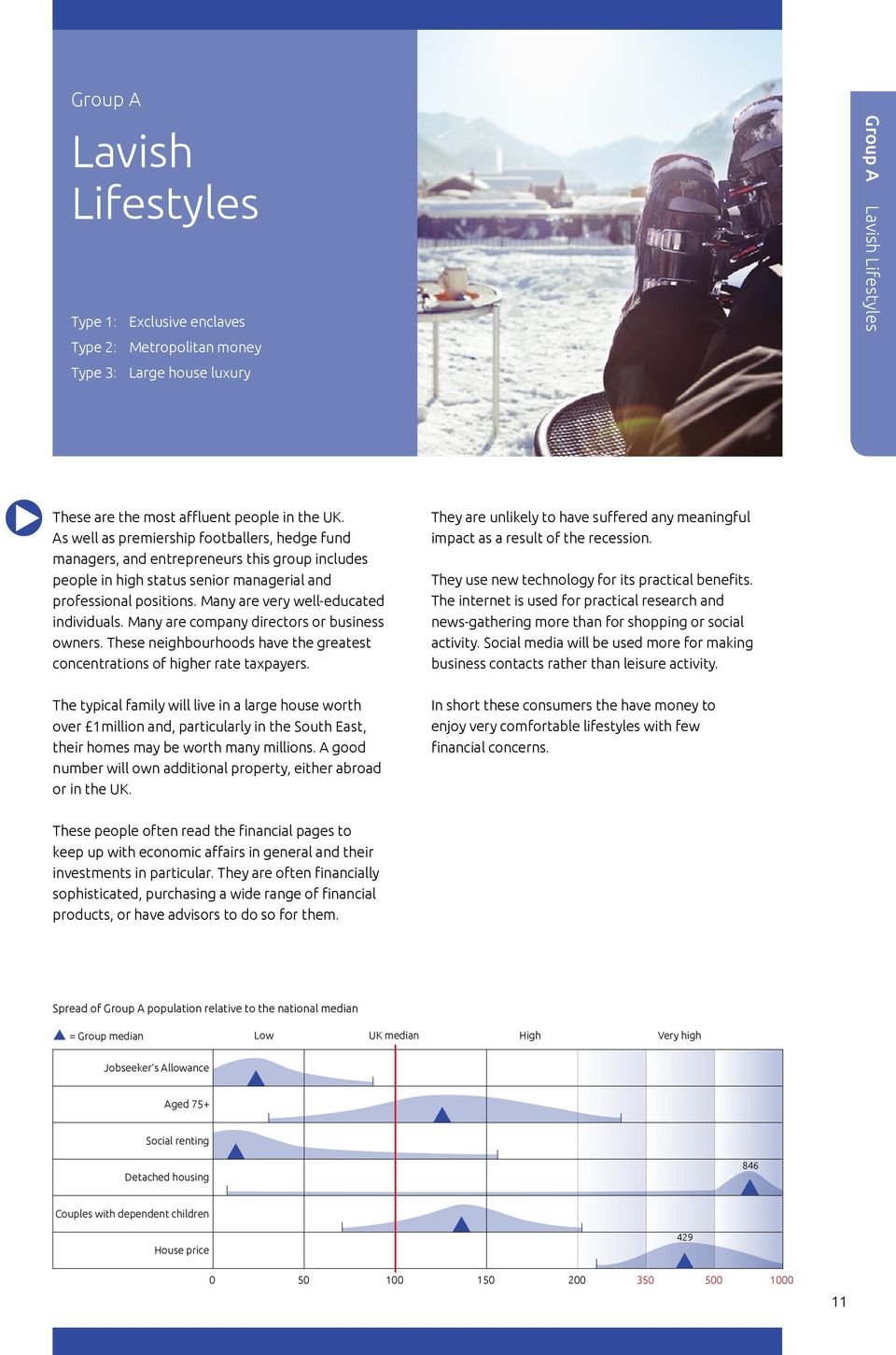
13 Group A Lavish Lifestyles Type 1: Exclusive enclaves Type 2: Metropolitan money Type 3: Large house luxury Group A Lavish Lifestyles These are the most affluent people in the UK. As well as premiership footballers, hedge fund managers, and entrepreneurs this group includes people in high status senior managerial and professional positions. Many are very well-educated individuals. Many are company directors or business owners. These neighbourhoods have the greatest concentrations of higher rate taxpayers. The typical family will live in a large house worth over 1million and, particularly in the South East, their homes may be worth many millions. A good number will own additional property, either abroad or in the UK. They are unlikely to have suffered any meaningful impact as a result of the recession. They use new technology for its practical benefits. The internet is used for practical research and news-gathering more than for shopping or social activity. Social media will be used more for making business contacts rather than leisure activity. In short these consumers the have money to enjoy very comfortable lifestyles with few financial concerns. These people often read the financial pages to keep up with economic affairs in general and their investments in particular. They are often financially sophisticated, purchasing a wide range of financial products, or have advisors to do so for them. Spread of Group A population relative to the national median p = Group median Low UK median High Very high Jobseeker s Allowance Aged 75+ Social renting Detached housing 846 Couples with dependent children House price
14 Type 1 Exclusive enclaves Type 1 Exclusive enclaves These are some of the wealthiest people in the country, including top businessmen, officials, bankers, lawyers, entrepreneurs and premiership footballers. They live in multi-million pound properties where the media will talk of Millionaires Row, Footballer Alleys and Golden Triangles. Very large houses or plush apartments will be worth 2 million, with the average being substantially more typically 10 times the prices of other housing in the local area. Places such as Hampstead, Kensington, Ascot, Cobham, Chipping Norton, Sandbanks (Poole) and Hale are typical of this type. Wealthiest people in the country Millionaires Row large houses plush apartments professionals directors business owners The professional, directors and business owners living here may include some of Chinese or European descent. 12

15 Type 2 Metropolitan money Type 2 Metropolitan money These affluent professionals live in large apartments or town houses in London or other major cities. Most own their homes but some are renting. Many will have senior managerial or other professional occupations where six figure salaries are the norm. More than a quarter will be company directors. Affluent professionals large apartments or town houses six figure salaries significant assets social networks read blogs ipads second homes Properties are on average eight times the national average with a high proportion having homes worth more than 1 million, a significant asset since many have no mortgage. These people are 10 times more likely than average to own a second home. In addition to these assets these people are likely to have investments in shares, savings accounts and be building up a personal pension. More likely than most to own an ipad or similar device, they may use it to access content relating to travel, news, weather and to play games and, less frequently, access social networks or read blogs. They are more prolific internet users when organising their leisure, finances or household services. The main uses for their smartphone are and to exchange pictures, or download and listen to music. Many of these areas are in London, typically in neighbourhoods such as Docklands, Notting Hill and Islington. Reflecting their metropolitan locations these areas are often located close or adjacent to deprived neighbourhoods. There might be a combination of younger people and those well advanced in their careers. A good proportion are single and fewer of the couples will have children. A number may be of Chinese or non-uk European in origin. 13
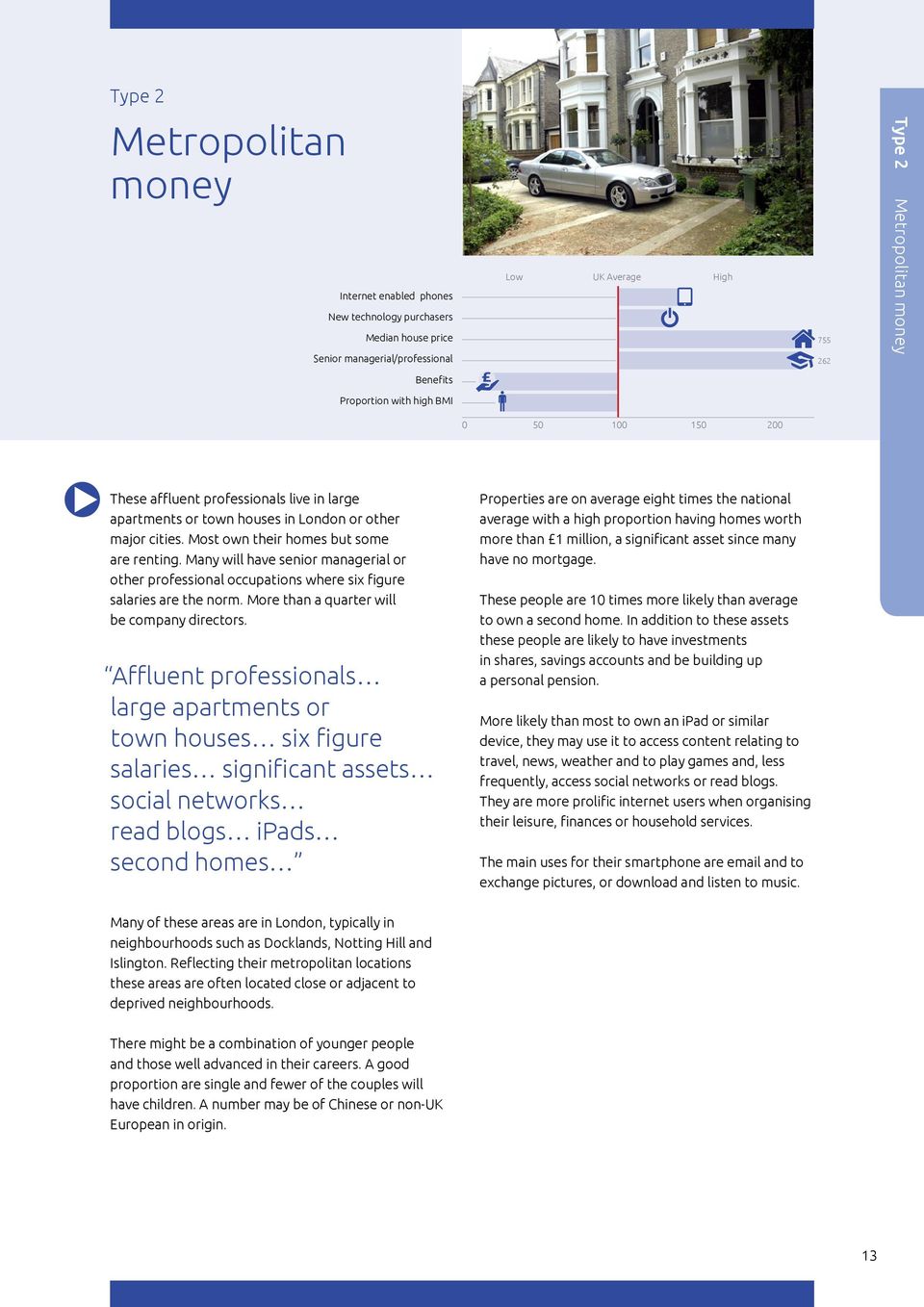
16 Type 3 Large house luxury Type 3 Large house luxury These families are living in large detached houses that are usually expensive both in terms of the local area and nationally. A significant proportion will have paid off their mortgage. A high proportion will own a second property, either abroad or in the UK. They are more likely than average to consider suitable direct marketing to be acceptable by all channels. However they are less likely to be responsive to marketing for financial products, healthcare, or utilities, which they research for themselves. Educational attainment is well above the average and many people will have senior managerial and professional jobs. The family may have a number of luxury cars and can afford frequent and expensive holidays. They have the money to spend freely and frequently on their credit cards. A high proportion will be earning six figure salaries. Most own their house and many have significant savings and investments. The proportion of families investing in shares will be three times the national average. Social media does not hold great influence with most of these people. Similarly their online activity avoids entertainment and socialising. Music, video, games, gambling, blogging and discussion forums are unlikely to be for them. It is more likely that they will use their phones and ipads for focussed online activity. Detached houses luxury cars expensive holidays focused online activity significant savings and investments golf, culture, wine... Many subscribe to a range of magazines and will read the Financial Times, and the broadsheet papers. Typical leisure interests might be golf, culture, wine and antiques. They will regularly check their stocks and shares, carry out financial activities, read newspapers, carry out research, and from time to time donate to charity online. Their children will use the internet to assist with educational activities. 14
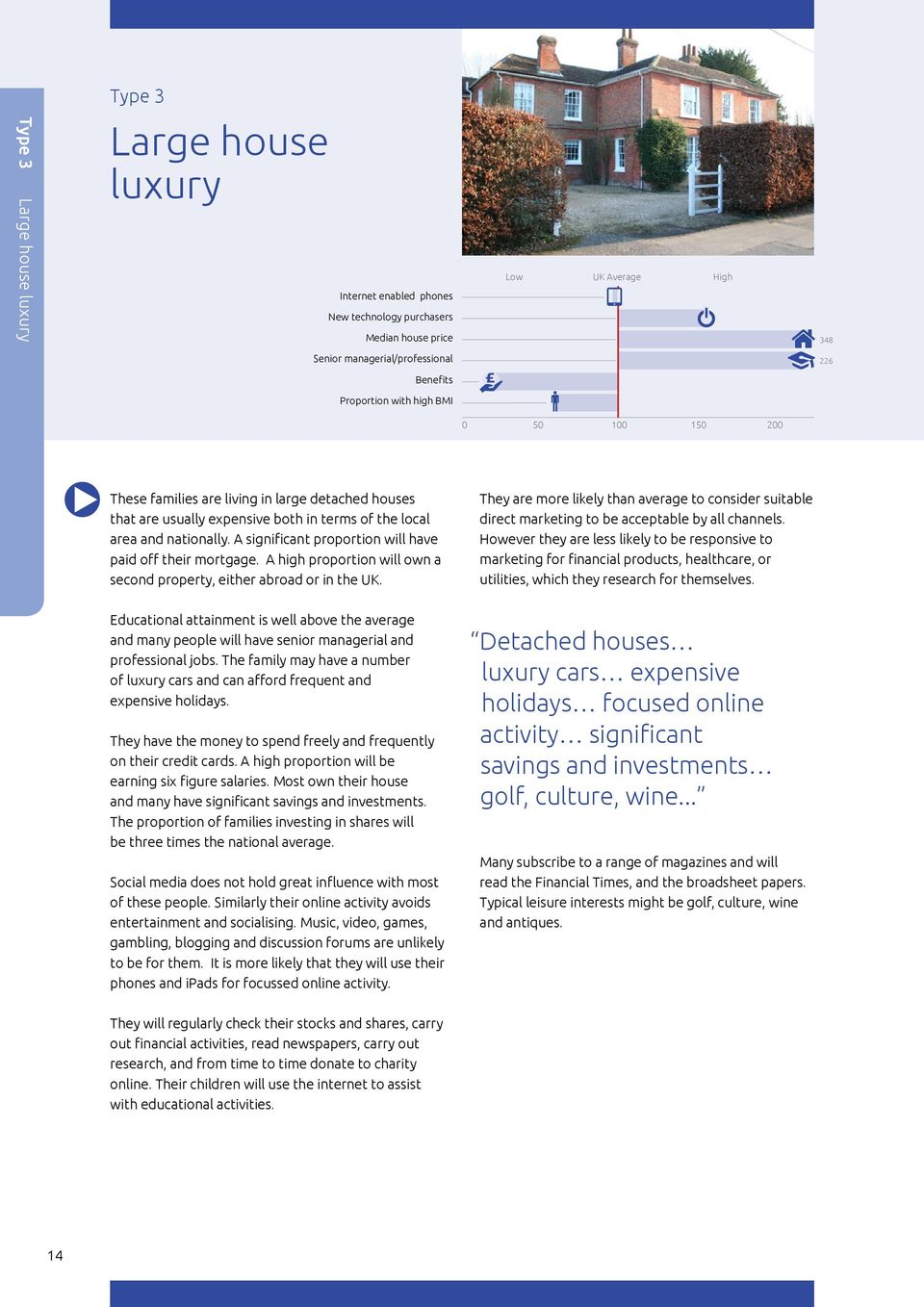
17 Group B Executive Wealth Type 4: Asset rich families Type 5: Wealthy countryside commuters Type 6: Financially comfortable families Type 7: Affluent professionals Type 8: Prosperous suburban families Type 9: Well-off edge of towners Group B Executive Wealth These are wealthy families living in larger detached or semi-detached properties either in the suburbs, the edge of towns or in semi-rural locations. While these are generally family areas there are also some empty nesters and better-off retired couples. Many families own their home but a good number may still be repaying a mortgage. The likelihood of these families owning a second home, in the UK or abroad, is over five times the UK average. Incomes are good since many have managerial and professional occupations with perhaps one in five being company directors. It is rare to find households earning less than the average. They tend to be frequent users of the internet, generally more for practical than entertainment purposes such as shopping and keeping up with current affairs, although many will also read the broadsheets. Modern technology such as DAB radio, ipads or tablet PC s, portable media players and smartphones are more likely to be owned, and those with children may well have purchased games consoles. These are high income people, successfully combining jobs and families They tend to be financially literate people more likely to have multiple bank accounts and credit cards and the incomes to spend relatively freely. These families are usually financially secure and three times more likely to have a variety of investment vehicles. Personal pensions and significant levels of savings are also more likely. Spread of Group B population relative to the national median p = Group median Low UK median High Very high Jobseeker s Allowance Aged 75+ Social renting Detached housing 785 Couples with dependent children House price

18 Type 4 Asset rich families Type 4 Asset rich families These affluent professional families tend to be older with a high proportion being retired. However some will have children living at home. They typically live in large detached, or occasionally semi-detached, houses valued well above the average for the area, and many have paid off their mortgage. There has been less evidence of housing market slowdown in these roads, the level of house sales is high given that generally in these areas many families have lived there for a good number of years. Large houses affluent professional families savings and investments social media for business contacts financial research online John Lewis and Waitrose They are usually less likely to access content on their mobile phones but those with ipads will access a wide range of activities and may have downloaded apps for shopping, fashion and other lifestyle. Social media will be used to make business contacts rather than for personal reasons. Many will regularly research their investments and financial planning online. They will also research purchases such as holidays, travel, theatre, gardening and wines. Otherwise use of the internet will be less than average. They can afford to spend fairly heavily and frequently on their credit cards and favour retailers such as John Lewis and Waitrose. Most will have good incomes from professional or managerial jobs, some as company directors. There are high levels of savings and investments in stocks and shares, unit trusts and National Savings. They manage their money carefully and regularly read the financial news. Few will have debt of any kind. They tend to have insurance, life cover and pensions. 16
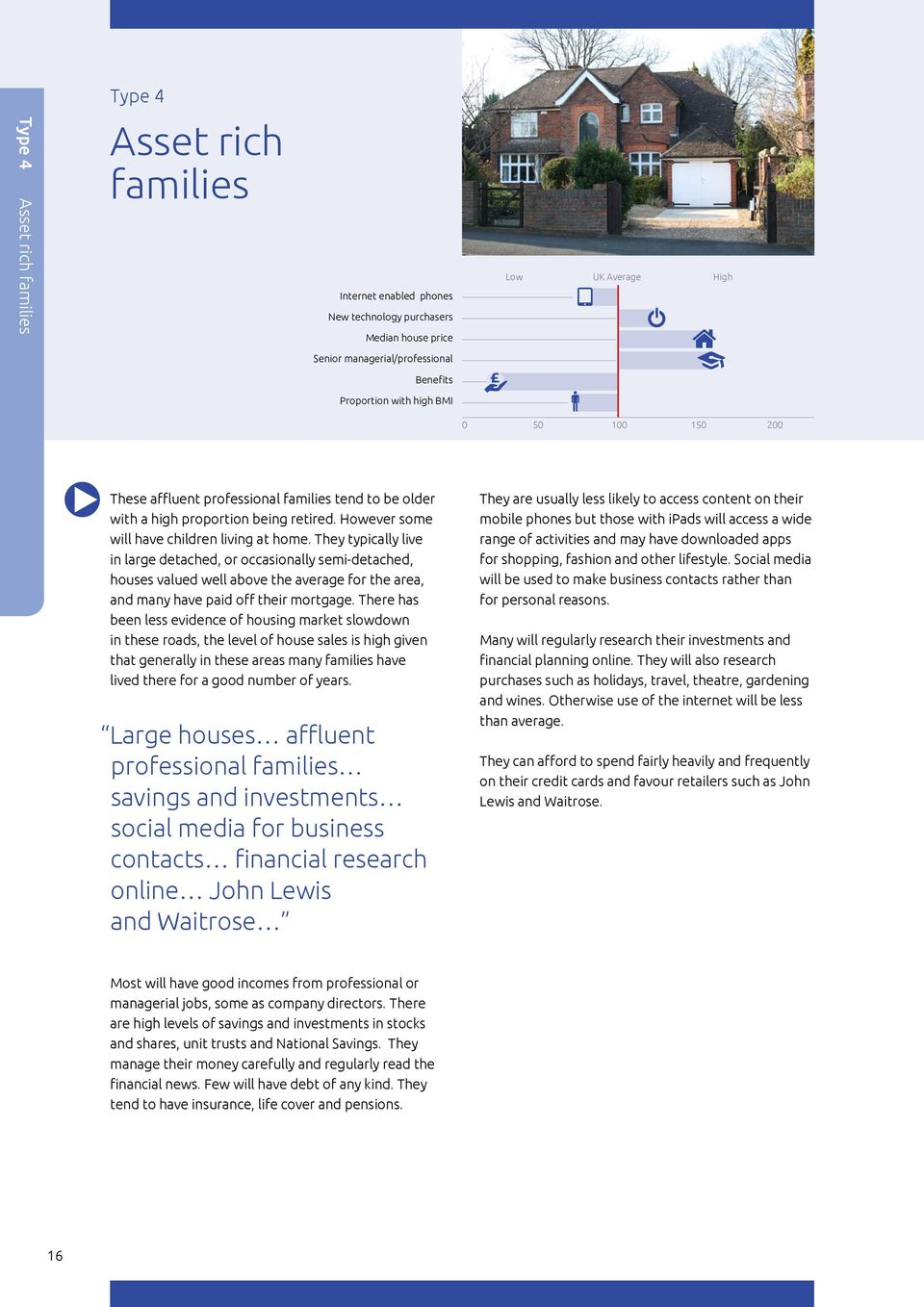
19 Type 5 Wealthy countryside commuters 203 Type 5 Wealthy countryside commuters Wealthy commuters living in semi-rural areas, villages and the fringes of small towns, form the bulk of this type. Properties are either traditional or modern semi-rural developments. Over two-thirds of these large detached houses will probably have a name rather than a numbered address, a significant number being farms and cottages. Semi-rural areas established neighbourhoods commute by car savings and investments golf, gardening, walking, wine practical use of new technology These are established neighbourhoods where most of the resident families and older couples tend to have lived for 10 years or more. Some of these couples will be retired. Car ownership is high and people tend to commute to work by car. There tends to be a high proportion of company cars and new cars. Over a fifth of these people are company directors and a higher than usual proportion of people are self-employed. Most incomes are higher than average. These families tend to have built up a good level of savings and investments in bonds, shares and ISA s. Mobiles and tablet devices are more often used for practical purposes, accessing content relating to stock and shares and less likely to access entertainment content or social networking sites. They may have downloaded practical apps such as dictionaries, translators, navigation, weather, and their personal bank account. Online they may regularly research financial products and services, property, cars, hotel reservations, airline tickets, consumer electronics, flowers and gardening equipment. In addition they may read newspapers and download podcasts. More typical leisure activities might include golf, gardening, walking, wine and antiques. Shopping tends to be done in upmarket department stores more than high street fashion retailers. These people can afford to spend often on their credit cards. 17
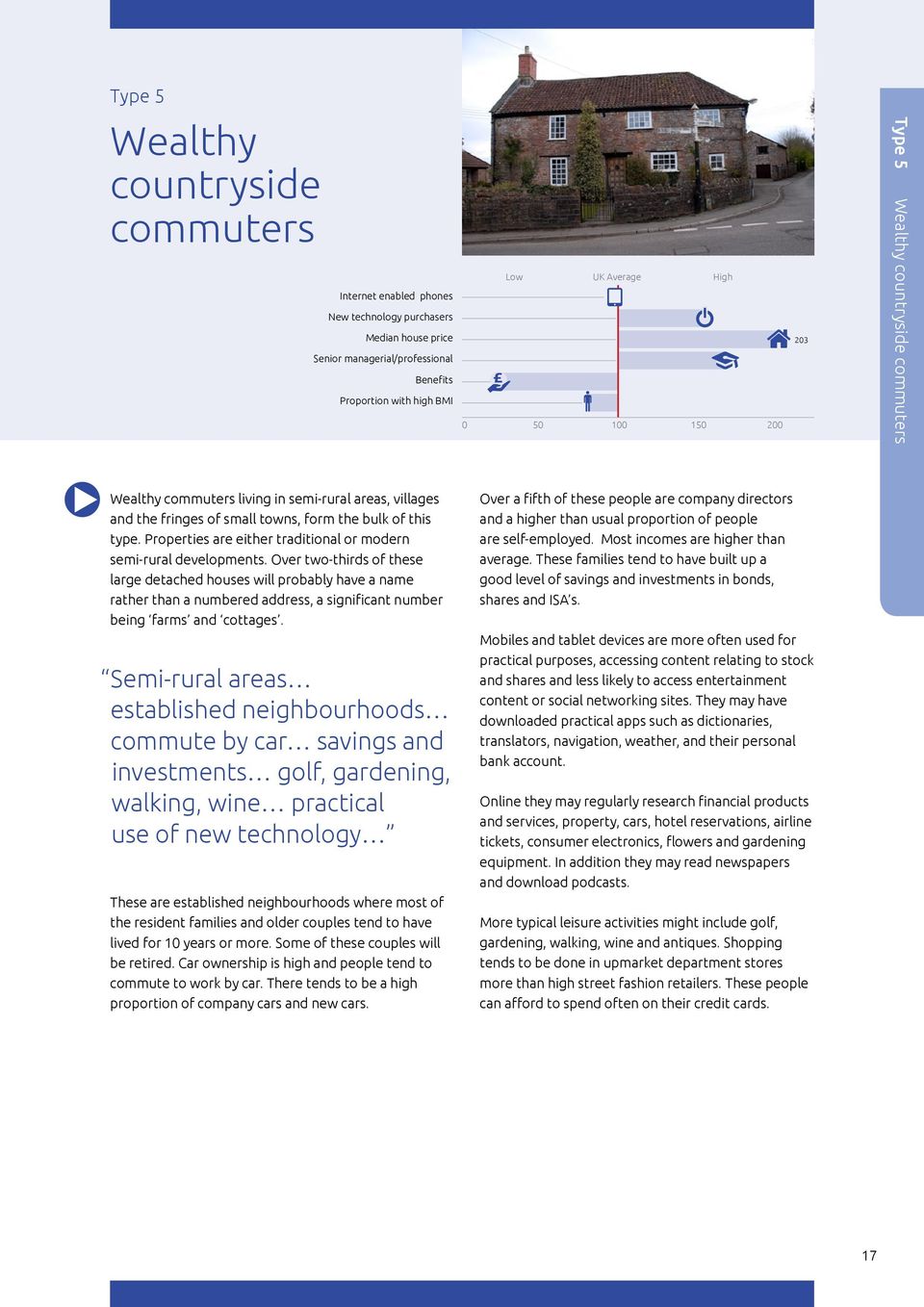
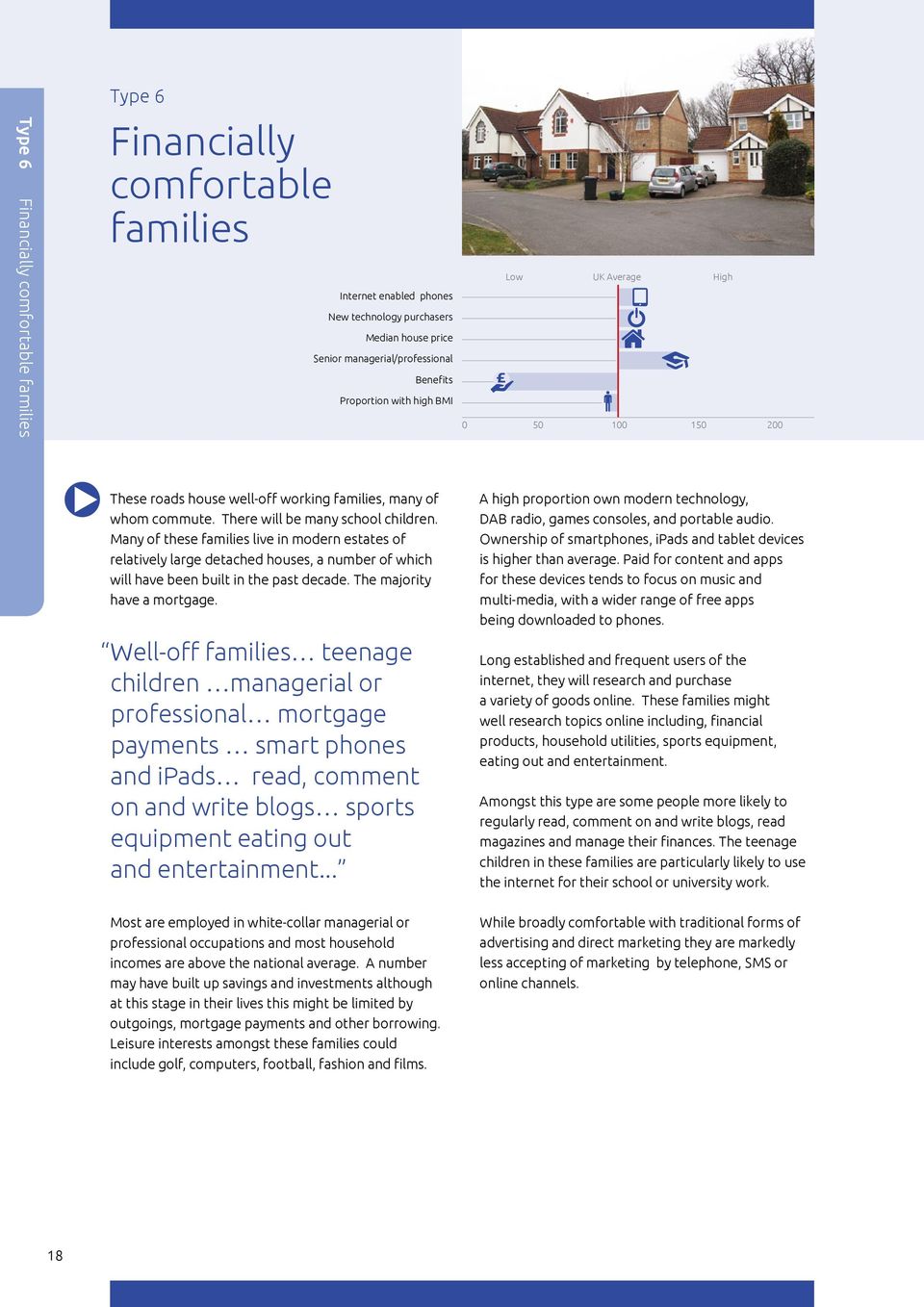
20 Type 6 Financially comfortable families Type 6 Financially comfortable families These roads house well-off working families, many of whom commute. There will be many school children. Many of these families live in modern estates of relatively large detached houses, a number of which will have been built in the past decade. The majority have a mortgage. Well-off families teenage children managerial or professional mortgage payments smart phones and ipads read, comment on and write blogs sports equipment eating out and entertainment... Most are employed in white-collar managerial or professional occupations and most household incomes are above the national average. A number may have built up savings and investments although at this stage in their lives this might be limited by outgoings, mortgage payments and other borrowing. Leisure interests amongst these families could include golf, computers, football, fashion and films. A high proportion own modern technology, DAB radio, games consoles, and portable audio. Ownership of smartphones, ipads and tablet devices is higher than average. Paid for content and apps for these devices tends to focus on music and multi-media, with a wider range of free apps being downloaded to phones. Long established and frequent users of the internet, they will research and purchase a variety of goods online. These families might well research topics online including, financial products, household utilities, sports equipment, eating out and entertainment. Amongst this type are some people more likely to regularly read, comment on and write blogs, read magazines and manage their finances. The teenage children in these families are particularly likely to use the internet for their school or university work. While broadly comfortable with traditional forms of advertising and direct marketing they are markedly less accepting of marketing by telephone, SMS or online channels. 18
21 Type 7 Affluent professionals Type 7 Affluent professionals These are usually located centrally in towns and in the outer areas of large cities. These are streets combining a high proportion of higher priced flats and apartments set amongst larger houses. However there are rural pockets of affluent professionals in the national parks and in coastal locations in a mix of residents, holiday lets and second homes. The residents tend to be well educated with professional or managerial occupations including a high level of company directors. Most incomes will be comfortably above average with people being perhaps three times more likely than average to be paying higher rate tax. Some will have built up above average savings and have investments of some form, often shares or a shares ISA. A higher proportion than normal will have life cover and pension policies. Higher priced apartments set amongst larger houses professional or managerial paying higher rate tax internet generation social networking may be business focused These areas are home to the affluent internet generation. Online these people will relatively frequently order groceries, research products, manage their finances and read news and magazines, while also occasionally downloading podcasts and movies. A few will write their own, or follow somebody else s blog. These people tend to receive more direct marketing than average and are significantly more responsive than average to a range of media channels, with the exception of TV and telephone, which they tend to feel is an unacceptable style of marketing. Social networking may be more business focused than personal activity for these people. Mobile phones, ipads and other tablet devices are used to access a varied range of content. This might be of a practical nature - financial planning, travel, weather, news, or for leisure - shopping, lifestyle, sport, or gambling. 19
22 Type 8 Prosperous suburban families Type 8 Prosperous suburban families These older families and empty nesters will typically live in streets of larger semi-detached or detached houses. Although often not the most expensive housing locally, these properties are valued much higher than the average across the country. A good number are in professional or managerial jobs with salaries well above the national average. A number might be self-employed and there might be a higher than usual proportion of families where somebody has a part-time job. Older families and empty nesters professional or managerial jobs high disposable income mix of savings plans, unit trusts and ISAs keep up with current affairs through the internet These families are financially secure. A high proportion will have paid off the mortgage on their home and the remainder will have a relatively short term left on their mortgage. They may have a mix of savings plans, unit trusts and ISAs. Some will have investments in stocks and shares and National Savings. They tend to protect their future with insurance policies and pension plans and will actively monitor their finances by reading the financial pages of their newspapers. The combination of high salaries and low spend on housing gives them a relatively high disposable income. While they are more likely to own a smart phone they will use these extensively less than the average person, typically for , exchanging photos, and practical content such as weather or travel. It is less likely that they will have downloaded apps to their phone. Most will have been users of the internet for many years and will typically go online many times each week. These families may keep up with current affairs through the internet through news sites and discussion forums. However they are less likely to visit social networking sites. Typical online shopping might be buying theatre or cinema tickets, buying flowers, researching travel, and buying groceries. These families are more likely than average to respond to all marketing channels, while less likely than average to welcome marketing from the financial sector or supermarkets. 20
23 Type 9 Well-off edge of towners Type 9 Well-off edge of towners These are wealthy couples with school age children or whose children have left home. Employment is largely in senior managerial and professional occupations. Often both adults in the household are working. They typically live in larger detached houses that are more expensive than other property in the neighbourhood. A number might own a second home, either in the UK or abroad. Car ownership is high. These neighbourhoods tend to be new-build estates on the outskirts of towns and cities. Larger detached houses school age children outskirts of towns and cities online shopping golf, exercise, wine, eating out, cinema or theatre These people are more likely to use their mobile phones for practical rather than lifestyle or entertainment purposes, while those with ipads might utilise a wider variety of apps and content. Few will have paid-for apps on their mobile phone. In general they use the functionality slightly less than average. Online shopping is fairly popular across all kinds of goods although they may prefer the personal approach to buying items such as furniture or cosmetics. However fewer people will use the internet as a tool to research their purchases. They might shop at department stores and mass-market retailers such as Gap, Dorothy Perkins, Body Shop and Clarks. Leisure interests popular amongst this type include golf, exercise, wine, eating out, cinema or theatre. The majority of household incomes are likely to be significantly higher than the national average and these families may have built up savings accounts and investments in unit trusts, bonds or shares. While more likely to feel some marketing channels are acceptable, they tend to be less accepting of text and telephone marketing. They are less likely to respond to these, or to door drops and direct mail. 21
24 Group C Group C Mature Money Mature Money Type 10: Better-off villagers Type 11: Settled suburbia, older people Type 12: Retired and empty nesters Type 13: Upmarket downsizers These people tend to be older empty nesters and retired couples. Many live in rural towns and villages, others live in the suburbs of larger towns. They are prosperous and live in larger detached or semi-detached houses or bungalows. Many have two cars, others may have down-sized to live in good quality apartments. Some will own second homes. These are high income households and even those that have retired have good incomes. Employment is typically in managerial and professional roles. A good number own their homes outright and with many having no mortgage to pay are able to invest their money in a wide range of financial products. While some might have a DAB radio these people do not generally favour new technology and are less likely than average to have a smartphone or tablet PC. Some may prefer free digital TV services to Sky or cable options. In their leisure time they enjoy gardening, walking, photography or golf. They appreciate good food and wine and will go on regular holidays. They often shop at Waitrose, Marks & Spencer and John Lewis and may well read the Daily Telegraph, the Times, the Mail and the Daily Express. These older, affluent people have the money and the time to enjoy life. Spread of Group C population relative to the national median p = Group median Low UK median High Very high Jobseeker s Allowance Aged 75+ Social renting Detached housing 372 Couples with dependent children House price
25 Type 10 Better-off villagers Type 10 Better-off villagers These older couples and families live in the larger more expensive, housing found in villages and the edges of small towns. This will include a fair number of old traditional properties. Villages and the edges of small towns older couples and families paid off mortgage may actively manage their investments occasional users of the internet leisure pursuits such as wildlife, walking, and photography Many will have paid off their mortgage and have built up good savings and investments in some mix of bonds, shares, unit trusts and ISAs. They may actively manage and switch their investments. A higher than average proportion will have personal pensions. A number might spend quite freely and frequently on their credit cards. Occasional rather than regular users of the internet, these people might shop online but not extensively. In addition to an interest in countryside leisure pursuits such as wildlife, walking and photography, some will also enjoy wine and good food. They might tend to shop at department stores such as John Lewis and House of Fraser and may show some preference for retailers such as Waitrose, Gap, Body Shop and Clarks. A fair number are well-qualified and have professional or managerial jobs, or did so before they retired. Around one in seven is a company director. Incomes are above average and a fair proportion of people are higher rate taxpayers. 23
26 Type 11 Settled suburbia, older people Type 11 Settled suburbia, older people A large proportion of the residents in these streets are pensioners, most of them owning small one or two bedroom flats. These may be coastal retirement flats, purpose-built up market flats, sometimes built exclusively for the elderly. Pensioners and older people downsized small flats good educational qualifications financially astute pension income is higher than average do not use new technology Often financially astute and having downsized their property, they might have a mix of savings and investments. Ownership of unit trusts, national savings, is usually above average. There is a mix of people who use the internet quite frequently and others who rarely go online. A few might own ipads but generally these people do not make extensive use of new technology. Readership of the Times and the Telegraph is much higher than average. They shop at department stores such as Debenhams and Marks & Spencer and established high street names such as WH Smith and Clarks. Many favour shopping at Sainsbury s. These people tend to have good educational qualifications and worked in professional or managerial occupations so while their pension income is not high compared to those in employment, their pension income is higher than average. 24
27 Type 12 Retired and empty nesters Type 12 Retired and empty nesters These streets are typically dominated by older people, with the majority of the population usually aged over 55. Approaching half of the households might be retired, mostly supported by private pensions. Many will have settled here for a number of years, although there is still a relatively active housing market as newcomers retire to these areas. It is more usual that, prior to retirement, many will have had senior managerial or professional occupations. Those still in work might have incomes a good deal higher than the average while the retired might have a pension income below the average UK worker s income. The majority own their detached houses or bungalows outright and a few will own a second home. Quite a high proportion will own shares, bonds, invest in unit trusts, and have built up reserves in savings accounts, cash ISAs and National Savings. They are more likely than average to read the financial pages to monitor their savings. Borrowing is unlikely to be part of their financial arrangements. They have the spending power to use credit cards freely while tending to repay the full amount regularly. Mostly they will be well covered by insurance. Less likely than average to use the internet, and less frequently when they do, these people are not particularly keen on online shopping. They tend to prefer traditional shops for buying books, music and DVD s. They may also prefer department stores to high street retail brands. Aged over 55 incomes higher than average detached houses or bungalows savings accounts, cash ISAs and National Savings spending power prefer traditional shops gardening, wildlife, or arts and crafts They prefer the physical touch of a paper to reading the news online and might read the Express, the Telegraph, or the Mail. Leisure time might involve gardening, wildlife, or arts and crafts. Most of them see no need for their phone to access the internet. Given the proportion of these streets that are in country areas where cable TV is not available, Sky dishes are under-represented, with more preferring Freeview and similar set-top boxes. 25
28 Type 13 Upmarket downsizers Type 13 Upmarket downsizers A significant number of these small flats are owned by pensioners with younger professionals and managers usually owning the rest of the housing. These upmarket flats are valued above the national average house price and typically occur in coastal resorts, other areas to which folk often retire, and recent purpose-built developments of homes for older people. Most of these flats are owner occupied but there are also some who are renting. Upmarket flats pensioners pensions and annuities provide good incomes subscribe to magazines wine, antiques, cultural events, walking and photography The proportion of people with savings, stock and shares, ISAs and other investments is well above the national average. Many may actively manage their money, switching accounts and investment products. Across this type perhaps one in ten people will own a second property, either in the UK or abroad. While not avid users of new technology a number will own ipads or other tablet devices. While many do not use the internet there are also a similar number who are very active online. Some typical interests of these people might be wine, antiques, cultural events, walking and photography. Many read the broadsheets and subscribe to magazines. Generally their shopping tends towards Boots, John Lewis, Marks & Spencer, Dorothy Perkins or Monsoon, and their eating habits healthy, but the husband may occasionally sneak out to Greggs. Prior to retirement the pensioners were often professionals and managers, many achieving good educational qualifications in an era when fewer people went to university. Their pensions and annuities provide good incomes, often above the national average. 26
29 Category 2 Rising Prosperity D City Sophisticates E Career Climbers
30 Category 2 Rising Prosperity Category 2 Rising Prosperity D City Sophisticates E Career Climbers These are generally younger, well educated, and mostly prosperous people living in our major towns and cities. Most are singles or couples, some yet to start a family, others with younger children. Often these are highly educated younger professionals moving up the career ladder. Most live in converted or modern flats, with a significant proportion of these being recently built executive city flats. Some will live in terraced town houses. While some are buying their home, occasionally through some form of shared equity scheme, others will be renting. While many have good incomes not all might yet have had time to convert these into substantial savings or investments. They are likely to be financially confident, managing their money and choosing the provider of their financial, or other, services. They are the internet generation, early adopters most likely to use smart phones and frequently use the internet and new technology. These people have a cosmopolitan outlook and enjoy their urban lifestyle. They like to eat out in restaurants, go to the theatre and cinema and make the most of the culture and nightlife of the big city. 28
31 Group D City Sophisticates Type 14: Townhouse cosmopolitans Type 15: Younger professionals in smaller flats Type 16: Metropolitan professionals Type 17: Socialising young renters Group D City Sophisticates These affluent younger people generally own flats in major towns and cities. Most of these are purpose built apartments although there is also a significant number that have been converted from older terraced town houses. These flats are over twice the cost of the average UK house and more expensive than the average property in these more expensive urban locations. The majority are buying their flats with perhaps a third renting from a private landlord. Single people and couples without children form the majority of people in these areas. Many are graduates and white collar occupations tend to predominate, including senior managerial and professional jobs. Perhaps one in five might be a company director. While not all are highly paid, incomes are above the national average and a good number pay higher rates of tax. and accounts. A number will have built up significant saving accounts or investments in shares. Although incomes are relatively high some of these people will be utilising their overdraft facility or making the minimum repayment on their credit cards. Ownership of iphones, ipads and other smartphone and tablet devices is double the national average. Generally these people access the internet quite frequently, to keep up with current affairs, shop, download music or films, to watch TV channels and the like. These people enjoy the lifestyle that comes with living in larger cities where there are lots of people and opportunities to socialise & spend. Many of these people are financially aware, reading the financial pages, switching accounts, carrying out financial transactions online and with multiple cards Spread of Group D population relative to the national median p = Group median Low UK median High Very high Jobseeker s Allowance Aged 75+ Social renting Detached housing Couples with dependent children House price
32 Type 14 Townhouse cosmopolitans Type 14 Townhouse cosmopolitans These are people living in expensive terraced properties, or renting converted flats in these old buildings. Terraced housing will be in the majority in over three-quarters of these streets. There may be a mix of age groups with younger emphasis. Older people may choose to downsize or move out of town rather than stay here once they have retired. These streets tend have a high proportion of well-qualified people. Nearly everyone will earn more than the national average, many a good deal more. The proportion paying higher rates of tax is well over three times the average. This due to the many white-collar occupations and high proportions of managers and professionals, and in part due to the fact that these people frequently live in urban settings, often major cities. A fair proportion of this type will be company directors. Generally financially aware people they might have a range of investments in shares, bonds, ISA s or unit trusts that they manage and switch quite actively. A good proportion will have significant savings accounts in addition to their investments. The financial products they are less likely to have include loans and life cover. A good number of these people might have paid off their mortgage and their houses will be a significant asset. Around 95% of these houses are valued at over 350,000 and a quarter might cost over 1million. In addition to this there will be a number of these people who own second homes abroad or in the UK. They may use a gym and take more active outdoor holidays. including in the winter. Typical interests might include the theatre, art, photography, food, music and film. Expensive terraced properties renting converted flats urban settings well-qualified higher rates of tax range of investments gym and active outdoor holidays smart phones and tablet computers A higher than average proportion will own smart phones and tablet computers. They might also favour newer technology such as DAB radios. These people are comfortable online and fairly frequent internet users who tend to be happy to bank online or by phone. They will read broadsheet newspapers, often online. Less likely to be swayed by phone, TV or radio advertising these people dislike receiving advertising on their mobile phone. 30
33 Type 15 Younger professionals in smaller flats 250 Type 15 Younger professionals in smaller flats These expensive small flats are occupied by younger professional singles and couples, tenure being split equally between ownership and renting. Around a quarter of these flats have been built recently and are more usually found in urban locations, particularly London. While these properties cost double the average house price nationally their price is only a little above the median for their location. Shared equity ownership is relatively high. These are young areas with a high proportion of people aged under 35 years. In addition to singles and couples there will be households with pre-school children. There may be a high turnover of people in these streets, partly due to the renting and partly because people may move to larger accommodation as their fast-moving career, and family, develops. The majority of people will have a degree and most work in white collar professional and managerial occupations. Their incomes are high, typically double the national average or higher. Many may have savings and investments in stocks and shares, ISAs and similar. They tend to spend freely using their credit cards and some might occasionally require the overdraft facility on their current account. Some might still have debt from student loans. They actively manage their financial affairs and are some of the people most likely to switch accounts and investments, which are often actively researched on the internet. Other purchases will also be researched prior to purchase online, in particular musical or sports equipment, furniture and electrical goods and local government services. Other frequent online purchases are cinema or theatre tickets, cosmetics, flowers, hotels and holidays. Many will read their newspapers and magazines online. Small flats younger professional singles and couples degrees... high incomes likely to switch accounts and investments mobile phones important practical use of social media Mobile phones will be important to these people s activity. The number who will respond to advertising, or enter competitions is higher than average. They will plan travel, book tickets, locate shops and share content using their phone. Phones and apps will also be used to access content relating to their travel, lifestyle, and financial activity and to receive news, sports and other entertainment. These people are significantly more likely than average to download paid for apps to their phone or tablet devices. There tends to be a stronger prevalence to use social media to make business contacts or find a job than to follow celebrities. 31
34 Type 16 Metropolitan professionals Type 16 Metropolitan professionals These tend to be younger professional people in their twenties and thirties, with relatively few people aged over 45. Often they live in London where their flats might cost over half a million pounds. A significant proportion of these are converted flats in pre-1920 buildings. While there is a higher level of private renting than average the majority of people are buying their flat with a mortgage, in some cases using some form of shared ownership. Young professional people converted flats professional and managerial good incomes ipads, games consoles and portable media players enjoy travel, music and film social lifestyle Generally these singles and couples will be graduates and work in professional and managerial occupations. Up to a quarter of these people might be company directors. Many incomes are well above the national average, although less dramatically above the London average. While generally financially aware, with many having multiple bank accounts and credit cards, the proportion making the minimum repayment on their card is much higher than average. They are likely to be active switchers of cards and accounts. Many will have some savings and are twice as likely as average to invest in stocks and shares. A high proportion will own smartphones with two to three times the average propensity to own a Blackberry or iphone. These people tend to enjoy new technology. Ownership of tablet computers, ipads, games consoles and portable media players is above average. These people form the internet generation, over a third of them might spend over 3 hours a day online. Offline many might enjoy travel, music and film in addition to their regular social lifestyle Most might have recently shopped at upmarket shops such as Marks & Spencer, Waitrose and John Lewis. 32
35 Type 17 Socialising young renters Type 17 Socialising young renters These young singles and sharers are at early stages of their careers, living active urban social lifestyles in cities and towns. Perhaps half will be buying flats while the remainder are renting flats, privately or sometimes from a social housing provider. A particularly high proportion of flats have been converted from houses, and there will be significantly higher than average level of rented property on the register of Houses in Multiple Occupation. Because of the urban setting the owner occupied flats will cost more than the price of an average house. While having degrees and executive jobs possibly directorships, their incomes will not generally be a corresponding amount above the average income. Most do not have a car. These people are more likely than most to consider switching financial products. A good number may have taken out a new credit card in the past year. Spending on cards is not typically high but a number will only pay the minimum balance each month. Some will be using the overdraft facility on their current accounts and some will be having difficulties with debt repayments. with a QR scanner, use GPS, download music, and watch video. Some will regularly vote in celebrity TV competitions using their phone. Their sociability extends to the internet. They will share content, read blogs, and visit online dating sites. Converted flats young singles and sharers early stages of careers switching financial products share content, read blogs out with friends... cinema or a club... living a young social lifestyle... It is extremely unlikely any of these young people will not have gone online in the past week. They will manage their finances online, plan their travel online, access current affairs and read newspapers and magazines online and order pizza online. Twice as likely as average to own ipads and iphones, most will own a laptop and a smartphone. They are more likely to have downloaded free and paid for apps to their phone, which they might use to access financial information, lifestyle, entertainment, maps and travel content. They are more likely than average to use their phone to locate shops and restaurants, access content Social networking sites are used to establish business contacts more than to follow celebrities and while some might become a fan of a brand most tend to use social media less than average. Instead these people will be out with their friends, having a meal, going to the cinema or a club, generally living a young social lifestyle. 33
36 Group E Group E Career Climbers Career Climbers Type 18: Career driven young familes Type 19: First time buyers in small, modern homes Type 20: Mixed metropolitan areas These are younger people, singles, couples and families with young children. They live in flats, apartments and smaller houses, which they are sometimes renting and often buying with a mortgage, occasionally using a shared equity scheme. Usually these are in urban locations, frequently in London and large towns and cities across the country where the flats cost more than the national average price of a house. Overall they tend to have higher educational qualifications than average and incomes reflecting the urban locations, are well above average. A good proportion will be in white-collar occupations including both managerial and professional roles, some paying higher rate tax. As a result the good jobs may not always reflect high disposable income and a few may even be having some difficulties with debt. The Career Climbers are more likely than many to switch provider of all forms of financial services. Generally these people are confident users of new technology and frequent users of the internet. Ownership of smartphones, media players, tablet PC s and games consoles are likely to be above average. They use the web to research purchases, read newspapers, buy and download music. They prefer marketing communications by and dislike commercial contact on their phones, which are for social use. Although they are more likely than average to have some savings, investments and pensions, others are more likely to have loans, perhaps the residue of student borrowing and to have mortgage repayments. Spread of Group E population relative to the national median p = Group median Low UK median High Very high Jobseeker s Allowance Aged 75+ Social renting Detached housing Couples with dependent children House price
37 Type 18 Career driven young families Type 18 Career driven young families These are family areas where younger couples and families with children live in smaller detached or semi-detached houses. Generally these are relatively modern estates and a sizeable proportion will have been built in the past decade. Most are buying their home with a mortgage, with a few using shared equity schemes. Typically these mortgages have many years before they are paid off. The houses are of average value for the locality. Incomes are more often above average with some 10% of these people paying higher rates of tax. Occupations tend to be white collar, professional or managerial. A high proportion of these people have degrees or A levels. Ownership of portable media players, game consoles, DAB radio, digital camera s is above average. They tend to have a smartphone and some will have an ipad or other tablet computer. A higher than usual proportion of the houses may have Sky dishes. Smaller detached or semi-detached houses younger couples and families mortgages frequent internet users download music and films Being frequent internet users they tend to more likely to manage their finances online, use comparison sites, do their job search or read their newspaper online. They may also do their job search or read their newspaper online. They, or their children, may download music and films. They find communication by all channels, in particular digital channels, acceptable although they believe they ignore posters, TV and radio advertising. 35
38 Type 19 First time buyers in small, modern homes Type 19 First time buyers in small, modern homes Singles and couples in their twenties and thirties are typical of these areas. They will own or rent the small flats that form the majority of the housing. While some of these will be in old buildings most is of more recent construction with a high proportion having been built within the past decade. While modern the housing tends to offer relatively small space. Young singles and couples renting small flats cheaper accommodation whitecollar above average incomes debt or student loans wide use of the internet eating on the go and coffee shops There will be a high turnover of residents amongst the tenants renting and the residents buying in these streets. These are areas where accommodation is cheaper than elsewhere in the vicinity and designed for people on the first steps of the property ladder. Many of these people have professional or white-collar careers and their incomes are above average. However few will have built up savings or investments and may well have some debts and possibly still be paying off student loans. They spend relatively highly on their credit cards although one in five may have been refused credit in the past. These people are comfortable using the internet in all aspects of their lives, banking, shopping, gambling and gaming. High street fashion retailers such as Gap, Republic, Warehouse, Oasis, Accessorize and La Senza, will be favoured by these young shoppers. Eating on the go and coffee shops may also feature in their day to day activities. Music, film and style magazines might find an audience amongst these people. They may also read liberal broadsheets be specific and go online for their news and current affairs. 36
39 Type 20 Mixed metropolitan areas Type 20 Mixed metropolitan areas These mixed streets feature more flats and terraced housing. Usually owner occupied the housing is priced above the national median price, typically 50% higher. Accommodation is a mix of smaller one or two bedroom properties and larger housing, perhaps shared by a number of adults. Overall these are moderately stable areas with many people having lived here for a number of years. Few elderly people live in these streets. These people tend to be younger and in professional or managerial employment. While there are more single or separated people than average some couples will have started to raise a family. These neighbourhoods might sometimes be likened to buffer zones between areas of contrasting affluence or desirability. People may aspire to better housing but, for a variety of reasons, cannot afford it. Overall incomes are above average but not significantly so and affluence may be mixed. While those early in their professional career might have good incomes and some of those renting might have built up savings or investments with a view to purchasing a house in the future there may be some others claiming Jobseeker s Allowance. Some might have been refused credit in the past. A higher than usual proportion of people will have some debts and may be having some difficulty with debt repayments. Flats and terraced housing stable areas few elderly people average incomes professional and managerial some debts buffer zones between areas of contrasting affluence or desirability The younger age profile is reflected in the leisure and shopping habits of the people in these streets. Clothing may be purchased from a variety of places, from modern fashion retailers such as Hollister and Forever 21, to JD Sports, H&M, and Primark. Some will frequent retailers such as Nando s, Starbucks, or Costa, and purchase technology from the local Apple store. 37
40
41 Category 3 Comfortable Communities F Countryside Communities G Successful Suburbs H Steady Neighbourhoods I Comfortable Seniors J Starting Out
42 Category 3 Comfortable Communities Category 3 Comfortable Communities F Countryside Communities G Successful Suburbs H Steady Neighbourhoods I Comfortable Seniors J Starting Out This category contains much of middle-of-the-road Britain, whether in the suburbs, smaller towns or the countryside. All lifestages are represented in this category. Many areas have mostly stable families and empty nesters, especially in suburban or semi-rural locations. There are also comfortably off pensioners, living in retirement areas around the coast or in the countryside and sometimes younger couples just starting out on their lives together. Generally people own their own home. Most houses are semi-detached or detached, overall of average value for the region. Incomes overall are average, some will earn more, the younger people a bit less than average. Those better established might have built up a degree of savings or investments. Employment is in a mix of professional and managerial, clerical and skilled occupations. Educational qualifications tend to be in line with the national average. Most people are comfortably off. They may not be very wealthy, but they have few major financial worries. 40
43 Group F Countryside Communities Type 21: Farms and cottages Type 22: Larger families in rural areas Type 23: Owner occupiers in small towns and villages Group F Countryside Communities These are areas of the lowest population densities in the country, ranging from remote farming areas to smaller villages and housing on the outskirts of smaller towns. Housing is typically owner occupied, detached or semi-detached however there will be some renting and tied property. Up to a third of the homes will be a named property rather than street number, terms such as cottage or farm will often feature in these names. Overall the mix of people is older than the average. Although incomes might be lower than the national average some families will have built up savings and investments and be in a better financial position than many in urban areas. Leisure interests will tend to reflect the opportunities offered by the relatively rural locations, walking, wildlife, photography, gardening and food. While there is a fair amount of agricultural employment there are also many other skilled occupations and some professional people. These might be stable areas with much lower turnover of home ownership than usual. Spread of Group F population relative to the national median p = Group median Low UK median High Very high Jobseeker s Allowance Aged 75+ Social renting Detached housing 600 Couples with dependent children House price
44 Type 21 Farms and cottages Type 21 Farms and cottages These are rural communities in which there is a significant amount of farming. However agricultural employment may still be the minority with perhaps one in eight working on farms. Due to their remoteness the majority of homes may be heated using oil or coal. The population has an older age profile with an above average proportion of both empty nesters and retirees. Farms and cottages savings pension schemes may never have used social media like traditional retailers shops less readily available where they live gardening, bird watching, walking, photography Three quarters of their homes are likely to have a name rather than a numbered address, with farm and cottage occurring with equal frequency. The majority of housing is likely to be detached and of a good size, with a high proportion owned outright, although some will be rented or tied. Many homes may have been built over a century ago. Household incomes tend to be higher than average with some paying higher rates of tax. A number are company owners or directors. More of this type than usual will have good savings, pension schemes and investments in stocks shares and bonds. They spend relatively frequently using their credit cards. Modern technology lifestyles are not for these people. More than the average proportion of these people will have never accessed a social media web site. Similarly fewer than average will download any form of apps, free or paid for, to their mobile phone. They are much less likely to have an ipad or other tablet device. They will go online, sometimes as much as a couple of times a week, but this is usually for practical purposes. They will manage their bank accounts and other finances, purchase wine, cosmetics and other goods since shopping opportunities are less readily available where they live. Music and film may be less likely to be bought online than in traditional retailers such as Waterstones. Leisure interests often enjoyed by some of these people might include gardening, bird watching, walking, photography, and antiques. They might subscribe to magazines on topics such as cookery, homes and gardening. 42
45 Type 22 Larger families in rural areas Type 22 Larger families in rural areas These older families typically live in large detached houses or bungalows in more sparsely populated areas. Some of these homes will be recently built rural developments. They own their homes, or are buying with a mortgage. Most will heat their homes with oil or coal rather than electricity of mains gas. Typically these households will have two or more cars. A significant proportion of this type is found in Northern Ireland. A higher than usual proportion will be self-employed or have their own business. Household incomes are often above average. People are more likely to have two or more bank accounts and credit cards, and to spend reasonably heavily on these cards. Most will take care to have home and vehicle insurance, life cover and life assurance policies. They tend to have a fair amount of savings, ISAs and a range of investments. A number of these families may own a second home abroad or in the UK, possibly for renting out as holiday homes. Use of social media is likely to be much lower than average, with more people never using, or only infrequently using, such sites. The few who do use social media may however be fairly keen users of the functionality. Similarly they are also less likely that average to use any but the basic functions of their mobile phone. They are less likely to own a smartphone and the vast majority will never have downloaded an app to their mobile phone. However, given their often remote rural location, many will find it convenient to bank online, read newspapers, and to interact with their local council web site. A number may be active on ebay and other auction sites. Sparsely populated areas large detached houses some holiday homes savings and investments traditional communication channels never downloaded an app to their phone They will also buy gardening equipment, electrical goods, cosmetics, tickets, travel and holidays online. While they buy books online they also tend to favour traditional high street retailers such as WH Smith and Waterstones. A consequence of this lack of love for new media is that direct marketing using traditional channels, mail and newspapers, is most likely to glean a good response albeit more for home appliances and entertainment products. 43
46 Type 23 Owner occupiers in small towns and villages Type 23 Owner occupiers in small towns and villages These are older and retired couples living in smaller detached and semi-detached housing developments in villages and small towns. For most their children will have grown up and left home. Older couples children grown up and left home skilled occupations National Savings own their homes outright interests might include wildlife, eating out, photography, and cookery Those still working are more likely to have skilled than professional occupations. Typical education levels might be O level and apprenticeships. Incomes are mixed, some households will be well above the UK average income while others may be a fair bit below the average. In general these families will have built up a little more savings than the average. A number will have a National Savings product, and half might have ISAs and other investments. Homes are owned outright or being bought with a mortgage with only part of its term left to run. Few of these people will access social media sites on a daily basis. They are more likely not to use social media at all. They are less likely to have a smartphone and less likely than average to use apps, download content, or use any other functionality of modern phones. They are also less frequent users of the internet being less likely to research or to buy goods online. They even use less than average. Shopping is more likely to be done at department stores and well-established high street names. Some might shop at Aldi, Lidl or the Co-operative. Interests might include one or more of angling, wildlife, eating out, photography, or cookery. Some might read celebrity, motor or food magazines. 44
47 Group G Successful Suburbs Type 24: Comfortably-off families in modern housing Type 25: Larger family homes, multi-ethnic areas Type 26: Semi-professional families, owner occupied neighbourhoods Group G Sussessful Suburbs This group comprises home-owning families living comfortably in stable areas in suburban and semi-rural locations. They mainly live in three or four bedroom detached and semi-detached homes of an average value for the locality. Families might include young children, teenagers or even young adults who have not yet left home. These areas will also include some empty nesters. Within this group, there are also some neighbourhoods with high numbers of comfortably off families of Asian origin. Incomes are at least of average levels and many earn well above the national average. Many have A level or higher qualifications. People are employed in a range of occupations, including middle management and clerical roles. There also a number of shop workers and skilled manual workers. Most people in this group have some savings and would consider themselves financially prudent. The more affluent will have good company cars and will have built up somewhat greater levels of savings and investments. Many will have pensions through their employer and others will have private pensions. These are occasional rather than heavy users of the internet although their phone is more likely to have internet capability than not. Generally they are less keen on marketing communications other than by . Leisure interests are varied with photography, computing, gardening, travel, and golf a little more popular than average. These are the stable suburban families that make up much of Middle Britain. Spread of Group G population relative to the national median p = Group median Low UK median High Very high Jobseeker s Allowance Aged 75+ Social renting Detached housing Couples with dependent children House price
48 Type 24 Comfortably-off families in modern housing Type 24 Comfortably-off families in modern housing Older families and empty nesters are the usual residents in these streets of modern three or four bedroom detached houses found in towns across the country. Some of the older families may have paid off their mortgage and own their, average priced, house. It is unlikely there will be much multiculturalism in these areas. Modern detached houses three or four bedroom average incomes investments might have built up sums in savings accounts interests might include golf, gardening Generally household incomes are a little above the national median with some of these families earning up to perhaps twice the median. There may be a wide mix of occupations ranging from skilled manual worker to professionals and white collar workers. There may be the occasional company director. While some may have degrees it is more usual to find people s education ended before degree level. Most will have one or more credit cards, which they will use frequently spending relatively freely. They pay for insurance cover to protect their homes and belongings and are more likely than average to have built up investments. These might be any combination of ISAs, shares, bonds or unit trusts. It is also likely that a good number might have built up sums in savings accounts. Some may spend on technology, the occasional tablet or handheld computer, or portable media player, and packages offering the latest in TV. Most will have been online in the past week. Some might have done so regularly while others will only occasionally. Typical interests might include golf, gardening, or travel. Papers such as the Daily Express or the Daily Mail might have good readership amongst this type. 46
49 Type 25 Larger family homes, multi - ethnic areas These are middle class neighbourhoods often found in suburban areas of larger towns and cities. Younger families living in larger semi-detached houses are typical of these streets. There may be the occasional couple in a civil partnership. Children will be from all age groups, pre-school, primary and secondary school. The proportion owning a smart phone is above average. internet use is fairly average with a few going online quite frequently, perhaps for games or to download films or music. While they may research purchases online fewer than average actually buy online. Type 25 Larger family homes, multi-ethnic areas Generally people have lived here for a while and the frequency of house sales is lower than average. There may be a significant multicultural population including families of South Asian origin, Hindu, Sikh and Muslim. These are comfortably off families with average or good incomes. Few people in these streets seek any form of benefits. Some will be higher rate taxpayers. Occupations tend to be administrative, white collar or professional. A number might own their own business, some might be company directors. Qualifications to degree or A level are more usual. Fewer people might have insurance cover than is usual for the levels of home ownership and income. Similarly fewer have pension provision than might be expected. Only average numbers invest in stocks, savings schemes, or tax efficient financial products. Some might own second properties. Stable middle class neighbourhoods semi-detached multicultural population above average incomes white-collar administrative occupations unlikely to welcome direct marketing Some will read their newspapers online. They might read the Financial Times, the Times, the Guardian or the Independent. These suburban families are less likely to welcome direct marketing, or to respond to it. A number of these families will have taken out loans and a few might be having some difficulties with repayment. 47
50 Type 26 Semi-professional families, owner occupied neighbourhoods Type 26 Semi-professional families, owner occupied neighbourhoods Found in villages and on the edge of towns, these are streets of younger couples and families occupying average priced, often terraced, houses. A fair number of these addresses will be named rather than numbered houses and in villages they will be named cottages. Terraced houses edge of towns a broad mix of people well educated mortgages practical use of the internet prefer traditional channels With an eye on their future responsibilities some of these couples might have pensions and house, life and pet insurance policies. These families may seek value by switching provider of their financial products. They are more likely to use the internet for practical rather than leisure purposes, banking, shopping, and researching products and less likely to be downloading films and music or playing games online. They are less keen on communication by and text preferring to be contacted by traditional channels of post or in person. They are more likely to shop in BHS rather than John Lewis, and in Next and Thorntons rather than Hollister or Hotel Chocolat. While more than average of these couples are well educated and in managerial occupations, these streets will contain a broad mix of people. Most have above average incomes with a few people paying higher rate tax. They generally have modest savings and some investments. Relatively few will have loans or other borrowing but some might occasionally utilise the overdraft on their current account. Generally the property is being bought with a mortgage and in many cases mortgages have been repaid for more than 10 years. 48
51 Group H Steady Neighbourhoods Type 27: Suburban semis, conventional attitudes Type 28: Owner occupied terraces, average income Type 29: Established suburbs, older families Group H Steady Neighbourhoods These home-owning families, often middle aged, are living comfortably in suburban and urban locations. They mainly own older, lower priced, three bedroom terraced or semi-detached homes, which they may have occupied for many years. Families might include young children, teenagers or young adults who have not yet left home. These areas will also include some empty nesters. People typically have GCSE and A level qualifications although some have degrees. They tend to be employed in a range of middle management and clerical roles or as shop workers and semi-skilled manual workers and overall household incomes are around the national average. Their spending and interaction with financial services broadly mirrors the national average. Most in this group have some small savings, an ISA and perhaps a few shares. Although they do generally use the internet, few of these people will go online extensively on a regular basis. They are more likely to read the Daily Mirror, the Daily Express or the Daily Star than a broadsheet paper. Celebrity, travel, cooking and glossy women s magazines may be popular with some. These working families form the bedrock of many towns across Britain. Spread of Group H population relative to the national median p = Group median Low UK median High Very high Jobseeker s Allowance Aged 75+ Social renting Detached housing Couples with dependent children House price
52 Type 27 Suburban semis, conventional attitudes Type 27 Suburban semis, conventional attitudes These are stable middle class neighbourhoods where most people have lived for a significant time. There is likely to be an older age profile with a mix of older families, empty nester couples and some retirees. Housing in these streets often comprises a high proportion of three bedroom semi-detached properties, either being bought with a mortgage or owned outright. Mostly this housing is valued below the UK average. Stable middle class semi-detached clerical, skilled manual cautious in outlook BHS, Poundland might enjoy gardening, photography, travel and DIY These are not generally high spenders. They may be cautious in outlook, ensuring their house, car and property in insured and providing for the future with life policies and pensions. Their retail spending might be spread across stores such as Argos, BHS or Debenhams and sometimes Peacocks and Poundland. While these people might well use the internet it is generally infrequently or for short periods. Although generally less responsive to all marketing channels, there is no especial dislike of marketing through any channel. They are much more likely to read the tabloid press rather than the broadsheets. Individual interests will vary but some might enjoy gardening, photography, travel and DIY. Incomes are around or a little below the national average. Typically occupations tend to be junior managerial, clerical and skilled manual in nature with O levels and apprenticeships the more frequent level of academic attainment. 50
53 Type 28 Owner occupied terraces, average income Typically found in towns and urban areas this type is home to a mix of working families with children. These people have worked hard to own their three or four bedroom terraced houses. However the size of their family may mean that a few of these people feel their accommodation is short of space. Terraced housing towns and urban areas families short of space average incomes a few second mortgages moderate use of the internet It is likely that the family will have two wage earners, typically managers, office or clerical workers plus some skilled workers. A few of these people will have two or more paid jobs. With unemployment relatively low overall, family incomes are around or above the national average. A few may pay higher rates of tax. While most can afford to save money, either from time to time or on a regular basis, a few might be finding debts to be a heavy burden on the household. A small number of these families may have taken out a second mortgage on their home. Mostly these families might feel happy. Many feel relatively satisfied with their social lives, their use of leisure time, their work and their health. Some may be active in parent/school associations or other local organisations. Although they make moderate use of the internet these families are less likely to favour phone or as communication channels. Type 28 Owner occupied terraces, average income 51
54 Type 29 Established suburbs, older families Type 29 Established suburbs, older families These are suburbs where households tend to be empty nester couples and larger families with secondary school children. On average these families have lived in their current home for around 12 years so these tend to be well-established areas. Well established areas semi-detached middle management manage to save regularly leisure activities include golf, computer games, going to the cinema, and watching TV Most will have made adequate pension provision through company or private schemes. Some will own stocks and shares. Generally these families manage to save on a regular basis although with low interest rates reducing any income from their savings some of these people may be feeling less well-off than in the past. While they spend moderately freely on their credit cards a few will only make the minimum repayments each month. Leisure activities include golf, computer games, going to the cinema and watching TV. These modern families are likely to purchase additional digital TV services and use the internet but not a great deal more than average. Ownership of technology such as games consoles, portable media players and digital radio is likely to be above average. The majority of families own three or four bedroom semi-detached houses that tend to be lower than the average house price in their area. Incomes tend to be a little above average. These people generally work in middle management, clerical or administrative jobs. Some may have a skilled trade. In some cases up to one in ten might have a second paid job. Typical academic attainment might be O or A levels. 52
55 Group I Comfortable Seniors Type 30: Older people, neat and tidy neighbourhoods Type 31: Elderly singles in prupose-built accomodation Group I Comfortable Seniors These established communities are generally made up of retired and older empty nester couples. Property tends to be two and three bedroom semi-detached houses, bungalows and some smaller purpose-built flats. These will typically be slightly below the average value for the area, although there will be variation around this level. The majority will have paid off their mortgage and own their homes outright. The working population are in a mix of middle, lower management and supervisory jobs while some of the pensioners might have had more senior roles. Overall incomes are relatively modest since a good number of these people are now living off their pension. However since their children tend to have left home and they have little or no mortgage left to pay, many will have a reasonable disposable income. They may also have some investments for security in their old age. Broadly these people feel comfortable with few in financial difficulties. However lower investment incomes due to low interest rates is likely to be a concern for some. They are unlikely to use the internet more than sporadically for practical purposes such as , purchasing travel tickets. New technology is unlikely to attract these people and their phone is unlikely to be able to access the internet. They are likely to prefer to be contacted by regular mail rather than any other channel. Free digital services are likely to be preferred to a cable or satellite service. Whilst most people get their news from the TV, the Daily Mail is the most popular newspaper. These older people have sufficient investments and pensions to feel secure about their future. Spread of Group I population relative to the national median p = Group median Low UK median High Very high Jobseeker s Allowance Aged Social renting Detached housing Couples with dependent children House price
56 Type 30 Older people, neat and tidy neighbourhoods Type 30 Older people, neat and tidy neighbourhoods These tend to be settled established neighbourhoods where a higher than usual proportion of residents have lived in their home for many years. Mostly streets of smaller, mostly semi-detached, houses and bungalows, there is likely to be a high proportion of older residents, including a large number of retirees. Many of these people have, or had before their retirement, white-collar, skilled or semi-skilled jobs. Incomes are generally average, or lower, although a few household may be earning more. Perhaps a third will be living off their private pension. Semi-detached bungalows older residents a range of investments only require basic mobile services Daily Mail, Daily Mirror, and Daily Express gardening, wildlife, travel, arts and crafts These people tend to be well provided with credit cards, which they use relatively freely, usually repaying the full balance each month. Being settled in their homes these people are much less likely to switch providers of their financial services or utilities. Generally these people use the internet less frequently than average and a significant minority will never have gone online. Similarly these people are unlikely to have smart phones, basic phone services are all most require. Readership of the Daily Mail, the Daily Mirror and the Daily Express tends to be high. Some will subscribe to TV, home and gardening and food magazines. More usual leisure interests might include gardening, wildlife, travel, arts and crafts. In addition to significant savings accounts these older people tend to have a range of investments, ISAs shares, unit trusts, National Savings. A good number will have paid off their mortgage and have equity in their home, although their houses tend to be below the average value for the local area. As a result outgoings can be less than average and spending power may be higher than suggested by the average incomes. 54
57 Type 31 Elderly singles in purpose-built accommodation The great majority of people in this type are retired, many of them aged 75 or over. Most own flats many of which are part of purpose-built schemes restricted to older residents. Many of the more recently developed retirement houses and villages fall in this type. A large proportion of the pensioners are widowed and live alone. Leisure activities are sedate, with a preference for theatre, art and similar cultural activities. Some will take a cruise or coach holidays. They subscribe to magazines, perhaps on food, cookery and television. Some may undertake voluntary work. They may have internet available but rarely access the web to any great degree. Type 31 Elderly singles in purpose-built accommodation Being the result of downsizing these flats tend to be less expensive than other housing in the locality, with the residents tending to have a high level of savings and investments. Although their pension income tends to be below the income of the average household these investments and good pensions and annuities mean these retirees may feel relatively well-off. Outgoings are not extensive. Relatively few run a car, most have no mortgages or debts to service, and have little expenditure on technology or expensive phone or broadband contracts. Although they may treat themselves shopping in Waitrose, John Lewis or Marks & Spencer they do not spend highly compared to the population at large. Flats downsizing pension income low outgoings some health problems sedate leisure activities theatre, art and similar cultural activities Unsurprisingly given their age a number of people will suffer some health problems and difficulties with hearing or sight. These retirees may be financially aware, monitoring their investments in the financial pages of the Daily Telegraph or the Daily Express. 55
58 Group J Group J Starting Out Starting Out Type 32: Educated families in terraces, young children Type 33: Smaller houses and starter homes Younger couples in their first home, starting a family, and others who are at an early stage of their career form a substantial proportion of the households in these areas. Some are still renting but most will be buying their home with a mortgage. These younger people might expect to develop their careers further in the future. They have money but might also have higher outgoings with their mortgage and an active social life. Junior executive jobs and other white collar or professional occupations are typical. Although household incomes tend to be above average the need to have built up a deposit and to have paid off student loans means housing is usually lower cost relative to the local area. Terraced or smaller semi-detached homes are typical. This is the internet generation and they spend more time online than average. New technology including smartphones and tablet computers might be popular. Spread of Group J population relative to the national median p = Group median Low UK median High Very high Jobseeker s Allowance Aged 75+ Social renting Detached housing Couples with dependent children House price
59 Type 32 Educated families in terraces, young children These are younger couples generally at earlier stages of their careers. Some have started a family and these streets may tend to have more young rather than school age children. These homes may often be small, old, terraced houses, mostly below the average prices in the area, although there will occasionally be some infill new housing. Household incomes may be above the average. A higher proportion of these people have degrees. Occupations tend to be white-collar, junior managerial or professional. While most houses tend to be owner occupied, being bought with recent mortgages with many years to run, a minority might be rented accommodation, occasionally for students. Some might have loans and unsecured borrowing in addition to their mortgage. A higher than usual proportion might be active switchers of their financial accounts and have recently obtained new credit cards. Some people are only repaying the minimum each month and some will be using their overdraft. Despite these indications of day to day financial pressures a good number will have private pensions or pension schemes through their employment. Similarly more than usual will have modest savings and ISAs They are moderately frequent users of the internet, although some might prefer active lifestyles with evening social and leisure activities. There is a propensity to read news online and shop online. While some will do so there is less propensity to access social media and play games online. These people tend to have smart phones. Ownership of iphone, Blackberry and Android phones is above average. Old terraced houses young couples children white-collar occupations recent mortgages modest savings some financial pressures might shop with less expensive providers of household goods and furniture While generally more accepting of marketing than average, telephone and marketing texts especially are unpopular. Having more recently moved onto the housing ladder they might shop with less expensive providers of household goods and furniture. They do not particularly favour department stores, but may use retail brands similar to Zara or Hollister, while some will be shopping at Early Learning Centre and Disney Store. Type 32 Educated families in terraces, young children 57
60 Type 33 Smaller houses and starter homes Type 33 Smaller houses and starter homes These are younger couples and families who own smaller lower-value homes, generally in towns or the outskirts of cities. Houses typically have a couple of bedrooms and are often semi-detached. A proportion may be recently built houses designed for the starter end of the market and there may be some element of shared equity ownership. Generally these streets experience more frequent house moving than average. Small lower-value homes semi-detached white-collar semi-skilled long mortgages price comparison sites residual student loans game consoles Household incomes tend to be a little higher than average, often as a result of there being two full-time salaries. Most are basic rate taxpayers. Occupations might be less senior white collar or semi-skilled. Educational achievement varies, some will have degrees while others left school with GCSE s. Some will have savings in the form of an ISA or a modest savings account. Other investments are less frequently found. Most have mortgages with many years repayments still to come and focus on seeking discounted rates. Some might seek savings through the use of price comparison sites. A number will be coping adequately with unsecured debt and possibly some residual student loans. Generally these households tend to have insurance and life cover. They may be part of their employers pension scheme and some will also have a private pension. Credit cards are slightly more prevalent than average. Some will need to make use of their overdraft facility. A higher proportion than usual may own modern technology and electrical equipment, a number having game consoles, either for themselves or their children. Typical high street names where these families might spend money include DFS, BHS, Peacocks, Debenhams, McDonalds and KFC. 58
61 Category 4 Financially Stretched K Student Life L Modest Means M Striving Families N Poorer Pensioners
62 Category 4 Financially Stretched Category 4 Financially Stretched K Student Life L Modest Means M Striving Families N Poorer Pensioners This category contains a mix of traditional areas of Britain. Housing is often terraced or semi-detached, a mix of lower value owner occupied housing and homes rented from the council or housing associations, including social housing developments specifically for the elderly. This category also includes student term-time areas. There tends to be fewer traditional married couples than usual and more single parents, single, separated and divorced people than average. Incomes tend to be well below average. Although some have reasonably well paid jobs more people are in lower paid administrative, clerical, semi-skilled and manual jobs. Apprenticeships and O levels are more likely educational qualifications. Unemployment is above average as are the proportions of people claiming other benefits. People are less likely to engage with financial services. Fewer people are likely to have a credit card, investments, a pension scheme, or much savings. Some are likely to have been refused credit. Some will be having difficulties with debt. These people are less likely than average to use new technology or to shop online or research using the internet, although will use the internet socially. 60 Overall, while many people in this category are just getting by with modest lifestyles a significant minority are experiencing some degree of financial pressure.
63 Group K Student Life Group K Type 34: Student flats and halls of residence Type 35: Term-time terraces Type 36: Educated young people in flats and tenements Student Life These are areas dominated by students and young people, often recent graduates. At least half of the people here, usually more, are studying. Students will be living in a hall of residence or in flats or shared houses. They will find time for going out as well as going online. Their interests may focus around social and leisure activities. In addition to the broadsheet newspapers, film, computing, educational and style magazines may be their preferred reading matter. There will be little in the way of incomes other than to fund their time at university. Some will be utilising overdrafts or be building up debts. Internet use is likely to be extensive whether for their studies, or leisure purposes. They will be happy to go online to research their purchases, download music, stream TV or videos and play games. Ownership of smartphones tablet and hand-held computers will be well above average, as will the proportion owning portable media players and games consoles. Spread of Group K population relative to the national median p = Group median Low UK median High Very high Jobseeker s Allowance Aged 75+ Social renting Detached housing Couples with dependent children House price
64 Type 34 Student flats and halls of residence Type 34 Student flats and halls of residence 211 This type comprises halls of residence, purpose-built private sector student accommodation and streets with high proportions of privately rented student flats. Many of the flats will have been converted from larger houses and share amenities so requiring registration by their landlords as Houses in Multiple Occupation. Over two thirds of adults will be aged under 25 and very few children will live in the same streets. Most will be single. Unsurprisingly most people will have A levels or a first degree. The majority will not earn enough to pay tax. Most will not have a car, or have a credit card. Some might be having problems with debt. Ownership of smartphones, iphones, Blackberry and Android phones, will be well above average, as will the proportion owning tablet and hand-held computers. Regular internet users, they are generally comfortable with researching and buying goods. Groceries, music, and clothes might be bought online. They may be downloading or streaming TV, playing games online and some may gamble online. Most will read newspapers online rather than buying a paper. More likely than most to switch products and services that are under their control. Although generally more accepting of marketing than the average they dislike cinema advertising and on balance are less likely to approve of marketing sent to their phone. Contact by may be favoured relative to mail. Halls of residence student flats aged under 25 iphone, Blackberry and Android phones groceries online interests may focus around sports, films and going out Their interests may focus around sports, films and going out. Some may regularly go to the gym to attend exercise, dance or similar classes. Film, computing, educational and style magazines may be their preferred reading matter. The kind of high street names this type might favour includes New Look, Topshop, Topman, River Island, H&M, or La Senza. Coffee shops, pizza and burger shops are also likely to find favour. 62
65 Type 35 Term-time terraces Type 35 Term-time terraces Typically around half of the people renting and sharing these terraced houses are students. Other people rent or own in the same, sometimes ethnically mixed, streets. Overall the vast majority of people are under the age of 35. Due to the sharing of amenities such as kitchens and bathrooms a significant minority of this housing might be registered as Houses in Multiple Occupation and monitored by local authorities to ensure safety. Incomes are low, both for the students and their neighbours, some of whom may be claiming Jobseeker s allowance. Many will have recently utilised the overdraft facility on their bank account. In addition to the student loans other borrowing is above average. These people often anticipate switching their financial accounts in the coming year. They are unlikely to have insurance cover. They are very comfortable online and spend many hours each week accessing the web. Ownership of recent technology is particularly high. Their mobile is likely to access the internet, iphones, android and Blackberry devices are all popular. Many will own some form of hand held computer, tablet or ipad, and some form of portable media player. They strongly prefer to be contacted by or text, in preference to other channels. Terraced houses shared and rented students spend many hours accessing the web prefer to be contacted by or text music, film, computers and games Music, film, computers and games all feature highly amongst their interests. They might shop at retailers such as Game, and Apple Store for gadgets and New Look, TK Maxx, Hollister, Topshop, and Topman for clothes. They will frequent Starbucks, Burger King and similar outlets. 63
66 Type 36 Educated young people in flats and tenements Type 36 Educated young people in flats and tenements Singles and couples renting flats, either privately or from a social housing provider, are often found in these urban cosmopolitan areas. Some owner occupiers might be purchasing under a shared equity scheme. A significant proportion of these flats may have been built over the past decade. Some converted flats might be registered as Houses in Multiple Occupation. are likely to be higher than average. This is likely to be Jobseeker s Allowance, Employment and Support Allowance benefits related to disability and Income Support benefits for single parents. While most have no credit card a minority will. They may more frequently switch card provider, but also only pay the minimum repayment each month. Few will spend heavily on their cards. Low cost flats renting singles and couples early stages of career white-collar active social lives interests might include football, music, film, and fashion This is often lower cost housing priced well below the average for the areas and has been attractive to landlords over the years. Fewer of these young people have been able to afford to purchase themselves. Due to the level of new developments and the high level of renters these areas experience a high turnover of people, and of ownership of the flats. Despite there being a higher proportion with degrees and white-collar jobs most incomes are below average since these young people are at the earlier stages of their career. The number claiming benefits In a similar vein a number will have multiple bank accounts, but some will need their overdraft facility. A number might have unsecured debts that they are finding it difficult to repay. Relatively few will have been able to build up investments or much savings. These young people spend more time online than many, while also having active social lives. They are more likely to have smart phones, portable media players, and perhaps tablet computers, through which they my access the internet. They are likely to frequent fast food outlets and coffee shops. The convenience of online shopping delivery will be attractive to some, as will reading newspapers online. Downloading music, streaming videos, and other online entertainment may also be done by these people. When they can afford it they will prefer to holiday in Asia and other far flung places rather than Europe. Their interests might include football, music, film, exercise at the gym and fashion. 64
67 Group L Modest Means Group L Type 37: Low cost flats in suburban areas Type 38: Semi-skilled workers in traditonal neighbourhoods Type 39: Fading owner occupied terraces Type 40: High occupancy terraces, many Asian families Modest Means These people own or rent smaller older terraced housing and flats, which often includes some of the least expensive housing in the area. The mix of families is likely to include singles, couples with children and single parents and the age profile may tend to be younger than average. Incomes are likely to be well below the national average. Jobs reflect a mix of educational qualifications that are generally lower than average. Employment tends to be in a mixture of clerical, semi-skilled and other office or manual occupations. Unemployment may well be above average. In addition to Jobseeker s Allowance the proportion of people claiming other benefits, disability and income support is likely to be above average. Generally there will be average levels of investments and savings. However a few people may be having difficulties keeping up with loan repayments. There are fewer cars than in many other areas. Shopping may tend towards cheaper stores. Fast food, burgers, fried chicken and traditional baked goods are likely to be favoured more than average. Football, DVD s, betting, bingo and the lottery are amongst the more common leisure activities. A relatively high number of these people dislike receiving marketing communications, whatever channel is used, although traditional channels are more acceptable than others. Spread of Group L population relative to the national median p = Group median Low UK median High Very high Jobseeker s Allowance Aged 75+ Social renting Detached housing Couples with dependent children House price
68 Type 37 Low cost flats in suburban areas Type 37 Low cost flats in suburban areas These small one or two bedroom owner-occupied flats are often infill developments in streets of terraced or semi-detached housing. These may be relatively transient areas with higher than average turnover of occupants. The housing is mostly below the national median house price and some of the cheapest in the area. As entry-level housing the residents tend to have a younger age profile. However the low cost of the property also attracts the separated and divorced. Flats transient areas cheapest housing in the area younger people some overdrawn read magazines on film, music, and computers They are not frequent users of the internet but might search for jobs, and visit online dating site. It s possible they might prefer to respond to online marketing relative to other channels. Might read magazines on film, music, computers and men s style. They might shop in department stores or in retailers of the style of Peacocks, Primark, or TK Maxx, Aldi, Iceland at the Co-operative. Generally these people are coping financially Unemployment is no higher than average. Occupations, sometimes part-time, tend to be clerical or skilled manual employment and incomes are below the average. There are not significant levels of debt but some might be utilising the overdraft on their current account or not making full repayments on their credit card. 66
69 Type 38 Semi-skilled workers in traditional neighbourhoods These streets with generally older two or three bedroom terraced or sometimes semi-detached houses. The mixed age profile tends to include more older and retired people. Working people are typically employed in skilled or semi-skilled jobs and in clerical or office jobs. Household incomes are mostly below average. Most will not have a credit card. Those who do are less likely to spend extensively on their card. They are less likely to borrow, even if there is not much spare cash. Some might have modest savings. A number may own their home while most others will be buying with a mortgage. The houses are generally lower value, well below the average price in the area. Internet use is likely to be below average in these streets. While some will go online a good number will have never done so. Online gambling and dating sites are visited by a higher proportion of these people than average. Some will buy their groceries at the Co-operative, Aldi, Lidl, or Morrisons and may buy hot food from the likes of Greggs, Burger King, or KFC. Argos and value clothing retailers such as Peacocks might also gain customers from these streets. Terraced houses older and retired semi-skilled jobs below average incomes mortgages modest savings celebrity or TV magazines the Sun and the Daily Mirror Type 38 Semi-skilled workers in traditional neighbourhoods The Sun and the Daily Mirror might find readers here. Others might also read celebrity or TV magazines. 67
70 Type 39 Fading owner occupied terraces Type 39 Fading owner occupied terraces The residents in these streets of these owneroccupied, mostly older terraced, housing are typically families and single parents. Amongst these streets may be some of the lowest priced owner-occupied housing in the country. Even in high priced regions of the country these house prices are low relative to the locality. Terraced low price housing below average incomes mortgages some debts traditional communication channels... Sky dishes Incomes will usually be lower than the national average. Many of these people are in routine, semi-routine or skilled occupations. Some will be in more managerial roles, some may perhaps be separated or divorced and so unable to afford housing more usually associated with their jobs. Unemployment might be a little higher than average, as might the numbers in receipt of other benefits. Few will be educated beyond A level, with GCSE s and apprenticeships more common. While some might have an ISA these people are unlikely to have shares, other investments, or substantial savings. They might have insurance and life cover. In addition to having a mortgage a higher than average proportion will have loans to repay. Fewer than half will have a credit card. Those that do use them infrequently and typically spend less than usual on their cards. Over half might have shopped at Asda in the past month. They might also buy food at Aldi, the Co-operative, Iceland and Morrisons. High street retailers such as Argos and Peacocks may be popular, as might hot food from KFC, Greggs or McDonalds. Typically these people use the internet sporadically, with some not using the web at all. They prefer traditional communication channels, online, and text communication tends to be less liked. There will be a range of leisure interests amongst which bingo, angling, rugby league and gambling might feature slightly more highly. In addition to the Star, the Mirror, or the Sun some will read celebrity, TV, women s or travel magazines. It will not be unusual to see Sky dishes along these streets. 68
71 Type 40 High occupancy terraces, many Asian families This particularly low-cost terraced housing is characterised by many young families of Asian origin, perhaps living alongside students, East European immigrants and some single parents. The relatively large families and the level of shared rented accommodation, make this some of the more crowded housing in the country. There might be a number of first time buyers and buy-to-let landlords who have bought into some of the cheapest properties in the locality. Incomes are well below average. Qualification levels are low and people more often have routine, manual, and junior administrative jobs. These areas have higher than average numbers claiming Jobseeker s Allowance. Relatively few women work and they are likely to be concentrating on bringing up their young families. Despite the low incomes some of these families will have some small level of savings and investments. Levels of borrowing are lower than average although some will have long mortgages and student loans to repay. An unusually small proportion of these homeowners will have traditional insurance or healthcare policies. The young, student element, might frequent food outlets such as Greggs, or seek burgers, fried chicken or kebabs. Low-cost terraced housing Asian families low incomes little borrowing uninsured worries about crime These neighbourhoods are likely to show a high level of concern about crime. Worries about being the subject of racist attacks are typically over four times the national average and are higher than usual relating to crimes such as mugging, robbery and rape. Wider concerns are illustrated by the proportion expressing fears about walking after dark and the risk of physical attack. Type 40 High occupancy terraces, many Asian families 69
72 Group M Group M Striving Families Striving Families Type 41: Labouring semi-rural estates Type 42: Struggling young families in post-war terraces Type 43: Families in right-to-buy estates Type 44: Post-war estates, limited means These low income families typically live on traditional low-rise estates. While many rent their homes from the council or housing association an equal number have bought their houses. Estates are typically either terraced or semi-detached with two or three bedrooms. Relatively high numbers of children are typical and there may be high numbers of single parents. Incomes are likely to be well below the national average and unemployment is above average. Jobs may reflect the general lack of educational qualifications and tend to be in a mixture of clerical, semi-skilled and other manual occupations in factories and shops. A proportion of these families may be reliant on state benefits. In addition to the unemployment the proportion of people claiming other benefits, disability and income support are also likely to be above average. The majority will not have a credit card and perhaps one in four might have been refused credit in the past. Most will have few investments and minimal savings. The financial services more often required in these areas may be loans and a few people may be having difficulties keeping up with the repayments. Their phone is less likely to have internet capabilities and with the possible exception of games consoles and TV s these people are less likely to purchase the latest technological goods. There are fewer cars than most other areas. Money is tight and shopping tends to focus on cheaper stores and catalogues. Visiting the pub, computer games, DVD s, betting, bingo and the lottery are amongst the more common leisure activities. With the possible exception of people in more rural locations fewer than average are likely to consider marketing communications acceptable, whatever the channel. These families are struggling to get by on limited incomes in urban areas. Spread of Group M population relative to the national median p = Group median Low UK median High Very high Jobseeker s Allowance Aged 75+ Social renting 536 Detached housing Couples with dependent children House price
73 Type 41 Labouring semi-rural estates Type 41 Labouring semi-rural estates These are generally small estates of ex-council and social housing in villages and semi-rural settings. Much of the housing is semi-detached social housing although a significant amount has been purchased under right to buy. The owner occupied housing in these streets tends to be less expensive than the rest of the locality. These tend to be areas for families and single parents, with some older empty nesters and so there may be a higher than average proportion of school children. Incomes are generally well below the national average although levels of unemployment are usually also below average. Most people will have skilled, semi-skilled or routine jobs, some of which will be part-time. A few may have agricultural employment. A variety of retailers might appeal to this type, including Argos, BHS, Primark, TK Maxx, Poundland, Game and Early Learning Centre. Semi-rural estates semi-detached social housing right to buy low incomes school children coping financially... Argos, BHS, Primark Financially these families are coping. While some might have saving accounts, few have investments such as ISA s or unit trusts. The proportion with loans or other borrowings is average as is any use of overdraft facilities. Due to their rural locations few of these families have cable TV, preferring Sky, BT Vision, Freesat, Freeview and similar options. 71
74 Type 42 Struggling young families in post-war terraces Type 42 Struggling young families in post-war terraces Mostly terraced houses, these streets mostly contain families and single parents. There are more children here than in the average street. While the majority are owner occupiers a high proportion rent social housing. Some housing may have been council houses purchased under right to buy. The houses tend to be at the lower priced end of the housing market. Most of these people will have left school with GCSE s or undertaken apprenticeships. Jobs are more likely to be skilled, semi-skilled or routine. Household incomes are mostly around or below the national average. Unemployment might be slightly above the average. Few will have investments or will have built up great savings. The proportion with some form of pension is lower than average. These families are less likely than average to use the internet. Some will occasionally shop online, perhaps for clothes or music. Some may also gamble or play games online. Games consoles might be used for internet access. Terraced houses families and single parents apprenticeships and GCSE s some refused credit...unsecured debts interests include football, computer games and gambling The majority will not have a credit card or be able to afford to spend extensively using one. Some will have been refused credit. Some may have taken out loans and not all will be managing with the repayments. A large minority might have significant unsecured debts. BHS, Primark, Peacocks and TK Maxx, might be amongst the high street retailers favoured by these families. They may also buy from fast food outlets Interests include football, angling, bingo, computer games and gambling. Some might have cable TV. 72
75 Type 43 Families in right-to-buy estates Type 43 Families in right-to-buy estates These are streets, often of semi-detached houses, typically housing a mix of families, single parents and couples whose children have left home. While the majority are owner occupied, a high proportion is social housing. Some of the private housing may have been council houses purchased under right to buy. Jobs are more likely to be skilled, semi-skilled or routine, most people having left school with GCSE s or undertaken apprenticeships. Household incomes are mostly below the national average with a higher than usual percentage claiming Job Seeker s Allowance and other benefits. Few will have investments or much savings. The proportion with some form of pension is lower than average. The majority will not have a credit card wish to build up debts using one. Some may however have borrowed money and some may be having difficulties meeting the repayments. Mortgage repayments will be lower than average, the houses tend to be at the lower priced end of the housing market. These families are less likely than average to have smart phones or to use the internet. Some will occasionally shop online, gamble, play games or visit online dating sites. Semi-detached semi-skilled right to buy some unemployment borrowing BHS, Poundland, Primark and Peacocks BHS, Poundland, Primark, and Peacocks might be amongst the high street retailers favoured by these families. They may also buy from fast food outlets, for example KFC and McDonalds. 73
76 Type 44 Post-war estates, limited means Type 44 Post-war estates, limited means 232 The people in these streets cover all ages but with a tendency for there to be more older people. There are families, older couples, single parents and some who are separated or divorced. They own or rent smaller two or three bedroom houses, often terraced, often post war, from a social housing provider. These streets may sometimes include some of the cheaper housing in the country. Small houses social housing some claiming benefits skilled or semi-skilled some health issues bingo, betting and the lottery For those in employment jobs are in skilled or semi-skilled manual work or in clerical or administrative jobs. Incomes tend to be well below the national average and a significant minority of these people do not earn enough to pay tax. Some will have life policies and some will have taken out loans. Otherwise few people will have financial services products. It is rare for people to have investments and generally savings are modest. Some may have a poor credit history. Fewer than usual of these people access the internet. Those who do use the web relatively infrequently, possibly for gambling or playing games. Offline some will enjoy going to play bingo. Others will gamble and play the lottery. BHS, Argos and Primark might be amongst the high street retailers favoured by these people. Readership of the Star, the Sun, the Daily Mirror, the Daily Express, and the Daily Record are all above average. There may be some health issues amongst this group of people. Incidence of diabetes, asthma, back pain is likely to be above average. The proportion claiming benefits is well above the average, whether for single parents, the unemployed, those with disabilities or for other reasons. 74
77 Group N Poorer Pensioners Type 45: Pensioners in social housing, semis and terraces Type 46: Elderly people in social rented flats Type 47: Low income older people in smaller semis Type 48: Pensioners and singles in social rented flats Group N Poorer Pensioners Pensioners and older people form a particularly high proportion of the people in these areas. The majority are renting social housing but there are a few who own their home or rent privately. Some will not have extensive educational qualifications, partly because they are of an age to have left school before the age of 16. Those who have not reached pensionable age are more likely to work in semi-skilled or manual jobs, in shops or administrative roles. Household incomes are well below average. Traditional attitudes to money might be expected. These people have little requirement for financial services products since they are unlikely to have much savings or any investments. Most will not have a credit card. Angling, bingo, gambling and television may attract these people s leisure time. New technology holds no interest, many will never have used the internet, or have a mobile phone with more than basic functionality. The numbers claiming benefits will be higher than average. In addition to some claiming Jobseeker s Allowance there will be claimants of benefits relating to disability. The incidence of health issues will be higher than usual. Spread of Group N population relative to the national median p = Group median Low UK median High Very high Jobseeker s Allowance Aged 75+ Social renting 767 Detached housing Couples with dependent children House price
78 Type 45 Pensioners in social housing, semis and terraces Type 45 Pensioners in social housing, semis and terraces The majority of the small housing in most of these streets will be social rented accommodation. A particularly high proportion of people will be pensioners, at least double the national average in over three-quarters of these streets. Perhaps half of these streets will be flats or houses in sheltered or retirement developments that cater exclusively for older people in social housing and that incorporate design features and/or services to meet their needs. The remainder are streets with high concentrations of older people. A high number will be single, widowed or divorced. With so many living off the state pension, and others supplemented by their private pension, incomes are well below the national average. With so many having left school prior to the school leaving age being raised to 16, the numbers with no formal GCSE s or O levels is high. Few have any significant savings or investments to supplement their pension. Given the age profile it is no surprise that these neighbourhoods might have a higher incidence of health issues, problems with hearing and sight, possibly diabetes and other ailments. Leisure time might be spent going to bingo, watching television and doing the pools. Greggs, Boots and Superdrug might attract their retail spending. Small homes social renting retirement developments few savings higher incidence of health issues. watching television and doing the pools 329 Most of these people have no interest in new technology and manage with traditional TV and basic phones. 76
79 Type 46 Elderly people in social rented flats 350 Type 46 Elderly people in social rented flats Three-quarters of these flats will be social rented in sheltered or retirement accommodation that caters exclusively for older people, incorporating design features and services to meet their needs. The remainder are streets with high concentrations of older people in flats. Clearly an exceptionally high proportion of people will be pensioners, at least double the national average and frequently much more. Most of these people live alone, a high number being single, widowed or divorced. A higher than usual proportion will be claiming benefits, perhaps relating to disabilities. With most having left school prior to the school leaving age being raised to16 it is unsurprising to find few with qualifications in the form of GCSE s or O levels. The majority will be living off a pension, often only the state pension, and consequently incomes are well below average. Few have any significant savings or investments to supplement their pension. The great majority will not even use a credit card, preferring cash or cheques. In keeping with this traditional attitude to money few will have any debts. Flats social rented accommodation catering exclusively for older people live alone state pension watching television Nearly two thirds of these pensioners have never used the internet. While they will watch television, modern technology is not part of their lives. 77
80 Type 47 Low income older people in smaller semis Type 47 Low income older people in smaller semis Smaller, often semi-detached houses are typical of these streets. They are equally likely to be rented from the council or housing association as to be owner occupied. A number of these owned properties might originally have been purchased under right to buy legislation. These people are less likely to have pension provision, either from their employer or arranged privately. Significant amounts of savings also tend to be relatively rare. Generally these people prefer to avoid debt but a few will have loans and may sometimes have difficulties maintaining the repayments. 221 Older people are more prevalent in these areas, with more retired people than average. There is likely to be a higher than usual number of pensioners relying solely on the state pension. Small houses semidetached social housing right to buy some claiming benefits higher incidence of health problems bingo, fishing and gambling Working people are more likely to be in semi-skilled or routine jobs; in shops, clerical jobs, on the factory floor, or in manual occupations. Fewer people have high educational qualifications and most incomes are generally well below the national average. The numbers claiming Jobseeker s Allowance will be above average as will the numbers claiming other benefits. In this type there might be a fear of crime and concerns for personal safety. Some might feel unsafe going out after dark. While many feel that too few police is a cause of crime, some feel that the police are not doing a good job. With an older population there can be areas with higher incidence of health problems. Whether due to their age or previous work a number of people suffer from long term illness. New technology is not strongly adopted by these people who are very unlikely to be frequent internet users, and less likely to use smart phones. Bingo, fishing and gambling might be typical leisure interests for some. 78
81 Type 48 Pensioners and singles in social rented flats These are areas with many older people, often pensioners. A high proportion of these residents are single, separated, divorced or widowed. Most live in purpose built flats although there may be some terraced housing. Most are renting, usually from a social housing provider. Around a third may own their home. Incomes tend to be particularly low. Many of the pensioners manage on only the state pension while jobs tend to be of a semi-skilled or manual nature, perhaps in shops, clerical work and similar. Unemployment levels are high, although not the highest. The numbers claiming benefits, related to disability, single parents and housing are similarly high. Few need to interact with mainstream financial services providers. Most have no credit card, insurance, savings, pensions, or loans. Purpose built flats many pensioners living on state pension high unemployment sedate lives magazines, television and perhaps bingo nights 282 Type 48 Pensioners and singles in social rented flats These people are less likely to enjoy extensive leisure activities, some preferring a more sedate life, with magazines, television and perhaps bingo nights. Some will have issues with their health. 79
82
83 Category 5 Urban Adversity O Young Hardship P Struggling Estates Q Difficult Circumstances
84 Category 5 Urban Adversity Category 5 Urban Adversity O Young Hardship P Struggling Estates Q Difficult Circumstances This category contains the most deprived areas of large and small towns and cities across the UK. Household incomes are low, nearly always below the national average. The level of people having difficulties with debt or having been refused credit approaches double the national average. The numbers claiming Jobseeker s Allowance and other benefits is well above the national average. Levels of qualifications are low and those in work are likely to be employed in semi-skilled or unskilled occupations. The housing is a mix of low rise estates, with terraced and semi-detached houses, and purpose built flats, including high rise blocks. Properties tend to be small and there may be overcrowding. Over half of the housing is rented from the local council or a housing association. There is some private renting. The relatively small proportion of the housing is owner occupied is generally of low value. Where values are influenced by higher urban property prices these are still lower value relative to the location. There are a large number of single adult households, including many single pensioners, lone parents, separated and divorced people. There are higher levels of health problems in some areas. These are the people who are finding life the hardest and experiencing the most difficult social and financial conditions. 82
85 Group O Young Hardship Group O Type 49: Young families in low cost private flats Type 50: Struggling younger people in mixed tenure Type 51: Young people in small, low cost terraces Young Hardship Younger people are more prevalent in these streets. They own or rent small terraced houses or flats that tend to be amongst the cheapest housing in the town. A number of the residents might be first time buyers and it is usual for mortgages to have many years left to run. While there are couple and families with young children, single people or single parent residents are found more frequently than average. Some may be financially supporting a child that does not live with them. In some cases the residents of these areas may include people from an East European background. Educational qualifications tend to be lower than average and much of the employment is in junior office roles and semi-skilled or manual occupations. There are pockets of deprivation in this group. Incomes range from moderate to low and unemployment is higher than the national average. The numbers claiming benefits may be up to double the national average in some places. Generally these people have modest levels of savings and many find it hard to save regularly from modest incomes. There are some households with high levels of debt. Some will have been refused credit and generally these people are less likely to use a credit card. A number of these people will have loans that they may be having difficulty repaying. A small number may have accumulated debts in excess of their annual income. Car ownership is below the national average and cars tend to be lower value and usually bought second hand. Some will own smartphones, although these are less likely to be an iphone than a less expensive less fashionable model. These people have a modest lifestyle and some may be struggling to get by in the current economic climate. Spread of Group O population relative to the national median p = Group median Low UK median High Very high Jobseeker s Allowance Aged 75+ Social renting Detached housing Couples with dependent children House price
86 Type 49 Young families in low cost private flats Type 49 Young families in low cost private flats The majority of these young people are living in purpose built blocks of flats, with some in houses that have been converted into flats. While most are buying these flats, sometimes with shared equity, there may be a significant number renting, mostly privately but sometimes from a social housing provider. Typically these flats are found in or around smaller towns rather than densely populated urban settings in major cities. These tend to be some of the cheaper property in the country, partly due to their small size and partly their location. There may be a mix of different family structures, couples, families with young children, single parents and single, separated or divorced people, some of whom may be supporting children who live elsewhere. Unemployment levels, while not the highest, are likely to be significantly higher than the national average, as are the numbers claiming other benefits. Household incomes are generally below the average. Jobs might be a mixture of junior white collar positions, skilled manual workers, shop workers and other routine or semi-routine jobs. Education levels will be mixed, with a number of these people being recent university graduates. There may not always be much spare cash for significant levels of spending, or for investing. Loans are more common that significant savings. A significant minority might have been refused credit in the past and many more than average might be struggling to repay debts. A number may have taken out loss of income insurance. Purpose built flats young people renting shared equity low incomes not much spare cash some debt problems interests might include football, fashion, music, film, and gambling Interests might include football, fashion, music, film, and gambling. High street shops such as New Look, Primark, TK Maxx and Argos might find these people amongst their customers. Some will use the internet regularly. This will mostly be for leisure, playing games, downloading music and streaming TV programmes, but also for job hunting. While some have smartphones fewer will afford the more expensive brands. 84
87 Type 50 Struggling younger people in mixed tenure These singles and couples live in some of the lower cost terraced housing and flats in their locality. There is some renting, both private and social and nearly all the owned housing is well below the median price. Type 50 Struggling younger people in mixed tenure There are more young people and pre-school children than average. Relatively few might have educational qualifications at A level and most have clerical, administrative or skilled manual jobs. Incomes are generally below the national median. The proportions claiming Jobseeker s Allowance, disability benefits and single parent benefits are all well above average. The main earner in perhaps one in ten of households will have state benefits as their only source of income. As a result fewer people will have significant savings or investments and some may have issues with debt repayment. Cheap terraced housing young children administrative and manual jobs benefits claimants football, gambling, computer games and films Leisure interests more frequently seen amongst this group of people include football, gambling, computer games, and films. Shops offering designer brands at good prices might attract these people. They might also favour high street retailers such as Next and Topshop also Early Learning Centre, Carphone Warehouse and Game. 85
88 Type 51 Young people in small, low cost terraces Type 51 Young people in small, low cost terraces These are streets of mostly terraced housing where there are a high proportion of younger people. Many of these are single or single parents while the couples generally have young children. A few families from Eastern Europe may live in this type of street. With little spare cash very few will have built up savings or made any investments however they are no more likely than average to have a loan. Generally people will be coping with their debt but a few may be having difficulty. The houses tend to be small with two, or sometimes three, bedrooms. It is often amongst the lowest cost housing in the area. Many of these young people will be renting from a private landlord and many buying their home with a mortgage. There may be a significant proportion of first time buyers. Terraced housing young children singles Jobseeker s Allowance low paid jobs coping with debt interests include football, gambling, music, film, DVD s and TV Given the younger demographic profile, these people go online relatively infrequently. While they are not great adopters of new technology their mobile phone may well have internet capability. Leisure interests include football, gambling, bingo, music and film as well as watching DVD s and cable TV. Popular newspapers include the Daily Mirror, the Daily Star and their Sunday equivalents as well as the Sun. The numbers claiming Jobseeker s Allowance is typically double the national average as might be the numbers claiming Income Support and Employment and Support Allowance. Mostly the employment tends to be lower paid, junior office work and unskilled or semi-skilled manual jobs. 86
89 Group P Struggling Estates Type 52: Poorer families, many houses, terraced housing Type 53: Low income terraces Type 54: Multi-ethnic, purpose-built estates Type 55: Deprived and ethnically diverse in flats Type 56: Low income large families in socially rented semis Group P Struggling Estates These are low income families living on traditional urban estates. While typically two-thirds rent their homes from the council or housing association some have bought their houses, typically under right to buy, or from a prior tenant who has done so. Since house prices are low the few homeowners may include a number of first time buyers. A substantial proportion of the housing will be flats or terraced houses although there may also be some semi-detached estates. Small properties are more typical but the larger families may be housed in three bedroom houses. Either way there may be some element of overcrowding. There may be a high proportion of children and the level of single parent households may be double the national average. Childless couples and pensioners are relatively rare. As is typical of more urban locations the population may include some minority ethnic groups. Jobs reflect the generally lower educational qualifications and tend to be of a routine nature, perhaps in factories, shops or other manual occupations. Incomes are low and the numbers claiming Jobseeker s Allowance is typically double the UK average. The numbers claiming income support, disability and other benefits are similarly high. Many will have been refused credit and people having difficulties with debts is likely to be double the average. Money is tight and shopping tends to focus on cheaper stores, fast food outlets and inexpensive food. Spread of Group P population relative to the national median p = Group median Low UK median High Very high Jobseeker s Allowance Aged 75+ Social renting 925 Detached housing Couples with dependent children House price
90 Type 52 Poorer families, many houses, terraced housing Type 52 Poorer families, many houses, terraced housing These are poor families in low-rise estates. In these estates there are nearly as many single parents as traditional two parent families. There are many school age children and families are larger than average. There are also some couples whose children have left home. Housing is usually low-rise council terraces, perhaps three bedrooms, but still crowded for the size of family. A relatively high number of these residents consider their estate to be noisy and to suffer from vandalism or crime. To be earning anything approaching an average income is rare. Employment is typically routine factory, retail or manual work. Long-term unemployment is high. There is over twice the usual number claiming Jobseeker s Allowance and higher proportions claiming Income Support. A significant proportion may find difficulty in paying for their housing. With the possible exception of a games console for the children these families are less likely to purchase the latest electronics or phones. With money tight shopping may often be in discount retailers. The children may be treated to a fast food burger or fried chicken meal. In common with other low income types, the pub, betting, football pools, lottery and bingo are common activities and entertainments. One luxury might be cable TV. Low rise estates social renting schoolchildren routine jobs unemployment games consoles money is tight some health issues There may be some people with health issues in these areas where more than usual feel themselves to have poor health. Some may suffer from anxiety or depression, migraine, or digestive disorders. Overall these families feel they have some worries in their lives
91 Type 53 Low income terraces Type 53 Low income terraces Usually found in towns and cities, these streets are a mix of socially rented housing, right to buy owners and renters. The residents tend to be younger, with a high proportion of single parents and families, some with many children. They include people from African, Caribbean and East European backgrounds reflecting the role of these neighbourhoods as an entry point for many people. Incomes tend to be significantly below the national median with a high proportion claiming Jobseeker s Allowance and other benefits relating to disability and single parents. Typically educated to GCSE or A level these people are more likely to have junior administrative, semi-skilled or routine jobs. Social renting right to buy multicultural single parents GCSE s downloading music online gambling bingo, film, gambling and shopping Financial activity is limited. Fewer people will have much savings. The majority do not have a credit card, or any form of insurance. Few leisure activities are undertaken by this type as a whole, with bingo, film, gambling and shopping being of greater interest to some. Internet use is not particularly frequent, these people download music or movies and visit online dating and gambling sites. Shopping might be in high street stores of the style of Primark, TopShop and H&M. For eating out fast food outlets such as KFC and McDonald s may be preferred. 89
92 Type 54 Multi-ethnic, purpose built estates Type 54 Multi-ethnic, purpose-built estates 205 These are some of the most densely populated urban areas in the country and are characterised by a young, multi-ethnic population living in purpose-built blocks of flats, some of which are high rise. Most rent their small, one and two bedroom flats from the council and housing associations although there is some renting from private landlords. Generally these are younger people. Many are single and there may be a relatively high level of single parents and fewer traditional couples. Around one in five of these people might have a child who does not live with them. Young single parents multi-ethnic small flats vandalism and crime benefits more than one job interest in gambling, fashion, football, DVD s, film These neighbourhoods may also have high number of people claiming Jobseeker s Allowance. Income Support, Employment and Support Allowance, and Housing Benefit will also provide support for some. A significant minority of this type might have been refused credit. Relatively few own modern entertainment technology other than Blackberry and iphones and these are not usually frequent users of the internet. Like most young people they are interested in music, They may also have an interest in gambling, fashion, football, DVD s, film and arts such as community theatre. Quite a large minority have no interaction with their neighbours. A relatively high proportion have noisy neighbours or consider their neighbourhood to suffer from vandalism and crime. While a good number have A levels or degrees, employment tends to be in clerical administrative or low skilled occupations and incomes are low. A number of people will have two or more jobs in order to increase their income. 90
93 Type 55 Deprived and ethnically diverse in flats Often these areas of younger people will house many children. There may be higher than usual concentrations of couples with young children, single parents and single people. Because of the low housing cost there may also be some students in these areas. Around a quarter of people in this type may be of African or Caribbean descent and other ethnic backgrounds. These people tend to live in smaller flats, most rented from the council or housing association. A proportion of these will be in high-rise blocks. The large numbers of children living in these small flats make these homes the most overcrowded in the UK. Unemployment levels are high and there may be three times the usual level of people claiming Income Support. The working population tends to be employed in semi-skilled or routine jobs where the skill levels required are relatively low. This type has some of the highest levels of people having difficulties with loan repayments. Difficulties with housing payments may have also been an issue for a few of these people. With low incomes and living in the city, car ownership levels are low and people are more likely to use public transport. Financially most of these people consider themselves to be having some difficulties or just getting by. Money is primarily spent on the children and there is little left for luxuries. Low cost housing many children smaller flats social renting unemployment difficulties with loan repayments Blackberry Fewer than half of these people will have access to the internet from home. While more than average will own a smartphone it is more likely to a Blackberry than an iphone. The residents of these neighbourhoods are three times more likely to feel there are issues of vandalism or crime around their housing. 207 Type 55 Deprived and ethnically diverse in flats 91
94 Type 56 Low income large families in socially rented semisi Type 56 Low income large families in socially rented semis These are large families, mostly living in two or three bedroom semi-detached or terraced council housing, perhaps in post-war estates. Many families have three or more children and a large number are headed by a single parent. Most might have a traditional mobile phone rather than a smartphone. With the possible exception of a games console for the children these families are less likely to purchase new technology. Relatively few use the internet extensively. 236 Post-war estates social housing large families unemployment routine jobs poor health betting, DVD s, computer games and listening to music Unemployment is typically double the national average and there may be high rates of claimants of Income support, Employment and Support Allowance, and Housing Benefit. Incomes are often very low. Where there is paid work, it tends to be routine jobs in nearby factories or shops. A larger than usual proportion of these people might consider themselves to have poor health. There may be above average incidence of diabetes, asthma and other problems. Leisure activities include fishing, betting, DVD s, computer games and listening to music, although take-away and fast food are consumed more than average. Shopping might be done in retailers such as Argos and Poundland. Newspapers like the Sun, the Daily Mirror, and the Daily Star are all relatively popular. A number of people will have loans and some may be in difficulties with the repayments. Many have been refused credit in the past. 92
95 Group Q Difficult Circumstances Type 57: Social rented flats, families and single parents Type 58: Singles and young families, some receiving benefits Type 59: Deprived areas and high-rise flats Group Q Difficult Circumstances Generally these are streets with a higher proportion of younger people. Although all age groups may be represented those aged under 35 and with young children are more prevalent. There are twice as many single parents compared to the national average. The bulk of the housing is flats rented from the council or housing association although there may also be some socially rented terraced housing. Generally these are small flats and a good proportion of Britain s high rise blocks make up a small part of this group. These are relatively deprived neighbourhoods. The numbers claiming Jobseeker s Allowance, Income Support, and Employment and Support Allowance are all at their highest levels in this group. There may be high levels of long term unemployment and of households relying entirely on state benefits. Incomes may be particularly low and nearly half these people may not earn enough to pay tax. It is rare for these people to have a credit card or to have savings. Loans, which some will have difficulty repaying are more typical. One in ten might have debts in excess of their annual income. There might be a higher than usual proportion of people with health problems, including asthma and diabetes. Leisure interests include computer games, football, gambling, bingo and television. The tabloids are favoured reading. Many people are enduring hardship and for them, life is a struggle. Educational qualifications are usually low. Those in work are likely to be employed in routine or semi-skilled manual jobs perhaps in factories or shops. Spread of Group Q population relative to the national median p = Group median Low UK median High Very high Jobseeker s Allowance Aged 75+ Social renting 1049 Detached housing Couples with dependent children House price
96 Type 57 Social rented flats, families and single parents Type 57 Social rented flats, families and single parents The vast majority of these people live in purpose-built flats and older tenement buildings. They are small one or two bedroom properties and will be mostly rented from the council or housing associations. The population includes many young people and school age children with young parents. Unemployment is typically twice the national level and there will be high numbers claiming Income support, Employment and Support Allowance, or Housing Benefit. A number of these families are living entirely from state benefits. Those that are working are in routine manual, office, or retail occupations and overall income levels are low. Around a half might have internet access and use of the web is less frequent than average. These people are less likely that average to own modern electronic technology, particularly not expensive or fashionable devices. Purpose built flats social renting young children low paid jobs benefits some debts noisy neighbourhood crime and vandalism 330 Some of these households will have debts from unsecured loans or have consolidated loans. Some may be having difficulties making repayments on these debts. Others may have additional outgoings providing financial support to children who do not live with them. Perhaps a third of these people consider their neighbourhood to be noisy, either due to neighbours or noise from the street. Up to half may feel there are issue of crime or vandalism. Some may feel their accommodation to be in a poor state of repair. With the limited money they are likely to have left, they will occasionally socialise by going to the pub or a nightclub for a drink, going to bingo or placing a bet. Otherwise for many, computer games or their interest in their local football team are one of the things that matters most to them. 94
97 Type 58 Singles and young families, some receiving benefits Much of the housing in these streets is rented from a social housing provider. A great deal is terraced and there are also many flats. While there are people of all ages these streets usually tend to a younger age profile. There are high numbers of single people and single parents with young children. 294 Type 58 Singles and young families, some receiving benefits Jobs, where available, are generally routine and low paid, well below the national average. Around half do not earn sufficient to pay tax. The level of people claiming benefits is substantially higher than average, across all forms of benefit, unemployment, disability, single parent and housing. Interaction with the financial services industry is rare. Relatively few have credit cards, insurance, pensions, investments or savings. The exception is loans, where some people might be having difficulties keeping up with repayments or need advice managing their debt. Maybe half do not have a mobile phone. Fewer than average have internet access and people rarely use the internet. Food shopping might be done online to take advantage of the delivery and a number will gamble online. Social renting terraced housing and flats routine jobs some difficulties repaying debts smokers football, bingo and gambling are among usual leisure activities Over half of these people might be smokers. Some might suffer from diabetes or asthma. Football, angling, bingo and gambling are among the more usual leisure activities. 95
98 Type 59 Deprived areas and high-rise flats Type 59 Deprived areas and high-rise flats 441 Single elderly people and young single parents are both found more frequently than average in these flats. Most of the flats are rented from the council or social housing provider, although a few will be owned. The properties in this type will tend to be mid-rise and high-rise buildings often in cities and larger towns. Single people old and young flats social renting some high rise refused credit few pensions health problems football, gambling, bingo, DVD s and television The numbers claiming Jobseeker s Allowance might be three times the national average. Similarly high proportions might be claiming benefits relating to single parents, or to disabilities. Over a third of households may be living entirely on some form of benefits. Many might have been refused credit and most will not have a credit card. While some might have loans the people here have little reason to interact with mainstream financial services providers. They have little savings or investments. Those borrowing might be having difficulties with repayments. Few have a pension. There might be a number of health issues amongst these people ranging from asthma and diabetes to hearing difficulties. Limited leisure opportunities offer themselves given their limited incomes. Football and bingo tend to be popular. There will be some who gamble, while others might stay inside and watch DVD s or television. They will shop in cheaper high street stores such as Iceland and buy hot food from the likes of Greggs or McDonalds. In general relatively few people will have many educational qualifications. Those working are likely to be in routine jobs. These will be poorly paid. These areas include some of the greatest concentrations of people with lowest incomes. Under half of the people in these areas earn sufficient to pay tax. 96
99 Category 6 Not Private Households R Not Private Households
100 Category 6 Category 6 Not Private Households Not Private Households Group R Type 60: Active communal population Type 61: Inactive communal population Type 62: Business addresses without resident population These are postcodes where the bulk of the residents are not living in private households. The category forms a single group, R Not private households, which is sub-divided into three types; Type 60: Active communal population These people may be in communal establishments yet still consumers to some degree. This includes defence establishments, for example people living on military bases. Although military married quarters is generally not communal accommodation so it will be classified in one of the other Acorn types according to the characteristics of the residents. It also includes hotels and other holiday accommodation. Generally this is accommodation that may be unoccupied for part of the year, or where the people living in the accommodation regularly change. Other active communal accommodation might include hostels, children s homes, refuges and local authority accommodation for travellers. Type 61: Inactive communal population These people may be in communal establishments but unlikely to be active consumers. This includes care homes, hospitals, and other medical or nursing establishments where due to their health, the residents are unlikely to get out and about to function as regular consumers. It also includes prisons. Type 62: Business addresses without resident population These are postcodes where we believe there is no regular resident population. An example of this might be a business or industrial park with no residents. 98
101 A deeper understanding of consumers and communities... Detailed Scores Understanding the group distribution graphs Each graph for a group depicts the distribution of values for postcodes assigned to the group. For each of the variables shown the graphs are normalised to display on the same axes by converting the values to an index score relative to the UK median for the variable. The triangle represents the median of the group expressed as an index relative to the UK median. Curves, or triangles, to the right of the red line labelled UK indicate the extent to which postcodes in the group have a higher value than the UK median. Curves to the left of the red line indicate postcodes in the group with a lower value than the UK median. p = Group median Low UK median High Very high Jobseeker s Allowance Aged 75+ Social renting Detached housing 785 Couples with dependent children House price
102 Detailed Scores Category 1 - Affluent Achievers Characteristics of Acorn Types Represented as an index against the UK Average Affluent Achievers Group A Group B Group C Category 1 Types Family Structure Couple family no children Couple family with children Lone parent family All pensioner All student Single adult no children Country of Birth Africa North America South America Asia UK and ROI N and W Europe (not UK, ROI) Australia, NZ & Oceania Health BMI > Currently smokes Asthma Diabetes Heart attack/angina Hypertension/High Blood Pressure Online Shopping Books Clothes Groceries Music Wine Internet use Daily Weekly Monthly Less than once a month Never used the internet Smartphones No smartphone BlackBerry iphone Any Google Android phone Technology Integrated Digital TV set MP3/MP4 Player Videogame console Tablet Computer Money House price Pays higher rate tax Has Investments Has investment bonds Has ISA Has Cash ISA Has stocks and shares ISA Has stocks and shares Has Unit Trusts Has credit card Has no credit card Has pension scheme Has pension scheme organised through company Has pension scheme organised personally Job Seeker s Allowance ESA (Illness/Disability) Allowance Income Support Housing Benefit Other benefit
103 Category 2 - Rising Prosperity Characteristics of Acorn Types Represented as an index against the UK Average Rising Prosperity Group D Group E Category 2 Types Family Structure Couple family no children Couple family with children Lone parent family All pensioner All student Single adult no children Country of Birth Africa North America South America Asia UK and ROI N and W Europe (not UK, ROI) Australia, NZ & Oceania Health BMI > Currently smokes Asthma Diabetes Heart attack/angina Hypertension/High Blood Pressure Online Shopping Books Clothes Groceries Music Wine Internet use Daily Weekly Monthly Less than once a month Never used the internet Smartphones No smartphone BlackBerry iphone Any Google Android phone Technology Integrated Digital TV set MP3/MP4 Player Videogame console Tablet Computer Money House price Pays higher rate tax Has Investments Has investment bonds Has ISA Has Cash ISA Has stocks and shares ISA Has stocks and shares Has Unit Trusts Has credit card Has no credit card Has pension scheme Has pension scheme organised through company Has pension scheme organised personally Job Seeker s Allowance ESA (Illness/Disability) Allowance Income Support Housing Benefit Other benefit Detailed Scores 101
104 Detailed Scores Category 3 - Comfortable Communities Characteristics of Acorn Types Represented as an index against the UK Average Comfortable Communities Group F Group G Group H Group I Group J Category 3 Types Family Structure Couple family no children Couple family with children Lone parent family All pensioner All student Single adult no children Country of Birth Africa North America South America Asia UK and ROI N and W Europe (not UK, ROI) Australia, NZ & Oceania Health BMI > Currently smokes Asthma Diabetes Heart attack/angina Hypertension/High Blood Pressure Online Shopping Books Clothes Groceries Music Wine Internet use Daily Weekly Monthly Less than once a month Never used the internet Smartphones No smartphone BlackBerry iphone Any Google Android phone Technology Integrated Digital TV set MP3/MP4 Player Videogame console Tablet Computer Money House price Pays higher rate tax Has Investments Has investment bonds Has ISA Has Cash ISA Has stocks and shares ISA Has stocks and shares Has Unit Trusts Has credit card Has no credit card Has pension scheme Has pension scheme organised through company Has pension scheme organised personally Job Seeker s Allowance ESA (Illness/Disability) Allowance Income Support Housing Benefit Other benefit
105 Category 4 - Financially Stretched Characteristics of Acorn Types Represented as an index against the UK Average Financially Stretched Group K Group L Group M Group N Category 4 Types Family Structure Couple family no children Couple family with children Lone parent family All pensioner All student Single adult no children Country of Birth Africa North America South America Asia UK and ROI N and W Europe (not UK, ROI) Australia, NZ & Oceania Health BMI > Currently smokes Asthma Diabetes Heart attack/angina Hypertension/High Blood Pressure Online Shopping Books Clothes Groceries Music Wine Internet use Daily Weekly Monthly Less than once a month Never used the internet Smartphones No smartphone BlackBerry iphone Any Google Android phone Technology Integrated Digital TV set MP3/MP4 Player Videogame console Tablet Computer Money House price Pays higher rate tax Has Investments Has investment bonds Has ISA Has Cash ISA Has stocks and shares ISA Has stocks and shares Has Unit Trusts Has credit card Has no credit card Has pension scheme Has pension scheme organised through company Has pension scheme organised personally Job Seeker s Allowance ESA (Illness/Disability) Allowance Income Support Housing Benefit Other benefit Detailed Scores 103
106 Detailed Scores Category 5 - Urban Adversity Characteristics of Acorn Types Represented as an index against the UK Average Urban Adversity Group O Group P Group Q Category 5 Types Family Structure Couple family no children Couple family with children Lone parent family All pensioner All student Single adult no children Country of Birth Africa North America South America Asia UK and ROI N and W Europe (not UK, ROI) Australia, NZ & Oceania Health BMI > Currently smokes Asthma Diabetes Heart attack/angina Hypertension/High Blood Pressure Online Shopping Books Clothes Groceries Music Wine Internet use Daily Weekly Monthly Less than once a month Never used the internet Smartphones No smartphone BlackBerry iphone Any Google Android phone Technology Integrated Digital TV set MP3/MP4 Player Videogame console Tablet Computer Money House price Pays higher rate tax Has Investments Has investment bonds Has ISA Has Cash ISA Has stocks and shares ISA Has stocks and shares Has Unit Trusts Has credit card Has no credit card Has pension scheme Has pension scheme organised through company Has pension scheme organised personally Job Seeker s Allowance ESA (Illness/Disability) Allowance Income Support Housing Benefit Other benefit
107
108 London (UK Headquarters) Kensington Village Avonmore Road London W14 8TS T: +44 (0) F: +44 (0) acorn.caci.co.uk CACI Limited All rights reserved
The Art of Customer Profiling. Why understanding audience is important and how to do it
 The Art of Customer Profiling Why understanding audience is important and how to do it The Art of Customer Profiling 2014 1. The importance of understanding your audience...3 CONTENTS 1.1 Why is it important
ACORN Socio-Economic Classifications. Cumbria and Districts, 2016
 ACORN Socio-Economic Classifications Cumbria and Districts, 2016 Introduction to ACORN ACORN is a socio-economic profiling tool which has been developed by the company CACI Ltd and subscribed to by the
Better connections: What makes Australians stay with or switch providers? March 2015
 Better connections: What makes Australians stay with or switch providers? March 2015 Contents p2 Methodology p3 Audience segments p4 Executive summary p6 Which companies do Australians commonly interact
Tapping the $7.5 Trillion Mass Affluent Market MARKETING SERVICES
 Tapping the $7.5 Trillion Mass Affluent Market MARKETING SERVICES Mass Affluents are growing in their importance to financial institutions. They ve spent a lifetime working to build successful careers.
Using online demographics to focus marketing activity. Understanding the online audience
 Using online demographics to focus marketing activity Understanding the online audience An Experian Marketing Services White Paper February 2015 People are different population trends People change. People
Executive Summary. The annual global Digital Influence Index takes a look not. only at what consumers are doing online but also whom
 2 Executive Summary The annual global Digital Influence Index takes a look not only at what consumers are doing online but also whom they re interacting with, the transactions they re completing, the technologies
How To Understand The Canadian Consumer
 THE 5 KEY CANADIAN CONSUMERS GROUPS YOU NEED TO KNOW 1 1 Canada is home to interesting and diverse markets and boasts one of the most dynamic economies in the world. However, even today, there is an oversimplified
The Future of Retirement Life after work? Canada Report
 The Future of Retirement Life after work? Canada Report Contents 4 5 6 7 9 11 14 16 Foreword by HSBC Introduction Key findings Part 1 The transition to retirement Part 2 Retirement aspirations versus
English Housing Survey Headline Report 2014-15
 English Housing Survey Headline Report 214-15 Contents Introduction and main findings Section 1: Households Section 2: Housing stock Technical notes and glossary Introduction and main findings 1. English
A02: - Dream Weavers Well-off families with school aged children, living as affluent, suburban persons of the American Dream.
 The 60 Customer Segments, or Mosaics, are listed here with a brief definition for each. Appendix 13 60 Customer Segments (Mosaics) A01: America s Wealthiest The nation s most wealthy households are financially
ef*f Children and Parents: Media Use and Attitudes Report
 ef*f Children and Parents: Media Use and Attitudes Report Research Document Publication date: October About this document This report examines children s media literacy. It provides detailed evidence on
TRG Data Center Pricing Updated November 30, 2015 (prices are subject to change without notice)
 List Pulls List pulls are free within TRG Data Center. You pay only if demographic elements (attributes) are added to your list AND you finish your list (export to your account or to a vendor account).
CONTENTS ABOUT AIA STUDY BACKGROUND EXECUTIVE SUMMARY. KEY FINDINGS Quality of life Financial security Retirement Family and education
 Report Philippines 2014 CONTENTS ABOUT AIA STUDY BACKGROUND EXECUTIVE SUMMARY KEY FINDINGS Quality of life Financial security Retirement Family and education 4 6 8 10 12 16 18 20 REPORT PHILIPPINES 3
WHAT YOU D KNOW IF WE COULD TALK TO YOU
 PRESENTS DATA DRIVEN BRAND MARKETING PART TWO YOUR DEFINITIVE GUIDE TO FINDING THE CHANNELS THAT DRIVE THE BEST RESPONSE WHAT YOU D KNOW IF WE COULD TALK TO YOU 1. Building Value on Existing Segmentations
This briefing is divided into themes, where possible 2001 data is provided for comparison.
 Information Action 2011 Census Second Release December 2012 Consultation The Office for National Statistics (ONS) has now begun the Second Release of outputs from the 2011 Census at local authority level.
2011 Cell Phone Consumer Attitudes Study
 2011 Cell Phone Consumer Attitudes Study Prepared for: CWTA April 29, 2011 Copyright 2009-2012 Quorus Consulting Group Ltd. Table of Contents Executive Summary 3 Research Objectives and Methodology 9 Detailed
Your Guide to Equity Release
 Equity release has provided me with financial stability. I now have the opportunity to help my family, go on holiday, and make some home improvements. Mr W, East Sussex Your Guide to Equity Release Contents
Changing the shape of British retirement. www.homewise.co.uk
 Changing the shape of British retirement Free Phone 0800 043 33 66 About us Welcome to Homewise Like many people, you may have spent years looking forward to a dream retirement lifestyle, perhaps wanting
Can Equity Release Mechanisms fund long term care costs? Desmond Le Grys
 2001 Health Care Conference Can Equity Release Mechanisms fund long term care costs? Desmond Le Grys 1 Introduction 1.1 Scope This paper attempts to explain why equity release products have rarely been
Briefing Paper on Equity Release
 COUNCIL of MORTGAGE LENDERS Briefing Paper on Equity Release What is equity release? 1. Equity is the difference between any mortgage you may have and the value of your home. Equity release is a way of
Your Guide to Equity Release
 Equity release has enabled me to go on more holidays, purchase a new car and make some major household purchases. The service provided met our financial needs in an efficient and helpful way. John, Sutton
Chapter 3: Property Wealth, Wealth in Great Britain 2010-12
 Chapter 3: Property Wealth, Wealth in Great Britain 2010-12 Coverage: GB Date: 15 May 2014 Geographical Area: GB Theme: Economy Key Points Aggregate net property wealth for all private households in Great
1Planning Your Financial Future: It Begins Here
 This sample chapter is for review purposes only. Copyright The Goodheart-Willcox Co., Inc. All rights reserved. 1Planning Your Financial Future: It Begins Here Terms Financial plan Financial goals Needs
LEGAL & GENERAL HOME FINANCE. Guide to Lifetime Mortgages
 LEGAL & GENERAL HOME FINANCE Guide to Lifetime Mortgages A lifetime mortgage could give you the freedom to really enjoy your retirement. We re delighted you re finding out more about lifetime mortgages.
ANNUAL SURVEY ON INFOCOMM USAGE IN HOUSEHOLDS AND BY INDIVIDUALS FOR 2012
 ANNUAL SURVEY ON INFOCOMM USAGE IN HOUSEHOLDS AND BY INDIVIDUALS FOR 2012 Infocomm Development Authority of Singapore 10 Pasir Panjang Road #10-01 Mapletree Business City Singapore 117438 Republic of Singapore
Property Data Report
 Property Data Report Introduction This document sets out some key facts about commercial property, a sector which makes up a major part of the UK economy in its own right, as well as providing a platform
Market Segmentation. An overview
 Market Segmentation An overview March 2016 Introduction The Money Advice Service exists to change people s lives by helping them make the most of their money. We do this directly through a free and impartial
EVENT GUIDE. Oxfordshire s biggest affordable homes show. Help to Buy South. The Kassam Stadium, Autumn 2014 SHARED OWNERSHIP HELP TO BUY RENT TO BUY
 Oxfordshire s biggest affordable homes show SHARED OWNERSHIP HELP TO BUY RENT TO BUY Help to Buy South The Kassam Stadium, Autumn 2014 EVENT GUIDE Find out about homes and schemes available, including
LEGAL & GENERAL HOME FINANCE. Guide to Lifetime Mortgages
 LEGAL & GENERAL HOME FINANCE Guide to Lifetime Mortgages A lifetime mortgage could give you the freedom to really enjoy your retirement. We re delighted you re finding out more about lifetime mortgages.
WJEC GCSE Modern Foreign Languages Controlled Assessment Writing Task Bank
 For further guidance, we have added bullet points to the existing 2013 task bank for use by centres if they so wish. Expanded tasks are denoted by an * Please note that we have renumbered the tasks and
Adults media use and attitudes report
 Adults media use and attitudes report Research Document Publication date: April 013 Contents Section Page 1 Executive summary... 4 Introduction... 1.1 Background... 1. Research methodology and analysis...
Vermont Department of Tourism and Marketing A Geo-Demographic Analysis of the Vermont Visitor Project Report
 Vermont Department of Tourism and Marketing A Geo-Demographic Analysis of the Vermont Visitor Project Report Prepared by William E. Baker Data Compilation by William Valliere July 1998 2 Executive Summary
By Alister Steele September 2012
 A New Role for Housing Associations By Alister Steele September 2012 Introduction Housing association s core role is providing housing for those in greatest need underpinned by traditionally high levels
WHAT S INSIDE. Financial Planning. Starting out. Young families. Established families. Empty nesters. Retirement Getting the best advice
 FINANCIAL PLANNING If you re looking for advice on financial planning, this guide explains some of the things you may need to consider. We hope you find this guide and the important pointers to each life
Main Report: The Burden of Property Debt in Great Britain, 2006/08 & 2008/10
 Main Report: The Burden of Property Debt in Great Britain, 2006/08 & 2008/10 Coverage: England and Wales Date: 13 May 2013 Geographical Area: Region Theme: Economy Key Points This release focuses on the
Advertising media - A
 Advertising media - A There is a large variety of media available to advertisers, and therefore advertisers must choose the medium/media which best deliver their message to potential customers in the most
Property Data Report
 Property Data Report Introduction This document sets out some key facts about commercial property, a sector which makes up a major part of the UK economy in its own right, as well as providing a platform
An Analysis of Twitter Users vs. Non-Users. An Insight Report Presentation Using DeepProfile Micro-Segmentation January 2014
 An Analysis of Twitter Users vs. Non-Users An Insight Report Presentation Using DeepProfile Micro-Segmentation January 2014 CivicScience s DeepProfile Project Goal To compare the key demographic, psychographic,
CONSUMER CONNECTIONS IN A CONVERGING WORLD OF SCREENS
 CONSUMER CONNECTIONS IN A CONVERGING WORLD OF SCREENS Highlights of Nielsen & Videology Research: Meet the New Media Consumer in Malaysia, 2014 Sponsored by Videology TODAY S CONSUMER IS ON A NEW MEDIA
The Australian ONLINE CONSUMER LANDSCAPE
 The Australian ONLINE CONSUMER LANDSCAPE March 2012 THE AUSTRALIAN ONLINE MARKET & GLOBAL POPULATION Internet usage in Australia is widespread and approaching saturation point with only minimal increases
Community Investment Strategy
 Community Investment Strategy Introduction Sanctuary Group is one of the largest providers of housing and care services in the UK. We are a not-for-profit organisation and reinvest our surplus income into
STUDENT SPENDING REPORT
 A Beans Group Insight Report STUDENT SPENDING REPORT image: Zurich Tourism A LOOK AT UK STUDENTS, THEIR MONEY AND WHAT THEY DO WITH IT Introduction This summer The Beans Group surveyed 1,401 current UK
The self-employed and pensions
 BRIEFING The self-employed and pensions Conor D Arcy May 2015 resolutionfoundation.org [email protected] +44 (0)203 372 2960 The self-employed and pensions 2 The UK s self-employed populace
FINANCIAL SERVICES BOARD COLLECTIVE INVESTMENT SCHEMES
 FINANCIAL SERVICES BOARD COLLECTIVE INVESTMENT SCHEMES INTRODUCTION This booklet will provide you with information on the importance of understanding ways in which Collective Investment Schemes ( CIS )
Wealthy Consumers and Real Estate
 Wealthy Consumers and Real Estate Custom Research for Coldwell Banker Previews International Table of Contents Topic Slide # Research Notes and Methodology 3 Key Findings 7 Survey Results Real Estate Profile
Tewkesbury. March 2015
 Tewkesbury March 2015 1. Market Update Retailer Trends International retailers still entering the UK but more selective about their store footprint. Right-sizing existing retailers want representation
One billion. Mobile Broadband subscriptions 2011. An Ericsson Consumer Insight Study on consumers connectivity needs
 One billion Mobile Broadband subscriptions 2011 An Ericsson Consumer Insight Study on consumers connectivity needs This is ERICSSON CONSUMERLAB ConsumerLab is a knowledge-based organization. We provide
Adults Media Use and Attitudes Report 2014
 Adults Media Use and Attitudes Report 2014 Research Document Publication date: April 2014 1 Contents Section Page 1 Executive summary 4 2 Introduction 10 2.1 Ofcom s duties 10 2.2 What is media literacy?
Consumer research into use of fixed and mobile internet
 Consumer research into use of fixed and mobile internet Research Document Publication date: 23 March 10 Contents Section Page 1 Introduction 1 2 Methodology 2 3 Residential consumers 3 4 Business consumers
University District Market Analysis
 University District Market Analysis Submitted by downtown works November 2013 2013 U-District Market Analysis INTRODUCTION Throughout the U.S., people are eager for urban experiences they want to shop
On the Rise: The Growing Influence of the Hispanic Shopper
 On the Rise: The Growing Influence of the Hispanic Shopper Foreword from Univision There are currently 52 million in the United States representing nearly 17% of the total population and growing fast.
Carlisle City Council. Low Cost Home Ownership (Discounted Sale) Policy and Guidance
 Carlisle City Council Low Cost Home Ownership (Discounted Sale) Policy and Guidance July 2015 Low Cost Home Ownership (Discounted Sale) Policy and Guidance Index of Contents Page 1.1 Background to Scheme
ConsumerView Data. A single, definitive and consistent view of UK consumers. ConsumerView
 ConsumerView Data A single, definitive and consistent view of UK consumers ConsumerView Consumerview attributes and classifications ConsumerView provides a definitive and consistent view of the UK adult
Marketing at McDonald s
 at McDonald s Careers McDonald s is one of the best known brands worldwide. This case study shows how McDonald s aims to continually build its brand by listening to its customers. It also identifies the
... '~ nmg ~! ~ CONSULTING
 ... '~ nmg ~! ~ CONSULTING SHAPE YOUR THINKING Impact of the Retail Distribution Review on consumer interaction with the retail investments market A quantitative research report Prepared by NMG Consulting
largeequityrelease.com EQUITY RELEASE GUIDE Speak to one of our specialists today on 020 3824 0904
 largeequityrelease.com EQUITY RELEASE GUIDE Speak to one of our specialists today on 020 3824 0904 CONTENTS What is equity release?... 3 How much money could I raise through an equity release?... 4 What
Changing trends in multichannel shopping and browsing preferences. October 2013
 Changing trends in multichannel shopping and browsing preferences October 2013 Page 1 Overview Since June 2010, edigitalresearch and Portaltech Reply have been tracking the changes in multichannel shopping
EDUCATIONAL BENEFITS GROUP Providing solutions to make college an affordable reality. Cash Flow Planning for College & Retirement
 EDUCATIONAL BENEFITS GROUP Providing solutions to make college an affordable reality Cash Flow Planning for College & Retirement Table of Contents Cash Flow Planning for College & Retirement Introduction
Using Mobile Applications to Close The Marketing Loop
 iapps Technology White Paper WP005#4- January 2012 Using Mobile Applications to Close The Marketing Loop iapps Pty Ltd 3/19 Premier Circuit, Warana, QLD, 4575, Australia T +61 (0)7 5437 8900 F +61 (0)7
Mobile Devices. & Behaviour. How devices and operating systems influence the mcommerce journey. tradedoubler.com
 Mobile Devices & Behaviour How devices and operating systems influence the mcommerce journey Know your phone: the key to effective mobile commerce Mobile consumers are not created equal. If advertisers
What this topic is about. The purpose of marketing Different approaches to marketing Segmentation Niche &mass markets B2C & B2B marketing
 Effective Marketing What this topic is about The purpose of marketing Different approaches to marketing Segmentation Niche &mass markets B2C & B2B marketing What is Marketing? The process of identifying,
How To Invest In Money
 Summary Can You Afford to Take Investment Risks? Last update: October 13. 2011 There are several important reasons why you should take significantly less investment risk during retirement than before retirement.
Certificate in Regulated Equity Release
 Unit 1: Fundamentals of Equity Release Certificate in Regulated Equity Release Attainment Level knowledge of: K1 Definition of a Home Reversion (HR) plan & alternative methods of equity release/capital
Composition of Farm Household Income and Wealth
 Composition of Farm Household Income and Wealth Today it is rare for any household to receive all of its from a single source. Even when only one household member is employed, it is possible to earn from
The Consumer s Digital Day. A research report by Ofcom and Gfk
 A research report by Ofcom and Gfk Research Document Publication date: 14 th December 2010 Contents Section Page 1 Executive summary 1 2 Methodology 7 3 Consumer behaviour and media consumption 12 4 Use
For many Australians, their main form of savings over their lifetime is their home. Directing savings towards a home provides two benefits:-
 1. Executive Summary For many Australians, their main form of savings over their lifetime is their home. Directing savings towards a home provides two benefits:- Ø A place to live, with security of tenure.
Acorn Technical Guide
 Prepared for: CACI Acorn microsite: http://acorn.caci.co.uk/ Prepared by: CACI Product Development Team Date issued: 6th March 2015 Acorn Technical Guide Table of Contents 1. Introduction... 3 1.1. What
OCR Business Studies for AS
 Size and structure of a business 5 Revision questions (38 marks; 40 minutes) 1 Analyse why both small and large businesses can operate successfully within the same environment. (8) Reasons why small and
1960-61. United States
 61-61 United States By, the U.S. population had surpassed 179 million, a gain of 19.0 percent from. The median age had decreased to 29.5 (28.7 for men and.3 for women), the first decline since 1900. The
How to grow through new and existing customers
 10 Minute Guide How to grow through new and existing customers Membership Services Moor Hall, Cookham Maidenhead Berkshire, SL6 9QH, UK Telephone: 01628 427500 www.cim.co.uk/marketingresources The Chartered
How should I invest my Pension/Investment money? Thank you to AXA Wealth for their contribution to this guide.
 How should I invest my Pension/Investment money? Thank you to AXA Wealth for their contribution to this guide. www.increaseyourpension.co.uk Welcome to making investing simple Investing doesn t have to
Personal Affordability and Lung Size - It's a Cash Flap For the Elderly
 PROTECTION REPORT BEFORE AND AFTER THE MORTGAGE MARKET REVIEW JUNE 2015 HOMEOWNERS A R E FAR MORE AWARE OF THE WAYS THEY SPEND THEIR MONEY IS THIS GREATER AWARENESS CHANGING ATTITUDES TOWARDS OUR FINANCIAL