
LOOP-H 3300 MULTI RATE G.SHDSL DATA TRANSPORT USER'S MANUAL (Stand Alone - E1/ T1)
|
|
|
- Phillip Randolph Lambert
- 10 years ago
- Views:
Transcription
1 LOOP-H 3300 MULTI RATE G.SHDSL DATA TRANSPORT USER'S MANUAL (Stand Alone - E1/ T1) LOOP TELECOMMUNICATION INTERNATIONAL, INC. 8F, NO. 8, HSIN ANN RD. SCIENCE-BASED INDUSTRIAL PARK HSINCHU, TAIWAN Tel: Fax:
2 2005 Loop Telecommunication International, Inc. All rights reserved. Loop-H is a trade mark of Loop Telecommunication International, Inc. P/N: 51.LH3300.1SE 05/2005 Version 1.8

3 Loop-H 3300 Multi Rate G.SHDSL Data Transport User s Manual (Stand Alone E1) TABLE OF CONTENTS 1 PRODUCT DESCRIPTION Overview Applications Product Specifications INSTALLATION Mechanical Installation Electrical Installation Line Power and Sealing Current Options Configuration Setting Hardware Configuration Setting Software Configuration Setting OPERATION Mode Clocks Terminal configuration Load Default Alarms Reports Date and Time Front Panel Lock LED Indicators MAINTENANCE Self test Diagnostics Loopbacks Loopbacks Toward Network Loopbacks Toward Customer E1 FRONT PANEL OPERATION Main Menu Configuration Menu xdsl Mode Clock Source E1 Menu Slave E Line Rate Loop Number Baud Rate Adaptive Line Rate Alarm Alarm Queue Alarm History Alarm Clear Alarm Setup Alarm Type Alarm Threshold Alarm Cut Off Diagnostics Menu xdsl Loopback Menu E1 Loopback Menu Slave Loopback Menu BERT Performance Reset Performance Master Loop1, Loop2 and E1 ES/SES/UAS Performance Slave Loop1, Loop2 and E1 ES/SES/UAS Performance i

4 Loop-H 3300 Multi Rate G.SHDSL Data Transport User s Manual (Stand Alone E1) 5.6 Status Information Miscellaneous Lock Front Panel Password Setup T1 FRONT PANEL OPERATION Main Menu Configuration Menu xdsl Mode Clock Source T1 Menu Slave T Line Rate Loop Number Baud Rate Adaptive Line Rate Alarm Alarm Queue Alarm History Alarm Clear Alarm Setup Alarm Type Alarm Threshold Alarm Cut Off Diagnostics Menu xdsl Loopback Menu T1 Loopback Menu Slave Loopback Menu BERT Performance Reset Performance Master Loop1, Loop2 and T1 ES/SES/UAS Performance Slave Loop1, Loop2 and T1 ES/SES/UAS Performance Status Information Miscellaneous Lock Front Panel Password Setup TERMINAL OPERATIONS Main Menu For E1 Interface For T1 Interface System Configuration For E1 Interface For T1 Interface System Status For E1 Interface For T1 Interface Performance Report For E1 Interface For T1 Interface Alarm Queue For E1 Interface For T1 Interface Alarm History For E1 Interface For T1 Interface Customer Information HDSL Information ii

5 Loop-H 3300 Multi Rate G.SHDSL Data Transport User s Manual (Stand Alone E1) 7.9 System Setup General Setup Advance Setup Loopback and Test For E1 Interface For T1 Interface Alarm Setup For E1 Interface For T1 Interface Clear Alarm Queue Clear performance Data Customer Information Setup Password Setup Line Rate For E1 Interface For T1 Interface Load Default Configuration and Reset System Reset Alarm Cut Off Upgrade Firmware LIST OF FIGURES FIGURE 1-1 APPLICATION OF LOOP-H 3300 G.SHDSL DATA TRANSPORT SERIES FIGURE 2-1 LOOP-H 3300 STAND ALONE FRONT PANEL VIEW FIGURE 2-2 LOOP-H 3300 REAR PANELS AC POWER FIGURE 2-3 LOOP-H 3300 REAR PANELS DC POWER FIGURE 2-4 MAIN BOARD WITHOUT LINE POWER OR SEALING CURRENT FIGURE 2-5 LINE POWER SINKING CARD FIGURE PAIR AND 1-PAIR SEALING CURRENT SINKING CARD FIGURE 2-7 JUMPER POSITION FOR E1 CARD OF 8370 CHIP BNC INTERFACE ( 75 Ω ) FIGURE 2-8 JUMPER POSITION FOR E1 CARD OF 8370 CHIP TP INTERFACE ( 120 Ω ) FIGURE 3-1 STATUS AND PERFORMANCE REFERENCE POINTS FIGURE 3-2 LED FRONT PANEL FIGURE 4-1 LOOPBACKS AVAILABLE FIGURE 5-1 LCD MENU TREE E LIST OF TABLES TABLE 2-1 CONSOLE CABLE TABLE 2-2 V.35/M34 DTE PORT PIN DEFINITION TABLE 2-3 V.35/DB25 DTE PORT PIN DEFINITION TABLE 2-4 E1/RJ48 LINE CONNECTOR TABLE 2-5 LINE XDSL CONNECTOR TABLE 3-1 PERFORMANCE PARAMETER TABLE 4-1 LED INDICATION FOR NORMAL OPERATION iii
6 Chapter 1 Product Description 1 Product Description 1.1 Overview The Loop-H 3300 is a family of products that are based on the G.SHDSL transmission standard proposed by Bellcore. They use the standard 16PAM line format over twisted copper pairs to provide digital transport for a variety of data formats and data rates. The distances that this technology can span without repeaters are dependent on the data rate. In one application, Loop-H 3300 can provide E1 or T1 transport without the need for is loop repeaters and copper conditioning requirements, so long as the cables meet CSA (carrier service area) guidelines. In another application, Loop-H 3300 can provide high speed V.35 data transport over twisted copper pairs, either terminating in another V.35 interface, or as access to E1 or T1 networks. This manual covers the stand alone models of the Loop-H 3300 with E1 interface only. 1-1
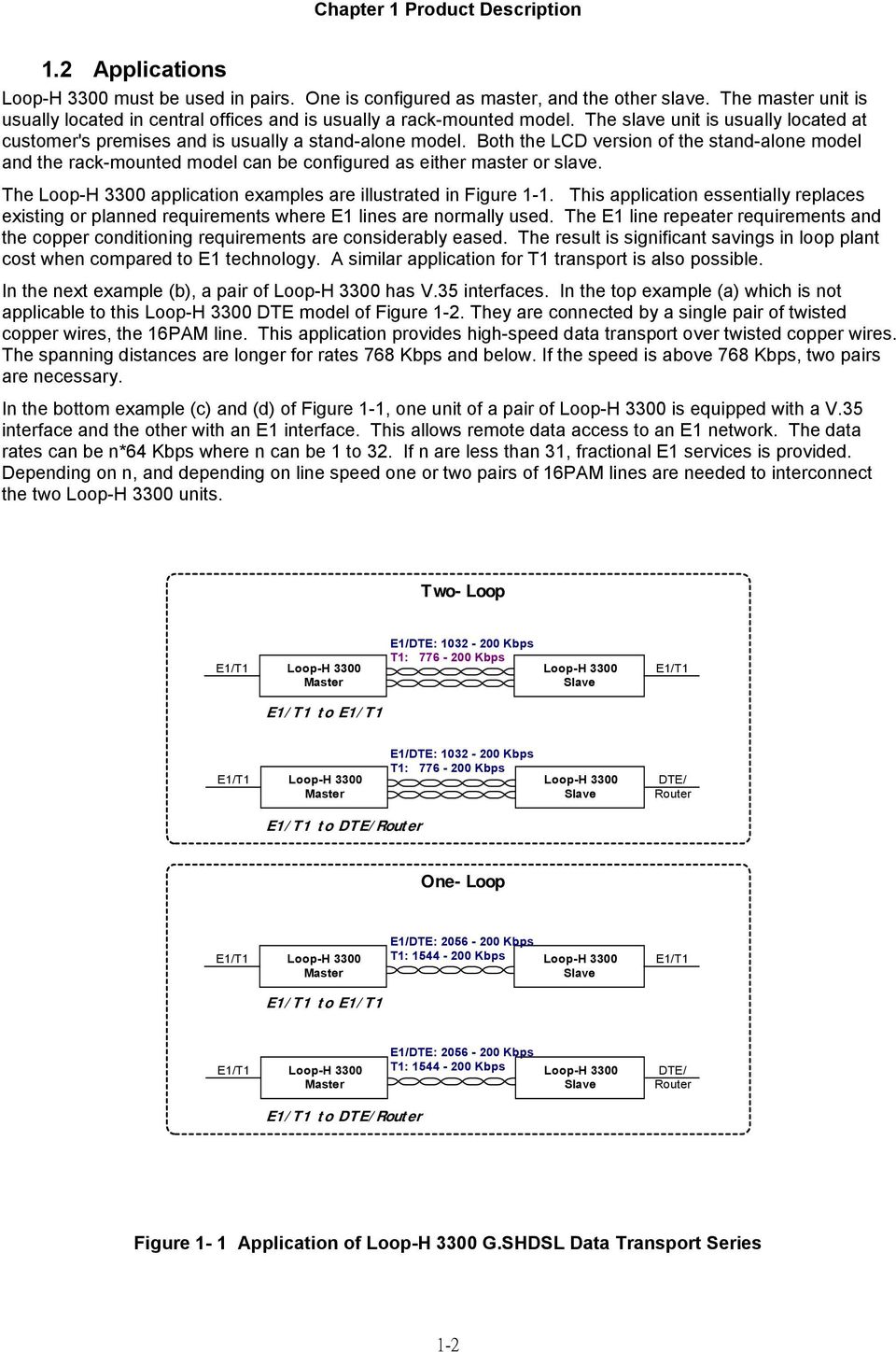
7 Chapter 1 Product Description 1.2 Applications Loop-H 3300 must be used in pairs. One is configured as master, and the other slave. The master unit is usually located in central offices and is usually a rack-mounted model. The slave unit is usually located at customer's premises and is usually a stand-alone model. Both the LCD version of the stand-alone model and the rack-mounted model can be configured as either master or slave. The Loop-H 3300 application examples are illustrated in Figure 1-1. This application essentially replaces existing or planned requirements where E1 lines are normally used. The E1 line repeater requirements and the copper conditioning requirements are considerably eased. The result is significant savings in loop plant cost when compared to E1 technology. A similar application for T1 transport is also possible. In the next example (b), a pair of Loop-H 3300 has V.35 interfaces. In the top example (a) which is not applicable to this Loop-H 3300 DTE model of Figure 1-2. They are connected by a single pair of twisted copper wires, the 16PAM line. This application provides high-speed data transport over twisted copper wires. The spanning distances are longer for rates 768 Kbps and below. If the speed is above 768 Kbps, two pairs are necessary. In the bottom example (c) and (d) of Figure 1-1, one unit of a pair of Loop-H 3300 is equipped with a V.35 interface and the other with an E1 interface. This allows remote data access to an E1 network. The data rates can be n*64 Kbps where n can be 1 to 32. If n are less than 31, fractional E1 services is provided. Depending on n, and depending on line speed one or two pairs of 16PAM lines are needed to interconnect the two Loop-H 3300 units. Two-Loop E1/T1 Loop-H 3300 Master E1/DTE: Kbps T1: Kbps Loop-H 3300 Slave E1/T1 E1/T1 to E1/T1 E1/T1 Loop-H 3300 Master E1/DTE: Kbps T1: Kbps Loop-H 3300 Slave DTE/ Router E1/T1 to DTE/Router One-Loop E1/T1 Loop-H 3300 Master E1/DTE: Kbps T1: Kbps Loop-H 3300 Slave E1/T1 E1/T1 to E1/T1 E1/T1 Loop-H 3300 Master E1/DTE: Kbps T1: Kbps Loop-H 3300 Slave DTE/ Router E1/T1 to DTE/Router Figure 1-1 Application of Loop-H 3300 G.SHDSL Data Transport Series 1-2
8 Chapter 1 Product Description The distances achievable with 16PAM technology are dependent of the wire size and operating environment. The following table should be used only as a rough guide. The actual distance depends on many environmental factors. Maximum is for no noise. Typical is with 0dB ETSI noise. By laws of physics, G.SHDSL should reach about 20% longer than HDSL. Some say 40%, that is if you are lucky. Because of the different modulation method, G.SHDSL has a lower frequency band. Loss of copper cable is proportional to the square root of the frequency. Thus if you half the frequency, you get times the distance. G.SHDSL is about 40% lower in frequency compared to HDSL, thus has only 20% more reach. The distance you can reach is determined not by loss alone. Cross-talk also plays an important part. Thus if you avoid the frequencies where cross-talk noise is present, you can also reach longer distances. Cross-talk is proportional to frequency. Therefore, if you reduce the frequency by 40%, by cross-talk consideration alone you get 40% more reach. Nothing is quite so simple. Guageohms/Km Line Speed Distances Distances Distances 264 Kbps (4x64Kbps+8Kbps) 392 Kbps (6x64Kbps+8Kbps) 520 Kbps Distances for T1 776 Kbps Distances for E Kbps Distances for T Kbps Distances for E Kbps (8x64Kbps+8Kbps) (12x64Kbps+8Kbps) (16x64Kbps+8Kbps) (24x64Kbps+8Kbps) (32x64Kbps+8Kbps) Data Rate 4 x 64 Kbps 6 x 64 Kbps 8 x 64 Kbps 24 x 64 Kbps 32 x 64 Kbps 24 x 64 Kbps 32 x 64 Kbps Wire Dia. Max. Min. Max. Min. Max. Min. Max. Min. Max. Min. Max. Min. Max. Min Ω 0.9 mm Ω 0.6 mm Ω 0.5 mm Ω 0.4 mm Through the EOC (Embedded Operations Channel), the master can provide administrative, reporting, and diagnostic functions to the remote unit as well. Administrative functions include configuration, status indication of both ends. Reports include 15-minute and 24-hour performance and alarms. Diagnostics include loop backs, error testing, performance monitoring, and alarm history. 1-3
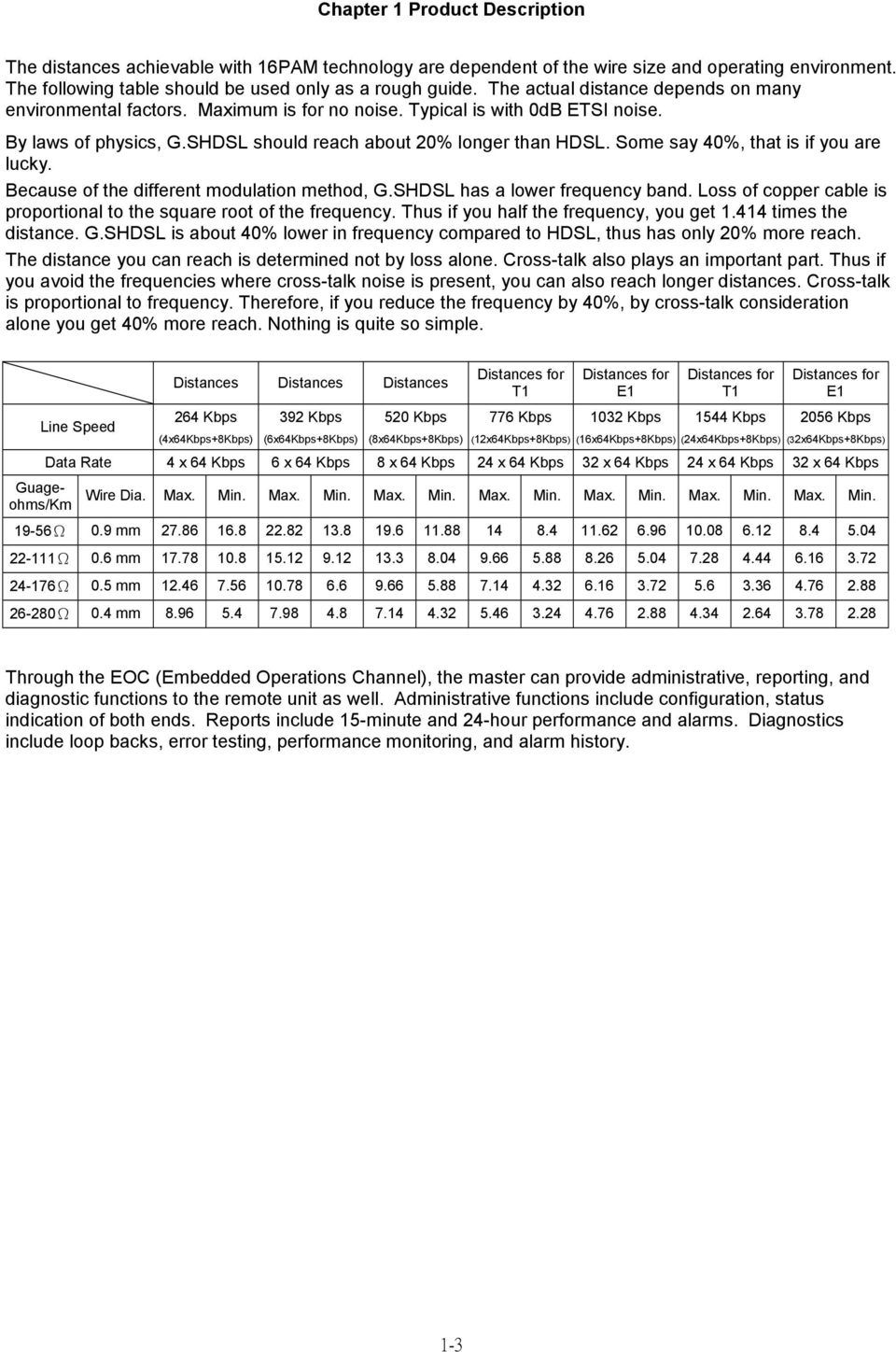
9 Chapter 1 Product Description 1.3 Product Specifications T1 Interface Line Rate Mbps ± 50 bps Framing D4 / ESF (selectable) Line Code AMI / B8ZS Connector RJ48C Input Signal ABAM cable length up to 655 feet Output Signal DSX1 E1 Interface Line Rate Mbps ± 50 PPM Framing ITU G.704 Line Code HDB3 Connector BNC/RJ48C Input Signal ITU G.703 Output Signal ITU G.703 Electrical 75Ω Coax/120Ω twisted pair Performance Monitor (E1/T1) Performance Store The last 24 hours performance in 15-minute intervals and last 7 days in 24-hour summary Monitor Registers Network, E1/T1/DTE, and remote site Performance Reports Errored Second, Unavailable Second, Severe Errored Second Alarm History Alarm Type, Loop1, Loop2, E1/T1 (LOS, ES, SES), and DTE Clock Loss Alarm Queue Contains 40 alarm records which record the latest alarm type, and date & time xdsl Line Interface Full duplex with adaptive echo cancellation 16PAM line coding Unconditioned AWG twisted pair Clock xdsl looped, Internal, or E1/T1/DTE Console Port Connector DB9S at front panel Electrical RS232 interface (DCE) Protocol Menu driven VT-100 terminal System Configuration Parameters (All in non-volatile memory) Active Configuration Current working configuration Default Configuration Manufacture default configuration Diagnostics Test xdsl Loopback To-DTE, To-LINE DTE Loopback To-DTE, To-LINE E1 Loopback To-E1, To-LINE Slave Loopback DTE-Side, Line-Side Front Panel Keypad 4 keys: left arrow, right arrow, ESC, and ENTER LCD 2-line by 16-character LED Front Panel for E1: Loop-H TM G.shdsl ESC G.shdsl SYNC/TEST RAI/AIS BPV E1 ENTER POWER LOOP1 LOOP2 TEST ALARM DTE RTS TD TEST RD CLK-LOSS Front Panel for T1: Loop-H TM G.shdsl ESC G.shdsl SYNC/TEST YEL/AIS BPV T1 ENTER POWER LOOP1 LOOP2 TEST ALARM DTE RTS TD TEST RD CLK-LOSS 1-4
10 Chapter 1 Product Description Physical/Electrical Dimensions 29 x 6 x 22 cm (WxHxD) Power 7.5 Watts max without line power or 24 Watts max with line power Temperature range 0 50 C Humidity 0 95% RH (non-condensing) Mounting Desk-top stackable Rack Mount tray available Compliance EMI/EMC EN55022, EN , EN Safety EN60950 G.SHDSL G.991-2, G
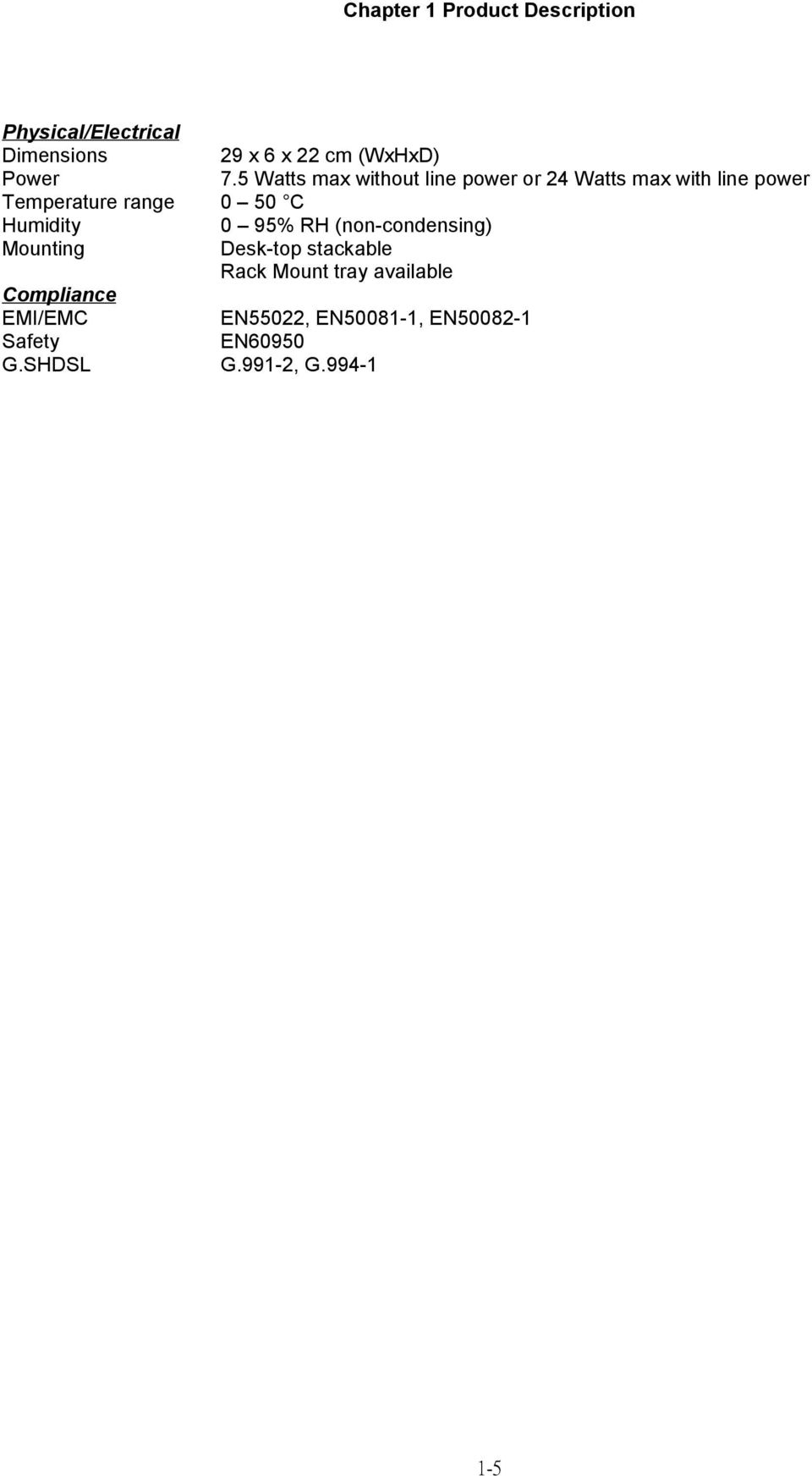
11 Chapter 2 Installation 2 Installation 2.1 Mechanical Installation Loop-H 3300 Stand-Alone unit is designed to be installed as a desk top unit, or, using optional hardware, installed individually in a 19-inch or 23-inch rack. Selection for the placement of Loop-H 3300 should consider the locations of entrance cables, availability of ac power, and cables to equipment. The site should provide a stable environment. The operating area should be clean and free from extremes of temperature, humidity, shock, and vibration. Relatively humidity should stay between 0 and 90%. Do not operate the unit at an altitude greater than 3500 meters (10,000 feet). Front Panel for E1: Loop-H TM G.shdsl ESC G.shdsl SYNC/TEST RAI/AIS BPV E1 ENTER POWER LOOP1 LOOP2 TEST ALARM DTE RTS TD TEST RD CLK-LOSS Front Panel for T1: Loop-H TM G.shdsl ESC G.shdsl SYNC/TEST YEL/AIS BPV T1 ENTER POWER LOOP1 LOOP2 TEST ALARM DTE RTS TD TEST RD CLK-LOSS Figure 2-1 Loop-H 3300 Stand Alone Front Panel View 2-1
12 Chapter 2 Installation 2.2 Electrical Installation The following figures show the backplane of the Loop-H It is designed to be powered from AC wall mains or 48 Vdc. The Loop-H 3300 is capable of operating from power of 100 to 240 vac, 50 to 60 Hz. Depending on the interface configuration, RJ45 jacks are provided for E1 or line connections, and V.35 connectors are provided for data connections. The 16PAM lines are connected via RJ45 jacks. T1 ALM LINE NC NO COM AC LINE, VAC, 50/60Hz, 0.3A MAX. E1 RX-IN TX-OUT ALM LINE NC NO COM AC LINE, VAC, 50/60Hz, 0.3A MAX. Figure 2-2 Loop-H 3300 Rear Panels AC Power POWER (DC) T1 ALM LINE NC NO COM -V +V POWER (DC) RX-IN E1 TX-OUT ALM LINE NC NO COM -V +V Figure 2-3 Loop-H 3300 Rear Panels DC Power 2-2

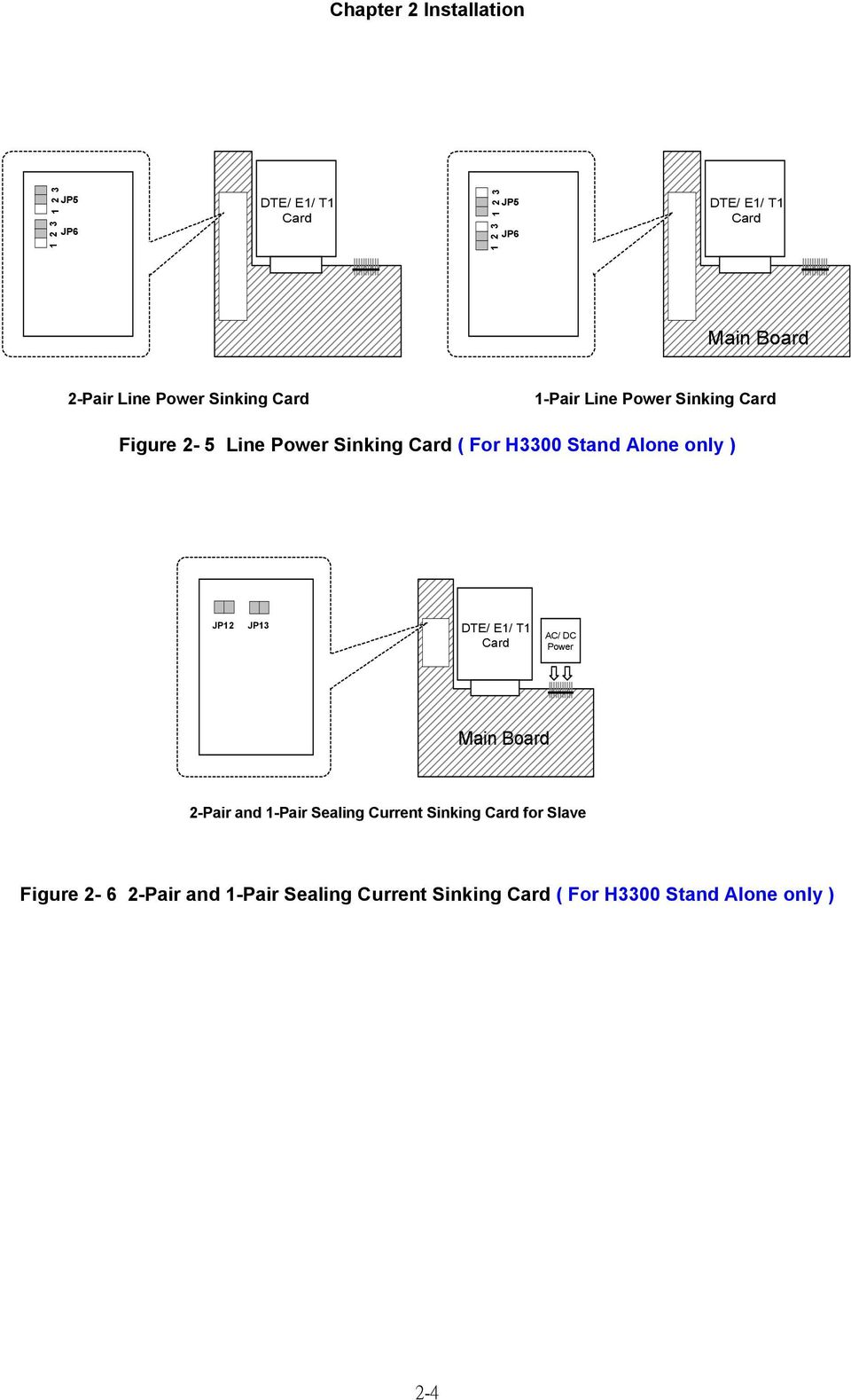
13 Chapter 2 Installation Table 2-1 Console Cable Pin Number Signal Source 1 Data Carrier Detect To DTE 2 Receive Data To DTE 3 Transmit Data From DTE 4 Unassign 5 Singal Ground 6 Data Set Ready To DTE 7 Unassign 8 Clear to send To DTE 9 Unassign After installation of the Loop-H 3300, powering up the unit will cause a self test to start. However, until the matching Loop-H 3300 and the signal inputs (E1 or T1) are also connected, the self test will not complete to the synchronization state of the input signal and of the Loop1 (and Loop2 if appropriate) 16PAM line facility. See Section 8 for front panel operations of the Loop-H Console port is on the front panel DB9S connector. For this interface, the Loop-H 3300 is configured as a DCE. Pin definition is listed in Table Line Power and Sealing Current Options The line power option allows the remote (slave) unit to operate from power supplied from the master. One unit must be the master, the power source, and the other unit must be the slave, the power sink. The sealing current option causes a small amount of DC current to flow in the wire pairs. This prevents corrosion built-up at splices, a useful option in humid weather areas. As in the power option, one unit must be source with DC power and the other sink with AC or DC power. If the Loop-H 3300 is ordered with "Line Power" or "Sealing Current" option, the unit will be shipped with the proper boards and jumpers installed. No further actions is necessary. The power source is usually the master, the power sink is usually the slave. If the user wants to change a unit from line power or sealing current source to a sink, then follow the diagrams below. To change from line power to sealing current, the powering board must be changed. Note also that when the unit is operated as power source, that unit must be DC powered. JP12 JP13 DTE/ E1/ T1 Card AC/ DC Power Main Board Figure 2-4 Main Board without Line Power or Sealing Current ( For H3300 Stand Alone only ) 2-3

14 Chapter 2 Installation JP5 JP6 DTE/ E1/ T1 Card JP5 JP6 DTE/ E1/ T1 Card Main Board Main Board 2-Pair Line Power Sinking Card 1-Pair Line Power Sinking Card Figure 2-5 Line Power Sinking Card ( For H3300 Stand Alone only ) JP12 JP13 DTE/ E1/ T1 Card AC/ DC Power Main Board 2-Pair and 1-Pair Sealing Current Sinking Card for Slave Figure Pair and 1-Pair Sealing Current Sinking Card ( For H3300 Stand Alone only ) 2-4
15 Chapter 2 Installation 2.4 Configuration Setting Hardware Configuration Setting The only user modifiable hardware configuration is the choice of balanced or unbalanced interface for E1 lines. If the factory setting, which can be specified on the order, needs to be changed, the user must open up the case and move some jumper on the printed circuit board. See previous section for details. All other configurations are software programmable. No DIP switches are used Software Configuration Setting There are three system configurations: Factory default Current working Factory default configurations are not changeable. Each series is shipped with a factory default configuration. The current working configuration can be changed at any time. The system automatically stores the current working configuration into nonvolatile memory. When the system is turned off and then turned back on again, the working configuration used before power was turned off is retrieved as the current working configuration. Procedure for Loading Default: 1. Power-up the unit, press and keep the ESC key until the following LCD screen shows up. TEST V /07/ Then press ENTER. 3. Verify that LOAD DEFAULT is being displayed on the front panel to indicate that the operation was successful. LOAD DEFAULT CONFIGURATION 2-5

16 Chapter 2 Installation Below are jumper position for BNC: JP17 BNC1 JP15 JP12 JP16 JP18 JP9 JP10 JP14 JP13 BNC2 NOTE: For 75 ohm E1 card, jumper 16 can be OPEN or ON. If the jumper 16 is OPEN, BNC connector is set to Unassigned. If the jumper 16 is ON, BNC connector is set to Chassis Ground. Figure 2-7 Jumper Position for E1 card of 8370 chip BNC interface ( 75 Ω ) JP17 JP11 JP13 JP12 BNC1 JP11 JP14 JP15 JP16 JP18 JP9 JP10 BNC2 Figure 2-8 Jumper Position for E1 card of 8370 chip TP interface ( 120 Ω ) NOTE: For 120 ohm E1 card, jumper 17 can be OPEN or ON. If the jumper 17 is OPEN, pin 7 and pin 8 of RJ connector is set to Unassigned. If the jumper 17 is ON, pin 7 and pin 8 of RJ connector is set to Chassis Ground. NOTE: When BNC connector is selected, the user has the option of grounding the received BNC shield by installing a jumper clip on the jumper location. This is usually not necessary, but if you have any noise on your device it can often be filtered out by using this grounding process. 2-6

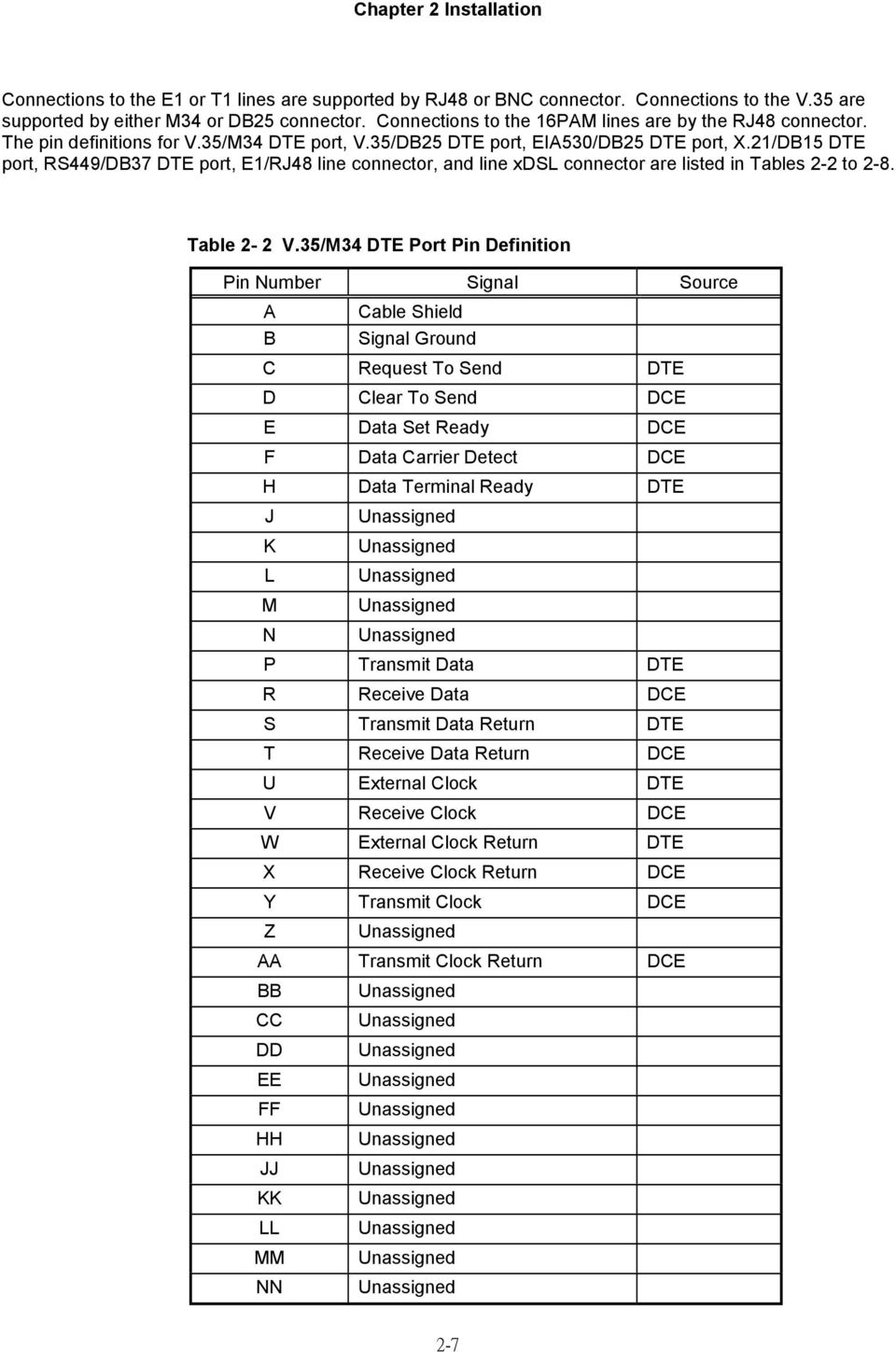
17 Chapter 2 Installation Connections to the E1 or T1 lines are supported by RJ48 or BNC connector. Connections to the V.35 are supported by either M34 or DB25 connector. Connections to the 16PAM lines are by the RJ48 connector. The pin definitions for V.35/M34 DTE port, V.35/DB25 DTE port, EIA530/DB25 DTE port, X.21/DB15 DTE port, RS449/DB37 DTE port, E1/RJ48 line connector, and line xdsl connector are listed in Tables 2-2 to 2-8. Table 2-2 V.35/M34 DTE Port Pin Definition Pin Number Signal Source A Cable Shield B Signal Ground C Request To Send DTE D Clear To Send DCE E Data Set Ready DCE F Data Carrier Detect DCE H Data Terminal Ready DTE J Unassigned K Unassigned L Unassigned M Unassigned N Unassigned P Transmit Data DTE R Receive Data DCE S Transmit Data Return DTE T Receive Data Return DCE U External Clock DTE V Receive Clock DCE W External Clock Return DTE X Receive Clock Return DCE Y Transmit Clock DCE Z Unassigned AA Transmit Clock Return DCE BB Unassigned CC Unassigned DD Unassigned EE Unassigned FF Unassigned HH Unassigned JJ Unassigned KK Unassigned LL Unassigned MM Unassigned NN Unassigned 2-7
18 Chapter 2 Installation Table 2-3 V.35/DB25 DTE Port Pin Definition Pin Number Signal Source 1 Cable Shield 2 Transmit Data DTE 3 Receive Data DCE 4 Request To Send DTE 5 Clear To Send DCE 6 Data Set Ready DCE 7 Signal Ground 8 Data Carrier Detect DCE 9 Receive Clock Return DCE 10 Unassigned 11 External Clock Return DTE 12 Transmit Clock Return DCE 13 Unassigned 14 Transmit Data Return DTE 15 Transmit Clock DCE 16 Receive Data Return DCE 17 Receive Clock DCE 18 Unassigned 19 Unassigned 20 Data Terminal Ready DTE 21 Unassigned 22 Unassigned 23 Unassigned 24 External Clock DTE 25 Unassigned 2-8

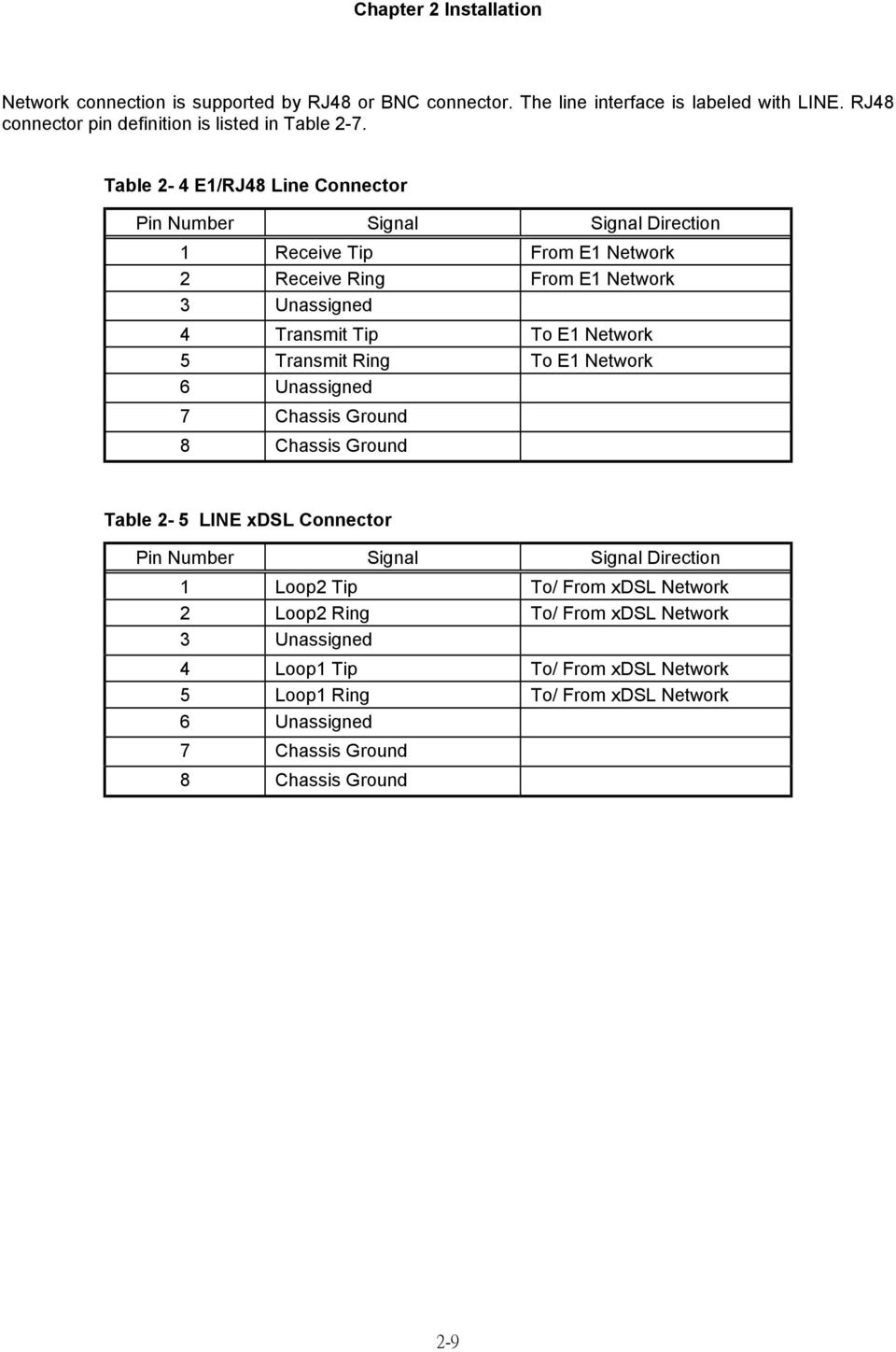
19 Chapter 2 Installation Network connection is supported by RJ48 or BNC connector. The line interface is labeled with LINE. RJ48 connector pin definition is listed in Table 2-7. Table 2-4 E1/RJ48 Line Connector Pin Number Signal Signal Direction 1 Receive Tip From E1 Network 2 Receive Ring From E1 Network 3 Unassigned 4 Transmit Tip To E1 Network 5 Transmit Ring To E1 Network 6 Unassigned 7 Chassis Ground 8 Chassis Ground Table 2-5 LINE xdsl Connector Pin Number Signal Signal Direction 1 Loop2 Tip To/ From xdsl Network 2 Loop2 Ring To/ From xdsl Network 3 Unassigned 4 Loop1 Tip To/ From xdsl Network 5 Loop1 Ring To/ From xdsl Network 6 Unassigned 7 Chassis Ground 8 Chassis Ground 2-9
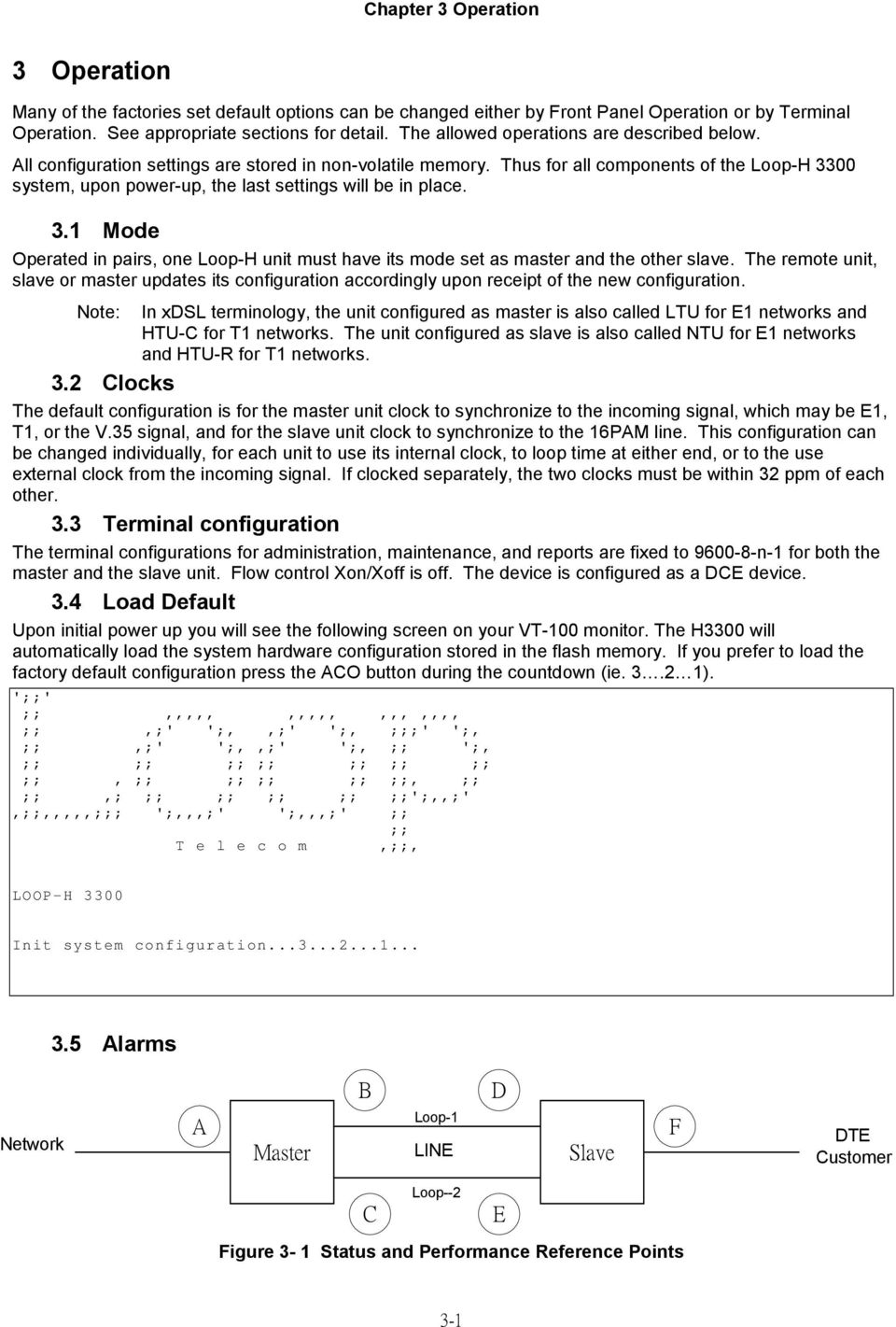
20 Chapter 3 Operation 3 Operation Many of the factories set default options can be changed either by Front Panel Operation or by Terminal Operation. See appropriate sections for detail. The allowed operations are described below. All configuration settings are stored in non-volatile memory. Thus for all components of the Loop-H 3300 system, upon power-up, the last settings will be in place. 3.1 Mode Operated in pairs, one Loop-H unit must have its mode set as master and the other slave. The remote unit, slave or master updates its configuration accordingly upon receipt of the new configuration. Note: In xdsl terminology, the unit configured as master is also called LTU for E1 networks and HTU-C for T1 networks. The unit configured as slave is also called NTU for E1 networks and HTU-R for T1 networks. 3.2 Clocks The default configuration is for the master unit clock to synchronize to the incoming signal, which may be E1, T1, or the V.35 signal, and for the slave unit clock to synchronize to the 16PAM line. This configuration can be changed individually, for each unit to use its internal clock, to loop time at either end, or to the use external clock from the incoming signal. If clocked separately, the two clocks must be within 32 ppm of each other. 3.3 Terminal configuration The terminal configurations for administration, maintenance, and reports are fixed to n-1 for both the master and the slave unit. Flow control Xon/Xoff is off. The device is configured as a DCE device. 3.4 Load Default Upon initial power up you will see the following screen on your VT-100 monitor. The H3300 will automatically load the system hardware configuration stored in the flash memory. If you prefer to load the factory default configuration press the ACO button during the countdown (ie ). ';;' ;;,,,,,,,,,,,,,,,,, ;;,;' ';,,;' ';, ;;;' ';, ;;,;' ';,,;' ';, ;; ';, ;; ;; ;; ;; ;; ;; ;; ;;, ;; ;; ;; ;; ;;, ;; ;;,; ;; ;; ;; ;; ;;';,,;',;;,,,,,;;; ';,,,;' ';,,,;' ;; ;; T e l e c o m,;;, LOOP-H 3300 Init system configuration Alarms B D Network A Master Loop-1 LINE Slave F DTE Customer C Loop--2 E Figure 3-1 Status and Performance Reference Points 3-1
21 Chapter 3 Operation The definition of the alarms is as follows. Each of the detection point is key to the diagram below. Table 3-1 E1 version with two LOOPs Alarm Type Detect -ion Point Threshold 3-2 Description LOS, MASTER-LOOP1 B None Master Loop-1 Loss of signal/ LOSW* LOS, MASTER-LOOP2 C None Master Loop-2 Loss of signal/ LOSW* LOS, SLAVE-LOOP1 D None Slave Loop-1 Loss of signal/ LOSW* LOS, SLAVE-LOOP2 E None Slave Loop-2 Loss of signal/ LOSW* LOS/LOF, MASTER-E1 A None Master E1 Line Loss of signal or loss of framing LOS/LOF, SLAVE-E1 F None Slave E1 Line Loss of signal or loss of framing ES15M, MASTER-LOOP1 B (default 1) Master Loop-1 Error Second in current 15-minute interval ES15M, MASTER-LOOP2 C (default 1) Master Loop-2 Error Second in current 15-minute interval ES15M, SLAVE-LOOP1 D (default 1) Slave Loop-1 Error Second in current 15-minute interval ES15M, SLAVE-LOOP2 E (default 1) Slave Loop-2 Error Second in current 15-minute interval ES15M, MASTER-E1 A (default 1) Master E1 Line Error Second in current 15-minute interval ES15M, SLAVE-E1 F (default 1) Master E1 Line Error Second in current 15-minute interval SES15M, MASTER-LOOP1 B (default 1) Master Loop-1 Severely Error Second in current 15- minute interval SES15M, MASTER-LOOP2 C (default 1) Master Loop-2 Severely Error Second in current 15- minute interval SES15M, SLAVE-LOOP1 D (default 1) Slave Loop-1 Severely Error Second in current 15- minute interval SES15M, SLAVE-LOOP2 E (default 1) Slave Loop-2 Severely Error Second in current 15- minute interval SES15M, MASTER-E1 A (default 1) Master E1 Line Severely Error Second in current 15- minute interval SES15M, SLAVE-E1 F (default 1) Slave E1 Line Severely Error Second in current 15- minute interval ES24H, MASTER-LOOP1 B (default 1) Master Loop-1 Error Second in current 24 hours ES24H, MASTER-LOOP2 C (default 1) Master Loop-2 Error Second in current 24 hours ES24H, SLAVE-LOOP1 D (default 1) Slave Loop-1 Error Second in current 24 hours ES24H, SLAVE-LOOP2 E (default 1) Slave Loop-2 Error Second in current 24 hours ES24H, MASTER-E1 A (default 1) Master E1 Line Error Second in current 24 hours ES24H, SLAVE-E1 F (default 1) Slave E1 Line Error Second in current 24 hours SES24H, MASTER-LOOP1 B (default 1) Master Loop-1 Severely Error Second in current 24 hours SES24H, SLVAE-LOOP2 C (default 1) Master Loop-2 Severely Error Second in current 24 hours SES24H, MASTER-LOOP1 D (default 1) Slave Loop-1 Severely Error Second in current 24 hours SES24H, SLAVE-LOOP2 E (default 1) Slave Loop-2 Severely Error Second in current 24 hours SES24H, MASTER-E1 A (default 1) Master E1 Line Severely Error Second in current 24 hours SES24H, SLAVE-E1 F (default 1) Slave E1 Line Severely Error Second in current 24 hours
22 Chapter 3 Operation LOW NOISE MARGIN B, C, D, E 0 60 (default 1) Signal Noise Margin of Line * Loss of Synchronous Word The alarm queue can be obtained for both master and slave, which contains the time stamp and alarm type of the last 40 alarms. Alarm history and alarm status registers are also kept, which are used to track the alarm count. Each alarm can be individually enabled or disabled. When disabled, no action is taken upon detection of an alarm. When enabled, the alarm counter increases by one for each alarm type. Alarm is triggered when an alarm occurs or when the counter exceeds a set threshold. 3.6 Reports From the master unit, by use of the LCD front panel, or a terminal connected to the Loop-H, the current status of both master and slave units can be obtained. Status includes sync status of loop1, loop2, and one of V.35, E1, or T1. Also, by use of the terminal connected to the master, the performance report of both master and slave unit can be obtained. Performance reports contain performance parameters recorded in 15-minute intervals for the past 24 hours. Reports for each of the following parameters are available. Table 3-1 Performance Parameter Performance Parameter ES SES UAS Description Error Seconds Severe Error Second Unavailable Second 3.7 Date and Time The Loop-H 3300 is equipped with an RTC (real time clock). The date and time is set to Zulu+8 at the factory. Users can change the date and time. The RTC has a self-contained battery with a power-off life of 10 years from shipment. 3.8 Front Panel Lock Normally, front panel can provide configuration change capability. If the "menu lock" is enabled, configuration change is allowed only with a password. Without a password, users still can operate front panel to obtain the configuration information and line status. However, no modification is allowed. This function is linked with the password enable function of the terminal operation; i.e. the password enabled in the terminal operation will lock the front panel as well. When enabled, for some operations, users have to enter the password correctly. Use left or right arrows (<>) to pick the character. There are 66 characters to choose from. Password modification can only be done using terminal operation. The default is unlocked. 3-3
23 Chapter 3 Operation 3.9 LED Indicators The front panel of each Loop-H has 12 LEDs. One is to indicate presence of power. The next four shows the status of one or two 16PAM loops, a test condition indicator, and an alarm indicator. The next 7 LEDs are defined according to whether the interface is V.35 or E1/T1. One LED is to indicate V.35, another is to indicate E1/T1. If V.35, there are LEDs for RTS, TD, TEST, RD, and CLK-LOSS. If E1/T1, three LEDs indicate bipolar violation, RAI/AIS and a sync or test indicator. Front Panel for E1: Loop-H TM G.shdsl ESC G.shdsl SYNC/TEST RAI/AIS BPV E1 ENTER POWER LOOP1 LOOP2 TEST ALARM DTE RTS TD TEST RD CLK-LOSS Front Panel for T1: Loop-H TM G.shdsl ESC G.shdsl SYNC/TEST YEL/AIS BPV T1 ENTER POWER LOOP1 LOOP2 TEST ALARM DTE RTS TD TEST RD CLK-LOSS Figure 3-2 LED Front Panel 3-4
24 Chapter 4 Maintenance 4 Maintenance Maintenance of the Loop-H 3300 system is aided by the self-test capability of the units and by the loopback facilities. 4.1 Self test As each element is powered up, a self-test is automatically performed to check for internal operations. At system power up, a complete self-test routine is run to check all system elements, including the metallic loops used for the 16PAM facility. System power up means that all elements, including master and slaves, are powered up. The front panel LEDs, LCD panel, and the terminal screen can all be used to obtain the general performance of the system. Table 4-1 LED Indication for Normal Operation x D S L E1 T1 LED Color Indication Power Green Off Power on and operational Power off, self-test failure, or during initialization Loop 1 Green Flashing Green Off Loop 1 is in sync Loop 1 synchronization is in progress Loop 1 is not sync or not existed Loop 2 Green Flashing Green Off Loop 2 is in sync Loop 2 synchronization is in progress Loop 2 is not sync or not existed Test Off Amber Normal xdsl line-side test is in progress Alarm Off Red E1 Green Off SYNC/TEST Green Flashing Green Off RAI/AIS Off Amber Flashing Amber BPV Off Red T1 Green Off SYNC/TEST Green Flashing Green Off YEL/AIS Off Amber Flashing Amber BPV Off Red Normal Alarm happened E1 Card is present E1 Card is not present E1 Line frame is sync E1 Line-side test is in progress E1 Line frame is unsync Normal Receive Remote Alarm Indication from E1 line Receive AIS from E1 line Normal E1 line has bipolar T1 Card is present T1 Card is not present T1 Line frame is sync T1 Line-side test is in progress T1 Line frame is unsync Normal Receive Yellow Alarm from T1 line Receive AIS from T1 line Normal T1 line has bipolar 4-1
25 Chapter 4 Maintenance 4.2 Diagnostics A 20-bit register QRSS (quasi-random signal sequence) is used in Loop-H 3300 as an aid in trouble location. This is used in conjunction with various loopbacks to isolate faults. In both front panel and terminal operation, user may utilize < key to reset error counter. To choose Off under BERT to terminate the BERT test. 4.3 Loopbacks Trouble isolation of the entire xdsl system is facilitated by the use of loopbacks. By determining where one loopback is successful and another is not, the repair personnel can isolate the fault to a particular line or equipment. Loopbacks can be towards the network, or towards the customer. NOTE: User have to terminate the current loopback function before using other loopback functions. For example, if you wants to change xdsl to LINE loopback as xdsl to DTE loopback, you must terminate the xdsl to LINE loopback first. Loopbacks are activated from (a) the front panel of the units, (b) a terminal attached to the units. Only the master can activate a loopback remotely. Figure 5 illustrates the various loopbacks. Network Loop-H 3300 Master E1: Kbps T1: Kbps Loop-H 3300 Slave Customer Master Network Loopback Slave Network Loopback Network Loop-H 3300 Master E1: Kbps T1: Kbps Loop-H 3300 Slave Customer Master Customer Loopback Slave Customer Loopback Network Loop-H 3300 Master E1: Kbps T1: Kbps Loop-H 3300 Slave Customer Master Customer Loopback Slave Customer Loopback Network Loop-H 3300 Master E1: Kbps T1: Kbps Loop-H 3300 Slave Customer Master Customer Loopback Slave Customer Loopback NOTE: Both network and customer site could be independently E1, T1 or DTE. Figure 4-1 Loopbacks available Loopbacks Toward Network Loopbacks toward the network take signals originating from the network transmit pair and send them back to the network receive pair. The various loopbacks are illustrated in the upper diagram of Figure Loopbacks Toward Customer Loopbacks toward the customer take signals originating from the customer transmit pair and send them back to the customer receive pair. 4-2
26 Chapter 5 Front Panel Operation 5 E1 Front Panel Operation The front panel of each Loop-H has 12 LEDs. One is to indicate presence of power. The next four shows the status of one or two 16PAM loops, a test condition indicator, and an alarm indicator. The next 7 LEDs are defined according to whether the interface is V.35 or E1/T1. One LED is to indicate V.35, another is to indicate E1/T1. If V.35, there are LEDs for RTS, TD, TEST, RD, and CLK-LOSS. If E1/T1, three LEDs indicate bipolar violation, RAI/AIS alarm conditions, and a sync or test indicator. A terminal must be used for the display of other detailed status and to initiate local loopbacks. Furthermore, configuration must be performed at the master end. Power LED is a single color LED. Loop-H 3300 performs self-test on the powering up. The power LED is green if the self-test is passed. Otherwise, it is off and the rest of LCD shows the cause of the failure. Loop1 and Loop2 indicators show the status of the 16PAM line. It is green if synchronization is established. It is off when sync is lost. Flashing green shows the 16PAM loop is in synchronization mode. For E1/T1 interface, the SYNC/TEST indicates the status of the DS1 interface. It is green if the interface is in sync. It is off if it is loss of sync or loss of frame. Flashing green indicates the interface is under loopback test. The LCD menu tree is shown below. By successively selecting the menu item at each level, the desired operation or display can be obtained. 5-1
27 Chapter 5 Front Panel Operation Main Menu Configuration Alarm Diagnostics Performance Status Informance Miscellaneous xdsl Mode Alarm Queue xdsl Loopback Reset Performance Master Loop1 ES M-Loop1 Status Software Version Date Clock Source Alarm History E1 Loopback Master Loop1 ES Master Loop1 SES S-Loop1 Status Serial Number Time Slave Clock E1 Alarm Clear Alarm Setup Slave Loopback BERT Master Loop1 SES Master Loop1 UAS Master Loop1 UAS Master Loop2 ES M-Loop2 Status S-Loop2 Status Lock Front Panel Framing Code Time Slot Alarm Type Alarm Threshol d Alarm Cut Off Master Loop2 ES Master Loop2 SES Master Loop2 UAS Master Loop2 SES Master Loop2 UAS Master E1 ES M-E1 Tx- Status M-E1 Rx- Status S-E1 Tx- Status Slave E1 Master E1 ES Master E1 SES S-E1 Rx- Status Framing Master E1 SES Master E1 UAS Code Master E1 UAS Time Slot Line Rate 1 Pair 2 Pairs Loop Num Loop-One Loop-Two Two-Loops One + One Baud Rate Adaptive Rate Figure 5-1 LCD Menu Tree E1 5.1 Main Menu The main menu, the first menu displayed after power up, is shown below, where the underlined character indicates flashing display, meaning that this item is selected by default unless the user presses the right or left arrow keys. 5.2 Configuration Menu Configuration group includes xdsl mode, clock source, slave clock, E1, slave E1, line rate. xdsl-e1-master Configuration 5-2
28 Chapter 5 Front Panel Operation xdsl Mode Mode can be master or slave. For each pair of connected Loop-H, one must be master and the other slave. The Slave mode Loop-H can only be synchronized to the master through the line. To change the mode to master or slave, use left and right arrow key cycle through to the desired selection and press ENTER. The current selection is indicated by *. Configuration xdsl Mode xdsl Mode *MASTER xdsl Mode SLAVE Clock Source Clock source group includes LINE, INTERNAL, E1 and Slave Clock. Press ENTER to change the clock source to LINE, INTERNAL, E1, and Slave Clock. For the mode selected, if an invalid clock is selected, the command will be ignored. Configuration Clock Source Clock Source *LINE Clock Source INTERNAL Clock Source E1 5-3
29 Chapter 5 Front Panel Operation Configuration Slave Clock Slave Clock *LINE Slave Clock INTERNAL Slave Clock E E1 Menu E1 menu is used to configuration the framing and code of the E1. Press ENTER to configure it. Framing: Configuration E1 E1 Framing Framing *CRC-OFF Framing *CRC-ON Framing *CAS-CRC-OFF Framing *CAS-CRC-ON 5-4
30 Chapter 5 Front Panel Operation Framing UNFRAME Code: E1 Code Code *HDB3 Time Slots: E1 Time Slots Time Slots TS00-09 Here "i" (eye, idle) means TS that cannot be used for transmission of any data; "1" (one) means active TS carrying customer data; "X" means TS available for customer data, but not in active use. TS :2048K *[ix11ii1111] OK Time Slots TS10-19 TS :1984K *[11llllllll] OK Time Slots TS20-29 TS :1984K *[llllllllll] OK 5-5
31 Chapter 5 Front Panel Operation Time Slots TS Slave E1 TS :1984K *[ll] OK Slave E1 menu is used to configuration the framing and code of the Slave/E1. Press ENTER to configure it. Framing: Configuration Slave E1 Slave E1 Slave E1 Framing Slave Framing *CRC-OFF Slave Framing *CRC-ON Slave Framing *UNFRAME Slave Framing *CAS-CRC-OFF Slave Framing *CAS-CRC-ON 5-6
32 Chapter 5 Front Panel Operation Code: Slave E1 Slave Code Slave Code *HDB3 Time Slots: Slave E1 Slave Time Slots Line Rate To change the line rate, use left and right arrow key cycle through to the desired selection and press ENTER. Configuration Line Rate The line rate choices are 200, 264, 392, 520, 776, 1032, 1160, 1544, and 2056 Kbps. NOTE: Each rate is n x Kbps. Line Rate *1160Kbps Loop Number Under Configuration menu, use arrow keys to select Loop Num option, which supports 1 pair and 2 pairs. Configuration Loop Num Press ENTER from the above menu. Use arrow keys to select one desired number from these options: Two Loops, Loop-One, Loop-Two, and One + One. Then press ENTER after finishing the selection. The current selection will be highlighted by an asterisk (*). When 1 pair is used, user can select Loop-One or Loop-Two as the active Loop. 1 pair: Loop-One Configuration Loop Num 5-7
33 Chapter 5 Front Panel Operation The following LCD means Loop-One is active now. 1 pair: Loop-Two Loop Num *Loop-One Configuration Loop Num The following LCD means Loop-Two is active now. Loop Num *Loop-Two When 2 pairs are used, user can select Two Loops used together or One + One protection. 2 pairs: Two-Loops 2 pairs: One + One Configuration Loop Num The following LCD means two loops are active now. Loop Num *Two Loops Configuration Loop Num The following LCD means protection is available now. Loop Num *One + One 5-8
34 Chapter 5 Front Panel Operation Baud Rate Under Configuration menu, use arrow keys to select Baud Rate option. Two options, 9600 or are available. Move the cursor to the desired option, then press ENTER to confirm the selection. The current selection will be highlighted by an asterisk (*). Configuration Baud Rate Baud Rate *9600 Baud Rate Adaptive Line Rate Under Configuration menu, use arrow keys to select Adaptive Rate option, press ENTER to enter into its submenu. This menu is used to enable or disable adaptive line rate. NOTE: When "Adaptive Rate" is enabled, users are not allowed to set up "Line Rate". See also blew LCD screens. Configuration Adaptive Rate Adaptive Rate *ENABLE Press ESC to exit the "Adaptive Rate" menu, and use arrow keys to select "Line Rate" menu. Press ENTER to enter into its submenu to display the current line rate setting. Configuration Line Rate Line Rate:1608K Nx64:25 5-9
35 Chapter 5 Front Panel Operation NOTE: When "Adaptive Rate" is disabled, users are allowed to set up "Line Rate". An asterisk (*) will show in front of "NX64:25(3-32) OK". Use arrow keys to select a desired number, then move the cursor at "OK". Press ENTER to confirm the setting. See also blew LCD screens. Configuration Adaptive Rate Adaptive Rate *DISABLE Press ESC to exit the "Adaptive Rate" menu, and use arrow keys to select "Line Rate" menu. Press ENTER to enter into its submenu to do line rate setting. Configuration Line Rate Line Rate:1608K *Nx64:25(3-32)OK 5-10
36 Chapter 5 Front Panel Operation 5.3 Alarm The alarm menu allows the user to view the latest alarm. Alarm group includes Alarm Queue, Alarm History, Alarm Clear, Alarm Setup, and Alarm Cut Off. Alarm menu is used to view alarm queue and alarm history, to clear alarm queue, and alarm history, alarm cut off, as well as setup alarm threshold, etc. as in the following paragraph. xdsl-e1-master Alarm Alarm Queue The alarm queue is a consolidation of the latest 40 alarms from all of the Loop-H plug-in cards. When the queue is full, the earliest one is replaced by the latest one.the user can select one of latest alarms. Alarm Alarm Queue When the item QUEUE is first selected, the latest alarm will be displayed. 01 LOS,M-L1 08:09:10 04/16 21 SES24H, M-L1 08:09:10 04/ Alarm History Alarm History menu is used to view alarm history. Under Alarm menu, use left or right key to select Alarm History menu. Alarm Alarm History LOS, M-L1 DISABLE 0 LOS, M-L1 ENABLE ALM
37 Chapter 5 Front Panel Operation SES24H, M-L1 DISABLE 0 SES24H, M-L1 ENABLE 0 Alarm History menu shows the alarm history of various type of alarm. To view alarm history, use left or right arrow key to cycle through and the alarm history is shown Alarm Clear Alarm Clear menu is used to clear alarm queue and history. Under Alarm menu, use left or right key to select Alarm Clear menu. Alarm Alarm Clear At this menu, press ENTER to confirm clear alarm queue and history. Otherwise press ESC to exit without any action. Alarm Confirm? Alarm Clear Clearing...OK Alarm Setup Alarm Setup menu is used to set up the threshold level of each alarm type. Some type of alarm does not have threshold level. Under Alarm menu, use left or right key to select Alarm Setup menu. Alarm Alarm Setup Alarm Type Alarm Type menu is used to disable or enable the alarm type of M-L1. Alarm Setup Alarm Type Alarm Type LOS,M-L1 5-12
38 Chapter 5 Front Panel Operation LOS,M-L1 *DISABLE LOS,M-L1 ENABLE Alarm Threshold To setup ES, UAS, OS are similar. For example, to setup ES15M, M-L1 threshold level and press ENTER. Alarm Setup Alarm Threshold Threshold LOS, M-L1 ES15M, M-L1 *001 (1-900) OK Threshold SES24H, M-L1 SES24H, M-L1 *00001 OK To change threshold level of ES (or others), use left or right arrow key to cycle through to the digit position, and press ENTER key to cycle through the number. This operation must be concluded by moving left or right arrow key to OK position and press ENTER to enable the changes Alarm Cut Off To cut off alarm, enter "A". A prompt asking for action is shown. Alarm Alarm Cut Off Alarm Cut Off Confirm? 5-13
39 Chapter 5 Front Panel Operation Alarm Cut Off AC0...OK 5.4 Diagnostics Menu Diagnostics group includes xdsl Loopback, E1 Loopback, Slave Loopback, BERT. If a xdsl loopback is in session, the front panel SYNC/TEST LED flashes green. If a E1 Loopback is in session, the front panel TEST LED flashes green. xdsl-e1-master Diagnostics xdsl Loopback Menu Loopback menus are used to control near end xdsl line side loopback operation such TO-E1 and TO-LINE loopback test. Under Diagnostics menu, use left or right key to select xdsl Loopback menu. Diagnostics xdsl Loopback xdsl Loopback *OFF xdsl Loopback TO-E1 xdsl Loopback TO-LINE To select a loopback type, use left or right arrow key to cycle through to a desired selection and press ENTER. Select OFF to end the loopback test E1 Loopback Menu E1 loopback menu used to control E1 loopback. Under Diagnostics menu, use left or right key to select E1 Loopback menu. Diagnostics E1 Loopback To select a loopback type, use left or right arrow key to cycle through to a desired selection and press ENTER. Select OFF to end the loopback test. 5-14
40 Chapter 5 Front Panel Operation E1 Loopback *OFF E1 Loopback TO-E1 E1 Loopback TO-LINE Slave Loopback Menu Slave Loopback is used to activate slave loopback test. A proprietary message is sent to request the remote Loop-H to perform Line or E1 loopback. Under Diagnostics menu, use left or right key to select Slave Loopback menu. Diagnostics Slave Loopback Slave Loopback *OFF Slave Loopback E1-TO-LINE Slave Loopback xdsl-to-line Slave Loopback E1-TO-E1 Slave Loopback xdsl-to-e1 To activate slave loopback, use left or right arrow key cycle through to a desired selection and press ENTER. To deactivate slave loopback, select OFF. 5-15
41 Chapter 5 Front Panel Operation BERT After the loopback is in place, BERT test can be performed. Select BERT menu to start the bit error rate test. Diagnostics BERT BERT *OFF BERT QRSS 5.5 Performance PERF shows the performance information about the Reset Performance, Master Loop-1, Loop-2, and E1 Performance, Slave Loop-1, Loop-2, and E1 Performance. The current 24 hours data are recorded in performance register. xdsl-e1-master Performance Reset Performance Reset Performance menu is used to clear all Loop-H performance status report. Under Performance menu, use left or right key to select Reset Performance menu. At this menu, press ENTER to confirm clear all performance status report. Otherwise press ESC to exit without any action. Performance Reset Perf. Reset Perf. Corfirm? 5-16
42 Chapter 5 Front Panel Operation Master Loop1, Loop2 and E1 ES/SES/UAS Performance Under Performance menu, you could select ES, SES, and UAS Performance menu for Loop1, Loop2, and E1 by using left and right arrow keys. Performance MASTER LOOP1 ES MASTER LOOP1 ES Performance MASTER LOOP1 SES MASTER LOOP1 SES Performance MASTER LOOP1 UAS MASTER LOOP1 UAS Performance MASTER LOOP2 ES MASTER LOOP2 ES Performance MASTER LOOP2 SES 5-17
43 Chapter 5 Front Panel Operation MASTER LOOP2 SES Performance MASTER LOOP2 UAS MASTER LOOP2 UAS Performance MASTER E1 ES MASTER E1 ES Performance MASTER E1 SES MASTER E1 SES Performance MASTER E1 UAS MASTER E1 UAS
44 Chapter 5 Front Panel Operation Slave Loop1, Loop2 and E1 ES/SES/UAS Performance Under Performance menu, you could select slave ES, SES, and UAS Performance menu for Loop1, Loop2, and E1 by using left and right arrow keys. Performance SLAVE LOOP1 ES SLAVE LOOP1 ES Performance SLAVE LOOP1 SES SLAVE LOOP1 SES Performance SLAVE LOOP1 UAS SLAVE LOOP1 UAS Performance SLAVE LOOP2 ES SLAVE LOOP2 ES Performance SLAVE LOOP2 SES 5-19
45 Chapter 5 Front Panel Operation SLAVE LOOP2 SES Performance SLAVE LOOP2 UAS SLAVE LOOP2 UAS Performance SLAVE E1 ES SLAVE E1 ES Performance SLAVE E1 SES SLAVE E1 SES Performance SLAVE E1 UAS SLAVE E1 UAS
46 Chapter 5 Front Panel Operation 5.6 Status STATUS is to show the various statuses of the local or slave xdsl loops (LINE) and local or slave E1. The status is shown as normal if the interface is not experienced any problem. Otherwise, the problem is shown. The possible problems are LOS (loss of signal), LOF (loss of framing), RAI (receive remote alarm information), AIS (receive Alarm indication). xdsl-e1-master Status Status M-LOOP1 Status M-LOOP1 Status SYNC Status S-LOOP1 Status S-LOOP1 Status SYNC Status M-LOOP2 Status M-LOOP2 Status SYNC Status S-LOOP2 Status S-LOOP2 Status SYNC 5-21
47 Chapter 5 Front Panel Operation Status M-E1 Tx-Status M-E1 Tx-Status *TxAIS TxRAI Status M-E1 Rx-Status M-E1 Rx-Status *LOS *LOF Status S-E1 Tx-Status S-E1 Tx-Status *TxAIS TxRAI Status S-E1 Rx-Status S-E1 Rx-Status RxAIS *RxRAI S-E1 Rx-Status *LOS *LOF 5-22
48 Chapter 5 Front Panel Operation 5.7 Information The Information item provides software and hardware version number, and serial number of the Loop-H unit. Modifications are not allowed. xdsl-e1-master Information Information S/W Version S/W Version V /25/1998 Information Serial number Serial Number
49 Chapter 5 Front Panel Operation 5.8 Miscellaneous The miscellaneous group includes the date and information items. To modify the date and time, first move cursor to the date and time digit on the first-line. Press ENTER. Then move cursor to the desired number on the second line. Press ENTER. Move the cursor to YES, then ENTER, to start the new date. Use ESCAPE key to abort the changes. The system information includes the software release version and date, and the serial number. xdsl-e1-master Miscellaneous Miscellaneous Date Date 05/25/1998 OK Miscellaneous Time Time 15:40:30 OK Lock Front Panel Lock menu is used to control LCD panel operation. Normally, front panel can provide configuration change capability. If the "menu lock" is enabled, configuration change is allowed only with a password. Without a password, users still can operate front panel to obtain the configuration information and line status. However, no modification is allowed. This function is linked with the password enable function of the terminal operation, i.e. the password enabled in the terminal operation will lock the front panel as well. When enabled, for some operations, users have to enter the password correctly. Use left or right arrows (<>) to pick the character. There are 66 characters to choose from. Password modification can only be done using terminal operation. The default password is LOOP. Miscellaneous Lock front panel 5-24
50 Chapter 5 Front Panel Operation Lock front panel *ENABLE Lock front panel *DISABLE Password Setup To enable the password, select "ENABLE". The previous entered password is used. The password itself is not case sensitive. If you want to select your own password, select "CHANGE". A prompt asking the original password and new password are shown. PW: OK ABCDEF PW: OK GHIJKLMNOPQRSTUV PW: OK WXYZ! #$%& ()*+, PW: OK -./:;<=>?@[]^_`{ PW: } OK 5-25
51 Chapter 6 T1 Front Panel Operation 6 T1 Front Panel Operation Main Menu Configuration Alarm Diagnostics Performance Status Informance Miscellaneous xdsl Mode Alarm Queue xdsl Loopback Reset Performance Master Loop1 ES M-Loop1 Status Software Version Date Clock Source Alarm History T1 Loopback Master Loop1 ES Master Loop1 SES S-Loop1 Status Serial Number Time Slave Clock T1 Alarm Clear Alarm Setup Slave Loopback BERT Master Loop1 SES Master Loop1 UAS Master Loop1 UAS Master Loop2 ES M-Loop2 Status S-Loop2 Status Lock Front Panel Framing Code CAS Alarm Type Alarm Threshold Alarm Cut Off Master Loop2 ES Master Loop2 SES Master Loop2 UAS Master Loop2 SES Master Loop2 UAS Master T1 ES M-E1 Tx- Status M-E1 Rx- Status S-E1 Tx- Status Time Slot Master T1 ES Master T1 SES S-E1 Rx- Status Slave T1 Master T1 SES Master T1 UAS Framing Master T1 UAS Code CAS Time Slot Line Rate 1 Pair 2 Pairs Loop Num Loop-One Loop-Two Two-Loops One + One Baud Rate Adaptive Rate Figure 6-1 LCD Menu Tree T1 6.1 Main Menu The main menu, the first menu displayed after power up, is shown below, where the underlined character indicates flashing display, meaning that this item is selected by default unless the user presses the right or left arrow keys. 6-1
52 Chapter 6 T1 Front Panel Operation 6.2 Configuration Menu Configuration group includes xdsl mode, clock source, slave clock, T1, slave T1, line rate. xdsl-t1-master Configuration xdsl Mode Mode can be master or slave. For each pair of connected Loop-H, one must be master and the other slave. The Slave mode Loop-H can only be synchronized to the master through the line. To change the mode to master or slave, use left and right arrow key cycle through to the desired selection and press ENTER. The current selection is indicated by *. Configuration xdsl Mode xdsl Mode *MASTER xdsl Mode SLAVE Clock Source Clock source group includes LINE, INTERNAL, T1 and Slave Clock. Press ENTER to change the clock source to LINE, INTERNAL, T1, and Slave Clock. For the mode selected, if an invalid clock is selected, the command will be ignored. Configuration Clock Source Clock Source *LINE Clock Source INTERNAL Clock Source T1 6-2
53 Chapter 6 T1 Front Panel Operation Configuration Slave Clock Slave Clock *LINE Slave Clock INTERNAL Slave Clock T T1 Menu T1 menu is used to configuration the framing and code of the T1. Press ENTER to configure it. Configuration T1 Framing: T1 Framing Framing *D4 Framing *ESF Framing *ESF&T
54 Chapter 6 T1 Front Panel Operation Code: T1 Code Code *B8ZS Code AMI CAS: T1 CAS CAS *OFF Time Slots: T1 Time Slots Time Slots TS00-09 Here "i" (eye, idle) means TS that cannot be used for transmission of any data; "1" (one) means active TS carrying customer data; "X" means TS available for customer data, but not in active use. TS :1536K *[1ii11X1111] OK Time Slots TS
55 Chapter 6 T1 Front Panel Operation TS :1536K *[11llllllll] OK Time Slots TS21-24 TS :1536K *[llllllllll] OK Slave T1 Slave T1 menu is used to configuration the framing and code of the Slave/T1. Press ENTER to configure it. Framing: Configuration Slave T1 Slave T1 Slave T1 Framing Slave Framing *D4 Slave Framing *ESF Slave Framing *ESF&T1.403 Code Slave T1 Slave Code 6-5
56 Chapter 6 T1 Front Panel Operation Slave Code *B8ZS Slave Code AMI CAS: Slave T1 Slave CAS Slave CAS *ON Slave CAS OFF Time Slots: Slave T1 Slave Time Slots Line Rate To change the line rate, use left and right arrow key cycle through to the desired selection and press ENTER. Configuration Line Rate The line rate choices are 200, 264, 392, 520, 776, 1032, 1160, 1544, and 2056 Kbps. NOTE: Each rate is n x Kbps. Line Rate *1160Kbps 6-6
57 Chapter 6 T1 Front Panel Operation Loop Number Under Configuration menu, use arrow keys to select Loop Num option, which supports 1 pair and 2 pairs. Configuration Loop Num Press ENTER from the above menu. Use arrow keys to select one desired number from these options: Two Loops, Loop-One, Loop-Two, and One + One. Then press ENTER after finishing the selection. The current selection will be highlighted by an asterisk (*). When 1 pair is used, user can select Loop-One or Loop-Two as the active Loop. 1 pair: Loop-One Configuration Loop Num The following LCD means Loop-One is active now. Loop Num *Loop-One 1 pair: Loop-Two Configuration Loop Num The following LCD means Loop-Two is active now. Loop Num *Loop-Two When 2 pairs are used, user can select Two Loops used together or One + One protection. 2 pairs: Two-Loops Configuration Loop Num The following LCD means two loops are active now. Loop Num *Two Loops 6-7
58 Chapter 6 T1 Front Panel Operation 2 pairs: One + One Configuration Loop Num The following LCD means protection is available now. Loop Num *One + One Baud Rate Under Configuration menu, use arrow keys to select Baud Rate option. Two options, 9600 or are available. Move the cursor to the desired option, then press ENTER to confirm the selection. The current selection will be highlighted by an asterisk (*). Configuration Baud Rate Baud Rate *9600 Baud Rate Adaptive Line Rate Under Configuration menu, use arrow keys to select Adaptive Rate option, press ENTER to enter into its submenu. This menu is used to enable or disable adaptive line rate. NOTE: When "Adaptive Rate" is enabled, users are not allowed to set up "Line Rate". See also blew LCD screens. Configuration Adaptive Rate Adaptive Rate *ENABLE 6-8
59 Chapter 6 T1 Front Panel Operation Press ESC to exit the "Adaptive Rate" menu, and use arrow keys to select "Line Rate" menu. Press ENTER to enter into its submenu to display the current line rate setting. Configuration Line Rate Line Rate:1608K Nx64:25 NOTE: When "Adaptive Rate" is disabled, users are allowed to set up "Line Rate". An asterisk (*) will show in front of "NX64:25(3-32) OK". Use arrow keys to select a desired number, then move the cursor at "OK". Press ENTER to confirm the setting. See also blew LCD screens. Configuration Adaptive Rate Adaptive Rate *DISABLE Press ESC to exit the "Adaptive Rate" menu, and use arrow keys to select "Line Rate" menu. Press ENTER to enter into its submenu to do line rate setting. Configuration Line Rate Line Rate:1608K *Nx64:25(3-32)OK 6-9
60 Chapter 6 T1 Front Panel Operation 6.3 Alarm The alarm menu allows the user to view the latest alarm. Alarm group includes Alarm Queue, Alarm History, Alarm Clear, Alarm Setup, and Alarm Cut Off. Alarm menu is used to view alarm queue and alarm history, to clear alarm queue, and alarm history, alarm cut off, as well as setup alarm threshold, etc. as in the following paragraph. xdsl-t1-master Alarm Alarm Queue The alarm queue is a consolidation of the latest 40 alarms from all of the Loop-H plug-in cards. When the queue is full, the earliest one is replaced by the latest one.the user can select one of latest alarms. Alarm Alarm Queue When the item QUEUE is first selected, the latest alarm will be displayed. 01 LOS,M-L1 08:09:10 04/16 21 SES24H, M-L1 08:09:10 04/
61 Chapter 6 T1 Front Panel Operation Alarm History Alarm History menu is used to view alarm history. Under Alarm menu, use left or right key to select Alarm History menu. Alarm Alarm History LOS, M-L1 DISABLE 0 LOS, M-L1 ENABLE ALM 1 SES24H, M-L1 DISABLE 0 SES24H, M-L1 ENABLE 0 Alarm History menu shows the alarm history of various type of alarm. To view alarm history, use left or right arrow key to cycle through and the alarm history is shown Alarm Clear Alarm Clear menu is used to clear alarm queue and history. Under Alarm menu, use left or right key to select Alarm Clear menu. Alarm Alarm Clear At this menu, press ENTER to confirm clear alarm queue and history. Otherwise press ESC to exit without any action. Alarm Confirm? Alarm Clear Clearing...OK 6-11
62 Chapter 6 T1 Front Panel Operation Alarm Setup Alarm Setup menu is used to set up the threshold level of each alarm type. Some type of alarm does not have threshold level. Under Alarm menu, use left or right key to select Alarm Setup menu. Alarm Alarm Setup Alarm Type Alarm Type menu is used to disable or enable the alarm type of M-L1. Alarm Setup Alarm Type Alarm Type LOS,M-L1 LOS,M-L1 *DISABLE LOS,M-L1 ENABLE Alarm Threshold To setup ES, UAS, OS are similar. For example, to setup ES15M, M-L1 threshold level and press ENTER. Alarm Setup Alarm Threshold Threshold LOS, M-L1 ES15M, M-L1 *001 (1-900) OK Threshold SES24H, M-L1 6-12
63 Chapter 6 T1 Front Panel Operation SES24H, M-L1 *00001 OK To change threshold level of ES (or others), use left or right arrow key to cycle through to the digit position, and press ENTER key to cycle through the number. This operation must be concluded by moving left or right arrow key to OK position and press ENTER to enable the changes Alarm Cut Off To cut off alarm, enter "A". A prompt asking for action is shown. Alarm Alarm Cut Off Alarm Cut Off Confirm? Alarm Cut Off AC0...OK 6.4 Diagnostics Menu Diagnostics group includes xdsl Loopback, T1 Loopback, Slave Loopback, BERT. If a xdsl loopback is in session, the front panel SYNC/TEST LED flashes green. If a T1 Loopback is in session, the front panel TEST LED flashes green. xdsl-t1-master Diagnostics xdsl Loopback Menu Loopback menus are used to control near end xdsl line side loopback operation such TO-T1 and TO-LINE loopback test. Under Diagnostics menu, use left or right key to select xdsl Loopback menu. Diagnostics xdsl Loopback xdsl Loopback *OFF xdsl Loopback TO-T1 6-13
64 Chapter 6 T1 Front Panel Operation xdsl Loopback TO-LINE To select a loopback type, use left or right arrow key to cycle through to a desired selection and press ENTER. Select OFF to end the loopback test T1 Loopback Menu T1 loopback menu used to control T1 loopback. Under Diagnostics menu, use left or right key to select T1 Loopback menu. Diagnostics T1 Loopback To select a loopback type, use left or right arrow key to cycle through to a desired selection and press ENTER. Select OFF to end the loopback test. T1 Loopback *OFF T1 Loopback TO-T1 T1 Loopback TO-LINE Slave Loopback Menu Slave Loopback is used to activate slave loopback test. A proprietary message is sent to request the remote Loop-H to perform Line or T1 loopback. Under Diagnostics menu, use left or right key to select Slave Loopback menu. Diagnostics Slave Loopback Slave Loopback *OFF Slave Loopback T1-TO-LINE 6-14
65 Chapter 6 T1 Front Panel Operation Slave Loopback xdsl-to-line Slave Loopback T1-TO-T1 Slave Loopback xdsl-to-t1 To activate slave loopback, use left or right arrow key cycle through to a desired selection and press ENTER. To deactivate slave loopback, select OFF BERT After the loopback is in place, BERT test can be performed. Select BERT menu to start the bit error rate test. Diagnostics BERT BERT *OFF BERT QRSS 6.5 Performance PERF shows the performance information about the Reset Performance, Master Loop-1, Loop-2, and T1 Performance, Slave Loop-1, Loop-2, and T1 Performance. The current 24 hours data are recorded in performance register. xdsl-t1-master Performance 6-15
66 Chapter 6 T1 Front Panel Operation Reset Performance Reset Performance menu is used to clear all Loop-H performance status report. Under Performance menu, use left or right key to select Reset Performance menu. At this menu, press ENTER to confirm clear all performance status report. Otherwise press ESC to exit without any action. Performance Reset Perf. Reset Perf. Corfirm? Master Loop1, Loop2 and T1 ES/SES/UAS Performance Under Performance menu, you could select ES, SES, and UAS Performance menu for Loop1, Loop2, and T1 by using left and right arrow keys. Performance MASTER LOOP1 ES MASTER LOOP1 ES Performance MASTER LOOP1 SES MASTER LOOP1 SES Performance MASTER LOOP1 UAS MASTER LOOP1 UAS
67 Chapter 6 T1 Front Panel Operation Performance MASTER LOOP2 ES MASTER LOOP2 ES Performance MASTER LOOP2 SES MASTER LOOP2 SES Performance MASTER LOOP2 UAS MASTER LOOP2 UAS Performance MASTER T1 ES MASTER T1 ES Performance MASTER T1 SES MASTER T1 SES
68 Chapter 6 T1 Front Panel Operation Performance MASTER T1 UAS MASTER T1 UAS Slave Loop1, Loop2 and T1 ES/SES/UAS Performance Under Performance menu, you could select slave ES, SES, and UAS Performance menu for Loop1, Loop2, and T1 by using left and right arrow keys. Performance SLAVE LOOP1 ES SLAVE LOOP1 ES Performance SLAVE LOOP1 SES SLAVE LOOP1 SES Performance SLAVE LOOP1 UAS SLAVE LOOP1 UAS Performance SLAVE LOOP2 ES 6-18
69 Chapter 6 T1 Front Panel Operation SLAVE LOOP2 ES Performance SLAVE LOOP2 SES SLAVE LOOP2 SES Performance SLAVE LOOP2 UAS SLAVE LOOP2 UAS Performance SLAVE T1 ES SLAVE T1 ES Performance SLAVE T1 SES SLAVE T1 SES Performance SLAVE T1 UAS 6-19
70 Chapter 6 T1 Front Panel Operation SLAVE T1 UAS Status STATUS is to show the various statuses of the local or slave xdsl loops (LINE) and local or slave T1. The status is shown as normal if the interface is not experienced any problem. Otherwise, the problem is shown. The possible problems are LOS (loss of signal), LOF (loss of framing), RAI (receive remote alarm information), AIS (receive Alarm indication). xdsl-t1-master Status Status M-LOOP1 Status M-LOOP1 Status SYNC Status S-LOOP1 Status S-LOOP1 Status SYNC Status M-LOOP2 Status M-LOOP2 Status SYNC Status S-LOOP2 Status 6-20
71 Chapter 6 T1 Front Panel Operation S-LOOP2 Status SYNC Status M-T1 Tx-Status M-T1 Tx-Status *TxAIS TxRAI Status M-T1 Rx-Status M-T1 Rx-Status *LOS *LOF Status S-T1 Tx-Status S-T1 Tx-Status *TxAIS TxRAI Status S-T1 Rx-Status S-T1 Rx-Status RxAIS *RxRAI S-T1 Rx-Status *LOS *LOF 6-21
72 Chapter 6 T1 Front Panel Operation 6.7 Information The Information item provides software and hardware version number, and serial number of the Loop-H unit. Modifications are not allowed. xdsl-t1-master Information Information S/W Version S/W Version V /25/1998 Information Serial number Serial Number Miscellaneous The miscellaneous group includes the date and information items. To modify the date and time, first move cursor to the date and time digit on the first-line. Press ENTER. Then move cursor to the desired number on the second line. Press ENTER. Move the cursor to YES, then ENTER, to start the new date. Use ESCAPE key to abort the changes. The system information includes the software release version and date, and the serial number. xdsl-t1-master Miscellaneous Miscellaneous Date Date 05/25/1998 OK 6-22
73 Chapter 6 T1 Front Panel Operation Miscellaneous Time Time 15:40:30 OK Lock Front Panel Lock menu is used to control LCD panel operation. Normally, front panel can provide configuration change capability. If the "menu lock" is enabled, configuration change is allowed only with a password. Without a password, users still can operate front panel to obtain the configuration information and line status. However, no modification is allowed. This function is linked with the password enable function of the terminal operation, i.e. the password enabled in the terminal operation will lock the front panel as well. When enabled, for some operations, users have to enter the password correctly. Use left or right arrows (<>) to pick the character. There are 66 characters to choose from. Password modification can only be done using terminal operation. The default password is LOOP. Miscellaneous Lock front panel Lock front panel *ENABLE Lock front panel *DISABLE 6-23
74 Chapter 6 T1 Front Panel Operation Password Setup To enable the password, select "ENABLE". The previous entered password is used. The password itself is not case sensitive. If you want to select your own password, select "CHANGE". A prompt asking the original password and new password are shown. PW: OK ABCDEF PW: OK GHIJKLMNOPQRSTUV PW: OK WXYZ! #$%& ()*+, PW: OK -./:;<=>?@[]^_`{ PW: } OK 6-24
75 Chapter 7 Terminal Operation 7 Terminal Operations Using single-character commands and arrow keys, the Loop-H 3300 system can be configured and monitored through the use of a VT100 terminal. The single-character commands are not case sensitive. On each screen, the available commands and the configurable fields are highlighted. Alarm messages are also sent to the supervisory port and are shown blinking on the top of the screen, when they are present. Else, on the upper right of every screen, the sync status is shown. The main menu consists of three groups of commands, Display, Access, and Setup. Initially only Display and Access commands are available. To enable Setup, user has to log on using the "O" command, after which the full screen is shown. When a VT100 terminal is connected to the RS232 port on the front panel of the HTU-R, upon power up, a main menu is shown. If password is correctly entered, or if the password option is OFF, the full main menu is shown. Else only the display options are shown. 7.1 Main Menu For E1 Interface xdsl-e1-master-776k-2 === Main Menu === 11:34:45 02/26/2002 Serial Number: 1030 Version : V1 02/22/2002 Start Time : 11:33:14 02/26/2002 Status : Loop-1 SYNC IN_SYNC Loop-2 SYNC IN_SYNC [DISPLAY] C -> System Configuration I -> System Status R -> Performance Report Q -> Alarm Queue H -> Alarm History U -> Customer Information E -> HDSL Information [SETUP] S -> System Setup L -> Loopback and Test M -> Alarm Setup X -> Clear Alarm Queue K -> Clear Performance T -> Customer Information Setup P -> Password Setup B -> Line Rate [LOG] [MISC] F -> Log Off [SETUP] and [MISC] Menu Y -> Load Default Config & Reset O -> Log On [SETUP] and [MISC] Menu Z -> System Reset A -> Alarm Cut Off D -> Upgrade Firmware >> SPACE bar to refresh, or enter a command ---> For T1 Interface xdsl-t1-master-776k-1 === Main Menu === 15:41:00 05/31/2002 Serial Number: 0 Version : S1.o7 05/31/2002 Start Time : 15:22:22 05/31/2002 Status : Loop-1 UNSYNC LOS LOSW OUT_OF_SYNC [DISPLAY] C -> System Configuration I -> System Status R -> Performance Report Q -> Alarm Queue H -> Alarm History U -> Customer Information E -> HDSL Information [SETUP] S -> System Setup L -> Loopback and Test M -> Alarm Setup X -> Clear Alarm Queue K -> Clear Performance T -> Customer Information Setup P -> Password Setup B -> Line Rate [LOG] [MISC] F -> Log Off [SETUP] and [MISC] Menu Y -> Load Default Config & Reset O -> Log On [SETUP] and [MISC] Menu Z -> System Reset A -> Alarm Cut Off D -> Upgrade Firmware >> SPACE bar to refresh, or enter a command ---> 7-1
76 Chapter 7 Terminal Operation 7.2 System Configuration Press C from the main menu to view the system configuration. Move the cursor at a desired option, press ENTER to enter into sub-menu. The current selection will highlighted by an asterisk (*). xdsl-e1-master-776k-2 === System Configuration === 11:33:15 04/29/2005 >> Select? *General Setup Advance Setup For E1 Interface xdsl-e1-master-776k-2 === General Setup === 11:33:15 04/29/2005 ARROW KEYS: CURSOR MOVE, TAB: ROLL OPTIONS Line Rate: 776Kbps (2 pairs) [ LOCAL ] [ FAR-END ] xdsl MODE : MASTER xdsl MODE : SLAVE CLOCK SOURCE : INTERNAL CLOCK SOURCE : LINE E1 FRAMING : CRC-ON E1 FRAMING : CRC-ON E1 CODE : HDB3 E1 CODE : HDB3 E1 Interface : 120 Ohm Twisted Pair E1 Interface : 120 Ohm Twisted Pair Select 24 Channels from E1 time slots Select 24 Channels from E1 time slots to route into xdsl channels: to route into xdsl channels: E1 Time Slots : E1 Time Slots : [i111xxxxxxxxxxxxxxxxxxxxixiiiiii] [i111xxxxxxxxxxxxxxxxxxxxixiiiiii] xdsl carries E1 time slots as: xdsl carries E1 time slots as: TS TS TS TS TS TS DATE and TIME : 11:33:02 04/29/2005 Baud Rate : << Press ESC key to return to Main Menu >> For T1 Interface xdsl-t1-master-776k-1 === System Setup === 15:46:31 05/31/2002 ARROW KEYS: CURSOR MOVE, TAB: ROLL OPTIONS Line Rate: 776Kbps (1 pair) [ LOCAL ] [ FAR-END ] xdsl MODE : MASTER xdsl MODE : SLAVE CLOCK SOURCE : INTERNAL CLOCK SOURCE : LINE T1 FRAMING : ESF T1 FRAMING : D4 T1 CODE : B8ZS T1 CODE : B8ZS T1 CAS : OFF T1 CAS : ON T1 INTERFACE : LONG-HAUL Select 12 Channels from T1 time slots T1 LBO : 0dB to route into xdsl channels: T1 YEL : ON T1 Time Slots : T1 INBAND : OFF [i iiiiiiiiiii] T1 Time Slots : xdsl carries T1 time slots as: [i iiiiiiiiiii] TS xdsl carries T1 time slots as: TS TS TS Baud Rate: 9600 << Press ESC key to return to Main Menu >> 7-2
77 Chapter 7 Terminal Operation 7.3 System Status For E1 Interface To view the current system status, press " I " from the main menu, then the following screen will show up. xdsl-e1-master-776k-2 === System Status === 11:35:42 02/26/2002 Line Rate: 776Kbps (2 pairs) [ MASTER ] [ SLAVE ] Serial Number: 1030 Serial Number: 0 [LOOP-1] [LOOP-2] [E1] [LOOP-1] [LOOP-2] [E1] SYNC : YES SYNC : YES SYNC : YES SYNC : YES SYNC : YES SYNC : YES ES : 1 ES : 1 ES : 1 ES : 1 ES : 1 ES : 0 SES : 0 SES : 0 SES : 0 SES : 0 SES : 0 SES : 0 UAS : 21 UAS : 15 UAS : 0 UAS : 21 UAS : 15 UAS : 0 TxAIS: NO TxAIS: NO TxRAI: NO TxRAI: NO RxAIS: NO RxAIS: NO RxRAI: NO RxRAI: NO LOS : NO LOS : NO LOF : NO LOF : NO [Loopback Status] xdsl Loopback : OFF E1 Loopback : OFF Slave Loopback : OFF BERT : OFF Slave BERT : OFF << ESC key to return to Main Menu, SPACE bar to refresh > For T1 Interface xdsl-t1-master-776k-1 === System Status === 15:43:27 05/31/2002 Line Rate: 776Kbps (1 pair) [ MASTER ] [ SLAVE ] Serial Number: 0 Serial Number: 0 [LOOP-1] [T1] [LOOP-1] [T1] SYNC : YES SYNC : NO SYNC : YES SYNC : NO ES : 2 ES : 0 ES : 2 ES : 0 SES : 0 SES : 0 SES : 0 SES : 0 UAS : 833 UAS : 1260 UAS : 833 UAS : 16 TxAIS: NO TxAIS: NO TxYEL: YES TxYEL: YES RxAIS: NO RxAIS: NO RxYEL: NO RxYEL: NO LOS : YES LOS : YES LOF : YES LOF : YES [Loopback Status] xdsl Loopback : OFF T1 Loopback : OFF Slave Loopback : OFF BERT : OFF Slave BERT : OFF << ESC key to return to Main Menu, SPACE bar to refresh >> 7-3
78 Chapter 7 Terminal Operation 7.4 Performance Report For E1 Interface Press R from the main menu to display performance report, the system will show up a prompt asking for selecting a desired location: MASTER-E1, MASTER-L1, MASTER-L2, SLAVE-L1, SLAVE-L2, and SLAVE- E1. Use arrow keys to select an option, press ENTER. The current selection will highlighted by an asterisk (*). xdsl-e1-master-776k-2 === Performance report === 11:36:10 02/26/2002 >>Location? *MASTER-E1 MASTER-L1 MASTER-L2 SLAVE-L1 SLAVE-L2 SLAVE-E1 After done the selection from the above screen, press ENTER, then the screen for performance report will show. xdsl-e1-master-776k-2 === Performance report === 11:36:34 02/26/2002 Location: MASTER-E1 Valid Seconds in Current 15-Min Interval : 127 seconds Valid 15-Min Intervals in Current 24-hour: 0 [15 Minute registers] [ ES ] [ SES -----] [ UAS -----] Current: : : : : : : : : [24 hour registers] [Current] [ 1 ] [ 2 ] [ 3 ] [ 4 ] [ 5 ] [ 6 ] [ 7 ] ES : SES: UAS: <<TAB to change location, SPACE bar to refresh, ESC to return to Main Menu>> For T1 Interface xdsl-t1-master-776k-1 === Performance report === 15:43:44 05/31/2002 >>Location? *MASTER-T1 MASTER-LOOP1 SLAVE-LOOP1 SLAVE-T1 xdsl-t1-master-776k-1 === Performance report === 15:43:53 05/31/2002 Location: MASTER-T1 Valid Seconds in Current 15-Min Interval : 387 seconds Valid 15-Min Intervals in Current 24-hour: 1 [15 Minute registers] [ ES ] [ SES -----] [ UAS -----] Current: : : : : : : : : [24 hour registers] [Current] [ 1 ] [ 2 ] [ 3 ] [ 4 ] [ 5 ] [ 6 ] [ 7 ] ES : SES: UAS: <<TAB to change location, SPACE bar to refresh, ESC to return to Main Menu>> 7-4
79 Chapter 7 Terminal Operation 7.5 Alarm Queue For E1 Interface Press Q from the main menu to view alarm queue. xdsl-e1-master-776k-2 === Alarm Queue === 11:38:31 02/26/2002 1st nearest alarm -- ES24H,SLAVE-LOOP :38:28 02/26/2002 2nd nearest alarm -- ES15M,SLAVE-LOOP :38:28 02/26/2002 3rd nearest alarm -- ES24H,SLAVE-LOOP :38:28 02/26/2002 4th nearest alarm -- ES15M,SLAVE-LOOP :38:28 02/26/2002 5th nearest alarm -- ES24H,MASTER-LOOP :38:26 02/26/2002 6th nearest alarm -- ES15M,MASTER-LOOP :38:26 02/26/2002 7th nearest alarm -- ES24H,MASTER-LOOP :38:26 02/26/2002 8th nearest alarm -- ES15M,MASTER-LOOP :38:26 02/26/2002 9th nearest alarm -- LOW NOISE MARGIN :38:24 02/26/ th nearest alarm -- LOS,SLAVE-LOOP :38:06 02/26/ th nearest alarm -- LOS,MASTER-LOOP :38:06 02/26/ th nearest alarm -- LOS,SLAVE-LOOP :37:49 02/26/ th nearest alarm -- LOS,MASTER-LOOP :37:49 02/26/ th nearest alarm -- LOS,SLAVE-LOOP :37:49 02/26/ th nearest alarm -- LOS,MASTER-LOOP :37:49 02/26/ th nearest alarm -- LOW NOISE MARGIN :37:33 02/26/2002 << SPACE bar to refresh, ESC key return to Main Menu >> For T1 Interface xdsl-t1-master-776k-1 === Alarm Queue === 15:46:04 05/31/2002 1st nearest alarm -- LOS/LOF,SLAVE-T :45:51 05/31/2002 2nd nearest alarm -- LOS/LOF,MASTER-T :45:51 05/31/2002 << SPACE bar to refresh, ESC key return to Main Menu >> 7-5
80 Chapter 7 Terminal Operation 7.6 Alarm History For E1 Interface Press "H from the main menu to display the unit alarm history. The count column is used to display the total alarm occurrences, the state column is used to display the current alarm state, and the mode column is used to indicate whether this alarm will cause the alarm relay and ACO LED to operate. xdsl-e1-master-776k-2 === Unit Alarm History === 11:39:01 02/26/2002 [----Alarm Type----][Cnt][Sta][-Setup-] [----Alarm Type----][Cnt][Sta][-Setup-] LOS,MASTER-LOOP1 1 EN ES24H,MASTER-LOOP1 1 ALM EN 1 LOS,MASTER-LOOP2 2 EN ES24H,MASTER-LOOP2 1 ALM EN 1 LOS,SLAVE-LOOP1 1 EN ES24H,SLAVE-LOOP1 1 ALM EN 1 LOS,SLAVE-LOOP2 2 EN ES24H,SLAVE-LOOP2 1 ALM EN 1 LOS/LOF,MASTER-E1 0 EN ES24H,MASTER-E1 0 EN 1 LOS/LOF,SLAVE-E1 0 EN ES24H,SLAVE-E1 0 EN 1 ES15M,MASTER-LOOP1 1 ALM EN 1 SES24H,MASTER-LOOP1 0 EN 1 ES15M,MASTER-LOOP2 1 ALM EN 1 SES24H,MASTER-LOOP2 0 EN 1 ES15M,SLAVE-LOOP1 1 ALM EN 1 SES24H,SLAVE-LOOP1 0 EN 1 ES15M,SLAVE-LOOP2 1 ALM EN 1 SES24H,SLAVE-LOOP2 0 EN 1 ES15M,MASTER-E1 0 EN 1 SES24H,MASTER-E1 0 EN 1 ES15M,SLAVE-E1 0 EN 1 SES24H,SLAVE-E1 0 EN 1 SES15M,MASTER-LOOP1 0 EN 1 LOW NOISE MARGIN 2 ALM EN 10 SES15M,MASTER-LOOP2 0 EN 1 SES15M,SLAVE-LOOP1 0 EN 1 SES15M,SLAVE-LOOP2 0 EN 1 SES15M,MASTER-E1 0 EN 1 SES15M,SLAVE-E1 0 EN 1 << ESC key to return to Main Menu, SPACE bar to refresh >> For T1 Interface xdsl-t1-master-776k-1 === Unit Alarm History === 15:46:11 05/31/2002 [----Alarm Type----][Cnt][Sta][-Setup-] [----Alarm Type----][Cnt][Sta][-Setup-] LOS,MASTER-LOOP1 0 EN SES24H,MASTER-T1 0 EN 1 LOS,SLAVE-LOOP1 0 EN SES24H,SLAVE-T1 0 EN 1 LOS/LOF,MASTER-T1 1 ALM EN LOW NOISE MARGIN 0 EN 1 LOS/LOF,SLAVE-T1 1 ALM EN ES15M,MASTER-LOOP1 0 EN 1 ES15M,SLAVE-LOOP1 0 EN 1 ES15M,MASTER-T1 0 EN 1 ES15M,SLAVE-T1 0 EN 1 SES15M,MASTER-LOOP1 0 EN 1 SES15M,SLAVE-LOOP1 0 EN 1 SES15M,MASTER-T1 0 EN 1 SES15M,SLAVE-T1 0 EN 1 ES24H,MASTER-LOOP1 0 EN 1 ES24H,SLAVE-LOOP1 0 EN 1 ES24H,MASTER-T1 0 EN 1 ES24H,SLAVE-T1 0 EN 1 SES24H,MASTER-LOOP1 0 EN 1 SES24H,SLAVE-LOOP1 0 EN 1 << ESC key to return to Main Menu, SPACE bar to refresh >> 7-6
81 Chapter 7 Terminal Operation 7.7 Customer Information Press U from the main menu to display the customer information xdsl-e1-master-776k-2 === Unit Alarm History === 11:39:01 02/26/2002 Customer Name : LOOP TELECOMMUNICATION INTERNATIONAL, INC. Customer Address : 8F, NO.8, HSIN ANN RD. SCIENCE-BASED INDUSTRIAL PARK Contact Persion : Eric << Press ESC key to return to Main Menu >> 7.8 HDSL Information Press "E" from the main menu to display HDSL information. xdsl-e1-master-264k-1 === HDSL Information === 00:09:25 03/12/2001 Line Rate: 264Kbps (1 pair) [ MASTER ] [Loop-1] Noise Margin: 15.0dB Max NMR : 15.0dB 00:09:22 03/12/2001 Min NMR : 15.0dB 00:09:22 03/12/2001 CRC count : 0 [ SLAVE ] [Loop-1] Noise Margin: 15.0dB Max NMR : 15.0dB 00:09:22 03/12/2001 Min NMR : 15.0dB 00:09:22 03/12/2001 FEBE count : 0 << ESC key to return to Main Menu, SPACE bar to refresh >> 7-7
82 Chapter 7 Terminal Operation 7.9 System Setup By pressing S from the Main Menu to do system setup. This menu is allowed to do general setup and advance setup. Move the cursor at a desired option, press ENTER to enter into sub-menu. The current selection will highlighted by an asterisk (*). xdsl-e1-master-776k-2 === General Setup === 11:33:15 04/29/2005 >> Select? *General Setup Advance Setup General Setup This menu is used to do general setting for local and remote interfaces. The operations for E1 and DS1 are same. Here "i" (eye, idle) means TS that cannot be used for transmission of any data; "1" (one) means active TS carrying customer data; "X" means TS available for customer data, but not in active use. The sum of [l] and [x] should equal to the sum of line rate. NOTE: For time slot setting, "1" must be set in the front of "X". That is the user cannot put in (ixxx111). Also, the 111 must be consecutive. In order to identify the current time slot, the system will according to the cursor's current location to provide real-time information in the behind of this column, E1 Time Slot. As below example shows, the cursor is moved at the twenty-second time slot, so the system shows [TS=22] after the E1 Time Slots column. For E1 interface in local site and DTE interface in remote site: The E1 has 32 TS (each TS is 64 Kbps), the line has 24 TS, and the far end DTE has 21 TS. Since the far end can only have 21 TS, for E1, the user can have at most 21 "l". But the line can carry 24 TS. So the user have to fill out the E1 with 3 "X". Finally, the user fills out the rest of the E1 with "i". For E1, TS0 is reserved for framing. So TS0 for E1 must be "i". xdsl-e1-master-776k-2 === General Setup === 11:40:37 04/29/2005 ARROW KEYS: CURSOR MOVE, TAB: ROLL OPTIONS Line Rate: 776Kbps (2 pairs) [ LOCAL ] [ FAR-END ] xdsl MODE : MASTER xdsl MODE : SLAVE CLOCK SOURCE : INTERNAL CLOCK SOURCE : LINE E1 FRAMING : CRC-ON DTE RATE : 1344Kbps E1 CODE : HDB3 DTE CLOCK : NORMAL E1 Interface : 120 Ohm Twisted Pair DTE DATA : NORMAL DTE RTS : PERMANENT Select 24 Channels from E1 time slots DTE TTM : OFF to route into xdsl channels: DTE V.54 : OFF E1 Time Slots : [TS=22] DTE INTERFACE : EIA530/RS449 [i ixxxiiiiii] DTE MAPPING : xdsl carries E1 time slots as: [ iii] TS DTE are assigned on E1 time slots: TS TS TS TS TS 21 DATE and TIME : 11:37:57 04/29/2005 Baud Rate : << Press ESC key to return to Main Menu >> 7-8
83 Chapter 7 Terminal Operation For E1 interface in local site and T1 interface in remote site: At the far end, T1 has 24 TS. If "X", then that time slot is available, but not used. If "1", then that TS is used by customer. In this example, only TS3 at the far end is used. The rest of 23 "X" are available. At the local end, at most 24 TS can be sent. In this example the 24 TS are TS 1 to 23, and 25. Note that TS0 must be "i". Because the customer wants to send local TS25 to the far end, TS24 must be "i" to keep the total available TS to 24. Of the 24 available TS, only TS3 is used by customer. xdsl-e1-master-1544k-1 === General Setup === 11:29:32 04/29/2005 ARROW KEYS: CURSOR MOVE, TAB: ROLL OPTIONS Line Rate: 1544Kbps (1 pair) [ LOCAL ] [ FAR-END ] xdsl MODE : MASTER xdsl MODE : SLAVE CLOCK SOURCE : INTERNAL CLOCK SOURCE : LINE E1 FRAMING : CRC-ON T1 FRAMING : ESF E1 CODE : HDB3 T1 CODE : B8ZS E1 Interface : 120 Ohm Twisted Pair T1 CAS : OFF Select 24 Channels from E1 time slots Select 24 Channels from T1 time slots to route into xdsl channels: to route into xdsl channels: E1 Time Slots : T1 Time Slots : [ixx1xxxxxxxxxxxxxxxxxxxxixiiiiii] [XX1XXXXXXXXXXXXXXXXXXXXX] xdsl carries E1 time slots as: xdsl carries T1 time slots as: TS TS TS TS TS TS DATE and TIME : 11:29:32 04/29/2005 Baud Rate : << Press ESC key to return to Main Menu >> For both local site and remote site are E1 interfaces: Since the line has only 24TS, then both local and remote can only have 24 TS available. The rest must be "i". Again TS0 must be "i". of the rest of TS1 to TS31, the user picked 24 - TS1 to TS23, and TS25. Of that, only TS1 to 3 are actively used by the customer. xdsl-e1-master-776k-2 === General Setup === 11:33:15 04/29/2005 ARROW KEYS: CURSOR MOVE, TAB: ROLL OPTIONS Line Rate: 776Kbps (2 pairs) [ LOCAL ] [ FAR-END ] xdsl MODE : MASTER xdsl MODE : SLAVE CLOCK SOURCE : INTERNAL CLOCK SOURCE : LINE E1 FRAMING : CRC-ON E1 FRAMING : CRC-ON E1 CODE : HDB3 E1 CODE : HDB3 E1 Interface : 120 Ohm Twisted Pair E1 Interface : 120 Ohm Twisted Pair Select 24 Channels from E1 time slots Select 24 Channels from E1 time slots to route into xdsl channels: to route into xdsl channels: E1 Time Slots : E1 Time Slots : [i111xxxxxxxxxxxxxxxxxxxxixiiiiii] [i111xxxxxxxxxxxxxxxxxxxxixiiiiii] xdsl carries E1 time slots as: xdsl carries E1 time slots as: TS TS TS TS TS TS DATE and TIME : 11:33:02 04/29/2005 Baud Rate : << Press ESC key to return to Main Menu >> 7-9
84 Chapter 7 Terminal Operation Advance Setup This menu is used to set up annex type, clock mode, PSD mask, and PBO mode. xdsl-t1-slave-776k-1 === Advance Setup === 17:07:53 05/04/2005 ARROW KEYS: CURSOR MOVE, TAB: ROLL OPTIONS [ LOCAL ] ANNEX TYPE : A CLOCK MODE : PLESIOSYNCHRONOUS PSD MASK : SYMMETRIC PBO MODE : AUTOMATIC << Press ESC key to return to Main Menu >> 7-10
85 Chapter 7 Terminal Operation 7.10 Loopback and Test For E1 Interface Press L from the main menu to do loopback test, then the following screen will show up. xdsl-e1-master-776k-2 === Loopback and Test === 11:40:30 02/26/2002 ARROW KEYS: CURSOR MOVE, ENTER: SELECT [TEST MENU] xdsl Loopback : *OFF TO-E1 TO-LINE E1 Loopback : *OFF TO-E1 TO-LINE Slave Loopback : *OFF E1-TO-LINE xdsl-to-line E1-TO-E1 xdsl-to-e1 BERT : *OFF QRSS << Press ESC key to return to Main Menu >> For T1 Interface xdsl-t1-master-776k-1 === Loopback and Test === 15:46:42 05/31/2002 ARROW KEYS: CURSOR MOVE, ENTER: SELECT [TEST MENU] xdsl Loopback : *OFF TO-T1 TO-LINE T1 Loopback : *OFF TO-T1 TO-LINE Slave Loopback : *OFF T1-TO-LINE xdsl-to-line T1-TO-T1 xdsl-to-t1 BERT : *OFF QRSS Send Loopback Active Code To Far-End : *IN-BAND AT&T-P ANSI-P ANSI-L Send Loopback Deactive Code To Far-End : *IN-BAND AT&T-P ANSI-P ANSI-L << Press ESC key to return to Main Menu >> 7-11
86 Chapter 7 Terminal Operation 7.11 Alarm Setup For E1 Interface To enable or disable alarm setup, press "M" from the main menu. xdsl-e1-master-776k-2 === Alarm Setup === 11:41:07 02/26/2002 ARROW KEYS: CURSOR MOVE, TAB: ROLL OPTIONS [----- Type ] [Alarm] [Threshold] [----- Type ] [Alarm] [Threshold] LOS,MASTER-LOOP1 ENABLE ES24H,MASTER-LOOP1 ENABLE 1 LOS,MASTER-LOOP2 ENABLE ES24H,MASTER-LOOP2 ENABLE 1 LOS,SLAVE-LOOP1 ENABLE ES24H,SLAVE-LOOP1 ENABLE 1 LOS,SLAVE-LOOP2 ENABLE ES24H,SLAVE-LOOP2 ENABLE 1 LOS/LOF,MASTER-E1 ENABLE ES24H,MASTER-E1 ENABLE 1 LOS/LOF,SLAVE-E1 ENABLE ES24H,SLAVE-E1 ENABLE 1 ES15M,MASTER-LOOP1 ENABLE 1 SES24H,MASTER-LOOP1 ENABLE 1 ES15M,MASTER-LOOP2 ENABLE 1 SES24H,MASTER-LOOP2 ENABLE 1 ES15M,SLAVE-LOOP1 ENABLE 1 SES24H,SLAVE-LOOP1 ENABLE 1 ES15M,SLAVE-LOOP2 ENABLE 1 SES24H,SLAVE-LOOP2 ENABLE 1 ES15M,MASTER-E1 ENABLE 1 SES24H,MASTER-E1 ENABLE 1 ES15M,SLAVE-E1 ENABLE 1 SES24H,SLAVE-E1 ENABLE 1 SES15M,MASTER-LOOP1 ENABLE 1 LOW NOISE MARGIN ENABLE 10 SES15M,MASTER-LOOP2 ENABLE 1 SES15M,SLAVE-LOOP1 ENABLE 1 SES15M,SLAVE-LOOP2 ENABLE 1 SES15M,MASTER-E1 ENABLE 1 SES15M,SLAVE-E1 ENABLE 1 << Press ESC key to return to Main Menu >> For T1 Interface xdsl-t1-master-776k-1 === Alarm Setup === 15:46:51 05/31/2002 ARROW KEYS: CURSOR MOVE, TAB: ROLL OPTIONS [----- Type ] [Alarm] [Threshold] [----- Type ] [Alarm] [Threshold] LOS,MASTER-LOOP1 ENABLE SES24H,MASTER-T1 ENABLE 1 LOS,SLAVE-LOOP1 ENABLE SES24H,SLAVE-T1 ENABLE 1 LOS/LOF,MASTER-T1 ENABLE LOW NOISE MARGIN ENABLE 1 LOS/LOF,SLAVE-T1 ENABLE ES15M,MASTER-LOOP1 ENABLE 1 ES15M,SLAVE-LOOP1 ENABLE 1 ES15M,MASTER-T1 ENABLE 1 ES15M,SLAVE-T1 ENABLE 1 SES15M,MASTER-LOOP1 ENABLE 1 SES15M,SLAVE-LOOP1 ENABLE 1 SES15M,MASTER-T1 ENABLE 1 SES15M,SLAVE-T1 ENABLE 1 ES24H,MASTER-LOOP1 ENABLE 1 ES24H,SLAVE-LOOP1 ENABLE 1 ES24H,MASTER-T1 ENABLE 1 ES24H,SLAVE-T1 ENABLE 1 SES24H,MASTER-LOOP1 ENABLE 1 SES24H,SLAVE-LOOP1 ENABLE 1 << Press ESC key to return to Main Menu >> 7-12
87 Chapter 7 Terminal Operation 7.12 Clear Alarm Queue To clear alarm queue, press "X" from the main menu. Then press Y or N to confirm it. ==>> Clear alarm queue - are you sure? [Y/N] 7.13 Clear performance Data Press K from the main menu to clear performance data. Press Y or N to confirm it. Clear Performance Data - Are you sure? (Y/N) 7.14 Customer Information Setup Under the main menu, press T to setup the customer information. Use arrow keys to move the cursor, and BACKSPACE key to edit the content. xdsl-e1-master-400k-2 === Customer Information === 20:37:20 02/09/2000 ARROW KEYS: CURSOR MOVE, BACKSPACE to edit, ESC to abort Customer Name : LOOP TELECOMMUNICATION INTERNATIONAL, INC. Customer Address : 8F, NO.8, HSIN ANN RD. SCIENCE-BASED INDUSTRIAL PARK Contact Persion : Eric << Press ESC key to return to Main Menu >> 7.15 Password Setup Press P from the main menu to setup password. xdsl-e1-master-776k-2 === Password Setup === 11:41:26 02/26/2002 ARROW KEYS: CURSOR MOVE, TAB: ROLL OPTIONS Enable Password : YES Change Password : NO << Press ESC key to return to Main Menu >> 7-13
88 Chapter 7 Terminal Operation 7.16 Line Rate For E1 Interface To change line rate, press "B" from the main menu. After using TAB key to select a proper line rate, press ENTER. Then enter "Y" to save the change. NOTE 1: Each rate is n x Kbps. NOTE 2: If software version is lower than Version 1.07, the "Line Rate" menu will show as below. XDSL-E1-MASTER-776K-2 === Line Rate === 11:42:05 02/26/2002 ARROW KEYS: CURSOR MOVE, TAB: ROLL OPTIONS LINE RATE : 776Kbps LOOP NUM : Two Loops << Press ESC key to return to Main Menu > If software version is Version 1.07 or over, the "Line Rate" menu will support "Adaptive Line Rate" option for users to disable or enable this function, see also below screen shows. NOTE: When "Adaptive Line Rate" is enable, this bandwidth option, "NX64", will not allowed to be set up. "NX64", N = 3 to 32. xdsl-e1-slave-1608k-1 === Line Rate === 17:20:35 08/30/2004 ARROW KEYS: CURSOR MOVE, Please Input: 0~9, BACKSPACE to edit Nx64 : 25 LINE RATE : 1608Kbps LOOP NUM : Loop_One ADAPTIVE LINE RATE : DISABLE << Press ESC key to return to Main Menu >> 7-14
89 Chapter 7 Terminal Operation For T1 Interface NOTE 2: If software version is lower than Version 1.07, the "Line Rate" menu will show as below. xdsl-t1-master-776k-1 === Line Rate === 15:47:50 05/31/2002 ARROW KEYS: CURSOR MOVE, TAB: ROLL OPTIONS LINE RATE : 776Kbps LOOP NUM : Loop_One << Press ESC key to return to Main Menu >> If software version is Version 1.07 or over, the "Line Rate" menu will support "Adaptive Line Rate" option for users to disable or enable this function, see also below screen shows. NOTE: When "Adaptive Line Rate" is enable, this bandwidth option, "NX64", will not allowed to be set up. "NX64", N = 3 to 32. xdsl-e1-slave-1608k-1 === Line Rate === 17:20:35 08/30/2004 ARROW KEYS: CURSOR MOVE, Please Input: 0~9, BACKSPACE to edit Nx64 : 25 LINE RATE : 1608Kbps LOOP NUM : Loop_One ADAPTIVE LINE RATE : DISABLE << Press ESC key to return to Main Menu >> 7-15
90 Chapter 7 Terminal Operation 7.17 Load Default Configuration and Reset Press "Y" from the main menu to load default configuration. xdsl-e1-master-776k-2 === Main Menu === 11:42:38 02/26/2002 Serial Number: 1030 Version : V1 02/22/2002 Start Time : 11:40:25 02/26/2002 Status : Loop-1 SYNC IN_SYNC Loop-2 SYNC IN_SYNC [DISPLAY] C -> System Configuration I -> System Status R -> Performance Report Q -> Alarm Queue H -> Alarm History U -> Customer Information E -> HDSL Information [SETUP] S -> System Setup L -> Loopback and Test M -> Alarm Setup X -> Clear Alarm Queue K -> Clear Performance T -> Customer Information Setup P -> Password Setup B -> Line Rate [LOG] [MISC] F -> Log Off [SETUP] and [MISC] Menu Y -> Load Default Config & Reset O -> Log On [SETUP] and [MISC] Menu Z -> System Reset A -> Alarm Cut Off D -> Upgrade Firmware Return to Default - Are you sure? (Y/N) 7.18 System Reset Press "Z" from the main menu to reset the system. Move the cursor to select the desired location, LOCAL or FAR_END, then press ENTER to confirm the selection. The current selection will be highlighted by an asterisk (*). xdsl-e1-master-776k-2 === System Reset === 14:12:40 07/26/2002 >>Location? *LOCAL FAR_END Then the system will prompt the following message to ask user enter a valid password to execute this commend. xdsl-e1-master-776k-2 === Main Menu === 11:42:38 02/26/2002 Serial Number: 1030 Version : V1 02/22/2002 Start Time : 11:40:25 02/26/2002 Status : Loop-1 SYNC IN_SYNC Loop-2 SYNC IN_SYNC [DISPLAY] C -> System Configuration I -> System Status R -> Performance Report Q -> Alarm Queue H -> Alarm History U -> Customer Information E -> HDSL Information [SETUP] S -> System Setup L -> Loopback and Test M -> Alarm Setup X -> Clear Alarm Queue K -> Clear Performance T -> Customer Information Setup P -> Password Setup B -> Line Rate [LOG] [MISC] F -> Log Off [SETUP] and [MISC] Menu Y -> Load Default Config & Reset O -> Log On [SETUP] and [MISC] Menu Z -> System Reset A -> Alarm Cut Off D -> Upgrade Firmware ==>Enter Password: 7-16
91 Chapter 7 Terminal Operation 7.19 Alarm Cut Off To cut off alarm indication, press "A" from the main menu. Then press Y or N to confirm the change. xdsl-e1-master-776k-2 === Main Menu === 11:43:05 02/26/2002 Serial Number: 1030 Version : V1 02/22/2002 Start Time : 11:40:25 02/26/2002 Status : Loop-1 SYNC IN_SYNC Loop-2 SYNC IN_SYNC [DISPLAY] C -> System Configuration I -> System Status R -> Performance Report Q -> Alarm Queue H -> Alarm History U -> Customer Information E -> HDSL Information [SETUP] S -> System Setup L -> Loopback and Test M -> Alarm Setup X -> Clear Alarm Queue K -> Clear Performance T -> Customer Information Setup P -> Password Setup B -> Line Rate [LOG] [MISC] F -> Log Off [SETUP] and [MISC] Menu Y -> Load Default Config & Reset O -> Log On [SETUP] and [MISC] Menu Z -> System Reset A -> Alarm Cut Off D -> Upgrade Firmware ==>> Cut off alarm indication - are you sure? [Y/N] 7-17
92 Chapter 7 Terminal Operation 7.20 Upgrade Firmware Press D from the main menu to upgrade firmware, the screen will show up as below. Move the cursor to select the desired location, LOCAL or FAR_END, then press ENTER to confirm the selection. The current selection will be highlighted by an asterisk (*). xdsl-e1-master-776k-2 === Firmware Download === 14:13:02 07/26/2002 >>Location? *LOCAL FAR_END Move the cursor to select local firmware from the above screen. Then press Y or N to confirm the upgrade of local firmware. xdsl-e1-master-776k-2 === Firmware Download === 14:13:23 07/26/2002 Current Bank 1 Version :*S1.e2 07/26/2002 Current Bank 2 Version : S1.e2 07/26/2002 Upgrade Local Firmware - Are you sure? (Y/N) << Press ESC key to return to Main Menu >> Move the cursor to select far-end firmware. Then press Y or N to confirm the upgrade of local firmware. Note that loopback and BERT have to be turned off before upgrading far-end firmware. xdsl-e1-master-776k-2 === Firmware Download === 14:13:30 07/26/2002 Please turn off the loopback and BERT before upgrade Far_end firmware. Upgrade Far_end Firmware - Are you sure? (Y/N) << Press ESC key to return to Main Menu >> 7-18
Loop-V4300 MINI DACS E1/ T1 CONVERTER
 MINI DACS Loop-V4300 MINI DACS / CONVERTER Description Loop-V4300 Mini DACS / converter provides both DS0 and n x 64 Kbps cross-connect between any and ports and to format conversion functions. to conversion
Loop-IP6700 TDMoEthernet
 Loop- Description Loop- is designed to transport /T1/DTE/E3/DS3 signal with timing plus Ethernet traffic over IP network, electrical or optical. This is a cost effective way of migrating to IP network
Loop-IP6700 TDMoEthernet
 Loop-IP6700 TDMoEthernet Description Feature 1U height WAN port One electric Ethernet (10/100 BaseT) or optical Ethernet (10/100 Base-FX) Tributary ports TDM interfaces low speed, up to 4 E1/T1 low speed,
TDMoEthernet. Description
 Loop-IP6700 TDMoEthernet Description Loop-IP6700 TDMoEthernet is used to transport TDM traffic over IP network, in addition to Ethernet traffic. As the core communications network migrates from TDM to
Chapter 4 T1 Interface Card
 Chapter 4 T1 Interface Card GENERAL This chapter describes DTE interface options that may be required if application requirements change. It also describes software configuration for the T1 interface card.
Loop-O9310 4E1 or 4T1 Fiber Optical Mux
 Loop-O930 E or T Fiber Optical Mux Features Up to E or T links on one fiber Optical + protection 0/00 BaseT Ethernet Bridge mode, maximum transmission bandwidth 22Mbps (optional) One V.35, X.2, RS9/V.36,
F2400 FOM II Series Fiber Optic Modem Technical Manual
 F2400 FOM II Series Fiber Optic Modem Technical Manual T1 Revision B Copyright April 2003 VERSITRON, Inc. 83 Albe Drive / Suite C Newark, DE 19702 www.versitron.com A030430283T PROPRIETARY DATA All data
Loop-O9310 4E1 or 4T1 Fiber Optical Mux
 Loop-O930 E or T Fiber Optical Mux Features CPU Version Up to E or T links on one fiber Optical + protection 0/00 BaseT Ethernet Bridge mode, maximum transmission bandwidth 22Mbps (optional) One V.35,
Loop-IP6702 TDMoEthernet
 Loop-IP6702 TDMoEthernet Description: Loop-IP-6702 device allows operator to transport 1 or 2 E1/T1* with timing and Ethernet traffic over IP network. This allows cost effective migration to IP network
Loop-O9310 4E1 or 4T1 Fiber Optical Mux
 Loop- E or T Fiber Optical Mux Description Features CPU Version Non-CPU Version Up to E or T links on one fiber Optical + protection 0/00 BaseT Ethernet Bridge mode, maximum transmission bandwidth 22Mbps
24-Port Channelized E1/T1 Line Card Overview
 CHAPTER -Port Channelized E/T Line Card Overview This chapter describes the Cisco series -port channelized E/T line card (referred to as the -port channelized E/T line card), and contains the following
Total Access SHDSL T1/E1 Line Terminating Unit Installation and Maintenance Practice
 Section 680L-5A Issue, August 00 Total Access T/E Line Terminating Unit Installation and Maintenance ractice CNTENTS. General.... Description.... Installation.... rovisioning... 5. peration... 5 6. Maintenance...
2-Pair. Managed SHDSL Ethernet Extender. User s Manual
 2-Pair User s Manual 1. Quick Start Guide This quick start guide describes how to install and use the Managed SHDSL Ethernet Extender. This is the Ethernet Extender of choice to extend 10/100 Ethernet
T3 Mux M13 Multiplexer
 T3 Mux M13 Multiplexer User Manual [Type the abstract of the document here. The abstract is typically a short summary of the contents of the document. Type the abstract of the document here. The abstract
DataSMART 554 & 558 T1/FT1 Plug-in DSU/CSUs Page 1 of 8. T1/FT1 Single-port Plug-in DSU/CSUs
 554 & 558 T1/FT1 Plug-in DSU/CSUs Page 1 of 8 = PDF Leased Line Economical T1 Internet Access Central Site T1 Management T1/FT1 Single-port Plug-in DSU/CSUs Key Features Specifications Ordering Information
CAMPUS-RS CSU/DS-1 INTERFACE CARDS
 CAMPUS-RS CSU/DS-1 AND CSU/DSX-1 INTERFACE CARDS USER MANUAL Revision History of This User Manual To acquire copies of this user manual, order document catalog number 500-931-150-03. Issue Release Date
G.703 Fractional T1 Access Unit. User Guide
 G.703 Fractional T1 Access Unit User Guide Description The G.703 T1/FT1 ACCESS UNIT is a single port access unit for T1 or Fractional T1 services. Data Port rates are selectable via DIP-switches, for
Long Range Ethernet Extender
 Long Range Ethernet Extender Model Number: EIDM-EXTEND-2 User s Manual Rev. 1.0 International Headquarters B&B Electronics Mfg. Co. Inc. 707 Dayton Road Ottawa, IL 61350 USA Phone: (815) 433-5100 General
SHDSL LAN EXTENDER H301A. User Manual
 SHDSL LAN EXTENDER H301A User Manual Rev. 1.0 Yoda Communications, Inc. Yoda Communications, Inc. Address 2F, No. 3-1, Industry East Road IX, Science Based Industrial Park, HsinChu, Taiwan Tel 886-3-5632323
CTC Union Technologies Co.,Ltd. Far Eastern Vienna Technology Center (Neihu Technology Park) 8F, No. 60 Zhouzi St., Neihu, Taipei 114, Taiwan
 CTC Union Technologies Co.,Ltd. Far Eastern Vienna Technology Center (Neihu Technology Park) 8F, No. 60 Zhouzi St., Neihu, Taipei 114, Taiwan T +886-2-26591021 F +886-2-26590237 E [email protected] [email protected]
VCL-MX Version 6 DXC 80 T1, 120Mbps Digital Access Cross Connect Switch. System Guide. VCL-MX Version 6 - T1 120Mbps Voice & Data Multiplexer
 VCL-MX Version 6 - T 20Mbps Voice & Data Multiplexer VCL-MX Version 6 DXC 80 T, 20Mbps Digital Access Cross Connect Switch System Guide Copyright: Valiant Communications Limited - 202 Warranty This Valiant
FlexPoint T1/E1 Copper to Fiber Line Driver
 BLACK BOX NETWORK SERVICES MT660A-MM MT661A-SM MT660A-MM-E MT661A-SM-E FlexPoint T1/E1 Copper to Fiber Line Driver CUSTOMER Order toll-free in the U.S.: Call 877-877-BBOX SUPPORT (outside U.S. call 724-746-5500)
2-Pair HDSL1 Adtran Fiber Optic Link System
 ISSUE 2 June 01, 2004 Data Sheet #37 2-Pair HDSL1 Adtran Fiber Optic Link System Contents 1. General. 1 2. Application... 2 3. Housings.. 2 4. Installation 3 5. Provisioning. 5 6. LED Indicators. 6 7.
Loop-IP6510 Multiple WAN Router/Bridge
 Loop- Multiple WAN Router/Bridge Features Supports 10/100 BaseT speed auto-sensing, half/full duplex auto-negotiation and auto MDI/MDI-X crossover WAN interfaces 2 built-in 10/100BaseT WAN interfaces for
FOSTCDR. Industrial Serial to Multimode Fiber Optic Converter PRODUCT INFORMATION B&B ELECTRONICS. Specifications Serial Technology
 FOSTCDR pn 8684R1 FOSTCDR-0812ds page 1/5 Industrial Serial to Multimode Fiber Optic Converter Data Rates up to 115.2 kbps 2.5 Mile (4 km) Range 10 to 30 VDC Input Voltage Wide Operating Temperature 2000V
FOMi-E3, FOMi-T3 E3, T3, and HSSI Manageable Fiber Optic Modems
 Data Sheet FOMi-E3, FOMi-T3 Extend the range of E3, T3 or HSSI services over fiber optic cables up to 110 km (68 miles) Transparently transmit E3, T3 or HSSI signals over multimode and single-mode fiber
Product Overview. Features CHAPTER
 CHAPTER 1 This chapter describes the Cisco IAD1101 integrated access device chassis, and the line interface modules supported by the Cisco IAD1101. This chapter includes the following sections: Features
BLACK BOX. T1/E1 Link Extenders OCTOBER 2007 MT195A-T1 MT196A-E1
 BLACK BOX NETWORK SERVICES OCTOBER 2007 MT195A-T1 MT196A-E1 T1/E1 Link Extenders Important This is a Class A device and is intended for use in a light industrial environment. It is not intended nor approved
OPERATION FIC SOC (USOC) JACK T1 CSU Interface 04DU9-1SN 6.0N RJ48C 04DU9-1ZN
 1. IMPORTANT STUFF The Rhino TM channel bank comes ready to go. This section describes important information you need to know with regard to the warranty and safety information. 1.a. Warranty The Rhino
T1/E1 High-Speed WAN Interface Card for Cisco 1861 Router
 T1/E1 High-Speed WAN Interface Card for Cisco 1861 Router Cisco integrated services routers offer a wide variety of WAN connectivity modules to accommodate the range of application needs in customer networks.
Cisco CCNA Optional Semester 4 Labs Wide Area Networking LAB 1 T1 TSU WAN LINK OVERVIEW - Instructor Guide (Estimated time: 30 minutes)
 CNAP @ VCC 1 of 8 LAB 1 T1 TSU WAN LINK OVERVIEW - Instructor Guide (Estimated time: 30 minutes) Objectives: Understand the function of a T1 Service Unit (TSU) in network telecommunications Connect routers
Programming and Using the Courier V.Everything Modem for Remote Operation of DDF6000
 Programming and Using the Courier V.Everything Modem for Remote Operation of DDF6000 1.0 Introduction A Technical Application Note from Doppler System July 5, 1999 Version 3.x of the DDF6000, running version
MAKING MODERN LIVING POSSIBLE. AK-SC255 On-Site Installation Guide DANFOSS ELECTRONIC CONTROLS & SENSORS
 MAKING MODERN LIVING POSSIBLE AK-SC255 On-Site Installation Guide DANFOSS ELECTRONIC CONTROLS & SENSORS How to Use This Guide Read this Guide completely as you install and start up your new AK-SC 255 controller.
FAST TUTORIALS FOR TIME-CHALLENGED TECHNICIANS
 Tech Notes from a Telephone Engineer FAST TUTORIALS FOR TIME-CHALLENGED TECHNICIANS DDS Description: DDS Digital Data Service Long held industry acronym for transporting digital data at rates of: 2.4kbps,
TrueAlarm Fire Alarm Systems
 TrueAlarm Systems UL, ULC, CSFM Listed; FM Approved* Network Annunciators; es Features Provides a dedicated local area network (LAN) for connection of a TrueSite workstation server to remote clients: es
5-port / 8-port 10/100BaseTX Industrial Ethernet Switch User Manual
 5-port / 8-port 10/100BaseTX Industrial Ethernet Switch User Manual Content Overview... 1 Introduction... 1 Features... 3 Packing List... 4 Safety Precaution... 4 Hardware Description... 5 Front Panel...
Bluetooth HC-06 with serial port module Easy guide
 1 Bluetooth HC-06 with serial port module Easy guide This manual consists of 3 parts: PART 1. Overview of Bluetooth HC-06 module with serial port. PART 2. Installing Bluetooth HC-06 module with Bolt 18F2550
Model 5511 Filler Controller User s Manual Version 1.1 October 2011
 Thompson Scale Company WEIGHING SYSTEMS & PACKAGING MACHINERY CONTROLS 2758 Bingle Road Houston, Texas 77055 Phone: 713/932-9071 Fax: 713/932-9379 www.thompsonscale.com Model 5511 Filler Controller User
T1 Networking Made Easy
 T1 Networking Made Easy 1 THE T1 CARRIER 3 WHAT DOES A T1 LOOK LIKE? 3 T1 BANDWIDTH 3 T1 PHYSICAL CHARACTERISTICS 4 T1 FRAMING 5 LINE CODE 6 T1 NETWORKING 6 TELCOS 6 PSTN ACCESS WITH A T1 8 SUMMARY OF
ENET-710. ENET-710 - Ethernet Module ENET-710 JAN / 06 FOUNDATION
 ENET-710 ENET-710 - Ethernet Module JAN / 06 ENET-710 FOUNDATION E N E T 7 1 0 ME smar www.smar.com Specifications and information are subject to change without notice. Up-to-date address information is
TCP/IP MODULE CA-ETHR-A INSTALLATION MANUAL
 TCP/IP MODULE CA-ETHR-A INSTALLATION MANUAL w w w. c d v g r o u p. c o m CA-ETHR-A: TCP/IP Module Installation Manual Page Table of Contents Introduction...5 Hardware Components... 6 Technical Specifications...
8-Port E3/DS3 ATM Line Card Overview
 CHAPTER 8-Port E/DS ATM Line Card Overview This chapter describes the Cisco series 8-port E/DS ATM line card (referred to as the 8-port E/DS ATM line card) and contains the following sections: Line Card
IPG/7700 Hardware Manual SYSTECH. Document number 80-001099-7 Revision A
 IPG/7700 Hardware Manual SYSTECH C O R P O R A T I O N Document number 80-001099-7 Revision A Created 2010, and Protected Under the U.S. Copyright Act of 1976. Copyright 2010, SYSTECH Corporation All Rights
User Manual. Humidity-Temperature Chart Recorder. Model RH520
 User Manual Humidity-Temperature Chart Recorder Model RH520 Introduction Congratulations on your purchase of the Extech RH520 Temperature + Humidity Chart Recorder. The RH520 measures and displays Temperature,
Setting Up and Testing the MAX Hardware
 Page 1 of 12 Setting Up and Testing the MAX Hardware This chapter covers these topics: Planning the hardware installation Inserting an expansion card Setting up the hardware Connecting to input power Connecting
DCM555 - Data Communications Lab 8 Time Division Multiplexing (TDM) Part 1 - T1/DS1 Signals
 DCM555 - Data Communications Lab 8 Time Division Multiplexing (TDM) Part 1 - T1/DS1 Signals Name: St. #: Section: (Note: Show all of your calculations, express your answer to the appropriate number of
ZC-24DO CANopen I/O Module: 24 Digital Outputs
 Z-PC Line EN ZC-24DO CANopen I/O Module: 24 Digital Outputs Installation Manual Contents: - General Specifications - Technical Specifications - Installation Rules - Electrical connections - DIP-switches
Trinity Feature: T1/E1 Configuration
 Trinity Feature: Reference Guide Appendix Sales Office: +1 (301) 975-1000 Technical Support: +1 (301) 975-1007 E-mail: [email protected] WWW: www.patton.com Part Number: 07MTRINT1E1-APD, Rev. C Revised:
Firmware version: 1.10 Issue: 7 AUTODIALER GD30.2. Instruction Manual
 Firmware version: 1.10 Issue: 7 AUTODIALER GD30.2 Instruction Manual Firmware version: 2.0.1 Issue: 0.6 Version of the GPRS transmitters configurator: 1.3.6.3 Date of issue: 07.03.2012 TABLE OF CONTENTS
Cable Specifications. T3 Trunk Cabling APPENDIX
 APPENDIX B This appendix contains details on the MGX 8230 cabling. It includes the following sections: T3 Trunk Cabling Frame Relay Cabling DC Power Cabling AC Power Cabling Control and Clock Cabling External
Bluetooth to Serial Adapter
 Bluetooth to Serial Adapter Third Edition, Oct 2007 Version 3.0 771-BTS1009C3-001 Contents 1.0 Features....P.2 2.0 Package Content....P.2 3.0 Hard Drives Requirement.P.2 4.0 Specifications.P.3 5.0 Pin
SRX 210 Services Gateway T1/E1 Mini-Physical Interface Module
 SRX 210 Services Gateway T1/E1 Mini-Physical Interface Module The T1/E1 Mini-PIM provides the physical connection to T1 or E1 network media types and also performs T1 or E1 framing and line-speed signaling.
RS232C < - > RS485 CONVERTER S MANUAL. Model: LD15U. Phone: 91-79-4002 4896 / 97 / 98 (M) 0-98253-50221 www.interfaceproducts.info
 RS232C < - > RS485 CONVERTER S MANUAL Model: LD15U INTRODUCTION Milestone s model LD-15U is a RS232 to RS 485 converter is designed for highspeed data transmission between computer system and or peripherals
Ethernet. Customer Provided Equipment Configuring the Ethernet port.
 Installing the RDSP-3000A-NIST Master Clock. Ethernet Connect the RJ-45 connector to a TCP/IP network. Equipment The following equipment comes with the clock system: RDSP-3000A-NIST Master Clock Module.
Application Note - Connecting an Electricity Meter to SolarEdge Devices (Europe and APAC)
 February 2015 February 2015 Application Note - Connecting an Electricity Meter to SolarEdge Devices (Europe and APAC) This document describes how to connect an electricity meter to a SolarEdge device (inverters,
AC-115 Compact Networked Single Door Controller. Installation and User Manual
 AC-115 Compact Networked Single Controller Installation and User Manual December 2007 Table of Contents Table of Contents 1. Introduction...5 1.1 Key Features... 6 1.2 Technical Specifications... 7 2.
PRODUCTIVITY THROUGH INNOVATION 600 CONTROL DIRECT DRIVE TECHNICAL/OPERATION MANUAL
 Rev. D PRODUCTIVITY THROUGH INNOVATION 600 CONTROL DIRECT DRIVE TECHNICAL/OPERATION MANUAL 10 BORIGHT AVENUE, KENILWORTH NEW JERSEY 07033 TELEPHONE: 800-524-0273 FAX: 908-686-9317 TABLE OF CONTENTS Page
IP DSLAM IDL-2402. Quick Installation Guide
 IP DSLAM IDL-2402 Quick Installation Guide Table of Contents Package Contents... 3 Overview... 4 Setup the IDL series IP DSLAM... 5 Safety Instruction... 5 Hardware Installation... 6 WEB Configuration...
Product Documentation on the World Wide Web
 Hotwire M/SDSL Standalone Termination Units Models 7974-A2, 7975-A2, and 7976-A2 Installation Instructions Document Number 7900-A2-GN11-00 August 2000 Product Documentation on the World Wide Web We provide
360-80 SNMP Network Node Manager (NNM) Setup Guide
 Telecommunications Group Section 360 386 N01 Equipment Issue 1 Printing 2, October 2004 360-80 SNMP Network Node Manager (NNM) Setup Guide CONTENTS PAGE Part 1. GENERAL.............................................................................
ACU-1000 Manual Addendum Replacement of CPM-2 with CPM-4
 ACU-1000 Manual Addendum Replacement of CPM-2 with CPM-4 1 PURPOSE:... 1 2 CPM-4/CPM-2 COMPATIBILITY... 2 2.1 NETWORK CABLES... 2 2.2 FACTORY DEFAULT SETTINGS... 2 2.3 CHANGING THE RS-232 SERIAL PORT BAUD
GV-Data Capture V3 Series User's Manual
 GV-Data Capture V3 Series User's Manual Before attempting to connect or operate this product, please read these instructions carefully and save this manual for future use. 2006 GeoVision, Inc. All rights
VOICE RECORDING SYSTEM ISDN PRI / BRI
 Sense Box VOICE RECORDING SYSTEM ISDN PRI / BRI / Analog SUB-SYSTEM ISDN2, ISDN30 Sense Box USER MANUAL TABLE OF CONTENTS 1. STATUTORY INFORMATION... 3 1.1 SAFETY WARNING... 3 1.2 SAFETY EXTRA LOW VOLTAGE
DXC Family. Multiservice Access Node FEATURES
 DXC Family Multiservice Access Node FEATURES Digital cross-connection for up to 30 n x 56/64 kbps or T1/E1 over copper or fiber The modular DXC family includes the following chassis types: DXC-30 with
Rack mounted telephone- and leased line modem for industrial applications
 Rack mounted telephone- and leased line modem for industrial applications TR-6 Rack modem for industrial PSTNand /-wire leased line applications The TR-6 is an analogue V. 9 -rack PSTN modem as well as
Overview. Port Adapter Overview CHAPTER
 CHAPTER This chapter describes the PA-4EG port adapter and contains the following sections: Port Adapter, page - Interface Specifications, page - LEDs, page -4 Cables, Connectors, and Pinouts, page -4
MDM192 MULTI-DROPS DIGITAL MODEM FOR PRIVATE LINE. USER GUIDE Document reference : 9010709-03
 MDM192 MULTI-DROPS DIGITAL MODEM FOR PRIVATE LINE USER GUIDE Document reference : 9010709-03 If you have questions about the MDM192 or desire assistance, contact ETIC TELECOMMUNICATIONS at the following
TELULAR SX4E PHONECELL WITH THE 8210 SPEECH MODEM APPLICATION NOTE
 TELULAR SX4E PHONECELL WITH THE 8210 SPEECH MODEM APPLICATION NOTE September 2004 Prepared by: Integrated Systems Division The Sutron Corporation 21300 Ridgetop Circle Sterling, VA 20166 Copyright 2004
NC-12 Modbus Application
 NC-12 Modbus Application NC-12 1 Table of Contents 1 Table of Contents... 2 2 Glossary... 3 SCADA...3 3 NC-12 Modbus in general... 3 4 Entire system... 4 4.1 PFC to PC connection alternatives...4 4.1.1
Application/Connection Examples
 This Quick Start Guide is designed to familiarize the user with the connection and configuration of the DTS-305 DIN rail mounted single / 3 phase power & energy meter with RS-485 or TCP communications.
MODBUS TCP to RTU/ASCII Gateway. User s Manual
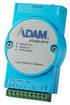 MODBUS TCP to RTU/ASCII Gateway User s Manual 1 INTRODUCTION... 1 1.1 FEATURES... 2 1.2 PRODUCT SPECIFICATIONS... 3 1.3 DEFAULT SETTINGS... 4 2 MAKING THE HARDWARE CONNECTIONS... 5 2.1 POWER CONNECTION...
FlexDSL MiniFlex. SHDSL.bis Up to 30Mbps Ddd. Ethernet. Features. Possible Applications
 SHDSL.bis Up to 30Mbps Ddd Ethernet FlexDSL MiniFlex Features Up to 15Mbps Data Transmission per Copper Pair SHDSL and SHDSL.bis, TC-PAM16/32 Additional TC-PAM4/8/64/128 Available 1 or 2 Copper Pairs Support
RADview/TDM. Element Management System for TDM Applications Optimux-T3. 1994 2005 RAD Data Communications Publication 06/05
 RADview/TDM Element Management System for TDM Applications Optimux-T3 1994 2005 RAD Data Communications Publication 06/05 Contents Chapter 1. Overview 1.1 Overview of the RADview FCAPS Model... 1-1 1.2
Optimux-134, Optimux-125
 Optimux-134, Optimux-125 Up to 16 E1/T1 links, full bandwidth 100 Mbps Ethernet traffic and high-speed data multiplexed into fiber optic uplink 34/25 Mbps or 134/125 Mbps operation s Single-, multi, single-
Industrial RS-232/ RS-422/ RS-485 over Ethernet Media Converter
 ICS-2 S15 Industrial RS-232/ RS-422/ RS-485 over Ethernet Media Converter Cost Effective Solution for RS-232 / RS-422 / RS-485 to Industrial Ethernet Application PLANET ICS-210x series Smart Media Converter
Low Speed Modems for Dial and Leased Circuits 2400E-2 (Stand Alone) 2400R-2 (Rack Mount) 2400E-4 (Stand Alone) 2400R-4 (Rack Mount)
 Low Speed Modems for Dial and Leased Circuits 2400E-2 (Stand Alone) 2400R-2 (Rack Mount) 2400E-4 (Stand Alone) 2400R-4 (Rack Mount) QUALITY COMMUNICATIONS PRODUCTS Made in the U.S.A. 11-1010-002 INTRODUCTION
CM705B - Universal Expander Module CM707B - Plug On Zone Expander Security Systems
 CM705B - Universal Expander Module CM707B - Plug On Zone Expander Security Systems EN Security System CM705B CM705B - Universal Expander Module The CM705B universal expander provides a cost effective way
2-Port RS232/422/485 Combo Serial to USB2.0 Adapter (w/ Metal Case and Screw Lock Mechanism) Installation Guide
 2-Port RS232/422/485 Combo Serial to USB2.0 Adapter (w/ Metal Case and Screw Lock Mechanism) Installation Guide 1. Introduction Thank you for purchasing this 2-Port RS232/422/485 Combo Serial to USB Adapter.
Secure Ethernet Gateway SEG-1 and SEG-M for IEI Access Systems Installation Manual
 Secure Ethernet Gateway SEG-1 and SEG-M for IEI Access Systems Installation Manual Section 1: Introduction SECURITY WARNING: New SEG's shipped after April 2008 will have Telnet setup option enabled by
One Port Serial Server Users Manual Model ESP901, ESP901E
 One Port Serial Server Users Manual Model ESP901, ESP901E Documentation Number: ESP901-2303 International Headquarters B&B Electronics Mfg. Co. Inc. 707 Dayton Road -- P.O. Box 1040 -- Ottawa, IL 61350
Optimux-134, Optimux-125
 Data Sheet Optimux-134, Optimux-125 Up to 16 E1/T1 links, full bandwidth 100 Mbps Ethernet traffic and high-speed data multiplexed into fiber optic uplink 25/34 Mbps or 125/134 Mbps operation s Single-,
Series Six Plus Programmable Controller
 Series Six Plus Programmable Controller Gl?K-0147B June 1989 Central Processor Unit 8-Slot Rack 1l-Slot Rack General Description The Central Processor Unit (CPU) for the Series Six Plus Programmable Logic
RICi-E1, RICi-T1 Fast Ethernet over E1/T1 Intelligent Converters
 Data Sheet RICi-E1, RICi-T1 Connect Fast Ethernet LANs over E1 or T1 circuits Wire-speed packet forwarding 4 levels of QoS, based on four VLAN priority queues in accordance with 802.1p and IP Precedence
Cisco Channelized T1/E1 and ISDN PRI Modules
 Cisco Channelized T1/E1 and ISDN PRI Modules Product Overview The Cisco Channelized T1/E1 and ISDN PRI High-Speed WAN Modules combine multiple T1/E1 WAN connectivity Channelized T1/E1 and ISDN Primary
FCD-E1LC, FCD-T1LC Managed E1/T1 or Fractional E1/T1 Access Units
 Where to buy > See the product page > Data Sheet FCD-E1LC, FCD-T1LC Managed TDM multiplexers for access to full or fractional E1/T1 services Managed access units for E1/T1 or fractional E1/T1 service E1/T1
USER MANUAL. MODEL 1082/F idsl Modem with G.703 Interface. An ISO-9001 Certified Company SALES OFFICE (301) 975-1000 TECHNICAL SUPPORT (301) 975-1007
 USER MANUAL MODEL 1082/F idsl Modem with G.703 Interface C E R T I F I E D An ISO-9001 Certified Company Part# 07M1082F-UM Doc# 03317U2-001 Rev. C Revised 11/2/06 SALES OFFICE (301) 975-1000 TECHNICAL
Configuring E1 and T1 Interfaces
 4 Configuring E1 and T1 Interfaces Contents Overview of E1 and T1 WAN Connections.......................... 4-3 Elements of an E1- or T1-Carrier Line.......................... 4-3 Connecting Your Premises
TP- 051 GPS RECEIVER
 TP- 051 GPS RECEIVER CONTENTS 1. Overview 3 2. Features 3 3. The advantages of TP-051 GPS Receiver 4 4. The appearance and structures 4 5. Applications 5 6. Installation steps for the TP-051 GPS Receiver
LTM-1338B. Plus Communications Manual
 LTM-1338B Plus Communications Manual 2000. Best Power, Necedah, Wisconsin All rights reserved. Best Power The System Setup option from the Main Menu on the front panel is passwordprotected. The default
CelluLine CGW-TS GSM Cellular Gateway. Installation and Programming Manual
 CelluLine CGW-TS GSM Cellular Gateway Installation and Programming Manual CelluLine CGW-TS GSM Cellular Gateway Installation and Programming Manual CGWTS-M001A Version 1, Release 1, December 2004 NOTICE
Cisco 8-Port Channelized T1/E1 Shared Port Adapter
 Cisco 8-Port Channelized T1/E1 Shared Port Adapter The Cisco I-Flex approach combines shared port adapters (SPAs) and SPA interface processors (SIPs), providing an extensible design that helps prioritize
T3 Module USER MANUAL. Part Number 1200223L1 / 1200225L1
 T3 Module USER MANUAL Part Number 1200223L1 / 1200225L1 61200223L1-1A July 1998 901 Explorer Boulevard P.O. Box 140000 Huntsville, AL 35814-4000 (256) 963-8000 1998 ADTRAN, Inc. All Rights Reserved. Printed
3500/22M Transient Data Interface
 3500/22M Transient Data Interface Bently Nevada* Asset Condition Monitoring Description The 3500 Transient Data Interface (TDI) is the interface between the 3500 monitoring system and GE s System 1* machinery
HCS-3300/3302/3304 USB Remote Programmable Laboratory Grade Switching Mode Power Supply
 1. INTRODUCTION HCS-3300/3302/3304 USB Remote Programmable Laboratory Grade Switching Mode Power Supply User Manual This family of efficient, upgraded SMPS with small form factor, auto cross over CV CC,
Voice Over Internet Protocol (VoIP) Configuration
 (VoIP) Configuration ENGINEERING REPORT No: 02-003 Introduction This report describes interfacing the IPCS VoIP Gateway Model EGW-902 to an ESTeem Model 192E Wireless Ethernet radio modem in a demonstration
Adit 3200 QUICK START GUIDE
 Adit 3200 QUICK START GUIDE Part Number: 002-0246-0010 Product Release: 1.6 September 2007 Copyright 2007 Carrier Access Corporation. All rights reserved. The information presented in this manual is subject
ORION TELECOM NETWORKS INC. T1
 RION TELECOM NETWORKS ORION TELECOM NETWORKS INC. T1 Protection (Fail-Over) Switch Product Brochure & Data Sheet Headquarters: Phoenix, Arizona Orion Telecom Networks Inc. 20100, N 51st Ave, Suite B240,
INSTALLATION GUIDE. Card Reader & Controller with KIM Swipe Reader for Solitaire 850 / 950 / 850L Learnlok PK2930
 INSTALLATION GUIDE Card Reader & Controller with KIM Swipe Reader for Solitaire 850 / 950 / 850L Learnlok PK2930 Card Reader and Controller Model 3.5 with KIM Swipe Reader Table of Contents 1. Features..................................