
INSTITUTO POLITÉCNICO NACIONAL MEXICO
|
|
|
- Noreen Norman
- 10 years ago
- Views:
Transcription
1 INSTITUTO POLITÉCNICO NACIONAL MEICO ACADEMIC OFFER IN ENGLISH HIGHER SCHOOL OF COMPUTING (COMPUTER SYSTEMS ENGINEERING) UNDERGRADUATE (5th Semester Upwards) 1 Bioinformatics 22 Graphical User Interfaces 2 Evolutionary computing 23 Basic Processing Digital Signal 3 Cryptography 24 SCADA Systems 4 Web Security 25 Digital Control 5 Analysis and design of Parallel Algorithms 26 Fuzzy Systems Applied to Engineering 6 Parallel and Concurrent Programming 27 Computational Intelligence in Control Engineering 7 Computer Graphics 28 Digital Processing of Voice and Image 8 Computer Animation 29 Advanced Signal Processing 9 Pattern Recognition 30 Genetic Algorithms 10 Distributed Data Base 31 Supervised Artificial Neural Networks Unsupervised Artificial Neural Networks 12 Data Base Selected Topics 33 Computing Selected Topics 13 Image Analysis 34 Intelligent Systems 14 Artificial Intelligence 35 High Technology Enterprise Management 15 Neural Networks 36 Mobile Communications 16 Application Development for Mobile Devices 37 Embedded Systems 17 Web Application Development 38 Advanced Architectures 18 Software Engineering for Mobile Devices 39 Advanced Computing Systems Programming 19 e-commerce 40 Economic Engineering 20 Computational Geometry 41 IT Financial Engineering 21 Systems Simulation 42 IT Governance Data Mining HIGHER SCHOOL OF COMMERCE AND ADMINISTRATION, SANTO TOMAS UNIT UNDERGRADUATE 1. International Scenarios (4hr/wk) 3. Consumer Behavior (6 hr/wk) 2. Fundamentals of Finance (6hr/wk) 4 Mexican Economy in the Global Context (6 hr/wk) HIGHER SCHOOL OF COMMERCE AND ADMINISTRATION, TEPEPAN UNIT UNDERGRADUATE 1. Quality & General Theory of Systems 6hrs/wk 4. Foreign Investment 6hrs/wk 2. Marketing & International Promotion 5hrs/wk 5. Development of Directive Skills 6hrs/wk 3. International Negotiation Strategy 6hrs/wky 6. International Scenarios 4hrs/wk HIGHER SCHOOL OF TOURISM UNDERGRADUATE 1. Culture of Quality in Touristic Organizations. 2. Creativity and Innovation in Touristic Enterprises. 3. Sales Management 4. Marketing Plan APPLIED SCIENCE AND ADVANCED TECHNOLOGY RESEARCH CENTER, CAMPUS QUERETARO (ADVANCED TECHNOLOGIES MASTER PROGRAM 1. Applied Physics 5. Computer Vision 2. Pattern Recognition 6. Thermodynamics 3. Advanced Technologies 7. Radioprotection 4. Quantum Mechanics Applied to Materials 8. General & Advanced Biochemistry

2 NATIONAL POLYTECHNIC INSTITUTE ACADEMIC SECRETARIAT DIRECTORATE OF HIGHER EDUCATION SHORT PROGRAM ACADEMIC UNIT: ACADEMIC PROGRAM: ESCUELA SUPERIOR DE COMERCIO Y ADMINISTRACION SATO TOMAS Y TEPEPEN Commercial Relations Bachelor LEARNING UNIT: Consumer behavior LEVEL: II GENERAL PURPOSE Explain consumer behavior in the field of marketers, on the development of behaviors, interests and attitudes that people take in the process of consumption of goods and services, which are the foundation on how marketing is based, considering the ethical and social responsibility, through collaborative research of documentary and field. CONTENTS: I. Introduction to consumer behavior. II. The socio-cultural consumer behavior. III. Psychological factors in consumer behavior. IV. The consumer and marketing EDUCATIONAL GUIDANCE: The teaching-learning allows students to construct their own learning, through the following strategies: documentary and field research, text analysis, solving case studies, making presentations and exhibitions of individual and groups. ASSESSMENT AND ACCREDITATION Include a written diagnostic evaluation to determine prior knowledge related to the learning unit. Formative evaluation will be conducted consisting of the delivery of learning strategies and application of tests in each unit, forming a portfolio of evidence. The assessment is weighted in the delivery of desk research and the realization of the four practices in the field. This learning unit can be evidenced by demonstrated competence using the weighted evaluation criteria mentioned above. BIBLIOGRAPHY Arellano, Rolando, Comportamiento del consumidor, Enfoque América Latina, McGraw-Hill, México 2002, 563 págs., ISBN: D. Blackwell, Roger, W. Miniard, Paul y F. Engel James, Comportamiento del Consumidor, Thomson Editores, México 2002, 9ª edición, 592 págs., ISBN Kotler, Philip y L. Keller Kevin, Dirección de Marketing, Prentice Hall, México 2006, 12ª edición, 776 págs., ISBN R. Solomon, Michael, Comportamiento del Consumidor, Pearson, México 2008, 7ª edición, 672 págs., ISBN Schiffman, León y Kanuk, L. Lazar, Comportamiento del consumidor, Pearson Educación México 2005, 8ª edición, 587 págs., ISBN: CONSULTATION OF WEB PAGES Retrieved on June 21, 2008, Retrieved on June 21, 2008, Retrieved on June 22, 2008, amai.org/niveles.php Retrieved on June 22, 2008, Retrieved on June 27, 2008, Retrieved on June 27, 2008, Retrieved on July 6, 2008, Retrieved on July 6, 2008, Retrieved on July 6, 2008, Retrieved on August 10, Retrieved on December 11, 2008

3 NATIONAL POLYTECHNIC INSTITUTE ACADEMIC SECRETARIAT DIRECTORATE OF HIGHER EDUCATION ACADEMIC UNIT: HIGHER SCHOOL OF COMMERCE AND ADMNISTRATION SANTO TOMAS AND TEPEPAN UNITS ACADEMIC PROGRAM: Commercial Relations Bachelor PROFESSIONAL ASSOCIATE: Commercialization FORMATIVE AREA: Professional MODALITY: Classroom LEARNING UNIT: Consumer behavior TYPE OF LEARNING UNIT:: Theoretical-Practice Obligatory VALIDITY: 2009 LEVEL : II CREDITS: 9 Tepic (6.1 SATCA ) GENERAL PURPOSE This learning unit is essential for the professional development of graduate in Business Relationships, as its practice is strongly related to meeting the needs and desires of consumers. Hence, it is necessary that the trade relations professional in understanding the importance of the consumption process, investigate the various behaviors and communicate to businesses the importance and advantages to be gained to develop new products and services based on the consumer. Competencies to be achieved in this learning unit will be: Investigate the reasons why consumers buy, use or reject a particular product or service. Differentiate the major theories and approaches to study consumer behavior Analyze the process of consumption, Reflect on the importance of sustainability and consumer Understand consumer rights. Integrate key psychological factors that affect consumer behavior. Distinguish the various socioeconomic and cultural variables related to consumption. Analyze their influence on consumer behavior. Analyze the relationship of the consumer with the basic elements of marketing, Assess the importance of meeting or exceeding customer expectations. Work collaboratively to reach agreement. Present the results of investigations against the group. understand texts related to the thematic units in the English language. This learning unit is connected horizontally with: o Introduction to integrated communication. o Introduction to the sale. And up and down vertically with: Fundamentals of Marketing, Analytical or Marketing, Direct marketing, Purchasing, Advertising and Media, Quantitative and Qualitative Market research, Public Relations, Macroeconomics, Sales Promotion, Media, Global economic trends, Strategic planning and integrated communication, Business development workshop and Commercial or strategic direction. GENERAL PURPOSE Explain consumer behavior in the field of marketers, on the development of behaviors, interests and attitudes that people take in the process of consumption of goods and services, which are the foundation on how marketing is based, considering the ethical and social responsibility, through collaborative research of documentary and field. ASSIGNED TIMES THEORY/WEEK: PRACTICE/WEEK: THEORY/SEMESTER: 54.0 PRACTICE/SEMESTER: 54.0 TOTALS/SEMESTER:108.0 LEARNING UNIT DESIGNED BY: Marketing Academies from ESCA units Santo Tomas and Tepepan REVISED BY: Academic Subdirection Units Santo Tomas and Tepepan APPROVED BY: School Technical Advisory Council Santo Tomas and Tepepan Presidents C.P. Norma Cano Olea y C.P.C. M. en C. Jaime V. Sanchís Cuevas AUTORIZED BY: Comission of Academic Programs from the General Advisory Council of thel IPN. Dr. David Jaramillo Vigueras Technical Secretariat from the Comission of Academic Programs

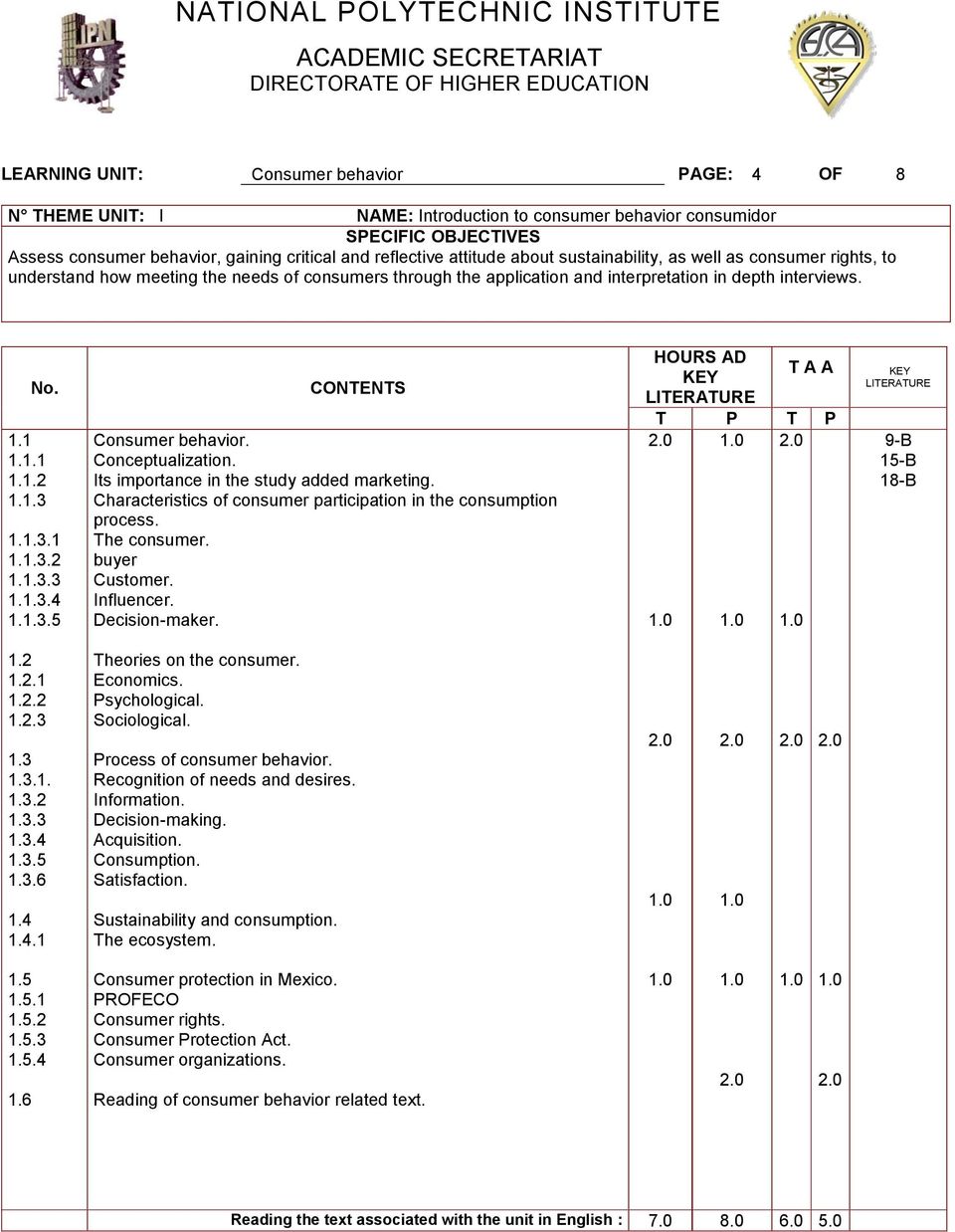
4 NATIONAL POLYTECHNIC INSTITUTE ACADEMIC SECRETARIAT DIRECTORATE OF HIGHER EDUCATION LEARNING UNIT: Consumer behavior PAGE: 4 OF 8 N THEME UNIT: I NAME: Introduction to consumer behavior consumidor SPECIFIC OBJECTIVES Assess consumer behavior, gaining critical and reflective attitude about sustainability, as well as consumer rights, to understand how meeting the needs of consumers through the application and interpretation in depth interviews. No CONTENTS Consumer behavior. Conceptualization. Its importance in the study added marketing. Characteristics of consumer participation in the consumption process. The consumer. buyer Customer. Influencer. Decision-maker. AD KEY T A A LITERATURE T P T P KEY LITERATURE 9-B 15-B 18-B Theories on the consumer. Economics. Psychological. Sociological. Process of consumer behavior. Recognition of needs and desires. Information. Decision-making. Acquisition. Consumption. Satisfaction. Sustainability and consumption. The ecosystem Consumer protection in Mexico. PROFECO Consumer rights. Consumer Protection Act. Consumer organizations. Reading of consumer behavior related text. Reading the text associated with the unit in English :
5 NATIONAL POLYTECHNIC INSTITUTE ACADEMIC SECRETARIAT DIRECTORATE OF HIGHER EDUCATION LEARNING UNIT: Consumer behavior PAGE: 5 OF 8 LEARNING STRATEGIES Discussion on collaborative teams of the concept and importance of consumer behavior. Development of concept maps as a team on the characteristics of consumer participation in the consumption process. Assess a case study stage of the process of consumer behavior provided. Preparation and presentation of the team presenting the case to the group. Electronic Research staff work on federal legislation and consumer standards institutions in Mexico. Conduct practice no. 1: "The process of consumption." Reading and comprehension of English texts related to the thematic unity with individual and team proficiency. ASSESSMENT OF LEARNING: Review written diagnosis to determine students' prior knowledge related to the learning unit. Delivery of written conclusions on the result of team discussion, the evidence be to deliver a manuscript and briefly (2-3 pages) that contains the general opinion of each...5% Delivery of a conceptual map at least 80% of the items included in the subject % Submission of written report of the documentary research on the following criteria: Quality of presentation (cover, index, thematic development, conclusion) with an extensive text of four to six pages, all content areas of the unit and bibliographic references. and electronic journals section % Exhibition and presentation of the case investigated considering the quality of the written and exhibitions such as: verbal fluency, attractive and material support creative compliance time % Report writing practice no. 1. Develop and implement five-depth interviews (semistructured) per team, with housewives made by each student to integrate a collaborative team, which will be integrated into one report per team, considering as evidence: interviews objective, methodology, results and conclusions % Review % Written evaluation of the English vocabulary %

6 NATIONAL POLYTECHNIC INSTITUTE ACADEMIC SECRETARIAT DIRECTORATE OF HIGHER EDUCATION LEARNING UNIT: Consumer behavior PAGE: 6 OF 8 N THEME UNIT: II NAME: The socio-cultural consumer behavior factors on consumer behavior. SPECIFIC OBJECTIVES Distinguish the various socioeconomic and cultural variables and their influence on consumer behavior, to understand the influence they have on consumer behavior, through design, implementation and analysis of a questionnaire with structured questions. No. CONTENTS AD KEY LITERATURE T A A T P T P TEACHING ACTIVITIES Cultural Factors Cultural influences on consumer behavior. Creation and dissemination of global culture of consumption. 9-B 15-B 18-B Subcultural factors. Subcultures ethnic, racial and religious. Generations of "Baby Boomers", " and Y" Social factors. Influence of groups Reference Groups Opinion leadership. Family socioeconomic AMAI socioeconomic 2.5 Reading of consumer behavior related text. Subtotals Thematic Unit LEARNING STRATEGIES Discussion on collaborative teams of the influence of sociocultural factors in consumer behavior. Development of a conceptual map team on subcultural factors in consumer behavior. Conduct practice no. 2: "The socioeconomic level of the consumer." Reading and comprehension of English texts related to the individual thematic unity and team with the English language ASSESSMENT OF LEARNING Delivery of a report as a result of the discussion taking as evidence a brief manuscript (2-3 pages) in which they express the general opinion of each team % Delivery of a conceptual map that contains at least 80% of the items included in the subject... 5% Delivery of the report of the Investigation of Reference Groups on the following criteria: Quality of presentation (cover, index, thematic development, conclusion), text length determined by number of pages, all contained within the subject referral and bibliographic references. hemerographic and..10% Providing research report socioeconomic levels under the following criteria: Quality of presentation (cover, index, thematic development, conclusion), text length determined by number of pages, all contained within the theme related and References is acknowledged. hemerographic and....10% Report writing practice no. 2. Survey of a sample of 20 households per team, housewives, considering as evidence: Objective of the survey methodology, results and % Review....30% Written evaluation of the English vocabulary %

7 NATIONAL POLYTECHNIC INSTITUTE ACADEMIC SECRETARIAT DIRECTORATE OF HIGHER EDUCATION LEARNING UNIT: Consumer behavior PAGE: 8 OF 8 N THEME UNIT: III NAME: Psychological factors in consumer behavior. SPECIFIC OBJECTIVES Explain the major psychological factors that affect consumer behavior and the process involved in designing marketing strategies, through design, implementation and analysis of an observation guide. No. CONTENTS AD KEY LITERATURE T A A TEACHING ACTIVITIES T P T P Personality. Theories of personality. Understanding the diversity of the consumer. Brand personality 9-B 15-B 18-B Motivation and emotion. Needs, motivation and desire. Hierarchy of needs and motivations. Secondary needs. Analysis of motivations Perception Sensory systems. Perceptual stimuli Perceptual process: selection, organization and interpretation Learning and memory. The learning process. Behavioral theories of learning. Cognitive theory of learning. The role of memory in learning Attitudes Elements of the attitudes. Model attitudes. Functions of attitudes Changing attitudes. Study of the attitudes. Reading of consumer behavior related text. Thematic Unit Subtotals

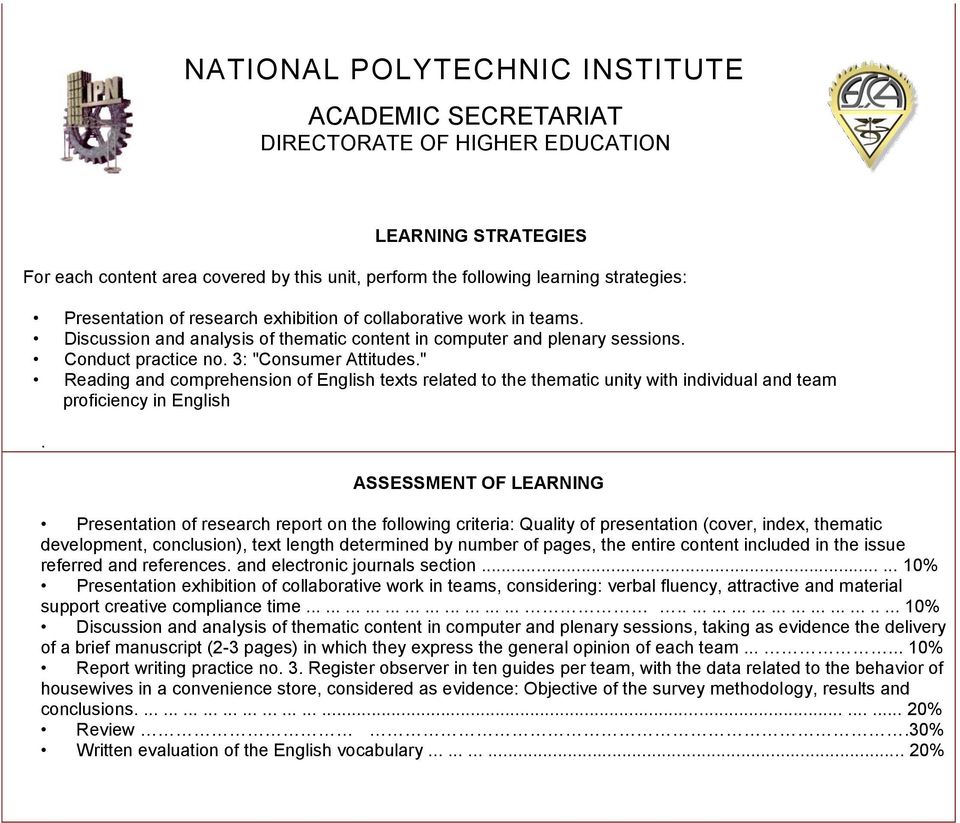
8 NATIONAL POLYTECHNIC INSTITUTE ACADEMIC SECRETARIAT DIRECTORATE OF HIGHER EDUCATION LEARNING STRATEGIES For each content area covered by this unit, perform the following learning strategies: Presentation of research exhibition of collaborative work in teams. Discussion and analysis of thematic content in computer and plenary sessions. Conduct practice no. 3: "Consumer Attitudes." Reading and comprehension of English texts related to the thematic unity with individual and team proficiency in English. ASSESSMENT OF LEARNING Presentation of research report on the following criteria: Quality of presentation (cover, index, thematic development, conclusion), text length determined by number of pages, the entire content included in the issue referred and references. and electronic journals section % Presentation exhibition of collaborative work in teams, considering: verbal fluency, attractive and material support creative compliance time % Discussion and analysis of thematic content in computer and plenary sessions, taking as evidence the delivery of a brief manuscript (2-3 pages) in which they express the general opinion of each team % Report writing practice no. 3. Register observer in ten guides per team, with the data related to the behavior of housewives in a convenience store, considered as evidence: Objective of the survey methodology, results and conclusions % Review.30% Written evaluation of the English vocabulary %
9 NATIONAL POLYTECHNIC INSTITUTE ACADEMIC SECRETARIAT DIRECTORATE OF HIGHER EDUCATION LEARNING UNIT: Consumer behavior PAGE: 10 OF 8 N THEME UNIT: IV NAME: The consumer and marketing. SPECIFIC OBJECTIVES Analyze the relationship consumers have with the basic elements of marketing, to assess the importance of meeting or exceeding customer expectations through a survey on the identification of the demographic characteristics of a target market. No. CONTENTS AD KEY LITERATURE T A A TEACHING ACTIVITIES T P T P The consumer and marketing. Impact of consumer marketing. Impact of marketing on consumers. 9-B 15-B 18-B Segmentation of consumers Geographic Demographic Psychographics Benefits Behavioral Creating value and satisfaction. The perceived value to the customer. Total Customer Satisfaction. How to measure customer satisfaction. Quality of products and services. The total quality management. Maximize the lifetime value of customers. Customer profitability. How to calculate the lifetime value of customers The concept of customer capital. The consumer and innovations. Innovation. The target market. The channels of communication. Time. The adoption process of a brand. Organizational decision making. The business market vs consumer market. Participants in the buying process. The process of buying. B2B relationship management. Institutional and government markets. Reading of consumer behavior related text. Subtotals Thematic Unit

10 NATIONAL POLYTECHNIC INSTITUTE ACADEMIC SECRETARIAT DIRECTORATE OF HIGHER EDUCATION LEARNING STRATEGIES For each content area covered by this unit, perform the following learning strategies:: Presentation exhibition in collaborative teams. Discussion and analysis of thematic content in computer and plenary sessions. Conduct practice no. 4: "Market Segmentation Demographic." Reading and comprehension of English texts related to the thematic unity and team individual with knowledge of English.. ASSESSMENT OF LEARNING Presentation of research report on the following criteria: Quality of presentation (cover, index, thematic development, conclusion), text length determined by number of pages, the entire content included in the issue referred and references. and electronic journals section % Presentation exhibition of collaborative work in teams, considering: verbal fluency, attractive and material support creative compliance time % Discussion and analysis of thematic content in computer and plenary sessions, taking as evidence the delivery of a brief manuscript (2-3 pages) in which they express the general opinion of each % Report writing practice no. 4. Develop and implement twenty surveys on demographic characteristics of a target market, considering as evidence: objective, methodology, results and conclusions. Be given a report by staff % Review..30% Written evaluation of the English vocabulary %

11 NATIONAL POLYTECHNIC INSTITUTE ACADEMIC SECRETARIAT DIRECTORATE OF HIGHER EDUCATION LEARNING UNIT: Consumer behavior PAGE: 12 OF 8 LIST OF PRACTICES Practice No. 1 NAME OF PRACTICE The process of consumption. Objective: Develop, implement and analyze a team, in-depth interviews related to the housewife behavior in relation to consumption of products in the home. Develop and implement five-depth interviews (semistructured) per team, with housewives made by each student to integrate a collaborative team, which will be integrated into one report per team, considering as evidence: interviews objective, methodology, results and conclusions THEMATIC UNITS I DURATION 1 DURATION PLACE Field 2 The socioeconomic level of the consumer. Objective: Apply AMAI algorithm to determine the socioeconomic status of a sample of households. Survey of a sample of 20 households per team, housewives, considering as evidence: Objective of the survey methodology, results and conclusions. II 10.0 Field 3 Consumer attitudes. Objective: Develop and implement an observation guide to a sample of shoppers in a grocery store in order to observe their attitudes purchase. Register observer in ten guides per team, with the data related to the behavior of housewives in a convenience store, considered as evidence: Objective of the survey methodology, results and conclusions. III 16.0 Field 4 Demographic segmentation of the market. IV 15.0 Field Objective: To identify the different elements contained in the demographic segmentation of a sample of households in different political delegations of Mexico City. Develop and implement twenty surveys on demographic characteristics of a target market, considering as evidence: objective, methodology, results and conclusions. A report will be delivered by staff TOTAL 54 hrs. ASSESSMENT AND ACCREDITATION The percentages of accreditation, each practice will incluye: Practice 1. 20% of the respective unit. Practice 2. 20% of the respective unit. Practice 3. 20% of the respective unit. Practice 4. 20% of the respective unit.

12 NATIONAL POLYTECHNIC INSTITUTE ACADEMIC SECRETARIAT DIRECTORATE OF HIGHER EDUCATION LEARNING UNIT: Consumer Behavior PAGE: 13 OF: 8 ASSESSMENT PROCEDURE Thematic Unit I Introduction to consumer behavior 25% The socio-cultural thematic unit II of consumer behavior 15 % Thematic Unit III Psychological factors in consumer behavior 30% Thematic Unit IV The consumer and marketing 30% This learning unit can be evidenced by: Demonstrated competence at the beginning of the course and request (a) through a written evaluation and implementation of the four practices considered in the learning unit which together show that having at least 80% of the mastery of core competencies Learning Unit. Courses in other national higher education institutions that have an agreement with the IPN. Mobility between St. Thomas and ESCA Tepepan unit according to their ability to care. Modal Mobility: Classroom and Virtual according to attention span. KEY B C REFERENCES 1 Anderson, W. Jasso, Consumption asset to seize power, Consumers Digest, Mexico, in December. 2007, no.: 370, p ISSN: Rachel Brown, Mary E. Perez, Claudia Quintanilla, Shopping at the border, Expansion, Mexico, May 26, 2008 no.: 991, p ISSN: Marshal Cohen, Consumer behavior, who they are, why they buy and how to anticipate each of its movements, McGraw-Hill, Mexico, 2006, ISBN: Crusade against misleading advertising, Expansion, Mexico, June 23, 2008 no.: 993, 350 pg. ISSN: John Derick, Emotions, impulses and reasons, Expansion, Mexico, May 26, 2008 no.: 991, p ISSN: They buy and they go shopping, Expansion, Mexico, May 26, 2008 no.: 991, p ISSN: Fernandez de Lara Carlos, Arrogant Technology, Excelsior, Mexico, June 20, Naomi Klein, No Logo, The power of brands, Oxford Paidós Ibérica, Spain, 2005 ISBN: Philip Kotler and Kevin Keller L, Marketing Management, 12th edition, Pearson Education, Mexico, 2006 ISBN: The consumer union is strength, Expansion, Mexico, June 23, 2008 no.: 993, p ISSN: Luis de Llano Macedo, Generation 'Y' and 'T phenomenon', Expansion, Mexico, June 23, 2008 no.: 993, pp ISSN: Alejandro Mejia C., Consumer Crusade, Expansion, Mexico, June 23, 2008 no.: 993, pp ISSN: Adrian Ryans, The customer has no reason, Expansion, Mexico, May 26, 2008 no.: 991, p ISSN: Michael Saren, Marketing at Grupo Editorial Patria graffiti, Mexico, 2007 ISBN:

13 15 Schiffman Leon and kanuka L. Lazar, Consumer Behavior 8th edition, Pearson Education, Mexico, 2005 ISBN: If it's expensive, it sure is good, Expansion, Mexico, May 26, 2008 no.: 991, p ISSN: Claudia Solera, The world is me, leave behind the, Excelsior, Mexico, April 13, Michael R. Solomon, Consumer Behavior 7th edition, Pearson Education Mexico, 2008 ISBN: William Stanton, Etzel and Michael Bruce Walker, Fundamentals of Marketing, 14th Edition, McGraw-Hill, Mexico, 2007, ISBN: Websites internet: Accessed June 21 / Accessed June 21 / Accessed June 22 / amai.org / niveles.php Accessed June 22 / Accessed June 27 / Accessed June 27 / Accessed July 6 / Accessed July 6 / Accessed July 6 / Accessed August 10 / Accessed December 11 / 2008

14 1. GENERAL DATA NATIONAL POLYTECHNIC INSTITUTE ACADEMIC SECRETARIAT DIRECTORATE OF HIGHER EDUCATION TEACHING PROFILE PER LEARNING UNIT ACADEMIC UNIT: HIGHER SCHOOL OF COMMERCE AND ADMNISTRATION SANTO TOMAS AND TEPEPAN UNITS ACADEMIC PROGRAM: Commercial Relations Bachelor LEVEL: II FORMATIVE AREA: Institutional Scientífic - Basic Professional Terminal and integration ACADEMY: Marketing LEARNING UNIT: Consumer Behavior SPECIALTY AND ACADEMIC LEVEL REQUIRED: Bachelor in CommerBusiness Relationships, Bachelor in Marketing, Bachelor in Psychology, BA in Communications. OBJECTIVE LEARNING UNIT: Explain consumer behavior in the field marketing muscle on the development of behaviors, interests and attitudes that people take in the process of consumption of goods and services, considering the ethics and social responsibility through collaborative research of documentary and field TEACHER PROFILE KNOWLEDGE SKILLS PROFESSIONAL HABILITIES ATTITUDE Marketing. Consumer psychology. Sociology. Economy of consumption. Educational model of IPN In the areas of: Marketing, sales, Communication, service and Market research Teaching in the areas of Marketing, Sales, Communication Market Research, Humanities and Economics.. Negotiation Fluency. Proper communication oral and written. Applying the institutional educational To motivate staff. Leadership. Management groups. Troubleshooting. Application of MEI. Flexible. Empathy.. Tolerance. Respect. Service. PREPARED BY REVISED AUTORIZED Presidente de Academia de asignaturas afines de Mercadotecnia LRC Gerardo Chávez Moreno LRC Lydia Villaseñor Cadena LRC José David Waldo Caamaño ESCA Unidad Santo Tomás y Tepepan M. en C. Dely Karolina Urbano Sánchez M. en C. Maria Estela Casas Hernández Subdirectoras Académicas ESCA Unidad Santo Tomàs Y Tepepan C.P. Norma Cano Olea C.P.C. M en C. Jaime V. Sanchís Cuevas Directores de las unidad Académicas ESCA Unidad Santo Tomàs y Tepepan DATE: 2009.

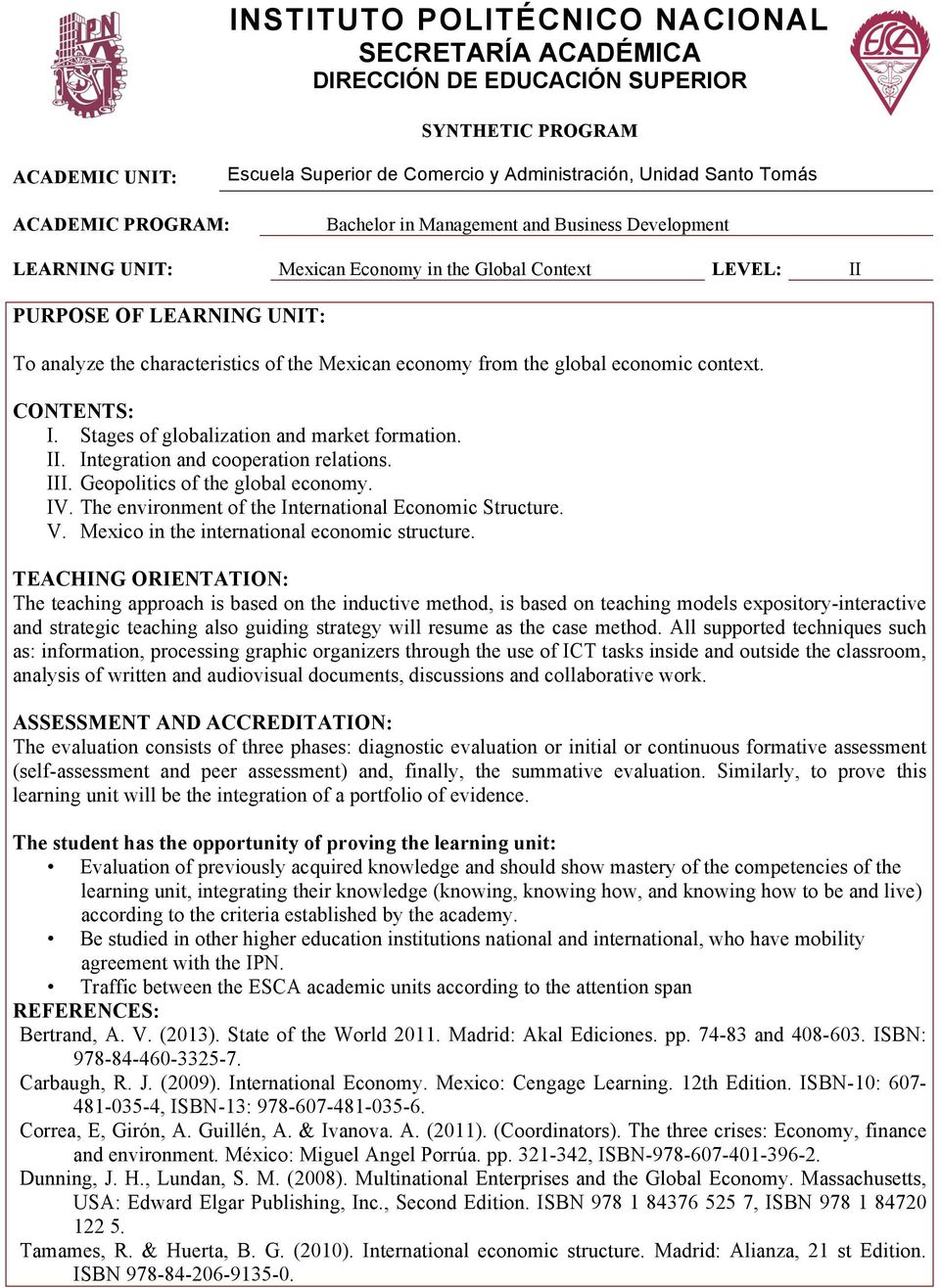
15 SYNTHETIC PROGRAM ACADEMIC UNIT: Escuela Superior de Comercio y Administración, Unidad Santo Tomás ACADEMIC PROGRAM: Bachelor in Management and Business Development LEARNING UNIT: Mexican Economy in the Global Context LEVEL: II PURPOSE OF LEARNING UNIT: To analyze the characteristics of the Mexican economy from the global economic context. CONTENTS: I. Stages of globalization and market formation. II. Integration and cooperation relations. III. Geopolitics of the global economy. IV. The environment of the International Economic Structure. V. Mexico in the international economic structure. TEACHING ORIENTATION: The teaching approach is based on the inductive method, is based on teaching models expository-interactive and strategic teaching also guiding strategy will resume as the case method. All supported techniques such as: information, processing graphic organizers through the use of ICT tasks inside and outside the classroom, analysis of written and audiovisual documents, discussions and collaborative work. ASSESSMENT AND ACCREDITATION: The evaluation consists of three phases: diagnostic evaluation or initial or continuous formative assessment (self-assessment and peer assessment) and, finally, the summative evaluation. Similarly, to prove this learning unit will be the integration of a portfolio of evidence. The student has the opportunity of proving the learning unit: Evaluation of previously acquired knowledge and should show mastery of the competencies of the learning unit, integrating their knowledge (knowing, knowing how, and knowing how to be and live) according to the criteria established by the academy. Be studied in other higher education institutions national and international, who have mobility agreement with the IPN. Traffic between the ESCA academic units according to the attention span REFERENCES: Bertrand, A. V. (2013). State of the World Madrid: Akal Ediciones. pp and ISBN: Carbaugh, R. J. (2009). International Economy. Mexico: Cengage Learning. 12th Edition. ISBN-10: , ISBN-13: Correa, E, Girón, A. Guillén, A. & Ivanova. A. (2011). (Coordinators). The three crises: Economy, finance and environment. México: Miguel Angel Porrúa. pp , ISBN Dunning, J. H., Lundan, S. M. (2008). Multinational Enterprises and the Global Economy. Massachusetts, USA: Edward Elgar Publishing, Inc., Second Edition. ISBN , ISBN Tamames, R. & Huerta, B. G. (2010). International economic structure. Madrid: Alianza, 21 st Edition. ISBN
16 ACADEMIC UNIT: Escuela Superior de Comercio y Administración, Unidad Santo Tomás. ACADEMIC PROGRAM: Bachelor in Management and Business Development. OUTPUT SIDE: In managing SMEs TRAINING AREA: Basic Scientific. METHOD: Schooling and no schooling LEARNING UNIT: Mexican economy in the global context. LEARNING UNIT TYPE: Theory and practice, mandatory and English (bilingual). Force: 2013 LEVEL: II. SCHOOL YEAR: Fourth. EDUCATION INTENTION CREDITS: 6 SATCA (9 Tepic) This learning unit contributes to the exit profile of Business Administration and Business Development in the acquisition of skills which analyze geopolitical integration phases of the countries and the Mexican economy in the global context. Due to the global interconnection, companies operating in national markets are affected by an economy increasingly integrated. Not only the face of growing competition from foreign companies, but also by the dependence of the flow of raw materials, intermediate goods, and funding from foreign sources. These skills enable students to develop the ability to integrate effectively in teams and responsibly addressed, disposition, tolerance, fairness, leadership and creativity, as well as directed toward the achievement of goals, objectives and results, updated, permanently learn and adapt to change, allowing Mexico's integration into the global economy. Mexican Economy in the Global Context has been preceded by a learning units: Foundations of Accounting, Law, Marketing Basics and Fundamentals of Economics, as subsequent to the learning unit for Standardization Standards as parallel learning units: Law commercial, Sales Management and Study of Economic Blocs. Also relates transversely with learning units: Oral and written communication, Troubleshooting and creativity, Sustainable Development, Corporate Social Responsibility and Business Ethics, Entrepreneurship and Social Service. PURPOSE OF LEARNING UNIT To analyze the characteristics of the Mexican economy from the global economic context. TIMES ASSIGNED LEARNING UNIT DESIGNED BY: Academy of THEORY / WEEK: Economics ESCA Santo Tomas Unit. PRACTICE / WEEK: REVIEWED BY: Unit THEORY / SEMESTER: 54.0 Academic Branch St. Tomas APPROVED BY: Technical PRACTICE / SEMESTER: 54.0 Advisory Unit School St. Tomas. President, CPA Norma Cano TOTAL / SEMESTER: 108 Olea AUTHORIZED BY: Committee on Academic Programs Advisory Council General IPN. Dr. Emmanuel Alejandro Merchan Cruz Technical Secretary for Academic Programs Committee

17 LEARNING UNIT: Mexican Economy in the Global Context PAGE: 3 OF 15 THEMATIC UNIT No.: I NAME: Stages of globalization and market formation UNIT OF COMPETENCE Difference stages of the globalization process and the formation of integrated markets based on the economic performance of military movements (first and second world war). No CONTENTS The economy in the global context. Concept, background and objectives of globalization. Major International Organizations (IMF, World Bank, GATT-WTO, FAO, ILO, OECD). AD Teaching activities T P AD Teaching activities KEY LITERATU RE 1C 9B 3B Economic policy. The Trade Policy. Trade policy instruments. Model protectionist. Free market model. Global economic Radiography. Economic crises in the I century. Emerging economies. subtotals: LEARNING STRATEGIES Questions detonating on the themes: globalization, international organizations, trade policy, economic crisis and emerging economies. On computers and the information we have, develop worksheets. Search for information from various sources on concepts, background and objectives of globalization to develop concept maps. Discussion guided by the teacher based on research. Team Interactive exhibition on international organizations. Based on the presentations and teacher monitoring, develop a table of international agencies including: core members, objectives, and functions, supervisory and regulatory policies. Professor interactive exhibition about trade policy and its main instruments. Based on monitoring exposure and teacher, prepare a comparison chart that highlights the most important features of a model free market protectionist. Interactive exhibition by the teacher about the economic and financial crises of the century. Based on monitoring exposure and teacher, develop an analysis of the crisis in the world, including the factors that influence economic fluctuations that have characterized financial and economic crises of the century and the rise of emerging economies. Written objective test (examination). Integration of the portfolio of evidence.

18 LEARNING UNIT: Mexican Economy in the Global Context PAGE: 4 OF 15 Portfolio of evidence: EVALUATION OF LEARNING Worksheets 10% Concept map 10% Interactive exhibit 20% Table (international) 10% Comparative Table 10% Analysis 10% Objective test 30%

19 LEARNING UNIT: Mexican Economy in the Global Context PAGE: 6 OF 15 THEMATIC UNIT No.: II NAME: Foreign economic cooperation and integration. UNIT OF COMPETENCE Identify each of the degrees of economic integration from the trade agreement signed by member countries. No CONTENTS Economic integration process Concept, background and objectives Degrees of Economic Integration. Free trade zone. Customs Union Common Market. Economic Union and Economic Integration altogether. Economic Zones Europe America Asia and Oceania Major economic integrations. Economic integration in Africa. EUROPEAN UNION. NAFTA MERCOSUR. LAIA. ASEAN. AD Teaching activities T P TAA Independent Learning Activities 5.0 subtotals: KEY LITERAT URE 9B 4C 2B LEARNING STRATEGIES Discussion guided by the teacher about the concepts and objectives antecedes economic integration process for the recovery of prior knowledge. Prior information search and discussion guided by the teacher about the degree of economic integration and the definition of economic zones that make up the world's geopolitics. With constant monitoring, develop a timeline dual input (horizontal line bounded vertically years and significant events), that includes at least the key elements and features of the historical context for each economic integration. With constant monitoring, develop an overview of treaties including the advantages and disadvantages depending on the sector, and the main products exported in Mexico. With constant monitoring, develop a statistical investigation to identify agricultural commodities higher monetary value and export volume. With constant monitoring, develop an analysis of government support for agricultural exporting SMEs. Case Study 1: "The process of Globalization". Team and based in a case brought by the teacher, identify the stages of the process of globalization from two periods: 1) comprising driven by falling transport costs and the First World War and 2) the second stage of globalization of with the closing of the Second World War, the Cold War, the creation of multilateral institutions and the formation of integrated markets. Will undertake the following activities: a. Presentation of resources, evaluation methods, and objectives of the case. Exposure to study case. i. Talk in teams to determine the tentative work plan and development of the case.

20 LEARNING UNIT: Mexican Economy in the Global Context PAGE: 7 OF 15 ii. Study and analysis of the case by a team approach to problem situations (questions arising from the same case). iii. With guidance and constant feedback from the teacher continually adjusts the final report and conclusions are developed. iv. Exposure of the solution and case team's conclusions. v. Conclusions and teacher feedback on team practices. b. Written objective test (based on the case). c. Integration of the portfolio of evidence. Portfolio of evidence: EVALUATION OF LEARNING Interactive exhibit 20% Synthesis 10% Case Study 2 40% Objective test 30%

21 LEARNING UNIT: Mexican Economy in the Global Context PAGE: 8 OF 15 THEMATIC UNIT No.: III NAME: Geopolitics of the global economy UNIT OF COMPETENCE To distinguish the current economic integration scenarios based on the characteristics of the geopolitical. No. CONTENTS AD Teaching activities T P TAA Independent Learning Activities KEY LITERATU RE The geopolitics of the global economy in the twenty-first century. Concept. Background. Capitalism and Geopolitics in the world. 3B 9B 2B Modes of production. Ideology and evolution of capitalism. Causes of the new world economic order Emergence of international organizations. Training international markets Economic Cooperation Forum "Pacific Basin (APEC)". 6.0 Mexico before the APEC. Subtotals: LEARNING STRATEGIES Guided Discussion on geopolitics, capitalism and the Pacific Rim for brainstorming. Pre-reading proposals (anthology) by the teacher about geopolitics, capitalism, causes the new world order and APEC to form 2 teams per item. a. Interactive exhibition team based on a rubric prior reading pre-prepared by the teacher. b. equipment and after each exposure, to provide an overview of each topic. Case Study 2 "geopolitical and economic evolution of integrated markets." In team and based on a case brought by the teacher, review the process of evolution of the geopolitical and integrated markets, according to the background of the political division (training world) and the modes of production. Will undertake the following activities: c. a) Presentation of resources, evaluation methods, and objectives of the case. d. b) Presentation of the case study. e. c) Discussion on computers to determine the tentative work plan and development of the case. f. d) Study and analysis of the case by a team approach to problem situations (questions arising from the same case). g. e) With guidance and constant feedback from the teacher continually adjusts the final report and conclusions are developed. h. f) Exposure of the solution and case team's conclusions. i. g) Conclusions and teacher feedback on team practices. Written objective test (based on the case). Integration of the portfolio of evidence.
22 LEARNING UNIT: Mexican Economy in the Global Context PAGE: 9 OF 15 Portfolio of evidence: EVALUATION OF LEARNING Interactive exhibit 20% Synthesis 10% Case Study 2 40% Objective test 30%
23 LEARNING UNIT: Mexican Economy in the Global context PAGE: 10 OF 15 THEMATIC UNIT No.: IV NAME: The environment of the International Economic Structure. UNIT OF COMPETENCE Interprets the scenes of the international economic structure from its components and economic indicators. No. CONTENTS AD Teaching activities T P TAA Independent Learning Activities KEY LITERATU RE Economic development. Indicators of economic development. Economic Growth. Economic indicators of economic growth. 2B 8C 9B Classification of developed countries, underdeveloped. Emerging economies (BRICS). Foreign portfolio investment. Foreign Direct Investment. Transnational organizations. The major economic powers. (E. U., Japan, China and European Union). Groups of highly developed countries (G7-8 and G20). 4.0 Subtotales: LEARNING STRATEGIES Interactive discussion by the teacher on economic development to develop a conceptual map of prior knowledge organizer. Interactive discussion by the teacher on economic growth to develop a conceptual map of prior knowledge organizer. Interactive exhibition on economic development through graphs of the highly developed countries. Interactive exhibition on the classification of countries with economic growth. Based on the presentations and with the guidance and constant monitoring, develop a comparative matrix of economic development countries and countries with economic growth. Interactive Exhibition characterization of developing and developed countries, through documentaries and readings suggested by the teacher. Based on the presentations and with guidance and constant monitoring, develop a matrix comparing developing and developed countries. Finding information in diverse sources of economic growth indicators that characterize the BRICS and prepare a research report. Modeling by the teacher on economic growth that identifies BRICS countries to develop a geographic map including: roads, climate, tastes, preferences and socioeconomic indicators. Search for information from various sources on the origin and destination of foreign direct investment to develop a pie chart (pie). Case Study 3 "international economic structure." In team and based on a case proposed by the teacher, analyze economic levels (Development and Underdevelopment) and stage of economic growth, to draw a diagram on the characteristics and differences of the components of the international economic structure of each continent include: economic, mode of production, population, territory, language, currency, environment and type of government. i. Presentation of resources, evaluation methods, and objectives of the case.
24 LEARNING UNIT: Mexican Economy in the Global context PAGE: 11 OF 15 ii. Presentation of the case study. iii. Discussion on computers to determine the tentative work plan and development of the case. iv. Study and analysis of the case by a team approach to problem situations (questions arising from the same case). v. With guidance and constant feedback from the teacher continually adjusts the diagram and develop conclusions. vi. Exposure of the solution and case team's conclusions. vii. Conclusions and teacher feedback on team practices. Written objective test (based on the case). Integration of the portfolio of evidence. EVALUATION OF LEARNING Portfolio of evidence: Concept map (economic development) 5% Concept map (economic growth) 5% Comparison Matrix: countries with economic growth and development 5% Comparison Matrix: developing and developed countries. 5% Research report 10% Geographic map 5% Pie chart 5% Case Study 3 30% Written objective test (based on the case) 30%
25 LEARNING UNIT: Mexican Economy in the Global Context PAGE: 12 OF 15 THEMATIC UNIT No.: V NAME: Mexico in the International Economic Structure. UNIT OF COMPETENCE Compare the degree of economic growth in Mexico with its trading partners based on international economic indicators. No. CONTENTS AD Teaching activities T P TAA Independent Learning Activities KEY LITERATU RE The Mexican economy from economic openness. Mexico's entry into GATT. Mexico and NAFTA. Mexico and other treaties. Mexico's trade agreements. Mexico's economic policy Mexico's trade policy. Exchange rate policy. Structure of the balance of payments. Balance of payments and exchange rates. Foreign investment in Mexico. Foreign Investment Law of Mexico Foreign Direct Investment in Mexico. Indirect Foreign Investment in Mexico. The business structure in Mexico. Features (innovation capacity of the parent company). The economies of scale. Competitive advantages (Porter). The corporate sustainability. Social and environmental responsibility B 5B 18C Subtotals: LEARNING STRATEGIES Interactive discussion with guided questions about the political economy of Mexico to recover the background. Pre-reading proposals (anthology) by the teacher on the themes: Mexican economy from economic openness, balance of payments, foreign investment and business structure in Mexico. Based on the readings and constant guidance, to elaborate: a. A conceptual map of Mexico's economic policy based on the National Development Plan b. An analysis of the results of the balance of payments current account, trade balance, financial account and gross international reserves. c. A double entry matrix that includes small, medium and large companies in Mexico and at least the following indicators: production, capital, number of employees, main products, exports, industry involved. Search for information from various sources on socially and environmentally responsible companies to produce a research report. Case Study 4 "Business Structure in Mexico". In team and based on a case proposed by the teacher, compare the competitiveness of the Mexican company to the international market demand and environmental impact.
26 a) Presentation of resources, evaluation methods, and objectives of the case. b) Presentation of the case study. c) Discussion on computers to determine the tentative work plan and development of the case. d) Study and analysis of the case by a team approach to problem situations (questions arising from the same case). e) With guidance and constant feedback from the teacher continually adjusts the diagram and develop conclusions. f) Exposure of the solution and case team's conclusions. g) Conclusions and teacher feedback on team practices. Written objective test (based on the case). Integration of the portfolio of evidence. Portfolio of evidence: EVALUATION OF LEARNING Concept map 5% Analysis 5% Dual input matrix 10% Research report. 10% Case Study 4 40% Objective test 30%
27 LEARNING UNIT: Mexican Economy in the Global Context PAGE: 13 OF 15 LIST OF PRACTICES PRACTICE NAME OF PRACTICE No. 1 "The process of Globalization THEMATIC UNITS I, II DURATION PLACE 14.0 classroom / 2 "Geopolitical and economic evolution of integrated markets" III 1 classroom / 3 "International Economic Structure" IV 1 classroom / 4 "Business Structure in Mexico" V 16.0 classroom / ASSESSMENT AND ACCREDITATION: TOTAL 54.0 Approval is essential practices for the accreditation of the learning unit. Assessment descriptors are contained in each practice thematic units and percentages corresponding crediting are: Case Study 1. 40% Case Study 2. 40% Case Study 3. 30% Case Study 4. 40%
28 LEARNING UNIT: Mexican Economy in the Global Context PAGE: 14 OF 15 ASSESSMENT PROCEDURE PERIOD UNIT ASSESSMENT PROCEDURE 1 I, II Continuous assessment 70% and 30% written examination 2 III, IV Continuous assessment 70% and 30% written examination 3 V Continuous assessment 70% and 30% written examination Unit I. 20% of the final assessment. Unit II. 20% of the final assessment. Unit III. 20% of the final assessment. Unit IV. 20% of the final assessment. Unit V. 20% of the final assessment. This unit of learning can be accredited by: The student may accredit prior learning unit for assessment attend it previously acquired knowledge, integrating their knowledge (knowing, knowing how, and knowing how to be and live) according to the criteria established by the academy. be studied in other higher education institutions national and international, who have mobility agreement with the IPN. Traffic between the ESCA academic units according to the attention span. KEY B C REFERENCES * Barkin, J. Samuel (2006). International Organitations. Theories and Institutions. Hampshire, England: Palgrave Macmillan. pp ISBN Bertrand, A. V. (2013). State of the World Madrid: Ediciones Akal. pp and ISBN: Carbaugh, R. J. (2009). International Economy. Mexico: Cengage Learning. 12th Edition. pp ISBN-10: , ISBN-13: Chanona, A. (2010) The security community in North America, a comparative perspective with the European Union. Mexico: Miguel Angel Porrua. pp ISBN Correa, E., Girón, A., Guillén, A. & Ivanova. A. (2011). (Coordinators). The three crises. Economy, finance and environment. Mexico: Miguel Angel Porrua. pp ISBN Dunning, J. H., Lundan, S. M. (2008). Multinational Enterprises and the Global Economy, Massachusetts, USA: Edward Elgar Publishing, Inc., Second Edition. pp , p ISBN , ISBN Heller, Michael G. (2009) Capitalism Institutions and Economic Development. Routledge. New York, USA. pp. 305, ISBN Mendez, M. J. S. (2012), Economic Problems of Mexico and Sustainability. Mexico: Mc Graw Hill. pp ISBN Tamames, R. & Huerta, B. G. (2010). International economic structure, Madrid: Alianza, 21 st Edition. ISBN Banco de Mexico. Accessed on July 2, World Bank. Accessed on July 2, The comercio.pe. Accessed on July 2, National Institute of Statistics and Geography. Accessed on July 2, International Monetary Fund. Accessed on July 2, World Trade Organization. Accessed on July 2, Ministry of Economy. Accessed on July 2, Secretary of Finance and Public Credit. Accessed on July 2, Rionda, R. J. I. (2010). Economic Growth and Regional Development in Mexico ( ), Published by the Andalusian University Foundation Inca Garcilaso, p ISBN-13: Viewed at: on July 31, 2013.
29 1. GENERAL INFORMATION TEACHER PROFILE LEARNING UNIT ACADEMIC UNIT: ESCUELA SUPERIOR DE COMERCIO Y ADMINISTRACIÓN UNIDAD SANTO TOMÁS ACADEMIC PROGRAM: Bachelor in Management and Business Development LEVEL: II TRAINING AREA: Institutional Scientific Basic Professional Terminal and Integration ACADEMY: Economy UNIDAD DE APRENDIZAJE: Mexican Economy in the Global Context SPECIALTY AND EDUCATION REQUIRED: The Bachelor in economics and / or Master's degree in economics. 1. PURPOSE OF LEARNING UNIT: Analyzes the characteristics of the Mexican economy from the global economic context. 2. EDUCATIONAL PROFILE: PROFESSIONAL KNOWLEDGE EPERIENCE In economics, trade Having worked in the public relations, international and / or private initiative. trade, public accounting, and Institutional Education Model. SKILLS TEACHERS Capacity didactic teaching with teaching vocation and easy communication. ATTITUDES Be sociable, good relationship with students, schedule, be ethical, responsible and have social commitment. DEVELOPED REVIEWED AUTHORIZED Lic. Pedro Montoro González M. en C. Adela Chávez M. en C. Silvia González Esparza Lic. Agdiel Obed García Ruíz Coordinators and collaborators Professors learning units related to the subject area of Economics ESCA, Unidad Académica Santo Tomás. M. en C. Nadina Olinda Valentín Kajatt Academic Assistant ESCA, Unidad Académica Santo Tomás. C.P.C. Norma Cano Olea Director de la ESCA, Unidad Académica Santo Tomás. DATE: 2013
30 SYNTHESIZED SCHOOL PROGRAM ACADEMIC UNIT: ACADEMIC PROGRAM: Escuela Superior de Cómputo Ingeniería en Sistemas Computacionales LEARNING UNIT: Advanced Architectures Level: III AIM OF THE LEARNING UNIT: The student creates high-performance computing components based on computer advanced architectures. CONTENTS: I. Parallelism II. Pipelining and Superscalar processors III. Vectorial and Array Computers IV. Multiprocessor Systems TEACHING PRINCIPLES: This learning unit will be approached through a learning strategy based on heuristic and analogical methods, and study cases. This will lead to learning activities that will guide the development of abstraction skills, analysis, comparison, design and recreation of components in advanced architectures, using theoretical and practical tools; such as the creation and simulation of components in advanced architectures for its analysis and application on specific computer systems.the activities to be held in classroom are: collaborative and participatory work, brainstorming, documentary research, worksheets, additional presentation of topics, guided discussion, review of case studies and simulations atcomponents of advanced architectures. Teacher takes the responsibility to decide to subjects ofdocumentary research, review of case studies, analyzes,as well as to set the preparation and handing terms. EVALUATION AND PASSING REQUIREMENTS: The program will evaluate the students in a continuous formative and summative way, which will lead students into the completion of learning portfolio. Some other assessing methods will be used, suchasself-assessmentrubrics, peer assessmentandhetero. Other means to pass this Unit of Learning: Evaluation of acknowledges previously acquired, based on the issues defined by the academy. Official recognition by either another IPN Academic Unit of the IPN or by a national or international external academic institution besides IPN. REFERENCES: Hwang, Kai (1993). Advanced computer architecture: parallelism, scalability, programmability. (1ª Ed). EUA: McGraw-Hill. ISBN Jadhav, S.S. (2009). Advanced Computer Architecture and Computing. (2a Ed). India: Technical Publications Pune. ISBN Parhami, Bhrooz (2007). Arquitectura de computadoras: De los microprocesadores a lassupercomputadoras. (1ª Ed). México: McGraw Hill. ISBN Shiva, Sajjan G. (2006). Advanced Computer Architectures. (1ª Ed). EUA: CRC Taylor & Francis. ISBN Stallings, William (2010). Computer Organization and Architecture: Designing for Performance. (8ª Ed). EUA: Prentice Hall. ISBN
31 ACADEMIC UNIT:Escuela Superior de Cómputo. ACADEMIC PROGRAM:Ingeniería en SistemasComputacionales LATERAL OUTPUT: AnalistaProgramador de Sistemas de Información FORMATION AREA: Professional. MODALITY:Presence. LEARNING UNIT:Advanced Architectures TYPE OF LEARNING UNIT:Theorical - Practical, Optative. USE:August, 2011 LEVEL: III. CREDITS:7.5 Tepic, 4.39 SATCA ACADEMIC AIM Thislearning unitcontributesto the profileof the EngineerinComputer Systemstodevelop skills in the designing and buildinghardware componentsforadvanced andefficientprocessing to create solutions for specific computerissues. It also provides tools, to obtain a creative judgment, collaborative and participatoryworkandassertive communication. This unit includes the units Discrete Mathematics, ComputationalTheory, DigitalDesign Fundamentals, Design ofdigital SystemsandComputer Architecture, as well as,abilitytodesignhardware components inahardwaredescription language, abilities in documentary investigationanduseofsimulationtools. AIM OF THE LEARNING UNIT: The student creates high-performance computing components based on computer advanced architectures. CREDITS THEORETICAL CREDITS / WEEK: PRACTICAL CREDITS / WEEK: THEORETICAL/ SEMESTER: 54 PRACTICAL / SEMESTER: 27 AUTONOMOUS LEARNING:54 CREDITS / SEMESTER: 81 LEARNING UNIT DESIGNED BY: Academia de SistemasDigitales REVISED BY: Dr. Flavio Arturo Sánchez Garfias SubdirectorAcadémico APPROVED BY: Ing. Apolinar Francisco Cruz LázaroPresidente del CTCE. AUTHORIZED BY: Comisión de ProgramasAcadémicos del Consejo General Consultivo del IPN Ing. Rodrigo de Jesús Serrano Domínguez SecretarioTécnico de la Comisión de ProgramasAcadémicos
32 LEARNING UNIT: Advanced Architectures PAGE: 3 OF OUT 9 THEMATIC UNIT: ITITLE:Parallelism UNIT OF COMPETENCE The student classifies parallel systems, based on computing paradigms and resources of parallelism. No. CONTENTS Teacher- LedInstructi on Autonomous Learning REFERENCES KEY T P T P Computing Paradigms Serial Pipeline Parallel 5B, 2B, 1B, 3B Y 4C Classification of parallel systems Flynn sclassification Others classifications Parallelism Sources Control Parallelism Data Parallelism Flow Parallelism Parallel System Throughput Quantities and performance measures Models of speed-up performance Models Based on Grain Size Subtotals: TEACHING PRINCIPLES Framing and team-work organization. This learning unit will be approached through a learning strategy based on heuristic and analogical methods, enabling the consolidation of the following learning techniques: worksheet, documentary research, led discussion, concept mapping,and team presentation of complementary issues and developed of a practical under a case study to evaluate the performance of a parallel system. Teacher takes the responsibility to decide to subjects of documentary research, review of case studies, analyzes and simulations performed as well as to set the preparation and handing terms. LEARNING EVALUATION Assessment Portfolio of Evidences: Worksheet Concept Map Team Presentation Report of Practical Rubric of Self-Evaluation Rubric of Co-Evaluation Evidence of Learning 15% 10% 15% 25% 3% 2% 30%
33 LEARNING UNIT: Advanced Architectures PAGE: 4 OF OUT 9 THEMATIC UNIT:II TITLE: Pipeliningand superscalar processors UNIT OF COMPETENCE The student experiences techniques pipelining and superscalar processing, based on principles of pipelining design. No CONTENTS Principles and Pipelining Implementation. Linear Pipeline Processors. Asynchronous Model. Synchronous Model. Pipeline Processor Classification According to Level of Processing. According to Pipeline Configurations and Control Strategies Arithmetic Pipeline Design. Computer Arithmetic Principles. Arithmetic Pipeline Stages Multiply Pipeline Design. Design Aspects of Instruction Pipeline. Instruction Execution Phases. Mechanisms for Instruction Pipelining. Dynamic Instruction Scheduling. Branch Handling Techniques. Superscalar Processors Design Superscalar Pipelining. Design Superpipelining. Supersymmetry and design solutions. Case Study: Pentium Processor Teacher- LedInstructio n Autonomous Learning T P T P REFERENCES KEY 6B, 2B, 5B, 1B Y 3B Subtotals: TEACHING PRINCIPLES This learning unit will be approached through a learning strategy based on heuristic and analogical methods, enabling the consolidation of the following learning techniques: worksheet, documentary research, led discussion, concept mapping, team presentation of complementary issues and developed of practicals, comparing trough case studies techniques Intel Pentium Processor Pipeline. LEARNING EVALUATION Assessment Portfolio of Evidences: Worksheet Concept Map Comparison Chart Team Presentation Report of Practical Case study report Rubric of Self-Evaluation Rubric of Co-Evaluation Evidence of Learning 05% 05% 10% 05% 25% 15% 3% 2% 30%
34 LEARNING UNIT: Advanced Architectures PAGE: 5 OUT OF 9 THEMATIC UNIT: III TITLE:Vector and Array Computers UNIT OF COMPETENCE The student verifies the efficiency of vector and array architectures based on design principles and purposes of those architectures. No. CONTENTS Teacher- LedInstructio n Autonomous Learning REFERENCES KEY T P T P Vector Processors SIMD, MIMD, VLIW, EPIC Basic Vector Processor Interlaced or Interleaved Memory Vector length and separation of elements Relative performance between vector and scalar 5B,2B,1B,3B,6B,7C 4C Array Processors Basic Organization Internal structure of a processing element Matrix Instructions SIMD Matrix Multiplication Associative Processors Associative Memories on Hardware 3.3 Case Study: Intel Pentium 4, IBM Power4 and ARM11 MPCore Subtotals: TEACHING PRINCIPLES This learning unit will be approached through a learning strategy based on heuristic and analogical methods, enabling the consolidation of the following learning techniques: worksheet, documentary research, led discussion, concept mapping, team presentation of complementary issues and development of practicals, comparing trough case studies techniques Intel, IBM and ARM vector and array processors. LEARNING EVALUATION Assessment Portfolio of Evidences: Worksheet Concept Map Comparison Chart Team Presentation Report of Practical Case study report Rubric of Self-Evaluation Rubric of Co-Evaluation Evidence of Learning 5% 5% 15% 5% 20% 15% 3% 2% 30%
35 LEARNING UNIT: Advanced Architectures PAGE: 6 OUT OF 9 THEMATIC UNIT:IV TITLE: Multiprocessor Systems UNIT OF COMPETENCE The student simulates multiprocessor systems based on interconnection networks and parallel algorithms. No. CONTENTS Teacher- LedInstructio n Autonomous Learning REFERENCES KEY T P T P 4.1 Multiprocessor system description (features, usability and benefits). 5B, 2B, 1B y3b Memory configurations in a multiprocessor system. Shared memory multiprocessor systems. Distributed memory multiprocessor systems Interconnection networks Timeshare common channel. Bar Red Cross and multiport memory. Multistage networks. Mesh network. Hypercube network Parallel algorithms for multiprocessor systems. Synchronized parallel algorithms. Asynchronous parallel algorithms. 4.5 Case study: Multicore Intel and IBM Cell. Subtotals: TEACHING PRINCIPLES This unit will be addressed from the strategy of case-based learning and heuristic methods and analog, allowing the consolidation of the following learning techniques: worksheet, documentary research, led discussion, concept mapping, comparison chart, exhibition equipment complementary issues, work experience, simulations of parallel algorithms and case studies of multiprocessor systems from Intel and the IBM Cell. LEARNING EVALUATION Assessment Portfolio of Evidences: Worksheet Concept Map Comparison Chart Team Presentation Report of Practical Case study report Rubric of Self-Evaluation Rubric of Co-Evaluation Simulations 5% 5% 10% 5% 10% 15% 3% 2% 45%
36 LEARNING UNIT: Advanced Architectures PAGE: 7 OUT OF 9 RECORD OF PRACTICALS PRACTICAL No. NAME OF THE PRACTICAL THEMATIC UNITS 1 Simulation and performance analysis of I parallel algorithms. DURATION 4.5 ACCOMPLISHMENT LOCATION Computer lab 2 VLSI module linear pipeline. II 4.5 Digital electronics lab. 3 VLSI efficient multiplier. II 4.5 Digital electronics lab. 4 Evaluation of polynomials in VLSI III Digital electronics lab. 5 Matrix multiplication in VLSI III Digital electronics lab. 6 Implementation of VLSI associative memories III Digital electronics lab. 7 Simulation of multiprocessors in a network of cross bar IV Computer lab 8 Multiprocessor simulation mesh IV Computer lab 9 Simulation of a synchronized parallel algorithm. IV Computer lab 10 Simulation of an asynchronous parallel algorithm. IV TOTAL OF 27.0 Computer lab EVALUATION AND VALIDATION: Practicalsare considereda prerequisiteforthislearning unitcredit. Practicals contribute 25% of the grade of thematic uniti and II. Practicals contribute 20% of the grade of thematic unit III. Practicals contribute 10% of the grade of thematic unit IV. Tests deskwill be evaluated, the simulationsand the written report of the results of experiments or simulations as appropriate.
37 LEARNING UNIT: Advanced Architectures PAGE: 8 OUT OF 9 PERÍOD UNIT EVALUATION TERMS 1 I, II Continuous assessment 70% Written learning evidence 30% 2 3 III IV Continuous assessment 70% Written learning evidence 30% Continuous assessment 100% Unit I and II 30% of the total of the final evaluation. Unit III 30% of the total of the final evaluation. Unit IV 40% of the total of the final evaluation. Other means to pass this Unit of Learning: Official recognition by either another IPN Academic Unit of the IPN or by a national or international external academic institution besides IPN. If accredited by Special Assessment or a certificate of proficiency, this will be based on guidelines established by the academy on a previous meeting for this purpose. KEY B C REFERENCES 1 Hwang, Kai (1993). Advanced computer architecture: parallelism, scalability, programmability. (1ª Ed). EUA: McGraw-Hill. ISBN Jadhav, S.S. (2009). Advanced Computer Architecture and Computing. (2a Ed). India: Technical Publications Pune. ISBN Parhami, Bhrooz (2007). Arquitectura de computadoras: De los microprocesadores a lassupercomputadoras. (1ª Ed). México: McGraw Hill. ISBN Patterson, David A. and Hennessy, John L. (2008). Computer Organization and Design: The Hardware/Software Interface. (4ª Ed). Canada: The Morgan Kaufmann. ISBN Shiva, Sajjan G. (2006). Advanced Computer Architectures. (1ª Ed). EUA: CRC Taylor & Francis. ISBN Stallings, William (2010). Computer Organization and Architecture: Designing for Performance. (8ª Ed). EUA: Prentice Hall. ISBN Vai, M. Michael. (2000). VLSI design. (1ª Ed). EUA: CRC Press. ISBN
38 TEACHER EDUCATIONAL PROFILE PER LEARNING UNIT 1. GENERAL INFORMATION ACADEMIC UNIT: Escuela Superior de Cómputo. ACADEMIC PROGRAM: Ingeniería en Sistemas Computacionales LEVEL: III FORMATION AREA: Institutional Basic Scientific Professional Terminal and Integration ACADEMY: Sistemas Digitales LEARNING UNIT: Advanced Architectures SPECIALTY AND ACADEMIC REQUIRED LEVEL: Master Degree or Doctor in Computer Science. 1. AIM OF THE LEARNING UNIT: The student creates high-performance computing components based on computer advanced architectures. 2. PROFESSOR EDUCATIONAL PROFILE: KNOWLEDGE Sequential and combinational logic circuits. VLSI Design. Hardware description. FPGA s Computer Architecture. Parallel Architectures. MEI. English language PROFESSIONAL EPERIENCE One-year-experience in VSLI design. One-year-experience in FPGA s development. Two-years-experience in handling groups and collaborative work. One-year-experience as a Professor of Higher Education. ABILITIES Analysis and synthesis. Leadership. Decision making. Conflict Resolution. Group management. Verbal fluency of ideas. Teaching Skills. APTITUDES Responsible. Honest. Respectful. Tolerant. Assertive. Collaborative. Participative. DESIGNED BY REVISED BY AUTORIZED BY M. en C. Edgardo Adrián Franco Martínez Coordinating Professor Dr. Consuelo VariniaGarcía Mendoza M. en C. Daniel Cruz García Collaborating Professors Dr. Flavio Arturo Sánchez Garfias Subdirector Académico Ing. Apolinar Francisco Cruz Lázaro Director Date: 2011
39 SYNTHESIZED SCHOOL PROGRAM ACADEMIC UNIT: ACADEMIC PROGRAM: Escuela Superior de Cómputo Ingeniería en Sistemas Computacionales LEARNING UNIT: Distributed DataBase. LEVEL: III AIM OF THE LEARNING UNIT : The student implements Distributed Database Systems through mainly design methodologies and architectural alternatives for distributed database. CONTENTS: I. Distributed Systems. II. Distributed Database System. III. Distributed Database Architectures. IV. Design of a Distributed Database. TEACHING PRINCIPLES: The professor will apply a Projects-Based learning process, through analogical methods using analysis techniques, technical data, charts, cooperative presentation, exercise solving and the production of the learning evidences. Moreover, an autonomous learning will be encouraged by the development of a final project. EVALUATION AND PASSING REQUIREMENTS The program will evaluate the students in a continuous formative and summative way, which will lead into the completion of project portfolio. Some other assessing methods will be used, such as revisions, practical s, class participation, exercises, learning evidences and a final project. Other means to pass this Unit Learning: Evaluation of acknowledges previously acquired, with base in the issues defined by the academy. Official recognition by either another IPN Academic Unit or by a National or International external Academic Institution besides IPN. REFERENCES: Elmasri, R. Navathe, S. B. (2007). Fundamentos de Sistemas de Bases de Datos. (Quinta Edición). Madrid España: Pearson/Addison Wesley ISBN: Stefano, C, Giuseppe, P. (1985). Distributed Databases Principles & Systems. Estados Unidos: Mc Graw- Hill Inc. ISBN: Tamer, M. O., Valduriez P.(1999). Principles of Distributed Database Systems. (Second Edition). Estados Unidos: Prentice Hall. ISBN: Tanenbaum A.S., Van Steen M. (2007). Sistemas Distribuidos Principios y Paradigmas. (Segunda Edición). México: Pearson Education Prentice Hall. ISBN: Wujuan, L., Veeravalli, B. (2003). Object Management in Distributed Database System for Stationary and Mobile Computing Environments: A Competitive Approach. USA: Kluwer Academic Publishers. ISBN:
40 ACADEMIC UNIT: Escuela Superior de Cómputo ACADEMIC PROGRAM: Ingeniería en Sistemas Computacionales LATERAL OUTPUT: Analista Programador de Sistemas de Información FORMATION AREA: Professional LEARNING UNIT: Distributed DataBase. TYPE OF LEARNING UNIT: Theorical Practical Optative. VALIDITY: August 2011 LEVEL: III CREDITS: 7.5 TEPIC 4.39 SATCA MODALITY: Presence ACADEMIC AIM Furthermore, this program to provide the knowledge to design distributed database systems, being caused the independent learning by means of the use of tools and methods; developing abilities to use different algorithms in the partitioning and data allocation for different sites at distributed database. It contributes to the debit profile reinforcing it integration of the knowledge of other Units of Learning to plan, to negotiate and to foment the analysis skills; designing and coordinating projects in the context of distributed systems and database topics. It dominates the practical and methodological principles, aspects for the construction of systems. Decision making, solution of problems, assertive communication, and creative, strategic thought. This unit has the units Data Base as antecedents. AIM OF LEARNING UNIT: The student implements Distributed Database Systems through mainly design methodologies and architectural alternatives for distributed database. CREDITS THEORETICAL CREDITS/WEEK: PRACTICAL CREDITS/WEEK: THEORETICAL /SEMESTER:54 PRACTICAL /SEMESTER:27 AUTONOMUS LEARNING : 54 CREDITS /SEMESTER:81 LEARNING UNIT DESIGNED BY: Academia de Ingeniería de Software REVISED BY: Dr. Flavio Arturo Sánchez Garfias Subdirección Académica APPROVED BY: Ing. Apolinar Francisco Cruz Lázaro Presidente del CTCE. AUTHORIZED BY: Comisión de Programas Académicos del Consejo General Consultivo del IPN Ing. Rodrigo de Jesús Serrano Domínguez Secretario Técnico de la Comisión de Programas Académicos
41 LEARNING UNIT: Distributed DataBase PAGE: 3 OUT OF 10 THEMATIC UNIT: I UNIT OF COMPETENCE The student relates issues of Distributed Systems through its characteristics. No. CONTENTS Teacher ledinstruction TITLE: Distributed Systems Autonomous Learning REFERENCES KEY T P T P Introduction to Distributed Systems Definition of a Distributed System. 7B Issues of Distributed System. Openness. Transparency. Issues for Open System. Scalability Sorts of Distributed Systems. Distributed Computing System. Distributed Information System. Distributed Pervasive System. Subtotals: TEACHING PRINCIPLES This Thematic Unit must begin with a framing of the course and the formation of teams. Will be Projects-Based learning strategy, trough analogical method, with the techniques of elaboration of charts, concept mapping, exhibition in team, practical and production of learning evidence and the accomplishment of a project proposal. LEARNING EVALUATION Diagnostic Test Project Portfolio: Charts Concept Mapping Cooperative Presentation Proposal of project Practical w/report Self-Evaluation Rubrics Cooperative Evaluation Rubrics Written Learning Evidence 5% 5% 10% 20% 20% 5% 5% 30%
42 LEARNING UNIT: Distributed DataBase PAGE: 4 OUT OF 10 THEMATIC UNIT: II TITLE: Distributed Database System UNIT OF COMPETENCE The student compares characteristics of a Distributed Database System through terminology of Distributed Processing. No. CONTENTS Teacher ledinstruction Autonomous Learning REFERENCES KEY T P T P Distributed Database Definition. 8C,1B, 4C Distributed Database Management System Components. Advantages 2.3 Distributed Processing and Distributed Databases. 2.4 Distributed Database Transparency Features. 2.5 Data Fragmentation. 2.6 Data Replication. 2.7 Data Allocation. Subtotals: TEACHING PRINCIPLES Will be projects-based learning strategy, trough analogical method, trough analogical method, with the techniques of elaboration of charts, concept mapping, exhibition in team, advance of the project, practical and production of learning evidences. LEARNING EVALUATION Project Portfolio: Report of Practicals Concept Mapping Cooperative Presentation Advance of the Project Self-Evaluation Rubrics Cooperative Evaluation Rubrics Writing Learning Evidence 20% 5% 5% 20% 5% 5% 40%
43 LEARNING UNIT: Distributed DataBase PAGE: 5 OUT OF 10 THEMATIC UNIT: III TITLE: Distributed Database Architectures. UNIT OF COMPETENCE The student compares architectural models and architectural alternatives for distributed database through reference a models for distributed database. No. CONTENTS Teacher ledinstruction Autonomous Learning REFERENCES KEY T P T P Architectural Model for Distributed Database Management System. Autonomy Distribution Heterogeneity Architectural Alternatives Distributed Database Management System Architecture Client/Server System Distributed Database System Multidatabase Architecture Reference architecture for distributed database. 6B, 2C, 3C, 5B Global Conceptual Schema Fragmentation Schema Allocation Schema Characteristics of Reference architecture for distributed database. Subtotals: TEACHING PRINCIPLES Will be projects-based learning strategy, trough analogical method, trough analogical method. with the techniques of elaboration of charts, concept mapping, exhibition in team, advance of the project, practical and production of learning evidences. LEARNING EVALUATION Project Portfolio: Report of Practical Charts Concept Mapping Advance of the Project Self-Evaluation Rubrics Cooperative Evaluation Rubrics Writing Learning Evidence 20% 5% 5% 20% 5% 5% 40%
44 LEARNING UNIT: Distributed Database PAGE: 6 OUT OF 10 THEMATIC UNIT: IV TITLE: Design of a Distributed Database. UNIT OF COMPETENCE The student designs a Distributed Database System through an alternative design strategy. No. CONTENTS Teacher ledinstruction Autonomous Learning REFERENCES KEY T P T P Alternative Design Strategies Top-Down Design Process Bottom- Up Design Process 6B Fragmentation. Reasons for Fragmentation. Fragmentation Alternatives. Correctness Rules of Fragmentation Fragmentation Alternatives Horizontal Fragmentation. Vertical Fragmentation. Hybrid Fragmentation Allocation Allocation Problem. Information Requirements. Allocation Model. Subtotals: TEACHING PRINCIPLES Will be projects-based learning strategy, trough analogical method, trough analogical method. with the techniques of exercise-solving, cooperative presentation, practical and learning evidence, the production of the learning evidences and the presentation of the final project. LEARNING EVALUATION Project Portfolio: Report of Practical Exercise-solving Concept Mapping Final Project Self-Evaluation Rubric Cooperative Evaluation Rubrics Writing Learning Evidence 20% 5% 5% 20% 5% 5% 40%
45 LEARNING UNIT: Distributed DataBase PAGE: 7 OUT OF 10 RECORD OF PRACTICALS No. NAME OF THE PRACTICAL THEMATIC UNITS 1 Relational Database Management System. I,II DURATION 5.0 ACCOMPLISHMENT LOCATION Computer Labs 2 Centralized Database Architecture System. II Multidatabase architecture System. III Partitioning Algorithms for distributed database. IV 8.0 TOTAL OF 27.0 EVALUATION AND PASSING REQUIREMENTS: The practicals worth 20% in each thematic unit. Practicals are considered mandatory to pass this unit learning.
46 LEARNING UNIT: Distributed DataBase PAGE: 8 OUT OF 10 PERIOD UNIT EVALUATION TERMS 1 I Continuous evaluation 70% Written Learning Evidence 30% 2 3 II III IV Continuous evaluation 60% Written Learning Evidence 40% Continuous Evaluation 60% Written Learning Evidence 40% Continuous Evaluation 60% Written Learning Evidence 40% The learning Unit I is 20% worth of the final score. The learning Unit II is 20% worth of the final score. The learning Unit III is 30% worth of the final score. The learning Unit IV is 30% worth of the final score. Other means to pass this Learning Unit: Evaluation of acknowledges previously acquired, with base in the issues defined by the academy. Official recognition by either another IPN Academic Unit or by a National or International external Academic Institution besides IPN. If accredited by Special Assessment or a certificate of proficiency, it will be based on guidelines established by the academy on a previous meeting for this purpose.
47 LEARNING UNIT: Distributed DataBase PAGE: 9 OUT OF 10 KEY B C REFERENCES 1 Elmasri, R. Navathe, S. B. (2007). Fundamentos de Sistemas de Bases de Datos. (Quinta Edición). Madrid España: Pearson/Addison Wesley ISBN: Mannino, M. V. (2007). Administración de bases de datos, diseño y desarrollo de aplicaciones. (Tercera Edición). México: Mc Graw Hill Interamericana. ISBN: Ricardo C. M.(2009). Bases de Datos. México D.F.: Mc Graw Hill. ISBN: Rob, P., Coronel C. (2004). Sistemas de Bases de Datos. (Quinta Edición). México DF: Thompson Learning Course Technology. ISBN: Stefano, C, Giuseppe, P. (1985). Distributed Databases Principles & Systems. Estados Unidos: Mc Graw-Hill Inc. ISBN: Tamer, M. O., Valduriez P.(1999). Principles of Distributed Database Systems. (Second Edition). Estados Unidos: Prentice Hall. ISBN: Tanenbaum A.S., Van Steen M.(2007). Sistemas Distribuidos Principios y Paradigmas. (Segunda Edición). México: Pearson Education Prentice Hall. ISBN :
48 TEACHER EDUCATIONAL PROFILE PER LEARNING UNIT 1. GENERAL INFORMATION ACADEMIC UNIT: Escuela Superior de Cómputo ACADEMIC PROGRAM: Ingeniería en Sistemas Computacionales LEVEL III FORMATION AREA: Institutional Basic Scientific Professional Terminal and Integration ACADEMY: Ingeniería de Software LEARNING UNIT: Distributed DataBase. SPECIALTY AND ACADEMIC REQUIERED LEVEL: Masters Degree or Doctor in Computer Science 2. AIM OF THE LEARNING UNIT: The student implements Distributed Database Systems through mainly design methodologies and architectural alternatives for distributed database. 3. PROFESSOR EDUCATIONAL PROFILE: KNOWLEDGE Data Modeling Distributed System SQL Standard Distributed Database Management System Architecture Knowledge of the Institutional Educational Model English Language PROFESSIONAL EPERIENCE A year designs computational systems A year experience develop database systems Two Years working in groups and work collaborative. A year experience in the Institutional Educational Model. ABILITIES Analysis and synthesis. Leadership. Decision Making. Problems resolution. Applications of Institutional Educational Model. Distinguish architectural models and architectural alternatives for distributed database. APTITUDES Responsible. Honest. Respectful. Tolerant. Assertive. Colaborative. Participative. DESIGNED BY REVISED BY AUTHORIZED BY M. en C. Euler Hernández Contreras COORDINATING PROFESSOR Dra. Lorena Chavarría Báez COLLABORATING PROFESSORS Dr. Flavio Arturo Sánchez Garfias Subdirector Académico Ing. Apolinar Francisco Cruz Lázaro Director Date: 2011
49 SYNTHESIZED SCHOOL PROGRAM ACADEMIC UNIT: ACADEMIC PROGRAM: Escuela Superior de Cómputo Ingeniería en Sistemas Computacionales. LEARNING UNIT: Evolutionary Computing LEVEL: III AIM OF THE LEARNING UNIT: The student designs tools for data analysis based on bio-inspired paradigms. CONTENTS: I. Optimization and bio-inspired optimization algorithms. II. Biological systems modeling and systems biology. III. Web applications and high-performance computing in Bioinformatics. TEACHING PRINCIPLES: The learning unit will be addressed from the project-oriented learning strategy, the teacher apply the heuristic method, with which it carried out learning activities that will guide the development of skills of abstraction, analysis and design of efficient algorithms, using theoretical and practical tools, such is the case for the implementation of computer programs that demonstrate the concepts of the unit. The activities done in class to encourage students some techniques, such as collaborative, participatory, brainstorming, graphic organizers, inquiry documents, worksheets, supplementary statement of issues, discussion and directed the execution of a project software. It is the responsibility of the teacher decide the features of the project and the programs implemented by fixing the time of preparation and delivery. EVALUATION AND PASSING REQUIREMENTS: This learning unit will be assessed from the portfolio of evidence, which is made up of: formative assessment, summative and self-assessment and peer assessment rubrics. Other means to pass this Unit of Learning: Evaluation of acknowledges previously acquired, with base in the issues defined by the academy. Official recognition by either another IPN Academic Unit of the IPN or by a national or international external academic institution besides IPN. REFERENCES: Alon, U. (2007). An introduction to systems biology : design principles of biological circuits. (1a Ed.). Boca Raton, FL: Chapman & Hall/CRC. ISBN: Cauldwell, P. (2002). Servicios Web ML. (1a Ed.). Madrid, España: Desarrollos Editoriales, S. L., Anaya Multimedia. ISBN: Coffey, W.T. Kalmykov, Y.P. (2006). Fractals, diffusion, and relaxation in disordered complex systems. (1a Ed.). New Jersey: Wiley-Interscience. ISBN: Cormen, T. H. (2009). Introduction to algorithms (3a Ed.). Cambridge, Mass. : MIT Press. ISBN: Goles, E. (2009). Cellular automata: dynamical systems and neural networks. (2a Ed.). Boston: Kluwer Academic Publishers. ISBN:
50 ACADEMIC UNIT: Escuela Superior de Cómputo. ACADEMIC PROGRAM: Ingeniería en Sistemas Computacionales LATERAL OUTPUT: Analista Programador de Sistemas de Información. FORMATION AREA: Professional. MODALITY: Presence. LEARNING UNIT: Evolutionary Computing TYPE OF LEARNING UNIT: Theorical - Practical, Optative. VALIDITY: August, LEVEL: III. CREDITS: 7.5 Tepic, 4.39 SATCA ACADEMIC AIM This learning unit contributes to the exit profile of the Engineer in Computer Systems to develop the skills of effective problem solving in complex dynamic systems modeling of practical problems. It also develops strategic thinking, creative thinking, collaborative and participatory and assertive communication. Requires learning units Probability and Statistics and Bioinformatics with the knowledge to the analysis of biological, Advanced Mathematics for Engineering and Discrete Mathematics with the use of theoretical tools to characterize the objects of study. AIM OF THE LEARNING UNIT: The student designs tools for data analysis based on bio-inspired paradigms. CREDITS THEORETICAL CREDITS / WEEK: PRACTICAL CREDITS / WEEK: THEORETICAL / SEMESTER: 54 PRACTICAL / SEMESTER: 27 AUTONOMOUS LEARNING : 54 CREDITS / SEMESTER: 81 LEARNING UNIT DESIGNED BY: Academia de Ciencias de la Computación REVISED BY: Dr. Flavio Arturo Sánchez Garfias. Subdirección Académica APPROVED BY: Ing. Apolinar Francisco Cruz Lázaro. Presidente del CTCE AUTHORIZED BY: Comisión de Programas Académicos del Consejo General Consultivo del IPN Ing. Rodrigo de Jesús Serrano Domínguez Secretario Técnico de la Comisión de Programas Académicos
51 LEARNING UNIT: Evolutionary Computing PAGE: 3 OUT OF 9 THEMATIC UNIT: I TITLE: Optimization and bio-inspired optimization algorithms. UNIT OF COMPETENCE The student solves optimization problems based on bio-inspired algorithms techniques. No CONTENTS Advanced Programming Techniques Dynamic Programming Integer Linear Programming Gradient methods Teacher ledinstruction Autonomous Learning T P T P 4.0 REFERENCES KEY B1, B2, B3, C7, C8, C Optimization Artificial Neural Networks Self-organizing maps Genetic algorithms Autoimmune system Other bio-inspired algorithms 4.0 Subtotals: TEACHING PRINCIPLES This Thematic Unit must begin with a framing of the course and the formation of teams. Will be Projects-Based learning strategy, trough inductive method, with the techniques of elaboration of charts, technical data and exercise-solving, exhibition in team, practical and production of learning evidence and the accomplishment of a project proposal. Diagnostic Test Project Portfolio: Technical data 5% Charts 5% Exercise-solving 10% Cooperative Presentation 10% Report of Practicals 20% Proposal of project 10% Self-Evaluation Rubrics 5% Cooperative Evaluation Rubrics 5% Written Learning Evidence 30% LEARNING EVALUATION
52 LEARNING UNIT: Evolutionary Computing PAGE: 4 OUT OF 9 THEMATIC UNIT: II TITLE: Biological systems modeling and systems biology. UNIT OF COMPETENCE The student designs data-collection probabilistic models based on biological systems modeling techniques. No CONTENTS Modeling biological systems Morphogenesis Turing patterns Cellular automata Fractals Teacher ledinstruction Autonomous Learning T P T P 6.0 REFERENCES KEY B3, B4, C9, C11, C Systems biology Biological control systems Modeling metabolic pathways Synthetic Biology Artificial Life 6.0 Subtotals: TEACHING PRINCIPLES Will be projects-based learning strategy, trough heuristic method, with the techniques of charts, exercise-solving, cooperative presentation, advance of the project, practical and the production of the learning evidences. LEARNING EVALUATION Project Portfolio: Technical data 5% Charts 5% Computer programs w/report 15% Cooperative Presentation 10% Report of Practicals 15% Proposal of project 30% Self-Evaluation Rubrics 2% Cooperative Evaluation Rubrics 3% Written Learning Evidence 15%
53 LEARNING UNIT: Evolutionary Computing PAGE: 5 OUT OF 9 THEMATIC UNIT: III TITLE: Web applications and high-performance computing in Bioinformatics UNIT OF COMPETENCE The student designs Web applications and high-performance computing systems in Bioinformatics based on the latest techniques. No CONTENTS High Performance Computing in Bioinformatics Complexity in Bioinformatics Distributed computing Parallel computing Collaborative computing Teacher ledinstruction Autonomous Learning T P T P 6.0 REFERENCES KEY B5, B6, C9, C Web applications in Bioinformatics Web Services Data Mining 6.0 Subtotals: TEACHING PRINCIPLES Will be projects-based learning strategy, trough inductive and heuristic methods, with the techniques of elaboration of exercise-solving, cooperative presentation, practical and learning evidence, the production of the learning evidences and advance of the project. Project Portfolio: Technical data 5% Charts 5% Computer programs w/report 10% Cooperative Presentation 10% Report of Practicals 10% Project report 50% Self-Evaluation Rubrics 5% Cooperative Evaluation Rubrics 5% LEARNING EVALUATION
54 LEARNING UNIT: Evolutionary Computation PAGE: 6 OUT OF 9 RECORD OF PRACTICALS No. 1 NAME OF THE PRACTICAL Efficient optimization THEMATIC UNITS I DURATION ACCOMPLISHMENT LOCATION Computer Labs. 2 Bio-inspired optimization I Generation of patterns observed in nature II 4 Biological control model II Generating an application of high performance computing III 6 Web application for access to biological information III 6.0 TOTAL OF 27.0 EVALUATION AND PASSING REQUIREMENTS: The practicals are considered mandatory to pass this learning unit. The practicals worth 20% in thematic unit I. The practicals worth 15% in thematic unit II. The practicals worth 10% in thematic unit III.
55 LEARNING UNIT: Digital processing of Voice and Image PAGE: 7 OUT OF 9 PERIOD UNIT EVALUATION TERMS I y II III IV Continuous evaluation 70% and written learning evidence 30% Continuous evaluation 85% and written learning evidence 15% Continuous evaluation 100% The learning unit I is 30% worth of the final score The learning unit II is 30% worth of the final score The learning unit III is 40% worth of the final score Other means to pass this Learning Unit: Evaluation of acknowledges previously acquired, with base in the issues defined by the academy. Official recognition by either another IPN Academic Unit of the IPN or by a national or international external academic institution besides IPN. KEY B C REFERENCES Alon, U. (2007). An introduction to systems biology : design principles of biological circuits. (1a Ed.). Boca Raton, FL: Chapman & Hall/CRC. ISBN: Cauldwell, P. (2002). Servicios Web ML. (1a Ed.). Madrid, España: Desarrollos Editoriales, S. L., Anaya Multimedia. ISBN: Coffey, W.T. Kalmykov, Y.P. (2006). Fractals, diffusion, and relaxation in disordered complex systems. (1a Ed.). New Jersey: Wiley-Interscience. ISBN: Cormen, T. H. (2009). Introduction to algorithms (3a Ed.). Cambridge, Mass. : MIT Press. ISBN: Goles, E. (2009). Cellular automata: dynamical systems and neural networks. (2a Ed.). Boston: Kluwer Academic Publishers. ISBN: Helman, N. Wendell, L. Peisajovich, S. Pincus, D. Sommovilla, N. (2007). Bio Building Basics: A Conceptual Instruction. Manual for Synthetic Biology. (1a Ed.). USA: University of California San Francisco. Kohonen, T. (2008). Self-organizing maps. (3a. Ed.). Berlin: Springer. ISBN: Kuri, M. A. (2002). Algoritmos genéticos. (1a Ed.). México: Fondo de Cultura Económica. ISBN: Maimon, O. Rokach, L. (2010). Data mining and knowledge discovery handbook. (2a Ed.). New York: Springer. ISBN: Mata, C.H. (1966). Algebra matricial con determinantes, espacios vectoriales, 10 programación lineal. (1a Ed.). Madrid, España: Dossat. ISBN: Resnick, M. (2001). Turtles, termites, and traffic jams : explorations in massively 11 parallel microworlds. (2a Ed.). Cambridge, Mass.: MIT Press. ISBN: Sarker, R. Mahammadian, M. in, Y. (2002). Evolutionary optimization. (1a Ed.). 12 New York: Klower Academic. ISBN: Torres, J.J. (2000). Conceptos de cómputo paralelo. (1a Ed.). México: Trillas. ISBN:
56 TEACHER EDUCATIONAL PROFILE PER LEARNING UNIT 1. GENERAL INFORMATION ACADEMIC UNIT: Escuela Superior de Cómputo. ACADEMIC PROGRAM: Ingeniería en Sistemas Computacionales. LEVEL III FORMATION AREA: Institutional Basic Scientific Professional Terminal and Integration ACADEMY: Ciencias de la Computación LEARNING UNIT: Evolutionary Computation SPECIALTY AND ACADEMIC REQUIRED LEVEL: Masters Degree or Doctor in Computer Science. 2. AIM OF THE LEARNING UNIT: The student designs tools for data analysis based on bio-inspired paradigms. 3. PROFFESSOR EDUCATIONAL PROFILE: KNOWLEDGE Methods of analysis of algorithms. Algorithm design techniques. Evolutionary Computation Programming languages. MEI. English Language PROFESSIONAL EPERIENCE One year experience in the analysis of algorithms. One year experience in the use of algorithm design techniques. Two years experience in handling groups and collaborative work. One year experience as a Professor of Higher Education. ABILITIES Analysis and synthesis. Problems resolution. Cooperative. Leadership. Applications of Institutional Educational Model. Decision making. APTITUDES Responsible. Tolerant. Honest. Respectful. Collaborative. Participative. Interested to learning. Assertive. DESIGNED BY REVISED BY AUTHORIZED BY Rosaura Palma Orozco COORDINATING PROFESOR Dr. Flavio Arturo Sánchez Garfias Subdirector Académico Ing. Apolinar Francisco Cruz Lázaro Director Date: 2011
57 SYNTHESIZED SCHOOL PROGRAM ACADEMIC UNIT: ACADEMIC PROGRAM: Escuela Superior de Cómputo Ingeniería en Sistemas Computacionales. LEARNING UNIT: Bioinformatics LEVEL: III AIM OF THE LEARNING UNIT: The student Produces the structural, functional and evolutionary information in biological sequences biochemical and biophysical knowledge based on coding in the language of biological sequences. CONTENTS: I. Introduction to Bioinformatics and Biomathematics. II. Visualization of biomolecules and sequence analysis. III. Physical modeling and activity structure relation. TEACHING PRINCIPLES: The learning unit will be addressed from the project-oriented learning strategy, the teacher apply the heuristic method, with which it carried out learning activities that will guide the development of skills of abstraction, analysis and design of efficient algorithms, using theoretical and practical tools, such is the case for the implementation of computer programs that demonstrate the concepts of the unit. The activities done in class to encourage students some techniques, such as collaborative, participatory, brainstorming, graphic organizers, inquiry documents, worksheets, supplementary statement of issues, discussion and directed the execution of a project software. It is the responsibility of the teacher decide the features of the project and the programs implemented by fixing the time of preparation and delivery. EVALUATION AND PASSING REQUIREMENTS: This learning unit will be assessed from the portfolio of evidence, which is made up of: formative assessment, summative and self-assessment and peer assessment rubrics. Other means to pass this Unit of Learning: Evaluation of acknowledges previously acquired, with base in the issues defined by the academy. Official recognition by either another IPN Academic Unit of the IPN or by a national or international external academic institution besides IPN. REFERENCES: Abel Fabre, F. (2001). Bioética: orígenes, presente y futuro. (1ª Ed.). España: Instituto Borja de Bioética. ISBN (10): Alonso Bedate, C. Mayor Zaragoza, F. (2003). Gen-Ética. (1ª Ed.). Barcelona, España: Editorial Ariel. ISBN (10): Ashby, W.R. (1957). An Introduction To Cybernetics. (2a Ed.). London: Chapman & Hall. ISBN (13): Attwood,T. K. Parry-Smith, D. J. (2002). Introducción a la Bioinformática (1ª Ed.). Madrid, España: Prentice Hall. ISBN (13): Bollobás, B. (1979). Graph theory: an introductory course. (1a Ed.). New York: Springer Verlag. ISBN (13):
58 ACADEMIC UNIT: Escuela Superior de Cómputo. ACADEMIC PROGRAM: Ingeniería en Sistemas Computacionales LATERAL OUTPUT: Analista Programador de Sistemas de Información. FORMATION AREA: Professional. MODALITY: Presence. LEARNING UNIT: Bioinformatics TYPE OF LEARNING UNIT: Theorical - Practical, Optative. VALIDITY: August, LEVEL: III. CREDITS: 7.5 Tepic, 4.39 SATCA ACADEMIC AIM This learning unit contributes to the profile of graduates of Engineering in Computer Systems to develop the skills of effective problem solving in complex dynamic systems modeling of practical problems. It also develops strategic thinking, creative thinking, collaborative and participatory and assertive communication. Requires from learning units Probability and Statistics with the knowledge to analyze information, Advanced Mathematics for Engineering and Discrete Mathematics with the use of theoretical tools to characterize the objects of study. AIM OF THE LEARNING UNIT: The student Produces the structural, functional and evolutionary information in biological sequences biochemical and biophysical knowledge based on coding in the language of biological sequences. CREDITS THEORETICAL CREDITS / WEEK: PRACTICAL CREDITS / WEEK: THEORETICAL / SEMESTER: 54 PRACTICAL / SEMESTER: 27 AUTONOMOUS LEARNING : 54 CREDITS / SEMESTER: 81 LEARNING UNIT DESIGNED BY: Academia de Ciencias de la Computación REVISED BY: Dr. Flavio Arturo Sánchez Garfias. Subdirección Académica APPROVED BY: Ing. Apolinar Francisco Cruz Lázaro. Presidente del CTCE AUTHORIZED BY: Comisión de Programas Académicos del Consejo General Consultivo del IPN Ing. Rodrigo de Jesús Serrano Domínguez Secretario Técnico de la Comisión de Programas Académicos
59 LEARNING UNIT: Bioinformatics PAGE: 3 OUT OF 9 THEMATIC UNIT: I TITLE: Introduction to Bioinformatics and Biomathematics. UNIT OF COMPETENCE The student describes biological systems based on the fundamentals of Bioinformatics and Biomathematics. No CONTENTS Introduction to Bioinformatics General systems theory Bioinformatics Biological sequences Bioethics Teacher ledinstruction Autonomous Learning T P T P 6.0 REFERENCES KEY B1, B3, C4, C7, C8, C9, C10, C11, C12, C Basics of Biomathematics Matrix algebra Optimization Combinatorics Graph theory Information Theory Grammars 6.0 Subtotals: TEACHING PRINCIPLES This Thematic Unit must begin with a framing of the course and the formation of teams. Will be Projects-Based learning strategy, trough the heuristic method, with the techniques of elaboration of charts, technical data and exercise-solving, exhibition in team, practical and production of learning evidence and the accomplishment of a project proposal. LEARNING EVALUATION Diagnostic Test Project Portfolio: Proposal of project 10% Charts 5% Technical data 5% Exercise-solving 10% Cooperative Presentation 10% Report of Practicals 20% Self-Evaluation Rubrics 2% Cooperative Evaluation Rubrics 3% Written Learning Evidence 35%
60 LEARNING UNIT: Bioinformatics PAGE: 4 OUT OF 9 THEMATIC UNIT: II TITLE: Visualization of biomolecules and sequence analysis. UNIT OF COMPETENCE The student analyzes sequences of biomolecules based bioinformatics tools. No CONTENTS Viewing biomolecules Types of scientific visualization Generation of computer graphics Sequence Analysis Pattern Recognition Threading homology Phylogenetic Genomics Teacher ledinstruction Autonomous Learning T P T P REFERENCES KEY B1, B3, C4, C13 Subtotals: TEACHING PRINCIPLES Will be projects-based learning strategy, trough heuristic method, with the techniques of charts, exercise-solving, cooperative presentation, advance of the project, practical and the production of the learning evidences. Project Portfolio: Technical data 5% Charts 5% Computer programs 10% Cooperative Presentation 10% Report of Practicals 10% Advance of the Project 30% Self-Evaluation Rubrics 2% Rubric of Co-Evaluation 3% Written Learning Evidence 25% LEARNING EVALUATION
61 LEARNING UNIT: Bioinformatics PAGE: 5 OUT OF 9 THEMATIC UNIT: III TITLE: Physical modeling and activity structure relation. UNIT OF COMPETENCE The student Simulates physical and biological events based structure activity relationship between biomolecules. No CONTENTS Physical-biological modeling of biomolecules Potential Landscape Molecular Dynamics Monte Carlo methods Structure prediction Structure activity relationship between biomolecules Quantifying the business relationship - structure Biomolecular docking Combinatorial models Teacher ledinstruction Autonomous Learning T P T P REFERENCES KEY B2, C4, C5, C14 Subtotals: TEACHING PRINCIPLES Will be projects-based learning strategy, trough inductive and heuristic methods, with the techniques of elaboration of exercise-solving, cooperative presentation, practical and learning evidence, the production of the learning evidences and advance of the project. LEARNING EVALUATION Project Portfolio: Technical data 5% Charts 5% Computer programs 20% Cooperative Presentation 10% Report of Practicals 10% Self-Evaluation Rubrics 5% Cooperative Evaluation Rubrics 5% Project Report 40%
62 LEARNING UNIT: Bioinformatics PAGE: 6 OUT OF 9 RECORD OF PRACTICALS No. 1 NAME OF THE PRACTICAL Biological information THEMATIC UNITS I DURATION ACCOMPLISHMENT LOCATION Computer Labs. 2 Computer Tools for Biomathematics I Interactive visualization of biomolecules II 4 Homology modeling II Biomolecular Simulation III 6 Search for drug candidates III 6.0 TOTAL OF 27 EVALUATION AND PASSING REQUIREMENTS: The practicals are considered mandatory to pass this learning unit. The practicals worth 20% in thematic unit I. The practicals worth 10% in thematic unit II. The practicals worth 10% in thematic unit III.
63 LEARNING UNIT: Bioinformatics PAGE: 7 OUT OF 9 PERIOD UNIT EVALUATION TERMS I y II III IV Continuous evaluation 65% and written learning evidence 35% Continuous evaluation 75% and written learning evidence 25% Continuous evaluation 100%. The learning unit I is 30% worth of the final score The learning unit II is 30% worth of the final score The learning unit III is 40% worth of the final score Other means to pass this Learning Unit: Evaluation of acknowledges previously acquired, with base in the issues defined by the academy. Official recognition by either another IPN Academic Unit of the IPN or by a national or international external academic institution besides IPN. KEY B C REFERENCES Abel Fabre, F. (2001). Bioética: orígenes, presente y futuro. (1ª Ed.). España: Instituto Borja de Bioética. ISBN (10): Alonso Bedate, C. Mayor Zaragoza, F. (2003). Gen-Ética. (1ª Ed.). Barcelona, España: Editorial Ariel. ISBN (10): Ashby, W.R. (1957). An Introduction To Cybernetics. (2a Ed.). London: Chapman & Hall. ISBN (13): Attwood,T. K. Parry-Smith, D. J. (2002). Introducción a la Bioinformática (1ª Ed.). Madrid, España: Prentice Hall. ISBN (13): Bollobás, B. (1979). Graph theory: an introductory course. (1a Ed.). New York: Springer Verlag. ISBN (13): Brookshear, J. G. (2000). Teoría de la computación: lenguajes formales, autómatas y complejidad. (3ª Ed.). México: Addison Wesley Longman. ISBN (13): Cuevas, G. Cortés, F. (2003). Introducción a la Química Computacional. (1ª Ed.). México: Fondo de Cultura Económica. ISBN (13): Gibas, C. Jambeck, P. (2001). Developing Bioinformatics Computer Skills. (1a Ed.). USA: O'Reilly. ISBN (13): Grimaldi Ralph, P. (1998). Matemáticas discreta y combinatoria: Introducción y aplicaciones. (3ª Ed.). México: Addison-Wesley Iberoamericana. ISBN (13): Grossman, S. I. (2008). Algebra lineal. (6ª Ed.). México: Mc Graw-Hill. ISBN (13): Hearn, D. Baker, P. (2005). Gráficos Por Computadora Con Opengl. (3a Ed.). Madrid, España: Pearson Educación. ISBN (13): Leach, A. (2001). Molecular Modelling: Principles and Applications. (2a Ed.). Singapur: Prentice Hall. ISBN (13): Sarabia, A.A. (año). La Teoría General de Sistemas: Ingeniería de Sistemas. (1a Ed.). Madrid, España: editorial. ISBN (13): Schlick, T. (2002). Molecular Modeling and Simulation - An Interdisciplinary Guide. (2a Ed.). New York: Springer. ISBN (13): iong, J. (2006). Essential Bioinformatics. (1a Ed.). London: Cambridge University Press. ISBN (13):
64 TEACHER EDUCATIONAL PROFILE PER LEARNING UNIT 1. GENERAL INFORMATION ACADEMIC UNIT: Escuela Superior de Cómputo. ACADEMIC PROGRAM: Ingeniería en Sistemas Computacionales. LEVEL III FORMATION AREA: Institutional Basic Scientific Professional Terminal and Integration ACADEMY: Ciencias de la Computación LEARNING UNIT: Bioinformatics SPECIALTY AND ACADEMIC REQUIRED LEVEL: Masters Degree or Doctor in Computer Science. 2. AIM OF THE LEARNING UNIT: The student Produces the structural, functional and evolutionary information in biological sequences biochemical and biophysical knowledge based on coding in the language of biological sequences. 3. PROFESSOR EDUCATIONAL PROFILE: KNOWLEDGE Methods of analysis of algorithms. Algorithm design techniques. Bioinformatics Programming languages. MEI. English Language PROFESSIONAL EPERIENCE One year experience in the analysis of algorithms. One year experience in the use of algorithm design techniques. Two years experience in handling groups and collaborative work. One year experience as a Professor of Higher Education. ABILITIES Analysis and synthesis. Problems resolution. Cooperative. Leadership. Applications of Institutional Educational Model. Decision making. APTITUDES Responsible. Tolerant. Honest. Respectful. Collaborative. Participative. Interested to learning. Assertive. DESIGNED BY REVISED BY AUTHORIZED BY Rosaura Palma Orozco COORDINATING PROFESOR Dr. Flavio Arturo Sánchez Garfias Subdirector Académico Ing. Apolinar Francisco Cruz Lázaro Director Date: 2011
65 SYNTHESIZED SCHOOL PROGRAM ACADEMIC UNIT: ACADEMIC PROGRAM: Escuela Superior de Cómputo Ingeniería en Sistemas Computacionales. LEARNING UNIT: Cryptography LEVEL: III AIM OF THE LEARNING UNIT: The student designs primitives and cryptographic applications using existant algorithms, techniques and existant tools. CONTENTS: I. Cryptography Fundamentals. II. Symmetric Cryptography. III. Public key Cryptography. IV. Digital Signatures. TEACHING PRINCIPLES: The teacher will apply a Projects-Based learning process, through inductive and heuristic methods using analysis techniques, technical data, charts, cooperative presentation, exercise-solving and the production of the learning evidences. Moreover, an autonomous learning will be encouraged by the development of a final project. EVALUATION ANDPASSING REQUERIMENTS: The program will evaluate the students in a continuous formative and summative way, which will lead into the completion of learning portfolio. Some other assessing methods will be used, such as revisions, lab practicals, class participation, exercises, learning evidences and a final project. Other means to pass this Unit of Learning: Evaluation of acknowledges previously acquired, with base in the issues defined by the academy. Official recognition by either another IPN Academic Unit of the IPN or by a national or international external academic institution besides IPN. REFERENCES: Konheim, A. G. (2007). Computer Security and cryptography. United States of America: Ed. John Wiley & Sons. ISBN-13: Paar, C. Pelzl,J. Preneel B. (2009) Understanding Cryptography: A textbook for students and practitioners. United States of America: Ed. Springer Verlag. ISBN-13: Stallings, W. (2010) Cryptography and network security. (5ª Ed.). United States of America: Ed. Prentice Hall. ISBN-13: Stinson, D. R. (2005). Cryptography: theory and practice. (3ª Ed.). United States of America: Ed. Chapman&Hall/CRC. ISBN-13: Trappe, W., Washington L. (2006) Introduction to Cryptography with Coding Theory. (2ª Ed.). United States of America: Ed. Prentice Hall. ISBN-13:
66 ACADEMIC UNIT: Escuela Superior de Cómputo. ACADEMIC PROGRAM: Ingeniería en Sistemas Computacionales LATERAL OUTPUT: Analista Programador de Sistemas de Información. FORMATION AREA: Professional. MODALITY: Presence. LEARNING UNIT: Cryptography TYPE OF LEARNING UNIT: Theorical - Practical, Optative. USE: August, 2011 LEVEL: III. CREDITS: 7.5 Tepic, 4.39 SATCA EDUCATIVE AIM This learning unit enhances the profile of graduates in Computer Systems Engineering providing cryptographic techniques and tools that allows to protect information in a computer system. It also helps develop strategic and creative thinking, collaborative work and assertive communication. Learning units required are Algorithm and Structured Programming, Data Structure, Object-Oriented Programming, Discrete Mathematics and Probability. The subsequent units are Work Safety and Terminal Work I and II. AIM OF THE LEARNING UNIT: The student designs primitives and cryptographic applications using existant algorithms, techniques and existant tools. CREDITS THEORETICAL CREDITS / WEEK: PRACTICAL CREDITS / WEEK: THEORETICAL /TERM: 54 PRACTICAL / SEMESTER: 27 AUTONOMOUS LEARNING: 54 CREDITS / SEMESTER: 81 LEARNING UNIT DESIGNED BY: Academia de Sistemas Distribuidos. REVISED BY: Dr. Flavio Arturo Sánchez Garfias. Subdirección Académica APPROVED BY: Ing. Apolinar Francisco Cruz Lázaro. Presidente del CTCE AUTHORIZED BY: Comisión de Programas Académicos del Consejo General Consultivo del IPN Ing. Rodrigo de Jesús Serrano Domínguez Secretario Técnico de la Comisión de Programas Académicos
67 LEARNING UNIT: Cryptography PAGE: 3 OUT OF 10 N THEMATIC UNIT: I TITLE: Cryptography Fundamentals UNIT OF COMPETENCE The student relates the characteristics of a cryptographic system based on its primitives and services. No. CONTENTS Teacher ledinstruction Autonomous Learning REFERENCES KEY Definition and importance of cryptography Cryptographic services. T P T P 2B, 3B, 4B, 5B, 1C 1.3 Cryptographic system characteristics Attacks Ciphertext only Known plaintext Chosen plaintext Chosen ciphertext Subtotals: 4.5 TEACHING PRINCIPLES This Thematic Unit will be Projects-Based learning strategy, trough heuristic method, with the techniques of elaboration of charts, documentary research, brainstorming, technical data and exercise-solving, lab practical and production of learning evidence and the accomplishment of a project proposal. Assessment Portfolio of Evidences: Charts 5% Technical data 5% Exercise-solving 25% Proposal of project 20% Rubric of Self-Evaluation 2% Rubric of Co-Evaluation 3% Learning Evidence 40% LEARNING EVALUATION
68 LEARNING UNIT: Cryptography PAGE: 4 OUT OF 10 N THEMATIC UNIT: II NAME: Symmetric Cryptography UNIT OF COMPETENCE The student develops symmetric cryptographic protocols based on private key ciphers. No. CONTENTS Teacher ledinstruction Autonomous Learning REFERENCES KEY T P T P 2.1 Symmetric cryptography characteristics 2B,3B,4B,5B,1C 2.2 Perfect secrecy 2.3 Classical cryptosystems Modern cryptography algorithms Stream ciphers Block ciphers Security Modes of operation Subtotals: TEACHING PRINCIPLES Will be projects-based learning strategy, trough heuristic method, with the techniques of charts, exercise-solving, cooperative presentation, advance of the project, lab practical and the production of the learning evidences. Portfolio of Evidences: Charts 5% Comparison table 5% Exercise-solving 5% Lab practical reports 20% Advance of the project 20% Rubric of self-evaluation 2% Rubric of co-evaluation 3% Evidence of learning 40% LEARNING EVALUATION
69 LEARNING UNIT: Cryptography PAGE: 5 OUT OF 10 THEMATIC UNIT: III TITLE: Public key Cryptography UNIT OF COMPETENCE The student implements public key cryptography protocols, using modular arithmetic. No CONTENTS Public key cryptography characteristics. Integers modulo n. Number theory Extended Euclidean algorithm Fermat s theorem Chinese remainder theorem Intractable problems in number theory Public key algorithms Key exchange Encryption algorithms Teacher ledinstruction Autonomous Learning T P T P REFERENCES KEY 3B,4B,5B,1C Subtotals: TEACHING PRINCIPLES Will be projects-based learning strategy, through inductive and heuristic methods, with the techniques of elaboration of exercise-solving, cooperative presentation, practical and learning evidence, the production of the learning evidences and advance of the project. Project portfolio: Charts 5% Exercise-solving 5% Technical data 5% Lab practical reports 20% Advance of the Project 20% Self-Evaluation rubrics 2% Cooperative Evaluation rubrics 3% Written learning Evidence 40% LEARNING EVALUATION
70 LEARNING UNIT: Cryptography PAGE: 6 OUT OF 10 THEMATIC UNIT: IV UNIT OF COMPETENCE The student solves authentication problems in a computer system using digital signatures. TITLE: Digital signatures No. CONTENTS Teacher ledinstruction Autonomous Learning REFERENCES KEY T P T P Hash functions Birthday attack Collisions Message authentication codes: MAC Digital signatures. RSA signature scheme ElGamal signature scheme Digital Signature Algorithm (DSA) 2.5 3B,4B,5B, 1C Subtotals: TEACHING PRINCIPLES Will be projects-based learning strategy, trough inductive and heuristic methods, with the techniques of cooperative presentation, practical, the production of the learning evidences and the presentation of the final project. Project Portfolio: Charts 5% Report of project 40% Lab practical reports 20% Self-Evaluation rubrics 2% Cooperative Evaluation rubrics 3% Written learning Evidence 30% LEARNING EVALUATION
71 LEARNING UNIT: Cryptography PAGE: 7 OUT OF 10 RECORD OF PRACTICALS No. NAME OF THE PRACTICAL THEMATIC UNITS DURATION ACCOMPLISHMENT LOCATION 1 Vigenère cipher. I Computer Labs. 2 Cryptanalysis of Vigenère cipher. II 3 Hill cipher and its cryptanalysis II 4 Block cipher algorithm II 5 Block ciphers and modes of operation CBC and CTR. II 6 Extended Euclidena algorithm. III 7 Prime factorization. III 8 Discrete logarithm in Zp. III 9 Diffie-Hellman scheme. III 10 Primality test. III 11 Public key encrytion. III 12 Standard hash functions. IV 13 MAC. IV 14 Digital Signature Algorithm DSA. IV TOTAL OF 27.0 EVALUATION AND PASSING REQUIREMENTS: The lab practicals are considered mandatory to pass this learnig unit. The lab practicals worth 20% in the thematic units II, III and IV.
72 LEARNING UNIT: Cryptography PAGE: 8 OUT OF 10 PERIOD UNIT EVALUATION TERMS I y II III IV Continuous evaluation 60% and written learning evidence 40% Continuous evaluation 60% and written learning evidence 40% Continuous evaluation 70% and written learning evidence 30% The learning unit I worth 15% of final score The learning unit I worth 18% of final score The learning unit I worth 33% of final score The learning unit I worth 34% of final score Other means to pass this Learning Unit: Evaluation of acknowledges previously acquired, with base in the issues defined by the academy. Official recognition by either another IPN Academic Unit of the IPN or by a national or international external academic institution besides IPN. If accredited by Special Assessment or a certificate of proficiency, it will be based on guidelines established by the academy on a previous meeting for this purpose.
73 LEARNING UNIT: Cryptography. PAGE: 9 OUT OF 10 KEY B C REFERENCES 1 Konheim, A. G. (2007). Computer Security and cryptography. United States of America: Ed. John Wiley & Sons. ISBN-13: Paar, C. Pelzl, J. Preneel B. (2009). Understanding Cryptography: A textbook for students and practitioners. United States of America: Ed. Springer Verlag. ISBN-13: Stallings, W. (2010). Cryptography and network security (5ª Ed.). United States of America: Ed. Prentice Hall. ISBN-13: Stinson, D. R. (2005). Cryptography: theory and practice (3ª Ed.). United States of America: Ed. Chapman&Hall/CRC. ISBN-13: Trappe, W. Washington, L. (2006). Introduction to Cryptography with Coding Theory (2ª Ed.). United States of America: Ed. Prentice Hall. ISBN-13:
74 1. GENERAL INFORMATION INSTITUTO POLITÉCNICO NACIONAL TEACHER EDUCATIONAL PROFILE PER LEARNING UNIT ACADEMIC UNIT: Escuela Superior de Cómputo. ACADEMIC PROGRAM: Ingeniería en Sistemas Computacionales. LEVEL III FORMATION AREA: Institutional Basic Scientific Professional Terminal and Integration ACADEMY: Sistemas Distribuidos. LEARNING UNIT: Cryptography. SPECIALTY AND ACADEMIC REQUIRED LEVEL: Masters Degree or Doctor in Computer Science. 2. AIM OF THE LEARNING UNIT: The student designs primitives and cryptographic applications using existant algorithms, techniques and existant tools. 3. PROFESSOR EDUCATIONAL PROFILE: KNOWLEDGE PROFESSIONAL EPERIENCE ABILITIES APTITUDES Cryptographic algorithms Algebra. Computer Security protocols. Algorithmic complexity. Programming languages Knowledge of the Institutional Educational Model. English. A year cryptograpy Actual in educational as facilitator of the knowledge of two years. A year experience in the Institutional Educational Model. Facility with Problems resolution. Cooperative. Leadership. Applications of Institutional Educational Model. Decision making. Responsible. Patient Tolerant. Respectful. Collaborative. Participative. Interested to learning. Assertive. DESIGNED BY REVISED BY AUTHORIZED BY M. en C. Nidia Asunción Cortez Duarte M. en C. Sandra Díaz Santiago COLLABORATING PROFESSORS Dr. Flavio Arturo Sánchez Garfias Subdirector Académico Ing. Apolinar Francisco Cruz Lázaro Director Date: 2011
75 SINTHESIZED SCHOOL PROGRAM ACADEMIC UNIT: ACADEMIC PROGRAM: Escuela Superior de Cómputo Ingeniería en Sistemas Computacionales. LEARNING UNIT: Analysis and Design of Parallel Algorithms LEVEL: III AIM OF THE LEARNING UNIT: The student develops parallel algorithms through parallel techniques. CONTENT: I. Introduction. II. Basic algorithms. III. Graphs algorithms. IV. Expression algorithms. V. Sorting algorithms. TEACHING PRINCIPLES: Teacher will apply a Projects-Based learning process, through heuristic and analogical methods using techniques such as: study cases, brainstorming, information search through information and communication technologies (ICT), analysis of data, cooperative work, graphic organizers, teacher led discussions, design of plans and/or experiments, technical reports, and oral communication. EVALUATION AND PASSING REQUIREMENTS: The program will evaluate the students using a learning portfolio which is integrated by: Formative and summative evaluation, rubrics, self-evaluation and cooperative evaluation rubric, and learning evidence. Other ways to pass this Learning Unit: Evaluation of knowledge previously acquired with base in the issues defined by the academy. In other Academic Unit of the IPN. In other national or international academic undergraduate or graduate institution. REFERENCES: Cassanova, H. Legrand, A. Yves, R. (2008). Parallel Algorithms (1ª Ed.). Estados Unidos de América: Ed. Chapman and Hall. ISBN: Gebali, F. (2011). Algorithms and Parallel Computing (1ª Ed.). Estados Unidos de América: Ed. Wiley. ISBN: JaJa, J. (1992). Introduction to Parallel Algorithms (1ª Ed.). Estados Unidos de América: Ed. Addison Wesley. ISBN: Kumar, V. Grama, A. Gupta, A. Karpis, G. (2003). Introduction to Parallel Computing (2ª Ed.). Estados Unidos de América: Ed. Addison Wesley. ISBN: Paul, J. L. Berman, K. A. (2004). Algorithms: Sequential, Parallel and Distributed (1ª Ed.). Estados Unidos de América: Course Technology. ISBN:
76 ACADEMIC UNIT: Escuela Superior de Cómputo. ACADEMIC PROGRAM: Ingeniería en Sistemas Computacionales LATERAL OUTPUT: Analista Programador de Sistemas de Información. FORMATION AREA: Professional. MODALITY: Presence. LEARNING UNIT: Analysis and Design of Parallel Algorithms. TYPE OF LEARNING UNIT: Theorical - Practical, Optative. USE: August, 2011 LEVEL: III. CREDITS: 7.5 Tepic, 4.39 SATCA ACADEMIC AIM The program provides knowledge on parallel algorithms implementation; this implementation is according with parallel systems requirements. The students will work together in collaborative, tolerant, and respectful way; also, they will develop strategic thinking skills and creative. All this support to graduate profile with knowledge and skills to develop parallel algorithms that a Computational System Engineer has to know. This program has as antecedent Learning Units to: Operating Systems, Object Oriented Analysis and Design, Computing Networks, Software Engineering, Data Structures, Computer Architecture, and Applications to Communication on Networks. AIM OF THE LEARNING UNIT: The student develops parallel algorithms through parallel techniques. CREDITS THEORETICAL CREDITS / WEEK: PRACTICAL CREDITS / WEEK: THEORETICAL /SEMESTER: 54 PRACTICALS /SEMESTER: 27 AUTONOMOUS LEARNING : 54 CREDIT / SEMESTER: 81 LEARNING UNIT DESIGNED BY: Academia de Sistemas Distribuidos. REVISED BY: Dr. Flavio Arturo Sánchez Garfias. Subdirección Académica APPROVED BY: Ing. Apolinar Francisco Cruz Lázaro. Presidente del CTCE AUTHORIZED BY: Comisión de Programas Académicos del Consejo General Consultivo del IPN Ing. Rodrigo de Jesús Serrano Domínguez Secretario Técnico de la Comisión de Programas Académicos
77 LEARNING UNIT: Analysis and Design of Parallel Algorithms. PAGE: 3 OUT OF 10 THEMATIC UNIT: I TITLE: Introduction UNIT OF COMPETENCE The student analyzes the objective, characteristics and application of parallel algorithms based on their performance and optimization. No CONTENTS Parallel algorithm definition. Parallel computation model. General techniques. Number of processors reduction. Parallel algorithms performance. Optimization. Optimization definition. Examples. Complexity of communication. Teacher - led instruction Autonomous Learning REFERENCES KEY T P T P 2B,3B,6C Subtotal: TEACHING PRINCIPLES Course framing and team arrangement. This Learning Unit will use Projects-Based learning strategy through heuristic and analogical methods with the follow techniques: study cases, information search and analysis, teacher led discussions, elaboration of concept maps in teams of four, and develop of practical 1 in team. Diagnostic evaluation Project Portfolio: Worksheets 20% Concept maps 60% Practical reports 10% Self-evaluation rubric 5% Cooperative evaluation rubric 5% LEARNING EVALUATION
78 LEARNING UNIT: Analysis and Design of Parallel Algorithms. PAGE: 4 OUT OF 10 THEMATIC UNIT: II UNIT OF COMPETENCE The student implements basic parallel algorithms based on parallelization techniques. NAME: Basic algorithms No. CONTENTS Teacher - led instruction Autonomous Learning REFERENCES KEY Basic techniques. Balanced trees. Jump pointer. Divide and conquer. Partitioning. Pipelining. Accelerated cascading. Symmetry breaking. Comparison of techniques. T P T P B,2B,3B Subtotal: TEACHING PRINCIPLES This Learning Unit will use Projects-Based learning strategy through heuristic and analogical methods with the follow techniques: study cases, search and analysis of information, teacher led discussions, elaboration of concept maps in teams of four, develop of practical 2, 3 y 4 in team, and design of a project plan in teams of four where apply the knowledge and skills learned in this unit and the previous one. Learning Portfolio: Worksheets 20% Concept maps 10% Practice report 10% Project plan design 50% Self-evaluation rubric 5% Cooperative evaluation rubric 5% LEARNING EVALUATION
79 LEARNING UNIT: Analysis and Design of Parallel Algorithms. PAGE: 5 OUT OF 10 THEMATIC UNIT: III NAME: Graphs algorithms UNIT OF COMPETENCE The student implements lists and graph parallel algorithms based on parallelization techniques. No. CONTENTS Teacher - led instruction Autonomous Learning REFERENCES KEY Introduction. Lists and trees. Ordered List. Euler tour technique. Parallel computing on trees. Graphs. Routes, expansion and contraction of trees. Connected Components. Minimum spanning tree. Eulerian circuits and maximum matching. Graph Coloring. Directed graphs. T P T P 8.5 1B,2B,3B,5C Subtotal: TEACHING PRINCIPLES This Learning Unit will use Projects-Based learning strategy through heuristic and analogical methods with the follow techniques: study cases, search and analysis of information, teacher led discussions, elaboration of concept maps in teams of four, develop of practical 5, 6 and 7 in team, and re-design of the project plan and development of the first part of the project where apply the knowledge and skills learned in this unit and the previous one. LEARNING EVALUATION Learning Portfolio: Worksheets 20% Concept maps 10% Practice report 10% Project advances report (first part) 25% Written and oral presentation of the partial technical report 25% Self-evaluation rubric 5% Cooperative evaluation rubric 5%
80 LEARNING UNIT: Analysis and Design of Parallel Algorithms. PAGE: 6 OUT OF 10 THEMATIC UNIT: IV NAME: Expression algorithms UNIT OF COMPETENCE The student implements parallel algorithms for expression evaluation based on parallelization techniques. No. CONTENTS Teacher - led instruction Autonomous Learning REFERENCES KEY Introduction. Construction of an expression tree. Optimal parallel algorithm for the evaluation of expressions. Optimal parallel processing of regular expressions to nondeterministic finite automaton. Generalized expression evaluation. Efficient algorithms for dynamic programming. T P T P 5.5 1B,2B,6C 4.5 Subtotal: TEACHING PRINCIPLES This Learning Unit will use Projects-Based learning strategy through heuristic and analogical methods with the follow techniques: study cases, search and analysis of information, teacher led discussions, elaboration of concept maps in teams of four, develop of practical 8 and 9 in team, and re-design of the project plan and development of the second part of the project where apply the knowledge and skills learned in this unit and the previous one. LEARNING EVALUATION Project Portfolio: Worksheets 20% Concept maps 10% Practice report 10% Project advances report (second part) 25% Written and oral presentation of the partial technical report 25% Self-evaluation rubric 5% Cooperative evaluation rubric 5%
81 LEARNING UNIT: Analysis and Design of Parallel Algorithms. PAGE: 7 OUT OF 10 THEMATIC UNIT: V UNIT OF COMPETENCE The student implements parallel sorting algorithms based on parallelization techniques. NAME: Sorting algorithms No. CONTENTS Teacher - led instruction Autonomous Learning REFERENCES KEY Introduction. Sorting. Classical techniques. Sorting networks. Sorting networks of Batcher. Parallel optimal merge sorting of Cole. Theoretically optimal sorting networks. Borders to compare problems. T P T P 5.5 2B,3B,4C,5C 5.0 Subtotal: TEACHING PRINCIPLES This Learning Unit will use Projects-Based learning strategy through heuristic and analogical methods with the follow techniques: develop of practical 10 and 11 in team, and development of the final part of the project where apply the knowledge and skills learned in this unit and the previous one. LEARNING EVALUATION Project Portfolio: Practical reports 10% Project delivery 50% Written and oral presentation of the final technical report 20% Learning evidence 10% Self-evaluation rubric 5% Cooperative evaluation rubric 5%
82 LEARNING UNIT: Analysis and Design of Parallel Algorithms. PAGE: 8 OUT OF 10 RECORD OF PRACTICALS No. 1 NAME OF THE PRACTICAL Basic techniques of parallelism THEMATIC UNITS I DURATION ACCOMPLISHMENT LOCATION ESCOM Laboratories. 2 Balanced tree algorithm programming II 3 Accelerated cascade algorithm programming II 4 Symmetry breaking algorithm programming II 5 Euler tour technique programming III 6 Parallel computing on trees III 7 Eulerian circuits and maximum matching III 8 Programming parallel algorithm for the evaluation of expressions IV 9 Parallel processing of regular expressions to nondeterministic finite automaton IV 10 Sorting network of Batcher programming V 11 Algorithm merge of Cole programming V TOTAL OF 27.0 EVALUATION AND PASSING REQUIREMENTS: Practicals are 10% worth of the each thematic unit evaluation.
83 LEARNING UNIT: Analysis and Design of Parallel Algorithms. PAGE: 9 OUT OF 10 PERIOD UNIT EVALUATION TERMS I and II III and IV V Continuous evaluation 100% Continuous evaluation 100% Continuous evaluation 90% Learning evidence 10% The thematic unit I is 10% worth of the learning unit final score. The thematic unit II is 20% worth of the learning unit final score. The thematic unit III is 20% worth of the learning unit final score. The thematic unit IV is 25% worth of the learning unit final score. The thematic unit V is 25% worth of the learning unit final score. Other ways to pass this Learning Unit: Evaluation of knowledge previously acquired with base in the issues defined by the academy. In other Academic Unit of the IPN. In other national or international academic undergraduate or graduate institution. If accredited by Special Assessment or a certificate of proficiency, this will be based on guidelines established by the academy on a previous meeting for this purpose. KEY B C REFERENCES 1 Cassanova, H. Legrand, A. Yves, R. (2008). Parallel Algorithms (1ª Ed.). Estados Unidos de América: Ed. Chapman and Hall. ISBN: Gebali, F. (2011). Algorithms and Parallel Computing (1ª Ed.). Estados Unidos de América: Ed. Wiley. ISBN: JaJa, J. (1992). Introduction to Parallel Algorithms (1ª Ed.). Estados Unidos de América: Ed. Addison Wesley. ISBN: Kumar, V. Grama, A. Gupta, A. Karpis, G. (2003). Introduction to Parallel Computing (2ª Ed.). Estados Unidos de América: Ed. Addison WEsley. ISBN: Paul, J. L. Berman, K. A. (1996). Fundamentals of Sequential and Parallel Algorithms. (1ª Ed.). Estados Unidos de América: Course Technology. ISBN: Paul, J. L. Berman, K. A. (2004). Algorithms: Sequential, Parallel and Distributed (1ª Ed.). Estados Unidos de América: Course Technology. ISBN:
84 TEACHER EDUCATIONAL PROFILE PER LEARNING UNIT 1. GENERAL INFORMATION ACADEMIC UNIT: Escuela Superior de Cómputo. ACADEMIC PROGRAM: Ingeniería en Sistemas Computacionales. LEVEL III FORMATION AREA: Institutional Basic Scientific Professional Terminal and Integration ACADEMY: Sistemas Distribuidos. LEARNING UNIT: Analysis and Design of Parallel Algorithms. SPECIALTY AND ACADEMIC REQUIRED LEVEL: Master degree in Computer Science. 2. AIM OF THE LEARNING UNIT: The student develops parallel algorithms through parallel techniques. 3. PROFESSOR EDUCATIONAL PROFILE: KNOWLEDGE PROFESSIONAL EPERIENCE ABILITIES ATTITUDES Parallel and distributed systems Parallel algorithms. Operating Systems. Computer networks and networked applications. C + + and Java programming. UNI and Windows systems programming. Object-oriented design and UML. MPI and multicore architectures expertise. MEI. English language. One year experience in teaching professional level education. One year experience in the parallel and concurrent applications design and implementation. Able to analyze and synthesize. Able to apply knowledge into practice. Problem solving ability. Team work and groups management.leaders hip. Able to apply the Institutional Educational Model. Responsable. Tolerant. Honest. Respectful. Collaborative. Participative. Interested to learning. Assertive. Academic vocation. Social and institutional commitment DESIGNED BY REVISED BY AUTHORIZED BY M. en C. Jorge Cortés Galicia Coordinating Professor Dr. Flavio Arturo Sánchez Garfias Subdirector Académico Ing. Apolinar Francisco Cruz Lázaro Director Date: 2011
85 SINTHESIZED SCHOOL PROGRAM ACADEMIC UNIT: ACADEMIC PROGRAM: Escuela Superior de Cómputo Ingeniería en Sistemas Computacionales. LEARNING UNIT: Parallel and Concurrent Programming LEVEL: III AIM OF THE LEARNING UNIT: The student develops parallel and concurrent systems based on designpatterntechniques. CONTENT: I. Introduction. II. Parallel architectures. III. Concurrent programming. IV. Parallel programming. V. Designpatternsfor parallel and concurrent programming. TEACHING PRINCIPLES: Teacher will apply the projects strategy as well as the heuristic and analogical learning methods, usingtechniques such as: case-control studies, brainstorming, information search through information and communication technologies (ICT), analysis of data, cooperative work, graphic organizers, teacher led discussions, design of plans and/or experiments, technical reports, and oral communication. EVALUATION AND PASSING REQUIREMENTS: The program will evaluate the students using a learning portfolio which is integrated by: Formative and summative evaluation, rubrics, self-evaluation and cooperative evaluation rubric, and learning evidence. Other ways to pass this Learning Unit: Evaluation of knowledge previously acquired with base in the issues defined by the academy. In other Academic Unit of the IPN. In other national or international academic undergraduate or graduate institution. REFERENCES: Clavin, L, Synder, L. (2008).Principles of Parallel Programming(1ª Ed.). EstadosUnidos de América:Ed. Addison Wesley. ISBN: Gregory, R. A.(1991). Concurrent Programming: Principles and Practice(2ª Ed.).EstadosUnidos de América: Ed. Addison Wesley. ISBN: Michle, J. Q.(2003). Parallel Programming in C with MPI and OpenMP(1ª Ed.).EstadosUnidos de América: Ed. McGraw Hill. ISBN: Pacheco, P. (1996). Parallel Programming with MPI (1ª Ed.). Estados Unidos de América: Ed. Morgan Kaufmann. ISBN: Timothy, G. M. Beverly, A. S. Berna, L. M. (2004). Patterns for Parallel Programming (1ª Ed.).Estados Unidos de América: Ed. Addison Wesley. ISBN:
86 ACADEMIC UNIT:Escuela Superior de Cómputo. ACADEMIC PROGRAM:Ingeniería en Sistemas Computacionales. LATERAL OUTPUT: Analista Programador de Sistemas de Información. FORMATION AREA: Professional. MODALITY: Presence. LEARNING UNIT:Parallel and Concurrent Programming. TYPE OF LEARNING UNIT: Theorical - Practical, Optative. USE: August, LEVEL: III CREDITS:7.5 TEPIC 4.39SATCA ACADEMIC AIM This Learning Unit provides students the knowledge and abilitieson the development ofparallel and concurrent systems required by a computational system, working in a cooperative, tolerant and respectful environment. It contributes to form the Computer Science Engineer graduate profile in the parallel and concurrent computing field, reinforcing it with the integration of the acquired knowledge of theoperative Systems, Analysis and Design of Oriented Objects, Computer Networks, Web Technologies, Software Engineering, Data Structure, Analysis and Design of Computing Systems, Computers Architecture, Web Applications, Analysis and Design of Parallel Algorithms. AIM OF THE LEARNING UNIT: The student develops parallel and concurrent systems based on designpattern techniques. CREDITS THEORETICAL CREDITS/WEEK: PRACTICAL CREDITS/WEEK: THEORETICAL/SEMESTER: 54 PRACTICALS /SEMESTER:27 AUTONOMOUS LEARNING : 54 CREDIT /SEMESTER:81 LEARNING UNIT DESIGNED BY:Academia de SistemasDistribuidos. REVISED BY: Dr. Flavio Arturo Sánchez Garfias Subdirección Académica APPROVED BY: Ing. Apolinar Francisco Cruz Lázaro Presidente del CTCE. AUTHORIZED BY: Comisión de Programas Académicos del Consejo General Consultivo del IPN. Ing. Rodrigo de Jesús Serrano Domínguez Secretario Técnico de la Comisión de Programas Académicos
87 LEARNING UNIT: Parallel and Concurrent Programming. PAGE 3 OUT OF 10 THEMATIC UNIT: I NAME:Introduction UNIT OF COMPETENCE The student analyzesthe objectives and the design characteristics in the parallel and concurrent systems based on design requirements. No. CONTENTS Teacher - led instruction Autonomous Learning REFERENCES KEY Parallel and concurrent systems definition. Examples of parallel and concurrent systems. Objectives of parallelism and concurrency. Parallelism. Concurrency. Homogeneity. Security. Design requirements. Answer speed. Productivity. Use of cache and replication. Concurrency in parallel systems. T P T P 2.5 1B,3B Subtotal: 2.5 TEACHING PRINCIPLES Course framing and team arrangement. This current unit will be approached through the projects learning strategy as well as the heuristic and analogical learning methods, using techniques such as: study cases,information search and analysis, teacher led discussions, elaboration of concept maps andthe practical 1 in teams. LEARNING EVALUATION Diagnostic evaluation Project Portfolio: Worksheets Concept maps Practical reports Self-evaluation rubric Cooperative evaluation rubric 20% 60% 10% 5% 5%
88 LEARNING UNIT: Parallel and Concurrent Programming. PAGE: 4 OUT OF 10 THEMATIC UNIT: II NAME:Parallel architectures UNIT OF COMPETENCE The student applies the characteristics and operation of the parallel architectures based on the parallel programming environments. No. CONTENTS Teacher - led instruction Autonomous Learning REFERENCES KEY Introduction. Model of centralized hardware architectures. Centralized model vs parallel. Parallel architectures. Flynn Taxonomy. SISD Systems. SIMD Systems. MIMD Systems. Shared memory. Distributed memory. ccnuma. MISD Systems. Multi-nucleus systems. Parallel programming environments. T P T P 2.5 1B,4B,5C Subtotal: TEACHING PRINCIPLES This current unit will be approached through the projects learning strategy as well as the heuristic and analogical learning methods, using techniques such as: study cases, information search and analysis, teacher led discussions, elaboration of concept maps and the practical 2 and 3 in teams, and a project plan also designed in teams of four members that applies the knowledge and skills acquired in this current thematic unit and the previous one. LEARNING EVALUATION Project Portfolio: Worksheets Concept maps Practical reports Project plan design Self-evaluation rubric Cooperative evaluation rubric 20% 10% 10% 50% 5% 5%
89 LEARNING UNIT: Parallel and Concurrent Programming. PAGE: 5 OUT OF 10 THEMATIC UNIT: III NAME: Concurrent Programming UNIT OF COMPETENCE The student applies the characteristics and operation of the concurrent programming based on synchronization techniques. No. CONTENTS Teacher - led instruction Autonomous Learning REFERENCES KEY Introduction. Concurrency and synchronization. Atomic operations and synchronization. Semantics of concurrentexecution. Techniques to avoid interferences. Fine grain synchronization. Critical section problem. Tie-breaking algorithm. Ticket algorithm. Bakery algorithm. Barrier synchronization. Parallel data algorithms. Semaphores. Monitors. Synchronous and asynchronous messages passing (transfer). T P T P 2.5 Subtotal: B,2C,5C TEACHING PRINCIPLES This current unit will be approached through the projects learning strategy as well as the heuristic and analogical learning methods, using techniques such as: study cases, information search and analysis, teacher led discussions, elaboration of concept maps and practical 4, 5 and 6 in teams, and a project plan also designed in teams of four members that applies the knowledge and skills acquired in this current thematic unit and the previous ones. LEARNING EVALUATION Project Portfolio: Worksheets Concept maps Practical reports Project advances report (first part) Written and oral presentation of the partial technical report Self-evaluation rubric Cooperative evaluation rubric 20% 10% 10% 25% 25% 5% 5%
90 LEARNING UNIT: Parallel and Concurrent Programming. PAGE: 6 OUT OF 10 THEMATIC UNIT: IV UNIT OF COMPETENCE The student implement parallel systems based on parallel programming techniques. No CONTENTS Introducción. Data and task parallelism. Formulating parllelism. Composed Parallelism. Unlimited Parallelism. Scalable Parallelism. Parallel programming techniques. Blocks of independent computing. Reducing and exploring abstraction. Dynamic work assignment. Static work assignment. Trees. Parallel programming. Programming threads. MPI programming. Partitioned global address space. Teacher - led instruction NAME: Parallel programming Autonomous Learning T P T P REFERENCES KEY 8.5 1B,4B,6C Subtotal: TEACHING PRINCIPLES This current unit will be approached through the projects learning strategy as well as the heuristic and analogical learning methods, using techniques such as: case-control studies, information search and analysis, teacher led discussions, elaboration of concept maps and practical 7, 8 and 9 in teams, in addition to theplan anddevelopment redesign of the second part of the proposed project, applying the knowledge and skills acquired in this current thematic unit and the previous ones. LEARNING EVALUATION Project Portfolio: Worksheets Concept maps Practical reports Project advances report (second part) Written and oral presentation of the partial technical report Self-evaluation rubric Cooperative evaluation rubric 20% 10% 10% 25% 25% 5% 5%
91 LEARNING UNIT: Parallel and Concurrent Programming. PAGE: 7 OUT OF 10 THEMATIC UNIT: V NAME:Design patterns for parallel and concurrent programming UNIT OF COMPETENCE The student build parallel and concurrent computing systems based on design patterns. No. CONTENTS Teacher - led instruction Autonomous Learning REFERENCES KEY Introduction. Design patterns and pattern language. Patterns for parallel and concurrent programming. Task descomposition pattern. Datadescomposition pattern. Task group pattern. Task order pattern. Shared data pattern. Parallel task pattern. Divide and conquer pattern. Geometric descomposition pattern. Recursive data pattern. Pipeline pattern. Patterns for parallel and concurrent programming. T P T P 5.0 Subtotal: B,2C TEACHING PRINCIPLES This current unit will be approached through the projects learning strategy as well as the heuristic and analogical learning methods, working on practical 10 elaboration in teamsand the final re-design and implementationof the proposed project, applying the knowledge and skills acquired in this current thematic unit and the previous ones. LEARNING EVALUATION Project Portfolio: Practical reports Project delivery Written and oral presentation of the finalreport Learning evidence Self-evaluation rubrics Cooperative evaluation rubric 10% 50% 20% 10% 5% 5%
92 LEARNING UNIT: Parallel and Concurrent Programming. PAGE: 8 OUT OF 10 RECORD OF PRACTICALS No. NAME OF THE PRACTICAL THEMATIC UNITS 1 Threads for Linux and Windows I DURATION ACOMPLISHMENT LOCATION ESCOM laboratories. 2 Multi-nucleus systems II 3 Multi-nucleus applications programming II 4 Tie-breaking algorithm programming III 5 Ticket algorithm programming III 6 Bakery algorithm programming III 7 Parallel data algorithm programming IV 8 Threads Parallel programming IV 9 MPI Parallel programming IV 10 Design patterns application V TOTAL OF 27.0 EVALUATION AND PASSING REQUIREMENTS: Practicals are 10% worth of the each thematic unitevaluation.
93 LEARNING UNIT: Parallel and Concurrent Programming. PAGE: 9 OUT OF 10 PERIOD UNIT EVALUATION TERMS Iand II IIIand IV V Continuous evaluation 100% Continuous evaluation 100% Continuous evaluation 90% Learning evidence 10% The thematic unit I is 10% worth of the learning unit final score. The thematic unit II is 15% worth of the learning unit final score. The thematic unit III is 20% worth of the learning unit final score. The thematic unit IV is 20% worth of the learning unit final score. The thematic unit V is 35% worth of the learning unit final score. Other ways to pass this Learning Unit: Evaluation of knowledge previously acquired with base in the issues defined by the academy. In other Academic Unit of the IPN. In other national or international academic undergraduate or graduate institution. If accredited by Special Assessment or a certificate of proficiency, it will be based on guidelines established by the academy on a previous meeting for this purpose. KEY B C REFERENCES 1 Clavin, L, Synder, L. (2008).Principles of Parallel Programming (1ª Ed.). Estados Unidos de América: Ed. Addison Wesley. ISBN: Gadi, T. (2006). Synchronization Algorithms and Concurrent Programming (1ª Ed.). Estados Unidos de América: Ed. Prentice Hall. ISBN: Gregory, R. A. (1991). Concurrent Programming: Principles and Practice (2ª Ed.). Estados Unidos de América: Ed. Addison Wesley. ISBN: Michle, J. Q. (2003). Parallel Programming in C with MPI and OpenMP (1ª Ed.). Estados Unidos de América: Ed. McGraw Hill. ISBN: Mordechai, B. (2006). Principles of Concurrent and Distributed Programming (2ª Ed.). Estados Unidos de América: Ed. Addison Wesley. ISBN: Pacheco, P. (1996). Parallel Programming with MPI (1ª Ed.). Estados Unidos de América: Ed. Morgan Kaufmann. ISBN: Timothy, G. M. Beverly, A. S. Berna, L. M. (2004). Patterns for Parallel Programming (1ª Ed.).Estados Unidos de América: Ed. Addison Wesley. ISBN:
94 TEACHER EDUCATIONAL PROFILE PER LEARNING UNIT 1. GENERAL INFORMATION ACADEMIC UNIT: Escuela Superior de Cómputo ACADEMIC PROGRAM: Ingeniería en Sistemas Computacionales. LEVEL III FORMATION AREA: Institutional Basic Scientific Professional Terminal and integration ACADEMY: Sistemas Distribuidos. LEARNING UNIT: Parallel and Concurrent Programming SPECIALTY AND ACADEMIC REQUIRED LEVEL: Master degree in Computer Science. 2. AIM OF THE LEARNING UNIT: The student develops parallel and concurrent systems based on designpattern techniques. 3. PROFESSOR EDUCATIONAL PROFILE: KNOWLEDGE Parallel and distributed systems. Concurrent systems. Operative systems. Computer networks and web applications. C++ and Java languages programming. UNI and Windows systems programming. Oriented objects design and ULM. MPI and multi-nucleus architectures domain. MEI. English language. PROFESSIONAL EPERIENCE One year experience inteachingprofes sional level education. One year experience in the parallel and concurrent applications design and implementation. ABILITIES Able to Analyze andsynthesize. Able to apply knowledge into practice. Problem solving ability. Team work and groups management. ATTITUDES Responsable. Honest. Respectful. Tolerant. Assertive. Cooperative. Participative. Academic vocation. Social and Institutional commitment. DESIGNED BY REVISED BY AUTHORIZED BY M. en C. Jorge Cortés Galicia Coordinating Professor Dr. Flavio Arturo Sánchez Garfias Subdirector Académico Ing. Apolinar Francisco Cruz Lázaro Director Date: 2011
95 SYNTHESIZED SCHOOL PROGRAM ACADEMIC UNIT: ACADEMIC PROGRAM: Escuela Superior de Cómputo Ingeniería en Sistemas Computacionales. LEARNING UNIT: Computer Graphics LEVEL: III AIM OF THE LEARNING UNIT: The student implements software solutions to problems in the visualization and graphcis treatment based on Computer Graphics techniques. CONTENTS: I. Computer graphing theory fundamentals and basic algorithms. II. Polygon meshes and lighting models. III. Parametric modeling and graphics cards programming. TEACHING PRINCIPLES: The learning unit will be addressed from the project-oriented learning strategy, the teacher apply the heuristic method, with which it carried out learning activities that will guide the development of skills of abstraction, analysis and design of efficient algorithms, using theoretical and practical tools, such is the case for the implementation of computer programs that demonstrate the concepts of the unit. The activities done in class to encourage students some techniques, such as collaborative, participatory, brainstorming, graphic organizers, inquiry documents, worksheets, supplementary statement of issues, discussion and directed the execution of a project software. It is the responsibility of the teacher decide the features of the project and the programs implemented by fixing the time of preparation and delivery. EVALUATION AND PASSING REQUIREMENTS: This learning unit will be assessed from the portfolio of evidence, which is made up of: formative assessment, summative and self-assessment and peer assessment rubrics. Other means to pass this Unit of Learning: Evaluation of acknowledges previously acquired, with base in the issues defined by the academy. Official recognition by either another IPN Academic Unit of the IPN or by a national or international external academic institution besides IPN. REFERENCES: Blinn, J. (1996). Jim Blinn's Corner: A Trip Down the Graphics Pipeline. (1a Ed.). San Francisco, Cal.: Morgan Kaufman Publishers. ISBN: Foley, J.D. (2000). Computer Graphics: Principles and Practice in C. (2a Ed.). USA: Addison-Wesley. ISBN: Hearn, D. Baker, P. (2006). Gráficos por Computadora con Opengl. (3a Ed.). Madrid, España: Pearson Educación. ISBN: Randima, F. Kilgard, M.J. (2003). The Cg Tutorial: The Definitive Guide to Programmable Real-Time Graphics. (2a Ed.). Boston, Mass.: Addison-Wesley Professional. ISBN: Rogers, D.F. Adams, J.A. (1990). Mathematical Elements for Computer Graphics. (2a Ed.). EUA: McGraw- Hill. ISBN-13:
96 ACADEMIC UNIT: Escuela Superior de Cómputo. ACADEMIC PROGRAM: Ingeniería en Sistemas Computacionales LATERAL OUTPUT: Analista Programador de Sistemas de Información. FORMATION AREA: Professional. MODALITY: Presence. LEARNING UNIT: Computer Graphics TYPE OF LEARNING UNIT: Theorical - Practical, Optative. VALIDITY: August, LEVEL: III. CREDITS: 7.5 Tepic, 4.39 SATCA ACADEMIC AIM This learning unit contributes to the profile of graduates in Computer Systems Engineering, to develop the skills of effective problem solving in complex dynamic systems modeling of practical problems. It also develops strategic thinking, creative thinking, collaborative and participatory and assertive communication. Requires learning units Computer Animation with the knowledge modeling graphical objects and computational geometry using theoretical tools to characterize the graphical objects. AIM OF THE LEARNING UNIT: The student implements software solutions to problems in the visualization and graphcis treatment based on Computer Graphics techniques. CREDITS THEORETICAL CREDITS / WEEK: PRACTICAL CREDITS / WEEK: THEORETICAL / SEMESTER: 54 PRACTICAL / SEMESTER: 27 AUTONOMOUS LEARNING : 54 CREDITS / SEMESTER: 81 LEARNING UNIT DESIGNED BY: Academia de Ciencias de la Computación REVISED BY: Dr. Flavio Arturo Sánchez Garfias. Subdirección Académica APPROVED BY: Ing. Apolinar Francisco Cruz Lázaro. Presidente del CTCE AUTHORIZED BY: Comisión de Programas Académicos del Consejo General Consultivo del IPN Ing. Rodrigo de Jesús Serrano Domínguez Secretario Técnico de la Comisión de Programas Académicos
97 LEARNING UNIT: Computer Graphics PAGE: 3 OUT OF 8 THEMATIC UNIT: I TITLE: Computer graphing theory fundamentals and basic algorithms UNIT OF COMPETENCE The student applies the basic algorithms for generating graphics primitives based on their performance. No CONTENTS History. Computer Aided Design. Applications. Computer art. Entertainment. Education and training. Display Image processing. Graphical user interfaces. Algorithm to generate lines. DDA algorithm. Bresenham line algorithm. Lines parallel algorithms. Basic transformations. Representing points in homogeneous coordinates. Matrix representation of transformations. Projections. Orthogonal projection. Perspective. Animation Teacher ledinstruction Autonomous Learning T P T P Subtotals: REFERENCES KEY 1B,2B,3C TEACHING PRINCIPLES This Thematic Unit must begin with a framing of the course and the formation of teams. Will be Projects-Based learning strategy, trough inductive method, with the techniques of elaboration of charts, technical data and exercise-solving, exhibition in team, practical and production of learning evidence and the accomplishment of a project proposal. Diagnostic Test Project Portfolio: Technical data 5% Charts 5% Exercise-solving 10% Cooperative Presentation 10% Report of Practicals 20% Project Proposal 10% Self-Evaluation Rubrics 5% Cooperative Evaluation Rubrics 5% Written Learning Evidence 30% LEARNING EVALUATION
98 LEARNING UNIT: Computer Graphics PAGE: 4 OUT OF 8 THEMATIC UNIT: II TITLE: Polygonal meshes and lighting models. UNIT OF COMPETENCE The student applies the representation of polygons for plotting models to the concealment algorithm based on lighting schemes. No Polygonal meshes. Definition. Representation lists. CONTENTS Teacher ledinstruction Autonomous Learning T P T P REFERENCES KEY 1B,3C Concealment of faces. Calculation of normal Z Buffer 2.3 Light sources Basic models of enlightenment. Ambient light. Diffuse reflection Lighting models Constant model. Phong model. Gouraud model. 4.0 Subtotals: TEACHING PRINCIPLES Will be projects-based learning strategy, trough heuristic method, with the techniques of charts, exercise-solving, cooperative presentation, advance of the project, practical and the production of the learning evidences. Project Portfolio: Technical data 5% Charts 5% Computer programs w/report 10% Cooperative Presentation 10% Project Proposal 30% Report of Practicals 10% Self-Evaluation Rubrics 5% Cooperative Evaluation Rubrics 5% Written Learning Evidence 20% LEARNING EVALUATION
99 LEARNING UNIT: Computer Graphics PAGE: 5 OUT OF 8 THEMATIC UNIT: III TITLE: Parametric modeling and graphics cards programming. UNIT OF COMPETENCE The student designs parametric models of curves and surfaces based on the use of programming techniques in graphics cards. No Parametric Curves Hermite curves. Bezier curves. B-spline curves. CONTENTS Teacher ledinstruction Autonomous Learning T P T P 4.0 REFERENCES KEY 2B, 4C 1B, 3C Parametric Surfaces Hermite surfaces. Bezier surfaces. B-spline surfaces Introduction to programming of graphics cards. Vertex programs. Fragment programs. 4.0 Subtotals: TEACHING PRINCIPLES Will be projects-based learning strategy, trough inductive and heuristic methods, with the techniques of elaboration of exercise-solving, cooperative presentation, practical and learning evidence, the production of the learning evidences and advance of the project. Project Portfolio: Technical data 5% Charts 5% Computer programs w/report 10% Cooperative Presentation 10% Project Report 50% Report of Practicals 10% Self-Evaluation Rubrics 5% Cooperative Evaluation Rubrics 5% LEARNING EVALUATION
100 LEARNING UNIT: Computer Graphics PAGE: 6 OUT OF 8 RECORD OF PRACTICALS No. 1 2 NAME OF THE PRACTICAL An algorithm for drawing lines. An algorithm for transforming and projecting vertices. THEMATIC UNITS I I DURATION ACCOMPLISHMENT LOCATION Computer Labs. 3 An algorithm for animation. I 4 Programming with dynamic lists the algorithm to implement a polygon mesh. II 5 A face-hiding algorithm. II 6 Programming the model of constant illumination. II 7 Set the Phong lighting model. II 8 Gouraud lighting model. II 9 An algorithm that plot parametric curves. III 10 A parametric surface plot algorithm. III 11 A graphing algorithm for a graphics card. III TOTAL OF 27.0 EVALUATION AND PASSING REQUIREMENTS: The practicals are considered mandatory to pass this learning unit. The practicals worth 20% in thematic unit I. The practicals worth 10% in thematic unit II. The practicals worth 10% in thematic unit III.
101 LEARNING UNIT: Computer Graphics PAGE: 7 OUT OF 8 PERIOD UNIT EVALUATION TERMS I II III Continuous evaluation 70% and written learning evidence 30% Continuous evaluation 80% and written learning evidence 20% Continuous evaluation 100% The learning unit I is 30% worth of the final score The learning unit II is 30% worth of the final score The learning unit III is 40% worth of the final score Other means to pass this Learning Unit: Evaluation of acknowledges previously acquired, with base in the issues defined by the academy. Official recognition by either another IPN Academic Unit of the IPN or by a national or international external academic institution besides IPN. If accredited by Special Assessment or a certificate of proficiency, this will be based on guidelines established by the academy on a previous meeting for this purpose. KEY B C REFERENCES 1 Blinn, J. (1996). Jim Blinn's Corner: A Trip Down the Graphics Pipeline. (1a Ed.). San Francisco, Cal.: Morgan Kaufman Publishers. ISBN: Foley, J.D. (2000). Computer Graphics: Principles and Practice in C. (2a Ed.). USA: Addison-Wesley. ISBN: Hearn, D. Baker, P. (2006). Gráficos por Computadora con Opengl. (3a Ed.). Madrid, España: Pearson Educación. ISBN: Randima, F. Kilgard, M.J. (2003). The Cg Tutorial: The Definitive Guide to Programmable Real-Time Graphics. (2a Ed.). Boston, Mass.: Addison- Wesley Professional. ISBN: Rogers, D.F. Adams, J.A. (1990). Mathematical Elements for Computer Graphics. (2a Ed.). EUA: McGraw-Hill. ISBN-13:
102 TEACHER EDUCATIONAL PROFILE PER LEARNING UNIT 1. GENERAL INFORMATION ACADEMIC UNIT: Escuela Superior de Cómputo. ACADEMIC PROGRAM: Ingeniería en Sistemas Computacionales. LEVEL III FORMATION AREA: Institutional Basic Scientific Professional Terminal and Integration ACADEMY: Ciencias de la Computación LEARNING UNIT: Computer Graphics SPECIALTY AND ACADEMIC REQUIRED LEVEL: Masters Degree or Doctor in Computer Science. 2. AIM OF THE LEARNING UNIT: The student implements software solutions to problems in the visualization and graphcis treatment based on Computer Graphics techniques. 3. PROFFESSOR EDUCATIONAL PROFILE: KNOWLEDGE Methods of analysis of algorithms. Algorithm design techniques. Computer Graphics Programming languages. MEI. English Language PROFESSIONAL EPERIENCE One year experience in the analysis of algorithms. One year experience in the use of algorithm design techniques. Two years experience in handling groups and collaborative work. One year experience as a Professor of Higher Education. ABILITIES Analysis and synthesis. Problems resolution. Cooperative. Leadership. Applications of Institutional Educational Model. Decision making. APTITUDES Responsible. Tolerant. Honest. Respectful. Collaborative. Participative. Assertive. DESIGNED BY REVISED BY AUTHORIZED BY Rosaura Palma Orozco Jorge Luis Rosas Trigueros COORDINATING PROFESOR Dr. Flavio Arturo Sánchez Garfias Subdirector Académico Ing. Apolinar Francisco Cruz Lázaro Director Date: 2011
103 SYNTHESIZED SCHOOL PROGRAM ACADEMIC UNIT: ACADEMIC PROGRAM: Escuela Superior de Cómputo Ingeniería en Sistemas Computacionales. LEARNING UNIT: Computer Animation LEVEL: III AIM OF THE LEARNING UNIT: The student designs algorithms on computer vision and graphics systems based on computer animation techniques. CONTENTS: I. Computer Animation Fundamentals. II. Character Generation. III. Special effects programming. TEACHING PRINCIPLES: The learning unit will be addressed from the project-oriented learning strategy, the teacher apply the heuristic method, with which it carried out learning activities that will guide the development of skills of abstraction, analysis and design of efficient algorithms, using theoretical and practical tools, such is the case for the implementation of computer programs that demonstrate the concepts of the unit. The activities done in class to encourage students some techniques, such as collaborative, participatory, brainstorming, graphic organizers, inquiry documents, worksheets, supplementary statement of issues, discussion and directed the execution of a project software. It is the responsibility of the teacher decide the features of the project and the programs implemented by fixing the time of preparation and delivery. EVALUATION AND PASSING REQUIREMENTS: This learning unit will be assessed from the portfolio of evidence, which is made up of: formative assessment, summative and self-assessment and peer assessment rubrics. Other means to pass this Unit of Learning: Evaluation of acknowledges previously acquired, with base in the issues defined by the academy. Official recognition by either another IPN Academic Unit of the IPN or by a national or international external academic institution besides IPN. REFERENCES: Erleben, K. (2005). Physics Based Animation (Graphics). (2a Ed.). EUA: Charles River Media. ISBN: Foley, J.D. van Dam, A. Feiner, S.K. Hughes, J.F. (2012). Computer Graphics: Principles and Practice, (3ra. Ed.). EUA: Addison-Wesley. ISBN (13): Foley, J.D. van Dam, A. Feiner, S.K. Hughes, J.F. Phillips, R.L. (1994). Introduction to Computer Graphics (2a Ed.). EUA: Addison-Wesley. ISBN (13): Hearn, D. Baker, M.P. (1995) Gráficas por computadora (2ª Ed.) México: Prentice-Hall Hispanoamericana. ISBN (10): Rogers, D.F. Adams, J.A. (1990). Mathematical Elements for Computer Graphics (2a Ed.). EUA: McGraw- Hill. ISBN (13):
104 ACADEMIC UNIT: Escuela Superior de Cómputo. ACADEMIC PROGRAM: Ingeniería en Sistemas Computacionales LATERAL OUTPUT: Analista Programador de Sistemas de Información. FORMATION AREA: Professional. MODALITY: Presence. LEARNING UNIT: Computer Animation TYPE OF LEARNING UNIT: Theorical - Practical, Optative. VALIDITY: August, LEVEL: III. CREDITS: 7.5 Tepic, 4.39 SATCA ACADEMIC AIM This learning unit contributes to the profile of graduates of Engineering in Computer Systems to develop the skills to design efficient algorithms in computer animation for the solution of practical problems that require visual display solutions. It also develops strategic thinking, creative thinking, collaborative and participatory and assertive communication. Requires learning units Analysis of Algorithms, with the ability to program solutions in a high-level language, Data Structure, with the use of appropriate structures to manipulate data efficiently and Computational Theory with the use of tools theory to characterize computational processes. AIM OF THE LEARNING UNIT: The student designs algorithms on computer vision and graphics systems based on computer animation techniques. CREDITS THEORETICAL CREDITS / WEEK: PRACTICAL CREDITS / WEEK: THEORETICAL / SEMESTER: 54 PRACTICAL / SEMESTER: 27 AUTONOMOUS LEARNING : 54 CREDITS / SEMESTER: 81 LEARNING UNIT DESIGNED BY: Academy of Computer Science REVISED BY: Dr. Flavio Arturo Sánchez Garfias. Subdirección Académica APPROVED BY: Ing. Apolinar Francisco Cruz Lázaro. Presidente del CTCE AUTHORIZED BY: Comisión de Programas Académicos del Consejo General Consultivo del IPN Ing. Rodrigo de Jesús Serrano Domínguez Secretario Técnico de la Comisión de Programas Académicos
105 LEARNING UNIT: Computer Animation PAGE: 3 OUT OF 8 THEMATIC UNIT: I TITLE: Computer Animation Fundamentals UNIT OF COMPETENCE The student develops the basics of a storyboard for an animation techniques based on Graphic Processing Units (GPU) programming. No CONTENTS Fundamentals of graphing. Homogeneous transformations. Changes in perspective. Graphic primitives. Techniques polygonal rendering of scenes. Models of color. Teacher ledinstruction Autonomous Learning T P T P 4.0 REFERENCES KEY 2C, 3B, 3B, 5B, 1C GPU Programming. GPU programming model. Programming tools Generate a storyboard. Storyboard. Enhance the script. Edit the content. Mounting. 4.0 Subtotals: TEACHING PRINCIPLES This Thematic Unit must begin with a framing of the course and the formation of teams. Will be Projects-Based learning strategy, trough inductive method, with the techniques of elaboration of charts, technical data and exercise-solving, exhibition in team, practical and production of learning evidence and the accomplishment of a project proposal. Diagnostic Test Project Portfolio: Technical data 5% Charts 5% Exercise-solving 10% Cooperative Presentation 10% Report of Practicals 20% Proposal of project 10% Self-Evaluation Rubrics 2% Cooperative Evaluation Rubrics 3% Written Learning Evidence 35% LEARNING EVALUATION
106 LEARNING UNIT: Computer Animation PAGE: 4 OUT OF 8 THEMATIC UNIT: II TITLE: Character Generation UNIT OF COMPETENCE The student designs characters in motion on an animation script based on computer motion techniques. No Character development Design Criteria Character Design Background design Staging CONTENTS Teacher ledinstruction Autonomous Learning T P T P 6.0 REFERENCES KEY 2C, 3B, 3B, 5B, 1C Character Movement Structure and proportion Camera movements Physical Activity Animation 6.0 Subtotals: TEACHING PRINCIPLES Will be projects-based learning strategy, trough heuristic method, with the techniques of charts, exercise-solving, cooperative presentation, advance of the project, practical and the production of the learning evidences. Project Portfolio: Technical data 5% Charts 5% Compute programs w/report 10% Cooperative Presentation 10% Advance of the Project 20% Report of Practicals 10% Self-Evaluation Rubrics 2% Rubric of Co-Evaluation 3% Written Learning Evidence 35% LEARNING EVALUATION
107 LEARNING UNIT: Computer Animation PAGE: 5 OUT OF 8 THEMATIC UNIT: III TITLE: Special Effects Programming UNIT OF COMPETENCE The student designs computer animations based on the key programming techniques of special effects. No CONTENTS Techniques and types of special effects Optical effects Mechanical effects Sound effects Digital Effects Teacher ledinstruction Autonomous Learning T P T P 6.0 REFERENCES KEY 2C, 3B, 3B, 5B, 1C Technology and Digital Effects Applications for the development of special effects Basic special effects: fire, wind, rain, liquid 6.0 Subtotals: TEACHING PRINCIPLES Will be projects-based learning strategy, trough inductive and heuristic methods, with the techniques of elaboration of exercise-solving, cooperative presentation, practical and learning evidence, the production of the learning evidences and advance of the project. Project Portfolio: Technical Data 5% Charts 5% Computer programs w/report 15% Cooperative Presentation 10% Project Report 40% Report of Practicals 15% Self-Evaluation Rubrics 5% Cooperative Evaluation Rubrics 5% LEARNING EVALUATION
108 LEARNING UNIT: Computer Animation PAGE: 6 OUT OF 8 RECORD OF PRACTICALS No. NAME OF THE PRACTICAL THEMATIC UNITS DURATION ACCOMPLISHMENT LOCATION 1. Basics of computer animation. I 9.0 Computer Labs. 2. Character generation. II Special effects programming. III 9.0 TOTAL OF 9.0 EVALUATION AND PASSING REQUIREMENTS: The practicals are considered mandatory to pass this learning unit. The practicals worth 20% in thematic unit I. The practicals worth 10% in thematic unit II. The practicals worth 15% in thematic unit III.
109 LEARNING UNIT: Computer Animation PAGE: 7 OUT OF 8 PERIOD UNIT EVALUATION TERMS I II III Continuous evaluation 65% and written learning evidence 35% Continuous evaluation 65% and written learning evidence 35% Continuous evaluation 100% The learning unit I is 30% worth of the final score The learning unit II is 30% worth of the final score The learning unit III is 40% worth of the final score Other means to pass this Learning Unit: Evaluation of acknowledges previously acquired, with base in the issues defined by the academy. Official recognition by either another IPN Academic Unit of the IPN or by a national or international external academic institution besides IPN. If accredited by Special Assessment or a certificate of proficiency, this will be based on guidelines established by the academy on a previous meeting for this purpose. KEY B C REFERENCES 1 Erleben, K. (2005). Physics Based Animation (Graphics). (2a Ed.). EUA: Charles River Media. ISBN: Foley, J.D. van Dam, A. Feiner, S.K. Hughes, J.F. (2012). Computer Graphics: Principles and Practice, (3ra. Ed.). EUA: Addison-Wesley. ISBN (13): Foley, J.D. van Dam, A. Feiner, S.K. Hughes, J.F. Phillips, R.L. (1994). Introduction to Computer Graphics (2a Ed.). EUA: Addison-Wesley. ISBN (13): Hearn, D. Baker, M.P. (1995) Gráficas por computadora (2ª Ed.) México: Prentice-Hall Hispanoamericana. ISBN (10): Rogers, D.F. Adams, J.A. (1990). Mathematical Elements for Computer Graphics (2a Ed.). EUA: McGraw-Hill. ISBN (13):
110 TEACHER EDUCATIONAL PROFILE PER LEARNING UNIT 1. GENERAL INFORMATION ACADEMIC UNIT: Escuela Superior de Cómputo. ACADEMIC PROGRAM: Ingeniería en Sistemas Computacionales. LEVEL III FORMATION AREA: Institutional Basic Scientific Professional Terminal and Integration ACADEMY: Ciencias de la Computación LEARNING UNIT: Computer Animation SPECIALTY AND ACADEMIC REQUIRED LEVEL: Masters Degree or Doctor in Computer Science. 2. AIM OF THE LEARNING UNIT: The student designs algorithms on computer vision and graphics systems based on computer animation techniques. 3. PROFFESSOR EDUCATIONAL PROFILE: KNOWLEDGE Analysis of algorithms. Algorithm design techniques. Computer Animation Programming languages. MEI. English Language PROFESSIONAL EPERIENCE One year experience in the analysis of algorithms. One year experience in the use of algorithm design techniques. Two years experience in handling groups and collaborative work. One year experience as a Professor of Higher Education. ABILITIES Analysis and synthesis. Problems resolution. Cooperative. Leadership. Applications of Institutional Educational Model. Decision making. APTITUDES Responsible. Tolerant. Honest. Respectful. Collaborative. Participative. Assertive. DESIGNED BY REVISED BY AUTHORIZED BY Rosaura Palma Orozco COORDINATING PROFESOR Dr. Flavio Arturo Sánchez Garfias Subdirector Académico Ing. Apolinar Francisco Cruz Lázaro Director Date: 2011
111 SYNTHESIZED SCHOOL PROGRAM ACADEMIC UNIT: ACADEMIC PROGRAM: Escuela Superior de Cómputo Ingeniería en Sistemas Computacionales. LEARNING UNIT: Pattern Recognition LEVEL: III AIM OF THE LEARNING UNIT: The student develops pattern-recognition applications through techniques and classifiers methods. CONTENTS: I. Introduction to Pattern Recognition. II. Feature Selection. III. Bayesian Classification. IV. Linear Classifiers. V. Non-linear Classification. VI. Associative Memories. TEACHING PRINCIPLES: The teacher will apply a Case-Based learning process, through inductive and heuristic methods to carry out learning activities that guides the development of skills of abstraction, analysis and design of efficient algorithms; using theoretical and practical techniques, analysis techniques, cooperative presentation, exercise-solving and the production of the learning evidences. Address issues through presentations and research literature by the student in order to identify the main techniques, tools and procedures used in Pattern Recognition, developing practices that confront the student with the development of a case study to identify the need for pattern recognition previous to the development of a system. The activities done in class to encourage students some techniques, such as collaborative work, graphic organizers, brainstorming, supplementary statement of issues, and the implementation of project software. EVALUATION AND PASSING REQUIREMENTS: The program will evaluate the students in a continuous formative and summative way, which will lead into the completion of learning portfolio. Some other assessing methods will be used, such as revisions, practical s, class participation, exercises, learning evidences and a final project. Other means to pass this Learning Unit: Evaluation of acknowledges previously acquired, with base in the issues defined by the academy. Official recognition by either another IPN Academic Unit of the IPN or by a national or international external academic institution besides IPN. REFERENCES: Duda O. R., Hart P. E., Store G. D. (2000). Pattern Classification (2ª Ed.) USA: Ed. Wiley-Interscience. ISBN: Marques de Sá, J. P. (2001). Pattern Recognition: Concepts, Methods and Application (1ª Ed.) USA: Ed. Springer, ISBN: Sergios, T. Konstantinos, K. (2009). Pattern Recognition (4ª Ed.) USA: Elsevier Inc. ISBN: Simon, H. (2008). Neural Networks and Learning Machines (3ª Ed.) USA: Ed. Prentice Hall ISBN-13: Yañez, C. Diaz de León. S., M. Juan Luis (2003) Introducción a las Memorias Asociativas. Serie Research on Computing Science, Vol. 6, Instituto Politécnico Nacional, México. ISBN:
112 ACADEMIC UNIT: Escuela Superior de Cómputo. ACADEMIC PROGRAM: Ingeniería en Sistemas Computacionales LATERAL OUTPUT: Analista Programador de Sistemas de Información. FORMATION AREA: Professional. MODALITY: Presence. LEARNING UNIT: Pattern Recognition. TYPE OF LEARNING UNIT: Theoretical - Practical, Optative. VALIDITY: August, 2011 LEVEL: III. CREDITS: 7.5 Tepic, 4.39 SATCA ACADEMIC AIM This learning unit contributes to the profile of graduate in Engineering in Computer Sciences to develop skills for analyzing problems, developing systems that solve problems by applying techniques of pattern recognition and evaluation. This will develop strategic thinking, creative thinking, collaborative work and participatory and assertive communication. This unit has the units Algorithm and Structured Programming, Object-Oriented Programming, Compilers and Computational theory as antecedents. AIM OF THE LEARNING UNIT: The student develops pattern-recognition applications through techniques and classifiers methods. CREDITS THEORETICAL CREDITS / WEEK: PRACTICAL CREDITS / WEEK: THEORETICAL /SEMESTER: 54 PRACTICAL / SEMESTER: 27 AUTONOMOUS LEARNING : 54 CREDITS / SEMESTER: 81 LEARNING UNIT DESIGNED BY: Academia de Ingeniería de Software. REVISED BY: Dr. Flavio Arturo Sánchez Garfias. Subdirección Académica APPROVED BY: Ing. Apolinar Francisco Cruz Lázaro. Presidente del CTCE AUTHORIZED BY: Comisión de Programas Académicos del Consejo General Consultivo del IPN Ing. Rodrigo de Jesús Serrano Domínguez Secretario Técnico de la Comisión de Programas Académicos
113 LEARNING UNIT: Pattern Recognition PAGE: 3 OUT OF 12 THEMATIC UNIT: I TITLE: Introduction to Pattern Recognition UNIT OF COMPETENCE The student specifies feature vectors based on fundamental concepts of pattern recognition and machine learning methods. No. CONTENTS Teacher ledinstruction Autonomous Learning REFERENCES KEY 1.1 Introduction to Pattern Recognition. T P T P 3B,4B 1.2 Classes, Patterns and Features Characteristic vectors and Classifier Supervised Learning. Unsupervised Learning. 1.6 Semi-Supervised Learning. Subtotals: TEACHING PRINCIPLES This Thematic will apply a Case-Based learning process, through inductive and heuristic methods, thus permitting the consolidation of the following learning techniques: address issues through exhibitions based on documentary research, led discussion, problem solving and practical work. In the state of the art form the student develops underpins work to make a concept map. In each topic we propose to move the project to evidence its development so this unit should submit a proposal. Diagnostic Test Project Portfolio: Concept maps 5% Technical data 5% Cooperative Presentation 10% Reports of practicals 20% Project Proposal 20% Self-Evaluation Rubrics 5% Cooperative Evaluation Rubrics 5% Written Learning Evidence 30% LEARNING EVALUATION
114 LEARNING UNIT: Pattern Recognition PAGE: 4 OUT OF 12 THEMATIC UNIT: II TITLE: Feature Selection UNIT OF COMPETENCE The student determines the characteristics of patterns based on fundamental concepts of feature selection. No. CONTENTS Teacher ledinstruction Autonomous Learning REFERENCES KEY 2.1 Introduction to Feature Selection. T P T P 3B,4C,2C 2.2 Pre-Processing Feature selection based on statistical hypothesis testing Selection class metrics. 2.5 Optimal generation characteristics. 1 Subtotals: TEACHING PRINCIPLES This Thematic will apply a Case-Based learning process, through inductive and heuristic methods using theoretical and practical tools. Address issues through exhibitions based on documentary research, led discussion, problem solving and practical work. Project Portfolio: Revision of papers 10% Cooperative Presentation 10% Reports of practicals 20% Project advance 20% Self-Evaluation Rubrics 5% Cooperative Evaluation Rubrics 5% Written Learning Evidence 30% LEARNING EVALUATION
115 LEARNING UNIT: Pattern Recognition PAGE: 5 OUT OF 12 THEMATIC UNIT: III TITLE: Bayesian Classification. UNIT OF COMPETENCE The student constructs a pattern classifier based on techniques, tools and Bayesian classification procedures. No. CONTENTS Teacher ledinstruction Autonomous Learning REFERENCES KEY 3.1 Introduction. T P T P 3B,6B,4C 3.2 Bayesian Decision Theory. 3.3 Discriminants Functions. 3.4 Normal Bayesian Classification. 3.5 The K-Nearest Neighbours Method. 3.6 Bayesian Networks 2.5 Subtotals: TEACHING PRINCIPLES This Thematic will apply a Case-Based learning process, through inductive and heuristic methods using theoretical and practical tools. Address issues through exhibitions based on documentary research, led discussion, problem solving and practical work. Project Portfolio: Revision of papers 10% Cooperative Presentation 10% Reports of practicals 20% Project advance 20% Self-Evaluation Rubrics 5% Cooperative Evaluation Rubrics 5% Written Learning Evidence 30% LEARNING EVALUATION
116 LEARNING UNIT: Pattern Recognition PAGE: 6 OUT OF 12 THEMATIC UNIT: IV TITLE: Linear classifiers UNIT OF COMPETENCE The student constructs a pattern classifier based on techniques, tools and procedures for linear classification. No. CONTENTS Teacher ledinstruction Autonomous Learning REFERENCES KEY 4.1 Introduction. T P T P 3B,6C,4C 4.2 Linear Discriminants Functions. 4.3 The Perceptron concept and Neural Networks The Support Vector Machine. Subtotals: TEACHING PRINCIPLES This Thematic will apply a Case-Based learning process, through inductive and heuristic methods using theoretical and practical tools. Address issues through exhibitions based on documentary research, led discussion, problem solving and practical work. Project Portfolio: Revision of papers 10% Cooperative Presentation 10% Reports of practicals 20% Project advance 20% Self-Evaluation Rubrics 5% Cooperative Evaluation Rubrics 5% Written Learning Evidence 30% LEARNING EVALUATION
117 LEARNING UNIT: Pattern Recognition PAGE: 7 OUT OF 12 THEMATIC UNIT: V TITLE: Non-Linear Classification UNIT OF COMPETENCE The student constructs a pattern classifier based on techniques, tools and procedures for non-linear classification. No. 5.1 CONTENTS Introduction to non-linear classifiers. Teacher ledinstruction Autonomous Learning T P T P REFERENCES KEY 5C,3B,1C 5.2 The OR problem. 5.3 Two-layer perceptron 5.4 Three-layer perceptron 5.5 Back-Propagation Algorithm Subtotals: TEACHING PRINCIPLES This Thematic will apply a Case-Based learning process, through inductive and heuristic methods using theoretical and practical tools. Address issues through exhibitions based on documentary research, led discussion, problem solving and practical work. Project Portfolio: Revision of papers 10% Cooperative Presentation 10% Reports of practicals 20% Project advance 20% Self-Evaluation Rubrics 5% Cooperative Evaluation Rubrics 5% Written Learning Evidence 30% LEARNING EVALUATION
118 LEARNING UNIT: Pattern Recognition PAGE: 8 OUT OF 12 THEMATIC UNIT: VI TITLE: Associative Memories UNIT OF COMPETENCE The student constructs a pattern recognizer based on techniques, tools and procedures of associative memories. No. CONTENTS Teacher ledinstruction Autonomous Learning REFERENCES KEY 6.1 Introduction to Associative Memories. T P T P 3B,7C,2C 6.2 Learnmatrix. 6.3 Correlograph. 6.4 Linear Asociator. 6.5 Hopfield s Associative Memories 6.6 Alpha-Beta Associative Memories Subtotals: TEACHING PRINCIPLES This Thematic will apply a Case-Based learning process, through inductive and heuristic methods using theoretical and practical tools. Address issues through exhibitions based on documentary research, led discussion, problem solving and practical work. Project Portfolio: Revision of papers 10% Cooperative Presentation 10% Reports of practicals 20% Project report 50% Self-Evaluation Rubrics 5% Cooperative Evaluation Rubrics 5% LEARNING EVALUATION
119 LEARNING UNIT: Pattern Recognition PAGE: 9 OUT OF 12 RECORD OF PRACTICALS No. NAME OF THE PRACTICAL THEMATIC UNITS DURATION ACCOMPLISHMENT LOCATION 1 Bayesian classifier implementation. III Computer Labs. 2 K-NN classifier implementation. III 3 Bayesian network model implementation. III 4 Neural network classifier with Perceptron implementation. IV 5 Support Vector Machine classifier implementation. IV 6 Back-Propagation Neural network implementation. V 7 Fingerprint Recognizer with Neural Networks implementation. V 8 Fingerprint Recognizer with Associative Memories implementation. VI 9 Classifier using Associative Memories implementation. VI TOTAL OF 27.0 EVALUATION AND PASSING REQUIREMENTS: The practical are considered mandatory to pass this unit of learning. The practical worth 20% in each thematic unit.
120 LEARNING UNIT: Pattern Recognition PAGE: 10 OUT OF 12 PERIOD UNIT EVALUATION TERMS I, II III, IV V VI Continuous evaluation 70% and written learning evidence 30% Continuous evaluation 70% and written learning evidence 30% Continuous evaluation 70% and written learning evidence 30% Continuous evaluation 100% The learning unit I is 10% worth of the final score. The learning unit II is 10% worth of the final score. The learning unit III is 20% worth of the final score. The learning unit IV is 20% worth of the final score. The learning unit V is 20% worth of the final score. The learning unit VI is 20% worth of the final score Other means to pass this Learning Unit: Evaluation of acknowledges previously acquired, with base in the issues defined by the academy. Official recognition by either another IPN Academic Unit of the IPN or by a national or international external academic institution besides IPN. If accredited by Special Assessment or a certificate of proficiency, it will be based on guidelines established by the academy on a previous meeting for this purpose.
121 LEARNING UNIT: Pattern Recognition. PAGE: 11 OUT OF 12 KEY B C REFERENCES 1 Bishop, C. (1996) Neural Networks for Pattern Recognition. Oxford University Press, USA (January 18, 1996) ISBN: Duda O. R., Hart P. E., Store G. D. (2000). Pattern Classification (2ª Ed.) USA: Ed. Wiley-Interscience. ISBN: Marques de Sá, J. P. (2001). Pattern Recognition: Concepts, Methods and Application (1ª Ed.) USA: Ed. Springer, ISBN: Sergios, T. Konstantinos, K. (2009). Pattern Recognition (4ª Ed.) USA: Elsevier Inc. ISBN: Simon, H. (2008). Neural Networks and Learning Machines (3ª Ed.) USA: Ed. Prentice Hall ISBN-13: Webb, A. (2002) Statistical Pattern Recognition. (2nd Edition), John Wiley and Sons, ISBN: Yañez, C. Diaz de León. S., M. Juan Luis (2003) Introducción a las Memorias Asociativas. Serie Research on Computing Science, Vol. 6, Instituto Politécnico Nacional, México. ISBN:
122 TEACHER EDUCATIONAL PROFILE PER LEARNING UNIT 1. GENERAL INFORMATION ACADEMIC UNIT : Escuela Superior de Cómputo. ACADEMIC PROGRAM: Ingeniería en Sistemas Computacionales. LEVEL III FORMATION AREA: Institutional Basic Scientific Professional Terminal and Integration ACADEMY: Ingeniería de Software LEARNING UNIT: Pattern Recognition. SPECIALTY AND ACADEMIC REQUIRED LEVEL: Masters Degree or PhD. in Computer Science. 2. AIM OF THE LEARNING UNIT: The student develops pattern-recognition applications through techniques and classifiers methods. 3. PROFFESSOR EDUCATIONAL PROFILE: KNOWLEDGE PROFESSIONAL EPERIENCE ABILITIES APTITUDES Pattern recognition. Analysis on the extraction and feature selection. Knowledge about techniques classifier. Programming Languajes. Knowledge of the Institutional Educational Model. English. A year in PR programming Actual in educational as facilitator of the knowledge of six months. A year in applying Artificial Intelligence techniques. A year experience in the Institutional Educational Model. Analysis and synthesis. Problems resolution. Cooperative. Leadership. Teaching skills. Ability to manage groups. Editorial review and evaluation. Applications of Institutional Educational Model. Decision making. Responsible. Tolerant. Honest. Respectful. Collaborative. Participative. Interested to learning. Assertive. DESIGNED BY REVISED BY AUTHORIZED BY Dr. José Antonio García Mejía Coordinating Professor Dr. Mario Aldape Pérez Dr. Benjamín Luna Benoso M. en C. Miriam Pescador Rojas. Collaborating Professors Dr. Flavio Arturo Sánchez Garfias Subdirector Académico Ing. Apolinar Francisco Cruz Lázaro Director Date: 2011
123 SYNTHESIZED SCHOOL PROGRAM ACADEMIC UNIT: ACADEMIC PROGRAM: Escuela Superior de Cómputo Ingeniería en Sistemas Computacionales LEARNING UNIT: Data Mining LEVEL: III AIM OF THE LEARNING UNIT : The student designs a decision support system (DSS) trough OLAP technologies, data warehouse and data mining. CONTENTS: I. Introduction. II. Architecture and data warehouse development. III. Data Models and OLAP (Online Analytical Processing). IV. Knowledge Discovery. TEACHING PRINCIPLES: The professor will apply a Projects-Based learning process, through analogical methods using analysis techniques, technical data, charts, cooperative presentation, exercise solving and the production of the learning evidences. Moreover, an autonomous learning will be encouraged by the development of a final project. EVALUATION AND PASSING REQUIREMENTS: The program will evaluate the students in a continuous formative and summative way, which will lead into the completion of project portfolio. Some other assessing methods will be used, such as revisions, practical s, class participation, exercises, learning evidences and a final project. REFERENCES: Elmasri, R. Navathe, S. B. (2007). Fundamentos de Sistemas de Bases de Datos. (Quinta Edición). Madrid España: Pearson/Addison Wesley ISBN: Ferri, R. C. Ramírez, Q. M.J. Hernández, O. J.(2004). Introducción a la minería de datos. (Primera Edición). Madrid España: Pearson Prentice-Hall. ISBN: Kimball, R. Ross, M. Thornthwaite, W. Mundy, J. Becker, B. (2008). The Data Warehouse Lifecycle Toolkit (2nd Edition). USA Indianapolis: Wiley Publishing Inc. ISBN: Pérez, L. C, Santín, G. D. (2007). Minería de Datos. Técnicas y Herramientas. Madrid España: Editorial Thompson. ISBN: Ricardo, C. M.(2009). Bases de Datos. México D.F.: Mc Graw Hill. ISBN:
124 ACADEMIC UNIT: Escuela Superior de Cómputo ACADEMIC PROGRAM: Ingeniería en Sistemas Computacionales LATERAL OUTPUT: Analista Programador de Sistemas de Información FORMATION AREA: Profesional LEARNING UNIT: Data Mining. TYPER OF LEARNING UNIT: Theorical Practical, Optative. VALIDITY: Agosto 2011 LEVEL: III CREDITS: 7.5 TEPIC 4.39 SATCA MODALITY: Presencial ACADEMIC AIM Furthermore, this program to provide the knowledge to design decision support system, being caused the independent learning by means of the use of tools and methods; developing abilities to use different technologies for developing a data warehouse and data mining for knowledge discovery at database. It contributes to the debit profile reinforcing it integration of the knowledge of other Units of Learning to plan, to negotiate and to foment the analysis skills; designing and coordinating projects in the context of decision support systems and database topics. It dominates the practical and methodological principles, aspects for the construction of systems. Decision making, solution of problems, assertive communication, and creative, strategic thought. This unit has the units Database as antecedents. AIM OF THE LEARNING UNIT: The student designs a decision support system (DSS) trough OLAP technologies, data warehouse and data mining. CREDITS THEORETICAL CREDITS/WEEK: PRACTICAL CREDITS/WEEK: THEORETICIAN /SEMESTER:54 PRACTICAL /SEMESTER:27 AUTONOMUS LEARNING : 54 CREDITS /SEMESTER:81 LEARNING UNIT DESIGNED BY: Academia de Ingeniería de Software REVISED BY: Dr. Flavio Arturo Sánchez Garfias Subdirección Académica APPROVED BY: Ing. Apolinar Francisco Cruz Lázaro Presidente del CTCE. AUTHORIZED BY: Comisión de Programas Académicos del Consejo General Consultivo del IPN Ing. Rodrigo de Jesús Serrano Domínguez Secretario Técnico de la Comisión de Programas Académicos
125 LEARNING UNIT: Data Mining PAGE: 3 OUT OF 8 THEMATIC UNIT: I TITLE: Introduction UNIT OF COMPETENCE TThe student relates kinds of decision support systems through data warehouse and data mart architectures. No. CONTENTS Teacher ledinstruction Autonomous Learning REFERENCES KEY T P T P 1.1 Introduction to Decision Support Systems 1B,5C Decision Support System (DSS) Decision support system taxonomy Architectural, Hardware and Platforms for decision support system Data Warehouse/Data Mart Definition Characteristics of data warehouse Data Warehouse/Data Mart Architectures Data WareHouse Applications Subtotals: TEACHING PRINCIPLES This Thematic Unit must begin with a framing of the course and the formation of teams. Will be Projects-Based learning strategy, trough analogical method, with the techniques of elaboration of charts, concept mapping, exhibition in team, practical and production of learning evidence and the accomplishment of a project proposal. LEARNING EVALUATION Diagnostic Test Project Portfolio: Charts Concept Mapping Cooperative Presentation Reports of practicals Proposal of project Self-Evaluation Rubrics Cooperative Evaluation Rubrics Written Learning Evidence 5% 5% 10% 20% 20% 5% 5% 30%
126 LEARNING UNIT: Data Mining PAGE: 4 OUT OF 9 THEMATIC UNIT: II TITLE: Architecture and data warehouse development UNIT OF COMPETENCE The student compares differente methodologies, architecturals and ETL (Extract, transform and load) tools through design data warehouse methodologies. No. CONTENTS Teacher ledinstruction Autonomous Learning REFERENCES KEY T P T P 2.1 Data Warehouse Design 9B, 8C, 2B, 4B 2.2 Data warehouse Architecture Reference. 2.3 Typical Functionality of a Data Warehouse. 2.4 An introduction to ETL Functions Problems and Open Issues in Data Warehouses. Oracle-Sunopsis. Subtotals: TEACHING PRINCIPLES Will be projects-based learning strategy, trough analogical method, trough analogical method, with the techniques of elaboration of charts, concept mapping, exhibition in team, advance of the project, practical and production of learning evidences. LEARNING EVALUATION Project Portfolio: Report of Practicals Concept Mapping Cooperative Presentation Advance of the Project Self-Evaluation Rubrics Cooperative Evaluation Rubrics Writing Learning Evidence 10% 5% 5% 30% 5 % 5% 40%
127 LEARNING UNIT: Data Mining PAGE: 5 OUT OF 9 THEMATIC UNIT: III TITLE: Data Models and OLAP UNIT OF COMPETENCE The student compares mainly multidimensional models trough theirs characteristics and OLAP (Online Analytical Processing) operations. No. CONTENTS Teacher ledinstruction Autonomous Learning REFERENCES KEY T P T P Introduction, Definitions, and Terminology Data Cube OLAP OLAP vs OLTP (OnLine Transaction Processing) 2B, 5C, 7C Data Modeling for Data Warehouses. Relational Model. Dimensional OLAP Model. Star Schema, Snowflake Schema and others. 3.3 Data Cube Operators. 3.4 Mutidimensional data cube examples. Subtotals: TEACHING PRINCIPLES Will be projects-based learning strategy, trough analogical method, trough analogical method, with the techniques of elaboration of charts, concept mapping, exhibition in team, advance of the project, practical and production of learning evidences. LEARNING EVALUATION Project Portfolio: Report of Practical Charts Concept Mapping Advance of the Project Self-Evaluation Rubrics Cooperative Evaluation Rubrics Writing Learning Evidence 10% 5% 5% 30% 5% 5% 40%
128 LEARNING UNIT: Data Mining PAGE: 6 OUT OF 9 THEMATIC UNIT: IV UNIT OF COMPETENCE The student designs a data mining system trough knowledge discovery process. TITLE: Knowledge Discovery No. CONTENTS Teacher ledinstruction Autonomous Learning REFERENCES KEY T P T P Introduction Basic Concepts Data Mining and Knowledge Discovery 3B, 8C, 6C Knowledge Discovery Process Data Mining Techniques Pattern extraction issues Statistical Methods Association Rules Decision Trees Artificial Neural Networks Tools SPSS Clementine SAS Enterprise Miner Weka Subtotals: TEACHING PRINCIPLES Techniques of elaboration of exercise-solving, cooperative presentation, practical and learning evidence, the production of the learning evidences and the presentation of the final project. LEARNING EVALUATION Project Portfolio: Report of Practical Exercise-solving Concept Mapping Final Project Self-Evaluation Rubric Cooperative Evaluation Rubrics Writing Learning Evidence 10% 5% 5% 30% 5% 5% 40%
129 LEARNING UNIT: Data Mining PAGE: 7 OUT OF 9 RECORD OF PRACTICALS No. NAME OF THE PRACTICAL THEMATIC UNITS 1 Multi-database Architecture. I DURATION ACCOMPLISHMENT LOCATION Computers Labs 2 Association Rules Generator System. II Weka Tools. III Decision Support System. IV 8.0 TOTAL OF 27.0 EVALUATION AND PASSING REQUIREMENTS: The practicals worth 20% in thematic unit I. The practicals worth 10% in thematic units II, III and IV. Practicals are considered mandatory to pass this unit learning.
130 LEARNING UNIT: Data Mining PAGE: 8 OUT OF 9 PERIOD UNIT EVALUATION TERMS 1 I Continuous evaluation 70% Written Learning Evidence 30% 2 3 II III IV Continuous evaluation 60% Written Learning Evidence 40% Continuous evaluation 60% Written Learning Evidence 40% Continuous evaluation 60% Written Learning Evidence 40% The learning Unit I is 20% worth of the final score. The learning Unit II is 20% worth of the final score. The learning Unit III is 30% worth of the final score. The learning Unit IV is 30% worth of the final score. If accredited by Special Assessment or a certificate of proficiency, it will be based on guidelines established by the academy on a previous meeting for this purpose. KEY B C REFERENCES 1 Efrem, G. M.(2002). Decision Support and Data Warehouse Systems. USA: Mc Graw Hill Education. ISBN: Elmasri, R. Navathe, S. B. (2007). Fundamentos de Sistemas de Bases de Datos. (Quinta Edición). Madrid España: Pearson/Addison Wesley ISBN: Ferri, R. C. Ramírez, Q. M.J. Hernández, O. J.(2004). Introducción a la minería de datos. (Primera Edición). Madrid España:Pearson Prentice-Hall. ISBN: Kimball, R. Ross, M. Thornthwaite, W. Mundy, J. Becker, B. (2008). The Data Warehouse Lifecycle Toolkit (2nd Edition). USA Indianapolis: Wiley Publishing Inc. ISBN: Mannino, M. V. (2007). Administración de bases de datos, diseño y desarrollo de aplicaciones. (Tercera Edición). México: Mc Graw Hill Interamericana. ISBN: Pérez, L. C, Santín, G. D. (2007). Minería de Datos. Técnicas y Herramientas. Madrid España: Editorial Thompson. ISBN: Ramakrishnan, R. Gehrke, J.(2007). Sistemas de Gestión de Bases de Datos. (Tercera Edición). Madrid España: McGraw-Hill/Interamericana de España. ISBN: Ricardo, C. M.(2009). Bases de Datos. México D.F.: Mc Graw Hill. ISBN: Vincent, R. (2008). Building a Data Warehouse: With Examples in SQL Server. (Expert's Voice). (First Edition). USA Berkeley CA: Apress. ISBN:
131 TEACHER EDUCATIONAL PROFILE PER LEARNING UNIT 1. GENERAL INFORMATION ACADEMIC UNIT: Escuela Superior de Cómputo ACADEMIC PROGRAM: Ingeniería en Sistemas Computacionales LEVEL III FORMATION AREA: Institutional Basic Scientific Professional Terminal and Integration ACADEMY: Software Engineering LEARNING UNIT: Data Mining. SPECIALTY AND ACADEMIC REQUIERED LEVEL: Masters Degree or Doctor in Computer Science 2. AIM OF THE LEARNING UNIT: The student designs a decision support system (DSS) trough OLAP technologies, data warehouse and data mining. 3. PROFESSOR EDUCATIONAL PROFILE: KNOWLEDGE Multidimensional Data Models OLAP Distributed Systems SQL Standard Artificial Intelligence Techniques Knowledge of the Institutional Educational Model English Language PROFESSIONAL EPERIENCE A year designs computational systems A year experience develop database systems Two Years working in groups and work collaborative. A year experience in the Institutional Educational Model. ABILITIES Analysis and synthesis. Leadership. Decision Making. Problems resolution. Applications of Institutional Educational Model. Develop tools for maker decision. APTITUDES Responsible. Honest. Respectful. Tolerant. Assertive. Colaborative. Participative. DESIGNED BY REVISED BY AUTHORIZED BY M. en C. Euler Hernández Contreras COORDINATING PROFESSOR Dr. Benjamín Luna Benoso COLLABORATING PROFESSORS Dr. Flavio Arturo Sánchez Garfias Subdirector Académico Ing. Apolinar Francisco Cruz Lázaro Director Date: 2011
132 I N S T I T U T O P O L I T É C N I C O N A C I O N A L SYNTHESED SCHOOL PROGRAM ACADEMIC UNIT: ACADEMIC PROGRAM: Escuela Superior de Cómputo. Ingeniero en Sistemas Computacionales. LEARNING UNIT: Image Analysis LEVEL: III AIM OF THE LEARNING UNIT: The student evaluates several digital image analysis algorithms through the spatial, morphological and frequency domains. CONTENTS: I. Introduction II. Spatial Analysis III. Frequency Analysis IV. Morphological analysis TEACHING PRINCIPLES: A Projects-Based learning process will be applied through inductive and heuristic methods using analysis techniques, technical data, charts, cooperative presentation, exercise-solving and the production of the learning evidences. Moreover, an autonomous learning will be encouraged by the development of a final project. The teacher is responsible to decide the project and programs characteristics and planning. EVALUATION AND PASSING REQUIREMENTS: The program will evaluate the students in a continuous formative and summative way, which will lead into the completion of learning portfolio. Some other assessing methods will be used, such as revisions, practical s, class participation, exercises, learning evidences and a final project. Other means to pass this Unit of Learning: Evaluation of acknowledges previously acquired, with base in the issues defined by the academy. Official recognition by either another IPN Academic Unit of the IPN or by a national or international external academic institution besides IPN. REFERENCES: Bradski, G., Kaehler, A. (2008). Learning OpenCV: Computer Vision with the OpenCV Library. (1ª Ed.), U.S.A.: O Reilly Media. ISBN Díaz-de-León Santiago, J.L.,Yáñez Márquez, C. (2003). Introducción a la morfología matemática de conjuntos. (1ª Ed.), Mexico: Colección de Ciencia de la Computación, CIC-IPN-UNAM-FCE. ISBN: González, R., Woods, R. (2007). Digital Image Processing. (3ª Ed.). U.S.A.: Prentice Hall. ISBN Ritter, G. Wilson, J. (2000). Handbook of Computer Vision Algorithms in Image Algebra. (2ª Ed.). U.S.A.: CRC Press. ISBN Soille, P. (2004). Morphological Image Analysis: Principles and Applications. (2ª Ed.). U.S.A.: Springer. ISBN
133 I N S T I T U T O P O L I T É C N I C O N A C I O N A L ACADEMIC UNIT: Escuela Superior de Cómputo. ACADEMIC PROGRAM: Ingeniero en Sistemas Computacionales LATERAL OUTPUT: Analista Programador de Sistemas de Información. FORMATION AREA: Professional. MODALITY: Presence. LEARNING UNIT: Image Analysis. TYPE OF LEARNING UNIT: Theorical - Practical, Optative. USE: August, 2011 LEVEL: III. CREDITS: 7.5 Tepic, 4.39 SATCA EDUCATIVE AIM Furthermore, this program develops abilities to analyze and design efficient algorithms to extract information from digital images. It contributes to the debit profile reinforcing it integration of the knowledge of other Units of Learning to plan, to negotiate and to foment the analysis skills; designing and coordinating projects in the context of systems and Image Analysis. It dominates the practical and methodological principles, aspects for the construction of systems. Decision making, solution of problems, assertive communication, and creative, strategic thought. This unit has like antecedents Algorithm and Structured Programming, Object-Oriented Programming, Data Structures and Computing Theory. It uses some concepts form Discrete Mathematics, Lineal Algebra and Advanced Mathematics for Engineering. AIM OF THE LEARNING UNIT: The student evaluates several digital image analysis algorithms through the spatial, morphological and frequency domains. CREDITS THEORETICAL CREDITS / WEEK: PRACTICAL CREDITS / WEEK: THEORETICIAN /TERM: 54 PRACTICAL / SEMESTER: 27 CREDITS / SEMESTER: 81 UNIT OF LEARNING DESIGNED BY: Academia de Ingeniería de Software. REVISED BY: Dr. Flavio Arturo Sánchez Garfias. Subdirección Académica APPROVED BY: Ing. Apolinar Francisco Cruz Lázaro. Presidente del CTCE AUTHORIZED BY: Comisión de Programas Académicos del Consejo General Consultivo del IPN Ing. Rodrigo de Jesús Serrano Domínguez Secretario Técnico de la Comisión de Programas Académicos
134 I N S T I T U T O P O L I T É C N I C O N A C I O N A L LEARNING UNIT: Image Analysis. PAGE: 3 OF 9 N THEMATIC UNIT: I TITLE: Introduction UNIT OF COMPETENCE The student differentiates between the different type of digital images through their main components No. CONTENTS Teacher led- Instruction Autonomus Learning REFERENCES KEY The image analysis in computer science. The human vision system Digital image acquisition Sampling and quantization. Binary images Grayscale images Color Images The histogram Digital image storage Spatial format (BMP, PNG and JPEG) Vector format (AI and CDR) T P T P 2.5 1C, 3B, 4C Subtotals: TEACHING PRINCIPLES This Thematic Unit must begin with a framing of the course and the formation of teams. Will be Projects-Based learning strategy, trough inductive method, with the techniques of elaboration of charts and technical data, exhibition in team, practical and production of learning evidence and the accomplishment of a project proposal. Assessment Portfolio of Evidences: Technical data 5% Charts 5% Cooperative Presentation 20% Report of Practical 30% Proposal of project 10% Rubric of Self-Evaluation 5% Rubric of Co-Evaluation 5% Learning Evidence 20% LEARNING EVALUATION
135 I N S T I T U T O P O L I T É C N I C O N A C I O N A L LEARNING UNIT: Image Analysis. PAGE: 4 OF 9 N THEMATIC UNIT: II TITLE: Spatial Analysis UNIT OF COMPETENCE The student implements image analysis algorithms in a high level programming language through the spatial domain techniques. No. CONTENTS Teacher led- Instruction Autonomus Learning REFERENCES KEY The convolution The convolution of two continuous functions. The convolution of two discrete functions. The digital image as a 2 dimensional discrete function. T P T P C, 3B, 4C Using the convolution Bright adjust. Pass-low filters (Average, Gaussian, etc.) High-pass filters (Gradient, Sobel, Canny, etc.) Mode and median filters. Segmentation. Thresholding. Automatic thresholding using the histogram Subtotals: TEACHING PRINCIPLES Will be projects-based learning strategy, trough inductive and heuristic methods, with the techniques of elaboration of exercise-solving, cooperative presentation, practical and learning evidence, the production of the learning evidences and advance of the project. Portfolio of Evidences: Technical data 5% Charts 5% Cooperative Presentation 10% Advance of project 10% Report of Practical 40% Rubric of Self-Evaluation 5% Rubric of Co-Evaluation 5% Learning Evidence 20% LEARNING EVALUATION
136 I N S T I T U T O P O L I T É C N I C O N A C I O N A L LEARNING UNIT: Image Analysis. PAGE: 5 OF 9 N THEMATIC UNIT: IV TITLE: Frequency Analysis UNIT OF COMPETENCE The student implements image analysis algorithms in a high level programming language through the frequency domain techniques. No. CONTENTS Teacher led- Instruction Autonomus Learning REFERENCES KEY The Fourier transform (FT) The Fourier transform of continuous functions The Fourier transform of discrete functions The fast Fourier transform The inverse Fourier transform The convolution and the Fourier transform Using the Fourier transform in image analysis Bright adjust. Low-pass filters. High-pass filters. T P T P C, 3B, 4C Subtotals: TEACHING PRINCIPLES Will be projects-based learning strategy, trough inductive and heuristic methods, with the techniques of elaboration of exercise-solving, cooperative presentation, practical and learning evidence, the production of the learning evidences and advance of the project. Portfolio of Evidences: Technical data 5% Charts 5% Cooperative Presentation 10% Advance of project 10% Report of Practical 40% Rubric of Self-Evaluation 5% Rubric of Co-Evaluation 5% Learning Evidence 20% LEARNING EVALUATION
137 I N S T I T U T O P O L I T É C N I C O N A C I O N A L LEARNING UNIT: Image Analysis. PAGE: 6 OF 9 N THEMATIC UNIT: V TITLE: Morphological Analysis UNIT OF COMPETENCE The student implements image analysis algorithms in a high level programming language through morphological techniques. No. CONTENTS Teacher led- Instruction Autonomus Learning REFERENCES KEY Mathematical morphology on sets The binary image as a set Translation y reflection Dilation and erosion Opening and closing Morphological filters Hit & Miss transform Granulometry Mathematical morphology on lattices The lattices The grayscale image as a lattice Translation y reflection Dilation and erosion Opening and closing Morphological filters Watershed transform T P T P C, 2B, 3B, 4C, 5C Subtotals: TEACHING PRINCIPLES Will be projects-based learning strategy, trough inductive and heuristic methods, with the techniques of cooperative presentation, practical, the production of the learning evidences and the presentation of the final project. Portfolio of Evidences: Technical data 5% Charts 5% Cooperative Presentation 10% Final project 30% Report of Practical 40% Rubric of Self-Evaluation 5% Rubric of Co-Evaluation 5% LEARNING EVALUATION
138 I N S T I T U T O P O L I T É C N I C O N A C I O N A L LEARNING UNIT: Image Analysis. PAGE: 7 OF 9 RECORD OF PRACTICES PRACTICAL No NAME OF THE PRACTICE Getting, showing and storing a digital image Getting the histogram Getting the convolution of two digital images Getting the mode and median filter of a digital image Thresolding a grayscale image Getting the Fourier transform of a digital image Getting the inverse Fourier transform of a digital image Getting the erosion, dilation, opening and closing of a binary image Getting the Hit and Miss transform Getting the granulometry Getting the erosion, dilation, opening and closing of a grayscale image THEMATIC UNITS I I II II II III III IV IV IV IV DURATION ACCOMPLISHMENT LOCATION Computer Lab 12 Getting the watershed transform IV TOTAL OF 27.0 EVALUATION AND PASSING REQUIREMENTS: The practical are considered mandatory to pass this unit of learning. The practicals worth 30% in thematic unit I. The practicals worth 40% in thematic unit II. The practicals worth 40% in thematic unit III. The practicals worth 40% in thematic unit IV.
139 I N S T I T U T O P O L I T É C N I C O N A C I O N A L LEARNING UNIT: Image Analysis. PAGE: 8 OF 9 PERIOD UNIT EVALUATION TERMS I and II II and III IV Continuous assessment 80% and written learning evidence 20% Continuous assessment 80% and written learning evidence 20% Continuous assessment 100% Unit I Unit II and III Unit IV 20% of the total of the final evaluation 40% of the total of the final evaluation 40% of the total of the final evaluation Other means to pass this Unit of Learning: Evaluation of acknowledges previously acquired, with base in the issues defined by the academy. Official recognition by either another IPN Academic Unit of the IPN or by a national or international external academic institution besides IPN. If accredited by Special Assessment or a certificate of proficiency, it will be based on guidelines established by the academy on a previous meeting for this purpose. KEY B C REFERENCES 1 Bradski, G., Kaehler, A. (2008). Learning OpenCV: Computer Vision with the OpenCV Library (1ª Ed.), U.S.A.: O Reilly Media. ISBN Díaz-de-León Santiago, J.L.,Yáñez Márquez, C. (2003). Introducción a la morfología matemática de conjuntos (1ª Ed.), México: Colección de Ciencia de la Computación, CIC-IPN-UNAM-FCE. ISBN: González, R., Woods, R. (2007). Digital Image Processing (3ª Ed.). U.S.A.: Prentice Hall. ISBN Ritter, G. Wilson, J. (2000). Handbook of Computer Vision Algorithms in Image Algebra (2ª Ed.). U.S.A.: CRC Press. ISBN Soille, P. (2004). Morphological Image Analysis: Principles and Applications (2ª Ed.). U.S.A.: Springer. ISBN
140 I N S T I T U T O P O L I T É C N I C O N A C I O N A L TEACHER EDUCATIONAL PROFILE PER LEARNING UNIT 1. GENERAL INFORMATION ACADEMIC UNIT: Escuela Superior de Cómputo. ACADEMIC PROGRAM: Ingeniería en Sistemas Computacionales. LEVEL III FORMATION AREA: Institutional Basic Scientist Professional Terminal and Integration ACADEMY: Ingenieria de Software LEARNING UNIT: Image Analysis. SPECIALTY AND ACADEMIC REQUIRED LEVEL: Masters or PhD Degree in Computing Science. 2. AIM OF THE LEARNING UNIT: The student evaluates several digital image analysis algorithms through the spatial, morphological and frequency domains. 3. PROFESSOR EDUCATIONAL PROFILE: KNOWLEDGE PROFESSIONAL EPERIENCE ABILITIES APTITUDES Image analysis method using the spatial, frequency and morphological domains. Programming languages Knowledge of the Institutional Educational Model. English. A year experience in image analysis A year experience in educational as facilitator of the knowledge. A year experience in cooperative work. A year experience in the Institutional Educational Model. Analysis and synthesis. Leadership Conflict management Group management. Fluent Didactic abilities Responsible. Tolerant. Honest. Respectful. Collaborative. Participative. Assertive. DESIGNED BY REVISED BY AUTHORIZED BY Dr. Flavio Arturo Sánchez Garfias Dr. Flavio Arturo Sánchez Garfias Ing. Apolinar Francisco Cruz Lázaro COORDINATING PROFESSOR SUBDIRECTOR ACADÉMICO DIRECTOR Date: 2011
141 SYNTHESIZED SCHOOL PROGRAM ACADEMIC UNIT: Escuela Superior de Cómputo ACADEMIC Ingeniería en Sistemas Computacionales PROGRAM: LEARNING UNIT: Artificial Intelligence LEVEL: III AIM OF THE LEARNING UNIT: The student develops applications based on artificial intelligence techniques. CONTENTS: I. Introduction to artificial intelligence II. Tree searching III. Knowledge representation IV. Machine learning TEACHING PRINCIPLES: This unit will be addressed using the project-oriented learning strategy and the heuristic method, therefore, the student will carry out activities that will guide the development of skills of abstraction, analysis and design of efficient algorithms, using artificial intelligence techniques, implementing computer programs that demonstrate the concepts of the learning unit. The activities to be carried out in class, these will encourage in students some techniques, such as: collaborative and participatory work, brainstorming, graphic organizers, documentary research, worksheets, exposition of complementary topics, led discussion and implement a software project. It is the responsibility of the teacher to decide the features of the project and the developed programs, setting the time for preparation and delivery. EVALUATION AND PASSING REQUIREMENTS: This learning unit will be evaluated from the project portfolio, which is formed of: formative and summative, evaluation, self-evaluation and cooperative evaluation rubrics. Other means to approve this learning unit: Evaluation of previously acquired knowledge, based on the guidelines established by the academy.. Accreditation in another academic unit of the IPN or other national or international educational institution. in addition to the IPN. REFERENCES: Araujo, L. Cervigon, C. (2009). Algoritmos Evolutivos, Un Enfoque Práctico. Spain. Ed. Alfaomega. ISBN Isasi, P. Galván, I. (2004). Redes de Neuronas Artificiales, Un enfoque Práctico. Spain. Ed. Pearson Education. ISBN Pajares, M. Sanz G, De La Cruz, J. (2010). Aprendizaje Automático Un Enfoque Práctico. Spain. Ed. Alfaomega. ISBN Ponce, P. (2010). Inteligencia Artificial con Aplicaciones a la Ingeniería. Mexico. Ed. Alfaomega. ISBN Russell, S. Norvig P. (2009., Artificial Intelligence: A Modern Approach (3rd Ed.), USA. Ed. Prentice Hall. ISBN
142 SYNTHESIZED SCHOOL PROGRAM ACADEMIC UNIT: Escuela Superior de Cómputo. ACADEMIC PROGRAM: Ingeniería en Sistemas Computacionales LATERAL OUTPUT: Analista Programador de Sistemas de Información. FORMATION AREA: Professional. MODALITY: Presence. LEARNING UNIT: Artificial Intelligence TYPE OF LEARNING UNIT: Theorical - Practical, Optative. VALIDITY: August, 2011 LEVEL: III. CREDITS: 7.5 Tepic, 4.39 SATCA ACADEMIC AIM This learning unit contributes to the output profile of the Engineer in Computer Systems, to develop the skills of analysis, design, implementation and evaluation of intelligent systems, also developed strategic thinking, creative thinking, collaborative and participative work and assertive communication. Requirements: Discrete Mathematics, ability to demonstrate the validity of arguments by rules of formal logic, from Algorithms and Structured Programming and Object Oriented Programming, the ability to program solutions in a highlevel language, from Data structure, use of appropriate structures to manipulate data efficiently. AIM OF THE LEARNING UNIT: The student develops applications based on artificial intelligence techniques. CREDITS THEORETICAL CREDITS / WEEK: PRACTICAL CREDITS / WEEK: THEORETICAL / SEMESTER: 54 PRACTICAL / SEMESTER: 27 AUTONOMOUS LEARNING : 54 CREDITS / SEMESTER: 81 LEARNING UNIT DESIGNED BY: Academia de Ingeniería de Software. REVISED BY: Dr. Flavio Arturo Sánchez Garfias. Subdirección Académica APPROVED BY: Ing. Apolinar Francisco Cruz Lázaro. Presidente del CTCE AUTHORIZED BY: Comisión de Programas Académicos del Consejo General Consultivo del IPN Ing. Rodrigo de Jesús Serrano Domínguez Secretario Técnico de la Comisión de Programas Académicos
143 LEARNING UNIT: Artificial Intelligence PAGE: 3 OUT OF 9 THEMATIC UNIT: I TITLE: Introduction to artificial intelligence. UNIT OF COMPETENCE The student explains artificial intelligence concepts based on intelligent agents. No. CONTENTS Teacher ledinstruction Autonomous Learning REFERENCES KEY T P T P Introduction to artificial intelligence What is artificial intelligence? Fundamentals of artificial intelligence Applications and prospects of artificial intelligence 5B, 4C Intelligent agents Definitions of intelligent agents Environment and structure of an agent Classification of intelligent agents Building intelligent agents Subtotals: TEACHING PRINCIPLES Framing course and the team building. This unit will address the strategy of project-oriented learning and heuristics, enabling the consolidation of the following learning techniques: brainstorming worksheet, documentary research, led discussion, concept mapping, project protocol and practicals. LEARNING EVALUATION Diagnostic test Project portfolio: Reporting practicals Worksheet Concept map Project protocol Self-evaluation rubrics Cooperative evaluation rubrics Written evidence of learning 30% 5% 5% 20% 5% 5% 30%
144 LEARNING UNIT: Artificial Intelligence PAGE: 4 OUT OF 9 THEMATIC UNIT: II UNIT OF COMPETENCE The student implements algorithms based on the different tree search techniques. TITLE: Tree searching No. CONTENTS Teacher ledinstruction Autonomous Learning REFERENCES KEY T P T P 2.1 Problems and search spaces 5B Uninformed search algorithms Breadth-first search Depth-first search Comparison of search algorithms Informed search algorithms What is heuristic? Hill climbing search Best-first search A* Search Adversarial search MiniMax algorithm Alpha-beta pruning Subtotals: TEACHING PRINCIPLES This unit will address the strategy of project-oriented learning and heuristics, enabling the consolidation of the following learning techniques: brainstorming worksheet, documentary research, led discussion, concept mapping, project implementation and practicals. LEARNING EVALUATION Project portfolio: Reporting practicals Worksheet Concept Map Advance of Project Self-evaluation rubrics Cooperative evaluation rubrics Written evidence of learning 30% 5% 5% 20% 5% 5% 30%
145 LEARNING UNIT: Artificial Intelligence PAGE: 5 OUT OF 9 THEMATIC UNIT: III TITLE: Knowledge representation UNIT OF COMPETENCE The student builds knowledge representation systems based on various modeling techniques. No. CONTENTS Teacher ledinstruction Autonomous Learning REFERENCES KEY T P T P Knowledge-Based Systems Knowledge and its representation 5B Propositional logic Syntax and semantics, validity, satisfiability Logical equivalence, logical consequence Laws of propositional logic Logical Reasoning First-order logic The language of predicate logic Normal Forms Resolution Knowledge representation Inference Rules Forward and backward chaining Semantic networks and frames Ontologies Subtotals: TEACHING PRINCIPLES This unit will address the strategy of project-oriented learning and heuristics, enabling the consolidation of the following learning techniques: brainstorming worksheet, documentary research, led discussion, concept mapping, project implementation and practicals. LEARNING EVALUATION Project portfolio: Reporting practicals Worksheet Concept Map Advance of Project Self-evaluation rubrics Cooperative evaluation rubrics Written evidence of learning 30% 5% 5% 20% 5% 5% 30%
146 LEARNING UNIT: Artificial Intelligence PAGE: 6 OUT OF 9 THEMATIC UNIT: IV TITLE: Machine learning UNIT OF COMPETENCE The student builds intelligent systems based on different machine learning techniques and approaches. No. CONTENTS Teacher ledinstruction Autonomous Learning REFERENCES KEY T P T P Introduction to Machine Learning Concepts and basics 1B,2B,3B,4C,4B Decision-tree learning Decision-tree representation Learning algorithms ID3 C Learning neural networks Introduction to Neural Networks Perceptron, multilayer networks, BAM, Hopfield Training algorithms Applications Genetic algorithms Introduction Elements, operators, parameters Applications Other types of learning Bayesian Learning Hidden Markov Models Subtotals: TEACHING PRINCIPLES This unit will address the strategy of project-oriented learning and heuristics, enabling the consolidation of the following learning techniques: brainstorming worksheet, documentary research, led discussion, concept mapping, project implementation and practicals. LEARNING EVALUATION Project portfolio: Reporting practicals Worksheet Concept Map Project Report Self-evaluation rubrics Cooperative evaluation rubrics 30% 5% 5% 50% 5% 5%
147 LEARNING UNIT: Artificial Intelligence PAGE: 7 OUT OF 9 RECORD OF PRACTICALS 1 No. NAME OF THE PRACTICAL Intelligent agent THEMATIC UNITS I DURATION ACCOMPLISHMENT LOCATION Laboratorio de Cómputo. 2 Searching solutions II 3 Blind search II 4 Heuristic search II 5 Adversarial search II 6 Logic Programming III 7 Knowledge representation III 8 Knowledge based system III 9 Decision trees IV 10 Neural network IV 11 Genetic algorithm IV TOTAL OF 27.0 EVALUATION AND PASSING REQUIREMENTS The practicals worth 30% in each thematic unit. The practicals are considered mandatory to approve this learning unit.
148 LEARNING UNIT: Artificial Intelligence PAGE: 8 OUT OF 9 PERIOD UNIT EVALUATION TERMS 1 I y II Continuous evaluation 70% Written evidence of learning 30% 2 3 III IV Continuous evaluation 70% Written evidence of learning 30% Continuous evaluation 100% The learning unit I and II is 30% worth of the final score The learning unit III is 30% worth of the final score The learning unit IV is 40% worth of the final score Other means to approve this Learning unit: Evaluation of previously acquired knowledge, based on the guidelines established by the academy. Accreditation in another academic unit of the IPN or other national or international educational institution, in addition to the IPN. If accredited by Special Assessment or a certificate of proficiency, it will be based on guidelines established by the academy on a previous meeting for this purpose. KEY B C REFERENCES 1 Araujo, L. Cervigon, C. (2009). Algoritmos Evolutivos, Un Enfoque Práctico. Spain. Ed. Alfaomega. ISBN Isasi, P. Galván, I. (2004). Redes de Neuronas Artificiales, Un enfoque Práctico. Spain. Ed. Pearson Education. ISBN Pajares, M. Sanz G, De La Cruz, J. (2010). Aprendizaje Automático Un Enfoque Práctico. Spain. Ed. Alfaomega. ISBN Ponce, P. (2010). Inteligencia Artificial con Aplicaciones a la Ingeniería. Mexico. Ed. Alfaomega. ISBN Russell, S. Norvig P. (2009., Artificial Intelligence: A Modern Approach (3rd Ed.), USA. Ed. Prentice Hall. ISBN
149 TEACHER EDUCATIONAL PROFILE PER LEARNING UNIT 1. GENERAL INFORMATION ACADEMIC UNIT: Escuela Superior de Cómputo. ACADEMIC PROGRAM: Ingeniería en Sistemas Computacionales. LEVEL III FORMATION AREA: Institutional Basic Scientific Professional Terminal and Integration ACADEMY: Ingeniería de Software LEARNING UNIT: Artificial Intelligence SPECIALTY AND ACADEMIC REQUIRED LEVEL: Masters Degree or Doctor in Computer Science. 2. AIM OF THE LEARNING UNIT: The student develops applications based on artificial intelligence techniques. 3. PROFESSOR EDUCATIONAL PROFILE: KNOWLEDGE Lógic Intelligent agents Search techniques Knowledge-Based Systems Machine learning Neural networks Evolutionary algorithms Knowledge of the Institutional Educational Model. English PROFESSIONAL EPERIENCE Experiencia de dos años diseñando e implementando sistemas computacionales. Experiencia de un año diseñando e implementando Sistemas inteligentes. Experiencia de un año como Docente de Nivel Superior. Experiencia de un año en manejo de grupos y trabajo colaborativo. ABILITIES Analysis and synthesis Leadership Decision making Conflict Management Group management verbal fluency of ideas Teaching skills Information and Communication Technologies skills APTITUDES Responsible. Tolerant. Honest. Respectful. Collaborative. Participative. Interested to learning. Assertive. Social and institutional commitment DESIGNED BY REVISED BY AUTHORIZED BY M. en C. Marcario Hernández Cruz COORDINATING PROFESOR Dr. Benjamín Luna Benoso COLLABORATING PROFESSOR Dr. Flavio Arturo Sánchez Garfias Subdirector Académico Ing. Apolinar Francisco Cruz Lázaro Director Date: 2011
150 SYNTHESIZED SCHOOL PROGRAM ACADEMIC UNIT: Escuela Superior de Cómputo ACADEMIC PROGRAM: Ingeniería en Sistemas Computacionales LEARNING UNIT: Application Development for Mobile Devices LEVEL: III AIM OF THE LEARNING UNIT: The student develops programs and applications for different mobile platforms based on the most appropriate technology. CONTENTS: I. Mobile Devices Oriented Programming II. Programming Architectures and Mobile Platforms III. Mobile Programming Languages IV. Development Tools V. Mobile Applications TEACHING PRINCIPLES: This unit will be addressed from the project-oriented learning strategy and the heuristic method. Will be undertaken of inquiry, analysis and comparison of the different elements that make up the development environment for mobile applications, to clarify the difference between a desktop and a mobile application through the concept mapping, exhibitions, practices, research and the realization of a project team led to their area of training that integrates the general concepts and skills relevant to the use of technologies, environments and features of different mobile devices. The activities to be implemented in the classroom encourages students to some techniques, such as collaborative, participatory, brainstorming, graphic organizers, inquiry documents, worksheets, presentation of additional topics, facilitated discussion and the realization of a project software. It is the responsibility of the teacher to decide the characteristics of both the project and the programs carried out by fixing the time of preparation and delivery. EVALUATION AND PASSING REQUIREMENTS The program will evaluate the students in a continuous formative and summative way, which will lead into the completion of proyect portfolio. Some other assessing methods will be used, such as revisions, practical s, class participation, exercises, learning evidences and a final project. Other means to pass this Unit of Learning: Evaluation of acknowledges previously acquired, with base in the issues defined by the academy. Official recognition by either another IPN Academic Unit of the IPN or by a national or international external academic institution besides IPN. REFERENCES: Ballard, B. (2009). Designing the Mobile User Experience. England : John Wiley & Sons Ltd. ISBN B Far, R. (2005). Mobile Computing Principles. México: United Kingdom. Ed. Cambridge University Press. ISBN Filing, B. (2009). Mobile Design and Development. United States of America: Ed.. O Reilly. ISBN: Lee, V. (2004). Mobile Applications. United States of America: Prentice Hall. ISBN Mehta, N. (2008). Mobile Web Development. United States of America: Packt Publishing ISBN
151 ACADEMIC UNIT: Escuela Superior de Cómputo ACADEMIC PROGRAM: Ingeniería en Sistemas Computacionales LATERAL OUTPUT: Analista Programador de Sistemas de Información FORMATION AREA: Profesional MODALITY: Presencial LEARNING UNIT: Application Development for Mobile Devices TYPE OF LEARNING UNIT: Theorical - Practical, Optative VALIDITY: 2011 LEVEL: III CREDITS: 7.5 TEPIC 4.39 SATCA ACADEMIC AIM This learning unit contributes to the profile of graduates of Ingeniería en Sistemas Computacionales, developing the skills of designing and developing applications for mobile devices to know the different platforms, development environments and elements of applications for mobile devices attached to the standards of quality and extent of existing architectures. Generic skills. Likewise, invigorate the powers of creative thinking, assertive communication, collaborative work. It requires learning units as well as Software Engineering Object Oriented Programming the ability to program solutions in a high-level language, Data Structure, the use of appropriate structures to manipulate data efficiently and Technologies for developing Web applications on the Internet. Work units are consistent Trabajo Terminal I and Trabajo Terminal II. AIM OF THE LEARNING UNIT: The student develops programs and applications for different mobile platforms based on the most appropriate technology. CREDITS THEORETICAL CREDITS / WEEK: PRACTICAL CREDITS / WEEK: THEORETICAL / SEMESTER: 54 PRACTICAL / SEMESTER: 27 AUTONOMOUS LEARNING : 54 CREDITS / SEMESTER: 81 LEARNING UNIT DESIGNED BY: Academia de Ingeniería de Software REVISED BY: Dr. Flavio Arturo Sánchez Garfias Subdirección Académica APPROVED BY: Ing. Apolinar Francisco Cruz Lázaro Presidente del CTCE. AUTHORIZED BY: Comisión de Programas Académicos del Consejo General Consultivo del IPN Ing. Rodrigo de Jesús Serrano Domínguez Secretario Técnico de la Comisión de Programas Académicos
152 LEARNING UNIT: Application Development for Mobile Devices PAGE: 3 OUT OF 10 THEMATIC UNIT: I TITLE: Mobile Devices Oriented Programming UNIT OF COMPETENCE The student compares the difference between conventional programming, structured, object-oriented programming and mobile devices oriented programming based on their characteristics. No. CONTENTS Teacher ledinstruction Autonomous Learning REFERENCES KEY T P T P Programming paradigms Structured programming Object Oriented Programming Oriented Programming Events Service Oriented Programming Oriented Programming Mobile Devices Mobility Services Prosecution Connecting to Databases Interfaces 1C,2B,3B,4C,5C Subtotals: TEACHING PRINCIPLES This unit will address the strategy from project-oriented learning and heuristics, enabling the consolidation of the following learning techniques: brainstorming, worksheets, inquiry documentary, directed discussion, concept mapping, resolution problems, exposure to additional topics and team work experience. Diagnostic Test Proyect Portfolio: Proposal of project 10% Charts 5% Technical data 5% Exercise-solving 10% Cooperative Presentation 10% Report of Practicals 20% Self-Evaluation Rubrics 5% Cooperative Evaluation Rubrics 5% Written Learning Evidence 30% LEARNING EVALUATION
153 LEARNING UNIT: Application Development for Mobile Devices PAGE: 4 OUT OF 10 THEMATIC UNIT: II TITLE: Programming Architectures and Mobile Platforms UNIT OF COMPETENCE The student classifies the different architectures of a mobile application based on the design of services and applications No. CONTENTS Teacher ledinstruction Autonomous Learning REFERENCES KEY T P T P Model N - Layers Architecture and user interface controls Messaging Architecture Communications architecture Storage Architecture SOA Service Architecture Platforms PDA Pocket PC Mobile Phones Tablet PC MAC Ipack and services 1C,2B,3B,4C,5C Subtotals: TEACHING PRINCIPLES In this unit will be addressed from the project-oriented learning strategy and huerístic method, enabling the consolidation of the following learning techniques: inquiry document, worksheet, guided discussion, table of comparisons, computer programs, exposure complementary team issues, project proposal and work experience. Proyect Portfolio: Advance of project 10% Charts 5% Technical data 5% Computer programs w/report 20% Cooperative Presentation 10% Report of Practicals 20% Self-Evaluation Rubrics 5% Cooperative Evaluation Rubrics 5% Written Learning Evidence 20% LEARNING EVALUATION
154 LEARNING UNIT: Application Development for Mobile Devices PAGE: 5 OUT OF 10 THEMATIC UNIT: III TITLE: Mobile Programming Languages UNIT OF COMPETENCE The student programs mobile applications, based on major programming languages and environments. No. CONTENTS Teacher ledinstruction Autonomous Learning REFERENCES KEY T P T P 3.1 ML 1C,2B,3B,4C,5C 3.2 C++ for mobiles 3.3 J2ME 3.4 CE.NET Subtotals: TEACHING PRINCIPLES This unit will be addressed from the project-oriented learning strategy and heuristics, enabling the consolidation of the following learning techniques: inquiry document, worksheet, guided discussion, table of comparisons, computer program, exposure complementary team issues, project implementation and completion practices. Proyect Portfolio: Charts 5% Technical data 5% Computer programs w/report 20% Cooperative Presentation 10% Report of Practicals 20% Advance of project 30% Self-Evaluation Rubrics 5% Cooperative Evaluation Rubrics 5% LEARNING EVALUATION
155 LEARNING UNIT: Application Development for Mobile Devices PAGE: 6 OUT OF 10 THEMATIC UNIT: IV TITLE: Development Tools. UNIT OF COMPETENCE The student develops mobile applications based on the main development tools and standards set for different platforms. No. CONTENTS Teacher ledinstruction Autonomous Learning REFERENCES KEY T P T P Emulators Development Environments (IDE) Development Libraries Mobile Programming Security Multimedia Communication 1C,2B,3B,4C,5C Subtotals: TEACHING PRINCIPLES This unit will be addressed from the project-oriented learning strategy, and heuristics, enabling the consolidation of the following learning techniques: inquiry document, worksheet, guided discussion, table of comparisons, computer program, exposure a team of complementary subjects, project implementation and completion practices. Proyect Portfolio: Charts 5% Technical data 5% Computer programs w/report 20% Cooperative Presentation 10% Report of Practicals 20% Advance of project 30% Self-Evaluation Rubrics 5% Cooperative Evaluation Rubrics 5% LEARNING EVALUATION
156 LEARNING UNIT: Application Development for Mobile Devices PAGE: 7 OUT OF 10 THEMATIC UNIT: V UNIT OF COMPETENCE The student deploys mobile applications, based on its specific purpose. No. CONTENTS Teacher ledinstruction Autonomous Learning TITLE: Mobile Applications REFERENCES KEY T P T P Mobile Agents Communication Applications Educational Applications Electronic Commerce Applications Applications Personal Services Mobile Security 1C,2B,3B,4C,5C Subtotals: TEACHING PRINCIPLES This unit will be addressed from the project-oriented learning strategy and heuristics, enabling the consolidation of the following learning techniques: inquiry document, worksheet, guided discussion, table of comparisons, computer program, exposure complementary team issues, project implementation and completion practices. LEARNING EVALUATION Proyect Portfolio: Charts 5% Technical data 5% Computer programs w/report 20% Cooperative Presentation 10% Report of Practicals 20% Project evaluation 30% Self-Evaluation Rubrics 5% Cooperative Evaluation Rubrics 5%
157 LEARNING UNIT: Application Development for Mobile Devices PAGE: 8 OUT OF 10 RECORD OF PRACTICALS No. 1 NAME OF THE PRACTICAL Basic Programming Mobile Devices THEMATIC UNITS I DURATION 6.5 ACCOMPLISHMENT LOCATION Computer Labs. 2 Work environments for mobile applications II Creating the Graphic User Interface III Native applications IV Development of a mobile service V 4.0 TOTAL OF 27.0 EVALUATION AND PASSING REQUIREMENTS: The practicals are considered mandatory to pass this learning unit. The practicals worth 20% in each thematic unit.
158 LEARNING UNIT: Application Development for Mobile Devices PAGE: 9 OUT OF 10 PERIOD UNIT EVALUATION TERMS 1 I Continuous evaluation 70% and written learning evidence 30% II Continuous evaluation 80% and written learning evidence 20% 2 III Continuous evaluation 100% 3 IV y V Continuous evaluation 100% The learning unit I and II is 30% worth of the final score The learning unit III is 30% worth of the final score The learning unit IV is 40% worth of the final score Other means to pass this Learning Unit: Evaluation of acknowledges previously acquired, with base in the issues defined by the academy. Official recognition by either another IPN Academic Unit of the IPN or by a national or international external academic institution besides IPN. If accredited by Special Assessment or a certificate of proficiency, this will be based on guidelines established by the academy on a previous meeting for this purpose. KEY B C REFERENCES 1 Ballard, B. (2009). Designing the Mobile User Experience. England : John Wiley & Sons Ltd. ISBN B Far, R. (2005). Mobile Computing Principles. México: United Kingdom. Ed. Cambridge University Press. ISBN Filing, B. (2009). Mobile Design and Development. United States of America: Ed.. O Reilly. ISBN: Lee, V. (2004). Mobile Applications. United States of America: Prentice Hall. ISBN Mehta, N. (2008). Mobile Web Development. United States of America: Packt Publishing ISBN
159 TEACHER EDUCATIONAL PROFILE PER LEARNING UNIT 1. GENERAL INFORMATION ACADEMIC UNIT: Escuela Superior de Cómputo ACADEMIC PROGRAM: Ingeniería en Sistemas Computacionales LEVEL III FORMATION AREA: Institutional Basic Scientific Professional Terminal and Integration ACADEMY: Ingeniería de Software LEARNING UNIT: Application Development for Mobile Devices SPECIALTY AND ACADEMIC REQUIRED LEVEL: Masters Degree or Doctor in Computer Science. 2. AIM OF THE LEARNING UNIT: The student develops programs and applications for different mobile platforms based on the most appropriate technology. 3. PROFFESSOR EDUCATIONAL PROFILE: KNOWLEDGE Programming languages. Web Technologies. Software Engineering. Databases Web Site Administration English language PROFESSIONAL EPERIENCE A year in web programming Actual in educational as facilitator of the knowledge of six months. Six months in the handling of equipment of calculation. A year experience in the Institutional Educational Model. ABILITIES Analysis and synthesis. Problems resolution. Cooperative. Leadership. Applications of Institutional Educational Model. Decision making. APTITUDES Responsible. Tolerant. Honest. Respectful. Collaborative. Participative. Interested to learning. Assertive. DESIGNED BY REVISED BY AUTHORIZED BY M. en C. Chadwick Carreto Arellano COORDINATING PROFESOR M. en C. Mónica Rivera De La Rosa M. en C. Gabriela de Jesús Lopez Ruiz COLLABORATING PROFESSORS Dr. Flavio Arturo Sánchez Garfias Ing. Apolinar Francisco Cruz Lázaro Date: 2011
160 SYNTHESIZED SCHOOL PROGRAM ACADEMIC UNIT: ACADEMIC PROGRAM: Escuela Superior de Cómputo Ingeniería en Sistemas Computacionales LEARNING UNIT: Web Application Development LEVEL: III AIM OF THE LEARNING UNIT: The student develops Web applications based on Java technology. CONTENTS: I. Introduction to Web Applications II. Java Servlets III. Java Server Pages (JSP) IV. Frameworks. TEACHING PRINCIPLES: This unit will be addressed using the project-oriented learning strategy and the heuristic method, therefore, the student will carry out activities that will guide the development of skills of abstraction, analysis and design of efficient algorithms, using Java Web development technologies, implementing computer programs that demonstrate the concepts of the learning unit. The activities to be carried out in class, these will encourage in students some techniques, such as: collaborative and participatory work, brainstorming, graphic organizers, documentary research, worksheets, exposition of complementary topics, led discussionand implementasoftware project. Itis the responsibility of the teacher to decide the features of the project and the developed programs, setting the time for preparation and delivery. EVALUATION AND PASSING REQUIREMENTS: This learning unit will be evaluated from the project portfolio, which is formed of: formative and summative, evaluation, self-evaluation and cooperative evaluation rubrics. Other means to approve this learning unit: Evaluation of previously acquired knowledge, based on the guidelines established by the academy.. Accreditation in another academic unit of the IPN or othernationalorinternationaleducational institution.in addition to the IPN. REFERENCES: Bauer C. King, G. (2007).Java Persistence with Hibernate. USA. Ed. Manning. ISBN: Brunner, R. (2003). JSP: Practical Guide for Programmers. USA. Ed. Morgan Kaufmann. ISBN: Chopra, V. Li, S.Genender, J. (2008).Professional Apache Tomcat. USA. Ed.Willey. ISBN: David, G. (2008). Core Java Server Faces (2nd. Ed.), USA. Pearson Education. ISBN: Holmes, J. (2006). Struts: The Complete Reference.USA. Ed. McGraw-Hill. ISBN:
161 SYNTHESIZED SCHOOL PROGRAM ACADEMIC UNIT: Escuela Superior de Cómputo. ACADEMIC PROGRAM: Ingeniería en Sistemas Computacionales LATERAL OUTPUT: Analista Programador de Sistemas de Información. FORMATION AREA: Professional. MODALITY:Presence. LEARNING UNIT: Web Application Development TYPE OF LEARNING UNIT:Theorical - Practical, Optative.VALIDITY:August, 2011 LEVEL: III. CREDITS:7.5 Tepic, 4.39 SATCA ACADEMIC AIM This learning unit contributes to the output profile of the Engineer in Computer Systems, to develop the skills of analysis, design, implementation and evaluation of Web applications, also developed strategic thinking, creative thinking, collaborative and participative work and assertive communication. Requirements: Object Oriented Programming, the ability to program solutions in a high-level language, from Databases, the ability to design database models, from Computer Networks, use of communication protocols and standards, from Analysis and Object Oriented Design the ability to analyze and design information systems and from Web Technologies the ability to use appropriate technologies for the development of efficient Web-based applications. AIM OF THE LEARNING UNIT The student develops Web applications based on Java technology. CREDITS THEORETICAL CREDITS / WEEK: PRACTICAL CREDITS / WEEK: THEORETICAL / SEMESTER: 54 PRACTICAL / SEMESTER: 27 AUTONOMOUS LEARNING : 54 CREDITS / SEMESTER: 81 LEARNING UNIT DESIGNED BY: Academia de Ingeniería de Software. REVISED BY: Dr. Flavio Arturo Sánchez Garfias. Subdirección Académica APPROVED BY: Ing. Apolinar Francisco Cruz Lázaro. Presidente del CTCE AUTHORIZED BY: Comisión de Programas Académicos del Consejo General Consultivo del IPN Ing. Rodrigo de Jesús Serrano Domínguez Secretario Técnico de la Comisión de Programas Académicos
162 LEARNING UNIT: Web Application Development PAGE: 3 OUT OF 9 THEMATIC UNIT: I TITLE: Introduction to Web Applications UNIT OF COMPETENCE The student determines the characteristics of Web applications based on J2EE specification No. CONTENTS Teacher ledinstruction Autonomous Learning REFERENCES KEY J2EE Architecture Multilayer architectures The J2EE standard Application Servers Web Servers Tomcat Application Server Structure of a Web application Directory Structure Configuration Files T P T P Subtotals: 4.5 TEACHING PRINCIPLES Framing course and the team building. This unit will address the strategy of project-oriented learning and heuristics, enabling the consolidation of the following learning techniques: brainstorming worksheet, documentary research, led discussion, concept mapping, project protocol and practicals. LEARNING EVALUATION 3B Diagnostic test Project portfolio: Reporting practicals Worksheet Concept map Project protocol Self-evaluation rubrics Cooperative evaluation rubrics Written evidence of learning 30% 5% 5% 20% 5% 5% 30%
163 LEARNING UNIT: Web Application Development PAGE: 4 OUT OF 9 THEMATIC UNIT: II TITLE: Java Servlets UNIT OF COMPETENCE The student buildsweb applications based on Java Servlet specification No. CONTENTS Teacher ledinstruction Autonomous Learning REFERENCES KEY Introduction to Servlets Life Cycle and the Servlet API Context of HttpServlets Parameters Sessions Attributes Cookies Filters Connection pool Developing Applications with Servlets T P T P Subtotals: B, 6B TEACHING PRINCIPLES This unit will address the strategy of project-oriented learning and heuristics, enabling the consolidation of the following learning techniques: brainstorming worksheet, documentary research, led discussion, concept mapping, project implementation and practicals. LEARNING EVALUATION Project portfolio: Reporting practicals Worksheet Concept Map Project implementation Self-evaluation rubrics Cooperative evaluation rubrics Written evidence of learning 30% 5% 5% 20% 5% 5% 30%
164 LEARNING UNIT: Web Application Development PAGE: 5 OUT OF 9 THEMATIC UNIT:III TITLE: Java Server Pages (JSP) UNIT OF COMPETENCE The student buildsweb applications based on Java Server Pages specification No. CONTENTS Teacher ledinstruction Autonomous Learning REFERENCES KEY Introduction to JSP Elements of JSP: directives, declarations, scriplets, expressions, actions Context: embedded objects, sessions JavaBeans Custom tags and taglibs T P T P 2.5 Subtotals: TEACHING PRINCIPLES 2B, 3B,8C This unit will address the strategy of project-oriented learning and heuristics, enabling the consolidation of the following learning techniques: brainstorming worksheet, documentary research, led discussion, concept mapping, project implementation and practicals. LEARNING EVALUATION Project portfolio: Reporting practicals Worksheet Concept Map Project implementation Self-evaluation rubrics Cooperative evaluation rubrics Written evidence of learning 30% 5% 5% 20% 5% 5% 30%
165 LEARNING UNIT: Web Application Development PAGE: 6 OUT OF 9 THEMATIC UNIT:IV TITLE: Frameworks UNIT OF COMPETENCE The student buildsweb applications based on JavaFrameworks No. CONTENTS Teacher ledinstruction Autonomous Learning REFERENCES KEY Model-View-Controller design pattern Basics of STRUTS framework Developing Applications with STRUTS Hibernate Java Server Faces (JSF) T P T P Subtotals: TEACHING PRINCIPLES 1B, 4B, 5B, 7B, 8C This unit will address the strategy of project-oriented learning and heuristics, enabling the consolidation of the following learning techniques: brainstorming worksheet, documentary research, led discussion, concept mapping, project implementation and practicals. LEARNING EVALUATION Project portfolio: Reporting practicals Worksheet Concept Map Project implementation Self-evaluation rubrics Cooperative evaluation rubrics 30% 5% 5% 50% 5% 5%
166 LEARNING UNIT: Web Application Development PAGE: 7 OUT OF 9 RECORD OF PRACTICALS No. 1 NAME OF THE PRACTICAL Structure of a Web application THEMATIC UNITS I DURATION ACCOMPLISHMENT LOCATION Computer labs 2 Simple Servlet II 3 Using filters II 4. Servlet-based application II 5 Simple JSP III 6 Objects embedded in JSP III 7 JavaBeans III 8 Taglibs III 9 STRUTS-based application IV 10 Hibernate-based application IV 11 JSF-based application IV TOTAL OF 27 EVALUATION AND PASSING REQUIREMENTS The practicalsworth 30% in each thematic unit. The practicals are considered mandatory to approve this learning unit.
167 LEARNING UNIT: Web Application Development PAGE: 8 OUT OF 9 PERIOD UNIT EVALUATION TERMS 1 I y II Continuous evaluation 70% Written evidenceof learning 30% 2 3 III IV Continuous evaluation 70% Written evidence of learning 30% Continuous evaluation 100% The learning unit I and II is 30% worth of the final score The learning unit III is 30% worth of the final score The learning unit IV is 40% worth of the final score Other means to approve this Learning unit: Evaluation of previously acquired knowledge, based on the guidelines established by the academy. Accreditation in another academic unit of the IPN or other national or international educational institution, in addition to the IPN. If accredited by Special Assessment or a certificate of proficiency, it will be based on guidelines established by the academy on a previous meeting for this purpose. KEY B C REFERENCES 1 Bauer C. King, G. (2007).JavaPersistence with Hibernate. USA. Ed. Manning. ISBN: Brunner, R. (2003). JSP: Practical Guide for Programmers. USA. Ed. Morgan Kaufmann. ISBN: Chopra, V. Li, S.Genender, J. (2008).Professional Apache Tomcat. USA. Ed.Willey. ISBN: David, G. (2008). Core Java Server Faces (2nd. Ed.), USA. Pearson Education. ISBN: Holmes, J. (2006). Struts: The Complete Reference.USA. Ed. McGraw-Hill. ISBN: Hunter, J. Crawford, W. (2001).Java Servlet Programming. USA. Ed. O Reilly. ISBN: Martín, A. (2008).STRUTS, México. Ed. Alfaomega. ISBN: Roldán, D.Valderas, P. Pastor, O. (2010).Aplicaciones Web, un enfoque práctico.méxico. Ed.Alfaomega, ISBN:
168 TEACHER EDUCATIONAL PROFILE PER LEARNING UNIT 1. GENERAL INFORMATION ACADEMIC UNIT: Escuela Superior de Cómputo. ACADEMIC PROGRAM: Ingeniería en SistemasComputacionales. LEVEL III FORMATION AREA: Institutional Basic Scientific Professional Terminal and Integration ACADEMY: Ingeniería de Software LEARNING UNIT: Web Application Development. SPECIALTY AND ACADEMIC REQUIRED LEVEL: Masters Degree or Doctor in Computer Science. 1. AIM OF THE LEARNING UNIT: The student develops Web applications based on Java technology. 2. PROFESSOR EDUCATIONAL PROFILE: KNOWLEDGE HTML ML CSS JavaScript Ajax Servlets JSP STRUTS Hibernate JSF Knowledge of the Institutional Educational Model. English PROFESSIONAL EPERIENCE Two years designing and implementing computer systems. A year designing and implementing Web applications. One year as a Professor of Higher Education. A year in management and collaborative work groups. ABILITIES Analysis and synthesis Leadership Decision making Conflict Management Group management verbal fluency of ideas Teaching skills Information and Communication Technologies skills APTITUDES Responsible. Tolerant. Honest. Respectful. Collaborative. Participative. Interested to learning. Assertive. Social and institutional commitment DESIGNED BY REVISED BY AUTHORIZED BY Macario Hernández Cruz COORDINATING PROFESSOR Mónica Rivera de la Rosa Rubén Peredo Valderrama Ulises Vélez Saldaña COLLABORATING PROFESSORS Dr. Flavio Arturo Sánchez Garfias Subdirector Académico Ing. Apolinar Francisco Cruz Lázaro Director Date: 2011
169 SYNTHESIZED SCHOOL PROGRAM ACADEMIC UNIT: ACADEMIC PROGRAM: Escuela Superior de Cómputo Ingeniería en Sistemas Computacionales LEARNING UNIT: Software Engineering for Mobile Devices LEVEL: III AIM OF THE LEARNING UNIT: The student develops software systems for mobile devices through different platforms. CONTENTS: I. Introduction to mobile applications development II. User Interface for mobile applications III. Mobile design IV. Mobil applications process development V. Case study TEACHING PRINCIPLES: The teacher will apply a Projects-Based learning process, through heuristic method, which will be the development of inquiry skills,, analysis and design of the different elements that make up the design environment of mobile applications, using the different techniques of modeling and design appropriate to the different platforms. The activities to be carried out in class will encourage in students some techniques, such as: collaborative work, participatory, brainstorming, graphic organizers, inquiry documentary, worksheets, an exhibition of complementary subjects directed discussion. Moreover, an autonomous learning will be encouraged by the development of a final software project. EVALUATION AND PASSING REQUIREMENTS: The program will evaluate the students in a continuous formative and summative way, which will lead into the completion of learning portfolio. Some other assessing methods will be used, such as revisions, practical s, class participation, exercises, learning evidences and a final project. Other means to pass this Unit of Learning: Evaluation of acknowledges previously acquired, with base in the issues defined by the academy. Official recognition by either another IPN Academic Unit of the IPN or by a national or international external academic institution besides IPN. REFERENCES: Ballard, B. (2009). Designing the Mobile User Experience. England : John Wiley & Sons Ltd. ISBN B Far, R. (2005). Mobile Computing Principles. México: United Kingdom. Ed. Cambridge University Press. ISBN Filing, B. (2009). Mobile Design and Development. Estados Unidos de América: Ed. O Reilly. ISBN: Lee, V. (2004). Mobile Applications. Estados Unidos de América: Prentice Hall. ISBN Mehta, N. (2008). Mobile Web Development. Estados Unidos de América: Packt Publishing ISBN
170 ACADEMIC UNIT: Escuela Superior de Cómputo. ACADEMIC PROGRAM: Ingeniería en Sistemas Computacionales LATERAL OUTPUT: Analista Programador de Sistemas de Información. FORMATION AREA: Professional. MODALITY: Presence. LEARNING UNIT: Software Engineering for Mobile Devices. TYPE OF LEARNING UNIT: Theorical - Practical, Optative. VALIDITY: August, 2011 LEVEL: III. CREDITS: 7.5 Tepic, 4.39 SATCA ACADEMIC AIM This learning unit contributes to the graduate profile of the Engineer in computational systems, to develop the skills of analysis and design of applications for mobile devices by knowing the different modeling techniques and design as well as the best practices to obtain applications tied to the standards of quality and the extent of existing architectures. Moreover, stimulate the powers of creative thinking, critical and reflexive, assertive communication and collaborative work. This unit has the units Software Engineering, Oriented Object Program and Web Technologies as antecedents. The consequente units are Terminal Work I and II. AIM OF THE LEARNING UNIT: The student develops software systems for mobile devices through different platforms. CREDITS THEORETICAL CREDITS / WEEK: PRACTICAL CREDITS / WEEK: THEORETICAL / SEMESTER: 54 PRACTICAL / SEMESTER: 27 AUTONOMOUS LEARNING : 54 CREDITS / SEMESTER: 81 LEARNING UNIT DESIGNED BY: Academia de Ingeniería de Software. REVISED BY: Dr. Flavio Arturo Sánchez Garfias. Subdirección Académica APPROVED BY: Ing. Apolinar Francisco Cruz Lázaro. Presidente del CTCE AUTHORIZED BY: Comisión de Programas Académicos del Consejo General Consultivo del IPN Ing. Rodrigo de Jesús Serrano Domínguez Secretario Técnico de la Comisión de Programas Académicos
171 LEARNING UNIT: Software Engineering for Mobile Devices PAGE: 3 OUT OF 10 THEMATIC UNIT: I TITLE: Introduction to mobile applications development UNIT OF COMPETENCE The student compares the elements that make up different environments for the development of mobile applications on the basis of the requirements posed by the client. No. CONTENTS Teacher ledinstruction Autonomous Learning REFERENCES KEY T P T P History of Mobile Devices Elements of mobile applications Nertworks types Devices Platforms Operating Systems Application Frameworks Services Users Types of Mobile Applications SMS Mobile web applications Native Applications Games Mobile Information Architecture 3.5 1B,2B,3B,4B Subtotals: 6.0 TEACHING PRINCIPLES This thematic unit must begin with a framing of the course and the formation of teams, will be Projects-Based learning strategy, trough heuristic method, what will allow for the consolidation of the following learning techniques: brainstorming, inquiry documentary, comparative tables, directed discussion, mental maps, project proposal (taking into account the collection of requirements posed by the client), exhibition in team of supplementary issues and implementation of practices. LEARNING EVALUATION Diagnostic Test Project Portfolio: Charts Mind Maps Cooperative Presentation Proposal of project Report of Practicals Self-Evaluation Rubrics Cooperative Evaluation Written Learning Evidence 15% 10% 10% 5% 20% 5% 5% 30%
172 LEARNING UNIT: Software Engineering for Mobile Devices PAGE: 4 OUT OF 10 THEMATIC UNIT:II TITLE: User Interface for mobile applications UNIT OF COMPETENCE The student designs the graphical user interface based on design standards. No. CONTENTS Teacher ledinstruction Autonomous Learning REFERENCES KEY T P T P The elements of mobile design Context Designing mobile generic user interface Designing for different screen sizes Using UML for modeling generic user interface Modeling multimodal user interfaces Mobile Design tools 1B,2B,5B,7C Subtotals: TEACHING PRINCIPLES Will be Projects-Based learning strategy, trough heuristic method, what will allow for the consolidation of the following learning techniques: brainstorming, inquiry documentary, comparative tables, directed discussion, comparative tables, UML diagrams, exhibition in team of supplementary issues, advance of the project and practical and the production of the learning evidences. EVALUATION OF THE LEARNING Project Portfolio: Charts UML diagrams Advance of the Project Cooperative Presentation Report of Practicals Self-Evaluation Rubrics Cooperative Evaluation Written Learning Evidence 10% 15% 5% 10% 20% 5% 5% 20%
173 LEARNING UNIT: Software Engineering for Mobile Devices PAGE: 5 OUT OF 10 THEMATIC UNIT:III TITLE: Mobile Design UNIT OF COMPETENCE The student designs mobile applications on the basis of the development cycle and the Unified modeling language. No. CONTENTS Teacher ledinstruction Autonomous Learning REFERENCES KEY Mobile Web Applications versus Native Applications Mobile Web standars Designing for multiple web browsers UML-Based development cycle for mobile applications Mobile design principles Architectural patterns for mobile applications Wireless Connectivity Characteristics and Quality of Service Synchronization and Replication of Mobile Data Using UML to represent data replication and synchronization schemes Modeling security with UML Mobility and location-based services Representing location with UML T P T P 1B,2B,3B,4B,6C 8B,11C Subtotals: TEACHING PRINCIPLES Will be Projects-Based learning strategy, trough heuristic method, what will allow for the consolidation of the following learning techniques: brainstorming, inquiry documentary, comparative tables, directed discussion, comparative tables, UML diagrams, exhibition in team of supplementary issues, advance of the project documentation, and practical and the production of the learning evidences. EVALUATION OF THE LEARNING Project Portfolio: Charts Cooperative Presentation Advance of the Project Report of Practicals UML diagrams Self-Evaluation Rubrics Cooperative Evaluation Written Learning Evidence 5% 10% 5% 20% 30% 5% 5% 20%
174 LEARNING UNIT: Software Engineering for Mobile Devices PAGE: 6 OUT OF 10 THEMATIC UNIT:IV TITLE: Mobile applications process development UNIT OF COMPETENCE The student compares the programming languages that enable the deployment of mobile applications, based on its advantages and disadvantages No CONTENTS Applying the wisdow methodology to moble development UML-based developmet cycle Problems with building location-based applications Best practices of development Programming languages and testing mobile applications Validating the mobile uses cases before development Stress testing and scalability issues Testing location-based functionality Teacher ledinstruction Autonomous Learning T P T P REFERENCES KEY 2B,3B,6C, 7C,10C,11C Subtotals: TEACHING PRINCIPLES Will be Projects-Based learning strategy, trough heuristic method, what will allow for the consolidation of the following learning techniques: brainstorming, inquiry documentary, comparative tables, directed discussion, comparative tables, UML diagrams, exhibition in team of supplementary issues, implementation y validation of project, and practical and the production of the learning evidences. EVALUATION OF THE LEARNING Project Portfolio: Charts Comparative Chart Final Project Cooperative Presentation Report of Practicals Self-Evaluation Rubrics Cooperative Evaluation 5% 15% 40% 10% 20% 5% 5%
175 LEARNING UNIT: Software Engineering for Mobile Devices PAGE: 7 OUT OF 10 THEMATIC UNIT: V UNIT OF COMPETENCE The student applies for best development practices based on the type of mobile application. No. CONTENTS Teacher ledinstruction Autonomous Learning TITLE: Case study REFERENCES KEY T P T P Mobile developer frameworks Case Study Location based application Web Social features Emergency responce application Entreteiment applications Adapting to devices Best practices in mobile application developmet 2.5 1B,2B,7C,12C Subtotals: TEACHING PRINCIPLES Will be Projects-Based learning strategy, trough heuristic method, what will allow for the consolidation of the following learning techniques: brainstorming, inquiry documentary, comparative tables, directed discussion, comparative tables, UML diagrams, exhibition in team of supplementary issues, implementation of best practices in the project, and practical and the production of the learning evidences EVALUATION OF THE LEARNING Project Portfolio: Charts Comparative Chart Cooperative Presentation Final project with best practices integrated Report of Practicals Self-Evaluation Rubrics Cooperative Evaluation 5% 15% 10% 40% 20% 5% 5%
176 LEARNING UNIT: Software Engineering for Mobile Devices PAGE: 8 OUT OF 10 RECORD OF PRACTICALS No. 1 NAME OF THE PRACTICAL Framework for mobile applications THEMATIC UNITS I DURATION 4.5 ACCOMPLISHMENT LOCATION Computer Labs. 2 Graphic User Interface II Native Applications III Mobile device game implementation IV Adapting the practical 4 to another device V TOTAL OF 27.0 EVALUATION AND PASSING REQUIREMENTS: The practical are considered mandatory to pass this unit of learning. The practical mean 20% in each thematic unit.
177 LEARNING UNIT: Software Engineering for Mobile Devices PAGE: 9 OF 10 PERIOD UNIT EVALUATION TERMS 1 I Continuous evaluation 70% Written learning evidence 30% 2 3 II III IV y V Continuous evaluation 80% Written learning evidence 20% Continuous evaluation 100% Continuous evaluation 100% The learning unit I and II is 30% worth of the final score The learning unit III is 30% worth of the final score The learning unit IV and V is 40% worth of the final score Other means to pass this Learning Unit: Evaluation of acknowledges previously acquired, with base in the issues defined by the academy. Official recognition by either another IPN Academic Unit of the IPN or by a national or international external academic institution besides IPN. If accredited by Special Assessment or a certificate of proficiency, this will include a practical part which contribute 50% of the grade and a theoretical part that will provide the remaining 50%, based on guidelines established by the academy. KEY B C REFERENCES 1 Ballard B. (2009). Designing the Mobile User Experience. Inglaterra: John Wiley & Sons Ltd. ISBN B Far R. (2005). Mobile computing principles. Inglaterra: Cambridge University Press. ISBN Filing B. (2009). Mobile Design and Development. Estados Unidos de América: O Reilly. ISBN Lee V. (2004). Mobile Applications. Estados Unidos de América: Prentice Hall ISBN 5 Mehta N. (2008). Mobile Web Development. Inglaterra: Pack Publishing. ISBN Mikkonen T. (2007). Programming Mobile Devices, Estados Unidos de América: Wiley. ISBN Moll C. (2008). Mobile Web Design. Estados Unidos de América: Cameronmoll. ISBN Piattini M., García F(2007). Calidad de Sistemas Informáticos. México Alfaomega. México págs. ISBN Pressman R(2005). Ingeniería del software: Un enfoque Práctico (8va. Ed.) México: Mc Graw Hill ISBN Salmre I (2005). Writing Mobile Code: Essential Software Engineering for Building Mobile Applications. Estados Unidos de América: Addison-Wesley. ISBN Sommerville I(2008). Ingeniería de Software (4ta. Ed.) España: Addison Wesley. ISBN Golding P (2008). Next Generation Wireless Applications. Great Britain: John Wiley & Sons. ISBN
178 TEACHER EDUCATIONAL PROFILE PER LEARNING UNIT 1. GENERAL INFORMATION ACADEMIC UNIT: Escuela Superior de Cómputo ACADEMIC PROGRAM: Ingeniería en Sistemas Computacionales LEVEL III FORMATION AREA: Institutional Basic Scientific Professional Terminal and Integration ACADEMY: Ingeniería de Software LEARNING UNIT: Software Engineering for Mobile Devices SPECIALTY AND ACADEMIC REQUIRED LEVEL: Masters Degree or Doctor in Computer Science. 2. AIM OF THE LEARNING UNIT: The student develops software systems for mobile devices through different platforms. 3. PROFESSOR EDUCATIONAL PROFILE: KNOWLEDGE Unified Modeling Language Software Engineering Programming Languages. Web Technologies English Knowledge of the Institutional Educational Model. PROFESSIONAL EPERIENCE Two years in Analisys and design Web Applications. Two years handling Web Technologies. Two years in collaborative work. A year experience in the Institutional Educational Model ABILITIES Cooperative Leadership Fluidez verbal de ideas Capacidad de traspasar conocimientos Manejo de estrategias para fomentar el aprendizaje autónomo en el alumno Manejo de estrategias didácticas centradas en el aprendizaje Applications of Institutional Educational Model. APTITUDES Responsible Honest Respectful Tolerant Assertiv Collaborative Participative DESIGNED BY REVISED BY AUTHORIZED BY M. en C. Mónica Rivera de la Rosa. COORDINATING PROFESOR Ing. José Marco Antonio Rueda Meléndez M. en C. Chadwick Carreto Arellano. COLLABORATING PROFESSORS Dr. Flavio Arturo Sánchez Garfias Subdirector Académico Ing. Apolinar Francisco Cruz Lázaro Director Date: 2011
179 SYNTHESIZED SCHOOL PROGRAM ACADEMIC UNIT: ACADEMIC PROGRAM: LEARNING UNIT: Escuela Superior de Cómputo Ingeniería en Sistemas Computacionales. Advanced Computing Systems Programming LEVEL: III AIM OF THE LEARNING UNIT: The student develops computer networks security systems based on available infrastructure, connectivity devices, tools and security policies. CONTENTS: I. Network Security. II. Managing Network Security. III. Monitoring and Security Architectures. IV. Intrusion Attacks. V. Denial of Service. VI. Data Theft Attack. TEACHING PRINCIPLES: A project-oriented learning strategy will be apllied. The teacher will lead the course with the heuristic method, for which several techniques will be implemented as: case studies, documentary research, conducting worksheets, guided discussion, teamwork, presentation of issues and development practices. EVALUATION AND PASSING REQUIREMENTS: The program will evaluate the students in a continuous formative and summative way, which will lead into the completion of project portfolio. Some other assessing methods will be used, such as revisions, practical s, class participation, exercises, learning evidences and a final project. Other means to pass this Unit of Learning: Evaluation of acknowledges previously acquired, with base in the issues defined by the academy. Official recognition by either another IPN Academic Unit of the IPN or by a national or international external academic institution besides IPN. REFERENCES: Cole, E. Krutz, R. Conley, J. (2009), Network Security Bible 2nd Edition, USA: John Wiley & Sons. ISBN: Gómez, A. (2007), Enciclopedia de la Seguridad Informática, España: Alfa Omega. ISBN Long J. (2005), Google Hacking for Penetration Testers, USA: Syngress, ISBN: Mirkovic, J. Dietrich, S. Dittrich, D. Reiher, P. (2005), Internet Denial of Service: Attack and Defense Mechanisms, USA: Prentice Hall. ISBN-13: Stallings, W. (2004), Fundamentos de Seguridad en Redes, España: Pearson, ISBN
180 ACADEMIC UNIT: Escuela Superior de Cómputo. ACADEMIC PROGRAM: Ingeniería en Sistemas Computacionales LATERAL OUTPUT: Analista Programador de Sistemas de Información. FORMATION AREA: Professional. MODALITY: Presence. LEARNING UNIT: Advanced Computing Systems Programming. TYPE OF LEARNING UNIT: Theorical - Practical, Optative. VALIDITY: August, LEVEL: III. CREDITS: 7.5 Tepic, 4.38 SATCA ACADEMIC AIM This learning unit contributes to the profile of graduated of Ingeniería en Sistemas Computacionales, developing the skills of abstraction, analysis and design of computer network security. Design and Implementation of management systems for network security and monitoring using the architectures, protocols and standards exist. It also develops strategic thinking, creative thinking, collaborative and participatory and assertive communication. Required of learning units Algoritmia y Programación Estructurada, Sistemas Operativos, así como de Redes de Computadoras, Aplicaciones para Comunicaciones en Red y Administración de Servicios de Red. AIM OF THE LEARNING UNIT: The student develops computer networks security systems based on available infrastructure, connectivity devices, tools and security policies. CREDITS THEORETICAL CREDITS / WEEK: PRACTICAL CREDITS / WEEK: THEORETICAL / SEMESTER: 54 PRACTICAL / SEMESTER: 27 AUTONOMOUS LEARNING : 54 CREDITS / SEMESTER: 81 LEARNING UNIT DESIGNED BY: Academia de Sistemas Distribuidos. REVISED BY: Dr. Flavio Arturo Sánchez Garfias. Subdirección Académica APPROVED BY: Ing. Apolinar Francisco Cruz Lázaro. Presidente del CTCE AUTHORIZED BY: Comisión de Programas Académicos del Consejo General Consultivo del IPN Ing. Rodrigo de Jesús Serrano Domínguez Secretario Técnico de la Comisión de Programas Académicos
181 5% 5% 30% 5% 2.5% 2.5% 50% INSTITUTO POLITÉCNICO NACIONAL LEARNING UNIT: Advanced Computing Systems Programming PAGE: 3 OUT OF 12 THEMATIC UNIT: I TITLE: Network Security UNIT OF COMPETENCE The student develops a proposal security of a computer network, based on requirements and resources available. No. CONTENTS Teacher ledinstruction Autonomous Learning REFERENCES KEY What is network security? Risk types Attack types Type of attackers Study cases relating to security Ethic and commitment in security Security services and mechanisms Network security models T P T P 2B, 5B Subtotal: TEACHING PRINCIPLES This unit will be addressed using learning strategy and project-oriented heuristics, enabling the consolidation of the following learning techniques: documentary inquiry, guided discussion, case studies, problem solving, exhibition of complementary topics and practical work. Diagnostic Evaluation Proyect Portfolio: Evaluation of individual research Research Worksheets Report of practicals Project Proposal Self-assessment rubrics Co-evaluation rubrics Evidence of learning LEARNING EVALUATION
182 LEARNING UNIT: Advanced Computing Systems Programming PAGE: 4 OUT OF 12 THEMATIC UNIT: II TITLE: Managing Network Security UNIT OF COMPETENCE The student applies security policies and strategies to the project, based on its requirements and mechanisms for responding to security incidents. No. CONTENTS Teacher ledinstruction Autonomous Learning REFERENCES KEY Security strategies Security policies Security monitoring Deployment mechanisms Maintaining security Security incident response T P T P 2B, 6B Subtotal: TEACHING PRINCIPLES This unit will be addressed using learning strategy and project-oriented heuristics, enabling the consolidation of the following learning techniques: documentary inquiry, guided discussion, case studies, problem solving, exhibition of complementary topics and practical work. LEARNING EVALUATION Project Portfolio: Worksheets 5% Report of practicals 25% Project report (diagram and equipment configuration) 15% Self-assessment rubrics 2.5% Co-evaluation rubrics 2.5% Evidence of learning 50%
183 LEARNING UNIT: Advanced Computing Systems Programming PAGE: 5 OUT OF 12 THEMATIC UNIT: III TITLE: Monitoring and Security Architectures UNIT OF COMPETENCE The student designs network architecture based on settings such as firewalls, intrusion detection systems, virtual private networks and monitoring tools. No. CONTENTS Teacher ledinstruction Autonomous Learning REFERENCES KEY Monitoring for network security Monitoring for detection and its limitations Applications for network monitoring Operations for the security process in monitoring Security architecture using firewalls Security architecture using IDS Security architecture using VPNs T P T P 7B, 8B Subtotal: TEACHING PRINCIPLES This unit will be addressed using learning strategy and project-oriented heuristics, enabling the consolidation of the following learning techniques: documentary inquiry, guided discussion, case studies, problem solving, exhibition of complementary topics and practical work. Project Portfolio: Worksheets 5% Report of practicals 20% Project report (diagram and equipment configuration) 20% Self-assessment rubrics 2.5% Co-evaluation rubrics 2.5% Evidence of learning 50% LEARNING EVALUATION
184 LEARNING UNIT: Advanced Computing Systems Programming PAGE: 6 OUT OF 12 THEMATIC UNIT: IV TITLE: Intrusion Attacks UNIT OF COMPETENCE The student designs a set of rules for an intrusion detection system unsecured network, based on case studies. No. CONTENTS Teacher ledinstruction Autonomous Learning REFERENCES KEY Anatomy of intrusion attacks Obtaining information about network to attack. Determination of operating system Determination of services Discovering DNS Mechanisms to detect an intrusion attack Mechanisms to prevent intrusion attacks T P T P 1B, 3C 6.5 Subtotal: TEACHING PRINCIPLES This unit will be addressed using learning strategy and project-oriented heuristics, enabling the consolidation of the following learning techniques: documentary inquiry, guided discussion, case studies, problem solving, exhibition of complementary topics and practical work. Project Portfolio: Worksheets 5% Report of practicals 15% Heading the project implementation and progress 25% Self-assessment rubrics 2.5% Co-evaluation rubrics 2.5% Evidence of learning 50% LEARNING EVALUATION
185 LEARNING UNIT: Advanced Computing Systems Programming PAGE: 7 OUT OF 12 THEMATIC UNIT: V TITLE: Denial of Service UNIT OF COMPETENCE The student sets up security systems that allow detecting and containing a denial of service attacks based on case studies presented, to incorporate into the project. No. CONTENTS Teacher ledinstruction Autonomous Learning REFERENCES KEY Motivation and types of DoS attacks Anatomy of DoS attacks DoS attacks generic Mechanism for detecting a DoS attack Responding to a DoS attack Estimating a DoS attack Protection to a DoS attack T P T P 4C, 10C Subtotal: TEACHING PRINCIPLES This unit will be addressed using learning strategy and project-oriented heuristics, enabling the consolidation of the following learning techniques: documentary inquiry, guided discussion, case studies, problem solving, exhibition of complementary topics and practical work. Project Portfolio: Worksheets 5% Report of practicals 15% Heading the project implementation and progress 25% Self-assessment rubrics 2.5% Co-evaluation rubrics 2.5% Evidence of learning 50% LEARNING EVALUATION
186 LEARNING UNIT: Advanced Computing Systems Programming PAGE: 8 OUT OF 12 THEMATIC UNIT: VI TITLE: Data Theft Attack UNIT OF COMPETENCE The student sets up systems to prevent and detect data theft attacks, based on vulnerability assessment tools and detection of anomalies No. CONTENTS Types of data theft attacks Anatomy of data theft attacks Power Session Data Packet Analysis Attack detection mechanisms of information theft Mechanisms to prevent data theft attack Teacher ledinstruction Autonomous Learning T P T P REFERENCES KEY 13B, 12C Subtotals: TEACHING PRINCIPLES This unit will be addressed using learning strategy and project-oriented heuristics, enabling the consolidation of the following learning techniques: documentary inquiry, guided discussion, case studies, problem solving, exposure of your project team and practical work. Project Portfolio: Presenting the team final 15% Report of practicals 15% Report and project delivery 35% Self-assessment rubrics 2.5% Co-evaluation rubrics 2.5% Evidence of learning 30% LEARNING EVALUATION
187 LEARNING UNIT: Advanced Computing Systems Programming PAGE: 9 OUT OF 12 RECORD OF PRACTICALS No. 1 NAME OF THE PRACTICAL Detection of computers configured in promiscuous mode. THEMATIC UNITS I DURATION ACCOMPLISHMENT LOCATION Salas de còmputo de la escuela 2 DNS poisoning I 3 Configure firewalls. II 4 Setting up a communication device to respond to security alerts II 5 Configuring an IDS III 6 Setting up a monitoring area III 7 Scanning a network and determining the computer's operating system. IV 8 Setting up a honeypot IV 9 Attack login V 10 Obtaining information from a user-ftp VI 11 Forensic analysis of a committed team VI 12 Setting up a VPN server VI TOTAL OF 27.0 EVALUATION AND PASSING REQUIREMENTS: Practices contributing 30% to the calification in in Unit I. Practices contributing 25% to the calification in in Unit II. Practices contributing 20% to the calification in in Unit III. Practices contributing 15% to the calification in in Unit IV, V and VI. Practices are considered mandatory to pass this learning unit.
188 LEARNING UNIT: Advanced Computing Systems Programming PAGE: 10 OUT OF 12 PERIOD UNIT EVALUATION TERMS I y II III y IV V VI Continuous evaluation 50% and written learning evidence 50% Continuous evaluation 50% and written learning evidence 50% Continuous evaluation 50% and written learning evidence 50% Continuous evaluation 70% and written learning evidence 30% The learning unit I and II are 30% worth of the final score The learning unit III and IV are 30% worth of the final score The learning unit V is 20% worth of the final score The learning unit VI is 20% worth of the final score Other means to pass this Learning Unit: Evaluation of acknowledges previously acquired, with base in the issues defined by the academy. Official recognition by either another IPN Academic Unit of the IPN or by a national or international external academic institution besides IPN. If accredited by Special Assessment or a certificate of proficiency, this will be based on guidelines established by the academy on a previous meeting for this purpose.
189 LEARNING UNIT: Advanced Computing Systems Programming PAGE: 11 OUT OF 12 KEY B C REFERENCES 1 Cole, E. (2002), Hackers Beware, USA: Sams Publishing, ISBN: Cole, E. Krutz, R. Conley, J. (2009), Network Security Bible 2nd Edition, USA: John Wiley & Sons. ISBN: Conway, R. Cordingley, J. (2004), Code Hacking: A Developer's Guide to Network Security, Volumen 1, USA: Charles River Media, ISBN: Chirillo, J. (2001), Hack Attacks Revealed: A Complete Reference with Custom Security Hacking Toolkit, USA: Wiley, ISBN: EC-Council. (2009), Ethical Hacking and Countermeasures: Linux, Macintosh and Mobile Systems, USA: Cengage Learning, ISBN: Gómez, A. (2007), Enciclopedia de la Seguridad Informática, España: Alfa Omega. ISBN Gregg, M. (2008), Build Your Own Security Lab: A Field Guide for Network Testing, USA: John Wiley and Sons, ISBN: Gregg, M. (2006), Hack the Stack: Using Snort and Ethereal to Master the 8 Layers of an Insecure Network, USA: Syngress, ISBN: Long J. (2005), Google Hacking for Penetration Testers, USA: Syngress, ISBN: Mirkovic, J. Dietrich, S. Dittrich, D. Reiher, P. (2005), Internet Denial of Service: Attack and Defense Mechanisms, USA: Prentice Hall. ISBN-13: Stallings, W. (2004), Fundamentos de Seguridad en Redes, España: Pearson, ISBN Russell, R. Mirza A., D. (2002), Hack Proofing your Network, USA: Syngress, ISBN: Russell, R. (2003), Stealing the Network: How to Own the Box, USA: Syngress, ISBN:
190 TEACHER EDUCATIONAL PROFILE PER LEARNING UNIT 1. GENERAL INFORMATION ACADEMIC UNIT: Escuela Superior de Cómputo. ACADEMIC PROGRAM: Ingeniería en Sistemas Computacionales. LEVEL III FORMATION AREA: Institutional Basic Scientific Professional Terminal and Integration ACADEMY: Sistemas Distribuidos. LEARNING UNIT: Advanced Computing Systems Programming. SPECIALTY AND ACADEMIC REQUIRED LEVEL: Masters Degree or network security specialist. 2. AIM OF THE LEARNING UNIT: The student develops computer networks security systems based on available infrastructure, connectivity devices, tools and security policies. 3. PROFFESSOR EDUCATIONAL PROFILE: KNOWLEDGE Architecture TCP / IP Analysis of protocols and programming Computer Network Security Monitoring of Computer Networks PROFESSIONAL EPERIENCE Experience in computer network security Experience using applications for security and network monitoring Experience in safety equipment configuration: firewalls, IDS and VPNs. Experience managing a programming language ABILITIES Ability to communicate well orally and in writing. Ability to review software code and find errors. Easy management of groups. Management of teaching methods focused on learning APTITUDES Architecture TCP / IP Analysis of protocols and programming Computer Network Security Monitoring of Computer Networks DESIGNED BY REVISED BY AUTHORIZED BY Ing. Gilberto Sánchez Quintanilla COORDINATING PROFESOR Axel Moreno Cervantes Ing. Eduardo Gutiérrez Aldana COLLABORATING PROFESSORS Dr. Flavio Arturo Sánchez Garfias Subdirector Académico Ing. Apolinar Francisco Cruz Lázaro Director Date: 2011
191 SYNTHESIZED SCHOOL PROGRAM ACADEMIC UNIT: Escuela Superior de Cómputo ACADEMIC Ingeniería En Sistemas Computacionales PROGRAM: LEARNING UNIT: e-commerce NIVEL: III AIM OF THE LEARNING UNIT: The student develops e-commerce applications based on security models, design and implementation of these systems. CONTENTS: I Introduction to Electronic Commerce II. Business Models in Electronic Commerce III. Electronic Commerce Systems Design IV. Electronic Commerce Security V. Legal Aspects of Electronic Commerce TEACHING PRINCIPLES: This unit will be addressed from the project-oriented learning strategy and the heuristic method, be activities of inquiry, analysis, development and evaluation of the different elements of an electronic trading system, to understand the business models through of concept mapping, exhibitions, practices, research and implementation of a project team led to their area of training that integrates the general concepts and skills relevant to the use of technologies, environments and features of different models e-commerce. The activities to be implemented in the classroom encourages students to some techniques, such as collaborative, participatory, brainstorming, graphic organizers, inquiry documents, worksheets, presentation of additional topics, facilitated discussion and the realization of a project To do this the teacher in planning learning activities established to develop and times for delivery by the student, likewise mark the inspection time to make comments and annotations for the student to improve learning EVALUATION AND PASSING REQUIREMENTS The program will evaluate the students in a continuous formative and summative way, which will lead into the completion of proyect portfolio. Some other assessing methods will be used, such as revisions, practical s, class participation, exercises, learning evidences and a final project. Other means to pass this Unit of Learning: Evaluation of acknowledges previously acquired, with base in the issues defined by the academy. Official recognition by either another IPN Academic Unit of the IPN or by a national or international external academic institution besides IPN. REFERENCES: Chaffey, D. E-Business and E-Commerce Management: Strategy, Implementation and Practice. (4th Edition). United States of America: Prentice Hall. ISBN: De Reynools, Janice. (2009). The Complete e-commerce Book. United States of America: Ed. Elsevier Science Ltd. ISBN-13: Laudon, Kenneth/ Travis, Jeffrey (2010). E-Commerce United States of America: Prentice Hall. ISBN: Rayport. (2002). e-commerce. México: Ed. McGrawHill. ISBN 13: Treese. (2003). Design Systems For Internet Commerce 2/e. United States of America: Pearson. ISBN 13:
192 ACADEMIC UNIT: Escuela Superior de Cómputo ACADEMIC PROGRAM: Ingeniería en Sistemas Computacionales LATERAL OUTPUT: Analista Programador de Sistemas de Información FORMATION AREA: Profesional MODALITY: Presencial LEARNING UNIT: e-commerce TYPE OF LEARNING UNIT: Theorical - Practical, Optative VALIDITY: 2011 LEVEL: III CREDITS: 7.5 TEPIC 4.39 SATCA ACADEMIC AIM This learning unit contributes to the profile of graduates of Computer Systems Engineer, developing the skills of designing and developing applications for mobile devices to know the different platforms, development environments and elements of applications for mobile devices attached to the standards of quality and extent of existing architectures. Generic skills. Likewise, invigorate the powers of creative thinking, assertive communication, collaborative work. It requires learning units as well as Software Engineering Object Oriented Programming the ability to program solutions in a high-level language, Data Structure, the use of appropriate structures to manipulate data efficiently and Technologies for developing Web applications on the Internet. Work units are consistent Trabajo Terminal I and Trabajo Terminal II. AIM OF THE LEARNING UNIT: The student develops e-commerce applications based on security models, design and implementation of these systems. CREDITS THEORETICAL CREDITS / WEEK: PRACTICAL CREDITS / WEEK: THEORETICAL / SEMESTER: 54 PRACTICAL / SEMESTER: 27 AUTONOMOUS LEARNING : 54 CREDITS / SEMESTER: 81 LEARNING UNIT DESIGNED BY: Academia de Ingeniería de Software REVISED BY: Dr. Flavio Arturo Sánchez Garfias Subdirección Académica APPROVED BY: Ing. Apolinar Francisco Cruz Lázaro Presidente del CTCE. AUTHORIZED BY: Comisión de Programas Académicos del Consejo General Consultivo del IPN Ing. Rodrigo de Jesús Serrano Domínguez Secretario Técnico de la Comisión de Programas Académicos
193 LEARNING UNIT: e-commerce PAGE: 3 OUT OF 10 THEMATIC UNIT: I TITLE: Introduction to Electronic Commerce UNIT OF COMPETENCE The student determines the elements of an e-commerce model based on their application environment. No. CONTENTS Teacher ledinstruction Autonomous Learning REFERENCES KEY T P T P Information Technology and Communication Defining Electronic Commerce Assets Advantage Challenges and Difficulties Methods of Electronic Commerce Evolution and Internet Services Trade Networks Internet Communication Protocols Website: Structure and Characteristics E-Commerce Site Architecture E-Commerce Site 1B,2B,3C,4B,5C Subtotals: TEACHING PRINCIPLES This unit will address the strategy from project-oriented learning and heuristics, enabling the consolidation of the following learning techniques: brainstorming, worksheets, inquiry documentary, directed discussion, concept mapping, resolution problems, exposure to additional topics and team work experience. Diagnostic Test Proyect Portfolio: Charts 5% Technical data 5% Exercise-solving 10% Cooperative Presentation 10% Report of Practicals 20% Proyect proposal 10% Self-Evaluation Rubrics 5% Cooperative Evaluation Rubrics 5% Written Learning Evidence 30% LEARNING EVALUATION
194 LEARNING UNIT: e-commerce PAGE: 4 OUT OF 10 THEMATIC UNIT: II TITLE: Business Models in Electronic Commerce UNIT OF COMPETENCE The student classifies business models in e-commerce systems based on their application services. No. CONTENTS Teacher ledinstruction Autonomous Learning REFERENCES KEY T P T P General classification of Internet Business Models Classification of business models according to the participants E-commerce between enterprises (B2B) B2B Definition Types of Business Models in B2B Utility B2B for companies Model shop (e-procurement) Supplies (e-purchasing) EDI and electronic trading system between companies Marketplaces The B2B for SMEs Technical aspects of B2B B2B Market Electronic Commerce Business to Consumer (B2C) Needs and Benefits of B2C Solutions for Electronic Commerce B2C Virtual store Virtual Mall Shopping Center B2C Market Virtual Financial Services and Banking 1B,2B,3C,4B,5C Subtotals: TEACHING PRINCIPLES This unit will be addressed from the project-oriented learning strategy and heuristics, enabling the consolidation of the following learning techniques: inquiry document, worksheet, guided discussion, table of comparisons, computer programs, exposure complementary team issues, project proposal and work experience. LEARNING EVALUATION Proyect Portfolio: Charts 5% Technical data 5% Computer programs w/report 20% Cooperative Presentation 10% Report of Practicals 20% Advance of Proyect 10% Self-Evaluation Rubrics 5% Cooperative Evaluation Rubrics 5% Written Learning Evidence 20%
195 LEARNING UNIT: e-commerce PAGE: 5 OUT OF 10 THEMATIC UNIT: III TITLE: Electronic Commerce Systems Design UNIT OF COMPETENCE The Student designs e-commerce systems based on different models of electronic commerce No. CONTENTS Teacher ledinstruction Autonomous Learning REFERENCES KEY T P T P Architectures of Electronic Commerce Systems General Considerations on the Internet Payment B,3C,4B,5C Purchasing mechanisms in e-commerce Internet Payment Systems Payment systems in B2B Electronic Commerce Main features of Internet marketing System Design Ecommerce System Modeling Sequence and collaboration Activities and business plan Elements of marketing a website Characteristics of Internet Advertising Mechanisms to promote a website Measuring the effectiveness of online advertising The management of customer relationships: CRM Subtotals: TEACHING PRINCIPLES This unit will be addressed from the project-oriented learning strategy and heuristics, enabling the consolidation of the following learning techniques: inquiry document, worksheet, guided discussion, table of comparisons, computer program, exposure complementary team issues, project implementation and completion practices. Proyect Portfolio: Charts 5% Technical data 5% Computer programs w/report 20% Cooperative Presentation 10% Report of Practicals 20% Advance ofproyect 30% Self-Evaluation Rubrics 5% Cooperative Evaluation Rubrics 5% LEARNING EVALUATION LEARNING UNIT: e-commerce PAGE: 6 OUT OF 10
196 THEMATIC UNIT: IV TITLE: Electronic Commerce Security UNIT OF COMPETENCE The student Implement aspects of security based on e-commerce architectures No. CONTENTS Teacher ledinstruction Autonomous Learning REFERENCES KEY T P T P 4.1 Safety aspects of Internet transactions 2B,3C,4B,5C 4.2 Necessary conditions for safe e-commerce Encryption methods Certification schemes and digital signature The electronic ID or edni Security protocols on transactions: PGP SSL SET Subtotals: TEACHING PRINCIPLES This unit will be addressed from the project-oriented learning strategy and heuristics, enabling the consolidation of the following learning techniques: inquiry document, worksheet, guided discussion, table of comparisons, computer program, exposure complementary team issues, project implementation and completion practices LEARNING EVALUATION Proyect Portfolio: Charts 5% Technical data 5% Computer programs w/report 20% Cooperative Presentation 10% Report of Practicals 20% Advance of Proyect 30% Self-Evaluation Rubrics 5% Cooperative Evaluation Rubrics 5%
197 LEARNING UNIT: e-commerce PAGE: 7 OUT OF 10 THEMATIC UNIT: V TITLE: Legal Aspects of Electronic Commerce UNIT OF COMPETENCE The student apply legal aspects of the implementation, development and operation of electronic trading systems based on their application environment. No. CONTENTS Teacher ledinstruction Autonomous Learning REFERENCES KEY T P T P The drawbacks of e-commerce legal Community Regulations and Electronic Commerce 05 2B,5C 5.3 Legal issues about intellectual property in Internet Internet Taxation Considerations The rules on data protection in Internet 5.6 The Law of Services of the Information Society and Electronic Commerce (LSSICE) Subtotals: TEACHING PRINCIPLES This unit will be addressed from the project-oriented learning strategy and heuristics, enabling the consolidation of the following learning techniques: inquiry document, worksheet, guided discussion, table of comparisons, computer program, exposure complementary team issues, project implementation and completion practices. Proyect Portfolio: Charts 5% Technical data 5% Computer programs w/report 20% Cooperative Presentation 10% Report of Practicals 20% Proyect report 30% Self-Evaluation Rubrics 5% Cooperative Evaluation Rubrics 5% LEARNING EVALUATION
198 LEARNING UNIT: e-commerce PAGE: 8 OUT OF 10 RECORD OF PRACTICALS No. 1 NAME OF THE PRACTICAL Architecture E-Commerce Site THEMATIC UNITS I DURATION 4.5 ACCOMPLISHMENT LOCATION Computer Labs. 2 Creating a business model for an online store or ecommerce site II Designing an ecommerce site III Implementation of a security protocol for electronic commerce IV Legal Legal Plan a draft e-commerce V 6.0 TOTAL OF 27.0 EVALUATION AND PASSING REQUIREMENTS: The practicals are considered mandatory to pass this learning unit. The practicals worth 20% in each thematic unit.
199 LEARNING UNIT: e-commerce PAGE: 3 OUT OF 10 PERIOD UNIT EVALUATION TERMS 1 I Continuous evaluation 70% and written learning evidence 30% 2 3 II III IV y V Continuous evaluation 80% and written learning evidence 20% Continuous evaluation 100% Continuous evaluation 100% The learning unit I and II is 30% worth of the final score The learning unit III is 30% worth of the final score The learning unit IV is 40% worth of the final score Other means to pass this Learning Unit: Evaluation of acknowledges previously acquired, with base in the issues defined by the academy. Official recognition by either another IPN Academic Unit of the IPN or by a national or international external academic institution besides IPN. If accredited by Special Assessment or a certificate of proficiency, it will be based on guidelines established by the academy on a previous meeting for this purpose. KEY B C REFERENCES 1 Chaffey, D. E-Business and E-Commerce Management: Strategy, Implementation and Practice. (4th Edition). United States of America: Prentice Hall. ISBN: De Reynools, J. (2009). The Complete e-commerce Book. United States of America: Ed. Elsevier Science Ltd. ISBN-13: Laudon, K (2010). E-Commerce United States of America: Prentice Hall. ISBN: Rayport. (2002). e-commerce. México: Ed. McGrawHill. ISBN 13: Treese. (2003). Design Systems For Internet Commerce 2/e. United States of America: Pearson. ISBN 13:
200 TEACHER EDUCATIONAL PROFILE PER LEARNING UNIT 1. GENERAL INFORMATION ACADEMIC UNIT: Escuela Superior de Cómputo ACADEMIC PROGRAM: Ingeniería en Sistemas Computacionales NIVEL III FORMATION AREA: Institutional Basic Scientific Professional Terminal and Integration ACADEMY: Ingeniería de Software LEARNING UNIT: e-commerce SPECIALTY AND ACADEMIC REQUIRED LEVEL: Masters Degree or Doctor in Computer Science 2. AIM OF THE LEARNING UNIT: The student develops e-commerce applications based on security models, design and implementation of these systems. 3. PROFFESSOR EDUCATIONAL PROFILE: KNOWLEDGE Programming languages. Web Technologies. Software Engineering. Databases Web Site Administration English language PROFESSIONAL EPERIENCE A year in web programming Actual in educational as facilitator of the knowledge of six months. Six months in the handling of equipment of calculation. A year experience in the Institutional Educational Model. ABILITIES Analysis and synthesis. Problems resolution. Cooperative. Leadership. Applications of Institutional Educational Model. Decision making. APTITUDES Responsible. Tolerant. Honest. Respectful. Collaborative. Participative. Interested to learning. Assertive. DESIGNED BY REVISED BY AUTHORIZED BY M. en C. Chadwick Carreto Arellano COORDINATING PROFESOR M. en C. Roberto Eswart Zagal Flores M. en C. Jaime Lopez Rabadan COLLABORATING PROFESSORS Dr. Flavio Arturo Sánchez Garfias Subdirector Académico Ing. Apolinar Francisco Cruz Lázaro Date: 2011
201 SYNTHESIZED SCHOOL PROGRAM ACADEMIC UNIT: ACADEMIC PROGRAM: Escuela Superior de Cómputo Ingeniería en Sistemas Computacionales. LEARNING UNIT: Computing Selected Topics LEVEL: III AIM OF THE LEARNING UNIT: The student restructures the LINU operating system kernel, based on their analysis and redesign techniques. CONTENTS: I. Introduction. II. Memory and Process Management. III. Time managementand synchronization. IV. Devices and file systems. V. Embedded Linux. TEACHING PRINCIPLES: The teacher will apply a Projects-Based learning process, through inductive and heuristic methods so that group members participate in a cooperative and mutual support in learning. The collaborative learning activities can consist of: brainstorming, discussion groups, cells of learning, structured problem solving, analysis teams and research in groups. The projects will be proposed by the teacher, and be associated with the core development, which must be designed and programmed in teams. EVALUATION AND PASSING REQUIREMENTS: The program will evaluate the students from the portfolio of evidence, which is made up of: formative and summative assessment, using rubrics for self, peer and hetero assessment. Other means to pass this Unit of Learning: Evaluation of acknowledges previously acquired, with base in the issues defined by the academy. Official recognition by either another IPN Academic Unit of the IPN or by a national or international external academic institution besides IPN. REFERENCES: Bovet, D. Cesati, M. (2000) Understanding the Linux Kernel. (3ª Ed.) EUA: Ed. O'Reilly. ISBN: Hallinan, C. (2006) Embedded Linux Primer. EUA: Ed. Prentice Hall. ISBN: Kroah-Hartman, G. (2006) Linux Kernel in a Nutshell. EUA: Ed. O'Reilly. ISBN: Love, R. (2003) Linux Kernel Development. ( 2a Ed.) EUA: Ed. Novell Press. ISBN: Nutt, G. (2000) Kernel Projects for Linux. EUA: Ed. Addison Wesley. ISBN:
202 ACADEMIC UNIT: Escuela Superior de Cómputo. ACADEMIC PROGRAM:Ingeniería en Sistemas Computacionales LATERAL OUTPUT: Analista Programador de Sistemas de Información. FORMATION AREA: Professional. MODALITY:Presence. LEARNING UNIT: Computing Selected Topics. TYPE OF LEARNING UNIT:Theorical - Practical, Optative. VALIDITY:August, LEVEL: III. CREDITS:7.5 Tepic, 4.39 SATCA ACADEMICAIM This learning unit contributes to the profile of the Engineer in Computer Systems by developing skills as well as creative thinking and programming system software that make optimal use of resources. It also encourages self learning ability, along with participatory and collaborative attitudes in problem solving and project planning working groups. This unit has the units Algorithm and Structured Programming, Data Structures and Operating Systems as antecedents. The consequent units are Terminal Work I and II. AIMOF THE LEARNING UNIT: The student restructures the LINU operating system kernel, based on their analysis and redesign techniques. CREDITS THEORETICAL CREDITS / WEEK: PRACTICAL CREDITS / WEEK: THEORETICAL / SEMESTER:54 PRACTICAL / SEMESTER:27 AUTONOMOUS LEARNING : 54 CREDITS / SEMESTER:81 LEARNING UNIT DESIGNED BY: Academia de SistemasDistribuidos. REVISED BY: Dr. Flavio Arturo Sánchez Garfias. Subdirección Académica APPROVED BY: Ing. Apolinar Francisco Cruz Lázaro. Presidente del CTCE AUTHORIZED BY: Comisión de Programas Académicos del Consejo General Consultivo del IPN Ing. Rodrigo de Jesús Serrano Domínguez Secretario Técnico de la Comisión de Programas Académicos
203 LEARNING UNIT: Computing Selected Topics PAGE: 3 OUT OF 11 THEMATIC UNIT:I TITLE:Introduction UNIT OF COMPETENCE The student carries out the compilation of the Linux operating system kernel, based on the configuration and compilation procedures. No CONTENTS History of LINU. General architecture of the core. Core structure. Supervisor mode and user mode. Construction of the core. Tools for the kernel. Download the source code. Tool chain. Tools to use. Configuration and compilation. Installing and running the core. Kernel upgrade. Customizing the kernel. Installing device drivers. System Calls. Transfer control. Service routines. Passing parameters. Signal and interrupts. Static and dynamic binding. Symbol tables. Modules. Teacher ledinstruction Autonomous Learning T P T P Subtotals: REFERENCES KEY 2B,7B,6C,5C TEACHING PRINCIPLES This Thematic Unit must begin with a framing of the course and the formation of teams. In this unit mainly used the strategy of collaborative learning, and heuristic teaching method. The main techniques used are brainstorming, discussion groups, cells of learning, concept maps, structured problem solving, practical work, and analysis and research in teams. Diagnostic Test Project Portfolio: Worksheet 5% Research team 20% Report of Practices 15% Self-Evaluation Rubrics 5% Cooperative Evaluation Rubrics5% Team Project35% Written Learning Evidence 15% LEARNING EVALUATION
204 LEARNING UNIT: Computing Selected Topics PAGE: 4 OUT OF 11 THEMATIC UNIT:II TITLE:Memory and Process Management UNIT OF COMPETENCE The student modifies the scheduling algorithm of Linux processes, based on the performance of their memory and process manager. No. CONTENTS Teacher ledinstruction Autonomous Learning REFERENCES KEY Memory Management. Paging and virtual memory. 3-page table levels. Page frame. Paging algorithms. General-purpose cache. Swapping and page cache. Virtual memory management. Process Management. Structure to manage the processes. Process list. The file system / proc. Kernel threads. Creating processes and associated resources. Context switch. Scheduling processes. T P T P B, 7B, 6C Subtotals: TEACHING PRINCIPLES In this unit mainly to be used the strategy of collaborative learning, and heuristic teaching method. The main techniques used are: brainstorming, discussion groups, cells of learning, concept maps, structured problem solving, practical work, and analysis and research teams in groups. It must develop a team project for the thematic unit, or a single project for the learning unit to incorporate elements of each topic. LEARNING EVALUATION Project Portfolio: Worksheet 5% Research team 20% Report of Practices 15% Self-Evaluation Rubrics 5% Cooperative Evaluation Rubrics 5% Team Project 35% Written Learning Evidence 15%
205 LEARNING UNIT: Computing Selected Topics PAGE: 5 OUT OF 11 THEMATIC UNIT: III TITLE:Time managementand synchronization UNIT OF COMPETENCE The student implements a timer module based on interrupt handling. No CONTENTS Interrupt handling. Upper half and lower half. Using the tasklet. Clocks in Linux. RTC, the CPU cycle counter, the core clock. Timer interrupts. Soft IRQ. Disabling interrupts. Spin lock. Kernel semaphores. Teacher ledinstruction Autonomous Learning REFERENCES KEY T P T P 2.5 2B, 7B, 6C Subtotals: TEACHING PRINCIPLES In this unit mainly to be used the strategy of collaborative learning, and heuristic teaching method. The main techniques used are: brainstorming, discussion groups, cells of learning, concept maps, structured problem solving, practical work, and analysis and research teams in groups. It must develop a team project for the thematic unit, or a single project for the learning unit to incorporate elements of each topic. LEARNING EVALUATION Project Portfolio: Worksheet 5% Research team 20% Report of Practices 15% Self-Evaluation Rubrics 5% Cooperative Evaluation Rubrics 5% Team Project 35% Written Learning Evidence 15%
206 LEARNING UNIT: Computing Selected Topics PAGE: 6 OUT OF 11 THEMATIC UNIT:IVTITLE:Devices and file systems UNIT OF COMPETENCE The student implements a device driver in Linux, based in synchronization mechanisms and performance of interruptions. No CONTENTS Device driver. DMA. Character devices, block and network. Special device file. Device registration. LINU file systems. File systems. VFS virtual file systems. LVM and RAID. JFS. Teacher ledinstruction Autonomous Learning T P T P 2.5 REFERENCES KEY 2B,7B,3C Subtotals: TEACHING PRINCIPLES In this unit mainly to be used the strategy of collaborative learning, and heuristic teaching method. The main techniques used are: brainstorming, discussion groups, cells of learning, concept maps, structured problem solving, practical work, and analysis and research teams in groups. It must develop a team project for the thematic unit, or a single project for the learning unit to incorporate elements of each topic. LEARNING EVALUATION Project Portfolio: Worksheet 5% Research team 20% Report of Practices 15% Self-Evaluation Rubrics 5% Cooperative Evaluation Rubrics 5% Team Project 35% Written Learning Evidence 15%
207 LEARNING UNIT: Computing Selected Topics PAGE: 7 OUT OF 11 THEMATIC UNIT: V TITLE:Embedded Linux UNIT OF COMPETENCE The student implements an embedded system based on design strategies and the source code for Linux No. CONTENTS Architecture of an embedded system. Development process of embedded systems. Boot loaders. Development tools. Real time. Teacher ledinstruction Autonomous Learning REFERENCES KEY T P T P C 2.5 Subtotals: TEACHING PRINCIPLES In this unit mainly to be used the strategy of collaborative learning, and heuristic teaching method. The main techniques used are: brainstorming, discussion groups, cells of learning, concept maps, structured problem solving, practical work, and analysis and research teams in groups. It must develop a team project for the thematic unit, or a single project for the learning unit to incorporate elements of each topic. LEARNING EVALUATION Project Portfolio: Worksheet 5% Research team 20% Report of Practices 15% Self-Evaluation Rubrics 5% Cooperative Evaluation Rubrics 5% Team Project 35% Written Learning Evidence 15%
208 LEARNING UNIT: Computing Selected Topics PAGE: 8 OUT OF 11 RECORD OF PRACTICALS No. 1 NAME OF THEPRACTICAL Installing and compiling the Linux kernel. THEMATIC UNITS I DURATION ACCOMPLISHMENT LOCATION Computer Labs. 2 Optimization of kernel and driver installation. I 3 Getting kernel variables by accessing the / proc. I 4 Construction of a module. I 5 Incorporating a new system call. I 6 Virtual memory performance. II 7 Modifying the scheduler. II 8 Implementing timers. III 9 Building a device driver. IV 10 File system Optimization. IV 11 Embedded Linux. V TOTAL OF 27.0 EVALUATION AND PASSING REQUIREMENTS: The practices are consideredmandatory to pass this learning unit. Thepractices worth15% in each thematic unit.
209 LEARNING UNIT: Computing Selected Topics PAGE: 9 OUT OF 11 PERIOD UNIT EVALUATION TERMS 1 I Continuous evaluation 85% and written learning evidence 15% 2 3 II III IV V Continuous evaluation 85% and written learning evidence 15% Continuous evaluation 85% and written learning evidence 15% Continuous evaluation 85% and written learning evidence 15% Continuous evaluation 85% and written learning evidence 15% The learning unit I is 30% worth of the final score. The learning unit II is 24% worth of the final score. The learning unit III is 15% worth of the final score. The learning unit IV is 16% worth of the final score. The learning unit V is 15% worth of the final score. Other means to pass this Learning Unit: Evaluation of acknowledges previously acquired, with base in the issues defined by the academy. Official recognition by either another IPN Academic Unit of the IPN or by a national or international external academic institution besides IPN. If accredited by Special Assessment or a certificate of proficiency, this will be based on guidelines established by the academy on a previous meeting for this purpose.
210 LEARNING UNIT: Computing Selected Topics PAGE: 10 OUT OF 11 KEY B C REFERENCES 1 Benvenuti, C. (2005).Understanding Linux Network Internals. EUA: Ed. O'Reilly Media.ISBN: Bovet, D. Cesati,M. (2000) Understanding the Linux Kernel. (3ª Ed.). EUA: Ed. O'Reilly. ISBN: Corbet, J. (2005).Linux Device Drivers. EUA: Ed. O'Reilly Media. ISBN: Hallinan, C. (2006).Embedded Linux Primer. EUA: Ed. Prentice Hall. ISBN: Kroah-Hartman, G. (2006).Linux Kernel in a Nutshell. EUA: Ed. O'Reilly. ISBN: Love, R. (2003).Linux Kernel Development. ( 2a Ed.) EUA: Ed. Novell Press. ISBN: Nutt, G. (2000).Kernel Projects for Linux. EUA: Ed. Addison Wesley. ISBN:
211 TEACHER EDUCATIONAL PROFILE PER LEARNING UNIT 1. GENERAL INFORMATION ACADEMIC UNIT: Escuela Superior de Cómputo. ACADEMIC PROGRAM: Ingeniería en Sistemas Computacionales. LEVEL III FORMATION AREA: Institutional Basic Scientific Professional Terminal and Integration ACADEMY: Sistemas Distribuidos. LEARNING UNIT: Computing Selected Topics. SPECIALTY AND ACADEMIC REQUIRED LEVEL: Masters Degree or Doctor in Computer Science. 2. AIMOF THE LEARNING UNIT: The student restructures the LINU operating system kernel, based on their analysis and redesign techniques. 3. PROFFESSOR EDUCATIONAL PROFILE: KNOWLEDGE PROFESSIONAL EPERIENCE ABILITIES APTITUDES Computer networks and networked applications. Handling of the Operating Systems. Programming Languages C and assembler. UNI Systems Programming. Knowledge of the Institutional Educational Model. English. Experience a year in Linux application programming. Two years experience in handling groups and collaborative work. Experience of one year as Professor of Higher Education. Analysis and synthesis. Leadership. Decision making. Conflict Management. Group management. Verbal fluency of ideas. Teaching skills. Responsible. Tolerant. Honest. Respectful. Collaborative. Participative. Interested to learning. Assertive. DESIGNED BY REVISED BY AUTHORIZED BY M. en C. Ukranio Coronilla Contreras COORDINATING PROFESOR M. en C. Jorge Cortés Galicia M. en C. Juan Jesús Gutiérrez García COLLABORATING PROFESSORS Dr. Flavio Arturo Sánchez Garfias Subdirector Académico Ing. Apolinar Francisco Cruz Lázaro Director Date: 2011
212 SYNTHESIZED SCHOOL PROGRAM ACADEMIC UNIT: ACADEMIC PROGRAM: Escuela Superior de Cómputo Ingeniería en Sistemas Computacionales LEARNING UNIT: Intelligent Systems LEVEL: III AIM OF THE LEARNING UNIT : Designs a Multi-Agent System through FIPA reference model for Agent Systems. CONTENTS: I. Agent Fundamentals. II. Agent Architectures. III. Agent-Oriented Software Engineering. IV. Multi-Agent System Development Platforms. TEACHING PRINCIPLES: The professor will apply a Projects-Based learning process, through analogical methods using analysis techniques, technical data, charts, cooperative presentation, exercise solving and the production of the learning evidences. Moreover, an autonomous learning will be encouraged by the development of a final project. EVALUATION AND PASSING REQUIREMENTS The program will evaluate the students in a continuous formative and summative way, which will lead into the completion of project portfolio. Some other assessing methods will be used, such as revisions, practical s, class participation, exercises, learning evidences and a final project. REFERENCES: Belligemine, F. Caire, G. Greenwood, D.(2007). Developing multi-agents Systems with JADE. USA: John Wiley & Sons, Ltd. ISBN: Ciancarini, P. Wooldridge, M.J. (2001). Agent-Oriented Software Engineering. Alemania: Springer-Verlang Berlin Heidelberg. ISBN: Jennings, N.R. Wooldridge, M.J. (2002). Agent Technology Foundations, Applications and Markets. Alemania: Springer-Verlaga. ISBN: ISBN Weiss, G.(1999). Multiagent Systems: A Modern Approach to Distributed Artificial Intelligence. USA: The MIT Press, Pearson Education. ISBN: Wooldridge, M.(2009). An Introduction to MultiAgent System. (Second Edition) UK: John Wiley & Sons Ltd. ISBN:
213 ACADEMIC UNIT:Escuela Superior de Cómputo ACADEMIC PROGRAM:Ingeniería en Sistemas Computacionales LATERAL OUTPUT: Analista Programador de Sistemas de Información FORMATION AREA: Profesional LEARNING UNIT: Intelligent Systems. TYPER OF LEARNING UNIT: Theorical Practical, Optative. VALIDITY: Agosto 2011 LEVEL: III CREDITS:7.5 TEPIC 4.39 SATCA MODALITY: Presencial ACADEMIC AIM Furthermore, this program to provide the knowledge to design intelligent systems, being caused the independent learning by means of the use of tools and methods; developing abilities to use different agent architectures and Multi- Agent System Development Platformsfor implements multi-agent system. It contributes to the debit profile reinforcing it integration of the knowledge of other Units of Learning to plan, to negotiate and to foment the analysis skills; designing and coordinating projects in the context of intelligent systems and agent technology. It dominates the practical and methodological principles, aspects for the construction of systems. Decision making, solution of problems, assertive communication, and creative, strategic thought. This unit has the units Distributed Systems and Artificial Intelligence as antecedents. AIM OF THE LEARNING UNIT: Designs a Multi-Agent System through FIPA reference model for Agent Systems. CREDITS THEORETICAL CREDITS/WEEK: PRACTICAL CREDITS/WEEK: THEORETICAL /SEMESTER:54 PRACTICAL /SEMESTER:27 AUTONOMUS LEARNING : 54 CREDITS /SEMESTER:81 LEARNING UNIT DESIGNED BY: Academia de Ingeniería de Software REVISED BY: Dr. Flavio Arturo Sánchez Garfias Subdirección Académica APPROVED BY: Ing. Apolinar Francisco Cruz Lázaro Presidente del CTCE. AUTHORIZEDBY: Comisión de Programas Académicos del Consejo General Consultivo del IPN Ing. Rodrigo de Jesús Serrano Domínguez Secretario Técnico de la Comisión de Programas Académicos
214 LEARNING UNIT: Intelligent Systems PAGE: 3 OUT OF 9 THEMATIC UNIT: I TITLE: Agent Fundamentals UNIT OF COMPETENCE The student compares ompares Multi-Agent System characteristics through a taxonomy of agents. No. CONTENTS Teacher ledinstruction Autonomous Learning REFERENCES KEY T P T P Introduction Distributed Artificial Intelligence Fundamentos de agencia Applications: industries, marketing and medical. 6B, 2C, 5C Agent Theory Agents and Objects Agents and Expert Systems Agents as Intentional Systems Abstract Architectures for Intelligent Agents Taxonomies of Agents Reactive Agents Deductive Agents Hybrid Agents 3.5 Subtotals: TEACHING PRINCIPLES This Thematic Unit must begin with a framing of the course and the formation of teams. Will be Projects-Based learning strategy, trough analogical method, with the techniques of elaboration of charts, concept mapping, exhibition in team, practical and production of learning evidence and the accomplishment of a project proposal. LEARNING EVALUATION Project Portfolio: Report of Practicals Tab work Concept Map Cooperative Presentation Project proposal Self-Evaluation Rubrics Cooperative Evaluation Rubrics Writing Learning Evidence 10% 5% 5% 10% 30% 5% 5% 30%
215 LEARNING UNIT: Intelligent Systems PAGE: 4 OUT OF 9 THEMATIC UNIT: II TITLE: Agent Architectures UNIT OF COMPETENCE The student compares mainly agent architectural through FIPA reference model. No. CONTENTS Teacher ledinstruction Autonomous Learning REFERENCES KEY T P T P Architectures Blackboard Architecture BDI Architecture Multiagent Systems B, 2C, 7B, 4C Communications Speech Acts Lenguages: KQML, ACL Interaction Protocols: Contract Net Ontologies FIPA Reference Model Agent Management System (AMS) Directory Facilitator (DF) Message Transport System (MTS) Agent Communication Channel (ACC) Subtotals: TEACHING PRINCIPLES Will be projects-based learning strategy, trough analogical method,trough analogical method, with the techniques of elaboration of charts, concept mapping, exhibition in team, advance of the project, practical and production of learning evidences. LEARNING EVALUATION Project Portfolio: Report of Practicals Concept Mapping Cooperative Presentation Advance of the Project Self-Evaluation Rubrics Cooperative Evaluation Rubrics Writing Learning Evidence 10% 5% 5% 30% 5% 5% 40%
216 LEARNING UNIT: Intelligent Systems PAGE: 5 OUT OF 9 THEMATIC UNIT: III TITLE:Agent-Oriented Software Engineering UNIT OF COMPETENCE The student compares mainly analysis and design agent-based methodologies trough theirs characteristics. No. CONTENTS Teacherledinstruction Autonomous Learning REFERENCES KEY T P T P 3.1 Agent-Oriented Software Engineering 3B, 7B 3.2 AAII Methodology GAIA a) Agent Model b) The Services Model c) Interaction Model d) Acquaintance Model 3.4 JADE y JADE 3.5 TROPOS 3.6 PROMETHEUS 3.7 Agent UML 3.8 Agent Z Subtotals: TEACHING PRINCIPLES Will be projects-based learning strategy, trough analogical method,trough analogical method, with the techniques of elaboration of charts, concept mapping, exhibition in team, advance of the project, practical and production of learning evidences. LEARNING EVALUATION Project Portfolio: Concept Mapping Tab work Advance of theproject Self-Evaluation Rubrics Cooperative Evaluation Rubrics Writing Learning Evidence 5% 5% 40% 5% 5% 40%
217 LEARNING UNIT: Intelligent Systems PAGE: 6 OUT OF 9 THEMATIC UNIT: IV TITLE:Multi-Agent System Development Platforms UNIT OF COMPETENCE The student designs a Multi-Agent Systemthrough a FIPA-Based Development Platforms. No. CONTENTS Teacher ledinstruction Autonomous Learning REFERENCES KEY T P T P Multi-Agent System Development Platforms: AgentBuilder JATLite Zeus JADE and JADE JADE Introduction Architecture Threaded behaviours Interaction protocols Ontologies and content languages B, 4C, 7B Subtotals: TEACHING PRINCIPLES Techniques of elaboration of exercise-solving, cooperative presentation, practical and learning evidence, the production of the learning evidences andthe presentation of the final project. LEARNING EVALUATION Project Portfolio: Report of Practical Exercise-solving Concept Mapping Final Project Self-Evaluation Rubric Cooperative Evaluation Rubrics Writing Learning Evidence 10% 5% 5% 50% 5% 5% 20%
218 LEARNING UNIT: Intelligent System PAGE: 7 OUT OF 9 RECORD OF PRACTICALS No. NAME OF THE PRACTICAL THEMATIC UNITS 1 Deductive Agents I DURATION 2.5 ACCOMPLISHMENT LOCATION Computers Labs 2 Reactive Agents I Hybrid Agents I Ontologies II 5 Contract Net II 6 Blackboard Systems II JADE Instalation IV 8 JADE behaviours IV 9 JADE Protocols IV 10 JADE Ontologies and content languages IV TOTAL OF 27.0 EVALUATION AND PASSING REQUIREMENTS: Report of Practical defines 10% of the calification in the thematic units I, II and IV. Practicals are considered mandatory to pass this unit learning.
219 LEARNING UNIT: Intelligent Systems PAGE: 8 OUT OF 9 PERIOD UNIT EVALUATION TERMS 1 I Continuous evaluation 70% Written Learning Evidence 30% 2 3 II III IV Continuous evaluation 60% Written Learning Evidence 40% Continuous evaluation 60% Written Learning Evidence 40% Continuous evaluation 80% Written Learning Evidence 20% The learning Unit I is 20% worth of the final score. The learning Unit II is 20% worth of the final score. The learning Unit III is 30% worth of the final score. The learning Unit IV is 30% worth of the final score. If accredited by Special Assessment or a certificate of proficiency, it will be based on guidelines established by the academy on a previous meeting for this purpose. KEY B C REFERNCES 1 Belligemine, F. Caire, G. Greenwood, D.(2007). Developing multi-agents Systems with JADE. USA: John Wiley & Sons, Ltd. ISBN: Bigus, J.P. Bigus, J.(2001). Constructing Intelligent Agents using Java. (Second Edition). USA: Wiley Computer Publishing John Wiley & Sons Inc. ISBN: Ciancarini, P. Wooldridge, M.J. (2001). Agent-Oriented Software Engineering. Alemania: Springer-Verlang Berlin Heidelberg. ISBN: Foundation for Intelligent Physical Agents (FIPA). Jennings, N.R. Wooldridge, M.J. (2002). Agent Technology Foundations, Applications and Markets. Alemania: Springer-Verlaga. ISBN: ISBN Weiss, G.(1999). Multiagent Systems: A Modern Approach to Distributed Artificial Intelligence. USA: The MIT Press, Pearson Education. ISBN: Wooldridge, M.(2009). An Introduction to MultiAgent System. (Second Edition) UK: John Wiley & Sons Ltd. ISBN:
220 TEACHER EDUCATIONAL PROFILE PER LEARNING UNIT 1. GENERAL INFORMATION ACADEMIC UNIT: Escuela Superior de Cómputo ACADEMIC PROGRAM: Ingeniería en Sistemas Computacionales LEVEL III FORMATION AREA: Institutional Basic Scientific Professional Terminal and Integration ACADEMY: Software Engineering LEARNING UNIT: Intelligent Systems. SPECIALTY AND ACADEMIC REQUIERED LEVEL: Masters Degree or Doctor in Computer Science 2. AIM THE LEARNING UNIT: Designs a Multi-Agent System through FIPA reference model for Agent Systems. 3. PROFESSOR EDUCATIONAL PROFILE: KNOWLEDGE Expert System Modeling Distributed System Artificial Intelligent Techniques Knowledge of the Institutional Educational Model English Language PROFESSIONAL EPERIENCE A year designs computational systems A year experience develop expert systems Two Years working in groups and work collaborative. A year experience in the Institutional Educational Model. ABILITIES Analysis and synthesis. Leadership. Decision Making. Problems resolution. Applications of Institutional Educational Model. DistinguishFIPA reference model for MutiAgent System. APTITUDES Responsible. Honest. Respectful. Tolerant. Assertive. Colaborative. Participative. DESIGNED BY REVISED BY AUTHORIZED BY M. en C. Euler Hernández Contreras COORDINATING PROFESSOR M. en C. Macario Hernández Cruz M. en C. Rubén Peredo Valderrama COLLABORATING PROFESSORS Dr. Flavio Arturo Sánchez Garfias Subdirector Académico Ing. Apolinar Francisco Cruz Lázaro Director Date: 2011
221 SYNTHESIZED SCHOOL PROGRAM ACADEMIC UNIT: ACADEMIC PROGRAM: Escuela Superior de Cómputo Ingeniería en Sistemas Computacionales. LEARNING UNIT: High Technology Enterprise Management LEVEL: III PURPOSE OF THE LEARNING UNIT: The student builds a project of technological innovation, based on technological transfer processes. CONTENTS: I. Technological innovation II. The strategy of technological innovation III. Strategic technological cooperation IV. The technology transfer process. V. Strategies of protection and development of technology VI. New products: conception, marketing and commercialization TEACHING PRINCIPLES: The unit of learning will govern from the strategy learning faced to projects. The skills that will help the chosen strategy are: rain of ideas, graphic organizers, documentary investigation, collaborated work, guided discussions, exhibition of topics, practices of laboratory and the achievement of a project of technological innovation. The methods of education that will be implemented are inductive and deductive. EVALUATION AND PASSING REQUIREMENTS: The present Unit of Learning will be evaluated from the structure of the project of technological innovation and of the briefcase of evidences, which is content of: diagnostic, formative and added assessment. The instruments of evaluation that will be applied are: lists of collation, guides of observation and rubrics. The added evaluation will consider the application of an evidence of learning written for the first and second period of evaluation and for the third period, the structure of the project of technological innovation with viability of being an object of technological transference. Other means to pass this Unit of Learning: Evaluation of acknowledges previously acquired, with base in the issues defined by the academy. Official recognition by either another IPN Academic Unit of the IPN or by a national or international external academic institution besides IPN. REFERENCES: Aggestam Maria (2008), Management Practices in High-Tech Environments. United Kingdom IGI Global. ISBN Folz J. (2008) Management Practices in High-Tech Environments. United States of America: IGI Global. ISBN Kenney, M. (2000). Understanding Silicon Valley: the anatomy of an entrepreneurial region. United States of America: Stanford Business Books. ISBN Morcillo Ortega, P. (2007) Dirección Estratégica de la Tecnología e Innovación: un enfoque de competencias. Spain: Civitas. ISBN: Russo D., Bleier R. (2010), 17 Rules Successful Companies Use to Attract and Keep Top Talent: Why Engaged Employees Are Your Greatest Sustainable Advantage. United States of America: Pearson ISBN:
222 ACADEMIC UNIT: Escuela Superior de Cómputo. ACADEMIC PROGRAM: Ingeniería en Sistemas Computacionales LATERAL OUTPUT: Analista Programador de Sistemas de Información. FORMATION AREA: Professional. MODALITY: Presence. LEARNING UNIT: High Technology Enterprise Management. TYPE OF LEARNING UNIT: Theorical - Practical, Optative. VALIDITY: August, 2011 LEVEL: III. CREDITS: 7.5 Tepic, 4.39 SATCA ACADEMIC AIM This unit of learning contributes to the profile of graduation of the Computational Systems Engineer, by means of the development of competences of technological innovation sustained in the technology as cooperative strategic variable, transference of technology, strategies of protection, development, marketing and commercialization. The generic competences that are intensify are the work in team, the critical thought for the creation and project management of high technology, as well as the application of systemic solutions in complex problems, design and the management of the innovation in the organization. It needs from the units of learning Software Engineering, Quantitative Methods for the Capture of Decisions, Administrative Management, and Management Project. AIM OF THE LEARNING UNIT: The student builds a project of technological innovation, based on technological transfer processes. CREDITS THEORETICAL CREDITS / WEEK: PRACTICAL CREDITS / WEEK: THEORETICAL / SEMESTER: 54 PRACTICAL / SEMESTER: 27 AUTONOMOUS LEARNING : 54 CREDITS / SEMESTER: 81 LEARNING UNIT DESIGNED BY: Academia de Proyectos Estratégicos y Toma de Decisiones. REVISED BY: Dr. Flavio Arturo Sánchez Garfias. Subdirección Académica APPROVED BY: Ing. Apolinar Francisco Cruz Lázaro. Presidente del CTCE AUTHORIZED BY: Comisión de Programas Académicos del Consejo General Consultivo del IPN Ing. Rodrigo de Jesús Serrano Domínguez Secretario Técnico de la Comisión de Programas Académicos
223 LEARNING UNIT: High Technology Enterprise Management PAGE: 3 OUT OF 11 N THEMATIC UNIT: I TITLE: Technological Innovation UNIT OF COMPETENCE The student determines the importance of the research and the development in an organization, based on the innovative process, the management of the knowledge and the technology No CONTENTS The conceptual frame of the technological innovation The concept of innovation and the terminology of the R+D (Research and development) Some definitions of innovation Basic investigation, applied investigation and technological development (R+D) The innovative process The lineal model The model Marquis The model of the London Business School The model of Kline The innovation as source of competitiveness The process of technological innovation in the organization The management of the technological knowledge The characteristics of the environment: the technological change The strategy as response to the evolution of the competitive environment The technology and the structure of the market Teacher ledinstruction Autonomous Learning T P T P Subtotals: 6.0 REFERENCES KEY 1C,2B,3B,4C TEACHING PRINCIPLES Framing of the course and formation of teams. The present unit will be tackled from the strategy of learning faced to projects of technological innovation, the skills of learning: rain of ideas, card of work, documentary investigation, guided discussion, conceptual maps, resolution of problems, and exhibition in team of complementary topics and achievement of practices. The method of education that will be implemented is the deductive one. LEARNING EVALUATION Diagnostic Test Project Portfolio: Card of work 5% Conceptual map 5% Exercises 10% Team Presentation 10% Report of practice 20% Self evaluation Rubrics 5% Co evaluation Rubric 5% Evidence of learning 40%
224 LEARNING UNIT: High Technology Enterprise Management PAGE: 4 OF 11 N THEMATIC UNIT: II TITLE: The strategy of technological innovation UNIT OF COMPETENCE The student implements technological strategies according to the tools that exist for the project analysis of high technology and the management of resources. No CONTENTS The definition of technological strategy The technology as strategic variable The making of the technological strategy Tools for the strategic reflection The counterfoil technologies - products The counterfoil ADL and the strategies The technological dual tree The counterfoil technological attraction technological position The systematical exploration of applications in other sectors: " the bunches or technological "trees" The essential capacities (core competences) The briefcase of technologies The process of managing the technology: the strategic plan of the technological development. Teacher ledinstruction Autonomous Learning T P T P Subtotals: 6.0 TEACHING PRINCIPLES REFERENCES KEY 1C,2B,4B,5C The present unit will tackle from the strategy learning faced to practical cases and the technological innovation, skills of learning will be applied: documentary investigation, card of work, guided discussion, picture of comparisons, programs of calculation, exhibition in team of complementary topics, proposal of the project and achievement of practices. The methods of education that will implement are the inductive and deductive. LEARNING EVALUATION Assessment Project Portfolio: Card of work 5% Conceptual map 5% Exercises 10% Team Presentations 10% Report of practice 20% Self evaluation Rubrics 5% Co evaluation Rubric 5% Evidence of learning 40%
225 LEARNING UNIT: High Technology Enterprise Management PAGE: 5 OF 11 N THEMATIC UNIT: III TITLE: Strategic technological cooperation UNIT OF COMPETENCE The student establishes cooperation modalities and enterprise growth based on modalities of participation on high technology enterprises No. CONTENTS The strategic cooperation in growth. The principal forms of cooperation. The motivations of the strategies of cooperation. The cooperation between different agents in the development and absorption of technology. Technologies for the technological cooperation. Networks, clusters and networking. The Start-Ups and the joint ventures. Success or defeat of the agreements of cooperation. Teacher ledinstruction Autonomous Learning T P T P REFERENCES KEY 1C,2B,3B,4C Subtotals: 6.0 TEACHING PRINCIPLES The present unit will tackle from the strategy learning faced to projects and the strategic technological cooperation, which will allow the consolidation of the following skills of learning: documentary investigation, card of work, guided discussion, picture of comparisons, program of calculation, exhibition in team of complementary topics, implementation of the project and achievement of practices. The methods of education that will implement inductive and deductive. LEARNING EVALUATION Assessment Project Portfolio: Card of work 5% Table of Comparisons 5% Projects with reports 20% Team Presentations 10% Advance of the project 30% Report of practice 20% Self evaluation Rubric 5% Co evaluation Rubric 5%
226 LEARNING UNIT: High Technology Enterprise Management PAGE: 6 OF 11 N THEMATIC UNIT: IV TITLE: The technology transfer process UNIT OF COMPETENCE The student establishes the forms of transference of technology that exist basen on the market, the types of contracts and the strategies of transference of technology. No CONTENTS Transference of the technology: forms and strategies. The forms of the transference of technology. Motivations of the buyers and of the sellers of technology. Strategies of transference of technology. Analysis of the process of transference of technology. The market of the technology. The product. The distribution channels. The price. The contract of transference of technology. Legal frame. Content of the contracts. Some specific contracts. Optimization of the process of transference of technology Strategies of transference of technology. Elements of support to the transference of technology. Teacher ledinstruction Autonomous Learning T P T P Subtotals: 6.0 TEACHING PRINCIPLES REFERENCES KEY 1C,2B,4B,3C The present unit will be tackled from the strategy of learning faced to projects and the technological transference, which will allow the consolidation of the following skills of learning: documentary investigation, card of work, guided discussion, picture of comparisons, program of calculation, exhibition in team of complementary topics, implementation of the project and achievement of practices. The methods of education that will implement inductive and deductive LEARNING EVALUATION Assessment Project Portfolio: Card of work 5% Table of Comparisons 5% Team Presentations 20% Exhibition in team 10% Advance of the project 30% Report of practice 20% Self evaluation Rubric 5% Co evaluation Rubric 5%
227 LEARNING UNIT: High Technology Enterprise Management PAGE: 7 OF 11 N THEMATIC UNIT: V TITLE: Strategies of protection and development of the technology. UNIT OF COMPETENCE The student establishes the strategies of protection and development of the technology based on the principal instruments that exist in the regulative international frame. No CONTENTS The need to protect the innovations. The principal instruments. Industrial property and intellectual property. The protection of the inventions (patents and models of utility). The patents of invention. The ways to patent. The models of utility. The Industrial design (Models and industrial drawings). The distinctive signs (marks and trade names). The mark. The trade names. The European or community mark. Management of the intellectual property in the organizations Teacher ledinstruction Autonomous Learning T P T P Subtotals: 6.0 TEACHING PRINCIPLES REFERENCES KEY 1C,3B,4B,6B The present unit will tackle from the strategy learning faced to practical cases and strategies of protection and development of the technology, which will allow the consolidation of the following skills of learning: documentary investigation, card of work, guided discussion, picture of comparisons, program of calculation, exhibition in team of complementary topics, implementation of the project and achievement of practices. The methods of education that will implement inductive and deductive. LEARNING EVALUATION Assessment Project Portfolio: Card of work 5% Table of Comparisons 5% Projects with reports 20% Exhibition in team 10% Advance of the project 30% Report of practice 20% Self evaluation Rubric 5% Co evaluation Rubric 5%
228 LEARNING UNIT: High Technology Enterprise Management PAGE: 8 OF 11 N THEMATIC UNIT: VI TITLE: New products: conception, marketing and commercialization UNIT OF COMPETENCE The student plans technological strategies of market position and new products launching, according to the needs of the company of high technology 6.1 No CONTENTS Introduction: new products, the vision from the marketing. Concept and position. Concept and test of the concept. Position and strategies of marketing. Three tools for the conception of the products. The deployment of the quality function (QDF). The analysis of the value. The resolution of inventive problems (TRIZ). The process of development. The design. The plan of marketing and the throwing. The plan of marketing. The test of marketing. The throwing. Success and defeat of the new products. Results of the investigation on the new products. The importance of the complementary resources. A new paradigm for the development of new products Teacher ledinstruction Autonomous Learning T P T P Subtotals: 6.0 TEACHING PRINCIPLES REFERENCES KEY 1C,2B,3B,5C The present unit will tackle from the strategy learning faced to projects, conception, marketing and commercialization, applying the skills of learning: documentary investigation, card of work, guided discussion, picture of comparisons, program of calculation, exhibition in team of complementary topics, implementation of the project and achievement of practices. The methods of education that will implement inductive and deductive. LEARNING EVALUATION Project Portfolio: Card of work 5% Table of Comparisons 5% Projects with reports 20% Exhibition in team 10% Implementation of the project 30% Report of practice 20% Self evaluation Rubric 5% Co evaluation Rubric 5%
229 LEARNING UNIT: High Technology Enterprise Management PAGE: 9 OF 11 PRACTICAL No. 1 RECORD OF PRACTICALS NAME OF THE PRACTICAL Implementation of an innovative process to the system development of calculation. THEMATIC UNITS I DURATION ACCOMPLISHMENT LOCATION Computer Labs. 2 Determination of the competitive environment of a company of the branch of high technology. I 3 Implementation of a counterfoil ADL to a case of company of high technology II 4 Defining Core Competences of a company of high technology II 5 Implementation of strategies of technological cooperation. III 6 Implementation of a network, cluster and networking to a company of high technology III 7 Making a contract of technology transference IV 8 Implementing the use of criteria current and adapted for the record of a patent IV 9 Implementing the use of criteria current and adapted for the record of a model of utility V 10 Implementing the use of criteria current and adapted for the record of a mark V 11 Achievement of the hardware of the QFD to determine the added value of a product. VI 12 Implementation of a test of marketing to a product of high technology VI TOTAL OF 27.0 EVALUATION AND PASSING REQUIREMENTS: The practical are considered mandatory to pass this unit of learning. The practicals worth 20% in each thematic unit.
230 LEARNING UNIT: High Technology Enterprise Management PAGE: 10 OF 11 PERIOD UNIT EVALUATION TERMS 1 I, II Continuous assessment 60% Evidence of learning 40% 2 3 III, IV V, VI Continuous assessment 100% Continuous assessment 100% The Learning Units I and II is 30% worth of the total of the final evaluation The Learning Units Unit III and IV is 30% worth of the total of the final evaluation The Learning Units Unit V and VI is 40% worth of the total of the final evaluation In case of accreditation this Unit of Learning for Extraordinary Assessment or Sufficiency Assessment, this one will consist of a practical part that it will contribute 50% of the grade and a theoretical part that it will contribute 50% remaining, with base in the lineaments established by the Academy. Other means to pass this Learning Unit: Evaluation of acknowledges previously acquired, with base in the issues defined by the academy. Official recognition by either another IPN Academic Unit of the IPN or by a national or international external academic institution besides IPN. KEY B C REFERENCES 1 Aggestam Maria (2008), Management Practices in High-Tech Environments. United Kingdom IGI Global. ISBN Folz J. (2008) Management Practices in High-Tech Environments. United States of America: IGI Global. ISBN Kenney, M. (2000). Understanding Silicon Valley: the anatomy of an entrepreneurial region. United States of America: Stanford Business Books. ISBN Lee, C. Miller, W. Hancock, M., Rowen, H., Miller, W. Hankcock, M., Rowen, H.(2001) The Silicon Valley Edge: A Habitat for Innovation and Entrepreneurship. United States of America. Stanford Business Books. ISBN Molero, J. (2001), Innovación tecnológica y competitividad en Europa. Publishing House Síntesis, Madrid. ISBN Morcillo Ortega, P. (2007) Dirección Estratégica de la Tecnología e Innovación: un enfoque de competencias. Publishing House Civitas. Spain. ISBN Russo D., Bleier R. (2010), 17 Rules Successful Companies Use to Attract and Keep Top Talent: Why Engaged Employees Are Your Greatest Sustainable Advantage. United States of America: Pearson ISBN
231 TEACHER EDUCATIONAL PROFILE PER LEARNING UNIT 1. GENERAL INFORMATION ACADEMIC UNIT: Escuela Superior de Cómputo. ACADEMIC PROGRAM: Ingeniería en Sistemas Computacionales. LEVEL III FORMATION AREA: Institutional Basic Scientific Professional Terminal and Integration ACADEMY: Proyectos Estratégicos y Toma de Decisiones LEARNING UNIT: High Technology Enterprise Management SPECIALTY AND ACADEMIC REQUIRED LEVEL: Candidate to Master Degree in Administration, Master Degree or Doctor in Administration. 2. AIM OF THE LEARNING UNIT: The student builds a project of technological innovation, based on technological transfer processes. 3. PROFFESSOR EDUCATIONAL PROFILE: KNOWLEDGE Management of Resources. Skills of Management of the Knowledge. Tools of analysis for the capture of decisions. Intellectual Property. Marketing. Strategic Administration. English Language PROFESSIONAL EPERIENCE Experience of one year in administrative area. Experience of two years in the handling of groups and in the team job. Experience of one year as Teacher of Top Level. ABILITIES Analysis and synthesis. Leadership. Capture of decisions. Handling of Conflicts. Handling of groups. Verbal Fluency of ideas. Didactic Skills. APTITUDES Collaborating. To take part in a team. Person in charge. Honest. Respectful. Tolerant. Assertive. DESIGNED BY REVISED BY AUTHORIZED BY Ariel López Rojas Coordinating Profesor Maribel Aragón García Elba Mendoza Macías. Collaborating Professors Dr. Flavio Arturo Sánchez Garfias Subdirector Académico Ing. Apolinar Francisco Cruz Lázaro Director Date: 2011
232 INSTITUTO POLITECNICO NACIONAL SECRETARIA ACADEMICA DIRECCION DE EDUCACION SUPERIOR Synthetic Plan Academic Site: Escuela Superior de Comercio y Administracion Unidad Santo Tomas Escuela Superior de Comercio y Administracion Unidad Tepepan Academic Plan: Public Accountant Learning Unit: Fundamentals of Finance Level: II General Aim: Assess the financial information of the items comprising the assets of the balance sheet based on to financial tools to make decisions about the proper management of the investments in the economic entity through solving a practical case. Contents: Introduction to finance Mexican financial system Working Capital Permanent investments Other assets Teaching orientation: In terms of teaching strategies the teacher will be responsible for working patterns noted for handling learning unit. They implement the following strategies: text analysis and documentary research in various media as well as concept mapping, synoptic charts, analysis and resolution of practical cases that fundaments making decisions. Assessment and accreditation: Diagnostic evaluation will take a written order to identify the previous knowledge that the student has regarding the learning unit. For the accreditation of learning unit training apply an evaluation of each unit theme, pricing strategies applied learning course integrating the portfolio of evidence that contain case studies, graphic organizers, documentary research reports, making different financial reports to assist decision making in the organization Summative assessment is applied which requires the student to solve a practical case where it appears that the student has core competencies to evaluate a company's financial information, using financial tools applicable to the investments of an entity. Bibliography: Besley, Scott y Brigham, Eugene. Fundamentos de admi nistración financiera. Editorial Me Graw Hill México 2008 págs. 819 ISBN Brealey, Myers, Marcus Fundamentos de finanzas corporat i vas. Editorial Me Graw Hill 5. Edición México págs. ISBN Moreno Fernández Joaquín A. Las finanzas en la empresa. Editorial CECSA IMCP. Primera Edición México 2005 págs.677 ISBN Ortega Castro, Alfons o Introducción a las finanzas. Editorial Me Graw Hill México págs. ISBN Block, Stanley B. Foundations of financia! management. Ed. Me Graw-Hill. Thirteen editon. USA pp 665. ISBN
233 INSTITUTO POLITECNICO NACIONAL SECRETARIA ACADEMICA DIRECCION DE EDUCACION SUPERIOR Academic Site: Escuela Superior de Comercio y Administracion Unidad Santo Tomas y Tepepan Learnign Plan Type: Theorical - Practical, Required Expiration: 2009 Academic Plan: Public Accountant Level: II Associated Professional: Accountancy Credits: 10 Tepic (6.3) SATCA) Modality: face to face General Purpose The purpose of this learning unit for the practitioner is to develop skills that can generate financial information. This area is part of the need to make sound decisions regarding all types of financial strategies related to investment, financing and capital of the organization, with the primary objective of using previously acquired knowledge and thus achieving an adequate development in the organizational structure. The specific skills covered in this unit of learning are: * Analyze the importance of the finance in the business, government and international * Analyze the set of institutions involved in saving, investment and financing in the country * Apply the concepts, elements and techniques of working capital management in planning for the needs of organizations. * Evaluate the financial viability of an entity's equity investments. * Analyze the financial impact of other assets in organizations. * Understand the texts related to the thematic units in the English language. The learning unit has some units as general background of institutional training area: Problem Solving and Creativity, Information Technology and Communication, Oral and Written Communication and basic scientific area as: Fundamentals of Accounting, Business Law and Labor Costs historical, Horizontal related training within the area of professional learning units: Financial Cycle Short Term and Long Term Financial Cycle. History of Financial Planning, Analysis and Interpretation of Financial Reporting, Auditing Fundamentals, Taxation of Business Entities and Individuals Taxation and Tax Structure of Business Entities. General Purpose Evaluate the financial information of the items comprising the assets of the balance sheet based on the financial tools to make decisions about the proper management of investments in economic entities through the resolution of a practical integrator.
234 Allocated Times INSTITUTO POLITECNICO NACIONAL SECRETARIA ACADEMICA DIRECCION DE EDUCACION SUPERIOR Theory Hours / week: 4.0 Practicing Hours / week: Theory Hours / semester: 72 Practicing Hours / semester: 36 Total Hours / semester: 108 Learnign Unit Designed By : Academias de Finanzas Unidades Santo Tomas y Tepepan Reviewed by: Subdireccion Academica de la ESCA, unidades Santo Tomas y Tepepan Approved by: H. Consejo Escolar de Santo Tomas y Tepepan. Presidentes C.P Norma Cano Olea. C.P.C.M en C. Jaime V. SanchIs Cuevas Authorized By: Comision de Programas Academicos del Consejo General Consultivo del IPN
235 INSTITUTO POLITECNICO NACIONAL SECRETARIA ACADEMICA DIRECCION DE EDUCACION SUPERIOR Learning Unit: Fundamentals of finance Page: 3 of 10 Thematic Unit: I Name: Introduction to Finance PARTICULAR.PURPOSE Analyze the importance of the finance in the business, government and international, as well as their interactions for better economic development organizations through the implementation of an analytical table of public or private entity. No. CONTENTS Hours of teaching activities Hours of autonomous learning activities Bibliographyc key T p T p 1.1 Concept of Financial Management and 29,69, 129. corporatefinance Corporate Finantial function 1.2 Decisions on assets, administration and 1.3 Funding 1.4 Company Finantial Strategies Structure of the financial Area Reading text related to the unit in English Thematic Unity Subtotals: LEARNING STRATEGIES Length. Documentary research in various media and sources on the content of the thematic unity. Working in a team of finance function questionnaires. Individual development of overview on financial strategies. Making reading and understanding English texts, individually and as a team with language skills. EVALUATION OF LEARNING The evaluation will be integrated into the portfolio of evidences. desk research report. 15% Submit a synthesis that contains all the themes of unity considering a minimum of three pages. Concept map. 10% Show: the interrelation of the basics of Finance containing integrative notion, relational and constructive. Questionnaire. 10% Comprised of a series of 10 questions with 4 possible answers for each question and 10 questions of correlation. Report of the discussion. 10% The report should be contained in class, take into account the domain of the subject. Summary table. 15% Show the financial strategies that you can implement an organization based on the resources they own. Analytical Table. 20% Show the structure of the finance of a company both public and private sector. Written evaluation on English vocabulary, extracts the information and participation 20%
236 INSTITUTO POLITECNICO NACIONAL SECRETARIA ACADEMICA DIRECCION DE EDUCACION SUPERIOR Learning Unit: Fundamentals of finance Page: 4 of 10 Thematic Unit: II Name: Mexican Financial System PARTICULAR PURPOSE Analyze the set of institutions involved in saving, investment and financing in the country, to determine from which part of the financial information of regulators and financial institutions through the development of analytical tables. No. CONTENS Hours of teaching activities Hours of Autonomous learning activites Bibliographyc key T P T p Concept and Structure Regulators Finantial Institutions Banking Non - Banking Finantial Operations Reading text related to the unit in English Subtotales por Unidad temática*: LEARNING STRATEGIES Documentary research in various media and sources on the content of the thematic unity. Development Team of overview outlining where the concentration and classification of regulatory bodies. Working in teams of overview on financial institutions. c Working in teams of an analytical table of financial operations. Making reading and understanding English texts, individually and as a team with language skills. EVALUATION OF LEARNING * Report of documentary research. 15% Provide summary containing all the themes of unity considering at least three pages. * Summary table. 20% Show: classification concentrate all regulatory agencies Mexican Financial System, main objectives, functions, importance, regulatory framework, * Summary table. 15% Show: concentrate with the classification of financial institutions and non-bank, main objectives, functions, importance. * Table analftico. 30% Show: financial transactions you can make an organization within the Mexican financial system in relation to their resources. * Written evaluation on English vocabulary, extracts information and participation. 20%
237 INSTITUTO POLITECNICO NACIONAL SECRETARIA ACADEMICA DIRECCION DE EDUCACION SUPERIOR Learning Unit: Fundamentals of finance Page: 5 of 10 Thematic Unit: III Name: Working Capital PARTICULAR PURPOSE Apply the concepts, elements and techniques of working capital management, related to the optimization of the same, in planning cash needs, through the resolution of practical for proper decision-making. No. CONTENTS Hours of Hours of Teaching autonomous Bibliography Activites learning activities key Cash and Investments temporary Inventories Reading text related to the unit in english 17B LEARNING STRATEGIES Documentary research in various media on the content of the thematic unity. Solution team of case studies related to cash management. Solution team of case studies related to the management of accounts receivable. Solution team of case studies related to inventory management. Making reading and understanding English texts, individually and as a team with language skills. EVALUATION OF LEARNING Desk research report. 15% Provide summary containing all the themes of unity considering at least three pages. Case study 1. Related cash management. 20% Show information, arguing the procedures used to obtain the results and interpretations thereof. Case Study 2. Management related receivables. 30% Show the information, arguing the procedures used to obtain the results and interpretations thereof. Case Study 3. Related inventory management. 15% Show the information, arguing the procedures used to obtain the results and interpretations thereof. Written evaluation on English vocabulary, extracts information and participation. 20%
238 INSTITUTO POLITECNICO NACIONAL SECRETARIA ACADEMICA DIRECCION DE EDUCACION SUPERIOR Learning Unit: Fundamentals of finance Page: 6 Of 10 1 j 1 i PARTICULAR PURPOSE Assess the financial feasibility of permanent investments of an entity based on financial capacity, profitability and efficiency to optimize their assets through the solution of practical cases T optimization of operating fixed assets LEARNING STRATEGIES Thematic Unity Subtotals: Control directed reading on the literature mentioned in the program. Solution in related exercise equipment capacity. Solution workout equipment related to operating fixed asset optimization. Resolution of a case study team integrator on the financial viability of investments in an entity. Making reading and understanding English texts, individually and as a team with language skills. EVALUATION OF LEARNING Report reading. 10% Through a survey showing the basic content of the thematic unity. Exercises on capacity. 20% Show the information, arguing the procedures used to obtain the results and interpretations thereof. Exercises on operational fixed asset optimization. 20% Show the information, arguing the procedures used to obtain the results obtained and the corresponding interpretation. Case Study integrator. 30% Show the diagnosis, analysis and critical judgment on the financial viability of investments in an entity. Written evaluation on English vocabulary, extracts information and participation. 20%
239 INSTITUTO POLITECNICO NACIONAL SECRETARIA ACADEMICA DIRECCION DE EDUCACION SUPERIOR Learning Unit: Fundamentals of finance Page: 7 Of 10 PARTICULAR PURPOSE Analyze the financial impact of other assets to guide organizations in making decisions about resource optimization, through a case study. Research and development Trademarks and Patents Investments in subsidiaries and affiliates goodwill franchises Documents long-term receivables other expenses sustainable aspects. 1. 1! 1 l, LEARNING STRATEGIES Working in teams of overview on the content of the thematic unity. Field research team applied to industrial, commercial, and consulting services. Solution workout equipment related to the financial impact on trademarks and patents, goodwill and franchises. Resolution of a case study integrating other assets. EVALUATION OF LEARNING Summary table. 15% Show concept, features, advantages and disadvantages of each one of the thematic unit. Report field research. 15% Show the name and company spin investigated seflalar whether or not it has other assets, causes and effects are added. Exercises. 30% Show the information, arguing the procedures used to obtain the results obtained and the corresponding interpretation integrator case study. 40% Show the analysis and critical judgment on the optimization of other assets in an entity.
240 INSTITUTO POLITECNICO NACIONAL SECRETARIA ACADEMICA DIRECCION DE EDUCACION SUPERIOR Learning Unit: Fundamentals of finance Page: 8 of 10 List of Practices PRÁCTICE No. NAME OF THE PRACTICE Thematic Unit 1 Cash management 111 Objective: To take effective decisions regarding the financial information of organizations. Duration 60 Application Place Classroom. 2 Accounts Receivable Management Objective: To take decisions on accounts receivable in relation to the financial information of organizations Classroom 3 Inventory Management Objective: Make decisions on inventories in relation to financial reporting of organizations Classroom. 4 Financial viability. Objective: To make a diagnosis, and critical analyisis on the financial viability of the equity investments of an organization. IV 6.0 Classroom 5 Other assets. Objective: To analyze the impact other financial assets in the organizations V 6.0 Classroom TOTAL Hours 36.0 ASSESSMENT AND ACCREDITATION: The percentages of accreditation to be given to each practice are: Practice 1. 20% Practice 2. 30% Practice 3. 15% Practicae 4. 30% Practice 5. 40%
241 INSTITUTO POLITECNICO NACIONAL SECRETARIA ACADEMICA DIRECCION DE EDUCACION SUPERIOR Thematic Unit I Introduction to Finance 15 % Thematic Unit II Mexican financial system 20% Thematic Unit III Working Capital 30% Thematic Unit IV-term investments 15% Thematic Unit V Other Assets 20% This learning unit itself may be attested by: Evaluation Procedure Demonstrated competence during the first three weeks after the start of the course and will be evaluated through the resolution of a case study where observe integrator that owns at least 80% of the mastery of core competencies to determine the integration of the elements Mexican financial system working capital, equity investments and other assets, using financial tools applicable to it, to support sound decisionmaking. Be studied in other higher education institutions or foreign nationals who have agreement with IPN Mobility between ESCA's according to the attention span of each unit. Mobility school modal according to the attention span CLA B e bibliography Besley, Scott y Brigham, Eugene. F!,!ndamento Q!: gmini l!l!s<i n finl!m<i!:rl! Editorial Me Graw Hill México 2008 págs.819 ISBN Brealey, Myers, Marcus Fundamentos de finanzas coroora ivas. Editoial Me Graw Hill 5a. Edición México págs. ISBN Cruz, Sergio J. Eini!n í!ll ;Qr ora!iv. Edfforial Thomson 2'. Edición México pégs. ISBN Dlaz Mondragón, Manuel. lnvi!:!li! g n xi!q ll 1; ll21 il Y. QICQ!!l!lr!l!lll lillllll C!l Ednorial GASCA 2. Edición México págs. ISBN Ett nger, Richard P. y Golieb, David E. Qr!li!Q Y.!<Qbri!!Jl:U Editorial CECSA México págs. ISBN Gitman, lawrence PrinS<i iq de adminis!rí!ción financier11. Editorial Pearson 13. Edición México págs. ISBN IMEF, 1 r!:iq Q!: 1 funs<i n financiera en el s!giq I. Instituto Mexicano de Ejecutivos de Finanzas 2. Edición México págs. ISBN Kotler, Philip Dirección de marketing. Editorial Pearson Educación de México Edición México págs. ISBN l. Dumrauf, Guillenno Finanzas corporativas.editorial Alfaomega Primera Edición 9 México págs ISBN Moreno Fernández Joaquin A. Las finanzas en la em r!: ;!. CECSA IMCP. 10 Primera Edición México págs. ISBN Moyer, R. Charles. Adminilri!!<i n f nanciera con!!:m Qr Ql!il Ed orial Thomson 11 9". Edición México págs. ISBN: NQnlli! Q!l lnfqrm ; i n Financiera (NIFl Editorial IMCP México págs. 12 ISBN Ortega Castro, Alfonso ln!rqducción a la finl!n í! Editorial Me Graw Hill 3'. 13 Edición México págs. ISBN Perdomo, Moreno Abraham.!;lgmento! ásig sl!! s!mini!rl!l<iqo fingncierj!. 14 Editorial Thomson México págs. ISBN: Ross, Slephen A Fimm í!!<qri!q!:ijuvu. Editorial Me Graw Hill 7". Edición 15 México págs. ISBN Velázquez, Gustavo Adm i ni lrí! ;i o sl!!!q i l!:mu d!: rq!iu!c!ciqo Editorial 16 LIMUSA 1 Edición México págs. ISBN Block,Stanley B. FQ!.!ns!; tiqns Qf finí!nda l!!lanagement. Ed. Me Graw-Hill.Thirteen editon.usa.2000 pp 665. ISBN Wild, John J. Fi nangal Accounting. Ed. McGraw-HiU. Four edition.china Pp 578. ISBN Morris, Virginia. St ngj!rd P Q[ DictionaQ! of fin Q!Cií!l T!:nll. Ed. lightbulb ' press. USA pp 223 ISBN Cambridge University Press. Cambridge Advanced Learngrs Dictionj!Q!. Cambridge university press, Pp 1572.ISBN
242 INSTITUTO POLITECNICO NACIONAL SECRETARIA ACADEMICA DIRECCION DE EDUCACION SUPERIOR Academic Unit: 1. General Information TEACHER PROFILE BY ACADEMIC UNIT ESCUELA SUPERIOR DE COMERCIO Y ADMINISTRACIÓN UNIDAD SANTO TOMÁS Y UNIDAD TEPEPAN Learning Plan: Public Accountant LEVEL: II ACADEMY FINANCE : Training Area: INSTITUTIONAL BASIC SCIENTIFIC LEARNING UNIT : FUNDAMENTALS OF FINANCE Specialty and academic level required : Public Accountant 1. UNIT OBJECTIVE LEARNING: To evaluate the Financial information of the items comprising the assets of the balance sheet based on the financial tools to make decisions about the proper management of investments in economic entities through the resolution of a case study integrator. 2. TEACHER PROFILE Professional individual Terminal and integration y KNOWLEDGE In finance, in financial reporting standards PROFESSIONAL EPERIENCE Professional experience in financial area and experience teaching in Higher Education (3 years minimum) HABILITIES Communication, group management, leadership, teamwork, group management techniques, skills of analysis, synthesis and decision making ATTITUDES individual and social commitment, honesty, punctuality, responsibility
243 SYNTHESIZED SCHOOL PROGRAM ACADEMIC UNIT: ACADEMIC PROGRAM: Escuela Superior de Cómputo Ingeniería en Sistemas Computacionales. LEARNING UNIT: Pattern Recognition LEVEL: III AIM OF THE LEARNING UNIT: The student develops pattern-recognition applications through techniques and classifiers methods. CONTENTS: I. Introduction to Pattern Recognition. II. Feature Selection. III. Bayesian Classification. IV. Linear Classifiers. V. Non-linear Classification. VI. Associative Memories. TEACHING PRINCIPLES: The teacher will apply a Case-Based learning process, through inductive and heuristic methods to carry out learning activities that guides the development of skills of abstraction, analysis and design of efficient algorithms; using theoretical and practical techniques, analysis techniques, cooperative presentation, exercise-solving and the production of the learning evidences. Address issues through presentations and research literature by the student in order to identify the main techniques, tools and procedures used in Pattern Recognition, developing practices that confront the student with the development of a case study to identify the need for pattern recognition previous to the development of a system. The activities done in class to encourage students some techniques, such as collaborative work, graphic organizers, brainstorming, supplementary statement of issues, and the implementation of project software. EVALUATION AND PASSING REQUIREMENTS: The program will evaluate the students in a continuous formative and summative way, which will lead into the completion of learning portfolio. Some other assessing methods will be used, such as revisions, practical s, class participation, exercises, learning evidences and a final project. Other means to pass this Learning Unit: Evaluation of acknowledges previously acquired, with base in the issues defined by the academy. Official recognition by either another IPN Academic Unit of the IPN or by a national or international external academic institution besides IPN. REFERENCES: Duda O. R., Hart P. E., Store G. D. (2000). Pattern Classification (2ª Ed.) USA: Ed. Wiley-Interscience. ISBN: Marques de Sá, J. P. (2001). Pattern Recognition: Concepts, Methods and Application (1ª Ed.) USA: Ed. Springer, ISBN: Sergios, T. Konstantinos, K. (2009). Pattern Recognition (4ª Ed.) USA: Elsevier Inc. ISBN: Simon, H. (2008). Neural Networks and Learning Machines (3ª Ed.) USA: Ed. Prentice Hall ISBN-13: Yañez, C. Diaz de León. S., M. Juan Luis (2003) Introducción a las Memorias Asociativas. Serie Research on Computing Science, Vol. 6, Instituto Politécnico Nacional, México. ISBN:
244 ACADEMIC UNIT: Escuela Superior de Cómputo. ACADEMIC PROGRAM: Ingeniería en Sistemas Computacionales LATERAL OUTPUT: Analista Programador de Sistemas de Información. FORMATION AREA: Professional. MODALITY: Presence. LEARNING UNIT: Pattern Recognition. TYPE OF LEARNING UNIT: Theoretical - Practical, Optative. VALIDITY: August, 2011 LEVEL: III. CREDITS: 7.5 Tepic, 4.39 SATCA ACADEMIC AIM This learning unit contributes to the profile of graduate in Engineering in Computer Sciences to develop skills for analyzing problems, developing systems that solve problems by applying techniques of pattern recognition and evaluation. This will develop strategic thinking, creative thinking, collaborative work and participatory and assertive communication. This unit has the units Algorithm and Structured Programming, Object-Oriented Programming, Compilers and Computational theory as antecedents. AIM OF THE LEARNING UNIT: The student develops pattern-recognition applications through techniques and classifiers methods. CREDITS THEORETICAL CREDITS / WEEK: PRACTICAL CREDITS / WEEK: THEORETICAL /SEMESTER: 54 PRACTICAL / SEMESTER: 27 AUTONOMOUS LEARNING : 54 CREDITS / SEMESTER: 81 LEARNING UNIT DESIGNED BY: Academia de Ingeniería de Software. REVISED BY: Dr. Flavio Arturo Sánchez Garfias. Subdirección Académica APPROVED BY: Ing. Apolinar Francisco Cruz Lázaro. Presidente del CTCE AUTHORIZED BY: Comisión de Programas Académicos del Consejo General Consultivo del IPN Ing. Rodrigo de Jesús Serrano Domínguez Secretario Técnico de la Comisión de Programas Académicos
245 LEARNING UNIT: Pattern Recognition PAGE: 3 OUT OF 12 THEMATIC UNIT: I TITLE: Introduction to Pattern Recognition UNIT OF COMPETENCE The student specifies feature vectors based on fundamental concepts of pattern recognition and machine learning methods. No. CONTENTS Teacher ledinstruction Autonomous Learning REFERENCES KEY 1.1 Introduction to Pattern Recognition. T P T P 3B,4B 1.2 Classes, Patterns and Features Characteristic vectors and Classifier Supervised Learning. Unsupervised Learning. 1.6 Semi-Supervised Learning. Subtotals: TEACHING PRINCIPLES This Thematic will apply a Case-Based learning process, through inductive and heuristic methods, thus permitting the consolidation of the following learning techniques: address issues through exhibitions based on documentary research, led discussion, problem solving and practical work. In the state of the art form the student develops underpins work to make a concept map. In each topic we propose to move the project to evidence its development so this unit should submit a proposal. Diagnostic Test Project Portfolio: Concept maps 5% Technical data 5% Cooperative Presentation 10% Reports of practicals 20% Project Proposal 20% Self-Evaluation Rubrics 5% Cooperative Evaluation Rubrics 5% Written Learning Evidence 30% LEARNING EVALUATION
246 LEARNING UNIT: Pattern Recognition PAGE: 4 OUT OF 12 THEMATIC UNIT: II TITLE: Feature Selection UNIT OF COMPETENCE The student determines the characteristics of patterns based on fundamental concepts of feature selection. No. CONTENTS Teacher ledinstruction Autonomous Learning REFERENCES KEY 2.1 Introduction to Feature Selection. T P T P 3B,4C,2C 2.2 Pre-Processing Feature selection based on statistical hypothesis testing Selection class metrics. 2.5 Optimal generation characteristics. 1 Subtotals: TEACHING PRINCIPLES This Thematic will apply a Case-Based learning process, through inductive and heuristic methods using theoretical and practical tools. Address issues through exhibitions based on documentary research, led discussion, problem solving and practical work. Project Portfolio: Revision of papers 10% Cooperative Presentation 10% Reports of practicals 20% Project advance 20% Self-Evaluation Rubrics 5% Cooperative Evaluation Rubrics 5% Written Learning Evidence 30% LEARNING EVALUATION
247 LEARNING UNIT: Pattern Recognition PAGE: 5 OUT OF 12 THEMATIC UNIT: III TITLE: Bayesian Classification. UNIT OF COMPETENCE The student constructs a pattern classifier based on techniques, tools and Bayesian classification procedures. No. CONTENTS Teacher ledinstruction Autonomous Learning REFERENCES KEY 3.1 Introduction. T P T P 3B,6B,4C 3.2 Bayesian Decision Theory. 3.3 Discriminants Functions. 3.4 Normal Bayesian Classification. 3.5 The K-Nearest Neighbours Method. 3.6 Bayesian Networks 2.5 Subtotals: TEACHING PRINCIPLES This Thematic will apply a Case-Based learning process, through inductive and heuristic methods using theoretical and practical tools. Address issues through exhibitions based on documentary research, led discussion, problem solving and practical work. Project Portfolio: Revision of papers 10% Cooperative Presentation 10% Reports of practicals 20% Project advance 20% Self-Evaluation Rubrics 5% Cooperative Evaluation Rubrics 5% Written Learning Evidence 30% LEARNING EVALUATION
248 LEARNING UNIT: Pattern Recognition PAGE: 6 OUT OF 12 THEMATIC UNIT: IV TITLE: Linear classifiers UNIT OF COMPETENCE The student constructs a pattern classifier based on techniques, tools and procedures for linear classification. No. CONTENTS Teacher ledinstruction Autonomous Learning REFERENCES KEY 4.1 Introduction. T P T P 3B,6C,4C 4.2 Linear Discriminants Functions. 4.3 The Perceptron concept and Neural Networks The Support Vector Machine. Subtotals: TEACHING PRINCIPLES This Thematic will apply a Case-Based learning process, through inductive and heuristic methods using theoretical and practical tools. Address issues through exhibitions based on documentary research, led discussion, problem solving and practical work. Project Portfolio: Revision of papers 10% Cooperative Presentation 10% Reports of practicals 20% Project advance 20% Self-Evaluation Rubrics 5% Cooperative Evaluation Rubrics 5% Written Learning Evidence 30% LEARNING EVALUATION
249 LEARNING UNIT: Pattern Recognition PAGE: 7 OUT OF 12 THEMATIC UNIT: V TITLE: Non-Linear Classification UNIT OF COMPETENCE The student constructs a pattern classifier based on techniques, tools and procedures for non-linear classification. No. 5.1 CONTENTS Introduction to non-linear classifiers. Teacher ledinstruction Autonomous Learning T P T P REFERENCES KEY 5C,3B,1C 5.2 The OR problem. 5.3 Two-layer perceptron 5.4 Three-layer perceptron 5.5 Back-Propagation Algorithm Subtotals: TEACHING PRINCIPLES This Thematic will apply a Case-Based learning process, through inductive and heuristic methods using theoretical and practical tools. Address issues through exhibitions based on documentary research, led discussion, problem solving and practical work. Project Portfolio: Revision of papers 10% Cooperative Presentation 10% Reports of practicals 20% Project advance 20% Self-Evaluation Rubrics 5% Cooperative Evaluation Rubrics 5% Written Learning Evidence 30% LEARNING EVALUATION
250 LEARNING UNIT: Pattern Recognition PAGE: 8 OUT OF 12 THEMATIC UNIT: VI TITLE: Associative Memories UNIT OF COMPETENCE The student constructs a pattern recognizer based on techniques, tools and procedures of associative memories. No. CONTENTS Teacher ledinstruction Autonomous Learning REFERENCES KEY 6.1 Introduction to Associative Memories. T P T P 3B,7C,2C 6.2 Learnmatrix. 6.3 Correlograph. 6.4 Linear Asociator. 6.5 Hopfield s Associative Memories 6.6 Alpha-Beta Associative Memories Subtotals: TEACHING PRINCIPLES This Thematic will apply a Case-Based learning process, through inductive and heuristic methods using theoretical and practical tools. Address issues through exhibitions based on documentary research, led discussion, problem solving and practical work. Project Portfolio: Revision of papers 10% Cooperative Presentation 10% Reports of practicals 20% Project report 50% Self-Evaluation Rubrics 5% Cooperative Evaluation Rubrics 5% LEARNING EVALUATION
251 LEARNING UNIT: Pattern Recognition PAGE: 9 OUT OF 12 RECORD OF PRACTICALS No. NAME OF THE PRACTICAL THEMATIC UNITS DURATION ACCOMPLISHMENT LOCATION 1 Bayesian classifier implementation. III Computer Labs. 2 K-NN classifier implementation. III 3 Bayesian network model implementation. III 4 Neural network classifier with Perceptron implementation. IV 5 Support Vector Machine classifier implementation. IV 6 Back-Propagation Neural network implementation. V 7 Fingerprint Recognizer with Neural Networks implementation. V 8 Fingerprint Recognizer with Associative Memories implementation. VI 9 Classifier using Associative Memories implementation. VI TOTAL OF 27.0 EVALUATION AND PASSING REQUIREMENTS: The practical are considered mandatory to pass this unit of learning. The practical worth 20% in each thematic unit.
252 LEARNING UNIT: Pattern Recognition PAGE: 10 OUT OF 12 PERIOD UNIT EVALUATION TERMS I, II III, IV V VI Continuous evaluation 70% and written learning evidence 30% Continuous evaluation 70% and written learning evidence 30% Continuous evaluation 70% and written learning evidence 30% Continuous evaluation 100% The learning unit I is 10% worth of the final score. The learning unit II is 10% worth of the final score. The learning unit III is 20% worth of the final score. The learning unit IV is 20% worth of the final score. The learning unit V is 20% worth of the final score. The learning unit VI is 20% worth of the final score Other means to pass this Learning Unit: Evaluation of acknowledges previously acquired, with base in the issues defined by the academy. Official recognition by either another IPN Academic Unit of the IPN or by a national or international external academic institution besides IPN. If accredited by Special Assessment or a certificate of proficiency, it will be based on guidelines established by the academy on a previous meeting for this purpose.
253 LEARNING UNIT: Pattern Recognition. PAGE: 11 OUT OF 12 KEY B C REFERENCES 1 Bishop, C. (1996) Neural Networks for Pattern Recognition. Oxford University Press, USA (January 18, 1996) ISBN: Duda O. R., Hart P. E., Store G. D. (2000). Pattern Classification (2ª Ed.) USA: Ed. Wiley-Interscience. ISBN: Marques de Sá, J. P. (2001). Pattern Recognition: Concepts, Methods and Application (1ª Ed.) USA: Ed. Springer, ISBN: Sergios, T. Konstantinos, K. (2009). Pattern Recognition (4ª Ed.) USA: Elsevier Inc. ISBN: Simon, H. (2008). Neural Networks and Learning Machines (3ª Ed.) USA: Ed. Prentice Hall ISBN-13: Webb, A. (2002) Statistical Pattern Recognition. (2nd Edition), John Wiley and Sons, ISBN: Yañez, C. Diaz de León. S., M. Juan Luis (2003) Introducción a las Memorias Asociativas. Serie Research on Computing Science, Vol. 6, Instituto Politécnico Nacional, México. ISBN:
254 TEACHER EDUCATIONAL PROFILE PER LEARNING UNIT 1. GENERAL INFORMATION ACADEMIC UNIT : Escuela Superior de Cómputo. ACADEMIC PROGRAM: Ingeniería en Sistemas Computacionales. LEVEL III FORMATION AREA: Institutional Basic Scientific Professional Terminal and Integration ACADEMY: Ingeniería de Software LEARNING UNIT: Pattern Recognition. SPECIALTY AND ACADEMIC REQUIRED LEVEL: Masters Degree or PhD. in Computer Science. 2. AIM OF THE LEARNING UNIT: The student develops pattern-recognition applications through techniques and classifiers methods. 3. PROFFESSOR EDUCATIONAL PROFILE: KNOWLEDGE PROFESSIONAL EPERIENCE ABILITIES APTITUDES Pattern recognition. Analysis on the extraction and feature selection. Knowledge about techniques classifier. Programming Languajes. Knowledge of the Institutional Educational Model. English. A year in PR programming Actual in educational as facilitator of the knowledge of six months. A year in applying Artificial Intelligence techniques. A year experience in the Institutional Educational Model. Analysis and synthesis. Problems resolution. Cooperative. Leadership. Teaching skills. Ability to manage groups. Editorial review and evaluation. Applications of Institutional Educational Model. Decision making. Responsible. Tolerant. Honest. Respectful. Collaborative. Participative. Interested to learning. Assertive. DESIGNED BY REVISED BY AUTHORIZED BY Dr. José Antonio García Mejía Coordinating Professor Dr. Mario Aldape Pérez Dr. Benjamín Luna Benoso M. en C. Miriam Pescador Rojas. Collaborating Professors Dr. Flavio Arturo Sánchez Garfias Subdirector Académico Ing. Apolinar Francisco Cruz Lázaro Director Date: 2011
255 Computer Vision Joaquin Salas Instituto Politécnico Nacional August-December Introduction Computer Vision is an exciting and young field of study where the interest is focused on extracting information out of images using the processing capabilities of computers. As an interdisciplinary crossroads it attracts knowledge from Mathematics, in particular Applied Mathematics, Physics, in particular Optics, Statistics, and Computer Science, in particular Artificial Intelligence. Considering the apparently effortless process under which we obtain our visual information, it is amazing to verify just how complex it is to make computers to achieve an equivalent level of performance. Yet, Computer Vision has evolved in only roughly 40 years from anecdotal early attempts[1] to a major discipline with a vigorous and steady steam of breakthroughs reflected in prestigious conference talks ( Iris-Conferences.html), journal papers ( html), and applications ( 2 General Objective The objective of this course is for the student to understand the fundamentals, explore the techniques, domain the tools, and get acquittance of the current state of the art in computer vision. 2.1 Specific Objectives To gain a comprehensive understanding of the current techniques for computer vision. To implement different methods for computer vision applications. To know, use and expand some of the most important available software development tools. 3 Syllabus The syllabus includes 14 topics. In them, we will define the field, its main difficulties, some applications, and broadly its history. In the topics we will get in the bolts and nuts of the field exploring in some detail the ideas on which the field is based, the implementation of the techniques, and possible applications. 1. Problem definition and account of the field 2. Image formation Geometric primitives and transformations. Photometric image formation and digital cameras. 3. Image processing Point operations, linear filtering. 1
256 Morphology, connected Components. Fourier transform, pyramids and wavelets. Global optimization. 4. Feature detection and matching Feature detectors Edges 5. Segmentation Active contours. Split and merge. Mode finding. 6. Feature based alignment 2D and 3D feature based alignment. Geometric intrinsic calibration 7. Structure from motion Two-frame structure from motion Factorization, bundle adjustment 8. Dense motion estimation Motion estimation Optical flow 9. Image stitching Motion models Compositing 10. Computational photography, 2 sessions High dynamic range imaging Super-resolution and blur removal 11. Stereo correspondence Geometry, correspondence Local methods, optimization and multiview D reconstruction Shape from Point, surface and volume representation Model-based reconstruction, texture maps 13. Image based rendering View interpolation, layered depth, and lights Environment mattes and rendering 14. Recognition Object detection Category recognition Machine learning 2
257 4 General Aspects This course is addressed to graduate students. All of you have bachelor s degrees and some of you master degrees. Indeed some of you may have already some experience in the field. In addition to this, widely available access to information sources and computational resources make it necessary to make a fresh approach to the way this study sessions take place. My view is that this semester you are reserving some time to study the topic of Computer Vision and I happen to be the person that will guide you in the particular process that you use to gain intuition in the problem. In addition to it I am invested with the particular responsibility of assessing how well you have achieved the goals of this course. The joint work will be put together in a course wiki. Project implementations can be in any computer language of any platform, although we highly recommend the use of Matlab and OpenCV for development and Latex for writing. You are required to attend all the classes but the equivalent to two weeks during the semester, otherwise you fail the course. The textbook is Szeliski book in Computer Vision[2], which can be downloaded from All homeworks, reports and presentations are going to be submitted and graded on the CICATA Queretaro moodle platform ( 4.1 Course Mechanics At the end of each session, teams will be created and I am going to give you homework, the objective, and concepts and skills you are expected to acquire by the end of the next session. Additionally, you may be provided with a number of articles and web links to explore on your own. Based on the framework, the provided sources of information, and the supplemental information that your team may be able to obtain, you are expected to deliver a power point presentation. Your peers and myself are going to ask you questions on the topic under review. Sometimes we are going to get stuck. Laptops and other communication devices are going to be needed to look for information and enrich our discussions. Of course the better prepared we are for the session the least needed it will be to look for additional information, proofs or references but all the devices to access information are welcome during the discussion sessions. During the semester there will be two small projects to implement the ideas seen in class and one final project. These projects are required to be developed in teams. Also, there are going to be two partial tests and one final examination; these are going to be individual. 4.2 Evaluation The course is going to be evaluated on four bases: homework, presentations, exams and examinations. For all of them, I am going to ask you feedback but I will take the final decision. The evaluation of the course will include the partial tests (10% + 10%), the implemented projects (10% + 10%), homeworks and presentations (25%), the final test (20 %) and the final project (15%). Partial test are planned for September 13, and October 25. The partial projects are due one week after them. A final test will be held on December 1. The final project will be due one week after that. The deadline to declare the final project is October 25. Passing grade is 8.0. References [1] N.J. Nilsson. The Quest for Artificial Intelligence. Cambridge University Press, [2] R. Szeliski. Computer Vision: Algorithms and Applications. Microsoft Research,
258 Instituto Politécnico Nacional Thermodynamics CODE: 3460 PER SEMESTER: 120 CREDITS: 12 GRADUATE PROGRAM: ADVANCED TECHNOLOGY General Objective The objective of this course is to provide necessary knowledge on the use of thermodynamic laws and their applications to equilibrium and the properties of materials. Specific Objectives To apply appropriate concepts and develop models for multiphase equilibrium and for the construction of phase diagrams. To provide appropriate concepts from electrochemistry and thermodynamics of surfaces. To introduce the concept of exegesis and the efficient use of energy in process. Syllabus UNIT I. INTRODUCTION I.1 Definitions and Thermodynamic Variables (Temperature, Pressure, Energy, Internal Energy, Heat, Work, State, Phase) I.2 Gas Law and description of ideal gas I.3 Variables and functions of State 1.4 Thermodynamic Quantities (extensive and intensive) I.5 Thermodynamic Systems (open, closed, isolated) I.6 Ideal Gas Law I.7 Equation of State I.8 Behavior of a real gas (Deviations from ideal systems) I.9 Zero Law I.10 The Chemical Reaction and the concept of initial and final state UNIT II. Termochemistry and the First Law of Thermodynamics II.1 Framework of the First Law of Thermodynamics II.2 Heat capacity at P & T constant. Relationship between CP y Cv II.3 Heat capacity of different materials. Theoretical and empiric determinations II.4 Enthalpy II.5 Thermodynamic Data Bases II.6 Hess Law and Energy Balance II.7 Calorimetry II.8 Differential Scanning Calorimetry (DSC), Thermogram analysis II.9 Differential Thermal Analysis (DTA) y Thermogram analysis UNIT III. Second Law of Thermodynamics III.1 Framework of the Second Law of Thermodynamics III.2 Entropy III.3 Entropy Balance III.4 Clausius Equation III.5 Gibbs Free Energy III.6 Free Energy Balance III.7 Helmholtz Energy III.8 Helmholtz Energy Balance III.9 Maxwell Relations III.10 Gibbs Free Energy in reversible process III.11 Gibbs Free Energy in irreversible process III.12 Ellingham Richardson Diagrams
259 Instituto Politécnico Nacional UNIT IV. Theory of Solutions IV.1 Fugacity, Activity, Activity Coefficient, Raoult Law IV.2 Molar Partial Quantities IV.3 Relative Molar Partial Quantities IV.4 Chemical Potential IV.5 Excess Molar Partial Quantities IV.6 Ideal Solution IV.7 Dilute Solution IV.8 Regular Solution IV.9 Other Solutions IV.10 Experimental Determination of Activity Coefficient IV.11 Activity coefficient dependence on concentration and temperature UNIT V. Equilibrium Constant V.1 Dependence between the Gibbs Free Energy and the Equilibrium Constant V.2 Equilibrium constant for ideal gas and equilibrium constant for real gas V.3 Equilibrium constant for dilute solutions V.4 Equilibrium constant for heterogeneous reactions V.5 Dependence between the Gibbs Free Energy and Temperature UNIT VI. Phase Equilibrium Diagrams VI.1 Gibbs Phase Rule VI.2 Equilibrium Diagrams VI.3 PVT Water Diagram VI.4 Binary Equilibrium Diagrams VI.4.1 Construction Rules VI.4.2 Isothermal binary equilibrium diagrams (Gibbs Free Energy vs. Composition) VI.4.4 Examples of binary phase equilibrium diagrams VI.4.5 Experimental determination of binary phase equilibrium diagrams VI.4.6 Numerical determination of binary phase equilibrium diagrams VI.5 Lever Rule. Mass Balance. VI.5.1 Applications of Lever Rule on the binary phase equilibrium diagrams VI.6 Intermediate Compounds in binary phase equilibrium diagrams VI.7 Use of binary phase equilibrium diagrams VI.8 Ternary Equilibrium Diagrams VI.8.1 Construction Rules VI.8.3 Examples of ternary phase equilibrium diagrams VI.8.4 Isothermal cuts of ternary phase equilibrium diagrams VI.8.6 Experimental Determination of ternary phase equilibrium diagrams VI.8.7 Numerical Determination of ternary phase equilibrium diagrams VI.9 Applications of Lever Rule on ternary phase equilibrium diagrams VI.10 Intermediate Compounds on ternary phase equilibrium diagrams VI.11 Use of ternary phase equilibrium diagrams VI.12 Greater Order Diagrams. Examples of construction and use UNIT VII. Thermodynamics of Surfaces (introduction) VII.1 Concept of surface and structure VII.2 Surface Tension VII.3 Curved Interfaces VII.3.1 Young-Laplace Equation VII.3.2 Gibbs Adsorption Equation VII.3.3 Vapor Pressure on curved surfaces VII.3.4 Kelvin Equation VII.3.5 Boiling Point on curved surfaces VII.3.6 Solubility on curved surfaces VII.3.7 Chemical Potential on curved surfaces VII.3.8 Capillarity VII.3.9 Contact Angle
260 Instituto Politécnico Nacional UNIT VIII. Electrochemistry (introduction) VIII.1 Electrode and electrode potential VIII.2 Electrochemical Cells VIII.3 Nerst Equation VIII.4 Correspondence between chemical potential and electrochemical potential VIII.5 Pourbaix Diagrams VIII.5.1 Construction of diagrams VIII.5.2 Examples of use (solubility, precipitation and corrosion) VIII.6 Electrochemical Determination of Activity coeficients (ph) UNIT I. Exegesis (introduction) I.1 Concept I.2 Eficient use of energy (Energy vs. Exegesis) I.3 Energy Balance I.4 Exegesis, Society and Environment Bibliography C. H. P. Lupis. Chemical Thermodynamics of Materials. Elsevier Science Pu. Co. ISBN: , G. M. Anderson. Thermodynamics of natural systems. John Wiley & Sons, Inc. ISBN: , J. Ott and Juliana Boering-Goates. Chemical Thermodynamics: Principles and Applications. Academic Press. ISBN J. Ott and Juliana Boering-Goates. Chemical Thermodynamics: Advanced Applications. Academic Press. ISBN Donald T. Hayne. Biological Thermodynamics. Cambridge University Press. ISBN- 13: Norio Sato. Chemical Energy and Exergy. Elsevier Science. ISBN Paul Arnaud. Chimie Physique. Dunod. ISBN John B. Hudson. Surface Science.John Wiley & Sons. ISBN Evaluation Three written examinations (wks. 6, 12 y 18) and a final evaluation. Homeworks of 10 to 15 problems each one. Control readings of research papers and written reports.
261 SYNTHETIC PROGRAM ACADÉMIC UNIT: ESCUELA SUPERIOR DE TURISMO ACADEMIC PROGRAM: Licenciatura en turismo LEARNING UNIT: Culture of Quality in Touristic Organizations. LEVEL: V GENERAL OBJETIVE: To Designe a touristical service organization project, including aspects of total quality, mainly transportation lines, travel agencies, hotel industry and restaurants. CONTENTS: I. Fundamental Diferences Between Culture and Civilization II. Quality (Excellence), Change and Continuous Improvement III. Cost of Quality (Excellence) IV. Touristic Organizations and Quality (Excellence), V. Quality (Excellence), Applications VI. How to Foment a Quality (excellence) Culture DIDACTIC ORIENTATION: The didactic orientation includes the teaching of self-learning techniques, such as searching for information, information analysis, exercises, tasks. As well as collective activities such as collaborative work, remarking the learning based on projects (POL), among others. EVALUATION Y ACCREDITATION: This learning unit can be passed through a theoretical exam that must be approved with a 6 minimum grade and should be applied two weeks before the beginning of the normal period of classes of the corresponding semester, by means of a previous authorization from the Programación y Evaluación Académica departament. The evaluation wil be continuous, considering the following aspects: written reports, team presentations, concept maps, debates, essays, information searching, elaboration of comparative frames and the attendance to forums and electronic blogs; as well as three written tests. BIBLIOGRAPHY: Bellón Álvarez, Luis Alberto. Calidad total. Editorial Panorama. México, págs. ISBN Cantú Delgado, Humberto. Desarrollo de una cultura de calidad. Editorial Mc Graw-Hill. México, págs. ISBN , Goldratt, Eliyahu. La meta un proceso de mejora continua. 5ª edición. Ediciones Castillo. México, págs. ISBN , Gutiérrez Pulido, Humberto. Calidad total y productividad. Editorial Mc. Graw Hill. México, págs. ISBN , Hay, Edward J. Justo a tiempo: la técnica japonesa que genera mayor ventaja competitiva. Editorial Norma. Bogotá, págs. ISBN
262 ACADEMIC UNIT: Escuela Superior de Turismo ACADEMIC PROGRAM: Licenciatura en Turismo PROFESSIONAL ASOCIATED: FORMATIVE AREA: Professional UNIT: Cultura de la Calidad en las Organizaciones Turísticas TYPE OF LEARNING UNIT: Teórico-práctica-obligatoria VALIDITY: February, 2009 LEVEL: V MODALITY: Presential CREDITS: 8.0 GENERAL PURPOSE According to the control regulations, graduated students from Licenciatura en Turismo will interpret manuals related with the quality (excellence) within the rendering of touristic services. This learning unit is ralated in antecedent way to: Desarrollo humano; Turismo y medio ambiente; Administración; Comportamiento organizacional; Administración del capital humano; Auditoría administrativa; Marco legal turístico; Administración estratégica; Dirección de las áreas de contacto en hoteles; Sistema globalizador de reservaciones I, II y III; Gestión de turismo sustentable; Sistemas de gestión ambiental para el turismo; Dirección de áreas de apoyo en hoteles; Mantenimiento de instalaciones; Normatividad, certificación y competencias laborales; Administración de hoteles I y Administración de restaurantes I. It is related in collateral way with: Creatividad e innovación de empresas turísticas; Administración de restaurantes II y con Administración de hoteles II. GENERAL OBJECTIVE To design a touristical service organization project, including top quality aspects, mainly focused in transportation lines, travel agencies, hotel industry and restaurants. ASSIGNED TIMES THEORY /WEEK: 3.5 PRACTICE /WEEK: THEORY /SEMESTER: 6 PRACTICE /SEMESTER: 18.0 TOTAL /SEMESTER: 8 LEARNING UNIT DESIGNED BY: Academia de Administración REVISADED BY: Lic. Orlando E. Aguirre Hernández Subdirector Académico APPROVED BY: Lic. Roberto Bravo Jiménez Presidente de Consejo Técnico Consultivo Escolar. Enero 2009 AUTHORIZED BY: Comisión de Programas Académicos del Consejo General Consultivo del IPN Dr. David Jaramillo Vigueras Secretario Técnico de la Comisión de Programas Académicos
263 LEARNING UNIT: Culture of Quality in Touristic Organizations. SHEET: 3 OF 11 THEMÁTIC UNIT: I NAME: Fundamental differences between culture and civilization PARTICULAR OBJECTIVE Categorize the cultural expressions in a diachronic and synchronic manner of the terms culture, civilization and quality on a time line. No. CONTENTS AD TEACHING ACTIVITIES (a) HORAS TAA Self-learning Activities (b) T P T P CLAVE BIBLIOGR APHICAL KEY Culture Term Concept Cultural Expression Forms Technological Culture Scientific Culture Culture of Organizations: Governmental, Industrial, Commercial and Services Total Quality (Excellence) Culture Civilization Term Concept Country Development: Economic, Political and Social Institution Development B, 4B,8B, 9B Subtotal Thematic Unit Subtotal *: ADDITI ON ADDITI ON ADDITION ADDITION LEARNING STRATEGIES Teaching strategies: Course introduction and team formation; Students presentation using thge inductive method. Learning strategies: Searching for and clasifying documental information, written essay, time line with a theoretical fundament and presentation. Continuous Evaluation: ASSESSMENT OF LEARNING OUTCOMES Written Report about searching for and clasifying documental information 10% Written Essay 20% Exposition 20% Time Line 30% Written test 20%
264 LEARNING UNIT: Culture of Quality in Touristic Organizations. SHEET: 4 OF 11 THEMÁTIC UNIT: II NAME: Total Quality, Change and Continuous Improvement PARTICULAR OBJECTIVE Analyze the main philosophical principles, processes and concepts of total quality and service within touristic companies for their optimal performance, reporting the evidences in written form No. CONTENTS Main philosophical Principles of Quality Continuous Improvement Process Leadership and Problem Solution Participative Leadership Autocrat Leadership Democrat Leadership Concepts Used in Order to Develop Quality Culture Total Quality Concepts Quality in Services ( Moments of Truth) AD TEACHING ACTIVITIES (a) HORAS TAA Self-learning Activities (b) T P T P 10.0 CLAVE BIBLIOGR APHICAL KEY 1B,2B, 4B,6B Subtotal Thematic Unit Subtotal *: ADDITI ON ADDITI ON ADDITION ADDITION LEARNING STRATEGIES Learning strategies: searching for documental information, elaboration comparative chart, report and presentation. Teaching strategies: Topic presentation using explorative questioning. ASSESSMENT OF LEARNING OUTCOMES Continuous Evaluation: Written report about the searching for documental information 20% Comparative Chart 30% Written report 30% Written test 20%
265 LEARNING UNIT: Culture of Quality in Touristic Organizations. SHEET: 5 OF 11 THEMÁTIC UNIT: III NAME: The Cost of Quality PARTICULAR OBJECTIVE Apply the quality gap techniques in a practice case avoiding with it the conflict company- costumer. No. CONTENTS AD TEACHING ACTIVITIES (a) HORAS TAA Self-learning Activities (b) T P T P CLAVE BIBLIOGR APHICAL KEY Quality Cost Quality improvement Programs Zero defects and drop off Quality Gap Costumers and Quality B, 2B, 3B,4B, 8B,9B Subtotal Thematic Unit Subtotal *: ADDITI ON ADDITI ON ADDITION ADDITION LEARNING STRATEGIES Learning strategies: searching for documental information, elaboration of a comparative chart about quality gaps, practice: study case and presentation. Teaching strategies: Topic presentation throughout movie projections. Continuous Evaluation: ASSESSMENT OF LEARNING OUTCOMES Written report about the searching for documental information 10% Comparative Chart 20% Presentation 20% Study case 30% Written test 20%
266 LEARNING UNIT: Culture of Quality in Touristic Organizations. SHEET: 6 OF 11 THEMÁTIC UNIT: IV NAME: Touristic Organizations and Quality PARTICULAR OBJETIVE To compare the quality levels and the national and international level services improving creative competitivity No. CONTENTS Quality Evaluation Measurement and Control by Type of Touristic Companies Systems Regulations and Quality Normativity The global future of quality Excellence vs. Quality AD TEACHING ACTIVITIES (a) HORAS TAA Self-learning Activities (b) T P T P CLAVE BIBLIOGR APHICAL KEY 1B,2B, 4B,5B, 7C Subtotal Thematic Unit Subtotal *: ADDITI ON ADDITI ON ADDITION ADDITION LEARNING STRATEGIES Learning strategies: searching for documental information, elaboration of a comparative chart about national and international quality, and presentation. Practice: touristic organizations and quality. Teaching strategies: presentation of the topic using SECTUR publications and CONOCER program. ASSESSMENT OF LEARNING OUTCOMES Continuous Evaluation: Searching for documental information report 10% Comparative chart 30% Presentation 25% Practice 15% Written test 20%
267 LEARNING UNIT: Culture of Quality in Touristic Organizations. SHEET: 7 OF 11 THEMÁTIC UNIT: V NAME: Aplicaciones de la calidad PARTICULAR OBJECTIVE Analyze the man-environment system, environment-methods and transformation process machinnery and modification in touristic companies for its good use, evidencing it on a productivity diagram. AD HORAS TAA TEACHING Self-learning No. CONTENTS ACTIVITIES Activities (a) (b) Labor Force Materials ( suppliers) Environment Machinnery and working equipment Methods and Operation Processes T P T P CLAVE BIBLIOGR APHICAL KEY 3B,4B, 6B,9B Subtotal Thematic Unit Subtotal *: ADDITI ON ADDITI ON ADDITION ADDITION LEARNING STRATEGIES Learning strategies: Searching for documental information, elaboration of a productivity diagram and presentation. Practice: Quality applications. Teaching strategies: Topic presentation. ASSESSMENT OF LEARNING OUTCOMES Continuous evaluation: Searching for documental information report 10% Productivity Diagram 30% Presentation 20% Practice 20% Written test 20%
268 LEARNING UNIT: Culture of Quality in Touristic Organizations. SHEET: 8 OF 11 THEMÁTIC UNIT: VI NAME: How to foment a quality culture PARTICULAR OBJECTIVE To elaborate a total quality normative manual with direction, leadership, attitudes, motivation and precision aspects in the costumer-company relationship No. CONTENTS Quality Direction and Leadership Quality Attitude Human Capital Motivation Costumers Implication with a Compromise towards Quality. Just in Time Study Case Subtotal AD TEACHING ACTIVITIES (a) HORAS TAA Self-learning Activities (b) T P T P CLAVE BIBLIOGR APHICAL KEY 1B,2B, 3B,6B, 7C Thematic Unit Subtotal *: ADDITI ON ADDITI ON ADDITION ADDITION LEARNING STRATEGIES Learning strategies: searching for documental information, elaboration of a manual and presentation. Practice: foment a quality culture Teaching strategies: final project advisory. ASSESSMENT OF LEARNING OUTCOMES Continuous Evaluation: Searching for documental information report 10% Manual presentation 30% Presentation 20% Practice: To foment a quality culture 20% Written test 20%
269 LEARNING UNIT: Culture of Quality in Touristic Organizations. SHEET: 9 OF 11 PRACTICE REGISTER PRACTICE No. PRACTICE NAME THEMATIC UNITS TIMING VENUE 1 Touristic Organizations and the Quality IV 5.0 Classroom 2 Quality Applications V 9.0 Classroom 3 To Foment a Quality Culture VI 4.0 Classroom Subtotal 18.0 TOTAL OF Anotar el total de horas. ASSESSMENT AND ACCREDITATION The value of all of the practices is 20%
270 LEARNING UNIT Culture of Quality in Touristic Organizations. SHEET: 10 OF 11 ASSESSMENT PROCEDURE 1º Period I y II continuous evaluation 80% and written test 20% 2º Period III y IV continuous evaluation 80% and written test 20% 3º Period V, VI continuous evaluation 80% and written test 20% KEY B C BIBLIOGRAPHY 1 Bellón Álvarez, Luis Alberto. Calidad total. Editorial Panorama. México, págs. ISBN Cantú Delgado, Humberto. Desarrollo de una cultura de calidad. Editorial Mcgraw-Hill. México, págs. ISBN , Goldratt, Eliyahu. La meta un proceso de mejora continua. 5ª edición. Ediciones Castillo. México, págs. ISBN , Gutiérrez Pulido, Humberto. Calidad total y productividad. Editorial Mc. Graw Hill. México, págs. ISBN , Hay, Edward J. Justo a tiempo: la técnica japonesa que genera mayor ventaja competitiva. Editorial Norma. Bogotá, págs. ISBN Kotler, Philip. Marketing turístico ISBN Editorial Pearson Educación. México, 7 Picazo Manriquez, Luis Rubén. Ingeniería de servicios. 3ª edición. Editorial Mc Graw Hill. México, págs. ISBN Pinedo Rivera, Jorge. La cultura de servicio. Editorial Servicios de comunicación e información. S.A. México, págs. Sin ISBN R Sarasola, Marcos Aurelio. Hacia una cultura de la calidad. Ediciones Mensajero: Fundación Horreum Fundazioa. Bilbao, págs. ISBN , Michael E Milakovich. Improving Service Quality: Achieving High Perforrmance in the Public. Edit. CRC. Press.U.S.A, pages. ISBN Gopal K. Kanji. Total Quality Management. Editorial: Chapman & Hall. U.K., pages. ISBN D. Batten, Joe. Building Total Quality Culture. Editorial: Crisp Publications. U.S.A., pages. ISBN , Hansen, Mark Victor & Batten, Joe. The Master Motivator. Secrets of Inspiring Leadership. Editor: Health Communications, INC. U.S.A., pages. ISBN Lillrank, Paul & Kano, Noriaki. Copntinuous Improvement: Quality Control Circles In Japanese Industry. Michigan University Press. U.S.A., pages. ISBN O
271 1. GENERAL INFORMATION INSTITUTO POLITÉCNICO NACIONAL TEACHING PROFILE BY LEARNING UNIT ACADÉMIC UNIT: Escuela Superior de Turismo ACADEMIC PROGRAM: Licenciatura en Turismo LEVEL V FORMATION ÁREA: Institutional Formation Basic Scientific Formation Professional Formation Terminal and Integrative Formation ACADEMY: Administración y Mercadotecnia LEARNING UNIT: Cultura de la calidad en las organizaciones turísticas ESPECIALTY AND ACADÉMIC LEVEL REQUIRED: Licenciatura en Turismo LEARNING UNIT OBJETIVE: To design a touristical service organization project, including top quality aspects, mainly focused in transportation lines, travel agencies, hotel industry and restaurants. 2. TEACHING PROFILE : KNOWLEDGE PROFESSIONAL SKILLS ATTITUDES EPERIENCE About hotel administration, At least one-year Precision, meticulosity, Good appearance, restaurant administración, experience within the field. organization of processes responsability, goog attitude quality certification, or Quality certification and at and qualitative and towards work, good at Industrial engineering and least one-year-experience quantitative level methods. interpersonal relashionship, auditing knowledge. teaching similar subjects. social compromise, positive group leadership. ELABORATED BY REVISED BY AUTHORIZED BY Nombre y firma del Presidente de Academia Nombre y firma del Subdirector Académico Nombre del Director de la Unidad Académica
272 SYNTHETIC PROGRAM ACADÉMIC UNIT: ESCUELA SUPERIOR DE TURISMO ACADEMIC Licenciatura en turismo PROGRAM: LEARNING UNIT: Creativity and Innovation in Touristic Enterprises. LEVEL: v GENERAL OBJETIVE: To prepare a project of a product or a touristic service for an organization, using concepts and techniques that make the training and development of creativity and innovation. CONTENTS: I. Creativity II. Innovation III. Innovator Project Design DIDACTIC ORIENTATION: According to the Educative Model of the Institute, and to the new psicopedagogic directions, which collocate the student s learning in the center of the educative process, and that recognizes the indissoluble partnership between theory and practice in the significative and effective labor facing theoretical, methological and applied problems. The teaching- learning methodology is oriented to the establishment of effective labor facing disciplinar problems in meaningful and effective actions to face other problems such as theoretical, methodological and of application. The teaching-learning methodology is oriented to the establishment of effective performances to face up to two different sorts of problems; disciplinary ones and integral professional exercise ones in their technical, procedural, theoretical, conceptual and ethical dimensions. EVALUATION Y ACCREDITATION: In order to create an atmosphere in which the learning process is stimulated during the development of the learning unit, it is important that the students know the evaluation criteria and procedures, as well as the commitments acquired within their academic contract which make the students participate individually as well as collectively. The subject will be assessed with a written examination in each partial period which will represent 30% of the total grade; the 70% left corresponds to continuous assessment. For the course assessment, the theoretical part will have to be passed as well as the practical part. The minimum acceptable passing grade is 6.0. BIBLIOGRAPHY: rnández Romero, Andrés. Creatividad e innovación en empresas y organizaciones. Técnicas para la solución de blemas. Ediciones Díaz de Santos. Madrid, págs. ISBN King, Nigel. Cómo administrar la innovación y el cambio: guía crítica para organizaciones, Editorial Paraninfo. Madrid, págs. ISBN OECD y Eurostat. Manual de Oslo. Guía para la recogida e interpretación de datos sobre innovación. 3ª edición. Editorial Tragsa. Madrid, págs. ISBN Valdes Buratti Luigi A. Innovación: el arte de inventar el futuro. Grupo Editorial Norma. Bogotá, págs. ISBN
273 ACADEMIC UNIT: Escuela Superior de Turismo DEGREE: Licenciatura en turismo OPTION: PROFESSIONAL ASSOCIATED: FORMATIVE AREA: Professional MODALITY: Presential LEARNING UNIT: Creatividad e innovación en empresas turísticas TYPE OF LEARNING UNIT: Teoretical-practicalcompulsory VALIDITY: February, 2009 LEVEL: 5 CREDITS: 8.0 GENERAL PURPOSE The purpose of this learning unit is that the learner considers the concern of the creativity and the innovation and becomes knower of its mechanical process. The graduate student will be a person able to create new products and/or services which satisfy visitors needs, implementing technology and with a greater investment, by a previous plan for the competence right place. The following learning units precede it: Administración estratégica, Comercialización de productos turísticos, Investigación de mercados turísticos, Planificación y desarrollo de productos turísticos, Planificación y desarrollo de destinos turísticos, Identificación y formulación de proyectos de inversión I. it is collateral to: Cultura de la calidad, Plan de mercadotecnia e Identificación y formulación de proyectos de inversión II. GENERAL OBJECTIVE To prepare a Project of a product or a touristic service for an organization, using concepts and techniques that make the training and development of creativity and innovation possible. ASSIGNED TIMES THEORY /WEEK: 3.5 PRACTICE /WEEK: THEORY /SEMESTER: 6 PRACTICE /SEMESTER: 18.0 TOTAL /SEMESTER: 8 LEARNING UNIT DESIGÑED (O RE- DESIGNED) Academia de Ciencias exactas REVISED BY: Lic. Orlando E. Aguirre Hernández Subdirector Académico APPROVED BY: Lic. Roberto Bravo Jiménez Presidente del Consejo Técnico Consultivo Escolar 2009 AUTHORIZED BY: Comisión de Programas Académicos del Consejo General Consultivo del IPN Dr. David Jaramillo Vigueras Secretario Técnico de la Comisión de Programas Académicos
274 LEARNING UNIT: Creativity and Innovation in Touristic Enterprises. SHEET: 3 OF 8 THEMÁTIC UNIT: I NAME: Creativity PARTICULAR OBJECTIVE To describe the different aspects of creativity as a form of wealthness recreation in a cognitive map. No. CONTENTS AD TEACHING ACTIVITIES (a) HORAS TAA Self-learning Activities (b) T P T P CLAVE BIBLIOGR APHICAL KEY Definitions of Creativity Creativity Theoretical Contributions Creativity Applications Other Concepts Related to Creativity: Imagination and Innovation Barrers and Metal Blockades of Creativity Creativity Components Types of Thoughts and Creativity Creative Process Creativity Stimulation Techniques 6.0 1B, 6B, 13B, 3B, 5B,7C Thematic Unit Subtotal *: ADDITI ON ADDITI ON ADDITION ADDITION LEARNING STRATEGIES Teaching strategies : Course introduction, team formation, teacher s presentation. Learning strategies: Mind maps and cognitive maps, research task on the unit topics, using the tecnique of Aronson s Jigzaw Puzzle. Continuous Evaluation: ASSESSMENT OF LEARNING OUTCOMES Cognitive map about creativity 10% Research report 30% Concept map about creativity stimulation techniques 30% First partial written test 30%
275 LEARNING UNIT: Creativity and Innovation in Touristic Enterprises. SHEET: 4 OF 8 THEMÁTIC UNIT: II NAME: Innovation PARTICULAR OBJECTIVE To describe on a cognitive map the different aspects of innovation as a form to create competitivity within the industrial and service sectors. No. CONTENTS AD TEACHING ACTIVITIES (a) HORAS TAA Self-learning Activities (b) T P T P CLAVE BIBLIOGR APHICAL KEY Economic Aspects of Innovation Sectorial and Regional Aspects of Innovation. Innovation Concepts Main Types of Innovation Changes that are not Considered as Innovations Objectives, Barrers and Results of Innovation Innovator Process B, 4C, 8C y I4C Thematic Unit Subtotal *: ADDITI ON ADDITI ON ADDITION ADDITION LEARNING STRATEGIES Teaching strategies: Teaching presentation. Learning strategies: Mind maps and cognitive maps, research task about all of the topics contained in this unit, using the tecnique of Aronson s Jigzaw Puzzle. ASSESSMENT OF LEARNING OUTCOMES Continuous Evaluation: Cognitive map about creativity 10% Research report 30% Concept map about creativity stimulation techniques 30% Second partial written test 30%
276 LEARNING UNIT: Creativity and Innovation in Touristic Enterprises. SHEET: 5 OF 8 THEMÁTIC UNIT: III NAME: Innovator Project Design PARTICULAR OBJECTIVE To prepare a collective innovation project for touristic products and/or services based on techniques, innovator process and benchmarking on success cases. AD HORAS TAA TEACHING Self-learning No. CONTENTS ACTIVITIES Activities (a) (b) T P T P creativity CLAVE BIBLIOGR APHICAL KEY Innovation Project Significance Success Case Analysis within the tourism area Preparation of an innovation project for touristic products and services B, 14C, 2C, 10C,1 1C. subtotal Thematic Unit Subtotal *: ADDITI ON ADDITI ON ADDITION ADDITION LEARNING STRATEGIES Teaching strategies: Teaching presentation and advisory. Learning strategies: Project Oriented Learning (POL) Practice: Preparation of the project of product, service, process, technological application or method development which rises touristical organization added value. Continuos Evaluation: ASSESSMENT OF LEARNING OUTCOMES Practice: preparation of a collective innovation project 70% Third partial written test 30%
277 LEARNING UNIT: Creativity and Innovation in Touristic Enterprises. SHEET: 6 OF 8 PRACTICE REGISTER PRACTICE No. PRACTICE NAME THEMATIC UNITS TIMING VENUE 1 Preparation of the project of product, service, process, technological application or method development which rises touristical organization added value. III 18.0 Classroom Subtotal 18.0 TOTAL OF Anotar el total de horas. ASSESSMENT AND ACCREDITATION The practice will take place in the classroom, thematic unit III with a value of 70%.
278 LEARNING UNIT Creativity and Innovation in Touristic Enterprises. SHEET: 7 OF 8 ASSESSMENT PROCEDURE 1 Unit I,II,III Written test 30%, Continuous evaluation 70% 2 Unit IV,V y VI Written test 30%, Continuous evaluation 70% 3 Unit VII,VIII Y I Written test 30%, Continuous evaluation 70% KEY B C BIBLIOGRAPHY
279 Beltrán Veraza, Marisol. Desarrollo de la creatividad. 5ª edición. Grupo editorial Éxodo. México, págs. ISBN Castaños, Germán. Ideas VIP: Casos extraordinarios de creatividad e innovación. Editorial Vergara y Riva. Argentina, págs. ISBN Chávez Rosas, Elisa Patricia. Desarrollo de habilidades del pensamiento. Editorial Esfinge. México, págs. ISBN Escorsa Castells, Pere y Valls Pasola, Jaume. Tecnología e innovación en la empresa. 2ª edición. Editorial Alfaomega. México, págs. ISBN Esquivias Serrano, María Teresa. Creatividad: definiciones, antecedentes y aportaciones. [en línea]. Revista Digital Universitaria. 31 de enero de 2004, < Fernández Romero, Andrés. Creatividad e innovación en empresas y organizaciones. Técnicas para la solución de problemas. Ediciones Díaz de Santos. Madrid, págs. ISBN Garner, Howard. Mentes Creativas. Una anatomía de la creatividad. Editorial Paidós, España, págs. ISBN King, Nigel. Cómo administrar la innovación y el cambio: guía crítica para organizaciones, Editorial. Paraninfo. Madrid, 2004, 248 págs. ISBN OECD y Eurostat. Manual de Oslo. Guía para la recogida e interpretación de datos sobre innovación, 3ª edición. Editorial Tragsa. Madrid, págs. ISBN Peters, Tom. El círculo de la innovación: amplie su conocimiento al éxito. Ediciones Deusto. España, págs. ISBN Popcorn, Faith. Lo que vendrá. Editorial Garnica, S.A. España, págs. ISBN , Porter, Michael E. La ventaja competitiva: creación y sostenimiento de un desempeño superior. Editorial CECSA. México, págs. ISBN Urquijo Lago, Antonio. Pensamiento creativo y las inteligencias múltiples. Editorial JIT Press. México, págs. ISBN Valdes Buratti Luigi A. Innovación: el arte de inventar el futuro. Grupo Editorial Norma. Bogotá, págs. ISBN Thorne, Kaye & Macharay, Alex. World Class Training: Providing Training Excellence. Editor: Kogan Page Publishers. U.K., pages. ISBN Tondant Carter, Lynn & l. Caruso, John. The thinking Skills Workbook: A cognitive Skills Remediation Manual for Adults. Editor: CC. Thomas. U.S.A., pages. ISBN , Jaffe, Edam B., Lerner, Josh & Stern, Scott. Innovation Policy and the Economy. Editor: Mit Press. Cambridge, Masachusetts, U.S.A., pages. ISBN
280 1. GENERAL INFORMATION INSTITUTO POLITÉCNICO NACIONAL TEACHING PROFILE BY LEARNING UNIT ACADÉMIC UNIT: Creativity and Innovation in Touristic Enterprises. ACADEMIC PROGRAM: Licenciatura en Turismo LEVEL V FORMATION ÁREA: Institutional Formation Basic Scientific Formation Professional Formation Terminal and Integrative Formation ACADEMY: Administración y mercadotecnia LEARNING UNIT: Creatividad e innovación en empresas turísticas ESPECIALTY AND ACADÉMIC LEVEL REQUIRED: Licenciatura en Turismo. LEARNING UNIT OBJETIVE: To prepare a Project of a product or a touristic service for an organization, using concepts and techniques that make the training and development of creativity and innovation. 2. TEACHING PROFILE : KNOWLEDGE PROFESSIONAL EPERIENCE SKILLS ATTITUDES On innovation and technolgical development, administration of knowledge and strategical administration At least two-year teaching experience in topics refered to this learning unit and better if having experience in creativity and innovation within the touristic field. Management of teaching strategies, self-learning and collaborative learning, manegement of applied processes to real problems of the sector. Patience, tolerance, respectful, innovator, constant, responsible, punctual, dinamic, deductive, creative, with social compromise. ELABORATED BY REVISED BY AUTHORIZED BY Nombre y firma del Presidente de Academia Nombre y firma del Subdirector Académico Nombre del Director de la Unidad Académica
281 SINTHETIC PROGRAM ACADÉMIC UNIT: HIGHEL SCHOOL OF TOURISM ACADEMIC PROGRAM: B.A. TOURISM LEARNING UNIT: Sales Management LEVEL: V GENERAL OBJECTIVE: To design a manual of basic functions of direction and sales administration for any touristic organization. CONTENTS: I. Sales Director Main Functions II. Sales Director Obligations and Responsabilities III. Sales Planning IV. Sales Organizations V. Sales Budget Direction and Control DIDACTIC ORIENTATION: Didactic orientation includes self-learning strategies, such as: concept maps, flow diagrams, organigrams and practical exercises; as well as collaborative learning strategies: round tables, information analysis, questionnaries, interviews and group lectures. Teaching strategies: lectures, use of inductive methods. ASSESSMENT AND ACCREDITATION: The assesment will be obtained throughout continuous evaluation: class participation, attendance, practical exercises, concept maps, flow charts, organigrams and group presentations. BIBLIOGRAPHY: Cámara Ibáñez, Dionisio. Dirección de ventas. Editorial Pearson Educación. Madrid, págs. ISBN Guía de mercadeo y las ventas de lo mejor de Inc. Ediciones Ventura. México, págs. ISBN , Hartley, Robert F. Administración de ventas. Editorial CECSA. México, págs. ISBN L. Foster, Dennis. Ventas y mercadotecnia para el profesional del Turismo. Editorial McGraw-Hill. México, págs. ISBN , Russell, Federick A. Manual práctico. Vol. I y II. Editorial Mc Graw Hill. México, págs. ISBN Stanton, W., et al. Ventas, conceptos, planificación y estrategias. Editorial Mc Graw Hill. México, págs. ISBN:
282 ACADEMIC UNIT: Escuela Superior de Turismo ACADEMIC PROGRAM: Licenciatura en Turismo PROFESSIONAL ASOCIATED: FORMATIVE AREA: Professional UNIT: Dirección y administración de ventas TYPE OF LEARNING UNIT: Theorical-Practical- Compulsory VALIDITY: February, 2009 LEVEL: V CREDITS: 8.0 MODALITY: Presential GENERAL PURPOSE This thematic unit contributes importantly to graduate students profile, it makes students competent in the appropriate management of strategies and sales policies at management and chairman on the board level. This unit is related in antecedent with: Desarrollo de habilidades del pensamiento; Comunicación oral y escrita; Administración; Destinos y productos turísticos del mundo y de México I y II; Comportamiento organizacional; Investigación de mercados turísticos; Administración del capital humano; Comercialización de productos turísticos; Planificación turística; Dirección de cocinas; Dirección del servicio de restaurantes; Dirección de áreas de apoyo en hoteles; Ventas de servicios y banquetes; Ventas hoteleras; and collaterally with: Administración estratégica; Administración de restaurantes; Administración de hoteles y de manera subsecuente con: Administración de restaurantes II; Administración de hoteles, Plan de mercadotecnia; Cultura de la calidad en las organizaciones turísticas e Innovación de empresas turísticas. GENERAL OBJECTIVE To design a manual of basic functions of direction and sales administration for any touristic organization. ASSIGNED TIMES THEORY /WEEK: 3.5 PRACTICE /WEEK: THEORY /SEMESTER: 6 PRACTICE /SEMESTER: 18.0 TOTAL /SEMESTER: 8 LEARNING UNIT DESIGÑED (O RE- DESIGNED) : Academia de Administración y Mercadotecnia REVISED BY: Lic. Orlando E. Aguirre Hernández Subdirector Académico APPROVED BY: Lic. Roberto Bravo Jiménez Presidente de Consejo Técnico Consultivo Escolar. AUTHORIZED BY: Comisión de Programas Académicos del Consejo General Consultivo del IPN Dr. David Jaramillo Vigueras Secretario Técnico de la Comisión de Programas Académicos
283 LEARNING UNIT: Dirección y administración de ventas SHEET: 3 OF 10 THEMÁTIC UNIT: I NAME: Main Functions of a Sales Director PARTICULAR OBJECTIVE To describe the sales labour per periods, within the marketing annual plan, establishing strategies of commercialization throughout a time line. No. CONTENTS AD TEACHING ACTIVITIES (a) HORAS TAA Self-learning Activities (b) T P T P BIBLIOGR APHICAL KEY To define sales in the marketing plan. What to Do in Order to Establish Sales Budgets. Integral Communication (Publicity, Public Relations, Sales Promotion and Personal sales) Directive Functions ( to Plan, Organize, Direct and Control Sales Activites ) 8.0 1C, 2C,5B, 7C Subtotal Thematic Unit Subtotal *: ADDITI ON ADDITI ON ADDITION ADDITION LEARNING STRATEGIES Teaching strategies: course introduction, team formation with presentations throughout the inductive method. Learning strategies: search for and classify documental information, flow diagram elaboration, presentation through a sales simulation and a line time with theoretical support. ASSESSMENT OF LEARNING OUTCOMES Continuous Evaluation : Information Classification Report 20% Flow Chart 25% Presentation 25% Time Line 30%
284 LEARNING UNIT: Dirección y administración de ventas SHEET: 4 OF 10 THEMÁTIC UNIT: II NAME: Obligations and Responsabilities of a Sales Director PARTICULAR OBJECTIVE To make an activity chronogram of the sales points, increasing the product demand and / or services, based on a publicity annual plan. No. CONTENTS AD TEACHING ACTIVITIES (a) HORAS TAA Self-learning Activities (b) T P T P CLAVE BIBLIOGR APHICAL KEY Annual determination of Demand of Products or Services. Publicity Annual Plan, Public Relations and Personal Sales. Products or Services Main Points of Sales and Distribution. Decisions Making and Direction System. 1C, 2C,5B, 7C 7.0 Thematic Unit Subtotal *: ADDITI ON ADDITI ON ADDITION ADDITION LEARNING STRATEGIES Learning strategies: interviews, questionnary application, data analisys and interpretation, elaboration of executive report, activity chronogram and sales points. Teaching strategies: facilitator s presentation and coordination. ASSESSMENT OF LEARNING OUTCOMES Continuous Evaluation: Interviews and questionnaries 20% Chronogram 30% Data analisys and interpretation 20% Executive report with conclusions and recommendations 30%
285 LEARNING UNIT: Dirección y administración de ventas SHEET: 5 OF 10 THEMÁTIC UNIT: III NAME: Sales Plan PARTICULAR OBJECTIVE To make a descriptive catalogue with planning component elements. No. CONTENTS AD TEACHING ACTIVITIES (a) HORAS TAA Self-learning Activities (b) T P T P CLAVE BIBLIOGR APHICAL KEY Types of Enterprises (hotels, travel agencies, restaurants) Common Forms of Sales or Systems Function Delegation and Responsability Assignment. Objectives and Policies of Price and Payment System to Suppliers Objectives and Policies of Confirmation and Collection of Payment Forms to Clients. Objectives and Policies of Discount, Purchase Returns and Allowances. Objectives and Policies of Quality and Moments of Truth. Sales promotion strategies and commercial communication C, 4C, 6B Subtotal Thematic Unit Subtotal * ADDITI ON ADDITI ON ADDITION ADDITION LEARNING STRATEGIES Learning strategies: documental information searching reports, presentations) and catalogue elaboration. presentations (audiovisual Teaching strategies: facilitators presentation and coordination. ASSESSMENT OF LEARNING OUTCOMES Continuous Evaluation: Documental information searching reports 10% Catalogue 45% Audiovisual presentation 45%
286 LEARNING UNIT: Dirección y administración de ventas SHEET: 6 OF 10 THEMÁTIC UNIT: IV NAME: Sales Organization PARTICULAR OBJECTIVE Analyse the processes and strategies of sales in markets for high return rate and competitiviness, evidencing them within an enterprised system. No. CONTENTS AD TEACHING ACTIVITIES (a) HORAS TAA Self-learning Activities (b) T P T P BIBLIOGR APHICAL KEY 4.1 Sales Team Formation (recruitment, seletion and hiring of sales executives) C, 4C, 6B Motivation, remuneration, and incentives of sales force. Sales Area Supervision and Control. Product Sales Strategies. Market Sales Strategies. Market Research Competitive Forces Thematic Unit Subtotal *: ADDITI ON ADDITI ON ADDITION ADDITION LEARNING STRATEGIES Learning strategies: Use of whispering techniques to exchange information, analysis of information, round tables, enterprised system performance, topic presentation in group form. Practice: Sales organization Teaching strategies: presentation and advisory. ASSESSMENT OF LEARNING OUTCOMES Continuous Evaluation: Analysis of information report 15% Enterprise system 30% Topic presentation 30% Practice 25%
287 LEARNING UNIT: Dirección y administración de ventas SHEET: 7 OF 10 THEMÁTIC UNIT: V NAME: Management and Control of Sales budget. PARTICULAR OBJECTIVE To make an integral communication plan for the sales area. No. CONTENTS AD TEACHING ACTIVITIES (a) HORAS TAA Self-learning Activities (b) T P T P CLAVE BIBLIOGR APHICAL KEY Public Image and Mass Media Expenditures. Promotion Expenditures (Merchandising) Product Added Value to Make a Difference B,8B, 9B,10 C, 11B, 12C 5.4 Sales High Seasons and Special Sales 5.5 Distribution Logistic Expenditures 5.6 Extraordinary Payments (Viatica and Special Commisions) 5.7 Material and Working Equipment Thematic Unit Subtotal *: Subtotal 16.0 ADDITI ON ADDITI ON ADDITION ADDITION LEARNING STRATEGIES Learning strategies: information searching, the making of an integral communication plan for the sales area, working it in teams. Practice: Management and control of sales budget.. Teaching strategies: coordination, supervision and advisory for the plan making process. Continuous Evaluation ASSESSMENT OF LEARNING OUTCOMES Media plan presentation and practice 100%
288 LEARNING UNIT: Dirección y administración de ventas SHEET: 8 OF 10 PRACTICE REGISTER PRACTICE No. PRACTICE NAME THEMATIC UNITS TIMING VENUE 1 Sales Organization IV 9.0 All practices will be taken place in classroom. 2 Sales Budget Management and control. V 9.0 Subtotal 18.0 TOTAL OF Anotar el total de horas. ASSESSMENT AND ACCREDITATION Practices will be evaluated with a 25% of all thematic units
289 LEARNING UNIT Dirección y administración de ventas SHEET: 9 OF 10 ASSESSMENT PROCEDURE 1 ST Period I, II Continuous Evaluation 100% 2 nd Period III, IV Continuous Evaluation 100% 3 rd Period V Continuous Evaluation 100% KEY B C BIBLIOGRAPHY
290 1 2 Anderson, Roplh E. Administración de ventas. 2ª edición. Editorial McGraw-Hill. México, págs. ISBN Benson P, Shapiro. Administración del programa de ventas. Editorial Diana. México, págs. ISBN Cámara Ibáñez, Dionisio. Dirección de ventas. Editorial Pearson Educación. Madrid, págs. ISBN Canfield, Bertrand R. Administración de ventas: Principios y problemas. Editorial Diana. México, págs. ISBN Dalrympe, Douglas J. Administración de ventas. Conceptos y casos. Editorial Limusa. México, págs. ISBN G Hughes, David. Administración de ventas- un enfoque de orientación Editorial International Thomson. México, págs. ISBN , Guía de mercadeo y las ventas de lo mejor de Inc. 7ª edición. Ediciones Ventura. México, págs. ISBN , Hartley, Robert F. Administración de ventas. Editorial CECSA. México, págs. ISBN Johnston, Mark V., M Ford, Neil. W. Marshall, Greg. Administración de ventas. Editorial McGraw-Hill Interamericana. México, págs. ISBN , L. Foster, Dennis. Ventas y mercadotecnia para el profesional del turismo. Editorial McGraw-Hill. México, págs. ISBN , Russell, Federick A. Manual práctico. Vol. I y II. Editorial Mc Graw Hill. México, págs. ISBN Stanton, W., et al. Ventas, conceptos, planificación y estrategias. Editorial Mc Graw Hill. México, págs. ISBN: Canfield, Bertrand R. Sales administration: principles and problems. Editor: Prentice-Hall, U.S.A.,1954. Pages 662. Without ISBN Allen, Irving Ross. Personal efficiency, applied salesmanship, and sales administration. Editor: La Salle Extension University, U.S.A., Pages, 315. Without ISBN Hayward, Walter Sumner. Sales administration: a study of the manufacturer's marketing problems. Editor: Harper & brothers, U.S.A., Pages 498. Without ISBN Blinder, Alan S. The Economics of public finance Volumen 36 de Studies of government finance. Editor: Atlantic Publishers & Distri. U.S.A.,1974. Pages 435. Without ISBN
291 1. GENERAL INFORMATION INSTITUTO POLITÉCNICO NACIONAL TEACHING PROFILE BY LEARNING UNIT ACADÉMIC UNIT: Escuela Superior de Turismo ACADEMIC PROGRAM: Licenciatura en Turismo LEVEL v FORMATION ÁREA: Institutional Formation Basic Scientific Formation Professional Formation Terminal and Integrative Formation ACADEMY: Administration LEARNING UNIT: Dirección y administración de ventas ESPECIALTY AND ACADÉMIC LEVEL REQUIRED: Licenciatura en Mercadotecnia, Comunicación, Relaciones comerciales y negocios, Administración y turismo LEARNING UNIT OBJETIVE: To design a manual of basic functions of direction and sales administration for any touristic organizations. 2. TEACHING PROFILE : KNOWLEDGE In Marketing, Communication, Graphic Design, Business Administration. PROFESSIONAL EPERIENCE Two-year experience on sales management, with at least one-year experience in marketing and mass media. At least one-year teaching experience in this area. SKILLS Dynamism, able to analyze,to synthesize, to research. This person has to be creative and innovative. ATTITUDES Good appearance, responsability, good attitude to work, good at interpersonal relationships, social compromise, group leadership. ELABORATED BY REVISED BY AUTHORIZED BY Nombre y firma del Presidente de Academia Nombre y firma del Subdirector Académico Nombre del Director de la Unidad Académica
292 SINTHETIC PROGRAM ACADÉMIC UNIT: HIGHER SCHOOL OF TOURISM ACADEMIC PROGRAM: B.A. TOURISM LEARNING UNIT: Marketing Plan LEVEL: V GENERAL OBJECTIVE: To design a marketing plan according to the selected tourist enterprise requirements. CONTENTS: I. The Tourist Enterprise and the marketing plan II. Sorroundings and Environment Analysis (internal) FODA III. Marketing Potential Determination (segmentos and niches) IV. Objectives and Strategies of Marketing Operative Plan V. Marketing Plan, Control Policies and Evaluation DIDACTIC ORIENTATION: Didactic orientation takes into consideration the following teaching activities: Teaching presentation, collaborative work promotion, marketing plan, structure presentation, advisory on comprehension methods and concepts that globalize the marketing plan. Learning strategies: Guided readings, documental and virtual research, elaboration of a marketing plan within hotels, restaurants, tranportation lines, travel agencies, bars, spas, among other types of enterprises which evidence the knowledge of a marketing plan knowledge. EVALUATION Y ACCREDITATION: The evaluation will be continuous, considering the following aspects: written reports, team presentations, concept maps, debates, Elaboration of a diaporam with the marketing plan contents and the plan presentation. BIBLIOGRAPHY: Cohen William A. Plan de mercadotecnia. Editorial Continental. México, págs. ISBN , Fernández Valiñas, Ricardo. Manual para elaborar un plan de mercadotecnia en la empresa mexicana. Editorial ECAFSA. México, págs. ISBN , MC Daniel, Carlo, J. Gitman, Lawrence. El futuro de los negocios. Editorial Prentice Hall. México, págs. ISBN Kleppner, Otto. Publicidad. 12ª edición. Editorial Prentice Hall. México, págs ISBN Kotler, Philip; Bowen John; Makens James. Marketing para turismo. 3ª edición. Editorial Pearson Prentice Hall. Madrid, págs. ISBN
293 ACADEMIC UNIT: ESCUELA SUPERIOR DE TURISMO ACADEMIC PROGRAM: Licenciatura en Turismo PROFESSIONAL ASOCIATED: FORMATIVE AREA: Professional MODALITY: Presential UNIT: Plan de Mercadotecnia TYPE OF LEARNING UNIT: Compulsory-Theorical- Practical VIGENCIA: February, LEVEL: V CREDITS: 8.0 GENERAL PURPOSE This learning unit contributes importantly to the graduate students profile, for the graduate student to have the ability to develop a marketing plan which contributes to the touristic enterprise subsistence, throughout the surrounding analysis, the detection of needs and determination of strategies to satisfy them in order to achieve the market benefits, and at the same time, achieving with it, rentability and a healthy growth of the enterprise. This unit is related in antecedent form with: Metodología de la investigación turística; Investigación de mercados turísticos; Comercialización de productos turísticos; Dirección y administración de ventas; Planificación turística; Planificación y desarrollo de productos turísticos; Análisis del desarrollo de las empresas de turismo en el sector social y Planificación y desarrollo de destinos turísticos. It is neither related collaterally with any subject, nor are there subsecuent subjects. GENERAL OBJECTIVE To design a marketing plan according to the selected tourist Enterprise requirements. ASSIGNED TIMES THEORY /WEEK: 3.5 PRACTICE /WEEK: THEORY /SEMESTER: 6.3 PRACTICE /SEMESTER: 18.0 TOTAL /SEMESTER: 8 LEARNING UNIT DESIGÑED (O RE- DESIGNED) Academia de Administración y Mercadotecnia REVISED BY: Lic. Orlando E. Aguirre Hernández Subdirector Académico APPROVED BY: Lic. Roberto Bravo Jiménez Presidente de Consejo Técnico Consultivo Escolar. Enero 2009 AUTHORIZED BY: Comisión de Programas Académicos del Consejo General Consultivo del IPN Dr. David Jaramillo Vigueras Secretario Técnico de la Comisión de Programas Académicos
294 LEARNING UNIT: Plan de mercadotecnia SHEET: 3 OF 10 THEMATIC UNIT: 1 NAME: The Touristic Enterprise and the Marketing Plan PARTICULAR OBJECTIVE To elaborate a diptych with an entrepreneurial image of a touristic enterprise, considering the elements needed for the commercial draft, business concepts, offering and demand. No. CONTENTS AD TEACHING ACTIVITIES (a) HORAS TAA Self-learning Activities (b) T P T P CLAVE BIBLIOGR APHICAL KEY Definition of Touristic Enterprise of Commercial Draft and Concepts Mission and Vision of the Touristic Enterprise Including Objectives and Needs Which Satisfy Them and How They are Satisfied B, 13B,14 C,16B 1.3 Marketing Demand Elements: Price, Quality, Product Functionality and Accesibility. 1.4 Offering Elements: Types of touristic Products, Conditions, Characteristics and Enterprise Location. Entrepreneurial Image Designe: Brand, Logotype, Emblem, Slogan, Colors, Tyipography, Patents, Contents, Dimensions, Pet, Products and All of the Elements which will be Legally Registered for its Protection Before the IMPI Thematic Unit Subtotal Subtotal 10.0 ADDITI ON ADDITI ON 5.0 ADDITION ADDITION LEARNING STRATEGIES Teaching Strategies: Course introduction, team work formation with a inductive method presentation. Learning strategies: Searching and classification of documental information, concept elaboration and definitions (conceptual chart), diptych and presentation. ASSESSMENT OF LEARNING OUTCOMES Continuous Evaluation: Information Clasificación Reporte 15% Conceptual Table 25% Diptych 35% Presentation 25%
295 LEARNING UNIT: Plan de Mercadotecnia SHEET: 4 OF 10 THEMÁTIC UNIT: II NAME: Sorroundings and Environment Analysis (internal) FODA PARTICULAR OBJECTIVE To Analyze the market sorroundings throughout the FODA method, evidencing it within a practical study case. No. CONTENTS AD TEACHING ACTIVITIES (a) HORAS TAA Self-learning Activities (b) T P T P CLAVE BIBLIOGR APHICAL KEY Consummer Profiles (habits and customs) Needs and Wishes which Satisfy the Product within the Market C,7C, 12B 2.3 Market Trends and Growth Environment and Surroundings to Determine Treaths and Opportunities: Cultural, Polítical, Environmental, Consuming, Among Others, 2.5 Enterprise Strenghts and Weaknesses Based on Their Resources: Financial, Human, Technological, Administrative, Infraestructure, among Others. Subtotal Thematic Unit Subtotal *: ADDITI ON ADDITI ON ADDITION ADDITION LEARNING STRATEGIES Learning Strategies: field research, interviews, survey application, data analysis and interpretation, practical case study presentation. Practice: sorroundings and environmental analysis. Teaching Strategies: presentation, movie projections and facilitator coordination ASSESSMENT OF LEARNING OUTCOMES Continuous Evaluation: Interviews and surveys 20% Data analysis and interpretation 20% Field research report 20% Practice case study presentation 20% Movie report with conclusions 10% Practice 10%
296 LEARNING UNIT: Plan de mercadotecnia SHEET: 5 OF 10 THEMÁTIC UNIT: III NAME: Marketing Potential Determination (segments and niches) PARTICULAR OBJECTIVE To categorize the market by segments, according to its own characteristics, evidencing it within a comparative market. AD HORAS TAA TEACHING Self-learning No. CONTENTS ACTIVITIES Activities (a) (b) Classification and Market Segmentation. Selection of the Right Segment (Size, Trends, Growth, Purchasing Capacity, Distribution Elements and Commercialization) T P T P 7.0 CLAVE BIBLIOGR APHICAL KEY 2B,3B, 7C,8C, 10B, 11C Factors which Determine the Market Goal Rentability Potencial. Determination of Positioning Manners of Conveniences for Each Type of Consummer. New Manners of Touristic Market Segmentation. Subtotal Thematic Unit Subtotal *: ADDITI ON ADDITI ON ADDITION ADDITION LEARNING STRATEGIES Learning Strategies: Information classification backing up on the existent models (mind map), searching for accredited documental information, reports, group presentations (audiovisual presentations), and comparative chart. Teaching Strategies: Presentation, facilitator s advisory and coordination. ASSESSMENT OF LEARNING OUTCOMES Continuous Evaluation: Mind map 20% Comparative Chart 35% Information report 10% Audiovisual presentation 35%
297 LEARNING UNIT: Plan de mercadotecnia SHEET: 6 OF 10 THEMÁTIC UNIT: IV NAME: Objectives and Strategies of Marketing Operative Plan PARTICULAR OBJECTIVE To make an operative plan with objective proposals, tactics and strategies with a cadotechny mixture No. CONTENTS Objectives, Tactics and Sales Policies Market Participation. Product Rentability and / or Market Service. AD TEACHING ACTIVITIES (a) HORAS TAA Self-learning Activities (b) T P T P 9.0 CLAVE BIBLIOGR APHICAL KEY 1C,2B, 3B,5C, 6B,9B 14C, 16B Strategia of Marketing Mixture (Product, Price, Plaza, Promotion, Procedures, Personal, Presence). Strategies, Product, Market (BOSTON CONSULTING GROUP) Subtotal Thematic Unit Subtotal *: ADDITI ON ADDITI ON ADDITION ADDITION LEARNING STRATEGIES Learning Strategies: Operative plan making focussed in the marketing mixture, group presentation of the BOSTON CONSULTING GROUP model, information analysis and debate. Teaching Strategies: presentation and advisory. ASSESSMENT OF LEARNING OUTCOMES Continuous Evaluation: Operative plan presentation 40% Boston model Presentation 40% Information analysis and debate report 20%
298 LEARNING UNIT: Plan de mercadotecnia SHEET: 7 OF 10 THEMÁTIC UNIT: V NAME: Marketing Plan, Control Policies and Evaluation PARTICULAR OBJECTIVE To make a control and equilibrium catalogue of the marketing plan, evidencing it in a practice study case. No. CONTENTS AD TEACHING ACTIVITIES (a) HORAS TAA Self-learning Activities (b) T P T P CLAVE BIBLIOGR APHICAL KEY Politicies and Equilibrium Between Revenues and Sales. Control Politicie of Paydesk flow and operative expenditures B,3B, 10B,11 C, 13B,14 C,15B 5.3 Sales Force Control (Personal) 5.4 Plan, Evaluation Policies New Marketing Plan Adjustments. 4.0 Subtotal Thematic Unit Subtotal *: ADDITI ON ADDITI ON ADDITION ADDITION LEARNING STRATEGIES Learning Strategies: information searching and team work. Practice: Marketing plan catalogue making. Teaching Strategies: Coordination, supervision and advisory for the policies and control catalogue making. ASSESSMENT OF LEARNING OUTCOMES Continuous Evaluation: Catalogue presentation and practice writing an executive informative report based on the marketing plan 100%
299 LEARNING UNIT: Plan de mercadotecnia SHEET: 8 OF 10 PRACTICE REGISTER PRACTICE No. PRACTICE NAME THEMATIC UNITS TIMING VENUE 1 Sorroundings and Environment Analysis II 9.0 All of the practices will be held in the classroom. 2 Marketing Plan Catalogue V 9.0 Subtotal 18.0 TOTAL OF Anotar el total de horas. ASSESSMENT AND ACCREDITATION Unit II will be accessed with the practice 10%, and unit V with a 100%
300 LEARNING UNIT Plan de mercadotecnia SHEET: 9 OF 10 ASSESSMENT PROCEDURE 1 st v Periodo I and II Continuous evaluation 100% 2 nd Periodo III and IV Continuous evaluation 100% 3rd Periodo V Continuous evaluation 100% KEY B C BIBLIOGRAPHY
301 Arens, William F. Publicidad. 7a edición. Editorial Mc Graw Hill, págs. ISBN , Cohen William A. Plan de mercadotecnia. Editorial Continental. México, págs. ISBN , Fernández Valiñas, Ricardo. Manual para elaborar un plan de mercadotecnia en la empresa mexicana. Editorial ECAFSA. México, págs. ISBN , Hartley, Robert. Administración de ventas. Editorial Continental. México, págs. ISBN , Llamas Alarán, José Maria. Estructura científica de la venta. 2ª edición. Editorial Limusa. México, págs. ISBN MC Daniel, Carlo, J. Gitman, Lawrence. El futuro de los negocios. Editorial Prentice Hall. México, págs. ISBN Minking Barry, Howard. El futuro en los negocios. Editorial Prentice Hall Hispanoamericana. México, págs. ISBN Molina, Sergio. Modernización de empresas turísticas. Editorial Diana. México, págs. ISBN Kleppner, Otto. Publicidad. 12ª edición. Editorial Prentice Hall. México, págs ISBN Kotler, Philip; Bowen John; Makens James. Marketing para turismo. 3ª edición. Editorial Pearson Prentice Hall. Madrid, págs. ISBN Pride, William y Ferrell, O.C. Marketing (conceptos y estrategias). Editorial Mc Graw Hill págs. ISBN , Servitje Sendra, Roberto. BIMBO. Estrategia de éxito empresarial. Editorial Pearson Educación. México, págs. ISBN Staton, Etzel Walker. Fundamentos de Mercadotecnia. Editorial Mc Graw Hill. México, págs. ISBN , Taylor, James W. Planeación de mercadotecnia. Editorial Prentice Hall. México, págs. ISBN Wells, William. Publicidad. Editorial Prentice Hall. México, págs. ISBN , Westwood. John. Como crear un plan de marketing. Editorial Gedisa. México, págs. ISBN , Westwood, John. The marketing plan: a step-by-step guide Professional paperback series.editor:kogan Page Publishers, U.S.A.,2002. Pages 218. ISBN: , Stapleton, John, Thomas, Michael J. How to prepare a marketing plan: a guide to reaching the consumer market. Gower Publishing, Ltd, U.S.A, Pages332. ISBN: , Westwood, John. The marketing plan: a step-by-step guide Professional paperback series. Editor: Kogan Page Publishers, U.S.A.,2002. ISBN ,
302 1. GENERAL INFORMATION INSTITUTO POLITÉCNICO NACIONAL TEACHING PROFILE BY LEARNING UNIT ACADÉMIC UNIT: Escuela Superior de Turismo ACADEMIC PROGRAM: Licenciatura en Turismo LEVEL V FORMATION ÁREA: Institutional Formation Basic Scientific Formation Professional Formation Terminal and Integrative Formation ACADEMY: Administración y mercadotecnia LEARNING UNIT: Plan de mercadotecnia ESPECIALTY AND ACADÉMIC LEVEL REQUIRED: Licenciatura en turismo, Mercadotecnia, Administración, Comunicación. LEARNING UNIT OBJETIVE: To design a marketing plan according to the selected tourist Enterprise requirements TEACHING PROFILE : KNOWLEDGE in Marketing, Communications, Graphic Designe, Business Administration. PROFESSIONAL EPERIENCE Two-year experience within the martketing area.with at least one-year experience teaching in this area. SKILLS Dynamism, able to analyze,to synthesize, to investigate. This person has to be creative and innovative.. ATTITUDES Good appearance, responsability, good attitude to work, good at interpersonal relationships, social compromise, group leadership. ELABORATED BY REVISED BY AUTHORIZED BY Nombre y firma del Presidente de Academia Nombre y firma del Subdirector Académico Nombre del Director de la Unidad Académica
303 SYNTHETIC PROGRAM ACADEMIC UNIT: ACADÉMIC PROGRAM: ESCUELA SUPERIOR DE COMERCIO Y ADMINISTRACIÓN UNIDADES SANTO TOMÁS Y TEPEPAN Licenciado en Negocios Internacionales LEARNING UNIT: International Scenarios LEVEL: IV PURPOSE OF THE LEARNING UNIT Integrate elements that impact economic development in our country in the framework of international scenarios, trends and their influence in the environment to design a proposal for the sustainable development of the country. OVERVIEW OF CONTENTS: I. International Trends at The Beginning of the Century I II. New Actors in International Dynamics. III. International Environment in Business. IV. Impacts on Economic Development. TEACHING FOCUS: The teaching methodology will be held in this learning unit by constructivist, whose guiding strategy is founded on Problem-Based Learning, from which the student design a viable proposition for sustainable development, allowing build his own learning through documentary research, essay, mental and concept maps, synoptic tables, presentations, practice, synthesis, debates, reports, descriptive and comparative matrices that allow him to strengthen his skills of analysis and synthesis. ASSESSMENT AND ACCREDITATION: At the beginning of the learning unit, a diagnostic test will be applied to determine students' previously acquired knowledge. Formative assessment is considered delivery consists of learning evidence conducted in each subject. In order to gain the accreditation of the learning unit, the student should develop a business plan on a given product to enter the European market and its impact on sustainable development. This learning unit is accredited for previously acquired knowledge towards compliance with the criteria for the first three weeks of the beginning of the course, and evaluated with documentary research on the proposed topics; an examination certifying competences to identify functions of the organisms analyzed, the development of practices based in Units I, III and IV, as well as the design and participation of a simulation on a paper explaining the operation or characteristics of a international body and harmonious relationship with the environment. The learning unit may be studied in other national superior education institutions with agreements with the IPN. Mobility between ESCA academic units, according to the attention capacity. Mobility between modalities, according to the attention capacity. REFERENCES: Appleyard, Field. Economía Internacional. Ed. Mc Graw Hill. México, ISBN: Berumen Arellano Sergio. Globalización. Las Nuevas Perspectivas de las Viejas Tradiciones. Ed. Taller Abierto. México, ISBN: Peralta Alemán Gilberto. Tendencias del desarrollo nacional. Ed. Esfinge. México, ISBN: Rabanel Nuria G., González Concepción, Ortega Pedro. El entorno económico actual. Ed. Thompson. México, ISBN: Requeijo Jaime. Economía mundial. Mc Graw Hill. México, ISBN:
304 ACADEMIC UNIT:ESCUELA SUPERIOR DE COMERCIO Y ADMINISTRACIÓN, UNIDADES SANTO TOMÁS Y TEPEPAN ACADEMIC PROGRAM: Licenciado en Negocios Internacionales LEARNING UNIT: International Scenarios TYPE OF LEARNING UNIT: theoretical- practical training and obligatory VALIDITY: 2011 ASSOCIATE PROFESSIONAL: Logistics TRAINING AREA: Professional International LEVEL:V CREDITS: 6 Tepic 4.1 (SATCA) MODALITY: Presencial EDUCATIONAL INTENT: The dynamics of the current context of globalization, requires professionals with critical thinking that will allow them to analyze and understand the rapid environment of the international scenarios, in order to get a better guidance for making decisions in negotiations. The competencies to be achieved in this learning unit are: Choose an investment project in Mexico considering financial reforms, capital flows, processes of regionalization and trade integration. Emphasizes the structure of the Mexican state and regulatory policies in companies, NGOs, trade unions and their interaction with the states. Systematically explains the role of private business organizations and the Mexican state in the national and international scenario and its effects on growth and economic development. Select the items that make the impact of international trends in economic development and harmonious relationship with the environment in a viable proposition in the international business process. PURPOSE OF THE LEARNING UNIT Integrate elements that impact economic development in our country in the framework of international scenarios, trends and their influence in the environment to design a proposal for the sustainable development of the country. ASSIGNED TIMES THEORY/WEEK : PRACTICE/WEEK : THEORY LEVEL : 36.0 PRÁCTICE/LEVEL : 36.0 TOTAL/LEVEL : 7 LEARNING UNIT DESIGNED BY: Academias de Bloques Regionales de la ESCA Unidades Santo Tomás y Tepepan. REVISED BY: Subdirección Académica de la ESCA Unidades Santo Tomás y Tepepan. APPROVED BY: Consejo Técnico Consultivo Escolar de la ESCA Unidades Santo Tomás y Tepepan, Presidentes: C.P. Norma Cano Olea y C.P.C. y M. en C. Jaime V. Sanchis Cuevas. AUTHORIZED BY: Comisión de Programas Académicos del Consejo General Consultivo del IPN. Ing. Rodrigo de Jesús Serrano Domínguez Secretario Técnico de la Comisión de Programas Académicos.
305 LEARNING UNIT: Internacional Scenarios SHEET: 3 OF: 10 N THEMATIC UNIT: I NAME: International Trends at the Beginning of the Century I UNIT OF COMPETENCE Choose an investment project in Mexico considering financial reforms, capital flows, processes of regionalization and trade integration. No CONTENTS Globalization Capital flows, financial schemes and investment Globalization of Capitalism Regionalization Trade Integration and financial reforms in U.S.A. in 2010 AD Teaching activities (a) T A A (Self Learning) (b) T P P LITERATURE KEY 1B 2B 12B Subtotals: LEARNING STRATEGIES Documentary research on issues of unity in digital and print media, thereby developing a synoptic table on globalization. Individually. Conduct a discussion on globalization of capitalism, highlighting their contributions in a report. Individually. Development of Practice No.1 "Visit to a Financial Institution". Writing a report individually. Design a descriptive matrix. Exposing it to the group. Aspects of argument are verified and the strategy used in the discussion of the descriptive matrix. In teams. ASSESSMENT OF LEARNING Synoptic Table. 20% Compile information relevant to the processes of globalization, regionalization and social integration. Report of the debate. 20% Argue the difference of globalization and regionalization processes and social integration. Practice Report No.1 "Visit to a financial institution." 30% Note the way in which capital flows reflect in a financial institution. Matrix descriptive. 30% Involve the relevant aspects of capital flows.
306 LEARNING UNIT: Internacional Scenarios SHEET: 4 OF: 10 N THEMATIC UNIT: II NAME: New actors in international dynamics UNIT OF COMPETENCE Emphasize the structure of the Mexican state and regulatory policies in companies, No Governmental Organizations, trade unions and their interaction with the states. No CONTENTS The state The company and its role in globalization Innovative projects and new entrepreneurs The role of vanguard educational institutions Generation of Entrepreneurs Economic, political and social networks Trends of economic systems NGO's and trade unions AD Teaching activities (a) T A A (Self Learning) (b) T P P Subtotals 9.0 LEARNING STRATEGIES Documentary research on issues of this unit in digital and print media. In teams. Development of a concept map of the Mexican state structure. Individually. Development of a comparative matrix about economic, political and social, networks. Individually. Exposure on non-governmental organizations and business. Writing a report. In teams. LITERATURE KEY ASSESSMENT OF LEARNING Synthesis. 20% Supports the importance of the concepts and functions of businesses and educational institutions, economic, political and social networks and non-governmental organizations and trade unions. Concept Map. 20% Refer Mexican state structure as a business regulator body. Comparative Matrix. 30% Break down the difference between economic, political and social networks. Exposure Report No governmental Organizations and business organizations. 30% Stresses viable competitive advantages offered by non-governmental organizations and viable business as references for membership. 1B 2B 10B
307 LEARNING UNIT: Internacional Scenarios SHEET: 5 OF: 10 N THEMATIC UNIT: III NAME: International Environment in Business. UNIT OF COMPETENCE Systematically explains the role of private business organizations and the Mexican state in the national and international scenarios and its effects on growth and economic development No. CONTENTS Business Modernization and prospects of SMEs Internationalization of a Company Alliances and fusion of large companies Competitive advantages of companies and their impact on the world Mexico in the international scenario National and International Business and trade organizations: (CONCANACO, CONCAMIN, CANACINTRA, COPARME, CMHN) AD Teaching activities (a) T A A (Self Learning) (b) T P P LITERATURE KEY 5B 4C 14C LEARNING STRATEGIES Subtotals Documentary research in digital and print media on various business organizations. Development of a descriptive matrix of different organizations and their location on potential export and investment scenarios. Development of Practice No. 2 "Visit to chambers of commerce and industry bodies." Locate the roles of each agency and their usefulness to generate a boost to economic development. Writing a report. ASSESSMENT OF LEARNING Synthesis 30% Explain the role of private business organizations Descriptive Matrix. 30% Systematize the causes and effects of the intervention of business organizations in the investment and export scenarios. Practice Report No.2 "Visit to chambers of commerce and industry bodies." 40% Identifies the operation of business and trade organizations and sectoral programs.
308 LEARNING UNIT: Internacional Scenarios SHEET: 6 OF: 10 N THEMATIC UNIT: IV NAME: Impacts on Economic Development. UNIT OF COMPETENCE Select the items that make the impact of international trends in economic development and their harmonious relationship with the environment in a viable proposition in the international business process. No CONTENTS Economic crisis and its origins The energy scenarios in the world Environment and climate change, causes and consequences Development of new energy sources Conflict, terrorism, safeguarding peace and international security Economic dependence of developing countries Migration and its political, economic and social effects AD Teaching activities (a) T A A (Self Learning) (b) T P T P 4.0 Subtotals LEARNING STRATEGIES LITERATURE KEY 8C 7C 14C Documentary research in digital and print media on the topics of the unit. Writing an essay with it. In teams. Round tables discussion on assigned topics of the unit. In teams. 1. Each team will have a different theme 2. They expose the issue and arguments underpinning the conclusions from its theoretical framework. 3. During the discussion, keep a record of group interaction and responses from the assigned topic. 4. A conclusion of the presented topics is delivered in teams each class. Practice No.3 "Paper Economic Development Impacts" Simulation of an open forum in which Papers have duration of 20 minutes, where students develop the most relevant points of the topic assigned by the facilitator. After the paper, students will have 5 minutes for questions and answers. The paper should be in English. Scheduling should be made in a form that the last three classes in a month are designated for such activity, performing in the auditorium or other place assigned. The paper is delivered in writing; minimum of 8 pages and power point presentation. ASSESSMENT OF LEARNING Essay. 20% Value judgments about the trends that set international trends, in the introduction, development and conclusion of the paper. Report. 30% Argue the importance of the elements in economic development their harmonious relationship with the environment. Practice Report No.3 "Paper Economic Development Impacts" 50% Evidence of the substantial contribution of the paper, recording the teacher's evaluation on it. It will be evaluated the originality of the handling of issues in terms of the depth of analysis based on the objectives that arise at work.
309 LEARNING UNIT: Internacional Scenarios SHEET: 7 OF: 10 LIST OF PRACTICES PRACTICE No PRACTICE S NAME THEMATIC UNIT DURATIÓN PLACE OF PERFORMANCE I "Visit to the World Bank in Mexico" Objective: Locate in the context of the new financial reform in the U.S.A. through the analysis of the Mexican financial system so that the student can choose a viable investment plan for the country. I 10.0 World Bank Representation in Mexico II "Visit to Chambers of Commerce and Sectoral Bodies". Objective: Identify the functions of each agency and the usefulness for generating a boost to economic development in Mexico. III 10.0 Representations of the Chambers of Commerce and Sectoral Bodies in Mexico City. III "Paper Economic Development Impacts" Objective: Present a viable proposal on economic development trends to assess the impact on the environment and international business. IV 16.0 In an ESCA s Auditorium. ASSESSMENT AND ACCREDITATION: It is essential performing previously practices to approve the Learning Unit. Evaluation descriptors of each practice are contained in thematic units and percentages for accreditation are: Practice 1. 30% Practice 2. 40% Practice 3. 50%
310 LEARNING UNIT: Internacional Scenarios SHEET: 8 OF: 10 EVALUATION PROCEDURE Thematic Unit I International Trends at the Beginning of the Century I. 20% Thematic Unit II New Actors in International Dynamics. 20% Thematic Unit III International Environment in Business. 20% Thematic Unit IV Impacts on Economic Development. 40% This learning unit can be accredited by: Evaluation by previously acquired knowledge towards compliance with the criteria for the first three weeks of the beginning of the course, and evaluated with documentary research on the proposed topics; an examination certifying competences to identify functions of the organisms analyzed, the development of practices based in Units I, III and IV, as well as the design and participation of a simulation on a paper explaining the operation or characteristics of a international body and harmonious relationship with the environment. The learning unit may be studied in other national superior education institutions with agreements with the IPN. Mobility between ESCA academic units, according to the attention capacity. Mobility between modalities, according to the attention capacity.
311 LEARNING UNIT: Internacional Scenarios SHEET: 9 OF: 10 KEY B C BIBLIOGRAPHY Appleyard * Field. Economía Internacional. Ed. Mc Graw Hill. México pags. ISBN: Berumen Arellano Sergio. Globalización. Las Nuevas Perspectivas de las Viejas Tradiciones. Ed. Taller Abierto. México págs. ISBN: Capan, Ergun. Terrorismo y ataques suicidas una perspectiva islámica, Editorial La Fuente. 2008, 158 págs. ISBN: Chandeler, Alfred. La mano invisible del mercado. Ed. ESDA Fondo, Ediciones Belloch, Barcelona, Dabat Latrubesse, Alejandro. Globalización conocimiento y desarrollo 1. Editorial Porrúa, págs. ISBN Etchegreen, Robert. Las crisis financieras internacionales. Ed. Fondo de cultura económica. México, Gore, Al. Nuestra elección un plan para resolver la crisis climática, Editorial Océano de México, 2010, 416 págs. ISBN Luz Félix Tapia, Ricardo De las estrategias contra el terrorismo internacional, Editorial Porrúa, 2005, 136 págs. ISBN Méndez Morales Silvestre. Problemas Políticos y Económicos de México. Ed. Mc Graw Hill. México págs. ISBN: Peralta Alemán Gilberto. Tendencias del Desarrollo Nacional. Editorial. Esfinge. 11 México págs. ISBN: Powell, Charles T. Democracias occidentales frente al terrorismo global, Editorial Ariel, 2008, 381 págs. ISBN Rabanel Nuria G., González Concepción, Ortega Pedro. El Entorno Económico actual. Editorial Thompson. México págs. ISBN: Requeijo Jaime. Economía mundial. Mac Graw Hill. México págs. ISBN: Sotelo Valencia, Adrian. Crisis capitalista y desmedida del valor un enfoque desde 1. Editorial: Itaca, págs. ISBN PÁGINAS WEB: Secretarías de Estado, Banco de México, Nacional financiera e INEGI. a=admi-03-a-cr/. Octubre &opc_value=2/ Febrero / Octubre Octubre Octubre LEARNING UNIT TEACHER S PROFILE
312 1. GENERAL DATA ACADEMIC UNIT: ESCUELA SUPERIOR DE COMERCIO Y ADMINISTRACIÓN UNIDADES SANTO TOMÁS Y TEPEPAN ACADEMIC PROGRAM: Licenciado en Negocios Internacionales LEVEL: IV TRAINING AREA: Institucional Basic Scientific Professional Terminal and Integration ACADEMY: Regional Blocks LEARNING UNIT: Internacional Scenarios REQUIRED EPERTISE AND ACADEMIC LEVEL: Lic. en Negocios Internacionales 2. - PURPOSE OF THE UNIT LEARNING: Integrate elements that impact economic development in our country in the framework of international scenarios, trends and their influence in the environment to design a proposal for the sustainable development of the country. KNOWLEDGE PROFESSIONAL EPERIENCE TEACHING SKILLS ATTITUDES In Economics, International Business. I.P.N. Educational Model Three years professional experience in economics and international business. Two years teaching experience at a superior level Communication skills Good diction. Leadership. Management groups. Strategies Teaching. Application of MEI. Responsibility. Punctuality. Dynamism. Social commitment. Tolerance. Respect. Take ownership of the MEI. ELABORATED REVISED AUTHORIZED M. en C. María Mercedes Reyes Cadena LRI Eva Luna Ruiz Presidentes de Academias de Asignaturas Afines de Bloques Regionales de la ESCA Unidades Santo Tomás y Tepepan. M. en C. Nadina Olinda Valentín Kajatt y M. en A. María Estela Casas Hernández Subdirectoras Académicas de las ESCA Unidades Santo Tomás y Tepepan. C.P. Norma Cano Olea y C.P.C. y M. en C. Jaime V. Sánchez Cuevas Directores de las ESCA Unidades Santo Tomás y Tepepan. DATE: 2011
313 Quality and General Systems Theory GENERAL OBJECTIVE: To apply the norms that rule the certification of quality of goods and services in trade logistic systems for successful commercialization in domestic and international markets, by the development of a practice case in a real company. GENERAL DESCRIPTION OF CONTENTS: I. Systems: Concept, design and application II. Rules, standards and principles of quality. III. Leadership and strategic planning. IV. Diagnosis and implementation of quality programs. V. Assurance and quality evaluation in international markets. DIDACTIC ORIENTATION: This learning unit is based on the educational principles associated with constructivism and significant learning, assuming that students will build their own knowledge. This will be achieved by learning strategies such as desk research, mind maps, essays, lectures, development of case studies and roundtable discussions. EVALUATION AND ACCREDITATION: It will be applied a written diagnostic evaluation at the beginning of the semester, in order to value the student's knowledge. Also it will be taken a formative evaluation that includes periodic assessments and the integration of an evidence portfolio. For summative evaluation the student must develop a study case on quality standards. This learning unit can be accredited by demonstrated competence, applying the criteria of summative assessment mentioned above. BIBLIOGRAPHY Besterfield, Dale H. Control De Calidad, octava Edición, Editorial Prentice Hall, México 2009, 552 Págs. ISNB: Lilienfeld, Robert, Teoría de sistemas: orígenes y aplicaciones en ciencias sociales. Editorial Trillas, Año 2006 Págs ISNB: Senlle, Szodo Andrés. ISO : Liderazgo de la Nueva Calidad. Editorial Gestión 2000, España Págs. ISBN: Van, Gigch John. Teoría General de Sistemas. Editorial Trillas. México tercera edición Págs. ISBN: WEB PAGES:
314 Strategies of International Negotiation PURPOSE OF LEARNING UNIT: To apply the negotiation process, techniques, styles, tactics, competitive strategies, cultural and protocol standards that are used in the world of current international business market. CONTENTS: I. The negotiation. II. The negotiation process and relationships. III. The protocol in international business. DIDACTIC ORIENTATION: The teaching strategies are based on constructivism and are: analysis of texts (in Spanish and English) and documentary research on print and digital media; analysis for synthesis and report writing. The elaboration of synoptic charts, graphic organizers, and the resolution and design of study cases, as well as proposals for agreements by which the acquired knowledge is based. Which are facilitated by the Professor, who will determine work patterns for the management of learning unit, which in turn has the English language support. ASSESSMENT AND ACCREDITATION: The teacher applies a written diagnostic evaluation in order to identify the previous knowledge that the student possesses prior to the beginning of the course. For the accreditation of the learning it will be applied a formative evaluation in each thematic unit, valuing the learning strategies developed in the course, integrating the evidence portfolio that will contain study cases, graphic organizers and the development of documentary research reports. Also, the resolution of a study case that demonstrates integrative competencies and skills acquired. This learning unit can be accredited by presenting a demonstrated competence exam, using the criteria of the summative evaluation mentioned above. Competence demonstrated during the first two weeks of the course start will be assessed by developing a study case about the design of an international negotiation process for a product / service given. To be studied in other national or international institutions of higher education that have agreements with the IPN. Mobility between the academic units of the ESCA according to attention capacity. Mobility between school modalities according to the attention capacity. BIBLIOGRAPHY: Llamazares García-Lomas, Olegario. Negociación Internacional. Gms/Global Marketing Editorial, 2007, págs. 236, ISBN Shell G. Richard. Negociar con ventaja. Estrategia de negociación para gente razonable. Antonio Bosh editor, 2005, págs. 251, ISBN Ponti, Franc. Los caminos de la negociación: personas, estrategias y técnicas. Ediciones Granica, 2005, págs. 171, ISBN WEB PAGES (Fecha de consulta, agosto de 2010):
315 Foreign Investment GENERAL PURPOSE To analyze the norms that rule foreign investment in the national and international levels, allowing the obtaining of the maximum benefit of an investment and the reduction to a minimum, the risks involved, through a study case. CONTENTS: I. Legal and Institutional regime of foreign investment in the national and international levels. II. Legal status of entrepreneurs and foreign investors in Mexico. III. Commercial activities related to direct and indirect foreign investment. IV. Procedure for registration on the National Register of foreign investment. DIDACTIC ORIENTATION: Constructivism currently rules educational activities this is why the methodology used in this learning unit is developed under this concept. Thus, the student will construct its own knowledge and reflect about it, through strategies such as individual documentary research, synthesis, essays and lectures, where the Professor will assume the role of moderator, counselor and advisor of the activities developed by the student in the learning process. EVALUATION AND ACCREDITATION: The teacher will apply a written diagnostic evaluation in order to identify the knowledge that students have respect to the learning unit. For the accreditation of the learning it will be applied a formative evaluation of each topic, evaluating the learning strategies implemented in the course, integrating the evidence portfolio and documentary research reports, analysis reports and resolution of practical exercises. It will be applied a summative assessment that consists in solving a practical case that demonstrates the necessary competencies and skills to develop the analysis of regulations that rule foreign investment. This learning unit can be accredited by: Demonstrated competences during the first three weeks of the beginning of the course and will be evaluated by solving an integrative study case that shows that the student owns at least 80 % dominion of the core competencies to design strategies applicable to the analysis and financial evaluation in projects of international marketing of an entity. to attend other institutions of national or foreign higher education that have agreements with the IPN. Mobility between ESCA 'S according to the attention capacity of each unit. Mobility between school rules according to the attention capacity. BIBLIOGRAPHY: Dussel Peters, Enrique (Coordinador). Condiciones y efectos de la inversión extranjera directa y del proceso de integración regional en México durante los noventa. Una perspectiva macro, meso y micro. FE, BID-INTAL, UNAM, Plaza y Valdés editores, México D.F. 2003, págs. 309, ISBN
316 ISEF, Ediciones Fiscales. Ley de Inversión Extranjera y su Reglamento. Ediciones Fiscales ISEF, México D.F. 9ª edición, 2008, págs. 72, ISBN Moreno Padilla, Javier. Constitución de los Estados Unidos Mexicanos: con una explicación sencilla de cada artículo para su mejor comprensión. Editorial Trillas, México D.F. 2002, Edición 16, págs. 268, ISBN WEB PAGES:
317 International Marketing and Promotion GENERAL OBJECTIVE: To apply the tools of the marketing process focused on International Business, for the analysis of its variables and taking into account the competitive advantages of Mexican companies through a practical case. GENERAL DESCRIPTION OF CONTENTS: I. Situational analysis of the market II -. Strategies of marketing mixture III -. Design of Strategies to adapt the product in the international market IV -. Design and strategies of international distribution channels V. - Integral Communication DIDACTIC ORIENTATION: The teaching methodology of this learning unit will focus on cooperative and collaborative work strategies, including the following activities: exercises, documental bibliographic research, online and newspaper, summaries, concept maps and the resolution of questionnaires. Moreover, the teacher shall have the responsibility for the feedback, supervision and coordination of the learning activities. EVALUATION AND ACCREDITATION: It will be applied a diagnostic evaluation at the beginning of the semester with the purpose to value the student's previous knowledge. Besides, it will take formative assessments that include periodic evaluation and the integration of an evidence portfolio. For the accreditation of the learning unit it will be applied a summative evaluation, in this the student must develop a case in which he will manage the tools of the marketing process focused on International Business. This learning unit can be accredited by demonstrated competence exam, applying the criteria of summative evaluation mentioned above. This learning unit can be accredited by: Demonstrated competence exam during the first three weeks since the start of the course; it will be assessed by the development of a practical case with a value of 80 % of the dominion of the main competences to design strategies of the marketing mixture to international levels. to study in other national or international institution of higher education that have agreements with the IPN. Mobility between the ESCA according to the attention capacity of each academic unit. Mobility between school modalities according to the attention capacity. BIBLIOGRAPHY: Belch, George. Advertising and promotion: an integrated. Ed. Mc Graw Hill. USA ª Edition, 947 pags. ISBN:
318 Cateora Philip. International Marketing Ed. Mc Graw Hill Interamerican. USA ª Edition, 744 pags. ISBN: Czinkota Michael R., Negocios Internacionales Ed. Thompson, México 2007, 7ª edición, 685 págs. ISBN: Keegan J. Warrren. Mercadotecnia Internacional Ed. Pearson. México ª Edición, 672 págs. ISBN Kotler, Philip. Direccion de Marketing Ed. Pearson. México ª Edición, 816 págs. ISBN WEB PAGES : noviembre enero febrero 2010.
319 Directive Skills Development PURPOSE OF LEARNING UNIT: To apply directive skills that contribute with work, in the negotiation and communication in the context of business ethics, as well as its commitment with quality, productivity and competitiveness in organizations linked to the exterior. CONTENTS: I. Directive Skills. II. Leadership and communication. III. Competences of officers and teamwork. DIDACTIC ORIENTATION: The teaching methodology of this unit has a constructivist approach in individual and collaborative work of the student and the enabling role of the teacher, based on case-study learning, the analysis of FODA applied to self-knowledge, as well as the development of graphic organizers, debates, panel discussions and written executive summaries. EVALUATION AND ACCREDITATION: Three types of evaluation are applied the diagnostic, the formative along each thematic unit that include specific learning activities, and the summative one, integrated by the evidence portfolio corresponding to learning results derived of activities designed in each thematic unit: This learning unit is accredited by demonstrated competence exam through the criteria of summative assessment. During the first three weeks of the start of the course and will be evaluated with a theoretical and practical exam with a value of 40 % and the development of a practice where skills and application of directive tools are applied, with a value of 60%. it could be coursed at other institutions of higher education that have national agreement with the IPN. We consider mobility between ESCA Academic Units, according to the attention capacity. Modal mobility, according to the attention capacity. BIBLIOGRAPHY: Cooper, Robert y Sawaf, Ayman, La inteligencia emocional aplicada al liderazgo y a las organizaciones, Ed. Norma, Colombia, 2005, ISBN Huerta Juan José, Desarrollo de habilidades directivas,ed. Pearson, México, 2006,ISBN Koontz Harold, Administración una perspectiva global, E.U, Ed.McGraw-Hill 2006 ISBN Rabouin Roberto, Habilidades directivas para un nuevo management, Ed. Pearson, Argentina, 2008 ISBN Whetten, David A., Desarrollo de Habilidades Directivas, Ed. Pearson, México, 2005, 720 Págs. ISBN:
320 International Scenarios PURPOSE OF THE LEARNING UNIT It takes into account the elements that impact on economic development in our country under the frame of international scenarios, the trends and their influence with the environment to design a proposition on sustainable development. CONTENTS: I. International trends at the beginning of I century. II. New actors in international dynamics. III. International environment in business. IV. Impacts on economic development. DIDACTIC ORIENTATION: The teaching methodology that will be applied in this learning unit is constructivist, whose guiding strategy is founded on Problem Based Learning, in which the student design a viable proposition for sustainable development, which allow you to build your own knowledge through documentary research, essay, mental and conceptual maps, summary, presentations, practices, synthesis, debates, reports, descriptive and comparative matrices, which allow you to strengthen your skills of analysis and synthesis. EVALUATION AND ACCREDITATION: It is applied a diagnostic evaluation to determine the previous knowledge of the students. It is considered the formative assessment conformed by the delivery of learning evidences performed in each thematic unit. For the accreditation of the learning unit the student should develop a business plan on a given product to introduce it to the European market and its impact on sustainable development. This learning unit is accredited for previously acquired knowledge through compliance with the criteria during the first three weeks of the start of the course and will be evaluated with a desk research on topics proposed presenting an exam attesting the skills in identifying functions of the s analyzed organisms, the development of sustainable practices in Units I, III and IV, as well as the design and simulation of an exposition that explain the functioning and characteristics of an international organism and its harmonious relationship with the environment. Study in other national higher education institutions that have agreements with the IPN. Mobility between ESCA Academic Units, according to the attention capacity. Mobility between modalities; according to attention capacity. BIBLIOGRAPHY: Appleyard, Field. Economía Internacional. Ed. Mc Graw Hill. México, ISBN:
321 Berumen Arellano Sergio. Globalización. Las Nuevas Perspectivas de las Viejas Tradiciones. Ed. Taller Abierto. México, ISBN: Peralta Alemán Gilberto. Tendencias del desarrollo nacional. Ed. Esfinge. México, ISBN: Rabanel Nuria G., González Concepción, Ortega Pedro. El entorno económico actual. Ed. Thompson. México, ISBN: Requeijo Jaime. Economía mundial. Mc Graw Hill. México, ISBN:
How To Teach Embedded Systems
 SYNTHESIZED SCHOOL PROGRAM ACADEMIC UNIT ACADEMIC PROGRAM: Escuela Superior de Cómputo Ingeniería en Sistemas Computacionales LEARNING UNIT: Embedded Systems LEVEL: AIM OF THE LEARNING UNIT: The student
INSTITUTO POLITÉCNICO NACIONAL
 SYNTHESIZED SCHOOL PROGRAM ACADEMIC UNIT: ACADEMIC PROGRAM: Escuela Superior de Cómputo Ingeniería en Sistemas Computacionales LEARNING UNIT: Web Application Development LEVEL: AIM OF THE LEARNING UNIT:
INSTITUTO POLITÉCNICO NACIONAL
 SYNTHESIZED SCHOOL PROGRAM ACADEMIC UNIT: ACADEMIC PROGRAM: Escuela Superior de Cómputo Ingeniería en Sistemas Computacionales LEARNING UNIT: Software Engineering for Mobile Devices LEVEL: III AIM OF THE
INSTITUTO POLITÉCNICO NACIONAL
 SYNTHESIZED SCHOOL PROGRAM ACADEMIC UNIT: ACADEMIC PROGRAM: Escuela Superior de Cómputo Ingeniería en Sistemas Computacionales. LEARNING UNIT: IT Financial Engineering LEVEL: III AIM OF THE LEARNING UNIT
INSTITUTO POLITÉCNICO NACIONAL
 SYNTHESIZED SCHOOL PROGRAM ACADEMIC UNIT: ACADEMIC PROGRAM: LEARNING UNIT: Escuela Superior de Cómputo Ingeniería en Sistemas Computacionales. Advanced Computing Systems Programming LEVEL: III AIM OF THE
Academic Guide. Strategic Management 4th year Degree in Marketing and Sales Management (TSDMC) Academic Year 2014 /2015
 Academic Guide Strategic Management 4th year Degree in Marketing and Sales Management (TSDMC) Academic Year 2014 /2015 Campus: Pozuelo (Madrid) Professors: Academic Period: Year: Type: Language Segundo
Business Management and Leadership (MS)
 Business Management and Leadership (MS) ACADEMIC DIRECTOR: B. Loerinc Helft CUNY School of Professional Studies 101 West 31 st Street, 7 th Floor New York, NY 10001 Email Contact: B. Loerinc Helft, [email protected]
Business Subject Matter Requirements. Part I: Content Domains for Subject Matter Understanding and Skill in Business
 Business Subject Matter Requirements Part I: Content Domains for Subject Matter Understanding and Skill in Business Domain 1. Business Management Candidates demonstrate an understanding of the purpose
Syllabus PRODUCT MANAGEMENT 3 rd Year HIGHER DEGREE IN MARKETING AND BUSINESS MANAGEMENT (TSDMC)
 Syllabus PRODUCT 3 rd Year HIGHER DEGREE IN MARKETING AND BUSINESS (TSDMC) Academic year 2013/2014 Professor: Madrid Campus:Luis Sánchez Villa Valencia Campus: Bruno Arnau Period of classes and year: Quarter
Marketing (Marketing Principles)
 Marketing (Marketing Principles) Main Aim(s) of the Unit: To provide students with a foundation for the analysis of marketing within organizations including decision making processes, segmentation, the
UNIVERSIDAD DE GUADALAJARA
 UNIVERSIDAD DE GUADALAJARA CENTRO UNIVERSITARIO DE CIENCIAS ECONÓMICO ADMINISTRATIVAS MASTER BUSINESS ADMINISTRATION COURSE PROGRAM 1. - SUBJECT Economic Environment 2. - SUBJECT CODE NRC D0812 3. - PREREQUISITES
Instructions SUBTÍTULO for course selection
 Título Instructions SUBTÍTULO for course selection INSTRUCTIONS FOR COURSE SELECTION 1. Open the following link: https://prd28pi01.itesm.m/recepcion/studyinmeico?ln=en 2. Click on the buttom: continue
Existing Analytical Market Assessment Tools - Definitions
 Existing Analytical Market Assessment Tools - Definitions November, 2003 This list of market assessment tools was prepared by Development Alternatives Inc. (DAI) as an internal working document to support
1.- NAME OF THE SUBJECT 2.- KEY OF MATTER. None 3.- PREREQUISITES. None 4.- SERIALIZATION. Particular compulsory 5.- TRAINING AREA.
 UNIVERSIDAD DE GUADALAJARA CENTRO UNIVERSITARIO DE CIENCIAS ECONÓMICO ADMINISTRATIVAS MAESTRÍA EN ADMINISTRACIÓN DE NEGOCIOS 1.- NAME OF THE SUBJECT Selected Topics in Management 2.- KEY OF MATTER D0863
Programme Specification
 Programme Specification Title: International Business Final Award: Bachelor of Arts with Honours (BA (Hons)) With Exit Awards at: Certificate of Higher Education (CertHE) Diploma of Higher Education (DipHE)
Course Outline. BUSN 5050/1-3 Marketing Management (3,0,0)
 Course Outline Department of Marketing, International Business, Entrepreneurship School of Business and Economics BUSN 5050/1-3 Marketing Management (3,0,0) Calendar Description Students examine the key
UNIVERSIDAD NACIONAL ABIERTA Y A DISTANCIA ESCUELA CIENCIAS DE LA EDUCACIÓN
 UNIVERSIDAD NACIONAL ABIERTA Y A DISTANCIA ESCUELA CIENCIAS DE LA EDUCACIÓN 551018 FIRST AND SECOND LANGUAGE ACQUITION AND LEARNING Julio Tulande Henry Carvajal Evaluador UNAD Enero de 2014 1 551018 First
Accounting. Management. Environment of Business. Business Law for Accountants. Stats Business & Econ I. Management
 Undergraduate Courses: Course # Course Title Course Description BUS201 Financial An introduction to basic accounting principles for measuring and Accounting communicating financial data about a business
ECTS equivalent. Any special criteria PGDip International Marketing 120 60 Students undertake 120 credits from taught modules 4. Exit award.
 PROGRAMME APPROVAL FORM SECTION 1 THE PROGRAMME SPECIFICATION 1. Programme title and designation International Marketing 2. Final award Award Title Credit value ECTS equivalent MSc International Marketing
HOSPITALITY COMPETITIVENESS MEASUREMENT SYSTEM
 HOSPITALITY COMPETITIVENESS MEASUREMENT SYSTEM Gabriel Héctor Carmona Olmos Instituto Tecnológico y de Estudios Superiores de Monterrey, Mexico ABSTRACT Many hotels around the world, such as the ones in
Master of Science in Marketing Analytics (MSMA)
 Master of Science in Marketing Analytics (MSMA) COURSE DESCRIPTION The Master of Science in Marketing Analytics program teaches students how to become more engaged with consumers, how to design and deliver
Programme Specification
 Programme Specification Where appropriate outcome statements have be referenced to the appropriate Benchmarking Statement (BS) 1 Awarding Institution Queen Margaret University 2 Teaching Institution Queen
Learning Goals and Assessment Methods: Undergraduate Academic Programs (Non-Accredited)
 September 2012 and s: Undergraduate Academic Programs (Non-Accredited) Accounting 1) The knowledge and tools needed to obtain meaningful employment and have successful careers directly or indirectly involving
Marketing (MSc) Vrije Universiteit Amsterdam - Fac. der Economische Wet. en Bedrijfsk. - M Marketing - 2010-2011
 Marketing (MSc) Vrije Universiteit Amsterdam - - M Marketing - 2010-2011 Vrije Universiteit Amsterdam - - M Marketing - 2010-2011 I The MSc programme in Marketing combines in-depth academic study with
LONDON SCHOOL OF COMMERCE. Programme Specifications for the. Cardiff Metropolitan University. MSc in International Hospitality Management
 LONDON SCHOOL OF COMMERCE Programme Specifications for the Cardiff Metropolitan University MSc in International Hospitality Management 1 Contents Programme Aims and Objectives 3 Programme Learning Outcomes
Indiana Content Standards for Educators
 Indiana Content Standards for Educators CAREER AND TECHNICAL EDUCATION MARKETING Marketing teachers are expected to have a broad and comprehensive understanding of the knowledge and skills needed for this
E-ASSESSMENT IN A MASTER ONLINE COURSE. A CASE STUDY
 E-ASSESSMENT IN A MASTER ONLINE COURSE. A CASE STUDY Inés Gil-Jaurena, Teresa Aguado, Beatriz Malik, Pilar Cucalón Universidad Nacional de Educación a Distancia (UNED) (SPAIN) Abstract E-assessment is
COURSE SYLLABUS. Academic year 2012-2013. (English teaching)
 1. COURSE DESCRIPTION Degree: Administración y Dirección de Empresas (English teaching) Double Degree: Derecho y Administración y Dirección de Empresas (English teaching) Course: BUSINESS MANAGEMENT PROCESS
ADDENDUM D: NEW COURSES: THEIR DESCRIPTIONS AND LEARNING GOALS
 ADDENDUM D: NEW COURSES: THEIR DESCRIPTIONS AND LEARNING GOALS Applicable to All New Courses: 1. All courses will be offered primarily for business majors. 2. All courses will have a one-unit value. 3.
a. Languages: English will be the primary language of the collection. b. Chronological Guidelines: Current and recent topics are of major interest.
 Georgia State University University Library Collection Development Policy Department of Marketing Purpose: To provide guidance in the selection of library materials to support the curriculum for the program
Global Economy and International Environment in Business Administration
 ESCUELA DE INGENIEROS DE CAMINOS, CANALES Y PUERTOS. Curso académico 2015-16 Pág. 1 de 8 Global Economy and International Environment in Business Adistration 1. General overview UPM Code Credits Type Specialization
Introduction. Learning Outcome
 Introduction The SBP Entrepreneurship course provides schools, colleges, and study centers with a highly flexible programme that can be delivered via full-time, part-time, and distance learning. This advanced
Bachelor Degree in Informatics Engineering Master courses
 Bachelor Degree in Informatics Engineering Master courses Donostia School of Informatics The University of the Basque Country, UPV/EHU For more information: Universidad del País Vasco / Euskal Herriko
EUROPASS DIPLOMA SUPPLEMENT
 EUROPASS DIPLOMA SUPPLEMENT TITLE OF THE DIPLOMA (ES) Técnico Superior en Asistencia a la Dirección TRANSLATED TITLE OF THE DIPLOMA (EN) (1) Higher Technician in Office Director Assistance ------------------------------------------------------------------------------------------------------------------------------------------------------------------------------------------------------------------------------------
BA 655: Marketing Management and Strategy in Life Sciences Summer, 2012 (May 14 July 6)
 BA 655: Marketing Management and Strategy in Life Sciences Summer, 2012 (May 14 July 6) Faculty Information Fred Roedl Clinical Associate Professor of Marketing Director, MBA Business Marketing Academy
Economic- Management. None. None
 ANTIOQUIA SCHOOL OF ENGINEERING General Management ACADEMIC DOMAIN CURRICULUM FIELD (POSTGRADUATE AND MASTERS) PREREQUISITE(S) COREQUISITE(S) SUBJECT CREDITS - COLOMBIANS - ECTS (COLOM x1.8) DIRECT TEACHING
THE UNIVERSITY OF EDINBURGH. PROGRAMME SPECIFICATION M.A. Honours in Psychology and Business Studies1
 THE UNIVERSITY OF EDINBURGH PROGRAMME SPECIFICATION M.A. Honours in Psychology and Business Studies1 1) Awarding Institution: University of Edinburgh 2) Teaching Institution: University of Edinburgh 3)
240ST1131 - Operations Management in the Supply Chain
 Coordinating unit: Teaching unit: Academic year: Degree: ECTS credits: 2015 240 - ETSEIB - Barcelona School of Industrial Engineering 732 - OE - Department of Management MASTER'S DEGREE IN SUPPLY CHAINS,
MBA with specialisation in Marketing - LM501
 MBA with specialisation in Marketing - LM501 1. Objectives The objectives of the MBA Programme are as follows: (i) (ii) (iii) (iv) to impart professional education and training in Modern Management Techniques
ROMANIAN - AMERICAN UNIVERSITY School of Domestic and International Business, Banking and Finance
 Invest in People! Project co-financed by European Social Fund through the Sectoral Operational Programme Human Resource Development 2007 2013 Priority Axis: 1. Education and training in support for growth
COURSE CATALOGUE 2013-2014
 COURSE CATALOGUE 201-201 Field: COMPUTER SCIENCE Programme: Bachelor s Degree Programme in Computer Science (Informatics) Length of studies: years (6 semesters) Number of ECTS Credits: 180 +0 for the B.Sc.
FACULTY OF ECONOMICS AND BUSINESS SCIENCE Elviña Campus, A Coruña Updated: october 2005 GRADUATE IN BUSINESS ADMINISTRATION AND MANAGEMENT
 FACULTY OF ECONOMICS AND BUSINESS SCIENCE Elviña Campus, A Coruña Updated: october 2005 Address Campus de Elviña 15071 A Coruña Tel.: +34.981.167000 (Ext.: 2409) Fax.: +34. 981.167070 Webpage: www.udc.es
UNIVERSIDAD DE GUADALAJARA
 MAS CENTRO UNIVERSITARIO DE CIENCIAS ECONÓMICO ADMINISTRATIVAS TER BUSINESS ADMINISTRATION COURSE PROGRAM 1. - SUBJECT Human Capital 2. - SUBJECT CODE D0847 3. - PREREQUISITES None 4. - SERIATION None
Telecommunication (120 ЕCTS)
 Study program Faculty Cycle Software Engineering and Telecommunication (120 ЕCTS) Contemporary Sciences and Technologies Postgraduate ECTS 120 Offered in Tetovo Description of the program This master study
COURSE DESCRIPTIONS 2014-2015
 COURSE DESCRIPTIONS 2014-2015 Course Definitions, Designators and Format Courses approved at the time of publication are listed in this bulletin. Not all courses are offered every term. Refer to the online
Strategic Analysis for Strategic Analysis for Growth Development Growth & Development. International Economics. www.tradeeconomics.
 Strategic Analysis for Strategic Analysis for Growth Development Growth & Development International Economics www.tradeeconomics.com 1 Strategy is about making choices, trade-offs; it s about deliberately
Childhood and Special Education/Inclusive Education
 Master of Science in Education: Childhood and Special Education/Inclusive Education Dual Initial Certification Program Childhood 1-6 and Students with Disabilities 1-6 Program Overview The Master of Science
Master of Education School Counseling Degree Program
 Advanced Certificate Portfolio Guidelines Master of Education School Counseling Degree Program Revised Spring 2008 Southeastern Oklahoma State University Durant, Oklahoma 1 TABLE OF CONTENTS Introduction...page
Redesigning Curriculum to Meet Society Needs on Both Sides of the Border
 VOLUME 12, NUMBER 1, 2010 Redesigning Curriculum to Meet Society Needs on Both Sides of the Border Bobbette M. Morgan, Ed.D. Professor Department of Teaching, Learning, and Innovation College of Education
I - Institutional Information
 Indiana University East - Self Study - 4/14/2016 Page 1 I - Institutional Information To complete this section, first click on the Edit/Checkout button. Then copy and paste the headings into the Institutional
Customer Churn Identifying Model Based on Dual Customer Value Gap
 International Journal of Management Science Vol 16, No 2, Special Issue, September 2010 Customer Churn Identifying Model Based on Dual Customer Value Gap Lun Hou ** School of Management and Economics,
Bachelor of Bachelor of Computer Science
 Bachelor of Bachelor of Computer Science Detailed Course Requirements The 2016 Monash University Handbook will be available from October 2015. This document contains interim 2016 course requirements information.
Rural Economy - Rural - Urban disparities-policy interventions required - Rural face to Reforms. The Development exercises in the last few decades.
 MBAE 451 RURAL MARKETING Course Objectives To help the students understand and appreciate the differences and similarities between urban and rural Indian markets. To make them understand and develop marketing
FACTORS AFFECTING SUCCESSFUL IMPLEMENTATION OF NICHE MARKETING IN TEHRAN METROPOLIS
 Revista Empresarial Inter Metro / Inter Metro Business Journal Spring 2012 / Vol. 8 No. 1 / p. 33 FACTORS AFFECTING SUCCESSFUL IMPLEMENTATION OF NICHE MARKETING IN TEHRAN METROPOLIS By Mehdi Noursina Management
Programme Specification Date amended: April 8, 2008
 Programme Specification Date amended: April 8, 2008 1. Programme Title(s) and UCAS code(s): Computing with Management (G4N1); Computing with Management with a year in Europe (G4NF); Computing with Management
Programme Specification Date amended: April 8, 2008
 Programme Specification Template Programme Specification Date amended: April 8, 2008 1. Programme Title(s) and UCAS code(s): Computing (G405); Computing with a year in Europe (G406); Computing with a year
INTERNATIONAL MASTER IN INDUSTRIAL
 POLITECNICO DI MILANO GRADUATE SCHOOL OF BUSINESS INTERNATIONAL MASTER IN INDUSTRIAL Management Courses Description A joint program with POLITECNICO DI MILANO SCHOOL OF MANAGEMENT First semester (Universidad
PMI Risk Management Professional (PMI-RMP ) - Practice Standard and Certification Overview
 PMI Risk Management Professional (PMI-RMP ) - Practice Standard and Certification Overview Sante Torino PMI-RMP, IPMA Level B Head of Risk Management Major Programmes, Selex ES / Land&Naval Systems Division
DESCRIPTOR OF THE STUDY FIELD OF PUBLIC ADMINISTRATION CHAPTER I GENERAL PROVISIONS
 DESCRIPTOR OF THE STUDY FIELD OF PUBLIC ADMINISTRATION CHAPTER I GENERAL PROVISIONS 1. The Descriptor of the Study Field of Public Administration (hereinafter referred to as the Descriptor ) shall govern
Course Description Applicable to students admitted in 2015-2016
 Course Description Applicable to students admitted in 2015-2016 Required and Elective Courses (from ) COMM 4820 Advertising Creativity and Creation The course mainly consists of four areas: 1) introduction
1st YEAR 2nd YEAR 3rd YEAR 4th YEAR 5th YEAR
 PROFESSIONAL SKILLS PROGRAMMES STRUCTURE OBJECTIVES EDC Paris Business School UNDER-GRADUATE POST-GRADUATE 1st YEAR 2nd YEAR 3rd YEAR 4th YEAR 5th YEAR Introduction to the corporate world and consolidation
PROGRAMME APPROVAL FORM SECTION 1 THE PROGRAMME SPECIFICATION. Any special criteria Accounting, Accountability MSc. value Equivalent. Credit.
 PROGRAMME APPROVAL FORM SECTION 1 THE PROGRAMME SPECIFICATION 1. Programme title and designation MSc Accounting, Accountability & Financial Management 2. Final award Award Title Credit value ECTS Equivalent
Programme Specification
 Programme Specification Title: Accountancy and Finance Final Award: Bachelor of Arts with Honours (BA (Hons)) With Exit Awards at: Certificate of Higher Education (CertHE) Diploma of Higher Education (DipHE)
2015 2016 fashion pre-masters programme
 2015 2016 fashion pre-masters programme fashion pre-masters programme 02 1. Award Programme: Mode of delivery: 2. Entry Route: Progression to: Fashion Pre-Masters Full time Fashion Pre-Masters Master in
PROGRAMME APPROVAL FORM SECTION 1 THE PROGRAMME SPECIFICATION
 PROGRAMME APPROVAL FORM SECTION 1 THE PROGRAMME SPECIFICATION 1. Programme title and designation MSc Accounting, Accountability & Financial Management For undergraduate programmes only Single honours Joint
Southern California Regional Occupational Center SCROC COURSE DESCRIPTION
 COURSE DESCRIPTION Course Title: CBEDS Title: Fashion Design: Construction and Exploration Fashion Design CBEDS Number: 4412 Job Titles: Tailor Pattern Maker Designer Assistant Showroom Assistant Fashion
Master in International Business
 Master in International Business Offered jointly with Introduction Welcome to Barcelona Welcome to UPF Barcelona, located in the Northeastern coast of Spain, is one of Europe s most cosmopolitan cities
Department of School Psychology Field Placement Manual
 I. INTRODUCTION his manual includes pertinent information regarding requirements for practicum/field experience/internship in the School Psychology program. Be sure to read it over carefully as you are
Meeting the degree requirements is the student s responsibility.
 ACADEMIC REQUIREMENTS Please note that these requirements apply to students entering Vesalius College during the academic year 2014/15. Students who entered in previous years are bound by the requirements
Syllabus Subject: Relational, Direct and Interactive Marketing (II) Degree: Titulación Superior en Dirección de Marketing y Gestión Comercial
 Syllabus Subject: Relational, Direct and Interactive Marketing (II) Degree: Titulación Superior en Dirección de Marketing y Gestión Comercial Academic year 2012/2013 Teachers: Oscar VEGA Period of classes
Job Description of the School Psychologist Reports To: Supervises: Purpose:
 Reports To: Supervises: Purpose: Job Description of the School Psychologist Superintendent, Level II or Level III School Psychologists, Director, or Associate or Assistant Superintendent May supervise
B126 Business Administration Project Management MTCU code - 60200 Program Learning Outcomes
 B126 Business Administration Project Management MTCU code - 60200 Program Learning Outcomes Synopsis of the Vocational Learning Outcomes The graduate has reliably demonstrated the ability to 1. evaluate
Teaching and Learning Methods
 Programme Specification (Postgraduate) Date amended: 1. Programme Title (EdD) 2. Awarding body or institution University of Leicester 3. a) Mode of Study part time b) Type of Study postgraduate research
College of Arts and Sciences: Social Science and Humanities Outcomes
 College of Arts and Sciences: Social Science and Humanities Outcomes Communication Information Mgt/ Quantitative Skills Valuing/Ethics/ Integrity Critical Thinking Content Knowledge Application/ Internship
Human Resource Management in Multinational Enterprises. [Writer Name] [Institute Name]
![Human Resource Management in Multinational Enterprises. [Writer Name] [Institute Name]](/thumbs/22/1512415.jpg "Human Resource Management in Multinational Enterprises. [Writer Name] [Institute Name]") 1 Paper: Dissertation Proposal Style: Harvard Pages: 7 Sources: 8 Level: Masters Human Resource Management in Multinational Enterprises [Writer Name] [Institute Name] 2 Human Resource Management in Multinational
1 Paper: Dissertation Proposal Style: Harvard Pages: 7 Sources: 8 Level: Masters Human Resource Management in Multinational Enterprises [Writer Name] [Institute Name] 2 Human Resource Management in Multinational
DoQuP project. WP.1 - Definition and implementation of an on-line documentation system for quality assurance of study programmes in partner countries
 DoQuP project WP.1 - Definition and implementation of an on-line documentation system for quality assurance of study programmes in partner countries Deliverable 1.3 - Methodologies and procedures of definition,
Customer Experience Management Influences Customer Loyalty: Case Study of Supercenters in Thailand
 DOI: 10.7763/IPEDR. 2012. V50. 11 Experience Management Influences Loyalty: Case Study of Supercenters in Thailand Songsak Wijaithammarit 1 and Teera Taechamaneestit 1 1 Faculty of Business Administration,
01219211 Software Development Training Camp 1 (0-3) Prerequisite : 01204214 Program development skill enhancement camp, at least 48 person-hours.
 (International Program) 01219141 Object-Oriented Modeling and Programming 3 (3-0) Object concepts, object-oriented design and analysis, object-oriented analysis relating to developing conceptual models
REGULATIONS FOR THE DEGREE OF MASTER OF SCIENCE IN COMPUTER SCIENCE (MSc[CompSc])
![REGULATIONS FOR THE DEGREE OF MASTER OF SCIENCE IN COMPUTER SCIENCE (MSc[CompSc])](/thumbs/33/16674036.jpg "REGULATIONS FOR THE DEGREE OF MASTER OF SCIENCE IN COMPUTER SCIENCE (MSc[CompSc])") 305 REGULATIONS FOR THE DEGREE OF MASTER OF SCIENCE IN COMPUTER SCIENCE (MSc[CompSc]) (See also General Regulations) Any publication based on work approved for a higher degree should contain a reference
305 REGULATIONS FOR THE DEGREE OF MASTER OF SCIENCE IN COMPUTER SCIENCE (MSc[CompSc]) (See also General Regulations) Any publication based on work approved for a higher degree should contain a reference
CALL FOR PAPERS. Thessaloniki Greece. http://www.seerc.org/dsc2014/
 CALL FOR PAPERS 9 th Annual South East European Doctoral Student Conference Thursday 25 th & Friday 26 th September 2014 Thessaloniki Greece http://www.seerc.org/dsc2014/ Building on the success of the
Management and Marketing Course Descriptions
 Management and Marketing Course Descriptions Management Course Descriptions HRM 301 Human Resources Management (3-0-3) Covers all activities and processes of the human resources function that include recruitment,
How To Get A Degree In International Trade
 DEGREE IN INTERNATIONAL TRADE (GCI) University of Leon Almost since the very day it opened, the Faculty of Economics and Business Studies of the University of Leon has taken on the task of training professionals.
International Business and Chinese Enterprise
 Darla Moore School of Business International Business University of South Carolina Chinese University of Hong Kong International Business and Chinese Enterprise IBCE majors learn to thrive in the Chinese
Bachelor of Arts in Leadership
 Bachelor of Arts in Leadership LEAD ON A NEW LEVEL You work hard, but now you re ready for something more. A promotion, a new way to approach your work, or a new career altogether. You re ready to take
Standard 2: The program shall have an explicit philosophical statement and clearly defined knowledge base.
 Council for Standards in Human Service Education National Standards MASTER S DEGREE IN HUMAN SERVICES http://www.cshse.org 2013 (2010, 2009) I. GENERALPROGRAM CHARACTERISTICS A. Institutional Requirements