
OPEN STANDARDS BENCHMARKING MEASURE LIST
|
|
|
- Christopher Small
- 10 years ago
- Views:
Transcription

1 ABOUT APQC's The APQC Open Standards Benchmarking measure list concisely lists all of the measures currently available through APQC's benchmarking portal for its members. These measures are organized by research area (A), the most recent survey in which the measure appeared (B), and finally by category of measure (C). The list identifies each measure's "metric group ID" number (D), the measure name (E), the formula in english as APQC computes it(f), the formula in APQC's "question library identifiers" (G), and whether or not the measure is a key performance indicator for its associated process (H). For more information about APQC's Open Standards Benchmarking, please contact us directly on or visit the APQC Open Standards Benchmarking website on 1 of /16/ APQC

2 ID # NAME FORMULA KPI FINANCIAL MANAGEMENT (FM) ACCOUNTS PAYABLE AND EXPENSE REIMBURSEMENT (53 MEASURES) COST EFFECTIVENESS (26 MEASURES) Personnel cost to perform the process "process accounts payable" per process FTE [Personnel cost to perform the process "process accounts payable"] / [Number of FTEs who perform the process "process accounts payable"] Personnel cost to perform the process "process expense reimbursements" per FTE Total cost to perform the process "process accounts payable" as a percentage of revenue Total cost to perform the process "process accounts payable" per $1,000 revenue Total cost to perform the process "process accounts payable" per disbursement/payment Total cost to perform the process "process accounts payable" per invoice line item processed Total cost to perform the process "process accounts payable" per invoice processed Total cost to perform the process "process expense reimbursements" as a percentage of revenue Total cost to perform the process "process expense reimbursements" per $1,000 of T&E expenditures / [Personnel cost to perform the process "process expense reimbursements"] / [Number of FTEs who perform the process "process expense reimbursements"] / ([Total cost to perform the process "process accounts payable"] / [Total business entity revenue]) * 100 (10584 / 10029) * 100 [Total cost to perform the process "process accounts payable"] / ([Total business entity revenue] * 0.001) / (10029 * 0.001) [Total cost to perform the process "process accounts payable"] / [Total number of disbursements excluding T&E disbursements] / [Total cost to perform the process "process accounts payable"] / [Number of invoice line items processed] / [Total cost to perform the process "process accounts payable"] / [Number of invoices processed] / ([Total cost to perform the process "process expense reimbursements"] / [Total business entity revenue]) * 100 (10656 / 10029) * 100 [Total cost to perform the process "process expense reimbursements"] / ([Total value of T&E expenditures] * 0.001) / (10664 * 0.001) 2 of /16/ APQC

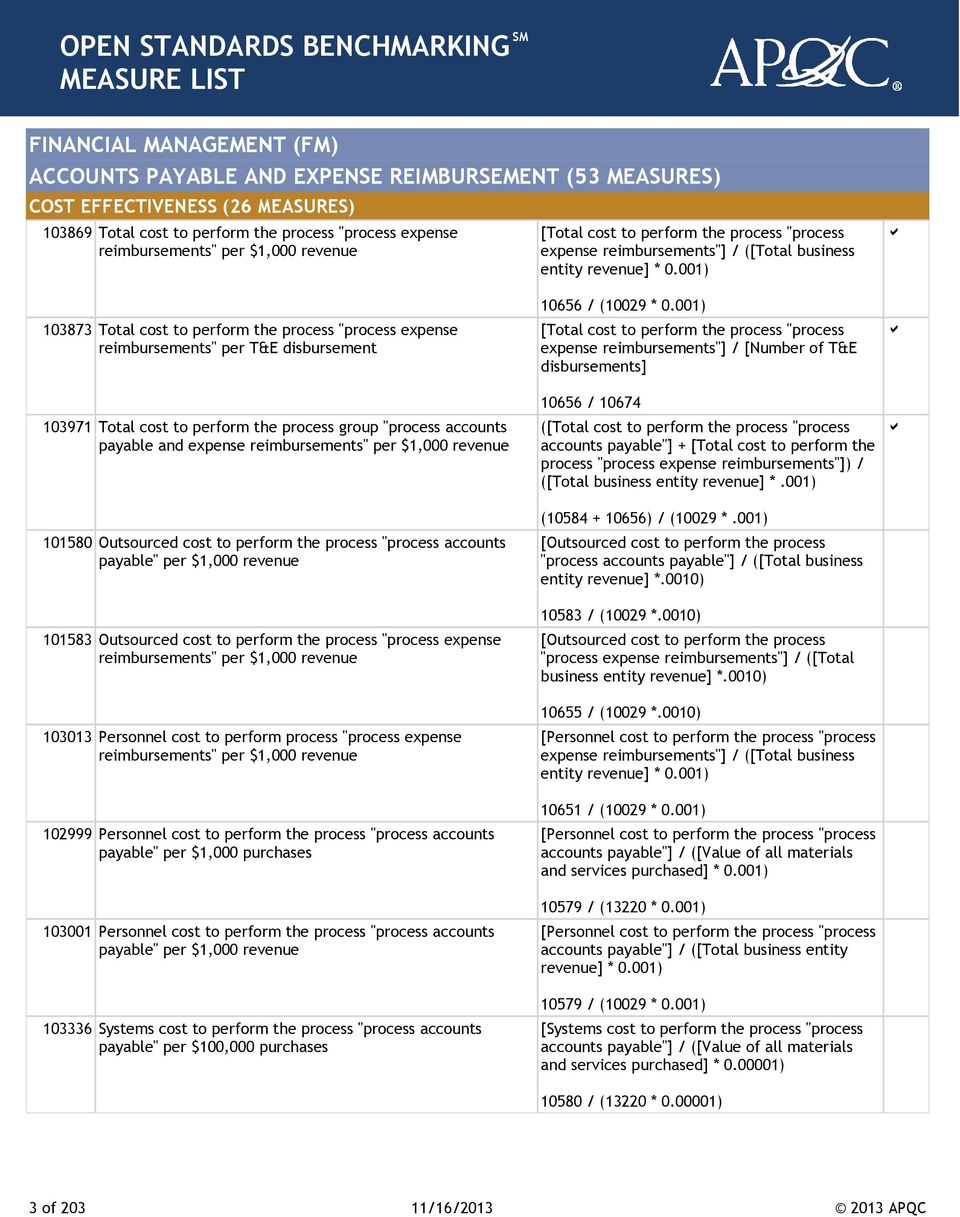
3 FINANCIAL MANAGEMENT (FM) ACCOUNTS PAYABLE AND EXPENSE REIMBURSEMENT (53 MEASURES) COST EFFECTIVENESS (26 MEASURES) Total cost to perform the process "process expense reimbursements" per $1,000 revenue [Total cost to perform the process "process expense reimbursements"] / ([Total business entity revenue] * 0.001) Total cost to perform the process "process expense reimbursements" per T&E disbursement Total cost to perform the process group "process accounts payable and expense reimbursements" per $1,000 revenue Outsourced cost to perform the process "process accounts payable" per $1,000 revenue Outsourced cost to perform the process "process expense reimbursements" per $1,000 revenue Personnel cost to perform process "process expense reimbursements" per $1,000 revenue Personnel cost to perform the process "process accounts payable" per $1,000 purchases Personnel cost to perform the process "process accounts payable" per $1,000 revenue Systems cost to perform the process "process accounts payable" per $100,000 purchases / (10029 * 0.001) [Total cost to perform the process "process expense reimbursements"] / [Number of T&E disbursements] / ([Total cost to perform the process "process accounts payable"] + [Total cost to perform the process "process expense reimbursements"]) / ([Total business entity revenue] *.001) ( ) / (10029 *.001) [Outsourced cost to perform the process "process accounts payable"] / ([Total business entity revenue] *.0010) / (10029 *.0010) [Outsourced cost to perform the process "process expense reimbursements"] / ([Total business entity revenue] *.0010) / (10029 *.0010) [Personnel cost to perform the process "process expense reimbursements"] / ([Total business entity revenue] * 0.001) / (10029 * 0.001) [Personnel cost to perform the process "process accounts payable"] / ([Value of all materials and services purchased] * 0.001) / (13220 * 0.001) [Personnel cost to perform the process "process accounts payable"] / ([Total business entity revenue] * 0.001) / (10029 * 0.001) [Systems cost to perform the process "process accounts payable"] / ([Value of all materials and services purchased] * ) / (13220 * ) 3 of /16/ APQC
4 FINANCIAL MANAGEMENT (FM) ACCOUNTS PAYABLE AND EXPENSE REIMBURSEMENT (53 MEASURES) COST EFFECTIVENESS (26 MEASURES) Systems cost to perform the process "process accounts payable" per $100,000 revenue [Systems cost to perform the process "process accounts payable"] / ([Total business entity revenue] * ) Systems cost to perform the process "process expense reimbursements" per $100,000 revenue Total cost to perform the process "process accounts payable" per $1 billion revenue Total cost to perform the process "process accounts payable" per $1,000 purchases Total cost to perform the process "process accounts payable" per process FTE Total cost to perform the process "process expense reimbursements" per $1 billion revenue Total cost to perform the process "process expense reimbursements" per process FTE Value of purchases (in millions) per "process accounts payable" FTE CYCLE TIME (4 MEASURES) Cycle time in days from receipt of invoice until payment is transmitted / (10029 * ) [Systems cost to perform the process "process expense reimbursements"] / ([Total business entity revenue] * ) / (10029 * ) [Total cost to perform the process "process accounts payable"] / ([Total business entity revenue] * ) / (10029 * ) [Total cost to perform the process "process accounts payable"] / ([Value of all materials and services purchased] * 0.001) / (13220 * 0.001) [Total cost to perform the process "process accounts payable"] / [Number of FTEs who perform the process "process accounts payable"] / [Total cost to perform the process "process expense reimbursements"] / ([Total business entity revenue] * ) / (10029 * ) [Total cost to perform the process "process expense reimbursements"] / [Number of FTEs who perform the process "process expense reimbursements"] / [Value of all materials and services purchased] / ([Number of FTEs who perform the process "process accounts payable"] * ) / (10578 * ) [Cycle time in calendar days from receipt of an invoice until payment is transmitted] of /16/ APQC

5 FINANCIAL MANAGEMENT (FM) ACCOUNTS PAYABLE AND EXPENSE REIMBURSEMENT (53 MEASURES) CYCLE TIME (4 MEASURES) Cycle time in days to approve and schedule T&E reimbursements [Cycle time in calendar days from the receipt of an expense report to its approval and scheduling for payment] Cycle time in hours to enter invoice data onto the system [Cycle time in hours from the receipt of an invoice to its entry into the accounts payable/invoicing system] Cycle time in days to resolve an invoice error [Cycle time in calendar days from discovering an invoice error to its resolution] PROCESS EFFICIENCY (14 MEASURES) Number of FTEs for the process "process accounts payable" per $1 billion revenue [Number of FTEs who perform the process "process accounts payable"] / ([Total business entity revenue] * ) / (10029 * ) Percentage of disbursements that are first time error free ([Number of disbursements processed errorfree the first time] / [Total number of disbursements excluding T&E disbursements]) * 100 (10632 / 10631) * Percentage of discounts available that are taken ([Number of invoice line items that are paid within the discount period] / [Number of invoice line items received that offer a discount]) * 100 (10616 / 10615) * Percentage of expense report exception line items ([Number of expense report line items with exceptions] / [Expense report line items]) * 100 (10668 / 10666) * Percentage of invoice line items paid on time [Percentage of invoice line items paid on time] Percentage of invoice line items received electronically [Percentage of invoice line items received electronically] of /16/ APQC
![an invoice to its entry into the accounts payable/invoicing system] 10627 100632 Cycle time in days to resolve an invoice error [Cycle time in calendar days from discovering an invoice error to its](/docs-images/41/8533806/images/page_5.jpg "resolution] PROCESS EFFICIENCY (14 MEASURES) 101108 Number of FTEs for the process \"process accounts payable\" per $1 billion revenue 10630 [Number of FTEs who perform the process \"process accounts")
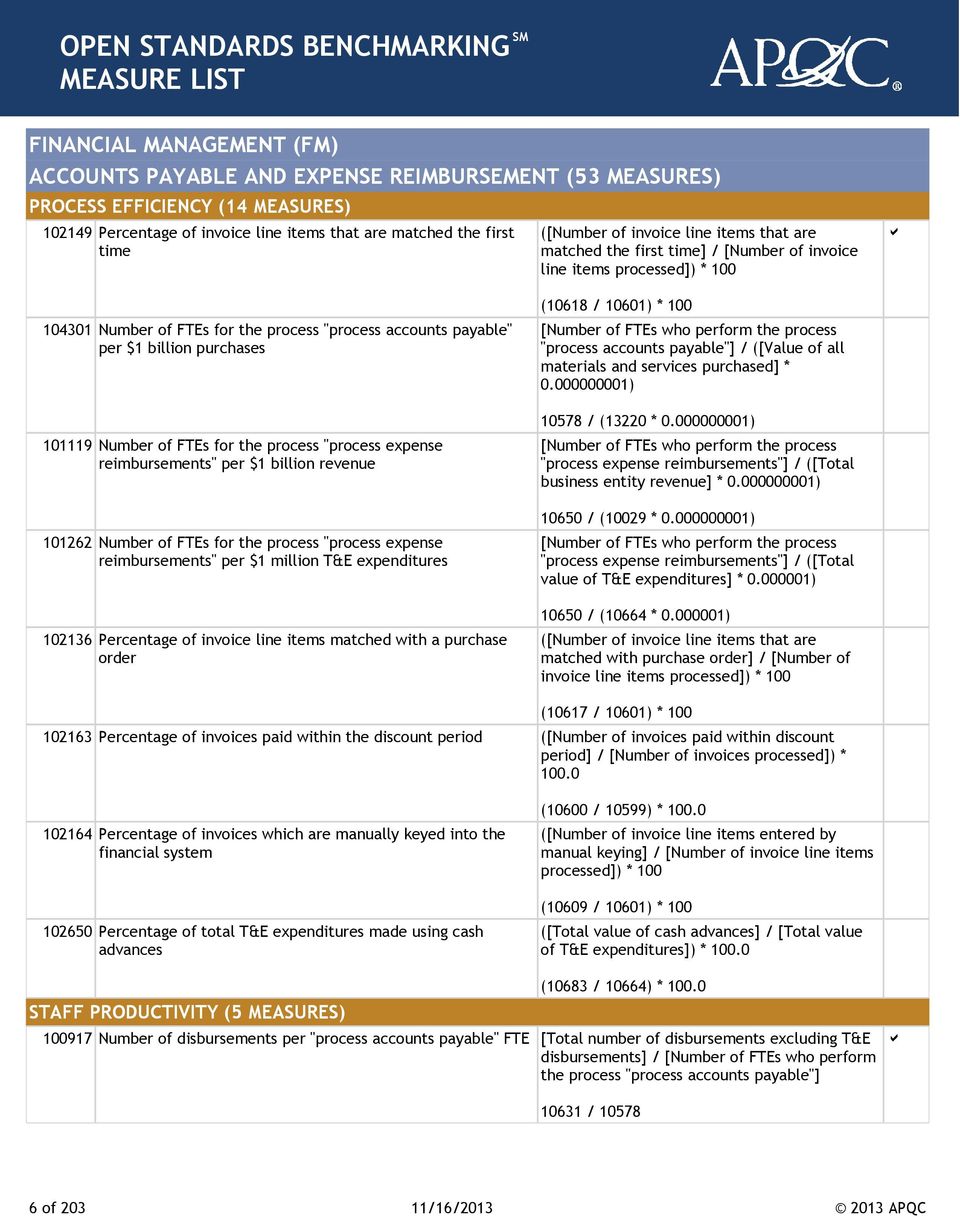
6 FINANCIAL MANAGEMENT (FM) ACCOUNTS PAYABLE AND EXPENSE REIMBURSEMENT (53 MEASURES) PROCESS EFFICIENCY (14 MEASURES) Percentage of invoice line items that are matched the first time ([Number of invoice line items that are matched the first time] / [Number of invoice line items processed]) * Number of FTEs for the process "process accounts payable" per $1 billion purchases Number of FTEs for the process "process expense reimbursements" per $1 billion revenue Number of FTEs for the process "process expense reimbursements" per $1 million T&E expenditures Percentage of invoice line items matched with a purchase order (10618 / 10601) * 100 [Number of FTEs who perform the process "process accounts payable"] / ([Value of all materials and services purchased] * ) / (13220 * ) [Number of FTEs who perform the process "process expense reimbursements"] / ([Total business entity revenue] * ) / (10029 * ) [Number of FTEs who perform the process "process expense reimbursements"] / ([Total value of T&E expenditures] * ) / (10664 * ) ([Number of invoice line items that are matched with purchase order] / [Number of invoice line items processed]) * 100 (10617 / 10601) * Percentage of invoices paid within the discount period ([Number of invoices paid within discount period] / [Number of invoices processed]) * Percentage of invoices which are manually keyed into the financial system Percentage of total T&E expenditures made using cash advances (10600 / 10599) * ([Number of invoice line items entered by manual keying] / [Number of invoice line items processed]) * 100 (10609 / 10601) * 100 ([Total value of cash advances] / [Total value of T&E expenditures]) * STAFF PRODUCTIVITY (5 MEASURES) (10683 / 10664) * Number of disbursements per "process accounts payable" FTE [Total number of disbursements excluding T&E disbursements] / [Number of FTEs who perform the process "process accounts payable"] / of /16/ APQC
7 FINANCIAL MANAGEMENT (FM) ACCOUNTS PAYABLE AND EXPENSE REIMBURSEMENT (53 MEASURES) STAFF PRODUCTIVITY (5 MEASURES) Number of expense report line items per "process expense reimbursements" FTE Number of invoice line items processed per "process accounts payable" FTE [Expense report line items] / [Number of FTEs who perform the process "process expense reimbursements"] / [Number of invoice line items processed] / [Number of FTEs who perform the process "process accounts payable"] Number of invoices processed per "process accounts payable" FTE Number of T&E disbursements per "process expense reimbursements" FTE SUPPLEMENTAL INFORMATION (4 MEASURES) Number of expense report line items per $1,000 T&E expenditure / [Number of invoices processed] / [Number of FTEs who perform the process "process accounts payable"] / [Number of T&E disbursements] / [Number of FTEs who perform the process "process expense reimbursements"] / [Expense report line items] / ([Total value of T&E expenditures] * 0.001) / (10664 * 0.001) Number of invoiced line items per $1,000 purchases [Number of invoice line items processed] / ([Value of all materials and services purchased] * 0.001) Personnel cost to perform the process "process accounts payable" as a percentage of the total cost for the process Systems cost to perform the process "process accounts payable" as a percentage of the total cost of the process / (13220 * 0.001) ([Personnel cost to perform the process "process accounts payable"] / [Total cost to perform the process "process accounts payable"]) * 100 (10579 / 10584) * 100 ([Systems cost to perform the process "process accounts payable"] / [Total cost to perform the process "process accounts payable"]) * 100 (10580 / 10584) * of /16/ APQC
![[Number of invoice line items processed] / [Number of FTEs who perform the process "process accounts payable"] 101290 Number of invoices processed per "process accounts payable" FTE 101419 Number of](/docs-images/41/8533806/images/page_7.jpg "T&E disbursements per \"process expense reimbursements\" FTE SUPPLEMENTAL INFORMATION (4 MEASURES) 100955 Number of expense report line items per $1,000 T&E expenditure 10601 / 10578 [Number of")
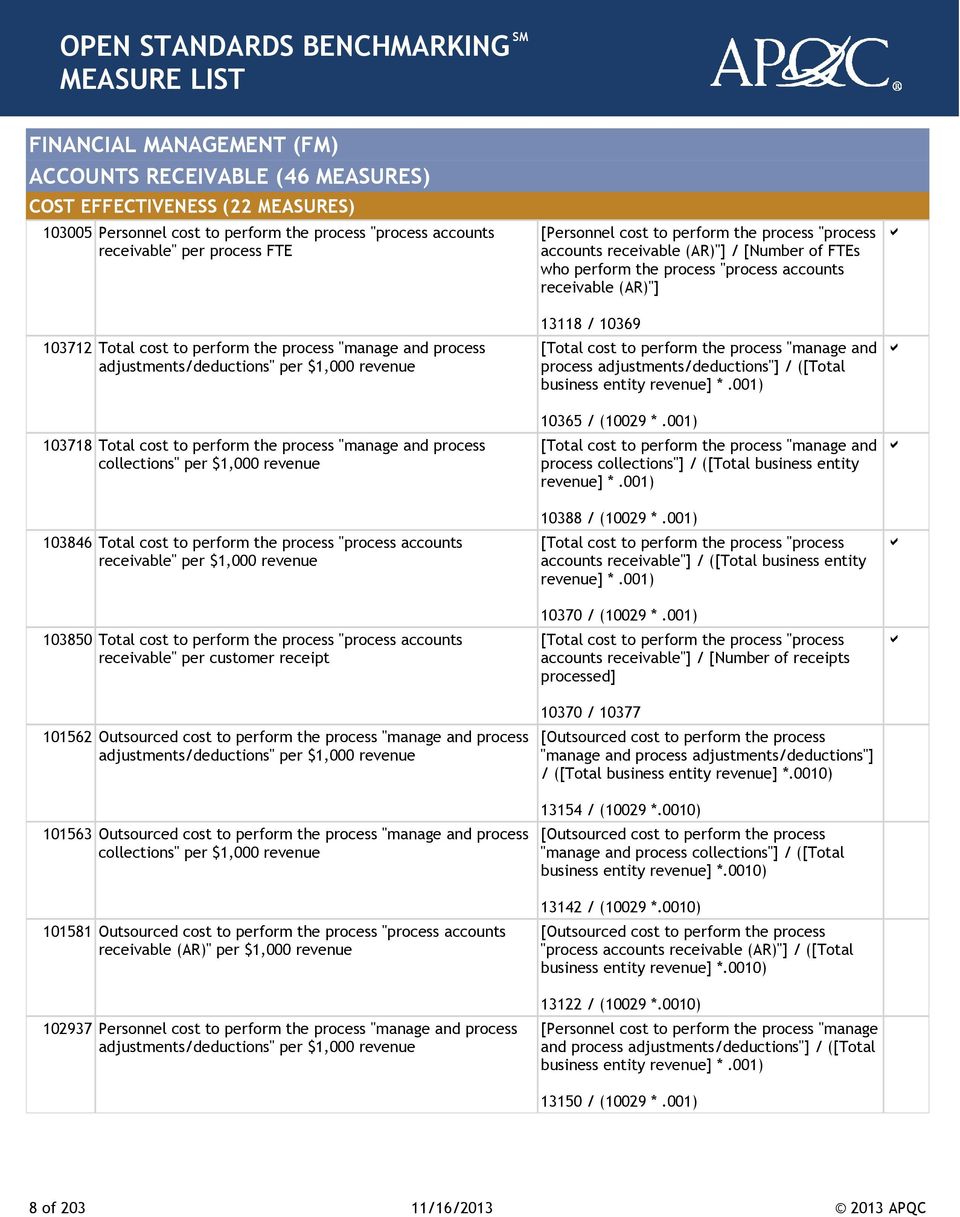
8 FINANCIAL MANAGEMENT (FM) ACCOUNTS RECEIVABLE (46 MEASURES) COST EFFECTIVENESS (22 MEASURES) Personnel cost to perform the process "process accounts receivable" per process FTE Total cost to perform the process "manage and process adjustments/deductions" per $1,000 revenue Total cost to perform the process "manage and process collections" per $1,000 revenue Total cost to perform the process "process accounts receivable" per $1,000 revenue Total cost to perform the process "process accounts receivable" per customer receipt Outsourced cost to perform the process "manage and process adjustments/deductions" per $1,000 revenue Outsourced cost to perform the process "manage and process collections" per $1,000 revenue Outsourced cost to perform the process "process accounts receivable (AR)" per $1,000 revenue Personnel cost to perform the process "manage and process adjustments/deductions" per $1,000 revenue [Personnel cost to perform the process "process accounts receivable (AR)"] / [Number of FTEs who perform the process "process accounts receivable (AR)"] / [Total cost to perform the process "manage and process adjustments/deductions"] / ([Total business entity revenue] *.001) / (10029 *.001) [Total cost to perform the process "manage and process collections"] / ([Total business entity revenue] *.001) / (10029 *.001) [Total cost to perform the process "process accounts receivable"] / ([Total business entity revenue] *.001) / (10029 *.001) [Total cost to perform the process "process accounts receivable"] / [Number of receipts processed] / [Outsourced cost to perform the process "manage and process adjustments/deductions"] / ([Total business entity revenue] *.0010) / (10029 *.0010) [Outsourced cost to perform the process "manage and process collections"] / ([Total business entity revenue] *.0010) / (10029 *.0010) [Outsourced cost to perform the process "process accounts receivable (AR)"] / ([Total business entity revenue] *.0010) / (10029 *.0010) [Personnel cost to perform the process "manage and process adjustments/deductions"] / ([Total business entity revenue] *.001) / (10029 *.001) 8 of /16/ APQC
9 FINANCIAL MANAGEMENT (FM) ACCOUNTS RECEIVABLE (46 MEASURES) COST EFFECTIVENESS (22 MEASURES) Personnel cost to perform the process "manage and process collections" per $1,000 revenue Personnel cost to perform the process "process accounts receivable" per $1,000 revenue Systems cost to perform the process "manage and process adjustments/deductions" per $100,000 revenue Systems cost to perform the process "manage and process collections" per $100,000 revenue Systems cost to perform the process "process accounts receivable" per $100,000 revenue Total cost to perform the process "manage and process collections" as a percentage of revenue Total cost to perform the process "manage and process collections" per $1 billion revenue Total cost to perform the process "manage and process collections" per active customer Total cost to perform the process "manage and process collections" per customer receipt [Personnel cost to perform the process "manage and process collections"] / ([Total business entity revenue] *.001) / (10029 *.001) [Personnel cost to perform the process "process accounts receivable (AR)"]/ ([Total business entity revenue] *.001) 13118/ (10029 *.001) [Systems cost to perform the process "manage and process adjustments/deductions"] / ([Total business entity revenue] *.00001) / (10029 *.00001) [Systems cost to perform the process "manage and process collections"] / ([Total business entity revenue] *.00001) / (10029 *.00001) [Systems cost to perform the process "process accounts receivable (AR)"]/ ([Total business entity revenue] *.00001) 13119/ (10029 *.00001) ([Total cost to perform the process "manage and process collections"] / ([Total business entity revenue])) * 100 (10388 / (10029)) * 100 [Total cost to perform the process "manage and process collections"] / ([Total business entity revenue] * ) / (10029 * ) [Total cost to perform the process "manage and process collections"] / [Number of active customers in business entity's customer master file] / ([Total cost to perform the process "manage and process collections"]/[number of receipts processed]) (10388/10377) 9 of /16/ APQC

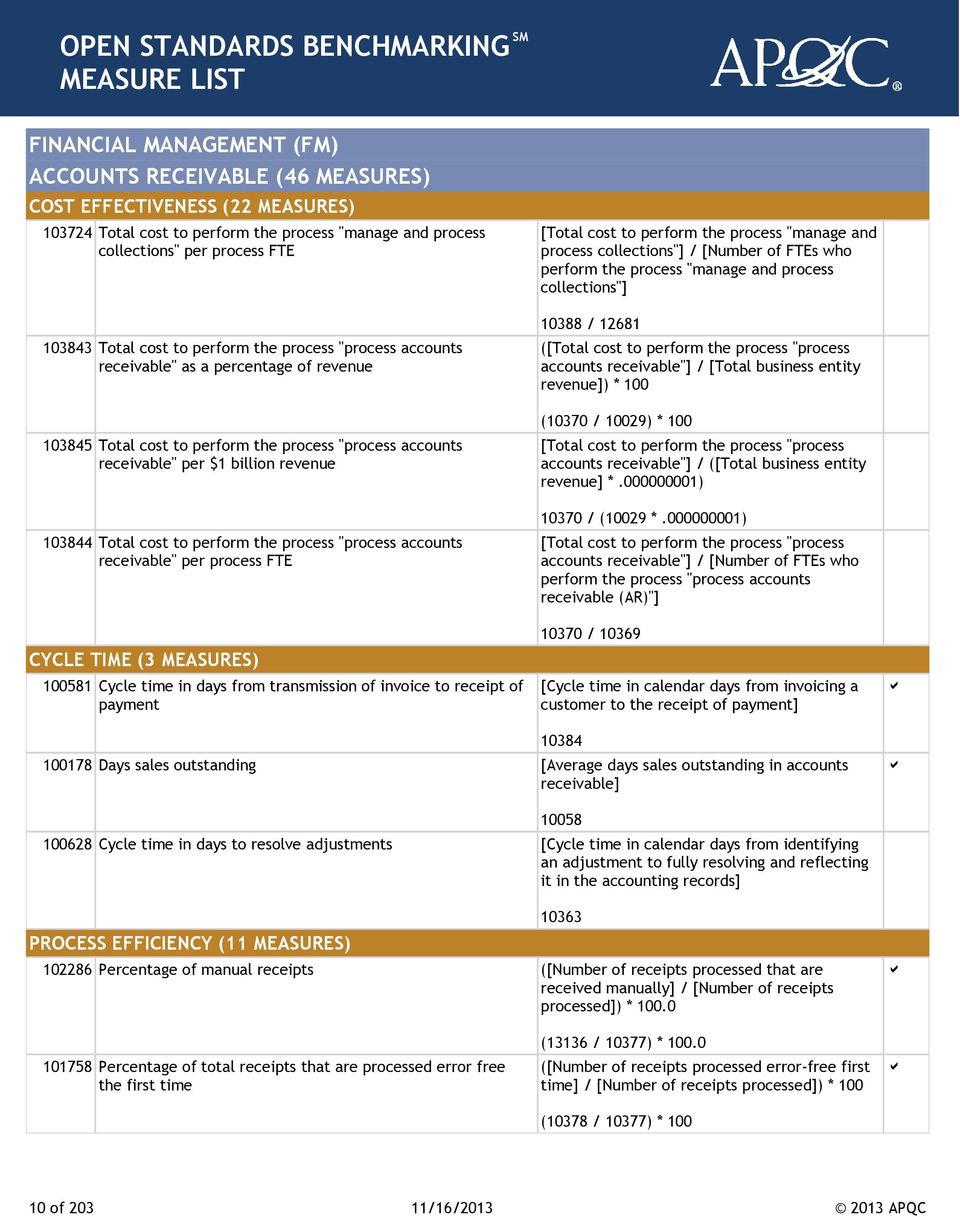
10 FINANCIAL MANAGEMENT (FM) ACCOUNTS RECEIVABLE (46 MEASURES) COST EFFECTIVENESS (22 MEASURES) Total cost to perform the process "manage and process collections" per process FTE Total cost to perform the process "process accounts receivable" as a percentage of revenue Total cost to perform the process "process accounts receivable" per $1 billion revenue Total cost to perform the process "process accounts receivable" per process FTE CYCLE TIME (3 MEASURES) Cycle time in days from transmission of invoice to receipt of payment [Total cost to perform the process "manage and process collections"] / [Number of FTEs who perform the process "manage and process collections"] / ([Total cost to perform the process "process accounts receivable"] / [Total business entity revenue]) * 100 (10370 / 10029) * 100 [Total cost to perform the process "process accounts receivable"] / ([Total business entity revenue] * ) / (10029 * ) [Total cost to perform the process "process accounts receivable"] / [Number of FTEs who perform the process "process accounts receivable (AR)"] / [Cycle time in calendar days from invoicing a customer to the receipt of payment] Days sales outstanding [Average days sales outstanding in accounts receivable] Cycle time in days to resolve adjustments [Cycle time in calendar days from identifying an adjustment to fully resolving and reflecting it in the accounting records] PROCESS EFFICIENCY (11 MEASURES) Percentage of manual receipts ([Number of receipts processed that are received manually] / [Number of receipts processed]) * Percentage of total receipts that are processed error free the first time (13136 / 10377) * ([Number of receipts processed error-free first time] / [Number of receipts processed]) * 100 (10378 / 10377) * of /16/ APQC
11 FINANCIAL MANAGEMENT (FM) ACCOUNTS RECEIVABLE (46 MEASURES) PROCESS EFFICIENCY (11 MEASURES) Number of FTEs for the process "manage and process adjustments/deductions" per $1 billion revenue Number of FTEs for the process "manage and process collections" per $1 billion revenue Outstanding payment days as a proportion of standard payment days [Number of FTEs who perform the process "manage and process adjustments/deductions"] / ([Total business entity revenue] * ) / (10029 * ) [Number of FTEs who perform the process "manage and process collections"] / ([Total business entity revenue] * ) / (10029 * ) [Average days sales outstanding in accounts receivable] / [Standard payment terms in calendar days for accounts receivable] / Percentage of invoice line items paid in full the first time ([Number of billed/invoiced line items that are paid in full the first time] / [Number of line items billed/invoiced]) * Percentage of invoice line items that are adjusted by the customer prior to payment Percentage of receipts automatically matched to open items in the accounts receivable sub ledger (10374 / 10361) * 100 ([Number of billed/invoiced line items that are adjusted prior to paying] / [Number of line items billed/invoiced]) * 100 (10373 / 10361) * 100 ([Number of receipts that are automatically matched to open items in the accounts receivable sub ledger] / [Number of receipts processed]) * 100 (10379 / 10377) * Percentage of receipts received electronically ([Number of receipts processed that are received electronically] / [Number of receipts processed]) * Percentage of receipts received electronically or automatically (13134 / 10377) * [Percentage of receipts received electronically or automatically] Total uncollectable balances as a percentage of revenue ([Total value of uncollectable balances] / [Total business entity revenue]) * 100 (13163 / 10029) * of /16/ APQC
![process "manage and process adjustments/deductions"] / ([Total business entity revenue] *.000000001) 10367 / (10029 *.](/docs-images/41/8533806/images/page_11.jpg "000000001) [Number of FTEs who perform the process \"manage and process collections\"] / ([Total business entity revenue] *.000000001) 10389 / (10029 *.")
12 FINANCIAL MANAGEMENT (FM) ACCOUNTS RECEIVABLE (46 MEASURES) STAFF PRODUCTIVITY (6 MEASURES) Number of receipts processed per "process accounts receivable" FTE Number of active customers managed annually per "manage and process collections" FTE Number of adjustments and deductions per "manage and process adjustments/deductions" FTE Number of customer accounts per "process accounts receivable" FTE [Number of receipts processed] / [Number of FTEs who perform the process "process accounts receivable (AR)"] / [Number of active customers in business entity's customer master file] / [Number of FTEs who perform the process "manage and process collections"] / [Number of adjustments/deductions] / [Number of FTEs who perform the process "manage and process adjustments/deductions"] / [Number of customers in the customer master file] / [Number of FTEs who perform the process "process accounts receivable (AR)"] / Number of invoices per "manage and process collections" FTE [Number of invoices billed to customer]/ [Number of FTEs who perform the process "manage and process collections"] 10257/ Number of invoices per "process accounts receivable" FTE [Number of invoices billed to customer]/ [Number of FTEs who perform the process "process accounts receivable (AR)"] SUPPLEMENTAL INFORMATION (4 MEASURES) 10257/ Number of invoice line items per receipt [Number of line items billed/invoiced] / [Number of receipts processed] / Percentage of billed/invoiced line items offering a discount ([Number of invoice line items billed/invoiced that offer a discount] / [Number of line items billed/invoiced]) * Personnel cost to perform the process "process accounts receivable" as a percentage of the total cost for the process (10262 / 10361) * 100 ([Personnel cost to perform the process "process accounts receivable (AR)"] / [Total cost to perform the process "process accounts receivable"]) * 100 (13118 / 10370) * of /16/ APQC
!["process accounts receivable" FTE [Number of receipts processed] / [Number of FTEs who perform the process "process accounts receivable (AR)"] 10377 / 10369 [Number of active customers in business](/docs-images/41/8533806/images/page_12.jpg "entity's customer master file] / [Number of FTEs who perform the process \"manage and process collections\"] 99931 / 10389 [Number of adjustments/deductions] / [Number of FTEs who perform the process")
13 FINANCIAL MANAGEMENT (FM) ACCOUNTS RECEIVABLE (46 MEASURES) SUPPLEMENTAL INFORMATION (4 MEASURES) Systems cost to perform the process "process accounts receivable" as a percentage of the total cost of the process ([Systems cost to perform the process "process accounts receivable (AR)"] / [Total cost to perform the process "process accounts receivable"]) * 100 (13119 / 10370) * 100 CUSTOMER CREDIT AND INVOICING (30 MEASURES) COST EFFECTIVENESS (15 MEASURES) Total cost to perform the process "invoice customer" per $1,000 revenue [Total cost to perform the process "invoice customer"] / ([Total business entity revenue] *.001) Total cost to perform the process "invoice customer" per invoice line item processed Total cost to perform the process "invoice customer" per invoice processed Total cost to perform the process "process customer credit" per $1,000 revenue Outsourced cost to perform the process "invoice customer" per $1,000 revenue Outsourced cost to perform the process "process customer credit" per $1,000 revenue Personnel cost to perform the process "invoice customer" per $1,000 revenue Personnel cost to perform the process "process customer credit" per $1,000 revenue / (10029 *.001) [Total cost to perform the process "invoice customer"] / [Number of line items billed/invoiced] / [Total cost to perform the process "invoice customer"] / [Number of invoices billed to customer] / [Total cost to perform the process "process customer credit"] / ([Total business entity revenue] *.001) / (10029 *.001) [Outsourced cost to perform the process "invoice customer"] / ([Total business entity revenue] *.0010) / (10029 *.0010) [Outsourced cost to perform the process "process customer credit"] / ([Total business entity revenue] *.0010) / (10029 *.0010) [Personnel cost to perform the process "invoice customer"] / ([Total business entity revenue] *.001) / (10029 *.001) [Personnel cost to perform the process "process customer credit"] / ([Total business entity revenue] *.001) 13 of /16/ APQC

14 Systems cost to perform the process "invoice customer" per $100,000 revenue Systems cost to perform the process "process customer credit" per $100,000 revenue Total cost to perform the process "invoice customer" per process FTE Total cost to perform the process "process customer credit" as a percentage of revenue Total cost to perform the process "process customer credit" per $1 billion revenue Total cost to perform the process "process customer credit" per process FTE Total cost to perform the process "process customer credit" per process FTE / (10029 *.001) [Systems cost to perform the process "invoice customer"] / ([Total business entity revenue] *.00001) / (10029 *.00001) [Systems cost to perform the process "process customer credit"] / ([Total business entity revenue] *.00001) / (10029 *.00001) [Total cost to perform the process "invoice customer"] / [Number of FTEs who perform the process "invoice customer"] / ([Total cost to perform the process "process customer credit"]/ [Total business entity revenue]) * 100 (10246/ 10029) * 100 [Total cost to perform the process "process customer credit"] / ([Total business entity revenue] * ) / (10029 * ) [Total cost to perform the process "process customer credit"] / [Number of FTEs who perform the process "process customer credit"] / ([Total cost to perform the process "process customer credit"]/[number of FTEs who perform the process "process customer credit"]) CYCLE TIME (3 MEASURES) (10246/10245) Cycle time in days for credit approval [Cycle time in days for credit approval] Cycle time in days to generate complete and correct billing data Cycle time in days between transmission of invoice and shipment of goods or delivery of services PROCESS EFFICIENCY (5 MEASURES) [Cycle time in days to generate complete and correct billing data] [Cycle time in calendar days from the transmission of an invoice/bill to shipping/providing the good/service] of /16/ APQC
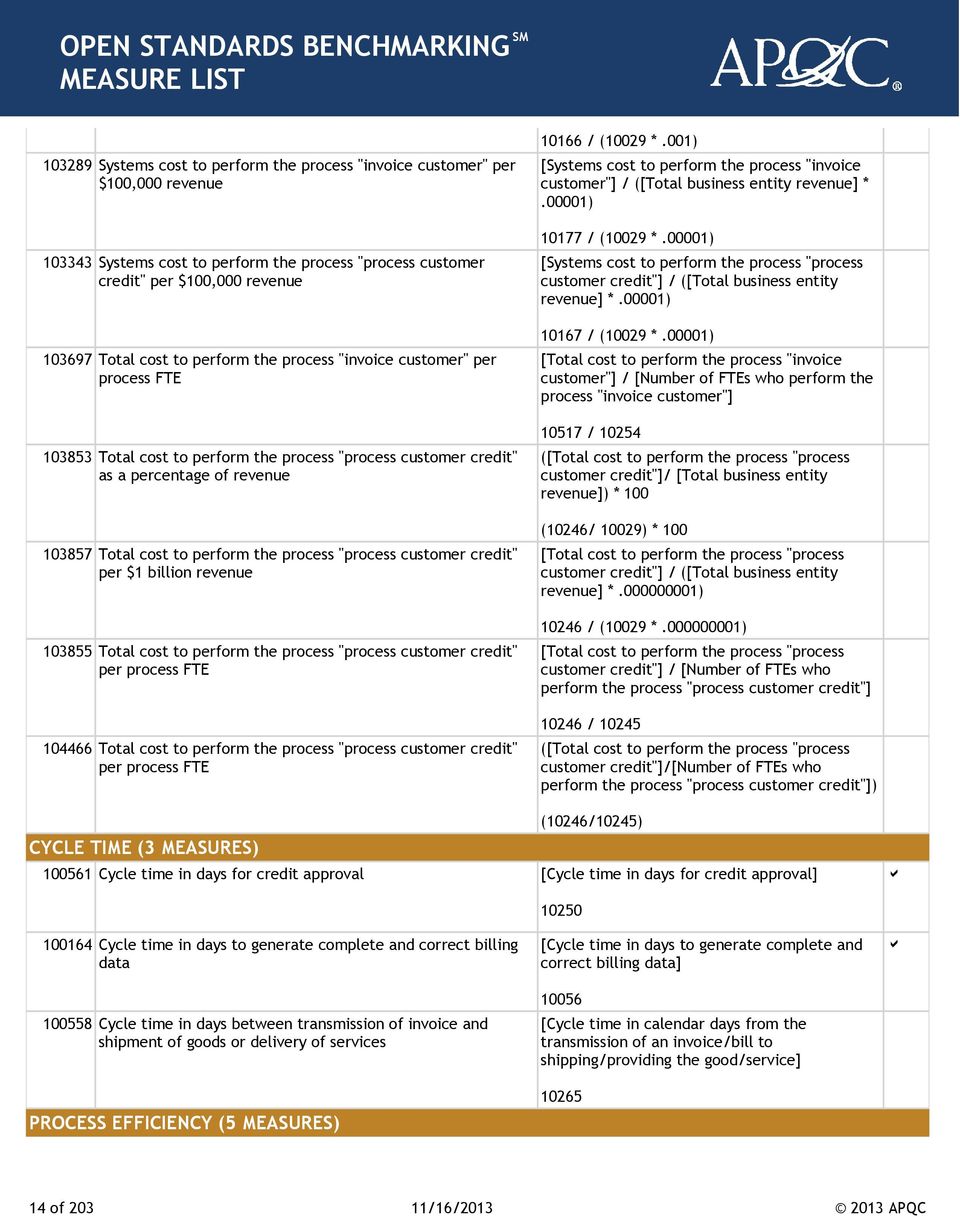
15 FINANCIAL MANAGEMENT (FM) CUSTOMER CREDIT AND INVOICING (30 MEASURES) PROCESS EFFICIENCY (5 MEASURES) Number of FTEs for the process "invoice customer" per $1 billion revenue [Number of FTEs who perform the process "invoice customer"] / ([Total business entity revenue] * ) Number of FTEs for the process "process customer credit" per $1 billion revenue Percentage of invoice line items processed error free the first time Percentage of invoice line items invoiced using electronic or automatic methods Percentage of invoices automatically generated based on event triggers STAFF PRODUCTIVITY (4 MEASURES) Number of invoice line items processed per "invoice customer" FTE / (10029 * ) [Number of FTEs who perform the process "process customer credit"] / ([Total business entity revenue] * ) / (10029 * ) [Percentage of invoice line items processed error free the first time] [Percentage of invoice line items invoiced using electronic or automatic methods] [Percentage of invoices automatically generated based on event triggers] [Number of line items billed/invoiced] / [Number of FTEs who perform the process "invoice customer"] / Number of invoices processed per "invoice customer" FTE [Number of invoices billed to customer] / [Number of FTEs who perform the process "invoice customer"] Number of active customers per "process customer credit" FTE / [Number of active customers in business entity's customer master file] / [Number of FTEs who perform the process "process customer credit"] / Number of credit reviews per "process customer credit" FTE [Credit reviews performed at account level by credit staff] / [Number of FTEs who perform the process "process customer credit"] / of /16/ APQC

16 FINANCIAL MANAGEMENT (FM) CUSTOMER CREDIT AND INVOICING (30 MEASURES) SUPPLEMENTAL INFORMATION (3 MEASURES) Average number of line items per invoice [Number of line items billed/invoiced] / [Number of invoices billed to customer] / Average value per line item billed [Total value of line items billed/invoiced] / [Number of line items billed/invoiced] Percentage of invoice line items that are denominated in a foreign currency / ([Number of line items billed/invoiced in a foreign currency] / [Number of line items billed/invoiced]) * 100 (10261 / 10258) * of /16/ APQC
![items billed/invoiced] / [Number of line items billed/invoiced] 102157 Percentage of invoice line items that are denominated in a foreign currency 10259 /](/docs-images/41/8533806/images/page_16.jpg "10258 ([Number of line items billed/invoiced in a foreign currency] / [Number of line items billed/invoiced]) * 100 (10261 / 10258) * 100 16 of 203 11/16/2013")
17 FINANCIAL MANAGEMENT (FM) FINANCE ORGANIZATION (111 MEASURES) COST EFFECTIVENESS (7 MEASURES) Personnel cost to perform finance function per finance function FTE [Personnel cost perform the function "manage financial resources"] / [Number of FTEs who perform the function "manage financial resources"] Total cost to perform the finance function as a percentage of revenue / ([Total cost to perform the function "manage financial resources"] / [Total business entity revenue]) * 100 (10209 / 10029) * Overhead cost of the finance function per $100,000 revenue [Overhead cost to perform the function "manage financial resources"] / ([Total business entity revenue] *.00001) Personnel cost to perform the finance function per $1,000 revenue / (10029 *.00001) [Personnel cost perform the function "manage financial resources"] / ([Total business entity revenue] *.001) / (10029 *.001) Systems cost of the finance function per $100,000 revenue [Systems cost to perform the function "manage financial resources"] / ([Total business entity revenue] *.00001) Total cost to perform the finance function per $1,000 revenue Total cost to perform the finance function per finance function FTE CYCLE TIME (5 MEASURES) Cycle time in days from receipt of invoice until approved and scheduled for payment / (10029 *.00001) [Total cost to perform the function "manage financial resources"] / ([Total business entity revenue] *.001) / (10029 *.001) [Total cost to perform the function "manage financial resources"] / [Number of FTEs who perform the function "manage financial resources"] / [Cycle time in calendar days to process and approve a payment/disbursement from receipt of invoice to when it is approved and scheduled for payment] Cycle time in days to complete the annual budget [Cycle time in days to complete the budget] of /16/ APQC
![10069 ([Total cost to perform the function "manage financial resources"] / [Total business entity revenue]) * 100 (10209 / 10029) * 100 101666 Overhead cost of the finance function per $100,000](/docs-images/41/8533806/images/page_17.jpg "revenue [Overhead cost to perform the function \"manage financial resources\"] / ([Total business entity revenue] *.")
18 FINANCIAL MANAGEMENT (FM) FINANCE ORGANIZATION (111 MEASURES) CYCLE TIME (5 MEASURES) Cycle time in days to complete the monthly consolidated financial statements Cycle time in hours to initiate, approve, and dispatch a wire transfer [Cycle time in days to complete the monthly consolidated financial statements] [Cycle time in hours to initiate, approve, and dispatch a wire transfer] Cycle time in hours to reconcile a single bank account [Cycle time in days to reconcile a single bank account from bank account statement receipt through ending book balance reconciliation] PROCESS EFFICIENCY (37 MEASURES) Number of finance function FTEs per $1 billion revenue [Number of FTEs who perform the function "manage financial resources"] / ([Total business entity revenue] * ) Number of FTEs for the order to invoice cycle per $1 billion revenue / (10029 * ) ([Number of FTEs who perform the process "manage sales orders"] + [Number of FTEs who perform the process "process customer credit"] + [Number of FTEs who perform the process "invoice customer"]) / ([Total business entity revenue] * ) Number of FTEs for the process "evaluate and manage financial performance" per $1 billion revenue ( ) / (10029 * ) [Number of FTEs who perform the process "evaluate and manage financial performance"] / ([Total business entity revenue] * ) Number of FTEs for the process "perform financial reporting" per $1 billion revenue Number of FTEs for the process "perform general accounting" per $1 billion revenue Number of FTEs for the process "perform planning/budgeting/forecasting" per $1 billion revenue / (10029 * ) [Number of FTEs who perform the process "perform financial reporting"] / ([Total business entity revenue] * ) / (10029 * ) [Number of FTEs who perform the process "perform general accounting"] / ([Total business entity revenue] * ) / (10029 * ) [Number of FTEs who perform the process "perform planning/budgeting/forecasting"] / ([Total business entity revenue] * ) / (10029 * ) 18 of /16/ APQC
![transfer] 100175 Cycle time in hours to reconcile a single bank account [Cycle time in days to reconcile a single bank account from bank account statement receipt through ending book balance](/docs-images/41/8533806/images/page_18.jpg "reconciliation] 10064 PROCESS EFFICIENCY (37 MEASURES) 100959 Number of finance function FTEs per $1 billion revenue [Number of FTEs who perform the function \"manage financial resources\"] / ([Total")
19 FINANCIAL MANAGEMENT (FM) FINANCE ORGANIZATION (111 MEASURES) PROCESS EFFICIENCY (37 MEASURES) Number of FTEs for the process "process accounts receivable" per $1 billion revenue Number of FTEs for the process group "process accounts payable and expense reimbursements" per $1 billion revenue Number of FTEs for the processes "manage and process accounts receivable", "manage and process collections", and "manage and process adjustments/deductions" per $1 billion revenue Number of FTEs for the processes "perform cost accounting and control" and "perform cost management" per $1 billion revenue Percentage change in business entity's gross margin over the past three years Percentage of journal entry line items processed error free the first time Number of clerical FTEs involved in F&A operations as a percentage of total finance function FTEs Number of finance function FTEs per $100 million revenue (deprecated) [Number of FTEs who perform the process "process accounts receivable (AR)"] / ([Total business entity revenue] * ) / (10029 * ) ([Number of FTEs who perform the process "process accounts payable"] + [Number of FTEs who perform the process "process expense reimbursements"]) / ([Total business entity revenue] * ) ( ) / (10029 * ) ([Number of FTEs who perform the process "process accounts receivable (AR)"] + [Number of FTEs who perform the process "manage and process collections"] + [Number of FTEs who perform the process "manage and process adjustments/deductions"]) / ([Total business entity revenue] * ) ( ) / (10029 * ) [Number of FTEs who perform the processes "perform cost accounting and control" and "perform cost management"] / ([Total business entity revenue] * ) / (10029 * ) [Percentage change in business entity's gross margin over the past three years] [Percentage of journal entry line items processed error free the first time] ([Number of FTEs who perform the function "manage financial resources" perform clerical operations] / [Number of FTEs who perform the function "manage financial resources"]) * (98627 / 98630) * [Number of FTEs who perform the function "manage financial resources"] / ([Total business entity revenue] * ) / (10029 * ) 19 of /16/ APQC

20 FINANCIAL MANAGEMENT (FM) FINANCE ORGANIZATION (111 MEASURES) PROCESS EFFICIENCY (37 MEASURES) Number of FTEs for other non-defined finance processes per $1 billion revenue Number of FTEs for other non-defined finance processes per $100 million revenue (deprecated) Number of FTEs for the fixed asset cycle per $100 million revenue (deprecated) Number of FTEs for the process "financial strategy and planning" per $100 million revenue (deprecated) Number of FTEs for the process "funding and treasury" per $100 million revenue (deprecated) Number of FTEs for the process "internal audit" per $100 million revenue (deprecated) Number of FTEs for the process "investment management" per $100 million revenue (deprecated) Number of FTEs for the process "manage financial policies and procedures" per $1 billion revenue [Number of FTEs who perform other nondefined financial processes] / ([Total business entity revenue] * ) / (10029 * ) [Number of FTEs who perform other finance processes/the process groups (deprecated)] / ([Total business entity revenue] * ) / (10029 * ) [Number of FTEs who perform fixed asset management (deprecated)] / ([Total business entity revenue] * ) / (10029 * ) [Number of FTEs who perform financial strategy and planning (deprecated)] / ([Total business entity revenue] * ) / (10029 * ) [Number of FTEs who perform funding and treasury (deprecated)] / ([Total business entity revenue] * ) / (10029 * ) [Number of FTEs who perform fixed internal audit (deprecated)] / ([Total business entity revenue] * ) / (10029 * ) [Number of FTEs who perform investment management (deprecated)] / ([Total business entity revenue] * ) / (10029 * ) [Number of FTEs who perform the process "manage policies and procedures"] / ([Total business entity revenue] * ) Number of FTEs for the process "perform capital planning and project approval" per $1 billion revenue / (10029 * ) [Number of FTEs who perform the process "perform capital planning and project approval"] / ([Total business entity revenue] * ) / (10029 * ) 20 of /16/ APQC

21 FINANCIAL MANAGEMENT (FM) FINANCE ORGANIZATION (111 MEASURES) PROCESS EFFICIENCY (37 MEASURES) Number of FTEs for the process "profitability and cost management" per $100 million revenue (deprecated) Number of FTEs for the process "tax" per $100 million revenue (deprecated) Number of FTEs for the process group "manage fixed asset project accounting" per $1 billion revenue Number of FTEs for the process group "manage taxes" per $1 billion revenue Number of FTEs for the process group "manage treasury operations" per $1 billion revenue Number of FTEs for the process group "perform general accounting and reporting" (excluding fixed assets) per $100 million revenue (deprecated) Number of FTEs for the process group "perform planning and management accounting" per $1 billion revenue Number of FTEs for the process group "process accounts payable and expense reimbursements" per $100 million revenue (deprecated) [Number of FTEs who perform profitability and cost management (deprecated)] / ([Total business entity revenue] * ) / (10029 * ) [Number of FTEs who are responsible for managing taxes (deprecated)] / ([Total business entity revenue] * ) / (10029 * ) ([Number of FTEs who perform the process "perform capital planning and project approval"]+ [Number of FTEs who perform the process "perform capital project accounting"]) / ([Total business entity revenue]* ) ( ) / (10029* ) [Number of FTEs who perform the process group "manage taxes"] / ([Total business entity revenue] * ) / (10029 * ) [Number of FTEs who perform the process group "manage treasury operations"] / ([Total business entity revenue] * ) / (10029 * ) [Number of FTEs who are responsible for general accounting and reporting (deprecated)] / ([Total business entity revenue] * ) / (10029 * ) ([Number of FTEs who perform the process "perform planning/budgeting/forecasting"] + [Number of FTEs who perform the processes "perform cost accounting and control" and "perform cost management"] + [Number of FTEs who perform the process "evaluate and manage financial performance"]) / ([Total business entity revenue] * ) ( ) / (10029 * ) [Number of FTEs who are responsible for accounts payable and expense reimbursements (deprecated)] / ([Total business entity revenue] * ) / (10029 * ) 21 of /16/ APQC
22 FINANCIAL MANAGEMENT (FM) FINANCE ORGANIZATION (111 MEASURES) PROCESS EFFICIENCY (37 MEASURES) Number of FTEs for the process group "process payroll" per $100 million revenue (deprecated) Number of FTEs for the revenue cycle per $1 billion revenue (deprecated) Number of FTEs for the revenue cycle per $100 million revenue (deprecated) Number of FTEs to perform the fixed assets cycle per $1 billion revenue Number of management FTEs involved in finance function operations as a percentage of total finance function FTEs Number of professional FTEs involved in finance function operations as a percentage of total finance function FTEs SUPPLEMENTAL INFORMATION (62 MEASURES) Other cost of the finance function as a percentage of the total cost of the finance function [Number of FTEs who are responsible for process payroll (deprecated)] / ([Total business entity revenue] * ) / (10029 * ) [Number of FTEs who perform the process group "revenue accounting" (order to cash)] / ([Total business entity revenue] * ) / (10029 * ) [Number of FTEs who perform revenue cycle (deprecated)] / ([Total business entity revenue] * ) / (10029 * ) ([Number of FTEs who perform the process "perform fixed asset accounting"] + [Number of FTEs who perform the process "perform capital planning and project approval"] + [Number of FTEs who perform the process "perform capital project accounting"]) / ([Total business entity revenue] * ) ( ) / (10029 * ) ([Number of FTEs who perform the function "manage financial resources" perform management operations] / [Number of FTEs who perform the function "manage financial resources"]) * (98628 / 98630) * ([Number of FTEs who perform the function "manage financial resources" perform professional operations] / [Number of FTEs who perform the function "manage financial resources"]) * (98629 / 98630) * ([Costs other than personnel, systems, overhead, and outsourced to perform the function "manage financial resources"] / [Total cost to perform the function "manage financial resources"]) * 100 (10207 / 10209) * of /16/ APQC
23 FINANCIAL MANAGEMENT (FM) FINANCE ORGANIZATION (111 MEASURES) SUPPLEMENTAL INFORMATION (62 MEASURES) Outsourced cost of the finance function as a percentage of the total cost of the finance function Overhead cost of the finance function as a percentage of the total cost of the finance function Percentage of finance function FTEs allocated to the process "manage sales orders" Percentage of finance function FTEs to total number of employees within the business entity Percentage of finance function IT costs allocated to controls and risk management Percentage of finance function IT costs allocated to decision support Percentage of finance function IT costs allocated to management activities Percentage of finance function IT costs allocated to transaction processing ([Outsourced cost to perform the function "manage financial resources"] / [Total cost to perform the function "manage financial resources"]) * 100 (10208 / 10209) * 100 ([Overhead cost to perform the function "manage financial resources"] / [Total cost to perform the function "manage financial resources"]) * 100 (10206 / 10209) * 100 ([Number of FTEs who perform the process "manage sales orders"] / [Number of FTEs who perform the function "manage financial resources"]) * 100 (12677 / 10069) * 100 ([Number of FTEs who perform the function "manage financial resources"] / [Number of business entity employees]) * 100 (10069 / 10032) * 100 [Percentage of IT cost to perform the function "manage financial resources" allocated to controls and risk management] [Percentage of IT cost to perform the function "manage financial resources" allocated to decision support] [Percentage of IT cost to perform the function "manage financial resources" allocated to management] [Percentage of IT cost to perform the function "manage financial resources" allocated to transaction processing] Percentage of finance function time allocated to control [Percentage of time of FTEs that perform the function "manage financial resources" spend on control] of /16/ APQC
24 FINANCIAL MANAGEMENT (FM) FINANCE ORGANIZATION (111 MEASURES) SUPPLEMENTAL INFORMATION (62 MEASURES) Percentage of finance function time allocated to control in three years Percentage of finance function time allocated to decision support Percentage of finance function time allocated to decision support in three years Percentage of finance function time allocated to management activities Percentage of finance function time allocated to management activities in three years Percentage of finance function time allocated to transaction processing Percentage of finance function time allocated to transaction processing in three years Percentage of total finance function FTEs allocated to other non-defined finance processes [Percentage of time that the function "manage financial resources" will spend on control in three years] [Percentage of time of FTEs that perform the function "manage financial resources" spend on decision support] [Percentage of time that the function "manage financial resources" will spend on decision support in three years] [Percentage of time of FTEs that perform the function "manage financial resources" spend on management activities] [Percentage of time that the function "manage financial resources" will spend on management activities in three years] [Percentage of time of FTEs that perform the function "manage financial resources" spend on transaction processing] [Percentage of time that the function "manage financial resources" will spend on transaction processing in three years] ([Number of FTEs who perform other nondefined financial processes] / [Number of FTEs who perform the function "manage financial resources"]) * 100 (12699 / 10069) * of /16/ APQC
25 FINANCIAL MANAGEMENT (FM) FINANCE ORGANIZATION (111 MEASURES) SUPPLEMENTAL INFORMATION (62 MEASURES) Percentage of total finance function FTEs allocated to the fixed assets cycle (([Number of FTEs who perform the process "perform fixed asset accounting"] + [Number of FTEs who perform the process "perform capital planning and project approval"] + [Number of FTEs who perform the process "perform capital project accounting"]) / [Number of FTEs who perform the function "manage financial resources"]) * Percentage of total finance function FTEs allocated to the process "establish internal controls, policies, and procedures" (( ) / 10069) * 100 ([Number of FTEs who perform the process "establish internal controls, policies, and procedures"] / [Number of FTEs who perform the function "manage financial resources"]) * Percentage of total finance function FTEs allocated to the process "evaluate and manage financial performance" Percentage of total finance function FTEs allocated to the process "invoice customer" Percentage of total finance function FTEs allocated to the process "manage and process adjustments/deductions" Percentage of total finance function FTEs allocated to the process "manage and process collections" Percentage of total finance function FTEs allocated to the process "manage pay" (12695 / 10069) * 100 ([Number of FTEs who perform the process "evaluate and manage financial performance"] / [Number of FTEs who perform the function "manage financial resources"]) * 100 (12676 / 10069) * 100 ([Number of FTEs who perform the process "invoice customer"] / [Number of FTEs who perform the function "manage financial resources"]) * 100 (12679 / 10069) * 100 ([Number of FTEs who perform the process "manage and process adjustments/deductions"] / [Number of FTEs who perform the function "manage financial resources"]) * 100 (12682 / 10069) * 100 ([Number of FTEs who perform the process "manage and process collections"] / [Number of FTEs who perform the function "manage financial resources"]) * 100 (12681 / 10069) * 100 ([Number of FTEs who perform the process "manage pay"] / [Number of FTEs who perform the function "manage financial resources"]) * 100 (12690 / 10069) * of /16/ APQC
26 FINANCIAL MANAGEMENT (FM) FINANCE ORGANIZATION (111 MEASURES) SUPPLEMENTAL INFORMATION (62 MEASURES) Percentage of total finance function FTEs allocated to the process "manage policies and procedures" Percentage of total finance function FTEs allocated to the process "operate controls and monitor compliance with internal controls policies and procedures" Percentage of total finance function FTEs allocated to the process "perform capital planning and project approval" Percentage of total finance function FTEs allocated to the process "perform capital project accounting" Percentage of total finance function FTEs allocated to the process "perform financial reporting" Percentage of total finance function FTEs allocated to the process "perform fixed asset accounting" Percentage of total finance function FTEs allocated to the process "perform general accounting" Percentage of total finance function FTEs allocated to the process "perform planning/ budgeting/ forecasting" ([Number of FTEs who perform the process "manage policies and procedures"] / [Number of FTEs who perform the function "manage financial resources"]) * 100 (12683 / 10069) * 100 ([Number of FTEs who perform the process "operate controls and monitor compliance with internal controls policies and procedures"] / [Number of FTEs who perform the function "manage financial resources"]) * 100 (12696 / 10069) * 100 ([Number of FTEs who perform the process "perform capital planning and project approval"] / [Number of FTEs who perform the function "manage financial resources"]) * 100 (12687 / 10069) * 100 ([Number of FTEs who perform the process "perform capital project accounting"] / [Number of FTEs who perform the function "manage financial resources"]) * 100 (12688 / 10069) * 100 ([Number of FTEs who perform the process "perform financial reporting"] / [Number of FTEs who perform the function "manage financial resources"]) * 100 (12686 / 10069) * 100 ([Number of FTEs who perform the process "perform fixed asset accounting"] / [Number of FTEs who perform the function "manage financial resources"]) * 100 (12685 / 10069) * 100 ([Number of FTEs who perform the process "perform general accounting"] / [Number of FTEs who perform the function "manage financial resources"]) * 100 (12684 / 10069) * 100 ([Number of FTEs who perform the process "perform planning/budgeting/forecasting"] / [Number of FTEs who perform the function "manage financial resources"]) * 100 (12674 / 10069) * of /16/ APQC
27 FINANCIAL MANAGEMENT (FM) FINANCE ORGANIZATION (111 MEASURES) SUPPLEMENTAL INFORMATION (62 MEASURES) Percentage of total finance function FTEs allocated to the process "process accounts payable" Percentage of total finance function FTEs allocated to the process "process accounts receivable (AR)" Percentage of total finance function FTEs allocated to the process "process customer credit" Percentage of total finance function FTEs allocated to the process "process expense reimbursements" Percentage of total finance function FTEs allocated to the process "process payroll taxes" Percentage of total finance function FTEs allocated to the process "report on internal controls compliance" Percentage of total finance function FTEs allocated to the process "report time" Percentage of total finance function FTEs allocated to the process group "financial strategy and planning" (deprecated) ([Number of FTEs who perform the process "process accounts payable"] / [Number of FTEs who perform the function "manage financial resources"]) * 100 (12692 / 10069) * 100 ([Number of FTEs who perform the process "process accounts receivable (AR)"] / [Number of FTEs who perform the function "manage financial resources"]) * 100 (12680 / 10069) * 100 ([Number of FTEs who perform the process "process customer credit"] / [Number of FTEs who perform the function "manage financial resources"]) * 100 (12678 / 10069) * 100 ([Number of FTEs who perform the process "process expense reimbursements"] / [Number of FTEs who perform the function "manage financial resources"]) * 100 (12693 / 10069) * 100 ([Number of FTEs who perform the process "process payroll taxes"] / [Number of FTEs who perform the function "manage financial resources"]) * 100 (12691 / 10069) * 100 ([Number of FTEs who perform the process "report on internal controls compliance"] / [Number of FTEs who perform the function "manage financial resources"]) * 100 (12697 / 10069) * 100 ([Number of FTEs who perform the process "report time"] / [Number of FTEs who perform the function "manage financial resources"]) * 100 (12689 / 10069) * 100 ([Number of FTEs who perform financial strategy and planning (deprecated)] / [Number of FTEs who perform the function "manage financial resources"]) * (98601 / 98613) * of /16/ APQC
28 FINANCIAL MANAGEMENT (FM) FINANCE ORGANIZATION (111 MEASURES) SUPPLEMENTAL INFORMATION (62 MEASURES) Percentage of total finance function FTEs allocated to the process group "fixed asset management" (deprecated) Percentage of total finance function FTEs allocated to the process group "manage fixed asset project accounting" Percentage of total finance function FTEs allocated to the process group "manage internal controls" Percentage of total finance function FTEs allocated to the process group "manage taxes" Percentage of total finance function FTEs allocated to the process group "manage treasury operations" Percentage of total finance function FTEs allocated to the process group "perform accounts payable and expense reimbursements" ([Number of FTEs who perform fixed asset management (deprecated)] / [Number of FTEs who perform the function "manage financial resources"]) * (98610 / 98613) * (([Number of FTEs who perform the process "perform capital planning and project approval"]+ [Number of FTEs who perform the process "perform capital project accounting"]) / [Number of FTEs who perform the function "manage financial resources"]) * 100 (( ) / 10069) * 100 (([Number of FTEs who perform the process "establish internal controls, policies, and procedures"] + [Number of FTEs who perform the process "operate controls and monitor compliance with internal controls policies and procedures"] + [Number of FTEs who perform the process "report on internal controls compliance"]) / [Number of FTEs who perform the function "manage financial resources"]) * 100 (( ) / 10069) * 100 ([Number of FTEs who perform the process group "manage taxes"] / [Number of FTEs who perform the function "manage financial resources"]) * 100 (12698 / 10069) * 100 ([Number of FTEs who perform the process group "manage treasury operations"] / [Number of FTEs who perform the function "manage financial resources"]) * 100 (12694 / 10069) * 100 (([Number of FTEs who perform the process "process accounts payable"] + [Number of FTEs who perform the process "process expense reimbursements"]) / [Number of FTEs who perform the function "manage financial resources"]) * 100 (( ) / 10069) * of /16/ APQC
29 FINANCIAL MANAGEMENT (FM) FINANCE ORGANIZATION (111 MEASURES) SUPPLEMENTAL INFORMATION (62 MEASURES) Percentage of total finance function FTEs allocated to the process group "perform general accounting and reporting" (excluding fixed asset accounting) Percentage of total finance function FTEs allocated to the process group "perform planning and management accounting" Percentage of total finance function FTEs allocated to the process group "process payroll" Percentage of total finance function FTEs allocated to the process group "profitability and cost management" (deprecated) Percentage of total finance function FTEs allocated to the process group funding and treasury (deprecated) (([Number of FTEs who perform the process "manage policies and procedures"] + [Number of FTEs who perform the process "perform general accounting"] + [Number of FTEs who perform the process "perform financial reporting"]) / [Number of FTEs who perform the function "manage financial resources"]) * 100 (( ) / 10069) * 100 (([Number of FTEs who perform the process "perform planning/budgeting/forecasting"] + [Number of FTEs who perform the processes "perform cost accounting and control" and "perform cost management"] + [Number of FTEs who perform the process "evaluate and manage financial performance"]) / [Number of FTEs who perform the function "manage financial resources"]) * 100 (( ) / 10069) * 100 (([Number of FTEs who perform the process "report time"] + [Number of FTEs who perform the process "manage pay"] + [Number of FTEs who perform the process "process payroll taxes"]) / [Number of FTEs who perform the function "manage financial resources"]) * 100 (( ) / 10069) * 100 ([Number of FTEs who perform profitability and cost management (deprecated)] / [Number of FTEs who perform the function "manage financial resources"]) * (98605 / 98613) * ([Number of FTEs who perform funding and treasury (deprecated)] / [Number of FTEs who perform the function "manage financial resources"]) * Percentage of total finance function FTEs allocated to the process group general accounting and reporting (deprecated) (98604 / 98613) * ([Number of FTEs who are responsible for general accounting and reporting (deprecated)] / [Number of FTEs who perform the function "manage financial resources"]) * (98609 / 98613) * of /16/ APQC
30 FINANCIAL MANAGEMENT (FM) FINANCE ORGANIZATION (111 MEASURES) SUPPLEMENTAL INFORMATION (62 MEASURES) Percentage of total finance function FTEs allocated to the process group investment management (deprecated) Percentage of total finance function FTEs allocated to the processes "manage sales orders", "process customer credit", and "invoice customer" ([Number of FTEs who perform investment management (deprecated)] / [Number of FTEs who perform the function "manage financial resources"]) * (98602 / 98613) * (([Number of FTEs who perform the process "manage sales orders"] + [Number of FTEs who perform the process "process customer credit"] + [Number of FTEs who perform the process "invoice customer"]) / [Number of FTEs who perform the function "manage financial resources"]) * Percentage of total finance function FTEs allocated to the processes "perform cost accounting and control" and "perform cost management" (( ) / 10069) * 100 ([Number of FTEs who perform the processes "perform cost accounting and control" and "perform cost management"] / [Number of FTEs who perform the function "manage financial resources"]) * Percentage of total finance function FTEs allocated to the processes "process accounts receivable (AR)," "manage and process collections," and "manage and process adjustments/deductions" Percentage of total finance function FTEs allocated to the revenue cycle (deprecated) (12675 / 10069) * 100 (([Number of FTEs who perform the process "process accounts receivable (AR)"] + [Number of FTEs who perform the process "manage and process collections"] + [Number of FTEs who perform the process "manage and process adjustments/deductions"]) / [Number of FTEs who perform the function "manage financial resources"]) * 100 (( ) / 10069) * 100 (([Number of FTEs who perform the process "process customer credit"]+ [Number of FTEs who perform the process "invoice customer"]+ [Number of FTEs who perform the process "process accounts receivable (AR)"]+ [Number of FTEs who perform the process "manage and process collections"]+ [Number of FTEs who perform the process "manage and process adjustments/deductions"]) / [Number of FTEs who perform the function "manage financial resources"]) * 100 (( ) / 10069) * of /16/ APQC
31 FINANCIAL MANAGEMENT (FM) FINANCE ORGANIZATION (111 MEASURES) SUPPLEMENTAL INFORMATION (62 MEASURES) Percentage of total finance function FTEs allocated to the revenue cycle (deprecated) Percentage of total finance function FTEs not directly reporting to the finance and accounting organization Personnel cost of the finance function as a percentage of total cost for the finance function Systems cost of the finance function as a percentage of the total cost of the finance function ([Number of FTEs who perform revenue cycle (deprecated)] / [Number of FTEs who perform the function "manage financial resources"]) * (98606 / 98613) * [Percentage of FTEs that perform "manage financial resources" that do not directly reporting to the finance and accounting organization] ([Personnel cost perform the function "manage financial resources"] / [Total cost to perform the function "manage financial resources"]) * 100 (10204 / 10209) * 100 ([Systems cost to perform the function "manage financial resources"] / [Total cost to perform the function "manage financial resources"]) * 100 (10205 / 10209) * of /16/ APQC
32 FINANCIAL MANAGEMENT (FM) FIXED ASSET ACCOUNTING (33 MEASURES) COST EFFECTIVENESS (21 MEASURES) Total cost to perform the process "perform fixed asset accounting" per $1,000 revenue Outsourced cost to perform the process "perform capital planning and project approval" per $1,000 revenue Outsourced cost to perform the process "perform capital project accounting" per $1,000 revenue Outsourced cost to perform the process "perform fixed-asset accounting" per $1,000 revenue Personnel cost to perform the process "perform fixed asset accounting" per fixed asset transaction [Total cost to perform the process "perform fixed asset accounting"] / ([Total business entity revenue] * ) / (10029 * ) [Outsourced cost to perform the process "perform capital planning and project approval"] / ([Total business entity revenue] *.0010) / (10029 *.0010) [Outsourced cost to perform the process "perform capital project accounting"] / ([Total business entity revenue] *.0010) / (10029 *.0010) [Outsourced cost to perform the process "perform fixed asset accounting"] / ([Total business entity revenue] *.0010) / (10029 *.0010) [Personnel cost to perform the process "perform fixed asset accounting"] / [Number of fixed asset transactions] / Systems cost of the fixed assets cycle per $100,000 revenue ([Systems cost to perform the process "perform capital planning and project approval"] + [Systems cost to perform the process "perform capital project accounting"] + [Systems cost to perform the process "perform fixed asset accounting"]) / ([Total business entity revenue] * ) Systems cost of the process "perform fixed asset accounting" per $100,000 revenue Systems cost to perform the process "perform capital planning and project approval" per $100,000 revenue ( ) / (10029 * ) [Systems cost to perform the process "perform fixed asset accounting"] / ([Total business entity revenue] * ) / (10029 * ) [Systems cost to perform the process "perform capital planning and project approval"] / ([Total business entity revenue] * ) / (10029 * ) 32 of /16/ APQC
33 FINANCIAL MANAGEMENT (FM) FIXED ASSET ACCOUNTING (33 MEASURES) COST EFFECTIVENESS (21 MEASURES) Systems cost to perform the process "perform capital project accounting" per $100,000 revenue Total cost of repair and maintenance per $1,000 gross value of fixed assets [Systems cost to perform the process "perform capital project accounting"] / ([Total business entity revenue] * ) / (10029 * ) [Cost to repair and maintain fixed assets] / ([Gross value of fixed assets] * ) / (10791 * ) Total cost of the depreciation expense per $1,000 revenue [Depreciation expense for fixed assets] / ([Total business entity revenue] * ) Total cost of the process "perform capital planning and project approval" per $1,000 revenue Total cost of the process "perform capital project accounting" per approved capital project Total cost to perform the fixed assets cycle as percentage of revenue Total cost to perform the fixed assets cycle per $1 billion revenue Total cost to perform the fixed assets cycle per $1,000 revenue / (10029 * ) [Total cost to perform the process "perform capital planning and project approval"] / ([Total business entity revenue] * ) / (10029 * ) [Total cost to perform the process "perform capital project accounting"] / [Number of capital projects approved in the past 12 months] / (([Total cost to perform the process "perform capital planning and project approval"] + [Total cost to perform the process "perform capital project accounting"] + [Total cost to perform the process "perform fixed asset accounting"]) / [Total business entity revenue]) * (( ) / 10029) * ([Total cost to perform the process "perform capital planning and project approval"] + [Total cost to perform the process "perform capital project accounting"] + [Total cost to perform the process "perform fixed asset accounting"]) / ([Total business entity revenue] * ) ( ) / (10029 * ) ([Total cost to perform the process "perform capital planning and project approval"] + [Total cost to perform the process "perform capital project accounting"] + [Total cost to perform the process "perform fixed asset accounting"]) / ([Total business entity revenue] * ) ( ) / (10029 * ) 33 of /16/ APQC
34 FINANCIAL MANAGEMENT (FM) FIXED ASSET ACCOUNTING (33 MEASURES) COST EFFECTIVENESS (21 MEASURES) Total cost to perform the fixed assets cycle per cycle FTE ([Total cost to perform the process "perform capital planning and project approval"]+[total cost to perform the process "perform capital project accounting"]+[total cost to perform the process "perform fixed asset accounting"])/ ([Number of FTEs who perform the process "perform capital planning and project approval"]+[number of FTEs who perform the process "perform capital project accounting"]+[number of FTEs who perform the process "perform fixed asset accounting"]) Total cost to perform the fixed assets cycle per fixed assets cycle FTE Total cost to perform the process "perform capital project accounting" per $1,000 revenue Total cost to perform the process "perform capital project accounting" per process FTE Total cost to perform the process "perform fixed asset accounting" per fixed asset transaction ( )/( ) ([Total cost to perform the process "perform capital planning and project approval"] + [Total cost to perform the process "perform capital project accounting"] + [Total cost to perform the process "perform fixed asset accounting"]) / ([Number of FTEs who perform the process "perform capital planning and project approval"] + [Number of FTEs who perform the process "perform capital project accounting"] + [Number of FTEs who perform the process "perform fixed asset accounting"]) ( ) / ( ) [Total cost to perform the process "perform capital project accounting"] / ([Total business entity revenue] * ) / (10029 * ) ([Total cost to perform the process "perform capital project accounting"]/[number of FTEs who perform the process "perform capital project accounting"]) (10742/10736) [Total cost to perform the process "perform fixed asset accounting"] / [Number of fixed asset transactions] CYCLE TIME (2 MEASURES) / Cycle time in days to approve a capital project [Cycle time in days to approve a capital project] of /16/ APQC
35 FINANCIAL MANAGEMENT (FM) FIXED ASSET ACCOUNTING (33 MEASURES) CYCLE TIME (2 MEASURES) Cycle time in days to close a capital project [Cycle time in days to close a capital project] PROCESS EFFICIENCY (6 MEASURES) Actual capital expenditure as a percentage of budgeted capital expenditures for one year prior Actual capital expenditure as a percentage of budgeted capital expenditures for the most recent year Actual capital expenditure as a percentage of budgeted capital expenditures for two years prior Number of capital projects not budgeted as a percentage of approved projects Percentage of capital projects budgeted and approved in the capital expenditure plan ([Actual capital spending one year prior] / [Capital expenditure budget one year prior]) * (10706 / 10703) * ([Actual capital spending for most recent year] / [Capital expenditure budget for most recent year]) * (10705 / 10702) * ([Actual capital spending two years prior] / [Capital expenditure budget two years prior]) * (10707 / 10704) * ([Approved and non-budgeted capital projects] / [Number of capital projects approved in the past 12 months]) * (10718 / 10708) * (([Number of capital projects approved in the past 12 months] - [Approved and non-budgeted capital projects]) / [Number of capital projects approved in the past 12 months]) * (( ) / 10708) * Percentage of capital projects completed on time [Percentage of capital projects completed on time] STAFF PRODUCTIVITY (2 MEASURES) Number of fixed assets managed per "perform fixed asset accounting" FTE Number of journal entry line items for fixed asset transactions per fixed asset accounting FTE [Number of fixed assets managed] / [Number of FTEs who perform the process "perform fixed asset accounting"] / [Number of journal entry line items processed to record fixed asset transactions] / [Number of FTEs who perform the process "perform fixed asset accounting"] / of /16/ APQC
36 FINANCIAL MANAGEMENT (FM) FIXED ASSET ACCOUNTING (33 MEASURES) SUPPLEMENTAL INFORMATION (2 MEASURES) Fixed asset transactions resulting from physical inventories as a percentage of total fixed asset transactions Net value of fixed assets as a percentage of gross value of fixed assets ([Number of fixed asset transactions from physical inventories] / [Number of fixed asset transactions]) * (10798 / 10777) * ([Net book value of fixed assets] / [Gross value of fixed assets]) * (10792 / 10791) * of /16/ APQC
37 FINANCIAL MANAGEMENT (FM) GENERAL ACCOUNTING AND REPORTING (38 MEASURES) COST EFFECTIVENESS (22 MEASURES) Personnel cost to perform the process "perform general accounting" per process FTE [Personnel cost to perform the process "perform general accounting"] / [Number of FTEs who perform the process "perform general accounting"] Total cost to perform the process "manage financial policies and procedures" per $1,000 revenue Total cost to perform the process "perform financial reporting" per $1,000 revenue Total cost to perform the process "perform general accounting" per $1,000 revenue / [Total cost to perform the process "manage policies and procedures"] / ([Total business entity revenue] * 0.001) / (10029 * 0.001) [Total cost to perform the process "perform financial reporting"] / ([Total business entity revenue] * 0.001) / (10029 * 0.001) [Total cost to perform the process "perform general accounting"] / ([Total business entity revenue] * 0.001) Total cost to perform the process "perform general accounting" per journal entry line item / (10029 * 0.001) [Total cost to perform the process "perform general accounting"] / [Number of journal entry line items processed] Total cost to perform the process group "perform general accounting and reporting" (excluding fixed assets) as a percentage of revenue / (([Total cost to perform the process "manage policies and procedures"] + [Total cost to perform the process "perform general accounting"] + [Total cost to perform the process "perform financial reporting"]) / [Total business entity revenue]) * Total cost to perform the process group "perform general accounting and reporting" (excluding fixed assets) per $1,000 revenue (( ) / 10029) * 100 ([Total cost to perform the process "manage policies and procedures"] + [Total cost to perform the process "perform general accounting"] + [Total cost to perform the process "perform financial reporting"]) / ([Total business entity revenue] * 0.001) Outsourced cost to perform the process "manage policies and procedures" per $1,000 revenue ( ) / (10029 * 0.001) [Outsourced cost to perform the process "manage policies and procedures"] / ([Total business entity revenue] *.0010) / (10029 *.0010) 37 of /16/ APQC
38 FINANCIAL MANAGEMENT (FM) GENERAL ACCOUNTING AND REPORTING (38 MEASURES) COST EFFECTIVENESS (22 MEASURES) Outsourced cost to perform the process "perform financial reporting" per $1,000 revenue [Outsourced cost to perform the process "perform financial reporting"] / ([Total business entity revenue] *.0010) Outsourced cost to perform the process "perform general accounting" per $1,000 revenue Personnel cost to perform the process "manage financial policies and procedures" per $1,000 revenue Personnel cost to perform the process "perform capital project accounting" per $1,000 revenue Personnel cost to perform the process "perform financial reporting" per $1,000 revenue Personnel cost to perform the process "perform fixed asset accounting" per $1,000 revenue Personnel cost to perform the process "perform general accounting" per $1,000 revenue Systems cost to perform the process "perform financial reporting" per $100,000 revenue Systems cost to perform the process "perform general accounting" per $100,000 revenue / (10029 *.0010) [Outsourced cost to perform the process "perform general accounting"] / ([Total business entity revenue] *.0010) / (10029 *.0010) [Personnel cost to perform the process "manage policies and procedures"] / ([Total business entity revenue] * 0.001) / (10029 * 0.001) [Personnel cost to perform the process "perform capital project accounting"] / ([Total business entity revenue] * 0.001) / (10029 * 0.001) [Personnel cost to perform the process "perform financial reporting"] / ([Total business entity revenue] * 0.001) / (10029 * 0.001) [Personnel cost to perform the process "perform fixed asset accounting"] / ([Total business entity revenue] * 0.001) / (10029 * 0.001) [Personnel cost to perform the process "perform general accounting"] / ([Total business entity revenue] * 0.001) / (10029 * 0.001) [Systems cost to perform the process "perform financial reporting"] / ([Total business entity revenue] * ) / (10029 * ) [Systems cost to perform the process "perform general accounting"] / ([Total business entity revenue] * ) / (10029 * ) 38 of /16/ APQC
39 FINANCIAL MANAGEMENT (FM) GENERAL ACCOUNTING AND REPORTING (38 MEASURES) COST EFFECTIVENESS (22 MEASURES) Systems cost to perform the process manage "financial policies and procedures" per $100,000 revenue [Systems cost to perform the process "manage policies and procedures"] / ([Total business entity revenue] * ) Total cost to perform the process "perform financial reporting" per process FTE / (10029 * ) ([Total cost to perform the process "perform financial reporting"]/[number of FTEs who perform the process "perform financial reporting"]) Total cost to perform the process group "general accounting and reporting" (excluding fixed assets) per process group FTE (10914/10908) ([Total cost to perform the process "manage policies and procedures"] + [Total cost to perform the process "perform general accounting"] + [Total cost to perform the process "perform financial reporting"]) / ([Number of FTEs who perform the process "manage policies and procedures"] + [Number of FTEs who perform the process "perform general accounting"] + [Number of FTEs who perform the process "perform financial reporting"]) Total cost to perform the process group "perform general accounting and reporting" (excluding fixed assets) per $1 billion revenue Total cost to perform the process perform general accounting per process FTE CYCLE TIME (7 MEASURES) Cycle time in calendar days from producing monthly flash reports and completing the monthly consolidated financial statements Cycle time in days from producing annual flash reports to completing consolidated annual financial statements ( ) / ( ) ([Total cost to perform the process "manage policies and procedures"] + [Total cost to perform the process "perform general accounting"] + [Total cost to perform the process "perform financial reporting"]) / ([Total business entity revenue] * ) ( ) / (10029 * ) [Total cost to perform the process "perform general accounting"]/ [Number of FTEs who perform the process "perform general accounting"] 10833/ [Cycle time in calendar days from producing monthly flash reports and completing the monthly consolidated financial statements] [Cycle time in calendar days from producing flash reports and completing the consolidated financial statements] of /16/ APQC
40 FINANCIAL MANAGEMENT (FM) GENERAL ACCOUNTING AND REPORTING (38 MEASURES) CYCLE TIME (7 MEASURES) Cycle time in days to perform annual close at the site level [Cycle time in calendar days between running trial balance to completing the consolidated financial statements] Cycle time in days between completion of annual consolidated financial statements and the release of earnings Cycle time in days between completion of quarterly consolidated financial statements and the release of earnings [Cycle time in days between completion of consolidated financial statements and the release of earnings] [Cycle time in days between completion of quarterly consolidated financial statements and the release of earnings] Cycle time in days to capitalize a fixed asset purchase [Cycle time in calendar days to capitalize a fixed asset purchase] Cycle time in days to produce period-end management reports PROCESS EFFICIENCY (4 MEASURES) Number of FTEs for the process "perform fixed asset accounting" per $1 billion revenue [Cycle time in calendar days from running the initial trial balance to completing the periodend management report] [Number of FTEs who perform the process "perform fixed asset accounting"] / ([Total business entity revenue] * ) Number of FTEs for the process group "perform general accounting and reporting" (excluding fixed assets) per $1 billion revenue / (10029 * ) ([Number of FTEs who perform the process "manage policies and procedures"] + [Number of FTEs who perform the process "perform general accounting"] + [Number of FTEs who perform the process "perform financial reporting"]) / ([Total business entity revenue] * ) ( ) / (10029 * ) Manual journal entry percentage [Percentage of journal entry line items from a manual recurring source] + [Percentage of journal entry line items from a manual nonrecurring source] of /16/ APQC
41 FINANCIAL MANAGEMENT (FM) GENERAL ACCOUNTING AND REPORTING (38 MEASURES) PROCESS EFFICIENCY (4 MEASURES) Number of FTEs for the process "perform capital project accounting" per $1 billion revenue [Number of FTEs who perform the process "perform capital project accounting"] / ([Total business entity revenue] * ) STAFF PRODUCTIVITY (3 MEASURES) / (10029 * ) Number of accounts per "perform general accounting" FTE [Number of accounts in the chart of accounts] / [Number of FTEs who perform the process "perform general accounting"] Number of journal entry line items per perform general accounting FTE Number of fixed assets transactions per "perform fixed asset accounting" FTE / [Number of journal entry line items processed] / [Number of FTEs who perform the process "perform general accounting"] / [Number of fixed asset transactions] / [Number of FTEs who perform the process "perform fixed asset accounting"] / SUPPLEMENTAL INFORMATION (2 MEASURES) Number of accounts in the chart of accounts [Number of accounts in the chart of accounts] Percentage of accounts that are standard with the business units reporting to your site ([Number of standard accounts in chart of accounts] / [Number of accounts in the chart of accounts]) * (10846 / 10845) * of /16/ APQC
42 FINANCIAL MANAGEMENT (FM) INTERNAL CONTROLS (52 MEASURES) COST EFFECTIVENESS (19 MEASURES) Total cost to perform the process "establish internal controls, policies, and procedures" per $1,000 revenue [Total cost to perform the process "establish internal controls, policies, and procedures"] / ([Total business entity revenue] * ) Total cost to perform the process "operate controls and monitor compliance with internal controls policies and procedures" per $1,000 revenue Total cost to perform the process "report on internal controls compliance" per $1,000 revenue Total cost to perform the process group "manage internal controls" per $1,000 revenue Outsourced cost to perform the process "establish internal controls, policies, and procedures" per $1,000 revenue / (10029 * ) [Total cost to perform the process "operate controls and monitor compliance with internal controls policies and procedures"] / ([Total business entity revenue] * ) / (10029 * ) [Total cost to perform the process "report on internal controls compliance"] / ([Total business entity revenue] * ) / (10029 * ) ([Total cost to perform the process "establish internal controls, policies, and procedures"] + [Total cost to perform the process "operate controls and monitor compliance with internal controls policies and procedures"] + [Total cost to perform the process "report on internal controls compliance"]) / ([Total business entity revenue] * ) ( ) / (10029 * ) [Outsourced cost to perform the process "establish internal controls, policies, and procedures"] / ([Total business entity revenue] *.0010) Outsourced cost to perform the process "operate controls and monitor compliance with internal controls policies and procedures" per $1,000 revenue / (10029 *.0010) [Outsourced cost to perform the process "operate controls and monitor compliance with internal controls policies and procedures"] / ([Total business entity revenue] *.0010) Outsourced cost to perform the process "report on internal controls compliance" per $1,000 revenue Personnel cost to perform the process "establish internal controls, policies, and procedures" per $1,000 revenue / (10029 *.0010) [Outsourced cost to perform the process "report on internal controls compliance"] / ([Total business entity revenue] *.0010) / (10029 *.0010) [Personnel cost to perform the process "establish internal controls, policies, and procedures"] / ([Total business entity revenue] * ) / (10029 * ) 42 of /16/ APQC
43 FINANCIAL MANAGEMENT (FM) INTERNAL CONTROLS (52 MEASURES) COST EFFECTIVENESS (19 MEASURES) Personnel cost to perform the process "operate controls and monitor compliance with internal controls policies and procedures" per $1,000 revenue Personnel cost to perform the process "report on internal controls compliance" per $1,000 revenue Personnel cost to perform the process group "manage internal controls" per $1,000 revenue Risk assessment cost as a percentage of total cost to perform the process "establish internal controls, policies, and procedures" Systems cost to perform the process "establish internal controls, policies, and procedures" per $100,000 revenue Systems cost to perform the process "operate controls and monitor compliance with internal controls policies and procedures" per $100,000 revenue Systems cost to perform the process "report on internal controls compliance" per $100,000 revenue [Personnel cost to perform the process "operate controls and monitor compliance with internal controls policies and procedures"] / ([Total business entity revenue] * ) / (10029 * ) [Personnel cost to perform the process "report on internal controls compliance"] / ([Total business entity revenue] * ) / (10029 * ) ([Personnel cost to perform the process "establish internal controls, policies, and procedures"] + [Personnel cost to perform the process "operate controls and monitor compliance with internal controls policies and procedures"] + [Personnel cost to perform the process "report on internal controls compliance"]) / ([Total business entity revenue] * ) ( ) / (10029 * ) [Percentage of cost to perform the process "establish internal controls, policies, and procedures" allocated to risk assessment] [Systems cost to perform the process "establish internal controls, policies, and procedures"] / ([Total business entity revenue] * ) / (10029 * ) [Systems cost to perform the process "operate controls and monitor compliance with internal controls policies and procedures"] / ([Total business entity revenue] * ) / (10029 * ) [Systems cost to perform the process "report on internal controls compliance"] / ([Total business entity revenue] * ) / (10029 * ) 43 of /16/ APQC
44 FINANCIAL MANAGEMENT (FM) INTERNAL CONTROLS (52 MEASURES) COST EFFECTIVENESS (19 MEASURES) Systems cost to perform the process group "manage internal controls" per $100,000 revenue Total cost to perform the process group "manage internal controls" as a percentage of revenue Total cost to perform the process group "manage internal controls" per $1 billion revenue Total cost to perform the process group "manage internal controls" per process FTE ([Systems cost to perform the process "establish internal controls, policies, and procedures"] + [Systems cost to perform the process "operate controls and monitor compliance with internal controls policies and procedures"] + [Systems cost to perform the process "report on internal controls compliance"]) / ([Total business entity revenue] * ) ( ) / (10029 * ) (([Total cost to perform the process "establish internal controls, policies, and procedures"] + [Total cost to perform the process "operate controls and monitor compliance with internal controls policies and procedures"] + [Total cost to perform the process "report on internal controls compliance"]) / [Total business entity revenue]) * (( ) / 10029) * ([Total cost to perform the process "establish internal controls, policies, and procedures"] + [Total cost to perform the process "operate controls and monitor compliance with internal controls policies and procedures"] + [Total cost to perform the process "report on internal controls compliance"]) / ([Total business entity revenue] * ) ( ) / (10029 * ) ([Total cost to perform the process "establish internal controls, policies, and procedures"] + [Total cost to perform the process "operate controls and monitor compliance with internal controls policies and procedures"] + [Total cost to perform the process "report on internal controls compliance"]) / ([Number of FTEs who perform the process "establish internal controls, policies, and procedures"] + [Number of FTEs who perform the process "operate controls and monitor compliance with internal controls policies and procedures"] + [Number of FTEs who perform the process "report on internal controls compliance"]) ( ) / ( ) 44 of /16/ APQC
45 FINANCIAL MANAGEMENT (FM) INTERNAL CONTROLS (52 MEASURES) CYCLE TIME (4 MEASURES) Cycle time in calendar days (including weekends) from identification of change in risk until changes to risk management policies and procedures are completed and ready for deployment/communication/implementation by the business entity Cycle time in calendar days (including weekends) from the identification of a control violation until the violation is reported/communicated to the control or process owner Cycle time in days from reporting of a control violation until investigation is completed and remediation steps/control changes are developed [Cycle time in calendar days (including weekends) from identification of change in risk until changes to risk management policies and procedures are completed and ready for deployment/communication/implementation by the business entity] [Cycle time in calendar days (including weekends) from the identification of a control violation until the violation is reported/communicated to the control or process owner] [Cycle time in days from reporting of a control violation until investigation is completed and remediation steps/control changes are developed] Cycle time in days to deploy change in enabling technology [Cycle time in days to deploy change in enabling technology] PROCESS EFFICIENCY (9 MEASURES) Number of FTEs for the process "establish internal controls, policies, and procedures" per $1 billion revenue Number of FTEs for the process "operate controls and monitor compliance with internal controls policies and procedures" per $1 billion revenue [Number of FTEs who perform the process "establish internal controls, policies, and procedures"] / ([Total business entity revenue] * ) / (10029 * ) [Number of FTEs who perform the process "operate controls and monitor compliance with internal controls policies and procedures"] / ([Total business entity revenue] * ) / (10029 * ) Percentage of primary controls that are automated ([Number of automated primary controls] / [Number of identified primary controls]) * Number of control violations per 1,000 business entity employees (12375 / 12374) * [Number of control violations in last twelve months pertaining to financial reporting/accounting and/or security/access to financial records] / ([Number of business entity employees] * ) / (10032 * ) 45 of /16/ APQC
46 FINANCIAL MANAGEMENT (FM) INTERNAL CONTROLS (52 MEASURES) PROCESS EFFICIENCY (9 MEASURES) Number of FTEs for the process "report on internal controls compliance" per $1 billion revenue Number of FTEs for the process group "manage internal controls" per $1 billion revenue [Number of FTEs who perform the process "report on internal controls compliance"] / ([Total business entity revenue] * ) / (10029 * ) ([Number of FTEs who perform the process "establish internal controls, policies, and procedures"] + [Number of FTEs who perform the process "operate controls and monitor compliance with internal controls policies and procedures"] + [Number of FTEs who perform the process "report on internal controls compliance"]) / ([Total business entity revenue] * ) ( ) / (10029 * ) Number of primary controls per 1,000 employees [Number of identified primary controls] / ([Number of business entity employees] * ) Number of times last year employees used existing communication channels to report suspected improprieties per 1,000 employees Previously identified control violations as a percentage of total control violations SUPPLEMENTAL INFORMATION (20 MEASURES) Independent internal resources as a percentage of risk assessment cost / (10032 * ) [Number of times employees used existing communication channels to report suspected improprieties in past 12 months] / ([Number of business entity employees] * ) / (10032 * ) ([Number of previously identified control violations in last twelve months] / [Number of control violations in last twelve months]) * (12373 / 12367) * [Percentage of conducting risk assessment cost toward independent internal resources] Other as a percentage of risk assessment cost [Percentage of the total cost of conducting risk assessments that is for costs other than self assessments, independent internal resources, and outside consultants] Outside consultants as a percentage of risk assessment cost [Percentage of conducting risk assessment cost toward outside consultants] of /16/ APQC
47 FINANCIAL MANAGEMENT (FM) INTERNAL CONTROLS (52 MEASURES) SUPPLEMENTAL INFORMATION (20 MEASURES) Percentage of independent members on the audit committee ([Number of audit committee independent members] / ([Number of audit committee officers/employees] + [Number of other nonindependent members on the audit committee] + [Number of audit committee independent members])) * Percentage of independent members on the compensation committee Percentage of independent members on the governance committee (12383 / ( )) * ([Number of compensation committee independent members] / ([Number of compensation committee officers/employees] + [Number of other non-independent members on the compensation committee] + [Number of compensation committee independent members])) * (12386 / ( )) * ([Number of governance committee independent members] / ([Number of governance committee officers/employees] + [Number of other non-independent members on the governance committee] + [Number of governance committee independent members])) * (12389 / ( )) * Percentage of independent, outside directors on the board ([Number of independent or outside directors on the board] / [Number of directors on the board]) * Percentage of members other than independent members and officers/employees on the audit committee (deprecated) (12379 / 12378) * ([Number of audit committee members] / ([Number of audit committee officers/employees] + [Number of audit committee members] + [Number of audit committee independent members])) * (12382 / ( )) * Percentage of officers/employees on the audit committee ([Number of audit committee officers/employees] / ([Number of audit committee officers/employees] + [Number of other non-independent members on the audit committee] + [Number of audit committee independent members])) * (12381 / ( )) * of /16/ APQC
48 FINANCIAL MANAGEMENT (FM) INTERNAL CONTROLS (52 MEASURES) SUPPLEMENTAL INFORMATION (20 MEASURES) Percentage of officers/employees on the compensation committee Percentage of officers/employees on the governance committee Percentage of other non-independent members on the audit committee Percentage of other non-independent members on the compensation committee Percentage of other non-independent members on the governance committee ([Number of compensation committee officers/employees] / ([Number of compensation committee officers/employees] + [Number of other non-independent members on the compensation committee] + [Number of compensation committee independent members])) * (12384 / ( )) * ([Number of governance committee officers/employees] / ([Number of governance committee officers/employees] + [Number of other non-independent members on the governance committee] + [Number of governance committee independent members])) * (12387 / ( )) * ([Number of other non-independent members on the audit committee] / ([Number of audit committee officers/employees] + [Number of other non-independent members on the audit committee] + [Number of audit committee independent members])) * (13166 / ( )) * ([Number of other non-independent members on the compensation committee] / ([Number of compensation committee officers/employees] + [Number of other non-independent members on the compensation committee] + [Number of compensation committee independent members])) * (13167 / ( )) * ([Number of other non-independent members on the governance committee] / ([Number of governance committee officers/employees] + [Number of other non-independent members on the governance committee] + [Number of governance committee independent members])) * (13168 / ( )) * of /16/ APQC
49 FINANCIAL MANAGEMENT (FM) INTERNAL CONTROLS (52 MEASURES) SUPPLEMENTAL INFORMATION (20 MEASURES) Percentage of other than independent members and officers/employees members on the compensation committee (deprecated) Percentage of other than independent members and officers/employees members on the governance committee (deprecated) ([Number of compensation committee members] / ([Number of compensation committee officers/employees] + [Number of compensation committee members] + [Number of compensation committee independent members])) * (12385 / ( )) * ([Number of governance committee members] / ([Number of governance committee officers/employees] + [Number of governance committee members] + [Number of governance committee independent members])) * (12388 / ( )) * Percentage of primary controls that are detective in nature ([Number of detective primary controls] / [Number of identified primary controls]) * (12377 / 12374) * Percentage of primary controls that are preventive in nature ([Number of preventative primary controls] / [Number of identified primary controls]) * (12376 / 12374) * Percentage of total control violations that are new ([Number of new control violations in last twelve months] / [Number of control violations in last twelve months pertaining to financial reporting/accounting and/or security/access to financial records]) * (12372 / 12371) * Self assessments as a percentage of risk assessment cost [Percentage of conducting risk assessment cost toward self assessments] of /16/ APQC
50 FINANCIAL MANAGEMENT (FM) PAYROLL (67 MEASURES) COST EFFECTIVENESS (29 MEASURES) Personnel cost to perform the process group "process payroll" per $1,000 revenue ([Personnel cost to perform the process "report time"]+[personnel cost to perform the process "manage pay"]+[personnel cost to perform the process "process payroll taxes"])/([total business entity revenue] *.001) Total cost to perform the process "manage pay" per $1,000 revenue ( )/(10029 *.001) [Total cost to perform the process "manage pay"] / ([Total business entity revenue] * 0.001) Total cost to perform the process "manage pay" per employee paid Total cost to perform the process "manage pay" per payroll disbursement Total cost to perform the process "process payroll taxes" per $1,000 revenue Total cost to perform the process "process payroll taxes" per employee paid Total cost to perform the process "report time" per $1,000 revenue Total cost to perform the process "report time" per employee paid Total cost to perform the process "report time" per time record processed Total cost to perform the process group "process payroll" as a percentage of revenue / (10029 * 0.001) [Total cost to perform the process "manage pay"] / [Total number of employees paid] / [Total cost to perform the process "manage pay"] / [Number of payroll disbursements] / [Total cost to perform the process "process payroll taxes"] / ([Total business entity revenue] * 0.001) / (10029 * 0.001) [Total cost to perform the process "process payroll taxes"] / [Total number of employees paid] / [Total cost to perform the process "report time"] / ([Total business entity revenue] * 0.001) / (10029 * 0.001) [Total cost to perform the process "report time"] / [Total number of employees paid] / [Total cost to perform the process "report time"] / [Number of time records processed] / (([Total cost to perform the process "report time"] + [Total cost to perform the process "manage pay"] + [Total cost to perform the process "process payroll taxes"]) / [Total business entity revenue]) * 100 (( ) / 10029) * of /16/ APQC
51 FINANCIAL MANAGEMENT (FM) PAYROLL (67 MEASURES) COST EFFECTIVENESS (29 MEASURES) Total cost to perform the process group "process payroll" per $1,000 revenue Total cost to perform the process group "process payroll" per disbursement Total cost to perform the process group "process payroll" per employee paid Total cost to perform the process group "process payroll" per manual check/payment Total cost to perform the process group "process payroll" per payroll FTE Outsourced cost to perform the process "manage pay" per $1,000 revenue Outsourced cost to perform the process "process payroll taxes" per $1,000 revenue ([Total cost to perform the process "report time"] + [Total cost to perform the process "manage pay"] + [Total cost to perform the process "process payroll taxes"]) / ([Total business entity revenue] * 0.001) ( ) / (10029 * 0.001) ([Total cost to perform the process "report time"]+[total cost to perform the process "manage pay"]+[total cost to perform the process "process payroll taxes"])/[number of payroll disbursements] ( )/11375 ([Total cost to perform the process "report time"] + [Total cost to perform the process "manage pay"] + [Total cost to perform the process "process payroll taxes"]) / [Total number of employees paid] ( ) / ([Total cost to perform the process "report time"] + [Total cost to perform the process "manage pay"] + [Total cost to perform the process "process payroll taxes"]) / [Number of payroll disbursements that are manual checks] ( ) / ([Total cost to perform the process "report time"] + [Total cost to perform the process "manage pay"] + [Total cost to perform the process "process payroll taxes"]) / ([Number of FTEs who perform the process "report time"] + [Number of FTEs who perform the process "manage pay"] + [Number of FTEs who perform the process "process payroll taxes"]) ( ) / ( ) [Outsourced cost to perform the process "manage pay"] / ([Total business entity revenue] *.0010) / (10029 *.0010) [Outsourced cost to perform the process "process payroll taxes"] / ([Total business entity revenue] *.0010) / (10029 *.0010) 51 of /16/ APQC
52 FINANCIAL MANAGEMENT (FM) PAYROLL (67 MEASURES) COST EFFECTIVENESS (29 MEASURES) Outsourced cost to perform the process "report time" per $1,000 revenue Personnel cost to perform the process "manage pay" per $1,000 revenue Personnel cost to perform the process "manage pay" per employee paid Personnel cost to perform the process "process payroll taxes" per $1,000 revenue Personnel cost to perform the process "process payroll taxes" per employee paid Personnel cost to perform the process "report time" per $1,000 revenue Personnel cost to perform the process "report time" per employee paid [Outsourced cost to perform the process "report time"] / ([Total business entity revenue] *.0010) / (10029 *.0010) [Personnel cost to perform the process "manage pay"] / ([Total business entity revenue] *.0010) / (10029 *.0010) ([Percentage of internal costs of the process "manage pay" allocated to personnel costs] * [Percentage of total cost of the process "manage pay" allocated to internal costs] * * [Total cost to perform the process "manage pay"] ) / [Total number of employees paid] (18947 * * * ) / [Personnel cost to perform the process "process payroll taxes"] / ([Total business entity revenue] *.0010) / (10029 *.0010) ([Percentage of internal costs of the process "report payroll taxes" allocated to personnel costs] * [Percentage of total cost of the process "report payroll taxes" allocated to internal costs] * * [Total cost to perform the process "process payroll taxes"]) / [Total number of employees paid] (18952 * * * 11409) / [Personnel cost to perform the process "report time"] / ([Total business entity revenue] *.0010) / (10029 *.0010) ([Percentage of internal costs of the process "report time" allocated to personnel costs] * [Percentage of total cost of the process "report time" allocated to internal costs] * * [Total cost to perform the process "report time"]) / [Total number of employees paid] (18942 * * * 10969) / of /16/ APQC
53 FINANCIAL MANAGEMENT (FM) PAYROLL (67 MEASURES) COST EFFECTIVENESS (29 MEASURES) Systems cost to perform the process "manage pay" per employee paid Systems cost to perform the process "process payroll taxes" per employee paid Systems cost to perform the process "report time" per employee paid Total cost the process group "process payroll" as a percentage of cost of continuing operations Total cost to perform the process group "process payroll" per payroll inquiry ([Percentage of internal costs of the process "manage pay" allocated to systesms costs] * [Percentage of total cost of the process "manage pay" allocated to internal costs] * * [Total cost to perform the process "manage pay"] ) / [Total number of employees paid] (18948 * * * ) / [Systems cost to perform the process "process payroll taxes"] / [Total number of employees paid] / ([Percentage of internal costs of the process "report time" allocated to systesms costs] * [Percentage of total cost of the process "report time" allocated to internal costs] * * [Total cost to perform the process "report time"]) / [Total number of employees paid] (18943 * * * 10969) / (([Total cost to perform the process "report time"] + [Total cost to perform the process "manage pay"] + [Total cost to perform the process "process payroll taxes"]) / [Total costs of continuing operations]) * 100 (( ) / 10031) * 100 ([Total cost to perform the process "report time"] + [Total cost to perform the process "manage pay"] + [Total cost to perform the process "process payroll taxes"]) / [Number of payroll inquiries received] CYCLE TIME (9 MEASURES) ( ) / Cycle time in business days to process the payroll [Cycle time in business days to process payroll from HR/benefits system cut-off to payroll transmit date] Cycle time in business days between the time period cut-off for employees and the payroll transmit date [Cycle time in business days between the time period cut-off for employees and the payroll transmit date] of /16/ APQC
54 FINANCIAL MANAGEMENT (FM) PAYROLL (67 MEASURES) CYCLE TIME (9 MEASURES) Cycle time in business days from HR/benefits system cut-off until payroll system cut-off date Cycle time in business days from notification of required garnishment to the time the garnishment is processed in the payroll system and scheduled for withholding Cycle time in business days from the payroll system cut-off date until payroll transmit date Cycle time in business days to process time record data and enter into payroll system Cycle time in business days to reflect a new employee in the payroll system Cycle time in business days to remove a terminated employee from the payroll system [Cycle time in business days from HR/benefits system cut-off until payroll system cut-off date] [Cycle time in business days from notification of required garnishment to the time the garnishment is processed in the payroll system and scheduled for withholding] [Cycle time in business days from the payroll system cut-off date until payroll transmit date] [Cycle time in business days from receiving the time record from the employee and entering the data into the payroll system] [Cycle time in business days from the effective date of hire for a new employee until they are included in the payroll system] [Cycle time in business days from the effective date that an employee is terminated until they are removed from the payroll system] Cycle time in business days to resolve a payroll error [Cycle time in business days from when an error is identified/reported to when it is fully resolved and reflected in the accounting records] PROCESS EFFICIENCY (18 MEASURES) Number of FTEs for the process "manage pay" per 1,000 employees paid [Number of FTEs who perform the process "manage pay"] / ([Total number of employees paid] * 0.001) / (11376 * 0.001) 54 of /16/ APQC
55 FINANCIAL MANAGEMENT (FM) PAYROLL (67 MEASURES) PROCESS EFFICIENCY (18 MEASURES) Number of FTEs for the process group "process payroll" per $1 billion revenue ([Number of FTEs who perform the process "report time"] + [Number of FTEs who perform the process "manage pay"] + [Number of FTEs who perform the process "process payroll taxes"]) / ([Total business entity revenue] * ) Percentage of employees receiving payroll disbursements via direct deposit Number of FTEs for the process "manage pay" per $1 billion revenue Number of FTEs for the process "process payroll taxes" per $1 billion revenue Number of FTEs for the process "process payroll taxes" per 1,000 employees paid Number of FTEs for the process "report time" per $1 billion revenue Number of FTEs for the process "report time" per 1,000 employees paid Number of FTEs for the process group "process payroll" per 1,000 employees paid ( ) / (10029 * ) [Percentage of employees receiving payroll disbursements via direct deposit] [Number of FTEs who perform the process "manage pay"] / ([Total business entity revenue] * ) / (10029 * ) [Number of FTEs who perform the process "process payroll taxes"] / ([Total business entity revenue] * ) / (10029 * ) [Number of FTEs who perform the process "process payroll taxes"] / ([Total number of employees paid] * 0.001) / (11376 * 0.001) [Number of FTEs who perform the process "report time"] / ([Total business entity revenue] * ) / (10029 * ) [Number of FTEs who perform the process "report time"] / ([Total number of employees paid] * 0.001) / (11376 * 0.001) ([Number of FTEs who perform the process "report time"] + [Number of FTEs who perform the process "manage pay"] + [Number of FTEs who perform the process "process payroll taxes"]) / ([Total number of employees paid] * 0.001) ( ) / (11376 * 0.001) 55 of /16/ APQC
56 FINANCIAL MANAGEMENT (FM) PAYROLL (67 MEASURES) PROCESS EFFICIENCY (18 MEASURES) Number of payroll-related inquiries as a percentage of payroll disbursements Number of voided checks/payments as a percentage of payroll disbursements Payment errors as a percentage of total payroll disbursements Percentage of payroll disbursements that are manual checks/payments Percentage of payroll disbursements that include retroactive pay adjustments Percentage of time records that are entered manually into the payroll system Percentage of time records that are processed first time error free Percentage of time records that are returned to the employee/field for validation and/or correction ([Number of payroll inquiries received] / [Number of payroll disbursements]) * 100 (11397 / 11375) * 100 ([Number of checks/payments voided during the year] / [Number of payroll disbursements]) * 100 (11394 / 11375) * 100 ([Number of payroll disbursements that have errors identified after distribution] / [Number of payroll disbursements]) * 100 (11393 / 11375) * 100 ([Number of payroll disbursements that are manual checks] / [Number of payroll disbursements]) * 100 (11391 / 11375) * 100 ([Number of payroll disbursements for retroactive pay adjustments or included retroactive pay adjustments] / [Number of payroll disbursements]) * 100 (11392 / 11375) * 100 [Percentage of time records entered manually] ([Number of total time records processed errorfree the first time] / [Number of time records processed]) * 100 (10979 / 10977) * 100 ([Number of total time records returned to field/employee for validation and/or correction] / [Number of time records processed]) * 100 (10978 / 10977) * Percentage of time records that are submitted electronically [Percentage of time records submitted electronically] of /16/ APQC
57 FINANCIAL MANAGEMENT (FM) PAYROLL (67 MEASURES) STAFF PRODUCTIVITY (5 MEASURES) Number of employees paid per "process payroll" FTE [Total number of employees paid] / ([Number of FTEs who perform the process "report time"] + [Number of FTEs who perform the process "manage pay"] + [Number of FTEs who perform the process "process payroll taxes"]) Number of payroll disbursements processed per "manage pay" FTE / ( ) [Number of payroll disbursements] / [Number of FTEs who perform the process "manage pay"] / Number of time records processed per "report time" FTE [Number of time records processed] / [Number of FTEs who perform the process "report time"] Number of manual checks/payments per "process payroll" FTE / [Number of payroll disbursements that are manual checks] / ([Number of FTEs who perform the process "report time"] + [Number of FTEs who perform the process "manage pay"] + [Number of FTEs who perform the process "process payroll taxes"]) / ( ) Number of payroll inquiries per "process payroll" FTE [Number of payroll inquiries received] / ([Number of FTEs who perform the process "report time"] + [Number of FTEs who perform the process "manage pay"] + [Number of FTEs who perform the process "process payroll taxes"]) SUPPLEMENTAL INFORMATION (6 MEASURES) Business days the HR/Benefits system is open for employee data changes, new hires and termination during payroll period Percentage of total payroll FTEs performing the "manage pay" process / ( ) [Number of business days HR/Benefit system is open for employee data changes, new hires, and terminations during payroll period] ([Number of FTEs who perform the process "manage pay"] / ([Number of FTEs who perform the process "report time"]+[number of FTEs who perform the process "manage pay"]+[number of FTEs who perform the process "process payroll taxes"])) * 100 (12690 / ( )) * of /16/ APQC
58 FINANCIAL MANAGEMENT (FM) PAYROLL (67 MEASURES) SUPPLEMENTAL INFORMATION (6 MEASURES) Percentage of total payroll FTEs performing the "process payroll taxes" process Percentage of total payroll FTEs performing the "report time" process Personnel cost of the process group "process payroll" as a percentage of the total cost to perform the process group Systems cost to perform the process group "process payroll" as a percentage of the total cost of the process group ([Number of FTEs who perform the process "process payroll taxes"] / ([Number of FTEs who perform the process "report time"]+[number of FTEs who perform the process "manage pay"]+[number of FTEs who perform the process "process payroll taxes"])) * 100 (10954 / ( )) * 100 ([Number of FTEs who perform the process "report time"] /([Number of FTEs who perform the process "report time"]+[number of FTEs who perform the process "manage pay"]+[number of FTEs who perform the process "process payroll taxes"]) ) * 100 (12689 /( ) ) * 100 (([Personnel cost to perform the process "report time"] + [Personnel cost to perform the process "manage pay"] + [Personnel cost to perform the process "process payroll taxes"]) / ([Total cost to perform the process "report time"] + [Total cost to perform the process "manage pay"] + [Total cost to perform the process "process payroll taxes"])) * 100 (( ) / ( )) * 100 (([Systems cost to perform the process "report time"] + [Systems cost to perform the process "manage pay"] + [Systems cost to perform the process "process payroll taxes"]) / ([Total cost to perform the process "report time"] + [Total cost to perform the process "manage pay"] + [Total cost to perform the process "process payroll taxes"])) * 100 (( ) / ( )) * of /16/ APQC
59 FINANCIAL MANAGEMENT (FM) PLANNING AND MANAGEMENT ACCOUNTING (33 MEASURES) COST EFFECTIVENESS (20 MEASURES) Personnel cost to perform the process "evaluate and manage financial performance" per process FTE ([Percentage of internal costs of the process "evaluate and manage financial performance" allocated to personnel costs] * [Percentage of total cost of the process "evaluate and manage financial performance" allocated to internal costs] * * [Total cost to perform the process "evaluate and manage financial performance"]) / [Number of FTEs who perform the process "evaluate and manage financial performance"] Personnel cost to perform the process "perform planning/budgeting/forecasting" per process FTE Personnel cost to perform the processes "perform cost accounting and control" and "perform cost management" per process FTE Total cost to perform the process "evaluate and manage financial performance" per $1,000 revenue Total cost to perform the process "perform planning/budgeting/forecasting" per $1,000 revenue Total cost to perform the processes "perform cost accounting and control" and "perform cost management" per $1,000 revenue (18930 * * * 12317) / [Personnel cost to perform the process "perform planning/budgeting/forecasting"] / [Number of FTEs who perform the process "perform planning/budgeting/forecasting"] / ([Percentage of internal costs of the process "perform cost accounting and control" and "perform cost management" allocated to personnel costs] * [Percentage of total cost of the process "perform cost accounting and control" and "perform cost management" allocated to internal costs] * * [Total cost to perform the processes "perform cost accounting and control" and "perform cost management"]) / [Number of FTEs who perform the processes "perform cost accounting and control" and "perform cost management"] (18925 * * * 12162) / [Total cost to perform the process "evaluate and manage financial performance"] / ([Total business entity revenue] * 0.001) / (10029 * 0.001) [Total cost to perform the process "perform planning/budgeting/forecasting"] / ([Total business entity revenue] * 0.001) / (10029 * 0.001) [Total cost to perform the processes "perform cost accounting and control" and "perform cost management"] / ([Total business entity revenue] * 0.001) / (10029 * 0.001) 59 of /16/ APQC
60 FINANCIAL MANAGEMENT (FM) PLANNING AND MANAGEMENT ACCOUNTING (33 MEASURES) COST EFFECTIVENESS (20 MEASURES) Outsourced cost to perform the process "evaluate and manage financial performance" per $1,000 revenue [Outsourced cost to perform the process "evaluate and manage financial performance"] / ([Total business entity revenue] *.0010) Outsourced cost to perform the process "perform planning/budgeting/forecasting" per $1,000 revenue Outsourced cost to perform the processes "perform cost accounting and control" and "perform cost management" per $1,000 revenue Personnel cost to perform the process "evaluate and manage financial performance" per $1,000 revenue Personnel cost to perform the process "perform planning/budgeting/forecasting" per $1,000 revenue Personnel cost to perform the process" perform capital planning and project approval" per $1,000 revenue Personnel cost to perform the processes "perform cost accounting and control" and "perform cost management" per $1,000 revenue / (10029 *.0010) [Outsourced cost to perform the process "perform planning/budgeting/forecasting"] / ([Total business entity revenue] *.0010) / (10029 *.0010) [Outsourced cost to perform the processes "perform cost accounting and control" and "perform cost management"] / ([Total business entity revenue] *.0010) / (10029 *.0010) [Personnel cost to perform the process "evaluate and manage financial performance"] / ([Total business entity revenue] * 0.001) / (10029 * 0.001) ([Percentage of internal costs of the process "planning, budgeting, and forecasting" allocated to personnel costs] * [Percentage of total cost of the process "planning, budgeting, and forecasting" allocated to internal costs] * * [Total cost to perform the process "perform planning/budgeting/forecasting"]) / ([Total business entity revenue] * 0.001) (18920 * * * 12113) / (10029 * 0.001) [Personnel cost to perform the process "perform capital planning and project approval"] / ([Total business entity revenue] * 0.001) / (10029 * 0.001) [Personnel cost to perform the processes "perform cost accounting and control" and "perform cost management" FTEs] / ([Total business entity revenue] * 0.001) / (10029 * 0.001) 60 of /16/ APQC
61 FINANCIAL MANAGEMENT (FM) PLANNING AND MANAGEMENT ACCOUNTING (33 MEASURES) COST EFFECTIVENESS (20 MEASURES) Systems cost to perform the process "evaluate and manage financial performance" per $100,000 revenue ([Percentage of internal costs of the process "evaluate and manage financial performance" allocated to systesms costs] * [Percentage of total cost of the process "evaluate and manage financial performance" allocated to internal costs]* * [Total cost to perform the process "evaluate and manage financial performance"]) / ([Total business entity revenue] * 0.001) Systems cost to perform the process "perform planning/budgeting/forecasting" per $100,000 revenue Systems cost to perform the processes "perform cost accounting and control" and "perform cost management" per $100,000 revenue Total cost to perform the process "evaluate and manage financial performance" per process FTE Total cost to perform the process "perform planning/budgeting/forecasting" as a percentage of revenue Total cost to perform the process "perform planning/budgeting/forecasting" per process FTE (18931 * 18929* * 12317) / (10029 * 0.001) ([Percentage of internal costs of the process "planning, budgeting, and forecasting" allocated to systesms costs] * [Percentage of total cost of the process "planning, budgeting, and forecasting" allocated to internal costs] * * [Total cost to perform the process "perform planning/budgeting/forecasting"]) / ([Total business entity revenue] * 0.001) (18921 * * * 12113) / (10029 * 0.001) [Systems cost to perform the processes "perform cost accounting and control" and "perform cost management"] / ([Total business entity revenue] * ) / (10029 * ) [Total cost to perform the process "evaluate and manage financial performance"] / [Number of FTEs who perform the process "evaluate and manage financial performance"] / ([Total cost to perform the process "perform planning/budgeting/forecasting"] / [Total business entity revenue]) * 100 (12113 / 10029) * 100 [Total cost to perform the process "perform planning/budgeting/forecasting"] / [Number of FTEs who perform the process "perform planning/budgeting/forecasting"] / of /16/ APQC
62 FINANCIAL MANAGEMENT (FM) PLANNING AND MANAGEMENT ACCOUNTING (33 MEASURES) COST EFFECTIVENESS (20 MEASURES) Total cost to perform the processes "perform cost accounting and control" and "perform cost management" per process FTE [Total cost to perform the processes "perform cost accounting and control" and "perform cost management"] / [Number of FTEs who perform the processes "perform cost accounting and control" and "perform cost management"] CYCLE TIME (6 MEASURES) Cycle time in days to complete an approved capital expenditure plan Cycle time in days to perform financial evaluation of new customers Cycle time in days to perform financial evaluation of new markets Cycle time in days to perform financial evaluation of new products / [Cycle time in days to complete an approved capital expenditure plan] [Cycle time in days to perform financial evaluation of new customers] [Cycle time in days to perform financial evaluation of new markets] [Cycle time in days to perform financial evaluation of new products] Cycle time in days to prepare the financial forecast [Cycle time in days to prepare the financial forecast] Cycle time in days to update/revise the rolling forecast [Cycle time in days to update/revise the rolling forecast] PROCESS EFFICIENCY (5 MEASURES) Number of budget versions produced before final approval [Number of budget versions produced before final approval] Percentage error for the inventory cost forecast [Percentage error for the inventory cost forecast] Percentage error for the personnel cost forecast [Percentage error for the personnel cost forecast] of /16/ APQC
63 FINANCIAL MANAGEMENT (FM) PLANNING AND MANAGEMENT ACCOUNTING (33 MEASURES) PROCESS EFFICIENCY (5 MEASURES) Percentage error for the total sales forecast [Percentage error for the total sales forecast] Percentage of approved capital projects considered within or on budget for spending SUPPLEMENTAL INFORMATION (2 MEASURES) Percentage of employees with compensations affected by budget versus actual variances Percentage of employees with compensations affected by profit [Percentage of approved capital projects considered within or on budget for spending] ([Number of employees with compensation affected by budget versus actual variances] / [Number of business entity employees]) * (12327 / 10032) * ([Number of employees with compensation affected by profit] / [Number of business entity employees]) * (12328 / 10032) * of /16/ APQC
64 FINANCIAL MANAGEMENT (FM) SALES AND ORDER MANAGEMENT (17 MEASURES) COST EFFECTIVENESS (7 MEASURES) Total cost to perform the order to invoice processes per $1,000 revenue Total cost to perform the process "manage sales orders" per sales order line item Average cost per sales order for orders received through new channels Average cost to resolve a service-after-sales request for contact centers or similar remote assistance channel Average cost to resolve a service-after-sales request for onsite visits Average cost to resolve a service-after-sales request for the customer self-service channel Systems cost of the process "manage sales orders" per $100,000 revenue CYCLE TIME (1 MEASURES) Cycle time in hours from the time a sales order is received until the time manufacturing/logistics is notified ([Total cost to perform the process "process customer credit"] + [Total cost to perform the process "manage sales orders"] + [Total cost to perform the process "invoice customer"]) / ([Total business entity revenue] *.0010) ( ) / (10029 *.0010) [Total cost to perform the process "manage sales orders"] / [Number of sales order line items] / [Average cost per sales order received through new (such as digital/electric) channels] [Average cost to resolve a service-after-sales request for contact centers or similar remote assistance channel] [Average cost to resolve a service-after-sales request for on-site visits] [Average cost to resolve a service-after-sales request for the customer self-service channel] [Systems cost to perform the process "manage sales orders"] / ([Total business entity revenue] *.00001) / (10029 *.00001) [Cycle time in hours from the time a sales order is received until the time manufacturing/logistics is notified] PROCESS EFFICIENCY (5 MEASURES) Customer retention rate for all customers over the past three reporting periods [Customer retention rate over the past three years] of /16/ APQC
65 FINANCIAL MANAGEMENT (FM) SALES AND ORDER MANAGEMENT (17 MEASURES) PROCESS EFFICIENCY (5 MEASURES) Average monthly sales forecast error within a product family [Average monthly product family forecast error measured by the mean absolute percentage error (MAPE)] Key customer retention rate [Key customer retention rate] Percentage of order inquiry contacts received through new (such as digital/electric) channels Percentage of sales orders requiring no human intervention to create, modify, or fulfill STAFF PRODUCTIVITY (2 MEASURES) Number of sales order line items per "manage sales orders" FTE Percentage of the sales force that made their quotas/targets in the last 12-month reporting period [Percentage of order inquiry contacts received through new (such as digital/electric) channels] [Percentage of sales orders requiring no manual intervention to create, modify, or fulfill] [Number of sales order line items] / [Number of FTEs who perform the process "manage sales orders"] / [Percentage of the sales force that made their quotas/targets in the last 12-month reporting period] SUPPLEMENTAL INFORMATION (2 MEASURES) Percentage of active customers that are profitable [Percentage of active customers that are profitable] Percentage of sales orders changed by the customer after the initial order placement [Percentage of sales orders changed by the customer after the initial order placement] of /16/ APQC
66 HUMAN CAPITAL MANAGEMENT (HCM) CREATE AND MANAGE HR STRATEGY (29 MEASURES) COST EFFECTIVENESS (5 MEASURES) Total cost to perform the process group "develop and manage HR planning, policies, and strategies" per $1,000 revenue Total cost to perform the process group "develop and manage HR planning, policies, and strategies" per business entity employee [Total cost to perform the process group "develop and manage human resources (HR) planning, policies, and strategies"] / ([Total business entity revenue] * 0.001) / (10029 * 0.001) [Total cost to perform the process group "develop and manage human resources (HR) planning, policies, and strategies"] / [Number of business entity employees] Personnel cost to perform the process group "develop and manage HR planning, policies, and strategies" per $1,000 revenue Personnel cost to perform the process group "develop and manage HR planning, policies, and strategies" per business entity employee Personnel cost to perform the process group "develop and manage HR planning, policies, and strategies" per process group FTE CYCLE TIME (2 MEASURES) Response time in hours for non-routine "develop and manage HR planning, policies, and strategies" inquiries Response time in hours for routine "develop and manage HR planning, policies, and strategies" inquiries / [Internal personnel cost to perform the process group "develop and manage human resources (HR) planning, policies, and strategies"] / ([Total business entity revenue] * ) / (10029 * ) [Internal personnel cost to perform the process group "develop and manage human resources (HR) planning, policies, and strategies"] / [Total number of current employees] / [Internal personnel cost to perform the process group "develop and manage human resources (HR) planning, policies, and strategies"] / [Number of FTEs who perform the process group "develop and manage human resources (HR) planning, policies, and strategies"] / [Response time in hours for a non-routine inquiry for the process group "develop and manage HR planning, policy, and strategies"] [Response time in hours for a routine inquiry for the process group "develop and manage HR planning, policy, and strategies"] of /16/ APQC
67 HUMAN CAPITAL MANAGEMENT (HCM) CREATE AND MANAGE HR STRATEGY (29 MEASURES) PROCESS EFFICIENCY (4 MEASURES) Number of FTEs that perform process group "develop and manage HR planning, policies, and strategies" per $1 billion revenue [Number of FTEs who perform the process group "develop and manage human resources (HR) planning, policies, and strategies"] / ([Total business entity revenue] * ) Percentage of middle management/specialists with a formal succession planning processes Percentage of operational staff/office staff with a formal succession planning processes Percentage of senior management/executives with a formal succession planning processes STAFF PRODUCTIVITY (4 MEASURES) Current number of employees per "develop and manage HR planning, policies, and strategies" FTE Number of business entity employees per "develop and manage HR planning, policies, and strategies" FTE Number of non-routine "develop and manage HR planning, policies, and strategies" inquiries per business entity employee / (10029 * ) [Percentage of middle management/specialist employees with a formal succession planning process in place] [Percentage of operational worker/office staff employees who have a formal succession planning process in place] [Percentage of senior management/executive employees who have a formal succession planning process in place] [Total number of current employees] / ([Number of senior management/executive FTEs who perform the process group "develop and manage human resources (HR) planning, policies, and strategies"] + [Number of FTEs who perform the process group "develop and manage human resources (HR) planning, policies, and strategies" who are middle management/specialist employees] + [Number of operational worker/office staff FTEs who perform the process group "develop and manage human resources (HR) planning, policies, and strategies"]) / ( ) [Number of business entity employees] / [Number of FTEs who perform the process group "develop and manage human resources (HR) planning, policies, and strategies"] / [Number of non-routine inquiries received monthly for the process group "develop and manage HR planning, policy, and strategies"] / [Number of business entity employees] / of /16/ APQC
68 HUMAN CAPITAL MANAGEMENT (HCM) CREATE AND MANAGE HR STRATEGY (29 MEASURES) STAFF PRODUCTIVITY (4 MEASURES) Number of routine "develop and manage HR planning, policies, and strategies" inquiries per business entity employee [Number of routine inquiries received monthly for the process group "develop and manage HR planning, policy, and strategies"] / [Number of business entity employees] SUPPLEMENTAL INFORMATION (14 MEASURES) Other cost to perform the process group "develop and manage HR planning, policies, and strategies" as a percentage of total cost to perform the process group Outsourced cost of the process group "develop and manage HR planning, policies, and strategies" as a percentage of the total cost to perform the process group Overhead cost to perform the process group "develop and manage HR planning, policies, and strategies" as a percentage of the total cost to perform the process group Percentage of "develop and manage HR planning, policies, and strategies" inquiries received that are non-routine / ([Internal cost other than personnel, systems, and overhead to perform the process group "develop and manage human resources (HR) planning, policies, and strategies"] / [Total cost to perform the process group "develop and manage human resources (HR) planning, policies, and strategies"]) * (11052 / 11051) * ([Outsourced cost to perform the process group "develop and manage human resources (HR) planning, policies, and strategies"] / [Total cost to perform the process group "develop and manage human resources (HR) planning, policies, and strategies"]) * (11051 / 11051) * ([Internal systems cost to perform the process group "develop and manage human resources (HR) planning, policies, and strategies"] / [Total cost to perform the process group "develop and manage human resources (HR) planning, policies, and strategies"]) * (11052 / 11051) * ([Number of non-routine inquiries received monthly for the process group "develop and manage HR planning, policy, and strategies"] / ([Number of routine inquiries received monthly for the process group "develop and manage HR planning, policy, and strategies"] + [Number of non-routine inquiries received monthly for the process group "develop and manage HR planning, policy, and strategies"])) * (11085 / ( )) * of /16/ APQC
69 HUMAN CAPITAL MANAGEMENT (HCM) CREATE AND MANAGE HR STRATEGY (29 MEASURES) SUPPLEMENTAL INFORMATION (14 MEASURES) Percentage of "develop and manage HR planning, policies, and strategies" inquiries received that are routine ([Number of routine inquiries received monthly for the process group "develop and manage HR planning, policy, and strategies"] / ([Number of routine inquiries received monthly for the process group "develop and manage HR planning, policy, and strategies"] + [Number of non-routine inquiries received monthly for the process group "develop and manage HR planning, policy, and strategies"])) * Percentage of "develop and manage HR planning, policies, and strategies" inquiries received via channels other than e- mail, phone, and face-to-face Percentage of "develop and manage HR planning, policies, and strategies" inquiries received via digital communication channels Percentage of "develop and manage HR planning, policies, and strategies" inquiries received via Percentage of "develop and manage HR planning, policies, and strategies" inquiries received via face-to-face Percentage of "develop and manage HR planning, policies, and strategies" inquiries received via non-digital communication channels Percentage of "develop and manage HR planning, policies, and strategies" inquiries received via phone (11084 / ( )) * [Percentage of inquiries received monthly for the process group "develop and manage HR planning, policies, and strategies" via channels other than , phone, and face-to-face interaction] [Percentage of inquiries received for the process group "develop and manage human resources (HR) planning, policies, and strategies" via digital communication channels] [Percentage of inquiries received monthly for the process group "develop and manage HR planning, policies, and strategies" via ] [Percentage of inquiries received monthly for the process group "develop and manage HR planning, policies, and strategies" via face-toface interaction] [Percentage of inquiries received for the process group "develop and manage human resources (HR) planning, policies, and strategies" via non-digital communication channels] [Percentage of inquiries received monthly for the process group "develop and manage HR planning, policies, and strategies" via phone] of /16/ APQC
70 HUMAN CAPITAL MANAGEMENT (HCM) CREATE AND MANAGE HR STRATEGY (29 MEASURES) SUPPLEMENTAL INFORMATION (14 MEASURES) Percentage of overall HR staff time spent on work force planning [Percentage of HR staff time spent on work force planning] Personnel cost to perform the process group "develop and manage HR planning, policies, and strategies" as a percentage of the total cost to perform the process group Systems cost to perform the process group "develop and manage HR planning, policies, and strategies" as a percentage of the total cost to perform the process group ([Internal personnel cost to perform the process group "develop and manage human resources (HR) planning, policies, and strategies"] / [Total cost to perform the process group "develop and manage human resources (HR) planning, policies, and strategies"]) * (11052 / 11051) * ([Internal overhead cost to perform the process group "develop and manage human resources (HR) planning, policies, and strategies"] / [Total cost to perform the process group "develop and manage human resources (HR) planning, policies, and strategies"]) * (11052 / 11051) * of /16/ APQC
71 HUMAN CAPITAL MANAGEMENT (HCM) DEVELOP, TRAIN, AND COUNSEL EMPLOYEES (83 MEASURES) COST EFFECTIVENESS (19 MEASURES) Learning budget per business entity employee [Budget for learning for the process group "develop and counsel-learning only"]/[number of business entity employees] Total cost to perform the process group "develop and counsel employees" per $1,000 revenue Total cost to perform the process group "develop and counsel employees" per business entity employee 11120/10032 ([Total cost to perform the process group "develop and counsel-learning only"] + [Total cost to perform the process group "develop and counsel-performance and employee relations"]) / ([Total business entity revenue] *.001) ( ) / (10029 *.001) ([Total cost to perform the process group "develop and counsel-learning only"] + [Total cost to perform the process group "develop and counsel-performance and employee relations"]) / [Number of business entity employees] Total cost to perform the processes "manage employee development" and "develop and train employees" per $1,000 revenue ( ) / [Total cost to perform the process group "develop and counsel-learning only"] / ([Total business entity revenue] *.001) / (10029 *.001) Total cost to perform the processes "manage employee [Total cost to perform the process group development" and "develop and train employees" per business "develop and counsel-performance and entity employee employee relations"] / [Number of business entity employees] Total cost to perform the processes "manage employee orientation and deployment," "manage employee performance," and "manage employee relations" per $1,000 revenue / [Total cost to perform the process group "develop and counsel-performance and employee relations"] / ([Total business entity revenue] *.001) Total cost to perform the processes "manage employee orientation and deployment," "manage employee performance," and "manage employee relations" per business entity employee / (10029 *.001) [Total cost to perform the process group "develop and counsel-performance and employee relations"] / [Number of business entity employees] Cost to maintain and support the learning management system per employee dedicated to the activity / [Labor cost for full or part-time employees to maintain and support LMS] / [Number of full or part-time employees required to maintain and support LMS] / of /16/ APQC
72 HUMAN CAPITAL MANAGEMENT (HCM) DEVELOP, TRAIN, AND COUNSEL EMPLOYEES (83 MEASURES) COST EFFECTIVENESS (19 MEASURES) Cost to maintain and support the learning management system per temporary staff/contractor dedicated to the activity [Labor cost for temporary or contract employees to maintain and support LMS] / [Number of temporary or contract employees required to maintain and support LMS] Learning management system consultancy/third-party cost per employee attending classroom or e-learning training Learning management system hardware cost per employee attending classroom or e-learning training Learning management system software cost per employee attending classroom or e-learning training Learning management system upgrade and maintenance cost per employee attending classroom or e-learning training Personnel cost to perform the processes "manage employee development" and "develop and train employees" per $1,000 revenue / [Consultancy/third-party costs associated with ownership for your LMS] / ([Number of employees who attend e-learning training] + [Number of employees who attend classroom training]) / ( ) [Hardware costs associated with ownership for your LMS] / ([Number of employees who attend e-learning training] + [Number of employees who attend classroom training]) / ( ) [Software costs associated with ownership for your LMS] / ([Number of employees who attend e-learning training] + [Number of employees who attend classroom training]) / ( ) [Upgrade and maintenance costs associated with ownership for your LMS] / ([Number of employees who attend e-learning training] + [Number of employees who attend classroom training]) / ( ) (([Percentage of internal cost to perform the process group "develop and counsel-learning only" allocated to personnel]/100) * [Total internal cost to perform the process group "develop and counsel-learning only"]) / ([Total business entity revenue] *.001) Personnel cost to perform the processes "manage employee development" and "develop and train employees" per business entity employee ((18311/100) * 11110) / (10029 *.001) (([Percentage of internal cost to perform the process group "develop and counsel-learning only" allocated to personnel]/100) * [Total internal cost to perform the process group "develop and counsel-learning only"]) / [Number of business entity employees] ((18311/100) * 11110) / of /16/ APQC
73 HUMAN CAPITAL MANAGEMENT (HCM) DEVELOP, TRAIN, AND COUNSEL EMPLOYEES (83 MEASURES) COST EFFECTIVENESS (19 MEASURES) Personnel cost to perform the processes "manage employee orientation and deployment," "manage employee performance," and "manage employee relations" per $1,000 revenue Personnel cost to perform the processes "manage employee orientation and deployment," "manage employee performance," and "manage employee relations" per business entity employee (([Percentage of internal cost to perform the process group "develop and counsel employees" allocated to personnel]/100) * [Internal cost to perform the process group "develop and counsel-performance and employee relations"]) / ([Total business entity revenue] *.001) ((18271/100) * 11101) / (10029 *.001) (([Percentage of internal cost to perform the process group "develop and counsel employees" allocated to personnel]/100) * [Internal cost to perform the process group "develop and counsel-performance and employee relations"]) / [Number of business entity employees] Total cost for the learning management system as a percentage of the system cost to perform the processes "manage employee development" and "develop and train employees" ((18271/100) * 11101) / (([Hardware costs associated with ownership for your LMS] + [Software costs associated with ownership for your LMS] + [Upgrade and maintenance costs associated with ownership for your LMS] + [Consultancy/third-party costs associated with ownership for your LMS]) / [Systems cost to perform the process group "develop and counsel-learning only"] ) * Total cost for the learning management system per employee attending classroom or e-learning training (( ) / ) * 100 ([Hardware costs associated with ownership for your LMS] + [Software costs associated with ownership for your LMS] + [Upgrade and maintenance costs associated with ownership for your LMS] + [Consultancy/third-party costs associated with ownership for your LMS]) / ([Number of employees who attend e-learning training] + [Number of employees who attend classroom training]) CYCLE TIME (8 MEASURES) Cycle time in days for the formal performance review process from start to finish for middle management/specialists ( ) / ( ) [Cycle time in days from start to finish for a formal performance review for a middle management/specialist employee] of /16/ APQC
74 HUMAN CAPITAL MANAGEMENT (HCM) DEVELOP, TRAIN, AND COUNSEL EMPLOYEES (83 MEASURES) CYCLE TIME (8 MEASURES) Cycle time in days for the formal performance review process from start to finish for Operational workers/office staff [Cycle time in days from start to finish for a formal performance review for an operational worker/office staff employee] Cycle time in days for the formal performance review process from start to finish for senior management/executives Average time in days to close an identified skill or capability gap through training for a middle management/specialists employee Average time in days to close an identified skill or capability gap through training for a senior management/executives employee Average time in days to close an identified skill or capability gap through training for an operational workers/office staff employee Response time in hours for non-routine "develop and counsel employees" inquiries Response time in hours for routine "develop and counsel employees" inquiries PROCESS EFFICIENCY (12 MEASURES) Number of FTEs that perform process group "develop and counsel employees" per $1 billion revenue Number of FTEs that perform processes "manage employee development" and "develop and train employees" per $1 billion revenue [Cycle time in days from start to finish for a formal performance review for a senior management/executive employee] [Cycle time in days to close an identified skill or capability gap through training for a middle management/specialist employee] [Cycle time in days to close an identified skill or capability gap through training for a senior management/executive] [Cycle time in days to close an identified skill or capability gap through training for an operational worker/office staff employee] [Response time in hours for a non-routine inquiry for the process group "develop and counsel employees"] [Response time in hours for a routine inquiry for the process group "develop and counsel employees"] ([Number of FTEs who perform the process group "develop and counsel employees"] + [Number of FTEs who perform the process group "develop and counsel-learning only"]) / ([Total business entity revenue] * ) ( ) / (10029 * ) [Number of FTEs who perform the process group "develop and counsel-learning only"] / ([Total business entity revenue] * ) / (10029 * ) 74 of /16/ APQC
75 HUMAN CAPITAL MANAGEMENT (HCM) DEVELOP, TRAIN, AND COUNSEL EMPLOYEES (83 MEASURES) PROCESS EFFICIENCY (12 MEASURES) Number of FTEs that perform processes "manage employee orientation and deployment," "manage employee performance," and "manage employee relations" per $1 billion revenue Percentage of CEO and senior leadership time spent on leadership development [Number of FTEs who perform the process group "develop and counsel employees"] / ([Total business entity revenue] * ) / (10029 * ) [Percentage of CEO and senior leadership time put toward leadership development] Percentage of middle management/specialists that receive a formal performance review Percentage of operational workers/office staff that receive a formal performance review Percentage of senior management/executives that receive a formal performance review Hours spent developing new classroom training content per trainee Hours spent developing new e-learning training content per trainee Percentage of middle management/specialists who attended management development programs Percentage of operational staff/office staff who attended management development programs Percentage of senior management/executives who attend management development programs [Percentage of middle management/specialist employees who receive a formal performance review] [Percentage of operational worker/office staff employees who receive a formal performance review] [Percentage of senior management/executive employees who receive a formal performance review] [Number of hours for developing classroom training] / [Number of employees who attend classroom training] / [Number of hours for developing e-learning training] / [Number of employees who attend e-learning training] / [Percentage of middle management/specialists who attend management development programs] [Percentage of operational worker/office staff who attend management development programs] [Percentage of senior management/executives who attend management development programs] of /16/ APQC
76 HUMAN CAPITAL MANAGEMENT (HCM) DEVELOP, TRAIN, AND COUNSEL EMPLOYEES (83 MEASURES) STAFF PRODUCTIVITY (8 MEASURES) Current number of employees per "develop and counsel" FTE [Total number of current employees] / ([Number of senior management/executive FTEs who perform the process group "develop and counsel-learning only"] + [Number of middle management/specialist FTEs who perform the process group "develop and counsel-learning only"] + [Number of operational worker/office staff FTEs who perform the process group "develop and counsel-learning only"] + [Number of senior management/executive FTEs who perform the process group "develop and counselperformance and employee relations"] + [Number of FTEs who perform the process group "develop and counsel employees" who are middle management/specialist employees] + [Number of operational worker/office staff FTEs who perform the process group "develop and counsel employees"]) Current number of employees per "manage employee development" and "develop and train business entity employees" FTE Current number of employees per "manage employee orientation and deployment," "manage employee performance," and "manage employee relations" FTE / ( ) [Total number of current employees] / ([Number of senior management/executive FTEs who perform the process group "develop and counsel-learning only"] + [Number of middle management/specialist FTEs who perform the process group "develop and counsel-learning only"] + [Number of operational worker/office staff FTEs who perform the process group "develop and counsel-learning only"]) / ( ) [Total number of current employees] / ([Number of senior management/executive FTEs who perform the process group "develop and counsel-performance and employee relations"] + [Number of FTEs who perform the process group "develop and counsel employees" who are middle management/specialist employees] + [Number of operational worker/office staff FTEs who perform the process group "develop and counsel employees"]) / ( ) 76 of /16/ APQC
77 HUMAN CAPITAL MANAGEMENT (HCM) DEVELOP, TRAIN, AND COUNSEL EMPLOYEES (83 MEASURES) STAFF PRODUCTIVITY (8 MEASURES) Number of business entity employees per "develop and counsel business entity employees" FTE [Number of business entity employees] / ([Number of FTEs who perform the process group "develop and counsel employees"] + [Number of FTEs who perform the process group "develop and counsel-learning only"]) Number of business entity employees per "manage employee development" and "develop and train business entity employees" FTE Number of business entity employees per "manage employee orientation and deployment," "manage employee performance," and "manage employee relations" FTE Number of non-routine "develop and counsel employees" inquiries per business entity employee Number of routine "develop and counsel employees" inquiries per business entity employee / ( ) [Number of business entity employees] / [Number of FTEs who perform the process group "develop and counsel-learning only"] / [Number of business entity employees] / [Number of FTEs who perform the process group "develop and counsel employees"] / [Number of non-routine inquiries received monthly for the process group "develop and counsel"] / [Number of business entity employees] / [Number of routine inquiries received monthly for the process group "develop and counsel"] / [Number of business entity employees] SUPPLEMENTAL INFORMATION (36 MEASURES) / Number of learning days per employee [Number of days dedicated to formal learning per employee] Number of learning days per middle management/specialists employee Number of learning days per operational workers/office staff employee Number of learning days per senior management/executive employee [Number of days dedicated to formal learning per middle management/specialist employee] [Number of days dedicated to formal learning per operational worker/office staff employee] [Number of days per employee dedicated to learning for senior management/executive employees] of /16/ APQC
78 HUMAN CAPITAL MANAGEMENT (HCM) DEVELOP, TRAIN, AND COUNSEL EMPLOYEES (83 MEASURES) SUPPLEMENTAL INFORMATION (36 MEASURES) Other cost of the processes "manage employee orientation and deployment," "manage employee performance," and "manage employee relations" as a percentage of total cost to perform the processes ([Percentage of internal cost to perform the process group "develop and counselperformance and employee relations" allocated to costs other than personnel, systems, overhead, and outsourced]*[internal cost to perform the process group "develop and counsel-performance and employee relations"])/[total cost to perform the process group "develop and counsel-performance and employee relations"] Other cost to perform the processes "manage employee development" and "develop and train employees" as a percentage of total cost to perform the processes Outsourced cost of the processes "manage employee development" and "develop and train employees" as a percentage of the total cost to perform the processes Outsourced cost of the processes "manage employee orientation and deployment," "manage employee performance," and "manage employee relations" as a percentage of the total cost to perform the processes Overhead cost to perform the processes "manage employee development" and "develop and train employees" as a percentage of the total cost to perform the processes (18274*11101)/16499 ([Percentage of internal cost to perform the process group "develop and counsel-learning only" allocated to costs other than personnel, systems, and overhead]*[total internal cost to perform the process group "develop and counsel-learning only"])/[total cost to perform the process group "develop and counsellearning only"] (18314*11110)/16516 ([Outsourced cost to perform the process group "develop and counsel-learning only"]/[total cost to perform the process group "develop and counsel-learning only"])*100 (16515/16516)*100 ([Outsourced cost of the process group "develop and counsel-performance and employee relations"]/[total cost to perform the process group "develop and counsel-performance and employee relations"])*100 (16498/16499)*100 ([Percentage of internal cost to perform the process group "develop and counsel-learning only" allocated to overhead]*[total internal cost to perform the process group "develop and counsel-learning only"])/[total cost to perform the process group "develop and counsellearning only"] (18313*11110)/ of /16/ APQC
79 HUMAN CAPITAL MANAGEMENT (HCM) DEVELOP, TRAIN, AND COUNSEL EMPLOYEES (83 MEASURES) SUPPLEMENTAL INFORMATION (36 MEASURES) Overhead cost to perform the processes "manage employee orientation and deployment," "manage employee performance," and "manage employee relations" as a percentage of the total cost to perform the processes ([Percentage of internal cost to perform the process group "develop and counsel employees" allocated to overhead]*[internal cost to perform the process group "develop and counsel-performance and employee relations"])/[total cost to perform the process group "develop and counsel-performance and employee relations"] Percentage of "develop and counsel employees" inquiries received that are non-routine Percentage of "develop and counsel employees" inquiries received that are routine (18273*11101)/16499 [Number of non-routine inquiries received monthly for the process group "develop and counsel"]/([number of routine inquiries received monthly for the process group "develop and counsel"]+[number of non-routine inquiries received monthly for the process group "develop and counsel"])* /( )*100 [Number of routine inquiries received monthly for the process group "develop and counsel"]/ ([Number of routine inquiries received monthly for the process group "develop and counsel"]+[number of non-routine inquiries received monthly for the process group "develop and counsel"])* Percentage of "develop and counsel employees" inquiries received via channels other than , phone, and face-toface 11145/( )*100 [Percentage of inquiries received monthly for the process group "develop and counsel employees" via channels other than , phone, and face-to-face interaction] Percentage of "develop and counsel employees" inquiries received via digital communication channels Percentage of "develop and counsel employees" inquiries received via Percentage of "develop and counsel employees" inquiries received via face-to-face [Percentage of inquiries received for the process group "develop and counsel employees" employees" through digital communication channels] [Percentage of inquiries received monthly for the process group "develop and counsel" via e- mail] [Percentage of inquiries received monthly for the process group "develop and counsel employees" via face-to-face interaction] of /16/ APQC
80 HUMAN CAPITAL MANAGEMENT (HCM) DEVELOP, TRAIN, AND COUNSEL EMPLOYEES (83 MEASURES) SUPPLEMENTAL INFORMATION (36 MEASURES) Percentage of "develop and counsel employees" inquiries received via non-digital communication channels [Percentage of inquiries received for the process group "develop and counsel employees" employees" through non-digital communication channels] Percentage of "develop and counsel employees" inquiries received via phone Percentage of learning days delivered using classroom instruction provided by your organization Percentage of learning days delivered using computer-based training (self-instruction) delivered over the Web (either directly or downloaded) Percentage of learning days delivered using computer-based training (self-instruction) installed from CD-ROM Percentage of learning days delivered using correspondence courses Percentage of learning days delivered using e-learning (interactive) Percentage of learning days delivered using external classroom instruction Percentage of learning days delivered using on-the-job training [Percentage of inquiries received monthly for the process group "develop and counsel" via phone] [Percentage of learning days delivered through classroom instruction provided by your organization] [Percentage of learning days delivered through a computer-based training (self-instruction) over the web (either directly or downloaded)] [Percentage of learning days delivered through computer-based training (self-instruction) installed from CD-ROM] [Percentage of learning days delivered through correspondence courses] [Percentage of learning days delivered through e-learning (interactive)] [Percentage of learning days delivered through external classroom instruction] [Percentage of learning days delivered through on-the-job training] Percentage of learning days delivered using other [Percentage of learning days delivered through other types of training methods] of /16/ APQC
81 HUMAN CAPITAL MANAGEMENT (HCM) DEVELOP, TRAIN, AND COUNSEL EMPLOYEES (83 MEASURES) SUPPLEMENTAL INFORMATION (36 MEASURES) Percentage of learning days delivered using streaming video [Percentage of learning days delivered through streaming video] Percentage of learning days delivered using virtual, classroom-based training delivered online [Percentage of learning days delivered through a virtual or classroom-based training online] Percentage of training programs developed externally [Percentage of training programs developed externally] Percentage of training programs developed internally [Percentage of training programs developed internally] Percentage of training programs developed through other channels Percentage of training programs developed through partnerships with external specialists Personnel cost to perform the processes "manage employee development" and "develop and train employees" as a percentage of the total cost to perform the processes Personnel cost to perform the processes "manage employee orientation and deployment," "manage employee performance," and "manage employee relations" as a percentage of the total cost to perform the processes [Percentage of training programs developed through other channels] [Percentage of training programs developed through partnerships with external specialists] ([Percentage of internal cost to perform the process group "develop and counsel-learning only" allocated to personnel]*[total internal cost to perform the process group "develop and counsel-learning only"])/[total cost to perform the process group "develop and counsellearning only"] (18311*11110)/16516 ([Percentage of internal cost to perform the process group "develop and counsel employees" allocated to personnel]*[internal cost to perform the process group "develop and counsel-performance and employee relations"])/[total cost to perform the process group "develop and counsel-performance and employee relations"] (18271*11101)/ of /16/ APQC
82 HUMAN CAPITAL MANAGEMENT (HCM) DEVELOP, TRAIN, AND COUNSEL EMPLOYEES (83 MEASURES) SUPPLEMENTAL INFORMATION (36 MEASURES) Systems cost to perform the processes "manage employee development" and "develop and train employees" as a percentage of the total cost to perform the processes ([Percentage of internal cost to perform the process group "develop and counsel-learning only" allocated to systems]*[total internal cost to perform the process group "develop and counsel-learning only"])/[total cost to perform the process group "develop and counsellearning only"] Systems cost to perform the processes "manage employee orientation and deployment," "manage employee performance," and "manage employee relations" as a percentage of the total cost to perform the processes (18312*11110)/16516 ([Percentage of internal cost to perform the process group "develop and counsel employees" allocated to systems]*[internal cost to perform the process group "develop and counselperformance and employee relations"])/[total cost to perform the process group "develop and counsel-performance and employee relations"] HCM GENERAL BACKGROUND SURVEY (4 MEASURES) STAFF PRODUCTIVITY (4 MEASURES) (18272*11101)/ Current number of employees per current HR function FTE [Total number of current employees] / [Total number of FTEs who perform the function "develop and manage human capital"] / Current number of employees per HR administration FTE [Total number of current employees] / [Number of FTEs who perform HR administrative activities (exclude the activities for processing and distributing payments)] Current number of employees per learning administration FTE / [Total number of current employees] / [Number of FTEs who perform learning administrative activities (exclude the activities for processing and distributing payments)] / Current number of employees per payroll administration FTE [Total number of current employees] / [Number of FTEs who perform payroll administrative activities (exclude the activities for processing and distributing payments)] / of /16/ APQC
83 HUMAN CAPITAL MANAGEMENT (HCM) HCM RECRUITING MEDIA SURVEY (6 MEASURES) PROCESS EFFICIENCY (3 MEASURES) Percentage of job offers made to middle management/specialist candidates that are ultimately accepted Percentage of job offers made to operational worker/office staff candidates that are ultimately accepted Percentage of job offers made to senior management/executive candidates that are ultimately accepted [Number of hours invested by the hiring manager per middle management/specialist new hire] [Number of hours invested by the hiring manager per operational worker/office staff new hire] [Number of hours invested by the hiring manager per senior management/executive new hire] SUPPLEMENTAL INFORMATION (3 MEASURES) Contingent new hires as a percentage of total new hires [Contingent positions as a percentage of total new hires] Permanent full-time new hires as a percentage of total new hires Permanent part-time new hires as a percentage of total new hires [Permanent full-time positions as a percentage of total new hires] [Permanent part-time positions as a percentage of total new hires] of /16/ APQC
84 HUMAN CAPITAL MANAGEMENT (HCM) HR ORGANIZATION (77 MEASURES) COST EFFECTIVENESS (30 MEASURES) Personnel cost to perform the HR function per $1,000 revenue [Personnel cost to perform the function "develop and manage human capital"] / ([Total business entity revenue] *.001) Personnel cost to perform the HR function per business entity FTE / (10029 *.001) [Personnel cost to perform the function "develop and manage human capital"] / [Number of business entity FTEs] / Systems cost to perform the HR function per $1,000 revenue [Systems cost to perform the function "develop and manage human capital"] / ([Total business entity revenue] *.001) Total cost to perform the HR function per "develop and counsel employees" FTE Total cost to perform the HR function per "develop and manage HR planning, policies, and strategies" FTE Total cost to perform the HR function per "manage employee information" FTE / (10029 *.001) [Total cost to perform the function "develop and manage human capital"] / [Number of FTEs who perform the process group "develop and counsel employees"] / [Total cost to perform the function "develop and manage human capital"] / [Number of FTEs who perform the process group "develop and manage human resources (HR) planning, policies, and strategies"] / [Total cost to perform the function "develop and manage human capital"] / [Number of FTEs who perform the process group "manage employee information"] Total cost to perform the HR function per "recruit, source, and select employees" FTE / [Total cost to perform the function "develop and manage human capital"] / [Number of FTEs who perform the process group "recruit, source, and select employees"] Total cost to perform the HR function per "redeploy and retire employees" FTE / [Total cost to perform the function "develop and manage human capital"] / [Number of FTEs who perform the process group "redeploy and retire employees"] / of /16/ APQC
85 HUMAN CAPITAL MANAGEMENT (HCM) HR ORGANIZATION (77 MEASURES) COST EFFECTIVENESS (30 MEASURES) Total cost to perform the HR function per "reward and retain employees" FTE [Total cost to perform the function "develop and manage human capital"] / [Number of FTEs who perform the process group "reward and retain employees"] / Total cost to perform the HR function per $1,000 revenue [Total cost to perform the function "develop and manage human capital"] / ([Total business entity revenue] *.001) Total cost to perform the HR function per business entity employee / (10029 *.001) [Total cost to perform the function "develop and manage human capital"] / [Number of business entity employees] / Total cost to perform the HR function per business entity FTE [Total cost to perform the function "develop and manage human capital"] / [Number of business entity FTEs] / Total cost to perform the HR function per function FTE [Total cost to perform the function "develop and manage human capital"] / [Number of FTEs who perform the function "develop and manage human capital"] Average fully loaded salary for middle management or specialists Average fully loaded salary for operational workers or office staff Average fully loaded salary for senior management or executives / [Personnel cost for all middle management/specialist employees] / [Number of middle management/specialist employees] / [Personnel cost for all operational worker/office staff employees] / [Number of operational worker/office staff employees] / [Personnel cost for all senior management/executive employees] / [Number of senior management/executive employees] / Budget for the HR function per business entity employee [Budget to perform the function "develop and manage human capital"] / [Number of business entity employees] / of /16/ APQC
86 HUMAN CAPITAL MANAGEMENT (HCM) HR ORGANIZATION (77 MEASURES) COST EFFECTIVENESS (30 MEASURES) Internal cost to perform HR administration activities per $1,000 revenue Internal cost to perform HR administration activities per business entity employee [Internal cost for HR administration] / ([Total business entity revenue] *.001) / (10029 *.001) [Internal cost for HR administration] / [Number of business entity employees] Internal cost to perform learning administration activities per $1,000 revenue Internal cost to perform learning administration activities per business entity employee / [Internal cost for learning administration] / ([Total business entity revenue] *.001) / (10029 *.001) [Internal cost for learning administration]/ [Number of business entity employees] Internal cost to perform payroll administration activities per $1,000 revenue Internal cost to perform payroll administration activities per business entity employee Personnel cost for the business entity per business entity employee Personnel cost of temporary staff/contractor per temporary staff/contractor 18448/ [Internal cost for payroll administration] / ([Total business entity revenue] *.001) / (10029 *.001) [Internal cost for payroll administration] / [Number of business entity employees] / [Personnel cost for all employees] / [Number of business entity employees] / [Personnel cost of temporary staff/contractors] / [Number of temporary staff/contractors] Personnel cost to perform the HR function per business entity employee / [Personnel cost to perform the function "develop and manage human capital"] / [Number of business entity employees] Systems cost to perform the HR function per business entity employee / [Systems cost to perform the function "develop and manage human capital"] / [Number of business entity employees] / Total budget for the HR function per $1,000 revenue [Budget to perform the function "develop and manage human capital"] / ([Total business entity revenue] *.001) / (10029 *.001) 86 of /16/ APQC
87 HUMAN CAPITAL MANAGEMENT (HCM) HR ORGANIZATION (77 MEASURES) COST EFFECTIVENESS (30 MEASURES) Total budget for the HR function per business entity FTE [Budget to perform the function "develop and manage human capital"] / [Number of business entity FTEs] / Total business entity personnel cost per $1,000 revenue [Personnel cost for all employees] / ([Total business entity revenue] *.001) PROCESS EFFICIENCY (10 MEASURES) / (10029 *.001) Employee turnover rate (([Number of voluntary employee terminations] + [Number of involuntary employee terminations]) / [Number of business entity employees]) * Number of FTEs that perform HR administration activities per $1 billion revenue (( ) / 10032) * 100 [Number of FTEs who perform HR administrative activities (exclude the activities for processing and distributing payments)] / ([Total business entity revenue] * ) Number of FTEs that perform the HR function per $1 billion revenue Percentage of middle management/specialist salary that is performance-related pay Percentage of operational workers/office staff salary that is performance-related pay Percentage of senior management/executive salary that is performance-related pay Number of FTEs that perform learning administration activities per $1 billion revenue / (10029 * ) [Number of FTEs who perform the function "develop and manage human capital"] / ([Total business entity revenue] * ) / (10029 * ) [Percentage of salaries for all middle management/specialist employees that is performance-related pay] [Percentage of salaries for all operational worker/office staff employees that is performance-related pay] [Percentage of salaries for all senior management/executive employees that is performance-related pay] [Number of FTEs who perform learning administrative activities (exclude the activities for processing and distributing payments)] / ([Total business entity revenue] * ) / (10029 * ) 87 of /16/ APQC
88 HUMAN CAPITAL MANAGEMENT (HCM) HR ORGANIZATION (77 MEASURES) PROCESS EFFICIENCY (10 MEASURES) Number of FTEs that perform payroll administration activities per $1 billion revenue [Number of FTEs who perform payroll administrative activities (exclude the activities for processing and distributing payments)] / ([Total business entity revenue] * ) Percentage of business entity employees with access to Employee Self-Service (ESS) system Percentage of managers with access to Manager Self-Service (MSS) system / (10029 * ) [Percentage of employees with ESS access] [Percentage of managers with MSS access] STAFF PRODUCTIVITY (7 MEASURES) Number of business entity employees per HR function FTE [Number of business entity employees] / [Number of FTEs who perform the function "develop and manage human capital"] Number of business entity employees per HR administration activities FTE Number of business entity employees per learning administration activities FTE Number of business entity employees per payroll administration activities FTE / [Number of business entity employees] / [Number of FTEs who perform HR administrative activities (exclude the activities for processing and distributing payments)] / [Number of business entity employees] / [Number of FTEs who perform learning administrative activities (exclude the activities for processing and distributing payments)] / [Number of business entity employees] / [Number of FTEs who perform payroll administrative activities (exclude the activities for processing and distributing payments)] Number of middle management/specialists employees per HR function FTE / [Number of middle management/specialist employees] / [Number of FTEs who perform the function "develop and manage human capital"] Number of operational workers/office staff employees per HR function FTE / [Number of operational worker/office staff employees] / [Number of FTEs who perform the function "develop and manage human capital"] / of /16/ APQC
89 HUMAN CAPITAL MANAGEMENT (HCM) HR ORGANIZATION (77 MEASURES) STAFF PRODUCTIVITY (7 MEASURES) Number of senior management/executive employees per HR function FTE SUPPLEMENTAL INFORMATION (30 MEASURES) Middle management/specialists as a percentage of total business entity employees Operational workers/office staff as a percentage of total business entity employees Other cost to perform the HR function as a percentage of the total cost to perform the function Outsourced cost to perform the HR function as a percentage of the total cost to perform the function Overhead cost to perform the HR function as a percentage of the total cost to perform the function Percentage of business entity employees who are 60 years old or greater Percentage of business entity employees who are at least 25 but less than 30 years old [Number of senior management/executive employees] / [Number of FTEs who perform the function "develop and manage human capital"] / [Number of middle management/specialist employees] / [Number of business entity employees] * / * 100 [Number of operational worker/office staff employees] / [Number of business entity employees] * / * 100 [Costs other than personnel, systems, overhead, and outsourced to perform the function "develop and manage human capital"] / [Total cost to perform the function "develop and manage human capital"] * / * 100 [Outsourced cost to perform the function "develop and manage human capital"] / [Total cost to perform the function "develop and manage human capital"] * / * 100 [Overhead cost to perform the function "develop and manage human capital"]/[total cost to perform the function "develop and manage human capital"]* /18445*100 ([Number of employees greater than 60 years old] / [Number of business entity employees]) * (10004 / 10032) * ([Number of employees between 25 and 30 years old] / [Number of business entity employees]) * (10004 / 10032) * of /16/ APQC
90 HUMAN CAPITAL MANAGEMENT (HCM) HR ORGANIZATION (77 MEASURES) SUPPLEMENTAL INFORMATION (30 MEASURES) Percentage of business entity employees who are at least 30 but less than 35 years old Percentage of business entity employees who are at least 35 but less than 40 years old Percentage of business entity employees who are at least 40 but less than 45 years old Percentage of business entity employees who are at least 45 but less than 50 years old Percentage of business entity employees who are at least 50 but less than 55 years old Percentage of business entity employees who are at least 55 but less than 60 years old ([Number of employees between 30 and 35 years old] / [Number of business entity employees]) * (10004 / 10032) * ([Number of employees between 35 and 40 years old] / [Number of business entity employees]) * (10004 / 10032) * ([Number of employees between 40 and 45 years old] / [Number of business entity employees]) * (10004 / 10032) * ([Number of employees between 45 and 50 years old] / [Number of business entity employees]) * (10004 / 10032) * ([Number of employees between 50 and 55 years old] / [Number of business entity employees]) * (10004 / 10032) * ([Number of employees between 55 and 60 years old] / [Number of business entity employees]) * Percentage of business entity employees who are less than 25 years old (10004 / 10032) * ([Number of employees less than 25 years old] / [Number of business entity employees]) * Percentage of business entity employees with 15 years of tenure or more Percentage of business entity employees with 20 years of tenure or more (10004 / 10032) * (([Number of employees employed between 15 and 20 years] + [Number of employees employed between 20 and 25 years] + [Number of employees employed greater than 25 years]) / [Number of business entity employees]) * (( ) / 10032) * (([Number of employees employed between 20 and 25 years] + [Number of employees employed greater than 25 years]) / [Number of business entity employees]) * (( ) / 10032) * of /16/ APQC
91 HUMAN CAPITAL MANAGEMENT (HCM) HR ORGANIZATION (77 MEASURES) SUPPLEMENTAL INFORMATION (30 MEASURES) Percentage of business entity employees with 25 years or more of tenure Percentage of business entity employees with less than 1 year of tenure Percentage of business entity employees with less than 5 years of tenure Percentage of FTEs who perform the function "develop and manage human capital" that do not directly reporting to the HR organization Percentage of middle management/specialists that are female Percentage of operational workers/office staff that are female Percentage of senior management/executives that are female Personnel cost for middle management or specialist as a percentage of total business entity personnel cost Personnel cost for operational workers or office staff as a percentage of total business entity personnel cost ([Number of employees employed greater than 25 years] / [Number of business entity employees]) * (10003 / 10032) * ([Number of employees employed less than 1 year] / [Number of business entity employees]) * (10003 / 10032) * (([Number of employees employed less than 1 year] + [Number of employees employed between 1 and 5 years]) / [Number of business entity employees]) * (( ) / 10032) * [Percentage of FTEs who perform the function "develop and manage human capital" that do not directly report to the HR organization] ([Number of female middle management/specialist employees] / [Number of middle management/specialist employees]) * 100 (18437 / 18431) * 100 ([Number of female operational worker/office staff employees] / [Number of operational worker/office staff employees]) * 100 (18439 / 18432) * 100 ([Number of female senior management/executive employees] / [Number of senior management/executive employees]) * 100 (18435 / 18430) * 100 ([Personnel cost for all middle management/specialist employees] / [Personnel cost for all employees]) * 100 (18468 / 18470) * 100 ([Personnel cost for all operational worker/office staff employees] / [Personnel cost for all employees]) * 100 (18469 / 18470) * of /16/ APQC
92 HUMAN CAPITAL MANAGEMENT (HCM) HR ORGANIZATION (77 MEASURES) SUPPLEMENTAL INFORMATION (30 MEASURES) Personnel cost for senior management or executive employees as a percentage of total business entity personnel cost ([Personnel cost for all senior management/executive employees] / [Personnel cost for all employees]) * Personnel cost of the HR function as a percentage of total cost to perform the function Senior management/executives as a percentage of total business entity employees Systems cost to perform the HR function as a percentage of total cost to perform the function Total cost for the learning management system as a percentage of the total cost to perform the HR function (18467 / 18470) * 100 [Personnel cost to perform the function "develop and manage human capital"] / [Total cost to perform the function "develop and manage human capital"] * / * 100 [Number of senior management/executive employees] / [Number of business entity employees] * / * 100 ([Systems cost to perform the function "develop and manage human capital"] / [Total cost to perform the function "develop and manage human capital"]) * 100 (18441 / 18445) * 100 (([Hardware costs associated with ownership for your LMS] + [Software costs associated with ownership for your LMS] + [Upgrade and maintenance costs associated with ownership for your LMS] + [Consultancy/third-party costs associated with ownership for your LMS]) / [Total cost to perform the function "develop and manage human capital"]) * (( ) / 10011) * of /16/ APQC
93 HUMAN CAPITAL MANAGEMENT (HCM) MANAGE EMPLOYEE INFORMATION (32 MEASURES) COST EFFECTIVENESS (9 MEASURES) Total cost to perform the process group "manage employee information" per $1,000 revenue [Total cost to perform the process group "manage employee information"] / ([Total business entity revenue] *.001) Total cost to perform the process group "manage employee information" per business entity employee Outsourced cost to perform the process group "manage employee information" per current business entity employee Overhead cost of the process group "manage employee information" per business entity employee Overhead cost to perform the process group "manage employee information" per $1,000 revenue Personnel cost to perform the process group "manage employee information" per $1,000 revenue Personnel cost to perform the process group "manage employee information" per business entity employee / (10029 *.001) [Total cost to perform the process group "manage employee information"] / [Number of business entity employees] / [Outsourced cost to perform the process group "manage employee information"] / [Total number of current employees] / (([Percentage of internal cost to perform the process group "manage employee information" allocated to overhead] * [Internal cost to perform the process group "manage employee information"]) / 100)/ [Number of business entity employees] ((18299 * 11151) / 100)/ (([Percentage of internal cost to perform the process group "manage employee information" allocated to overhead] * [Internal cost to perform the process group "manage employee information"]) / 100) / ([Total business entity revenue] * 0.001) ((18299 * 11151) / 100) / (10029 * 0.001) (([Percentage of internal cost to perform the process group "manage employee information" allocated to personnel] * [Internal cost to perform the process group "manage employee information"]) / 100) / ([Total business entity revenue] *.001) ((18297 * 11151) / 100) / (10029 *.001) (([Percentage of internal cost to perform the process group "manage employee information" allocated to personnel] * [Internal cost to perform the process group "manage employee information"]) / 100) / [Number of business entity employees] ((18297 * 11151) / 100) / of /16/ APQC
94 HUMAN CAPITAL MANAGEMENT (HCM) MANAGE EMPLOYEE INFORMATION (32 MEASURES) COST EFFECTIVENESS (9 MEASURES) Systems cost of the process group "manage employee information" per business entity employee (([Percentage of internal cost to perform the process group "manage employee information" allocated to systems] * [Internal cost to perform the process group "manage employee information"]) / 100) / [Number of business entity employees] Systems cost to perform the process group "manage employee information" per $1,000 revenue ((18298 * 11151) / 100) / (([Percentage of internal cost to perform the process group "manage employee information" allocated to systems] * [Internal cost to perform the process group "manage employee information"]) / 100) / ([Total business entity revenue] * 0.001) CYCLE TIME (4 MEASURES) ((18298 * 11151) / 100) / (10029 * 0.001) Cycle time in days required to resolve an employee grievance [Cycle time in days to resolve an employee grievance] Average time in days to fulfill an ad hoc information request [Cycle time in days for the function "develop and manage human capital" to fulfill an ad hoc information request] Response time in hours for non-routine "manage employee information" inquiries Response time in hours for routine "manage employee information" inquiries PROCESS EFFICIENCY (1 MEASURES) Number of FTEs that perform process group "manage employee information" per $1 billion revenue [Response time in hours for a non-routine inquiry for the process group "manage employee information"] [Response time in hours for a routine inquiry for the process group "manage employee information"] [Number of FTEs who perform the process group "manage employee information"] / ([Total business entity revenue] * ) / (10029 * ) 94 of /16/ APQC
95 HUMAN CAPITAL MANAGEMENT (HCM) MANAGE EMPLOYEE INFORMATION (32 MEASURES) STAFF PRODUCTIVITY (4 MEASURES) Current number of employees per "manage employee information" FTE [Total number of current employees] / ([Number of senior management/executive FTEs who perform the process group "manage employee information"] + [Number of FTEs who perform the process group "manage employee information" who are middle management/specialist employees] + [Number of operational worker/office staff FTEs who perform the process group "manage employee information"]) Number of business entity employees per "manage employee information" FTE Number of non-routine "manage employee information" inquiries per business entity employee Number of routine "manage employee information" inquiries per business entity employee / ( ) [Number of business entity employees] / [Number of FTEs who perform the process group "manage employee information"] / [Number of non-routine inquiries received monthly for the process group "manage employee information"] / [Number of business entity employees] / [Number of routine inquiries received monthly for the process group "manage employee information"] / [Number of business entity employees] SUPPLEMENTAL INFORMATION (14 MEASURES) Other cost to perform the process group "manage employee information" as a percentage of the total cost to perform the process group Outsourced cost of the process group "manage employee information" as a percentage of the total cost to perform the process group / ([Percentage of internal cost to perform the process group "manage employee information" allocated to costs other than personnel, systems, and overhead]*[internal cost to perform the process group "manage employee information"])/[total cost to perform the process group "manage employee information"] (18300*11151)/16580 [Outsourced cost to perform the process group "manage employee information"]/[total cost to perform the process group "manage employee information"]* /16580* of /16/ APQC
96 HUMAN CAPITAL MANAGEMENT (HCM) MANAGE EMPLOYEE INFORMATION (32 MEASURES) SUPPLEMENTAL INFORMATION (14 MEASURES) Overhead cost to perform the process group "manage employee information" as a percentage of the total cost to perform the process group ([Percentage of internal cost to perform the process group "manage employee information" allocated to overhead]*[internal cost to perform the process group "manage employee information"])/[total cost to perform the process group "manage employee information"] Percentage of "manage employee information" inquiries received that are non-routine Percentage of "manage employee information" inquiries received that are routine (18299*11151)/16580 [Number of non-routine inquiries received monthly for the process group "manage employee information"]/([number of routine inquiries received monthly for the process group "manage employee information"]+[number of non-routine inquiries received monthly for the process group "manage employee information"])* /( )*100 [Number of routine inquiries received monthly for the process group "manage employee information"]/([number of routine inquiries received monthly for the process group "manage employee information"]+[number of non-routine inquiries received monthly for the process group "manage employee information"]) * Percentage of "manage employee information" inquiries received via channels other than , phone, and face-toface 11175/( )*100 [Percentage of inquiries received monthly for the process group "manage employee information" via channels other than , phone, and face-to-face interaction] Percentage of "manage employee information" inquiries received via digital communication channels Percentage of "manage employee information" inquiries received via Percentage of "manage employee information" inquiries received via face-to-face [Percentage of inquiries received for the process group "manage employee information" employees" through digital communication channels] [Percentage of inquiries received monthly for the process group "manage employee information" via ] [Percentage of inquiries received monthly for the process group "manage employee information" via face-to-face interaction] of /16/ APQC
97 HUMAN CAPITAL MANAGEMENT (HCM) MANAGE EMPLOYEE INFORMATION (32 MEASURES) SUPPLEMENTAL INFORMATION (14 MEASURES) Percentage of "manage employee information" inquiries received via non-digital communication channels [Percentage of inquiries received for the process group "manage employee information" employees" through non-digital communication channels] Percentage of "manage employee information" inquiries received via phone Personnel cost to perform the process group "manage employee information" as a percentage of the total cost to perform the process group Systems cost to perform the process group "manage employee information" as a percentage of the total cost to perform the process group Total labor cost to maintain and support HRIS as a percentage of total business entity personnel cost [Percentage of inquiries received monthly for the process group "manage employee information" via phone] ([Percentage of internal cost to perform the process group "manage employee information" allocated to personnel]*[internal cost to perform the process group "manage employee information"])/[total cost to perform the process group "manage employee information"] (18297*11151)/16580 ([Percentage of internal cost to perform the process group "manage employee information" allocated to systems]*[internal cost to perform the process group "manage employee information"])/[total cost to perform the process group "manage employee information"] (18298*11151)/16580 ([Labor cost for full or part-time employees to maintain and support HRIS]+[Labor cost for temporary or contract employees to maintain and support HRIS])/([Personnel cost of business entity FTEs]) * 100 ( )/(10019) * of /16/ APQC
98 HUMAN CAPITAL MANAGEMENT (HCM) REDEPLOY AND RETIRE EMPLOYEES (48 MEASURES) COST EFFECTIVENESS (7 MEASURES) Total cost to perform the process group "redeploy and retire employees" per $1,000 revenue [Total cost to perform the process group "redeploy and retire employees"] / ([Total business entity revenue] *.001) Total cost to perform the process group "redeploy and retire employees" per business entity employee Personnel cost to perform the process group "redeploy and retire employees" per $1,000 revenue Personnel cost to perform the process group "redeploy and retire employees" per business entity employee Total expatriation cost as a percentage of total cost of continuing operations Total expenditure for repatriation as a percentage of total cost of continuing operations Total relocation expenses as a percentage of total cost of continuing operations / (10029 *.001) [Total cost to perform the process group "redeploy and retire employees"] / [Number of business entity employees] / (([Percentage of internal cost to perform the process group "redeploy and retire employees" allocated to personnel] * [Internal cost to perform the process group "redeploy and retire employees"]) / 100) / ([Total business entity revenue] *.001) ((18292 * 11201) / 100) / (10029 *.001) (([Percentage of internal cost to perform the process group "redeploy and retire employees" allocated to personnel] * [Internal cost to perform the process group "redeploy and retire employees"])/ 100) / [Number of business entity employees] ((18292 * 11201)/ 100) / ([Total expenditure for expatriation] / [Total costs of continuing operations])*100 (11221 / 10031)*100 ([Total expenditure for repatriation] / [Total costs of continuing operations])*100 (11220 / 10031)*100 ([Total cost of relocation expenses paid to employees] / [Total costs of continuing operations])*100 CYCLE TIME (7 MEASURES) (11218 / 10031)* Cycle time in days for processing an employee's retirement [Cycle time in days to process an employee's retirement] of /16/ APQC
99 HUMAN CAPITAL MANAGEMENT (HCM) REDEPLOY AND RETIRE EMPLOYEES (48 MEASURES) CYCLE TIME (7 MEASURES) Cycle time in days from receipt of leave of absence request to confirmation of approval/non-approval issued to employee [Cycle time in days from request for leave of absence to confirmation of absence to employee] Cycle time in days from request for internal transfer to completion of transfer Cycle time in days from identification of need for expatriation to date of transfer Cycle time in days from identification of need for repatriation to date of transfer Response time in hours for non-routine "redeploy and retire employees" inquiries Response time in hours for routine "redeploy and retire employees" inquiries PROCESS EFFICIENCY (8 MEASURES) Involuntary terminations as a percentage of total business entity employees Middle management/specialists involuntary terminations as a percentage of total involuntary terminations Number of FTEs that perform process group "redeploy and retire employees" per $1 billion revenue [Cycle time in days for the internal transfer process] [Cycle time in days to process an expatriation from identification of need for expatriation to date of transfer] [Cycle time in days to process a repatriation from identification of need for repatriation to date of transfer] [Response time in hours for a non-routine inquiry for the process group "redeploy and retire employees"] [Response time in hours for a routine inquiry for the process group "redeploy and retire employees"] ([Number of involuntary employee terminations]/[number of business entity employees])*100 (16597/10032)*100 ([Number of involuntary employee terminations for middle management/specialist employees] / [Number of involuntary employee terminations])*100 (16595 / 16597)*100 [Number of FTEs who perform the process group "redeploy and retire employees"] / ([Total business entity revenue] * ) / (10029 * ) 99 of /16/ APQC
100 HUMAN CAPITAL MANAGEMENT (HCM) REDEPLOY AND RETIRE EMPLOYEES (48 MEASURES) PROCESS EFFICIENCY (8 MEASURES) Operational workers/office staff involuntary terminations as a percentage of total involuntary terminations ([Number of involuntary employee terminations for operational worker/office staff employees] / [Number of involuntary employee terminations])* Senior management/executives involuntary terminations as a percentage of total involuntary terminations Total terminations as a percentage of total business entity employees Voluntary terminations as a percentage of total business entity employees Percentage of business entity employees that were redeployed for reasons other than filling a vacancy STAFF PRODUCTIVITY (5 MEASURES) Current number of employees per "redeploy and retire employees" FTE Number of business entity employees per "redeploy and retire business entity employees" FTE (16596 / 16597)*100 ([Number of involuntary senior management/executive employee terminations] / [Number of involuntary employee terminations])*100 (11216 / 16597)*100 (([Number of voluntary employee terminations]+[number of involuntary employee terminations])/[number of business entity employees])*100 (( )/10032)*100 ([Number of voluntary employee terminations]/ [Number of business entity employees])*100 (16594/10032)*100 [Percentage of employees redeployed for reasons other than filling a vacancy] [Total number of current employees] / ([Number of senior management/executive FTEs who perform the process group "redeploy and retire employees"] + [Number of FTEs who perform the process group "redeploy and retire employees" who are middle management/specialist employees] + [Number of operational worker/office staff FTEs who perform the process group "redeploy and retire employees"]) / ( ) [Number of business entity employees] / [Number of FTEs who perform the process group "redeploy and retire employees"] Number of internal hires per "redeploy and retire employees" FTE / [Number of vacancies filled by internal candidates] / [Number of FTEs who perform the process group "redeploy and retire employees"] / of /16/ APQC
101 HUMAN CAPITAL MANAGEMENT (HCM) REDEPLOY AND RETIRE EMPLOYEES (48 MEASURES) STAFF PRODUCTIVITY (5 MEASURES) Number of non-routine "redeploy and retire employees" inquiries per business entity employee [Number of non-routine inquiries received monthly for the process group "redeploy and retire employees"] / [Number of business entity employees] Number of routine "redeploy and retire employees" inquiries per business entity employee SUPPLEMENTAL INFORMATION (21 MEASURES) Middle management/specialists voluntary terminations as a percentage of total involuntary terminations Operational workers/office staff voluntary terminations as a percentage of total involuntary terminations Percentage of vacancies filled by internal candidates for middle management/specialists Percentage of vacancies filled by internal candidates for operational workers/office staff Percentage of vacancies filled by internal candidates for senior management/executives Senior management/executives voluntary terminations as a percentage of total involuntary terminations / [Number of routine inquiries received monthly for the process group "redeploy and retire employees"] / [Number of business entity employees] / ([Number of voluntary employee terminations for middle management/specialist employees] / [Number of voluntary employee terminations])*100 (16592 / 16594)*100 ([Number of voluntary employee terminations for operational worker/office staff employees] / [Number of voluntary employee terminations])*100 (16593 / 16594)*100 ([Number of middle management/specialist employee vacancies filled by internal candidates] / [Number of vacancies filled by internal candidates])*100 (16589 / 16591)*100 ([Number of operational worker/office staff employee vacancies filled by internal candidates] / [Number of vacancies filled by internal candidates])*100 (16590 / 16591)*100 ([Number of senior management/executive employee vacancies filled by internal candidates] / [Number of vacancies filled by internal candidates])*100 (11211 / 16591)*100 ([Number of voluntary senior management/executive employee terminations] / [Number of voluntary employee terminations])*100 (11214 / 16594)* of /16/ APQC
102 HUMAN CAPITAL MANAGEMENT (HCM) REDEPLOY AND RETIRE EMPLOYEES (48 MEASURES) SUPPLEMENTAL INFORMATION (21 MEASURES) Employees relocated within a country as a percentage of total business entity employees ([Number of employees relocated within your country] / [Number of business entity employees])* Other cost to perform the process group "redeploy and retire employees" as a percentage of the total cost to perform the process group Outsourced cost of the process group "redeploy and retire employees" as a percentage of the total cost to perform the process group Overhead cost to perform the process group "redeploy and retire employees" as a percentage of the total cost to perform the process group Percentage of "redeploy and retire employees" inquiries received that are non-routine Percentage of "redeploy and retire employees" inquiries received that are routine (11217 / 10032)*100 ([Percentage of internal cost to perform the process group "redeploy and retire employees" allocated to costs other than personnel, systems, and overhead]*[internal cost to perform the process group "redeploy and retire employees"])/[total cost to perform the process group "redeploy and retire employees"] (18295*11201)/16580 [Outsourced cost to perform the process group "redeploy and retire employees"]/[total cost to perform the process group "redeploy and retire employees"]* /16580*100 ([Percentage of internal cost to perform the process group "redeploy and retire employees" allocated to overhead]*[internal cost to perform the process group "redeploy and retire employees"])/[total cost to perform the process group "redeploy and retire employees"] (18294*11201)/16580 [Number of non-routine inquiries received monthly for the process group "redeploy and retire employees"]/([number of routine inquiries received monthly for the process group "redeploy and retire employees"]+[number of non-routine inquiries received monthly for the process group "redeploy and retire employees"])* /( )*100 [Number of routine inquiries received monthly for the process group "redeploy and retire employees"]/([number of routine inquiries received monthly for the process group "redeploy and retire employees"]+[number of non-routine inquiries received monthly for the process group "redeploy and retire employees"]) * /( )* of /16/ APQC
103 HUMAN CAPITAL MANAGEMENT (HCM) REDEPLOY AND RETIRE EMPLOYEES (48 MEASURES) SUPPLEMENTAL INFORMATION (21 MEASURES) Percentage of "redeploy and retire employees" inquiries received via digital communication channels [Percentage of inquiries received for the process group "redeploy and retire employees" employees" through digital communication channels] Percentage of "redeploy and retire employees" inquiries received via face-to-face Percentage of "redeploy and retire employees" inquiries received via non-digital communication channels [Percentage of inquiries received monthly for the process group "redeploy and retire" via face-to-face interaction] [Percentage of inquiries received for the process group "redeploy and retire employees" employees" through non-digital communication channels] Percentage of "redeploy and retire employees" process inquiries received via channels other than , phone, and face-to-face [Percentage of inquiries received monthly for the process group "redeploy and retire" via channels other than , phone, and faceto-face interaction] Percentage of "redeploy and retire employees" process inquiries received via Percentage of "redeploy and retire employees" process inquiries received via phone [Percentage of inquiries received monthly for the process group "redeploy and retire" via e- mail] [Percentage of inquiries received monthly for the process group "redeploy and retire" via phone] Percentage of the work force that are expatriates [Percentage of business entity's work force that are expatriates] Personnel cost to perform the process group "redeploy and retire employees" as a percentage of the total cost to perform the process group ([Percentage of internal cost to perform the process group "redeploy and retire employees" allocated to personnel]*[internal cost to perform the process group "redeploy and retire employees"])/[total cost to perform the process group "redeploy and retire employees"] (18292*11201)/ of /16/ APQC
104 HUMAN CAPITAL MANAGEMENT (HCM) REDEPLOY AND RETIRE EMPLOYEES (48 MEASURES) SUPPLEMENTAL INFORMATION (21 MEASURES) Systems cost to perform the process group "redeploy and retire employees" as a percentage of the total cost to perform the process group ([Percentage of internal cost to perform the process group "redeploy and retire employees" allocated to systems]*[internal cost to perform the process group "redeploy and retire employees"])/[total cost to perform the process group "redeploy and retire employees"] (18293*11201)/16580 REWARD AND RETAIN EMPLOYEES (33 MEASURES) COST EFFECTIVENESS (7 MEASURES) Total cost to perform the process group "reward and retain employees" per $1,000 revenue [Total cost to perform the process group "reward and retain employees"] / ([Total business entity revenue] *.001) Total cost to perform the process group "reward and retain employees" per business entity employee Average salary including base, overtime, and variable pay for middle management or specialists Average salary including base, overtime, and variable pay for operational workers or office staff Average salary including base, overtime, and variable pay for senior management or executives Personnel cost to perform the process group "reward and retain employees" per $1,000 revenue / (10029 *.001) [Total cost to perform the process group "reward and retain employees"] / [Number of business entity employees] / ([Total base pay for middle management/specialist employees] + [Total overtime pay for middle management/specialist employees] + [Total variable pay for middle management/specialist employees]) / [Number of middle management/specialist employees] ( ) / ([Total base pay for operational worker/office staff employees] + [Total overtime pay for operational worker/office staff employees] + [Total variable pay for operational worker/office staff employees]) / [Number of operational worker/office staff employees] ( ) / ([Total base pay for senior management/executive employees] + [Total overtime pay for senior management/executive employees] + [Total variable pay for senior management/executive employees]) / [Number of senior management/executive employees] ( ) / (([Percentage of internal cost to perform the process group "reward and retain employees" allocated to personnel] * [Internal cost to 104 of /16/ APQC
105 perform the process group "reward and retain employees"]) / 100) / ([Total business entity revenue] *.001) Personnel cost to perform the process group "reward and retain employees" per business entity employee CYCLE TIME (2 MEASURES) Response time in hours for non-routine "reward and retain employees" inquiries Response time in hours for routine "reward and retain employees" inquiries PROCESS EFFICIENCY (1 MEASURES) Number of FTEs that perform process group "reward and retain employees" per $1 billion revenue STAFF PRODUCTIVITY (4 MEASURES) Current number of employees per "reward and retain employees" FTE Number of business entity employees per "reward and retain business entity employees" FTE Number of non-routine "reward and retain employees" inquiries per business entity employee ((18287 * 18553) / 100) / (10029 *.001) (([Percentage of internal cost to perform the process group "reward and retain employees" allocated to personnel] * [Internal cost to perform the process group "reward and retain employees"]) / 100) / [Number of business entity employees] ((18287 * 18553) / 100) / [Response time in hours for a non-routine inquiry for the process group "reward and retain employees"] [Response time in hours for a routine inquiry for the process group "reward and retain employees"] [Number of FTEs who perform the process group "reward and retain employees"] / ([Total business entity revenue] * ) / (10029 * ) [Total number of current employees] / ([Number of senior management/executive FTEs who perform the process group "reward and retain employees"] + [Number of middle management/specialist FTEs who perform the process group "reward and retain employees"] + [Number of operational worker/office staff FTEs who perform the process group "reward and retain employees"]) / ( ) [Number of business entity employees] / [Number of FTEs who perform the process group "reward and retain employees"] / [Number of non-routine inquiries received monthly for the process group "reward and retain employees"] / [Number of business entity employees] / of /16/ APQC
106 HUMAN CAPITAL MANAGEMENT (HCM) REWARD AND RETAIN EMPLOYEES (33 MEASURES) STAFF PRODUCTIVITY (4 MEASURES) Number of routine "reward and retain employees" inquiries per business entity employee SUPPLEMENTAL INFORMATION (19 MEASURES) [Number of routine inquiries received monthly for the process group "reward and retain employees"] / [Number of business entity employees] / Base pay per middle management or specialist employee [Total base pay for middle management/specialist employees] / [Number of middle management/specialist employees] / Base pay per operational worker or office staff employee [Total base pay for operational worker/office staff employees] / [Number of operational worker/office staff employees] / Base pay per senior management or executive employee [Total base pay for senior management/executive employees] / [Number of senior management/executive employees] Number of days absent per employee excluding maternity and paternity leave / [Number of days absent due to sickness excluding maternity and paternity leave per employee] Number of days absent per employee including maternity and paternity leave [Number of days absent due to sickness, maternity, and paternity leave per employee] Number of vacation days per year per employee [Number of vacation days per year per employee] Other cost to perform the process group "reward and retain employees" as a percentage of total cost to perform the process ([Percentage of internal cost to perform the process group "reward and retain employees" allocated to costs other than personnel, systems, and overhead]*[internal cost to perform the process group "reward and retain employees"])/[total cost to perform the process group "reward and retain employees"] (18290*18553)/ of /16/ APQC
107 HUMAN CAPITAL MANAGEMENT (HCM) REWARD AND RETAIN EMPLOYEES (33 MEASURES) SUPPLEMENTAL INFORMATION (19 MEASURES) Outsourced cost of the process group "reward and retain employees" as a percentage of the total cost to perform the process group [Outsourced cost to perform the process group "reward and retain employees"]/[total cost to perform the process group "reward and retain employees"]* Overhead cost to perform the process group "reward and retain employees" as a percentage of the total cost to perform the process group Percentage of "reward and retain employees" inquiries received that are non-routine Percentage of "reward and retain employees" inquiries received that are routine 18554/18555*100 ([Percentage of internal cost to perform the process group "reward and retain employees" allocated to overhead]*[internal cost to perform the process group "reward and retain employees"])/[total cost to perform the process group "reward and retain employees"] (18289*18553)/18555 [Number of non-routine inquiries received monthly for the process group "reward and retain employees"]/([number of routine inquiries received monthly for the process group "reward and retain employees"]+[number of non-routine inquiries received monthly for the process group "reward and retain employees"])* /( )*100 [Number of routine inquiries received monthly for the process group "reward and retain employees"]/([number of routine inquiries received monthly for the process group "reward and retain employees"]+[number of non-routine inquiries received monthly for the process group "reward and retain employees"])* Percentage of "reward and retain employees" inquiries received via channels other than , phone, and face-toface 11278/( )*100 [Percentage of inquiries received monthly for the process group "reward and retain employees" via channels other than , phone, and face-to-face interaction] Percentage of "reward and retain employees" inquiries received via digital communication channels Percentage of "reward and retain employees" inquiries received via [Percentage of inquiries received for the process group "reward and retain employees" through digital communication channels] [Percentage of inquiries received monthly for the process group "reward and retain employees" via ] of /16/ APQC
108 HUMAN CAPITAL MANAGEMENT (HCM) REWARD AND RETAIN EMPLOYEES (33 MEASURES) SUPPLEMENTAL INFORMATION (19 MEASURES) Percentage of "reward and retain employees" inquiries received via face-to-face [Percentage of inquiries received monthly for the process group "reward and retain employees" via face-to-face interaction] Percentage of "reward and retain employees" inquiries received via non-digital communication channels Percentage of "reward and retain employees" inquiries received via phone Personnel cost to perform the process group "reward and retain employees" as a percentage of the total cost to perform the process group Systems cost to perform the process group "reward and retain employees" as a percentage of the total cost to perform the process group [Percentage of inquiries received for the process group "reward and retain employees" through non-digital communication channels] [Percentage of inquiries received monthly for the process group "reward and retain employees" via phone] ([Percentage of internal cost to perform the process group "reward and retain employees" allocated to personnel]*[internal cost to perform the process group "reward and retain employees"])/[total cost to perform the process group "reward and retain employees"] (18287*18553)/18555 ([Percentage of internal cost to perform the process group "reward and retain employees" allocated to systems]*[internal cost to perform the process group "reward and retain employees"])/[total cost to perform the process group "reward and retain employees"] (18288*18553)/ of /16/ APQC
109 HUMAN CAPITAL MANAGEMENT (HCM) SOURCE, RECRUIT, AND SELECT EMPLOYEES (46 MEASURES) COST EFFECTIVENESS (7 MEASURES) Total cost to perform the process group "recruit, source, and select employees" per $1,000 revenue [Total cost to perform the process group "recruit, source, and select"] / ([Total business entity revenue] *.001) Total cost to perform the process group "recruit, source, and select employees" per business entity employee Total cost to perform the process group "recruit, source, and select employees" per new hire Personnel cost to perform the process group "recruit, source, and select employees" per $1,000 revenue Personnel cost to perform the process group "recruit, source, and select employees" per business entity employee Personnel cost to perform the process group "recruit, source, and select employees" per new hire Systems cost to perform process group "recruit, source, and select employees" per $1,000 revenue / (10029 *.001) [Total cost to perform the process group "recruit, source, and select"] / [Number of business entity employees] / [Total cost to perform the process group "recruit, source, and select"] / [Total number of new hires] / (([Percentage of internal cost to perform the process group "recruit, source, and select" allocated to personnel] /100) * [Internal cost to perform the process group "recruit, source, and select"])/ ([Total business entity revenue] * 0.001) ((18266 /100) * 18508)/ (10029 * 0.001) (([Percentage of internal cost to perform the process group "recruit, source, and select" allocated to personnel] * [Internal cost to perform the process group "recruit, source, and select"]) / 100) / [Number of business entity employees] ((18266 * 18508) / 100) / (([Percentage of internal cost to perform the process group "recruit, source, and select" allocated to personnel] * [Internal cost to perform the process group "recruit, source, and select"])/100) /[Total number of new hires] ((18266 * 18508)/100) /18527 (([Percentage of internal cost to perform the process group "recruit, source, and select" allocated to systems] /100) * [Internal cost to perform the process group "recruit, source, and select"]) / ([Total business entity revenue] * 0.001) ((18267 /100) * 18508) / (10029 * 0.001) 109 of /16/ APQC
110 HUMAN CAPITAL MANAGEMENT (HCM) SOURCE, RECRUIT, AND SELECT EMPLOYEES (46 MEASURES) CYCLE TIME (5 MEASURES) Cycle time in days from approval of job requisition to acceptance of job offer [Cycle time in days from approval of job requisition to acceptance of job offer] Cycle time in days from identifying the need to hire a new employee to approval of the job requisition [Cycle time in days from identifying the need to hire a new employee to approval of job requisition] Cycle time in days from job acceptance until new hire begins in the agreed position Response time in hours for non-routine "recruit, source, and select employees" inquiries Response time in hours for routine "recruit, source, and select employees" inquiries PROCESS EFFICIENCY (9 MEASURES) Number of FTEs that perform process group "recruit, source, and select employees" per $1 billion revenue Job offer acceptance rate for middle management/specialists Job offer acceptance rate for operational workers/office staff [Cycle time in days from job offer acceptance until new hire begins in the agreed position, including time for orientation and initial set-up] [Response time in hours for a non-routine inquiry for the process group "recruit, source, and select employees"] [Response time in hours for a routine inquiry for the process group "recruit, source, and select employees"] [Number of FTEs who perform the process group "recruit, source, and select employees"] / ([Total business entity revenue] * ) / (10029 * ) [Job offer acceptance rate for middle management/specialist employees] [Job offer acceptance rate for operational worker/office staff employees] Job offer acceptance rate for senior management/executives [Job offer acceptance rate for senior management/executive employees] New hire satisfaction rate for the recruiting process [Latest captured satisfaction rate of new hires with the recruiting experience] of /16/ APQC
111 HUMAN CAPITAL MANAGEMENT (HCM) SOURCE, RECRUIT, AND SELECT EMPLOYEES (46 MEASURES) PROCESS EFFICIENCY (9 MEASURES) Percentage of middle management/specialist new hire retention after 12 months [Percentage of middle management/specialist employees who joined in the past 12 months that are still within your business entity] Percentage of operational worker/office staff new hire retention after 12 months Percentage of senior management/executive new hire retention after 12 months Percentage of senior management/executive positions filled by internal promotion for the past 3 years [Percentage of operational worker/office staff employees who joined in the past 12 months who are still within your business entity] [Percentage of senior management/executive employees who joined in the past 12 months that are still within your business entity] [Percentage of management positions filled by internal promotion versus external recruitment for senior management/executive employees for the past three years] STAFF PRODUCTIVITY (5 MEASURES) Current number of employees per "recruit, source, and select employees" FTE [Total number of current employees] / ([Number of senior management/executive FTEs who perform the process group "recruit, source, and select employees"] + [Number of middle operational worker/office staff FTEs who perform the process group "recruit, source, and select employees"] + [Number of middle management/specialist FTEs who perform the process group "recruit, source, and select employees"]) Number of business entity employees per "recruit, source, and select business entity employees" FTE / ( ) [Number of business entity employees] / [Number of FTEs who perform the process group "recruit, source, and select employees"] Number of new hires per "recruit, source, and select employees" FTE / [Total number of new hires] / [Number of FTEs who perform the process group "recruit, source, and select employees"] / of /16/ APQC
112 HUMAN CAPITAL MANAGEMENT (HCM) SOURCE, RECRUIT, AND SELECT EMPLOYEES (46 MEASURES) STAFF PRODUCTIVITY (5 MEASURES) Number of non-routine "recruit, source, and select employees" inquiries per business entity employee [Number of non-routine inquiries received monthly for the process group "recruit, source, and select employees"] / [Number of business entity employees] Number of routine "recruit, source, and select employees" inquiries per business entity employee SUPPLEMENTAL INFORMATION (20 MEASURES) Percentage of new hires that originated from employee referrals Middle management/specialists new hires as a percentage of total new hires New employees as a percentage of total business entity employees Operational workers/office staff new hires as a percentage of total new hires / [Number of routine inquiries received monthly for the process group "recruit, source, and select employees"] / [Number of business entity employees] / [Percentage of new hires from internal employee referrals] ([Number of middle management/specialist employee new hires] / [Total number of new hires]) * 100 (18525 / 18527) * 100 ([Total number of new hires] / [Number of business entity employees]) * 100 (18527 / 10032) * 100 ([Number of operational worker/office staff new hires] / [Total number of new hires]) * Other cost to perform the process group "recruit, source, and select employees" as a percentage of total cost to perform the process (18526 / 18527) * 100 ([Percentage of internal cost to perform the process group "recruit, source, and select" allocated to costs other than personnel, systems, and overhead]*[internal cost to perform the process group "recruit, source, and select"])/[total cost to perform the process group "recruit, source, and select"] Outsourced cost of the process group "recruit, source, and select employees" as a percentage of the total cost to perform the process group (18269*18508)/18510 [Outsourced cost to perform the process group "recruit, source, and select"]/[total cost to perform the process group "recruit, source, and select"]* /18510* of /16/ APQC
113 HUMAN CAPITAL MANAGEMENT (HCM) SOURCE, RECRUIT, AND SELECT EMPLOYEES (46 MEASURES) SUPPLEMENTAL INFORMATION (20 MEASURES) Overhead cost to perform the process group "recruit, source, and select employees" as a percentage of the total cost to perform the process group ([Percentage of internal cost to perform the process group "recruit, source, and select" allocated to overhead]*[internal cost to perform the process group "recruit, source, and select"])/[total cost to perform the process group "recruit, source, and select"] Percentage of "recruit, source, and select employees" inquiries received that are non-routine Percentage of "recruit, source, and select employees" inquiries received that are routine (18268*18508)/18510 [Number of non-routine inquiries received monthly for the process group "recruit, source, and select employees"]/([number of routine inquiries received monthly for the process group "recruit, source, and select employees"]+ [Number of non-routine inquiries received monthly for the process group "recruit, source, and select employees"])* /( )*100 [Number of routine inquiries received monthly for the process group "recruit, source, and select employees"]/([number of routine inquiries received monthly for the process group "recruit, source, and select employees"]+ [Number of non-routine inquiries received monthly for the process group "recruit, source, and select employees"])* Percentage of "recruit, source, and select employees" inquiries received via channels other than , phone, and face-to-face 11327/( )*100 [Percentage of inquiries received monthly for the process group "recruit, source, and select employees" via channels other than , phone, and face-to-face interaction] Percentage of "recruit, source, and select employees" inquiries received via digital communication channels Percentage of "recruit, source, and select employees" inquiries received via Percentage of "recruit, source, and select employees" inquiries received via face-to-face [Percentage of inquiries received for the process group "recruit, source and select employees" through digital communication channels] [Percentage of the total inquiries received monthly for the process group "recruit, source, and select employees" via ] [Percentage of inquiries received monthly for the process group "recruit, source, and select employees" via face-to-face interaction] of /16/ APQC
114 HUMAN CAPITAL MANAGEMENT (HCM) SOURCE, RECRUIT, AND SELECT EMPLOYEES (46 MEASURES) SUPPLEMENTAL INFORMATION (20 MEASURES) Percentage of "recruit, source, and select employees" inquiries received via non-digital communication channels [Percentage of inquiries received for the process group "recruit, source and select employees" through non-digital communication channels] Percentage of "recruit, source, and select employees" inquiries received via phone Percentage of middle management/specialist positions filled by internal promotion for the past 3 years Percentage of operational workers/office staff positions filled by internal promotion for the past 3 years Personnel cost to perform the process group "recruit, source, and select employees" as a percentage of the total cost to perform the process group Senior management/executives new hires as a percentage of total new hires Systems cost to perform the process group "recruit, source, and select employees" as a percentage of the total cost to perform the process group [Percentage of inquiries received monthly for the process group "recruit, source, and select employees" via phone] [Percentage of management positions filled by internal promotion versus external recruitment for middle management/specialist employees for the past three years] [Percentage of management positions filled by internal promotion versus external recruitment for operational worker/office staff employees for the past three years] ([Percentage of internal cost to perform the process group "recruit, source, and select" allocated to personnel]*[internal cost to perform the process group "recruit, source, and select"])/[total cost to perform the process group "recruit, source, and select"] (18266*18508)/18510 ([Number of senior management/executive new hires] / [Total number of new hires]) * 100 (18524 / 18527) * 100 ([Percentage of internal cost to perform the process group "recruit, source, and select" allocated to systems]*[internal cost to perform the process group "recruit, source, and select"])/[total cost to perform the process group "recruit, source, and select"] (18267*18508)/ of /16/ APQC
115 INNOVATION INNOVATION (41 MEASURES) COST EFFECTIVENESS (6 MEASURES) Percentage growth in R&D cost over the past three reporting periods Total R&D cost per $1,000 revenue for the current reporting period Total R&D cost per business entity employee for the current reporting period Compound annual growth rate of R&D costs over the past three reporting periods Total R&D cost as a percentage of revenue for the current reporting period Total R&D cost as a percentage of revenue over the past three reporting periods CYCLE TIME (1 MEASURES) Average time-to-profitability in months for new product/service development projects (([Costs of research and development (R&D)] - [Research and development (R&D) costs over the past three reporting periods]) / [Research and development (R&D) costs over the past three reporting periods]) * (( ) / 10308) * [Costs of research and development (R&D)] / ([Total business entity revenue] * ) / (10029 * ) [Costs of research and development (R&D)] / [Number of business entity employees] / ((([Costs of research and development (R&D)] / [Research and development (R&D) costs over the past three reporting periods]) ^ ) - 1) * (((10308 / 10308) ^ ) - 1) * ([Costs of research and development (R&D)] / [Total business entity revenue]) * (10308 / 10029) * ([Research and development (R&D) costs over the past three reporting periods] / [Total revenue over the past three reporting periods]) * (10308 / 10306) * [Average time-to-profitability in months for new product/service development projects] PROCESS EFFICIENCY (8 MEASURES) Customer retention rate [Customer retention rate for all customers] Number of new businesses launched over the past three reporting periods per $1 billion revenue [Number of new businesses/services launched over the past three years] / ([Total business entity revenue] * ) / (10029 * ) 115 of /16/ APQC
116 INNOVATION INNOVATION (41 MEASURES) PROCESS EFFICIENCY (8 MEASURES) Number of new businesses launched over the past three reporting periods per $100 million R&D spend Percentage of revenue from products launched in the past year [Number of new businesses/services launched over the past three years] / ([Research and development (R&D) costs over the past three reporting periods] * ) / (10308 * ) [Percentage of revenue from products/services launched in the last 12-month reporting period] Fixed asset turnover [Total business entity revenue] / [Net book value of fixed assets] / Percentage of new idea development from internal sources [Percentage of new ideas from internal sources] Percentage of sales orders delivered on time [Percentage of sales orders delivered on time] Percentage of sales orders delivered on time over the past three reporting periods [Percentage of sales orders delivered on time over the past three reporting periods] PRODUCT/SERVICE INNOVATION (1 MEASURES) Average time-to-market in days for all products [Average time-to-market in days for all products] STAFF PRODUCTIVITY (2 MEASURES) Percentage of employees tasked with at least one innovation goal [Percentage of employees tasked with at least one innovation goal] Revenue per employee for the current reporting period [Total business entity revenue] / [Number of business entity employees] / of /16/ APQC
117 INNOVATION INNOVATION (41 MEASURES) SUPPLEMENTAL INFORMATION (23 MEASURES) Compounded annual growth rate in earnings before interest, tax, depreciation and amortization over the past three reporting periods Compounded annual growth rate of revenue over the past three reporting periods ((([Earnings before interest, taxes, depreciation and amortization for the current 12-month period] /[Earnings before interest, taxes, depreciation and amortization over the past three reporting periods]) ^ ) - 1) * (((10311 /10311) ^ ) - 1) * ((([Total business entity revenue] / [Total revenue over the past three reporting periods]) ^ ) - 1) * (((10029 / 10306) ^ ) - 1) * EBITDA margin (current reporting period) ([Earnings before interest, taxes, depreciation and amortization for the current 12-month period] / [Total business entity revenue]) * (10311 / 10029) * Inventory days of supply [Inventory days of supply] Percentage growth in EBITDA over the past three reporting periods (([Earnings before interest, taxes, depreciation and amortization for the current 12-month period] - [Earnings before interest, taxes, depreciation and amortization over the past three reporting periods]) / [Earnings before interest, taxes, depreciation and amortization over the past three reporting periods]) * (( ) / 10311) * Percentage of external ideas from clients/customers [Percentage of external ideas from clients/customers] Percentage of external ideas from competitors [Percentage of external ideas from competitors] Percentage of external ideas from consultants [Percentage of external ideas from consultants] Percentage of external ideas from other sources [Percentage of external ideas from other sources] of /16/ APQC
118 INNOVATION INNOVATION (41 MEASURES) SUPPLEMENTAL INFORMATION (23 MEASURES) Percentage of external ideas from partners [Percentage of external ideas from partners] Percentage of external ideas from suppliers [Percentage of external ideas from suppliers] Percentage of new ideas from external sources [Percentage of new ideas from external sources] Percentage of revenue attributed to direct sources for the current period Percentage of revenue attributed to direct sources three reporting periods ago Percentage of revenue attributed to e-commerce for the current period Percentage of revenue attributed to e-commerce three reporting periods ago Percentage of revenue attributed to indirect sources for the current period Percentage of revenue attributed to indirect sources three reporting periods ago Percentage of total innovation spend allocated to categories other than enhancements, extensions, and new or white space opportunities Percentage of total innovation spend allocated to enhancements to existing products/processes/business models [Percentage of revenue attributed to direct sources for the current period] [Percentage of revenue attributed to direct sources over the past three reporting periods] [Percentage of revenue attributed to e- commerce for the current period] [Percentage of revenue attributed to e- commerce over the past three reporting periods] [Percentage of revenue attributed to indirect sources for the current period] [Percentage of revenue attributed to indirect sources three reporting periods ago] [Percentage of total innovation spend allocated to other categories] [Percentage of total innovation spend allocated to enhancements to existing products/processes/business models] of /16/ APQC
119 INNOVATION INNOVATION (41 MEASURES) SUPPLEMENTAL INFORMATION (23 MEASURES) Percentage of total innovation spend allocated to major extensions to existing products/processes/business models Percentage of total innovation spend allocated to new or white space opportunities [Percentage of total innovation spend allocated to major extensions to products/processes/business models] [Percentage of total innovation spend allocated to new or white space opportunities] Revenue growth over the past three reporting periods (([Total business entity revenue] - [Total revenue over the past three reporting periods]) / [Total revenue over the past three reporting periods]) * (( ) / 10306) * of /16/ APQC
120 INFORMATION TECHNOLOGY (IT) INFORMATION TECHNOLOGY (IT) (181 MEASURES) COST EFFECTIVENESS (71 MEASURES) Total cost of IT development and maintenance per $1,000 revenue ((([Percentage of IT cost allocated to the process group "manage enterprise information"]+[percentage of IT cost allocated to the process group "develop and maintain information technology solutions"])/100) * [IT costs during the past year])/([total business entity revenue] * 0.001) ((( )/100) * 12881)/(10029 * 0.001) Total cost of IT operations per $1,000 revenue ((([Percentage of IT cost allocated to the process group "deploy IT solutions"]+[percentage of IT cost allocated to the process group "deliver and support IT services"])/100) * [IT costs during the past year])/([total business entity revenue] * 0.001) Total cost of IT planning and management per $1,000 revenue ((( )/100) * 12881)/(10029 * 0.001) ((([Percentage of IT cost allocated to the process group "manage the business of information technology"]+[percentage of IT cost allocated to the process group "develop and manage IT customer relationships"]+[percentage of IT cost allocated to the process group "manage business resiliency and risk"]+[percentage of IT cost for the process group "manage IT knowledge"])/100) * [IT costs during the past year])/([total business entity revenue] * 0.001) ((( )/100) * 12881)/ (10029 * 0.001) Total IT budget as a percentage of revenue ([IT budget for the past year] / [Total business entity revenue]) * (12882 / 10029) * Total IT cost per $1,000 revenue [IT costs during the past year] / ([Total business entity revenue] * ) / (10029 * ) Total IT costs per IT function FTE [IT costs during the past year]/[number of FTEs who perform the function "manage information technology"] 12881/ IT expense per employee [IT costs during the past year] / [Number of business entity employees] / of /16/ APQC
121 INFORMATION TECHNOLOGY (IT) INFORMATION TECHNOLOGY (IT) (181 MEASURES) COST EFFECTIVENESS (71 MEASURES) Other cost of the process "define enterprise information architecture" per $100,000 revenue [Costs other than personnel, systems, overhead, and outsourced to perform the process "define the enterprise information architecture"] / ([Total business entity revenue] * ) Other cost of the process "develop information and content management strategies" per $100,000 revenue / (10029 * ) [Costs other than personnel, systems, overhead, and outsourced to perform the process "develop information and content management strategies"] / ([Total business entity revenue] * ) Other cost of the process "manage information resources" per $100,000 revenue / (10029 * ) [Costs other than personnel, systems, overhead, and outsourced to perform the process "manage information resources"] / ([Total business entity revenue] * ) Other cost of the process "perform enterprise data and content management" per $100,000 revenue Other cost of the process group "deliver and support information technology services" per $100,000 revenue Other cost of the process group "deploy information technology solutions" per $100,000 revenue Other cost of the process group "develop and maintain information technology solutions" per $100,000 revenue / (10029 * ) [Costs other than personnel, systems, overhead, and outsourced to perform the process "perform enterprise data and content management"] / ([Total business entity revenue] * ) / (10029 * ) [Costs other than personnel, systems, overhead, and outsourced to perform the process group "deliver and support IT service"] / ([Total business entity revenue] * ) / (10029 * ) [Costs other than personnel, systems, overhead, and outsourced to perform the process group "deploy IT solutions"] / ([Total business entity revenue] * ) / (10029 * ) [Costs other than personnel, systems, overhead, and outsourced to perform the process "develop and maintain information technology solutions"] / ([Total business entity revenue] * ) / (10029 * ) 121 of /16/ APQC
122 INFORMATION TECHNOLOGY (IT) INFORMATION TECHNOLOGY (IT) (181 MEASURES) COST EFFECTIVENESS (71 MEASURES) Other cost of the process group "develop and manage information technology customer relationships" per $100,000 revenue [Costs other than personnel, systems, overhead, and outsourced to perform the process group "develop and manage IT customer relationships"] / ([Total business entity revenue] * ) Other cost of the process group "manage IT knowledge" per $100,000 revenue Other cost of the process group "manage the business of information technology" per $100,000 revenue Outsourced cost of the process "define enterprise information architecture" per $100,000 revenue Outsourced cost of the process "develop information and content management strategies" per $100,000 revenue Outsourced cost of the process "manage information resources" per $100,000 revenue Outsourced cost of the process "perform enterprise data and content management" per $100,000 revenue Outsourced cost of the process group "deliver and support information technology services" per $100,000 revenue / (10029 * ) [Costs other than personnel, systems, overhead, and outsourced to perform the process group "manage IT knowledge"] / ([Total business entity revenue] * ) / (10029 * ) [Costs other than personnel, systems, overhead, and outsourced to perform the process group "manage the business of IT"] / ([Total business entity revenue] * ) / (10029 * ) [Outsourced cost to perform the process "define the enterprise information architecture"] / ([Total business entity revenue] * ) / (10029 * ) [Outsourced cost to perform the process "develop information and content management strategies"] / ([Total business entity revenue] * ) / (10029 * ) [Outsourced cost to perform the process "manage information resources"] / ([Total business entity revenue] * ) / (10029 * ) [Outsourced cost to perform the process "perform enterprise data and content management"] / ([Total business entity revenue] * ) / (10029 * ) [Outsourced costs to perform the process group "deliver and support IT service"] / ([Total business entity revenue] * ) / (10029 * ) 122 of /16/ APQC
123 INFORMATION TECHNOLOGY (IT) INFORMATION TECHNOLOGY (IT) (181 MEASURES) COST EFFECTIVENESS (71 MEASURES) Outsourced cost of the process group "deploy information technology solutions" per $100,000 revenue [Outsourced cost to perform the process group "deploy IT solutions"] / ([Total business entity revenue] * ) Outsourced cost of the process group "develop and maintain information technology solutions" per $100,000 revenue Outsourced cost of the process group "develop and manage information technology customer relationships" per $100,000 revenue Outsourced cost of the process group "manage IT knowledge" per $100,000 revenue Outsourced cost of the process group "manage the business of information technology" per $100,000 revenue Overhead cost of the process "define enterprise information architecture" per $100,000 revenue Overhead cost of the process "develop information and content management strategies" per $100,000 revenue Overhead cost of the process "manage information resources" per $100,000 revenue Overhead cost of the process "perform enterprise data and content management" per $100,000 revenue / (10029 * ) [Outsourced cost to perform the process "develop and maintain information technology solutions"] / ([Total business entity revenue] * ) / (10029 * ) [Outsourced cost to perform the process group "develop and manage IT customer relationships"] / ([Total business entity revenue] * ) / (10029 * ) [Outsourced cost to perform the process group "manage IT knowledge"] / ([Total business entity revenue] * ) / (10029 * ) [Outsourced cost to perform the process group "manage the business of IT"] / ([Total business entity revenue] * ) / (10029 * ) [Overhead cost to perform the process "define the enterprise information architecture"] / ([Total business entity revenue] * ) / (10029 * ) [Overhead cost to perform the process "develop information and content management strategies"] / ([Total business entity revenue] * ) / (10029 * ) [Overhead cost to perform the process "manage information resources"] / ([Total business entity revenue] * ) / (10029 * ) [Overhead cost to perform the process "perform enterprise data and content management"] / ([Total business entity revenue] * ) / (10029 * ) 123 of /16/ APQC
124 INFORMATION TECHNOLOGY (IT) INFORMATION TECHNOLOGY (IT) (181 MEASURES) COST EFFECTIVENESS (71 MEASURES) Overhead cost of the process group "deliver and support information technology services" per $100,000 revenue [Overhead cost to perform the process group "deliver and support IT service"] / ([Total business entity revenue] * ) Overhead cost of the process group "deploy information technology solutions" per $100,000 revenue Overhead cost of the process group "develop and maintain information technology solutions" per $100,000 revenue Overhead cost of the process group "develop and manage IT customer relationships" per $100,000 revenue Overhead cost of the process group "manage IT knowledge" per $100,000 revenue Overhead cost of the process group "manage the business of information technology" per $100,000 revenue Personnel cost of the process "define enterprise information architecture" per $1,000 revenue Personnel cost of the process "develop information and content management strategies" per $1,000 revenue / (10029 * ) [Overhead cost to perform the process group "deploy IT solutions"] / ([Total business entity revenue] * ) / (10029 * ) [Overhead cost to perform the process "develop and maintain information technology solutions"] / ([Total business entity revenue] * ) / (10029 * ) [Overhead cost to perform the process group "develop and manage IT customer relationships"] / ([Total business entity revenue] * ) / (10029 * ) [Overhead cost to perform the process group "manage IT knowledge"] / ([Total business entity revenue] * ) / (10029 * ) [Overhead cost to perform the process group "manage the business of IT"] / ([Total business entity revenue] * ) / (10029 * ) [Personnel cost to perform the process "define the enterprise information architecture"] / ([Total business entity revenue] * ) / (10029 * ) [Personnel cost to perform the process "develop information and content management strategies"] / ([Total business entity revenue] * ) Personnel cost of the process "manage information resources" per $1,000 revenue / (10029 * ) [Personnel cost to perform the process "manage information resources"] / ([Total business entity revenue] * ) / (10029 * ) 124 of /16/ APQC
125 INFORMATION TECHNOLOGY (IT) INFORMATION TECHNOLOGY (IT) (181 MEASURES) COST EFFECTIVENESS (71 MEASURES) Personnel cost of the process "perform enterprise data and content management" per $1,000 revenue [Personnel cost to perform the process "perform enterprise data and content management"] / ([Total business entity revenue] * ) Personnel cost of the process group "deliver and support information technology services" per $1,000 revenue Personnel cost of the process group "deploy information technology solutions" per $1,000 revenue Personnel cost of the process group "develop and maintain information technology solutions" per $1,000 revenue Personnel cost of the process group "develop and manage IT customer relationships" per $1,000 revenue Personnel cost of the process group "manage IT knowledge" per $1,000 revenue Personnel cost of the process group "manage the business of information technology" per $1,000 revenue Systems cost of the process "define enterprise information architecture" per $100,000 revenue / (10029 * ) [Personnel cost to perform the process group "deliver and support IT service"] / ([Total business entity revenue] * ) / (10029 * ) [Personnel cost to perform the process group "deploy IT solutions"] / ([Total business entity revenue] * ) / (10029 * ) [Personnel cost to perform the process "develop and maintain information technology solutions"] / ([Total business entity revenue] * ) / (10029 * ) [Personnel cost to perform the process group "develop and manage IT customer relationships"] / ([Total business entity revenue] * ) / (10029 * ) [Personnel cost to perform the process group "manage IT knowledge"] / ([Total business entity revenue] * ) / (10029 * ) [Personnel cost to perform the process group "manage the business of IT"] / ([Total business entity revenue] * ) / (10029 * ) [Systems cost to perform the process "define the enterprise information architecture"] / ([Total business entity revenue] * ) Systems cost of the process "develop information and content management strategies" per $100,000 revenue / (10029 * ) [Systems cost to perform the process "develop information and content management strategies"] / ([Total business entity revenue] * ) / (10029 * ) 125 of /16/ APQC
126 INFORMATION TECHNOLOGY (IT) INFORMATION TECHNOLOGY (IT) (181 MEASURES) COST EFFECTIVENESS (71 MEASURES) Systems cost of the process "manage information resources" per $100,000 revenue [Systems cost to perform the process "manage information resources"] / ([Total business entity revenue] * ) Systems cost of the process "perform enterprise data and content management" per $100,000 revenue Systems cost of the process group "deliver and support information technology services" per $100,000 revenue Systems cost of the process group "deploy information technology solutions" per $100,000 revenue Systems cost of the process group "develop and maintain information technology solutions" per $100,000 revenue Systems cost of the process group "develop and manage IT customer relationships" per $100,000 revenue Systems cost of the process group "manage IT knowledge" per $100,000 revenue Systems cost of the process group "manage the business of information technology" per $100,000 revenue Total cost of the process "define enterprise information architecture" per $1,000 revenue / (10029 * ) [Systems cost to perform the process "perform enterprise data and content management"] / ([Total business entity revenue] * ) / (10029 * ) [Systems cost to perform the process group "deliver and support IT service"] / ([Total business entity revenue] * ) / (10029 * ) [Systems cost to perform the process group "deploy IT solutions"] / ([Total business entity revenue] * ) / (10029 * ) [Systems cost to perform the process "develop and maintain information technology solutions"] / ([Total business entity revenue] * ) / (10029 * ) [Systems cost to perform the process group "develop and manage IT customer relationships"] / ([Total business entity revenue] * ) / (10029 * ) [Systems cost to perform the process group "manage IT knowledge"] / ([Total business entity revenue] * ) / (10029 * ) [Systems cost to perform the process group "manage the business of IT"] / ([Total business entity revenue] * ) / (10029 * ) [Total cost to perform the process "define the enterprise information architecture"] / ([Total business entity revenue] * ) / (10029 * ) 126 of /16/ APQC
127 INFORMATION TECHNOLOGY (IT) INFORMATION TECHNOLOGY (IT) (181 MEASURES) COST EFFECTIVENESS (71 MEASURES) Total cost of the process "develop information and content management strategies" per $1,000 revenue [Total cost to perform the process "develop information and content management strategies"] / ([Total business entity revenue] * ) Total cost of the process "manage information resources" per $1,000 revenue Total cost of the process "manage the business of IT" per $1,000 revenue Total cost of the process "perform enterprise data and content management" per $1,000 revenue Total cost of the process group "deliver and support information technology services" per $1,000 revenue Total cost of the process group "deploy information technology solutions" per $1,000 revenue Total cost of the process group "develop and maintain information technology solutions" per $1,000 revenue Total cost of the process group "develop and manage IT customer relationships" per $1,000 revenue / (10029 * ) [Total cost to perform the process "manage information resources"] / ([Total business entity revenue] * ) / (10029 * ) (([Percentage of IT cost allocated to the process group "manage the business of information technology"]/100) * [IT costs during the past year]) / ([Total business entity revenue] * ) ((18363/100) * 12881) / (10029 * ) [Total cost to perform the process "perform enterprise data and content management"] / ([Total business entity revenue] * ) / (10029 * ) (([Percentage of IT cost allocated to the process group "deliver and support IT services"]/100) * [IT costs during the past year]) / ([Total business entity revenue] * ) ((18369/100) * 12881) / (10029 * ) (([Percentage of IT cost allocated to the process group "deploy IT solutions"]/100) * [IT costs during the past year]) / ([Total business entity revenue] * ) ((18368/100) * 12881) / (10029 * ) (([Percentage of IT cost allocated to the process group "develop and maintain information technology solutions"]/100) * [IT costs during the past year]) / ([Total business entity revenue] * ) ((18367/100) * 12881) / (10029 * ) (([Percentage of IT cost allocated to the process group "develop and manage IT customer relationships"]/100) * [IT costs during the past year]) / ([Total business entity revenue] * ) ((18364/100) * 12881) / (10029 * ) 127 of /16/ APQC
128 INFORMATION TECHNOLOGY (IT) INFORMATION TECHNOLOGY (IT) (181 MEASURES) COST EFFECTIVENESS (71 MEASURES) Total cost of the process group "manage enterprise information" per 1,000 revenue (([Percentage of IT cost allocated to the process group "manage enterprise information"]/100) * [IT costs during the past year]) / ([Total business entity revenue] * ) Total cost of the process group "manage IT knowledge" per $1,000 revenue ((18366/100) * 12881) / (10029 * ) (([Percentage of IT cost for the process group "manage IT knowledge"]/100) * [IT costs during the past year]) / ([Total business entity revenue] * ) ((18370/100) * 12881) / (10029 * ) Total IT budget per employee [IT budget for the past year] / [Number of business entity employees] / Total IT budget per FTE [IT budget for the past year] / [Number of business entity FTEs] / Total IT cost per business entity FTE [IT costs during the past year] / [Number of business entity FTEs] CYCLE TIME (33 MEASURES) Average time in weeks to deploy a new release into the production environment Average time in weeks to make a change to the production environment / [Time in weeks to deploy a new release into the production environment] [Time in weeks to make a change into the production environment] Time in months to respond to major business shifts [Time in months to respond to a major business shift] Average time in hours to resolve a service commitment disruption [Time in hours to resolve a service commitment disruption] Average time in hours to resolve highest priority problems for the current year [Average time in hours to resolve the highest priority problem] of /16/ APQC
129 INFORMATION TECHNOLOGY (IT) INFORMATION TECHNOLOGY (IT) (181 MEASURES) CYCLE TIME (33 MEASURES) Average time in hours to respond to highest priority problem for the current year [Average time in hours to respond to the highest priority problem] Average time in weeks to create the enterprise information management strategic plan [Average time in weeks to create the enterprise information management strategic plan] Average time in weeks to fulfill a complex information need [Average time in weeks to fulfill a complex information need] Average time in weeks to fulfill a medium information need [Average time in weeks to fulfill a medium complex information need] Average time in weeks to fulfill a simple information need [Average time in weeks to fulfill a simple information need] Average time in weeks to set up a complex technical interface for a user of a defined data content source Average time in weeks to set up a medium technical interface for a user of a defined data content source Average time in weeks to set up a simple technical interface for a user of a defined data content source [Average time in weeks to set up a complex technical interface] [Average time in weeks to set up a medium complex technical interface] [Average time in weeks to set up a simple technical interface] Time in months to break even for new or enhanced IT services for investments between $1 million and $100 million [Time in months to break even for new or enhanced IT services for investments between $ 1 million and $100 million] Time in months to break even for new or enhanced IT services for investments between $100,000 and $250, Time in months to break even for new or enhanced IT services for investments between $250,000 and $500, [Time in months to break even for new or enhanced IT services for investments between $100,000 and $250,000] [Time in months to break even for new or enhanced IT services for investments between $250,000 and $500,000] of /16/ APQC
130 INFORMATION TECHNOLOGY (IT) INFORMATION TECHNOLOGY (IT) (181 MEASURES) CYCLE TIME (33 MEASURES) Time in months to break even for new or enhanced IT services for investments between $500,000 and $1 million [Time in months to break even for new or enhanced IT services for investments between $500,000 and $1 million] Time in months to break even for new or enhanced IT services for investments greater than $100 million Time in months to break even for new or enhanced IT services for investments less than $100, Time in months to fulfill a business need with relevant IT solutions for investments between $1 million and $100 million Time in months to fulfill a business need with relevant IT solutions for investments between $100,000 and $250, Time in months to fulfill a business need with relevant IT solutions for investments between $250,000 and $500, Time in months to fulfill a business need with relevant IT solutions for investments between $500,000 and $1 million Time in months to fulfill a business need with relevant IT solutions for investments greater than $100 million Time in months to fulfill a business need with relevant IT solutions for investments less than $100, [Time to break even for new or enhanced IT services with an investment level more than $100 million] [Time in months to break even for new or enhanced IT services for investments less than $100,000] [Time in months to fulfill a business need with relevant IT solutions for investments between $ 1 million and $100 million] [Time in months to fulfill a business need with relevant IT solutions for investments between $100,000 and $250,000] [Time in months to fulfill a business need with relevant IT solutions for investments between $250,000 and $500,000] [Time in months to fulfill a business need with relevant IT solutions for investments between $500,000 and $1 million] [Time in months to fulfill a business need with relevant IT solutions for investments greater than $100 million] [Time in months to fulfill a business need with relevant IT solutions for investments less than $100,000] Time in weeks to close an identified IT skill or capability gap [Time in weeks to close an identified IT skill or capability gap] of /16/ APQC
131 INFORMATION TECHNOLOGY (IT) INFORMATION TECHNOLOGY (IT) (181 MEASURES) CYCLE TIME (33 MEASURES) Time in weeks to report on compliance status of the information architecture [Time in weeks to report on compliance status of the information architecture] Time-to-market in months for new or enhanced IT services for investments between $1 million and $100 million Time-to-market in months for new or enhanced IT services for investments between $100,000 and $250, Time-to-market in months for new or enhanced IT services for investments between $250,000 and $500, Time-to-market in months for new or enhanced IT services for investments between $500,000 and $1 million Time-to-market in months for new or enhanced IT services for investments greater than $100 million Time-to-market in months for new or enhanced IT services for investments less than $100,000 PROCESS EFFICIENCY (40 MEASURES) Number of FTEs that perform IT development and maintenance per $1 billion revenue [Time-to-market in months for new or enhanced IT services for investments between $1 million and $100 million] [Time-to-market in months for new or enhanced IT services for investments between $100,000 and $250,000] [Time-to-market in months for new or enhanced IT services for investments between $250,000 and $500,000] [Time-to-market in months for new or enhanced IT services for investments between $500,000 and $1 million] [Time-to-market in months for new or enhanced IT services with an investment level more than $100 million] [Time-to-market in months for new or enhanced IT services for investments less than $100,000] (((#I QN0001#+#I QN0001#) * 0.01) * [Number of FTEs who perform the function "manage information technology"]) / ([Total business entity revenue] * ) ((( ) * 0.01) * 12857) / (10029 * ) 131 of /16/ APQC
132 INFORMATION TECHNOLOGY (IT) INFORMATION TECHNOLOGY (IT) (181 MEASURES) PROCESS EFFICIENCY (40 MEASURES) Number of FTEs that perform IT operations per $1 billion revenue (((#I QN0001#+#I QN0001#) * 0.01) * [Number of FTEs who perform the function "manage information technology"]) / ([Total business entity revenue] * ) Number of FTEs that perform IT planning and management per $1 billion revenue Number of FTEs that perform IT processes per $1 billion revenue Percentage of application development and maintenance projects in the most recent year delivered on or below budget Percentage of application development and maintenance projects in the most recent year delivered on time or early Percentage of planned return on investment (ROI) for application development and maintenance projects ((( ) * 0.01) * 12857) / (10029 * ) (((#I QN0001#+#I QN0001# +#I QN0001#+#I QN0001#) * 0.01) * [Number of FTEs who perform the function "manage information technology"]) / ([Total business entity revenue] * ) ((( ) * 0.01) * 12857) / (10029 * ) [Number of FTEs who perform the function "manage information technology"] / ([Total business entity revenue] * ) / (10029 * ) [Percentage of application development and maintenance projects in the most recent year delivered on or below budget] [Percentage of application development and maintenance projects in the most recent year delivered on time or early] [Percentage of planned return on investment (ROI) for application development and maintenance projects in the most recent year] Percentage of unscheduled outages from change requests [Percentage of unscheduled outages related to or resulting from a change request] Percentage of unscheduled outages from release introductions Average percentage change in detected exceptions to the information architecture per year [Percentage of unscheduled outages related to or resulting from a release introduction] [Percentage change in detected exceptions to the information architecture per year] of /16/ APQC
133 INFORMATION TECHNOLOGY (IT) INFORMATION TECHNOLOGY (IT) (181 MEASURES) PROCESS EFFICIENCY (40 MEASURES) Length in years of information architecture planning horizon [Length in years of information architecture planning horizon] Level of FTE experience in years for the process group "deliver and support information technology services" Level of FTE experience in years for the process group "deploy information technology solutions" Level of FTE experience in years for the process group "develop and maintain information technology solutions" Level of FTE experience in years for the process group "develop and manage information technology customer relationships" Level of FTE experience in years for the process group "manage enterprise information" Level of FTE experience in years for the process group "manage IT knowledge" Level of FTE experience in years for the process group "manage the business of information technology" Number of break/fix requests requiring rework as a percentage of average backlog for the current year Number of employees performing IT processes per $1 billion revenue [Average level of experience in years for FTEs who perform the process group "deliver and support IT services"] [Average level of experience in years for FTEs who perform the process group "deploy IT solutions"] [Average level of experience in years for FTEs who perform the process group "develop and maintain IT solutions"] [Average level of experience in years for FTEs who perform the process group "develop and manage IT customer relationships"] [Average level of experience in years for FTEs who perform the process group "manage enterprise information"] [Average level of experience in years for FTEs who perform the process group "manage IT knowledge"] [Average level of experience in years for FTEs who perform the process group "manage the business of IT"] ([Number of break or fix requests that require rework] / [Average backlog]) * (13062 / 13059) * [Number of employees who perform the function "manage information technology"] / ([Total business entity revenue] * ) / (10029 * ) 133 of /16/ APQC
134 INFORMATION TECHNOLOGY (IT) INFORMATION TECHNOLOGY (IT) (181 MEASURES) PROCESS EFFICIENCY (40 MEASURES) Number of IT FTEs for the process "define the enterprise information architecture" per $1 billion revenue [Number of FTEs who perform the process group "manage enterprise information" who perform the process "define the enterprise information architecture"] / ([Total business entity revenue] * ) Number of IT FTEs for the process "develop information and content management strategies" per $1 billion revenue Number of IT FTEs for the process "manage information resources" per $1 billion revenue Number of IT FTEs for the process "perform enterprise data and content management" per $1 billion revenue Number of IT FTEs for the process group "deliver and support information technology services" per $1 billion revenue Number of IT FTEs for the process group "deploy information technology solutions" per $1 billion revenue Number of IT FTEs for the process group "develop and maintain information technology solutions" per $1 billion revenue / (10029 * ) [Number of FTEs who perform the process group "manage enterprise information" who perform the process "develop information and content management strategies"] / ([Total business entity revenue] * ) / (10029 * ) [Number of FTEs who perform the process group "manage enterprise information" who perform the process "manage information resources"] / ([Total business entity revenue] * ) / (10029 * ) [Number of FTEs who perform the process group "manage enterprise information" who perform the process "perform enterprise data and content management"] / ([Total business entity revenue] * ) / (10029 * ) ((#I QN0001#/100) * [Number of FTEs who perform the function "manage information technology"]) / ([Total business entity revenue] * ) ((18353/100) * 12857) / (10029 * ) ((#I QN0001#/100) * [Number of FTEs who perform the function "manage information technology"]) / ([Total business entity revenue] * ) ((18352/100) * 12857) / (10029 * ) ((#I QN0001#/100) * [Number of FTEs who perform the function "manage information technology"]) / ([Total business entity revenue] * ) ((18351/100) * 12857) / (10029 * ) 134 of /16/ APQC
135 INFORMATION TECHNOLOGY (IT) INFORMATION TECHNOLOGY (IT) (181 MEASURES) PROCESS EFFICIENCY (40 MEASURES) Number of IT FTEs for the process group "develop and manage information technology customer relationships" per $1 billion revenue ((#I QN0001#/100) * [Number of FTEs who perform the function "manage information technology"]) / ([Total business entity revenue] * ) Number of IT FTEs for the process group "manage enterprise information" per $1 billion revenue Number of IT FTEs for the process group "manage the business of information technology" per $1 billion revenue Number of IT FTEs for the process group "managing IT knowledge" per $1 billion revenue Number of service oriented architecture services implemented ((18348/100) * 12857) / (10029 * ) ((#I QN0001#/100) * [Number of FTEs who perform the function "manage information technology"]) / ([Total business entity revenue] * ) ((18350/100) * 12857) / (10029 * ) ((#I QN0001#/100) * [Number of FTEs who perform the function "manage information technology"]) / ([Total business entity revenue] * ) ((18347/100) * 12857) / (10029 * ) ((#I QN0001#/100) * [Number of FTEs who perform the function "manage information technology"]) / ([Total business entity revenue] * ) ((18354/100) * 12857) / (10029 * ) [Number of services oriented architecture (SOA) services implemented in production] Percentage of common data across all business units [Percentage of information assets that are common across all business units] Percentage of data assessed for compliance with information policies and standards Percentage of data managed centrally as enterprise information assets Percentage of data that has defined policy, definition, and change control responsibility Percentage of information elements with assigned and active data custodians [Percentage of data assessed for compliance with information policies and standards] [Percentage of data managed centrally as enterprise information assets] [Percentage of data that has defined policy, definition, and change control responsibility] [Percentage of information elements with assigned and active data custodians] of /16/ APQC
136 INFORMATION TECHNOLOGY (IT) INFORMATION TECHNOLOGY (IT) (181 MEASURES) PROCESS EFFICIENCY (40 MEASURES) Percentage of initally planned functionality that is delivered for application development and maintenance projects in the most recent year [Percentage of initally planned functionality that is delivered for application development and maintenance projects in the most recent year] Percentage of IT budget allocated towards service oriented architecture (SOA) Total number of revisions to the published enterprise information architecture [Percentage of IT budget allocated towards service oriented architecture (SOA)] [Average number of revisions to the published enterprise information architecture] STAFF PRODUCTIVITY (1 MEASURES) Number of IT customers serviced per IT FTE [Number of customers serviced by the function "manage information technology"] / [Number of FTEs who perform the function "manage information technology"] / SUPPLEMENTAL INFORMATION (36 MEASURES) Average backlog for the current year [Average backlog] Number of development projects for the current year between $1 million and $100 million Number of development projects for the current year between $100,000 and $250, Number of development projects for the current year between $250,000 and $500, Number of development projects for the current year between $500,000 and $1 million [Number of application development projects with values between $1 million and $100 million for the current year] [Number of application development projects with values between $100,000 and $250,000 for the current year] [Number of application development projects with values between $250,000 and $500,000 for the current year] [Number of application development projects with values between $500,000 and $1 million for the current year] of /16/ APQC
137 INFORMATION TECHNOLOGY (IT) INFORMATION TECHNOLOGY (IT) (181 MEASURES) SUPPLEMENTAL INFORMATION (36 MEASURES) Number of development projects for the current year greater than $100 million [Number of application development projects with values greater than $100 million for the current year] Number of development projects for the current year less than $100, Number of external service provider FTEs per $1 billion revenue Number of FTEs classified as IT architects per $1 billion revenue Percentage of budget for managing enterprise information used for the process "define enterprise information architecture" Percentage of budget for managing enterprise information used for the process "develop information and content management strategies" Percentage of budget for managing enterprise information used for the process "manage information resources" [Number of application development projects with values less than $100,000 for the current year] ((#I QN0001#/100) * [Number of FTEs who perform the function "manage information technology"]) / ([Total business entity revenue] * ) ((18346/100) * 12857) / (10029 * ) [Number of FTEs classified as IT architects] / ([Total business entity revenue] * ) / (10029 * ) ([IT budget related to the process group "manage enterprise information" allocated to the process "define the enterprise information architecture"] / [IT budget allocated to the process group "manage enterprise information"]) * (13068 / 13071) * ([IT budget related to the process group "manage enterprise information" allocated to the process "develop information and content management strategies"] / [IT budget allocated to the process group "manage enterprise information"]) * (13067 / 13071) * ([IT budget related to the process group "manage enterprise information" allocated to the process "manage information resources"] / [IT budget allocated to the process group "manage enterprise information"]) * (13069 / 13071) * of /16/ APQC
138 INFORMATION TECHNOLOGY (IT) INFORMATION TECHNOLOGY (IT) (181 MEASURES) SUPPLEMENTAL INFORMATION (36 MEASURES) Percentage of budget for managing enterprise information used for the process "perform enterprise data and content management" ([IT budget related to the process group "manage enterprise information" allocated to the process "perform enterprise data and content management"] / [IT budget allocated to the process group "manage enterprise information"]) * Percentage of FTEs who perform the function "manage information technology" who are external service providers Percentage of IT budget for process group "deliver and support information technology services" Percentage of IT budget for process group "deploy information technology solutions" Percentage of IT budget for process group "develop and maintain information technology solutions" Percentage of IT budget for process group "develop and manage IT customer relationships" Percentage of IT budget for process group "manage enterprise information" Percentage of IT budget for process group "manage IT knowledge" (13070 / 13071) * #I QN0001# ([IT budget allocated to the process group "deliver and support IT services"] / [IT budget for the past year]) * (12942 / 12944) * ([IT budget allocated to the process group "deploy IT solutions"] / [IT budget for the past year]) * (12941 / 12944) * ([IT budget allocated to the process group "develop and maintain information technology solutions"] / [IT budget for the past year]) * (12940 / 12944) * ([IT budget allocated to the process group "develop and manage IT customer relationships"] / [IT budget for the past year]) * (12937 / 12944) * ([IT budget allocated to the process group "manage enterprise information"] / [IT budget for the past year]) * (12939 / 12944) * ([IT budget allocated to the process group "manage IT knowledge"] / [IT budget for the past year]) * (12943 / 12944) * of /16/ APQC
139 INFORMATION TECHNOLOGY (IT) INFORMATION TECHNOLOGY (IT) (181 MEASURES) SUPPLEMENTAL INFORMATION (36 MEASURES) Percentage of IT budget for process group "manage the business of information technology" ([IT budget allocated to the process group "manage the business of information technology"] / [IT budget for the past year]) * (12936 / 12944) * Percentage of IT work force to be newly hired within 1 year [Percentage of IT workforce expected to be newly hired within 1 year] Percentage of IT work force to be replaced for other reasons within 1 year [Percentage of IT workforce expected to be replaced for other reasons within 1 year] Percentage of IT work force to retire within 1 year [Percentage of IT workforce expected to retire within 1 year] Percentage of service oriented architecture services that are external Percentage of service oriented architecture services that are internal Percentage of total IT cost allocated for IT development and maintenance [Percentage of service oriented architecture (SOA) services published or exposed externally] [Percentage of service oriented architecture (SOA) services published or exposed internally] ([Percentage of IT cost allocated to the process group "manage enterprise information"]+[percentage of IT cost allocated to the process group "develop and maintain information technology solutions"]) ( ) Percentage of total IT cost allocated for IT operations ([Percentage of IT cost allocated to the process group "deploy IT solutions"]+[percentage of IT cost allocated to the process group "deliver and support IT services"]) ( ) 139 of /16/ APQC
140 INFORMATION TECHNOLOGY (IT) INFORMATION TECHNOLOGY (IT) (181 MEASURES) SUPPLEMENTAL INFORMATION (36 MEASURES) Percentage of total IT cost allocated for IT planning and management ([Percentage of IT cost allocated to the process group "manage the business of information technology"]+[percentage of IT cost allocated to the process group "develop and manage IT customer relationships"]+[percentage of IT cost allocated to the process group "manage business resiliency and risk"]+[percentage of IT cost for the process group "manage IT knowledge"]) Percentage of total IT costs for process group "deliver and support information technology services" Percentage of total IT costs for process group "deploy information technology solutions" Percentage of total IT costs for process group "develop and maintain information technology solutions" Percentage of total IT costs for process group "develop and manage IT customer relationships" Percentage of total IT costs for process group "manage enterprise information" Percentage of total IT costs for process group "manage IT knowledge" Percentage of total IT costs for process group "manage the business of information technology" ( ) [Percentage of IT cost allocated to the process group "deliver and support IT services"] [Percentage of IT cost allocated to the process group "deploy IT solutions"] [Percentage of IT cost allocated to the process group "develop and maintain information technology solutions"] [Percentage of IT cost allocated to the process group "develop and manage IT customer relationships"] [Percentage of IT cost allocated to the process group "manage enterprise information"] [Percentage of IT cost for the process group "manage IT knowledge"] [Percentage of IT cost allocated to the process group "manage the business of information technology"] of /16/ APQC
141 MARKETING SALES AND MARKETING (24 MEASURES) COST EFFECTIVENESS (7 MEASURES) Average cost per sales order for orders received through traditional channels [Average cost per sales order received through traditional channels] Budget for marketing as a percentage of revenue ([Budget for marketing] / [Total business entity revenue]) * Budget for research and development (R&D) as a percentage of revenue (13460 / 10029) * 100 ([Budget for research and development (R&D)] / [Total business entity revenue]) * (13462 / 10029) * Budget for sales as a percentage of revenue ([Budget for sales] / [Total business entity revenue]) * 100 (13461 / 10029) * Marketing budget per marketing FTE [Budget for marketing] / [Number of FTEs who perform the marketing function] / Research and development (R&D) budget per R&D FTE [Budget for research and development (R&D)] / [Number of FTEs who perform research and development (R&D)] / Sales budget per sales FTE [Budget for sales] / [Number of FTEs who perform the sales function] PROCESS EFFICIENCY (14 MEASURES) / Customer wallet share [Customer wallet share] Marketing, sales, and R&D FTEs as a percentage of total business entity FTEs (([Number of FTEs who perform the marketing function] + [Number of FTEs who perform the sales function] + [Number of FTEs who perform research and development (R&D)]) / [Number of business entity FTEs]) * (( ) / 10033) * Percentage of customers claiming to be satisfied [Percentage of customers claiming to be satisfied] of /16/ APQC
142 MARKETING SALES AND MARKETING (24 MEASURES) PROCESS EFFICIENCY (14 MEASURES) Percentage of customers who can name your business entity's brand in an unaided recall test [Percentage of customers who can name your business entity's brand in an unaided recall test] Percentage of customers who would recommend your business entity's product/service to family/friends [Percentage of customers who would recommend your business entity's product/service to family/friends] Percentage of qualified leads where the sale is closed [Percentage of qualified leads where the sale is closed] Relative change in brand performance over the past three years First contact resolution rate for inquiries on existing orders and service-after-sales requests [Relative change in brand performance over the past three years] [First contact resolution rate for inquiries on existing orders and service-after-sales requests] Market share [Market share] Number of marketing FTEs per $1 billion in revenue [Number of FTEs who perform the marketing function] / ([Total business entity revenue] * ) / (10029 * ) Number of sales FTEs per $1 billion in revenue [Number of FTEs who perform the sales function] / ([Total business entity revenue] * ) Percentage of revenue from customers making their first purchase of the brand in the last 12-month reporting period Percentage of sales orders received through new (such as digital/electric) channels / (10029 * ) [Percentage of revenue from customers making their first purchase of the brand in the last 12- month reporting period] [Percentage of sales orders received through new (such as digital/electric) channels] of /16/ APQC
143 MARKETING SALES AND MARKETING (24 MEASURES) PROCESS EFFICIENCY (14 MEASURES) Research and development (R&D) FTEs as a percentage of total business entity FTEs STAFF PRODUCTIVITY (1 MEASURES) Number of research and development (R&D) FTEs per $1 billion revenue ([Number of FTEs who perform research and development (R&D)] / [Number of business entity FTEs]) * (13465 / 10033) * [Number of FTEs who perform research and development (R&D)] / ([Total business entity revenue] * ) SUPPLEMENTAL INFORMATION (2 MEASURES) / (10029 * ) Marketing FTEs as a percentage of total business entity FTEs ([Number of FTEs who perform the marketing function] / [Number of business entity FTEs]) * 100 (13463 / 10033) * Sales FTEs as a percentage of total business entity FTEs ([Number of FTEs who perform the sales function] / [Number of business entity FTEs]) * 100 (13464 / 10033) * of /16/ APQC
144 PRODUCT DEVELOPMENT (PD) PRODUCT DEVELOPMENT (61 MEASURES) COST EFFECTIVENESS (35 MEASURES) Average project cost from the start of the design and develop products/services process through the support product manufacturing or service delivery process for existing product/service improvement projects Total cost to design and develop products/services per $1,000 revenue Total cost to develop and manage products and services per $1,000 revenue Total cost to generate new product/service ideas per $1,000 revenue Total cost to support product manufacturing or service delivery per $1,000 revenue Total cost to test market products/services per $1,000 revenue Average project cost from the start of the design and develop products/services process through the support product manufacturing or service delivery process for new product/service development projects Other cost to design and develop products/services per $1,000 revenue [Average project cost from the start of the design and develop products/services process through the support product manufacturing or service delivery process for existing product/service improvement projects] [Total cost to design and develop products/services] / ([Total business entity revenue] * ) / (10029 * ) ([Total cost to generate new product/service ideas] + [Total cost to design and develop products/services] + [Total cost to test market products/services] + [Total cost to support product manufacturing or service delivery]) / ([Total business entity revenue] * ) ( ) / (10029 * ) [Total cost to generate new product/service ideas] / ([Total business entity revenue] * ) / (10029 * ) [Total cost to support product manufacturing or service delivery] / ([Total business entity revenue] * ) / (10029 * ) [Total cost to test market products/services] / ([Total business entity revenue] * ) / (10029 * ) [Average project cost from the start of the design and develop products/services process through the support product manufacturing or service delivery process for new product/service development projects] [Costs other than personnel, systems, overhead, and outsourced to design and develop products/services] / ([Total business entity revenue] * ) / (10029 * ) 144 of /16/ APQC
145 PRODUCT DEVELOPMENT (PD) PRODUCT DEVELOPMENT (61 MEASURES) COST EFFECTIVENESS (35 MEASURES) Other cost to generate new product/service ideas per $1,000 revenue Other cost to support product manufacturing or service delivery per $1,000 revenue Other cost to test market products/services per $1,000 revenue Outsourced cost to design and develop products/services per $1,000 revenue Outsourced cost to generate new product/service ideas per $1,000 revenue Outsourced cost to support product manufacturing or service delivery per $1,000 revenue Outsourced cost to test market products/services per $1,000 revenue Overhead cost to design and develop products/services per $1,000 revenue Overhead cost to generate new product/service ideas per $1,000 revenue [Costs other than personnel, systems, overhead, and outsourced to generate new product/service ideas] / ([Total business entity revenue] * ) / (10029 * ) [Costs other than personnel, systems, overhead, and outsourced to support product manufacturing or service delivery] / ([Total business entity revenue] * ) / (10029 * ) [Costs other than personnel, systems, overhead, and outsourced to test market products/services] / ([Total business entity revenue] * ) / (10029 * ) [Outsourced cost to design and develop products/services] / ([Total business entity revenue] * ) / (10029 * ) [Outsourced cost to generate new product/service ideas] / ([Total business entity revenue] * ) / (10029 * ) [Outsourced cost to support product manufacturing or service delivery] / ([Total business entity revenue] * ) / (10029 * ) [Outsourced cost to test market products/services] / ([Total business entity revenue] * ) / (10029 * ) [Overhead cost to design and develop products/services] / ([Total business entity revenue] * ) / (10029 * ) [Overhead cost to generate new product/service ideas] / ([Total business entity revenue] * ) / (10029 * ) 145 of /16/ APQC
146 PRODUCT DEVELOPMENT (PD) PRODUCT DEVELOPMENT (61 MEASURES) COST EFFECTIVENESS (35 MEASURES) Overhead cost to support product manufacturing or service delivery per $1,000 revenue Overhead cost to test market products/services per $1,000 revenue Percentage of research and development (R&D) cost related to new product development projects Percentage of research and development (R&D) cost related to product improvements and extensions Personnel cost to design and develop products/services per $1,000 revenue Personnel cost to generate new product/service ideas per $1,000 revenue Personnel cost to support product manufacturing or service delivery per $1,000 revenue Personnel cost to test market products/services per $1,000 revenue [Overhead cost to support product manufacturing or service delivery] / ([Total business entity revenue] * ) / (10029 * ) [Overhead cost to test market products/services] / ([Total business entity revenue] * ) / (10029 * ) [Percentage of research and development (R&D) cost related to new product development projects] (100 - [Percentage of research and development (R&D) cost related to new product development projects]) ( ) [Personnel cost to design and develop products/services] / ([Total business entity revenue] * ) / (10029 * ) [Personnel cost to generate new product/service ideas] / ([Total business entity revenue] * ) / (10029 * ) [Personnel cost to support product manufacturing or service delivery] / ([Total business entity revenue] * ) / (10029 * ) [Personnel cost to test market products/services] / ([Total business entity revenue] * ) / (10029 * ) Research and development (R&D) cost per $1,000 revenue [Costs of research and development (R&D)] / ([Total business entity revenue] * ) / (10029 * ) 146 of /16/ APQC
147 PRODUCT DEVELOPMENT (PD) PRODUCT DEVELOPMENT (61 MEASURES) COST EFFECTIVENESS (35 MEASURES) Research and development (R&D) cost related to new product development projects per $1,000 revenue Research and development (R&D) cost related to product improvements and extensions per $1,000 revenue Systems cost to design and develop products/services per $100,000 revenue Systems cost to generate new product/service ideas per $100,000 revenue Systems cost to support product manufacturing or service delivery per $100,000 revenue Systems cost to test market products/services per $100,000 revenue Total cost to generate new product/service ideas concept in the pre-design phase that is a new product/service development Total cost to generate new product/service ideas per concept in the pre-design phase (([Percentage of research and development (R&D) cost related to new product development projects] * 0.010) * [Costs of research and development (R&D)]) / ([Total business entity revenue] * 0.001) ((10403 * 0.010) * 10402) / (10029 * 0.001) (([Percentage of research and development (R&D) cost related to new product development projects] * ) * [Costs of research and development (R&D)]) / ([Total business entity revenue] * ) ((10403 * ) * 10402) / (10029 * ) [Systems cost to design and develop products/services] / ([Total business entity revenue] * ) / (10029 * ) [Systems cost to generate new product/service ideas] / ([Total business entity revenue] * ) / (10029 * ) [Systems cost to support product manufacturing or service delivery] / ([Total business entity revenue] * ) / (10029 * ) [Systems cost to test market products/services] / ([Total business entity revenue] * ) / (10029 * ) [Total cost to generate new product/service ideas] / [Number of concepts in the pre-design phase that are new product/service developments] / [Total cost to generate new product/service ideas] / [Total number of concepts in the predesign phase] / of /16/ APQC
148 PRODUCT DEVELOPMENT (PD) PRODUCT DEVELOPMENT (61 MEASURES) COST EFFECTIVENESS (35 MEASURES) Total cost to generate new product/service ideas per concept in the pre-design phase that is an existing product/service improvement or extension CYCLE TIME (6 MEASURES) Average time-to-market in days for new product/service development projects [Total cost to generate new product/service ideas] / [Number of concepts in the pre-design phase that are existing product/service improvements and extensions] / [Average time-to-market in days from the start of the design and develop products/services process until the new product/service development project ready for sale] Average time-to-profitability in months for existing product/service improvement projects Average time-to-market in days for all products (including product improvements and extensions) Average time-to-market in days for existing product/service improvement projects [Average time-to-profitability in months for existing product/service improvement projects] [Average time-to-market in days for all products] [Average time-to-market in days from the start of the design and develop products/services process until the existing product/service improvement project is ready for sale] Cycle time in days from the start of the design and develop products/services process through the completion of the test market products/services process for existing product/service improvement projects Cycle time in days from the start of the design and develop products/services process through the completion of the test market products/services process for new product/service development projects [Cycle time in days from the start of the design and develop products/services process through the completion of the test market products/services process for existing product/service improvement projects] [Cycle time in days from the start of the design and develop products/services process through the completion of the test market products/services process for new product/service development projects] PROCESS EFFICIENCY (17 MEASURES) Number of FTEs who develop and manage products and services per $1 billion revenue [Number of FTEs who develop and manage products and services] / ([Total business entity revenue] * ) / (10029 * ) 148 of /16/ APQC
149 PRODUCT DEVELOPMENT (PD) PRODUCT DEVELOPMENT (61 MEASURES) PROCESS EFFICIENCY (17 MEASURES) Percentage of existing product/service improvement projects launched on budget Percentage of existing product/service improvement projects launched on time [Percentage of existing product/service improvement projects launched on budget] [Percentage of existing product/service improvement projects launched on time] Percentage of new product/service development projects launched on budget Percentage of new product/service development projects launched on time Number of concepts in the pre-design phase that are existing product/service improvements and extensions per $1,000 revenue Number of concepts in the pre-design phase that are new product/service developments per $100,000 revenue Number of existing product/service improvement and extension projects per $1 billion revenue Number of FTEs who design and develop products/services per $1 billion revenue Number of FTEs who generate new product/service ideas per $1 billion revenue Number of FTEs who support product manufacturing or service delivery per $1 billion revenue [Percentage of new product/service development projects launched on budget] [Percentage of new product/service development projects launched on time] [Number of concepts in the pre-design phase that are existing product/service improvements and extensions] / ([Total business entity revenue] * ) / (10029 * ) [Number of concepts in the pre-design phase that are new product/service developments] / ([Total business entity revenue] * ) / (10029 * ) [Number of projects that are existing product/service improvements and extensions] / ([Total business entity revenue] * ) / (10029 * ) [Number of FTEs who design and develop products/services] / ([Total business entity revenue] * ) / (10029 * ) [Number of FTEs who generate new product/service ideas] / ([Total business entity revenue] * ) / (10029 * ) [Number of FTEs who support product manufacturing or service delivery] / ([Total business entity revenue] * ) / (10029 * ) 149 of /16/ APQC
150 PRODUCT DEVELOPMENT (PD) PRODUCT DEVELOPMENT (61 MEASURES) PROCESS EFFICIENCY (17 MEASURES) Number of FTEs who test market products/services per $1 billion revenue Number of new product/service development projects per $1 billion revenue Percentage of new product/service development projects that are commercially launched [Number of FTEs who test market products/services] / ([Total business entity revenue] * ) / (10029 * ) [Number of projects that are new product/service developments] / ([Total business entity revenue] * ) / (10029 * ) [Percentage of new product/service development projects that are commercially launched] Ratio of the number of projects to concepts in the pre-design phase for existing product/service extensions and improvements Ratio of the number of projects to concepts in the pre-design phase for new product/service developments [Number of projects that are existing product/service improvements and extensions] / [Number of concepts in the pre-design phase that are existing product/service improvements and extensions] / [Number of projects that are new product/service developments] / [Number of concepts in the pre-design phase that are new product/service developments] Ratio of the number of total projects to total concepts in the pre-design phase STAFF PRODUCTIVITY (3 MEASURES) Number of existing product/service improvement and extension concepts per generate new product/service ideas FTE / [Total number of projects] / [Total number of concepts in the pre-design phase] / [Number of concepts in the pre-design phase that are existing product/service improvements and extensions] / (([Number of FTEs who develop and manage products and services] * [Percentage of FTEs who develop and manage products and services who generate new product/service ideas]) * 0.010) / ((10442 * 13352) * 0.010) 150 of /16/ APQC
151 PRODUCT DEVELOPMENT (PD) PRODUCT DEVELOPMENT (61 MEASURES) STAFF PRODUCTIVITY (3 MEASURES) Number of existing product/service improvement and extension projects per FTE involved from the start of the design and develop products/services process through the support product manufacturing or service delivery process Number of new product/service development projects per FTE involved from the start of the design and develop products/services process through the support product manufacturing or service delivery process [Number of projects that are existing product/service improvements and extensions] / ((([Percentage of FTEs who develop and manage products and services who design and develop products/services] + [Percentage of FTEs who develop and manage products and services who test market products/services] + [Percentage of FTEs who develop and manage products and services who support product manufacturing or service delivery])*[number of FTEs who develop and manage products and services])/100) / ((( )*10442)/100) [Number of projects that are new product/service developments] / ((([Percentage of FTEs who develop and manage products and services who design and develop products/services] + [Percentage of FTEs who develop and manage products and services who test market products/services] + [Percentage of FTEs who develop and manage products and services who support product manufacturing or service delivery])*[number of FTEs who develop and manage products and services])/100) / ((( )*10442)/100) 151 of /16/ APQC
152 SUPPLY CHAIN MANAGEMENT (SCM) LOGISTICS (121 MEASURES) COST EFFECTIVENESS (42 MEASURES) Inventory carrying cost as a percentage of average inventory value [Inventory carrying cost as a percentage of average inventory value] Total cost to perform the logistics process group "manage logistics and warehousing" per "define logistics strategy", "plan and manage inbound material flow", "operate warehousing", and "operate outbound transportation" process FTE [Total cost to perform the process group "manage logistics and warehousing"] /([Number of FTEs who perform the process "operate outbound transportation"] + [Number of FTEs who perform the process "operate warehousing"] + [Number of FTEs who perform the process "plan and manage inbound material flow"] + [Number of FTEs who perform the process "define logistics strategy"]) Total cost to perform the process "define logistics strategy" per $1,000 revenue Total cost to perform the process "operate outbound transportation" per $1,000 revenue Total cost to perform the process "operate warehousing" per $1,000 revenue Total cost to perform the process "plan and manage inbound material flow" per $1,000 revenue Total cost to perform the process group "manage logistics and warehousing" per $1,000 revenue Total cost to perform the process group "manage logistics and warehousing" per sales order fulfilled /( ) [Total cost to perform the process "define logistics strategy"] / ([Total business entity revenue] * ) / (10029 * ) [Total cost to perform the process "operate outbound transportation"] /([Total business entity revenue] *.001) /(10029 *.001) [Total cost to perform the process "operate warehousing"] /([Total business entity revenue] *.001) /(10029 *.001) [Total cost to perform the process "plan and manage inbound material flow"] /([Total business entity revenue] *.001) /(10029 *.001) [Total cost to perform the process group "manage logistics and warehousing"] /([Total business entity revenue] *.001) /(10029 *.001) [Total cost to perform the process group "manage logistics and warehousing"] /[Number of sales orders fulfilled] / Total logistics cost as a percentage of sales [Total logistics cost as a percentage of sales] of /16/ APQC
153 SUPPLY CHAIN MANAGEMENT (SCM) LOGISTICS (121 MEASURES) COST EFFECTIVENESS (42 MEASURES) Cost of goods sold as a percentage of revenue ([Cost of goods sold (COGS)] /[Total business entity revenue]) * Freight cost to perform the process "operate outbound transportation" as a percentage of the total logistics process group "manage logistics and warehousing" excluding "manage returns; manage reverse logistics" cost Freight cost to perform the process "operate outbound transportation" per $1,000 revenue Other cost to perform the process "define logistics strategy" per $1,000 revenue Other cost to perform the process "operate outbound transportation" per $1,000 revenue Other cost to perform the process "operate warehousing" per $1,000 revenue Other cost to perform the process "plan and manage inbound material flow" per $1,000 revenue Outsourced cost to perform the process "define logistics strategy" per $1,000 revenue (10550 /10029) * 100 ([Freight cost to perform the process "operate outbound transportation"] / ([Total cost to perform the process "define logistics strategy"] + [Total cost to perform the process "plan and manage inbound material flow"] + [Total cost to perform the process "operate warehousing"] + [Total cost to perform the process "operate outbound transportation"])) * (13200 / ( )) * [Freight cost to perform the process "operate outbound transportation"] /([Total business entity revenue] *.001) /(10029 *.001) [Costs other than personnel, systems, overhead, and outsourced to perform the process "define logistics strategy"] / ([Total business entity revenue] * ) / (10029 * ) [Costs other than personnel, systems, overhead, outsourced and freight to perform the process "operate outbound transportation"] /([Total business entity revenue] *.001) /(10029 *.001) [Costs other than personnel, systems, overhead, and outsourced to perform the process "operate warehousing"] /([Total business entity revenue] *.001) /(10029 *.001) [Costs other than personnel, systems, overhead, and outsourced to perform the process "plan and manage inbound material flow"] /([Total business entity revenue] *.001) /(10029 *.001) [Outsourced cost to perform the process "define logistics strategy"] / ([Total business entity revenue] * ) / (10029 * ) 153 of /16/ APQC
154 SUPPLY CHAIN MANAGEMENT (SCM) LOGISTICS (121 MEASURES) COST EFFECTIVENESS (42 MEASURES) Outsourced cost to perform the process "operate outbound transportation" per $1,000 revenue Outsourced cost to perform the process "operate warehousing" per $1,000 revenue Outsourced cost to perform the process "plan and manage inbound material flow" per $1,000 revenue Overhead cost to perform the process "define logistics strategy" per $1,000 revenue Overhead cost to perform the process "operate outbound transportation" per $1,000 revenue Overhead cost to perform the process "operate warehousing" per $1,000 revenue Overhead cost to perform the process "plan and manage inbound material flow" per $1,000 revenue Personnel cost to perform the process "define logistics strategy" per $1,000 revenue Personnel cost to perform the process "operate outbound transportation" per $1,000 revenue [Outsourced cost to perform the process "operate outbound transportation"] /([Total business entity revenue] *.001) /(10029 *.001) [Outsourced cost to perform the process "operate warehousing"] /([Total business entity revenue] *.001) /(10029 *.001) [Outsourced cost to perform the process "plan and manage inbound material flow"] /([Total business entity revenue] *.001) /(10029 *.001) [Overhead cost to perform the process "define logistics strategy"] / ([Total business entity revenue] * ) / (10029 * ) [Overhead cost to perform the process "operate outbound transportation"] /([Total business entity revenue] *.001) /(10029 *.001) [Overhead cost to perform the process "operate warehousing"] /([Total business entity revenue] *.001) /(10029 *.001) [Overhead cost to perform the process "plan and manage inbound material flow"] /([Total business entity revenue] *.001) /(10029 *.001) [Personnel cost to perform the process "define logistics strategy"] / ([Total business entity revenue] * ) / (10029 * ) [Personnel cost to perform the process "operate outbound transportation"] /([Total business entity revenue] *.001) /(10029 *.001) 154 of /16/ APQC
155 SUPPLY CHAIN MANAGEMENT (SCM) LOGISTICS (121 MEASURES) COST EFFECTIVENESS (42 MEASURES) Personnel cost to perform the process "operate warehousing" per $1,000 revenue Personnel cost to perform the process "plan and manage inbound material flow" per $1,000 revenue Premium freight charges as a percentage of total freight charges Systems cost to perform the process "define logistics strategy" per $100,000 revenue Systems cost to perform the process "operate outbound transportation" per $100,000 revenue Systems cost to perform the process "operate warehousing" per $100,000 revenue Systems cost to perform the process "plan and manage inbound material flow" per $100,000 revenue Total cost to perform the process "define logistics strategy" per process FTE Total cost to perform the process "operate outbound transportation" as a percentage of cost of goods sold [Personnel cost to perform the process "operate warehousing"] /([Total business entity revenue] *.001) /(10029 *.001) [Personnel cost to perform the process "plan and manage inbound material flow"] /([Total business entity revenue] *.001) /(10029 *.001) [Premium freight charges as a percentage of total freight charges] [Systems cost to perform the process "define logistics strategy"] / ([Total business entity revenue] * ) / (10029 * ) [Systems cost to perform the process "operate outbound transportation"] /([Total business entity revenue] *.00001) /(10029 *.00001) [Systems cost to perform the process "operate warehousing"] /([Total business entity revenue] *.00001) /(10029 *.00001) [Systems cost to perform the process "plan and manage inbound material flow"] /([Total business entity revenue] *.00001) /(10029 *.00001) [Total cost to perform the process "define logistics strategy"] / [Number of FTEs who perform the process "define logistics strategy"] / ([Total cost to perform the process "operate outbound transportation"] /[Cost of goods sold (COGS)]) * 100 (12082 /10550) * of /16/ APQC
156 SUPPLY CHAIN MANAGEMENT (SCM) LOGISTICS (121 MEASURES) COST EFFECTIVENESS (42 MEASURES) Total cost to perform the process "operate outbound transportation" per process FTE Total cost to perform the process "operate outbound transportation" per sales order Total cost to perform the process "operate warehousing" as a percentage of cost of goods sold Total cost to perform the process "operate warehousing" per process FTE Total cost to perform the process "operate warehousing" per sales order Total cost to perform the process "plan and manage inbound material flow" per process FTE Total cost to perform the process group "manage logistics and warehousing" as a percentage of costs of goods sold [Total cost to perform the process "operate outbound transportation"] /[Number of FTEs who perform the process "operate outbound transportation"] /12081 [Total cost to perform the process "operate outbound transportation"] /[Number of sales orders fulfilled] /10517 ([Total cost to perform the process "operate warehousing"] /[Cost of goods sold (COGS)]) * 100 (12031 /10550) * 100 [Total cost to perform the process "operate warehousing"] /[Number of FTEs who perform the process "operate warehousing"] /12030 [Total cost to perform the process "operate warehousing"] /[Number of sales orders fulfilled] /10517 [Total cost to perform the process "plan and manage inbound material flow"] /[Number of FTEs who perform the process "plan and manage inbound material flow"] /11587 ([Total cost to perform the process group "manage logistics and warehousing"] / [Cost of goods sold (COGS)]) * 100 CYCLE TIME (5 MEASURES) (18326 / 10550) * Dock-to-stock cycle time in hours for supplier deliveries [Dock-to-stock cycle time for supplier deliveries in hours] Pick-to-ship cycle time in hours for customer orders [Pick-to-ship cycle time in hours for customer orders] of /16/ APQC
157 SUPPLY CHAIN MANAGEMENT (SCM) LOGISTICS (121 MEASURES) CYCLE TIME (5 MEASURES) Return processing cycle time in days [Return processing cycle time in days] Customer shipment to delivery cycle time in days [Customer shipment to delivery cycle time in hours] / Cycle time in hours from receiving a customer's order to completing the order's preparation / 24 [Cycle time in hours from receiving a customer's order to completing the order's preparation] PROCESS EFFICIENCY (65 MEASURES) Inventory accuracy [Inventory accuracy] Number of FTEs that perform the logistics process group "manage logistics and warehousing" excluding "manage returns; manage reverse logistics" per $1 billion revenue Number of FTEs that perform the process "define logistics strategy" per $1 billion revenue Number of FTEs that perform the process "operate outbound transportation" per $1 billion revenue Number of FTEs that perform the process "operate warehousing" per $1 billion revenue Number of FTEs that perform the process "plan and manage inbound material flow" per $1 billion revenue ([Number of FTEs who perform the process "operate outbound transportation"] + [Number of FTEs who perform the process "operate warehousing"] + [Number of FTEs who perform the process "plan and manage inbound material flow"] + [Number of FTEs who perform the process "define logistics strategy"]) / ([Total business entity revenue] * ) ( ) / (10029 * ) [Number of FTEs who perform the process "define logistics strategy"] /([Total business entity revenue] * ) /(10029 * ) [Number of FTEs who perform the process "operate outbound transportation"] /([Total business entity revenue] * ) /(10029 * ) [Number of FTEs who perform the process "operate warehousing"] /([Total business entity revenue] * ) /(10029 * ) [Number of FTEs who perform the process "plan and manage inbound material flow"] /([Total business entity revenue] * ) /(10029 * ) 157 of /16/ APQC
158 SUPPLY CHAIN MANAGEMENT (SCM) LOGISTICS (121 MEASURES) PROCESS EFFICIENCY (65 MEASURES) Order fill rate [Order fill rate] "Define logistics strategy" FTEs as a percentage of logistics FTEs "Operate outbound transportation" FTEs as a percentage of logistics FTEs ([Number of FTEs who perform the process "define logistics strategy"] /([Number of FTEs who perform the process "define logistics strategy"] + [Number of FTEs who perform the process "plan and manage inbound material flow"] + [Number of FTEs who perform the process "operate warehousing"] + [Number of FTEs who perform the process "operate outbound transportation"])) *100 (11577 /( )) *100 ([Number of FTEs who perform the process "operate outbound transportation"] /([Number of FTEs who perform the process "define logistics strategy"] + [Number of FTEs who perform the process "plan and manage inbound material flow"] + [Number of FTEs who perform the process "operate warehousing"] + [Number of FTEs who perform the process "operate outbound transportation"])) *100 (12081 /( )) * "Operate warehousing" FTEs as a percentage of logistics FTEs ([Number of FTEs who perform the process "operate warehousing"] /([Number of FTEs who perform the process "define logistics strategy"] + [Number of FTEs who perform the process "plan and manage inbound material flow"] + [Number of FTEs who perform the process "operate warehousing"] + [Number of FTEs who perform the process "operate outbound transportation"])) * "Plan and manage inbound material flow" FTEs as a percentage of logistics FTEs (12030 /( )) *100 ([Number of FTEs who perform the process "plan and manage inbound material flow"] / ([Number of FTEs who perform the process "define logistics strategy"] + [Number of FTEs who perform the process "plan and manage inbound material flow"] + [Number of FTEs who perform the process "operate warehousing"] + [Number of FTEs who perform the process "operate outbound transportation"])) *100 (11587 /( )) * of /16/ APQC
159 SUPPLY CHAIN MANAGEMENT (SCM) LOGISTICS (121 MEASURES) PROCESS EFFICIENCY (65 MEASURES) Accurate documentation rate [Accurate documentation rate] Average monthly product family forecast error measured by the mean absolute percentage error (MAPE) Average monthly shipping location forecast error measured by the mean absolute percentage error (MAPE) [Average monthly product family forecast error measured by the mean absolute percentage error (MAPE)] [Average monthly shipping location forecast error measured by the mean absolute percentage error (MAPE)] Cost of damaged product as a percentage of sales [Cost of damaged product as a percentage of sales] Direct labor as a percentage of total labor used in the process group "manage logistics and warehousing" Expedited costs as a percentage of total logistics process group "manage logistics and warehousing" [Percentage of labor used in process group "manage logistics and warehousing" that is direct labor] [Percentage of total logistics costs that are expedited] Field finished goods inventory days of supply [Field finished goods inventory days of supply] Finished goods inventory days of supply ([Finished goods inventory days of supply] + [Field finished goods inventory days of supply]) ( ) Finished goods inventory days of supply [Finished goods inventory days of supply] Finished goods inventory turn rate [Finished goods inventory turn rate] Full trailer-load or full container-load capacity utilization [Full trailer-load or full container-load capacity utilization] of /16/ APQC
160 SUPPLY CHAIN MANAGEMENT (SCM) LOGISTICS (121 MEASURES) PROCESS EFFICIENCY (65 MEASURES) Gross value of on-hand balance for typical parts that have sales or usage between 1 and 100 units as a percentage of total gross typical parts inventory value ([Gross value of on-hand balance for typical products that have sales or usage between 1 and 100 units] / [Total gross value of on-hand balance for all typical products]) * Gross value of on-hand balance for typical parts that have sales or usage between 101 and 1,000 units as a percentage of total gross typical parts inventory value Gross value of on-hand balance for typical parts that have sales or usage of 0 units as a percentage of total gross typical parts inventory value Gross value of on-hand balance for typical parts that have sales or usage of more than 1,000 units as a percentage of total gross typical parts inventory value (98174 / 98177) * [Percentage of on-hand balance value for SKUs with sales between 101 and 1000] ([Gross value of on-hand balance for typical products that have zero sales or usage] / [Total gross value of on-hand balance for all typical products]) * (98173 / 98177) * [Percentage of on-hand balance value for SKUs with sales greater than 1000] Inventory value per $1,000 total revenue [Gross value of inventory] /([Total business entity revenue] *.001) Number of SKUs for service/repair parts that have sales between 1 and 100 as a percentage of the total number of SKUs for service/repair parts Number of SKUs for service/repair parts that have sales between 101 and 1,000 as a percentage of the total number of SKUs for service/repair parts Number of SKUs for service/repair parts that have sales greater than 1,000 as a percentage of the total number of SKUs for service/repair parts Number of SKUs for service/repair parts that have zero sales as a percentage of the total number of SKUs for service/repair parts Number of SKUs for typical products that have sales between 1 and 100 as a percentage of the total number of SKUs for typical products /(10029 *.001) ([Number of SKUs for service/repair parts that have sales between 1 and 100] / [Total number of SKUs for service/repair parts]) * (98179 / 98182) * [Percentage of total parts with sales between 101 and 1000] [Percentage of total parts with sales greater than 1000] ([Number of SKUs for service/repair parts that have zero sales] / [Total number of SKUs for service/repair parts]) * (98178 / 98182) * [Percentage of SKUs for typical products with sales between 1 and 100] of /16/ APQC
161 SUPPLY CHAIN MANAGEMENT (SCM) LOGISTICS (121 MEASURES) PROCESS EFFICIENCY (65 MEASURES) Number of SKUs for typical products that have sales between 101 and 1,000 as a percentage of the total number of SKUs for typical products Number of SKUs for typical products that have sales greater than 1,000 as a percentage of the total number of SKUs for typical products Number of SKUs for typical products that have zero sales as a percentage of the total number of SKUs for typical products ([Number of SKUs for typical products that have sales between 101 and 1,000] / [Total number of SKUs for typical products]) * (98170 / 98172) * ([Number of SKUs for typical products that have sales greater than 1,000] / [Total number of SKUs for typical products]) * (98171 / 98172) * [Percentage of SKUs for typical products with zero sales] Order line fill rate [Order line fill rate] Percentage of annual expedited orders resulting from inaccurate demand forecasts Percentage of annual expedited orders resulting from information technology/system failure Percentage of annual expedited orders resulting from late delivery/loss in transit Percentage of annual expedited orders resulting from manufacturing equipment failure Percentage of annual expedited orders resulting from network stock re-balances Percentage of annual expedited orders resulting from other issues Percentage of annual expedited orders resulting from poor transportation planning [Percentage of expedited orders resulting from inaccurate demand forecasts] [Percentage of expedited orders resulting from information technology/system failure] [Percentage of expedited orders resulting from late delivery/loss in transit] [Percentage of expedited orders resulting from manufacturing equipment failure] [Percentage of expedited orders resulting from network stock re-balances] [Percentage of expedited orders resulting from other issues] [Percentage of expedited orders resulting from poor transportation planning] of /16/ APQC
162 SUPPLY CHAIN MANAGEMENT (SCM) LOGISTICS (121 MEASURES) PROCESS EFFICIENCY (65 MEASURES) Percentage of annual expedited orders resulting from production schedule changes Percentage of annual expedited orders resulting from raw material shortages Percentage of annual expedited orders resulting from transportation equipment failure Percentage of annual expedited orders resulting from unavailable transport equipment Percentage of business entity's total number of expedited orders caused by: documentation errors Percentage of logistics costs associated with the physical transportation, storage, or handling of returned product [Percentage of expedited orders resulting from production schedule changes] [Percentage of expedited orders resulting from raw material shortages] [Percentage of expedited orders resulting from transportation equipment failure] [Percentage of expedited orders resulting from unavailable transport equipment] [Percentage of expedited orders resulting from documentation error] [Percentage of logistics costs associated with the physical transportation, storage, or handling of returned product] Percentage of orders delivered complete and on time [Percentage of sales orders delivered complete and on time] Percentage of orders expedited [Percentage of total sales orders considered expedited] Percentage of orders shipped complete and on time [Percentage of sales orders shipped complete and on time] Percentage of outbound transport containers with multiplecustomer orders Percentage of returned product flowing through the same logistics network as primary products [Percentage of outbound transport containers with multiple-customer orders] [Percentage of returned product flowing through the same logistics network as primary products] of /16/ APQC
163 SUPPLY CHAIN MANAGEMENT (SCM) LOGISTICS (121 MEASURES) PROCESS EFFICIENCY (65 MEASURES) Percentage of sales orders filled completely from the primary sourcing location [Percentage of sales orders completely filled from the primary sourcing location] Percentage of sales orders shipped as part of full-load shipments [Percentage of total sales orders shipped in full-load shipments] Percentage of sales orders shipped on core carriers [Percentage of sales orders shipped on core carriers] Percentage of SKUs tracked by radio frequency [Percentage of SKUs tracked by radio frequency] Percentage of supplier on-time delivery [Percentage of supplier on-time delivery] Perfect condition rate [Perfect condition rate] Turnover rate of logistics personnel [Turnover rate of logistics personnel] Unit fill rate [Unit fill rate] Value of returned products as a percentage of sales [Value of returned products as a percentage of sales] Value of sales order line items not fulfilled due to production capacity or stockouts as a percentage of revenue [Value of sales order line items not fulfilled due to production capacity or stockouts as a percentage of revenue] Warehouse slot utilization [Warehouse slot utilization] of /16/ APQC
164 SUPPLY CHAIN MANAGEMENT (SCM) LOGISTICS (121 MEASURES) STAFF PRODUCTIVITY (2 MEASURES) Number of sales orders filled per "operate warehousing" FTE [Number of sales orders fulfilled] /[Number of FTEs who perform the process "operate warehousing"] Number of sales order line items filled per "operate warehousing" FTE SUPPLEMENTAL INFORMATION (7 MEASURES) Approved preferred/core carriers for primary transportation as a percentage of total carriers used for primary transportation Gross value of on-hand balance for service/repair parts that have sales or usage between 1 and 100 units as a percentage of total gross service/repair parts inventory value /12030 [Number of sales order line items] / [Number of FTEs who perform the process "operate warehousing"] / ([Number of approved preferred/core carriers for primary transportation mode] / [Number of carriers used for primary transportation mode in the last twelve months]) * (12091 / 12090) * ([Gross value of on-hand balance for service/repair products that have sales or usage between 1 and 100 units] / [Total gross value of on-hand balance for all service/repair products]) * Gross value of on-hand balance for service/repair parts that have sales or usage between 101 and 1,000 units as a percentage of total gross service/repair parts inventory value Gross value of on-hand balance for service/repair parts that have sales or usage of 0 units as a percentage of total gross service/repair parts inventory value (98184 / 98187) * [Percentage of on-hand balance value for parts with sales between 101 and 1000] ([Gross value of on-hand balance for service/repair products that have zero sales or usage] / [Total gross value of on-hand balance for all service/repair products]) * Gross value of on-hand balance for service/repair parts that have sales or usage of more than 1,000 units as a percentage of total gross service/repair parts inventory value Percentage of finished goods inventory requiring special handling or storage (98183 / 98187) * [Percentage of on-hand balance value for parts with sales greater than 1000] [Percentage of finished goods inventory requiring special handling or storage] Percentage of sales orders scheduled to customer request [Percentage of total sales orders scheduled according to customer request] of /16/ APQC
165 SUPPLY CHAIN MANAGEMENT (SCM) MANUFACTURING (31 MEASURES) COST EFFECTIVENESS (7 MEASURES) Manufacturing controllable cost as a percentage of revenue ([Manufacturing controllable costs] / [Total business entity revenue]) * (11447 / 10029) * Scrap and rework costs as a percentage of sales [Scrap and rework costs as a percentage of sales] Total cost to manufacture per $1,000 revenue [Total cost to manufacture] / ([Total business entity revenue] *.001) Engineering change order (ECO) costs as a percentage of the total new product development cost / (10029 *.001) [Engineering change-order costs as a percentage of total new product development costs] Labor costs as a percentage of cost of goods sold [Labor cost as a percentage of cost of goods sold] Material costs as a percentage of cost of goods sold [Material cost as a percentage of cost of goods sold] Overhead costs as a percentage of cost of goods sold [Overhead cost as a percentage of cost of goods sold] CYCLE TIME (5 MEASURES) Customer order cycle time in days [Cycle time in days from a customer's placing a primary product/service order to the product/service's delivery] Primary product manufacturing cycle time in hours [Primary product manufacturing cycle time in hours] Engineering change order (ECO) cycle time [Engineering change-order cycle time in days] of /16/ APQC
166 SUPPLY CHAIN MANAGEMENT (SCM) MANUFACTURING (31 MEASURES) CYCLE TIME (5 MEASURES) Maximum elapsed time it takes to engineer, select, and negotiate with suppliers and order materials for customized configuration of non-standard items (capability model engineer-to-order only) [Maximum elapsed time it takes to engineer, select, and negotiate with suppliers and order materials for customized configuration of nonstandard items (capability model engineer-toorder only)] Primary product standard customer lead time in days [Primary product standard customer lead time in days] PROCESS EFFICIENCY (18 MEASURES) Actual production rate as a percentage of the maximum capable production rate Costs of production material handling damage as a percentage of total material costs [Actual production rate as a percentage of the maximum for primary products] [Costs of production material handling damage as a percentage of total material costs] Finished-product first-pass quality yield for primary products [Finished-product first-pass quality yield for primary products] Perfect order performance [Perfect order performance] Warranty costs (repair and replacement) as a percentage of sales [Warranty costs as a percentage of sales] Asset turns [Total asset turn rate] Cost of work-in-process (WIP) damaged during handling or storage as a percentage of total material cost [Costs of WIP damaged in handling or storage as a percentage of total material costs] Direct labor availability [Percentage of direct labor in manufacturing that is available for manufacturing activities] Inventory obsolescence as a percentage of total inventory [Value of inventory obsolescence as a percentage of total inventory value] of /16/ APQC
167 SUPPLY CHAIN MANAGEMENT (SCM) MANUFACTURING (31 MEASURES) PROCESS EFFICIENCY (18 MEASURES) Percentage of defective parts per million [Percentage of defective parts per million] Percentage of total labor used in manufacturing classified as direct labor Personnel turnover rate as percentage of total work force for the most recent fiscal year Production schedule attainment during a primary products planning period [Percentage of total labor used in manufacturing classified as direct labor] [Personnel turnover rate as percentage of total work force for the most recent fiscal year] [Production schedule attainment during a primary products planning period] Raw material inventory days of supply [Raw material days of supply] Raw material inventory turns [Raw material inventory turn rate] Return on invested capital [Return on invested capital] Work-in-process (WIP) inventory days of supply [Work-in-process days of supply] Work-in-process (WIP) inventory turn rate [WIP inventory turn rate in turns] STAFF PRODUCTIVITY (1 MEASURES) Value of plant shipments per employee [Most recent fiscal year's approximate currency value of plant shipments per employee] of /16/ APQC
168 SUPPLY CHAIN MANAGEMENT (SCM) PROCUREMENT (117 MEASURES) COST EFFECTIVENESS (46 MEASURES) Total cost to perform the process "appraise and develop suppliers" per $1,000 purchases [Total cost to perform the process "appraise and develop suppliers"] / ([Value of all materials and services purchased] * ) Total cost to perform the process "appraise and develop suppliers" per $1,000 revenue / (13220 * ) [Total cost to perform the process "appraise and develop suppliers"] / ([Total business entity revenue] * ) Total cost to perform the process "develop sourcing strategies" per $1,000 purchases Total cost to perform the process "develop sourcing strategies" per $1,000 revenue Total cost to perform the process "order materials and services" per $1,000 purchases Total cost to perform the process "order materials and services" per $1,000 revenue Total cost to perform the process "select suppliers and develop/maintain contracts" per $1,000 purchases Total cost to perform the process "select suppliers and develop/maintain contracts" per $1,000 revenue Total cost to perform the procurement process group as a percentage of revenue / (10029 * ) [Total cost to perform the process "develop sourcing strategies"] / ([Value of all materials and services purchased] * ) / (13220 * ) [Total cost to perform the process "develop sourcing strategies"] / ([Total business entity revenue] * ) / (10029 * ) [Total cost to perform the process group "order materials and services"] / ([Value of all materials and services purchased] *.001) / (13220 *.001) [Total cost to perform the process group "order materials and services"] / ([Total business entity revenue] *.001) / (10029 *.001) [Total cost to perform the process "select suppliers and develop/maintain contracts"] / ([Value of all materials and services purchased] * ) / (13220 * ) [Total cost to perform the process "select suppliers and develop/maintain contracts"] / ([Total business entity revenue] * ) / (10029 * ) ([Total cost to perform the process group "procure materials and services"] / [Total business entity revenue]) * 100 (18324 / 10029) * of /16/ APQC
169 SUPPLY CHAIN MANAGEMENT (SCM) PROCUREMENT (117 MEASURES) COST EFFECTIVENESS (46 MEASURES) Total cost to perform the procurement process group per $1,000 purchases Total cost to perform the procurement process group per $1,000 revenue Total cost to perform the procurement process group per process group FTE Total cost to perform the procurement process group per purchase order Other cost of the process "appraise and develop suppliers" per $1,000 revenue Other cost of the process "develop sourcing strategies" per $1,000 revenue Other cost of the process "order materials and services" per $1,000 revenue [Total cost to perform the process group "procure materials and services"] / ([Value of all materials and services purchased]*.001) / (13220*.001) [Total cost to perform the process group "procure materials and services"] / ([Total business entity revenue] *.001) / (10029 *.001) [Total cost to perform the process group "procure materials and services"] / ([Number of FTEs who perform the process "develop sourcing strategies"] + [Number of FTEs who perform the process group "select suppliers and develop/maintain contracts"] + [Number of FTEs who perform the process group "order materials and services"]+ [Number of FTEs who perform the process "appraise and develop suppliers"]) / ( ) [Total cost to perform the process group "procure materials and services"] / [Number of purchase orders placed] / [Overhead cost to perform the process "appraise and develop suppliers"]/([total business entity revenue]*0.0010) 13252/(10029*0.0010) [Costs other than personnel, systems, overhead, and outsourced to perform the process "develop sourcing strategies"]/([total business entity revenue]*0.0010) 13218/(10029*0.0010) [Costs other than personnel, systems, overhead, and outsourced to perform the process "order materials and services"]/([total business entity revenue]*0.0010) 13230/(10029*0.0010) 169 of /16/ APQC
170 SUPPLY CHAIN MANAGEMENT (SCM) PROCUREMENT (117 MEASURES) COST EFFECTIVENESS (46 MEASURES) Other cost of the process "select suppliers and develop/maintain contracts" per $1,000 revenue Outsourced cost of the process "appraise and develop suppliers" per $1,000 revenue Outsourced cost of the process "develop sourcing strategies" per $1,000 revenue Outsourced cost of the process "order materials and services" per $1,000 revenue Outsourced cost of the process "select suppliers and develop/maintain contracts" per $1,000 revenue Overhead cost of the process "appraise and develop suppliers" per $1,000 revenue Overhead cost of the process "develop sourcing strategies" per $1,000 revenue Overhead cost of the process "order materials and services" per $1,000 revenue Overhead cost of the process "select suppliers and develop/maintain contracts" per $1,000 revenue [Costs other than personnel, systems, overhead, and outsourced to perform the process "select suppliers and develop/maintain contracts"]/([total business entity revenue] *0.0010) 13225/(10029*0.0010) [Costs other than personnel, systems, overhead, and outsourced to perform the process "appraise and develop suppliers"]/ ([Total business entity revenue]*0.0010) 13253/(10029*0.0010) [Outsourced cost to perform the process "develop sourcing strategies"]/([total business entity revenue]*0.0010) 13219/(10029*0.0010) [Outsourced cost to perform the process "order materials and services"]/([total business entity revenue]*0.0010) 13231/(10029*0.0010) [Outsourced cost to perform the process "select suppliers and develop/maintain contracts"]/ ([Total business entity revenue]*0.0010) 13226/(10029*0.0010) [Systems cost to perform the process "appraise and develop suppliers"]/([total business entity revenue]*0.0010) 13251/(10029*0.0010) [Overhead cost to perform the process "develop sourcing strategies"]/([total business entity revenue]*0.0010) 13217/(10029*0.0010) [Overhead cost to perform the process "order materials and services"]/([total business entity revenue]*0.0010) 13229/(10029*0.0010) [Overhead cost to perform the process "select suppliers and develop/maintain contracts"]/ ([Total business entity revenue]*0.0010) 13224/(10029*0.0010) 170 of /16/ APQC
171 SUPPLY CHAIN MANAGEMENT (SCM) PROCUREMENT (117 MEASURES) COST EFFECTIVENESS (46 MEASURES) Personnel cost to perform the process "appraise and develop suppliers" per $1,000 purchases Personnel cost to perform the process "appraise and develop suppliers" per $1,000 revenue Personnel cost to perform the process "develop sourcing strategies" per $1,000 purchases Personnel cost to perform the process "develop sourcing strategies" per $1,000 revenue Personnel cost to perform the process "order materials and services" per $1,000 purchases Personnel cost to perform the process "order materials and services" per $1,000 revenue Personnel cost to perform the process "select suppliers and develop/maintain contracts" per $1,000 purchases Personnel cost to perform the process "select suppliers and develop/maintain contracts" per $1,000 revenue [Personnel cost to perform the process "appraise and develop suppliers"] / ([Value of all materials and services purchased] * ) / (13220 * ) [Personnel cost to perform the process "appraise and develop suppliers"] / ([Total business entity revenue] * ) / (10029 * ) [Personnel cost to perform the process "develop sourcing strategies"] / ([Value of all materials and services purchased] * ) / (13220 * ) [Personnel cost to perform the process "develop sourcing strategies"] / ([Total business entity revenue] * ) / (10029 * ) [Personnel cost to perform the process "order materials and services"] / ([Value of all materials and services purchased] *.001) / (13220 *.001) [Personnel cost to perform the process "order materials and services"] / ([Total business entity revenue] *.001) / (10029 *.001) [Personnel cost to perform the process "select suppliers and develop/maintain contracts"] / ([Value of all materials and services purchased] * ) / (13220 * ) [Personnel cost to perform the process "select suppliers and develop/maintain contracts"] / ([Total business entity revenue] * ) / (10029 * ) 171 of /16/ APQC
172 SUPPLY CHAIN MANAGEMENT (SCM) PROCUREMENT (117 MEASURES) COST EFFECTIVENESS (46 MEASURES) Systems cost of the procurement process group as a percentage of total cost of the process group Systems cost to perform the process "appraise and develop suppliers" per $100,000 purchases Systems cost to perform the process "appraise and develop suppliers" per $100,000 revenue Systems cost to perform the process "develop sourcing strategies" per $100,000 purchases Systems cost to perform the process "develop sourcing strategies" per $100,000 revenue Systems cost to perform the process "order materials and services" per $100,000 purchases Systems cost to perform the process "order materials and services" per $100,000 revenue (([Systems cost to perform the process "develop sourcing strategies"] + [Systems cost to perform the process "select suppliers and develop/maintain contracts"] + [Systems cost to perform the process "order materials and services"] + [Systems cost to perform the process "appraise and develop suppliers"]) / ([Total cost to perform the process "develop sourcing strategies"] + [Total cost to perform the process "select suppliers and develop/maintain contracts"] + [Total cost to perform the process group "order materials and services"] + [Total cost to perform the process "appraise and develop suppliers"])) * (( ) / ( )) * [Systems cost to perform the process "appraise and develop suppliers"] / ([Value of all materials and services purchased] * ) / (13220 * ) [Systems cost to perform the process "appraise and develop suppliers"] / ([Total business entity revenue] * ) / (10029 * ) [Systems cost to perform the process "develop sourcing strategies"] / ([Value of all materials and services purchased] * ) / (13220 * ) [Systems cost to perform the process "develop sourcing strategies"] / ([Total business entity revenue] * ) / (10029 * ) [Systems cost to perform the process "order materials and services"] / ([Value of all materials and services purchased] *.00001) / (13220 *.00001) [Systems cost to perform the process "order materials and services"] / ([Total business entity revenue] *.00001) / (10029 *.00001) 172 of /16/ APQC
173 SUPPLY CHAIN MANAGEMENT (SCM) PROCUREMENT (117 MEASURES) COST EFFECTIVENESS (46 MEASURES) Systems cost to perform the process "select suppliers and develop/maintain contracts" per $100,000 purchases Systems cost to perform the process "select suppliers and develop/maintain contracts" per $100,000 revenue Total cost to perform the process "order materials and services" per purchase order Total cost to perform the process "order materials and services" per purchase order line item Total cost to perform the procurement process group as a percentage of cost of goods sold (COGS) Total cost to perform the procurement process group per purchase order line item [Systems cost to perform the process "select suppliers and develop/maintain contracts"] / ([Value of all materials and services purchased] * ) / (13220 * ) [Systems cost to perform the process "select suppliers and develop/maintain contracts"] / ([Total business entity revenue] * ) / (10029 * ) [Total cost to perform the process group "order materials and services"] / [Number of purchase orders placed] / [Total cost to perform the process group "order materials and services"] / [Number of purchase order line items processed] / [Total cost to perform the process group "procure materials and services"] /[Cost of goods sold (COGS)] * /10550 * 100 [Total cost to perform the process group "procure materials and services"] / [Number of purchase order line items processed] CYCLE TIME (4 MEASURES) / Average supplier lead time on purchased materials [Average supplier lead time on purchased materials] Cycle time in hours to place a purchase order [Cycle time in hours from the receipt of a purchase requisition line item to the purchase order's transmission to the vendor/contractor] Days payable [Days payable outstanding] of /16/ APQC
174 SUPPLY CHAIN MANAGEMENT (SCM) PROCUREMENT (117 MEASURES) CYCLE TIME (4 MEASURES) Procure to pay cycle time in days [Time in days required to pay suppliers from purchase order placement until payment complete] PROCESS EFFICIENCY (32 MEASURES) Number of FTEs for the procurement process group per $1 billion purchases ([Number of FTEs who perform the process "develop sourcing strategies"] + [Number of FTEs who perform the process group "select suppliers and develop/maintain contracts"] + [Number of FTEs who perform the process group "order materials and services"] + [Number of FTEs who perform the process "appraise and develop suppliers"]) / ([Value of all materials and services purchased]* ) Number of FTEs that perform the process "appraise and develop suppliers" per $1 billion purchases Number of FTEs that perform the process "develop sourcing strategies" per $1 billion purchases Number of FTEs that perform the process "order materials and services" per $1 billion purchases Number of FTEs that perform the process "select suppliers and develop/maintain contracts" per $1 billion purchases ( ) / (13220* ) [Number of FTEs who perform the process "appraise and develop suppliers"] / ([Value of all materials and services purchased] * ) / (13220 * ) [Number of FTEs who perform the process "develop sourcing strategies"] / ([Value of all materials and services purchased] * ) / (13220 * ) [Number of FTEs who perform the process group "order materials and services"]/ ([Value of all materials and services purchased] * ) 11748/ (13220 * ) [Number of FTEs who perform the process group "select suppliers and develop/maintain contracts"] / ([Value of all materials and services purchased] * ) / (13220 * ) Percentage of purchase orders approved electronically [Percentage of purchase orders approved electronically] of /16/ APQC
175 SUPPLY CHAIN MANAGEMENT (SCM) PROCUREMENT (117 MEASURES) PROCESS EFFICIENCY (32 MEASURES) "Appraise and develop suppliers" FTEs as a percentage of procurement FTEs "Develop sourcing strategies" FTEs as a percentage of procurement FTEs "Order materials/services" FTEs as a percentage of procurement FTEs "Select suppliers and develop/maintain contracts" FTEs as a percentage of procurement FTEs ([Number of FTEs who perform the process "appraise and develop suppliers"] / ([Number of FTEs who perform the process "develop sourcing strategies"] + [Number of FTEs who perform the process group "select suppliers and develop/maintain contracts"] + [Number of FTEs who perform the process group "order materials and services"] + [Number of FTEs who perform the process "appraise and develop suppliers"])) *100 (11778 / ( )) *100 ([Number of FTEs who perform the process "develop sourcing strategies"] / ([Number of FTEs who perform the process "develop sourcing strategies"] + [Number of FTEs who perform the process group "select suppliers and develop/maintain contracts"] + [Number of FTEs who perform the process group "order materials and services"] + [Number of FTEs who perform the process "appraise and develop suppliers"])) *100 (13214 / ( )) *100 ([Number of FTEs who perform the process group "order materials and services"] / ([Number of FTEs who perform the process "develop sourcing strategies"] + [Number of FTEs who perform the process group "select suppliers and develop/maintain contracts"] + [Number of FTEs who perform the process group "order materials and services"] + [Number of FTEs who perform the process "appraise and develop suppliers"])) *100 (11748 / ( )) *100 ([Number of FTEs who perform the process group "select suppliers and develop/maintain contracts"] / ([Number of FTEs who perform the process "develop sourcing strategies"] + [Number of FTEs who perform the process group "select suppliers and develop/maintain contracts"] + [Number of FTEs who perform the process group "order materials and services"] + [Number of FTEs who perform the process "appraise and develop suppliers"])) *100 (11740 / ( )) * of /16/ APQC
176 SUPPLY CHAIN MANAGEMENT (SCM) PROCUREMENT (117 MEASURES) PROCESS EFFICIENCY (32 MEASURES) Number of active vendors in the master file per $1 million purchases Number of FTEs that perform the process "appraise and develop suppliers" per $1 billion revenue Number of FTEs that perform the process "develop sourcing strategies" per $1 billion revenue Number of FTEs that perform the process "order materials and services" per $1 billion revenue Number of FTEs that perform the process "select suppliers and develop/maintain contracts" per $1 billion revenue Number of FTEs that perform the procurement process group per $1 billion revenue [Number of active unique suppliers in vendor master file] / ([Value of all materials and services purchased] * ) / (13220 * ) [Number of FTEs who perform the process "appraise and develop suppliers"] / ([Total business entity revenue] * ) / (10029 * ) [Number of FTEs who perform the process "develop sourcing strategies"]/ ([Total business entity revenue] * ) 13214/ (10029 * ) [Number of FTEs who perform the process group "order materials and services"]/ ([Total business entity revenue] * ) 11748/ (10029 * ) [Number of FTEs who perform the process group "select suppliers and develop/maintain contracts"] / ([Total business entity revenue] * ) / (10029 * ) ([Number of FTEs who perform the process "develop sourcing strategies"] + [Number of FTEs who perform the process group "select suppliers and develop/maintain contracts"] + [Number of FTEs who perform the process group "order materials and services"] + [Number of FTEs who perform the process "appraise and develop suppliers"]) / ([Total business entity revenue] * ) ( ) / (10029 * ) Percentage of purchase order line items received complete [Percentage of purchase order line items received with all items complete] Percentage of purchase order line items received damage free ([Purchase order line items received damage free] / [Number of purchase order line items processed]) * (11763 / 11762) * of /16/ APQC
177 SUPPLY CHAIN MANAGEMENT (SCM) PROCUREMENT (117 MEASURES) PROCESS EFFICIENCY (32 MEASURES) Percentage of purchase order line items transacted using e- procurement enabled catalogue suppliers [Percentage of purchase order line items transacted using e-procurement enabled catalogue suppliers] Percentage of purchase orders received complete [Percentage of purchase orders received with all items complete] Percentage of purchase orders received damage free ([Number of purchase orders received with all items damage free] / [Number of purchase orders placed]) * (11761 / 11759) * Percentage of purchase value from certified vendors [Percentage of purchase value from certified vendors] Percentage of purchase value transacted via a private electronic marketplace Percentage of purchase value transacted via a public electronic marketplace Percentage of purchase value transacted via an electronic marketplace Percentage of supplier orders received by original request date (on time) Percentage of total number of goods receipts received without item and quantity verification Percentage of total number of items purchased and received failing inspection (incoming material quality) [Percentage of purchases by currency volume transacted electronically via private online trade exchange] [Percentage of purchases by currency volume transacted electronically via public online trade exchange] ([Percentage of purchases by currency volume transacted electronically via private online trade exchange] + [Percentage of purchases by currency volume transacted electronically via public online trade exchange]) ( ) [Percentage of supplier orders delivered by original request date] ([Number of goods receipts received without item and quantity verification] / [Number of parts and materials receipts received]) * 100 (11753 / 11751) * 100 ([Items received that fail inspection] / [Number of items received]) * (11757 / 11756) * of /16/ APQC
178 SUPPLY CHAIN MANAGEMENT (SCM) PROCUREMENT (117 MEASURES) PROCESS EFFICIENCY (32 MEASURES) Percentage of total purchases procured via maverick buying [Percentage of total purchase value procured via maverick buying] Percentage of total value of goods and services purchased from top ten suppliers [Percentage of the total value of goods and services purchased from your top 10 suppliers] Strategic suppliers as a percentage of all active suppliers ([Number of active suppliers considered strategic suppliers] / [Number of active unique suppliers in vendor master file]) * (11788 / 11785) * Transaction amount per purchase order [Average transaction amount per purchase order] STAFF PRODUCTIVITY (5 MEASURES) Number of purchase order line items processed per "order materials and services" FTE Number of purchase orders processed per "order materials and services" FTE Number of purchase orders processed per procurement process group FTE [Number of purchase order line items processed] / [Number of FTEs who perform the process group "order materials and services"] / [Number of purchase orders placed] / [Number of FTEs who perform the process group "order materials and services"] / [Number of purchase orders placed] / ([Number of FTEs who perform the process "develop sourcing strategies"] + [Number of FTEs who perform the process group "select suppliers and develop/maintain contracts"] + [Number of FTEs who perform the process group "order materials and services"]+ [Number of FTEs who perform the process "appraise and develop suppliers"]) / ( ) 178 of /16/ APQC
179 SUPPLY CHAIN MANAGEMENT (SCM) PROCUREMENT (117 MEASURES) STAFF PRODUCTIVITY (5 MEASURES) Number of active suppliers in vendor master file per procurement process group FTE Total purchase value (spend, in thousands of dollars) per procurement process group FTE SUPPLEMENTAL INFORMATION (30 MEASURES) Direct materials and services value as a percentage of total value of purchases Indirect materials and services value as a percentage of total value of purchases Percentage of procurement process group staff with formal training in negotiations Percentage of procurement process group staff with over three years of purchasing operations experience Percentage of procurement process group staff with over three years of strategic sourcing/commodity management experience [Number of active unique suppliers in vendor master file] / ([Number of FTEs who perform the process "develop sourcing strategies"] + [Number of FTEs who perform the process group "select suppliers and develop/maintain contracts"] + [Number of FTEs who perform the process group "order materials and services"]+ [Number of FTEs who perform the process "appraise and develop suppliers"]) / ( ) ([Value of all materials and services purchased] /([Number of FTEs who perform the process "develop sourcing strategies"] + [Number of FTEs who perform the process group "select suppliers and develop/maintain contracts"] + [Number of FTEs who perform the process group "order materials and services"] + [Number of FTEs who perform the process "appraise and develop suppliers"])) *.001 (13220 /( )) *.001 ([Value of all direct materials and services purchased] /[Value of all materials and services purchased]) * 100 (11727 /13220) * 100 ([Value of all indirect materials and services purchased] /[Value of all materials and services purchased]) * 100 (11728 /13220) * 100 [Percentage of procurement department staff with formal training in negotiations] [Percentage of procurement department staff with over three years of purchasing operations experience] [Percentage of procurement department staff with over three years of strategic sourcing/commodity management experience] of /16/ APQC
180 SUPPLY CHAIN MANAGEMENT (SCM) PROCUREMENT (117 MEASURES) SUPPLEMENTAL INFORMATION (30 MEASURES) Percentage of purchase order line items transacted via a portal Percentage of purchase requisition line items allocated among the following request method: electronic request direct to internal purchasing department Percentage of purchase requisition line items allocated among the following request method: electronic request direct to vendor Percentage of purchase requisition line items allocated among the following request method: other Percentage of purchase requisition line items allocated among the following request method: paper Percentage of purchase requisition line items allocated among the following request method: telephone request direct to internal purchasing department Percentage of purchase requisition line items allocated among the following request method: telephone request direct to vendor Percentage of the total value of purchases allocated among the following purchase arrangement type: blanket/contract orders Percentage of the total value of purchases allocated among the following purchase arrangement type: individual purchase orders [Percentage of purchase order line items transacted via portal] ([Number of purchase requisition line items by electronic request direct to internal purchasing department] / [Number of purchase requisition line items processed]) * (13233 / 11750) * ([Number of purchase requisition line items by electronic request direct to vendor] / [Number of purchase requisition line items processed]) * (13234 / 11750) * ([Number of purchase requisition line items by other request methods] / [Number of purchase requisition line items processed]) * (13237 / 11750) * ([Number of purchase requisition line items by paper request] / [Number of purchase requisition line items processed]) * (13232 / 11750) * ([Number of purchase requisition line items by telephone request direct to internal purchasing department] / [Number of purchase requisition line items processed]) * (13235 / 11750) * ([Number of purchase requisition line items by telephone request direct to vendor] / [Number of purchase requisition line items processed]) * (13236 / 11750) * ([Value of purchases placed by blanket/contract orders] / [Value of all materials and services purchased]) * (13246 / 13220) * ([Value of purchases placed by individual purchase orders] / [Value of all materials and services purchased]) * (13245 / 13220) * of /16/ APQC
181 SUPPLY CHAIN MANAGEMENT (SCM) PROCUREMENT (117 MEASURES) SUPPLEMENTAL INFORMATION (30 MEASURES) Percentage of the total value of purchases allocated among the following purchase arrangement type: procurement cards ([Value of purchases placed by procurement cards] / [Value of all materials and services purchased]) * Percentage of the total value of purchases allocated among the following submission method: other Percentage of the total value of purchases placed by nontraditional submission methods (without a buyer or purchasing agent being involved to process the transaction) Percentage of total value of direct materials and services purchased outside of country Percentage of total value of materials and services purchases included in total cost of ownership model Percentage of total value of purchases allocated among the following purchase arrangement type: other (13247 / 13220) * ([Value of purchase order line items submitted by other methods] / [Value of all materials and services purchased]) * (13244 / 13220) * (([Value of purchase order line items submitted by internet] + [Value of purchase order line items submitted by WAP] + [Value of purchase order line items submitted by EDI]) / [Value of all materials and services purchased]) * (( ) / 13220) * [Percentage of total value of direct materials and services purchased that is sourced outside of the country] [Percentage of materials and services purchase value that is included in a TCO model] ([Value of purchases placed by other methods] / [Value of all materials and services purchased]) * Percentage of total value of purchases allocated among the following purchase arrangement type: replenishment/vendor management inventor (13249 / 13220) * ([Value of purchases placed by replenishment/vendor managed inventory] / [Value of all materials and services purchased]) * Percentage of total value of purchases allocated among the following submission method: electronic data interchange Percentage of total value of purchases allocated among the following submission method: fax (13248 / 13220) * ([Value of purchase order line items submitted by EDI] / [Value of all materials and services purchased]) * (13240 / 13220) * ([Value of purchase order line items submitted by fax] / [Value of all materials and services purchased]) * (13241 / 13220) * of /16/ APQC
182 SUPPLY CHAIN MANAGEMENT (SCM) PROCUREMENT (117 MEASURES) SUPPLEMENTAL INFORMATION (30 MEASURES) Percentage of total value of purchases allocated among the following submission method: internet Percentage of total value of purchases allocated among the following submission method: mail Percentage of total value of purchases allocated among the following submission method: telephone Percentage of total value of purchases allocated among the following submission method: wireless application protocol Percentage of value of purchased material that is received from vendors that participate in vendor-managed inventory programs ([Value of purchase order line items submitted by internet] / [Value of all materials and services purchased]) * (13238 / 13220) * ([Value of purchase order line items submitted by mail] / [Value of all materials and services purchased]) * (13242 / 13220) * ([Value of purchase order line items submitted by telephone] / [Value of all materials and services purchased]) * (13243 / 13220) * ([Value of purchase order line items submitted by WAP] / [Value of all materials and services purchased]) * (13239 / 13220) * [Percentage of value of purchased materials from vendors that participate in vendormanaged programs] Percentage of value of supplier certified purchased material [Percentage of total value of purchased material that is supplier certified] Value of materials and services per $1,000 revenue [Value of all materials and services purchased] / ([Total business entity revenue] *.001) / (10029 *.001) 182 of /16/ APQC
183 SUPPLY CHAIN MANAGEMENT (SCM) PRODUCT DEVELOPMENT (64 MEASURES) COST EFFECTIVENESS (35 MEASURES) Average project cost from the start of the design and develop products/services process through the support product manufacturing or service delivery process for existing product/service extension projects Average project cost from the start of the design and develop products/services process through the support product manufacturing or service delivery process for existing product/service extension projects per $1,000 revenue Average project cost from the start of the design and develop products/services process through the support product manufacturing or service delivery process for existing product/service improvement projects per $1,000 revenue Average project cost from the start of the design and develop products/services process through the support product manufacturing or service delivery process for new product/service development projects per $1,000 revenue Cost of existing product/service extension opportunities per $1,000 revenue Cost of existing product/service extension opportunities per product/service extensions opportunity Cost of existing product/service improvement opportunities per $1,000 revenue [Average project cost from the start of the design and develop products/services process through the support product manufacturing or service delivery process for existing product/service extension projects] [Average project cost from the start of the design and develop products/services process through the support product manufacturing or service delivery process for existing product/service extension projects] / ([Total business entity revenue] * ) / (10029 * ) [Average project cost from the start of the design and develop products/services process through the support product manufacturing or service delivery process for existing product/service improvement projects] / ([Total business entity revenue] * ) / (10029 * ) [Average project cost from the start of the design and develop products/services process through the support product manufacturing or service delivery process for new product/service development projects] / ([Total business entity revenue] * ) / (10029 * ) [Cost of new product/service opportunities from existing product/service extensions] / ([Total business entity revenue] * ) / (10029 * ) [Cost of new product/service opportunities from existing product/service extensions] / [Number of product/service opportunities that are existing product/service extensions] / [Cost of new product/service opportunities from existing product/service improvements] / ([Total business entity revenue] * ) / (10029 * ) 183 of /16/ APQC
184 SUPPLY CHAIN MANAGEMENT (SCM) PRODUCT DEVELOPMENT (64 MEASURES) COST EFFECTIVENESS (35 MEASURES) Cost of existing product/service improvement opportunities per product/service improvement opportunity Cost of new product/service development opportunities per $1,000 revenue Cost of new product/service development opportunities per new product/service opportunity Other cost to design and develop products/services per project that enters the test market products/services phase Other cost to generate new product/service ideas per new product/service opportunity Other cost to support product manufacturing or service delivery per project that exits or completes the test market products/services phase Other cost to test market products/services per project that exits or completes the test market products/services phase Outsourced cost to design and develop products/services per project that enters the test market products/services phase [Cost of new product/service opportunities from existing product/service improvements] / [Number of product/service opportunities that are existing product/service improvements] / [Cost of new product/service opportunities from new product/service developments] / ([Total business entity revenue] * ) / (10029 * ) [Cost of new product/service opportunities from new product/service developments] / [Number of product/service opportunities that are new product/service developments] / [Costs other than personnel, systems, overhead, and outsourced to design and develop products/services] / [Number of projects that enter the test market products/services phase] / [Costs other than personnel, systems, overhead, and outsourced to generate new product/service ideas] / [Total number of product/service opportunities] / [Costs other than personnel, systems, overhead, and outsourced to support product manufacturing or service delivery] / [Number of projects that exit or complete the test market products/services phase] / [Costs other than personnel, systems, overhead, and outsourced to test market products/services] / [Number of projects that exit or complete the test market products/services phase] / [Outsourced cost to design and develop products/services] / [Number of projects that enter the test market products/services phase] / of /16/ APQC
185 SUPPLY CHAIN MANAGEMENT (SCM) PRODUCT DEVELOPMENT (64 MEASURES) COST EFFECTIVENESS (35 MEASURES) Outsourced cost to generate new product/service ideas per new product/service opportunity Outsourced cost to support product manufacturing or service delivery per project that exits or completes the test market products/services phase [Outsourced cost to generate new product/service ideas] / [Total number of product/service opportunities] / [Outsourced cost to support product manufacturing or service delivery] / [Number of projects that exit or complete the test market products/services phase] Outsourced cost to test market products/services per project that exits or completes the test market products/services phase Overhead cost to design and develop products/services per projects that enters the test market products/services phase / [Outsourced cost to test market products/services] / [Number of projects that exit or complete the test market products/services phase] / [Overhead cost to design and develop products/services] / [Number of projects that enter the test market products/services phase] Overhead cost to generate new product/service ideas per new product/service opportunities Overhead cost to support product manufacturing or service delivery per project that exits or completes the test market products/services phase Overhead cost to test market products/services per project that exits or completes the test market products/services phase Personnel cost to design and develop products/services per project that enters the test market products/services phase Personnel cost to generate new product/service ideas per new product/service opportunity / [Overhead cost to generate new product/service ideas] / [Total number of product/service opportunities] / [Overhead cost to support product manufacturing or service delivery] / [Number of projects that exit or complete the test market products/services phase] / [Overhead cost to test market products/services] / [Number of projects that exit or complete the test market products/services phase] / [Personnel cost to design and develop products/services] / [Number of projects that enter the test market products/services phase] / [Personnel cost to generate new product/service ideas] / [Total number of product/service opportunities] / of /16/ APQC
186 SUPPLY CHAIN MANAGEMENT (SCM) PRODUCT DEVELOPMENT (64 MEASURES) COST EFFECTIVENESS (35 MEASURES) Personnel cost to support product manufacturing or service delivery project that exits or completes the test market products/services phase Personnel cost to test market products/services per project that exits or completes the test market products/services phase Systems cost to design and develop products/services per project that enters the test market products/services phase Systems cost to generate new product/service ideas per new product/service opportunity Systems cost to support product manufacturing or service delivery per project that exits or completes the test market products/services phase [Personnel cost to support product manufacturing or service delivery] / [Number of projects that exit or complete the test market products/services phase] / [Personnel cost to test market products/services] / [Number of projects that exit or complete the test market products/services phase] / [Systems cost to design and develop products/services] / [Number of projects that enter the test market products/services phase] / [Systems cost to generate new product/service ideas] / [Total number of product/service opportunities] / [Systems cost to support product manufacturing or service delivery] / [Number of projects that exit or complete the test market products/services phase] Systems cost to test market products/services per projects that exits or completes the test market products/services phase / [Systems cost to test market products/services] / [Number of projects that exit or complete the test market products/services phase] Total cost to design and develop products/services per project that enters the test market products/services phase Total cost to develop and manage products and services per project that exits or completes the test market products/services phase / [Total cost to design and develop products/services] / [Number of projects that enter the test market products/services phase] / ([Total cost to generate new product/service ideas] + [Total cost to design and develop products/services] + [Total cost to test market products/services] + [Total cost to support product manufacturing or service delivery]) / [Number of projects that exit or complete the test market products/services phase] ( ) / of /16/ APQC
187 SUPPLY CHAIN MANAGEMENT (SCM) PRODUCT DEVELOPMENT (64 MEASURES) COST EFFECTIVENESS (35 MEASURES) Total cost to support product manufacturing or service delivery per project that exits or completes the test market products/services phase Total cost to test market products/services per project that exits or completes the test market products/services phase Average project cost from the start of the design and develop products/services process through the support product manufacturing or service delivery process for new product/service development projects [Total cost to support product manufacturing or service delivery] / [Number of projects that exit or complete the test market products/services phase] / [Total cost to test market products/services] / [Number of projects that exit or complete the test market products/services phase] / [Average project cost from the start of the design and develop products/services process through the support product manufacturing or service delivery process for new product/service development projects] CYCLE TIME (4 MEASURES) Average design cycle time in days for all products [Average design cycle time in days for all products] Average time-to-market in days for existing product/service extension projects Average time-to-profitability in months for existing product/service extension projects [Average time-to-market in days from the start of the design and develop products/services process until the existing product/service extension project is ready for sale] [Average time-to-profitability in months for existing product/service extension projects] Cycle time in days from the start of the design and develop products/services process through the completion of the test market for products/services for existing product/service extension projects [Cycle time in days from the start of the design and develop products/services process through the completion of the test market for products/services for existing product/service extension projects] PROCESS EFFICIENCY (22 MEASURES) Average design and develop hours for existing product/service extension projects [Average number of hours to design and develop products/services for existing product/service extension projects] of /16/ APQC
188 SUPPLY CHAIN MANAGEMENT (SCM) PRODUCT DEVELOPMENT (64 MEASURES) PROCESS EFFICIENCY (22 MEASURES) Average design and develop hours for existing product/service improvement projects Average design and develop hours for new product/service development projects Average generate new ideas hours for existing product/service extension projects Average generate new ideas hours for existing product/service improvement projects Average generate new ideas hours for new product/service development projects Average percentage variance from budget for existing product/service extension projects Average percentage variance from budget for existing product/service improvement projects Average percentage variance from budget for new product/service development projects Average team size in FTEs for existing product/service extension projects Average team size in FTEs for existing product/service extension projects per $1 billion revenue [Average number of hours to design and develop products/services for existing product/service improvement projects] [Average number of hours to design and develop products/services for new product/service development projects] [Average number of hours to generate new product/service ideas for existing product/service extension projects] [Average number of hours to generate new product/service ideas for existing product/service improvement projects] [Average number of hours to generate new product/service ideas for new product/service development projects] [Average percentage variance from budget for existing product/service extension projects] [Average percentage variance from budget for existing product/service improvement projects] [Average percentage variance from budget for new product/service development projects] [Average team size in FTEs for existing product/service extension projects] [Average team size in FTEs for existing product/service extension projects] / ([Total business entity revenue] * ) / (10029 * ) 188 of /16/ APQC
189 SUPPLY CHAIN MANAGEMENT (SCM) PRODUCT DEVELOPMENT (64 MEASURES) PROCESS EFFICIENCY (22 MEASURES) Average team size in FTEs for existing product/service improvement projects Average team size in FTEs for existing product/service improvement projects per $1 billion revenue Average team size in FTEs for new product/service development projects Average team size in FTEs for new product/service development projects per $1 billion revenue Number of new product/service opportunities generated per $1,000 revenue Number of product/service extensions generated per $1,000 revenue Number of product/service improvements generated per $1,000 revenue Percentage of existing product/service extension projects launched on budget Percentage of existing product/service extension projects launched on time Ratio of projects that enter the design and develop products/services phase to projects that enter the test market products/services phase [Average team size in FTEs for existing product/service improvement projects] [Average team size in FTEs for existing product/service improvement projects] / ([Total business entity revenue] * ) / (10029 * ) [Average team size in FTEs for new product/service development projects] [Average team size in FTEs for new product/service development projects] / ([Total business entity revenue] * ) / (10029 * ) [Number of product/service opportunities that are new product/service developments] / ([Total business entity revenue] * ) / (10029 * ) [Number of product/service opportunities that are existing product/service extensions] / ([Total business entity revenue] * ) / (10029 * ) [Number of product/service opportunities that are existing product/service improvements] / ([Total business entity revenue] * ) / (10029 * ) [Percentage of existing product/service extension projects launched on budget] [Percentage of existing product/service extension projects launched on time] [Number of projects that enter the design and develop products/services phase] / [Number of projects that enter the test market products/services phase] / of /16/ APQC
190 SUPPLY CHAIN MANAGEMENT (SCM) PRODUCT DEVELOPMENT (64 MEASURES) PROCESS EFFICIENCY (22 MEASURES) Ratio of projects that enter the test market products/services phase to projects that exit or complete the test market products/services phase STAFF PRODUCTIVITY (3 MEASURES) Number of product/service extensions generated per generate new product/service ideas FTE Number of product/service improvements generated per generate new product/service ideas FTE Number of new product/service development concepts per generate new product/service ideas FTE [Number of projects that enter the test market products/services phase] / [Number of projects that exit or complete the test market products/services phase] / [Number of product/service opportunities that are existing product/service extensions] / [Number of FTEs who generate new product/service ideas] / [Number of product/service opportunities that are existing product/service improvements] / [Number of FTEs who generate new product/service ideas] / [Number of product/service opportunities that are new product/service developments] / [Number of FTEs who generate new product/service ideas] / of /16/ APQC
191 SUPPLY CHAIN MANAGEMENT (SCM) SALES AND ORDER MANAGEMENT (77 MEASURES) COST EFFECTIVENESS (30 MEASURES) Combined personnel and systems costs of the customer order management function as a percentage of the total cost the function (([Personnel cost to perform the process "develop customer care/customer service strategy"] + [Personnel cost to perform the process "manage sales orders"] + [Personnel cost to perform the process "service customers"] + [Personnel cost to perform the process "manage returns; manage reverse logistics"] + [Systems cost to perform the process "develop customer care/customer service strategy"] + [Systems cost to perform the process "manage sales orders"] + [Systems cost to perform the process "service customers"] + [Systems cost to perform the process "manage returns; manage reverse logistics"]) / ([Total cost to perform the process group "develop customer care/customer service strategy"] + [Total cost to perform the process "manage sales orders"] + [Total cost to perform the process "service customers"] + [Total cost to perform the process "manage returns; manage reverse logistics"])) * Personnel cost of the process "service customers" per $1,000 revenue Personnel cost to perform the process "manage returns; manage reverse logistics" per $1,000 revenue Systems cost of the process "service customers" per $100,000 revenue Systems cost to perform the process "manage returns; manage reverse logistics" per $100,000 revenue (( ) / ( )) * [Personnel cost to perform the process "service customers"] / ([Total business entity revenue] * ) / (10029 * ) [Personnel cost to perform the process "manage returns; manage reverse logistics"] / ([Total business entity revenue] * ) / (10029 * ) [Systems cost to perform the process "service customers"] / ([Total business entity revenue] * ) / (10029 * ) [Systems cost to perform the process "manage returns; manage reverse logistics"] / ([Total business entity revenue] * ) / (10029 * ) 191 of /16/ APQC
192 SUPPLY CHAIN MANAGEMENT (SCM) SALES AND ORDER MANAGEMENT (77 MEASURES) COST EFFECTIVENESS (30 MEASURES) Total cost of the customer order management function per $1,000 revenue Total cost of the customer order management function per function FTE Total cost of the customer order management function per sales order Total cost of the customer order management function per sales order line item ([Total cost to perform the process group "develop customer care/customer service strategy"] + [Total cost to perform the process "manage sales orders"] + [Total cost to perform the process "service customers"] + [Total cost to perform the process "manage returns; manage reverse logistics"]) / ([Total business entity revenue] * ) ( ) / (10029 * ) ([Total cost to perform the process group "develop customer care/customer service strategy"] + [Total cost to perform the process "manage sales orders"] + [Total cost to perform the process "service customers"] + [Total cost to perform the process "manage returns; manage reverse logistics"]) / ([Number of FTEs who perform the process group "develop customer care/customer service strategy"] + [Number of FTEs who perform the process "manage sales orders"] + [Number of FTEs who perform the process "service customers"] + [Number of FTEs who perform the process "manage returns; manage reverse logistics"]) ( ) / ( ) ([Total cost to perform the process group "develop customer care/customer service strategy"] + [Total cost to perform the process "manage sales orders"] + [Total cost to perform the process "service customers"] + [Total cost to perform the process "manage returns; manage reverse logistics"]) / [Number of sales orders placed] ( ) / ([Total cost to perform the process group "develop customer care/customer service strategy"] + [Total cost to perform the process "manage sales orders"] + [Total cost to perform the process "service customers"] + [Total cost to perform the process "manage returns; manage reverse logistics"]) / [Number of sales order line items] ( ) / of /16/ APQC
193 SUPPLY CHAIN MANAGEMENT (SCM) SALES AND ORDER MANAGEMENT (77 MEASURES) COST EFFECTIVENESS (30 MEASURES) Total cost of the process "service customers" per $1,000 revenue Total cost to perform the process "manage returns; manage reverse logistics" per $1,000 revenue Total cost to perform the process "manage returns; manage reverse logistics" per sales order line item Other cost of the customer order management function as a percentage of the total cost of the function Other cost of the process "service customers" per $1,000 revenue Other cost to perform the process "manage returns; manage reverse logistics" per $1,000 revenue [Total cost to perform the process "service customers"] / ([Total business entity revenue] * ) / (10029 * ) [Total cost to perform the process "manage returns; manage reverse logistics"] / ([Total business entity revenue] * ) / (10029 * ) [Total cost to perform the process "manage returns; manage reverse logistics"] / [Number of sales order line items] / (([Costs other than personnel, systems, overhead, and outsourced to perform the process "develop customer care/customer service strategy"] + [Costs other than personnel, systems, overhead, and outsourced to perform the process "manage sales orders"] + [Costs other than personnel, systems, overhead, and outsourced to perform the process "service customers"] + [Costs other than personnel, systems, overhead, and outsourced to perform the process "manage returns; manage reverse logistics"]) / ([Total cost to perform the process group "develop customer care/customer service strategy"] + [Total cost to perform the process "manage sales orders"] + [Total cost to perform the process "service customers"] + [Total cost to perform the process "manage returns; manage reverse logistics"])) * (( ) / ( )) * [Costs other than personnel, systems, overhead, and outsourced to perform the process "service customers"] / ([Total business entity revenue] * ) / (10029 * ) [Costs other than personnel, systems, overhead, and outsourced to perform the process "manage returns; manage reverse logistics"] / ([Total business entity revenue] * ) / (10029 * ) 193 of /16/ APQC
194 SUPPLY CHAIN MANAGEMENT (SCM) SALES AND ORDER MANAGEMENT (77 MEASURES) COST EFFECTIVENESS (30 MEASURES) Outsourced cost of the customer order management function as a percentage of the total cost of the function Outsourced cost of the process "service customers" per $1,000 revenue Outsourced cost to perform the process "manage returns; manage reverse logistics" per $1,000 revenue Overhead cost of the customer order management function as a percentage of the total cost of the function Overhead cost of the process "service customers" per $1,000 revenue (([Outsourced cost to perform the process "develop customer care/customer service strategy"] + [Outsourced cost to perform the process "manage sales orders"] + [Outsourced cost to perform the process "service customers"] + [Outsourced cost to perform the process "manage returns; manage reverse logistics"]) / ([Total cost to perform the process group "develop customer care/customer service strategy"] + [Total cost to perform the process "manage sales orders"] + [Total cost to perform the process "service customers"] + [Total cost to perform the process "manage returns; manage reverse logistics"])) * (( ) / ( )) * [Outsourced cost to perform the process "service customers"] / ([Total business entity revenue] * ) / (10029 * ) [Outsourced cost to perform the process "manage returns; manage reverse logistics"] / ([Total business entity revenue] * ) / (10029 * ) (([Overhead cost to perform the process "develop customer care/customer service strategy"] + [Overhead cost to perform the process "manage sales orders"] + [Overhead cost to perform the process "service customers"] + [Overhead cost to perform the process "manage returns; manage reverse logistics"]) / ([Total cost to perform the process group "develop customer care/customer service strategy"] + [Total cost to perform the process "manage sales orders"] + [Total cost to perform the process "service customers"] + [Total cost to perform the process "manage returns; manage reverse logistics"])) * (( ) / ( )) * [Overhead cost to perform the process "service customers"] / ([Total business entity revenue] * ) / (10029 * ) 194 of /16/ APQC
195 SUPPLY CHAIN MANAGEMENT (SCM) SALES AND ORDER MANAGEMENT (77 MEASURES) COST EFFECTIVENESS (30 MEASURES) Overhead cost to perform the process "manage returns; manage reverse logistics" per $1,000 revenue Personnel cost of the customer order management function as a percentage of the total cost of the function Systems cost of the customer order management function as a percentage of the total cost of the function Total cost of the process "service customers" per "service customers" FTE [Overhead cost to perform the process "manage returns; manage reverse logistics"] / ([Total business entity revenue] * ) / (10029 * ) (([Personnel cost to perform the process "develop customer care/customer service strategy"] + [Personnel cost to perform the process "manage sales orders"] + [Personnel cost to perform the process "service customers"] + [Personnel cost to perform the process "manage returns; manage reverse logistics"]) / ([Total cost to perform the process group "develop customer care/customer service strategy"] + [Total cost to perform the process "manage sales orders"] + [Total cost to perform the process "service customers"] + [Total cost to perform the process "manage returns; manage reverse logistics"])) * (( ) / ( )) * (([Systems cost to perform the process "develop customer care/customer service strategy"] + [Systems cost to perform the process "manage sales orders"] + [Systems cost to perform the process "service customers"] + [Systems cost to perform the process "manage returns; manage reverse logistics"]) / ([Total cost to perform the process group "develop customer care/customer service strategy"] + [Total cost to perform the process "manage sales orders"] + [Total cost to perform the process "service customers"] + [Total cost to perform the process "manage returns; manage reverse logistics"])) * (( ) / ( )) * [Total cost to perform the process "service customers"] / [Number of FTEs who perform the process "service customers"] / Total cost of the process "service customers" per sales order [Total cost to perform the process "service customers"] / [Number of sales orders placed] / of /16/ APQC
196 SUPPLY CHAIN MANAGEMENT (SCM) SALES AND ORDER MANAGEMENT (77 MEASURES) COST EFFECTIVENESS (30 MEASURES) Total cost of the process "service customers" per sales order line item Total cost to perform the process "manage returns; manage reverse logistics" per process FTE Total cost to perform the process "manage returns; manage reverse logistics" per sales order [Total cost to perform the process "service customers"] / [Number of sales order line items] / [Total cost to perform the process "manage returns; manage reverse logistics"] / [Number of FTEs who perform the process "manage returns; manage reverse logistics"] / [Total cost to perform the process "manage returns; manage reverse logistics"] / [Number of sales orders placed] / Total supply chain cost per sales order [Supply chain management costs] / [Number of sales orders fulfilled] / Total supply chain cost per sales order line item [Supply chain management costs] / [Number of sales order line items] PROCESS EFFICIENCY (10 MEASURES) Number of FTEs that perform the process "service customers" per $1 billion revenue / [Number of FTEs who perform the process "service customers"] / ([Total business entity revenue] * ) / (10029 * ) Key customer profitability [Percentage of profitability change for the top 20 percent of customers] Number of FTEs that perform the customer order management function per $1 billion revenue ([Number of FTEs who perform the process group "develop customer care/customer service strategy"] + [Number of FTEs who perform the process "manage sales orders"] + [Number of FTEs who perform the process "service customers"] + [Number of FTEs who perform the process "manage returns; manage reverse logistics"]) / ([Total business entity revenue] * ) ( ) / (10029 * ) 196 of /16/ APQC
197 SUPPLY CHAIN MANAGEMENT (SCM) SALES AND ORDER MANAGEMENT (77 MEASURES) PROCESS EFFICIENCY (10 MEASURES) Number of FTEs that perform the process "manage returns; manage reverse logistics" per $1 billion revenue Percentage of active customers who transact via an electronic marketplace Percentage of corrective actions for customer complaints that are completed within 15 days Percentage of customer accounts set up for electronic data interchange (EDI) [Number of FTEs who perform the process "manage returns; manage reverse logistics"] / ([Total business entity revenue] * ) / (10029 * ) [Percentage of active customers who transact via an electronic marketplace] [Percentage of corrective actions for customer complaints that are completed within 15 days] ([Customer accounts set up for EDI to submit sales orders] / [Number of customers in the customer master file]) * (11858 / 11857) * Percentage of sales order line items delivered on time ([Sales order line items delivered on time as scheduled] / [Number of sales order line items]) * Percentage of sales order line items requiring no human intervention to create, modify, or fulfill (11848 / 11842) * [Percentage of sales order line items requiring no manual intervention to create, modify, or fulfill] Percentage of sales orders transacted via a portal [Percentage of sales orders transacted via portal] SUPPLEMENTAL INFORMATION (37 MEASURES) Percentage of returned goods that are disposed of through other methods [Percentage of returned goods that are disposed of through other methods] Percentage of returned goods that are donated [Percentage of returned goods that are donated] Percentage of returned goods that are recycled (materials reclaimed, leased) [Percentage of returned goods that are recycled] of /16/ APQC
198 SUPPLY CHAIN MANAGEMENT (SCM) SALES AND ORDER MANAGEMENT (77 MEASURES) SUPPLEMENTAL INFORMATION (37 MEASURES) Percentage of returned goods that are remanufactured and resold through a secondary channel [Percentage of returned goods that are remanufactured and resold] Percentage of returned goods that are repackaged and resold through a secondary channel [Percentage of returned goods that are repackaged and resold] Percentage of returned goods that are resold as-is through a secondary channel [Percentage of returned goods that are resold as-is] Percentage of returned goods that are sent to a landfill [Percentage of returned goods that are sent to a landfill] Percentage of returned goods that are sold as scrap [Percentage of returned goods that are sold as scrap] Percentage of sales order line items changed after initial order placement through direct connection to the system Percentage of sales order line items changed after initial order placement through electronic data interchange (EDI) Percentage of sales order line items changed after initial order placement through Percentage of sales order line items changed after initial order placement through fax and mail ([Number of sales order line items changed after initial order placement through direct connection to the system] / [Number of sales order line items changed by the customer after the initial order placement]) * (98478 / 98483) * ([Number of sales order line items changed after initial order placement through EDI] / [Number of sales order line items changed by the customer after the initial order placement]) * (98477 / 98483) * ([Number of sales order line items changed after initial order placement through ] / [Number of sales order line items changed by the customer after the initial order placement]) * (98479 / 98483) * ([Number of sales order line items changed after initial order placement through fax and mail] / [Number of sales order line items changed by the customer after the initial order placement]) * (98480 / 98483) * of /16/ APQC
199 SUPPLY CHAIN MANAGEMENT (SCM) SALES AND ORDER MANAGEMENT (77 MEASURES) SUPPLEMENTAL INFORMATION (37 MEASURES) Percentage of sales order line items changed after initial order placement through other methods Percentage of sales order line items changed after initial order placement through telephone Percentage of sales order line items changed after initial order placement through the internet Percentage of sales order line items changed after initial order placement through WAP Percentage of sales order line items changed by the customer following initial order entry Percentage of sales orders not fulfilled due to lack of production capacity/stockouts Percentage of total returns flow generated due to disposal requirements Percentage of total returns flow generated due to field service/corrective action ([Number of sales order line items changed after initial order changed through methods other than the internet, WAP, EDI, direct connection to the system, , fax and mail, and the telephone] / [Number of sales order line items changed by the customer after the initial order placement]) * (98482 / 98483) * ([Number of sales order line items changed after initial order placement through telephone] / [Number of sales order line items changed by the customer after the initial order placement]) * (98481 / 98483) * ([Number of sales order line items changed after initial order placement through the internet] / [Number of sales order line items changed by the customer after the initial order placement]) * (98475 / 98483) * ([Number of sales order line items changed after initial order placement through WAP] / [Number of sales order line items changed by the customer after the initial order placement]) * (98476 / 98483) * ([Number of sales order line items changed by the customer after the initial order placement] / [Number of sales order line items]) * (98465 / 11842) * [Percentage of sales orders not fulfilled due to lack of production capacity/stockouts] [Percentage of total returns flow generated due to disposal requirements] [Percentage of total returns flow generated due to field service/corrective action] of /16/ APQC
200 SUPPLY CHAIN MANAGEMENT (SCM) SALES AND ORDER MANAGEMENT (77 MEASURES) SUPPLEMENTAL INFORMATION (37 MEASURES) Percentage of total returns flow generated due to marketing returns Percentage of total returns flow generated due to other events Percentage of total returns flow generated due to reclamation of leased products Percentage of total returns flow generated due to reusable packaging Percentage of total returns flow generated due to stockbalancing/marketing returns Percentage of total returns flow generated due to transit damage Percentage of total returns flow generated due to warranty/end-of-life returns Percentage of total sales order line items not fulfilled due to lack of production capacity/stockouts Revenue received from EDI orders as a percentage of total business entity revenue Revenue received from orders as a percentage of total business entity revenue Revenue received from fax and mail orders as a percentage of total business entity revenue [Percentage of total returns flow generated due to marketing returns] [Percentage of total returns flow generated due to other events] [Percentage of total returns flow generated due to reclamation of leased products] [Percentage of total returns flow generated due to reusable packaging] [Percentage of total returns flow generated due to stock-balancing/marketing returns] [Percentage of total returns flow generated due to transit damage] [Percentage of total returns flow generated due to warranty/end-of-life returns] ([Number of sales orders line items not fulfilled due to lack of production capacity/stockouts] / [Number of sales order line items]) * (11844 / 11842) * ([Revenue received from EDI orders] / [Total business entity revenue]) * (98468 / 98474) * ([Revenue received from orders] / [Total business entity revenue]) * (98470 / 98474) * ([Revenue received from fax and mail orders] / [Total business entity revenue]) * (98471 / 98474) * of /16/ APQC
201 SUPPLY CHAIN MANAGEMENT (SCM) SALES AND ORDER MANAGEMENT (77 MEASURES) SUPPLEMENTAL INFORMATION (37 MEASURES) Revenue received from internet orders as a percentage of total business entity revenue Revenue received from internet orders, WAP orders, EDI orders, and orders from a direct connection to the system as a percentage of total business entity revenue Revenue received from orders through a direct connection to the system as a percentage of total business entity revenue Revenue received from orders through other methods as a percentage of total business entity revenue Revenue received from telephone orders as a percentage of total business entity revenue Revenue received from WAP orders as a percentage of total business entity revenue ([Revenue received from internet orders] / [Total business entity revenue]) * (98466 / 98474) * (([Revenue received from internet orders] + [Revenue received from WAP orders] + [Revenue received from EDI orders] + [Revenue received from orders through a direct connection to the system]) / [Total business entity revenue]) * (( ) / 98474) * ([Revenue received from orders through a direct connection to the system] / [Total business entity revenue]) * (98469 / 98474) * ([Revenue received from orders through other methods] / [Total business entity revenue]) * (98473 / 98474) * ([Revenue received from telephone orders] / [Total business entity revenue]) * (98472 / 98474) * ([Revenue received from WAP orders] / [Total business entity revenue]) * (98467 / 98474) * of /16/ APQC
202 SUPPLY CHAIN MANAGEMENT (SCM) SUPPLY CHAIN PLANNING (15 MEASURES) COST EFFECTIVENESS (3 MEASURES) Demand/supply planning costs per $1,000 revenue [Demand/Supply planning cost] / ([Total business entity revenue] *.001) / (10029 *.001) Inventory carrying cost per $1,000 revenue [Value of inventory carrying costs] / ([Total business entity revenue] * ) / (10029 * ) Total cost of quality per $100,000 revenue [Total cost of quality] / ([Total business entity revenue] * ) CYCLE TIME (1 MEASURES) / (10029 * ) Cash-to-cash cycle time in days [Cash-to-cash cycle time in days] PROCESS EFFICIENCY (10 MEASURES) Number of FTEs for the supply chain planning function per $1 billion revenue Average monthly national forecast error measured by the mean absolute percentage error (MAPE) [Number of FTEs who perform the process group "plan for and acquire necessary resources (supply chain planning)"] / ([Total business entity revenue] * ) / (10029 * ) [Average monthly national forecast error measured by the mean absolute percentage error (MAPE)] Forecast accuracy as a percentage of units shipped [Forecast accuracy as a percentage of units shipped] Forecast accuracy one planning period prior to production run [Forecast accuracy one planning period prior to production run] Key customer growth [Percentage of revenue growth for the top 20 percent of customers] Return on assets ([Net income] / [Total asset value]) * (11904 / 11905) * of /16/ APQC
203 SUPPLY CHAIN MANAGEMENT (SCM) SUPPLY CHAIN PLANNING (15 MEASURES) PROCESS EFFICIENCY (10 MEASURES) Return on fixed assets [Return on fixed assets] Shrinkage as a percentage of revenue ([Value of your business entity's shrinkage] / [Total business entity revenue]) * 100 (11926 / 10029) * Total inventory turns [Total inventory turns rate] Value of forecast accuracy as a percentage of value shipped [Value of forecast accuracy as a percentage of value shipped] STAFF PRODUCTIVITY (1 MEASURES) Value added productivity per employee [Value added productivity per employee in revenue value] About APQC's Open Standards Benchmarking APQC is the steward of the open standard benchmarking content. Content is developed and reviewed by various subject matter experts. Participation in APQC's Open Standards Benchmarking is complimentary for APQC Enterprise Members. APQC Functional Members can benchmark in their functional membership at no cost. By participating, you will receive a detailed table comparing your responses with those of your peers. In essence, you ll get a row-by-row comparison of your responses versus those of your peers. The data tables will feature your answers as well as indicate the high, median and low performance ranges. Past participants have used open standards benchmarking research reports to set baselines for process improvement projects, to build a business case for new initiatives, to prioritize high-impact opportunities, and even to validate success or return on investment from efforts. For more information, call or visit of /16/ APQC
Version 2.0.0. 8.0 manage Financial resources. The Framework for Process Improvement. History
 Financial Management DEFINITIONS AND KEY MEASURES Version 2.0.0 The Framework for Process Improvement Experience shows that benchmarking s potential to drive dramatic improvement lies squarely in making
OPEN STANDARDS BENCHMARKING MEASURE LIST
 ABOUT APQC's The APQC Open Standards Benchmarking measure list concisely lists all of the measures currently available through APQC's benchmarking portal for its members. These measures are organized by
OPEN STANDARDS BENCHMARKING SALES AND ORDER MANAGEMENT MEASURE LIST
 ABOUT APQC's MEASURE The APQC Open Standards Benchmarking measure list concisely lists all of the measures currently available for a specific survey. These measures are organized by research area (A),
OPEN STANDARDS BENCHMARKING PRODUCT DEVELOPMENT MEASURE LIST
 ABOUT APQC's MEASURE LIST The APQC Open Standards Benchmarking measure list concisely lists all of the measures currently available for a specific survey. These measures are organized by research area
Southern California AFP Luncheon
 Working Capital Unharness your Cash Flow Southern California AFP Luncheon Michael Diekmann Director, Bank of America Merrill Lynch October 10, 2014 Understanding Working Capital Working Capital... = Current
Cash in bank checking account $22,500 U.S. treasury bills 5,000 Cash on hand 1,350 Undeposited customer checks 1,840 Total $30,690 Requirement 2
 Chapter 7 Solutions EXERCISES Exercise 7 2 Cash and cash equivalents includes: Cash in bank checking account $22,500 U.S. treasury bills 5,000 Cash on hand 1,350 Undeposited customer checks 1,840 Total
DEPARTMENT REVIEW FINANCE
 DEPARTMENT REVIEW FINANCE Department Description: This department is responsible for the establishment and maintenance of an effective financial accounting system, which accurately reflects the financial
KPI ENCYCLOPEDIA FINANCE. A Comprehensive Collection of KPI Definitions for. www.opsdog.com [email protected] 201.526.1200
 KPI ENCYCLOPEDIA A Comprehensive Collection of KPI Definitions for FINANCE www.opsdog.com [email protected] 201.526.1200 Table of Contents KPI Encyclopedia OpsDog Services Overview...2 Metric Definitions....3
Procure-to-Pay Best Practices
 ITFMA Conference Procure-to-Pay Best Practices Integrating P2P Best Practices with Technology Chris Evanoff: Principal, Soltec, Inc. 1 Presentation Outline Introduction and Background Procure-to-Pay Cycle
Audit of Cash Balances
 Audit of Cash Balances Chapter 23 2008 Prentice Hall Business Publishing, Auditing 12/e, Arens/Beasley/Elder 23-1 Learning Objective 1 Show the relationship of cash in the bank to the various transaction
for Sage 100 ERP Bank Reconciliation Overview Document
 for Sage 100 ERP Bank Reconciliation Document 2012 Sage Software, Inc. All rights reserved. Sage Software, Sage Software logos, and the Sage Software product and service names mentioned herein are registered
B Resource Guide: Implementing Financial Controls
 What s in this Guide: I. Definition: What are Financial Controls? II. Why Do You Need Financial Controls? III. Best Practices: Financial Controls to Consider I. Definition: What are Financial Controls?
FINANCIAL POLICIES INDEX
 FINANCIAL POLICIES INDEX Page Accounts Payable 2 Cash Receipts 6 Credit Cards 9 General Ledger Adjustments 10 Fixed Asset 11 Payroll Tax Reporting 13 Travel Reimbursement 14 Handling Mail 15 1 Accounts
How to set up a people based. accounting system that makes your. small business work for you. Thomas G. Post. Certified Public Accountant 281-351-2688
 How to set up a people based accounting system that makes your small business work for you. By Thomas G. Post Certified Public Accountant 281-351-2688 www.texastaxman.com 1 Title How to set up a people
CBS Accounts Payable Overview
 CBS Accounts Payable Overview The Big Picture ESPS GTA AP Std Interface Travel Manager ORSI/ C-STARS Interface* VMS/CCR Interface* Commerce Business Systems NFC Employee Data Payment Management Accounts
KANSAS CITY, MISSOURI RESPONSES TO THE FISCAL YEAR 2013 AUDIT MANAGEMENT LETTER
 KANSAS CITY, MISSOURI RESPONSES TO THE FISCAL YEAR 2013 AUDIT MANAGEMENT LETTER Material Weaknesses (0) No material weaknesses were reported for FY 2013. Significant Deficiencies (1) Grant Receivable Accounting
BDO Consulting. Segregation of Duties Checklist
 BDO Consulting Segregation of Duties Checklist August 2009 BDO Consulting s Fraud Prevention practice is pleased to present the 2009 Segregation of Duties Checklist. We have developed this tool to assist
Treasury Management. WellsOne Commercial Card
 Treasury Management WellsOne Commercial Card $182,000 Average value a company can generate for every $1 million in spending converted to commercial cards, through reduced processing costs, increased discounts,
Accounts Payable. Best Practices: Existing Control: Control Gap: Controls Evaluation and Gap Analysis. Purchasing
 Accounts Payable Gap Analysis: POS identifies the following Best Practices as efficient and effective control processes for the above risk. Listed for comparison are the controls currently in place, if
Introduction to Disbursement Services
 Introduction to Disbursement Services Purpose Disbursement Services is a service unit within the University business organization, reporting to the Controller. The department's responsibility is to monitor,
OPEN STANDARDS BENCHMARKING LOGISTICS MEASURE LIST
 ABOUT APQC's MEASURE LIST The APQC Open Standards Benchmarking measure list concisely lists all of the measures currently available for a specific survey. These measures are organized by research area
Florida A & M University
 Florida A & M University AP PROCEDURES 3-8-2013 TABLE OF CONTENTS 1.0 OVERVIEW... 1 2.0 DEFINITIONS... 1 3.0 RESPONSIBILITIES... 2 4.0 GENERAL PROCEDURES... 3 4.1 DEPARTMENTAL FISCAL REPRESENTATIVES...
Version Date: 10/16/2013
 2004094 Accounting Documents (ADVANTAGE Financial System Input) This record series is used to input information into the ADVANTAGE Financial System. The files may contain, but are not limited to: copies
Customer Credit and Accounts Receivable
 Customer Credit and Accounts Receivable Gap Analysis: POS identifies the following Best Practices as efficient and effective control processes for the above risk. Listed for comparison are the controls
BEDFORD PUBLIC SCHOOLS BUSINESS OFFICE PROCEDURES MANUAL
 BEDFORD PUBLIC SCHOOLS BUSINESS OFFICE PROCEDURES MANUAL Revised 3-27-2014 TABLE OF CONTENTS Section 1: Section 2: Section 3: Section 4: Section 5: Section 6: Section 7: Section 8: Section 9: Cash Management
International Payments and Receivables Made Simple
 International Payments and Receivables Made Simple Solutions for LAW FIRMS Why do more than 500 law firms worldwide already trust Travelex GLOBAL BUSINESS PAYMENTS to process THEIR INTERNATIONAL payments?
Enterprise Resource Planning Systems drive cost reduction and efficiency in Finance and
 IBM Institute for Business Value Enterprise Resource Planning Systems drive cost reduction and efficiency in Finance and Accounting Operations Benchmark data quantifies the value of integrated software
Finance Indicators. This document sets out the indicators to be collected for the Finance Function.
 Finance Indicators Finance value for money indicators guidance 1) Introduction This document sets out the indicators to be collected for the Finance Function. The guidance below starts by defining the
Infor LN Financials User Guide for Accounts Receivable
 Infor LN Financials User Guide for Accounts Receivable Copyright 2015 Infor Important Notices The material contained in this publication (including any supplementary information) constitutes and contains
STATE OF NEVADA Department of Administration Division of Human Resource Management CLASS SPECIFICATION TITLE GRADE EEO-4 CODE
 STATE OF NEVADA Department of Administration Division of Human Resource Management CLASS SPECIFICATION TITLE GRADE EEO-4 CODE ACCOUNTANT TECHNICIAN III 34 C 7.140 SERIES DISCUSSION Positions allocated
Financial Accounting. John J. Wild. Sixth Edition. McGraw-Hill/Irwin. Copyright 2013 by The McGraw-Hill Companies, Inc. All rights reserved.
 Financial Accounting John J. Wild Sixth Edition McGraw-Hill/Irwin Copyright 2013 by The McGraw-Hill Companies, Inc. All rights reserved. Chapter 06 Reporting and Analyzing Cash and Internal Controls Conceptual
CASH COUNT AND BANK RECONCILIATION AUDIT
 City of San Diego AUDIT REPORT CASH COUNT AND BANK RECONCILIATION AUDIT KROLL REMEDIATION OF THE CITY S BANK RECONCILIATION PROCESS April 28, 2008 Internal Audit Eduardo Luna, CIA, CGFM, Internal Auditor
COUNTY OF TRINITY CASH HANDLING PROCEDURES
 COUNTY OF TRINITY CASH HANDLING PROCEDURES Prepared by the Trinity County Auditor/Controller s Office Revised October 1, 2009 TABLE OF CONTENTS I. Introduction--------------------------------------------------------------------1
Financial Accounting: Assets FA 2 Module 6. Handouts. Current financial assets And current liabilities. Presented by: Laura Dallas, CGA
 Accounting: Assets FA 2 Module 6 Handouts Current financial assets And current liabilities Presented by: Laura Dallas, CGA Note: this information is prepared from the best information I have available
Florida A & M University Bank Reconciliation Procedures
 TABLE OF CONTENTS 1.0 OVERVIEW...2 2.0 DEFINITIONS...2 3.0 RESPONSIBILITIES..2 4.0 GENERAL PROCEDURES...2 4.1 BANK RECONCILIATIONS.2 4.2 RECORDS 6 1.0 Overview The University currently maintains four bank
Oracle Apps Online Course - Smart Mind Online Training, Hyderabad. Oracle Apps Functional Online Training Course Content
 Oracle Apps Functional Online Training Course Content Faculty: Real time and certified (Includes theoretical as well as practical sessions) R12 Summary Course Content Payables (AP) Receivables (AR) General
CASH: CASH CONTROLS C-173 ACCOUNTING MANUAL Page 1. Contents. I. Introduction 2. II. General Description of Cash Operations 2
 ACCOUNTING MANUAL Page 1 CASH: CASH CONTROLS Contents I. Introduction 2 II. General Description of Cash Operations 2 III. Bank Account Controls 3 A. Regulations Governing Bank Accounts 3 B. Establishment
ACS 2916 Business Application Systems
 ACS 2916 Business Application Systems Instructor: David Tenjo Winter 2016 1The University of Winnipeg Introductions Instructor Students 2The University of Winnipeg 1 Business Application Systems Course
The policy and procedural guidelines contained in this handbook are designed to:
 BASIC POLICY STATEMENT The Mikva Challenge is committed to responsible financial management. The entire organization including the board of directors, administrators, and staff will work together to make
PRODUCTION BUDGET Budgeted sales + desired ending inventory beginning inventory = required production
 PARTS 3 and 4: Master Budget Formulas SALES BUDGET Forecasted units sold x selling price = total sales PRODUCTION BUDGET Budgeted sales + desired ending inventory beginning inventory = required production
Internal Controls Best Practices
 Internal Controls Best Practices This list includes the most common internal controls applied by small to medium sized businesses to their operations. It includes controls that apply to the processes most
Advanced Working Capital Management
 Advanced Working Capital Management 2005 Ken Parkinson Treasury Info. Services tisconsulting.com Session #507 1 What is Working Capital Management? Focus on the short term in real time Primary and secondary
Application Programming Interface (API)
 Integration to Salesforce CRM Create a Recurring Billing Contract from an Opportunity in one click. Create a Sales Order from an Opportunity in one click. Create a Project from a list of pre- defined templates
Integrating Payables and Receivables to Unlock Working Capital
 Integrating Payables and Receivables to Unlock Working Capital Approved for 1 CTP / CCM recertification credit by the Association of Financial Professionals May 2009 Introductions David Kunz Treasury Management
Audria Ford. Adjunct Faculty Accounting, Finance & MIS College of Business Hobart Taylor 2C224 [email protected]
 Audria Ford Adjunct Faculty Accounting, Finance & MIS College of Business Hobart Taylor 2C224 [email protected] Academic Background Memberships E.M.B.A. Tulane University, August 2011 International Studies,
Reference Document Month-End Closing
 Overview Each individual company according to their own business practices establishes month end closing procedures. Typically, a company will create a monthly accounting calendar, which sets the dates
Office of Business and Finance
 OBJECTIVE To establish procedures for review and payment of invoices for goods and services purchased by the university. POLICY Applies to: Faculty, staff, students, visitors, vendors Issued: 08/2000 Revised:
Important Disclaimer. Copyright Information
 Important Disclaimer This checklist is provided to assist churches in fulfilling the requirement of Book of Order provision G-10.0400, 4, d. The Book of Order does not require that the annual review of
Prepared by General Accounting & Loan Collection Office. Replaces Administrative Procedure A8.651 dated July 1982. A8.651
 Prepared by General Accounting & Loan Collection Office. Replaces Administrative Procedure A8.651 dated July 1982. A8.651 A8.600 Accounting April 2002 P 1 of 12 A8.651 Accounts Receivable 1. Purpose To
FINANCIAL AND PURCHASING RECORDS. Includes records showing a summary of receipts, disbursements and other activity against each account.
 FINANCIAL AND PURCHASING RECORDS FN-1 Account Distribution Summaries (Treasurer s Report) Includes records showing a summary of receipts, disbursements and other activity against each account. Weekly/Monthly-
INDICE Preface Part 1 the accounting cycle 1 Accounting, the language of business What is accounting?
 INDICE Preface XV Part 1 the accounting cycle 1 Accounting, the language of business 2 What is accounting? The purpose and nature and accounting information, creating accounting information. Communicating
How To Maximize Cash Flow
 Working Capital Metrics: What Gets Measured Gets Managed Janine Durbin Director; Working Capital Advisor Phone: 312.992.5185 E-Mail: [email protected] Understanding Working Capital Working Capital
Abila. MIP Fund Accounting. Solution module overview
 Abila MIP Fund Accounting To help you deliver on your mission, MIP Fund Accounting is a configurable fund accounting solution that allows you to report and track information most important to you, your
INTERNATIONAL BANKING AND CASH MANAGEMENT TULANE INTERNATIONAL
 INTERNATIONAL BANKING AND CASH MANAGEMENT TULANE INTERNATIONAL RESPONSIBLE TULANE INTERNATIONAL OFFICIAL: Treasurer 1 RESPONSIBLE OFFICE: Tulane International Financial Office COORDINATING DEPARTMENTS:
INTERNAL CONTROL POLICIES
 INTERNAL CONTROL POLICIES 2701 Internal Control Policy 2701.1 Addendum Internal Control Standard #1 Payments Cycle 2701.2 Addendum Internal Control Standard #2 Conversion Cycle 2701.3 Addendum Internal
Oracle Apps Functional Online Training
 Oracle Apps Functional Online Training IQ Online training facility offers Oracle Apps Functional Online Training by trainers who have expert knowledge in the Oracle Apps Functional and proven record of
JD Edwards EnterpriseOne Order Fulfillment
 JD Edwards EnterpriseOne Order Fulfillment Operations Field Service Support Receive Product Return Product Receive and Pay Inquire About Account Contract Administrator Manage Contract Process Claims for
Executive - Salary Guide
 Salary Guide Executive - Salary Guide Chief Financial Officer $138,000 to $250,000+ Highest ranking financially-oriented position within a company. Responsibilities include overall financial control and
Transformation and Financial Challenges in 2013-2014 Accelerating Transformation using Benchmarks
 September 26, 2013 Transformation and Financial Challenges in 2013-2014 Accelerating Transformation using Benchmarks This presentation was developed and delivered by IBM Canada for Financial Management
Table of Contents. Overview Processing Payroll Outside the Normal Payroll Process... 2
 Table of Contents Overview Processing Payroll Outside the Normal Payroll Process... 2 I. Process Payment for Employee s Net Pay AFRS Next Day Warrant...3 Petty Cash...4 Emergency Petty Cash Advance Treasury
Shared Service Centers
 Shared Service Centers Metric Tracking April 2013 Drill down capabilities: metrics need to capture high-level and specific process components Measures need to apply to processes within the control of the
Basic Concepts of Accounting Subsidiary Subsidiary Special Special Inform Infor a m tion Ledgers Ledger Journals Jour Systems
 COMPUTERIZED ACCOUNTING SYSTEMS Basic Concepts of Accounting Information Systems Subsidiary Ledgers Special Journals Computerized accounting systems Manual accounting systems Example Advantages Sales journal
Stated below are the SCIRE activity level control objectives for purchasing and accounts payable.
 SCIRE PURCHASING AND ACCOUNTS PAYABLE AND SUMMARY The goals of the purchasing function at SCIRE are to achieve open, competitive and costeffective buying, while adhering to external funding sources for
Expenditures Internal Audit Report
 Expenditures Internal Audit Report Report #2014-1 June 9, 2014 Table of Contents Table of Contents... 2 Executive Summary... 3 Background Information... 4 Background... 4 Audit Objectives... 4 Scope...
COUNTY OF HENRICO ACCOUNTS RECEIVABLE POLICY
 COUNTY OF HENRICO ACCOUNTS RECEIVABLE POLICY Issued by the Department of Finance Effective August 1, 2007 Table of Contents OVERVIEW AND DEFINITIONS... 3 RESPONSIBILITIES... 5 PROCESSES AND PROCEDURES...
Lean Mean Receivables Machine
 Lean Mean Receivables Machine Jesse Sandoval, AAP VP, Senior Product Manager Union Bank Nancy Atkinson, CCM Senior Analyst Aite Group Carolyn Swafford, CTP, AAP VP, Treasury Management Solutions Advisor
How To Manage A Corporation
 Western Climate Initiative, Inc. Accounting Policies and Procedures Adopted May 8, 2013 WESTERN CLIMATE INITIATIVE, INC ACCOUNTING POLICIES AND PROCEDURES Adopted May 8, 2013 Table of Contents I. Introduction...
Accounts Receivable. Features. Parameterized. Multiple Divisions
 Accounts Receivable Solution-IV Accounts Receivable is a flexible and complete accounting software package designed to help you manage your customer base and incoming cash flow. Your sales and profit information,
SUPPLIER PAYMENT GUIDE
 SUPPLIER PAYMENT GUIDE Expectations and requirements to facilitate accurate and timely payment to suppliers Table of Contents 1) Procure-To-Pay Cycle 2) Payment Process Overview 3) Payment Terms 4) Submittal
REQUEST FOR PROPOSALS FOR BANKING SERVICES LEHGIH AND NORTHAMPTON TRANSPORTATION AUTHORITY JULY 7, 2014
 REQUEST FOR PROPOSALS FOR BANKING SERVICES LEHGIH AND NORTHAMPTON TRANSPORTATION AUTHORITY JULY 7, 2014 TABLE OF CONTENTS PARTS PAGE NUMBER PUBLIC ADVERTISEMENT I GENERAL INFORMATION 1 II PROPOSAL / CONTRACT
Freight Bill Audit and Pay
 Freight Bill Audit and Pay As most of us think about the transportation process nothing sounds worse than auditing and paying freight bills. Not only is it difficult to know what you should be paying but
INVENTORY. Merchandising Firms COST OF GOODS SOLD. Traditional bookkeeping uses separate accounts for different types of transactions
 Merchandising Firms Principles of Accounting Created 2005 By Michael Worthington Elizabeth City State University INVENTORY Traditional bookkeeping uses separate accounts for different types of transactions
UNITED STATES BANKRUPTCY COURT NORTHERN & EASTERN DISTRICTS OF TEXAS REGION 6 MONTHLY OPERATING REPORT
 ACCRUAL BASIS JUDGE: UNITED STATES BANKRUPTCY COURT NORTHERN & EASTERN DISTRICTS OF TEXAS REGION 6 MONTHLY OPERATING REPORT MONTH ENDING: MONTH YEAR IN ACCORDANCE WITH TITLE 28, SECTION 1746, OF THE UNITED
CASH: DISBURSEMENTS PROCESSING C-173-15.2 ACCOUNTING MANUAL Page 1 CASH: DISBURSEMENTS PROCESSING. Contents
 CASH: DISBURSEMENTS PROCESSING ACCOUNTING MANUAL Page 1 CASH: DISBURSEMENTS PROCESSING Contents I. Introduction 2 II. Disbursements Processing 2 Page A. Vendor Payments 2 1. Vendor Checks 2 2. Roles in
204 Reports Included with Version 7.0!
 204 Reports Included with Version 7.0! Accounts Payable Aged A/P summary by name Aged A/P summary by number Detailed A/P activity by name Detailed A/P activity by number Detailed aged A/P by name Detailed
Policy No: F&A 03-15 Approved by Council: June 26, 2013 Resolution: 2013.12.16. The policy should assist in:
 Treasury Department Policy Section: Finance & Accounting Content Updated: Supersedes Policy: Policy No: F&A 03-15 Approved by Council: June 26, 2013 Resolution: 2013.12.16 Pages: 1 of 11 GENERAL ACCOUNTS
BSM Connection elearning Course
 BSM Connection elearning Course Basics of Medical Practice Finance: Part 2 2009, BSM Consulting All rights reserved. Table of Contents OVERVIEW... 1 PRACTICE PERFORMANCE RATIOS... 1 UNDERSTANDING THE CONCEPT
EMERSON AND SUBSIDIARIES CONSOLIDATED OPERATING RESULTS (AMOUNTS IN MILLIONS EXCEPT PER SHARE, UNAUDITED)
 CONSOLIDATED OPERATING RESULTS (AMOUNTS IN MILLIONS EXCEPT PER SHARE, UNAUDITED) TABLE 1 Quarter Ended March 31, Percent Change Net Sales $ 5,854 $ 5,919 1% Costs and expenses: Cost of sales 3,548 3,583
Abila. MIP Fund Accounting. Solutions overview. Accounts payable. Accounts receivable reporting, billing, and sales order entry
 Abila MIP Fund Accounting To help you deliver on your mission, MIP Fund Accounting is a configurable fund accounting solution that allows you to report and track information most important to you, your
for Sage 100 ERP Accounts Payable Overview Document
 for Sage 100 ERP Accounts Payable Document 2012 Sage Software, Inc. All rights reserved. Sage Software, Sage Software logos, and the Sage Software product and service names mentioned herein are registered
Working Capital Review: Best Practices in Order-to-Cash and Procure-to-Pay
 Working Capital Review: Best Practices in Order-to-Cash and Procure-to-Pay Janine Durbin Director; Working Capital Advisor Phone: 312.992.5185 E-Mail: [email protected] External Internal Working
TM Forum Your trusted online source for Treasury Management news
 In this issue: Fall 2014 Integrated Receivables nextgeneration platform addresses processing challenges Bank partnership key to building a robust e-payables program Integrated Receivables nextgeneration
CENTURY 21 ACCOUNTING, 8e General Journal Chapter Objectives
 CENTURY 21 ACCOUNTING, 8e General Journal Chapter Objectives Chapter 1 Starting A Proprietorship: Changes that Affect the Accounting Equation After studying Chapter 1, you will be able to: 1. Define accounting
10-1. Auditing Business Process. Objectives Understand the Auditing of the Enteties Business. Process
 10-1 Auditing Business Process Auditing Business Process Objectives Understand the Auditing of the Enteties Business Process Identify the types of transactions in different Business Process Asses Control
Bill Discounting. Exporter. Importer BANKING AND TRADE FINANCE TUTORIAL. Importer s Bank. Exporters Bank INDIA FOREX ADVISORS.
 Bill Discounting While discounting a bill, the Bank purchases the bill receivable to the Exporter (i.e. Bill of Exchange or Promissory Note) before its due date and credits the value of the bill to the
Director of Clinical Services Director Strategy & Operations Clinical and Medical teams Business Operations Team Staff and Managers
 Date: October 2013 Salary Range: $75,000 - $85,000 Responsible to: Hours: Functional Relationships: Committee Relationships: Chief Executive Full Time (1FTE) Director of Palliative Care Director of Clinical
Oracle Payables Implementation Overview with screenshots Compilation of Oracle Payables Implementation notes by Ranu Srivastava ...
 Compilation of Oracle Payables Implementation notes by Ranu Srivastava... Setting up Banks... Defining Internal Bank... Payables Options... Defining Payment Documents... Creating Suppliers... Overview
Office of Programme Planning, Budget and Accounts Accounts Division revised 2008
 Office of Programme Planning, Budget and Accounts Accounts Division revised 2008 Schedule No. Series Title Description Total ACCT Accounts Division ACCT101 Accounts Receivable used to produce receivable
OBJECTIVES. Session 115 How to Manage Accounts Receivable & Cash Flow. M. Aaron Little, CPA. Melinda A. Gaboury, COS-C.
 Session 115 How to Manage Accounts Receivable & Cash Flow Melinda A. Gaboury, COS-C Healthcare CPAs Provider & ADVISORS Solutions, Inc. Chief Executive Officer [email protected]
CHECKLIST FOR INTERNAL AUDIT
 CHECKLIT FOR INTERNAL AUDIT Client s Name: Nature of Audit:.. Period covered by the Audit:.. INTERNAL CONTROL QUETIONNAIRE (Evaluation of Internal Control) ACCOUNTING FUNCTION: WAGE & PAYROLL / CAH & BANK
MINISTRY OF SMALL BUSINESS AND REVENUE
 The ministry's mission is to promote small business growth by working in partnership with British Columbians; to streamline and simplify the regulatory system to stimulate business growth and investment,