
NetSuite OpenAir Integration Manager User Guide Version 5.6
|
|
|
- Phoebe Palmer
- 10 years ago
- Views:
Transcription
1 NetSuite OpenAir Integration Manager User Guide Version 5.6
2 2015 NetSuite Inc. This document is the property of NetSuite Inc., and may not be reproduced in whole or in part without prior written approval of NetSuite Inc. For NetSuite trademark and service mark information, see Attributions NetSuite OpenAir includes functionality provided by HighCharts JS software, which is owned by and licensed through Highsoft Solutions AS. Sample Code NetSuite Inc. may provide sample code in SuiteAnswers, User Guides, or elsewhere through help links. All such sample code is provided as is and as available, for use only with an authorized NetSuite Service account, and is made available as a SuiteCloud Technology subject to the SuiteCloud Terms of Service at NetSuite may modify or remove sample code at any time without notice.
3 Table of Contents Overview... 1 Getting Started... 2 NetSuite OpenAir Integration Manager... 3 OA Account Settings... 6 Installation... 8 Installing NetSuite OpenAir Integration Manager... 8 Installing a New Version... 9 Uninstalling NetSuite OpenAir Integration Manager Using Text CSV Files NetSuite OpenAir Records to Export and Import Exporting Data to a Text CSV File Importing CSV Data to OpenAir Creating and Editing Text CSV Shortcuts Configuring the QuickBooks Integration Setting Up OpenAir for QuickBooks Setting Up QuickBooks for Integration Manager Using QuickBooks Exporting OpenAir Data to QuickBooks Importing QuickBooks Data to OpenAir Configuring Optional Features Creating and Editing QuickBooks Shortcuts Frequently Asked Questions General IM FAQs Text CSV FAQs QuickBooks FAQs References Terminology Create Backup Restore From Backup Troubleshooting

4 Overview 1 Introduction Chapter 1 Overview Introduction This guide documents the NetSuite OpenAir Integration Manager. To simplify its use, we may refer to NetSuite OpenAir as OpenAir and the NetSuite OpenAir Integration Manager as Integration Manager or IM. NetSuite OpenAir Integration Manager is a quick and efficient way of exporting data from or importing data to an OpenAir account. It facilitates an exchange of data with other software applications such as accounting systems and payroll programs. NetSuite OpenAir Integration Manager is an import, export, and data update application specifically designed for use with the NetSuite OpenAir application. Export from or import to your OpenAir account. You can: Export OpenAir data to and create a comma separated values (CSV) flat file. Then use the CSV file in Microsoft Excel or Filemaker Pro, Microsoft Access, a payroll system, or an accounting package. Refer to NetSuite OpenAir Records to Export and Import for a list of OpenAir records you can export. Import data, properly formatted, from a CSV file to an OpenAir account. Refer to NetSuite OpenAir Records to Export and Import for a list of OpenAir records you can import. Configure IM to facilitate an integration with QuickBooks and your OpenAir account. This integration includes accounts payable, accounts receivable, cost center, customer, expense item, product, project, service, and user data. Export the information from your OpenAir account and into QuickBooks eliminating the need for double data entry. Use features in QuickBooks to manage your financial operations. You can also import QuickBooks Invoices payments and Vendor Bill payments back into OpenAir. See Exporting OpenAir Records and Importing QuickBooks Records. NetSuite OpenAir Integration Manager allows you to import and export data from a CSV text file in almost any delimited format such as a tab, comma, colon, pipe, tilde, semicolon, or other custom delimiters. This allows users in both the United States and other countries to select the desired delimiter. International users can open files automatically in other software applications without having to first convert the file to another format. Also useful are the multiple date and time formats. Use the custom fields in your account in both file export and import as well as filter sets for data security. Column naming, adding calculated fields, and concatenating multiple fields help you better meet your operational needs. NetSuite OpenAir Integration Manager allows you to do bulk updates of records in your OpenAir account. For example, as you make changes to project information, update all affected

5 Overview 2 Getting Started projects in OpenAir. If timesheet or expense report approvers change for one or more projects, update all related OpenAir records. Export transactions associated with accounts payable and accounts receivable and use them in QuickBooks for accounting purposes. Enter bills, track expenses, create invoices, receive payments, and keep track of inventory and revenue. To gain a better understanding of the fields that are available for an item, refer to the OpenAir Data Dictionary. It lists all fields in an item or database table, as well as the fields belonging to foreign tables, and provides a description of field contents. For more information, refer to While OpenAir Professional Services staff configure NetSuite OpenAir Integration Manager as part of the business analysis and account setup, users can maintain and add to the integration as enhancements become available. Getting Started With an account in OpenAir, you can download the NetSuite OpenAir Integration Manager software and begin exchanging information between your OpenAir account and a Text CSV file. To exchange information with QuickBooks, you must also load the QuickBooks software. Important: Only users who have received training on using NetSuite OpenAir Integration Manager should have access to the integration. Having an understanding of the OpenAir application and how its database is structured is critical. System Requirements and Recommendations NetSuite OpenAir Integration Manager can be installed on Microsoft Windows Server 2000/2003/2008 as well as Windows P/Vista/7. We have the following system requirements: RAM size should be at least 1 GB. For large integration jobs, we recommend 2+ GB. Note: While it is not necessary to run NetSuite OpenAir Integration Manager on a dedicated server, other operations running in parallel might hinder IM performance. Therefore, we recommend that you run shortcuts in time slots separate from other CPU-intensive operations to maximize IM performance. Step 1: Download NetSuite OpenAir Integration Manager Professional Services provides you with a link for downloading NetSuite OpenAir Integration Manager. We recommend that customers do not use NetSuite OpenAir Integration Manager
6 Overview 3 NetSuite OpenAir Integration Manager until after they have participated in related training. When ready to download, the wizard guides you through the installation process. Refer to Installing NetSuite OpenAir Integration Manager. Step 2: Grant Full User Access Privileges to Users Who Run IM In later versions of Windows operating systems such as Windows Vista, 7, and 2008, nonadministrator user access to files and folders is restricted. An error can occur when a user does not have full access privileges. Ensure users who run IM can create, modify, and delete files in the IM installation folder. To do this, go to C:\Program Files\OpenAir\IntegrationManager or C:\Program Files(x86)\OpenAir\IntegrationManager. Important: Integration Manager does not support a multi-user setup. Integration Manager and Integration Manager shortcuts should be created and launched using the same single Windows account as specified above. Running Integration Manager from different Windows user accounts can lead to inconsistent application behavior. Step 3: Determine How You are Going to Use OpenAir IM There are a number of ways you can use NetSuite OpenAir Integration Manager. Each affects how you set up your accounts and exchange information. You can export from your OpenAir account to QuickBooks. Or, you can export from OpenAir to a text CSV file. You can also import from a CSV file to your OpenAir account. Refer to the following: Using Text CSV Files Using QuickBooks Note: Before you can use NetSuite OpenAir Integration Manager with QuickBooks, you must set up a company in the QuickBooks application. Both applications guide you through the process of setting up a company. NetSuite OpenAir Integration Manager When you install NetSuite OpenAir Integration Manager, the default setting is to install an icon on the desktop of the PC that is holding the IM. At your discretion, you can install the IM icon in another location. If you click on the icon, you launch the NetSuite OpenAir Integration Manager window.
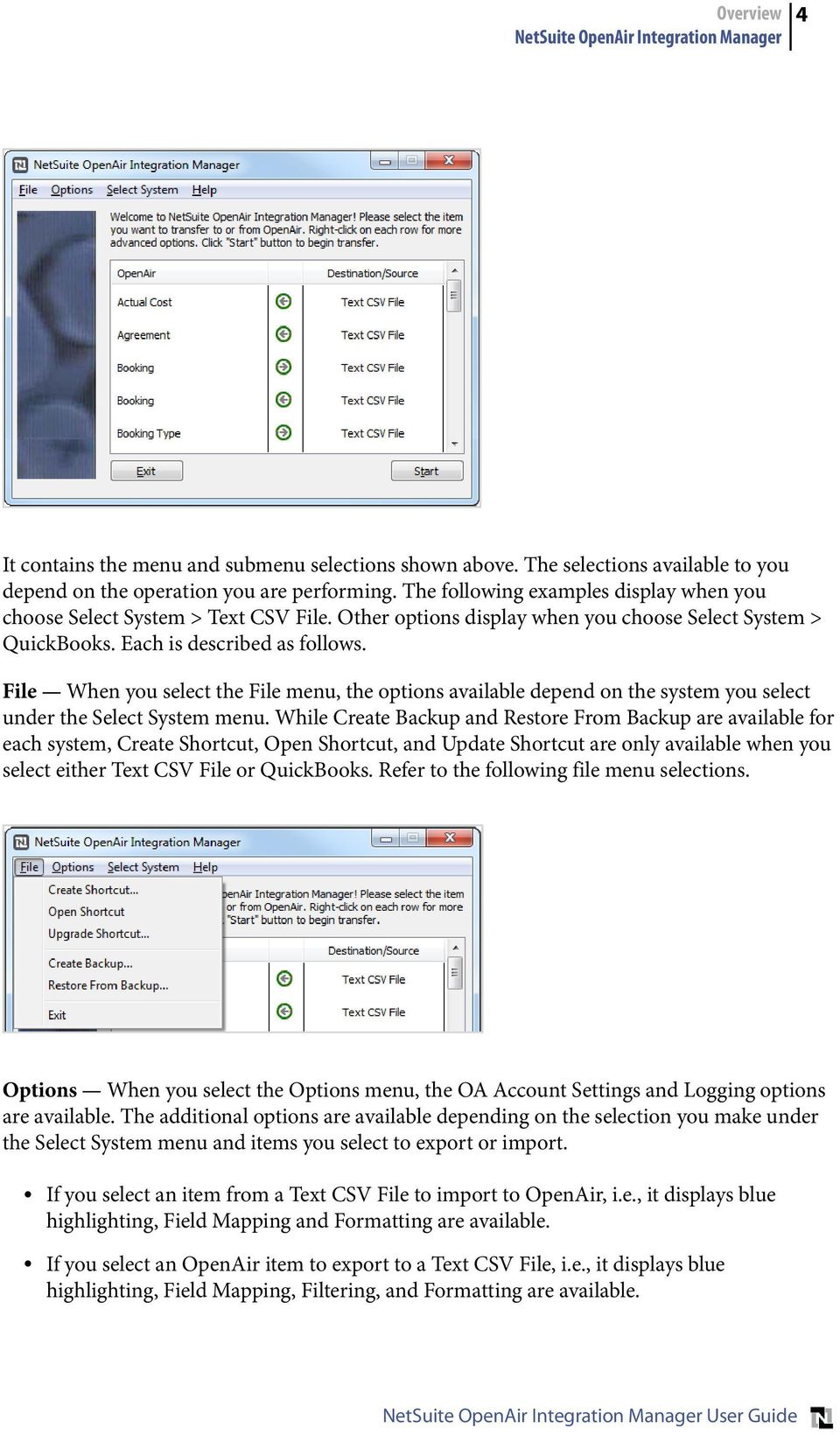
7 Overview 4 NetSuite OpenAir Integration Manager It contains the menu and submenu selections shown above. The selections available to you depend on the operation you are performing. The following examples display when you choose Select System > Text CSV File. Other options display when you choose Select System > QuickBooks. Each is described as follows. File When you select the File menu, the options available depend on the system you select under the Select System menu. While Create Backup and Restore From Backup are available for each system, Create Shortcut, Open Shortcut, and Update Shortcut are only available when you select either Text CSV File or QuickBooks. Refer to the following file menu selections. Options When you select the Options menu, the OA Account Settings and Logging options are available. The additional options are available depending on the selection you make under the Select System menu and items you select to export or import. If you select an item from a Text CSV File to import to OpenAir, i.e., it displays blue highlighting, Field Mapping and Formatting are available. If you select an OpenAir item to export to a Text CSV File, i.e., it displays blue highlighting, Field Mapping, Filtering, and Formatting are available.
8 Overview 5 NetSuite OpenAir Integration Manager Ιf you select QuickBooks, the QB Settings option is available. If you highlight AP Update or AR Update for export, the Field Mapping option is also available. Field Mapping is not available for other items. Select System A check mark displays next to the system you select and the items displayed under OpenAir and the Destination/Source or company name reflect the system you select. Help When you select the Help menu, you can choose one of the following: User Guide (pdf) - displays the most recent version of the NetSuite OpenAir Integration Manager User Guide. Contents (Release notes) displays the most recent readme.txt file. OpenAir.com Web Site opens in your default Web browser window. Display Log displays the NetSuite OpenAir Integration Manager activity log in your default text editor. It lists actions on specific dates and times. If you are having problems, you can send a copy of this file to OpenAir Support. See Troubleshooting. About Integration Manager displays version information.

9 Overview 6 OA Account Settings Note: If you select an item to import or export and right-click on the highlighted row, available items from the options menu also display. They include the option to Create Shortcut as well as Field Mapping, Filtering, and Formatting when applicable. OA Account Settings Before you can use NetSuite OpenAir Integration Manager and exchange information between OpenAir and text CSV files or QuickBooks, you need to log into your OpenAir account to enter your account credentials. To enter your NetSuite OpenAir account credentials: Open NetSuite OpenAir Integration Manager. Click the Click Options > OA Account Settings. icon. The following window displays. 3. Enter your Company ID, User ID, and Password. If you select the check box to Remember Password, you do not have to enter it again.

10 Overview 7 OA Account Settings 4. The default Server is: 5. Click OK. In most cases, leave Account ID blank. You are connected to your OpenAir account. Any operations you perform with Integration Manager will now take place using these account credentials. Also note that any updates you perform to records in your OpenAir account will display this user ID in the audit trail record documenting these changes.

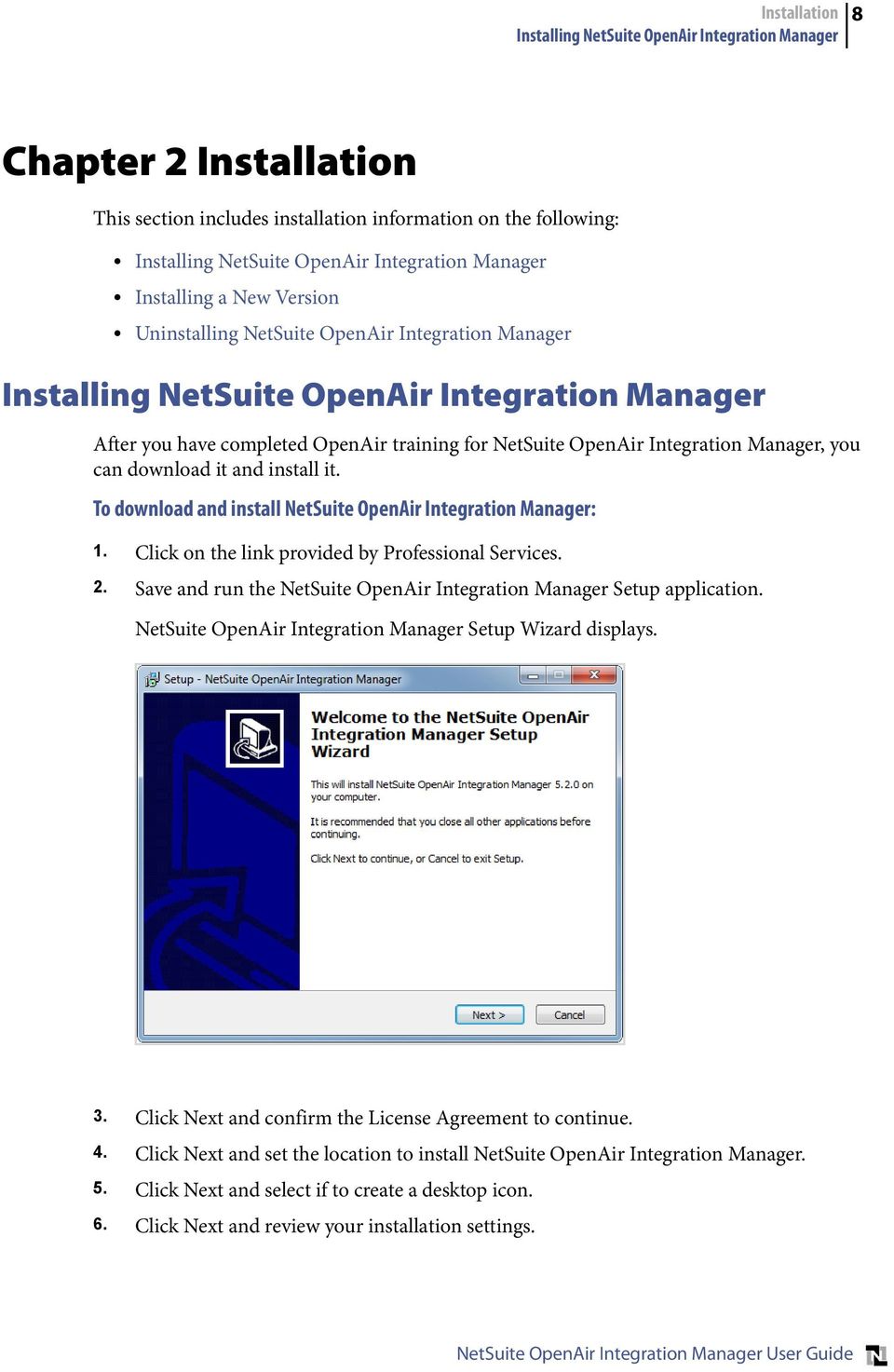
11 Installation 8 Installing NetSuite OpenAir Integration Manager Chapter 2 Installation This section includes installation information on the following: Installing NetSuite OpenAir Integration Manager Installing a New Version Uninstalling NetSuite OpenAir Integration Manager Installing NetSuite OpenAir Integration Manager After you have completed OpenAir training for NetSuite OpenAir Integration Manager, you can download it and install it. To download and install NetSuite OpenAir Integration Manager: Click on the link provided by Professional Services. Save and run the NetSuite OpenAir Integration Manager Setup application. NetSuite OpenAir Integration Manager Setup Wizard displays. 3. Click Next and confirm the License Agreement to continue. 4. Click Next and set the location to install NetSuite OpenAir Integration Manager. 5. Click Next and select if to create a desktop icon. 6. Click Next and review your installation settings.
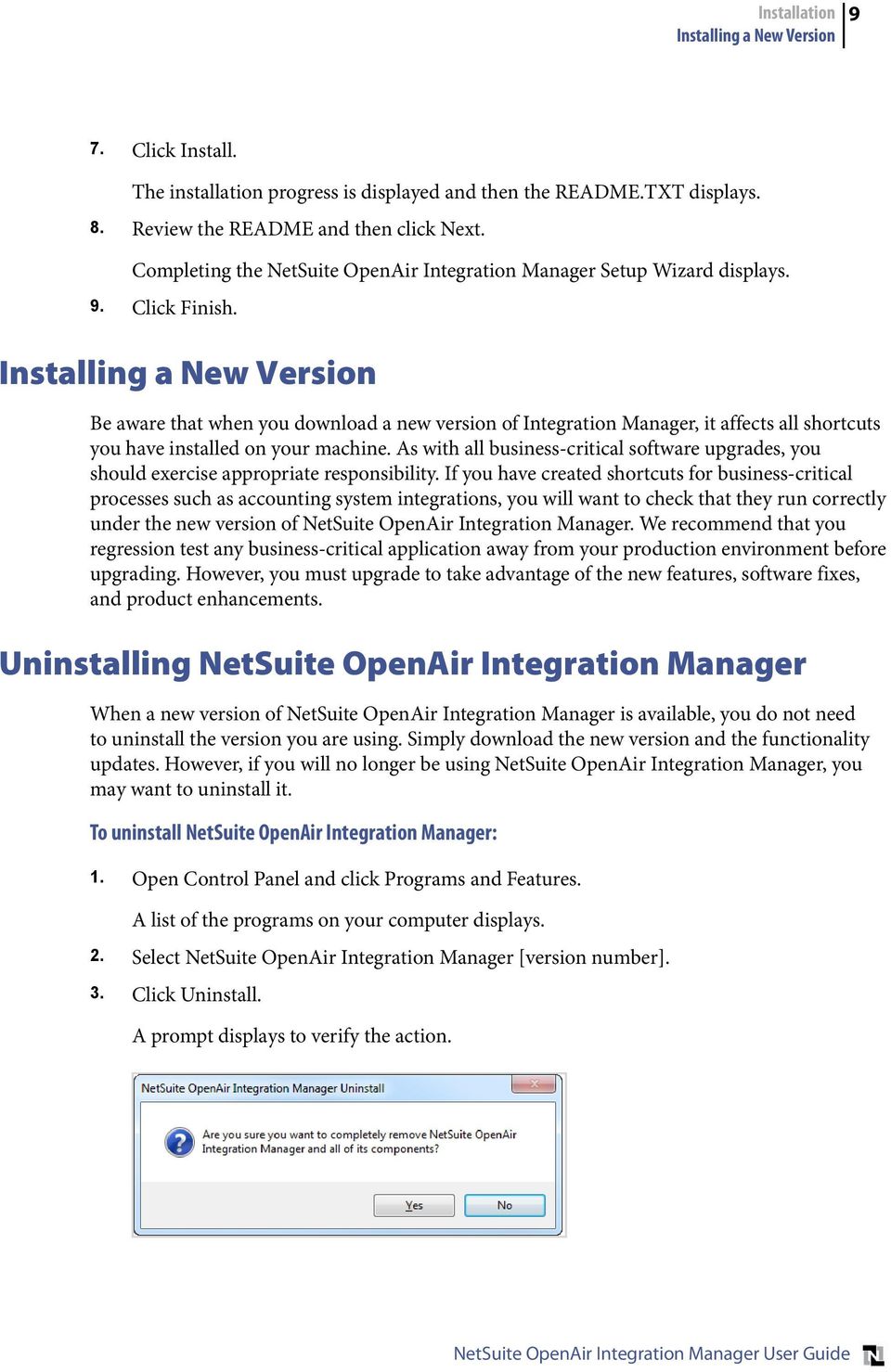
12 Installation 9 Installing a New Version 7. Click Install. The installation progress is displayed and then the README.TT displays. 8. Review the README and then click Next. Completing the NetSuite OpenAir Integration Manager Setup Wizard displays. 9. Click Finish. Installing a New Version Be aware that when you download a new version of Integration Manager, it affects all shortcuts you have installed on your machine. As with all business-critical software upgrades, you should exercise appropriate responsibility. If you have created shortcuts for business-critical processes such as accounting system integrations, you will want to check that they run correctly under the new version of NetSuite OpenAir Integration Manager. We recommend that you regression test any business-critical application away from your production environment before upgrading. However, you must upgrade to take advantage of the new features, software fixes, and product enhancements. Uninstalling NetSuite OpenAir Integration Manager When a new version of NetSuite OpenAir Integration Manager is available, you do not need to uninstall the version you are using. Simply download the new version and the functionality updates. However, if you will no longer be using NetSuite OpenAir Integration Manager, you may want to uninstall it. To uninstall NetSuite OpenAir Integration Manager: Open Control Panel and click Programs and Features. A list of the programs on your computer displays. Select NetSuite OpenAir Integration Manager [version number]. 3. Click Uninstall. A prompt displays to verify the action.
13 Installation 10 Uninstalling NetSuite OpenAir Integration Manager 4. Click Yes. A message displays verifying the action. 5. Click OK. Important: Uninstalling NetSuite OpenAir Integration Manager does not delete essential mapping data. If you want to completely remove all mapping settings you also need to manually delete the installation folder. By default the installation location is C:\Program Files (x86)\openair\integrationmanager or C:\Program Files \OpenAir\IntegrationManager for Windows P.

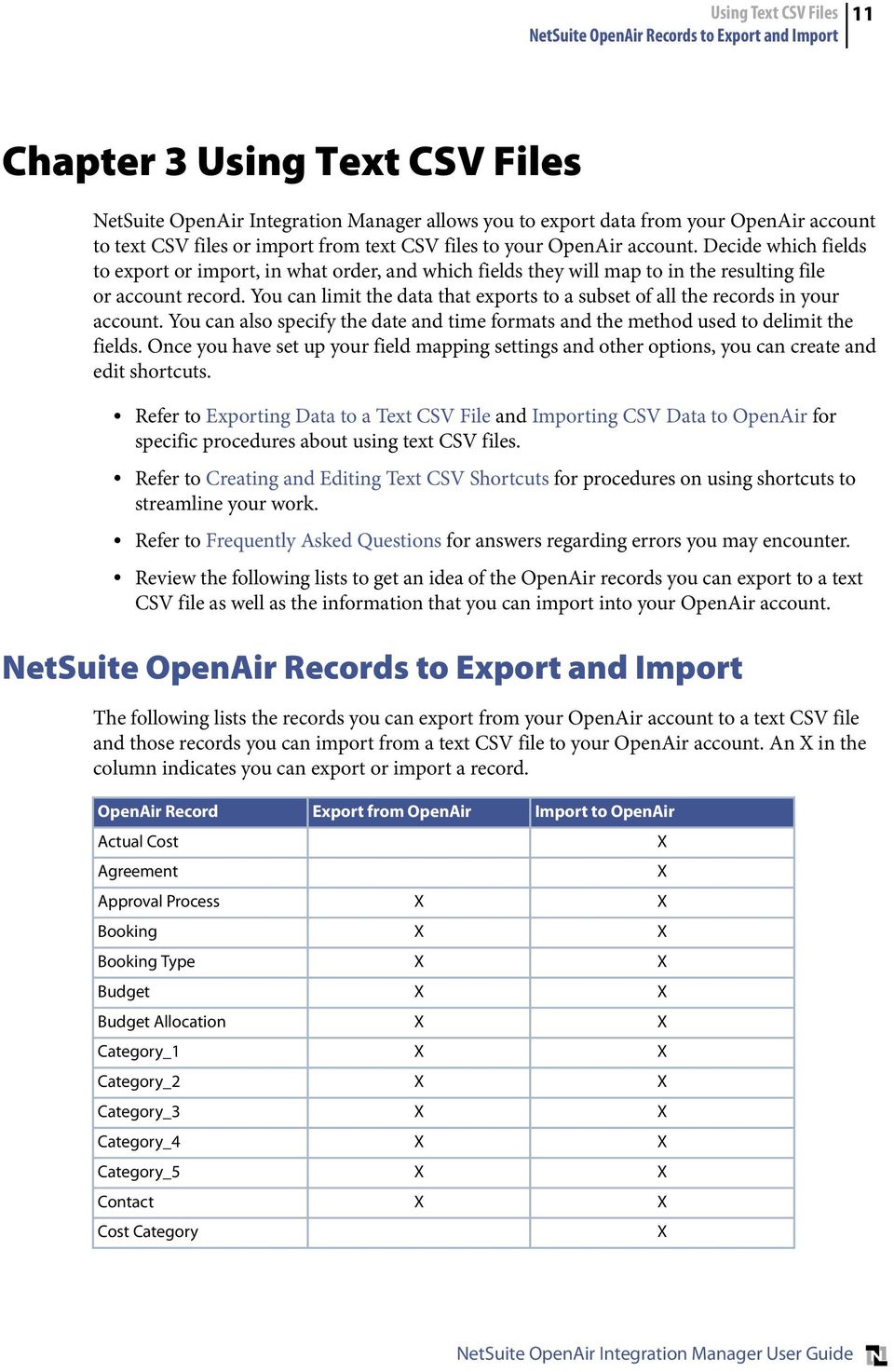
14 Using Text CSV Files 11 NetSuite OpenAir Records to Export and Import Chapter 3 Using Text CSV Files NetSuite OpenAir Integration Manager allows you to export data from your OpenAir account to text CSV files or import from text CSV files to your OpenAir account. Decide which fields to export or import, in what order, and which fields they will map to in the resulting file or account record. You can limit the data that exports to a subset of all the records in your account. You can also specify the date and time formats and the method used to delimit the fields. Once you have set up your field mapping settings and other options, you can create and edit shortcuts. Refer to Exporting Data to a Text CSV File and Importing CSV Data to OpenAir for specific procedures about using text CSV files. Refer to Creating and Editing Text CSV Shortcuts for procedures on using shortcuts to streamline your work. Refer to Frequently Asked Questions for answers regarding errors you may encounter. Review the following lists to get an idea of the OpenAir records you can export to a text CSV file as well as the information that you can import into your OpenAir account. NetSuite OpenAir Records to Export and Import The following lists the records you can export from your OpenAir account to a text CSV file and those records you can import from a text CSV file to your OpenAir account. An in the column indicates you can export or import a record. OpenAir Record Export from OpenAir Import to OpenAir Actual Cost Agreement Approval Process Booking Booking Type Budget Budget Allocation Category_1 Category_2 Category_3 Category_4 Category_5 Contact Cost Category
15 Using Text CSV Files 12 NetSuite OpenAir Records to Export and Import OpenAir Record Cost Center Export from OpenAir Cost Type Import to OpenAir Currency Customer CustomerPO CustomerPO ToProject Deal DealContact DealSchedule Department Entity tag Envelope Estimate EstimateAdjustment EstimateExpense EstimateLabor EstimatePhase Event Expense Item Filter set ForexInput Invoice Issue Job Code Leave accrual rule Leave accrual rule to user Leave accrual trans Loaded Cost Payment Payment Terms Payment Type Payroll Type Product Profile Type Project

16 Using Text CSV Files 13 NetSuite OpenAir Records to Export and Import OpenAir Record Export from OpenAir Import to OpenAir Project Assignment Project Billing Rule Project task Project task assign Projecttask_type Proposal Proposalblock Prospect Proxy Purchase item (only non-po purchase items) Rate Card Rate Card Item Receipt Reimbursement Repeat Resource Profile Resource Request Resource Request Queue Resource Search Rev. Recogn. Amount Rev. Recogn.Rule Rev. Recogn.Trans. Revenue Container Revenue Stage Schedule Exception Schedule Request ScheduleRequest item Service Slip Projection Tag Group Tag Group Attribute Target Utilization Tax Location TimeBill

17 Using Text CSV Files 14 Exporting Data to a Text CSV File OpenAir Record Export from OpenAir Import to OpenAir Timesheet Timesheet entry Timesheet/Timecard entry Todo User User Project Rate Vendor Workspace Link Workspace User Exporting Data to a Text CSV File Use the following procedures to export data from your OpenAir account into a text CSV file. You can export all data or choose a subset of data. You can map fields, use external field lookup, combine data, and add calculated fields, constant headers, and custom fields. Create filtering options and formatting for date and time as well as conditional overrides. To export data to a text CSV file: Launch NetSuite OpenAir Integration Manager. Enter OA Account Settings. See OA Account Settings. 3. Select the category to export. 4. Create field mapping to specify the fields you are going to export. See Field Mapping for Export. Set up external field lookup options. See Exporting Using External Field Lookup. Add calculated fields as desired. See Exporting Calculated Fields. Add custom fields as desired. See Exporting Custom Fields. Set formatting options. See Formatting Data for Export. Add combined fields as desired. See Combining Data on Export. Add constant headers as desired. See Adding Constant Headers. Set filtering options. See Filtering Export Data Set accounting settings. See Filtering Export Data. 5. Create a shortcut to capture the field mapping settings and other options. See Creating and Editing Text CSV Shortcuts. Once you create a shortcut, you can click on it to

18 Using Text CSV Files 15 Exporting Data to a Text CSV File automatically export data without having to launch NetSuite OpenAir Integration Manager. You can also quickly and easily edit shortcuts you have created. 6. When finished with field mapping, click OK. Click Start. The Initializing OpenAir Connector window displays. 7. Next, the Select Options dialog box displays and prompts you to select Text Export Options. 8. Select the location Click Save. and type the name of the file you are exporting. Choose a delimiter. The location and filename display in the Select Options dialog box. Note: When records are exported, you can select the check box to Exclude trailing delimiter from each record. If you select this option, there is no delimiter at the end of the record such as a comma. Generally, you chose a setting depending on the external system you are going to import to and how that system wants records configured. For example, User,1,2,3 is without a trailing delimiter and User,1,2,3, has a trailing delimiter. 9. Click OK and the OpenAir Connector window displays progress. When done, open the new file in the application you are using.

19 Using Text CSV Files 16 Exporting Data to a Text CSV File Note: Depending on the data you export, you may want to open Text CSV files in Notepad and not Excel. Excel can interpret alphanumeric fields with leading zeros as number fields and drop the leading zero. Field Mapping for Export You can specify field mapping for the fields contained in a selected category when you export it from OpenAir to a text CSV file. Edit the fields to create new column names, change the order they display in the text file, and specify column contents. Group multiple fields from OpenAir into a single column in the text file and include custom fields in the export. The data that is available to export displays in the Field Mapping dialog box. Note: When a field is preceded by the name of another category and an underscore, it belongs to a foreign table, one that is related in the OpenAir database to the category you are exporting. To specify field mapping for a category: Go to Select System and select Text CSV File. Select a category to export. It highlights in blue. For example, Currency. 3. Right-click on the highlighted category and select Field Mapping. The Field Mapping dialog box displays. The green arrow marks a field for export.
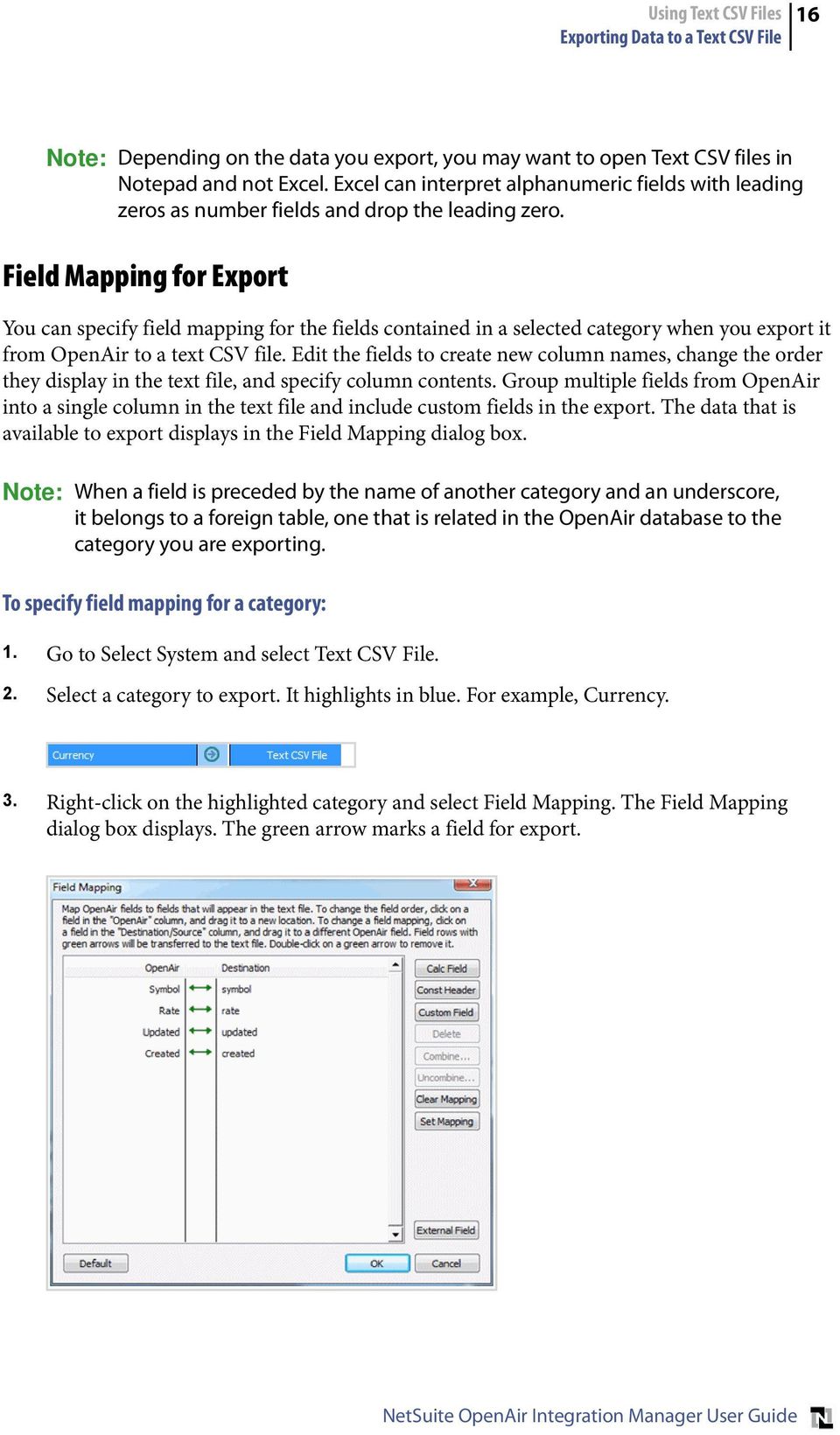
20 Using Text CSV Files 17 Exporting Data to a Text CSV File 4. Double-click on the green arrow to remove mapping for that field. Double-click on it again to restore mapping. To clear or set mapping on multiple fields at one time, use the Shift key or Ctrl key to highlight multiple fields and click the Clear Mapping or Set Mapping buttons. 5. To edit the name of a Destination field, the name that will become a column name in the text file, double click on the field and type the new name. 6. To change the order of the fields, the order of columns in the text file, click on the OpenAir field and drag it to the new location. 7. To change the field mapping, click on the field in the Destination column and drag it to the OpenAir field it should now be mapped to. 8. To edit field mapping details, right-click on the field and specify field level formatting option. Note: There are specific options for formatting each individual field. For more information, refer to Formatting Data for Export and Individual Field Formatting. 9. To export data, refer to Exporting Data to a Text CSV File. Exporting Using External Field Lookup When you are in the Field Mapping dialog box, there is an External Field button on the right navigation. Click this button to display an External Field Lookup dialog box. It allows you to designate specific data to export from either the same category you selected on the Field Mapping dialog box or an associated one. Then, you can select a source association and target association. Available options are based on the category you selected in Field Mapping. A dropdown list displays available record fields and you also have the option of typing a custom field. You can set up an external field lookup to add additional fields to an export using a foreign table and a table one level further removed. Remember, a foreign table is one that is related in the OpenAir database to the category you are exporting. A table one level further removed is a table that is related to the foreign table. If necessary, you can lookup an external field directly from a foreign table. For example, to retrieve the creation date of an original invoice for a rebill invoice, you select Invoice and original_invoiceid as Source and Invoice and Created as the Target. Therefore, you can begin with a category and lookup a field in both a foreign table and a table one level further removed. Refer to the following example for exporting an invoice approver's nickname for a specific project and customer. The category is Project and it contains the field customer_id. The Customer table is a foreign table.

21 Using Text CSV Files 18 Exporting Data to a Text CSV File The Customer table contains the invoice approver field, which is tb_approver. The User table is a foreign table to the Customer table, one level removed from the Project table. The User table contains the nickname field. The following is the External Field Lookup dialog box that shows the previous example. To set up an external field lookup: Go to Select System and select Text CSV File. Select a category. In this example, Project. 3. Right-click on the highlighted category and select Field Mapping and the Field Mapping dialog box displays. 4. Click the External Field button and the External Field Lookup dialog box displays. Refer to the example and screen above. 5. Enter a name. In this example, we entered Invoice_Approver_Nick. 6. Select the Source Association. It can be the category you have selected or a foreign table to map from. In this example, we selected Customer. 7. Select the Record field or Custom field. In this example, we selected Record field and tb_approver. 8. Select the Target Association, which can be the category you have selected, or a table one level further removed. In this example, we selected User.
22 Using Text CSV Files 19 Exporting Data to a Text CSV File 9. Select the Record field or Custom field to be returned. In this example, we selected Record field and Nickname. 10. Click OK. 1 To export from OpenAir to a text CSV file using the external field lookup you created, refer to Exporting Data to a Text CSV File. Note: You can use custom field values as the source association and as the target association, or both. NetSuite OpenAir Integration Manager assumes that the source association custom field is of type pick list and therefore contains an ID value that can be used to lookup target records. Exporting Calculated Fields You can add calculated fields to Field Mapping when you export to a text file. Once you create them, they display at the bottom of the list and you can rename them and move them just as you would any other field. These calculated fields can be a constant field and like constant headers, they do not exist in your OpenAir account. You add them to make your resulting file compatible with any given format specification. These calculated fields can also be an extra reference field (a copy of another field) or input field and you can specify a value (value would be prompted for prior to export). You can also specify a value or text of the constant field. In addition, a calculated field can also be an auto-counter field. You can set the highest counter or apply a value after summing. To add calculated fields: Go to Select System and select Text CSV File. Select a category to export. For example, TimeBill. 3. Right-click on the highlighted category and select Field Mapping. The Field Mapping dialog box displays. 4. Click the Calc Field button and the Add a calculated Field dialog box displays.
23 Using Text CSV Files 20 Exporting Data to a Text CSV File 5. Type the name of the field. Note: The field can be constant, counter, or an extra reference or input field. 6. To include a constant value column in the exported record, enter any value or text of the constant. 7. To create a copy of another column in the exported record, select it as the reference field using the drop-down list. Note: You can also set the counter reference. For example, if you select envelope_number for a receipt export, the counter goes up within one envelope for each receipt. It is reset starting with the next envelope. If max setting is set, the counter displays the total number of receipts in each envelope. Refer to the following step and explanation of setting options. 8. If you select the check box to use this field as auto-counter, you can also select one of the following check boxes: Set highest counter or Apply after summing. Set highest counter - populates the field with the total number of records in this export. Or, for transaction records that are grouped by a container (using the reference field below), it populates the field with the total number of records in this container. For example, to count the number of customer lines, select customer_id as the reference field. Apply after summing numbers the output records after multiple OpenAir records have been summed into one output record by using the sum by function in accounting settings. This feature allows you to number the lines in an export file. For example, you may number the distribution lines in an AR invoice or an AP voucher or include a value for the number of lines in a grouping such as the number of distributions in an AR invoice.
24 Using Text CSV Files 21 Exporting Data to a Text CSV File 9. If you select the Input field check box, none of the value fields are active. However, you can select the Input field check box and the Current date check box. 10. Click OK and the calculated field and appropriate value display in the resulting file. 1 To export data, refer to Exporting Data to a Text CSV File. Exporting Custom Fields When your company adds custom fields to your OpenAir account, you can add these fields to the Field Mapping dialog box and export them to a text CSV file. They must be associated with the category highlighted for export or a related foreign table. For example, if the highlighted category is User, you can add a custom field for Birthday since it is associated with the User category. To include a custom or built-in field from a category one level further removed from the category highlighted for export, use the external field feature. See Exporting Using External Field Lookup. Once you have added it to the Field Mapping, you can change its name, order, mapping, or group the custom field with other fields. To add a custom field: Go to Select System and select Text CSV File. Select a category to export. For example, User. 3. Right-click on the highlighted category and select Field Mapping. The Field Mapping dialog box displays. 4. Click the Custom Field button and the Add a custom field dialog box displays. 5. Type the exact name of the field and select the type from the drop-down list. The name of the field is the OpenAir field name, not the name that displays on user forms. Select the
25 Using Text CSV Files 22 Exporting Data to a Text CSV File correct OpenAir type to ensure the field is formatted according to the information you have set up for this export. 6. Select the entity association using the drop-down list. In this example, it is User. Click OK and the custom field is added to the end of the Field Mapping list. Note: You can only export a custom field that is associated with the category highlighted for export or a related foreign table. For example, the highlighted category is User and the custom field for Birthday is associated with the User category. It could also be associated with CostCenter, a foreign table. 7. To delete the custom field from the Field Mapping list, select the custom field and click the Delete button. 8. To export data, refer to Exporting Data to a Text CSV File. Formatting Data for Export There are three types of formatting available: date/time formatting, conditional override, and individual field formatting. You select Formatting options when you highlight a category. You access individual field formatting at the field level from the Field Mapping dialog box. When you format data for exporting, settings apply only to the category highlighted. You can choose to export only the date, or to list the time before the date, or to export the date and time to two different columns. Date/Time Formatting To specify format for date and time fields: Go to Select System and select Text CSV File. Select a category. For example, User. 3. Right-click on the highlighted category and select Formatting. The Formatting dialog box displays.
26 Using Text CSV Files 23 Exporting Data to a Text CSV File 4. Select the date format using the drop-down list. Notice that the Julian (JD Edwards) date format is available. 5. Select the time format. 6. Specify separators for both date and time. Use the check boxes provided to specify additional settings and whether or not to export the header. Note: Control over whether the header displays applies to all columns in the export record and not just date fields affected by this formatting. 7. Click OK. When you export the category, date and time are formatted according to these settings. Conditional Override To specify a conditional override: Click the Conditional Override tab. The Conditional Override dialog box displays.
27 Using Text CSV Files 24 Exporting Data to a Text CSV File Click Add. The Conditional Overrides dialog box displays. 3. Select the reference field whose value will be overridden using the drop-down list. Note that if you are combining fields in field mapping, you can still override individual components of that combined field.
28 Using Text CSV Files 25 Exporting Data to a Text CSV File 4. Highlight the selected test field(s) and click the right arrow to move them to the Selected pane. If more than one test field is selected, the test value will be the concatenation of the values of those fields. Check carefully that you are testing the correct values for fields of type check box or where fields contain internal IDs. 5. Select the Override Condition: Equals, Not Equals, Regex, Contains, or Not Contains and type the condition. Note: Before using Regex (Regular Expressions), we recommend that you contact OpenAir Support and speak with a member of the Professional Services team. 6. Select the check boxes as desired for Numeric comparison or Override after summing entries. Note that override after summing is relevant only if you use the accounting settings functions to sum rows and may affect the level of summing and number of export rows that result. See Accounting Settings. 7. Set the reference field's value to a Custom value or a Field value. 8. Click OK. A summary of the Conditional Override values displays in the Conditional Override window. 9. Click OK. Once a Conditional Override is added, you can highlight it and select the Edit or Delete button to edit or delete contents. Note: Conditional overrides are evaluated in order from the bottom to the top of the list. All overrides that do not have override after summing checked are evaluated before any that do have it checked. Because you may be testing fields in one override that could have been modified by another override, the order of evaluation may be important to the logic of your export. Therefore, modify the order of the conditional overrides. 10. To change the order in which a conditional override is executed, highlight it and use the and buttons to move it. When done re-ordering, click OK. Individual Field Formatting To format an individual field: Go to Select System and select Text CSV File. Select a category. For example, User.
29 Using Text CSV Files 26 Exporting Data to a Text CSV File 3. Right-click on the highlighted category and select Field Mapping. The Field Mapping dialog box displays. 4. Highlight the field you would like to format, right-click on it and select Format. The Individual Field Formatting dialog box displays. 5. Type the Total Length of the field. Using the drop-down list, select what should occur if length is not equal to the value you entered. Options include: Fail with warning if longer, Truncate the end if longer, Truncate the beginning if longer, Pad left with spaces, Pad right with spaces, or Pad left with zeros. 6. Add the Decimal Length if applicable. Using the drop-down list, select what should occur if length is not equal to the value you entered. Options include: Fail with warning or Truncate. 7. Type the Lowest and Highest acceptable numeric range values. Using the drop-down list, select what should occur if value is not within the range you entered. Options include: Fail with warning or Set to closest range. 8. Click OK. Combining Data on Export You can combine the data of several OpenAir fields to display under one column name in the text file. To combine the data of several OpenAir fields: Go to Select System and select Text CSV File. Select a category to export. For example, Currency.
30 Using Text CSV Files 27 Exporting Data to a Text CSV File 3. Right-click on the highlighted category and select Field Mapping. The Field Mapping dialog box displays. 4. Scroll to the fields you would like to combine. Press and hold down the Shift key and select those fields. Click the Combine button. Note: The fields need to be adjacent to each other before you can combine them. You may need to move them first. The Combine fields dialog box displays. 5. Type the name of the combined fields. In this example, it is Symbol & Rate. Click OK. The Field Mapping dialog box shows the combined field. Note: Use this feature to combine, add or multiply fields. To combine fields with no separator, select a separator of custom and ensure the box to the right is empty. When working with numbers, use the Add or Multiply option. 6. To uncombine fields, select the combined fields and click the Uncombine button.
31 Using Text CSV Files 28 Exporting Data to a Text CSV File The fields display in their original form. Note: Combined fields automatically export. If you do not want them to export, first uncombine them and then double-click on the green arrow to remove mapping for each field. You can also highlight the fields and click the Clear Mapping button. 7. To export data, refer to Exporting Data to a Text CSV File. Adding Constant Headers When you export data to a text file that you plan on importing to a different application such as QuickBooks, you can add a constant header to the file. This makes it more compatible with QuickBooks. For example, to import an Intuit Interchange Format (.iif) file to Quick Books, it is helpful to add a header above field names as the first rows. These field names do not exist in your OpenAir account but display in the resulting text file. To create a constant header: Go to Select System and select Text CSV File. Select a category to export. For example, User. 3. Right-click on the highlighted category and select Field Mapping. The Field Mapping dialog box displays. 4. Click the Const Header button. The Constant Header dialog box displays.
32 Using Text CSV Files 29 Exporting Data to a Text CSV File 5. Type the header text and click OK. After the export is run, the header row displays in the resulting file. 6. To export from OpenAir to a text CSV file, refer to Exporting Data to a Text CSV File. Filtering Export Data You can specify filters when you export data from OpenAir to a text file. This functionality is not available for import into your OpenAir account. It helps you specify the exact records you want to export. For example, you might only export categories not previously exported or new categories since N hours ago or N days ago. Filters also support custom date ranges and meta-values such as last month, this month, today, and next month. Filters can also check for equal to or not equal to, is empty or is filled, contains or not contains, and before, after or between clauses. Constant fields can also be used as filter criteria. Several useful filters are already available to you by default in OpenAir IM: Only new items since the last export. Further, you can specify to do it by this application (or shortcut) or by all applications. Only deleted records. Two options control the behavior of the custom filtering: Only if all conditions are true. Only if one condition is true. You can create custom filters based on the fields related to the category highlighted. Once added, custom filters can be edited and deleted. To filter export data: Go to Select System and select Text CSV File. Select a category. For example, User. 3. Right-click on the highlighted category and select Filtering. The Filters dialog box displays.
33 Using Text CSV Files 30 Exporting Data to a Text CSV File 4. To limit export to new or updated categories, select the check box for Only new items since last export. Next, select By this application (or shortcut) or By all applications. 5. To keep categories from being marked as exported, select the check box Do not mark items as exported. When not marked as exported, records remain available to any subsequent export that is filtering on only new items since the last export. This is useful for testing and in situations where you know the same set of records will be exported multiple times. 6. To export only deleted records, select the check box Only deleted records. 7. To create a custom filter, click the Add button. The Create Filter dialog box displays. 8. Type a Name for the custom filter. 9. Select a field to filter against using the drop-down list of fields associated with the category you highlighted. If the field is associated with a date, the Custom Date Range button becomes available and today's date displays in the Value text box.
34 Using Text CSV Files 31 Exporting Data to a Text CSV File 10. Either select a Condition using the drop-down list and accept or change the value. Click OK. 1 Or enter a date range. Click the Custom Date Range button. The Advanced Filtering dialog box displays. 1 Select the date range and click OK. The Filters dialog box displays with the Custom Filter. Remember that dates are inclusive and you should use date filters to limit the amount of data IM needs to process. Note: IM uses both server-side and client-side date field filtering. Each is explained as follows: Server-Side Date Fields - Timesheet and Envelope status fields, the exported/not exported status, and only native date fields (fields that belong to the native record being exported) are filtered server-side. Since it is more efficient to filter date fields server-side, use a clean-up export as described below to mark records as exported. Examples of server-side date fields are slip.date and slip.updated on a TimeBill export. Client-Side Date Fields - When you use client-side filters for ongoing exports, and only a subset is market as exported, create a clean-up export shortcut to mark records as exported and discard the output data. This reduces the amount of time it takes to produce subsequent client-side filtered exports. Examples of client-side date fields are slip.invoice_date and slip.invoice_updated. The following is an example of a clean-up export for TimeBills exporting records associated with a project in a particular stage. The production export would only export TimeBills records that are not yet exported and are associated with a slip, project_project_stage_id = 2 The clean-up export (the data file will be discarded) will export all TimeBills associated with project_stage not equal to 2 and mark those records as being exported as well. 13. Click OK. 14. To export from OpenAir to a text CSV file using the filter(s) you created, refer to Exporting Data to a Text CSV File.
35 Using Text CSV Files 32 Exporting Data to a Text CSV File Accounting Settings Overview of Accounting Settings Accounting Settings contains two areas of functionality: Account Balancing/Secondary Balancing and Sum/Sum By. These two functions are often used together when creating exports of transactions with a container/detail-line relationship, but they also can be used independently. Each is explained as follows. Account Balancing/Secondary Balancing - allows you to create exports containing extra records that correspond to the records created from summed or individual OpenAir transactions. Using Account Balancing/Secondary Balancing, the export file contains more records than would otherwise be created. Sum/Sum By - allows you to create exports where one record in the export file is created from multiple records in OpenAir. For example, an OpenAir expense report may contain many receipts for the same expense item and the desired export file would contain one record containing the sum of those receipts. Using Sum/Sum By, the export file therefore contains the same number or fewer records than the number of OpenAir transactions from which it was created. When you export a category from OpenAir to a text CSV file, you have the option to perform Account Balancing and Secondary Balancing on the category you are exporting. You can also select fields to Sum By as well as fields to Sum. These accounting settings features are available for the following categories: Receipt Revenue Recognition Transactions (Rev. Recogn. Trans.) TimeBill (charge, slip, or bill) Timesheet entry Slip projection Access Accounting Settings To access Account Balancing and Sum By settings: Go to Select System and select Text CSV File. Select a category to export. For example, Receipt. Right-click on the highlighted category and select Accounting Settings.
36 Using Text CSV Files 33 Exporting Data to a Text CSV File The Sum By Settings dialog box displays. Create Balancing Entries To create balancing entries: Type the Account Number. This is a value you want to appear on every record created as a balancing entry in your export file. If you are creating balancing lines as part of an A/R export, this may be your accounting system's A/R account. Even if you do not have a fixed value you want to appear on every balancing line, you must enter something here as this is what triggers IM to create a balancing line. Select whether the total field for the balancing line is a Negative or Positive balancing total. The balancing line always creates a balancing value for the total field in the record being exported. To create a balancing value for other fields, see Secondary Balancing below in step
37 Using Text CSV Files 34 Exporting Data to a Text CSV File 3. Select the check boxes as desired for Balancing entry first to put the balancing line in the export file ahead of the line or lines it is balancing. 4. Select Generate balancing entry for each SUM group to generate a balancing line for each single record in the export file generated by Sum/Sum By. If you do not check this box, IM generates one balancing line per container for exports. For example, IM would generate one balancing line per invoice for timebill exports, one balancing line per envelope for receipt exports, or one balancing line per timesheet for timesheet entry exports. When IM exports transactions that do not have containers, such as revenue transactions, it creates one balancing line per export file. 5. Select the Associated field using the drop-down list. This is the column in which the Account Number value will appear on balancing lines. 6. If desired, generate Secondary Balancing. Type the Account Number. 7. Select whether the field being balanced should be balanced as a Negative or Positive total. 8. Select the check boxes as desired for Balancing entry first and Generate balancing entry for each SUM group. 9. Select the Associated field using the drop-down list. 10. Click the Include fields button and select the check boxes of the item(s) to sum and display for the balancing record. 1 Select a Balance field from the drop-down list of fields you selected to SUM. This field's value is balanced for all the records being summed (if Sum/Sum By is used) or for an individual record. 1 Select a field to override from the drop-down list of fields you selected to SUM. 13. If required, select the check box to Add blank line after each SUM group. 14. Click the Include fields button. Select items dialog box displays.
38 Using Text CSV Files 35 Importing CSV Data to OpenAir 15. Select the check box of the item(s) to display for the balancing record. Click OK. These are the fields you previously selected to SUM BY. If you do not select any values, the balancing record contains blank columns except for the associated field and any fields you selected in the sum box. Use Sum/Sum By To use the Sum/Sum By function: Select the fields to SUM BY. Highlight the item(s) and click the arrow to include the selected fields. IM creates one record in the export file for every transaction record in OpenAir where the values of all the fields selected in Sum By are the same. For example, if exporting receipts and sum by user, envelope, expense item, the export file contains one record for all receipts that have the same user, envelope, and expense item. Select the fields to SUM. Highlight the item(s) and click the arrow to include the selected fields. Fields you select here are summed from the values in all the records grouped by the Sum By fields above. The total value displays in the output record. Fields picked here are always money or quantity fields. Note that only fields that appear in Sum By or Sum are available to be selected in the field mapping dialogue. 3. If desired, select the check box to Respect formatting for individual fields. This causes a date field (used in summing as an example) to be displayed properly formatted based on date format settings. 4. On a timebill export, you may click the Taxables button to select which columns in the output record contain the total taxable amount and total non-taxable amount for each record. These are defined by calculated fields in the field mapping dialogue. See Exporting Calculated Fields. 5. Click OK. 6. To export data, refer to Exporting Data to a Text CSV File. Importing CSV Data to OpenAir Use the following procedure to import data from a text CSV file into your OpenAir account. We recommend that you use caution when doing this, however, and limit its use to only those users who have received OpenAir training on using NetSuite OpenAir Integration Manager. Having an understanding of the OpenAir application and how its database is structured is essential. Important: NetSuite OpenAir Integration Manager does not fully support Unicode characters, however, it does support Western European characters. Use only a decimal point to separate the integral part of numbers from the decimal part for values imported to OpenAir. Other separators, such as a comma, are not supported in
39 Using Text CSV Files 36 Importing CSV Data to OpenAir integral numbers. Since most decimal numbers in OpenAir have two-digit precision, using this precision in the input file helps you avoid inconsistencies created by rounding. Please consult the OpenAir Data Dictionary to verify the supported precision of a specific field. To import data into OpenAir: Launch NetSuite OpenAir Integration Manager. Enter OA Account Settings. See OA Account Settings. 3. Select the category to import. 4. Create field mapping to specify the fields you are going to import. See Field Mapping for Import. Use serverside lookup by external_id. See Importing Using External ID Lookup. Add calculated fields as desired. See Importing Calculated Fields. Add custom fields as desired. See Importing Custom Fields. Set formatting options. See Formatting Data for Import. Ensure format of numbers in text CSV file is correct. See Formatting Numbers for Import. 5. Click OK. 6. Click Start. The Select Import Options dialog box displays. 7. Verify the contents and click OK. NetSuite OpenAir Integration Manager prompts you to continue and displays a caution. 8. To continue, click Yes.
40 Using Text CSV Files 37 Importing CSV Data to OpenAir Status of the import displays. The record imports to your OpenAir account. Note: NetSuite OpenAir Integration Manager updates records or creates new records if it determines that a record does not exist. The rules by which it makes this determination vary depending on the type of data category you are importing and whether you select check box for New serverside lookup by external_id on the Field Mapping form. When the check box for New serverside lookup by external_id is NOT selected, Integration Manager can check for duplicate data already in OpenAir, but it cannot check against data being imported. To avoid creating duplicate records, ensure there is not duplicate data in the file you are importing. Important: If you select the check box for New serverside lookup by external_ id on the Field Mapping form, the information in the following table does NOT apply to importing CSV data to OpenAir using IM. Serverside lookup by external_id functionality changes the way records are added or updated in OpenAir. Specifically, if the functionality for serverside lookup by external_id is selected and an internal id is NOT mapped, the external_id field is used (serverside) to lookup any existing records in the system. When there is a record in the system with the same external_id, the record is updated. When there is NOT another record with the same external_id, the record is added to OpenAir. If the functionality for serverside lookup by external_id is not selected or an internal id is mapped for any of the categories below, the record is always updated or an error is returned if the internal id does not exist. NetSuite OpenAir Integration Manager never adds a record. Refer to the following table for more information. Type of data Imports data and updates OpenAir record if... Transactional data: Invoice, TimeBill or Slip (Charges), Receipt, Envelope, Project Task, Project task assign, Resource Profile, Project Billing Rule, Booking, Payment, Reimbursement, and User Project Rate. Text file contains an id field that maps to the id field in OpenAir of the highlighted item. The id in the text file must match the id of the OpenAir record you are updating. If not, a new record will fail to be added. The record will be added if the internal id is not mapped to an OpenAir id. If the internal id is mapped, IM never attempts to add a record. List data: Customer, Prospect, Service, Vendor, Expense Item, Department, Cost Center, and Booking Type. Text file contains an id field that maps to an OpenAir id, the record will be updated. If the external_id maps to the OpenAir external_id and a record in OpenAir exactly matches the imported external_id, or the name maps to the name in the OpenAir record, the record will be updated. If not, a new record is added. Special Case data: Contact Text file contains an id field that maps to OpenAir id, customer_id, first, and last fields all map to OpenAir and a record in OpenAir exactly matches the imported customer_id, first, and last
41 Using Text CSV Files 38 Importing CSV Data to OpenAir Type of data Imports data and updates OpenAir record if... fields; or the customer_company first, and last fields all map to OpenAir and a record in OpenAir exactly matches the imported customer_company first, and last fields, the record is updated. If not, a new contact is added. Special Case data: Project Text file contains an id field that maps to OpenAir id, or customer_id and name fields both map to OpenAir, and records in OpenAir exactly match both the imported customer_id and name, the record is updated. If not, a new project is added. Special Case data: User Text file contains an id field that maps to OpenAir id, or external_id maps to OpenAir and a record in OpenAir exactly matches the imported external_id, or the nickname field maps to OpenAir and a record in OpenAir exactly matches the imported nickname, the record is updated. If not, a new user is added. Special Case data: Profile Type Text file contains an id field that maps to OpenAir id or the name and type fields both map to OpenAir and a record in OpenAir exactly matches both the imported name and type, the record is updated. If not, a new record is added. Note: There are several limitations regarding the import of purchase item data to OpenAir: Only short-order purchase items can be added to OpenAir and only project/customer combinations can be updated on a non short-order purchase item (switch enabled). See details as follows: For the capability to add short-order purchase items in OpenAir, go to Administration > Application Settings > Purchases Settings and select Other settings. Scroll down and select the check box to Enable the ability to create non-po purchase items. These are purchase items for purchases made without an OpenAir PO. For the capability to modify non short-order purchase items, submit a support ticket and request that the following switch be enabled: API can modify purchase items' project association even when associated with a PO. Associated request items will also be updated. See Troubleshooting for instructions on how to create a support ticket. Field Mapping for Import You can specify field mapping for the fields contained in a selected category when you import from a text CSV file to your OpenAir account. However, we urge you to proceed with caution. Incorrect field mapping can result in the corruption of OpenAir data, including the creation of duplicate records in OpenAir. It is essential that you have an understanding of OpenAir and its database structure before proceeding. To specify field mapping for a category: Go to Select System and select Text CSV File. Select a category to import. It highlights in blue. For example, Customers.
42 Using Text CSV Files 39 Importing CSV Data to OpenAir 3. Right-click on the highlighted category and select Field Mapping. The Select Import Options dialog box displays Select the check box to use the first row of the file you are importing as header names or type your own headers in the text boxes provided. Locate the text file using the button, select it and click Open. The filename displays in the Select Import Options dialog box as do the File headers that will import to OpenAir. 6. Highlight each header name and edit it or keep the name that displays. Each column must have a header. 7. Select the File delimiter used in the text CSV file you are importing. 8. Click OK. NetSuite OpenAir Integration Manager prompt displays. 9. Click Yes. This saves the new mapping profile. The Field Mapping dialog box displays with your File headers in the Source column. There are no mapping arrows in the center column.
43 Using Text CSV Files 40 Importing CSV Data to OpenAir 10. Drag and drop the Source column field names (column headers) to the OpenAir field names they should map to. A red arrow indicates the key mapping field and the green arrows indicate the other fields to be imported. The system automatically determines the key field out of the selected fields according to the following priority: Id A custom field with the Its value is unique and the field is used as a key mapping field option set. 3. External_id 4. name Important: The name field is NOT supported as a key mapping field if you select the check box for New serverside lookup by external_ id on the Field Mapping form. 1 Double-click on the center column between the OpenAir and Source field to establish mapping. A mapping arrow displays. To remove the mapping for a field, double-click on the arrow. To clear or set mapping on multiple fields at one time, use the Shift key or Ctrl key to highlight multiple fields and click the Clear Mapping or Set Mapping buttons. 1 To import the information to your OpenAir account, refer to Importing CSV Data to OpenAir.
44 Using Text CSV Files 41 Importing CSV Data to OpenAir Importing Using External ID Lookup You can import a transaction or any other record into OpenAir and lookup its project or any other related entity by name or external_id. For example, import an expense receipt and look up the customerid (customer internal id) when you import using the customer name or external_id. To set up a lookup by external_id or name: Go to Select System and select Text CSV File. Select a category to import. For example, Receipt. 3. Right-click on the highlighted category and select Field Mapping. The Select Import Options dialog box displays. 4. Select the file location of the file to import and click OK. The Field Mapping dialog box displays.
45 Using Text CSV Files 42 Importing CSV Data to OpenAir 5. Right-click on a field that is mapped with a green arrow and select Edit. The Edit field mapping dialog box displays. External id is selected by default. 6. Select the Lookup by external_id options. Either leave External id selected or select Name. 7. If you select the check box to Map in place of internal OpenAir id, you also select the record type this id is associated with. For example, if you are looking up an OpenAir Project field from an external id, choose Project as the record this id is associated with. 8. Click OK. A prompt displays to ensure the lookup value you used is unique across all records.
46 Using Text CSV Files 43 Importing CSV Data to OpenAir 9. Click Yes to continue. 10. Click OK and then click Start. Specify the location and name of the file and click OK. A prompt displays to ensure you want to continue with the import. 1 Click Yes to continue. The OpenAir Connector window displays progress. The information from the text CSV file displays in OpenAir. Formatting Data for Import There are two types of formatting available for import: date/time formatting and conditional override. You select Formatting options when you highlight an item. When you format data for importing, settings apply only to the item highlighted. You can choose to import only the date or to list the time before the date. When importing Customers, Contacts, or Prospects, you can combine date and time fields so that they are mapped to the OpenAir fields for updated and created, which are combination date and time fields.
47 Using Text CSV Files 44 Importing CSV Data to OpenAir Date/Time Formatting To specify format for date and time fields: Go to Select System and select Text CSV File. Select a category. For example, User. 3. Right-click on the highlighted category and select Formatting. The Formatting dialog box displays. 4. Select the date format using the drop-down list. Notice that the Julian (JD Edwards) date format is available. 5. Select the time format. 6. Specify separators for both date and time. Use the check boxes provided to specify additional settings. 7. Click OK.
48 Using Text CSV Files 45 Importing CSV Data to OpenAir When you import the category, it contains the date and time settings. Conditional Override To specify a conditional override: Click the Conditional Override tab. The Conditional Override dialog box displays. Click Add. The Conditional Overrides dialog box displays.
49 Using Text CSV Files 46 Importing CSV Data to OpenAir 3. Select the reference field whose value will be overridden using the drop-down list. Note that if you are combining fields in field mapping, you can still override individual components of that combined field. 4. Highlight the selected test field(s) and click the right arrow to move them to the Selected pane. If more than one test field is selected, the test value will be the concatenation of the values of those fields. Check carefully that you are testing the correct values for fields of type check box or where fields contain internal IDs. 5. Select the Override Condition: Equals, Not Equals, and Regex and type the condition. Note: Before using Regex (Regular Expressions), we recommend that you contact OpenAir Support and speak with a member of the Professional Services team. 6. Set the reference field's value to a Custom value. 7. Click OK. A summary of the Conditional Override values display in the Conditional Override window. 8. Click OK. Once a Conditional Override is added, you can highlight it and select the Edit or Delete button to edit or delete contents.
50 Using Text CSV Files 47 Importing CSV Data to OpenAir Formatting Numbers for Import You can import numerical data from a text CSV file to your OpenAir account. However, be aware that you may not be able to use a localized format. Numbers should have the following format: NNNNN.NN. They should NOT include commas. If the OpenAir field to which you are importing has two-decimal precision, numbers should include the two decimals to prevent rounding. To verify the format of the OpenAir field, refer to theopenair Data Dictionary. Importing Calculated Fields You can add calculated fields to Field Mapping when you import from a text CSV file to your OpenAir account. Once you create them, they display at the bottom of the list and you can rename them and move them just as you would any other field. These calculated fields do not exist in your input file. The calculated fields can be an extra reference field (a copy of another field) or an input field where you can specify a value at run time (value would be prompted for prior to import). You can also specify a value or text of the constant field, which you add to ensure the imported OpenAir records have constant values set for some of their fields' To add calculated fields: Go to Select System and select Text CSV File. Select a category to export. For example, User. 3. Right-click on the highlighted category and select Field Mapping. The Select Import Options dialog box displays. 4. Select the file location of the file to import and click OK. The Field Mapping dialog box displays.
51 Using Text CSV Files 48 Importing CSV Data to OpenAir 5. Click the Calc Field button. The Add a calculated Field dialog box displays. 6. Type the name of the field. Note: The field can be constant or an extra reference or input field. 7. Enter any value or text of the constant. You are also prompted to select the reference field using the drop-down list.
52 Using Text CSV Files 49 Importing CSV Data to OpenAir 8. If you select the Input field check box, none of the value fields are active. However, you can select the Input field check box and the Current date check box. 9. Click OK. The calculated field and appropriate value display in the resulting file. 10. To import data, refer to Importing CSV Data to OpenAir. Importing Custom Fields When your company uses custom fields in your OpenAir account, you can add these fields to the Field Mapping dialog box and import them from a text CSV file to your OpenAir account. They must be associated with the category highlighted for import. For example, if the highlighted category is User, you can import a custom field for Birthday since it is associated with the User category. Once you have added it to the Field Mapping, you can change its name, order, mapping, or group the custom field with other fields. To add a custom field: Go to Select System and select Text CSV File. Select a category to import. For example, User. 3. Right-click on the highlighted category and select Field Mapping. The Select Import Options dialog box displays. 4. Select the file location of the file to import and click OK. The Field Mapping dialog box displays.
53 Using Text CSV Files 50 Importing CSV Data to OpenAir 5. Click the Custom Field button. The Add a custom field dialog box displays. To use a custom field as a key set the Its value is unique and the field is used as a key mapping field option. 6. Type the exact name of the field, and select the type of field. The name of the field is the OpenAir field name, not the name that displays on user forms. In the following example, the exact name of the custom field is titled field1 and has the Pick List field type.
54 Using Text CSV Files 51 Creating and Editing Text CSV Shortcuts 7. Click OK and then Start. Specify the location and name of the file and click OK. The OpenAir Connector window displays progress. The custom field value from the text CSV file displays in OpenAir. 8. To import data, refer to Importing CSV Data to OpenAir. Creating and Editing Text CSV Shortcuts Once you have set up preferences for Field Mapping, Filtering, and Formatting, you can create shortcuts that capture those settings. Shortcuts make it easy to import and export directly from your desktop, bypassing the need to launch NetSuite OpenAir Integration Manager each time you want to perform a task. Creating shortcuts also provides for automatic scheduling of export and import operations using Windows Scheduler or other automatic scheduling utilities. For more information on scheduling, please locate your operating system instructions. If you are using Microsoft Windows 7, go to Windows Help and Support and enter Task Scheduler in the search text box. Multiple shortcuts files can also be specified in a mycustomername.bat file. You can run multiple shortcuts, one right after another. To create a.bat file: Create a text file with a.bat extension. Copy the OpenAir shortcut path. To do so, right click on the shortcut. Select Properties and the Shortcut tab. Copy the path that displays in the Target text box. 3. Paste the path into the.bat file and Save. The shortcuts are processed sequentially in the order specified. Shortcuts can also be configured to send messages to report errors or regular status or both. See Creating a Text CSV Shortcut.
55 Using Text CSV Files 52 Creating and Editing Text CSV Shortcuts When you upgrade to a new version of NetSuite OpenAir Integration Manager, you can either upgrade a shortcut to the new version or continue using it with the last version used. Starting with version 3.17 and higher, NetSuite OpenAir Integration Manager automatically creates directories on your computer at C:\im_shortcuts. These contain previous versions of NetSuite OpenAir Integration Manager relevant for each shortcut. When a shortcut launches, it automatically uses the appropriate version. Note: Beginning with version 3.22, you cannot initiate a backup/restore if you are in a shortcut folder. The following procedures address working with shortcuts: Creating a Text CSV Shortcut Creating a Text CSV Shortcut for Import Using a Text CSV Shortcut Editing a Text CSV Shortcut Upgrading a Text CSV Shortcut Creating a Text CSV Shortcut To create a Text CSV shortcut: Go to Select System and select Text CSV File. Click on a category to highlight it and right-click on the highlighted row. Select Create Shortcut. 3. Type a File name, select a location, click Save. Desktop is the default shortcut location. Create Shortcut window displays and prompts: Please enter the path for the shortcut.
56 Using Text CSV Files 53 Creating and Editing Text CSV Shortcuts 4. Accept the default shortcut location or change it. 5. If desired, select the check box for Log options. This activates two additional options: log to a specified address and Log all information to shortcut log file. 6. Select the check box to log to a specified address. This activates the Settings button and allows you to specify the addresses to send a log of errors or no errors or both. 7. Click the Settings button. The Server Settings window displays. 8. Enter the Server name. This is the server name of your outgoing SMTP server. 9. Select the check box for User Authentication, if desired. If selected, type the Username and Password. 10. Type the addresses you want to send the log to when there are no errors.
57 Using Text CSV Files 54 Creating and Editing Text CSV Shortcuts 1 To enter text, click the Custom button and type the message. 1 Click OK. 13. Type the addresses of the people you want to send the log to when there are errors. Again, if you want to enter text, click the Custom button, type the message, and click OK. 14. Click OK. 15. Click on the OA Account Settings to make changes. Generally, you leave the OA Account Settings to the settings you use to log in to your OpenAir account from the NetSuite OpenAir Integration Manager. 16. Click OK. 17. If desired, click the Export tab. The Export options display. 18. Select export parameters if desired as well as any additional options or settings.
58 Using Text CSV Files 55 Creating and Editing Text CSV Shortcuts 19. Click OK. A NetSuite OpenAir Integration Manager window displays shortcut information including successful creation and the OpenAir settings the shortcut will use 20. Click OK. Shortcut displays on your desktop. It displays the file name you gave it under an OpenAir icon. Creating a Text CSV Shortcut for Import To create a Text CSV shortcut for import: Go to Select System and select Text CSV File. Click on a category to highlight it and right-click on the highlighted row. Select Create Shortcut. 3. Type a File name, select a location, click Save. Desktop is the default shortcut location. Create Shortcut window displays and prompts: Please enter the path for the shortcut.
59 Using Text CSV Files 56 Creating and Editing Text CSV Shortcuts 4. Accept the default or change it. 5. If desired, select the check box for Log options. This activates two additional options: log to a specified address and Log all information to shortcut log file. 6. Select the check box to log to a specified address. This activates the Settings button and allows you to specify the addresses to send a log of errors or no errors or both. 7. Click the Settings button. The Server Settings window displays. 8. Enter the Server name. This is the server name of your outgoing SMTP server. 9. Select the check box for User Authentication, if desired. If selected, type the Username and Password.
60 Using Text CSV Files 57 Creating and Editing Text CSV Shortcuts 10. Type the addresses you want to send the log to when there are no errors. 1 To enter text, click the Custom button and type the message. 1 Click OK. 13. Type the addresses of the people you want to send the log to when there are errors. Again, if you want to enter text, click the Custom button, type the message, and click OK. 14. Click OK. 15. Click on the OA Account Settings to make changes. Generally, you leave the OA Account Settings to the settings you use to log in to your OpenAir account from the NetSuite OpenAir Integration Manager. 16. To establish additional import settings for the shortcut, click the Import tab. The Import options display.
61 Using Text CSV Files 58 Creating and Editing Text CSV Shortcuts 17. Select import parameters. Specify an input file. If you chose not to, IM will prompt you to select a file each time you run the shortcut. Note: To specify a file, it must exist in a directory and be in the correct format. If you select the option to Import Multiple Files, the directory you specify here becomes the location IM uses to search for the matching filename pattern. 18. Select action to take when file doesn't exist. If you are scheduling the shortcut to run unattended, we recommend that you select Delay and Try Again. If you plan on running the shortcut manually, we recommend that you select Abort. 19. Select Other Import Options. We recommend if you are scheduling the shortcut to run unattended, select the check box for Files containing only header data should process successfully. This ensures that a file imports even if it is empty. 20. To import multiple files, select the check box and click Settings. If you are scheduling the shortcut to run unattended, this option allows you to import more than one source file generated by a source system since your last import. The Multiple File Import dialog box displays.
62 Using Text CSV Files 59 Creating and Editing Text CSV Shortcuts 2 Type the file naming pattern that indicates the multiple files that should be imported. Remember, the directory IM searches is the one you indicated when you selected import parameters. 2 Select After import options. They include how to handle failed records, appending a timestamp, and moving successfully imported records. 23. If you select the check box to Write failed records to a separate Kickout file, records that fail to import are put into a new file. a. By default, the Insert a header in the kickout file option is checked. Uncheck this option if you do not require a header in the generated file. b. Select the Move kickouts to a separate directory option and locate the folder or create a new folder to hold kickouts, if required. 24. To append timestamp to import file, select the check box to Append timestamp to import file. This renames the file and prevents it from being imported a second time. 25. When you select the check box to Move import file to this directory, the Browse For Folder window displays. Locate the folder or create a new folder to hold successfully imported files. 26. Click OK. A NetSuite OpenAir Integration Manager window displays shortcut information including successful creation and the OpenAir settings the shortcut will use. 27. Click OK. Shortcut displays on your desktop. It displays the file name you gave it under an OpenAir icon.
63 Using Text CSV Files 60 Creating and Editing Text CSV Shortcuts Using a Text CSV Shortcut Each Text CSV shortcut is associated with the version you used when you created it. When you launch it, the correct version of NetSuite OpenAir Integration Manager automatically opens. If you have a more current version of NetSuite OpenAir Integration Manager open and want to run a shortcut that uses a previous version, you have two options: update the shortcut to the new version or exit the current version and launch the shortcut. To use a Text CSV shortcut: Double-click on the Shortcut. For example:. Initializing OpenAir Connector window displays. Next, the Select Options dialog box displays. Select the location and type the name of the resulting export file. Click Save. The Select Options window displays the file location and name. 3. If desired, change the File Delimiter. 4. Click OK. The OpenAir Connector window displays progress. When done, open the new file in the application you are using.
64 Using Text CSV Files 61 Creating and Editing Text CSV Shortcuts Kickout file A kickout file can be automatically created during the import of a CSV file to hold all the records that failed to be imported. The kickout file can optionally include a header as the first row of the file. Note: To switch on the creation of a kickout file, select the Write failed records to a separate kickout file. The Insert a header in the kickout file option controls the creation of the header row in the kickout file. These options are available when creating a shortcut to import a CSV file. See Creating a Text CSV Shortcut for Import. Kickout files include an error column to at the end of each row with an error code and description. This helps you to quickly resolve import errors. Once you have resolved the errors you can import the kickout file to complete the import. Note: If the kickout file still contains errors then another kickout file can be created. Important: Do not modify the error column of the kickout file as this may cause import errors. id;nickname;first;last;country;role_id;im Import Errors ;jpruellage;John;Pruellage;CANADA;3;Import Error:Record #2 for OA type User failed to import. Error Code: 601, Error Description: Invalid ID. There isn't a record matching the id or code you asked for ;msmith;Michael;Smith;USA;3;Import Error:Record #6 for OA type User failed to import. Error Code: 818, Error Description: Duplicate User nickname. Sample kickout file showing a header and error column Editing a Text CSV Shortcut Edit a Text CSV shortcut using the version of NetSuite OpenAir Integration Manager you used to create it. If it was version 3.17 or greater, it is automatically captured and available in C:\im_shortcuts. Since a directory is created for each shortcut with the correct NetSuite OpenAir Integration Manager version, you can easily navigate to the shortcut file and click on OpenAirManager.exe. Then, follow the editing procedure.
65 Using Text CSV Files 62 Creating and Editing Text CSV Shortcuts Important: Do not edit a shortcut in a different version than the one used with the shortcut. You are prompted to exit Integration Manager and launch the version stored in C:/im_shortcuts. The message that displays directs you to the directory where shortcut bundles are stored. Shortcuts CAN ONLY BE EDITED by the bundle version noted in the message. To edit a Text CSV shortcut: Launch NetSuite OpenAir Integration Manager, either the most current version or the version that resides in the im_shortcuts folder for the desired shortcut. Go to File > Open Shortcut. Click on the shortcut you would like to edit. Click Open. The Create Shortcut dialog box displays with the name of the shortcut you want to edit. 3. Click OK to edit this shortcut. A message displays to indicate you are editing a shortcut. When finished, you need to restart NetSuite OpenAir Integration Manager. 4. Click OK. A NetSuite OpenAir Integration Manager window displays with the name of the shortcut in the title. In this example, the shortcut is Contact.
66 Using Text CSV Files 63 Creating and Editing Text CSV Shortcuts 5. Scroll down and select the category. In this example, it is Contact. 6. Right-click the category and make the changes you would like to make. 7. Click OK. The changes are saved in the shortcut. Upgrading a Text CSV Shortcut To upgrade a Text CSV shortcut to a new version: Launch NetSuite OpenAir Integration Manager. Go to File > Upgrade Shortcut. The Open window displays. 3. Navigate to your shortcuts and click on the one you would like to upgrade. Click Open. The Shortcut Upgrade window displays and prompts for an Upgrade password. Create a Support Case to request password information.
67 Using Text CSV Files 64 Creating and Editing Text CSV Shortcuts Note: Do not upgrade shortcuts before consulting with your OpenAir Professional Services representative. If you have created shortcuts for business-critical processes such as accounting system integrations, ensure they run correctly under the new version of NetSuite OpenAir Integration Manager. Regression test any business-critical applications away from your production environment before upgrading a shortcut. 4. Type the Upgrade password and click OK. Upgrading OpenAir database messages display processing results. When done, a message displays to indicating the shortcut is upgraded. 5. Click OK.
68 Configuring the QuickBooks Integration 65 Overview of the Configuration Chapter 4 Configuring the QuickBooks Integration Overview of the Configuration To use the NetSuite OpenAir Integration Manager for QuickBooks, you must first set up records to ensure data compatibility between the two applications. There are steps you take to configure OpenAir and the NetSuite OpenAir Integration Manager, as well as steps you take to configure QuickBooks. Refer to the following requirements: First, install Integration Manager and QuickBooks on the same machine. Second, make sure the Integration Manager supports your version of Quickbooks. For more information on various versions of QuickBooks that NetSuite OpenAir Integration Manager supports, see QuickBooks Integration Compatibility. Third, resolve any differences in terminology. You may want to modify terms to ensure compatibility. For more information, refer to the Terminology table that shows differences. Fourth, set up OpenAir for QuickBooks. This includes reviewing the functions you are going to use and following procedures to ensure you can exchange data with the desired OpenAir applications. See Setting Up OpenAir for QuickBooks. Fifth, set up QuickBooks to use NetSuite OpenAir Integration Manager to exchange data. This includes allowing for data exchange, setting up similar payment terms, and reviewing and validating existing QuickBooks records. See Setting Up QuickBooks for Integration Manager. Finally, refer to Frequently Asked Questions for answers regarding errors you may encounter. QuickBooks Integration Compatibility NetSuite OpenAir Integration Manager supports a variety of QuickBooks editions and versions in conjunction with different Windows operating systems. Before implementing any of these versions, we recommend that you discuss your needs with your OpenAir Professional Services Consultant. Refer to the following chart for specific compatibility. Country Edition Version QB Editions Operating System U.S ( ENT) Pro, Premier, Enterprise Windows P/VISTA/7 See Multiple Currency Support Limitations Canadian (deprecated) Premier, Enterprise Windows P/VISTA/7 See Note below and Multiple Currency Support
69 Configuring the QuickBooks Integration 66 Setting Up OpenAir for QuickBooks Country Edition Version QB Editions Operating System Limitations (15.0 ENT) Australian Not Supported UK See Notes below Premier Windows P/VISTA/7 See Notes below and See Notes below See Notes below Multiple Currency Support QuickBooks Online Not Supported Note: The following apply to different country editions: With the 2011 and 2012 Canadian edition of QuickBooks, NetSuite OpenAir Integration Manager supports tax codes for invoices. See Setting AR/AP Tax Codes in Canadian QuickBooks for more information. Before you implement UK editions of QuickBooks, we recommend that you confer with your OpenAir Professional Services Consultant and request help in evaluating the integration scenario along with your needs. With the 2012 UK edition of QuickBooks Premier Accountant, there is an AR Export setting that allows you to select a check box for No Invoice level Tax Item. Selecting this feature ensures the AR Export is not rejected due to a Sales Tax Item on the invoice level. See Setting Up QB Settings in IM and AR Export. Important: Prior to upgrading to a new version of NetSuite OpenAir Integration Manager or a new edition of QuickBooks, you should exercise appropriate responsibility. Before you begin, discuss the upgrade with your OpenAir Professional Services Consultant. In addition, be sure to test any businesscritical applications and processes away from your production environment before upgrading. Multiple Currency Support If the version of QuickBooks you are using has multicurrency support enabled, you have the option to enable support multiple currencies in Integration Manager, see Setting Up QB Settings in IM. Setting Up OpenAir for QuickBooks To export data from your OpenAir account into QuickBooks, the reference data in OpenAir must match the reference data in QuickBooks. Therefore, there are a few steps you take in setting up OpenAir so you can export useful data. Ensure you have already downloaded the upgraded QuickBooks Foundation Classes. See Running NetSuite OpenAir Integration Manager.
70 Configuring the QuickBooks Integration 67 Setting Up OpenAir for QuickBooks NetSuite OpenAir Integration Manager Requirements Review all OpenAir project names and customer or client names and remove colons. QuickBooks creates an error if a colon exists in the record name. For projects, go to Projects > Projects. For customer names, go to Administration > Global Settings > Customers. There are QB Settings that you must complete in setting up NetSuite OpenAir Integration Manager. See Setting Up QB Settings in IM. If you are already using QuickBooks, steps include Initial Data Import. Set up taxes in your OpenAir account to match your QuickBooks account. See Setting Up Taxes in OpenAir. Set up invoices in your OpenAir account to restrict them to one customer job. See Setting Up Invoices in OpenAir. Limit the length of project names in your OpenAir account to 4 See Setting Up Projects in OpenAir. To use activities or service items, expense items, and products from your OpenAir account in QuickBooks, add a custom field to your OpenAir account and add the QuickBooks account name to the related OpenAir form. See Setting Up Custom Fields in OpenAir. Request that Professional Services set the desired OpenAir Internal Switches. See OpenAir Internal Switches below for a list and description. Before you run the integration to export data to QuickBooks, we also recommend that you check external_ids in OpenAir. See Checking External_IDs. Ιf using un-export, select a few users and enable the un-export capability on the OpenAir User Demographic form. Go to Administration > Global Settings > Users. Select a User ID and select the following check boxes: The user can un-export envelopes and The user can un-export invoices. OpenAir Internal Switches There are several OpenAir internal switches that facilitate the exchange of data between OpenAir and QuickBooks. They include the following. Important: To enable or disable any of the following switches in your account, contact OpenAir Support and Create a Support Case or contact your OpenAir Professional Services Consultant. OpenAir Internal Switch Description and Use Prevent expense export to QuickBooks using IM Once enabled, you cannot export AP records to QuickBooks. When customers choose to integrate only the AR portion of IM, this prevents the accidental export of AP records. Enable the IM un-export feature Once enabled, you can go to the User Demographic form and give a user permission to un-export envelopes and invoices. While a record is not deleted
71 Configuring the QuickBooks Integration 68 Setting Up OpenAir for QuickBooks OpenAir Internal Switch Description and Use from QuickBooks, un-export allows you to fix an error in OpenAir and reexport the envelope or invoice. You can also customize list views to display IM Export status. When editing an invoice, Once enabled, you can edit payment terms for OpenAir invoices using the display payment terms in drop-down list. popup with company-defined terms Allow UI entry into the external_id field OpenAir stores unique QuickBooks IDs in the external_id field of the respective OpenAir data record. When this switch is enabled, the external_id field displays in list views and detail reports. Use role settings to limit the number of users who access this field. Do not allow editing of receipts with an American Express transaction number Once enabled, the following fields created through the American Express receipt import wizard cannot be edited: date, quantity, cost, currency, payment_type_id, and total. However, in the event that editing is necessary, this internal switch can be temporarily disabled, updates can be made, and then the switch can be re-enabled. To do so, speak with your Professional Services Consultant or Create a Support Case. Note: In IM, payment_type_id appears as paytype_id. Setting Up Taxes in OpenAir Your OpenAir account has multiple methods for calculating taxes on Invoices. However, to integrate with QuickBooks, you must use the tax locations method. To set up tax locations in OpenAir: Go to Administration > Global Settings > Tax options under Organization. The Tax Options form displays. Select Tax locations as the Tax calculation method using the drop-down list. Depending on your company's needs, either select or do not select the check box to Enable tax locations on receipts. 3. Go to Administration > Global Settings > Tax locations. Set up a tax location for each QuickBooks Sales Tax Item and Sales Tax Group you use in your company. The tax
72 Configuring the QuickBooks Integration 69 Setting Up OpenAir for QuickBooks location names must match exactly with the QuickBooks Sales Tax Item and Sales Tax Group names. 4. Click New > Tax location. The New tax location form displays. 5. Type the Tax location name. 6. Select the type of tax and type the applicable tax rates. Ensure the total tax rate exactly matches the corresponding QuickBooks Sales Tax Item or Sales Tax Group rate. 7. Ensure the Active tax location check box is selected. 8. Click Save. Note: With United States versions of QuickBooks, you map a tax location name to a QuickBooks tax item or group name. However, with Canadian QuickBooks 2011 and 2012, you map a custom field on the OpenAir tax location form to a QuickBooks Tax Code. See Setting AR/AP Tax Codes in Canadian QuickBooks for more information. Setting Up Invoices in OpenAir In OpenAir, invoices can include multiple projects for a single customer. In QuickBooks, each invoice must be for one customer job. Therefore, you need to change OpenAir settings to include only one project per invoice. If you do not, when you export an invoice from OpenAir that includes multiple projects for a customer, the project will be dropped for all line items. To set up invoices in OpenAir: Go to Administration > Application Settings > Invoices Settings. Select Other settings. The Other settings form displays. Select the check box for One project per invoice.
73 Configuring the QuickBooks Integration 70 Setting Up OpenAir for QuickBooks 3. Click Save. Setting Up Projects in OpenAir In OpenAir, project names are not limited in length. In QuickBooks, project names can be no longer than 41 characters. It is easy to enforce that limitation in OpenAir using the link to modify form permissions. To limit project name length in OpenAir: Go to Projects > Projects > New. New Project form displays. Scroll down to tips and click on the link to Modify the form permissions. Modify the form permissions form displays. 3. Scroll down to Text field length. 4. Type 41 in the text box for Project name. 5. Click Save. 6. To limit project name length on the Edit project form, select a project from the Projects list view. Edit project form displays. 7. Scroll down to tips and use the link to modify form permissions to limit the project name as you did previously.
74 Configuring the QuickBooks Integration 71 Setting Up OpenAir for QuickBooks Setting Up Custom Fields in OpenAir Set up custom fields that relate to QuickBooks account names and display on OpenAir forms. Use these custom fields to transfer information from OpenAir to QuickBooks pertaining to activities, service items, and expense items. If you are using the Purchases module, you need to add a custom field to the OpenAir Product table as well. Then, go into each related form and type the related QuickBooks account name. Activity Custom Field To set up an activity custom field in OpenAir: Go to OpenAir > Administration > Global Settings > Custom Fields. Select New > Custom field. New Custom Field: Step 1 of 2 form displays. 3. For an activities or service item custom field, select Activity and Text as the type of field. Click Continue. New Text custom field form displays.
75 Configuring the QuickBooks Integration 72 Setting Up OpenAir for QuickBooks 4. Type qbcategoryaccountname in the Field name text box and ensure the Active check box is selected. 5. Type Account Name for QB integration in the Description text box. 6. Type the title that will display on user forms such as QB Account Name. 7. Type a hint such as Entry must exactly match a QuickBooks Account name. 8. We recommend you leave field size as the maximum We recommend you select the Required check box. The export will fail without this information. 10. Click Save. 1 Go back to Administration > Application Settings > Invoices Settings. Click on Activities and select an activity. The Edit: activity form displays.
76 Configuring the QuickBooks Integration 73 Setting Up OpenAir for QuickBooks 1 Scroll to the QB Account Name custom field and type the related QuickBooks activity name. Click Save. Expense Item Custom Field To set up an expense item custom field in OpenAir: Go to New > Custom field. New Custom Field: Step 1 of 2 form displays. Select Expense item and Text as the type of field. Click Continue. New Text custom field form displays. 3. Type qbitemaccountname in the Field name text box and ensure the Active check box is selected. 4. Type Account Name for QB integration in the Description text box. 5. Type the title that will display on user forms such as QB Account Name. 6. Type a hint such as Entry must exactly match a QuickBooks Account name. 7. We recommend you leave field size as the maximum We recommend you select the Required check box. The export will fail without this information. 9. Click Save. 10. Go back to Administration > Application Settings > Expenses Settings. Click on Expense items and select an Expense item. The Edit: expense item form displays. 1 Scroll to the QB Account Name custom field and type the related QuickBooks expense item name. Click Save. Product Custom Field To set up a product custom field in OpenAir: Go to New > Custom field. New Custom Field: Step 1 of 2 form displays. Scroll to Purchases and select Product and Text as the type of field. Click Continue. New Text custom field form displays. 3. Type qbproductaccountname in the Field name text box and ensure the Active check box is selected.
77 Configuring the QuickBooks Integration 74 Setting Up OpenAir for QuickBooks 4. Type Account Name for QB integration in the Description text box. 5. Type the title that will display on user forms such as QB Account Name. 6. Type a hint such as Entry must exactly match a QuickBooks Account name. 7. We recommend you leave field size as the maximum We recommend you select the Required check box. The export will fail without this information. 9. Click Save. 10. Go to Administration > Application Settings > Purchases Settings. Click on Products and select a product. The Edit: product form displays. 1 Scroll to the QB Account Name custom field and type the QuickBooks product item name. Click Save. Running NetSuite OpenAir Integration Manager Once you have both NetSuite OpenAir Integration Manager and QuickBooks on your system and you select QuickBooks from the Integration Manager system menu, you are prompted to download upgraded QuickBooks Foundation Classes prior to running the NetSuite OpenAir Integration Manager. To run NetSuite OpenAir Integration Manager: Click on the icon. The following window displays. Click on the link: The following prompt displays.
78 Configuring the QuickBooks Integration 75 Setting Up OpenAir for QuickBooks 3. Click Save File. 4. Locate the file and double-click on it. The QBFC 4.0 InstallShield Wizard displays. 5. Follow the prompts and click Finish when done. The system is updated. Setting Up QB Settings in IM To use the NetSuite OpenAir Integration Manager for QuickBooks, select QuickBooks from the Select System menu. A check mark displays to the left of the menu item indicating it is selected. Before you exchange data between your OpenAir and QuickBooks accounts, you need to go to the NetSuite OpenAir Integration Manager Options menu and establish OpenAir settings and QuickBooks settings. Important: The QuickBooks Online option is no longer supported. Establish OA Account Settings. Go to Options > OA Account Settings. See OA Account Settings.
79 Configuring the QuickBooks Integration 76 Setting Up OpenAir for QuickBooks Establish QB Settings. Go to Options > QB Settings. The QB Settings dialog box displays. The General tab is active. See below for settings and options. General Selections To set up General tab selections: Click the Set Company button. Browse for QuickBooks File displays. The first time you attempt to open IM for QuickBooks integration, you must specify the QuickBooks company with which you are integrating. If you do not already have your company set up in QuickBooks, you are prompted to do so. Locate your QuickBooks Company file. It has a.qbw extension. Select it and click Open. The company name displays as the Company File in the QB Settings dialog box.
80 Configuring the QuickBooks Integration 77 Setting Up OpenAir for QuickBooks Note: While Integration Manager and QuickBooks client need to be installed on the same machine (i.e., both should be installed on your computer), the company file can be stored on a remote server per Quickbooks specifications. 3. By default, the check box is selected for Export only transactions not exported previously. This prevents duplicate records from being exported to QuickBooks. Do not clear the check box without consulting OpenAir Professional Services. 4. Select the check box for Export only Invoices that are marked Sent if you are sending production invoices from within OpenAir and wish to have an extra layer of data filtering based on the sent status of invoices. Note that each invoice can be marked Sent by ing the invoice via the invoice sub-tab within the respective invoice or by changing the Invoice status on the Edit invoice sub-tab. 5. Do not select the check box for Filter by invoice/envelope date: unless it is used for testing purposes. If you want to use it, please consult OpenAir Professional Services. 6. Select the QuickBooks version you are using. Note: With version 2008 and higher, you have the capability to import Invoices Payments and Reimbursements made to Vendor Bills in QuickBooks. 7. Select the check box for Do not use Classes if classes are not being used in QuickBooks. 8. Do not select the check box for Turn off warning when a project is moved. Most accounts do not have this switch enabled. OpenAir is typically configured so that once a project has transactions associated with it, the associated client or customer cannot be changed. However, there is an internal OA switch that will Allow an administrator to change the client if the project has transactions. We do not recommend enabling this OpenAir setting because QuickBooks does not allow a change of the Customer associated with a Job once it has been created. 9. Select the check box for Do not update Customer and Job contact info. This prevents IM from updating QuickBooks contact information according to data details in OpenAir. If this switch is not enabled, IM updates QuickBooks contact information. 10. Select the check box to Respect project shipping address override. 1 If the version of QuickBooks you have selected supports multicurrency and this has been enabled in QuickBooks, select this check box to enable multicurrency support in Integration Manager. 1 Select the check box to Set Bill line items as non-billable so that when expenses are manually entered into QuickBooks, the expense can be converted into an invoice charge. However, since most OpenAir users will export expense reports and invoices, it is not necessary to mark vendor bill line items as billable. QuickBooks must be active to enable this setting. 13. Select the check box to Respect OpenAir receipt billable status.
81 Configuring the QuickBooks Integration 78 Setting Up OpenAir for QuickBooks 14. Select the check box to Override date of Bill with the date of export if you want the date of Vendor Bills created in QuickBooks via the integration to be set as the date the integration is run. Otherwise, QuickBooks Vendor bills have the same date as their corresponding OpenAir expense report, which is what many customers choose. 15. Select the check box for Update QuickBooks reimbursement in OpenAir if you want to update OpenAir expense reports or envelopes with payments made to Vendor Bills in QuickBooks. This helps OpenAir employees monitor expense report reimbursements in OpenAir. 16. The Tax is included option is only available when the Canadian or UK 2008 or newer version of QuickBooks has been selected. Select this option to stop QuickBooks from calculating the tax. This feature is used when the tax has already been included in the data to be transferred to QuickBooks. Note: To use the Tax is included option you need to set the Allow tax inclusive (gross) prices and costs to be entered preference in your QuickBooks. Defaults Selections To set up Defaults tab selections: Click the Defaults tab. Using defaults, you can create a one-to-one match between required fields in QuickBooks and OpenAir. Type a QB Account Name for default service item. QuickBooks requires each invoice item to have an expense or service associated with it although OpenAir does not. The first time you run the integration, a service type item called OpenAir Default is automatically created in your QuickBooks account. This item is used when an OpenAir charge sent over via the integration does not have a service specified. Type the name of a QB Income account to be associated with this new default service item. Note: You may want to specify the income account you most commonly use or, alternatively, you could create a new Income account called OA Exceptions. Specify that account name here so that in the event this default item is ever used, you will clearly see the charges associated with it in your QuickBooks account. 3. Type a Cash Advance Account Name. OpenAir includes functionality to reference a Cash advance to offset an incurred expense. The first time you run the integration, a new Quick Books item called OpenAir Cash advance is automatically created. Type the name of an account to be associated with this new default service item.
82 Configuring the QuickBooks Integration 79 Setting Up OpenAir for QuickBooks Note: You may want to enter an Asset Account name from QuickBooks. If you are not using Cash Advances in OpenAir (most OA customers do not use cash advances) then this default value won't be referenced. Nonetheless, you are required to specify an actual QuickBooks account since IM will validate the accuracy of the Account name. 4. Type a Default Tax Item. QuickBooks expects to apply a tax item to all invoices. If there is no tax location associated with the Invoice in QuickBooks, then the integration uses this Item as the default. Enter the QuickBooks Tax item you expect to use most often with your invoices. For some accounts, this may be the exempt item/location. If you are not calculating taxes in QuickBooks then you can leave this field blank. 5. Type a Default Income account name for new Other Charge Items. In QuickBooks, rebillable Other Charge Items have two accounts associated with them: an Expense Account and an Income Account. The Expense Account for each Other Charge Item comes from the custom field of the respective OpenAir Expense Item. The Income account comes from the value you enter here. Note: Enter the name of a Revenue Account you most commonly use for re-billable expense revenue. If you would like to specify different Income Accounts for different Other Charge Items, after you run the IM integration you can manually change the Income account associated with the respective Other Charge Item over in QuickBooks. 6. Type a Retainer Item Name. OpenAir includes functionality for you to record Retainers, which are defined as instances where you receive payment (a liability) from your customer in advance of work performed. If you create an OpenAir Retainer, you will then have the ability to draw against the retainer amount when you create an OpenAir invoice for the Customer specified in the OpenAir Retainer. If you are going to use OpenAir Retainers, enter the name of the QuickBooks Item that will be used to record the Payment received from your Customer. If one doesn't already exist in QuickBooks, create it and then enter the name of the new Item here. 7. Type a Payment Item Name. If you are going to use Retainers in OpenAir, then you will also need to specify a QuickBooks Payment Item name so that when credits are applied to an Invoice (from a Retainer) the credit amount can reference a Payment Item. If one doesn't already exist in QuickBooks, create it and then enter the name of the new Payment Item here. 8. Type an AR Account Name Override. If you want to map OpenAir invoices to a custom AR account, specify the Account Name in this field. 9. Type an Override billable AP line items with QB expense item name. If you want to map OpenAir AP billable line items to a QuickBooks Other Charge item, specify the QuickBooks Other Charge Item here.
83 Configuring the QuickBooks Integration 80 Setting Up OpenAir for QuickBooks Initial Data Import Selections NetSuite OpenAir Integration Manager helps you jump-start the population of data in your OpenAir account by pulling and copying specified data from your QuickBooks account. In addition to expediting the setup of the integration, Initial Data Import is required if you want to record activities in OpenAir for objects that exist in QuickBooks such as Vendors, Customers, and Jobs. For example, you may have a vendor record for John Doe in QuickBooks to whom you have reimbursed expenses. If John is going to be an OpenAir user, you can use the Initial Data Import to push his existing Vendor record over to OpenAir and create a user record for him. There are separate buttons for each QuickBooks data set that can be imported to OpenAir. After you click each button, you can select which records to import. You are not required to use any of these functions. However, it is recommended that you carefully consider bringing over any/all relevant data in order to avoid errors in the future. Note: Do not import Products if you are not using the Purchases Module in OpenAir. To set up Initial Data Import tab selections: Click the Initial Data Import tab. The following form displays.
84 Configuring the QuickBooks Integration 81 Setting Up OpenAir for QuickBooks Click each button to import specified record types. After the initial data import, you can return to this tab to re-import specific files. 3. Use the Export to CSV names and internal ids options primarily for troubleshooting. If you click on one of these buttons, you are prompted to specify a name and location on your PC where you want to save the exported list. When you complete the process, there is a.csv file with the name of the QuickBooks object and its internal id as assigned by QuickBooks. 4. Click OK. AR Export To set up AR Export tab selections: Click the AR Export tab. The following form displays.
85 Configuring the QuickBooks Integration 82 Setting Up OpenAir for QuickBooks Select the check box for Export retainers and draws if you are using retainers in OpenAir. 3. Select the check box for Get Terms from an OpenAir Invoice if you want to have payment terms in QuickBooks invoices specified by IM according to the terms of originating OpenAir invoice. It overrides any payment term requirements specified in QuickBooks for the respective customer. 4. Select the check box for Roll up Invoice line items if you want to sum OpenAir invoice charges. Select to display the Rollup Options window. By default, fields currently used by the rollup display. Select rollup fields from available fields and use the right and left arrows to add or remove fields from the rollup list. For example, rollup by user and by item. The corresponding invoice created by IM in QuickBooks has fewer lines of data. This is useful for customers who generate their customer-facing invoices from OpenAir. 5. Select the check box for Update QuickBooks payments in OpenAir if you want to update OpenAir invoices with payments recorded in QuickBooks. This helps monitor the balance due on invoices within OpenAir. 6. Select the check box for Sort line items by type (F, T, E, M P, O) if you want to sort slips/ timebills/charges by type and specify this as the order they are sent to QuickBooks. All feebased slips such as Flat rate and Hourly rate, are ordered and sent first and then Expense item, Mileage expense item, Product, and Other rate charges are sent. 7. Select the check box for No Invoice level Tax Item if you are using UK QuickBooks 201 This ensures the AR Export is not rejected due to a Sales Tax Item on the invoice level. 8. There are several options under Invoice Line Item Tax Code that are mutually exclusive. You may select one. Select the radio button for Use Default if you do not want to use tax codes. Invoice line items will be assigned a QuickBooks default tax code.
86 Configuring the QuickBooks Integration 83 Setting Up OpenAir for QuickBooks Select the radio button for Set invoice line item tax codes to 'Tax' or 'Non' if some charges within an OpenAir invoice are taxable and others are not. If enabled, the AR Update specifies line items within QuickBooks invoices as taxable or non, based on the tax rate on the OpenAir line item. Select the radio button for Use custom value from Tax Location if you want to use the Tax Code from QB. This setting is generally applicable to integrations with Canadian QuickBooks 2011 and 2012 only. See Setting AR/AP Tax Codes in Canadian QuickBooks. Checking External_IDs Before running IM and exporting data to QuickBooks for the first time, we recommend that you check external_ids of the categories you want to export. If an OpenAir record does not have an external_id, a new record is created in QuickBooks upon export. Therefore, before you create a new record, you may want to ensure there isn't already a QuickBooks record. An error may have occurred during Initial Data Import from QuickBooks. You can find the record in QuickBooks, make corrections if necessary, and re-import it from QuickBooks to OpenAir if it was accidentally omitted. When it is imported, it displays the QuickBooks external_id on the OpenAir form. OpenAir stores unique QuickBooks external_ids for all records imported and IM manages this process for you. If you do not see an external_id text box on the following forms, contact the OpenAir Support Department. Create a Support Case and request that the internal switch that displays external_ids be enabled in your OpenAir account. OpenAir Customers or Clients OpenAir Projects OpenAir Users OpenAir Activities or Services OpenAir Expense items OpenAir Cost Centers if you are using Classes in QuickBooks OpenAir Products if you are using the OpenAir Purchases Module To check external_ids: In OpenAir, go to OpenAir records for the categories listed above. Scroll down to the External ID (external_id) text box. In NetSuite OpenAir Integration Manager, go to Select System and select QuickBooks. 3. In NetSuite OpenAir Integration Manager, go to Options > QB Settings.
87 Configuring the QuickBooks Integration 84 Setting Up QuickBooks for Integration Manager QB Settings form displays. 4. Click the Initial Data Import tab. 5. Scroll down to the section for Export to CSV names and internal ids. 6. Select the button of the record for which you want to list names and ids. An Export to csv started window displays and you are prompted to select the location and file name of the export. 7. Select the location and type the name of the resulting export file. Click Save. The Select Options window displays the file location and name. 8. If desired, change the File Delimiter. 9. Click OK. The OpenAir Connector window displays progress. When done, open the new file in the application you are using. Setting Up QuickBooks for Integration Manager To export data from your OpenAir account into QuickBooks, you need to make sure the applications are set to work together and that the data matches. To get a better understanding of the differences, you may want to review QuickBooks and OpenAir terminology. See Terminology. Refer to the following for specific requirements: Setting Up QuickBooks for Data Exchange to authorize QuickBooks to accept data from the Integration Manager. Setting Up QuickBooks Payment Terms so OpenAir payment terms are available in QuickBooks. Preparing QuickBooks Data for the integration with OpenAir. Setting Up QuickBooks for Data Exchange Before you can exchange data between QuickBooks and your OpenAir account, you must authorize QuickBooks to accept data from the NetSuite OpenAir Integration Manager.
88 Configuring the QuickBooks Integration 85 Setting Up QuickBooks for Integration Manager QuickBooks prompts you to do this the first time you attempt to exchange data. Therefore, the first time you set up NetSuite OpenAir Integration Manager for QuickBooks, you must launch the QuickBooks application prior to launching NetSuite OpenAir Integration Manager. After you configure QuickBooks for data transfer, you can transfer data while running NetSuite OpenAir Integration Manager and QuickBooks does not need to be open. To set up QuickBooks to transfer data prior to data exchange: Launch QuickBooks and then launch NetSuite OpenAir Integration Manager. In QuickBooks, go to Edit > Preferences. 3. Click Integrated Applications and then click the Company Preferences tab. 4. Click OpenAir QB Connector to highlight it. 5. Click Properties. Select the check boxes to Allow this application to access this company file and Allow this application to login automatically. 6. Click OK. To allow access to OpenAir QB Connector while exchanging data: Begin to exchange data. See Setting Up QB Settings in IM. The QuickBooks - Application with No Certificate window displays. Select Yes, always; allow access even if QuickBooks is not running. Click Continue. The Confirm to Proceed window displays.
89 Configuring the QuickBooks Integration 86 Setting Up QuickBooks for Integration Manager 3. Click Yes. Setting Up QuickBooks Payment Terms To transfer OpenAir Invoices into QuickBooks, the payment terms must match. Since there are four standard payment terms in OpenAir that are not available in QuickBooks, these terms need to be set up in QuickBooks. The following chart compares the Terms in OpenAir to the QuickBooks equivalents and indicates which ones must be set up in QuickBooks. OpenAir Payment Terms QuickBooks Payment Terms Net 90 Must be set up Net 60 Net 60 Net 45 Must be set up Net 30 Net 30 Net 20 Must be set up Net 15 Net 15 Net 10 Must be set up Upon receipt Due on receipt To set up each of the payment terms that need to be set up in QuickBooks: Go to Lists > Customer & Vendor Profile Lists > Terms List. The Terms List window displays. Click the Terms button and select New. The New Terms dialog box displays. 3. Type the OpenAir name you are creating in the Terms text box, i.e., type Net 90.
90 Configuring the QuickBooks Integration 87 Setting Up QuickBooks for Integration Manager 4. Select Standard and type number of days in the text box for Net due in _ days. 5. Click OK. The new payment term displays in the Terms List window. Preparing QuickBooks Data If your QuickBooks account is new and does not contain data, you can disregard this section. If you are already using QuickBooks, before you set up the initial import in NetSuite OpenAir Integration Manager, we recommend that you validate your QuickBooks data. First decide which records you are going to import to OpenAir and then make sure the information is accurate. Review QuickBooks Customers. Delete duplicate records, correct spelling errors, and ensure data is accurate. Since you can hide or inactivate customers, view all to see a complete list. Because you cannot tell if address information is in the appropriate field using the QuickBooks interface, we recommend that you export Customer data to Microsoft Excel and then review consistency of that data. Review QuickBooks Customer Contacts. If you choose to import contacts, QuickBooks records import to OpenAir when there are multiple billing contacts for a single Customer. We recommend that you export Customer Contacts data to Microsoft Excel and then review consistency of that data. 3. Review QuickBooks Customer Jobs or Sub-Clients. When you import jobs from QuickBooks, they become projects in OpenAir. All OpenAir transactions such as timesheets, expenses, and invoice charges reference a project. Review all QuickBooks jobs for accuracy. Since OpenAir does not support sub-jobs, change them to be jobs if you want to import them to OpenAir. Also ensure that all AR balances reference a job. 4. Review QuickBooks Vendors. Approved expenses from OpenAir are transmitted to QuickBooks as vendor bills. Therefore, OpenAir users are vendors in QuickBooks. Delete duplicate records, correct spelling errors, and ensure data is accurate. During the import process, you will be able to designate which records are imported or excluded from import. 5. Review QuickBooks Classes. Ensure the classes that you are going to use in OpenAir are accurate. You only need to import those classes that you want to use to track work, activities, and expenses in OpenAir. 6. Review QuickBooks Services. Ensure the services that you are going to use in OpenAir are accurate. You only need to import those services that you want to use in OpenAir. During the import process, you will be able to designate which records are imported or excluded from import. Since OpenAir does not support sub-items, change the ones you want to use in OpenAir to items. For example, if you have a service item called premier clients and a sub-item called support, consider renaming the sub-item to Premier Client - Support and configuring it as an item instead of a sub-item in QuickBooks.
91 Configuring the QuickBooks Integration 88 Setting Up QuickBooks for Integration Manager 7. Review QuickBooks Other Charge Items. Expenses in OpenAir include a reference to an Expense Item such as Airfare, Hotel, or Business Meals. Each Expense Item in OpenAir must have a corresponding Other Charge Item in QuickBooks. Generally, Expense Items are at a level you want for invoicing customers and running reports.
92 Using QuickBooks 89 Overview of the Integration Chapter 5 Using QuickBooks Overview of the Integration The NetSuite OpenAir Integration Manager for QuickBooks enables integration between OpenAir and QuickBooks versions Once you have set up the two applications to share reference data, you can then export accounts payable and accounts receivable information from OpenAir into QuickBooks, eliminating the need for double data entry. You can also export a number of OpenAir account records to keep company information in sync. To use NetSuite OpenAir Integration Manager for QuickBooks, you must first set up records to ensure data compatibility between the two applications. See Configuring the QuickBooks Integration for detailed instructions on setting up both OpenAir and QuickBooks. Other pertinent information includes: Records that can be exported to QuickBooks and imported from QuickBooks are shown in the following table: Exporting OpenAir Records and Importing QuickBooks Records. Versions of QuickBooks that NetSuite OpenAir Integration Manager supports are shown in the QuickBooks Integration Compatibility table. Differences in terminology are shown in the Terminology table, located in References. Once you are ready to exchange data between the two applications, refer to the following: Exporting OpenAir Data to QuickBooks Importing QuickBooks Data to OpenAir Creating and Editing QuickBooks Shortcuts Frequently Asked Questions Exporting OpenAir Records and Importing QuickBooks Records The following lists the records you can export from your OpenAir account to QuickBooks and those records you can import from QuickBooks to OpenAir. QuickBookds Record OpenAir Record Export from OpenAir Import to OpenAir Bill Expense Report Reference Bill Item Expense Receipt Transactional Bill Payment Expense Reimbursement Type Transactional
93 Using QuickBooks 90 Exporting OpenAir Data to QuickBooks QuickBookds Record OpenAir Record Export from OpenAir Import to OpenAir Invoice Invoice Reference Invoice Item Charge (Slip) Transactional Customer Payment Invoice Payment Customer Client or Customer Reference Contact Customer Contact Reference Job Project Reference Vendor User Reference Class Cost Center Reference Item: Service Service Reference Item: Other Charge Expense Item Reference Item: Sales Tax Tax Location Reference Type Transactional Exporting OpenAir Data to QuickBooks After configuring OpenAir and QuickBooks to exchange data, you can use NetSuite OpenAir Integration Manager to export items from your OpenAir account into QuickBooks. Select to sort line items by charge type to specify the order of charges when they transfer to QuickBooks. When you export AP Update or AR Update to QuickBooks, use custom field mapping to control what goes in the memo field on a QuickBooks bill line item. See the AR Export selections for Setting Up QB Settings in IM. Change the AR or AP Line Item Description If you are using QuickBooks Desktop integration, you can change the AR or AP line item description. When the optional AR rollup feature has been configured, choose only the fields that were used as sum by elements to ensure the correct description. You can also use field mapping to customize text, and if you choose a date and the rollup feature was used, dates will specify a date range on a line item rollup description. To export items to QuickBooks: Go to Select System and select QuickBooks. Select AP Update or AR Update. 3. Right-click and select Field Mapping. The QB Custom Mapping dialog box displays.
94 Using QuickBooks 91 Exporting OpenAir Data to QuickBooks 4. Click OK. 5. To export other items, highlight the item and click the Start button on the bottom right. The following information transfers. Item Description of Contents that Export AP Update Updates all Expense Item, Customer, Project, Service, and User list data, and then exports all Envelopes and their Receipts from OpenAir as Bills in QuickBooks.* When vendor bills and invoices are paid in QuickBooks, the payment information imports to OpenAir.
95 Using QuickBooks 92 Importing QuickBooks Data to OpenAir Item Description of Contents that Export AR Update Updates all Expense Item, Customer, Project, and Service list data, and then exports all Invoices and their TimeBills or Charges from OpenAir as individual Invoice line items in QuickBooks.* Cost Center Exports Cost Centers from OpenAir as Classes in QuickBooks. Customer Exports Customers from OpenAir as Customers in QuickBooks. Expense Item Exports Expense Items from OpenAir as Other Charge type Items in QuickBooks. Product Exports Products from OpenAir as Items in QuickBooks. Project Exports Projects from OpenAir as Jobs in QuickBooks. Once Projects are exported from OpenAir into QuickBooks, they cannot be assigned to a different Customer. Service Exports Services from OpenAir as Service type Items in QuickBooks. User Exports Users from OpenAir as Vendors in QuickBooks. Note: Once you export expense envelopes and invoices from OpenAir into QuickBooks, OpenAir becomes the account of record. However, if you change the name of the expense items or services in OpenAir, subsequent exports will not update in QuickBooks unless you manually make the same change in QuickBooks. Importing QuickBooks Data to OpenAir After configuring OpenAir and QuickBooks to exchange data, you can use NetSuite OpenAir Integration Manager to import payments from QuickBooks to your OpenAir account. Import Invoices payments back to OpenAir as Invoices payments and import Vendor Bill payments back into OpenAir as Expense Report or Envelope reimbursements. To import items to QuickBooks: Go to Select System and select QuickBooks. Select AP Update. 3. Click the Start button. Ongoing OpenAir - QuickBooks Management Once you have set up QuickBooks and OpenAir for IM, you will want to maintain the integration. There are a number of tasks you perform on an on-going basis. When you... Then you... Results Add a new services employee create a User in OpenAir IM creates a Vendor in QuickBooks
96 Using QuickBooks 93 Configuring Optional Features When you... Then you... Results Add a new client create a Client or Customer in OpenAir IM creates a Customer in QuickBooks Add a new project create a Project in OpenAir IM creates a Job in QuickBooks Add a new service create a Service in OpenAir IM creates a Service Item in QuickBooks Add a new expense item create an Expense Item in OpenAir IM creates a Other Charges Item in QuickBooks Add a new class create a Cost Center in OpenAir IM creates a Class in QuickBooks Add a new tax location create a tax location in OpenAir and a tax item in QuickBooks. The names must match exactly. IM runs tax information Add a new payment term create a payment term in OpenAir and a payment IM runs payment information. item in QuickBooks. The names must match exactly. Configuring Optional Features There are optional features you can set up in OpenAir that allow you to transfer information to QuickBooks to meet specific business requirements. While these features may not have been in your initial set up, you can discuss their merits with your OpenAir Professional Services representative and decide to implement them. They include: Setting AR/AP Tax Codes in Canadian QuickBooks - Link tax code information in Canadian QuickBooks 2011 and 2012 with a tax location in OpenAir, and when you export invoices through the AR Export, invoice line items are stamped with the specific tax code. This feature requires that you select the radio button for Use custom value from Tax Location on the AR Export tab. See Setting Up QB Settings in IM and AR Export. Posting AP Taxes to Dedicated Expense Accounts - Break out a variety of tax information by tax location and transfer it to designated expense accounts in QuickBooks. This could be used to capture sales tax and VAT tax as well as for other purposes. Exporting Non-Reimbursable Expenses - Associate OpenAir users with alternate vendor records, configure payment types, and when you transfer information to QuickBooks, split expense payments between primary and alternate vendors and route expenses to the appropriate QuickBooks vendor based on payment type. This feature: Does not require setting any additional switches. Uses a custom field on the User Demographic form for Alternate Vendor to create an Alternate Vendor account in QuickBooks. Uses the payment type definition for routing information instead of the default reimbursable/non-reimbursable receipt status. Allows non-reimbursable expenses to be exported to QuickBooks.
97 Using QuickBooks 94 Configuring Optional Features Setting AR/AP Tax Codes in Canadian QuickBooks To use this feature, set up a tax location custom field in OpenAir, and if needed, create a tax code in QuickBooks. Enter the tax code information in the OpenAir custom field on the Tax Location form. This feature applies to Canadian QuickBooks 2008 and higher. To set up a tax code custom field in OpenAir: Go to New > Custom field. New Custom Field: Step 1 of 2 form displays. Select Tax location and Text as the type of field. Click Continue. New Text custom field form displays. 3. In Field name, type qbartaxcodename (for AR) or qbaptaxcodename (for AP). 4. Ensure the Active check box is selected. 5. Type AR QB Tax Code Name (for AR) or AP QB Tax Code Name (for AP) in the Description text box. 6. Type the title that will display on user forms such as AR QB Tax Code Name ( for AR) or AP QB Tax Code Name (for AP). 7. Type a hint such as Entry must exactly match a QuickBooks Tax Code name. 8. Type 3 as Field size and 3 as the Max data length. 9. Do not select the Required check box. 10. Click Save. To set up tax codes in QuickBooks: Create tax codes in Canadian QuickBooks if needed or locate an existing tax code. Make note of the tax code name and rate to enter it in OpenAir. To apply a tax code to a tax location in OpenAir: Go back to Administration > Global Settings > Tax Locations. Click on Tax Locations and select a Tax Location. The Tax Locations form displays. Scroll to the AR QB Tax Code Name (for AR) or AP QB Tax Code Name (for AP) custom field and type in the related QuickBooks tax code name. 3. Click Save. Important: A tax code with the specified name must exist in QuickBooks. 4. Go to the NetSuite OpenAir Integration Manager and highlight AR or AP Update. Click Start.
98 Using QuickBooks 95 Configuring Optional Features Invoices export to QuickBooks with tax code information set on items in accordance with the configuration. Posting AP Taxes to Dedicated Expense Accounts To use this feature, set up tax rate custom fields that capture specific tax-related information for tax locations and send the information to separate QuickBooks expense accounts. To set up a tax rate custom field in OpenAir: Go to New > Custom field. New Custom Field: Step 1 of 2 form displays. Select Tax location and Text as the type of field. Click Continue. New Text custom field form displays. 3. In Field name, type one of the following for the related tax rate. GST - type qbgstaccountname PST - type qbpstaccountname HST - type qbhstaccountname Federal - type qbfederaltaxaccountname State - type qbstatetaxaccountname 4. Ensure the Active check box is selected. 5. Type Account Name for QB integration in the Description text box. 6. Type the title that will display on user forms such as QB Account Name or QB HST Account Name. 7. Type a hint such as Entry must exactly match a QuickBooks Account name. 8. We recommend you leave field size as the maximum If you are going to implement this feature, you may want to select the Required check box, however, it is not necessary since this is an optional integration. 10. Click Save. 1 Go back to Administration > Global Settings > Tax Locations. Click on Tax Locations and select a Tax Location. The Tax Locations form displays. 1 Scroll to the QB Account Name custom field and type the related QuickBooks tax account name, i.e., QB HST Account Name. Click Save.
99 Using QuickBooks 96 Configuring Optional Features Important: An expense account with the specified name must exist in QuickBooks. Exporting Non-Reimbursable Expenses When you configure this feature, you define an alternate vendor name in a custom field displayed on the User Demographic form. Then, you can record non-reimbursable expenses to a different vendor than the default QuickBooks vendor for that OpenAir user. Remember, OpenAir users transfer to QuickBooks as vendors. If the alternate vendor did not exist in QuickBooks prior to an AP sync, it will be created during the first run. Both the primary vendor and the alternate vendor must exist in QuickBooks after their initial creation. To do this: Set up a User custom field for an Alternate Vendor Name. It should match the alternate vendor name in your QuickBooks account. Set up a hidden User custom field for an alternate vendor ID. Enter the alternate vendor information on the OpenAir User demographic form. Set up a radio type custom field and associate it with payment type. Create or modify a payment type and select the radio button for Alternate QB Vendor. If you modify an existing payment type, all pre-existing non-reimbursable receipts associated with the configured payment type will export to the QB Alternate Vendor. Please consult with your OpenAir Professional Services representative to discuss how you can prevent the export of pre-existing receipts. Select the Alternate QB Vendor payment type on a receipt for a user who has an Alternate Vendor Name. To set up a user custom field in OpenAir: Go to New > Custom field. New Custom Field: Step 1 of 2 form displays. Select User and Text as the type of field. Click Continue. New Text custom field form displays. 3. Type qbuseralternatevendor in the Field name text box and ensure the Active check box is selected. 4. Type Alternate Vendor Name for QB integration in the Description text box. 5. Type the title that will display on user forms such as QB Alternate Vendor. 6. Type a hint such as Entry must exactly match a QuickBooks Vendor name. 7. We recommend you leave field size as the maximum 25.
100 Using QuickBooks 97 Configuring Optional Features 8. If you are going to implement this feature, you may want to select the Required check box, however, it is not necessary since this is an optional integration. 9. Click Save. To set up a hidden user custom field in OpenAir: Go to New > Custom field. New Custom Field: Step 1 of 2 form displays. Select User and Text as the type of field. Click Continue. New Text custom field form displays. 3. Type qbuseralternatevendorid in the Field name text box and ensure the Active check box is selected. 4. Type Alternate Vendor ID for QB integration in the Description text box. 5. Type the title of the display name such as QB Alternate Vendor ID. Additional information is not required such as the hint and field size since this field is going to be hidden. 6. Select the check box to Hide on data entry forms. 7. Click Save. To enter alternate vendor information for a user: Go to Administration > Global Settings > Users. Click on UserID and select a user. The Edit user demographic information form displays. Scroll to the QB Alternate Vendor Name custom field and type the related QuickBooks alternate vendor name. For, example, you might type a User ID - corporate card (JAdminCorporate Card) to match the QuickBooks vendor name. 3. Click Save. To set up a payment type custom field in OpenAir: Go to New > Custom field. New Custom Field: Step 1 of 2 form displays. Select Payment type and Radio Group as the type of field. Click Continue. New Radio Group custom field form displays. 3. Type qbuservendortype in the Field name text box and ensure the Active check box is selected.
101 Using QuickBooks 98 Creating and Editing QuickBooks Shortcuts 4. Type Vendor Type for QB integration in the Description text box. 5. Type the title that will display on user forms such as Vendor Mapping on Export to QB. 6. Type a hint such as Select vendor type for routing expenses. 7. Type the following value list. Put each value on its own line. User QB Vendor Alternate QB Vendor Do Not Export Note: Selecting User QB Vendor transfers expenses to the default QB vendor account. Selecting Alternate QB Vendor account transfers expenses to the Alternate QB Vendor account when it is specified on the User demographic form. If Do Not Export is selected for a payment type, the expense with this payment type does not transfer to QuickBooks. 8. Click Save. To create or modify a payment type in OpenAir: Go to Administration > Application Settings > Expenses Setting > Payment types and select one of the existing payment types or create a New Payment type. Payment type form displays. Scroll down to Vendor Mapping on Export to QB and select the desired radio button. 3. Click Save. This payment type configuration will now be effective on receipts for all OpenAir users. Note: If the radio button selected on the payment type is Alternate QB Vendor, all receipts with this payment type export to the Alternate QB Vendor when a QB Alternate Vendor Name is also specified on the User demographic form. If the payment type is selected but the User demographic form does not list a QB Alternate Vendor Name, you receive an error message. The expense does not need to be marked as reimbursable in OpenAir to be handled in the AP Export, however, non-reimbursable expenses will be handled only if alternate vendor is configured correctly as prescribed in this guide. Creating and Editing QuickBooks Shortcuts Once you have set up AP Update and AR Update Field Mapping and are ready to exchange information between OpenAir and QuickBooks, you can create shortcuts that capture those
102 Using QuickBooks 99 Creating and Editing QuickBooks Shortcuts settings. Shortcuts make it easy to run NetSuite OpenAir Integration Manager, bypassing the need to launch IM each time you want to perform a task. Creating shortcuts provides for automatic scheduling of operations using Windows Scheduler or other automatic scheduling utilities. For more information on scheduling, please locate your operating system instructions. If you are using Microsoft Windows 7, go to Windows Help and Support and enter Task Scheduler in the search text box. Multiple shortcuts files can also be specified in a mycustomername.bat file. You can run multiple shortcuts, one right after another. To create a.bat file: Create a text file with a.bat extension. Copy the OpenAir shortcut path. To do so, right click on the shortcut. Select Properties and the Shortcut tab. Copy the path that displays in the Target text box. 3. Paste the path into the.bat file and Save. The shortcuts are processed sequentially in the order specified. Shortcuts can also be configured to send messages to report errors or regular status or both. See Creating a QuickBooks Shortcut. When you upgrade to a new version of NetSuite OpenAir Integration Manager, you can either upgrade a shortcut to the new version or continue using it with the last version used. Starting with version 3.17 and higher, NetSuite OpenAir Integration Manager automatically creates directories on your computer at C:\im_shortcuts. These contain previous versions of NetSuite OpenAir Integration Manager relevant for each shortcut. When a shortcut launches, it automatically uses the appropriate version. Note: Beginning with version 3.22, you cannot initiate a backup/restore if you are in a shortcut folder. The following procedures address working with QuickBooks shortcuts: Creating a QuickBooks Shortcut Using a QuickBooks Shortcut Editing a QuickBooks Shortcut Upgrading a QuickBooks Shortcut Creating a QuickBooks Shortcut To create a QuickBooks shortcut: Go to Select System and select QuickBooks.
103 Using QuickBooks 100 Creating and Editing QuickBooks Shortcuts Click on an item to highlight it. 3. Go to File > Create Shortcut. A window displays for entering a file name and location of the shortcut. 4. Type a File name, select a location, click Save. Desktop is the default shortcut location. Create Shortcut dialog box displays. The shortcut displays the location you chose. 5. If desired, select the check box for Log options. This activates two additional options: log to a specified address and Log all information to shortcut log file. 6. Select the check box to log to a specified address. This activates the Settings button and allows you to specify the addresses to send a log of errors or no errors or both. 7. Click the Settings button. The Server Settings window displays. 8. Enter the Server name. This is the server name of your outgoing SMTP server.
104 Using QuickBooks 101 Creating and Editing QuickBooks Shortcuts 9. Select the check box for User Authentication, if desired. If selected, type the Username and Password. 10. Type the addresses you want to send the log to when there are no errors. 1 To enter text, click the Custom button and type the message. 1 Click OK. 13. Type the addresses of the people you want to send the log to when there are errors. Again, if you want to enter text, click the Custom button, type the message, and click OK. 14. Click OK. 15. Click on the OA Account Settings to make changes. Generally, you leave the OA Account Settings to the settings you use to log in to your OpenAir account from the NetSuite OpenAir Integration Manager. 16. Click OK. A NetSuite OpenAir Integration Manager window displays shortcut information including successful creation and the OpenAir settings the shortcut will use. 17. Click OK. Shortcut displays on your desktop. It displays the file name you gave it under an OpenAir icon. Using a QuickBooks Shortcut Each Quickbooks shortcut is associated with the IM version you used when you created it. When you launch it, the correct version of NetSuite OpenAir Integration Manager
105 Using QuickBooks 102 Creating and Editing QuickBooks Shortcuts automatically opens. If you have a more current version of NetSuite OpenAir Integration Manager open and want to run a shortcut that uses a previous version, you have two options: update the shortcut to the new version or exit the current version and launch the shortcut. To use a QuickBooks shortcut: Double-click on the Shortcut. For example: OpenAir Connector Export started window displays progress. When done, information is exchanged between QuickBooks and your OpenAir account. Editing a QuickBooks Shortcut Edit a QuickBooks shortcut using the version of NetSuite OpenAir Integration Manager you used to create it. If it was version 3.17 or greater, it is automatically captured and available in C:/im_shortcuts. Since a directory is created for each shortcut with the correct NetSuite OpenAir Integration Manager version, you can easily navigate to the shortcut file and click on OpenAirManager.exe. Then, follow the editing procedure. Important: Do not edit a shortcut in a different version than the one used with the shortcut. You are prompted to exit Integration Manager and launch the version stored in C:/im_shortcuts. The message that displays directs you to the directory where shortcut bundles are stored. Shortcuts CAN ONLY BE EDITED by the bundle version noted in the message. To edit a QuickBooks shortcut: Launch NetSuite OpenAir Integration Manager, either the most current version or the version that resides in the im_shortcuts folder for the desired shortcut.
106 Using QuickBooks 103 Creating and Editing QuickBooks Shortcuts Go to File > Open Shortcut. Click on the shortcut you would like to edit and click Open. The Create Shortcut dialog box displays with the shortcut you want to edit. 3. Click OK to edit this shortcut. A message displays to indicate you are editing a shortcut. When finished, you need to restart NetSuite OpenAir Integration Manager. 4. Click OK. A NetSuite OpenAir Integration Manager window displays with the name of the shortcut in the title. In this example, the shortcut is AP Update _CSV.mdb. 5. Scroll down and select the category. In this example, it is AP Update. 6. Right-click the category and make the changes you would like to make. 7. Click OK.
107 Using QuickBooks 104 Creating and Editing QuickBooks Shortcuts The changes are saved in the shortcut. Upgrading a QuickBooks Shortcut To upgrade a QuickBooks shortcut to a new version: Launch NetSuite OpenAir Integration Manager. Go to File > Upgrade Shortcut. The Open window displays. 3. Navigate to your shortcuts and click on the one you would like to upgrade. Click Open. The Shortcut Upgrade window displays and prompts for an Upgrade password. Create a Support Case to request password information. Note: Do not upgrade shortcuts before consulting with your OpenAir Professional Services representative. If you have created shortcuts for business-critical processes such as accounting system integrations, ensure they run correctly under the new version of NetSuite OpenAir Integration Manager. Regression test any business-critical applications away from your production environment before upgrading a shortcut. 4. Type the Upgrade password and click OK. Upgrading OpenAir database messages display processing results. When done, a message displays indicating the shortcut is upgraded. 5. Click OK.
108 Frequently Asked Questions 105 General IM FAQs Chapter 6 Frequently Asked Questions Questions may arise as you use NetSuite OpenAir Integration Manager (IM) to exchange information with Text CSV files and QuickBooks (QB). The IM log file frequently contains directions on how to correct errors. Please try those as a first step to solving any problems. If the log file directions do not help, or if you have questions about the information provided, please contact OpenAir Support as indicated introubleshooting. In addition, the following are frequently asked questions and their answers. Topics are categorized under: General IM FAQs Text CSV FAQs QuickBooks FAQs General IM FAQs The following FAQs apply to errors you may receive when exchanging information using the NetSuite OpenAir Integration Manager with either Text CSV files or QuickBooks records. I received this message when I opened IM: Access to bckupdthash was denied. Is this a bug or did I do something wrong when I installed IM? Answer: If you are using Windows Vista, 7, or 2008, non-administrator user access to files and folders is restricted. You may have received the error because you do not have full access privileges. Ensure users who run IM have read-write access to the IM installation folder (C:\Program Files\OpenAir\IntegrationManager or C:\Program Files(x86)\OpenAir\IntegrationManager) and can create, modify, and delete files in it. I ran import/export in IM and it failed. The following error appeared in the log file ERR: Status: Access is not enabled. Please contact your OpenAir account administrator to enable this functionality. ERR: Error while exporting. Role permissions, role set up, and filter all look correct and I couldn't find any reason that this error would occur. Answer: Usage of IM must be explicitly granted on the individual user level. Double check the settings in the User's access control. Go to Administration > Users and select
109 Frequently Asked Questions 106 Text CSV FAQs the user under whose credentials the integration runs. Click the Access control link and select Exchange access. Verify that Integration Manager is in the Selected items list. A shortcut cannot execute if the user's OpenAir account does not have access to Integration Manager. Text CSV FAQs At this time, there are no questions that relate only to integrating with text CSV files. QuickBooks FAQs The following FAQs apply to errors you may receive when exchanging information using the NetSuite OpenAir Integration Manager with QuickBooks. I get an error: Error: 0x Could not start QuickBooks. What should I do? Answer: Sometimes that happens after upgrading to a new version of QB. Make sure the correct QBW file is referenced in IM > Options > QB Settings and that paths are correct. I got a message that a QuickBooks company data file is already open and it is different from the one requested. I am unable to connect to the QB Database. Answer: This means that your QB application is pointing at a different QBW file as opposed to the one selected in IM > QB Settings dialog. To rectify the problem, run QuickBooks, open the QBW file you want to integrate with, and then do the same in IM > QB settings, following the paths exactly the same way as in the QuickBooks application. 3. I got this error message: This transaction action is not allowed for this user. What should I do? Answer: This is an error thrown by QuickBooks API. As a first step, try to create a bill manually in QuickBooks. It may provide more information on where the problem lies. 4. I got this error message in the log file: This customer already has job information. To add a new job, the customer's current job information must be moved into its own job. Answer: This error is due to the QB job tab being filled out for the customer in question. In this case, additional jobs cannot be added via the integration. In order to fix the error, go through all the Customers that have job information in QB, and add the jobs in QB. Alternatively, clear the Job information in the Job Info tab in the customer form in QB. This allows new jobs to be added by the integration. 5. I'm using sub-accounts in QB, but getting errors when I try to run the integration with OpenAir.
110 Frequently Asked Questions 107 QuickBooks FAQs Answer: Ensure that any QB accounts to which services, expenses, products, etc., are mapped are not listed in QB as a sub-account of another account. The OpenAir - QB integration does not support QB sub-accounts. 6. I got an error message: The name x of the list element is already in use. Answer: (a) Open Integration Manager. (b) Go to Options > QuickBooks Settings > Initial Data Import. (c) Select to export customers/clients (or jobs, vendors, etc, depending on the specific list element error being thrown) to a text file. If prompted, enter your log-in credentials. This exports a CSV file with two columns: one of your QB customer names (or jobs, vendors, etc. depending on your selections) and their associated external ids. (d) In OpenAir, locate the customer/client (or project, user, etc. depending on the specific error you are addressing) and its external id. If external id is not displayed, contact OpenAir Support and Create a Support Case to have the feature exposing external ids enabled. See Checking External_IDs. (e) Copy the external id from the CSV file into the external id field in OpenAir. (f) Save. (g) Re-run the integration. 7. I got an error message about an Expense Item: xxx is assigned a non existent account: yyy. This ItemOtherCharge will not be processed! You may encounter similar errors for services, products, or other items. Answer: Make sure the account listed in the error message exists in the QB account and that its name is spelled exactly as it appears in QB. Make sure that it is a QB account, and not a sub-account. Check both the expense item form in OpenAir, and the Integration Manager form (Options > QB settings > Defaults) where default accounts are specified. 8. I got an error message about a Project: Project x with external id: n was moved to y customer in OpenAir! Answer: QuickBooks does not allow its Jobs to be moved from one parent customer to another. Please ask your OpenAir administrator to disable the feature to allow moving OpenAir projects from one customer to another and fix the data manually. We recommend moving the OpenAir project back to its original customer y. 9. I got the following error message: Recent changes to your configuration require you (the QuickBooks Administrator) to go into the Integrated Applications preferences and re-authorize your integrated application to log in automatically. Then, I got this error: Unable to connect to QB Database. Please look into OpenAirManager.log file for more information. Now, what do I do? Answer: In QuickBooks, go to: Edit > Preferences > Integrated Applications (on the left) > Company Preferences (along the top). In Company Preferences, ensure that the Don't
111 Frequently Asked Questions 108 QuickBooks FAQs allow any applications to access this company file check box is NOT selected. Make sure that there is a check under Allow Access and that one of the allowed applications is OpenAir QB Connector. If you need to change these settings, click the OpenAir QB Connector Application name. Next, click the Properties button and check Allow this application to read and modify this company file and Allow this application to log in automatically. See Setting Up QuickBooks for Data Exchange. 10. I got this error message: Company file cannot be closed... Answer: Try to reboot your PC. Sometimes this error is thrown if IM is not shut down properly. It indicates IM was not given a chance to logout of QB before shutting down. 1 The IM log file gives me this message: The internals could not be locked. They are in use by another user. Answer: This is an error thrown by QB, not OpenAir. This may occur when someone is editing information related to the invoice in question. Ask users not to work in QB at the time of the export to OpenAir. 1 The IM log file gives me this message: element Vendor [name] OA ID=n - updated, failure! Answer: It is possible that the element mentioned either has a duplicate in OpenAir with the same name, or there is another element in OpenAir with the same external_id. Please rename one of the items if duplicates exist in OpenAir. Also, if the vendors named are set up in QuickBooks as online payees, then these users must have their address/city/state/zip, , and phone number fields completed in OpenAir. For online payees, QB does not allow these fields to be empty. If they are empty in OpenAir, IM attempts to update them as blank in QB. To correct these errors, fill in the address/city/state/zip, phone numbers, and addresses for the users in OpenAir. 13. The IM log file gives me this message: Transaction amount must be positive. Answer: This message is thrown by QuickBooks and simply reported in the Integration Manager log. It is usually a result of editing invoices that have already been exported, deleting the original invoice and exporting again without following the procedure of: (a) Un-marking the invoice as being exported in OpenAir. (b) Deleting the invoice in QuickBooks. (c) Exporting again from OpenAir Here is more detail about why it happens: (a) IM exports not-yet-exported slips (this is the usual scenario for how IM options are configured).
112 Frequently Asked Questions 109 QuickBooks FAQs (b) An invoice was created with a negative charge. All other charges on the invoice had been exported on a prior export (either this same invoice, or an invoice that has since been modified). (c) IM attempted to create an invoice with a positive balance for export to QuickBooks, but put only one (negative) charge on it, since the other charges had already been exported. This makes QuickBooks throw this error. If you run an invoice detail report and include the value Exported to QuickBooks using IM, the invoice shows up as partially exported. Note that a normal invoice with a negative balance will be exported as a CreditMemo into QuickBooks. If you make changes to an invoice after it is exported and you add a positive charge, the charge will probably be exported (but the historical invoice data in QuickBooks won't be updated). If you add a negative charge, you will likely get this error and the charge will not be exported. This is why we always recommend the setting to Disable editing of exported invoices. It makes sure that if you do need to make any change in OpenAir to an invoice after it's been exported, you have to follow the preferred procedure, described earlier: (a) Un-mark the invoice as being exported in OpenAir. (b) Delete the invoice in QuickBooks. (c) Run the export again. 14. The IM log file gives me this message: The string [ ] in the field Addr3 is too long. > Customer xxx OA ID=n - added, failure! Answer: For these errors, you need to modify the Customer address in OpenAir. Use the address2 field to input part of the address, so you can shorten the address1 field. QB has limits on the length of address fields. (Note that Address1 field in OpenAir maps to Address3 field in QB). 15. I got the following error message when I tried to run IM: 0x The version of QBML that was requested is not supported or is unknown. Unable to connect to QB Database. Please look into OpenAirManager.log file for more information. Answer: Do the following: (a) Close both QuickBooks and Integration Manager. (b) Re-open QuickBooks, manually opening the QBW file. Make sure the company info loads correctly. (c) Then, go to Integration Manager, and manually select the same file in QB Settings dialog. This error can be thrown when switching IM QB Settings to the Canadian version.
113 Frequently Asked Questions 110 QuickBooks FAQs 16. When I tried to export to QB, I got the following error: The entity name below is already in use in QuickBooks. Names for QuickBooks items must be unique, please rename this item in OpenAir so that it can be added successfully. Answer: For errors of this kind, we usually suggest that you check in QuickBooks, to see if there are duplicate items. If there are duplicates in QuickBooks and the matching OpenAir item does not have external_id populated, the easiest way to fix the problem is to run the initial import and select the QB item in question. This automatically populates the external_id in OpenAir. The next issue here is if the entity name in QB is actually the same in OpenAir. If they are, then you need to export the external id for that vendor from QuickBooks and add it to the user demographic form in OpenAir. To run the initial data import: (a) Go to Options > QB Settings > QB Preferences > Initial Data Import (b) Click the entity to import, and click OK. Continue until prompted to select the items that are producing the errors. Select those items to be imported. (c) Proceed with the initial import as prompted. For projects, as long as the projects belong to different customers, duplicate names are allowed in both QB and OA. However, you cannot have two or more identically named projects for the same customer in QB even though OpenAir does not place the same restriction. There is an internal switch in OpenAir (Require unique project names by client) that can be activated. Create a Support Case to request activation. It prevents this possible problem with the QB integration. If there is no duplicate job in QuickBooks, there might be a duplicate project in OpenAir. In this case, the safest way is to rename the OpenAir using the Edit project form in OpenAir.This should allow the item to be created successfully in QuickBooks. 17. The IM log file shows this error: ERR: Status: Status: Code = 3171, Message = An attempt was made to modify a Bill with a date that is on or before the closing date of the company. Answer: If you are sure you really want to do this, please ask a user with QuickBooks Administrator privileges to remove the password for editing transactions on or before to closing date and try it again. (This setting is in the QuickBooks Accounting Company Preferences.) Note: Allow editing of transactions which are made on or before the closing date of the company. You will need to change your QB settings to allow the data to come in from OpenAir at least initially. After that, make sure you run the integration in a timely manner. 18. The IM log file shows this error: The provided edit sequence is out of date.
114 Frequently Asked Questions 111 QuickBooks FAQs Answer: QB returns this error as a side effect when two items in OpenAir are assigned the same external_id. In most cases, this is a result of somebody doing an IM update using the text system. Export the data and check for duplicate external_ids. 19. I am trying to use IM to import users, tasks, project, etc., to OpenAir. What are the minimum required fields that I need to populate in my import file and map? Answer: Required fields vary based on your implementation. We recommend that you use a form to enter minimal data for a record. The form will error out until all required fields are entered. Then, export the data in CSV format using IM. When you examine the record, it shows you what fields are filled in. Those are the fields that should be populated using IM import. 20. When I tried to export to QB, I got the following error: Bill Line Item with OA id:n for Envelope #x failed to export. It must have Expense Item with it. How can I correct the problem? Answer: The log file probably points out the problem with the particular expense item. Check the section of the log file under the following heading: Process Expense Items transactions. In OpenAir: (a) Go to Expenses > Approved and filter on the expense report number referenced in the error (Envelope #x). Note the user and receipt dates in the expense report. (b) Go to Reports > Detail > Expenses > Receipts. Configure the report with filters for the user and receipt dates in question. Include the internal id and the expense item in the report layout. Run the report. (c) In the report results, locate the internal id that is referenced in the error message (Line Item with OA id:n). Note the expense item for this line item. (e) Go to the list of expense items and select the expense item in question. Does it have the external id field populated? If it does not, this indicates it is not being recognized by the integration and this is the source of the error. (f) There should be a custom field to hold the QB Account name associated with the expense item. The display name for the custom field on the Expense item edit form may vary. Ensure that: - the QB account listed on the Expense item edit form exists in QB. - the QB account is an account and not a sub-account. - the name on the Expense item edit form is spelled exactly as it appears in OB, including capitalization and spaces. (g) Make corrections as necessary. Save and re-run the integration. 2 When I try to export AR or AP to QB, the invoices or expense reports fail to export. The log file gives me this error: *Integration setup error, export cannot continue.* What do I need to do?
115 Frequently Asked Questions 112 QuickBooks FAQs Answer: This error sometimes happens if you have compressed your data in QuickBooks. The complete error message in the log file may look like this: Creating Cash Advance Item transactions: Expense Item: OpenAir Cash Advance is assigned a non existent accounts: Taxes - Payroll and Consulting Services. This ItemOtherCharge will not be processed! *Integration setup error, export cannot continue.* To fix the problem: (a) In NetSuite OpenAir Integration Manager, go to Options > QB settings > Defaults. Make sure the accounts listed in the error message (in this example, Payroll and Consulting Services) exist in the QB account and that the names in IM are spelled exactly as they appear in QB, including spelling, capitalization, spacing, no trailing white spaces. To check for trailing white spaces, highlight the item in the Defaults text field. Blank spaces should show up. Remove blank spaces. (b) In QuickBooks, make sure that the accounts listed are QB accounts and not subaccounts. The reason this happens after compression of QB data is that the OpenAir integration creates in QB a cash advance item called OpenAir Cash Advance. This item is needed in QB for the integration to work. If you do not use this expense item in QB, compression may cause it to be archived or deleted. After compression when you next run the integration, IM will try to recreate the expense item in QB. However, if the default account names in IM are not correctly entered, this can cause the integration to be unable to recreate the expense item in QB, and consequently to fail. 2 Can I control the description that comes over when I export to QB? Answer: If you are using the desktop version of QB, the description or Memo field can be changed by using mapping in Integration Manager. Right-click on the AP or AR category, and select Field mapping. Add the fields you want to show up in the QB memo/ description, including custom text. For more information, see Exporting OpenAir Data to QuickBooks. 23. I got this error message: ERR: Status: Status: Code = 3210, Message = The "billable status" field has an invalid value "Billable". QuickBooks error message: Target is not reimbursable. Answer: This error can be logged due to a problem with the initial setup of QuickBooks. The following configuration points need to be revisited: (a) Ensure that all expense items are mapped to an Expense type account in QuickBooks. Mapping to another account type such as Asset, COGs, or Liability triggers
116 Frequently Asked Questions 113 QuickBooks FAQs the error. If the receipt is reimbursable, the expense item will pass into QuickBooks and be applied to the chart of accounts. (b) Ensure that all service items are mapped to an Income type account in QuickBooks. Mapping to another account type triggers the error. (c) Ensure that all other error messages reported in the Log file are addressed. Sometimes, resolution of all other error messages causes this one to disappear as well. 24. I received this error message: ERR: Status: Bill #427 failed to export. Vendor associated with it was not found in QuickBooks company file. Answer: The User in OpenAir must have an external ID but there is no such vendor in QB with the same user ID and external ID as that in OpenAir. Perhaps the vendor was deleted? Even if made inactive, the vendor bill should still pass. 25. I received this error message: Vendor vendor name with external id: doesn't exist in QuickBooks! This vendor will not be exported! This error is usually a result of a vendor being deleted in QuickBooks. Please clear the external_id of this vendor in OpenAir so that it can be added to QuickBooks again. Never delete entities in QuickBooks if corresponding items exist in OpenAir. Answer: The integration is trying to match up the user in OpenAir with the vendor in QuickBooks by looking at the external id. It seems that there is no vendor with that external id. Perhaps the external id's are wrong, or the vendor was deleted in QuickBooks. 26. My integration was working fine, but after I upgraded to QuickBooks 2012, the AR export is failing and I received this error message in the Log file: Code = 3140, Message = There is an invalid reference to QuickBooks Item Sales Tax NNNNNNNNNNNNNNN in the Invoice. Answer: This problem was resolved in IM v3.39 release. To implement the solution, download the new version and go to Options > QB Settings > AR Export and select the check box for: No Invoice level Tax Item. 27. My integration mappings are not working. I have tried uninstalling and re-installing Integration Manager again, but somehow the previous settings are still saved on my machine. Answer: Essential mapping data is not deleted when Integration Manager is uninstalled. To delete the mapping settings you need to delete the installation folder as a final step after the uninstall. See Uninstalling NetSuite OpenAir Integration Manager for details and pay attention to the important note.
117 References 114 Terminology Chapter 7 References This section includes references information on the following: Terminology Create Backup Restore From Backup Restore From Backup Terminology The following translates QuickBooks terminology into default OpenAir terms. However, depending on your account, these terms may be used differently. To view the OpenAir terms used in your account, navigate to Administration > Global Settings > Interface: Terminology under Display. To view the names of expense items in QuickBooks, go to Lists > Chart of Accounts. To view the names of service items in QuickBooks, go to Lists > Item List. QuickBooks Terminology OpenAir Default Terminology Classes Cost Centers Customer Customer or Client Job Project Other Charge type Item Expense item Service type Item Activity or Service Vendor User Classes Cost Centers Create Backup When you exit from NetSuite OpenAir Integration Manager, it prompts you to backup your settings. You also have the option of creating a back up at any time. Both procedures are described as follows. Backing Up Upon Exit from NetSuite OpenAir Integration Manager To back up your work when you exit from NetSuite OpenAir Integration Manager: Go to File > Exit.
118 References 115 Create Backup The following window displays. To continue with the backup, click Yes. We recommend that you do this if you have created or modified export or import mapping that you want to preserve or copy to other machines or if you have created or modified shortcut settings. The following window displays. 3. Select the check boxes of the specific settings you would like to back up. They include All Application Settings as well as specific shortcut settings. Click OK. The following window displays. You are prompted to verify that you want to continue with the backup. 4. To continue with the backup, type Y in the text box and click Yes.
119 References 116 Restore From Backup Creating a Backup in NetSuite OpenAir Integration Manager You can also create a back up of your settings in OpenAir Integration Manger at any time. To create a back up of your settings: Go to File > Create Backup. The following window displays. Select the appropriate check boxes and click Yes. The following window displays. You are prompted to verify that you want to continue with the backup. 3. To continue with the backup, type Y in the text box and click Yes. This backs up your user settings and mappings as well as your shortcut settings to the OpenAir server. Restore From Backup You can easily download the settings and mappings that have been saved on the OpenAir Server under your account credentials.
120 References 117 Troubleshooting To restore from backup: Launch NetSuite OpenAir Integration Manager. Enter Account Settings. See OA Account Settings. 3. Go to File > Restore From Backup. Restore your settings window displays. Options include All Application Settings and individual shortcuts. 4. Select the check boxes of the settings and shortcuts you want to restore. Note: When the settings and shortcuts restore, they overwrite any existing Integration Manager files with the same name. If you have mapping files you would like to save, rename them prior to completing the restore function. As with all business-critical software upgrades, you should exercise appropriate responsibility. If you have created shortcuts for business-critical processes such as accounting system integrations, you should be absolutely sure that the version you restore is the version of the shortcut you desire. We recommend that you regression test any business-critical application away from your production environment before restoring and overriding your production shortcuts or configuration. Troubleshooting The first step in troubleshooting is to ensure that you have installed the latest version of the NetSuite OpenAir Integration Manager so that you have the most recent enhancements, fixes, and features. Refer to Installing a New Version for more information and considerations for updating. Create a Support Case If you are experiencing difficulties with NetSuite OpenAir Integration Manager or would like to enable an internal switch, please create a support case and submit it through your NetSuite OpenAir account. To create a support case: Log in to your NetSuite OpenAir account and select Support from the User Center menu. Click on the Go to SuiteAnswers button. 3. From the SuiteAnswers site home page, click Contact Support Online. 4. Enter your question keywords and click Search.
121 References 118 Troubleshooting Note: If you do not have a question, i.e. you need a switch enabled, just click Search. 5. Very often the answer to your question will be displayed. If you still want to create a support case click Continue to Create Case. 6. Fill out the Create Case form and then click the Submit. You will receive an confirmation with Your OpenAir Customer Care #. Note: An asterisk * displays after required fields. Send the Log File If you are still experiencing difficulties, please attach a zipped copy of the log file and to the support case, see Create a Support Case. To obtain the log file: Click Help and select Display Log. The log file displays. Save the file, compress it to a zipped file, and attach it to the support case. Our Support staff and engineers will work with you to find a solution to your problem.
Note: With v3.2, the DocuSign Fetch application was renamed DocuSign Retrieve.
 Quick Start Guide DocuSign Retrieve 3.2.2 Published April 2015 Overview DocuSign Retrieve is a windows-based tool that "retrieves" envelopes, documents, and data from DocuSign for use in external systems.
Results CRM 2012 User Manual
 Results CRM 2012 User Manual A Guide to Using Results CRM Standard, Results CRM Plus, & Results CRM Business Suite Table of Contents Installation Instructions... 1 Single User & Evaluation Installation
How To Use Netsuite With Openair
 NetSuite OpenAir/NetSuite Integration Guide October 17, 2015 2015 NetSuite, Inc. NetSuite OpenAir/NetSuite Integration Guide November 12, 2015 This document is the property of NetSuite Inc., and may not
NetSuite OpenAir Mobile for Android User Guide Version 1.3
 NetSuite OpenAir Mobile for Android User Guide Version 3 General Notices Attributions NetSuite OpenAir includes functionality provided by HighCharts JS software, which is owned by and licensed through
Utilities. 2003... ComCash
 Utilities ComCash Utilities All rights reserved. No parts of this work may be reproduced in any form or by any means - graphic, electronic, or mechanical, including photocopying, recording, taping, or
Web Intelligence User Guide
 Web Intelligence User Guide Office of Financial Management - Enterprise Reporting Services 4/11/2011 Table of Contents Chapter 1 - Overview... 1 Purpose... 1 Chapter 2 Logon Procedure... 3 Web Intelligence
How To Sync Between Quickbooks And Act
 QSalesData User Guide Note: In addition to this User Guide, we have an extensive Online Video Library that you can access from our website: www.qsalesdata.com/onlinevideos Updated: 11/14/2014 Installing
Scribe Online Integration Services (IS) Tutorial
 Scribe Online Integration Services (IS) Tutorial 7/6/2015 Important Notice No part of this publication may be reproduced, stored in a retrieval system, or transmitted in any form or by any means, photocopying,
User Manual V1.3. NCB File Converter. @alahlincb. /alahlincb. 9 2000 1000 www.alahli.com
 User Manual V1.3 NCB File Converter @alahlincb /alahlincb 9 2000 1000 www.alahli.com The National Commercial Bank File Converter User Manual Copyright 2013 The National Commercial Bank Page 2 of 44 Table
INSTALL/UPGRADE GUIDE: Amicus Small Firm Accounting
 INSTALL/UPGRADE GUIDE: Amicus Small Firm Accounting Contents Basics...2 Single-User Install...4 Multi-User Network Install...5 Getting Started (first time install)...7 Updating Templates (if upgrading)...9
SOS SO S O n O lin n e lin e Bac Ba kup cku ck p u USER MANUAL
 SOS Online Backup USER MANUAL HOW TO INSTALL THE SOFTWARE 1. Download the software from the website: http://www.sosonlinebackup.com/download_the_software.htm 2. Click Run to install when promoted, or alternatively,
webkpi SaaS ETL Connector Installation & Configuration Guide
 webkpi SaaS ETL Connector Installation & Configuration Guide SaaS ETL Version 2.5.0.12 Version 1.6 September 2013 webkpi SaaS ETL Connector Version 2.5.0.12 V 1.6 Page 1 Table of Contents Table of Contents
SAS Business Data Network 3.1
 SAS Business Data Network 3.1 User s Guide SAS Documentation The correct bibliographic citation for this manual is as follows: SAS Institute Inc. 2014. SAS Business Data Network 3.1: User's Guide. Cary,
Novell ZENworks Asset Management 7.5
 Novell ZENworks Asset Management 7.5 w w w. n o v e l l. c o m October 2006 USING THE WEB CONSOLE Table Of Contents Getting Started with ZENworks Asset Management Web Console... 1 How to Get Started...
How To Use Senior Systems Cloud Services
 Senior Systems Cloud Services In this guide... Senior Systems Cloud Services 1 Cloud Services User Guide 2 Working In Your Cloud Environment 3 Cloud Profile Management Tool 6 How To Save Files 8 How To
Upgrading from MSDE to SQL Server 2005 Express Edition with Advanced Services SP2
 Upgrading from MSDE to SQL Server 2005 Express Edition with Advanced Services SP2 Installation and Configuration Introduction This document will walk you step by step in removing MSDE and the setup and
Forms Printer User Guide
 Forms Printer User Guide Version 10.51 for Dynamics GP 10 Forms Printer Build Version: 10.51.102 System Requirements Microsoft Dynamics GP 10 SP2 or greater Microsoft SQL Server 2005 or Higher Reporting
GP REPORTS VIEWER USER GUIDE
 GP Reports Viewer Dynamics GP Reporting Made Easy GP REPORTS VIEWER USER GUIDE For Dynamics GP Version 2015 (Build 5) Dynamics GP Version 2013 (Build 14) Dynamics GP Version 2010 (Build 65) Last updated
Section 4. Mastering Folders
 Section 4 Mastering Folders About This Section Section 3: Working with Receipts introduced you to the Receipts Grid area of the Receipt Organizer window (the lower of the two grids). In the Receipts Grid,
Time & Expense Entry WalkThrough
 PRACTICE CS Time & Expense Entry WalkThrough Version 2014.x.x TL 27573a (01/16/2015) Copyright Information Text copyright 2004-2015 by Thomson Reuters. All rights reserved. Video display images copyright
Transitioning from TurningPoint 5 to TurningPoint Cloud - LMS 1
 Transitioning from TurningPoint 5 to TurningPoint Cloud - LMS 1 A Turning Account is a unique identifier that is used to tie together all software accounts and response devices. A Turning Account is required
Legal Notes. Regarding Trademarks. 2012 KYOCERA Document Solutions Inc.
 Legal Notes Unauthorized reproduction of all or part of this guide is prohibited. The information in this guide is subject to change without notice. We cannot be held liable for any problems arising from
Jet Data Manager 2012 User Guide
 Jet Data Manager 2012 User Guide Welcome This documentation provides descriptions of the concepts and features of the Jet Data Manager and how to use with them. With the Jet Data Manager you can transform
Expat Tracker. User Manual. 2010 HR Systems Limited
 Expat Tracker User Manual Expat Tracker Assignee Management Software HR Systems Limited Expat Tracker All rights reserved. No parts of this work may be reproduced in any form or by any means - graphic,
Enterprise Reporting Advanced Web Intelligence Training. Enterprise Reporting Services
 Enterprise Reporting Advanced Web Intelligence Training Enterprise Reporting Services Table of Contents Chapter Page 1 Overview 4 2 Web Intelligence Access 8 3 BI Launch Pad Navigation 12 4 Nested Query
The QuickBooks Extension
 The QuickBooks Extension Updated 2/23/2015 2014 Autotask Corporation Table of Contents The Autotask QuickBooks Extension 4 Initial Setup 6 Enable Autotask Access to QuickBooks 7 Import QuickBooks Customer
InventoryControl for use with QuoteWerks Quick Start Guide
 InventoryControl for use with QuoteWerks Quick Start Guide Copyright 2013 Wasp Barcode Technologies 1400 10 th St. Plano, TX 75074 All Rights Reserved STATEMENTS IN THIS DOCUMENT REGARDING THIRD PARTY
NETWORK PRINT MONITOR User Guide
 NETWORK PRINT MONITOR User Guide Legal Notes Unauthorized reproduction of all or part of this guide is prohibited. The information in this guide is subject to change without notice. We cannot be held liable
Search help. More on Office.com: images templates
 Page 1 of 14 Access 2010 Home > Access 2010 Help and How-to > Getting started Search help More on Office.com: images templates Access 2010: database tasks Here are some basic database tasks that you can
Concession FTP User Guide May 2011 Version 1.2
 Concession FTP User Guide May 2011 Version 1.2 Concessions FTP User guide Page 1 of 41 Contents Objective... 3 FTP User Guide Microsoft Windows XP... 5 Anatomy of the Files... 9 Working on your Files....
Decision Support AITS University Administration. Web Intelligence Rich Client 4.1 User Guide
 Decision Support AITS University Administration Web Intelligence Rich Client 4.1 User Guide 2 P age Web Intelligence 4.1 User Guide Web Intelligence 4.1 User Guide Contents Getting Started in Web Intelligence
Sophos Enterprise Console server to server migration guide. Product version: 5.2
 Sophos Enterprise Console server to server migration guide Product : 5.2 Document date: December 2014 Contents 1 About this guide...3 2 Terminology...4 3 Assumptions...5 4 Prerequisite...6 5 What are the
File Management Utility User Guide
 File Management Utility User Guide Legal Notes Unauthorized reproduction of all or part of this guide is prohibited. The information in this guide is subject to change without notice. We cannot be held
Accounts Receivable: Importing Remittance Data
 Updated December 2015 Contents...3 Getting Started...3 Configuring the Excel Spreadsheet...3 Importing the Data...5 2015 ECi Software Solutions, Inc. This feature lets you import check remittance information
Sophos Enterprise Console server to server migration guide. Product version: 5.1 Document date: June 2012
 Sophos Enterprise Console server to server migration guide Product : 5.1 Document date: June 2012 Contents 1 About this guide...3 2 Terminology...4 3 Assumptions...5 4 Prerequisite...6 5 What are the key
TimeValue Software Due Date Tracking and Task Management Software
 User s Guide TM TimeValue Software Due Date Tracking and Task Management Software File In Time Software User s Guide Copyright TimeValue Software, Inc. (a California Corporation) 1992-2010. All rights
Create a New Database in Access 2010
 Create a New Database in Access 2010 Table of Contents OVERVIEW... 1 CREATING A DATABASE... 1 ADDING TO A DATABASE... 2 CREATE A DATABASE BY USING A TEMPLATE... 2 CREATE A DATABASE WITHOUT USING A TEMPLATE...
for Sage 100 ERP Business Insights Overview Document
 for Sage 100 ERP Business Insights Document 2012 Sage Software, Inc. All rights reserved. Sage Software, Sage Software logos, and the Sage Software product and service names mentioned herein are registered
F9 Integration Manager
 F9 Integration Manager User Guide for use with QuickBooks This guide outlines the integration steps and processes supported for the purposes of financial reporting with F9 Professional and F9 Integration
Table of Contents. Welcome... 2. Login... 3. Password Assistance... 4. Self Registration... 5. Secure Mail... 7. Compose... 8. Drafts...
 Table of Contents Welcome... 2 Login... 3 Password Assistance... 4 Self Registration... 5 Secure Mail... 7 Compose... 8 Drafts... 10 Outbox... 11 Sent Items... 12 View Package Details... 12 File Manager...
Sage ERP Accpac 6.0A. SageCRM 7.0 I Integration Guide
 Sage ERP Accpac 6.0A SageCRM 7.0 I Integration Guide 2010 Sage Software, Inc. All rights reserved. Sage, the Sage logos, and all Sage ERP Accpac product and service names mentioned herein are registered
Colligo Email Manager 6.0. Offline Mode - User Guide
 6.0 Offline Mode - User Guide Contents Colligo Email Manager 1 Key Features 1 Benefits 1 Installing and Activating Colligo Email Manager 2 Checking for Updates 3 Updating Your License Key 3 Managing SharePoint
Outlook 2007: Managing your mailbox
 Outlook 2007: Managing your mailbox Find its size and trim it down Use Mailbox Cleanup On the Tools menu, click Mailbox Cleanup. You can do any of the following from this one location: View the size of
Timeless Time and Expense Version 3.0. Copyright 1997-2009 MAG Softwrx, Inc.
 Timeless Time and Expense Version 3.0 Timeless Time and Expense All rights reserved. No parts of this work may be reproduced in any form or by any means - graphic, electronic, or mechanical, including
ProperSync 1.3 User Manual. Rev 1.2
 ProperSync 1.3 User Manual Rev 1.2 Contents Overview of ProperSync... 3 What is ProperSync... 3 What s new in ProperSync 1.3... 3 Getting Started... 4 Installing ProperSync... 4 Activating ProperSync...
VPOP3 Your email post office Getting Started Guide
 VPOP3 Your email post office Getting Started Guide VPOP3 Getting Started Guide, version 2.1 1 Copyright Statement This manual is proprietary information of Paul Smith Computer Services and is not to be
Centran Version 4 Getting Started Guide KABA MAS. Table Of Contents
 Page 1 Centran Version 4 Getting Started Guide KABA MAS Kaba Mas Welcome Kaba Mas, part of the world-wide Kaba group, is the world's leading manufacturer and supplier of high security, electronic safe
Installation and Operation Manual Portable Device Manager, Windows version
 Installation and Operation Manual version version About this document This document is intended as a guide for installation, maintenance and troubleshooting of Portable Device Manager (PDM) and is relevant
Point of Sale 2015 Enterprise. Installation Guide
 Point of Sale 2015 Enterprise Installation Guide Contents About this guide 3 System Requirements - Microsoft SQL Server 2008 R2 Express 3 System Requirements - POS Enterprise 2015 (Administrator) 3 System
BIGPOND ONLINE STORAGE USER GUIDE Issue 1.1.0-18 August 2005
 BIGPOND ONLINE STORAGE USER GUIDE Issue 1.1.0-18 August 2005 PLEASE NOTE: The contents of this publication, and any associated documentation provided to you, must not be disclosed to any third party without
Windows XP File Management
 Windows XP File Management As you work with a computer creating more and more documents, you need to find a way to keep this information organized. Without a good organizational method, all your files
Software License Registration Guide
 Software License Registration Guide When you have purchased new software Chapter 2 Authenticating a License When you would like to use the software on a different PC Chapter 3 Transferring a License to
New Features in Sage BusinessVision 2013 (version 7.6)
 New Features in Sage BusinessVision 2013 (version 7.6) 2012 Sage Software, Inc. All rights reserved. Sage Software, Sage Software logos, and the Sage Software product and service names mentioned herein
Microsoft Office. Mail Merge in Microsoft Word
 Microsoft Office Mail Merge in Microsoft Word TABLE OF CONTENTS Microsoft Office... 1 Mail Merge in Microsoft Word... 1 CREATE THE SMS DATAFILE FOR EXPORT... 3 Add A Label Row To The Excel File... 3 Backup
Accounts Receivable WalkThrough
 PRACTICE CS Accounts Receivable WalkThrough Version 2014.x.x TL 27675a 1/16/15 Copyright Information Text copyright 2004-2015 by Thomson Reuters. All rights reserved. Video display images copyright 2004-2015
Integrated Accounting System for Mac OS X and Windows
 Integrated Accounting System for Mac OS X and Windows Program version: 6.2 110111 2011 HansaWorld Ireland Limited, Dublin, Ireland Preface Books by HansaWorld is a powerful accounting system for the Mac
Query 4. Lesson Objectives 4. Review 5. Smart Query 5. Create a Smart Query 6. Create a Smart Query Definition from an Ad-hoc Query 9
 TABLE OF CONTENTS Query 4 Lesson Objectives 4 Review 5 Smart Query 5 Create a Smart Query 6 Create a Smart Query Definition from an Ad-hoc Query 9 Query Functions and Features 13 Summarize Output Fields
VirtualXP Users Guide
 VirtualXP Users Guide Contents Chapter 1: Introduction... 2 Chapter 2: Install and Uninstall VirtualXP... 3 2.1 System Requirement... 3 2.2 Installing VirtualXP... 3 2.3 Uninstalling VirtualXP... 3 Chapter
Launch Create Store. Import Orders Enter Orders Manually Process Orders. Note: Ctrl+click on a number to jump to that topic.
 Order Manager Version 5 QUICK START GUIDE Updated 1/6/11 About the Quick Start Guide This Quick Start Guide is designed to help users get started with the Order Manager as rapidly as possible. Although
COGNOS Query Studio Ad Hoc Reporting
 COGNOS Query Studio Ad Hoc Reporting Copyright 2008, the California Institute of Technology. All rights reserved. This documentation contains proprietary information of the California Institute of Technology
Welcome to MaxMobile. Introduction. System Requirements. MaxMobile 10.5 for Windows Mobile Pocket PC
 MaxMobile 10.5 for Windows Mobile Pocket PC Welcome to MaxMobile Introduction MaxMobile 10.5 for Windows Mobile Pocket PC provides you with a way to take your customer information on the road. You can
Bulk Downloader. Call Recording: Bulk Downloader
 Call Recording: Bulk Downloader Contents Introduction... 3 Getting Started... 3 Configuration... 4 Create New Job... 6 Running Jobs... 7 Job Log... 7 Scheduled Jobs... 8 Recent Runs... 9 Storage Device
Microsoft Access 2010 Part 1: Introduction to Access
 CALIFORNIA STATE UNIVERSITY, LOS ANGELES INFORMATION TECHNOLOGY SERVICES Microsoft Access 2010 Part 1: Introduction to Access Fall 2014, Version 1.2 Table of Contents Introduction...3 Starting Access...3
Creating and Using Forms in SharePoint
 Creating and Using Forms in SharePoint Getting started with custom lists... 1 Creating a custom list... 1 Creating a user-friendly list name... 1 Other options for creating custom lists... 2 Building a
Working with SQL Server Integration Services
 SQL Server Integration Services (SSIS) is a set of tools that let you transfer data to and from SQL Server 2005. In this lab, you ll work with the SQL Server Business Intelligence Development Studio to
INTRODUCTION... 4 MODULE 5. TIMESHEET... 5. Overview... 5 5.1 TIMESHEET CALENDAR VIEW... 7 INTRODUCTION... 7. What you will learn in this section...
 Step by Step Guide PSA 2015 Module 5 5.1 calendar view 5.2 by line 5.3 Instant Time Entry PSA 2015 (Release 2.3.0.243) PSA 2015 Step by Step Guide is published by Assistance Software. All rights reserved.
OUTLOOK ANYWHERE CONNECTION GUIDE FOR USERS OF OUTLOOK 2010
 OUTLOOK ANYWHERE CONNECTION GUIDE FOR USERS OF OUTLOOK 2010 CONTENTS What is Outlook Anywhere? Before you begin How do I configure Outlook Anywhere with Outlook 2010? How do I use Outlook Anywhere? I already
Almyta Control System Advanced Reference Contents
 Almyta Control System Advanced Reference Contents Almyta Control System Advanced Reference... 1 Software Maintenance... 2 Sharing Your Local Company with Other Users. Networked Installation.... 5 Connecting
Email client configuration guide. Business Email
 Email client configuration guide Business Email August 2013 Contents 1. Mac Email Clients 1.1 Downloading Microsoft Outlook (Professional Plan Users) 1.2 Configuring Microsoft Outlook (Full Exchange Server
Microsoft Dynamics GP. Extender User s Guide
 Microsoft Dynamics GP Extender User s Guide Copyright Copyright 2010 Microsoft. All rights reserved. Limitation of liability This document is provided as-is. Information and views expressed in this document,
Connecting to LUA s webmail
 Connecting to LUA s webmail Effective immediately, the Company has enhanced employee remote access to email (Outlook). By utilizing almost any browser you will have access to your Company e-mail as well
MAS 500 Intelligence Tips and Tricks Booklet Vol. 1
 MAS 500 Intelligence Tips and Tricks Booklet Vol. 1 1 Contents Accessing the Sage MAS Intelligence Reports... 3 Copying, Pasting and Renaming Reports... 4 To create a new report from an existing report...
User Guide for TASKE Desktop
 User Guide for TASKE Desktop For Avaya Aura Communication Manager with Aura Application Enablement Services Version: 8.9 Date: 2013-03 This document is provided to you for informational purposes only.
Introduction to Microsoft Access 2013
 Introduction to Microsoft Access 2013 A database is a collection of information that is related. Access allows you to manage your information in one database file. Within Access there are four major objects:
3 Setting up Databases on a Microsoft SQL 7.0 Server
 3 Setting up Databases on a Microsoft SQL 7.0 Server Overview of the Installation Process To set up GoldMine properly, you must follow a sequence of steps to install GoldMine s program files, and the other
Sage 300 ERP 2014. Sage CRM 7.2 Integration Guide
 Sage 300 ERP 2014 Sage CRM 7.2 Integration Guide This is a publication of Sage Software, Inc. Version 2014 Copyright 2013. Sage Software, Inc. All rights reserved. Sage, the Sage logos, and the Sage product
Ajera 7 Installation Guide
 Ajera 7 Installation Guide Ajera 7 Installation Guide NOTICE This documentation and the Axium software programs may only be used in accordance with the accompanying Axium Software License and Services
Sage Intelligence Financial Reporting for Sage ERP X3 Version 6.5 Installation Guide
 Sage Intelligence Financial Reporting for Sage ERP X3 Version 6.5 Installation Guide Table of Contents TABLE OF CONTENTS... 3 1.0 INTRODUCTION... 1 1.1 HOW TO USE THIS GUIDE... 1 1.2 TOPIC SUMMARY...
Setting up an MS SQL Server for IGSS
 Setting up an MS SQL Server for IGSS Table of Contents Table of Contents...1 Introduction... 2 The Microsoft SQL Server database...2 Setting up an MS SQL Server...3 Installing the MS SQL Server software...3
MICROSOFT OUTLOOK 2010 WORK WITH CONTACTS
 MICROSOFT OUTLOOK 2010 WORK WITH CONTACTS Last Edited: 2012-07-09 1 Access to Outlook contacts area... 4 Manage Outlook contacts view... 5 Change the view of Contacts area... 5 Business Cards view... 6
Offline Remittance Processing Standalone, Service-Based, Multi-Client, Attorney Options
 Offline Remittance Processing Standalone, Service-Based, Multi-Client, Attorney Options User Manual 911 Central Parkway North, Suite 200 San Antonio, Texas 78232 (210) 403-8670 www.acttax.com Contents
FrontDesk Installation And Configuration
 Chapter 2 FrontDesk Installation And Configuration FrontDesk v4.1.25 FrontDesk Software Install Online Software Activation Installing State Related Databases Setting up a Workstation Internet Transfer
PeopleSoft Query Training
 PeopleSoft Query Training Overview Guide Tanya Harris & Alfred Karam Publish Date - 3/16/2011 Chapter: Introduction Table of Contents Introduction... 4 Navigation of Queries... 4 Query Manager... 6 Query
Sage 300 ERP 2012. Sage CRM 7.1 Integration Guide
 Sage 300 ERP 2012 Sage CRM 7.1 Integration Guide This is a publication of Sage Software, Inc. Version 2012 Copyright 2012. Sage Software, Inc. All rights reserved. Sage, the Sage logos, and the Sage product
Colligo Email Manager 6.0. Connected Mode - User Guide
 6.0 Connected Mode - User Guide Contents Colligo Email Manager 1 Benefits 1 Key Features 1 Platforms Supported 1 Installing and Activating Colligo Email Manager 2 Checking for Updates 3 Updating Your License
WhatsUp Gold v16.2 Installation and Configuration Guide
 WhatsUp Gold v16.2 Installation and Configuration Guide Contents Installing and Configuring Ipswitch WhatsUp Gold v16.2 using WhatsUp Setup Installing WhatsUp Gold using WhatsUp Setup... 1 Security guidelines
Introducing the Acowin Accounts Payable Module!
 Introducing the Acowin Accounts Payable Module! This quick reference sheet will help you get up and running with the new Acowin Accounts Payable system. For more detailed information about Accounts Payable,
Juris Installation / Upgrade Guide
 Juris Installation / Upgrade Guide Version 2.7 2015 LexisNexis. All rights reserved. Copyright and Trademark LexisNexis, Lexis, and the Knowledge Burst logo are registered trademarks of Reed Elsevier Properties
Baylor Secure Messaging. For Non-Baylor Users
 Baylor Secure Messaging For Non-Baylor Users TABLE OF CONTENTS SECTION ONE: GETTING STARTED...4 Receiving a Secure Message for the First Time...4 Password Configuration...5 Logging into Baylor Secure Messaging...7
Juris User Guide. Version 2.7. 2015 LexisNexis. All rights reserved.
 Juris User Guide Version 2.7 2015 LexisNexis. All rights reserved. Copyright and Trademark LexisNexis, Lexis, and the Knowledge Burst logo are registered trademarks of Reed Elsevier Properties Inc., used
Attix5 Pro Server Edition
 Attix5 Pro Server Edition V7.0.2 User Manual for Mac OS X Your guide to protecting data with Attix5 Pro Server Edition. Copyright notice and proprietary information All rights reserved. Attix5, 2013 Trademarks
DocuPrint C3290 FS Features Setup Guide
 DocuPrint C3290 FS Features Setup Guide Adobe and PostScript are trademarks of Adobe Systems Incorporated in the United States and/or other countries. Apple, Bonjour, ColorSync, EtherTalk, Macintosh, and
Sage 300 ERP 2014. Tax Services User's Guide
 Sage 300 ERP 2014 Tax Services User's Guide This is a publication of Sage Software, Inc. Copyright 2014. Sage Software, Inc. All rights reserved. Sage, the Sage logos, and the Sage product and service
Advanced BIAR Participant Guide
 State & Local Government Solutions Medicaid Information Technology System (MITS) Advanced BIAR Participant Guide October 28, 2010 HP Enterprise Services Suite 100 50 West Town Street Columbus, OH 43215
Installation Guide for Pulse on Windows Server 2012
 MadCap Software Installation Guide for Pulse on Windows Server 2012 Pulse Copyright 2014 MadCap Software. All rights reserved. Information in this document is subject to change without notice. The software
QuickBooks Compatible Software CCRQBOM. By CCRSoftware
 QuickBooks Compatible Software CCRQBOM By CCRSoftware Updated 5/5/2009 Contents CCRQBOM 1 Installing CCRQBOM 3 Operating Requirements... 3 Installing the Application... 4 Quick Setup Instructions... 4
Ohio University Computer Services Center August, 2002 Crystal Reports Introduction Quick Reference Guide
 Open Crystal Reports From the Windows Start menu choose Programs and then Crystal Reports. Creating a Blank Report Ohio University Computer Services Center August, 2002 Crystal Reports Introduction Quick
How To Use Cleanersmate Software On A Pc Or Mac Or Macbook Or Macintosh (For Pc Or Pc) With A Computer Or Mac (For Mac) With An Ipa Or Mac Xp (For A Mac) On A Computer With
 User Guide Installation... 2 Using CleanersMate... 3 Initial Settings... 3 Clients... 3 Clients Summary Screen... 4 Adding a New Client... 4 Deleting an Existing Client... 4 Editing an Existing Client...