
University of Mysore Core Structure of B.Com
|
|
|
- Andrea Gray
- 10 years ago
- Views:
Transcription
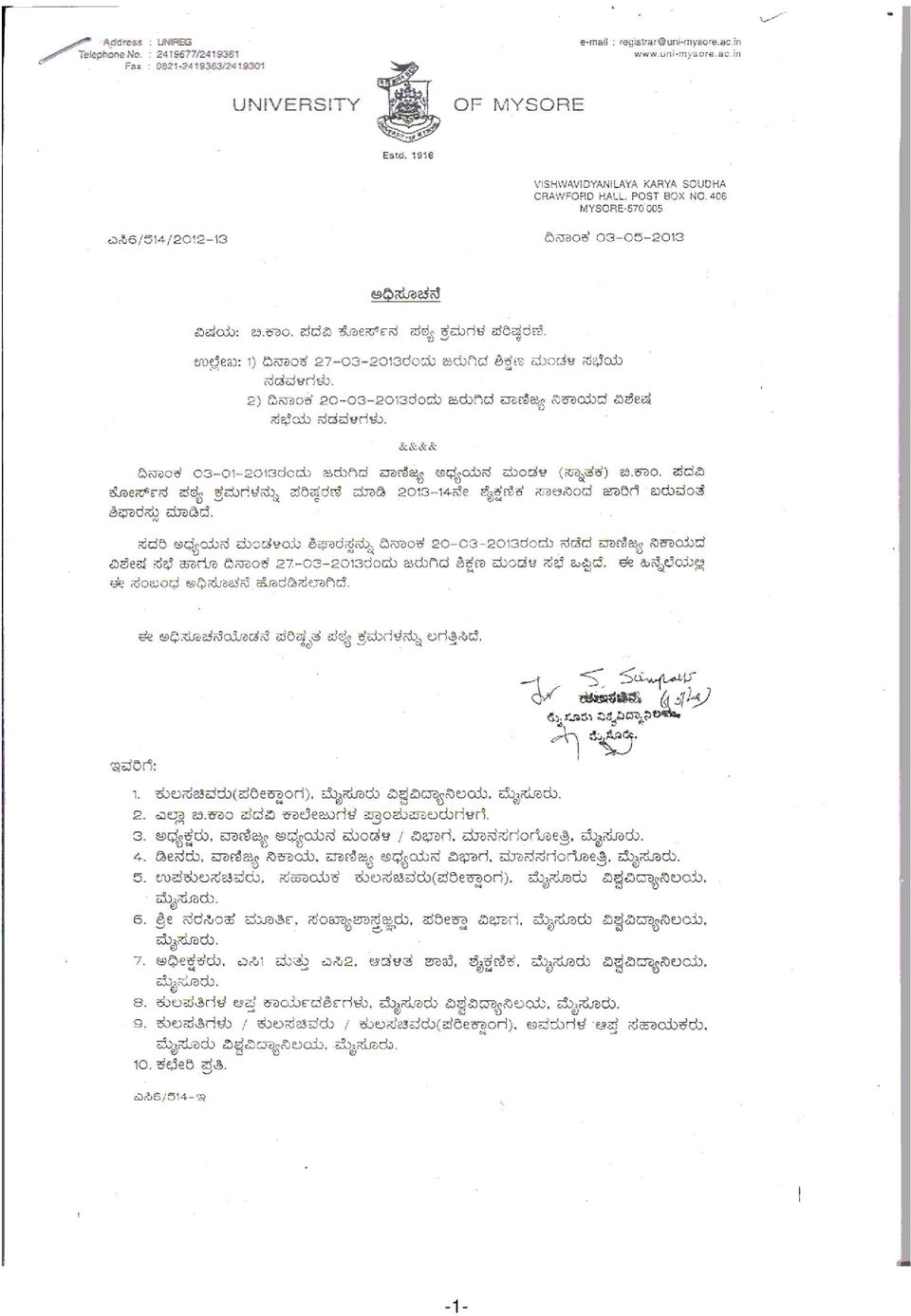
1 -1-
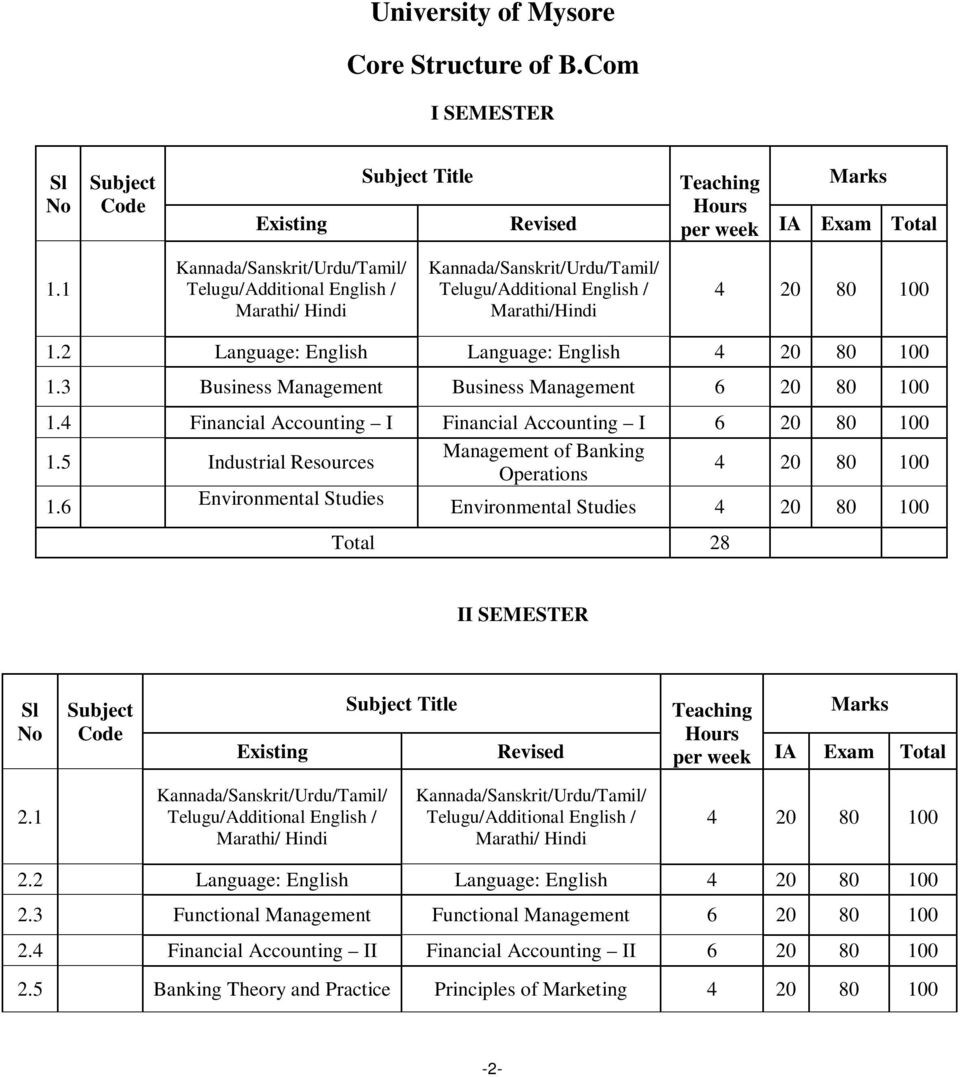
2 University of Mysore Core Structure of B.Com I SEMESTER Sl No Subject Code Subject Title Teaching Marks Hours Existing Revised per week IA Exam Total 1.1 Kannada/Sanskrit/Urdu/Tamil/ Telugu/Additional English / Marathi/ Hindi Kannada/Sanskrit/Urdu/Tamil/ Telugu/Additional English / Marathi/Hindi Language: English Language: English Business Management Business Management Financial Accounting I Financial Accounting I Industrial Resources Management of Banking Operations Environmental Studies Environmental Studies Total 28 II SEMESTER Sl No Subject Code Subject Title Teaching Marks Hours Existing Revised per week IA Exam Total 2.1 Kannada/Sanskrit/Urdu/Tamil/ Telugu/Additional English / Marathi/ Hindi Kannada/Sanskrit/Urdu/Tamil/ Telugu/Additional English / Marathi/ Hindi Language: English Language: English Functional Management Functional Management Financial Accounting II Financial Accounting II Banking Theory and Practice Principles of Marketing
3 2.6 Constitution of India Constitution of India Total 28 III SEMESTER Sl No Subject Code Subject Title Teaching Marks Hours Existing Revised per week IA Exam Total 3.1 Kannada/Sanskrit/Urdu/Tamil/ Telugu/Additional English / Marathi/ Hindi Kannada/Sanskrit/Urdu/Tamil/ Telugu/Additional English / Marathi/ Hindi Language: English Language: English Management Financial Fundamentals of Cost Resources Accounting Financial Accounting III Financial Accounting III Income Tax I Income Tax I Computer Fundamentals Computer Fundamentals Total 28 IV SEMESTER Sl No Subject Code Subject Title Teaching Marks Hours Existing Revised per week IA Exam Total 4.1 Kannada/Sanskrit/Urdu/Tamil/ Telugu/Additional English / Marathi/ Hindi Kannada/Sanskrit/Urdu/Tamil/ Telugu/Additional English / Marathi/ Hindi Language: English Language: English Cost Accounting Corporate Accounting Business Decision Advanced Cost Accounting Income Tax II Income Tax II Computer Application Computer Application

4 Total 28 V SEMESTER Sl No Subject Code Subject Title Teaching Marks Hours Existing Revised per week IA Exam Total 5.1 Business Laws Business Laws Business Statistics Business Ethics Principles and Practices of Auditing Management Accounting Business Mathematics Business Mathematics Elective groups: Paper -I Elective groups: Paper -I Elective groups: Paper -I Elective groups: Paper -I Total 28 VI SEMESTER Sl No Subject Code Subject Title Teaching Marks Hours Existing Revised per week IA Exam Total 6.1 Company Laws Company Laws Quantitative Techniques Quantitative Techniques Management Accounting Principles and Practices of Auditing Entrepreneurial Development Business Statistics Elective groups: Paper -II Elective groups: Paper -II Elective groups: Paper -II Elective groups: Paper -II Total 28-4-

5 IA = Internal Assessment Elective Papers: Elective group (A) Accounting and Finance Paper I Financial Management Elective group (B) Business Taxation Paper I Wealth Tax Service Tax and Luxury Tax Elective group (C) Banking and Insurance Management- Paper-I -Advanced Banking and Regulation Elective group (D) Securities Markets and Investments - Paper-I Stock Market Operations Elective group (E) Marketing Management Paper-I-Retail Marketing Elective group (A) Accounting and Finance Paper II Advanced Financial Management Elective group (B) Business Taxation Paper II Indirect Taxes Elective group (C) Banking and Insurance Management- Paper-II Insurance Management Elective group (D) Securities Markets and Investments - Paper-II-Security Analysis and Portfolio Management Elective group (E)- Marketing Management Paper-II Advertising and salesmanship I SEMETER B.Com BUSINESS MANAGEMENT 6 Hours / Week Unit 1 : Concept of Management-Definitions, Characteristics, Management & Administration, Different Concepts, Management by Communication, Management by Systems, Management by Results, Management by Participation, Management by Motivation, MBE, MBO Functions of management, -5-

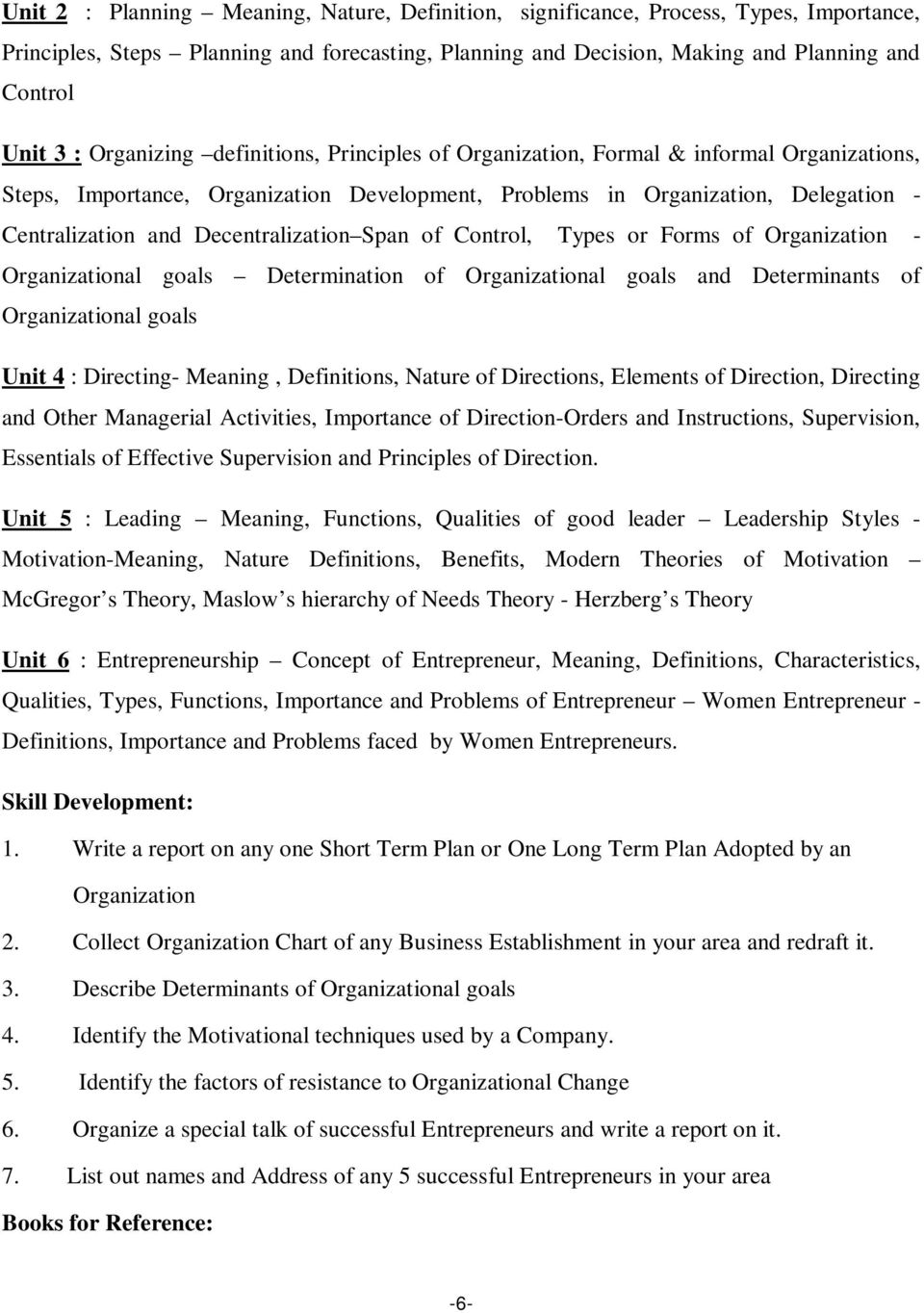
6 Unit 2 : Planning Meaning, Nature, Definition, significance, Process, Types, Importance, Principles, Steps Planning and forecasting, Planning and Decision, Making and Planning and Control Unit 3 : Organizing definitions, Principles of Organization, Formal & informal Organizations, Steps, Importance, Organization Development, Problems in Organization, Delegation - Centralization and Decentralization Span of Control, Types or Forms of Organization - Organizational goals Determination of Organizational goals and Determinants of Organizational goals Unit 4 : Directing- Meaning, Definitions, Nature of Directions, Elements of Direction, Directing and Other Managerial Activities, Importance of Direction-Orders and Instructions, Supervision, Essentials of Effective Supervision and Principles of Direction. Unit 5 : Leading Meaning, Functions, Qualities of good leader Leadership Styles - Motivation-Meaning, Nature Definitions, Benefits, Modern Theories of Motivation McGregor s Theory, Maslow s hierarchy of Needs Theory - Herzberg s Theory Unit 6 : Entrepreneurship Concept of Entrepreneur, Meaning, Definitions, Characteristics, Qualities, Types, Functions, Importance and Problems of Entrepreneur Women Entrepreneur - Definitions, Importance and Problems faced by Women Entrepreneurs. 1. Write a report on any one Short Term Plan or One Long Term Plan Adopted by an Organization 2. Collect Organization Chart of any Business Establishment in your area and redraft it. 3. Describe Determinants of Organizational goals 4. Identify the Motivational techniques used by a Company. 5. Identify the factors of resistance to Organizational Change 6. Organize a special talk of successful Entrepreneurs and write a report on it. 7. List out names and Address of any 5 successful Entrepreneurs in your area -6-
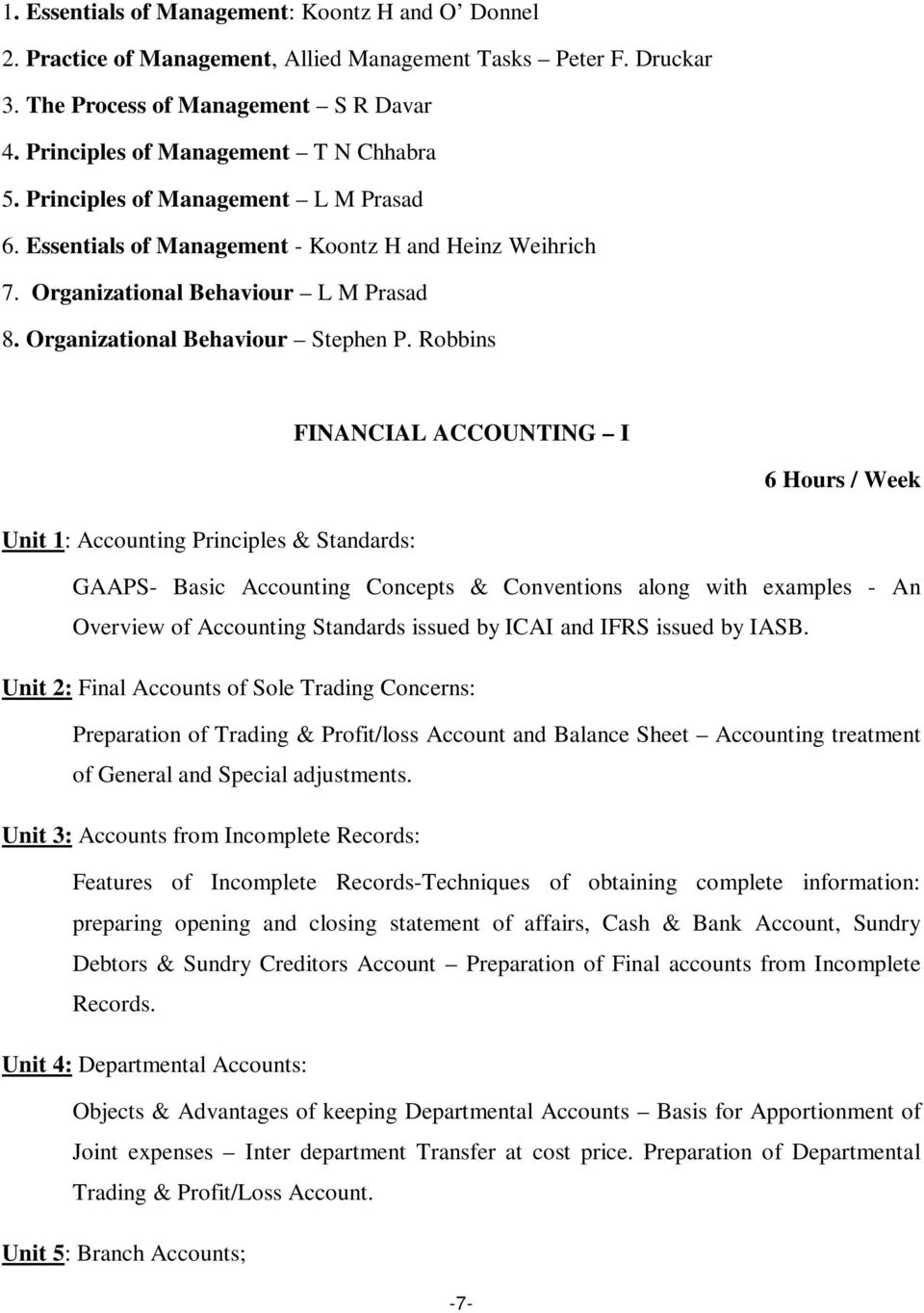
7 1. Essentials of Management: Koontz H and O Donnel 2. Practice of Management, Allied Management Tasks Peter F. Druckar 3. The Process of Management S R Davar 4. Principles of Management T N Chhabra 5. Principles of Management L M Prasad 6. Essentials of Management - Koontz H and Heinz Weihrich 7. Organizational Behaviour L M Prasad 8. Organizational Behaviour Stephen P. Robbins FINANCIAL ACCOUNTING I 6 Hours / Week Unit 1: Accounting Principles & Standards: GAAPS- Basic Accounting Concepts & Conventions along with examples - An Overview of Accounting Standards issued by ICAI and IFRS issued by IASB. Unit 2: Final Accounts of Sole Trading Concerns: Preparation of Trading & Profit/loss Account and Balance Sheet Accounting treatment of General and Special adjustments. Unit 3: Accounts from Incomplete Records: Features of Incomplete Records-Techniques of obtaining complete information: preparing opening and closing statement of affairs, Cash & Bank Account, Sundry Debtors & Sundry Creditors Account Preparation of Final accounts from Incomplete Records. Unit 4: Departmental Accounts: Objects & Advantages of keeping Departmental Accounts Basis for Apportionment of Joint expenses Inter department Transfer at cost price. Preparation of Departmental Trading & Profit/Loss Account. Unit 5: Branch Accounts; -7-
8 Meaning & Types of Branches Objectives of maintaining Branch Accounts by Head office Accounting for Dependent branches under (a) Debtors System (b) Stock & Debtors System Goods invoiced by Head Office at Cost price & at Invoice Price. Unit 6: Rectification of Errors Errors in Accounting Types of errors clerical errors, errors of omission- errors of commission- errors of duplication errors of principle. Locating errors and passing Journal entries for rectification of errors without suspense account. Skill development: 1. Explain any Three Accounting Concepts with suitable examples 2. Preparation of correct final accounts from the given wrong final Accounts. 3. Preparation of Total Debtor accounts and total creditors Account with imaginary figures. 4. Prepare a list of Common or joint expenses and show their basis of apportionment. 5. Pass rectification entries with imaginary errors in entries (at least 10) 6. Visit any branch office of an organization and write a report on their accounting System. 1. Accounting Principles: Anthony, R.N. and Reece, J.S.; Richard Irwin Inc. 2. Financial Accounting: Gupta, R.L and Radhaswamy.M. Sultan Chand and Sons, New Delhi. 3. Financial Accounting; Monga J.R., Ahuja Girish, and Sehgal Ashok: Mayur Paper Back, Noida. 4. Advanced Accounts; Shukla. M.C., Grewal T.S., and Gupta, S.C.: S. Chand & Co. New Delhi. 5. Compendium of Statement and Standards of Accounting: The Institute of Chartered Accountants of India, New Delhi. 6. Higher Sciences of Accountancy: Agarwala A.N., Agarwala K.N.: Kitab Mahal, Allahabad. 7. Financial Accounts, Mishra A.K.: Sahitya Bhawan Publishers and Distributers. 8. Financial Accounting, Jha, B.K.: Kedar Nath & Ram Nath, Meerut

9 10. MANAGEMENT OF BANKING OPERATIONS 4 Hours / Week Unit 1: Banking Meaning and Definition - Role of Banks - Types of Banks--Banking Structure Unit and Branch Banking, Pure and Mixed Banking. Unit 2: Commercial Banks Functions including Modern Services and High-Tech Banking: Internet Banking, ATM, Debit Card and Credit Card. Unit 3: Central Banking Evolution of Central Bank, Functions of Central Bank, Monetary Policy Objectives, Credit Control Methods. Unit 4: Banker and Customer Meaning, Relationship: General and Special, Special Relationship: Obligation to Honor Cheques on demand, Secrecy of Accounts. Bankers Right to combine Accounts and Bankers General Lien - Types of Accounts & Procedure to open a Bank Account. Unit 5: Cheques Definitions, Essentials, Crossing, Endorsements. Paying Banker Payment of Customers Cheques, Precautions to be taken by the Banker.Collecting Banker Duties. 1. Enumerating of Banks in your area and classifying them. 2. Visit a Bank and ATM centre near-by. Collecting details about credit cards and working of ATM and write a report on it. 3. Collection of Loan application form and filling it up. 4. Collection of specimen of Cheques, Demand Drafts. 5. Visit a bank and write the procedure of opening an account and paste filled account opening form. -9-

10 1. Central Banking M.H. De kock 2. Modern Banking M.C. Vaishya 3. Banking Theory & Practice B.S. Raman 4. Banking Theory & Practice Shekhar and Shekhar 5. Banking Theory & Practice in India Varshney and Radhaswamy 6. II SEMETER B.Com FUNCTIONAL MANAGEMENT 6 Hours / Week Unit 1 : Management as a Profession- Role of Management in modern Organization Managerial Skill Challenges Faced by Modern Managers Functional areas of Management Unit 2 : Human Resource Management Meaning, Importance, Human Resource planning, Modern Methods, Recruitment, Selection- training and development. Unit 3 : Marketing Management - Meaning, Definitions, Importance, Scope Marketing Concepts A brief Study of the Areas of Marketing Management. Unit 4 : Office Management Elements, Functions of Office Management, office layout- New trends in Office layout- Administrative Office management Objectives and functions of Administrative Office Manager. Unit 5 : Production Management Importance of Production Management- Plant location, plant layout production planning and control. Unit 6 : Financial Management-Meaning, Definitions, Objectives, Sources of Finance-Role of Financial Manager. 1. List the Challenges faced by Modern Manager 2. Describe the modern methods of selection and training process 3. Evaluate the factors affecting office location -10-

11 4. Briefly describe the functions of Administrative office manager. 5. Explain the role of Financial Manager in the context of globalization 6. Suggest a plan layout for a company of your choice 1. Functional Management: Sharma R K and Shashi K. Gupta 2. Functional Management: O P Gupta, Jain 3. Office Management: R K Chpra 4. Office Organization and Management: S P Arora 5. Financial Management: I.M Pandey 6. Financial Management: Khan and Jain FINANCIAL ACCOUNTING II 6 Hours / Week Unit 1: Accounting for Consignment transactions: Meaning of Consignment Goods sent at Cost Price and at Invoice price Types of Commission format of Account Sales Valuation of goods lost in transit Valuation of stock on Consignment. Unit 2: Accounting for Joint Venture: Meaning of Joint Venture business Distinction between Consignment and Joint Venture Methods of maintaining Joint Venture Accounts when: (a) Separate set of Books of Accounts are maintained (b) No separate set of Books of Accounts are maintained. Unit 3: Accounting for Hire Purchase: Features of Hire Purchase System preparation of Statement Analysis Ascertainment of cash price of an Asset Problems on Hire purchase system (excluding re-possession). Unit 4: Installment System: Meaning - Features - Differences between Hire Purchase and Installment -11-
12 System. Problems on Instalment system. Unit 5: Accounting for Royalties: Meaning Royalty Minimum Rent Short workings Analytical Table Preparation of Ledger Accounts in the books of both the parties. Sub lease (theory only). Unit 6: Financial Statements of Non-Profit Organizations: Meaning and Recognition of Capital & Revenue items Nature of Receipt and Payment Account: Income and Expenditure Account Preparation of Final Accounts. 1. Prepare account sales with imaginary figures 2. List out the areas of business where joint venture from of business can be adopted 3. Calculation of cash price and Interest under hire purchase system with imaginary figures 4. Collection of final accounts of NTC and identifying Capital and revenue items 5. Prepare Royalty Analysis Statement with imaginary figures. 6. State the differences between (a) Consignment and Joint venture (b) Hire purchase and Installment System 1. Accounting Principles; Anthony, R.N. and Reece, J.S.: Richard Irwin Inc. 2. Financial Accounting; Gupta, R.L and Radhaswamy, M: Sultan Chand and Sons, New Delhi. 3. Financial Accounting;. Monga J.R., Ahuja Girish, and Sehgal Ashok: Mayur Paper Back, Noida. 4. Advanced Accounts; Shukla. M.C., Grewal T.S., and Gupta, S.C.: S. Chand & Co. New Delhi. 5. Compendium of Statement and Standards of Accounting: The Institute of Chartered Accountants of India, New Delhi. 6 Higher Sciences of Accountancy :. Agarwala A.N., Agarwala K.N.: -12-

13 Kitab Mahal, Allahabad. 7. Financial Accounts, Mishra A.K.: Sahitya Bhawan Publishers and Distributers. 8. Financial Accounting, Jha, B.K.: Kedar Nath & Ram Nath, Meerut. PRINCIPLES OF MARKETING 4 Hours / Week Unit 1 Introduction, Meaning and Definition of Market, Marketing- Marketing Concepts, Marketing Mix, Marketing environment, Functions of Marketing. Unit 2 Product Concept- Meaning of a Product, Product Plan/Strategy-Product life cycle and Marketing strategy Diffusion (Adoption) of Innovations- New Product idea- New Product Strategy Development -Causes for Failure of a new product. Unit 3 Product Related Strategy Branding-Brand Strategy policy-what is a brand?- Importance of Branding- types of brands - Packing and Packaging and Labeling - Functions of packaging. Unit 4 Channels of Distribution - Middlemen and Distribution- Selection of the type of Channel - Retailing Nature and Importance Non-store retailing-wholesaling and Physical Distribution-Nature and Importance of Wholesaling and Physical Distribution Unit 5 Advertising and Publicity- Meaning- Definition- Importance- -Social and Economic effects of advertising, Advertising Media -Advertising Agency-Advertising Copy and Layout 1. Ask the student to find out the locally manufactured products and write the distribution channel for that product. 2. Give five products ask the students to draw the distribution Channel for that products 3. Give a product ask the students to write PLC of the said product. 4. Give a list of products that have failed in the market ask the students to identify the reasons for failure of such products. 5. Visit a company/ Firm and Draw a Marketing Department chart. -13-

14 6. Divide the students into small groups. Give them one or two products. Ask them to discuss and find out the following a. Alternative/ competing products that have come up in last 10 years b. How that specific products have under gone change/modifications. 7. Organize a talk by a Marketing Manager of a firm and write a report on the talk. Marketing Management --- Philip Kotler Marketing Management --- William J. Stanton Marketing Management --- S A Sherlekar Sales Management --- Chunnawalia Marketing and Salesmanship --- J.C. Sinha III SEMETER B.Com FUNDAMENTALS OF COST ACCOUNTING 4 Hours / Week Unit 1: Introduction : Definition and meaning of cost, costing, cost accounting, cost accountancy; distinction between cost accounting and Financial accounting, objects, functions and limitations of cost accounting, methods and techniques of costing. Unit 2: Elements of cost: classifications of cost, cost centre, cost unit, cost sheet, problems on preparation of cost sheet. Unit 3: Materials: classification and codification of materials, functions of purchase, receiving, inspection and stores departments; stores records, inventory control Techniques; E O Q, stock levels, ABC Analysis, VED Analysis, treatments of wastages, scrap, defectives and spoilage, pricing of materials. Problems on EOQ. Stocks levels, FIFO, LIFO, simple average & weighted average. -14-

15 Unit 4: Labour : time keeping and time booking, methods of remuneration time rate, piece rate, Halsey plan, Rowan plan, idle time causes and treatment, overtime, labour turnover causes, measurement and treatment Frauds in wage payment- steps to check frauds. Problems on time rate, piece rate, Taylor, Halsey & Rowan plan. Unit 5: Overheads: classification of over heads, allocation and apportionment Problems on primary distribution - secondary distribution repeated distribution method only absorption of overheads- methods of absorption- MHR only. 1. Prepare a cost sheet format with opening and closing stocks of materials, work in progress and finished goods with imaginary figures. 2. List out the documents used in materials purchase, storage and issue collect formats and write a brief note on each of them (Any four). 3. Collect the formats of job card, time card etc. and explain the content & purpose. 4. Show a pay roll format with imaginary figures. 5. Prepare Primary distribution summary with imaginary figures Books for reference: 1. Cost Accounting: N.K. Prasad 2. Cost Accounting: Nigam & Sharma : 3. Practical Costing: Khanna Pandey & Ahuja 4: Cost Accounting: M.L. Agarwal 5. Cost Accounting: Jain & Narang 6. Cost Accounting: S.P. Iyengar 7. Cost Accounting: S.N. Maheshwari 8. Cost Accounting: A Managerial Emphasis. Horngren 9. Cost Accounting: M. N. Arora 10. Cost Accounting: Dutta -15-

16 FINANCIAL ACCOUNTING III 6 Hours / Week Unit 1: Accounting for Share Capital: Meaning and Types of shares Issue of Shares at Par/Premium/at Discount Over subscription and Pro-rata Allotment of shares Forfeiture of shares Re-issue of Forfeited Shares Passing Journal Entries & Preparing Balance Sheet. Unit 2: Financial Statements of Limited Companies: Meaning & Contents of financial Statements Part I Form of Balance sheet Part II form of Statement of Profit/Loss Account in Vertical form as per Schedule VI - Dividends; Meaning and declaration of Dividend Interim Dividend, Proposed Dividend, Unclaimed Dividend, Dividend Distribution Tax Theory only. Unit 3: Accounting for Redemption of Preference Shares & Bonus Issue: Conditions for Redemption of Preference Shares and Accounting procedure for Redemption meaning of Bonus Shares & Bonus Issue SEBI Guidelines for Bonus Issue Accounting entries for issue of Bonus shares. Unit 4: Liquidation of Companies: Meaning and Circumstances of liquidation Preparation of Liquidators Final statement of Accounts. Unit 5: Issue & Redemption of Debentures: Meaning and Types of Debentures methods of Redemption of Debentures Journal entries for issue of debentures and Conditions for Redemption Sources of Redemption of debentures and financing of Redemption of Debentures (Theory only). Unit 6: Valuation of shares and Goodwill. -16-

17 1. Collection of Share Application form of a company and filling it up 2. Collection of final Accounts of a Company and redrafting Balance sheet. 3. Based on the collected final Accounts of a company calculate intrinsic value of equity shares. 4. Preparation of Liquidator s final Statement of Account with imaginary figures 5. List the SEBI guidelines for issue of Bonus shares. 6. Collection of Debenture Certificate and redrafting it. 1. Accounting Principles; Anthony, R.N. and Reece, J.S.: Richard Irwin Inc. 2. Financial Accounting; Gupta, R.L and Radhaswamy, M: Sultan Chand and Sons, New Delhi. 3. Financial Accounting;. Monga J.R., Ahuja Girish, and Sehgal Ashok: Mayur Paper Back, Noida. 4. Advanced Accounts; Shukla. M.C., Grewal T.S., and Gupta, S.C.: S. Chand & Co. New Delhi. 5. Compendium of Statement and Standards of Accounting: The Institute of Chartered Accountants of India, New Delhi. 6. Higher Sciences of Accountancy :. Agarwala A.N., Agarwala K.N.: Kitab Mahal, Allahabad. 7. Financial Accounts, Mishra A.K.: Sahitya Bhawan Publishers and Distributers. 8. Financial Accounting, Jha, B.K.: Kedar Nath & Ram Nath, Meerut. INCOME TAX I 6 Hours / Week Unit -1: Introduction to Income Tax - Important Terms Person, Income, Assessment Year, Previous Year, Assessee, Gross Total Income, Total Income, Finance Bill- Exempted Incomes- Residential Status and Incidence of Tax (Individuals only) -17-
18 Unit-2: Heads of Income Income from Salary - Features of Salary Income-Basic Salary, Allowances, Perquisites, PFs - Retirement Benefits - Gratuity, EL, Commutation of Pension Deductions U/S 16 - Problems on Income from Salary. Unit-3: Computation of Income from House Property- Deemed Owners Exempted Incomes Annual Values Determination of Annual Values under Different situations Deductions - Practical Problems. Unit 4: Capital Gains- Types of capital Assets- Transfer- Cost of Acquisition, Cost of Improvement - Selling Exps.- Deduction U/S 54 Problems Unit 5: Income from other sources:- Kinds of Securities Cum-Interest and Ex-Interest Transactions- Bond washing Transactions Deduction of Tax at source Grossing Up Totally Exempted Interest an securities- Deductions U/S 57 Problems. Unit 6: Set off of Losses Carry forward and set off of losses Order of set off (Theory only) Deductions under Chapter VI A - 80C, 80CCC, 80CCD, 80CCE, 80CCF, 80D, 80DD, 80DDB, 80E, 80G, 80GG, 80GGB, 80QQB, 80RRB, 80U. Assessment of Individuals (Who is not a Businessman or a Professional) 1. Collection of salary certificate of an employee. 2. PAN Filling of Form No: 49A (For Individuals) 3. Filling of Form No Due dates for filing return of income and filling of tax payment challan for all kinds of assessees 5. Preparation of perquisites n and allowances chart 6. Organizational chart of IT office. 1. IT Law and Practice V P Gaur, D.B. Narang & Others (Kalyani Publishers) 2. IT Law and Accounts Dr. H C Mehrotra & Dr. S P Goyal (Sahitya Bhavan Publications) -18-
19 3. Problems and Solutions in Income Tax : Dr. H C Mehrotra & Dr. S P Goyal (Sahitya Bhavan Publications) 4. IT Law and Practice Dr. Bhagawathi Prasad (Vishwa Prakashan) 5. Direct Taxes B.B Lal (Konark Publishers) 6. IT Law and Practice - M.B Kadkal (Renuka Prakashan) 7. IT Law and Practice - Dinkar Pagare (Sultan Chand & Sons) 8. Direct Taxes Law and Practice Dr. V.K. Singhania (Taxmann Publications) 9. Government of India Income Tax Manual COMPUTER FUNDAMENTALS 4 Hours / Week Unit 1 : Introduction to Computer Uses of Computers in Business Overview of Technology and Organization Computer Hardware Types, Parts and their functions-software: System Software-Application Software Unit 2 : Office productivity Tools Word Processing Electronic Spreadsheets Business Project Management and Presentation Tools. Unit 3: Data Processing Techniques of data processing: online, Batch mode real time Processing Software tools and applicability to organization setup Unit 4: Database Structure Types and Comparison Data access control software Methods and structure of Data Base management Data storage and retrieval current and most frequently used Reporting systems, Management Systems and Languages. Unit 5: telecommunications and Networking Network Design LAN /WAN/ SAN Networking structure needed for a Business Organization Data Transmission methods Internet , Chatting and video conferencing Web browsers, Search engines Skill Development/Practical: 1. Visit a Browsing center/cafe and make a list of Hardware and Software used by them. -19-
20 2. MS-WORD (a). Preparing a neat aligned, error free document, add header and footer, also perform find replace operation and define bookmarks. (b). Preparing documents with special effects and adding new Symbols and frames. (c). Preparing documents with insert pictures. (d). Adding Tables. (e). Preparing the documents in newspaper column layout. (f). Perform mail merger operation and preparing labels. (g). Type the text; change the font size at 20. Align the text to left, right and justify and centre and underline the text. (h) Prepare a job application letter enclosing your bio-data. (i) Type the text, check spelling and grammar, bullets and numbering list items. 3. MS-EXCEL (a). Entering and printing worksheet (b). Worksheet Using formulas (c). Worksheet Manipulation for electricity bill preparation (d). Drawing graphs to illustrate class performance (e). An excel worksheet contains monthly Sales Details of five companies. 1. Create a table student with the following fields student_id, name, address, city, state, pincode, remarks, sub1_marks, sub2_marks, sub3_marks with suitable data types. (a) Create another table student_marks from student. Select sub1_marks, sub2_marks, sub3_marks fields from student. b) Insert data into student c) Insert data into student_marks d) Delete the selected row in the student. 5. Create a table student_master with the following fields name, regno, dept and year with suitable data types. Use Select command to do the following. a) Select the student s name column. -20-

21 b) Eliminate the duplicate entry in table. c) Sort the table in alphabetical order. d) Select all the Students of a particular department. 6. Prepare a list of Hardware and Software used in Networking 7. Filing of online application for PAN, TAN. 1. Computer Fundamentals: Rajaram (PHI) 2. Computer Fundamentals: Shiva (BPB) 3. Computer Fundamentals and Architecture: Ram (New Age) 4. Data Base Management System: Karth (McGraw Hill) 5. Computer Networks: Tenevaum (PHI) IV SEMESTER B.Com CORPORATE ACCOUNTING 6 Hours / Week Unit 1: Accounting for Amalgamation: Meaning of Amalgamation, Provisions of AS14 Merger & Acquisition. Methods of Accounting for Amalgamation: (a) Pooling Interest Method (b) Purchase method. Meaning and methods of computing Purchase Consideration. Ledger accounts in the books of Transferor Company- Opening entries and Balance sheet in the books of Transferee Company. Unit 2: Internal Reconstruction: Meaning & Objectives of Internal Reconstruction - Methods of Internal Reconstruction Accounting entries for Internal Reconstruction under Capital Reduction Method. Unit 3: Accounting for Banking Companies (as per new regulations) Unit 4: Accounting for Life Insurance companies (as per IRDA Regulations). -21-
22 Unit 5: Accounting for General Insurance companies (as per IRDA Regulations) (Fire Marine). and Unit 6: Accounting for Holding Companies: Preparation of Consolidated Balance sheet of Holding with one Subsidiary Minority Interest Computation of Goodwill/Capital Reserve Revaluation of Assets of subsidiary. 1. Calculation of Purchase Consideration and its discharge under Net Assets Method with imaginary figures. 2. Calculation of Cost of Control Minority Interest with imaginary figures. 3. Collection of Final Accounts of Banking Companies and identifying the schedules and redrafting them (at least THREE). 4. Listing of Life Insurance Policies and the Bonus applicable. 5. Preparation of Valuation Balance Sheet with imaginary figures and preparation of Statement of Distribution of Surplus. 6. Collecting General Insurance Claim Form and filling it with imaginary information and figures. 1. Accounting Principles; Anthony, R.N. and Reece, J.S.: Richard Irwin Inc. 2. Financial Accounting; Gupta, R.L and Radhaswamy, M: Sultan Chand and Sons, New Delhi. 3. Financial Accounting;. Monga J.R., Ahuja Girish, and Sehgal Ashok: Mayur Paper Back, Noida. 4. Advanced Accounts; Shukla. M.C., Grewal T.S., and Gupta, S.C.: S. Chand & Co. New Delhi. 5. Compendium of Statement and Standards of Accounting: The Institute of Chartered Accountants of India, New Delhi. 6 Higher Sciences of Accountancy :. Agarwala A.N., Agarwala K.N.: Kitab Mahal, Allahabad. 7. Financial Accounts, Mishra A.K.: Sahitya Bhawan Publishers and Distributers. -22-
23 8. Financial Accounting, Jha, B.K.: Kedar Nath & Ram Nath, Meerut. ADVANCED COST ACCOUNTING 4 Hours / Week Unit 1: Output or unit costing Introduction- statement of cost- preparation of estimation- tenders and quotations. Unit 2: Contract costing introduction- contract account - profit on incomplete contracts - work in progress- Contractee s Account Escalation Clause. Unit 3: Process costing- introduction, distinction between job costing and process costing, process losses; inter process profits, process accounts. Joint products and By -products Difference between joint products: methods of assigning joint cost, accounting for By- products. Unit 4: Operating costing introduction, transport costing, standing charges, operating and running cost. Preparation of operating cost sheet, calculation of passenger kms / ton kms. Unit 5: Reconcilation of cost and financial Accounts Need for reconciliation, reasons for disagreement, reconciliation procedure, Problems on reconciliation. 1. Listing of industries located in your area and methods of costing adopted by them. 2. Calculation of profit transferable to P & L A /C, when the contract is not complete. 3. Valuation of abnormal loss and abnormal gain with imaginary figures. 4: Preparation of reconciliation of statement with imaginary figures. 5. Collect the format of log sheet from a transport service operator and show their content & purpose. 6. As a printer, quote the price of 2000 copies skill development records which your college principal would like to order. 1. Cost Accounting: N.K. Prasad 2. Cost Accounting: Nigam & Sharma : -23-
24 3. Practical Costing: Khanna Pandey & Ahuja 4: Cost Accounting: M.L. Agarwal 5. Cost Accounting: Jain & Narang 6. Cost Accounting S.P. Iyengar 7. Cost Accounting: S.N. Maheshwari 8. Cost Accounting: A Managerial Emphasis. Horngren 9. Cost Accounting: M. N. Arora 10. Cost Accounting: Dutta INCOME TAX II 6 Hours / Week Unit 1: Profits and Gains of Business or Profession - Meaning and Definition of Business, Profession Expenses Expressly Allowed Allowable Losses - Exps: Expressly Disallowed etc., - Problems on:- a) Business Relating to Sole Trader only b) Profession - Relating to CA, Advocate/ Lawyer Doctor / Medical Practitioner. Unit 2: Depreciation Meaning Conditions- Block of Assets Problems on Computation of Deprecition U/S 32. Unit 3: Assessment of Firms- Definitions Book Profit, Working Partner Provision of sections 184 and 40(b) Treatment of firm s losses Computation of Total Income and Tax Liability of Firm and Computation of Taxable Income of Partners. Unit 4: Assessment of Companies - normal computation only. Unit 5: Tax Deduction at Source Advance Payment of Tax Interest U/S 234C only Unit 6: Assessment Procedure Kinds of Assessments Interest U/S 234C only -24-
25 1. PAN Filling of Form No. 49A (other than Individuals) 2. TAN Filling of Form No. 49B 3. Filling of challan for making payment of taxes (Corporate assesses) 4. Filling of Form No. 16A and 15H 5. Different kinds of notices U/s, 142, 143, 144 and Filling of Returns of Income (Other than Individuals) IT Law and Practice V P Gaur, D.B. Narang & Others (Kalyani Publishers) IT Law and Accounts Dr. H C Mehrotra & Dr. S P Goyal (Sahitya Bhavan Publications) Problems and Solutions in Income Tax : Dr. H C Mehrotra & Dr. S P Goyal (Sahitya Bhavan Publications) IT Law and Practice Dr. Bhagawathi Prasad (Vishwa Prakashan) Direct Taxes B.B Lal (Konark Publishers) IT Law and Practice - M.B Kadkal (Renuka Prakashan) IT Law and Practice - Dinkar Pagare (Sultan Chand & Sons) Direct Taxes Law and Practice Dr. V.K. Singhania (Taxmann Publications) Government of India Income Tax Manual COMPUTER APPLICATIONS 4 Hours / Week Unit 1: Review of Electronic Spread Sheet Data Base data Processing Analysis of Logic in Design Process. Unit 2 ; System Analysis and Design: Project Management Gant Chart Role of PERT /CPM Data Flow Diagram Critical Path Analysis-Project Life Cycle-Project Cost Estimation Unit 3: Computer Based Accounting and Auditing Package-General Awareness and Application of particular Package (for Example Tally Peach tree and Quick Book) Unit 4 : Computer Based Statistical Package-General Awareness and Application of a Particular Package(for example SPSS) -25-
26 Unit 5: Cyber Ethics: An overview of Major Provisions of Cyber laws and Information Technology Act. Skill Development/Practical: 1. Prepare a list of Application Software s and its uses that are used in Business Organization 2. Create a Data flow diagram of a Business Project. 3. Completing accounting cycle using Tally. 4. Computation of Descriptive statistics using SPSS Package 5. Organize a talk by Project Manager and write a report on the talk 6. Create a Gant Chart of a Business Project using MS-Project. 7. Write a report on measures taken by a Business Organization to mitigate cyber crime. 8. List the pictures used in flow chart and Data flow diagram. 1. Computer Systems and Application: Rustam Shroff 2. Computer architecture and organization: Heys McGraw hill 3. Information system for Modern Management: Murdick R (PHI) 4. E-Commerce-Concepts and Modern Strategy: Murthy CSV Himalaya 5. Database Management System: A lexis Leon and Mathew lean (Vikas) 6. Internet for everyone: Leon 7. Internet-complete reference: Peterson(TMH) V SEMETER B.Com BUSINESS LAWS 4 Hours / Week Unit-1: Introduction to Indian Contract Act 1872-Definition of Contract Essentials of a valid contract-classification of contract-quasi contractual obligations. -26-
27 Unit-2: Offer and Acceptance-Rules of valid offer and acceptance- Communication and revocation of offer and acceptances- Contractual capacity- Free consent; Coercion-undue influence-fraud- misrepresentation-mistake. Unit-3: Consideration-Rules of valid consideration-contracts without consideration-stranger to contract -Legality of object and consideration - Contracts opposed to public policy-void agreements Unit-4: Discharge of contract- Remedies for breach of contract Unit 5: Laws of contract of indemnity and guarantee, Bailment and pledge, Agency 1. Any two case studies relating to any legal judgment on any provisions of contracts Act. 2. Students may be asked to visit a court and prepare a report on their visit. 3. Arrange a professional lecture by inviting a Practicing lawyer and students to write a report on the topic of the lecture. 4. Draft a chart showing different kinds of agencies 5. Draft any one agreement (Ex : Sale deed, Gift Deed, Rent deed/ Indemnity Bond). 1. Business Law: Tulsian Tata McGraw Hill, New Delhi. 2. Business Law: Aswathappa. K & Ramachandra, HPH, Mumbai. 3. Business Law: Kapoor N.D. - Sultan Chand and Co. 4. Bare Acts. 5. Business Law: Nabhi - Indian Law House, Mumbai. 6. Business Law-. Garg, Sareen, Sharma and Chawla - 7. Business Law: M.C. Kuchhal -27-
28 BUSINESS ETHICS 4 Hours / Week Unit 1: Nature of Business Ethics Introduction Meaning- Religion and Ethics Morals and Ethics Ethics in Management Ethics in Business Importance of Ethics in Business. Unit 2: Value Systems Introduction Values Moral Standards Source of Ethics Nature and objectives of Ethics A Holistic view of values and Ethics Categorization of values Moral values. Unit 3: Values for Indian Managers Need for business Ethics Universal criteria Indian value system and Business Ethics- Ethical problems faced by the managers Impact of ethics on managerial performance Value Driven stakeholder management. Unit 4: Professional Ethics for Functional Managers Comparative Ethical behavior of Managers Code of Ethics Competitiveness and Ethics Organizational Size and Ethics Cost of Ethics. Unit 5: Modern business Ethics and Dilemmas Right in theory, Does Ethics work in business? Legal vis- a -vis Ethical Corporate social responsibility and Ethics - Corporate Governance and Ethics 1. Collect corporate ethical code of any one organization 2. List the steps in resolving ethical dilemma in the office you visited. 3. List the ethical problems faced by the manager in an organization 4. Collect Corporate Social Responsibility policy of any one company and write a report on it 5. Write a report on the role of Chamber of Commerce in developing Business Ethics. 6. Organizing a talk on Ethical Values/Code and Writing a report on it. -28-
29 2. Business Ethics, Ravindranath V. Badi & Narayanasa V.Badi Vrinda Publications. 3. The Ethics of Management. Larue Tone Hosmer and Richard D Irwin Inc. 4. Business Ethics: W H Shaw MANAGEMENT ACCOUNTING 4 Hours / Week Unit 1: Introduction Meaning and Definition of Management Accounting Scope and Objectives of Management Accounting Differences between Management Accounting and Financial Accounting Management Accounting and Cost Accounting- Limitations of Management Accounting. Unit 2: Analysis of Financial Statements Ratio Analysis: Meaning and Objectives Types of Ratios (A) Profitability Ratios Gross Profit Ratio/ Net Profit Ratio/ Operating Ratio/Operating Profit Ratio/Return on Capital Employed Ratio/ Earning Per Share (B) Turnover Ratios - Working Capital Turnover Ratio/Stock Turnover Ratio/Fixed Assets Turnover Ratio/Debtors Turnover Ratio/ Creditors Turnover Ratio (C) Financial Ratios Current Ratio/ Liquidity Ratio/ Debt Equity Ratio/ Proprietary Ratio/Capital Gearing Ratio Advantages and Limitations of Financial Ratios. Unit 3: Marginal Costing Definition Basic Concepts Assumptions Marginal Cost Statement Contribution Break Even Analysis P/V Ratio Margin of Safety Decision Areas Make or Buy and Pricing. Unit 4 : Budget and Budgetary Control Definition Basic Concepts Budget Manual Key Factor Classification of Budgets Problems on Sales Budget and Flexible Budget Zero Base Budget ( Theory Only). Unit 5: Standard Costing Definition Difference between Standard Costing and Budgetary Control Variance Analysis Problems on Material and Labour Variances (Excluding Mix and Yield Variances) -29-
30 1. Collection of Financial Statements of an Organization for two years and calculating GPR/NPR/Current Ratio/Liquidity Ratio/Debt-Equity Ratio. 2. Identifying Fixed and Variable Cost components from the Financial Statements Collected. 3. Calculation of Contribution / P/V Ratio /BEP based on the collected Financial Statements. 4. Calculation of Material Cost Variances and Labour Cost Variances using imaginary figures. 5. Preparation of Sales Budget for THREE divisions with imaginary figures. 6. Preparation of Flexible Budget with imaginary figures. 1. Management Accounting- Sharma and Gupta 2. Management Accounting -S.N.Maheshwari 3. Management Accounting -Saxena 4. Management Accounting- Goyal and Manmohan 5. Management Accounting -Pillai and Bhagavathi BUSINESS MATHEMETICS 4 Hours / Week Unit 1: Indices and Logarithms: Meaning- Basic Laws of Indices and their application for simplification. Laws of Logarithms Common Logarithm, Application of Log Table for Simplification. Unit 2: Progressions: Meaning of Sequence, progression; Types of Progressions; Arithmetic progression and Geometric Progression General terms & Sum of n terms of Arithmetic Progression and Geometric Progression Application problems on Arithmetic Progression and Geometric Progression. -30-
31 Unit 3. Ratio, Proportion, Variation and percentages and their application. Unit 4: Simple Interest and Compound Interest Bills discounting Meaning Concepts; Bankers discount, True discount, Bankers gain and present worth of Bill. Unit 5: Calculus: Meaning of Functions and Calculus, Application of Calculus to compute Cost, Revenue and Profit functions. 1. Using log table, find out rate and time in compound interest problem. 2. Application of AP&GP to solve business problems. 3. Application problems on Ratio and Proportion. 4. Computing monthly/quarterly/half yearly compound interest on FD or loan amount. 5. Finding BD, TD, BG, DV, & PV on Bills Discounting. 6. Application problems by using differential calculus. 1. Business Mathematics: Sanchethi & Kapoor: 2. Business Mathematics: P.R.Vittal: 3. Business Mathematics : Dr. B.H. Suresh 4. Business Mathematics: Madappa and Sreedhararao 5. Business Mathematics: S.P.Gupta 6. Business Mathematics : Dorairaj: 7. ICAI Quantitative Optitude. 8. Quantitative Technique: Digambar patri & DN Patri 9. Business Mathematics: R. Jayaprakash Reddy & Mallikarjuna Reddy 10. Quantitave Technique: Sathish Chandra Srivastav -31-
32 ELECTIVE GROUP (A) : ACCOUNTING AND FINANCE PAPER I FINANCIAL MANAGEMENT 6 Hours / Week Unit 1: Corporate Finance Meaning Scope Objectives Sources of Corporate Finance. Unit 2: Working Capital Management - Meaning - Components - Nature and Kinds - Determinants of Working Capital - Estimation of Working Capital Requirements. Unit 3: Cash Management - Meaning - Objectives - Need for Cash - Motives for Holding Cash - Cash Planning - Cash Forecasting - Preparation of Cash Budget. Unit 4: Cash Flow Statement [ as per AS-3] Unit 5: Fund Flow Statement. Unit 6: Capital Budgeting - Meaning - Process of Capital Budgeting - Techniques of Capital Budgeting - Problems on ARR - Pay Back Period - Discounted Pay Back Period - Net Present Value Technique. 1. Identify the decision areas in which a Financial Manager has a role to Play. 2. Estimate working capital requirements for a business enterprise with imaginary figures. 3. List out Fund and Non-Fund items. 4. Prepare a Cash Budget for a company with imaginary figures 5. Write an imaginary optimum capital structure of a company 6. Collecting a Balance Sheet of a Company and preparing a statement showing changes in Working Capital. -32-
33 1. Financial Management I.M.Pandey. 2. Financial Management Kulkarni 3. Financial Management Ravi Kumar 4. Financial Management Dr.V.R.Palanivelu ELECTIVE GROUP (B) : BUSINESS TAXATION PAPER I WEALTH TAX, SERVICE TAX AND LUXURY TAX 6 Hours / Week Unit 1: Wealth Tax Introduction Definitions Assets Valuation Dates Year Net Wealth Debts. Assessment Unit 2: Deemed Assets Exempted Assets Valuation of Assets (Immovable Property and Jewellery) Unit 3: Computation of Net Wealth and Wealth Tax Liability. Unit 4: Service Tax Introduction- Negative list Filing of Return Service Tax Authorities Computation of Service Tax (a) Advertising Agency Service (b) Banking and Other Financial Services (c) Cable Operator Service (d) Courier Service (e) Franchise Service [Theory Only] Unit 5: Computation of Service Tax of (a) Chartered Accountant (b) Stock Broker s Service (c) Travel and Tour Operator Service (d) Transport of Goods by Road Service [Theory Only] (e) General Insurance Service [ Theory only] Unit 6: Luxury Tax Introduction Registration- Levy of taxes on Luxuries provided in Hotels, Lodging Houses, Health Clubs and Marriage Halls Computation and Payment of Tax. 1. Collection and filing of Wealth Tax Return Form. 2. Identifying Deemed Assets, Exempted Assets and Taxable Assets from the given mixed lot of Assets. 3. Filling and filing of Service Tax Challan form ST- 1 and ST Make a list of Commercial Establishments rendering the Services subject to Service Tax. -33-
34 5. Prepare an abstract on recent development with regard to Wealth Tax, Service Tax and Luxury Tax 6. Organize a special talk by Chartered Accountant and write a report on it. 1. Wealth Tax Dr. H.C. Mehrothra 2. Wealth tax Dr. Bhagwathi Prasad 3. Wealth Tax V.K.Singhania 4. Business Taxation K.Sadashiva Rao 5. Wealth Tax, Service Tax and Luxury Tax A.R. Chavan 6. Service Tax R. Mohan 7. Service tax Rules Taxman Publication 8. Karnataka Luxuries Tax Bare Acts and M.C. Kothari ELECTIVE GROUP(C): BANKING AND INSURANCE MANAGEMENT PAPER-I ADVANCED BANKING AND REGULATION 6 Hours / Week Unit 1: Banking Operations : Definition of a Bank Functions of Banker: Raising of funds by various Deposit Schemes - Lending of Money: Cash Credit Overdraft-Loans-Purchasing and Discounting of Bills -Agency Services: Collection and Payment-Execution of Standing Orders Collection of Dividend and Interest. Unit 2: Role of Central Bank- Policy Framework for RBI - RBI and Monetary Policy- Regulation and Supervision of Banking system - Maintenance of CRR SLR - Interest Rate Policy. Unit 3: Banking Regulation Act, 1949 (Definition of Banking, Licensing, opening of branches, Functions of Banks, Inspection ) Narasimman Committee Report I and II Prudential norms: Capital Adequacy norms. -34-
35 Unit 4: Latest Developments in Banking-Retail Banking-Risk Exposure of Banks- NPAs Sets- Banks Foreign Business-Customer Service Micro-finance-Mobile Banking. Unit 5: Technology in Banking: Computerized Banking, WAN, LAN, VSAT, Networking system Single Window concept Usage of ATM Advantages, Limitation Anywhere Banking Anytime Banking Home Banking Internet Banking PIN ATM card Debit card Smart card Credit card CTS 10(Cheques Truncated System) -Electronic Funds Transfer System. Unit 6 : Non-Bank Financial Intermediaries-Small Savings Provident Funds-LIC-Objectives and Functions of LIC UTI - Objectives and Functions of UTI 1.Visit a bank and collect brochures about various deposit and loan schemes of the bank 2. Visit the main branch of a nationalized bank and collect the information about: The following and write a brief note of each one of them. (a). Facilities offered to customers (b) CTS -10 (c) Mobile Banking (d) Core Banking (e) Online banking 3. Visit a bank and collect forms relating to deposit/withdrawal of cash, deposit of cheques,..etc 4. Consult a bank manager and learn about the procedure for declaring an asset as NPA and write a report on it. 5. Visit a bank and learn how to avail safe-deposit lockers and write down the procedure. 6. Visit LIC and UTI and Collect information about their financial activities. 7. Organize Bank Day arranging for exhibition with different forms used in a bank invite a banker and arrange for a talk write a report on the talk. -35-
36 1. Banking, Theory Law and Practice: Sundaram and Varshney Sultan chand & sons; Business Economics-II, Chaturvedi D.D., Anand Mittal Brijwasi Book Distributors; Principles of Banking: Varshney & Malhotra,,Sultan Chand & Sons, Money, Banking and International Trade, Vaish M.C New Age International Pvt.Ltd, Banking, Theory, Law & Practice: Gordon.E, Natarajan.K Himalaya Publishing House, Financial Institutions and Markets : Bhole.L.M McGraw Hill ELECTIVE GROUP(D) : SECURITIES MARKETS AND INVESTMENTS PAPER I STOCK MARKET OPERATIONS 6 Hours / Week Unit 1: An overview of financial markets in India. Money Market: Indian money market - composition and structure; (a) Acceptance houses (b) Discount houses and (c) Call money market; Recent trends in Indian money market. Unit 2: Capital Market: Securities market (a) New issues (Primary) market. (b) Secondary market: Functions and role of stock exchanges: listing procedure and legal requirements: Public Issue pricing and marketing: Stock exchanges National Stock Exchange-Bombay Stock Exchange Unit 3: Brokers, Sub-brokers, market makers, jobbers, and NRIs. Features of OTCEI-Promoters- Participants-Trading in OTCEI Exchange. Unit 4: Securities Contract and Regulations Act- SEBI-Objectives-Functions-Power Organization-Bonus issue-rights Issue -Debentures-Underwriters-Book Building-Buyback of Shares-Sweat Equity. Unit 5 : Growth of equity markets-importance-stock Indices-SENSEX-NIFTY-Role of Banks and NBFIs in Equity Market-Role of FIIs Drawbacks of Indian Stock Markets Unit 6: Markets for Futures, Options and Other Financial Derivatives : Introduction-Derivative: Meaning, Types, and Uses-Types of Derivatives-Futures-Futures V/S Forwards Options- -36-
37 General Features Types of Options-Benefits for Option-holders-Swaps- General Features-Types of Swaps-Warrants and Convertibles 1. Collect share application forms by visiting a stock trading agency firm and fill it up. 2. Meet a stock broker and enumerate the steps for trading of shares in a stock exchange. 3. Make a list of NIFTY Companies and BSE Companies. 4. Visit Investor Protection Cell of Bangalore Stock Exchange in Mysore and Collect information about investor grievances and write a report. 5. Prepare a Note on the computation of NIFTY and SENSEX indices. 6. Collection of prospectus of selected company issued as part of Initial Public offer. 1. Financial Markets and Institutions: Bhole I. M.: Tata McGraw Hill, New Delhi. 2. Economics of Money and Banking: Chandler M. V. and Goldfeld S. M: Harper and Row, New York. 3. Monetary Economics: Gupta Suraj B: S. Chand and Co., New Delhi 4. Monetary Planning in India: Gupta Suraj B: Oxford, Delhi. 5. Risk Management: Insurance and Derivatives : Dr.Kotreshwar.G ELECTIVE GROUP (E): MARKETING MANAGEMENT PAPER-I RETAIL MARKETING 6 Hours / Week Unit 1: Introduction to Retail Marketing Meaning, Nature, Classification - Factors Influencing Retailing - Functions of Retailing - Retail Environment the growing importance of Retail Industry - Retail as a Career. Unit 2: Retail Organization - The changing structure - Classification of Retail Units - Retail Formats: Corporate chains, Retailer Cooperatives and Voluntary systems, -37-
38 Departmental Stores, Discount Stores, Super Markets, Mega Markets, Malls, Warehouse Clubs. Unit 3 : Consumer behavior in the retail context - buying decision process its implication for retail management Unit 4 : Retail Marketing Mix Merchandise Management Varity of Merchandising Mix Merchandising Private Brands National brands - Pricing and Promotion in Retail Marketing- Concept of Life cycle in Retail - - Retail Models and Theory of Retail Development - Business Models in Retail. Unit 5 : Stores Location & Layout Interior & Exterior Design Store Management - Responsibilities of Stores Manager - Store Security - Store Record &Accounting System - Material Handling in Stores -Parking Space Problem at Retail Centers Unit 6 : Emergence of Organized Retailing - Traditional and Modern retail formats in India - Retailing in Rural India - Environment and Legislation For Retailing - FDI in Retailing - Consumerism and Ethics in Retailing International retail structures Future of Retailing. 1. Enumerate and Describe the various Retail Marketing Establishments in your area, 2. Prepare an album with photographs of Super Markets and Mega Markets in your area. 3. Visit a Shopping Mall in your area and take a survey of the behavior of 10 customers visiting the mall on a particular day towards a product of your choice. 4. Make a comparative study of pricing and promotion activities carried out by retail outlets in your area for atleast five products 5. Describe the Layout of a Mega Market in your area and make suitable suggestions for change if required. 6. Do you think that retail outlets in your area are failing to uphold ethics in retailing? Discuss with examples. 7. Arrange for a talk on Retail Marketing by inviting CEO of any Mall or Manager of a firm. The Art of Retailing : A. J. Lamba Retailing Environment - Andrew J. Navman and Peter Cullon -38-
39 Retail Management : Barry Berman Retailing Management - SwapanaPradhan Retailing - Patrick M. Nunne, Robert F. Lusch and David A Griffith Retail Marketing Management - Dravid Gilbert Marketing Strategy - A. Nag. Principles of Marketing - Sherlekhar, Dr. K. NirmalaPrasand and S.A. Salvardine Victor. VI SEMETER B.Com COMPANY LAW Hours / Week Unit 1: Meaning and definition of Company-Features of Company - Corporate Personality- Lifting the corporate veil-types of Companies Unit 2: Brief study of the provisions of Company Law regarding appointment, qualification, rights and duties of a company secretary. Unit 3: Formation of a company: promotion- contract of promoters, incorporation, Capital subscription, Commencement of business-basic documents: Memorandum of association, Articles of Association. Unit 4: Prospectus and statement in lieu of prospectus Liabilities for making mis-statements in prospectus; Issue of shares- Types of shares-legal provisions; Listing of Shares. Unit 5: Company Meetings and -Types-Provisions and procedures of conducting Board of directors meeting, statutory meeting, Annual general meeting and Extra-ordinary general meeting-agenda, Quorum, resolutions, minutes, proxy and chairman of the meeting. 1. Draft any one of the document (Memorandum of Association/Share Certificate /Meeting Notice) 2. Case Study analysis and write a report on any two Case (a) Soloman and Soloman Company(separate Entity) (b) Daimler Company Ltd V/s Continental Tyres and Rubber Company (lifting of Corporate veil) (c) Ashbury Railway Carriage Company v/s Riche (Memorandum and Articles of association)
40 (d)rex v/s Kylsant or Derry vs Peek (misleading Prospectus) 3. Organizing Mock meeting of Board of Director s and recording the proceedings of the meeting 4. List Guidelines with regard to listing of Securities 5. Draft a chart showing different kinds of Companies. Company Law : K.C. Garg Company Law : R.C. Chawla Company Law : Vijay Gupta Company Law : Awathar Sing Company Law : M.C.Kuchhal Lecture on Company Law: Shah QUANTITATIVE TECHNIQUES 4 Hours / Week Unit 1: Sets Theory: Meaning-Types & Operations on Sets; Application of Venn diagram to represent problems on sets. Unit 2: Permutations and Combinations: Fundamental principles of counting, Factorial n, Permutation Linear & Circular permutation; Combination-Application problems by using Permutation and Combination formula. Unit 3: Matrices and Determinants: Meaning and Types of Matrices- Matrix Operation-addition, Subtraction & Multiplication of Matrices. Determinants of a Matrix and its evaluation; Solutions of Linear equations by using Cramer s rule. Unit 4: Linear Programming: Meaning-Concepts and Assumptions of Linear Programming Problem. Methods of solving Linear Programming Problem, Application of Linear Programming Problem (Graphical Method only). Unit 5: Probability: Meaning and Definition of Probability- Terminology used in probability (Events, Random experiment, Trial, Sample Space). Notations of probability-terms in set theory -40-
41 Probability laws addition & multiplication theorem. Application of Binomial theorem in computation of probability. 1. Drawing a Venn Diagram to represent problems on sets 2. Application Problems on Linear Permutation 3. Application Problems on Combination formula 4. Application of Matrix algebra to solve business problems 5. Representation of LPP by Drawing a Graph 6. Application problems on Probability 1. Business Mathematics: Sanchethi & Kapoor: 2. Business Mathematics: P.R.Vittal: 3. Business Mathematics : Dr. B.H. Suresh 4. Business Mathematics: Madappa and Sreedhararao 5. Business Mathematics: S.P.Gupta 6. Business Mathematics : Dorairaj: 7. ICAI Quantitative Optitude. 8. Quantitative Technique: Digambar patri & DN Patri 9. Business Mathematics: R. Jayaprakash Reddy & Mallikarjuna Reddy 10. Quantitave Technique: Sathish Chandra Srivastav PRINCIPLES AND PRACTICE OF AUDITING 4 Hours / Week Unit 1: Introduction; Meaning and definition of auditing nature and importance of Auditing- Objectives of Auditing-Advantages Different types of audit - qualities of an Auditor-Audit report- Auditing in a computerized environment. -41-
42 Unit 2: Audit planning and Control: Factors affecting audit planning Audit programme - Advantages Audit note book Appointment of a company auditor Qualifications, Disqualification Rights and duties of a company Auditor. Unit 3: (a) Internal check and internal control Meaning and objectives- internal check for various transactions Limitation of Internal control. (b) Vouching Meaning and importance vouching of cash transactions. Unit 4: Verification and valuation of liabilities: Meaning-Problems in valuation of assets verification and valuation of some assets and liabilities, Assets: (a) Goodwill (b) Stock in trade (c) Investment Liabilities: (a) Capital (b) Sundry creditors (c) Debentures Unit 5: Audit of different types of organizations: (a) (b) Audit of Government accounts Audit of Joint stock companies 1. Collect a blank voucher and fill with imaginary figures. 2. Prepare a audit programme assuming you are a compay auditor 3. Prepare a audit report of a banking company with imaginary figures. 4. List any five auditors in your area and give their address 5. Visit a Co-operative bank and collect a audit report 6. Write points to be noted at the time of audit in the audit note book 7. Organize a talk by an auditor and write a report on the talk. 1. Practical Auditing - B.N.Tandon and others 2. Practical Auditing Spices and Pegler 3. Auditing T. R Sharma 4. Auditing Jagadeesh Prakash -42-
43 5. Principles of Auditing Rick Hayers and Others 6. Principles of auditing R.G. Saxena 7. Fundamentals of Auditing Kamal Gupta BUSINESS STATISTICS 4 Hours / Week Unit 1: Meaning and Definition of Statistics Functions-Limitations Collection of data Methods of collecting primary data and sources of secondary data- Classification and Tabulation. Unit 2: Averages Arithmetic Mean Median Quartiles Mode Histograms and Ogive curves. Dispersion Quartile Deviation Standard Deviation and their Co-efficient of variation. Unit 3: Skewness Karlpearson s and Bowley s Co-effficient of Skewness. Unit 4. Correlation Karl Pearson s Co-efficient of Correlation. Spearmen s Rank Correlation. Regression Formation of Regression equation and estimation. Unit 5: Statistical decision theory Meaning- Pay off Table Expected monitory values and expected values of perfect information. 1. Preparation of Histogram and location of mode in particular case. 2. Location of Median and Quartiles with the help of Ogive in a practical case. 3. Collect the data about share prices of two companies and discuss their stability. 4. Ascertain Rank Correlation in practical case. 5. Prepare a blank table to show the students strength of your college (Sex, Course, Class) 1. Statistical Methods: S P Gupta 2. Practical Statistics : R S N Pillai and Bhagavathi 3. Practical Statistics : S C Gupta -43-
44 4. Business Statistics: G. C. Beri Tata McGraw Hill 5. Business Statistics: J K Sharma, Pearson Education 6. Statistical Methods in Business and Social Science: Shenoy and Pant, Macmillan 7. Fundamentals of Statistics: Goon, Gupta and Dasgupta,The World Press 8. Statistics for Management, R. I. Levin and D.S. Rubin Prentice Hall 9. Fundamentals of Statistics ; S.C.Gupta, Himalaya Publishing House 10. Statistical Methods : P.Gupta Sultan Chand and Sons ELECTIVE GROUP (A) : ACCOUNTING AND FINANCE PAPER II ADVANCED FINANCIAL MANAGEMENT 6 Hours / Week Unit 1: Time Value of Money - Meaning Future Value of Money Simple and Compound Interest Calculation of SI and Future Value Calculation of SI Rate Calculation of amount of Equal Loan Installment Calculation of Present Value and Equal Loan Installment under Compound Interest Calculation of Effective Rate of Interest Annuity and Sinking Fund. Unit 2: Lease Financing Meaning of Lease, Lessor, Lessee, Lease Rentals, Lease Term and Lease Financing. Classification of Lease Finance Lease Operating Lease Debt Financing VS Lease Financing Calculation of Present Value of net Cash Outflows After Tax (COAT) under Debt Financing and Lease Financing. Unit 3: Cost of Capital Meaning Components Relevance of Cost of Capital in Decision Making Determination of Cost of Capital Cost of Debt Cost of Preference Share Cost of Equity Share Cost of Retained Earnings Weighted Average Cost of Capital. Unit 4: Leverage Analysis Meaning Risk, Business Risk and Financial Risk Operating Leverage Financial Leverage Trading on Equity Combined Leverage Meaning and Calculations Choice of Financial Plan. Unit 5: Capital Structure Meaning Optimum Capital Structure Features of Appropriate Capital Structure Factors Determining the Capital Structure NI Approach NOI Approach M M Approach Determination of Optimal Debt Equity Mix. -44-
45 Unit 6: Dividend Decision Meaning of Dividend, Dividend Decision, Dividend Policy Objectives of Dividend Policy Determinants of Dividend Policy Walter s Model of Dividend Policy Gordon s Model of Dividend Policy Modigliani and Miller s Hypothesis (Dividend Relevance). 1. Calculation of Equal Loan Installment Amount under Simple Interest and Compound Interest with imaginary figures. 2. Calculation of Present Value of Net Cash Outflows after Tax under Debt Financing and Lease financing with imaginary figures. 3. Determination of Cost of Capital with due consideration to various components of Cost of Capital. 4. Determination of Capital Structure under NI Approach and NOI Approach with imaginary figures. 5. Determination of Optimal Debt Equity Mix with imaginary figures. Books for reference: 1. Financial Management I.M.Pandey. 2. Financial Management Ravi Kishore 3. Financial Management Dr.V.R.Palanivelu 4. Financial Management Kulkarni ELECTIVE GROUP (B): BUSINESS TAXATION PAPER II INDIRECT TAXES 6 Hours / Week Unit 1: KVAT ACT 2003 Definitions Registration of Dealers I to IV schedules of KVAT Act Filing of Returns and Tax invoice- Agents liability to pay KVAT (Problems) Unit 2: KVAT Act 2003 Computation of input tax deduction on capital goods Computation of total turnover and taxable turnover Computation of net KVAT liability. -45-
46 Unit 3: Central Sales Tax Act!956 Definitions Interstate trade and commerce Declared Goods- Registration of dealers under CST Computation of CST. Unit 4: Central Excise Act 1944 Registration of Premises Types of Excise Duty Computation of Assessable value of Free Sample - Assessable value of MRP based goods - Assessable value of goods sold at depot and consignment agent Assessable value of goods when Invoice price is inclusive and exclusive of Excise Duty Computation of Excise Duty. Unit 5: CENVAT: Meaning Evidence for availing CENVAT credit in respect of Capital Goods Problems to illustrate deduction of input CENVAT. Unit 6: Customs Act 1962 Meaning Notified Goods Specified Goods Prohibition of Importation and Exportation Under Section 11 Types of Custom Duty Computation of Assessable Value and Customs Duty. 1. Application for Registration under KVAT and CST. 2. Submission of monthly return under KVAT and CST. 3. Filing of annual returns under KVAT and CST. 4. Collection of Forms under KVAT and CST. 5. Listing of at least 20 Excisable Goods. 6. Listing of eligible Ports, Airports, and Land Customs Stations. 7. Listing of causes for prohibiting Imports and Exports. 8. Organize a talk by Tax Practioner and write a report on the talk 1. Indirect Taxation Prof. A.R.Chavan. 2. Indirect Taxes H.C. Mehrothra 3. Business Taxation B.S.Raman 4. Business Taxation K.Sadashiva Rao 5. KVAT, Central Excise Act, Customs Act Bare Acts & Rules. -46-
47 ELECTIVE GROUP (C): BANKING AND INSURANCE MANAGEMENT PAPER-II INSURANCE MANAGEMENT 6 Hours / Week Unit 1: Introduction to Risk and Risk Management: The concept of Risk-Types of Risks- Assessment of Pure risk-handling of pure risk -Risk management process-risk Management Objectives-Organization of Risk Management Department. Unit 2: Insurance Basics: Insurance defined-elements of an Insurable Risk - Principles of Insurance - Insurance contracts - Kinds of Insurance - Costs and benefits of Insurance Unit 3: Life Insurance: Nature of Life Insurance-Life Insurance Contract Premium - Types of policies - Life Insurance Agency - Policy servicing-settlement of claims Unit 4: Fire, Accident and Marine Insurance: Fire and Accidents Insurance Contracts - Marine Insurance Contracts - Fire and Accident Insurance policies - Marine Insurance policies - Settlement of claims. Unit 5: Miscellaneous Insurance - Property and liability Insurance - Project Insurance Key- Man Insurance - Social Insurance. Unit 6: Insurance Industry: History-Insurance Business Regulatory Framework IRDA - Re- Insurance Bancassurance-Ombudsman. 1. Collect insurance contract forms from a Life Insurance Company and fill it up. 2. Collect insurance contract forms from a General Insurance Company and fill it up. 3. Collect brochures about various policies available from a Life Insurance Company and write a note on any two which you consider as useful to you. -47-
48 4. Collect brochures about various policies available from a General Insurance Company and write a note on it. 5. Consult a development officer of a Life Insurance Company and learn about the procedure for appointment of agents and write a note on it. 6. Consult a development officer of a General Insurance Company and learn about the procedure for appointment of agents and write a note on it. 7. Collect forms of claims settlement in Life Insurance Company and fill it up. 8. Collect forms of claims settlement in General Insurance Company and fill it up. 9. Organize Insurance Day -arranging an exhibition invite a Development officer for a special talk Write a report on the talk Books for References: 1. Fundamentals of Insurance: Gupta P.K. Himalaya Publishing House 2. Risk Management- Insurance and Derivatives: Dr,Kotreshwar. G. Himalaya Publishing House 3. Risk Management and Insurance: Horrington and Niehaus McGraw Hill 4. Principles of Risk Management and Insurance: Rejda - Pearson 5. Insurance- Principles and Practice -Mishra S. Chand ELECTIVE GROUP (D): SECURITIES MARKETS AND INVESTMENTS PAPER II SECURITY ANALYSIS & PORTFOLIO MANAGEMENT 6 Hours / Week Unit 1: Investment Meaning, Characteristics and Objectives: Investment v/s Speculation Types of Investors Investment Avenues. Unit 2: Security Returns Meaning of Risk Elements of Risk-Systematic v/s Unsystematic- Measurement of Risk and Return Measurement of Systematic Risk Calculating Expected return and Risk. -48-
49 Unit 3: Fundamental Analysis - Economic Analysis - Techniques of Economic Analysis - Business Cycles - Economic Forecasting - Industry Analysis - Importance of Industry Analysis- Classification of Industries-Key Indicators in Analysis. Unit 4: Company Analysis - Need for Company Analysis Framework of Company Analysis - Fundamental Analyst s Model - Determining Earnings- Multiplier (P/E) Ratio- Dividend Discount Model of Valuation. Unit 5: Portfolio Management-Meaning, Evolution and Importance - Portfolio Analysis - Risk and Return Measurement - Diversification of Risk. Unit 6: Portfolio Selection Traditional Approach Feasible set of Portfolios Selection of Optimal Portfolio Markowitz Model. 1. Visit a wealth management firm in Mysore ( Ex: Wayto wealth) and collect brochures containing details of their services and write a report on it. 2. Meet a manager of wealth management firm and list out alternative ways of investment. 3. Meet a Mutual Fund Manager and prepare a list of macro/micro economic factors, Industry indicators and company specific parameters considered in a fundamental stock investment analysis. 4. Visit a Mutual Fund House an collect brochures about various portfolio investment schemes. 5. Visit ETIG website and collect data relating to Beta Value of Leading stock in India (any ten) 6. Conduct a special lecture by inviting Investment Advisor and write report on the special lecture. 1. Security Analysis and Portfolio Management: Fischer & Jordan,, Prentice Hall India. 2. Security Analysis and Portfolio Management: Punithavathy Pandian Vikas Publishing House Pvt. Ltd. -49-
50 3. Technical Analysis Explained: Martin Pring McGraw Hill. 4. Investment and Securities Market in India: V. A. Avadhani Himalaya Publishing House. 5. Introduction to Commodity Futures and Options: Nick Battley Irwin 6. Security and Portfolio Analysis: French, Don Merril Publishing Co. 7. Investment Management: Preeti Singh, Himalaya Publishing. ELECTIVE GROUP (E): MARKETING MANAGEMENT PAPER-II ADVERTISING & SALESMANSHIP 6 Hours / Week Unit 1: Advertising - Definition, Nature, Objectives, Scope& Importance Types of Advertising Economic & Social Implications Ethics in Advertisement. Unit 2: Advertising Agencies Role & Importance - Types and Functions - Advertisement Budget -Copy Writing Steps in Copy Writing Advertisement Layout. Unit 3: Advertising Media Role of Media Factors to be considered in the selection of Media Various Types - Media Research and Advertising Decision. Unit 4: Salesmanship Meaning, Features &Importance Types of Salesmen Qualities of a Good Salesman - Theories of Motivation and Principles of Persuasion- Legal/Ethical Aspects and Social Responsibilities. Unit 5: Personal Selling Components of Personal Selling - Personal Selling Process Locating Potential Buyers - Selling Theories- Direct Marketing. Unit 6: Recruitment & Selection of Salesmen: Sources of Selection - Training and Supervising Salesmen - Motivating & Compensating Salesmen : Salary, Perks, Commission, Incentives, Remuneration, Awards and Rewards Performance Evaluation of Sale force - Difference between Advertising & Salesmanship. -50-
51 1. Make a comparative study of advertisements of atleast four companies, describing how they overlook Ethics in Advertising 2. Rank the top ten Advertising agencies in India and explain what makes each of them top ranking. 3. Using atleast five live examples, describe how the same product can be advertised in different media. 4. Discuss the real life success stories of atleast two world famous salesmen. Explain what made them successful. 5. Describe the success story of atleast one International Multi Level Marketing Company. Explain how the company has effectively carried out its direct marketing activity. 6. Briefly describe the compensation package of a salesman, taking the live example of a company of repute in India. 7. Organizing an exhibition of various Advertisements. 8. Organizing a special talk on Advertising by inviting a person from Advertising Agency and writing a report on it. Sales Management - Cundiff, Still and Govoni Selling: Principles and Practices- Richard Buskirkand Bruce Buskirk Salesmanship and Advertisement - Dawar S.R Advertising Management P. K. Agarwal Advertising Management Rathore Theory and Practice of Advertising Management Chunawala Advertising Management and Sales promotion M. N. Mishra Contemporary Advertisement Willams F and Arenus -51-
M.Com Course. Nagpur
 M.Com Course of Rashtrasant Tukdoji Maharaj Nagpur University Nagpur Semester Pattern 2012-13 (Accounts & Statistics Board) Submitted by Dr. Dilip Gotmare (Chairman) M.Com First semester Advanced Financial
M.COM (M17) PART-I SEMESTER I SYLLABUS. TOPIC 1 Introduction to Management Accounting
 M.COM (M17) PART-I SEMESTER I SYLLABUS COM 111 - MANAGEMENT ACCOUNTING - I TOPIC 1 Introduction to Management Accounting UNIT 1 Meaning and Definiton of Mmanagement Accounting 1. Meaning and Definitions
Detailed Syllabus of POST GRADUATE DIPLOMA IN BUSINESS MANAGEMENT (SEMESTER SYSTEM)
 Detailed Syllabus of POST GRADUATE DIPLOMA IN BUSINESS MANAGEMENT (SEMESTER SYSTEM) 1 COURSE TITLE: POST GRADUATE DIPLOMA IN BUSINESS MANAGEMENT DURATION : 1 YEAR (Semester System) TOTAL DIPLOMA MARKS
COST AND MANAGEMENT ACCOUNTING
 EXECUTIVE PROGRAMME COST AND MANAGEMENT ACCOUNTING SAMPLE TEST PAPER (This test paper is for practice and self study only and not to be sent to the institute) Time allowed: 3 hours Maximum marks : 100
(P.G.D.B.F.) P.G. Diploma in Business Finance
 (P.G.D.B.F.) P.G. Diploma in Business Finance BUSINESS ECONOMICS AND STATISTICS (DBF-01) Max. Marks - 100 Sessional - 25 Examination - 75 OBJECTIVES : The objectives of this course is to develop an under-standing
CA CPT SAMPLE PAPER FUNDAMENTAL ACCOUNTING (60MARKS)
 CA CPT SAMPLE PAPER FUNDAMENTAL ACCOUNTING (60MARKS) 1. Which of the following provide frame work and accounting policies so that the financial statements of different enterprises become comparable? (a)
Diploma in Business management and Accounting (VIBES) 2013-14 and onwards Page 1 of 5. Bharathiar University :: Coimbatore 641 046
 Diploma in Business management and Accounting (VIBES) 2013-14 and onwards Page 1 of 5 School of Distance Education DIPLOMA in Business Management and Accounting (VIBES) (For the SDE students admitted from
SCHEME AND SYLLABUSES FOR VARIOUS JOB ORIENTED COURSES AT BA LEVEL. B.A. (MARKETING) Job. Oriented Courses Scheme of. Examinations
 SCHEME AND SYLLABUSES FOR VARIOUS JOB ORIENTED COURSES AT BA LEVEL B.A. (MARKETING) Job Oriented Courses Scheme of Examinations A student opting for B.A. (Marketing) will be required to study four papers
S/NO. CODE NO. COURSE TITLE UNIT WEIGHT. 1. FBA 110 Mathematics I 3 2. ECN 111 Elements of Economics I 3 3. GST 105 Use of English 2
 100 LEVEL FIRST SEMESTER 1. FBA 110 Mathematics I 3 2. ECN 111 Elements of Economics I 3 3. GST 105 Use of English 2 Optional Courses (a) ACC 110 Intro. to Financial Accounting 3 (b) FRE 187 French I 2
POST-GRADUATE DIPLOMA IN FINANCIAL MANAGEMENT SYLLABUS FOR PART-I
 BANGLADESH INSTITUTE OF MANAGEMENT POST-GRADUATE DIPLOMA IN FINANCIAL MANAGEMENT SYLLABUS FOR PART-I Evaluation Criteria: Class Attendance : 10% Class Test : 20% Final Examination : 70% Name of Subject:
VIVEKANANDA GLOBAL UNIVERSITY
 VIVEKANANDA GLOBAL UNIVERSITY III & IV Semesters Scheme & Syllabus For BACHELOR OF BUSINESS ADMINISTRATION (BBA) 2014-2017 The Bachelor of Business Administration (BBA) is a 6 semester program. The following
BUSINESS BOOKKEEPING & ACCOUNTS Designed to produce bookkeeping and accounts personnel trained in the
 INTERNATIONAL DIPLOMA PROGRAM ON BUSINESS BOOKKEEPING & ACCOUNTS Designed to produce bookkeeping and accounts personnel trained in the MODERN PRACTICAL METHODS OF ACCOUNTING Trained and competent bookkeeping
MBA (Master of Business Administration) Syllabus 2011 (Term 2)
 MBA (Master of Business Administration) Syllabus 2011 (Term 2) Course Code: D M G T 4 0 4 Course Title: RESEARCH METHODOLOGY 1. An Introduction to Research: Meaning, Process, Defining, Research Problem:
ACCOUNTANCY (CLASSES XI-XII)
 ACCOUNTANCY (CLASSES XI-XII) Rationale 136 The course in Accountancy is introduced at + 2 stage of Senior education, as mal commerce education is provided after first ten years of schooling. With the fast
B.Com. (Hons.) Exam. 2014
 B.Com. (Hons.) Exam. 2014 Scheme of the Course Admission Guideline: Only those candidates who secured 48 percent marks as aggregate in qualifying examination will be eligible for seeking admission in the
AM01 Syllabus (2017): Accounting AM SYLLABUS (2017) SYLLABUS
 ACCOUNTING AM SYLLABUS (2017) AM01 SYLLABUS 1 Accounting AM01 Syllabus (Available in September) Paper I (3 hrs) + Paper II (3 hrs) Introduction The syllabus builds on the topics set for the SEC Examination
Coimisiún na Scrúduithe Stáit State Examinations Commission. Leaving Certificate 2014. Marking Scheme. Accounting. Higher Level
 Coimisiún na Scrúduithe Stáit State Examinations Commission Leaving Certificate 2014 Marking Scheme Accounting Higher Level Note to teachers and students on the use of published marking schemes Marking
CLASS XI CLASS XI SEMESTER I
 CLASS XI Paper 3 Hours 0 Marks PERIODS MARKS PART A : FINANCIAL ACCOUNTING I Unit 1 : Introduction to Accounting Unit 2 : Theory Base of Accounting Unit 3 : Generation of Vouchers and Recording of Transactions
2013 Accounting. Higher - Solutions. Finalised Marking Instructions
 2013 Accounting Higher - Solutions Finalised Marking Instructions Scottish Qualifications Authority 2013 The information in this publication may be reproduced to support SQA qualifications only on a non-commercial
BUSINESS STUDIES CLASS-XI
 BUSINESS STUDIES CLASS-XI PART A: FOUNDATION OF BUSINESS Unit-1: Nature and Purpose of Business (8 marks/10 periods) Concept and characteristic of business. Business profession and employment distinctive
NATIONAL 5 Accounting
 MADRAS COLLEGE FACULTY OF TECHNOLOGIES DEPARTMENT OF BUSINESS AND COMPUTING NATIONAL 5 Accounting Course Information ACCOUNTING NATIONAL 5 COURSE AIMS AND STRUCTURE The course aims to enable learners to:
CONTENTS CHAPTER - 1 : FINANCIAL ACCOUNTING : AN OVERVIEW
 CONTENTS CHAPTER - 1 : FINANCIAL ACCOUNTING : AN OVERVIEW Introduction ; Evolution of accounting; Meaning of book keeping; Definition of book keeping; Characteristics of book keeping; Process of book keeping;
BBA (G): 4th Semester Human Resource Management Paper Code: 202
 BBA (G): 4th Semester Human Resource Management Paper Code: 202 To develop basic understanding of the concepts of Human Resource Management, familiarize the students with different aspects of managing
National Occupational Standards in Accounting
 National Occupational Standards in Accounting 2 ACCOUNTANCY OCCUPATIONALS STANDARDS GROUP (AOSG) Contents Introduction to the Accounting Standards...4 Accounting Qualification Framework...6 Accounting
SCHEME OF EXAMINATION FOR ADD ON COURSES IN COMMERCE NAME OF THE COURSE: CERTIFICATE COURSE IN ACCOUNTING ON COMPUTERS (CCAC)
 SCHEME OF EXAMINATION FOR ADD ON COURSES IN COMMERCE NAME OF THE COURSE: CERTIFICATE COURSE IN ACCOUNTING ON COMPUTERS (CCAC) TO BE TAUGHT AT THE LEVEL OF B.COM I YEAR SCHEME OF EXAMINATIONS PAPER CODE
SRI VIVEKANANDA WOMENS DEGREE COLLEGE Ngo Colony, Opp. Old Sivalayam, Kadapa. (Affiliated to Y.V. University)
 BBM. I YEAR BBM 102: PRINCIPLES OF MANAGEMENT UNIT 1 Management: concepts, Importance, Functions- classical, Neo-classical and Modern-Approaches- Role of Manager, Levels of Management. Planning: Nature,
REGULATIONS AND SYLLABUS FOR DIPLOMA IN COMPUTERISED ACCOUNTING TECHNIQUES. Offered by BHARATHIAR UNIVERSITY, COIMBATORE FROM 2009 2010.
 ANN I-A (CCII) 2009-10 DIPLOMA IN COMPUTERISED ACCOUNTING TECHNIQUES REGULATIONS AND SYLLABUS FOR DIPLOMA IN COMPUTERISED ACCOUNTING TECHNIQUES Offered by BHARATHIAR UNIVERSITY, COIMBATORE FROM 2009 2010
Bachelor of Financial & Accounting Science
 Investment & Portfolio Management / ACF 354 This course covers topics related to the theoretical and practical background for the investment process and the tools and methods used in evaluating financial
Large Company Limited. Report and Accounts. 31 December 2009
 Registered number 123456 Large Company Limited Report and Accounts 31 December 2009 Report and accounts Contents Page Company information 1 Directors' report 2 Statement of directors' responsibilities
KPMG course for accounting professional Course design
 KPMG IN INDIA KPMG course for accounting professional Course design Description of Modules of KPMG course in general accounting Part 1 To provide an understanding of: What to record? When to record? How
Third Year Semester V and VI
 AC 29-5-15 Item No. 4.1 University of Mumbai Revised Syllabus and Question Paper Pattern of Courses of B.Com. (Accounting and Finance) Programme at Third Year Semester V and VI Under Credit, Grading and
Transition to International Financial Reporting Standards
 Transition to International Financial Reporting Standards Topps Tiles Plc In accordance with IFRS 1, First-time adoption of International Financial Reporting Standards ( IFRS ), Topps Tiles Plc, ( Topps
FUND FLOW STATEMENT ANALYSIS
 Accounting and Finance for Managers LESSON 7 FUND FLOW STATEMENT ANALYSIS CONTENTS 7.0 Aims and Objectives 7.1 Introduction 7.2 Meaning & Objectives of Fund Flow Statement Analysis 7.3 Methods of Preparing
Accounting Principles
 Accounting Principles STUDENT STUDY PACK PRBA001 Accounting Principles All rights reserved Revision 1 Contents Week 8: Companies: Share Capital and the Balance Sheet...3 Learning outcomes for this week...3
Glossary of Accounting Terms Peter Baskerville
 Glossary of Accounting Terms Peter Baskerville Account for or 'bring to account': An accounting phrase used to describe the recording of a financial transaction that is required under the generally accepted
LEAVING CERTIFICATE ACCOUNTING SYLLABUS
 LEAVING CERTIFICATE ACCOUNTING SYLLABUS Ordinary and Higher Levels 1 LEAVING CERTIFICATE ACCOUNTING SYLLABUS Higher and Ordinary Levels 1. Introduction 1.1 Accounting is a business studies option within
Paper 2: Accounting _Syllabus 2008
 TRIAL BALANCE and RECTIFICATION OF ERRORS Practice paper 2 1. Which of these errors does not affect agreement of Trial Balance. a) Errors of principle. b) Complete omission in subsidiary books. c) Compensating
CASH FLOW STATEMENT. MODULE - 6A Analysis of Financial Statements. Cash Flow Statement. Notes
 MODULE - 6A Cash Flow Statement 30 CASH FLOW STATEMENT In the previous lesson, you have learnt various types of analysis of financial statements and its tools such as comparative statements, common size
ACCOUNTS PRODUCTION OPEN SANS FONT FOR 2013 TAXCALC HUB AND ACCOUNTS PRODUCTION CHART OF ACCOUNTS - LIMITED COMPANY
 OPEN SANS FONT FOR 2013 TAXCALC HUB AND ACCOUNTS PRODUCTION CHART OF ACCOUNTS - LIMITED COMPANY Contents Sales 1 Other Operating Income 1 Income from Shares in Group Undertakings 1 Income from Participating
CHAPTER 1 SINGLE ENTRY SYSTEM
 ACCOUNTANCY SECTION A QUESTION NUMBERS 1 10 TOTAL MARKS 16 CHAPTER 1 SINGLE ENTRY SYSTEM 1.What is Single Entry System of Book keeping? Accounting records which are not maintained according to double entry
IM SYLLABUS (2015) ACCOUNTING IM 01 SYLLABUS
 IM SYLLABUS (2015) ACCOUNTING IM 01 SYLLABUS 1 Accounting IM01 Syllabus (Available in September) 1 Paper (3 hrs) Introduction The syllabus seeks to develop sound financial literacy, and the presentation
CHAPTER 9. Ratio Analysis
 CHAPTER 9 Ratio Analysis Introduction The analysis of the financial statements and interpretations of financial results of a particular period of operations with the help of 'ratio' is termed as "ratio
WORK PROCESS SCHEDULE ACCOUNTING TECHNICIAN O*NET-SOC CODE: 43-3031.00 RAIS CODE: 1125HY
 Accounting Technician 1 WORK PROCESS SCHEDULE ACCOUNTING TECHNICIAN O*NET-SOC CODE: 43-3031.00 RAIS CODE: 1125HY DESCRIPTION: Compute, classify, and record numerical data to keep financial records complete.
WIPRO DOHA LLC FINANCIAL STATEMENTS AS AT AND FOR THE YEAR ENDED MARCH 31, 2016
 WIPRO DOHA LLC FINANCIAL STATEMENTS AS AT AND FOR THE YEAR ENDED MARCH 31, 2016 WIPRO DOHA LLC BALANCE SHEET (Amount in ` except share and per share data, unless otherwise stated) As at March 31, 2016
Assignment Questions for M.Com. Part I (Sem. II) Mar./Apr. 2016
 Assignment Questions for M.Com. Part I (Sem. II) Mar./Apr. 2016 Instructions for Assignment Submission Please note following instructions for submission of Assignments: 1. These assignments should be submitted
Management Accounting and Decision-Making
 Management Accounting 15 Management Accounting and Decision-Making Management accounting writers tend to present management accounting as a loosely connected set of decision making tools. Although the
Comprehensive Business Budgeting
 Management Accounting 137 Comprehensive Business Budgeting Goals and Objectives Profit planning, commonly called master budgeting or comprehensive business budgeting, is one of the more important techniques
GROUP 3 Individuals and Societies
 GROUP 3 Individuals and Societies BUSINESS AND MANAGEMENT Business and Management course is aimed at developing the understanding of business as a theory and developing the skills of applying the business
ACCOUNTING FOR SHARE CAPITAL
 CHAPTER 7 ACCOUNTING FOR SHARE CAPITAL (Share and Share Capital : Nature and types) A Company is an artificial person created by law, having separate entity with a perpetual succession and a common seal.
Teacher Resource Bank
 Teacher Resource Bank GCE Accounting Other Guidance: ACCN2 Update on IAS ACCN3 Updates on IAS (July 2012). The Assessment and Qualifications Alliance (AQA) is a company limited by guarantee registered
Company Accounts, Cost and Management Accounting
 Company Accounts, Cost and Management Accounting Roll No : 1 : 262 Time allowed : 3 hours Maximum marks : 100 Total number of questions : 8 Total number of printed pages : 8 NOTE : All working notes should
Lesson-13. Elements of Cost and Cost Sheet
 Lesson-13 Elements of Cost and Cost Sheet Learning Objectives To understand the elements of cost To classify overheads on different bases To prepare a cost sheet Elements of Cost Raw materials are converted
Small Company Limited. Report and Accounts. 31 December 2007
 Registered number 123456 Small Company Limited Report and Accounts 31 December 2007 Report and accounts Contents Page Company information 1 Directors' report 2 Accountants' report 3 Profit and loss account
SYLLABUS. MBA - IInd YEAR FINANCE
 SYLLABUS MBA - IInd YEAR FINANCE Syllabus for M.B.A. (Finance) Paper - I Paper - II Paper - III Paper - IV Security Analysis and Investment Management. Corporate Taxation. Working Capital Management. Infrastructure
SRI VIVEKANANDA WOMENS DEGREE COLLEGE Ngo Colony, Opp. Old Sivalayam, Kadapa. (Affiliated to Y.V. University)
 BBM III YEAR 301- International Business Management Anatomy of international business environment: meaning of IB, international business environment and its economic, political, legal, social and cultural-
Chart of Accounts AA Corp Tax 0000-1020 / page 1. Sales. Income from participating interests. Income from other fixed asset investments
 0000-1020 / page 1 0000 Sales 0001 Sales type A 0002 Sales type B 0003 Sales type C 0004 Sales type D 0005 Sales type E 0006 Sales type F 0007 Sales type G 0008 Sales type H 0009 Sales type I 0100 UK sales
A TEXTBOOK OF FINANCIAL COST AND MANAGEMENT ACCOUNTING
 A TEXTBOOK OF FINANCIAL COST AND MANAGEMENT ACCOUNTING Dr. P. PERIASAMY, M.B.A., Ph.D., Reader, Department of Business Management, ' Erode Arts College, Erode - 638 009. Kat GJIimalaya CJlublishingGJIouse
LESSON 6 RATIO ANALYSIS CONTENTS
 LESSON 6 RATIO ANALYSIS CONTENTS 6.0 Aims and Objectives 6.1 Introduction 6.2 Definition 6.3 How the Accounting Ratios are Expressed? 6.4 Purpose, Utility & Limitations of Ratio Analysis 6.5 Classification
Teacher Resource Bank
 Teacher Resource Bank GCE Accounting Other Guidance: Layouts and Formulae ACCN1: Layouts ACCN2: Layouts and Formulae ACCN4: Layouts and Formulae (Updated July 2012) The Assessment and Qualifications Alliance
Paper 5- Financial Accounting
 Paper 5- Financial Accounting Academics Department, The Institute of Cost Accountants of India (Statutory Body under an Act of Parliament) Page 1 Paper 5- Financial Accounting Full Marks:100 Time allowed:
10-1. Auditing Business Process. Objectives Understand the Auditing of the Enteties Business. Process
 10-1 Auditing Business Process Auditing Business Process Objectives Understand the Auditing of the Enteties Business Process Identify the types of transactions in different Business Process Asses Control
COUNCIL FOR THE INDIAN SCHOOL CERTIFICATE EXAMINATIONS P-35,36, Sector VI, Pushp Vihar, New Delhi-110017 NEW DELHI ISC ACCOUNTS
 COUNCIL FOR THE INDIAN SCHOOL CERTIFICATE EXAMINATIONS P-35,36, Sector VI, Pushp Vihar, New Delhi-110017 NEW DELHI ISC ACCOUNTS Guidelines pertaining to Revised Schedule VI of Part I & II of Companies
Model Answer Corporate Financial Accounting As-2372
 Answer 1: I. Share holders II. Provisions III. Legal expenses IV. Model Answer Corporate Financial Accounting As-2372 Members voluntary winding-up can be resorted to by solvent companies and thus requires
Income statements. Introduction. Calculating profit
 Income statements 02 Introduction Generating as much profit as possible (known as profit maximization) is often seen as the main objective for many businesses. It is possible that a business has other
WORKING CAPITAL MANAGEMENT
 CHAPTER 9 WORKING CAPITAL MANAGEMENT Working capital is the long term fund required to run the day to day operations of the business. The company starts with cash. It buys raw materials, employs staff
41. The company agrees to comply with the following provisions:
 41. The company agrees to comply with the following provisions: I) Preparation and Submission of Financial Results a) The financial results filed and published in compliance with this clause shall be prepared
Detailed competency map: Knowledge requirements. (AAT examination)
 Detailed competency map: Knowledge requirements (AAT examination) Fields of competency The items listed are shown with an indicator of the minimum acceptable level of competency, based on a three-point
SAS Part-I EXAM: (REVISED SYLLABUS) (EFFECTIVE FROM 01/2010 SESSION)
 (A) SAS Part-I EXAM: (REVISED SYLLABUS) (EFFECTIVE FROM 01/2010 SESSION) PAPER-I WORKS & STORES ACCOUNTS MAX.MARKS 100 1. Classification/Codification as per Chart of Accounts under Commercial Accounting
2. Financial management:
 2. Financial management: Meaning, scope and role, a brief study of functional areas of financial management. Introduction to various FM tools: ratio analysis, fund flow statement, cash flow statement.
CHAPTER 13 COMPLIANCE
 CHAPTER 13 COMPLIANCE By a Trading Member / Clearing Member 13.1 Annual Accounts and Audit 13.1.1 Every trading member / clearing member shall prepare annual accounts for each financial year ending on
INDICE Preface Part 1 the accounting cycle 1 Accounting, the language of business What is accounting?
 INDICE Preface XV Part 1 the accounting cycle 1 Accounting, the language of business 2 What is accounting? The purpose and nature and accounting information, creating accounting information. Communicating
Jones Sample Accounts Limited. Company Registration Number: 04544332 (England and Wales) Report of the Directors and Unaudited Financial Statements
 Company Registration Number: 04544332 (England and Wales) Report of the Directors and Unaudited Financial Statements Period of accounts Start date: 1st June 2008 End date: 31st May 2009 Contents of the
B.Com. Part-I : Financial Accounting Sem.-I : Unit-2 Amalgamation of Partnership Firms
 B.Com. Part-I : Financial Accounting Sem.-I : Unit-2 Amalgamation of Partnership Firms 0. Objectives - After studying this unit, you will be able to : 1. Understand the concept of Amalgamation of Partnership
SAMPLE QUESTION PAPER IN ACCOUNTANCY. Time: Three Hours Maximum Marks: 100
 SAMPLE QUESTION PAPER IN ACCOUNTANCY Time: Three Hours Maximum Marks: 100 Note: The question paper is divided into two sections A and B. Attempt all questions of Section A and any one question of Section
TYBCOM BANKING & INSURANCE / V SEMESTER MARKETING IN BANKING & INSURANCE 1) INTRODUCTION Definition Marketing Difference between sales and marketing
 MARKETING IN BANKING & INSURANCE 1) INTRODUCTION Definition Marketing Difference between sales and marketing TYPES OF MARKETING a) Industrial Marketing b) Services Marketing c) Consumer Goods marketing
S-[F] SU-02 June-2014-2015 All Syllabus Commerce Faculty B.Com E-Commerce [III & IV Sem.] - 1 -
![S-[F] SU-02 June-2014-2015 All Syllabus Commerce Faculty B.Com E-Commerce [III & IV Sem.] - 1 -](/thumbs/32/15529198.jpg "S-[F] SU-02 June-2014-2015 All Syllabus Commerce Faculty B.Com E-Commerce [III & IV Sem.] - 1 -") - 1 - - 2 - --2-- ªÉÉ {ÉÊ ú{éjéeòéséò BEò ÉiÉ :- 1) ÉÉ. {ÉÊ úiéé ÊxɪÉÆjÉEò, {ÉÊ úiéé Ê É ÉÉMÉ, 2) ÉÉ. ÉÉSÉɪÉÇ, ºÉ ÉÇ ºÉƱÉMxÉÒiÉ É½þÉÊ ÉtɱɪÉä, 3) ÃÖÓ ÖÖ»Ö ú, μöã Ö ú μööó ÖÖ ¾Ö ÖÓŸÖß ú ü μööÿö μöêÿöê
- 1 - - 2 - --2-- ªÉÉ {ÉÊ ú{éjéeòéséò BEò ÉiÉ :- 1) ÉÉ. {ÉÊ úiéé ÊxɪÉÆjÉEò, {ÉÊ úiéé Ê É ÉÉMÉ, 2) ÉÉ. ÉÉSÉɪÉÇ, ºÉ ÉÇ ºÉƱÉMxÉÒiÉ É½þÉÊ ÉtɱɪÉä, 3) ÃÖÓ ÖÖ»Ö ú, μöã Ö ú μööó ÖÖ ¾Ö ÖÓŸÖß ú ü μööÿö μöêÿöê
ASSOCIATE DIPLOMA FOR FINANCIAL MANAGERS CURRICULUM
 ASSOCIATE DIPLOMA FOR FINANCIAL MANAGERS CURRICULUM Introduction: This course is designed to equip learners with the knowledge, tools, techniques, strategies and skills necessary to collect, access and
AUDIT PLAN: RECEIVABLES
 Audit procedures for receivables AUDIT PLAN: RECEIVABLES Completeness Agree the balance from the individual sales ledger accounts to the aged receivables listing and vice versa. Match the total of the
RAPID REVIEW Chapter Content
 RAPID REVIEW BASIC ACCOUNTING EQUATION (Chapter 2) INVENTORY (Chapters 5 and 6) Basic Equation Assets Owner s Equity Expanded Owner s Owner s Assets Equation = Liabilities Capital Drawing Revenues Debit
Accounting. Charles T. Horngren. Stanford University. Walter Harrison Jr. Baylor University. IVL Suzanne Oliver. Northwest Florida State College
 Accounting EIGHTH EDITION Charles T. Horngren Stanford University Walter Harrison Jr. Baylor University IVL Suzanne Oliver Northwest Florida State College Pearson Education International Contents CHAPTER
Accounting. Draft GCE AS and A level subject content
 Accounting Draft GCE AS and A level subject content September 2015 Contents The content for AS and A level accounting 3 Introduction 3 Aims and objectives 3 Subject content 4 Knowledge and understanding
Post Graduate Diploma in Human Resource and Management
 Post Graduate Diploma in Human Resource and Management Rationale The role of Human Resource has changed greatly since medieval times when the major motivational factions were basic human necessities and
SEC Syllabus (2015) Accounting SEC SYLLABUS (2015) ACCOUNTING SEC 01 SYLLABUS
 SEC SYLLABUS (2015) ACCOUNTING SEC 01 SYLLABUS 1 Accounting SEC 01 Syllabus (not available in September) Paper 1 (2hrs) + Paper II (2 hrs) The aims of the syllabus are to enable students: 1. To understand
2. Accounting standard 14 is a nature of - a) mandatory, b) compulsory, c) injunction, d) all of these.
 1. Accounting standard 14 is related with - a) amalgamation, b) valuation of stock, c) depreciation accounting, d) valuation of assets. 2. Accounting standard 14 is a nature of - a) mandatory, b) compulsory,
MONDAY, 18 MAY 9.00 AM 11.00 AM
 X09/11/01 NATIONAL QUALIFICATIONS 015 MONDAY, 18 MAY 9.00 AM 11.00 AM ACCOUNTING INTERMEDIATE Candidates should attempt four questions as follows: Question 1 and one other from Section A plus Question
INTERNATIONAL ACCOUNTING STANDARDS. CIE Guidance for teachers of. 7110 Principles of Accounts and. 0452 Accounting
 www.xtremepapers.com INTERNATIONAL ACCOUNTING STANDARDS CIE Guidance for teachers of 7110 Principles of Accounts and 0452 Accounting 1 CONTENTS Introduction...3 Use of this document... 3 Users of financial
SMALL BUSINESS TAX INTERVIEW CHECKLIST 2012 INCOME TAX RETURN
 The interview checklist is a series of questions to assist clients and tax practitioners complete tax returns efficiently and consistently and to help identify relevant tax issues for special consideration.
LEAVING CERTIFICATE A CCOUNTING SYLLABUS. Ordinary and Higher Levels
 LEAVING CERTIFICATE A CCOUNTING SYLLABUS Ordinary and Higher Levels LEA VING CERTIFICATE ACCOUNTING SYLLABUS Higher and Ordinary Levels 1. Introduction 1.1 Accounting is a business studies option within
Paper MA1. Management Information FOUNDATIONS IN ACCOUNTANCY. Specimen Exam applicable from June 2014
 FOUNTIONS IN OUNTNY Management Information Specimen Exam applicable from June 2014 Time allowed: 2 hours LL 50 questions are compulsory and MUST be attempted. Paper M1 o NOT open this paper until instructed
Financial Accounting by Michael P. Licata, Ph.D. Course Syllabus and Learning Objectives by Chapter
 Financial Accounting by Michael P. Licata, Ph.D. Course Syllabus and Learning Objectives by Chapter Basic Course Description Financial Accounting by Michael P. Licata, Ph.D. is a first accounting course
COURSE GUIDELINE--Accounting
 COURSE GUIDELINE--Accounting Grade: 9- (Elective Course, offered one semester at a time) SUBJECT: Accounting TEACHER: Reimer STANDARD QTR. RESOURCES STRATEGIES ASSESSMENTS. Define accounting and explain
CHAPTER 4. Final Accounts
 CHAPTER 4 Final Accounts Meaning Preparation of final account is the last stage of the accounting cycle. The basic objective of every concern maintaining the book of accounts is to find out the profit
CIMA Managerial Level Paper F2 FINANCIAL MANAGEMENT (REVISION SUMMARIES)
 CIMA Managerial Level Paper F2 FINANCIAL MANAGEMENT (REVISION SUMMARIES) Chapter Title Page number 1 The regulatory framework 3 2 What is a group 9 3 Group accounts the statement of financial position
Working Capital Management Analysis: an Empirical study of leading Hotels in India
 Working Capital Management Analysis: an Empirical study of leading Hotels in India BASAVARAJESHWARI DIDDIMANI * Research Scholar, Department of Commerce, Mangalore university Mangalore Karnataka *Corresponding
(a) (i) Marking Scheme: 1 mark for definition and 1 mark for example.
 T A S M A N I A N Accounting C E R T I F I C A T E Subject Code ACC5C O F E D U C A T I O N Question 1 T A S M A N I A N Q U A L I F I C A T I O N S A U T H O R I T Y (a) (i) Marking Scheme: 1 mark for
Unit 6 Receivables. Receivables - Claims resulting from credit sales to customers and others goods or services for money,.
 Unit 6 Receivables 7-1 Receivables - Claims resulting from credit sales to customers and others goods or services for money,. Oral promises of the purchaser to pay for goods and services sold (credit sale;
The statements are presented in pounds sterling and have been prepared under IFRS using the historical cost convention.
 Note 1 to the financial information Basis of accounting ITE Group Plc is a UK listed company and together with its subsidiary operations is hereafter referred to as the Company. The Company is required
Diploma in International Financial Reporting Standards (IFRSs)
 Chartered Accountants Ireland Diploma in International Financial Reporting Standards (IFRSs) Objective This Diploma is designed to provide qualified Chartered Accountants with the opportunity to enhance
Overview of Computerised Accounting System
 Chapter- 1 Overview of Computerised Accounting System Introduction A Computerized Accounting System is now a basic necessity and no longer a luxury among businesses of whatever orientation and size. In
Far-western University Faculty of Management
 Far-western University Faculty of Management Course: Fundamentals of Financial Management Full marks: 100 Course No. Mgt FIN 2001 Pass marks: 45 Nature of the course: Theory Total periods: 120 Year: Second