
St. Louis Community College Transfer Guide
|
|
|
- Gloria Bryan
- 10 years ago
- Views:
Transcription
1 Transfer Guide
2 New Foundations General Education Requirements The New Foundations Program is the general education component of s degree programs. It reflects Westminster s commitment to liberal learning in the arts and sciences, meaning that Westminster is dedicated to educating a student broadly by requiring courses that explore the scientific, historical, cultural, social, ethical, and aesthetic contexts in which we live. Courses in the Westminster General Education Program are organized into three tiers: Tier I, the Foundational Tier; Tier II, the Contexts Tier; and Tier III, the Integrative Tier. The tiered structure imposes a developmental order on the course work of students that encourages maximum intellectual growth at each stage. Tier I The Foundational Tier Class # Westminster Course Name Equivalent Course at ENG 103 Academic Writing ENG 101 College Composition I MAT 114 or MAT 124 Statistics Calculus I 5 hrs. BUS 201 Elementary Statistics MTH 210 Analytical Geometry & Calculus I FRE 101 or LAT 101 or SPA 101 FLG 101 Elementary French I Elementary Latin I Elementary Spanish I Elementary Foreign Language I FRE 101 Elementary French I SPA 101 Elementary Spanish I ARA 101 Modern Arabic I Or GER 101 Elementary German I Or ITL 103 Elementary Italian I WSM 101 or WSM 102 or WSM 103 Tier II Westminster Seminar Transfer Student Westminster Seminar Freshman/Transfer Westminster Seminar The Contexts Tier 1 hrs. Or JPN 101 Modern Japanese I The Seminar must be taken at Westminster. Scientific Inquiry Two courses, one with a lab section (Lab indicated with *) Class # Westminster Course Name Equivalent Course at AST 211 Astronomy PSI 111 Introduction to Astronomy I BIO 105 Essentials of Biology BIO 113 Modern Aspects of Biology (Lecture) BIO 107 Intro to Human Biology* BIO 108 Intro to Biological Principles* BIO 111 Introductory Biology I BIO 114/115 Biological Processes* BIO 140 Principles of Biology I BIO 124/125 Biodiversity* BIO 141 Principles of Biology II BIO 211 Insects & Human Affairs CHM 105/106 Intro to Chemistry* CHM 101 Fundamentals of Chemistry I (5 hrs.) CHM 114/115 General Chemistry I* CHM 105 General Chemistry I (5 hrs.) CHM 124/125 General Chemistry II* CHM 106 General Chemistry II (5 hrs.) ENV 105 Intro to Environmental Science BIO 117 Conservation & Ecology (Lecture) Or GEO 103 Environmental Geology GEO 108 Intro to Physical Geology* GEO 111 Physical Geology () GEO 110 Earth Systems* GEO 116 Environmental Geology* GEO 118 Historical Geology ITY 177 Foundations of Information Technology Science PHY 105 Intro to Physics PHY 111 College Physics I () Or PSI Principles of Physical Science () PHY 201 Physics I* PHY 122 Engineering Physics I (5 hrs.) PHY 212 Physics II* PHY 223 Engineering Physics II (5 hrs.) SCI LAB Other (lab) courses that will fulfill this context OTH SCI Other (non-lab) courses that will fulfill this context

3 Tier II The Contexts Tier (Continued) Historical Perspectives Two courses required Class # Westminster Course Name Equivalent Course at CLA 227 Greek Civilization CLA 228 Roman Civilization HIS 101 British History to 1800 HIS 102 Survey of British History from 1800 HST 139 British History HIS 103 History of the US to 1890 HST 101 American History I HIS 104 History of the US since 1890 HST 102 American History II Or HST 105 US in the Twentieth Century HIS 105 Western Civilization I HIS 106 Western Civilization II HST 128 Western Tradition II HIS 109 World History I ANT 207 Ancient Civilizations of the Old World HIS 110 World History II HIS PER Other courses that will fulfill this context Fundamental Questions One course required Class # Westminster Course Name Equivalent Course at PHL 101 Intro to Philosophy PHL 101 Introduction to Philosophy PHL 212 Intro to Ethics PHL 104 Ethics PHL 221 History of Ancient & Medieval Philosophy PHL 222 History of Modern Philosophy PHL 242 Biomedical Ethics PHL 244 Business Ethics PHL 112 Business Ethics PHL 246 Environmental Ethics PHL 111 Environmental Ethics POL 205 Intro to Political Theory REL 101 Intro to the Bible WGS 210 Intro to Women s Studies WMS 100 Introduction to Women s Studies FND QSV Other courses that will fulfill this context Artistic Expression & Critical Appreciation Two courses required, one of which must be a Literature course. Class # Westminster Course Name Equivalent Course at Literature Classes: CLA 215 Mythology ENG 204 Intro to Literature ENG 201 Introduction to Fiction ENG 205 British Literature to 1800 ENG 210 British Literature Before 1800 ENG 206 British Literature since 1800 ENG 211 British Literature After 1800 ENG 238 American Lit to the Civil War ENG 204 American Literature Before 1865 ENG 239 American Lit since the Civil War ENG 205 American Literature Between 1865 & 1945 ENG 248 World Literature to 1800 ENG 231 World Literature ENG 249 World Literature since 1800 FRE 280 Intro to French Literature LAT 204 Intermediate Latin II AEX LIT Other (literature) courses that will fulfill this context Non-Literature Classes: ART 230 Survey of Western Art I ART 101 Art History I ART 231 Survey of Western Art II ART 100 Art Appreciation Or ART 102 Art History II Or ART 103 History of Modern Art ENG 275 Intro to Creative Writing FAR 215 Art of the Film MCM 130 Film Appreciation Or MCM 131 History of Film ITY 250 Web Page Design, Aesthetics, & Interaction MUS 105 Fundamentals of Music MUS 103 Basic Music MUS 106 Theory & Practice Musical Expression & Performance MUS 205 Music in the Western World MUS 114 The Enjoyment of Music HES 208 Creative Movement & Rhythms THA 201 Basic Acting AEX NLT Other (non-lit) courses that will fulfill this context THT 101 Introduction to Theatre Or THT 108 Acting I

4 Tier II The Contexts Tier (Continued) Human Behavior & Social Institutions Three courses required, from three different disciplines Class # Westminster Course Name Equivalent Course at ANT 115 Cultural Anthropology ANT 102 Introduction to Cultural Anthropology Or ANT 103 Cultural Variations ECN 110 Intro to Economics ECN 211 Principles of Macroeconomics ECO 151 Principles of Macroeconomics ECN 212 Principles of Microeconomics ECO 152 Principles of Microeconomics EDU 230 Child & Adolescent Growth & Development PSY 205 Human Growth & Development GOG 101 Intro to Geography GEG 101 Regional Geography: The Western World Or GEG 103 Physical Geography LST 201 Leadership Theories & Practice HES 261 Intro to Epidemiology POL 112 Intro to Political Science POL 211 American Government & Politics PSC 101 Introduction to American Politics PSY 112 Psychology as a Natural Science PSY 113 Psychology as a Social Science PSY 200 General Psychology SOC 111 Intro to Sociology SOC 101 Introduction to Sociology HBH SOC Other courses that will fulfill this context Cultural Diversity & Global Interdependence Two classes, one cultural or Language course, and one non-western course. Class # Westminster Course Name Equivalent Course at Cultural or Language Courses BIO 320/321 Biology in Belize FRE 102 Elementary French II FRE 102 Elementary French II FRE 203 Intermediate French I FLG 102 Elementary Foreign Language II GER 102 Elementary German II Or JPN 102 Modern Japanese II FLG 203 Intermediate Foreign Language I HIS 267 Latin American History & Culture HUM 277 Spanish Civilization HUM 278 Latin American Civilization HUM 294 Intro to the French-Speaking World LAT 102 Elementary Latin II LAT 203 Intermediate Latin SPA 102 Elementary Spanish II SPA 102 Elementary Spanish II SPA 103 Accelerated Elementary Spanish SPA 203 Intermediate Spanish SPA 201 Intermediate Spanish I () LAN CLT Other courses that will fulfill this context Non-Western Courses ASN 201 Asian Studies HIS 250 Modern East Asia HIS 267 Latin American History & Culture HIS 279 African Civilization HST 130 African History I HUM 278 Latin American Civilization HUM 294 Intro to the French Speaking World INT 201 Intro to International Studies HES 240 Intro to Global Public Health POL 212 Intro to International Politics PSC 201 International Relations REL/PHL 102 World Religions PHL 103 World Religions SEC 201 Intro to Security Studies SPA 378 Latin American Civilization LAN NWS Other courses that will fulfill this context

5 Tier III The Integrative Tier One upper level course integrating multiple disciplines. This course must be taken at Westminster as a Junior or Senior. Other Requirements: 122 hours of credit, with a minimum GPA of 2.00 There is no limit on the number of transfer credit hours which may be applied to this requirement. Students must accrue 48 credits as a full-time Westminster student, which time must include the two semesters immediately preceding graduation. Students must be certified by at least one department or program as having met the requirements for a major. Three classes classified as Writing Intensive, as designated in each semester s schedule of classes. At least one class must be upper level. One physical education activity course. One upper level class outside the academic division in which the student s major resides. These classes must be taken at Westminster. This class must be taken at Westminster. Note: These equivalencies are subject to change upon review by the faculty, or by the Associate Dean of Faculty. Key I-AWR Academic Writing I-FLG Tier I Foreign Language I-MAT Tier I Math I-WSM Westminster Seminar II-AEX Artistic Expression & Critical Appreciation II-CLT Cultural Diversity & Global Interdependence, Language & Culture II-NWS Cultural Diversity & Global Interdependence, Non-Western II-FND Fundamental Questions & Values II-HIS Historical Perspectives II-HBH Human Behavior & Social Institutions II-SCI Scientific Inquiry PE Physical Education

6 Accounting The accounting major provides a thorough grounding in the fundamental concepts and theory of accounting and intensive practice in applying these concepts and theories to the preparation, analysis, and evaluation of financial statements for a variety of types of for-profit, not-for-profit, and government institutions. Westminster s accounting major is built upon the understanding that the technological advancement of computer systems and the global economic system, while making accounting less labor-intensive, has also made the field of accounting much more sophisticated and complex. Consequently, a primary goal of the major is to help students learn how to learn, to develop analytical and conceptual skills along with communication and interpersonal skills, while at the same time acquiring a strong fundamental understanding of accounting theory and practice. Students must have sophomore standing to enroll in any course in accounting. Core Business Courses ACC 215 Principles of Financial Accounting ACC 110 Financial Accounting I ACC 216 Principles of Managerial Accounting BUS 220 Fundamentals of Management BUS 104 Introduction to Business Administration BUS 250 Principles of Marketing MKT 203 Principles of Marketing BUS 327 Operations Management Or ECN 351 Managerial Economics ECN 211 Principles of Macroeconomics II-HBH ECO 151 Principles of Macroeconomics ECN 212 Principles of Microeconomics II-HBH ECO 152 Principles of Microeconomics FIN 318 Corporate Financial Management MAT 114 Elementary Statistics I-MAT BUS 201 Elementary Statistics MAT 122 Business Calculus MTH 186 Survey of Calculus () Or MAT 124 Calculus I 5 hrs. I-MAT MTH 210 Analytical Geometry & Calculus I MIS 210 Spreadsheet Applications in Business SPE 101 Introduction to Speech Communication COM 101 Oral Comm. I Or COM 107 Public Speaking Or SPE 203 Interpersonal Communication COM 201 Interpersonal Communication Or SPE 220 Public Relations MCM 141 Public Relations Accounting Major Courses ACC 307 Governmental & Not-for-Profit Accounting ACC 308 Managerial & Cost Accounting ACC 312 Intermediate Accounting I ACC 319 Federal Income Tax I ACC 320 Accounting Information Systems ACC 322 Intermediate Accounting II ACC 418 Advanced Accounting ACC 419 Federal Income Tax II ACC 421 Auditing BUS 223 Business Law BLW 101 Business Law I Or BLW 201 Legal Environment of Business ECN 325 Money, Banking, and Financial Markets

7 Biochemistry (Biological Emphasis) The Departments of Biology and Chemistry offer an interdisciplinary major program of study leading to a Bachelor of Arts in Biochemistry. The major program is structured into two tracks, biological emphasis and chemical emphasis, to allow the student to pursue a more advanced study of biochemistry to fulfill their particular interests and professional goals. Both tracks require introductory biology and chemistry courses which place emphasis on fundamental concepts and give students a clear insight into the underlying biological and chemical principles. Students completing a Biology or Chemistry major may not also receive a Biochemistry major. Students majoring in Biochemistry cannot obtain a second major or a minor in Biology or Chemistry. Required Courses BIO 124/125 Biodiversity II-SCI BIO 141 Principles of Biology II BIO 114/115 Biological Processes II-SCI BIO 140 Principles of Biology I BIO 404 Biochemistry CHM 114/115 General Chemistry I II-SCI CHM 105 General Chemistry I (5 hrs.) CHM 124/125 General Chemistry II II-SCI CHM 106 General Chemistry II (5 hrs.) CHM 314/315 Organic Chemistry I CHM 206/210 Organic Chemistry Lecture/Lab I (5 hrs.) CHM 324/325 Organic Chemistry II Biology Electives (Three of the following) BIO 300 Cell Structure and Function (non-lab) BIO 300 Ecotoxicology with Accompanying Lab BIO 301 Genetics BIO 325 Molecular Cell Biology BIO 330 Virology BIO 370 Physiology BIO 372 Developmental Biology BIO 403 Microbiology Chemistry Electives (Two of the following) CHM 300 Environmental Chemistry (lab optional) CHM 304 Inorganic Chemistry CHM 334/335 Analytical Chemistry I CHM 344/345 Analytical Chemistry II CHM 404 Physical Chemistry for the Life Sciences Or CHM 424/425 Physical Chemistry I CHM 410 Advanced Projects in Chemistry CHM 434/435 Physical Chemistry II 3- Other Required Courses MAT 114 Elementary Statistics I-MAT BUS 201 Elementary Statistics Or MAT 124 Calculus I 5 hrs. I-MAT MTH 210 Analytical Geometry & Calculus I

8 Biochemistry (Chemical Emphasis) The Departments of Biology and Chemistry offer an interdisciplinary major program of study leading to a Bachelor of Arts in Biochemistry. The major program is structured into two tracks, biological emphasis and chemical emphasis, to allow the student to pursue a more advanced study of biochemistry to fulfill their particular interests and professional goals. Both tracks require introductory biology and chemistry courses which place emphasis on fundamental concepts and give students a clear insight into the underlying biological and chemical principles. Students completing a Biology or Chemistry major may not also receive a Biochemistry major. Students majoring in Biochemistry cannot obtain a second major or a minor in Biology or Chemistry. Required Courses BIO 124/125 Biodiversity II-SCI BIO 141 Principles of Biology II BIO 114/115 Biological Processes II-SCI BIO 140 Principles of Biology I BIO 404 Biochemistry CHM 114/115 General Chemistry I II-SCI CHM 105 General Chemistry I (5 hrs.) CHM 124/125 General Chemistry II II-SCI CHM 106 General Chemistry II (5 hrs.) CHM 314/315 Organic Chemistry I CHM 206/210 Organic Chemistry Lecture/Lab I (5 hrs.) CHM 324/325 Organic Chemistry II CHM 334/335 Analytical Chemistry I CHM 404 Physical Chemistry for the Life Sciences Or CHM 424/425 Physical Chemistry I MAT 124 Calculus I 5 hrs. I-MAT MTH 210 Analytical Geometry & Calculus I MAT 214 Calculus II MTH 220 Analytic Geometry & Calculus II (5 hrs.) PHY 201 Physics I II-SCI PHY 122 Engineering Physics I (5 hrs.) PHY 212 Physics II II-SCI PHY 223 Engineering Physics II (5 hrs.) Biology Electives (Two of the following) BIO 301 Genetics BIO 325 Molecular Cell Biology BIO 330 Virology BIO 370 Human Physiology BIO 372 Developmental Biology BIO 403 Microbiology Chemistry Electives (One of the following) CHM 304 Inorganic Chemistry CHM 344/345 Analytical Chemistry II CHM 410 Advanced Topics in Chemistry CHM 434/435 Physical Chemistry II

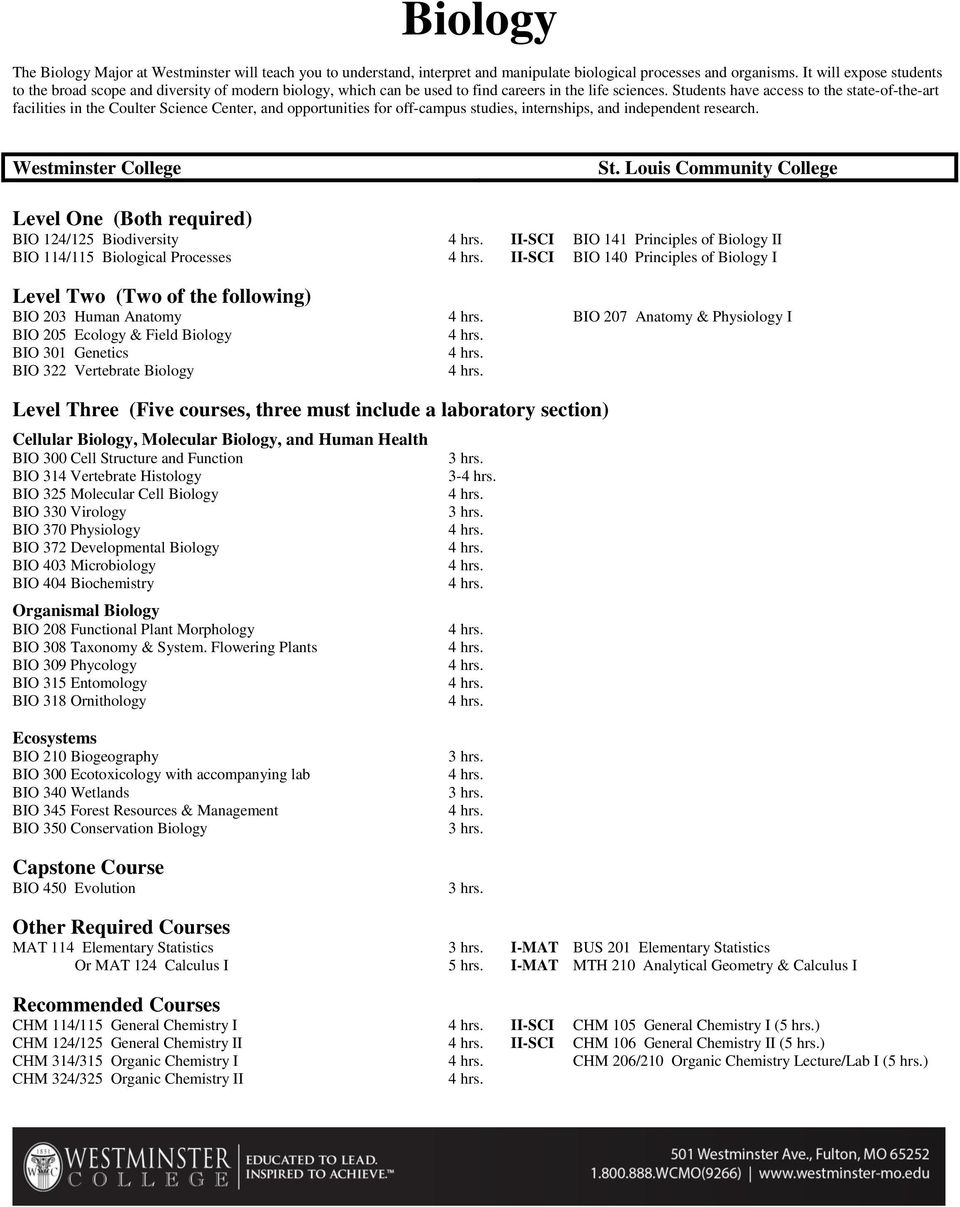
9 Biology The Biology Major at Westminster will teach you to understand, interpret and manipulate biological processes and organisms. It will expose students to the broad scope and diversity of modern biology, which can be used to find careers in the life sciences. Students have access to the state-of-the-art facilities in the Coulter Science Center, and opportunities for off-campus studies, internships, and independent research. Level One (Both required) BIO 124/125 Biodiversity II-SCI BIO 141 Principles of Biology II BIO 114/115 Biological Processes II-SCI BIO 140 Principles of Biology I Level Two (Two of the following) BIO 203 Human Anatomy BIO 207 Anatomy & Physiology I BIO 205 Ecology & Field Biology BIO 301 Genetics BIO 322 Vertebrate Biology Level Three (Five courses, three must include a laboratory section) Cellular Biology, Molecular Biology, and Human Health BIO 300 Cell Structure and Function BIO 314 Vertebrate Histology BIO 325 Molecular Cell Biology BIO 330 Virology BIO 370 Physiology BIO 372 Developmental Biology BIO 403 Microbiology BIO 404 Biochemistry Organismal Biology BIO 208 Functional Plant Morphology BIO 308 Taxonomy & System. Flowering Plants BIO 309 Phycology BIO 315 Entomology BIO 318 Ornithology 3- Ecosystems BIO 210 Biogeography BIO 300 Ecotoxicology with accompanying lab BIO 340 Wetlands BIO 345 Forest Resources & Management BIO 350 Conservation Biology Capstone Course BIO 450 Evolution Other Required Courses MAT 114 Elementary Statistics I-MAT BUS 201 Elementary Statistics Or MAT 124 Calculus I 5 hrs. I-MAT MTH 210 Analytical Geometry & Calculus I Recommended Courses CHM 114/115 General Chemistry I II-SCI CHM 105 General Chemistry I (5 hrs.) CHM 124/125 General Chemistry II II-SCI CHM 106 General Chemistry II (5 hrs.) CHM 314/315 Organic Chemistry I CHM 206/210 Organic Chemistry Lecture/Lab I (5 hrs.) CHM 324/325 Organic Chemistry II
10 Business Administration The business administration major develops an appreciation for the role of business in society, the moral and ethical dimensions of business, and the impact of diverse cultures on business operations. Students will also learn to appreciate human interaction in the work environment, and the process of conceiving, planning, designing, and running a business enterprise. The major will develop an ability to analyze complex problems and make reasoned judgments, to understand and work with financial data, and to understand and use personal computers and computer systems. Finally, students will develop an ability to communicate effectively and work with others. Business majors are well prepared for entry-level positions in a wide variety of organizations. In addition, graduate programs are available across the country for further study at the masters and doctoral levels. Students with graduate degrees find ready employment in business, education, research, and/or consulting. A Business Administration major may be completed with no concentration, or with one or more concentrations in finance, marketing, management, or entrepreneurial studies. Students must have sophomore standing to enroll in any business course. Core Business Courses ACC 215 Principles of Financial Accounting ACC 110 Financial Accounting I ACC 216 Principles of Managerial Accounting BUS 220 Fundamentals of Management BUS 104 Introduction to Business Administration BUS 250 Principles of Marketing MKT 203 Principles of Marketing BUS 327 Operations Management Or ECN 351 Managerial Economics Or BUS 360 Decision Making ECN 211 Principles of Macroeconomics II-HBH ECO 151 Principles of Macroeconomics ECN 212 Principles of Microeconomics II-HBH ECO 152 Principles of Microeconomics FIN 318 Corporate Financial Management MAT 114 Elementary Statistics I-MAT BUS 201 Elementary Statistics MAT 122 Business Calculus MTH 186 Survey of Calculus () Or MAT 124 Calculus I 5 hrs. I-MAT MTH 210 Analytical Geometry & Calculus I MIS 210 Spreadsheet Applications in Business SPE 101 Introduction to Speech Communication COM 101 Oral Comm. I Or COM 107 Public Speaking Or SPE 203 Interpersonal Communication COM 201 Interpersonal Communication Or SPE 220 Public Relations MCM 141 Public Relations Required Caps tone Course BUS 450 Business Policy Electives If no optional concentration (4 courses, 2 in BUS) BUS Elective Course BUS Elective Course ABE Elective Course ABE Elective Course Or PHL 244 Business Ethics II-FND PHL 112 Business Ethics

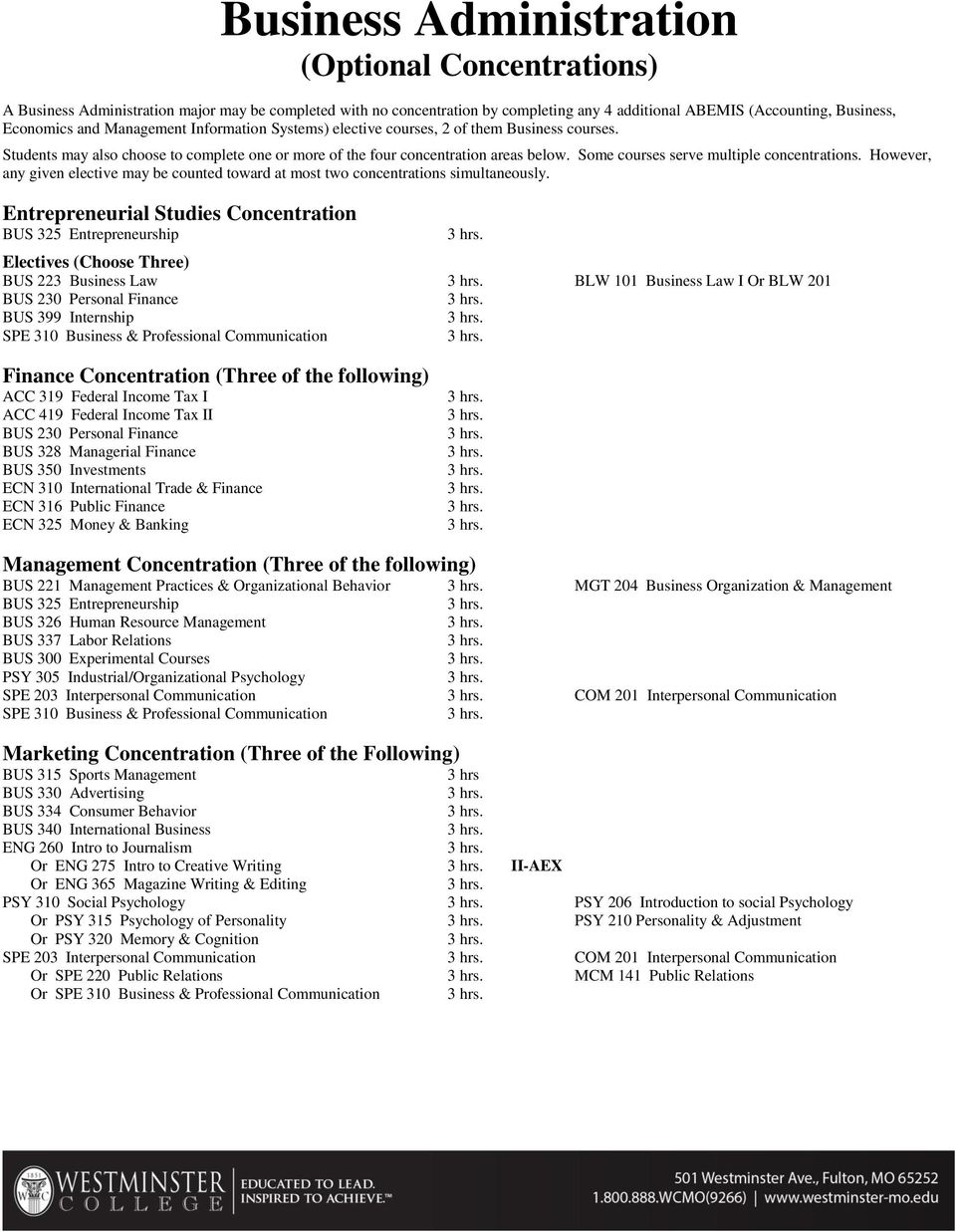
11 Business Administration (Optional Concentrations) A Business Administration major may be completed with no concentration by completing any 4 additional ABEMIS (Accounting, Business, Economics and Management Information Systems) elective courses, 2 of them Business courses. Students may also choose to complete one or more of the four concentration areas below. Some courses serve multiple concentrations. However, any given elective may be counted toward at most two concentrations simultaneously. Entrepreneurial Studies Concentration BUS 325 Entrepreneurship Electives (Choose Three) BUS 223 Business Law BLW 101 Business Law I Or BLW 201 BUS 230 Personal Finance BUS 399 Internship SPE 310 Business & Professional Communication Finance Concentration (Three of the following) ACC 319 Federal Income Tax I ACC 419 Federal Income Tax II BUS 230 Personal Finance BUS 328 Managerial Finance BUS 350 Investments ECN 310 International Trade & Finance ECN 316 Public Finance ECN 325 Money & Banking Management Concentration (Three of the following) BUS 221 Management Practices & Organizational Behavior MGT 204 Business Organization & Management BUS 325 Entrepreneurship BUS 326 Human Resource Management BUS 337 Labor Relations BUS 300 Experimental Courses PSY 305 Industrial/Organizational Psychology SPE 203 Interpersonal Communication COM 201 Interpersonal Communication SPE 310 Business & Professional Communication Marketing Concentration (Three of the Following) BUS 315 Sports Management 3 hrs BUS 330 Advertising BUS 334 Consumer Behavior BUS 340 International Business ENG 260 Intro to Journalism Or ENG 275 Intro to Creative Writing II-AEX Or ENG 365 Magazine Writing & Editing PSY 310 Social Psychology PSY 206 Introduction to social Psychology Or PSY 315 Psychology of Personality PSY 210 Personality & Adjustment Or PSY 320 Memory & Cognition SPE 203 Interpersonal Communication COM 201 Interpersonal Communication Or SPE 220 Public Relations MCM 141 Public Relations Or SPE 310 Business & Professional Communication
12 Business Communication Students study the communication process from a variety of perspectives media relations, business, management and communications philosophy. Students receive a hands-on, real world applicable approach to the field. They learn the importance of communicating with different audiences in different ways. Students pursue three different academic paths within the major: oral communication, written communication, and visual communication. Required Courses SPE 101 Intro to Speech Communication COM 101 Oral Comm. I Or COM 107 Public Speaking SPE 203 Interpersonal Communication COM 201 Interpersonal Communication SPE 310 Business & Professional Communication ENG 260 Intro to Journalism ENG 270 Expository Writing ENG 102 College Composition II ENG 275 Intro to Creative Writing II-AEX BUS 220 Fundamentals of Management BUS 104 Introduction to Business Administration BUS 250 Principles of Marketing MKT 203 Principles of Marketing BUS 330 Principles of Advertising BUS 334 Consumer Behavior Written Communication (One of the following) ENG 360 Special Topics in Media Studies ENG 365 Magazine Writing & Editing ENG 372 Creative Writing: Prose ENG 374 Creative Writing: Poetry ENG 376 Creative Nonfiction Communication in Context (Two of the following) BUS 326 Human Resource Management FRE/SPA 303 Advanced Conversation ITS 399 Internship PHL 218 Introduction to Logic PHL 218 Introduction to Logic POL 311 Political Parties, Voting, & Campaign Strategies SPE 220 Public Relations MCM 141 Public Relations SPE 303 Communications in Relationships Visual Communication (One of the following) ART 200 Digital Photography ART 210 Photography ART 165 Photography I ART 215 Graphic Arts ART 230 Survey of Western Art I II-AEX ART 101 Art History I ART 231 Survey of Western Art II II-AEX ART 100 Art Appreciation Or ART 102 Or ART 103 FAR 215 Art of Film II-AEX MCM 130 Film Appreciation Or MCM 131

13 Chemistry Chemistry is often called the central science since the basic principles of chemistry are closely related to all other areas of science. Westminster s chemistry program prepares you for success not only in the field of chemistry but also in many science-related occupations. Students majoring in chemistry take one-year course sequences in general, organic, analytical, and physical chemistry. In addition, they also take inorganic chemistry and complete at least one upper level course such as biochemistry, medicinal chemistry, or chemical kinetics. This approach enables you to focus on the specific aspects of chemistry that interest you most. Required Chemistry Courses CHM 114/115 General Chemistry I II-SCI CHM 105 General Chemistry I (5 hrs.) CHM 124/125 General Chemistry II II-SCI CHM 106 General Chemistry II (5 hrs.) CHM 304 Inorganic Chemistry CHM 314/315 Organic Chemistry I CHM 206/210 Organic Chemistry Lecture/Lab I (5 hrs.) CHM 324/325 Organic Chemistry II CHM 334/335 Analytical Chemistry I CHM 344/345 Analytical Chemistry II CHM 424/425 Physical Chemistry II CHM 434/435 Physical Chemistry II CHM Elective above the 200 level Other Required Courses Mathematics through MAT 224: MAT 124 Calculus I 5 hrs. I-MAT MTH 210 Analytical Geometry & Calculus I MAT 214 Calculus II MTH 220 Analytic Geometry & Calculus II (5 hrs.) MAT 224 Calculus III MTH 230 Analytic Geometry & Calculus III (5 hrs.) PHY 201 Physics I II-SCI PHY 122 Engineering Physics I (5 hrs.) PHY 212 Physics II II-SCI PHY 223 Engineering Physics II (5 hrs.)

14 Computer Science A degree in Computer Science focuses on the mathematical, logical, and scientific applications of computer science, particularly algorithms and software development. Students are required to complete complementary courses in mathematics, statistics, and logic. Significant areas addressed in this major include secure coding, empirical research, and data science. This major emphasizes problem solving, computer programming knowledge and skills, software engineering concepts and practices, and provides the student with opportunities to apply these concepts to a variety of computerbased systems. Algorithms & Programming Track Required Courses CSC 104 Programming Logic & Design ESC 101 Scientific Computer Programming CSC 111 Fundamentals of Computer Science I CSC 178 Survey of Computer Science CSC 211 Fundamentals of Computer Science II CSC 327 Database Management Systems CSC 350 Systems Analysis & Design IS 241 Systems Analysis & Design ITY 177 Foundations of Information Technology Science II-SCI ITY 181 Intro to Software Engineering ITY 351 Systems & Software Engineering Lab MAT 124 Calculus I 5 hrs. I-MAT MTH 210 Analytical Geometry & Calculus I Electives (Twelve credits total) At least two of the following: CSC 201 Intro to Digital Systems CSC 205 Visual Basic Programming CSC 390 Object-Oriented Programming CSC 411 Topics in Programming Other Electives CSC 314 Advanced Digital Systems CSC 316 Compilers, Interpreters & Operating Systems CSC 398 Independent Study in Computer Science CSC 399 Internship in Computer Science CSC 427 Client Server & Web-based Programming CSC 454 Computer Science Practicum ITY 232 Computer Networking ITY 409 Information Technology in the Organization hr. Mathematics and Logic Electives (Any two of the following) MAT 214 Calculus II MTH 220 Analytic Geometry & Calculus II (5 hrs.) MAT 215 Linear Algebra MTH 215 Linear Algebra MAT 313 Mathematical Probability & Statistics PHL 224 Formal Logic

15 Economics The Economics Program at Westminster provides a thorough grounding in the basic tools of economic analysis and intensive practice in applying these tools to the analysis of significant aspects of the American economy in an international context. This foundation should be particularly useful to students preparing for graduate work in economics or those planning to enter the business world, law, or government service. Students must have sophomore standing to enroll any economics courses for the major. Students must have completed the core courses and have achieved junior standing in order to register for 300 or 400 level economics courses. Required Courses ECN 211 Principles of Macroeconomics II-HBH ECO 151 Principles of Macroeconomics ECN 212 Principles of Microeconomics II-HBH ECO 152 Principles of Microeconomics ECN 235 Research Methods in Economics & Business Or ECN 367 Econometrics ECN 331 Intermediate Macroeconomic Theory ECN 332 Intermediate Price Theory Track I: Economics Major Four ECN Electives (2 upper level, no ECN 110) 1 ECN 425 Capstone Senior Seminar MAT 122 Business Calculus MTH 186 Survey of Calculus () Or MAT 124 Calculus I 5 hrs. I-MAT MTH 210 Analytical Geometry & Calculus I SPE 101 Intro to Speech Communications COM 101 Oral Comm. I Or COM 107 Public Speaking Or ENG 270 Expository Writing ENG 102 College Composition II MIS or CSC course Track II: Economics Major with Honors ECN 360 Mathematical Economics ECN 367 Econometrics Two ECN Electives 6 hrs. ECN 400 Senior Capstone Honors Thesis (2 semesters) 6 hrs. MAT 124 Calculus I 5 hrs. I-MAT MTH 210 Analytical Geometry & Calculus I MAT 215 Linear Algebra MTH 215 Linear Algebra SPE 101 Intro to Speech Communications COM 101 Oral Comm. I Or COM 107 Public Speaking Or ENG 270 Expository Writing ENG 102 College Composition II Economics Electives ECN 235 Research Methods in Economics & Business ECN 308 Economics of Industrial Organization ECN 310 International Trade & Finance ECN 316 Public Finance ECN 325 Money & Banking ECN 331 Intermediate Macroeconomic Theory ECN 332 Intermediate Price Theory ECN 334 Economic Development ECN 351 Managerial Economics ECN 360 Mathematical Economics ECN 362 Sports Economics ECN 364 Labor Economics ECN 367 Econometrics ECN 377 Environmental Economics

16 Education (Early Childhood) As an education major, you will receive personal attention within a learning community that encourages you to develop critical thinking, creative sensibility, and communication arts to share ideas and to understand others as they teach and learn in a global, technological society. Your general education requirements will provide you with understanding in the academic areas all educated people need to know. Your educational foundation courses will explore the current issues and philosophical bases for teaching and learning. Methods courses will help you discover the best ways to teach and help others learn. Your professors will draw on current research and extensive experience to make course work meaningful and strive to demonstrate attitudes and practices that will serve as examples for your future classrooms. Core Early Childhood Education Courses: EDU 101 Intro to Teaching 1 hr. ECE 101 Introduction to Early Care & Education Or EDU 210 Teaching Profession with Field Experience EDU/HES 207 Health, Safety, & P.E. EDU 210 Literature for Children & Youth EDU 226 Children s Literature EDU/PSY 221 Educational Psychology EDU 230 Child and Adolescent Growth & Development II-HBH PSY 205 Human Growth & Development EDU 231 Education of Exceptional Individuals EDU 280 Programs in Early Childhood EDU 288 Assessment in Early Childhood EDU 290 Foundations of Education EDU 211 Foundations of Education EDU 302 Emergent Literacy EDU 385 Diversity in Education EDU 392 Teaching Reading in Content Areas EDU 453 Classroom Management & Organization EDU 490 Educational Seminar MAT 231 Math for Elementary & Middle School PSY 113 Psychology as a Social Science II-HBH PSY 200 General Psychology Methods of Teaching Courses: EDU 203 Teaching Art, Music, & Language Arts EDU 306 Teaching Elementary Reading EDU 310 Methods of Teaching Science in Elem. & MS EDU 380 Integrated Curriculum in Early Childhood MAT 351 Methods of Teaching Elementary/MS Mathematics Field and Clinical Experiences Courses: EDU 291 Education Practicum I EDU 210 Teaching Profession with Field Experience EDU 393 Education Practicum II EDU 492 Student Teaching: Early Childhood Education 1 Content Coursework: The content coursework for elementary and early childhood majors is considered to be the College s General Education Requirements.

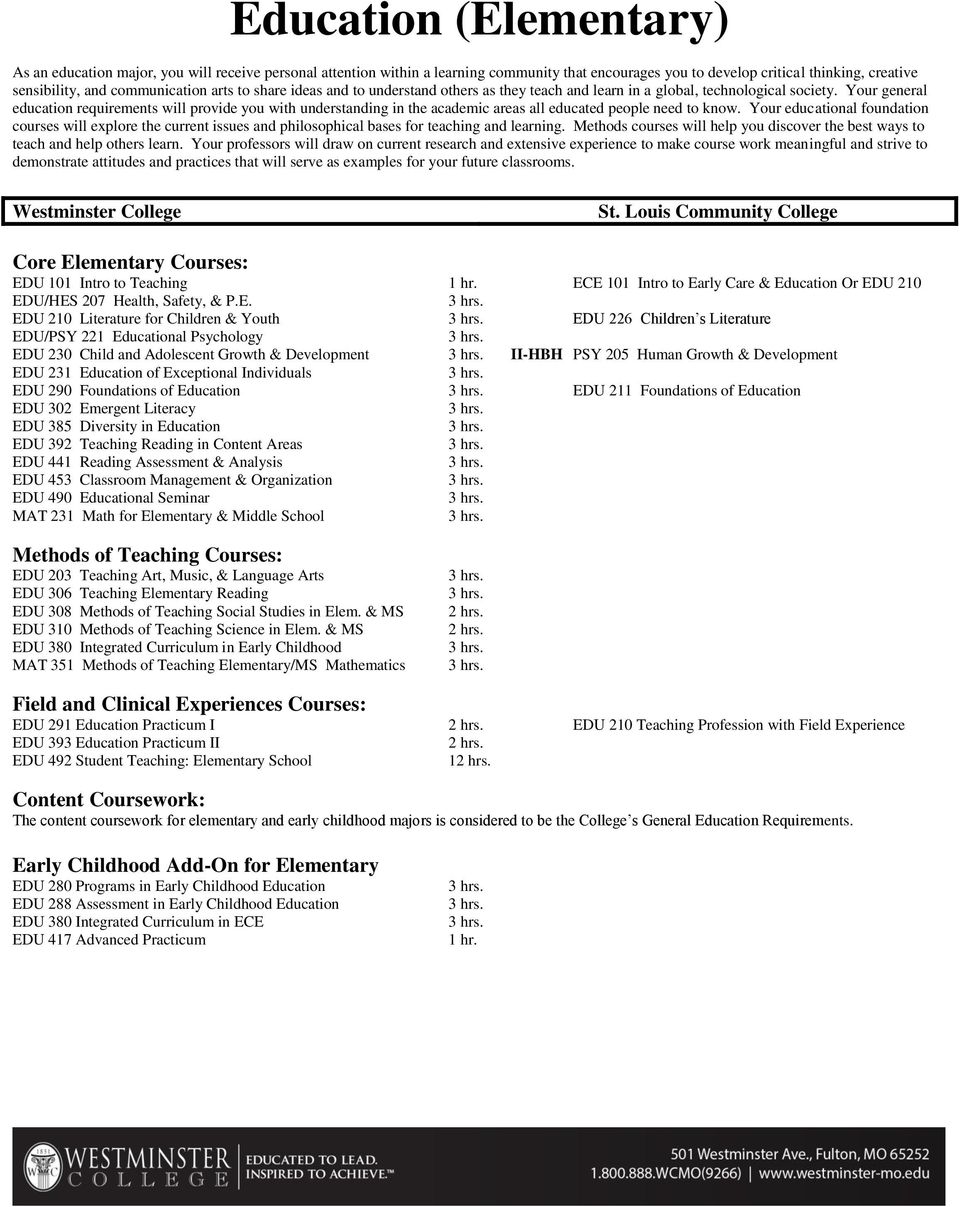
17 Education (Elementary) As an education major, you will receive personal attention within a learning community that encourages you to develop critical thinking, creative sensibility, and communication arts to share ideas and to understand others as they teach and learn in a global, technological society. Your general education requirements will provide you with understanding in the academic areas all educated people need to know. Your educational foundation courses will explore the current issues and philosophical bases for teaching and learning. Methods courses will help you discover the best ways to teach and help others learn. Your professors will draw on current research and extensive experience to make course work meaningful and strive to demonstrate attitudes and practices that will serve as examples for your future classrooms. Core Elementary Courses: EDU 101 Intro to Teaching 1 hr. ECE 101 Intro to Early Care & Education Or EDU 210 EDU/HES 207 Health, Safety, & P.E. EDU 210 Literature for Children & Youth EDU 226 Children s Literature EDU/PSY 221 Educational Psychology EDU 230 Child and Adolescent Growth & Development II-HBH PSY 205 Human Growth & Development EDU 231 Education of Exceptional Individuals EDU 290 Foundations of Education EDU 211 Foundations of Education EDU 302 Emergent Literacy EDU 385 Diversity in Education EDU 392 Teaching Reading in Content Areas EDU 441 Reading Assessment & Analysis EDU 453 Classroom Management & Organization EDU 490 Educational Seminar MAT 231 Math for Elementary & Middle School Methods of Teaching Courses: EDU 203 Teaching Art, Music, & Language Arts EDU 306 Teaching Elementary Reading EDU 308 Methods of Teaching Social Studies in Elem. & MS EDU 310 Methods of Teaching Science in Elem. & MS EDU 380 Integrated Curriculum in Early Childhood MAT 351 Methods of Teaching Elementary/MS Mathematics Field and Clinical Experiences Courses: EDU 291 Education Practicum I EDU 210 Teaching Profession with Field Experience EDU 393 Education Practicum II EDU 492 Student Teaching: Elementary School 1 Content Coursework: The content coursework for elementary and early childhood majors is considered to be the College s General Education Requirements. Early Childhood Add-On for Elementary EDU 280 Programs in Early Childhood Education EDU 288 Assessment in Early Childhood Education EDU 380 Integrated Curriculum in ECE EDU 417 Advanced Practicum 1 hr.
18 Education (Middle School) As an education major, you will receive personal attention within a learning community that encourages you to develop critical thinking, creative sensibility, and communication arts to share ideas and to understand others as they teach and learn in a global, technological society. Your general education requirements will provide you with understanding in the academic areas all educated people need to know. Your educational foundation courses will explore the current issues and philosophical bases for teaching and learning. Methods courses will help you discover the best ways to teach and help others learn. Your professors will draw on current research and extensive experience to make course work meaningful and strive to demonstrate attitudes and practices that will serve as examples for your future classrooms. Core Elementary Courses: EDU 101 Intro to Teaching 1 hr. ECE 101 Intro to Early Care & Education Or EDU 210 EDU/PSY 221 Educational Psychology EDU 230 Child and Adolescent Growth & Development II-HBH PSY 205 Human Growth & Development EDU 231 Education of Exceptional Individuals EDU 290 Foundations of Education EDU 211 Foundations of Education EDU 311 Middle School Philosophy & Organization EDU 314 Middle School Curriculum & Instruction EDU 385 Diversity in Education EDU 392 Teaching Reading in Content Areas EDU 453 Classroom Management & Organization EDU 490 Educational Seminar Field and Clinical Experiences Courses: EDU 291 Education Practicum I EDU 210 Teaching Profession with Field Experience EDU 393 Education Practicum II EDU 495 Student Teaching: Middle School 1 Methods of Teaching Courses by Content Area: English Language Arts EDU 309 Teaching of Writing in Middle and Secondary Schools EDU 431 Teaching English in Middle and Secondary Schools Mathematics EDU 309 Teaching of Writing in Middle and Secondary Schools MAT 351 Methods of Teaching Elem. & MS Mathematics Science EDU 309 Teaching of Writing in Middle and Secondary Schools EDU 436 Methods of Teaching Science in Middle & Sec. Schools Social Science EDU 309 Teaching of Writing in Middle and Secondary Schools EDU 435 Methods of Teaching Social Studies in Middle and Sec. Content Coursework: (24 Hours in Concentration Area) Concentration Areas: A single concentration area of 24 hours is recommended to be selected from social studies, science, mathematics, and English language arts. Some of the concentration area courses are included in the general education requirements of the state and the College. Consult with an advisor to coordinate program of study.

19 Education (Secondary School) As an education major, you will receive personal attention within a learning community that encourages you to develop critical thinking, creative sensibility, and communication arts to share ideas and to understand others as they teach and learn in a global, technological society. Your general education requirements will provide you with understanding in the academic areas all educated people need to know. Your educational foundation courses will explore the current issues and philosophical bases for teaching and learning. Methods courses will help you discover the best ways to teach and help others learn. Your professors will draw on current research and extensive experience to make course work meaningful and strive to demonstrate attitudes and practices that will serve as examples for your future classrooms. Core Elementary Courses: EDU 101 Intro to Teaching 1 hr. ECE 101 Intro to Early Care & Education Or EDU 210 EDU/PSY 221 Educational Psychology EDU 230 Child and Adolescent Growth & Development II-HBH PSY 205 Human Growth & Development EDU 231 Education of Exceptional Individuals EDU 290 Foundations of Education EDU 211 Foundations of Education EDU 385 Diversity in Education EDU 392 Teaching Reading in Content Areas EDU 453 Classroom Management & Organization EDU 490 Educational Seminar Field and Clinical Experiences Courses: EDU 291 Education Practicum I EDU 210 Teaching Profession with Field Experience EDU 393 Education Practicum II EDU 497 Student Teaching: High School 1 Methods of Teaching Courses by Content Area: Biology EDU 425 Methods of Secondary School Teaching EDU 436 Methods of Teaching Science in Sec. Business EDU 425 Methods of Secondary School Teaching EDU 398 Independent Study: Methods of Teaching Business Chemistry EDU 425 Methods of Secondary School Teaching EDU 436 Methods of Teaching Science in Sec. English Language Arts EDU 425 Methods of Secondary School Teaching EDU 431 Teaching English in Middle & Secondary Schools General Science EDU 425 Methods of Secondary School Teaching EDU436 Methods of Teaching Science in Sec. Mathematics EDU 425 Methods of Secondary School Teaching EDU 433 Teaching Mathematics in Middle & Sec. MAT 231 Mathematics for Elem. & Middle School MAT 351 Methods of Teaching Elem/Mid Math Social Science EDU 425 Methods of Secondary School Teaching EDU 435 Teaching Social Studies in Middle/Sec. 3 Content Coursework: Secondary Education specialty areas of concentration are offered in the following fields of study: Biology, Business, Chemistry, English, French, General Science, Mathematics, Physical Education, Physics, Social Studies, and Spanish. (See an education advisor for a more information.)

20 Education Curriculum Studies The Education Curriculum Studies Major encompasses a thorough foundational knowledge base of educational theory and appropriate curriculum for the specified area of concentration. The student will be prepared to work in various school settings in a support capacity, but not as a certified teacher, as well as being prepared for a number of additional careers, including youth programming in social services, recreational services, or educational sales. Students will participate in a practicum component doing field work in a school setting, and will pursue writing and speech intensive coursework necessary to success in any field. Required Courses EDU/PSY 221 Educational Psychology EDU 230 Child & Adolescent Growth and Development II-HBH PSY 205 Human Growth & Development EDU 231 Education of Exceptional Individuals EDU 290 Foundations of Education EDU 211 Foundations of Education EDU 291 Education Practicum I EDU 210 Teaching Profession with Field Experience EDU 385 Diversity in Education EDU 393 Education Practicum II EDU 417 Special Practicum/Capstone 6 hrs. Electives (15 hours) EDU 101 Introduction to Teaching 1 hr. ECE 101 Intro to Early Care & Education Or EDU 210 EDU 203 Teaching Art, Music, and Lang. Arts EDU/HES 206 Growth & Development in Elementary P.E. EDU/HES 207 School Health, P.E., & Safety in Elementary EDU 210 Literature for Children & Youth EDU 226 Children s Literature EDU 280 Programs in Early Childhood EDU 288 Assessment in Early Childhood EDU 306 Teaching Elementary Reading EDU 308 Methods of Teaching Social Studies in Elem. & MS EDU 309 Teaching of Writing in Middle & Secondary EDU 310 Methods of Teaching Science in Elem. & MS EDU 311 Middle School Philosophy & Organization EDU 314 Middle School Curriculum & Instruction EDU 380 Integrated Curriculum in Early Childhood EDU 392 Teaching Reading in Content Areas EDU 400 Programs in Business Education EDU 425 Secondary School Teaching EDU 431 Teaching English in Secondary/ Middle Schools EDU 433 Teaching Math in Middle/Secondary Schools EDU 434 Methods of Teaching Middle School/Secondary P.E. EDU 435 Teaching Social Studies in Middle School/Sec. Schools EDU 436 Teaching Science in Middle/Secondary Schools EDU 437 Methods of Teaching Foreign Language EDU 438 Teaching Business in Secondary Schools EDU 441 Reading Assessment & Advancement MAT 231 Math for Elementary & Middle School Teachers MAT 351 Methods for Teaching Elementary & MS Math Concentration Area (18 hours) Students are also required to complete at least 18 hours in one education concentration area, Math, Science, English, Social Science, Business, Physical Education, or Spanish.

21 English (Literature Track) The Department of English Language and Literature offers a major program of study leading to a Bachelor of Arts in English. By studying British, American, and world literatures, students who major in English learn to read closely, to think critically, and to write clearly. English majors may pursue one of three areas of emphasis, literary criticism, creative writing or English education, or choose a degree without an area of emphasis. Students who meet the requirements are invited to complete an Honors Sequence in their area of emphasis. A major in English provides a solid foundation for the business world, law school, journalism, education, or graduate study in any field. 200-level Literature Courses (6 hours) ENG 205 British Literature before 1800 II-AEX ENG 210 British Literature Before 1800 ENG 206 British Literature since 1800 II-AEX ENG 211 British Literature After 1800 ENG 238 American Literature before the Civil War II-AEX ENG 204 American Literature Before 1865 ENG 239 American Literature since the Civil War II-AEX ENG 205 American Literature Between 1865 & 1945 ENG 248 World Literature to 1800 II-AEX ENG 231 World Literature ENG 249 World Literature Since 1800 II-AEX 200-level Writing/Theory Courses (6 hours) ENG 275 Introduction to Creative Writing II-AEX ENG 290 Critical Practicum 300 and 400-level Literature Courses (15 hours) ENG 350 Studies in the Author: Shakespeare FOUR of the following: ENG 315 Literary Modes and Genres ENG 325 Literary Movements ENG 330 Literary Visions and Revisions ENG 335 A Sense of Place ENG 340 Gender and Literary Expression ENG 345 Ethnic Literature ENG 350 Studies in the Author ENG 355 Literature and the Other Arts Electives (9 hours) May Include: ENG 420 Honors Project I ENG 430 Honors Project II (Majors must select at least one course each from: Literature before 1850, Literature after 1850, American Literature, British/World Literature.)
22 English (Creative Writing Track) The Department of English Language and Literature offers a major program of study leading to a Bachelor of Arts in English. By studying British, American, and world literatures, students who major in English learn to read closely, to think critically, and to write clearly. English majors may pursue one of three areas of emphasis, literary criticism, creative writing or English education, or choose a degree without an area of emphasis. Students who meet the requirements are invited to complete an Honors Sequence in their area of emphasis. A major in English provides a solid foundation for the business world, law school, journalism, education, or graduate study in any field. 200-level Literature Courses (6 hours) ENG 205 British Literature before 1800 II-AEX ENG 210 British Literature Before 1800 ENG 206 British Literature since 1800 II-AEX ENG 211 British Literature After 1800 ENG 238 American Literature before the Civil War II-AEX ENG 204 American Literature Before 1865 ENG 239 American Literature since the Civil War II-AEX ENG 205 American Literature Between 1865 & 1945 ENG 248 World Literature to 1800 II-AEX ENG 231 World Literature ENG 249 World Literature Since 1800 II-AEX 200-level Writing/Theory Courses (6 hours) ENG 275 Introduction to Creative Writing II-AEX ENG 290 Critical Practicum 300-and 400-level Writing/Literature Courses (18 hrs.): ENG 372 Creative Writing Fiction ENG 374 Creative Writing Poetry ENG 376 Creative Writing Nonfiction THREE of the following: ENG 315 Literary Modes and Genres ENG 325 Literary Movements ENG 330 Literary Visions and Revisions ENG 335 A Sense of Place ENG 340 Gender and Literary Expression ENG 345 Ethnic Literature ENG 350 Studies in the Author ENG 355 Literature and the Other Arts Electives (6 hours) May Include: ENG 420 Honors Project I ENG 430 Honors Project II (Majors must select at least one course each from: Literature before 1850, Literature after 1850, American Literature, British/World Literature.)
23 English (English Education Track) The Department of English Language and Literature offers a major program of study leading to a Bachelor of Arts in English. By studying British, American, and world literatures, students who major in English learn to read closely, to think critically, and to write clearly. English majors may pursue one of three areas of emphasis, literary criticism, creative writing or English education, or choose a degree without an area of emphasis. Students who meet the requirements are invited to complete an Honors Sequence in their area of emphasis. A major in English provides a solid foundation for the business world, law school, journalism, education, or graduate study in any field. 200-level Literature Courses (6 hours) ENG 205 British Literature before 1800 II-AEX ENG 210 British Literature Before 1800 ENG 206 British Literature since 1800 II-AEX ENG 211 British Literature After 1800 ENG 238 American Literature before the Civil War II-AEX ENG 204 American Literature Before 1865 ENG 239 American Literature since the Civil War II-AEX ENG 205 American Literature Between 1865 & 1945 ENG 248 World Literature to 1800 II-AEX ENG 231 World Literature ENG 249 World Literature Since 1800 II-AEX 200-level Writing/Theory Courses (15 hours) ENG 270 Expository Writing ENG 102 College Composition II ENG 275 Introduction to Creative Writing II-AEX ENG 290 Critical Practicum TWO of the following: ENG 205 British Literature to 1800 II-AEX ENG 210 British Literature Before 1800 ENG 220 Janus & the World of Publishing ENG 260 Introduction to Journalism 300 and 400-level Literature Courses (9 hours) ENG 350 Studies in the Author: Shakespeare TWO of the following: ENG 315 Literary Modes and Genres ENG 325 Literary Movements ENG 330 Literary Visions and Revisions ENG 335 A Sense of Place ENG 340 Gender and Literary Expression ENG 345 Ethnic Literature ENG 350 Studies in the Author ENG 355 Literature and the Other Arts Electives (6 hours) American Literature requirement: 6 hrs. from ENG 238, ENG 239, or 300 level American Lit. At least one course must have an Ethnic Component. British/World Literature requirement: 6 hrs. from ENG 205, 206, 248, 249, 300-level British/World Literature; Shakespeare. (Majors must select at least one course each from: Literature before 1850, Literature after 1850, American Literature, British/World Literature. ENG 205 may count for either the 200-level literature requirement or the 200-level writing requirement, but may not count for both requirements.)
24 English (Without an Area of Emphasis) The Department of English Language and Literature offers a major program of study leading to a Bachelor of Arts in English. By studying British, American, and world literatures, students who major in English learn to read closely, to think critically, and to write clearly. English majors may pursue one of three areas of emphasis, literary criticism, creative writing or English education, or choose a degree without an area of emphasis. Students who meet the requirements are invited to complete an Honors Sequence in their area of emphasis. A major in English provides a solid foundation for the business world, law school, journalism, education, or graduate study in any field. 200-level Literature Courses (6 hours) ENG 205 British Literature before 1800 II-AEX ENG 210 British Literature Before 1800 ENG 206 British Literature since 1800 II-AEX ENG 211 British Literature After 1800 ENG 238 American Literature before the Civil War II-AEX ENG 204 American Literature Before 1865 ENG 239 American Literature since the Civil War II-AEX ENG 205 American Literature Between 1865 & 1945 ENG 248 World Literature to 1800 II-AEX ENG 231 World Literature ENG 249 World Literature Since 1800 II-AEX 200-level Writing/Theory Courses (6 hours) ENG 275 Introduction to Creative Writing II-AEX ENG 290 Critical Practicum 300 and 400-level Literature Courses (6 hours) TWO of the following: ENG 315 Literary Modes and Genres ENG 325 Literary Movements ENG 330 Literary Visions and Revisions ENG 335 A Sense of Place ENG 340 Gender and Literary Expression ENG 345 Ethnic Literature ENG 350 Studies in the Author ENG 355 Literature and the Other Arts Electives (18 hours) May Include: ENG 420 Honors Project I ENG 430 Honors Project II (Majors must select at least one course each from: Literature before 1850, Literature after 1850, American Literature, British/World Literature. ENG 205 may count for either the 200-level literature requirement or the 200-level writing requirement, but may not count for both requirements.)
25 Environmental Science Westminster s environmental science/studies program is a challenging interdisciplinary curriculum that combines academic rigor with real world experience (field trips, field courses, and internships). A required internship program ensures that students in environmental science have first-hand experience with issues of the day while developing professional contacts. Required Courses ENV 105 Intro to Environmental Science II-SCI BIO 117 Conservation & Ecology (Lecture) Or GEO 103 ENV 399 Internship ENV 405 Environmental Assessment Social Sciences/Humanities (9 hrs.) THREE of the following: ENV/ECN 377 Environmental Economics PHL 246 Environmental Ethics PHL 111 Environmental Ethics POL 326 Environmental Politics and Policy REL 324 Religion & the Environment Physical Science/Geology (10-1) THREE of the following (at least 2 courses must be 300-level): GEO 108 Introduction to Physical Geology II-SCI GEO 111 Physical Geology () GEO 116 Environmental Geology II-SCI GEO 300 Surficial Geology GEO 305 Hydrogeology GEO 327 Weather and Climate GEO 330 Applications of Geographic Info. Sys. Ecology & Resource Management (10-1) THREE of the following (1 course must be BIO 205) BIO 205 Ecology and Field Biology BIO/ENV 210 Biogeography BIO 300 Ecotoxicology & Lab BIO/ENV 340 Wetlands BIO/ENV 345 Forest Resources & Management BIO/ENV 350 Conservation Biology GEO 300 Earth Materials Social Sciences/Humanities Choose Three of the Following: ENV 377 Environmental & Resource Economics PHL 246 Environmental Ethics II-FND PHL 111 Environmental Ethics POL 326 Environmental Politics & Policy REL 324 Spiritual Ecology Other Required Courses (22-2) BIO 124/125 Biodiversity II-SCI BIO 114/115 Biological Processes II-SCI BIO 140 Principles of Biology I CHM 114/115 General Chemistry I II-SCI CHM 105 General Chemistry I (5 hrs.) CHM 124/125 General Chemistry II II-SCI CHM 106 General Chemistry II (5 hrs.) MAT 114 Elementary Statistics I-MAT BUS 201 Elementary Statistics MAT 121 Pre-Calculus MTH 185 Precalculus (5 hrs.) OR MAT 122 Business Calculus MTH 186 Survey of Calculus () OR MAT 124 Calculus I 5 hrs. I-MAT MTH 210 Analytical Geometry & Calculus I
26 Environmental Studies The Environmental Studies major emphasizes political, economic and social/cultural aspects of the human impact on the natural environment, while still grounding students in fundamentals of the natural and earth sciences. The curriculum has been designed to give students broad exposure to these disciplines. Students complete two capstone experiences, an internship and the Environmental Assessment course, which allow them to integrate knowledge gained from coursework, practice critical thinking and communication skills, and work with resource professionals to tackle relevant environmental issues. Required Courses ENV 105 Intro to Environmental Science II-SCI BIO 117 Conservation & Ecology (Lecture) Or GEO 103 ENV 399 Internship ENV 405 Environmental Assessment BIO 108 Intro to Biological Principles II-SCI BIO 111 Introductory Biology I CHM 105/106 Intro to Chemistry II-SCI CHM 101 Fundamentals of Chemistry I (5 hrs.) MAT 114 Elementary Statistics I-MAT BUS 201 Elementary Statistics Social Sciences/Humanities Core (Select Three) ENV 377 Environmental & Resource Economics PHL 246 Environmental Ethics II-FND PHL 111 Environmental Ethics POL 326 Environmental Politics & Policy REL 324 Religion & the Environment Social Sciences/Humanities Electives (Select Five) ECN 211 Principles of Macroeconomics II-HBH ECO 151 Principles of Macroeconomics Or ECN 212 Principles of Microeconomics II-HBH ECO 152 Principles of Microeconomics ECN 334 Economic Development LST 205 Mediation & Conflict Resolution Or LST 210 Leadership for Non-Profit Organizations POL 211 American Government & Politics II-HBH PSC 101 Introduction to American Politics Or POL 212 Intro to International Politics II-NWS PSC 201 International Relations POL 305 International Law & Organizations POL 320 United States Congress ANT 115 Intro to Cultural Anthropology II-HBH ANT 102 Intro to Cultural Anthropology Or ANT 103 Environmental Science Electives Physical Science/Geology (Select Two) GEO 108 Intro to Physical Geology II-SCI GEO 111 Physical Geology () GEO 116 Environmental Geology II-SCI GEO 300 Surficial Geology GEO 305 Hydrogeology GEO 327 Weather & Climate GEO 330 Applications of Geographic Information Systems Ecology & Resource Management (Select Two) BIO 205 Ecology & Field Biology BIO/ENV 210 Biogeography BIO 300 Ecotoxicology & Lab BIO/ENV 340 Wetlands BIO/ENV 345 Forest Resources & Management BIO/ENV 350 Conservation Biology GEO 300 Earth Materials BIO/ENV/GEO 320/321 Travel Course
27 Exercise Science This major includes capstone research and/or internship, tailored to the student s career goals. Students are encouraged to obtain professional certifications such as ACSM Personal Trainer or Health/Fitness Instructor certification, as appropriate. Students are prepared for a wide range of career opportunities in the fields of health, fitness, and health & sport science research. Required Courses BIO 114/115 Biological Processes II-SCI BIO 140 Principles of Biology I BIO 124/125 Biodiversity II-SCI BIO 141 Principles of Biology II BIO 203 Human Anatomy BIO 207 Anatomy & Physiology I BIO 370 Physiology CHM 114/115 Chemistry I & Lab II-SCI CHM 105 General Chemistry I (5 hrs.) CHM 124/125 Chemistry II & Lab II-SCI CHM 106 General Chemistry II (5 hrs.) HES/PSY 231 Sports Psychology HES 251 Introduction to Nutrition HES 321 Kinesiology HES 340 Exercise Physiology HES 300 Exercise Prescription HES 357 Community Nutrition Capstone Research or Field Experience in Exercise Science Optional Courses HES 215 Principles of Motor Learning HES 406 Management in Physical Education & Athletics PED 300 Sport Conditioning PED 350 Theories of Adapted Physical Education
28 Finance The primary objective of the undergraduate finance program is to prepare students for finance positions at the entry level in industry, government, or other organizations in the public or private sector. Students should be aware that the undergraduate degree in finance at will prepare them for the Level I CFA (Chartered Financial Analyst) examination at the end of their senior year. In addition, the program introduces students to a wide range of topics covered under Levels II and III of the CFA examination. Required Core Business Courses: ACC 215 Principles of Financial Accounting ACC 110 Financial Accounting I ACC 216 Principles of Managerial Accounting BUS 220 Fundamentals of Management BUS 104 Introduction to Business Administration BUS 250 Principles of Marketing MKT 203 Principles of Marketing BUS 318 Corporate Financial Management BUS 327 Production Management Or BUS 360 Decision Science Or ECN 351 Managerial Economics ECN 211 Principles of Macroeconomics II-HBH ECO 151 Principles of Macroeconomics ECN 212 Principles of Microeconomics II-HBH ECO 152 Principles of Microeconomics MAT 114 Elementary Statistics I-MAT BUS 201 Elementary Statistics MAT 122 Business Calculus MTH 186 Survey of Calculus () Or MAT 124 Calculus I 5 hrs. I-MAT MTH 210 Analytical Geometry & Calculus I MIS 210 Spreadsheet Applications in Business SPE 101 Intro to Speech Communication COM 101 Oral Comm. I Or COM 107 Public Speaking Finance Major Courses (Required) ACC 312 Intermediate Accounting I BUS 328 Managerial Finance ECN 235 Research Methods in Economics & Business ECN/FIN 325 Money, Banking & Financial Markets FIN 350 Investments Electives (Choose Three). BUS 300 Bank Management BUS 399 Directed Independent Research BUS 400 Level I CFA Exam Prep ECN/FIN 310 International Trade & Finance ECN 367 Econometrics FIN 300 Security Analysis & Portfolio Management FIN 354 Options and Futures
29 French The communicative approach of Westminster s French program challenges students to use the language they are learning from the first day in an elementary class through upper-level literature and culture courses. Small classes taught by an experienced faculty member in a relaxed environment encourage students to improve their language proficiency as they participate in a variety of games, role plays, informal conversation and presentations. Although the major can be completed on campus, in consultation with the faculty and the Office for Off-Campus Study, many majors study abroad for a semester or even a year. In addition to language acquisition classes at elementary, intermediate and advanced levels, students explore the literatures and cultures of the French-speaking world in thematically organized upper level courses. Required Courses FRE 306 Critical Writing & Reading FRE 358 The Individual in Society I FRE 359 The Individual in Society II FRE 362 Francophone Civilizations II-NWS FRE 363 French Civilization French Electives (4 courses from this list) FRE 203 Intermediate French I II-CLT FRE 204 Intermediate French II FRE 300 The Theory & Practice of Translation FRE 303 Advanced French Conversation FRE 305 Commercial French FRE 360 Literary Moments & Movements FRE 361 Literature & Culture
30 Health & Wellness The Health and Wellness major emphasizes knowledge and learning experiences aimed at the promotion of lifetime wellness. Students will know principles of nutrition, holistic health, and exercise training. Also, students will learn how to test health and activity status, prescribe safe exercise, prevent exercise injury, and assess client progress towards their health and fitness goals. The courses in this major will prepare graduating students for jobs that apply principles of health education and exercise training. More specifically, students may pursue careers in worksite wellness, hospital-based wellness programs, community health centers, retirement and nursing home wellness programs, commercial and not-for-profit health, fitness, and recreation centers, and other related areas. Required Courses BIO 107 Human Biology II-SCI HES 104 First Aid/CPR 1 hr. PE 129 First Aid HES 204 Wellness & Fitness PE 180 Fitness & Wellness Concepts () OR PE 135 HES 220 Social Science in Sport HES 230 Intro to Prevention & Care of Injuries HES/PSY 231 Sport Psychology HES 251 Intro to Nutrition HES 300 Exercise Prescription HES 309 History & Philosophy of PE HES 321 Kinesiology HES 340 Exercise Physiology HES 405 Measurement & Evaluation in Physical Education HES 406 Management in Physical Education & Athletics 4- PED Activity Courses in four different areas Elective (Choose One) HES 200 Stress Management HES/EDU 207 School Health Education HES 240 Intro to Global Public Health II-NWS HES 350 Theories of Adapted Physical Education HES/WGS 355 Women s Health Issues HES 357 Community Nutrition HES/PED 399 Health Internship PSY 301 Human Sexual Behavior PSY 330 Addictive Disorders
31 History Westminster history classes offer small, informal classes in which professors play close attention to your individual needs and significant student contributions and discussions are prevalent (upper level courses typically have fewer than 10 students and senior seminars typically 4-6 students. Every student, no matter what the personal interests, can find a topic of study because no class is ever the same two years running. This diversity of study provides a wide range of classes. The Westminster history program is also unique in its thesis program. All majors learn the skills needed to write a graduate-level thesis. Employers, law schools, and graduate schools see this as an attractive addition to your education, giving you a head start over other college graduates. Recruiters know you are capable of graduate level work. Required Courses HIS 103 History of the United States to 1877 II-HIS HST 101 American History I HIS 104 History of the United States since 1877 II-HIS HST 102 American History II Or HST 105 HIS 105 Western Civilization I II-HIS Or HIS 109 World History I II-HIS ANT 207 Ancient Civilizations of the Old World HIS 106 Western Civilization II II-HIS HST 128 Western Tradition II Or HIS 110 World History II II-HIS Or HIS 102 Survey of British History from 1800 II-HIS HST 139 British History HIS 390 Historiography HIS 422 Senior Thesis HIS 423 Senior Thesis HIS 424 Senior Thesis 1 hrs. Upper Level Electives (Four required, at least one with each permanent member of department) HIS 303 Selected Themes in British History, HIS 304 Selected Themes in British History, 1714-Present HIS 321 Europe in the Nineteenth Century, HIS 322 Europe in the Twentieth Century, HIS 323 Europe since 1945 HIS 327 Nazi Germany HIS 330 World War I HIS 331 American Slavery HIS 332 Sectionalism, Civil War, & Reconstruction HIS 336 America since 1945 HIS 348 History of American Foreign Relations HIS 349 United States Constitutional History HIS 350 The Vietnam Wars: Nations in Conflict, HIS 354 Scandalous Women HIS 356 European Women
32 Information Technology A degree in Information Technology will prepare students to use a wide array of technologies available to solve real-world problems that might occur in any discipline or organization. Emphasis is placed on software engineering, database design and management, computer networking, system support and administration, human computer interaction, and storage management. Required Courses CSC 104 Programming Logic and Design ESC 101 Scientific Computer Programming CSC 178 Survey of Computer Science CSC 205 Visual Basic Programming CSC 327 Database Management Systems CSC 350 Systems Analysis & Design IS 241 Systems Analysis & Design ITY 177 Foundations of Information Technology Science II-SCI ITY 181 Intro to Software Engineering ITY 232 Computer Networking ITY 234 Computer Networking Laboratory 1 hr. ITY 351 Systems & Software Engineering Laboratory MAT 114 Elementary Statistics I-MAT BUS 201 Elementary Statistics Elective Courses (18 hours total) At Least Three of the Following: ITY 250 Web Page Design, Aesthetics, and Interaction II-AEX ITY 305 PC Hardware & Troubleshooting ITY 331 Information Storage & Management ITY 360 Adv. Digital Communications & Networking ITY 415 Information Technology in the Organization ITY 460 Network Administration Two of the Following: ECN 110 Intro to Economics II-HBH HES 240 Intro to Global Public Health II-NWS HES 261 Intro to Epidemiology II-HBH LST 201 Leadership Theories & Practice II-HBH PHL 244 Business Ethics II-FND PHL 112 Business Ethics PSY 112 Psychology as a Natural Science II-HBH SEC 201 Intro to Security Studies II-NWS SPE 101 Intro to Speech Communication COM 101 Oral Comm. I Or COM 107 Public Speaking TNS 201 Intro to International Studies II-NWS Other Electives (3 hours) CSC 210 Microcomputer Applications CSC 427 Client-Server and Web-Based Programming CSC 454 Computer Science Practicum ITY 398 Independent Study in Information Technology ITY 399 Internship in Information Technology 1 hrs. 1-1-
33 International Business International Business studies reach across multiple disciplines to offer you a liberal arts program oriented in the complex world of international business. The business administration major covers all the traditional areas of study, including management, marketing, finance, accounting, economics, and management information systems. Other disciplines contribute required courses in statistics, calculus, and speech. Or, you can propose your own area of concentration or minor area of study to further individualize your educational experience. Business BUS 220 Fundamentals of Management BUS 104 Introduction to Business Administration BUS 250 Principles of Marketing MKT 203 Principles of Marketing BUS 340 International Business Or ECN 310 International Trade & Finance BUS 450 Business Policy FIN 318 Corporate Financial Management Accounting ACC 215 Principles of Financial Accounting ACC 110 Financial Accounting I ACC 216 Principles of Managerial Accounting Economics ECN 211 Principles of Macroeconomics II-HBH ECO 151 Principles of Macroeconomics ECN 212 Principles of Microeconomics II-HBH ECO 152 Principles of Microeconomics Elective Courses (Two of the following) ANT 115 Intro to Cultural Anthropology II-HBH ANT 102 Intro to Cultural Anthropology Or ANT 103 HIS 106 Western Civilization II II-HIS HST 128 Western Tradition II PHL 212 Intro to Ethics II-FND PHL 104 Ethics PHL 244 Business Ethics II-FND PHL 112 Business Ethics POL 212 Intro to International Politics II-NWS PSC 201 International Relations REL/PHL 102 World Religions II-NWS PHL 103 World Religions Foreign Language (With English as a first language) FLG 102 Elementary Foreign Language II II-CLT GER 102 Elementary German II Or JPN 102 Or SPA 102 FLG 203 Intermediate Foreign Language I II-CLT FLG 204 Intermediate Foreign Language II Two Foreign Language courses beyond Intermediate level 6 hrs. Or Approved program in a foreign country English (With English as a second language) ENG 260 Intro to Journalism Or ENG 270 Expository Writing ENG 102 College Composition II Or ENG 275 Intro to Creative Writing II-AEX ENG 204 Intro to Literature II-AEX ENG 201 Introduction to Fiction Or ENG 205 British Literature to 1800 II-AEX ENG 210 British Literature Before 1800 Or ENG 206 British Literature since 1800 II-AEX ENG 211 British Literature After 1800 Or ENG 238 American Literature to the Civil War II-AEX ENG 204 American Literature Before 1865 Or ENG 239 American Literature since the Civil War II-AEX ENG 205 American Literature Between 1865 & 1945 Other Requirements Upper Level from HIS, POL, REL, SCA Or Additional Tier III course with International Focus One course from ABEMIS department, or an internship MAT 114 Elementary Statistics I-MAT BUS 201 Elementary Statistics MAT 122 Business Calculus MTH 186 Survey of Calculus () Or MAT 124 Calculus I 5 hrs. I-MAT MTH 210 Analytical Geometry & Calculus I
34 International Studies offers a major in International Studies with concentrations in either Regional Studies or International Issues. Students majoring in International Studies will develop knowledge of the contemporary world through a broadly integrated analysis of international issues or through in-depth study of one region of the world. Students in both concentrations will acquire skills in a language relevant to their program. Core Courses INT 201 Intro to International Studies II-NWS POL 212 Intro to International Politics II-NWS PSC 201 International Relations ECN 211 Principles of Macroeconomics II-HBH ECO 151 Principles of Macroeconomics INT 401 Jr.-Sr. Seminar in International Studies INT 402 Senior Thesis in International Studies Foreign Language (With English as first language) FLG 102 Elementary Foreign Language II II-CLT GER 102 Elementary German II Or JPN 102 Japanese II FLG 203 Intermediate Foreign Language II II-CLT FLG 204 Intermediate Foreign Language II Two upper level language, literature or civilization courses 6 hrs. English (With English as a second language) ENG 204 Intro to Literature II-AEX ENG 201 Introduction to Fiction ENG 270 Expository Writing ENG 102 College Composition II SPE 101 Intro to Speech Communication COM 101 Oral Comm. I Or COM 107 Public Speaking SPE 203 Interpersonal Communication COM 201 Interpersonal Communication Asian and Middle Eastern Concentration Required: ASN 201 Intro to Asian Studies II-NWS HIS 300 Modern Middle East Or HIS 300 Modern Middle East Or POL 300 Middle Eastern Politics Or POL 423 Politics of the Non-Western World Three of the following (two must be upper level): Upper level foreign language courses Approved off-campus study program BUS 340 International Business ECN 334 Economic Development ECN 310 International Trade & Finance HIS 300 Modern Middle East HIS 348 History of American Foreign Relations HIS 300 Modern East Asia HIS 350 The Vietnam Wars INT 212 Model United Nations Team: Asian or Mid-East nation MUS 305 Jazz in Japan PHL 410 Asian Philosophy and Religion POL 300 Middle Eastern Politics POL 305 International Law & Organizations PSY 405 International & Cross-Cultural Psychology POL 423 Politics of the Non-Western World
35 European Concentration Required: HIS 323 Europe since 1945 POL 306 West European Government & Politics Three of the following (two must be upper level): Upper level foreign language courses Approved off-campus study program BUS 340 International Business ECN 310 International Trade & Finance HIS 304 Selected Themes in British History, 1714 to present HIS 322 Europe in the 20 th Century HIS 327 Nazi Germany HIS 348 History of American Foreign Relations HUM 277/SPA 377 Spanish Civilization II-CLT FRE 362 French-speaking Cultures & Civilizations II-NWS INT 212 Model United Nations Team: European Nation PSY 405 International & Cross-Cultural Psychology POL 305 International Law & Organizations POL 308 Post-Soviet Politics POL 362 American Foreign Policy Latin American Concentration Required: HIS 348 History of American Foreign Relations SPA 378 Latin American Civilization II-CLT Three of the following (two must be upper level): Upper level foreign language courses Approved off-campus study program BIO 320/321 Biology in Belize II-CLT BUS 340 International Business ECN 334 Economic Development ECN 310 International Trade & Finance HIS 267 Latin American History & Culture II-CLT INT 212 Model United Nations Team: Latin American Nation PSY 405 International & Cross-Cultural Psychology POL 305 International Law & Organization POL 362 American Foreign Policy
36 Mathematical Sciences A mathematics major will study analytic geometry, probability and statistics, analysis, differential equations and much more. Students will also have the opportunity to do independent research over the summer or during the year and present their findings at our Undergraduate Scholars Forum, a day when classes are suspended for the entire Westminster community to view research projects, presentations, and readings. The Mathematics major offers a strong foundation in the discipline through its core courses while encouraging students to tailor to their specific needs through a variety of upper-level elective options. All of our courses encourage the use of technology and teamwork, emphasizing TI graphing calculators and mathematical software. Required Courses MAT 124 Calculus I 5 hrs. I-MAT MTH 210 Analytical Geometry & Calculus I MAT 214 Calculus II MTH 220 Analytic Geometry & Calculus II (5 hrs.) MAT 215 Linear Algebra MTH 215 Linear Algebra MAT 224 Calculus III MTH 230 Analytic Geometry & Calculus III (5 hrs.) MAT 313 Mathematical Probability & Statistics MAT 331 Mathematics Seminar MAT 422 Modern Algebra MAT 424 Advanced Calculus Elective Upper Level Courses (Six hours required) MAT 305 Heart of Mathematics MAT 310 History of Mathematics MAT 312 Differential Equations MAT 314 Higher Geometry MAT 398 Independent Study Other Required Courses 1- CSC 104 Programming Logic & Design ESC 101 Scientific Computer Programming CSC 111 Fundamentals of Computer Science I Or PHY 212 Physics II II-SCI PHY 223 Engineering Physics II (5 hrs.) Or Upper level BIO/CHM/ECN 3-
37 Philosophy The Department of Classics, Philosophy and Religious Studies offers major and minor programs in philosophy and courses that support the College's General Education Program. Philosophy inquires into every aspect of knowledge and value. It is distinguished from other disciplines more by its critical and integrative approach than by a select subject matter. Required Courses PHL 212 Intro to Ethics II-FND PHL 104 Ethics Or PHL 242 Biomedical Ethics II-FND Or PHL 244 Business Ethics II-FND PHL 112 Business Ethics Or PHL 246 Environmental Ethics II-FND PHL 111 Environmental Ethics PHL 218 Intro to Logic PHL 218 Introduction to Logic Or PHL 224 Formal Logic PHL 221 History of Ancient & Medieval Philosophy II-FND PHL 222 History of Modern Philosophy II-FND Philosophy Electives (One Non-Western, Three Upper Level, Six Total) PHL 101 Intro to Philosophy II-FND PHL 101 Introduction to Philosophy PHL/REL 102 World Religions II-NWS PHL 103 World Religions PHL 212 Intro to Ethics II-FND PHL 104 Ethics PHL 218 Intro to Logic PHL 218 Introduction to Logic PHL 224 Formal Logic PHL 242 Biomedical Ethics II-FND PHL 244 Business Ethics II-FND PHL 112 Business Ethics PHL 246 Environmental Ethics II-FND PHL 111 Environmental Ethics PHL 302 The Meaning of Life PHL 320 Philosophy & Literature PHL 324 Genetic Manipulation PHL 333 Asian Philosophy & Religion PHL 334 Evolution & Intelligent Design PHL 398 Independent Study PHL 410 Major Areas of Philosophy PHL 420 Major Philosophers PHL 430 Philosophical Problems Upper level courses in REL, POL, ENV, ENG, PSY, SOC, or ANT may be applied towards the 18 elective credits if they are deemed to have strong philosophical content and/or methodology.
38 Physics Upper level students in physics apply the calculus and complex numbers to phenomena in classical and quantum mechanics, thermodynamics, electromagnetism, and modern physics. They also learn to procure, graph, and analyze experimental data with a computer, follow proper lab procedures, and write a report in an acceptable format. At your disposal, you will have the new, state-of-the-art Walter H. Coulter Science Center with many impressive facilities. Required Courses PHY 201 Physics I II-SCI PHY 122 Engineering Physics I (5 hrs.) PHY 212 Physics II II-SCI PHY 223 Engineering Physics II (5 hrs.) PHY 223 Physics III PHY 314 Thermodynamics PHY 315 Modern Physics PHY 324 Light Or PHY 325 Electronics PHY 415 Intro to Theoretical Physics I PHY 416 Intro to Theoretical Physics II The following Chemistry courses may be substituted for PHY 314 and PHY 315: CHM 424/425 Physical Chemistry I CHM 434/435 Physical Chemistry II Other Requirements Mathematics through MAT 312 Differential Equations: CSC 104 Programming Logic & Design MAT 124 Calculus I 5 hrs. I-MAT ESC 101 Scientific Computer Programming MAT 214 Calculus II MTH 210 Analytical Geometry & Calculus I MAT 224 Calculus III MTH 220 Analytic Geometry & Calculus II (5 hrs.) MAT 312 Differential Equations MTH 230 Analytic Geometry & Calculus III (5 hrs.) CHM 114/115 General Chemistry I II-SCI CHM 105 General Chemistry I (5 hrs.) CHM 124/125 General Chemistry II II-SCI CHM 106 General Chemistry II (5 hrs.) One of the Following: 1) A two-semester sequence of courses in French or German, or certification of reading knowledge in one of those languages. FRE 101 Elementary French I I-FLG FRE 101 Elementary French I FRE 102 Elementary French II II-CLT FRE 102 Elementary French II FLG 101 Elementary German I I-FLG GER 101 Elementary German I Or ITL 103 Or JPN 101 FLG 102 Elementary German II II-CLT GER 102 Elementary German II 2) CSC 104 Programming Logic & Design ESC 101 Scientific Computer Programming MAT 215 Linear Algebra MTH 215 Linear Algebra Or MAT 325 Intro to Numerical Analysis 3) CSC 111 Fundamentals of Computer Science I Another Computer Science Course
39 Political Science Political Science is a scientific and humanistic discipline that attempts to explain and evaluate politics and political systems in terms of fundamental empirical theories and general normative principles. Political science seeks not only to understand the struggles for power and influence that determine who gets what, when, and how, but also to ascertain the best or most appropriate way for human beings to live together both within societies and the world community. The major is designed to give students a solid grounding in the four main sub-fields of the discipline: American government and politics, comparative politics, international relations, and normative political theory. The major program is further structured into three tracks to allow students to pursue a more advanced study of politics and government in a manner that is most conducive to their particular interests and professional goals. Required Introductory Courses POL 112 Intro to Political Science II-HBH POL 205 Intro to Political Theory II-FND POL 211 American Government & Politics II-HBH PSC 101 Introduction to American Politics POL 212 Intro to International Politics II-NWS PSC 201 International Relations General Political Science Track (Four upper level courses, one from each sub-field) American Politics POL 301 The American Presidency POL 311 Political Parties, Voting & Campaign Strategies POL 314 American Constitutional Law & Politics POL 316 American Jurisprudence POL 326 Environmental Politics & Policy POL 342 U.S. Supreme Court POL 343 U.S. Congress POL 370 Drugs, Politics, & Public Policy Comparative Politics POL 300 Middle Eastern Politics POL 306 West European Government & Politics POL 308 Post-Soviet Politics POL 323 Governments & Politics of Southeast Asia POL 340 Religion & Politics POL 423 Politics of the Non-Western World International Relations POL 305 International Law & Organizations POL 362 American Foreign Policy Political Theory POL 302 Political Thought & Modern Society POL 303 Marxism & the Marxist Tradition POL 304 American Political Theory Electives: Any two other courses from any sub-fields.
40 Pre-Law Track Complete the Pre-Law Minor: Pre-Law Minor required courses SPE 101 Intro to Speech Communications COM 101 Oral Comm. I Or COM 107 Public Speaking Or ENG 270 Expository Writing ENG 102 College Composition II PHL 218 Intro to Logic PHL 218 Introduction to Logic Or PHL 224 Formal Logic BUS 223 Business Law BLW 101 Business Law I Or BLW 201 POL 342 U.S. Supreme Court Or POL 314 American Constitutional Law & Politics POL 316 American Jurisprudence Pre-Law Minor electives (Two of the following three courses) ITS 399 Law-Oriented Internship POL 304 American Political Theory POL 305 International Law & Organizations Electives: Any two other courses from any Political Science sub-fields. Securities Studies Track Complete the Securities Studies Minor: Security Studies Minor required courses SEC 201 Intro to Security Studies II-NWS SEC 300 Intermediate Security Studies POL 328 National Security Agencies POL 362 American Foreign Policy Security Studies Minor electives (Two courses, different departments, one upper level) ACC 300 Whodunit? An Examination of the Perpetration of Fraud HIS 300 Modern Middle East HIS 348 History of American Foreign Relations POL 305 International Law & Organizations POL 313 Governments & Politics of East Asia POL 332 National Security Law PHL 400 Philosophy & Politics of War Electives: Any two other courses from any Political Science sub-fields.
41 Psychology Psychology is a dynamic and diverse scientific field of study in which you can study phenomena ranging from brain imaging of learning, thinking, and memory to the properties of emotions, from the effects of genes to the expression of love, from the roles of hormones to the mysteries of human development, from the study of the human evolution to the complexities of schizophrenia. Westminster offers a wide range of classes that cover all of those topics in classes where full time professors bring the topic to life in classes of less than 20 students. Ruggers Recommendations on the Colleges has recognized Westminster s program as one of the premier undergraduate psychology programs in the country. Required Courses PSY 112 Psychology as a Natural Science II-HBH PSY 113 Psychology as a Social Science II-HBH PSY 200 General Psychology PSY 270 Research Tools PSY 274 Methods in Experimental Psychology PSY 290 Biological Psychology Electives Three of the following: PSY 310 Social Psychology PSY 206 Introduction to social Psychology PSY 312 Developmental Psychology PSY 205 Human Growth & Development PSY 315 Psychology of Personality PSY 210 Personality & Adjustment PSY 320 Memory & Cognition PSY 370 Sensation & Perception PSY 390 Abnormal Psychology Two of the following Laboratories: PSY 311 Social Psychology Laboratory 1 hrs. PSY 313 Developmental Laboratory 1 hrs. PSY 316 Personality Laboratory 1 hrs. PSY 321 Memory & Cognition Laboratory 1 hrs. PSY 371 Sensation & Perception Laboratory 1 hrs. Senior Capstone: PSY 422 Psychology Seminar Or both: PSY 430 Pre-Thesis PSY 431 Senior Thesis Psychology Electives (Three courses. No more than one 200 level course may be applied.) In addition to courses listed above, these electives may include: PSY 221 Educational Psychology PSY 231 Sports Psychology PSY 301 Human Sexual Behavior PSY 302 Psychological Tests & Measurements PSY 305 Industrial/Organizational Psychology PSY 330 Addictive Disorders PSY 340 Forensic Psychology PSY 358 Cognitive Neuroscience PSY 398 Independent Study 1- PSY 405 International & Cross-Cultural Psychology PSY 406 Substance Use Disorders PSY 412 Counseling Theories & Methods PSY 418 Adult Development & Aging Suggested General Education Choices BIO 108 Intro to Biological Principles II-SCI BIO 111 Introductory Biology I Or BIO 114/115 Biological Processes II-SCI BIO 140 Principles of Biology I MAT 114 Elementary Statistics I-MAT BUS 201 Elementary Statistics
42 Religious Studies Religion is, as one scholar suggests, ultimate concern. From this perspective, religion shapes our world views and motivates us at the deepest levels. To understand others and ourselves, the study of religion is essential. Religious Studies at Westminster employ a phenomenological viewpoint. That is, we attempt to study religions through the eyes of their followers and careful understanding of rituals, cultures, histories and sacred texts. Students not only develop basic knowledge of the histories, sacred texts, and world views of the major religious traditions of the world, but also attain the ability to utilize the various methods of understanding religious phenomena found in the discipline of religious studies. Students gain the ability to utilize the various critical methods of analyzing sacred texts (especially the Jewish and Christian Bibles) and demonstrate an understanding of religions within their cultural contexts. Required Courses REL 101 Intro to the Bible II-FND REL 102 World Religions II-NWS PHL 103 World Religions Up to Two of the Following: PHL 212 Intro to Ethics II-FND PHL 104 Ethics PHL 221 History of Ancient & Medieval Philosophy II-FND SOC 111 Intro to Sociology II-HBH SOC 101 Introduction to Sociology ANT 115 Intro to Cultural Anthropology II-HBH ANT 102 Intro to Cultural Anthropology Or ANT 103 PSY 300 Psychology of Religion Religious Studies Courses (At least 15 hours, for 27 total credits with above categories) REL 302 The Meaning of Life REL 305 Perceptions of Death REL 307 Social Justice in Modern Christian Thought REL 316 The Teachings of Jesus REL 319 Recent Christian Thought REL 324 Spiritual Ecology REL 333 Asian Philosophy & Religion REL 335 Sex & Gender in the Christian Tradition REL 342 Religion & Science REL 346 Religion & Violence REL 398 Independent Studies in Religion 1-
43 Security Studies students who earn a major or minor in Security Studies will have the skill set necessary for job placement in the national security bureaucracy of the United States government, for placement in a national security graduate or law program, to work at a think tank or a nongovernmental organization or international nongovernmental organization, or to work for an international organization such as the U.N. or NATO. Specifically, the student will be able to identify common threats to national, homeland, cyber, and/or human security, to understand policy creation and implementation, and to think critically about possible threats and reactions to national security breaches, and be well versed in foreign policy objectives of the United States. All Security Studies majors must complete the core Security Courses and one of the four tracks. Required Core Courses SEC 201 Introduction to Security Studies SEC 300 Intermediate Security Studies POL 328 National Security Agencies POL 362 American Foreign Policy SEC 491 Security Studies Thesis National Security Track: POL 301 The American Presidency POL 332 National Security Law I POL 333 National Security Law II POL 305 International Law and Organizations POL 308 Post-Soviet Politics POL 370 Drugs, Politics and Public Policy HIS/TNS/ISV 300 Central Europe HIS 348 US Foreign Policy and Empire HIS 300 In the Shadow of Terror HIS 350 The Vietnam War HIS 300 US Foreign Policy in the Middle East PSY 300 The Psychology of Personal Security PSY 300 Cross Cultural & International Psychology POL/TNS 300 Middle Eastern Politics & Culture POL 326 Environmental Politics and Policy POL 300 Human Rights & Human Security POL 300 Transnational Actors & Civil Society POL 300 Transnational Crime REL 346 Religion and Violence PHL 212 Introduction to Ethics II-FND PHL 104 Ethics POL 423 Politics of the Non-Western World SOC 300 Ethnic Conflict and Genocide SOC 300 Nationalism, Citizenship and Migration SEC 399 Internship 3-6 hrs. SEC 300 Intermediate Security Studies: Revolutions SEC 400 Advanced Studies in Revolutions TNS 300 Globalization of Disease ROTC Classes (MSC 101, 101.5, 201, 201.5)
44 Homeland Security Track: POL 211 American Government and Politics II-HBH PSC 101 Introduction to American Politics PHL 212 Introduction to Ethics II-FND PHL 104 Ethics SEC 200 Introduction to Homeland Security SEC 325 Issues in Homeland Security SEC 300 Domestic Terrorism SEC 300 Law and Homeland Security SOC 332 Prisons and Social Control SOC 300 Race and Ethnicity ACC 300 Whodunit: A Study of Forensic Accounting PSY 300 The Psychology of Personal Security REL 346 Religion and Violence SEC 399 Internship 3-6 hrs. Cyber-Security Track: Electives ITY 100 Cybersecurity for Society ITY 200 Cybersecurity ITY 232 Computer Networking ITY 300 Digital Forensics ITY 331 Information Storage and Management ITY 415 IT in the Organization POL 332 National Security Law I Intelligence Track: 12 hour Internship at ATIC 1
45 Sociology Westminster students who earn a degree in sociology receive training in critical inquiry, theoretical analysis, and research methods. They learn to reason persuasively and communicate their ideas effectively, both individually and through team projects. They acquire knowledge of how society is structured culturally, politically, and economically. They become skilled at posing and rigorously pursuing the answers to sociological questions about diverse phenomena and in perceiving the social complexity that often remains unexplored in everyday life. They leave college equipped to serve, lead, and engage in their social world and in the broader global community. Career opportunities for sociology majors are varied, and rewarding, commonly including social science research and teaching, policy analysis, urban planning, advocacy, counseling, public administration, law, marketing research, and corrections/law enforcement. A major in sociology prepares students for graduate study in sociology, social work, public policy, law and many other fields. Required Courses SOC 111 Intro to Sociology II-HBH SOC 101 Introduction to Sociology SOC 360 Sociological Theory SOC 375 Social Science Research Methods General Sociology Track Required Course: ANT 115 Introduction to Cultural Anthropology II-HBH ANT 102 Intro to Cultural Anthropology Or ANT 103 Cultural Variations Elective Courses (15 hrs.): SOC 315 Gender & Society SOC 332 Prisons & Social Control SOC 363 Deviance SOC 300 Race & Ethnicity SOC 300 Nationalism, Migration & Citizenship SOC 300 Sociology of Mental Illness PSY 310 Social Psychology PSY 206 Introduction to social Psychology Human Services Track Required Course: SOC 200 Introduction to Human Services Elective Courses (18 hrs.) Three of the Following (9 hrs.): SOC 315 Gender & Society SOC 332 Prisons & Social Control SOC 363 Deviance SOC 300 Race & Ethnicity SOC 300 Nationalism, Migration & Citizenship SOC 300 Sociology of Mental Illness Three of the Following (9 hrs.): POL 370 Drugs, Politics and Public Policy PSY 310 Social Psychology PSY 206 Introduction to social Psychology PSY 312 Developmental Psychology PSY 205 Human Growth & Development PSY 340 Forensic Psychology PSY 406 Substance Use Disorders PSY 412 Counseling Theory & Methods *An internship is highly recommended for the Human Services track.
46 Spanish In the United States, the study of Spanish is an invaluable asset for any career path. Students who major or minor in Spanish at Westminster will study Spanish in a variety of contexts. The primary mission of the Department of Foreign Languages is to develop communicative competence in its students in line with the Standards for Foreign Language Learning proposed by ACTFL. They will acquire linguistic competency through learning basic structures of the language and, using it as a springboard, they will study culture, literature, medicine, translation, art, business, and history. Learning a foreign language allows students to truly live the Westminster mission and the Columns Concept of being leaders in a global community. Required Courses SPA 303 Advanced Spanish Conversation SPA 351 Intro to Spanish Literature SPA th & 20 th Century Latin American Literature SPA 377 Spanish Civilization II-CLT SPA 378 Latin American Civilization II-CLT SPA 381 Advanced Grammar & Composition II-CLT Spanish Electives (Select Four, At Least Two Upper Level) SPA 203 Intermediate Spanish I II-CLT SPA 201 Intermediate Spanish I () SPA 204 Intermediate Spanish II SPA 210 Spanish Conversation SPA 220 Intermediate Spanish Grammar & Composition SPA 305 Commercial Spanish SPA 310 Special Topics in Literature SPA 363 Spanish-American Novel
47 Sports Management Those who pursue a sports management major will not only take course work within the management field but also courses in marketing, accounting, webpage design, either advertising or consumer behavior, and an internship. The capstone class will focus on team sports, both professional and collegiate and individual sports which successfully utilize traditional marketing methods and programs. Required courses ACC 215 Principles of Financial Accounting ACC 110 Financial Accounting I BUS 220 Fundamentals of Management BUS 104 Introduction to Business Administration BUS 250 Principles of Marketing MKT 203 Principles of Marketing BUS 318 Corporate Financial Management HES 220 Social Science in Sport HES/PSY 231 Sports Psychology HES/BUS 315 Sports Management HES 406 Intro to Management in PE & Athletics ITY 250 Web Page Design, Aesthetics, & Interaction II-AEX SPE 101 Intro to Speech Communication COM 101 Oral Comm. I Or COM 107 Public Speaking Or SPE 203 Interpersonal Communication COM 201 Interpersonal Communication HES/PED/BUS 399 Internship BUS 330 Advertising Or BUS 334 Consumer Behavior Or BUS 300 E-Commerce BUS 326 Human Resource Management BUS 337 Labor Relations BUS 223 Business Law BLW 101 Business Law I Or BLW 201 ECN 300 Sports Economics
48 Transnational Studies Transnational studies is a new, dynamic, and innovative academic departure that moves beyond the traditional realm of international studies to focus on issues that transcend political, economic, social, and cultural borders. This program is at the heart of helping Westminster to support and realize its mission to develop leaders in a global community. Since the challenge of the future is to identify global problems that exceed both nations and nation-states, transnational studies develop students abilities to discover interdisciplinary and flexible approaches and solutions to global problem solving and decision-making. Students will take course work in global economic development, environment and health, global justice and human rights, international relations and diplomacy, international institutions, and global cultures. Required Classes INT/TNS 201 Intro to International/Transnational Studies II-NWS INT/TNS 401 Junior/Senior Seminar in INT/TNS Studies Second semester of Elementary Foreign Language: FLG 102 Elementary Foreign Language II II-CLT GER 102 Elementary German II JPN 102 Modern Japanese II Electives (At least one from each category) Global Economic Development ECN 211 Principles of Macroeconomics II-HBH ECO 151 Principles of Macroeconomics ECN 212 Principles of Microeconomics II-HBH ECO 152 Principles of Microeconomics ECN 310 International Trade & Finance ECN 331 Intermediate Macroeconomic Theory ECN 334 Economic Development BUS 340 International Business Environment & Health BIO 320/321 Biology in Belize II-CLT ECN 300 Environmental Economics ENV 105 Intro to Environmental Sciences II-SCI BIO 117 Conservation & Ecology (Lecture) Or GEO 103 GEO 320/321 Geology & Env. of the National Parks Seminar PHL 246 Environmental Ethics II-FND PHL 111 Environmental Ethics POL 326 Environmental Politics & Policy REL 324 Spiritual Ecology WGS/HES 355 Women s Health Issues Global Justice & Human Rights EDU 385 Diversity in Education HIS 327 Nazi Germany HIS/WSG 356 European Women ITS 399 Global Human Rights Internship LST 133 Service-Learning Leadership Lab LST 300/400 Global Social Justice Practicum PHL 244 Business Ethics PHL 112 Business Ethics POL 305 International Law & Organization TNS/LST 325 Cross Cultural Leadership WGS 210 Intro to Women s Studies II-FND International Relations & Diplomacy
49 POL 212 Introduction to International Politics II-NWS PSC 201 International Relations POL 362 American Foreign Policy HIS 348 History of American Foreign Relations INT 210 Model United Nations INT 212 Model UN Team INT 214 Model UN Practicum (mentoring) 1 hr. HIS 300 Modern Middle East HIS 330 World War I HIS 350 The Vietnam Wars: Nations in Conflict, SEC 201 Introduction to Security Studies II-NWS POL 306 West European Government and Politics Global Cultures ASN 201 Asian Studies II-NWS ENG 300 Booker Prize Fiction Writing ENG 330 Colonial & Post-Colonial Literature ENG 345 African Diaspora FRE 362 French-Speaking Cultures & Civilizations II-NWS GOG 101 Intro to Geography II-HBH GEG 101 Regional Geography Or GEG 103 HIS 279 African Civilization II-NWS HST 130 African History I HIS 300 Africa & Decolonization HIS 323 Europe since 1945 HUM 277 Spanish Civilization II-CLT HUM 278 Latin American Civilization II-CLT HUM 294 Intro to the French-Speaking World II-CLT MUS 305 Jazz in Japan PHL 433 Asian Philosophy & Religion POL 300 Middle Eastern Politics PSY 405 International & Cross Cultural Psychology REL/PHL 102 World Religions II-NWS PHL 103 World Religions REL 330 Religions & Cultures of India ANT 115 Intro to Cultural Anthropology II-HBH ANT 102 Intro to Cultural Anthropology Or ANT 103 Honors Option INT/TNS 402 Senior Thesis Further Electives: Five additional courses from the above lists, two of which must come from a single category. At least 24 hours of the credits applied to the major must come from upper-level courses.
EARLY CHILDHOOD EDUCATION COURSEWORK
 EARLY CHILDHOOD EDUCATION COURSEWORK CORE EARLY CHILDHOOD EDUCATION COURSES Introduction to Teaching (EDU 101) 1 Health, Safety and P.E. (EDU 207) Literature for Children (EDU 210) Education Psychology
UNIVERSITY OF MISSOURI ST. LOUIS & ST. LOUIS COMMUNITY COLLEGE TRANSFER GUIDE
 UNIVERSITY OF MISSOURI ST. LOUIS & ST. LOUIS COMMUNITY COLLEGE TRANSFER GUIDE This Guide is intended for the use of prospective transfer students to the University of Missouri St. Louis (UMSL) who plan
Template for CAA students earning an AAS degree or no degree who are interested in Elementary Education at WINSTON-SALEM STATE UNIVERSITY
 Template for CAA students earning an AAS degree or no degree who are interested in Elementary Education at WINSTON-SALEM STATE UNIVERSITY Any course identified in the CAA agreement will generally count
chapter 7 General Education 57
 chapter 7 General Education 57 Chapter 7 General Education 58 2015 2016 Prince George s Community College Catalog All Prince George s Community College degree recipients have satisfied the requirements
Template for CAA students earning an AAS degree or no dgree who are interested in Psychology at WINSTON-SALEM STATE UNIVERSITY
 Template for CAA students earning an AAS degree or no dgree who are interested in Psychology at WINSTON-SALEM STATE UNIVERSITY Any course identified in the CAA agreement will generally count towards the
Lindenwood University - St. Louis Community College Marketing Transfer Guide
 Lindenwood University - St. Louis Community College Marketing Transfer Guide General Education Requirements The following St. Louis Community College courses may be taken to meet Lindenwood University
Lindenwood University - St Louis Comm College Business Administration Transfer Guide 2014-2015 General Education Requirements
 Lindenwood University - St Louis Comm College Business Administration Transfer Guide 2014-2015 General Education Requirements The following St Louis Comm College courses may be taken to meet Lindenwood
Template for CAA students earning an AA degree who are intersted in a Business Administration at WINSTON-SALEM STATE UNIVERSITY
 Template for CAA students earning an AA degree who are intersted in a Business Administration at WINSTON-SALEM STATE UNIVERSITY Any course identified in the CAA agreement will generally count towards the
COMPREHENSIVE ARTICULATION AGREEMENT
 COMPREHENSIVE ARTICULATION AGREEMENT Transfer Course Equivalency List North Carolina Community College System and Peace College All courses approved to satisfy the North Carolina Community College Comprehensive
Central College Iowa Community College Transfer Credit Guide
 ACC Intro to Accounting ACCT 00T Accounting Elective ACC2 Intro to Accounting II ACCT 00T Accounting Elective ACC2 Principles of Accounting I ACCT 2 Financial Accounting I ACC22 Principles of Accounting
II. GENERAL ELECTIVES: ENG 102-110 Writing II (3) Math or Science Course (3) NOTE 2 History Course (3) NOTE 2 200 Level English (3) NOTE 2
 ADIRONDACK COMMUNITY COLLEGE: LIBERAL ARTS/HUMANITIES & SOCIAL SCIENCE A.A. THE COLLEGE OF SAINT ROSE: EARLY CHILDHOOD EDUCATION B.S. DEGREE REQUIREMENTS SAINT ROSE REQUIREMENTS: ADIRONDACK EQUIVALENCIES:
Degree Name: Bachelor of Applied Science in Resources and Technology Management
 Navy College Program Distance Learning Partnership Degree Program Template Navy Rating: LS (Logistics Specialist) Troy University Degree Name: Bachelor of Applied Science in Resources and Technology Management
Distance Learning Classes--Associate Degree Programs Last Updated 11/09/07
 Distance Learning Classes--Associate Degree Programs Last Updated 11/09/07 X = Currently Offered bold = In Development or already Implemented D = In Development *=Suggested for Online Dev. (Option for
Associate of Applied Science Degrees. Associate of Arts & Sciences Degrees. Administration of Justice. Business Administration
 Associate of Arts & Sciences Degrees Business Administration General Studies Specialization: African-American Studies Specialization: Appalachian Studies Specialization: Criminal Justice Specialization:
Comprehensive Articulation Agreement General Education Course Equivalencies between NCCCS and Winston-Salem State University
 Comprehensive Articulation Agreement General Education Course Equivalencies between NCCCS and Winston-Salem State University Campus: Winston-Salem State University NOTES: (1) To transfer, CC course must
Baccalaureate Transfer Program
 Baccalaureate Transfer Program Credit Hour Requirements for Associate in Arts Degree AA Credit Group Hours Group I Communications 9 Group II Humanities and Fine Arts 9 Group III Mathematics 3-6 Group IV
Carteret Community College - General College Catalog 2008-2010
 Art Education (Pre-Major) (A1010A) Associate in Arts Degree Work Title Class Lab Experience Credit I. General Education (44 Semester Hours) Required Courses (9 Semester Hours ) ENG 111 Expository Writing
For more information contact Dr. Renee Porter at 636-949-4667 or [email protected]
 Lindenwood University - St. Charles Community College BUSINESS ADMINISTRATION Transfer Guide 2014-2015 Updated 8/2014 General Education Requirements The following St. Charles Community College courses
Northern Virginia Community College
 Northern Virginia Community College Credit Listing Credit Listing The Credit Listing is designed to be a resource to identify potential transfer credit and associated course equivalents from completed
WINSTON-SALEM STATE UNIVERSITY
 Template for NC Community College CAA students earning an AAS degree who are intersted in a RN-BSN Degree at WINSTON-SALEM STATE UNIVERSITY The Associate Degree in Nursing (ADN) is an applied degree thus
How To Learn History At Trinity College
 1 Asnuntuck Community College Courses that Will Transfer to Trinity College Accounting ACC *100 ACC *115 ACC *118 ACC *233 ACC *241 ACC *275 ACC *276 Anthropology ANT *101 ANT *111 Basic Accounting Financial
Associate in Applied Science Degree (AAS)
 Des Moines Area Community College 2015 2016 Course Catalog Associate in Applied Science Degree (AAS) Programs of study that lead to an Associate in Applied Science degree include specific courses required
Associate of Arts and Science Degree Worksheet 2011-2012 Academic Year
 Associate of Arts and Science Degree Worksheet 2011-2012 Academic Year Student Name: Placement Test Results (if applicable): MATH - ENGLISH - If you have any questions about degree requirements, please
College/University Transfer Programs
 Tidewater Community College 0-5 Catalog Transfer Education College/University Transfer Programs associate Degree Specialization Certificate Liberal Arts page Business Administration page Engineering* page
College of Southern Maryland
 College of Southern Maryland Listing Listing The Listing is designed to be a resource to identify potential transfer credit and associated course equivalents from completed course work at other regionally
Program Planning Guide University Transfer, Associate in Arts (A10100)
 Program Planning Guide University Transfer, Associate in Arts (A10100) The Associate in Arts degree allows students to earn a minimum of 60 semester hours of credit (SHC) of college transfer courses in
Bachelor of Business Administration (BBA) Degree Completion Program
 Bachelor of Business Administration (BBA) Degree Completion Program Note that the intended audience for the BBA degree completion program is the graduate of an AA or AS with a liberal arts and/or science
MORTON COLLEGE TRANSFER GUIDE 2015-2016 CATALOG
 ANTHROPOLOGY (ANT) 101 Introduction to Anthropology 3 SOC Elective KOA 102 Introduction to Cultural Anthropology 3 SOC 2150 Cultural Anthropology KOA ART (ART) 101 Two-Dimensional Fundamentals 3 ART 1210
USC REGIONAL AND SOUTH CAROLINA TECHNICAL COLLEGE TRANSFERABLE COURSES
 USC REGIONAL AND SOUTH CAROLINA TECHNICAL COLLEGE TRANSFERABLE COURSES FOR THE BS IN BUSINESS ADMINISTRATION The following is a list of the required general education and lower-level business courses for
Engineering and Computer Science
 Engineering and Computer Science Associate in Engineering Science Plan 12AB Engineering, Math and Physical Sciences Division Room T302, (847) 543-2044 This program is recommended for students pursuing
Bachelor of Business Administration (BBA) Degree Completion Program
 Bachelor of Business Administration (BBA) Degree Completion Program Note that the intended audience for the BBA degree completion program is the graduate of an AA or AS with a liberal arts and/or science
Middlesex Community College Liberal Studies AS and Agreement Requirements. Framingham State College Course Equivalencies COURSE # TITLE CR COURSE #
 Transfer Articulation Agreement Middlesex Community College Associate of Science in Liberal Studies transferring into Framingham State College, Graduate and Continuing Education Bachelor of Arts in Liberal
Visit Lindenwood University at www.lindenwood.edu or call 636-949-4949 For more information, contact Mike Wall at 949-4880 or mwall@lindenwood.
 Lindenwood University - St. Charles Community College MASS COMMUNICATION Transfer Guide 2014-2015 Updated 8/2014 General Education Requirements The following St. Charles Community College courses may be
Associate of Arts Degree to BS in Accounting
 Associate of Arts Degree to BS in Accounting St. Charles Community College students who plan to transfer to Truman State University with the Associate of Arts degree are strongly encouraged to prepare
SB & GPC or Intro to Cultural Anthropology 3. ANT105 Cultural Anthropology 3 ANTH 120
 ACC Intro to Accounting ACCT 00T Accounting Elective ACC2 Intro to Accounting II ACCT 00T Accounting Elective ACC2 Principles of Accounting I ACCT 2 Financial Accounting I ACC22 Principles of Accounting
Associate of Applied Science Degrees
 Associate of Arts & Sciences Degrees Business Administration General Studies Specialization: Human Services Specialization: Recreation, Parks, & Leisure Studies Specialization: Visual Arts Specialization:
Maine Teacher Certification Requirements
 Secondary Education Major or Minor Bachelor of Science 2010-2011 Teacher education has a proud tradition in Downeast Maine. UMM graduates become enlightened teachers, drawing on a strong educational foundation
APPALACHIAN DISTANCE EDUCATION RN-BSN PROGRAM RN-BSN REQUIRED CORE/COGNATES
 APPALACHIAN DISTANCE EDUCATION RN-BSN PROGRAM RN-BSN REQUIRED CORE/COGNATE COURSES The RN-BSN lower-division course requirements are listed in the RN-BSN REQUIRED CORE/COGNATES column. North Carolina community
How To Pass A Business Course
 N.C. Community College Course Equivalency Barton College accepts up to 64 semester hours of course work taken at two-year institutions. Students must have received at least a C in order for the grades
Bachelor of Business Administration (BBA) Degree Completion Program. Transfer Planning Guide: Elgin Community College
 Bachelor of Business Administration (BBA) Degree Completion Program Note that the intended audience for the BBA degree completion program is the graduate of an AA or AS with a liberal arts and/or science
ACADEMIC TRANSFER 35
 35 ACADEMIC TRANSFER PROGRAMS OF STUDY Bevill State s Academic Transfer Division offers and degrees in university transfer programs of study. Applicants must possess certain abilities to meet the required
Appendix A: Articulated Associate Degrees. College of Southern Maryland Degree
 Appendix A: Articulated Associate Degrees The following table is the list of Articulated Associate Degrees between and Grand Canyon University (GCU). Students who complete a transfer-oriented associate
College Transfer Two-Year Degree Programs
 College Transfer Two-Year Degree Programs Fairfax Community College http://www.lfcc.edu 55 Associate of Arts and Sciences Degree in Business Administration AREA: Business Administration PURPOSE: There
Associate of Arts and Sciences Degree in Business Administration
 Associate of Arts and Sciences Degree in Business Administration AREA: Business Administration DEGREE: Associate of Arts and Sciences Degree LENGTH: Four semesters (two- year) program PURPOSE: There is
Sinclair Community College Course Equivalency Guide
 Sinclair Community College Course Equivalency Guide School ID# 39091 Sinclair CC Course # Park U Catalog Park U Course # Sinclair Community College Course Title ACC1210 UG12 AC201 Introduction to Financial
TRANSFER GUIDE. SPRINGFIELD COLLEGE and BENEDICTINE UNIVERSITY 2009-2010 Catalog 2009-2010 Catalog
 TRANSFER GUIDE SPRINGFIELD COLLEGE and BENEDICTINE UNIVERSITY 2009-2010 Catalog 2009-2010 Catalog Core Requirements** for Transfer students with 20+ transferable hours: Core Categories Hours Suggestions
Associate of Arts Degree to BS in Psychology
 Associate of Arts Degree to BS in Psychology St. Charles Community College students who plan to transfer to Truman State University with the Associate of Arts degree are strongly encouraged to prepare
Pratt Community College TRANSFER PROGRAM TO THE UNIVERSITY OF KANSAS. College of Liberal Arts & Sciences B.A. and B.G.S.
 Pratt Community College TRANSFER PROGRAM TO THE UNIVERSITY OF KANSAS College of Liberal Arts & Sciences B.A. and B.G.S. Majors included in the College of Liberal Arts & Sciences are listed below tables.
ASSOCIATE IN GENERAL EDUCATION DEGREE OPTION (A10300)
 ASSOCIATE IN GENERAL EDUCATION DEGREE OPTION (A10300) DEVELOPMENTAL REQUIREMENTS: COURSE CHECKLIST DRE 096 DMA 010 DRE 097 DMA 020 DRE 098 DMA 030 Student Name: DRE 099/ENG 111 DMA 040 DMA 050 DMA 060
Approved Electives. Approved Humanities Transfer Electives. Educational Information. Minimum Requirements for Associate Degrees in the VCCS
 Educational Information General Education Minimum Requirements for Associate Degrees in the VCCS AA AS AA&S AAA/AAS Communication (a) 6 6 6 3 Humanities / Fine Arts 6 6 6 3 Foreign Language 6 0 0 0 (Intermediate
Online Associate of Arts and Science Degree Worksheet
 Online Associate of Arts and Science Degree Worksheet Use this worksheet as an advising tool to keep track of your progress through the associates degree program. Have this document available when talking
Mississippi State / Hinds Community College
 1 Mississippi State University / Hinds Community / Junior College 2 + 2 Program Bachelor of Science In Interdisciplinary Studies Freshman and Sophomore Courses Completed at Hinds Community / Junior College
Associate of Applied Science
 Johnson County Community College 2015-2016 1 Associate of Applied Science The associate of applied science degree from JCCC is designed with an emphasis in a specific career program. requires completion
Transfer Course Equivalency Guide
 As of:12/17/2012 Columbus State Community College To Otterbein University Transfer Credit Guidelines (See the online catalog for the complete Transfer Credit Policy) The transfer course equivalencies listed
ARTICULATION AGREEMENT IN ENVIRONMENTAL STUDIES BETWEEN JAMESTOWN COMMUNITY COLLEGE AND ALFRED UNIVERSITY
 ARTICULATION AGREEMENT IN ENVIRONMENTAL STUDIES BETWEEN JAMESTOWN COMMUNITY COLLEGE AND ALFRED UNIVERSITY PURPOSE OF AGREEMENT This document establishes a transfer articulation agreement between Jamestown
ARTICULATION AGREEMENT In CRIMINAL JUSTICE Between EDINBORO UNIVERSITY OF PENNSYLVANIA And JAMESTOWN COMMUNITY COLLEGE
 ARTICULATION AGREEMENT In CRIMINAL JUSTICE Between EDINBO UNIVERSITY OF PENNSYLVANIA And JAMESTOWN COMMUNITY COLLEGE Statement of Intent This articulation agreement is designed for students at Jamestown
Northern Virginia Community College 10/8/15
 The courses below list CUA equivalencies. This does not mean that they will transfer. Courses must have an equivalent, that equivalent must fulfill your specific requirements, and students must get a C-
ARTICULATION AGREEMENT IN LIBRARY SCIENCE BETWEEN JAMESTOWN COMMUNITY COLLEGE AND CLARION UNIVERSITY OF PENNSYLVANIA
 ARTICULATION AGREEMENT IN LIBRARY SCIENCE BETWEEN JAMESTOWN COMMUNITY COLLEGE AND CLARION UNIVERSITY OF PENNSYLVANIA PURPOSE OF AGREEMENT This document establishes a transfer articulation agreement between
COURSE REQUIREMENTS- ELEMENTARY POST-BACCALAUREATE TEACHER EDUCATION PROGRAM
 COURSE REQUIREMENTS- ELEMENTARY POST-BACCALAUREATE TEACHER EDUCATION PROGRAM NOTE: This is a snapshot of coursework from the 201-14 Bulletin, for reference ONLY, and is subject to change. Official Programs
Associate of Arts Degree to BFA in Art: Studio Art
 Associate of Arts Degree to BFA in Art: Studio Art St. Charles Community College students who plan to transfer to Truman State University with the Associate of Arts degree are strongly encouraged to prepare
WPCC Academic Advising Manual Transfer Associate Degree - Crosswalk
 WPCC Academic Advising Manual Transfer Associate Degree - Crosswalk ANT 210 General Anthropology: Cultural ANT 210 General Anthropology ANT 215 General Anthropology: Physical ANT 230 Physical Anthropology
General Education at Broward College
 General Education at Broward College The General Education program is an integral part of the learning experience at Broward College. It provides broad knowledge as well as intellectual and personal development,
General Education Electives
 General Education Electives Following is a list of approved general education electives in the areas of humanities/fine arts, mathematics, personal wellness, science, and social/behavioral sciences. Prior
The University of Arizona Pima Community College Transfer Guide for 2013-2014
 The University of Arizona Pima Community College Transfer Guide for 2013-2014 Bachelor of Science with a Major in Microbiology or Veterinary Science College of Agriculture and Life Sciences This transfer
Morningside College Northeast Iowa Community College 2014-2015 Transfer Guide
 Morningside College Northeast Iowa Community College 2014-2015 Transfer Guide The transfer guide is designed to help NICC students who wish to transfer to Morningside College identify NICC courses that
Heider College of Business
 2014-2015 Creighton University Catalog 1 Heider College of Business Accreditation The undergraduate program of the Heider College of Business is fully accredited by the Association to Advance Collegiate
Grand View Core with DMACC Course Options These equivalencies are only a guide and subject to change without notice.
 Grand View s core consists of: Grand View Core with Options These equivalencies are only a guide and subject to change without notice. I. Core Foundations a. Core Seminars b. Composition c. Quantitative
RACC to Albright Transfer Guide & Course Equivalencies
 RACC to Albright Transfer Guide & Course Equivalencies Thank you for considering Albright College for your transfer needs. We have designed this Course by Course Transfer Guide for your convenience. Each
Georgia Military College
 Georgia Military College Credit Listing Credit Listing The Credit Listing is designed to be a resource to identify potential transfer credit and associated course equivalents from completed course work
Indiana University Southeast. Frequently Transferred Course Equivalencies KCTCS. Updated March 2015
 Indiana University Southeast Frequently Transferred Course Equivalencies KCTCS Updated March 2015 ACC 201 Financial Accounting BUS A201 Intro to Financial Accounting ACC 202 Managerial Accounting BUS A202
Liberal Arts Requirements (all students): B.A. (Bachelor of Arts):
 Barton Community College Transfer Program to the University of Kansas College of Liberal Arts and Science B.A. and B.G.S. Majors included in the College of Liberal Arts & Sciences are listed below tables.
Intercultural Communication* (Also meets Cultural Diversity Requirement) Total Hours 9
 Johnson County Community College 2015-2016 1 Associate of Arts The associate of arts degree from JCCC: is designed for students who plan to transfer to another college or university to earn a bachelors
Appendix A: Articulated Associate Degrees. Pikes Peak Community College Degree
 Appendix A: Articulated Associate Degrees The following table is the list of Articulated Associate Degrees between and Grand Canyon University (GCU). Students who complete a transfer-oriented associate
Table 5.1 St. Thomas Campus Division of Business Administration Undergraduate Course Enrollment and Credit Hours by Campus: Fall 1999
 Table 5.1 St. Thomas Campus Division Business Administration Undergraduate and by Campus: Fall 1999 Description s ACC 121 Introduction to Accounting I 2 117 59 3 351 ACC 122 Introduction to Accounting
ARTICULATION AGREEMENT In BUSINESS ADMINISTRATION Between EDINBORO UNIVERSITY OF PENNSYLVANIA And JAMESTOWN COMMUNITY COLLEGE WITNESSETH
 ARTICULATION AGREEMENT In BUSINESS ADMINISTRATION Between EDINBORO UNIVERSITY OF PENNSYLVANIA And JAMESTOWN COMMUNITY COLLEGE WITNESSETH WHEREAS, Jamestown Community College (hereafter JCC ) offers an
ACC 115 Managerial Accounting with Spreadsheets 4 BUS 0115 Principles of Accounting 3. ACC 116 Computerized Accounting 3 BUS 0000 Non-Equivalent* 3
 ACC 112 ACC 113 TITLE PITT JOHNSTOWN TITLE Principles of Financial Accounting I with Spreadsheets 4 BUS 0000 Non-Equivalent* 4 Principles of Financial Accounting II with Spreadsheets 4 BUS 0000 Non-Equivalent*
A1010H Associate in Arts Pre Major History
 A1010H Associate in Arts Pre Major History General Education Required Courses Class Lab Clinic/Exp Credits Students must take the following course: ENG 111 Expository Writing 3 0 0 3 English Composition
Rider University admission will be granted to students who have fulfilled the following criteria:
 Bucks County Community College (Bucks) Rider University Program to Program Guaranteed Transfer Agreement between Liberal Arts: Psychology Pre-Professional (1060) (A.A.) from Bucks County Community College
SCC Course # SCC Course Name LU Course # LU Course Name COL 101 Orientation to College (1) LUL 10100 Freshman Experience (2)
 Lindenwood University - St. Charles Community College CRIMINAL JUSTICE Transfer Guide 2014-2015 Updated 8/2014 General Education Requirements The following St. Charles Community College courses may be
Associate Degree Transfer Programs
 Associate Degree Transfer Programs CLC s associate degree transfer programs allow students to transfer to schools throughout Illinois and across the United States. In general, reports from state universities
Comparison Chart: Connecticut Community College Nursing Program. Central Connecticut State University
 Comparison Chart: Connecticut Community College Nursing Program (CT-CCNP) & Central Connecticut State University RN-BSN Program Course Number Central Connecticut State University Course Title CR Course
Lindenwood University - St. Charles Community College SOCIAL WORK Transfer Guide 2014-2015 Updated 8/2014 General Education Requirements
 Lindenwood University - St. Charles Community College SOCIAL WORK Transfer Guide 2014-2015 Updated 8/2014 General Education Requirements The following St. Charles Community College courses may be taken
BRONX COMMUNITY COLLEGE OF THE CITY UNIVERSITY OF NEW YORK ARTICULATION AGREEMENT FORM
 BRONX COMMUNITY COLLEGE OF THE CITY UNIVERSITY OF NEW YK ARTICULATION AGREEMENT FM A. SENDING AND RECEIVING INSTITUTIONS Sending College: Bronx Community College of the City University of New York Department: