
ZEN-SOFT01-V3. Cat.No.W386-E1-03
|
|
|
- Emmeline Logan
- 10 years ago
- Views:
Transcription
1 ZEN-SOFT01-V3 Cat.No.W386-E1-03

2 ZEN-SOFT01-V3 ZEN Support Software Operation Manual Revised April 2003

3 iv

4 Notice: OMRON products are manufactured for use according to proper procedures by a qualified operator and only for the purposes described in this manual. The following conventions are used to indicate and classify precautions in this manual. Always heed the information provided with them. Failure to heed precautions can result in injury to people or damage to property.!danger Indicates an imminently hazardous situation which, if not avoided, will result in death or serious injury.!warning Indicates a potentially hazardous situation which, if not avoided, could result in death or serious injury.!caution Indicates a potentially hazardous situation which, if not avoided, may result in minor or moderate injury, or property damage. Software Copyright The ZEN Support Software (referred to as the software ) is sold under the assumption that the purchaser agrees to the following conditions. If you do not agree, please return the software to the location from which you purchased it. 1. Copyright The copyright to the software and all related programs and documentation belongs to OMRON Corporation. 2. Range of Application The customer is entitled to copy the software to one computer for application of the software on that computer. 3. Copying With the exception of the above range of application, the customer may not copy all or part of the software for any purpose. 4. Software Modifications The customer may alter the software for his own application, but under no means will OMRON take responsibility for any problems or damages that result from such alteration. 5. Distribution The customer may in no way give, loan, or allow any third party to use the software. 6. Exception of Responsibility OMRON is in no way responsible for direct, indirect, or extended damages resulting from defects in the software. OMRON is in no way responsibly for any damages resulting from the application of the software. In the event that OMRON is held responsible for damages, such responsibility shall be limited to the purchase price of the software. v

5 OMRON Product References All OMRON products are capitalized in this manual. The word Unit is also capitalized when it refers to an OMRON product, regardless of whether or not it appears in the proper name of the product. Visual Aids The following headings appear in the left column of the manual to help you locate different types of information. Note Indicates information of particular interest for efficient and convenient operation of the product. 1,2, Indicates lists of one sort or another, such as procedures, checklists, etc. Precaution Indicates precautionary information that should heeded in using the ZEN. OMRON, 2001 All rights reserved. No part of this publication may be reproduced, stored in a retrieval system, or transmitted, in any form, or by any means, mechanical, electronic, photocopying, recording, or otherwise, without the prior written permission of OMRON. No patent liability is assumed with respect to the use of the information contained herein. Moreover, because OMRON is constantly striving to improve its high-quality products, the information contained in this manual is subject to change without notice. Every precaution has been taken in the preparation of this manual. Nevertheless, OMRON assumes no responsibility for errors or omissions. Neither is any liability assumed for damages resulting from the use of the information contained in this publication. vi
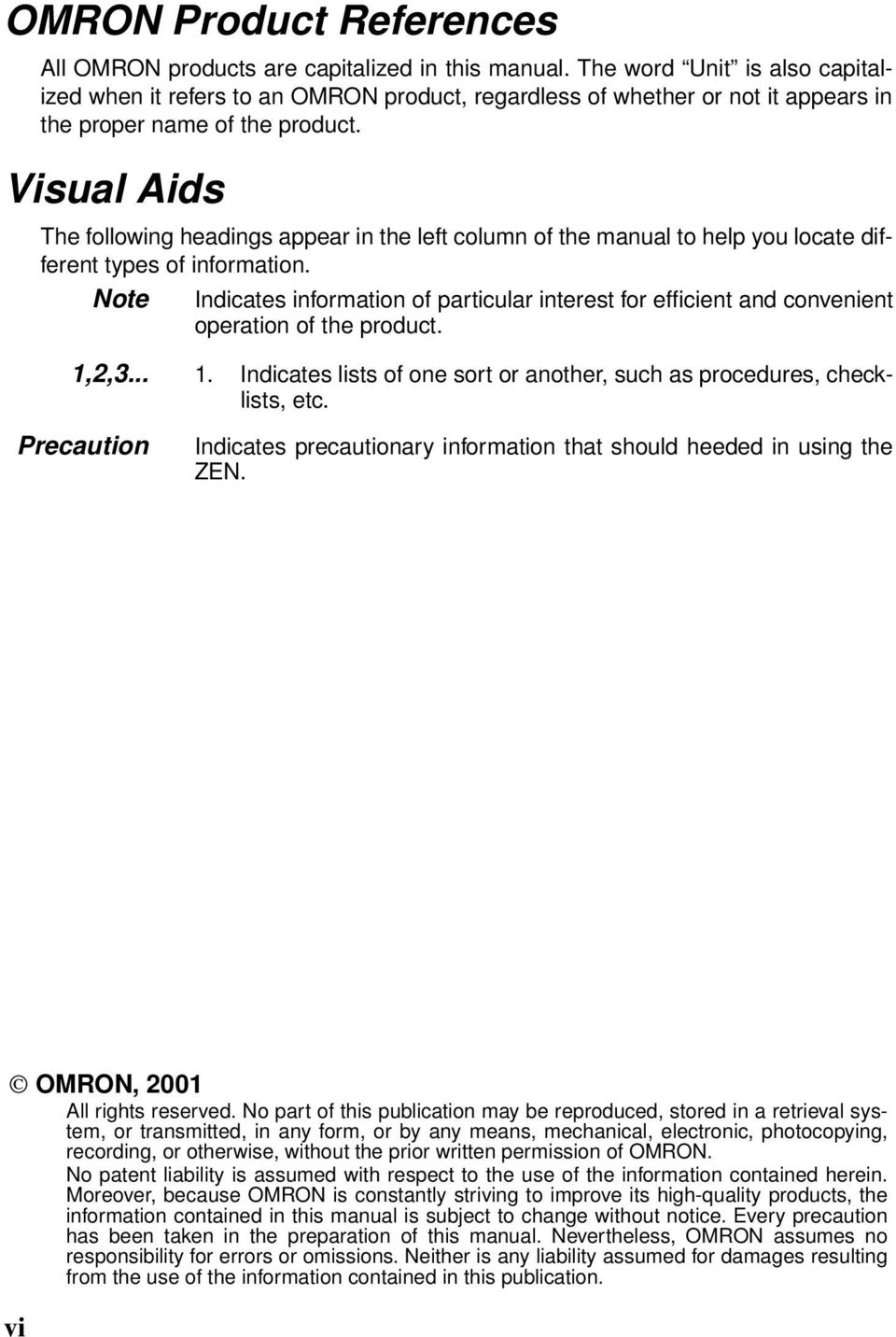
6 TABLE OF CONTENTS PRECAUTIONS xi 1 Intended Audience xii 2 General Precautions xii 3 Safety Precautions xii 4 Application Precautions xiii 5 Support Software Version Upgrades xiv SECTION 1 Installation and Startup Before Operation Installing and Uninstalling ZEN Support Software Starting and Quitting Screen Configuration SECTION 2 Creating Ladder Programs Circuit Diagrams and Ladder Programs Inputting Ladder Programs Checking Ladder Programs Editing Ladder Programs Editing Comments Saving Ladder Programs Printing Ladder Programs SECTION 3 Transferring and Monitoring Programs Connecting the ZEN and Communications Settings Connecting Online Transferring Programs to the ZEN Transferring Programs from the ZEN Verifying Programs with ZEN Operating and Stopping the ZEN Monitoring Programs Setting and Resetting Inputs Clearing Errors vii
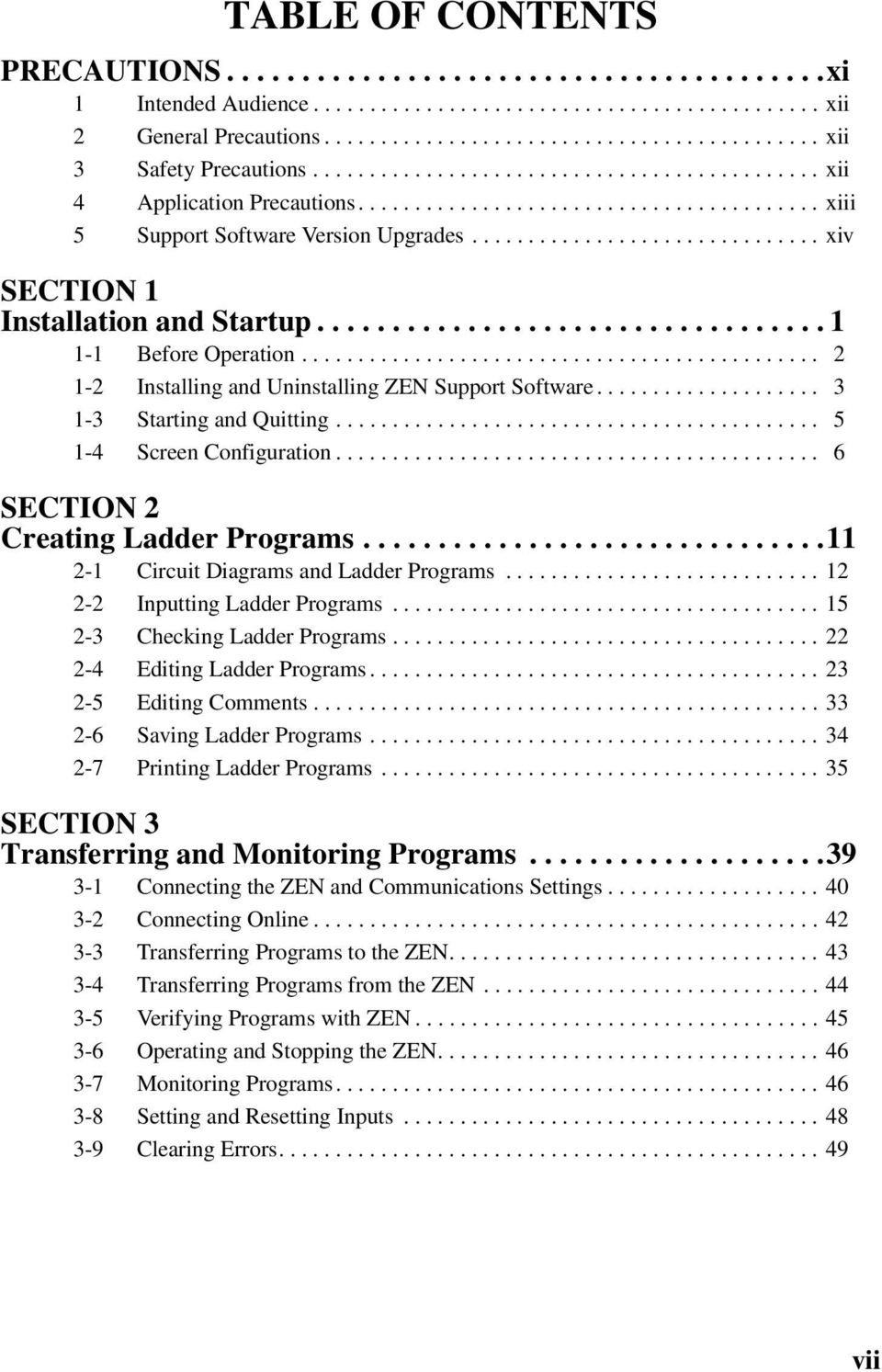
7 TABLE OF CONTENTS SECTION 4 System Settings ZEN Settings Setting a Password Protecting Programs Clearing ZEN Memory SECTION 5 Simulation Function Starting and Stopping the Simulation Function ZEN Image Display Present Value List Display Clock Display SECTION 6 Troubleshooting Online Errors and Warnings Program Check Errors and Warnings Protect Setting and Clearing Errors Appendix A Shortcut Keys and Hot Keys Revision History viii

8 About this Manual: This manual describes the installation and operation of the ZEN-SOFT01 ZEN Support Software and includes the sections described below. Please read this manual carefully and be sure you understand the information provided before attempting to install or operate the ZEN Support Software. Be sure to read the precautions provided in the following section. Precautions provides general precautions for using the ZEN Support Software and related devices. Section 1 describes how to install and start the ZEN Support Software. The screen configuration is also explained, along with the submenus for the Menu Bar, Toolbar, and Status Bar Section 2 describes how to create, save, edit, and print ladder programs Section 3 describes how to connect to the ZEN and how to transfer programs between the ZEN and the ZEN Support Software Section 4 describes ZEN system settings, how to set passwords to protect ZEN ladder programs, and how to clear the ZEN memory Section 5 describes the simulation function, which can be used to simulate ladder program execution without downloading the program to the ZEN. Section 6 describes errors that may occur while using the ZEN Support Software and possible countermeasures. The following two manuals are provided for the ZEN Programmable Relays. Refer to them as required in operation. Manual Contents Cat. No. ZEN Programmable Relays Operation Manual ZEN Support Software Operation Manual ZEN specifications, functions, and operating methods. Installation and operating procedures for the ZEN Support Software W385 W386 Note On the ZEN Support Software displays bits in ZEN memory are called relays, program input bits are called contacts, and program output bits are called coils.!warning Failure to read and understand the information provided in this manual may result in personal injury or death, damage to the product, or product failure. Please read each section in its entirety and be sure you understand the information provided in the section and related sections before attempting any of the procedures or operations given. ix

9

10 PRECAUTIONS This section provides general precautions for using the ZEN Support Software for the ZEN Programmable Relays. The information contained in this section is important for the safe and reliable application of the ZEN. You must read this section and understand the information contained before attempting to set up or operate a ZEN. 1 Intended Audience xii 2 General Precautions xii 3 Safety Precautions xii 4 Application Precautions xiii 5 Support Software Version Upgrades xiv xi
11 Intended Audience 1 1 Intended Audience This manual is intended for the following personnel, who must also have knowledge of electrical systems (an electrical engineer or the equivalent). Personnel in charge of installing FA systems. Personnel in charge of designing FA systems. Personnel in charge of managing FA systems and facilities. 2 General Precautions The user must operate the product according to the performance specifications described in the operation manuals. Before using the product under conditions which are not described in the manual or applying the product to nuclear control systems, railroad systems, aviation systems, vehicles, combustion systems, medical equipment, amusement machines, safety equipment, and other systems, machines, and equipment that may have a serious influence on lives and property if used improperly, consult your OMRON representative. Make sure that the ratings and performance characteristics of the product are sufficient for the systems, machines, and equipment, and be sure to provide the systems, machines, and equipment with double safety mechanisms. This manual provides information for installing and operating OMRON Motion Control Units. Be sure to read this manual before operation and keep this manual close at hand for reference during operation.!warning It is extremely important that a PC and all PC Units be used for the specified purpose and under the specified conditions, especially in applications that can directly or indirectly affect human life. You must consult with your OMRON representative before applying a PC system to the above mentioned applications. 3 Safety Precautions!WARNING Always confirm the safety of the controlled system before transferring programs to the ZEN or before manipulating the status of bits in ZEN memory. Unexpected system response may result, possibly causing injury. xii

12 Application Precautions 4 4 Application Precautions Observe the following precautions when using the ZEN Support Software. Observe the following precautions before starting the ZEN Support Software Close all software programs not related to the ZEN Support Software. It is particularly important to close all programs that start periodically or intermittently, such as screen savers, virus checkers, and other communications programs, and schedulers. Do not share hard disks, printers, or other devices with other network computers while running the ZEN Support Software. Some notebook computers set the RS-232C port to modem or infrared application by default. Change the settings according to the operating instructions for your computer so that the RS-232C port can be used as a normal serial communications port. Some notebook computers set the RS-232C port to not supply power (5 V) to the port to save energy by default. Change the settings according to the operating instructions for your computer to provide power to the port. (There are Windows settings and also possibly settings for computer-specific utilities or BIOS settings to save power.) Confirm that no adverse effect will occur in the system before attempting any of the following. Not doing so may result in an unexpected operation. Changing the operating mode. Setting and resetting bits in memory. Changing bit status or parameter settings. Check the user program for proper execution before actually transferring it to or running it on the Unit. Not checking the program may result in an unexpected operation. xiii

13 Support Software Version Upgrades 5 5 Support Software Version Upgrades xiv The following table shows the relationship between the version and functions of the ZEN Support Software and the ZEN CPU Unit. Date of revision ZEN CPU Unit ZEN Support Software Released in January 2002 System Software (See note 1.) Changes Applicable from Version 2.00 (ZEN-SOFT01- V2) The system software was upgraded to version Main Changes The following display functions have been added to LCD-type CPU Units. Clear display function The display object DAT1 (day/month) Released in April 2003 System Software (See note 1.) The system software was upgraded to version ( -V1 was added to the CPU Unit model number.) Main Changes (See note 2.) The number of timers, counters, weekly timers, calendar timers, and display bits was increased from 8 to 16. The number of holding timers was increased from 4 to 8. A 20-point CPU Unit was added to the lineup. Changed to handle additional display functions. Simulation function added. Improvements made to functions, operability, and display. Changes Applicable from Version 3.00 (ZEN-SOFT01- V3) Changed to handle the memory area expansion in -V1 CPU Units. Changed to handle addition of 20-point CPU Units. Note 1. System software is the software for processing the CPU Unit s program. With LCD-type CPU Units, the system software version can be read by selecting Other/System information from the menu. With -V1 CPU Units, V02.00 will be displayed as the system software version. 2. The following table shows a memory area comparison of -V1 CPU Units with other CPU Units. Item -V1 CPU Units CPU Units without -V1 (with system software version 2.00) 10 I/O points 20 I/O points 10 I/O points ZEN-10C@@@-@-V1 ZEN-20C@@@-@-V1 ZEN-10C@@@-@ CPU Unit I0 to I5 (6 bits) I0 to Ib (12 bits) I0 to I5 (6 bits) input bits CPU Unit Q0 to Q3 (4 bits) Q0 to Q7 (8 bits) Q0 to Q3 (4 bits) output bits Timers T0 to Tf (16 timers) T0 to T7 (8 timers)
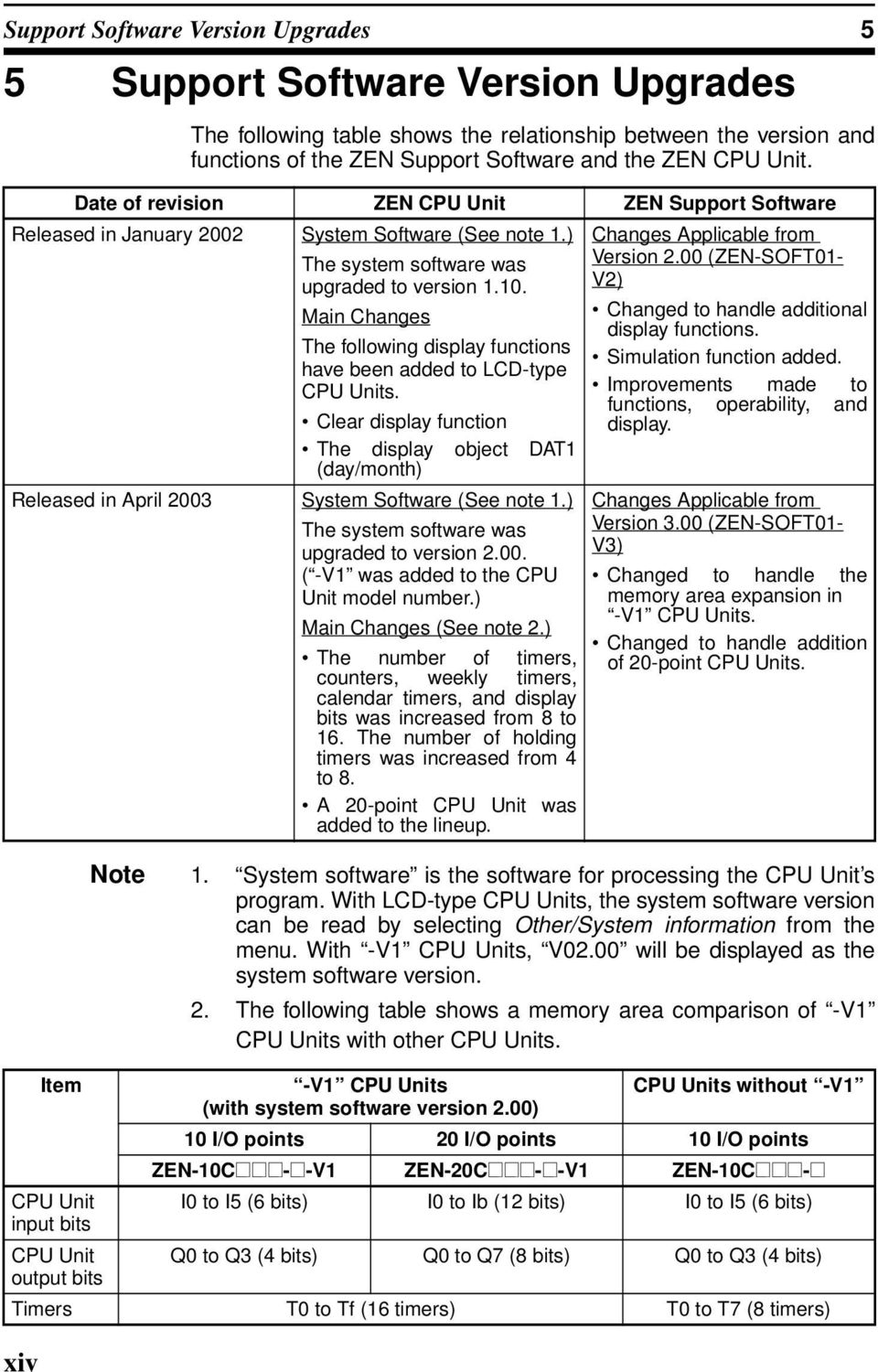
14 Support Software Version Upgrades 5 Item -V1 CPU Units CPU Units without -V1 (with system software version 2.00) 10 I/O points 20 I/O points 10 I/O points ZEN-10C@@@-@-V1 ZEN-20C@@@-@-V1 ZEN-10C@@@-@ Holding #0 to #7 (8 timers) #0 to #3 (4 timers) timers Counters C0 to Cf (16 counters) C0 to C7 (8 counters) (16 (8 timers) timers Calendar 0 to f (16 timers) 0 to 7 (8 timers) timers Display bits D0 to Df (16 bits) D0 to D7 (8 bits) Compatibility between Support Software and Data Data Data created with Ver Data created with Ver Data created with Ver Data created with Ver Version of ZEN Support Software Ver Ver Ver Ver Yes Yes Yes Yes Yes Yes Yes Yes No (See note.) No (See note.) Yes Yes No (See note.) No (See note.) No (See note.) Yes Note A message saying that it was not possible to read the file will be displayed if an attempt is made to read incompatible data. Compatibility between ZEN CPU Unit and Support Software Version of CPU Unit Version of ZEN Support Software Ver Ver Ver Ver Ver Yes Yes Partial (See note 2.) Ver Ver ( -V1 CPU Units) Partial (See note 3.) Partial (See notes 3 and 4.) Partial (See note 3.) Partial (See notes 3 and 4.) Partial (See note 2.) Note 1. With LCD-type CPU Units, the system software version can be read by selecting Other/System information from the menu. With -V1 CPU Units, V02.00 will be displayed as the system software version. 2. The contents set by a display bit (D) will appear as follows: Yes Partial (See notes 3 and 4.) Yes Yes xv

15 Support Software Version Upgrades 5 If the day/month date (DAT1) is specified for display, the LCD display will show T# and the display function will not operate. If clear (C) is set as a function, the LCD display will appear as [ D0] and the display function will not operate. Note The above operations were not supported in ZEN versions prior to The following settings are new for a display bit (D) and cannot be used. Specifying a day/month date (DAT1) for display. Specifying clear (C) as a function. If a program containing these new settings for a display bit (D) is downloaded to the ZEN, it will be processed as follows: The contents set by a display bit (D) will appear as follows: If the day/month date (DAT1) is specified for display, it will appear as a CHR (character designation). If clear (C) is set as a function, the display bit (D) itself will be deleted from the program. Note The above operations were not supported in ZEN Support Software versions prior to The 20-point CPU Units cannot be used. Memory that can be used with 10-point -V1 CPU Units is restricted to the memory that can be used with 10-point CPU Units without -V1. xvi
16 SECTION 1 Installation and Startup This section describes how to install and start the ZEN Support Software. The screen configuration is also explained, along with the submenus for the Menu Bar, Toolbar, and Status Bar. 1-1 Before Operation Product Contents Compatible Computers Installing and Uninstalling ZEN Support Software Installation Uninstalling the ZEN Support Software Starting and Quitting Starting ZEN Support Software Quitting ZEN Support Software Screen Configuration
17 Before Operation Section Before Operation Product Contents Check that the package for the ZEN Support Software (ZEN- SOFT01-V3) contains one CD-ROM setup disk Compatible Computers The ZEN Support Software can be used on the computers specified in the following table. Item Conditions Operating system Windows 95, 98, ME, 2000, XP, or NT4.0 Service Pack 3 CPU Pentium 133 MHz or better Pentium 200 MHz or better recommended. Memory 64 Mbytes or more HDD 40 Mbytes or more of available disk capacity CD-ROM drive Required. Communications 1 serial port (COM port) Keyboard and mouse Required. Monitor 800 x 600 dots (SVGA) min., 256 colors min. 2

18 Installing and Uninstalling ZEN Support Software Section Installing and Uninstalling ZEN Support Software Installation 1,2, Insert the Setup Disk in the CD-ROM drive of the computer. After a short while the Language Selection Screen will be displayed. Click the OK Button. Note If the Language Selection Screen is not displayed when the CD- ROM is inserted, go to My Computer, open the Setup Disk (CD- ROM) icon, and double-click the Setup.exe file. 2. The Setup Screen will be displayed. Check the details, enter the required information, and click the Next Button. 3

19 Installing and Uninstalling ZEN Support Software Section When the setup operation has been completed, the following screen will be displayed. Click the Finish Button Uninstalling the ZEN Support Software Use the following procedure to uninstall the ZEN Support Software from a computer. 1,2, Select Settings/Control panel from the Windows Start Menu. 2. Select Add or delete applications from the Windows Control Panel and then select and delete OMRON ZEN Support Software. 4

20 Starting and Quitting Section Starting and Quitting Starting ZEN Support Software This section explains the procedure for starting and quitting the ZEN Support Software. After a moment the initial screen will be displayed. 1,2, Select Program/Omron/ZEN Support Software/ZEN Support Software from the Windows Start Menu. 2. When display of the opening screen is finished, the following screen will be displayed. Select Create a new program and click the OK Button. Note a) Click Load programs from files and double-click the OK Button to open existing ladder programs when starting up the ZEN Support Software. Refer to Opening Saved Files for the rest of the procedure for opening existing ladder programs. b) If uploading a program from ZEN is selected: Using the ZEN online function, read the contents of the property settings (ZEN model and Expansion I/O Unit configuration) from ZEN and make the settings. Transfer the program (ZEN to computer). The ladder diagram display will be generated automatically. 5

21 Screen Configuration Section The Property Settings Screen will be displayed. Enter the ZEN model and configuration (i.e., whether or not Expansion I/O Units are connected), the project name, and a comment and press the OK Button. 4. The ZEN Support Software will start Quitting ZEN Support Software Select File/Exit from the Menu Bar to close the ZEN Support Software. 1-4 Screen Configuration The ZEN Support Software allows the display to be set to either a Ladder Diagram Display or an Electric Circuit Display. The functionality of the ZEN Support Software is the same regardless of which display is used. 6
22 Screen Configuration Section 1-4 Ladder Diagram Display Menu bar Toolbars Mouse cursor Row comments Ladder view of program Bit information Status bar Electrical Circuit Display Menu bar Toolbars Mouse cursor Row comments Electrical diagram Bit information Status bar Note To switch between the ladder diagram and electrical diagram displays, either click on the buttons in the Toolbar or else select View(V)/Circuit display method/ladder rung diagram/electrical circuit diagram from the File menu. 7
23 Screen Configuration Section 1-4 Menu Bar File (F) View (V) ZEN (Z) The Menu Bar functions are listed in the following menu tree. New (N) Open (O) Save (S) Save As (A) Load Symbol Comments Print Setup (R) Print Preview (V) Print (P) Communications Settings Properties Recent File Exit (X) Show Symbol Comments Toolbar Status Bar (S) Grid Circuit display method Zoom Out Zoom In Zoom to Go Online (W) Change operating mode (M) Monitor (O) Start/Stop Simulator Program Check Display Check Transfer (R) Protect (P) Set/Reset Operation Error Clear All Clear Within ZEN Set Protection (E) ZEN Information (S) Standard Ladder ZEN Simulator Edit (E) Insert (I) Ladder rung diagram Electrical circuit diagram. 50% 100% 150% 200% RUN (R) STOP (S) Help (H) Transfer from ZEN (T) Transfer to ZEN (R) Compare with ZEN (C) Release (L) Set (S) Set Operation (W) Reset Operation (F) Settings (S) Time Setting (T) Set Password (P) Undo (U) Redo (R) Cut (T) Copy (C) Paste (P) Select All (A) Delete Delete Row Find (F) Find Next Replace Edit (E) Edit Row Comments Edit Comments Select Objects Row (M) Contact (input bit)/ Coil (output bit) Horizontal (H) Vertical (V) Contents (N) Find Topics (T) About ZEN (A) 8
24 Screen Configuration Section 1-4 Note On the ZEN Support Software displays bits in ZEN memory are called relays, program input bits are called contacts, and program output bits are called coils. Toolbars The following shortcut keys can be used from the Toolbars. Select View/Toolbar from the Menu Bar to display or not display the Toolbars. Standard Ladder New Open Save Print Print Preview Cut Copy Paste Delete Undo Redo Find About ZEN Select objects Insert Contact (input) condition Insert Coil (output) Insert Horizontal Insert Vertical Zoom Out Zoom In Show Grid Show Comments Ladder rung diagram Electrical circuit diagram ZEN Simulator Go Online Toggle Monitoring Transfer to ZEN Transfer from ZEN Compare with ZEN Set Protection Release Protection RUN STOP ZEN Image Display Present Value List Display Clock Display Start/Stop Simulator Note On the ZEN Support Software displays bits in ZEN memory are called relays, program input bits are called contacts, and program output bits are called coils. Mouse Cursors There are two types of cursors used with ZEN. A right-click menu can be used with either of them. Pencil Cursor Appears when performing ladder program input operations. 9
25 Screen Configuration Section 1-4 Arrow Cursor Appears when performing operations from the Menu Bar or the Toolbar. Also used for specifying the range when editing ladder programs. Right-click Menu Edit (E) Find (F) Cut (T) Copy (C) Paste (P) Delete (D) Set/Reset (S) Row (L) Set (W) Reset (F) Insert (W) Remove (R) Bit Information Information on bits is displayed in the Bit Information Area. The bit type is displayed here. Comments are displayed here. Set values for timers, counters, etc., are displayed here. Input information and present values for timers, counters, etc., are displayed here. Status Bar The Status Bar displays information on the model of the connected ZEN, the connection status, operating status, and comments Connected ZEN model Displays the model of the ZEN selected at startup. 2 Connection status Indicates online or offline status. 3 Operating status Indicates RUN or STOP (displayed only when online). 4 Comments Displays operation explanations and online errors. 10
26 SECTION 2 Creating Ladder Programs This section describes how to create, save, edit, and print ladder programs. 2-1 Circuit Diagrams and Ladder Programs Ladder Programs Basic Configuration of ZEN Ladder Programs Memory Areas Memory Area Differences between Versions Inputting Ladder Programs Checking Ladder Programs Program Check Display Check Editing Ladder Programs Searching for Inputs and Outputs Replacing Inputs Changing Inputs, Outputs, and Settings Inserting Inputs Deleting Inputs and Outputs Inserting Rows Editing Connection Lines Copying, Cutting, and Pasting Inputs and Outputs Deleting Rows Editing Comments Saving Ladder Programs Saving to File Opening Saved Files Printing Ladder Programs Print Settings Print Preview Printing
27 Circuit Diagrams and Ladder Programs Section Circuit Diagrams and Ladder Programs In preparation for creating ladder programs, this section describes the relationship between relay circuits and ladder programs Ladder Programs Relay Circuit The ZEN uses ladder programs that appear like relay circuit diagrams. Ladder Program I0 I1 Q0 SW1 Ry SW2 Ry Q Basic Configuration of ZEN Ladder Programs The ZEN can execute up to 96 lines of programming, with 3 inputs and 1 output per line. Outputs can be specified at the right ends of lines only. Inputs cannot be specified after outputs. 3 inputs 1 output Ladder Diagram Display 1st input 2nd input 3rd input Output bit The ladder program inputs and outputs are displayed on the ZEN Support Software screen as shown below. 1st input 2nd input 3rd input Output bit 3 inputs 1 output 12
28 Circuit Diagrams and Ladder Programs Section 2-1 Electrical Circuit Display 1st input 2nd input 3rd input Output bit 3 inputs 1 output Note On the ZEN Support Software displays bits in ZEN memory are called relays, program input bits are called contacts, and program output bits are called coils Memory Areas The memory areas shown in the following table can be used in ZEN ladder programs. I X B A P Symbol Name Function Usable as input condition CPU Unit input bits Expansion I/O Unit input bits Button switches Analog comparator bits Timer/counter comparator bits Correspond to CPU Unit input terminals. Correspond to Expansion I/O Unit input terminals. Turn ON/OFF when operation buttons are pressed on the CPU Unit during ZEN operation. Perform comparisons on a set value and the input values for CPU Units with DC power supply inputs. (The analog input terminals correspond to I4 and I5 in 10-point CPU Units, and to Ia and Ib in 20- point CPU Units.) Compares timer/counter present values and timer/counter present values and Weekly timers Turns ON/OFF between specified days and times. Calendar timers Turns ON/OFF between specified dates. Yes Yes Yes Yes Yes Yes Yes Usable as output No No No No No No No 13
29 Circuit Diagrams and Ladder Programs Section 2-1 Q Y Symbol Name Function Usable as input condition CPU Unit output bits Expansion I/O Unit output bits Correspond to CPU Unit output terminals. Correspond to Expansion I/O Unit output terminals. M Work bits Bits that can be used in the ladder program. H Holding bits Bits that maintain ON/ OFF status at power interruptions and can be used in the ladder program. Can specify Normal output ([), Set (S), Reset (R), or Alternate (A) operation. T Timers Timers that can be used for ON delay (X), OFF delay ( ), Oneshot pulse (O), or Flashing pulse (F). # Holding timers Timers that maintain the present value at power interruptions. (ON delay operation only.) C Counters Incremental or decremental counters D Display bits Display character strings, month/ day, time, timer/counter present value, or analog conversion value on CPU Unit LCD display. Yes Yes Yes Yes Yes Yes Yes No Usable as output Yes Yes Yes Yes Yes Yes Yes Yes Memory Area Differences between Versions The following table shows the differences between different models and different versions with respect to the memory areas that can be used. Symbol Name Bit number (See note 1.) ZEN- 20C@@@-@- V1 ZEN- 10C@@@-@- V1 ZEN- 10C@@@-@ I CPU Unit input bits 0 to b (12 bits) 0 to 5 (6 bits) 0 to 5 (6 bits) Q CPU Unit output bits 0 to 7 (8 bits) 0 to 3 (4 bits) 0 to 3 (4 bits) X Expansion I/O Unit input bits (See 0 to b (12 bits max.) note 2.) Y Expansion I/O Unit output bits (See note 2.) 0 to b (12 bits max.) 14
30 Inputting Ladder Programs Section 2-2 Symbol Name Bit number (See note 1.) ZEN- V1 M Work bits 0 to f (16 bits) H Holding bits 0 to f (16 bits) B Button switches (See note 3.) 0 to 7 (8 bits) A Analog comparator bits (See note 0 to 3 (4 bits) 4.) P Timer/counter comparator bits 0 to f (16 bits) T Timers 0 to f (16 timers) 0 to 7 (8 timers) # Holding timers 0 to 7 (8 timers) 0 to 3 (4 timers) C Counters 0 to f (16 counters) 0 to 7 (8 Weekly timers (See note 3.) 0 to f (16 timers) 0 to 7 (8 timers) Calendar timers (See note 3.) 0 to f (16 timers) 0 to 7 (8 timers) D Display bits (See note 3.) 0 to f (16 bits) 0 to 7 (8 bits) Note 1. Bit numbers are specified in hexadecimal (0,1,2,3... 9, a, b,...e, f). 2. The bit numbers that can be used depend on the Expansion I/O Unit connection configuration. 3. Button switches, weekly timers, calendar timers, and display bits can be used only for CPU Units with an LCD screen and operation buttons. 4. Analog comparator bits can be used only for CPU Units with 24 VDC power supplied. 2-2 Inputting Ladder Programs This section describes how to input the following simple program using the ZEN Support Software. Example Ladder Program I0 I1 Q0 ZEN- 10C@@@-@- V1 ZEN- 10C@@@-@ Q0 15
31 Inputting Ladder Programs Section 2-2 1,2, If the ZEN Support Software has not been started, select Programs/Omron/ZEN Support Software/ZEN Support Software from the Windows Start Menu. Select Create a new program and press the OK Button. If the ZEN Support Software has already been started, click the New Button on the Toolbar. Alternatively, select File/New from the Menu Bar. 2. The Property Settings Screen will be displayed. Enter the ZEN model, configuration (i.e., Expansion I/O Units), project name, and comment, and then click the OK Button. 3. An empty screen in ladder-view format will be displayed. Doubleclick the mouse on the position for the first input condition. Note Input positions for input and output bits can be set by using the mouse or cursor keys to move to the input or output position and then 1) pressing the Enter Key, 2) double-clicking, 3) clicking the Insert Input or Insert Output Button on the Toolbar, 4) selecting Insert-Contact/Coil from the 16
32 Inputting Ladder Programs Section 2-2 Menu Bar, 5) selecting Edit/Edit from the Menu Bar, or 6) clicking the right mouse button and selecting Edit. 4. The Edit Input Dialog Box will be displayed. Specify the bit type, type of input, and bit number, and enter a comment if required. Bit name: I Input: Normally open Bit number: 0 Comment: CPU Unit input bit 0 (Up to 31 characters can be input.) Comment color Note a) Parameter settings are also specified for timers and counters. b) Parameters are set on the Edit Input Dialog Box. 5. Double-click the mouse on the next input position. 17
33 Inputting Ladder Programs Section The Edit Input Dialog Box will be displayed again. Specify the bit type, type of input, bit number, and enter a comment if required, just as you did in step 4. Bit name: I Input: Normally closed Bit number: 1 Comment: CPU Unit input bit 1 (Up to 31 characters can be input.) Comment color 7. Move the mouse to the output bit position and double-click the mouse. 18
34 Inputting Ladder Programs Section The Edit Output Dialog Box will be displayed. Specify the bit type, function, and bit number, and enter a comment if required. Bit name: Q Normal output ([), Set (S), Reset (R), or Alternate (A): Normal output ([) Bit number: 0 Comment: CPU Unit output bit 0 (Up to 31 characters can be input.) Comment color 9. Move the mouse to the input position on the next line and doubleclick. 19
35 Inputting Ladder Programs Section The Edit Input Dialog Box will be displayed. Specify the bit type, type of input, and bit number, and enter a comment if required, just as you did in step 4. Bit name: Q Input type: Normally open Bit number: 0 Comment: CPU Unit output bit 0 (Up to 31 characters can be input.) Comment color Note The comment will be automatically displayed for bit types and bit numbers that have comments. 11. Drag the mouse vertically to draw a connection line. 20
36 Inputting Ladder Programs Section 2-2 Note a) Vertical connection lines can also be drawn by 1) using the mouse or Cursor Keys to move to the connection line position and pressing the Key, 2) clicking the Insert Vertical Button on the Toolbar, or 3) selecting Insert/ Vertical from the Menu Bar. The vertical line will be drawn down from the cursor position. b) Horizontal connection lines can be drawn by using the mouse or Cursor Keys to move to the connection line position and pressing the - Key, clicking the Insert Horizontal Button on the Toolbar, or selecting Insert/ Horizontal from the Menu Bar. 12. The ladder program has now been completed. 13. Double-click in the row comment area to write row comments for the ladder program. It is also possible to write comments by first using either the mouse or the cursor keys to move to the row comment area, and then selecting Edit (E)/Edit row comments. Enter row comment. 21
37 Checking Ladder Programs Section 2-3 Row comment is displayed. Note Up to 63 characters can be input for a row comment. 2-3 Checking Ladder Programs Program Check Select ZEN/Program Check from the Menu Bar and check the program. The following dialog box will be displayed if the program check was completed without finding any errors. Note For details on error messages during program checking, refer to 6-2 Program Check Errors and Warnings Display Check Select ZEN(Z)/Display Check from the Menu Bar, and then use the Display Check Dialog Box to check the display contents for the display bits D0 to Df that are used in the program. The contents of each 22
38 Editing Ladder Programs Section 2-4 are displayed in different colors, so overlapping displays can be checked. Click to open the Display Check Dialog Box. Click with the mouse to toggle between displaying or not displaying the display contents for each of the display bits D0 to Df. 2-4 Editing Ladder Programs This section describes how to edit existing ladder programs Searching for Inputs and Outputs Click the Find Button on the Toolbar or select Edit/Find from the Menu Bar. Finding by Row Number Finding by Bit Type or Bit Number Row numbers: 0 to 95 Bit type number Replacing Inputs To replace an input, select Edit(E)/Replace from the Menu Bar. Replace the inputs while doing the search. (As each input is found, confirm whether or not it is to be replaced.) Bit type number Replace all of the inputs in the ladder program (without confirming them individually). 23
39 Editing Ladder Programs Section Changing Inputs, Outputs, and Settings Input positions for input and output bits can be changed by using the mouse or cursor keys to move to the input or output position and then 1) pressing the Enter Key, 2) double-clicking, 3) clicking the Insert Input or Insert Output Button on the Toolbar, 4) selecting Insert- Contact/Coil from the Menu Bar, 5) selecting Edit/Edit from the Menu Bar, or 6) clicking the right mouse button and selecting Edit. 1,2, For this example, double-click built-in output Q0. 2. The Edit Output Dialog Box will be displayed. 24
40 Editing Ladder Programs Section Change the bit type in the Edit Output Dialog Box from Q to M (holding bit), specify the function and bit number, and enter a comment if necessary. The output change has now been completed Inserting Inputs Input positions for input and output bits can be inserted by using the mouse or cursor keys to move to the input or output position and then 1) pressing the Enter Key, 2) double-clicking, 3) clicking the Insert Input Button on the Toolbar, 4) selecting Insert-Contact/Coil from the Menu Bar, 5) selecting Edit/Edit from the Menu Bar, or 6) clicking the right mouse button and selecting Edit. 25
41 Editing Ladder Programs Section 2-4 1,2, Double-click the ladder program connection line. 2. Use the Edit Input Dialog Box to insert a input at the connection line Deleting Inputs and Outputs To delete an input or output, first use the mouse or the cursor keys to highlight the input or output that is to be deleted. Then use any of the following methods. Click the Delete Button in the Toolbar. Select Edit(E)/Delete from the Menu Bar. Click the right mouse button and select Delete(D). Press the Delete Key on the keyboard. 1,2, Move the cursor to the input. 26
42 Editing Ladder Programs Section Click the Delete Button on the Toolbar. The input will be deleted. Note All inputs and outputs within a specified area can be deleted at once if the method to specify an area outlined under Copying, Cutting, and Pasting Inputs and Outputs is used Inserting Rows Using either the mouse or cursor keys, highlight the position where the row is to be inserted, and then use one of the following methods to insert a blank row. Select Insert(I)/Row(M) from the Menu Bar. Click the right mouse button and select Row(L)/Insert(W). 27
43 Editing Ladder Programs Section 2-4 1,2, Highlight the position and then select Insert(I)/Row(M) from the Menu Bar. 2. The blank row will be inserted above the highlighted position Editing Connection Lines Use one of the following operations to delete connection lines. 1,2, Drag the mouse along the existing line. ( Drag means to move the mouse while holding down the mouse button.) 2. Use the mouse or Cursor Keys to move to the connection line and 1) click the Delete Button on the Toolbar, 2) select Edit/Delete from the Menu Bar, or 3) press the Delete Key on the keyboard. Use one of the following operations to create new connection lines. 1,2, Drag the mouse from the desired position to create a new line. ( Drag means to move the mouse while holding down the mouse button.) 2. Use the mouse or Cursor Keys to move to the desired position for the connection line and 1) click the Insert Horizontal or Insert Vertical Button on the Toolbar, 2) select Insert/Horizontal or In- 28
44 Editing Ladder Programs Section 2-4 sert/vertical from the Menu Bar, or 3) press the - or I Key on the keyboard Copying, Cutting, and Pasting Inputs and Outputs Inputs and outputs within a specified range can be easily copied and moved if the cut, copy, or paste functions are used. Copying, Cutting and Pasting Individual Objects 1,2, Using the mouse or cursor keys, select the input or output that is to be copied or cut. 2. Use the following procedures for copying and moving. When Copying Any of the following methods can be used for copying inputs and outputs. Click the Copy Button on the Toolbar. Select Edit(I)/Copy(C) from the Menu Bar. Click the right mouse button and select Copy. When Moving Any of the following methods can be used for cutting inputs and outputs. Click the Cut Button on the Toolbar. Select Edit(I)/Cut(T) from the Menu Bar. Click the right mouse button and select Cut. 29
45 Editing Ladder Programs Section 2-4 When Copying 3. Any of the following methods can be used for pasting inputs and outputs. Click the Paste Button on the Toolbar. Select Edit(I)/Paste(P) from the Menu Bar. Click the right mouse button and select Paste. When Moving Note Either the pencil or arrow cursor can be used to copy, cut, and paste individual objects. Copying, Cutting, and Pasting a Specified Range 1,2, Click the Select objects Button on the Toolbar or select Edit/Select Objects from the Menu Bar. Note Connection lines cannot be moved by the mouse while the Select objects Button on the Toolbar is pressed. To return to normal program edit mode, click the Select Objects Button again or press the Esc Key. 30
46 Editing Ladder Programs Section Drag the mouse from the start of the range to the end of the range. ( Drag means to move the mouse while holding down the mouse button.) 3. Use the following procedures for copying and moving. 31
47 Editing Ladder Programs Section 2-4 When Copying Any of the following methods can be used for copying a specified range. Click the Copy Button on the Toolbar. Select Edit(I)/Copy(C) from the Menu Bar. Click the right mouse button and select Copy. When Moving Any of the following methods can be used for cutting a specified range. Click the Cut Button on the Toolbar. Select Edit(I)/Cut(T) from the Menu Bar. Click the right mouse button and select Cut. When Copying 4. Any of the following methods can be used for pasting inputs and outputs. Click the Paste Button on the Toolbar. Select Edit(I)/Paste(P) from the Menu Bar. Click the right mouse button and select Paste. When Moving Note To copy a ladder program in an existing file, start up the ZEN Support Software separately and then the ladder program can be copied and pasted. 32
48 Editing Comments Section Deleting Rows Using either the mouse or cursor keys, highlight the row that is to be deleted. Then use one of the following methods to delete the row. Select Edit(E)/Delete Row from the Menu Bar. Click the right mouse button and select Row(L)/Delete(R). 1,2, Highlight the position and then select Edit(E)/Delete Row from the Menu Bar. 2. The highlighted row will be deleted, and the next row will be moved up. 2-5 Editing Comments The comment edit function is used to display or edit all I/O comments by bit type. 1,2, Select Edit/Edit Comments from the Menu Bar. 33
49 Saving Ladder Programs Section Edit the comment in the Edit Comment Screen. Note 1. Programs are easier to understand and manage if actual I/O device names or names relating to functions are used in the I/O comments. 2. Click the Show Comments Button on the Toolbar or select View/ Show Symbol Comments from the Menu Bar to display or not display the I/O comments in ladder view on the screen. 2-6 Saving Ladder Programs Saving to File This section describes how to save ladder programs to file. 1,2, Select File/Save As from the Menu Bar. 2. The Save As Dialog Box will be displayed. Enter the save destination and file name and click the Save Button. Note 1. When saving existing ladder programs that have been edited since they were saved, you can also click the Save Button on the Toolbar or select File/Save from the Menu Bar to overwrite the existing file. 34
50 Printing Ladder Programs Section The system settings and password set under ZEN/Set Protection will also be saved with the file Opening Saved Files 1,2, Click the Open Button on the Toolbar or select File/Open from the Menu Bar to open saved files. 2. The Open File Dialog Box will be displayed. Specify the file location and file name and click the Open Button. 2-7 Printing Ladder Programs Print Settings This section describes the layout and heading settings that must be made before printing ladder programs. 1,2, Select File/Print Setup from the Menu Bar. 2. The Print Settings Dialog Box will be displayed. Make the settings for each item. Setting Program frame display Parameter settings information Explanation Check this box to print the print frame. Check this box to print the timer, counter, and other parameter settings. Information will be printed only for portions of the memory areas that are being used. 35
51 Printing Ladder Programs Section 2-7 Setting Print title Drawing name Figure No. Revision mark Prepared by Date Explanation Check this box to print the title. Enter the drawing name. Enter the drawing number. Enter the revision mark. Enter the name of the person who wrote the program. Enter the date the program was written Print Preview 3. Click the OK Button to save the settings as the print settings for the ZEN Support Software. Click the Cancel Button to discard the settings. Note a) To specify whether I/O comments are to be printed, either click the Show Comments Button on the Toolbar or select View(V)/Comments from the Menu Bar. b) To specify whether a ladder diagram or electrical circuit diagram is to be printed, either click the Ladder rung diagram Button or the Electrical circuit diagram Button on the Toolbar or else select View(V)/Circuit display/ Ladder rung diagram or Electrical circuit diagram from the Menu Bar. 1,2, Click the Print Preview Button on the Toolbar or select File/Print Preview from the Menu Bar to check the print layout. 2. The Print Preview Screen will be displayed. 36
52 Printing Ladder Programs Section Printing 1,2, Click the Print Button on the Toolbar or select File/Print from the Menu Bar. 2. The Print Dialog Box will be displayed. Make settings for each item and click the OK Button. 37
53 Printing Ladder Programs Section
54 SECTION 3 Transferring and Monitoring Programs This section describes how to connect to the ZEN and how to transfer programs between the ZEN and the ZEN Support Software. 3-1 Connecting the ZEN and Communications Settings Connecting to the ZEN Communications Settings Connecting Online Transferring Programs to the ZEN Transferring Programs from the ZEN Verifying Programs with ZEN Operating and Stopping the ZEN Monitoring Programs Monitor Displaying Present Values Changing Settings Online Setting and Resetting Inputs Clearing Errors
55 Connecting the ZEN and Communications Settings Section Connecting the ZEN and Communications Settings Connecting to the ZEN Use a ZEN-CIF01 Computer Connecting Cable to connect the ZEN and a serial port (COM port) of the computer. ZEN-CIF01 Computer Connecting Cable Note The connector on the computer side of the ZEN-CIF01 Computer Connecting Cable is a 9-pin D-sub connector. If the computer has a 25-pin D-sub connector, use a commercially available conversion connector or conversion cable. For 9-pin D-sub Serial Port Connectors ZEN-CIF01 Computer Connecting Cable For 25-pin D-sub Serial Port Connectors ZEN-CIF01 Computer Connecting Cable Conversion connector 40
56 Connecting the ZEN and Communications Settings Section Communications Settings Communications settings must be made in the ZEN Support Software before commencing communications with the ZEN. 1,2, Select File/Communications Settings from the Menu Bar. 2. The Communications Settings Dialog Box will be displayed. Make the settings for each item. Setting Details Default Modem Set to None. The port specified under Port name will be connected to the ZEN. None Local information (See note b.) Country code (See note b.) Area code (See note b.) Telephone No. (See note b.) This is the local information set on the computer. The connection destination country code. The connection destination area code. The connection destination telephone number. Port name Select either COM1 or COM 2. COM 1 Node No. (See note a.) Monitor time Specify a node number between 0 and 9. Specify the communications monitor time between 0 and 30 s. Note a) Set the same node number as set on the ZEN. Communications cannot be performed if the node numbers are different. b) Do not make any settings for these items. These settings are for function expansion. 3. Click the OK Button to save the settings in the project. Click the Cancel Button to discard the settings. Click the Defaults Button to return to the default settings
57 Connecting Online Section Connecting Online Check communications with the ZEN before transferring or verifying programs. Connect the ZEN and perform the check operation with the project file open. 1,2, Select File/Properties from the Menu Bar and make the ZEN model and Expansion I/O Units 1 to 3 settings in the Properties Dialog Box to match the system configuration of the ZEN to be connected online. 2. Click the Go Online Button on the Toolbar or select ZEN/Go Online from the Menu Bar. A confirmation dialog box will be displayed. Click the OK Button. 3. Check that the Status Bar display has changed from Offline to Online. The background color for the ladder view area will change to gray when the ZEN is online. Click the Go Online Button on the Toolbar again or select ZEN/ Go Online from the Menu Bar. The display on the Status Bar will return from Online to Offline and the Ladder Program Screen will change back to the normal background color. Note a) Ladder programs cannot be edited when online. Always go offline before creating or editing ladder programs. b) Select ZEN/ZEN Information from the Menu Bar while online to obtain information about the connected ZEN. 42
58 Transferring Programs to the ZEN Section Transferring Programs to the ZEN This section describes how to transfer ladder programs created using the ZEN Support Software to the ZEN. The ZEN must be connected and online and the project file opened before the program transfer operation can be executed.!caution Check the safety of connected devices before transferring programs to the ZEN. Injuries may occur if programs are transferred carelessly. 1,2, Click the Transfer to ZEN Button on the Toolbar or select ZEN/ Transfer/Transfer to ZEN from the Menu Bar. The Transfer to ZEN Dialog Box will be displayed. Click the OK Button to transfer the program to the ZEN. Click the Cancel Button to cancel the transfer. Note Settings Details Turn ON The settings are downloaded too in the Transfer to ZEN Dialog Box to download the ZEN settings in the ZEN Support Software at the same time. Refer to 4-1 ZEN Settings for information on the various ZEN settings. Turn ON Protection is set in the Transfer to ZEN Dialog Box if the ZEN is to be protected by the password set in the ZEN Support Software. Leave this check box turned OFF if no password has been set. Refer to 4-2 Setting a Password for information on setting passwords. Refer to 6-2 Program Check Errors and Warnings for information on error messages that occur during transfer from the computer to the ZEN. 43
59 Transferring Programs from the ZEN Section Transferring Programs from the ZEN This section describes how to transfer ZEN ladder programs to the ZEN Support Software. The ZEN must be connected and online and the project file opened before the program transfer operation can be executed. 1,2, Click the Transfer From ZEN Button on the Toolbar or select ZEN/Transfer/Transfer from ZEN from the Menu Bar. The Transfer From ZEN Dialog Box will be displayed. Click the OK Button to transfer the program from the ZEN. Click the Cancel Button to cancel the transfer. Settings Details Turn ON The settings are uploaded too in the Transfer From ZEN Dialog Box to upload the ZEN settings at the same time. 2. If the transfer from the ZEN to the computer has been completed normally, the set password will be cleared. A confirmation box confirming the clearing of the password will be displayed. If no password had been set, this confirmation box will not be displayed. Note Refer to 6-2 Program Check Errors and Warnings for information on error messages that occur during transfer from the ZEN to the computer. 44
60 Verifying Programs with ZEN Section Verifying Programs with ZEN This section describes how to compare the programs in the ZEN and ZEN Support Software to verify that they are the same. The ZEN must be connected and online and the project file opened before the program verification operation can be executed. 1,2, Click the Compare with ZEN Button on the Toolbar or select ZEN/Transfer/Compare with ZEN from the Menu Bar. The Compare With ZEN Dialog Box will be displayed. Click the OK Button to compare the ZEN and ZEN Support Software programs. Click the Cancel Button to cancel the verification. Settings Details Turn ON The settings are compared too in the Compare With ZEN Dialog Box to compare the ZEN and ZEN Support Software settings at the same time. 2. A confirmation dialog box will be displayed if the verification has been completed normally. When Programs Are the Same When Programs Are Different Note Refer to 6-2 Program Check Errors and Warnings for information on error messages that occur during verification. 45
61 Operating and Stopping the ZEN Section Operating and Stopping the ZEN This section describes how to operate and stop the ZEN from the ZEN Support Software. The ZEN must be connected and online and the project file opened before these operations can be executed. Note 1. Check that the power supply and input and output circuits are wired correctly before starting operation. 2. Remove the output wiring before performing operation tests for systems that have loads connected to the output circuit that could cause serious damage to persons or equipment if there is a malfunction. 3. Always check safety in the vicinity of equipment before turning ON the power or changing operation modes. 1,2, Select ZEN/Change operating mode/run from the Menu Bar. 2. Check that the Status Bar display changes from STOP to RUN. 3. Select ZEN/Change operating mode/stop from the Menu Bar to stop ZEN operation. The Status Bar display will change from RUN to STOP. 3-7 Monitoring Programs Monitor This section describes how to monitor programs being executed by the ZEN. The ZEN must be connected and online and the project file opened before the programs can be monitored. The ZEN and ZEN Support Software programs must be the same before programs can be monitored. Use the procedures outlined under 3-3 Transferring Programs to the ZEN, 3-4 Transferring Programs from the ZEN, and 3-5 Verifying Programs with ZEN to transfer and verify the programs. 1,2, Use the procedure outlined under 3-6 Operating and Stopping the ZEN to start ZEN operation. Check that the Status Bar display changes from STOP to RUN Click the Toggle Monitoring Button on the Toolbar or select ZEN/ Monitor from the Menu Bar.
62 Monitoring Programs Section When the mode is changed to MONITOR, the closed circuits of the ZEN ladder program are highlighted in green Displaying Present Values Present values, the ON/OFF status of inputs, etc., can be displayed during monitoring of programs being executed by ZEN. During monitoring, moving the cursor to a timer/counter or other output will cause the present value to be displayed. Present value display Changing Settings Online Set values can be changed while connected to ZEN online. 1,2, While online, use either the mouse or the cursor keys to highlight the output that is to be changed. Then use any of the following methods to change the setting. Press the Enter Key or double-click. Select Edit(E)/Edit(E) from the Menu Bar. 47
63 Setting and Resetting Inputs Section 3-8 Click the right mouse button and select Edit(E). 2. The Edit Dialog Box will be displayed. When the settings are changed and the dialog box closed, the changes will be transferred to ZEN and reflected there. Note The following table shows the settings that can be changed online. Bit type Timer (T) Holding timer (#) Counter (C) Weekly timer Calendar timer (*) Analog comparator (A) Content of change Time setting Time setting Counter setting Start/stop days of the week, times Start/stop months, days Input bits, constants, operators 3-8 Setting and Resetting Inputs 48 This section describes how to set (turn ON) and reset (turn OFF) ZEN bits from the ZEN Support Software.
64 Clearing Errors Section 3-9 The ZEN must be connected and online and the project file opened before inputs can be set or reset. Also, the ZEN and ZEN Support Software programs must be the same before inputs can be set or reset. Use the procedures outlined under 3-3 Transferring Programs to the ZEN, 3-4 Transferring Programs from the ZEN, and 3-5 Verifying Programs with ZEN to transfer and verify the programs.!caution Check that connected devices are safe before changing bit status. Injuries may occur if bit status is changed carelessly. 1,2, Use the procedure outlined under 3-6 Operating and Stopping the ZEN to start ZEN operation. Check that the Status Bar display changes from STOP to RUN. Note 2. Use the procedure outlined under 3-7 Monitoring Programs to change to MONITOR mode. 3. Use the mouse or cursor keys to move to the input that is to be set or reset, and then perform either of the following operations: Select ZEN(Z)/Set/Reset Operation and then either Set Operation(W) or Reset Operation(F) from the Menu Bar. Click the right mouse button and then select Set/Reset Operation(S) and then either Set Operation(W) or Reset Operation(F). The inputs that can be set or reset are shown in the following table. Bit type CPU Unit input bits (I) CPU Unit output bits (Q) Expansion I/O Unit input bits (X) Expansion I/O Unit output bits (Y) Work bits (M) Work bits (H) Comments Input terminal ON/OFF status has priority. Set/reset possible for inputs only. (Not possible for outputs.) Input terminal ON/OFF status has priority. Set/reset possible for inputs only. (Not possible for outputs.) 3-9 Clearing Errors If an error occurs, use the following procedure to clear the error and then remove the cause of the error. The ZEN must be connected and online for this operation. 1,2, Select ZEN/Error Clear from the Menu Bar to clear the error. 49
65 Clearing Errors Section Repeat this step to clear multiple errors. Note a) Refer to Section 6 Troubleshooting in the ZEN Operation Manual (W385) for information on ZEN errors. b) ZEN errors that occur while online will be displayed in the Status Bar. Error display 50
66 SECTION 4 System Settings This section describes ZEN system settings, how to set passwords to protect ZEN ladder programs, and how to clear the ZEN memory. 4-1 ZEN Settings Settings Time Settings Setting a Password Protecting Programs Setting Program Protection Removing Program Protection Clearing ZEN Memory
67 ZEN Settings Section ZEN Settings Settings This section describes how to change ZEN settings from the ZEN Support Software. 1,2, Select ZEN/Set Protection/Settings from the Menu Bar. 2. The Settings Dialog Box will be displayed. Make the settings for each item. Daylight saving time (See note a.) Display language Contrast control (See note b.) Backlight control (See note b.) Setting Details Default Input CPU Unit filter Expansion I/O Unit 1 (See note c.) Expansion I/O Unit 2 (See note c.) Expansion I/O Unit 3 (See note c.) Node No. Send delay time (See note d.) Modem initialization command (See note d.) None, manually, EU Type, US Type English, Japanese, German, French, Italian, Spanish Light, Slightly light, Medium, Slightly shaded, Shaded 2 min, 10 min, 30 min, always OFF: No input filter ON: With input filter Specify a node number between 0 and 9. This is the delay time for sending the initialization command to the modem set on the ZEN side. Initialization of the modem connected to the ZEN. None English Medium 2 min OFF 0 0 None 52
68 ZEN Settings Section Time Settings Note a) Daylight saving can be used for CPU Units that have built-in calendar and clock b) Contrast and backlight control can be used for LCD-type CPU Units c) Input filters can be set for Expansion I/O Units only when Expansion I/O Units are connected. d) Do not make any setting for send delay time or modem initialization command. These options are for future function expansion. 3. Click the OK Button to save the settings. Click the Cancel Button to discard the settings. Click the Initialization Button to return to the default settings. 4. Settings can be sent between the ZEN and the ZEN Support Software if the ZEN is connected and online. Click the Transfer to ZEN Button to transfer the settings to the ZEN or the Transfer from ZEN Button to transfer the settings from the ZEN to the ZEN Support Software. Press the Compare with ZEN Button to compare the settings on the computer and the ZEN. Use the following procedure for which have time functions, to set the date and time. The ZEN must be connected and online to set the date and time. 1,2, Select ZEN/Set Protection/Time Setting from the Menu Bar. 2. The Time Settings Dialog Box will be displayed. Set the date and time for the internal ZEN clock. Settings ZEN internal clock Date Time Details Edit the ZEN date. (Date read from ZEN at startup or same date as computer) Edit the ZEN time. (Time read from ZEN at startup or same time as computer) 53
69 Setting a Password Section 4-2 Settings Details PC time Date Displays the computer date. Time Displays the computer time. 3. Click the OK Button to send the settings to the ZEN. Click the Cancel Button to discard the settings. Click the Synchronization Button to use the computer date and time as the ZEN date and time. When the Synchronization Button is clicked, the computer date and time will be shown under the ZEN date and time on the screen, but these settings will not be sent to the ZEN. Note To set the date and time display styles, select Settings/Control Panel/Regional Settings from the Start menu. Select Date to set a date style or Time to set a time style. 4-2 Setting a Password This section describes how to set a password for the ZEN Support Software. This password is used to set and clear protection for ZEN programs. Note Refer to 4-3 Protecting Programs for information on how to set and clear ZEN program protection. 1,2, Select ZEN/Set Protection/Set Password from the Menu Bar. 2. The Set Password Dialog Box will be displayed. Enter the password and confirm the password. 3. Click the OK Button to set the password as entered. Click the Cancel Button to clear the entered password. Click the Delete Password Button to delete an existing password. 54
70 Protecting Programs Section Protecting Programs This section describes how to protect ZEN programs from intentional or unintentional alteration by other users. Protected ZEN programs cannot be altered until the protection is removed and the protection can only be removed if the password is input correctly. For these reasons, care must be taken when using program protection. The ZEN must be connected and online before program protection can be executed. Note Refer to 4-2 Setting a Password for information on how to set and change passwords Setting Program Protection 1,2, Click the Set Protection Button on the Toolbar or select ZEN/ Protect/Set from the Menu Bar. The Set Protection Dialog Box will be displayed. 2. Enter the 4-digit password set under the password settings. Once the above procedure has been completed, programs cannot be transferred to or from the ZEN or compared with the ZEN until the protection is removed Removing Program Protection 1,2, Click the Release Protection Button on the Toolbar or select ZEN/Protect/Release from the Menu Bar. The Release Protection Dialog Box will be displayed. 2. Enter the 4-digit password set under the password settings. Note Programs can now be transferred to or from the ZEN or compared with the ZEN. Refer to 6-2 Program Check Errors and Warnings for information on any error messages that appear during setting or removal of program protection. 55
71 Clearing ZEN Memory Section Clearing ZEN Memory This section describes how to clear ZEN memory from the ZEN Support Software. The ZEN must be connected and online to perform this operation. ZEN memory data Ladder programs (including parameter settings information) Password settings I/O bits Status after memory cleared Ladder program code is completely cleared. No ladder programming will remain. The password will be cleared and program protection removed. All inputs will be reset (turned OFF) and holding timer and counter present values cleared to 0. 1,2, Select ZEN/All Clear within ZEN from the Menu Bar. 2. Click the OK Button to clear all memory in the ZEN. Click the Cancel Button to cancel the all clear operation. 56
72 SECTION 5 Simulation Function This section describes the simulation function and corresponding displays. 5-1 Starting and Stopping the Simulation Function ZEN Image Display Present Value List Display Clock Display
73 Starting and Stopping the Simulation Function Section Starting and Stopping the Simulation Function A ladder program created with the Support Software can be run by the Support Software without transferring it to the ZEN. 1,2, Display the ladder program for which operation is to be simulated and then click the Start/Stop Simulator Button on the Toolbar or select ZEN(Z)/Start/Stop Simulator from the Menu Bar. Note Set values can be changed during simulation. For details, refer to Changing Settings Online in 3-7 Monitoring Programs. 2. When the simulator is started, the background color will change to yellow and the RUN, STOP, ZEN Image Display, Present Value List Display, Clock Display, and Start/Stop Simulator Buttons on the Toolbar will be enabled. Also, depending on the content of the ladder program, the ZEN Image Window, the Present Value List Window, and the Clock Window will be opened. 3. To start the simulation, click the RUN Button on the Toolbar. The simulator ZEN will change to RUN mode and the ladder program will be executed. To stop the simulation, click the STOP Button on the Toolbar. Toolbar Button Functions RUN STOP ZEN Image Display Present Value List Display Executes the ladder program. Stops the ladder program execution. Specifies whether or not the ZEN Image Window will be displayed. Specifies whether or not the Present Value List Window will be displayed. 58
74 ZEN Image Display Section 5-2 Clock Display Start/Stop Simulator Specifies whether or not the Clock Window will be displayed. Starts and stops the Simulator. 4. To stop the simulator, click the Start/Stop Simulator Button on the Toolbar or select ZEN(Z)/Start/Stop Simulator from the Menu Bar. 5-2 ZEN Image Display CPU Unit and Expansion I/O Unit images are displayed according to the configuration in the property settings, and input switches and lamps are allocated to the I/O bits used in the ladder program. Operation button symbols Input switch symbols Input Switch Symbols Lamp symbols Display bit (D) display Note To display or hide the ZEN Image Window, click the ZEN Image Display Button on the Toolbar. Input switch specifications can be changed by right-clicking the input switch symbol. Symbol Input specifications Momentary: NO condition Momentary: NC condition Operation Normally OFF. ON only when left mouse button is held down. Normally ON. OFF only when left mouse button is held down. 59
75 ZEN Image Display Section 5-2 Symbol Input specifications Alternate: NO condition Operation Remains ON after being clicked. Remains OFF after being clicked again. Alternate: NC condition Remains OFF after being clicked. Remains ON after being clicked again. Analog input Select when using I4/I5 as analog inputs with a DC-type CPU Unit. With LCD-type CPU Units, operation buttons can be used by the simulator. Either momentary or alternate operation can be selected by right-clicking the operation button symbols. Operation Button Symbols Input specifications Momentary Alternate Operation Normally OFF. ON only when left mouse button is held down. Remains ON after being clicked. Remains OFF after being clicked again. External inputs can be turned ON and OFF by clicking the input symbols. When an external input is turned ON, the color of the connection line between the input symbol and the ZEN terminal changes to red. The results of ladder program processing can be checked by observing the status of lamp symbols connected to output terminals. Lamp Symbols Symbol Status Output terminal OFF Output terminal ON When a display bit (D) is used in the ladder program, the display conditions are shown on the ZEN display. 60
76 Present Value List Display Section 5-3 Display Bit (D) Function Multiple display bits (D) can be executed simultaneously, and their display conditions monitored. 5-3 Present Value List Display The current values for timers, holding timers, weekly timers, calendar timers, counters, analog comparators, and comparators used in the ladder program are displayed in list format. Note To specify whether or not the Present Value List Window is to be displayed, click the Present Value List Display Button on the Toolbar. Present values can be changed by double-clicking on the Present Value Dialog Box. 61
77 Clock Display Section Clock Display When weekly timers or calendar timers are used in the ladder program, present dates and times can be simulated. Note To specify whether or not the Clock Display Window is to be displayed, click the Clock Display Button on the Toolbar. Setting the Clock Forward or Back The present date and time can be set forward or back in whatever units are set (seconds/minutes/hour/day/month/year) by clicking the Forward or Reverse Buttons. Changing the Present Time The present time can be changed by clicking on Time Setting to open the Time Settings Dialog Box. Note To set the date and time display styles, select Settings/Control Panel/Regional Settings from the Start menu. Select Date to set a date style or Time to set a time style. 62
78 SECTION 6 Troubleshooting This section describes errors that may occur while using the ZEN Support Software and possible countermeasures. 6-1 Online Errors and Warnings Program Check Errors and Warnings Protect Setting and Clearing Errors
79 Online Errors and Warnings Section Online Errors and Warnings Error messages: Messages indicating fatal errors Error message Probable cause Countermeasure Communications Error has occurred. Failed to connect to ZEN. The connected ZEN type ( ) does not match the project s ZEN type ( ). Cannot continue. Operation failed since ZEN is in RUN mode. STOP ZEN running. Operation failed since ZEN is protected. Release the protection. Operation failed since LCD is operating. Restore the main screen of LCD. Error rung found in the program. Program transfer is cancelled. No response to a command from the ZEN Support Software. Communications timed out. Online connection attempted while the ZEN system configuration and the ZEN model in the ZEN Support Software property settings are not the same. Command executed from ZEN Support Software while ZEN in RUN mode. Command executed from ZEN Support Software while ZEN protected. Command executed from ZEN Support Software while LCD operations being performed on the ZEN. There is an error in the program. Check that the Computer Connecting Cable is connected properly to the ZEN and the computer serial port. Check that the communications settings match the connection configuration of the ZEN. Change the ZEN model in the property settings and the Expansion I/O Unit settings to match the system configuration of the ZEN to be connected online. Change the ZEN to STOP mode and reexecute the command. Remove the protection from the ZEN and re-execute the command. Return the LCD operations to the Main Screen and re-execute the command. Refer to the probable causes and countermeasures for Program Check error messages. Dialog boxes are displayed for determining processing. Follow the instructions given in the dialog boxes. Messages ZEN is in RUN mode; execution not possible. Change to STOP mode? Y/N Return to RUN mode? Y/N A circuit in the program generated a warning. Continue program transfer? 64
80 Program Check Errors and Warnings Section Program Check Errors and Warnings Error messages: Message indicating fatal errors The Program Check Results Dialog Box will be displayed. Error message Probable cause Countermeasure A bit ( relay ) type unsupported by the system is used. Check the ladder program. The setting unsupported in the connected ZEN is used. Bit type used in ladder program that cannot be used with the system configuration set under property settings. An operation has been written that cannot be set for this ZEN version. Revise the system configuration set under property settings or change the bit type that cannot be used. The following bit types cannot be used with the following ZEN models: ZEN-@@C2@@-@(-V1) Weekly timers (@) Calendar timers (*) Display bits (D) ZEN-@@C@@@-A(-V1): Analog comparator bits (A) Analog comparators (A) cannot be designated for display bits (D). The following bit types cannot be used when no Expansion I/O Units are connected: Expansion I/O Unit input bits (X) Expansion I/O Unit output bits (Y) Also, the bit addresses that can be used depend on the configuration of Expansion I/O Units. The following operations cannot be used with versions prior to 1.10: Setting the date (DAT1) for display with a display bit (D). Setting clear (C) as a function. Warning messages: The Program Check Results Dialog Box will be displayed with messages to prompt corrective actions. Error message Probable cause Countermeasure No contact or coil (input or output) is connected, or a connection line is disconnected. Duplicated coil ( ) Duplicated timer number ( ) Duplicated counter number ( ) Ladder program input, output, or connection line not connected. The same output is used more than once in the ladder program. Check the horizontal connections for inputs and outputs and the vertical and horizontal connections for connection lines in ladder programs. Correct any breaks. Check the program and correct any duplications. 65
81 Protect Setting and Clearing Errors Section Protect Setting and Clearing Errors Warning messages: A dialog box will be displayed warning of errors in the password. Error message Probable cause Countermeasure The password is incorrect. The password was set incorrectly. A different password has been entered from the password that was set under the password settings or protect settings. The password and the reconfirmation of the password differ or more or less than 4 digits were input as the password. Re-enter the correct 4 digits set under the password settings or protect settings. Enter the same 4 digits in both the password and password confirmation text boxes. Descriptive messages: A dialog box will be displayed prompting operation. Follow the instructions given in the dialog box. Error message Probable cause Countermeasure No password is set. Set a password, and try again. The ZEN protect operation has been attempted while no password has been set. Enter and reconfirm a password under the password settings and re-execute the protect operation. 66
82 Appendix A Shortcut Keys and Hot Keys Shortcut Keys Key Explanation Ctrl + A Select All Ctrl + C Copy Ctrl + F Find Ctrl + N Create Ctrl + O Open Ctrl + P Print Ctrl + R Edit Row comments Ctrl + S Save Ctrl + V Paste Ctrl + W Online Connect/Disconnect Ctrl + X Cut Ctrl + Y Undo Ctrl + Z Redo Ctrl + Alt + DOWN Insert Row Alt + LEFT Zoom Out Alt + RIGHT Zoom In Alt + F4 Quit I CPU Unit Input Bit Edit Dialog Box Display Q CPU Unit Output Bit Edit Dialog Box Display X Expansion I/O Unit Input Bit Edit Dialog Box Display Y Expansion I/O Unit Output Bit Edit Dialog Box Display M Work Bit Edit Dialog Box Display H Holding Bit Edit Dialog Box Display B Button Switch Edit Dialog Box Display T Timer Edit Dialog Box Display # Holding Timer Edit Dialog Box Weekly Timer Edit Dialog Box Display * Calendar Timer Edit Dialog Box Display C Counter Edit Dialog Box Display A Analog Comparator Edit Dialog Box Display P Comparator Edit Dialog Box Display D Display Edit Dialog Box Display 67
83 Shortcut Keys and Hot Keys Appendix A Delete F3 F1 Key Delete Find Next Help Explanation Hot Keys Hot keys can be used to insert a programming element into a selected cell. If inputs and outputs are already set, however, the existing data will be given priority. Key Explanation SHIFT + I Insert Input (Input Edit Dialog Box Display) SHIFT + O Insert Output (Output Edit Dialog Box Display) - Insert Horizontal Connection Line I Insert Vertical Connection Line 68
84 Revision History A manual revision code appears as a suffix to the catalog number on the front cover of the manual. Cat. No. W386-E1-03 Revision code The following table outlines the changes made to the manual during each revision. Page numbers refer to the previous version. Revision Date Revised content code 01 March 2001 Original production 02 October Additions made to display bit (D) functionality accompanying new version of the ZEN Programmable Relays (Ver. 1.10). 2. Additions for the new software version (Ver. 2.00). Added Functions Simulation, row comments, input replacements, display checks, and set value changes during online operation. Improvements in Functionality, Operation, and Displays Program checks and program uploading from the ZEN when the ZEN Support Software is started were added, as were color displays for comments, searching for comments, and printing of comments (printing input, output, and parameter setting information), and monitor displays of outputs. 03 April 2003 Page xiv: Major changes made to information on compatibility between versions. Page 2: Version number changed and Windows XP added as a compatible operating system. Page 13: Major changes made to table. Page 21: D7 changed to Df. Page 22: First screen image changed and D7 changed to Df. Page 51: Model numbers changed in several places. Page 63: Model numbers changed in two places. 69
85
86 OMRON CORPORATION FA Systems Division H.Q. 66 Matsumoto Mishima-city, Shizuoka Japan Tel: (81) /Fax: (81) Regional Headquarters OMRON EUROPE B.V. Wegalaan 67-69, NL-2132 JD Hoofddorp The Netherlands Tel: (31) /Fax: (31) OMRON ELECTRONICS LLC 1 East Commerce Drive, Schaumburg, IL U.S.A. Tel: (1) /Fax: (1) OMRON ASIA PACIFIC PTE. LTD. 83 Clemenceau Avenue, #11-01, UE Square, Singapore Tel: (65) /Fax: (65)
87 Authorized Distributor: Cat. No. W386-E1-03 Note: Specifications subject to change without notice. Printed in Japan
QUICK START GUIDE. SG2 Client - Programming Software SG2 Series Programmable Logic Relay
 QUICK START GUIDE SG2 Client - Programming Software SG2 Series Programmable Logic Relay SG2 Client Programming Software T he SG2 Client software is the program editor for the SG2 Series Programmable Logic
PC Program User s Guide (01.01.05) 1. Connecting the PC. 2. Installation and Start-up. 3. Programming
 Work Off-Line Set up a new database or modify a previously saved database (without being connected to the telephone system). This helps minimize on-site programming time. Work On-Line (connected directly
General Precautions The user must operate each product according to the performance specifications described in the operation manuals.
 General Precautions The user must operate each product according to the performance specifications described in the operation manuals. Before using the product under conditions which are not described
How to read this guide
 How to read this guide The following shows the symbols used in this Quick start guide with descriptions and examples. Symbol Description Example P oint Reference Caution [ ] This symbol explains information
NETWORK PRINT MONITOR User Guide
 NETWORK PRINT MONITOR User Guide Legal Notes Unauthorized reproduction of all or part of this guide is prohibited. The information in this guide is subject to change without notice. We cannot be held liable
Keeper Care System Data Manager Version 1.0
 Automated Inventory Solutions, Inc. User Manual Keeper Care System Data Manager Version 1.0 Automated Inventory Solutions Phone: (304)725-4801 Fax: (304)725-6983 www.aisvendors.com Email: [email protected]
WinProladder User Guide Content
 WinProladder User Guide Content 1 General Information... 1-1 1.1 Operation Environment Requirements... 1-1 1.1.1 Operating System... 1-1 1.1.2 Hardware Requirements... 1-1 1.2 Introduction to Functions
EasyMP Monitor Operation Guide Ver.4.40
 EasyMP Monitor Operation Guide Ver.4.40 2 Notations Used in This Guide The following table shows the symbols used in this manual, along with descriptions of what they mean. Caution q s Indicates procedures
Features Reference. About Unified Communication System. Before Using This Machine. Starting a Meeting. What You Can Do During the Meeting
 Features Reference About Unified Communication System Before Using This Machine Starting a Meeting What You Can Do During the Meeting Leaving a Meeting Managing Address Book Changing Network Configuration
Handheld LPC Utility Software for Windows. Operation Manual
 Handheld LPC Utility Software for Windows MODEL S388-70 Operation Manual Read this manual carefully and understand the warnings described in this manual before operating the product. Keep this manual handy
Korosi Monitoring System (KMS) Software Manual
 PT. KOROSI SPECINDO Corrosion Monitoring System Eng. Doc. No.: KS-MNL-KMS Korosi Monitoring System (KMS) Software Manual Revision Date Prepared Approved Description 0 23/05/2008 ES JH Issued for approval
NDA-30141 ISSUE 1 STOCK # 200893. CallCenterWorX-Enterprise IMX MAT Quick Reference Guide MAY, 2000. NEC America, Inc.
 NDA-30141 ISSUE 1 STOCK # 200893 CallCenterWorX-Enterprise IMX MAT Quick Reference Guide MAY, 2000 NEC America, Inc. LIABILITY DISCLAIMER NEC America, Inc. reserves the right to change the specifications,
OPERATION MANUAL. MV-410RGB Layout Editor. Version 2.1- higher
 OPERATION MANUAL MV-410RGB Layout Editor Version 2.1- higher Table of Contents 1. Setup... 1 1-1. Overview... 1 1-2. System Requirements... 1 1-3. Operation Flow... 1 1-4. Installing MV-410RGB Layout
USER S MANUAL. InverterWin REV 3.0. AC Inverter Support Software For GPD505/P5 and GPD506/P5 TM.IW.01
 USER S MANUAL InverterWin REV 3.0 AC Inverter Support Software For GPD505/P5 and GPD506/P5 Thank you for choosing this YASKAWA ELECTRIC AMERICA software product. Proper installation and use of this software
TimeValue Software Due Date Tracking and Task Management Software
 User s Guide TM TimeValue Software Due Date Tracking and Task Management Software File In Time Software User s Guide Copyright TimeValue Software, Inc. (a California Corporation) 1992-2010. All rights
OFFICE KEYBOARD (MT1210 & MT1405) OFFICE FEATURES
 OFFICE KEYBOARD (MT1210 & MT1405) OFFICE FEATURES Thank you for purchasing OFFICE KEYBOARD. This User s manual contains all information that helps you to operate your keyboard. Please keep the software
User s Guide for version 5 Page
 Network Management Interface Catalog VPi 32.15E For use with these ATS products: 7000 & 4000 Series (Group 5 Controller) Series 300 (Group 1 Controller), and 940, 962, 436, 434, 447, 448 (Group 6A/7A Control
RGK60 RGK50 RGAM10 RGAM20 RGAM4 Generator set control units
 I123 GB 1207 RGK60 RGK50 RGAM10 RGAM20 RGAM4 Generator set control units CUSTOMIZATION SOFTWARE MANUAL List of contents Introduction... 2 Main window... 3 Device model selection... 3 Transmission of data
EasyMP Monitor Operation Guide Ver.4.53
 EasyMP Monitor Operation Guide Ver.4.53 2 Notations Used in This Guide The following table shows the symbols used in this manual, along with descriptions of what they mean. q s Indicates additional information
DUKANE Intelligent Assembly Solutions
 PC Configuration Requirements: Configuration Requirements for ipc Operation The hardware and operating system of the PC must comply with a list of minimum requirements for proper operation with the ipc
13 Managing Devices. Your computer is an assembly of many components from different manufacturers. LESSON OBJECTIVES
 LESSON 13 Managing Devices OBJECTIVES After completing this lesson, you will be able to: 1. Open System Properties. 2. Use Device Manager. 3. Understand hardware profiles. 4. Set performance options. Estimated
Page 1 S5.5 Monitoring Software Manual Rev 1.2 for Software Ver 1.0
 Trantec S5.5 Monitoring Software Manual Initial Setup Minimum PC Requirements 1.6 GHz CPU, 256 MB Memory, 1 available USB port, Windows XP Recommended PC >2.0 GHz CPU, 512 MB (XP) 1 GB (Vista) memory,
Software User's Guide
 BROTHER QL-500/550/650TD/1050/1050N Software User's Guide QL-500 QL-650TD QL-550 QL-1050/1050N 1 Contents Contents....................................................................................2................................................................................4
Wrist Audio Player Link Soft for Macintosh. User s Guide
 Wrist Audio Player Link Soft for Macintosh User s Guide Trademarks Macintosh and Mac OS are registered trademarks of Apple Computer Inc. All other product, service and company names mentioned herein may
Legal Notes. Regarding Trademarks. 2012 KYOCERA Document Solutions Inc.
 Legal Notes Unauthorized reproduction of all or part of this guide is prohibited. The information in this guide is subject to change without notice. We cannot be held liable for any problems arising from
WindO/I-NV2 Utility Pass-Through Tool
 B-1159(3) WindO/I-NV2 Utility Pass-Through Tool Instruction Manual Introduction This instruction manual explains the operation and handling of the WindO/I-NV2 Utility Pass-Through Tool. Before using the
Temperature Controller Support Software
 Temperature Controller Support Software CX-Thermo Ver.4.0 Online Help Contents Chapter 1 Introduction 1.1 What is CX-Thermo? 1.2 Compatible Device Models and Computers 1.3 Hardware Setups 1.4 Basic Use
CashFlow Programming Module CPM
 CashFlow Programming Module CPM Installation & User Guide GB REV G4 08/08/2006 Table of Content Table of Content... 2 CashFlow Programming Module (CPM)... 4 What is a CPM?... 4 CPM Identification... 4
Introduction. - Please be sure to read and understand Precautions and Introductions in CX-Simulator Operation Manual and
 Introduction - Please be sure to read and understand Precautions and Introductions in CX-Simulator Operation Manual and CX-Programmer Operation Manual before using the product. - This guide describes the
How To Use An Easymp Network Projector On A Computer Or Network Projection On A Network Or Network On A Pc Or Mac Or Ipnet On A Laptop Or Ipro Or Ipo On A Powerbook On A Microsoft Computer On A Mini
 EasyMP Network Projection Operation Guide Contents 2 Before Use Functions of EasyMP Network Projection....................... 5 Sharing the Projector....................................................
How To Use An Easymp Network Projection Software On A Projector On A Computer Or Computer
 EasyMP Network Projection Operation Guide Contents 2 Before Use Functions of EasyMP Network Projection....................... 5 Sharing the Projector....................................................
Keeper Care System Data Manager Version 1.2.6
 Automated Inventory Solutions, Inc. User Manual Keeper Care System Data Manager Version 1.2.6 Automated Inventory Solutions Phone: (304)725-4801 Fax: (304)725-6983 www.aisvendors.com Email: [email protected]
OWNERS MANUAL. Status Monitor. for Windows 95, 98, ME, NT 4, 2000 & XP. SIGNALCRAFTERS TECH, INC. www.signalcrafters.com
 OWNERS MANUAL Status Monitor for Windows 95, 98, ME, NT 4, 2000 & XP SIGNALCRAFTERS TECH, INC. www.signalcrafters.com 57 Eagle Rock Avenue, East Hanover, NJ 07936 Tel: 973-781-0880 or 800-523-5815 Fax:
The corresponding control ladder program is shown at below: The content of element comment will be built is shown below
 Introduction This tutorial explains how to build an application by using the Winproladder programming package to write a ladder control program. In this tutorial we will not tackle the advanced features
EasyMP Network Projection Operation Guide
 EasyMP Network Projection Operation Guide Contents 2 Before Use Functions of EasyMP Network Projection... 5 Sharing the Projector... 5 Various Screen Transfer Functions... 5 Installing the Software...
SHARP Digital Signage Software Pro PN-SS05 OPERATION MANUAL
 SHARP Digital Signage Software Pro PN-SS05 Version 4.1 OPERATION MANUAL Contents Introduction... 2 Precautions on Use...2 Trademarks...2 How to Read this Manual...3 Definitions...3 Installing/Launching...
Software User's Guide
 Software User's Guide Brother QL-series The contents of this guide and the specifications of this product are subject to change without notice. Brother reserves the right to make changes without notice
EasyMP Monitor Operation Guide Ver.4.50
 EasyMP Monitor Operation Guide Ver.4.50 Notations Used in This Guide The following table shows the symbols used in this manual, along with descriptions of what they mean. Attention s Indicates procedures
32 Transferring Projects and Data
 32 Transferring Projects and Data This Chapter explains how to transfer GP-Pro EX project files to the GP and how to transfer the project files stored on the GP to your PC. Please start by reading 32.1
S PT-E550W ELECTRONIC E C LABELING L SYSTEM
 ELECTRONIC E C LABELING L SYSTEM S PT-E0W In order to use your P-touch labeling system safely, read the included Quick Setup Guide first. Read this guide before you start using your P-touch labeling system.
ACS CLIENT SOFTWARE USER MANUAL
 ACS CLIENT SOFTWARE USER MANUAL 1 ACS USER GUIDE 1.1 System Requirement Recommended System Requirement OS CPU VGA RAM HDD WindowXP, Vista Pentium 4, 2Ghz 1024*768, 64MB 24bit color graphic card 1GB 20MB
VERITAS NetBackup Microsoft Windows User s Guide
 VERITAS NetBackup Microsoft Windows User s Guide Release 3.2 Windows NT/95/98 May, 1999 P/N 100-001004 1994-1999 VERITAS Software Corporation. All rights reserved. Portions of this software are derived
Mitsubishi Electric Q Series PLC Ladder Monitor. Operation Manual
 Mitsubishi Electric Q Series PLC Ladder Monitor Operation Manual Preface Thank you for purchasing Pro-face's PLC Ladder Monitor Add-on Kit for the Mitsubishi Electric Q Series PLC. This manual ("Mitsubishi
Throughout this document the following abbreviations are used in text.
 Trademarks Microsoft, Windows, Windows 8, Windows 7, Windows Vista and Windows XP are registered trademarks or trademarks of Microsoft Corporation in the United States and/or other countries. Abbreviations
How To Write Tvalue Amortization Software
 TimeValue Software Amortization Software Version 5 User s Guide s o f t w a r e User's Guide TimeValue Software Amortization Software Version 5 ii s o f t w a r e ii TValue Amortization Software, Version
PN-T321 LCD MONITOR. USB Flash Drive Media Tool OPERATION MANUAL
 PN-T321 LCD MONITOR USB Flash Drive Media Tool OPERATION MANUAL Contents Introduction...2 Installing/Uninstalling the Software...3 System Requirements...3 Installing the Software...3 Uninstalling...3 Using
USB 2.0 VGA ADAPTER USER MANUAL
 USB 2.0 VGA ADAPTER USER MANUAL CONTENTS INTRODUCTION... 3 FEATURES... 3 SYSTEM REQUIREMENTS... 3 PACKAGE CONTENTS... 3 SUPPORTED COMMON DISPLAY RESOLUTION... 4 TECHNICAL SPECIFICATIONS... 4 INSTALLATION
 Control Technology Corporation CTC Monitor User Guide Doc. No. MAN-1030A Copyright 2001 Control Technology Corporation All Rights Reserved Printed in USA The information in this document is subject to
HP LaserJet MFP Analog Fax Accessory 300 Send Fax Driver Guide
 HP LaserJet MFP Analog Fax Accessory 300 Send Fax Driver Guide Copyright and License 2008 Copyright Hewlett-Packard Development Company, L.P. Reproduction, adaptation, or translation without prior written
Using These Manuals. How to Use the. Software User Guide. Display examples: 1. Understanding How to Use Your Camera.
 Software User Guide For the safe use of your camera, be sure to read the Safety Precautions thoroughly before use. Types of software installed on your computer varies depending on the method of installation
TX3 Series TELEPHONE ACCESS SYSTEMS. Configurator Quick Start. Version 2.2 Mircom Copyright 2014 LT-973
 TX3 Series TELEPHONE ACCESS SYSTEMS Configurator Quick Start Version 2.2 Mircom Copyright 2014 LT-973 Copyright 2014 Mircom Inc. All rights reserved. Mircom Configurator Software Guide v.2.2 for Windows
UFR II Driver Guide. UFR II Driver Ver. 2.20 ENG
 UFR II Driver Guide UFR II Driver Ver. 2.20 Please read this guide before operating this product. After you finish reading this guide, store it in a safe place for future reference. ENG 0 Ot UFR II Driver
Phone: 800.894.0412 - Fax: 888.723.4773 - Web: www.ctiautomation.net - Email: [email protected]
 Safety Precautions Read and understand this specifications, instruction manual, installation manual and catalog to make proper use of the product. WARNING If critical situations that could lead to user
JEROME COMMUNICATIONS SOFTWARE (JCS) INSTALLATION and OPERATION MANUAL V1.02 for Windows XP
 AZI P/N 700-0042-B Last update May 2009 USER MANUAL JEROME COMMUNICATIONS SOFTWARE (JCS) INSTALLATION and OPERATION MANUAL V1.02 for Windows XP May 2009 ARIZONA INSTRUMENT LLC 3375 N Delaware Street Chandler,
EasyMP Network Projection Operation Guide
 EasyMP Network Projection Operation Guide Contents 2 About EasyMP Network Projection Functions of EasyMP Network Projection....................... 5 Various Screen Transfer Functions.......................................
Mercy s Remote Access Instructions
 Mercy s Remote Access Instructions ~~~~~~~~~~~~~~ Section A Windows 2000 / XP ~~~~~~~~~~~~~~ I. Install Meditech............................... A1 II. Install VPN Client............................. A3
Chapter 1 Downloading Images to Your Computer (Windows)
 Software User Guide For the safe use of your camera, be sure to read the Safety Precautions thoroughly before use. Types of software installed on your computer varies depending on the method of installation
About This Guide SolarEdge Configuration Tool Software Guide. About This Guide
 About This Guide 3 About This Guide This user guide is intended for Photovoltaic (PV) system owners, installers, technicians, maintainers, administrators and integrators who are authorized to configure
Important. Please read this User s Manual carefully to familiarize yourself with safe and effective usage.
 Important Please read this User s Manual carefully to familiarize yourself with safe and effective usage. The latest software and User's Manual are available for download from our site: http://www.eizo.com
DTAP3000 DTSX3000 Control Visualization Software LAS2.0 Data Conversion Guide
 User s Manual DTAP3000 DTSX3000 Control Visualization Software LAS2.0 Data Conversion Guide 1st Edition Blank Page < Introduction > i Introduction About this Manual Thank you for purchasing the DTSX3000
SCADAPack E ISaGRAF 3 User Manual
 SCADAPack E ISaGRAF 3 User Manual 2 SCADAPack E ISaGRAF 3 User Manual Table of Contents Part I ISaGRAF 3 User Manual 3 1 Technical... Support 3 2 Safety... Information 4 3 Preface... 6 4 Overview... 8
CW Configurator Operating Manual -SW1DND-RCCPU-E
 CW Configurator Operating Manual -SW1DND-RCCPU-E SAFETY PRECAUTIONS (Read these precautions before using this product.) Before using this product, please read this manual and the relevant manuals carefully
Important. Please read this User s Manual carefully to familiarize yourself with safe and effective usage.
 Important Please read this User s Manual carefully to familiarize yourself with safe and effective usage. About ScreenManager Pro for LCD... 3 1. Setting Up... 4 1-1. System Requirements...4 1-2. Installing
IV-S30SP. Model name. Instruction Manual. Version 3.0 Produced in Sep. 2002. SParameter setting support software for the IV series
 Version 3.0 Produced in Sep. 2002 SParameter setting support software for the IV series Model name IV-S30SP Instruction Manual - IV-S30 - IV-S31M/S32M/S33M IV-S31MX/S32MX/S33MX - IV-S30J
Livescribe Desktop for Windows User Guide VERSION 2.3.3
 Livescribe Desktop for Windows User Guide VERSION 2.3.3 Copyright and Trademark Copyright and Trademark LIVESCRIBE, PULSE, ECHO, and PAPER REPLAY are trademarks or registered trademarks of Livescribe Inc.
Cat. No. V074-E1-07. NS-Series NS-NSDC1-V6. NS-Designer OPERATION MANUAL
 Cat. No. V074-E1-07 NS-Series NS-NSDC1-V6 NS-Designer OPERATION MANUAL Notice: OMRON products are manufactured for use according to proper procedures by a qualified operator and only for the purposes
Table of Contents. 1. Overview... 3. 1.1 Materials Required. 3 1.2 System Requirements. 3 1.3 User Mode 3. 2. Installation Instructions..
 Table of Contents 1. Overview..... 3 1.1 Materials Required. 3 1.2 System Requirements. 3 1.3 User Mode 3 2. Installation Instructions.. 4 2.1 Installing the On Call Diabetes Management Software. 4 2.2
Contents. Hardware Configuration... 27 Uninstalling Shortcuts Black...29
 Contents Getting Started...1 Check your Computer meets the Minimum Requirements... 1 Ensure your Computer is Running in Normal Sized Fonts... 7 Ensure your Regional Settings are Correct... 9 Reboot your
Blackbaud FundWare Accounts Receivable Guide VOLUME 1 SETTING UP ACCOUNTS RECEIVABLE
 Blackbaud FundWare Accounts Receivable Guide VOLUME 1 SETTING UP ACCOUNTS RECEIVABLE VERSION 7.50, JULY 2008 Blackbaud FundWare Accounts Receivable Guide Volume 1 USER GUIDE HISTORY Date Changes June 2000
SA-9600 Surface Area Software Manual
 SA-9600 Surface Area Software Manual Version 4.0 Introduction The operation and data Presentation of the SA-9600 Surface Area analyzer is performed using a Microsoft Windows based software package. The
EPSON Scan Server & EPSON TWAIN Pro Network
 EPSON Scan Server & EPSON TWAIN Pro Network EPSON Scan Server & EPSON TWAIN Pro Network SCANNER UTILITY PROGRAMS All rights reserved. No part of this publication may be reproduced, stored in a retrieval
Getting Started with Ascent Xtrata 1.7
 Getting Started with Ascent Xtrata 1.7 10300582-000 Revision A Copyright Copyright 2006 Kofax Image Products, Inc. All Rights Reserved. Printed in USA. The information contained in this document is the
MULTIFUNCTIONAL DIGITAL SYSTEMS. Network Fax Guide
 MULTIFUNCTIONAL DIGITAL SYSTEMS Network Fax Guide 2009 KYOCERA MITA Corporation All rights reserved Preface Thank you for purchasing Multifunctional Digital Color Systems. This manual explains the instructions
Embroidery Fonts Plus ( EFP ) Tutorial Guide Version 1.0505
 Embroidery Fonts Plus ( EFP ) Tutorial Guide Version 1.0505 1 Contents Chapter 1 System Requirements.................. 3 Chapter 2 Quick Start Installation.................. 4 System Requirements................
Table Of Contents. System Monitoring... 14 System Monitoring Display...14 Monitoring Zones...15 About Areas (partitions)...15 Area Status Display...
 Quick Start Table Of Contents Getting Started... 2 NEware Editions...2 Installing NEware...3 Installing Languages...3 Connecting to NEware...3 Changing Your IP100 Password...4 User Codes... 5 Master Feature...5
Phone: 800.894.0412 - Fax: 888.723.4773 - Web: www.ctiautomation.net - Email: [email protected]
 Introduction Thank you for buying a Panasonic product. Before you use the product, please carefully read the installation instructions and the users manual, and understand their contents in detail to use
Results CRM 2012 User Manual
 Results CRM 2012 User Manual A Guide to Using Results CRM Standard, Results CRM Plus, & Results CRM Business Suite Table of Contents Installation Instructions... 1 Single User & Evaluation Installation
Trace600 OTDR Test Management Software User s guide
 Trace600 OTDR Test Management Software User s guide T e s t & I n s p e c t i o n A Trace600 OTDR Test Management Software User s guide T e s t & I n s p e c t i o n 2002, AFL Telecommunications, all rights
Nortel Networks Call Center Reporting Set Up and Operation Guide
 Nortel Networks Call Center Reporting Set Up and Operation Guide www.nortelnetworks.com 2001 Nortel Networks P0919439 Issue 07 (24) Table of contents How to use this guide... 5 Introduction...5 How this
Model 288B Charge Plate Graphing Software Operators Guide
 Monroe Electronics, Inc. Model 288B Charge Plate Graphing Software Operators Guide P/N 0340175 288BGraph (80207) Software V2.01 100 Housel Ave PO Box 535 Lyndonville NY 14098 1-800-821-6001 585-765-2254
Productivity Software Features
 O P E R A T I O N S A N D P R O C E D U R E S F O R T H E P R O D U C T I V I T Y S O F T W A R E Productivity Software Features Remote CS-230 calibration and set-up on a personal computer. CS-230 calibration
NortechCommander Software Operating Manual MAN-00004 R6
 NortechCommander Software Operating Manual MAN-00004 R6 If the equipment described herein bears the symbol, the said equipment complies with the applicable European Union Directive and Standards mentioned
Global Water Instrumentation, Inc.
 Global Water Instrumentation, Inc. 151 Graham Road P.O. Box 9010 College Station, TX 77842-9010 Telephone : 800-876-1172 International : (979) 690-5560, Fax : (979) 690-0440 e-mail : [email protected]
DigiFox Professional Instruction Manual
 DigiFox Professional Instruction Manual Ver1.0 Copyright Our company owns all rights of this unpublished work and intends to maintain it as a confidential work. We may also seek to maintain this work as
NT620S/620C Programmable Terminals OPERATION MANUAL
 Cat. No. V033-E1-5 NT620S/620C Programmable Terminals OPERATION MANUAL Authorized Distributor: Cat. No. V033-E1-5 Note: Specifications subject to change without notice. Printed in Japan 0401-0.7M (0597)
Machine Automation Controller NJ-series. Startup Guide. for Motion Control W514-E1-01
 Machine Automation Controller NJ-series Startup Guide for Motion Control W514-E1-01 OMRON, 2011 All rights reserved. No part of this publication may be reproduced, stored in a retrieval system, or transmitted,
WA Manager Alarming System Management Software Windows 98, NT, XP, 2000 User Guide
 WA Manager Alarming System Management Software Windows 98, NT, XP, 2000 User Guide Version 2.1, 4/2010 Disclaimer While every effort has been made to ensure that the information in this guide is accurate
User Guide Win7Zilla
 User Guide Win7Zilla Table of contents Section 1: Installation... 3 1.1 System Requirements... 3 1.2 Software Installation... 3 1.3 Uninstalling Win7Zilla software... 3 Section 2: Navigation... 4 2.1 Main
Introduction to MS WINDOWS XP
 Introduction to MS WINDOWS XP Mouse Desktop Windows Applications File handling Introduction to MS Windows XP 2 Table of Contents What is Windows XP?... 3 Windows within Windows... 3 The Desktop... 3 The
IT Quick Reference Guides Using Windows 7
 IT Quick Reference Guides Using Windows 7 Windows Guides This sheet covers many of the basic commands for using the Windows 7 operating system. WELCOME TO WINDOWS 7 After you log into your machine, the
SECURITY SYSTEM MANAGEMENT SOFTWARE FOR WINDOWS. Quick Start Instructions
 TM SECURITY SYSTEM MANAGEMENT SOFTWARE FOR WINDOWS Quick Start Instructions Introduction WinLoad for Windows was developed to simplify and speed up the task of programming Paradox control panels. Remote
User's Guide (PC Software)
 User's Guide (PC Software) Starting and Closing Connection and Memory Card Management Security Settings Contents and Folder Operations Troubleshooting Appendix When in Trouble Malfunction? Follow the following
IBM Sterling Gentran:Director Connection. User Guide
 IBM Sterling Gentran:Director Connection User Guide Version 6.2 4108-540-USER04-0002 Copyright This edition applies to the 6.2 Version of IBM Sterling Gentran:Director Connection and to all subsequent
User's Guide DylosLogger Software Version 1.6
 User's Guide DylosLogger Software Version 1.6 The DylosLogger software allows users of Dylos Air Quality Monitors equipped with PC interface to easily record, download, and graph data. The COM port is
Automation License Manager
 s Contents Product Overview 1 Installation 2 Working with the Automation License Manager 3 Glossary Manual Index 12/2008 A5E02389428-01 Legal information Warning notice system This manual contains notices
Crystal Reports Installation Guide
 Crystal Reports Installation Guide Version XI Infor Global Solutions, Inc. Copyright 2006 Infor IP Holdings C.V. and/or its affiliates or licensors. All rights reserved. The Infor word and design marks
Sentry4 NJEX Odorant System Software Operators Manual. Remote operation Documented audit trail Analyzing and reporting graphs
 NJEX Odorant System Software Operators Manual Remote operation Documented audit trail Analyzing and reporting graphs Page 1 10/25/2007 Page 2 10/25/2007 Information contained in this document is subject
Instruction manual. testo easyheat Configuration and Analysis software
 Instruction manual testo easyheat Configuration and Analysis software en 2 General Information General Information This documentation includes important information about the features and application of
History of Revisions. Ordering Information
 No part of this document may be reproduced in any form or by any means without the express written consent of II Morrow Inc. II Morrow, Apollo, and Precedus are trademarks of II Morrow Inc. Windows is