
SIEBEL PROFESSIONAL SERVICES AUTOMATION GUIDE
|
|
|
- Conrad Randall
- 10 years ago
- Views:
Transcription
1 SIEBEL PROFESSIONAL SERVICES AUTOMATION GUIDE VERSION 7.5, REV. A 12-EEE81N JANUARY 2003
2 Siebel Systems, Inc., 2207 Bridgepointe Parkway, San Mateo, CA Copyright 2002 Siebel Systems, Inc. All rights reserved. Printed in the United States of America No part of this publication may be stored in a retrieval system, transmitted, or reproduced in any way, including but not limited to photocopy, photographic, magnetic, or other record, without the prior agreement and written permission of Siebel Systems, Inc. Siebel, the Siebel logo, TrickleSync, TSQ, Universal Agent, and other Siebel product names referenced herein are trademarks of Siebel Systems, Inc., and may be registered in certain jurisdictions. Other product names, designations, logos, and symbols may be trademarks or registered trademarks of their respective owners. U.S. GOVERNMENT RESTRICTED RIGHTS. Programs, Ancillary Programs and Documentation, delivered subject to the Department of Defense Federal Acquisition Regulation Supplement, are commercial computer software as set forth in DFARS , Commercial Computer Software and Commercial Computer Software Documentation, and as such, any use, duplication and disclosure of the Programs, Ancillary Programs and Documentation shall be subject to the restrictions contained in the applicable Siebel license agreement. All other use, duplication and disclosure of the Programs, Ancillary Programs and Documentation by the U.S. Government shall be subject to the applicable Siebel license agreement and the restrictions contained in subsection (c) of FAR , Commercial Computer Software - Restricted Rights (June 1987), or FAR , Rights in Data General, including Alternate III (June 1987), as applicable. Contractor/licensor is Siebel Systems, Inc., 2207 Bridgepointe Parkway, San Mateo, CA Proprietary Information Siebel Systems, Inc. considers information included in this documentation and in Siebel ebusiness Applications Online Help to be Confidential Information. Your access to and use of this Confidential Information are subject to the terms and conditions of: (1) the applicable Siebel Systems software license agreement, which has been executed and with which you agree to comply; and (2) the proprietary and restricted rights notices included in this documentation.

3 Contents Introduction How This Guide Is Organized Revision History Chapter 1. Overview of Siebel Professional Services Automation Siebel Professional Services Automation Business Process Benefits Chapter 2. Opportunity Management Business Scenario for Opportunity Management Example Process for Opportunity Management Associating a Project with an Opportunity Associating a Project with an Account Chapter 3. Project Management Business Scenario for Project Management Example Process for Project Management Setting Up Financial Components (Administrator) Setting Up Employee Records (Administrator) Overview of Rate List and Cost List Management (Administrator) Displaying Existing Project Resources (Administrator) Adding New Project Resources to the Product List (Administrator) Version 7.5, Rev. A Siebel Professional Services Automation Guide 3
4 Contents Creating Roles (Administrator) Setting Up Skills and Competencies (Administrator) Setting Up Contract and Work Order Templates (Administrator) Setting Up Project Activity Templates (Administrator) Setting Up Microsoft Project Field Mappings (Administrator) Setting Up Project-Related List of Values Entries (Administrator) Creating a Cost List (Administrator) Associating Cost List Line Items with a Cost List (Administrator) Creating a Rate List (Administrator) Associating Rates and Project Resources with a Rate List (Administrator) About Multiple Rate Schedules (Administrator) Creating Projects Associating Contacts with a Project Providing Access to a Project Creating Activities Using Activity Plans Creating Project Activities Manually Creating Tasks Adding Activities to a Task Viewing Tasks Using the Team Workbook Setting Up Roles in a Project Team Workbook Associating Skills and Competencies with Team Workbook Roles Setting Rates for Project Staff Adding Subcontractor Information Associating a Subcontractor Resource with a Project Assessing and Adding Risks to a Project Creating Risk Resolution Activities Siebel Professional Services Automation Guide Version 7.5, Rev. A

5 Contents Creating a Status Report for a Project Associating Risks with a Status Report Attaching a File to a Project Adding a Note to a Project Creating an Order for Project Materials Changing the Delivery Status of a Project Using the Project Center and the Project Summary View Chapter 4. Resource Management Business Scenario for Resource Management Example Process for Resource Management Using the Resource Requests Screen Reviewing Resource Requests Assigning Ownership of Resource Requests Searching for Potential Resources Using Candidate History to Track Candidates Assigning Resources to a Project Chapter 5. Microsoft Project Integration Business Scenario for Microsoft Project Integration Example Process for Microsoft Project Integration Understanding Mapping Templates (Administrator) Creating Mapping Templates (Administrator) Modifying Mapping Templates (Administrator) Importing Information from Microsoft Project into Siebel Professional Services Automation Exporting Information from Siebel Professional Services Automation to a New Microsoft Project File Version 7.5, Rev. A Siebel Professional Services Automation Guide 5
6 Contents Exporting Information from Siebel Professional Services Automation to an Existing Microsoft Project File Viewing a Log File Saving a Log File Chapter 6. Time Reporting and Time Sheets Business Scenario for Time Reporting and Time Sheets Example Process for Time Reporting and Time Sheets Creating Time Sheet Work Types (Administrator) Adding or Modifying Available Period Types for Time Sheets (Administrator) Defining Reporting Relationships (Administrator) Setting User Approval Limits (Administrator) About Dynamic Buttons (Administrator) Changing the Trigger for the Submit To Field for Time Sheets (Administrator) Activating Automatic Generation for Time Sheets (Administrator) Activating Notification for Time Sheets (Administrator) Activating Status Updating for Time Sheets (Administrator) Activating the Add Time Item to the Time Sheet Workflow (Administrator) Activating the Go to My Time Sheets View Workflow (Administrator) Recording Time Worked in the My Time Diary View Recording Time Worked in the Activities Time View Creating a Time Sheet Automatically Creating a Time Sheet Manually Adding Line Items to a Time Sheet Using the Time Sheet Item Summary View and the Spread Button Using the Time Sheet Item Detail View and the Next Day Button Siebel Professional Services Automation Guide Version 7.5, Rev. A
7 Contents Moving Time Entries from My Time Diary to Time Sheets Manually Removing Line Item Time Entries from Time Sheets Submitting a Time Sheet Recalling a Submitted Time Sheet Monitoring the Status of a Time Sheet Printing a Time Sheet Creating a Time Sheet for Another End User Approving or Rejecting Time Sheets Accepting or Rejecting Time Sheets Before Back-Office Processing Adjusting Submitted Time Sheet Hours Moving a Time Entry From One Project to Another Moving Multiple Time Entries from One Project to Another Viewing a Time Sheet Summary and Time Sheet Summary Chart Viewing a Time Sheet Adjustments Chart Chapter 7. Expense Reporting Business Scenario for Expense Reporting Example Process for Expense Reporting Creating Expense Types (Administrator) Creating Establishments (Administrator) Associating an Establishment with an Expense Type (Administrator) Adding or Modifying Available Periods (Administrator) Mapping Expense Types to Actuate Report Categories (Administrator) Defining Reporting Relationships for Expense Reporting (Administrator) Setting User Approval Limits (Administrator) About Dynamic Buttons (Administrator) Changing the Submit To Field Trigger for Expense Reports (Administrator) Version 7.5, Rev. A Siebel Professional Services Automation Guide 7
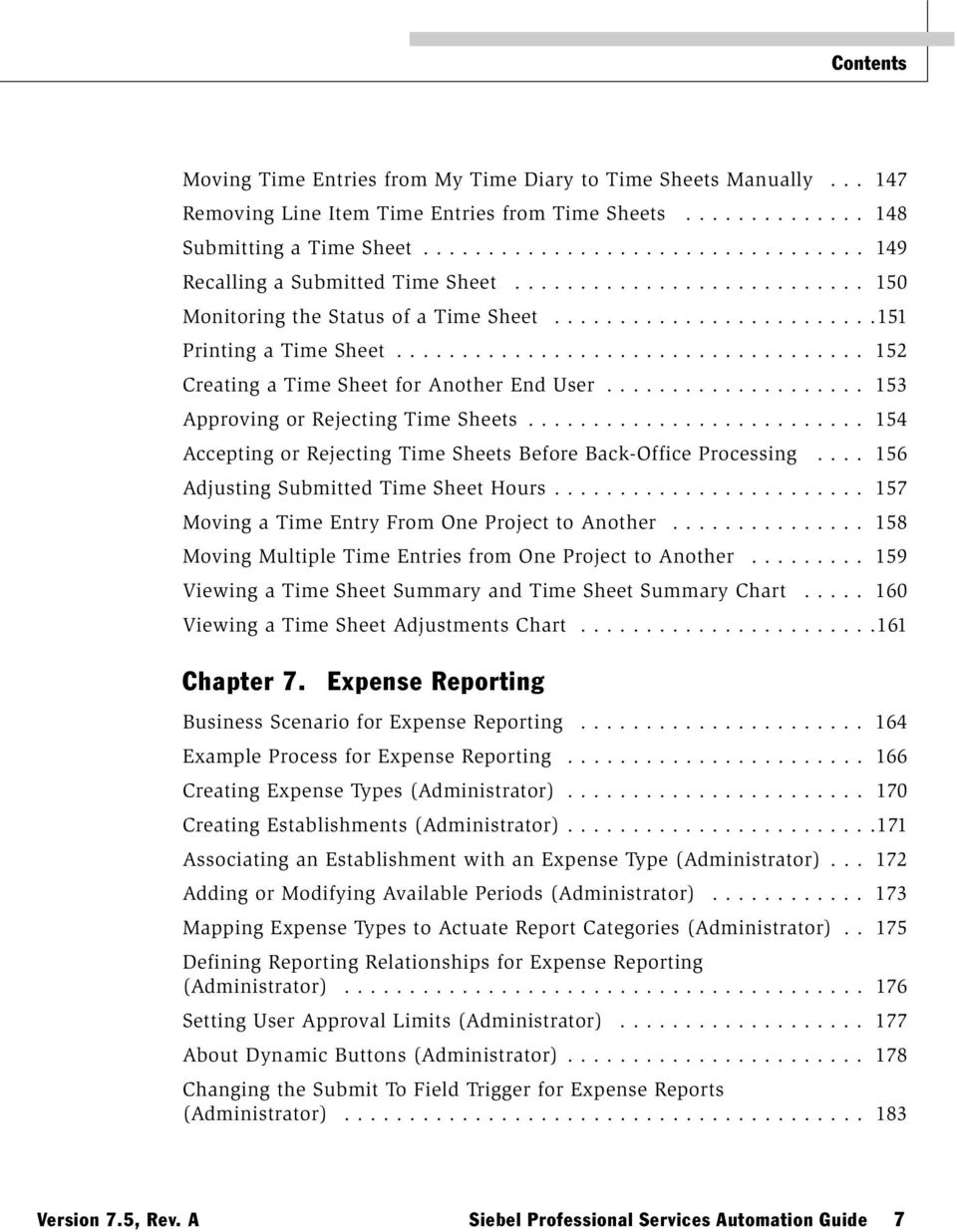
8 Contents Activating Automatic Generation for Expense Reports (Administrator)..184 Activating Notification for Expense Reports (Administrator) Activating Status Updating for Expense Reports (Administrator) Understanding Currency Exchange Rates (Administrator) Recording Expenses in the My Expense Diary View Recording Expenses in the Activities Expenses View Creating an Expense Report Automatically Creating an Expense Report Manually Changing the Reimbursement Currency Adding Line Items to an Expense Report Changing the Default Currency for Expense Line Items Changing the Currency for a Single Expense Line Item Removing Items from Expense Reports Submitting an Expense Report Recalling a Submitted Expense Report Monitoring the Status of an Expense Report Printing an Expense Report Creating an Expense Report for Another End User Approving or Rejecting Expense Reports Accepting or Rejecting Expense Reports Before Back-Office Processing Adjusting the Billable Total for an Expense Report Moving an Expense Item to Another Project Moving Multiple Expense Items to Another Project Viewing an Expense Report Summary and Expense Summary Chart Viewing an Expense Adjustments Chart Chapter 8. Agreements Business Scenario for Agreements Example Process for Agreements Siebel Professional Services Automation Guide Version 7.5, Rev. A
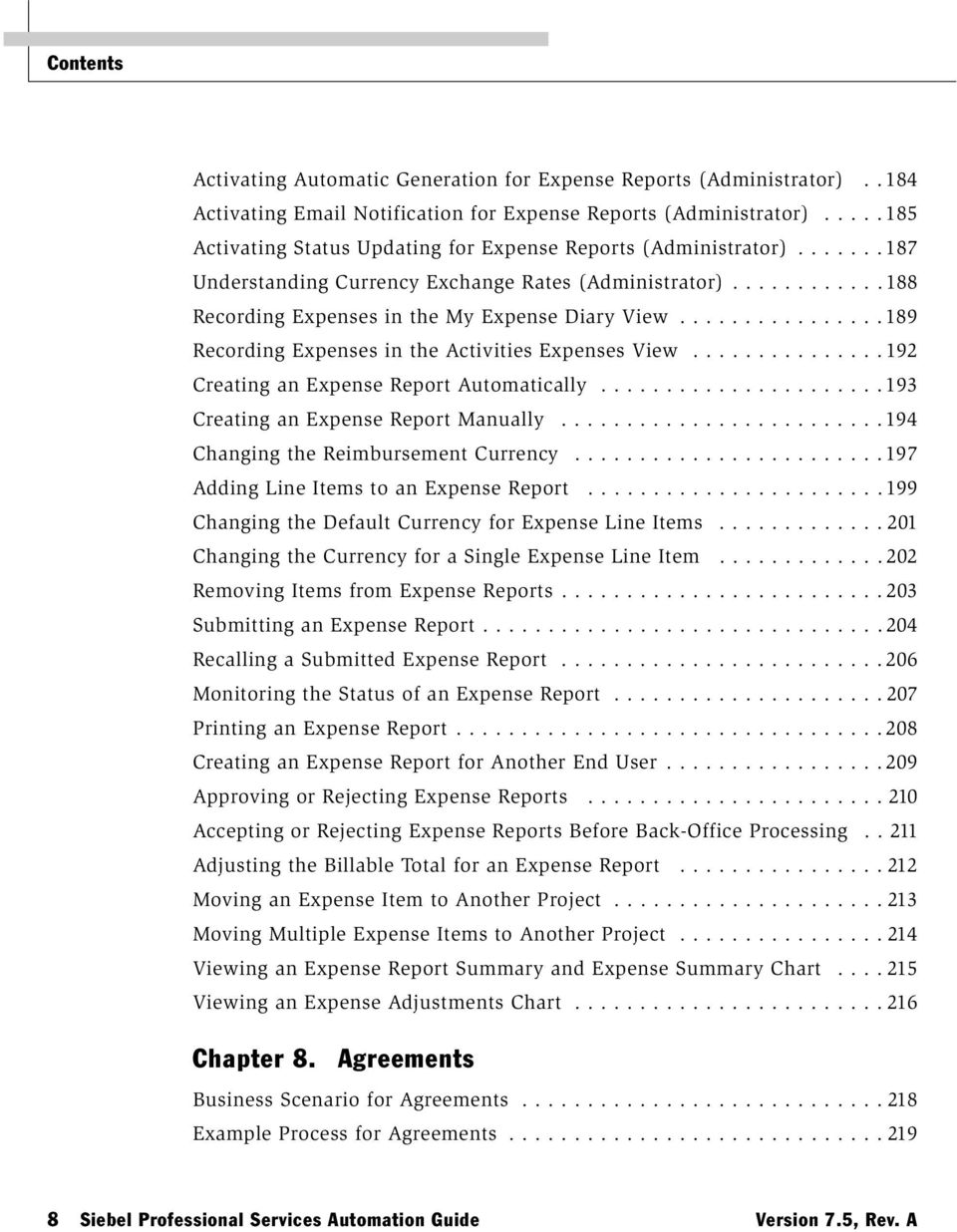
9 Contents Creating an Agreement Adding Line Item Details to an Agreement Generating Documentation with an Agreement Adding Attachments to Agreements Chapter 9. Project Financials Financials Overview Project Revenue Schedules and Forecasting Invoices Business Scenario for Project Financials Example Process for Project Financials Adding a Project Revenue Adding Project Revenues Using SmartScripts Adding Project Revenues Using Revenue Plans Viewing the Project Revenue Spreadsheet Viewing the Project Revenue Chart Viewing Financial Profile Information Adding Project Invoices Index Version 7.5, Rev. A Siebel Professional Services Automation Guide 9

10 Contents 10 Siebel Professional Services Automation Guide Version 7.5, Rev. A
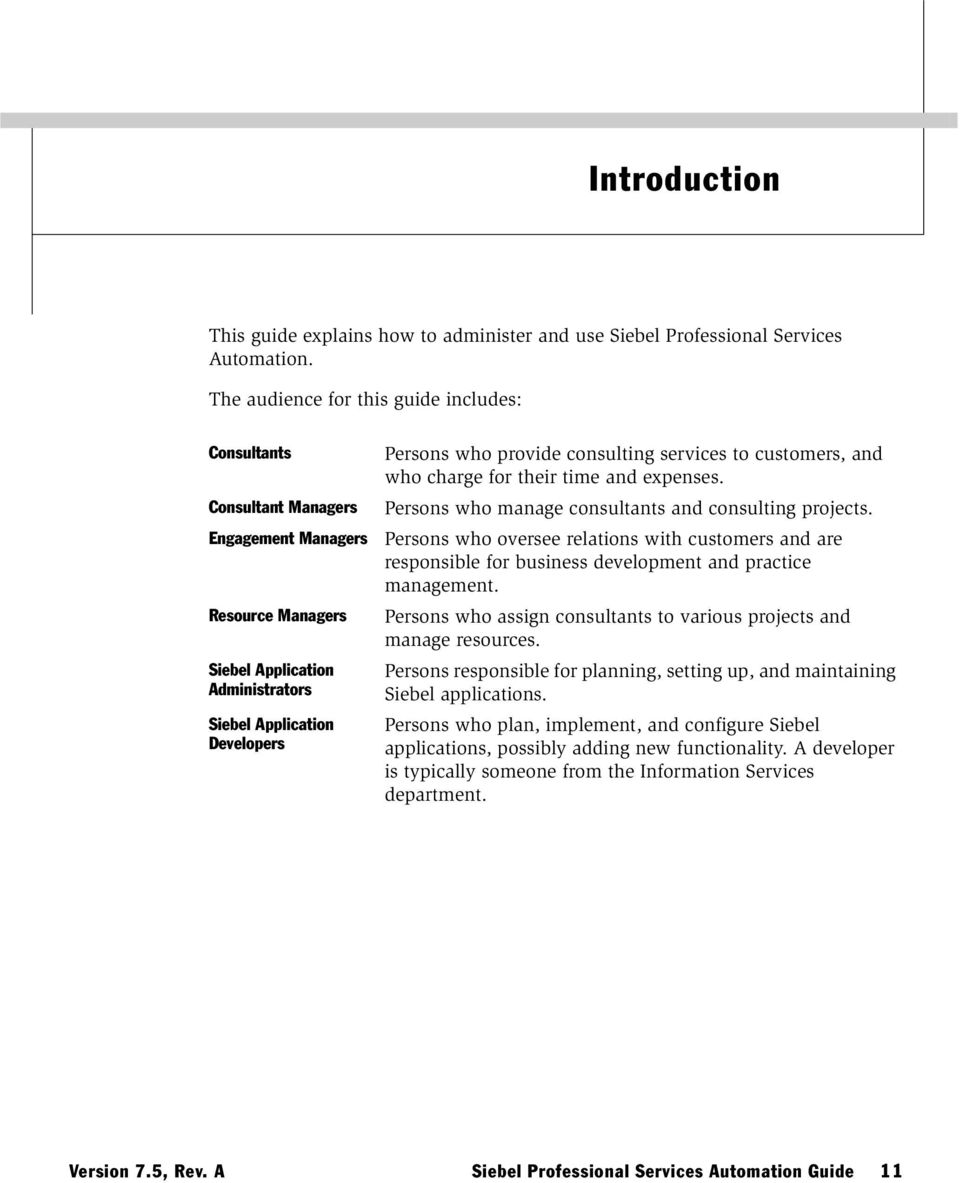
11 Introduction This guide explains how to administer and use Siebel Professional Services Automation. The audience for this guide includes: Consultants Consultant Managers Engagement Managers Resource Managers Siebel Application Administrators Siebel Application Developers Persons who provide consulting services to customers, and who charge for their time and expenses. Persons who manage consultants and consulting projects. Persons who oversee relations with customers and are responsible for business development and practice management. Persons who assign consultants to various projects and manage resources. Persons responsible for planning, setting up, and maintaining Siebel applications. Persons who plan, implement, and configure Siebel applications, possibly adding new functionality. A developer is typically someone from the Information Services department. Version 7.5, Rev. A Siebel Professional Services Automation Guide 11
12 Introduction How This Guide Is Organized How This Guide Is Organized This guide provides information necessary for administering and using Siebel Professional Services Automation. Chapters of this guide focus on typical tasks, separated into administrator procedures and end-user procedures. 12 Siebel Professional Services Automation Guide Version 7.5, Rev. A

13 Introduction Revision History Revision History Siebel Professional Services Automation Guide, Version 7.5, Rev. A January 2003 Bookshelf Table 1. Changes Made in Rev. A for January 2003 Bookshelf Topic Project Management Setting Up Contract and Work Order Templates (Administrator) Adding Project Revenues Using SmartScripts Adding Project Revenues Using Revenue Plans Viewing the Project Revenue Spreadsheet Resource Management Revision Added administrative procedures previously located in Siebel Applications Administration Guide. Added tables of field descriptions to a number of procedures. Updated incorrect cross-reference to additional information about proposals. Added this topic. Added this topic. Added this topic. Moved administrative procedures to Project Management chapter. Version 7.5, Rev. A Siebel Professional Services Automation Guide 13
14 Introduction Revision History 14 Siebel Professional Services Automation Guide Version 7.5, Rev. A
15 Overview of Siebel Professional Services Automation 1 Siebel Professional Services Automation was designed in consultation with leading professional services organizations specifically to meet the needs of consulting and service organizations. Siebel Professional Services Automation allows companies to maximize their market potential by closing more business and providing a solution for managing projects. Siebel Professional Services Automation helps service delivery teams win more deals, deliver services on time with high quality, and accurately track resource needs, and delivery dates. Siebel Professional Services Automation provides support for the entire professional services process. Organizations use Siebel Professional Services Automation to manage leads for customer engagements, define project scope, and work breakdown structures, create contracts, manage resource assignments, select and track subcontractors, manage time, expenses and materials, expose and resolve risks related to the project, creation of customer invoices, and guarantee customer satisfaction. Version 7.5, Rev. A Siebel Professional Services Automation Guide 15

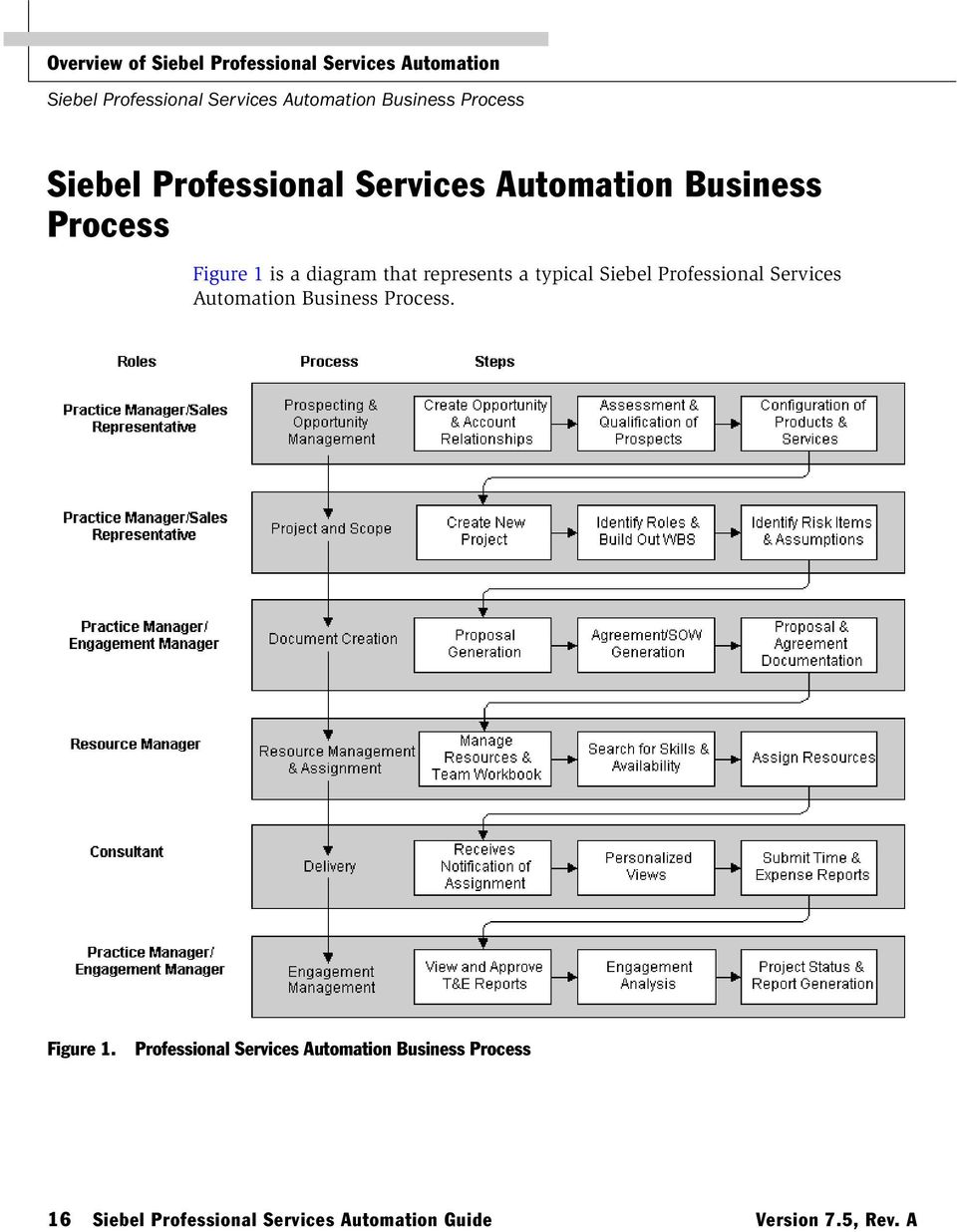
16 Overview of Siebel Professional Services Automation Siebel Professional Services Automation Business Process Siebel Professional Services Automation Business Process Figure 1 is a diagram that represents a typical Siebel Professional Services Automation Business Process. Figure 1. Professional Services Automation Business Process 16 Siebel Professional Services Automation Guide Version 7.5, Rev. A
17 Overview of Siebel Professional Services Automation Benefits Benefits Siebel Professional Services Automation helps professionals by providing: Opportunity Management Project Management Risk Tracking and Management Automated Proposal Generation Resource Management Microsoft Project Integration Time and Expense Reporting Contract Management Financial Management Version 7.5, Rev. A Siebel Professional Services Automation Guide 17
18 Overview of Siebel Professional Services Automation Benefits 18 Siebel Professional Services Automation Guide Version 7.5, Rev. A
19 Opportunity Management 2 This chapter describes the Opportunity Management functionality and provides a business scenario and end-user procedures. Opportunity Management allows engagement managers to coordinate information with sales representatives and access critical sales and customer data. Opportunity assessments create tremendous business value by allowing engagement managers to identify and focus on critical opportunities. You can access different Opportunities screen views to: View your own opportunities with information that may include contacts, activities, products, decision issues, competitors, estimated revenue, probability of closure, and sales stage. Enter information about new opportunities. Track the status of an opportunity through the sales cycle from creation to closure. Update information about opportunities as they move through the sales cycle. Generate presentations, quotes, and proposals based on opportunities. Create relationships between projects and accounts and opportunities. For more information about using opportunities, see Siebel Sales User Guide. Version 7.5, Rev. A Siebel Professional Services Automation Guide 19
20 Opportunity Management Business Scenario for Opportunity Management Business Scenario for Opportunity Management This scenario provides an example of a process performed by an engagement manager for opportunity management. Your company may follow a different process according to its business requirements. The engagement manager at a large professional services company receives a call from a prospective customer. The prospective customer is interested in having the engagement manager s team work on an opportunity. The engagement manager enters information about the opportunity into Siebel Professional Services Automation and associates it with the project in question. She then associates the project with the customer s account, which already exists in her Siebel application. 20 Siebel Professional Services Automation Guide Version 7.5, Rev. A
21 Opportunity Management Example Process for Opportunity Management Example Process for Opportunity Management This is an example of a process for opportunity management. Your company may follow a different process according to its business requirements. End-User Procedures 1 Associate a project with an opportunity. For information, see Associating a Project with an Opportunity on page Associate a project with an account. For information, see Associating a Project with an Account on page 23. Version 7.5, Rev. A Siebel Professional Services Automation Guide 21
22 Opportunity Management Associating a Project with an Opportunity Associating a Project with an Opportunity Associating projects with an opportunity is critical to guarantee that sales representatives are collaborating with the proper professional services personnel to jointly develop and scope the project. To associate a project with an opportunity 1 Navigate to the Projects screen. 2 From the Show drop-down list, select the appropriate view. 3 In the Projects list, select the project with which the opportunity will be associated. 4 Click the select button in the project record s Opportunity field to display the Pick Opportunity dialog box. 5 Select the opportunity you want to associate with the project, and then click OK. NOTE: End users can also create new projects from the Projects view in the Opportunities screen. This automatically associates the project with an opportunity. 22 Siebel Professional Services Automation Guide Version 7.5, Rev. A
23 Opportunity Management Associating a Project with an Account Associating a Project with an Account End users can also associate a project with an account, as described in the following procedure. To associate a project with an account 1 Navigate to the Projects screen. 2 From the Show drop-down list, select the appropriate view. 3 In the Projects list, select the project with which the account will be associated. 4 Click the select button in the project record s Account field to display the Pick Account dialog box. 5 Select the account you want to associate with the project, and then click OK. Version 7.5, Rev. A Siebel Professional Services Automation Guide 23
24 Opportunity Management Associating a Project with an Account 24 Siebel Professional Services Automation Guide Version 7.5, Rev. A
25 Project Management 3 This chapter describes project management functionality and provides a business scenario and administrative and end-user procedures. A project is an effort that involves the completion of multiple tasks, multiple activities, or both, over time. In a project, some tasks or activities may need to be performed in a specific order. Version 7.5, Rev. A Siebel Professional Services Automation Guide 25
26 Project Management Business Scenario for Project Management Business Scenario for Project Management This scenario provides an example of a process performed by a Siebel administrator, an engagement manager, and the manager s project team members. Your company may follow a different process according to its business requirements. A Siebel administrator at a large consulting company is responsible for setting up Siebel Professional Services Automation so that users can manage their projects. He has to set up financial components, employee records, project resources, roles, and skills and competencies. He is also responsible for creating templates such as contract and work order templates and project activity templates. He has to set up Microsoft Project field mappings to make sure that users can import and export data between Microsoft Project and Siebel Professional Services Automation. He also may need to set up project-related list of values for drop-down lists used with projects. In order for projects to be billed properly, the Siebel administrator creates a cost list and associates cost list items with it. He also creates a rate list and associates rates and resources with it. The company s engagement manager has been given the task of performing a global rollout and implementation of a Siebel Incentive Compensation for large hotel chain. She has created the project in Siebel Professional Services Automation, associated the appropriate contacts to it, and provided her team members with access to the project. She is now in the process of determining the tasks or milestones that need to be completed to have a successful and profitable project. She creates a number of activities, manually and using activity plans. At this point, the engagement manager breaks each milestone down to its component parts by tasks. After she creates a team workbook for the project, sets up roles, associates skills and competencies with each workbook role, sets rates for project staff, and creates and submits resource requests, she assigns the tasks. She can use the Tasks view to assign tasks and set expected completion dates. She is attempting to build the skeletal project plan that she will later export to Microsoft Project. By assigning tasks, the engagement manager can give the other members of her team an idea of the work each will do on the project. 26 Siebel Professional Services Automation Guide Version 7.5, Rev. A
27 Project Management Business Scenario for Project Management As the engagement manager s team members finish their assigned tasks, they can assess and add risks to the project, create risk resolution activities, create status reports, and associate risks with status reports. Meanwhile, the engagement manager can monitor the team s progress from the My Team s Projects view. Her team can attach files of related information, including diagrams, as necessary. Because these files are embedded in the Siebel application, anyone on the team can open the files and review the work to be done on the project. They can also add notes, create orders for project materials, and change delivery status of the project. Version 7.5, Rev. A Siebel Professional Services Automation Guide 27
28 Project Management Example Process for Project Management Example Process for Project Management This is an example of a process an administrator and an end user may follow to manage projects. Your company may follow a different process according to its business requirements. Administrator Procedures The following are administrator procedures for managing projects: 1 Set up financial components. Financial components such as currencies and expense types need to be set up for use in projects. For more information, see Setting Up Financial Components (Administrator) on page Set up employee records. Employee records must be created before employees can be assigned to work on particular projects. For more information, see Setting Up Employee Records (Administrator) on page Display existing project resources. Existing product records for the services you offer, such as consulting hours for field engineers or field technicians need to be displayed for inclusion in projects. This is part of setting up the rate book for your organization. For more information, see Displaying Existing Project Resources (Administrator) on page Add a new project resource. New product records for the services you offer, such as consulting hours for field engineers or field technicians need to be added to the database if the existing product records don t match the needs of a project. This is part of setting up the rate book for your organization. For more information, see Adding New Project Resources to the Product List (Administrator) on page Create a role. Administrators must create the roles that project managers identify as needing to be filled on the project team. For more information, see Creating Roles (Administrator) on page Set up skills and competencies. Skills and competencies that are needed on the project team must be specified during project resource management to help assign people to project tasks. For more information, see Setting Up Skills and Competencies (Administrator) on page Siebel Professional Services Automation Guide Version 7.5, Rev. A
29 Project Management Example Process for Project Management 7 Set up contract and work order templates. Allow end users to create agreement, contract, and work order documents by setting up Siebel Proposals templates and modifying them to meet the needs of your company. For more information, see Setting Up Contract and Work Order Templates (Administrator) on page Set up a project activity template. Set up project activity templates to automatically create the milestones or activities that should be followed for a project. For more information, see Setting Up Project Activity Templates (Administrator) on page Set up Microsoft Project field mappings. A mapping file that defines field mappings between Microsoft Project and Siebel Professional Services Automation must be set up to export and import data between these two applications. For more information, see Setting Up Microsoft Project Field Mappings (Administrator) on page Set up project-related list of values entries. You may want to set up some values for drop-down lists used with projects. This is done by adding values to the appropriate list of values. For more information, see Setting Up Project-Related List of Values Entries (Administrator) on page Create a cost list. You can create cost lists to record the estimated costs to your organization for providing specified services. For more information, see Creating a Cost List (Administrator) on page Associate cost list items with a cost list. Once you create a cost list, you can associate project resources with it. For more information, see Associating Cost List Line Items with a Cost List (Administrator) on page Create a rate list. You may want to create rate lists specify rates for services and the people who provide those services. For more information, see Creating a Rate List (Administrator) on page Associate rates and project resource products with a rate list. Once you create a rate list, you can associate project resources with it. For more information, see Associating Rates and Project Resources with a Rate List (Administrator) on page 47. End-User Procedures The following are end-user procedures for working with projects: Version 7.5, Rev. A Siebel Professional Services Automation Guide 29
30 Project Management Example Process for Project Management 1 Create a project. For information, see Creating Projects on page Associate a contact with a project. For information, see Associating Contacts with a Project on page Provide access to a project. For information, see Providing Access to a Project on page Create activities using an activity plan. For information, see Creating Activities Using Activity Plans on page Create an activity manually. For information, see Creating Project Activities Manually on page Create a task. For information, see Creating Tasks on page Add an activity to a task. For information, see Adding Activities to a Task on page View tasks. For information, see Viewing Tasks on page Use the team workbook. For information, see Using the Team Workbook on page Set up roles in a team workbook for a project. For information, see Setting Up Roles in a Project Team Workbook on page Associate skills and competencies with team workbook roles. For information, see Associating Skills and Competencies with Team Workbook Roles on page Set rates for project staff. For information, see Setting Rates for Project Staff on page Add subcontractor information. For information, see Adding Subcontractor Information on page Associate a subcontractor resource with a project. For information, see Associating a Subcontractor Resource with a Project on page Assess and add risks to a project. For information, see Assessing and Adding Risks to a Project on page Create a risk resolution activity. For information, see Creating Risk Resolution Activities on page Siebel Professional Services Automation Guide Version 7.5, Rev. A
31 Project Management Example Process for Project Management 17 Create a status report for a project. For information, see Creating a Status Report for a Project on page Associate a risk with a status report. For information, see Associating Risks with a Status Report on page Attach a file to a project. For information, see Attaching a File to a Project on page Add a note to a project. For information, see Adding a Note to a Project on page Create an order for project materials. For information, see Creating an Order for Project Materials on page Change the delivery status of a project. For information, see Changing the Delivery Status of a Project on page 80. Version 7.5, Rev. A Siebel Professional Services Automation Guide 31
32 Project Management Setting Up Financial Components (Administrator) Setting Up Financial Components (Administrator) You must set up several financial components in your Siebel application before you go into production. These components are: Currencies (unless your Siebel application will use only one currency) Currency Conversions (unless your Siebel application will use only one currency) Expense Types Periods It is recommended that you also set up the following financial component before your Siebel application goes into production: Payment Terms For more information about setting up these components, see information about ongoing application administration tasks in Siebel Applications Administration Guide. 32 Siebel Professional Services Automation Guide Version 7.5, Rev. A
33 Project Management Setting Up Employee Records (Administrator) Setting Up Employee Records (Administrator) Before you can assign employees to work on particular projects, you must create employee records. This is normally part of the initial setup for a Siebel application. For information about setting up employee records, see Security Guide for Siebel ebusiness Applications and Siebel Applications Administration Guide. Version 7.5, Rev. A Siebel Professional Services Automation Guide 33
34 Project Management Overview of Rate List and Cost List Management (Administrator) Overview of Rate List and Cost List Management (Administrator) This section provides background information about setting up and using rate lists and cost lists for projects. Rate lists specify what you charge your customers for various services. Cost lists specify what it costs your organization to provide those services. The difference between the rate and the cost for a given service is your profit margin for that service. Your organization can establish multiple rate lists and cost lists for use in different geographical areas or with different customers, but each rate list is associated with exactly one cost list. It is strongly recommended that you use the following sequence of tasks to set up your rate lists and cost lists for project management: 1 Set up product records for the services you offer, such as consulting hours for field engineers, field technicians, and so on. For more information about this task, see Displaying Existing Project Resources (Administrator) on page 35 and Adding New Project Resources to the Product List (Administrator) on page Create cost lists that estimate what it costs your organization to deliver each service and associate products with it. For more information about this task, see Creating a Cost List (Administrator) on page 44 and Associating Cost List Line Items with a Cost List (Administrator) on page Create rate lists to specify what you charge for each service, associate products with it, and associate each rate list with a cost list. For more information about this task, see Creating a Rate List (Administrator) on page 46 and Associating Rates and Project Resources with a Rate List (Administrator) on page As part of the process of creating each project, associate the project with a rate list. For more information about this task, see Creating Projects on page Any record added to the Team Workbook should each have the Resource field populated with a product record created in Step 1. For more information about this task, see Setting Rates for Project Staff on page 69. Completing these tasks in the specified order allows rates and costs to default when you use the Team Workbook to staff projects. You can modify them as needed. 34 Siebel Professional Services Automation Guide Version 7.5, Rev. A
35 Project Management Displaying Existing Project Resources (Administrator) Displaying Existing Project Resources (Administrator) When you create lists of the rates that you will charge for services to your customers, each rate will be associated with a project resource. A project resource is a special kind of product that represents a person with particular skills that are needed for the project. For example, typical project resource products might include Consultant, Field Engineer, and Field Technician. As you plan projects, you assign project resources to project tasks as part of the process of determining project costs and scheduling. The following procedure explains how to display a list of the project resource products already defined in your Siebel application. To display existing project resources 1 Navigate to the Product Administration screen. 2 In the More Info form, click the show more button, and then click Query. 3 In the More Info query form, click the Project Resource check box. 4 In the More Info query form, click the menu button, and then click Run Query. Version 7.5, Rev. A Siebel Professional Services Automation Guide 35
36 Project Management Adding New Project Resources to the Product List (Administrator) Adding New Project Resources to the Product List (Administrator) You must define project resources before you can select them for a project. You must set up resources as products, so that these resources can be added in the rate and cost lists. The following procedure explains how to add a new project resource product. To add a project resource to the product list 1 Navigate to the Product Administration screen. 2 In the Products list, add a new record. 3 In the Product field of the new record, enter a resource name, such as consultant. 4 In the More Info form, click the show more button and then select the Project Resource check box. 5 Complete any other fields as needed. For more information on the fields available, see Product Administration Guide. NOTE: If the product can be ordered or if the product can be listed as a quote item in a quote, select the Orderable check box. 6 From the Show drop-down list in the More Info form, select Category to display a Product form and a More Info list. Adding products to categories allows users access to the product. Categories are how product visibility is controlled. You must also add a product to a category to make it selectable in a quote and to make it visible in esales Web pages. 7 In the More Info list, click New to display the Add Subcategories dialog box. 8 In the Add Subcategories dialog box, select the category to which the product (project resource) belongs, and then click OK. 36 Siebel Professional Services Automation Guide Version 7.5, Rev. A
37 Project Management Creating Roles (Administrator) Creating Roles (Administrator) As part of the process of creating a project, a project manager identifies the roles that need to be filled on the project team, and the approximate start and end date for each role. These roles must first be created by the administrator before a project manager can add them to a project. To create a role 1 From the application-level menu, choose View > Site Map > Application Administration > List of Values. NOTE: You may want to query to see if the role you want to create already exists in the List of Values screen. To find existing roles, query for records with the value of PS_PROJECT_TEAM_ROLE in the Type field. 2 In the List of Values, add a new record. 3 In the Type field, enter PS_PROJECT_TEAM_ROLE. 4 In the Display Value and Language-Independent Code fields, enter the name of the new role. 5 Complete other fields in the new record as desired. Version 7.5, Rev. A Siebel Professional Services Automation Guide 37
38 Project Management Setting Up Skills and Competencies (Administrator) Setting Up Skills and Competencies (Administrator) In Siebel Professional Services Automation, a skill designates a general area of expertise such as Language, and a competency designates a more specific area of expertise within that skill, such as Spanish. During project resource management, you specify skills and competencies that are needed on the project team to help you assign appropriate people to project tasks. These skills and competencies must be defined ahead of time. For information about defining skills and associating them with employees, see Siebel Assignment Manager Administration Guide. For information about associating skills and competencies with project roles, see Associating Skills and Competencies with Team Workbook Roles on page Siebel Professional Services Automation Guide Version 7.5, Rev. A
39 Project Management Setting Up Contract and Work Order Templates (Administrator) Setting Up Contract and Work Order Templates (Administrator) The Siebel Professional Services Automation Agreements module uses Siebel Proposals technology to create agreement, contract, and work order documents. To allow users to create these documents, set up Siebel Proposals templates and modify them to meet the needs of your company. For more information about Siebel Proposals templates, see Siebel Applications Administration Guide. Version 7.5, Rev. A Siebel Professional Services Automation Guide 39
40 Project Management Setting Up Project Activity Templates (Administrator) Setting Up Project Activity Templates (Administrator) Organizations can create project activity templates (or plans), which help focus their consultants on best practices when working on particular types of projects. These project activity templates automatically create the milestones or activities that should be followed for a project. For more information, see Siebel Applications Administration Guide. 40 Siebel Professional Services Automation Guide Version 7.5, Rev. A
41 Project Management Setting Up Microsoft Project Field Mappings (Administrator) Setting Up Microsoft Project Field Mappings (Administrator) The tasks and resources you define for a project in your Siebel application can be exported to and imported from a Microsoft Project.mpp file. This allows you to use Microsoft Project s ability to show how scheduling and resource changes can affect final delivery dates. To export and import data between these two applications you must set up a mapping file that defines field mappings between the two applications. For information about how to set up Microsoft Project field mappings, see Chapter 5, Microsoft Project Integration. Version 7.5, Rev. A Siebel Professional Services Automation Guide 41
42 Project Management Setting Up Project-Related List of Values Entries (Administrator) Setting Up Project-Related List of Values Entries (Administrator) You may need to set up some values for drop-down lists used with projects. You do so by adding values to the appropriate list of values (LOVs). The following procedure explains how to add an entry to a LOV. For more information about LOVs, see Siebel Applications Administration Guide. For information about using lists of values for a global deployment, see Global Deployment Guide. To add a new value to a project-related list of values 1 From the application-level menu, choose View > Site Map > Application Administration > List of Values. 2 In the List of Values list, click Query. 3 In the Type field, click the select button to display the Pick Value Type dialog box, and then complete the following substeps: a In the Pick Value Type dialog box, use query or find to select the name (here called Type) of the list of values to which you want to add a value. For information about list of values types that are commonly used for projects, see Table 1 on page 43. b In the Pick Value Type dialog box select the record for the type you want, and then click OK to close the dialog box and return to the main window. 4 In the List of Values list, click the menu button and then click Run Query. The current values for the selected list of values type appear. 5 In the List of Values list, add a new record. 6 In the Type field of the new record, enter the same type you selected in Step 3 of this procedure. 7 In the Display Value and Language-Independent Code fields, enter the new value that you want to add to the selected list of values. 8 Select the check box in the Translate field. 42 Siebel Professional Services Automation Guide Version 7.5, Rev. A
43 Project Management Setting Up Project-Related List of Values Entries (Administrator) 9 In the Language Name field, click the select button, select the language in the Language Name dialog box, and click OK. Table 1. Type Most Commonly Used Project-Related List of Values Types Description PROJECT_CLASS PROJECT_TYPE PROJECT_STATUS PROJ_BILLING_TYPE PROJECT_PARTNER_ROLE PS_MPP_FIELD_TYPE PS_MPP_MAP_BC_SEL PS_PROJECT_TEAM_ROLE PS_PROJECT_TEAM_STATUS PSTASK_ALT_TYPE Classifications used to separate employee hours into utilization categories. The project class is the default class on an employee s time sheet line items. Describes the nature of the project. Affects the default sort order of the projects. Useful in queries. Explains how you plan to bill the customer. The role a partner would play while engaged on a project. Typical values include consultant, business analyst, and developer. Defines the fields you can choose from when setting up Microsoft Project field mappings. For more information about Microsoft Project and Siebel Professional Services Automation, see Chapter 5, Microsoft Project Integration. The business component to be used for a mapping category when creating Microsoft Project Plan mappings. A role a member on the team workbook will play. This is defined per project. Team workbook members can play more than one role; enter them more than once on the team workbook. The assignment status of an employee on the team workbook. Used for reserving resources or staffing resources. Allows you to play what-if with your staffing before finalizing your plans. A task entered for a project. These are the values for the Type field in Project Task. PSTASK_ALT_TYPE is a child type of PSTASK_TYPE. If you add a new LOV value to PSTASK_ALT_TYPE, you need to specify the new LOV value in PSTASK_TYPE. Version 7.5, Rev. A Siebel Professional Services Automation Guide 43
44 Project Management Creating a Cost List (Administrator) Creating a Cost List (Administrator) Cost lists record the estimated costs to your organization for providing specified services. Cost lists are used along with rate lists. The difference between the cost of a service and the rate you charge for that service is your profit margin for that service. Your organization can have multiple cost lists, to reflect how costs differ in various locations or other situations. The following procedures describe how to set up a cost list. First you must create a cost list record, and then you associate cost list line items with it. To create a cost list record 1 From the application-level menu, choose View > Site Map > Pricing Administration > Cost List. 2 In the Cost Lists More Info form, add a new record. 3 Complete the necessary fields. Some fields are described in the following table. Field Cost List Created Created By Description Effective From Effective To Organization Updated Updated By Comments Required. Name to identify the cost list. Read-only. Date and time the cost list record was created. Automatically populated. User ID of the person who created the cost list. Automatically populated. Text field for information about the cost list. Required. First date on which the cost list is valid and available. Last date on which the cost list is valid and available. Portion of your company that uses and maintains the cost list. Defaults to the organization of the user who creates the record. Last date on which the record was modified. Automatically populated. Read-only. User ID of the last person to modify the record. Automatically populated. Read-only. 44 Siebel Professional Services Automation Guide Version 7.5, Rev. A
45 Project Management Associating Cost List Line Items with a Cost List (Administrator) Associating Cost List Line Items with a Cost List (Administrator) The line items in a cost list map to products (project resources). The following procedure explains how to associate cost list line items and project resources with a cost list. This procedure should be used after you have completed Adding New Project Resources to the Product List (Administrator) on page 36. To associate a cost list line item with a cost list 1 From the application-level menu, choose View > Site Map > Pricing Administration > Cost List. 2 In the Cost Lists list, select the cost list that you want to add costs to. 3 In the selected record, click the hyperlink in the Cost List field to display a Cost List form and a Cost List Line Items list. 4 In the Cost List Line Items list, click New to display the Add Internal Products dialog box. 5 In the Add Internal Products dialog box, select the resource product to be added to the cost list, and then click OK. 6 In the Cost List Line Items list, enter the cost of the resource product in the Standard Cost field. Version 7.5, Rev. A Siebel Professional Services Automation Guide 45
46 Project Management Creating a Rate List (Administrator) Creating a Rate List (Administrator) Rate lists are like price lists, but they refer to services and the people who provide those services. Instead of a price for a hard drive, for instance, you specify an hourly rate for a consultant. You can create multiple rate lists to charge different rates or use different currencies in different geographical areas or to provide special rates on particular projects or for favored customers. Each rate list must be associated with exactly one cost list. To set up a rate list, you must first create a rate list record and then associate charge rates with the rate list. To create a rate list record 1 From the application-level menu, choose View > Site Map > Pricing Administration > Rate List. 2 In the Rate Lists More Info form, add a new record. 3 Complete the necessary fields. Some fields are described in the following table. Field Cost List Currency Description Effective From Effective To Last Updated Organization Rate List Updated By Comments List that specifies the cost of the selected service to your organization. Each rate list can be associated with exactly one cost list. Currency used to charge for the service General information about the selected rate list. Typically, this field would include information about where this rate list should be used or for which customers. Required. First date on which the rate list is valid and available. Last date on which the rate list is valid and available. Date on which the current record was last modified. Automatically populated. Portion of your company that uses and maintains the current rate list. Defaults to the organization of the user who creates the record. Required. Name that identifies the rate list. It is recommended that you include information in the rate list name that describes where the list should be used or for which customers. User ID of the last user to modify the current record. Automatically populated. 46 Siebel Professional Services Automation Guide Version 7.5, Rev. A
47 Project Management Associating Rates and Project Resources with a Rate List (Administrator) Associating Rates and Project Resources with a Rate List (Administrator) The following procedure explains how to associate rates and project resources with a rate list. This procedure should be used after you have completed Adding New Project Resources to the Product List (Administrator) on page 36. To associate rates and project resources with a rate list 1 From the application-level menu, choose View > Site Map > Pricing Administration > Rate List. 2 In the Rate Lists list, select the rate list that you want to add rates to. 3 In the selected record, click the hyperlink in the Rate List field to display a Rate List form and a Rate List Line Items list. 4 In the Rate List Line Items list, click New to display the Add Position Types dialog box. NOTE: The resources that appear in the Add Position Types dialog box have been defined as products in the Siebel application. For example, the project resource that you created in Adding New Project Resources to the Product List (Administrator) on page In the Add Position Types dialog box, select the project resource to be added to the rate list, and then click OK. The selected project resource appears in the Resource field. 6 In the Rate List Line Items list, complete the remaining fields. Some fields are described in the following table. Field Rate/Hour Resource Comments Standard charge per hour for the specified project resource product. Project resource product for which the rate is being specified, such as Consultant or Field Engineer. Version 7.5, Rev. A Siebel Professional Services Automation Guide 47
48 Project Management About Multiple Rate Schedules (Administrator) About Multiple Rate Schedules (Administrator) In addition to setting up billing rates by resource in the Rate List Administration view, you can: Set up billing rates in multiple currencies, by creating a rate list with another currency. Set up unique billing rates for special customers or projects, by creating rate lists used only for those customers or projects. You might name the rate list for that customer or project, so that it is clear that the rate list should only be used in those cases. 48 Siebel Professional Services Automation Guide Version 7.5, Rev. A
49 Project Management Creating Projects Creating Projects End users can create and work with projects in three different areas of the Siebel application: Projects screen. As practice or project managers, end users can view and manage their projects from this screen. Opportunities screen. As sales representatives, end users may want to create a project and fill in the preliminary information as it associates with the opportunity. Accounts screen. As account managers, end users may want to monitor projects at the account level. The following procedure explains how to create a project using the Projects screen. End users can use similar steps to create projects in either the Opportunities screen or the Accounts screen. To create a new project using the Projects screen 1 Navigate to the Projects screen. 2 From the Show drop-down list, select the appropriate view. 3 In the Projects list, add a new record. Version 7.5, Rev. A Siebel Professional Services Automation Guide 49
50 Project Management Creating Projects 4 Complete the necessary fields. Some fields are described in the following table. Field Account Delivery End Name New Priority Flag Project # Start Status Access List Comments Account associated with the project. This could be a customer account for a customer project or an internal account for an internal project. If you associate an opportunity with this project, the Account field is automatically populated with information from the chosen opportunity. Indicates the probability of delivering the project on time, according to your organization s criteria. In the Projects list, this field is read-only. You can change the value of this field in the Projects More Info form. By default, available values are Green, Yellow, and Red. Available values are set using the PROJECT_DLVRY_STATUS list of values. Defaults to Green. Estimated end date for the project. A name of your own choosing to identify the project. Required. An asterisk in this field indicates that the current user has been assigned to the project, and has not yet reviewed project details. A visual indicator that can be used to designate highpriority projects. Each user s priority flag settings are visible only to that user. Identification code for the project. Automatically populated with a unique value generated by the Siebel application. If you prefer, you can substitute your own unique project identification code. Start date for the project. Indicates the current state of the project. By default, available values are Active, Cancelled, Closed, Inactive, and Not Yet Active. Defaults to Not Yet Active. Available values are set in the PROJECT_STATUS list of values. Lists the User IDs of people who are authorized to view or modify project information, depending on the value of the accompanying Access Type field. Automatically populated with User ID of project creator. For more information about access to project information, see Providing Access to a Project on page Siebel Professional Services Automation Guide Version 7.5, Rev. A
51 Project Management Creating Projects Field Access Type Address Bill Type City Class Cost List Country Comments Determines whether users must be listed in the project access list to view or modify project information. Available values are as follows: Private. Only users who are specified on the project access list can view and modify project information. Public. Each member of your organization can view and modify project information. Public Read Only. Each member of your organization can view project information, but only those who are specified on the access list can modify information. If you specify a value for Account in the More Info form, the Address field is automatically populated with information from the chosen account. Indicates how the project will be billed. By default, available values are Fixed Fee, Time & Materials, % of Fees, Non-Billable, and Event Billed. Available values are set in the PROJ_BILLING_TYPE list of values. City in which the account associated with the project is located. If you specify a value for Account in the More Info form, the City field is automatically populated with information from the chosen account. Indicates the general nature of the selected project. By default, available values are Client Billable, Client Investment, Holiday, Internal, Sick Time, Training, and Vacation. Defaults to Client Billable. Available values are set in the PROJECT_CLASS list of values. Specifies the cost list associated with the selected project. The cost list specifies internal costs for specific products, including service products such as consulting services. This field is automatically populated based on the value you choose for Rate List. For more information about setting up cost lists, see Overview of Rate List and Cost List Management (Administrator) on page 34 and Creating a Cost List (Administrator) on page 44. Country in which the account associated with the project is located. If you specify a value for Account in the More Info form, the Country field is automatically populated with information from the chosen account. Version 7.5, Rev. A Siebel Professional Services Automation Guide 51
52 Project Management Creating Projects Field Created Currency Day Limit Division Duration Format Expense Limit Fee Limit Hour Limit Marketing Program Opportunity Organization Parent Project Project News Comments Date the project record was created. Automatically populated. Monetary unit associated with the selected project. Defaults to the currency of the project creator s organization. Maximum number of days that can be charged. Part of the organization responsible for the project. Units in which project time is tracked. Default values are Minutes, Hours, Days, Weeks, and Months. This is particularly important for Microsoft Project integration to define the units that will be exchanged. Maximum expenses that will be billed to the customer. Maximum amount of money to be charged for the project. Can be used as a trigger for financial notifications implemented using a specially configured workflow or state model, such as notification when the total amount billed for the project reaches 90% of the fee limit value. Maximum number of hours billed to the customer. Associate a campaign to the project. Sales opportunity associated with the project. If an opportunity is associated with a project, a number of fields autopopulate based on the opportunity s information. For example, Account. Organization or organizations within your company that are responsible for the project. Defaults to the organization of the project creator. This allows you to share projects with partners. Indicates the larger project of which the current project is a part, if such a relationship exists. Specifies any preexisting news feeds to display on Project Center or Project Summary pages. For information about setting up news feeds, see Siebel Employee Relationship Management Administration Guide. 52 Siebel Professional Services Automation Guide Version 7.5, Rev. A
53 Project Management Creating Projects Field Project Summary Graphic Project Type Rate List Related Links Related Projects Revenue Site Comments Specifies a graphic to display on the Project Summary page. Available values are project attachments. The application attempts to display the attachment that has the Primary check box selected. For information about adding attachments to projects, see Attaching a File to a Project on page 78. Indicates the general nature of the project. Typical values include Infrastructure, Applications Development, Business Development, Deployment and Implementation, Internal Projects, Pro Bono, and so on. Values come from the PROJECT_TYPE LOV. Specifies the rate list associated with the selected project. The rate list specifies what you charge for specific products, including service products such as consulting services. When you specify a rate list for a project, the cost list associated with that rate list is automatically associated with the project as well. For more information about setting up rate lists, see Overview of Rate List and Cost List Management (Administrator) on page 34 and Creating a Rate List (Administrator) on page 46. One or more Web sites or other hyperlinks associated with the current project. These links are not active in the Projects More Info form, but are active in the Related Links section of the Project Summary page. Projects related to the current project. For example, if the current project is similar to another project that was completed recently, you may want to refer to the completed project for reference purposes. Note that access to related projects follows regular security rules: a user must be granted access to a nonpublic project to view information about it. Estimated currency amount the project will earn. The value in this field is not calculated from other fields. Site in which the account associated with the project is located. If you specify a value for Account in the More Info form, the Site field is automatically populated with information from the chosen account. Version 7.5, Rev. A Siebel Professional Services Automation Guide 53
54 Project Management Creating Projects Field Source Source Type State Zip Code Comments Specific event or other source that provided the sales lead that led to the current project. Type of event or other source that provided the sales lead that led to the current project. Automatically populated based on the value you choose for the Source field. State in which the account associated with the project is located. If you specify a value for Account in the More Info form, the State field is automatically populated with information from the chosen account. Postal code for the account associated with the project. If you specify a value for Account in the More Info form, the Zip Code field is automatically populated with information from the chosen account. NOTE: Beginning with Siebel 7, end users can edit the Project # field. By default, this field is automatically populated with a unique project number generated by the Siebel application. However, end users have the flexibility to substitute their own project identification numbers in this field. 54 Siebel Professional Services Automation Guide Version 7.5, Rev. A
55 Project Management Associating Contacts with a Project Associating Contacts with a Project When end users create a project, they normally specify an account that is associated with that project. End users can also associate one or more individual contacts with a project. The following procedure explains how to associate a contact with a project. To associate a contact with a project 1 Navigate to the Projects screen. 2 From the Show drop-down list, select the appropriate view. 3 In the Projects list, select the project with which the contact will be associated, and then click either the Name hyperlink for that project or the Contacts view tab. 4 In the Contacts list, click New. 5 In the Add Contacts dialog box that appears, select the contact or contacts you want to add and then click OK. NOTE: If you want to select multiple contacts, hold down the CTRL key while you select the records. The Add Contacts dialog box closes, and the record or records you selected appear in the Contacts list. Version 7.5, Rev. A Siebel Professional Services Automation Guide 55
56 Project Management Providing Access to a Project Providing Access to a Project This version of Siebel Professional Services Automation lets end users specify one of three different levels of access to information for each project. The access level for a Project is set in the Access Type field of the Projects More Info form. Available values are as follows: Private. Only users who are specified on the project access list can view and modify project information. Public. Each member of the organization can view and modify project information. Public Read Only. Each member of the organization can view project information, but only those who are specified on the access list can modify information. By default, the creator of a project is automatically added to the access list as the Primary member of the list. It is required that a project access list always have one Primary member. The Primary designation can be moved from one user to another, but any user who currently holds the Primary designation cannot be removed from the access list. To have any user except the project creator be able to view and modify information on a Private project, or to have any user except the project creator to be able to modify information on a Public Read Only project, end users can add that person s user ID to the project access list. The following procedure explains how to do this. To grant access to a project 1 Navigate to the Projects screen. 2 From the Show drop-down list, select the appropriate view. 3 In the Projects list, select the project to which the access will be granted. 4 Click the Access view tab. 5 In the Access list, click New. 6 In the Add Employees dialog box that appears, select the employee or employees who should have access to this project and then click OK. 56 Siebel Professional Services Automation Guide Version 7.5, Rev. A
57 Project Management Creating Activities Using Activity Plans Creating Activities Using Activity Plans Activity plans provide a set of prebuilt best practice templates that create a collection of activities in a logical order based on the start date specified. The following procedure explains how to create activities using activity plans. To create activities using activity plans 1 Navigate to the Projects screen. 2 From the Show drop-down list, select the appropriate view. 3 In the Projects list, select the project with which the activities will be associated. 4 Click the Activity Plans view tab. 5 In the Activity Plans list, add a new record. 6 Select an activity plan template from the Template drop-down list. The activities associated with the activity plan appear in the Activities list subview. For information about creating activity plans, see Siebel Applications Administration Guide. For more information about using activity plans, see Siebel Call Center User Guide. Version 7.5, Rev. A Siebel Professional Services Automation Guide 57
58 Project Management Creating Project Activities Manually Creating Project Activities Manually End users can also create activities without the aid of activity plans. The following procedure explains how to create activities from the Activities view tab in the Projects screen. Activities created in Tasks and Risks will also be visible in the Activities view in the Projects screen. For more information, see Adding Activities to a Task on page 62 and Creating Risk Resolution Activities on page 74. To create activities for a project manually 1 Navigate to the Projects screen. 2 From the Show drop-down list, select the appropriate view. 3 In the Projects list, select the project with which the activities will be associated. 4 Click the Activities view tab. 58 Siebel Professional Services Automation Guide Version 7.5, Rev. A
59 Project Management Creating Project Activities Manually 5 In the Activities list, add a new record. 6 Complete the necessary fields. Some fields are described in the following table. Field Start Type Description Due Status Priority Employees Display In Alarm Alarm Lead Comments Date and time when the activity should start. General category of the activity. Defaults to a hyperlink with the value of Appointment. Clicking the hyperlink displays the Attachments view of the Activities screen, where the value of Type can be changed and additional activity characteristics can be specified. Brief note describing the activity. Date and time by which the activity should be completed. Current status of the activity. Importance of the activity. One or more employees assigned to finish the activity. Defaults to the User ID of the activity creator. This field is not displayed by default in the Service Activities view, but it can be displayed through the use of the Columns Displayed command or by clicking the Type hyperlink to navigate to the Activities screen. Determines whether the activity is displayed in the Activity screen, in the Activity screen and the Calendar screen, or in the Activity screen and the To Do list. An activity cannot appear in both the Calendar and the To Do list. Defaults to Calendar and Activities. Check this box to turn on a reminder alarm for this activity. The Alarm Lead field is automatically populated with the default alarm lead time. You can change this value from the User Preferences screen; you can also manually override it for each activity, by entering a new value in this field. Version 7.5, Rev. A Siebel Professional Services Automation Guide 59
60 Project Management Creating Tasks Creating Tasks End users can use tasks to group activities together logically. Tasks function as containers for groups of related activities. In this version of Siebel Professional Services Automation, tasks can be imported from Microsoft Project into Siebel Professional Services Automation, and can be exported from Siebel Professional Services Automation to Microsoft Project. For more information about using Microsoft Project with Siebel Professional Services Automation, see Chapter 5, Microsoft Project Integration. There are two parts to creating and using a task: creating the task record, and then adding new activities to the task. To create tasks 1 Navigate to the Projects screen. 2 From the Show drop-down list, select the appropriate view. 3 In the Projects list, select the project with which the tasks will be associated. 4 Click the Tasks view tab. 60 Siebel Professional Services Automation Guide Version 7.5, Rev. A
61 Project Management Creating Tasks 5 In the Tasks list, add a new record. 6 Complete the necessary fields. Some fields are described in the following table. Field Description Do Not Export Due Name Parent Task Predecessor Task Priority Status Type Comments Brief note describing the task. Check this box if you do not want this task to be exported to Microsoft Project. Date and time the task should be finished. Name given to the task. If no name is given you will be unable to drill down on the task to add further details or add activities to the task. Allows for hierarchy of tasks. For example, one task might be Deploy System while a child might be Training. Task that needs to be completed before this one can be started. Importance of the task. Current status of the task. A way of defining what type of task this is. For example, Milestone or Meeting. Version 7.5, Rev. A Siebel Professional Services Automation Guide 61
62 Project Management Adding Activities to a Task Adding Activities to a Task Once a task is created, activities can be added to it. To add an activity to a task 1 Navigate to the Projects screen. 2 From the Show drop-down list, select the appropriate view. 3 In the Projects list, select the project with which the tasks are associated. 4 Click the Tasks view tab. 5 In the Tasks list, click the Name hyperlink for the task you want to add an activity to. The Tasks form appears with the Activities list view beneath it. 6 In the Activities list, add a new record. 7 Complete the necessary fields. For description of the fields available see Creating Project Activities Manually on page Siebel Professional Services Automation Guide Version 7.5, Rev. A
63 Project Management Viewing Tasks Viewing Tasks If an end user imports Microsoft Project files to create tasks and they import successfully, end users can use the following procedure to view the tasks. To view tasks 1 Navigate to the Projects screen. 2 From the Show drop-down list, select the appropriate view. 3 In the Projects list, select the project with which the tasks are associated. 4 Click the Tasks view tab. A listing of the tasks appears. NOTE: Drilling down on a task takes you to a Tasks form. Beneath the Tasks form is an Activities view and an Attachments view. Version 7.5, Rev. A Siebel Professional Services Automation Guide 63
64 Project Management Using the Team Workbook Using the Team Workbook As part of the process of creating a project, a project manager identifies the roles that need to be filled on the project team, and the approximate start and end date for each role. The Team Workbook helps managers track project cost and rate structures, submit resource requests, and manage overall resource needs of the project. An example of the Team Workbook view is shown in Figure 2 on page 64. Figure 2. Team Workbook View Overview of Project Staffing End users outline project resource needs and requests by using the Team Workbook. The most common process is as follows: 1 Set project rates and cost schedules. 2 Estimate resource needs. 3 Identify the following project requirements: Resource start and end dates. Skills and competencies. Project roles. 4 Submit your resource requests to your organization s resource manager. 5 Perform project resource management tasks such as using parent positions to establish project team relationships. 64 Siebel Professional Services Automation Guide Version 7.5, Rev. A
65 Project Management Setting Up Roles in a Project Team Workbook Setting Up Roles in a Project Team Workbook The Team Workbook maintains resource information for the project. It identifies required roles, skills and competencies associated with those roles, and time commitments. For information about creating roles, see Creating Roles (Administrator) on page 37. To identify roles for the team workbook 1 Navigate to the Projects screen. 2 From the Show drop-down list, select the appropriate view. 3 In the Projects list, select the project with which the Team Workbook will be associated. 4 Click the Team Workbook view tab. 5 In the Team Workbook list, add a new record. Version 7.5, Rev. A Siebel Professional Services Automation Guide 65
66 Project Management Setting Up Roles in a Project Team Workbook 6 Complete the necessary fields. Some fields are described in the following table. Field Assignment Status Cost Rate Resource Role User ID Last Name First Name Start End Effective Rate Total Estimated Hours Comments This field represents the status of the assignment to a user. For example, Requested is intended to mean that a resource has not been definitely booked on a project, where Assigned is booked. In addition, the Assignment Status field is taken into account when determining the availability percentage on the Resource Requests screen Availability button. Assigned and Full Time assignments are given more weight than Requested and Part Time on the percentage that displays on the Potential Resources view. Defaults to Requested-Full Time. Cost defaults based on a number of factors. For details on these factors, see Overview of Rate List and Cost List Management (Administrator) on page 34. Rate is set by the resource type that you choose from a designated rate list that has been created by the administrator. Rate is defaulted but can be overridden if necessary. Resources drive the rate, and resources can fill multiple roles on a project. A role represents the job that this team member will be working on this project. For example, Project Manager. A role is different from a title in that a role is project based. You can be one role on one project and an entirely different role on another. User ID of the resource selected to fill this role. Last Name of the resource selected to fill this role. First Name of the resource selected to fill this role. Start date of role. End date of role. The Effective Rate field refers to the actual rate charged to the customer. The Effective Rate is equal to Rate factored by the discount. Number of days on the project multiplied by 8 hours per day. 66 Siebel Professional Services Automation Guide Version 7.5, Rev. A
67 Project Management Setting Up Roles in a Project Team Workbook Field Total Rate Nickname Comments Is equal to the Total Estimated Hours multiplied by the Effective Rate. Identifier for the person being assigned to the specified team role. When a new team workbook record is created, the value of this field defaults to a unique row ID number. When a value is entered for the User ID field, the value in the Nickname field automatically changes to the User ID value. If the person you specify will be listed more than once in the current project s team workbook, you must modify the value in the Nickname field to provide a unique value for each team workbook record in the project. The Nickname field maps to the Microsoft Resource Name field. NOTE: Repeat Step 5 on page 65 and Step 6 on page 66 until you have added every role. Version 7.5, Rev. A Siebel Professional Services Automation Guide 67
68 Project Management Associating Skills and Competencies with Team Workbook Roles Associating Skills and Competencies with Team Workbook Roles After adding a role to the Team Workbook, end users will want to associate skills and competencies with that role. These skills will be forwarded to the Resource Manager. This is also an good way to assign people and populate their positions through the Team Workbook. For more information about setting up skills, see Siebel Assignment Manager Administration Guide. To add skills and competencies 1 Navigate to the Projects screen. 2 From the Show drop-down list, select the appropriate view. 3 In the Projects list, select the project with which the Team Workbook will be associated. 4 Click the Team Workbook view tab. 5 In the Team Workbook list, select the role to which the skills will be added. 6 In the Skills subview list, add a new record. 7 In the new record, select a skill from the Skill drop-down list. 8 In the Competencies subview list, add a new record. 9 In the new record, enter the appropriate information. The fields available are specific to the skill selected in the Skills list. Some fields are described in the following table. Field Expertise Importance Comments Determine the level of expertise this skill requires. Default choices are Novice, Intermediate, and Expert. Determine how important is it that the person filling this role has this skill. Default choices are Critical, Important, and Nice to Have. NOTE: Repeat Step 5 through Step 7 for each new skill. Repeat Step 8 through Step 9 for each new competency. 68 Siebel Professional Services Automation Guide Version 7.5, Rev. A
69 Project Management Setting Rates for Project Staff Setting Rates for Project Staff Rates are set for project staff from the Team Workbook s Resource Detail view. Rates set here for a user become the hourly rate on that user s time sheet. When users create new time sheet line items in a time sheet and add a project and a project role, the hourly rate field is populated with the resource rate defined in the Team Workbook s Resource Detail view. For more information about time sheet line items, see Adding Line Items to a Time Sheet on page 142. To set hourly rates for a team member 1 Navigate to the Projects screen. 2 From the Show drop-down list, select the appropriate view. 3 In the Projects list, select the project for which you want to set staff rates. 4 Click the Team Workbook view tab. 5 In the Team Workbook list, select the role for which you want to set the rate. 6 Choose Resource Detail from the Team Workbook drop-down list. 7 If there is a rate list associated with the project, complete the following substeps: a In the Resource field, select the resource level appropriate for the project role. NOTE: Some of the resources listed in the drop-down list may not be set up in the project s rate list. You may need to ask your administrator for information about which resources appear in the project s rate list. When the resource is selected, the Rate field is automatically updated according to the rate list. For more information about rate lists, see Creating a Rate List (Administrator) on page 46. b (Optional) In the Discount field, specify a discount for rate. Version 7.5, Rev. A Siebel Professional Services Automation Guide 69
70 Project Management Setting Rates for Project Staff 8 If there is no rate list associated with the project, complete the following substeps: a b In the Rate field, enter an hourly rate for the team member. (Optional) In the Discount field, specify a discount for rate. 9 Complete other fields as needed. Some fields are described in the following table: Field Billing Coordinator Cost Estimated Hours/Day Estimated Work Days Total Estimated Hours Total Cost Comments The employee responsible for managing billings and invoicing on the current project. Cost defaults based on a number of factors. For details on these factors, see Overview of Rate List and Cost List Management (Administrator) on page 34. Defaults to 8 hours per day. Defaults to the number of working days between the role s start and end dates. Value comes from Estimated Hours/Day multiplied by Estimated Work Days. Is equal to Total Estimated Hours multiplied by Cost. NOTE: In order for rates to appear, the Resource field accessible from My Projects >Team Workbook >Resource Detail needs to be set for each team member. 70 Siebel Professional Services Automation Guide Version 7.5, Rev. A
71 Project Management Adding Subcontractor Information Adding Subcontractor Information End users can associate subcontractors with a project, as well as make them available as part of a project team. Before associating a subcontractor resource with a project, their information must be added to Siebel Professional Services Automation. Subcontractors are accounts set up in the Siebel application. To add subcontractor information 1 Navigate to the Projects screen. 2 From the Show drop-down list, select the appropriate view. 3 In the Projects list, select the project with which the subcontractor will be associated. 4 Click the Subcontractors view tab. 5 In the Subcontractors list, add a new record. 6 In the Account Name field, click the select button to display the Pick Account dialog box. 7 In the Pick Account dialog box, select the subcontractor account and then click OK. NOTE: If the subcontractor account does not exist, click New to create a new account. Subcontractor account information appears in various fields. Version 7.5, Rev. A Siebel Professional Services Automation Guide 71
72 Project Management Associating a Subcontractor Resource with a Project Associating a Subcontractor Resource with a Project After adding a subcontractor to Siebel Professional Services Automation, end users can associate resources from that company to the project. Any subcontractor resources associated with a project using the following procedure automatically appear in the Team Workbook. To associate a subcontractor resource with a project 1 Navigate to the Projects screen. 2 From the Show drop-down list, select the appropriate view. 3 In the Projects list, select the project with which the subcontractor will be associated. 4 Click the Subcontractors view tab. 5 In the Subcontractors list, click the Account Name hyperlink for the subcontractor. A Project Subcontractor form appears, with the Resources list below it. 6 In the Resources list, add a new record. The records available are employees that have been associated with this subcontractor account. 7 In the Role field, select a role from the drop-down list. 8 Complete any other necessary fields. For a description of the fields available, see Setting Up Roles in a Project Team Workbook on page 65. NOTE: To create subcontractor agreements and invoices, see Chapter 8, Agreements. NOTE: To view the subcontractor details in a form, choose Employee Details from the drop-down list in the Resources view. To go back to list format, choose Employees from the drop-down list. 72 Siebel Professional Services Automation Guide Version 7.5, Rev. A
73 Project Management Assessing and Adding Risks to a Project Assessing and Adding Risks to a Project One of the biggest project management challenges end users face is identifying and managing risk items. End users can identify and quantify risk items early in the opportunity phase. This has several advantages, it allows for the calculation of the appropriate risk premium or discounts, and it gives all parties involved a clear understanding of the risks involved. NOTE: Each risk item can be tracked and reported in the status report. To create a risk 1 Navigate to the Projects screen. 2 From the Show drop-down list, select the appropriate view. 3 In the Projects list, select the project with which the risk will be associated. 4 Click the Risks view tab. 5 In the Risks list, add a new record. 6 Complete the necessary fields. Some fields are described in the following table. Field Line # Type Name Reported Priority Status Comments Identifies the line number of the risk. The number can be modified. Identifies the kind of risk being described. Examples could include customer relationship, low quality, or high turnover. Name given to the risk. If no name is given you will be unable to drill down on the risk to add further details or add risk resolution activities. Date the risk was added to the project. Importance of the risk. Current status of the risk. Severity Seriousness of the risk on a scale of 1 to 5. Description Text of your own choosing explaining further details about the risk. Version 7.5, Rev. A Siebel Professional Services Automation Guide 73
74 Project Management Creating Risk Resolution Activities Creating Risk Resolution Activities Risk resolution activities are activities created to address and resolve project risks. Risk resolution activities that are created with the following procedure are also visible in the Projects Activities view. To create risk resolution activities 1 Navigate to the Projects screen. 2 From the Show drop-down list, select the appropriate view. 3 In the Projects list, select the project with which the risks will be associated. 4 Click the Risks view tab. 5 In the Risks list, click the Name hyperlink for the risk for which you want to associate resolution activities. The Risks form appears with the Resolution Activities list beneath it. 6 In the Resolution Activities list, add a new record. 7 Complete the necessary fields. For information about the fields available, see Creating Project Activities Manually on page Siebel Professional Services Automation Guide Version 7.5, Rev. A
75 Project Management Creating a Status Report for a Project Creating a Status Report for a Project End users may want to create a project status report summarizing the project s progress, forecast, and issues. End users can incorporate any project risk issues into the status report. The following procedure explains how to create a status report. To create a status report 1 Navigate to the Projects screen. 2 From the Show drop-down list, select the appropriate view. 3 In the Projects list, select the project for which you want a status report. 4 Click the Status Report view tab. Version 7.5, Rev. A Siebel Professional Services Automation Guide 75
76 Project Management Creating a Status Report for a Project 5 In the Status Report list, add a new record. 6 In the new record, complete the necessary fields. Some fields are described in the following table. Field Status Stage Forecast Finish Forecast Cost Forecast Fee Overrun Forecast Overrun Days Plan Variance Planned Total Cost Reporting Status Fee Limit Comments Current status of the project. Choose from Green, Yellow, and Red. What stage is the project in. For example, Implementation or Validation. Finish date projected by current schedule or by project manager. Cost projected by current schedule or by project manager. The amount a project is forecast to run over the fee limit. The value is equal to Forecast Cost minus Fee Limit. The number of days the project is forecast to run over the targeted project end date. The value is equal to Forecast Finish minus Project End Date. Amount the project is forecast to run over the initial projected cost. The value is equal to Forecast Cost minus Planned Total Cost. Cost based on initial project schedule. Status of the current report. For example, In Progress, On Hold, or Done. Maximum amount of money to be charged for the project. The value comes from the Fee Limit field in the project record. 76 Siebel Professional Services Automation Guide Version 7.5, Rev. A
77 Project Management Associating Risks with a Status Report Associating Risks with a Status Report End users can associate risks with a project s status report. This can enhance the status report by letting others know exactly what issues are currently affecting the project. To associate risks with a status report 1 Navigate to the Projects screen. 2 From the Show drop-down list, select the appropriate view. 3 In the Projects list, select the project for which you want a status report that incorporates risks. 4 Click the Status Report view tab. 5 Select the status report with which the issue will be associated. 6 In the Project Status Item subview list, add a new record. 7 In the Issues field of the new record, click the select button to display the Pick Risk dialog box. 8 In the Pick Risk dialog box, select a risk and then click OK, or use the following substeps to create a new risk that will also be visible in the Project Risks view: a b c In the Pick Risk dialog box, click New to display a Pick Risk form. Complete the fields in the form, and then click Save to return to the Pick Risk list. In the Pick Risk list, make sure the new risk is highlighted, and then click OK. 9 Complete any other necessary fields in the new record. NOTE: Repeat Step 6 through Step 9 until you have added every risk item. Version 7.5, Rev. A Siebel Professional Services Automation Guide 77
78 Project Management Attaching a File to a Project Attaching a File to a Project End users can store files as attachments to a project. For information on adding attachments, see Fundamentals. Adding a Note to a Project End users can add both public and private notes to a project. Notes allow for the sharing of information among project teams. They can also act as a personal journal for a project. Private notes can only be viewed by the users who created them. End users can also create a hierarchy of notes, somewhat like a discussion group using the Parent Note field. To add a public or private note 1 Navigate to the Projects screen. 2 From the Show drop-down list, select the appropriate view. 3 In the Projects list, select the project with which the note will be associated. 4 Click the Notes view tab. 5 From the Show drop-down list in the Notes view, choose Public Notes or Private Notes. 6 In the Note Detail form, add a new record. 7 Complete the fields. Field Parent Note Type Comments A hierarchy of notes can be created, somewhat like a discussion group. One note could be a response to or related to another note, and thus would be a child. The other note would be a parent note. Type of note being created. 78 Siebel Professional Services Automation Guide Version 7.5, Rev. A
79 Project Management Creating an Order for Project Materials Creating an Order for Project Materials End users may want to create a product or material order and associate it with a project. This functionality allows for the tracking of material costs related to a project. To create an order 1 Navigate to the Projects screen. 2 From the Show drop-down list, select the appropriate view. 3 In the Projects list, select the project with which the order will be associated. 4 Click the Orders view tab. 5 In the Orders list, add a new record. 6 Complete the necessary fields. Some fields are described in the following table. Field Account Active Order # Order Date Project State Status Type Comments Account associated with the project. Automatically filled in when you create an order from a project record associated with an account. Check box specifying whether the order is currently active. If it is active, the box is checked, if it is not active, the box is not checked. Number created automatically by the Siebel application to identify this order. Date on which the order was created. Defaults to the current date and time. This value can be changed as needed. Project for which this order is being created. Automatically filled in when you create an order from a project record. State of the order. Choices may include open, closed, or pending. Note that this may not be the same as status. Current status of the order. The kind of order being created. Examples could include a purchase order or a sales order. 7 Click the Order # hyperlink to display the Orders screen and add additional details concerning the order. Version 7.5, Rev. A Siebel Professional Services Automation Guide 79
80 Project Management Changing the Delivery Status of a Project Changing the Delivery Status of a Project If a project s delivery status changes during the course of the project, end users will want to update its status. This provides team members and managers with updated information. Delivery status can be updated from the Project More Info view. To change the delivery status of a project 1 Navigate to the Projects screen. 2 From the Show drop-down list, select the appropriate view. 3 In the Projects list, select the project that needs to be updated. 4 Click the More Info view tab. 5 In the More Info form, from the Delivery drop-down list, select the new status of the project: Red, Yellow, or Green. The results of this change appear in the Projects list in the Delivery field. NOTE: Delivery status can also be changed from the Financial Profile view in the Projects screen. The Financial Profile view includes a summary of the project. 80 Siebel Professional Services Automation Guide Version 7.5, Rev. A
81 Project Management Using the Project Center and the Project Summary View Using the Project Center and the Project Summary View The Project Center view provides users with an overview of their projects, highlighting key project information. The Project Summary view provides users with a summary of a particular project s key information. For more information, see Siebel Employee Relationship Management Administration Guide. Version 7.5, Rev. A Siebel Professional Services Automation Guide 81
82 Project Management Using the Project Center and the Project Summary View 82 Siebel Professional Services Automation Guide Version 7.5, Rev. A
83 Resource Management 4 This chapter describes resource management functionality, and provides a business scenario and end-user procedures. Resource management is designed to manage the process of staffing resources for project assignments. Practice managers, engagement managers, and project managers identify required resources for a project and create records in the Team Workbook view. These records also serve as resource requests. Resource managers process these requests by reviewing them and searching for the best resources to fill them based on skills and availability. Resource managers can directly assign a resource to fill the request, or they can provide candidates for consideration. Version 7.5, Rev. A Siebel Professional Services Automation Guide 83
84 Resource Management Business Scenario for Resource Management Business Scenario for Resource Management This scenario provides an example of a process performed by a resource manager. Your company may follow a different process according to its business requirements. The resource manager at a large consulting company uses his Siebel application to fill resource requests for project managers and to staff projects. As the resource manager navigates to the Resource Requests screen, Unassigned Resource Requests view, he sees there are several new requests to be filled. He can see a need for three resources that are unfilled, each of which has specific skills required to meet the staffing requirements. Looking at the developer role, he can see that the qualified individual must have expert skills in Microsoft Visual Studio and have intermediate skills in Windows Not only are the product skills important, but the qualified resource must also be able to speak Japanese. The project manager entered these necessary skills for each role in the Team Workbook for the project. The resource manager can choose the developer role, and search for qualified employees. First, he specifies the acceptable minimum skill and availability scores he wants to use in the resource search. After supplying the criteria and getting the results, he is given the number of resources that match the skills criteria and the number of resources available to fill the project role. After the resource manager has found people with the appropriate skills, he navigates to the Potential Resources view where he sees a list of candidates. He sorts the list by Availability score. To make sure the resources are available during the desired time frame, he checks the Resources Availability view which shows a Gantt chart of each potential resource s availability. After verifying that the resource is available, he clicks the menu button and selects Add to Project Team and the resource appears in the Team Workbook view. The resource manager can also check the Notes view to see any additional information, such as client special requests. 84 Siebel Professional Services Automation Guide Version 7.5, Rev. A
85 Resource Management Example Process for Resource Management Example Process for Resource Management This is an example of a process performed by end users for resource management. Your company may follow a different process according to its business requirements. 1 Use the Resource Requests screen. For information, see Using the Resource Requests Screen on page Review resource requests. For information, see Reviewing Resource Requests on page Assign ownership of a resource request. For information, see Assigning Ownership of Resource Requests on page Search for a potential resource. For information, see Searching for Potential Resources on page Use candidate history to track candidates. For information, see Using Candidate History to Track Candidates on page Assign a resource to a project. For information, see Assigning Resources to a Project on page 91. Version 7.5, Rev. A Siebel Professional Services Automation Guide 85
86 Resource Management Using the Resource Requests Screen Using the Resource Requests Screen The Resource Requests screen is organized to help users maximize their productivity. It provides the following filtered views of the Resource Requests list (these filters can be accessed by using the Show drop-down list): Unassigned Resource Requests. Shows the resource requests where the Owner field is currently blank. My Resource Requests. Shows the resource requests where the Owner field is equal to the current user. My Submitted Resource Requests. Shows the resource requests where the Requested By field is equal to the current user. All Resource Requests. Shows an unfiltered resource request list. NOTE: Any of these views can be used in the procedures that follow. 86 Siebel Professional Services Automation Guide Version 7.5, Rev. A
87 Resource Management Reviewing Resource Requests Reviewing Resource Requests Before filling any requests for resources, the resource manager must review each resource request to make sure he knows what the requestor is looking for. Careful examination of the details in the More Info view, the Notes view, and in the Skills view can provide the resource manager with the information he needs to fill resource requests. To review resource requests 1 Navigate to the Resource Requests screen. 2 In the Resource Requests list, select the resource request you want to review. 3 Click the More Info view tab to see each of the resource request record s fields. 4 Click the Notes view tab to see any notes written about this resource request. 5 Click the Assignment Skills tab to see the skills and competencies attributed to this resource request. Version 7.5, Rev. A Siebel Professional Services Automation Guide 87
88 Resource Management Assigning Ownership of Resource Requests Assigning Ownership of Resource Requests The Unassigned Resource Requests view is used to monitor resource requests that are not currently assigned to a resource manager. Resource requests can be assigned by selecting a user in the Owner field. To assign ownership of a resource request 1 Navigate to the Resource Requests screen. 2 From the Show drop-down list, select Unassigned Resource Requests. 3 In the Resource Requests list, select a resource request. 4 In the More Info form below the Resource Requests list, click the show more button. 5 In the Owner field, click the select button. 6 In the Pick Position dialog box, select the owner and click OK. NOTE: If the value of the Owner field is set to your user name, the resource request is displayed in the My Resource Requests view rather than the Unassigned Resource Requests view. 88 Siebel Professional Services Automation Guide Version 7.5, Rev. A
89 Resource Management Searching for Potential Resources Searching for Potential Resources The following procedure explains how to search for resources. To search for resources 1 Navigate to the Resource Requests screen. 2 From the Show drop-down list, select the appropriate view. 3 In the Resource Requests list, select a resource request to be processed. 4 In the More Info form, click Find Resources. A skills search is performed. Resources meeting the skills and competencies defined on the role appear in the Potential Resources view. 5 Click the Potential Resources view tab. 6 (Optional) Click the menu button, and then click Calc. Availability. This calculates availability for resources returned. 7 (Optional) In the More Info form, fill in the Skill Min Score and Availability Min Score fields. 8 (Optional) Click the menu button, and then click Apply Min Score. This applies the filters entered in Step 7 to the Potential Resources view. The Skill # Found and Availability # Found fields are populated with the number of qualified candidates. The Skill filter is applied first followed by the Availability Filter. Therefore, the Availability filter is applied to the resources left after the Skill filter is applied. The resulting list of resources are the resources which exceed both minimum scores. 9 Click the Resources Availability view tab. This displays a graphical representation of the candidate s availability. In this Gantt chart, you can only show four concurrent assignments per person. NOTE: In the Gantt chart, using the cursor hover over each colored bar to view project assignment details. Different colors are used to represent different assignment statuses in the Gantt chart. Version 7.5, Rev. A Siebel Professional Services Automation Guide 89
90 Resource Management Using Candidate History to Track Candidates Using Candidate History to Track Candidates The Candidate History view is used to keep track of employees who are possible candidates for filling the resource request. NOTE: The Candidate History view is static, unlike the Potential Resources view which is dynamic and refreshes each time the Find Resources button is clicked. End users can track the status and disposition of each candidate in the list; thus, the Candidate History view maintains a record of candidates who were considered for this role. To add an employee to the candidate history 1 Navigate to the Resource Requests screen. 2 From the Show drop-down list, select the appropriate view. 3 In the Resource Requests list, select the request with which you are working. 4 Click the Candidate History view tab. 5 In the Candidate History list, add a new record. 6 Complete the necessary fields. NOTE: Status and Disposition are not required fields, but you can use them to track each candidate s history on the resource request. 90 Siebel Professional Services Automation Guide Version 7.5, Rev. A
91 Resource Management Assigning Resources to a Project Assigning Resources to a Project Once an individual s availability has been reviewed and it has been determined that the individual meets the needs of the project, the individual can be assigned to the project as a resource. To assign a resource to a project 1 Navigate to the Resource Requests screen. 2 From the Show drop-down list, select the appropriate view. 3 In the Resource Requests list, locate the request you are working on. 4 Click the Potential Resources tab. 5 In the Potential Resources list, select the individual you want to assign to the project, click the menu button and then click Add to Project Team. The individual now appears in the User ID field, the Last Name field, and the First Name field, as well as the Team Workbook in the associated project. NOTE: End users can also directly assign a resource to a role by populating the User ID field in the Team Workbook or the Resource Requests screen. Version 7.5, Rev. A Siebel Professional Services Automation Guide 91
92 Resource Management Assigning Resources to a Project 92 Siebel Professional Services Automation Guide Version 7.5, Rev. A
93 Microsoft Project Integration 5 This chapter explains how to administer and use the integration functionality that lets you move information between Siebel Professional Services Automation and Microsoft Project. While working on a project, you may want to exchange information between your Siebel application and Microsoft Project. Information can flow from Microsoft Project to your Siebel application and from your Siebel application to Microsoft Project. The information exchange can be repeated as many times as necessary during a project. In Microsoft Project, project managers can define relationships among project tasks, and can see how the overall schedule is affected by progress or delays on individual tasks and by availability of specific resources. In your Siebel application, project team members can record hours worked, projectrelated expenses, and progress on their assigned project tasks. Project managers can see cumulative totals for time and money spent on particular projects and can monitor progress on project tasks. Business rules within your Siebel application prevent deletion of project tasks that have billable costs. Business rules can also be used to create projects automatically, when sales opportunities reach a designated stage. Version 7.5, Rev. A Siebel Professional Services Automation Guide 93
94 Microsoft Project Integration Typically, a project is created in Microsoft Project, and project data is imported into the Siebel application for resource assignment or time and expense tracking. Project data can be exported from the Siebel application to Microsoft Project after resource assignments have been made, after various project tasks have been completed, and after time and expense entries have been collected. The updated information allows Microsoft Project to display how decisions and progress affect the overall project schedule. NOTE: Before you use the procedures in this chapter with the Siebel Web Client, be sure that your Siebel Document Server is set up and Microsoft Project is installed. You do not need the Siebel Document Server if you are using the Siebel Mobile Web Client. For information about setting up the Siebel Document Server, see Siebel Applications Administration Guide. 94 Siebel Professional Services Automation Guide Version 7.5, Rev. A
95 Microsoft Project Integration Business Scenario for Microsoft Project Integration Business Scenario for Microsoft Project Integration This scenario provides an example of a process performed by a Siebel administrator, a project manager, and a consultant. Your company may follow a different process according to its business requirements. A Siebel administrator at a large consulting company is responsible for setting up Microsoft Project integration capabilities. He should understand what mapping templates are, how they work, and how they are created. With this knowledge, he creates and modifies mapping templates as needed for Microsoft Project integration. The company s project manager manages projects using Microsoft Project and Siebel Professional Services Automation. For new projects, she creates a new project in Siebel Professional Services Automation and completes relevant project information such as project start date and end date, expected revenue, fees and expense limits, access list, attachments, billing information, contact list, and notes. Once the project framework has been completed, she can create the project scope using Microsoft Project. To create a project scope, the project manager uses an existing Microsoft Project file or template. During this process, she identifies the project structure (dependencies, hierarchies, and schedule constraints), work breakdown structure (WBS), expected roles, and budget information. After completing the project scope, she imports the project into Siebel Professional Services Automation. In Siebel Professional Services Automation, the project manager focuses on resource analysis, such as defining the roles that she needs for this project in the Team Workbook. She incorporates the roles already identified in Microsoft Project and can specify additional roles in Siebel Professional Services Automation. She submits her requirements to the resource manager, who makes staffing assignments. After the resource manager completes the initial staffing, the project manager exports the resource information to her existing Microsoft Project file for task-level delegation and planning. She then views the log file generated by this export, and saves it for later use. Version 7.5, Rev. A Siebel Professional Services Automation Guide 95
96 Microsoft Project Integration Business Scenario for Microsoft Project Integration Back in Microsoft Project, the project manager reviews the list of resources that have been assigned to the project. These are designated by their User IDs and roles. By default, Microsoft Project automatically updates the project schedule. The project manager may make additional updates manually. Once she completes the review and update process, she reimports the project file into Siebel Professional Services Automation, to update tasks with any schedule changes automatically. In Siebel Professional Services Automation, the project manager reviews time and expenses submitted for the project and makes adjustments where needed. She also updates the project to reflect the percentage of the project that is complete. Once she finishes the update, she exports the updated information on tasks, resources, percentage complete, and cost to her existing Microsoft Project file. Microsoft Project automatically reschedules project tasks to reflect progress to date. It also updates any changed resource information such as new assignments. The project manager reviews the project and restructures task relationships to include any tasks that were newly added in Siebel Professional Services Automation. She then decides whether any additional tasks are required for the project and whether any existing tasks should be deleted. Afterward, the project manager saves the Microsoft Project file and again imports the updated project information into Siebel Professional Services Automation. In Siebel Professional Services Automation, the project data is updated to reflect the rescheduling done by Microsoft Project. Any tasks that were added and assigned in Microsoft Project are distributed automatically to their assignees. If there are time or expense items associated with any task that was deleted or promoted to a summary task in Microsoft Project, that information is saved in Siebel Professional Services Automation and remains available for time and expense reporting as well as invoicing and adjustments. This iterative project management process involving importing from and exporting to Microsoft Project continues until the project is finished. 96 Siebel Professional Services Automation Guide Version 7.5, Rev. A
97 Microsoft Project Integration Example Process for Microsoft Project Integration Example Process for Microsoft Project Integration This is an example of a process for revenues. Your company may follow a different process according to its business requirements. Administrator Procedures The following are administrator procedures for Microsoft Project Integration. 1 Understand mapping templates. For information, see Understanding Mapping Templates (Administrator) on page Create a mapping template. For information, see Creating Mapping Templates (Administrator) on page Modify a mapping template. For information, see Modifying Mapping Templates (Administrator) on page 104. End-User Procedures The following are end-user procedures for Microsoft Project Integration. 1 Import information from Microsoft Project into Siebel Professional Services Automation. For information, see Importing Information from Microsoft Project into Siebel Professional Services Automation on page Export information from Siebel Professional Services Automation to a new Microsoft Project file. For information, see Exporting Information from Siebel Professional Services Automation to a New Microsoft Project File on page Export information from Siebel Professional Services Automation to an existing Microsoft Project file. For information, see Exporting Information from Siebel Professional Services Automation to an Existing Microsoft Project File on page View a log file. For information, see Viewing a Log File on page Save a log file. For information, see Saving a Log File on page 111. Version 7.5, Rev. A Siebel Professional Services Automation Guide 97
98 Microsoft Project Integration Understanding Mapping Templates (Administrator) Understanding Mapping Templates (Administrator) The tasks and resources you define for a project in your Siebel application can be exported to and imported from a Microsoft Project.mpp file. To exchange data between these two applications, however, you must use a mapping template that defines how Siebel fields and Microsoft fields map to each other. Siebel Professional Services Automation includes three preconfigured mapping templates: Tasks Only. This template maps Microsoft Project tasks and summary tasks to the Siebel Projects Tasks view. Resource information is not imported or exported. For information about specific mappings in the Tasks Only template, see Table 2 on page 99. Resources Only. This template maps Microsoft Project resources to the Siebel Projects Team Workbook view. Task information is not imported or exported. For information about specific mappings in the Resources Only template, see Table 3 on page 99. Standard. This template is a combination of Tasks Only and Resources Only templates. Information about both tasks and resources is imported or exported. For information about specific mappings in the Standard template, see Table 4 on page 100. If you create or modify a mapping template, you must assign one or more mapping categories to the template. Each category indicates the kind of fields that are mapped in the template. In the preconfigured templates described in the preceding paragraphs, the Tasks Only template is set to use the Tasks category, the Resources Only template is set to use the Project Resources category, and the Standard template is set to use both the Tasks category and the Project Resources category. 98 Siebel Professional Services Automation Guide Version 7.5, Rev. A
99 Microsoft Project Integration Understanding Mapping Templates (Administrator) If necessary, a Siebel administrator can modify these templates or create additional templates to meet the needs of your organization. For information about creating or modifying mapping templates, see Creating Mapping Templates (Administrator) on page 102 or Modifying Mapping Templates (Administrator) on page 104. Table 2. Task Only Mapping Template Between Siebel Professional Services Automation and Microsoft Project Siebel Microsoft Import Export Sequence Actual End Date Actual Finish X X 5 Actual Start Date Actual Start X X 2 Complete Percentage Percent Complete X X Description Text 2 X X Duration Hours Duration X X 4 Est Cost Amount Cost X X Item Alt Type Text 1 X X Name Name X X Note Notes X X Planned End Date Finish X X 3 Planned Start Date Start X X 1 Priority Text 5 X X Resource Number (Nickname) Resource Names X X Status Text 3 X X Table 3. Resources Only Mapping Template Between Siebel Professional Services Automation and Microsoft Project Siebel Microsoft Import Export Sequence Comments Notes X X Address X Version 7.5, Rev. A Siebel Professional Services Automation Guide 99
100 Microsoft Project Integration Understanding Mapping Templates (Administrator) Table 3. Resources Only Mapping Template Between Siebel Professional Services Automation and Microsoft Project Siebel Microsoft Import Export Sequence End Date Finish X Full Name (calculated field based on First and Last Name) Text 1 X Rate Standard Rate X X Resource Number (Nickname) Name X X Role Group X Start Date Start X Table 4. Standard Mapping Template Between Siebel Professional Services Automation and Microsoft Project Siebel Microsoft Import Export Sequence Task Mappings Actual End Date Actual Finish X X 5 Actual Start Date Actual Start X X 2 Resource Number (Nickname) Resource Names X X Complete Percentage Percent Complete X X Description Text 2 X X Duration Hours Duration X X 4 Est Cost Amount Cost X X Item Alt Type Text 1 X X Name Name X X Note Notes X X Planned End Date Finish X X 3 Planned Start Date Start X X Siebel Professional Services Automation Guide Version 7.5, Rev. A
101 Microsoft Project Integration Understanding Mapping Templates (Administrator) Table 4. Standard Mapping Template Between Siebel Professional Services Automation and Microsoft Project Siebel Microsoft Import Export Sequence Priority Text 5 X X Status Text 3 X X Resource Mappings Comments Notes X X Address X End Date Finish X Full Name (calculated field based on First and Last Name) Text 1 X Rate Standard Rate X X Resource Number (Nickname) Name X X Role Group X Start Date Start X While you are planning the details of how data will be exchanged between Siebel Professional Services Automation and Microsoft Project, be sure to consider the following constraints: List of Values. If a Siebel task or resource field is implemented as a list of values (LOV), and if it will receive imported data from Microsoft Project, the list of values available for the field must contain the exact values that will be imported, with the case matching for each character of the imported value. For example, the Priority, Status, and Type fields in Siebel Professional Services Automation are implemented as LOVs. For information about modifying LOVs, see Siebel Applications Administration Guide. Resources. If resources in Microsoft Project are specified using User IDs, exactly the same User IDs must be must be reflected in the Siebel application s employee list, using the same case for each character. Configuration. Not every field in Microsoft Project can be imported or exported without configuration in Siebel Tools. Version 7.5, Rev. A Siebel Professional Services Automation Guide 101
102 Microsoft Project Integration Creating Mapping Templates (Administrator) Creating Mapping Templates (Administrator) If your organization needs templates that differ from those provided with Siebel Professional Services Automation, you can create them. The following procedure explains how to create a mapping template. NOTE: The Start and Finish columns in Microsoft Project's Resource Sheet are autopopulated based on resource assignments. Therefore, resource Start Date and End Date values from the Siebel Project Team Workbook view cannot be exported to Start and Finish columns in a Microsoft Project Resource Sheet. If these two fields need to be exported to Microsoft Project, map the Siebel Start Date and End Date fields to Start1 and Finish1 fields in Microsoft Project. To create a mapping template 1 From the application-level menu, choose View > Site Map > Data Administration > Project Mappings. 2 In the Project Mappings list, add a new record. 3 In the Project Mappings list, in the Mapping Name field, enter a name of your own choosing to identify the mapping template you are creating and the data relationships it defines. 4 In the Description field, enter a description of the mapping. 5 In the Mapping Categories list, add a new record. 6 In the new record, select the appropriate category from the Category drop-down list: If you are creating a mapping template for importing and exporting project resource information, select Project Resources. If you are creating a mapping template for importing and exporting task information, select Tasks. If you are creating a mapping template for importing and exporting both project resource and task information, choose either category. After you finish defining mappings for the first category you choose, a later step of this procedure will direct you to repeat the necessary steps to define mappings for the other category. 102 Siebel Professional Services Automation Guide Version 7.5, Rev. A
103 Microsoft Project Integration Creating Mapping Templates (Administrator) 7 In the Category Fields list, below the Mapping Categories list, add a new record. 8 Complete the fields in the new record. Some of the fields are described in the following table. Field Comments Import/Export MS Project Field Name Sequence Siebel Field Name Comments Text field for comments about the mapping between the specified Siebel field and the specified Microsoft Project field. Indicates whether the mapping specified in this record can be used to import data from Microsoft Project into the Siebel database, export data from the Siebel database into Microsoft Project, or both. Name of a field in Microsoft Project that you want to map to the Siebel field specified in this record. Available values are set in the PS_MPP_FIELD_TYPE list of values. Some items listed in the MS Project Field Name drop-down list may not have corresponding Siebel fields. If a corresponding Siebel field does not exist, an extension field can be created. For more information on creating an extension field, see Siebel Tools Reference. (Optional) Determines the order in which the fields from the Siebel application that have Sequence specified will be exported to Microsoft Project. This sequence can affect scheduling. When fields have interrelated values, the last field to be exported determines the outcome. For example, if Start and Duration are exported before End, Microsoft Project calculates a value for Duration, instead of using the exported value. If Start and End are exported before Duration, Microsoft Project calculates a value for End, instead of using the exported value. Name of a Siebel task or resource field that you want to map to the Microsoft Project field specified in this record. Available values are the business component fields of the business component that you selected for the template s Category. NOTE: Repeat Step 7 and Step 8 of this procedure until you have mapped each needed field for the selected Category. If you need an additional Category for this template, repeat Step 6 on page 102 through Step 8 of this procedure, specifying the additional Category in Step 6 on page 102. Version 7.5, Rev. A Siebel Professional Services Automation Guide 103
104 Microsoft Project Integration Modifying Mapping Templates (Administrator) Modifying Mapping Templates (Administrator) The following procedure explains how to modify an existing mapping template. You can use this procedure with any of the following kinds of mapping templates: The templates that are provided with Siebel Professional Services Automation. Copies of the templates that are provided with Siebel Professional Services Automation. Templates that you create. To modify a mapping template 1 From the application-level menu, choose View > Site Map > Data Administration > Project Mappings. 2 In the Project Mappings list, select the mapping template that you want to modify. 3 If you want to modify a copy of the selected template, click the menu button, Copy Record, and then enter a new Mapping Name for the copy; otherwise, skip this step. 4 In the Mapping Categories list, add or delete category records as needed. 5 In the Category Fields list, add, delete, or modify records as needed. 104 Siebel Professional Services Automation Guide Version 7.5, Rev. A
105 Microsoft Project Integration Importing Information from Microsoft Project into Siebel Professional Services Automation Importing Information from Microsoft Project into Siebel Professional Services Automation End users can import information from Microsoft Project into Siebel Professional Services Automation by using the Plan Integration view in the Projects screen. As part of this process, an existing template must be specified that defines how Microsoft Project fields are mapped to Siebel Professional Services Automation fields. For general information about these templates, see Understanding Mapping Templates (Administrator) on page 98. The following procedure explains how to import a Microsoft Project file into the Siebel database. As part of this process, end users can attach the file to either a new record or an existing record in the Plan Integration view. To preserve a historical record of Siebel data and Microsoft Project data throughout the project, end users can use a new plan integration record for each importation. If there is no need for the historical record, end users can use an existing plan integration record, which causes older data to be overwritten with newer data. NOTE: After each importation of data from Microsoft Project to Siebel Professional Services Automation, end users can click the Update button in the Plan Integration list to verify that the importation process is finished. The Update button requests an update on the import process from the Siebel Document Server and refreshes the Projects Tasks and Projects Team Workbook views to reflect the results of the import. The process is finished when clicking the Update button makes the value Completed appear in the Import Status field. To import a Microsoft Project file into your Siebel database 1 Navigate to the Projects screen. 2 From the Show drop-down list, select the appropriate view. 3 In the Projects list, select the project for which you want to import information from Microsoft Project. 4 Click the Plan Integration view tab. Version 7.5, Rev. A Siebel Professional Services Automation Guide 105
106 Microsoft Project Integration Importing Information from Microsoft Project into Siebel Professional Services Automation 5 In the Plan Integration list, use one of the following methods to specify the record to which your Microsoft Project file will be attached: To preserve records of any earlier importations, or to import a file for the first time, add a new plan integration record. To overwrite the most recent importation of an existing file, select the existing plan integration record that was used for the earlier importation. 6 In the Attachment Name field, click the select button to display the Add Attachment dialog box, and then complete the following substeps: a In the Add Attachment dialog box, click Browse. The Choose File dialog box appears. b In the Choose File dialog box, select the Microsoft Project file that you want to import and click Open. 7 If you have not previously specified a mapping template for this record, complete the following substeps; otherwise, skip to Step 8. a b In the Plan Integration list, in the Mapping Template field, click the select button. In the Pick Microsoft Project Mapping dialog box, select the mapping template that you want to use and then click OK. 8 In the Plan Integration list, click Import. 9 Wait briefly, and then, in the Plan Integration list, click Update. If the import process is finished, a value of Completed appears in the Import Status field. If the import process is not finished, repeat this step. 106 Siebel Professional Services Automation Guide Version 7.5, Rev. A
107 Microsoft Project Integration Exporting Information from Siebel Professional Services Automation to a New Microsoft Project File Exporting Information from Siebel Professional Services Automation to a New Microsoft Project File End users can export information from Siebel Professional Services Automation to a Microsoft Project file by using the Plan Integration view in the Projects screen. As part of this process, end users must specify an existing template that defines how Siebel Professional Services Automation fields are mapped to Microsoft Project fields. For general information about these templates, see Understanding Mapping Templates (Administrator) on page 98. To preserve a historical record of Siebel data and Microsoft Project data throughout the project, end users can use a new Microsoft Project file each time they export. If there is no need for a historical record, end users can use an existing Microsoft Project file, which causes older data to be overwritten with newer data. NOTE: After each time end users export Siebel Plan Integration data to a Microsoft Project file, they must click the Update button in the Plan Integration list to verify that the export process is finished. The Update button requests an update on the export process from the Siebel Document Server. The process is finished when clicking the Update button makes the value Completed appear in the Export Status field. To export Siebel information to a new Microsoft Project file 1 Navigate to the Projects screen. 2 From the Show drop-down list, select the appropriate view. 3 In the Projects list, select the project for which you want to export information to Microsoft Project. 4 Click the Plan Integration view tab. 5 In the Plan Integration list, add a new record. 6 In the Attachment Name field, type in the name of the Microsoft Project file that you want to create and then export to. 7 In the Plan Integration list, in the Mapping Template field, click the select button. Version 7.5, Rev. A Siebel Professional Services Automation Guide 107
108 Microsoft Project Integration Exporting Information from Siebel Professional Services Automation to a New Microsoft Project File 8 In the Pick Microsoft Project Mapping dialog box, select the mapping template that you want to use, and then click OK. 9 In the Plan Integration list, click Export. 10 Wait briefly, and then, in the Plan Integration list, click Update. If the export process is finished, a value of Completed appears in the Export Status field. If the export process is not finished, repeat this step. 11 After Completed appears in the Export Status field, click the Attachment Name hyperlink to view the exported information in Microsoft Project. 108 Siebel Professional Services Automation Guide Version 7.5, Rev. A
109 Microsoft Project Integration Exporting Information from Siebel Professional Services Automation to an Existing Microsoft Project File Exporting Information from Siebel Professional Services Automation to an Existing Microsoft Project File The following procedure explains how to export information about tasks, resources, or both, from the Siebel database to an existing Microsoft Project file. To export Siebel information to an existing Microsoft Project file 1 Navigate to the Projects screen. 2 From the Show drop-down list, select the appropriate view. 3 In the Projects list, select the project for which you want to export information to Microsoft Project. 4 Click the Plan Integration view tab. 5 In the Plan Integration list, select the record that lists the Microsoft Project file to which you want to export. 6 In the Plan Integration list, in the Mapping Template field, click the select button. 7 In the Pick Microsoft Project Mapping dialog box, select the mapping template that you want to use, and then click OK. 8 In the Plan Integration list, click Export. 9 Wait briefly, and then, in the Plan Integration list, click Update. If the export process is finished, a value of Completed appears in the Export Status field. If the export process is not finished, repeat this step. 10 After Completed appears in the Export Status field, click the Attachment Name hyperlink to view the exported information in Microsoft Project. Version 7.5, Rev. A Siebel Professional Services Automation Guide 109
110 Microsoft Project Integration Viewing a Log File Viewing a Log File Each time end users import data from Microsoft Project into Siebel Professional Services Automation or export data from Siebel Professional Services Automation to Microsoft Project, a log file is generated. This log file records transactions that take place during the import or export process and any exceptional handling that is required. The following procedure explains how to view such a log file. To view an import or export log file 1 Navigate to the Projects screen. 2 From the Show drop-down list, select the appropriate view. 3 In the Projects list, select the project for which you want to view an import or export log. 4 Click the Plan Integration view tab. 5 In the Plan Integration list, select the record to which you imported or from which you exported. 6 In the Log field, click the hyperlink. 7 In the dialog box that appears, use standard Windows techniques to open the file from its current location or download it to your local system. 110 Siebel Professional Services Automation Guide Version 7.5, Rev. A
111 Microsoft Project Integration Saving a Log File Saving a Log File The log file associated with each record is regenerated every time an import or export process is performed, overwriting the previous version of the log. The following procedure explains how to save a log file permanently. To save a log file permanently 1 Complete the procedure, Viewing a Log File on page With the log file open, select Save As from the File menu. 3 Specify a file name, location, and type, and then click Save. NOTE: If duplicate values are present in the Name field of a Microsoft Project resource sheet, any attempt to import the data into the Siebel database will fail without importing any data. This occurs because the Name field in a Microsoft Project resource sheet is mapped to the Resource Nick Name field in the Siebel team workbook, which is a unique key in the Siebel database. Version 7.5, Rev. A Siebel Professional Services Automation Guide 111
112 Microsoft Project Integration Saving a Log File 112 Siebel Professional Services Automation Guide Version 7.5, Rev. A
113 Time Reporting and Time Sheets 6 This chapter explains how to administer and use time sheet reporting functionality. Many procedures in this chapter resemble procedures for expense reports. The enduser procedures in this chapter can be used by any Siebel application user who needs to report time spent on specific projects or work tasks. Siebel time reporting allows your organization to log and track how time is spent so you can detect and eliminate inefficiencies, allocate your resources, and bill customers appropriately. You can measure costs of sales and monitor actual versus budgeted project costs. You can gather and analyze information about how time is used at the project, task, or activity level, according to your business requirements. At the operational level, employees can log their time in a diary format or directly into time sheets covering specific periods. Automated notification and routing speed up the time sheet approval process. Managers can adjust billable hours directly, or can return time sheets to subordinates for correction. Finally, the time reporting functionality in your Siebel application can be integrated with a back-office system for customer invoicing. Version 7.5, Rev. A Siebel Professional Services Automation Guide 113
114 Time Reporting and Time Sheets Business Scenario for Time Reporting and Time Sheets Business Scenario for Time Reporting and Time Sheets This scenario provides an example of a time reporting business process performed by a Siebel administrator, a consultant, and a consulting manager. Your company may follow a different process according to its business requirements. A Siebel administrator at a large consulting company is responsible for setting up time sheets for the use of employees. First he creates additional time sheet work types to meet the special needs of some of the consultants in the company and he changes the existing period type to match the company s reporting process. He then must define reporting relationships between users to accommodate the approval process of time sheets. With these relationships he must set up limits that determine the number of hours each manager can approve per time sheet. Any time sheet that exceeds the limit is automatically routed to another approver, as determined by the reporting relationships he defined. The administrator is also responsible for configuring time sheets. He can change the name and position of a time sheet s dynamic buttons to meet the needs of the company. He can also add new dynamic buttons as needed. Sometimes he even has to specify dynamic button inheritance for a new detail view. Finally, he must change the trigger for the Submit To field in a time sheet when a user prefers not to use the value Pending Next Approver as the trigger to change the Submit To value. A number of things must be activated by the Siebel administrator before users can successfully work with time sheets. Therefore, the administrator activates Auto Gen so that users can automatically submit their time sheets. He also activates notification, status updating, Add Time Item workflow functionality, and Go to My Time Sheets workflow functionality. One of the company s typical consultants logs time against projects, tasks, and activities. She enters her time using the My Time Diary view, which lets her log time entries without having to create a time sheet first. After completing her time entries, she selects the Auto Gen functionality for time sheets to automatically generate a time sheet for the current reporting period. She reviews her time sheet and submits the time sheet to her manager for review and approval. 114 Siebel Professional Services Automation Guide Version 7.5, Rev. A
115 Time Reporting and Time Sheets Business Scenario for Time Reporting and Time Sheets Another way the consultant can enter time is to enter it directly into a time sheet. For example, she can create a new time sheet and select the desired reporting period. She can then enter time items into the time sheet using either the Time Sheet Item Summary view or the Time Sheet Item Details view. Before submitting her time sheet, there are a number of things she may want to do to it. She can move time entries from the My Time Diary to her time sheet, move time entries from one project to another, or print her time sheet. Once she is satisfied with the time sheet, she submits it to her manager for review and approval. After submitting her time sheet, she may find that she made an error, and wants to make a change. She can recall the time sheet from her manager, correct the mistake, and resubmit the time sheet. After resubmitting it, she monitors the status of her time sheet, so that she will know when it has been approved. The company s consulting manager routinely manages consultants on client projects. His responsibilities include managing the time reporting of his subordinates. At the end of the reporting period, he reviews any time sheets that require his approval in the Time Sheet Approval view. He also uses the Time Sheet Summary view and the Time Sheet Adjustments chart to view time details relating to an entire project. After reviewing one of his consultant s submitted time sheets, he decides whether to approve or reject it. If he rejects the time sheet, it is returned to the consultant for modification and resubmission. If he approves the time sheet, and if the number of hours is within his approval limit, the time sheet status is changed to Acceptable. After the time sheet has been approved and status is changed to Acceptable, a financial administrator reviews the time sheet. If the financial administrator approves the time sheet, it is then processed for back-office reporting. After process completion, the financial administrator changes the status to Processed. Alternatively, the financial administrator can reject the time sheet, which is then returned to the consultant for modification. This administrative process is likely to be automated and connected to a back-office system such as PeopleSoft or SAP. The status change may be accomplished using a data hand-off between the back-office system and the Siebel application. Version 7.5, Rev. A Siebel Professional Services Automation Guide 115
116 Time Reporting and Time Sheets Example Process for Time Reporting and Time Sheets Example Process for Time Reporting and Time Sheets This is an example of a process an administrator and an end user may follow for time reporting and time sheets. Your company may follow a different process according to its business requirements. Administrator Procedures The following administrator procedures describe how to set up values that users will choose from when working with time sheets, how to set up processing parameters such as reporting structures and approval limits, and how to activate workflows for time reporting. 1 Create a time sheet work type. For information, see Creating Time Sheet Work Types (Administrator) on page Add or modify an available period type. For information, see Adding or Modifying Available Period Types for Time Sheets (Administrator) on page Define a reporting relationship. For information, see Defining Reporting Relationships (Administrator) on page Set an approval limit for a user. For information, see Setting User Approval Limits (Administrator) on page Change the name of a dynamic button. For information, see Changing the Names of Dynamic Buttons for Time Sheets (Administrator) on page Change the position of a dynamic button. For information, see Changing the Positions of Dynamic Buttons for Time Sheets (Administrator) on page Add a dynamic button to a new view. For information, see Adding Dynamic Buttons to New Views for Time Sheets (Administrator) on page Specify the inheritance of a dynamic button for a new detail view. For information, see Specifying Inheritance of Dynamic Buttons for a New Detail View for Time Sheets (Administrator) on page Change the trigger for the Submit To field in a time sheet. For information, see Changing the Trigger for the Submit To Field for Time Sheets (Administrator) on page Siebel Professional Services Automation Guide Version 7.5, Rev. A
117 Time Reporting and Time Sheets Example Process for Time Reporting and Time Sheets 10 Activate Auto Gen for time sheets. For information, see Activating Automatic Generation for Time Sheets (Administrator) on page Activate notification for a time sheet. For information, see Activating Notification for Time Sheets (Administrator) on page Activate status updating for time sheets. For information, see Activating Status Updating for Time Sheets (Administrator) on page Activate the Add Time Item to the time sheet workflow. For information, see Activating the Add Time Item to the Time Sheet Workflow (Administrator) on page Activate the Go to My Time Sheets view workflow. For information, see Activating the Go to My Time Sheets View Workflow (Administrator) on page 134. End-User Procedures The following end-user procedures describe how to record time worked, how to view information related to time worked, and how to create, modify, and process time sheets. 1 Record time in the My Time Diary view. For information, see Recording Time Worked in the My Time Diary View on page Record time in the Activities Time view. For information, see Recording Time Worked in the Activities Time View on page Create a time sheet automatically. For information, see Creating a Time Sheet Automatically on page Create a time sheet manually. For information, see Creating a Time Sheet Manually on page Use the Time Sheet Item Summary view and Spread button. For information, see Using the Time Sheet Item Summary View and the Spread Button on page Use the Time Sheet Item Detail view and the Next Day button. For information, see Using the Time Sheet Item Detail View and the Next Day Button on page Move time entries from My Time Diary to Time Sheets. For information, see Moving Time Entries from My Time Diary to Time Sheets Manually on page 147. Version 7.5, Rev. A Siebel Professional Services Automation Guide 117
118 Time Reporting and Time Sheets Example Process for Time Reporting and Time Sheets 8 Remove a line item time entry from a time sheet. For information, see Removing Line Item Time Entries from Time Sheets on page Submit a time sheet. For information, see Submitting a Time Sheet on page Recall a submitted time sheet. For information, see Recalling a Submitted Time Sheet on page Monitor the status of a time sheet. For information, see Monitoring the Status of a Time Sheet on page Print a time sheet. For information, see Printing a Time Sheet on page Create a time sheet for another person. For information, see Creating a Time Sheet for Another End User on page Approve or reject a time sheet. For information, see Approving or Rejecting Time Sheets on page Accept or reject a time sheet before back-office processing. For information, see Accepting or Rejecting Time Sheets Before Back-Office Processing on page Adjust the hours of a submitted time sheet. For information, see Adjusting Submitted Time Sheet Hours on page Move a time entry from one project to another. For information, see Moving a Time Entry From One Project to Another on page Move multiple time entries from one project to another. For information, see Moving Multiple Time Entries from One Project to Another on page View a time sheet summary and a time sheet summary chart. For information, see Viewing a Time Sheet Summary and Time Sheet Summary Chart on page View a time sheet adjustments chart. For information, see Viewing a Time Sheet Adjustments Chart on page Siebel Professional Services Automation Guide Version 7.5, Rev. A
119 Time Reporting and Time Sheets Creating Time Sheet Work Types (Administrator) Creating Time Sheet Work Types (Administrator) Time sheets require that each increment of work time be reported against either a project or a work type. If your Siebel application includes Siebel Professional Services Automation or Siebel Projects, end users can report time against private projects and public projects. In this release, public projects are used to represent common time reporting categories such as Vacation and Training. Public projects fulfill the same function as work types, with less need for maintenance, because public projects are automatically available to each user, and work types are only available to users who have explicitly been granted access to those work types. If your Siebel application does not include Siebel Professional Services Automation or Siebel Projects, end users must report time against work types. End users select work types in drop-down lists in time sheet views. Your Siebel application comes with default work types, such as Travel, Vacation, and Sick Time. You can add more work types to suit your company s time sheet needs. The following procedure explains how to add a new work type. To create a work type 1 From the application-level menu, choose View > Site Map > Application Administration > Work Types. 2 In the Work Types list, add a new record. 3 Complete the fields in the new record. Some of the fields are described in the following table. Field Access End Name Comments Users who can select this work type in their time sheets. Defaults to creator s User ID. Note that if you want to add additional values to this field, you must select the record and click the select button (not the hyperlink) in this field. Date on which the work type becomes unavailable to end users. Defaults to NULL. Name that end users see when choosing Project field values for time sheet line items. Version 7.5, Rev. A Siebel Professional Services Automation Guide 119
120 Time Reporting and Time Sheets Adding or Modifying Available Period Types for Time Sheets (Administrator) Field Start Status Comments Date on which the work type becomes available to end users. Defaults to Active. When set to Active, the selected work type is visible to end users. Whether it is available to end users depends on the values chosen for Start and End. If an end user selects a work type during a time period outside the range set by Start and End, an error message appears. Adding or Modifying Available Period Types for Time Sheets (Administrator) When creating a time sheet, a user selects the time period the time sheet covers. By default, the Pick Period dialog box displays only periods of the type Week, some of which are supplied with the application. If using a period of type Week does not suit your implementation, you can use Siebel Tools to specify a new period type or to allow users to pick from multiple period types. For information about specifying new period types for use with both time sheets and expense reports, see Adding or Modifying Available Periods (Administrator) on page Siebel Professional Services Automation Guide Version 7.5, Rev. A
121 Time Reporting and Time Sheets Defining Reporting Relationships (Administrator) Defining Reporting Relationships (Administrator) The reporting relationships you define for your Siebel application are a part of the infrastructure for approving time sheets. When a user creates a time sheet, the value of the Submit To field defaults to the User ID of the person to whom that user reports, but the user can override the default if necessary. If the reporting structure has not been defined, the user cannot save the time sheet or use Auto Gen for transferring time diary entries into the current report. The following procedure explains how to set the reporting relationship between a subordinate and the supervisor or manager to whom the subordinate reports. This procedure must be followed for every user who is allowed to submit time sheets or expense reports. Reporting relationships apply to both time sheets and expense reports. NOTE: The following procedure establishes a relationship between two positions, rather than two employees. If more than one employee is associated with a parent position, the primary employee for that position is used as the approver for time sheets and expense reports submitted by employees who are associated with the child position. To define a reporting relationship 1 From the application-level menu, choose View > Site Map >Group Administration >Positions. 2 In the Positions list, select the position of the user who will submit time sheets or expense reports. 3 In the More Info form Parent Position field, click the select button. 4 In the Pick Parent Position dialog box, select the position of the user who will normally approve the time sheets of the user in Step 2, and then click OK. Version 7.5, Rev. A Siebel Professional Services Automation Guide 121
122 Time Reporting and Time Sheets Setting User Approval Limits (Administrator) Setting User Approval Limits (Administrator) Based on the reporting structure of your organization, you must set up limits that determine the number of hours each manager can approve per time sheet. Any time sheet that exceeds the limit is automatically routed to another approver, as determined by the reporting relationships you have defined. The following procedure explains how to set the approval limit amount for a particular approver. To set time sheet hours approval limits 1 From the application-level menu, choose View > Site Map > User Administration > Employees. 2 In the Employees list, select the employee for whom the approval limit will be set. 3 In the More Info form, click the show more button. 4 In the Time Sheet Hours Approval Limit field, enter the maximum number of hours the selected employee can approve per time sheet. 122 Siebel Professional Services Automation Guide Version 7.5, Rev. A
123 Time Reporting and Time Sheets About Dynamic Buttons (Administrator) About Dynamic Buttons (Administrator) A dynamic button is a button whose availability depends on the currently selected view. It is activated based on the state of the currently selected record, as defined in the Siebel State Model. For information about using the State Model, see Siebel Business Process Designer Administration Guide. Various Time Sheet views in your Siebel application contain dynamic buttons. The buttons are used in the time sheet approval process. By default, these buttons are labelled Submit, Approve, Process, Recall, and Reject. You can configure the following properties of these dynamic buttons: Name that is displayed on each button Left-to-right sequence in which buttons are displayed, when two or more dynamic buttons are displayed together Views that display dynamic buttons This section explains how to make each of these configuration changes. Because dynamic buttons are managed as List of Values (LOV) entries, you can reconfigure them without using Siebel Tools. NOTE: Standard dynamic button configurations are included in the seed data that comes with your Siebel application. If you do not use Siebel seed data in your implementation, you must either recreate the standard dynamic button configurations or load the configurations from the seed data into your system. For information about working with seed data, see the Siebel Server installation guide for the operating system you are using. Changing the Names of Dynamic Buttons for Time Sheets (Administrator) The following procedure explains how to change the name that is displayed on a dynamic button. To change the name of a dynamic button for time sheets 1 From the application-level menu, choose View > Site Map > Applications Administration > List of Values. 2 In the List of Values list, click Query. Version 7.5, Rev. A Siebel Professional Services Automation Guide 123
124 Time Reporting and Time Sheets About Dynamic Buttons (Administrator) 3 Enter *DYN* in the Type field, and then click Go. The dynamic buttons for time sheets each have the Type field set to TMSHT_DYNAMIC_BT. 4 Select the dynamic button that has a name you want to change. 5 Enter the new name in the Display Value field and the Language-Independent Code field. 6 In the List of Values list, click the menu button, and then click Save Record. 7 Click Clear Cache. This step reloads dynamic button settings into the server cache. When this process is finished, the modified dynamic button is available for use. Changing the Positions of Dynamic Buttons for Time Sheets (Administrator) The following procedure explains how to change the left-to-right sequence in which dynamic buttons are displayed, when two or more dynamic buttons are displayed together. To change the relative positions of dynamic buttons for time sheets 1 From the application-level menu, choose View > Site Map > Applications Administration > List of Values. 2 In the List of Values list, click Query. 3 Enter *DYN* in the Type field, and then click Go. The dynamic buttons for time sheets each have the Type field set to TMSHT_DYNAMIC_BT. 4 Find the dynamic buttons that you want to place in a new sequence. 124 Siebel Professional Services Automation Guide Version 7.5, Rev. A
125 Time Reporting and Time Sheets About Dynamic Buttons (Administrator) 5 In the Order field, enter a new sequence number for each button you are placing in a new sequence. NOTE: If buttons have identical sequence numbers, they will be displayed in alphabetical order. 6 In the List of Values list, click the menu button, and then click Save Record. 7 Click Clear Cache. This step reloads dynamic button settings into the server cache. After this process is finished, the applicable Time Sheet views display the buttons in their new order. Adding Dynamic Buttons to New Views for Time Sheets (Administrator) The following procedure explains how to display the dynamic buttons for time sheets in a new view. It is appropriate for new views that are reached directly from the Site Map, the Show drop-down list, or a screen tab. To add dynamic buttons for time sheets to new views 1 From the application-level menu, choose View > Site Map > Applications Administration > List of Values. 2 Display the High and Low columns using Columns Displayed. For information about using Columns Displayed functionality, see Fundamentals. 3 In the List of Values list, click Query. 4 Enter *DYN* in the Type field, and then click Go. The dynamic buttons for time sheets each have the Type field set to TMSHT_DYNAMIC_BT. 5 Select a button that you want to add to one or more new views. Version 7.5, Rev. A Siebel Professional Services Automation Guide 125
126 Time Reporting and Time Sheets About Dynamic Buttons (Administrator) 6 In the Low field, enter the names of the new views to display this button, preceding each view name and following the final view name with the percent sign (%). For example, if you want to add the selected button to views NewViewA and NewViewB, you would enter %NewViewA%NewViewB%, without intervening spaces. 7 In the List of Values list, click the menu button, and then click Save Record. NOTE: Repeat Step 5 on page 125 through Step 7 of this procedure for each additional button that you want to display in new views. 8 Click Clear Cache. This step reloads dynamic button settings into the server cache. After this process is finished, the new views you specified display the dynamic buttons you specified. Specifying Inheritance of Dynamic Buttons for a New Detail View for Time Sheets (Administrator) The following procedure is appropriate for views that are reached by clicking view tabs (including the More Info tab) or by clicking a hyperlink in a list. LOV records of type TMSHT_DYNAMIC_BT are modified in the dynamic button procedures discussed in the preceding paragraphs. LOV records of type TMSHT_DETAIL_VIEWS also affect dynamic buttons in time sheets. TMSHT_DETAIL_VIEWS records specify the views that inherit dynamic buttons from a related view. For example, if you navigate to the My Time Sheets view, Submit and Recall buttons are displayed on both the Time Sheets list and the More Info form. If you click the Line Items view tab, a Time Sheet form and a Line Items list appear. The Time Sheet form displays Submit and Recall buttons that it has inherited from the My Time Sheets view. This inheritance is specified by placing the value %Time Sheet Line Items Summary View%Time Sheet Line Items Detail View% in the description field of a TMSHT_DETAILS_VIEW LOV record. The following procedure explains how to specify dynamic button inheritance for a new detail view. 126 Siebel Professional Services Automation Guide Version 7.5, Rev. A
127 Time Reporting and Time Sheets About Dynamic Buttons (Administrator) To specify detail views to inherit dynamic buttons for time sheets 1 From the application-level menu, choose View > Site Map > Applications Administration > List of Values. 2 Display the Description column using Columns Displayed. For information about using Columns Displayed functionality, see Fundamentals. 3 In the List of Values list, click Query. 4 Enter TMSHT_DETAIL_VIEWS in the Type field, and then click Go. 5 Select an existing TMSHT_DETAIL_VIEWS record. 6 In the Description field, add the names of the views that you want to have inherit dynamic buttons from related views, preceding each view name and following the final view name with the percent sign (%). For example, if you want NewViewC and NewViewD to inherit dynamic buttons from related views, and if the Description field already includes %ViewA%, your final value should be %ViewA%NewViewC%NewViewD%, without intervening spaces. 7 In the List of Values list, click the menu button, and then click Save Record. 8 Click Clear Cache. This step reloads dynamic button settings into the server cache. After this process is finished, the views you specified inherit dynamic buttons from related views. Version 7.5, Rev. A Siebel Professional Services Automation Guide 127
128 Time Reporting and Time Sheets Changing the Trigger for the Submit To Field for Time Sheets (Administrator) Changing the Trigger for the Submit To Field for Time Sheets (Administrator) By default, Siebel Professional Services Automation uses the Pending Next Approver time sheet Status value as a trigger to change the value in the Submit To field from the current approver s user ID to the user ID of the next approver. If you prefer not to use the value Pending Next Approver as the trigger to change the Submit To value, you must complete several tasks. The following procedure briefly explains how to change the trigger for the Submit To field. NOTE: A similar procedure applies if you want to change the trigger for the Submit To field for expense report approvals. Because you must use Siebel Tools and recompile your.srf file for either procedure, you may want to combine the time sheet and expense report procedures, so you can recompile only once. For information about the expense report procedure, see Changing the Submit To Field Trigger for Expense Reports (Administrator) on page 183. To change the trigger value for the Submit To field for time sheets 1 Locate the List of Values record that has Type set to TMSHT_STATUS and Display Value set to Pending Next Approver. 2 Replace both the Display Value and the Language-Independent Code value with the value you have chosen as the trigger. 3 Modify the Update Time Sheet Status workflow to replace Pending Next Approver with the value you have chosen as the trigger. 4 Modify the Time Sheet Approval state model to replace Pending Next Approver with the value you have chosen as the trigger. 5 In Siebel Tools, make the following changes: a b c Locate the Time Sheet business component. Add a business component User Property with Name set to Next Approver Status and Value set to the value you have chosen as the trigger. Recompile the.srf file. 128 Siebel Professional Services Automation Guide Version 7.5, Rev. A
129 Time Reporting and Time Sheets Activating Automatic Generation for Time Sheets (Administrator) Activating Automatic Generation for Time Sheets (Administrator) The Auto Gen feature lets each user transfer multiple line items of time usage information from the My Time Diary view to a current time sheet, by means of a single command. The following procedure explains how to make the Auto Gen capability available to your users. To activate Auto Gen for time sheets 1 From the application-level menu, choose View > Site Map > Business Process Administration > Workflow Processes. 2 In the Workflow Processes list, click Query. 3 In the Name field, enter Time Sheet AutoGen, and then click Go. 4 In the Workflow Processes list, select the version of Time Sheet AutoGen with the highest Version number, and then click Revise. A new record is created with a status of In Progress and a higher version number. 5 In the Activation Date/Time field, enter a date and time after which you want Auto Gen to be available. 6 In the Expiration Date/Time field, enter a date and time after which you want Auto Gen to be unavailable. 7 In the Workflow Processes list, click Activate. If the process is successful, the Status field changes from In Progress to Active. Version 7.5, Rev. A Siebel Professional Services Automation Guide 129
130 Time Reporting and Time Sheets Activating Notification for Time Sheets (Administrator) Activating Notification for Time Sheets (Administrator) The following procedure explains how to activate the workflow that provides automatic notification during the time sheet approval process. These messages notify time sheet approvers when they need to review particular time sheets, and provide time sheet submitters with updates on the progression of their time sheets through the approval process. This procedure assumes that your Siebel Communications Server has already been set up and configured, as described in Siebel Communications Server Administration Guide. To activate notification for time sheets 1 From the application-level menu, choose View > Site Map > Business Process Administration > Workflow Processes. 2 In the Workflow Processes list, click Query. 3 In the Name field, enter Time Sheet Process, and then click Go. 4 In the Workflow Processes list, select the version of Time Sheet Process with the highest Version number, and then click Revise. A new record is created with a status of In Progress and a higher version number. 5 In the Activation Date/Time field, enter a date and time after which you want notification to be available. 6 In the Expiration Date/Time field, enter a date and time after which you want notification to be unavailable. 130 Siebel Professional Services Automation Guide Version 7.5, Rev. A
131 Time Reporting and Time Sheets Activating Notification for Time Sheets (Administrator) 7 Complete the following substeps to verify associated workflow policy settings: a b From the Show drop-down list, select Workflow Policies. In the Policies List list, query to locate the following policies: Send Time Sheet Approval policy c d Send Time Sheet Approval to New Approver policy Make sure that the Activation and Expiration settings for these policies match the Activation Date/Time and Expiration Date/Time settings you specified in Step 5 and Step 6 on page 130. From the Show drop-down list, select Workflow Processes. 8 In the Workflow Processes list, re-select the Time Sheet Process record that has a status of In Progress, and click Activate. The Status field changes from In Progress to Active. Version 7.5, Rev. A Siebel Professional Services Automation Guide 131
132 Time Reporting and Time Sheets Activating Status Updating for Time Sheets (Administrator) Activating Status Updating for Time Sheets (Administrator) The following procedure explains how to activate the workflow that updates a time sheet status of Approved to a status of Acceptable or Pending Next Approver. This depends on whether or not the most recent approver is authorized to approve the number of hours reported in the time sheet. To activate status updating for time sheets 1 From the application-level menu, choose View > Site Map > Business Process Administration > Workflow Processes. 2 In the Workflow Processes list, click Query. 3 In the Name field, enter Update Time Sheet Status, and then click Go. 4 In the Workflow Processes list, select the Update Time Sheet Status record with the highest value in the Version field, and then click Revise. A new record is created with a status of In Progress and a higher version number. 5 In the Activation Date/Time field, enter a date and time after which you want status updating to be available. NOTE: If no value is specified, this functionality becomes available when you select the workflow and click Activate, as described later in this procedure. 6 In the Expiration Date/Time field, enter a date and time after which you want status updating to be unavailable. If no value is specified, status updating remains available until manually deactivated. 7 In the Workflow Processes list, click Activate. The Status field changes from In Progress to Active. 132 Siebel Professional Services Automation Guide Version 7.5, Rev. A
133 Time Reporting and Time Sheets Activating the Add Time Item to the Time Sheet Workflow (Administrator) Activating the Add Time Item to the Time Sheet Workflow (Administrator) In the My Time Diary view, users can add time items from previous reporting periods to the appropriate time sheets by using the Add to Time Sheet command. The following two procedures describe how to activate two workflows that support the Add to Time Sheet command. This workflow moves time items from the My Time Diary view to a time sheet. For information about using the Add to Time Sheet command, see Moving Time Entries from My Time Diary to Time Sheets Manually on page 147. To activate the Add Time Item to Time Sheet workflow 1 From the application-level menu, choose View > Site Map > Business Process Administration > Workflow Processes. 2 In the Workflow Processes list, click Query. 3 In the Name field, enter Add Time Item to Time Sheet, and then click Go. 4 In the Workflow Processes list, select the Add Time Item to Time Sheet record with the highest value in the Version field, and then click Revise. A new record is created with a status of In Progress and a higher version number. 5 In the Activation Date/Time field, enter a date and time after which you want status updating to be available. NOTE: If no value is specified, this functionality becomes available when you select the workflow and click Activate, as described later in this procedure. 6 In the Expiration Date/Time field, enter a date and time after which you want status updating to be unavailable. NOTE: If no value is specified, status updating remains available until manually deactivated. 7 In the Workflow Processes list, click Activate. The Status field changes from In Progress to Active. Version 7.5, Rev. A Siebel Professional Services Automation Guide 133
134 Time Reporting and Time Sheets Activating the Go to My Time Sheets View Workflow (Administrator) Activating the Go to My Time Sheets View Workflow (Administrator) This second workflow displays the My Time Sheets view to the user after the Add to Time Sheet command is used. To activate the Go to My Time Sheets view workflow 1 From the application-level menu, choose View > Site Map > Business Process Administration > Workflow Processes. 2 In the Workflow Processes list, click Query. 3 In the Name field, enter Go to My Time Sheets*, and then click Go. 4 In the Workflow Processes list, select the Go to My Time Sheets view record with the highest value in the Version field, and then click Revise. A new record is created with a status of In Progress and a higher version number. 5 In the Activation Date/Time field, enter a date and time after which you want status updating to be available. If no value is specified, this functionality becomes available when you select the workflow and click Activate, as described later in this procedure. 6 In the Expiration Date/Time field, enter a date and time after which you want status updating to be unavailable. If no value is specified, status updating remains available until manually deactivated. 7 In the Workflow Processes list, click Activate. The Status field changes from In Progress to Active. 134 Siebel Professional Services Automation Guide Version 7.5, Rev. A
135 Time Reporting and Time Sheets Recording Time Worked in the My Time Diary View Recording Time Worked in the My Time Diary View My Time Diary is a view in which end users can record time worked and can specify how the time should be logged against projects, tasks, or activities. The following procedure explains how to record time worked using the My Time Diary view. To record time worked using the My Time Diary view 1 Navigate to the Time Sheets screen. 2 From the Show drop-down list, select My Time Diary. 3 In the My Time Diary list, add a new record. 4 Complete the fields in the My Time Diary list. Some of the fields are described in the following table. Field Account Activity Billable Class Date Effective Rate Elapsed Time End Opportunity Comments Customer or potential customer organization associated with the time worked. Activity that required the time worked. When selected, indicates that the time can be billed to the associated account. Read-only. General category of time spent. Defaults to the Billing Class of the selected Project. Typical values include Client Billable, Client Investment, and Internal. Available values are set in the PROJECT_CLASS list of values. Date on which the work was performed. Read-only. Amount to be charged per unit of time. Depends on the value of the Project Role field. Read-only. Time difference between Start and End values. Automatically calculated. Date when the time worked was concluded. Sales opportunity associated with the time worked. Version 7.5, Rev. A Siebel Professional Services Automation Guide 135
136 Time Reporting and Time Sheets Recording Time Worked in the My Time Diary View Field Private Comments Project Project Role Public Comments Reported Time SR # Start Task Comments Comments that will not appear on the invoice. Required. Project associated with the time worked. If the time was not worked for a specific customer project, you can enter a public project or a work type. When you associate a time item with a project by completing this field, Siebel Professional Services Automation automatically tracks your work in the Time Summary and Time Adjustment views in the Projects screen. Entering a value in this field and in the Project Role field allows the hourly rate to appear in the time sheet (as long as you are on the project access list and a role is defined for you in the Team Workbook). The function you were fulfilling for the selected project while working the reported time. Available values are set in the Team Workbook. Used in calculating the Effective Rate. Entering a value in this field and in the Project field allows the hourly rate to appear in the time sheet (as long as you are on the project access list and a role is defined for you in the Team Workbook). Comments that will appear on the invoice. Amount of time that you are reporting. May differ from Elapsed Time. Maximum value is 24 hours. Service Request associated with the time worked. (Optional) Date when the time worked began. Task associated with the time worked. 136 Siebel Professional Services Automation Guide Version 7.5, Rev. A
137 Time Reporting and Time Sheets Recording Time Worked in the Activities Time View Recording Time Worked in the Activities Time View The Activity Time view lets end users log time worked for individual activities. Time entries recorded in the Activity Time view are also visible in the My Time Diary view, until they are included in a time sheet for a specific period. The following procedure explains how to record time worked for a specific activity. To record time worked using the Activities Time view 1 Navigate to the Activities screen. 2 From the Show drop-down list, select My Activities. 3 In the Activities list, select the activity for which you want to record time worked. 4 Click the Time view tab. Version 7.5, Rev. A Siebel Professional Services Automation Guide 137
138 Time Reporting and Time Sheets Recording Time Worked in the Activities Time View 5 In the Time list, add a new record. 6 Complete the fields. Some fields are described in the following table. Field Billable Date Elapsed Time End Project Project Role Reported Time Start Comments When selected, indicates that the time can be billed to the associated account. The Account field is not shown by default in this view, but it can be displayed using the Columns Displayed command. Date on which the work was performed. Read-only. Time difference between Start and End values. Automatically calculated. Date when the time worked was concluded. Required. Project associated with the time worked. If the time was not worked for a specific customer project, you can enter a public project or a work type. When you associate a time item with a project by completing this field, Professional Services Automation automatically tracks your work in the Time Summary and Time Adjustment views in the Projects screen. Entering a value in this field and in the Project Role field allows the hourly rate to appear in the time sheet (as long as you are on the project access list and a role is defined for you in the Team Workbook). The function you were fulfilling for the selected project while working the reported time. Available values are set in the Team Workbook. Used in calculating the Effective Rate. Entering a value in this field and in the Project field allows the hourly rate to appear in the time sheet (as long as you are on the project access list and a role is defined for you in the Team Workbook). Amount of time that you are reporting. May differ from Elapsed Time. Date when the time worked began. 138 Siebel Professional Services Automation Guide Version 7.5, Rev. A
139 Time Reporting and Time Sheets Creating a Time Sheet Automatically Creating a Time Sheet Automatically The following procedure explains how to generate a time sheet that automatically includes time entries that are recorded in the My Time Diary view for the current reporting period. These entries include time entries that end users entered using the Activities Time view, as long as they have not yet been included in a time sheet. This procedure can be used from anywhere in your Siebel application. The feature used in this procedure is called the Auto Gen functionality. For information about creating a time sheet manually, see Creating a Time Sheet Manually on page 140. NOTE: The Auto Gen feature does not create time sheets for previous time periods or populate such time sheets with My Time Diary entries from previous time periods. To create a time sheet for an earlier period automatically and to move older time items from the My Time Diary view to a time sheet for the appropriate time period, see Moving Time Entries from My Time Diary to Time Sheets Manually on page 147. To create a current time sheet automatically From the application-level menu, select File > Auto > Time Sheet. If you already have a time sheet for the current period, and if its status is set to In Progress, then a workflow moves your time diary entries for the current period to the line items section of your existing time sheet. If you do not yet have a time sheet for the current period, then a workflow creates the time sheet and moves your time diary entries for the current period to the line items section of the new time sheet. If you already have a time sheet for the current period, but its status is not set to In Progress, your time diary entries will remain in the My Time Diary view. In this case, confer with your manager or a Siebel administrator about how to incorporate the time diary entries into the existing time sheet. Version 7.5, Rev. A Siebel Professional Services Automation Guide 139
140 Time Reporting and Time Sheets Creating a Time Sheet Manually Creating a Time Sheet Manually If end users have time entries for periods outside the current reporting period, they can create time sheets for each of those periods manually, and then use the Add to Time Sheet command to move entries into the proper time sheets. The following procedure explains how to create a time sheet manually. This procedure sets up the framework of the time sheet. For instructions on how to add line items to the newly created time sheet, see Adding Line Items to a Time Sheet on page 142. To create a time sheet manually 1 Navigate to the Time Sheets screen. 2 From the Show drop-down list, select My Time Sheets. 3 In the Time Sheets list, add a new record. 4 In the new record, complete the necessary fields. Some fields are described in the following table. Field Account Class Created Description Division End Name Comments Customer or potential customer organization associated with the time worked. General category of time spent. Defaults to the Billing Class of the selected Project. Typical values include Client Billable, Client Investment, and Internal. Available values are set in the PROJECT_CLASS list of values. The value in this field sets the default Class value for this time sheet s line items, but the line item Class value is overwritten if the line item Project value is changed. Date on which the time sheet was created. Automatically populated. Text field for information about the time sheet. Organizational division of the person who worked the time. Final day of the time reporting period. A name to help identify the time sheet. 140 Siebel Professional Services Automation Guide Version 7.5, Rev. A
141 Time Reporting and Time Sheets Creating a Time Sheet Manually Field Opportunity Period Prepared By Project Project # Site Start Status Submit To Submitted By Time Sheet # Time Sheet Total Comments Sales opportunity associated with the time worked. Automatically populated based on the value of the Project field, if there is an opportunity associated with the project. Required. The time period covered by the time sheet. Defaults to the current period, but can be changed. Available values are set by your Siebel administrator. Read-only. User ID of the person who created the time sheet. Automatically populated. The only people who can edit a time sheet are the person specified in the Prepared By field and the person specified in the Submitted By field. Project associated with the time worked. If the time was not worked for a specific customer project, you can enter a public project or a work type. The value of this field sets the default value for the Project field when entering time line items. A unique identifier for the project. Automatically populated when the project value is picked. Location of the account associated with the time worked. Automatically populated when the account value is chosen. First day of the time reporting period. Indicates the stage the time sheet has reached in the approval process. If the status is In Progress, the time sheet can be edited. Required. The User ID of the person who should approve the time sheet. Normally defaults to the User ID of the person to whom you report, but can be changed, if, for example, that person is unavailable for an extended period. Required. User ID of the person who worked the time being recorded. A unique identifier for this time sheet. Automatically populated. Sum of the hours recorded in the Line Items view tab. Includes both billable and nonbillable hours. Version 7.5, Rev. A Siebel Professional Services Automation Guide 141
142 Time Reporting and Time Sheets Adding Line Items to a Time Sheet Adding Line Items to a Time Sheet If the time entries end users want to add to a time sheet already exist in their time diary, they can use the Add To Time Sheet command to move them to the appropriate time sheet. For more information about this command, see Moving Time Entries from My Time Diary to Time Sheets Manually on page 147. If the time entries end users want to add do not yet exist in their time diary, they can enter them (or inspect existing time entries) by using either of the following views: Time Sheet Item Summary view. Use this view to add or inspect project-level time entries. Time Sheet Item Detail view. Use this view to add or inspect task-level or activitylevel time entries. When end users use the Time Sheet Item Summary view to specify an amount of time worked on a particular day, a corresponding record is automatically created in the Time Sheet Item Detail view. Similarly, items that are added directly to the Time Sheet Item Detail view are reflected in the hours shown in the Time Sheet Item Summary view. The following sections describe how to add time entries to a time sheet using each of these views. NOTE: If end users create multiple time entries with the same values for Project, Project Role, and Billable, the application automatically consolidates the entries in the Time Sheet Item Summary view. If the entries are for dates within the same week, the view shows a single record with automatically calculated hours totals for each day. In this situation, any field that includes a calculated total becomes readonly. If the value in one of these calculated fields needs to be changed, the change must be made in the Time Sheet Item Details view. 142 Siebel Professional Services Automation Guide Version 7.5, Rev. A
143 Time Reporting and Time Sheets Using the Time Sheet Item Summary View and the Spread Button Using the Time Sheet Item Summary View and the Spread Button The following procedure explains how to add a project-level time entry to a time sheet, using the Time Sheet Item Summary View. In this view, end users can specify time worked for each day. Alternatively, they can enter the total number of hours worked for the specified period in the Spread Hours field, and then use the Spread button to allocate the hours evenly across each workday in the period. For example, if an end user enters 20 hours worked on a specific project during the period, clicking Spread allocates 4 hours to each of 5 workdays. To add a project-level time entry using the Time Sheet Item Summary view 1 Navigate to the Time Sheets screen. 2 From the Show drop-down list, select My Time Sheets. 3 In the Time Sheets list, select the time sheet to which you want to add time entries, and then click the Line Items view tab. 4 In the Line Items list, from the Show drop-down list, select Summary, and then add a new record. 5 In the Project field, click the select button to display the Pick Project dialog box, select the project associated with the time entry, and then click OK. If there is a project specified in the Time Sheet form, the Project field in each Line Items record in the Time Sheet Item Summary view defaults to that value. 6 In the Project Role field, click the select button to display the Pick Project Team dialog box, select the role you performed for the selected project, and then click OK. NOTE: Entering values in the Project and Project Role fields allows the hourly rate to appear in the time sheet (as long as you are on the project access list and a role is defined for you in the Team Workbook). Version 7.5, Rev. A Siebel Professional Services Automation Guide 143
144 Time Reporting and Time Sheets Using the Time Sheet Item Summary View and the Spread Button 7 If the time is billable to a customer, select the check box in the Billable field. 8 Use one of the following methods to specify the time worked for the selected project: In each applicable date column, enter the time worked for the selected project on that date. In the Spread Hours field, enter the total time worked for the selected project during the period, and then click Spread to distribute the hours evenly across workdays. 144 Siebel Professional Services Automation Guide Version 7.5, Rev. A
145 Time Reporting and Time Sheets Using the Time Sheet Item Detail View and the Next Day Button Using the Time Sheet Item Detail View and the Next Day Button The following procedure explains how to add a task-level or activity-level time entry to a time sheet, using the Time Sheet Item Detail View. In this view, end users can create a blank new record by clicking New. Alternatively, they can select an existing record and click the Next Day button to create a record that includes the same data as the record selected, except that the Day and Date values are automatically increased by one day. To add a task-level or activity-level time entry using the Time Sheet Item Detail View 1 Navigate to the Time Sheets screen. 2 From the Show drop-down list, select My Time Sheets. 3 In the Time Sheets list, select the time sheet to which you want to add time entries, and then click the Line Items view tab. 4 In the Line Items list, from the Show drop-down list, select Details. 5 In the Line Items list, click the menu button, and then select Columns Displayed. 6 Inspect the Available Columns area of the Columns Displayed dialog box, and complete the following substeps: a b c d e f If Activity is listed in Available Columns, click Activity, and then click the right arrow button to transfer Activity to Selected Columns. If Task is listed in Available Columns, click Task, and then click the right arrow button to transfer Task to Selected Columns. If you want to display any other columns currently listed in Available Columns, select each desired column, and then click the right arrow button. If you do not want to display any columns currently listed in Selected Columns, select each such column, and then click the left arrow button. If you want to change the sequence in which columns are displayed in the Time Sheet Item Detail view, select columns as needed in the Selected Columns area, and click the up or down arrows to adjust the sequence. When you are finished, click Save. Version 7.5, Rev. A Siebel Professional Services Automation Guide 145
146 Time Reporting and Time Sheets Using the Time Sheet Item Detail View and the Next Day Button 7 In the Line Items list, use one of the following methods to create a new record: Click New to create a new record. Select an existing record and click Next Day to create a copy of the selected record with Date and Day values increased by one day. 8 Complete the fields as needed. Some of the fields are described in the following table. Field Activity Billable Class Date Day Effective Rate Project Project Role Reported Hours Task Comments Activity for which you worked the time. When selected, indicates that the time can be billed to the associated account. By default, the Account field is not shown in this view, but it can be displayed by using the Columns Displayed command. General category of time spent. Defaults to the Billing Class of the selected Project. Typical values include Client Billable, Client Investment, and Internal. Available values are set in the PROJECT_CLASS list of values. The value in this field sets the default Class value for this time sheet s line items, but the line item Class value is overwritten if the line item Project value is changed. Date on which you worked the time. Day of the week on which you worked the time. Automatically populated based on the value of the Date field. Read-only. Amount to be charged per unit of time. Depends on the value of the Project Role field. Project for which you worked the time. Entering a value in this field and in the Project Role field allows the hourly rate to appear in the time sheet (as long as you are on the project access list and a role is defined for you in the Team Workbook). Role you performed for the specified project. Entering a value in this field and in the Project field allows the hourly rate to appear in the time sheet (as long as you are on the project access list and a role is defined for you in the Team Workbook). Number of hours you worked. Task for which you worked the time. 146 Siebel Professional Services Automation Guide Version 7.5, Rev. A
147 Time Reporting and Time Sheets Moving Time Entries from My Time Diary to Time Sheets Manually Moving Time Entries from My Time Diary to Time Sheets Manually If there are entries in an end user s time diary that are dated before the current reporting period, end users can move them from the time diary to an appropriate time sheet by using the Add to Time Sheet command. This is more convenient than reentering information in the Time Sheet Item Summary view or the Time Sheet Item Detail view. The Add to Time Sheet command checks whether there is an existing time sheet for the time period that includes the time entry. If there is such a time sheet, and if it has Status set to In Progress, the Add to Time Sheet command moves the entry from the time diary to the correct time sheet. If there is no time sheet for the appropriate period, the Add to Time Sheet command automatically creates a new time sheet for the appropriate period, and moves the time entry from the diary to that time sheet. If there is an existing time sheet for the correct time period but its status is not In Progress, an error message appears, and the time entry remains in the time diary. In this case, end users should confer with their manager or a Siebel administrator about how to incorporate the time diary entry into the existing time sheet. The following procedure explains how to move a time diary entry to a time sheet using the Add to Time Sheet command. To move a time entry from My Time Diary to a time sheet manually 1 Navigate to the Time Sheets screen. 2 From the Show drop-down list, choose My Time Diary. 3 In the My Time Diary list, select the time entry you want to move to a time sheet. 4 In the My Time Diary list, click the menu button and select Add to Time Sheet. Version 7.5, Rev. A Siebel Professional Services Automation Guide 147
148 Time Reporting and Time Sheets Removing Line Item Time Entries from Time Sheets Removing Line Item Time Entries from Time Sheets The following procedure explains how to remove a line item time entry from a time sheet and return it to the My Time Diary view. NOTE: This procedure requires that the status of the selected time sheet be In Progress. To remove a time entry from a time sheet 1 Navigate to the Time Sheets screen. 2 From the Show drop-down list, choose My Time Sheets. 3 In the Time Sheets list, select the time sheet that includes the entry you want to remove. 4 Click the Line Items view tab. 5 In the Line Items list, from the Show drop-down list, choose Details. 6 In the Line Items list, select the time entry you want to remove from the time sheet. 7 In the Line Items list, click the menu button, and then choose Unreport. The selected record is removed from the time sheet, and is placed in the My Time Diary view. 148 Siebel Professional Services Automation Guide Version 7.5, Rev. A
149 Time Reporting and Time Sheets Submitting a Time Sheet Submitting a Time Sheet After end users create a time sheet and add line items to it, it can be edited as necessary until it is submitted for approval. When end users submit a time sheet, the application automatically routes it to whomever is specified in the Submit To field for evaluation. By default the value in the Submit To field is the User ID of the end user s manager. If the time sheet should be submitted to someone other than an end user s manager (such as the team leader or project manager), end users can change the value either before or after the time sheet is submitted the Submit To field remains editable after the time sheet is submitted, as do the Private Comments and Public Comments fields. NOTE: If the Siebel administrator activates notification for time sheets, an is sent when end users change the Status field to Submitted to notify the time sheet approver that a time sheet needs to be approved. For more information about activating notification see, Activating Notification for Time Sheets (Administrator) on page 130. Each submitted time sheet is either approved or rejected by the person specified in the Submit To field. If that person approves the time sheet, the application checks whether the total number of hours reported on the time sheet requires further approval, and, if so, the time sheet is routed to the next approver. As soon as the time sheet is approved by someone who is authorized to approve the total number of hours, the time sheet is routed to the financial department, so customers can be invoiced for billable time. The following procedure explains how to submit a time sheet for approval. To submit a time sheet 1 Navigate to the Time Sheets screen. 2 From the Show drop-down list, select My Time Sheets. Version 7.5, Rev. A Siebel Professional Services Automation Guide 149
150 Time Reporting and Time Sheets Recalling a Submitted Time Sheet 3 In the Time Sheets list, select the time sheet you want to submit, and then click Submit. The value of the Status field changes to Submitted, and an message is automatically sent to the person who is specified in the Submit To field, notifying them that there is a time sheet for them to approve. NOTE: If your time sheet is rejected or revoked, you need to recall it, make the necessary changes, and then resubmit it. Recalling a Submitted Time Sheet After submitting a time sheet, end users may find that they need to make a correction to it, or they may be notified that an approver has rejected or revoked their time sheet and is requiring that changes be made to it. If the current status of an end user s time sheet is Submitted, Rejected, or Revoked, end users can use the Recall button to change the status back to In Progress, which allows them to make the necessary changes. After end users have corrected the time sheet, they can resubmit it. For more information about submitting time sheets, see Submitting a Time Sheet on page 149. The following procedure explains how to recall a time sheet that has been submitted. To recall a submitted time sheet 1 Navigate to the Time Sheets screen. 2 From the Show drop-down list, select My Time Sheets. 3 In the Time Sheets list, select the time sheet you want to recall, and then click Recall. The value in the Status field changes to In Progress. At this point, you can make changes to the time sheet. If you want to inspect the Private Comments field, where an approver may have noted reasons for rejecting the time sheet, continue with the remaining steps of this procedure. 4 Click the More Info view tab. 5 In the More Info form, inspect the Private Comments field. 150 Siebel Professional Services Automation Guide Version 7.5, Rev. A
151 Time Reporting and Time Sheets Monitoring the Status of a Time Sheet Monitoring the Status of a Time Sheet After a time sheet has been submitted, the Siebel application uses to notify both the end user and the end user s manager of its progress. For example, when end users submit their time sheet to their manager, the manager receives an notification that there is a time sheet waiting for approval. Likewise, when the manager has approved or rejected the time sheet, the end user receives notification. End users can also see their submitted and approved time sheets in the My Time Sheets view, where the current stage of the approval process is shown by the Status field. The following procedure explains how to view the approval history of a particular time sheet. To view the approval history of a time sheet 1 Navigate to the Time Sheets screen. 2 From the Show drop-down list, select My Time Sheets. 3 In the Time Sheets list, select the time sheet for which you want to view the approval history. 4 Click the Approvals view tab. Version 7.5, Rev. A Siebel Professional Services Automation Guide 151
152 Time Reporting and Time Sheets Printing a Time Sheet Printing a Time Sheet End users can print time sheets from the Reports menu, as described in the following procedure. To print a time sheet 1 Navigate to the Time Sheets screen. 2 From the Show drop-down list, select My Time Sheets. 3 In the Time Sheets list, select the time sheet you want to print. 4 From the application-level menu, choose View > Reports. 5 In the Reports dialog box, from the Select a Report drop-down list, select Time Sheet. 6 Click Run Now. The application displays your time sheet in the Siebel Report Viewer window. 7 In the Siebel Report Viewer window, click the Print button. The time sheet prints to your default printer. 152 Siebel Professional Services Automation Guide Version 7.5, Rev. A
153 Time Reporting and Time Sheets Creating a Time Sheet for Another End User Creating a Time Sheet for Another End User The following procedure explains how to create a time sheet, manually, for another user of the application. A typical use of this procedure would be for an assistant to prepare a time sheet for an executive. This procedure does not require that a formal reporting relationship exist any user who has access to the Assistant s Time Sheets view can prepare a time sheet for another user. To create a time sheet for another end user 1 Navigate to the Time Sheets screen. 2 From the Show drop-down list, select Assistant s Time Sheets. 3 In the More Info form, click the show more button, and then add a new record. 4 In the Submit To field, either enter the User ID of the person who should review and approve this time sheet, or click the select button and complete the following substeps: a b In the Pick Employee dialog box, use standard query or find techniques to locate and select the record that lists the person who should review and approve this time sheet. Click OK to close the dialog box and place the selected User ID in the Submit To field. 5 In the Submitted By field, either enter the User ID of the person who worked the time being reported, or click the select button and complete the following substeps: a b In the Pick Owned By dialog box, use standard query or find techniques to locate and select the record that lists the person who worked the time being reported. Click OK to close the dialog box and place the selected User ID in the Submitted By field. 6 Complete the remaining fields as needed. For descriptions of the fields, see Creating a Time Sheet Manually on page 140. NOTE: For information about adding line items to the time sheet, see Adding Line Items to a Time Sheet on page 142. Version 7.5, Rev. A Siebel Professional Services Automation Guide 153
154 Time Reporting and Time Sheets Approving or Rejecting Time Sheets Approving or Rejecting Time Sheets End users designated as approvers of time sheets for specific employees or specific projects receive an message notifying them each time that a time sheet is ready for their review. NOTE: End users cannot approve a time sheet unless the Time Sheet Hours Approval Limit field is filled in their employee record. For more information about setting approval limits, see Setting User Approval Limits (Administrator) on page 122. If an end user approves a time sheet for a number of hours that is within their approval limit, the time sheet is forwarded to a finance professional, who reviews it before it is passed to the back-office system for inclusion in the appropriate invoices to customers. If an end user approves a time sheet for more hours than their approval limit, the time sheet is forwarded to someone with a larger approval limit, typically that end user s own manager. If an end user rejects a time sheet, the person who submitted the time sheet can recall it, modify it, and resubmit it. The following procedure explains how to approve or reject time sheets. To approve or reject time sheets 1 Navigate to the Time Sheets screen. 2 From the Show drop-down list, select Time Sheet Approval. 3 In the Time Sheets list, select a time sheet to approve or reject. If you want to approve multiple time sheets simultaneously, and if you have no comments to add to any of the time sheets, hold down the CTRL key while selecting multiple time sheets to approve, and skip to Step 5 on page Siebel Professional Services Automation Guide Version 7.5, Rev. A
155 Time Reporting and Time Sheets Approving or Rejecting Time Sheets 4 If you want to record your reason for rejecting a time sheet, enter it in the Private Comments field. 5 In the Time Sheets list, click either Approve or Reject. The value of the Status field changes to Approved or Rejected. For an approved time sheet, the Status field is automatically updated again, shortly after you leave the record, to display either Acceptable or Pending Next Approver as the Status value. Version 7.5, Rev. A Siebel Professional Services Automation Guide 155
156 Time Reporting and Time Sheets Accepting or Rejecting Time Sheets Before Back-Office Processing Accepting or Rejecting Time Sheets Before Back-Office Processing If the Siebel application is integrated with the organization s back-office processing system, the final step of the time sheet approval process is for a finance professional to accept or reject a time sheet before it is passed to the back-office system for processing. For example, a time sheet might be rejected if it were incorrectly formatted for transfer to the back-office system, or if it were in conflict with a policy of the organization. The following procedure explains how to accept or reject time sheets that have been approved by the appropriate managers. Such time sheets have the Status field set to Acceptable, and they record a total of reported hours that is within the approval limits of the final approvers. This procedure can be performed by any end user who has access to the Approved Time Sheets view. To accept or reject time sheets before back-office processing 1 From the application-level menu, choose View > Site Map > Time Sheets > Approved Time Sheets. 2 In the Time Sheets list, select one or more time sheets that you want to accept or reject for back-office processing. 3 In the Time Sheets list, click Process or Reject, according to your choice. The value of the Status field changes to Processed or Revoked, respectively. 156 Siebel Professional Services Automation Guide Version 7.5, Rev. A
157 Time Reporting and Time Sheets Adjusting Submitted Time Sheet Hours Adjusting Submitted Time Sheet Hours From time to time, end users may need to adjust a time sheet that has been submitted to them for approval. Ordinarily, end users can reject a time sheet that includes errors and have the person who prepared the time sheet correct the error. On some occasions, however, the time sheet may be correct, but the end user may want to adjust the amount to be billed as a courtesy to the customer, or they may want to adjust the nonbillable hours submitted for an internal project. End users can make an adjustment to the submitted hours of a time sheet at any time before the invoice associated with the time worked has its status set to Billed. The following procedure explains how to adjust a time sheet s submitted hours. To adjust the submitted hours for a time sheet 1 Navigate to the Projects screen. 2 From the Show drop-down list, select the appropriate view. 3 In the Projects list, select the project with which the time sheet is associated. 4 Click the Time and Expense view tab. 5 In the Time and Expense list, from the Show drop-down list, select Time Adjustments. 6 In the Time and Expense list, select the time item that needs to be adjusted. 7 In the Adjusted Hours field, click the select button. 8 In the Adjusted Hours dialog box, add a new record. 9 In the Hours field, enter the number of hours to add or subtract from the submitted number of hours, using a negative number if you want to subtract hours, and then click Save. NOTE: When you adjust time sheet hours, the total billable hours after adjustment must be greater than or equal to 0 and less than or equal to 24 hours. 10 In the Adjusted Hours dialog box, click Close. The Total Adjustment, Billable Hours, and Billable Fees fields are updated to reflect your adjustments. Version 7.5, Rev. A Siebel Professional Services Automation Guide 157
158 Time Reporting and Time Sheets Moving a Time Entry From One Project to Another Moving a Time Entry From One Project to Another End users may want to move a time entry from one project to another. This is useful in any situation in which presales hours worked become billable after the sale is made, as well as in any situation in which time worked was incorrectly associated with the wrong project. The following procedure explains how to move a single time entry from one project to another, such as from a nonbillable project to a billable project. To move a time entry from one project to another 1 Navigate to the Projects screen. 2 From the Show drop-down list, select the appropriate view. 3 In the Projects list, select the project that is currently associated with the time entry. 4 Click the Time and Expense view tab. 5 In the Time and Expense list, from the Show drop-down list, select Time Adjustments. 6 Determine whether the Projects field is currently displayed in the Time and Expense list; if not, use the Columns Displayed command to add it. 7 In the Time and Expense list, select the time entry that needs to be moved. 8 In the Projects field, click the select button to display the Pick Project dialog box. 9 In the Pick Project dialog box, select the project that the time entry should be associated with, and then click OK. 158 Siebel Professional Services Automation Guide Version 7.5, Rev. A
159 Time Reporting and Time Sheets Moving Multiple Time Entries from One Project to Another Moving Multiple Time Entries from One Project to Another It is also possible to move multiple time entries from one project to another at one time, but this requires that end users know the exact value they want to place in the Project field. The following procedure explains how to do this. To move multiple time entries from one project to another 1 Complete Step 1 through Step 6 of Moving a Time Entry From One Project to Another. 2 In the Time and Expense list, hold down the CTRL key as you select multiple items to be moved from one project to another. 3 In the Time and Expense list, click the menu button and then click Change Records. 4 In the First Field to Change section of the Change Records dialog box, select Projects from the Field drop-down list. 5 Also, in the First Field to Change section of the Change Records dialog box, enter the exact value for the new project in the Value field. 6 Click OK. Version 7.5, Rev. A Siebel Professional Services Automation Guide 159
160 Time Reporting and Time Sheets Viewing a Time Sheet Summary and Time Sheet Summary Chart Viewing a Time Sheet Summary and Time Sheet Summary Chart The Time Sheet Summary view can give end users an overall perspective of hours spent on a particular project. This is a read-only view that can be used to provide information to anyone who does not need to make time adjustments. The Time Sheet Summary Chart shows a graphical representation of the cumulative hours worked on a project. The following procedure explains how to display the summary and the chart. NOTE: The Time Sheet Summary Chart does not reflect any adjustments made to time submitted. To view a Time Sheet Summary and Time Sheet Summary Chart for a project 1 Navigate to the Projects screen. 2 From the Show drop-down list, select the appropriate view. 3 In the Projects list, select the project with which time sheet information is associated. 4 Click the Time and Expense view tab. 5 In the Time and Expense list, from the Show drop-down list, select Time Summary. The information in the Time Summary list shows you the reported hours for each time sheet. To view additional information about any time sheet, click the Time Sheet Name hyperlink. 6 Scroll down to view the chart. By default, the chart shows the hours worked per employee per month, displayed as a bar graph with color-coding. If you want, you can modify the way the data is represented by using the Show drop-down boxes to change the information. You can also move your cursor over the different bars to get additional information on time worked by a particular employee. 160 Siebel Professional Services Automation Guide Version 7.5, Rev. A
161 Time Reporting and Time Sheets Viewing a Time Sheet Adjustments Chart Viewing a Time Sheet Adjustments Chart The Time Sheet Adjustments chart shows a graphical representation of reported time including adjustments made for a selected project. The following procedure explains how to display this chart. To display the Time Sheet Adjustments Chart 1 Navigate to the Projects screen. 2 From the Show drop-down list, select the appropriate view. 3 In the Projects List, select the project that has the adjustments you want to view. 4 Click the Time and Expense view tab. 5 From the Show drop-down list in the Time and Expense list, select Time Adjustments. 6 Scroll down to view the chart. By default, the chart shows the hours worked on the project per employee per month, including adjustments, displayed as a bar graph with color-coding. If you want, you can modify the way the data is represented by using the Show drop-down boxes to change the information, and then clicking Go. You can also move your cursor over the different bars to get additional information on the hours worked by a particular employee, including adjustments. Version 7.5, Rev. A Siebel Professional Services Automation Guide 161
162 Time Reporting and Time Sheets Viewing a Time Sheet Adjustments Chart 162 Siebel Professional Services Automation Guide Version 7.5, Rev. A
163 Expense Reporting 7 This chapter explains how to administer and use expense reporting functionality. Many procedures in this chapter resemble procedures for time sheets. The end-user procedures in this chapter can be used by any Siebel application user who needs to report expenses. Expense reporting helps you streamline the expense reimbursement process by eliminating the manual, error-prone, and time consuming task of completing the necessary forms. Expense reporting prepares expense reports electronically, which helps guarantee that you are reimbursed for your expenses. It routes each expense report to the correct approvers, and lets you track the status of expense reports that are passing through the approval process. Expense reporting helps you track the actual cost of specific projects, and it handles complex currency conversions to accommodate business needs that take you out of the country. The expense reporting functionality in your Siebel application can be integrated with a backoffice system for final processing and reimbursement of expenses. Version 7.5, Rev. A Siebel Professional Services Automation Guide 163
164 Expense Reporting Business Scenario for Expense Reporting Business Scenario for Expense Reporting This scenario provides an example of an expense reporting business process performed by a Siebel administrator, a consultant, and a consulting manager. Your company may follow a different workflow according to its business requirements. A Siebel administrator at a large consulting company is responsible for setting up expense reporting for employees. First he creates additional expense types and establishments to meet the special needs of some of the consultants in the company. He also changes the existing period type to match the company s reporting process. Next, he must map each expense type to an Actuate report category. This is to make sure the correct types are placed in the correct boxes on the Actuate expense report. The administrator then must define reporting relationships between end users to accommodate the approval process of expense reports. With these relationships he must set up limits that determine the maximum expense amount each manager can approve per expense report. Any expense report that exceeds the limit is automatically routed to another approver, as determined by the reporting relationships defined by the Siebel administrator. The administrator is also responsible for configuring expense reports. He can change the name and position of an expense report s dynamic buttons to meet the needs of the company. He can also add new dynamic buttons as needed. Sometimes he even has to specify dynamic button inheritance for a new detail view. Finally, he must change the trigger for the Submit To field in an expense report when a user prefers not to use the value Pending Next Approver as the trigger to change the Submit To value. A number of things must be activated by the Siebel administrator before users can successfully work with expense reports. Therefore, the administrator activates Auto Gen so that users can automatically submit their reports. He also activates notification and status updating. One of the company s typical consultants logs expenses against projects, tasks, or activities. Toward the end of a reporting period, she uses the My Expense Diary view to enter her expense items. In this view, she also has visibility to the expense items that she has not added to any expense reports (unreported items). After entering her expenses, she uses the Auto Gen functionality to automatically generate an expense report for the current reporting period. After reviewing and editing her expense report, she submits it to her manager for review and approval. 164 Siebel Professional Services Automation Guide Version 7.5, Rev. A
165 Expense Reporting Business Scenario for Expense Reporting Another way the consultant can enter expenses is to enter them directly against an expense report. For example, she can create a new expense report and select the desired reporting period. She can then add expense line items to the expense report. Before submitting her expense report, there are a number of things she may want to do to it. She may need to change the reimbursement currency or change the default currency for one or many expense report line items. She can remove an item from the report, adjust the billable total, or move one or many expense items from one project to another. Once she is satisfied with the expense report, she submits it to her manager for review and approval. After submitting the expense report, the consultant may find that she made an error and wants to make a change. She can recall the expense report from her manager, correct the mistake, and resubmit the report. The company s consulting manager routinely manages consultants on client projects. His responsibilities include reviewing and approving the expenses of his subordinates. At the end of the reporting period, he reviews any expense reports that require his approval in the Expense Report Approval view. After reviewing one of his consultant s submitted expense reports, he decides whether to approve or reject it. If he rejects the expense report, it is returned to the consultant for rework and resubmission. If he approves the expense report, and if the expense total is within his approval limit, the expense report status is changed to Acceptable. However, if the total on an expense report exceeds his approval limits, the expense report status is changed to Pending Next Approver and it is forwarded to the next level approver for review and approval. After the expense report has been approved and status is changed to Acceptable, a financial administrator processes the expense report for reimbursement. After reviewing the expense report, the financial administrator changes the status to Acceptable. The financial administrator can also revoke the acceptable expense report. A revoked expense report exhibits the same behavior as a rejected expense report. It is important to note that this administrative process is likely to be automated and connected to a back-office system such as PeopleSoft or SAP and the status change may be a data hand-off between the back-office system and the Siebel application. After her expense report has been paid, the consultant updates the status of her expense report to Paid to reflect the appropriate fund disbursement stage. Version 7.5, Rev. A Siebel Professional Services Automation Guide 165
166 Expense Reporting Example Process for Expense Reporting Example Process for Expense Reporting This is an example of a process an administrator and an end user may follow for expense reporting. Your company may follow a different process according to its business requirements. Administrator Procedures The following administrator procedures describe how to set up several kinds of values and reports that users will choose from when working with expense reports, how to set up processing parameters such as reporting structures and approval limits, how to activate workflows for expense reporting, and how to revoke expense reports that do not meet requirements for back-office processing. 1 Create an expense type. For information, see Creating Expense Types (Administrator) on page Create an establishment. For information, see Creating Establishments (Administrator) on page Associate an establishment with an expense type. For information, see Associating an Establishment with an Expense Type (Administrator) on page Add or modify an available period. For information, see Adding or Modifying Available Periods (Administrator) on page Map an expense type to an Actuate report category. For information, see Mapping Expense Types to Actuate Report Categories (Administrator) on page Define a reporting relationship. For information, see Defining Reporting Relationships for Expense Reporting (Administrator) on page Set an approval limit for a user. For information, see Setting User Approval Limits (Administrator) on page Change the name of a dynamic button. For information, see Changing the Names of Dynamic Buttons for Expense Reports (Administrator) on page Change the position of a dynamic button. For information, see Changing the Positions of Dynamic Buttons for Expense Reports (Administrator) on page Siebel Professional Services Automation Guide Version 7.5, Rev. A
167 Expense Reporting Example Process for Expense Reporting 10 Add a dynamic button to a new view. For information, see Adding Dynamic Buttons to New Views for Expense Reports (Administrator) on page Specify the inheritance of a dynamic button for a new detail view. For information, see Specifying Inheritance of Dynamic Buttons for a New Detail View for Expense Reports (Administrator) on page Change the trigger for the Submit To field in an expense report. For information, see Changing the Submit To Field Trigger for Expense Reports (Administrator) on page Activate Auto Gen for expense reports. For information, see Activating Automatic Generation for Expense Reports (Administrator) on page Activate notification. For information, see Activating Notification for Expense Reports (Administrator) on page Activate status updating. For information, see Activating Status Updating for Expense Reports (Administrator) on page Understand currency exchange rates. Understanding Currency Exchange Rates (Administrator) on page 188. End-User Procedures The following end-user procedures describe how to record expenses, how to view information related to expenses, and how to create, modify, and process expense reports. 1 Record an expense in the My Expense Diary view. For information, see Recording Expenses in the My Expense Diary View on page Record an expense in the Activities Expenses view. For information, see Recording Expenses in the Activities Expenses View on page Create an expense report automatically. For information, see Creating an Expense Report Automatically on page Create an expense report manually. For information, see Creating an Expense Report Manually on page Change the reimbursement currency. For information, see Changing the Reimbursement Currency on page 197. Version 7.5, Rev. A Siebel Professional Services Automation Guide 167
168 Expense Reporting Example Process for Expense Reporting 6 Add expense report line items. For information, see Adding Line Items to an Expense Report on page Change the default currency for expense line items. For information, see Changing the Default Currency for Expense Line Items on page Change the currency for a single expense line item. For information, see Changing the Currency for a Single Expense Line Item on page Remove an item from an expense report. For information, see Removing Items from Expense Reports on page Submit an expense report. For information, see Submitting an Expense Report on page Recall a submitted expense report. For information, see Recalling a Submitted Expense Report on page Monitor the status of an expense report. For information, see Monitoring the Status of an Expense Report on page Print an expense report. For information, see Printing an Expense Report on page Create an expense report for another end user. For information, see Creating an Expense Report for Another End User on page Approve or reject an expense report. For information, see Approving or Rejecting Expense Reports on page Accept or reject expense reports before back-office processing. Accepting or Rejecting Expense Reports Before Back-Office Processing on page Adjust the billable total for an expense report. For information, see Adjusting the Billable Total for an Expense Report on page Move an expense item to another project. For information, see Moving an Expense Item to Another Project on page Move multiple expense items to another project. For information, see Moving Multiple Expense Items to Another Project on page Siebel Professional Services Automation Guide Version 7.5, Rev. A
169 Expense Reporting Example Process for Expense Reporting 20 View an expense report summary and an expense report summary chart. For information, see Viewing an Expense Report Summary and Expense Summary Chart on page View an expense adjustments chart. For information, see Viewing an Expense Adjustments Chart on page 216. Version 7.5, Rev. A Siebel Professional Services Automation Guide 169
170 Expense Reporting Creating Expense Types (Administrator) Creating Expense Types (Administrator) Your Siebel application comes with default expense types, such as Airfare and Car Rental. Users select from these expense types in drop-down lists in expense report views. You can add more expense types to suit your company s expense report needs. For more information on configuring lists of values, see Siebel Applications Administration Guide. For information on using lists of values for a global deployment, see Global Deployment Guide. The following procedure explains how to add a new expense type. To create a new expense type 1 From the application-level menu, choose View > Site Map > Application Administration > List of Values. 2 Use standard query procedure to inspect some records with the value of EXP_ITEM_TYPE in the Type field, and note the values for each field in a sample record. 3 In the List of Values list, add a new record. 4 In the new record, enter EXP_ITEM_TYPE in the Type field. 5 In the Display Value and Language-Independent Code fields, enter the name of the new expense type. 6 In the Translate field, make sure the check box is selected. 7 In the Language Name field, click the select button, select the appropriate language from the Language Name dialog box, and then click OK. 8 In the Active field, make sure the check box is selected. 9 Complete any additional fields, as needed. 10 Click Clear Cache. NOTE: After creating an new expense type, you must map it to an Actuate report category to make it available for use. For information about how to do this, see Mapping Expense Types to Actuate Report Categories (Administrator) on page Siebel Professional Services Automation Guide Version 7.5, Rev. A
171 Expense Reporting Creating Establishments (Administrator) Creating Establishments (Administrator) Some expense types are associated with establishments. For example, if the expense type is Airfare, possible values for the associated establishment include Air Canada and British Airways. Both expense types and establishments are administered as lists of values. Each establishment value (EXP_ITEM_ESTAB) must be a child of a particular expense type value (EXP_ITEM_TYPE). The following procedure explains how to create a new establishment value. To create a new establishment 1 From the application-level menu, choose View > Site Map > Application Administration > List of Values. 2 Query to inspect some records with the value of EXP_ITEM_ESTAB in the Type field, and note the values for each field in a sample record. 3 In the List of Values, add a new record. 4 In the Type field, enter EXP_ITEM_ESTAB. 5 In the Display Value and Language-Independent Code fields, enter the name of the new establishment type. 6 In the Translate field, make sure that the check box is selected. 7 In the Language Name field, click the select button, select the appropriate language from the Pick Language Name dialog box, and then click OK. 8 Complete any additional fields, as needed. Version 7.5, Rev. A Siebel Professional Services Automation Guide 171
172 Expense Reporting Associating an Establishment with an Expense Type (Administrator) Associating an Establishment with an Expense Type (Administrator) The following procedure explains how to associate a newly created establishment value and its parent expense type value. To associate an establishment with an expense type 1 From the application-level menu, choose View > Site Map > Application Administration > LOV Explorer. 2 In right pane, in the List of Value - Type list, use standard query procedures to locate and select a record with the value EXP_ITEM_TYPE in the Type field. Other types disappear from the left pane. 3 In the left pane, click the plus (+) symbol to the left of EXP_ITEM_TYPE to display the Values folder. 4 In the left pane, click the plus (+) symbol to the left of the Values folder to display available expense type values. 5 In the left pane, click the plus (+) symbol to the left of the expense type with which you want to associate the establishment. 6 In the left pane, click the plus (+) symbol to the left of the Child List of Values folder to display the establishments already associated with the selected expense type. 7 In the right pane, in the Child List of Values list, add a new record. 8 In the Child List of Values form, complete the following substeps: a b c d In the Type field, enter EXP_ITEM_ESTAB. In the Name field, click the select button to display the Pick Child List of Values dialog box. Select the establishment you want to associate with the selected expense type, and then click OK. Click Save. The selected establishment appears in the left pane as a child value of the selected expense value. 172 Siebel Professional Services Automation Guide Version 7.5, Rev. A
173 Expense Reporting Adding or Modifying Available Periods (Administrator) Adding or Modifying Available Periods (Administrator) When creating an expense report, a user selects the time period the expense report covers. Similarly, a user who is filling out a time sheet also selects a time period that the time sheet covers. The same time periods are available for expense reports and time sheets. By default, the Pick Period dialog box displays only periods of the type Week, some of which are supplied with the application. If using a period of type Week does not suit your implementation, you can use Siebel Tools to specify a new Period Type or to allow users to pick from multiple Period Types. The Period Type of Week is specified in three places in the repository: Search-Spec of applet 'Period Pick Applet-Open': [Closed Flag] = 'N' AND [Period Type] = LookupValue( PERIOD_TYPE, Week ) Time Sheet business component user properties: Period Type = Week Expense business component user properties: Period Type = Week If you need a Period Type other than Week, then each of these items must be modified in Siebel Tools to indicate the new Period Type. You must use the same value for the time sheet period type and the expense period type. NOTE: The Auto Gen feature for both time sheets and expense reports uses the default period type as defined in the Time Sheet and Expense Report business components. Users who create expense reports or time sheets manually can choose from the period types that are specified in the search-spec for the applet Period Pick Applet-Open. The following procedure summarizes how to change the period type available for expense reports and time sheets, or how to make additional period types available. For more information on using Siebel Tools, see Siebel Tools Reference. Version 7.5, Rev. A Siebel Professional Services Automation Guide 173
174 Expense Reporting Adding or Modifying Available Periods (Administrator) To change or add a period type for expense reports and time sheets 1 In Siebel Tools, modify the search spec of the applet Period Pick Applet-Open. For example, if you want to allow users to pick from two different period types such as Weeks and Months, then the search specification would be as follows: [Closed Flag] = 'N' AND ([Period Type] = LookupValue("PERIOD_TYPE", "Week") OR [Period Type] = LookupValue("PERIOD_TYPE", "Month")) 2 Modify the value of the business component user property Period Type in the Time Sheet business component. 3 Modify the value of the business component user property Period Type in the Expense business component. 4 Recompile the repository. NOTE: For more information about administering period types, see Siebel Applications Administration Guide. 174 Siebel Professional Services Automation Guide Version 7.5, Rev. A
175 Expense Reporting Mapping Expense Types to Actuate Report Categories (Administrator) Mapping Expense Types to Actuate Report Categories (Administrator) When users work with expense information, they use standard Siebel lists and forms. It is also possible to display expense information in a report format that is suitable for printing. These reports use the Actuate report server. Some of these Actuate expense reports show information from a single expense report record. Other Actuate reports summarize information from multiple expense report records. In order for the Actuate reports to accurately reflect the information from lists and forms, you must map each expense type that you create to the appropriate Actuate category for the individual and summary reports. This mapping is performed in the Application Administration > Expense Types view, in contrast to the definition of expense types, which is performed in the Application Administration > List of Values view. The Actuate categories that are available are listed in the Application Administration > List of Values view. The categories for individual expense reports have the type EXP_ITEM_CAT. The categories for summary expense reports have the type EXP_ITEM_SUMCAT. You can add additional categories in the Application Administration > List of Values view, but new categories require that you also make modifications using Siebel Tools and Actuate software, because new categories are not included in the predefined Actuate reports. For more information about working with Actuate reports, see Siebel Reports Administration Guide. For more information about using Siebel Tools, see Siebel Tools Online Help. The following procedure explains how to map an expense type to existing Actuate categories for individual expense reports and summary expense reports. This procedure can be used either to create new mappings for a new expense type, or to modify mappings for an existing expense type. To map an expense type to Actuate expense report categories 1 From the application-level menu, choose View > Site Map > Application Administration > Expense Types. 2 In the Expense Type list, add a new record. 3 In the Expense Type field, select an Expense Type from the Expense Type dropdown list. Version 7.5, Rev. A Siebel Professional Services Automation Guide 175
176 Expense Reporting Defining Reporting Relationships for Expense Reporting (Administrator) 4 In the Report Category field, select an Actuate category in which you want to include the selected expense type, for individual expense reports. 5 In the Summary field, select an Actuate category in which you want to include the selected expense type, for summary expense reports. Defining Reporting Relationships for Expense Reporting (Administrator) The reporting relationships you define for your Siebel application are a part of the infrastructure for approving expense reports. When a user creates an expense report, the value of the Submit To field defaults to the User ID of the person to whom that user reports. If the reporting structure has not been defined, the user cannot save the expense report or use Auto Gen for transferring expense diary entries into the current report. Reporting relationships apply to both expense reports and time sheets. If you have already defined reporting relationships for time sheets, those definitions fulfill the requirements for expense reports. If you have not yet defined reporting relationships for either time sheets or expense reports, see Defining Reporting Relationships (Administrator) on page 121 for the correct procedure. This procedure explains how to set the reporting relationship between a subordinate and the supervisor or manager to whom the subordinate reports. This procedure must be followed for every user who is allowed to submit expense reports. 176 Siebel Professional Services Automation Guide Version 7.5, Rev. A
177 Expense Reporting Setting User Approval Limits (Administrator) Setting User Approval Limits (Administrator) Based on the reporting structure of your organization, you must set up limits that determine the maximum expense amount each manager can approve. Any expense report that exceeds the limit is automatically routed to another approver, as determined by the reporting relationships you have defined. The following procedure explains how to set the approval limit amount for a particular approver. To set an expense report approval limit 1 From the application-level menu, choose View > Site Map >User Administration >Employees. 2 In the Employees list, select the employee for whom the approval limit will be set. 3 In the Expense Approval Limit field, enter the approval limit. Version 7.5, Rev. A Siebel Professional Services Automation Guide 177
178 Expense Reporting About Dynamic Buttons (Administrator) About Dynamic Buttons (Administrator) A dynamic button is a button whose availability depends on the currently selected view. It is activated based on the state of the currently selected record, as defined in the Siebel State Model. For information about using the State Model, see Siebel Business Process Designer Administration Guide. Various Expense Report views in your Siebel application contain dynamic buttons. The buttons are used in the expense report approval process. By default, these buttons are labelled Submit, Approve, Accept, Paid, Recall, and Reject. You can configure the following properties of these dynamic buttons: Name that is displayed on each button Left-to-right sequence in which buttons are displayed, when two or more dynamic buttons are displayed together Views that display dynamic buttons This section explains how to make each of these configuration changes. Because dynamic buttons are managed as list of values (LOV) entries, you can reconfigure them without using Siebel Tools. NOTE: Standard dynamic button configurations are included in the seed data that comes with your Siebel application. If you do not use Siebel seed data in your implementation, you must either recreate the standard dynamic button configurations or load the configurations from the seed data into your system. Changing the Names of Dynamic Buttons for Expense Reports (Administrator) The following procedure explains how to change the name that is displayed on a dynamic button. To change the name of a dynamic button for expense reports 1 From the application-level menu, choose View > Site Map > Applications Administration > List of Values. 2 In the List of Value list, click Query. 178 Siebel Professional Services Automation Guide Version 7.5, Rev. A
179 Expense Reporting About Dynamic Buttons (Administrator) 3 Enter *DYN* in the Type field, and then click Go. The dynamic buttons for expense reports have the Type field set to EXPRPT_DYNAMIC_BT. 4 Select the dynamic button that has a name you want to change. 5 Enter the new name in the Display Value field and the Language-Independent Code field. 6 In the List of Values list, click the menu button, and then click Save Record. 7 Click Clear Cache. This step reloads dynamic button settings into the server cache. When this process is complete, the modified dynamic button is available for use. Changing the Positions of Dynamic Buttons for Expense Reports (Administrator) The following procedure explains how to change the left-to-right sequence in which dynamic buttons are displayed, when two or more dynamic buttons are displayed together. To change the relative positions of dynamic buttons for expense reports 1 From the application-level menu, choose View > Site Map > Applications Administration > List of Values. 2 In the List of Values list, click Query. 3 Enter *DYN* in the Type field, and then click Go. The dynamic buttons for expense reports have the Type field set to EXPRPT_DYNAMIC_BT. 4 Find the dynamic buttons that you want to place in a new sequence. Version 7.5, Rev. A Siebel Professional Services Automation Guide 179
180 Expense Reporting About Dynamic Buttons (Administrator) 5 In the Order field, enter a new sequence number for each button you are placing in a new sequence. NOTE: If buttons have identical sequence numbers, they will be displayed in alphabetical order. 6 In the List of Values list, click the menu button, and then click Save Record. 7 Click Clear Cache. This step reloads dynamic button settings into the server cache. After this process is complete, the applicable Expense Report views display the buttons in their new order. Adding Dynamic Buttons to New Views for Expense Reports (Administrator) The following procedure explains how to display the dynamic buttons for expense reports in a new view. If you configure new views, you may want the dynamic buttons to appear there. To add dynamic buttons for expense reports to new views 1 From the application-level menu, choose View > Site Map > Applications Administration > List of Values. 2 Display the High and Low columns using Columns Displayed. For information about using Columns Displayed functionality, see Fundamentals. 3 In the List of Values list, click Query. 4 Enter *DYN* in the Type field, and then click Go. The dynamic buttons for expense reports have the Type field set to EXPRPT_DYNAMIC_BT. 5 Select a button that you want to add to one or more new views. 180 Siebel Professional Services Automation Guide Version 7.5, Rev. A
181 Expense Reporting About Dynamic Buttons (Administrator) 6 In the Low field, enter the names of the new views to display this button, preceding each view name and following the final view name with the percent sign (%). For example, if you want to add the selected button to views NewViewA and NewViewB, you would enter %NewViewA%NewViewB%, without intervening spaces. 7 In the List of Values list, click the menu button, and then click Save Record. NOTE: Repeat Step 5 on page 180 through Step 7 for each additional button that you want to display in new views. 8 Click Clear Cache. This step reloads dynamic button settings into the server cache. After this process is complete, the new views you specified display the dynamic buttons you specified. Specifying Inheritance of Dynamic Buttons for a New Detail View for Expense Reports (Administrator) LOV records of type EXPRPT_DYNAMIC_BT are modified in the dynamic button procedures discussed so far. LOV records of type EXPRPT_DETAIL_VIEWS also affect dynamic buttons in expense reports. EXPRPT_DETAIL_VIEWS records specify the views that inherit dynamic buttons from a related view. For example, if you navigate to the My Expense Reports view, Submit and Recall buttons are displayed on both the Expense Reports list and the More Info form. If you click the Line Items view tab, an Expense Report form and a Line Items list appear. The Expense Report form displays Submit and Recall buttons that it has inherited from the My Expense Reports view. This inheritance is specified by placing the value %Expense Report Line Items Summary View%Expense Report Line Items Detail View% in the description field of an EXPRPTS_DETAIL_VIEW LOV record. The following procedure explains how to specify dynamic button inheritance for a new detail view. Version 7.5, Rev. A Siebel Professional Services Automation Guide 181
182 Expense Reporting About Dynamic Buttons (Administrator) To specify detail views to inherit dynamic buttons for expense reports 1 From the application-level menu, choose View > Site Map > Applications Administration > List of Values. 2 Display the Description column using Columns Displayed. For information about using Columns Displayed functionality, see Fundamentals. 3 In the List of Values list, click Query. 4 Enter EXPRPT_DETAIL_VIEWS in the Type field, and then click Go. 5 Select an existing EXPRPT_DETAIL_VIEWS record. 6 In the Description field, enter the names of the views that you want to have inherit dynamic buttons from related views, preceding each view name and following the final view name with the percent sign (%). For example, if you want NewViewC and NewViewD to inherit dynamic buttons from related views, you would enter %NewViewC%NewViewD%, without intervening spaces. 7 In the List of Values list, click the menu button, and then click Save Record. 8 Click Clear Cache. This step reloads dynamic button settings into the server cache. After this process is complete, the views you specified inherit dynamic buttons from related views. 182 Siebel Professional Services Automation Guide Version 7.5, Rev. A
183 Expense Reporting Changing the Submit To Field Trigger for Expense Reports (Administrator) Changing the Submit To Field Trigger for Expense Reports (Administrator) By default, Siebel Professional Services Automation uses the Pending Next Approver expense report Status value as a trigger to change the value in the Submit To field from the current approver s user ID to the user ID of the next approver. If you prefer not to use the value Pending Next Approver as the trigger to change the Submit To value, you must complete several tasks. The following procedure briefly explains how to change the trigger for the Submit To field. NOTE: A similar procedure applies if you want to change the trigger for the Submit To field for time sheet approvals. Because you must use Siebel Tools and recompile your.srf file for either procedure, you may want to combine the time sheet and expense report procedures, so you can recompile only once. For information about the time sheet procedure, see Changing the Trigger for the Submit To Field for Time Sheets (Administrator) on page 128. To change the trigger value for the Submit To field for expense reports 1 Locate the List of Values record that has Type set to EXP_STATUS and Display Value set to Pending Next Approver, and replace both the Display Value and the Language-Independent Code value with the value you have chosen as the trigger. 2 Modify the Update Expense Status workflow to replace Pending Next Approver with the value you have chosen as the trigger. 3 Modify the Expense Report Approval state model to replace Pending Next Approver with the value you have chosen as the trigger. 4 In Siebel Tools, make the following changes: a b c Locate the Expense business component. Add a business component User Property with Name field set to Next Approver Status and Value field set to the value you have chosen as the trigger. Recompile the.srf file. Version 7.5, Rev. A Siebel Professional Services Automation Guide 183
184 Expense Reporting Activating Automatic Generation for Expense Reports (Administrator) Activating Automatic Generation for Expense Reports (Administrator) The Auto Gen feature lets each user transfer multiple line items of expense information from the My Expense Diary view to a current expense report, by means of a single command. The following procedure explains how to make Auto Gen available to end users. To activate Auto Gen for expense reports 1 From the application-level menu, choose View > Site Map > Business Process Administration > Workflow Processes. 2 In the Workflow Processes list, click Query. 3 In the Name field, enter *AutoGen*, and then click Go. 4 In the Workflow Processes list, select the Expense Report AutoGen record with the highest value in the Version field, and then click Revise. A new record is created with a status of In Progress and a higher version number. 5 In the Activation Date/Time field, enter a date and time after which you want Auto Gen to be available. If no value is specified in this field, this functionality becomes available when you select the workflow and click Activate, as described later in this procedure. 6 In the Expiration Date/Time field, enter a date and time after which you want Auto Gen to be unavailable. If no value is specified in this field, the Auto Gen capability remains available until manually deactivated. 7 In the Workflow Processes list, click Activate. If the process is successful, the Status field changes from In Progress to Active. 184 Siebel Professional Services Automation Guide Version 7.5, Rev. A
185 Expense Reporting Activating Notification for Expense Reports (Administrator) Activating Notification for Expense Reports (Administrator) The following procedure explains how to activate the workflow that provides automatic notification during the expense report approval process. These messages notify expense report approvers when they need to review particular expense reports and provide expense report submitters with updates on the progression of their expense reports through the approval process. This procedure assumes that your Siebel Communications Server has already been set up and configured, as described in Siebel Communications Server Administration Guide. To activate notification for expense reports 1 From the application-level menu, choose View > Site Map > Business Process Administration > Workflow Processes. 2 In the Workflow Processes list, click Query. 3 In the Name field, enter Expense Report Process, and then click Go. 4 In the Workflow Processes list, select the Expense Report Process record with the highest value in the Version field, and then click Revise. A new record is created with a status of In Progress and a higher version number. 5 In the Activation Date/Time field, enter a date and time after which you want notification to be available. If no value is specified, the notification functionality becomes available when you select the workflow and click Activate, as described later in this procedure. Make a note of the value you specified. 6 In the Expiration Date/Time field, enter a date and time after which you want notification to be unavailable. If no value is specified, notification remains available until manually deactivated. Make a note of the value you specified. Version 7.5, Rev. A Siebel Professional Services Automation Guide 185
186 Expense Reporting Activating Notification for Expense Reports (Administrator) 7 Complete the following substeps to verify associated workflow policy settings: a b From the Show drop-down list, select Workflow Policies. In the Policies List list, query to locate the following policies: Send Expense Report Approval policy c d Send Expense Report Approval to New Approver policy Make sure that the Activation and Expiration settings for these policies match the Activation Date/Time and Expiration Date/Time settings you specified in Step 5 and Step 6 on page 185. From the Show drop-down list, select Workflow Processes. 8 In the Workflow Processes list, reselect the Expense Report Process record that has a status of In Progress, and click Activate. The Status field changes from In Progress to Active. 186 Siebel Professional Services Automation Guide Version 7.5, Rev. A
187 Expense Reporting Activating Status Updating for Expense Reports (Administrator) Activating Status Updating for Expense Reports (Administrator) The following procedure explains how to activate the workflow that updates an expense report status of Approved to a status of Acceptable or Pending Next Approver, depending on whether or not the most recent approver is authorized to approve the amount of the expense report. To activate status updating for expense reports 1 From the application-level menu, choose View > Site Map > Business Process Administration > Workflow Processes. 2 In the Workflow Processes list, click Query. 3 In the Name field, enter Update Expense Status, and then click Go. 4 In the Workflow Processes list, select the Update Expense Status record with the highest value in the Version field, and then click Revise. A new record is created with a status of In Progress and a higher version number. 5 In the Activation Date/Time field, enter a date and time after which you want status updating to be available. If no value is specified, this functionality becomes available when you select the workflow and click Activate, as described later in this procedure. 6 In the Expiration Date/Time field, enter a date and time after which you want status updating to be unavailable. If no value is specified, status updating remains available until manually deactivated. 7 In the Workflow Processes list, click Activate. The Status field changes from In Progress to Active. Version 7.5, Rev. A Siebel Professional Services Automation Guide 187
188 Expense Reporting Understanding Currency Exchange Rates (Administrator) Understanding Currency Exchange Rates (Administrator) An expense report is automatically assumed to be reimbursed in the default currency, which is the currency of the user s country. However, a user may need to be reimbursed in a different currency or may have expense report line items in different currencies. In these cases, Siebel applications automatically display an exchange rate. Whether or not users can change the rate that is automatically displayed depends on whether the expense was incurred in the currency of a member country in the European Monetary Union (EMU) and whether the reimbursement will be in an EMU currency. Details about exchange rate behavior are shown in Table 5. for information about creating or adding currencies, see Siebel Applications Administration Guide. Table 5. Exchange Rate Behavior for Expense Reports Incurred Currency Reimbursement Currency Exchange Rate Provided by Application? Exchange Rate Changeable by User? Comments EMU EMU Yes No The currencies have a fixed exchange rate through the Euro, and use a conversion process called triangulation. Not EMU EMU Yes Yes Users can specify a nondefault exchange rate. EMU Not EMU Yes Yes Users can specify a nondefault exchange rate. Not EMU Not EMU Yes Yes Users can specify a nondefault exchange rate. Any currency Same as incurred currency Yes; the exchange rate is 1 No Because the two currencies are the same, users cannot change the exchange rate. 188 Siebel Professional Services Automation Guide Version 7.5, Rev. A
189 Expense Reporting Recording Expenses in the My Expense Diary View Recording Expenses in the My Expense Diary View My Expense Diary is a view in which end users can log expenses against projects, tasks, or activities. The following procedure explains how to record an expense using the My Expense Diary view. To record an expense using the My Expense Diary view 1 Navigate to the Expense Reports screen. 2 From the Show drop-down list, select My Expense Diary. 3 In the My Expense Diary list, add a new record. Version 7.5, Rev. A Siebel Professional Services Automation Guide 189
190 Expense Reporting Recording Expenses in the My Expense Diary View 4 Complete the fields in the My Expense Diary list and in the More Info form. Some fields are described in the following table. Field Account Amount Activity Billable Class Converted Amount Contacts Distance Employees End Opportunity Other Taxes Rate Room Rate Comments Customer or potential customer organization associated with the expense. Amount of money spent. Activity that required the expenditure. When selected, indicates that the expense can be billed to the associated account. General category of expense. Typical values include Client Billable, Client Investment, and Internal. Available values are set in the PROJECT_CLASS list of values. Amount of the expense multiplied by the exchange rate. This field is read-only. Contacts associated with the expense. A typical use of this field might be to record the clients who were present at a dinner for clients. When Type is set to Mileage, the Distance field displays the number of miles driven. Employees associated with the expense. A typical use of this field might be to record the employees who were present at a dinner for clients. Final day on which the expense was incurred. Defaults to the value of the Start field. Sales opportunity associated with the expense. Hotel taxes other than sales tax, such as state or local taxes. When Type is set to Mileage, the Rate field displays the charge per unit of distance. This field is read-only. This value is set in the Expense Reports view of the User Preferences screen. Depending on your implementation, this view may be visible only to administrators. When Type is set to Hotel, the Room Rate field displays charge per unit of time for a hotel room. 190 Siebel Professional Services Automation Guide Version 7.5, Rev. A
191 Expense Reporting Recording Expenses in the My Expense Diary View Field Route Reimbursable Start Task Tax Type Comments When Type is set to Mileage, the Route field displays information about the route or routes driven. When selected, indicates that the expense should be reimbursed. When cleared, indicates that the expense was personal (such as renting a movie during a hotel stay) and should not be reimbursed. Defaults to selected. First day on which the expense was incurred. Defaults to today s date. Task associated with the expense. When Type is set to Hotel, the Tax field records taxes paid on hotel accommodation charge. Kind of expense incurred. NOTE: To record additional expense items, repeat Step 3 on page 189 and Step 4 on page 190 of this procedure. Version 7.5, Rev. A Siebel Professional Services Automation Guide 191
192 Expense Reporting Recording Expenses in the Activities Expenses View Recording Expenses in the Activities Expenses View The Activities Expenses view lets end users log expenses incurred for individual activities. Expenses recorded in the Activities Expenses view are also visible in the My Expense Diary view, until they are included in an expense report for a specific period. The following procedure explains how to record an expense for a specific activity. To record an expense using the Activities Expenses view 1 Navigate to the Activities screen. 2 From the Show drop-down list, select My Activities. 3 In the Activities list, select the activity for which you want to record an expense. 4 Click the Expenses view tab. 5 In the Expenses list, add a new record. 6 Complete the fields. For a description of the fields available, see Recording Expenses in the My Expense Diary View on page Siebel Professional Services Automation Guide Version 7.5, Rev. A
193 Expense Reporting Creating an Expense Report Automatically Creating an Expense Report Automatically The following procedure explains how to generate an expense report that automatically includes expenses that meet each of the following conditions: Expense is listed in the My Expense Diary view or the Activities Expenses view Expense is for a date that falls within the current reporting period or a previous reporting period (not a future period) Expense has not yet been included in a previous expense report The expenses that meet these conditions are put into an expense report for the current reporting period, regardless of when each expense was incurred. This is called Auto Gen functionality. This procedure can be used from anywhere in the Siebel application. For information about creating an expense report manually, see Creating an Expense Report Manually on page 194. To create a current expense report automatically From the application-level menu, select File > Auto > Expense Report. If you already have an expense report for the current period, and if its status is set to In Progress, then a workflow moves your expense diary items to the line items section of your existing report. If you do not yet have an expense report for the current period, or if you have one, but its status is not set to In Progress, then a workflow creates a new expense report and moves the items in your expense diary to the line items section of the new expense report. NOTE: Once you have created an expense report using Auto Gen, you may find that some expense items do not belong in that expense report. In that case, you can move the inappropriate items back to your expense diary. For more information, see Removing Items from Expense Reports on page 203. When you have submitted the current expense report, you can repeat the Auto Gen procedure to place the remaining diary items in a new expense report, which will also be for the current period. If necessary, you can change the period for any unsubmitted expense report, including expense reports created by Auto Gen. Version 7.5, Rev. A Siebel Professional Services Automation Guide 193
194 Expense Reporting Creating an Expense Report Manually Creating an Expense Report Manually In some situations, end users may find it more convenient to create an expense report manually, rather than automatically. For example, the organization might require separate expense reports for expenses incurred in different time periods, or end users might need to report multiple expenses in a currency other than the one that the organization uses by default. When working with multiple currencies, it might be quicker to change the default currency for an entire expense report and record the expenses directly into the report as line items, rather than setting the currency for each individual line item, as must be done in the My Expense Diary view. The following procedure explains how to create an expense report manually. This procedure sets up the framework of the expense report. For instructions on how to add line items to the newly created report, see Adding Line Items to an Expense Report on page 199. To create an expense report manually 1 Navigate to the Expense Reports screen. 2 From the Show drop-down list, select My Expense Reports. 3 Click the More Info view tab. 4 In the More Info form, add a new record. 194 Siebel Professional Services Automation Guide Version 7.5, Rev. A
195 Expense Reporting Creating an Expense Report Manually 5 Complete the necessary fields. Some fields are described in the following table. Field Amount Paid Cash Advance Class Currency Description End Expense Report # Expense Report Total Name Pay To Period Prepared By Reimbursable Reimbursable Amount Start Comments Amount of the reimbursement. Typically, the value for this field is supplied by a back-office system. This field is also where the reimbursement currency for the report is set. Lets you record any cash advance you received. This amount is subtracted from the total amount owed to you. The Cash Advance value is subtracted from the Expense Report Total to get the Reimbursable Amount. General category of expense. Typical values include Client Billable, Client Investment, and Internal. Available values are set in the PROJECT_CLASS list of values. Default currency for line items in this expense report. Defaults to the currency of the user s organization. Text field for describing the expense report as a whole. Last day of the expense reporting period. A unique identifier for this expense report. Automatically populated. Sum of the line items in the report, including both reimbursable and nonreimbursable items, expressed in the reimbursement currency. Name for the expense report. User ID of the person to be reimbursed. Time period during which the expenses are being reported. The expenses may or may not have been incurred in this period. Person who prepared the expense report. When selected, new line items for the current expense report default to reimbursable. Sum of reimbursable line items. Automatically calculated. First day of the expense reporting period. Version 7.5, Rev. A Siebel Professional Services Automation Guide 195
196 Expense Reporting Creating an Expense Report Manually Field Status Submitted By Submit To Comments Indicates the stage the expense report has reached in the approval process. If the status is In Progress, the report can be edited. User ID of the person who incurred the expenses. Required. The User ID of the person who should approve the expense report. Normally defaults to the User ID of the person to whom you report, but can be changed, if, for example, that person is unavailable for an extended period. NOTE: For information about adding line items to the expense report, see Adding Line Items to an Expense Report on page Siebel Professional Services Automation Guide Version 7.5, Rev. A
197 Expense Reporting Changing the Reimbursement Currency Changing the Reimbursement Currency By default, when an expense report is created, the reimbursement currency is set to the currency of the end user s parent organization. The symbol for this currency appears in the following locations: Currency Code field of the pop-up form accessed from the expense report Amount Paid field Expense Report Total field for the expense report Reimbursable Amount field for the expense report Converted Amount field for the line items of the expense report End users can change the reimbursement currency for any individual expense report that they create and that has a status of In Progress, as described in the following procedure. To change the currency for reimbursement 1 Navigate to the Expense Reports screen. 2 From the Show drop-down list, select the appropriate view. 3 Create a new expense report or select an existing expense report that has a status of In Progress. 4 If you have not already done so, navigate to the Expense Reports > My Expense Reports view, and select the expense report you want to work with. 5 In the Amount Paid field, click the select button to display a pop-up form containing a Currency Code field and an Amount field. 6 In the Currency Code field, click the select button to display the Pick Currency Code dialog box. Version 7.5, Rev. A Siebel Professional Services Automation Guide 197
198 Expense Reporting Changing the Reimbursement Currency 7 In the dialog box, select the currency you want used for your reimbursement, and then click OK. The dialog box closes, and your selection is displayed in the Currency Code field of the pop-up form. The corresponding currency symbol appears in the Expense Report Total field and the Reimbursable Amount field. If either of these fields contain nonzero values, the values are automatically converted to the monetary equivalent in the newly chosen currency. 8 Click outside the pop-up form to close it. 198 Siebel Professional Services Automation Guide Version 7.5, Rev. A
199 Expense Reporting Adding Line Items to an Expense Report Adding Line Items to an Expense Report Each expense report must include expense line items. The use of the Auto Gen feature automatically moves My Expense Diary items or Activity Expense items into an end user s own expense report. End users can also add line items directly to an expense report, either for themselves or for another person. The following procedure explains how to add a line item to an expense report. To add a line item to an existing expense report 1 If you have not already done so, navigate to one of the following views. If the expense report is for yourself, navigate to the Expense Reports > My Expense Reports view. If the expense report is for another person, navigate to the Expense Reports > Assistant s Expense Reports view. 2 Select the expense report to which you want to add a line item. 3 Click the Line Items view tab. 4 In the Line Items list, add a new record. 5 Complete the fields. Some fields are described in the following table. Field Amount Converted Amount Description End Comments Amount of money spent on the item. If you type in an amount directly, the units are assumed to be those specified in the expense report s Currency field. To specify a different currency, click in the Amount field to display the select button, and then click the select button to display a pop-up form in which currency and exchange date can be specified. Reimbursement currency equivalent to the Amount value. For information about setting the reimbursement currency, see Changing the Reimbursement Currency on page 197. Description of the item. Last day on which there was a charge for the item. Version 7.5, Rev. A Siebel Professional Services Automation Guide 199
200 Expense Reporting Adding Line Items to an Expense Report Field Exchange Rate Reimbursable Start Type Comments Value by which the Amount is multiplied to obtain the Converted Amount. When selected, this field indicates that the expense item should be reimbursed. When cleared, this field indicates that the expense item was a personal expense that should not be reimbursed, such as renting a movie during a hotel stay. First day on which there was a charge for the item. For the first record created, the Start field defaults to the first business day of the period. For subsequent records, the Start field defaults to the start value of the selected record. This reduces time spent entering items chronologically. Kind of expense incurred. If you choose Mileage or Hotel, several fields related to the chosen value become available in the Expense Item Detail form. 6 If the line item you are adding concerns car mileage or hotel expenses, or if you want to record more details about a line item of another type, scroll down until the Expense Item Detail form is visible, and then click the show more button. 7 Complete any desired additional fields. For descriptions of the available fields, see Recording Expenses in the My Expense Diary View on page Siebel Professional Services Automation Guide Version 7.5, Rev. A
201 Expense Reporting Changing the Default Currency for Expense Line Items Changing the Default Currency for Expense Line Items If end users need to report multiple expenses that were incurred in currency other than their reimbursement currency, they can change the default currency for line items within an individual expense report. This default is set using the Currency field for the expense report. The value of the Currency field does not affect the kind of currency that is used in the Expense Report Total field and the Reimbursable Amount fields of the report. The following procedure explains how to change the default currency for line items within an expense report. To change the default currency for line items in an expense report 1 Navigate to the Expense Reports screen. 2 From the Show drop-down list, select the appropriate view. 3 Create a new expense report or select an existing expense report that has a status of In Progress. 4 Click the More Info view tab. 5 In the Currency field, click the select button to display the Pick Currency Code dialog box. 6 In the dialog box, select the currency you want to use as the default for line items in the current expense report, and then click OK. The dialog box closes, and the currency code appears in the Currency field of the More Info form. 7 Click the Line Items view tab. 8 In the Line Items list, add a new record. 9 In the Type field, select an expense type for the line item you are creating. 10 In the Amount field, enter the amount of money spent for this line item, and then click in any other field. The currency symbol you chose in Step 6 of this procedure automatically appears in the Amount field for the line item. Version 7.5, Rev. A Siebel Professional Services Automation Guide 201
202 Expense Reporting Changing the Currency for a Single Expense Line Item Changing the Currency for a Single Expense Line Item If end users have a small number of expenses in a different currency than the currency used for most expenses in a report, they can use the following procedure to change the currency for any individual line item, rather than changing the default currency for the report. To change the currency for a single expense line item 1 Navigate to the Expense Reports screen. 2 From the Show drop-down list, select the appropriate view. 3 Create a new expense report or select an existing expense report that has a status of In Progress. 4 Click the Line Items view tab. 5 In the Line Items list, create a new line item or select an existing line item. 6 In the Amount field, click the select button to display a pop-up form containing Currency Code, Exchange Date, and Amount fields. 7 In the Currency Code field, click the select button to display the Pick Currency Code dialog box. 8 Select the currency in which the expense was incurred, and then click OK to close the dialog box. 9 Enter the amount of the expense in the Amount field, and then click outside the pop-up form to close it. 10 Complete any remaining line items fields, as needed. For more information about adding line items, see Adding Line Items to an Expense Report on page Siebel Professional Services Automation Guide Version 7.5, Rev. A
203 Expense Reporting Removing Items from Expense Reports Removing Items from Expense Reports The following procedure explains how to remove a line item from an expense report and return it to the My Expense Diary view. NOTE: This procedure requires that the status of the selected expense report be In Progress. To remove an item from an expense report 1 Navigate to the Expense Reports screen. 2 From the Show drop-down list, select My Expense Reports. 3 In the Expense Reports lists, select the expense report from which you want to remove an item. 4 Click the Line Items view tab. 5 In the Line Items list, select the item that you want to remove from the report and return to your expense diary. 6 In the Line Items list, click the menu button, and then click Unreport. NOTE: Although the expense item is no longer associated with this expense report, it is not deleted. To see the expense item, go to the My Expense Diary view. Version 7.5, Rev. A Siebel Professional Services Automation Guide 203
204 Expense Reporting Submitting an Expense Report Submitting an Expense Report After end users create an expense report and add line items, they can edit it as necessary up until they submit the report for approval. When end users submit an expense report, the application automatically routes it to whoever is specified in the Submit To field for evaluation. By default, the value in the Submit To field is the User ID of the end user s manager. If the expense report should be submitted to someone other than the end user s manager (such as the team leader or project manager), the end user can change the value either before or after they submit the expense report the Submit To field remains editable after the expense report is submitted, as do the Private Comments and Public Comments fields. NOTE: If the Siebel administrator activated notification for expense reports, an is sent when end users change the Status field to Submitted to notify the expense report approver that a report needs to be approved. For more information about activating notification see, Activating Notification for Expense Reports (Administrator) on page 185. Each submitted report is either approved or rejected by the person specified in the Submit To field. If that person approves the report, the application checks whether the total amount of the report requires further approval, and, if so, the report is routed to the next approver. As soon as the report is approved by someone who is authorized to approve that amount, the report is routed to the financial department, so the end user can be reimbursed for the amount requested. To submit an expense report 1 Navigate to the Expense Reports screen. 2 From the Show drop-down list, select My Expense Reports. 204 Siebel Professional Services Automation Guide Version 7.5, Rev. A
205 Expense Reporting Submitting an Expense Report 3 In the Expense Reports list, select the report you want to submit for approval, and then click Submit. The value of the Status field changes to Submitted, and an message is automatically sent to the person who is specified in the Submit To field, notifying them that there is an expense report for them to approve. If your expense report is rejected or revoked, you need to go back into the Expense Reports screen, click Recall to change the status from Rejected or Revoked to In Progress, make the necessary changes, and then resubmit it. Version 7.5, Rev. A Siebel Professional Services Automation Guide 205
206 Expense Reporting Recalling a Submitted Expense Report Recalling a Submitted Expense Report After submitting an expense report, end users may find that they need to make a correction to it, or they may be notified that an approver has rejected or revoked the expense report and is requiring that changes be made to it. If the current status of an end user s expense report is Submitted, Rejected or Revoked, they can use the Recall button to change the status back to In Progress, which allows them to make the necessary changes. When the end user has corrected the report, they can resubmit it, using the same procedure as the first time. For more information, see Submitting an Expense Report on page 204. The following procedure explains how to recall an expense report that has already been submitted. To recall a submitted expense report 1 Navigate to the Expense Reports screen. 2 From the Show drop-down list, select My Expense Reports. 3 In the Expense Reports list, select the submitted expense report that you want to recall. The status of the selected report should be either Submitted or Rejected. 4 In the Expense Reports list, click Recall. The status of the report changes to In Progress. 206 Siebel Professional Services Automation Guide Version 7.5, Rev. A
207 Expense Reporting Monitoring the Status of an Expense Report Monitoring the Status of an Expense Report After an expense report has been submitted, the Siebel application uses to notify both the end user and the end user s manager of its progress. For example, when end users submit their expense report to their manager, the manager receives an notification that there is an expense report waiting for approval. Likewise, when the manager has approved or rejected the expense report, the end user receives notification. End users can also see their submitted and approved expense reports in the My Expense Reports view, where the current stage of the approval process is shown by the Status field. The following procedure explains how to view the approval history of a particular expense report. To view the approval history of an expense report 1 Navigate to the Expense Reports screen. 2 From the Show drop-down list, select My Expense Reports. 3 In the Expense Reports list, select the report for which you want to view the approval history. 4 Click the Approvals view tab. Version 7.5, Rev. A Siebel Professional Services Automation Guide 207
208 Expense Reporting Printing an Expense Report Printing an Expense Report The following procedure explains how to print an expense report. The printed version of an expense report has a different format than the lists and forms end users use when creating or approving expense reports. To print an expense report 1 Navigate to the Expense Reports screen. 2 From the Show drop-down list, select the appropriate view. 3 In the Expense Reports list, locate the expense report you want to print. 4 From the application-level menu, choose View > Reports. 5 In the Reports dialog box, from the Select a Report drop-down list, select Expense Reports. 6 Click Run Now. The application displays your expense report in the Siebel Report Viewer window. 7 In the Siebel Report Viewer window, click the Print button. The report prints to your default printer. 208 Siebel Professional Services Automation Guide Version 7.5, Rev. A
209 Expense Reporting Creating an Expense Report for Another End User Creating an Expense Report for Another End User The following procedure explains how to create an expense report, manually, for another end user of the application. A typical use of this procedure would be for an assistant to prepare an expense report for an executive. This procedure does not require that a formal reporting relationship exist any end user who has access to the Assistant s Expense Reports view can prepare an expense report for another end user. To create an expense report for another end user 1 Navigate to the Expense Reports screen. 2 From the Show drop-down list, select Assistant s Expense Reports. 3 In the More Info form, click the show more button, and then add a new record. 4 In the Submit To field, either enter the User ID of the person who should review and approve this expense report, or click the select button and complete the following substeps: a b In the Pick Employee dialog box, use query or find to locate and select the record that lists the person who should review and approve this expense report. Click OK to close the dialog box and place the selected User ID in the Submit To field. 5 In the Pay To field, either enter the User ID of the person who incurred the expenses, or click the select button and complete the following substeps: a b In the Pick Owned By dialog box, use query or find to locate and select the record that lists the person who incurred the expenses. Click OK to close the dialog box and place the selected User ID in the Submitted By field. 6 Complete the remaining fields as needed. For descriptions of the fields available, see Creating an Expense Report Manually on page 194. NOTE: For information about adding line items to the expense report, see Adding Line Items to an Expense Report on page 199. Version 7.5, Rev. A Siebel Professional Services Automation Guide 209
210 Expense Reporting Approving or Rejecting Expense Reports Approving or Rejecting Expense Reports End users designated as approvers of expense reports for specific employees or specific projects receive an message notifying them each time that an expense report is ready for their review. If an end user approves an expense report for an amount within their approval limit, the report is forwarded to the finance professional, who reviews it before it is passed to the back-office system for reimbursement. If an end user approves an expense report for an amount larger than their approval limit, the report is forwarded to someone with a larger approval limit, typically that end user s own manager. If an end user rejects an expense report, the person who submitted the report can recall it, modify it, and resubmit it. NOTE: End users can approve or reject multiple expense reports at one time. The following procedure explains how to approve or reject expense reports. To approve or reject expense reports 1 Navigate to the Expense Reports screen. 2 From the Show drop-down list, select Expense Report Approval. 3 In the Expense Reports list, select one or more expense reports to approve or reject. 4 In the Expense Reports list, click either Approve or Reject. The value of the Status field changes to Approved or Rejected. 210 Siebel Professional Services Automation Guide Version 7.5, Rev. A
211 Expense Reporting Accepting or Rejecting Expense Reports Before Back-Office Processing Accepting or Rejecting Expense Reports Before Back- Office Processing If the Siebel application is integrated with the organization s back-office processing system, the final step of the expense report approval process is for a finance professional to accept or reject an expense report before it is passed to the backoffice system for processing. The following procedure explains how to accept or reject an expense report that has been approved by the appropriate managers. Such an expense report has the Status field set to Acceptable. This procedure can be performed by any end user who has access to the Approved Expense Reports view. To accept or reject an expense report before back-office processing 1 From the application-level menu, choose View > Site Map > Expense Reports > Approved Expense Reports. 2 In the Expense Reports list, select one or more expense reports that you want to accept or reject for back-office processing. 3 In the Expense Reports list, click Accept or Reject, according to your choice. The value of the Status field changes to Accepted or Revoked, respectively. Version 7.5, Rev. A Siebel Professional Services Automation Guide 211
212 Expense Reporting Adjusting the Billable Total for an Expense Report Adjusting the Billable Total for an Expense Report From time to time, end users may need to adjust an expense report that has been submitted to them for approval. Ordinarily, end users can reject an expense report that includes errors and have the person who prepared the report correct the error. On some occasions, however, the expense report may be correct, but the end user may want to adjust the amount to be billed as a courtesy to the customer. End users can make an adjustment to the Billable Total of an expense report at any time before the invoice associated with the expense has its status set to Billed. The following procedure explains how to adjust the Billable Total for an expense report line item. To adjust the billable total for an expense report line item 1 Navigate to the Projects screen. 2 From the Show drop-down list, select the appropriate view. 3 In the Projects list, select the project with which the expense report is associated. 4 Click the Time and Expense view tab. 5 In the Time and Expense list, from the Show drop-down list, select Expense Adjustment. 6 In the Time and Expense list, select the expense line item that needs to be adjusted. 7 In the Adjustment field, click the select button. 8 In the Adjusted Amount dialog box, click New. 9 In the Amount field, adjust the amount as necessary, complete other desired fields, and then click Save. 10 In the Adjusted Amount dialog box, click Close. The Total Adjustment and Billable Total fields are updated to reflect your adjustments. 212 Siebel Professional Services Automation Guide Version 7.5, Rev. A
213 Expense Reporting Moving an Expense Item to Another Project Moving an Expense Item to Another Project The following procedure explains how to move an expense line item from one project to another, such as from a nonbillable project to a billable project. This is useful in any situation in which presales expenses become billable after the sale is made, as well as in any situation in which an expense item was incorrectly associated with the wrong project. To move an expense item from one project to another 1 Navigate to the Projects screen. 2 From the Show drop-down list, select the appropriate view. 3 In the Projects list, select the project that is currently associated with the expense item. 4 Click the Time and Expense view tab. 5 In the Time and Expense list, from the Show drop-down list, select Expense Adjustments. 6 Determine whether the Projects field is currently displayed in the Time and Expense list; if not, use the Columns Displayed command to add it. 7 In the Time and Expense list, select the item that needs to be moved. 8 In the Projects field, click the select button to display the Pick Project dialog box. 9 In the Pick Project dialog box, select the project that the expense should be associated with, and then click OK. Version 7.5, Rev. A Siebel Professional Services Automation Guide 213
214 Expense Reporting Moving Multiple Expense Items to Another Project Moving Multiple Expense Items to Another Project It is also possible to move multiple expense items from one project to another at one time, but this requires that end users know the exact value they want to place in the Project field. The following procedure explains how to do this. To move multiple expense items from one project to another 1 Follow Step 1 through Step 6 of Moving an Expense Item to Another Project on page In the Time and Expense list, hold down the CTRL key as you select multiple items to be moved from one project to another. 3 In the Time and Expense list, click the menu button and select Change Records. 4 In the First Field to Change section of the Change Records dialog box, select Projects from the Field drop-down list. 5 In the First Field to Change section of the Change Records dialog box, enter the exact value for the new project in the Value field. 6 Click OK. 214 Siebel Professional Services Automation Guide Version 7.5, Rev. A
215 Expense Reporting Viewing an Expense Report Summary and Expense Summary Chart Viewing an Expense Report Summary and Expense Summary Chart The Expense Report Summary view provides an overall perspective of expenses incurred on a particular project. The Expense Summary Chart shows a graphical representation of the cumulative expenses for a selected project. The following procedure explains how to display the summary and the chart. NOTE: The Expense Summary Chart does not reflect any adjusted values. To view the Expense Report Summary and Expense Summary Chart 1 Navigate to the Projects screen. 2 From the Show drop-down list, select the appropriate view. 3 In the Projects list, select the project with which expense report information is associated. 4 Click the Time and Expense view tab. 5 In the Time and Expense list, from the Show drop-down list, select Expense Summary. The information displayed in the Expense Summary list shows you the reported expenses per expense report. 6 Scroll down to view the Expense Summary chart. By default, the chart shows the amount of expenses per employee per month, displayed as a bar graph with color-coding. If you want, you can modify the way the data is represented by using the dropdown lists to change the information. You can also move your cursor over the different bars to get additional information on expenses logged by a particular employee. 7 To view additional information, click the Expense Report Name hyperlink in the Expense Summary list. Version 7.5, Rev. A Siebel Professional Services Automation Guide 215
216 Expense Reporting Viewing an Expense Adjustments Chart Viewing an Expense Adjustments Chart The Expense Adjustments Chart shows a graphical representation of the adjustments made for a selected project. The following procedure explains how to display this chart. To display the Expense Adjustment Chart 1 Navigate to the Projects screen. 2 From the Show drop-down list, select the appropriate view. 3 In the Projects List, select the project that has the adjustments you want to view. 4 Click the Time and Expense view tab. 5 From the Show drop-down list in the Time and Expense list, select Expense Adjustments. 6 Scroll down to view the chart. By default, the chart shows the amounts of adjustments per employee per month, displayed as a bar graph with color-coding. If you want, you can modify the way the data is represented by using the dropdown lists to change the information. You can also move your cursor over the different bars to get additional information on the adjustments made by a particular employee. 216 Siebel Professional Services Automation Guide Version 7.5, Rev. A
217 Agreements 8 This chapter describes agreements, and provides a business scenario and end-user procedures. Agreement generation automatically incorporates specific project and resource information into the agreement, significantly decreasing the time and effort required to generate agreements. The automatic agreement generation process incorporates specific project and resource information into the agreement. This feature allows you to create accurate and consistent agreements reflecting your organization s best practices and industry standards and share these standards with everyone on your team. Use the agreement generator to populate customer information against a standard set of templates. The templates can be modified and customized as required by your administrator. For information about invoice agreements, see Siebel Field Service Guide. Version 7.5, Rev. A Siebel Professional Services Automation Guide 217
218 Agreements Business Scenario for Agreements Business Scenario for Agreements This scenario provides an example of a workflow performed by an engagement manager. Your company may follow a different workflow according to its business requirements. The engagement manager at a large consulting company has set up the agreement generator to automatically pick out the appropriate resource and project information and populate it directly into the standard agreement template. When she creates an agreement, the application automatically populates the agreement line items with the resource requirements she identified in her Team Workbook. She now has the flexibility to edit the line item details as needed. She has set up the major parts of the agreement, and she now wants to generate the agreement. By selecting the Generate Draft button, she generates a draft version for her review. The document is customized with the customer s information. The engagement manager can edit it as needed and then submit it for review and approval as determined by a predefined workflow process. 218 Siebel Professional Services Automation Guide Version 7.5, Rev. A
219 Agreements Example Process for Agreements Example Process for Agreements This is an example of a process an end user might follow for managing agreements. Your company may follow a different process according to its business requirements. For information about administrative tasks such as creating agreement templates, see the chapter on proposals in Siebel Applications Administration Guide. 1 Create an agreement. For information, see Creating an Agreement on page Add line item details. For information, see Adding Line Item Details to an Agreement on page Generate documentation with an agreement. For information, see Generating Documentation with an Agreement on page Add an attachment to an agreement. For information, see Adding Attachments to Agreements on page 223. Version 7.5, Rev. A Siebel Professional Services Automation Guide 219
220 Agreements Creating an Agreement Creating an Agreement An agreement is a representation of terms for services agreed upon between the end user and the customer. To create an agreement 1 Navigate to the Projects screen. 2 From the Show drop-down list, select the appropriate view. 3 In the Projects list, select the project with which the agreement will be generated. 4 Click the Agreements view tab. 5 In the Agreements list, add a new record. 6 Complete the necessary fields. NOTE: End users can also create an agreement from the Agreements screen. When creating an agreement from the Agreements screen, end users must remember to associate the agreement with the project. 220 Siebel Professional Services Automation Guide Version 7.5, Rev. A
221 Agreements Adding Line Item Details to an Agreement Adding Line Item Details to an Agreement After the agreement is created, end users can add line items to it. These line items are the products or resources that are being committed to the agreement. End users have probably already added roles to the Team Workbook to define the project team. Now they need to create a contract for that project. It is a good idea to create one line item for each role that was defined in the Team Workbook for this project. The Project Resource field in agreement line item records allows end users to link a team workbook role to a line in the agreement. To add line items 1 Navigate to the Agreements screen. 2 From the Show drop-down list, select the appropriate view. 3 In the Agreements list, click the Name hyperlink of the agreement you want to add line items to. 4 In the Line Items list, add a new record. 5 In the Product field of the new record, click the select button. 6 In the Pick Product dialog box, query for the product or resources that you are adding to the agreement and then click OK. 7 Click the Line Detail subview tab. 8 In the Line Detail form, click the show more button. 9 In the Project Resource field, click the select button. 10 In the Pick Parent Role dialog box, select the role you want to add to this agreement and click OK. NOTE: This automatically populates the Est. Hours, Rate, Discount %, and Effective Rate fields in the Agreement Line Items field and also in the project s Team Workbook. 11 In the Line Detail form, complete any additional fields. NOTE: Continue Step 3 through Step 10 until you have added each role from the Team Workbook to the agreement. Version 7.5, Rev. A Siebel Professional Services Automation Guide 221
222 Agreements Generating Documentation with an Agreement Generating Documentation with an Agreement After the details of the agreement have been established, end users can then create a draft of the documentation to be reviewed. Once the agreement has been approved, it can be sent to the customer for official signoff. NOTE: End users can also generate a statement of work using this procedure. To generate documentation with an agreement 1 Navigate to the Projects screen. 2 From the Show drop-down list, select the appropriate view. 3 In the Projects list, select the project from which the agreement was generated. 4 Click the Agreements view tab. 5 In the Agreements list, click the Name hyperlink of the appropriate agreement document. 6 In the Line Items list, add any line items as needed. 7 Click the Documents view tab. 8 In the Documents list, add a new record. 9 In the new record, type in a name for the document. 10 From the Template drop-down list, select the template you want to use for this agreement. 11 In the Documents list, click Auto Document. This automatically imports the data required for the document template. 12 In the Documents list, click Generate Draft. A draft agreement is generated in Microsoft Word or Lotus WordPro. NOTE: You can also create agreements from the Agreements screen. 222 Siebel Professional Services Automation Guide Version 7.5, Rev. A
223 Agreements Adding Attachments to Agreements Adding Attachments to Agreements End users can attach documents to an agreement. For information on adding attachments, see Fundamentals. Version 7.5, Rev. A Siebel Professional Services Automation Guide 223
224 Agreements Adding Attachments to Agreements 224 Siebel Professional Services Automation Guide Version 7.5, Rev. A
225 Project Financials 9 This chapter describes project financials and project revenue schedules and forecasting and provides a business scenario and end-user procedures. Version 7.5, Rev. A Siebel Professional Services Automation Guide 225
226 Project Financials Financials Overview Financials Overview Tight integration with back-office systems allows you to take project, time, and expense data from the Siebel Professional Services Automation module to create client invoices and track accounts receivable in a billing system of your choice. Client invoice information and payment status can be mapped back to Siebel Professional Services Automation from the billing system so that management can both understand performance against project budgets and identify where help is needed in soliciting payment from clients. Project Revenue Schedules and Forecasting Each professional services organization requires various ways of looking at revenue. One level of management may be interested in the margins of their most important projects over time while another organization might focus more heavily on projections or bookings. Across these varied levels of management, organizations might choose to focus on monthly billing, one time revenues, or recurring revenue streams. Revenue schedules were designed with exactly these requirements in mind. Project managers can associate multiple types of revenue with a project with each revenue schedule item. For example, booked, forecasted, backlogged, and burned. Just as important as tracking data for individual projects is the ability to analyze it in the aggregate. Revenue analysis allows you to instantly view a graphical representation of the health of a project. With the ad-hoc reporting of the various revenue streams and timing by account, location, or project type, you are better equipped to make more informed and more timely business decisions to help maximize resource utilization and profitability. For more information on forecasting, see Siebel Forecasting Guide. Invoices For professional services organizations, invoicing is an important aspect of their job. After performing services or providing products, invoices must be created for customers. Time and expense are the main factors behind creating invoices, and each invoice can store line items for time and expense logged against a project. 226 Siebel Professional Services Automation Guide Version 7.5, Rev. A
227 Project Financials Business Scenario for Project Financials Business Scenario for Project Financials This scenario provides an example of a workflow performed by an engagement manager. Your company may follow a different workflow according to its business requirements. The engagement manager at a large consulting company is responsible for a new project s primary revenue value. Initially, this revenue amount for the project may be determined by early conversations with the client about scope, budget, and other high-level parameters. As the project progresses, she gathers greater knowledge of the customer s needs. The engagement manager begins to add revenues to the project manually. She then realizes that she has multiple revenues that need to be added. She uses SmartScripts to add these multiple revenues because SmartScripts makes it easier. She could also add multiple revenues using revenue plans. She shows her manager the project revenue spreadsheet, the project revenue chart, and the financial profile so he can see a detailed overview of the financials of the project. After she has reviewed and approved each submitted time and expense reports, she is ready to generate invoices to the customer. Time and Expenses on a project can be created as lines on an invoice. Version 7.5, Rev. A Siebel Professional Services Automation Guide 227
228 Project Financials Example Process for Project Financials Example Process for Project Financials This is an example of a process an end user might follow for project financials. Your company may follow a different process according to its business requirements. For information on administrative procedures related to revenues, see Siebel Forecasting Guide. 1 Add a project revenue. For information, see Adding a Project Revenue on page Add project revenues using SmartScripts. For information, see Adding Project Revenues Using SmartScripts on page Add project revenues using revenue plans. For information, see Adding Project Revenues Using Revenue Plans on page View the project revenue spreadsheet. For more information, see Viewing the Project Revenue Spreadsheet on page View the project revenue chart. For more information, see Viewing the Project Revenue Chart on page View financial profile information. For more information, see Viewing Financial Profile Information on page Add project invoices. For more information, see Adding Project Invoices on page Siebel Professional Services Automation Guide Version 7.5, Rev. A
229 Project Financials Adding a Project Revenue Adding a Project Revenue End users can add revenues to projects. These revenues represent revenue line items in various stages. To add a new project revenue 1 Navigate to the Projects screen. 2 From the Show drop-down list, select the appropriate view. 3 In the Projects list, select the project with which the revenue will be added. 4 Click the Revenues view tab. 5 In the Revenues list, add a new record. 6 Complete the necessary fields. Version 7.5, Rev. A Siebel Professional Services Automation Guide 229
230 Project Financials Adding Project Revenues Using SmartScripts Adding Project Revenues Using SmartScripts If there are multiple revenues to add to a project, end users may want to use SmartScripts to add them. SmartScripts allows end users to enter multiple revenues without having to add them one at a time. To add project revenues using SmartScripts 1 Navigate to the Projects screen. 2 From the Show drop-down list, select the appropriate view. 3 Select the project to which you are adding revenues, and click the Revenues view tab. 4 On the Revenues view tab, click the menu button, and then click Script. In the SmartScripts screen in the Revenue Schedule - Date Range form, complete the necessary fields, and then click Next. 5 In the Revenue Schedule - Default Values form, complete the necessary fields, and then click Next. 6 In the Revenue Schedule - Default Values form, complete the necessary fields, and then click Next. 7 In the Revenue Schedule - Amounts form, complete the necessary fields, and then click Finish. The appropriate revenue records are calculated and added to the Revenues list. A set of revenues created using SmartScripts includes the same Group ID and thus are each included in the same spreadsheet record when the end user navigates to the spreadsheet view. 230 Siebel Professional Services Automation Guide Version 7.5, Rev. A
231 Project Financials Adding Project Revenues Using Revenue Plans Adding Project Revenues Using Revenue Plans Revenue plans come from revenue templates created by administrators to be used to create a series of recurring revenues or a particular group of revenues. NOTE: Values entered by end users at the Revenue Plan level for quantity, price, and revenue are multiplied by the value in the Multiplier field defined by the administrator in the revenue template, and the results populate the detail records. To use a revenue plan 1 Navigate to the Projects screen. 2 From the Show drop-down list, select the appropriate view. 3 Select the project you want to associate with a revenue plan, and then click the Revenue Plans view tab. 4 Click New in the Revenue Plans list. 5 In the new record, select a revenue plan from the Template drop-down list. The applicable revenue items and proposed period appear in the Revenues subview beneath the Revenue Plans list. NOTE: End users can override the revenue plan detail data as needed. Version 7.5, Rev. A Siebel Professional Services Automation Guide 231
232 Project Financials Viewing the Project Revenue Spreadsheet Viewing the Project Revenue Spreadsheet The project revenue spreadsheet is a useful way to examine a project s revenues. Data is organized in a spreadsheet which can make viewing the revenues simpler. To view the project revenue spreadsheet 1 Navigate to the Projects screen. 2 From the Show drop-down list, select the appropriate view. 3 In the Projects list, select the project for which the information will be displayed. 4 Click the Revenues view tab. 5 In the Revenues list, from the Show drop-down list, select Spreadsheet. Your data is displayed in spreadsheet form. 232 Siebel Professional Services Automation Guide Version 7.5, Rev. A
233 Project Financials Viewing the Project Revenue Chart Viewing the Project Revenue Chart The chart view provides a graphical representation which allows end users to analyze revenue data. To view revenue data using the Chart view 1 Navigate to the Projects screen. 2 From the Show drop-down list, select the appropriate view. 3 In the Projects list, select the project for which the information will be displayed. 4 Click the Revenues view tab. 5 In the Revenues list, from the Show drop-down list, select Chart. Your data is displayed in graphical form. Summary values for each chart element will be displayed by the mouse-over feature. NOTE: Use the By and Then drop-down lists on the Chart view to summarize your data by a variety of segments. 6 You can change the look and information displayed on the chart by selecting different values from the Show, By, and Then drop-down lists. For more information about using the Chart view, see Fundamentals. Version 7.5, Rev. A Siebel Professional Services Automation Guide 233
234 Project Financials Viewing Financial Profile Information Viewing Financial Profile Information To gain an overall perspective of a project s financial information, status, and progress, end users can go to the Financial Profile view. To view financial profile information 1 Navigate to the Projects screen. 2 From the Show drop-down list, select the appropriate view. 3 In the Projects list, select the project with which the financial profile data will be viewed. 4 Click the Financial Profile view tab. The Financial Profile form displays financial information related to the selected project. 234 Siebel Professional Services Automation Guide Version 7.5, Rev. A
235 Project Financials Adding Project Invoices Adding Project Invoices After end users have provided products and services (time and expenses) on a project, they need to create an invoice. Each invoice can store line items for time and expenses logged against a project. To add an invoice to a project 1 Navigate to the Projects screen. 2 From the Show drop-down list, select the appropriate view. 3 In the Projects list, select the project with which the invoice will be associated. 4 Click the Invoices view tab. 5 In the Invoices list, add a new record. 6 Complete the necessary fields. Version 7.5, Rev. A Siebel Professional Services Automation Guide 235
236 Project Financials Adding Project Invoices 236 Siebel Professional Services Automation Guide Version 7.5, Rev. A
237 Index A accounts projects, creating from accounts 49 activities creating 57 tasks, adding to activities 60 Activities Expenses view 192 Activities Time view 137 activity plans, about 57 agreement generation about 217 business scenario 218 agreements creating 220 defined 220 documentation, adding to agreements 222 draft agreement, generating 222 Auto Gen feature activating 129, 184 B best practices 217 business scenarios agreement generation 218 Microsoft Project integration 95 project management 26 resource management 84 revenues 227 time sheets 114 C candidates history and status, tracking 90 projects, assigning to 91 changing 201 competencies, project roles 68 contacts projects, associating with 55 currencies, changing reimbursement 197 D data importing and exporting 98 dynamic buttons adding to new views 125 changing positions of 124 configuring 123 specifying inheritance for 127 dynamic buttons, changing names of 123 E notification activating for expense reports 185 activating for time sheets 130 employees expense information, viewing 215, 216 hours logged per project, viewing 160 information about, viewing 161 establishments, creating 171 exchange rates about 188 EXP_ITEM_CAT 175 EXP_ITEM_ESTAB 171, 173 EXP_ITEM_SUMCAT 175 EXP_ITEM_TYPE 171, 173 expense reporting approval limits, setting 177 Auto Gen feature 184 currencies and exchange rates 188 Version 7.5, Rev. A Siebel Professional Services Automation Guide 237
238 Index notification, activating 185 generating automatically 184 in Activities Expenses view 192 in My Expense Diary view 189 period definition, about 173 reporting structure, defining 121 status updating, activating 187 summary categories, creating 175 expense reports about 163 approval history, viewing 207 assistant s use of 209 creating automatically 193 creating for another person 209 creating manually 194 employee information, viewing 216 evaluating before back-office processing 211 expense by employee, viewing 215 line item currency, changing 202 line items default currency 201 line items, adding 199 monitoring status, about 207 printing 208 recalling submitted 206 reimbursement currency, changing 197 removing entries from 203 submitting 204 expense reports, managerial tasks adjusting 212, 213, 214 adjustment chart, viewing 216 approving or rejecting 210 expense summary chart, viewing 215 summary information, viewing 215 expense types creating 170 modifying for reporting 175 reports 175 summary categories 175 exporting data to Microsoft Project 107 F field mappings 41, 98, 101, 102, 103 financial components, list of 32 G Gantt charts 89 I importing data from Microsoft Project 105, 111 invoices creating 235 L line items adding to expense reports 199 adding to time sheets 142 list of values (LOV) project-specific entries 42 log file 110 M mapping file for Microsoft Project 41, 103 mapping templates for Microsoft Project constraints 101 creating 102 modifying 104 predefined 98 understanding 98 Microsoft Project exporting data to 107 importing data from 105, 111 mapping file, creating 41, 102 mapping templates, constraints 101 mapping templates, understanding 98 tasks, viewing 63 Microsoft Project integration about 93 multiple rate schedules 46, 48 My Expense Diary view 189 My Time Diary view Siebel Professional Services Automation Guide Version 7.5, Rev. A
239 Index N Next Day button 145 O opportunity management about 19 projects, creating from opportunities 49 opportunity revenue projected revenues, displaying 233 P period types, adding or modifying 120 products resource, adding 36 project financials invoices, creating 235 revenues, adding 233 revenues, business scenario 227 project management business scenario 26 cumulative hour graph, viewing 160 risk assessment 73 roles, identifying 65 time sheet adjustment charts, viewing 161 time sheet summaries, viewing 160 project resources, adding 36 project resources, displaying existing 35 projected revenues opportunities, displaying 232, 233 projects list of value entries, creating 42 projects, creating assignment details, viewing 89 contacts, associating 55 from accounts 49 from existing projects 49 from opportunities 49 granting access to 56 new project, creating 49 roles, adding competencies to 68 roles, adding skills to 68 Team Workbook, about 65 visibility 56 projects, staffing candidates, assigning 91 subcontractors, adding 71 Team Workbook, about 65 R rate lists adding 46 associating products with 47 multiple rate schedules 46, 48 resource management about 83 business scenario 84 candidate status and history, tracking 90 candidates, assigning to a project 91 request views, types of 86 resource requests, assigning ownership 88 resource requests, locating 89 resource requests locating 89 ownership, assigning 88 types of 86 Resources Only mapping template 98, 99 revenue projections opportunities, displaying 232, 233 revenues business scenario 227 project revenues, adding 233 revenue plan, using 231 risk assessment, projects and risks, associating 73 roles competencies, adding 68 identifying 65 resources, assigning to 91 skills, adding 68 Version 7.5, Rev. A Siebel Professional Services Automation Guide 239
240 Index S security, project information 56 Siebel Professional Services Automation about 15 workflow diagram 16 skills, project roles 68 Standard mapping template 98, 100 status updating activating for expense reports 187 activating for time sheets 132 subcontractors, project team, adding to 71 Submit To field, changing trigger for 128, 183 T Tasks Only mapping template 98, 99 tasks, adding activities to 60 Team Workbook about 65 example 64 roles, adding 68 roles, adding competencies to 68 roles, identifying 65 templates activity plans, about 57 mapping templates 98 time sheets about 113 approval history, viewing 151 approval limits, setting 122 approval process, about 151 Auto Gen feature, activating 129 business scenario 114 creating automatically 139 creating manually 140 dynamic buttons, configuring 123 notification, activating 130 evaluating before back-office processing 156 generating automatically 129 line items, adding 142 moving entries from My Time Diary 145 period types, adding or modifying 120 printing 152 recalling submitted 150 recording time for 135, 137 removing entries from 148 reporting structure, defining 121 status updating, activating 132 submitting 149 work types, creating 119 workflows for adding time items, activating 133, 134 time sheets, managerial tasks adjusting after submission 157, 158 adjustment chart, viewing 161 adjustments graph, viewing 161 approving or rejecting 154 cumulative project hours graph, viewing 160 employee information, viewing 161 summary by project, viewing 160 triggers, changing for expense reports 183 for time sheets 128 troubleshooting 110 V visibility, project information 56 W work types, creating 119 workflow diagrams Siebel Professional Services Automation 16 workflows for adding time items activating for time sheets 133, Siebel Professional Services Automation Guide Version 7.5, Rev. A
Siebel Professional Services Automation Guide
 Siebel Professional Services Automation Guide Version 7.7 November 2004 Siebel Systems, Inc., 2207 Bridgepointe Parkway, San Mateo, CA 94404 Copyright 2004 Siebel Systems, Inc. All rights reserved. Printed
SIEBEL SALES USER GUIDE
 SIEBEL SALES USER GUIDE VERSION 7.5, REV. A 12-EEE81Z JANUARY 2003 Siebel Systems, Inc., 2207 Bridgepointe Parkway, San Mateo, CA 94404 Copyright 2003 Siebel Systems, Inc. All rights reserved. Printed
Siebel Performance Management Guide. Version 7.8, Rev. A April 2005
 Siebel Performance Management Guide Version 7.8, Rev. A April 2005 Siebel Systems, Inc., 2207 Bridgepointe Parkway, San Mateo, CA 94404 Copyright 2005 Siebel Systems, Inc. All rights reserved. Printed
System Monitoring and Diagnostics Guide for Siebel Business Applications. Version 7.8 April 2005
 System Monitoring and Diagnostics Guide for Siebel Business Applications April 2005 Siebel Systems, Inc., 2207 Bridgepointe Parkway, San Mateo, CA 94404 Copyright 2005 Siebel Systems, Inc. All rights reserved.
Siebel HelpDesk Guide. Version 8.0, Rev. C March 2010
 Siebel HelpDesk Guide Version 8.0, Rev. C March 2010 Copyright 2005, 2010 Oracle and/or its affiliates. All rights reserved. The Programs (which include both the software and documentation) contain proprietary
How To Manage A Business
 SIEBEL ecommunications GUIDE VERSION 7.5, REV. B JULY 2003 12-FRLK2B Siebel Systems, Inc., 2207 Bridgepointe Parkway, San Mateo, CA 94404 Copyright 2003 Siebel Systems, Inc. All rights reserved. Printed
CA Clarity PPM. Demand Management User Guide. v13.0.00
 CA Clarity PPM Demand Management User Guide v13.0.00 This documentation, which includes embedded help systems and electronically distributed materials, (hereinafter referred to as the Documentation ) is
VERSION 7.5.3 OCTOBER 2003 12-HFSMBN
 SIEBEL efinance GUIDE VERSION 7.5.3 OCTOBER 2003 12-HFSMBN Siebel Systems, Inc., 2207 Bridgepointe Parkway, San Mateo, CA 94404 Copyright 2003 Siebel Systems, Inc. All rights reserved. Printed in the United
Unicenter Service Desk
 Unicenter Service Desk ITIL User Guide r11.2 This documentation (the Documentation ) and related computer software program (the Software ) (hereinafter collectively referred to as the Product ) is for
Excel Reports User Guide
 Excel Reports User Guide Copyright 2000-2006, E-Z Data, Inc. All Rights Reserved. No part of this documentation may be copied, reproduced, or translated in any form without the prior written consent of
Fast Track: Applications in Microsoft Dynamics CRM 2015 / CRM Online (Microsoft Training Course: F1082) - 2 days
 Fast Track: Applications in Microsoft Dynamics CRM 2015 / CRM Online (Microsoft Training Course: F1082) - 2 days TARGET AUDIENCE This course provides both an introduction to Microsoft Dynamics CRM 2015
ORACLE PROJECT MANAGEMENT
 ORACLE PROJECT MANAGEMENT KEY FEATURES Oracle Project Management provides project managers the WORK MANAGEMENT Define the workplan and associated resources; publish and maintain versions View your schedule,
Siebel CRM, Professional Edition Modules Overview Updated: December 2004
 S IEBEL S YSTEMS, I NC. Siebel CRM, Professional Edition Modules Overview Updated: December 2004 Siebel Systems, Inc., 2207 Bridgepointe Parkway, San Mateo, CA 94404 Copyright 2004 Siebel Systems, Inc.
Siebel HelpDesk Guide. Version 7.8, Rev. A November 2009
 Siebel HelpDesk Guide Version 7.8, Rev. A November 2009 Copyright 2005, 2009 Oracle and/or its affiliates. All rights reserved. The Programs (which include both the software and documentation) contain
PeopleSoft Enterprise CRM 9.1 Marketing Applications PeopleBook
 PeopleSoft Enterprise CRM 9.1 Marketing Applications PeopleBook October 2009 PeopleSoft Enterprise CRM 9.1 Marketing Applications PeopleBook SKU crm91pbr0 Copyright 2001, 2009, Oracle and/or its affiliates.
Web Work Module 11.6. User s Guide
 Web Work Module 11.6 User s Guide COPYRIGHT Copyright 2000 2005 MainSaver Software. All rights reserved. No part of this document may be copied or distributed, transmitted, transcribed, stored in a retrieval
SIEBEL SERVER ADMINISTRATION GUIDE
 SIEBEL SERVER ADMINISTRATION GUIDE VERSION 7.5.3 JULY 2003 12-FRLK3Z Siebel Systems, Inc., 2207 Bridgepointe Parkway, San Mateo, CA 94404 Copyright 2003 Siebel Systems, Inc. All rights reserved. Printed
Developing and Deploying Siebel ebusiness Applications
 Developing and Deploying Siebel ebusiness Applications Version 7.7 August 2004 Siebel Systems, Inc., 2207 Bridgepointe Parkway, San Mateo, CA 94404 Copyright 2004 Siebel Systems, Inc. All rights reserved.
CA Clarity PPM. Resource Management User Guide. v13.0.00
 CA Clarity PPM Resource Management User Guide v13.0.00 This documentation, which includes embedded help systems and electronically distributed materials, (hereinafter referred to as the Documentation )
CA Clarity PPM. Business Objects Universe Developer Guide. v13.0.00
 CA Clarity PPM Business Objects Universe Developer Guide v13.0.00 This documentation, which includes embedded help systems and electronically distributed materials, (hereinafter referred to as the Documentation
ENHANCE. The Style Sheet Tool for Microsoft Dynamics NAV. Microsoft Dynamics NAV 5.0. User s Guide
 ENHANCE Microsoft Dynamics NAV 5.0 The Style Sheet Tool for Microsoft Dynamics NAV User s Guide The Style Sheet feature in Microsoft Dynamics TM NAV 5.0 has been enhanced with a new tool that allows you
CA Cloud Service Delivery Platform
 CA Cloud Service Delivery Platform Customer Onboarding Version 01.0.00 This Documentation, which includes embedded help systems and electronically distributed materials, (hereinafter referred to as the
CHAPTER 11: SALES REPORTING
 Chapter 11: Sales Reporting CHAPTER 11: SALES REPORTING Objectives Introduction The objectives are: Understand the tools you use to evaluate sales data. Use default sales productivity reports to review
Enterprise Architecture Modeling PowerDesigner 16.1
 Enterprise Architecture Modeling PowerDesigner 16.1 Windows DOCUMENT ID: DC00816-01-1610-01 LAST REVISED: November 2011 Copyright 2011 by Sybase, Inc. All rights reserved. This publication pertains to
CA Clarity Project & Portfolio Manager
 CA Clarity Project & Portfolio Manager Project Management User Guide v12.1.0 This documentation and any related computer software help programs (hereinafter referred to as the "Documentation") are for
Infor SyteLine Sales/CRM User Guide
 Infor SyteLine Sales/CRM User Guide Copyright 2013 Infor Important Notices The material contained in this publication (including any supplementary information) constitutes and contains confidential and
P R O V I S I O N I N G O R A C L E H Y P E R I O N F I N A N C I A L M A N A G E M E N T
 O R A C L E H Y P E R I O N F I N A N C I A L M A N A G E M E N T, F U S I O N E D I T I O N R E L E A S E 1 1. 1. 1.x P R O V I S I O N I N G O R A C L E H Y P E R I O N F I N A N C I A L M A N A G E
Connector for Microsoft Dynamics Configuration Guide for Microsoft Dynamics SL
 Microsoft Dynamics Connector for Microsoft Dynamics Configuration Guide for Microsoft Dynamics SL Revised August, 2012 Find updates to this documentation at the following location: http://www.microsoft.com/download/en/details.aspx?id=10381
AvePoint Record Rollback 3.1.2 for Microsoft Dynamics CRM
 AvePoint Record Rollback 3.1.2 for Microsoft Dynamics CRM User Guide Revision G Issued April 2014 1 Table of Contents Overview... 3 Before You Begin... 4 Record Rollback... 5 Getting Started... 5 Locating
JD Edwards EnterpriseOne Tools. 1 Understanding JD Edwards EnterpriseOne Business Intelligence Integration. 1.1 Oracle Business Intelligence
 JD Edwards EnterpriseOne Tools Embedded Business Intelligence for JD Edwards EnterpriseOne Release 8.98 Update 4 E21426-02 March 2011 This document provides instructions for using Form Design Aid to create
CA Spectrum and CA Service Desk
 CA Spectrum and CA Service Desk Integration Guide CA Spectrum 9.4 / CA Service Desk r12 and later This Documentation, which includes embedded help systems and electronically distributed materials, (hereinafter
Human Resources 9.1 Basic Navigation Guide
 Human Resources 9.1 Version Date: July 2012 COPYRIGHT & TRADEMARKS Copyright 1998, 2011, Oracle and/or its affiliates. All rights reserved. Oracle is a registered trademark of Oracle Corporation and/or
Oracle Fusion Middleware User s Guide for Oracle Approval Management for Microsoft Excel 11gRelease 1 (11.1.1.7.2)
 Oracle Fusion Middleware User s Guide for Oracle Approval Management for Microsoft Excel 11gRelease 1 (11.1.1.7.2) July 2014 Copyright 2014, Oracle and/or its affiliates. All rights reserved. Disclaimer
Oracle Enterprise Single Sign-on Logon Manager How-To: Configuring ESSO-LM Event Logging with Microsoft SQL Server 2005 Release 11.1.1.2.
 Oracle Enterprise Single Sign-on Logon Manager How-To: Configuring ESSO-LM Event Logging with Microsoft SQL Server 2005 Release 11.1.1.2.0 20413-01 December 2010 8B Oracle Enterprise Single Sign-on Logon
CA Clarity PPM. Connector for Microsoft SharePoint Product Guide. Service Pack 02.0.01
 CA Clarity PPM Connector for Microsoft SharePoint Product Guide Service Pack 02.0.01 This Documentation, which includes embedded help systems and electronically distributed materials, (hereinafter referred
CaseWare Time. CaseWare Cloud Integration Guide. For Time 2015 and CaseWare Cloud
 CaseWare Time CaseWare Cloud Integration Guide For Time 2015 and CaseWare Cloud Copyright and Trademark Notice Copyright. 2015 CaseWare International Inc. ( CWI ). All Rights Reserved. Use, duplication,
CA Nimsoft Service Desk
 CA Nimsoft Service Desk Single Sign-On Configuration Guide 6.2.6 This Documentation, which includes embedded help systems and electronically distributed materials, (hereinafter referred to as the Documentation
IBM TRIRIGA Version 10.3. Procurement Management User Guide. Copyright IBM Corp. 2011 i
 IBM TRIRIGA Version 10.3 Procurement Management User Guide Copyright IBM Corp. 2011 i Note Before using this information and the product it supports, read the information in Notices on page 192. This edition
Polar Help Desk 4.1. User s Guide
 Polar Help Desk 4.1 User s Guide Copyright (legal information) Copyright Polar 1995-2005. All rights reserved. The information contained in this document is proprietary to Polar and may not be used or
SAS Task Manager 2.2. User s Guide. SAS Documentation
 SAS Task Manager 2.2 User s Guide SAS Documentation The correct bibliographic citation for this manual is as follows: SAS Institute Inc. 2015. SAS Task Manager 2.2: User's Guide. Cary, NC: SAS Institute
SAP BusinessObjects Financial Consolidation Web User Guide
 SAP BusinessObjects Financial Consolidation Document Version: 10.0 Support Package 18 2016-02-19 SAP BusinessObjects Financial Consolidation Web User Guide Content 1 General user functions....12 1.1 To
Integrating Oracle Sales Cloud, Release 9 with JD Edwards EnterpriseOne release 9.1 Implementation Guide
 December 2014 Integrating Oracle Sales Cloud, Release 9 with JD Edwards EnterpriseOne release 9.1 Implementation Guide Doc version 1.0 Copyright 2005, 2014 Oracle and/or its affiliates. All rights reserved.
MS-8913: Microsoft Dynamics CRM 4.0 Applications. Course Objectives. Required Exam(s) Price. Duration. Methods of Delivery.
 MS-8913: Microsoft Dynamics CRM 4.0 Applications This three-day instructor led course explores the Microsoft Dynamics CRM application from a user's perspective. Application functionality covered in the
Microsoft Dynamics GP. Project Accounting Cost Management Guide
 Microsoft Dynamics GP Project Accounting Cost Management Guide Copyright Copyright 2008 Microsoft Corporation. All rights reserved. Complying with all applicable copyright laws is the responsibility of
CA Clarity PPM. Project Management User Guide. v13.0.00
 CA Clarity PPM Project Management User Guide v13.0.00 This documentation, which includes embedded help systems and electronically distributed materials, (hereinafter referred to as the Documentation )
CA Nimsoft Service Desk
 CA Nimsoft Service Desk Rapid Workflow Implementation Guide 7.13.7 Legal Notices Copyright 2013, CA. All rights reserved. Warranty The material contained in this document is provided "as is," and is subject
Oracle Utilities Work and Asset Management
 Oracle Utilities Work and Asset Management User Guide Release 2.1.0 E61870-01 May 2015 Oracle Utilities Work and Asset Management User Guide Release 2.1.0 E61870-01 May 2015 Documentation build: 4.30.2015
Oracle CRM Foundation
 Oracle CRM Foundation Implementation Guide Release 11i November 2000 Part No. A86122-02 Oracle CRM Foundation Implementation Guide, Release 11i Part No. A86122-02 Copyright 1996, 2000, Oracle Corporation.
BizTalk Server 2006. Business Activity Monitoring. Microsoft Corporation Published: April 2005. Abstract
 BizTalk Server 2006 Business Activity Monitoring Microsoft Corporation Published: April 2005 Abstract This paper provides a detailed description of two new Business Activity Monitoring (BAM) features in
Procurement Management User Guide
 IBM TRIRIGA Version 10.0 Procurement Management User Guide Copyright IBM Corp. 2011 i Note Before using this information and the product it supports, read the information in Notices on page 232. This edition
Unicenter NSM Integration for BMC Remedy. User Guide
 Unicenter NSM Integration for BMC Remedy User Guide This documentation and any related computer software help programs (hereinafter referred to as the Documentation ) is for the end user s informational
Microsoft Dynamics CRM Adapter for Microsoft Dynamics GP
 Microsoft Dynamics Microsoft Dynamics CRM Adapter for Microsoft Dynamics GP May 2010 Find updates to this documentation at the following location. http://go.microsoft.com/fwlink/?linkid=162558&clcid=0x409
Recruitment Tracking Module User Guide
 Recruitment Tracking Module User Guide Copyright 1998-2004, E-Z Data, Inc. All Rights Reserved No part of this documentation may be copied, reproduced, or translated in any form without the prior written
New Features in Primavera P6 Professional 15.1
 New Features in Primavera P6 Professional 15.1 COPYRIGHT & TRADEMARKS Copyright 2015, Oracle and/or its affiliates. All rights reserved. Oracle is a registered trademark of Oracle Corporation and/or its
Supply Chain Finance WinFinance
 Supply Chain Finance WinFinance Customer User Guide Westpac Banking Corporation 2009 This document is copyright protected. Apart from any fair dealing for the purpose of private study, research criticism
Deploying the Workspace Application for Microsoft SharePoint Online
 Microsoft Dynamics GP Deploying the Workspace Application for Microsoft SharePoint Online Microsoft Dynamics GP Workspace is a method to enable Microsoft Excel-based dashboards for SharePoint Online. This
The MX-Contact Sales Module Overview www.mxcontact.com
 The MX-Contact Sales Module Overview www.mxcontact.com The complete Customer Relationship, Contact Management and Sales Automation System for Microsoft Outlook Table of Contents 1 Introduction...1 2 Opportunity
Sage CRM. Sage CRM 7.3 CTI Guide
 Sage CRM Sage CRM 7.3 CTI Guide Copyright 2014 Sage Technologies Limited, publisher of this work. All rights reserved. No part of this documentation may be copied, photocopied, reproduced, translated,
New Features in Instantis EnterpriseTrack 15.1
 New Features in Instantis EnterpriseTrack 15.1 COPYRIGHT & TRADEMARKS Copyright 2015, Oracle and/or its affiliates. All rights reserved. Oracle is a registered trademark of Oracle Corporation and/or its
EMC Smarts Network Configuration Manager
 EMC Smarts Network Configuration Manager Version 9.4.1 Advisors User Guide P/N 302-002-279 REV 01 Copyright 2013-2015 EMC Corporation. All rights reserved. Published in the USA. Published October, 2015
FOR WINDOWS FILE SERVERS
 Quest ChangeAuditor FOR WINDOWS FILE SERVERS 5.1 User Guide Copyright Quest Software, Inc. 2010. All rights reserved. This guide contains proprietary information protected by copyright. The software described
CA PPM 14.x Business Analyst Certification Exam
 CA PPM 14.x Business Analyst Certification Exam (CAT-242) Study Guide Version 1.0 - PROPRIETARY AND CONFIDENTIAL INFORMATION 2015 CA. All rights reserved. CA confidential & proprietary information. For
Oracle Taleo Enterprise Scheduling Center Configuration Guide
 Oracle Taleo Enterprise Scheduling Center Configuration Guide Feature Pack 15A Part Number: E64232-01 June 19, 2015 Scheduling Center Configuration Guide Part Number: E64232-01 Copyright 2015, Oracle and/or
CA Clarity PPM v13.x Business Analyst Exam
 CA Clarity PPM v13.x Business Analyst Exam (CAT-241) Version 1.2 - PROPRIETARY AND CONFIDENTIAL INFORMATION - These educational materials (hereinafter referred to as the Materials ) are for the end user
Oracle Communications Connector for Microsoft Outlook
 Oracle Communications Connector for Microsoft Outlook Release Notes Release 9.0 E63672-01 September 2015 This document provides release notes for Oracle Communications Connector for Microsoft Outlook,
Introduction. Document Conventions. Administration. In This Section
 MS Project Integration Guide March 2014 Contents Introduction... 5 Document Conventions... 5 Administration... 5 MS Project Template... 6 MS Project Template Usage... 6 Project Metadata... 6 Project WBS/Assignments...
Uni Sales Analysis CRM Extension for Sage Accpac ERP 5.5
 SAGE ACCPAC OPTIONS Sage Accpac Options Uni Sales Analysis CRM Extension for Sage Accpac ERP 5.5 User Guide 2008 Sage Software, Inc. All rights reserved. Sage Software, Sage Software logos, and all Sage
Configuring budget planning for Microsoft Dynamics AX 2012 R2
 Microsoft Dynamics AX 2012 R2 Configuring budget planning for Microsoft Dynamics AX 2012 R2 White Paper This document describes configuration considerations for implementing budget planning. October 2012
Microsoft Dynamics GP. Audit Trails
 Microsoft Dynamics GP Audit Trails Copyright Copyright 2007 Microsoft Corporation. All rights reserved. Complying with all applicable copyright laws is the responsibility of the user. Without limiting
release 240 Exact Synergy Enterprise CRM Implementation Manual
 release 240 Exact Synergy Enterprise CRM Implementation Manual EXACT SYNERGY ENTERPRISE CRM IMPLEMENTATION MANUAL The information provided in this manual is intended for internal use by or within the organization
ADMIN GUIDE. Calibration. Deltas in Release b1210. V 0.0 Last Modified 12/20/12
 ADMIN GUIDE Calibration Deltas in Release b1210 V 0.0 Last Modified 12/20/12 CONTRIBUTORS Annamarie Pluhar AEPerform Instructional Designer 2012. SuccessFactors, Inc. All rights reserved. No part of this
BMC Remedy IT Service Management 7.5.00 Concepts Guide
 BMC Remedy IT Service Management 7.5.00 Concepts Guide February 2009 www.bmc.com Contacting BMC Software You can access the BMC Software website at http://www.bmc.com. From this website, you can obtain
Integration points: Project management and accounting and other Microsoft Dynamics AX 2012 modules
 Microsoft Dynamics AX 2012 Integration points: Project management and accounting and other Microsoft Dynamics AX 2012 modules White Paper This document provides an overview of the ways that the Project
Oracle CRM Foundation
 Oracle CRM Foundation Concepts and Procedures Release 11i November 2000 Part No. A86099-02 Oracle CRM Foundation Concepts and Procedures, Release 11i Part No. A86099-02 Copyright 1996, 2000, Oracle Corporation.
SIEBEL EMAIL MARKETING STAND-ALONE ADMINISTRATION GUIDE
 SIEBEL EMAIL MARKETING STAND-ALONE ADMINISTRATION GUIDE VERSION 7.5.3, REVISION A MARCH 2004 Siebel Systems, Inc., 2207 Bridgepointe Parkway, San Mateo, CA 94404 Copyright 2004 Siebel Systems, Inc. All
HP Service Manager. Software Version: 9.40 For the supported Windows and Linux operating systems. Request Management help topics for printing
 HP Service Manager Software Version: 9.40 For the supported Windows and Linux operating systems Request Management help topics for printing Document Release Date: December 2014 Software Release Date: December
CA Performance Center
 CA Performance Center Release Notes Release 2.3.3 This Documentation, which includes embedded help systems and electronically distributed materials, (hereinafter referred to as the Documentation ) is for
Security Development Tool for Microsoft Dynamics AX 2012 WHITEPAPER
 Security Development Tool for Microsoft Dynamics AX 2012 WHITEPAPER Junction Solutions documentation 2012 All material contained in this documentation is proprietary and confidential to Junction Solutions,
Asset Track Getting Started Guide. An Introduction to Asset Track
 Asset Track Getting Started Guide An Introduction to Asset Track Contents Introducing Asset Track... 3 Overview... 3 A Quick Start... 6 Quick Start Option 1... 6 Getting to Configuration... 7 Changing
Siebel Marketing User Guide. Siebel Innovation Pack 2013 Version 8.1/8.2 September 2013
 Siebel Marketing User Guide Siebel Innovation Pack 2013 Version 8.1/8.2 September 2013 Copyright 2005, 2013 Oracle and/or its affiliates. All rights reserved. This software and related documentation are
HP Service Manager. Software Version: 9.34 For the supported Windows and UNIX operating systems. Service Desk help topics for printing
 HP Service Manager Software Version: 9.34 For the supported Windows and UNIX operating systems Service Desk help topics for printing Document Release Date: July 2014 Software Release Date: July 2014 Legal
BMC Service Request Management 7.6.04 User s Guide
 BMC Service Request Management 7.6.04 User s Guide January 2011 www.bmc.com Contacting BMC Software You can access the BMC Software website at http://www.bmc.com. From this website, you can obtain information
Reviewing Employee History
 COPYRIGHT & TRADEMARKS Copyright 1998, 2009, Oracle and/or its affiliates. All rights reserved. Oracle is a registered trademark of Oracle Corporation and/or its affiliates. Other names may be trademarks
Oracle Partner Relationship Management
 Oracle Partner Relationship Management Concepts and Procedures Release 11i April 2001 Part No. A87571-02 Oracle Partner Relationship Management Concepts and Procedures, Release 11i Part No. A87571-02 Copyright
Oracle Enterprise Manager
 Oracle Enterprise Manager System Monitoring Plug-in Installation Guide for Microsoft Internet Information Services Release 12.1.0.2.0 E28547-05 February 2014 This document provides a brief description
Human Resources Intermediate Query 9.1
 Human Resources Intermediate Query 9.1 Version Date: July 2012 COPYRIGHT & TRADEMARKS Copyright 1998, 2011, Oracle and/or its affiliates. All rights reserved. Oracle is a registered trademark of Oracle
JD Edwards EnterpriseOne Applications
 JD Edwards EnterpriseOne Applications Customer Relationship Management Fundamentals Implementation Guide Release 9.1 E15092-03 November 2012 JD Edwards EnterpriseOne Applications Customer Relationship
Pipeliner CRM Phaenomena Guide Sales Pipeline Management. 2015 Pipelinersales Inc. www.pipelinersales.com
 Sales Pipeline Management 2015 Pipelinersales Inc. www.pipelinersales.com Sales Pipeline Management Learn how to manage sales opportunities with Pipeliner Sales CRM Application. CONTENT 1. Configuring
How To Use Netsuite With Openair
 NetSuite OpenAir/NetSuite Integration Guide October 17, 2015 2015 NetSuite, Inc. NetSuite OpenAir/NetSuite Integration Guide November 12, 2015 This document is the property of NetSuite Inc., and may not
CA Cloud Service Delivery Platform
 CA Cloud Service Delivery Platform Service Level Manager Version 01.0.00 This Documentation, which includes embedded help systems and electronically distributed materials, (hereinafter referred to as the
BIRT Performance Scorecard Root Cause Analysis and Data Visualization The Path to Higher Performance
 BIRT Performance Scorecard Root Cause Analysis and Data Visualization The Path to Higher Performance Best-in-Class Performance Management powered by Best-in-Class Business Intelligence BIRT Performance
EZManage SQL Pro. Quick guide for installation and implementation
 EZManage SQL Pro Quick guide for installation and implementation The purpose of this document is to guide you through the process of implementing EZManage SQL using SQL Server Databases. EZManage SQL is
Review Employee Leave Balances
 COPYRIGHT & TRADEMARKS Copyright 1998, 2009, Oracle and/or its affiliates. All rights reserved. Oracle is a registered trademark of Oracle Corporation and/or its affiliates. Other names may be trademarks
ORACLE USER PRODUCTIVITY KIT USAGE TRACKING ADMINISTRATION & REPORTING RELEASE 3.6 PART NO. E17087-01
 ORACLE USER PRODUCTIVITY KIT USAGE TRACKING ADMINISTRATION & REPORTING RELEASE 3.6 PART NO. E17087-01 FEBRUARY 2010 COPYRIGHT Copyright 1998, 2009, Oracle and/or its affiliates. All rights reserved. Part
Oracle Enterprise Manager
 Oracle Enterprise Manager System Monitoring Plug-in Installation Guide for Microsoft Active Directory Release 12.1.0.1.0 E28548-04 February 2014 Microsoft Active Directory, which is included with Microsoft
Oracle Project Portfolio Management Integration Pack for Primavera P6 and Oracle E-Business Suite 3.1 - Implementation Guide
 Oracle Project Portfolio Management Integration Pack for Primavera P6 and Oracle E-Business Suite 3.1 - Implementation Guide Release 3.1 Part No. E20507-02 June 2011 Oracle Project Portfolio Management
Microsoft Dynamics GP. Field Service - Service Call Management
 Microsoft Dynamics GP Field Service - Service Call Management Copyright Copyright 2008 Microsoft Corporation. All rights reserved. Complying with all applicable copyright laws is the responsibility of
Accounts Payable Workflow Guide. Version 11.2
 Accounts Payable Workflow Guide Version 11.2 Copyright Information Copyright 2013 Informa Software. All Rights Reserved. No part of this publication may be reproduced, transmitted, transcribed, stored