
SIEBEL SALES USER GUIDE
|
|
|
- Clyde Wilkinson
- 9 years ago
- Views:
Transcription
1 SIEBEL SALES USER GUIDE VERSION 7.5, REV. A 12-EEE81Z JANUARY 2003
2 Siebel Systems, Inc., 2207 Bridgepointe Parkway, San Mateo, CA Copyright 2003 Siebel Systems, Inc. All rights reserved. Printed in the United States of America No part of this publication may be stored in a retrieval system, transmitted, or reproduced in any way, including but not limited to photocopy, photographic, magnetic, or other record, without the prior agreement and written permission of Siebel Systems, Inc. Siebel, the Siebel logo, TrickleSync, TSQ, Universal Agent, and other Siebel product names referenced herein are trademarks of Siebel Systems, Inc., and may be registered in certain jurisdictions. Other product names, designations, logos, and symbols may be trademarks or registered trademarks of their respective owners. U.S. GOVERNMENT RESTRICTED RIGHTS. Programs, Ancillary Programs and Documentation, delivered subject to the Department of Defense Federal Acquisition Regulation Supplement, are commercial computer software as set forth in DFARS , Commercial Computer Software and Commercial Computer Software Documentation, and as such, any use, duplication and disclosure of the Programs, Ancillary Programs and Documentation shall be subject to the restrictions contained in the applicable Siebel license agreement. All other use, duplication and disclosure of the Programs, Ancillary Programs and Documentation by the U.S. Government shall be subject to the applicable Siebel license agreement and the restrictions contained in subsection (c) of FAR , Commercial Computer Software - Restricted Rights (June 1987), or FAR , Rights in Data General, including Alternate III (June 1987), as applicable. Contractor/licensor is Siebel Systems, Inc., 2207 Bridgepointe Parkway, San Mateo, CA Proprietary Information Siebel Systems, Inc. considers information included in this documentation and in Siebel ebusiness Applications Online Help to be Confidential Information. Your access to and use of this Confidential Information are subject to the terms and conditions of: (1) the applicable Siebel Systems software license agreement, which has been executed and with which you agree to comply; and (2) the proprietary and restricted rights notices included in this documentation.

3 Contents Introduction How This Guide Is Organized Additional Resources Revision History Chapter 1. Overview The Sales Organization Sales Strategy Sales Goals and Strategies Chapter 2. Contacts Business Scenario for Contacts Adding a Contact Associating a Contact with an Account Associating a Contact with an Opportunity Associating Attachments with a Contact Promoting a Personal Contact to a Sales Contact Creating a Profile for a Contact Adding a Contact to a Synchronization List Updating Contact Information in External Systems Version 7.5, Rev. A Siebel Sales User Guide 3
4 Contents Chapter 3. Accounts Business Scenario for Accounts Business Scenario for Global Accounts Creating an Account Associating a Contact with an Account Associating an Account with an Activity Associating an Account with an Opportunity Performing Account Assessments Updating Account Information in External Systems Viewing Account Credit Profiles Viewing Global Accounts Chapter 4. Opportunities Business Scenario for Opportunities Opportunities Screen Views Opportunities Processes and Procedures Opportunities Lead Assignment Lead Response Lead Qualification, Sales Methods and Stages Creating an Opportunity Changing the Primary Sales Team Member Monitoring Significant Opportunity Transactions Assessing an Opportunity Viewing Decision Issues for an Opportunity Associating a Contact with an Opportunity Activities Associated with an Opportunity Associating a Product with an Opportunity Creating a Quote from an Opportunity Siebel Sales User Guide Version 7.5, Rev. A
5 Contents Creating an Organization Analysis Adding Attachments and Notes to Opportunities Opportunity Charts Generating Opportunity Reports Chapter 5. D&B Integration Business Scenarios for D&B Integration Accessing Company Data and Reports with D&B Viewing D&B Aggregate Data for a Company Promoting a D&B Account Creating a Prospect List from D&B Data Viewing a D&B Report Using Global Integration to Add New D&B Accounts Chapter 6. Decision Issues Business Scenario for Decision Issues Associating a Decision Issue with an Opportunity Adding Decision Issues Details Chapter 7. Competitors Business Scenario for Competitors Associating a Competitor with an Opportunity Viewing Competitor Comparisons Chapter 8. Products Business Scenario for Products Viewing Product Features and Image Viewing Product Comparisons Version 7.5, Rev. A Siebel Sales User Guide 5

6 Contents Viewing Product Literature Viewing Product Price Lists Viewing Related Products Chapter 9. Activities Business Scenario for Activities Creating Sales Activities Delegating a Sales Activity Associating an Employee or Resource with an Activity Activity Templates and Activity Plans Chapter 10. Messages Business Scenario for Messages Message Alert Types Creating a New Message Setting Up a Message Alerts Viewing Messages Sorting Messages by Intervals Associating a Message with an Opportunity Associating an Attachment with a Message Associating an Activity with a Message Sending a Message Using Chapter 11. Correspondence Business Scenario for Correspondence Creating Correspondence Editing a Correspondence Template Adding Recipients to Correspondence Siebel Sales User Guide Version 7.5, Rev. A

7 Contents Enclosing Literature with Correspondence Generating Correspondence Previewing Letters and Labels Sending Correspondence to a Fulfillment Center Monitoring Fulfillment Requests Recalling Submitted Correspondence Creating a Personal Correspondence Template Batch Printing Correspondence Chapter 12. Literature Business Scenario for Literature Viewing Literature Sending Literature by and Fax Viewing Product Literature Chapter 13. Categories Business Scenario for Categories Adding a Category Searching for a Category Chapter 14. Quotes Business Scenario for Quotes Creating a Quote Using Auto Quote to Create a Quote Adding a Line Item to a Quote Repricing a Line Item in a Quote Renumbering Quote Line Items Deleting Line Items in a Quote Version 7.5, Rev. A Siebel Sales User Guide 7
8 Contents Adding a Write-In Product to the Price List for a Quote Applying a Manual Discount to a Quote Customizing a Product for a Quote Creating Favorites for Quotes Creating Delta Quotes Revising a Quote Using Siebel eadvisor for Quote Solutions Updating an Opportunity with Quote Information Creating Orders from Quotes Adding Payment and Billing Information to a Quote Chapter 15. Proposals Business Scenario for Proposals Generating Sales Proposals Creating a Proposal Generating a Proposal Draft Modifying and Adding Content to a Proposal Printing a Proposal Locking a Proposal Chapter 16. Presentations Business Scenario for Presentations Generating Presentations Creating a Presentation Generating a Presentation Draft Modifying Presentation Structure and Adding Content Printing a Presentation Locking a Presentation Siebel Sales User Guide Version 7.5, Rev. A
9 Contents Chapter 17. References Business Scenario for References Managing Accounts and References Designating an Account as a Reference Associating an Activity with a Reference Associating a Contact with a Reference Associating an Attachment with a Reference Adding a Reference Activity to the Calendar Adding a Note to a Reference Adding Profile Information to a Reference Searching for References Viewing Reference Assets and Profiles Charts Chapter 18. Enterprise Selling Process Using ESP Methodology to Manage Accounts Business Scenario for Enterprise Selling Process Enterprise Selling Process Views and Procedures Adding ESP Business Unit and Service Unit Information Adding ESP Business and Service Unit Offerings Conducting an ESP Organizational Analysis Charting the Organization s Reporting Structure Adding Partners for ESP Analysis Viewing the BU/SU Offering Summary Adding ESP Objectives Adding ESP Account Plan Highlights Viewing an ESP Manager s Review Generating ESP Account Plan and Account Map Reports Version 7.5, Rev. A Siebel Sales User Guide 9

10 Contents Chapter 19. Target Account Selling Using Target Account Selling to Manage Opportunities Business Scenario for Target Account Selling Target Account Selling Views and Procedures Completing a TAS Overview Assessing an Opportunity Developing Strategy with TAS Competitive Analysis Conducting an Organizational Analysis Adding Customer Milestones Developing a Relationship Strategy Viewing PRIME Activities Adding Notes Creating TAS Opportunity Plan and Initial Plan Reports Chapter 20. Strategic Selling Using Strategic Selling to Support the Sales Process Strategic Selling Views and Procedures Business Scenario for Strategic Selling Meeting the Single Sales Objective Adding Buying Influences Information Adding Position Summary Information Adding Possible Actions Viewing and Adding Best Actions Creating a Blue Sheet Report Index 10 Siebel Sales User Guide Version 7.5, Rev. A
11 Introduction This guide describes end-user tasks for the Siebel Sales application. Managers and administrators of Siebel applications should also read this book to understand the impact of their configuration and implementation decisions. Specialized applications administration tasks are covered in a number of other books. See the Siebel Bookshelf CD-ROM. This guide is primarily useful to people whose title or job description matches one of the following: Sales Professionals Database Administrators Siebel Application Administrators Siebel Application Developers Siebel System Administrators Persons who use Siebel Sales to manage sales leads, opportunities, accounts, quotes, proposals, and so on. Persons who administer the database system, including data loading, system monitoring, backup and recovery, space allocation and sizing, and user account management. Persons responsible for planning, setting up, and maintaining Siebel applications. Persons who plan, implement, and configure Siebel applications, possibly adding new functionality. Persons responsible for the whole system, including installing, maintaining, and upgrading Siebel applications. Version 7.5, Rev. A Siebel Sales User Guide 11

12 Introduction How This Guide Is Organized How This Guide Is Organized This guide includes general information and procedures for Siebel Sales end users. Information included in this guide can also help administrators and application developers who need to understand the Siebel Sales application to customize it. Chapters are organized according to a typical sales methodology process flow: Prospecting. These chapters include procedures for managing contacts, accounts, opportunities, and D&B integration. Qualification. These chapters include procedures for managing decision issues, competitors and products. Managing a Customer Relationship. These chapters include procedures for managing activities, correspondence, literature, categories, and messages. Proposing a Solution. This chapter includes information on proposals, presentations, quotes and orders. Closing. These chapters include information on establishing referenceable accounts, Target Account Selling, the Enterprise Selling Process, and Strategic Selling sales methodologies. 12 Siebel Sales User Guide Version 7.5, Rev. A
13 Introduction Additional Resources Additional Resources The following Siebel application guides contain information relevant to your use of Siebel Sales: For information on administrative procedures and tasks, see Applications Administration Guide. For information on campaigns, see Siebel Call Center User Guide. For information on list management, see Siebel Marketing Guide. For information on SmartScripts, see Siebel SmartScript Administration Guide. For more information on quotes and orders, see Siebel Order Management Guide. For information on forecasting, see Siebel Forecasting Guide. For information on creating agreements which specify the terms and conditions of a sale, see Siebel Field Service Guide. For development resources and information, see Siebel Tools Reference and Siebel Tools Online Help. Version 7.5, Rev. A Siebel Sales User Guide 13

14 Introduction Revision History Revision History Siebel Sales User Guide, Version 7.5, Rev. A January 2003 Bookshelf Table 1. Changes Made in Rev. A for January 2003 Bookshelf Topic Associating a Contact with an Account on page 41 Assessing an Opportunity on page 71 Opportunity Charts on page 86 Chapter 18, Enterprise Selling Process Using ESP Methodology to Manage Accounts on page 250 Chapter 19, Target Account Selling Using Target Account Selling to Manage Opportunities on page 274 Developing Strategy with TAS Competitive Analysis on page 283 Revision Added information about deleting a contact record in the Accounts screen s Contacts view. Added substep to Step 3, noting that an explicit save is required after selecting an assessment template. Removed repeated information. Removed section, Querying for Sales Method Chart, and amplified steps to include required queries in Viewing the Opportunity Sales Pipeline Analysis Chart, and Viewing the Sales Pipeline Phases Analysis Chart sections. Added amplification to introductory text to underscore that the ESP module is designed to support users who are already familiar with the ESP methodology. Edited intro to define support. Changed TAS view tab reference to Target Account Selling view tab to reflect User Interface change. Headline was incorrect. Added amplification text after Step 7 in procedure, To add competitive analysis information. 14 Siebel Sales User Guide Version 7.5, Rev. A

15 Introduction Revision History Table 1. Topic Changes Made in Rev. A for January 2003 Bookshelf Revision Using the TAS Coach for Competitive Analysis on page 284 Conducting an Organizational Analysis on page 286 Adding Customer Milestones on page 291 Added additional information to first paragraph in section. Revised Step 8 in procedure, To use the TAS Coach for competitive analysis, to correct method used to return to assessments view. Revised information in paragraph after Step 8. Revised text in first paragraph. In procedure, To create the organizational map: Revised last sentence of Step 1, substituting contacts for customers. Revised Step 2 to correct drag-anddrop method for contact node. In procedure, To delete contacts on the Organizational Map, added note that contacts are only removed from the map, not the Contacts list. In Step 4 of procedure, To add a milestone, added a note in Step 4 to advise user to save the selected Event type. Version 7.5, Rev. A Siebel Sales User Guide 15
16 Introduction Revision History Table 1. Topic Changes Made in Rev. A for January 2003 Bookshelf Revision Developing a Relationship Strategy on page 294 Viewing PRIME Activities on page 296 Revised first paragraph, removing account reference, since relationshipship strategy involves key players for an opportunity. In procedure, To add relationship strategy information, added a note after Step 6 to amplify step. In procedure, To add decision criteria, added a note about creating a custom record. Added a paragraph noting relationship between activities created in PRIME activities and opportunity activities. Additional Changes Overview section for each chapter removed. Information was incorporated in the chapter introduction text, or elsewhere in the chapter. Appendix A, Common Views, removed as the information is carried in other books on the Bookshelf. Business scenarios edited, and minor edits throughout book completed according to Siebel document style guidelines. 16 Siebel Sales User Guide Version 7.5, Rev. A

17 Overview 1 This chapter explains how a typical sales organization is structured, the sales workflow process, and a typical sales organization s goals and strategies. Version 7.5, Rev. A Siebel Sales User Guide 17

18 Overview The Sales Organization The Sales Organization The primary purpose of a sales organization is to increase revenues while maximizing profits. The sales process varies by organization. However, certain similarities do exist. Siebel Sales allows each organization to adapt its usage to current business needs, while building on similarities in practices found across many sales organizations. Siebel Sales assists sales professionals throughout the entire sales cycle with tools and information that help the sales team manage opportunities, the sales pipeline, customer profiles, accounts, products, pricing, competitors, decision issues, and sales brochures, data sheets, and presentations. 18 Siebel Sales User Guide Version 7.5, Rev. A

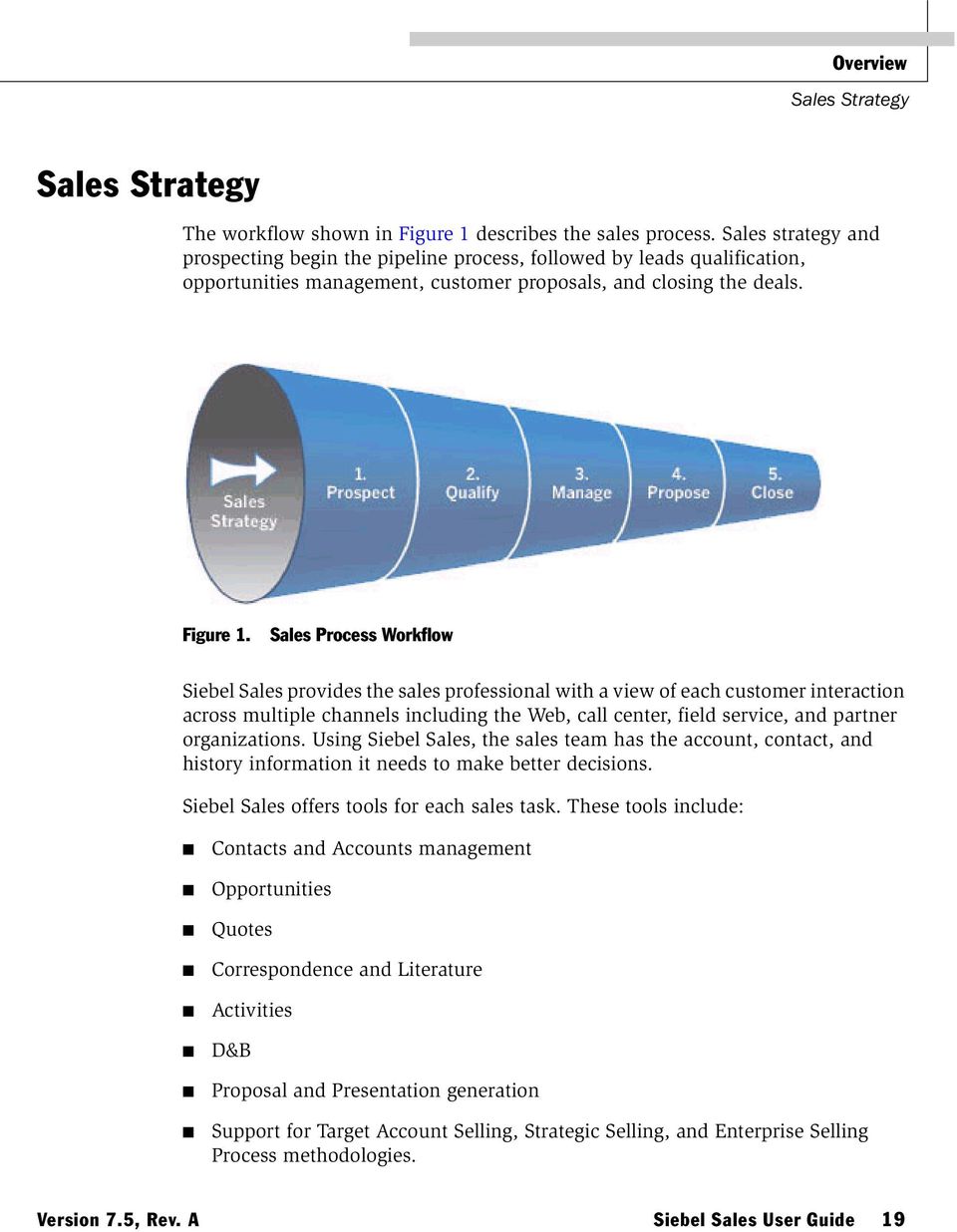
19 Overview Sales Strategy Sales Strategy The workflow shown in Figure 1 describes the sales process. Sales strategy and prospecting begin the pipeline process, followed by leads qualification, opportunities management, customer proposals, and closing the deals. Figure 1. Sales Process Workflow Siebel Sales provides the sales professional with a view of each customer interaction across multiple channels including the Web, call center, field service, and partner organizations. Using Siebel Sales, the sales team has the account, contact, and history information it needs to make better decisions. Siebel Sales offers tools for each sales task. These tools include: Contacts and Accounts management Opportunities Quotes Correspondence and Literature Activities D&B Proposal and Presentation generation Support for Target Account Selling, Strategic Selling, and Enterprise Selling Process methodologies. Version 7.5, Rev. A Siebel Sales User Guide 19
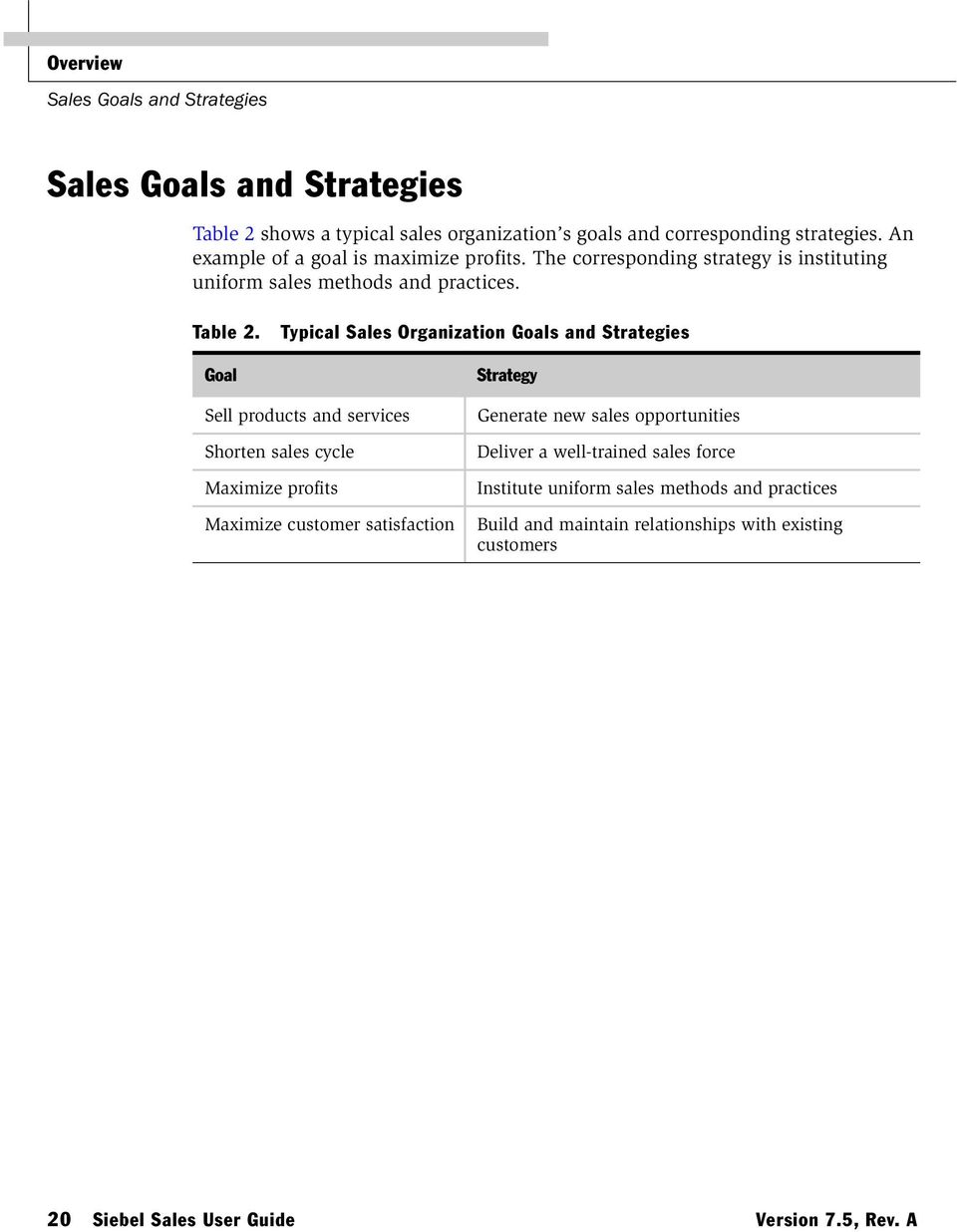
20 Overview Sales Goals and Strategies Sales Goals and Strategies Table 2 shows a typical sales organization s goals and corresponding strategies. An example of a goal is maximize profits. The corresponding strategy is instituting uniform sales methods and practices. Table 2. Goal Typical Sales Organization Goals and Strategies Strategy Sell products and services Shorten sales cycle Maximize profits Maximize customer satisfaction Generate new sales opportunities Deliver a well-trained sales force Institute uniform sales methods and practices Build and maintain relationships with existing customers 20 Siebel Sales User Guide Version 7.5, Rev. A
21 Contacts 2 Contacts are individuals with whom your company conducts business or expects to conduct business in the future. These individuals can be employees of other companies, independent consultants, vendors, or personal acquaintances. Contacts can be associated with several accounts, but a contact is the primary on only one account. Contacts can also be associated with a number of opportunities. This chapter describes how sales professionals can use the Contacts screen to record information about individuals who interact with their company. Version 7.5, Rev. A Siebel Sales User Guide 21
22 Contacts Business Scenario for Contacts Business Scenario for Contacts This scenario provides an example of a business process performed by a sales representative managing new and existing contacts. Your company may follow a different process according to its business requirements. In the course of a business day, a sales representative interacts with other professionals. These formal and informal exchanges can result in potential leads or sales opportunities. A sales representative determines if her company has done business with a particular company by reviewing account and contact records. In cases where contacts are not listed, the sales representative creates new contact records in the Siebel Sales application, and associates the contacts with new or existing accounts. If the possibility of doing business an opportunity arises, the sales representative creates the opportunity and associates activities and contacts with the opportunity. This helps the sales representative track important milestones for obtaining and closing deals. 22 Siebel Sales User Guide Version 7.5, Rev. A
23 Contacts Adding a Contact Adding a Contact When a sales representative identifies an individual as a possible source for leads, that individual s information is added to Siebel Sales as a contact. Team members can access this contact information while they are working on potential business opportunities. A contact team is a group of employees or partners who can view the contact information in the My Contacts view. If you work in a Mobile Web Client environment and are a member of the contact team, the contact information is downloaded to your local database the next time you synchronize. Use the following procedure to add a contact record. To add a contact 1 Navigate to the Contacts screen. 2 In the Contacts list, add a record, and complete the fields. A contact record only appears on the My Contacts view if you are on the contact team for the contact. Click the show more button to display additional fields in the More Info form. The following table describes some of the fields in the Contact form. Field Account Address Line 1 Comments Contact Method Comments Displays the account with which the contact is associated. Inherits the primary address for the account associated with the contact. You cannot add address information in this field. A text field that shows any additional information associated with the contact. A list of values established by your company that is used to define the contact s preferred method of interaction. Default values include , Fax, Pager, and Phone. Version 7.5, Rev. A Siebel Sales User Guide 23
24 Contacts Adding a Contact Field Contact Team Disable Cleansing Employee Flag First Name Global Owner Households Job Title Last Name Lock Assignment Manager Last Name Middle Initial Never Call Never Comments A default value based on your user ID. After you create a contact, you are automatically listed as the primary team member. You can add individuals to the contact team by selecting them from the employee list. Only a manager or administrator can change the primary contact team member, or can delete the primary contact team member. A check box which, when selected, does not allow data cleansing. If checked, this flag indicates that the contact is an employee of your company. A required field that displays the contact s first name. Displays the name of the team member who is the global account owner. In cases of multinational or global companies, this designates one main account team member to oversee the account. Displays the household to which the contact is affiliated. Households allow you to track and target contact affiliations, and often these contacts share an address. For more information on Households, see Siebel Call Center User Guide. A text field that displays the contact s professional title. A required field that displays the contact s last name. A check box which, when selected, locks the contact team assignment from reassignment by Siebel Assignment Manager. Displays the manager s last name. This field must be populated before you can perform an organizational analysis. For more information, see Chapter 4, Opportunities. An optional field that displays the contact s middle initial. A check box which, when selected, indicates that the contact should not be telephoned as a method of contact. A check box which, when selected, indicates the contact does not want to receive Siebel Sales User Guide Version 7.5, Rev. A
25 Contacts Adding a Contact Field Contact Team Disable Cleansing Employee Flag First Name Global Owner Households Job Title Last Name Lock Assignment Manager Last Name Middle Initial Never Call Never Comments A default value based on your user ID. After you create a contact, you are automatically listed as the primary team member. You can add individuals to the contact team by selecting them from the employee list. Only a manager or administrator can change the primary contact team member, or can delete the primary contact team member. A check box which, when selected, does not allow data cleansing. If checked, this flag indicates that the contact is an employee of your company. A required field that displays the contact s first name. Displays the name of the team member who is the global account owner. In cases of multinational or global companies, this designates one main account team member to oversee the account. Displays the household to which the contact is affiliated. Households allow you to track and target contact affiliations, and often these contacts share an address. For more information on Households, see Siebel Call Center User Guide. A text field that displays the contact s professional title. A required field that displays the contact s last name. A check box which, when selected, locks the contact team assignment from reassignment by Siebel Assignment Manager. Displays the manager s last name. This field must be populated before you can perform an organizational analysis. For more information, see Chapter 4, Opportunities. An optional field that displays the contact s middle initial. A check box which, when selected, indicates that the contact should not be telephoned as a method of contact. A check box which, when selected, indicates the contact does not want to receive . Version 7.5, Rev. A Siebel Sales User Guide 25
26 Contacts Adding a Contact Field Never Mail Organization Send Updates Status Comments A check box which, when selected, indicates that the contact does not want to receive mail from your company. A default value displaying the name of the organization to which you belong. Your system administrator sets up organizations in your Siebel application. You can associate multiple organizations with an opportunity, but your organization is listed as the default organization. A check box which, when selected, indicates that the contact is willing to receive updates about products and services. Examples are Active, Qualified, Marked for Deletion. Time Zone Displays the time zone in which the contact works or lives. 26 Siebel Sales User Guide Version 7.5, Rev. A
27 Contacts Associating a Contact with an Account Associating a Contact with an Account A contact can be associated with one or more accounts, although the contact is designated as the primary on only one account. Use the Accounts view to list accounts associated with a contact. To associate a contact with an account 1 Navigate to the Contacts screen. 2 In the Contacts list, select the contact, and then click the Accounts view tab. 3 In the Accounts list, click New. 4 In the Add Accounts dialog box, select the account associated with the contact, and then click OK. In the Add Accounts dialog box, click New to add a new account. Version 7.5, Rev. A Siebel Sales User Guide 27
28 Contacts Associating a Contact with an Opportunity Associating a Contact with an Opportunity A contact can be a source of revenue for the organization. Potential revenuegenerating events are called opportunities. You can associate a contact with an opportunity to track information about both the opportunity and the contact. To associate a contact with an opportunity 1 Navigate to the Contacts screen. 2 In the Contacts list, select the contact, and then click the Opportunities view tab. 3 In the Opportunities list, click New. 4 In the Add Opportunities dialog box, select the opportunity to associate with the contact, and then click OK. 28 Siebel Sales User Guide Version 7.5, Rev. A
29 Contacts Associating Attachments with a Contact Associating Attachments with a Contact An attachment is a file created in another application that you can associate with a contact record. Documents can be attached to contact records to maintain an interaction history for the contact or the opportunity. Attachments can include correspondence, pending contracts, and product data sheets. Associating attachments with a contact record allows the sales team to share information about the contact. To associate an attachment with a contact 1 Navigate to the Contacts screen. 2 In the Contacts list, select the contact, and then click the Attachments view tab. 3 In the Attachments list, click New. The Update File check box is automatically selected as a default. If you do not want the attached file automatically updated as the source file changes, clear the check box. 4 In the Attachment Name field, click the select button. 5 In the Add Attachment dialog box, click Browse. 6 In the Choose File dialog box, select the file, and then click Open. 7 In the Add Attachment dialog box, click Add. The attachment appears in the Attachments list. Version 7.5, Rev. A Siebel Sales User Guide 29
30 Contacts Promoting a Personal Contact to a Sales Contact Promoting a Personal Contact to a Sales Contact Contact records can be promoted from the My Personal Contacts view to the My Contacts view. To promote a contact from My Personal Contacts to My Contacts 1 Navigate to the Contacts screen. 2 From the Show drop-down list, choose My Personal Contacts. 3 In the Contacts list, select the contact for promotion. 4 In the Contact form, click the show more button to display additional fields. 5 In the Contact form, clear the check box in the Private field. The Contact record appears in the My Contacts list. NOTE: You cannot designate a contact as Private (My Personal Contacts) from the My Contacts list. 30 Siebel Sales User Guide Version 7.5, Rev. A
31 Contacts Creating a Profile for a Contact Creating a Profile for a Contact A profile consists of information that is collected about a contact. This information can include a contact s expenditure approval, hobbies, education, and the name of the contact s spouse. To create a profile 1 Navigate to the Contacts screen. 2 In the Contacts list, select the contact, and then click the Profile view tab. 3 In the Profile form, complete the fields. Version 7.5, Rev. A Siebel Sales User Guide 31
32 Contacts 32 Siebel Sales User Guide Version 7.5, Rev. A
33 Contacts Updating Contact Information in External Systems Updating Contact Information in External Systems If the Siebel administrator has set up real-time integration of contacts between Siebel Sales and a back-office system or other systems in your organization, you can use the Update External System command to send new and modified contact information from Siebel Sales to another system. This Application Services Interface (ASI) feature allows a real-time contact data update between Siebel and a third-party external system, maintaining consistent customer information across the enterprise and eliminating manual entry of customer data in multiple systems. The Update External Systems command also can be used to synchronize account data with external systems. For more information, see Updating Account Information in External Systems on page 46. This procedure assumes that the Siebel administrator has completed the work necessary to allow real-time contact integration through ASI. For information about how to set up the Web services administration to communicate with the external system, ASI structures, configuring and customizing the ASI, see Application Services Interface Reference and Applications Administration Guide. To update contact information in an external system 1 Navigate to the Contacts screen. 2 In the Contacts list, add a new record and complete the fields. 3 (Optional) Click the Accounts view tab. 4 (Optional) In the Accounts list, click New, and then complete the fields to associate an account with the contact. 5 In the Contacts list, click the menu button, and then choose Update External System. Version 7.5, Rev. A Siebel Sales User Guide 33
34 Contacts Updating Contact Information in External Systems 34 Siebel Sales User Guide Version 7.5, Rev. A
35 Accounts 3 An account represents the relationship between a company and the companies or individuals with whom it conducts business. Sales representatives use the Accounts screen and its associated views as the primary navigation tool for customer interactions. This chapter describes how sales professionals can use the Accounts screen to create new customer accounts, modify and add account information for existing customers, respond to customer inquiries, and view account information. Version 7.5, Rev. A Siebel Sales User Guide 35
36 Accounts Business Scenario for Accounts Business Scenario for Accounts This scenario provides an example of the business process performed by a sales representative managing new and existing accounts. Your company may follow a different process according to its business requirements. At a vendor site, a sales representative meets a prospect. After a brief discussion, the sales representative determines that the prospect is interested in learning more about the products and services that the sales representative s company sells. The sales representative sets up a sales call with the prospect. During the sales call, the sales representative asks a number of questions to determine the account structure of the prospect s business and to decide how best to meet the prospect s needs. The sales representative learns that the prospect s business has four locations, and that each service is billed through the main office, and each location receives a billing statement. After the meeting, the sales representative returns to the office and begins creating the account structure for the prospect s business. 36 Siebel Sales User Guide Version 7.5, Rev. A
37 Accounts Business Scenario for Global Accounts Business Scenario for Global Accounts This scenario provides an example of the business process performed by a sales representative managing new and existing global accounts. Your company may follow a different process according to its business requirements. A large multinational corporation has three major subsidiaries. Each subsidiary has two child companies. The Global Accounts Manager plans to review all opportunities at the multinational company and its subsidiaries. Account records have already been created for the multinational corporation and its subsidiaries and the company s administrator has already created the Global Account hierarchy. The Global Accounts Manager navigates to the Accounts screen, and selects the Global Accounts view tab. In this view, the manager can see the opportunities for the multinational corporation and its subsidiaries. Version 7.5, Rev. A Siebel Sales User Guide 37
38 Accounts Creating an Account Creating an Account After a business relationship is identified, you can enter the details about the account. As account details evolve or change, you can update the account information. Before adding a new account, search the accounts list to make sure the account does not already exist. To create an account 1 Navigate to the Accounts screen. 2 In the Accounts list, create a new record and complete the fields. Click the show more button to view additional fields. The following table describes some of the fields. Field Account Type Assignment Area Code Assignment Country Code PO Auto-Approval Limit Competitor Current Volume Disable Cleansing Comments A list of values established by your company defines the type of account. Default values include Commercial, Competitor, Consultant, and Customer. Displays an area code for the account. This indicates that a sales representative from the same area code should be assigned to the account. Displays a country code for the account. This indicates that a sales representative from the same country code should be assigned to the account. The amount for which a Purchase Order can be automatically approved. A check box which, when selected, indicates the account is a competitor. Displays a monetary amount that represents the account s current sales volume. A check box which, when selected, does not allow data cleansing. 38 Siebel Sales User Guide Version 7.5, Rev. A
39 Accounts Creating an Account Field Domestic Ultimate DUNS DUNS# Expertise Global Owner Global Ultimate DUNS Inventory Location Lock Assignment Name Organization Parent Parent/HQ DUNS Partner PO Approval Limit PO Approved Comments Displays the D-U-N-S number for the domestic ultimate, which is the highest member in the hierarchy for the same business entity within the same country. A case can be its own domestic ultimate. The Data Universal Numbering System (D-U-N-S) numeric serial number for a company. The D-U-N-S number is unique for each company. A list of values established by your company that defines the area of expertise for the account. Default values include Technology, Quality Control, and Client Management. Displays the ID of the team member who is the global account owner. In cases of multi-national or global companies, this designates one main account team member to oversee the account. Displays the D-U-N-S number for the global ultimate, which is the highest member in the hierarchy for the same business entity worldwide. Displays the physical location of the inventory. A check box which, when selected, locks the sales team assignment from reassignment by Siebel Assignment Manager. A required value that identifies the account. Displays the name of the organization with which the account is associated in your Siebel application. Displays a parent account if the account is a subsidiary of a larger company. D&B number for the account's parent account. A check box which, when selected, indicates the account is a business partner. Displays a monetary limit up to which a PO is approved. A check box which, when selected, indicates the Purchase Order (PO) has been approved. Version 7.5, Rev. A Siebel Sales User Guide 39
40 Accounts Creating an Account Field Potential Volume Price List Reference Referenceable as of Shipping Information Shipping Terms Stage Status Synonyms URL Comments Displays a monetary amount that represents the account s potential sales volume. Displays a price list associated with the account. Your application administrator establishes price lists based on criteria defined by your company. A check box which when selected indicates the account offers a reference for your company s products or services. Displays the date when the account first became a reference A text field for additional shipping details. A list of values established by your company that defines the terms for shipping. Default values include Due, FOB, TBD, and No Charge. A list of values established by your company that defines the account stage according to your sales or other methodology. Default values include Project Planning and Strategy, Analysis and Design, Testing and Production Pilot, Rollout, and On Hold. A list of values established by your company that defines the account status. Default values include Active, Contract Pending, Gold, and Inactive. Displays a synonym for the account. Displays the Universal Resource Locator (URL) for the account Web site. NOTE: When a company change names or merges with another company, you must transfer account names and contacts to the new account name. Contact Siebel Technical Support or your implementation team for more information on how to rename an account. 40 Siebel Sales User Guide Version 7.5, Rev. A
41 Accounts Associating a Contact with an Account Associating a Contact with an Account As you work with a prospective account, you develop business relationships with the contacts associated with an account. Contacts can belong to multiple accounts, only one of which can be the primary account. Deleting a contact record in the Accounts screen s Contacts view only removes the contact s association with the account. The original contact record is still available in the Contacts list. To associate a new contact with an account 1 Navigate to the Accounts screen. 2 In the Accounts list, select the account, and then click the Contacts view tab. 3 In the Contacts list, click New, and complete the fields for the contact. To associate an existing contact with an account 1 Navigate to the Accounts screen. 2 In the Accounts list, select the account, and then click the Contacts view tab. 3 In the Contacts list, click Add. 4 In the Add Contacts dialog box, enter query criteria for the contact, and then click Go. 5 Select the contact to add, and then click OK. To update an external system with an account contact 1 Navigate to the Accounts screen. 2 In the Accounts list, select an existing account, and then click the Contacts view tab. To create a new account, see Creating an Account on page In the Contacts list, select the contact. 4 In the contact record, drill down on the contact name hyperlink, and then in the contact form, complete any additional fields. 5 In the Contact form, click the menu button, and then choose Update External System. Version 7.5, Rev. A Siebel Sales User Guide 41
42 Accounts Associating an Account with an Activity Associating an Account with an Activity An activity is a task or event that is generally, but not always, performed for a contact, an account, or an opportunity. You will most likely attend meetings, calls, presentations, and perform other activities associated with an account. You can use the Activities list to enter and track account-related activities. If the activity has a time associated with it, the activity appears in the Activities list and Calendar. For more information, see Chapter 9, Activities. An account can have a number of activities associated with it. You can associate an activity with an account to track which activities you have completed and track those you want to accomplish in the future as you manage the account relationship. To associate an account with an activity 1 Navigate to the Accounts screen. 2 In the Accounts list, select the account associated with the activity, and then click the Activities view tab. 3 In the Activities list, add a new record and complete the fields. a b In the Type field, drill down on the hyperlink for the default value to change the type of activity. In the Display In field, choose the display method for the activity. For example, the activity can appear in Calendar and Activities, To Do and Activities, and Activities Only. 42 Siebel Sales User Guide Version 7.5, Rev. A
43 Accounts Associating an Account with an Opportunity Associating an Account with an Opportunity Accounts are a source of business for your company. An opportunity is a potential revenue-generating event and the opportunity record stores information that you can use to manage accounts. To associate an account and an opportunity 1 Navigate to the Accounts screen, and in the Accounts list, select the account. 2 Click the Opportunities view tab. 3 In the Opportunities list, add a new record and complete the fields. The Account field and the Primary (team member) field are automatically populated. The Close Date field value defaults to the opportunity creation date. To display more fields, in the Opportunities list click the menu button and then choose Columns Displayed. The following table describes some of the fields. Field Account Close Date Name Primary Priority Flag Comments A value inherited from the selected account. Allows you to enter the expected date on which the opportunity closes. The default date is the opportunity creation date. Modify the close date if the opportunity closes on a different date, because this date is used in revenue forecasting. Displays the name of the opportunity. Displays your User ID when you create the opportunity. This value can be changed. For more information see, Chapter 4, Opportunities. A check box which indicates that an account is a high priority (urgency for sales team). When the priority is set by selecting the check box, a flag appears in the priority column. Version 7.5, Rev. A Siebel Sales User Guide 43
44 Accounts Associating an Account with an Opportunity Field Revenue Sales Stage Comments Allows you to enter the currency amount of the opportunity. This field defaults to zero. A list of values established by your company that defines the sales stages associated with the sales method you selected. For more information about opportunities, see Chapter 4, Opportunities. 44 Siebel Sales User Guide Version 7.5, Rev. A
45 Accounts Performing Account Assessments Performing Account Assessments Account assessments can be used to compare accounts to one other, compare them to a model, or to determine what information is present or not for an account. You complete the assessment by selecting the appropriate values for the different opportunities. To perform an account assessment 1 Navigate to the Accounts screen. 2 In the Accounts list, select the account, and then click the Assessments view tab. 3 In the Assessments list, add a new record, and then complete the fields. a In the Template Name field, click the select button. The Select Assessment Template dialog box appears. b Select the template, and then click OK. 4 Click the Assessment Attribute subview tab, and then click the show more button. In the Value field, click the select button and then select the appropriate value for the account. A composite assessment score for the account appears as a percentage value in the parent Assessment list. This percentage compares the score you entered in the assessment attribute line items to the maximum possible score for the account. You can use this percentage to profile the account. NOTE: Your application administrator sets up the assessment templates based on the criteria defined by your company. For more information on administering assessment templates, see Applications Administration Guide. Version 7.5, Rev. A Siebel Sales User Guide 45
46 Accounts Updating Account Information in External Systems Updating Account Information in External Systems If your Siebel administrator has set up real-time account integration between Siebel Sales and a back-office system or other systems in your organization, you can use the Update External System command to send new and modified account information from Siebel Sales to another system in real-time. This Application Services Interface (ASI) feature allows you to initiate a real-time account data update between Siebel and external system, maintaining consistent account information across the enterprise and eliminating manual entry of account data in multiple systems. By default, in the Accounts screen, the Update External System command triggers the business process Synchronize Account ASI. This business process sends account information to the external system, and updates Siebel with the response from the external system. This business process can be viewed by navigating to the Business Processes screen from the Site Map, and querying for the business process name. The following procedure explains how to send account information from Siebel Sales to another system. The contacts that are associated with the account must sent separately to the external system. For more information, see Updating Contact Information in External Systems on page 33. This procedure assumes that your Siebel administrator has completed the work necessary to allow real-time account integration through ASI. For information about how to set up the Web services administration to communicate with the external system, ASI structures, configuring and customizing the ASI, see Application Services Interface Reference and Applications Administration Guide. To synchronize account information with an external system 1 Navigate to the Accounts screen. 2 In the Accounts list, select an account record. To create a new account record, see Creating an Account on page In the Account list, click the menu button, and then choose Update External System. 46 Siebel Sales User Guide Version 7.5, Rev. A
47 Accounts Viewing Account Credit Profiles Viewing Account Credit Profiles If your organization uses back-office software or another external credit management system to store customer credit information, you can use the Credit Profile read-only view to get the most current account credit profile information. The Accounts screen s Credit Profile view allows you to improve employee productivity by providing visibility to complete customer information within your Siebel application, and streamlines the quote-to-cash process by allowing the sales professional to identify potential credit problem early. This procedure assumes that your Siebel administrator has completed the work necessary to allow real-time account integration through Application Service Interfaces (ASI). For information about how to set up the Web services administration to communicate with the external system, ASI structures, configuring and customizing the ASI, see Application Services Interface Reference and Applications Administration Guide. To view account credit profile information 1 Navigate to the Accounts screen. 2 In the accounts list, select the account, and then click the Credit Profile view tab. The Credit Profile form appears, and includes information on credit status, risk category, credit limit, and so on. Fields in this form are read-only, except for the Skip Credit flag check box and Credit Auto Approval Limit. For more information on how to use these fields, see Siebel Order Management Guide. 3 Click Refresh to update the information in the Credit Profile form. Version 7.5, Rev. A Siebel Sales User Guide 47
48 Accounts Viewing Global Accounts Viewing Global Accounts Available as an option, Global Accounts allow users to see opportunities, activities, contacts, and account team information for an account and its subsidiary accounts. Global Accounts consist of a parent account, the child accounts, the child accounts children, and so on. These hierarchies are determined in one of two ways: Hierarchies are determined by the value in the parent field on the Account Record. Hierarchies are determined by the administrator who creates custom hierarchies. Global Accounts are created and maintained by the administrator. If an account has no child account or the administrator has not defined a hierarchy for an account, then a message appears advising you that the selected record is not included as part of your defined hierarchy. For more information on creating Global Accounts and account hierarchies, see Applications Administration Guide. 48 Siebel Sales User Guide Version 7.5, Rev. A
49 Accounts Viewing Global Accounts To view global accounts information 1 Navigate to the Accounts screen, and from the Show drop-down list, choose My Global Accounts. Other Show drop-down list options include All Global Accounts, and Global Accounts Across Organizations. The Global Accounts subviews appear, as shown in the following figure, with the explorer at left showing the hierarchy of account, subaccounts, contacts and opportunities, and the list at right showing records associated with each subview. 2 Click the individual view tabs for Subaccounts, Contacts, Activities, Opportunities, and Account Team. Records associated with these subviews appear in a list at the right of the explorer. Version 7.5, Rev. A Siebel Sales User Guide 49
50 Accounts Viewing Global Accounts 50 Siebel Sales User Guide Version 7.5, Rev. A
51 Opportunities 4 An opportunity is defined as a potential revenue-generating event. Opportunityrelated information is recorded and tracked in the views associated with the Opportunities screen. This chapter describes how sales professionals can use the Opportunities screen to perform the following tasks: Receive and respond to new leads that are assigned to you Create new opportunities and enter related information such as accounts, contacts, activities, and products View, qualify, and update opportunities assigned to you and your sales team (if you are a manager) Track the status of an opportunity through the sales cycle from creation to closure Share information about the opportunity with sales team members Generate quotes, presentations, and other types of information needed to close the deal Version 7.5, Rev. A Siebel Sales User Guide 51
52 Opportunities Business Scenario for Opportunities Business Scenario for Opportunities This scenario provides an example of how a sales representative works with leads and opportunities. Your company may follow a different process according to its business requirements. Opportunity Lead Conversion A company uses Siebel Marketing to develop a campaign as part of a new product introduction. During the campaign, a telemarketing agent uses Siebel Call Center to contact prospects associated with the campaign. During her conversations with prospects, the agent qualifies leads by determining whether each prospect is interested in the new product offering. When a prospect expresses interest in learning more about the new product, the agent creates a new lead. Using Siebel Assignment Manager, the lead is automatically routed to the sales representative who is most qualified to work on the lead and whose schedule can accommodate the new assignment. When the sales representative log onto the Siebel Sales application, she sees the new lead in the Opportunities list on her home page. Drilling down on the lead takes the sales representative to the Opportunities screen. After reviewing details about the lead, such as the customer information, probability of closing, and the products that the customer is interested in purchasing, the sales representative decides to accept the lead by changing the Status field to Accept. After the sales representative accepts the lead, she begins to work on the lead by assembling members of the sales team, conducting further research on the customer and its requirements, coordinating and recording activities, uploading agreements, and generating proposals and presentations for the customer. As the sales representative works through the sales cycle, she updates information about the sales stage and keeps private notes as well as notes that she shares with other members of the sales team. Eventually, the sales representative develops a quote from the Opportunities screen. When the customer accepts the quote, it is converted into an order. NOTE: Siebel Marketing, Siebel Call Center, Siebel Sales, and Siebel Quotes are fully integrated, separately licensed product offerings. You need to license these products to access the views. 52 Siebel Sales User Guide Version 7.5, Rev. A
53 Opportunities Business Scenario for Opportunities Opportunity Tracking At a trade show, a sales representative meets a prospective customer who could be a lead for a new business opportunity. When the sales representative returns to the office, he discovers the company is listed in Siebel Sales as an account, but the person he met is not listed as a contact. The sales representative proceeds to add the prospective customer as a contact, and then creates the opportunity. He then schedules meetings and creates associated activities, and enters other potential contacts associated with the opportunity. As the sales process continues, the sales representative gathers and updates information about the account, its contacts, and the opportunity that he is pursuing. As the relationship grows, the sales representative can add, view, and share stored information and key knowledge with other members of the sales team. Opportunity Generated Quote A sales representative is assigned to the sales team for an opportunity. As the sales representative gathers product information about the customer requirements, she enters that information in the Siebel Sales application. After she presents to the customer, the customer indicates that the representative s company is on the short list for the deal, and that the representative should submit a quote. The sales representative creates a quote automatically based on the information she has already entered into the Siebel Sales application. After she generates the quote, she synchronizes the quote information with the revenues associated with the opportunity. By making sure these numbers are in sync, the sales representative establishes that the data associated with her opportunity is current and that her forecasts are accurate. Version 7.5, Rev. A Siebel Sales User Guide 53
54 Opportunities Opportunities Screen Views Opportunities Screen Views The Opportunities Screen includes several views that allow you to create, update, and track opportunities. These views make it easier to find and review relevant opportunities and associated data. For example, you can use the views to access opportunities belonging to you, your team, or your organization. Table 3 describes each of the views within the Opportunities screen. Table 3. View Opportunities Screen Views Description All Opportunities All Opportunities Across My Organizations All Opportunities Across Organizations Explorer Manager s Explorer My Opportunities My Team s Opportunities Displays opportunities whose organization is the same as the organization of the user. The user may or may not be on the sales team for these opportunities. Displays opportunities which have an organization or a suborganization that is the same as the user's organizations. Displays opportunities for all organizations. Typically only select users have access to this view. This view makes it easier to visualize the relationship of records that have been added to each opportunity. For each opportunity, you can view associated child opportunities, contacts, products, partners, quotes, activities, and notes. Gives managers a view of their team's opportunities by team member. Displays opportunities for the user s sales team. This manager's view displays opportunities associated with either the manager s sales team or the sales team of one of his team members. NOTE: The views in Table 3 (except for the Manager's Explorer view) are based on a default predefined query (PDQ) shown in the Queries drop-down list. The PDQ is labeled * Current Opportunities. Only opportunities that have a Close Date within the last 30 days or in the future (>= Today's Date - 30 days) appears in the view. Opportunities without a primary sales representative or an unspecified organization do not appear in the views. The administrator can access these opportunities from the Site Map > Data Administration > Opportunities view. 54 Siebel Sales User Guide Version 7.5, Rev. A
55 Opportunities Opportunities Screen Views Other Views Associated with the Opportunities Screen Several view tabs are frequently associated with the Opportunities screen. Table 4 provides an explanation of each view. Some of these views only appear if you have purchased optional add-on modules. Views included in add-on modules are indicated by an asterisk (*). Table 4. Views Associated with the Opportunity Screen Opportunity Screen Associated Views Activities Activity Plans Assessments Attachments Audit Trail Calendar Campaign Leads* Comments Allows sales professionals to identify and track activities required to win the deal. Examples of activities are customer calls and team meetings. Activities can also be viewed in the Calendar and To Do views. For more information see Chapter 9, Activities. Provides templates predefined by the administrator that identify a set of activities that should be completed. Activity Plans help sales managers to indicate required activities and also saves time for sales professionals because the activities are automatically generated based on the selected template. For more information see Chapter 9, Activities. Used to help sales professionals qualify opportunities and verify resource allocation. Allows sales professionals to associate relevant documents with the opportunity. An example is a Microsoft Word Request for Proposal document. Allows users to track changes that have been made to an opportunity record. Any time a member of the opportunity sales team creates, updates, copies, or deletes opportunity data, the action is tracked in the Opportunity Audit Trail view. Audit Trail details which employees made the modifications and when these changes were made. Changes to the Revenue Class, Probability, Stage, Stage ID, and Status fields are automatically tracked. Your administrator can help you set up change tracking for additional fields. For more information, see Applications Administration Guide. A Calendar format view that shows activities associated with the opportunity. Primarily used by call center agents to record a campaign response that represents a sales opportunity. See Siebel Call Center User Guidefor more info. Version 7.5, Rev. A Siebel Sales User Guide 55
56 Opportunities Opportunities Screen Views Table 4. Views Associated with the Opportunity Screen Opportunity Screen Associated Views Categories Charts Competitors Contacts Decision Issues Estimate Compensation* Messages More Info Notes Organization Analysis Organizations Partners Presentations* Products Profile Comments Allows you to sort and track information related to the opportunity. For more information, see Chapter 13, Categories. Allows you to view graphical analyses of opportunity data. Allows you to track competition in the deal. For more information, see Chapter 7, Competitors. Allows you to maintain list of key customer contacts in the opportunity. Allows you to anticipate and respond to your contacts' key buying criteria. For more information, see Chapter 6, Decision Issues. Used in Siebel Incentive Compensation application. For more information, see Siebel Incentive Compensation Administration Guide. Allows you to associate phone messages with the opportunity. For more information, see Chapter 10, Messages. Used to create, update, and track the status of opportunities. Allows you to create private notes or public notes that can be shared with your sales team. Allows you to analyze key contacts and relationships in the opportunity and display them graphically in an organization chart. Allows you to view organizations associated with the selected record. Allows you to add partners who can help you win the opportunity. Allows you to automatically generate presentations using the data associated with the opportunity. For more information, see Applications Administration Guide and Chapter 16, Presentations. Allows you to associate products with the opportunity. Allows you to capture key info to qualify the deal. You can attach a SmartScript to support this view. For more information, see Siebel Call Center User Guide. 56 Siebel Sales User Guide Version 7.5, Rev. A
57 Opportunities Opportunities Screen Views Table 4. Views Associated with the Opportunity Screen Opportunity Screen Associated Views Projects* Proposals* Quotes* Revenue Plans* Revenues* Sales Team Strategic Selling* Target Account Selling* Transfer Comments Allows you to create projects to track activities and resources for the opportunity. For more information, see Siebel Professional Services Automation Guide. Allows you to automatically generate a proposal for the opportunity. For more information, see Chapter 15, Proposals and Applications Administration Guide. Allows you to automatically generate a quote for the offering. For more information, see Siebel Order Management Guide and Chapter 14, Quotes. Allows you to develop revenue plans. For more information, see Siebel Forecasting Guide. Allows you to forecast revenue. Fore more information, see Siebel Forecasting Guide. This read-only view allows you to see who is on the sales team for the opportunity. Includes views that support the Strategic Selling Opportunity Management methodology developed by Miller Heiman, Inc. For more information, see Chapter 20, Strategic Selling. Includes views that support the Target Account Selling Opportunity Management methodology developed by Siebel MultiChannel Services. For more information, see Chapter 19, Target Account Selling. Used to reassign an opportunity to a partner. Version 7.5, Rev. A Siebel Sales User Guide 57
58 Opportunities Opportunities Processes and Procedures Opportunities Processes and Procedures When you are working with opportunities, you perform the following key tasks: Lead assignment, response, and qualification. For more information, see Opportunities Lead Assignment on page 59, Lead Response on page 60, and Lead Qualification, Sales Methods and Stages on page 61. Create an opportunity. For more information, see Creating an Opportunity on page 63. Change the primary team member. For more information, see Changing the Primary Sales Team Member on page 69. Monitor transactions. For more information, see Monitoring Significant Opportunity Transactions on page 70. Assess opportunities. For more information, see Assessing an Opportunity on page 71. Manage decisions. For more information, see Viewing Decision Issues for an Opportunity on page 73. Add contacts. For more information, see Associating a Contact with an Opportunity on page 74. Add activities. For more information, see Activities Associated with an Opportunity on page 75. Associate products. For more information, see Associating a Product with an Opportunity on page 76. Create quotes. For more information, see Creating a Quote from an Opportunity on page 77. Performing an organization analysis. For more information, see Creating an Organization Analysis on page 79. Adding attachments, and notes. For more information, see Adding Attachments and Notes to Opportunities on page 84. Generate and viewing charts and reports. For more information, see Opportunity Charts on page 86 and Generating Opportunity Reports on page Siebel Sales User Guide Version 7.5, Rev. A
59 Opportunities Opportunities Lead Assignment Opportunities Lead Assignment You can view new leads in the Opportunities list on your home page, or you can navigate to the Opportunities screen to view new leads that you did not create but were assigned to you. There are a number of ways in which a lead might be assigned to you: A lead is generated through a campaign, and then automatically routed to you using Siebel Assignment Manager and predefined rules. A lead is entered into the system by an administrator, and then automatically routed to you using Siebel Assignment Manager and predefined rules. An opportunity is created by a sales manager or sales representative who adds you to the sales team. In each of these scenarios, you are able to view the lead or opportunity because you have been added to the sales team, either as the primary on the sales team or as a sales team member. If you are receiving a lead for the first time and you are the primary on the sales team, the Status field in the More Info view is set to Pending by default. You can accept, reject, or reroute the lead by changing the value in the Status field. If the administrator has activated the notifications, predefined processes send messages to you, alerting you of the following events. You have received a new lead and should accept, reject, or reroute the lead within seven days. You received a new lead five days ago and should accept, reject, or reroute the lead within two days. You have accepted a lead but have not worked on the lead in 30 days. You have won the sales opportunity and should enter the reason in the system. You have lost the sales opportunity and should enter the reason in the system. The wording of the s and the wait periods can be modified. Opportunity Workflows only sends if the opportunity has revenue greater than $50,000. For more information, see the Opportunity Workflows chapter in Applications Administration Guide. Version 7.5, Rev. A Siebel Sales User Guide 59
60 Opportunities Lead Response Lead Response After you receive a lead, you can choose to accept, reject, or reroute the lead. Rejecting the Lead. You can reject a lead by changing the Status field to Reject in the More Info view. Enter the reason for rejecting the lead in the Reason field. The lead remains in your queue until it is reassigned by your manager. Rerouting the Lead. If you decide to reroute a lead by changing the Status field in the More Info form to Reroute, a Reroute activity automatically is created. Enter the reason for rerouting the lead in the Reason field. The lead remains in your queue until it is rerouted by your manager. Accepting the Lead. You can accept a lead by changing the Status field in the More Info form to Accept. Enter the reason for accepting the lead in the Reason field. 60 Siebel Sales User Guide Version 7.5, Rev. A
61 Opportunities Lead Qualification, Sales Methods and Stages Lead Qualification, Sales Methods and Stages When you accept a lead, you can begin to work on the lead in the Opportunities screen. The records in the Opportunities list include both leads and opportunities. Leads are defined as opportunities that have not yet been qualified. Lead qualification status is indicated in the Sales Stage field. The list of values in the Sales Stage field varies depending on which sales method you are using. A sales method is a formalized approach or methodology used during the sales process. A sales method can encompass all activities associated with the sales process, from prospecting to forecasting to closing deals. This approach allows sales representatives to use the method most appropriate for their opportunities. The application administrator establishes values in your Siebel application that represent the sales methods and sales stages for your company. It is a recommended business practice to designate a default sales method in your Siebel application. This practice allows a sales method to be associated with each opportunity and aids in charting and reporting accuracy. Sales methods can differ within a company. For instance, a sales method for managing a complex multimillion dollar opportunity can include 15 stages, while a sales method for a simple low-dollar opportunity may require only four stages. Your application administrator creates and implements the sales stages that your company uses. For more information about creating or implementing sales stages, see Applications Administration Guide. Table 5 shows sales methodologies (Accelerated, Default, Standard, Strategic Selling), and the associated sales stage for each methodology (for example, 01 - Prospecting). The table also shows if the record is a lead or is an opportunity at each sales stage. Table 5. Sales Methods and Sales Stages Accelerated Default and Standard Strategic Lead or Opportunity 01 - Prospecting 01 - Prospecting 01 - Universe Lead 02 - Potential Lead 02 - Above Lead Version 7.5, Rev. A Siebel Sales User Guide 61
62 Opportunities Lead Qualification, Sales Methods and Stages Table 5. Sales Methods and Sales Stages Accelerated Default and Standard Strategic Lead or Opportunity 02 - Qualification 03 - Qualification 03 - In the Funnel Opportunity 04 - Opportunity 04 - Best Few Opportunity 05 - Building Vision Opportunity 06 - Short List Opportunity 07 - Selected Opportunity 03 - Closing 08 - Negotiation 05 - Won Opportunity 09 - Closed or Won Opportunity 04 - Lost 09 - Closed or Lost 00 - Lost Opportunity 62 Siebel Sales User Guide Version 7.5, Rev. A
63 Opportunities Creating an Opportunity Creating an Opportunity You should create a new record each time you identify an opportunity. To create an opportunity 1 Navigate to the Opportunities screen, and in the Opportunities list, create a new record. 2 In the More Info form, click the show more button. 3 Complete the necessary fields. The following table describes some fields in the Opportunity form. Field Account Address Line 1 Best Case Channel Close Date Committed Cost Created Comments Allows you to associate an opportunity with an account. Allows you to associate an address with an opportunity. If the account has more than one address associated with it, you can select the appropriate address for the opportunity. Allows you to enter the currency amount the deal could generate in the best-case scenario. This amount is higher than the value in the Revenue field. A list of values established by your company that defines the sales channel. Default values include Direct and Indirect. Allows you to enter the expected date on which the opportunity closes. The default date is the same as the Created Date. It is important to modify the date, if the opportunity closes on a different date, because this date is used in revenue forecasting. A check box which, when selected, indicates there is a high probability that the deal will close, and that the deal should be included in your revenue forecast. Expense associated with the opportunity. A default value that displays the date and time you created the opportunity. Version 7.5, Rev. A Siebel Sales User Guide 63
64 Opportunities Creating an Opportunity Field Created By Description Domestic Ultimate D-U-N-S DUNS# Executive Priority Expected value Global Ultimate DUNS Lead Partner Lead Quality Comments A default value based on the user ID of the employee who created the opportunity. A text area for additional information about the opportunity. Displays the D-U-N-S number for the domestic ultimate, which is the highest member in the hierarchy for the same business entity within the same country. A case can be its own domestic ultimate. The Data Universal Numbering System (D-U-N-S) numeric serial number for a company. The D-U-N-S number is unique for each company. This check box can be used to flag a significant opportunity. Sales executives can query for high-priority opportunities for tracking purposes. Displays a currency value that is calculated based on the potential revenue field multiplied by the value in the probability field. A lower percentage in the probability field reduces the expected value that is included in your revenue forecast. Displays the D-U-N-S number for the global ultimate, which is the highest member in the hierarchy for the same business entity worldwide. The lead partner field is populated automatically when the source of the opportunity is a campaign with a lead partner. If you create an opportunity from a response, and the response had a campaign associated with it, the opportunity inherits the lead partner from the campaign. If you create a new opportunity and select a campaign as the source, the opportunity inherits the campaigns lead partner, if it has one. A list of values established by your company that allows you to rank the quality of the lead. Default values include 1-Excellent, 2-Very High, 3-High, 4-Fair, 5-Poor. 64 Siebel Sales User Guide Version 7.5, Rev. A
65 Opportunities Creating an Opportunity Field Lock Assignment Margin Name Opportunity Currency Organization Parent HQ DUNS Parent Opportunity Partner Approval Status Primary Priority Comments A check box which, when selected, locks the sales team assignment so that Siebel Assignment Manager does not alter the current opportunity assignment. A calculated field that displays the revenue figure minus the cost. A required value that identifies the opportunity. A list of values established by your company that allows you to specify the currency type associated with the opportunity. The selected value does not affect forecasting. A default value that displays the organization name associated with the person creating the opportunity. Your system administrator sets up organizations in your Siebel application. You can associate multiple organizations with an opportunity. Displays the D-U-N-S number of the parent organization s HQ location, if this is a subsidiary record. Allows you to associate an opportunity with a parent opportunity. For instance, if you are working a sale for a division of a company in which there are numerous opportunities, you may associate this opportunity with a larger parent opportunity for the entire company. A list of values established by your company that allows you to specify the approval status of the lead partner for the opportunity. Displays the user ID of the primary sales team member. This value defaults to your user ID if you are creating a new opportunity. A check box which, when selected, indicates that an opportunity is a high priority (urgency for sales team). When the priority is set to Y, a check mark appears in the priority column. This column can appear in the Opportunities list and the Opportunities Explorer. The default value for this column is N. Version 7.5, Rev. A Siebel Sales User Guide 65
66 Opportunities Creating an Opportunity Field Probability % Reason Revenue Revenue Class Revenue Type Sales Method Sales Stage Sales Team Site Comments The Probability reflects the percentage of confidence you have that the deal will close with the specified revenue on the specified close date. By default, the probability adjusts automatically based on the sales stage of the opportunity. You can manually override the probability value. A list of values established by your company that allows you to specify a reason that the opportunity was accepted, rejected, rerouted, won, or lost. Allows you to enter the currency amount of the opportunity. If you are using the Products, Quotes or Revenue view tabs, you can make sure your summary revenues are calculated and are in sync. The amount entered affects forecasting. A list of values established by your company that allows you to define the quality of the expected revenue. For more information, see Revenue Class and Revenue Type on page 67. A list of values established by your company that allow you to define the kind and source of the expected revenue. For more information, see Revenue Class and Revenue Type on page 67. A list of values established by your company that includes the sales methodologies. Default values include Strategic Selling, Accelerated Sales Process, Default Sales Methodology and Standard Sales Process. A list of values established by your company that allows you to specify the sales stages associated with the selected sales method. This list shows who is on the sales team for the opportunity. When you create an opportunity, you are automatically listed as the primary sales team member. You can add employees to the sales team by selecting them from the employee list. Only a manager or administrator can change or delete the primary sales team member. A default value that is automatically entered when you associate the opportunity with a specific account and location. 66 Siebel Sales User Guide Version 7.5, Rev. A
67 Opportunities Creating an Opportunity Field Source Source Type Split Flag Comments A dialog box that allows you to associate the sources of the sales lead with the opportunity. Typical source values include specific events, campaigns, or conferences. A default value that displays the category of the primary source. For instance, a specific seminar that is the source of the opportunity is identified with a value of Seminar in this field. A system populated check box that indicates a split revenue record has been created. Status A list of values established by your company that describes the status of the opportunity. The Status field is Pending by default. A user can change the field to Accepted, Rejected, Rerouted, Won, or Lost. Territories Worst Case A default value based on the territories defined by your company. Your system administrator controls the territory assignment function set up by your sales manager. Allows you to enter the currency amount the deal could generate in the worst-case scenario. This amount is lower than the value in the Revenue field. Revenue Class and Revenue Type Revenue Class and Revenue Type fields appear on both the Opportunity and the Revenue forms. These two fields are the same fields in the database, and they are linked through a database join, which means changes made in the Opportunity form are reflected on the Revenue form and changes made in the Revenue form appear in the Opportunity form. The Revenue Class and Revenue Type lists of values are based on the internal business process for each company. The standard values can be adapted to your business, or the lists of values changed by your application administrator to reflect the stages of your company s sales process and the manner in which your company recognizes revenue. Version 7.5, Rev. A Siebel Sales User Guide 67
68 Opportunities Creating an Opportunity Revenue Class Field. Your company can define the quality of the revenue at a given time by setting the list of values in the Revenue Class field to reflect the sales stages you use. Sample values are Pipeline, Upside, Expected, Committed, and Closed. Revenue Type Field. Your company may want to differentiate between kinds of revenues and their sources. For instance, your company may classify revenue by Software, Consulting, and Hardware categories, or by Booked versus Billed revenue, which are defined in the list of values. Defining revenue types allows you to query revenues or view charts sorted by the category of the revenue. For more information, see Applications Administration Guide and Siebel Forecasting GuideSiebel Forecasting. 68 Siebel Sales User Guide Version 7.5, Rev. A
69 Opportunities Changing the Primary Sales Team Member Changing the Primary Sales Team Member The administrator or manager of the primary sales representative can change the person assigned as the primary member of the sales team. To change a primary team member 1 Navigate to the Opportunities screen. 2 From the Show drop-down list, choose My Team s Opportunities. 3 In the Opportunities list select the opportunity, and then click the More Info view tab. 4 In the More Info form, click the select button in the Sales Team field. 5 In the Team Members dialog box, select the team member to assign, and then select the Primary check box. 6 Click OK. NOTE: If you have access to the Data Administration screen, you can change a primary team member assignment there. Version 7.5, Rev. A Siebel Sales User Guide 69
70 Opportunities Monitoring Significant Opportunity Transactions Monitoring Significant Opportunity Transactions Sales executives can monitor significant opportunity transactions by querying for opportunities flagged as Executive Priority. These flagged opportunities can be tracked by the executive team regardless of the revenue or forecast commitment. Tracking high-priority opportunities helps the executive maintain the most accurate quarterly revenue forecast and plan involvement in the most promising opportunities. To flag an opportunity as an executive priority 1 Navigate to the Opportunities screen. 2 In the Opportunities list, select the opportunity. 3 In the Opportunities list, click the menu button and choose Columns Displayed. 4 In the Columns Displayed dialog box, move Executive Priority and Executive Priority Date from the list of Available Columns to the list of Selected Columns, and then click Save. The fields appear in the record for the selected opportunity. 5 In the opportunity record, click the check box in the Executive Priority field. The Executive Priority Date field automatically shows the current date after the Executive Priority flag is checked. 70 Siebel Sales User Guide Version 7.5, Rev. A
71 Opportunities Assessing an Opportunity Assessing an Opportunity An opportunity assessment helps you qualify opportunities and verify resource allocation. Using an assessment template, you can select values and attributes to assign a composite value to the opportunity. NOTE: In some companies, your Siebel application automatically generates assessments, but if this process has not been automated, you can create assessments manually. To assess an opportunity 1 Navigate to the Opportunities screen. 2 In the Opportunities list, select the opportunity with which you want to associate the assessment. 3 Click the Assessments view tab, and then add a new record. a In the Template Name field, click the select button. The Select Assessment Template dialog box appears. b c Select the template, and then click OK. Click the menu button, and then choose Save. An explicit Save is required. 4 Click the Assessment Attribute subview tab, and then click the show more button. A list of assessment attributes appears. Version 7.5, Rev. A Siebel Sales User Guide 71
72 Opportunities Assessing an Opportunity 5 In the Value field, click the select button and choose the appropriate value for the attribute. Repeat this step for each attribute in the list. A composite assessment score for the opportunity appears as a percentage value in the parent Assessment list. This percentage compares the score you entered in the assessment attribute line items to the maximum possible score for the opportunity. You can use this percentage to qualify the opportunity. NOTE: Your application administrator sets up the assessment templates based on the criteria defined by your company. For more information on administering assessment templates, see Applications Administration Guide. 72 Siebel Sales User Guide Version 7.5, Rev. A
73 Opportunities Viewing Decision Issues for an Opportunity Viewing Decision Issues for an Opportunity Decision issues are specific areas of interest that can influence a prospect s buying decision during the sales cycle. These decision issues provide you with an opportunity to present the advantages of your solution to the customer. You can track these decision issues using the Opportunity screen s Decision Issues view, and use this information to develop your sales strategy and address customer concerns. Fore more information, see Chapter 6, Decision Issues. Version 7.5, Rev. A Siebel Sales User Guide 73
74 Opportunities Associating a Contact with an Opportunity Associating a Contact with an Opportunity As you work with an opportunity, you want to maintain information about the contacts associated with the opportunity. For more information about contacts, see Chapter 2, Contacts. The Opportunity screen s Contacts view allows you to store and review contactrelated information for an opportunity. To associate a new contact with an opportunity 1 Navigate to the Opportunities screen. 2 In the Opportunities list, select the opportunity. 3 Click the Contacts view tab, and in the Contacts list click New. 4 In the new record, complete the fields. To associate an existing contact with an opportunity 1 Navigate to the Opportunities screen. 2 In the Opportunities list, select the opportunity. 3 Click the Contacts view tab, and in the Contacts list click Add. 4 In the Add Contacts dialog box, enter query criteria for the contact, and then click Go. 5 Select the contact or contacts you want to add, and then click OK. NOTE: To select a sequence of contact records, hold down the SHIFT key and click the contact records. To select multiple contacts that are not in sequence, hold down the CTRL key and click the contact records. 74 Siebel Sales User Guide Version 7.5, Rev. A
75 Opportunities Activities Associated with an Opportunity Activities Associated with an Opportunity The Opportunities screen s Activities view allows you to track activities at the opportunity level, maintain a calendar and to-do list for the opportunity, and delegate activities related to the opportunity to your sales team. For more information about Activity Plans and associated activities, see Applications Administration Guide and Chapter 9, Activities. Version 7.5, Rev. A Siebel Sales User Guide 75
76 Opportunities Associating a Product with an Opportunity Associating a Product with an Opportunity Specific products can be associated with an opportunity. For example, if a customer is interested in purchasing a new software suite, this information can be specified in the Products view. After the product is associated with the opportunity, you can drill down on the product to review additional information such as product features and prices. Later, this data can be used when you are building a presentation, quote, or proposal based on the opportunity. To associate a product with an opportunity 1 Navigate to the Opportunities screen. 2 In the Opportunities list, select the opportunity. 3 Click the Products view tab, and in the Products list click New. 4 In the new record, click the select button in the Products field. 5 In the Pick Product dialog box, enter product criteria, and then click Go. 6 Select the product, and then click OK. The product appears in the Opportunity Products list. 7 Complete the remaining fields as needed. After the product record is saved, you can drill down on the hyperlink in the Product field to view Product details such as Key Features and Product Images. 76 Siebel Sales User Guide Version 7.5, Rev. A
77 Opportunities Creating a Quote from an Opportunity Creating a Quote from an Opportunity Using the Quotes view, you can automatically create and revise quotes for the opportunity. For more information on quotes and orders, see Siebel Order Management Guide and Chapter 14, Quotes. To create a quote from an opportunity 1 Navigate to the Opportunities screen. 2 In the Opportunities list, select an opportunity. 3 Click the Products view tab. 4 In the Products list click New, and then add a product. For more information, see Associating a Product with an Opportunity on page In the Product record, complete the fields. a b Enter the number of product units the customer is interested in purchasing In the Auto Quote field, select the check box to display a check mark. 6 Click the Quotes view tab, and then in the Quotes list, click Auto Quote. A quote record is automatically created, with some fields completed and a status of In Progress. If a price list is associated with the account, the Price List field is automatically completed. If no price list is associated, in the Price List field click the select button and choose a price list. For more information on price lists, see Pricing Administration Guide. 7 In the quote record, drill down on the hyperlink in the Name field. You can change the system-generated name for a name that is more meaningful in the quote details form. Version 7.5, Rev. A Siebel Sales User Guide 77
78 Opportunities Creating a Quote from an Opportunity 8 In the quote s Line Items list, add line items, and then click the menu button and choose Reprice. The Reprice function makes sure that the quote total reflects the prices from the price list, and multiplies those prices by the quantities that you enter in the products view. 9 In the Quote form, click the menu button and choose Update Opportunity, and then return to the Opportunity form. The Update Opportunity function verifies that the opportunity's revenue line items are in sync with the quote line items. Use the History icon or the threadbar to navigate back to the Opportunity form. To update opportunity revenues 1 In the Opportunity list, select the opportunity, and then click the Revenues view tab. 2 In the Revenues list choose List from the Revenues drop-down menu. 3 In the Revenues list, click the menu button and choose Update Opportunity. Update Opportunity makes sure that your summary level revenues equal the sum of your revenue line items. After this process is completed, the revenue amounts that appear in the Products, Revenues, and Quotes views are synchronized and the Opportunity s Revenue field displays a calculated sum of the individual revenue line items associated with the opportunity. NOTE: Siebel Quotes is a separately licensed product offering. You cannot access the Quotes view tab if you have not licensed this product. 78 Siebel Sales User Guide Version 7.5, Rev. A
79 Opportunities Creating an Organization Analysis Creating an Organization Analysis You can automatically create organization charts to help you analyze your key contacts and develop your relationship strategy to win the opportunity. Siebel Sales automatically generates organization charts based on contacts associated with each opportunity. When you update contact information, your changes are reflected in the organization chart. To add existing contacts to the organization analysis 1 Navigate to the Opportunities screen. 2 In the Opportunities list, select the opportunity for the Organization Analysis. 3 Click the Organization Analysis view tab. 4 In either the default Organization Analysis chart view or in the Contacts list (toggle view), click New. The Add Contacts dialog box appears. 5 Select one or more contacts to add, and then click OK. NOTE: You can select sequential contacts by holding down the SHIFT key while selecting the contact records. To create new contacts for the organization analysis 1 Navigate to the Opportunities screen. 2 In the Opportunities list, select the opportunity for the Organization Analysis. 3 Click the Organization Analysis view tab. 4 In either the default Organization Analysis chart view or in the Contacts list (toggle view), click New. 5 In the Add Contacts dialog box, click New. Version 7.5, Rev. A Siebel Sales User Guide 79
80 Opportunities Creating an Organization Analysis 6 In the new contact record enter the contact information in the fields, and then click Save. NOTE: If you create a new contact directly from the Organization Analysis chart view, then an explicit Save is required to update the chart. The Level of Influence value determines the degree of shading that appears in the Contact node in the Organization Analysis chart. The following table details values and shading. Value in Level of Influence Fields Low Political Structure (Medium) Inner Circle (High) Shading on Organization Chart None Light gray Dark gray You can update contact information from either the Opportunities screen or from the Contacts screen. Using Drag and Drop to Depict Organization Hierarchy From the Organization Analysis chart view you can drag and drop contacts to indicate professional relationships within the organization. To create the hierarchy 1 Navigate to the Opportunities screen. 2 In the Opportunities list, select the opportunity for the Organization Analysis. 3 Click the Organization Analysis view tab. 4 Add or create contacts, as described in To add existing contacts to the organization analysis on page 79 and To create new contacts for the organization analysis on page 79. In the Organization Analysis chart area the nodes (boxes) appear for each of the contacts you have analyzed and associated with the opportunity. 80 Siebel Sales User Guide Version 7.5, Rev. A
81 Opportunities Creating an Organization Analysis 5 Select the contact node and drag it beneath the contact node that depicts the contact s manager. When you drop the contact node on its manager s node, a formal line between the nodes appears, reflecting the reporting relationship. 6 Repeat Step 5 for each contact until you have completed the organization chart. NOTE: The reporting relationships are also stored in the Contacts list (toggle view). The Manager s Last Name and Manager s First name fields of the contact automatically populate based on the drag and drop actions. To expose this information in the contacts list, click the menu button, and then choose Columns Displayed. Drawing Lines of Influence You can also map the politics in the customer organization by identifying informal lines of influence between contacts. Mapping informal lines of influence helps you identify contacts who are not highly ranked (and are easier to access) but who have significant influence on key decision makers. Lines of Influence information is automatically updated in the Contacts screen s Relationships view. You can add Lines of Influence information in the Relationships view if you prefer. To draw lines of influence 1 In the Organization Analysis chart area, select the contact node, and simultaneously hold down the CTRL key. 2 Drag and drop the selected contact on other contacts to draw the lines of influence. The CTRL key must be depressed throughout this process in order for the informal line of influence to appear. To delete lines of influence In the Organization Analysis chart area, select the line and press the DELETE key. You may also right click the mouse in the Organization Chart area, and choose Edit > Delete from the menu. Version 7.5, Rev. A Siebel Sales User Guide 81
82 Opportunities Creating an Organization Analysis Viewing and Printing the Organization Analysis After you associate contacts with an opportunity and enter values for the manager, reports, associates and the influence level for each, you can view an organization chart of all your contacts. To view the Organization Analysis chart 1 Navigate to the Opportunities screen. 2 In the Opportunities list select the opportunity. 3 Click the Organization Analysis view tab. The Organization Analysis list of contacts appears. 4 From the drop-down list, choose Organization Analysis. An organization chart appears with the contact information you entered. Each contact appears in a hierarchy based on the influence level or managerial structure assigned to the contact. NOTE: Double-click the contact node to navigate to the Contacts screen s Activities view to add follow-up activities for the contact. To print an Organization Analysis chart 1 Navigate to the Opportunities screen. 2 In the Opportunities list, select the opportunity for which you want to view the Organization Analysis. 3 Click the Organization Analysis view tab. The Organization Analysis list of contacts appears. 4 From the drop-down list, choose Organization Analysis. 82 Siebel Sales User Guide Version 7.5, Rev. A
83 Opportunities Creating an Organization Analysis 5 Right click the mouse in the Organization Analysis chart workspace, and choose Print from the menu. You can adjust the zoom level at which you want to print the Organization Chart. Large charts print across multiple pages. Version 7.5, Rev. A Siebel Sales User Guide 83
84 Opportunities Adding Attachments and Notes to Opportunities Adding Attachments and Notes to Opportunities The Attachments view allows you to associate relevant files such as requests for proposals, strategic information documents, and slide presentations that other sales team members can use as they work this opportunity. You can add private or public notes that are shared with members of the sales team, using the Notes view tab. To add an attachment to an opportunity 1 Navigate to the Opportunities screen. 2 In the Opportunities list, select the opportunity, and then click the Attachments view tab. 3 In the Attachments list, click New. 4 In the new record, click the select button in the Attachment Name field, and in the Add Attachments dialog box, click Browse to navigate to the file. 5 In the Choose File dialog box, locate the file and then click Open. The file name and path appears in the Add Attachments dialog box. 6 In the Add Attachments dialog box, click Add. The Attachment name, size, type and modified fields are automatically completed for the record, and the Update File field is checked. 7 In the Comments field for the attachment record, enter a description of the attachment. To add private and public notes to the opportunity 1 Navigate to the Opportunities screen. 2 In the Opportunities list, select the opportunity, and then click the Notes view tab. 3 In the Notes list, choose Public or Private from the drop-down menu to specify a private note or one that is shared. 4 In the Notes list, click New, and complete the fields for the new record. The Created By field is automatically completed with the creator s User ID. 84 Siebel Sales User Guide Version 7.5, Rev. A
85 Opportunities Adding Attachments and Notes to Opportunities a In the Type field, select the note type. Examples of note types are legal, reference, and directions. b In the Description field, enter the note text. Version 7.5, Rev. A Siebel Sales User Guide 85
86 Opportunities Opportunity Charts Opportunity Charts Several charts are available that support analysis of opportunities data. The data can be depicted in a variety of formats such as pie graph, bar graph, and so on. Table 6 describes each opportunity analysis chart. Table 6. Opportunities Charts Chart Activity Analysis Current Opportunity Analysis Lead Analysis Lead Source Analysis Lead Source Pipeline Analysis New Business Analysis Opportunity Analysis Pipeline Analysis Probability Cluster Analysis Rep Analysis Revenue Analysis by Rep Description Displays the number of activity types for the selected record. Displays a scatter diagram of the selected opportunity by revenue and probability. The bottom chart displays sales stage. Displays the number of opportunities or revenue by organization or primary sales representative. The data is segmented by lead quality. Displays the number of opportunities, revenue, or average revenue by time period. The data is segmented by lead source. Displays the number of opportunities by sales stage and lead source. Displays the number of opportunities, revenue, or average revenue over a time period. Displays the number of opportunities by product, source, territory, and competitor. Displays the number of opportunities or revenue by sales stage, organization, revenue size, or sales method. Displays a scatter diagram of your opportunities by revenue and probability. Displays the number of opportunities, revenue, or average revenue by sales representative. The data can be segmented by sales stage and win probability. Displays the number of opportunities and revenue by sales representative. 86 Siebel Sales User Guide Version 7.5, Rev. A
87 Opportunities Opportunity Charts Table 6. Opportunities Charts Chart Sales Method Bar Sales Pipeline Analysis Sales Pipeline Phases Analysis Description Displays number of opportunity products or revenue by sales method. The data is segmented by sales stage. Displays the percentage of revenue quota and percentage of count quota. Displays sales pipeline phases and the percentage of revenue quota or count quota achieved per phase. Viewing the Opportunity Sales Pipeline Analysis Chart The Sales Pipeline Analysis works by evaluating the total revenue and count of opportunities by a selected sales methodology and then evaluating the total against each applicable quota. NOTE: The Sales Pipeline Analysis Chart considers only active Quota plans, regardless of duration. To display sales pipeline analysis information 1 Navigate to the Opportunities screen. 2 From the Show drop-down list, select an Opportunities list. For example, you might choose All Opportunities. 3 In the Opportunities list, click Query 4 In the Opportunities form, query on a Sales Method, and then click Go. 5 Click the Charts view tab. 6 In the Charts list, select Sales Pipeline Analysis from the Show drop-down list. 7 From the secondary Show drop-down list, choose either % of Count Quota, or % of Revenue Quota, and then click Go. Version 7.5, Rev. A Siebel Sales User Guide 87
88 Opportunities Opportunity Charts Viewing the Sales Pipeline Phases Analysis Chart The Sales Pipeline Phases chart provides an overall view of the revenue generated for opportunities in an organization. Sales phases are basic components used to group stages together into basic sales categories. To view the sales pipeline phases analysis chart 1 Navigate to the Opportunities screen. 2 From the Show drop-down list, select an Opportunities list. 3 In the Opportunities list, click Query. 4 In the opportunities form, query for a Sales Method, and then click Go. 5 Click the Charts view tab. 6 In the Charts list, select Sales Pipeline Phases Analysis from the Show dropdown list. 7 From the secondary Show drop-down list, choose either % of Count Quota, or % of Revenue Quota, and then click Go. 88 Siebel Sales User Guide Version 7.5, Rev. A
89 Opportunities Generating Opportunity Reports Generating Opportunity Reports You also can generate reports of your opportunities data. Available reports include: Opportunities by Category Opportunities by Sales Rep Opportunity Summary Opportunity List Pipeline Report by Rep Smart Report - Opportunity Detail Opportunity Status Opportunity Marketing Events Summary To generate an opportunity report 1 Navigate to the Opportunities screen, and in the Opportunities list, select an opportunity. 2 From the application-level menu, choose View > Reports. The Reports dialog box appears. 3 In the Reports dialog box, choose the report to display from the Select a Report drop-down list, and then click Run Now. To generate the report at a later time, click Schedule, and then complete the fields in the Reports dialog box. Configuring the Opportunities by Category Report The Opportunities by Category report can be configured to sort by City, Close Date, Sales Cycle Stage, Source, Source Date, State, Territory, or ZIP Code. To configure the Opportunities by Category report 1 Navigate to the Opportunities screen. 2 In the Opportunities list, select an opportunity. Version 7.5, Rev. A Siebel Sales User Guide 89
90 Opportunities Generating Opportunity Reports 3 From the application-level menu, choose View > Reports. 4 In the Reports dialog box, choose the Opportunities by Categories report from the Select a Report drop-down list, and then click Run Now. 5 In the Opportunity Parameters dialog box, choose a sort parameter in the Sort By field, and then click Finish. 90 Siebel Sales User Guide Version 7.5, Rev. A
91 D&B Integration 5 This chapter describes how to use D&B data and reports to manage customer relationships, acquire new customers, and create high quality new account records. Version 7.5, Rev. A Siebel Sales User Guide 91
92 D&B Integration Business Scenarios for D&B Integration Business Scenarios for D&B Integration These scenarios provide examples of how sales representatives use D&B data in Siebel Sales. Your company may follow a different process according to its business requirements. Relationship Management A company can increase market penetration across its existing customer base by determining how many relationships the company already has within a corporate family structure. Sales managers and representatives can use D&B D-U-N-S numbers to view the organizational hierarchies of clients and aggregate account attributes at each level. For instance, a sales representative plans to sell computers to 20 business locations and he discovers that there are locations for this company that he has not yet contacted. In another situation, the sales manager many want to see a rollup of opportunities and the potential revenue for each subsidiary and location for a specific company on a worldwide basis. Customer Acquisition Because a sales organization is always looking for more leads to new business, sales professionals can access company information in the Siebel D&B database, allowing them to generate prospects in their territories. With D&B, the sales representative can query the Siebel D&B database using criteria to target new leads. The sales representative can query using demographic data, revenue profiles, or other criteria. After generating a list of leads, the sales representative can automatically add the companies and contacts to their company s accounts list. These promoted accounts and contacts are automatically updated when D&B updates occur. D&B Search for New Account Information Sales professionals can access the D&B database real-time to find and retrieve new D&B account information that is immediately available for use within Siebel Sales. This information includes company demographic, corporate linkage, and address data maintained by D&B. 92 Siebel Sales User Guide Version 7.5, Rev. A
93 D&B Integration Business Scenarios for D&B Integration For example, a sales representative discovers a new opportunity, but the representative cannot find the account in either the Siebel account list or the D&B account list. Instead of creating a new account, the sales manager performs a realtime D&B search to obtain up-to-date, quality information that can be used to automatically establish a new Siebel account. This provides the sales team with valuable information that they can use when working on the new opportunity. Version 7.5, Rev. A Siebel Sales User Guide 93
94 D&B Integration Accessing Company Data and Reports with D&B Accessing Company Data and Reports with D&B The D&B screen allows you to access D&B marketing data as well as business and credit reports from within the Siebel Sales application. You can directly access D&B data for use in prospecting, qualifying leads, and generating marketing lists. You also can integrate D&B data and reports into your Siebel application, allowing you to perform the following tasks: Use D&B information to standardize data for your customer accounts Access D&B business and credit reports Search D&B for new accounts Generate prospect lists based on D&B relationships and demographic data View account hierarchies and related opportunities across a corporate family structure D&B D-U-N-S Number The D-U-N-S (Data Universal Numbering System) number is an important component of D&B data. The D-U-N-S number is a unique nine-digit identifier assigned to each business entity in the D&B database. D&B links the D&B D-U-N-S numbers of parents, subsidiaries, headquarters, and branches on more than a million corporate family members around the world. 94 Siebel Sales User Guide Version 7.5, Rev. A
95 D&B Integration Viewing D&B Aggregate Data for a Company Viewing D&B Aggregate Data for a Company When you have the D&B account information loaded into your Siebel Sales application, a number of views allow you to use the data and view company hierarchies. The following procedure explains how to view aggregate data for a company using the D&B screen. NOTE: D&B data for a company is read-only until the company is promoted to a Siebel account. For more information, see Promoting a D&B Account on page 96. To view aggregate data 1 Navigate to the D&B screen. 2 In the D&B Accounts list select the account for which you want to view the aggregate data. 3 In the More Info form, click Query. 4 In the query form, enter the query criteria, and then click Go. A list of D&B accounts that meet your criteria appear. NOTE: If the DUNS # field does not appear in the list, click the menu button, choose Columns Displayed, and adjust the list of displayed columns. Version 7.5, Rev. A Siebel Sales User Guide 95
96 D&B Integration Promoting a D&B Account Promoting a D&B Account You can use the D&B list to locate accounts that are potential sales leads. After you identify accounts that meet your criteria, you can promote the accounts into your accounts list. To promote a D&B account 1 Navigate to the D&B screen. 2 In the D&B Accounts list select the company or companies that you want to add to your accounts list. To select a sequence of account records, hold down the SHIFT key and click the account records. To select multiple accounts that are not in sequence, hold down the CTRL key and click the account records. 3 In the D&B Accounts list, click Promote as Siebel Account. A check mark appears in the Promoted field and the company is added to your Siebel Sales application. Drill down on the hyperlink in the Business Name field to view the account profile and related contacts. 96 Siebel Sales User Guide Version 7.5, Rev. A
97 D&B Integration Creating a Prospect List from D&B Data Creating a Prospect List from D&B Data You can use D&B data to generate sales leads. One way to use sales leads is to create a prospect list for your telesales or sales team to contact. To create a prospect list 1 Navigate to the D&B screen. 2 In the D&B Accounts list select the company or companies that you want to include in your list, and then click Create D&B Lists. The contacts associated with the company or companies are added to a prospect list. 3 To view the prospect list, select D&B Lists from the Show drop-down list. 4 In the D&B Lists list, select the list and drill down on the list name hyperlink to view accounts on the list. Version 7.5, Rev. A Siebel Sales User Guide 97
98 D&B Integration Viewing a D&B Report Viewing a D&B Report After a D&B report order is set up by your administrator, you can view business and credit reports from within Siebel Sales. This information can also be viewed from the Accounts screen s D&B Reports view tab. To view a D&B report 1 Navigate to the D&B screen. 2 In the D&B Accounts list select the company for which you want to view reports. 3 Click the Reports view tab. The D&B report for the selected company appears. 98 Siebel Sales User Guide Version 7.5, Rev. A
99 D&B Integration Using Global Integration to Add New D&B Accounts Using Global Integration to Add New D&B Accounts After a D&B Global Integration access is set up by your administrator, you can access D&B real-time within your Siebel application and enter criteria to locate new accounts in the D&B database. Search criteria can include the business name with state/province and country information, D&B D-U-N-S number, local business ID, and telephone number. When you execute a search for new D&B accounts, the search criteria is sent to D&B's Global Integration, along with the user s D&B account name and password. When D&B receives the information, Global Integration automatically selects the single best search method to execute based on the criteria. D&B calculates the criteria matches and returns the number to Siebel. If there are no matches for the criteria, the requestor is notified. At this point, you can opt to purchase the account information, or cancel the Global Integration search process. If an account is purchased, data received from D&B is added to the Siebel D&B tables and is available in D&B All Accounts view. NOTE: If the selected account already exists in your Siebel D&B database, the account is not purchased. To initiate D&B s Global Integration search 1 Navigate to the D&B screen. 2 In the D&B Accounts list, click Search D&B for New Account. Version 7.5, Rev. A Siebel Sales User Guide 99
100 D&B Integration Using Global Integration to Add New D&B Accounts 3 In the Search D&B dialog box, complete the fields for the query. The following illustration shows an example of the search criteria form. You must enter sufficient data to initiate a query in the United States. For example, as the following figure shows, in the Search D&B form you can enter Business Name, State/Province and Country as criteria, or just the D-U-N-S number, or the Local Business ID and Country, or the Phone number and Country. If you only enter the Business Name, the search fails because the data is insufficient. 100 Siebel Sales User Guide Version 7.5, Rev. A
101 D&B Integration Using Global Integration to Add New D&B Accounts The following table describes the Search D&B query fields. Field Business Name Street Address City State/Province Country Name Zip Code Comments The Name/Address search is the most commonly used search method. At a minimum, the business name and country must be supplied. For Canadian businesses, the province must also be included. When you are searching for a business by name, do not use wildcard characters, (*) for unknown characters in the name. Additional information such as town, street address, and postal code, can be included to increase the chances of finding an exact match. DUNS # This search method allows you to enter a known D&B D-U-N-S number to verify the identity of a business. The D&B D-U-N-S number should contain only nine numeric characters (no spaces, dashes, and so on). Version 7.5, Rev. A Siebel Sales User Guide 101
102 D&B Integration Using Global Integration to Add New D&B Accounts Field Local Business ID Phone # Comments Many countries have their own numbering schemes to identify local businesses. Normally, this is a government-sponsored schema for the purpose of business registration and tax filing. The local business ID submitted in a search should only contain numeric characters (no spaces, dashes, and so on). A country code must also be included with the request. D&B Global Integration supports searching by the following local business identifiers. Australia CAN Belgium BTW/TVA France SIREN Germany Hr. Number Ireland Company House Italy CCIAA Netherlands KvK Nr Portugal Fiscal Spain CIF/NIF Sweden Company House United Kingdom Company House If using a telephone number search, enter the telephone number as dialed from within the country, including the area code or city code if required. The international long distance code (country code) should not be included. For example for a search in New Jersey, US; for a search in Ontario, Canada; for a search in High Wycombe, England; for a search in Rotterdam, Netherlands. The telephone number should contain only numeric characters (no spaces, dashes, and so on). 102 Siebel Sales User Guide Version 7.5, Rev. A
103 D&B Integration Using Global Integration to Add New D&B Accounts 4 After you have entered the criteria, click Search D&B. The following figure shows sample search results, with the business name, city, and state in the Search Results list. 5 In the Search D&B list of results, select an account, and then click Purchase. Click Refine Query to modify the query criteria. Click Cancel to return to the D&B Accounts list without purchasing. The purchased account is highlighted in the D&B Accounts list. Version 7.5, Rev. A Siebel Sales User Guide 103
104 D&B Integration Using Global Integration to Add New D&B Accounts 104 Siebel Sales User Guide Version 7.5, Rev. A
105 Decision Issues 6 Decision issues are specific areas of interest that can influence a prospect s buying decision. Customers and prospective customers may ask questions and express concerns about the solutions you propose, and your company in general, during the sales cycle. Decision issues provide you with an opportunity to develop a sales strategy and address customer concerns. This chapter describes how to use the Decision Issues view to associate customer questions and concerns with an opportunity. Decision issues are the criteria a prospective customer uses to evaluate a potential supplier and product before making a decision to buy. Version 7.5, Rev. A Siebel Sales User Guide 105
106 Decision Issues Business Scenario for Decision Issues Business Scenario for Decision Issues This scenario provides an example of a business process performed by a sales representative using decision issues. Your company may follow a different process according to its business requirements. A sales representative logs into the Siebel Sales application and discovers a new opportunity for a software module his company sells. The 2,500-seat opportunity has been qualified by a colleague in the Telesales department, and the sales representative wants to move forward with the opportunity. The sales representative reviews the list of contacts, and then calls the main prospect to introduce himself and gather some initial requirements. Based on this conversation, the sales representative adds two new decision issues which are important to this prospect customer references and search engines in the software. 106 Siebel Sales User Guide Version 7.5, Rev. A
107 Decision Issues Associating a Decision Issue with an Opportunity Associating a Decision Issue with an Opportunity After you qualify an opportunity, you can associate the related decision issues with the opportunity and rank the decision issues in order of importance to the prospect. To associate a decision issue with an opportunity 1 Navigate to the Opportunities screen. 2 In the Opportunities list, select the opportunity associated with the decision issue. 3 Click the Decision Issues view tab. 4 In the Decision Issues list, click New. 5 In the Add Issues dialog box select the issue, and then click Add. 6 Complete the fields for the decision issue. a b In the Rank field, choose a value based on the importance of the decision issue to the customer. In the Comments field, enter any additional information. NOTE: Your application administrator enters decision issue data that has been defined in your company. For more information, see your application administrator. Version 7.5, Rev. A Siebel Sales User Guide 107
108 Decision Issues Adding Decision Issues Details Adding Decision Issues Details After associating a decision issue with an opportunity, drill down on the decision issue name hyperlink to access associated views. These views, shown in Figure 2, allow you to enter details that help you position your company s offerings around the selected issue. By clicking a view tab you can specify related issues, associate literature, and attach files to the decision issue. Figure 2. Decision Issues Details View To add decision issue details 1 Create a Decision Issue associated with an opportunity as detailed in To associate a decision issue with an opportunity. 2 In the Decision Issues list, drill down on the hyperlink in the Decision Issue field. The selected decision issue read-only form appears with four subview tabs, More Info, Related Issues, Literature, and Attachments, as shown in Figure 2. To add related issues 1 Click the Related Issues view tab, and then click Query. 2 In the Related Issues query form, enter the query information, and then click Go. 108 Siebel Sales User Guide Version 7.5, Rev. A
109 Decision Issues Adding Decision Issues Details To associate literature with the decision issue 1 Click the Literature view tab, and then click Query. 2 In the Literature query form enter the query information, and then click Go. Select the Auto Update check box if you want to update associated literature when source literature files are updated. To associate attachments with the decision issue 1 Click the Attachments view tab, and then click Query. 2 In the query form, click the select button in the Attachment Name field. 3 In the Add Attachment dialog box, specify a file name or URL, and then click Add. In the Add Attachment dialog box, click Browse to navigate to the file you want to attach. Version 7.5, Rev. A Siebel Sales User Guide 109
110 Decision Issues Adding Decision Issues Details 110 Siebel Sales User Guide Version 7.5, Rev. A
111 Competitors 7 In competitive sales situations, it is imperative for the sales representative to have information about competitors to strengthen his sales strategy and differentiate his company's image and offerings. This chapter describes how to use the Competitors screen to examine comparisons of your company and competitors, view comparative literature of your products and those of your competitors, and associate a competitor with an opportunity. Version 7.5, Rev. A Siebel Sales User Guide 111
112 Competitors Business Scenario for Competitors Business Scenario for Competitors This scenario provides an example of a business process performed by a sales representative using the competitors view. Your company may follow a different process according to its business requirements. A sales representative logs into the Siebel Sales application and discovers a newly qualified opportunity. He navigates to the Competitors view to review the competition for the opportunity. One competitor is listed for the deal. The sales representative is not familiar with the company and drills down on the competitor name hyperlink to learn more. In the Company Comparisons view, the representative can view a side-by-side comparison of his company and the competitor s company as well as comparison of products. He can access competitive intelligence documents compiled by his company about this competitor, and the literature items that the competitor has published. A colleague in Telesales calls the sales representative and indicates that there is a new competitor trying to win the deal. The sales representative adds the new competitor to the opportunity to allow the sales team to research the new competition. 112 Siebel Sales User Guide Version 7.5, Rev. A
113 Competitors Associating a Competitor with an Opportunity Associating a Competitor with an Opportunity Associating a competitor with an opportunity notifies the sales team about the competition for the deal and provides the team with a link to the information it needs to deliver a consistent, winning sales strategy. To associate a competitor with an opportunity 1 Navigate to the Opportunities screen. 2 In the Opportunities list, select the opportunity, and then click the Competitors view tab. 3 In the Competitors list, click New. 4 In the Add Competitors dialog box, select the competitor and then click OK. 5 In the Competitors list, complete the fields. TIP: Drill down on the hyperlink in the competitor Name field to navigate to the Competitors screen to obtain more information. The following table describes some of the fields. Field Comments Name Primary Status Threat Comments A text field that allows you to record additional information about the competitor. Displays the competitor s company name as a hyperlink. A check box which, when selected, indicates that the competitor is the primary rival for the deal. A list of values established by your company that allows you to specify the prospect s interest level in the competitor s offerings. Default values include Some Interest, Evaluation in Progress, Existing Relationship, and Not Satisfied. A list of values established by your company that allows you to specify the value of the competitor s threat. Default values include 1-Low, 2-Medium, 3-High, 4-Very High. Version 7.5, Rev. A Siebel Sales User Guide 113
114 Competitors Viewing Competitor Comparisons Viewing Competitor Comparisons In many sales situations it is necessary to discuss competitive information with a prospect. Using the Competitors screen, you can view comparisons about companies, products, and services, and also find literature to prepare for sales calls. To view competitor comparisons 1 Navigate to the Competitors screen, and in the Competitors list, select the competitor. 2 Click the Company Comparisons view tab. The Company Comparisons, Competitor s Literature, and Comparative Literature lists appear, as shown in the following figure. 3 In the Competitor s Literature list, select the literature item you want to view, and then drill down on the hyperlink in the Name field. 4 In the Comparative Literature list, select the literature item you want to view, and then drill down on the hyperlink in the Name field. 114 Siebel Sales User Guide Version 7.5, Rev. A
115 Products 8 Products can be physical goods or intangible items such as service, sales agreements, or sales promotions. This chapter describes how sales professions can use the read-only Products screen and its related views to address a customer s questions about products and their features, review and provide the customer with product comparisons, and view price lists and associated products. Version 7.5, Rev. A Siebel Sales User Guide 115
116 Products Business Scenario for Products Business Scenario for Products This scenario provides an example of a business process performed by a sales representative using the Products screen. Your company may follow a different process according to its business requirements. A sales representative receives a call from a customer who has specific questions about a product the sales representative s company sells. The prospect is interested in the benefits of a mid-range service package and how it compares to the next higher level of service package that the company offers. The sales representative views service information and is able to address the customer s questions about the products and provide more detail about each offering. 116 Siebel Sales User Guide Version 7.5, Rev. A
117 Products Viewing Product Features and Image Viewing Product Features and Image The Products screen s Features and Image view allows you to review details about the product and, if an image is associated with the product, see a picture of the product. The Features and Image view is read-only. Your application or product administrator maintains the product information for your company. To view product features and image information 1 Navigate to the Products screen, and in the Products list, select the product. 2 Click the Features and Image view tab. NOTE: You can also view product features and image information from the Quotes screen and the Opportunities screen. Version 7.5, Rev. A Siebel Sales User Guide 117
118 Products Viewing Product Comparisons Viewing Product Comparisons Product comparisons present a feature-by-feature comparison between related products. You can use comparisons when you are prepare for meetings, sales calls, or when you are speaking to a prospect on the telephone. To view product comparisons 1 Navigate to the Products screen, and in the Products list, select the product for the comparison. 2 Click the Product Comparison view tab. The Product Comparison list appears. 118 Siebel Sales User Guide Version 7.5, Rev. A
119 Products Viewing Product Literature Viewing Product Literature You can view literature associated with a particular product. Literature items can include data sheets, white papers, marketing collateral, and so on. To view product literature 1 Navigate to the Products screen, and in the Products list, select the product. 2 Click the Literature view tab, and in the Literature list, click Query. 3 In the query form, enter query criteria, and then click Go. 4 In the Literature list, drill down on the hyperlink in the Title field. The literature opens in the format in which it was saved. Version 7.5, Rev. A Siebel Sales User Guide 119
120 Products Viewing Product Price Lists Viewing Product Price Lists You can view price lists to locate the price list associated with a particular product. To view price lists 1 Navigate to the Products screen, and in the Products list, select the product. 2 Click the Price Lists view tab, and in the Price Lists list, click Query. 3 Enter query criteria in the form, and then click Go. The price lists that meet the criteria appear in the list. 4 Select the price list record, and then drill down on the hyperlink in the Price List field to view additional information. 120 Siebel Sales User Guide Version 7.5, Rev. A
121 Products Viewing Related Products Viewing Related Products When you discuss products with a prospect or customer, you may need to consider related products to substitute because products may be back ordered, sold out, delayed in shipping, or unavailable for other reasons. To view related products 1 Navigate to the Products screen, and in the Products list, select the product. 2 Click the Related Product view tab, and then in the Related Product list, drill down on the hyperlink in the product name field. Version 7.5, Rev. A Siebel Sales User Guide 121
122 Products Viewing Related Products 122 Siebel Sales User Guide Version 7.5, Rev. A
123 Activities 9 This chapter describes how to use the Activities screen and associated views to track tasks and events performed for contacts, accounts, and opportunities. Activities can be associated with accounts, contacts, and opportunities, and activity templates with predefined activities can be created and used company-wide. Version 7.5, Rev. A Siebel Sales User Guide 123
124 Activities Business Scenario for Activities Business Scenario for Activities This scenario provides an example of a business process performed by a sales representative managing new and existing activities. Your company may follow a different process according to its business requirements. A customer plans to visit the headquarters of a software company to meet with executives and view a product demonstration. In preparation for the event, the sales manager creates and delegates to her team several activities such as preparing presentation slides, reserving a conference room, and configuring a demo. To make it easier to track these activities, the sales manager assigns the activities so that they appear in the team members' calendars and to-do lists. As the manager and sales team members complete the activities, the activities are marked as done, providing important progress information about the opportunity. 124 Siebel Sales User Guide Version 7.5, Rev. A
125 Activities Creating Sales Activities Creating Sales Activities Siebel Sales tracks various tasks or events performed for contacts, accounts, and opportunities as activity records. Activities can be grouped into lists and activity templates created for use across the company. Using activities, you can assess the investment in time and resources to maintain and grow account relationships. Sales managers also have a record of the activities of their sales representatives as they manage account relationships. Sales teams can use activities to avoid duplicating efforts across the team, and to share information about pending and completed activities. NOTE: Activities that are assigned specific dates and times appear on both the Activities and the Calendar screens. For more information, see Fundamentals. To create an activity 1 Navigate to the Activities screen. 2 In the Activities list, add a new record, and then complete the fields. If the activity should appear in the calendar as well as the activities list, choose Calendar and Activities in the Display In field, and make sure that the activity has a start time. The following table describes some of the fields. Field Account Activity # Alarm Audience Comments The account associated with the activity. A default, application-generated number. The Alarm check box sets the activity reminder. A reminder dialog box appears when the activity is due. You can either set an alarm for an individual activity, or you can set a default alarm for all your activities. For more information, see Fundamentals. A list of values established by your company that allows you to specify which audiences can view the activity. Examples of values are employees, partners, and customers. Version 7.5, Rev. A Siebel Sales User Guide 125
126 Activities Creating Sales Activities Field Billable Category Comments Cost Estimate Created Created By Description Display In Due Duration Employees Comments A check box which when selected, indicates the activity is a revenue-generating event. A list of values established by your company that allows you to specify a category for the activity. Service related activities are often created by one individual (such as a call center agent) and completed by another (such as a service repair representative). Consequently, when a service related category value is selected (such as Diagnostic, Field Engineer Activity, Preventative Maintenance or Other), the owner of the activity is deleted so that the activity is unassigned. The user can then reassign the activity by adding a new value to the owner field. If the customer is using Siebel Assignment Manager, the activity is automatically reassigned. For more information about Activities and Categories, see Applications Administration Guide. A text field for activity notes and information to be shared by the team. The monetary value associated with the activity estimate. The date and time the activity was created. The User ID of the activity creator. A text entry field that can be used for additional information about the activity. A field that determines where an activity appears. The field has three values Calendar and Activities, To Do and Activities, Activities Only. If, for example, you want an activity to appear in your calendar, you must set the Display In field to Calendar and Activities. An editable date field that displays a date and time by which the activity must be completed. A list of values established by your company that allows you to choose the duration of an activity. Default values are in minute segments, for example 5, 10, 15, and 20. The User ID of the activity creator. You can select multiple employees for an activity, but only one employee can be designated as primary. 126 Siebel Sales User Guide Version 7.5, Rev. A
127 Activities Creating Sales Activities Field End Global Owner Meeting Location Opportunity Owner Price List Priority Project Rate List Repeat Frequency Repeat Until Site Comments The proposed date and time for the activity completion. The employee who is responsible for the activity. A text field that can be used for location information that is shared by the sales team. Examples of meeting locations are Conference Room B and Main Campus Facility. A dialog box that allows you to associate an opportunity with an activity. The primary employee associated with the activity. The default owner is the creator of the activity. Enter a new value into the field by typing the User ID directly into the field, or click the select button and choose the primary employee from the Pick Employee dialog box. The new Owner value that you enter also replaces the primary employee that appears in the Employee field. Conversely, if you add a new primary to the Employee field, this new primary also appears in the owner field. A list of values established by your company that allows you to specify which price list is associated with a billable activity. A list of values established by your company that allows you to assign a priority to the activity. Default values include 1- ASAP, 2-High, 3-Medium, and 4-Low. A dialog box that allows you to associate a project with an activity. A list of values established by your company that allows you to specify which rate list is associated with a billable activity. If Repeat Frequency is selected, this field displays the interval at which the activity repeats. Default values include daily, weekly, monthly, and yearly. An editable field that displays the date and time for the last interval of the final meeting in the series. A default value that is automatically entered when you associate the account with an activity. Version 7.5, Rev. A Siebel Sales User Guide 127
128 Activities Creating Sales Activities Field Start Status Type Comments An editable field that displays the activity creation date and time. A list of values established by your company that allows you to assign a status to the activity. Default values include Acknowledged, Cancelled, Declined, Scheduled, and Completed. A list of values established by your company that allows you to define the activity type. Default values include Call, Correspondence, and . NOTE: The My To Do filter allows you to view each activity that has been designated as a To Do item using the Display In field. Choose My To Do List from the Show drop-down list to access this feature. You can further refine the To Do List by using the predefined queries that appear in the Queries drop-down list. For example, if you select the Uncompleted Activities query, the To Do items that do not have a status of Done appear. You can also view uncompleted To Do items in the To Do list that appears on the calendar screen. This list, by default, only shows To Do items that are not yet complete. 128 Siebel Sales User Guide Version 7.5, Rev. A
129 Activities Delegating a Sales Activity Delegating a Sales Activity If you work as part of a sales team or you are a sales manager, you may manage other people s activities. You can delegate an activity to another member of the sales team, an employee, or a partner. To delegate an activity 1 Navigate to the Activities screen, and in the Activities list, select the activity that you want to delegate. 2 In the Activity form, click the select button in the Owner field. 3 In the Pick Assigned to dialog box, choose the individual to whom the activity will be assigned, and then click OK. The previous owner is removed from the activity and the selected individual becomes the new owner. To reassign an activity using the Employee field 1 Navigate to the Activities screen, and in the Activities list, select the activity that you want to reassign. 2 In the Activity form, click the select button in the Employees field. 3 In the Employees dialog box, select the employee to whom the activity will be assigned. Click New to add employees to the Employee dialog box. 4 Click the check box in the Primary field to designate the individual as the primary employee, and then click OK. To remove the old owner from the activity 1 Navigate to the Activities screen, and in the Activities list, select the activity. 2 In the Activity form, click the select button in the Employees field. Version 7.5, Rev. A Siebel Sales User Guide 129
130 Activities Delegating a Sales Activity 3 In the Employees dialog box, select the old owner and click Delete. NOTE: If you want the application to use Siebel Assignment Manager to automatically assign a person, in the Activity form click the menu button and choose Assign. If the delegator uses Siebel Assignment Manager to reassign an activity, the delegator is automatically removed from the employee list. 130 Siebel Sales User Guide Version 7.5, Rev. A
131 Activities Associating an Employee or Resource with an Activity Associating an Employee or Resource with an Activity When you add an activity to your calendar, you may also want to have a record of individuals who participate in the activity, and available resources. To associate an employee with an activity 1 Navigate to the Activities screen, and in the Activities list, select the activity. 2 Click the Participants view tab. 3 In the Employees list, click New. 4 In the Add Employees dialog box, select the employee, and then click OK. To associate a contact with an activity 1 Navigate to the Activities screen, and in the Activities list, select the activity. 2 Click the Participants view tab. 3 In the Contacts list, click New 4 In the Add Contacts dialog box, select the contact, and then click OK. To associate a resource with an activity 1 Navigate to the Activities screen, and in the Activities list, select the activity. 2 Click the Participants view tab. 3 In the Add Resources list, click New. 4 In the Resources dialog box, select the resource from the list, and then click OK. Your application administrator creates and associates activity templates and activity plans with specific stages in the sales process. For more information about creating activity templates, see Applications Administration Guide. Version 7.5, Rev. A Siebel Sales User Guide 131
132 Activities Activity Templates and Activity Plans Activity Templates and Activity Plans Activity templates allow you to coordinate complex tasks into a predefined set of activities called an Activity Plan. You can select an appropriate Activity Template for the goal you want to achieve, which generates a list of activities associated with the Activity Template. This keeps you from creating a new list of activities for each sales call, corporate visit, and special event. For instance, the following list of activities can serve as an Activity Template for a a corporate visit with clients for product demonstrations: Book a conference room Set an agenda Confirm the date and time with the customer Make arrangements for presenters This set of tasks, when defined as a template, helps sales team members follow the steps your company recommends to prepare for a corporate visit. The list drives critical tasks and defines the recommended lead time for each activity within the template. Activity Plans are groups of activities or subactivities related to successfully completing a business service. Frequently, activity plans incorporate a company s best practices. Using activity plans, you can locate, assign, schedule, and track the progress of related activities. For example, each activity associated with a customer visit to corporate headquarters can be assigned to a different individual, and each activity can have a different due date. You can track the progress of all activities associated with the customer visit using the Activity Plan. For more information on creating activity templates and plans, see Applications Administration Guide. 132 Siebel Sales User Guide Version 7.5, Rev. A
133 Messages 10 This chapter describes how to use the Messages screen to create messages and alerts, and associate messages with accounts, opportunities, contacts, and service requests. Version 7.5, Rev. A Siebel Sales User Guide 133
134 Messages Business Scenario for Messages Business Scenario for Messages This scenario provides an example of a business process performed by a sales representative managing messages and alerts. Your company may follow a different process according to its business requirements. A sales assistant receives a message for an executive, either by phone or by voice mail. Instead of writing the message out by hand, the assistant enters the message in the Messages screen and assigns the message to the executive. Before saving the message, the assistant can perform the following tasks: Associate the message with an existing account, opportunity, contact, or service request Add additional information to the message in the Comments field Add electronic file attachments to the message Prioritize the message Send an or screen alert or both By default, a message is marked private, which means that only the assistant and executive can review the message. The assistant can choose not to mark the message private, and then any individual with access to the account, activity, contact, opportunity, or service request associated with the message can view it. 134 Siebel Sales User Guide Version 7.5, Rev. A
135 Messages Message Alert Types Message Alert Types There are two types of message alerts you can establish to send screen or and screen alerts. You can set up and screen alerts for messages and individuals to whom you delegate message-related activities, and perform the following tasks: Set up an alert for an individual to whom you routinely send messages For instance, you routinely send messages to the same individuals, and you want to set up a standard alert method to let them know you have sent a message. Set up an alert for a single message so the recipient receives an alert For instance, you send a message to an individual for whom you have not set up a message alert, but you can also set up an alert for the individual message. and Screen Alerts You can opt to receive both alerts and screen alerts simultaneously. Alerts. A message generates an alert when the following events occur: A message is created and the Alert Type field has a value of or and Screen Alert. A message is assigned to you, and you have set up an alert to receive when messages or activities are assigned to you by a contact or employee. An activity is assigned to you, and you have set up an alert to receive when messages or activities are assigned to you. You send an from your Siebel application. Screen Alerts. A message generates a screen alert when the following events occur: A message is created and the Alert Type field of the Messages form has a value of Screen Alert. A message is assigned to you, and you have set up an alert to receive when messages or activities are assigned to you by a contact or employee. An activity is assigned to you, and you have set up an alert to receive a screen alert when messages or activities are assigned to you. Version 7.5, Rev. A Siebel Sales User Guide 135
136 Messages Creating a New Message Creating a New Message Use messages to communicate with others who also use Siebel Sales. You can create messages, set up and screen alerts, view and sort messages, and associate activities and other items with messages. Using messages allows you to maintain a history of the communication associated with a contact, account, opportunity, or information request. To create a new message 1 Navigate to the Messages screen. 2 In the Daily Messages list, click New. 3 In the new message form, complete the fields. The following table describes some of the fields. Field Account Alert Type Assigned To Comment Date/Time Address First Name Home Phone # Comments Shows the Account name associated with the message, if applicable. Allows you to select a value from the drop-down list to indicate the alert type for the message. Default values include None, , Screen Alert, and and Screen Alert. A required field that displays the name of the individual to whom you are assigning the message. You can select a default value in the Default Assigned To field in the User Preferences screen. See Fundamentals for more information on user preferences. An optional text field that displays additional information. An editable field that displays the month, day, year and the hour, minute, second that the message was created. Automatically populates the address when you select the contact record. Automatically populates the first name of the contact when you select the contact record. Automatically populates the home telephone number when you select the contact record. 136 Siebel Sales User Guide Version 7.5, Rev. A
137 Messages Creating a New Message Field Last Name Message Mobile Phone # Opportunity Priority Private SR # Status Work Phone # Comments A required field that displays the last name of the contact you selected as the message recipient. After a record is saved, you can drill down on the hyperlink to navigate to Contacts and More Info. A text field that displays the content of the message. Automatically populates the mobile telephone number when you select the contact record. Displays the Opportunity associated with the message, if applicable. Click the select button to choose an opportunity. Allows you to select a value from the drop-down list to indicate the message priority. Default values include 1-ASAP, 2-High, 3-Medium, and 4-Low. A check box which, when selected, allows only the message creator and recipient to view the message. When the check box is cleared, team members associated with the opportunity, account, contact, and service request can view the message. The Service Request number associated with the message, if applicable. Allows you to select a value from the drop-down list to indicate the message status. Default values include New, Read, Delegated, Return Call, and Completed. Automatically populates the business telephone number when you select the contact record. Version 7.5, Rev. A Siebel Sales User Guide 137
138 Messages Setting Up a Message Alerts Setting Up a Message Alerts You can set up an ongoing alert type for an individual. This individual always receives an alert when you assign a message to him. You also can assign an alert to a single message to notify the recipient of a message. You can do this either while you are creating the message or after you have saved the message. To set up an ongoing message alert 1 Navigate to the Messages screen. 2 Click the Message Alert Setup view tab. 3 In the Message Alerts Setup list, click New. 4 In the new Message Alert record, click the select button in the Last Name field. 5 In the Pick Contact dialog box, select the name, and then click OK. 6 In the Alert Type drop-down list, select the type of alert. The default value in the Alert Type field is None. Other values are Alert, Screen Alert, and and Screen Alert. To send a single message alert 1 Navigate to the Messages screen. 2 In the Daily Messages list, click New. 3 In the Message Details form, click the drop down list in the Alert Type field, and then choose the type of alert to assign to the message. 138 Siebel Sales User Guide Version 7.5, Rev. A
139 Messages Viewing Messages Viewing Messages You can view messages assigned to you, or created by you, using Siebel Sales. To view messages assigned to you 1 Navigate to the Messages screen. 2 In the Daily Messages list, select the message to read. 3 In the Message Details form, review the text in the Message field. To view messages created by you 1 Navigate to the Messages screen. 2 Click the All Messages view tab. 3 In the All Messages list, click the menu button, and then choose Columns Displayed. 4 In the Columns Displayed dialog box, move Created By from the Available Columns list to the Selected Columns list, and then click Save. 5 In the All Messages list, click Query, complete the Created By field, and then click Go. 6 In the All Messages list, sort the messages by the Date/Time field. Version 7.5, Rev. A Siebel Sales User Guide 139
140 Messages Sorting Messages by Intervals Sorting Messages by Intervals Use the appropriate view tab to sort messages into Daily, Weekly, or Monthly lists. You also can use queries to achieve the same result. The default query for the My Messages list displays all messages, but you can select predefined Daily, Weekly, or Monthly queries to refine your lists. To sort messages by intervals 1 Navigate to the Messages screen. A list of messages you received today appears in the Daily Messages list. 2 Adjust the values in the Date fields, and then click Go. A list of messages for the specified date appears. 3 Click Today to reset the date to the current date. 4 Click the Weekly Messages view tab to view messages you received in the previous seven-day interval. 5 Click the Monthly Messages view tab to view messages you received in the last 30 days. 140 Siebel Sales User Guide Version 7.5, Rev. A
141 Messages Associating a Message with an Opportunity Associating a Message with an Opportunity You can associate a message with an opportunity, a contact, an account, or a service request. You can also use the basic procedure to associate a message with other items by selecting the appropriate field name, such as account or contact. To associate a message with an opportunity 1 Navigate to the Messages screen. 2 In the Messages list, click New. 3 In the Message Details form, click the select button in the Opportunity field. 4 In the Pick Opportunity dialog box, select the opportunity to associate with the message, and then click OK. Version 7.5, Rev. A Siebel Sales User Guide 141
142 Messages Associating an Attachment with a Message Associating an Attachment with a Message You can associate an electronic file with a message as an attachment to provide the message recipient with related information. For example, you can attach a sales document to a message requesting a review by your manager. For general information on working with attachments, see Fundamentals. To associate an attachment with a message 1 Navigate to the Messages screen. 2 In the messages list, select the message, and then click the Attachments view tab. 3 In the Message Attachments list, click New. 4 In the new record, click the select button in the Attachment Name field. a b In the Add Attachment dialog box, click Browse, navigate to the file, and then click Open. In the Add Attachment dialog box, click Add. The attachment record appears in the Message Attachments list associated with the message. 5 In the attachment record, enter a description of the attachment in the Comments field. 142 Siebel Sales User Guide Version 7.5, Rev. A
143 Messages Associating an Activity with a Message Associating an Activity with a Message When you need to share information related to an item that requires follow-up action, you can associate an activity with a message. For more information on the activity-related fields, see Chapter 9, Activities. To associate an activity with a message 1 Navigate to the Messages screen. 2 In the Daily Messages list, select the message. 3 Click the Activities view tab. 4 In the Activities list, click New, and then complete the fields. Version 7.5, Rev. A Siebel Sales User Guide 143
144 Messages Sending a Message Using Sending a Message Using You can send messages to the recipient from within Siebel Sales. The recipient either can be inside or outside your corporate firewall because Siebel Sales uses the address associated with the contact information for the recipient. After you create a message and complete the necessary fields, you can send the message as an . For information on standard functionality within Siebel Sales, see Fundamentals. To send an message 1 Navigate to the Messages screen. 2 In the Daily Messages list, select the message to send as an message. 3 From the application-level menu, select File > Send > . 4 In the Send dialog box, complete the fields for the , and then click Send. 5 In the form, click To to display the Address Book dialog box. 144 Siebel Sales User Guide Version 7.5, Rev. A
145 Correspondence 11 This chapter describes how sales professionals can use the Correspondence screen to communicate and track correspondence with prospects and customers. It also explains how to create and use correspondence templates, and generate, print, and send correspondence to a Fulfillment Center. For more information on administrative tasks relating to Correspondence, see Applications Administration Guide. Version 7.5, Rev. A Siebel Sales User Guide 145
146 Correspondence Business Scenario for Correspondence Business Scenario for Correspondence This scenario provides an example of a business process performed by a sales representative managing correspondence. Your company may follow a different process according to its business requirements. Sales professionals use Siebel Sales correspondence to automate letter writing tasks, send out literature, and track correspondence sent to prospects and customers. A customer requests literature about specific product and service offerings. The sales representative creates a letter using a template called Thank You for Your Interest. The sales representative selects the contact recipient and determines which product literature to include with the letter. When the sales representative reviews the letter, he see a Microsoft Word document that includes the customer s name and address, thanks the customer for his interest in the product, and tells him a little about the company. The letter also lets the customer know that the sales representative plans to follow up with the customer soon. When the sales representative is ready to send the letter, he can print the letter and send it, or have the company s fulfillment center generate the letter, enclose the product literature, and send it on behalf of the sales representative. The sales representative also can this information to the customer. A record of the correspondence is associated with the contact, and allowing the sales representative to review the correspondence at a later date. 146 Siebel Sales User Guide Version 7.5, Rev. A
147 Correspondence Creating Correspondence Creating Correspondence You can create correspondence using a selection of pre-defined templates for letters and labels. You can create personal templates that only you can access, or you can use templates created by your administrator. For information on creating personal templates, see Creating a Personal Correspondence Template. NOTE: You must associate one or more recipients with the correspondence before you can generate or submit the request for fulfillment. To create correspondence 1 Navigate to the Correspondence screen. 2 In the Correspondence list, add a new record. 3 In the new Correspondence record, select a correspondence template. For example; if you want to create a mailing you might choose the MICROSOFT_Promotional template for the letter and the MICROSOFT_Labels template for the mailing labels. If you only want to create labels, you still select both templates, but only generate the labels with the Generate Labels command in the Correspondence list menu. NOTE: The fixed text of each correspondence template is written using specific locale conventions and language. The author of the template can choose the locale and language using the Locale and Language fields in the template record to support Global Deployment. a b To create a letter, click select in the Template field, choose a letter template from the Pick Template dialog box, and then click OK. To create a label, click select in the Template field, choose a label template from the Pick Template dialog box, and then click OK. Version 7.5, Rev. A Siebel Sales User Guide 147
148 Correspondence Creating Correspondence 4 In the correspondence record, complete the fields. The following table describes some of the fields. Field Created Date Document Status Fulfillment Center Generated Document Generated Label Label Status Label Template Modified Template Opportunity Comments A default value that displays the date and time you created the correspondence. The system status for the document during generation. Default values include In Progress, Generating, Completed, and Failed. A list of fulfillment centers that can produce and distribute the document and enclosures on your behalf. Drill down on the hyperlink in this field to preview the document merged with the name and address of the selected recipient in the Recipients list. Drill down on the hyperlink in this field to preview the label merged with the name and address of the selected recipient in the Recipients list. The system status for the label during generation. Default values include In Progress, Generating, Completed, and Failed. The name of the label template defined by your company and created by your Siebel administrator, or your personal template. If you have modified the template, click the select button in this field and navigate to the modified file to choose it. For example, you choose a template, drill down on the Template name hyperlink to open the template and modify template text. After saving the modified file locally, you specify it using the Modified Template field. The name of the opportunity associated with the correspondence. Drill down on the hyperlink in the opportunity name field to open the Opportunity details form. 148 Siebel Sales User Guide Version 7.5, Rev. A
149 Correspondence Creating Correspondence Field Status Template Comments The correspondence status. Values include Submitted, Pending, and Completed. The name of the selected template defined by your company, or your personal template. 5 Click in the Recipients list and proceed to Editing a Correspondence Template. NOTE: You can create correspondence from any screen by navigating to the application-level menu and selecting File > New > Correspondence. This action takes you to the Correspondence screen where you can create your letter or label. Version 7.5, Rev. A Siebel Sales User Guide 149
150 Correspondence Editing a Correspondence Template Editing a Correspondence Template You can edit an existing template to add a different personal message to each correspondence request. By editing the template you only modify the template for the selected Correspondence request. Only an administrator can make a global change to a template. To open and edit an existing template 1 Navigate to the Correspondence screen. 2 In the Correspondence list, click New. 3 In the new correspondence record, click the select button in the Template field. 4 In the Pick Template dialog box, choose a template, and then click OK. 5 Drill down on the hyperlink in the Template field to open the template in Microsoft Word. 6 In Microsoft Word, edit the template, and then select Save As to save the edited template to your desktop or to a shared network folder. 7 In the Correspondence record, click select in the Modified Template field to browse and add your edited template to the Correspondence record. Inserting Templates into Correspondence Templates You can insert one or more templates into your correspondence template. For instance, if you have a description of your company that you want to include in many correspondence templates, you can type this description in a separate file and insert the text into the correspondence you send. You can insert as many files into a correspondence item as you want, but each file name must be unique. Your Siebel application supports inserting one level of files, but you cannot insert nested files. For instance, you can insert files called File1.doc, File2.doc, and File3.doc into a template called FollowUp.doc, but you cannot insert File1.doc into File2.doc and then insert File2.doc into FollowUp.doc. Each file must be inserted into the correspondence template independently. 150 Siebel Sales User Guide Version 7.5, Rev. A
151 Correspondence Editing a Correspondence Template The template into which you insert the file can be a public template created by an administrator, or a personal template that you created. Only Microsoft Word files can be inserted into Microsoft Office templates. To insert a file into a correspondence template 1 Navigate to the Correspondence screen, and create a correspondence record. For more information, see To create correspondence on page In the Template Name field, choose the file that you want to insert. 3 Drill down on the hyperlink in the Template field to open the template in Microsoft Word. 4 Within the template file, locate a separate line at the location where the file should be inserted, and then enter the following text. [[<File Name>]] [[<File Name>]] is the name of the inserted file. The file name must have the same name as the template into which it is inserted. 5 Save the modified template to your desktop or on a shared network drive. 6 In the Modified Template field, select the modified template. 7 Click Generate. When you generate the correspondence, the file is merged into the correspondence. Version 7.5, Rev. A Siebel Sales User Guide 151
152 Correspondence Adding Recipients to Correspondence Adding Recipients to Correspondence You must choose one or more contacts as recipients before you can generate the correspondence. If you are sending the correspondence to someone who is not listed as a contact, you can add that individual in the Add Recipients dialog box. The individual is then added to the Contacts list and as a recipient for the selected Correspondence record. NOTE: There is no maximum limit to the number of recipients that you can add to a correspondence item, however, the number of recipients affects performance and time required to generate the final document. To add a recipient to correspondence 1 Navigate to the Correspondence screen, and create a correspondence record. For more information, see To create correspondence on page In the Recipients list, click Add. 3 From the Add Recipients dialog box, add recipients. Use one of the following methods: To send correspondence to an existing contact, select the recipient in the Add Recipients dialog box, and then click Add. To send correspondence to a new contact, click New in the Add Recipients dialog box, complete the fields as needed, and from the menu, choose Save. NOTE: You can drill down on the hyperlink in the Last Name field to navigate to the Contacts screen s Activities list. 152 Siebel Sales User Guide Version 7.5, Rev. A
153 Correspondence Enclosing Literature with Correspondence Enclosing Literature with Correspondence You can select literature such as sales brochures, white papers, and data sheets from the Siebel Encyclopedia and associate the information with your correspondence. This functionality allows you to send and track items you enclose with correspondence. To view available literature 1 Navigate to the Correspondence screen, and from the Show drop-down list, choose Literature Selection. 2 In the Explorer tree, click the plus sign (+) to expand the view of literature items in each category. The list at right provides detail for selected category items. 3 In the list, use Query to locate desired literature items. NOTE: In the Explorer, when you drill down to the actual Literature item, the Add Enclosure button appears on the Literature list at right. Add Enclosure allows you to add the enclosure to the correspondence record. However, most users select the enclosure using the Enclosures list on the Correspondence screen. To enclose literature with correspondence 1 In the Correspondence list, create a correspondence record. For more information, see To create correspondence on page In the Enclosures subview list, click Add. 3 In the Add Literature dialog box, select the literature item you want to enclose, and then click Add. 4 In the Enclosures list, complete the fields for the enclosure record. Version 7.5, Rev. A Siebel Sales User Guide 153
154 Correspondence Enclosing Literature with Correspondence 5 To view the literature file, drill down on the hyperlink in the Name field. You must have the corresponding application loaded on your computer to view literature files created using that application. NOTE: If you are working in a Mobile Web Client environment (remote), you must have the literature files available in your local environment. If the Local check box is selected, you can work with the file in a remote environment. To download the file from the server the next time you synchronize, select the Request check box when you add the Literature file. 154 Siebel Sales User Guide Version 7.5, Rev. A
155 Correspondence Generating Correspondence Generating Correspondence After you have created a correspondence item from a template, and selected or added recipients, you can generate your correspondence. The Generate button is disabled after a correspondence is queued. NOTE: You cannot edit and regenerate a document that has already been generated. Instead, specify modified document templates in the Modified Template field. To generate correspondence If you are creating correspondence using the Siebel Web client (network connection), follow Step 1 through Step 4. If you are creating correspondence in a Mobile Web Client environment (remote) and have the Mobile Web Client installed locally on your computer, follow Step 1 through Step 3. 1 In the Correspondence list, create a correspondence record. For more information, see To create correspondence on page Associate a recipient with the selected correspondence record. For more information, see To add a recipient to correspondence on page In the Correspondence list, select the correspondence, and then click Generate. A draft of the letter appears automatically if you are using the Mobile or Dedicated Web client. To preview the letter with the Siebel Web client, see Previewing Letters and Labels on page 157. Version 7.5, Rev. A Siebel Sales User Guide 155
156 Correspondence Generating Correspondence 4 Click Update to see an updated status of the generation process. The status of the correspondence refreshes when you click Update. Correspondence Status values include In Progress, Generating, Completed, and Failed. If the status is Failed, an error message appears in the Document Error or Label Error fields. 156 Siebel Sales User Guide Version 7.5, Rev. A
157 Correspondence Previewing Letters and Labels Previewing Letters and Labels You should preview the letter before sending it to a contact. If you do not use a fulfillment center, you can print a letter or label from the preview screen. You must generate correspondence before you can preview it. NOTE: If you use a fulfillment center, you do not have to print the letter, but you should still preview it before sending it. To preview a letter or label 1 Navigate to the Correspondence screen. 2 In the Correspondence list, select the correspondence you want to preview. Drill down on the Merged hyperlink in the Generated Document field to display a document in your word processor, if you have the word processor installed locally. Drill down on the Merged in the Generated Label field to display labels in your word processor, if you have the word processor installed locally. In the Correspondence list, click the menu button and choose View (HTML) to display a document in your Web browser if you do not have the word processor installed locally. In the Correspondence list, click the menu button and choose View Label (HTML) to display labels in your Web browser if you do not have the word processor installed locally. The letter or label appears, with the recipient s name and address information merged into the template. Version 7.5, Rev. A Siebel Sales User Guide 157
158 Correspondence Sending Correspondence to a Fulfillment Center Sending Correspondence to a Fulfillment Center If the fulfillment center is part of the Siebel Enterprise, you can submit fulfillment requests from the Correspondence list. To send correspondence to a fulfillment center 1 Navigate to the Correspondence screen, and from the Show drop-down list choose My Correspondence Requests. 2 In the Correspondence list, select the correspondence that you want to submit to your fulfillment organization. 3 In the Correspondence list, click the Fulfillment Center drop-down list and then select the appropriate fulfillment center. 4 Click Submit. The Document Status changes to In Queue. 158 Siebel Sales User Guide Version 7.5, Rev. A
159 Correspondence Monitoring Fulfillment Requests Monitoring Fulfillment Requests When you submit correspondence to a fulfillment center, the status of the correspondence is set to Submitted. When your correspondence request is fulfilled, the fulfillment center updates the status to Done, which associates an activity with each recipient (contact). You can monitor the status to determine the date and time that your correspondence was sent and time your follow-up calls and sales visits accordingly. To monitor fulfillment requests 1 Navigate to the Correspondence screen. 2 In the Correspondence list, select the correspondence record, and then verify that Done appears in the Status field. Version 7.5, Rev. A Siebel Sales User Guide 159
160 Correspondence Recalling Submitted Correspondence Recalling Submitted Correspondence You can recall correspondence records that you have submitted, as long as the correspondence records have not been fulfilled. You can recall correspondence to modify it and resubmit it for fulfillment. To recall correspondence 1 Navigate to the Correspondence screen. 2 In the Correspondence list, select the correspondence to recall. 3 Click the menu button, and then choose Recall. The correspondence status reverts from Submitted to In Progress. 160 Siebel Sales User Guide Version 7.5, Rev. A
161 Correspondence Creating a Personal Correspondence Template Creating a Personal Correspondence Template You can create your own letter templates that are not accessible to other users. Although you can create a new template, it is much easier to create a template based on an existing correspondence template. This approach allows you to reuse elements from the existing template, such as a company logo or mail merge fields, in your personal template. You must have Microsoft Word installed locally to create a personal template. NOTE: Mail merge fields are placeholders for information that is merged from your Siebel application into correspondence. Creating new mail merge fields (not copied from a template) is a complex process that requires the assistance of your Siebel administrator. To create a personal template 1 Navigate to the Correspondence screen, and from the Show drop-down list, choose Personal Templates. 2 In the Personal Templates list, click New. 3 In the new record, click the select button in the Template Name field. 4 In the Add Attachments dialog box, click Browse in the File Name field. 5 In the Choose File dialog box, select the document, and then click Open. 6 In the Add Attachment dialog box, click Add. The template name appears in the File Name field, and information about the file appears in the Active, Size, Type, and Modified fields. This template also appears in your list of templates. 7 In the Templates list, drill down on the hyperlink in the file name field to view the template. Version 7.5, Rev. A Siebel Sales User Guide 161
162 Correspondence Batch Printing Correspondence Batch Printing Correspondence To batch print, you select correspondence items in the Correspondence screen list, click the menu button, and then choose Print. The Print menu item is only active if the selected correspondence record has a value of Completed in the Document Status field. The Print menu item in the Correspondence and Fulfillment screens is configured for client-based printing. However, your administrator can configure server-based printing in addition to (or instead of) client-based printing. Check with your system administrator to determine which print method is available. Preparing for Client-Based Batch Printing When you use client-based batch printing, Siebel Sales launches Microsoft Word on your client system. The application retrieves the document from the Siebel File System and prints it to the default printer configured for your desktop session. Before using client-based batch printing, verify that the following prerequisites are completed: Install Microsoft Word on the client system. Configure Internet Explorer to start Microsoft Word. Configure the default printer for your desktop system. To configure Internet Explorer to allow client-based batch printing 1 Start Internet Explorer and log in to the Siebel Sales application. 2 In the Internet Explorer, select Tools > Internet Options. 3 Select the Security tab, and then choose Custom Level. The security zone used by Siebel is highlighted (either Local intranet, or Trusted). Verify that any other URL in this zone can be trusted with extra security privileges. 4 In the Security Settings dialog box, locate the following option: Initialize and script ActiveX controls not marked safe 162 Siebel Sales User Guide Version 7.5, Rev. A
163 Correspondence Batch Printing Correspondence 5 Change the option setting to either Enable or Prompt, and click OK. 6 Click Yes to answer the question, Are you sure you want to change the security for this zone? 7 In the Internet Options dialog box, click OK. To add a printer connection to your desktop 1 Select Start Menu > Settings > Printers. 2 Double-click the Add Printer icon. 3 Click Next on the Welcome screen. 4 In the Local or Network Printer screen, select Network Printer, and then click Next. 5 In the Locate Your Printer screen, select Type the Printer Name. 6 Enter the network name of the printer, or click Browse and select the printer, and then click Next. 7 In the Default Printer screen, choose either Yes, or No, and then click Next. 8 In the Completing the Add Printer Wizard screen, click Finish. To change the default printer 1 Select Start Menu > Settings > Printers. The current default printer is marked with a check mark. 2 Select a new default printer by right clicking on the desired printer and choosing Set as Default. To print documents using client-based printing 1 Close files that are open in Microsoft Word. 2 From the Siebel Sales application-level menu, choose View > Site Map > Correspondence or Fulfillment. Version 7.5, Rev. A Siebel Sales User Guide 163
164 Correspondence Batch Printing Correspondence 3 In the Correspondence list, select one or more records. Each selected correspondence record must have a Document Status of Completed. 4 In the Correspondence list, click the menu button, and then select Print. The selected documents are printed to the default printer. Preparing for Server-Based Batch Printing Server-based batch printing sends a printing request to the Siebel Document Server. The document is then sent to the printer specified in User Preferences. If you do not specify a printer, the document is printed on the default printer configured by the System Administrator. To specify a printer for server-based batch printing 1 From the application-level menu, choose View > Site Map > User Preference > Correspondence. 2 In the Default Printer field, enter the network name of the printer used for Correspondence. The network name should contain both the printer server name and the printer name as shown in the following example. \\printer_server_name\printer_name 3 In the Printer Driver field, enter the name of the printer driver used to generate an intermediate file during the printing process, and then click Save. The System Administrator should provide you with a list of printer drivers and their associated printer types. Select the Printer Driver associated with the printer you previously specified in Step 2. To print documents using server-based printing 1 From the application-level menu, choose View > Site Map > Correspondence or Fulfillment. 2 Select one or more records in the Correspondence list. Selected correspondence must have a Document Status of Completed. 164 Siebel Sales User Guide Version 7.5, Rev. A
165 Correspondence Batch Printing Correspondence 3 In the Correspondence list. click the menu button and then select Print. The selected documents are printed to the default printer specified in User Preferences. Version 7.5, Rev. A Siebel Sales User Guide 165
166 Correspondence Batch Printing Correspondence 166 Siebel Sales User Guide Version 7.5, Rev. A
167 Literature 12 This chapter describes how to use the Literature screen and associated views to view and distribute white papers, marketing brochures, competitive data, product information, and other types of documents that your company determines are appropriate for the literature repository. Literature is stored and managed online, which allows you to view the most recent versions through the shared repository. Typically, content experts at your company maintain the literature repository by updating files, adding new ones, and removing outdated ones. Version 7.5, Rev. A Siebel Sales User Guide 167
168 Literature Business Scenario for Literature Business Scenario for Literature This scenario provides an example of a business process performed by a sales representative using the Literature screen. Your company may follow a different process according to its business requirements. A sales representative reviews sales and marketing information stored in the literature repository. The sales representative s company sells a large number of products, and literature allows the representative to view and distribute sales brochures, white papers, and other product information. A customer calls to ask the sales representative for detailed information on a new computer hardware component that the representative s company recently advertised. The sales representative uses literature to research the hardware specifications and features while the customer is on the telephone. While the customer and representative are viewing the literature online, the representative s product literature to the customer, and faxes product specifications to the customer s business office. 168 Siebel Sales User Guide Version 7.5, Rev. A
169 Literature Viewing Literature Viewing Literature You can use the Literature screen to view a list of available marketing and sales information, and display the document if the application used to create the literature. is installed on your desktop system. To view literature 1 Navigate to the Literature screen, and in the Literature list, select the literature item you want to view. 2 Drill down on the hyperlink in the Name field. The application that was used to save the document opens, and the document appears. Version 7.5, Rev. A Siebel Sales User Guide 169
170 Literature Sending Literature by and Fax Sending Literature by and Fax You can send a literature item as an attachment or a fax message from within Siebel Sales. To send literature as an attachment 1 Navigate to the Literature screen, and in the Literature list, select the literature item you want to send. 2 From the application-level menu, select File > Send > . The Send dialog box appears with the literature item added as an attachment. NOTE: You can also attach files to by clicking the attachment icon and following the instructions to attach a file. For more information on attachments, see Fundamentals. To send literature by fax 1 Navigate to the Literature screen, and in the Literature list, select the literature item you want to send. 2 From the application-level menu, select File > Send > Fax. The Send Fax dialog box appears with the literature item added as an attachment. 3 In the dialog box, complete the necessary fields, and then click Send. 170 Siebel Sales User Guide Version 7.5, Rev. A
171 Literature Viewing Product Literature Viewing Product Literature The Product Literature Explorer allows you to examine your company s product lines and services and locate individual literature items. NOTE: You can also use the InfoCenter screen to find product information and other types of literature. To view product literature 1 Navigate to the Literature screen. 2 From the Show drop-down list, choose Product Literature. The Product Literature Explorer appears. 3 In the Product Lines Explorer list, select the product line, and then click the plus sign (+) next to each folder in the hierarchy of folders until you reach the Literature folder. Clicking the plus (+) sign next to the Literature folder displays a list of literature items associated with the product. The list appears to the right of the explorer. 4 In the Literature list, drill down on the Title hyperlink. The literature item opens in the format in which it was saved. Version 7.5, Rev. A Siebel Sales User Guide 171
172 Literature Viewing Product Literature 172 Siebel Sales User Guide Version 7.5, Rev. A
173 Categories 13 Sales professionals can track information about accounts, opportunities, and contacts using the Categories screen and associated views. This chapter describes how to use predefined categories to sort and search for specific criteria, and enter information that defines a personal sales approach and style. The information can be shared with other members of the sales team or kept private. Version 7.5, Rev. A Siebel Sales User Guide 173
174 Categories Business Scenario for Categories Business Scenario for Categories This scenario provides an example of a business process performed by a sales representative using the Categories screen and views. Your company may follow a different process according to its business requirements. A sales representative wants to track information to help manage relationships with current and potential customers. Categories, which can be designated as private or shared with the sales team, provide the sales representative with a way to organize information about an account, opportunity, or contact. The sales representative can track the most active accounts by creating a category called Hot Accounts, and then select that category for each account that she wants to add to her active list. The sales representative also can view a list of all the opportunities she has closed over a period of time. If she sets up a Closed category, she can see which opportunities she has closed during the previous year. Sales professionals also can use categories to track personal information about contacts. For instance, a sales representative can record hobbies, such as golf or tennis, and designate that category for contacts she plans to invite to her companysponsored sporting events. In addition, she can track family names or add contacts to a category called Holiday List that allows her to create a seasonal mailing list. 174 Siebel Sales User Guide Version 7.5, Rev. A
175 Categories Adding a Category Adding a Category You can add categories to accounts, contacts, and opportunities. The procedure that follows explains how to add a category for accounts. You can add a category for contacts or opportunities by navigating to the appropriate screen, and then following Step 3 through Step 7 in the procedure. To add an account category 1 Navigate to the Accounts screen. 2 In the Accounts list, select the account for which you want to add a category. 3 Click the Categories view tab. 4 In the Categories list, click New. 5 In the new record, click the select button in the Category field. 6 In the Pick Category dialog box, choose an existing category, or click Query to locate a category, and then click OK. NOTE: In the Pick Category dialog box, click New to create a new category, and then complete the category name, description, and public fields to add the new category to the Pick Category dialog box. 7 Complete the category fields. The following table describes some of the fields. Field Category Category Rank Comments Comments Opens a dialog box that allows you to select an existing category or add a new one. A value that defines the category. The rank can be any numeric value. A text field for additional information about the category. Version 7.5, Rev. A Siebel Sales User Guide 175
176 Categories Adding a Category Field Private Value Value Rank Comments A check box which, when selected, restricts sales team members from seeing how you have categorized the account. When the check box is selected, the category is private. Clear the check box to designate the category as Public allowing access by team members. The numeric value assigned to the category. Defines the rank of the value. 176 Siebel Sales User Guide Version 7.5, Rev. A
177 Categories Searching for a Category Searching for a Category You can search for specific accounts, opportunities, and contacts using the categories you and your team have defined. The procedure that follows describes how to search for an account category. Use the same procedure for the Opportunities, Contacts, and Personal categories. To search for an account category 1 Navigate to the Categories screen. 2 In the Categories list, click Query. 3 In the Category form, click the select button in the Category field. 4 In the Pick Catalog dialog box, choose a category, and then click OK. 5 In the Categories query form, click Go. Version 7.5, Rev. A Siebel Sales User Guide 177
178 Categories Searching for a Category 178 Siebel Sales User Guide Version 7.5, Rev. A
179 Quotes 14 This chapter describes how to use the Quotes screen and associated views to create quotes, add line items and details, apply manual discounts, customize product offerings and then create favorite product configurations, and generate sales orders. For more information on quotes and orders, see Siebel Order Management Guide. Version 7.5, Rev. A Siebel Sales User Guide 179
180 Quotes Business Scenario for Quotes Business Scenario for Quotes This scenario provides an example of a business process performed by a sales representative using the Quotes screen and views. Your company may follow a different process according to its business requirements. A sales representative uses quotes to create formal offers to prospects for a variety of products and services his company provides. Siebel Sales helps the sales representative develop accurate quotes without being encumbered by manual verification. The sales representative can access information and resources in one central location, which eliminates the need to cross reference pricing books, and he can create a quote record and add line items to configure a specific quote. 180 Siebel Sales User Guide Version 7.5, Rev. A
181 Quotes Creating a Quote Creating a Quote Quotes include effective dates, price lists, and discounts used in pricing products and services. Before you can work with the line items and details of a quote, you must create a quote, which can be associated with an opportunity. When a customer is ready to purchase a product or service, you provide the customer with a quote, a formal offer for products and services that includes specific prices and related payment terms. Quotes can be created from the Quotes screen, the Accounts screen, or the Contacts screen. The following procedure describes creating quotes from the Opportunities screen. To create a quote 1 Navigate to the Opportunities screen. 2 In the Opportunities list, select the opportunity, and then click the Quotes view tab. 3 In the Quotes list, add a new record, enter a name for the quote, and complete the fields. Siebel Sales automatically enters the same information into the quote if, for example, an account is associated with the opportunity. Choose the account and price list for the quote if this information is not automatically entered. The following table describes some of the fields. Field Active Created Currency Comments A check box indicating whether the quote is active. When you create a quote, it is automatically marked as active. The quote must be designated as active before it can be updated or files can be attached to it. The date the quote was created. Siebel Sales automatically sets the value for an active quote to the Effective As Of (Start Date) + 30 days. Defaults to the currency associated with the price list. Version 7.5, Rev. A Siebel Sales User Guide 181
182 Quotes Creating a Quote Field Effective As Of Effective Through Name Quote # Revision Status Comments Defaults to the created date. You can change this date, if necessary. Defaults to the effective date plus 30 days. You can change this date if the quote is effective for a different length of time. Defaults to the unique number assigned to the quote at creation. If you do not enter a name for the quote, the quote number is automatically assigned as the name. This unique system-generated number is assigned to the quote at creation. The number of revisions associated with the quote. At quote creation, this value = 1. The default status is In Progress. You can change the status as the quote advances. Examples of status are Approved, Rejected, Expired, Order Placed, and Active. 4 Click the show more button if you want to apply a discount to the line items you add to the quote. The discount you enter in this field is used instead of any pricing rules associated with a price list. For more information, see Siebel Order Management Guide. 182 Siebel Sales User Guide Version 7.5, Rev. A
183 Quotes Using Auto Quote to Create a Quote Using Auto Quote to Create a Quote If you are working with an opportunity for which the products and solutions have already been specified, you can use the Auto Quote button to generate a quote. Products are designated as available for use in an AutoQuote by selecting the AutoQuote check box for the product in the Opportunity screen s Products view. To use Auto Quote 1 Navigate to the Opportunities screen. 2 In the Opportunities list, select the opportunity associated with the quote, and then click the Quotes view tab. 3 In the Quotes list, click Auto Quote. 4 In the new quote record, enter a name for the quote in the Name field, and then select the appropriate price list in the Price List field. 5 In the Status field, choose a valid status. 6 (Optional.) Drill down on the quote name to display the Quote Line Items view, where you can add line items to the quote. You can update opportunities with information from a quote. For more information, see Updating an Opportunity with Quote Information on page 205. Version 7.5, Rev. A Siebel Sales User Guide 183
184 Quotes Adding a Line Item to a Quote Adding a Line Item to a Quote Drilling down on the quote name in the Quote screen s Quote list allows you to add line items and additional quote details and information. For each line item in a quote, the Line Item Detail form allows you to view and modify data. Using Line Item Details, you can apply a manual discount to a line item. After you have priced all line items in a quote, you can view the total of all discounts applied to each line item by clicking the Totals subview tab. Products associated with quotes in the Opportunity screen s Products view appear automatically as line items with any applicable discounts if you use Auto Quote to create the quote. For more information, see Using Auto Quote to Create a Quote on page 183. NOTE: You cannot query for packaged products in Quotes screen s Line Items view. in addition to using the Line Items view to add individual item records, line items can be added to a quote using the following methods: Browsing the product catalog. For more information, see Using Browse Catalog to Add Quote Line Items on page 187. Using the Add Items button. For more information, see Using Add Items to Add Multiple Line Items to the Quote on page 187. Entering the product name. For more information, see Adding Products One at a Time to Quote Line Items on page 188. Using product group templates. For more information, see Using Templates to Add Line Items to Quotes on page 188. Using line item packages. Adding Line Item Packages. For more information, see Adding a Package of Line Items to a Quote on page 189. To add a line item 1 Navigate to the Opportunities screen, and in the Opportunities list, select the opportunity associated with the quote. 2 Click the Quotes view tab, and in the Quotes list, select the quote. 184 Siebel Sales User Guide Version 7.5, Rev. A
185 Quotes Adding a Line Item to a Quote 3 In the quote record, drill down on the hyperlink in the Name field. The Line Items list and the Totals subview appear. 4 In the Line Items list, add a new record. Version 7.5, Rev. A Siebel Sales User Guide 185
186 Quotes Adding a Line Item to a Quote 5 In the new line item, click the select button in the Product field and choose a product from the Pick Product dialog box. 6 Complete the fields for the line item record. The following table describes some of the fields. Field Attributes Extended Net Price Extended Qty Item Net Price Part # Qty Start Price Unit Net Price Comments A text description or abstract of the product offering. If the quantity reflects a number of products for the line item, then the extended net price reflects the total for the number of products listed. Displays a default value of 1. Reflects the actual number of units contained in the component product, packages, or bundle that is ordered. This field differs from the Qty field for hierarchical products. The price for an individual item. When you are referencing component products or packages, the Item Net price is the net price of the top level only and does not include the rollup. A unique number assigned to the product you selected. Displays a default value of 1. You can edit this field to reflect the number of products associated with the line item. Reflects the actual number of units of a component product, package, or bundle that is ordered. The undiscounted price for an individual item from the price list associated with the quote. Net price of the item and the rollup of the unit net price of its immediate children. The net price and unit net price for simple products are the same. NOTE: To enter more than one line item, repeat Step 4 through Step 6 for each item. 186 Siebel Sales User Guide Version 7.5, Rev. A
187 Quotes Adding a Line Item to a Quote Using Browse Catalog to Add Quote Line Items The Browse Catalog feature, which uses the Product catalog, provides another way to add line items to a quote. In the Product catalog you can add additional products or services to the customer s existing quote. After adding products and services, click View Quotes to update the information. NOTE: The Browse Catalog feature is only available to you if your company has purchased Siebel ecatalog. For more information, see Siebel esales Administration Guide. You can also add line items manually without using the Browse Catalog feature. To use Browse Catalog to add line items 1 Navigate to the Opportunities screen. 2 In the Opportunities list, select the opportunity, and then click the Quotes view tab. 3 In the Quotes list, select the quote, and then drill down on the hyperlink in the Name field. 4 In the Quote form, click Browse Catalog. 5 In the catalog s Browse list, select each product to add by supplying the quantity and clicking Add to Cart. 6 After the products have been added, click View Details in the Catalog view to return to the Line Items list. Using Add Items to Add Multiple Line Items to the Quote Use the Add Items feature to add multiple line items to the quote, and specify the quantity and attributes for the items. To add a product to a quote using Add Items 1 Navigate to the quote to which you want to add items. 2 Drill down on the quote name to display the Line Items list. 3 In the Line Items list, click Add Items. Version 7.5, Rev. A Siebel Sales User Guide 187
188 Quotes Adding a Line Item to a Quote 4 In the Pick Products dialog box, select the products to add to the quote. a b c In the Order Qty field, enter the quantity for each product, and then click Add or press the tab key. To specify attributes for a product, click Attributes, complete the dialog box, and then click OK. When you are finished specifying product quantity and attributes, click OK. For information on entering discounts or price adjustments, and manually repricing items, see Siebel Order Management Guide. Adding Products One at a Time to Quote Line Items If you know the product name, you can add products one at a time to the Line Items list. To add items one at a time 1 Navigate to the quote, and then drill down on the quote name hyperlink to display the Line Items list. 2 In the Line Items list, add a new record. 3 In the new record, enter the product name in the Product field. 4 (Optional) Make any necessary changes to the quantity or attributes. 5 (Optional) Enter discounts and price adjustments. For more information, see Siebel Order Management Guide. Using Templates to Add Line Items to Quotes Product selection templates are groups of products and attributes that have been saved for reuse. Some product selection templates are public, and available to anyone using Siebel Sales. Other product selection templates are private, and are often created from an existing quote or order. To add all the items in a template to the current quote 1 Navigate to the quote, and in the Quote header summary, click Select Template. 188 Siebel Sales User Guide Version 7.5, Rev. A
189 Quotes Adding a Line Item to a Quote 2 In the Product Selection Template dialog box, select the template, and then click OK. The items and associated attributes are copied into the quote or order. 3 Make any additional changes to the line items. To add some of the items in a template to the current quote or order 1 Navigate to the quote, and in the Quote summary form, click Select Template. 2 In the Product Selection Template dialog box, drill down on the name of the template that includes the items you want to use. The Product Template List appears, and the Product Template Item List shows all the products in the template. 3 Select the products you want to add to the current quote, and then click Add Selected Items. For information on creating a product template, or making changes to a private product template, see Siebel Order Management Guide. Adding a Package of Line Items to a Quote In the Line Items list you can create a product bundle called a package. The package unit net price is the rolled up price of its bundled component products. If you discount the price of a component product or change the quantity of a component product, the price difference is automatically reflected in the unit net price and the extended price for the package. After you add a package to a quote, you can add individual product items to the package and renumber the items. To add a package of line items 1 Navigate to the Quotes screen. 2 In the Quotes list, locate the quote, and then drill down on the Name hyperlink. 3 In the Line Items list, add a new record, and in the new record, click the select button in the Product field. 4 In the Pick Product dialog box, type Package, and then select the package product. 5 In the Line Items list, complete the fields and save the record. Version 7.5, Rev. A Siebel Sales User Guide 189
190 Quotes Adding a Line Item to a Quote To add a product to a package of line items 1 In the Line Items list, select the package item, and create a new record. A new line item row appears. 2 In the line item row, add a product from the Product list to the package you created. 3 Follow the procedure for To add a line item on page (Optional) Modify quantities and discounts for products in the package. 5 Select the new product line item, and then click the Indent button. The icon and number in the Sequence column change to reflect the addition of a product line item to the package. The Outdent button removes products from packages. To add more than one product to a package, repeat Step 1 through Step 5 for each item. 190 Siebel Sales User Guide Version 7.5, Rev. A
191 Quotes Repricing a Line Item in a Quote Repricing a Line Item in a Quote Use the Reprice and Reprice All commands to update the prices and totals for your line items. To reprice line items 1 In the Line Items list, click the menu button, and then choose Reprice to manually reprice a single line item. It is not necessary to routinely use Reprice and Reprice All after adding line items. For more information about repricing line items, see Siebel Order Management Guide. In the Line Items list, click the menu button, and then choose Reprice All to reprice all line items. Version 7.5, Rev. A Siebel Sales User Guide 191
192 Quotes Renumbering Quote Line Items Renumbering Quote Line Items After you have added all the line items for a quote, you can change the sequence of the items. Items appear in numbered sequence for orders and reports, and you may want to renumber them using a sequence that makes sense to your customer. To renumber line items 1 Navigate to the Quotes screen. 2 In the Quotes list, locate the quote record, and in the Name field, drill down on the hyperlink. 3 In the Line Items list, navigate through the columns until you see the Line field. 4 In the Line field for each item, renumber as desired. 5 Click the up or down arrow on the Line field to sort the line numbers in ascending or descending order. This action re-sorts the list based on the numbers you assigned in Step 4. Clicking the menu and choosing Renumber only generates sequential integer numbers so that your items now appear neatly sequenced. 6 In the Line Item List, click the menu button, and then click Renumber. 192 Siebel Sales User Guide Version 7.5, Rev. A
193 Quotes Deleting Line Items in a Quote Deleting Line Items in a Quote Use the following procedure to remove line items from your quote. To delete line items 1 Navigate to the Quotes screen, and in the Quotes list, select the quote for which you want to delete the line item. 2 In the quote record, drill down on the hyperlink in the Name field. 3 In the Line Items List, select the line item, click the menu button, and then choose Delete Record. 4 In the Quote form, click Update Opportunity. The first time you delete a line item, the product is not deleted in the Opportunity view. A product is only deleted from the Opportunity products when the associated quote number is equal to the quote number of the quote from which you are updating. The first time you click Update Opportunity the quote numbers are not yet assigned to the Opportunity Product. When you click Update Opportunity the quote numbers are assigned, the opportunity product is identified, and the deleted quote is deleted in the opportunity. For more information, see Updating an Opportunity with Quote Information on page 205. Version 7.5, Rev. A Siebel Sales User Guide 193
194 Quotes Adding a Write-In Product to the Price List for a Quote Adding a Write-In Product to the Price List for a Quote When a product is not listed in the price list, and you need to add the information manually, you create a write-in product. To add a write-in product 1 Navigate to the Quotes screen. 2 In the Quotes list, select the quote, and then drill down on the hyperlink in the Name field. 3 In the Line Items list, click the menu button, and then click New Record. a In the Product field, click the select button. The Pick Product dialog box appears. b c In the Product field, type *Write* and then click Go. In the Pick Product dialog box, select Write-In Product and then click OK. The Part # and Qty fields are automatically populated. 4 In the Line Items list, save the record. 5 Click the Line Item Detail view tab. 6 In the Line Item Detail form, complete the Disc Price field. 7 Select the Keep Discount check box, and then save the record. The Keep Discount check box allows you to override pricing rules. 194 Siebel Sales User Guide Version 7.5, Rev. A
195 Quotes Applying a Manual Discount to a Quote Applying a Manual Discount to a Quote You can apply a manual discount to an entire quote or to any line item in a quote. If you apply a manual discount (a percentage) to an entire quote, the discount percentage applies to each line item, and the result is reflected in the price for the entire quote. If you enter a manual discount for a line item and select the Keep Discount flag, the manual discount overrides the quote level discount for that line item. Manual price adjustments and automatic (system-applied) price adjustments function independently. The Keep Discount flag determines whether the line item or the automatic discount applies. To prevent epricer from automatically overwriting a manual discount the next time you click Reprice or Reprice All, make sure the Keep Discount check box is selected. To apply a manual discount to an entire quote 1 Navigate to the Opportunities screen, and in the Opportunities list, select the opportunity associated with the quote. 2 Click the Quotes view tab, and in the Quotes list, drill down on the hyperlink in the Name field. The Quote form appears, showing header data for the quote. 3 In the Discount field of the Quote form, select the discount (a percentage value) that you want to apply to the existing quote. The percentage discount is applied to each line item, and the Keep Discount check box is selected for each line item. Selecting the keep discount option prevents epricer from further modifying the price after the manual discount has been applied. To apply a manual discount to a line item in a quote 1 Navigate to the Opportunities screen, and in the Opportunities list, select the opportunity with which the quote is associated. 2 Click the Quotes view tab. 3 In the Quotes list, locate the quote, and then drill down on the hyperlink in the Name field. Version 7.5, Rev. A Siebel Sales User Guide 195
196 Quotes Applying a Manual Discount to a Quote 4 Click the Line Items view tab. 5 In the Line Items list, select the line item for the manual discount. Discount information for the selected line item appear in the Line Items Detail form. Discount Amount indicates the amount of any applied discount resulting from epricer (automatic/non-manual) adjustments. Percentage Discount indicates the percentage discount for the line item. The Keep Discount check box is not automatically selected. The check box is selected when discounts are applied using the Quote header. NOTE: Manual discounts applied to the entire quote do not appear in the line item discount fields, but they are reflected in the net price field and the Net Disc % field for the line item. 6 In the Line Items Detail form, enter the discount or override price that you want to apply to the selected line item. To enter a discount percentage, use the Disc % field. This overrides other discounts. To enter a discount amount, use the Disc Amount field. This subtracts the dollar amount from the starting price. To enter a new price that overrides any other discounts, enter the amount in the Disc Price field. Use this field whenever you want the discount to be the final price. If you do not select the Keep Discount option, then your manual discount is replaced by any epricer (automatic) discounts if you click Reprice or Reprice All. The Discount percentage or the Discount Price you enter is applied to the line item. 196 Siebel Sales User Guide Version 7.5, Rev. A
197 Quotes Customizing a Product for a Quote Customizing a Product for a Quote If your organization has purchased the Siebel Product Configurator, you can customize products when you add line items to a quote. Customizing might involve adding components to one or more products within the quote. For example, if your customer is interested in a quote for a computer system, you can simply select a computer CPU, or you can customize the product by adding a monitor, a hard drive, and an operating system to create a complete product. You customize the selected product using configuration tools in your Siebel application. For more information, see Product Administration Guide. To customize a product 1 Navigate to the Opportunities screen. 2 In the Opportunities list, select the opportunity associated with the quote, and then click the Quotes view tab. 3 In the Quotes list, drill down on the hyperlink in the Name field. 4 In the Line Items list, add a new record, and complete the fields in the line item form. a b In the Line Items list, click the select button in the Part # field. In the Pick Product dialog box, select the product, and then click OK. 5 Click Customize. The Customize button is only available if the selected product is a customizable product. 6 In the Configurator window, verify that the item is configured correctly. If the product is configured correctly, click Done. If the product is not configured correctly, make the necessary changes, click Save, and then click Done. 7 In the Line Items list, click Verify. When you click Verify, the quote is verified as complete or incomplete. A message appears to confirm the status. If the quote is incomplete, the message indicates the missing information. You can add the missing information and finish the quote. Version 7.5, Rev. A Siebel Sales User Guide 197
198 Quotes Creating Favorites for Quotes Creating Favorites for Quotes Favorites are product configurations or packages that you have created and want to reuse at another time for other quotes. For instance, you notice that there are several common configurations for the PC computer system that you sell. Rather than create these manually for each quote, you can create one and save it, then reuse it the next time you need to produce a similar quote. For information on the differences between a Favorite and a Delta Quote, see Creating Delta Quotes on page 200. Saving a Favorite After you have created a specific product package, you can save it as a favorite to use again in another quote. To save a favorite 1 Navigate to the Quotes screen, and in the Quotes list, select the quote. 2 In the quote record, drill down on the hyperlink in the Name field. 3 In the Line Items list, click the menu button, and then choose Save as Favorite. NOTE: This assumes that you have already entered line item information and you want to reuse the information. 4 In the Save as Favorites dialog box, enter a name. The following figure shows the Save a Favorite dialog box, with fields for a name and the Save as a personal favorite check box. Clearing the check box allows all users to use this favorite. 5 In the Favorites dialog box, click Save. 198 Siebel Sales User Guide Version 7.5, Rev. A
199 Quotes Creating Favorites for Quotes Using Favorites Manager You can use Favorite Manager to access previously saved configurations or package bundles for use in a quote. To use Favorites Manager 1 Navigate to the Quotes screen, and in the Quotes list, select the quote. 2 In the quote record, drill down on the hyperlink in the Name field. 3 In the Line Items list, click the menu button, and then choose Favorite Manager. 4 In the Favorites dialog box, select the favorite, and then click Start from Favorite. The favorite you selected appears in the Line Items list. 5 (Optional.) In the Line Items list, click Customize to change the product configuration. 6 To save this modification as a favorite, see Saving a Favorite on page 198. Version 7.5, Rev. A Siebel Sales User Guide 199
200 Quotes Creating Delta Quotes Creating Delta Quotes When you create a quote, you can add to or make changes to the customizable products the customer has already purchased. Generally, these products, which are also called customizable assets, have attributes and features that can be modified. For instance, a company might purchase several hundred computers, which can have different specifications for drive capacity, memory, and peripherals that can be upgraded. Favorites are new products being sold for the first time. Delta Quote products are items being sold as add-ons or replacement components for products you have already sold. In a Delta Quote, only new or changed items have a price. Unchanged items have no price associated with them. When you add a Favorite to a quote, all the items in the customizable product have a price. Using the computer purchase example, after the customer has owned the computers for a while, you can provide the customer with a delta quote that lists additional memory or other available upgrades. First, you create a quote and select the customer s customizable asset, which, in this case, is the computer model. Then, you configure the asset by adding or removing items and saving your changes. To create a delta quote 1 Navigate to the Quotes screen, and in the Quotes list, select the quote to which a delta quote will be added. 2 Click the Line Items view tab. 3 In the Line Items list, click the menu button, and then choose Delta Quote. 4 In the Customizable Asset dialog box, locate the asset you want to add to the quote, and then click OK. The Customizable Asset dialog box lists all customizable product assets for the account. 5 In the Line Items list, highlight the customizable asset, and then click Customize. This starts an econfigurator configuration session. The configuration of the customizable asset displays in the session s selection pages. 200 Siebel Sales User Guide Version 7.5, Rev. A
201 Quotes Creating Delta Quotes 6 Revise the configuration of the customizable asset by making selections and click Done to return to the Quote list. The revised configuration displays in Quotes screen s Line Items view. Viewing Delta Status for a Quote Item All the items in the revised asset receive a status when they are copied to the quote after a configuration session. The status tells you whether the item was changed during the configuration session. Table 7 describes the Delta Status values. Table 7. Delta Status Values Delta Status Existing Modified New Removed Comments All items that were not changed. These items display no price. All items for which attribute settings have changed. All items with a status of Modified are priced as new items. All items that have been added or for which the quantity increased. If the quantity of an item increased, the original quantity is shown with a status of Existing. A second entry in the quote shows the increase, has a status of New, and displays a price. All items that were removed or decreased in quantity. If the quantity of an item is reduced, the new quantity appears with a status of Existing. A second entry in the quote shows the reduction and has a status of Removed. To view the delta status of an item in a delta quote 1 Navigate to the Quotes screen, and in the Quotes list, select the quote. 2 Click the Line Items view tab, and then select the line item for which you want to view status information. 3 Click the Line Item Detail subview tab, and then review the Delta Quote status in the Delta Status field. You may need to click the show more button to see the field. Version 7.5, Rev. A Siebel Sales User Guide 201
202 Quotes Revising a Quote Revising a Quote You revise a quote to keep it up-to-date with the most current products, price lists, discounts, and so on. During negotiations with a customer, you may revise quotes to add and delete items, making sure the quote addresses the customer s budget. The Revise feature allows you to edit or change the original quote. Revisions do not create a new quote, but instead add a revised quote to the list associated with the opportunity. When you revise a quote, the original quote becomes inactive and read-only. To revise a quote 1 Navigate to the Opportunities screen. 2 In the Opportunities list, select the opportunity with which the quote is associated, and then click the Quotes view tab. 3 In the Quotes list, select the quote and then click Revise. A new quote, with the same quote number, appears beneath the one you selected to revise. 4 Revise the information as needed, and then click Save. The following figure shows the original quote record and the revised quote record in the Quotes list. You can verify the revision by looking in the Revision column. 202 Siebel Sales User Guide Version 7.5, Rev. A
203 Quotes Using Siebel eadvisor for Quote Solutions Using Siebel eadvisor for Quote Solutions You can use Siebel eadvisor to help you find a solution to present to your customer. When you use eadvisor, an interactive session starts, and a list of questions is presented to help you locate a solution or a product. For instance, if your customer has given you specifications for a car, eadvisor might present the following questions. What are the minimum number of passengers? What are the storage needs? What is the price range? Based on your answers, eadvisor presents a product or solution that you can add to a quote. If a product, customizable or non-customizable, has attributes that you can choose, then you can make changes to the product. For instance, if a car has two attributes, color and coupe versus four-door, you can select these items. If the different options are priced differently, then the pricing changes are carried over into the line item. To use eadvisor to add line items 1 Navigate to the quote to which you want to add items. 2 In the Quote form, click Get Advice. The Advisor List appears. 3 In the Advisor List, select an Advisor session, and then drill down on the session name. Version 7.5, Rev. A Siebel Sales User Guide 203
204 Quotes Using Siebel eadvisor for Quote Solutions 4 In the ebusiness Advisor wizard, answer the questions in the left panel, view recommendations in the right panel, and then click Next. Figure 3 shows an example of an eadvisor automotive application. Figure 3. eadvisor Screen For more information on eadvisor, see Siebel Interactive Designer Administration Guide. 204 Siebel Sales User Guide Version 7.5, Rev. A
205 Quotes Updating an Opportunity with Quote Information Updating an Opportunity with Quote Information After you have added the appropriate line items and completed the quote, you need to update the opportunity with the quote information. It is important to keep your opportunity information in sync with your quote information to maintain accurate forecasts and charts. To update quote information to the opportunity 1 Navigate to the Quotes screen. 2 In the Quotes list, select the quote for which you want to update the opportunity, and then click Update Opportunity. The new or modified products and prices appear in the opportunity. Version 7.5, Rev. A Siebel Sales User Guide 205
206 Quotes Creating Orders from Quotes Creating Orders from Quotes After you complete the initial quote and the customer agrees to the products and prices, you can create a sales order. For more information on sales orders, see Siebel Order Management Guide and Siebel Incentive Compensation Administration Guide. To create an order from your quote 1 Navigate to the Quotes screen. 2 In the Quotes list, select the quote for which you want to generate an order. 3 Click the Orders view tab. 4 In the Orders list, click New. The order inherits field values from the quote. 5 In the Type field, select Sales Order from the drop-down list. 6 In the Orders list, drill down on the Order # hyperlink. The Orders line items view appears. 7 In the Line Items list, click New to add line items to the order. 206 Siebel Sales User Guide Version 7.5, Rev. A
207 Quotes Adding Payment and Billing Information to a Quote Adding Payment and Billing Information to a Quote After completing the sales order, you enter payment and billing information. The customer may receive an order at an address that differs from the main address associated with either the account or the contact information. You can enter a billing different address for the order without changing the customer s permanent address information. To add billing, payment, tax and terms information 1 Navigate to the Opportunities screen. 2 In the Opportunities list, select the opportunity with which the quote is associated, and then click the Quotes view tab. 3 In the Quotes list, select the quote, and in the quote record, drill down on the hyperlink in the name field. 4 Click the Payments view tab. 5 In the Payments form, complete the necessary fields. The billing address is automatically populated based on the account information. For more information, see Siebel Order Management Guide. To specify a different billing address 1 Complete Step 1 through Step 4 in the procedure, To add billing, payment, tax and terms information. 2 In the Payments form, click the select button in the Bill To Address field. 3 In the Bill To Address dialog box, select a different address. Click New to add an address. To add shipping information 1 Complete Step 1 through Step 3 in the procedure, To add billing, payment, tax and terms information. Version 7.5, Rev. A Siebel Sales User Guide 207
208 Quotes Adding Payment and Billing Information to a Quote 2 Click the Fulfillment view tab. The shipping address is automatically populated based on the account information. 3 Click the select button in the Ship to Address field. 4 In the Ship To Address dialog box, select an address. Click New to add an address. For more information, see Siebel Order Management Guide. 208 Siebel Sales User Guide Version 7.5, Rev. A
209 Proposals 15 This chapter describes how to create, modify and print proposals for an opportunity, using the Opportunity screen s Proposals view. Version 7.5, Rev. A Siebel Sales User Guide 209
210 Proposals Business Scenario for Proposals Business Scenario for Proposals This scenario provides an example of the business process performed by a sales representative creating proposals for accounts. Your company may follow a different process according to its business requirements. A software company receives a Request for Proposal (RFP) from a prospect interested in outsourcing part of the information technology department. The sales representative assigned to the RFT selects the opportunity in Siebel Sales, and then creates a new proposal record based on the organization s standard template for proposals. The sales representative composes a draft of a proposal that meets the requirements of the RFP, adding sections such as a cover letter, executive summary, the proposal body, and sections that outline the company s experience, and references. After conferring with sales team members, the sales representative modifies the proposal, changing the order of some of the sections, and adding other sections from the Proposal Library. 210 Siebel Sales User Guide Version 7.5, Rev. A
211 Proposals Generating Sales Proposals Generating Sales Proposals A proposal is an offer to sell products or services with specific terms and conditions. A proposal can be long or short, simple or complex. Even a simple proposal consists of several sections such as a cover letter, an executive summary, and a price quotation. A proposal takes the details you have recorded about an account or opportunity and combines them with a predefined template to create a document tailored to the customer s needs. The template defines the initial formatting and structure of your proposal and can include predefined components, such as text, tables, and diagrams. It can also be set up to include files from the Proposal Library, such as product descriptions and standard terms and conditions. After generating a proposal, you can modify it to meet your customer s requirements. When creating procedures, use the following process: 1 Create a proposal (required). 2 Generate a proposal draft (required) 3 Modify the proposal (optional) 4 Print the proposal draft (optional) 5 Lock the proposal (optional) Version 7.5, Rev. A Siebel Sales User Guide 211
212 Proposals Creating a Proposal Creating a Proposal Before you can generate a draft of the proposal, you must create a proposal and associate the proposal with an opportunity or account. The following procedure explains how to create a proposal using the Opportunities screen. You can perform a similar procedure using the Accounts screen. To create a proposal 1 Navigate to the Opportunities screen. 2 In the Opportunities list, select the opportunity associated with the proposal, and then click the Proposals view tab. 3 In the Proposals list, click Auto Proposal. Auto Proposal automatically generates a proposal based on a default template or Decision Issue associated with the opportunity. The following figure shows the new proposal record in the Proposals list, with the template name, created date and updated date fields completed. NOTE: To generate a proposal based on a different template, in the proposal record select a different template from the template drop-down list. 212 Siebel Sales User Guide Version 7.5, Rev. A
213 Proposals Generating a Proposal Draft Generating a Proposal Draft After you create a proposal, you can generate a proposal draft. The draft is a standard word processing document that you can edit if Microsoft Word is installed on your computer. If you are creating a proposal in a Siebel Web Client environment (network connection), follow Step 1 through Step 5. If you are creating a proposal in a Mobile Web Client environment (remote) and have the Mobile Web Client installed locally on your computer, follow Step 1 through Step 4. To generate a proposal draft 1 Navigate to the Opportunities screen. 2 In the Opportunities list, select the opportunity associated with the proposal. 3 Click the Proposals view tab. 4 In the Proposals list, select the proposal and click Generate Draft. In Queue appears in the Status field. A draft of the proposal is created if you are in Mobile Web Client environment (remote). 5 Click Update to generate a proposal from the server if you are working in a Siebel Web Client network environment. The status of the proposal refreshes when you click Update. Status values include In Progress, Generating, Completed, and Failed. Version 7.5, Rev. A Siebel Sales User Guide 213
214 Proposals Modifying and Adding Content to a Proposal Modifying and Adding Content to a Proposal After you create and view a draft of a proposal, you may decide to change the order of its sections, or add new sections. The following procedures describe how to view, modify and add content to the proposal: Viewing the Structure of a Proposal Adding Content to the Proposal on page 215 Changing the Order of Sections in a Proposal on page 216 Adding a Component to a Proposal on page 217 Modifying a Proposal Component on page 219 Viewing the Structure of a Proposal You can view the structure of a proposal in the Proposal Table of Contents view, which lets you see the hierarchy of sections and components that make up your proposal when it is generated. Sections are the headings that appear in your proposal. Sections can contain subsections and components. Components consist of the actual written information that appears in your proposal. A component can contain multiple files. To view the structure of a proposal 1 Navigate to the Opportunities screen, and in the Opportunities list, select the opportunity associated with the proposal. 2 Click the Proposals view tab, and in the Proposals list, select the proposal. 214 Siebel Sales User Guide Version 7.5, Rev. A
215 Proposals Modifying and Adding Content to a Proposal 3 In the proposal record, drill down on the hyperlink in the Name field. The Proposal Table of Contents appears, showing the structure of the proposal. Click the plus sign (+) next to each section to expand sections and components. The following figure shows an example of the Proposals Table of Contents, with the explorer pane on the left showing the sections and components of the proposal, and the Sections pane on the right showing a list of sections. Adding Content to the Proposal If an administrator has created optional sections in the Proposals Library, you can customize the proposal by adding one or more of these sections. The Edit Layout command allows you to add content to your proposal using the Proposal Library. To add content from the Proposal Library 1 Navigate to the Opportunities screen, and in the Opportunities list, select the opportunity associated with the proposal. 2 Click the Proposals view tab, and in the Proposals list, select the proposal and click Edit Layout. The Template Layout dialog box appears. To display more items in the Content Library list, clear the Show Recommended Only check box. 3 In the Template Layout dialog box, move items from the Content Library pane to the Table of Contents pane, and then click Save. 4 In the Proposals list, drill down on the proposal name to open the Proposal Table of Contents view to see the new content. Version 7.5, Rev. A Siebel Sales User Guide 215
216 Proposals Modifying and Adding Content to a Proposal Changing the Order of Sections in a Proposal When you add a section to a proposal, the sequence numbers are not automatically regenerated. if you insert a section within the current sequence, you must modify each sequence number. The sequence numbers in the Proposals list determine the order in which sections and components appear. There are two methods that you can use to resequence proposal sections and components: Edit Layout Proposal Table of Contents To use Edit Layout 1 Navigate to the Opportunities screen, and in the Opportunities list, select the opportunity associated with the proposal. 2 Click the Proposals view tab, and in the Proposals list, select the proposal and click Edit Layout. 3 In the Template Layout dialog box, use the sequencing arrows to change the order of the sections. To use Proposal Table of Contents 1 Navigate to the Opportunities screen, and in the Opportunities list, select the opportunity associated with the proposal. 2 Click the Proposals view tab, and in the Proposals list, select the proposal. 3 In the proposal record, drill down on the hyperlink in the Name field. 4 In the Proposal Table of Contents explorer, click the plus sign (+) to expand each section. 5 In the Sections list, change the number in the Sequence field for each selected section. To remove sections in a proposal 1 Navigate to Opportunities screen, and in the Opportunities list, select the opportunity associated with the proposal. 2 Click the Proposals view tab, select the proposal, and in the proposal record, drill down on the hyperlink in the Name field. 216 Siebel Sales User Guide Version 7.5, Rev. A
217 Proposals Modifying and Adding Content to a Proposal 3 In the Proposal Table of Contents explorer, click the plus sign (+) to expand each section. 4 In the Sections list, select the section, right click with the mouse, and choose Delete Record. NOTE: You can also use the Edit Layout command to remove content from a proposal. For more information, see To use Edit Layout on page 216. Adding a Component to a Proposal Section components are the boilerplate text that make up your proposal. To add components, components must already be associated with the section. You can add components to sections from the Proposals Library, from the Siebel Encyclopedia, or from another location, such as your local hard drive. You can add more than one component to a section. The Proposal Library offers a hierarchy structure that administrators can use when designing literature components that can be associated with a proposal. Using the Proposal Library, you can navigate to a section or subsection, and then select the component file associated with the section. If the component is relevant to your proposal, click Add Components. To add a component to a proposal 1 Navigate to the Opportunities screen, and in the Opportunities list, select the opportunity associated with the proposal. 2 Click the Proposals view tab, and in the Proposals list, select the proposal and then drill down on the hyperlink in the Name field. 3 In the Proposals Table of Contents explorer, click the plus sign (+) next to show the hierarchy of the proposal you want to change. The Sections folder appears. 4 Click the plus sign (+) to expand the Sections folder. Each section associated with the proposal appears in the Sections list. Version 7.5, Rev. A Siebel Sales User Guide 217
218 Proposals Modifying and Adding Content to a Proposal 5 Click the plus sign (+) to expand the section that will contain the new component. 6 In the Sections list, click Library. The Proposals Library view appears. 7 In the Proposals Library Explorer, click the plus sign (+) for Proposals Library. a b Click the plus sign (+) next to the Sections folder. Click the plus sign (+) next to the section where the proposal is located. The list of components for that section appears. 8 In the Components list, click the plus sign (+) next to the Components folder, select the component in the list, and then click Add Components. The component file is added to the Components folder located in the section you selected. To add a Siebel Encyclopedia component 1 Navigate to the Opportunities screen, select the opportunity associated with the proposal, and then click the Proposals view tab. 2 In the Proposals list, select the proposal, and then drill down on the hyperlink in the Name field. 3 In the Proposal Table of Contents explorer, click the plus sign (+)to expand the proposal contents. a b c Click the plus sign (+) next to the Sections folder to expand the folder. Click the plus sign (+) next to the section where you want to add a new file from the Encyclopedia. Click the plus sign (+) next to the Components folder. 4 In the Components list, click the menu button, and then choose New Record. The Add Sales Tools dialog box appears. 218 Siebel Sales User Guide Version 7.5, Rev. A
219 Proposals Modifying and Adding Content to a Proposal 5 In the Add Sales Tools dialog box, select each record you want to add, and then click Add. NOTE: Only.doc and.txt files can be added as components directly into a template section. To add a component from another location 1 Navigate to Opportunities screen, and in the Opportunities list, select the opportunity associated with the proposal. 2 Click the Proposals view tab, and in the Proposals list, select the proposal. 3 In the proposal record, drill down on the hyperlink in the Name field. 4 In the Proposal Table of Contents explorer, click the plus sign (+) next to the proposal to expand the proposal. a b c Click the plus sign (+) next to the Sections folder. Click the plus sign (+) next to the section where you want to add a new file. Click the plus sign (+) next to the Components folder. 5 In the Components list, click the menu button, and then choose New Record. 6 In the Add Sales Tools dialog box, click New. 7 In the Components form, enter a name and sequence for the file, and then click the select button in the File Name field. 8 In the Add Attachment dialog box, click Browse, navigate to the file, and click Open. 9 In the Add Attachment dialog box, click Add, and in the Components form, click Save. Modifying a Proposal Component You can modify a component file if you have Microsoft Word for Proposals installed locally on your computer. You must have the same application that was used to create the component. Version 7.5, Rev. A Siebel Sales User Guide 219
220 Proposals Modifying and Adding Content to a Proposal To modify a component 1 Navigate to Opportunities screen, select the opportunity associated with the proposal, and then click the Proposals view tab. 2 In the Proposals list, select the proposal record, and then drill down on the hyperlink in the Name field. 3 In the Proposal Table of Contents explorer, click the plus sign (+) next to the proposal. a b c Click the plus sign (+) next to the Sections folder. Click the plus sign (+) next to the section where you want to add a new file from the Encyclopedia. Click the plus sign (+) next to the Components folder. 4 In the Components list, select the component, and then drill down on the File Name hyperlink. 5 In the file, make any necessary edits. 6 When you are finished, save the file on your local drive. 7 In the Components list, select the component (saved locally), click Edit, and then use the select button to browse your desktop for the modified component. 8 Select the modified component and add it. The old component is replaced with the new one. 220 Siebel Sales User Guide Version 7.5, Rev. A
221 Proposals Printing a Proposal Printing a Proposal After you have generated a proposal, and the status is Completed, you can print the proposal to send to the prospective customer. To print a proposal 1 Navigate to the Opportunities screen, and in the Opportunities list, select the opportunity associated with the proposal you want to print. 2 Click the Proposals view tab, and in the Proposals list, select the proposal and drill down on the hyperlink in the Draft Name field. The proposal opens in Microsoft Word. 3 Print the proposal using Microsoft Word. Version 7.5, Rev. A Siebel Sales User Guide 221
222 Proposals Locking a Proposal Locking a Proposal Lock allows you to secure the completed proposal, making the proposal read-only and unable to be edited. Only the proposal author, the author s manager, and that manager s manager, and so on, can modify or unlock the proposal. To lock the proposal 1 Navigate to the Opportunities screen, and in the Opportunities list, select the opportunity associated with the proposal. 2 Click the Proposals view tab, and in the Proposals list, select the proposal. 3 In the proposal record, select the check box in the Locked field. NOTE: Note: If the Locked check box does not appear, click the menu button in the Proposals list, and then choose Columns Displayed. 222 Siebel Sales User Guide Version 7.5, Rev. A
223 Presentations 16 This chapter describes how sales professionals can create, modify and print presentations for an opportunity, using the Opportunity screen s Presentations view. Version 7.5, Rev. A Siebel Sales User Guide 223
224 Presentations Business Scenario for Presentations Business Scenario for Presentations This scenario provides an example of the business process performed by a sales representative creating presentations for prospective accounts. Your company may follow a different process according to its business requirements. A sales representative is asked by a prospective customer to deliver a presentation on service offerings. The sales representative has already recorded the opportunity and its related details in Siebel Sales, including the number one decision issue price. The sales representative navigates to the Opportunities screen s Presentations view and creates a new presentation record. Because price is the most important decision issue, the presentation is based on a template that includes slides that address price issues. When the sales representative generates a draft of the presentation, the presentation is formatted according to standards established by the sales representative s company, and includes the relevant slides. The sales representative makes some minor adjustments to the presentation, and saves it. 224 Siebel Sales User Guide Version 7.5, Rev. A
225 Presentations Generating Presentations Generating Presentations Presentations automatically take details you have recorded about an account or opportunity and combine them with a predefined template to create a Microsoft PowerPoint presentation. The administrator at your company creates presentation templates that include consistently formatted components, such as text, tables, and diagrams, that are designed to address specific issues. When you generate a presentation, you merge details about a specific account or opportunity in these predefined templates. After generating a presentation, you can modify it to meet your customer s requirements by changing the order of slides and adding slides from the Presentation Library. If the presentation generated by a template is adequate, you can create and print a presentation by following the following process. 1 Create a presentation 2 Generate a presentation draft 3 Print the presentation draft Version 7.5, Rev. A Siebel Sales User Guide 225
226 Presentations Creating a Presentation Creating a Presentation Because presentations can include details about an account or an opportunity, you can create presentations from either the Accounts screen or the Opportunities screen. To create a presentation 1 Navigate to the Opportunities screen, and in the Opportunities list, select the opportunity associated with the presentation. 2 Click the Presentations view tab, and in the Presentations list, click Auto Presentation. A presentation is automatically generated based on the default template. The new presentation record appears in the Presentations list. NOTE: To generate a presentation using an alternate template, click New in the Presentation list and complete the necessary fields in the form. 226 Siebel Sales User Guide Version 7.5, Rev. A
227 Presentations Generating a Presentation Draft Generating a Presentation Draft You can generate a presentation draft as a starting point for creating the presentation you deliver to a customer. The draft is a Microsoft PowerPoint presentation. If you have Microsoft PowerPoint installed on your local computer, you can edit this presentation. If you do not have Microsoft PowerPoint installed, you can view the presentation, and you can add sections and change the order of sections, but you cannot edit slides. If you are creating a presentation in a Siebel Web Client environment (network), follow Step 1 through Step 5 in the procedure. If you are creating a presentation in a Mobile Web Client environment (remote) and have the Mobile Web Client installed locally on your computer, follow Step 1 through Step 4 in the procedure. To generate a presentation draft 1 Navigate to the Opportunities screen. 2 In the Opportunities list, select the opportunity associated with the presentation. 3 Click the Presentations view tab. 4 In the Presentations list, select the presentation, and then click Generate Draft. In Queue appears in the Status field. A draft of the presentation is created if you are using Siebel Mobile Client (remote environment). 5 Click Update to generate a presentation from the server if you are working in a Siebel Web Client (network) environment. The status of the presentation refreshes when you click Update. Status values include In Progress, Generating, Completed, and Failed. Version 7.5, Rev. A Siebel Sales User Guide 227
228 Presentations Modifying Presentation Structure and Adding Content Modifying Presentation Structure and Adding Content After you create and view a draft of a presentation, you may decide that you want to change the order of its sections or add new sections. The following procedures describe how to view, modify and add content to the presentation: Viewing the Structure of a Presentation Adding Content to the Presentation on page 229 Changing the Order of Sections in a Presentation on page 229 Adding Components to a Presentation on page 230 Modifying a Presentation Component on page 233 Viewing the Structure of a Presentation You can view the structure of a presentation in the Presentation Table of Contents view, which allows you to see the hierarchy of sections and components that make up the presentation. Sections represent the main points of a presentation, and each section can consist of subsections and components. Components are the slides used in each section. In some cases, sections can also be set up to generate slides. To view the structure of a presentation 1 Navigate to the Opportunities screen, and in the Opportunities list, select the opportunity associated with the presentation. 2 Click the Presentations view tab, and in the Presentations list, drill down on the hyperlink in the Name field. The Presentation Table of Contents appears showing the structure of the presentation. 3 In the Presentation Table of Contents explorer, click the plus sign (+) next to each section to expand sections and components. 228 Siebel Sales User Guide Version 7.5, Rev. A
229 Presentations Modifying Presentation Structure and Adding Content Adding Content to the Presentation If an administrator has created slides and included them in the Presentations Library, you can customize the presentation by adding one or more of these slides using the Edit Layout command. To add content to the presentation 1 Navigate to the Opportunities screen, and in the Opportunities list, select the opportunity associated with the presentation. 2 Click the Presentations view tab, and in the Presentations list, select the presentation, and then click Edit Layout. The Template Layout dialog box appears. To display more items in the Content Library list, clear the Show Recommended Only check box. 3 In the Template Layout dialog box, move items from the Content Library pane to the Table of Contents pane, and then click Save. 4 In the Presentations list, select the presentation, and then in the presentation record, drill down on the hyperlink in the Name field to view the new content. Changing the Order of Sections in a Presentation When you add a section to a presentation, the section numbers are not automatically resequenced. If you insert a section within the current sequence, you must modify each sequence number. The sequence numbers in the Presentations list determine the order in which sections and components appear. There are two methods that you can use to resequence presentation sections and components: Edit Layout Presentation Table of Contents To use Edit Layout 1 Navigate to Opportunities screen, and in the Opportunities list, select the opportunity associated with the presentation. 2 Click the Presentations view tab, select the presentation in the Presentations list, and then click Edit Layout. 3 In the Template Layout dialog box, use the sequencing arrows to change the order of the sections, and then click Save. Version 7.5, Rev. A Siebel Sales User Guide 229
230 Presentations Modifying Presentation Structure and Adding Content To use Presentation Table of Contents 1 Navigate to Opportunities screen, and in the Opportunities list, select the opportunity associated with the presentation. 2 Click the Presentations view tab, and in the Presentations list, select the presentation. 3 In the presentation record, drill down on the hyperlink in the Name field. 4 In the Presentation Table of Contents explorer, click the plus sign (+) to expand each section. 5 In the Sections list, select a section, and then click Edit. 6 In the section form, change the number in the Sequence field, and then click Save. To remove sections in a presentation 1 Navigate to Opportunities screen, and in the Opportunities list, select the opportunity associated with the presentation. 2 Click the Presentations view tab, and in the Presentations list, select the presentation. 3 In the presentation record, drill down on the hyperlink in the Name field. 4 In the Presentation Table of Contents explorer, click the plus sign (+) to expand the sections. 5 In the Sections list, select the section, right click with the mouse, and then choose Delete Record. NOTE: You can also use the Edit Layout command to remove content from a presentation. For more information, see To use Edit Layout on page 229. Adding Components to a Presentation Components are the slides that make up your presentation. You can add components to sections from the Presentation Library, the Siebel Encyclopedia, or from another location, such as your local hard drive. You can add more than one component to a section. 230 Siebel Sales User Guide Version 7.5, Rev. A
231 Presentations Modifying Presentation Structure and Adding Content The Presentation Library offers a hierarchical structure that administrators can use when designing literature components that can be associated with a presentation. Using the Presentation Library, you can navigate to a section or subsection and select the component file associated with the section. If the component is relevant to your presentation, click Add Components. To add a component to a presentation 1 Navigate to the Opportunities screen, and in the Opportunities list, select the opportunity associated with the presentation. 2 Click the Presentations view tab, and in the Presentations list, select the presentation. 3 In the presentation record, drill down on the hyperlink in the Name field. 4 In the Presentations Table of Contents explorer, click the plus sign (+) next to the presentation you want to change. The Sections folder appears. 5 Click the plus sign (+) next to the Sections folder. Each section associated with the presentation appears in the Sections list. 6 Click the plus sign (+) next to the section to which you want to add a component. 7 In the Sections list, click Library. The Presentations Library view appears. 8 In the Presentations Library explorer, click the plus sign (+) for Presentations Library. a b Click the plus sign (+) next to the Sections folder. Click the plus sign (+) next to the section where the presentation is located. The list of components for that section appears. Version 7.5, Rev. A Siebel Sales User Guide 231
232 Presentations Modifying Presentation Structure and Adding Content 9 In the Components list, click the plus sign (+) next to the Components folder, select the component in the list, and then click Add Components. The component file is added to the Components folder located in the section you selected. To add a Siebel Encyclopedia component 1 Navigate to the Opportunities screen, and in the Opportunities list, select the opportunity associated with the presentation. 2 Click the Presentations view tab, and in the Presentations list, select the presentation. 3 In the presentation record, drill down on the Presentation name hyperlink. 4 In the Presentation Table of Contents explorer, click the plus sign (+) next to the presentation. a b c Click the plus sign (+) next to the Sections folder. Click the plus sign (+) next to the section where you want to add a new file from the Encyclopedia. Click the plus sign (+) next to the Components folder. 5 In the Components list, click the menu button, and then click New Record. The Add Sales Tools dialog box appears. 6 In the Add Sales Tools dialog box, select each record you want to add and then click Add. NOTE: Only.ppt files can be added as components directly into a template section. To add a component from another location 1 Navigate to Opportunities screen, and in the Opportunities list, select the opportunity associated with the presentation. 2 Click the Presentations view tab, and in the Presentations list, select the presentation. 232 Siebel Sales User Guide Version 7.5, Rev. A
233 Presentations Modifying Presentation Structure and Adding Content 3 In the presentation record, drill down on the Presentation name hyperlink. 4 In the Presentation Table of Contents explorer, click the plus sign (+) next to the Presentation. a b c Click the plus sign (+) next to the Sections folder. Click the plus sign (+) next to the next to the section where you want to add a new file. Click the plus sign (+) next to the Components folder. 5 In the Components list, click the menu button, and then choose New Record. 6 In the Add Sales Tools dialog box, click New. 7 In the Components entry form, enter a name and sequence for the file, and then click the select button in the File Name field. 8 In the Add Attachment dialog box, click Browse, navigate to the file, and then click Open. 9 In the Add Attachment dialog box, click Add, and then in the Components entry form, click Save. Modifying a Presentation Component You can modify a component file if you have Microsoft PowerPoint installed locally on your computer. You must have the application that was used to create the component. To modify a presentation component 1 Navigate to the Opportunities screen, and in the Opportunities list, select the opportunity associated with the presentation. 2 Click the Presentations view tab, and in the Presentations list, select the presentation. 3 In the presentation record, drill down on the Presentation name hyperlink. 4 In the Presentation Table of Contents explorer, click the plus sign (+) next to the presentation. a Click the plus sign (+) next to the Sections folder. Version 7.5, Rev. A Siebel Sales User Guide 233
234 Presentations Modifying Presentation Structure and Adding Content b c Click the plus sign (+) next to the section where you want to add a new file from the Encyclopedia. Click the plus sign (+) next to the Components folder. 5 In the Components list, drill down on the hyperlink in the File Name field. 6 In the file, make any necessary edits, and then save the file on your local drive. 7 In the Components list, select the component (saved locally), click Edit, and then use the select button to browse your computer desktop for the modified component. 8 Select the modified component, and then add it. The old component is replaced with the new one. 234 Siebel Sales User Guide Version 7.5, Rev. A
235 Presentations Printing a Presentation Printing a Presentation After you have generated a presentation, and the status is Completed, you can print the presentation. To print a presentation 1 Navigate to the Opportunities screen, and in the Opportunities list, select the opportunity associated with the presentation you want to print. 2 Click the Presentations view tab. 3 In the Presentations list, select the presentation, and then drill down on the hyperlink in the Draft Name field. The presentation appears in the application in which it was created. 4 From the application, print the presentation. Version 7.5, Rev. A Siebel Sales User Guide 235
236 Presentations Locking a Presentation Locking a Presentation Lock allows you to secure the completed presentation, making the presentation read-only and unable to be edited. Only the presentation s author, the author s manager, that manager s manager, and so on, can modify or unlock the presentation. To lock the presentation 1 Navigate to the Opportunities screen, and in the Opportunities list, select the opportunity associated with the presentation. 2 Click the Presentations view tab, and in the Presentations list, select the presentation. 3 In the presentation record, select the check box in the Locked field. NOTE: Note: If the Locked check box does not appear, click the menu button in the Proposals list, and then choose Columns Displayed. 236 Siebel Sales User Guide Version 7.5, Rev. A
237 References 17 This chapter describes how sales professionals can use the References screen to access accounts that can be designated as references, and to associate contacts, activities, profiles, and notes with each reference. Version 7.5, Rev. A Siebel Sales User Guide 237
238 References Business Scenario for References Business Scenario for References This scenario provides an example of the business process performed by a sales representative using references to compete for new business. Your company may follow a different process according to its business requirements. A sales representative is attempting to win a 2,500-seat software sales opportunity for his company. In a series of meetings with the prospect, the sales representative demonstrates his product line and submits a quote. The sales representative receives a call from the prospective customer requesting a chance to speak with existing software customers as a point of reference before agreeing to the terms of the quote. The sales representative searches the list of references, and performs a query to find accounts that meet specific criteria. The accounts must be designated as referenceable, in the same industry as the prospective customer, and listed as maintenance in the sales stage. The sales representative finds companies that meet the criteria. She selects a company for the reference, and telephones the primary representative to get permission to use the customer as a reference. The representative agrees and sets up a conference call to discuss the opportunity with the prospect. 238 Siebel Sales User Guide Version 7.5, Rev. A
239 References Managing Accounts and References Managing Accounts and References The References screen provides you with customer reference information that you can use as a sales tool when managing sales, marketing, and public relations initiatives. As a sales team member, providing potential customers with a list of referenceable accounts adds immediate legitimacy to any sales situation and gives you a competitive advantage. You also can use the References screen to determine the best reference for a current initiative. You can use the References list to search for accounts that are referenceable. A calendar view of reference activities is also available. The following procedures describe how to manage accounts references using the references screen: Designating an Account as a Reference on page 240 Associating an Activity with a Reference on page 241 Associating a Contact with a Reference on page 242 Associating an Attachment with a Reference on page 243 Adding a Reference Activity to the Calendar on page 244 Adding a Note to a Reference on page 245 Adding Profile Information to a Reference on page 246 Searching for References on page 247 Viewing Reference Assets and Profiles Charts on page 248 Version 7.5, Rev. A Siebel Sales User Guide 239
240 References Designating an Account as a Reference Designating an Account as a Reference You can mark an account as referenceable using the check box in the account record s Reference field. During the reference process, you can set the reference stages. To designate an account as a reference 1 Navigate to the Accounts Screen, and in the Accounts list, select the referenceable account. 2 In the Account details form, select the Reference check box, located next to the account name field. 240 Siebel Sales User Guide Version 7.5, Rev. A
241 References Associating an Activity with a Reference Associating an Activity with a Reference In the Activities view, you can see each activity associated with an account. Activities associated with a reference appear in the Calendar view. See Fundamentals for more information on Calendar. Figure 4 shows a sample References list. Reference record fields provide information on the primary representative, the corporate sponsor, and so on. Figure 4. References List NOTE: Only these Activity Types appear in this view: Reference - Call, Reference - Testimonial, Reference - Visit. To associate an activity with a reference 1 Navigate to the References screen. 2 In the References list, select the account associated with the activities, and then click the Activities view tab. 3 In the Activities list, add a new record, and complete the fields. For more information, see Chapter 9, Activities. Version 7.5, Rev. A Siebel Sales User Guide 241
242 References Associating a Contact with a Reference Associating a Contact with a Reference You can designate a specific contact within a referenceable account. This contact can provide you with reference information or the individual can be the point-ofcontact for activities associated with the account. To associate a contact with a reference 1 Navigate to the References screen. 2 In the References list, select the Reference associated with the contact, and then click the Contacts view tab. 3 In the Contacts list, perform one of the following steps. a b Click Add to open the Add Contacts dialog box, and then select the contact from the list. Click New to add a new row to the Contacts list, and then complete the necessary fields for the contact. 242 Siebel Sales User Guide Version 7.5, Rev. A
243 References Associating an Attachment with a Reference Associating an Attachment with a Reference The Attachments view lists attachments associated with a reference account. You can add new attachments or view attachments associated with the account. Reference Attachments include account attachments as well as reference attachments. To associate an attachment with a reference 1 Navigate to the References screen. 2 In the References list, select the account to add an attachment, and then click the Attachments view tab. 3 In the Attachments list, add a new record. 4 In the Attachment Name field, click the select button, and in the Add Attachment dialog box, click Browse. 5 In the Choose File dialog box, select the file, and then click Open. 6 In the Add Attachment dialog box, click Add. Version 7.5, Rev. A Siebel Sales User Guide 243
244 References Adding a Reference Activity to the Calendar Adding a Reference Activity to the Calendar The Calendar view details all reference activities associated with the account. In the calendar, you can view, by month, the number of reference activities associated with the account. This view allows you to manage the number of initiatives for the account and determine if the customer is being contacted too often. To add a calendar item for a reference 1 Navigate to the References screen, and in the References list, select the account associated with the appointment. 2 Click the Calendar view tab. The reference form appears with the calendar. 3 In the Calendar view, click New. 4 In the Calendar Detail form, complete the necessary fields, and then click Save This One. NOTE: Only these Activity Types appear in the Reference Calendar: Reference - Call, Reference - Testimonial, Reference - Visit. 244 Siebel Sales User Guide Version 7.5, Rev. A
245 References Adding a Note to a Reference Adding a Note to a Reference The Reference screen s Notes view allows you to add notes to the selected reference account. Notes can be shared with others, and notes can be designated as private. Reference notes are visible in both the Account screen and the Reference screen. If you create a note in either the Accounts screen or the Reference screen, it is accessible in both views. To add a note to a reference 1 Navigate to the References screen. 2 In the References list, select the account associated with the note, and then click the Notes view tab. 3 In the Notes view, select Private Notes or Shared Notes from the Show dropdown list. 4 In the Notes list, add a new record and complete the fields. Version 7.5, Rev. A Siebel Sales User Guide 245
246 References Adding Profile Information to a Reference Adding Profile Information to a Reference The Profile view allows you to update the account with information about the assets owned by the account, and information about the service profile. The service profile is a list of all external products the account is using in its operating environment. For instance, if your company sells application software, you might add information about the server hardware and end-user operating system used in conjunction with your products. To add profile information to a reference 1 Navigate to the References screen. 2 In the References list, select the account, and then click the Profile view tab. The Profile list and the Service Profile subviews appear. 3 In the Profile list, add a new record and complete the fields. 4 In the Service Profile list, add a new record and complete the fields. 246 Siebel Sales User Guide Version 7.5, Rev. A
247 References Searching for References Searching for References Use the All References Read Only and All References Across Organizations Read Only lists to search for references applicable to your accounts. These views are readonly; you cannot modify information, and a contacts list is not available. To use the reference contact information, contact the reference owner, whose User ID appears in the Primary Rep field. To search for references 1 Navigate to the References screen. 2 From the Show drop-down list, choose All References Read Only. As an alternative, select All References Across Organizations Read Only. 3 In the References list, click Query, enter criteria in the query form, and then click Go. 4 In the reference record, drill down on the name hyperlink in the Primary Rep field to view reference owner information. Version 7.5, Rev. A Siebel Sales User Guide 247
248 References Viewing Reference Assets and Profiles Charts Viewing Reference Assets and Profiles Charts Reference charts provide a graphical analysis of referenced account assets and profiles. The Asset Analysis chart provides a graphical view of the assets, and the Profile Analysis chart provides a graphical representation of the profile information associated with all reference accounts. Both charts are read-only. To view Assets and Profile Analysis charts 1 Navigate to the References screen. 2 From the Show drop-down list, choose Asset Analysis or Profile Analysis. The Reference Assets or Reference Profile list appears with the analysis chart. 3 In the chart, select the type (3D, 2D) from the drop-down list, and then click Go. The following figure shows a sample 3D Pie Profile Analysis chart. 248 Siebel Sales User Guide Version 7.5, Rev. A
249 Enterprise Selling Process 18 This chapter describes how a sales professional can use Siebel Enterprise Selling Process (ESP) methodology from Siebel MultiChannel Services to penetrate, cover, and grow large strategic accounts especially global accounts. Enterprise Selling Process is a separately licensed module that integrates with the Siebel Sales application. The ESP module helps sales professionals identify the customer's business drivers and initiatives, uncover opportunities in key business and service units, develop global account strategies, manage key executive and partner relationships, and coordinate team activities. The ESP module is designed to support users who are already familiar with the ESP methodology, based on the learning programs offered by Siebel MultiChannel Services. Users should first complete an initial account analysis to select the units, opportunities, and partners, using the tools provided in the ESP workshop. After the analysis, the business units, opportunities, and partners are entered and tracked using the Siebel ESP module. Version 7.5, Rev. A Siebel Sales User Guide 249
250 Enterprise Selling Process Using ESP Methodology to Manage Accounts Using ESP Methodology to Manage Accounts Siebel Enterprise Selling Process (ESP) software provides support for the Enterprise Selling Process methodology from Siebel MultiChannel Services. The software module allows account teams to better make use of the ESP account management methodology to penetrate, cover, and grow large strategic accounts especially global accounts. Using the software, sales professionals can be more effective at identifying the customer's business drivers and initiatives, uncovering opportunities in key business and service units, developing global account strategies, managing key executive and partner relationships, and coordinating team activities. The Siebel Enterprise Selling Process software module provides the following features: Support for the Enterprise Selling Process methodology An overview of Account Plan Highlights, such as the goal, the value proposition, and the critical success factors for driving business in the account A set of objectives for driving business in the account and an action plan for achieving each objective Analysis of the offerings that address each business and service unit's needs, along with the associated revenue from Installed Base, Current, and Potential Opportunities Automatic creation of an organization chart that visually shows an analysis of key players and their relationships Automatic creation of ESP reports including the Account Map and Account Plan 250 Siebel Sales User Guide Version 7.5, Rev. A
251 Enterprise Selling Process Business Scenario for Enterprise Selling Process Business Scenario for Enterprise Selling Process This scenario provides an example of the business process performed by a sales manager using the ESP methodology. Your company may follow a different process according to its business requirements. An account manager has completed the ESP methodology workshop. At the end of the workshop, he develops a plan for his account. He plans to use the ESP software module to enter his account plan information to share with his team, and to track performance over the next several quarters against the plan. The account manager begins by launching Siebel Sales and navigating to the Accounts screen. He selects the targeted account from the list of accounts, and then moves to the Enterprise Selling Process view to begin his account analysis. First, the account manager enters the account's business and service units and key information about each unit such as the unit's culture, his company's level of relationship with the unit, and the strategy he plans to apply to the unit. This provides his team with important sales information about each unit that sales team members plan to contact. Then, the account manager enters information about the potential, current, and installed base opportunities by offering for each unit. This information helps the team understand where they have coverage and penetration in each unit and with which offerings. After the account's units and opportunities are mapped, the account manager analyzes the organizational structure within the account. The account manager defines both the formal and informal organizational structures and determines who is important within the account and whom the team needs to spend more time with to close the identified opportunities. The account manager continues by analyzing the partners involved with this account so he can identify and use partnership capabilities within the key business and service units. The manager enters his value proposition, goal, critical success factors and objectives for the account based on his analysis. He then enters activities that are necessary to meet each objective, and assigns objectives to the appropriate team member. This allows the account manager to coordinate with his team in a goal-oriented fashion. When the account manager is ready to share his Account Plan, he runs the report and s it to his team and manager. His manager can also review the report online and enter his comments in the Manager's Review form. Version 7.5, Rev. A Siebel Sales User Guide 251
252 Enterprise Selling Process Enterprise Selling Process Views and Procedures Enterprise Selling Process Views and Procedures The Enterprise Selling Process (ESP) module consists of eight views. Information provided in these views comprises the overall account plan. The ESP Account Plan and the ESP Account Map reports can be automatically generated from the ESP module. The procedures associated with the following eight ESP views describe how to use the Enterprise Selling Process module. 1 BU/SU Overview. For more information, see Adding ESP Business Unit and Service Unit Information on page Offerings. For more information, see Adding ESP Business and Service Unit Offerings on page Organizational Analysis. For more information, see Conducting an ESP Organizational Analysis on page 258 and Charting the Organization s Reporting Structure on page Partners. For more information, see Adding Partners for ESP Analysis on page BU/SU Offering Summary. For more information, see Viewing the BU/SU Offering Summary on page Objectives. For more information, see Adding ESP Objectives on page Account Plan Highlights. For more information, see Adding ESP Account Plan Highlights on page Manager s Review. For more information, see Viewing an ESP Manager s Review on page 270. Reports. For more information, see Generating ESP Account Plan and Account Map Reports on page Siebel Sales User Guide Version 7.5, Rev. A
253 Enterprise Selling Process Adding ESP Business Unit and Service Unit Information Adding ESP Business Unit and Service Unit Information The Business Unit and Service Unit (BU/SU) Overview helps you segment the account into more manageable business and service units. Each business or service unit in your account has different characteristics that affect your ability to sell into the unit. This view helps you profile each unit to determine these characteristics. It also helps you to make decisions about where to apply your resources and how to successfully integrate into the organization. To add BU/SU overview information 1 Navigate to the Accounts screen, and in the Accounts list, select the account. 2 Click the Enterprise Selling Process view tab. 3 In the BU/SU Overview list, add a new record, enter a name for the business or service unit, and then complete the fields. The following table describes the fields in the BU/SU Overview record. Field values are discussed during methodology training, and are available as part of the methodology documentation. Field Culture Strategy Type Initiatives Level of Relationship Marketing Comments A list of values that defines the culture (sales environment and sales approach) favored by the business or service unit. Examples are Entrepreneurial, Individualistic, Bureaucratic and Collaborative. A list of values that defines your strategy to penetrate, cover and grow the relationship with the business or service unit. The values are Create, Exit, Expand, Protect, and Pursue. A text field that allows you describe the initiatives on which you plan to focus for the business or service unit. Example are improve ROI by 10% and increase customer satisfaction. Your company s perception of its relationship with the business or service unit. Examples are Problem Solver, Trusted Advisor, and Credible Source. Enter information in this text field about an existing marketing campaign or new marketing campaign that you want to apply or develop for this business or service unit. Version 7.5, Rev. A Siebel Sales User Guide 253
254 Enterprise Selling Process Adding ESP Business Unit and Service Unit Information Repeat Step 3 for each Business or Service Unit in the account. NOTE: If you are using ESP to analyze an account that has associated child accounts, the child accounts automatically appear in the BU/SU Overview list. 254 Siebel Sales User Guide Version 7.5, Rev. A
255 Enterprise Selling Process Adding ESP Business and Service Unit Offerings Adding ESP Business and Service Unit Offerings The Offerings view helps sales professionals to identify opportunities to sell their offerings (products and services) into key business or service units in the account. The sales professional can use this view to maintain a balance of current and future revenue in the account. It also helps to identify opportunities for greater account penetration. To add offerings 1 Navigate to the Accounts screen, and in the Accounts list, select the account. 2 Click the Enterprise Selling Process view tab. 3 In the ESP view, select BU/SU Overview from the Show drop-down menu. Business and Service units appear in a list. 4 In the Business/Service Unit field, drill down on the hyperlink of the unit to which you want to add offerings. NOTE: The name of the unit you drilled down on appears in the Account form at the top of the screen. The account type for this unit should be ESP BSU. The Show drop-down list automatically shows the Offerings view. To add offerings, the Account Type must be ESP BSU. Version 7.5, Rev. A Siebel Sales User Guide 255
256 Enterprise Selling Process Adding ESP Business and Service Unit Offerings 5 In the Offerings list, add a record and complete the fields. The following table describes the fields in the Offerings record. Field Potential Oppty Name Potential Oppty Revenue Current Oppty Name Current Oppty Revenue Install Base Name Install Base Revenue Comments A Potential Opportunity has long-term revenue implications and ties to the customer's business initiative. The opportunity may or may not occur and may be classified as unqualified. Click the select button in this field to add existing opportunities, or to create new opportunities. The revenue classified as Potential that is associated with the opportunity. A Current Opportunity is in the sales cycle and has a significant associated revenue or market value. The opportunity can be the result of a new or installed business. Click the select button in this field to add existing opportunities, or to create new opportunities. The revenue classified as Current that is associated with the opportunity. An Installed Base opportunity can be categorized in one or more of the following groups. Servicing and maintaining Upgrades, add-ons Contract extensions Non-competitive Click the select button in this field to add existing opportunities or to create new opportunities. The revenue classified as Install Base that is associated with the opportunity. 256 Siebel Sales User Guide Version 7.5, Rev. A
257 Enterprise Selling Process Adding ESP Business and Service Unit Offerings Field Value to Customer Value to Us Comments Choose a numeric value to indicate your assessment of how critical the initiative is to the enterprise's overall strategy. Choose a numeric value after evaluating the following factors. Short-term revenue potential Future revenue potential Profitability Degree of risk Strategic value NOTE: You can enter the revenue associated with potential opportunities without creating a new opportunity in the database. When you have finished identifying opportunities in the unit for your offerings, navigate back to the BU/SU Overview view, select a new unit, and repeat Step 4 and Step 5. Version 7.5, Rev. A Siebel Sales User Guide 257
258 Enterprise Selling Process Conducting an ESP Organizational Analysis Conducting an ESP Organizational Analysis Using the Organizational Analysis view, sales professionals can map the structure and politics of the customer's organization to build and expand the relationship with the customer. After completing additional assessments to identify the most influential people and how to use these relationships, sales professionals can automatically create formal and informal organizational charts that visually summarize their contact analyses. To conduct an organizational analysis 1 Navigate to the Accounts screen, and select an account. 2 Click the Enterprise Selling Process view tab. You can conduct an organizational analysis at the Account level or at the Business/Service Unit level. 3 Perform the following steps to conduct an Account-level Organizational Analysis. a In the BU/SU Overview list, select Organizational Analysis from the Show drop-down list. The Organization Chart view appears, showing all contacts associated with the account. b Proceed to Step 5 of this procedure. 4 Perform the following steps to conduct a Business/Service Unit Organizational Analysis. a In the BU/SU Overview list, drill down on the name hyperlink of the unit for which you are conducting an organizational analysis. The name of the unit appears in the Account form at the top of the screen. The Show menu automatically changes to the Offerings view. b From the Show drop-down list, choose Organizational Analysis. The Organization Chart view appears, showing all contacts associated with the unit. 258 Siebel Sales User Guide Version 7.5, Rev. A
259 Enterprise Selling Process Conducting an ESP Organizational Analysis c From the Show menu, choose Contacts (toggle). All the contacts that have been created for this business or service unit appear. d Proceed to Step 5 of this procedure. NOTE: In the Organizational Analysis view, you can toggle between the Organization Chart view and the Contacts list view. Contacts previously associated with the account or unit automatically appear in both views. The contacts shown in the Contacts list appear in the Organization Chart view. 5 In the Contacts list, add a new record and complete the fields to associate an existing contact with the account or unit. To create a new contact record, click New in the Add Contacts dialog box. NOTE: You can also create contacts by clicking New on the Organization Chart toggle view. If you create a new contact from the Organization Chart, an explicit Save is required to return to the Organization Chart view. 6 In the Contacts list, analyze each contact based on the criteria taught in the ESP methodology training program. The criteria includes Role, Your Status, Level of Influence, Adaptability to Change, and Coverage. The Level of Influence value for the contact determines the degree of shading that appears in the Contact node in the Organization Chart. The following table describes the shading associated with the Level of Influence value. Value in Level of Influence Field Low Political Structure (Medium) Inner Circle (High) Shading on Organization Chart None Light gray Dark gray Version 7.5, Rev. A Siebel Sales User Guide 259
260 Enterprise Selling Process Conducting an ESP Organizational Analysis 7 In the Contacts list, use the drop-down list to toggle to the Organization Chart view. For more information, see Charting the Organization s Reporting Structure on page Siebel Sales User Guide Version 7.5, Rev. A
261 Enterprise Selling Process Charting the Organization s Reporting Structure Charting the Organization s Reporting Structure The Organization Chart displays nodes (boxes) that contain information for each of the contacts you have analyzed and associated with the account or contact. Figure 5 shows a contact node with associated information. Figure 5. Contact Node You can visually represent the formal hierarchy in the organization by creating the Organization Chart for the account or unit. To represent a reporting structure 1 In the Organization Chart view, select the contact node and drag it beneath the node that represents the manager of the contact. After you drop the contact node on the manager node, a line between the nodes appears, reflecting the reporting relationship. 2 Repeat this process for each contact until you have completed the organization chart. NOTE: The reporting relationships are also stored in the Contacts list (toggle view). Information about the manager of the contact appears in the fields Manager Last Name, and Manager First Name. To expose this information in the list, click the menu button, and then select Columns Displayed. To delete contacts from the organization chart 1 In the Organization Chart view, select the contact node, right click, and choose Edit > Delete from the menu. You can also delete a contact by selecting the contact node, and then pressing the DELETE key. Version 7.5, Rev. A Siebel Sales User Guide 261
262 Enterprise Selling Process Charting the Organization s Reporting Structure 2 To confirm the deletion, click OK. When you delete a contact, the contact is removed from the contacts list as well as the organization chart. Using the Organization Chart to Draw Lines of Influence You can also map the political structure in the account or unit organization by identifying informal lines of influence for contacts. This feature helps you identify contacts who are not highly ranked (and are easier to access) but who have significant influence on key decision makers. Lines of Influence information is automatically updated in the Relationships view of the Contacts screen. You can add lines of influence in the Relationships view if you prefer. To draw a line of influence 1 In the Organization Chart view, select the contact, and then simultaneously hold down the CTRL key on your keyboard. 2 Select the contact node, and then drag and drop the contact node onto other contacts to draw the lines of influence. The CTRL key must be depressed throughout this process for the informal line of influence to appear. To delete lines of influence Select the line, and then press the DELETE key. You can also select the line, right click the mouse, and then choose Edit > Delete from the menu. Printing the Organization Chart You can print the Organization chart for distribution to your sales team. NOTE: The Organization Chart does not print in the Account Plan Report or Account Map Report. You must print it from the Organization Chart view using the right-click menu. 262 Siebel Sales User Guide Version 7.5, Rev. A
263 Enterprise Selling Process Charting the Organization s Reporting Structure To print an organization chart 1 In the Organization Chart view, right-click your mouse. 2 From the menu, choose the Zoom level at which you want to print the chart. Version 7.5, Rev. A Siebel Sales User Guide 263
264 Enterprise Selling Process Adding Partners for ESP Analysis Adding Partners for ESP Analysis The Partners view helps you to analyze and execute key partnership strategies while identifying and using partnership capabilities across the enterprise. This view also helps you develop initiatives used to engage key partners. To add a partner 1 Navigate to the Accounts screen, and in the Accounts list, select the account. 2 Click the Enterprise Selling Process view tab, and from the Show drop-down list, select BU/SU Overview. 3 In the BU/SU list, drill down on the name hyperlink for the unit to which partners will be added. The name of the unit appears in the Account form at the top of the screen. The Account Type must be ESP BSU to add partners to the unit. The Offerings list appears below the Account form. 4 From the Show drop-down list, choose Partners. 5 In the Partners view, click New, and from the Add Accounts dialog box, add the partner. NOTE: Partners are stored as Accounts in the database. The Partner flag is checked in the Add Accounts dialog box. 6 In the Partners list, complete the comment and address fields for the partner. 7 Navigate back to the BU/SU Overview to add partners to another unit. Select a new business or service unit, and repeat Step 5 and Step 6. To add a contact 1 In the Partners list, select the partner, and then drill down on the hyperlink in the Name field. The Accounts screen, Contacts view appears. 264 Siebel Sales User Guide Version 7.5, Rev. A
265 Enterprise Selling Process Adding Partners for ESP Analysis 2 In the Contacts list, click Add to select an existing contact. Click New to add and enter information on a new contact. 3 In the Add Contacts dialog box, select a contact, and then click OK. NOTE: You can select multiple contacts by holding down the SHIFT key and selecting multiple contacts. To add activities 1 In the Contacts list, drill down on the hyperlink in the Last Name field. The Contacts detail form and Activities view appears. 2 In the Activities list, add a new record and complete the fields. If you select Calendar and Activities in the Display In field, you must specify a Start date and time for the record to appear in the Calendar. To delegate the activity, click the select button in the Owner field, and from the Pick Assigned To dialog box, select the owner of the activity. For more information, see Chapter 9, Activities. Version 7.5, Rev. A Siebel Sales User Guide 265
266 Enterprise Selling Process Viewing the BU/SU Offering Summary Viewing the BU/SU Offering Summary The BU/SU Offering Summary is a read-only view that allows you to see all the offerings (and associated opportunities) you have added to each business and service unit in the account. NOTE: Verify that the account name in the Account form does not show one of your units. You must select the main account for which you are conducting the ESP analysis to see all the offerings by unit. To view BU/SU offerings 1 Navigate to the Accounts screen, and in the Accounts list, select the account. 2 Click the Enterprise Selling Process view tab. The BU/SU Overview list appears. 3 In the BU/SU Overview list, choose BU/SU Offering Summary from the Show drop-down list. The offerings associated with each unit in the account appear. You can also see the potential, current, and installed base opportunities for each offering associated with each unit. 266 Siebel Sales User Guide Version 7.5, Rev. A
267 Enterprise Selling Process Adding ESP Objectives Adding ESP Objectives The Objectives view helps the sales professional to develop an initial plan for the account. Sales professionals can create specific types of objectives (for example, Business Development, Revenue, and Cross-Account) for each unit or resource to improve strategic planning and account team coordination. The defined objectives link to an Action Plan form that sales professionals can use to develop action plans to achieve each objective they set. Moreover, the sales professional can verify that the action plan is implemented, because the activities assigned in the Action Plan form automatically appear in the assignee s activities list. To add objectives 1 Navigate to the Accounts screen, and in the Accounts list, select the account. 2 Click the Enterprise Selling Process view tab. 3 In the ESP view, select Objectives from the Show drop-down list. 4 In the Objectives list, add a new record, and complete the fields. The following table describes the fields. Field Unit or Resource Objective Type Objective Strategy Comments The Unit or Resource for which you are creating the objective. Units can be a business or service unit, opportunities, offerings, or groups of units. Examples of Resource names are Marketing, Customer Satisfaction, or Partners. The type of objective being defined. Choose from the three primary objective types, Cross Account, Revenue, and Business Development. The objective for the unit or resource. A text entry field. Enter a statement that explains how the objective will be achieved. Version 7.5, Rev. A Siebel Sales User Guide 267
268 Enterprise Selling Process Adding ESP Objectives 5 Drill down on the Unit or Resource hyperlink. The Objective details form appears with the Action Plan list. 6 In the Action Plan list, add a new record, and then complete the fields. The Actions you create in the Action Plan list appear in your Activities, Calendar, and To Do List, based on the Display In value you selected. To appear in the Calendar, the start date for the action must be entered. 268 Siebel Sales User Guide Version 7.5, Rev. A
269 Enterprise Selling Process Adding ESP Account Plan Highlights Adding ESP Account Plan Highlights The Account Plan Highlights view allows the sales professional to enter the achievement goals for the account. The sales professional can communicate the strategic plans for the account to the sales team and to sales management, using the Account Goal, Value Proposition, and Critical Success Factor fields. Goal. The account goal is a statement that describes the level of business you desire with the customer within the next few years. Express the goal, if possible, in terms of relationship and revenue. Value Proposition. The value proposition is a statement that describes your value to the customer. The value proposition should be written from the perspective of the customer. Critical Success Factor. Specific to the ESP Account Plan, critical success factors are the events or resources necessary to the success of your plan. To add account plan highlights 1 Navigate to the Accounts screen, and in the Accounts list, select the account. 2 Click the Enterprise Selling Process view tab. 3 In the ESP view, select Account Plan Highlights from the Show drop-down list. The Overview form and the Critical Success Factors form appear. 4 In the Overview form, enter statements in the Goal and Value Proposition fields. 5 In the Critical Success Factors form, enter a statement in the Critical Success Factors field. Version 7.5, Rev. A Siebel Sales User Guide 269
270 Enterprise Selling Process Viewing an ESP Manager s Review Viewing an ESP Manager s Review The sales manager uses the Manager's Review view to enter an assessment of the sales professional's ESP account plan. The manager can add comments in the Manager s Review, which includes the date of each review. The sales representative and other nonmanagers have read-only access to this view. To view a manager s review 1 Navigate to the Accounts screen, and in the Accounts list, select the account. 2 Click the Enterprise Selling Process view tab. 3 In the ESP view, select Manager s Review from the Show drop-down list. 270 Siebel Sales User Guide Version 7.5, Rev. A
271 Enterprise Selling Process Generating ESP Account Plan and Account Map Reports Generating ESP Account Plan and Account Map Reports You can automatically generate an Account Plan report and an Account Map report for your selected account. The reports can be printed or ed. To create a report 1 Navigate to the Accounts screen, and in the Accounts list, select the account associated with the report. 2 Click the Enterprise Selling Process view tab. 3 From the application-level menu, choose View > Reports. 4 In the Reports dialog box, choose the Account Plan or Account Map report from the Select a Report list, and then select the language and locale for the report. 5 Run the report or schedule it to run at a specific time. For more information on reports see Fundamentals and Siebel Reports Administration Guide. Version 7.5, Rev. A Siebel Sales User Guide 271
272 Enterprise Selling Process Generating ESP Account Plan and Account Map Reports 272 Siebel Sales User Guide Version 7.5, Rev. A
273 Target Account Selling 19 This chapter describes how the Target Account Selling (TAS) module integrates with Siebel Sales to help sales professionals win deals. The TAS module provides automated support and coaching to help sales professionals in the following ways: Assess opportunities, relationships with key customer contacts, and their competitive position Develop competitive and relationship strategies to win the deal Execute the strategy and track progress against the action plan The TAS opportunity management methodology is a separately licensed offering developed by Siebel MultiChannel Services. For information on TAS administrative tasks, see Applications Administration Guide. Version 7.5, Rev. A Siebel Sales User Guide 273
274 Target Account Selling Using Target Account Selling to Manage Opportunities Using Target Account Selling to Manage Opportunities The Target Account Selling module provides full support for the Target Account Selling (TAS) sales methodology from Siebel MultiChannel Services. Using the Target Account Selling methodology and the Target Account Selling module, sales professionals can assess opportunities, conduct organizational and competitive analysis, and develop and execute effective sales strategies. The Siebel Target Account Selling software module provides the following features: Full support for the Target Account Selling methodology A TAS Coach to help sales professionals assess their opportunities, including Tips to reinforce key concepts in the TAS methodology A TAS Coach that recommends what competitive strategy to take, and identifies the pros and cons of the recommended strategy Automatic creation of the Organization Map that allows you to view both the formal hierarchy and lines of influence in the customer organization. This helps sales professionals develop relationship strategy Support in identifying and ranking the decision criteria of each contact Team planning to make sure that key Customer Milestones are addressed Automatic creation of the TAS Opportunity Plan. The report can be configured to print selected sections Automatic creation of the TAS Initial Plan The TAS Opportunity Plan template that generates an editable Microsoft Word file (available to customers who have the separately licensed Proposal Generator) 274 Siebel Sales User Guide Version 7.5, Rev. A
275 Target Account Selling Business Scenario for Target Account Selling Business Scenario for Target Account Selling This scenario provides an example of the business process performed by a sales manager using the Target Account Selling (TAS) methodology. Your company may follow a different process according to its business requirements. A sales representative meets with a customer and discovers a new opportunity. The sales representative plans to use the Target Account Selling (TAS) methodology from Siebel MultiChannel Services (MCS) to develop a sales strategy for this new deal. TAS is supported by his Siebel Sales application, allowing the sales representative to analyze the opportunity and its multiple decision makers. Opportunity Assessment The sales representative selects the opportunity within Siebel Sales, and navigates to the Target Account Selling views to begin the process. He sees several views that he can use to profile and assess the opportunity, develop his value proposition and competitive strategy, and create a detailed action plan to achieve his goals. He begins by developing an overview of the opportunity. He enters some high-level information, including a profile of the account and the opportunity. This information provides strategic insight that his sales team can use and helps him to connect the project to the customer s business drivers. The sales representative also enters details about his goal for the opportunity, the solution he is offering, and the business value this solution provides. He continues by entering a description of the compelling event that is causing the customer to act. This helps him to determine the customer s sense of urgency to close the deal. He concludes by summarizing his high-level strengths and weaknesses for the deal. Now that he has a general overview of the opportunity, he begins to assess his position using the TAS criteria that Siebel MCS has developed from analyzing the best practices of top sales professionals. He also rates the position of his key competitors using these criteria. He uses the TAS Coach on the Assessments screen to help him complete the assessment. The assessment helps him qualify the opportunity and understand his company s position in the deal. Version 7.5, Rev. A Siebel Sales User Guide 275
276 Target Account Selling Business Scenario for Target Account Selling Competitive and Relationship Strategy Development Next, the sales representative begins to analyze his competitors for the opportunity and to determine what strategy he should use to win the deal. He uses the TAS Coach, available from the Competitive Analysis screen, for competitive strategy recommendations. He continues by analyzing the prospect s organization. He maps both the formal and informal structures so that he can be sure he is spending time with the right contacts. When he completes the analysis, he views the organizational chart that summarizes his assessment and identifies key players and relationships he can use to close the deal. Now that he knows who to talk to, the sales representative begins to develop a relationship strategy. He enters the business and personal agenda, as well as key decision issues, for each contact. This preparation helps him to determine what message to deliver to each contact. Strategy Execution The sales representative is now prepared to develop his action plan to win the opportunity. First, he navigates to the Customer Milestones view to document key events or milestones in the customer s buying process. This view helps him plan the activities that he and his sales team should take to address the customer s requirements at each milestone. Then, he enters key action steps and resources needed and assigns the actions to members of his sales team. He can choose to have the activities appear in his calendar, activities, or to-do list, or in those of another assignee. He navigates to the PRIME Activities view where he can see all the activities he created to meet customer milestones, as well as add action items required to win the deal. He also makes some additional notes about the opportunity and makes the notes available for the entire team to view. The sales representative s manager requests a copy of the TAS Opportunity Plan. The sales representative configures the report to display relevant sections of the Opportunity Plan, generates the report, and then s it to his manager. 276 Siebel Sales User Guide Version 7.5, Rev. A
277 Target Account Selling Target Account Selling Views and Procedures Target Account Selling Views and Procedures Siebel Target Account Selling (TAS) consists of eight views that automate the steps in the TAS methodology. The TAS Initial Plan report and the TAS Opportunity Plan report can be generated from the TAS module. The TAS Opportunity Plan template is available with Siebel Proposal Generator (a separately licensed module), which automatically creates the Opportunity Plan using Microsoft Word. The procedures associated with the following eight Target Account Selling views describe how to use the Target Account Selling module. For more information on reports, see Creating TAS Opportunity Plan and Initial Plan Reports on page Overview. For more information, see Completing a TAS Overview on page Assessment. For more information, see Assessing an Opportunity on page Competitive Analysis. For more information, see Developing Strategy with TAS Competitive Analysis on page Organizational Analysis. For more information, see Conducting an Organizational Analysis on page Customer Milestones. For more information, see Adding Customer Milestones on page Relationship Strategy. For more information, see Developing a Relationship Strategy on page PRIME Activities. For more information, see Viewing PRIME Activities on page Notes. For more information, see Adding Notes on page 297. Version 7.5, Rev. A Siebel Sales User Guide 277
278 Target Account Selling Completing a TAS Overview Completing a TAS Overview The Overview view provides a starting point that sales professionals can use to consolidate their observations about the account and opportunity and share strategic insights with their sales teams. Using this view, sales professionals can profile their customers important business initiatives and requirements. In addition, sales professionals can summarize the strategic goal, value proposition, and overall position. To complete a TAS overview 1 Navigate to the Opportunities screen. 2 In the Opportunities list, select the opportunity, and then click the Target Account Selling view tab. 3 From the Show drop-down list, choose Overview. 4 In the TAS Opportunity Overview form, complete the necessary fields. The following table describes the fields. TIP: Position the pointer on the i information icon to see information on the view. Field Customer s Business Profile Customer s Revenue Profit Fiscal Year End Comments Describes the customer's business conditions. Identify the customer's major lines of business, affiliations, products, and markets. Include information about recent mergers and acquisitions. The customer's annual revenues or sales. The customer's annual profit. The month and day in which the customer's 12-month accounting period ends. 278 Siebel Sales User Guide Version 7.5, Rev. A
279 Target Account Selling Completing a TAS Overview Field Opportunity Profile Goal Customer s Compelling Event Our Solution Critical Success Factors Our Unique Business Value Our Strengths Our Weaknesses Comments Describes the customer's project or application. Identify the customer's business objectives for the project, the total cost and budget for the project, and how the project affects the customer's overall business. Describes your desired, long-term position with the customer. Identify how a closer relationship with you advances the attainment of their business goals. Include the long-term gain for your business such as future or strategic value. Describes what is driving the customer to make a decision or change the current situation. Identify the payback if the customer makes a change, or the consequences if they do not act. Note the specific date associated with the consequences or payback. Describes the solution you plan to offer to the customer. Address how the solution works in the customer's environment and how it meets their compelling event. Include any alliances or business partner solutions required to make it operational for the customer. Identifies actions you, the competition, and your customer must do for you to win this opportunity. Describes your value proposition. Make sure it is specific to this customer, defines a measurable business result, and creates credibility by proving your ability to deliver. The value proposition should be confirmed with the customer, and differentiate you from your competitors. Identifies business, organizational, and political issues that give your sales team an advantage in the deal. Identifies business, organizational, and political issues that could put your sales team at risk in the deal. NOTE: If this is a new opportunity, you must create a new record and associate it with an account before you can enter text in the Customer s Business Profile field. For more information, see Chapter 4, Opportunities. Version 7.5, Rev. A Siebel Sales User Guide 279
280 Target Account Selling Assessing an Opportunity Assessing an Opportunity Sales professionals can use the Assessments view to evaluate the opportunity using criteria developed by Siebel MultiChannel Services. Assessments must be completed before determining the best strategy. An assessment focuses on the following four key questions: 1 Is there an opportunity? 2 Can we compete? 3 Can we win? 4 Is it worth winning? Sales professionals assess their organization s position and the position of their top competitors against these criteria. As the sales campaign progresses, sales professionals repeat this assessment and then compare the results to past assessments to evaluate and monitor their position at each sales stage. The first few times an assessment is performed, use the TAS Coach to help evaluate and answer each set of assessment questions. After a number of assessments are performed and you are familiar with the criteria and methodology, use the Assessment form to rate the criteria. To begin an assessment 1 Navigate to the Opportunities screen, and in the Opportunities list, select the opportunity. 2 Click the Target Account Selling view tab. 3 From the Show drop-down list, select Assessments. The Assessments list includes all the assessments you and your sales team have performed to date. Use the Assessments list to compare opportunity assessments for your company and your competitors. 4 In the Assessments form, click New. 5 In the new record, the Assessment For field defaults to Our Company for self assessments. If you are assessing a competitor s position, click the select button and choose the competitor. 280 Siebel Sales User Guide Version 7.5, Rev. A
281 Target Account Selling Assessing an Opportunity 6 In the Assessment form, click TAS Coach, and then complete the assessment criteria questions. For more information, see Using the TAS Coach on page 281. Using the TAS Coach The Assessment TAS Coach, shown in Figure 6, uses Siebel SmartScripts technology to help sales professionals evaluate opportunities. The explorer pane expands to show the individual questions in each question set, and the form at right provides information on assessment considerations and rating selection. Figure 6. TAS Coach Screen To perform an assessment using TAS Coach 1 Assess the position of each of the criteria in the Assessments list by selecting a plus (+), a minus (-), or a question mark (?) from the drop-down list. 2 Click Next to advance to the next set of criteria questions. Click Previous to return to criteria you have already assessed. Click Cancel to return to the Assessments view without saving the assessment. Version 7.5, Rev. A Siebel Sales User Guide 281
282 Target Account Selling Assessing an Opportunity If you want to pause in the middle of a TAS Coach assessment, and then return to the assessment at a later time, click Finish Later. The assessment does not appear in the Assessments list until it is completed. Your assessment is saved in the SmartScripts screen s My Saved Session view. Use Site Map to navigate to the SmartScripts screen. If you do not have enough information to answer the question, select the question mark (?). 3 When you have rated all criteria, click Finish to return to the Assessments list. NOTE: You must click Finish to save the criteria ratings. 282 Siebel Sales User Guide Version 7.5, Rev. A
283 Target Account Selling Developing Strategy with TAS Competitive Analysis Developing Strategy with TAS Competitive Analysis The Competitive Analysis view helps sales professionals to develop competitive strategy. For each competitor, the sales team can evaluate strengths and weaknesses and anticipate the competitor s strategy. The view also help the sales team to assess its own position against the competitor and to refine its strategy to win the deal. Use the TAS Coach to help you establish your sales strategy. TAS Coach provides recommendations based on the information you enter. NOTE: If you use the TAS Coach to refine your strategy, enter information in the Our Competitive Strategy field. If you are analyzing a competitor s strategy, enter the information in the Competitors list. When you determine what your strategy will be, enter a summary in the Our Competitive Strategy text field in the Competitive Analysis view. To add competitive analysis information 1 Navigate to the Opportunities screen, and in the Opportunities list, select the opportunity. 2 Click the Target Account Selling view tab. 3 From the Show drop-down list, select Competitive Analysis. 4 In the Competitors list, add a new record. 5 In the new record, click the select button in the Competitor field. 6 In the Pick Competitors dialog box, select the competitor to assess, and then click OK. 7 In the new Competitor record, complete the fields. After you have analyzed your competitors, you determine the strategy you will take in the deal. Enter your strategy, based on what you think the competitor will do, in the Our Competitive Strategy field. Version 7.5, Rev. A Siebel Sales User Guide 283
284 Target Account Selling Developing Strategy with TAS Competitive Analysis Using the TAS Coach for Competitive Analysis The TAS Coach can help you develop a competitive strategy after you have completed the TAS Assessment for your company and competitors. You can also answer TAS Coach questions from your competitors' perspective to help you anticipate the strategy that competitors are likely to take. You may need to refer to your assessment criteria ratings during a TAS Coach session, and may want to review or print the assessments before starting. See Creating TAS Opportunity Plan and Initial Plan Reports on page 298. To use the TAS Coach for competitive analysis 1 Navigate to the Opportunities screen. 2 In the Opportunities list, select the opportunity, and then click the Target Account Selling view tab. 3 From the Show drop-down list, select Competitive Analysis. 4 In the Competitive Strategy form, click TAS Coach. The TAS Coach screen appears, as shown in the following figure, detailing strategy types such as Fragment, Frontal, and Disengage, and includes a description of how to use the TAS coach. 284 Siebel Sales User Guide Version 7.5, Rev. A
285 Target Account Selling Developing Strategy with TAS Competitive Analysis 5 During the TAS Coach session, answer each question presented, and then click the Continue hyperlink to proceed to the next question. During the session, an interim evaluation of each answer is provided, outlining the relevant issues that you must consider. Click the Back hyperlink to return to a previous question. At the conclusion of the session, TAS Coach recommends the type of strategy to take. 6 At the TAS Coach Recommends screen, drill down on the Click here for variations hyperlink for additional strategy options. 7 When you complete the TAS Coach session and review the TAS Coach recommendation, click the Siebel Back arrow to return to the Competitive Analysis view. 8 Enter the strategy you will take in the Our Competitive Strategy field. Version 7.5, Rev. A Siebel Sales User Guide 285
286 Target Account Selling Conducting an Organizational Analysis Conducting an Organizational Analysis Sales professionals can use the Organizational Analysis view to create formal and informal organizational charts that visually summarize their contact analyses. The Organizational Analysis view toggles between a Contacts list and an Organization Map. Contacts previously associated with the opportunity automatically appear in both views. The contacts shown in the Contacts list appear in the Organization Map view. The toggle control list is shown in Figure 7. You can click New in either the Contacts list view or the Organization Map to create contact records. Position the pointer on the i icon to display information on the view. Figure 7. Organizational Analysis View, Contacts List and Organization Map Toggle Regardless of which view you use to create or select contacts, analyze each contact based on the criteria taught in the Target Account Selling methodology training program. This criteria includes Buying Role, Your Status, Level of Influence, Adaptability to Change, and Coverage. The Level of Influence that you assign to each contact determines the degree of shading that appears in the contact node in the Organization Map. Table 8 explains the contact node shading for each value in the Level of Influence field. Table 8. Level of Influence Shading for Contacts Value in Level of Influence Field Low Political Structure (Medium) Inner Circle (High) Shading on Organization Chart None Light gray Dark Gray 286 Siebel Sales User Guide Version 7.5, Rev. A
287 Target Account Selling Conducting an Organizational Analysis You can also map the politics in the customer organization by identifying formal and informal lines of influence between contacts. Mapping informal lines of influence helps you identify contacts who may not be ranked highly (and are easier to access) but have significant influence on key decision makers. To begin an Organizational Analysis 1 Navigate to the Opportunities screen, and in the Opportunities list, select an opportunity. 2 Click the Target Account Selling view tab. 3 From the Show drop-down list, choose Organizational Analysis. The Organization Map view appears. To add a new contact in the Organization Map 1 In the Organization Map view, click New. 2 In the Add Contacts dialog box, click New. 3 In the Contact form, complete the fields, and then click Save. The following figure shows the Organization Map contact form that includes assessment fields such as Adaptability to Change, Buying Role, and Coverage. When you toggle to the Organization Map, this information appears in the contact node box, illustrated on the following page. To add a contact in the Contacts list 1 From the toggle list, choose Contacts. Version 7.5, Rev. A Siebel Sales User Guide 287
288 Target Account Selling Conducting an Organizational Analysis 2 In the Contacts list, click New. 3 In the Add Contacts dialog box, select the contact or contacts you want to add, and then click OK. In the Add Contacts dialog box, click New to create a new contact. 4 Complete the fields to analyze the contact. To create the Organization Map 1 In the view drop-down list toggle, select Organization Map. The organizational chart displays the nodes (boxes) containing information for each of the contacts you have analyzed and associated with the opportunity. The following figure shows an example of a contact node (box) with the Level of Influence shading of dark gray. The node includes information about the contact, such as the contact s title and other contact analysis information (Decision Maker, Mentor). You can visually represent the formal hierarchy in the organization by creating the Organization Map of key contacts in the deal. 2 Select the contact node and drop it on top of the contact node that represents the contact s manager. When you drop the contact node on the manager node, a line appears between the nodes, reflecting the reporting relationship. 288 Siebel Sales User Guide Version 7.5, Rev. A
289 Target Account Selling Conducting an Organizational Analysis 3 Repeat this procedure for each contact until you have completed the organization chart. NOTE: The reporting relationships are also stored in the Contacts list (toggle view). The Manager Last Name and Manager First Name fields in the contact record are automatically populated. To expose this information in the contacts list, click the menu button, and then choose Columns Displayed. To delete contacts on the Organization Map Right-click on the contact node and choose Edit > Delete from the menu. NOTE: Contacts deleted from the organization map are no longer associated with the opportunity. However, the contact record still exists in your Contacts screen list. To draw lines of influence 1 In the Organization Map, press the CTRL key and simultaneously select the contact. 2 Drag and drop the selected contact node on other contacts to draw the lines of influence. The CTRL key must be depressed throughout this process for the informal line of influence to appear. NOTE: This information is automatically updated in the Relationships view of the Contacts screen. You can indicate lines of influence in the Relationships view if you prefer. To delete lines of influence on the Organization Map Right-click on the line and choose Edit > Delete from the menu. To print the Organization Map 1 Right-click on the Organization Map and select Zoom from the menu. 2 Choose the Zoom level at which you want to print the chart. Version 7.5, Rev. A Siebel Sales User Guide 289
290 Target Account Selling Conducting an Organizational Analysis 3 Right-click the Organization Map again and choose Print from the menu. The Organization Map prints at the selected zoom level. Large charts print across multiple pages. NOTE: The Organization Map does not print in the Initial Plan Report or Opportunity Plan Report. You must print it from the Organization Map view using the right-click menu. 290 Siebel Sales User Guide Version 7.5, Rev. A
291 Target Account Selling Adding Customer Milestones Adding Customer Milestones Milestones are formal steps in the customer s buying process. The Customer Milestones view helps sales professionals identify and track customer requirements that must be met as the sales cycle progresses. After the milestones are set, use the Our Activities list to target specific activities that need to be accomplished to meet each milestone. These activities might include formal presentations, product demonstrations, benchmarks, proposals, and other activities required to make the sale. Figure 8 shows the Customer Milestones list, and the activities associated with the selected milestone in the Our Activities subview list. Figure 8. Customer Milestones View with Associated Activities Milestones are similar to Activity Plan templates that are created with predefined activities. For example, the initial milestone, Request Offering, is associated with recommended activities to be performed by you and your sales team. These activities might include understanding the problem or opportunity, defining the customer s Compelling Event and confirming the budget, completing an opportunity assessment, and developing an organization map for the customer s business. Version 7.5, Rev. A Siebel Sales User Guide 291
292 Target Account Selling Adding Customer Milestones A sample of customer milestone types is included with the Siebel Sales application. Your administrator can change the milestones, based on your business needs. You and your sales team can create, edit and delete activities associated with the milestones that address the opportunity. To add a milestone 1 Navigate to the Opportunities screen, and in the Opportunities list, select the opportunity. 2 Click the Target Account Selling view tab. 3 From the Show drop-down list, select Customer Milestones. 4 In the Customer Milestones list, add a new record. The current date appears in the Date field. 5 In the Event field, select the type of event from the list, and then click Save. A set of suggested activities appears in the Our Activities list. You must save the type of event for the activities to appear. 6 In the Description field, enter a description of the milestone event. 7 In the Customer Responsibility field, choose the customer contact who is the key contact and owner of the milestone event. Repeat the procedure until you have entered all key milestone events. Review the recommended activities for each milestone before adding new milestones. To add associated activities to each milestone 1 Follow the procedure, To add a milestone, to create a customer milestone. 2 In the Our Activities list, add a new activity record and complete the fields. a b In the Type field, choose the activity type from the list. In the Display In field, choose where you want the activity to appear. Options are Activities Only, Calendar and Activities, and To Do and Activities. If you choose Calendar and Activity as the display method, you must enter a start date for the activity for it to appear in the calendar. 292 Siebel Sales User Guide Version 7.5, Rev. A
293 Target Account Selling Adding Customer Milestones c d In the Resources text field, describe the resources required to support the activity. If the activity will be delegated, for example, from a manager to a member of the sales team, click the hyperlink in the Owner field, and query for the new owner in the Employees list. The default owner is the User ID of the activity creator. Version 7.5, Rev. A Siebel Sales User Guide 293
294 Target Account Selling Developing a Relationship Strategy Developing a Relationship Strategy Information captured in the Relationship Strategy view helps sales professionals develop a relationship strategy for each of the key players for an opportunity. The view allows sales teams to share their understanding of the business and personal decision issues for each contact. To add relationship strategy information 1 Navigate to the Opportunities screen, and in the Opportunities list, select the opportunity. 2 Click the Target Account Selling view tab. 3 From the Show drop-down list, select Relationship Strategy. 4 In the Relationship Strategy list, click New. 5 From the Add Contacts dialog box, select the contact or contacts you want to add, and then click OK. NOTE: All contacts added in the Organization Map automatically appear in the Contacts list, and all contacts added in the Contacts list appear in the Organization Map. 6 In the Relationship Strategy list, complete the Business Agenda, Personal Agenda and Relationship Strategy fields for each contact. You only need to complete this information for key players in the organization, based on their role, level of influence, and rank. To add decision criteria 1 In the Relationship Strategy list, select a contact. 2 In the Decision Criteria Key Issues list, click New. 3 In the Add Issues form, click Go. 4 In the Add Issues dialog box, select the issue, and then click Add. 294 Siebel Sales User Guide Version 7.5, Rev. A
295 Target Account Selling Developing a Relationship Strategy 5 In the Decision Criteria list, complete the Rank and Comments fields for the issue. 6 Drill down on the hyperlink in the issue Name field to view more information. NOTE: The administrator may want to create a record called Custom that users can select from the list of decision criteria. This record can be used to track issues that are unique to the contact and do not already exist in the database. Version 7.5, Rev. A Siebel Sales User Guide 295
296 Target Account Selling Viewing PRIME Activities Viewing PRIME Activities The PRIME Activities view helps sales professionals develop the necessary action steps to execute the strategy and win the opportunity. The PRIME acronym underscores the initiatives that are used: Prove your value Retrieve missing information Insulate against competition Minimize your weaknesses Emphasize your strengths These activities can be assigned with due dates to members of the sales team and automatically appear in individual calendars and activity lists. Use this view to update the entire sales team, and to measure progress while implementing the sales strategy. All the activities created in the PRIME Activities view automatically appear in the Activities view associated with the opportunity. Your sales organization may wish to standardize on one of these views Activities created in the Our Activities list in the Milestones view also appear in the PRIME Activities list, providing a method for tracking. (In the Customer Milestones list, you must select the milestone to see the associated activities.) Using this view, you can create activities that are not specific to milestones, such as follow-up actions associated with Assessments and the Organizational Analysis. To add PRIME activities 1 Navigate to the Opportunities screen, and in the Opportunities list, select the opportunity. 2 Click the Target Account Selling view tab. 3 From the Show drop-down list, select PRIME Activities. 4 In the PRIME Activities list, add a new record and complete the fields. Identify the actions and resources required to implement your strategy, and then select a member of your sales team who is responsible for the activity. 296 Siebel Sales User Guide Version 7.5, Rev. A
297 Target Account Selling Adding Notes Adding Notes The Notes view consolidates comments (for example, notes and directions) created by various members of the sales team. These can be marked for general viewing or can be kept private. The Notes view allows the sales team to aggregate and track observations about the opportunity throughout the sales process. To add a note 1 Navigate to the Opportunities screen, and in the Opportunities list, select the opportunity. 2 Click the Target Account Selling view tab. 3 From the Show drop-down list, select Notes. 4 In the Notes list, add a record, and in the new record, add a description. 5 From the drop-down list, select Public Notes or Private Notes. Version 7.5, Rev. A Siebel Sales User Guide 297
298 Target Account Selling Creating TAS Opportunity Plan and Initial Plan Reports Creating TAS Opportunity Plan and Initial Plan Reports You can automatically create reports to make it easier to review your TAS plans. These can be printed or ed to share with your sales team. Available reports include the TAS Opportunity Plan and TAS Initial Plan reports. You can configure the Opportunity Plan report to print specific sections. The TAS Opportunity Plan Report prints all the Assessments completed for Our Company and all competitors on the three most recent dates. The TAS Initial Plan Report prints all the Assessments completed for Our Company and all competitors on the one most recent date. Using the separately licensed Proposals module, you can apply the TAS Proposal Template to generate an editable Microsoft Word document of the TAS Opportunity Plan Report. To create a report 1 Navigate to the Opportunities screen, and in the Opportunities list, select the opportunity. 2 Click the Target Account Selling view tab. 3 From the application-level menu, choose View > Reports. The Reports dialog box appears. 4 From the Select a Report drop-down list, select the report, and then click Run. To print specific sections of the Opportunity Plan report, click the check boxes associated with the sections in the Configure Opportunity Plan dialog box, shown in the following figure, and then click Finish. 298 Siebel Sales User Guide Version 7.5, Rev. A
299 Strategic Selling 20 This chapter describes how sales professionals can use Miller Heiman's Strategic Selling methodology within the Siebel Sales application to close new business. The Strategic Selling module is a separately licensed product. Using the Strategic Selling module, sales professionals can enter sales objectives, assess buying influences, understand their competitive position, and create an action plan to execute the competitive strategy. This information is available in a report, called the Blue Sheet. For information on Strategic Selling administrative tasks, see Applications Administration Guide. Version 7.5, Rev. A Siebel Sales User Guide 299
300 Strategic Selling Using Strategic Selling to Support the Sales Process Using Strategic Selling to Support the Sales Process The Strategic Selling software module in Siebel Sales provides full support for the Strategic Selling methodology from Miller Heiman. Sales professionals can reinforce and use the Strategic Selling sales process within Siebel Sales, applying the sales methodology and other sales tools to close new business. Siebel Strategic Selling software provides the following features: Support for the Strategic Selling methodology (a separately licensed service available through Miller Heiman, Inc.) Assessment of the opportunity compared to the ideal criteria Analysis of key contacts and development of a relationship strategy Tools to improve your position based on your sales objective Support in developing an action plan to execute your sales strategy Automatic generation of a Blue Sheet report 300 Siebel Sales User Guide Version 7.5, Rev. A
301 Strategic Selling Strategic Selling Views and Procedures Strategic Selling Views and Procedures The Strategic Selling module consists of five views and a number of subviews. Information provided in these views comprises the Strategic Selling methodology. A Blue Sheet Report can be automatically generated from the Strategic Selling module. The procedures associated with the following Strategic Selling views describe how to use the Strategic Selling module. 1 Single Sales Objective. Position form with Ideal Customer Assessment and Ideal Customer Criteria subviews. For more information, see Meeting the Single Sales Objective on page Buying Influences. For more information, see Adding Buying Influences Information on page Position Summary. With Information Needed subview. For more information, see Adding Position Summary Information on page Possible Actions. For more information, see Adding Possible Actions on page Best Actions. For more information, see Viewing and Adding Best Actions on page 309. Blue Sheet Report. For more information, see Creating a Blue Sheet Report on page 310. Version 7.5, Rev. A Siebel Sales User Guide 301
302 Strategic Selling Business Scenario for Strategic Selling Business Scenario for Strategic Selling This scenario provides an example of the business process performed by a sales manager using Strategic Selling. Your company may follow a different process according to its business requirements. A sales representative joins the sales team for a new opportunity. Before he makes any calls into the account, the sales representative plans to perform a Miller Heiman Strategic Selling analysis of the opportunity. The sales representative locates the opportunity in his opportunity list and then selects the Strategic Selling view tab. Single Sales Objective In the Single Sales Objective view, the sales representative reviews the information typically shown at the top of the Strategic Selling Blue Sheet. He gauges his general feeling about the opportunity. He notes that two fields have been carried over from the Siebel account form the dollar volume of business that he is currently doing with the account and the amount that he plans to do with the account over the next year or more. These two fields are read-only. The sales representative proceeds to assess his competitive position and determines the timing for his priorities. He selects the Strategic Selling Assessment template and evaluates the opportunity to determine how it compares against an ideal customer. Based on his evaluation, the opportunity is automatically scored. Buying Influences The sales representative then navigates to the Buying Influences view. Contacts associated with the opportunity automatically are shown in the view. He adds new contacts and assesses his relationship strategy with each of them. Each contact can play a variety of roles in the evaluation, and each buyer can have a reason for participating in the evaluation. The personal win and business results tell the sales representative and his team the benefits for his contact, and the ratings show how well the sales representative has covered all aspects of the opportunity. The sales representative then enters evidence to support his ratings. Position Summary In the Position Summary view, the sales representative completes a description of his company s strengths and weaknesses (red flags) in the deal. He also identifies information required to close this opportunity. 302 Siebel Sales User Guide Version 7.5, Rev. A
303 Strategic Selling Business Scenario for Strategic Selling Possible and Best Actions Now that he has set his Single Sales Objective and completed his customer and competitive analysis, the sales representative creates an action plan for his team to win this opportunity. He goes to the Possible Actions view and adds a list of possible actions generated during a collaborative session with his team. The actions the team will take are marked Best. These automatically appear in the Best Actions view where the sales representative assigns them to sales team members and marks the due date for each action. These activities automatically appear on the assignee s calendar, to-do list, or activities list, based on the choice in the Display In field for each activity. The sales representative can check this list at any time as the deal progresses to track the status of the activities. Blue Sheet Report After the sales representative has finished entering and updating his Strategic Selling information, he can generate a Blue Sheet report that he can print or to share with his team. Version 7.5, Rev. A Siebel Sales User Guide 303
304 Strategic Selling Meeting the Single Sales Objective Meeting the Single Sales Objective Siebel Strategic Selling helps sales professionals meet their sales objectives for the account. By assessing and testing their position, sales professionals can make sure their sales teams evaluate the probability for meeting the Single Sales Objective, as taught in the Miller Heiman Strategic Selling process. The software module also helps sales professionals analyze whether or not they are working on the right sales objective, or an objective where closing the deal meets both the customer's needs and the sales professionals' long-term goal for the account. Sales professionals can evaluate the opportunity compared to an Ideal Customer profile, providing an understanding of their position and underscoring the best strategy to take. To assess your position 1 Navigate to the Opportunities screen, and in the Opportunities list, select the opportunity. 2 Click the Strategic Selling view tab. The Strategic Selling Position form, Ideal Customer Assessment list, and Ideal Customer Criteria list appear with the Opportunity form. 3 In the Position form, complete the fields to identify the competition for the opportunity and assess your position. The following table describes the fields in the Position form. Field Adequacy of Current Position My Position vs. Competition Timing for Priorities Comments Select the value that best describes how you feel about your current position. Examples of values are Euphoria, Great, OK, Secure, Comfort, and Worry. Select the value that describes your position compared to your key competitors. Examples of values include Only Alternative, Front Runner, Shared, and Zero. Select the value that describes the timing for your priorities. Examples are Urgent, Active, Work It In, and Later. 304 Siebel Sales User Guide Version 7.5, Rev. A
305 Strategic Selling Meeting the Single Sales Objective Assessment criteria are taught by Miller Heiman instructors in the Strategic Selling methodology workshop. 4 In the Ideal Customer Assessment list, click New. 5 In the new record, click the select button in the Name field to choose the Ideal Customer Criteria template, and then click Save. An explicit Save is required for the assessment criteria to appear. 6 In the Ideal Customer Criteria list, query to select a value for each assessment criterion. The following illustration shows an Ideal Customer Assessment record, and the Ideal Customer Criteria list shows the criteria associated with the assessment. Click the select button in the Value field to view each value and its description. The opportunity assessment is automatically scored based on the selected values. The Assessment Score and its percentage of the Max Score, defined in the Assessment template, appear in the Ideal Customer Assessment list. Version 7.5, Rev. A Siebel Sales User Guide 305
306 Strategic Selling Adding Buying Influences Information Adding Buying Influences Information The Buying Influences view helps sales teams identify the role each contact plays and each contact s reason for participating in the project. The personal win and business results recorded in this view help the sales professional to understand the outcome benefit for the contact. By understanding the business and personal agendas of their contacts, sales professionals can form effective relationships and consider where to dedicate resources. To add buying influence information 1 Navigate to the Opportunities screen, and in the Opportunities list, select the opportunity. 2 Click the Strategic Selling view tab. 3 From the Show drop-down list, choose Buying Influences. 4 In the Buying Influences list, click New. 5 In the Add Contacts dialog box, select contacts you want to add, and then click OK. To enter new contacts, click New in the Add Contacts dialog box. 6 In the Buying Influences list, complete the fields for the contact. a Indicate the role of the contact by placing a check mark in each applicable field. Fields include Economic Buyer, User Buyer, Technical Buyer, and Coach. b c Enter information in the Personal Win and Business Results fields for each contact. Select a Rating and Mode for each contact. Examples of Rating are +2 Interested, and +4, Strongly Supportive. Examples of Mode are Growth, Trouble, and Overconfident. d Enter your Evidence to Support Rating in the text field. 306 Siebel Sales User Guide Version 7.5, Rev. A
307 Strategic Selling Adding Position Summary Information Adding Position Summary Information The Position Summary view helps sales professionals identify Red Flags and Strengths to use in the opportunity. With this information, you can identify and track information needed to improve your competitive position. To add position summary information 1 Navigate to the Opportunities screen, and in the Opportunities list, select the opportunity. 2 Click the Strategic Selling view tab. 3 From the Show drop-down list, choose Position Summary. 4 In the Position Summary form, complete the Strengths and Red Flag fields. Strengths and Red Flags help you determine your strengths and weaknesses for closing this opportunity. 5 In the Information Needed form, click New. 6 In the new record, identify what information is needed, and designate a source for the information in the What and From Whom fields. NOTE: Records in the Information Needed list also appear in the Activities list for the opportunity. The Activity Type is Information Needed. Version 7.5, Rev. A Siebel Sales User Guide 307
308 Strategic Selling Adding Possible Actions Adding Possible Actions In the Possible Actions view, the sales team can brainstorm feasible actions for advancing an opportunity and then create an action plan based on Best Actions. To add possible actions 1 Navigate to the Opportunities screen, and in the Opportunities list, select the opportunity. 2 Click the Strategic Selling view tab. 3 From the Show drop-down list, choose Possible Actions. 4 In the Possible Actions list, click New. A new row appears in the Possible Actions list. 5 In the new record, select the check box in the Best field to mark this action as best. All actions flagged as Best appear in the Best Actions view. 6 In the What field, enter a description of the action. Repeat Step 5 through Step 6 to enter all the best actions your sales team can accomplish. 308 Siebel Sales User Guide Version 7.5, Rev. A
309 Strategic Selling Viewing and Adding Best Actions Viewing and Adding Best Actions The Best Actions view presents the actions in the Possible Actions view that the sales team has selected as the best choices to advance the opportunities. This view helps keep the entire sales team on the same page by providing one location for action planning and logging status. You can assign best actions to people on your opportunity team and these actions appear in their activities list. It also helps teams monitor cumulative progress towards sales goals. To add best actions 1 Navigate to the Opportunities screen, and in the Opportunities list, select the opportunity. 2 Click the Strategic Selling view tab. 3 From the Show drop-down list, choose Best Actions. The possible actions you previously selected as best automatically appear in the Best Actions list. 4 Click New in the Best Actions list, and complete the fields for the new record. The following table describes the fields for a Best Action. Field What Who Start Due Status Display Comments Enter the description of the action in the text field. This description appears in the Activities list for the Opportunity. You can set the Display field to display the best action in your Calendar and Activities lists, your To-Do and Activities lists, or Activities Only. The default is the user that created the Best Action. You can assign the action to another employee or person on your sales team. Automatically populated. An action must have a start date to appear in the Calendar. Click the Calendar control and choose the completion date for the action. Indicate the status for an action by selecting it from the list of values. Indicate where you want the action to appear by selecting from the list of values. Options are Calendar and Activities, To-Do and Activities, and Activities Only. The default is Calendar and Activities. Version 7.5, Rev. A Siebel Sales User Guide 309
310 Strategic Selling Creating a Blue Sheet Report Creating a Blue Sheet Report The Blue Sheet uncovers and communicates key information at a glance. It helps to focus your team s attention on essential business and contact information. You can print the Blue Sheet or it to your manager and team in report format or as an HTML document. To create a Blue Sheet report 1 Navigate to the Opportunities screen, and in the Opportunities list, select the opportunity. 2 Click the Strategic Selling view tab. 3 From the application-level menu choose View > Reports. 4 In the Reports dialog box, select the Blue Sheet report, the language and locale. 5 Click Run Now. Click Schedule to run the report at a later date and time. For more information on creating reports, see Siebel Reports Administration Guide. 310 Siebel Sales User Guide Version 7.5, Rev. A
311 Index A account assessment, completing 45 account categories 175, 177 accounts account assessment, completing 45 activity, associating with an account 42 business scenarios 36, 37, 52, 92, 210, 224, 238, 251, 275, 302 contacts, adding to account 41 creating 38 defined 35 global 48 manager approval, viewing 270 offerings, adding to Business and Service Units 255 opportunity, adding to 43 partners, adding 264 references, designating as 240 updating information in external systems 46 viewing credit profile information 47 actions, selling plans 308, 309 activities business scenario 124 defined 124 delegating 129 messages and activities, associating 143 new activity, creating 125 references, adding to 241 activity plans 132 alerts assigning to a message 138 message alerts, sending 138 ASI 33 accounts 46 contacts 33 assessments opportunity, associating to 71 Target Account Selling, completing 280 attachments contact, associating with 29 literature, enclosing with correspondence 153 literature, sending as attachment 170 messages, associating a message with 142 reference attachments, viewing 242, 243 audience of guide 11 Auto Quote 183 B best actions view, adding 309 billing address, adding to quote 207 Browse Catalog 187 Business and Service Unit, adding 253 business scenarios accounts 36, 37, 52, 92, 210, 224, 238, 251, 275, 302 activities 124 competitors 112 contacts 22 correspondence 146 D&B data scenarios 92 decision issues 106 Enterprise Selling Process 251 literature 168 messages 134 opportunities 53 presentations 224 products 116 Version 7.5, Rev. A Siebel Sales User Guide 311
312 Index proposals 210 quotes 180 Strategic Selling 302 Target Account Selling (TAS) 275 tracking information with categories 174 buying influence information 306 C categories See also accounts; contacts; opportunities about 173 business scenario 174 competitive analysis company comparisons, viewing 114 customer questions and opportunities, associating 108 information, adding and updating 283 competitors business scenario 112 competitor comparisons, viewing 114 opportunity, associating with 113 contacts account, associating with 27 accounts, adding to 41 adding 23 attachment, associating with 29 business scenario 22 buying influence information, adding 306 categories, adding 175, 177 defined 21 opportunity, adding to 74 opportunity, associating with 28 organization charts, adding to 79 profile, creating and defined 31 promoting personal 30 recipients, adding to correspondence 152 sync list, adding to 32 updating information in external systems 33 correspondence business scenario 146 creating 147 fulfillment center, sending correspondence to 158 fulfillment requests, monitoring status of 159 labels, previewing 157 letter templates, creating 147 letter, previewing 157 literature, enclosing 153 personal correspondence templates, creating 161 recalling 160 recipients, adding 152 server, requesting literature files from 154 credit profile accounts 47 customer acquisition D&B 92 D D&B integration about D&B data 94 business scenarios 92 D&B accounts, promoting 96 D&B report, viewing 98 data, viewing 95 D-U-N-S number, about 94 prospect lists, creating 97 D&B. See D&B integration Data Universal Numbering System (D-U-N- S), about 94 decision criteria, adding 294 decision issues business scenario 106 details, displaying and screen example Siebel Sales User Guide Version 7.5, Rev. A
313 Index E messages, sending 144 literature attachments, sending 170 Enterprise Selling Process Business and Service Unit, adding 253 business scenario 251 manager approval, viewing 270 offerings, adding to Business and Service Units 255 organizational analysis 258 overview 250 partners, adding 264 ESP. See Enterprise Selling Process F fax, literature attachments, sending 170 fulfillment centers correspondence, sending to 158 requests, monitoring status of 159 G Global Accounts 48 guide audience of 11 K key concepts, TAS methodology 274 key product features, viewing product information 117 L labels previewing 157 templates, creating 147 letters personal correspondence templates, creating 161 previewing 157 templates, creating 147 line items. See quote line items literature business scenario 168 correspondence, enclosing with 153 , sending as attachment 170 viewing 169 locking presentations 236 locking proposals 222 M mail merge fields, about creating 161 manager approval, viewing 270 marketing resources, balancing tool 253 messages activities, associating with 143 alerts, assigning to a message 138 attachments, associating with 142 business scenario 134 messages, sending 144 marked as private, about 134 message alerts, sending 138 messages you created, viewing 139 new messages, creating 136 opportunity, associating a message with 141 your messages, viewing 139 methodology, Target Account Selling 274 Microsoft PowerPoint presentation component file, modifying 233 proposal components, modifying 220 Microsoft Word proposal draft, editing 213, 227 milestones, adding 292 N New Contact form, adding additional information 23 O offerings, adding to Business and Service Units 255 Version 7.5, Rev. A Siebel Sales User Guide 313
314 Index opportunities account, adding to 43 assessment, associating to an opportunity 71 Auto Quote, using 183 business scenario 53 categories, adding 175, 177 competitors, associating with 113 contacts, adding to an opportunity 74 defined and examples 51 message, associating a message with 141 position summary information, adding 307 primary team member, changing 69 products, associating to an opportunity 76 proposals, creating 212 Sales Pipeline Analysis graph, displaying 87 Sales Pipeline Phases graph, displaying 88 single sales objectives, adding 304 strategy sessions, adding actions to 308 tactics, adding 296 orders billing information, adding 207 quotes, creating from 206 shipping information, adding 207 organization chart, viewing 288 organization charts, maintaining 79 organizational analysis about 258 creating 258, 287 P partners, adding 264 personal correspondence templates, creating 161 position summary information, adding 307 presentation locking 236 presentation components adding from other locations 232 defined 228 modifying 233 from Presentation Table of Contents 231 sequence numbers, role of 229 from Siebel Encyclopedia 232 presentation sections defined 228 Presentation Table of Contents 231 presentations business scenario 224 creating 226 overview 225 printing 235 structure, viewing 228 primary team member, changing 69 printing presentations 235 printing proposals 221 product image, viewing 117 products Browse Catalog, adding products 187 business scenario 116 opportunity, associating to 76 product comparisons, viewing 118 product information, viewing 117 quotes, customizing 197 profile, contacts, creating for 31 proposal components adding from other locations 219 defined 214 modifying 220 from Proposal Table of Contents 217 sequence numbers, role of 216 from Siebel Encyclopedia 218 proposal sections defined 214 proposals business scenario 210 components, adding 217 creating 212 defined and overview 211 locking Siebel Sales User Guide Version 7.5, Rev. A
315 Index printing 221 proposal draft, generating and editing 213, 227 structure, viewing 214 Proposals Table of Contents 217 prospects lists, creating from D&B data 97 Q quote line items about 184 Browse Catalog, adding products 187 line item details, adding 184, 195 quotes assistance 203 bill to, adding information 207 Browse Catalog, adding products 187 business scenario 180 creating 181 customized quotes, saving 198 customizing quotes 197 generating from opportunities (Auto Quote) 183 orders, converting to 206 repricing 202 revising 202 shipping, adding information 207 R references about 239 accounts, designating as reference 240 activities, adding 241 attachments, viewing 242, 243 repricing quotes 202 revenues charts, viewing 88 S sales methods, about 61 sales pipeline graphs Sales Pipeline Analysis, displaying 87 Sales Pipeline Phases, displaying 88 sales stages, selection criteria 44 sales strategy workflow diagram 19 sales tactics, adding 296 Save as Favorite function 198 shipping information, adding 207 Siebel Encyclopedia presentation components, adding 232 proposal components, adding 218 Siebel Enterprise Selling Process (ESP). See Enterprise Selling Process single sales objective, entering 304 Strategic Selling best actions, adding 309 business scenario 302 buying influence information, adding 306 overview 300 position summary information, adding 307 possible actions, adding 308 single sales objective, entering 304 T Target Account Selling See also TAS tools business scenario 275 TAS tools assessment, completing 280 competitive analysis information, adding 283 decision criteria, adding 294 milestone, adding 292 organizational analysis, creating 258, 287 tactics, adding 296 Target Account Selling overview, completing 278 Version 7.5, Rev. A Siebel Sales User Guide 315
316 Index templates alternate templates for presentations 226 letter and label templates, creating 147 personal correspondence templates, creating 161 W Word. See Microsoft Word workflow sales strategy diagram Siebel Sales User Guide Version 7.5, Rev. A
SIEBEL PROFESSIONAL SERVICES AUTOMATION GUIDE
 SIEBEL PROFESSIONAL SERVICES AUTOMATION GUIDE VERSION 7.5, REV. A 12-EEE81N JANUARY 2003 Siebel Systems, Inc., 2207 Bridgepointe Parkway, San Mateo, CA 94404 Copyright 2002 Siebel Systems, Inc. All rights
Siebel Professional Services Automation Guide
 Siebel Professional Services Automation Guide Version 7.7 November 2004 Siebel Systems, Inc., 2207 Bridgepointe Parkway, San Mateo, CA 94404 Copyright 2004 Siebel Systems, Inc. All rights reserved. Printed
Siebel Performance Management Guide. Version 7.8, Rev. A April 2005
 Siebel Performance Management Guide Version 7.8, Rev. A April 2005 Siebel Systems, Inc., 2207 Bridgepointe Parkway, San Mateo, CA 94404 Copyright 2005 Siebel Systems, Inc. All rights reserved. Printed
System Monitoring and Diagnostics Guide for Siebel Business Applications. Version 7.8 April 2005
 System Monitoring and Diagnostics Guide for Siebel Business Applications April 2005 Siebel Systems, Inc., 2207 Bridgepointe Parkway, San Mateo, CA 94404 Copyright 2005 Siebel Systems, Inc. All rights reserved.
How To Manage A Business
 SIEBEL ecommunications GUIDE VERSION 7.5, REV. B JULY 2003 12-FRLK2B Siebel Systems, Inc., 2207 Bridgepointe Parkway, San Mateo, CA 94404 Copyright 2003 Siebel Systems, Inc. All rights reserved. Printed
VERSION 7.5.3 OCTOBER 2003 12-HFSMBN
 SIEBEL efinance GUIDE VERSION 7.5.3 OCTOBER 2003 12-HFSMBN Siebel Systems, Inc., 2207 Bridgepointe Parkway, San Mateo, CA 94404 Copyright 2003 Siebel Systems, Inc. All rights reserved. Printed in the United
Siebel HelpDesk Guide. Version 8.0, Rev. C March 2010
 Siebel HelpDesk Guide Version 8.0, Rev. C March 2010 Copyright 2005, 2010 Oracle and/or its affiliates. All rights reserved. The Programs (which include both the software and documentation) contain proprietary
Siebel Correspondence, Proposals, and Presentations Guide. Siebel Innovation Pack 2013 Version 8.1/8.2 September 2013
 Siebel Correspondence, Proposals, and Presentations Guide Siebel Innovation Pack 2013 Version 8.1/8.2 September 2013 Copyright 2005, 2013 Oracle and/or its affiliates. All rights reserved. This software
Customer Relations Management
 Customer Relations Management 2015 USER CONFERENCE Customer Relations Management A powerful management module where you can manage your Customer and Prospective Customer accounts, as well as Create
CA Clarity PPM. Demand Management User Guide. v13.0.00
 CA Clarity PPM Demand Management User Guide v13.0.00 This documentation, which includes embedded help systems and electronically distributed materials, (hereinafter referred to as the Documentation ) is
SIEBEL SERVER ADMINISTRATION GUIDE
 SIEBEL SERVER ADMINISTRATION GUIDE VERSION 7.5.3 JULY 2003 12-FRLK3Z Siebel Systems, Inc., 2207 Bridgepointe Parkway, San Mateo, CA 94404 Copyright 2003 Siebel Systems, Inc. All rights reserved. Printed
Microsoft Dynamics GP. Sales Order Processing
 Microsoft Dynamics GP Sales Order Processing Copyright Copyright 2007 Microsoft Corporation. All rights reserved. Complying with all applicable copyright laws is the responsibility of the user. Without
isupport 15 Release Notes
 isupport 15 Release Notes This document includes new features, changes, and fixes in isupport v15. The Readme.txt file included with the download includes a list of known issues. New Features in isupport
PeopleSoft Enterprise CRM 9.1 Marketing Applications PeopleBook
 PeopleSoft Enterprise CRM 9.1 Marketing Applications PeopleBook October 2009 PeopleSoft Enterprise CRM 9.1 Marketing Applications PeopleBook SKU crm91pbr0 Copyright 2001, 2009, Oracle and/or its affiliates.
Siebel Business Process Framework: Workflow Guide. Siebel Innovation Pack 2013 Version 8.1/8.2 September 2013
 Siebel Business Process Framework: Workflow Guide Siebel Innovation Pack 2013 Version 8.1/8.2 September 2013 Copyright 2005, 2013 Oracle and/or its affiliates. All rights reserved. This software and related
SAS BI Dashboard 4.3. User's Guide. SAS Documentation
 SAS BI Dashboard 4.3 User's Guide SAS Documentation The correct bibliographic citation for this manual is as follows: SAS Institute Inc. 2010. SAS BI Dashboard 4.3: User s Guide. Cary, NC: SAS Institute
Siebel CRM, Professional Edition Modules Overview Updated: December 2004
 S IEBEL S YSTEMS, I NC. Siebel CRM, Professional Edition Modules Overview Updated: December 2004 Siebel Systems, Inc., 2207 Bridgepointe Parkway, San Mateo, CA 94404 Copyright 2004 Siebel Systems, Inc.
IBM Unica Leads Version 8 Release 6 May 25, 2012. User Guide
 IBM Unica Leads Version 8 Release 6 May 25, 2012 User Guide Note Before using this information and the product it supports, read the information in Notices on page 33. This edition applies to version 8,
Oracle Enterprise Single Sign-on Logon Manager Best Practices: Packaging ESSO-LM for Mass Deployment Release 11.1.1.2.0 E20406-01
 Oracle Enterprise Single Sign-on Logon Manager Best Practices: Packaging ESSO-LM for Mass Deployment Release 11.1.1.2.0 E20406-01 December 2010 Oracle Enterprise Single Sign-on Logon Manager Best Practices:
P R O V I S I O N I N G O R A C L E H Y P E R I O N F I N A N C I A L M A N A G E M E N T
 O R A C L E H Y P E R I O N F I N A N C I A L M A N A G E M E N T, F U S I O N E D I T I O N R E L E A S E 1 1. 1. 1.x P R O V I S I O N I N G O R A C L E H Y P E R I O N F I N A N C I A L M A N A G E
DIIMS Records Classifier Guide
 DIIMS Records Classifier Guide Featuring Content Server 10 Second Edition, November 2012 Table of Contents Contents 1. DIIMS Overview... 3 1.1 An Overview of DIIMS within the GNWT... 3 1.1.1 Purpose of
JD Edwards EnterpriseOne Applications
 JD Edwards EnterpriseOne Applications Customer Relationship Management Fundamentals Implementation Guide Release 9.1 E15092-03 November 2012 JD Edwards EnterpriseOne Applications Customer Relationship
Connector for Microsoft Dynamics Configuration Guide for Microsoft Dynamics SL
 Microsoft Dynamics Connector for Microsoft Dynamics Configuration Guide for Microsoft Dynamics SL Revised August, 2012 Find updates to this documentation at the following location: http://www.microsoft.com/download/en/details.aspx?id=10381
Oracle Utilities Work and Asset Management
 Oracle Utilities Work and Asset Management User Guide Release 2.1.0 E61870-01 May 2015 Oracle Utilities Work and Asset Management User Guide Release 2.1.0 E61870-01 May 2015 Documentation build: 4.30.2015
release 240 Exact Synergy Enterprise CRM Implementation Manual
 release 240 Exact Synergy Enterprise CRM Implementation Manual EXACT SYNERGY ENTERPRISE CRM IMPLEMENTATION MANUAL The information provided in this manual is intended for internal use by or within the organization
Microsoft Dynamics CRM Adapter for Microsoft Dynamics GP
 Microsoft Dynamics Microsoft Dynamics CRM Adapter for Microsoft Dynamics GP May 2010 Find updates to this documentation at the following location. http://go.microsoft.com/fwlink/?linkid=162558&clcid=0x409
Siebel Marketing User Guide. Siebel Innovation Pack 2013 Version 8.1/8.2 September 2013
 Siebel Marketing User Guide Siebel Innovation Pack 2013 Version 8.1/8.2 September 2013 Copyright 2005, 2013 Oracle and/or its affiliates. All rights reserved. This software and related documentation are
Microsoft Dynamics GP. Manufacturing Planning Functions
 Microsoft Dynamics GP Manufacturing Planning Functions Copyright Copyright 2007 Microsoft Corporation. All rights reserved. Complying with all applicable copyright laws is the responsibility of the user.
Connector for CA Unicenter Asset Portfolio Management Product Guide - On Premise. Service Pack 02.0.02
 Connector for CA Unicenter Asset Portfolio Management Product Guide - On Premise Service Pack 02.0.02 This Documentation, which includes embedded help systems and electronically distributed materials (hereinafter
Microsoft Dynamics GP. Cash Flow Management
 Microsoft Dynamics GP Cash Flow Management Copyright Copyright 2010 Microsoft. All rights reserved. Limitation of liability This document is provided as-is. Information and views expressed in this document,
Infor SyteLine Sales/CRM User Guide
 Infor SyteLine Sales/CRM User Guide Copyright 2013 Infor Important Notices The material contained in this publication (including any supplementary information) constitutes and contains confidential and
Job Streaming User Guide
 Job Streaming User Guide By TOPS Software, LLC Clearwater, Florida Document History Version Edition Date Document Software Trademark Copyright First Edition 08 2006 TOPS JS AA 3.2.1 The names of actual
Workplace Giving Guide
 Workplace Giving Guide 042612 2012 Blackbaud, Inc. This publication, or any part thereof, may not be reproduced or transmitted in any form or by any means, electronic, or mechanical, including photocopying,
Siebel Employee Relationship Management Administration Guide. Version 7.7, Rev. B November 2009
 Siebel Employee Relationship Management Administration Guide Version November 2009 Copyright 2005, 2009 Oracle and/or its affiliates. All rights reserved. The Programs (which include both the software
Symantec Enterprise Vault
 Symantec Enterprise Vault Guide for Microsoft Outlook 2003/2007 Users 10.0 Light Outlook Add-In Symantec Enterprise Vault: Guide for Microsoft Outlook 2003/2007 Users The software described in this book
Sage 300 ERP 2014. Tax Services User's Guide
 Sage 300 ERP 2014 Tax Services User's Guide This is a publication of Sage Software, Inc. Copyright 2014. Sage Software, Inc. All rights reserved. Sage, the Sage logos, and the Sage product and service
ADP Workforce Now Security Guide. Version 2.0-1
 ADP Workforce Now Security Guide Version 2.0-1 ADP Trademarks The ADP logo, ADP, and ADP Workforce Now are registered trademarks of ADP, Inc. Third-Party Trademarks Microsoft, Windows, and Windows NT are
Third Party System Management Integration Solution
 Third Party System Management Integration Solution Oracle Hardware Management Connector Update Catalog 1.1 for Microsoft System Center Configuration Manager 2007 A complete list of currently supported
CA Product Vision. Getting Started Guide
 CA Product Vision Getting Started Guide Spring 2012 This documentation, which includes embedded help systems and electronically distributed materials, (hereinafter referred to as the Documentation ) is
Microsoft Dynamics GP. Field Service - Service Call Management
 Microsoft Dynamics GP Field Service - Service Call Management Copyright Copyright 2008 Microsoft Corporation. All rights reserved. Complying with all applicable copyright laws is the responsibility of
Create a Balanced Scorecard
 Create a Balanced Scorecard SharePoint Business Intelligence Content Team Summary: Learn how to create scorecards and strategy maps across various measurements and display them in one dashboard by using
CA Clarity Project & Portfolio Manager
 CA Clarity Project & Portfolio Manager Using CA Clarity PPM with Open Workbench and Microsoft Project v12.1.0 This documentation and any related computer software help programs (hereinafter referred to
Siebel HelpDesk Guide. Version 7.8, Rev. A November 2009
 Siebel HelpDesk Guide Version 7.8, Rev. A November 2009 Copyright 2005, 2009 Oracle and/or its affiliates. All rights reserved. The Programs (which include both the software and documentation) contain
FOR WINDOWS FILE SERVERS
 Quest ChangeAuditor FOR WINDOWS FILE SERVERS 5.1 User Guide Copyright Quest Software, Inc. 2010. All rights reserved. This guide contains proprietary information protected by copyright. The software described
Microsoft Dynamics GP. Field Service Service Call Management
 Microsoft Dynamics GP Field Service Service Call Management Copyright Copyright 2011 Microsoft. All rights reserved. Limitation of liability This document is provided as-is. Information and views expressed
Microsoft Dynamics GP. Project Accounting Cost Management Guide
 Microsoft Dynamics GP Project Accounting Cost Management Guide Copyright Copyright 2008 Microsoft Corporation. All rights reserved. Complying with all applicable copyright laws is the responsibility of
New Features in Primavera P6 EPPM 16.1
 New Features in Primavera P6 EPPM 16.1 COPYRIGHT & TRADEMARKS Copyright 2016, Oracle and/or its affiliates. All rights reserved. Oracle is a registered trademark of Oracle Corporation and/or its affiliates.
SAP BusinessObjects Financial Consolidation Web User Guide
 SAP BusinessObjects Financial Consolidation Document Version: 10.0 Support Package 18 2016-02-19 SAP BusinessObjects Financial Consolidation Web User Guide Content 1 General user functions....12 1.1 To
CA Nimsoft Monitor. Probe Guide for CA ServiceDesk Gateway. casdgtw v2.4 series
 CA Nimsoft Monitor Probe Guide for CA ServiceDesk Gateway casdgtw v2.4 series Copyright Notice This online help system (the "System") is for your informational purposes only and is subject to change or
Central and Remote Users Guide
 Central and Remote Users Guide Proprietary Rights Notice 1985-2006 IDEXX Laboratories, Inc. All rights reserved. Information in this document is subject to change without notice. Practice names, doctors,
UOFL SHAREPOINT ADMINISTRATORS GUIDE
 UOFL SHAREPOINT ADMINISTRATORS GUIDE WOW What Power! Learn how to administer a SharePoint site. [Type text] SharePoint Administrator Training Table of Contents Basics... 3 Definitions... 3 The Ribbon...
TempWorks Sales Basic Training
 TempWorks Sales Basic Training There are many features and functions of TempWorks that can be useful tools in the sales process. These tools include (but are not limited to) managing sales documents, logging
AvePoint Record Rollback 3.1.2 for Microsoft Dynamics CRM
 AvePoint Record Rollback 3.1.2 for Microsoft Dynamics CRM User Guide Revision G Issued April 2014 1 Table of Contents Overview... 3 Before You Begin... 4 Record Rollback... 5 Getting Started... 5 Locating
Microsoft Dynamics GP. Collections Management
 Microsoft Dynamics GP Collections Management Copyright Copyright 2010 Microsoft. All rights reserved. Limitation of liability This document is provided as-is. Information and views expressed in this document,
Oracle Field Service Cloud SmartCollaboration Administration Panel. Release 4.5
 Oracle Field Service Cloud SmartCollaboration Administration Panel Release 4.5 Copyright 2015 Oracle and/or its affiliates. All rights reserved. Part Number E62377-02. This software and related documentation
Sage CRM 7.3 Release Preview
 Sage CRM 7.3 Release Preview Introduction This Release Preview provides information about new Sage CRM 7.3 features, and enhancements to existing features. We ve included a description of each feature,
Cisco WebEx Node Management System. Administrator s Guide
 Cisco WebEx Node Management System Administrator s Guide Copyright 1997 2011 Cisco and/or its affiliates. All rights reserved. WEBEX, CISCO, Cisco WebEx, the CISCO logo, and the Cisco WebEx logo are trademarks
Microsoft Dynamics GP. Project Accounting Cost Management Guide
 Microsoft Dynamics GP Project Accounting Cost Management Guide Copyright Copyright 2010 Microsoft. All rights reserved. Limitation of liability This document is provided as-is. Information and views expressed
Microsoft Office Live Meeting Events User s Guide
 Microsoft Office Live Meeting Events User s Guide Information in this document, including URL and other Internet Web site references, is subject to change without notice. Unless otherwise noted, the companies,
HP Service Manager. Software Version: 9.40 For the supported Windows and Linux operating systems. Application Setup help topics for printing
 HP Service Manager Software Version: 9.40 For the supported Windows and Linux operating systems Application Setup help topics for printing Document Release Date: December 2014 Software Release Date: December
BusinessObjects Planning Excel Analyst User Guide
 BusinessObjects Planning Excel Analyst User Guide BusinessObjects Planning Excel Analyst 5.2 Copyright Third-party contributors Copyright 2007 Business Objects. All rights reserved. Business Objects owns
Non-Profit Solution for Microsoft Dynamics CRM
 Non-Profit Solution for Microsoft Dynamics CRM 1 Non-Profit Solution for Microsoft Dynamics CRM Users Guide Table of Contents Introduction... 2 Overview... 2 Default Objects... 2 Screen Elements... 3 Required
Sterling Call Center. Upgrade Guide. Release 9.2
 Sterling Call Center Upgrade Guide Release 9.2 Sterling Call Center Upgrade Guide Release 9.2 Note Before using this information and the product it supports, read the information in Notices on page 39.
Electronic Invoicing. InvoiceWorks Supplier User Guide For Atlas Air
 Electronic Invoicing InvoiceWorks Supplier User Guide For Atlas Air Technical Support Check the Help Menu item for assistance with that screen and more links to more extensive Help. Questions and/or concerns
Microsoft Dynamics GP. Purchase Order Enhancements
 Microsoft Dynamics GP Purchase Order Enhancements Copyright Copyright 2007 Microsoft Corporation. All rights reserved. Complying with all applicable copyright laws is the responsibility of the user. Without
SAS BI Dashboard 4.4. User's Guide Second Edition. SAS Documentation
 SAS BI Dashboard 4.4 User's Guide Second Edition SAS Documentation The correct bibliographic citation for this manual is as follows: SAS Institute Inc. 2013. SAS BI Dashboard 4.4: User's Guide, Second
AUTOCUE IVR. User Guide Updated: 06/18/15 Document Number: 36UG3101535
 AUTOCUE IVR User Guide Updated: 06/18/15 Document Number: 36UG3101535 Copyright 2015 SEDC All rights reserved. No part of this document may be copied or reproduced in any form or by any means without the
CA Clarity PPM. Resource Management User Guide. v13.0.00
 CA Clarity PPM Resource Management User Guide v13.0.00 This documentation, which includes embedded help systems and electronically distributed materials, (hereinafter referred to as the Documentation )
Uni Sales Analysis CRM Extension for Sage Accpac ERP 5.5
 SAGE ACCPAC OPTIONS Sage Accpac Options Uni Sales Analysis CRM Extension for Sage Accpac ERP 5.5 User Guide 2008 Sage Software, Inc. All rights reserved. Sage Software, Sage Software logos, and all Sage
User Guide Overview to Access, Passwords, Navigation and Notifications
 OVERVIEW This User Guide is an overview to understand how to access the isupplier Portal, navigate through the system and understand the notification sent from the automatic system email notification to
Business 360 Online - Product concepts and features
 Business 360 Online - Product concepts and features Version November 2014 Business 360 Online from Software Innovation is a cloud-based tool for information management. It helps you to work smarter with
TheFinancialEdge. Configuration Guide for Accounts Payable
 TheFinancialEdge Configuration Guide for Accounts Payable 102312 2012 Blackbaud, Inc. This publication, or any part thereof, may not be reproduced or transmitted in any form or by any means, electronic,
CA Clarity Project & Portfolio Manager
 CA Clarity Project & Portfolio Manager Project Management User Guide v12.1.0 This documentation and any related computer software help programs (hereinafter referred to as the "Documentation") are for
Last Updated on 11/06/2008. www.jobprotech.com
 Last Updated on 11/06/2008 www.jobprotech.com Copyright JobPro Technology, 2008 How to Use this Guide This manual is designed as a reference for JobPro customers. It is not intended to be a replacement
Universal Tracking Application Reference and Training Guide
 Universal Tracking Application Reference and Training Guide Software Version: 4.21 Guide Version: 2.7 Universal Tracking Application Reference and Training Guide Reference and Training Guide All Trademarks
HP Service Manager. Software Version: 9.40 For the supported Windows and Linux operating systems. Request Management help topics for printing
 HP Service Manager Software Version: 9.40 For the supported Windows and Linux operating systems Request Management help topics for printing Document Release Date: December 2014 Software Release Date: December
EMC Smarts Network Configuration Manager
 EMC Smarts Network Configuration Manager Version 9.4.1 Advisors User Guide P/N 302-002-279 REV 01 Copyright 2013-2015 EMC Corporation. All rights reserved. Published in the USA. Published October, 2015
Configuration & Security Guide
 Configuration & Security Guide 042512 2012 Blackbaud, Inc. This publication, or any part thereof, may not be reproduced or transmitted in any form or by any means, electronic, or mechanical, including
Microsoft Project Server 2010 Administrator's Guide
 Microsoft Project Server 2010 Administrator's Guide 1 Copyright This document is provided as-is. Information and views expressed in this document, including URL and other Internet Web site references,
Reports and KPIs Guide
 Reports and KPIs Guide 012511 Enterprise CRM, version 2.9 US 2011 Blackbaud, Inc. This publication, or any part thereof, may not be reproduced or transmitted in any form or by any means, electronic, or
CA ERwin Process Modeler Data Flow Diagramming
 CA ERwin Process Modeler Data Flow Diagramming Overview Guide r7.3 This documentation and any related computer software help programs (hereinafter referred to as the Documentation ) is for the end user
IBM TRIRIGA Version 10.3. Procurement Management User Guide. Copyright IBM Corp. 2011 i
 IBM TRIRIGA Version 10.3 Procurement Management User Guide Copyright IBM Corp. 2011 i Note Before using this information and the product it supports, read the information in Notices on page 192. This edition
Integrating Oracle Sales Cloud, Release 9 with JD Edwards EnterpriseOne release 9.1 Implementation Guide
 December 2014 Integrating Oracle Sales Cloud, Release 9 with JD Edwards EnterpriseOne release 9.1 Implementation Guide Doc version 1.0 Copyright 2005, 2014 Oracle and/or its affiliates. All rights reserved.
Business Portal for Microsoft Dynamics GP. Key Performance Indicators Release 10.0
 Business Portal for Microsoft Dynamics GP Key Performance Indicators Release 10.0 Copyright Copyright 2007 Microsoft Corporation. All rights reserved. Complying with all applicable copyright laws is the
Business Portal for Microsoft Dynamics GP 2010. Field Service Suite
 Business Portal for Microsoft Dynamics GP 2010 Field Service Suite Copyright Copyright 2010 Microsoft. All rights reserved. Limitation of liability This document is provided as-is. Information and views
Microsoft Dynamics GP. Field Service - Contract Administration
 Microsoft Dynamics GP Field Service - Contract Administration Copyright Copyright 2008 Microsoft Corporation. All rights reserved. Complying with all applicable copyright laws is the responsibility of
ORACLE USER PRODUCTIVITY KIT USAGE TRACKING ADMINISTRATION & REPORTING RELEASE 3.6 PART NO. E17087-01
 ORACLE USER PRODUCTIVITY KIT USAGE TRACKING ADMINISTRATION & REPORTING RELEASE 3.6 PART NO. E17087-01 FEBRUARY 2010 COPYRIGHT Copyright 1998, 2009, Oracle and/or its affiliates. All rights reserved. Part
ADP Workforce Now V3.0
 ADP Workforce Now V3.0 Manual What s New Checks in and Custom ADP Reporting Grids V12 Instructor Handout Manual Guide V10171180230WFN3 V09171280269ADPR12 2011 2012 ADP, Inc. ADP s Trademarks The ADP Logo
IBM Emptoris Contract Management. Release Notes. Version 10.0.1.5 GI13-3418-09
 IBM Emptoris Management Release Notes Version 10.0.1.5 GI13-3418-09 Note: Before using this information and the product it supports, read the information in Notices on page 75. Copyright IBM Corporation
v7.1 SP2 What s New Guide
 v7.1 SP2 What s New Guide Copyright 2012 Sage Technologies Limited, publisher of this work. All rights reserved. No part of this documentation may be copied, photocopied, reproduced, translated, microfilmed,
The first thing to do is choose if you are creating a mail merge for printing or an e-mail merge for distribution over e-mail.
 Create a mail or e-mail merge Use mail or e-mail merge when you want to create a large number of documents that are mostly identical but include some unique information. For example, you can use mail merge
for Sage 100 ERP Sales Order Overview Document
 for Sage 100 ERP Sales Order Document 2012 Sage Software, Inc. All rights reserved. Sage Software, Sage Software logos, and the Sage Software product and service names mentioned herein are registered trademarks
Siebel Communications Guide. Siebel Innovation Pack 2013 Version 8.1/8.2 September 2013
 Siebel Communications Guide Siebel Innovation Pack 2013 Version 8.1/8.2 September 2013 Copyright 2005, 2013 Oracle and/or its affiliates. All rights reserved. This software and related documentation are
Merchant Account Reports
 Title Page Merchant Account Reports User Guide June 2014 CyberSource Corporation HQ P.O. Box 8999 San Francisco, CA 94128-8999 Phone: 800-530-9095 CyberSource Contact Information For general information
Unicenter NSM Integration for BMC Remedy. User Guide
 Unicenter NSM Integration for BMC Remedy User Guide This documentation and any related computer software help programs (hereinafter referred to as the Documentation ) is for the end user s informational
PayPal Express Checkout Services
 Title Page PayPal Express Checkout s Using the Simple Order API January 2016 CyberSource Corporation HQ P.O. Box 8999 San Francisco, CA 94128-8999 Phone: 800-530-9095 CyberSource Contact Information For
CA Nimsoft Monitor. Probe Guide for Cloud Monitoring Gateway. cuegtw v1.0 series
 CA Nimsoft Monitor Probe Guide for Cloud Monitoring Gateway cuegtw v1.0 series Legal Notices This online help system (the "System") is for your informational purposes only and is subject to change or withdrawal
Salesforce Classic Guide for iphone
 Salesforce Classic Guide for iphone Version 37.0, Summer 16 @salesforcedocs Last updated: July 12, 2016 Copyright 2000 2016 salesforce.com, inc. All rights reserved. Salesforce is a registered trademark
Business Portal for Microsoft Dynamics GP. Requisition Management User s Guide Release 10.0
 Business Portal for Microsoft Dynamics GP Requisition Management User s Guide Release 10.0 Copyright Copyright 2007 Microsoft Corporation. All rights reserved. Complying with all applicable copyright laws