
Knowledge Discovery of Complex Networks Research Literatures
|
|
|
- Jerome Terry
- 10 years ago
- Views:
Transcription
1 Knowledge Discovery of Complex Networks Research Literatures Fei-Cheng Ma, Peng-Hui Lyu and Xiao-Guang Wang Abstract Complex network research literatures have increased rapidly over last decade, most remarkable in the past four years. This paper attempted to visualise the research outputs of complex network research in a global context for the purpose in knowledge discovery on the world research progress and quantitative analysing on current research publication trends. The scientometric methods and knowledge visualization technologies are employed with a focus on global production, main subject categories, core journals, the most productive countries, leading research institutes, publications most used keywords as well as the most cited papers, and the knowl- Fei-Cheng Ma is a senior professor and doctoral supervisor, and currently the director of Centre for the Studies of Information Resources (CSIR) at Wuhan University. He is both the Editor-in-Chief of an information journal and international editor for several journals of information science. His major research lies in information resource management and planning, theory and methodologies of information science, and information economics. He can be touched at [email protected] Peng-Hui Lyu, as the corresponding author of this contributuoin, is an assistant researcher in Research and Development Centre for Smart City and also a Ph. D candidate in CSIR at Wuhan University. He is one of academic committees for the journal of Advanced Management Science, and the international reviewer for the journals of PLoS One and Water Resources Management. His academic interest involves in knowledge management, knowledge networks and knowledge city, especially in quantitative research for science information. He can be touched through [email protected]. Xiao-Guang Wang is a professor of the School of Information Management, Wuhan University. He has published in many international journals such as Journal of Information Science, Journal of Knowledge Management and Scientometrics. His research interests are in the areas of knowledge network analysis, digital assets management and semantic publishing. He can be contacted at [email protected]. P.-H. Lyu () Centre for the Studies of Information Resources, Wuhan University, Wuhan, China [email protected] F.-C. Ma Centre for the Studies of Information Resources, Wuhan University, Wuhan, China [email protected] X.-G Wang School of Information Management, Wuhan University, Wuhan, China [email protected] C. Chen, R. Larsen (eds.), Library and Information Sciences, DOI / _9, The Author(s)

2 120 P.-H. Lyu et al. edge basement. The keywords cluster analysis is used to trace the hot topics from the research literatures in this field. Research outputs descriptors suggested that the research in this domain has mainly focused on the dynamics, model and systems for complex networks. All the publications have been concentrated in two journals such as Physical Review E and Physica A. The USA is the leading country in complex network research field since it has both the world research centres and most of the top scientists worldwide. The research trend in complex network research are involved in complex routing strategy, models complex networks social as well as scale free percolation efficiency. Complex networks, dynamics, model and small-world networks are highly used keywords in the literatures from the main scientific database. Keywords Complex Networks Knowledge Discovery Publication Trend Citation Analysis Knowledge Base Subjects Category Keywords Plus Co-Citation Introduction Complex networks, attracting the attention of computer scientists, biologists, mathematicians and physicists et.al, are thoroughly studied in more and more evolved research fields now. As an effective reflection contacting the real world and theoretical exploration, it was initially come from the domain of chaos theory and fractal studies. Two pioneering works, small world network and scale-free network, encouraged an instantly wave of international research concerning complex networks by the end of the twentieth century. Small-world networks explored by Watts and Strogatz, which can be highly clustered and have small characteristic path lengths (Watts and Strogatz 1998), can portray biological, technological and social networks better than the networks completely regular or completely random. In many large networks it was found that the property that the vertex connectivity followed a scale-free powerlaw distribution (Barabasi and Albert 1999) by Barabási A.L and Albert R. Counting from this emergence, complex networks have gone through its first research decade. In the early twenty-first century, the discovery of small world effect and scalefree property in the real network largely provoked the publications boom of complex networks. Initial research on complex networks focused on the analysis and modelling of network structure at large, such as degree exponents (Dorogovtsev and Goltsev 2002), dynamical processes (Yang et al. 2008), network growth (Gagen and Mattick 2005), link prediction (Zhou et al. 2009) and so on. Then Strogatz S.H tried to unravel the structure and dynamics of complex networks from the perspective of nonlinear dynamics (Strogatz 2001). The statistical mechanics of network as topology and dynamics of the main models as well as analytical tools were discussed (Albert and Barabasi 2002), the theory of evolving networks was introduced in Albert R and Barabasi A.L s work. The developments of complex networks, including several major concepts, models of network growth, as well as dynamical processes (Newman 2003) were discussed in Newman MEJ s paper. The basic concepts as well as the results achieved in the study of the structure and dynamics of complex networks (Boccaletti et al. 2006) were summarized. The error tolerance was displayed only

3 Knowledge Discovery of Complex Networks Research Literatures 121 in scale-free networks, and it showed an unexpected degree of robustness (Albert et al. 2000). Network motifs and patterns of interconnections to uncover the structural design principles of complex networks was defined (Milo et al. 2002). The way in which self-organized networks grows into scale-free structures, and the role of the mechanism of preferential linking were investigated (Dorogovtsev and Mendes 2002). A number of models demonstrating the main features of evolving networks were also presented. Mixing patterns in a variety of networks were measured (Newman 2003) and technological as well as biological networks were found disproportionally mixed, while social networks tend to be assorted. It was pointed out that scale-free networks catalysed the emergence of network science (Barabasi and Oltvai 2004). The number of driver nodes is determined primarily by the network s degree distribution was also found, and the driver nodes tend to avoid the high-degree nodes (Liu et al. 2011). The control of degrees on complex networks was carefully studied later (Egerstedt 2011). The fragility of interdependency on complex networks was also studied hence (Vespignani 2010). With the continuous development of complex networks, in addition to the theoretical and technical research on the complex network itself, scholars have also focused on the network function. Barabasi A.L and Oltvai Z.N indicated that cellular networks offer a new conceptual framework for biology and disease pathologies (Barabasi 2009), which could potentially revolutionize the traditional view. An approach which not only stresses the systemic complexity of economic networks was pointed out (Schweitzer et al. 2009), it can be used to revise and extend traditional paradigms in economic theory which is urgently needed. A biologically complex multistring network model was designed to observe the evolution and transmission dynamics of ARV resistance (Smith et al. 2010). The current situation is that the complex network research was not only limited to the study of the theory and methods, but has become a new research direction of multi-disciplinary and a powerful tool in multi-disciplinary research. Nowadays complex network have been applied in many different areas including spread (Yang et al. 2008), network synchronization (Motter et al. 2005), transports (Wang et al. 2006), game theory (Perc and Szolnoki 2010), physics (Newman 2002), computer science (Guimera and Amaral 2005), biochemistry or molecular biology (Jeong et al. 2000), mathematics (Guimera and Amaral 2005), engineering (Olfati-Saber et al. 2007), cell biology (Rosen and MacDougald 2006). These research directions took us more and more productions and publications in recent years. Most important it was known to all that the methods of complex networks are used more and more for scientomtrics and informetrics research in information science. For example the complex networks analysis was employed for co-citation or co-occurrence network to get the knowledge structure as well as scientific cooperation performance for a specific filed. While in these studies, the metric data is the base of all complex networks analysis. Traditional bibliometrics research was widely applied to acquaint information from the scientific or technical literatures, and for further study the complex networks method could also help. In this study the records of literature were analysed with scientometric methods via several aspects. This effort will provide a current view of the mainstream research on complex networks as well as clues to the impact of this hot topic.

4 122 P.-H. Lyu et al. In addition, this study also attempted to analyse the significance of the complex networks production patterns, especially in the way of co-authors and authors keywords study originally acted from WoS database. The main body of this article includes scientometric analyses in production, subject category, and geographical distribution of WoS data. Moreover, appropriate statistical tests were used in the authors keyword yearly to predict the developing trend of complex networks research. Data and Method This study is based on the metadata analysis of the articles from the authoritative scientific and technical literature indexing databases such as SCI-E, SSCI and CPCI. The impact factor of SCI & SSCI journals with the latest data available in 2012 was determined by Journal Citation Reports (JCR) of Thomson Reuters, which was operated by Thomson Scientific, Philadelphia, PA now (Proudfoot, McAuley et al. 2011). The statistical analysis tool is Thomson Data Analyser (TDA) and the drawing tool is Aureka and MS Office Excel Date Source The data source was come from WoS database offered by Thomson Reuters, and the publishing time span was last updated in Dec 28th, Data in this study was acquired on December 30th, 2013 using the topic= complex* network* selecting all the years within the metadata including publication s title, keywords and abstract. In total, 10,832 articles were retrieved from the database of Web of Science (WoS). Precision retrieval strategy used in this paper make the ability of the search term to minimize the number of irrelevant records retrieved. As an abstract database, WoS offered only the metadata, certainly if given the chance to extract information from the full text of all paper the results may be more accurate. Methodology In this scientometrics study, the annual publications, subjects category, core journals, productive countries, fruitful institutes, main authors and keywords of the papers was deeply studied using the quantitative analysis methods. In this study comparative analysis was also used to analyse the data by putting the SCI and SSCI data into the same figure so that a direct and vivid result can be gotten from the figures and as much as possible information obtained.

5 Knowledge Discovery of Complex Networks Research Literatures 123 Results Analysis Fig. 1 Papers record indexed in WoS from 1990 to 2012 In this section, figures and tables are employed to describe the production and the development trends of complex networks research in both science and social science fields. Publications (as indicator for scientific performance) are commonly accepted indicators for quantitative analysis on innovation research performance (Garfield 1970). Papers from SCI as well as SSCI were studied together in this paper with scientometric analysis to explore the knowledge discovery. Production Trend As seen in Fig. 1 the complex networks publications increased dramatically in the last two decades. From 1990 to 2001, the complex networks research were just begun and its publications were relatively low and there were not more than 200 papers in the WoS database. After 2001, the research outputs increased rapidly from less than 200 in 2001 to more than 2000 in 2009 and then stabilized changed in recent. The complex networks research came into its fast growth stage in twenty-first century and may enter the mature period of its publish life cycle in the next decade. Subjects Category The complex networks related research was distributed in the subjects of physics, computer science, biochemistry & molecular biology, mathematics and engineering. Most complex networks outputs were produced under the subject of physics due to

6 124 P.-H. Lyu et al. Fig. 2 Subjects co-occurrence networks of SCI&SSCI papers it is a branch of theoretical physics originally. As time went by, this approach was used in bioscience or engineering to solve many problems as a migrating concept, which proved its superiority for many disciplines from the metadata of SCI & SSCI papers. Through the subject co-occurrence networks it can be known that the complex network is based on the mathematics and computer science, and be successfully used in engineering and related sciences, which is shown in Fig. 2. Bio-related sciences such as biochemistry, biophysics, biotechnology, and cell biology are the best domains in which complex networks being well developed. In future, there will be more and more bio-scientists put their attention into complex networks research. Journals Analysis The complex networks research was published mainly in physics related journals such as Physical Review E and Physica A, which published most complex networks papers in all journals from the SCI&SSCI database. PLoS One produced 217 papers and ranked third, European physical journal B with 205 papers in forth and Chaos with 205 papers in fifth for publications in the complex networks research. The American journals PNAS and Physical Review Letters were two journals with the highest impact factor in The annual publications distribution about complex networks papers are shown in Fig. 3. The research in this field attracted the most attentions from scientists far in the year Physical Review E was the main publisher of complex networks in the last decade, while Physica A reached the publication level of Physical Review E in 2007 once. Other journals kept a stable publication state in the past decade with about 30 papers per year in SCI&SSCI database; PLoS One (Full name of Public Library of Science One) was the only exception with a dramatically increasing rate in recent three years.

7 Knowledge Discovery of Complex Networks Research Literatures 125 Fig. 3 Annual SCI&SSCI journals outputs distribution during Countries Analysis Fig. 4 Annual country record distribution in the complex networks study In all complex networks publications, the United States of America and the People s Republic of China contributed the most parts as shown in Fig. 4. Hence the research centre was located in these two countries at present. However, the USA started

8 126 P.-H. Lyu et al. Fig. 5 Citation distribution of global SCI&SSCI papers complex networks research as early in 1997 but dropped behind P.R. China in productions after Other countries such as Germany, Italy, England and Spain produced less outputs with a stable increasing rate in complex networks related publications. While in total these European countries published more papers than former other countries. Active degree is defined as the outputs number in recent three years to all years publication number in general bibliometric research. P.R. China had the highest active degree of 52.3 % in all countries in the world, indicating that the research of complex networks was treasured much and in fact such activity as the Conference for Chinese Complex Networks (short for CCCN) was held for eight times already in recent years in P.R. China (Fig. 5). The SCI&SSCI papers citations results were shown in Fig. 4. From this figure it can be found that the USA obtained the most citations, which attested its high level in the field of complex network research. The highest citation per paper was from European countries such as England and Germany. P.R. China s average citation was relatively lower than most European countries and Brazil or Japan, but not far behind the USA with less total citations. In the international collaboration of papers of complex networks, the USA, Germany and P.R. China are located in the central positions which can be seen in Fig. 6. It is also clear that USA is in the centre of collaborating activities. Other countries such as England, France, Italy, Spain and Switzerland had less cooperation in complex networks research in SCI&SSCI publications. The cooperation network between top productive countries reflected the knowledge transmission in the field of complex networks research in the world.

9 Knowledge Discovery of Complex Networks Research Literatures 127 Fig. 6 The international collaboration network of complex networks Institutes Analysis The top productive institutes with an accumulative paper quantity of more than 40 are ranked in Fig. 6. The Harvard University published 70 papers in total, ranking first, followed by University of Science and Technology of China (USTC, 69) and CNR from France with an output of 63 papers. Other institutes produced many papers as the former ones did in complex networks, which reflecting their overall strength like these American and Chinese agencies. For most productive institutes, the time span during 2005 to 2007 was the best years with most publications. The Harvard University from USA as well as University of Science and Technology of China produced the most complex networks research papers accumulatively before, far more than all the institutes in world organizations. After 2008, all top productive institutes published less paper for about five years while Boston University not. The production came into a former maturity stage in its publish cycle then (Fig. 8). It can be seen from as shown in Fig. 7 that the Northwestern University has the most total citations as well as citations per paper in the world, which proved their priority in complex networks research. The Harvard University had the second most total citations and citations per paper. Compared with the University of Science and Technology of China, North western University and Harvard University has the highest citations per paper and most total citations. US agencies have the best research in complex networks research in the world.

10 128 P.-H. Lyu et al. Fig. 7 Top productive institutes of SCI&SSCI papers published Fig. 8 Citation of top productive institutions in SCI&SSCI papers published Keywords Analysis All the high frequency keywords plus more than 200 are listed in Table 1. The complex networks related hotspots were mainly distributed in the dynamics, model and systems research as we can see from Table 1. What s more, the research of Small

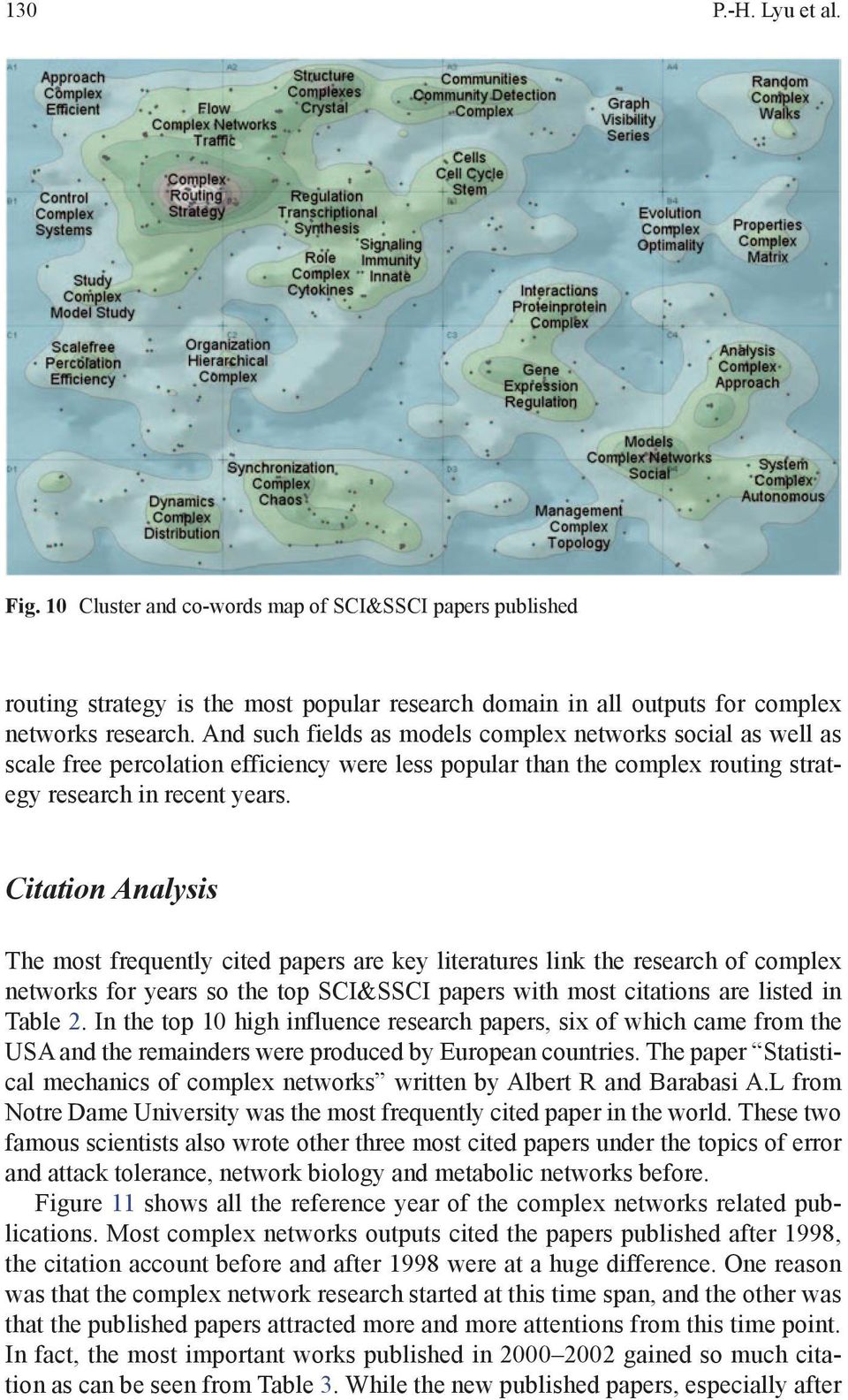
11 Knowledge Discovery of Complex Networks Research Literatures 129 Table 1 Keywords plus distributions of SCI&SSCI Publications Keywords Plus Complex Networks Dynamics Model Systems Small-World Networks Records Keywords Plus Internet Evolution Organization Scale-Free Synchronization Networks Records Keywords Plus Topology Stability Expression Community Gene-Expression Structure Records Keywords Plus Graphs Metabolic Web Escherichia-Coli Models Networks Records Fig. 9 Annual number of keywords plus of SCI&SSCI papers published World networks, the internet and evolution were also the high frequency key words that emerged in research papers. Scale-Free Networks as well as organizations became the hot words only less than words plus listed above. The annual keywords plus distribution was drawn in Fig. 9. The main retrieval word of complex networks was turned up in 2001 and with a fast increasing trend in the past decade. Scholars paid little attentions in the dynamics research before 2000, while they were interested in it during 2001 to 2007 so that the number of this word increased sharply from then. In the year 2006, almost all the research of systems, internet and Small-World Networks maintained a fast increase in papers production. The complex networks research co-words map was drawn for the hotspot analysis in this paper as Fig. 10. All the words were extracted from the title, author keywords and abstracts of the publications automatically by the Aureka software and then clustered in the knowledge map to trace the research trends. The complex

12 130 P.-H. Lyu et al. Fig. 10 Cluster and co-words map of SCI&SSCI papers published routing strategy is the most popular research domain in all outputs for complex networks research. And such fields as models complex networks social as well as scale free percolation efficiency were less popular than the complex routing strategy research in recent years. Citation Analysis The most frequently cited papers are key literatures link the research of complex networks for years so the top SCI&SSCI papers with most citations are listed in Table 2. In the top 10 high influence research papers, six of which came from the USA and the remainders were produced by European countries. The paper Statistical mechanics of complex networks written by Albert R and Barabasi A.L from Notre Dame University was the most frequently cited paper in the world. These two famous scientists also wrote other three most cited papers under the topics of error and attack tolerance, network biology and metabolic networks before. Figure 11 shows all the reference year of the complex networks related publications. Most complex networks outputs cited the papers published after 1998, the citation account before and after 1998 were at a huge difference. One reason was that the complex network research started at this time span, and the other was that the published papers attracted more and more attentions from this time point. In fact, the most important works published in gained so much citation as can be seen from Table 3. While the new published papers, especially after
13 Knowledge Discovery of Complex Networks Research Literatures 131 Table 2 Top 10 SCI&SSCI papers with Most Citations No. Time Authors Title Journal Institute Country Year Cited Albert, R; Barabasi, AL Statistical mechanics of complex Reviews of Modern Physics Univ Notre Dame USA 2002 networks Newman, MEJ The structure and function of complex Siam Review Univ Michigan USA 2003 networks Strogatz, SH Exploring complex networks Nature Cornell Univ USA Boccaletti, S; Latora, V; Moreno, Y; Chavez, M; Hwang, DU complex networks: Structure and dynamics Albert, R; Jeong, H; Barabasi, AL Error and attack tolerance of complex networks Barabasi, AL; Oltvai, ZN Network biology: Understanding the cell s functional organization Jeong, H; Tombor, B; Albert, R; Oltvai, ZN; Barabasi, AL Milo, R; Shen-Orr, S; Itzkovitz, S; Kashtan, N; Chklovskii, D; Alon, U The large-scale organization of metabolic networks Network motifs: Simple building blocks of complex networks Physics Reports-Review Section of Physics Letters CNR Italy 2006 Nature Univ Notre Dame USA 2000 Nature Reviews Genetics Univ Notre Dame USA 2004 Nature Univ Notre Dame USA 2000 Science Weizmann Inst Sci Israel Dorogovtsev, SN; Mendes, JFF Evolution of networks Advances In Physics Univ Porto Portugal 2002 CNRS France Thiery, JP; Sleeman, JP complex networks orchestrate epithelial-mesenchymal transitions Nature Reviews Molecular Cell Biology

14 132 P.-H. Lyu et al. 2010, were cited not much as the papers before due to their values not known by most scholars. The citation time window is of the normal distribution, with little citation in the former and later years and much citation in the middle location of the figure. The reference account reflected the influence in the local domain, which is listed in Table 3. In the top 10 high influence research papers, most of them came from the USA and the remainders were produced by European countries. Those papers published in famous journals such as Science, Nature, and PNAS (Proceedings of National Academy of Sciences in USA). The paper wrote by Albert R in Review Modern Physics also attracted lots of attentions in the domain of complex networks research. The results are accordance with the citation rank in Table 3. Fig. 11 Cited Reference Distribution of SCI&SSCI papers published Co-citation Analysis Figure 12 give a vividly picture of the journals co-cited by the complex networks domain. Those journals co-cited by one given research topic are usually considered as the knowledge base, and they provided the original citations. In complex network domain, those journals such as Science, Nature, PNAS, Cell, Physica A, and Review Modern Physics, Physics Review E, New England Journal Medicine, Physics Review Letter, PLoS One are in the center location of the ci-citation network. Naturally, many other journals including Social Networks, Nature Physics, Physica D, Chaos, New Journal of Physics et.al also provided lots of knowledge base for complex networks research development.

15 Knowledge Discovery of Complex Networks Research Literatures 133 Table 3 Top 10 papers cited by all published papers No Time Authors Article No. (DIO) Journal Country Year Cited 1 3,262 Albert R /RevModPhys Rev Mod USA 2002 Phys 2 2,808 Barabasi AL /science Science USA ,501 Watts DJ /30918 Nature USA ,449 Newman MEJ /S Siam Rev USA ,433 Boccaletti S /j.physrep Phys Rep Italy ,336 Strogatz SH / Nature USA Albert R / Nature USA Dorogovtsev SN / Adv Phys Portugal Girvan M /pnas P Natl Acad 2001 Sci USA Pastor-Satorras R /PhysRevLett Phys Rev Lett 2002 Fig. 12 Cluster and co-words map of SCI&SSCI papers published Conclusion As a strictly selected academic thesis abstract database, Web of Science (WoS, including SCI and SSCI) has been long recognized as the useful tool that can cover the most important science & technology, social science research productivities. SCI & SSCI citation search systems are unique and significant, not only from the perspective of literature cited but also from the academic assessment of the value in articles or from cooperation networks to research references. So all the papers published in this database were carefully studied to get the publication pattern and production orderliness.

16 134 P.-H. Lyu et al. The methods of complex networks are used more and more in other research such as in information science. The complex networks analysis was employed for co-citation or co-occurrence network to get the knowledge structure as well as scientific cooperation performance for a specific scientific filed often. Hence traditional scientometrics research was widely applied to acquaint information from the scientific or technical literatures, this will lead us a new direction for complex networks method in future as this research do. Hence in this study, the impact of global complex networks literature has been studied with scientometric methods and the research history has been recalled firstly according to the complex networks research literatures. The publications history started from 1990 and boosted in recent four or five years. From 1990 to about 2001, the complex networks research stepped into its infancy stage and then began a fast increasing stage in growth, and now in the former stage of maturity in its life cycle. In near future the publications in this field will still keep going larger and larger for quite a long time as can be predicted. Complex networks research are mainly in the subjects of physics. All the output concentrated in two journals such as Physical Review E and Physica A in SCI&SSCI database. The research papers were mainly completed by several authors according to network theory aggregation nodes in a power law correlation, and the multipleauthors made up an increasingly larger ratio to form a group size measured using papers. So the co-authored papers in the complex networks research were the mainstream of complex networks research and it formed a complex collaboration networks about complex networks research. Complex networks related papers were distributed unevenly over all countries. The USA, China and Germany were the top productive countries of SCI&SSCI papers. Some Europe countries such as Italy and Germany published top influence paper than those productive countries. The complex networks research centre was located in the USA in the last few decades according to the metadata from countries and institutes analysis. Harvard University and USTC produced most SCI papers and some USA institutes such as University of Michigan and University of Notre Dame contributed most influence SCI articles. Research on the fields of complex networks research focused on complex routing strategy, models complex networks social as well as scale free percolation efficiency. From the analysis of author keywords, except complex networks, dynamics, model and small-world networks were highly used key words plus in the scientific database. It is clear that complex networks research will be a hot spot in the complexity science field in the future. With scientometric and informetric method, the findings of this study can help scientific researchers understand the performance and central trends of complex networks research in the world, and therefore suggest directions for further research. Acknowledgments This work is supported by the Natural Science Foundation of China (Grant No : Research on Formation Mechanism and Evolution Laws of Knowledge Networks). The authors are grateful to Xiang Liu, Xiao Han and Gerard Joseph White for their helpful discussions and suggestions. And our special thanks also go to Professor Xiaojuan Zhang for her valuable comments on this research work.

17 Knowledge Discovery of Complex Networks Research Literatures 135 Open Access This chapter is distributed under the terms of the Creative Commons Attribution Noncommercial License, which permits any noncommercial use, distribution, and reproduction in any medium, provided the original author(s) and source are credited. References Albert R, Barabasi AL (2002) Statistical mechanics of complex networks. Rev Mod Phys 74(1):47 97 Albert R, Jeong H et al (2000) Error and attack tolerance of complex networks. Nature 406(6794): Barabasi AL (2009) Scale-free networks: a decade and beyond. Science 325(5939): Barabasi AL, Albert R (1999) Emergence of scaling in random networks. Science 286(5439): Barabasi AL, Oltvai ZN (2004) Network biology: understanding the cell s functional organization. Nat Rev Genet 5(2):101 U115 Boccaletti S, Latora V et al (2006). Complex networks: structure and dynamics. Phys Rep-Rev Sect Phys Lett 424(4 5): Dorogovtsev SN, Goltsev AV et al (2002) Pseudofractal scale-free web. Phys Rev E 65(6) Dorogovtsev SN, Mendes JFF (2002) Evolution of networks. Adv Phys 51(4): Egerstedt M (2011) Complex networks degrees of control. Nature 473(7346): Gagen MJ, Mattick JS (2005) Accelerating, hyperaccelerating, and decelerating networks. Phys Rev E 72(1) Garfield E (1970) Citation indexing for studying science. Nature 227(5259): Guimera R, Amaral LAN (2005) Functional cartography of complex metabolic networks. Nature 433(7028): Jeong H, Tombor B et al (2000) The large-scale organization of metabolic networks. Nature 407(6804): Liu YY, Slotine JJ et al (2011) Controllability of complex networks. Nature 473(7346): Milo R, Shen-Orr S et al (2002) Network motifs: simple building blocks of complex networks. Science 298(5594): Motter AE, Zhou CS et al (2005) Network synchronization, diffusion, and the paradox of heterogeneity. Phys Rev E 71(1) Newman MEJ (2002) Assortative mixing in networks. Phys Rev Lett 89(20) Newman MEJ (2003) The structure and function of complex networks. SIAM Rev 45(2): Olfati-Saber R, Fax JA et al (2007) Consensus and cooperation in networked multi-agent systems. Proc IEEE 95(1): Perc M, Szolnoki A (2010) Coevolutionary games-a mini review. Biosystems 99(2): Proudfoot AG, McAuley DF et al (2011) Translational research: what does it mean, what has it delivered and what might it deliver? Curr Opin Crit Care 17(5): Rosen ED, MacDougald OA (2006) Adipocyte differentiation from the inside out. Nat Rev Mol Cell Biol 7(12): Schweitzer F, Fagiolo G et al (2009) Economic Networks: the new challenges. Science 325(5939): Smith RJ, Okano JT et al (2010). Evolutionary dynamics of complex networks of HIV drugresistant strains: the case of San Francisco. Science 327(5966): Strogatz SH (2001) Exploring complex networks. Nature 410(6825): Vespignani A (2010) Complex networks the fragility of interdependency. Nature 464(7291): Wang WX, Wang BH et al (2006) Traffic dynamics based on local routing protocol on a scale-free network. Phys Rev E 73(2) Watts DJ, Strogatz SH (1998) Collective dynamics of small-world networks. Nature 393(6684): Yang R, Zhou T et al (2008) Optimal contact process on complex networks. Phys Rev E 78(6) Zhou T, Lu L et al (2009) Predicting missing links via local information. Eur Phys J B 71(4):

Effects of node buffer and capacity on network traffic
 Chin. Phys. B Vol. 21, No. 9 (212) 9892 Effects of node buffer and capacity on network traffic Ling Xiang( 凌 翔 ) a), Hu Mao-Bin( 胡 茂 彬 ) b), and Ding Jian-Xun( 丁 建 勋 ) a) a) School of Transportation Engineering,
PUBLIC TRANSPORT SYSTEMS IN POLAND: FROM BIAŁYSTOK TO ZIELONA GÓRA BY BUS AND TRAM USING UNIVERSAL STATISTICS OF COMPLEX NETWORKS
 Vol. 36 (2005) ACTA PHYSICA POLONICA B No 5 PUBLIC TRANSPORT SYSTEMS IN POLAND: FROM BIAŁYSTOK TO ZIELONA GÓRA BY BUS AND TRAM USING UNIVERSAL STATISTICS OF COMPLEX NETWORKS Julian Sienkiewicz and Janusz
Big Data Analytics of Multi-Relationship Online Social Network Based on Multi-Subnet Composited Complex Network
 , pp.273-284 http://dx.doi.org/10.14257/ijdta.2015.8.5.24 Big Data Analytics of Multi-Relationship Online Social Network Based on Multi-Subnet Composited Complex Network Gengxin Sun 1, Sheng Bin 2 and
Network Theory: 80/20 Rule and Small Worlds Theory
 Scott J. Simon / p. 1 Network Theory: 80/20 Rule and Small Worlds Theory Introduction Starting with isolated research in the early twentieth century, and following with significant gaps in research progress,
Physica A 391 (2012) 4420 4425. Contents lists available at SciVerse ScienceDirect. Physica A. journal homepage: www.elsevier.
 Physica A 391 (2012) 4420 4425 Contents lists available at SciVerse ScienceDirect Physica A journal homepage: www.elsevier.com/locate/physa Robustness analysis of network controllability Cun-Lai Pu a,b,c,,
Time-Dependent Complex Networks:
 Time-Dependent Complex Networks: Dynamic Centrality, Dynamic Motifs, and Cycles of Social Interaction* Dan Braha 1, 2 and Yaneer Bar-Yam 2 1 University of Massachusetts Dartmouth, MA 02747, USA http://necsi.edu/affiliates/braha/dan_braha-description.htm
Chapter 29 Scale-Free Network Topologies with Clustering Similar to Online Social Networks
 Chapter 29 Scale-Free Network Topologies with Clustering Similar to Online Social Networks Imre Varga Abstract In this paper I propose a novel method to model real online social networks where the growing
ATM Network Performance Evaluation And Optimization Using Complex Network Theory
 ATM Network Performance Evaluation And Optimization Using Complex Network Theory Yalin LI 1, Bruno F. Santos 2 and Richard Curran 3 Air Transport and Operations Faculty of Aerospace Engineering The Technical
Open Access Research on Application of Neural Network in Computer Network Security Evaluation. Shujuan Jin *
 Send Orders for Reprints to [email protected] 766 The Open Electrical & Electronic Engineering Journal, 2014, 8, 766-771 Open Access Research on Application of Neural Network in Computer Network
Temporal Dynamics of Scale-Free Networks
 Temporal Dynamics of Scale-Free Networks Erez Shmueli, Yaniv Altshuler, and Alex Sandy Pentland MIT Media Lab {shmueli,yanival,sandy}@media.mit.edu Abstract. Many social, biological, and technological
http://www.elsevier.com/copyright
 This article was published in an Elsevier journal. The attached copy is furnished to the author for non-commercial research and education use, including for instruction at the author s institution, sharing
GENERATING AN ASSORTATIVE NETWORK WITH A GIVEN DEGREE DISTRIBUTION
 International Journal of Bifurcation and Chaos, Vol. 18, o. 11 (2008) 3495 3502 c World Scientific Publishing Company GEERATIG A ASSORTATIVE ETWORK WITH A GIVE DEGREE DISTRIBUTIO JI ZHOU, XIAOKE XU, JIE
Scale-free user-network approach to telephone network traffic analysis
 Scale-free user-network approach to telephone network traffic analysis Yongxiang Xia,* Chi K. Tse, WaiM.Tam, Francis C. M. Lau, and Michael Small Department of Electronic and Information Engineering, Hong
Strategies for Optimizing Public Train Transport Networks in China: Under a Viewpoint of Complex Networks
 Strategies for Optimizing Public Train Transport Networks in China: Under a Viewpoint of Complex Networks Zhichong ZHAO, Jie LIU Research Centre of Nonlinear Science, College of Science, Wuhan University
Scientific Collaboration Networks in China s System Engineering Subject
 , pp.31-40 http://dx.doi.org/10.14257/ijunesst.2013.6.6.04 Scientific Collaboration Networks in China s System Engineering Subject Sen Wu 1, Jiaye Wang 1,*, Xiaodong Feng 1 and Dan Lu 1 1 Dongling School
The architecture of complex weighted networks
 The architecture of complex weighted networks A. Barrat*, M. Barthélemy, R. Pastor-Satorras, and A. Vespignani* *Laboratoire de Physique Théorique (Unité Mixte de Recherche du Centre National de la Recherche
ModelingandSimulationofthe OpenSourceSoftware Community
 ModelingandSimulationofthe OpenSourceSoftware Community Yongqin Gao, GregMadey Departmentof ComputerScience and Engineering University ofnotre Dame ygao,[email protected] Vince Freeh Department of ComputerScience
Cluster detection algorithm in neural networks
 Cluster detection algorithm in neural networks David Meunier and Hélène Paugam-Moisy Institute for Cognitive Science, UMR CNRS 5015 67, boulevard Pinel F-69675 BRON - France E-mail: {dmeunier,hpaugam}@isc.cnrs.fr
Research Article A Comparison of Online Social Networks and Real-Life Social Networks: A Study of Sina Microblogging
 Mathematical Problems in Engineering, Article ID 578713, 6 pages http://dx.doi.org/10.1155/2014/578713 Research Article A Comparison of Online Social Networks and Real-Life Social Networks: A Study of
The Topology of Large-Scale Engineering Problem-Solving Networks
 The Topology of Large-Scale Engineering Problem-Solving Networks by Dan Braha 1, 2 and Yaneer Bar-Yam 2, 3 1 Faculty of Engineering Sciences Ben-Gurion University, P.O.Box 653 Beer-Sheva 84105, Israel
Scientific research competitiveness of world universities in computer science
 Jointly published by Akadémiai Kiadó, Budapest Scientometrics, Vol. 76, No. 2 (2008) 245 260 and Springer, Dordrecht DOI: 10.1007/s11192-007-1913-7 Scientific research competitiveness of world universities
Graph theoretic approach to analyze amino acid network
 Int. J. Adv. Appl. Math. and Mech. 2(3) (2015) 31-37 (ISSN: 2347-2529) Journal homepage: www.ijaamm.com International Journal of Advances in Applied Mathematics and Mechanics Graph theoretic approach to
The Structure of Growing Social Networks
 The Structure of Growing Social Networks Emily M. Jin Michelle Girvan M. E. J. Newman SFI WORKING PAPER: 2001-06-032 SFI Working Papers contain accounts of scientific work of the author(s) and do not necessarily
Electronic Commerce Research in Latest Decade: A Literature Review
 International Journal of Electronic Commerce Studies Vol.1, No.1, pp.1-14, 2010 Electronic Commerce Research in Latest Decade: A Literature Review Chih-Chien Wang National Taipei University, Taipei County,
Complex Network Visualization based on Voronoi Diagram and Smoothed-particle Hydrodynamics
 Complex Network Visualization based on Voronoi Diagram and Smoothed-particle Hydrodynamics Zhao Wenbin 1, Zhao Zhengxu 2 1 School of Instrument Science and Engineering, Southeast University, Nanjing, Jiangsu
Towards Modelling The Internet Topology The Interactive Growth Model
 Towards Modelling The Internet Topology The Interactive Growth Model Shi Zhou (member of IEEE & IEE) Department of Electronic Engineering Queen Mary, University of London Mile End Road, London, E1 4NS
U.S. News Best Global Universities Rankings: An inside look at the latest results and methodology
 U.S. News Best Global Universities Rankings: An inside look at the latest results and methodology Robert J. Morse, Chief Data Strategist U.S. News & World Report 6th International Conference on World-Class
Library and Information Sciences
 Library and Information Sciences Chuanfu Chen Ronald Larsen Editors Library and Information Sciences Trends and Research Editors Chuanfu Chen School of Information Management Wuhan University Wuhan China
Network Analysis. BCH 5101: Analysis of -Omics Data 1/34
 Network Analysis BCH 5101: Analysis of -Omics Data 1/34 Network Analysis Graphs as a representation of networks Examples of genome-scale graphs Statistical properties of genome-scale graphs The search
THE USE OF THOMSON REUTERS RESEARCH ANALYTIC RESOURCES IN ACADEMIC PERFORMANCE EVALUATION DR. EVANGELIA A.E.C. LIPITAKIS OCTOBER 2014, PRAGUE
 THE USE OF THOMSON REUTERS RESEARCH ANALYTIC RESOURCES IN ACADEMIC PERFORMANCE EVALUATION DR. EVANGELIA A.E.C. LIPITAKIS OCTOBER 2014, PRAGUE Thomson Reuters: Solutions Portfolio to Seamlessly Support
How To Find Influence Between Two Concepts In A Network
 2014 UKSim-AMSS 16th International Conference on Computer Modelling and Simulation Influence Discovery in Semantic Networks: An Initial Approach Marcello Trovati and Ovidiu Bagdasar School of Computing
IC05 Introduction on Networks &Visualization Nov. 2009. <[email protected]>
 IC05 Introduction on Networks &Visualization Nov. 2009 Overview 1. Networks Introduction Networks across disciplines Properties Models 2. Visualization InfoVis Data exploration
FINDING MEANINGFUL PERFORMANCE MEASURES FOR HIGHER EDUCATION A REPORT FOR EXECUTIVES
 FINDING MEANINGFUL PERFORMANCE MEASURES FOR HIGHER EDUCATION A REPORT FOR EXECUTIVES .......................................................................................................................
Challenges in Ranking of Universities
 Challenges in Ranking of Universities First International Conference on World Class Universities, Jaio Tong University, Shanghai, June 16-18, 2005 Anthony F.J. van Raan Center for Science and technology
Introduction to Networks and Business Intelligence
 Introduction to Networks and Business Intelligence Prof. Dr. Daning Hu Department of Informatics University of Zurich Sep 17th, 2015 Outline Network Science A Random History Network Analysis Network Topological
Open Source Software Developer and Project Networks
 Open Source Software Developer and Project Networks Matthew Van Antwerp and Greg Madey University of Notre Dame {mvanantw,gmadey}@cse.nd.edu Abstract. This paper outlines complex network concepts and how
USING SPECTRAL RADIUS RATIO FOR NODE DEGREE TO ANALYZE THE EVOLUTION OF SCALE- FREE NETWORKS AND SMALL-WORLD NETWORKS
 USING SPECTRAL RADIUS RATIO FOR NODE DEGREE TO ANALYZE THE EVOLUTION OF SCALE- FREE NETWORKS AND SMALL-WORLD NETWORKS Natarajan Meghanathan Jackson State University, 1400 Lynch St, Jackson, MS, USA [email protected]
An Interest-Oriented Network Evolution Mechanism for Online Communities
 An Interest-Oriented Network Evolution Mechanism for Online Communities Caihong Sun and Xiaoping Yang School of Information, Renmin University of China, Beijing 100872, P.R. China {chsun.vang> @ruc.edu.cn
High Throughput Network Analysis
 High Throughput Network Analysis Sumeet Agarwal 1,2, Gabriel Villar 1,2,3, and Nick S Jones 2,4,5 1 Systems Biology Doctoral Training Centre, University of Oxford, Oxford OX1 3QD, United Kingdom 2 Department
Big Data: Opportunities and Challenges for Complex Networks
 Big Data: Opportunities and Challenges for Complex Networks Jinhu Lü Academy of Mathematics and Systems Science Chinese Academy of Sciences IWCSN, Vancouver, 13 Dec 2013 1 Thanks To Prof. Ljiljana j Trajkovic
Many systems take the form of networks, sets of nodes or
 Community structure in social and biological networks M. Girvan* and M. E. J. Newman* *Santa Fe Institute, 1399 Hyde Park Road, Santa Fe, NM 87501; Department of Physics, Cornell University, Clark Hall,
Bioinformatics: Network Analysis
 Bioinformatics: Network Analysis Graph-theoretic Properties of Biological Networks COMP 572 (BIOS 572 / BIOE 564) - Fall 2013 Luay Nakhleh, Rice University 1 Outline Architectural features Motifs, modules,
Using Bibliometrics-aided Retrieval to Delineate the Field of Cardiovascular Research
 Using Bibliometrics-aided Retrieval to Delineate the Field of Cardiovascular Research Diane Gal 1, Karin Sipido 1 and Wolfgang Glänzel 2 {diane.gal, karin.sipido}@med.kuleuven.be, [email protected]
A network efficiency measure with application to critical infrastructure networks
 J Glob Optim (2008) 40:26 275 DOI 0.007/s0898-007-998- A network efficiency measure with application to critical infrastructure networks Anna Nagurney Qiang Qiang Received: 7 June 2007 / Accepted: 9 June
Traffic Prediction in Wireless Mesh Networks Using Process Mining Algorithms
 Traffic Prediction in Wireless Mesh Networks Using Process Mining Algorithms Kirill Krinkin Open Source and Linux lab Saint Petersburg, Russia [email protected] Eugene Kalishenko Saint Petersburg
Understanding the dynamics and function of cellular networks
 Understanding the dynamics and function of cellular networks Cells are complex systems functionally diverse elements diverse interactions that form networks signal transduction-, gene regulatory-, metabolic-
Structural constraints in complex networks
 Structural constraints in complex networks Dr. Shi Zhou Lecturer of University College London Royal Academy of Engineering / EPSRC Research Fellow Part 1. Complex networks and three key topological properties
Six Degrees: The Science of a Connected Age. Duncan Watts Columbia University
 Six Degrees: The Science of a Connected Age Duncan Watts Columbia University Outline The Small-World Problem What is a Science of Networks? Why does it matter? Six Degrees Six degrees of separation between
A box-covering algorithm for fractal scaling in scale-free networks
 CHAOS 17, 026116 2007 A box-covering algorithm for fractal scaling in scale-free networks J. S. Kim CTP & FPRD, School of Physics and Astronomy, Seoul National University, NS50, Seoul 151-747, Korea K.-I.
COMPLEXITY RISING: FROM HUMAN BEINGS TO HUMAN CIVILIZATION, A COMPLEXITY PROFILE. Y. Bar-Yam New England Complex Systems Institute, Cambridge, MA, USA
 COMPLEXITY RISING: FROM HUMAN BEINGS TO HUMAN CIVILIZATION, A COMPLEXITY PROFILE Y. BarYam New England Complex Systems Institute, Cambridge, MA, USA Keywords: complexity, scale, social systems, hierarchical
Some Examples of Network Measurements
 Some Examples of Network Measurements Example 1 Data: Traceroute measurements Objective: Inferring Internet topology at the router-level Example 2 Data: Traceroute measurements Objective: Inferring Internet
Kazan (Volga region) Federal University, Kazan, Russia Institute of Fundamental Medicine and Biology. Master s program.
 Kazan (Volga region) Federal University, Kazan, Russia Institute of Fundamental Medicine and Biology Master s program Bioinformatics I. THEORETICAL BASIS The development of effective technologies of theoretical
Does it Matter Which Citation Tool is Used to Compare the h-index of a Group of Highly Cited Researchers?
 Australian Journal of Basic and Applied Sciences, 7(4): 198-202, 2013 ISSN 1991-8178 Does it Matter Which Citation Tool is Used to Compare the h-index of a Group of Highly Cited Researchers? 1 Hadi Farhadi,
Seismic vulnerability assessment of power transmission networks using complex-systems based methodologies
 Seismic vulnerability assessment of power transmission networks using complex-systems based methodologies J.A. Buritica & S. Tesfamariam University of British Columbia Okanagan Campus, Kelowna, Canada
Random forest algorithm in big data environment
 Random forest algorithm in big data environment Yingchun Liu * School of Economics and Management, Beihang University, Beijing 100191, China Received 1 September 2014, www.cmnt.lv Abstract Random forest
The Application Research of Ant Colony Algorithm in Search Engine Jian Lan Liu1, a, Li Zhu2,b
 3rd International Conference on Materials Engineering, Manufacturing Technology and Control (ICMEMTC 2016) The Application Research of Ant Colony Algorithm in Search Engine Jian Lan Liu1, a, Li Zhu2,b
How To Predict The Growth Of A Network
 Physica A 272 (1999) 173 187 www.elsevier.com/locate/physa Mean-eld theory for scale-free random networks Albert-Laszlo Barabasi,Reka Albert, Hawoong Jeong Department of Physics, University of Notre-Dame,
Library and information science research trends in India
 Annals of Library and Studies Vol. 58, December 011, pp. 319-35 Library and information science research trends in India Rekha Mittal Senior Principal Scientist, CSIR-National Institute of Science Communication
STATISTICAL ANALYSIS OF THE INDIAN RAILWAY NETWORK: A COMPLEX NETWORK APPROACH
 Vol. 4 (2011) Acta Physica Polonica B Proceedings Supplement No 2 STATISTICAL ANALYSIS OF THE INDIAN RAILWAY NETWORK: A COMPLEX NETWORK APPROACH Saptarshi Ghosh, Avishek Banerjee, Naveen Sharma Sanket
Degree distribution in random Apollonian networks structures
 Degree distribution in random Apollonian networks structures Alexis Darrasse joint work with Michèle Soria ALÉA 2007 Plan 1 Introduction 2 Properties of real-life graphs Distinctive properties Existing
An approach of detecting structure emergence of regional complex network of entrepreneurs: simulation experiment of college student start-ups
 An approach of detecting structure emergence of regional complex network of entrepreneurs: simulation experiment of college student start-ups Abstract Yan Shen 1, Bao Wu 2* 3 1 Hangzhou Normal University,
Faculty of of Science
 Faculty of of Science At Ryerson, we believe science is all about discovery and results. We call our approach connected science an approach that forms unique bonds between disciplines to solve some of
MINFS544: Business Network Data Analytics and Applications
 MINFS544: Business Network Data Analytics and Applications March 30 th, 2015 Daning Hu, Ph.D., Department of Informatics University of Zurich F Schweitzer et al. Science 2009 Stop Contagious Failures in
1. Introduction. 1.1 Background and Motivation. 1.1.1 Academic motivations. A global topic in the context of Chinese education
 1. Introduction A global topic in the context of Chinese education 1.1 Background and Motivation In this section, some reasons will be presented concerning why the topic School Effectiveness in China was
Random graphs and complex networks
 Random graphs and complex networks Remco van der Hofstad Honours Class, spring 2008 Complex networks Figure 2 Ye a s t p ro te in in te ra c tio n n e tw o rk. A m a p o f p ro tein p ro tein in tera c
A Load Balancing Algorithm based on the Variation Trend of Entropy in Homogeneous Cluster
 , pp.11-20 http://dx.doi.org/10.14257/ ijgdc.2014.7.2.02 A Load Balancing Algorithm based on the Variation Trend of Entropy in Homogeneous Cluster Kehe Wu 1, Long Chen 2, Shichao Ye 2 and Yi Li 2 1 Beijing
BIOSCIENCES COURSE TITLE AWARD
 COURSE TITLE AWARD BIOSCIENCES As a Biosciences undergraduate student at the University of Westminster, you will benefit from some of the best teaching and facilities available. Our courses combine lecture,
International Ranking. Institutional Research
 International Ranking & Institutional Research Yang Zhang, Director of Institutional Research, University of Hawaii at Mānoa Diana Bitting, representing the Thomson Reuters Profiles Project Baerbel Eckelmann,
arxiv:physics/0601033 v1 6 Jan 2006
 Analysis of telephone network traffic based on a complex user network Yongxiang Xia, Chi K. Tse, Francis C. M. Lau, Wai Man Tam, Michael Small arxiv:physics/0601033 v1 6 Jan 2006 Department of Electronic