
Annual Report th financial year
|
|
|
- Angelica Janice Young
- 10 years ago
- Views:
Transcription
1 Annual Report th financial year

2 PARMALAT ANNUAL REPORT 2014 Mission Nutrition and wellness all over the world The Parmalat Group is a food-industry group with a multinational strategy that seeks to increase the well-being of consumers throughout the world. The ultimate purpose of the Group is to create value for its shareholders while adhering to ethical principles of business conduct, to perform a useful social function by fostering the professional development of its employees and associates, and to serve the communities in which it operates by contributing to their economic and social progress. We intend to establish Parmalat as 2

3 MISSION one of the top players in the global market for foods with high value added, which deliver improved nutrition and wellness to consumers, and attain clear leadership in selected product categories and countries with high growth potential for the Group. Milk and dairy products and fruit beverages, foods that play an essential role in everyone s daily diet, are key categories for the Group. 3

4 PARMALAT ANNUAL REPORT 2014 Countries of Operation 73 manufacturing facilities 3 research centres of excellence Castellaro (Parma, Italy) for milk, yogurt and fruit beverages London (Ontario, Canada) for cheeses and dairy ingredients Buffalo (New York, USA) for cheeses more than 16,000 employees about 5.6 bn net revenue 4

5 COUNTRIES OF OPERATION DIRECT PRESENCE Europe Italy, Portugal, Romania, Russia Rest of the World Australia, Bolivia, Botswana, Brazil, Canada, Colombia, Cuba, Ecuador, Mexico, Mozambique, New Zealand, Paraguay, Peru, South Africa, Swaziland, United States of America, Uruguay, Venezuela, Zambia PRESENCE THROUGH LICENSEES Chile, China, Costa Rica, Dominican Republic, El Salvador, Guatemala, Haiti, Honduras, Hungary, Mexico, Nicaragua, United States of America, Uruguay 5

6 PARMALAT ANNUAL REPORT 2014 Contents Mission... 2 Countries of Operation... 4 Governance Bodies Human Resources A Letter to Shareholders Financial Highlights REPORT ON OPERATIONS...18 The Global Dairy Market Revenue and Profitability Europe...29 North America...36 Latin America...42 Africa...48 Australia...53 Review of Operating and Financial Performance Parmalat Group...58 Parmalat S.p.A...64 Financial Performance Structure of the Net Financial Position of the Group and Its Main Companies...68 Change in Net Financial Position...69 Managing Enterprise Risks Acquisitions Australia: Harvey Fresh...75 Australia: Longwarry...75 Brazil: LBR s Assets...76 Brazil: BRF s Dairy Division...76 Italy: Latterie Friulane...77 Economic Effect of the Acquisitions on the Consolidated Financial Statements at December 31,

7 CONTENTS Information about Parmalat s Securities Performance of the Parmalat s Stock...79 Stock Ownership Profile...80 Characteristics of the Securities...81 Human Resources Group Staffing...84 Management and Development of Human Resources...85 Industrial Relations...86 Corporate Social Responsibility...86 Capital Expenditures Research And Development Other Information Corporate Governance Issuer s Profile and Compliance...92 Information About the Company s Ownership Structure...94 Board of Directors...99 Handling of Corporate Information Establishment and Rules of Operation of the Internal Committees of the Board of Directors Litigation Committee Nominating and Compensation Committee Compensation of Directors Internal Control, Risk Management and Corporate Governance Committee Internal Control and Risk Management System Procedure and Policy for Related-party Transactions Election of Statutory Auditors Board of Statutory Auditors Relationship with Shareholders Shareholders Meeting Changes Occurring Since the End of the Reporting Year Information About Compliance with the Code Annex A Attestation pursuant to Article 37 of the Consob Market Regulation No / Key Events of Events occurring after December 31, Business Outlook Motion Submitted by the Board of Directors to the Shareholders Meeting
8 PARMALAT ANNUAL REPORT 2014 PARMALAT S.P.A Separate Financial Statements at December 31, Statement of Financial Position Income Statement Statement of Comprehensive Income Statement of Cash Flows Statement of Changes in Shareholders Equity Notes to the Separate Financial Statement Foreword Format of the Financial Statements Principles for the Preparation of the Separate Financial Statements Valuation Criteria Accounting Principles, Amendments and Interpretations Approved by the E.U. and in Effect as of January 1, New Accounting Principles and Interpretations Endorsed by the E.U. But Not Yet in Effect Intercompany and Related-party Transactions Notes to the Statement of Financial Position Assets Notes to the Statement of Financial Position Shareholders Equity Notes to the Statement of Financial Position Liabilities Guarantees and Commitments Legal Disputes and Contingent Liabilities at December 31, Notes to the Income Statement Other Information Certification of the Statutory Financial Statements Pursuant to Article 81-ter of Consob Regulation No (which cites by reference article 154-bis, Section 5, of the Uniform Financial Code) of May 14, 1999, as amended Parmalat S.p.A. Report of the Independent Auditors
9 CONTENTS PARMALAT GROUP Consolidated Financial Statments at December 31, Consolidated Statement of Financial Position Consolidated Income Statement Consolidated Statement of Comprehensive Income Consolidated Statement of Cash Flows Statement of Changes in Consolidated Shareholders Equity Notes To the Consolidated Financial Statements Foreword Format of the Financial Statements Segment Information Principles for the Preparation of the Consolidated Financial Statements Principles of Consolidation Scope of Consolidation Valuation Criteria Accounting Principles, Amendments and Interpretations Approved by the E.U. and in Effect as of January 1, New Accounting Principles and Interpretations Endorsed by the E.U. But Not Yet in Effect Related-party Transactions Notes to the Statement of Financial Position Assets Notes to the Statement of Financial Position Shareholders Equity Notes to the Statement of Financial Position Liabilities Guarantees and Commitments Legal Disputes and Contingent Liabilities at December 31, Notes to the Income Statement Other Information Certification of the Consolidated Financial Statements Pursuant to Article 81-ter of Consob Regulation No (which cites by reference article 154-bis, Section 5, of the Uniform Financial Code) of May 14, 1999, as amended Parmalat Group Report of The Independent Auditors REPORT OF THE BOARD OF STATUTORY AUDITORS

10 PARMALAT ANNUAL REPORT 2014 Governance Bodies Board of Directors Chairman Gabriella Chersicla ( * ) Directors Patrice Gassenbach (i) (2) (3) Laura Gualtieri Paolo Francesco Lazzati (i) (1) (2) (3) Umberto Mosetti (i) (1) Riccardo Perotta Antonio Sala (3) (i) (1) (2) (i) Independent Director (1) Member of the Internal Control, Risk Management and Corporate Governance Committee (2) Member of the Nominating and Compensation Committee (3) Member of the Litigation Committee Board of Statutory Auditors Chairman Statutory Auditors Michele Rutigliano Giorgio Loli Alessandra Stabilini Independent Auditors KPMG S.p.A. Parmalat S.p.A. A company subject to guidance and coordination by B.S.A. S.A. * Please note that on April 17, 2014, upon being named Chairperson of the Board of Directors, Gabriella Chersicla became a Senior Officer of the Company, pursuant to implementation criterion 3.C.2 of the Corporate Governance Code of Borsa Italiana. Consequently, in accordance with the combined provisions of implementational criteria 3.C.1 and 3.C.2 of the Corporate Governance Code of Borsa Italiana, the Chairperson of the Board of Directors no longer meets the technical requirements to qualify as an Independent Director pursuant to Article 3 of the Corporate Governance Code. However, no situations have occurred, other than those related to the post of Chairperson, that could compromise the independence of Gabriella Chersicla pursuant to Article 3 of the Corporate Governance Code. 10

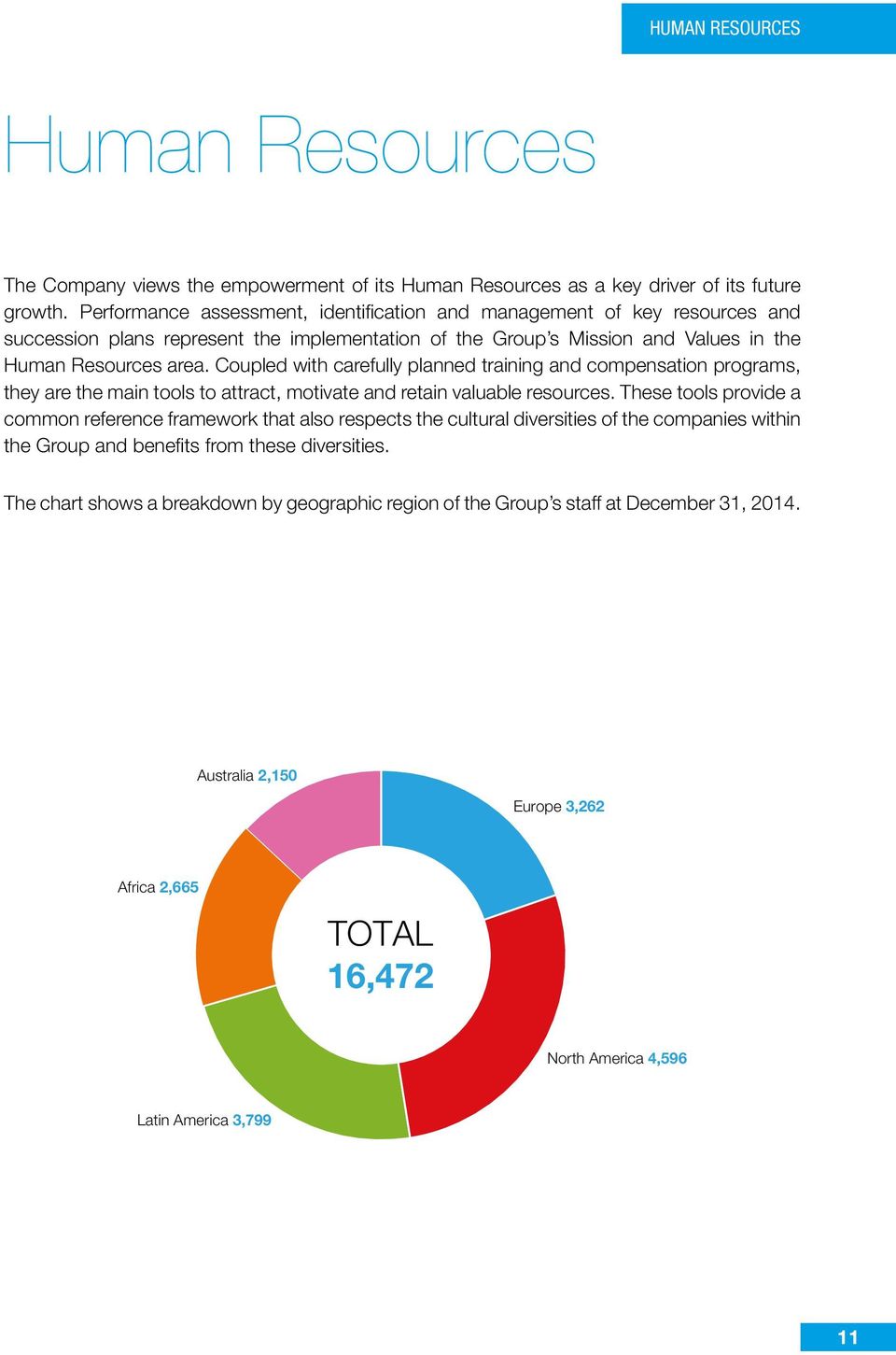
11 HUMAN RESOURCES Human Resources The Company views the empowerment of its Human Resources as a key driver of its future growth. Performance assessment, identification and management of key resources and succession plans represent the implementation of the Group s Mission and Values in the Human Resources area. Coupled with carefully planned training and compensation programs, they are the main tools to attract, motivate and retain valuable resources. These tools provide a common reference framework that also respects the cultural diversities of the companies within the Group and benefits from these diversities. The chart shows a breakdown by geographic region of the Group s staff at December 31, Australia 2,150 Europe 3,262 Africa 2,665 TOTAL 16,472 North America 4,596 Latin America 3,799 11
12 PARMALAT ANNUAL REPORT 2014 A Letter to Shareholders Dear Shareholders: In 2014, the Parmalat Group achieved important objectives in term of growth, reporting improvements for the third consecutive year in all of its main economic and financial indicators (+9.5% for net revenue and +9.7% for EBITDA, at constant exchange rates and comparable scope of consolidation). It thus consolidated the positive trend of its growth and profitability. The growth projections announced at the beginning of 2014 were revised upward later in the year and the Group reported an even better performance at the end of the year, both in terms of revenue and EBITDA, bucking the trend of its main competitors. These results were achieved in a general economic context that remained challenging, as it continued to be characterized by limited growth in many geographic areas, a less than favorable demand in various markets where we operate and a significant increase in the cost of raw milk during the first half of the year. In addition, the currency translation effect was extremely unfavorable during most of 2014, due to the devaluation versus the euro of currencies of the main countries where we operate. Despite this situation, we succeeded in improving profitability and, by supporting our brands, we were generally able to maintain our market shares and actually increase them in some cases. The results that we achieved are indicative of the effectiveness of the strategic choices we made and are the product of important industrial investments, which rose to a considerable level in 2014 with the aim of further expanding production capacity, upgrading processes, boosting efficiency, increasing energy conservation and sustainability and improving quality and occupational safety. The most significant projects in these areas included installing new production lines in Australia, expanding and optimizing certain industrial assets in Canada and launching a project to improve energy and environmental efficiency with the installation of cogenerating facilities in Italy. We also focused on innovation, developing new products in our main categories. We continued to benefit from synergies with the Lactalis Group, both in terms of broadening the product portfolio and benefitting from the cross-fertilization of competencies and expertise. Work in this area included a project to relaunch the yogurt line in South Africa and the start of production of mozzarella under the Galbani brand, obtained in use from the Lactalis Group, in Canada and South Africa. This year, in addition to the results achieved in terms of organic growth, we laid the groundwork for an important expansion through acquisitions, which is the product of choices aimed at strengthening our presence in the emerging markets, with special emphasis on Latin America, consistent with the guidelines of our strategic plan. 12
13 A LETTER FROM THE CHIEF EXECUTIVE OFFICER Specifically, we executed two agreements designed to strengthen our presence in Brazil: the acquisition of certain assets of Lácteos Brasil S.A. Em Recuperação Judicial (LBR), which enabled us to regain the right to use directly the Parmalat brand throughout Brazil, will be followed in 2015 by that of the dairy division of BRF S.A., comprised of 11 production facilities and the respective assets and trademarks. In addition, we began the current year with an agreement to purchase a group of companies that operate primarily in Mexico and are specialized in the production and distribution of cheeses, with leadership positions in the categories in which they operate. At the same time, we strengthened our position in mature markets where the Group holds important positions. I would like to specifically mention Australia where, thanks to the Harvey Fresh acquisition, we strengthen our position, expanding geographically in Western Australia and becoming a full-fledged national player in that country. Subsequently, with the acquisition early in 2015 of Longwarry Food Park Pty Ltd, a company that operates in the state of Victoria, we entered the powdered milk market and increased our production and procurement capacity in that country. Through these transaction we also strengthened our export capabilities on the Asian markets, assigning to Australia the strategic role of hub for the Asian markets. Lastly, at the end of 2014, we signed an agreement to acquire, in Italy, certain business operations of Latterie Friulane that are deeply rooted in the local community and will thus help us consolidate our position in that area. The year-end results for the main regions in which we operate show a positive trend for Europe, Africa and Latin America, which benefited from particularly favorable conditions in Venezuela, but reported results were below expectations in Australia and North America due to competitive factors mainly related the price of raw milk. Our net financial position enable us to continue the expansion of our businesses in strategic markets and the potential access to credit lines obtained on favorable terms could allow further growth in industrial investments and further expansion through acquisitions. Our commitment for 2015 is to continue this growth process with further investments in the brands that constitute our main assets and benefitting from the know-how of the Lactalis Group, a global leader in the dairy sector. Also this year, we reasserted with determination our position as a leading player in Latin America, an area with a great growth potential for Parmalat. During the current year, the Group will continue to pursue growth objectives in all of the geographic regions where we operate, thanks to the commitment and determination of our team, comprised of highly professional women and men from every part of the world: to them, my thank you for the intelligent contribution they provided to the achievement of our success in the countries where we operate. The Board of Directors by: its Chairperson Gabriella Chersicla 13
14 PARMALAT ANNUAL REPORT 2014 Financial Highlights Income Statement Highlights (in millions of euros) PARMALAT GROUP PARMALAT S.P.A , ,547.6 NET REVENUE EBITDA EBIT NET PROFIT EBIT/REVENUE (%) NET PROFIT/REVENUE (%) Balance Sheet Highlights (in millions of euros) PARMALAT GROUP PARMALAT S.P.A , ,119.1 NET FINANCIAL POSITION ROI (%) (1) ROE (%) (1) EQUITY/ASSETS (0.3) (0.3) NET FINANCIAL POSITION/EQUITY (0.3) (0.3) OPERATING CASH FLOW PER SHARE (1) Indices computed based on average data for the year for the income statement and the statement of financial position. 14

15 FINANCIAL HIGHLIGHTS Our Brands Global Brands International Brands These Parmalat trademarks are available in several countries, with direct production and with license agreements. Local Jewels Brands Canada USA Australia Venezuela South Africa Italy Colombia Russia Brands Licensed in the Americas All Parmalat Group trademarks are registered in the relevant international classes of goods. 15

16 PARMALAT ANNUAL REPORT 2014 DIVISIONS BY GEOGRAPHIC REGION (%) MILK The Milk division, which includes milk in all its marketable forms (UHT, Pasteurized, Condensed, Powdered, etc.), Cream and Béchamel accounts for about 50% of the Group s total consolidated revenue. Milk sales are concentrated mainly in Italy (divided equally between UHT milk and Pasteurized milk), Canada and Australia, two countries where Pasteurized milk is the main product. Africa 6% Latin America 12% North America 25% Australia 25% Europe 32% CHEESE AND OTHER FRESH PRODUCTS The division, which includes Cheese, Yogurt, Desserts and Butter contributes about 40% of the Group s total consolidated revenue. The division s largest markets are North America (Canada and USA) where it sells mainly Cheese, Butter and Yogurt and South Africa where it distributes Cheese and Yogurt, followed by Australia (Yogurt and Desserts) and Italy (mainly Yogurt). Australia 7% Africa 10% Latin America 5% Europe 5% North America 71% FRUIT BASE DRINKS The Fruit base drinks division, which includes Fruit juices and Tea, accounts for about 6% of the Group s total consolidated revenue. The division generates most of its sales in Italy and Venezuela which together contribute more than 80% of total revenue. Other important markets include South Africa, Russia and Romania. Europe 24% Australia 2% Africa 7% Latin America 67% 16

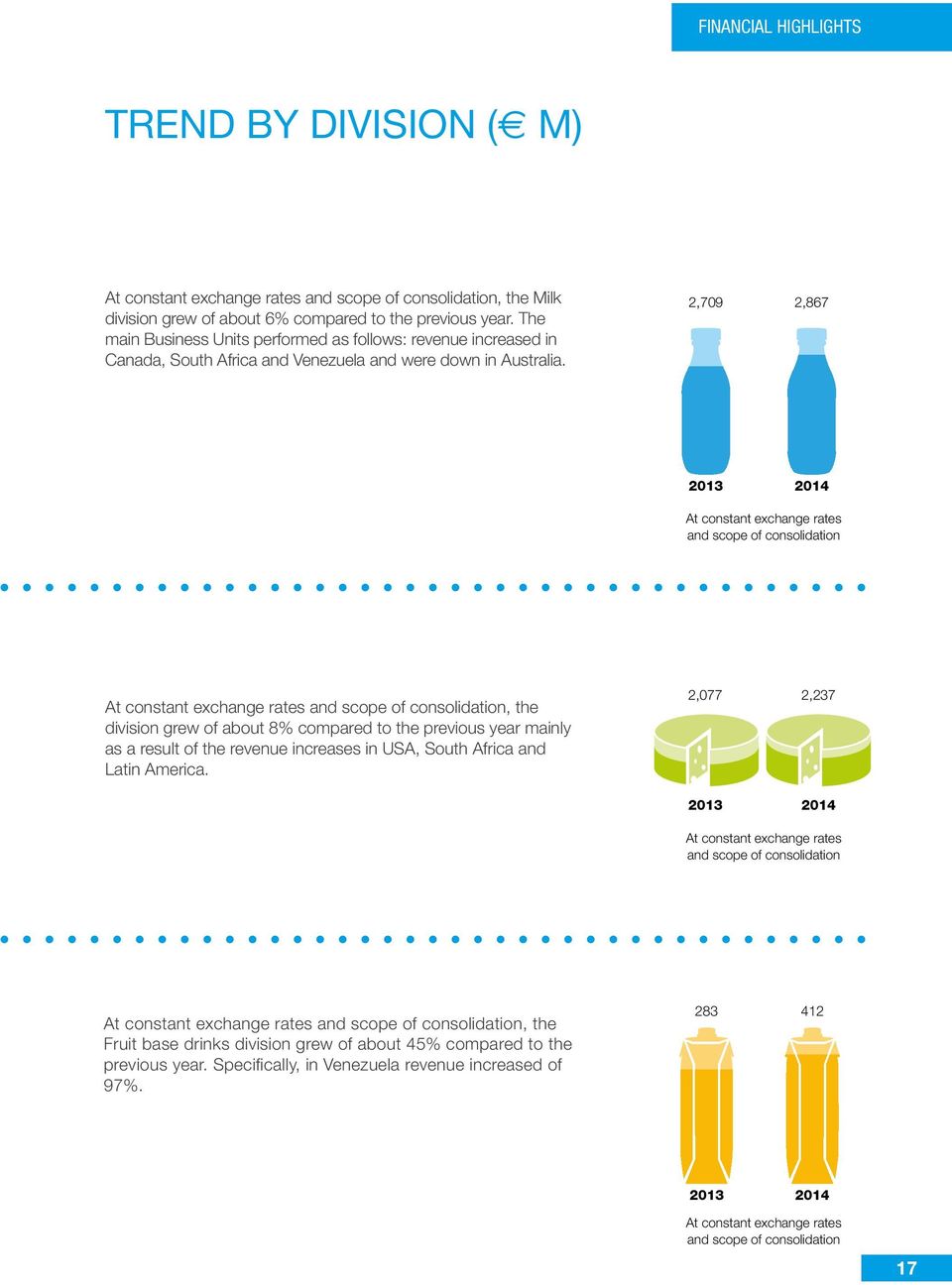
17 FINANCIAL HIGHLIGHTS TREND BY DIVISION ( M) At constant exchange rates and scope of consolidation, the Milk division grew of about 6% compared to the previous year. The main Business Units performed as follows: revenue increased in Canada, South Africa and Venezuela and were down in Australia. 2,709 2, At constant exchange rates and scope of consolidation At constant exchange rates and scope of consolidation, the division grew of about 8% compared to the previous year mainly as a result of the revenue increases in USA, South Africa and Latin America. 2, , At constant exchange rates and scope of consolidation At constant exchange rates and scope of consolidation, the Fruit base drinks division grew of about 45% compared to the previous year. Specifically, in Venezuela revenue increased of 97% At constant exchange rates and scope of consolidation 17
18 PARMALAT ANNUAL REPORT 2014 REPORT ON OPERATIONS 18

19 19

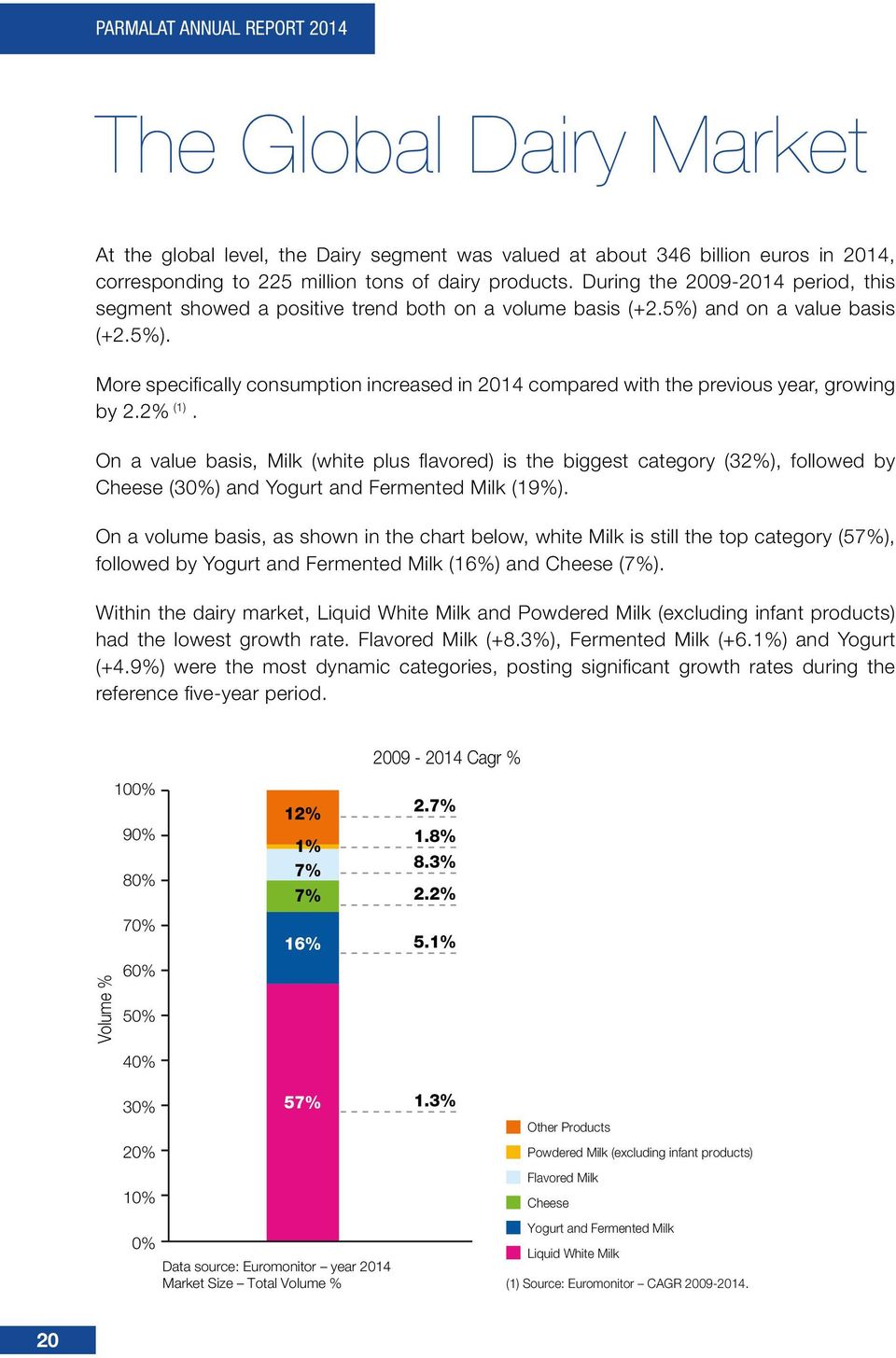
20 PARMALAT ANNUAL REPORT 2014 The Global Dairy Market At the global level, the Dairy segment was valued at about 346 billion euros in 2014, corresponding to 225 million tons of dairy products. During the period, this segment showed a positive trend both on a volume basis (+2.5%) and on a value basis (+2.5%). More specifically consumption increased in 2014 compared with the previous year, growing by 2.2% (1). On a value basis, Milk (white plus flavored) is the biggest category (32%), followed by Cheese (30%) and Yogurt and Fermented Milk (19%). On a volume basis, as shown in the chart below, white Milk is still the top category (57%), followed by Yogurt and Fermented Milk (16%) and Cheese (7%). Within the dairy market, Liquid White Milk and Powdered Milk (excluding infant products) had the lowest growth rate. Flavored Milk (+8.3%), Fermented Milk (+6.1%) and Yogurt (+4.9%) were the most dynamic categories, posting significant growth rates during the reference five-year period Cagr % Volume % 100% 90% 80% 70% 60% 50% 40% 30% 20% 10% 12% 1% 7% 7% 16% 57% 2.7% 1.8% 8.3% 2.2% 5.1% 1.3% Other Products Powdered Milk (excluding infant products) Flavored Milk Cheese 0% Data source: Euromonitor year 2014 Market Size Total Volume % Yogurt and Fermented Milk Liquid White Milk (1) Source: Euromonitor CAGR
21 REPORT ON OPERATIONS THE GLOBAL DAIRY MARKET As shown in the chart below, the most important geographic macro-areas for the Dairy market in terms of volumes are Asia and Western Europe, which, combined, account for more than 50% of the total. Asia-Pacific 2% Asia 29% Western Europe 22% Eastern Europe 8% Latin America 14% Middle East and Africa 9% North America 16% MACROAREA CAGR % Asia 6.4% Middle East and Africa 5.2% Latin America 2.1% Asia-Pacific 2.7% Eastern Europe 1.8% Western Europe 0.0% North America -0.5% WORLD 2.5% Data source: Euromonitor year 2014 Market Size Total Volume % Western Europe and North America are mature markets, with zero or even slight negative growth rates ( CAGR of 0.0% and -0.5%, respectively); in Asia, the Dairy segment was particularly dynamic, with a strong growth rate ( CAGR of 6.4%), and the trend was also positive in Africa and the Middle East ( CAGR of 5.2%). In the markets where Parmalat operates, some categories showed attractive growth trends in consumption during the period. In North America, there was healthy growth in the Yogurt category (+3.0%) and Cheese category (+1.4%) In Latin America, the best gains were recorded in the Yogurt (+5.6%) and Cheese (+4.0%) markets. The Australian market performed particularly well in the Flavored Milk (+6.0%) and Yogurt (+6.8%) categories. The Africa sales region, which was one of the most dynamic overall, enjoyed very attractive growth rates in the markets for Cheese (+6.1%) and Yogurt (+6.8%). In general terms, the position of private labels in the Dairy market is substantially stable, accounting for 14.2% of total value. However, they have a stronger position in the markets for staple goods, such as Liquid Milk (pasteurized and UHT, with a 21.3% share) and Cheese (15.9% share). In the main countries where Parmalat operates, private labels hold an important value market share in the Liquid Milk category amounting to 11.6% in Canada (Pasteurized Milk), 46.3% in Australia (Pasteurized Milk) and 24.8% in Italy (UHT Milk) (2). The growth of private labels is a typical, well established phenomenon in the more developed markets, where they are eroding the market share of branded products. (2) Source: AC Nielsen / IRI Aztec 21
22 PARMALAT ANNUAL REPORT 2014 Raw Milk The price of raw milk was strongly affected by the global market for butter and powdered milk. Demand was up sharply at the beginning of the year, putting significant pressure on the price of milk in all countries. This development created a challenging situation for Parmalat, as it was forced to pay a price for milk that was the highest recorded in recent years without being able to fully reflect this increase in its sales prices. In the second half of the year, the market witnessed a reversal of this trend, enabling the Group to regain profitability. Moreover, starting in the second half of the year, due to a worldwide increase in milk production, a concurrent decrease in demand from China and Russia s embargo, international prices for milk and dairy products actually declined. 22
23 REPORT ON OPERATIONS REVENUE AND PROFITABILITY Revenue and Profitability The data are stated in millions of euros and in the local currency. The amounts shown for changes and percentage impact could reflect apparent disparities caused exclusively by the rounding of figures. The advanced countries, led by the United States, continued to drive the global economy on a path of moderate expansion in The diverging monetary policies pursued by different western countries, coupled with major geo-political events, created a period of wide swings in the currency markets. In 2014, net revenue totaled 5,547.6 million euros (+3.7%) and EBITDA amounted to million euros (+0.6%), thanks to positive results in the Latin America, Africa and Europe sales regions and despite a significant increase in the cost of raw milk in all of the regions in which the Group operates, which was particularly pronounced in the first half of the year. In 2014, the raw milk market was particularly dynamic in all of the main regions, with average prices higher than the previous year, particularly in the United States, Australia and Russia. Starting in the third quarter, prices began gradually to decline, making it possible to regain profitability, particularly in Europe and Australia. The Group s results were affected to a significant extent by a highly unfavorable currency translation effect, as the currencies of the main countries where the Group operates lost value versus the euro. With data at constant exchange rates and comparable scope of consolidation, which is obtained by excluding the contribution of Balkis, a Brazilian company acquired at the end of July 2013, the Harvey Fresh Group acquired in Australia in the second quarter of 2014, and the activities of Lácteos Brasil S.A. Em Recuperação Judicial (LBR), taken under management starting in the fourth quarter of 2014, net revenue and EBITDA show increases of 9.5% and 9.7%, respectively. Parmalat defended its profitability by steadily improving its operating efficiency and implementing price list adjustments starting in the second half of 2013, ahead of its main competitors. The effect of this strategy was an initial contraction in sales volumes, followed by a full recovery of the increased costs paid for the components of production. 23
24 PARMALAT ANNUAL REPORT 2014 Parmalat Group The table below provides an overview of the Group s consolidated data for 2014 compared with the previous year: (amounts in millions of euros) YEAR 2014 YEAR 2013 VARIANCE VARIAN.% Net Revenue 5, , % EBITDA % EBITDA % ppt Net revenue totaled 5,547.6 million euros, or 3.7% more than in the previous year, and EBITDA amounted to million euros, for a gain of 2.4 million euros (+0.6%) compared with million euros in The table below shows the results of the Parmalat Group at comparable scope of consolidation, excluding the contribution provided by Balkis, Harvey Fresh and LBR, without the effects of hyperinflation in Venezuela and at constant exchange rates; it is worth mentioning that the foreign exchange effect had a negative impact of million euros on net revenue and 47.8 million euros on EBITDA. (amounts in millions of euros) Constant exchange rates YEAR 2014 YEAR 2013 VARIANCE VARIAN.% Net Revenue 5, , % EBITDA % EBITDA % ppt Constant scope of consolidation, exchenge rates and excluding hyperinflation impact. Net revenue grew by 9.5%, with the Latin America, Africa and North America sales regions providing a particularly strong contribution; revenue were also up in Europe and Australia, but growth rates were lower than in other regions where the Group operates. EBITDA, with data on a comparable basis, increased by 9.7%, thanks to a strong performance in the Latin America, Africa and Europe sales regions and despite the effects of a contraction in Australia and North America, caused mainly by an increase in the cost of raw milk and intense competition. 24
25 REPORT ON OPERATIONS REVENUE AND PROFITABILITY Like-for-Like Net Revenue and EBITDA The diagram below presents the main variables that determined the evolution of net revenue and EBITDA in 2014 compared with the previous year. Net Revenue 2014 vs 2013 (amounts in millions of euros) +3.7% +9.5% ( ml) 5, , , ,547.6 Net Revenue 2013 Hyperinfl. Venezuela 2013 Balkis 2013 Net Revenue 2013 excluding hyperinfl. Price Discounts Volume/Mix Other Net Revenue 2014 Currency translation Hyperinfl. Venezuela constant 2014 scope of consol. and exchenge rate New activities (Balkis HF-I RR)) Net Revenue 2014 EBITDA 2014 vs 2013 (amounts in millions of euros) % +0.6% ( ml) EBITDA 2013 Hyperinfl. Venezuela 2013 Balkis 2013 EBITDA 2013 excluding hyperinfl. Price/ Discounts Production costs Volume/ Mix Venezuela General costs Mkt Investments and fixed General costs EBITDA 2014 constant scope of consol. and exchenge rate Currency translation Hyperinfl. Venezuela 2014 New activities (Balkis HF-LBR)) EBITDA 2014 (*) Balkis 2013 includes the results for five months (August to December). 25
26 PARMALAT ANNUAL REPORT 2014 Data by Geographic Region REGION NET REVENUE (amounts in millions of euros) DELTA % EBITDA EBITDA % NET EBITDA EBITDA % NET EBITDA REVENUE REVENUE Europe 1, , % +15.6% North America 2, , % -16.5% Latin America % % Africa % +16.1% Australia % -24.8% Other (1) n.s n.s. n.s. +1.3% GROUP 5, , % +0.6% Region represent the consolidated countries. (1) Includes other non-core companies, eliminations between regions and Group s Parent Company costs. Net Revenue by Geographic Region Latin America 13% Africa 7% Australia 17% North America 43% Europe 20% In order to improve comparability with the 2013 data, the table below presents the Group s results at constant exchange rates and comparable scope of consolidation and excluding the effects of hyperinflation in Venezuela. REGION NET REVENUE (amounts in millions of euros) DELTA % EBITDA EBITDA % NET EBITDA EBITDA % NET EBITDA REVENUE REVENUE Europe 1, , % +17.2% North America 2, , % -12.4% Latin America % % Africa % +30.0% Australia % -30.9% Other (1) n.s n.s. n.s. +1.4% GROUP (constant scope of consolid./ exchange rates) (2) 5, , % +9.7% Region represent the consolidated countries. (1) Includes other non-core companies, eliminations between regions and Group s Parent Company costs. (2) Excluding hyperinflation impact and activities acquired in the thid quarter 2013 (Balkis). in the second quarter 2014 (Harvey Fresh) and in the fourth quarter 2014 (LBR). 26
27 REPORT ON OPERATIONS REVENUE AND PROFITABILITY Data by Product Division DIVISION NET REVENUE (amounts in millions of euros) DELTA % EBITDA EBITDA % NET REVENUE EBITDA EBITDA % NET REVENUE EBITDA Milk (1) 2, , % -13.6% Fruit base drinks (2) % % Cheese and other fresh products (3) 2, , % -16.5% Other (4) % n.s. GROUP 5, , % +0.6% (1) Includes milk, cream and béchamel. (2) Includes fruit base drinks and tea. (3) Includes yogurt, dessert, cheese. (4) Includes other products, whey, impact of hyperinflation in Venezuela and Group s Parent Company costs. Net Revenue by Product Division Fruit base drinks (2) 6.2% Fruit base drinks (2) 5.3% Cheese and other fresh products (3) 38.3% Cheese and other fresh products (3) 39.0% Milk (1) 49.5% Other (4) 6.0% Milk (1) 50.6% Other (4) 5.1% (1) Includes milk, cream and béchamel. (2) Includes fruit base drinks and tea. (3) Includes yogurt, dessert, cheese. (4) Includes other products, whey, impact of hyperinflation in Venezuela. 27
28 PARMALAT ANNUAL REPORT 2014 In order to improve comparability with the 2013 data, the table below presents the Group s results at constant exchange rates and comparable scope of consolidation and excluding the effects of hyperinflation in Venezuela. DIVISION NET REVENUE (amounts in millions of euros) DELTA % EBITDA EBITDA % NET EBITDA EBITDA % NET EBITDA REVENUE REVENUE Milk (1) 2, , % -7.6% Fruit base drinks (2) % % Cheese and other 2, , % -8.0% fresh products (3) Other (4) % n.s. GROUP (constant scope of consolid. & exchange rates) (5) 5, , % +9.7% (1) Includes milk, cream and béchamel. (2) Includes fruit base drinks and tea. (3) Includes yogurt, dessert, cheese. (4) Includes other products, whey and Group s Parent Company costs (5) Excluding hyperinflation impact and activities acquired in the thid quarter 2013 (Balkis). in the second quarter 2014 (Harvey Fresh) and in the fourth quarter 2014 (LBR) The profitability of the Fruit Beverage Division improved significantly thanks to the positive results achieved, particularly in the Latin America sales region. 28
29 REPORT ON OPERATIONS EUROPE Europe YEAR (amounts in millions of euros) VARIANCE VARIAN.% Net Revenue 1, , % EBITDA % EBTIDA % ppt The Europe sales region includes the subsidiaries that operate in Italy, Russia, Portugal and Romania. Italy accounts for about 85% of the net revenue and 90% of the EBITDA of the Europe sales region. The significant loss of value of the ruble versus the euro, particularly in the second half of the year, had a negative impact of about 22 million euros and 1.5 million euros, respectively, on the sales region s net revenue and EBITDA. With data at constant exchange rates, revenue and EBITDA show gains of 2.2% and 17.2%, respectively. The cost of raw milk began to decreased in the third quarter of 2014, particularly in Italy and Portugal; this development, coupled with gains in industrial efficiency and the effects of an effective sales policy, helped boost profitability in the sales region. Italy EMPLOYEES MANUFACTURING FACILITIES 1,814 9 Available estimates for 2014 ( * ) call for GDP to contract by 0.4%, with an average annual inflation rate of 0.2% and a December unemployment rate of 12.9%. Consumer confidence and propensity to consume were adversely affected by the general trend of the economy, which continues to struggles as it attempts to emerge from a recession caused by fiscal austerity, low business confidence, deterioration of the labor market and tight credit for businesses. In this environment, the price variable, particularly in the food product category, continues to play a major role in orienting spending decisions by households. (*) Source: The Economist, February 7,
30 PARMALAT ANNUAL REPORT 2014 Market and Products In 2014, consumption decreased sharply in the Dairy and Fruit Beverage markets. In this challenging environment, characterized by strong competitive pressure, due in part to private labels, the Business Unit was able to retain its competitive positions in both markets. Consumption was also down in the Milk market, contracting by 3.0% compared with the previous year, with a particularly sharp decline in the Pasteurized Milk category. The trend was also negative in the UHT Milk segment, but the decline in consumption was smaller. Parmalat succeeded in maintaining unchanged its competitive positions, retaining the leadership in the UHT and Pasteurized Milk segments (with all channels taken into consideration). In the market for UHT Cream, consumption increased in 2014, with significant growth also on a value basis. Thanks to the launch of new products under the Chef brand, supported by investments in advertising, Parmalat retained its leadership position. In 2014, the Yogurt market was unable to reverse the negative consumption trend of the previous period. In a competitive environment dominated by two major players, the local subsidiary held steady both its market share and its competitive position. In the Fruit Beverage category, the trends was negative both on a volume and value basis. The Business Unit held steady its value market share and retained its second-place market position., 30
31 REPORT ON OPERATIONS EUROPE The table below shows the market share held by the local subsidiary in the main segments in which it operates: Products MILK UHT (1) PASTEURIZED MILK (2) UHT FRUIT CREAM (1) YOGURT (3) BEVERAGES (3) 2014 value market share 29.7% 21.8% 25.4% 4.4% 11.2% 2013 value market share 30.2% 22.3% 25.4% 4.6% 11.0% (1) Sourcee: Nilsen Total Italy from 1/1/14 to 12/28/14. (2) Sourcee: Nilsen Modern Channel from 1/1/14 to 12/28/14. (3) Sourcee: IRI Total Italy from 1/1/14 to 12/28/14. Total sales volumes were in line with the previous year thanks to a positive performance in the UHT Milk and Fruit Beverage categories but sales of Pasteurized Milk and Yogurt were lower, consistent with the contraction in demand. The Business Unit s net revenue was up slightly compared with the previous year, owing in part to price increases implemented back in the second half of EBITDA for the reporting period improved compared with the performance in 2013, thanks to sales gains, lower production costs and a decrease in overhead. The investments in advertising implemented in 2014 to support the main brands were substantially higher than the previous year. Italy, Collecchio (Parma) manufacturing facility. 31
32 PARMALAT ANNUAL REPORT 2014 Russia EMPLOYEES MANUFACTURING FACILITIES 1,148 2 Available estimates for 2014 ( * ) call for GDP to grow by 0.6%, with an average annual inflation rate of 7.8% and a December unemployment rate of 5.3%. Economic growth was affected by political uncertainty and the economic sanctions imposed by the European Union and the United States. Plunging crude oil prices in the second half of the year and capital flight caused a massive devaluation of the ruble and a resulting inflationary pressure. These developments had a depressing effect on consumer spending. In 2014, a consumption crisis situation affected all of the markets in which the local subsidiary operates, except for the Cream category; volumes were down sharply in the UHT Milk, Flavored Milk and Fruit Beverage markets. However, the local subsidiary held firms its competitive position in each of these categories. With data in the local currency, the Russian subsidiary shows a 14% gain net revenue compared with the previous year that reflects the list price increases implemented in all of the categories in which it operates. Despite a significant increase in the costs incurred to purchase raw milk and the effects of the devaluation of the local currency, EBITDA improved compared with the previous year, owing to list price adjustments and the effects of a program to reduce production costs and improve the sales mix, which was achieved thanks to an increase in products with a higher value added, such as Cream and Flavored Milk. (*) Source: The Economist, February 7,
33 REPORT ON OPERATIONS EUROPE Portugal EMPLOYEES MANUFACTURING FACILITIES The variability of quarterly data (growth, employment and exports) make it difficult to assess the true condition of the economy. A main concern continues to be the exposure to the risk of deflation and the resulting consequences on the propensity to consume on the part of households. In the main segments in which it operates, Flavored Milk and Fruit Beverages, the local subsidiary succeeded in maintaining its competitive positions thanks to the performance of the UCAL and Santàl brands. Net revenue was higher than in the previous year mainly thanks to an increase in sales volumes in the UHT Milk category and to product line innovation, particularly in the Flavored Milk and Cream categories; profitability was sharply higher compared with previous year, benefiting from improving sales, a restructuring of the Business Unit s internal organization and the achievement of industrial efficiencies. 33
34 PARMALAT ANNUAL REPORT 2014 Romania EMPLOYEES MANUFACTURING FACILITIES 93 1 Overall, internal consumption showed signs of an upturn; after several years of contracting consumption, the Fruit Beverage market showed signs of a slight improvement compared with the previous year, with particularly strong gains in the Juices and Still Drinks segments. Parmalat, with its Santàl brand, held unchanged its competitive position. In the second half of the year, the trend was particularly positive compared with the previous six months, enabling a full recovery of sales volumes. The profitability of the local subsidiary improved compared with the previous year thanks to price list adjustments implemented in the first quarter and the achievement of manufacturing efficiencies. 34
35 REPORT ON OPERATIONS EUROPE 35
36 PARMALAT ANNUAL RELAZIONI REPORT E BILANCIO North America (amounts in millions of euros) YEAR VARIANCE VARIAN.% Net Revenue 2, , % EBITDA % EBITDA % ppt The North America sales region includes the subsidiaries that operate in the United States and Canada; the Canadian subsidiary accounts for about 65% of the region s net revenue and EBITDA With data at constant exchange rates, the net revenue of the North America sales region shows a gain of 5.6%, with EBITDA declining by 12.4% compared with the previous year, due to sharp increases in the cost of raw milk in the United States, which, however, moderated in the second half of the year. Canada EMPLOYEES MANUFACTURING FACILITIES 3, Available estimates for 2014 ( * ) call for GDP to grow by 2.4%, with an average annual inflation rate of 1.9% and a December unemployment rate of 6.7%. Thus far, the Canadian economy, usually vulnerable to developments in the oil sector, has not been affected by the trend in the price of crude oil during the second half of This development shielded from another negative factor an economic trend that, while positive, has been uneven thus far and has not fully benefited from the recovery in the United States. The level of household debt, while decreasing, is continuing to drive their propensity to save with a concurrent reduction of their willingness to consume. (*) Source: The Economist, February 7,
37 REPORT ON OPERATIONS NORTH AMERICA Market and Products There was a steady decrease in milk consumption during the year, due mainly to a significant contraction in the premium segment. Volumes were also down in the basic segment, even though average prices were lower than in the previous year. Despite this market environment, Parmalat was able to increase its market share value, maintaining its third-place competitive position. Consumption held relatively steady in the Yogurt market, with a noteworthy positive performance in the Greek segment that offset a sharp contraction in the drinkable yogurt segment. In this highly competitive market, characterized by large investments in advertising, Parmalat suffered a loss of market share but retained its competitive position. In the Cheese market, consumption was down slightly, due mainly to a negative performance in the processed and snack segments; the natural segment, the largest in terms of volumes, was substantially stable. In this environment, the local subsidiary maintained its second-place market position, due largely to the positive results of a new advertising campaign for the Cheestrings brand. It is worth mentioning that in 2014, in order to foster growth in the specialties segment, the local subsidiary launched the Mozzarella Galbani produced in Canada and distributed nationwide. Canada, Winchester manufacturing facility. 37
38 PARMALAT ANNUAL REPORT 2014 The table below shows the market share in the main market segments: Products MILK SPOONABLE YOGURT DRINKABLE YOGURT SNACK CHEESE NATURAL CHEESE 2014 value market share 17.6% 12.0% 5.6% 38.2% 13.7% 2013 value market share 16.9% 12.7% 6.7% 36.1% 15.5% Source: ACNielsen, MarketTrack, National Grocery Banner+Drug+Mass Merch, from 1/1/14 to 12/31/14. The local subsidiary reported higher sales volumes and net revenue, stated in the local currency, thanks to an effective sales policy and a positive sales performance in the Cheese category, despite a slight market contraction. EBITDA was down compared with the previous year, due to the non recurring gains recognized in 2013 and the impact of an increase in the cost of production materials, raw milk and packaging materials primarily. The purchase cost of raw milk was also affected by the trend in the U.S. market, where it reached record high levels in 2014, with an adverse impact on the purchasing costs of some dairy products. These effects could not be fully recovered through price list adjustments, owing to severe competitive pressure. During the year, the local subsidiary continued to implement its plan to reduce overhead. 38
39 REPORT ON OPERATIONS NORTH AMERICA United States of America EMPLOYEES MANUFACTURING FACILITIES 1,550 4 Available estimates for 2014 ( * ) call for GDP to grow by 2.4%, with an average annual inflation rate of 1.5% and a December unemployment rate of 5.6%. The U.S. economy continues to drive the recovery in the advanced countries. In the last three quarter of 2014, the key indicators of manufacturing activity, consumer spending and the labor market confirmed the strength of the recovery of the American economy. Lastly, industrial investments also showed a positive change. (*) Source: The Economist, February 7, United States of America, South Park manufacturing facility. 39
40 PARMALAT ANNUAL REPORT 2014 Market and Products Consumption increased slightly in the overall Cheese market compared with the previous year and held steady in the section of the market comprised of the segments in which the local subsidiary operates. In this context, Parmalat maintained its competitive position. Parmalat confirmed its market leader position in the gourmet spreadable, soft ripened and ricotta segments of the cheese market. Premium products performed particularly well in the first two of these segments. but volumes were down in the ricotta segment. The chunk mozzarella and snack cheese segments were both characterized by significant reductions in volumes, but higher average prices produced an increase on a value basis. The local subsidiary increased its value market share in the chunk mozzarella segment, thereby strengthening its second-place position, while the competitive scenario was virtually unchanged in the snack cheese segment. In 2014, the trend was positive both on a volume and value basis in the feta and fresh mozzarella segments, with the local subsidiary holding unchanged its competitive position. The table below shows Parmalat s market share in the main segments in which it operates: Products TOTAL CHEESE (1) GOURMET SPREADABLE FETA CHEESE FRESH MOZZARELLA SOFT RIPENED CHEESE CHUNK MOZZARELLA RICOTTA SNACK CHEESE GOURMET CHEDDAR 2014 value market share 12.5% 31.2% 14.7% 22.0% 40.1% 17.9% 26.0% 5.6% 1.7% 2013 value market share 13.2% 33.6% 15.5% 23.6% 44.6% 17.3% 27.6% 5.8% 2.3% Source: SymphonyIRI Group Market Advantage, Total US Multioutlet from 1/1/14 to 12/14/14. (1) The scope of the market in question includes the following categories: Snack Cheese, Chunk Mozzarella Cheese, Feta Cheese, Ricotta Cheese, Fresh Mozzarella, Soft Ripened Cheese, Gourmet Spreadable Cheese and Gourmet Cheddar. 40
41 REPORT ON OPERATIONS NORTH AMERICA Overall, the U.S. operations reported an increase in sales volume compared with the previous year, due mainly to positive performances in the Cheese segment, which represents about 70% of total sales. Net revenue, stated in the local currency, increased by 12.1%, thanks to higher sales and price adjustments in the main sales channels in which the local subsidiary operates. The profitability of the U.S. subsidiary contracted, due to the particularly high cost of raw milk; specifically, the price of raw milk rose to a new all-time high in 2014 (+24% compared with 2013), which resulted in a drastic reduction of profitability for all of the main industry producers, who were unable to fully recover the higher costs through price list adjustments. The loss of profitability was particularly pronounced in the Retail channel and in the Deli segment, where it is particularly difficult to increase prices, due to competitive pressure. The local subsidiary opted for protecting its sales volumes in a highly competitive and dynamic context. 41
42 PARMALAT ANNUAL REPORT 2014 Latin America YEAR (amounts in millions of euros) VARIANCE VARIAN.% Net Revenue % EBITDA % EBITDA % ppt The Latin America sales region includes the subsidiaries that operate in Venezuela, Colombia, Ecuador, Paraguay, Mexico and Brazil. The Group strengthened its presence in Brazil with the acquisition of Balkis in the third quarter of 2013 and taking under management LBR in November 2014; in addition, it established commercial companies in Uruguay, Peru and Bolivia. The data presented above include the effects of hyperinflation in Venezuela and a negative translation effect, which, in 2014, reduced revenue and EBITDA by about 244 million euros and 23 million euros, respectively, due mainly to the devaluation of the Venezuelan bolivar versus the euro. The economic results of the Venezuelan subsidiary for the second half were converted by applying the SICAD I exchange rate (the exchange rate in effect at December 31 was 12 VEF/USD), which caused a further negative currency translation effect. With data at constant exchange rates and comparable scope of consolidation (excluding Balkis and LBR) and without the effects of hyperinflation, the results for this sales region show gains of 55.6% for revenue and 21.3% for EBITDA. Venezuela EMPLOYEES MANUFACTURING FACILITIES 1,845 5 Available estimates for 2014 ( * ) call for GDP to contract by 3.1%, with an average annual inflation rate of 62.2% and a December unemployment rate of 5.5%. (*) Source: The Economist, February 7,
43 REPORT ON OPERATIONS LATIN AMERICA The political uncertainty that characterized 2014, combined with consumer price inflation, was the main elements of a macroeconomic scenario that was already extremely uncertain in the first half of the year. The subsequent plunge in the price of crude oil, the main source of wealth for Venezuela, further complicated the scenario contributing to a growing market perception of a significant country risk. The Fruit Beverage market is experiencing a healthy growth trend in consumption in the UHT segment, in which the local subsidiary maintained its competitive position; in the fresh fruit juice category, characterized by a significant reduction in volumes, Parmalat maintained the secondplace position. The yogurt market, a Dairy segments that was one of the most dynamic in 2014, consumption was up thanks to positive performance in the Regular Yogurt and Light Yogurt segments. In a highly competitive environment, the local subsidiary maintained its market position. Consumption of Powdered Milk were down sharply compared with the previous year and Parmalat suffered a significant decrease in market share. The total volumes sold by the local subsidiary increased compared with the previous year; more specifically, the trends for the individual categories show a substantial sales increase for Fruit Beverages and Yogurt and lower sales for Cheese and Powdered Milk caused by a generalized contraction in market demand. Net revenue, stated in the local currency, grew by 81.1% compared with the previous year, due to price list adjustments made to reflect the impact of Venezuela s high inflation rate, and higher unit sales of Fruit Beverages. EBITDA increased compared with the previous year, thanks to an improved sales mix and price adjustments, particularly in the Fruit Beverage category. 43
44 PARMALAT ANNUAL REPORT 2014 Colombia EMPLOYEES MANUFACTURING FACILITIES 1,322 5 Available estimates for 2014 ( * ) call for GDP to grow by 4.8%, with an average annual inflation rate of 2.9% and a December unemployment rate of 8.7%. The government s economic policy, aimed at stimulating the economy with spending on public infrastructures, ensured that solid growth in gross domestic product and the improvement in the employment level continued in These gains translated into an increase in internal demand, but the resulting inflationary pressure was contained by the Central Bank with a restrictive interest rate policy. However, the inflation rate did increase in second half of the year, due in part to a weakening of the Colombian peso versus the U.S. dollar. The UHT market contracted slightly, mainly due to a negative trend in the White Milk segment. In 2014, the local subsidiary confirmed its fourth-place competitive position. Net revenue increased by 1.3%, but sales volumes were down significantly due mainly to negative trends in the Liquid Milk and Yogurt categories. EBITDA decreased compared with the previous year due to higher raw milk purchase costs and the effect of non recurring items, offset only in part by gains in manufacturing efficiency. (*) Source: The Economist, February 7,
45 REPORT ON OPERATIONS LATIN AMERICA Other Countries in Latin America The net revenue generated in the other countries of this region (Ecuador, Paraguay, Brazil and Mexico) increased compared with the previous year, owing in part to the contribution provided by Balkis, acquired in July 2013, and LBR, taken under management in November Ecuador EMPLOYEES MANUFACTURING FACILITIES In Ecuador, net revenue stated in the local currency were up by 9.4%, chiefly due to higher volumes and an increase in sales prices. Ecuador, Lasso (Cotopaxi) manufacturing facility. 45
46 PARMALAT ANNUAL REPORT 2014 Paraguay EMPLOYEES MANUFACTURING FACILITIES In Paraguay, net revenue stated in the local currency increased by 9.8% compared with the previous year, due mainly to rising sales of UHT Milk and Yogurt. 46 Paraguay, San Lorenzo manufacturing facility.
47 REPORT ON OPERATIONS LATIN AMERICA Mexico Brazil EMPLOYEES MANUFACTURING FACILITIES EMPLOYEES MANUFACTURING FACILITIES Mexico and Brazil present attractive growth opportunities; the Group, which with the acquisition of Balkis in the second half of 2014 reentered the Brazilian market as a Cheese producer and distributor, further strengthened its presence in Brazil by taking under management some production units, including trademarks, personnel and administrative office, of Lácteos Brasil S.A. Em Recuperação Judicial (LBR), a company in composition with creditors proceedings in accordance with Brazilian law. This transaction, which closed in January 2015, the subject of which was a portfolio of assets in the areas of UHT Milk and local Cheeses, enabled the Parmalat Group to regain full title to the Parmalat trademark throughout Brazil for the production and distribution of UHT Milk. 47
48 PARMALAT ANNUAL REPORT 2014 Africa (amounts in millions of euros) YEAR VARIANCE VARIAN.% Net Revenue % EBITDA % EBITDA % ppt The Africa sales region includes the subsidiaries that operate in South Africa, Zambia, Botswana, Swaziland and Mozambique. South Africa accounts for more than 80% of the net revenue and EBITDA of the Africa sales region. The data presented above, stated in euros, reflect a negative translation effect, which reduced revenue and EBITDA by about 47 million euros and 4.1 million euros, respectively, due mainly to the loss of value of the South African rand versus the euro. With data stated at constant exchange rates, the region s results for 2014 show increases of 11.6% for revenue and 30% for EBITDA. The positive performance achieved in the Africa sales region, compared with the previous year, is the result of an industrial activity focused on increasing efficiency, an effective sales policy and an improved sales mix, in a context characterized by a scarcity of raw milk. South Africa EMPLOYEES MANUFACTURING FACILITIES 1,946 8 According to available estimates for 2014 ( * ), GDP should show growth of 1.6%, with an average annual inflation rate of 6.2% and an unemployment rate that reached 25.4% in the third quarter. (*) Source: The Economist, February 7,
49 REPORT ON OPERATIONS AFRICA Even though the South African rand has shown signs of strengthening against the euro, the loss in value of this currency versus the U.S. dollar generated an inflationary pressure that is hampering internal demand. Internal factors, such as the scarcity of jobs, strikes and energy blackouts, as well as external factors, such as weak commodity prices and a slowing of exports to China, contributed to clouding the economic picture. Market and Products In the UHT Milk market, which includes the White Milk and Flavored Milk segments, consumption was down slightly in 2014, particularly in the Flavored Milk category; however, the trend was up for both segments on a value basis, particularly for White Milk. As for the competitive position of the local subsidiary, Parmalat was ranked second in the White Milk market and held the leadership position, with a share of more than 50%, in the Flavored Milk market. The Cheese market grew at an attractive rate on a value basis, thanks mainly to positive performances in the hard cheese, processed cheese and feta segments. Parmalat strengthened its position as the market leader thanks in part to the support provided to its brands by investments in advertising. Consumption was down significantly in the yogurt market, which, however, grew at a strong pace on a value basis. Thanks to an ambitious program to relaunch its brand with the support of advertising investments, the local subsidiary achieved a significant gain in value market share, strengthening its second-place competitive position. 49
50 PARMALAT ANNUAL REPORT 2014 The table below shows the market share held by the South African subsidiary in the main market segments in which it operates: Products UHT MILK YOGURT CHEESE FLAVORED MILK 2014 value market share 15.4% 18.4% 36.6% 52.4% 2013 value market share 17.9% 15.1% 34.6% 51.0% Source: Aztec,Top-end Retail & Wholesale; from 1/1/14 to 11/30/14 The local subsidiary responded to a contraction in the availability of raw milk by improving its sales mix and focusing on products with greater value added. Consequently, volumes of UHT Milk declined but Cheese and Yogurt volumes followed a positive trend. With data in the local currency, net revenue shows a gain of 13.7%, thanks to sales price increases in the main product categories implemented in the last quarter of 2013 and the effects of an improved sales mix. EBITDA for the year was up compared with the previous year thanks to product price increases implemented ahead of the main competitors and the effects of an improved sales mix that favored products with greater value added and of programs to contain overheads and distribution costs. These factors more than offset the impact of the higher costs incurred for raw materials and imported packaging materials, made more costly by the devaluation of the local currency. 50
51 REPORT ON OPERATIONS AFRICA Sud Africa, Bonnievale manufacturing facility. Zambia EMPLOYEES MANUFACTURING FACILITIES In Zambia, the second largest market in the Africa sales region, volumes were in line with the previous year, with revenue increasing by 7.8%, with data stated in the local currency, thanks to a policy focused on key brands and the sales price increases implemented in
52 PARMALAT ANNUAL REPORT 2014 Other Countries in Africa Swaziland EMPLOYEES MANUFACTURING FACILITIES Mozambico EMPLOYEES MANUFACTURING FACILITIES Botswana EMPLOYEES MANUFACTURING FACILITIES With data at constant exchange rates, the net revenue and EBITDA reported in the other African countries (Swaziland, Mozambique and Botswana) were up overall, thanks mainly to a positive sales trend. The Botswana subsidiary performed particularly well, recovering the positions it lost the previous year. 52
53 REPORT ON OPERATIONS AUSTRALIA Australia EMPLOYEES MANUFACTURING FACILITIES 2, Available estimates for 2014 ( * ) call for GDP to grow by 2.8%, with an average annual inflation rate of 2.5% and a December unemployment rate of 6.1%. In contrast with the first six months of the year, when exports of mineral resources to China drove the local economy, the second half of 2014 saw a rebalancing the Australian economy with a greater focus on internal demand, consumer spending in particular. Another defining factor in 2014 was the high price of raw milk on the international markets, which, coupled with the weakness of the Australian dollar early in the year, boosted raw milk exports and fueled inflationary pressure in the domestic market. (*) Source: The Economist, February 7,
54 PARMALAT ANNUAL REPORT 2014 Market and Products The trend in the pasteurized White Milk market was negative both on a volume and value basis in In a highly competitive scenario, with private labels continuing to gain positions, Parmalat suffered a loss of market share but retained the segment s leadership position. The Flavored Milk market performed particularly well with a significant growth trend both on a volume and value basis. Thanks to a positive performance by the OAK and Ice Break brands, supported by effective advertising campaigns, the local subsidiary succeeded in increasing its value market share and strengthening its second-place competitive position. Even though consumption held relatively steady, the Yogurt market enjoyed significant growth on a value basis determined by a positive performance in the Greek yogurt segment, with Parmalat retaining its third-place market position. In the Dessert market, the trend was particularly negative both on a volume and value basis, due mainly to the lack of innovation throughout this category. Despite this challenging market environment, the local subsidiary strengthened its second-place competitive position, significantly narrowing the market share gap compared with the segment leader. The table below shows the market share held by Parmalat in the main market segments in which it operates: Products PASTEURIZED MILK FLAVORED MILK YOGURT DESSERT 2014 value market share 19.3% 35.7% 13.3% 33.3% 2013 value market share 20.9% 35.0% 14.7% 26.6% Source: Aztec Australia from 1/1/14 to 12/21/14 54
55 REPORT ON OPERATIONS AUSTRALIA The table below shows the results for 2014 and provides a comparison with the previous year; the data include the contribution of the new activities acquired in the second quarter of 2014 (Harvey Fresh): (amounts in millions of euros) YEAR VARIANCE VARIAN.% Net Revenue % EBITDA % EBITDA % ppt The value of the Australian dollar decreased significantly in 2014 compared with the exchange rate applied in the same period last year; even though the downward trend became less pronounced in the fourth quarter, the resulting negative effect on revenue and EBITDA amounted to about 59 million euros and 3.7 million euros, respectively. In 2014, with data at constant exchange rates and comparable scope of consolidation, i.e., excluding the new Harvey Fresh operations, net revenue and EBITDA show an increase of 2.1% and a decrease of 30.9%, respectively, compared with the previous year. The reduction in profitability in 2014 is chiefly the result of the higher purchase cost of raw milk and other ingredients used in the production process, which could not be recovered with price list increases due to highly competitive market conditions. However, against this background, results improved in the second half of the year, thanks in part to decreasing raw milk prices. In the first half of 2014, the local subsidiary acquired the Harvey Fresh dairy group, whose performance exceeded expectations. See the Acquisition section later in this Report for additional information about the acquired company. Australia, Rowville manufacturing facility. 55
56 PARMALAT ANNUAL REPORT 2014 Review of Operating and Financial Performance Parmalat Group Net revenue increased to 5,547.6 million euros, up million euros (+3.7%) compared with 5,350.3 million euros in With data at constant exchange rates and scope of consolidation and excluding the effects of hyperinflation in Venezuela, net revenue show a gain of million euros (+9.5%). Price list increases and sales of more profitable products account for most of this improvement. EBITDA totaled million euros, or 2.4 million euros more (+0.6%) than the million euros earned in With data at constant exchange rates and scope of consolidation and excluding the effects of hyperinflation in Venezuela, the EBITDA increase amounts to 44.1 million euros (+9.7%). This gain reflects the combined effect of higher list prices and a better sales mix, offset in part by an increase in the purchase cost of raw milk, particularly in Australia, North America and Europe. EBIT amounted to million euros, for an increase of 12.9 million euros compared with million euros in With data at constant exchange rates and scope of consolidation the increase is 39.7 million euros. This gain reflects primarily improved results by the industrial operations and a larger contribution by non recurring transactions. Depreciation and amortization expense and impairment losses on non-current assets amounted to million euros (138.9 million euros in 2013). Profit attributable to owners of the parent totaled million euros, for a decrease of 17.9 million euros compared with million euros in With data at constant exchange rates and scope of consolidation, Group interest in net profit was in line with the amount reported the previous year. The effect of higher taxes and lower net financial income was offset in part by the gain in EBIT. Operating working capital amounted to million euros, for an increase of 62.9 million euros compared with million euros at December 31, Larger inventories of powdered milk and fruit concentrates held by the Venezuelan subsidiary, higher sales prices, an increase in the cost of the components of production and the consolidation of the Harvey Fresh Group acquired during the year are the main reason for the gain. 56
57 REPORT ON OPERATIONS REVIEW OF OPERATING AND FINANCIAL PERFORMANCE Net invested capital totaled 2,123.0 million euros, up 98.1 million euros compared with 2,024.9 million euros at December 31, This gain reflect the combined effect of the increase in operating working capital and the acquisition of the Harvey Fresh Group in Australia, offset in part by a negative foreign exchange effect, due mainly to the appreciation of the euros versus the Venezuelan bolivar. Net financial position totaled 1,119.1 million euros, for a gain of 53.5 million euros compared with 1,065.6 million euros at December 31, The main reasons for this increase include: the cash flow generated by operating activities (198.4 million euros), the net proceeds from litigation (10.9 million euros) and the cash flow from financing activities (9.6 million euros). This increase was offset in part by the cash used for non recurring activities (95.2 million euros), mainly related to the acquisition of the Harvey Fresh Group in Australia; a dividend distribution of 53.8 million euros and a negative foreign exchange effect (16.4 million euros). Group interest in shareholders equity grew to 3,219.8 million euros, or million euros more than at December 31, 2013, when it totaled 3,066.2 million euros. The Group s interest in net profit (203.1 million euros), offset in part by the 2013 dividend declared by the Shareholders Meeting of Parmalat S.p.A. on April 17, 2014 (52.9 million euros), is the main reason for this increase. 57
58 PARMALAT ANNUAL REPORT 2014 Parmalat Group Reclassified Consolidated Income Statement (amounts in millions of euros) REVENUE 5, ,404.9 Net revenue 5, ,350.3 Other revenue OPERATING EXPENSES (5,138.4) (4,967.8) Purchases, services and miscellaneous costs (4,413.2) (4,253.6) Personnel expense (725.2) (714.2) Subtotal Impairment losses on receivables and other provisions (8.2) 0.1 EBITDA (1) Depreciation, amortization and impairment losses on non-current assets (131.9) (138.9) Other income and expense: Litigation related legal expenses (3.4) (3.5) Miscellaneous income and expenses EBIT (2) Net financial income/(expense) Other income from (Charges for) equity investments PROFIT BEFORE TAXES Income taxes (117.4) (110.7) PROFIT FOR THE YEAR Attributable to: Non-controlling interests (2.1) (2.2) Owners of the parent Continuing operations: BASIC EARNINGS PER SHARE DILUTED EARNINGS PER SHARE (1) EBITDA is equal to the difference between consolidated net revenue and operating expenses before non-cash costs for depreciation, amortization and impairment losses on non-current assets (net of any reversals of impairment losses on non-current assets). (2) EBIT is obtained by subtracting from EBITDA non-cash costs for depreciation, amortization and impairment losses on non-current assets (net of any reversals of impairment losses on non-current assets) and adding the net effect of Miscellaneous income and expense, i.e., income and expense deriving from transactions that do not recur frequently in the normal course of business such as, for example, proceeds from actions to void in bankruptcy and actions for damages, litigation-related legal expenses and other non recurring income and charges. 58
59 REPORT ON OPERATIONS REVIEW OF OPERATING AND FINANCIAL PERFORMANCE Reclassified Consolidated Balance Sheet (amounts in millions of euros) NON-CURRENT ASSETS 2, ,113.6 Intangible assets (1) 1, ,045.4 Property, plant and equipment Non-current financial assets Deferred tax assets ASSETS HELD FOR SALE, NET OF CORRESPONDING LIABILITIES NET WORKING CAPITAL Inventories Trade receivables Trade payables (-) (642.5) (578.2) Operating working capital Other assets (2) Other liabilities (-) (3) (178.0) (124.2) INVESTED CAPITAL NET OF OPERATING LIABILITIES 2, ,492.3 EMPLOYEE BENEFITS (-) (110.4) (125.7) PROVISIONS FOR RISKS AND CHARGES (-) (4) (338.9) (335.6) PROVISION FOR LIABILITIES FOR CONTESTED PREFERENTIAL AND (10.5) (6.1) PREDEDUCTION CLAIMS NET INVESTED CAPITAL 2, ,024.9 Covered by: EQUITY (5) 3, ,090.5 Share capital 1, ,823.4 Reserve for creditor challenges and claims of late-filing creditors convertible into share capital Other reserves and retained earnings 1, Profit for the period Non-controlling interests NET FINANCIAL POSITION (6) (1,119.1) (1,065.6) Loans payable to banks and other lenders Loans liabilities with investee companies Other financial assets (-) (94.4) (264.9) Cash and cash equivalents (-) (1,157.3) (940.3) TOTAL COVERAGE SOURCES 2, ,024.9 (1) Intangible assets include assets listed in the Consolidated Statement of Financial Position under goodwill, trademarks with an indefinite useful life and other intangible assets, while Non-current financial assets include investments in associates and other noncurrent financial assets (2) Other assets include other current assets. (3) Other liabilities include other current liabilities and income taxes payable. (4) Provisions for risks and charges include deferred tax liabilities., (5) A schedule showing a reconciliation of the profit and equity of Parmalat S.p.A. at December 31, 2014 with the consolidated profit and equity is provided in the Notes to the consolidated financial statements. (6) Net financial position consists of the gross financial debt less Cash and cash equivalents and Other current financial assets. A breakdown of Net financial position is provided in the section of the notes to the condensed consolidated semiannual financial statements entitled Other Information. 59
60 PARMALAT ANNUAL REPORT 2014 Parmalat Group Statement of changes in net financial position in 2014 (amounts in millions of euros) NET FINANCIAL POSITION AT BEGINNING OF YEAR (1,065.6) (809.8) Changes during the period: Cash flow from operating activities (342.2) (434.7) Cash flow from investing activities Accrued interest expense Cash flow from settlements (10.9) 49.3 Dividend payments Exercise of warrants (6.5) (7.7) Miscellaneous items 11.3 (17.4) Translation effect Total changes during the year (53.5) (255.8) NET FINANCIAL POSITION AT END OF YEAR (1,119.1) (1,065.6) Breakdown of net financial position (amounts in millions of euros) Loans payable to banks and other lenders Loans payable to investee companies (1) Other financial assets (-) (94.4) (264.9) Cash and cash equivalents (-) (1,157.3) (940.3) NET FINANCIAL POSITION (1,119.1) (1,065.6) (1) Owed to Wishaw Trading sa. 60
61 REPORT ON OPERATIONS REVIEW OF OPERATING AND FINANCIAL PERFORMANCE Reconciliation of change in net financial assets to the statement of cash flows (cash and cash equivalents) CASH AND CASH EQUIVALENTS OTHER FINANCIAL ASSETS GROSS INDEBTEDNESS (amounts in millions of euros) NET FINANCIAL POSITION OPENING BALANCE (940.3) (264.9) (1,065.6) Cash flow from operating activities (342.2) (342.2) Cash flow from investing activities New borrowings (1) (14.2) 14.2 Loan repayments (1) 48.9 (48.9) Accrued interest expense Cash flow from settlements (10.9) (10.9) Dividend payments Exercise of warrants (6.5) (6.5) Miscellaneous items (4.3) Translation effect CLOSING BALANCE (1,157.3) (94.4) (1,119.1) (1) See Note (16) to the consolidated financial statements. 61
62 PARMALAT ANNUAL REPORT 2014 Parmalat S.p.A. Net revenue totaled million euros, for a gain of 0.6% compared with million euros in Excluding non-core products (crates, pallets and bulk items), net revenue shows an increase of 1.0%. This improvement reflects the effects of the price increases implemented starting in the second half of 2013 and the growth of the contract production activities, which made it possible to report a positive result despite the crisis that continues to grip the main markets in which the Company operates. EBITDA amounted to 69.3 million euros, or 11.7 million euros more than the 57.6 million euros earned in 2013, returning to the levels reported in 2012 and The main factors that account for this gain include the price and product mix effects that drove the revenue increase, a decrease in the cost of raw materials, particularly with regard to the cost of raw milk thanks to a reversal of the upward trend of the first half of the year, and, lastly, the containment of logistics expenses and overhead. EBIT totaled 50.1 million euros, for an increase of 25.7 million euros compared with 24.4 million euros in This result reflects primarily the improvement in EBITDA and higher net non recurring income than in the previous year, net of restructuring charges of about 4.0 million euros. The profit for the year decreased to 61.0 million euros, or 48.5 million euro less than the million euros reported in This decrease is the net result of a higher EBIT contribution offset by a reduction in dividends received from investee companies (25.0 million euros, compared with million euros in 2013), attributable primarily to the Canadian subsidiary faced with the repayment of a large intercompany loan and the implementation of a major investment program. Net invested capital amounted to 2,237.9 million euros, up million euros compared with 2,117.3 million euros at December 31, This gain is chiefly the result of an increase in non-current financial assets ( million euros), attributable to the disbursement of loans to the Australian and Belgian subsidiaries, offset in part by a reduction in other assets (-46.9 million euros). Net financial position decreased from million euros at the end of 2013 to million euros at the end of 2014, for a reduction of 96.8 million euros. This contraction is the net result of the following items: a dividend distribution (52.8 million euros), the disbursement of medium/long-term loans provided to the Australian and Belgian subsidiaries (166.5 million euros) earmarked for investments in associates, the collection of dividends from investee companies (23.2 million euros), the collection of litigation-related proceeds (17.2 million euros), the collection receivables from the revenue administration (69.1 million euros, including accrued interest) and proceeds from the exercise of warrants (5.4 million euros). Liquid assets and other financial assets are invested in short-term instruments with Italian credit institutions and international banking groups. 62
63 REPORT ON OPERATIONS REVIEW OF OPERATING AND FINANCIAL PERFORMANCE The Company s equity increased to 2,996.7 million euros, or 23.8 million euros more than the 2,972.9 million euros reported at December 31, 2013, as the net result of the profit for the year, the exercise of warrants during the year and the change in the reserve for fair value measurement of available-for-sale securities, net of the distribution of dividend s from the 2013 net profit. 63
64 PARMALAT ANNUAL REPORT 2014 Parmalat S.p.A. Reclassified Income Statement (amounts in millions of euros) REVENUE Net revenue Other revenue OPERATING EXPENSES (829.5) (842.7) Purchases, services and miscellaneous costs (715.8) (730.9) Personnel expense (113.7) (111.8) Subtotal Impairment losses on receivables and other provisions (3.6) (1.9) EBITDA Depreciation, amortization and impairment losses on non-current assets (29.0) (32.8) Other income and expenses: Litigation-related legal expenses (3.4) (3.5) Miscellaneous income and expenses EBIT Net financial income (expense) Other income from (Charges for) equity investments PROFIT BEFORE TAXES Income taxes (31.9) (38.3) PROFIT FOR THE YEAR
65 REPORT ON OPERATIONS REVIEW OF OPERATING AND FINANCIAL PERFORMANCE Reclassified Statement of Financial Position (amounts in millions of euros) NON-CURRENT ASSETS 2, ,290.4 Intangible assets Property, plant and equipment Non-current financial assets 1, ,734.0 Deferred tax assets ASSETS HELD FOR SALE, NET OF CORRESPONDING LIABILITIES NET WORKING CAPITAL (12.4) 30.4 Inventories Trade receivables Trade payables (-) (180.9) (207.4) Operating working capital (14.7) (21.2) Other current assets Other current liabilities (-) (45.5) (43.1) INVESTED CAPITAL NET OF OPERATING LIABILITIES 2, ,320.8 EMPLOYEE BENEFITS (-) (26.1) (26.0) PROVISIONS FOR RISKS AND CHARGES (-) (165.7) (171.8) PROVISION FOR LIABILITIES ON CONTESTED PREFERENTIAL AND (10.1) (5.7) PREDEDUCTION CLAIMS (-) NET INVESTED CAPITAL 2, ,117.3 Covered by: SHAREHOLDERS' EQUITY 2, ,972.9 Share capital 1, ,823.4 Reserve for creditor challenges and claims of late-filing creditors convertible into share capital Other reserves and retained earnings 1, Profit for the year NET FINANCIAL POSITION (758.8) (855.6) Loans payable to banks and other lenders Loans liabilities with investee companies (10.4) (106.7) Other financial assets (-) (70.7) (235.5) Cash and cash equivalents (-) (677.7) (513.6) TOTAL COVERAGE SOURCES 2, ,
66 PARMALAT ANNUAL REPORT 2014 Parmalat S.p.A. Statement of changes in net financial position in 2014 (amounts in millions of euros) NET FINANCIAL POSITION AT BEGINNING OF THE YEAR (855.6) (700.4) Changes during the year: Cash flow from operating activities (105.9) (104.1) Cash flow from investing activities Interest expense Cash flow from settlements, net of lawsuit costs (1) (6.0) (0.1) Dividend payments Dividend income (23.2) (97.6) Exercise of warrants (6.5) (7.7) Miscellaneous items (0.5) 0.1 Total changes during the year 96.8 (155.2) NET FINANCIAL POSITION AT END OF THE YEAR (758,8) (855,6) (1) This amount is net of legal costs and taxes directly attributable to collections of settlement proceeds. Breakdown of net financial position (amounts in millions of euros) (Net financial position) Loans payable to banks and other lenders Loans payable to (receivable from) investee companies, net (10.4) (106.7) Other financial assets (-) (70.7) (235.5) Cash and cash equivalents (-) (677.7) (513.6) TOTAL (758.8) (855.6) 66
67 REPORT ON OPERATIONS REVIEW OF OPERATING AND FINANCIAL PERFORMANCE Reconciliation of change in net financial position to the statement of cash flows (cash and cash equivalents) CASH AND CASH EQUIVALENTS OTHER FINANCIAL ASSETS GROSS FINANCIAL DEBT (amounts in millions of euros) NET FINANCIAL POSITION OPENING BALANCE (513,6) (342.2) 0.2 (855.6) Cash flow from operating activities (105.9) (105.9) Cash flow from investing activities Loan repayments 2.2 (0.2) 2.0 Loan disbursements (2.0) (2.0) Interest expense Divestments of other financial assets (261.1) Cash flow from settlements (6.0) (6.0) Dividend payments Dividend income (23.2) (23.2) Exercise of warrants (6.5) (6.5) Miscellaneous items (0.5) (0.5) CLOSING BALANCE (677.7) (81.1) 0.0 (758.8) 67
68 PARMALAT ANNUAL REPORT 2014 Financial Performance Structure of the net financial position of the Group and its main companies The Group s liquid assets totaled 1,251.7 million euros, including million euros held by Parmalat S.p.A. At December 31, 2014, the entire amount of this liquidity was invested in sight and short-term bank deposits and similar products. The remaining liquid assets are held by individual Group companies, which invest them in the same instruments as the Parent Company. At the Group level, bank interest income totaled 14.0 million euros, including 8.3 million euros attributable to Parmalat S.p.A., little changed compared with the financial income earned the previous year. Parmalat S.p.A. never used the cash pooling system in The Group s financial resources are available to support the development of its businesses, which may also take place through external means, as described in the Acquisitions section of this Report. Consolidated Cash flow January, 1 December 31, 2014 Cash flow from operating activities Mio Cash flow from non recurring activities Mio 1, NET FINANCIAL POSITION AT DECEMBER EBITDA CHANGE IN NET WORKING CAPITAL TECHNICAL INVESTMENTS + LAND AND BUILDINGS INVESTMENTS IN INTANGIBLE ASSETS CHANGES IN OTHER ASSETS AND LIABILITIES TAXES PAID ON OPERATING ACTIVITIES DISPOSALS AND OTHER INCOME ACQUISITIONS OTHER CHARGES 68
69 REPORT ON OPERATIONS FINANCIAL PERRORMANCE Change in net financial position The Group s net financial position increased from 1,065.6 million euros at December 31, 2013 to 1,119.1 million euros at December 31, 2014, net of a negative translation effect of 16.4 million euros and the distribution of dividends totaling 53.8 million euros. The cash flow from operating activities totaled million euros. The reduction in cash flow generation compared with 2013 (amounting to million euros) is due mainly to an increase in operating working capital related in part to an increase in the price of raw milk. The cash absorbed by operating working capital was offset in part by the VAT refunds collected by the Italian companies thanks to the settlement, at the end of 2013, of some disputed positions outstanding with the Revenue Agency. The cash absorbed by non recurring items, amounting to 95.2 million euros, refers mainly to the acquisition of Harvey Fresh in Australia, described in greater detail in the Acquisitions section of this Report. The cash flow from litigations generated a net positive balance of 10.9 million euros, including 17.4 million euros collected from the settlement of disputes. The cash flow from financing activities amounted to 9.6 million euros, including 6.5 million euros generated by the exercise of warrants. Cash flow from litigations 10.9 Mio Cash flow from financial activities 9.6 Mio 1, , SETTLEMENTS LITIGATION- RELATED LEGAL FEES NET FINANCIAL INCOME (NET OF EXCHANGE DIFFERENCES AND WITHOLDING) EXERCISE OF WARRANTS DIVIDENDS PAID CLOSING NET FINANCIAL POSITION BEFORE TRASLATION EFFECT TRASLATION EFFECT NET FINANCIAL POSITION AT DECEMBER
70 PARMALAT ANNUAL REPORT 2014 Managing Enterprise Risks In the normal course of its business operations, the Group is exposed to the operating risks that arise from the possible occurrence of accidents, malfunctions and breakdowns with an impact on product quality and the environment, as well as potential injuries to people, with a resulting impact on the income statement and the statement of financial position. The Group is also exposed to risks of a general nature and the following financial risks: n risk from exposure to changes in interest rates, foreign exchange rates, commodity prices and country risk; n credit risk, which is the risk that a counterparty may become insolvent; n liquidity risk, which is the risk of not being able to perform obligations associated with financial liabilities; Lastly, the Company and the Group are defendants in a series of civil and administrative lawsuits and the Company has filed a series of actions for damages, liability actions (both in civil and criminal venues) and actions to void in bankruptcy. An analysis of the main proceedings to which the Group is a party and of the related contingent liabilities is provided in the section of the Notes to the Financial Statements of the Parmalat Group entitled Legal Disputes and Contingent Liabilities at December 31, Risks of a General Nature The Group operates in the food industry, which, by its very nature, is less exposed than other activities to the negative effects of changes in economic conditions. However, its investment portfolio includes companies that operate in countries more exposed to the global crisis. Consequently, in light of the preceding remarks, a continuation of the crisis, local situations of geopolitical uncertainty or environmental events could have an effect on the Group s performance. Operational Risks Parmalat implemented at the Group level a project to allow individual BUs to map operational risks. Operational risks are mapped by means of a special tool that ranks them based on probability of occurrence and economic impact. 70
71 REPORT ON OPERATIONS MANAGEMENT ENTERPRISE RISKS Risks are classified in the following categories: competition, external context, regulatory environment, processes and procedures, sustainability, health and safety, market and brand management, organization, systems and technology, production and supply chain performance. The activities described above are updated every six months, as required to comply with the provisions of Article 2428 of the Italian Civil Code regarding risks and uncertainties. An analysis of the risks mapped with the abovementioned methodology produced the following conclusions: a) Changes in the price of raw materials milk in particular and in the availability of resources, due also to weather factors or regulatory issues at individual locations, can have an impact of product prices. To limit changes to its price lists, while at the same time protecting end consumers from constant price increases, the Group optimized its industrial and procurement processes and is constantly fine tuning its promotional investment policies. b) The Group operates in markets in which consumers have a reduced buying power and consumption patterns are changing with an increasing bias towards lower price product categories. This scenario heightened price competition and produced a decrease in purchases of branded products in favor of private-label products. However, Parmalat s differentiated geographic footprint and the policy of acquisition pursued at the global level enable it to offset the downward trends in some areas with stability or growth in other markets. c) The general trend towards concentrations in the retailing and distribution sectors, with an attendant reduction in the number of customers for manufacturers and an increase in the bargaining power of counterparties in demanding discounts and promotions. This scenario represents a risk for the Group, both for its potential effect on margins and the increased risk of default by major customers. To mitigate these event, Parmalat s strategy has always been to develop lasting and well balanced relationships with its main commercial partners and strive for differentiation from its competitors, so as to approach customers with unique products for a mutually beneficial relationship. d) The Group s growth through acquisitions allows faster penetration of new markets and the development of synergies with companies already consolidated. In order to facilitate coordination between geographically and culturally diverse entities and efficiently integrate newly acquired companies, the Group is actively engaged in providing constant support, particularly with regard to the redesigning of organizational structures, sharing specific competencies within the Group, identifying key resources and fine tuning internal reporting processes. e) The quality of its products and the satisfaction of consumers are priority objectives for the Group and their achievement is predicated on the presence of highly qualified employees in the manufacturing and sales areas. Because the Group also operates in developing countries, it may occasionally find it difficult to recruit resources with adequate skills to maintain the desired standards. For this reason, it launched international mobility projects, as well as programs to empower key resources and incentive systems based on the quality of employee performance. 71
72 PARMALAT ANNUAL REPORT 2014 f) The integrity of its products and the preservation of their organoleptic characteristics at every phase before they reach end customers are key elements of Parmalat s reputation, as is its ability to offer products with the longest possible shelf life. For this reason, the Group launched in various countries programs to improve its supply chain, particularly where transportation infrastructures are not sufficiently developed or the geographic extension of the territories poses distribution management challenges. g) The growing international concern for the protection of the environment resulted in an increase in the number of laws and regulations applicable to Group entities. By their very nature, manufacturing activities have an impact on the environment in terms of energy consumption, water usage and generation of waste materials. The Parmalat Group, acting in accordance with the laws of its host countries, implemented numerous programs to minimize consumption and waste, carefully monitoring the performance of its production facilities. Financial Risks The Group s financial risk management policy is coordinated through guidelines defined by the Parent Company and customized by each company into local policies adopted to address specific issues that exist in different markets. The guidelines establish benchmarks within which each company is required to operate and require compliance with some parameters. Specifically, the use of derivatives is allowed only to manage the exposure of cash flows, statement of financial position items and income statement components to fluctuations in interest rates and foreign exchange rates. Speculative transactions are not allowed. Foreign Exchange Risk and Country Risk The Group has a limited exposure to foreign exchange risk due to the nature of the business activities normally pursued by its member companies, in accordance with which purchases and sales are denominated primarily in the local currency. Any limited exposure to transactional foreign exchange risk is hedged with simple hedging instruments, such as forward contracts. From a more purely financial standpoint, the Group s policy requires that any bank credit lines and investments of liquid assets be denominated in the local currency of the company involved, except for special needs, which require the approval of the Group s Parent Company. Intercompany financing facilities are the subject of appropriate foreign exchange hedging. More specifically, the foreign exchange risk to which Parmalat Belgium SA is exposed in connection with an intercompany loan provided to LAG Holding Inc. (notional amount of USD 400 million) is fully hedged with cross currency swaps executed in July 2012 concurrently with the disbursement of the loan. At December 31, 2014, the Group s exposure to the foreign exchange risk on intercompany financing position was virtually nil. 72
73 REPORT ON OPERATIONS MANAGEMENT ENTERPRISE RISKS The Parmalat Group thought it advisable to take prompt action to minimize the exposure to foreign exchange risks resulting from the signing, in the second half of 2014, of binding agreement for acquisitions in Brazil and Australia. More specifically, on December 10, 2014, Parmalat Belgium SA executed contracts to buy U.S. dollars in the forward market for a face amount of USD 500 million, equal to about 70% of the purchase price of the diary division of BRF SA. Lastly, Group companies that operate in countries with an economy that is highly regulated are exposed to an economic risk. In these countries, higher internal costs may not be fully transferable to sales prices. Information about Venezuela is provided in a separate section of the Notes to the Consolidated Financial Statements. Interest Rate Risk The exposure to the interest risk in connection with financial liabilities is negligible at the Group level because the only exposure is from a position with the Canadian subsidiary in the context of interest rates that held steady in Financial assets are invested in short-term securities and, consequently, there is no significant exposure to the risk of changes in their market value caused by fluctuations in interest rates. Obviously, the level of financial income is dependent on the trend of the reference variable interest rate. Price Risk The Group is not exposed to the risk related to changes in stock market prices because its investment policy forbids investments in such instruments. Credit Risk The liquid assets of Parmalat Spa are held in Italy and invested in sight and short-term bank deposits and equivalent instruments at highly rated banking groups. The remaining liquidity held by other Group companies is deposited with banks with an investment grade credit rating, in the countries where this is possible. Commercial credit risk is monitored at the country level with the goal of achieving an acceptable quality level for the customer portfolio. Given the limited availability of independent ratings for their customer bases, each company implements internal procedures to minimize the risk related to trade receivable exposure. The Group s exposure to the commercial credit risk is limited because, in each country, receivables are owed by a small number of large supermarket chains, which traditionally have been reliable and liquid, and a highly diversified portfolio of smaller customers. 73
74 PARMALAT ANNUAL REPORT 2014 Liquidity Risk The Group s liquidity risk is managed mainly at the individual company level, with each company operating in accordance with guidelines defined by the Parent Company, which the main operating companies incorporated in special Cash Management Policies that take into account the specificities of individual markets. The Group s Parent Company is kept constantly informed about changes in outlook concerning the financial and economic position of its subsidiaries so that it may help them identify timely solutions to prevent the occurrence of financing problems. The abundant liquid assets available to the Group s Parent Company and the cash flow from operations that is being generated at the Group level have provided ample coverage over the liquidity risk at all times. In 2015, the Group will assess the benefit of potentially accessing credit lines, also in view of the financial commitment that growing through acquisitions would entail. 74
75 REPORT ON OPERATIONS ACQUISITIONS Acquisitions Australia: Harvey Fresh On March 31, 2014 (the closing date ), the Parmalat Australia Pty Ltd subsidiary signed a contract to buy the Australian company Harvey Food and Beverage Ltd ( Harvey Fresh ), which is being consolidated as of April 1, 2014 (the acquisition date ). With this transaction, the Parmalat Group strengthened its position in the Australian market, expanding its geographic footprint in Australia and becoming a full-fledged national player in that country. This acquisition also enhanced the standing of the Parmalat Group as an exporter to the Asian markets. Harvey Fresh operates in Western Australia, where Parmalat has a marginal presence, and is specialized in the production of milk (fresh and UHT) and dairy products and plays a major role in the fruit beverage market. Harvey Fresh is the second largest dairy producer in that part of the country, operating two production facilities (Harvey and Griffith) with a staff of about 250 employees In 2013 this company generated revenue of about 113 million euros. The enterprise value of the acquired activities was computed at about 80.6 million euros and the acquisition was financed entirely with Company funds. Australia: Longwarry On December 19, 2014, the subsidiary Parmalat Australia Pty Ltd signed an agreement to buy Longwarry Food Park Pty Ltd ( Longwarry ), a company based in the state of Victoria and specialized in the production of milk (powdered, fresh and UHT) and spreadable cheese. Longwarry enjoyed significant growth in recent years and is now acknowledged as a player in the area of fresh and basic dairy products. This company operates a production facility in Longwarry, Victoria, and has about 50 employees. In 2013, this company generated revenue of about 60 million euros. The enterprise value of the acquired business was computed at about 45 million euros. With this transaction, which closed on January 30, 2015 with payment of a purchase price of 70 million Australian dollars, the Group further strengthened its position in the Australian market expanding its local production capacity, entered the powdered milk market and consolidated its supply base. In addition, it bolstered the export potential of Parmalat Australia. 75
76 PARMALAT ANNUAL REPORT 2014 Brazil: LBR s Assets The offer submitted by the Brazilian subsidiary Lactalis do Brazil to acquire at a price of 250 million reais (about 83 million euros) certain production units, including trademarks, personnel and administrative offices, of Lácteos Brasil S.A. Em Recuperação Judicial (LBR), a Brazilian company in composition with creditors proceedings under Brazilian law, was approved by LBR s Creditors Meeting on August 21, This transaction was later ratified by the Bankruptcy Court of venue and authorized by the Brazilian antitrust authority (Brazilian Administrative Council for Economic Defense CADE). This transaction, the purpose of which is the purchase of a portfolio of activities in the UHT milk and local cheese sectors with pro forma revenue of about 580 million reais (about 190 million euros) in 2013, will enable the Parmalat Group to regain full title to the Parmalat brand throughout the territory of Brazil for the production and distribution of UHT milk. On November 1, 2014, Lactalis do Brasil took over the management of the production units subject of the offer. On January 8, 2015, upon completion of the procedures required to fulfill the conditions precedent, title to the LBR assets subject of the acquisition was transferred to Lactalis do Brasil against payment of a price of 250 million reais. On the same date, the existing contract licensing the Parmalat trademark to LBR was cancelled. Brazil: BRF s Dairy Division In accordance with the terms of the Memorandum of Understanding dated September 3, 2014, the final contract for the acquisition, by the Parmalat Group, of the Dairy Division of BRF S.A. (BRF), one of Brazil s top companies in the food sector, with shares listed on the BM&FBOVESPA S.A. (Brazil s securities exchange), was executed on December 5, The transaction will be carried out through the acquisition, by the Lactalis do Brasil Ltda subsidiary, of the entire share capital of a company (Newco) to which, prior to the closing expected sometime over the next six months, BRF will convey all of its dairy business assets, including 11 production facilities located in Brazil and several trademarks, including Batavo, Elegé, Cotochés, Santa Rosa and DoBon. The pro forma revenue of BRF s dairy division totaled about 2.6 billion reais (equal to about 825 million euros) in The debt and cash free price, which was set at USD 700 million, equal to 1.8 billion reais at the exchange rate in effect on December 4, 2014 (equal to about 570 million euros), is subject to adjustments based on the debt and working capital levels at the closing date; the price will be paid in full at closing. This acquisition will be financed entirely with internal resources. Some ancillary contracts aimed at governing the asset transfer process will also be signed at closing. The acquisition is subject to the fulfillment of some conditions precedent, including approval by the Brazilian antitrust authority (CADE). The announced acquisitions in Brazil entail for the Parmalat Group a financial commitment of about 650 million euros. 76
77 REPORT ON OPERATIONS ACQUISITIONS Italy: Latterie Friulane On December 30, 2014, with effect as of January 1, 2015, Parmalat purchased from Consorzio Cooperativo Latterie Friulane S.C.A. (Latterie Friulane) business operations encompassing the activities engaged in the production, marketing and distribution of dairy products (pasteurized and UHT milk, yogurt, Montasio cheese, mozzarella and ricotta cheese), including the brands Latterie Friulane, Latte Carnia, SILP, San Giusto, Castello and Cometa; the production facility and headquarters building in Campoformido (Ud); buildings in Ponte Crepaldo (Ve), San Martino (Pn) and Monfalcone (Go); and the existing contracts. In 2013, the company reported revenue of about 53.0 million euros, with 2014 revenue estimated at about 37.0 million euros. This transaction was completed with the transfer of a net capital of 5.75 million euros and the assumption of bank debt of equal amount. Parmalat will continue to carry out the activities and develop the brand of Latterie Friulane, an entity with deep roots in the local community, by implementing a plan designed to regain competitiveness and keep in operation the Campoformido production facilities and those that manufacture DOP (Protected Designation of Origin) products, while continuing to source raw milk locally in the Friuli region. This transaction, which is conditional on the fulfillment of certain conditions precedent, was notified to the Italian antitrust authority, which indicated that it decided not pursue a review of this transaction. Australia, Longwarry, Victoria manufacturing facility. 77
78 PARMALAT ANNUAL REPORT 2014 Economic Effect of the Acquisitions on the Consolidated Financial Statements at December 31, 2014 In order to allow a better understanding of the consolidated financial statements at , the schedule that follows shows the income statement at of the Parmalat Group and of the acquired companies, i.e., Balkis (acquired in July 2013) and Harvey Fresh (acquired in April 2014) and including the effect of operating LBR s production units in November and December: PARMALAT GROUP AT GENERATED BY BALKIS (JANUARY- DECEMBER 2014) GENERATED BY HARVEY FRESH (APRIL- DECEMBER 2014) GENERATED BY MANAGING LBR S PRODUCTION UNITS (NOVEMBER- DECEMBER 2014) (amounts in millions of euros) GENERATED BY SUNDRY ITEMS (JANUARY- DECEMBER 2014) Revenue 5, Net sales revenue 5, Other revenue OPERATING EXPENSES (5,138.4) (19.1) (86.9) (16.4) (0.9) Raw material purchases, outside services and miscellaneous costs (4,413.2) (14.6) (76.5) (16.4) (0.2) Personnel expense (725.2) (4.5) (10.4) (0.0) (0.7) Subtotal (2.7) (0.7) Impairment losses on receivables and other provisions (8.2) (0.0) (0.0) (0.0) (0.0) EBITDA (2.7) (0.7) Depreciation, amortization and impairment losses on noncurrent assets (131.9) (0.9) (3.4) (0.0) (0.0) Other income and expenses EBIT (2.7) (0.7) Net financial income/(expense) (1.6) 0.0 (0.1) Other income from (Charges for) equity investments Profit before taxes (2.7) (0.8) Income taxes (117.4) (0.5) (1.2) (0.0) 0.1 Profit for the year (2.7) (0.7) Profit attributable to noncontrolling interests (2.1) Profit attributable to owners of the parent (2.7) (0.7) 78
79 REPORT ON OPERATIONS INFORMATION ABOUT PARMALAT S SECURITIES Information about Parmalat s Securities The securities of Parmalat S.p.A. have been traded on the Online Stock Market since October 6, The key data for 2014 are summarized below: COMMON SHARES WARRANT Securities outstanding at ,831,068,945 25,196,187 Closing price on (in euros) Capitalization (in euros) 4,376,254, ,770, High for the year (in euros) September 12, 2014 Low for the year (in euros) December 18, September 12, December 18, 2014 Average price in December (in euros) Highest daily trading volume 6,095,195 January 31, 2014 Lowest daily trading volume 138,509 November 20, ,463 June 25, April 25, 2014 Average trading volume in December 444, (1) 21, (1) 0.024% of the share capital. Performance of the Parmalat s Stock As shown in the chart below, the price of the Parmalat stock followed a stable trend in Please note that, effective December 23, 2013, following the periodic revision of the composition of the FTSE MIB, Parmalat s stock is no longer included in this index. Euros Volume (millions of shares) / / / / / / / / / / / / PLT FTSE MIB NORMALIZED (left scale) Volume (right scale) 79
80 PARMALAT ANNUAL REPORT 2014 Stock Ownership Profile As required by Article 120 of the Uniform Financial Code, the table below lists the shareholders who held a significant interest in the Company on February 27, SIGNIFICANT INTERESTS SHAREHOLDER NO. OF SHARES PERCENTAGE Sofil S.a.s. 1,570,633, % For the sake of full disclosure, please note that, as a result of the share allocation process and the resulting crediting of shares to the creditors of the Parmalat Group, as of the writing of this Report, the Company s subscribed capital increased by 386,412 euros at February 13, Consequently, the share capital, which totaled 1,831,068,945 euros at December 31, 2013, amounted to 1,831,455,357 euros as of the date of this Report. With regard to the information provided above, please note that: n 3,757,905 shares, equal to 0.2% of the share capital, which are still held on deposit by Parmalat Spa, belong to commercial creditors who have been identified by name; n 2,049,096 shares, equal to 0.1% of the share capital, belong to the Company as treasury shares. Please note that these shares were attributable to shareholders who failed to claim them and whose right to receive shares and warrants expired pursuant to Article 9.4 of the Composition with Creditors Agreement. The maintenance of the Stock Register is outsourced to Computershare S.p.A.. 80
81 REPORT ON OPERATIONS INFORMATION ABOUT PARMALAT S SECURITIES Characteristics of the Securities Shares The shares are registered common shares, with regular ranking for dividends as of January 1 of the year in which the capital increase through which they were issued was carried out. The Extraordinary Shareholders Meeting of March 1, 2005 approved a capital increase of up to 2,009,967,908 euros, reserved as follows: a) up to 1,502,374,237 euros for unsecured creditors with verified claims; b) up to 38,700,853 euros for Fondazione Creditori Parmalat; c) up to 238,892,818 euros for creditors with contested or conditional claims; d) up to 150,000,000 euros for late-filing creditors; e) up to 80,000,000 euros for the exercise of warrants. The Extraordinary Shareholders Meeting of September 19, 2005 approved a resolution making permeable the tranches into which the capital increase approved at the Shareholders Meeting of March 1, 2005 is divided. On April 28, 2007, the Shareholders Meeting, convened in Extraordinary Session and acting pursuant to Article 5 of the Parent Company Bylaws, approved a resolution increasing from 80 million euros to 95 million euros the share capital reserved for the exercise of warrants and making the reserves referred to in Items c) and d) above permeable. If one of the tranches into which the abovementioned capital increase is divided (except for the first tranche, for an amount up to 1,502 million euros, and the last tranche of 80,000,000 euros, now 95,000,000 euros, reserved for warrant conversion purposes) should contain more shares than are needed to actually convert into share capital the claims for which it has been reserved, the surplus can be used to draw the resources needed to convert the claims of a different category of creditors, whose conversion needs are greater than those that can be accommodated with the capital increase tranche reserved for them pursuant to the resolution approved by the Extraordinary Shareholders Meeting of March 1, The Extraordinary Shareholders Meeting of May 31, 2012 approved a resolution to partially amend the capital increase resolution approved by the Extraordinary Shareholders Meeting of March 1, 2005 (as amended by the Shareholders Meetings of September 19, 2005 and April 28, 2007), limited to the capital increases referred to in items c) and d) above, reducing the capital increase approved by said resolutions by 85,087,908 euros, finding that the capital approved by said resolutions was excessive by an equal amount for the reasons stated in the resolution approved by the Shareholders Meeting. 81
82 PARMALAT ANNUAL REPORT 2014 Consequently, as of the approval date of this Report, the maximum approved share capital amounts to 1,939,880,000 euros, broken down as follows: a) up to 1,502,374,237 euros for unsecured creditors with verified claims; b) up to 38,700,853 euros for Fondazione Creditori Parmalat ; c) up to 153,804,910 euros for creditors with contested or conditional claims; d) up to 150,000,000 euros for late-filing creditors; e) up to 95,000,000 for the exercise of warrants. Acting in accordance with the abovementioned resolutions of the Shareholders Meeting, the Board of Directors carried out the requisite capital increases, as needed. The Extraordinary Shareholders Meeting of February 27, 2015 resolved: 1. to verify and acknowledge that the ten-year subscription deadline for the share capital increase ( Paragraph b ) approved by the Extraordinary Shareholders Meeting on March 1, 2005 runs from March 1, 2005 and expires on March 1, 2015; 2. to extend by five additional years, i.e., from March 1, 2015 to March 1, 2020 the official subscription deadline for the share capital increase approved by the Extraordinary Shareholders Meeting of Parmalat S.p.A. on March 1, 2005, for the part reserved for Challenging Creditors, Conditional Creditors and Late-Filing Creditors, and for its implementation by the Board of Directors, also with regard to the warrants; 3. consisted with the foregoing terms of this Resolution, to amend Article 5) of the Company Bylaws, second sentence of Paragraph b); 4. to require that the subscription of the shares of Parmalat S.p.A. by parties who, because of the events mentioned in Section 9.3, Letters ii), iii) and iv), of the Parmalat Proposal of Composition with Creditors will be recognized as creditors of Parmalat S.p.A. after March 1, 2015 and up to March 1, 2020, be carried out not later than 12 months from the dates set forth in the abovementioned Section 9.3, Letters ii), iii) and iv), of the Parmalat Proposal of Composition with Creditors, it being understood that once this deadline expires the subscription right shall be extinguished; 5. to provide the Board of Directors with a mandate to implement the foregoing terms of this resolution and file with the Company Register the updated version of the Company Bylaws, as approved above; 6. to provide the Board of Directors with a mandate to: a. adopt regulations for the award of warrants also to parties who, because of the events mentioned in Section 9.3, Letters ii), iii) and iv), of the Parmalat Proposal of Composition with Creditors will be recognized as creditors of Parmalat S.p.A. after December 31, 2015 and up to March 1, 2020, and request the award of the warrants within 12 months from the from the dates set forth in the abovementioned Section 9.3, Letters ii), iii) and iv), of the Parmalat Proposal of Composition with Creditors, it being understood that the abovementioned Regulations shall substantively reflect the content of the Warrant Regulations currently in effect, providing the warrant subscribers with the right to exercise the subscription rights conveyed by the warrants up to March 1, 2010; b. request listing of the abovementioned warrants and carry out the required filings pursuant to Article 11.1 of the Proposal of Composition with Creditors. 82
83 REPORT ON OPERATIONS INFORMATION ABOUT PARMALAT S SECURITIES Warrants Euros / / / / / / / / / / / /2014 Warrant The warrants, which have a par value of 1 euro each, are issued in dematerialized form and have been negotiable on the Online Stock Market since the date of listing (October 28, 2005). Each warrant conveys the right to subscribe shares at par for cash on a continuous basis, effective on the tenth day of the month following the month when the application to exercise is filed in a given calendar year, from 2005 until the final exercise deadline, set for December 31, The terms and conditions for the exercise of the warrants are set forth in the respective regulations, which were approved by the Company s Board of Directors on March 1, 2005 and are available at the Parmalat website ( The additional shares issued through the exercise of the warrants will be issued with regular ranking, i.e., with a valid coupon as of the effective exercise date of the warrants. Global Depositary Receipts Pursuant to the Composition with Creditors and with express exemption from any related liability, the Fondazione Creditori Parmalat and the Issuer have been authorized, each within the scope of its jurisdiction, to award to unsecured creditors who can be classified as Qualified Institutional Buyers or Accredited Investors (in accordance with the meaning that these terms have pursuant to the General Rules and Regulations Under the U.S. Securities Act of 1933 ) the Issuer s shares and warrants that they are entitled to receive in the form of Global Depositary Receipts, and to take all steps necessary to establish the required Global Depositary Receipts Programs. The credit institution that issues these financial instruments is the Bank of New York, which should be contacted for all related documents and transactions. 83
84 PARMALAT ANNUAL REPORT 2014 Human Resources Group Staffing The table below provides a breakdown by geographic region of the employees of the companies consolidated line by line at December 31, 2014 and a comparison with the data at December 31, Total payroll by geographic region GEOGRAPHIC REGION DECEMBER 31, 2014 DECEMBER 31, 2013 Europe 3,262 3,363 North America 4,596 4,589 Latin America 3,799 3,776 Africa 2,665 2,777 Australia 2,150 1,847 TOTAL 16,472 16,352 At the Group level, the staff showed a modest increase in 2014 compared with the end of the previous year, due mainly to the acquisition of Harvey Fresh in Australia, with a total 320 employees The staff contracted slightly in the Europe sales region, mainly the Italy and Russia BUs, and in the Africa sales region, namely in South Africa. There was no significant change in staff level in the North America and South America sales regions. 84
85 REPORT ON OPERATIONS HUMAN RESOURCES Management and Development of Human Resources The year 2014 was characterized by numerous organizational changes. In South Africa, two new executives were put in charge of the Industrial and Marketing areas. In addition, new General Managers were appointed in Swaziland, Botswana and Zambia. In the Asia Pacific sales region, the new position of National Business Development Manager was created in New Zealand and a new Human Resource manager was appointed. Major organizational changes were also implemented in the North America sales region. A new Chairman and CEO and new Supply Chain, Sales & Marketing Fluid and Sales & Marketing Food Service and Ingredients Vice Presidents were appointed at the Canada BU. New appointments in the United States included a Dairy Branded Division Vice President, a Culinary Division Vice President and a new Retail Marketing Vice President. Appointments in the Latin America sales region included the LATAM CEO and two new General Managers for Colombia and Mexico. In the Europe sales region, Italy specifically, the Human Resource manager resigned during the year, while a new Milk Supply Manager was appointed in Russia. The expansion of the business social network reserved for employees of the Parmalat Group (collaboral@t) continued in 2014 with the aim of encouraging collaboration and communications within the Company. Through this network, employees can share organizational communications, the Talent Newsletter and the Group magazine (Contact). In addition, the results of the first Group-wide Engagement Survey carried out in 2013 with the involvement of the senior management of all subsidiaries and all employees of the Corporate functions and Parmalat Canada were analyzed in detail in The participation percentage was greater than 80%. Based on the results, each country developed action plans, assigning clear responsibilities and defining specific deadlines. In 2014, the Parmalat Group actively supported the professional development of its employees launching a series of programs designed to foster international career paths, mainly through assignments with an average duration of two to three years for some talented resources. In 2014, the Parmalat Group continued to support the development of ad hoc training paths for the Professional Families, specifically focusing on training programs reserved for the Sales, Dairy Processing and Human Resource functions (primarily projects to enhance the understanding and management of personnel expenses and performance assessment). At the global level, special attention was devoted to occupational safety training. Employees of Corporate departments and the Italy BU continued to have access to foreign language training in
86 PARMALAT ANNUAL REPORT 2014 Industrial Relations In 2014, Parmalat Group companies continued to pursue activities aimed at conducting a dialog and constructive discussions with the labor unions on all issues related to corporate reorganization and labor contract renewals. All collective bargaining agreement expiring in 2014 in the Africa sales region and ten collective bargaining agreement in Venezuela were renewed without any confrontation. In Australia, collective bargaining agreements were renewed at the plants in Rowville, Pippak Blow Moulding and Bendigo, while in Canada collective bargaining agreement were renewed for Winchester, Mitchell, Sudbury, St. Claude, Lethbridge, Grunthal and North Bay. Corporate Social Responsibility The Parmalat Group has traditionally been committed to respecting the principles of social responsibility and contributes to the economic, cultural and civil development of the communities in which it operates. In 2014, products were donated to the people affected by floods in Genoa and Parma and to communities in Sierra Leone, in Africa, through Associazione Amici della Sierra Leone Onlus, which has been active in that country since 1986 helping build schools, potable water wells and health care facilities and became actively engaged in helping the population affected by the Ebola epidemic. In Italy, cash contributions were also provided to the following entities: n Fondazione Renato Piatti Onlus, through which Parmalat supports the All in the Kitchen project, the purpose of which is to equip the Therapeutic Community for pre-adolescents and adolescents at the facility in Fogliaro (VA) with new kitchen ranges; n Fondazione Teatro Regio di Parma, through which Parmalat promotes culture and its dissemination with its support for the 2014 Verdi Festival; n Fondazione Mission Bambini Onlus, through which Parmalat support the Children s Heart Project, created to save the lives of children suffering from serious heart conditions in places that lack adequate health care facilities and training for health care providers; n Assistenza Volontaria di Collecchio, Sala Baganza, Felino (PR) Onlus, through which Parmalat supports a project for the purchase of new ambulances in the communities where the Company operates; n Bimbo Tu Onlus, through which Parmalat helps support the Lucrezia project, the purpose of which is to redecorate with special furnishings and decorative elements facilities used for receiving and housing children hospitalized at the Pediatric Neurosurgery Department of the Bellaria Hospital. 86
87 REPORT ON OPERATIONS CAPITAL EXPENDITURES Capital Expenditures Overview of the capital expenditure of the Parmalat Group at December 31, 2014 GEOGRAPHIC REGION AMOUNT % OF THE TOTAL (amounts in millions of euros) % CHANGE AMOUNT % OF THE TOTAL Europe % % -56.8% North America % % 35.1% Latin America % % 142.5% Africa % % 119.8% Australia % % -33.9% TOTAL FOR THE GROUP % % 4.3% TOTAL FOR THE GROUP (at constant scope of consolidation and exchange rates) (1) % (1) Excluding Harvey Fresh, Balkis, Peru, Bolivia and Uruguay In 2014, the Group s capital expenditures totaled million euros, for an increase of 4.3% compared with the previous year. With data at comparable scope of consolidation and constant exchange rates, the year-over-year increase is 9.3%. Investment projects included numerous programs aimed at improving production processes, efficiency, quality, occupational safety and compliance with new regulatory requirements. The most significant investment projects included the following: n installation of a UHT production line in Rowville (Australia); n expansion and optimization of butter production facilities in Whinchester (Canada); n expansion and optimization of mozzarella production facilities in Victoriaville (Canada); n expansion and optimization of melted cheese production facilities in Belleville (Canada). The capital expenditure described above does not include the cost of licensing and implementing information systems, which amounted to 3.4 million euros in 2014, mainly for projects carried out in Italy and Canada. 87
88 PARMALAT ANNUAL REPORT 2014 Research and Development The Research group continued to pursue its mission of innovative support for the Company s brands, studying new products for an ever more challenging and complex market. The challenging economic environment adversely affected the spending ability of many consumers; consequently, the Research and Development Department focused on product that could combine an innovative appeal with significant savings. The study of new products concerned the Milk, Yogurt, Chef and Santàl lines, offering innovations also at the packaging level. The importance of collaborative exchanges with other Group Countries where research centers are located increased in Parmalat has the great advantage provided by an outstanding product portfolio and a presence in many countries. Accordingly, the Research Department contributed innovation, but also customized for local markets products that were already successful elsewhere. With this in mind, collaboration with the Research Department of the Lactalis Group was further intensified. The use of the Devex information system ensured access to constantly updated information about projects being studied at different R&D facilities worldwide, fostering intra-group collaboration and optimizing the use of available resources. The same system was also used to support the decision-making processes of the Corporate R&D and Marketing functions at the project priority level. Within the framework of the milk culture project, the scientific area, in addition to organizing and participating in activities to promote the nutritional value and importance of milk consumption, developed a protocol for the implementation of a pilot symptomatological study of healthy individuals who are habitual milk consumers, with the aim of assessing a characteristic potentially interesting for the development of new products. An observational study about the eating habits of 15,000 active people who perform physical activities is currently under way. The results concerning milk consumption will be available presumably by June 30,
89 REPORT ON OPERATIONS OTHER INFORMATION Other Information The Company holds 2,049,096 treasury shares, as authorized by a resolution approved by the Shareholders Meeting on May 31, The subsidiaries do not own any Parmalat S.p.A. shares. Parmalat and its subsidiaries do not hold nor did they hold during the year, either directly or through a nominee or a third party, any shares of the controlling company. Intercompany and related-party transactions were neither atypical nor unusual and were conducted in the normal course of business. These transactions were carried out on market terms, i.e., on the same terms as those that would be applied by two unrelated parties. Information about transactions with related parties, including those required by the Consob Communication of July 28, 2006, are described in the section of the Notes to the separate and consolidated financial statements of Parmalat S.p.A. entitled Related-party Transactions. Oversight and Coordination Activity The Company is subject to guidance and coordination by BSA SA pursuant to a resolution adopted by the Board of Directors on July 31, With regard to the procedures adopted to identify decisions influenced by the company that exercises oversight and coordination, pursuant to Article 2497-ter of the Italian Civil Code, in 2014, the tool provided to make such an identification must be found in the internal group communications issued by management, in accordance with the system for the delegation of authority. In addition, there were no decisions or transactions influenced by the party that exercises oversight and coordination activity over Parmalat pursuant to Article 2497-ter of the Italian Civil Code in 2014 that produced effects harmful to the Company. As announced earlier by the Chairman of the Board of Directors in office until the Shareholders Meeting of April 17, 2014, Parmalat retained the services of an external consultant with the aim of receiving support with regard to oversight and coordination issues and identifying the interactions between the Parmalat Group and the Lactalis Group and, if necessary, implementing tools capable of regulating the exercise of such activities by the latter. The work involved began with a preliminary internal assessment phase designed to map transactions between Parmalat and the Lactalis Group, with the aim of obtaining all of the information needed to develop an internal procedure that, similarly to the procedure for related-party transactions, can govern operational decisions within the framework of oversight and coordination activities. 89
90 PARMALAT ANNUAL REPORT 2014 A second phase followed, which, based on the findings of the first phase, focused on developing a procedure setting forth rules and safeguards applicable whenever a decision influenced by the Lactalis parent company needs to be adopted with regard to transactions with parties other than those who qualify as related parties. In this regard, considering that no express reference parameters are provided in the law, the Company made its best effort to define the procedure s subjective and objective scope of implementation, establishing clear obligations for Directors and key executives whenever, in the course of their activity, they are the recipients of a relevant directive from the Lactalis Group. This document, which is at an advance stage of the internal discussion phase, with the involvement of the relevant committees, will be submitted in its final version to the Board of Directors for approval and adoption by the companies belonging to the Parmalat Group. In this regard, once the procedure is approved the Company will publish its text. At the end of this process, the Company will be one of the first operators to adopt an internal procedural system capable of ensuring a more effective governance and greater transparency in transactions with the controlling entity that exercises oversight and coordination activity over the Company. Tax Issues The tax burden of the Group totaled million euros in 2014, up from million euros the previous year. The Group s effective tax rate was 36.4%. The effective tax rate of Parmalat S.p.A. was 28.1%. The main reason for the difference between the effective tax rate and the statutory tax rate (31.4% including the regional tax rate) is the tax effect of income excluded from the taxable base, consisting of dividends. Current Group taxes amounted to million euros (75 million euros in 2013). In 2014, Parmalat S.p.A. settled the liabilities identified in the audit report issued at the end of the tax audit for the 2008, 2009 and 2010 tax years with the payment of 5 million euros including taxes, penalties and interest. These liabilities stemmed from: i) the acquisition of receivables owed by Parmalat Group companies in Venezuela through settlements reached in 2009 and 2010 with the counterparties Bank of America, Eurofood IFSC and Parmalat Capital Finance ltd and the modalities of the subsequent restructuring of the Venezuelan subsidiaries; and ii) the transaction for the restatement of several line items in the 2005 financial statements, including the goodwill recognized further to the Composition with Creditors. The agreements reached with the tax authorities resulted in the full settlement of all liabilities: the first one was settled with a significant reduction of the amount originally claimed and the virtually complete elimination of penalties, while the Revenue Agency forfeited the second one. 90
91 REPORT ON OPERATIONS OTHER INFORMATION Starting in 2007, Parmalat S.p.A., in its capacity as the consolidating company, and virtually all of its Italian subsidiaries elected to file a national consolidated income tax return pursuant to Article 117 and following articles of the Uniform Income Tax Code. In 2014, Dalmata S.p.A. and Sata Srl exercised the option of renewing the election to join the national consolidated income tax return. This option is valid for three years, from 2014 to Centrale del Latte di Roma S.p.A. also exercised the option of renewing the election to join the national consolidated income tax return for three years, from 2013 to
92 PARMALAT ANNUAL REPORT 2014 Corporate Governance Issuer s Profile and Compliance Governance Structure The Company s system of corporate governance consists of a series of rules and activities that it has adopted to ensure that its governance bodies and control systems function efficiently and transparently. This Report was prepared in accordance with the provisions of the Corporate Governance Code published by Borsa Italiana, which the Company adopted, and is consistent with best international practices. It describes the practice of corporate governance at Parmalat S.p.A. in Parmalat s corporate organization is based on the so-called conventional model, which consists of the following corporate governance bodies: the Shareholders Meeting, the Board of Directors (supported by Consulting Committees), the Board of Statutory Auditors and, separately, the Independent Auditors (external entity). The corporate governance model also includes a series of powers, delegations of power, and internal control procedures, as well as the Parmalat Corporate Governance Code, a Code of Ethics, the Internal Dealing Handling Code and the Organization, Management and Control Model required by Legislative Decree No. 231/01, which Directors, Statutory Auditors, employees and, in some cases, anyone who enters into a contractual relationship with the Company are required to comply with. This Report was approved by the Board of Directors on March 6, 2015 and is available on the Company website ( Corporate Governance page). Mission of the Parmalat Group The Group s mission is set forth in the Code of Ethics, which is available on the Company website: Corporate Governance page. The Code of Ethics encompasses all of those principles that, having been enunciated in general form, must then be embodied in the rules, standards and procedures that govern Parmalat s individual operations. Thus, the Code of Ethics provides a standard of behavior that all associates (including Directors, employees and all those who, irrespective of the legal nature of their relationship with the Group, operate under its management or oversight) are required to comply with and cause others to abide by. The values and rules of conduct set forth in the Code of Ethics provide the foundation for the Group s corporate culture, which emphasizes 92
93 REPORT ON OPERATIONS CORPORATE GOVERNANCE attention to qualitative excellence pursued through continuous technological innovation, with the goal of providing consumers with maximum guarantees and protection. The provisions of the Code constitute a tool that can be used to safeguard the Group s reliability, assets and reputation and ensure that all counterparts are treated with respect. Therefore, the Parmalat Code of Ethics should be applied by all Group companies in Italy and abroad, taking into account cultural, political, social, economic and commercial differences. The Code of Ethics is divided into three sections. The Group s Mission is set forth in the first section. The strategy pursued by the Group is based on the identification of a clear mission in the global market. Parmalat intends to consolidated its position as a primary player both domestically and internationally. The mission of the Parmalat Group is as follows: The Parmalat Group is a food-industry group with a multinational strategy that seeks to increase the well-being of consumers throughout the world. The ultimate purpose of the Group is to create value for its shareholders while adhering to ethical principles of business conduct, to perform a useful social function by fostering the professional development of its employees and associates, and to serve the communities in which it operates by contributing to their economic and social progress. We intend to establish Parmalat as one of the top players in the global market for foods with a high value added, which deliver improved nutrition and wellness to consumers, and attain clear leadership in selected product categories and countries with high growth potential for the Group. Milk and dairy products and Fruit Beverages, foods that play an essential role in everyone s daily diet, are key categories for the Group. Compliance Parmalat adopted the recommendations of the Corporate Governance Code published by Borsa Italiana S.p.A. (hereinafter referred to as the Code ); the Code is available to the public on the following page of the Corporate Governance Committee website: Parmalat also approved a separate Corporate Governance Code, which in this Report is cited as the Parmalat Corporate Governance Code and is discussed in greater detail in Section The Parmalat Corporate Governance Code below. Information related to the compliance with the Code are explained in the following sections of this Report. Parmalat and its most strategic subsidiaries are not subjected to non-italian Laws requirements which might affect its Corporate Governance structure. 93
94 PARMALAT ANNUAL REPORT 2014 Information About the Company s Ownership Structure a) Share Capital at December 31, 2014 At December 31, 2014, the Company s approved share capital amounted to 1,940,000,000 euros, of which 1,831,068,945 euros was subscribed and paid-in. The share capital consists of common shares, all of which convey all of the rights and obligations required pursuant to law. Pursuant to the relevant provisions of the law and the Bylaws, the common shares, which are registered shares, entitle their holders to attend ordinary and extraordinary meetings of the Company s shareholders and convey all of the administrative and property rights that the law provides to owners of voting shares. A breakdown of share capital at December 31, 2014 is provided below: SHAREHOLDER NO. OF SHARES % Sofil S.a.s. 1,569,110, % TOTAL SIGNIFICANT EQUITY INTERESTS 1,569,110, % Please also note that at December 31, 2014: n 3,770,057 shares representing 0.2% of the share capital were still in a deposit account c/o Parmalat S.p.A. registered in the name of individually identified commercial creditors; n 2,049,096 shares, or 0.1% of the share capital, were available to the Company as treasury shares. As of the same date, a total of 89,916,758 warrants had been issued, 64,720,571 of which have been exercised. Because the process of periodically distributing shares and warrants is ongoing, the Company s share capital could vary on a monthly basis, up to a maximum amount of 1,940,000,000 euros, which was approved by the Shareholders Meeting on May 31, 2012, or until the expiration of the warrant conversion deadline, i.e., December 31, 2015, as stated in the Parmalat Common Share Regulations published on the Company website at the following address: These Regulations were approved by the Shareholders Meeting on March 1, a.1) Share Capital on the Approval Date of This Report On the date this Report was approved, the Company s share capital had changed compared with December 31, 2014, amounting to 1,831,455,357 euros. 94
95 REPORT ON OPERATIONS CORPORATE GOVERNANCE Please also note that at the date of the approval of this Report: n 3,757,905 shares representing 0.2% of the share capital were still in a deposit account c/o Parmalat S.p.A. registered in the name of individually identified commercial creditors; n 2,049,096 shares, or 0.1% of the share capital, were available to the Company as treasury shares. As of the same date, a total of 89,917,408 warrants had been issued, 65,094,358 of which have been exercised. It is also worth mentioning that the Extraordinary Shareholders Meeting held on February 27, 2015 extended the subscription deadline for the share capital increase referred to in Article 5, Letter b), of the Company Bylaws and delegated powers to the Board of Directors to implement the abovementioned extension and empowered the Board of Directors to regulate the allocation of warrants subsequent to January 1, The Extraordinary Shareholders Meeting of February 27, 2015 resolved: 1. to verify and acknowledge that the ten-year subscription deadline for the share capital increase ( Paragraph b ) approved by the Extraordinary Shareholders Meeting on March 1, 2005 runs from March 1, 2005 and expires on March 1, 2015; 2. to extend by five additional years, i.e., from March 1, 2015 to March 1, 2020 the official subscription deadline for the share capital increase approved by the Extraordinary Shareholders Meeting of Parmalat S.p.A. on March 1, 2005, for the part reserved for Challenging Creditors, Conditional Creditors and Late-Filing Creditors, and for its implementation by the Board of Directors, also with regard to the warrants; 3. consisted with the foregoing terms of this Resolution, to amend Article 5) of the Company Bylaws, second sentence of Paragraph b); 4. to require that the subscription of the shares of Parmalat S.p.A. by parties who, because of the events mentioned in Section 9.3, Letters ii), iii) and iv), of the Parmalat Proposal of Composition with Creditors will be recognized as creditors of Parmalat S.p.A. after March 1, 2015 and up to March 1, 2020, be carried out not later than 12 months from the dates set forth in the abovementioned Section 9.3, Letters ii), iii) and iv), of the Parmalat Proposal of Composition with Creditors, it being understood that once this deadline expires the subscription right shall be extinguished; 5. to provide the Board of Directors with a mandate to implement the foregoing terms of this resolution and file with the Company Register the updated version of the Company Bylaws, as approved above; 6. to provide the Board of Directors with a mandate to: a) adopt regulations for the award of warrants also to parties who, because of the events mentioned in Section 9.3, Letters ii), iii) and iv), of the Parmalat Proposal of Composition with Creditors, will be recognized as creditors of Parmalat S.p.A. after December 31, 2015 and up to March 1, 2020, and request the award of the warrants within 12 months from the dates set forth in the abovementioned Section 9.3, Letters ii), iii) and 95
96 PARMALAT ANNUAL REPORT 2014 iv), of the Parmalat Proposal of Composition with Creditors, it being understood that the abovementioned Regulations shall substantively reflect the content of the Warrant Regulations currently in effect, providing the warrant subscribers with the right to exercise the subscription rights conveyed by the warrants until March 1, 2020; b) request listing of the abovementioned warrants and carry out the required filings pursuant to Article 11.1 of the Proposal of Composition with Creditors. b) Restrictions on the Transfer of Shares There are no restrictions on the transfer of shares, such as limitations on stock ownership or the requirement that the transfer be approved by the Issuer or other owners of the securities. c) Shareholder Base and Shareholders with Significant Equity Interests on the Approval Date of This Report Based on the data contained in the Stock Register, the communications received from the Shareholders Meeting pursuant to law in connection with the Extraordinary Shareholders Meeting of February 27, 2015 and other information available as of the approval date of this Report, the shareholders listed on the table that follows are believed to own, either directly or through representatives, nominees or subsidiaries, an interest in the Company that is greater than 2% of the voting shares. The ownership percentages shown were computed based on a share capital existing on the approval date of this Report, amounting to 1,831,455,357 euros. SIGNIFICANT INTERESTS HELD SHAREHOLDER NO. OF SHARES PERCENTAGE Sofil S.a.s. 1,570,633, % TOTAL SIGNIFICANT EQUITY INTERESTS 1,570,633, % d) Securities that Convey Special Rights No securities that convey special control rights have been issued. e) Employee Stock Ownership: Method of Exercising Voting Rights There is no employee stock ownership plan. f) Restrictions of the Right to Vote There are no restrictions of the right to vote. 96
97 REPORT ON OPERATIONS CORPORATE GOVERNANCE g) Shareholders Agreements As of the date of approval of this Report, Parmalat is not aware of any shareholders agreements, as defined in Article 122 of the Uniform Financial Code. h) Authorization to Increase Share Capital ( * ) The Board of Directors has not been authorized to increase the Issuer s share capital, as required by Article 2443 of the Italian Civil Code. i) Change of Control Clause (pursuant to Article 123-bis, Section 1, Letter h), Uniform Financial Code) and provisions of the Bylaws concerning Tender Offers (pursuant to Article 104, Section 1-ter, and Article 104-bis, Section 1) As of the approval date of this Report there was no change of control clause in effect with an impact on the effectiveness or content of material stipulations. Parmalat s Bylaws do not provide any waiver with regard to the passivity rule provisions of Article 104, Sections 1 and 2, of the Uniform Financial Code nor do they contemplate the implementation of the neutralization rules of Article 104-bis, Sections 2 and 3, of the Uniform Financial Code. j) Indemnities Payable to Directors in the Event of Resignation or Dismissal Without Just Cause or if the Relationship Is Terminated Due to a Tender Offer Parmalat is not a party to any agreements with Directors calling for the payment of indemnities in the event of resignation or dismissal without just cause or if the relationship is terminated due to a tender offer. k) Provisions Governing the Election and Replacement of Directors The provisions governing the election and replacement of Directors are those of the relevant laws and regulations. The election and replacement processes are discussed in Section Board of Directors below. l) Guidance and Coordination Activities The Company is subject to guidance and coordination by BSA SA pursuant to a resolution adopted by the Board of Directors on July 31, (*) Please note that pursuant to and by virtue of the Parmalat Composition with Creditors, the share capital can change, on a monthly basis, due to the share award process and the exercise of warrants. 97
98 PARMALAT ANNUAL REPORT 2014 With regard to the procedures adopted to identify decisions influenced by the company that exercises oversight and coordination, pursuant to Article 2497-ter of the Italian Civil Code, in 2014, the tool provided to make such an identification must be found in the internal group communications issued by management, in accordance with the system for the delegation of authority. In addition, there were no decisions or transactions influenced by the party that exercises oversight and coordination activity over Parmalat pursuant to Article 2497-ter of the Italian Civil Code in 2014 that produced effects harmful to the Company. As announced earlier by the Chairman of the Board of Directors in office until the Shareholders Meeting of April 17, 2014, Parmalat retained the services of an external consultant with the aim of receiving support with regard to oversight and coordination issues and identifying the interactions between the Parmalat Group and the Lactalis Group and, if necessary, implementing tools capable of regulating the exercise of such activities by the latter. The work involved began with a preliminary internal assessment phase designed to map transactions between Parmalat and the Lactalis Group, with the aim of obtaining all of the information needed to develop an internal procedure that, similarly to the procedure for related-party transactions, can govern operational decisions within the framework of oversight and coordination activities. A second phase followed, which, based on the findings of the first phase, focused on developing a procedure setting forth rules and safeguards applicable whenever a decision influenced by the Lactalis parent company needs to be adopted with regard to transactions with parties other than those who qualify as related parties. In this regard, considering that no express reference parameters are provided in the law, the Company made its best effort to define the procedure s subjective and objective scope of implementation, establishing clear obligations for Directors and key executives whenever, in the course of their activity, they are the recipients of a relevant directive from the Lactalis Group. This document, which is at an advance stage of the internal discussion phase, with the involvement of the relevant committees, will be submitted in its final version to the Board of Directors for approval and adoption by the companies belonging to the Parmalat Group. In this regard, once the procedure is approved the Company will publish its text. At the end of this process, the Company will be one of the first operators to adopt an internal procedural system capable of ensuring a more effective governance and greater transparency in transactions with the controlling entity that exercises oversight and coordination activity over the Company. The Company is in compliance with the requirements of Article 37 of the Consob s Market Regulations, as specified in the corresponding certification included in the Report on Operations. 98
99 REPORT ON OPERATIONS CORPORATE GOVERNANCE Board of Directors Composition, Election and Replacement In accordance with the provisions of Article 11 of the Bylaws, the Company is governed by a Board of Directors comprised of not less than 7 (seven) and not more than 11 (eleven) Directors, who are elected from slates of candidates. The only shareholders entitled to file slates of candidates are those who, alone or together with other shareholders, hold a number of shares equal in the aggregate to at least 1% of the Company s shares that convey the right to vote at Ordinary Shareholders Meetings or, if lower, represent the percentage required by the Consob of the of the share capital subscribed on the date the slate is filed and consisting of shares that convey the right to vote at Ordinary Shareholders Meetings. This percentage interest must be documented in special certifications that, if not available on the date the slates are filed, must be produced at least twenty-one days before the date of the Shareholders Meeting. The percentage interest that must be held in order to file slates of candidates for election to the Board of Directors shall be specified in the notice of the Shareholders Meeting convened to vote on the election of the Board of Directors. Starting with the first Board of Directors elected after the date of enactment of the statute governing gender parity, and as long as these provisions are in effect, the composition of the Board of Directors shall comply with the criteria set forth in the applicable provisions of laws and regulations. Slates filed by shareholders must be deposited at the Company s registered office, directly or using a remote communication system that allows identification of the filers, twenty-five days before the date of the Shareholders Meeting convened to vote on the election of the Board of Directors. The slates of candidates shall be made available to the public at Company s registered office, on its website and in any other manner required pursuant to Consob regulations at least twenty-one days before the date of the Shareholders Meeting. Together with each slate, the shareholders must file, within the deadline stated above, affidavits by which each candidate accepts to stand for election and attests, on his/her responsibility, that there is nothing that would bar the candidate s election or make the candidate unsuitable to hold office and that he/she has met the requirements for election to the respective office. Each candidate must file together with his/her affidavit a curriculum vitae listing his/her personal and professional data and, if applicable, showing his/her suitability for being classified as an independent Director. The election of the Board of Directors will be carried out in the following manner: a) A number of Directors in proportion to the number of votes received plus two, but not more than 9/11 (nine eleventh) of the Directors that must be elected, will be taken from the slate that received the majority of votes, as per the resolution approved by the Shareholders Meeting of April 17, Fractions greater than 0.5 (zero point five) will be rounded to the next higher whole number, and fractions smaller than 0.5 (zero point five) will be eliminated; b) The remaining Directors will be elected from the remaining slates. To that end, the votes cast for these lists will be divided in sequence by one, two, three or four, depending on the number of Directors that need to be elected. The quotients thus obtained will be attributed 99
100 PARMALAT ANNUAL REPORT 2014 progressively to the candidates in each of the slates, in the order in which the candidates are listed on the slates. The quotients thus attributed to the candidates on the various slates will be arranged in decreasing order. The candidates with the highest quotients will be elected. If more than one candidate receives the same quotient, the candidate belonging to the slate that contains no elected Directors or the smallest number of elected Directors will be elected. If none of these slates contains an elected Director or all contain the same number of elected Directors, the candidate who received the highest number of votes will be elected. If candidates receive the same number of slate votes and the quotient is the same, the Shareholders Meeting will be asked to vote again, and the candidate who receives a plurality of the votes will be elected. If the group of candidates elected from the slate that received the majority of the votes cast does not include a sufficient number of independent Directors, the non-independent candidate elected with the smallest quotient from the slate that received the highest number of votes after the first slate will be replaced by the unelected independent candidate from the same slate with the highest quotient, and so forth, slate by slate, until the required number of independent Directors is reached. If at the end of the balloting the requirements of the provisions of laws and regulations concerning parity between elected candidates of the male gender and the female gender are not complied with, the candidate of the more represented gender elected last in consecutive order from the slate that received the highest number of votes shall be excluded and replaced with the first candidate, in consecutive order, of the less represented gender from the same slate who was not elected. This substitution process will be repeated until the composition of the Board of Directors is in compliance with the gender parity regulation in effect at any given time. If the adoption of this procedure does not allow the achievement of the abovementioned result, the substitution shall be carried out by means of a resolution adopted by the Shareholders Meeting with the majorities required pursuant to law, after the names of candidates belonging to the less represented gender are submitted. If only one slate is filed or no slates are filed or the election concerns only a portion of the Board of Directors, the Shareholders Meeting will vote with the applicable statutory majorities and in accordance with the provisions Article 11, Paragraph 2, of the Bylaws, provided the regulations governing gender parity at any given time are complied with. If one or more Directors should leave office in the course of the fiscal year, irrespective of the reason, the Board of Directors shall proceed in accordance with provisions of Article 2386 of the Italian Civil Code, taking appropriate action to ensure the presence on the Board of Directors of the number of members required by the gender parity regulations in effect at any given time. If one or more the departing Directors had been elected from a slate containing names of candidates who had not been elected, the Board of Directors shall replace the departing Directors by appointing candidates taken in sequence from the slate of the departing Director, provided these candidates are still electable and are willing to serve, while complying with the gender parity regulations in effect at any given time. If an independent Director should leave office, he must be replaced, to the extent that it is feasible, with the first of the unelected independent Directors in the slate from which the 100
101 REPORT ON OPERATIONS CORPORATE GOVERNANCE departing Director was drawn, while complying with the gender parity regulations in effect at any given time. Subsequently, the Shareholders Meeting shall fill vacancies on the Board of Directors in accordance with the same criteria. However, if it is not possible to elect a candidate originally listed on the slate from which the Director no longer in office was taken, the Shareholders Meeting shall proceed in accordance with statutory majorities, without restrictions with regard to slate and candidacies, but in compliance with gender parity rules in effect at any given time. Whenever the majority of the members of the Board of Directors elected by the Shareholders Meeting leave office for any cause or reason whatsoever, the remaining Directors elected by the Shareholders Meeting will be deemed to have resigned and their resignation will become effective the moment a Shareholders Meeting convened on an urgent basis by the Directors still in office elects a new Board of Directors. Directors must meet the requirements of the applicable statutes or regulations. The following individuals may not be elected to the Board of Directors and, should such an individual currently be serving in such capacity, he shall be removed from office automatically: (i) individuals against whom the Company or its predecessors in title have filed legal actions at least 180 (one hundred eighty) days prior to the date of the Shareholders Meeting convened to elect the Board of Directors; (ii) individuals who, prior to June 30, 2003, served as Directors, Statutory Auditors, General Managers or Chief Financial Officers of companies that at that time were part of the Parmalat Group; (iii) individuals who are defendants in criminal proceedings related to the insolvency of the Parmalat Group or who have been found guilty in such proceedings and ordered to pay damages, even if the decision is not final. With regard to corporate governance posts, the Bylaws (article 14) state that the same person may not serve both as Chairman of the Board of Directors and Chief Executive Officer. No succession plans for executive Directors and key executives have been examined thus far, due in part to the priority given to other issue on the Board s agenda. The Board of Directors indicated that it was aware of the importance of this issue and of the need to conduct adequately detailed studies specifically regarding the Group s ability to cover positions that may become vacant or may be needed. This topic will be reviewed in due course by the Nominating and Compensation Committee. The table that follows lists the Directors who were in office as of the writing of this Report and the governance posts that they held. The current Board of Directors was elected for a term of three years (until the Shareholders Meeting convened to approve the annual financial statements at December 31, 2016) by the Shareholders Meeting convened on April 17, On February 25, 2014, upon the meeting of the Company s Board of Directors being called to order, the Directors Gabriella Chersicla, Francesco Gatti, Yvon Guérin, Marco Jesi, Daniel Jaouen, Marco Reboa, Antonio Sala, Franco Tatò and Riccardo Zingales announced that they were resigning from the Board of Directors effective as of the approval of the annual financial statements at December 31, As a result of these resignations, the term of the entire Board of Director expired. Consequently, the 7 (seven) Directors in office as of the writing of this Report were elected by the Shareholders Meeting of April 17,
102 PARMALAT ANNUAL REPORT 2014 On March 24, 2014, a total of 6 (six) Directors were elected from a slate of candidates filed by Sofil S.a.s. Société pour le Financement de l Industrie Latière S.a.s., while one Director was elected from a minority slate of candidates filed by the shareholders: Fidelity Funds, Gabelli e Funds LLC, POST HELD AT PARMALAT S.P.A. Chairperson of the Board of Directors DIRECTOR YEAR OF BIRTH DATE WHEN FIRST ELECTED Gabriella Chersicla 1962 May 31, 2012 IN OFFICE SINCE April 17, 2014 IN OFFICE UNTIL Shareholders Meeting to approve financial statements at 12/31/16 Director Antonio Sala 1960 June 28, 2011 Director Riccardo Perotta 1949 April 17, 2014 April 17, 2014 April 17, 2014 Shareholders Meeting to approve financial statements at 12/31/16 Shareholders Meeting to approve financial statements at 12/31/16 Director Patrice Gassenbach 1946 April 17, 2014 April 17, 2014 Shareholders Meeting to approve financial statements at 12/31/16 Director Paolo Francesco Lazzati 1958 April 17, 2014 April 17, 2014 Shareholders Meeting to approve financial statements at 12/31/16 Director Laura Gualtieri 1968 April 17, 2014 April 17, 2014 Shareholders Meeting to approve financial statements at 12/31/16 Director Umberto Mosetti 1965 May 31, 2012 April 17, 2014 Shareholders Meeting to approve financial statements at 12/31/16 (*) Please note that Article 147-ter, Section 4, of the TUF cites Article 148, Section 3, of the TUF. 102
103 REPORT ON OPERATIONS CORPORATE GOVERNANCE Setanta Asset Management Limited and Amber Global Opportunities Master Fund Ltd, also on March 24, Both slates were filed and published pursuant to law and the Company Bylaws and may be viewed on the Company website at the following address: en/corporate_governance/annual_general_meeting/archive/. SLATE EXEC./ NON- EXEC. INDEPENDENT POSTS HELD AT OTHER COMPANIES THAT ARE NOT PART OF THE PARMALAT GROUP Sofil Sas Pursuant to Art. 147-ter of the TUF* and Art. 12 of the Bylaws n Director of Maire Tecnimont S.p.A. n Statutory Auditor of RCS MediaGroup S.p.A. n Chairperson of the Board of Director of Impresa Costruzioni Giuseppe Maltauro S.p.A. Sofil Sas Exec. Not independent n Chairman of the Board of Director of Groupe Lactalis Italia S.p.A. Sofil Sas Sofil Sas Sofil Sas Sofil Sas Fidelity Funds, Gabelli e Funds LLC, Setanta Asset Management Limited and Amber Global Opportunities Master Fund Ltd Nonexec. Nonexec. Nonexec. Nonexec. Nonexec. Nonexec. Pursuant to Art. 3 of Borsa Italiana s Corporate Governance Code, Art. 147-ter of the TUF* and Art. 12 of the Bylaws Not independent Pursuant to Art. 3 of Borsa Italiana s Corporate Governance Code, Art. 147-ter of the TUF* and Art. 12 of the Bylaws Pursuant to Art. 3 of Borsa Italiana s Corporate Governance Code, Art. 147-ter of the TUF* and Art. 12 of the Bylaws Pursuant to Art. 3 of Borsa Italiana s Corporate Governance Code, Art. 147-ter of the TUF* and Art. 12 of the Bylaws n Director of Groupe Lactalis S.A. n Statutory Auditors of Boing S.p.A. n Director of Compagnia Italiana di Navigazione S.p.A. n Chairman of the Board of Statutory Auditors of Jeckerson S.p.A. n Statutory Auditor of Mediolanum S.p.A. n Statut. Auditor of Savio Macchine Tessili S.p.A. n Director of Value Partners Management Consulting S.p.A. n Statutory Auditor of Visco Lube S.r.l. n Director of Europacorp n Director of Dalkia Pologne n Consultant to IFM Investor n Chairman of the Board of Statutory Auditors of PIRELLI TYRE S.p.A. n Statutory Auditor of PRYSMIAN S.p.A. n Chair. Board of Statut. Auditors of CartaSì S.p.A. n Statutory Auditor of Istituto Centrale delle Banche Popolari Italiane S.p.A. n Statutory Auditor of Fondo Italiano di Investimento SGR S.p.A. n Statutory Auditor of Mediobanca SpA 103
104 PARMALAT ANNUAL REPORT 2014 Information about the personal and professional backgrounds of the Directors referred to in Article 144-octies, Letter b.1), of the Issuers Regulations, as cited in Article 144-decies, of the Issuers Regulations, is available on the Company website: Corporate Governance Board of Directors. On November 7, 2014, the Board of Directors requested and was provided with an authoritative legal opinion concerning governance issues and, more specifically, those concerning the governance structure of the Board of Directors. In this area, the model currently used (Board of Directors and General Manager without Chief Executive Officer) was found to present the following problems: n the powers and duties of the General Manager are not fully comparable to those of a Chief Executive Officer; n the position of the General Manager is that of a subordinate of the Board of Directors; n this creates for the Directors and obligation to be particularly vigilant and act as informed parties; n the equivalency between General Manager and Chief Executive Officer can be strengthened in terms of private autonomy, but within the stated limits. The Board of Directors has agreed that the usual model consisting of a Board of Directors with delegated entities, even if just a Chief Executive Officer, is preferable in terms both of the clearer definition of the respective jurisdictions and a more well-defined separation of duties. The abovementioned legal opinion also provided assessments of the Procedure and Policy for Related-party Transactions and regarding Oversight and Coordination issues. With regard to Related-party Transactions a recommendation was made to verify, with regard to transactions that are not executed in the ordinary course of business, whether or not the threshold of 30 million euros listed in the Procedure and Policy should be revised downward. Independence The independence requirement is governed by Article 12 of the Company Bylaws, as amended by the Shareholders Meeting of April 17, The Board of Directors assesses the independence of the Directors at least once a year, taking also into account the information that interested parties are required to provide. The assessment of the independence of the Board of Directors is focused on ensuring that none of the Directors are parties to relationships that could presently affect their independence of judgment, without prejudice to the obligation to comply with legal and regulatory provisions applicable from time to time. The Board of Directors shall provide the rationale for the assessments it made. 104
105 REPORT ON OPERATIONS CORPORATE GOVERNANCE Upon being nominated as a candidate, each Director stated whether he/she met the independence requirements and this statement was verified by the Board of Directors subsequent to his/her election. The Board of Directors verified that each of the Directors who declared that they met the independence requirements at the meeting held on May 7, 2014, with the majority of the Board of Directors in attendance, did indeed meet these requirements. On that occasion, the Board of Directors adopted the recommendation of Criterion 3.C.1 of the Code, according to which the independence of non-executive Directors must be assessed paying more attention to substance than to form. The Board of Directors also took into account the implementation criteria mentioned in Article 3 of the Code and the provisions of Article 147, Section 3, of the TUF and Article 12 of the Bylaws. The outcome of the assessment was disclosed to the public on the same day, May 7, The Board of Directors, meeting on February 23, 2015, verified that the independence requirements were being met. At that meeting, which was attended by the entire Board of Statutory Auditors, the Board of Directors performed the independence verification process in a manner consistent with Criterion 3.C.1, which requires that substance rather than form be the guiding principle in assessing the independence of non-executive Directors. The Board of Directors took into account the implementation criteria mentioned in Article 3 of the Code and the provision of Article 147, Section 3, of the TUF and Article 12 of the Company Bylaws. The outcome of this assessment was disclosed to the public on the same day, February 23, The Board of Directors currently in office is comprised of five independent Directors, including: a) G. Chersicla, Chairperson of the Board of Directors, pursuant to Article 147-ter, Section 4, of the TUF and pursuant to Article 12 of the Company Bylaws; b) L. Gualtieri, P. Lazzati, U. Mosetti and R. Perotta, pursuant to Article 3 of the Borsa Italiana s Corporate Governance Code, pursuant to Article 147-ter, Section 4, of the TUF and pursuant to Article 12 of the Company Bylaws. Please note that on April 17, 2014, upon being named Chairperson of the Board of Directors, Gabriella Chersicla became a Senior Officer of the Company, pursuant to implementation criterion 3.C.2 of the Corporate Governance Code of Borsa Italiana. Consequently, in accordance with the combined provisions of implementation criteria 3.C.1 and 3.C.2 of the Corporate Governance Code of Borsa Italiana, the Chairperson of the Board of Directors no longer meets the technical requirements to qualify as an Independent Director pursuant to Article 3 of the Corporate Governance Code. However, no situations have occurred, other than those related to the post of Chairperson, that could compromise the independence of Gabriella Chersicla pursuant to Article 3 of the Corporate Governance Code. Independent Directors in office since April 17, 2014 held only one meeting in 2014, on December 3, 2014, without the presence of the other Directors. 105
106 PARMALAT ANNUAL REPORT 2014 Self-assessment Consistent with the provision of the Corporate Governance Code, Parmalat s Board of Directors carried out a self-assessment of the Board itself and its Committees for the year It was implemented through interviews of each Director regarding the size, composition and activities of the Board of Directors, carried out with the support of Spencer Stuart, a specialized advisor. The interviews were performed using an Interview Guide sent to each Director before the meeting. Answers and comments were collected by the advisor and processed anonymously and confidentially. The minutes of the meetings of the Board of Directors and its Committees were also analyzed in order to understand the interaction modalities among the Directors, speeches made, issues discussed and their frequency on the Agenda. With regard to the activities of the Board of Directors, an analysis was also performed of best practices in comparison with the practices adopted by Parmalat s Board of Directors; to that effect, a specific study, recently updated with the help of international experts from Spencer Stuart called Boardroom Best Practices 2014 was also used. The interviews also uncovered some issues that require the attention of the Board of Directors, the most important of which is the appointment of a Chief Executive Officer and the resulting need to expand the membership of the Board of Directors. Another issue was the recommendation to increase the knowledge of the Company s businesses, specifically with regard to the Group s operations abroad, also through visits of Company locations and operating facilities. The findings of the self-assessment process were analyzed in detail by the Directors at a meeting convened for that purpose on February 20, 2015, at the end of which a specific plan of action was agreed upon. This plan will provide a baseline, during the next self-assessment, for evaluating the effectiveness of the actions taken. The advisor declared that it received no other assignments from the Company or its subsidiaries. Maximum Number of Governance Positions Held at Other Companies On March 9, 2012, the Board of Directors, taking into account: i) the composition and rules of operation of the current Board of Directors; ii) the high level of attendance by Directors at the meetings held by the Board of Directors and its Committees; iii) the obligations of Directors, as set forth in Article 13 of the Company Bylaws and Article 4 of the Parmalat Corporate Governance Code, provided guidance as to the maximum number of governance posts that may be held compatibly with the obligation to serve effectively as a Director of Parmalat S.p.A., stating that the maximum number of governance posts held may not be greater than 3 (three) for executive Directors and 7 (seven) for non-executive Directors, including service on the Board of Directors of Parmalat S.p.A.. These limitations refer to posts held at publicly traded companies, financial entities and large companies (i.e., with revenues/shareholders equity greater than 1 billion 106
107 REPORT ON OPERATIONS CORPORATE GOVERNANCE euros). In this regard, the Board of Directors also stated that, in exceptional cases, this limit could be changed (both downward or upward) by means of a reasoned resolution approved by the Board of Directors. Such resolution, which shall be disclosed in the Annual Report on Corporate Governance, must explain the reason for the change, based on considerations that take into account the size, organization and ownership relationships that exist among the various companies in question. According to the Board of Directors, this approach is still valid today and there have been no variances concerning the Directors nor has the Board of Directors provided any waivers for these requirements. Induction Programme Subsequent to the election of the Board of Directors currently in office, the new Directors were given a presentation about the Company and its business activities. No additional or detailed induction project were planned for the Directors as of the approval date of this Report. The Directors acknowledged the need to proceed in this direction and include in the program more detailed information about the synergies with the Group s Parent Company. Independent Directors and Lead Independent Director The number, competencies and authoritativeness of the non-executive Directors is sufficient to ensure that their opinion could have a significant weight in the decision-making process of the Board of Directors. The Company did not appoint a Lead Independent Director because it does not meet the requirements for the establishment of such a position, as set forth in Section 2.C.3 of the Code. Non-compete Obligation The Shareholders Meeting was not asked to authorize, generally and preventively, waivers the non-compete obligation set forth in Article 2390 of the Italian Civil Code. Chairperson On April 17, 2014, the Shareholders Meeting elected as Chairperson of the Board of Directors Gabriella Chersicla, who up to that date, served as Deputy Chairperson. Pursuant to the Bylaws, the Chairperson is empowered to represent the Company vis-à-vis third parties and in court proceedings. 107
108 PARMALAT ANNUAL REPORT 2014 As of the writing of this Report, no management powers have been delegated to the Chairperson of the Board of Directors and she does not perform a specific function in the development of Company strategies. The role of the Chairperson of the Board of Directors is governed by Article 14 of the Bylaws and Article 5 of the Parmalat Corporate Governance Code. Parmalat Corporate Governance Code confirms the already recognized essential role of the Chairperson of the Board of Directors; to whom the task of managing the activities of the Board of Directors activities has been assigned. The specific duties of the Chairman of the Board of Directors include: n convening meetings of the Board of Directors, determining the meeting s Agenda and, in preparation for the meetings, transmitting to the Directors, as expeditiously as appropriate based on the circumstances, but at least two days before the meeting, the supporting documents required to participate in the meeting with adequate knowledge of the issues at hand; n supervising the meeting and the voting process; n handling the preparation of Minutes of the meeting; n ensuring that there is an adequate flow of information between the Company s management and the Board of Directors and, more specifically, ensuring the completeness and confidentiality of the information that the Board uses as a basis for making its decisions and exercising its power to manage, guide and control the activities of the Company and the entire Group; n ensuring that the Board of Directors and the Board of Statutory Auditors are provided with adequate information ahead of meetings of the Board of Directors; n in general, ensuring that the Company is in compliance with the provisions of all laws and regulations, and with the Bylaws and the corporate governance rules of the Company and its subsidiaries; is responsive to the regulations and conduct guidelines issued by the entity governing the regulated market where the Company s shares are traded, and adheres to best industry practices. With regard to the forwarding of supporting documents, the deadline of at least two days before a meeting of the Board of Directors was generally complied with. Moreover, in view of the complexity and volume of the available supporting documents, the practice of using executive summaries was followed to present the most significant information regarding acquisitions. At the invitation of the Chairperson, Company executive with strategic responsibilities and managers of the relevant Company functions, depending on the items on the Agenda, also attend meetings of the Board of Directors. The Chairperson of the Board of Directors is not the person who is chiefly responsible for managing the Issuer and is not the Issuer s controlling shareholder. 108
109 REPORT ON OPERATIONS CORPORATE GOVERNANCE General Manager On May 7 and July 10, 2014, the Board of Directors confirmed Yvon Guérin to the post of General Manager, providing him with the powers necessary to perform this function. It is worth mentioning that Yvon Guérin was originally appointed General Manager of September 25, 2013 combining this post with that of Chief Executive Officer until April 17, More specifically, Yvon Guérin, in his capacity as General Manager was provided with additional powers complementing those he already received, with a limit of 10 million euros per transaction, with the following exceptions: n power to execute, amend and cancel supply contracts and sales agreements with members of large retailing organizations and supermarket chains and/or other Company customers, stipulating for that purpose sales terms, granting the discounts and promotions deemed necessary and, in general, handling all negotiations and related transactions (for a maximum of 80 million euros per transaction); n power to execute, amend and cancel contracts to buy and agreements for the procurement, supply under finance leases, transportation and insurance of raw materials, ancillary materials, packaging and packing materials, finished goods, equipment, machinery and systems (for a maximum of 50 million euros per transaction); n power to establish/renew time bank deposits and similar transactions, transfer sums between accounts established in the Company s name, provide loans, guarantees and endorsements to direct and indirect subsidiaries negotiating their terms, modalities and conditions, provide financing, sign tax returns and certifications provided in lieu of taxes, sign motions, appeals and complaints, and represent the Company before tax commission (for a maximum of 100 million euros per transaction); n power to sign contract and insurance policies of any nature and type, including those used for the purpose of investing liquid assets (for a maximum of 50 million euros per transaction); n power to buy and sell equity investments (for a maximum of 50 million euros per transaction); n power to buy mobile assets and real estate and sell real estate (for a maximum of 50 million euros per transaction). The General Manager may not carry out transactions that fall under the exclusive jurisdiction of the Board of Directors, as listed in Section Function of the Board of Directors below. The Board of Directors reserved sole jurisdiction over the review and approval of transactions that have a material impact on the Company s operations, particularly when they involve a related party. The criteria adopted to identify such transactions are those set forth in Consob Regulation No of March 12, 2010, Consob Communication No. DEM of September 24, 2010 and the Procedure Governing Related-party Transactions of November 11, 2010, as amended on March 7 and May 7,
110 PARMALAT ANNUAL REPORT 2014 The General Manager reports to the Board of Directors and the Board of Statutory Auditors on the work he performed and the use of the powers he has been granted on a quarterly basis as a minimum. With regard to the performance of his duties, the General Manager reports only to the Board of Directors, which has exclusive jurisdiction over the handling of his employment relationship The General Manager Y. Guérin also served in the capacity as Chief Executive Officer until April 17, Executive Directors Please note that only the Director A. Sala, who serves in the capacity as Director responsible for the internal control system, qualifies as executive Director in accordance with the implementation criterion 2.C.1 of the Corporate Governance Code; Mr. Sala also serves in the following capacities: Chairman of the Board of Directors of Groupe Lactalis Italia S.p.A. and Director of Groupe Lactalis S.A. Function of the Board of Directors Function of the Board of Directors In the corporate governance system adopted by Parmalat S.p.A., the Board of Directors plays a central function, enjoying the most ample ordinary and extraordinary powers needed to govern the Company, with the sole exception of the powers reserved for the Shareholders Meeting. The Board of Directors has sole jurisdiction over the most important issues. Specifically, it is responsible for: n reviewing and approving the strategic, industrial and financial plans of the Company and the Group and the corporate structure of the Group headed by the Company, periodically monitoring the implementation of those plans; n defining the Company s governance system and the Group s structure; n adopting resolutions concerning transactions (including investments and divestitures) that, because of their nature, strategic significance, amount or implied commitment, could have a material effect on the Company s operations, particularly when these transactions are carried out with related parties; n assessing the adequacy of the organizational, administrative and accounting structure of the Company and its strategically significant subsidiaries, specifically regarding the internal control and risk management system; 110
111 REPORT ON OPERATIONS CORPORATE GOVERNANCE n drafting and adopting the rules that govern the Company and its Code of Ethics, and defining the applicable Group guidelines, while acting in a manner that is consistent with the principles of the Bylaws; n granting and revoking powers to Directors and the Executive Committee, if one has been established, defining the manner in which they may be exercised, and determining at which intervals these parties are required to report to the Board of Directors on the exercise of the powers granted to them; n determining whether Directors meet and continue to satisfy requirements of independence; n adopting resolutions concerning the settlement of disputes that arise from the insolvency of companies that are parties to the Composition with Creditors. These resolutions may be validly adopted with the favorable vote of 8/11 of the Directors who are in office. n Defining the nature and risk level compatible with the issuer s strategic objectives; n assessing the overall performance of the operations, specifically taking into account information received from the delegated entities and periodically comparing actual results with planned results. At a meeting held on February 23, 2015, the Board of Directors concluded that Parmalat s organizational, administrative and general accounting structure was adequate, based on the special document made available subsequent to its review by the Internal Control, Risk Management and Corporate Governance Committee. The Board of Directors was also informed of the declaration by which the General Manager Yvon Guérin confirmed that he found that the existing organizational, administrative and accounting system was adequate pursuant to Article 2381, Section 3, of the Italian Civil Code, based on the document prepared by the Company. In that same declaration, the General Manager stated that the Company carefully monitors on an ongoing basis be existing organizational structure to promptly identify any changes they may become necessary as a result of the recent acquisitions or other material events. In the performance of their duties, the Directors reviewed the information they received, specifically asking for all clarifications, in-depth analyses and additional information that they may deem necessary and appropriate for a complete and accurate assessment of the facts brought to the attention of the Board of Directors. 111
112 PARMALAT ANNUAL REPORT 2014 The Parmalat Corporate Governance Code The Code, as amended and approved by the Board of Directors on March 20, 2013, reserves for the exclusive jurisdiction of the Board of Directors all transactions (including investments and divestitures) that, because of their nature, strategic significance, amount or implied commitment, could have a material effect on the Company s operations, including transactions carried out with related parties, and identifies for this purpose the following transactions that may be executed by Parmalat S.p.A. or its subsidiaries: n Placements of issues of financial instruments with a total value of more than 100 million euros; n Granting of loans and guarantees, investments in and disposals of assets (including real estate) and acquisitions and divestitures of equity investments, companies, businesses, assets and other property valued at more than 100 million euros; n Mergers and demergers, when at least one of the parameters listed below, when applicable, is equal to or greater than 15%: a) Total assets of the absorbed (merged) company or assets that are being demerged/total assets of the Company (taken from the consolidated financial statements, if available); b) Profit before taxes and extraordinary items of the absorbed (merged) company or assets earmarked for demerger/income before taxes and extraordinary items of the Company (taken from the consolidated financial statements, if available); c) Total shareholders equity of the absorbed (merged) company or business earmarked for demerger/total shareholders equity of the Company (taken from the consolidated financial statements, if available). n Mergers of publicly traded companies and mergers between a publicly traded company and a privately held company are always deemed to be material operating, financial and asset transactions. These provisions also apply to transactions that, while on their own involve amounts lower than the threshold listed above or that trigger the exclusive jurisdiction of the Board of Directors, are linked together in a strategic or executive project and taken together exceed the materiality threshold. Consequently, transactions such as those listed above are not covered by the powers that the Board of Directors granted to the General Manager. The Code was updated by the Board of Directors on March 6, 2015 based on the amendments to the Bylaws approved in April 2014 and the amendments introduced in Borsa Italiana s Corporate Governance Code in July The Parmalat Corporate Governance Code is available on the Company website: Corporate Governance page. 112
113 REPORT ON OPERATIONS CORPORATE GOVERNANCE Meetings of the Board of Directors As stated in Section Composition, Election and Replacement above, Directors and Statutory Auditors must receive, together with the notice of a meeting, documents explaining the items on the Agenda, except in urgent cases or when special confidentiality must be maintained. In these cases, a comprehensive discussion of the issues must take place. Specifically with regard to acquisitions, taking into account the increased responsibilities placed on the Board of Directors due to the absence of a Chief Executive Officer and in view of the complexity of the context, the lead the time for the delivery of the supporting documents and the level of detail provided have been improved. When necessary, the Chairperson may ask Company executives to attend Board meetings to provide useful information about the items on the Agenda. The Committees report periodically to the Board of Directors about the work they perform. Meeting on November 7, 2014, the Board of Directors, adopting a recommendation by the Internal Control, Corporate Governance and Risk Management Committee, requested a was provided with an authoritative legal opinion on governance issues and, specifically, those concerning the governance structure of the Board of Directors, given the presence of a General Manager instead of a Chief Executive Officer, and concerning the existing Relatedparty Procedure and Oversight and Coordination issues. In 2014, the Board of Directors held 15 (fifteen) meetings, including the first 4 (four) in the composition that existed before the current one, i.e., until April 17, The attendance percentage of each Director at the abovementioned Board meetings is listed in the tables below. On February 25, 2014, upon the meeting of the Board of Directors being called to order, the Directors Gabriella Chersicla, Francesco Gatti, Yvon Guérin, Marco Jesi, Daniel Jaouen, Marco Reboa, Antonio Sala, Franco Tatò and Riccardo Zingales announced that they were residing from the Board effective as of the approval of the financial statements for the year ended December 31, As a result of these resignations, the term of office of the entire Board of Directors ended effective as of the Shareholders Meeting of April 17, 2014, which therefore elected a new Board of Directors. On March 4, 2014, the shareholder Sofil S.a.s. filed a request to submit to the Shareholders Meeting of April 17, 2014, convened in extraordinary session, some amendments to the Bylaws to allow the Shareholders Meeting to proceed with the election of the Board of Directors within the framework of the new governance structure. In this regard, it is worth mentioning that Article 11 of the Bylaws, in the version proposed by the shareholder Sofil S.a.s., called for a Board of Directors comprised of not less than 7 (seven) and not more than 11 (eleven) Directors. The Shareholders Meeting that elected the Board of Directors currently in office set at 7 (seven) the number of members of the Board of Directors. 113
114 PARMALAT ANNUAL REPORT 2014 Until April 17, 2014 ATTENDANCE PERCENTAGE AT BOARD MEETINGS F. Tatò 100.0% Y. Guérin 100.0% G. Chersicla 100.0% F. Gatti 100.0% D. Jaouen 50.0% M. Jesi 75.0% A.A. Mastrangelo 100.0% U. Mosetti 100.0% M. Reboa 75.0% A. Sala 75.0% R. Zingales 100.0% After April 17, 2014 ATTENDANCE PERCENTAGE AT BOARD MEETINGS G. Chersicla 100.0% P. Gassenbach 90.90% L. Gualtieri 100.0% P. Lazzati 90.90% U. Mosetti 90.90% R. Perotta 90.90% A. Sala 100.0% The average length of the meetings of the Board of Directors was about four hours for each meeting (implementation criterion 1.C.1, Letter l). In 2015, the first meeting of the Board of Directors was held on January 27, At this point, four meetings of the Board of Directors have been scheduled for 2015, as per the Company calendar published on January 30, In addition to mandatory meetings, three meetings of the Board of Directors have already took place. A calendar of Board meetings scheduled for 2015 to review annual and interim results was communicated to the market and Borsa Italiana on January 30, 2015 in a press release that was also published on the Company website: Press Room Press Releases page. On that occasion, the Company indicated that it would disclose promptly any changes to the dates announced in the abovementioned press release. 114
115 REPORT ON OPERATIONS CORPORATE GOVERNANCE Handling of Corporate Information Transparency in market communications and accuracy, clarity and completeness of disclosures are values that are binding on all members of the Company s governance bodies and all Group managers, employees and associates. Directors, Statutory Auditors and all Company employees are required to treat as confidential the documents and information to which they may become privy in the performance of their functions and must comply with the procedure specifically established for the internal handling and public disclosure of said documents and information. This procedure, which was adopted in 2005 and updated in 2014, is used both to manage insider and confidential documents and information internally and communicate them outside. This procedure governs the management, including disclosure to the public, of insider information (Section ONE of the procedure) and all information that could become insider information (the so-called confidential information discussed in Section TWO of the procedure), providing a balance between the need for the fluidity of internal information processes and the interest in protecting information, specifically with regard to the opposing needs of disclosing insider information and protecting data confidentiality as it is developed. Accordingly, the procedure is coordinated with general internal rules concerning the classification and management of information from the standpoint of confidentiality. At the operational level, the procedure provides the rules that the recipients of the information are required to comply with when managing Insider Information during the phase prior to its disclosure. The Procedure specifically governs: 1. the identification and traceability of company activities that by generating Insider Events create Insider Information; 2. the rules and the tools used to protect the confidentiality of activities that generate Insider Events; 3. the rules and the tools used to protect the confidentiality s of the parties entered into the Register; 4. the modalities for managing and updating the Register; 5. the modalities for designating the Project Manager, the Manager of the Register and the Technical Manager; 6. the management of insider information. Lastly, the abovementioned procedure defines the functions, operating modalities and responsibilities that relate to the communication and dissemination of information concerning the Company and the Group. In all cases, the dissemination of such information requires the prior approval of the General Manager. The purpose of this procedure is to ensure that corporate information is not disclosed selectively, at an inappropriate time or in incomplete or inadequate form. 115
116 PARMALAT ANNUAL REPORT 2014 Also in 2005, as part of this procedure, the Company established the Register of Parties with Access to Insider Information required pursuant to Article 115-bis of the Uniform Financial Code (hereinafter the Register ). The Register is operated with a special software and contains the following information: identity of each individual who has access to insider information on a regular or occasional basis; the reason why each person is entered in the Register; and the date when information about each person was last updated. Because it s shares are not listed on the Star segment, the Company is not required to adopt the blackout provision for 15 days before a meeting of the Board of Directors convened to approve the accounting data for a reporting period, during which the members of the Board of Directors and Board of Statutory Auditors, as well as any parties who perform management functions and parties who qualify as executives in accordance with Consob Regulation No /99, are forbidden to execute, directly or through an intermediary, transactions that involve buying, selling, subscribing or exchanging shares or share-based financial instruments. As shown in Annex A, no Director or Statutory Auditors of Parmalat S.p.A. indicated that the he/she holds or has held an equity interest in the Company. Establishment and Rules of Operation of the Internal Committees of the Board of Directors The establishment of the Committees is governed by Article 18 of the Company Bylaws. The tasks of the individual Committees and the rules governing their activities were defined by the Board of Directors with special regulations and may be expanded or amended by subsequent resolutions of the Board of Directors. The expense budgets for the individual Committees have not been approved thus far; this issue is currently being assessed by the Committees. In the performance of the tasks assigned to them, there Committees are entitled to access the company information and functions they may be necessary for the performance of their tasks and use the support of external consultants in accordance with terms determined by the Board of Directors. The following Committees have been established: n Litigation Committee; n Nominating and Compensation Committee; n Internal Control, Risk Management and Corporate Governance Committee, which, since May 7, 2014, also performs the tasks originally assigned to the Committee for Related-party Transactions. Individuals who are not Committee members may be invited to attend Committee meetings for discussions involving specific items. Each Committee reports periodically to the Board of Directors about the work it performed. Minutes are kept of each Committee meeting and the minutes are recorded in a special Minute Book. The composition, activities and rules of operation of these Committees are explained below. 116
117 REPORT ON OPERATIONS CORPORATE GOVERNANCE Litigation Committee The Litigation Committee is established pursuant to Article 18 of the Company Bylaws. It provides consulting support to the Chief Executive Officer, if appointed, and/or the Board of Directors with regard to litigation arising from the insolvency of the companies included in the Composition with Creditors. The opinions rendered by the Committee with regard to settlement proposals are forwarded to the Board of Directors ahead of the meeting that has the issues in question on its Agenda, in accordance with Article 17 of the Company Bylaws. During the first four months of the year (until the Shareholders Meeting of April 17, 2014), the Committee was comprised of four members (Francesco Tatò Chairman, independent, Antonio Sala, Gabriella Chersicla, independent, and Antonio Aristide Mastrangelo, independent, elected from the minority slate). From May 7, 2014, it has been comprised of three members (Antonio Sala Chairman, Laura Gualtieri, independent, Umberto Mosetti, independent, elected from the minority slate). The committee provides consulting support to the Chief Executive Officer (if appointed) and/or the Board of Directors on litigation related to the insolvency of companies included in the Composition with Creditors, the provisions of Article 17 of the Company Bylaws notwithstanding. The Corporate Counsel of Parmalat S.p.A. attends the meetings of this Committee. In 2014, the Litigation Committee held 2 (two) meetings, 1 (one) meeting by the previous committee, with all members in attendance, and 1 (one) meeting by the committee appointed by the Board of Directors on May 7, 2014, with all members in attendance, during which it analyzed settlement proposals later approved by the Board of Directors. Minutes were kept of each Committee meeting. The average length of Committee Meetings was about 30 minutes for each meeting. A breakdown of the attendance at Committee meetings is provided in the tables below: Until April 17, 2014 COMMITTEE MEMBERS NUMBER OF MEETINGS ATTENDED IN 2014 ATTENDANCE PERCENTAGE Francesco Tatò Antonio Sala Gabriella Chersicla Antonio Aristide Mastrangelo
118 PARMALAT ANNUAL REPORT 2014 After April 17, 2014 COMMITTEE MEMBERS NUMBER OF MEETINGS ATTENDED IN 2014 ATTENDANCE PERCENTAGE Antonio Sala Laura Gualtieri Umberto Mosetti Nominating and Compensation Committee The functions of the Nominating and Compensation Committee include the following: n It provides the Board of Directors with the opinions regarding the Board s size and composition and makes recommendations about the professional competencies the presence of which is deemed desirable within the Board of Directors and regarding the issues referred to in Article1.C.3 (guidance concerning the maximum number of Directors and Statutory Auditors) and Article 1.C.4 (waiver of noncompete agreement) of Borsa Italiana s Corporate Governance Code. n It submits proposals to the Board of Directors regarding the appointment of a Chief Executive Officer, a General Manager and a Deputy Chairman and the names of Directors who will be coopted by the Board when necessary to fill vacancies for independent Directors, as well as proposals and recommendations regarding the compensation of Directors who perform special functions and the General Manager. A portion of the overall compensation paid to the abovementioned individuals may be tied to the operating performance of the Company and the Group and may be based on the achievement of specific predetermined targets. The Committee also monitors the implementation of the resolutions adopted by the Board of Directors, specifically verifying whether the performance targets are being met. n At the request of the General Manager, it evaluates proposals for the appointment and compensation of Chief Executive Officers and Board Chairmen of the main subsidiaries. A portion of the overall compensation paid to the abovementioned individuals may be tied to the operating performance of the Company and the Group and may be based on the achievement of specific predetermined targets. In performing this task, the Committee may request the input of the Manager of the Group Human Resources Department. n At the request of the Chief Executive Officer or the General Manager, it defines the parameters and submits proposals for determining the compensation of the Company s senior management and the adoption of stock option and share award plans or other financial instruments that may be used to provide an incentive to and increase the loyalty of senior management. In performing this task, the Committee may request the input of the Manager of the Group Human Resources Department. n It supports the Board of Directors in defining a compensation policy for Directors and executive with strategic responsibilities, periodically assesses the adequacy, overall consistency and concrete implementation of the abovementioned compensation policy, using for this purpose the information provided by the managing directors. 118
119 REPORT ON OPERATIONS CORPORATE GOVERNANCE Since May 7, 2014, this committee is comprised of three members (Paolo Francesco Lazzati Chairman, independent, Laura Gualtieri, independent, and Umberto Mosetti, independent, elected from the minority slate); this Committee performs a proposal making and consultative the function. During the first four months of 2014 (until the Shareholders Meeting of April 17, 2014) this committee was comprised of three members (Marco Jesi, Chairman, independent, Riccardo Zingales, independent, and Umberto Mosetti, independent, elected from the minority slate). In 2014, the Nominating and Compensation Committee held 6 (six) meetings, 3 (three) meetings by the previous committee, with all members in attendance, and 3 (three) meetings by the committee appointed by the Board of Directors on May 7, 2014, with all members in attendance. Meetings were also held jointly with the Board of Statutory Auditors, whose members are always invited to attend Committee meetings; in 2014, at least one member of the Board of Statutory Auditors was present at all Committee meetings. Since May 2014, the Chairperson of the Board of Directors is invited to attend Committee meetings. Committee meetings are chaired by the Committee Chairman and the proceedings are recorded in minutes of the meeting. The average length of Committee Meetings was about one hour the for each meeting. A breakdown of the attendance at Committee meetings is provided in the tables below: Until April 17, 2014 COMMITTEE MEMBERS NUMBER OF MEETINGS ATTENDED IN 2014 ATTENDANCE PERCENTAGE Marco Jesi Riccardo Zingales Umberto Mosetti After April 17, 2014 COMMITTEE MEMBERS NUMBER OF MEETINGS ATTENDED IN 2014 ATTENDANCE PERCENTAGE Paolo Francesco Lazzati Laura Gualtieri Umberto Mosetti
120 PARMALAT ANNUAL REPORT 2014 Compensation of Directors On April 17, 2014, the Shareholders Meeting voted to award to the Board of Directors a total annual compensation of 1,000,000 (one million) euros, before statutory withholdings, for the entire Board of Directors; in addition, it awarded to Directors who serve on committees an additional variable compensation, based on the number of committee meetings actually attended, in the amount of 3,900 euros per meeting per committee member and 6,500 euros per meeting for the Chairman. At the meeting of May 15, 2014, the Board of Directors agreed to allocate the compensation provided by the Shareholders Meeting, for the partial amount of 600, euros, as follows: n to each Director, an annual gross compensation of 50, euros, plus statutory chargers payable by the Company; n to the Chairperson, and additional gross compensation of 250, euros, plus statutory chargers payable by the Company. For additional information regarding the compensation policy for Directors and executives with strategic responsibilities implemented thus far by the Company and the policy planned for the future, see the corresponding Report approved by the Board of Directors on March 6, The Compensation Report will be submitted to the Shareholders Meeting convened for April 16, 2015 and has been published on the Company website at the following address: The compensation of non-executive Directors is not tied to the achievement of economic targets by the Company. There are no shares-based incentive plans available to non-executive Directors. See the Section Information About the Company s Ownership Structure, Letter j), of this Report for information about indemnities payable to Directors in the event of resignation or dismissal or if their relationship with the Company is terminated due to a tender offer. As required by Principle 6.P.5 and Criterion 6.C.8, the Company immediately disclosed by means of a press release issued on December 31, 2014 the removal of A. Vanoli from the post of Chief Operating Officer due to expiration of his mandate. The compensation of Directors and executives with strategic responsibility is set at an amount sufficient to attract, retain and motivate persons with the professional qualities needed to successfully manage the issuer. The compensation of Directors with strategic responsibility is defined in a manner that aligns their interests with the pursuit of the priority objective of creating value for the shareholders over the medium to long-term. For executives with strategic responsibilities, a significant portion of their compensation is tied to the achievement of specific performance targets, including some of a non-economic nature, previously identified and determined consistent with the guidelines contained in the policy referred to in Principle 6.P.4 of Borsa Italiana s Corporate Governance 120
121 REPORT ON OPERATIONS CORPORATE GOVERNANCE Code. Pursuant to Borsa Italiana s Corporate Governance Code, the compensation of nonexecutive Directors must be commensurate with the commitment required of each one of them, taking into account their work at one or more committees. The issue of the compensation of non-executive Directors is under review by the Nominating and Compensation Committee. The Board of Directors established an internal Nominating and Compensation Committee comprised exclusively of independent Directors. Upon appointing its members, the Board of Directors assessed whether the Committee members met the necessary knowledge and expertise requirements. Internal Control, Risk Management and Corporate Governance Committee The functions of the Internal Control, Risk Management and Corporate Governance Committee include the following: n It verifies that the internal control system is adequate and working effectively and supports the Board of Directors in defining guidelines for the internal control system. It also supports the Director responsible for the internal control and risk management system in defining the tools and methods needed to implement the internal control system. n It assists the Board of Directors in performing the tasks described in Article 17, Letters d) and k), of the Bylaws. n Taking into account the provisions of Article 19 of Legislative Decree No. 39 of January 27, 2010, it reviews, with the input of the Board of statutory Auditors, the findings of the Independent Auditors, as stated in their report and management letter, all of the above in the exercise of the consulting and proposal-making functions it performs in support of the Board of Directors. n Together with the Accounting Documents Officer and with the input of the Independent Auditors and the Board of Statutory Auditors, it assesses the correct utilization of the accounting principles and, in the case of groups, their consistent use in the preparation of the consolidated financial statements. n It renders opinions concerning specific issues related to mapping, assessing and monitoring the main enterprise risks. n It reviews reports prepared by the Internal Auditing Function to assess the internal control and risk management system. n It monitors the independence, adequacy, effectiveness and independence of the Internal Auditing Function and approves its annual audit plan. n It can ask the Internal Auditing Function to audit specific operational areas, concurrently communicating it to the Chairman of the Board of Statutory Auditors. n With the input of the Chairman of the Board of Directors and the Board of Statutory Auditors, 121
122 PARMALAT ANNUAL REPORT 2014 it reviews proposals to appoint and dismiss the Internal Auditing manager submitted to the Board of Directors by the Director responsible for the internal control and risk management system and renders an opinion about his or her compensation, consistent with Company policies; n It reports to the Board of Directors at least semiannually, in conjunction with the approval of the annual and semiannual reports, on the work done and the adequacy of the internal control and risk management system. n It supports the Board of Directors in periodically (at least once a year) assessing the adequacy, effectiveness and actual implementation of the internal control and risk management system for the purpose of describing in the annual report on corporate governance the key features of the internal control and risk management system and providing an overall assessment of the system. n It performs additional tasks assigned to it by the Board of Directors, particularly regarding interaction with the Independent Auditors. n It performs the functions required by the regulation governing related-party transactions and the corresponding Procedure initially adopted on November 11, 2010 and amended by the Board of Directors and meeting held on March 7, 2014 (hereinafter the Procedure ), which are hereby cited by reference in their entirety. n It renders opinions with regard to amendments to the Procedure and may submit to the Board of Directors proposals to amend or integrate the Procedure. n It ensures that the rules of corporate governance are complied with and periodically updated, including the rules concerning oversight and coordination issues, as per Article 2497 and following articles of the Italian Civil Code. n It performs any other activity the it may deem useful of consistent with the performance of its functions. By a resolution adopted by the Board of Directors on May 7, 2014, the Internal Control, Risk Management and Corporate Governance Committee was also asked to perform the tasks assigned to the Committee for Related-party Transactions, consistent with the amendment to Article 5 of the corresponding Procedure. Upon appointing the members of the Committee, the Board of Directors assessed whether the Committee members met the necessary expertise requirements in the areas of accounting and finance and/or risk management. Since the date of the abovementioned resolution, this committee has been comprised of three members (Riccardo Perotta Chairman, independent, Paolo Francesco Lazzati, independent, and Umberto Mosetti, independent, elected from the minority slate). This committee, in the capacity as Committee for Related-party Transactions, performs the following functions: n It reviews transactions with related parties in accordance with the relevant Company procedure and regulations in effect for the purpose of issuing its preemptive opinion; 122
123 REPORT ON OPERATIONS CORPORATE GOVERNANCE n For highly material transactions, it participates to the negotiations phase and the due diligence phase, receiving a complete and timely flow of information, and may request information from and make suggestions to the delegated entities and the parties responsible for the negotiations and the due diligence process. Since the date of its establishment this Committee held 10 (ten) meetings with virtually all of its members in attendance. A breakdown of attendance is provided below: COMMITTEE MEMBERS NUMBER OF MEETINGS ATTENDED IN 2014 ATTENDANCE PERCENTAGE Riccardo Perotta Paolo Francesco Lazzati 9 90 Umberto Mosetti Committee meetings may also be held jointly with the Board of Statutory Auditors, whose members are always invited to attend Committee meetings; in 2014, at least one member of the Board of Statutory Auditors was present at all Committee meetings. Committee meetings are chaired by the Committee Chairman and the proceedings are recorded in minutes of the meeting. As a rule, Parmalat s Chief Financial Officer who also serves as the Corporate Accounting Documents Officer), the manager of the Internal Auditing Department and, since May 2014, the Chairperson of the Board of Directors attend Committee Meetings. Various Company executives and department managers, may be asked to attend Committee meetings and provide reports on issues on the meeting s Agenda and external professionals may be invited to attend Committee meetings. The average length of committee meetings was about 2 hours and 30 minutes for each meeting. Please keep in mind that for the first four months of the year (specifically, until April 17, 2014), the Internal Control, Risk Management and Corporate Governance Committee and the Committee for Related-party Transactions were two separate committees. Their composition is detail below: n Internal Control, Risk Management and Corporate Governance Committee: Marco Reboa Chairman, independent, Riccardo Zingales, independent, Gabriella Chersicla, independent, and Antonio Aristide Mastrangelo, independent, elected from the minority slate. During this period the committee held 3 (three) meetings with all of its members in attendance. A breakdown of attendance is provided below: COMMITTEE MEMBERS NUMBER OF MEETINGS ATTENDED IN 2014 ATTENDANCE PERCENTAGE Marco Reboa Riccardo Zingales Gabriella Chersicla Antonio Aristide Mastrangelo
124 PARMALAT ANNUAL REPORT 2014 n Committee for Related-party Transactions: Gabriella Chersicla Chairperson, independent, Riccardo Zingales, independent and Antonio Aristide Mastrangelo, independent, elected from the minority slate. During this period the Committee held 1 (one) meeting; a breakdown of attendance at this Committee meeting is provided below: COMMITTEE MEMBERS NUMBER OF MEETINGS ATTENDED IN 2014 ATTENDANCE PERCENTAGE Gabriella Chersicla Riccardo Zingales Antonio Aristide Mastrangelo In 2014, the Internal Control, Risk Management and Corporate Governance Committee held 13 (thirteen) meetings, including 3 (three) meetings by the previous committee, with all of its members in attendance, and 10 (ten) meetings by the committee appointed on May 7, 2014, with virtually all of its members in attendance. Internal Control and Risk Management System The Internal Control and Risk Management System is the complex of rules, procedures and organizational structures aimed at mapping, measuring, managing and monitoring the main enterprise risks. This system, which is integrated into the most general organizational and governance structures, is designed, on the one hand, to map, measure, manage and monitor the main risks and, on the other hand, to guarantee the credibility, accuracy, reliability and timeliness of the finance disclosures provided to the market. The Board of Directors defines the guidelines of the Internal Control System and verifies its effectiveness in managing enterprise risks. The Internal Control System defined by the Board of Directors must have the following general characteristics: n At the operating level, authority must be delegated in light of the nature, typical size and risks involved for each class of transactions, and the scope of authority must be consistent with the assigned task; n the organization must be structured to avoid function overlaps and concentration under one person, without a proper authorization process, of multiple activities that have a high degree of danger or risk; n each process must conform with an appropriate set of parameters and generate a regular flow of information that measures its efficiency and effectiveness; n the professional skills and competencies available within the organization and their congruity with the assigned tasks must be checked periodically; 124
125 REPORT ON OPERATIONS CORPORATE GOVERNANCE n operating processes must be geared to produce adequate supporting documents, so that their congruity, consistency and transparency may be verified at all times; n safety mechanisms must provide adequate protection of the Company s assets and ensure access to data when necessary to perform required assignments; n risks entailed by the pursuit of stated objectives must be identified and adequately monitored and updated on a regular basis, and negative elements that can threaten the organization s operational continuity must be assessed carefully and protections adjusted accordingly; n the Internal Control System must be supervised on an ongoing basis and reviewed and updated periodically. Specifically, the Group s Internal Control System performs two distinct functions at the operational level: n Line control, which includes all of the control activities that the Group s individual operating units and companies apply to their processes. These control activities are a primary responsibility of operational managers and are deemed to be an integral part of all Company processes. n Internal auditing, which is performed by a separate Company organization. The purpose of the Internal Auditing Function is to help the Risk Management office identify and minimize the different types of risks to which the Company is exposed. It accomplishes this goal by monitoring line controls in terms of their effectiveness and the results they produced. The Board of Directors uses the support of the Internal Control, Risk Management and Corporate Governance Committee to ensure that the guidelines provided above are complied with. The Internal Control, Risk Management and Corporate Governance Committee meets periodically, frequently in joint session with the Board of Statutory Auditors, to discuss the topics listed above. On those occasions, it reviews issues concerning internal control, including both those related to the normal conduct of business activities and those related to compliance with statutory and regulatory requirements. The Board of Directors designated an executive Director as the party responsible for ensuring that the internal control system is functioning effectively, as required by implementation criterion 7.C.4 of the Code. The executive responsible for the internal control and risk management system handles the design, implementation and management of the internal control system, verifying on an ongoing basis its adequacy and effectiveness within the Company s operating context and ensuring that it is in compliance with changes in the regulatory framework, in implementation of the guidelines defined by the Board of Directors. The Manager of the Group Internal Auditing Function is hierarchically independent of executives that oversee operational departments and reports directly to Board of Directors. The manager of the Internal Auditing Department: a) verifies, both on an ongoing basis and in response to specific requirements and in compliance with international standards, the implementation and suitability of the internal control and risk management system by means of an audit plan approved by the Board of Directors and based on a structured process of analysis and prioritization of the main risks; 125
126 PARMALAT ANNUAL REPORT 2014 b) has direct access to all useful information for the performance of his tasks; c) prepares periodic reports containing adequate information about its activities and the manner in which risk management is carried out in compliance with predefined risky containment plans. These periodic reports shall contain an assessment of the effectiveness of the internal control and risk management system; d) promptly prepares reports on particularly material events; e) forwards the reports referred to in items c) and d) above to the Chairmen of the Board of Statutory Auditors and the Internal Control and Risk Committee, as well as to the Chairperson of the Board of Directors and the Director responsible for the internal control and risk management system; f) within the framework of the audit plan, verifies the reliability of the information systems, including the accounting systems. The manager of the Internal Auditing Department also reports to the Internal Control, Risk Management and Corporate Governance Committee and to the Board of Statutory Auditors. On April 24, 2014, Francesco Albieri, Group Internal Auditing Manager, left the Company and, on May 23, 2014, while a new manager was being recruited, the Board of Directors assigned this position on an interim basis to Giacomo Galli, Managing Director of the consultancy Protiviti S.r.l. Since October 13, 2014, Diego Sonda has been serving as Group Internal Auditing Manager. By a resolution adopted on March 20, 2013, the Board of Directors approved the new Internal Auditing Guidelines, which reflect the guidance provided in the December 2011 edition of Borsa italiana s Corporate Governance Code. Consistent with the abovementioned Guidelines, the Internal Auditing Function has unfettered access to any information that may be useful for the performance of its assignments. The Group Internal Auditing Function performs audits of the Internal Control System to assess performance with regard to the following: n Compliance with laws and regulations and with Company rules and procedures, specifically regarding the Organization, Management and Control Model (so-called compliance audits); n The reliability of accounting and operating data and information (so-called financial audits); n The effectiveness and efficiency of the Group s operations (so-called operational audits); n Protection of the Group s assets (as the combined effect of the abovementioned audits). The abovementioned engagements may also be performed with the methodology and operational support of external consultants. For the purposes of this section of the Report, please note that, as required by Italian regulations applicable to listed companies, the Board of Statutory Auditors is required to monitor: n Compliance with the provisions of laws and the Bylaws concerning the respect of the principles of sound management in the performance of Company activities and the adequacy of the instructions provided by the Issuer to its subsidiaries; n The adequacy of the Company s organizational and accounting system; 126
127 REPORT ON OPERATIONS CORPORATE GOVERNANCE n The financial reporting process; n The effectiveness of the internal control, internal auditing and risk management systems; n The statutory independent audit of the annual and consolidated financial statements and the independence of the Independent Auditors (see Legislative Decree No. 39/10). See Sections Election of Statutory Auditors and Board of Statutory Auditors below for provisions governing additional issues concerning the Board of Statutory Auditors. The Organization, Management Control Model required by Legislative Decree No. 231/2001 is an integral part of the Internal Control System and the Oversight Board required by the abovementioned Decree is responsible for overseeing the implementation of the Model. The Board of Directors appoints the members of the Oversight Board based on requirements that include professional background, competence, integrity, autonomy and independence. The reasons that would make a candidate unelectable to the Oversight Board include: (i) having been barred or disqualified from holding public office, filed for bankruptcy or received a sentence that includes being barred (even if temporarily) from holding public office or disqualifies the defendant from holding a management position; (ii) having been convicted of one of the crimes referred to in the abovementioned Decree. A member of the Oversight Board may be removed from office only if there is sufficient cause to justify such action and the removal decision must be set forth in a resolution approved by the Board of Directors, based on the input provided by the Board of Statutory Auditors. Consequently, upon election of a new Board of Directors on April 17, 2014, a new Oversight Board was appointed, comprised of two external consultants (Andrea Lionzo and Iole Anna Savini) and a Company employee (Paolo Tanghetti). On October 31, the Board of Directors appointed Diego Sonda as a replacement for Paolo Tanghetti, over resigned on October 20, In 2014, the Oversight Board held a total of 10 meetings. It analyzed issues related to the effectiveness and efficiency of the Model, reviewed the findings of audits that it performed on processes that are relevant to the implementation of the Model, the structure of outgoing and incoming information flows and the coordination of the various Oversight Boards established within the Parmalat Group. On March 7, 2014, the Board of Directors approved a budget earmarked for use by the Oversight Board in The Oversight Board performed its monitoring activities with regard to the procedure pursuant to Article 2409 of the Italian Civil Code for any effects relevant for the purposes of Legislative Decree 231/01. The Organization, Management and Control Models of Centrale del Latte di Roma S.p.A. was reviewed periodically at the request of this company s Oversight Board. Guidelines for foreign subsidiaries, as approved by the Parent Company s Board of Directors and subsequently communicated to the Boards of the abovementioned subsidiaries, were developed taking into account the issues entailed by the different corporate organizations and the requirements of local laws. These guidelines set forth principles of business conduct and organizational rules that are consistent with the Group s Code of Ethics and should be applied to corporate processes that are relevant for the purposes of Legislative Decree No. 231/2001. Each company is required to adopt these principles and rules, compatibly with the relevant provisions of local laws. 127
128 PARMALAT ANNUAL REPORT 2014 Main Characteristics of the Risk Management and Internal Control System Applied to the Financial Disclosure Process In recent years, as required by Article 123-bis of the Uniform Financial Code (Legislative Decree No. 58/98), the Parmalat Group broadened the scope of its Internal Control System to include management of the risks inherent in the financial disclosure process. The purpose of this activity is to ensure that financial disclosures are truthful, accurate, reliable and timely. By making the process of monitoring the accounting Internal Control System compliant with the regulatory requirements of Law No. 262/05 (as amended) and applying the recommendations of the Independent Auditors, the Company developed a control Model consistent with the best international practices in this area and with the COSO 1 Framework (Committee of Sponsoring Organizations of the Tradeway Commission). The components of this Model are: n a set of key corporate policies/procedures at the Group and local level; n a process to map the main risks inherent in financial/accounting disclosures; n assessment and monitoring activities performed on a regular basis; n a process for the communication of the internal control and testing objectives with regard to accounting disclosures provided to the market. As part of this process, the Group integrated the auditing and testing activities required by Law No. 262/05 into a single audit plan implemented at the Group level that will make it possible to monitor the main administrative/accounting processes periodically, but on a constant basis. The Company s senior management is appraised of the outcome of such audits on an ongoing basis. The Company issued instructions to the effect that, when a subsidiary forwards to the Corporate Accounting Documents Officer accounting or financial data that have an impact on the semiannual financial report or the annual statutory and consolidated financial statements, or are certified by the Corporate Accounting Documents Officer pursuant to Article 154-bis, such data submissions must be accompanied by an Affidavit signed by the subsidiary s General Manager or Chief Executive Officer attesting, inter alia, that: i) adequate accounting and administrative procedures consistent with the guidelines provided by the Corporate Accounting Documents Officer have been adopted; ii) the abovementioned procedures were effectively applied during the period to which the accounting data apply; iii) the accounting data are consistent with the books of accounts and other accounting records; iv) the accounting data provide a truthful and fair presentation of the balance sheet, income statement and financial position of the company they are responsible for managing; v) for the annual statutory and consolidated financial statements, the report on operations include the disclosures required by Article 154- bis, Section 5, Letter e), of the Uniform Financial Code (Legislative Decree No. 58/98); and vi) for the condensed semiannual financial statements, the interim report on operations include the disclosures required by Article 154-bis, Section 5, Letter f), of the Uniform Financial Code (Legislative Decree No. 58/98). The Chairperson of the Board of Directors and the Corporate Accounting Documents Officer of Parmalat S.p.A. are primarily responsible for the implementation of this Model. 128
129 REPORT ON OPERATIONS CORPORATE GOVERNANCE Consistent with the requirements of Article 2428, Section 1, of the Italian Civil Code and the Corporate Governance Code published by Borsa Italiana (Implementation Guideline 7.C.1, Letter a) concerning risks and uncertainties, the Group has been implementing for several years a semiannual risk self-assessment process for operational risks. This project entails the collection of self-assessment questionnaires filled out by local managers concerning the main external and internal risks and how managers of the Group s subsidiaries managed these risks, with the support of the relevant departments of Parmalat S.p.A., quantifying any potential economic risk (measured in EBIT percentage terms) determined by multiplying the economic impact by the occurrence probability of the risk in question. This process is repeated for each Strategic Business Unit. Statutory Independent Audits of the Financial Statements The statutory independent audits of the financial statements are performed by a firm of independent auditors listed in the special register required by Legislative Decree No. 39/10. The firm of independent auditors hired for the year ended December 31, 2014 is KPMG S.p.A., which was awarded the auditing assignment pursuant to a resolution approved by the Shareholders Meetings on April 22, The abovementioned assignment will end on the date when the Shareholders Meeting approves the 2022 financial statements. In addition, in order to ensure that all accounting control issues are specifically monitored, the Group decided to apply to all Italian and foreign operating subsidiaries the process of performing independent audits of the statutory financial statements and perform independent audits of the consolidation package as well. Corporate Accounting Documents Officer The Corporate Accounting Documents Officer must meet the following requirements: (i) he must have served as a corporate executive for at least 5 years; (ii) he must have worked in the accounting or control areas or served in another management function at a corporation with a share capital of at least 2 million euros; and (iii) he must meet the law s standards of integrity and professionalism. These requirements are set forth in Article 20-bis of the Company Bylaws. The Company appointed a Corporate Accounting Documents Officer (hereinafter the Documents Officer ), as required by Article 154-bis of the Uniform Financial Code (Legislative Decree No. 58/98). The appointment of the Documents Officer was carried out by a resolution that the Board of Directors, acting based on a prior favorable opinion provided by the Board of Statutory Auditors and the Internal Control, Risk Management and Corporate Governance Committee, adopted on July 28, 2011, naming the Group Chief Financial Officer to the post of Corporate Accounting Documents Officer. At the same meeting, the Board of Directors approved guidelines to govern the tasks assigned to the Documents Officer; the manner in which the Documents Officer is appointed, is terminated or dismissed; the powers and resources awarded to the Documents Officer; and the relationships between the Documents Officer and other corporate governance bodies and departments. 129
130 PARMALAT ANNUAL REPORT 2014 At a meeting held on March 7, 2014, the Board of Directors approved the 2014 expense budget for the Documents Officer, who is required to report to the Board of Directors, at least semiannually about the use of his budget. At a meeting held on March 6, 2015, the Board of Directors approved the 2015 expense budget Consistent with the scope of the powers and functions allocated to him, through the approval, by the Board of Directors, of Guidelines in July 2011, the Documents Officer may exceed the limits of the approved budget to address specific and demonstrable needs, provided he is expressly authorized by the Board of Directors. The Documents Officer is part of the senior management team and is a member of the General Manager s staff. The Documents Officer is empowered to organize his activity with maximum autonomy. The Documents Officer is appointed for an undetermined term of office. In other words, he will serve until his appointment is revoked or he resigns. Consequently, the Documents Officer can be automatically removed from his office only in the following cases: i) he is terminated as an employee of the Company or of a company in the Parmalat Group by which he was employed; or ii) he no longer meets the integrity requirements he possessed when he was appointed. The Documents Officer can also be dismissed by the Board of Directors. In such cases, the dismissal must be justified and the requirements of Article 2383 of the Italian Civil Code that apply to the dismissal of Directors must be met. If the Documents Officer is removed or dismissed, the Board of Directors shall take action promptly and urgently to appoint a replacement. Procedure and Policy for Related-party Transactions On November 11, 2010, the Board of Directors approved the Procedure Governing Transactions with Related Parties, in compliance with the requirements of Consob Regulation No of March 12, 2010, as amended by Resolution No of June 23, 2010, and taking into account the recommendations of Consob Communication No. DEM/ of September 24, The Procedure was reviewed in advance by the Internal Control and Corporate Governance Committee, now the Internal Control, Risk Management and Corporate Governance Committee, which issued a favorable opinion on November 9, On July 29, 2010, the Board of Directors had entrusted to this Committee the task of rendering an opinion about this Procedure prior to its approval. Subsequently, on March 7, 2014, the Board of Directors revised the Procedure in order to make it compliant with the implementation requirement of Consob Communication No. DEM/ of September 24, 2010; in addition, on May 7, upon the Internal Control, Risk Management and Corporate Governance Committee taking over the task of reviewing relatedparty transactions, Article 5 of the Procedure Governing Transactions with Related Parties was amended to designate the Internal Control, Risk Management and Corporate Governance Committee as the Committee with jurisdiction over reviews of related-party transactions. 130
131 REPORT ON OPERATIONS CORPORATE GOVERNANCE The Committee is currently comprised of three independent Directors appointed by the Board of Directors on May 7, 2014, as described in Section 9, earlier in this Report. The Procedure sets forth the principles that Parmalat S.p.A. must abide by in order to ensure the fairness and transparency of transactions with related parties with respect to three main issues: identification of the counterparties, handling of the transaction and reporting transparency. With this in mind, the Procedure identifies the parties who qualify as related parties and the transactions that qualify as related-party transactions. In analyzing any relationship with a related party, attention must be focused on the substance of the relationship and not merely on legal form. The expression transaction with a related party shall be understood to mean any transfer of resources, services or obligations between related parties, whether consideration is stipulated or not. More specifically, the Procedure classifies related-party transaction into the following categories: (a) Highly Material Transactions, (b) Less Material Transactions, and (c) Transactions of Inconsequential Amount. The Procedure also provides for situations in which the applicability of this procedure may be waived. This Procedure shall not apply to the following transaction categories: (a) Resolutions concerning the compensation of Directors and executives serving in special capacities and managers with strategic responsibilities. However, if a transaction does not qualify for the exemptions referred to in Section 8, Letter a), Resolutions concerning the compensation of Directors and executives serving in special capacities and managers with strategic responsibilities, only in this specific case, the Board of Directors shall designate the Nominating and Compensation Committee as the Committee with jurisdiction over reviewing the compensation referred to in the abovementioned Section, pursuant to this Procedure; (b) Compensation plans based on financial instruments approved by the Shareholders Meeting (stock option plans), pursuant to Article 114-bis of the Uniform Financial Code (Legislative Decree No. 58/98), and transaction executed to implement them; (c) Intra-Group transactions; (d) Transactions executed in the ordinary course of business on terms consistent with market or standard terms, it being understood that these are routine transactions executed on terms comparable to those usually applied in transactions of similar nature, amount or risk with nonrelated parties, or transactions based on regulated rates or controlled prices or transactions with counterparties with whom the Company is required by law to stipulate a specific consideration; (e) Transactions executed in accordance with instructions issued by the regulatory authorities or based on instructions issued by the Group s Parent Company to implement instructions issued by the regulatory authorities to bolster the Group s stability. The adopted Procedure is available to the public on the Company website: Corporate Governance page. Consistent with the provisions of the Code, the Board of Directors has established a special process to review and approve transactions with related parties. More specifically, the Board of Directors is responsible for verifying that transactions in which a Director has a personal interest, either directly or for the benefit of a third party, are executed transparently and in a manner that is fair both substantively and procedurally. Materiality thresholds applicable to transactions with related Parties are under redesign. 131
132 PARMALAT ANNUAL REPORT 2014 On March 7, 2014, the Board of Directors also updated the Parmalat Group s Policy Governing Transactions with Related Parties applicable to Group subsidiaries (the Policy ) consistent with the update of the corresponding Procedure. This Policy, which is applicable to all Italian and foreign subsidiaries, governs the following transactions: n transactions executed by the controlling company with Parmalat related parties ( Parmalat Related Parties ); n transactions executed by a subsidiary with its own related parties ( Company Related Parties ); all of the above based on specific materiality thresholds. The Policy was approved by the Board of Directors (or equivalent entity) of each Company. Election of Statutory Auditors The Board of Statutory Auditors is the governance body charged with ensuring that the Company is operating in compliance with the law and the Bylaws and performs a management oversight function. By law, it is not responsible for auditing the financial statements, as this function is performed by independent auditors designated by the Shareholders Meeting. The Board of Statutory Auditors also monitors the modalities by which the governance rule set forth in the corporate governance codes adopted by the Company are effectively implemented and the resolutions concerning compensation and other benefits. Pursuant the legislation currently in effect and Article 21 of the Company Bylaws, the Board of Statutory Auditors is comprised of three Statutory Auditors and two Alternates, all of whom may be reelected. Starting with the first Board of Statutory Auditors elected after the date of enactment of the statute governing gender parity, and as long as these provisions are in effect, the composition of the Board of Statutory Auditors shall comply with the criteria set forth in the legislation in effect at any given time. Statutory Auditors are elected through slate voting to ensure that minority shareholders can elect one Statutory Auditor and one Alternate. Only shareholders who, alone or together with other shareholders, hold a number of shares equal in the aggregate to at least 1% of the Company s shares that convey the right to vote at Ordinary Shareholders Meetings are entitled to file slates of candidates. In accordance with Article 21 of the Bylaws, slates of candidates presented by the shareholders must be filed at the Company s registered office, directly or using a remote communication system that allows identification of the filers, and published in accordance with the regulations published by the Consob. Other issues concerning the methods and eligibility to file slates of candidates are governed by the provisions of Article 11 of the Bylaws, insofar as they are not in conflict with the provisions of Article 144-sexies, Section 5, of the Issuers Regulations. Together with each slate of candidates, shareholders must file and publish affidavits by which each candidate accepts to stand for election and attests, on his responsibility, that there is 132
133 REPORT ON OPERATIONS CORPORATE GOVERNANCE nothing that would bar the candidate s election or make the candidate unsuitable to hold office and that he has met the requirements for election to the respective office. Each candidate must file a curriculum vitae together with his affidavit, listing his personal and professional data. Pursuant to Article 21 of Parmalat s Bylaws, the first 2 (two) candidates from the slate that received the highest number of votes and the first candidate from the slate with the second highest number of votes will be elected to the post of Statutory Auditor. The candidate from the slate with the second highest number of votes will serve as Chairman of the Board of Statutory Auditors. The first candidate from the slate with the highest number of votes and the first candidate from the slate with the second highest number of votes will be elected to the post of Alternate. In case of a tie involving two or more slates, the oldest candidates will be elected to the post of statutory Auditor until all posts are filled. If the composition of the Board of Statutory Auditors, as it relates to its permanent members, obtained by applying the modalities described above does not meet the requirements of the legislation on gender parity in effect at any given time, the necessary replacements shall be made from among the candidates to the post of Statutory Auditor in the slate that received the highest number of votes, in the sequence in which the candidates are listed, without prejudice to the requirements of the applicable laws and these Bylaws regarding the post of Chairman of the Board of Statutory Auditors. If only one slate is filed, the candidates in that slate will be elected to the posts of Statutory Auditor and Alternate. If a Statutory Auditor needs to be replaced, the vacancy will be filled by the Alternate elected from the same slate as the Auditor who is being replaced, while complying with the gender parity regulations in effect at any given time. Resolutions concerning the election of Statutory Auditors, Alternates and the Chairman necessary to fill vacancies on the Board of Statutory Auditors are adopted by the Shareholders Meeting with a relative majority and without the use of slate voting, while complying with the gender parity regulations in effect at any given time. If the vacancies that are being filled refer to minority Directors, the Shareholders Meeting shall vote, if possible, on motions filed by minority shareholders who, alone or together with other shareholders, own in the aggregate a number of shares equal as a minimum to the percentage required to file slates of candidates for election to the Board of Statutory Auditors. Lastly, if no slate of candidates is filed twenty-five days before the Shareholders Meeting, or if only one slate is filed, or if no slate is filed by shareholders who are linked with each other pursuant to Article 144-quinquies of the Issuer s Regulations, slates of candidates may be filed up to five days after the expiration of the 15-day deadline, as allowed by Article 144-sexies of the Issuer s Regulations. A specific disclosure shall be provided by means of a notice published the Company. Statutory Auditors can also be selected among candidates who qualify as independent based on the criteria provided in the Code for Directors. The Board of Statutory Auditors will verify compliance with these criteria after the election and, subsequently, once a year. The results of this review process shall be disclosed in the Annual Report on Corporate Governance. 133
134 PARMALAT ANNUAL REPORT 2014 Individuals who, pursuant to laws or regulations, are not electable, are no longer allowed to remain in office or lack the required qualifications may not be elected Statutory Auditors and, if elected, must forfeit their office. The requirements of Article 1, Section 2, Letters b) and c), and Section 3 of Ministerial Decree No. 162 of March 30, 2000 apply when a candidate s professional qualifications refer, respectively, to the Company s area of business and to the fields of law, economics, finance and technology/science. In addition to the other cases listed in the applicable law, individuals who serve as Statutory Auditors in more than 5 (five) companies whose shares are traded in regulated markets in Italy or who are in one of the situations described in the last paragraph of Article 11 of the Bylaws may not be elected Statutory Auditors and, if elected, must forfeit their office and, in particular it is not admitted to elect those individuals: (i) individuals against whom the Company or its predecessors in title have filed legal actions at least 180 (one hundred eighty) days prior to the date of the Shareholders Meeting convened to elect the Board of Directors; (ii) individuals who, prior to June 30, 2003, served as Directors, Statutory Auditors, General Managers or Chief Financial Officers of companies that at time were part of the Parmalat Group; (iii) individuals who are defendants in criminal proceedings related to the insolvency of the Parmalat Group or who have been found guilty in such proceedings and ordered to pay damages, even if the decision is not final. Board of Statutory Auditors On April 17, 2014, the Shareholders Meeting, acting pursuant to Article 2401 of the Italia Civil Code, elected: n Michele Rutigliano, Chairman of the Board of Statutory auditors; who was a candidate taken from the slate filed on March 24, 2014 by the minority shareholders Fidelity Funds, Gabelli Funds LLC, Setanta Asset Management Limited and Amber Global Opportunities Master Fund Ltd, which received the second highest number of votes, and consequently, pursuant to Article 21 of the Company Bylaws, was named Chairman of the Board of Statutory Auditors; and n Giorgio Loli, and n Alessandra Stabilini as Statutory Auditors taken from the Sofil S.a.s. slate, filed by the majority shareholder on March 24, The three-year term of office of the Statutory Auditors thus elected will end concurrently with that of the Board of Statutory Auditors, i.e., with the Shareholders Meeting convened to approve the financial statements at December 31,
135 RELAZIONE SULLA GESTIONE CORPORATE GOVERNANCE The current Board of Statutory Auditors currently in office includes the following three Statutory Auditors: MICHELE RUTIGLIANO Chairman of the Board of Statutory Auditors Born in Milan in 1953, he graduated in Business Administration from Milan s Università Commerciale Luigi Bocconi and holds a Specialization in Finance at the Wharton School, University of Pennsylvania. Currently, Mr. Rutigliano is Full Professor of Economics of Financial Intermediation and Lecturer of Corporate Finance at the University of Verona. Mr. Rutigliano also serves as: Director of the Observatory on Financing and Maximizing the Value of Industrial Assets, Department of Business Economics, University of Verona; Senior Lecturer at SDA Bocconi, Milan; Certified Public Accountant; Certified Independent Auditor; Conciliator of the Banking Conciliation Organization established by the Association for the resolution of banking, financial and corporate disputes, Rome (Banking financial conciliator); Conciliator and Arbitrator at the Consob s Conciliation and Arbitration Chamber; Technical Consultant to the Milan Law Court and Court of appeals. Mr. Rutigliano is also the author of numerous publications on financial issues. GIORGIO LOLI Statutory Auditor Born in Livorno in 1939, he earned a Degree in Economics and Business Administration from the University of Bologna. A Certified Public Accountant and Independent Auditor, he engaged in the profession of independent auditor as a partner of KPMG up to After that date, he pursued his professional occupation independently. He served as Chairman of the External Audit Committee of the International Monetary Fund and Chairman of the Board of Statutory Auditors of Unicredit SpA. He was contract Professor of Accounting and Financial Statements at the Bocconi University and contributed to the first edition of the Accounting Principles and Auditing Principles adopted in Italy. He currently serves on corporate posts at various publicly traded and privately held companies. ALESSANDRA STABILINI Statutory Auditor Born on November 5, 1970, she earned a Law Degree from the University of Milan (1995), followed by a Postgraduate Degree in Commercial Law from Università Commerciale Luigi Bocconi in Milano (2003) and a Master of Laws (LL.M) from the University of Chicago Law School (2000). She is an Tenured Researcher in Commercial Law (since 2004, tenure in 2007) and an Adjunct Professor of International Corporate Governance (since 2011) at the University of Milan. She is a practicing attorney in Milan and collaborates with NCTM Studio Legale Associato with the Of Cousel title. She is an associate and member of the Management Committee of NED Community. She is the author of several publications concerning corporate law and competition law. She was appointed by the Bank of Italy to the oversight board in connection with proceedings concerning crisis situations at some financial intermediaries. At present she is the Liquidator at TANK S.G.R. S.p.A. in compulsory liquidation (appointed by Bank of Italy on July 10, 2014). And the following two alternates: n Saverio Bozzolan n Marco Pedretti 135
136 PARMALAT ANNUAL REPORT 2014 The table that follows lists the main posts held by the Statutory Auditors, as of the writing of this Report. OFFICE HELD AT PARMALAT S.P.A. NAME OF STATUTORY AUDITOR YEAR OF BIRTH DATE WHEN FIRST ELECTED IN OFFICE SINCE IN OFFICE UNTIL Chairman of the Board of Statutory Auditors Michele Rutigliano 1953 December 27, 2012 (replaced Mario Stella Richter who resigned) April 17, 2014 Shareholders Meeting to approve the financial statements at 12/31/16 Statutory Auditor Giorgio Loli 1939 April 22, 2013 (replaced Alfredo Malguzzi who resigned) April 17, 2014 Shareholders Meeting to approve the financial statements at 12/31/16 Statutory Auditor Alessandra Stabilini 1970 June 14, 2013 (replaced Roberto Cravero who resigned) April 17, 2014 Shareholders Meeting to approve the financial statements at 12/31/16 136
137 REPORT ON OPERATIONS CORPORATE GOVERNANCE STATE EXEC. NON- EXEC. INDEPENDENT POSTS HELD AT OTHER COMPANIES THAT ARE NOT PART OF THE PARMALAT GROUP Fidelity Funds, Gabelli e Funds LLC, Setanta Asset Management Limited and Amber Global Opportunities Master Fund Ltd Pursuant to Article 148, Section 3, of the TUF Sofil Sas Pursuant to Article 148, Section 3, of the TUF Sofil Sas Pursuant to Article 148, Section 3, of the TUF n Chairman of the Board of Statutory Auditors of Fiditalia S.p.A. n Chairman of the Board of Statutory Auditors of Pioneer Global Asset Management S.p.A. n Chairman of the Board of Statutory Auditors of Unicredit Subito Casa S.p.A. n Statutory Auditor of ERG Renew S.p.A. n Chairman of the Board of Statutory Auditors of Coesia S.p.A. n Statutory Auditor of UnipolSai SpA n Statutory Auditor of Maire Tecnimont S.p.A. n Chairman of the Board of Statutory Auditors of Sasib S.p.A. n Chairman of the Board of Statutory Auditors of Decal S.p.A. n Chairman of the Board of Directors of Genova High Tech S.p.A. n Statutory Auditor of Brunello Cucinelli S.p.A. n Non-executive Director of Librerie Feltrinelli s.r.l. n Statutory Auditor of Fintecna S.p.A. n Non-executive independent Director of Banca Widiba S.p.A. 137
138 PARMALAT ANNUAL REPORT 2014 The Statutory Auditors currently in office, in addition to meeting the requirements of independence set forth in the Code, also meet the statutory requirements of integrity and professionalism. On February 26, 2015, the Board of Statutory Auditors verified that the independence requirements pursuant to Article 148, Section 3, of the TUF were met by Chairman Rutigliano and the Statutory Auditors Loli and Stabilini. On February 18, 2014, the Board of Statutory Auditors verified that the independence requirements were met by the Chairman and the Statutory Auditors. Lastly, as part of the tasks that it is required to perform pursuant to law, the Board of Statutory Auditors verified that the criteria and procedures adopted by the Board of Directors to assess the independence of its members were being correctly applied. In 2014, the Board of Statutory Auditors worked in coordination with the Internal Control, Risk Management and Corporate Governance Committee and the Nominating and Compensation Committee. The Chairman of the Board of Statutory Auditors, or another Statutory Auditor, attended all Committee meetings. In the performance of its duties, the Board of Statutory Auditors makes it a practice to coordinate its activities with the Internal Auditing Department. Lastly, the Board of Statutory Auditors monitored the independence of the firm of independent auditors. In 2014, the Board of Statutory Auditors held 20 (twenty) meetings. A breakdown of attendance at the meetings of the Board of Statutory Auditors is provided below: STATUTORY AUDITORS NUMBER OF MEETINGS ATTENDED IN 2014 ATTENDANCE PERCENTAGE Michele Rutigliano Giorgio Loli Alessandra Stabilini The average length of the meetings of the Board of Statutory Auditors was about two hours for each meeting. See Section Composition, Election and Replacement of this Report for information about induction programs. Pursuant to Article 18, Section 3, of the Corporate Governance Code, a Statutory Auditor who, directly or through a third party, has an interest in a transaction that the Company is executing must promptly disclose it to the Company and to the other Statutory Auditors and the Chairman of the Board of Directors, providing exhaustive information about the nature, terms, origin and scope of his/her interest. 138
139 REPORT ON OPERATIONS CORPORATE GOVERNANCE Relationship with Shareholders Parmalat s communication policy has always been based on providing a steady flow of information to institutional investors, shareholders and the market in general. The objective pursued by this approach to communications is to ensure the dissemination of complete, accurate and timely information on a regular basis. The disclosure of information to investors, the market and the media is achieved by means of press releases; meetings with institutional investors and the financial community; and documents that are posted on the Company website: The Company supports any initiative that encourages the largest possible number of shareholders to attend Shareholders Meetings and helps them exercise their rights by publishing all Notices of Shareholders Meetings on the Company website and with the additional modalities required pursuant to law, including those required by the Consob regulation issued pursuant to Article 113 ter, Section 3, of Legislative Decree No. 58/1998. In addition to the opportunities provided by the Shareholders Meetings, the Company s ongoing dialog with its shareholders is maintained by the Investor Relations Office headed by Lorenzo Bertolo. Shareholders Meeting Pursuant to Article 8 of the Bylaws, the Board of Directors may convene the Company s Shareholders Meeting at a location that need not be the Company s registered office but must be in Italy, by means of a notice published, within the statutory deadline, on the Company website and with the additional modalities required pursuant to law, including those specified by the Consob in its regulations pursuant to Article 113 ter, Section 3, of Legislative Decree No. 58/1998. An Ordinary Shareholders Meeting shall be convened at least once a year within one hundred and twenty days from the close of the reporting year. A Meeting may be convened within one hundred and eighty days from the close of the reporting year when the statutory requirements for exercising this option can be met. The Board of Directors shall promptly convene a Shareholders Meeting when shareholders representing the percentage of the Company s share capital required by the applicable provisions of laws and regulation request it, listing in the application the items on the Agenda. In addition, the Company shall provide the public with information about the items on the Meeting s Agenda by making relevant material available at its headquarter, through the 1Info storage mechanism ( and on the Company website: corporate_governance/annual_general_meeting/. Shareholders may consult these documents and request copied of them. 139
140 PARMALAT ANNUAL REPORT 2014 As described in Article 9 of the Bylaws, the eligibility to attend the Shareholders Meeting and exercise the right to vote shall be certified by means of a communication sent to the Issuer by the intermediary, in accordance with the data in its accounting records, for the benefit of the party qualified to exercise the right to vote. The abovementioned communication shall be sent by the intermediary, based on the corresponding evidence available at the close of business seven stock market trading day before the date set for the Shareholders Meeting. Debit or credit entries posted to the accounting records after this deadline are irrelevant for purpose of determining the eligibility to exercise the right to vote at the Shareholders Meeting. The communication must reach the Company by the close of business three stock market trading day before the date set for the Shareholders Meeting or other deadline required by the Consob pursuant to regulations issued in concert with the Bank of Italy. However, shareholders will be eligible to attend the Shareholders Meeting and vote even if the communications are delivered to the Company after the deadline set forth in this paragraph, provided they are delivered before the Shareholders Meeting is called to order. Any shareholder who is entitled to attend the Shareholders Meeting may be represented at the Meeting, pursuant to law, by means of a written or electronically conveyed proxy, when allowed by the applicable regulations and in the manner set forth therein. If electronic means are used, the notice of the proxy may be given using the page of the Company website provided for this purpose or in accordance with any other method listed in the notice of the Shareholders Meeting. The Company may designate for each Shareholders Meeting one or more parties whom shareholders may appoint as their representative, in the manner required pursuant to law and the applicable regulations, before the close of business two stock market trading days before the date of the Shareholders Meeting, providing the representative with a proxy with voting instructions regarding all or some of the items on the agenda. The proxy shall not be effective for motions for which no voting instructions were provided. The names of the designated representatives and the methods and deadline for granting proxies shall be set forth in the notice of the Shareholders Meeting. Shareholders Meetings are chaired by the Chairperson of the Board of Directors. If the Chairperson is absent, Meetings are chaired by the Deputy Chairman or by a person elected by the Shareholders Meeting. Insofar as the handling of Shareholders Meetings is concerned, thus far, the Company has chosen not to propose the adoption of specific Meeting Regulations, since the powers attributed to the Chairman of the Meeting pursuant to the Bylaws should be sufficient to enable the Chairman to conduct orderly Shareholders Meetings. This approach avoids the risks and inconveniences that could result if the Shareholders Meeting should fail to comply with all of the provisions of such Regulations. Pursuant to Article 10 of the Bylaws, the Chairman is responsible for determining whether a Shareholders Meeting has been properly convened, overseeing the Meeting s activities and discussions and verifying the outcomes of votes. 140
141 REPORT ON OPERATIONS CORPORATE GOVERNANCE On the occasion of the Shareholders Meeting, the Board of Directors reported on its past and planned activities and answered specific questions asked by shareholders. The Board has strived to provide shareholders with ample disclosures about issues that are relevant to the process of making informed decisions about matters over which the Shareholders Meeting has jurisdiction. In 2014, one Shareholders Meeting was held on April 17, 2014 with the following items on the Agenda: (1) approval of the 2013 financial statements and corresponding dividend distribution; (2) approval of the compensation policy; (3) election of the Board of Directors, the Board of Statutory Auditors and the Chairman of the Board of Statutory Auditors; and (4) approval of amendments to the Bylaws. More specifically, insofar as the amendments to the Bylaws are concerned, the Shareholders Meeting, convened in extraordinary session, agree to amend Article 11, entitled Board of Directors, Article 12, entitled Requirements of Independent Directors, Article 18, entitled Committees, Article 19, entitled Compensation of the Board of Directors and Article 21, entitled Board of Statutory Auditors. Detailed information about the items on the Agenda is available on the Company website: The Shareholders Meeting was attended by virtually all of the members of the Board of Directors whose term of office was ending (except for Director M. Jesi) and virtually all of the members of the Board of Statutory Auditors (except for Statutory Auditors Loli). No significant changes occurred in 2014 in the market capitalization of the Company s shares or in the composition of its stock ownership structure. Changes Occurring Since the End of the Reporting Year The Company s system of corporate governance did not undergo changes during the period between the end of the reporting year and the date when this Report was submitted for approval, other than those mentioned in this Report. The Shareholders Meeting held on February 27, 2015 adopted a resolution to extend the subscription deadline for the share capital increase referred to in Article 5, Letter b), of the Company Bylaws by five years, counting from March 1, 2015, and amend Article 5 of the Bylaws accordingly. The subscription deadline will thus expire on March 1, The Shareholders Meeting delegated powers to the Board of Directors to implement the capital increase and regulate the allocation of warrants subsequent to January 1, Lastly, the Shareholders Meeting approved the amendments to Article 5 of the Company Bylaws. Virtually the entire Board of Directors (except for Directors P. Gassenbach and R. Perotta) and the entire Board of Statutory Auditors attended the Shareholders Meeting 141
142 PARMALAT ANNUAL REPORT 2014 A summary of the results of the vote was published on March 2, 2015 on the Company website, at the following address: Information About Compliance with the Code This Report also serves the purpose of providing a detailed disclosure of the Company s compliance with the recommendations of the Code and lists any deviations from said recommendation, providing reasons for these deviations. Annex A Equity investments held by members of the Corporate Governance Bodies (as of the approval date of this Report) FIRST AND LAST NAME INVESTEE COMPANY NUMBER OF SHARES HELD AT JANUARY 1, 2014 NUMBER OF SHARES BOUGHT NUMBER OF SHARES SOLD NUMBER OF SHARES HELD IN 2014 IN 2014 AT DECEMBER 31, 2014 DIRECTORS Gabriella Chersicla Antonio Sala Patrice Gassenbach Laura Gualtieri Paolo Lazzati Umberto Mosetti Riccardo Perotta Statutory Auditors Michele Rutigliano Giorgio Loli Alessandra Stabilini
143 REPORT ON OPERATIONS ATTESTATION PURSUANT TO ARTICLE 37 Attestation Pursuant to Article 37 of the Consob Market Regulation No /07 On March 6, 2015 the Board of Directors verified that Parmalat S.p.A. met the requirements of Article 37, Section 1, of Consob Resolution No 16191/07 (hereinafter, the Market Regulations ) for the listing of shares of companies subject to oversight and coordination by another company on an Italian regulated market because: a) it complied with the disclosure requirements of Article 2497-bis of the Italian Civil Code; b) it possesses independent negotiating power in transactions with customers and suppliers; c) it is engaged with B.S.A. Finances S.n.c. in a centralized cash management relationship that is consistent with the Company s interest but was not used in 2014 and up to the date when this Report was approved. d) it established an Internal Control, Risk Management and Corporate Governance Committee, a Nominating and Compensation Committee and a Committee for Related-party Transactions, comprised exclusively of independent Directors, as defined in the abovementioned Article 37, Section 1-bis of the Market Regulations, Article 148, Section 3, as cited in Article 147 ter of Legislative Decree No. 58 of February 24, 1998 and Article 12 of the Company Bylaws. 143
144 PARMALAT ANNUAL REPORT 2014 Key Events of 2014 Labor Union Agreement of January 31, 2014 On January 31, 2014, Parmalat S.p.A. and its labor unions signed an agreement for the reorganization of the Italian operations that calls for staff downsizing affecting 98 employees by November 30, In order to minimized as much as possible the social impact of these development, the agreement includes a Social Plan that, in addition to the use of the long-term unemployment program, calls for separation incentives, assistance in finding employment outside the Group and/or starting independent activities and the possibility of being reassigned within the Group at locations or with occupations different from the current ones. Resignation by the Majority of the Members of the Board of Directors Upon the meeting of the Board of Directors being called to order on February 25, 2014, the Directors Gabriella Chersicla, Francesco Gatti, Yvon Guérin, Marco Jesi, Daniel Jaouen, Marco Reboa, Antonio Sala, Franco Tatò and Riccardo Zingales announced that they were resigning from the Board of Directors effective as of the approval of the annual financial statements at December 31, Due to these resignations, the term of office of the entire Board of Directors ended as of the date of the Shareholders Meeting held on April 17, 2014, which then elected a new Board of Directors. Amendments to the Bylaws On March 4, 2014, the Parent Company received from its shareholder Sofil S.a.s. a reasoned request to convene an Extraordinary Shareholders Meeting pursuant to Article 2367 of the Italian Civil Code and Article 8 of the Company Bylaws concerning proposed amendments to the Company Bylaws. This request is available online at the following address: and should be consulted for additional information. 144
145 REPORT ON OPERATIONS KEY EVENTS OF 2014 Criminal Proceedings for Fraudulent Bankruptcy In the main criminal proceedings in which former Directors, Statutory Auditors and employees of the old Parmalat Group companies and external parties are charged with the crime of fraudulent bankruptcy, the Court of Cassation, by a decision handed down on March 7, 2014, basically upheld the 2012 decision by the Bologna Court of Appeals, except for slightly reducing the sentences imposed on some defendants and returning the proceedings to a different section of the same Court of Appeals for the purpose of revising the sentence for one defendant, but denying all other challenges by the defendants, who were ordered to pay legal costs. Consequently, the Court of Cassation confirmed the provisional compensation payment ordered by the Court of Appeals in the amount of (i) 2 billion euros owed jointly by the 12 defendants convicted with a final decision and (ii) 6 million euros owed jointly by three other defendants convicted with a final decision, both amounts for the benefit of the companies under extraordinary administration, which are parties to the proceedings as plaintiffs seeking damages. Acquisition of Harvey Fresh in Australia On March 31, 2014 (the closing date ), the Parmalat Australia Pty Ltd subsidiary executed an agreement to acquire Harvey Food and Beverage Ltd ( Harvey Fresh ), which has been consolidated as of April 1, 2014 (the acquisition date ). With this transaction, the Parmalat Group strengthened its position in the Australian market, broadening its geographic footprint in Australia and becoming a full-fledged national player in that country. This acquisition also enhances the Group s standing as an exporter to the Asian markets. Harvey Fresh, which operates in Western Australia where Parmalat has a marginal presence, is specialized in the production of milk (fresh and UHT) and dairy products. It also operates an important business in the fruit beverage market. In that area of the country, Harvey Fresh is the second largest producer in the dairy sector. This company operates two production facilities (Harvey and Griffith) and has about 250 employees. In 2013 the company reported revenue, in euros, of about 113 million. The enterprise value of the acquired operations was deemed to be, in euros, about 80.6 million; the acquisition was financed entirely by the Group with internal resources. 145
146 PARMALAT ANNUAL REPORT 2014 Ordinary and Extraordinary Shareholders Meeting and Election of a New Board of Directors The Shareholders Meeting of Parmalat S.p.A. was convened on April 17, 2014, on a single calling. Convened in extraordinary session, the Shareholders Meeting agreed to amend the Company Bylaws in accordance with the motion submitted by the shareholder Sofil S.a.s. Convened in ordinary session, it approved the financial statements for the 2013 reporting year and proceeded with the election of the Board of Directors and the Board of Statutory Auditors as follows: 1) Gabriella Chersicla, Chairperson ( * ) 2) Antonio Lino Sala 3) Riccardo Perotta ( * ) 4) Patrice Gassenbach 5) Paolo Francesco Lazzati ( * ) 6) Laura Gualtieri ( * ) 7) Umberto Mosetti ( * ) The Directors from number 1 to number 6 were drawn from slate number 2, filed by the majority shareholder Sofil S.a.s on March 24, 2014, while Director number 7 was drawn from slate number 1, filed on March 24, 2014 by the minority shareholders Fidelity Funds, Gabelli Funds LLC, Setanta Asset Management Limited and Amber Global Opportunities Master Fund Ltd. Gabriella Chersicla was elected Chairperson of the Board of Directors. The following candidates were elected to the Board of Statutory Auditors: 1) Giorgio Loli (Statutory Auditor) 2) Alessandra Stabilini (Statutory Auditor) as Statutory Auditors drawn from slate number 2, filed by the majority shareholder on March 24, 2014; and 3) Michele Rutigliano (Chairman) as a candidate drawn from slate number 1 filed on March 24, 2014 by the minority shareholders Fidelity Funds, Gabelli Funds LLC, Setanta Asset Management Limited and Amber Global Opportunities Master Fund Ltd, which received the second highest number of votes and, consequently, pursuant to Article 21 of the Company Bylaws, was named Chairman of the Board of Statutory Auditors. (*) Candidates who declared that they qualify as independent Directors. 146
147 REPORT ON OPERATIONS KEY EVENTS OF 2014 The following candidates, drawn from slate filed on March 24, 2014 by the shareholder Sofil S.a.s. and the shareholders Fidelity Funds, Gabelli Funds LLC, Setanta Asset Management Limited and Amber Global Opportunities Master Fund Ltd, were elected as Alternates: 4) Saverio Bozzolan (Alternate) 5) Marco Pedretti (Alternate) The term of office of the Directors and Statutory Auditors will run for three reporting years, i.e., until the Shareholders Meeting convened to approve the financial statements at December 31, Information about the personal and professional background of the members of the Company s governance bodies was made available on the Company website: Corporate Governance Shareholders Meeting page. Proceedings Pursuant to Article 2409 of the Italian Civil Code Involving the Board of Directors and Board of Statutory Auditors Previously in Office In the proceedings pursuant to Article 2409 of the Italian Civil Code, launched by the Public Prosecutor at the Court of Parma, further to a complaint filed by Amber Capital LP, the Bologna Court of Appeals, by a decree filed on May 26, 2014, (i) ruled that the proceedings should be terminated as the disputed issue had been resolved and, consequently, the decrees issued by the Court of Parma on March 29, 2013 and November 11, 2013 were no longer in effect and (ii) denied the additional motions put forth by the Public Prosecutor at the hearing of May 9, 2014 (namely, dismissal of the Directors Antonio Sala and Gabriella Chersicla, members of the current Board of Directors, and establishment of an adequate deadline for the adoption by Parmalat s current Board of Directors of appropriate initiatives to eliminate the allegedly negative consequences deriving from the LAG acquisition). The Bologna Court of Appeals, amending the lower court s decision, also declared that court costs at both jurisdictional levels were fully covered by the parties ordering Parmalat to pay the fee of Professor Manaresi, the ad acta Commissioner. The decree issued by the Court of Appeals marks the final conclusion of the proceedings pursuant to Article 2409, as a continuation to the next judicial level is not expected. Tourism Operations Criminal Proceedings With regard to these proceeding, in which the defendants are former Directors, Statutory Auditors and employees of companies in the tourism operations, and officers of some banks (insofar as these bank officers are concerned, Parmalat withdrew from the proceedings as a plaintiff seeking damages, whenever settlements were reached with the respective banks), on June 25, 2014, the Bologna Court of Appeals handed down a decision that, amending in part the lower court s decision, acquitted some of the defendants convicted by the lower court, revised the sentence of some other defendants and reduced the damage payments imposed on the convicted defendant to a total of 110 million euros. Following the filing of the details of the Court s decision on September 23, 2014, the defendants filed an appeal with the Court of Cassation. A hearing before the Court of Cassation has not yet been scheduled. 147
148 PARMALAT ANNUAL REPORT 2014 Offer to Buy Certain Assets of the Brazilian Company Lácteos Brasil S.A. Em Recuperação Judicial (LBR) The offer submitted by the Brazilian subsidiary Lactalis do Brazil to acquire at a price of 250 million reais (about 83 million euros) certain production units, including trademarks, personnel and administrative offices, of Lácteos Brasil S.A. Em Recuperação Judicial (LBR), a Brazilian company in composition with creditors proceedings under Brazilian law, was approved by LBR s Creditors Meeting on August 21, This transaction was later ratified by the Bankruptcy Court of venue and authorized by the Brazilian antitrust authority (Brazilian Administrative Council for Economic Defense CADE). This transaction, the purpose of which is the purchase of a portfolio of assets in the UHT milk and local cheese sectors with pro forma revenue of about 580 million reais (about 190 million euros) in 2013, will enable the Parmalat Group to regain full title to the exclusive license for the Parmalat brand throughout the territory of Brazil for the production and distribution of UHT milk. On November 1, 2014, Lactalis do Brasil took over the management of the production units subject of the offer. Citibank By an order dated July 18, 2014 and communicated on August 29, 2014, the Bologna Court of Appeals ruled that the decision of the Superior Court of New Jersey of October 27, 2008 was enforceable in the Italian Republic... By this decision, the Superior Court of New Jersey awarded to Citibank N.A. the sum of US$ 431,318, (US$ 364,228,023 in principal amount and US$ 67,090, in accrued interest). The abovementioned order, which was handed down upon the conclusion of an action filed by Citibank N.A. to enforce in Italy a foreign court decision against Parmalat Finanziaria S.p.A. in A.S., Parmalat S.p.A. in A.S., Centro Latte Centallo S.r.l. in A.S., Contal S.r.l. in A.S., Eurolat S.p.A. in A.S., Geslat S.r.l. in A.S., Lactis S.p.A. in A.S., Newco S.r.l. in A.S., Panna Elena C.P.C. S.r.l. in A.S. and Parmengineering S.r.l. in A.S. (the Respondent Companies ), was notified to Parmalat on September 19, In an appeal to the Court of Cassation notified to Citibank N.A. on November 17, 2014, the Respondent Companies challenged this Order on nine grounds, basically related to the violation and incorrect implementation of Article 64, Letter g), of Law No. 218/1995 (causing effects contrary to the public order). Some of the abovementioned grounds concern issues related to the identification of the parties who were plaintiffs before the Court of New Jersey and the resulting subjective extension of the Decision: the Respondent Companies reject in its entirety the reconstruction provided by Citibank N.A., as it is not possible to accept an adverse decision that does not include the identification of the conduct and specific unlawful actions that directly caused the damage and attributable to each of them. It is important to keep in mind that the only companies of the old Parmalat Group with which the Citibank Group executed financial transactions were Parmalat S.p.A. in A.S. and Geslat S.p.A. in A.S. On December 23, 2014, Citibank N.A. notified its counter-appeal to the Respondent Companies. A hearing for oral arguments has not yet been scheduled. 148
149 REPORT ON OPERATIONS KEY EVENTS OF 2014 To obtain the verification of its claims, Citibank will have to file an application with the Parma Bankruptcy Court for recognition of the status of late filing creditor, which would then be challenged in court by the entities in extraordinary administration; there is no indication that any such action has been filed thus far. According to the arguments put forth by the opposing party, contested in its entirety by Parmalat, Citibank could seek recognition of the status of late filing creditor for each one of the companies under extraordinary administration target of the abovementioned order, based on an alleged joint liability of said companies, thereby obtaining, based on the respective recovery ratios, percentage recoveries of its bankruptcy claims equal to the full repayment of its claim. Pursuant to the terms of the Composition with Creditors, Parmalat will be required to satisfy Citibank s demands only if any of the filed claims were to be finally verified by means of a final court decision or accepted by virtue of a settlement agreement. However, in such cases, Citibank s claim would be satisfied with the award of Parmalat shares in accordance with the corresponding recovery ratios provided under the Composition with Creditors. It is also worth mentioning that, with regard to the abovementioned financial transactions taken into consideration in the proceedings before the superior court of New Jersey, the Citibank Group, having filed applications for the verification of claims against Parmalat S.p.A. in A.S. and Geslat S.p.A. in A.S. has already received satisfaction of its claims with the award of Parmalat S.p.A. shares in accordance with the terms and modalities of the Parmalat Composition with Creditors. The capital increase approved on March 1, 2005, as amended most recently by a resolution dated May 31, 2012, which is reserved for late filing creditors, conservatively calls for the issuance of shares to cover the risk entailed by Citibank s claims. If, due to any claims pursued by Citibank as a late-filing creditor (none having been filed thus far) the current amount of the capital increase reserved for late-filing creditors should prove to be insufficient, Parmalat will be required to ask its Shareholders Meeting to increase the amount of the abovementioned capital increase, restricting for that purpose a portion of Other reserves and retained earnings. In the criminal proceedings for fraudulent bankruptcy pending before the Court of Parma against officers and employees of Citigroup, which Parmalat S.p.A. in A.S. joined as a plaintiffs seeking damages, with certain companies of the Citibank Group standing as parties civilly liable for the actions of their employees, at a hearing held on March 5, 2015, the Court, further to a motion for plea bargaining filed by all defendants, handed down its decision accepting the agreement proposed by the parties. Under the plea bargaining arrangement, the Judge cannot address the compensation claims put forth by the plaintiffs seeking damages and, consequently, the Court s decision does not set forth any ruling regarding damage compensation. The Company will pursue its damage compensation claims in civil court. (*) Parmalat Finanziaria S.p.A. in A.S. (recovery ratio 5.72%), Parmalat S.p.A. in A.S. (recovery ratio 6.94%), Centro Latte Centallo S.r.l. in A.S. (recovery ratio 64.82%), Contal S.r.l. in A.S. (recovery ratio 7.06%), Eurolat S.p.A. in A.S. (recovery ratio 100%), Geslat S.r.l. in A.S. (recovery ratio 28.22%), Lactis S.p.A. in A.S. (recovery ratio 100%), Newco S.r.l. in A.S. (recovery ratio 14.04%), Panna Elena C.P.C. S.r.l. in A.S. (recovery ratio 75.70%) e Parmengineering S.r.l. in A.S. (recovery ratio 4.90%). 149
150 PARMALAT ANNUAL REPORT 2014 Signing of the Contract to Buy BRF s Dairy Division In accordance with the terms of the Memorandum of Understanding dated September 3, 2014, the final contract for the acquisition, by the Parmalat Group, of the Dairy Division of BRF S.A. (BRF), one of Brazil s top companies in the food sector, with shares listed on the BM&FBOVESPA S.A. (Brazil s securities exchange), was executed on December 5, The transaction will be carried out through the acquisition, by the Lactalis do Brasil Ltda subsidiary, of the entire share capital of a company (Newco) to which, prior to the closing expected sometime over the next six months, BRF will convey all of its dairy business assets, including 11 production facilities located in Brazil and several trademarks, including Batavo, Elegé, Cotochés, Santa Rosa and DoBon. The pro forma revenue of BRF s dairy division totaled about 2.6 billion reais (equal to about 825 million euros) in The debt and cash free price, which was set at USD 700 million, equal to 1.8 billion reais at the exchange rate in effect on December 4, 2014 (equal to about 570 million euros), is subject to adjustments based on the debt and working capital levels at the closing date; the price will be paid in full upon completion of the transaction. This acquisition will be financed entirely with internal resources. Some ancillary contracts aimed at governing the asset transfer process will also be signed at closing. The acquisition is subject to the fulfillment of some conditions precedent, including approval by the Brazilian antitrust authority (CADE). Parmalat acquires Longwarry Food Park, an Australian Company Specialized in the Dairy Sector On December 19, 2014, the subsidiary Parmalat Australia Pty Ltd signed an agreement to buy Longwarry Food Park Pty Ltd ( Longwarry ), a company based in the state of Victoria and specialized in the production of milk (powdered, fresh and UHT) and spreadable cheese. Longwarry enjoyed significant growth in recent years and is now acknowledged as a player in the area of fresh and basic dairy products. This company operates a production facility in Longwarry, Victoria, and has about 50 employees. In 2013, this company generated revenue of about 60 million euros. The enterprise value of the acquired business was computed at about 45 million euros. With this transaction, the Group further strengthened its position in the Australian market expanding its local production capacity, entered the powdered milk market and consolidated its supply base. In addition, it bolstered the export potential of Parmalat Australia. This transaction. which is predicated on the fulfillment of certain conditions precedent, including the approval of the Foreign Investment Review Board (FIRB), was financed entirely with Company funds. 150
151 REPORT ON OPERATIONS KEY EVENTS OF 2014 Parmalat acquires the Business Operations of Latterie Friulane On December 30, 2014, Parmalat purchased from Consorzio Cooperativo Latterie Friulane S.C.A. (Latterie Friulane) business operations encompassing the activities engaged in the production, marketing and distribution of dairy products (pasteurized and UHT milk, yogurt, Montasio cheese, mozzarella and ricotta cheese), including the brands Latterie Friulane, Latte Carnia, SILP, San Giusto, Castello and Cometa; the production facility and headquarters building in Campoformido (Ud); buildings in Ponte Crepaldo (Ve), San Martino (Pn) and Monfalcone (Go); and the existing contracts. The transfer of the Company s staff, currently numbering 156 employees, will take place concurrently. This transfer became effective as of January 1, In 2013, the company reported revenue of about 53.0 million euros, with 2014 revenue estimated at about 37.0 million euros. This transaction was completed with the transfer of a net capital of 5.75 million euros and the assumption of bank debt of equal amount. Parmalat will continue to carry out the activities and develop the brand of Latterie Friulane, an entity with deep roots in the local community, by implementing a plan designed to regain competitiveness and keep in operation the Campoformido production facilities and those that manufacture DOP (Protected Designation of Origin) products, while continuing to source raw milk locally in the Friuli region. This transaction, which is conditional on the fulfillment of certain conditions precedent, has been notified to the Italian antitrust authorities which indicated that it decided not pursue a review of this transaction. Tax Audits In 2014, Parmalat S.p.A. settled the liabilities identified in the audit report issued at the end of the tax audit for the 2008, 2009 and 2010 tax years with the payment of 5 million euros including taxes, penalties and interest. These liabilities stemmed from: i) the acquisition of receivables owed by Parmalat Group companies in Venezuela through settlements reached in 2009 and 2010 with the counterparties Bank of America, Eurofood IFSC and Parmalat Capital Finance ltd and the modalities of the subsequent restructuring of the Venezuelan subsidiaries; and ii) the transaction for the restatement of several line items in the 2005 financial statements, including the goodwill recognized further to the Composition with Creditors. The agreements reached with the tax authorities resulted in the full settlement of all liabilities: the first one was settled with a significant reduction of the amount originally claimed and the virtually complete elimination of penalties, while the Revenue Agency forfeited the second one. 151
152 PARMALAT ANNUAL REPORT 2014 Events Occurring After December 31, 2014 Transfer of LBR s Assets and Payment of the Corresponding Price On January 8, 2015, the conditions precedent set forth in the contractual stipulations having been fulfilled, title to the assets subject of the acquisition was transferred to Lactalis do Brazil against payment of a price of 250 million reais. On the same date, the licensing agreement for the Parmalat trademark existing with LBR was cancelled. Agreement with the Labor Unions for the Acquisition of the Business Operations of the Former Consorzio Cooperativo Latterie Friulane S.C.A. On January 15, 2015, following its acquisition of the business operations of the former Consorzio Cooperativo Latterie Friulane S.C.A., Parmalat and the labor unions, meeting at the office of the Ministry of Labor, signed an agreement to implement the Reorganization Plan originally submitted to Consorzio Latterie Friulane, specifically concerning the modalities, timing and criteria for accessing the Special Supplemental Income Fund and the Long-term Unemployment Benefits Fund. On January 27, 2015, Parmalat and the labor Unions, meeting at the offices of the Udine Manufacturers Association, signed an agreement providing long-term unemployment benefits to 89 employees within the framework of the Reorganization Plan of the former Latterie Friulane. The agreement provides, first of all, for the separation of employees who are living voluntarily and of those who already qualify for retirement or will do so while they receive long-term unemployment benefits and provides to employees who are receiving those benefits economic support in terms of voluntary separation incentives. The Company also agreed to consider the possibility rehiring redundant employees at other Group facilities and the option of offering vertical part-time employment. Acquisition of a Group of Companies Operating in Mexico On January 28, 2015, Parmalat S.p.A. executed an agreement to acquire a group of companies active primarily in Mexico that are specialized in the production and distribution of cheese and hold leadership positions in the market segments in which they operate. 152
153 REPORT ON OPERATIONS EVENTS OCCURRING AFTER DECEMBER 31, 2014 With this transaction, the Parmalat Group will acquire a portfolio of brands, the most important of which include: Esmeralda, El Ciervo, Mariposa and La Campesina Holandesa. The acquired operations have about 4,000 employees and include four production facilities (one in Mexico, two in Uruguay and one in Argentina). In addition, they operate a network that covers all of Mexico through 20 distribution centers. In 2013, the acquired businesses had net revenue of about USD 197 million (about 174 million euros). The price for the acquired equity was stipulated at about USD 105 million (about 93 million euros) and may be adjusted if debt is greater than USD 48 million at closing. The acquisition will be submitted to the relevant antitrust authorities. Longwarry Closing On January 30, 2015, further to the approval by the Foreign Investment Review Board (FIRB), the acquisition of Longwarry Food Park Pty Ltd was completed with payment of a price of 70 million Australian dollars. This acquisition was funded exclusively with internal resources. Extraordinary Shareholders Meeting An Extraordinary Shareholders Meeting was held on February 27, On that occasion it adopted resolutions to (i) extend the subscription deadline for the share capital increase reserved for challenging and late-filing creditors, which is the subject of Article 5, Letter b) of the Company Bylaws; (ii) to delegate to the Board of Directors the necessary power to implement this resolution; and (iii) empower the Board of Directors to regulate the allocation of warrants subsequent to January 1, 2016, all of the above action being taken to comply with the requirements of the Parmalat Composition with Creditors regarding he allotment of shares and warrants. 153
154 PARMALAT ANNUAL REPORT 2014 Business Outlook In a global economic scenario of moderate growth, driven mainly by the United States, in which stresses, such as the crisis in Ukraine, and sources of uncertainty heightened by the trend in oil prices, as is the case in Venezuela, are continuing, the Group is confirming its revenue and EBITDA growth targets, in line with its positive performance of recent years. The persisting presence of uncertain economic situations, such as the cost of raw materials and the performance of the economy in some areas where the Group operates, such as Venezuela and Russia, concentrates growth expectations in the second half of the year. The cost of raw milk, while decreasing compared with the levels reached in 2014, continues to be unstable due to uncertainty about the duration of the embargo in Russia and the demand trend, particularly in the emerging economies. The scenario is dominated by an expectation of low growth in milk production among the main exporters and shrinking margins for producers. The group continues to pursue its commitment to invest resources in support of a growth strategy focused on its main brands and on improving its operating processes, benefitting from major cost savings. In 2014, the Group completed some acquisitions and entered into agreements to buy important businesses that will join the Group in 2015, strengthening its presence in Italy, Australia and Brazil and which, over the medium term, will provide a major contribution to the Group s growth and the development of synergies in Latin America and Australia. 154
155 REPORT ON OPERATIONS BUSINESS OUTLOOK Guidance For 2015, at constant exchange rates and scope of consolidation and excluding the effect of hyperinflation, Parmalat expects net revenue and EBITDA to grow at a rate of about 3-5%. These projections are supported the Group s positive performance in the last quarter of 2014 and the trends at the beginning of the year. A further gain of about 8-10% in revenue and about 3-5% in EBITDA is also expected, due to the new acquisitions that will be consolidated in the first quarter of 2015 (namely, Latterie Friulane, Longwarry in Australia and LBR in Brazil) and the acquisitions scheduled starting from the second half of 2015 (BRF in Brazil and Esmeralda in Mexico), provided the requisite authorizations are received. Disclaimer This document contains forward looking statements, particularly in the section entitled Business Outlook. Projections for 2015 are based in part on the Group s performance in the fourth quarter of 2014 and take into account trends at the beginning of the year. The Group s performance is affected by exogenous variables that could have unforeseen consequences in terms of its results: these variables, which reflect the peculiarities of the different countries where the Group operates, are related to weather conditions and to economic, socio-political and regulatory factors. 155
156 PARMALAT ANNUAL REPORT 2014 Motion Submitted by the Board of Directors to the Shareholders Meeting Dear Shareholders: We recommend that you: i) approve the annual financial statements at December 31, 2014, which show a net profit of 60,986,607 euros, and the accompanying report on operations; ii) allocate 5% of the year s net profit, amounting to 3,049,330 euros, to the statutory reserve; iii) appropriate: a) 50% of the remaining net profit, as a dividend for a rounded up amount of euros on each of the 1,829,406,261 common shares outstanding at February 13, 2015 (net of the 2,049,096 treasury shares held the Company), which amounts to 29,270,500 euros; b) the remaining 28,666,777 euros as retained earnings. The dividend of euros per share, corresponding to Coupon No. 11, will be payable on May 20, 2015, with May 18, 2015 coupon tender date, to the shares registered in the accounting records on May 19, 2015 (record date). Milan, March 6, 2015 The Board of Directors by Gabriella Chersicla Chairman 156
157 What happens when you whip creamy, fruity and deliciously healthy Vaalia probiotic yoghurt? You get Vaalia Whipped Probiotic Yoghurt, a refreshingly light way to enjoy yoghurt, any time of the day. Not all flavours available in all stores. Sarah Murdoch Vaalia Brand Ambassador 157
158 PARMALAT ANNUAL REPORT 2014 PARMALAT S.P.A. Separate Financial Statements at December 31,
159 159
160 PARMALAT ANNUAL REPORT 2014 Statement of Financial Position ASSETS NOTE REF. (in euros) ( * ) ( * ) NON-CURRENT ASSETS 2,452,122,974 2,290,393,378 (1) Goodwill 183,994, ,994,144 (2) Trademarks with an indefinite useful life 162,700, ,700,000 (3) Other intangible assets 10,264,126 14,896,112 (4) Property, plant and equipment 143,406, ,753,263 (5) Investments in subsidiaries and interests in other companies 1,610,851,514 1,566,257,239 (6) Other non-current financial assets 309,358, ,755,617 amount of intercompany and related-party financial receivables 307,504, ,683,576 (7) Deferred tax assets 31,547,810 36,037,003 CURRENT ASSETS 975,140,080 1,138,932,801 (8) Inventories 42,871,130 46,861,001 (9) Trade receivables 123,300, ,334,632 amount of intercompany and related-party receivables 6,984,340 9,868,031 (10) Other current assets 47,849,329 94,659,568 amount of intercompany and related-party receivables 4,034,586 1,506,609 (11) Cash and cash equivalents 677,691, ,588,719 (12) Current financial assets 83,426, ,488,881 amount of intercompany and related-party receivables 12,687, ,947,320 Assets held for sale 0 0 TOTAL ASSETS 3,427,263,054 3,429,326,179 (*) Details about items in Italics are provided in the Note on Intercompany and Related-party Transactions. 160
161 PARMALAT S.P.A. SEPARATE FINANCIAL STATEMENTS LIABILITIES NOTE ( * ) ( * ) SHAREHOLDERS EQUITY 2,996,693,513 2,972,894,492 (13) Share capital 1,831,068,945 1,823,399,797 (14) Reserve for creditor challenges and claims of late-filing creditors convertible into share capital 53,191,904 53,191,904 (15) Statutory reserve 105,096,562 99,622,872 (16) Other reserves and retained earnings 946,349, ,206,114 (17) Profit for the year 60,986, ,473,805 NON-CURRENT LIABILITIES 203,586, ,505,021 (18) Long-term borrowings 1,647,311 0 amount of intercompany and related-party financial payables 1,647,311 (19) Deferred tax liabilities 52,518,619 46,409,743 (20) Provisions for post-employment benefits 26,059,343 25,962,093 (21) Provisions for risks and charges 113,217, ,402,758 (22) Provision for contested preferential and prededuction claims 10,143,437 5,730,427 CURRENT LIABILITIES 226,983, ,926,666 (23) Short-term borrowings 650,468 2,457,018 amount of intercompany and related-party financial payables 650,468 2,231,814 (24) Trade payables 180,867, ,373,177 amount of intercompany and related-party payables 15,219,352 20,170,781 (25) Other current liabilities 41,197,531 43,096,471 amount of intercompany and related-party payables 454, ,694 (26) Income taxes payable 4,267,508 0 Liabilities directly attributable to available-for-sale assets 0 0 TOTAL LIABILITIES AND SHAREHOLDERS EQUITY 3,427,263,054 3,429,326,179 (*) Details about items in Italics are provided in the Note on Intercompany and Related-party Transactions. (in euros) 161
162 PARMALAT ANNUAL REPORT 2014 Income Statement NOTE REF. (in euros) ( * ) 2014 ( * ) 2013 REVENUE 902,361, ,230,186 (27) Net sales revenue 861,507, ,798,958 amount from intercompany and related-party transactions 11,364,930 15,589,950 (28) Other revenue 40,853,651 45,431,228 amount from intercompany and related-party transactions 18,516,242 15,393,701 (29) Cost of sales (608,041,376) (621,206,011) amount from intercompany and related-party transactions (57,891,720) (64,630,316) (30) Distribution costs (174,899,919) (174,621,943) amount from intercompany and related-party transactions (10,398,829) (6,064,495) (31) Administrative expenses (79,144,255) (81,535,440) amount from intercompany and related-party transactions (2,521,221) (3,382,157) Other income and expense (32) Other income and expense 13,182,188 3,116,408 amount from intercompany and related-party transactions (335,493) (33) Litigation-related legal expenses (3,400,000) (3,500,930) amount from intercompany and related-party transactions (282,594) EBIT 50,058,012 24,482,270 (35) Financial income 19,054,952 23,266,866 amount from intercompany and related-party transactions 10,169,549 11,974,676 (35) Financial expense (1,191,612) (1,521,627) amount from intercompany and related-party transactions (15,234) (72,712) (36) Other income from (expense for) equity investments 24,971, ,548,380 amount from intercompany and related-party transactions 24,970, ,547,315 PROFIT BEFORE TAXES 92,892, ,775,889 (37) Income taxes (31,906,339) (38,302,084) PROFIT FOR THE YEAR 60,986, ,473,805 (*) Details about items in Italics are provided in the Note on Intercompany and Related-party Transactions. 162
163 PARMALAT S.P.A. SEPARATE FINANCIAL STATEMENTS Statement of Comprehensive Income (in euros) Profit for the year (A) 60,986, ,473,805 Other comprehensive gains/(losses) that will not be later reclassified into profit/(loss) for the period: Remeasuring of defined-benefit plans net of tax effect (2,063,540) 316,503 Total other comprehensive gains/(losses) that will not be later reclassified into profit/(loss) for the period net of tax effect (B1) (2,063,540) 316,503 Other comprehensive gains/(losses) that will be later reclassified into profit/(loss) for the period: Change in fair value of available-for-sale securities, net of tax effect 9,862,500 (15,780,000) Total other comprehensive gains/(losses) that will be later reclassified into profit/(loss) for the period (B2) 9,862,500 (15,780,000) Total other components of the comprehensive income statement, net of tax effect (B)=(B1)+(B2) 7,798,460 (15,463,497) TOTAL COMPREHENSIVE NET PROFIT (LOSS) FOR THE YEAR (A) + (B) 68,785,567 94,010,
164 PARMALAT ANNUAL REPORT 2014 Statement of Cash Flows NOTE REF. (in thousands of euros) OPERATING ACTIVITIES Profit from operating activities 60, ,474 (38) Depreciation, amortization and impairment losses on non-current assets 29,009 32,760 Additions to provisions 48,152 28,761 Interest and other financial expense (Gains) Losses on divestments (1,295) (3,436) Non-cash (income) expense items (10,203) (6,693) (36) Accrued dividends before withholdings (23,164) (98,112) (32) Proceeds from actions to void and actions for damages (17,208) (8,109) (33) Litigation-related legal expenses 3,400 3,501 Cash flow from operating activities before change in net working capital and provisions 90,319 58,449 Change in net working capital and provisions: Operating working capital (7,642) 21,833 Payments of income taxes on operating results (3,537) (25,851) Other assets/other liabilities and provisions 26,431 49,610 Total change in net working capital and provisions 15,252 45,592 CASH FLOW FROM OPERATING ACTIVITIES 105, ,041 amount from intercompany and related-party transactions (58,668) (33,565) INVESTING ACTIVITIES Investments (3) Intangible assets (1,576) (3,898) (4) Property, plant and equipment (10,905) (23,020) (5) (6) Non-current financial assets (176,198) (22,999) Dividends collected 23,197 97,637 (6) Investments in/divestments of Other current financial assets with a maturity longer than 3 months from the date of purchase 261,062 (36,727) CASH FLOW FROM INVESTING ACTIVITIES 95,580 10,993 amount from intercompany and related-party transactions (22,331) 159,128 PROCEEDS FROM SETTLEMENTS 17,208 8,295 INCOME TAXES PAID ON SETTLEMENTS (4,700) (2,100) LITIGATION-RELATED LEGAL EXPENSES (6,482) (6,152) PROCEEDS FROM DIVESTMENTS 3,450 18,
165 PARMALAT S.P.A. SEPARATE FINANCIAL STATEMENTS (in thousands of euros) NOTE FINANCING ACTIVITIES New loans, finance leases and other changes 2,024 0 Repayment of principal and accrued interest of loans and finance leases (2,282) (13,270) Dividends paid (52,797) (22,893) Exercise of warrants 6,531 7,750 CASH FLOW FROM FINANCING ACTIVITIES (46,524) (28,413) amount from intercompany and related-party transactions (1) (44,555) (18,903) INCREASE (DECREASE) IN CASH AND CASH EQUIVALENTS FROM JANUARY 1 TO DECEMBER , ,573 (12) CASH AND CASH EQUIVALENTS AT JANUARY 1 513, ,016 Increase (Decrease) in cash and cash equivalents from 1.1 to , ,573 (12) CASH AND CASH EQUIVALENTS AT DECEMBER , ,589 (1) Distribution of dividends to the parent company Sofil S.a.s.. Net interest income collected during the year: 15,161,586 euros. Interest paid during the year: 640,923 euro. 165
166 PARMALAT ANNUAL REPORT 2014 Statement of Changes in Shareholders Equity The schedule below shows that changes that occurred in the shareholders equity accounts between January 1 and December 31, 2014 and 2013: SHARE CAPITAL (1) RESERVE CONVERTIBLE INTO SHARE CAPITAL (2) OTHER RESERVES STATUTORY RESERVE Balance at December 31, 2012 (published data) 1,761,187 68,410 97,220 Effects from the absorption of Carnini-Latte Sole-Padial Balance at January 1, 2013 pro forma 1,761,187 68,410 97,220 Share capital incr. from convertible reserves 54,463 (15,218) Change in fair value of available-for-sale securities Exercise of warrants 7,750 Appropriation of the 2012 result 2,403 Expiration of 2007 dividend Remeasuring of defined-benefit plans (IAS 19 amended) 2012 dividend Profit for the period Balance at December 31, ,823,400 53,192 99,623 Share capital incr. from convertible reserves 1,138 Change in fair value of available-for-sale securities Exercise of warrants 6,531 Appropriation of the 2013 result 5,474 Dividends to eligible challenging shareholders Expiration of 2008 dividend Remeasuring of defined-benefit plans (IAS 19 emendato) 2013 dividend Profit for the period BALANCE AT DECEMBER 31, ,831,069 53, ,097 Note ref. (13) (14) (15) (1) The share capital includes 2,049,096 treasury shares acquired free of charge and belonging to creditors who failed to claim them. Pursuant to Article 9.4 of the Composition with Creditors, these share are now the property of Parmalat S.p.A.. (2) For creditors challenging exclusions and late-filing creditors. (3) Limited to 25,340,000 euros, this reserve can be used to satisfy claims of late filing creditors and contested claims, when such claims are verified. 166
167 PARMALAT S.P.A. SEPARATE FINANCIAL STATEMENTS RESERVE FOR DIVIDENDS TO CHALLENGES AND CONDIT. CLAIMS SUNDRY RESERVES (3) OTHER RESERVES MERGER RESERVE PROFIT FOR THE PERIOD (in thousands of euros) TOTAL SHAREHOLD. EQUITY 26, ,003 48,066 2,891,645 (127) 190 (156) (93) 26, , ,910 2,891,552 (39,245) 0 (15,780) (15,780) 7,750 22,770 (156) (25,017) 0 2,476 2, (22,893) (22,893) 109, ,474 26, , ,474 2,972,895 (1,138) 0 9,863 9,863 6,531 51,118 (56,592) 0 (189) (189) 1,553 1,553 (2,063) (2,063) (52,882) (52,882) 60,987 60,987 26, , ,987 2,996,695 (16) (16) (16) (17) 167
168 PARMALAT ANNUAL REPORT 2014 Notes to the Separate Financial Statements Foreword The registered office of Parmalat S.p.A. is located in Italy, at 4 Via delle Nazioni Unite, in Collecchio (province of Parma). Its shares are traded on the Online Stock Market operated by Borsa Italiana. Parmalat S.p.A. is controlled by Sofil S.a.s., a French company, member of the Lactalis Group that, on the date these draft financial statements were approved, owned 85.7% of Parmalat s share capital. Parmalat S.p.A. is subject to oversight and coordination by B.S.A. S.A., whose latest approved financial statements were annexed to the separate financial statements of Parmalat S.p.A. Transaction with B.S.A. S.A. and other companies subject to the same oversight and coordination activities constitute related-party transactions and are discussed in the Note entitled Related-party Transactions. Parmalat S.p.A. and its subsidiaries are organized into a food industry group that pursues a multinational strategy. The Group operates in 23 countries worldwide divided into five geographic regions: Europe, North America, Latin America, Africa and Australia. The Group has an extensive and well-structured product portfolio organized into three segments: Milk (UHT, pasteurized, condensed, powdered and flavored milk; cream and béchamel), Cheese and Other Fresh Products (cheese, yogurt, fermented milk, desserts and butter) and Fruit Beverages (fruit juices, nectars and tea). The Company is a world leader in the UHT milk and pasteurized milk market segments and has attained a competitive position in the rapidly growing market for fruit beverages. The Company benefits from strong brand awareness. The products in its portfolio are sold under global brands (Parmalat and Santàl), international brands (Zymil, Vaalia, Fibresse and Omega3) and a number of strong local brands. The Company has a tradition of innovation; it has been able to develop new technologies in the leading segments of the food market, including UHT milk, ESL (extended shelf life) milk, conventional types of milk, functional fruit juices (fortified with wellness supplements) and cream-based white sauces. The separate financial statements for the year ended December 31, 2014 are denominated in euros, which is the Company s presentation currency. They consist of a statement of financial position, an income statement, a statement of comprehensive income, a statement of cash flows, a statement of changes in shareholders equity and the accompanying notes. All of the amounts listed in these notes are in millions of euros, except as noted. 168
169 PARMALAT S.P.A. SEPARATE FINANCIAL STATEMENTS The separate financial statements were the subject of a statutory independent audit performed by KPMG S.p.A. in accordance with an assignment it received by a resolution of the Shareholders Meeting of April 22, 2013 for the period. The Board of Directors authorized the publication of these separate financial statements on March 6, Format of the Financial Statements In the statement of financial position, assets and liabilities are classified in accordance with the current/non-current approach, and, when necessary, Assets held for sale and Liabilities directly attributable to assets held for sale are shown as two separate line items, as required by IFRS 5. The income statement is presented in a format with items classified by destination, which is deemed to be more representative than the presentation by type of expense and is consistent with international practice in the food industry. Moreover, as required by IFRS 5, the profit (loss) from continuing operations, when necessary, is shown separately from the Profit (loss) from assets held for sale. In the income statement presented in the abovementioned format by destination, the EBIT breakdown includes separate listings for operating items and for income and expense items that are the result of transactions that occur infrequently in the normal course of business, such as income from actions to void in bankruptcy and actions for damages, litigation-related legal expenses, restructuring costs and any other non recurring income and expense items. This approach is best suited for assessing the actual performance of the Company s operations. The statement of comprehensive income reflects, in addition to the result for the year, as per the income statement, changes in shareholders equity other than those from transactions with shareholders. The statement of cash flows was prepared in accordance with the indirect method. Lastly, on the statement of financial position, income statement and cash flow statement, the amounts attributable to related-party positions or transactions are shown separately from the totals for the corresponding line items, as required by Consob Resolution No of July 27, Principles for the Preparation of the Separate Financial Statements These separate financial statements were prepared in accordance with the International Financial Reporting Standards ( IFRSs ) published by the International Accounting Standards Board ( IASB ) 169
170 PARMALAT ANNUAL REPORT 2014 and adopted by the European Commission as they apply to the preparation the consolidated financial statements of companies whose equity and/or debt securities are traded on a regulated market in the European Union. The abbreviation IFRSs means all of the International Financial Reporting Standards; all of the International Accounting Standards ( IAS ); and all of the interpretations issued by the International Financial Reporting Interpretations Committee ( IFRIC ), previously known as the Standing Interpretations Committee ( SIC ), as approved by the European Commission through the date of the meeting of the Board of Directors convened to approve the financial statements and incorporated in Regulations issued up to that date. The separate financial statements were prepared in accordance with the historical cost principle, except in the case of those items for which, as explained in the valuation criteria, the IFRSs require measurement at fair value. These financial statements were prepared in accordance with the going concern assumption, as the Directors verified that there were no financial, operational or other indicators that could signal problems with regard to the Company s ability to meet its obligations in the foreseeable future and in the next 12 months in particular. Valuation Criteria The main valuation criteria adopted in the preparation of the consolidated financial statements at December 31, 2014, which did not change compared with the previous year, are reviewed below. CURRENT ASSETS Inventories Inventories are carried at the lower of purchase/production cost or net realizable value, which is the amount that an enterprise expects to receive by selling these items in the normal course of business. The cost of inventories is determined by the weighted average cost method. The value assigned to inventories includes direct costs for material and labor and a reasonably attributable portion of (fixed and variable) indirect production costs. When appropriate, provisions are recognized to account for obsolete or slow-moving inventory. If the circumstances that justified the recognition of the abovementioned provisions cease to apply or if there are clear indications that the net realizable value of the items in question has increased, the provisions are reversed for the full amount or for a portion thereof, so that the new carrying value is equal to the purchase or production cost of the items in question or their realizable value on the date of the financial statements, whichever is lower. 170
171 PARMALAT S.P.A. SEPARATE FINANCIAL STATEMENTS Financial expense incurred in connection with the purchase or production of an asset in large quantities and on a repetitive basis are charged in full to earnings, even if the asset in question, because of its nature, requires a significant length of time before it can be readied for sale (aged cheese). This is because the assets in question are not deemed to meet the requirements needed for the capitalization of financial expense. Cash and Cash Equivalents Cash and cash equivalents consist mainly of cash on hand, sight deposits with banks, other highly liquid short-term investments (that can be turned into cash within 90 days from the date of purchase) and overdraft facilities. Overdraft facilities are listed as current liabilities. The components of net cash are valued at fair value and any gains or losses are recognized in earnings. NON-CURRENT ASSETS Property, Plant and Equipment Property, plant and equipment is recognized in accordance with the cost method and carried at purchase or production cost, including directly attributable incidental expenses that are necessary to make the assets available for use. Asset purchase or production costs are shown before deducting attributable capital grants, which are recognized when the conditions for their distribution have been met. Assets acquired under finance leases, pursuant to which substantially all of the risks and benefits inherent in ownership are transferred to the Company, are recognized as components of property, plant and equipment at their fair value or at the present value of the minimum payments due pursuant to the lease, whichever is lower. The corresponding liability toward the lessor, which is equal to the aggregate principal included in the lease payments that are outstanding, is recognized as a financial liability. When there is no reasonable certainty that the Company will exercise its buyout option, the asset is depreciated over the life of the lease, if it is shorter than the asset s useful life. Leases that require the lessor to retain substantially all of the risks and benefits inherent in ownership are classified as operating leases. The costs incurred for operating leases are recognized in earnings on a straight line over the life of the lease. Property, plant and equipment is depreciated on a straight line over the useful life of the assets. The estimated useful life is the length of time during which the Company expects to use an asset. When an asset classified as property, plant and equipment consists of several components, each with a different useful life, each component should be depreciated separately. The amount to be depreciated is the asset s carrying value, less the asset s net realizable value at the end of its useful life, if such value is material and can be reasonably determined. Land, including land purchased together with a building, is never depreciated. 171
172 PARMALAT ANNUAL REPORT 2014 Costs incurred for improvements and for modernization and transformation projects that increase the useful lives of assets are added to the assets value and depreciated over their remaining useful lives. The costs incurred to replace identifiable components of complex assets are recognized as assets and depreciated over their useful lives. The residual carrying value of the component that is being replaced is charged to income. The cost of regular maintenance and repairs is charged to income in the year it is incurred. When an item of property, plant and equipment is affected by events that are presumed to have impaired its value, the recoverability of the affected asset should be tested by comparing its carrying value with its recoverable value, which is the larger of the asset s fair value, net of disposal costs, and its value in use. Absent a binding sales agreement, fair value is determined based on the valuations available from recent transactions in an active market or based on the best available information that can be used to determine the amount that the Company could obtain by selling a given asset. Value in use is the present value of estimated future cash flows expected to arise from the continuing use of an asset, if significant and reasonably measurable, and from its disposal at the end of its useful life. Cash flows should be determined based on reasonable and documentable assumptions that represent a best estimate of future economic conditions over the remaining useful life of an asset. The present value is determined by applying a rate that takes into account the risks inherent in the Company s business. When the reason for a writedown ceases to apply, the affected asset is revalued and the adjustment is recognized in the income statement as a revaluation (reversal of writedown) in an amount equal to the writedown made or the lower of the asset s recoverable value or its carrying value before previous writedowns, but reduced by the depreciation that would have been taken had the asset not been written down. Depreciation begins when an asset is available for use, i.e., the moment when this condition actually occurs. The estimated useful lives of the various types of assets are as follows: Buildings Plant and machinery Office furniture and equipment Other assets Leasehold improvements USEFUL LIFE years 5 10 years 4 5 years 4 8 years Length of lease 172
173 PARMALAT S.P.A. SEPARATE FINANCIAL STATEMENTS Financial expense incurred in connection with the purchase or production of an asset that, because of its nature, requires a significant length of time before it can be readied for use or sale are capitalized until the asset is put into use. Intangible assets Intangible assets are identifiable, non-monetary assets without physical substance that are controllable and capable of generating future benefits. Intangible assets are recorded at cost, which is determined by using the same criteria as those used for property, plant and equipment. Intangible assets with a finite useful life are amortized on a straight line according to an estimate of the length of time the Company will use them. The recoverability of their carrying value is tested using the criteria provided above for property, plant and equipment. The methodology described below, which is used to define the recoverable value of goodwill and other intangible assets, was officially approved by the Board of Directors independently of and prior to the preparation of these financial statements. (i) Goodwill Goodwill represents the portion of the purchase price paid in excess of the fair value on the date of acquisition of the assets and liabilities that comprise a company or business. Goodwill is not amortized on a straight line. However, its carrying amount should be tested at least once a year for impairment losses. Such tests are carried out based on the individual cash generation units to which goodwill has been allocated. Goodwill is written down when its recoverable value is lower than its carrying amount. Recoverable value is the greater of the fair value of a cash generating unit, net of the cost to sell it, and its value in use, which is equal to the present value of future cash flows generated by the cash generating unit during its years of operation and by its disposal at the end of its useful life. Writedowns of goodwill may not be reversed subsequently. If a writedown required by the results of an impairment test is greater than the value of the goodwill allocated to a given cash generating unit, the balance is allocated among the assets included in the cash generating unit, proportionately to their carrying amounts. The minimum limit of such an allocation is the greater of the following two amounts: the fair value of an asset, net of the cost to sell it; an asset s value in use, as defined above. Goodwill was allocated to the cash generating units, which, based on the Group s organizational structure and the modalities by which control is exercised over the operating activity, were identified as 173
174 PARMALAT ANNUAL REPORT 2014 the geographic areas, while complying with the restriction concerning maximum aggregation, which cannot exceed the activity segment identified pursuant to IFRS 8. (ii) Industrial Patents and Intellectual Property Rights, Licenses and Similar Rights The costs incurred to acquire industrial patents and intellectual property rights, licenses and similar rights are capitalized in the amounts actually paid. Amortization is computed on a straight line so as to allocate the costs incurred to acquire the abovementioned rights over the expected period of utilization of the rights or the lengths of the underlying contracts, counting from the moment the purchase right is exercisable, whichever is shorter. (iii) Trademarks At this point, it is impossible to set a time limit to the cash flow generating ability of trademarks recognized on the consolidated statement of financial position that are strategically important and for which a registration application has been on file for at least 10 years. These trademarks are deemed to have an indefinite useful life. Consequently, they are not amortized but are tested for impairment once a year. Other trademarks that are not deemed to perform an unlimited strategic function for the Company are valued at cost and amortized over five years. (iv) Software Costs The costs incurred to develop and maintain software are charged to income in the year they are incurred. Costs that can be attributed directly to the development of unique software capable of generating future benefits over a period of more than one year are capitalized as an intangible asset. Direct costs, which must be identifiable and measurable, include personnel expenses for employees who worked on developing the software in question and an appropriate pro rata share of overhead, if applicable. Amortization is computed over the software s estimated useful life, which is deemed to be five years. Investments in subsidiaries and interest in other companies Investments in subsidiaries are those in which the Company has control and is exposed to the variable returns generated by the investee, while concurrently having the ability to influence those variable returns by exercising its power over the investee. Investments in subsidiaries, affiliated companies and joint ventures are valued at cost, adjusted for impairment losses. The periodic systematic test of equity investments required by IAS 36 is carried out when there are one or more impairment indicators suggesting that the assets may have been impaired. The assessment of the presence of one or more impairment indicators is performed as a minimum when preparing the financial statements, as required by IAS 36 (Paragraphs 12 to 174
175 PARMALAT S.P.A. SEPARATE FINANCIAL STATEMENTS 16), which also lists the types of impairment indicators that Directors take into consideration when performing the abovementioned assessment, in order to determine if the assets should be tested for impairment. Other investments in associates that constitute available-for-sale financial assets are valued at their fair value. Any changes in the fair value of these investments are recognized in an equity reserve that will be reversed in separate income statement when they are sold or their value is permanently impaired. When fair value cannot be determined reliably, investments are valued at cost, adjusted for impairment losses. FINANCIAL ASSETS When initially entered in the accounting records, financial assets are recognized based on their maturity classified under one of the following categories: n Financial Assets Valued at Fair Value, with Changes in Value Recognized in Earnings: This category includes: financial assets that are purchased mainly to resell them over the short term; financial assets that are earmarked for inclusion in this category upon initial recognition, provided they meet the applicable requirements; derivatives, except for derivatives that are designated as cash flow hedges and limited to their effective portion. Financial assets that are included in this category are measured at fair value and any changes in fair value that occur while the Company owns them are recognized in earnings. Financial instruments included in this category are classified as short term if they are held for trading or the Company expects to sell them within one year from the statement of financial position date. Derivatives are treated as assets, if their fair value is positive, or as liabilities, if their fair value is negative. The positive and negative fair values generated by outstanding transactions executed with the same counterparty are offset, when contractually permissible. n Loans and receivables: This category includes financial instruments that are neither derivatives nor instruments traded on an active market and are expected to produce fixed and determinable payments. They are listed as current assets, unless they are due after one year from the balance sheet date, in which case they are listed as noncurrent assets. These assets are valued at their amortized cost, which is determined by the effective interest-rate method. When there is objective evidence of the occurrence of impairment, the affected asset is written down by the amount necessary to make its carrying amount equal to the discounted value of future cash flows. Objective evidence that the value of the asset is impaired is deemed to exist when a debtor has significant financial difficulties, there is a possibility that the debtor will be declared bankrupt or become party to composition with creditors proceedings or there are unfavorable changes in payment history, such as an increasing number of payments in arrears. Impairment losses are recognized in earnings. When the reason for a writedown ceases 175
176 PARMALAT ANNUAL REPORT 2014 to apply, the affected asset is revalued up to the value at which the asset would have been carried under the amortized cost method, had it not been written down. n Held-to-maturity investments: These are financial instruments other than derivatives that have fixed payments and a fixed maturity and that the Company has the intention and the ability to hold to maturity. When initially recognized, they are valued at their purchase cost, plus incidental transaction costs. Subsequently, held-to-maturity investments are valued by the amortized cost method, using the low effective interest criterion, adjusted for any decrease in value. The same principles described in the Loans and receivables paragraph apply in the event of impairment losses. n Available-for-sale investments: These are financial instruments other than derivatives that are explicitly designated as held for sale or which cannot be classified in any of the other categories. These financial instruments are valued at fair value and any resulting gains or losses are posted to an equity reserve. Their impact is reflected on the income statement only when a financial asset is actually sold or, in the case of cumulative losses, when it becomes evident that the impairment loss recognized in equity cannot be recovered. There is objective evidence that a financial asset has been impaired when the decrease in its fair value at the reporting date is more than 50% of the asset s original carrying amount (so-called materiality criterion ) or when the decrease in fair value below the carrying amount persists for more than 36 consecutive months (so-called permanence criterion ). If their fair value cannot be determined, these instruments are valued at cost, less any impairment losses. Writedowns for impairment losses cannot be reversed if the assets in question are instruments representative of equity capital. The classification of these assets as current or non-current depends on the strategic choices made with regard to their holding period and the actual ability to sell them. They are classified as current assets if they can be sold within one year from the balance sheet date. When there is evidence that a loss that cannot be recovered has occurred (e.g., an extended decline in market value) the corresponding equity reserve is reversed and the loss recognized in earnings. Financial assets are removed from the statement of financial position when the right to receive cash flow from a financial instrument has been extinguished and the Company has transferred substantially all of the risks and benefits inherent in the financial instrument as well as its control over the financial instrument. FINANCIAL LIABILITIES Financial liabilities consist of loans payable, including obligations arising from the assignment of receivables, and other financial liabilities, including derivatives and obligations related to assets acquired under finance leases. Initially, financial liabilities other than derivatives are recognized at their fair value, net of transaction costs. Subsequently, financial liabilities that are held to maturity are valued at their amortized cost in accordance with the effective interest rate method. Transaction costs that are incurred directly in connection with the process of incurring the liability are amortized over the useful life of the respective financing facility. 176
177 PARMALAT S.P.A. SEPARATE FINANCIAL STATEMENTS Financial liabilities are removed from the financial statements when the underlying obligations have been satisfied and all of the risks and charges inherent in the instrument in question have been transferred. DERIVATIVES Derivatives are assets and liabilities measured at fair value. Derivatives are classified as hedges when the relationship between the derivative and the hedged item is formally documented and the effectiveness of the hedge, monitored periodically, is high. When derivatives are used to hedge the risk of changes in the fair value of the hedged instruments (fair value hedge, such as a hedge against changes in the fair value of assets/ liabilities with fixed interest rates), the derivatives are measured at fair value and any resulting gains or losses are recognized in earnings. At the same time, the value of the hedged instruments is adjusted to reflect changes in fair value associated with the hedged risk. When derivatives are used to hedge the risk of changes in the cash flow associated with the hedged instruments (cash flow hedges, such as a hedge against changes in asset/liability cash flows caused by fluctuations in exchange rates or interest rates), the changes in the fair value of the effective derivatives are first recognized in equity and subsequently reflected in the income statements, consistent with the economic effect of the hedged transaction. Changes in the fair value of derivatives that do not qualify as hedges are recognized in profit or loss. PROVISIONS FOR RISKS AND CHARGES Provisions for risks and charges are established to fund quantifiable charges, the existence of which is certain or probable, but the amount or date of occurrence of which could not be determined as of the close of the reporting period. Additions are made to these provisions when: (i) it is probable that the Company will incur a statutory or implied obligation as a result of a past event; (ii) it is probable that meeting this obligation will be onerous; and (iii) the amount of the obligation can be estimated reliably. Additions are recognized at an amount that represents the best estimate of the sum that the Company will be reasonably expected to pay to satisfy an obligation or transfer it to a third party at the end of the reporting period. When the financial effect of the passing of time is material and the date when an obligation will become due can be reliably estimated, the addition to the provisions should be recognized at its present value. The costs that the Company expects to incur in connection with restructuring programs should be recognized in the year in which the program is officially approved and there is a settled expectation among the affected parties that the restructuring program will be implemented. These provisions are updated on a regular basis to reflect changes in estimates of costs, redemption timing and discount rates. Changes in the estimates of provisions are posted to the same income statement item under which the addition was originally recognized. Liabilities attributable to property, plant and equipment are recognized as offsets to the corresponding assets. 177
178 PARMALAT ANNUAL REPORT 2014 The notes to the financial statements contain a disclosure listing the Company s contingent liabilities, which include: (i) possible but not probable obligations that arise from past events, the existence of which will be confirmed only if one or more uncertain total events that are not totally under the Company s control occur or fail to occur; and (ii) existing obligations that arise from past events the amount of which cannot be determined reliably or the performance of which will probably not be onerous. POST-EMPLOYMENT BENEFITS (i) Benefits Provided After the End of Employment Defined-benefit pension plans are based on the length of the working lives of employees and the wages earned by employees over a predetermined period of service. The recognition of defined-benefit plans requires the use of actuarial techniques to estimate the amount of the benefits accrued by employees in exchange for the work performed during the current year and in previous years. The resulting benefit must then be discounted to determine the present value of the Company s obligation. The determination of the present value of the Company s obligation is made by an independent actuary, using the projected unit credit method. This method, which is part of a broad category of techniques applicable to vested benefits, treats each period of service provided by an employee to a company as an additional accrual unit. The actuarial liability must be quantified exclusively on the basis of the seniority achieved as of the date of valuation. Consequently, the total liability is prorated based on a ratio between the years of service accrued as of the valuation reference date and the total seniority that an employee is expected to have achieved when the benefit is paid. Moreover, this method requires taking into account future wage increases due for any reason (inflation, career moves, labor contract renewals, etc.) until the end of the employment relationship (except for the provision for severance indemnities). If these plans are financed or the Company pays the plan contributions to an outside entity, the plan assets are valued based on their expected rate of return. The cost of defined-benefit plans accrued during the year, which is reflected in the income statement as part of personnel expenses, is equal to the sum of the average present value of the accrued benefits of current employees for service provided during the year and the net financial expense (so-called net interest ) accrued on the present value of the Company s liability at the beginning of the year, net of the plan s assets, computed using the same discount rate as the one used to estimate the Company s liability at the end of the previous year. The annual discount rate used for these computations was the same as the year-end market rate for zero-coupon bonds with a maturity equal to the average residual duration of the liability. Any changes in the amount of the net liability (so-called remeasurement ) resulting from actuarial gains (losses) generated by changes in the actuarial assumptions used, restatements based on past experience, a return on plan assets that is different from the component included in the net interest or any change in the scope of the activity are recognized among the components of the comprehensive income statement. Actuarial gains or losses recognized in the comprehensive income statement cannot be later recognized in the income statement. 178
179 PARMALAT S.P.A. SEPARATE FINANCIAL STATEMENTS The liability for employee benefits recognized in the statement of financial position is the present value of the defined-benefit obligation, less the fair value of the plan s assets. Until Budget Law No. 296 of December 27, 2006 and the relevant Implementation Decrees became effective, given the uncertainties that existed concerning the time of disbursement, the provision for employee severance benefits was treated as a defined-benefit plan. As a result of the reform of the regulations that govern supplemental retirement benefits and, specifically, its impact on companies with 50 or more employees, the severance benefits vesting after January 1, 2007, depending on the choices made by the employee, were either invested in supplemental retirement benefit funds or in the Treasury Fund managed by the Italian social security administration (INPS). As a result, in accordance with IAS 19, the liability towards the INPS and the contributions to supplemental retirement benefit funds are treated as part of defined-contribution plans. On the other hand, severance benefits that vested prior to January 1, 2007 and have not yet been disbursed will continue to be treated as part of a defined-benefit plan. (ii) Benefits Payable to Employees Upon Termination of Employment and Incentives to Resign Benefits owed to employees upon termination of employment are recognized as a liability and as a labor cost when a company is demonstrably committed to terminate the employment of an employee or group of employees before the normal retirement age or to provide incentives to the termination of employment in connection with a proposal to address redundancies with incentives to resign voluntarily. Benefits owed to employees due to termination of employment do not provide the Company with future economic benefits and, consequently, they are charged to income when incurred. INCOME TAXES Current income taxes are computed on the basis of the taxable income for the year and the applicable tax laws by applying the tax rates in force on the date of the financial statements. Levies other than income taxes, such as taxes on real estate and net worth, are treated as operating expenses. Deferred taxes are computed on all temporary differences between the values attributed to assets and liabilities for tax purposes and for financial reporting, with the exception of goodwill and temporary differences that arise from investments in subsidiaries when the Group has control over the timing of the reversal of the difference and it is likely that they will not be reversed over a reasonably foreseeable length of time. The portion of deferred tax assets, including those stemming from a tax loss carryforward, that is not offset by deferred tax liabilities is recognized to the extent that it is likely that the Company will generate future earnings against which they may be recovered. The balance of the offsetting process is recognized under Deferred tax 179
180 PARMALAT ANNUAL REPORT 2014 assets if it is positive and under Deferred tax liabilities if it is negative. Deferred tax liabilities are computed using the tax rates that are expected to be in force in the years when the temporary difference will be realized or cancelled. Current and deferred taxes are recognized in profit or loss, except for those attributable to items that are debited or credited directly to comprehensive profit or loss or shareholders equity. Tax assets and liabilities, including deferred tax assets and liabilities that arise from income taxes, can be offset when they are levied by the same tax administration on the same taxpayer, provided the taxpayer has a legally exercisable right to offset the corresponding amounts and plans to exercise that right. Moreover, with regard to current taxes, the offset is permissible when several taxpayers have a legally exercisable right to settle tax assets and liabilities on a net basis and intend to exercise that right. As required by Consob Communication No. 3907/2015, a review was performed of the entries made to account for deferred tax assets in accordance with the method described above, which are consistent with the plans developed by the Group for the next three years. ASSETS HELD FOR SALE These assets include non-current assets or groups of assets attributable to discontinuing operations the carrying amount of which will be recovered mainly through a sale, rather than through their continuing use. Assets held for sale are valued at their net carrying amount or their fair value, net of costs to sell the assets, whichever is lower. When a depreciable or amortizable asset is reclassified under this category, the depreciation or amortization process stops upon reclassification. The profit or loss attributable to assets held for sale is shown separately in the income statement net of the applicable tax effect when the assets in questions are part of discontinued operations. For comparative purposes, the prior year s corresponding amounts are reclassified and shown separately in the income statement net of the applicable tax effect. RECOGNITION OF REVENUE AND EXPENSES Initially, revenue is always recognized at the fair value of the consideration received, net of allowances, discounts and trade promotions. Revenue from the sale of goods is recognized when the Company has transferred to the buyer substantially all of the risks and benefits inherent in the ownership of the goods, which generally coincides with the delivery of the goods. Revenue from insurance settlements is recognized when there is a reasonable certainty that the insurance company will allow the claim. 180
181 PARMALAT S.P.A. SEPARATE FINANCIAL STATEMENTS Proceeds from actions to void and actions for damages are recognized in the income statement upon the closing of the corresponding transactions with the counterparty. Expenses are recognized in the income statement when they apply to goods and services that were sold or used during the year or allocated over a straight line when their future usefulness cannot be determined. Expenses incurred to study alternative products and services or incurred in connection with research and development activities that do not meet the requirements for capitalization are deemed to be current expenses and are charged to income in the year they are incurred. RECOGNITION OF GOVERNMENT GRANTS Grants that are the subject of a formal distribution resolution are recognized on an accrual basis, in direct correlation to the costs incurred. Operating grants are reflected on the income statement as Other revenue. Capital grants that are attributable to property, plant and equipment are recognized as deferred income and posted to the Miscellaneous income and expense account. Such deferred income is recognized in the income statement in equal installments computed on the basis of the useful life of the assets for which the grant was received. FOREIGN EXCHANGE DIFFERENCES Revenue and expenses arising from transactions in foreign currencies are recognized at the exchange rate in force on the day the underlying transaction is executed. Assets and liabilities denominated in foreign currencies are translated into euros at the exchange rate in force at the end of the reporting period and any resulting gains or losses are recognized in earnings. Noncash assets and liabilities denominated in foreign currencies are recognized at the historical exchange rate and valued at cost. FINANCIAL INCOME AND EXPENSE Interest is recognized on an accrual basis in accordance with the effective interest method, i.e., using an interest rate that equalizes all incoming and outgoing flows that are part of a given transaction. DIVIDENDS Dividends are recognized when shareholders become entitled to receive them. As a rule, this happens when the Shareholders Meeting approves a resolution to distribute a dividend. The dividend distribution amount is then recognized as a liability on the balance sheet for the period during which the distribution was approved by the Shareholders Meeting. 181
182 PARMALAT ANNUAL REPORT 2014 USE OF ESTIMATES When preparing the separate financial statements, Directors apply accounting principles and methods that, in some cases, are based on complex and subjective valuations and estimates that are based on historical data and assumptions that, in each individual case, are deemed to be reasonable and realistic in light of the relevant circumstances. The use of these estimates and assumptions has an impact on the amounts reported in the financial statement schedules, which include a statement of financial position, an income statement and a statement of cash flows, and in additional disclosures. The final amounts shown for those components of the financial statements for which the abovementioned estimates and assumptions were used could differ from the amounts actually realized, due to the uncertainty that characterizes all assumptions and the conditions upon which the estimates were based. Estimates and assumptions are revised on a regular basis and the impact of any resulting change is recognized in the period when a revision of estimates occurred, if the revision affects only the current period, and is also applied to future periods, when the revision has an impact both on the current period and on future periods. The financial statement items that require the most use of subjective judgment by Directors in developing estimates and with respect to which a change in the underlying assumptions used could have a material impact on the financial statements are reviewed below: n Goodwill. Goodwill is tested for impairment by comparing the carrying amount of the cash generating units with their recoverable amount. The latter is the greater of the fair value, less cost to sell, and the value in use, determined by discounting to present value the expected cash flows generated by the use of the cash generating unit, net of cost to sell. The expected cash flows are quantified in accordance with information available at the time of the estimate, based on subjective judgments about the trends of such future variables as prices, costs, demand growth rates and production profiles, which are discounted by applying a rate that reflects current market valuations of the cost of money and takes into account the risks specific to the individual cash generating units. The main assumptions used to determine the recoverable value, including a sensitivity analysis, are explained in detail in the Note to Goodwill. n Trademarks with an indefinite useful life. Trademarks with an indefinite useful life are tested for impairment by comparing their carrying amount with their recoverable amount. The latter is the greater of the fair value, less cost to sell, and the value in use, determined by discounting to present value the royalty payments avoided by the owner of the trademarks by virtue of the possession of the right to use them ( relief from royalties method ). The net expected royalty flows are quantified in accordance with information available at the time of the estimate, based on subjective judgments about the trends of such future variables as prices, demand growth rates and royalty rates, which are discounted by applying a rate that reflects current market valuations of the cost of money and takes into account the risks specific to the individual cash generating units. The main assumptions used to determine the recoverable value are explained in detail in the Note to Trademarks with an indefinite useful life. n Depreciation and amortization. Changes in market economic conditions, technology and the competitive scenario could have a material impact on the useful lives of property, plant and equipment and intangible assets and could produce a difference in the timing of the depreciation and amortization process and the amount of the respective expense. 182
183 PARMALAT S.P.A. SEPARATE FINANCIAL STATEMENTS n Current and deferred income taxes. Income taxes are determined in each country where the Company operates in accordance with a conservative interpretation of the tax laws in effect. On occasions, this entails the use of complex estimates to determine taxable income and deductible and taxable temporary differences between amounts recognized for accounting purposes and for tax purposes. Specifically, deferred tax assets are recognized to the extent that it is probable that sufficient table income will be available to recover them in the future. The assessment of the recoverability of deferred tax assets, recognized in connection both with tax losses usable future years and deductible temporary differences, takes into account an estimate of future taxable income and is based on a conservative tax planning approach. n Allowance for doubtful accounts. The recoverability of receivables is assessed taking into account the risk of non-collection, their age and the credit losses experienced in the past for similar types of receivables. n Provisions for risks and charges. The amounts set aside for legal and tax disputes are the result of a complex estimating process that also takes into account the probability of a negative outcome of the proceedings. The Company monitors the status of pending litigation and relies on the advice of counsel and other legal and tax experts. Consequently, it is possible that amount of the Company s provisions for judicial proceedings and litigation may vary depending on future developments of pending proceedings. n Provisions for employee benefits. The provisions for employee benefits and the corresponding assets, costs and net financial expense are assessed with an actuarial method that entails the use of estimates and assumptions to determine the net value of the obligation or asset. The actuarial method takes into account such financial parameters as, for example, the discount rate or the expected long-term return on the plan s assets, the growth rates of wages and the growth rates of health care costs, and assesses probability of occurrence of potential future events through the use of such demographic parameters as, for example, the rates of employee mortality, separation or retirement. Changes in any of these parameters could have an impact on future contributions to these provisions. n Business combinations. Accounting for business combinations entails recognizing the assets and liabilities of the acquired company at their fair value on the date control is acquired, plus any goodwill. The measurement of the respective amounts is performed by the Company in accordance with a complex estimating process, based on available information and external appraisals. 183
184 PARMALAT ANNUAL REPORT 2014 Accounting Principles, Amendments and Interpretations Approved by the E.U. and in Effect as of January 1, 2014 The following accounting principles, amendments and interpretations, as endorsed by the European Commission, went into effect on January 1, As of the date of this Annual Report, the adoption of these new principles, amendments and interpretations had no impact within the Company. IFRS 10 Consolidated Financial Statements (applicable to accounting periods beginning on or after January 1, 2014). This new principle replaces SIC-12 Consolidation Special Purpose Entities and parts of IAS 27 Consolidated and Separate Financial Statements, which was renamed Separate Financial Statements and governs the accounting treatment of investments in associates in separate financial statements. IFRS 11 Joint Arrangements (applicable to accounting periods beginning on or after January 1, 2014). This new principle replaces IAS 31 Interests in Joint Ventures and SIC-13 Jointly Controlled Entities Non-Monetary Contributions by Venturers. Subsequent to the publication of this principle, IAS 28 Investments in Associates was amended to include investments in joint ventures in its scope of implementation, as of the principle s effective date. IFRS 12 Disclosure of Interests in Other Entities (applicable to accounting periods beginning on or after January 1, 2014). Amendments to IFRS 10, IFRS 11 and IFRS 12 (applicable to accounting periods beginning on or after January 1, 2014). Amendments to IAS 32 Financial Instruments: Presentation Offsetting Financial Assets and Financial Liabilities (applicable to accounting periods beginning on or after January 1, 2014). Amendments to IAS 36 Impairment of Assets (applicable to accounting periods beginning on or after January 1, 2014). Amendments to IAS 39 Financial Instruments: Recognition and Measurement. Novation of Derivatives and Continuation of Hedge Accounting (applicable to accounting periods beginning on or after January 1, 2014). IFRIC 21 Levies (applicable to accounting periods beginning on or after January 1, 2014). 184
185 PARMALAT S.P.A. SEPARATE FINANCIAL STATEMENTS New Accounting Principles and Interpretations Endorsed by the E.U. But Not Yet in Effect In 2014, the European Commission endorsed and published the following new accounting principles, amendments and interpretations, which supplement those approved and published by the International Accounting Standards Board ( IASB ) and the International Financial Reporting Interpretations Committee ( IFRIC ). Amendments to IAS 19 Defined Benefit Plans: Employee Contributions (applicable to accounting periods beginning on or after July 1, 2014). These amendments simplify the accounting treatment of contributions to defined-benefit plans by employees or third parties in specific cases. These amendments are effective retroactively for annual periods beginning on or after July 1, As of the date of this annual report, the Company was assessing the impact that would result from the adoption of these amendments. Amendments to IFRSs Annual Improvements to IFRSs Cycle and IFRSs Cycle (applicable to accounting periods beginning on or after July 1, 2014). The main issues addressed by these amendments include: the definition of vesting conditions in IFRS 2 Share Based Payments, the disclosure about the estimates and judgment decisions used to aggregate operating segments in IFRS 8 Operating Segments, the identification and disclosure of the related-party transaction that arises when a service company provides the service of managing executives with strategic responsibilities to the company that prepares the financial statements in IAS 24 Related-Party Disclosures, the exclusion from the implementation of IFRS 3 Business Combinations of all types of joint arrangements, and some clarifications regarding exceptions to the adoption of IFRS 13 Fair Value Measurement. As of the date of this annual report, the Company was assessing the impact that would result from the adoption of these amendments. 185
186 PARMALAT ANNUAL REPORT 2014 Intercompany and Related-party Transactions Transactions between Parmalat S.p.A. and other Group companies and between Parmalat S.p.A. and related parties were neither atypical nor unusual and were carried out by the Company in the normal course of business. These transactions were executed on market terms, i.e. on the terms that would have been applied by independent parties, and were carried out in the interest of Parmalat S.p.A.. At December 31, 20134, the Company had positions outstanding with the companies listed below. Receivables are shown net of the corresponding allowances for doubtful accounts (in millions of euros) COMPANY COUNTRY TRADE RECEIVABLES (1) LOANS RECEIVABLE (1) OTHER CURRENT FINANCIAL ASSETS (1) TRADE PAYABLES LOANS PAYABLE OTHER RECEIVABLES/ (PAYABLES) Parmalat subsidiaries Centrale del Latte di Roma S.p.A. Italy 0.3 (3.3) (0.4) Compagnia Finanziaria Alimenti Italy 0.1 Dalmata S.p.A. Italy 5.0 Citrus International Cuba 3.5 OOO Parmalat MK Russia 0.8 Parmalat Australia Australia 1.2 Parmalat Finance Australia Australia Parmalat Belgium Belgium Parmalat Botswana (PTY) Ltd Botswana 0.1 Parmalat Canada Inc. Canada 1.6 (0.2) Parmalat Colombia Colombia 0.3 (2.1) 0.4 Parmalat del Ecuador Ecuador 0.3 Parmalat Zambia Zambia 0.1 Parmalat Portugal Prod. Alim. Ltda Portuhal Parmalat Produtos Alimentares Mozambique 0.3 Parmalat Romania SA Romania 0.2 Parmalat South Africa (PTY) Ltd South Africa 0.9 SATA S.r.l. Italy 14.2 Parmalat Paraguay Paraguay 0.1 Wishaw Trading Uruguay (0.2) Lactalis do Brasil Brazil 1.5 Parmalat Perù Peru 0.3 Parmalat Bolivia Bolivia 0.2 Lactalis Export America France 3.0 Lactalis American Group USA 0.4 Parmalat Uruguay Uruguay 0.3 Other companies (2) (0.1) 0.1 Total Parmalat subsidiaries (3.6) (2.3)
187 PARMALAT S.P.A. SEPARATE FINANCIAL STATEMENTS COMPANY COUNTRY TRADE RECEIVABLES (1) LOANS RECEIVABLE (1) OTHER CURRENT FINANCIAL ASSETS (1) TRADE PAYABLES LOANS PAYABLE (in millions of euros) OTHER RECEIVABLES/ (PAYABLES) Lactalis Group Egidio Galbani S.p.A. Italy 0.1 (1.9) Italatte S.p.A. Italy (2.5) Lactalis Europe France (0.1) L.G.P.O. France (0.3) L.N.U.F. Laval France (0.5) LA Management France (0.2) Lactalis Logistique France (0.1) Kim Mljekara Karlovac D.o.o. Croatia (0.2) Lactalis Management France (0.1) Ljubljanske Mlekarne dd Slovenia (0.1) Les Distributeurs Associes France (5.0) L.M.P. Management France (0.2) Lactalis Gestion International France (0.1) Société Latiere de Vitre France (0.2) Other companies (3) 0.1 (0.1) Total Lactalis Group (11.6) TOTAL (15.2) (2.3) 3.6 (1) Net of the allowance for doubtful accounts. (2) Trade receivables from Other companies for Parmalat subsidiaries refers to the following companies: Dalmata Srl, Sata Srl, Industria Lactea Venezuelana (Indulac), Parmalat Portugal, Parmalat Swaziland and Oao Belgorodskij. Other current financial assets with Other companies for Parmalat subsidiaries refers to the following companies: Sata Srl, Parmalat MK, Lactalis Alimentos Mexico, Parmalat del Ecuador and Parmalat Bolivia. Trade payables to Other companies for Parmalat subsidiaries refers to Parmalat Australia and Parmalat S. Africa. Other receivables/payables with Other companies for Parmalat subsidiaries refers to Dalmata Srl and Sata Srl. (3) Trade receivables from Other companies for Lactalis subsidiaries refers to the following companies: Lactalis Invetissments, Lactalis Europe du nord, Societè Celia sas, L.C.H.F., L.G.P.O., Lactalis Informatique, Puleva Foods Sl and L.N.U.F. Marques Usine de Lisieux. Trade payables to Other companies for Lactalis subsidiaries refers to the following companies: L.R.D., Lactalis International, Laiterie de Walhorn, Lactalis Cz, Puleva Food Sl, L.C.H.F., L.N.P.F. Italia, BPA, Sas Verger Chateaubourg and Snb Ets. de Saint Armand. 187
188 PARMALAT ANNUAL REPORT 2014 At the end of 2013, the Company had the following positions, outstanding with other Group companies or related parties, net of the corresponding allowances for doubtful accounts: COMPANY COUNTRY TRADE RECEIVABLES (1) LOANS RECEIVABLE (1) OTHER CURRENT FINANCIAL ASSETS (1) TRADE PAYABLES LOANS PAYABLE (in millions of euros) OTHER RECEIVABLES/ (PAYABLES) Parmalat subsidiaries Centrale del Latte di Roma S.p.A. Italy 3.7 (6.2) (0.6) Compagnia Finanziaria Alimenti Italy 0.1 Curcastle Corporation NV Ne. Antilles Dalmata S.p.A. Italy 0.3 Oao Belgorodskij Russia 0.1 OOO Parmalat MK Russia Parmalat Australia Australia 1.1 Parmalat Finance Australia Australia Parmalat Belgium Belgium 2.0 Parmalat Botswana (PTY) Ltd Botswana Parmalat Canada Inc. Canada (0.1) Parmalat Colombia Colombia Parmalat del Ecuador Ecuador Parmalat Zambia Zambia 0.1 Parmalat Portugal Prod. Alim. Ltda Portugal Parmalat Produtos Alimentares Mozambique 0.3 Parmalat Romania SA Romania 0.4 Parmalat South Africa (PTY) Ltd South Africa 0.7 SATA S.r.l. Italy Wishaw Trading Uruguay (2.2) Lactalis do Brasil Brazil 1.5 Parmalat Perù Peru 0.1 Lactais Alimentos Mexico Mexico Lactalis export America France 5.0 Lactalis American Group USA (0.2) Parmalat Uruguay Uruguay 0.1 Other companies (2) 0.1 Total Parmalat subsidiaries (6.5) (2.2)
189 PARMALAT S.P.A. SEPARATE FINANCIAL STATEMENTS COMPANY COUNTRY TRADE RECEIVABLES (1) LOANS RECEIVABLE (1) OTHER CURRENT FINANCIAL ASSETS (1) TRADE PAYABLES LOANS PAYABLE (in millions of euros) OTHER RECEIVABLES/ (PAYABLES) Lactalis Group Egidio Galbani S.p.A. Italy 0.1 (3.8) Italatte S.p.A. Italy 0.7 (4.2) Gruppo Lactalis Italia Italy (0.1) L.G.P.O. France (0.2) L.N.U.F. Laval France (0.3) LA Management France (0.1) Lactalis Logistique France (0.1) L.T. Management France (0.1) Lactalis CZ Czech Republic (0.3) Lactalis Management France (0.2) Lactalis Informatique France (0.7) Les Distributeurs Associes France (1.5) L.M.P. Management France (0.4) B.S.A. International France (0.2) Société Latiere de Vitre France (0.7) Other companies (3) 0.1 (0.2) Total Lactalis Group (13.1) TOTAL (19.6) (2.2) 0.9 (1) Net of the allowance for doubtful accounts. (2) Trade receivables from Other companies for Parmalat subsidiaries refers to the following companies: Dalmata Srl, Sata Srl, Parmalat Belgium Sa, Industria Lactea Venezuelana (Indulac), Parmalat Paraguay, Parmalat Swaziland and Parmalat Botswana. (3) Trade receivables from Other companies for Lactalis subsidiaries refers to the following companies: Lactalis Hungaria, Lactalis Invetissments, Sas Vergers Chateaubourg and Im Fabrica de Brinzeturi. Trade payables to Other companies for Lactalis subsidiaries refers to the following companies: Big Srl, Groupe Lactalis, L.R.D., Lactalis Gestion International, Gruppo Lactalis Iberia, Lactalis Europe, Industria Lacteas Vallisoletanas, Société Fromagère de Saint Georges, L.N.P.F. Italia and Dukat Dairy Industries Inc. 189
190 PARMALAT ANNUAL REPORT 2014 The table that follows provides a breakdown of intercompany expenses and revenue: COMPANY COUNTRY NET REVENUE OTHER REVENUE COST OF SALES 2014 DISTRIBUTION COSTS ADMINISTRATIVE EXPENSES OTHER INCOME/ (EXPENSE) FINANCIAL INCOME/ (EXPENSE) (in millions of euros) OTHER INCOME FROM AND EXPENSE ON EQUITY INVESTMENTS Parmalat subsidiaries Centrale del Latte di Roma Italy S.p.A. Dalmata S.p.A. Italy 5.0 Oao Belgorodskij Russia 0.1 OOO Parmalat MK Russia Parmalat Australia Limited Australia Parmalat Finance Australia Australia 4.8 Parmalat Belgium Belgium 0.2 Parmalat Botswana Botswana Parmalat Canada Inc. Canada Parmalat Colombia Colombia Parmalat del Ecuador Ecuador 0.5 Lactalis American Group USA 0.5 Parmalat Paraguay Paraguay 0.1 Parmalat Portugal Produtos Portugal Alimentares Ltda Parmalat Produtos Mozambique 0.2 Alimentares Parmalat Romania Romania Parmalat South Africa Africa Parmalat Swaziland Swaziland 0.1 Parmalat Zambia Zambia 0.3 Procesadora de Leches Colombia 0.4 Citrus Cuba 1.6 Swojas Energy Food India 0.2 Curcastle Netherlands 0.3 Antilles Wishaw trading Uruguay 2.0 Other companies (1) Total Parmalat subsidiaries
191 PARMALAT S.P.A. SEPARATE FINANCIAL STATEMENTS COMPANY COUNTRY NET REVENUE OTHER REVENUE COST OF SALES 2014 DISTRIBUTION COSTS ADMINISTRATIVE EXPENSES OTHER INCOME/ (EXPENSE) FINANCIAL INCOME/ (EXPENSE) (in millions of euros) OTHER INCOME FROM AND EXPENSE ON EQUITY INVESTMENTS Lactalis Group Egidio Galbani S.p.A. (2) Italy Italatte S.p.A. (3) Italy L.N.P.F. Italia Italy 0.1 BPA Italia Italy 0.1 L.G.P.O. France L.N.U.F. Laval France 1.4 LA Management France 0.4 Lactalis Management France 0.2 L.M.P. Management France 0.5 Les Distributeurs France Associes (4) Kim Mljekara Karlovac Croatia 0.7 Lactalis Gestion France International Lactalis Europe France 0.4 Société Latiere de Vitre France 0.8 Ljubljanske Slovenia 0.4 Mlekarne dd Other companies (5) Total Lactalis Group TOTAL (1) Other revenue (B) from Other companies for Parmalat subsidiaries refers to the following companies: Parmalat Belgium, Industria Lactea Venezuelana (Indulac), Parmalat Portugal, Compagnia Finanziaria Alimenti, Sata Srl and Dalmata Srl. Administrative expenses (E) with Other companies for Parmalat subsidiaries refers to the following companies: Parmalat South Africa, Parmalat Australia and Centrale Latte Roma. Financia income/(expense) with Other companies for Parmalat subsidiaries refers to the following companies: Dalmata Spa, Centrale Latte Roma, Sata Srl, Lactalis Alimentos Mexico, Lactalis Export America, Parmalat del Ecuador, Parmalat Perù, Parmalat Bolivia, Lactalis do Brasil and Parmalat Uruguay. (2) The amount of 7.2 million euros for cost of sales refers mainly to purchases of finished goods. (3) The amount of 13.2 million euros for cost of sales refers to purchases of bulk milk. (4) The amount of 8.6 million euros in distribution costs refers to advertising expenses. (5) Net revenue (A) from Other companies for Lactalis subsidiaries refers to the following companies: Galbani S.p.a., Puleva Foods Sl, Lactalis Europe du nord and L.C.H.F. Other revenue (B) from Other companies for Lactalis subsidiaries refers to the following companies: Italatte, Lactalis Hungaria, Egidio Galbani, Societè Celia Sas, Lactalis Informatique, Lactalis Investissements, Lactalis Europe du Nord, Lactalis Nestlè Ultra Frais, L.N.U.F. Marques-Usine de Lisieux, Societè des Caves, L.C.H.F. and Somboled. The cost of sales (C) with Other Companies for Lactalis subsidiaries refers to the following companies: Lactalis Cz Sro, Societè Laitiere de L Hermitage, Puleva Food, Lactalis Ingredients and Sas Verger de Chateaubourg. Distribution costs (D) with Other Companies for Lactalis subsidiaries refers to the following companies: Laiterie Walhorn, Lactalis Logistique, Kim Mljekara Karlovac, Puleva Food and Lactalis Cz. Administrative expenses (E) with Other Companies for Lactalis subsidiaries refers to the following companies: Gruppo Lactalis Italia, Egidio Galbani Spa, L.R.D., BPA, Lactalis International, Lactalis Europe, L.T. Management, Société Fromagère de Pontivy, Dukat Dairy Industries, L.C.H.F. and Societè Laitiere de Vitre. These transactions were executed on market terms, i.e. on the terms that would have been applied by independent parties, and were carried out in the interest of Parmalat S.p.A.. 191
192 PARMALAT ANNUAL REPORT 2014 The table that follows provides a breakdown of intercompany expenses and revenue in 2013: COMPANY COUNTRY NET REVENUE OTHER REVENUE COST OF SALES 2013 DISTRIBUTION COSTS ADMINISTRATIVE EXPENSES OTHER INCOME/ (EXPENSE) FINANCIAL INCOME/ (EXPENSE) (in millions of euros) OTHER INCOME FROM AND EXPENSE ON EQUITY INVESTMENTS Parmalat subsidiaries Centrale del Latte di Roma Italy S.p.A. Dalmata S.p.A. Italy 20.0 Oao Belgorodskij Russia 0.1 OOO Parmalat MK Russia Parmalat Australia Limited Australia Parmalat Food products Australia 0.3 Parmalat Finance Australia Australia 0.9 Parmalat Belgium Belgium Parmalat Botswana Botswana Parmalat Canada Inc. Canada Parmalat Colombia Colombia Parmalat del Ecuador Ecuador 0.4 Lactalis American Group USA 0.2 Parmalat Paraguay Paraguay 0.1 Parmalat Portugal Produtos Portugal 0.1 Alimentares Ltda Parmalat Produtos Mozambique 0.2 Alimentares Parmalat Romania Romania Parmalat South Africa Africa Parmalat Swaziland Swaziland 0.1 Parmalat Zambia Zambia 0.3 Procesadora de Leches Colombia 0.3 Other companies (1) Total Parmalat subsidiaries
193 PARMALAT S.P.A. SEPARATE FINANCIAL STATEMENTS COMPANY COUNTRY NET REVENUE OTHER REVENUE COST OF SALES 2013 DISTRIBUTION COSTS ADMINISTRATIVE EXPENSES OTHER INCOME/ (EXPENSE) FINANCIAL INCOME/ (EXPENSE) (in millions of euros) OTHER INCOME FROM AND EXPENSE ON EQUITY INVESTMENTS Lactalis Group Egidio Galbani S.p.A. (2) Italy Italatte S.p.A. (3) Italy L.G.P.O. France 0.5 L.N.U.F. Laval France 1.5 LA Management France 0.4 Lactalis Management France 0.8 L.M.P. Management France 0.4 Les Distributeurs Associes France 4.4 Molkerei Laitiere Walhorn Belgium 0.5 Lactalis Logistique France Lactalis Cz Sro Czech 1.3 Republic Lactalis Europe France 0.3 Société Latiere de Vitre France 1.8 B.S.A. International France (0.2) Other companies (4) Lactalis Group (0.2) TOTAL (0.2) (1) Net revenue (A) from Other companies for Parmalat subsidiaries refers to the following companies: Compagnia Finanziaria Alimenti, Dalmata, Sata Srl, Parmalat Portugal and Parmalat Romania. Other revenue (B) from Other companies for Parmalat subsidiaries refers to the following companies: Parmalat Belgium, Parmalat Food Products and Sata Srl. Administrative expenses with Other companies for Parmalat subsidiaries refers to the following companies: Parmalat South Africa and Parmalat Australia. Financial income/(expense) (G) with Other companies for Parmalat subsidiaries refers to the following companies: Dalmata Spa, Sata Srl, Parmalat Portugal, Lactalis Alimentos Mexico, Lactalis Export America, Industria Lactea Venezolana (Indulac), Parmalat Perù, Lactalis do Brasil and Parmalat Uruguay. (2) The amount of 7.3 million euros for cost of sales refers mainly to purchases of finished goods. (3) The amount of 17.9 million euros for cost of sales refers to purchases of bulk milk. (4) Other revenue (B) from Other companies for Latalis subsidiaries refers to the following companies: Italatte, Lactalis Hungaria, Egidio Galbani, Les Distributeurs Associes, L.N.U.F. Laval, L.G.P.O., Lactalis Investissements, Im Fabrica de Brinzeturi and Dukat Mliekarara Ltd. Cost of sales (C) with Other Companies for Lactalis subsidiaries refers to the following companies: Société Fromagère de Pontivy and L.G.P.O. Administrative expenses (E) with Other Companies for Lactalis subsidiaries refers to the following companies: Gruppo Lactalis Italia, Big Srl, L.R.D., Lactalis Europe, Groupe Lactalis, L.T. Management, Gruppo Lactalis Iberia, Dukat Dairy Industries, Lactalis Gestion International, Société Fromagère de Saint Georges, Lactalis Informatique and Industrias Lacteas Vallisoletanas. With regard to transactions with members of the Board of Directors, the Company discloses that at December 31, 2013 it owed a trade payable of 0.5 million euros to Studio Legale Associato d Urso Gatti e Bianchi for professional services provided in This liability was extinguished in full in No professional services were provided during the first four months of 2014, which is the period during which Director Gatti was in office, prior to the election of the new Board of Directors. 193
194 PARMALAT ANNUAL REPORT 2014 In 2014, Parmalat S.p.A. availed itself of the option to guarantee refunds of VAT overpayments by means of a payment obligation issued by the French parent company B.S.A. S.A. At December 31, 2014, the amount guaranteed totaled 35.6 million euros. A fee of 0.4% of the guaranteed amount payable to B.S.A. S.A. was stipulated for issuing the abovementioned guarantee. Percentage of the Amounts in the Statement of Financial Position and the Income Statement Represented by Intercompany and Related-party Transactions ASSETS LIABILITIES NET LIQUID ASSETS REVENUE COST OF SALES DISTRIBUTION COSTS ADMINIS- TRATIVE EXPENSES LITIGATION RELATED LEGAL EXPENSES OTHER INCOME AND EXPENSE (in millions of euros) OTHER INCOME FROM (EXPENSE FOR) EQUITY INVESTMENTS Total 3, Intercompany transactions Related-party , transactions Total intercompany and related-party Percentage of the total Compensation Awarded to Directors and Statutory Auditors The compensation awarded to members of the Board of Directors of Parmalat S.p.A. accrued in 2014 amounted to 1.1 million euros (2.4 million euros in 2013), including the amount allotted for attending meetings of Board Committees. The decrease in compensation amount is due to the reduction in the number of Directors and to Parmalat s new governance structure that includes a General Manager in lieu of a Chief Executive Officer. The compensation awarded to members of the Board of Statutory Auditors of Parmalat S.p.A. accrued in 2014 amounted to 0.2 million euros (0.3 million euros in 2013). For detailed information, see the Report on the Compensations of Directors, the General Manager and Executives with Strategic Responsibilities published by the Company. 194
195 PARMALAT S.P.A. SEPARATE FINANCIAL STATEMENTS Compensation Awarded to Key Management Personnel The table below shows the compensation awarded to Group executives with strategic responsibilities (key management personnel) accrued in 2013 and 2014: (in millions of euros) Short-term benefits Post-employment benefits Long-term benefits (three-year plan) TOTAL The increase in compensation is due to Parmalat s new governance structure in which the position of Chief Executive Officer has been replaced with that of General Manager. For detailed information, see the Report on the Compensations of Directors, the General Manager and Executives with Strategic Responsibilities published by the Company. Three-year Cash Incentive Plan On April 22, 2013, Parmalat s Shareholders Meeting approved a three-year ( ) cash incentive plan for the Company s top management. This plan entails the award of a cash bonus determined based on certain performance parameters, including one tied to the price of the Parmalat stock. This three-year plan ends on December 31, 2015, with the disbursement of the incentive to the participants, based on the degree of achievement of the targets, scheduled for May The maximum theoretical cost of this plan amounts to 2.2 million euros. For additional details, see the information memorandum published at the web address: 195
196 PARMALAT ANNUAL REPORT 2014 Notes to the Statement of Financial Position Assets (1) Goodwill Goodwill amounted to million euros, unchanged compared with December 31, Goodwill is shown net of the corresponding provision for impairment, amounting to 49.8 million euros, that reflects an impairment loss incurred in previous years. Pursuant to IAS 36, goodwill is not amortized. Instead, it is tested for impairment at least once a year or more frequently in response to specific events or circumstances that could indicate that its value has been impaired. Concurrently with the preparation of the annual financial statements at December 31, 2014, taking into account the Company s updated three-year plan, goodwill was again tested for impairment to determine if its carrying amount was higher than the corresponding recoverable value. The results of this test showed that no adjustment to the carrying value of goodwill was required. Consistent with past practice, the abovementioned test was performed with the support of an independent advisor. The recoverable value of goodwill was tested against its value in use, which is the present value of the expected cash flows from operations, before financial components (unlevered discounted cash flow), estimated based on the Company s plan for the next three years. For the years not covered by the plan, the process involved estimating a terminal value, which was computed as the cash flow from operations appropriately normalized to maintain normal operating business conditions. For these years, in order to develop a more accurate estimate based on external source of information, the growth rate used was equal to the IMF s expected inflation rate for 2019, conservatively reduced by 0.5%, which is equal to a rate of 1%. Cash flow projections were based on normal conditions of business activity and, consequently, do not include cash flows attributable to extraordinary transactions. The discount rate used was consistent with current market valuations of the cost of money and took into account the applicable specific risks. The rate used, net of taxes, was 8.2%. The process of obtaining information about the potential net realizable value of the Company s assets also involved the use of stock market multiples to determine the values of publicly traded companies in the same industry, which were used as benchmarks with regard to value in use. 196
197 PARMALAT S.P.A. SEPARATE FINANCIAL STATEMENTS The assumptions underlying the determination of the discount rate are listed below: PARAMETER Risk free Country risk premium Beta MAIN METHOD 12-month average return on ten-year government bonds None Based on a comparable market set Market risk premium 5.0% Tax rate 27.5% Sector financial structure Inflation adjustment Based on a comparable market set None Sensitivity Analysis A sensitivity analysis concerning the recoverability of the carrying amount of goodwill as a result of changes in the main assumptions used to determine its value in use was carried out. Based on the assumptions used for model purposes, goodwill shows a surplus of recoverable value of million euros over its carrying amount. In order for its carrying amount to be equal to its recoverable value, the following changes in assumptions would have to occur: a negative growth rate of terminal values or a pretax discount rate of 17.0%. At this point, no change in assumptions that would result in the elimination of the abovementioned surplus can be reasonably projected. (2) Trademarks with an Indefinite Useful Life The carrying amounts of these trademarks totaled million euros, unchanged compared with the end of The value of trademarks is show net of the corresponding provision for impairment amounting to 9.4 million euros, that reflects an impairment loss incurred in previous years. The table below provides a breakdown of trademarks with an indefinite useful life: (in millions of euros) Parmalat Santàl Chef TOTAL The Company tests the recoverability of trademarks with an indefinite useful life at least once a year or more frequently, when there are indications that their value has been impaired. 197
198 PARMALAT ANNUAL REPORT 2014 Consistent with past practice, the impairment test was performed with the support of an independent advisor. The test showed that the current carry amount was sustainable. The recoverable value of trademarks with an indefinite useful life was tested against their value in use by means of the relief from royalty method. The relief from royalty method was chosen as a valuation method because it is consistent with the widely accepted belief that the value of trademarks is closely related to the contribution that they provide to a company s operating results. Moreover, recent studies by major market research companies have shown that a product s brand is one of the main factors that motivate purchases of groceries. The relief from royalty method consists of discounting to present value the royalty payments that the owner of a trademark avoids because of the ownership of the right to use that trademark. As a rule, royalties are computed as a percentage of net revenue before the impact of taxes. The process followed to determine the net royalty flows involved using, for each trademark, the net revenue projections estimated in the Company s plan for the next three years. For the years not covered by the plan, the process involved estimating a terminal value, which was computed as the royalty flow appropriately normalized to maintain normal operating business conditions. In order to develop a more accurate estimate based on external source of information, the growth rate used was equal to the IMF s expected inflation rate for 2019, conservatively reduced by 0.5%, which is equal to a rate of 1%. The royalty rate that was applied to net revenue was determined based on studies and surveys carried out in this field by research institutions and professionals, as well as on internal analyses of licensing agreements executed in the food industry. Moreover, since each individual trademark has its own distinctive characteristics relative to the product/market combination, the qualitative (competitive position, name recognition, customer loyalty and quality) and quantitative (profitability percentage) characteristics of the trademarks were also taken into account. Based on these elements, each trademark was assigned a royalty rate of about 2.5%. The discount rate used was consistent with current market valuations of the cost of money and took into account the specific risks attributable to the cash generating unit, using the abovementioned method. The rate used, before taxes, was 8.3%. 198
199 PARMALAT S.P.A. SEPARATE FINANCIAL STATEMENTS (3) Other Intangible assets A breakdown of other intangible assets, which totaled 10.3 million euros, is as follows: (in millions of euros) Licenses and software Work in progress Other trademarks and sundry intangible assets TOTAL This item includes licenses for corporate software and trademarks with a finite useful life (which can be amortized) that are being used in Parmalat s restructured commercial operations. These trademarks are recognized at their fair value on the date of acquisition and are amortized over five years. Other Trademarks and Sundry Intangible assets (in millions of euros) Elena Carnini Sundry trademarks TOTAL
200 PARMALAT ANNUAL REPORT 2014 Changes in Other Intangible assets TRADEMARKS WITH A FINITE LIFE CONCESSIONS, LICENSES AND SIMILAR RIGHTS WORK IN PROGR. AND ADVANCES (in millions of euros) TOTAL BALANCE AT business combinations BALANCE AT PRO FORMA Additions Disposals (-) Amortization (-) (2.0) (5.6) (7.6) Writedowns (-) (0.4) (0.4) Reclassifications 1.8 (1.7) 0.1 BALANCE AT Additions Disposals (-) Amortization (-) (1.9) (4.3) (6.2) Writedowns (-) Reclassifications 1.1 (1.1) 0.0 BALANCE AT Additions of concessions, licenses and similar rights refers mainly to purchases of software for the computerized management of the various Company departments. Work in process (1.8 million euros at the end of 2014, after additions of 1.4 million euros during the year) consists of software projects under development, mainly in the SAP area. This item was tested for recoverability and the test confirmed the sustainability of the corresponding carrying amount. (4) Property, Plant and Equipment Property, plant and equipment totaled 143.4million euros. A breakdown is provided below: (in millions of euros) Land Buildings Plant and machinery Industrial equipment Other assets Construction in progress TOTAL
201 PARMALAT S.P.A. SEPARATE FINANCIAL STATEMENTS Changes in Property, Plant and Equipment LAND BUILDINGS PLANT AND MACHINERY INDUSTRIAL EQUIPMENT OTHER CONSTRUCTION ASSETS IN PROGRESS AND ADVANCES (in millions of euros) BALANCE AT Business combinations BALANCE AT PRO FORMA Additions Disposals (-) (0.1) (0.1) (0.2) Writedowns (-) (0.6) (0.6) Depreciation (-) (4.8) (16.4) (0.6) (2.4) (24.2) Reclassifications (4.4) (0.1) BALANCE AT Additions Disposals (-) (0.9) (1.7) (0.5) (3.1) Writedowns (-) Depreciation (-) (4.5) (15.6) (0.6) (2.1) (22.8) Reclassifications (15.5) 0.0 BALANCE AT TOTAL The main additions included the following: n 0.2 million euros for buildings, used mainly to complete a new storage facility for refrigerated products and a packaging materials warehouse in Collecchio; n 4.2 million euros for plant and machinery, used mainly for extraordinary maintenance of the Hamba line and related substations, container size changes for the Santàl juice packaging line, automation of the packaging materials warehouse in Collecchio, new shrink-wrap machine for PET containers in Catania and improvements to some existing facilities (thermal control unit in Collecchio and homogenizer in Zevio); n 0.3 million euros for industrial equipment, mainly new vans to distribute fresh products; n 3.1 million euros for construction in progress, used for the new cogeneration system, to install new firefighting equipment, to refurbish the sterilization department and recommission the sterilization equipment brought from South Africa to Collecchio, and to restructure the Villa Guarda warehouse. The depreciation of property, plant and equipment was computed in accordance with regular annual rates based on their useful lives, which were the same as the rates used the previous year. 201
202 PARMALAT ANNUAL REPORT 2014 (5) Investments in Associates A breakdown of this item, which amounted to 1,610.9 million euros, is as follows: (in millions of euros) Subsidiaries 1, ,532.1 Other companies TOTAL 1, ,566.3 Changes in Investments in Associates SUBSIDIARIES OTHER COMPANIES (in millions of euros) TOTAL BALANCE AT , ,542.6 Business combinations (14.2) 0.1 (14.1) BALANCE AT PRO FORMA 1, ,528.5 Additions Disposals (-) (15.5) (15.5) Reversals/Writedowns (-) (16.0) (16.0) BALANCE AT , ,566.3 Additions Disposals (-) (1.8) (1.8) Reversals/Writedowns (-) BALANCE AT , ,610.9 The main components of additions to subsidiaries, amounting to 36.4 million euros, include the capitalizations of Parmalat Mk (26.3 million euros), Parmalat del Ecuador (8.8 million euros) and Parmalat Paraguay (1.3 million euros). Disposals of subsidiaries, totaling 1.8 million euros, refer to the liquidation, currently in progress, of the Citrus joint venture (in Cuba), which, incidentally, generated a gain of 1.6 million euros. The most significant component of other companies is the investment in Bonatti S.p.A. over which Parmalat S.p.A. does not exercise a significant influence, even though it controls more than 20% of the voting rights because it is not represented on its Board of Directors and is not able to participate constructively in the company s decision-making process. This investment was thus classified among Available-for-sale financial assets and measured at fair value, with changes in fair value posted to a special equity reserve. Because this company is unlisted, fair value was determined, as required by IFRS 13 (Level 3), based on the book value of the company s shareholders equity at June 30, 2014, the latest information provided by Bonatti S.p.A. 202
203 PARMALAT S.P.A. SEPARATE FINANCIAL STATEMENTS A breakdown of the investee companies included in Investments in associates at the end of 2014 and 2013 is as follows: INVESTMENTS IN SUBSIDIARIES COUNTRY % INTEREST HELD (in millions of euros) TOTAL VALUE INTEREST IN SHAREHOLD. EQUITY % INTEREST HELD TOTAL VALUE INTEREST IN SHAREHOLD. EQUITY Parmalat Belgium SA Belgium 100% % Parmalat Canada Inc. Canada 100% % Dalmata S.p.A. Italy 100% % Parmalat Australia Ltd (1) Australia 90% % Centrale del Latte di Roma S.p.A. Italy 75% % OOO Parmalat Mk Russia 100% % 7.6 (1.7) Procesadora de Leches SA Colombia 94.8% % OAO Belgorodskij Russia 99.8% % Parmalat Colombia Ltda Colombia 100% % Sata S.r.l. Italy 100% % Parmalat Portugal Produtos Portugal 100% % Alimentares Ltda Parmalat South Africa Ltd South Africa 10.8% % Parmalat del Ecuador Ecuador 96.5% % 0.0 (0.1) OOO Urallat Russia 100% 7.3 (1.3) 100% 7.3 (0.9) Parmalat Romania SA Romania 100% % Parmalat Paraguay SA Paraguay 99% % Citrus International Corp. In Cuba 55% % liquidation Lacteosmilk SA Ecuador 100% 0.0 (3.3) 100% 0.0 (2.9) Industria Lactea Venezolana CA Venezuela 100% % TOTAL SUBSIDIARIES (2) 1, ,532.1 INVESTMENTS IN OTHER COMPANIES Bonatti S.p.A. Italy 26.6% % Other companies TOTAL OTHER COMPANIES GRAND TOTAL 1, ,566.3 (1) Parmalat S.p.A. holds 100% of the Parmalat Australia Ltd preferred shares. The percentage interest held is computed on the entire share capital. (2) The Company controls four additional companies, the value of which is currently zero. A complete list of the equity investments held by the Company is annexed to these Notes. The Company prepares consolidated financial statements, which are being provided together with these statutory financial statements and contain information about the performance of the Group as a whole. 203
204 PARMALAT ANNUAL REPORT 2014 When the carrying amount of an investment was larger than the corresponding interest in shareholders equity, the investment was not written down, as no impairment was detected. Based on impairment tests conducted with the support of an independent advisor, the Company believes that its investment is recoverable through the future cash flows that the investee companies are expected to generate. (6) Other Non-current Financial Assets Other non-current financial assets totaled million euros. A breakdown is as follows: (in millions of euros) Loans receivable from subsidiaries (1) Loans receivable from others TOTAL (1) See the section of these Notes entitled Intercompany and Related-party Transactions for detailed information. The changes that occurred in 2014 are listed below. Changes in Other Non-current Financial Assets LOANS RECEIVABLE FROM SUBSIDIARIES LOANS RECEIVABLE FROM OTHERS (in millions of euros) TOTAL NET CARRYING AMOUNT AT Business combinations NET CARRYING AMOUNT AT PRO FORMA Disbursements Repayments (80.0) (1.9) (81.9) Reclassifications (97.7) (3.3) (101.0) NET CARRYING AMOUNT AT Disbursements Repayments (2.6) (0.3) (2.9) (Writedowns).Reversals Reclassifications (23.5) (23.5) NET CARRYING AMOUNT AT The amount of million euros shown for Disbursements refers mainly to facilities provided to the subsidiaries Parmalat Finance Australia (105.0 million euros) and Parmalat Belgium (61.5 million euros). 204
205 PARMALAT S.P.A. SEPARATE FINANCIAL STATEMENTS Repayments of 2.9 million euros reflects primarily the repayment by the Curcastle subsidiary (2.2 million euros) of a loan outstanding at December 31, (Writedowns)/Reversals of 0.3 million euros refers to the partial reversal in earnings of a provision for writedowns related to a loan owed by Curcastle, which was repaid in part in Reclassifications of 23.5 million euros refers mainly to the portion of loans disbursed in previous years that matures by the end of 2015, amounting to 3.4 million euros, which were reclassified to Current financial assets and, for 17.9 million euros to the recapitalization through debt forgiveness of Parmalat MK (15.7 million euros) an Parmalat del Ecuador (2.2 million euros). (7) Deferred tax Assets A breakdown of Deferred tax assets, which amounted to 31.6 million euros, is provided below: DEFERRED TAX ASSETS TAX RATE TEMPORARY DIFFERENCES Tax deductible amortization of trademarks BALANCE ACCRUED TAX EXPENSE (in millions of euros) UTILIZATIONS BALANCE % (0.9) 12.3 Allowance for doubtful accounts 27.50% (0.8) 7.5 Maintenance expenses 27.50% (1.3) 3.1 Provision for invent. writedowns 31.40% (2.1) 2.9 Provisions for restructuring 27.50% (2.0) 2.9 Sundry items (0.8) 7.3 TOTAL (7.9) 36.0 Most of the increases refer to costs incurred in 2014 that will become tax deductible when the financial impact of the underlying transaction actually occurs, as is the case for accruals to various provisions, or within the timeframe allowed under the applicable law, as is the case for Maintenance expenses. At this point, the Company believes that it will generate sufficient taxable income in the future to recover the deferred tax assets it carries in its financial statements. 205
206 PARMALAT ANNUAL REPORT 2014 (8) Inventories A breakdown of Inventories, which totaled 42.9 million euros, is as follows: (in millions of euros) Raw materials, auxiliaries and supplies Finished goods Provision for inventory writedowns (1.5) (1.5) TOTAL The decrease in the ending inventory compared with December 2013 primarily reflects a more streamlined management, both at the production and distribution level, of the inventory of raw materials, auxiliary materials and finished goods. (9) Trade Receivables Trade receivables amounted to million euros. A breakdown is provided below: (in millions of euros) Gross trade receivables Customers Gross trade receivables Intercompany and related parties Allowance for doubtful accounts Customers (61.1) (59.0) TOTAL Trade receivables originate from regular sales transactions, usually executed with national operators of supermarket chains, small retailers and business operators (processors and distributors). Gross receivables decreased by 11.0 million euros; a more selective approach to transactions with customers and a reduction in the percentage of the clientele represented by modern channel businesses contributed to this change. 206
207 PARMALAT S.P.A. SEPARATE FINANCIAL STATEMENTS The changes that occurred in 2014 in the allowance for doubtful accounts, which had a balance of 61.1 million euros, are detailed below: (in millions of euros) ALLOWANCE FOR DOUBTFUL ACCOUNTS CUSTOMERS BALANCE AT Business combinations 4.0 BALANCE AT PRO FORMA 63.0 Changes during the year Additions 3.0 Reversals (-) (1.1) Utilizations (-) (5.9) TOTAL CHANGES (4.0) BALANCE AT Changes during the year Additions 4.2 Reversals (-) (0.7) Utilizations (-) (1.4) TOTAL CHANGES 2.1 BALANCE AT The Allowance for doubtful accounts customers reflects an accrual for the year of 4.2 million euros, utilizations of 1.4 million euros for the final disposition of positions included in composition with creditors proceedings and the reversal into profit or loss of 0.7 million euros for collection of positions previously written off. An analysis of the status of trade receivables from external customers is provided below: (in millions of euros) RECEIVABLES PAST DUE BUT NOT WRITTEN DOWN RECEIVABLES PAST DUE AND WRITTEN DOWN CURRENT AND NOT WRITTEN DOWN RECEIVABLES Gross receivables customers Allowance for doubtful accounts customers (61.1) 0.0 (61.1) 0.0 NET RECEIVABLES CUSTOMERS Receivables past due and written down refer for the most part to disputed items that existed prior to the date of acquisition (October 1, 2005) and to disputed items with companies in composition with creditors proceedings or involving litigation. 207
208 PARMALAT ANNUAL REPORT 2014 The Company believes that the exposure of 49.7 million euros is recoverable based on an assessment of the solvency of the customers involved. Most of the past due but not written down trade receivables (about 63% of the total) are less than 60 days past due. Ageing of Trade Receivables from Customers The table below shows the ageing of trade receivables from customers, net of the corresponding allowance for doubtful accounts: (in millions of euros) Current % % up to 30 days % % from 31 to 60 days 7.2 6% % from 61 to 120 days 8.2 7% 5.8 5% over 120 days % % TOTAL % % About one-fourth of the receivables that are more than 120 days past due is secured by collateral or bank guarantees provided by customers. The average exposure for trade receivables from customers was 52.3 days, down from 56.1 days at the end of Concentration by Sales Channel of Trade Receivables from Customers The table below shows the credit risk exposure arising from net trade receivables at December 31, 2012, broken down by sales channel: (in millions of euros) Modern trade Normal trade Dealers HO.RE.CA Contract production Other TOTAL Modern Trade: sales to supermarket chains, distribution organizations and discount outlets. Normal Trade: sales in the traditional channel (e.g., small independent retailers). HO.RE.CA.: sales to hotels, restaurants, cafeterias and catering. Dealers: sales through franchisees. 208
209 PARMALAT S.P.A. SEPARATE FINANCIAL STATEMENTS The Modern Trade channel accounted for 43.9% of the Company s total credit exposure (50.6% at the end of 2013). The counterparties are distribution organizations and large supermarket chains (the latter being parties with a high credit rating) and the collectability of the corresponding receivables does not present a significant risk. (10) Other Current Assets A breakdown of Other current assets, which amounted to 47.8 million euros, is provided below: (in millions of euros) Miscellaneous receivables Accrued income and prepaid expenses TOTAL A breakdown of Miscellaneous receivables is as follows: (in millions of euros) Income tax refunds receivable and estimated payments Amount receivable from the tax authorities for VAT Accrued interest on VAT refunds receivable Amount receivable from subsidiaries included in the national consolidated tax return Other intercompany receivables Amount receivable for settlements Sundry receivables TOTAL Income tax refunds receivable and estimated payments is shown net of 8.8 million euros deducted directly from the Company s income tax liability, as allowed by the relevant accounting principles. The balance includes amounts that predate the composition with creditors (4.2 million euros). The balance in this account decreased significantly due to the collection of 6.7 million euros in receivables that predate the composition with creditors and the utilization of estimated tax payments made the previous year. With regard to the remaining tax refunds receivable, the Company has issued reminder notices and filed a motion to suspend the effect of the statute of limitations. The bulk of the Amount receivable from the tax authorities for VAT consists of VAT overpayments in the quarters for which a refund has not yet been received. The amount shown in the financial statements decreased due to the collection of sizable refunds owed for earlier years that had been 209
210 PARMALAT ANNUAL REPORT 2014 frozen. The remaining amount receivable refers to the last three quarter of 2014, which is consistent with the average timing of refunds by the revenue administration. (11) Cash and cash equivalents Cash and cash equivalents totaled million euros. A breakdown is as follows: (in millions of euros) Sight bank deposits Cash and securities on hand Accrued interest TOTAL This item includes amounts deposited by the Company in bank checking accounts, cash on hand and financial assets with an original maturity of three months or less at the time of purchase. The increase compared with the end of 2013 reflects the cash flow from operating activities ( million euros), investment activities (+95.6 million euros, mainly for the repayment of an intercompany loan by Parmalat Canada), litigation related items and divestments (+9.5 million euros) and proceeds from the exercise of warrants (+6.5 million euros), net of the payment of the 2013 dividend (52.8 million euros). Credit Quality of Financial Assets (Cash Equivalents and Current Financial Assets) The table below provides information about the credit quality of unimpaired financial assets outstanding at December 31: (in millions of euros) RATING Cash equivalents A or higher Lower than A Not rated Current financial assets A or higher Lower than A Not rated TOTAL The amounts listed as having a rating of lower than A refer exclusively to checking accounts at top Italian credit institution whose rating is at least B, due to the fact that the rating of these 210
211 PARMALAT S.P.A. SEPARATE FINANCIAL STATEMENTS banks was affected most of all by the rating assigned to Italian Treasury securities, which is currently BBB-. The amounts listed as having a rating of A or higher refer to bank deposits and similar investments guaranteed by a company that operates in Italy and is a wholly owned subsidiary of an international banking group with the abovementioned credit rating. During the year, the Company prioritized protecting its liquid assets from the risk of financial counterparties through a diversification of its counterparties, distributing significant investments among at least eight different institutions. The amount shown for not rated refers to loans receivable from subsidiaries. (12) Current Financial Assets A breakdown of the balance of 83.4 million euros is provided below: (in millions of euros) Loans receivable from subsidiaries Bank time deposits and similar investments Total short-term investments of liquid assets Accrued interest TOTAL Loans receivable from subsidiaries decreased by 96.2 million euros, due mainly to the repayment of a loan by Parmalat Canada. During the year, the Company reduced the use of bank time deposits and similar investments (from million euros in 2013 to 70.7 million euros in 2014) and increase its investments in sight bank deposits. The lower return available on bank time deposits and similar investments is the reason for this decrease. 211
212 PARMALAT ANNUAL REPORT 2014 Notes to the Statement of Financial Position Shareholders Equity Summary of the Shareholders Equity Accounts (in millions of euros) Share capital 1, ,823.4 Reserve for conversion exclusively into share capital of creditor challenges and claims of late-filing creditors Statutory reserve Other reserves and retained earnings Profit for the year TOTAL 2, ,972.9 The financial statements include a Statement of Changes in Shareholders Equity. (13) Share Capital The table below shows a breakdown of the change in the number of shares outstanding (par value 1 euro each) that occurred compared with 2013: NUMBER OF SHARES Shares outstanding at ,823,399,797 Shares issued for claims of late-filing creditors and/or upon the settlement of challenges (using reserves established for this purpose) 1,138,526 Shares issued upon the exercise of warrants 6,530,622 Shares outstanding at ,831,068,945 The company s share capital reflects 2,049,096 treasury shares, acquired free of charge, originally attributed to creditors who failed to identify themselves and which, pursuant to Article 9.4 of the Composition with Creditors, reverted to Parmalat S.p.A.. 212
213 PARMALAT S.P.A. SEPARATE FINANCIAL STATEMENTS Maximum Share Capital Amount As shown below, the Company s share capital can be increased up to 1,940 million euros, pursuant to resolutions approved by the Shareholders Meeting on March 1, 2005, September 19, 2005, April 28, 2007 and May 31, 2012: (in millions of euros) Increase reserved for creditors with unsecured claims included in the lists of verified claims 1,541.1 Increase reserved for unsecured creditors with conditional claims and/or who are challenging their exclusion from the lists of verified claims Increase reserved for late-filing creditors TOTAL INCREASES RESERVED FOR CREDITORS 1,844.9 Shares available for the exercise of warrants 95.0 TOTAL CAPITAL INCREASE 1,939.9 Share capital at Company establishment 0.1 MAXIMUM SHARE CAPITAL AMOUNT 1,940,0 An Extraordinary Shareholders Meeting held on February 27, 2015 adopted resolutions to (i) extend the subscription deadline for the share capital increase reserved for challenging and late-filing creditors, which is the subject of Article 5, Letter b) of the Company Bylaws; (ii) to delegate to the Board of Directors the necessary power to implement this resolution; and (iii) empower the Board of Directors to regulate the allocation of warrants subsequent to January 1, 2016, all of the above actions being taken to comply with the requirements of the Parmalat Composition with Creditors regarding he allotment of shares and warrants. As shown above, the Company s share capital amounted to 1,831.1 million euros at December 31, As of the approval date of these draft financial statements, it had increased by 0.4 million euros to a total of 1,831.5 million euros. As of the same date, 25,196,187 warrants were outstanding; they can be exercised until December 31, (14) Reserve for Creditor Challenges and Claims of Late-filing Creditors Convertible into Share Capital At December 31, 2014, this reserve convertible into share capital amounted to 53.2 million euros, unchanged compared with December 31, The utilization of this reserve entails converting it into the share capital of Parmalat S.p.A. for an amount equal to the verified claims. 213
214 PARMALAT ANNUAL REPORT 2014 (15) Statutory Reserve The statutory reserve amounted to million euros (99.6 million euros at the end of 2013). (16) Other Reserves and Retained Earnings This item amounted to million euros, compared with million euros at the end of The Ordinary Shareholders Meeting of April 29, 2014 approved motions: (i) to add to the statutory reserve 5% of the net profit earned in 2013, equal to 5.5 million euros; (ii) to appropriate: (a) 50% of the remaining net profit as a dividend in the rounded up amount of euros on each of the 1,823,513,185 common shares outstanding on March 26, 2014 (net of 2,049,096 treasury shares attributable to creditors who failed to claim them, which, pursuant to Article 9.4 of the Composition with Creditors, became the property of Parmalat S.p.A.) for a total of 52.9 million euros; (b) the balance of 51.1 million euros to retained earnings. Please note that, limited to a maximum amount of 25.3 million euros, these reserves may also be used to satisfy the claims of late filing creditors and creditors with challenged claims, when and if their claims are verified. This item includes (net of tax effect) the negative Reserve for fair value measurement of availablefor-sale securities, amounting to 0.2 million euros (the previous year, this reserve was negative by 10.1 million euros). 214
215 PARMALAT S.P.A. SEPARATE FINANCIAL STATEMENTS The following disclosure, which is being provided in accordance with the requirements of Article 2427 of the Italian Civil Code, as amended by Legislative Decree No. 6/2003, completes the information presented about the Company s shareholders equity: (in thousands of euros) SHAREHOLDERS EQUITY COMPONENTS AMOUNT UTILIZATION OPTIONS Share capital 1,831,069 AMOUNT OF OTHER RESERVES SUMMARY OF UTILIZATIONS IN THE PAST THREE YEARS To cover losses Other Equity reserves Reserve convertible into share capital 53,192 A (1) 85,522 Earnings reserves Statutory reserve 105,097 B Reserve for dividends for challenged and conditional claims (2) 26,570 C 189 Miscellaneous reserves (3) 922,873 A, B, C (4) 897,533 40,383 Other reserves Reserve for fair value measurement of available-for-sale securities (255) Reserve for IAS 19 amended (2,872) Merger reserve 34 TOTAL 2,935, , ,094 Amount restricted pursuant to Article 109, Section 4, Letter B, of the Uniform Tax Code (5) (21,219) REMAINING NON-TAXABLE AMOUNT 876,314 A: for capital increase. B: to cover losses. C: for distribution to shareholders (for Parmalat see comments in Note 2 and Note 3). (1) Limited to any surplus developed over original intended destination and up to that amount, this reserve can be used to cover losses and for distributions to shareholders, provided the capital increase resolutions adopted in previous years are revoked. (2) Article 7.7 of the Proposal of Composition with Creditors: If dividends and/or reserves are distributed, the Assumptor, drawing from the earnings amount that exceeds the percentage set forth in Section 5.2 above, shall set aside an amount proportionate to the number of shares that could be issued as part of the share capital increase referred to in Section 7.3a above). The amounts thus reserved, shall be used to satisfy the claims of creditors who challenged the exclusion of their claims or hold conditional claims, once their claims are verified. (3) Limited to the amount of 25,340,000 euros, this reserve can also be used to satisfy claims of late filing creditors and contested claims, when such claims are verified, by means of a capital increase. (4) Because this reserve (except as stated in Note 2) was established with earnings greater than 50% of the result allocated to dividends in previous years, it can be distribute only within the limits of and consistent with the requirements of Article 26, Section 3, of the Bylaws and in accordance with the provisions of Article 1, Section 2-septies, of Decree Law No. 225 of December 29, 2010, converted with amendments into Law No. 10 of February 26, 2011). The only exception is an amount of 4,265,000 euros, which is totally unrestricted as it represents dividends legally expired that reverted to the Company. (5) This amount corresponds to the value of the amortization of deducted value adjustments and provisions compared with those recognized in earnings as of December 31, 2013, net of deferred taxes (Article 109, Section 4, Letter B, of Presidential Decree No. 917/86). (17) Profit for the Year In 2014, the Company earned a profit of 61.0 million euros. 215
216 PARMALAT ANNUAL REPORT 2014 Notes to the Statement of Financial Position Liabilities NON-CURRENT LIABILITIES (18) Long-term Borrowings A breakdown of long-term borrowings, which totaled 1.6 million euros, is provided below: (in millions of euros) Intercompany and related-party liabilities TOTAL The above liability, which is owed to the Parmalat Colombia subsidiary, is the non-current portion of an otherwise current financial liability originally owed by Parmalat del Ecuador part of a complex debt restructuring transaction involving the Ecuadorian subsidiary. (19) Deferred tax Liabilities Deferred tax liabilities amounted to 52.5 million euros, broken down as follows: DEFERRED TAX LIABILITIES TAX RATE TEMPORARY DIFFERENCES AT BALANCE AT EFFECTS OF ADOPTING IAS 19 AMENDED ADDITIONAL LIABILITIES RECOGNIZED (in millions of euros) UTILIZATIONS BALANCE AT Amortization of trademarks 31.4% recognized for tax purposes Amortization of goodwill 31.4% recognized for tax purposes Measurement of employee 27.5% (0.8) (0.1) 0.9 severance benefits in accordance with IAS 19 Other deferred tax liabilities TOTAL (0.8) 7.0 (0.1) 46.4 Deferred taxes recognized in 2014 were computed on the portion of amortization booked exclusively for tax purposes, since it applies to assets with an indefinite useful life that, as such, cannot be amortized for reporting purposes. 216
217 PARMALAT S.P.A. SEPARATE FINANCIAL STATEMENTS (20) Post-employment Benefits Following the reform of the regulations that govern supplemental retirement benefits, employees have the option of investing the benefits that vest after January 1, 2007 either in a supplemental retirement benefit fund or in the Treasury Fund managed by the Italian social security agency (INPS). As a result, in accordance with IAS 19, the obligation towards the INPS and the contributions to supplemental retirement benefit funds must treated as applicable to a definedcontribution plan. On the other hand, benefits that vested before January 1, 2007 and were still undistributed at the end of the reporting period will continue to be treated as applicable to a defined-benefit plan. The table that follows provides a breakdown of the Provision for employee severance benefits and shows the changes that occurred in The addition to the Provision for employee severance benefits includes 0.8 million euros classified as interest cost in accordance with IAS 19. The annual discount rate applied to compute the benefit liability is assumed to be equal to the yearend market rate for zero coupon bonds with a maturity equal to the average residual duration of the liability. Reconciliation of Plan Assets and Liabilities to the Amounts Recognized in the Statement of Financial Position (in millions of euros) DEFINED-BENEFIT PLANS AT Remeasurement of employee defined-benefit plans (effect for 2012 year) 1.4 for amendment to IAS 19 Business combinations 2.5 DEFINED-BENEFIT PLANS AT PRO FORMA 26.7 Interest cost 0.8 Remeasurement of employee defined-benefit plans for amendment to IAS 19 (0.3) Benefits paid and/or transferred (1.2) DEFINED-BENEFIT PLANS AT Interest cost 0.8 Remeasurement of employee defined-benefit plans for amendment to IAS Benefits paid and/or transferred (3.5) DEFINED-BENEFIT PLANS AT
218 PARMALAT ANNUAL REPORT 2014 (21) Provisions for Risks and Charges A breakdown of provisions for risks and charges, which totaled million euros, is provided below: UTILIZATIONS/ PAYMENTS AND OTHER CHANGES REVERSALS IN PROFIT OR LOSS (in millions of euros) ADDITIONS Provision for Centrale Latte Roma litigation Provision for taxes 2.1 (4.4) 6.5 Provision for staff downsizing and legal disputes 7.0 (5.4) (1.0) Provision for risks on former investee companies 1.4 (2.4) (4.7) Provision for supplemental sales agents benefits 3.3 (0.6) 3.9 Miscellaneous provisions 4.3 (0.4) (0.9) TOTAL (8.2) (11.6) Net of utilizations and reversals into profit or loss, these provisions decreased by 12.2 million euros in The main component of additions included 4.0 million euros for the staff restructuring plan agreed upon with the labor unions in January 2014, 0.5 million euros for the commercial restructuring plan, 1.3 million euros set aside for a legal dispute with another company and about 1.2 million euros for sundry disputed items. The decrease of 4.4 million euros in the provision for taxes refers, for 4.1 million euros, to the amounts accrued in the past for notices of assessment concerning insurance taxes that were being challenged before the Parma Provincial Tax Commission and with regard to which a notice of the termination of the proceedings was issued due to the failure to appeal the decision. The reason for the abovementioned reduction and the failure to appeal the decision is the acknowledgment by Equitalia that the preferential claim status requested when the claim was filed was not applicable, with the claim thus being classified as an unsecured claim that will be satisfied in cash. The remaining 0.3 million of the decrease in the provision for taxes reflects the fact that the risks related to the notices of assessment issued to Panna Elena CPC Srl in A.S. are fully covered by the amount added to the Provision for contested preferential and prededuction claims. The amount reversed into profit or loss from the provision for former investee companies, amounting to 4.7 million euros, refers to a provision recognized in previous years and regarding a French company, with regard to which the risk coverage deadline has expired. 218
219 PARMALAT S.P.A. SEPARATE FINANCIAL STATEMENTS The main components of utilizations consist of payments for restructuring programs made in 2014 (about 5.0 million euros) and a partial payment made in connection with a dispute with former employees of the former subsidiary Parmalat Argentina (2.4 million euros). The recognition in previous years of the Provision for Centrale del Latte di Roma litigation, was necessary due to the unfavorable outcome of the proceedings at the first level of the judicial process, further to the decision handed down by the Court of Rome and the risk entailed by this decision. Parmalat appealed this decisions by the Court of Rome in order to defend its rights, asking for a stay of the enforcement of the appealed decision. (22) Provision for Contested Preferential and Prededuction Claims (in millions of euros) Provision for contested preferential and prededuction claims This item includes the estimated amount set aside by the Company in connection with challenges by creditors with verified unsecured claims who are demanding prededuction privileges or preferential creditor status. If the conditions for prededuction or preferential status are verified pursuant to a final court decision or a settlement, the corresponding amounts must be paid in full in cash to the respective creditors. The increase for the period derives from an addition of 4.4 million euros for tax risks affecting the companies under Extraordinary Administration included in the Composition with Creditors and attributable to periods that predate their eligibility for Extraordinary Administration. The corresponding tax assessments were challenged before the relevant Tax Commissions and the resulting disputes is continuing through the different level of the judicial system. 219
220 PARMALAT ANNUAL REPORT 2014 The changes that occurred in this provision over the past two years are detailed below: (in millions of euros) PROVISION FOR CONTESTED PREFERENTIAL AND PREDEDUCTION CLAIMS BALANCE AT business combinations 0.0 BALANCE AT PRO FORMA 6.2 Changes in 2013: additions 0.0 reversals (-) 0.0 utilizations (-) (0.5) TOTAL CHANGES (0.5) BALANCE AT Changes in 2014: additions 4.4 reversals (-) 0.0 utilizations (-) 0.0 TOTAL CHANGES 4.4 BALANCE AT CURRENT LIABILITIES (23) Short-term Borrowings Short-term borrowings totaled 0.7 million euros. A breakdown is as follows: (in millions of euros) Indebtedness owed to Group companies Obligations under leases amount due within one year TOTAL The main component of indebtedness owed to Group companies is the portion due within one year of the loan provided by Parmalat Colombia and discussed in Note (18). 220
221 PARMALAT S.P.A. SEPARATE FINANCIAL STATEMENTS (24) Trade Payables A breakdown of trade payables, which totaled million euros, is as follows: (in millions of euros) Trade payables Suppliers Trade payables Intercompany and related parties Liability for prize contests TOTAL Trade payables Suppliers decreased by 21.3 million euros as a result of the following reductions: milk suppliers for 8.5 million euros, due to the decrease in the price of raw milk; suppliers of capital investment items for 7.0 million euros, due to a reduction in investment programs; service suppliers for 5.8 million euros, with lower payable for legal services accounting for most of the decrease. The decrease of 5.0 million euros in intercompany payables is attributable mainly to Centrale Latte Roma. (25) Other Current Liabilities Other current liabilities of 41.2 million euros included the following: (in millions of euros) Amounts payable to employees Amounts payable to shareholders for unclaimed dividends Amounts owed to the tax authorities Contributions to pension and social security institutions Accounts payable to others Amounts payable to subsidiaries under the national consolidated tax return Accrued expenses and deferred income TOTAL Amounts payable to employees include wages and salaries for December, accrued vacation days payable, personal and company bonuses payable and related social security benefit obligations. The decrease in the amount payable to shareholders for dividends reflect, in addition to normal dynamics, the expiration of coupons that were not claimed within the five-year deadline (about 1.5 million euros). The main components of the amounts owed to the tax authorities are income taxes withheld from employees, professionals, agents and other associates. 221
222 PARMALAT ANNUAL REPORT 2014 Accrued expenses and deferred income refers mainly to deferred income from grants approved pursuant to Legislative Decree No. 173/1998. (26) Income Taxes Payable Income taxes payable, net of estimated payments made and taxes withheld, amounted to 4.3 million euros. In 2013, no liability for income taxes was recognized in the financial statements because the combined amounts of estimated tax payments made and taxes withheld was larger than the total liability for current taxes. Guarantees and Commitments SURETIES OTHER COMMITMENTS TOTAL SURETIES OTHER COMMITMENTS (in millions of euros) On the Company s behalf Amount guaranteed by controlling companies On behalf of subsidiaries Commitments to purchase controlling interests and business operations TOTAL GUARANTEES TOTAL The Sureties provided on the Company s behalf by third parties (issued by credit institutions and/or insurance companies) amounted to million euros. They consisted mainly of guarantees provided to offices of the revenue administration in connection with VAT refund applications and prize contests. In addition sureties totaling 35.6 million euros were issued by BSA (controlling company) to offices of the revenue administration in connection with VAT refund applications. The Sureties provided on behalf of subsidiaries, amounting to 1.6 million euros, refer to finance leases and were provided for Centrale del Latte di Roma S.p.A. In the second half of 2014, the Company, as part of an effort to further strengthen its position and that of the Group in the markets where it operates, entered into binding agreements to purchase controlling interests in some companies and certain business operations. At December 31, 2014, the total commitment amounted to million euros for the following transactions: acquisition of the dairy division of BRF S.A., one of Brazil s top food companies, for million euros; this acquisition is subject to certain conditions, including approval by CADE, Brazil antitrust authority; 222
223 PARMALAT S.P.A. SEPARATE FINANCIAL STATEMENTS acquisition of business operations engaged in the production, marketing and distribution of cheese products from Consorzio Cooperativo Latterie Friulane S.C.A.; this acquisition, which entails the assumption of bank debt totaling 5.8 million euros and is subject to certain conditions precedent, was notified to the Italian antitrust authority which indicated that it decided not pursue a review of this transaction. Parmalat S.p.A. and the other Group companies are not subject to any limitations and/or conditions on the use of corporate assets as collateral. The amount of 3.8 million euros shown for Other commitments reflects the par value of the shares that the Company holds as custodian for Fondazione Creditori Parmalat, pending their award to trade creditors of the companies included in the 2005 Composition with Creditors who were identified by name. Legal Disputes and Contingent Liabilities at December 31, 2014 The Company is a defendant in civil and administrative proceedings that, based on the information currently available and in view of the existing provisions, are not expected to have a material negative impact on the financial statements. Challenge to the Composition with Creditors An appeal filed against the decision handed down by the Bologna Court of Appeals on January 16, 2008, which was favorable to Parmalat, is currently pending before the Court of Cassation. Parmalat s Equity Stake in Centrale del Latte di Roma By a decision handed down on April 18, 2013, the Court of Rome, Civil Part III, denied all claims by the plaintiff Parmalat S.p.A. against the respondent Roma Capitale, ruling that Roma Capitale (formerly City of Rome) is the current and sole owner of 75% of the share capital of Centrale del Latte di Roma Spa, formerly the subject of a sales agreement dated January 26, 1998 between the City of Rome and Cirio Spa and ordering Parmalat Spa to immediately return to Roma Capitale the shares in question. Parmalat appealed this decisions by the Court of Rome in order to defend its position, asking for a stay of the enforcement of the appealed decision. At a hearing held on October 29, 2014, the Court, at the request of the parties, adjourned the proceedings to February 24, 2016 to allow oral arguments about the petition to stay the appealed decision and hear oral closing augments. 223
224 PARMALAT ANNUAL REPORT 2014 Creditors Challenging the List of Liabilities and Late Filing Creditors At December 31, 2014, litigation stemming from challenges to the composition of the lists of liabilities of the companies included in the Composition with Creditors and late filings of claims involved 20 lawsuits pending before the Court of Parma, 36 lawsuits pending before the Bologna Court of Appeals and 2 lawsuit pending before the Court of Cassation. Some of these lawsuits, 16 in total pending before the lower courts and at the appellate level, involve the alleged liability of Parmalat Finanziaria S.p.A. under Extraordinary Administration as the sole shareholder of Parmalat S.p.A. under Extraordinary Administration pursuant to Article 2362 of the Italian Civil Code (previous wording). Citibank Litigation See the information provided in the section of the Report on Operations entitled Key Events of CRIMINAL PROCEEDINGS Criminal Proceedings for Fraudulent Bankruptcy See the information provided in the section of the Report on Operations entitled Key Events of Tourism Operations Criminal Proceedings See the information provided in the section of the Report on Operations entitled Key Events of Criminal Proceedings Against Citigroup See the information provided in the section of the Report on Operations entitled Key Events of Criminal Proceedings Against JP Morgan In the proceedings pending against employees and/or officers of JP Morgan, following a motion for indictment by the Public Prosecutor, the preliminary hearing is currently in progress. The companies of the Parmalat Group under Extraordinary Administration, designated as injured parties, completed the filings to join the proceedings as plaintiffs seeking damages. Further 224
225 PARMALAT S.P.A. SEPARATE FINANCIAL STATEMENTS to a motion filed by the counsel for the defendants at a hearing held on March 3, 2015, the proceedings were adjourned to July 7, Other Criminal Proceedings The proceedings targeting employees and/or officers of Standard & Poor s, in connection with which companies of the Parmalat Group under extraordinary administration have the status of injured parties, are currently pending in the preliminary investigation phase. The parties are waiting for the filing of a new notice of conclusion of the investigation. Two criminal proceedings against Calisto Tanzi, one involving the recovery of works of art and another one concerning Parma A.C. and involving the purchase and subsequent resale of the soccer team were finalized through plea bargaining. In the latter of these two proceedings, Giambattista Pastorello is also a defendant. He has been served with a summons to appear before the Court of Parma at hearing scheduled for his trial on May 19, Parmalat S.p.A. under Extraordinary Administration joined the proceedings as a plaintiff seeking damages. In the matter concerning Parma A.C., the second trial in which the Directors and Statutory Auditors of Parma A.C. and several players have been indicted for the crime of bankruptcy, is currently pending. Parmalat S.p.A. and Parmalat Finanziaria S.p.A. under Extraordinary Administration are the parties injured by the crime. On March 4, 2015, upon the conclusion of the preliminary hearing, the Preliminary Hearing Judge dismissed the charges against all defendants except one, with regard to whom a decree scheduling the trial for June 23, 2015 was issued. Lastly, criminal proceedings are currently pending against Carlo Alberto Steinhauslin, convicted of money laundering by a lower court. At a hearing held on October 29, 2014, the Florence Court of Appeals confirmed the criminal liability of the defendant, but voided the civil law ruling handed down by the lower court in favor of Parmalat S.p.A. under Extraordinary Administration, which joined the proceedings as a plaintiff seeking damages. Subsequent to the filing of the complete decision, Parmalat S.p.A. under Extraordinary Administration appealed the decision to the Court of Cassation. At the hearing of March 3, 2015, the decision was postponed to March 9, Investigation in Connection with the LAG Acquisition On July 2, 2013 and, subsequently, on December 18, 2013 and August 20, 2014, several members of the Board of Directors who were no longer in office, the Director Antonio Sala and the current General Manager Yvon Guérin and Antonio Vanoli, who had been served with notices that they were the targets of an investigation, were informed that deadline for the preliminary investigation regarding crimes related to the LAG acquisition had been extended. 225
226 PARMALAT ANNUAL REPORT 2014 CIVIL PROCEEDINGS IN WHICH THE COMPANY IS A PLAINTIFF Actions for Damages Grant Thornton By a decision dated April 9, 2013, the United States District Court for the Northern District of Illinois granted the motion filed by Grant Thornton and retained control of the proceedings, denying Parmalat s motions. Parmalat filed an appeal before the United States Court of Appeals for the Seventh Circuit, which, on June 25, 2014, granted Parmalat s motion and returned the proceedings to the Illinois State Court. This decision was not challenged by Grant Thornton and, consequently, the Illinois State Court has sole jurisdiction over these proceedings. At the hearing of February 25, 2015, the parties presented their arguments regarding the motion for summary judgment filed by Grant Thornton, with the judge reserving the right to rule on this issue. Parmalat Versus JP Morgan Three lawsuits filed against JP Morgan seeking to establish the bank s responsibility for causing and aggravating the failure of the Parmalat Group with financial transactions (bond issues and derivatives) executed before its bankruptcy are currently pending. Standard & Poor s: Appeal of the Lower Court s Decision In 2012, Parmalat appealed a decision handed down on July 1, 2011 by which the court of Milan granted only in part the claims put forth by Parmalat against The McGraw Hill Companies (Standard & Poor s). By this decision, the Court of Milan ordered Standard & Poor s to refund the fees it received (784,000 euro) for assigning an investment grade rating to the Parmalat Group from November 2000 up to just a few months before December 2003, but denied the damage claim. The hearing for closing arguments was held on October 9, By an order dated July 2, 2014, the Court resumed investigative proceedings in this lawsuit and scheduled a hearing for October 29, 2014, at the end of which it adjourned the proceedings, scheduling a hearing for closing arguments for February 25, Motions for oral arguments were filed at that hearing. Actions to Void in Bankruptcy A few actions to void in bankruptcy are still pending. Filed mainly against banks, they seek to void transactions or anomalous payments made by companies under extraordinary administration included in the Parmalat Composition with Creditors during the suspect period preceding the insolvency of the Parmalat Group. More detailed information about the individual actions is provided below. Parmalat Versus JP Morgan Chase Bank N.A.: Action to Void Bank Wire Transfers By a decision handed down on July 12, 2012, the Court of Parma, upholding the claim lodged by Parmalat S.p.A. under Extraordinary Administration and Parmalat S.p.A. against 226
227 PARMALAT S.P.A. SEPARATE FINANCIAL STATEMENTS JP Morgan Chase Bank N.A., voided the checking account wire transfers executed by the defendant during the year preceding the declaration of insolvency, ordering the defendant to pay 1.9 million euros, plus interest and inflation adjustment, and legal costs. JP Morgan appealed this decision. A the hearing held on November 4, 2014, the proceedings were adjourned to a hearing for closing arguments scheduled for October 26, Parmalat Versus JP Morgan Europe Limited Action to Void for a Financing Facility An action to void in bankruptcy for about 20 million euros regarding a complex share purchasing and selling transaction aimed at disguising a loan to a subsidiary is pending before the Court of Parma. The court ordered technical expert s report has been filed and the court must now schedule a hearing. Parmalat versus HSBC Bank PLC By a decision handed down on November 14, 2012, the Court of Parma denied the action to void filed by Parmalat against HSBC Bank, ordering Parmalat to pay two-thirds of the legal costs. Parmalat is appealing this decision before the Bologna Court of Appeals. The hearing for closing arguments is scheduled for March 17, Parmalat Versus The Royal Bank of Scotland N.V. (formerly ABN AMRO Bank N.V.) An action to void in bankruptcy for about 0.3 million euros filed by Parmalat against ABN AMRO Bank is pending before the Bologna Court of Appeal. At the initial level, the Court of Parma denied Parmalat s plea. At the hearing held on December 2, 2014, the Court halted the proceedings pending its decision. The parties are now waiting for the Court to hand down its decision. Action to Void in Bankruptcy Against Tetrapak International S.A. By a decision handed down on January 8, 2013, the Court of Parma ruled that the payment of 15.1 million euros made by Parmalat Finance Corporation B.V. for Tetrapak s benefit was ineffective and voided it pursuant to Article 67 of the Bankruptcy Law, ordering Tetrapak to pay legal costs. On March 18, 2013, Tetrapak served notice that it was appealing the decision by the Court of Parma. At a hearing held on July 2, 2013, the Bologna Court of Appeals stayed the enforcement of the lower court decision. At the hearing of March 3, 2015, the parties presented closing arguments and the Court adjourned the proceedings to December 15, Liability Actions A liability actions filed against former Directors and Statutory Auditors of Parmalat Finanziaria S.p.A. and Parmalat S.p.A. and other third parties deemed responsible for causing and aggravating the failure of the Parmalat Group is currently pending. 227
228 PARMALAT ANNUAL REPORT 2014 Actions for Enforcement With regard to the enforcement of the provisional awards granted to the companies under extraordinary administration that joined the proceedings as plaintiffs seeking damages in the criminal trial for fraudulent bankruptcy and the tourism sector criminal trial, numerous actions for enforcement are pending with the aim of obtaining remediation of the huge financial damages caused by unlawful conduct of the convicted defendants. Tax Disputes There were no additional potential tax disputes beyond those described in Note (21) Provisions for Risks and Charges and Note (22) Provision for contested preferential and prededuction claims. 228
229 PARMALAT S.P.A. SEPARATE FINANCIAL STATEMENTS Notes to the Income Statement (27) Net Sales Revenue Net sales revenue totaled million euros in 2014 compared with million euros in Net revenue increased by 0.6% compared with the previous year (+1.0% when only core products are counted), with sales volumes up 0.2% but with a different sales mix and a considerable increase in contract production. A persistently challenging economic environment, the contraction of many market and the growing use of sales promotions by many competitors put pressure on retail sales prices; this trend was most pronounced in Central and Southern Italy, areas where the Company s brands are particularly strong. Net sales revenue increased in the UHT milk category, due to a significant expansion of production for private labels, while those generate in the pasteurized milk segment continued to be adversely affected by lower market demand. The net unit sales amount improved, particularly in the UHT Milk segment and, partially, in the Pasteurized Milk segment, thanks to the price increases implemented at the end of 2013, the effect of which was offset only in part by a greater use of sales promotions. The Company succeeded on holding its market share in the main markets in which it operates. A breakdown of sales revenue is as follows: (in millions of euros) Gross sales and service revenue 1, ,587.7 Returns, discounts and trade promotions (809.3) (746.5) Net sales to Group companies TOTAL
230 PARMALAT ANNUAL REPORT 2014 A breakdown of revenue by product category is as follows: (in millions of euros) Milk Fruit beverages Cheese and other fresh products Other products TOTAL A breakdown of revenue by geographic region is as follows: (in millions of euros) Italy Other EU countries Other countries TOTAL (28) Other revenue A breakdown of other revenue, which amounted to 40.9 million euros, is provided below: (in millions of euros) Royalties Rebilling and recovery of costs Rebilling of advertising expenses Distribution fees Rent Gains on asset disposals Miscellaneous revenue TOTAL Lower royalties billed in Latin America in 2014 and the significant prior-period income recognized in 2013 due to a reduction in customers bonuses and contributions account for the negative year-over-year comparison. 230
231 PARMALAT S.P.A. SEPARATE FINANCIAL STATEMENTS EXPENSE (29) Cost of Sales Cost of sales of million euros included the following: (in millions of euros) Raw materials and finished goods used Personnel expenses Services and maintenance Energy, gas and water Depreciation, amortization and impairment losses Miscellaneous TOTAL Cost of sales benefited from a reduction in the cost of raw materials, which was particularly true for raw milk. (30) Distribution Costs Distribution costs amounted to million euros, broken down as follows: (in millions of euros) Sales commissions and royalties paid Distribution freight Advertising and promotions Personnel Fees to franchisees Depreciation, amortization and writedowns Commercial services Addition to the allowance for doubtful accounts Other costs TOTAL Distribution costs were virtually unchanged, but the cost mix changed due to the market implementation of several commercial programs. 231
232 PARMALAT ANNUAL REPORT 2014 (31) Administrative Expenses A breakdown of Administrative expenses, which totaled 79.1 million euros, is provided below: (in millions of euros) Personnel Purchases of materials Outside services Depreciation and amortization Fees paid to Directors Auditing and certification fees Fees paid to the Board of Statutory Auditors Other expenses TOTAL Administrative expenses decreased by about 2.9%, reflecting the effect of various program implemented to contain the Company s overhead. (32) Other Income and Expenses Net other income amounted to 13.2 million euros. A breakdown is as follows: (in millions of euros) Proceeds from settlements, actions to void, compensation and distributions Reversal in earnings of other provisions for risks Miscellaneous income and (expenses) (15.6) (12.8) TOTAL Proceeds from settlements, actions to void, compensation and distributions include: the amounts collected from some former Directors, Statutory Auditors and/or consultants of Parmalat Finanziaria in A.S. to settle outstanding disputes and amounts received in connection with the provisionally enforceable award resulting from their criminal conviction; the amount transferred from the Single Justice Fund for asset attachments carried out for the Company s benefit and finally allotted to Parmalat S.p.A. Reversals into earnings of provisions are described in the note to Provisions for risks and charges. The main components of miscellaneous income and expenses include separation incentives for employees (4.5 million euros), litigation costs and legal expenses (6.5 million euros) and additions to the Provision for contested preferential and prededuction claims (4.4 million euros). 232
233 PARMALAT S.P.A. SEPARATE FINANCIAL STATEMENTS (33) Litigation-related Legal Expenses The balance in this account reflects the fees accrued by law firms (3.4 million euros, compared with 3.5 million euros in 2013) retained as counsel in connection with the actions for damages and actions to void filed by the companies under extraordinary administration prior to the implementation of the Composition with Creditors, which the Company is continuing to pursue. The abovementioned legal actions are gradually coming to a conclusion. (34) Additions to/reversals of Provisions for Losses of Associates No adjustment was required as a result of the annual impairment test performed for the Company s subsidiaries (an adjustment of 3.9 million euros was required in 2013). (35) Financial Income and Financial Expense The tables below provide, respectively, breakdowns of the financial income and expense amounts attributable to (in millions of euros) Interest and other financial income from intercompany and related-party transactions Bank interest income Interest earned on receivables from the tax authorities Realized foreign exchange gains Other financial income TOTAL FINANCIAL INCOME Bank interest and fees paid Interest and other financial expense from intercompany and related-party transactions Realized foreign exchange losses Loss on translation of receivables/payable in foreign currencies Other financial expense TOTAL FINANCIAL EXPENSE NET FINANCIAL INCOME
234 PARMALAT ANNUAL REPORT 2014 Net financial income totaled 17.9 million euros, of 4.0 million euros less than the 21.9 million euros earned in This decrease reflects primarily lower intercompany and related-party financial income, a reduction of bank interest income caused by a downward trend in interest rates and lower proceeds from the revenue administration for refunds received. (36) Other Income from (Expenses for) Investments The table below provides a breakdown of income from and expense for investments: (in millions of euros) Dividends from subsidiaries Gain on disposal of investments TOTAL Dividends from subsidiaries totaled 23.2 million euros (98.1 million euros in 2013); this decrease is attributable in part to the Canadian subsidiary faced with the repayment of a large intercompany loan and the implementation of a major investment program. Dividends from subsidiaries include the following amounts (in millions of euros): Parmalat Australia 13.4, Dalmata S.p.A. 5.0, Centrale Latte Roma S.p.A. 3.1, Parmalat South Africa 0.6, Procesadora de Leches (Colombia) 0.5, Parmalat Colombia 0.4 and Parmalat Romania 0.2. The gain on disposal of equity investments refers to the sale to third parties of the interest held in Swojas (India) for 0.2 million euros and, for 1.6 million euros, to the proceeds from the liquidation of the Citrus joint venture. 234
235 PARMALAT S.P.A. SEPARATE FINANCIAL STATEMENTS (37) Income Taxes Reconciliation of the Liability at the Statutory Tax Rate to the Actual Tax Liability Shown in the Income Statement CORPORATE INCOME TAX (IRES) REGIONAL TAX (IRAP) (in thousands of euros) TOTALE Profit before taxes 92,893 92,893 Difference in taxable income for IRES and IRAP purposes: Non-taxable extraordinary income (13,182) Net financial income and income from equity investments (42,835) Personnel expense 113,735 Nondeductible provision accruals and writedowns 92, ,611 Applicable tax rate (%) 27.5% 3.9% Tax liability at the statutory tax rate 25,546 5,874 31,420 Tax savings on dividends taxed at 5% (6,052) (6,052) Tax savings on gain on the sale of PEX equity investments taxed at 5% (472) (472) Effect of adoption of consolidated tax return Higher/(Lower) taxes for nondeductible writedowns of equity investments IRAP reduction for payroll tax relief (1,350) (1,350) Higher taxes due to the settlement of assessments for the 2010 tax year 4,399 4,399 Higher/(Lower) taxes for deductions not recognized for accounting purposes and other permanent differences 2,680 1,281 3,961 Actual income tax liability shown on the income statement at December 31, ,101 5,805 31,906 Actual tax rate (%) 28.10% 3.85% 31.95% 235
236 PARMALAT ANNUAL REPORT 2014 (38) Other Information Material Non recurring Transactions and Atypical and/or Unusual Transactions The Company did not execute material non recurring transactions or atypical or unusual transactions, pursuant to Consob Communication No. DEM/ of July 28, Net Financial Position In accordance with the requirements of the Consob Communication of July 28, 2006 and consistent with the CESR s Recommendation of February 10, 2005 Recommendations for a Uniform Implementation of the European Commission s Prospectus Regulation, a schedule showing the Company s net financial position at December 31, 2014 is provided below: (in millions of euros) A) Cash on hand B) Cash equivalents and readily available financial assets: Bank and postal accounts Accrued interest receivable Time deposits and similar securities C) Negotiable securities D) LIQUID ASSETS (A+B+C) E) Current intercompany loans receivable F) Current bank debt G) Current portion of non-current indebtedness H) Other current intercompany borrowings I) CURRENT INDEBTEDNESS (F+G+H) J) CURRENT NET FINANCIAL POSITION (I-E1-E2-D) (760.4) (855.6) K) Non-current bank debt L) Debt securities outstanding M) Other non-current borrowings (finance leases) N) NON-CURRENT INDEBTEDNESS (K+L+M) O) NET FINANCIAL POSITION (J+N) (758.8) (855.6) 236
237 PARMALAT S.P.A. SEPARATE FINANCIAL STATEMENTS Breakdown of Personnel expenses by Type A breakdown is as follows: (in millions of euros) Wages and salaries Social security contributions Severance benefits Other personnel expenses TOTAL Number of Employees The table below provides a breakdown by category of the Company s staff at December 31, 2013: AT AVERAGE FOR 2014 AT Executives Middle managers and office staff Production staff TOTAL 1,641 1, ,768 Depreciation, Amortization and Impairment losses on non-current assets A breakdown is as follows: DESTINATION AMORTIZATION OF INTANGIBLE ASSETS 2014 DEPRECIATION OF PROPERTY, PLANT AND EQUIPMENT (in millions of euros) TOTAL Cost of sales Distribution costs Administrative expenses TOTAL
238 PARMALAT ANNUAL REPORT 2014 DESTINATION AMORTIZATION OF INTANGIBLE ASSETS 2013 DEPRECIATION OF PROPERTY, PLANT AND EQUIPMENT (in millions of euros) TOTAL Cost of sales Distribution costs Administrative expenses TOTAL Fees Paid to the Independent Auditors As required by Article 149 duodecies of the Issuers Regulations, as amended by Consob Resolution No of May 3, 2007, published on May 15, 2007 in Issue No. 111 of the Official Gazette of the Italian Republic (S.O. No. 115), the table below lists the fees attributable to 2014 that were paid for services provided to Parmalat S.p.A. by its Independent Auditors and by entities included in the network headed by these independent auditors. (in millions of euros) TYPE OF SERVICES A) Auditing assignments B) Assignments involving the issuance of a certification C) Other services TOTAL The amounts listed above represent payments for contractual fees. Additional charges include 0.2 million euros for out-of-pocket expenses incurred in connection with auditing assignments. 238
239 PARMALAT S.P.A. SEPARATE FINANCIAL STATEMENTS (39) Disclosure Required by IFRS 7 The disclosure about financial instruments provided below is in addition to the information provided in the Notes to the financial statements. Classification of Financial Instruments by Type (Excluding Intercompany Positions) LOANS AND RECEIVABLES FINANCIAL ASSETS AT FAIR VALUE THROUGH PROFIT OR LOSS HEDGING DERIVATIVES HELD TO MATURITY INVESTMENTS AVAILABLE- FOR-SALE FINANCIAL ASSETS (in millions of euros) TOTAL Investments in associates Other financial assets Trade receivables Other current assets (1) Cash and cash equivalents Current financial assets TOTAL ASSETS LIABILITIES AT AMORTIZED COST LIABILITIES AT FAIR VALUE THROUGH PROFIT OR LOSS HEDGING DERIVATIVES (in millions of euros) TOTAL Financial liabilities Trade payables (2) TOTAL LIABILITIES (1) Includes Sundry receivables and Amount receivable for settlements (see Note 10). (2) This item includes liabilities for prize contests (see Note 24). 239
240 PARMALAT ANNUAL REPORT 2014 LOANS AND RECEIVABLES FINANCIAL ASSETS AT FAIR VALUE THROUGH PROFIT OR LOSS HEDGING DERIVATIVES HELD TO MATURITY INVESTMENTS AVAILABLE- FOR-SALE FINANCIAL ASSETS (in millions of euros) TOTAL Investments in associates Other financial assets Trade receivables Other current assets (1) Cash and cash equivalents Current financial assets TOTAL ASSETS LIABILITIES AT AMORTIZED COST LIABILITIES AT FAIR VALUE THROUGH PROFIT OR LOSS HEDGING DERIVATIVES (in millions of euros) TOTAL Financial liabilities Trade payables (2) TOTAL LIABILITIES (1) Includes Sundry receivables and Amount receivable for settlements (see Note 10). (2) This item includes liabilities for prize contests (see Note 24). The carrying amount of financial assets and financial liabilities is substantially the same as their fair value. 240
241 PARMALAT S.P.A. SEPARATE FINANCIAL STATEMENTS Offsetting of Assets and Liabilities As required by the guidelines provided in Paragraph 42 of IAS 32, the table below shows the effects of offsetting arrangements in force at December 31, 2014 and December 31, 2013, respectively. GROSS ASSET AMOUNT OFFSET AMOUNTS GROSS AMOUNT OF OFFSET LIABILITIES (in millions of euros) NET AMOUNT RECOGNIZED Trade receivables (17.9) TOTAL OFFSETTABLE FINANCIAL ASSETS (17.9) GROSS ASSET AMOUNT OFFSET AMOUNTS GROSS AMOUNT OF OFFSET LIABILITIES (in millions of euros) NET AMOUNT RECOGNIZED Trade receivables (16.1) TOTAL OFFSETTABLE FINANCIAL ASSETS (16.1) These offset derive mainly from commercial arrangements with supermarket chains that allow the offsetting of payable and receivable positions. There are no financial assets and/or liabilities covered by framework offsetting agreements or similar arrangements that were not offset. Hierarchical Ranking of Fair Value Measurement IFRS 7 requires that financial instruments measured at fair value be classified based on a hierarchical ranking that reflects the reliability of the inputs used to measure fair value. This hierarchical ranking includes the following levels: Level 1 prices quoted in an active market for the assets or liabilities that are being measured; Level 2 inputs other than the quoted prices of Level 1, but which are observable directly (prices) or indirectly (derived from prices) in the market; Level 3 inputs not based on observable market data. 241
242 PARMALAT ANNUAL REPORT 2014 At December 31, 2014, Parmalat S.p.A. carried on its financial statements Available-for-sale Investments totaling 44.0 million euros (34.0 million euros at December 31, 2013). These assets were classified at Level 3 in the hierarchical ranking. The table below shows the changes that occurred within Level 3 in 2014: LEVEL 3 BALANCE AT (Gains)/Losses recognized in the statement of comprehensive income 10.0 Transfers from and to Level BALANCE AT Market Risk Sensitivity Analysis In preparing an analysis of the sensitivity to the market risks to which the Company was exposed on the reference date of the financial statements, a fluctuation, both positive and negative, of 500 basis points in all exchange rates and of 100 basis points in all reference interest rates was projected compared with the rates actually applied in The quantitative data provided below should not be viewed as having a forecasting significance. The two risk factors were considered separately, in the assumption that exchange rates do not influence interest rate and vice versa. Because the Company does not hold significant financial instruments measured at fair value or denominated in a currency different from its functional currency, it does not have a significant exposure to the exchange rate risk. Based on the analysis performed, the effects on the income statement and shareholders equity of fluctuation up or down of 100 basis points in the interest rates used by the Group on the reference date would have produced a change in absolute terms of 7.2 million euros on the profit for the year and shareholders equity. Disclosure About Risks For each type of risk inherent in financial instruments, a disclosure of the objectives, policies and process adopted to manage risk is provided in the section of the Report on Operations entitled Managing Enterprise Risks. 242
243 PARMALAT S.P.A. SEPARATE FINANCIAL STATEMENTS Significant Events Occurring After the Close of the Reporting Year With regard to significant events occurring after the close of the reporting year, please see the information provided in the section of the Report on Operations entitled Events Occurring After December 31, Contractual Maturities of Financial Liabilities and Trade Payables (Excluding Intercompany Positions) The contractual maturities of financial liabilities are summarized below: CARRYING AMOUNT FUTURE CASH FLOWS WITHIN 60 DAYS FROM 60 DAYS TO 120 DAYS FROM 120 DAYS TO 360 DAYS FROM 1 YEAR TO 2 YEARS FROM 2 YEARS TO 5 YEARS (in millions of euros) MORE THAN 5 YEARS Financial liabilities Trade payables BALANCE AT CARRYING AMOUNT FUTURE CASH FLOWS WITHIN 60 DAYS FROM 60 DAYS TO 120 DAYS FROM 120 DAYS TO 360 DAYS FROM 1 YEAR TO 2 YEARS FROM 2 YEARS TO 5 YEARS (in millions of euros) MORE THAN 5 YEARS Financial liabilities Trade payables BALANCE AT
244 PARMALAT ANNUAL REPORT 2014 Oversight and Coordination Activity The Company is subject to guidance and coordination by BSA SA pursuant to a resolution adopted by the Board of Directors on July 31, With regard to the procedures adopted to identify decisions influenced by the company that exercises oversight and coordination, pursuant to Article 2497-ter of the Italian Civil Code, in 2014, the tool provided to make such an identification must be found in the internal group communications issued by management, in accordance with the system for the delegation of authority. In addition, there were no decisions or transactions influenced by the party that exercises oversight and coordination activity over Parmalat pursuant to Article 2497-ter of the Italian Civil Code in 2014 that produced effects harmful to the Company. As announced earlier by the Chairman of the Board of Directors in office until the Shareholders Meeting of April 17, 2014, Parmalat retained the services of an external consultant with the aim of receiving support with regard to oversight and coordination issues and identifying the interactions between the Parmalat Group and the Lactalis Group and, if necessary, implementing tools capable of regulating the exercise of such activities by the latter. The work involved began with a preliminary internal assessment phase designed to map transactions between Parmalat and the Lactalis Group, with the aim of obtaining all of the information needed to develop an internal procedure that, similarly to the procedure for related-party transactions, can govern operational decisions within the framework of oversight and coordination activities. A second phase followed, which, based on the findings of the first phase, focused on developing a procedure setting forth rules and safeguards applicable whenever a decision influenced by the Lactalis parent company needs to be adopted with regard to transactions with parties other than those who qualify as related parties. In this regard, considering that no express reference parameters are provided in the law, the Company made its best effort to define the procedure s subjective and objective scope of implementation, establishing clear obligations for Directors and key executives whenever, in the course of their activity, they are the recipients of a relevant directive from the Lactalis Group. This document, which is at an advance stage of the internal discussion phase, with the involvement of the relevant committees, will be submitted in its final version to the Board of Directors for approval and adoption by the companies belonging to the Parmalat Group. In this regard, once the procedure is approved the Company will publish its text. At the end of this process, the Company will be one of the first operators to adopt an internal procedural system capable of ensuring a more effective governance and greater transparency in transactions with the controlling entity that exercises oversight and coordination activity over the Company. 244
245 PARMALAT S.P.A. SEPARATE FINANCIAL STATEMENTS Designation: B.S.A. Address: RUE ADOLPHE BECK LAVAL CEDEX 9 SIRET No.: BALANCE SHEET ASSETS 2050 Length N: 1 12 Length N-1: 12 Headings Gross amount Deprec. Prov Subscribed uncalled capital (I) AA Start-up costs AB AC Development costs CX CQ Concessions, patents, similar rights AF 2,610,934 AG 2,610,934 2,600,934 Goodwill (1) AH 462,073 AI 462, ,073 Other intangible fixed assets AJ 9,715,180 AK 9,715,180 9,715,180 Advances, prepayments fixed assets intangible AL AM Land AN AO Construction AP AQ Technical plant equipment, tooling AR AS Other tangible fixed assets AT 21,264 AU 9,790 11,474 13,490 Capital work-in-progress AV AW Advances and deposits AX AY Equity method holdings CS CT Other holdings CU 2,597,424,363 CV 2,597,424,363 2,597,412,566 Receivables from holdings BB BC Other fixed asset securities BD 55,760 BE 55,760 55,760 Loans BF BG Other financial fixed assets BH 100 BI TOTAL (II) BJ 2,610,289,674 BK 9,790 2,610,279,884 2,610,270,103 Raw materials, supplies BL BM Work in progress production BN BO Work in progress services BP BQ Intermediate and end products BR BS Goods BT BU Advances, deposits paid/orders BV BW Customer receivables and associated account BX 11,309,875 BY 134,312 11,175,563 9,959,662 Other receivables (3) BZ 169,556,490 CA 169,556, ,193,030 Subscribed and called capital, unpaid CB CC Investment securities (inc. Treasury shares) CD 1,098 CE 1,098 1,098 Cash CF CG Prepaid charges (3) CH 5,257,482 CI 5,257,482 4,542,018 TOTAL (III) CJ 186,124,944 CK 134, ,990, ,695,808 Loans issued costs to spread (IV) CW Bond redemption premiums (V) CM Unrealised excharge loss (VI) CN OVERALL TOTAL (I to VI) CO 2,796,414,618 1A 144,101 2,796,270,517 2,791,965,911 Footnotes (1) Leasing rights N-1 (2) Fin. Assets 1 yr N-1 CP (3) + 1 yr (CR) N-1 11,800,000 ASSETS WORKING CAPITAL ADJUSTAMENT ACCOUNTS INTANGIBLE FIXED ASSETS TANGIBLE FIXED ASSETS FINANCIAL FIXED ASSETS (2) STOCK AND WORK-IN-PROGRESS RECEIVABLES SUNDRY Res. of ownership clause: Fixed assets: Stock: Receivables: 245
246 PARMALAT ANNUAL REPORT BALANCE SHEET LIABILITIES 2051 Designation: B.S.A. Heading SHAREHOLDER EQUITY OTHER EQUITY PROVISIONS FOR LIABILITIES AND CHARGES DEBTS (4) Company or individual capital (1) (paid-up 16,819,680) DA 16,819,680 16,819,680 Issue, merger, investment premiums DB 41,674,049 41,674,049 Revaluation differentials (2) (inc. equity reserve) EK DC Legal reserve (3) DD 1,681,968 1,681,968 Statutory or contractual reserves Regulated reserves (3) (inc. curt. fluctn. reserve) B1 DF Other reserves (inc. purch, works of art) EJ DG 1,636,948, ,375,034 Carry forward DH 121,217, ,217,443 FINANCIAL YEAR RESULT (profit or loss) DI 118,845, ,431,360 Investment subsidies Regulated provision Income from equity investment or loan issues Conditioned advances DE DJ DK TOTAL (I) DL 1,937,187,682 1,846,199,535 TOTAL (II) Provisions for liabilities DP 109,140,518 Provisions for charges Convertible loan stock DM DN DO DQ TOTAL (III) DR 109,140,518 Other loan stock DT 680,690, ,656,340 Loans and debts with loan companies (5) DU 100,578,888 24,539 Borrowing, sundry fin. debts (Inc. result-indexed loans) EI DV 42,533, ,982,843 Advances & deposits received on current orders Supplier debts and associated accounts DX 1,483,351 1,489,276 Tax and social security debts DY 18,584,507 4,620,048 Debts on fixed assets and associated accounts Other debts EA 15,212,030 53,852,812 ADJUSTMENT ACCOUNTS Deferred income (4) EB DS DW DZ TOTAL (IV) EC 859,082, ,625,858 Liability translation differentials (V) ED (1) Revaluation surplus incorporated into capital 1B OVERALL TOTAL (I to V) EE 2,796,270,517 2,791,965,911 FOOTNOTES (2) Including { Special revaluation reserve (1959) 1C Non-regulatory reval. surplus 1D Revaluation reserve (1976) 1E (3) Including regulated long-term capital gain reserve EF (4) Debts & prepaid income under 1 yr EG 79,282, ,625,858 (5) Including bank credit lines, bank & post office credit balance (balo legal publication journal) EH 1,170 1,197 Debts over 1 year (balo legal publication journal) Debts under 1 year (balo legal publication journal) 246
247 PARMALAT S.P.A. SEPARATE FINANCIAL STATEMENTS 3 INCOME STATEMENT (listed) 2052 Designation: B.S.A. Heading France Exports OPERATING INCOME OPERATING EXPENSES Joint Sales of merchandise FA FB FC Production sold goods FD FE FF services FG 39,377,506 FH 4,976,276 FI 44,353,782 42,786,830 Net turnover FJ 39,377,506 FK 4,976,276 FL 44,353,782 42,786,830 Production stored Capitalised production Operating subsidies Reversal of depreciation, provisions, transfers of expenses (9) Other income (1) (11) FQ 46,900 Purchase of merchandise (including Customs duty) Stock variation (goods) FM FN FO FP TOTAL OPERATING INCOME (2) (I) FR 44,353,782 42,833,730 Purchase of raw materials, others supplies (and Customs duly) FU 7,708 6,680 Stock variation (raw materials and supplies) Other purchases and ext. expenses (3) (6 bis) FW 3,332,979 3,064,568 Tax, duty and similar payments FX 1,370,414 1,214,698 Wages and salaries FY 4,927,535 5,101,580 Social security costs (10) FZ 1,448,820 1,711,993 OPERATION ALLOWANCES on fixed assets: { allowances for amortisation GA 2,016 2,016 allowances for provision GB on current assets: allowances for provision GC contingencies: allowances for provision GD Other costs (12) GE 552, ,000 FS FT FV TOTAL OPERATING EXPENSES (4) (II) GF 11,641,972 11,609,535 1 OPERATING PROFIT/LOSS (I-II) GG 32,711,810 31,224,194 operations FINANCIAL INCOME FINANCIAL EXPENSES Profit allocated or loss transferred (III) GH 68,024,524 49,537,208 Loss sustained or profit transferred (IV) GI 1,324, ,061 Income from holdings (5) GJ 501, ,763,167 Income from other securities and fixed asset receivables (5) GK 72 Other interest and assimilated income (5) GL 2,471,993 4,289,209 Reversal of depreciation, provision and transfer of charges Positive exchange variations GN 1 Net income on sales of marketable securities for investment Financial allocations to depreciation and provisions GM GO TOTAL FINANCIAL INCOME (V) GP 2,973, ,052,448 Interest and assimilated charges (6) GR 32,090,195 65,015,093 Negative exchange variations GS Net charges on sales of marketable securities for investment GQ GT TOTAL FINANCIAL EXPENSES (VI) GU 32,090,247 65,015,206 2 FINANCIAL RESULT (V VI) GV (29,116,621) 200,037,242 3 CURRENT PRE-TAX RESULT (I-II+III-IV+V-VI) GW 70,295, ,058,
248 PARMALAT ANNUAL REPORT INCOME STATEMENT (continued) 2053 Designation: B.S.A. Heading EXTRAORDINARY INCOME EXTRAORDINARY EXPENSES Extraordinary income from management operations HA 2,939, ,584 Extraordinary income from capital operations HB ,860,974 Reversal of depreciation, provision and transfer of charges HC 109,140, TOTAL EXTRAORDINARY INCOME (7) (VII) HD 112,081, ,224,606 Extraordinary expenses on management operations (6 bis) HE 2,083,120 68,460 Extraordinary expenses on capital operations HF 99,100, ,686,845 Extraordinary allocations to depreciation and provisions HG 109,140,518 TOTAL EXTRAORDINARY EXPENSES (7) (VIII) HH 101,183, ,895,822 4 EXTRAORDINARY PROFIT/LOSS (VII VIII) HI 10,897, ,328,783 Employee profit-sharing (IX) HJ 175, ,200 Income tax (X) HK (37,828,749) (63,262,193) TOTAL INCOME (I+III+V+VII) HL 227,433,122 1,105,647,991 TOTAL EXPENSES (II+IV+VI+VIII+IX+X) HM 108,587, ,216,631 5 PROFIT OR LOSS (TOTAL INCOME TOTAL CHARGES) HN 118,845, ,431,360 (1) Including Net partial income from long-term operations HO (2) Including: Income from property rental HY Operating income in previous Fys (8) (balo legal publication journal) 1G (3) Including: Personal property leasing (balo legal publication journal) HP Real property leasing (balo legal publication journal) HQ (4) Including Operating expenses in previous FYs (8) (balo legal publication journal) 1H (5) Including income concerning associated companies (balo legal publication journal) 1J 2,973, ,052,376 (6) Including interest concerning associated companies (balo legal publication journal) IK 5,450,268 64,219,767 (6bis) inc. donations to general-interest orgs (art. 238 bis, CGI French General Tax Code) HX (9) Including transfer of charges A1 (10) Including Operator s pers. subscriptions (13) A2 FOOTNOTES (11) Including Patent and licence royalties (income) A3 (12) Including Patent and licence royalties (expenses) A4 (13) Including pers. premiums & subs A6 Optional A9 Compulsory Details exclusively for CERFA; An appendix is provided for EdiTdfc (elec. trans. of tax file) or if there are insufficient lines (7) Details of extraordinary income & expenses Expenses FY N Income (8) Details of income & expenses in previous FYs Expenses FY N Income 248
249 PARMALAT S.P.A. SEPARATE FINANCIAL STATEMENTS 249
250 PARMALAT ANNUAL REPORT 2014 Investments in Subsidiaries and Interests in Other Companies Held by Parmalat at December 31, 2014 COMPANY TYPE SHARE CAPITAL EQUITY INVESTMENT NAME REGISTERED OFFICE CURR. AMOUNT VOTING SHARES/ INTERESTS HELD NO. OF SHARES/ INTERESTS HELD % OF TOT. NO. OF SHARES/ INTERESTS COMPANY S SHAREHOLDERS EQUITY GROUP INTEREST IN SHAREHOLD. EQUITY EUROPE ITALIAN SUBSIDIARIES CENTRALE DEL LATTE DI CORP EUR 37,736,000 5,661,400 5,661, ,542,493 40,162,224 ROMA S.P.A. Rome DALMATA S.P.A. CORP EUR 120, , , ,370,569 63,370,569 Collecchio SATA S.R.L. LLP EUR 500, , , ,230,669 22,330,669 Collecchio OTHER ITALIAN COMPANIES BONATTI S.P.A. CORP EUR 35,696,792 1,837,082 1,837, ,289,662 50,009,734 Parma CE.PI.M S.P.A. CORP EUR 6,642, , , ND Parma SO.GE.AP S.P.A. CORP EUR 19,712, ND Parma TECNOALIMENTI SCPA CORP EUR 780,000 33,800 33, ND Milano COOPERFACTOR S.P.A. CORP EUR 11,964, ,329 10, ND Bologna ACQUEDOTTO INDUSTRIALE LLCOOP EUR 86, ND Como LARIANA DEPURAZIONI CORP EUR 1,296, ND Sondrio BELGIUM PARMALAT BELGIUM SA FOR EUR 62,647,500 2,505,899 2,505, ,507, ,507,025 Bruxelles PORTUGAL PARMALAT PORTUGAL FOR EUR 11,651, ,646,450 11,646, ,947,959 11,947,959 PROD. ALIMENT. LDA Sintra ROMANIA PARMALAT ROMANIA SA FOR RON 26,089,760 2,608,975 2,608, ,158,974 8,158,893 Comuna Tunari RUSSIA OAO BELGORODSKIJ MOLOCNIJ KOMBINAT Belgorod FOR RUB 67,123,000 66,958,000 66,958, ,985,026 25,921,
251 PARMALAT S.P.A. SEPARATE FINANCIAL STATEMENTS COMPANY TYPE SHARE CAPITAL EQUITY INVESTMENT NAME REGISTERED OFFICE OOO PARMALAT MK Mosca OOO URALLAT Berezovsky NORTH AMERICA CANADA PARMALAT CANADA INC. Toronto CENTRAL AMERICA CUBA Citrus International Corporation SA in liquidation Pinar del Rio SOUTH AMERICA BRAZIL PRM ADMIN E PART DO BRASIL LTDA in liq. São Paulo COLOMBIA PARMALAT COLOMBIA LTDA Bogotá PROCESADORA DE LECHES SA (Proleche sa) Bogotá ECUADOR LACTEOSMILK SA (1) Quito PARMALAT DEL ECUADOR (già Lechecotopaxi Lecocem) Quito PARAGUAY PARMALAT PARAGUAY SA Asuncion URUGUAY AIRETCAL SA in liquidation Montevideo WISHAW TRADING SA Montevideo CURR. AMOUNT VOTING SHARES/ INTERESTS HELD NO. OF SHARES/ INTERESTS HELD % OF TOT. NO. OF SHARES/ INTERESTS COMPANY S SHAREHOLDERS EQUITY GROUP INTEREST IN SHAREHOLD. EQUITY FOR RUB 81,115, ,103,396 15,103,396 FOR RUB 129,618, (1,328,576) (1,328,576) FOR CAD 1,072,479, ,019 Class A 134,460 Class B 938, , ,563, ,563,789 FOR USD 11,400, ,745 73,560 FOR BRL 1,000, , , ND FOR COP 20,466,360,000 18,621,581 18,621, ,750,401 14,750,401 FOR COP 173,062, ,212, ,212, ,874,290 25,469,571 FOR USD 345,344 8,633,598 8,633, (3,321,212) (3,321,212) FOR USD 13,389, ,031, ,031, ,740,386 9,302,069 FOR PYG 9,730,000,000 9,632 9, ,459,668 2,434,825 FOR UYU 2,767,156 2,767,156 2,767, ND FOR USD 30, ND (1) Dormant company. 251
252 PARMALAT ANNUAL REPORT 2014 COMPANY TYPE SHARE CAPITAL EQUITY INVESTMENT NAME REGISTERED OFFICE VENEZUELA INDUSTRIA LACTEA VENEZOLANA CA (INDULAC) Caracas AFRICA SOUTH AFRICA PARMALAT SOUTH AFRICA PTY Stellenbosch ASIA CHINA PARMALAT (ZHAODONG) DAIRY CORP, LTD Zhaodong (1) ASIA-PACIFIC AUSTRALIA PARMALAT AUSTRALIA LTD South Brisbane (1) Investment divested in January CURR. AMOUNT VOTING SHARES/ INTERESTS HELD NO. OF SHARES/ INTERESTS HELD % OF TOT. NO. OF SHARES/ INTERESTS COMPANY S SHAREHOLDERS EQUITY GROUP INTEREST IN SHAREHOLD. EQUITY FOR VEB 34,720, ,108, ,108, ,591, ,920,530 FOR ZAR 1,368, ,818,873 14,818, ,418,016 13,583,022 FOR CNY 56,517,260 53,301,760 53,301, ND FOR AUD 222,627, ,313,371 pr. 200,313, pr. 551,179, ,896,
253 PARMALAT S.P.A. SEPARATE FINANCIAL STATEMENTS Certification of the Statutory Financial Statements Pursuant to Article 81-ter of Consob Regulation No (Which Cites by Reference Article 154-bis, Section 5, of the Uniform Financial Code) of May 14, 1999, as Amended We the undersigned, Gabriella Chersicla, on behalf of the Board of Directors, and Pierluigi Bonavita, in my capacity as Corporate Accounting Documents Officer, of Parmalat S.p.A., taking into account the provisions of Article 154-bis, Sections 3 and 4, of Legislative Decree No. 58 of February 24, 1998, CERTIFY 1. that the administrative and accounting procedures for the preparation of the statutory financial statements for the year ended December 31, 2014 are adequate in light of the characteristics of the business enterprise (taking also into account any changes that occurred during the year) and were effectively applied. The process of assessing the adequacy of the administrative and accounting procedures for the preparation of the statutory financial statements at December 31, 2014 was carried out consistent with the Internal Control Integrated Framework model published by the Committee of Sponsoring Organizations of the Treadway Commission, which constitutes a frame of reference generally accepted at the international level; 2. and that: a) the statutory financial statements are consistent with the data in the Group s documents and accounting records; b) the statutory financial statements were prepared in accordance with the International Financial Reporting Standards as adopted by the European Union and the statutes enacted to implement Legislative Decree No. 38/2005 and, to the best of our knowledge, are suitable for providing a truthful and fair presentation of the balance sheet, income statement and financial position of the issuer company. 3. The Report on Operations provides a reliable analysis of the results from operations and of the position of the issuer company and of the companies included in the scope of consolidation; it also includes a description of the main risks and uncertainties to which the abovementioned companies are exposed. March 6, 2015 The Board of Directors by: its Chairperson The Corporate Accounting Documents Officer 253
254 PARMALAT ANNUAL REPORT 2014 REPORT OF THE INDEPENDENT AUDITORS Parmalat S.p.A. 254
255 PARMALAT S.P.A. BILANCIO SEPARATO E NOTE ILLUSTRATIVE Specially marked packs only. T&Cs apply see facebook.com/oakmilk. Starts: 31/3/14. Ends: 11:59pm AEST 8/6/14. AU residents only. Barcode(s) required to submit entry. Retain purchase receipt(s) for all entries. Max. 3 entries per mobile no/facebook account per day. Instant prizes: 70x $500 (1 per day). Draw: 385 Bourke St, Melb VIC 3000 on 13/6/14 at 11am AEST. Draw prize: $10,000 by Eft transfer. SA winners & draw winner published The Australian 25/6/14. Promoter: Parmalat Australia Pty Ltd (ABN ) of 35 Boundary St, Sth Bris QLD Permit Nos: NSW LTPS/13/09774, VIC 13/2925, ACT TP13/04517 & SA T13/
256 256 PARMALAT ANNUAL REPORT 2014
257 PARMALAT S.P.A. SEPARATE FINANCIAL STATEMENTS 257
258 PARMALAT ANNUAL REPORT 2014 Parmalat Group Consolidated Financial Statements at December 31,
259 259
260 PARMALAT ANNUAL REPORT 2014 Consolidated Statement of Financial Position ASSETS NOTE REF. (in millions of euros) ( * ) ( * ) NON-CURRENT ASSETS 2, ,113.6 (1) Goodwill (2) Trademarks with an indefinite useful life (3) Other intangible assets (4) Property, plant and equipment (5) Investments (6) Other non-current assets (7) Deferred tax assets CURRENT ASSETS 2, ,283.9 (8) Inventories (9) Trade receivables amount from related-party transactions (10) Other current assets amount from related-party transactions (11) Cash and cash equivalents 1, (12) Current financial assets Assets held for sale TOTAL ASSETS 4, ,399.9 (*) Details about items in Italics are provided in the Note on Related-party Transactions. 260
261 PARMALAT GROUP CONSOLIDATED FINANCIAL STATEMENTS LIABILITIES NOTE REF. (in millions of euros) ( * ) ( * ) SHAREHOLDERS EQUITY 3, ,090.5 (13) Share capital 1, ,823.4 (14) Reserve for creditor challenges and claims of late-filing creditors convertible into share capital Other reserves and retained earnings: (15) Reserve for currency translation differences (209.7) (211.9) Cash-flow hedge reserve (0.7) 0.0 (16) Miscellaneous reserves 1, ,180.5 (17) Profit for the year Shareholders equity attributable to Parent Co. shareholders 3, ,066.2 (18) Shareholders equity attributable to minority shareholders NON-CURRENT LIABILITIES (19) Long-term borrowings (20) Deferred tax liabilities (21) Provisions for employee benefits (22) Provisions for risks and charges (23) Provision for contested preferential and prededuction claims CURRENT LIABILITIES (19) Short-term borrowings amount from related-party transactions (24) Trade payables amount from related-party transactions (25) Other current liabilities (26) Deferred tax liabilities Liabilities directly attributable to assets held for sale TOTAL LIABILITIES AND SHAREHOLDERS EQUITY 4, ,399.9 (*) Details about items in Italics are provided in the Note on Related-party Transactions. 261
262 PARMALAT ANNUAL REPORT 2014 Consolidated Income Statement NOTE REF. (in millions of euros) ( * ) 2014 ( * ) 2013 (27) REVENUE 5, ,404.9 Net revenue 5, ,350.3 amount from related-party transactions Other revenue amount from related-party transactions (28) Cost of sales (4,485.8) (4,323.1) amount from related-party transactions (88.2) (75.7) (28) Distribution costs (440.1) (441.0) amount from related-party transactions (21.0) (20.2) (28) Administrative expenses (352.6) (342.5) amount from related-party transactions (7.0) (5.8) Other income and expense: (29) Litigation-related legal expenses (3.4) (3.5) amount from related-party transactions (0.0) (0.3) (30) Miscellaneous income and expense amount from related-party transactions (0.7) (0.3) EBIT Financial income amount from related-party transactions Financial expense (39.1) (59.7) amount from related-party transactions (0.0) (0.1) (31) Net financial income/(expense) (32) Other income from (charges for) equity investments PROFIT BEFORE TAXES (33) Income taxes (117.4) (110.7) PROFIT FOR THE YEAR Minority interest in (profit) loss (2.1) (2.2) Group interest in profit (loss) Continuing operations: Basic earnings per share Diluted earnings per share (*) Details about items in Italics are provided in the Note on Related-party Transactions. 262
263 PARMALAT GROUP CONSOLIDATED FINANCIAL STATEMENTS Consolidated Statement of Comprehensive Income NOTE REF. (in millions of euros) Profit for the year (A) Other comprehensive gains/(losses) that will not be later reclassified into profit/(loss) for the year: Remeasuring of defined-benefit plans net of tax effect (16.4) 18.1 Total other comprehensive gains/(losses) that will not be later reclassified into profit/(loss) for the year net of tax effect (B1) (16.4) 18.1 Other comprehensive gains/(losses) that will be later reclassified into profit/(loss) for the year: Change in fair value of derivatives (cash flow hedge), net of tax effect (0.7) - Change in fair value of available-for-sale securities, net of tax effect 9.8 (15.7) Difference on translation of financial statements in foreign currencies 2.3 (236.8) Total other comprehensive gains/(losses) that will be later reclassified into profit/(loss) for the year (B2) 11.4 (252.5) Total other components of the comprehensive income statement, net of tax effect (B)=(B1)+(B2) (5.0) (234.4) Total comprehensive net profit (loss) for the year (A) + (B) (11.2) Total comprehensive net profit (loss) for the year attributable as follows: Minority interest in (profit) loss (2.1) (0.7) Group interest in profit (loss) (11.9) 263
264 PARMALAT ANNUAL REPORT 2014 Consolidated Statement of Cash Flows NOTE REF. (in millions of euros) OPERATING ACTIVITIES Profit for the year (34) Depreciation, amortization and impairment losses on noncurrent assets Additions to provisions Interest and other financial expense Non-cash (income) expense items (17.4) (48.2) (Gains) Losses on divestments (2.6) (4.0) (30) Proceeds from actions to void and actions for damages (17.4) (9.4) (29) Litigation-related legal expenses Cash flow from operating activities before change in working capital Change in net working capital and provisions: Operating working capital (78.7) 57.8 Payments of income taxes on operating result (43.7) (62.1) Other assets/other liabilities and provisions (56.8) (62.2) Total change in net working capital and provisions (179.2) (66.5) CASH FLOWS FROM OPERATING ACTIVITIES Amount from related-party transactions (68.3) (58.6) INVESTING ACTIVITIES Investments: (3) Intangible assets (3.4) (5.1) (4) Property, plant and equipment (144.0) (138.1) Non-current financial assets (0.3) (4.6) Other assets - (14.7) Investments in other current assets that mature later than three months after the date of purchase (155.3) Price adjustment (including accrued interest) on the consideration for LAG s acquisition Consideration paid to acquire control of Balkis, net of acquired cash - (23.2) Consideration paid to acquire control of Harvey Fresh, net of acquired cash (74.9) - Acquisition of minority interests - (1.5) Proceeds from divestments and sundry items CASH FLOWS FROM INVESTING ACTIVITIES (49.7) (231.7) Amount from related-party transactions PROCEEDS FROM SETTLEMENTS 17.4 (43.1) LITIGATION-RELATED LEGAL EXPENSES (6.5) (6.2) 264
265 PARMALAT GROUP CONSOLIDATED FINANCIAL STATEMENTS NOTE REF. FINANCING ACTIVITIES (in millions of euros) (19) New loans and finance leases (19) Repayment of principal and accrued interest due on loans (48.9) (32.1) and finance leases Dividends paid (53.8) (24.4) Exercise of warrants CASH FLOWS FROM FINANCING ACTIVITIES (82.0) 98.1 Amount from related-party transactions (44.4) (24.2) INCREASE/(DECREASE) IN CASH AND CASH EQUIVALENTS FROM JANUARY, 1 TO DECEMBER, 31 (11) CASH AND CASH EQUIVALENTS AT JANUARY Increase (Decrease) in cash and cash equivalents from January 1 to December 31 Net impact of the translation of cash and cash equivalents (4.4) (49.9) denominated in foreign currencies (11) CASH AND CASH EQUIVALENTS AT DECEMBER 31 1, Loan interest income amounted to 12.3 million euros in 2014 (11.4 million euros in 2013). Loan interest expense amounted to 13.6 million euro in 2014 (7.8 million euros in 2013). 265
266 PARMALAT ANNUAL REPORT 2014 Statement of Changes in Consolidated Shareholders Equity SHARE CAPITAL (1) RESERVE CONVERTIBLE INTO SHARE CAPITAL (2) OTHER RESERVES STATUTORY RESERVE RES. FOR DIVIDENDS TO CHALLENGED AND CONDIT. CLAIMS Balance at , Profit for the year Difference from the translation of financial statements in foreign currencies Remeasuring of defined-benefit plans Change in fair value of available-for-sale securities Comprehensive profit for the year (restated) Capital increase from convertible reserve 54.5 (15.2) Exercise of warrants 7.7 Appropriation of the 2012 profit dividend ( Parmalat S.p.A. for euros per share) Expiration of 2007 dividend Effect of the rice adjustment for the acquisition of Lactalis American Group Inc. (and its subsidiaries), Lactalis do Brazil and Lactalis Alimentos Mexico Purchases of minority interests Other changes Balance at , Profit for the year Difference from the translation of financial statements in foreign currencies Remeasuring of defined-benefit plans Change in fair value of derivatives Change in fair value of available-for-sale securities Comprehensive profit for the year Capital increase from convertible reserve 1.2 Exercise of warrants 6.5 Appropriation of the 2013 profit dividend ( Parmalat S.p.A. for euros per share) Dividend to eligible challenging shareholders (0.2) Expiration of 2008 dividend Purchases of minority interests Partial distribution from liquidation BALANCE AT , (1) The company s share capital reflects 2,049,096 treasury shares, acquired free of charge, originally attributed to creditors who failed to identify themselves and which, pursuant to Article 9.4 of the Composition with Creditors, reverted to Parmalat S.p.A.. (2) For creditors challenging exclusions and late-filing creditors. (3) Limited to the amount of 25,340,000 euros, this reserve can be used to satisfy claims of late filing creditors and contested claims, when such claims are verified. 266
267 PARMALAT GROUP CONSOLIDATED FINANCIAL STATEMENTS (in millions of euros) AND RETAINED EARNINGS RESERVE FOR TRANSLATION DIFFERENCES CASH-FLOW HEDGE RESERVE RESERVE FROM REMEASURING OF DEFINED- BENEFIT PLANS SUNDRY RESERVES (3) PROFIT (LOSS) FOR THE YEAR GROUP INTEREST IN SHAREHOLD. EQUITY MINORITY INTEREST IN SHAREHOLD. EQUITY TOTAL SHAREHOLD. EQUITY (47.5) , , (235.3) (235.3) (1.5) (236.8) (15.7) (15.7) - (15.7) (235.3) (15.7) (11.9) 0.7 (11.2) (39.3) (58.4) (22.9) (22.9) (1.3) (24.2) (2.5) (1.5) (2.5) (2.5) (211.9) - (29.4) 1, , , (16.3) (16.3) (0.1) (16.4) (0.7) (0.7) - (0.7) (0.7) (16.3) (1.2) (168.1) (52.9) (52.9) (1.1) (54.0) (0.2) - (0.2) (0.5) - - (2.5) (2.5) (209.7) (0.7) (45.7) 1, , ,
268 PARMALAT ANNUAL REPORT 2014 Notes to the Consolidated Financial Statements Foreword The registered office of Parmalat S.p.A. is located in Italy, at 4 Via delle Nazioni Unite, in Collecchio (province of Parma). Its shares are traded on the Online Stock Market operated by Borsa Italiana. Parmalat S.p.A. is controlled by Sofil S.a.s., a French company that, on the date these draft financial statements were approved, owned 85.7% of Parmalat s share capital. Parmalat S.p.A. is subject to oversight and coordination by B.S.A. S.A., whose latest approved financial statements are annexed to the separate financial statements of Parmalat S.p.A. Transaction with B.S.A. S.A. and other companies subject to the same oversight and coordination activities constitute related-party transactions and are discussed in the Note entitled Relatedparty Transactions. Parmalat S.p.A. and its subsidiaries are organized into a food industry group that pursues a multinational strategy. The Group operates in 23 countries worldwide divided into five geographic regions: Europe, North America, Latin America, Africa and Australia. The Group has an extensive and well-structured product portfolio organized into three segments: Milk (UHT, pasteurized, condensed, powdered and flavored milk; cream and béchamel), Cheese and Other Fresh Products (cheese, yogurt, fermented milk, desserts and butter) and Fruit Beverages (fruit juices, nectars and tea). The Group is a world leader in the UHT milk and pasteurized milk market segments and has attained a competitive position in the rapidly growing market for fruit beverages. The Group benefits from strong brand awareness. The products in its portfolio are sold under global brands (Parmalat and Santàl), international brands (Zymil, Vaalia, Fibresse and Omega3) and a number of established local brands. The Group has a strong innovative tradition: it has been able to develop leading-edge technologies in the leading segments of the food market, including UHT milk, ESL (extended shelf life) milk, conventional types of milk, functional fruit juices (fortified with wellness supplements) and cream-based white sauces. The consolidated financial statements for the year ended December 31, 2014 are denominated in euros, which is the presentation currency of Parmalat S.p.A., the Group s Parent Company. They consist of a consolidate statement of financial position, an income statement, a statement of comprehensive income, a statement of cash flows, a statement of changes in shareholders equity and the accompanying notes. All of the amounts listed in these notes are in millions of euros, except as noted. 268
269 PARMALAT GROUP CONSOLIDATED FINANCIAL STATEMENTS The consolidated financial statements were the subject of a statutory independent audit performed by KPMG S.p.A. in accordance with an assignment it received by a resolution of the Shareholders Meeting of April 22, 2013 for the period. The Board of Directors authorized the publication of these consolidated financial statements on March 6, Format of the Financial Statements In the consolidate statement of financial position, assets and liabilities are classified in accordance with the current/non-current approach, and, when necessary, Assets held for sale and Liabilities directly attributable to Assets held for sale are shown as two separate line items, as required by IFRS 5. The consolidated income statement is presented in a format with items classified by destination, which is deemed to be more representative than the presentation by type of expense and is consistent with international practice in the food industry. Moreover, as required by IFRS 5, the profit (loss) from continuing operations, when necessary, is shown separately from the Profit (loss) from Assets held for sale. In the income statement presented in the abovementioned format by destination, the EBIT breakdown includes separate listings for operating items and for income and expense items that are the result of transactions that occur infrequently in the normal course of business, such as income from actions to void in bankruptcy and actions for damages, litigation-related legal expenses, restructuring costs and any other non recurring income and expense items. This approach is best suited for assessing the actual performance of the Group s operations. The consolidated statement of comprehensive income includes the profit for the year, as shown in the consolidated income statement, as well as other changes of shareholders equity other than those from transactions with shareholders. The consolidated statement of cash flows was prepared in accordance with the indirect method. Lastly, on the balance sheet, income statement and cash flow statement, the amounts attributable to positions or transactions with related parties are shown separately from the totals for the corresponding line items, as required by Consob Resolution No of July 27, Segment Information The segment information of the Parmalat Group is based on the following five geographic areas, identified as operating segments: Europe, North America, Latin America, Africa and Australia. 269
270 PARMALAT ANNUAL REPORT 2014 The area managers (Chief Operating Decision makers) manage the resources allotted to them, which they themselves requested, and report to top management the results of their areas. This type of reporting is deemed to reflect the Group s organizational structure and the decisionmaking processes concerning business management and is consistent with the information used by management to assess business performance. Principles for the Preparation of the Consolidated Financial Statements These consolidated financial statements were prepared in accordance with the International Financial Reporting Standards ( IFRSs ) published by the International Accounting Standards Board ( IASB ) and adopted by the European Commission as they apply to the preparation the consolidated financial statements of companies whose equity and/or debt securities are traded on a regulated market in the European Union. The abbreviation IFRSs means all of the International Financial Reporting Standards; all of the International Accounting Standards ( IAS ); and all of the interpretations issued by the International Financial Reporting Interpretations Committee ( IFRIC ), previously known as the Standing Interpretations Committee ( SIC ), as approved by the European Commission through the date of the meeting of the Board of Directors convened to approve the financial statements and incorporated in Regulations issued up to that date. The consolidated financial statements were prepared in accordance with the historical cost principle, except in the case of those items for which, as explained in the valuation criteria, the IFRSs require measurement at fair value. These financial statements were prepared in accordance with the going concern assumption, as the Directors verified that there were no financial, operational or other indicators that could signal problems with regard to the Group s ability to meet its obligations in the foreseeable future and in the next 12 months in particular. Principles of Consolidation The consolidated financial statements include the financial statements of all subsidiaries from the moment control is established until it ceases. Control exists when the Group simultaneously has decision-making power over the investee, has title to the variable results (positive or negative) stemming from its investment in the entity and can use its decision-making power to determine the amount of the results stemming from its investment in the entity. 270
271 PARMALAT GROUP CONSOLIDATED FINANCIAL STATEMENTS The financial statements used for consolidation purposes are the statutory financial statements of the individual companies or the consolidated financial statements of business sectors, as approved by the corporate governance bodies of the various companies, restated when necessary to make them consistent with the accounting principles adopted by the Group. The financial statements of subsidiaries are consolidated line by line. According to this method, the consolidated financial statements include line by line the assets and liabilities and the revenue and expenses of the consolidated companies, allocating to minority shareholders the interest they hold in consolidated shareholders equity and profit, when applicable. These items are shown separately on the balance sheet and on the income statement. The carrying value of equity investments is offset against the corresponding pro rata interests in the shareholders equities of the investee companies. On the date when control is acquired, the value of shareholders equities of investee companies is determined by measuring individual assets and liabilities, including contingent liabilities, at their fair value. Any difference between acquisition cost and fair value is recognized as goodwill, if positive, or recognized in profit or loss, if negative. Any costs incidental to a business combination are charged to income. Balances resulting from transactions between consolidated companies and unrealized gains or losses generated by transactions with outsiders are eliminated. Unrealized losses are not eliminated when they are indicative of an impairment loss. The financial statements of companies included in the scope of consolidation that operate outside the euro zone were translated into euros by applying end-of-period exchange rates to assets and liabilities, historical exchange rates to the components of shareholders equity and average exchange rate for the year to income statement items. As for the currency translation differences that result from the use of different exchange rates for assets and liabilities, shareholders equity and the income statement, the portion attributable to the Group is posted to the shareholders equity account entitled Other reserves, while the portion attributable to minority shareholders is posted to the Minority interest in shareholders equity account. The reserve for currency translation differences is reversed in profit or loss when the entire equity investment is sold or the investee company no longer qualifies as a subsidiary. In the preparation of the cash flow statement, average exchange rates were used to convert the cash flows of foreign subsidiaries included in the scope of consolidation. Goodwill and fair value adjustments generated by the acquisition of a foreign company are recognized in the corresponding currency and translated at year-end exchange rates. A comprehensive loss must be allocated both to the shareholders of the Parent Company and the minority shareholders, even when the shareholders equity attributable to minority shareholders is negative on balance. When an ownership interest is acquired subsequent to the acquisition of control (acquisition of minority interests), any positive difference between the purchase cost and the value of the corresponding 271
272 PARMALAT ANNUAL REPORT 2014 acquired interest in shareholders equity shall be recognized in equity. The effects of a sale of a minority interest that does not result in the loss of control shall be recognized in the same manner. In the case of business combinations under common control, which is a situation outside the scope of mandatory adoption of IFRS 3 and absent an IAS/IFRS reference accounting principle, these transactions were recognized taking into account the requirements of IAS 8, i.e., the concept of a reliable and faithful representation of the transaction, and the provisions of OPI 1 (preliminary guidelines by Assirevi about the IFRS) concerning the Accounting treatment of business combinations of entities under common control in the statutory and consolidated financial statements. The criterion applied in recognizing these transactions was that of the continuity of values for the net transferred assets. The net assets were thus recognized in the consolidated financial statements at the amounts at which they were carried in the accounting records of the companies parties to the business combination before the transaction. The difference between the provisional acquisition price and the net carrying amount of the acquired assets and liabilities was recognized as an adjustment to the consolidated shareholders equity reserves attributable to the Parmalat Group. Scope of Consolidation As required by Consob Communication No. 3907/2015 and consistent with the requirements of IFRS 10 Consolidated Financial Statements, the following factors were verified: n compliance with the requirements set forth in the accounting principle, taking into account the information provided in the Application Guide; n the facts and circumstances described in the principle to verify the existence of de facto control; n the characteristics required by the principle to classify a company as an investment vehicle; n the supplemental disclosures required by IFRS 12 about the assessments performed in implementing the accounting principle; The existence of control is verified whenever facts or circumstances show that a change occurred in one or more of the three qualifying elements of control. Please note that the requirements that must be met to determine the existence of control are currently still being met with regard to the Centrale del Latte di Roma subsidiary pending a final resolution of the judicial dispute discussed in the section of this Report entitled Legal Disputes and Contingent Liabilities. The Group views this subsidiary as strategically significant and intends to retain this investment. The following companies are not consolidated line-by-line because the Parent Company no longer has decision-making power over them and cannot use such power to affect their results: n Companies in which the Parent Company holds, either directly or indirectly, an interest equal to more than 50% of the voting shares but are now parties to separate bankruptcy 272
273 PARMALAT GROUP CONSOLIDATED FINANCIAL STATEMENTS proceedings under local laws, and their subsidiaries. Companies in this category include PPL Participações Limitada in bankruptcy and the following companies that have become eligible for extraordinary administration proceedings include: Dairies Holding International BV under E.A. (Netherlands) and Olex sa under E.A. (Luxembourg). These companies are currently parties to extraordinary administration proceedings, pursuant to law. These companies are included in the list of the Group s equity investments because the Group is the owner of their share capital. As for the companies under extraordinary administration, currently there is no expectation of a full or partial recovery of the investments in these companies upon conclusion of the individual bankruptcy proceedings. There is also no expectation that Parmalat S.p.A. will incur any liability in connection with these investments and there is no commitment or desire on the Company s part to cover the negative equity of these companies. Insofar as PPL Participações Limitada in bankruptcy ( PPL ) is concerned, by virtue of the settlement reached on October 30, 2013, PPL waived any and all claims against Parmalat S.p.A. and the companies under extraordinary administration in exchange for the award of 16 million Parmalat shares. n Companies earmarked for liquidation in the best available manner. The only company in this category is Wishaw Trading S.A. (Uruguay). It is unlikely that the Group will incur any liability in connection with these investments and there is no commitment or desire on the Group s part to cover the negative equity of these companies. Even if the existence and amount of any claims against it that are related to Wishaw Trading S.A. should ever be verified, the creditors would be unsecured creditors with claims the title and/or cause of which predates the start of the extraordinary administration proceedings for the companies that are parties to the Proposal of Composition with Creditors and, consequently, would only be entitled to receive shares and warrants of Parmalat S.p.A. based on an amount decreased by the claim reduction, in accordance with Section 7.8 of the Proposal of Composition with Creditors. n Companies in which the Parent Company holds, either directly or indirectly, an interest equal to more than 50% of the voting shares that are in voluntary liquidation and their subsidiaries and companies for which it no longer has the power to determine their financial and operating policies and benefit from their activities. These companies, which are not large in size, are: PRM Administraçao e Participaçao do Brasil (Brazil); Airetcal SA (Uruguay); Parmalat (Zhaodong) Dairy Corp. Ltd (China), sold in January The following entries were made in connection with the companies that are no longer consolidated line by line: n The carrying value of the investments was written off; n The receivables owed by these companies to other Group companies were written off; n A provision for risks in connection with indebtedness guaranteed by Group companies was recognized; n The receivables owed to the companies listed above by Group companies continued to be included in the indebtedness of Group companies. 273
274 PARMALAT ANNUAL REPORT 2014 VENEZUELA The income statement and balance sheet data of the Venezuelan subsidiaries, when stated in the local currency, are affected by a rate of inflation that, over the past three years, exceeded the cumulative threshold of 100%, which triggered the adoption of the adjustments required by IAS 29 Financial Reporting in Hyperinflationary Economies. According to this principle, the financial statements of an entity that reports in the currency of a hyperinflationary economy should be stated in terms of the measuring unit current on the date of the financial statements. All balance sheet amounts that are not stated in terms of the measuring unit current on the date of the financial statements must be restated by applying a general price index. All income statement components must be stated in terms of the measuring unit current on the date of the financial statements, applying the change in the general price index that occurred since the date when revenue and expenses were originally recognized in the financial statements. The restatement of the financial statement amounts was carried out using Venezuela s consumer price index (INPC). On the date of these financial statements, the index was (498.1 in 2013) and the year-over-year change in the index was 67.03%. With the start, on March 24 of the Sistema Cambiario Alternativo de Divisas (also known as SICAD II), based on a system of daily auctions, alongside the Sistema Complementario de Administracion de Divisas (also known as SICAD), which is based on a system of weekly auctions, in 2014, the Venezuelan foreign exchange system was characterized by the concurrent presence of an official exchange rate of 6.30 VEF/USD, accompanies by an implied exchange rate derived from the outcome of the auctions carried out with the SICAD system (with an exchange rate of VEF/USD in effect at December 31) and a new implied exchange rate derived from the outcome of the auctions carried out with the SICAD II system (with an exchange rate of VEF/USD in effect at December 31). The Venezuela subsidiaries, while still able to purchase foreign currency at the official exchange rate, was a bidder, in 2014, in two of the three SICAD auction held for operators in the dairy sector. This exchange rate, while less favorable, enabled the subsidiaries to obtain more quickly the foreign currency it needed to settle transactions with commercial counterparties. The total amount awarded at those auctions was 3 million U.S. dollars at an average exchange rate of VEF/USD. On February 10, 2015, the Venezuelan authorities announced the following changes to the foreign exchange system: n the official exchange rate of 6.30 VEF/USD is maintained and will continue to be available for basic necessities, including dairy products; n the two existing SICAD and SICAD II auction systems are being combined into a single SICAD system still based on auctions held by the central bank, with an announced starting exchange rate of VEF/USD; n the Sistema Marginal de Divisas (also called SIMADI) is being introduced, in which individuals and companies can exchange foreign currency through about 3,800 locations that act as intermediaries between buyers and seller of foreign currency. SIMADI became operational on February 12,
275 PARMALAT GROUP CONSOLIDATED FINANCIAL STATEMENTS As of the approval date of these financial statements, 99.0% of the foreign currency transactions were being executed through the two managed systems, with the remaining 1% executed through SIMADI at an exchange rate of about 172 VEF/USD. Based on the available supporting documents, it was deemed appropriate to translate the statement of financial position balances at December 31 and the income statement balances for the second half of the year of the Venezuelan subsidiaries at the SICAD rate, which was thought to be representative of operating conditions during the reporting period. At December 31, 2014, this rate was the exchange rate applicable to future dividend payments and repatriation of capital. Previously, Parmalat used the official exchange rate of 6.30 VEF/USD to convert both the income statement and the statement of financial position data of the local subsidiary for the purposes of its consolidated Group financial statements. At December 31, because of this change, the contribution of these subsidiaries to the consolidated equity was reduced by 128 million euros, while their contribution to net revenue and EBITDA decreased by 223 million euros and 19 million euros, respectively. It is possible that significant fluctuation in exchange rates, changes in the foreign exchange system and other related developments affecting Venezuela could have a further impact on the subsidiary s activities in the future, which could also have an effect on Parmalat s consolidated financial statements. Valuation Criteria The main valuation criteria adopted in the preparation of the consolidated financial statements at December 31, 2014 are reviewed below. CURRENT ASSETS Inventories Inventories are carried at the lower of purchase/production cost or net realizable value, which is the amount that an enterprise expects to receive by selling these items in the normal course of business. The cost of inventories is determined by the weighted average cost method. The value assigned to inventories includes direct costs for material and labor and a reasonably attributable portion of (fixed and variable) indirect production costs. When appropriate, provisions are recognized to account for obsolete or slow-moving inventory. If the circumstances that justified the recognition of the abovementioned provisions cease to apply or if there are clear indications that the net realizable value of the items in question has increased, the provisions are reversed for the full amount or for a portion thereof, so that the new carrying value is equal 275
276 PARMALAT ANNUAL REPORT 2014 to the purchase or production cost of the items in question or their realizable value on the date of the financial statements, whichever is lower. Financial expense incurred in connection with the purchase or production of an asset in large quantities and on a repetitive basis are charged in full to earnings, even if the asset in question, because of its nature, requires a significant length of time before it can be readied for sale (aged cheese). Cash and Cash Equivalents Cash and cash equivalents consist mainly of cash on hand, sight deposits with banks, other highly liquid short-term investments (that can be turned into cash within 90 days from the date of purchase) and overdraft facilities. Overdraft facilities are listed as current liabilities. The components of net cash are valued at fair value and any gains or losses are recognized in earnings. NON-CURRENT ASSETS Property, Plant and Equipment Property, plant and equipment is recognized in accordance with the cost method and carried at purchase or production cost, including directly attributable incidental expenses that are necessary to make the assets available for use. Asset purchase or production costs are shown before deducting attributable capital grants, which are recognized when the conditions for their distribution have been met. Assets acquired under finance leases, pursuant to which substantially all of the risks and benefits inherent in ownership are transferred to the Group, are recognized as components of property, plant and equipment at their fair value or at the present value of the minimum payments due pursuant to the lease, whichever is lower. The corresponding liability toward the lessor, which is equal to the aggregate principal included in the lease payments that are outstanding, is recognized as a financial liability. When there is no reasonable certainty that the Company will exercise its buyout option, the asset is depreciated over the life of the lease, if it is shorter than the asset s useful life. Leases that require the lessor to retain substantially all of the risks and benefits inherent in ownership are classified as operating leases. The costs incurred for operating leases are recognized in earnings on a straight line over the life of the lease. Property, plant and equipment is depreciated on a straight line over the useful life of the assets. The estimated useful life is the length of time during which the Company expects to use an asset. When an asset classified as property, plant and equipment consists of several components, each with a different useful life, each component should be depreciated separately. The amount to be depreciated is the asset s carrying value, less the asset s net realizable value at the end of its useful life, if such value is material and can be reasonably determined. 276
277 PARMALAT GROUP CONSOLIDATED FINANCIAL STATEMENTS Land, including land purchased together with a building, is never depreciated. Costs incurred for improvements and for modernization and transformation projects that increase the useful lives of assets are added to the assets value and depreciated over their remaining useful lives. The costs incurred to replace identifiable components of complex assets are recognized as assets and depreciated over their useful lives. The residual carrying value of the component that is being replaced is charged to income. The cost of regular maintenance and repairs is charged to income in the year it is incurred. When an item of property, plant and equipment is affected by events that are presumed to have impaired its value, the recoverability of the affected asset should be tested by comparing its carrying value with its recoverable value, which is the larger of the asset s fair value, net of disposal costs, and its value in use. Absent a binding sales agreement, fair value is determined based on the valuations available from recent transactions in an active market or based on the best available information that can be used to determine the amount that the Company could obtain by selling a given asset. Value in use is the present value of estimated future cash flows expected to arise from the continuing use of an asset, if significant and reasonably measurable, and from its disposal at the end of its useful life. Cash flows should be determined based on reasonable and documentable assumptions that represent a best estimate of future economic conditions over the remaining useful life of an asset. The present value is determined by applying a rate that takes into account the risks inherent in the Company s business. When the reason for a writedown ceases to apply, the affected asset is revalued and the adjustment is recognized in the income statement as a revaluation (reversal of writedown) in an amount equal to the writedown made or the lower of the asset s recoverable value or its carrying value before previous writedowns, but reduced by the depreciation that would have been taken had the asset not been written down. Depreciation begins when an asset is available for use, i.e., the moment when this condition actually occurs. 277
278 PARMALAT ANNUAL REPORT 2014 The estimated useful lives of the various types of assets are as follows: Buildings Plant and machinery Office furniture and equipment Other assets Leasehold improvements USEFUL LIFE years 5 10 years 4 5 years 4 8 years Length of lease Financial expense incurred in connection with the purchase or production of an asset that, because of its nature, requires a significant length of time before it can be readied for use or sale are capitalized until the asset is put into use. Intangible assets Intangible assets are identifiable, non-monetary assets without physical substance that are controllable and capable of generating future benefits. Intangible assets are recorded at cost, which is determined by using the same criteria as those used for property, plant and equipment. Intangible assets with a finite useful life are amortized on a straight line according to an estimate of the length of time the Company will use them. The recoverability of their carrying value is tested using the criteria provided above for property, plant and equipment. The methodology described below, which is used to define the recoverable value of goodwill and other intangible assets, was officially approved by the Board of Directors independently of and prior to the preparation of these financial statements. (i) Goodwill Goodwill represents the portion of the purchase price paid in excess of the fair value on the date of acquisition of the assets and liabilities that comprise a company or business. Goodwill is not amortized on a straight line. However, its carrying amount should be tested at least once a year for impairment losses. Such tests are carried out based on the individual cash generation units to which goodwill has been allocated. Goodwill is written down when its recoverable value is lower than its carrying amount. Recoverable value is the greater of the fair value of a cash generating unit, net of the cost to sell it, and its value in use, which is equal to the present value of future cash flows generated by the cash generating unit during its years of operation and by its disposal at the end of its useful life. Writedowns of goodwill may not be reversed subsequently. 278
279 PARMALAT GROUP CONSOLIDATED FINANCIAL STATEMENTS If a writedown required by the results of an impairment test is greater than the value of the goodwill allocated to a given cash generating unit, the balance is allocated among the assets included in the cash generating unit, proportionately to their carrying amounts. The minimum limit of such an allocation is the greater of the following two amounts: n the fair value of an asset, net of the cost to sell it; n an asset s value in use, as defined above. Goodwill was allocated to the cash generating units, which, consistent with the Group s organizational structure and the methods used to control its operating activities, were identified as the Group s geographic regions, without exceeding the maximum aggregation ceiling, which cannot be larger than the operating segment identified pursuant to IFRS 8. In this regard, the information generated by a similar review performed when preparing the separate financial statements of Parmalat S.p.A. was also taken into account. (ii) Industrial Patents and Intellectual Property Rights, Licenses and Similar Rights The costs incurred to acquire industrial patents and intellectual property rights, licenses and similar rights are capitalized in the amounts actually paid. Amortization is computed on a straight line so as to allocate the costs incurred to acquire the abovementioned rights over the expected period of utilization of the rights or the lengths of the underlying contracts, counting from the moment the purchase right is exercisable, whichever is shorter. (iii) Trademarks At this point, it is impossible to set a time limit to the cash flow generating ability of trademarks recognized on the consolidated balance sheet that are strategically important and for which a registration application has been on file for at least 10 years. These trademarks include global trademarks that are registered and used in all of the Group s core countries (Parmalat and Santàl), the Chef international trademark and a local trademark (Beatrice, Lactantia, Black Diamond, Astro, Pauls, Bonnita, Centrale Latte Roma and other less well-known trademarks). These trademarks are deemed to have an indefinite useful life. Consequently, they are not amortized but are tested for impairment once a year. Other trademarks that are not deemed to perform an unlimited strategic function for the Group are valued at cost and amortized over five years. (iv) Software Costs The costs incurred to develop and maintain software are charged to income in the year they are incurred. Costs that can be attributed directly to the development of unique software capable of generating future benefits over a period of more than one year are capitalized as an intangible asset. Direct costs, which must be identifiable and measurable, include personnel expenses for employees who worked on developing the software in question and an appropriate pro rata 279
280 PARMALAT ANNUAL REPORT 2014 share of overhead, if applicable. Amortization is computed over the software s estimated useful life, which is deemed to be five years. Investments Investments in associated companies and joint ventures are valued by the equity method from the date when significant influence or joint control begins until such a situation ceases to exist. The risk that arises from losses in excess of an investment s carrying value is recognized in a special reserve for an amount commensurate to the investor company s commitment to honor the legal or implied obligations of the investee company or, otherwise, to cover its losses. Other investments that constitute available-for-sale financial assets are valued at their fair value. Changes in the value of these investments are recognized in a special equity reserve that will be reversed into comprehensive profit or loss at the time of sale or when an impairment loss becomes permanent. When their fair value cannot be determined reliably, investments are valued at cost, adjusted for impairment losses. FINANCIAL ASSETS When initially entered in the accounting records, financial assets are recognized based on their maturity classified under one of the following categories: n Financial Assets Valued at Fair Value, with Changes in Value Recognized in Earnings: This category includes: financial assets that are purchased mainly to resell them over the short term; financial assets that are earmarked for inclusion in this category upon initial recognition, provided they meet the applicable requirements; derivatives, except for derivatives that are designated as cash flow hedges and limited to their effective portion. Financial assets that are included in this category are measured at fair value and any changes in fair value that occur while the Company owns them are recognized in earnings. Financial instruments included in this category are classified as short term if they are held for trading or the Company expects to sell them within one year from the balance sheet date. Derivatives are treated as assets, if their fair value is positive, or as liabilities, if their fair value is negative. The positive and negative fair values generated by outstanding transactions executed with the same counterparty are offset, when contractually permissible. n Loans and receivables: This category includes financial instruments that are neither derivatives nor instruments traded on an active market, which are expected to produce fixed and determinable payments. They are listed as current assets, unless they are due after one year from the balance sheet date, in which case they are listed as non-current assets. These assets are valued at their amortized cost, which is determined by the effective interest-rate method. When there is objective evidence of the occurrence of impairment, 280
281 PARMALAT GROUP CONSOLIDATED FINANCIAL STATEMENTS the affected asset is written down by the amount necessary to make its carrying amount equal to the discounted value of future cash flows. Objective evidence that the value of the asset is impaired is deemed to exist when a debtor has significant financial difficulties, there is a possibility that the debtor will be declared bankrupt or become party to composition with creditors proceedings or there are unfavorable changes in payment history, such as an increasing number of payments in arrears. Impairment losses are recognized in earnings. When the reason for a writedown ceases to apply, the affected asset is revalued up to the value at which the asset would have been carried under the amortized cost method, had it not been written down. n Held-to-maturity investments: These are financial instruments other than derivatives that have fixed payments and a fixed maturity and that the Group has the intention and the ability to hold to maturity. When initially recognized, they are valued at their purchase cost, plus incidental transaction costs. Subsequently, held-to-maturity investments are valued by the amortized cost method, using the low effective interest criterion, adjusted for any decrease in value. The same principles described in the Loans and receivables paragraph apply in the event of impairment losses. n Available-for-sale investments: These are financial instruments other than derivatives that are explicitly designated as held for sale or which cannot be classified in any of the other categories. These financial instruments are valued at fair value and any resulting gains or losses are posted to an equity reserve. Their impact is reflected on the income statement only when a financial asset is actually sold or, in the case of cumulative losses, when it becomes evident that the impairment loss recognized in equity cannot be recovered. There is objective evidence that a financial asset has been impaired when the decrease in its fair value at the reporting date is more than 50% of the asset s original carrying amount (socalled materiality criterion ) or when the decrease in fair value below the carrying amount persists for more than 36 consecutive months (so-called permanence criterion ). If their fair value cannot be determined, these instruments are valued at cost, less any impairment losses. Writedowns for impairment losses cannot be reversed if the assets in question are instruments representative of equity capital. The classification of these assets as current or non-current depends on the strategic choices made with regard to their holding period and the actual ability to sell them. They are classified as current assets if they can be sold within one year from the balance sheet date. When there is evidence that a loss that cannot be recovered has occurred (e.g., an extended decline in market value) the corresponding equity reserve is reversed and the loss recognized in earnings. Financial assets are removed from the balance sheet when the right to receive cash flow from a financial instrument has been extinguished and the Group has transferred substantially all of the risks and benefits inherent in the financial instrument as well as its control over the financial instrument. 281
282 PARMALAT ANNUAL REPORT 2014 FINANCIAL LIABILITIES Financial liabilities consist of loans payable, including obligations arising from the assignment of receivables, and other financial liabilities, including derivatives and obligations related to assets acquired under finance leases. Initially, financial liabilities other than derivatives are recognized at their fair value, net of transaction costs. Subsequently, financial liabilities that are held to maturity are valued at their amortized cost in accordance with the effective interest rate method. Transaction costs that are incurred directly in connection with the process of incurring the liability are amortized over the useful life of the respective financing facility. Financial liabilities are removed from the financial statements when the underlying obligations have been satisfied and all of the risks and charges inherent in the instrument in question have been transferred. DERIVATIVES The Group uses derivatives exclusively to hedge interest rate and currency risks. Derivatives are assets and liabilities that are measured at fair value. Derivatives are classified as hedges when the relationship between the derivative and the hedged item is formally documented and the effectiveness of the hedge, monitored periodically, is high. When derivatives are used to hedge the risk of changes in the fair value of the hedged instruments (fair value hedge, such as a hedge against changes in the fair value of assets/ liabilities with fixed interest rates), the derivatives are measured at fair value and any resulting gains or losses are recognized in earnings. At the same time, the value of the hedged instruments is adjusted to reflect changes in fair value associated with the hedged risk. When derivatives are used to hedge the risk of changes in the cash flow associated with the hedged instruments (cash flow hedges, such as a hedge against changes in asset/liability cash flows caused by fluctuations in exchange rates or interest rates), the changes in the fair value of the effective derivatives are first recognized in equity and subsequently reflected in the income statements, consistent with the economic effect of the hedged transaction. Changes in the fair value of derivatives that do not qualify as hedges are recognized in earnings. PROVISIONS FOR RISKS AND CHARGES Provisions for risks and charges are established to fund quantifiable charges, the existence of which is certain or probable, but the amount or date of occurrence of which could not be determined as of the close of the reporting period. Additions are made to these provisions when: (i) it is probable that the Company will incur a statutory or implied obligation as a result of a past event; (ii) it is probable that meeting this obligation will be onerous; and (iii) the amount of the obligation can be estimated reliably. Additions are recognized at an amount that represents the best estimate of the sum that the Company will be reasonably expected to pay to satisfy an obligation or transfer it to a third party at the end of the reporting period. When the financial effect of the passing of time is material and the date when an obligation will 282
283 PARMALAT GROUP CONSOLIDATED FINANCIAL STATEMENTS become due can be reliably estimated, the addition to the provisions should be recognized at its present value. The costs that the Group expects to incur in connection with restructuring programs should be recognized in the year in which the program is officially approved and there is a settled expectation among the affected parties that the restructuring program will be implemented. These provisions are updated on a regular basis to reflect changes in estimates of costs, redemption timing and discount rates. Changes in the estimates of provisions are posted to the same income statement item under which the addition was originally recognized. Liabilities attributable to property, plant and equipment are recognized as offsets to the corresponding assets. The notes to the financial statements contain a disclosure listing the Group s contingent liabilities, which include: (i) possible but not probable obligations that arise from past events, the existence of which will be confirmed only if one or more uncertain total events that are not totally under the Group s control occur or fail to occur; and (ii) existing obligations that arise from past events the amount of which cannot be determined reliably or the performance of which will probably not be onerous. POST-EMPLOYMENT BENEFITS (i) Benefits Provided After the End of Employment The Group recognizes different types of defined-benefit and defined-contribution pension plans, in accordance with the terms and practices normally applied in Italy and the other countries where such pension plans are available. Each year, the Group recognizes in earnings the portion of the premiums paid in connection with defined-contribution plans that accrued that year. Defined-benefit pension plans are based on the length of the working lives of employees and the wages earned by employees over a predetermined period of service. The recognition of defined-benefit plans requires the use of actuarial techniques to estimate the amount of the benefits accrued by employees in exchange for the work performed during the current year and in previous years. The resulting benefit must then be discounted to determine the present value of the Group s obligation. The determination of the present value of the Group s obligation is made by an independent actuary, using the projected unit credit method. This method, which is part of a broad category of techniques applicable to vested benefits, treats each period of service provided by an employee to a company as an additional accrual unit. The actuarial liability must be quantified exclusively on the basis of the seniority achieved as of the date of valuation. Consequently, the total liability is prorated based on a ratio between the years of service accrued as of the valuation reference date and the total seniority that an employee is expected to have achieved when the benefit is paid. Moreover, this method requires taking into account future wage increases due for any reason (inflation, career moves, labor contract renewals, etc.) until the end of the employment relationship (except for the provision for severance indemnities). If these plans are financed or the Group pays the plan contributions to an outside entity, the plan assets are valued based on their expected rate of return. 283
284 PARMALAT ANNUAL REPORT 2014 The cost of defined-benefit plans accrued during the year, which is reflected in the income statement as part of personnel expenses, is equal to the sum of the average present value of the accrued benefits of current employees for service provided during the year and the net financial expense (so-called net interest ) accrued on the present value of the Company s liability at the beginning of the year, net of the plan s assets, computed using the same discount rate as the one used to estimate the Company s liability at the end of the previous year. The annual discount rate used for these computations was the same as the year-end market rate for zero-coupon bonds with a maturity equal to the average residual duration of the liability. Any changes in the amount of the net liability (so-called remeasurement ) resulting from actuarial gains (losses) generated by changes in the actuarial assumptions used, restatements based on past experience, a return on plan assets that is different from the component included in the net interest or any change in the scope of the activity are recognized among the components of the comprehensive income statement. Actuarial gains or losses recognized in the comprehensive income statement cannot be later recognized in the income statement. The liability for employee benefits recognized in the statement of financial position is the present value of the defined-benefit obligation, less the fair value of the plan s assets. Until Budget Law No. 296 of December 27, 2006 and the relevant Implementation Decrees became effective, given the uncertainties that existed concerning the time of disbursement, the provision for employee severance benefits was treated as a defined-benefit plan. As a result of the reform of the regulations that govern supplemental retirement benefits and, specifically, its impact on companies with 50 or more employees, the severance benefits vesting after January 1, 2007, depending on the choices made by the employee, were either invested in supplemental retirement benefit funds or in the Treasury Fund managed by the Italian social security administration (INPS). As a result, in accordance with IAS 19, the liability towards the INPS and the contributions to supplemental retirement benefit funds are treated as part of defined-contribution plans. On the other hand, severance benefits that vested prior to January 1, 2007 and have not yet been disbursed will continue to be treated as part of a defined-benefit plan. (ii) Benefits Payable to Employees Upon Termination of Employment and Under Separation Incentive Plans Benefits owed to employees upon termination of employment are recognized as a liability and as a labor cost when a company is demonstrably committed to terminate the employment of an employee or group of employees before the normal retirement age or to provide incentives to the termination of employment in connection with a proposal to address redundancies with incentives to resign voluntarily. Benefits owed to employees due to termination of employment do not provide the Company with future economic benefits and, consequently, they are charged to income when incurred. 284
285 PARMALAT GROUP CONSOLIDATED FINANCIAL STATEMENTS INCOME TAXES Current income taxes are computed on the basis of the taxable income for the year and the applicable tax laws by applying the tax rates in force on the date of the financial statements. Levies other than income taxes, such as taxes on real estate and net worth, are treated as operating expenses. Deferred taxes are computed on all temporary differences between the values attributed to assets and liabilities for tax purposes and for financial reporting, with the exception of goodwill and temporary differences that arise from investments in subsidiaries when the Group has control over the timing of the reversal of the difference and it is likely that they will not be reversed over a reasonably foreseeable length of time. The portion of deferred tax assets, including those stemming from a tax loss carryforward, that is not offset by deferred tax liabilities is recognized to the extent that it is likely that the Company will generate future earnings against which they may be recovered. The balance of any offset is shown under Deferred tax assets, if positive, or under Deferred tax liabilities, if negative, and is posted to the account of the same name. Deferred tax liabilities are computed using the tax rates that are expected to be in force in the years when the temporary difference will be realized or cancelled. Current and deferred taxes are reflected on the income statement, except for those attributable to items that are debited or credited directly to comprehensive profit or loss or shareholders equity. Tax assets and liabilities, including deferred tax assets and liabilities that arise from income taxes, can be offset when they are levied by the same tax administration on the same taxpayer, provided the taxpayer has a legally exercisable right to offset the corresponding amounts and plans to exercise that right. Moreover, with regard to current taxes, the offset is permissible when several taxpayers have a legally exercisable right to settle tax assets and liabilities on a net basis and intend to exercise that right. As required by Consob Communication No. 3907/2015, a review was performed of the entries made to account for deferred tax assets in accordance with the method described above, which are consistent with the plans developed by the Group for the next three years. ASSETS HELD FOR SALE These assets include non-current assets or groups of assets attributable to discontinuing operations the carrying amount of which will be recovered mainly through a sale, rather than through their continuing use. Available-for-sale assets are valued at their net carrying amount or their fair value, net of costs to sell the assets, whichever is lower. When a depreciable or amortizable asset is reclassified under this category, the depreciation or amortization process stops upon reclassification. 285
286 PARMALAT ANNUAL REPORT 2014 The profit or loss attributable to Assets held for sale is shown separately in the income statement net of the applicable tax effect when the assets in questions are part of discontinued operations. For comparative purposes, the prior year s corresponding amounts are reclassified and shown separately in the income statement net of the applicable tax effect. RECOGNITION OF REVENUE AND EXPENSES Initially, revenue is always recognized at the fair value of the consideration received, net of allowances, discounts and trade promotions. Revenue from the sale of goods are recognized when the Company has transferred to the buyer substantially all of the risks and benefits inherent in the ownership of the goods, which generally coincides with the delivery of the goods. Income from insurance settlements is recognized when there is a reasonable certainty that the insurer will allow the claim. Proceeds from actions to void and actions for damages are recognized in the income statement upon the closing of the corresponding transactions with the counterparty. Expenses are recognized in the income statement when they apply to goods and services that were sold or used during the year or allocated over a straight line when their future usefulness cannot be determined. Expenses incurred to study alternative products and services or incurred in connection with research and development activities that do not meet the requirements for capitalization are deemed to be current expenses and are charged to income in the year they are incurred. RECOGNITION OF GOVERNMENT GRANTS Grants that are the subject of a formal distribution resolution are recognized on an accrual basis, in direct correlation to the costs incurred. Operating grants are reflected on the income statement as Other revenue. Capital grants that are attributable to property, plant and equipment are recognized as deferred income and posted to the Miscellaneous income and expense account. Such deferred income is recognized in the income statement in equal installments computed on the basis of the useful life of the assets for which the grant was received. FOREIGN EXCHANGE DIFFERENCES Revenue and expenses arising from transactions in foreign currencies are recognized at the exchange rate in force on the day the underlying transaction is executed. Assets and liabilities denominated in foreign currencies are translated into euros at the exchange rate in force at the end of the reporting period and any resulting gains or losses are recognized in earnings. Noncash assets and liabilities denominated in foreign currencies are recognized at the historical exchange rate and valued at cost. 286
287 PARMALAT GROUP CONSOLIDATED FINANCIAL STATEMENTS FINANCIAL INCOME AND EXPENSE Interest is recognized on an accrual basis in accordance with the effective interest method, i.e., using an interest rate that equalizes all incoming and outgoing flows that are part of a given transaction. DIVIDENDS Dividends are recognized when shareholders become entitled to receive them. As a rule, this happens when the Shareholders Meeting approves a resolution to distribute a dividend. The dividend distribution amount is then recognized as a liability on the balance sheet for the period during which the distribution was approved by the Shareholders Meeting. EARNINGS PER SHARE Basic earnings per share are computed by dividing the group s interest in net profit or loss for the year by the weighted average of the number of shares outstanding during the year. When computing diluted earnings per share, the weighted average of the number of shares outstanding is adjusted to reflect the conversion of all potential shares that could have a dilutive effect. USE OF ESTIMATES When preparing the consolidated financial statements, Directors apply accounting principles and methods that, in some cases, are based on complex and subjective valuations and estimates that are based on historical data and assumptions that, in each individual case, are deemed to be reasonable and realistic in light of the relevant circumstances. The use of these estimates and assumptions has an impact on the amounts reported in the financial statement schedules, which include a statement of financial position, an income statement and a statement of cash flows, and in additional disclosures. The final amounts shown for those components of the financial statements for which the abovementioned estimates and assumptions were used could differ from the amounts actually realized, due to the uncertainty that characterizes all assumptions and the conditions upon which the estimates were based. Estimates and assumptions are revised on a regular basis and the impact of any resulting change is recognized in the period when a revision of estimates occurred, if the revision affects only the current period, and is also applied to future periods, when the revision has an impact both on the current period and on future periods. The financial statement items that require the most use of subjective judgment by Directors in developing estimates and with respect to which a change in the underlying assumptions used could have a material impact on the financial statements are reviewed below: n Goodwill. Goodwill is tested for impairment by comparing the carrying amount of the cash generating units with their recoverable amount. The latter is the greater of the fair value, less cost to sell, and the value in use, determined by discounting to present value the 287
288 PARMALAT ANNUAL REPORT 2014 expected cash flows generated by the use of the cash generating unit, net of cost to sell. The expected cash flows are quantified in accordance with information available at the time of the estimate, based on subjective judgments about the trends of such future variables as prices, costs, demand growth rates and production profiles, which are discounted by applying a rate that reflects current market valuations of the cost of money and takes into account the risks specific to the individuals cash generating units. The main assumptions used to determine the recoverable value, including a sensitivity analysis, are explained in detail in the Note to Goodwill. n Trademarks with an indefinite useful life. Trademarks with an indefinite useful life are tested for impairment by comparing their carrying amount with their recoverable amount. The latter is the greater of the fair value, less cost to sell, and the value in use, determined by discounting to present value the royalty payments avoided by the owner of the trademarks by virtue of the possession of the right to use them ( relief from royalties method ). The net expected royalty flows are quantified in accordance with information available at the time of the estimate, based on subjective judgments about the trends of such future variables as prices, demand growth rates and royalty rates, which are discounted by applying a rate that reflects current market valuations of the cost of money and takes into account the risks specific to the individual cash generating units. The main assumptions used to determine the recoverable value are explained in detail in the Note to Trademarks with an indefinite useful life. n Depreciation and amortization. Changes in market economic conditions, technology and the competitive scenario could have a material impact on the useful lives of property, plant and equipment and intangible assets and could produce a difference in the timing of the depreciation and amortization process and the amount of the respective expense. n Current and deferred income taxes. Income taxes are determined, in each country where the Group operates, in accordance with a conservative interpretation of the tax laws currently in effect. On occasions, this entails the use of complex estimates to determine taxable income and deductible and taxable temporary differences between amounts recognized for accounting purposes and for tax purposes. Specifically, deferred tax assets are recognized to the extent that it is probable that sufficient table income will be available to recover them in the future. The assessment of the recoverability of deferred tax assets, recognized in connection both with tax losses usable in subsequent years and with deductible temporary differences, takes into account an estimate of future taxable income and is based on a conservative tax planning approach. n Allowance for doubtful accounts. The recoverability of receivables is assessed taking into account the risk of non-collection, their age ad the credit losses experienced in the past for similar types of receivables. n Provisions for risks and charges. The amounts set aside for legal and tax disputes are the result of a complex estimating process that also takes into account the probability of a negative outcome of the proceedings. The Group monitors the status of pending litigation and relies on the advice of counsel and other legal and tax experts. Consequently, it is possible that amount of the provisions for the group s judicial proceedings and litigation may vary depending on future developments of pending proceedings. 288
289 PARMALAT GROUP CONSOLIDATED FINANCIAL STATEMENTS n Provisions for employee benefits. The provisions for employee benefits and the corresponding assets, costs and net financial expense are assessed with an actuarial method that entails the use of estimates and assumptions to determine the net value of the obligation or asset. The actuarial method takes into account such financial parameters as, for example, the discount rate or the expected long-term return on the plan s assets, the growth rates of wages and the growth rates of health care costs, and assesses probability of occurrence of potential future events through the use of such demographic parameters as, for example, the rates of employee mortality, separation or retirement. Changes in any of these parameters could have an impact on future contributions to these provisions. n Business combinations. Accounting for business combinations entails the recognition of the assets and liabilities of the acquired company at their fair value on the date control is acquired and of any goodwill. The Group determines these amounts through a complex estimating process, using available information and independent valuations. Accounting Principles, Amendments and Interpretations Approved by the E.U. and in Effect as of January 1, 2014 The following accounting principles, amendments and interpretations, as endorsed by the European Commission, went into effect on January 1, As of the date of this Annual Report, the adoption of these new principles, amendments and interpretations had no impact within the Group. IFRS 10 Consolidated Financial Statements (applicable to accounting periods beginning on or after January 1, 2014). This new principle replaces SIC-12 Consolidation Special Purpose Entities and parts of IAS 27 Consolidated and Separate Financial Statements, which was renamed Separate Financial Statements and governs the accounting treatment of investments in associates in separate financial statements. IFRS 11 Joint Arrangements (applicable to accounting periods beginning on or after January 1, 2014). This new principle replaces IAS 31 Interests in Joint Ventures and SIC-13 Jointly Controlled Entities Non-Monetary Contributions by Venturers. Subsequent to the publication of this principle, IAS 28 Investments in Associates was amended to include investments in joint ventures in its scope of implementation, as of the principle s effective date. IFRS 12 Disclosure of Interests in Other Entities (applicable to accounting periods beginning on or after January 1, 2014). 289
290 PARMALAT ANNUAL REPORT 2014 Amendments to IFRS 10, IFRS 11 and IFRS 12 (applicable to accounting periods beginning on or after January 1, 2014). Amendments to IAS 32 Financial Instruments: Presentation Offsetting Financial Assets and Financial Liabilities (applicable to accounting periods beginning on or after January 1, 2014). Amendments to IAS 36 Impairment of Assets (applicable to accounting periods beginning on or after January 1, 2014). Amendments to IAS 39 Financial Instruments: Recognition and Measurement. Novation of Derivatives and Continuation of Hedge Accounting (applicable to accounting periods beginning on or after January 1, 2014). IFRIC 21 Levies (applicable to accounting periods beginning on or after January 1, 2014). 290
291 PARMALAT GROUP CONSOLIDATED FINANCIAL STATEMENTS New Accounting Principles and Interpretations Endorsed by the E.U. But Not Yet in Effect In 2014, the European Commission endorsed and published the following new accounting principles, amendments and interpretations, which supplement those approved and published by the International Accounting Standards Board ( IASB ) and the International Financial Reporting Interpretations Committee ( IFRIC ). Amendments to IAS 19 Defined Benefit Plans: Employee Contributions (applicable to accounting periods beginning on or after July 1, 2014). These amendments simplify the accounting treatment of contributions to defined-benefit plans by employees or third parties in specific cases. These amendments are effective retroactively for annual periods beginning on or after July 1, As of the date of this annual report, the Group was assessing the impact that would result from the adoption of these amendments. Amendments to IFRSs Annual Improvements to IFRSs Cycle and IFRSs Cycle (applicable to accounting periods beginning on or after July 1, 2014). The main issues addressed by these amendments include: the definition of vesting conditions in IFRS 2 Share Based Payments, the disclosure about the estimates and judgment decisions used to aggregate operating segments in IFRS 8 Operating Segments, the identification and disclosure of the related-party transaction that arises when a service company provides the service of managing executives with strategic responsibilities to the company that prepares the financial statements in IAS 24 Related-Party Disclosures, the exclusion from the implementation of IFRS 3 Business Combinations of all types of joint arrangements, and some clarifications regarding exceptions to the adoption of IFRS 13 Fair Value Measurement. As of the date of this annual report, the Group was assessing the impact that would result from the adoption of these amendments. BUSINESS COMBINATIONS 2014 Harvey Fresh Acquisition On March 31, 2014 (the closing date ), Parmalat S.p.A. through its Parmalat Australia Pty Ltd subsidiary purchased from third parties the Australian company Harvey Food and Beverage Ltd ( Harvey Fresh ). This company has been consolidated as of April 1, 2014 (the acquisition date ), which is the date when the Group effectively achieved control over it. With this transaction, the Parmalat Group strengthened its position in the Australian market, expanding its geographic footprint and becoming a full-fledged national player in that country. 291
292 PARMALAT ANNUAL REPORT 2014 This acquisition enhances the standing of the Parmalat Group as an exporter to the Asian markets. Harvey Fresh, which operates in Western Australia, is specialized in the production of milk (fresh and UHT) and dairy products and is the region s second largest producer in the dairy sector. In addition to these activities, Harvey Fresh also plays a major role in the fruit beverage market. This company has about 250 employees and owns two production facilities, one in Harvey and another one in Griffith. This acquisition entailed a total cash outlay of 80.6 million euros, counting both the price paid for the entire share capital (30.8 million euros) and the loans provided to the acquired company (49.8 million euros). This investment was totally funded with internal resources; the sales agreement contains the customary warranties provided by the sellers. The costs incidental to this acquisitions totaled 3.6 million euros and were classified into Other income and expense. These costs include 1.9 million euros for stamp duty. With regard to this business combination, the Group identified the fair value of the acquired assets and the assumed liabilities and contingent liabilities within the deadline specified in IFRS 3. The difference between the price paid and the fair value of the net acquired assets, amounting to 20.7 million euros, was recognized as goodwill. 292
293 PARMALAT GROUP CONSOLIDATED FINANCIAL STATEMENTS The table below shows the fair values of the company s assets and liabilities on the date of acquisition and the corresponding carrying amounts: FAIR VALUE OF THE ACQUIRED ASSETS AND LIABILITIES (A) CARRYING AMOUNT OF THE ACQUIRED ASSETS AND LIABILITIES (B) (in millions of euros) DIFFERENCE (A-B) Other intangible assets Property, plant and equipment Other non-current assets Deferred tax assets (0.2) Inventories (0.4) Trade receivables Other current assets Cash and cash equivalents Current financial assets Total acquired assets Deferred tax liabilities Financial liabilities Provisions for employee benefits Trade payables Other current liabilities Deferred tax liabilities Total acquired liabilities Total acquired shareholders equity 10.1 (1.5) 11.6 Minority interest in shareholders equity - - Recognized goodwill Price paid The recognized goodwill is not expected to be tax deductible. Since the date of acquisition, this company contributed 95.5 million euros to consolidated net revenue, 8.8 million euros to consolidated EBITDA and 2.6 million euros to consolidated net profit. Please note that if the acquisition had been completed on January 1, 2014, based on the data obtained from the accounting records of the acquired company, its contribution would have amounted to million euros for consolidated net revenue, 10.9 million euros for consolidated EBITDA and 2.9 million euros for consolidated net profit. 293
294 PARMALAT ANNUAL REPORT Commitments to Acquire Controlling Interests and Business Operations As explained more in detail in the Guarantees and Commitments section of this Report, in the second half of 2014, the Group, with the aim of further strengthening its position in the markets in which it operates, executed binding agreements to acquire controlling interests in some companies and certain business operations. More specifically, regarding the acquisition of production units from the Brazilian company Lácteos Brasil S.A. Em Recuperação Judicial, it is worth mentioning that the Group, in order to facilitate the resumption of business activities, took over the management of the production units as of November 1, 2014 and until January 8, 2015, which is the date when, the procedures subject of the conditions precedent included in the contractual stipulations having been completed, the acquisition was executed. During the two months of 2014 under Parmalat s management, these units contributed 13.7 million euros to consolidated net revenue and -2.7 million euros to EBITDA Balkis Acquisition On July 31, 2013 Parmalat S.p.A., acting through its Lactalis do Brasil subsidiary, acquired from third parties Balkis Indústria e Comércio de Laticínios Ltda ( Balkis ), a Brazilian company based in São Paulo. With this transaction, the Parmalat Group acquired a portfolio of activities in the segment of typical gourmet cheeses in the São Paulo area, including two production facilities in Santo Antônio do Aracanguá and Juruaia. 294
295 PARMALAT GROUP CONSOLIDATED FINANCIAL STATEMENTS The allocation of the price of 23.5 million euros to the acquired assets and liabilities was completed within the deadline specified in IFRS 3, confirming the amounts originally determined, which are listed below: (in millions of euros) FAIR VALUE OF THE ACQUIRED ASSETS AND LIABILITIES Other intangible assets 6.0 Property, plant and equipment 3.2 Inventories 0.9 Trade receivables 1.5 Cash and cash equivalents 0.3 Total acquired assets 11.9 Deferred tax liabilities (2.9) Provisions for risks and charges (0.1) Trade payables (0.8) Other current liabilities (0.6) Deferred tax liabilities (0.1) Total acquired liabilities (4.5) Total acquired shareholders equity 7.4 Minority interest in shareholders equity - Recognized goodwill 16.1 Price paid 23.5 Seller s Guarantees For the acquisitions mentioned above, as was indeed the case for those completed in previous years and mentioned in the corresponding reports and financial statements, the Group carefully monitors the required contractual guarantees, so that it may activate the specific indemnification procedures, should it become necessary. 295
296 PARMALAT ANNUAL REPORT 2014 Related-party Transactions Intercompany and related-party transactions were neither atypical nor unusual and were carried out by the Company in the normal course of business. These transactions were settled on market terms, i.e. on the terms that would have been applied between two independent parties. Currently, the Group executes transactions with the following related parties: 1. Certain companies in which it has a majority equity stake but over which it no longer has control and, consequently, have been excluded from the scope of consolidation as explained in the Scope of Consolidation section of these Notes. A breakdown of receivables and payables by type is provided below: COMPANY COUNTRY TRADE RECEIVABLES FINANCIAL RECEIVABLES OTHER RECEIVABLES TRADE PAYABLES FINANCIAL PAYABLES (in millions of euros) OTHER PAYABLES Wishaw Trading S.A. Uruguay 0.2 TOTAL COMPANY COUNTRY TRADE RECEIVABLES FINANCIAL RECEIVABLES OTHER RECEIVABLES TRADE PAYABLES FINANCIAL PAYABLES (in millions of euros) OTHER PAYABLES Wishaw Trading S.A. Uruguay 2.2 TOTAL Revenue and expenses and any impairment losses on receivables recognized in 2014 or 2013 were not material. 2. Some Group companies executed transactions with subsidiaries of the Lactalis Group. These transactions, which were carried out on market terms, i.e. on the terms that would have been applied between two independent parties, were related to sale and procurement of raw materials and finished goods, provision of services, invoicing for seconded personnel and utilization of commercial licenses. Starting in 2012, transactions between companies of the Lactalis and the Parmalat Group intensified, launching a strategy of collaboration with the aim of seizing market opportunities and achieving cost savings through operational and industrial synergies, without affecting the individuality, structure and scope of the individual companies. 296
297 PARMALAT GROUP CONSOLIDATED FINANCIAL STATEMENTS A breakdown of receivables and payables by type is provided below: (in millions of euros) COMPANY COUNTRY TRADE RECEIVABLES FINANCIAL RECEIVABLES OTHER RECEIVABLES TRADE PAYABLES B.S.A. S.A. France 0.6 FINANCIAL PAYABLES B.S.A. Finances S.n.c. France 0.3 BPA Italia S.r.l. Italy 0.1 Celia Etablissement Siège France 0.1 Egidio Galbani S.p.A. Italy Gruppo Lactalis Iberia S.A. Spain 1.0 Italatte S.p.A. Italy 2.5 KIM d.o.o. Croatia 0.2 L.A. Management S.n.c. France 0.2 L.G.P.O. S.n.c. France L.J.S. - Ljubljanske Mlekarne d.d. Slovenia 0.1 L.M.P. Management S.n.c. France 0.2 L.N.U.F. Laval S.n.c. France 0.4 L.P.L.V. ACE Portugal L.R.D. S.n.c France 0.1 Lactalis CZ S.r.o. Czech Republic 0.1 Lactalis Europe S.n.c. France 0.1 Lactalis Forlasa S.L. Spain 0.2 Lactalis Gestion International S.n.c. France 0.2 Lactalis Informatique S.n.c. France 0.2 Lactalis Ingredients S.n.c. France 3.3 Lactalis International S.n.c. France Lactalis Investissments Etablissement SONOVI France 0.1 Lactalis Jindi PTY LTD Australia Lactalis Logistique S.n.c. France 0.2 Lactalis Management S.n.c. France 1.0 Lactalis McLelland Limited United Kingdom 1.2 Lactalis Nutrition Santè S.a.s. France 0.1 Lactalis Osterreich GMBH Austria 0.1 Lactalias Portugal Produtos Lacteos lda Portugal 0.5 Lactalis Romania Srl Romania 0.1 Lemnos Foods Pty Ltd Australia 1.4 Les Distributeurs Associés S.a.s. France OTHER PAYABLES 297
298 PARMALAT ANNUAL REPORT 2014 COMPANY COUNTRY TRADE RECEIVABLES FINANCIAL RECEIVABLES OTHER RECEIVABLES TRADE PAYABLES Les Distributeurs Associés S.n.c. France 5.0 Marcillat Corcieux S.n.c. France 0.4 Société Beurrière d Isigny S.n.c. France 0.5 Société Beurrière de Retiers France 0.1 Société des Caves S.a.s. France 1.0 Société Fromagère de Bouvron S.n.c. France 0.2 FINANCIAL PAYABLES (in millions of euros) OTHER PAYABLES Société Fromagère de Charchigne S.n.c. France 0.3 Société Fromagère de Domfront S.n.c. France 0.1 Société Fromagère de Lons Le Saunier France 0.1 Société Fromagère de Retiers S.n.c. France 0.1 Société Fromagère de Riblaire S.n.c. France 0.1 Société Laitière de Vitre S.n.c. France 0.4 Yefremovsky Butter and Cheese plant Russia 0.1 TOTAL
299 PARMALAT GROUP CONSOLIDATED FINANCIAL STATEMENTS COMPANY COUNTRY TRADE RECEIVABLES FINANCIAL RECEIVABLES OTHER RECEIVABLES TRADE PAYABLES B.S.A. S.A. France 0.6 FINANCIAL PAYABLES B.S.A. Finances S.n.c. France 0.2 B.S.A.International S.A. France 0.2 Egidio Galbani S.p.A. Italy Gruppo Lactalis Iberia S.A. Spain 0.5 Gruppo Lactalis Italia S.p.A. Italy 0.1 I.M. Fabrica de Brinzeturi din Soroca Moldavia S.A. 0.1 Italatte S.p.A. Italy L.A. Management S.n.c. France 0.1 L.G.P.O. S.n.c. France 0.3 L.M.P. Management S.n.c. France 0.4 L.N.U.F. Laval S.n.c. France 0.4 L.P.L.V. ACE Portugal 0.2 L.T. Management S.n.c. France 0.1 Lactalis CZ S.r.o. Czech Republic 0.3 Lactalis Europe S.n.c. France 0.1 Lactalis Forlasa S.L. Spain 0.1 Lactalis Gestion International S.n.c. France 0.1 Lactalis Informatique S.n.c. France 0.8 Lactalis Ingredients S.n.c. France Lactalis International S.n.c. France Lactalis Investissments Etablissement SONOVI France 0.1 Lactalis Jindi PTY LTD Australia 0.9 Lactalis Logistique S.n.c. France 0.1 Lactalis Management S.n.c. France 0.4 Lactalis Nutrition Santè S.a.s. France 0.2 Lactalis Osterreich GMBH Austria 0.2 Lemnos Foods Pty Ltd Australia 1.1 Les Distributeurs Associés S.a.s. France 1.6 Les Distributeurs Associés S.n.c. France 1.6 Marcillat Corcieux S.n.c. France 0.4 Molkerei Laiterie Walhorn S.A. Belgium 0.1 Société Beurrière d Isigny S.n.c. France 0.2 Société des Caves S.a.s. France 0.9 Société Fromagère de Bouvron S.n.c. France 0.1 (in millions of euros) OTHER PAYABLES 299
300 PARMALAT ANNUAL REPORT 2014 COMPANY COUNTRY TRADE RECEIVABLES FINANCIAL RECEIVABLES OTHER RECEIVABLES TRADE PAYABLES FINANCIAL PAYABLES (in millions of euros) OTHER PAYABLES Société Fromagère de Charchigne France S.n.c. 0.4 Société Fromagère de Domfront S.n.c. France 0.1 Société Fromagère de Retiers S.n.c. France 0.1 Société Fromagère de Riblaire S.n.c. France 0.1 Société Laitière de Vitre S.n.c. France 0.8 United Food Industries Company LLC Saudi Arabia 1.9 Yefremovsky Butter and Cheese plant Russia 0.1 TOTAL
301 PARMALAT GROUP CONSOLIDATED FINANCIAL STATEMENTS The table below provides a breakdown of expenses and revenue by type and shows the impairment losses on receivables booked during the year: COMPANY COUNTRY NET SALES REVENUE OTHER REVENUE FINANCIAL INCOME 2014 COST OF SALES DISTRIBUTION COSTS ADMINIS- TRATIVE EXPENSES OTHER INCOME AND EXPENSE Al Nour Company for Dairy Egypt Products EJSC (0.2) B.S.A. S.A. France (2.2) B.S.A. Finances S.n.c. France B.S.A. International S.A. France 0.1 BPA Italia S.r.l. Italy (0.1) Dukat Dairy Industry Inc. JSC Bosnia (0.1) Egidio Galbani S.p.A. Italy 0.1 (10.0) (4.1) Groupe Lactalis Iberia S.A. Spain (0.4) (0.7) Groupe Lactalis Italia S.p.A. Italy (0.1) Italatte S.p.A. Italy 1.8 (13.2) KIM d.o.o. Croatia (0.7) L.A. Management S.n.c. France (0.4) L.G.P.O. S.n.c. France 0.1 (1.1) L.J.S. - Ljubljanske Mlekarne d.d. Slovenia (0.4) L.M.P. Management S.n.c. France (0.5) L.N.P.F. Italia S.r.l. Italy (0.2) L.N.U.F. Laval S.n.c. France (1.5) L.P.L.V. ACE Portugal 0.1 (0.8) L.R.D. S.n.c. France (0.1) (0.2) Lactalis Europe S.n.c. France (0.4) Lactalis Forlasa S.L. Spain (2.4) Lactalis Gestion International S.n.c. France (0.1) (1.0) Lactalis Informatique S.n.c. France (0.1) Lactalis Ingredients S.n.c. France 16.2 (0.3) (0.1) Lactalis International S.n.c. France (3.3) (0.1) (0.2) Lactalis Jindi PTY LTD Australia 2.4 Lactalis Logistique S.n.c. France (0.9) (0.3) Lactalis Management S.n.c. France (1.8) Lactalis McLelland Limited United Kingdom (5.4) Lactalis Nestlé Ultra Frais France 0.1 (0.1) Lactalis Nutrition Santè S.a.s. France (1.0) (0.1) (in millions of euros) FINANCIAL EXPENSE 301
302 PARMALAT ANNUAL REPORT 2014 COMPANY COUNTRY NET SALES REVENUE OTHER REVENUE FINANCIAL INCOME 2014 COST OF SALES DISTRIBUTION COSTS ADMINIS- TRATIVE EXPENSES Lactalias Portugal Produtos Portugal Lacteos lda Lemnos Foods Pty Ltd Australia Les Distributeurs Associés S.a.s. France (13.6) Les Distributeurs Associés S.n.c. France (0.1) Longa Vida Industrias Lacteas S.A. Portugal 0.1 Marcillat Corcieux S.n.c. France (5.7) (0.2) Marcillat Loulans S.n.c. France (0.5) Molkerei Laiterie Walhorn S.A. Belgium (0.1) Puleva Food S.L. Spain (0.1) Sas Vergers de Chateaubourg France (0.1) Société Beurrière de Retiers S.n.c. France (1.3) Société Beurrière d Isigny S.n.c. France (3.9) (0.1) (0.1) Société des Caves S.a.s. France (22.4) Société Fromagère de Bouvron S.n.c. France (1.9) Société Fromagère Charchigne S.n.c. France (3.5) Société Fromagère de Clecy S.n.c. France (0.2) Société Fromagère de Craon S.n.c. France (0.1) Société Fromagère de Domfront France S.n.c. (0.8) Société Fromagère de Lons Le France Saunier S.n.c. (1.4) Société Fromagère de Retiers France S.n.c. (1.2) Société Fromagère de Riblaire France S.n.c. (1.5) Société Fromagère de Sainte France Cecile S.n.c. (0.1) Société Fromagère de Vercel S.n.c. France (0.3) Société Laitière de l Hermitage France S.n.c. (0.7) Société Laitière de Vitre S.n.c. France (1.4) United Food Industries Company LLC Saudi Arabia 2.8 (0.1) OTHER INCOME AND EXPENSE (in millions of euros) FINANCIAL EXPENSE Yefremovsky Butter and Cheese Russia (0.9) TOTAL (88.2) (21.0) (7.0) (0.7) - 302
303 PARMALAT GROUP CONSOLIDATED FINANCIAL STATEMENTS COMPANY COUNTRY NET SALES REVENUE OTHER REVENUE FINANCIAL INCOME 2013 COST OF SALES DISTRIBUTION COSTS ADMINIS- TRATIVE EXPENSES OTHER INCOME AND EXPENSE (in millions of euros) FINANCIAL EXPENSE Al Nour Company for Dairy Egypt Products EJSC (0.1) B.S.A. S.A. France 3.3 (2.2) B.S.A. Finances S.n.c. France (0.1) B.S.A. International S.A. France (0.2) Dukat Dairy Industry Inc. JSC Bosnia (0.1) Egidio Galbani S.p.A. Italy 0.1 (8.9) (3.2) Groupe Lactalis Iberia S.A. Spain (0.3) Groupe Lactalis Italia S.p.A. Italy (0.2) Italatte S.p.A. Italy 2.8 (17.9) L.A. Management S.n.c. France (0.4) L.G.P.O. S.n.c. France 0.1 (0.1) (0.9) L.M.P. Management S.n.c. France (0.4) L.N.U.F. Laval S.n.c. France (1.5) L.P.L.V. ACE Portugal (0.5) L.R.D. S.n.c. France (0.1) (0.1) L.T. Management S.n.c. France (0.1) Lactalis Compras y Suministros S.L. Spain 0.2 Lactalis CZ S.r.o. Czech Republic (1.3) Lactalis Europe S.n.c. France (0.3) Lactalis Forlasa S.L. Spain (1.4) Lactalis Gestion International S.n.c. France (0.6) Lactalis Hungaria KFT S.a.r.l. Hungary 0.1 Lactalis Informatique S.n.c. France (0.2) Lactalis Ingredients S.n.c. France (4.3) (0.1) Lactalis International S.n.c. France 9.1 (2.7) (1.8) (0.2) Lactalis Jindi PTY LTD Australia 1.2 Lactalis Logistique S.n.c. France (0.6) (0.3) Lactalis Management S.n.c. France (1.3) Lactalis Nutrition Santè S.a.s. France (0.9) (0.1) Lactalis Osterreich GMBH Austria (0.2) Lemnos Foods Pty Ltd Australia 3.0 Les Distributeurs Associes S.a.s. France (4.5) Les Distributeurs Associes S.n.c. France (8.2) Longa Vida Industrias Lacteas S.A. Portugal
304 PARMALAT ANNUAL REPORT 2014 COMPANY COUNTRY NET SALES REVENUE OTHER REVENUE FINANCIAL INCOME 2013 COST OF SALES Marcillat Corcieux S.n.c. France (4.9) Marcillat Loulans S.n.c. France (0.2) Molkerei Laiterie Walhorn S.A. Belgium (0.6) Société Beurrière de Retiers S.n.c. France (0.4) Société Beurrière d Isigny S.n.c. France (1.3) DISTRIBUTION COSTS ADMINIS- TRATIVE EXPENSES Société des Caves S.a.s. France (15.7) Société Fromagère de Bouvron S.n.c. France (1.6) Société Fromagère Charchigne S.n.c. France (4.0) Société Fromagère de Clecy S.n.c. France (0.1) Société Fromagère de Craon S.n.c. France (0.1) Société Fromagère de Domfront France S.n.c. (0.6) Société Fromagère de Lons Le France Saunier S.n.c. (0.6) Société Fromagère de Pontivy France S.n.c. (0.1) Société Fromagère de Retiers France S.n.c. (0.7) Société Fromagère de Riblaire France S.n.c. (1.5) Société Fromagère de Saint France Georges S.n.c. (0.1) (0.1) Société Fromagère de Vercel S.n.c. France (0.5) Société Laitière de l Hermitage France S.n.c. (0.1) Société Laitière de Vitre S.n.c. France (2.2) United Food Industries Company LLC Saudi Arabia 3.8 OTHER INCOME AND EXPENSE (in millions of euros) FINANCIAL EXPENSE Yefremovsky Butter and Cheese Russia (0.3) TOTAL (75.7) (20.2) (5.8) (0.2) (0.1) 304
305 PARMALAT GROUP CONSOLIDATED FINANCIAL STATEMENTS 3. With regard to transactions with members of the Board of Directors, please note that at December 31, 2013, Parmalat S.p.A. carried trade payables of 0.5 million euros owed to Studio Legale Associato d Urso Gatti e Bianchi for professional services provided in This liability was extinguished in full in No professional services were provided during the first four months of 2014, which is the period during which Director Gatti was in office, prior to the election of the new Board of Directors. Guarantees Received from Related Parties In 2014, Parmalat S.p.A. availed itself of the option to guarantee refunds of VAT overpayments by means of a payment obligation issued by the French parent company B.S.A. S.A. At December 31, 2014, the amount guaranteed totaled 35.6 million euros. A fee of 0.4% of the guaranteed amount payable to B.S.A. S.A. was stipulated for issuing the abovementioned guarantee. Percentage of the Amounts in the Statement of Financial Position and the Income Statement Represented by Related-party Transactions CONSOLIDATED ASSETS CONSOLIDATED LIABILITIES NET FINANCIAL ASSETS NET SALES REVENUE OTHER REVENUE COST OF SALES DISTRIBUTION COSTS ADMINISTRATIVE EXPENSES (in millions of euros) OTHER INCOME AND EXPENSE Total consolidated 4, , , , (4,485.8) (440.1) (352.6) 7.5 amount Amount from relatedparty (88.2) (21.0) (7.0) (0.7) transactions Percentage of the total 0.2% 1.8% n.s. 0.9% 5.9% 2.0% 4.8% 2.0% n.s. Compensation Payable to Directors and Statutory Auditors The compensation awarded to members of the Board of Directors of Parmalat S.p.A. accrued in 2014 amounted to 1.1 million euros (2.4 million euros in 2013), including the amount allotted for attending meetings of Board Committees. The decrease in compensation amount is due to the reduction in the number of Directors and to Parmalat s new governance structure that includes a General Manager in lieu of a Chief Executive Officer. The compensation awarded to members of the Board of Statutory Auditors of Parmalat S.p.A. accrued in 2014 amounted to 0.2 million euros (0.2 million euros in 2013). For detailed information, see the Report on the Compensations of Directors, the General Manager and Executives with Strategic Responsibilities published by the Company. 305
306 PARMALAT ANNUAL REPORT 2014 Compensation Awarded to Key Management Personnel The table below shows the compensation awarded to Group executives with strategic responsibilities (key management personnel) accrued in 2013 and 2014: (in millions of euros) Short-term benefits Post-employment benefits Long-term benefits (three-year plan) TOTAL The increase in compensation is due to Parmalat s new governance structure in which the position of Chief Executive Officer has been replaced with that of General Manager. For detailed information, see the Report on the Compensations of Directors, the General Manager and Executives with Strategic Responsibilities published by the Company. Three-year Cash Incentive Plan On April 22, 2013, Parmalat s Shareholders Meeting approved a three-year ( ) cash incentive plan for the Group s top management. This plan entails the award of a cash bonus determined based on certain performance parameters, including a parameter tied to the price of the Parmalat stock. This three-year plan ends on December 31, 2014, with the disbursement of the incentive to the participants, based on the degree of achievement of the targets, scheduled for May The maximum theoretical cost of this plan amounts to 6.5 million euros. For additional details, see the information memorandum published at the following web address: policy_compensation/. 306
307 PARMALAT GROUP CONSOLIDATED FINANCIAL STATEMENTS Notes to the Statement of Financial Position Assets (1) Goodwill Goodwill amounted to million euros. The changes that occurred in 2013 and 2014 are listed below: (in millions of euros) GOODWILL BALANCE AT Business combinations 16.1 Other changes (1.8) Currency translation differences (31.8) BALANCE AT Business combinations 20.7 Currency translation differences 10.7 BALANCE AT Goodwill of million euros is shown net of the corresponding provision for impairment, amounting to 81.7 million euros (81.0 million euros at December 31, 2013), which reflects an impairment loss incurred in previous years. As explained in the Valuation Criteria section of these notes, goodwill was allocated to the cash generating units, which were identified based on the Group s geographic areas. As shown above, the changes that occurred in the goodwill account compared with the previous year refer mainly to currency translation differences and the acquisition completed in Australia in With regard to the currency translation differences, the following cash generating units were most affected by the weakness of the euro: Canada (+5.3 million euros), USA (+4.4 million euros), Australia (+2.8 million euros), and Brazil (+0.2 million euros). These gains were offset in part by the effect on the Russia cash generating unit (-2.0 million euros) of the appreciation of the euro versus the ruble. With regard to the acquisition of the Harvey Fresh Group in Australia completed in 2014, as required by IFRS 3 and described more in detail in the Business Combinations section of these notes, the difference between the price paid and the fair value of the net acquired assets, amounting to 20.7 million euros, was accounted for as goodwill. 307
308 PARMALAT ANNUAL REPORT 2014 Goodwill was allocated to the following cash generating units: (in millions of euros) Europe Parmalat S.p.A Centrale del Latte di Roma S.p.A Russia Romania North America Canada USA (LAG) Latin America Brazil Australia TOTAL Pursuant to IAS 36, goodwill is not amortized. However, it is tested for impairment at least once a year or more frequently in response to specific events or circumstances that could indicate that its value has been impaired. The recoverable value of goodwill was tested in respect to its value in use, which is the present value of the expected cash flows from operations, before financial components (unlevered discounted cash flow), estimated based on the Group s plan for the next three years. For the years not covered by the plan, the process involved estimating a terminal value, which was computed as the cash flow from operations appropriately normalized to maintain normal operating business conditions and taking into account the reference context within which each cash generating unit operates. For these years, in order to develop a more accurate estimate based on external source of information, the growth rate used was equal to the IMF s expected inflation rate for 2019 in each of the areas where the Group operates, conservatively reduced by 0.5%, if the expected inflation is zero or less than 3%, or by 1%, if the expected inflation is more than 3%. The resulting growth rate varies between 1% and 3.5%, depending on the area. Pursuant to Consob Communication No. 3907/2015 and consistent with the practice followed in previous years, the cash flow projections for the 2014 reporting year prepared for the purpose of the 2013 impairment test were reviewed in order to verify the reasonableness and sustainability of the assumptions adopted compared with the actual data. The review performed uncovered some discrepancies, due mainly to variances in the components of production and the sales dynamics typical of the countries in which the Group operates. More specifically, the most significant effects affected the Australia and USA (LAG) CGUs, with regard to which unfavorable dynamics in the purchase price of raw milk and difficulties in adjusting sales list prices in response to cost dynamics caused a reduction in profit margins. These variances were taken into account when preparing the updated three-year plan and with regard to the methodology applied within the framework of the impairment test. 308
309 PARMALAT GROUP CONSOLIDATED FINANCIAL STATEMENTS The discount rates used were consistent with current market valuations of the cost of money and took into account the specific risks attributable to each cash generating unit. These rates, net of taxes, range between 6.7% and 14.2%. The assumptions underlying the determination of the discount rate are listed below: PARAMETER MAIN METHOD DAMODARAN METHOD Risk free 12-month average Return on ten-year government bonds Actual Return on ten-year government bonds Country risk premium None Based on credit rating for each country Beta Based on a comparable market set Based on a comparable market set Market risk premium 5.0% 5.75% Tax rate Country specific Country specific Sector financial structure Based on a comparable market set Based on a comparable market set Inflation adjustment None Increased based on the difference between inflation in each country and expected inflation in the USA (I.M.F. data 2019) The table below lists the main assumptions used to determine value in use: GROWTH RATE OF TERMINAL VALUES (1) DISCOUNT RATE BEFORE TAXES (2) GROWTH RATE OF TERMINAL VALUES DISCOUNT RATE BEFORE TAXES (2) Europe Italy 1.0% 8.2% 1.0% 10.2% Russia 3.0% 14.2% 1.0% 13.2% Romania 2.2% 8.6% 1.0% 9.4% North America Canada 1.5% 6.7% 1.0% 7.4% USA (LAG) 1.5% 11.2% 1.0% 8.9% Latin America Brazil 3.5% 14.1% 1.0% 14.8% Australia 2.0% 8.7% 1.0% 9.6% (1) Source: I.M.F (2) The discount rate before taxes is computed by the iterative method: the discount rate by which the value in use computed with cash flows before taxes is equal to the one computed with after-tax cash flows discounted by applying the after-tax rate. 309
310 PARMALAT ANNUAL REPORT 2014 The process of obtaining information about the potential net realizable value of the assets allocated to each cash generating unit also involved the use of stock market multiples to determine the values of publicly traded companies in the same industry, which were used as benchmarks with regard to value in use. Based on the impairment tests performed, there were no indications that the goodwill values carried by the Group had been impaired; no writedown of the existing goodwill carrying amounts was necessary. Consistent with past practice, the abovementioned tests were performed with the support of an independent advisor. Sensitivity Analysis A sensitivity analysis was performed for each cash generating unit to test the recoverability of its carrying amount in response to changes in the main assumptions used to determine value in use. The changes in the basic assumptions that make the recoverable value of each cash generating unit equal to its carrying amount are listed below: EXCESS OF RECOVERABLE VALUE OVER CARRYING AMOUNT (in millions of euros) Changes in basic assumptions that make the recoverable value equal to the carrying amount GROWTH RATE OF TERMINAL VALUES DISCOUNT RATE BEFORE TAXES Europe Parmalat S.p.A Negative 17.0% Centrale del Latte di Roma S.p.A Negative 12.2% Russia 10.2 Negative 16.4% Romania % 8.7% North America Canada 1,365.6 Negative 19.1% USA (LAG) Negative 24.2% Latin America Brazil % 15.7% Australia Negative 16.6% At this point, it is not reasonably possible to project a change in the assumptions used that would cause the existing surplus to disappear. 310
311 PARMALAT GROUP CONSOLIDATED FINANCIAL STATEMENTS (2) Trademarks with an Indefinite Useful Life Trademarks with an indefinite useful life were valued at million euros. The following changes occurred in 2013 and 2014: (in millions of euros) TRADEMARKS WITH AN INDEFINITE USEFUL LIFE BALANCE AT Currency translation differences (53.0) BALANCE AT Currency translation differences 9.8 BALANCE AT Trademarks with an indefinite useful life of million euros are net of a provision for impairment, amounting to 62.3 million euros (61.9 million euros at December 31, 2013), that reflects impairment losses recognized in previous years. As shown above, currency translation difference accounts for the decrease in Trademarks with an indefinite useful life compared with the previous year. The areas most affected by the weaker euro were: North America (+9.4 million euros), Australia (+3.2 million euros) and Africa (+1.0 million euros). These gains were offset in part by the effect of a strengthening of the euro in Europe (-2.5 million euros) and Latin America (-1.3 million euros). 311
312 PARMALAT ANNUAL REPORT 2014 Trademarks with an indefinite useful life, valued a million euros, include the following trademarks: (in millions of euros) Europe Parmalat Santàl Centrale del Latte di Roma Chef Sundry trademarks North America Beatrice Lactantia Black Diamond Astro Sundry trademarks Latin America Parmalat Australia Pauls Parmalat Africa Parmalat Bonnita Sundry trademarks TOTAL Trademarks that qualify as having an indefinite useful life pursuant to IAS 36 are not amortized. Instead, the Group tests the recoverability of these trademarks at least once a year or more frequently, in response to specific events or circumstances that could indicate that their value had been impaired. The recoverable value of trademarks with an indefinite useful life was tested against their value in use by means of the relief from royalty method. The relief from royalty method was chosen as a valuation method because it is consistent with the widely accepted belief that the value of trademarks is closely related to the contribution that they provide to a company s operating results. Moreover, recent studies by major market research companies have shown that a product s brand is one of the main factors that motivate purchases of groceries. The relief from royalty method consists of discounting to present value the royalty payments that the owner of a trademark avoids because of the ownership of the right to use that trademark. As a rule, royalties are computed as a percentage of net revenue before the impact of taxes. 312
313 PARMALAT GROUP CONSOLIDATED FINANCIAL STATEMENTS The process followed to determine the net royalty flows involved using, for each trademark, the net revenue projections estimated in the Group s plan for the next three years. For the years not covered by the plan, the process involved estimating a terminal value, which was computed as the cash flow from operations appropriately normalized to maintain normal operating business conditions and taking into account the reference context within which each cash generating unit operates. For these years, in order to develop a more accurate estimate based on external source of information, the growth rate used was equal to the IMF s expected inflation rate for 2019 in each of the areas where the Group operates, conservatively reduced by 0.5%, if the expected inflation is zero or less than 3%, or by 1%, if the expected inflation is more than 3%. The resulting growth rate varies between 1% and 4.3%, depending on the area. The royalty rate that was applied to net revenue was determined based on studies and surveys carried out in this field by research institutions and professionals, as well as on internal analyses of licensing agreements executed in the food industry. Moreover, since each individual trademark has its own distinctive characteristics relative to the product/market combination, the qualitative (competitive position, name recognition, customer loyalty and quality) and quantitative (profitability percentage) characteristics of the trademarks were also taken into account. Based on these elements, each trademark was assigned a royalty rate of about 2.5%. The discount rates used were consistent with current market valuations of the cost of money and took into account the specific risks attributable to each cash generating unit, with the method described above. The rates, net of taxes, range between 6.7% and 14.6%. The table below lists the main assumptions used to determine value in use, broken down by geographic area: GROWTH RATE OF TERMINAL VALUES (1) DISCOUNT RATE BEFORE TAXES ( 2) GROWTH RATE OF TERMINAL VALUES DISCOUNT RATE BEFORE TAXES (2) Europe 1.0% - 3.0% 8.3% % 1.0% 9.6% % North America 1.5% 6.7% 1.0% 7.3% Latin America 2.5% 13.0% 1.0% 13.7% Australia 2.0% 8.7% 1.0% 10.3% Africa 4.3% 14.6% 1.0% 14.3% (1) Source: I.M.F (2) The discount rate before taxes is computed by the iterative method: the discount rate by which the value in use computed with cash flows before taxes is equal to the one computed with after-tax cash flows discounted by applying the after-tax rate. Based on the impairment tests performed, there were no indications that the values of any of the trademarks with an indefinite useful life had been impaired; no writedown of the existing carrying amounts was necessary. 313
314 PARMALAT ANNUAL REPORT 2014 Consistent with past practice, the abovementioned tests were performed with the support of an independent advisor. (3) Other Intangible assets Other intangible assets of 66.0 million euros include costs capitalized by Parmalat S.p.A. and its subsidiaries, which are expected to produce benefits over several years. The table below provides a breakdown of Other intangible assets and shows the changes that occurred in 2013 and 2014: TRADEMARKS WITH A FINITE LIFE CONCESSIONS, LICENSES AND SIMILAR RIGHTS MISCELLANEOUS INTANGIBLE ASSETS WORK IN PROGRESS (in millions of euros) TOTAL BALANCE AT Business combinations Additions Writedowns (-) - (0.5) - - (0.5) Amortization (-) (7.5) (7.9) (1.9) - (17.3) Other changes (2.4) 2.7 Monetary adjustment for hyperinflation Currency translation differences (3.8) (0.9) (1.1) (0.2) (6.0) BALANCE AT Business combinations Additions Amortization (-) (4.6) (6.8) (2.1) - (13.5) Other changes (1.1) 9.8 Monetary adjustment for hyperinflation Currency translation differences (1.5) 0.5 (0.7) 0.1 (1.6) BALANCE AT Business combinations, amounting to 17.1 million euros, mainly reflect the value of the Harvey Fresh and Capel Valley trademarks and the supply contracts and customer relationships taken over with the acquisition of the Harvey Fresh Group in Australia. Additions, amounting to 3.4 million euros, refers primarily to SAP implementations and usage licenses. 314
315 PARMALAT GROUP CONSOLIDATED FINANCIAL STATEMENTS The table that follows provides a breakdown of gross carrying value, writedowns and accumulated amortization at December 31, 2013 and 2014: TRADEMARKS WITH FINITE LIFE CONCESSIONS, LICENSES AND SIMILAR RIGHTS OTHER WORK IN PROGRESS (in millions of euros) TOTAL Gross carrying value Accumulated writedowns - (2.0) (1.3) - (3.3) Accumulated amortization (107.7) (62.7) (14.9) - (185.3) BALANCE AT Gross carrying value Accumulated writedowns - (2.0) - - (2.0) Accumulated amortization (113.6) (70.5) (16.3) - (200.4) BALANCE AT The main trademarks with a finite life include Italian trademarks (Elena and Carnini) and foreign trademarks (Vaalia, Biely Gorod, Simonsberg and Melrose, Prolaca, Sorrento, Precious, Balkis, Harvey Fresh and Capel Valley) that are used by the Group s commercial operations. 315
316 PARMALAT ANNUAL REPORT 2014 (4) Property, Plant and Equipment Property, plant and equipment totaled million euros. The table below provides a breakdown of this item and shows the changes that occurred in 2013 and 2014: (in millions of euros) LAND BUILDINGS PLANT AND INDUSTRIAL OTHER CONSTRUC- TOTAL MACHINERY EQUIPMENT ASSETS TION IN PROGRESS AND ADVANCES BALANCE AT Business combinations Additions Disposals (-) (0.8) - (1.3) - (0.6) (0.2) (2.9) Impairment losses (-) - (0.5) - - (2.5) - (3.0) Depreciation (-) - (22.2) (74.8) (5.8) (15.3) - (118.1) Other changes (74.7) 4.3 Monetary adjustment for hyperinflation Currency translation differences (16.0) (34.0) (42.3) (2.3) (5.0) (11.0) (110.6) BALANCE AT Business combinations Additions Disposals (-) (1.0) (1.7) (1.4) - (0.7) (0.2) (5.0) Impaiment losses (-) (0.3) (0.2) Depreciation (-) - (22.1) (77.2) (5.7) (13.3) - (118.3) Reclassification into Assets held for sale (-) (6.9) (4.0) (1.4) (9.8) Other changes (0.6) (94.1) (7.6) Monetary adjustment for hyperinflation (1.8) 31.5 Currency translation differences (3.7) (10.1) 4.3 (1.1) (9.3) BALANCE AT Information about the Group s investments in property, plant and equipment is provided in the Capital Expenditures section of the Report on Operations. Disposals of 5.0 million euros refers to the disposal of non-strategic assets by Parmalat S.p.A. and the sale of plant and machinery in connection with the liquidation of the Citrus International Corporation SA subsidiary in Cuba. 316
317 PARMALAT GROUP CONSOLIDATED FINANCIAL STATEMENTS Reclassification into Assets held for sale, totaling 9.8 million euros, refers to minor distribution centers that are no longer in use and unused properties in the area adjacent to the Brisbane plant, for 7.5 million euros, and to a factory in Tipton (California), for the remaining 2.3 million euros. The divestment process for these assets is already under way. The table that follows shows the gross carrying values, writedowns and accumulated depreciation at December 31, 2013 and 2014: LAND BUILDINGS PLANT AND MACHINERY INDUSTRIAL EQUIPMENT OTHER ASSETS CONSTRUC- TION IN PROGRESS AND ADVANCES (in millions of euros) TOTAL Gross carrying value , ,201.0 Accumulated impairment losses (3.4) (5.5) (5.8) - (2.5) - (17.2) Accumulated depreciation - (234.3) (860.1) (26.4) (128.3) - (1,249.1) BALANCE AT Gross carrying value , ,373.8 Accumulated impairment losses (3.4) (5.4) (8.0) - (0.1) - (16.9) Accumulated depreciation - (249.8) (947.9) (27.4) (135.3) - (1,360.4) BALANCE AT A breakdown of property, plant and equipment acquired under finance leases totaling 8.4 million euros is as follows: (in millions of euros) Buildings Plant and machinery Industrial equipment Other assets Construction in progress TOTAL PROPERTY, PLANT AND EQUIPMENT ACQUIRED UNDER FINANCE LEASES
318 PARMALAT ANNUAL REPORT 2014 (5) Investments in associates The net carrying amount of Investments in associates totaled 44.2 million euros. The table below shows the changes that occurred in 2014: (in millions of euros) INVESTMENTS VALUED TOTAL AT FAIR VALUE AT COST BALANCE AT (A) Changes in 2014: Increases TOTAL CHANGES (B) BALANCE AT (A+B) Investments in associates refers to the following companies: (in millions of euros) NET VALUE % INTEREST HELD NET VALUE % INTEREST HELD Bonatti S.p.A % % Sundry investments TOTAL Even though Parmalat S.p.A. controls more than 20% of the voting rights of Bonatti S.p.A., it does not exercise a significant influence on this company because it is not represented on its Board of Directors and is not able to participate constructively in the company s decisionmaking process. This investment is thus classified among available-for-sale financial assets and measured at fair value, with changes in fair value posted to a special equity reserve. Because this company is unlisted, fair value was determined, as required by IFRS 13 (Level 3), based on the book value of the company s shareholders equity at June 30, 2014, the latest information provided by Bonatti S.p.A. 318
319 PARMALAT GROUP CONSOLIDATED FINANCIAL STATEMENTS (6) Other Non-current Financial Assets The net carrying amount of Other non-current financial assets was 15.7 million euros. The table below shows the changes that occurred in 2014: RECEIVABLES FROM OTHERS OTHER SECURITIES SUNDRY FINANCIAL ASSETS ASSETS FROM DERIVATIVES (in millions of euros) TOTAL BALANCE AT (A) Changes in 2014: Business combinations Increases Decreases (-) (0.9) - (0.1) - (1.0) Other changes (1.0) (18.1) (13.5) Currency translation differences 0.5 (0.1) TOTAL CHANGES (B) 5.5 (0.1) (1.0) (18.1) (13.7) BALANCE AT (A+B) Receivables from others of 11.7 million euros includes, for 4.9 million euros, refunds receivable for taxes on dividends claimed by an Italian subsidiary, the recognition of which has been pursued through two levels of the judicial system, always with rulings favorable to the Company. On November 16, 2012, the revenue administration filed an appeal with the Court of Cassation, which has yet to schedule a hearing for oral arguments. For this reason, this receivable was reclassified into Other current assets. This item also includes guarantee deposits for 3.8 million euros (2.8 million euros in 2013), advances provided to third parties for 2.5 million euros (2.9 million euros in 2013) and security deposits for 0.5 million euros (0.5 million euros in 2013). Sundry financial assets of 3.8 million euros include the remaining balance attributable to future years of the implied premium of hedging derivatives. 319
320 PARMALAT ANNUAL REPORT 2014 (7) Deferred tax Assets Deferred tax assets of 72.9 million euros are shown net of offsettable deferred tax liabilities. This item represents the expected benefit of a reduction in tax liability that temporary differences between the carrying amounts of assets and liabilities and the corresponding tax bases are expected to generate in the future. The changes that occurred in 2014 are shown below: PROVISIONS FOR EMPLOYEE BENEFITS AMORTIZATION OF TRADEMARKS WITH A FINITE USEFUL LIFE WRITEDOWNS OF DOUBTFUL ACCOUNTS DEPRECIATION OF PLANT AND EQUIPMENT MAINTENANCE PROVISION FOR EXPENSES INVENTORY WRITEDOWNS RESTRUCTURING PROVISIONS PROVISIONS FOR RISKS AND CHARGES RECOVERABLE TAX LOSSES (in millions of euros) PROVISION FOR PRIZE CONTESTS BALANCE AT (A) Changes in 2014: Business combinations Increases Utilizations (-) (2.8) (0.9) (0.9) (2.2) (1.7) (2.7) (1.7) - (0.6) (0.4) (6.1) (20.0) Other changes (0.9) (0.1) Monetary correction for hyperinflation Currency translation differences (0.4) - (1.2) (0.7) TOTAL CHANGES (B) 6.9 (0.9) 1.5 (0.8) (1.2) (3.3) (0.4) (0.9) 3.0 BALANCE AT (A) + (B) OTHER TOTAL Increases, totaling 17.6 million euros, refers to various types of items, including temporary differences related to the remeasuring of defined-benefit plans (6.4 million euros), the inflation adjustment for the inventory in Venezuela (1.6 million euros), accruals to the restructuring provision (1.6 million euros), writedowns of trade receivables (1.5 million euros) and maintenance expenses (0.5 million euros). Utilizations of 20.0 million euros refers to various items, including the cancellation of temporary differences on the remeasuring of defined-benefit plans (2.8 million euros), inventory writedowns (2.7 million euros), depreciation of industrial plant and equipment (2.2 million euros), restructuring provisions (1.7 million euros), maintenance expenses (1.7 million euros) and amortization for tax purposes of trademarks with a finite useful life (0.9 million euros). At December 31, 2014, the Group also had a tax loss carryforward of million euros, which did not result in the recognition of deferred tax assets, as the bulk of the tax loss derived 320
321 PARMALAT GROUP CONSOLIDATED FINANCIAL STATEMENTS from capital losses that, pursuant to local laws, can be used exclusively to offset taxable income derived from capital gains, a condition that, at this point, appears unlikely to be satisfied. These tax losses include 11.0 million euros expiring in 2020 and million euros without expiration. (8) Inventories Inventories totaled million euros or 80.1 million euros more than at December 31, (in millions of euros) Raw materials, auxiliaries and supplies Work in progress and semifinished goods Finished goods and merchandise Advances Provision for inventory writedowns (10.2) (4.3) TOTAL INVENTORIES The main items that account for the year-over-year changes include: n bigger inventories of powdered milk and fruit concentrates held by the Venezuelan subsidiary; n bigger inventories of Cheddar and Processed Cheese held by the Canadian subsidiary in anticipation of growing sales in 2015; n the consolidation of the Harvey Fresh Group in Australia, acquired in These increases were offset in part by a negative currency translation effect primarily attributable to the appreciation of the euro versus the Venezuelan bolivar. (9) Trade Receivables Trade receivables totaled million euros, for an increase of 47.1 million euros compared with December Higher sales volumes in Venezuela, across-the-board increases in sales prices implemented to recover higher production costs, an increase in turnover in Brazil resulting from the management of the production units of Lácteos Brasil S.A. and the consolidation of the Harvey Fresh Group acquired in Australia in 2014 are the main reasons for this increase. 321
322 PARMALAT ANNUAL REPORT 2014 Trade receivables of million euros are shown net of an Allowance for doubtful accounts of 69.4 million euros. The table that follows shows the changes that occurred in this allowance in 2013 and 2014: (in millions of euros) BALANCE AT Additions 3.4 Reversals (-) (12.6) Utilizations (-) (0.3) Other changes (1.3) BALANCE AT Additions 5.2 Utilizations (-) (3.0) Other changes (0.4) Currency translation differences (0.5) BALANCE AT Receivables from related parties, amounting to 8.6 million euros are listed in the section entitled Related-party Transactions. An analysis of the status of trade receivables owed by customers is provided below: (in millions of euros) PAST DUE BUT NOT WRITTEN DOWN RECEIVABLES PAST DUE AND WRITTEN DOWN RECEIVABLES RECEIVABLES THAT ARE CURRENT AND NOT WRITTEN DOWN Gross receivables owed by customers Allowance for doubtful accounts (69.4) - (69.4) - NET RECEIVABLES OWED BY CUSTOMERS Past due and written down receivables refer primarily to disputes that arose prior to the October 1, 2005 date of acquisition, disputes with companies in composition with creditor proceedings or other disputes. The Group does not believe that its exposure, amounting to million euros, is at risk because most of the past due but not written down trade receivables (about 85% of the total) are less than 60 days past due. 322
323 PARMALAT GROUP CONSOLIDATED FINANCIAL STATEMENTS An analysis showing the ageing of trade receivables, net of the allowance for doubtful accounts, is provided below: (in millions of euros) % OF THE TOTAL % OF THE TOTAL Current % % up to 30 days past due % % 31 days to 60 days past due % % 61 days to 120 days past due % 8.8 2% over 120 days past due % % TOTAL % % About one-third of the receivables over 120 days past due is secured by collateral or bank guarantees supplied by customers. Trade receivables are denominated mainly in the following currencies: (in millions of euros) EUR USD AUD CAD ZAR VEF BRL Other currencies TOTAL The Group has limited exposure to the foreign exchange risk, of the transactional type, because, due to the nature of its core business, sales are denominated for the most part in the currency of the country in which each company operates. 323
324 PARMALAT ANNUAL REPORT 2014 A breakdown by sales channel of the credit risk exposure related to trade receivables outstanding at the end of the year is as follows: (in millions of euros) Modern trade Normal trade Dealers HO.RE.CA Contract production Other TOTAL Modern Trade: sales to supermarket chains, distribution organizations and discount outlets. Normal Trade: sales in the traditional channel (small independent retailers). HO.RE.CA.: sales to hotels, restaurants, cafeterias and catering. Dealers: sales through franchisees. The Modern Trade channel represents 62.4% of the Group s total credit exposure. However, because the counterparties are large supermarket chains, the collectability of the corresponding receivables does not present a significant risk. The only transaction involving the derecognition of financial assets executed within the Group was carried out by Parmalat Australia. This subsidiary entered into a receivable assignment contract with a major banking institution involving, every month, the assignment of some trade receivable owed by supermarket chains. By virtue of the contract s provisions, Parmalat Australia drecognized the assigned receivables, as the requirements of IAS 39 were being met. All risks (including that of non-payment by the customer) and all benefits were transferred to the counterparty upon assignment of the receivables (assignment without recourse). At December 31, 2014, the amount of assigned receivables totaled 35.9 million Australian dollars. Lastly, the Group assigned some receivable with recourse. Assignments of this type do not meet the requirements of IAS 39 for asset derecognition, since all risks and benefits related to the collection of the receivables are not transferred. Consequently, the receivables assigned in this manner continue to be carried in the Group s financial statements and a liability of equal amount is booked under Due to banks for advances on assignments of receivables. Any gains or losses resulting from the assignment of the abovementioned assets are recognized only when the assets in question are removed from the Group s statement of financial position. At December 31, 2014, the value of transferred assets that had not been derecognized and that of the corresponding liabilities amounted to 35.6 million euros. 324
325 PARMALAT GROUP CONSOLIDATED FINANCIAL STATEMENTS (10) Other Current Assets Other current assets totaled million euros, or 49.1 million euros less than at December 31, 2013: (in millions of euros) Amount receivable from the tax authorities for VAT Tax refunds receivable and estimated tax payments Sundry receivables Receivables for litigation-related settlements Accrued income and prepaid expenses TOTAL Amount receivable from the tax authorities for VAT refers mainly to VAT receivables of Italian companies for which refunds have not yet been received. The amount shown in the financial statements at December 31, 2013 reflected widespread delays in the payment of refunds by the Italian revenue agency due to pending assessments owed by Parmalat S.p.A. These assessments were settled in 2013, allowing the disbursement of VAT refunds totaling about 51.2 million euros in The decrease that occurred in 2014 in Tax refunds receivable and estimated tax payments reflects primarily the collection by Parmalat S.p.A. of prior-period refunds owed to companies under extraordinary administration included in the composition with creditors, amounting to 6.6 million euros, and lower estimated tax payment made by the Parent Company for 12 million euros. Sundry receivables, totaling 26.8 million euros, includes advances to suppliers, receivables owed by public entities and companies under extraordinary administration (collected in January 2015) and advances to employees. Receivables for litigation-related settlements reflects the amounts still owed by the parties with whom the Company reached a settlement to resolve pending disputes. A breakdown of Accrued income and prepaid expenses, which totaled 33.0 million euros, is as follows: (in millions of euros) Accrued income: Other accrued income Prepaid expenses: Rent and rentals Insurance premiums Sundry prepaid expenses TOTAL ACCRUED INCOME AND PREPAID EXPENSES
326 PARMALAT ANNUAL REPORT 2014 Sundry prepaid expenses of 26.2 million euros refers mainly to advertising expenses already incurred but attributable to the following year and advances paid to customers in the mass retailing channel on awards for achieving a guaranteed sales minimum. If the assigned targets are not achieved, the Company is entitled to a refund of all or part of the advanced amount. (11) Cash and Cash Equivalents Cash and investments in financial assets with an original maturity of three months or less at the time of purchase amounted to 1,157.3 million euros, for an increase of million euros compared with December 31, 2013: (in millions of euros) Bank and postal accounts 1, Cash and securities on hand Financial assets TOTAL CASH AND CASH EQUIVALENTS 1, Bank and postal accounts of 1,154.7 million euros represent primarily deposits held at top banking and financial institutions. The increase of million euros in cash and cash equivalents is due mainly to the cash flow from operating activities, for million euros, and a gain of million euros in the amount of liquid assets invested in sight bank deposits. The effect of these increases was offset in part by disbursements for property, plant and equipment and intangible assets (147.4 million euros), the acquisition of the Harvey Fresh Group in Australia (74.9 million euros, net of acquired cash) and dividend distributions (53.8 million euros). There are no circumstances under which available cash and cash equivalents would not be freely usable by the Group. 326
327 PARMALAT GROUP CONSOLIDATED FINANCIAL STATEMENTS (12) Current Financial Assets Current financial assets totaled 94.4 million euros, or million euros less than at December 31, 2013: (in millions of euros) Bank time deposits and similar products Other financial assets with an original maturity of more than three months but less than 12 months Derivatives Accrued interest TOTAL CURRENT FINANCIAL ASSETS During the year, the Company reduced the use of bank time deposits and similar products (from million euros in 2013 to 70.7 million euros in 2014) and increase its investments in sight bank deposits. The lower returns available on bank time deposits and similar products is the reason for this decrease. Derivatives, amounting to 9.1 million euros, includes 8.9 million euros from the fair value measurement of a derivative executed by the Group in December 2014 to hedge the currency risk exposure resulting from the signing of a binding agreement to purchase the dairy division of BRF S.A., for a total notional amount of USD 500 million, equal to about 70% of the purchase price. This instrument, while executed for hedging purposes, does not meet the formal requirements of the IFRSs for hedge accounting. The change in the fair values of this derivative, which amounted to 8.9 million euros, was reflected in the income statements under Financial income. Assets from derivatives also includes 0.2 million euros from the fair value measurement of some derivatives executed by the Group to hedge the risk from fluctuations in milk prices, for a total notional amount of 10.6 million euros. The change in the fair values of these derivatives, which amounted to 0.7 million euros, was recognized in equity, in the Cash flow hedge reserve. All derivatives were executed with top bank counterparts with a high credit rating. The fair value of derivatives was determined based on price quotes provided by bank counterparts and with valuation models generally accepted in the financial sector. 327
328 PARMALAT ANNUAL REPORT 2014 The table below shows the amounts recognized for the measurement at fair value of derivatives: ASSETS FAIR VALUE (1) LIABILITIES FAIR VALUE (1) NOTIONAL AMOUNT (2) ASSETS FAIR VALUE LIABILITIES FAIR VALUE (in millions of euros) NOTIONAL AMOUNT (2) Milk purchase price risk hedges Foreign exchange risk hedges Crossed foreign exchange and interest risk hedges TOTAL (1) Including 9.1 million euros classified as Current financial assets and 18.0 million euros classified as Non-current financial liabilities. (2) Notional: amount used as a basis to determine the performance of the obligations associated with a derivative or security used as underlying reference to price a derivative. Credit Quality of Financial Assets (Cash Equivalents and Current Financial Assets) The table below lists the credit quality of unimpaired financial assets outstanding at December 31: RATING Cash and cash equivalents A or higher Lower than A Not rated Current financial assets A or higher Lower than A Not rated TOTAL 1, ,205.2 The amounts listed as having a rating lower than A refer mainly to checking accounts and bank deposits with top Italian credit institution whose rating is at least B, due to the fact that the rating of these banks was affected most of all by the rating assigned to Italian Treasury securities, which is currently BBB-. 328
329 PARMALAT GROUP CONSOLIDATED FINANCIAL STATEMENTS Notes to the Statement of Financial Position Shareholders Equity At December 31, 2014, the Group s shareholders equity totaled 3,219.8 million euros. (13) Share Capital The share capital amounted to 1,831,068,945. The change that occurred compared with December 31, 2013 is the result of the following items: (i) the amount of the verified claims of late-filing creditors and/or of creditors who challenged successfully the exclusion of their claims (charged against reserves established for this purpose), which totaled 1,138,526 euros; (ii) the amount generated by the exercise of warrants, which amounted to 6,530,622 euros. The table below shows a breakdown of the change in the number of shares outstanding (par value 1 euro each) that occurred compared with 2013: NUMBER OF SHARES SHARES OUTSTANDING AT ,823,399,797 Shares issued for claims of late-filing creditors and/or upon the settlement of challenges (using reserves established for this purpose) 1,138,526 Shares issued upon the conversion of warrants 6,530,622 SHARES OUTSTANDING AT ,831,068,945 The company s share capital reflects 2,049,096 treasury shares, acquired free of charge, originally attributed to creditors who failed to identify themselves and which, pursuant to Article 9.4 of the Composition with Creditors, reverted to Parmalat S.p.A. Maximum Share Capital Amount In accordance with the resolutions approved by the Shareholders Meeting on March 1, 2005, September 19, 2005, April 28, 2007 and May 31, 2013, the Company s share capital may reach a maximum of 1,940 million euros as a result of the following increases: Increase reserved for creditors with unsecured claims included in the lists of verified claims 1,541.1 Increase reserved for unsecured creditors with conditional claims and/or who are challenging their exclusion from the lists of verified claims and/or late-filing creditors TOTAL INCREASES RESERVED FOR CREDITORS 1,844.9 Shares available for the conversion of warrants 95.0 TOTAL CAPITAL INCREASE 1,939.9 Share capital amount at Company establishment 0.1 MAXIMUM SHARE CAPITAL AMOUNT 1,
330 PARMALAT ANNUAL REPORT 2014 As shown above, the Company s share capital amounted to 1,831.1 million euros at December 31, As of the approval date of these draft financial statements, it had increased by 0.4 million euros to a total of 1,831.5 million euros. An Extraordinary Shareholders Meeting held on February 27, 2015 adopted resolutions to (i) extend the subscription deadline for the share capital increase reserved for challenging and late-filing creditors, which is the subject of Article 5, Letter b) of the Company Bylaws; (ii) to delegate to the Board of Directors the necessary power to implement this resolution; and (iii) empower the Board of Directors to regulate the allocation of warrants subsequent to January 1, 2016, all of the above actions being taken to comply with the requirements of the Parmalat Composition with Creditors regarding the allotment of shares and warrants. (14) Reserve for Creditor Challenges and Claims of Late-filing Creditors Convertible into Share Capital At December 31, 2014, this reserve convertible into share capital amounted to 53.2 million euros. The utilization of this reserve will cause the share capital of Parmalat S.p.A. to increase by an amount equal to the additional verified claims. (15) Reserve for Currency Translation Differences The Reserve for currency translation differences, negative by million euros, is used to record differences generated by the translation into euros of the financial statements of companies that operate in countries using currencies other than the euro. In 2014, this reserve increased by 2.2 million euros compared with December 31, (16) Other Reserves At December 31, 2014, Other reserves of 1,342.8 million euros included the following: (i) retained earnings and other reserves totaling 1,256.9 million euros, which can be used to satisfy any additional claims of late-filing creditors and creditors with challenged claims, when and if their claims are verified, up to a maximum amount of 25.3 million euros; (ii) a statutory reserve of million euros; (iii) a dividend reserve of 26.5 million euros for claims of creditors who challenged the exclusion of their claims from the sum of liabilities and creditors with conditional claims (as required under the terms of the Composition with Creditors), that may be entitled to receive Company shares; and (iv) a reserve for remeasurement of defined-benefit plans, negative by 45.7 million euros, established further to the adoption of IAS 19 revised. 330
331 PARMALAT GROUP CONSOLIDATED FINANCIAL STATEMENTS (17) Profit for the Year The Group s interest in the profit for the year amounted to million euros. SHAREHOLDERS EQUITY BEFORE RESULT FOR THE YEAR RESULT FOR THE YEAR (in millions of euros) SHAREHOLDERS EQUITY SHAREHOLDERS EQUITY OF PARMALAT S.P.A. AT , ,996.7 Elimination of the carrying value of investments in consolidated associates: Difference between the carrying amount and the pro rata interest in the underlying shareholders equity Effect of the acquisition of Lactalis American Group Inc. (and its subsidiaries), Lactalis do Brazil and Lactalis Alimentos Mexico (376.9) - (376.9) Pro rata interest in the results of investee companies Reserve for currency translation differences (209.7) - (209.7) Other adjustments: Elimination of impairment losses on receivables owed by subsidiaries Elimination of gain on liquidation of associate - (1.6) (1.6) Elimination of dividends - (23.2) (23.2) SHAREHOLDERS EQUITY ATTRIBUTABLE TO THE PARMALAT S.P.A. GROUP AT , ,219.8 Minority interest in shareholders equity and result for the year CONSOLIDATED SHAREHOLDERS EQUITY AT , ,242.1 (18) Minority Interest in Shareholder s Equity At December 31, 2014, the Minority interest in shareholders equity totaled 22.3 million euros. This amount is represented almost entirely by the interest held by minority shareholders in the following companies: (in millions of euros) Centrale del Latte di Roma S.p.A Parmalat Zambia Limited Industria Lactea Venezolana CA (Indulac) Citrus International Corporation SA in liquidation Other companies TOTAL
332 PARMALAT ANNUAL REPORT 2014 Notes to the Statement of Financial Position Liabilities (19) Long-term borrowings Long-term borrowings totaled 92.9 million euros. The table below shows the changes that occurred in 2014: DUE TO BANKS DUE TO OTHER LENDERS OBLIGATIONS UNDER FINANCE LEASES DUE TO ASSOCIATES LIABILITIES FROM DERIVATIVES (in millions of euros) BALANCE AT (A) Changes in 2014: New borrowings Repayments (principal and interest) (-) (17.0) - (1.5) - - (18.5) Accrued interest Mark to market Translation effect on borrowings in foreign currencies Reclassifications from noncurrent to current (-) - (0.1) (4.5) - - (4.6) Other changes (18.1) (18.1) Currency translation differences (0.5) TOTAL CHANGES (B) (14.0) 0.2 (4.5) (0.3) BALANCE AT (A+B) TOTAL Repayments of 18.5 million euros consist mainly of the early partial repayment of a variable-rate, medium-term credit line of 125 million Canadian dollars borrowed by the Canadian subsidiary in December 2013 to replace an intercompany facility. Liability from derivatives of 18.0 million euros, refers to the fair value measurement of financial derivatives executed by the Group to hedge the exposure to foreign exchange and interest rate risks originating from intercompany loan transactions, for a total notional amount of million euros. The net effect of the change in fair value of the hedging instrument and the hedged item attributable to the hedged risk, which amounted to 3.4 million euros, is reflected in the income statement under Financial income. 332
333 PARMALAT GROUP CONSOLIDATED FINANCIAL STATEMENTS Short-term borrowings totaled 39.7 million euros. The following changes occurred in 2014: DUE TO BANKS DUE TO OTHER LENDERS OBLIGATIONS UNDER FINANCE LEASES DUE TO ASSOCIATES LIABILITIES FROM DERIVATIVES (in millions of euros) BALANCE AT (A) Changes in 2014: Business combinations New borrowings Repayments (principal and interest) (-) (23.0) (1.0) (6.4) - - (30.4) Accrued interest Translation effect on borrowings in foreign currencies Reclassifications from noncurrent to current (-) Other changes - (0.1) (0.3) (2.0) - (2.4) Monetary correction for hyperinflation (0.3) (0.2) (0.5) Currency translation differences (0.5) - (0.2) - - (0.7) TOTAL CHANGES (B) (2.8) - (1.9) (2.0) - (6.7) BALANCE AT (A+B) TOTAL The decrease of 6.7 million euros compared with the previous year is mainly due to the early exercise by a Russian subsidiary of the buyout option for plant and equipment held under finance leases. At the end of December 2013, Parmalat Canada entered into a contract with a major Canadian bank for the assignment of trade receivables. Based on the stipulated contract provisions, this transaction does not meet the requirements of IAS 39 for asset derecognition because all of the risks and benefit entailed by the collection of the receivables are not being transferred. Consequently, the trade receivables assigned under this contract are still carried by the Group and a financial liability of equal amount is shown in the consolidated financial statements under Due to banks for advances on assigned receivables. 333
334 PARMALAT ANNUAL REPORT 2014 The table below shows the balance outstanding on finance leases due in future years and the corresponding present value at December 31, 2014: MINIMUM AMOUNTS DUE FOR LEASE INSTALLMENTS (in millions of euros) MINIMUM AMOUNTS DUE FOR LEASE INSTALLMENTS Due within one year Due between one and five years TOTAL Accrued interest (0.2) (0.6) PRESENT VALUE OF LEASE INSTALLMENTS A breakdown by maturity of the Group s gross indebtedness is as follows: DUE WITHIN A YEAR DUE TOTAL DUE WITHIN DUE AFTER A YEAR BETWEEN FIVE ONE AND YEARS FIVE YEARS DUE BETWEEN ONE AND FIVE YEARS (in millions of euros) DUE AFTER FIVE YEARS Due to banks Due to other lenders Obligations under finance leases Due to associates Liabilities from derivatives TOTAL CURRENT AND NON-CURRENT FINANCIAL LIABILITIES TOTAL 334
335 PARMALAT GROUP CONSOLIDATED FINANCIAL STATEMENTS The table below provides a breakdown of gross indebtedness based on the original transaction currency: COUNTRY CURRENCY INTEREST RATE UP TO 5% FROM 5% TO 6% MORE THAN 6% (in millions of euros) TOTAL Canada CAD USD Venezuela USD Portugal EUR Australia AUD Russia EUR RUB Italy EUR Other countries TOTAL BORROWINGS Liability from derivatives 18.0 TOTAL
336 PARMALAT ANNUAL REPORT 2014 (20) Deferred tax Liabilities Deferred tax liabilities of million euros are shown net of offsettable deferred tax assets. This item reflects the amounts set aside for deferred taxes on temporary differences between the carrying amounts of assets and liabilities and the corresponding tax bases. The table below shows the changes that occurred in this account in 2014: TRADEMARKS AND OTHER INTANGIBLE ASSETS PLANT AND MACHINERY LAND BUILDINGS DISCOUNTING OF SUBORDINATED DEBT (in millions of euros) OTHER TOTAL BALANCE AT (A) Changes in 2014: Business combinations Increases Utilizations (-) (0.6) - (2.8) - (0.1) (8.8) (12.3) Other changes Monetary adjustment for hyperinflation Currency translation differences (0.3) 3.7 TOTAL CHANGES (B) (2.8) 0.1 (0.1) BALANCE AT (A) + (B) The amount of 5.2 million euros shown for business combinations refers to the temporary differences computed on the fair value of the net assets acquired from the Harvey Fresh Group in Australia. Increases of 17.2 million euros refer mainly to temporary differences that originated during the year in connection with the tax deductible amortization of goodwill and trademarks with an indefinite useful life (7.3 million euros), tax deductible accelerated depreciation (4.4 million euros) and vesting of employee pension plan benefits (3.5 million euros). Utilizations of 12.3 million euros, refer mainly to the recovery of tax deductible accelerated depreciation (4.4 million euros), the cancellation of temporary differences from the remeasuring of defined-benefit plans (3.3 million euros), the cancellation of temporary differences between the tax base and the carrying amount of land and buildings (2.8 million euros) and trademarks with a finite useful life (0.6 million euros). 336
337 PARMALAT GROUP CONSOLIDATED FINANCIAL STATEMENTS (21) Provisions for Employee Benefits Provisions for employee benefits totaled million euros. The table below shows the changes that occurred in this account in 2014: PROVISION FOR EMPLOYEE SEVERANCE BENEFITS DEFINED- BENEFIT PLANS DEFINED- CONTRIBUTION PLANS OTHER BENEFITS (in millions of euros) TOTAL BALANCE AT (A) Changes in 2014: Business combinations Increases Decreases (-) (3.6) (29.6) (13.5) (32.5) (79.2) Remeasuring of defined-benefit plans Monetary adjustment for hyperinflation (6.6) (6.6) Other changes 1.4 (20.9) (19.5) Currency translation differences - (1.0) - (2.5) (3.5) TOTAL CHANGES (B) (23.7) (15.3) BALANCE AT (A+B) The decrease of 15.3 million euros mainly refers to pension plan distributions to employees who, during the year, became eligible to receive the distribution. Group companies provide post-employment benefits to their employees both directly and through contributions to funds outside the Group. The manner in which these benefits are provided varies based on the statutory requirements, tax laws and economic conditions that exist in the various countries in which the Group operates. As a rule, benefits are based on an employee s level of compensation and years of service. The resulting obligations refer both to active and retired employees. Group companies provide post-employment benefits both through defined-contribution plans and defined-benefit plans. In the case of defined-contribution plans, Group companies pay contributions to private-sector or public insurance entities in accordance with statutory or contractual requirements or on a voluntary basis. The payment of the abovementioned contributions absolves the companies from all obligations. Defined-benefit plans can be unfunded or partially or fully funded with contributions provided by the employer and, in some cases, by employees to a company or fund legally separate from the employer that disburses the employee benefits. 337
338 PARMALAT ANNUAL REPORT 2014 Defined-benefit plans are computed using actuarial techniques to estimate the amount of future benefits accrued by employees during the reporting period and in previous years. The computation is made by an independent actuary, using the projected unit credit method. The provision for employee severance benefits, which is governed by Article 2120 of the Italian Civil Code, reflects the vested benefits earned by employees in Italy in the course of their employment, which are payable at the end of the employment relationship. Because this system constitutes an unfunded plan, there are no dedicated plan assets. As a result of the reform of the regulations that govern supplemental retirement benefits and, specifically, its impact on companies with 50 or more employees, the severance benefits vesting after January 1, 2007, depending on the choices made by the employee, were either invested in supplemental retirement benefit funds or in the Treasury Fund managed by the Italian social security administration (INPS). As a result, in accordance with IAS 19 revised, the liability towards the INPS and the contributions to supplemental retirement benefit funds are treated as part of defined-contribution plans. On the other hand, severance benefits that vested prior to January 1, 2007 and have not yet been disbursed will continue to be treated as part of a defined-benefit plan. Other benefits consist of paid long-term leaves and long-term disability benefits. Defined benefit plans recognized in the statement of financial position, divided between funded and unfunded, are listed below: (in millions of euros) Funded defined benefit plans Fair value of plan assets (211.7) (186.2) Deficit in funded benefit plans Unfunded defined benefit plans TOTAL The main Group companies that provide defined-benefit plans to their employees are located in Italy, Australia and Canada. The Australian and Canadian companies hold assets that are earmarked as dedicated plan assets. FINANCIAL ASSUMPTIONS AUSTRALIA CANADA ITALY OTHER COUNTRIES (1) Discount rate (before taxes) 2.8% 3.9% 1.5% 6.5% % Annual rate of wage increases 3.6% 3.0% 2.8% 3.0% % Projected return on plan assets (after taxes) 3.0% 0.0% N/A 9.0% (1) Includes: Venezuela, South Africa, Colombia and Ecuador. 338
339 PARMALAT GROUP CONSOLIDATED FINANCIAL STATEMENTS Reconciliation of Plan Assets and Liabilities to the Amounts Recognized in the Statement of Financial Position (in millions of euros) AUSTRALIA CANADA ITALY OTHER TOTAL COUNTRIES DEFINED-BENEFIT PLANS AT Current service cost Financial expense Contributions to the plan Actuarial (gains) losses Currency translation differences (3.1) 7.6 Benefits paid (5.5) (25.9) (3.6) (2.9) (37.9) Other changes Effect of any plan terminations or reductions (1.8) (1.8) DEFINED-BENEFIT PLANS AT FAIR VALUE OF PLAN ASSETS AT Projected return on plan assets excluding the amounts included in financial expense Currency translation differences Contributions to the plan Contributions by plan members Benefits paid (5.5) (25.9) - (0.9) (32.3) Effect of any plan terminations or reductions (1.8) (1.8) Unrecognized amounts in excess of asset ceiling FAIR VALUE OF PLAN ASSETS AT TOTAL (ASSETS)/LIABILITIES RECOGNIZED IN FINANCIAL STATEMENTS AT
340 PARMALAT ANNUAL REPORT 2014 Total Current Service Costs Recognized in the Income Statement AUSTRALIA CANADA ITALY OTHER COUNTRIES (in millions of euros) TOTAL Current service cost Net financial expense Effect of any terminations or reductions of plan assets TOTAL Remeasuring of Defined-benefit Plans Recognized in the Statement of Comprehensive Income (in millions of euros) AUSTRALIA CANADA ITALY OTHER TOTAL COUNTRIES Actuarial (gains)/losses 5.6 (4.9) 25.6 (10.3) 3.1 (0.4) (13.3) originating from changes in demographic assumptions originating from changes in financial assumptions 4.9 (4.5) 21.7 (24.5) (0.5) 30.5 (29.2) generated by experience 0.7 (0.4) (0.6) (0.7) Actual return on plan assets (13.0) (6.4) - - (0.2) (0.5) (12.7) (5.7) Effect of the ceiling on asset recognition (0.3) 0.5 (0.3) 0.5 Tax effect of the remeasuring of definedbenefit plans (1.8) 1.1 (3.2) 4.3 (0.9) 0.1 (3.6) - (9.5) 5.5 TOTAL 4.3 (2.6) 9.4 (12.4) 2.2 (0.3) (13.0) 340
341 PARMALAT GROUP CONSOLIDATED FINANCIAL STATEMENTS Breakdown of Dedicated Plan Assets by Type The table below lists plan assets that are traded on an active market: AUSTRALIA CANADA ITALY OTHER COUNTRIES (in millions of euros) TOTAL Equity instruments issued by a third party Debt instruments issued by a third party Cash and securities on hand Other TOTAL The table below lists plan assets that are not traded on an active market: AUSTRALIA CANADA ITALY OTHER COUNTRIES (in millions of euros) TOTAL Equity instruments issued by a third party Debt instruments issued by a third party Cash and securities on hand Other TOTAL Restatements Required by Experience The table below shows the difference between previous actuarial estimates and current estimates for 2014 and the previous four years: DECEMBER 2014 DECEMBER 2013 DECEMBER 2012 DECEMBER 2011 (in millions of euros) DECEMBER 2010 Present value of the obligation under definedbenefit plans Fair value of dedicated plan assets DEFICIT/(SURPLUS) Total actuarial gains (losses) generated by experience on the obligation s present value (42.0) 13.3 (13.9) (26.9) (19.2) Total actuarial gains (losses) generated by experience on the assets fair value (0.3) (7.6) 0.2 The best estimate of the expected pension plan contribution for 2015 is 7.7 million euros. 341
342 PARMALAT ANNUAL REPORT 2014 Sensitivity Analysis A sensitivity analysis for each significant actuarial assumption considered in computing the defined-benefit obligation is provided below: (in millions of euros) AUSTRALIA CANADA ITALY OTHER TOTAL COUNTRIES Increase of 1% in the discount rate before taxes (4.7) (28.3) (2.5) (0.5) (36.0) Decrease of 1% in the discount rate before taxes Increase of 1% in the annual rate of wage increases Decrease of 1% in the annual rate of wage increases (4.3) (2.8) (2.3) (0.5) (9.9) Increase of 1 year in average life expectancy N/A 7.4 N/A The defined-benefit plans have the following maturity profiles: (in millions of euros) AUSTRALIA CANADA ITALY OTHER TOTAL COUNTRIES Less than one year One to two years Two to five years More than the five years TOTAL The average estimated duration of defined benefit plans is 8 years for Australia, 15 years for Canada and 11 years for Italy. For the other countries, the average estimated duration is 13 years. 342
343 PARMALAT GROUP CONSOLIDATED FINANCIAL STATEMENTS (22) Provisions for Risks and Charges Provisions for risks and charges totaled million euros. The changes that occurred in 2014 are shown below: CENTRALE DEL LATTE DI ROMA LITIGATION STAFF SUPPLEMENTAL DOWNSIZING SALES AGENT BENEFITS RISKS ON REGISTRATION INVESTEE FEE ON COURT COMPANIES DOCUMENTS AND LEGAL EXPENSES LEGAL DISPUTES LEGAL DISPUTES WITH EMPLOYEES MISCELLANEOUS PROVISION FOR OTHER RISKS AND CHARGES (in millions of euros) PROVISION FOR TAX- RELATED RISKS AND CHARGES BALANCE AT (A) Changes in 2014: Increases Decreases (-) - (6.5) - (2.4) (0.9) (9.8) (0.1) (9.9) Reversals (-) - (1.1) (0.5) (4.7) (0.1) - (0.1) (0.5) (7.0) (11.7) (18.7) Other changes Monetary adjustment for hyperinflation (0.1) - (0.1) Currency translation differences (0.1) (0.2) 0.1 (0.2) (2.6) (2.8) TOTAL CHANGES (B) 0.3 (1.0) (0.3) (6.6) (0.1) (5.2) (9.7) (14.9) BALANCE AT (A) + (B) TOTAL Provision for Other Risks and Charges The recognition of a provision for Centrale del Latte di Roma litigation is related to the unfavorable outcome of the proceedings at the first level of the judicial process, in accordance with the decision handed down by the Court of Rome and the risk entailed by this decision. Parmalat appealed the decision by the Court of Rome to protect its rights, asking for a stay of the enforcement of the appealed decision. See the section entitled Legal Disputes and Contingent Liabilities at December 31, 2014 for additional information. The provision for staff downsizing is related to restructuring program implemented by the Group with the support of labor unions. Parmalat S.p.A. signed an agreement with the labor unions in connection with the reorganization of its Italian operations that called for the enrollment of about 90 employees in the long-term unemployment benefits program by November 30, The provision for supplemental sales agent benefits covers, for the Italian companies, an estimate of the risk for benefits payable to sales agents and sales representatives whenever their contracts with the Company are cancelled due to reasons for which they are not responsible. The provision for risks on investee companies covers the contingent liabilities that may arise from the liquidation and sale of certain Group companies. The decrease recorded in
344 PARMALAT ANNUAL REPORT 2014 is due to the following factors: for 4.7 million euros, the reversal of a provision recognized in previous years by Parmalat S.p.A. in connection with former subsidiary upon the expiration of the risk coverage deadline, and, for 2.4 million euros, a partial payment made by Parmalat S.p.A. in connection with a dispute with former employees of the former subsidiary Parmalat Argentina. The Provision for registration fee on court documents and legal expenses includes an addition recognized to cover the risk of having to return the provisional refund of registration fees obtained pursuant to a favorable decision by the lower court, as well as an addition for counterparty legal costs that developed in connection with lawsuit for the verification of claims owed by companies under extraordinary administration. Provision for Tax-related Risks and Charges This item refers mainly to tax-related risks of a subsidiary in South America, related to adjustments to the carrying amounts of some assets, and to an Italian company for tax risks regarding previous years, the risk level of which has been assessed as probable. The decrease that occurred in 2014 is mainly the result of the following items: n A decrease of 4.4 million euros in the provision recognized by Parmalat S.p.A. This reduction refers, for 4.1 million euros, to the amounts accrued in the past for notices of assessment concerning insurance taxes. The reason for the abovementioned reduction is the acknowledgment by Equitalia that the preferential claim status requested when the claim was filed was not applicable, with the claim thus being classified as an unsecured claim that will not be satisfied in cash. The remaining 0.3 million of the decrease in the provision for tax risks reflects the fact that the risks related to the notices of assessment issued to Panna Elena CPC Srl in A.S. are fully covered by the amount added to the Provision for contested preferential and prededuction claims. n An update of the estimate of the risk related to the need to adjust the value of some assets held by a subsidiary in South America. An analysis of the most significant legal disputes involving Group companies is provided in the section of these Notes entitled Legal Disputes and Contingent Liabilities at December 31,
345 PARMALAT GROUP CONSOLIDATED FINANCIAL STATEMENTS (23) Provision for Contested Preferential and Prededuction Claims The Provision for contested preferential and prededuction claims totaled 10.5 million euros. A breakdown of the changes that occurred in 2014 is as follows: (in millions of euros) BALANCE AT (A) 6.1 Changes in 2014: Increases 4.4 TOTAL CHANGES (B) 4.4 BALANCE AT (A+B) 10.5 The provision represents the amount set aside by Parmalat S.p.A. and Dalmata S.p.A. based on the challenges filed by creditors with verified unsecured claims who are seeking prededuction or preferential status. If such prededuction or preferential status is granted by a final court decision or as a result of a settlement, the corresponding claims will have to be satisfied in cash for the full amount. The increase for the period, amounting to 4.4 million euros, mainly reflects an estimate of the risk entailed by a notice of assessment for 2002 corporate income taxes (IRPEG), regional taxes (IRAP) and VAT, which was notified to Parmalat S.p.A. in A.S. and is being challenged in an appeal before the Provincial Tax Commission. The decision handed down at the first level of the review process was favorable to the company. (24) Trade Payables Trade payables totaled million euros, or 64.3 million euros more than at December 31, A breakdown is as follows: (in millions of euros) Trade payables owed to suppliers Trade payables owed to related parties Advances TOTAL Stepped up raw material purchases in Venezuela to accommodate growing demand, acrossthe-board increases in production components, an increase in turnover in Brazil resulting from the management of the production units of Lácteos Brasil S.A. and the consolidation of the Harvey Fresh Group acquired in Australia in 2014 are the main reasons for this increase. 345
346 PARMALAT ANNUAL REPORT 2014 Information about Trade payables owed to related parties, amounting to 24.7 million euros, is provided in the section entitled Related-party Transactions. (25) Other Current Liabilities A breakdown of Other current liabilities, which totaled million euros, or 22.5 million euros more than at December 31, 2013, is provided below: (in millions of euros) Taxes payable Amounts owed to social security institutions Other payables Accrued expenses and deferred income TOTAL The main components of Taxes payable of 15.2 million euros are the income taxes withheld from employees and independent contractors (6.8 million euros), property and registration taxes (4.2 million euros) and VAT payable (4.2 million euros). Other payables of 92.2 million euros consist mainly of accrued amounts owed at December 31, 2014 to employees (84.8 million euros) and members of the corporate governance bodies of Parmalat S.p.A. and its subsidiaries (1.2 million euros) and unclaimed dividends payable (1.1 million euros). The increase in 2014 is chiefly the result of new labor laws gradually enacted in Venezuela, which provide greater benefits to employees. Accrued expenses and deferred income totaled 19.8 million euros, broken down as follows: (in millions of euros) Accrued expenses: Rent and rentals Insurance premiums Sundry and miscellaneous accrued expenses Deferred income: Rent and rentals Sundry and miscellaneous deferred income TOTAL ACCRUED EXPENSES AND DEFERRED INCOME
347 PARMALAT GROUP CONSOLIDATED FINANCIAL STATEMENTS Sundry and miscellaneous accrued expenses of 11.1 million euros consist mainly of discounts already granted to customers but payable at a later date. Sundry and miscellaneous deferred income of 5.1 million euros refers mainly to the deferral over the useful lives of the corresponding assets of grants toward the construction of production facilities received by some Group companies. (26) Income Taxes Payable The balance of 41.0 million euros is higher by 31.3 million euros compared with December 31, The main changes that occurred in 2014 include the recognition of income taxes payable totaling million euros, the utilization of income tax credits and taxes withheld on income from invested liquid assets to offset the income tax liability amounting to 23.1 million euros and payments totaling 40.5 million euros. 347
348 PARMALAT ANNUAL REPORT 2014 Guarantees and Commitments Guarantees provided on behalf of Group companies provided on behalf of the Parent Company (in millions of euros) SURETIES COLLATERAL TOTAL SURETIES COLLATERAL TOTAL TOTAL GUARANTEES The sureties provided by outsiders on behalf of the Parent Company (179.2 million euros) consist mainly of guarantees provided by banks and/or insurance companies to offices of the revenue administration in connection with VAT refunds and prize contests. This item also includes 35.6 million euros in payment obligations issued by the French parent company B.S.A. S.A. to offices of the revenue administration in connection with VAT refund applications. Collateral of 17.2 million euros was provided to banks and other credit institutions to secure lines of credit received by an Australian subsidiary and encumbers the assets of this subsidiary. Neither Parmalat S.p.A. nor its subsidiaries have agreed to any restrictions on and/or conditions for encumbering corporate assets as collateral. Commitments (in millions of euros) Commitments: Operating leases within 1 year from 1 to 5 years after 5 years acquisition of controlling interests and business operations Other commitments TOTAL COMMITMENTS Commitments under operating leases apply mainly to the Canadian subsidiary (31.3 million euros) and subsidiaries in Australia (25.6 million euros) and Africa (11.4 million euros). 348
349 PARMALAT GROUP CONSOLIDATED FINANCIAL STATEMENTS In the second half of 2014, the Group, as part of an effort to further strengthen its position in the markets where it operates, entered into binding agreements to purchase controlling interests in some companies and certain business operations. At December 31, 2014, the total commitment under those agreements amounted to million euros for the following transactions: n Acquisition of certain production units of the Brazilian company Lácteos Brasil S.A. Em Recuperação Judicial for a price of 78.2 million euros. On January 8, 2015, upon completion of the procedures required to fulfill the conditions precedent, title to these assets was transferred to the Group. n Acquisition of the dairy division of BRF S.A., one of Brazil s top food companies, for million euros; this acquisition is subject to certain conditions, including approval by CADE, Brazil antitrust authority. n Acquisition of the Australian company Longwarry Food Park Pty Ltd and its subsidiaries, specialized in the production of milk and spreadable cheese, for 47.2 million euros. On January 30, 2015, upon completion of the procedures required to fulfill the conditions precedent, ownership of this company was transferred to the Group. n Acquisition of business operations engaged in the production, marketing and distribution of cheese products from Consorzio Cooperativo Latterie Friulane S.C.A. This acquisition, which entails the assumption of bank debt totaling 5.8 million euros and is subject to certain conditions precedent, was notified to the Italian antitrust authority which indicated that it decided not pursue a review of this transaction. Consequently, title to these business operations was transferred to the Group effective January 1, Other commitments of 44.8 million euros refer mainly to short-term contracts to purchase raw materials, packaging materials and non-current assets. The companies of the Group that have undertaken these commitments include Parmalat Canada Inc. (30.0 million euros), the African subsidiaries (6.6 million euros) and the Australian subsidiaries (4.4 million euros). This item also includes the par value of Parmalat shares (3.8 million euros) to be awarded to creditors of the companies included in the Composition with Creditors identified by name, currently deposited with Fondazione Creditori Parmalat. Legal Disputes and Contingent Liabilities at December 31, 2014 The Group is a defendant in civil and administrative proceedings that, based on the information currently available and in view of the existing provisions, are not expected to have a material negative impact on the financial statements. 349
350 PARMALAT ANNUAL REPORT 2014 Challenge to the Composition with Creditors An appeal filed against the decision handed down by the Bologna Court of Appeals on January 16, 2008, which was favorable to Parmalat, is currently pending before the Court of Cassation. Parmalat s Equity Stake in Centrale del Latte di Roma By a decision handed down on April 18, 2013, the Court of Rome, Civil Part III, denied all claims by the plaintiff Parmalat S.p.A. against the respondent Roma Capitale, ruling that Roma Capitale (formerly City of Rome) is the current and sole owner of 75% of the share capital of Centrale del Latte di Roma Spa, formerly the subject of a sales agreement dated January 26, 1998 between the City of Rome and Cirio Spa and ordering Parmalat Spa to immediately return to Roma Capitale the shares in question. Parmalat appealed this decisions by the Court of Rome in order to defend its position, asking for a stay of the enforcement of the appealed decision. At a hearing held on October 29, 2014, the Court, at the request of the parties, adjourned the proceedings to February 24, 2016 to allow oral arguments about the petition to stay the appealed decision and hear oral closing augments. Creditors Challenging the List of Liabilities and Late Filing Creditors At December 31, 2014, litigation stemming from challenges to the composition of the lists of liabilities of the companies included in the Composition with Creditors and late filings of claims involved 20 lawsuits pending before the Court of Parma, 36 lawsuits pending before the Bologna Court of Appeals and 2 lawsuit pending before the Court of Cassation. Some of these lawsuits, 16 in total pending before the lower courts and at the appellate level, involve the alleged liability of Parmalat Finanziaria S.p.A. under Extraordinary Administration as the sole shareholder of Parmalat S.p.A. under Extraordinary Administration pursuant to Article 2362 of the Italian Civil Code (previous wording). Citibank Litigation See the information provided in the section of the Report on Operations entitled Key Events of
351 PARMALAT GROUP CONSOLIDATED FINANCIAL STATEMENTS CRIMINAL PROCEEDINGS Criminal Proceedings for Fraudulent Bankruptcy See the information provided in the section of the Report on Operations entitled Key Events of Tourism Operations Criminal Proceedings See the information provided in the section of the Report on Operations entitled Key Events of Criminal Proceedings Against Citigroup See the information provided in the section of the Report on Operations entitled Key Events of Criminal Proceedings Against JP Morgan In the proceedings pending against employees and/or officers of JP Morgan, following a motion for indictment by the Public Prosecutor, the preliminary hearing is currently in progress. The companies of the Parmalat Group under Extraordinary Administration, designated as injured parties, completed the filings to join the proceedings as plaintiffs seeking damages. Further to a motion filed by the counsel for the defendants at a hearing held on March 3, 2015, the proceedings were adjourned to July 7, Other Criminal Proceedings The proceedings targeting employees and/or officers of Standard & Poor s, in connection with which companies of the Parmalat Group under extraordinary administration have the status of injured parties, are currently pending in the preliminary investigation phase. The parties are waiting for the filing of a new notice of conclusion of the investigation. Two criminal proceedings against Calisto Tanzi, one involving the recovery of works of art and another one concerning Parma A.C. and involving the purchase and subsequent resale of the soccer team were finalized through plea bargaining. In the latter of these two proceedings, Giambattista Pastorello is also a defendant. He has been served with a summons to appear before the Court of Parma at hearing scheduled for his trial on May 19, Parmalat S.p.A. under Extraordinary Administration joined the proceedings as a plaintiff seeking damages. 351
352 PARMALAT ANNUAL REPORT 2014 In the matter concerning Parma A.C., the second trial in which the Directors and Statutory Auditors of Parma A.C. and several players have been indicted for the crime of bankruptcy, is currently pending. Parmalat S.p.A. and Parmalat Finanziaria S.p.A. under Extraordinary Administration are the parties injured by the crime. On March 4, 2015, upon the conclusion of the preliminary hearing, the Preliminary Hearing Judge dismissed the charges against all defendants except one, with regard to whom a decree scheduling the trial for June 23, 2015 was issued. Lastly, criminal proceedings are currently pending against Carlo Alberto Steinhauslin, convicted of money laundering by a lower court. At a hearing held on October 29, 2014, the Florence Court of Appeals confirmed the criminal liability of the defendant, but voided the civil law ruling handed down by the lower court in favor of Parmalat S.p.A. under Extraordinary Administration, which joined the proceedings as a plaintiff seeking damages. Subsequent to the filing of the complete decision, Parmalat S.p.A. under Extraordinary Administration appealed the decision to the Court of Cassation. At the hearing of March 3, 2015, the decision was postponed to March 9, Investigation in Connection with the LAG Acquisition On July 2, 2013 and, subsequently, on December 18, 2013 and August 20, 2014, several members of the Board of Directors who were no longer in office, the Director Antonio Sala and the current General Manager Yvon Guérin and Antonio Vanoli, who had been served with notices that they were the targets of an investigation, were informed that deadline for the preliminary investigation regarding crimes related to the LAG acquisition had been extended. CIVIL PROCEEDINGS IN WHICH THE COMPANY IS A PLAINTIFF Actions for Damages Grant Thornton By a decision dated April 9, 2013, the United States District Court for the Northern District of Illinois granted the motion filed by Grant Thornton and retained control of the proceedings, denying Parmalat s motions. Parmalat filed an appeal before the United States Court of Appeals for the Seventh Circuit, which, on June 25, 2014, granted Parmalat s motion and returned the proceedings to the Illinois State Court. This decision was not challenged by Grant Thornton and, consequently, the Illinois State Court has sole jurisdiction over these proceedings. At the hearing of February 25, 2015, the parties presented their arguments regarding the motion for summary judgment filed by Grant Thornton, with the judge reserving the right to rule on this issue. Parmalat Versus JP Morgan Three lawsuits filed against JP Morgan seeking to establish the bank s responsibility for causing and aggravating the failure of the Parmalat Group with financial transactions (bond issues and derivatives) executed before its bankruptcy are currently pending. 352
353 PARMALAT GROUP CONSOLIDATED FINANCIAL STATEMENTS Standard & Poor s: Appeal of the Lower Court s Decision In 2012, Parmalat appealed a decision handed down on July 1, 2011 by which the court of Milan granted only in part the claims put forth by Parmalat against The McGraw Hill Companies (Standard & Poor s). By this decision, the Court of Milan ordered Standard & Poor s to refund the fees it received (784,000 euro) for assigning an investment grade rating to the Parmalat Group from November 2000 up to just a few months before December 2003, but denied the damage claim. The hearing for closing arguments was held on October 9, By an order dated July 2, 2014, the Court resumed investigative proceedings in this lawsuit and scheduled a hearing for October 29, 2014, at the end of which it adjourned the proceedings scheduling a hearing for closing arguments for February 25, Motions for oral arguments were filed at that hearing. Actions to Void in Bankruptcy A few actions to void in bankruptcy are still pending. Filed mainly against banks, they seek to void transactions or anomalous payments made by companies under extraordinary administration included in the Parmalat Composition with Creditors during the suspect period preceding the insolvency of the Parmalat Group. More detailed information about the individual actions is provided below. Parmalat Versus JP Morgan Chase Bank N.A.: Action to Void Bank Wire Transfers By a decision handed down on July 12, 2012, the Court of Parma, upholding the claim lodged by Parmalat S.p.A. under Extraordinary Administration and Parmalat S.p.A. against JP Morgan Chase Bank N.A., voided the checking account wire transfers executed by the defendant during the year preceding the declaration of insolvency, ordering the defendant to pay 1.9 million euros, plus interest and inflation adjustment, and legal costs. JP Morgan appealed this decision. A the hearing held on November 4, 2014, the proceedings were adjourned to a hearing for closing arguments scheduled for October 26, Parmalat Versus JP Morgan Europe Limited Action to Void for a Financing Facility An action to void in bankruptcy for about 20 million euros regarding a complex share purchasing and selling transaction aimed at disguising a loan to a subsidiary is pending before the Court of Parma. The court ordered technical expert s report has been filed and the court must now schedule a hearing. 353
354 PARMALAT ANNUAL REPORT 2014 Parmalat versus HSBC Bank PLC By a decision handed down on November 14, 2012, the Court of Parma denied the action to void filed by Parmalat against HSBC Bank, ordering Parmalat to pay two-thirds of the legal costs. Parmalat is appealing this decision before the Bologna Court of Appeals. The hearing for closing arguments is scheduled for March 17, Parmalat Versus The Royal Bank of Scotland N.V. (formerly ABN AMRO Bank N.V.) An action to void in bankruptcy for about 0.3 million euros filed by Parmalat against ABN AMRO Bank is pending before the Bologna Court of Appeal. At the initial level, the Court of Parma denied Parmalat s plea. At the hearing held on December 2, 2014, the Court halted the proceedings pending its decision. The parties are now waiting for the Court to hand down its decision. Action to Void in Bankruptcy Against Tetrapak International S.A. By a decision handed down on January 8, 2013, the Court of Parma ruled that the payment of 15.1 million euros made by Parmalat Finance Corporation B.V. for Tetrapak s benefit was ineffective and voided it pursuant to Article 67 of the Bankruptcy Law, ordering Tetrapak to pay legal costs. On March 18, 2013, Tetrapak served notice that it was appealing the decision by the Court of Parma. At a hearing held on July 2, 2013, the Bologna Court of Appeals stayed the enforcement of the lower court decision. At the hearing of March 3, 2015, the parties presented closing arguments and the Court adjourned the proceedings to December 15, Liability Actions A liability actions filed against former Directors and Statutory Auditors of Parmalat Finanziaria S.p.A. and Parmalat S.p.A. and other third parties deemed responsible for causing and aggravating the failure of the Parmalat Group is currently pending. Actions for Enforcement With regard to the enforcement of the provisional awards granted to the companies under extraordinary administration that joined the proceedings as plaintiffs seeking damages in the criminal trial for fraudulent bankruptcy and the tourism sector criminal trial, numerous actions for enforcement are pending with the aim of obtaining remediation of the huge financial damages caused by unlawful conduct of the convicted defendants. 354
355 PARMALAT GROUP CONSOLIDATED FINANCIAL STATEMENTS TAX DISPUTES AND OTHER INFORMATION Tax related information concerning the Parmalat S.p.A. and its main Italian and foreign subsidiaries is provided below: Italy With regard to potential tax-related disputes, please note that, in addition to the issues discussed in the notes to the separate financial statements of Parmalat S.p.A., other Italian Group companies have recognized provisions for tax risks totaling 1.6 million euros. Foreign Countries Group companies in South America have recognized provisions for tax risks totaling about 4.9 million euros to cover tax related risks. It is worth mentioning that in 2014, the tax authorities audited some of the Group s foreign subsidiaries. The audits concerned, inter alia, the deductibility of costs incurred in previous years amounting to 116 million euros. Due to the complexity of the subject matter involved, the abovementioned tax authorities requested additional information for further review. Given the peculiarities of the issues in question and comforted by the advice of consultants available at this point, the Group chose not to recognize a provision in
356 PARMALAT ANNUAL REPORT 2014 Notes to the Income Statement (27) Revenue A breakdown of revenue is as follows: (in millions of euros) Net sales revenue 5, ,350.3 Other revenue TOTAL REVENUE 5, ,404.9 A geographic breakdown of net revenue is as follows: (in millions of euros) Europe 1, ,120.2 North America 2, ,337.0 Latin America Australia Africa Other (1) (6.0) (2.7) TOTAL SALES REVENUE 5, ,350.3 (1) Includes minor companies, inter-area eliminations and Parent Company costs. Other revenue includes the following: (in millions of euros) Rebilling of advertising expenses Royalties Gains on the sale of non-current assets Out-of-period items and restatements Rent Expense reimbursements Commissions on sales of products Operating grants Insurance settlements Miscellaneous TOTAL OTHER REVENUE
357 PARMALAT GROUP CONSOLIDATED FINANCIAL STATEMENTS The year-over-year decrease in Other revenue is chiefly due to out-of-period income recognized by the Group s Parent Company in 2013 as a result of the lower year-end bonuses and promotional contributions provided to mass retailers and to a decrease in insurance settlements and commission on sales of products. (28) Costs A breakdown of the costs incurred in 2014 is as follows: (in millions of euros) Cost of sales 4, ,323.1 Distribution costs Administrative expenses TOTAL COSTS 5, ,
358 PARMALAT ANNUAL REPORT 2014 A breakdown by type of the costs incurred in 2014 is as follows: (in millions of euros) Raw materials and finished goods 3, ,804.2 Personnel expenses Packaging materials Freight Depreciation, amortization and impairment losses on non-current assets Sales commissions Other services Energy, water and gas Advertising and promotions Supplies Maintenance and repairs Use of property not owned Storage, handling and outside processing services Miscellaneous charges Consulting services Postage, telephone and insurance Impairment losses on receivables and additions to provisions 8.2 (0.1) Auditing services Fees to Chairperson and Directors Fees to Statutory Auditors Changes in inventories of raw materials and finished goods (92.3) (14.1) TOTAL COST OF SALES, DISTRIBUTION COSTS AND ADMINISTRATIVE 5, ,106.6 EXPENSES The increase in Cost of sales, distribution costs and administrative expenses is due mainly to an increase in the purchase price of raw milk in several countries where the Group operates and the consolidation of Balkis Indústria e Comércio de Laticinios Ltda, acquired in July 2013, and the Harvey Fresh Group, acquired in Australia in April This increase was offset only in part by the negative currency translation effect caused by the appreciation of the euros versus the currencies of the main countries where the Group operates. (29) Litigation-related Expenses The balance in this account reflects fees paid to law firms, amounting to 3.4 million euros (3.5 million euros in 2013), retained as counsel in connection with the actions for damages and actions to void filed by the companies under extraordinary administration prior to the implementation of the Composition with Creditors, which the Parent Company is currently pursuing. 358
359 PARMALAT GROUP CONSOLIDATED FINANCIAL STATEMENTS (30) Miscellaneous Income (Expense) Net miscellaneous income amounted to 10.9 million euros. A breakdown is as follows: (in millions of euros) Proceeds from actions to void and actions for damages Benefit (Expense) related to tax risks Restructuring costs (6.0) (0.2) Provision for Centrale del Latte di Roma litigation (0.3) (1.0) Sundry income (expense) (8.3) (7.5) TOTAL MISCELLANEOUS INCOME (EXPENSE) Proceeds from settlements of actions to void and actions for damages, amounting to 17.4 million euros, include the following: n the amounts received from some former Directors and Statutory Auditors of Parmalat Finanziaria in A.S. (and subsidiaries) in connection with the provisionally enforceable award resulting from their criminal conviction; n the amount paid by some companies in bankruptcy proceedings (Cosal S.r.l. and Odeon Pubblicità S.r.l.) as a distribution against claims originally verified as liabilities in the proceedings. The benefits related to tax risks, amounting to 8.1 million euros, reflects a restatement of the estimate of probable tax liabilities. Restructuring costs of 6.0 million euros consist for the most part of the charges incurred to implement the agreement that Parmalat S.p.A. signed with the labor unions on January 31, 2014 in connection with the reorganization of its Italian operations, which called for the enrollment of about 90 employees in the long-term unemployment benefits program by November 30, Net sundry expense of 8.3 million euros mainly reflects the costs incurred for the acquisition of Harvey Food and Beverage Ltd (3.6 million euros) and accruals to the Provision for contested preferential and prededuction claims (4.4 million euros). 359
360 PARMALAT ANNUAL REPORT 2014 (31) Net Financial Income (Expense) Net financial income amounted to 6.3 million euros, broken down as follows: (in millions of euros) Interest earned from banks and other financial institutions Net foreign exchange differences and hyperinflation effect Interest received from the tax authorities Interest paid by B.S.A. S.A. on the LAG price adjustment Other financial income Interest paid on loans (10.3) (8.7) Bank fees (2.7) (3.0) Actuarial losses (0.2) (0.2) Other financial expense (2.0) (1.2) NET FINANCIAL INCOME (EXPENSE) At December 31, 2014, the overall effect of net foreign exchange differences (positive by 10.4 million euros) and hyperinflation (negative by 7.7 million euros) was positive by 2.7 million euros (18.5 million euros in 2013). This effect is chiefly the result of the dynamics in the foreign exchange market in 2014 in the main countries in which the Group operates and the changes that took place in the Venezuelan foreign exchange system discussed in the Venezuela section of these notes, which should be consulted for additional information. (32) Other Income from (Expenses for) Equity Investments Net other income from equity investments of 1.0 million euros is the result of the following items: (in millions of euros) Gain on liquidation of investments in subsidiaries Dividends from equity investments in other companies NET OTHER INCOME FROM (EXPENSE FOR) EQUITY INVESTMENTS Gain on the liquidation of investments in subsidiaries, amounting to 1.0 million euros, mainly refers to a partial distribution from the liquidation of Citrus International Corporation SA. 360
361 PARMALAT GROUP CONSOLIDATED FINANCIAL STATEMENTS (33) Income Taxes Income taxes totaled million euros in 2014, broken down as follows: (in millions of euros) Current taxes Italian companies Foreign companies Deferred and prepaid taxes, net Italian companies Foreign companies TOTAL Current taxes of Italian companies totaled 23.3 million euros, including 5.2 million euros in regional taxes (IRAP), 13.3 million euros in corporate income taxes (IRES), 4.7 in taxes attributable to previous years further to the settlement of the contested items resulting from the tax audit of previous tax years, and 0.1 million euros in transparency taxes on income generated by a controlled foreign company. Net deferred and prepaid taxes totaling 16.8 million euros were computed on the temporary differences between the carrying amounts of assets and liabilities and the corresponding tax bases. The increase in current taxes and the corresponding reduction in net deferred and prepaid taxes are attributable primarily to the impact that the settlement reached with the Ontario Teachers Pension Plan Board had on the tax liability in
362 PARMALAT ANNUAL REPORT 2014 The table below provides a reconciliation of the tax liability at the statutory tax rate, determined by applying the corporate income tax (IRES) rate in effect in Italy, to the actual tax liability shown in the income statement: (in millions of euros) CONSOLIDATED PROFIT BEFORE TAXES Statutory tax rate 27.5% 27.5% Statutory tax liability Tax effect from permanent differences 6.0 (15.0) Tax losses for the year that are not deemed to be recoverable and elimination of deferred tax assets Recognition of prior-period tax losses (-) (2.4) - Higher/(Lower) taxes as per income tax return (0.1) 0.4 Additional taxes further to the settlement of assessments for previous tax years Differences between foreign tax rates and the Italian statutory tax rate and sundry items ACTUAL INCOME TAX LIABILITY IRAP and other taxes computed on a tax base different from the profit before taxes Additional taxes further to the settlement of the audit of the 2008, 2009 and 2010 tax years (IRAP) ACTUAL TAX LIABILITY SHOWN ON THE INCOME STATEMENT ACTUAL TAX RATE 36.4% 33.2% The increase in the Group s actual tax rate compared with the previous year is attributable primarily to an increase in the taxable income of subsidiaries residing in countries that levy a statutory tax rate higher than the IRES rate in effect in Italy and to the tax effect of permanent differences stemming chiefly from the inflation adjustment applied to taxable income in Venezuela. 362
363 PARMALAT GROUP CONSOLIDATED FINANCIAL STATEMENTS (34) Other Information Material Non recurring Transactions and Atypical and/or Unusual Transactions The Group did not execute material non recurring transactions or atypical or unusual transactions, pursuant to Consob Communication No. DEM/ of July 28, Net Financial Position In accordance with the requirements of the Consob Communication of July 28, 2006 and consistent with the CESR s Recommendation of February 10, 2005 Recommendations for a Uniform Implementation of the European Commission s Prospectus Regulation, a schedule showing the net financial position of the Parmalat Group at December 31, 2014 is provided below: (in millions of euros) A) Cash B) Cash equivalents and readily available financial assets: Bank and postal accounts 1, Reverse repurchase agreements Accrued interest Bank time deposits and similar products C) Negotiable securities - - D) LIQUID ASSETS (A+B+C) 1, ,194.5 E) Current financial receivables F) Current bank debt G) Current portion of non-current indebtedness H) Other current borrowings amount from transactions with related parties I) CURRENT INDEBTEDNESS (F+G+H) J) NET CURRENT INDEBTEDNESS (I-E-D) (1,212.0) (1,158.8) K) Non-current bank debt L) Debt securities outstanding - - M) Other non-current borrowings N) NON-CURRENT INDEBTEDNESS (K+L+M) O) NET FINANCIAL POSITION (J+N) (1,119.1) (1,065.6) The section of the Report on Operations entitled Financial Performance explains the main developments that occurred in this area and the Groups risk management policy. 363
364 PARMALAT ANNUAL REPORT 2014 Fees Paid to the Independent Auditors As required by Article 149 duodecies of the Issuers Regulations, as amended by Consob Resolution No of May 3, 2007, published on May 15, 2007 in Issue No. 111 of the Official Gazette of the Italian Republic (S.O. No. 115), the table below lists the fees attributable to 2014 that were paid for services provided to the Group by its independent auditors and by entities included in the network headed by these independent auditors. (in millions of euros) TYPE OF SERVICES CLIENT A) Audit engagements Parent Co B) Engagements involving the issuance of a certification Parent Co. - - C) Other services Parent Co TOTAL GROUP PARENT COMPANY A) Audit engagements Subsidiaries B) Engagements involving the issuance of a certification Subsidiaries - - C) Other services Subsidiaries Tax services Other services TOTAL SUBSIDIARIES Breakdown of Personnel expenses by Type A breakdown is as follows: (in millions of euros) Wages and salaries Social security contributions Severance benefits Other personnel expenses TOTAL PERSONNEL EXPENSES The increase in personnel expenses is chiefly the result of new labor laws gradually enacted in Venezuela, which provide greater benefits to employees, and the consolidation of Balkis Indústria e Comércio de Laticinios Ltda, acquired in July 2013, and the Harvey Fresh Group, acquired in Australia in April This increase was offset only in part by a negative translation effect caused by the appreciation of the euro versus the currencies of the main countries where the Group operates. Personnel expenses of million euros are included in cost of sales for million euros (466.9 million euros in 2013), distribution costs for million euros (110.1 million euros in 2013) and administrative expenses for million euros (137.2 million euros in 2013). 364
365 PARMALAT GROUP CONSOLIDATED FINANCIAL STATEMENTS Average Number of Employees The table below shows the average number of employees at December 31, 2014, broken down by category: (in millions of euros) Executives Middle managers 1,397 1,366 Office staff 4,680 4,638 Production staff 8,879 8,604 Temporary workers 1,211 1,161 TOTAL 16,413 15,999 The average number of employees is the half-sum of the number of employees at the beginning and the end of the period. The number of executives includes mangers hired and working abroad, whose organizational position is consistent with the classification as executive. Depreciation, Amortization and Impairment Losses A breakdown is as follows: (in millions of euros) Amortization of intangible assets Depreciation of property, plant and equipment Impairment losses on non-current assets Reversals of impairment losses (0.1) - TOTAL DEPRECIATION, AMORTIZATION AND IMPAIRMENT LOSSES The negative translation effect caused by the appreciation of the euro versus the currencies of the main countries where the Group operate is the main reason for the decrease in depreciation, amortization and impairment losses on non-current assets. This decrease was offset only in part by the consolidation in 2014 of the newly acquired companies. Depreciation, amortization and impairment losses of million euros are included in cost of sales for 97.1 million euros (101.2 million euros in 2013), distribution costs for 11.3 million euros (10.8 million euros in 2013) and administrative expenses for 23.5 million euros (26.9 million euros in 2013). 365
366 PARMALAT ANNUAL REPORT 2014 Earnings per share The table below shows a computation of earnings per share in accordance with IAS 33: (in euros) Group interest in profit 203,100, ,967,882 broken down as follows: Profit from continuing operations 203,100, ,967,882 Profit (Loss) from discontinuing operations - - Weighted average number of shares outstanding determined for the purpose of computing earnings per share: basic 1,827,158,262 1,781,969,217 diluted 1,847,105,958 1,804,437,834 Basic earnings per share broken down as follows: Profit from continuing operations Profit (Loss) from discontinuing operations - - Diluted earnings per share broken down as follows: Profit from continuing operations Profit (Loss) from discontinuing operations
367 PARMALAT GROUP CONSOLIDATED FINANCIAL STATEMENTS The number of common shares outstanding changed subsequent to the end of the reporting period due to the following capital increases: n January 16, 2015: 366,830 euros n February 13, 2015: 19,582 euros The computation of the weighted average number of shares outstanding, starting with the 1,823,399,797 shares outstanding at January 1, 2014, is based on the following changes that occurred in 2014: n issuance of 405,983 common shares on 1/28/14 n issuance of 595,461 common shares on 2/27/14 n issuance of 1,161,040 common shares on 3/26/14 n issuance of 2,255,851 common shares on 6/20/14 n issuance of 843,185 common shares on 7/23/14 n issuance of 495,570 common shares on 8/28/14 n issuance of 311,247 common shares on 9/26/14 n issuance of 418,115 common shares on 10/23/14 n issuance of 803,957 common shares on 11/26/14 n issuance of 378,739 common shares on 12/18/14 The computation of diluted earnings per share takes into account the maximum number of issuable warrants (95 million), as set forth in a resolution approved by the Shareholders Meeting of April 28, As of the date of these financial statements a total of 19,947,695 warrants were exercisable with a dilutive effect. 367
368 PARMALAT ANNUAL REPORT 2014 The table below, which was prepared in accordance with the disclosure requirements of IFRS 8, provides segment information about the Group s operations at December 31, 2014 and the comparable data for The breakdown by geographic area is consistent with the Group s governance structure and is reflected in the income statement and statement of financial position data provided below. The statement of financial position data are end-of-year data. (in millions of euros) EUROPE NORTH LATIN AUSTRALIA AFRICA HOLDING, GROUP AMERICA AMERICA OTHER NON CORE CO.S AND ELIMINATIONS BETWEEN REGIONS 2014 Net segment revenues 1, , (5.9) 5,547.6 Net inter- segment revenues (1.3) (5.3) Net revenues from outsiders 1, , ,547.6 EBITDA (15.2) % of net revenues Depreciation, amortization and impairment losses of noncurrent assets (40.2) (46.5) (13.4) (24.4) (7.4) (131.9) Litigation related expenses (3.4) Miscell. income and expense 10.9 EBIT Financial income 45.4 Financial expense (39.1) Other income from (expense for) equity investments 1.0 PROFIT BEFORE TAXES Income taxes (117.4) PROFIT FROM CONTINUING OPERATIONS Total segment assets 1, , ,503.1 Total non- segment assets Total assets 4,655.0 Total segment liabilities (5.0) 1,028.3 Total non- segment liabilities Total liabilities 1,412.9 Capital exp. (prop., plant & equip.) Capital expenditures (intangibles) Number of employees 3,262 4,596 3,799 2,150 2,665 16,472 Capital expenditures for property, plant and equipment include land and buildings. 368
369 PARMALAT GROUP CONSOLIDATED FINANCIAL STATEMENTS More detailed information about the performance of the different segments in 2014 is provided in the Report on Operations. (in millions of euros) EUROPE NORTH LATIN AUSTRALIA AFRICA HOLDING, GROUP AMERICA AMERICA OTHER NON CORE CO.S AND ELIMINATIONS BETWEEN REGIONS 2013 Net segment revenues 1, , (2.7) 5,350.3 Net inter- segment revenues (1.4) (1.4) (0.0) 2.8 Net revenues from outsiders 1, , ,350.3 EBITDA (15.4) % of net revenues Depreciation, amortization and impairment losses of noncurrent assets (44.5) (55.1) (12.3) (18.9) (8.1) (138.9) - Impairment losses of goodwill and trademarks with indefinite useful life Litigation related expenses (3.5) - Miscell. income and expense 7.6 EBIT Financial income 91.0 Financial expense (59.7) Other income from (expense for) equity investments 0.2 PROFIT BEFORE TAXES Income taxes (110.7) PROFIT FROM CONTINUING OPERATIONS Total segment assets 1, , ,232.3 Total non- segment assets Total assets 4,399.9 Total segment liabilities (0.2) Total non- segment liabilities Total liabilities 1,309.4 Capital exp. (prop., plant & equip.) Capital expenditures (intangibles) Number of employees 3,363 4,589 3,776 1,847 2,777 16,352 Capital expenditures for property, plant and equipment include land and buildings. 369
370 PARMALAT ANNUAL REPORT 2014 With regard to the breakdown by product, the data shown below are provided exclusively for statistical purposes and do not reflect actual financial statement data. Up to this point, the Group has not established a governance structure to manage income statement or statement of financial position data by product line. MILK FRUIT BEVERAGES CHEESE AND OTHER FRESH PRODUCTS OTHER PRODUCTS (in millions of euros) TOTAL FOR THE GROUP 2014 Net revenue 2, , ,547.6 EBITDA as a % of net revenue 5.5% 20.2% 9.1% 7.5% 7.9% MILK FRUIT BEVERAGES CHEESE AND OTHER FRESH PRODUCTS OTHER PRODUCTS (in millions of euros) TOTAL FOR THE GROUP 2013 Net revenue 2, , ,350.3 EBITDA as a % of net revenue 6.5% 8.0% 11.1% 2.8% 8.2% 370
371 PARMALAT GROUP CONSOLIDATED FINANCIAL STATEMENTS (37) Disclosure Required by IFRS 7 The disclosure about financial instruments provided below is in addition to the information provided in the notes to the financial statements. Classification of Financial Instruments by Type LOANS AND RECEIVABLES FINANCIAL ASSETS AT FAIR VALUE THROUGH PROFIT OR LOSS HEDGING DERIVATIVES HELD TO MATURITY INVESTMENTS (in millions of euros) AVAILABLE TOTAL FOR SALE FINANCIAL ASSETS Investments in associates Other non-current financial assets Trade receivables Other current assets (1) Cash and cash equivalents 1, ,157.3 Current financial assets TOTAL ASSETS 1, ,825.4 (1) Includes Sundry receivables and Receivables for litigation-related settlements (see Note 10). FINANCIAL LIABILITIES AT AMORTIZED COST FINANCIAL LIABILITIES AT FAIR VALUE THROUGH PROFIT OR LOSS HEDGING DERIVATIVES (in millions of euros) TOTAL Financial liabilities Financial liabilities for derivatives Trade payables TOTAL LIABILITIES
372 PARMALAT ANNUAL REPORT 2014 LOANS AND RECEIVABLES FINANCIAL ASSETS AT FAIR VALUE THROUGH PROFIT OR LOSS HEDGING DERIVATIVES HELD TO MATURITY INVESTMENTS AVAILABLE FOR SALE FINANCIAL ASSETS (in millions of euros) TOTAL Investments in associates Financial assets from derivatives Other non-current financial assets Trade receivables Other current assets (1) Cash and cash equivalents Current financial assets TOTAL ASSETS 1, ,734.4 (1) Includes Sundry receivables and Receivables for litigation-related settlements (see Note 10). FINANCIAL LIABILITIES AT AMORTIZED COST FINANCIAL LIABILITIES AT FAIR VALUE THROUGH PROFIT OR LOSS HEDGING DERIVATIVES (in millions of euros) TOTAL Financial liabilities Derivatives liabilities Trade payables TOTAL LIABILITIES Financial assets denominated in currencies other than the euro do not represent a material amount because most of the Group s liquid assets and short-term investments are held by Parmalat S.p.A.. Information about financial liabilities is provided in a schedule included in the Notes to the consolidated financial statements. The carrying amount of financial instruments is substantially the same as their fair value. 372
373 PARMALAT GROUP CONSOLIDATED FINANCIAL STATEMENTS Offsetting of Assets and Liabilities As required by the guidelines provided in Paragraph 42 of IAS 32, the table below shows the effects of offsetting arrangements in effect at December 31, 2014 and December 31, 2013, respectively. FINANCIAL ASSETS GROSS ASSET AMOUNT OFFSET AMOUNTS GROSS AMOUNT OF OFFSET LIABILITIES (in millions of euros) NET AMOUNT RECOGNIZED Trade receivables (69.7) TOTAL OFFSETTABLE FINANCIAL ASSETS (69.7) GROSS ASSET AMOUNT OFFSET AMOUNTS GROSS AMOUNT OF OFFSET LIABILITIES (in millions of euros) NET AMOUNT RECOGNIZED Trade receivables (32.7) TOTAL OFFSETTABLE FINANCIAL ASSETS (32.7) FINANCIAL LIABILITIES GROSS LIABILITY AMOUNT OFFSET AMOUNTS GROSS AMOUNT OF OFFSET ASSETS (in millions of euros) NET AMOUNT RECOGNIZED Trade payables (49.5) TOTAL OFFSETTABLE FINANCIAL LIABILITIES (49.5) GROSS LIABILITY AMOUNT OFFSET AMOUNTS GROSS AMOUNT OF OFFSET ASSETS (in millions of euros) NET AMOUNT RECOGNIZED Trade payables TOTAL OFFSETTABLE FINANCIAL LIABILITIES
374 PARMALAT ANNUAL REPORT 2014 These offset derive mainly from commercial arrangements with supermarket chains that allow the offsetting of payable and receivable positions. There are no financial assets and/or liabilities covered by framework offsetting agreements or similar arrangements that were not offset. Fair Value Measurement IFRS 7 requires that financial instruments measured at fair value be classified based on a hierarchical ranking that reflects the reliability of the inputs used to measure fair value. This hierarchical ranking includes the following levels: n Level 1 prices quoted in an active market for the assets or liabilities that are being measured; n Level 2 inputs other than the quoted prices of Level 1, but which are observable directly (prices) or indirectly (derived from prices) in the market; n Level 3 inputs not based on observable market data. The tables that follow lists by hierarchical ranking of fair value measurement the assets and liabilities that were measured at fair value at December 31, 2014 and 2013: (in millions of euros) LEVEL 1 LEVEL 2 LEVEL 3 TOTAL Investments in associates Other non-current financial assets Current financial assets TOTAL ASSETS Derivatives liabilities TOTAL LIABILITIES (in millions of euros) LEVEL 1 LEVEL 2 LEVEL 3 TOTAL Investments in associates Derivatives assets Other non-current financial assets Current financial assets TOTAL ASSETS Derivatives assets TOTAL LIABILITIES
375 PARMALAT GROUP CONSOLIDATED FINANCIAL STATEMENTS There were no transfers between hierarchical levels of fair value in The table below shows the changes that occurred within Level 3 in 2014: (in millions of euros) INVESTMENTS IN ASSOCIATES BALANCE AT (Gains)/Losses recognized in the statement of comprehensive income 10.0 Transfers from and to Level 3 - BALANCE AT The fair value of equity investments reflects exclusively the equity interest held in Bonatti S.p.A. Because this company is unlisted, fair value was determined, as required by IFRS 13 (Level 3), based on the book value of the company s shareholders equity at June 30, 2014, the latest information provided by Bonatti S.p.A. The fair value of derivatives was determined based both on quotes provided by bank counterparties and on valuation models generally adopted in the financial community. The fair value of derivatives is determined taking into account the counterparty credit risk (socalled credit valuation adjustment ); this component was taken into account when testing hedge effectiveness. The carrying amount of financial instruments is substantially the same as their fair value. Contractual Maturities of Financial Liabilities and Trade Payables The contractual maturities of financial liabilities and trade payables are summarized below: CARRYING AMOUNT FUTURE CASH FLOWS WITHIN 60 DAYS 60 DAYS TO 120 DAYS 120 DAYS TO 360 DAYS FROM 1 YEAR TO 2 YEARS 2 YEARS TO 5 YEARS (in millions of euros) OVER 5 YEARS Financial liabilities Trade payables BALANCE AT
376 PARMALAT ANNUAL REPORT 2014 CARRYING AMOUNT FUTURE CASH FLOWS WITHIN 60 DAYS 60 DAYS TO 120 DAYS 120 DAYS TO 360 DAYS FROM 1 YEAR TO 2 YEARS 2 YEARS TO 5 YEARS (in millions of euros) OVER 5 YEARS Financial liabilities Trade payables BALANCE AT Market Risk Sensitivity Analysis The assumption used in preparing a sensitivity analysis of market risks to which the Group was exposed at the date of the financial statements was a positive and negative variance of 500 bps for all foreign exchange rates and 100 bps for the reference interest rates compared with those actually applied in Therefore, the quantitative data provided below have no forecasting value. These two risk factors were considered separately. Therefore, the assumption was made that exchange rates do not influence interest rates and vice versa. Any foreign exchange risks associated with the translation of financial statements denominated in currencies other than the euro are not relevant for the purpose of this analysis. See Notes 12 and 19 for the Group s exposure to interest rate and foreign exchange risk deriving from financial instruments measured at fair value. The Group does not hold a significant position in financial instruments denominated in a currency different from the functional currency of each country. Consequently, it does not a have a significant exposure to foreign exchange risks. Based on the analysis performed, the impact on the income statements and shareholders equity of an increase and a decrease of 500 bps in the exchange rates used by the Group on the reference date would have caused a variance of 3.8 million euros in profit for the year and shareholders equity, since the Group did not hold significant amounts of assets and liabilities denominated in foreign currencies on the date of the financial statements. Based on the analysis performed, the impact on the income statements and shareholders equity of an increase and a decrease of 100 bps in the interest rates used by the Group on the reference date would have caused a variance of 6.7 million euros in profit for the year and shareholders equity. Disclosure About Risks For each type of risk inherent in financial instruments, the Group provided a disclosure of the objectives, policies and process adopted to manage risk in the section of the Report on Operations entitled Managing Business Risks. 376
377 PARMALAT GROUP CONSOLIDATED FINANCIAL STATEMENTS Significant Events Occurring After the End of the Year Information about significant events occurring after the end of the year is provided in the section of the Report on Operations entitles Events Occurring After December 31, Exchange Rates Used to Translate Financial Statements Source: Bank of Italy LOCAL CURRENCY FOR 1 EURO ISO CODE 12/31/14 (YEAR-END RATE) 12/31/13 (YEAR-END RATE) % CHANGE (YEAR-END RATE) 2014 (AVERAGE RATE) 2013 (AVERAGE RATE) % CHANGE (AVERAGE RATE) DOLLAR AUSTRALIA AUD % % BOLIVIANO BOLIVIA BOB % % REAL BRAZIL BRL % % PULA BOTSWANA BWP % % DOLLAR CANADA CAD % % PESO COLOMBIA COP 2, , % 2, , % PESO MEXICO MXN % % NEW METICAL MOZAMBIQUE MZN % % DOLLAR NEW ZEALAND NZD % % NUEVO SOL PERU PEN % % GUARANI PARAGUAY PYG 5, , % 5, , % NEW LEU ROMANIA RON % , % RUBLE RUSSIA RUB % % LILANGENI SWAZILAND SZL % % DOLLAR USA (1) USD % % PESO URUGUAY UYU % % BOLIVAR FUERTE VENEZUELA (2) VEF % % RAND SOUTH AFRICA ZAR % % KWACHA ZAMBIA ZMK % % (1) The reporting currency of the companies located in Ecuador and Cuba is the U.S. dollar. (2) See the section of these Notes entitled Venezuela for more information about the exchange rate used. 377
378 PARMALAT ANNUAL REPORT 2014 Investments of the Parmalat S.p.A. Group Parent Company COMPANY TYPE (1) SHARE CAPITAL EQUITY INVESTMENT NAME HEAD OFFICE PARMALAT S.P.A. Collecchio CURR. AMOUNT NUMBER OF SHARES/CAP INTERESTS HELD HELD BY NUMBER OF SHARES/CAP. INTERESTS % HELD GROUP INTEREST AQ EUR 1,831,068, Companies consolidated line by line COMPANY TYPE (1) SHARE CAPITAL EQUITY INVESTMENT NAME HEAD OFFICE EUROPE ITALY CENTRALE DEL LATTE DI ROMA S.P.A. ( * ) Rome COMPAGNIA FINANZIARIA ALIMENTI S.r.l. in liquidazione (2) Collecchio DALMATA S.p.A. Collecchio SATA S.r.l. Collecchio BELGIUM PARMALAT BELGIUM SA Brussels FRANCE LACTALIS EXPORT AMERICAS Choisy Le Roi PORTUGAL PARMALAT PORTUGAL PROD, ALIMENT, LDA Sintra ROMANIA PARMALAT ROMANIA SA Comuna Tunari RUSSIA OAO BELGORODSKIJ MOLOCNIJ KOMBINAT Belgorod OOO PARMALAT MK Moscow OOO URALLAT Berezovsky CURR. AMOUNT NUMBER OF SHARES/CAP INTERESTS HELD HELD BY NUMBER OF SHARES/CAP. INTERESTS % HELD GROUP INTEREST C EUR 37,736,000 5,661,400 Parmalat S.p.A. 5,661, LLP EUR 10,000 10,000 Dalmata S.p.A. 10, C EUR 120, ,000 Parmalat S.p.A. 120, LLP EUR 500, ,000 Parmalat S.p.A. 500, FOR EUR 62,647,500 2,505,900 Parmalat S.p.A. Dalmata S.p.A. 2,505, FOR EUR 16, Lactalis American Group. Inc , FOR EUR 11,651, Parmalat S.p.A FOR RON 26,089,760 2,608,957 Parmalat S.p.A. 2,608, FOR RUB 67,123,000 67,060,000 Parmalat S.p.A. OOO Parmalat MK 66,958, , FOR RUB 81,115,950 1 Parmalat S.p.A FOR RUB 129,618,210 1 Parmalat S.p.A (*) See the section entitled Legal Disputes and Contingent Liabilities at December 31, 2014 for information about this company. (1) C = Corporation; PC = Publicly traded corporation; LLP = Limited liability partnership; FOR = Foreign company. (2) Company in liquidation and subsidiaries. 378
379 PARMALAT GROUP CONSOLIDATED FINANCIAL STATEMENTS COMPANY TYPE (1) SHARE CAPITAL EQUITY INVESTMENT NAME HEAD OFFICE NORTH AMERICA UNITED STATES OF AMERICA LAG HOLDING INC. Wilmington LACTALIS AMERICAN GROUP INC. Wilmington LACTALIS RETAIL DAIRY INC. Midvale LACTALIS DELI INC. Wilmington LACTALIS USA INC. Madison SORRENTO LACTALIS INC. Wilmington SCC PROPERTIES INC. New York MOZZARELLA FRESCA INC. Los Angeles CANADA PARMALAT CANADA INC. Toronto CENTRAL AMERICA NETHERLANDS ANTILLES CURCASTLE CORPORATION NV Curaçao CUBA CITRUS INTERNATIONAL CORPORATION SA in liquidazione (2) Pinar del Rio MEXICO LACTALIS ALIMENTOS MEXICO S, DE R,L, Ciudad de Mexico SOUTH AMERICA BOLIVIA PARMALAT BOLIVIA SRL Santa Cruz BRAZIL LACTALIS DO BRAZIL COMERCIO IMPORTACAO E EXPORTACAO DE LATICINOS LTDA São Paulo BALKIS INDUSTRIA E COMERCIO DE LATICINIOS LTDA São Paulo CURR. AMOUNT NUMBER OF SHARES/CAP INTERESTS HELD HELD BY NUMBER OF SHARES/CAP. INTERESTS % HELD GROUP INTEREST FOR USD Parmalat Belgium SA FOR USD 140,585,000 Lag Holding Inc FOR USD 4, ,000 Sorrento Lactalis Inc. 130, FOR USD 100 Lactalis American Group Inc. Lactalis USA Inc FOR USD 2,620,000 31,000 Lactalis American Group Inc. 31, FOR USD 598,819 Lactalis American Group Inc FOR USD Sorrento Lactalis Inc FOR USD 2,864,753 Lactalis American Group Inc FOR CAD 1,072,480, ,019 Class A 134,460 Class B Parmalat S.p.A. Parmalat S.p.A. 938, , FOR USD 6,000 6,000 Dalmata S.p.A. 6, FOR USD 11,400, Parmalat S.p.A FOR MXN 11,953, Parmalat Belgium SA Dalmata S.p.A. FOR BOB 451, Parmalat Belgium SA Dalmata S.p.A. FOR BRL 381,402,880 1,191,884 Parmalat Belgium SA Dalmata S.p.A. FOR BRL 9,052, ,205 Lactalis do Brazil Comercio Importacao e Exportacao de Laticinios Ltda Dalmata S.p.A ,191, ,
380 PARMALAT ANNUAL REPORT 2014 COMPANY TYPE (1) SHARE CAPITAL EQUITY INVESTMENT NAME HEAD OFFICE COLOMBIA PARMALAT COLOMBIA LTDA Bogotá PROCESADORA DE LECHES SA (Proleche sa) Bogotá ECUADOR PARMALAT DEL ECUADOR SA (ex Leche Cotopaxi Lecocem SA) Quito LACTEOSMILK SA (già Parmalat del Ecuador sa) ( * ) Quito PARAGUAY PARMALAT PARAGUAY SA Asuncion PERU PARMALAT PERU SAC Lima URUGUAY PARMALAT URUGUAY SRL Montevideo VENEZUELA INDUSTRIA LACTEA VENEZOLANA CA (INDULAC) Caracas QUESOS NACIONALES CA QUENACA Caracas AFRICA BOTSWANA PARMALAT BOTSWANA (PTY) LTD Gaborone MOZAMBIQUE PARMALAT PRODUTOS ALIMENTARES SARL Matola SOUTH AFRICA PARMALAT SOUTH AFRICA (PTY) LTD Stellenbosch SWAZILAND PARMALAT SWAZILAND (PTY) LTD Matsapha CURR. AMOUNT NUMBER OF SHARES/CAP INTERESTS HELD HELD BY FOR COP 20,466,360,000 20,466,360 Parmalat S.p.A. Dalmata S.p.A. FOR COP 173,062, ,102,792 Parmalat S.p.A. Dalmata S.p.A. Parmalat Colombia Ltda NUMBER OF SHARES/CAP. INTERESTS 20,466, ,212,931 4,101,258 2,788,603 % HELD GROUP INTEREST FOR USD 13,389, ,018,972 Parmalat S.p.A. 323,018, FOR USD 345,344 8,633,599 Parmalat S.p.A. Parmalat Colombia Ltda 8,633, FOR PYG 9,730,000,000 9,632 Parmalat S.p.A. 9, FOR PEN 90,000 90,000 Parmalat Belgium SA Dalmata S.p.A. FOR UYU 100, ,000 Parmalat Belgium SA Dalmata S.p.A. 89, ,000 1, FOR VEF 34,720, ,108,495 Parmalat S.p.A. 343,108, FOR VEF 3,000,000 3,000,000 Indu.Lac.Venezol. ca-indulac 3,000, FOR BWP 80,019,618 22,814 Dalmata S.p.A. 22, FOR MZM 57,841, ,415 Dalmata S.p.A. 536, FOR ZAR 1,368, ,010,000 14,818,873 Dalmata S.p.A. Parmalat S.p.A. 122,010,000 14,818, FOR SZL Dalmata S.p.A (*) Dormant company. (1) C = Corporation; PC = Publicly traded corporation; LLP = Limited liability partnership; FOR = Foreign company. 380
381 PARMALAT GROUP CONSOLIDATED FINANCIAL STATEMENTS COMPANY TYPE (1) SHARE CAPITAL EQUITY INVESTMENT NAME HEAD OFFICE ZAMBIA PARMALAT ZAMBIA LIMITED Lusaka ASIA-PACIFIC AUSTRALIA PARMALAT AUSTRALIA PTY LTD South Brisbane PARMALAT FINANCE AUSTRALIA PTY LTD South Brisbane QUANTUM DISTRIBUTION SERV. PTY LTD South Brisbane HARVEY FRESH JUICE PTY LTD West Perth HARVEY FRESH (1994) LTD West Perth NEW ZEALAND PARMALAT NZ LIMITED Auckland CURR. AMOUNT NUMBER OF SHARES/CAP INTERESTS HELD HELD BY NUMBER OF SHARES/CAP. INTERESTS % HELD GROUP INTEREST FOR ZMK 27,281 19,506 Dalmata S.p.A FOR AUD 222,727,759 22,314,388 ord. 200,313,371 pr. 1 sp. Parmalat Belgium sa Parmalat S.p.A. Parmalat Finance Australia Pty Ltd 22,314, ,313, FOR AUD 120, ,000 Parmalat Belgium sa 120, FOR AUD 8,000,000 8,000,000 Parmalat Australia Pty Ltd 8,000, FOR AUD Harvey Fresh (1994) Ltd FOR AUD 1,205,001 50,000,000 Parmalat Australia Pty Ltd 50,000, FOR NZD Parmalat Australia Pty Ltd
382 PARMALAT ANNUAL REPORT 2014 Companies that are majority owned but are not subsidiaries COMPANY TYPE (1) SHARE CAPITAL EQUITY INVESTMENT NAME HEAD OFFICE EUROPE NETHERLANDS DAIRIES HOLDING INTERNATIONAL BV in A.S. (3) Rotterdam LUXEMBOURG OLEX SA in A.S. (3) Luxembourg SOUTH AMERICA BRAZIL PRM ADMIN E PART DO BRASIL LTDA (2) San Paolo PPL PARTICIPACOES DO BRASIL LTDA (3) San Paolo URUGUAY AIRETCAL SA (2) Montevideo WISHAW TRADING SA (3) Montevideo ASIA CHINA PARMALAT (ZHAODONG) DAIRY CORP, LTD (3)(4) Zhaodong CURR. AMOUNT NUMBER OF SHARES/CAP INTERESTS HELD FOR EUR 244,264, ord. 542,765,829 pref. HELD BY Dalmata S.p.A. Dalmata S.p.A. NUMBER OF SHARES/CAP. INTERESTS ,765,829 % HELD ,000 FOR EUR 578,125 22,894 Dairies Holding Int.l Bv in A.S. 22, FOR BRL 1,000, ,348 Parmalat S.p.A. 810, FOR BRL 1,271,257,235 1,260,921,807 Parmalat S.p.A. 1,260,921, FOR UYU 2,767,156 2,767,156 Parmalat S.p.A. 2,767, FOR USD 30, Parmalat S.p.A. Parmalat Paraguay sa Indu.Lac.Venezol. ca-indulac PPL Particip. do Brasil Ltda FOR CNY 56,517,260 53,301,760 Parmalat S.p.A. 53,301, (1) C = Corporation; PC = Publicly traded corporation; LLP = Limited liability partnership; FOR = Foreign company. (2) Company in liquidation and subsidiaries. (3) Company under extraordinary administration or noncore company. (4) Investment sold in January
383 PARMALAT GROUP CONSOLIDATED FINANCIAL STATEMENTS Other companies COMPANY TYPE (1) SHARE CAPITAL EQUITY INVESTMENT NAME HEAD OFFICE EUROPE ITALY ALBALAT S.r.l. Albano Laziale (Rome) BONATTI S.p.A. (4) Parma CE.PI.M S.p.A. Parma COOPERFACTOR S.P.A. Bologna CURR. AMOUNT NUMBER OF SHARES/CAP INTERESTS HELD HELD BY NUMBER OF SHARES/CAP. INTERESTS % HELD LLP EUR 20, Sata S.r.l C EUR 35,696, ,837,082 Parmalat S.p.A. 1,837, C EUR 6,642, ,193 Parmalat S.p.A. 464, C EUR 11,964, ,329 Parmalat S.p.A. 10, HORUS S.r.l. (3) LLP EUR n.d. n.d. Sata S.r.l. n.d NUOVA HOLDING S.p.A. in A.S. (3) Parma SO.GE.AP S.P.A. Parma TECNOALIMENTI SCPA Milan PORTUGAL EMBOPAR Lisbon CNE Centro Nacional de Embalagem Lisbon L.P.L.V. ACE Sintra ASIA SINGAPORE C EUR 25,410, Sata S.r.l C EUR 19,712, Parmalat S.p.A C EUR 780,000 33,800 Parmalat S.p.A. 33, FOR EUR 241, Parmalat Portugal FOR EUR 488, Parmalat Portugal FOR EUR - Parmalat Portugal Prod. Alim. Lda LACTALIS SINGAPORE PTE LTD FOR USD 78, Parmalat Australia Pty Ltd (1) C = Corporation; PC = Publicly traded corporation; LLP = Limited liability partnership; FOR = Foreign company. (2) Company in liquidation and subsidiaries. (3) Company under extraordinary administration or noncore company. (4) Even though Parmalat S.p.A. controls more than 20% of the voting rights, it does not exercise a significant influence on this company because it is not represented on its Board of Directors and is not involved in the decision-making process. 383
384 PARMALAT ANNUAL REPORT 2014 Companies Removed from the Parmalat Group in 2014 COMPANY COUNTRY REASON Woodvale Moulders Pty Ltd Australia Dissolved Swojas Energy Foods Limited India Sold Parmalat Investments Pty Ltd Australia Merged (1) Parmalat Food Products Pty Ltd Australia Merged (1) Pippak Pty Ltd Australia Merged (1) Harvey Food & Beverage Limited Australia Merged (1) HF Grove Pty Ltd Australia Merged (1) HF Property Holdings Pty Ltd Australia Merged (1) Harvey Foods (2012) Pty Ltd Australia Merged (1) Companies Added to the Parmalat Group in 2014 COMPANY COUNTRY REASON Parmalat NZ Limited New Zealand Newly established Harvey Food & Beverage Limited Australia Acquired Harvey Fresh (1994) Ltd Australia Acquired Harvey Fresh Juice Pty Ltd Australia Acquired HF Property Holdings Pty Ltd Australia Acquired Harvey Foods (2012) Pty Ltd Australia Acquired HF Grove Pty Ltd Australia Acquired (1) Merger effective as of December 31, Signed: Gabriella Chersicla Chairperson 384
385 PARMALAT GROUP CONSOLIDATED FINANCIAL STATEMENTS Certification of the Consolidated Financial Statements Pursuant to Article 81-ter of Consob Regulation No (Which Cites by Reference Article 154-bis, Section 5, of the Uniform Financial Code) of May 14, 1999, as Amended We the undersigned, Gabriella Chersicla, on behalf of the Board of Directors, and Pierluigi Bonavita, in my capacity as Corporate Accounting Documents Officer, of Parmalat S.p.A., taking into account the provisions of Article 154-bis, Sections 3 and 4, of Legislative Decree No. 58 of February 24, 1998, as amended, CERTIFY 1. that the administrative and accounting procedures for the preparation of the consolidated financial statements for the year ended December 31, 2014 were adequate in light of the characteristics of the business enterprise and were effectively applied. The process of assessing the adequacy of the administrative and accounting procedures for the preparation of the consolidated financial statements at December 31, 2014 was carried out consistent with the Internal Control Integrated Framework model published by the Committee of Sponsoring Organizations of the Treadway Commission, which constitutes a frame of reference generally accepted at the international level; 2. and that the consolidated financial statements: a) are consistent with the data in the Group s documents and accounting records; b) were prepared in accordance with the International Financial Reporting Standards as adopted by the European Union and the statutes enacted to implement Legislative Decree No. 38/2005 and, to the best of our knowledge, are suitable for providing a truthful and fair presentation of the balance sheet, income statement and financial position of the issuer company and all of the companies included in the scope of consolidation. 3. Lastly, the interim financial report contains reference to important events that occurred during the reporting year and to their effects on the consolidated financial statements, together with a description of the main risks and uncertainties and information about material transactions with related parties, as required by Article 154-ter, Section 4, of Legislative Decree No. 58 of February 24, March 6, 2015 The Board of Directors by: The Chairperson The Corporate Accounting Documents Officer 385
386 PARMALAT ANNUAL REPORT 2014 REPORT OF THE INDEPENDENT AUDITORS Parmalat Group 386
387 387
388 388 PARMALAT ANNUAL REPORT 2014
389 PARMALAT GROUP CONSOLIDATED FINANCIAL STATEMENTS 389
390 PARMALAT ANNUAL REPORT 2014 REPORT OF THE BOARD OF STATUTORY AUDITORS 390
391 391
392 PARMALAT ANNUAL REPORT 2014 Report of the Board of Statutory Auditors of Parmalat S.p.A. to the Shareholders Meeting (pursuant to Article 153 of Legislative Decree No. 58/1998 and Article 2429, of the Italian Civil Code) Dear Shareholders: Pursuant to Article 153 of Legislative Decree No. 58/1998 (hereinafter the TUF ) and Article 2429, Section 2, of the Italian Civil Code, the Board of Statutory Auditors is required to report to the Shareholders Meeting about the oversight activities it carried out and any omissions or objectionable facts it uncovered. The Board of Statutory Auditors may also put forth remarks and recommendations concerning the financial statements, their approval process and other issues under its jurisdiction. In the course of the year, in addition to the issues described in greater detail in Section 1 below, we performed the oversight functions assigned to the Board of Statutory Auditors bythe provisions of current laws and regulations. 1. Independence of the Members of the Board of Statutory Auditors The term of office of the Board of Statutory Auditors, all of its members having been reelected by the Shareholders Meeting on April 17, 2014, shall end concurrently with the approval of the financial statements for the 2016 reporting year. The Board of Statutory Auditors verified that none of the issues requiring dismissal, pursuant to Article 148 of the TUF, applied to its members and ascertained that they met the independence requirements: (i) of Section 10.C.2 of the Corporate Governance Code of Listed Companies (the Corporate Governance Code), which the Company adopted pursuant to a resolution approved by the Board of Directors on March 20, 2013; and (ii) pursuant to Article 21 of the Bylaws of Parmalat S.p.A. (Parmalat). 2. Oversight and Coordination The Company is subject to oversight and coordination by B.S.A. S.A. pursuant to a resolution adopted by the Board of Directors on July 31, As described in detail by the Directors in their Report in Operations (page 52, which should be consulted for more information), the Company, acting also in response to a recommendation by the Board of Statutory Auditors, is completing the activities necessary to adopt an internal procedure to govern the operating activities of Parmalat and the Group it controls within the framework of the oversight and coordination activities carried out by B.S.A. S.A. The purpose of this procedure is to establish rules and 1 392
393 PARMALAT GROUP REPORT OF THE BOARD OF STATUTORY AUDITORS safeguards applicable whenever the Company needs to adopt a decision influenced by the Lactalis parent company regarding transactions with parties other than related parties. 3. Highly Material Transactions and Events Transactions with a highly material impact on the income statement, financial position and cash flow and significant events of 2014 concerning Parmalat S.p.A. and the companies it controls directly and indirectly (the Parmalat Group or the Group ) are discussed in the section entitled Key Events of 2014 of the Report on Operations accompanying the Separate Financial Statements for the year ended December 31, Intercompany and Related-party Transactions On November 11, 2010, pursuant to Article 2391-bis of the Italian Civil Code and Consob Resolution No of March 12, 2010, as amended by Consob Resolution No of June 23, 2010 (the Consob RPT Regulation ), Parmalat s Board of Directors adopted a special procedure governing related-party transactions (the Parmalat RPT Procedure ). This Procedure was revised and updated and the updated version was approved by the Board of Directors at a meeting held on March 7, Transactions between Parmalat and the other Group companies and with related parties are reviewed in the section of the Notes to the Separate Financial Statements at December 31, 2014 of Parmalat S.p.A. entitled Intercompany and Related-party Transactions. 5. Atypical or Unusual Transactions The Report on Operations, the information provided at meetings of the Board of Directors and those received from Directors and Company managers showed no evidence of the occurrence of atypical and/or unusual transactions, including intercompany or related-party transactions. In addition, as of the writing of this Report, the Board of Statutory Auditors did not receive from the control entities of subsidiaries, controlling companies, affiliated companies or other investee companies and the Independent Auditors any communications containing issues requiring mention in this Report. In the Report on Operations, the Directors provide adequate information regarding the absence of atypical or unusual transactions. 5. Activities of the Board of Statutory Auditors In the course of the year ended December 31, 2014, the Board of Statutory Auditors met 20 times with virtually all of its members present (an attendance 2 393
394 PARMALAT ANNUAL REPORT 2014 breakdown is shown in a table provided in the relevant section of the Report on Corporate Governance, which is part of in the Report on Operations). The Board of Statutory Auditors attended the meetings of the Board of Directors and ensured that at least one of its members was present at meetings of the Internal Control, Risk Management and Corporate Governance Committee, the Committee for Related-party Transactions and the Nominating and Compensation Committee. In 2014, pursuant to law, the Board of Statutory Auditors verified that the provisions of the relevant laws and the Bylaws were complied with and that the principles of sound management were being followed; it also monitored the adequacy of the Company s organizational, administrative and accounting structure insofar as issues under its jurisdiction are concerned. The Board of Statutory Auditors found no irregularities that would require mention in this Report. 6. Remarks Pursuant to Legislative Decree No. 39/2010 (Uniform Code for Statutory Independent Audits of Financial Statements) and on the Independence of Independent Auditors The Board of Statutory Auditors wishes to point out that the task of performing an independent statutory audit of the financial statements was assigned to the Independent Auditors KPMG S.p.A. (the Independent Auditors ), whose reports on the statutory and consolidated financial statements at December 31, 2014, issued on March 6, 2015, should be consulted for any relevant information. Said reports do not contain any qualifications or disclosure requirements. The Board of Statutory Auditors wishes to point out that it monitored the effectiveness of the independent statutory auditing process, reviewing together with the Independent Auditors their audit plan and discussing the work performed. The Independent Auditors communicated the hours worked and the fees billed for their audit of the Company s Statutory and Consolidated Financial Statements at December 31, 2014, for the limited audit of the Semiannual Report and for the work performed to determine whether the Company s accounting records were being properly maintained. The Independent Auditors also informed us that, based on the best available information and consistent with the regulatory and professional standards that govern statutory independent auditing activities, they remained independent and objective in their dealings with the Company and that no events occurred that altered the existing absence of any of the causes of incompatibility with regard to the situations and parties listed in Article 17 of Legislative Decree No. 39/2010 and the articles of Chapter I-bis (Incompatibility), Title VI (Independent Audit), of the Issuers Regulations
395 PARMALAT GROUP REPORT OF THE BOARD OF STATUTORY AUDITORS Moreover, the fees attributable to the 2014 reporting year for services provided to the Group by the Independent Auditors and by entities belonging to their network (including those for non-audit services) are disclosed in the section of the Notes to the consolidated Financial Statements at December 31, 2014 entitled Other Information, as required by Article 149-duodecies (Disclosure of Consideration) of the Issuers Regulations. 7. Remarks Regarding the Financial Disclosure Process and the Internal Control System During 2014, the Board of Statutory Auditors monitored the adequacy of the Company administrative and accounting system and its reliability in presenting fairly the results of operations. We accomplished this task by obtaining information from managers of the Company s accounting departments and through the exchange of information with the Internal Control, Risk Management and Corporate Governance Committee and the Independent Auditors. In addition, relying in part on regular meetings with the Accounting and Corporate Documents Officer, we monitored the organization and corporate procedures involved in the preparation of the statutory financial statements, the consolidated financial statements, the semiannual financial report and other financial communications, with the aim of assessing their adequacy and effective adoption. In the opinion of the Board of Statutory Auditors, the administrative and accounting system is adequate overall and reliable for the Company s size and complexity. Within the scope of its assigned tasks, the Board of Statutory Auditors verified the adequacy of the system of internal controls by: (i) obtaining information from the managers of the various Company departments with the aim of assessing the existence, adequacy and concrete implementation of the adopted procedures; (ii) attending the meetings of the Internal Control, Risk Management and Corporate Governance Committee and the other Board Committees; (iii) meeting regularly with the Manager of the Internal Control Department; and (iv) exchanging information with the Independent Auditors. The Board of Statutory Auditors was also periodically informed about the activities of the Oversight Board established pursuant to Legislative Decree 231/2001, as amended. Lastly, the Board of Statutory Auditors reviewed the attestation by the Corporate Accounting Documents Officer that he was provided by the Board of Directors with adequate and suitable powers and financial resources to discharge his duties
396 PARMALAT ANNUAL REPORT 2014 Based on the findings developed through its control activities and the improvement programs that are being implemented, the Board of Statutory Auditors believes that, overall, the current system of internal controls is adequate in light of the size and structure of the Company s operations. However, the acquisitions completed outside Italy and the resulting international expansion of the Group require a commitment to further strengthen the Internal Auditing function, based on an organizational model of this function that reflects a specific approach, consistent with defined management assessments, regarding the contribution of internal resources vis-àvis external cosourced resources. 8. Remarks about the Composition of the Board of Directors and the Adequacy of the Organizational Structure The Board of Statutory Auditors verified, insofar as the issues under its jurisdiction are concerned, that the Company s organization was performing adequately, obtaining data and information from department managers and concluded that the Company s overall structure is adequate, given its characteristics and the businesses that it operates. As for its composition, further to the election of a new administrative entity on April 17, 2014, the Board of Directors is currently comprised of seven members, five of whom qualify as independent pursuant to Article 147-ter of the TUF and pursuant to Article 12 of the Bylaws (four pursuant to Article 3 of Borsa Italiana s Corporate Governance Code). Following the completion of an internal self-assessment process by the Board of Directors (so-called Board Review ), carried out with the support of a highly respected consulting company, the Board of Directors concluded that the appointment of a Chief Executive Officer would help better define responsibilities, reinforce the safeguards and further strengthen the information flows addressed to the Directors. Consequently, on March 6, 2015, the Board of Directors agreed to submit to the Shareholders Meeting, convened for April 16, 2015, a motion to increase from seven to eight the number of Directors, in the belief that the election to the Board of Directors of the current General Manager Yvon Guérin, as a prerequisite for his appointment to the post of Chief Executive Officer, could contribute to improving the Company s governance making it more effective. The Board of Statutory Auditors supports this motion, but wishes to point out that, while the motion is lawful, the choice of having an even number of director is usually not an optimum situation for arriving at voting majorities. In any event, please keep in mind that, pursuant to Article 16 of Parmalat s Bylaws, in the event of a tie the vote of the person chairing the Meeting shall prevail
397 PARMALAT GROUP REPORT OF THE BOARD OF STATUTORY AUDITORS 9. Additional Activities of the Board of Statutory Auditors and Disclosures Requested by the Consob We also report the following: (i) The Board of Statutory Auditors received no complaints filed pursuant to Article 2408 of the Italian Civil Code or memoranda from third parties. (ii) During the year, the Company received three disclosure requests by the Consob pursuant to Article 115 of the TUF and two disclosure requests (to the market) by the Consob pursuant to Article 114 of the TUF; all such requests were satisfied by the Company. (iii) In 2014, the Board of Statutory Auditors was asked on three occasions to provide information to the Consob pursuant to Article 115 of the TUF and once pursuant to Article 114 of the TUF; the Board of Statutory Auditors promptly complied with all of the requests it received. (iv) On May 15, 2014, the Board of Statutory Auditors rendered its opinion, as required by Article 2389, Section 3, of the Italian Civil Code, regarding recommendations for the compensation of Directors who perform special functions, as part of the total amount allocated by the Shareholders Meeting. No additional opinions were issued by the Board of Statutory Auditors during the year, as none were required pursuant to law. (v) The Board of Statutory Auditors reviewed the instruction provided by the Company to its subsidiaries, as required by Article 114, Section 2, of the TUF, which appeared to be adequate. With regard to subsidiaries, the Board of Statutory Auditors obtained information regarding the organization and management control systems of the main companies from the relevant departments of the Group s Parent Company and through questionnaires sent to all subsidiaries. It also obtained from the Corporate Accounting Documents Officer the special assessment declaration, required by Article 36, Section 1, Letter c), Item (ii), of the Markets Regulations, about the effectiveness of the administrative-accounting system and corporate procedures in ensuring that subsidiaries located outside the European Union, to which the abovementioned Regulations are applicable, adopted an appropriate system to deliver on a regular basis to the Company and the Independent Auditors the income statement, balance sheet and cash flow data needed to prepare the consolidated financial statements. (vi) The Board of Statutory Auditors was informed of the preparation of the Compensation Report required pursuant to Article 123-ter of the TUF and 6 397
398 PARMALAT ANNUAL REPORT 2014 Article 84-quater of the Issuers Regulations and found no issues requiring mention in this Report. (vii) The Board of Statutory Auditors reviewed the periodic communications concerning the award of Company shares to creditors of the Parmalat Group, pursuant to the applicable provisions of the well-known composition with creditors proceedings, and the resulting increases of the Company s share capital (as mentioned in the corresponding section of the Report on Operations); (viii) For information regarding the adoption by the Company of the Corporate Governance Code, see the Report on Corporate Governance contained in the Report on Operations, which provides a listing of the recommendations actually adopted. (ix) With regard to meetings of the Board of Directors held during the year, the Board of Statutory Auditors reports that they were held in compliance with the provisions of the Bylaws and of laws and regulations that govern the activities of the Board of Directors. At those meetings, the Directors provided, in the manner required by the Company s corporate governance rules, information about the overall results from operations and business outlook. The General Manager also provided information about the work he performed and transactions with a material impact on the income statement, balance sheet and cash flow of the Company and/or its subsidiaries; (x) No issues that would require disclosure in this Report were raised on the occasion of our regular meetings with the Independent Auditors KPMG S.p.A. * * * In the performance of our oversight function, as described above, we found no objectionable facts, omissions or irregularities that would warrant disclosure in this Report. Moreover, the Board of Statutory Auditors does not believe that there exist the conditions that would require it to exercise the right to submit motions to the Shareholders Meeting pursuant to Article 153, Section 2, of the TUF. The draft statutory financial statements and the draft consolidated financial statements at December 31, 2014 and the Report on Operations were approved unanimously by the Board of Director at a meeting held on March 6, The statutory financial statements for the year ended December 31, 2014 show a net profit of 61.0 million euros. In the Consolidated Financial Statements, the net profit amounts to million euros
399 PARMALAT GROUP REPORT OF THE BOARD OF STATUTORY AUDITORS Since the Board of Statutory Auditors is not tasked with performing a statutory independent audit of the financial statements, we reviewed the general presentation of the statutory financial statements and consolidated financial statements and verified that these statements were consistent with the provisions that govern their preparation and structure. The Board of Statutory Auditors also ensured that they reflected the facts and information of which it had become cognizant in the performance of its duties and has no special remarks to make in this regard. In the section of the Report on Operations entitled Managing Enterprise Risks, the Directors describe the main risks and uncertainties to which the Company is exposed, listing the various operational, financial (foreign exchange, country, interest rate, price, credit and liquidity) and general risks and review litigation involving the Company. The main proceedings involving the Group and the resulting contingent liabilities are discussed in the section of the Notes to the consolidated financial statements entitled Legal Disputes and Contingent Liabilities at December 31, All of the foregoing considerations having been stated, the Board of Statutory Auditors, considering the content of the reports of the Independent Auditors, being cognizant of the attestations provided jointly by the Chairman, for the Board of Directors, and the Corporate Accounting Documents Officer pursuant to Article 154-bis of the TUF and Article 81-ter of Consob Regulation No , finds no reason, with regard to the areas under its jurisdiction, to object to the approval of the draft statutory financial statements at December 31, 2014 submitted by the Board of Directors. The Board of Statutory Auditors concurs with the motion submitted by the Board of Directors, taking also into account the specific provision of the last paragraph of Article 26 of the Bylaws, concerning the appropriation of the year s net profit. Milan, March 16, 2015 Michele Rutigliano, Chairman [signed] Giorgio Loli [signed] Alessandra Stabilini [signed] - Courtesy translation
400 Parmalat S.p.A. Company subject to oversight and coordination by B.S.A. S.A. Via delle Nazioni Unite Collecchio (Parma) Italy Tel Share Capital: 1,831,068,945 euros fully paid-in Parma R.E.A. No Parma Company Register No Tax I.D. and VAT No
PARMALAT ANNUAL REPORT 2012. Mission NUTRITION AND WELLNESS ALL OVER THE WORLD.
 Annual Report 2012 PARMALAT ANNUAL REPORT 2012 Mission NUTRITION AND WELLNESS ALL OVER THE WORLD. 2 MISSION The Parmalat Group is a food-industry group with a multinational strategy that seeks to increase
PRESS RELEASE. Sales in the third quarter and first nine months of 2015
 PRESS RELEASE Sales in the third quarter and first nine months of 2015 October 19, 2015 Solid organic growth with third-quarter sales up +4.6% [1] Full-year 2015 targets confirmed Q3 sales [2] up +4.6%
FOR IMMEDIATE RELEASE
 FOR IMMEDIATE RELEASE O-I REPORTS FULL YEAR AND FOURTH QUARTER 2014 RESULTS O-I generates second highest free cash flow in the Company s history PERRYSBURG, Ohio (February 2, 2015) Owens-Illinois, Inc.
Financial Information
 Financial Information Solid results with in all key financial metrics of 23.6 bn, up 0.4% like-for like Adjusted EBITA margin up 0.3 pt on organic basis Net profit up +4% to 1.9 bn Record Free Cash Flow
III. INTERIM MANAGEMENT REPORT OPERATING REVENUES AND FUNDS UNDER MANAGEMENT
 III. INTERIM MANAGEMENT REPORT OPERATING REVENUES AND FUNDS UNDER MANAGEMENT Direct insurance and accepted reinsurance premiums written by the Group s subsidiaries amounted to 6,476.2 million in the first
A good start to the year, in line with expectations Danone continues to re-balance its model of growth
 First-quarter 206 sales Press release Paris, April 9, 206 A good start to the year, in line with expectations Danone continues to re-balance its model of growth FIRST QUARTER 206 sales growth: +3.5% Solid
Management s Discussion and Analysis
 Management s Discussion and Analysis 6 Financial Policy Sysmex regards increasing its market capitalization to maximize corporate value an important management objective and pays careful attention to stable
Murray Goulburn Co-operative Co. Limited (Murray Goulburn) Financial results news release
 31 August 2015 Market Announcements Office Australian Securities Exchange Level 4 North Tower, Rialto 525 Collins Street Melbourne VIC 3000 ELECTRONIC LODGEMENT Dear Sir or Madam Murray Goulburn Co-operative
FRANKLIN ELECTRIC REPORTS RECORD SECOND QUARTER 2013 SALES AND EARNINGS
 For Immediate Release For Further Information Refer to: John J. Haines 260-824-2900 FRANKLIN ELECTRIC REPORTS RECORD SECOND QUARTER 2013 SALES AND EARNINGS Bluffton, Indiana July 30, 2013 - Franklin Electric
Arla Foods amba Aarhus, Denmark INVESTOR ANNOUNCEMENT 17-02-2016. Arla Foods Annual Results 2015
 Arla Foods amba Aarhus, Denmark INVESTOR ANNOUNCEMENT 17-02-2016 Arla Foods Annual Results 2015 Arla delivered a robust performance against difficult conditions in 2015, which was a tough year for the
Insurance Market Outlook
 Munich Re Economic Research May 2014 Premium growth is again slowly gathering momentum After a rather restrained 2013 (according to partly preliminary data), we expect growth in global primary insurance
Consolidated sales of 6,347 million euros, up 10% on a like-for-like basis (7% as reported)
 14.18 Order intake surged 25% to 9.1 billion euros Sales came in at 6.3 billion euros, up 10% like for like (7% as reported) Operating margin (1) up 15% to 442 million euros, or 7.0% of sales Net income
Consumer Credit Worldwide at year end 2012
 Consumer Credit Worldwide at year end 2012 Introduction For the fifth consecutive year, Crédit Agricole Consumer Finance has published the Consumer Credit Overview, its yearly report on the international
INTERNATIONAL FACTORING
 INTERNATIONAL FACTORING November 3, 2011 1 L. Gabriel Segura President and founding officer of CVCredit Inc, a Miami-based company which focuses in USA-domestic and international factoring services. Nine
Project LINK Meeting New York, 20-22 October 2010. Country Report: Australia
 Project LINK Meeting New York, - October 1 Country Report: Australia Prepared by Peter Brain: National Institute of Economic and Industry Research, and Duncan Ironmonger: Department of Economics, University
Media-Saturn posts strong increase in earnings METRO GROUP generates better operating performance net debt at record low
 10 February 2015 1/9 Media-Saturn posts strong increase in earnings METRO GROUP generates better operating performance net debt at record low EBIT before special items totals 1,024 million (Q1 2013/14:
X. INTERNATIONAL ECONOMIC DEVELOPMENT 1/
 1/ X. INTERNATIONAL ECONOMIC DEVELOPMENT 1/ 10.1 Overview of World Economy Latest indicators are increasingly suggesting that the significant contraction in economic activity has come to an end, notably
Europe: Growth of +7.8% in Recurring Operating Income France: New half of improved profitability
 2014 FIRST HALF RESULTS: CONTINUED GROWTH Organic sales growth of 4.3% Increase in Recurring Operating Income of +13.8% Strong increase in adjusted net income, Group share of +16.7% Strong profit growth
FURTHER PROFIT GROWTH IN FIRST-HALF 2015
 FURTHER PROFIT GROWTH IN FIRST-HALF 2015 Net sales of 37.7bn, up +5.2% (+2.9% on an organic basis) Growth in Recurring Operating Income: 726m, +2.6% at constant rates Strong growth in adjusted net income,
Group sales stable on a currency-neutral basis Results significantly impacted by negative currency effects adidas Group confirms full year guidance
 For immediate release Herzogenaurach, May 6, 2014 First Quarter 2014 Results: Group sales stable on a currency-neutral basis Results significantly impacted by negative currency effects adidas Group confirms
The Economic Impact of a U.S. Slowdown on the Americas
 Issue Brief March 2008 Center for Economic and Policy Research 1611 Connecticut Ave, NW Suite 400 Washington, DC 20009 tel: 202-293-5380 fax:: 202-588-1356 www.cepr.net The Economic Impact of a U.S. Slowdown
Q1 / 2015: INTERIM REPORT WITHIN THE FIRST HALF-YEAR OF 2015. Berentzen-Gruppe Aktiengesellschaft Haselünne / Germany
 Q1 / 2015: INTERIM REPORT WITHIN THE FIRST HALF-YEAR OF 2015 Berentzen-Gruppe Aktiengesellschaft Haselünne / Germany Securities Identification Number 520 163 International Securities Identification Numbers
Investor Day LA&C Region Lausanne, June 21, 2012. James R. Mortensen President, Latin America & Canada Region Philip Morris International
 Investor Day LA&C Region Lausanne, June 21, 2012 James R. Mortensen President, Latin America & Canada Region Philip Morris International What Latin America & Canada Offers Favorable environment for uptrading
FOSSIL GROUP, INC. REPORTS FOURTH QUARTER AND FISCAL YEAR 2014 RESULTS; Fourth Quarter Net Sales of $1.065 Billion; Diluted EPS Increases 12% to $3.
 FOSSIL GROUP, INC. REPORTS FOURTH QUARTER AND FISCAL YEAR 2014 RESULTS; Fourth Quarter Net Sales of $1.065 Billion; Diluted EPS Increases 12% to $3.00 Fiscal Year 2014 Net Sales Increase 8% to $3.510 Billion;
2013 global economic outlook: Are promising growth trends sustainable? Timothy Hopper, Ph.D., Chief Economist, TIAA-CREF January 24, 2013
 2013 global economic outlook: Are promising growth trends sustainable? Timothy Hopper, Ph.D., Chief Economist, TIAA-CREF January 24, 2013 U.S. stock market performance in 2012 * +12.59% total return +6.35%
MAPFRE in 2014. Antonio Huertas. Presentation of Annual Results February 11, 2015. MAPFRE Chairman & CEO
 MAPFRE in 2014 Presentation of Annual Results February 11, 2015 Antonio Huertas MAPFRE Chairman & CEO 2014 Results MAPFRE's results are excellent: 845 million euros in profits 2013 2014 % Consolidated
PRESS RELEASE. Board of Directors approves results as of December 31 2014
 PRESS RELEASE Board of Directors approves results as of December 31 2014 SOGEFI (CIR GROUP): REVENUES AT OVER 1.3 BLN (+1.1%; +4.7% AT SAME EXCHANGE RATES), NET INCOME AT 3.6 MLN MARGINS LOWER BECAUSE
Makita Corporation. Consolidated Financial Results for the nine months ended December 31, 2007 (U.S. GAAP Financial Information)
 Makita Corporation Consolidated Financial Results for the nine months ended (U.S. GAAP Financial Information) (English translation of "ZAIMU/GYOSEKI NO GAIKYO" originally issued in Japanese language) CONSOLIDATED
Latin America s s Foreign Debt
 Latin America s s Foreign Debt Causes and Effects Internal Causes of the Debt Overvalued currency associated with ISI Returns on projects in future, but payments now: Debt trap Populist economic policies:
Verifone Reports Results for the Second Quarter of Fiscal 2016
 Verifone Reports Results for the Second Quarter of Fiscal 2016 SAN JOSE, Calif. (BUSINESS WIRE) Verifone (NYSE: PAY), a world leader in payments and commerce solutions, today announced financial results
PRESS RELEASE. Treviso May 8th, 2015. Summary
 Treviso May 8th, 2015 PRESS RELEASE De'Longhi S.p.A.: The Board of Directors approved today the first quarter 2015 consolidated results of the De Longhi Group. Revenues grew 9.0% at current exchange rates
Check against delivery. Hans Dieter Pötsch Speech at the Annual Media Conference and Investor Conference on March 13, 2014.
 Check against delivery Hans Dieter Pötsch Speech at the Annual Media Conference and Investor Conference on March 13, 2014 Part II Good morning, Ladies and Gentlemen, I, too, would like to wish you a very
Half year results 2011
 Half year results 2011 29 July 2011 Bert De Graeve, Chief Executive Officer Bruno Humblet, Chief Financial Officer Address by Bert De Graeve, Chief Executive Officer Introductory remark The consolidated
Pierre-André Terisse Chief Financial Officer. Société Générale The Premium Review Paris December 4 th, 2013
 Pierre-André Terisse Chief Financial Officer Société Générale The Premium Review Paris December 4 th, 2013 2 Disclaimer This document contains certain forward-looking statements concerning DANONE. Although
Brookfield financial Review q2 2010
 Brookfield financial Review q2 2010 Overview Operating cash flow and gains totalled $327 million in the second quarter or $0.53 per share compared to $294 million in the prior year. This brings operating
THIRD QUARTER FINANCIAL RESULTS
 Kellogg Company THIRD QUARTER FINANCIAL RESULTS Forward Looking Statements This presentation contains, or incorporates by reference, forward looking statements with projections concerning, among other
Consolidated Financial Results for the First Three Quarters of the Fiscal Year Ending March 31, 2016 (Japan GAAP)
 Consolidated Financial Results for the First Three Quarters of the Fiscal Year Ending March 31, 2016 (Japan GAAP) Name of Listed Company: Yokogawa Electric Corporation (the Company herein) Stock Exchanges
Consolidated Financial Results for the First Two Quarters of the Fiscal Year Ending March 31, 2016 (Japan GAAP)
 Consolidated Financial Results for the First Two Quarters of the Fiscal Year Ending March 31, 2016 (Japan GAAP) Name of Listed Company: Yokogawa Electric Corporation (the Company herein) Stock Exchanges
Release no. 04 2014 Report on first quarter 2014 To NASDAQ OMX Nordic Exchange Copenhagen A/S
 Page 1/10 22 May 2014 for ROCKWOOL International A/S Today the Board of ROCKWOOL International A/S has discussed and approved the following report on first quarter 2014. Highlights Sales in first quarter
Main Economic & Financial Indicators Russian Federation
 Main Economic & Financial Indicators Russian Federation 02 NOVEMBER 201 NAOKO ISHIHARA ECONOMIST ECONOMIC RESEARCH OFFICE (LONDON) T +44-(0)20-777-2179 E [email protected] Overview The Bank of
GAP INC. REPORTS THIRD QUARTER RESULTS
 GAP INC. REPORTS THIRD QUARTER RESULTS SAN FRANCISCO November 19, 2015 Gap Inc. (NYSE: GPS) today reported results for the third quarter of fiscal year 2015 and updated its full-year fiscal 2015 outlook.
Elements of a Pharmaceutical Spending in the United Kingdom
 Half-yearly Financial Report January 1 June 30, engineering for a better world GEA Group: Key IFRS figures GEA Group: Key IFRS figures (EUR million) Q2 Q2 1 Q1-Q2 Q1-Q2 1 Results of operations Order intake
Evolution of EU exports and imports of goods with CELAC, 2004-2014 (in billion)
 100/2015-9 June 2015 EU Community of Latin American and Caribbean States (CELAC) summit CELAC represents the fifth most important trading partner of the EU More than 200 bn total trade The 28 Member States
Joint Economic Forecast Spring 2013. German Economy Recovering Long-Term Approach Needed to Economic Policy
 Joint Economic Forecast Spring 2013 German Economy Recovering Long-Term Approach Needed to Economic Policy Press version Embargo until: Thursday, 18 April 2013, 11.00 a.m. CEST Joint Economic Forecast
Revenues before loan loss provisions almost stable at EUR 2.3 bn despite seasonal effects
 Press release For business desks 7 November 2013 Commerzbank: operating profit of EUR 103 m in third quarter Revenues before loan loss provisions almost stable at EUR 2.3 bn despite seasonal effects Annual
PRESS RELEASE. Indesit Company s Board of Directors examines the results for 2 nd quarter 2012 and approves the 1 st half management report
 PRESS RELEASE Indesit Company s Board of Directors examines the results for 2 nd quarter and approves the 1 st half management report Growth in 2 nd quarter revenues and market share. Operating margin
Staples, Inc. Announces First Quarter 2016 Performance
 Media Contact: Mark Cautela 508-253-3832 Investor Contact: Chris Powers/Scott Tilghman 508-253-4632/1487 Staples, Inc. Announces First Quarter 2016 Performance FRAMINGHAM, Mass., May 18, 2016 Staples,
U.S. Trade Overview, 2013
 U.S. Trade Overview, 213 Stephanie Han & Natalie Soroka Trade and Economic Analysis Industry and Analysis Department of Commerce International Trade Administration October 214 Trade: A Vital Part of the
Ahlers AG, Herford. ISIN DE0005009708 and DE0005009732 INTERIM REPORT
 Ahlers AG, Herford ISIN DE0005009708 and DE0005009732 I N T E R I M R E P O R T for the first six months of the 2006/07 financial year (December 1, 2006 to May 31, 2007) BUSINESS DEVELOPMENT IN THE FIRST
Summary of Financial Statements (J-GAAP) (Consolidated)
 Summary of Financial Statements (J-GAAP) (Consolidated) February 10, 2016 Company Name: Sodick Co., Ltd. Stock Exchange: Tokyo Stock Exchange, 1st Section Code Number: 6143 URL: http://www.sodick.co.jp
Ontex Q3 2015: Trading in line with Company expectations and full year outlook reiterated
 Ontex Q3 2015: Trading in line with Company expectations and full year outlook reiterated Aalst-Erembodegem, November 5, 2015 - Ontex Group NV (Euronext Brussels: ONTEX; Ontex, the Group or the Company
EP Asia Small Companies Fund EP Latin America Fund EP China Fund Each a series of Investment Managers Series Trust
 EP Asia Small Companies Fund EP Latin America Fund EP China Fund Each a series of Investment Managers Series Trust Supplement dated June 30, 2015, to the Summary Prospectus dated March 5, 2015, and the
TO OUR SHAREHOLDERS A MESSAGE FROM THE CEO. shareholders equity ratio and ROE both rose to over 10%.
 TO OUR SHAREHOLDERS A MESSAGE FROM THE CEO During the fiscal year ended March 31, 2004, attained record-high total revenues, income before income taxes, and net income. We also made steady progress in
Italcementi Group revenue 4,235.4 million euro (-5.4%, -2.2% like-forlike and at constant exchange rates)
 BOARD OF DIRECTORS EXAMINES SALES FIGURES FOR YEAR TO DECEMBER 31, Italcementi Group revenue 4,235.4 million euro (-5.4%, -2.2% like-forlike and at constant exchange rates) Sales volumes: 43.1 million
Coca-Cola Case Analyses. <Student Name> <Name and Section # of course> <Instructor Name> <Date>
 Running Head: COCA-COLA CASE Coca-Cola Case Analyses Coca-Cola Case 2 Coca-Cola Case Analyses This paper is about the company Coca-Cola
GAP INC. REPORTS FOURTH QUARTER AND FISCAL YEAR 2014 RESULTS
 GAP INC. REPORTS FOURTH QUARTER AND FISCAL YEAR 2014 RESULTS Fourth Quarter 2014 Earnings Per Share Grew 10 Percent; Up 20 Percent Excluding Foreign Exchange Impact Fiscal Year 2014 Earnings Per Share
Centrale del Latte di Torino & C. S.p.A. - CLT Group Via Filadelfia 220 10137 Turin - Italy Tel. +39 011 3240200 - Fax +39 011 3240300 e-mail: posta
 Centrale del Latte di Torino & C. S.p.A. - CLT Group Via Filadelfia 220 10137 Turin - Italy Tel. +39 011 3240200 - Fax +39 011 3240300 e-mail: posta @centralelatte.torino.it www.centralelatte.torino.it
FY2013 full-year financial results We had 1,003.6 billion in net sales, an increase of 152.3 billion year-over-year. In fact, net sales rebounded
 0 1 2 FY2013 full-year financial results We had 1,003.6 billion in net sales, an increase of 152.3 billion year-over-year. In fact, net sales rebounded past the 1,000 billion yen mark for the first time
Analyst presentation H1 2015/16
 Analyst presentation H1 2015/16 Half year ended 30 September 2015 18 November 2015 Disclaimer DISCLAIMER THIS PRESENTATION may contain forward looking statements. These statements are based on current
Herzogenaurach, Germany, July 27, 2004 PUMA AG announces its consolidated nd
 P Quarter P Half-Year For immediate release MEDIA CONTACT: INVESTOR CONTACT: U.S.A.: Lisa Beachy, Tel. +1 617 488 2945 Europe: Ulf Santjer, Tel. +49 9132 81 2489 Dieter Bock, Tel. +49 9132 81 2261 Herzogenaurach,
Unaudited Financial Report
 RECRUITING SERVICES Amadeus FiRe AG Unaudited Financial Report Quarter I - 2015 Temporary Staffing. Permanent Placement Interim Management. Training www.amadeus-fire.de Unaudited Amadeus FiRe Group Financial
Major Drilling Reports First Quarter Results and Declares Dividend
 NEWS RELEASE Major Drilling Reports First Quarter Results and Declares Dividend MONCTON, New Brunswick (September 3, 2014) Major Drilling Group International Inc. (TSX: MDI) today reported results for
JBS reports R$3.6 billion in EBITDA and net revenue of R$38.9 billion in 2Q15
 JBS S.A. (BVM&FBOVESPA: JBSS3; OTCQX: JBSAY) São Paulo, August 13 th, 2015 JBS reports R$3.6 billion in EBITDA and net revenue of R$38.9 billion in JBS S.A. announces results for its second quarter 2015
Financial Analysis Project. Apple Inc.
 MBA 606, Managerial Finance Spring 2008 Pfeiffer/Triangle Financial Analysis Project Apple Inc. Prepared by: Radoslav Petrov Course Instructor: Dr. Rosemary E. Minyard Submission Date: 5 May 2008 Petrov,
Financial Crisis. How Firms in Eastern and Central Europe Fared through the Global Financial Crisis: Evidence from 2008 2010
 Enterprise Surveys Enterprise Note Series Financial Crisis World Bank Group Enterprise Note No. 2 21 How Firms in Eastern and Central Europe Fared through the Global Financial Crisis: Evidence from 28
Selected Financial Summary (U.S. GAAP) Toyota Motor Corporation Fiscal years ended March 31
 Page 44 Selected Financial Summary (U.S. GAAP) [1 of 2] Consolidated Segment Information Consolidated Quarterly Financial Summary Consolidated Financial Statements Selected Financial Summary (U.S. GAAP)
Canada s Organic Market National Highlights, 2013
 Canada s Organic Market National Highlights, 2013 IN LATE 2012, THE CANADA ORGANIC TRADE ASSOCIATION LAUNCHED THE ORGANIC MARKET RESEARCH PROGRAM, THE MOST COMPREHENSIVE STUDY OF CANADA S ORGANIC MARKETPLACE
SUPPLEMENTARY PROSPECTUS
 BANK OF CYPRUS PUBLIC COMPANY LIMITED (The Company was founded in Cyprus under the Cyprus Companies Law, Cap. 113) (Company Registration no: ΗΕ165) SUPPLEMENTARY PROSPECTUS DATE: 2 June 2011 In compliance
Exhibit 1. General Motors Company and Subsidiaries Supplemental Material (Unaudited)
 Exhibit 1 General Motors Company and Subsidiaries The accompanying tables and charts include earnings before interest and taxes adjusted for special items, presented net of noncontrolling interests (EBIT-adjusted),
A X A L T A C O A T I N G S Y S T E M S. Q1 2016 FINANCIAL RESULTS April 28, 2016
 A X A L T A C O A T I N G S Y S T E M S Q1 2016 FINANCIAL RESULTS April 28, 2016 Legal Notices Forward-Looking Statements This presentation and the oral remarks made in connection herewith may contain
Annual Report 2007 COMMERCIAL FINANCE WWW.INGCOMFIN.PL
 2007 Annual Report 2007 COMMERCIAL FINANCE WWW.INGCOMFIN.PL It is with pleasure that I present to you the Annual Report of 2007 which describes the activity of ING Commercial Finance Polska S.A. Last year
Speech of the Board of Management. General Shareholders Meeting, 9 June 2015
 Speech of the Board of Management General Shareholders Meeting, 9 June 2015 AGENDA Overview of the financial year Steven Holland, CEO Financial figures 2014 Georg Müller, CFO ConnectingChemistry Steven
PepsiCo Achieves 2013 Financial Targets and Announces Increase of 35% in Cash Returns to Shareholders for 2014
 Purchase, New York Telephone: 914-253-2000 www.pepsico.com Contacts: Investor Media Jamie Caulfield Jeff Dahncke Senior Vice President, Investor Relations Senior Director, Media Bureau 914-253-3035 914-253-3941
Consolidated Settlement of Accounts for the First 3 Quarters Ended December 31, 2011 [Japanese Standards]
![Consolidated Settlement of Accounts for the First 3 Quarters Ended December 31, 2011 [Japanese Standards]](/thumbs/37/17704792.jpg "Consolidated Settlement of Accounts for the First 3 Quarters Ended December 31, 2011 [Japanese Standards]") The figures for these Financial Statements are prepared in accordance with the accounting principles based on Japanese law. Accordingly, they do not necessarily match the figures in the Annual Report issued
The figures for these Financial Statements are prepared in accordance with the accounting principles based on Japanese law. Accordingly, they do not necessarily match the figures in the Annual Report issued
Consolidated Earnings Report for the Second Quarter of Fiscal 2011 [Japanese GAAP]
![Consolidated Earnings Report for the Second Quarter of Fiscal 2011 [Japanese GAAP]](/thumbs/39/20260573.jpg "Consolidated Earnings Report for the Second Quarter of Fiscal 2011 [Japanese GAAP]") Consolidated Earnings Report for the Second Quarter of Fiscal 2011 [Japanese GAAP] October 27, 2010 Company Name: KOITO MANUFACTURING CO., LTD. Stock Listing: First Section, Tokyo Stock Exchange Code Number:
Consolidated Earnings Report for the Second Quarter of Fiscal 2011 [Japanese GAAP] October 27, 2010 Company Name: KOITO MANUFACTURING CO., LTD. Stock Listing: First Section, Tokyo Stock Exchange Code Number:
Overview. Main Findings
 This Report reflects the latest trends observed in the data published in March 2014. Remittance Prices Worldwide is available at http://remittanceprices.worldbank.org Overview The Remittance Prices Worldwide*
Financial supplement 2013. Zurich Insurance Group Annual Report 2013
 Financial supplement 2013 Zurich Insurance Group Annual Report 2013 2 Contents Results for the Year ended December 31, 2013 Financial supplement (unaudited) Financial highlights (unaudited) Business operating
BlackBerry Reports 2015 Fiscal First Quarter GAAP Profitability
 NEWS RELEASE FOR IMMEDIATE RELEASE June 19, BlackBerry Reports 2015 Fiscal First Quarter GAAP Profitability Waterloo, ON BlackBerry Limited (NASDAQ: BBRY; TSX: BB), a global leader in mobile communications,
Statement by Kasper Rorsted Chairman of the Management Board Conference-Call November 11, 2015, 10.30 a.m.
 Statement by Kasper Rorsted Chairman of the Management Board Conference-Call November 11, 2015, 10.30 a.m. Welcome to our conference call today. As you will have seen, this morning we sent out our news
Insurance Briefing September 2013
 Briefing September 2013 Consider Latin America markets as a growth engine Opportunities and risks abound in a complex environment One look at the data and demographics and it is no wonder the idea of competing
GrandVision reports 2.8 billion Revenue and 449 million EBITDA for 2014
 GrandVision reports 2.8 billion Revenue and 449 million EBITDA for 2014 Schiphol, the Netherlands 18 March 2015. GrandVision N.V. publishes Full Year and Quarter 2014 results. 2014 Highlights Revenue grew
PRESS RELEASE. Ana Botín: Santander is well positioned to face the challenges. We will lead change GENERAL SHAREHOLDERS MEETING
 PRESS RELEASE GENERAL SHAREHOLDERS MEETING Ana Botín: Santander is well positioned to face the challenges. We will lead change Banco Santander has room for growth within our customer base and in our ten
Agricultural Reinsurance in Latin America Actual Situation & Outlook. 4 th Reinsurance Congress Rio de Janeiro (Brazil) April 2015
 Agricultural Reinsurance in Latin America Actual Situation & Outlook 4 th Reinsurance Congress Rio de Janeiro (Brazil) April 2015 AGENDA Commodity Price & Food Consumption Context Worldwide Agriculture
Contact Christopher Mecray D +1 215 255 7970 [email protected]
 Axalta Coating Systems 2001 Market Street Suite 3600 Philadelphia, PA 19103 USA Contact Christopher Mecray D +1 215 255 7970 [email protected] For Immediate Release Axalta Releases Second
Statement by. Janet L. Yellen. Chair. Board of Governors of the Federal Reserve System. before the. Committee on Financial Services
 For release at 8:30 a.m. EST February 10, 2016 Statement by Janet L. Yellen Chair Board of Governors of the Federal Reserve System before the Committee on Financial Services U.S. House of Representatives
Ternium Announces First Quarter 2015 Results
 Sebastián Martí Ternium - Investor Relations +1 (866) 890 0443 +54 (11) 4018 2389 www.ternium.com Ternium Announces First Quarter 2015 Results Luxembourg, April 29, 2015 Ternium S.A. (NYSE: TX) today announced
Greif Reports Fourth Quarter 2014 Results
 Contacts Analyst: Robert Lentz Media: Scott Griffin 614-876-2000 740-657-6516 Greif Reports Fourth Quarter 2014 Results Net sales for the fourth quarter 2014 were flat compared to the fourth quarter 2013