
PepsiC o, Inc Annual Report
|
|
|
- Brianne Francis
- 10 years ago
- Views:
Transcription
1 Annual Report

2

3 WHAT IS At PepsiCo, Performance with Purpose means delivering sustainable growth by investing in a healthier future for people and our planet. As a global food and beverage company with brands that stand for quality and are respected household names Quaker Oats, Tropicana, Gatorade, Lay s and Pepsi-Cola, to name a few we will continue to build a portfolio of enjoyable and wholesome foods and beverages, find innovative ways to reduce the use of energy, water and packaging, and provide a great workplace for our associates. Additionally, we will respect, support and invest in the local communities where we operate, by hiring local people, creating products designed for local tastes and partnering with local farmers, governments and community groups. Because a healthier future for all people and our planet means a more successful future for PepsiCo. This is our promise.
4 PerFormance To all our investors It s a promise to strive to deliver superior, sustainable financial performance. * Our GOals and COmmitments top line: Grow international revenues at two times real global GdP growth rate. Grow savory snack and liquid refreshment beverage market share in the top 20 markets. Sustain or improve brand equity scores for Pepsico s 19 billion-dollar brands in top 10 markets. r ank among the top two suppliers in customer (retail partner) surveys where third-party measures exist. bottom line: continue to expand division operating margins. i ncrease cash flow in proportion to net income growth over three-year windows. d eliver total shareholder returns in the top quartile of our industry group. corporate Governance and values: u tilize a robust corporate Governance structure to consistently score in the top quartile of corporate Governance metrics. e nsure our Pepsico value commitment to deliver sustained growth through empowered people acting with responsibility and building trust. * For more information on our goals and commitments, including a metrics baseline and timeline, and risks, please visit

5 Human SuStainability To the people of the world It s a promise to encourage people to live healthier by offering a portfolio of both enjoyable and wholesome foods and beverages. * Our GOals and COmmitments ProductS: Provide more food and beverage choices made with wholesome ingredients that contribute to healthier eating and drinking. i ncrease the amount of whole grains, fruits, vegetables, nuts, seeds and low-fat dairy in our global product portfolio. r educe the average amount of sodium per serving in key global food brands by 25 percent. r educe the average amount of saturated fat per serving in key global food brands by 15 percent. r educe the average amount of added sugar per serving in key global beverage brands by 25 percent. marketplace: encourage people to make informed choices and live healthier. display calorie count and key nutrients on our food and beverage packaging by advertise to children under 12 only products that meet our global science-based nutrition standards. eliminate the direct sale of full-sugar soft drinks in primary and secondary schools around the globe by i ncrease the range of foods and beverages that offer solutions for managing calories, like portion sizes. community: actively work with global and local partners to help address global nutrition challenges. i nvest in our business and research and development to expand our offerings of more affordable, nutritionally relevant products for underserved and lower-income communities. e xpand Pepsico Foundation and Pepsico corporate contribution initiatives to promote healthier communities, including enhancing diet and physical activity programs. i ntegrate our policies and actions on human health, agriculture and the environment to make sure that they support each other. * For more information on our goals and commitments, including a metrics baseline and timeline, and risks, please visit

6 EnvironmEntal SuStainability To the planet we all share It s a promise to be a good citizen of the world, protecting the Earth s natural resources through innovation and more efficient use of land, energy, water and packaging in our operations. * Our GOals and COmmitments WatEr: respect the human right to water through world-class efficiency in our operations, preserving water resources and enabling access to safe water. i mprove our water use efficiency by 20 percent per unit of production by Strive for positive water balance in our operations in water-distressed areas. Provide access to safe water to three million people in developing countries by the end of land and Packaging: rethink the way we grow, source, create, package and deliver our products to minimize our impact on land. continue to lead the industry by incorporating at least 10 percent recycled polyethylene terephthalate (rpet) in our primary soft drink containers in the u.s., and broadly expand the use of rpet across key international markets. c reate partnerships that promote the increase of u.s. beverage container recycling rates to 50 percent by reduce packaging weight by 350 million pounds avoiding the creation of one billion pounds of landfill waste by Work to eliminate all solid waste to landfills from our production facilities. climate change: reduce the carbon footprint of our operations. i mprove our electricity use efficiency by 20 percent per unit of production by r educe our fuel use intensity by 25 percent per unit of production by commit to a goal of reducing greenhouse gas (ghg) intensity for u.s. operations by 25 percent through our partnership with the u.s. Environmental Protection agency climate leaders program. commit to an absolute reduction in ghg emissions across global operations. community: respect and responsibly use natural resources in our businesses and in the local communities we serve. apply proven sustainable agricultural practices on our farmed land. Provide funding, technical support and training to local farmers. Promote environmental education and best practices among our associates and business partners. integrate our policies and actions on human health, agriculture and the environment to make sure that they support each other. * For more information on our goals and commitments, including a metrics baseline and timeline, and risks, please visit

7 talent SuStainability To the associates of PepsiCo It s a promise to invest in our associates to help them succeed and develop the skills needed to drive the company s growth, while creating employment opportunities in the communities we serve. * Our GOals and COmmitments culture: Enable our people to thrive by providing a supportive and empowering workplace. Ensure high levels of associate engagement and satisfaction as compared with other Fortune 500 companies. Foster diversity and inclusion by developing a workforce that reflects local communities. Encourage our associates to lead healthier lives by offering workplace wellness programs globally. Ensure a safe workplace by continuing to reduce lost time injury rates, while striving to improve other occupational health and safety metrics through best practices. Support ethical and legal compliance through annual training in our code of conduct, which outlines Pepsico s unwavering commitment to its human rights policy, including treating every associate with dignity and respect. career: Provide opportunities that strengthen our associates skills and capabilities to drive sustainable growth. become universally recognized through top rankings as one of the best companies in the world for leadership development. create a work environment in which associates know that their skills, talents and interests can fully develop. conduct training for associates from the frontline to senior management, to ensure that associates have the knowledge and skills required to achieve performance goals. community: contribute to better living standards in the communities we serve. create local jobs by expanding operations in developing countries. Support education through Pepsico Foundation grants. Support associate volunteerism and community involvement through company-sponsored programs and initiatives. match eligible associate charitable contributions globally, dollar for dollar, through the Pepsico Foundation. * For more information on our goals and commitments, including a metrics baseline and timeline, and risks, please visit
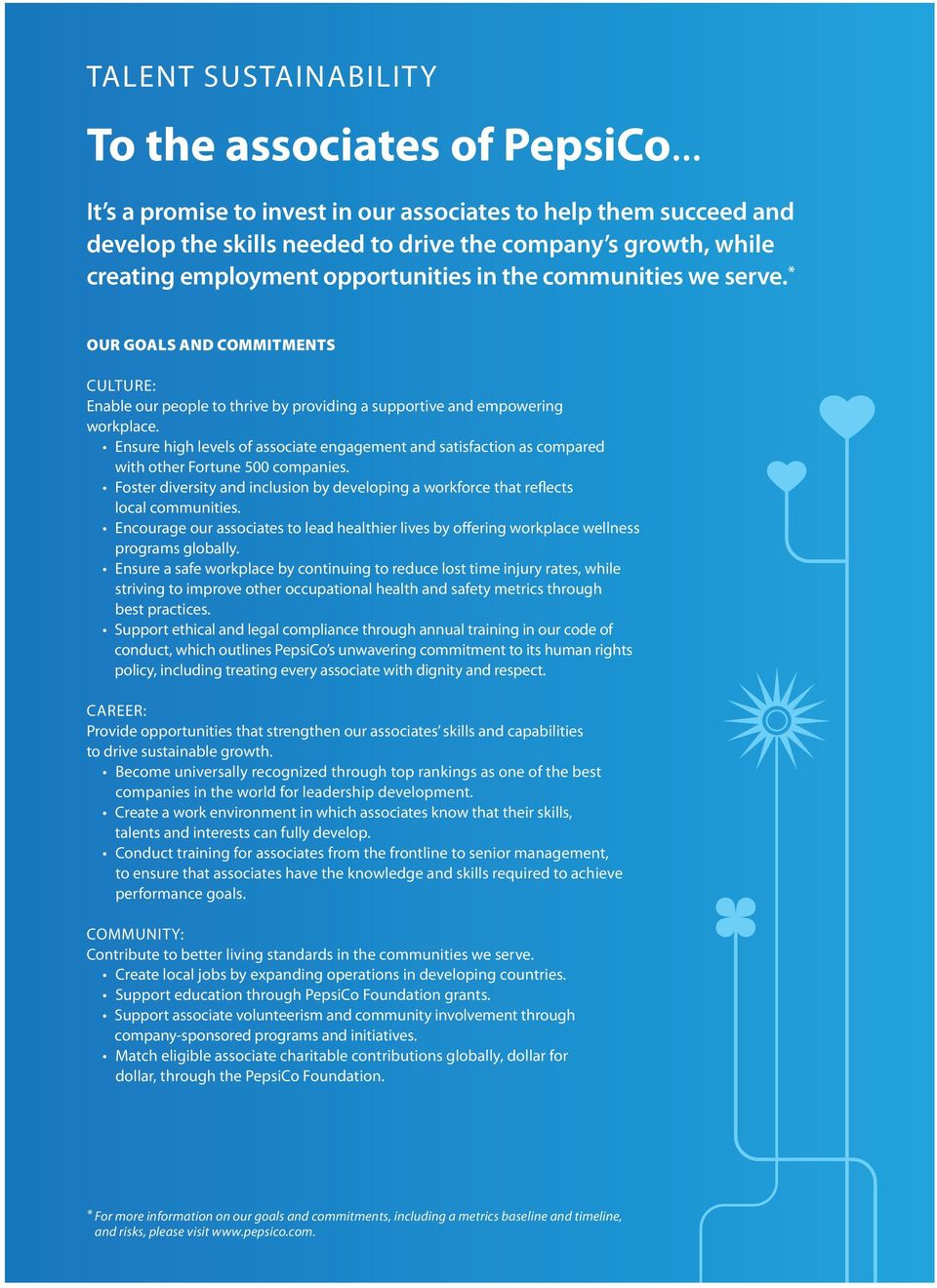
8 Indra K. Nooyi, Chairman and Chief Executive Officer Dear Fellow Shareholders, A Roman author said more than two millennia ago that anyone can steer the ship when the sea is calm. The true test of endurance and stamina, he went on, is to navigate through rough waters. Well, this year has seen some of the roughest possible waters. The economic tempest of 2008 turned into the perfect storm of Business was battered by volatile commodity costs, frozen credit markets, fluctuating currencies and negative GDP rates. At PepsiCo, it seemed as if each day brought a new challenge. Every one of them tested the strength and capabilities of our organization. And I can declare with great pride that we passed the test of endurance and stamina wonderfully well. We are a company with great resilience. The ability of our associates to pull together has left me excited about our momentum from 2009 into 2010 and beyond. I don t think this is due just to the ability of all the great people we have. I think our company is more than the sum of those considerable parts; we draw extra strength from the solid foundation of values and principles upon which PepsiCo is built. The business community and government did a great deal of soul-searching in the midst of the challenging global economy, seeking to uncover the source of our world s financial problems and how best to share responsibility to address the situation. As debates raged on issues that are core to a vibrant, functioning marketplace, it became increasingly clear as the year went on that corporate ethics are inexorably linked to a healthy economy. A former American president, Dwight Eisenhower, once said, A people that values its privileges above its principles soon loses both. The same is true of a company, and the past 18 months have proved the wisdom of the remark. Here at PepsiCo, we are fortunate to have embedded Performance with Purpose into our culture and fabric long before this current downturn. It is one of the fundamental factors that kept PepsiCo on the leading edge in Our basic belief that companies today must marry performance with ethical concerns is resonating more than ever before. For consumers, this translates into receiving value, both economic and social, from trusted brands. For governments and the wider public, it translates into responsibility. This acknowledges that businesses have a responsibility to the communities in which they operate, to the consumers they serve and to the environment whose resources they use. We provide great-tasting products, outstanding quality and supreme value to consumers worldwide, while maintaining an underpinning of integrity and responsibility. We have instilled this fundamental belief into all of our brands Quaker Oats, Tropicana, Sabritas, Walkers, Lay s, Gatorade and Pepsi-Cola, to name a few to ensure we offer consumers a diverse portfolio of enjoyable and wholesome nutritious foods and beverages. We take seriously our responsibility to find innovative ways to use less energy, water and packaging, our responsibility to hire local people in the communities where we operate, create products designed for local tastes, and partner with local producers and suppliers. And, we have expanded our responsibility to partner with local governments and NGOs to address the growing twin problems of malnutrition and obesity acute to different parts of the world. Performance with Purpose means that we will continue to bring together what is good for society and what is good for business. It encourages us to think globally while acting locally. It has helped us break into new regions and harness local products and talent to drive our growth. It drives our commitment to increase diversity in the workforce, enhancing our ability to 2 PepsiCo, Inc Annual Report
9 recruit the brightest and most talented associates from around the world. And it helps keep us focused on staying strong over the long term so that we are well-prepared to capitalize on all growth opportunities. Most importantly, the promise of PepsiCo is to continue to generate solid value for our shareholders. PEPSICO DELIVERED SOLID FINANCIAL PERFORMANCE IN 2009 Amidst the most challenging global macroeconomic environment in decades, we demonstrated the strength and resilience of both our people and portfolio by delivering solid operating performance and generating significant operating cash flow. Net revenue grew 5% on a constant currency basis.* Core division operating profit rose 6% on a constant currency basis.* Core EPS grew 6% on a constant currency basis.* Management operating cash flow, excluding certain items, reached $5.6 billion, up 16%.* And, we raised the annual dividend by 6%. Let me offer a few highlights from 2009: PepsiCo Americas Foods (PAF) had another exceptional year with strong net revenue and operating profit growth despite significant commodity inflation. We held or grew share across the region, sustaining consumer momentum with solid innovation and targeted value offerings. Although all of Europe was hit hard by the economic recession, PepsiCo Europe outpaced its peers and delivered solid results through excellent revenue management, tight cost controls and outstanding productivity. PepsiCo Asia Middle East and Africa (AMEA) had another excellent year, with solid net revenue and operating profit growth driven by strong volume growth across the region, with exceptional growth in our India beverage business. PepsiCo Americas Beverages (PAB), which faced considerable category pressures in North America, continued to make significant progress in rejuvenating the entire beverage portfolio. We successfully launched the Pepsi Refresh Everything campaign, gained traction on our Gatorade transformation to G, and brought exciting innovation to market with the launch of zero-calorie SoBe Lifewater and Trop50 orange juice beverage, both naturally sweetened with purified stevia extract. We also reached agreement on merging into PepsiCo our two anchor bottlers, Pepsi Bottling Group and PepsiAmericas, in order to create a more agile, efficient, innovative and competitive beverage system, which will enable us to extend our leadership position in the North American Liquid Refreshment Beverage business. With the merger of our anchor bottlers, PepsiCo will be a nearly $60 billion company in terms of annual revenue. We are the largest food and beverage business in North America and the second-largest food and beverage business in the world, making us a critical partner for all retailers. We will have a new business structure and, as outlined below, clear strategies to support continued strong growth growth that will enable us to continue to be both an attractive place to work and an attractive investment. STRATEGIES TO DRIVE OUR GROWTH We continue to focus on delivering top-quartile financial performance in both the near term and the long term, while making the global investments in key regions and targeted product categories to drive sustainable growth. The next chapter in our growth is founded on six long-term growth strategies: 1. Expand the Global Leadership Position of Our Snacks Business. PepsiCo is the global snacks leader, with the No. 1 savory category share position in virtually every key region across the globe. We have advantaged positions across the entire value chain in more than 40 developed and developing regions in which we operate as we capitalize on local manufacturing and optimized go-to-market capabilities in each region, as well as the ability to introduce locally relevant products using global capabilities. And we have significant growth opportunities as we expand our current businesses in these regions, extend our reach into new geographies and enter adjacent categories. Importantly, we will continue to make our core snacks healthier through innovations in hearthealthier oil, sodium reduction and the addition of whole grains, nuts and seeds. * Core results and core results on a constant currency basis are non-gaap measures that exclude certain items. Please refer to pages 91 and 92 for a reconciliation to the most directly comparable financial measure in accordance with GAAP. PepsiCo, Inc Annual Report 3

10 2. Ensure Sustainable, Profitable Growth in Global Beverages. The merger with our anchor bottlers creates a lean, agile organization in North America with an optimized supply chain, a flexible go-to-market system and enhanced innovation capabilities. When combined with the actions we are taking to refresh our brands across the entire beverage category, we believe this game-changing transaction will enable us to accelerate our top-line growth and also improve our profitability. We continue to see significant areas of global beverage growth, particularly in developing markets and in evolving categories. We will invest in those attractive opportunities, concentrating in geographies and categories in which we are the leader or a close second, or where the competitive game remains wide open. Additionally, we will use our R&D capabilities to develop low- and zero-calorie beverages that taste great and add positive nutrition such as fiber, vitamins and calcium. 3. Unleash the Power of Power of One. PepsiCo is in the unique position to leverage two extraordinary consumer categories that have special relevance to retailers across the globe. Our snacks and beverages are both high-velocity categories; both generate retail traffic; both are very profitable; and both deliver exceptional cash flow. The combination of snacks and beverages with our high-demand global and local brands makes PepsiCo an essential partner for largeformat as well as small-format retailers. We will increasingly use this portfolio and the high coincidence of consumption of these products through integrated offerings (products, marketing and merchandising) to create value for consumers and deliver greater top-line growth for retailers. We also will be accelerating Power of One supply chain and back-office synergies in many regions to improve profitability and enhance customer service. 4. Rapidly Expand Our Good-for-You Portfolio. PepsiCo currently has a roughly $10 billion core of Good-for-You products anchored by: Tropicana, Naked juice, Lebedyansky, Sandora and our other juice brands; Aquafina; Quaker Oats; Gatorade (for athletes); the new dairy joint venture with Almarai; and local Good-for-You products and brands. We will build on this core with an increasing stream of science-based innovation derived from the R&D capabilities that we have been ramping up over the past couple of years, as well as from targeted acquisitions and joint ventures. We will be investing to accelerate the growth of these platforms, and we will use the knowledge from these initiatives to improve our core snack and beverage offerings and also to develop highly nutritious products for undernourished people across the world. 5. Continue to Deliver on Our Environmental Sustainability Goals and Commitments. We are committed to protecting the Earth s natural resources and are well on our way to meeting our public goals for meaningful reductions in water, electricity and fuel usage. Our businesses around the world are implementing innovative approaches to be significantly more efficient in the use of land, energy, water and packaging and we are actively working with the communities in which we operate to be responsive to their resource needs. In 2009, we formalized our commitment to water as a human right, and we will focus not only on world-class efficiency in our operations, but also on preserving water resources and enabling access to safe water. Our climate change focus is on reducing our carbon footprint, including a reduction in absolute greenhouse gas emissions through continued improvement in energy efficiency and the use of alternative energy sources. We actively work with our farmers to promote sustainable agriculture and we are developing new packaging alternatives in both snacks and beverages to reduce our impact on the environment. 6. Cherish Our Associates and Develop the Leadership to Sustain Our Growth. We have an extraordinary talent base across our global organization in our manufacturing facilities, our sales and distribution organizations, our marketing groups, our staff functions and with our general managers. As we expand our businesses, we are placing heightened focus on ensuring that we maintain an inclusive environment and on 4 PepsiCo, Inc Annual Report

11 developing the careers of our associates all with the goal of continuing to have the leadership talent, capabilities and experience necessary to grow our businesses well into the future. As an example, we are implementing tailored training programs to provide our managers and senior executives with the strategic and leadership capabilities required in a rapidly changing environment. These six strategies are being implemented across PepsiCo by our experienced leadership team that is geographically focused and coordinated through global centers of excellence and global functional leadership. John Compton, a 26-year PepsiCo veteran, leads PepsiCo Americas Foods, which spans all of our snack and food businesses in the Americas. PepsiCo Americas Beverages, which encompasses our beverage businesses across the Americas, is led by Eric Foss and Massimo d Amore. Eric has 28 years in the PepsiCo family and brings extensive operational experience to his role as the leader of our bottling company. Massimo, with his 30 years in the global consumer space and 15 years with PepsiCo, provides leadership for all brands as well as operational leadership for Gatorade, Tropicana and our Latin America franchise business. Zein Abdalla, with more than 30 years in consumer goods and more than 14 years with PepsiCo, leads our food and beverage business in Europe. Saad Abdul-Latif, a 28-year veteran of PepsiCo, leads our food and beverage businesses in Asia, Middle East and Africa, our fastest-growing regions. These general managers are supported by functional leaders and other executives who ably manage every aspect of our growing enterprise. Taken together, our top 15 leaders have more than 260 years of combined experience in the consumer space, with an average of 18 years each! It is the true dedication, commitment, hard work and unity of purpose of PepsiCo s management teams, combined Our sincerest thanks... During his 20-year career at PepsiCo, Mike White contributed significantly to PepsiCo as CFO of Frito-Lay, CFO of Pepsi-Cola Company worldwide, CFO of PepsiCo, CEO of Frito-Lay Europe and then CEO of PepsiCo International. He served admirably as PepsiCo s Vice Chairman from , and played a major role in executing many of the company s acquisitions during that time. All of us at PepsiCo from the Board to the Executive Team to the countless others he supported and mentored thank Mike for his many contributions to PepsiCo and wish him and his family the very best. with our solid foundations for growth, that give me great optimism for 2010 and beyond. While we cannot underestimate the challenges that lie ahead as countries, businesses and consumers around the world begin to recover from what has been a turbulent and traumatic 18 months, I am confident that PepsiCo is starting from a strong position financially, operationally and culturally. Our commitment to the principles and values of Performance with Purpose has helped us earn trust and respect from our consumers and partners, and the communities in which we operate across the world. By staying true to this foundation and continuing to execute on our strategies, we are sure that PepsiCo will continue to provide long-term sustainable growth for all stakeholders. The Performance with Purpose initiatives that we have chosen to showcase in this year s annual report demonstrate that what s right for society is also what s right for business. It is a belief to which we are deeply committed. It has stood the test in difficult years, and we believe it will stand the test of time to come. INDRA K. NOOYI Chairman and Chief Executive Officer PepsiCo, Inc Annual Report 5

12 Financial Highlights PepsiCo, Inc. and subsidiaries (in millions except per share data; all per share amounts assume dilution) Summary of Operations Chg (a) Chg Constant Currency (a)(e) Core Earnings Per Share* Management Operating Cash Flow, Excluding Certain Items** (in millions) Total net revenue $43,232 $43,251 % 5 % Core division operating profit (b) $«««8,647 $««8,499 2% 6 % $3.37 $3.68 $3.71 $4,573 $4,831 $5,583 Core total operating profit (c) $«««7,856 $««7,848 % Core net income attributable to PepsiCo (c) $«««5,846 $««5,887 (1)% Core earnings per share (c) $««««««3.71 $««3.68 1% 6 % Other Data Management operating cash flow, excluding certain items (d) $«««5,583 $««4,831 16% Net cash provided by operating activities $«««6,796 $««6,999 (3)% Capital spending $«««2,128 $««2,446 (13)% Common share repurchases $«««««««««««$««4,720 n/m Dividends paid $«««2,732 $««2,541 8% Long-term debt $«««7,400 $««7,858 (6)% (a) Percentage changes are based on unrounded amounts. (b) Excludes corporate unallocated expenses, restructuring and impairment charges and PBG and PA S merger costs. See page 91 for a reconciliation to the most directly comparable financial measure in accordance with GAAP. (c) Excludes restructuring and impairment charges, PBG and PAS merger costs and the net mark-to-market impact of our commodity hedges. See pages 91 and 92 for a reconciliation to the most directly comparable financial measure in accordance with GAAP. (d) Includes the impact of net capital spending, and excludes the impact of a discretionary pension contribution, cash payments for PBG and PA S merger costs and restructuring-related cash payments. See also Our Liquidity and Capital Resources in Management s Discussion and Analysis. See page 92 for a reconciliation to the most directly comparable financial measure in accordance with GAAP. (e) Assumes constant currency exchange rates used for translation based on the rates in effect in See pages 91 and 92 for a reconciliation to the most directly comparable financial measure in accordance with GAAP. 07 Cumulative Total Shareholder Return Return on PepsiCo stock investment (including dividends), the S&P 500 and the S&P Average of Industry Groups.*** $250 $200 $150 $100 $50 $ *See page 92 for a reconciliation to the most directly comparable financial measure in accordance with GAAP PepsiCo, Inc. S&P 500 S&P Average of Industry Groups*** ***The S&P Average of Industry Groups is derived by weighting the returns of two applicable S&P Industry Groups (Non-Alcoholic Beverages and Food) by PepsiCo s sales in its beverage and foods businesses. The returns for PepsiCo, the S&P 500 and the S&P Average indices are calculated through December 31, Dec-04 Dec-05 Dec-06 Dec-07 Dec-08 Dec-09 PepsiCo, Inc. $100 $115 $124 $154 $114 $131 S&P 500 $100 $105 $121 $128 $ 81 $102 S&P Avg. of Industry Groups*** $100 $ 97 $113 $125 $103 $ **See page 92 for a reconciliation to the most directly comparable financial measure in accordance with GAAP. PepsiCo Estimated Worldwide Retail Sales: $108 Billion Includes estimated retail sales of all PepsiCo products, including those sold by our partners and franchised bottlers. Net Revenues 16% 23% 13% 48% PepsiCo Americas Foods 48% PepsiCo Americas Beverages 23% PepsiCo International 29% Europe 16% AMEA 13% Mix of Net Revenue 37% 63% Food 63% Beverage 37% 6 PepsiCo, Inc Annual Report 52% 48% U.S. 52% Outside the U.S. 48% Pro Forma Revenue Percentage by Segment 10% PepsiCo Americas Foods 36% 36% PepsiCo Americas Beverages 38% 16% PepsiCo International 26% 38% Europe 16% AMEA 10% The above pro forma 2009 revenue chart has been prepared to illustrate the effect of the PBG and PAS mergers as if the mergers had been completed as of the beginning of PepsiCo s 2009 fiscal year. The pro forma revenue presented above is not indicative of the future operating results or financial position of PBG, PAS and PepsiCo and is based upon preliminary estimates. The final amounts recorded may differ from the information presented and are subject to change.

13 PepsiCo Mega-Brands PepsiCo, Inc. has 19 mega-brands that generate $1 billion or more each in annual retail sales (estimated worldwide retail sales in billions). Mountain Dew / Mtn Dew Lay s Potato Chips Gatorade (Thirst Quencher, G2, Propel) Diet Pepsi Tropicana Beverages 7UP (outside U.S.) Doritos Tortilla Chips Lipton Teas (PepsiCo/Unilever Partnership) Quaker Foods and Snacks Cheetos Cheese Flavored Snacks Mirinda Ruffles Potato Chips Aquafina Bottled Water Pepsi Max Tostitos Tortilla Chips Sierra Mist Fritos Corn Chips Walkers Potato Crisps Pepsi-Cola $0 $5 $10 $15 $ Scorecard 5% 6% % Volume 6% Core Constant Currency Earnings Per Share* Constant Currency Net Revenue* 15% Total Return to Shareholders Core Constant Currency Division Operating Profit* *See pages 91 and 92 for a reconciliation to the most directly comparable financial measure in accordance with GAAP. Top Product Rankings Lay s #1 Potato Chip* 26% Lebedyansky #1 Juice in Russia ** Doritos #1 Flavored Tortilla Chip* #1 Tropicana Pure Premium #1 Orange Juice* Pepsi #1 Carbonated Beverage in Canada** Cheetos #1 Cheese Puff* Sabritas #1 Potato Chip in Mexico** Lipton #1 Ready-to-Drink Tea* Quaker Oatmeal #1 Hot Cereal* Core Return on Gatorade #1 Sports Drink* Invested Capital* Walkers #1 Potato Chip in United Kingdom** Tostitos #1 Unflavored Tortilla Chip* Smith s #1 Potato Chip in Australia** *U.S. (Source: IRI GDMxC 52 weeks ending 12/27/09) Based on Dollar Sales **International (Source: Nielsen All Outlets 52 weeks ending 10/31/09) PepsiCo, Inc Annual Report 7

14 Encourage Healthier Choices In a world where people are both undernourished and overweight, we continue to expand our portfolio to better align with health and wellness wants and needs. In addition, we are investing in our products and rethinking how they are made increasing the use of whole grains, fiber, fruits and select vitamins and minerals, while reducing saturated fat, sodium and added sugar. By doing so, we believe we will increase our global growth and enable customers and consumers to choose the nutritional benefits of healthier foods and beverages. Our increased commitments to nutrition education, more transparent labeling, responsible marketing, and partnerships advocating basic facts about nutrition and exercise help people and communities make healthier, more informed choices. And that will make for healthier people and healthier communities.
15

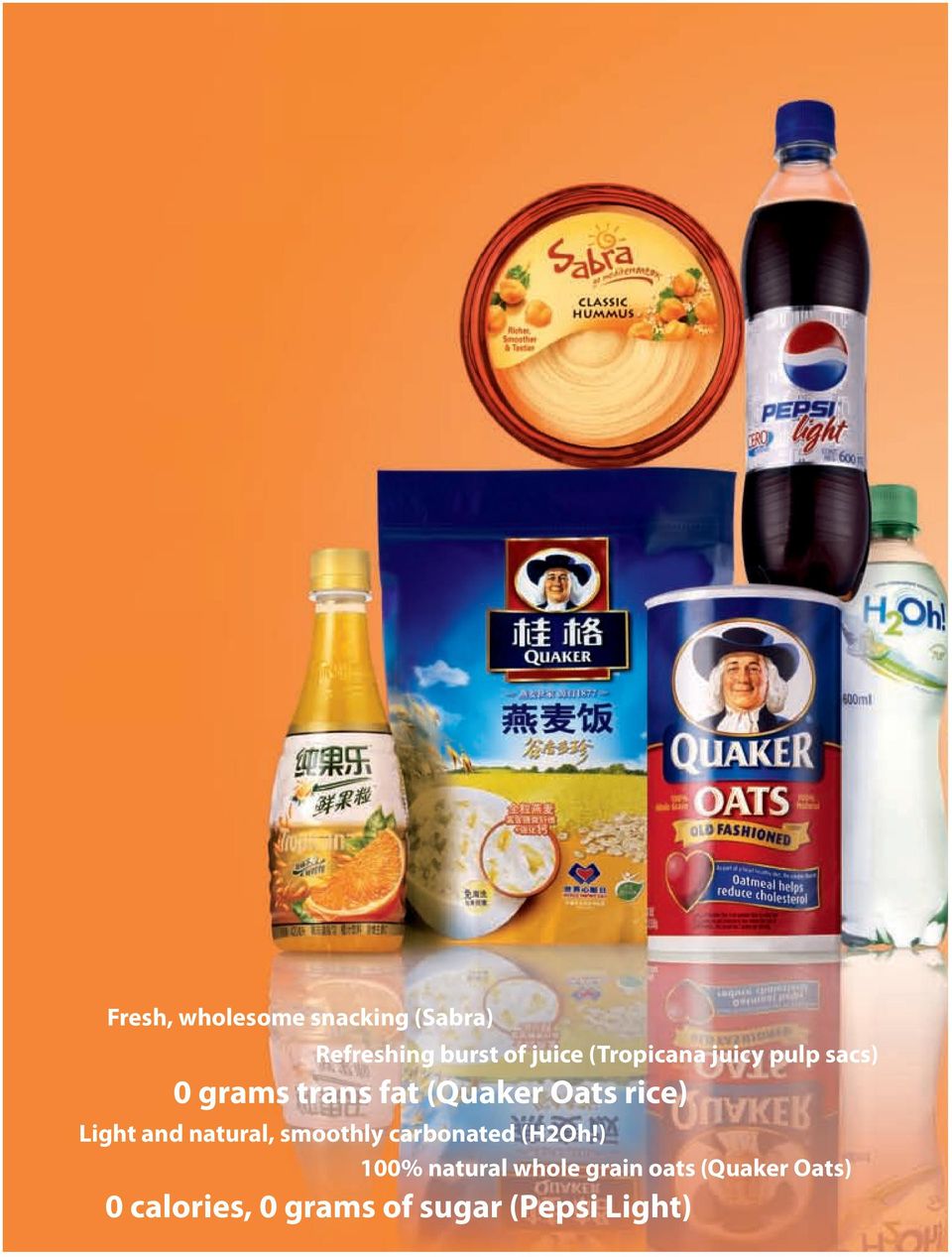
16 Fresh, wholesome snacking (Sabra) Refreshing burst of juice (Tropicana juicy pulp sacs) 0 grams trans fat (Quaker Oats rice) Light and natural, smoothly carbonated (H2Oh!) 100% natural whole grain oats (Quaker Oats) 0 calories, 0 grams of sugar (Pepsi Light)
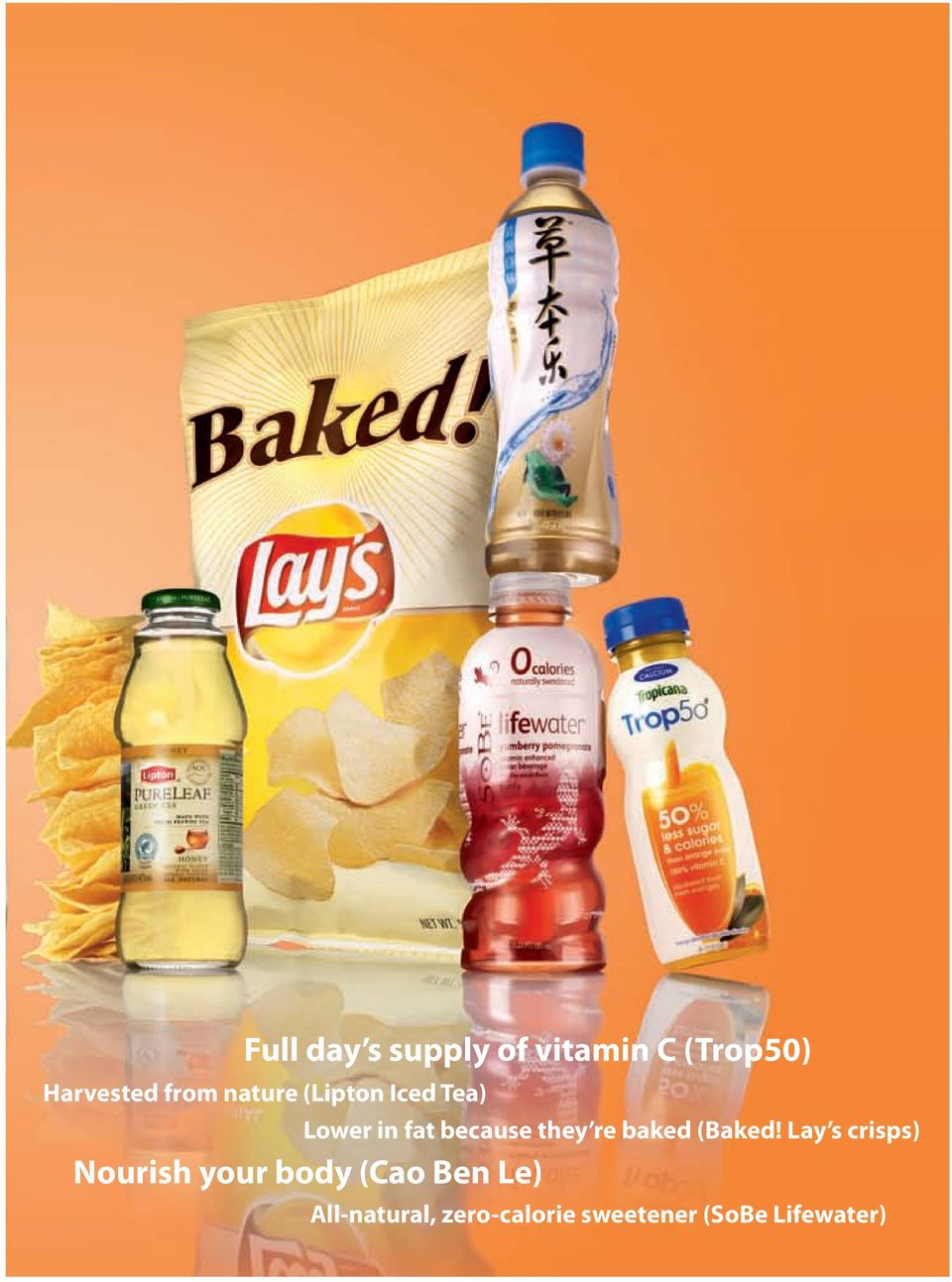
17 Full day s supply of vitamin C (Trop50) Harvested from nature (Lipton Iced Tea) Lower in fat because they re baked (Baked! Lay s crisps) Nourish your body (Cao Ben Le) All-natural, zero-calorie sweetener (SoBe Lifewater)
18 A Sports Performance Innovator Athletes look for a competitive edge that helps them get the most out of their bodies. And Gatorade is once again setting the bar with a new series of products specially formulated to support performance and meet the diverse needs of athletes. Scientists from the Gatorade Sports Science Institute have created the G-Series an innovative line of products designed with the latest sports performance science in mind, and developed in collaboration with the world s greatest athletes, to provide fuel, fluid and nutrients before, during and after activity. Gatorade Prime 01 delivers pre-game fuel in a convenient 4-ounce pouch, and blends carbohydrates, B vitamins and electrolytes to provide rapidly available energy. During training or competition, athletes rely on Gatorade Perform 02 the trusted Gatorade Thirst Quencher to refresh, rehydrate and refuel. And after exercise or activity, Gatorade Recover 03 rehydrates the body and provides protein for muscles to get athletes ready for the next workout. Athletes can use G-Series beverages individually or in sequence to meet all their sports nutrition needs. With only 20 calories per 8-ounce serving, G2 delivers the same electrolytes as Gatorade to help maintain hydration. An essential training partner, this great-tasting sports drink is helping millions bring out their inner athlete by rehydrating and fueling working muscles during shorter or lower-intensity workouts. Its performance has been a bright spot in 2009, with approximately 12 percent volume growth, demonstrating its real potential as a scalable global brand. After earning top honors for most successful new product in the 2008 IRI New Product Pacesetters Report, G2 now appears in Ad Age s prestigious Marketing Top 50 list of top brands.

19 Better Choices From Morning to Night The choices consumers make, and the PepsiCo products they buy, reflect not just who and where they are, but also what they enjoy throughout the day. After all, when they eat better, they feel better. That s why our portfolio offers diverse choices that deliver convenience, affordability and great taste. For years, we ve been working to provide healthier snack and food choices for every occasion. Frito-Lay led the industry as the first to remove trans fats from all its snack chip products. Today, whether it s Quaker Oatmeal or Lay s potato chips, consumers around the world can choose products that are right for them and good for their families. Parents can send their kids to school with our Quaker Chewy Bar, a nutritious whole grain snack that contains no high fructose corn syrup. For an afternoon snack, a Quaker Galletas de Avena cookie delivers enjoyment with wholesome ingredients. For dinner, Near East Pearled Couscous gives families the casual elegance of a chef-made, budget-friendly meal while dining at home. And for daytime snacks or late-night gatherings, new Grain Waves with wholesome corn, wheat and oats gives adults a healthier option. Choices like these along with active lifestyles make it easier for consumers to enjoy the foods they like and achieve the energy balance they need to lead active lifestyles. Visit Near East Recipes, Frito-Lay North America began to produce potato chips with sunflower oil in 2006; since then it has reduced saturated fats by 50 percent and removed trans fats from all products. Between 2003 and 2008 in the United Kingdom, our business reduced saturated fats in Walkers snacks and crisps by percent, and salt levels by percent. PepsiCo, Inc Annual Report 11

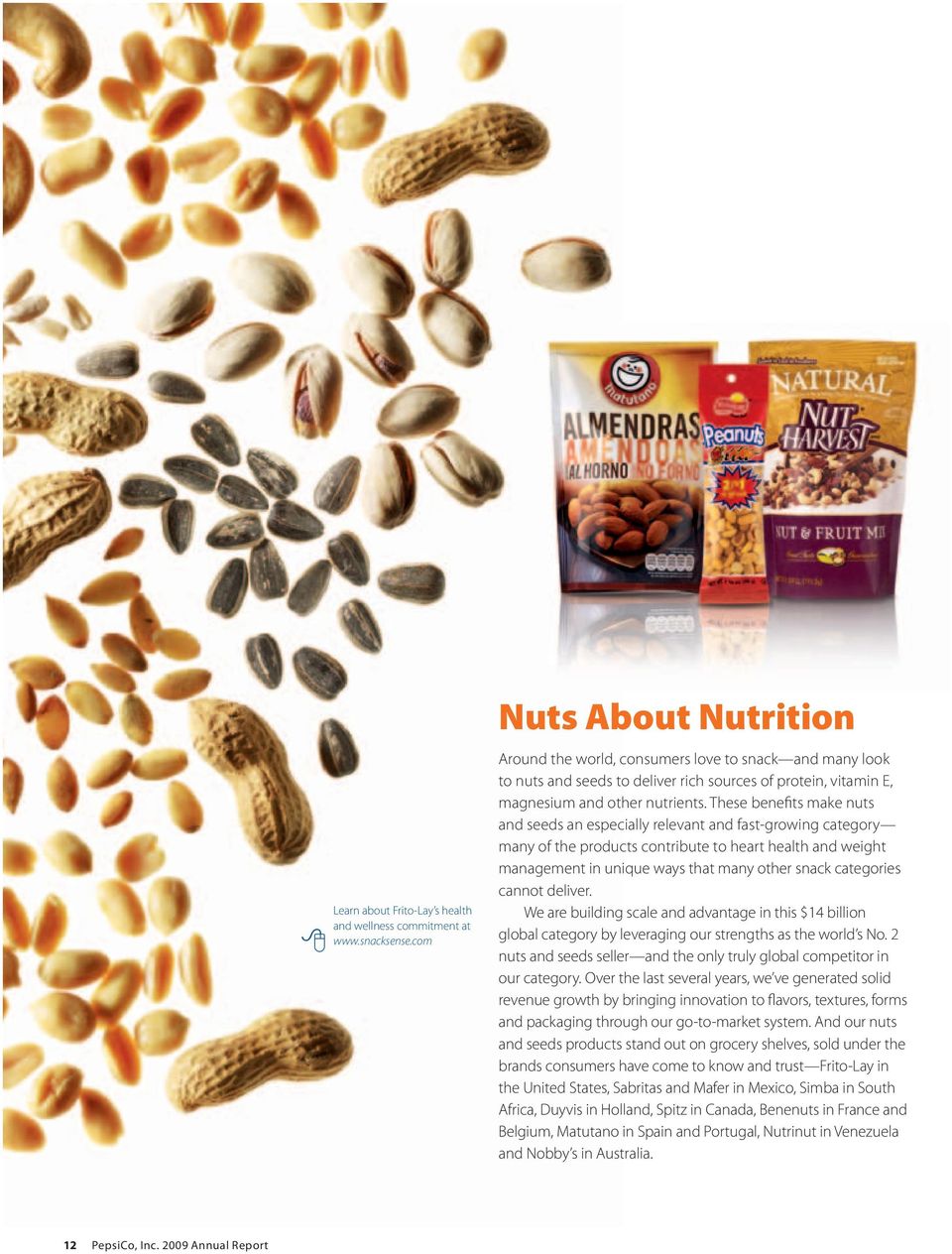
20 Learn about Frito-Lay s health and wellness commitment at 8 Nuts About Nutrition Around the world, consumers love to snack and many look to nuts and seeds to deliver rich sources of protein, vitamin E, magnesium and other nutrients. These benefits make nuts and seeds an especially relevant and fast-growing category many of the products contribute to heart health and weight management in unique ways that many other snack categories cannot deliver. We are building scale and advantage in this $14 billion global category by leveraging our strengths as the world s No. 2 nuts and seeds seller and the only truly global competitor in our category. Over the last several years, we ve generated solid revenue growth by bringing innovation to flavors, textures, forms and packaging through our go-to-market system. And our nuts and seeds products stand out on grocery shelves, sold under the brands consumers have come to know and trust Frito-Lay in the United States, Sabritas and Mafer in Mexico, Simba in South Africa, Duyvis in Holland, Spitz in Canada, Benenuts in France and Belgium, Matutano in Spain and Portugal, Nutrinut in Venezuela and Nobby s in Australia. 12 PepsiCo, Inc Annual Report
21 Giving Beverages a Boost Around the world, consumers are discovering new enhanced beverages that deliver more than just great taste and refreshment. They re choosing juices, enhanced waters and other noncarbonated beverages for their natural ingredients and benefits. In Russia, where we are the No. 1 juice business, our Lebedyansky juice company has introduced new products and strengthened its go-to-market system to meet this growing demand. Health-conscious consumers are reaching for Tonus Active Plus, a new line of juices from Lebedyansky that bring them a variety of benefits. Whether they seek a healthy immune system with AntiOx, improved digestion with BioFiber or nutrient-based energy with Power-C, they re making juices a part of their active lifestyles. We are also growing our beverage portfolio in China with a variety of locally designed and developed products. Xian Guo Li is emerging as a juice beverage of choice made with new seasonal juices and juicy pulp sacs, while Cao Ben Le ( happy herb ) drinks incorporate familiar Chinese medicinal herbs like red dates and chrysanthemums. These products helped our non-carbonated portfolio grow sales by 45 percent in China. PepsiCo, Inc Annual Report 13
22 In Dallas, working out of kid-friendly, PepsiCo Hopebranded trucks, our team entered underprivileged neighborhoods where children do not have access to traditional summer programs. It delivered nutritious breakfasts that included milk, an apple and a Quaker Oatmeal bar and snacks consisting of a Tropicana juice and a baked Frito-Lay product. Hope for Accessible Nutrition PepsiCo is promoting healthy eating worldwide by developing new products rich in whole grains, fruits, vegetables, fiber, key vitamins and nutrients. We also are taking aim at a much broader issue: how to bring sustainable nutrition to the world s most vulnerable and underserved populations. In the United States, PepsiCo Hope is our initiative to improve access to nutrition in urban communities. In partnership with Central Dallas Ministries, PepsiCo Hope in 2009 piloted a mobile feeding program in Dallas, Texas, delivering more than 50,000 nutritious breakfasts and snacks including many PepsiCo products to underserved children. Additionally in 2009, the PepsiCo Foundation contributed more than $3 million to key academic and community organizations working to address nutritional challenges in the United States. These organizations included Tufts University Friedman School of Nutrition, Children in Balance and the National Council of LaRaza, Cuidemos Nuestra Salud. We re also pursuing sustainable nutrition initiatives internationally as a first step to understand how local food quality, price and access can contribute to hunger and malnutrition. Along with global and local partners, we are developing locally relevant fortified products and will use our supply chain to distribute them to hardto-reach communities in such countries as Nigeria and India. Supporting international efforts to address chronic hunger in underserved communities, the PepsiCo Foundation disbursed close to $4 million in grants during 2009 to organizations including the World Food Programme and Save the Children. 14 PepsiCo, Inc Annual Report
23 From Global Brands to Local Flavors Our global brands win consumers trust with their quality and taste. We further deepen our relationships with consumers through our local brands that appeal to their unique cultural norms, tastes and aspirations. In Russia, we established our relationship with consumers 50 years ago when we introduced them to Pepsi. At the start of 2009, we added to our success in Russia with the launch of Lay s red-caviar-flavored chips, which presented a uniquely Russian flavor that s a traditional symbol of the New Year holidays. In the vibrant markets east of the Middle East, we brought enjoyment, freshness and nutrition to family tea time with Aliva, a new biscuit that combines wheat and lentils with the authentic local savory or sweet flavors that families in India prefer. We also introduced Nimbooz lemon drink, our own version of India s homemade Nimbu Pani, allowing consumers of all ages to enjoy the goodness of lemon juice with no fizz, no artificial flavors and the trustworthiness of our local brand. Much of this innovation stems from the work of our local research teams, which draw on their social, cultural and nutritional knowledge to extend product lines and create new ones. PepsiCo also created platforms for future innovation of more nutritious, locally relevant products. In 2009, we established a joint venture with Calbee Foods, Japan s leading snack company, and we acquired Amacoco, Brazil s largest coconut water company. Russia Russians got their first taste of Pepsi-Cola in 1959, and it would become the first Western consumer product produced and sold in the USSR. In 2009, PepsiCo announced that it will invest $1 billion in Russia over three years to expand manufacturing and distribution capacity there and introduce agricultural technology to ensure the highest crop yields and quality standards. This investment is expected to create 2,000 jobs. Dubai In 2009, PepsiCo and Dubai Refreshments Company celebrated 50 years of distributing beverages in Dubai and the Northern Emirates. As the economy of Dubai has grown, distribution of PepsiCo beverages has increased dramatically. PepsiCo, Inc Annual Report 15
24 Contribute to a Healthier Planet We believe that we will do better by doing good for the planet that there is a close connection between productive operations and environmental stewardship. We are rethinking the way we operate our business to minimize our impact on the environment by finding innovative ways to grow, source, make, package and transport our foods and beverages. We are reaching out to local farmers, governments and community groups to improve agricultural practices and improve crop yields through advanced agricultural technologies and practices. We are forming local partnerships to better manage watersheds and improve access to safe water. We are deploying processes and technologies that reduce the amount of energy and water required to manufacture our products, and that make use of alternative energy sources. This careful management of resources drives healthy business results and helps create a healthier future for our planet.
25
26 First national beverage brand with a 100% recycled PET bottle (Naked Juice) First national juice brand in the U.S. to publish a third-party verified carbon footprint (64 oz. Tropicana Pure Premium Original Orange Juice) 100% British-grown potatoes (Walkers crisps) Launched the lightest-weight national brand water bottle in the U.S. in 2009 (Aquafina)
27 Degrades when exposed to air (Stila) 20% less plastic in packaging than the leading competitor (Lipton) First fully compostable chip bag of its kind (SunChips snacks) 33% reduction in overall packaging materials (Quaker Chewy Rip n Go) Uses solar-generated steam to help cook the snacks at the Modesto, CA plant, one of eight SunChips plants nationwide (SunChips snacks)
28 A Green Future We operate in local communities around the world, and we re investing in innovative ways to minimize our environmental impact. We re building facilities that conserve energy and raw materials and reduce waste. And across our operations, we re working with environmental organizations to understand local ecological challenges and apply advanced, scientifically based practices to address them. In 2009, we introduced new Sustainable Engineering Guidelines that apply to our new construction and major reengineering projects worldwide. In the United States, our corporate facility in Chicago meets Leadership in Energy and Environmental Design (LEED) standards for efficient and sustainable energy use and materials. And in Chongqing, China, we opened a new beverage facility designed to use 22 percent less water and 23 percent less energy than the average PepsiCo plant in China. The plant uses its innovative environmental management system to monitor water and energy use on every production line and every piece of equipment in real time. These technologies will help the plant reduce carbon emissions by an estimated 3,100 tons and conserve 100 million liters of water each year. Working with national and local governments, we also established environmental and investment strategies for each region based on local needs. In the Netherlands, we are working with the local government and nearby companies to investigate how we can increase the amount of sustainable energy we produce instead of buying only renewable energy. Through these and other environmentally responsible practices, we are pursuing our goals to reduce our consumption of water by 20 percent, electricity by 20 percent and fuel by 25 percent per unit of production by 2015, compared with our 2006 consumption. The PepsiCo Chicago Sustainability Center was one of a select group of 21 buildings around the world in April 2009 to achieve LEED Commercial Interior Platinum certification from the U.S. Green Building Council (USGBC). Its unique design features include seating made from 100 percent post consumer recycled beverage bottles and flooring, carpeting and other materials that incorporate oat hulls from the Quaker Cedar Rapids plant. 18 PepsiCo, Inc Annual Report
29 Breaking Ground with Sustainable Packaging Packaging gives consumers a window into their favorite PepsiCo products, carrying everything from nutrition labels to special offers. It can also reflect our commitment to a sustainable future. We re looking at every part of the packaging process from the way we select and design packages to how we procure and dispose of them. And we continue to pursue innovative ways to reduce total volume, recycle containers, use renewable resources and remove environmentally sensitive materials. In Mexico, we implemented the use of oxodegradable packaging for Stila baked snacks that reduces waste by degrading when exposed to air. Frito-Lay has partnered with Terracycle to collect and extract materials from its snack chip bags for reuse in other consumer products. In 2010, we will launch SunChips 10.5-ounce bags made from plant-based renewable materials, which are fully compostable in a hot, active compost pile. In the beverage aisle, consumers are reaching for lighter packaging for Lipton Iced Tea in Russia, and the new Eco-Fina Bottle of Aquafina water, which contains 50 percent less plastic than our 2002 bottle saving 75 million pounds of plastic each year. We are leading the industry in the use of post-consumer recycled PET. We incorporate 10 percent recycled PET content in our carbonated soft drink (CSD) plastic bottles in the United States. The new 32-ounce bottles of Naked Juice renewabottle is made from 100 percent post-consumer recycled PET resin, a first for a nationally distributed brand in the United States. PepsiCo, Inc Annual Report 19
30 Every Drop Counts We recognize water as a basic human right. It is essential to our food and beverage business. That s why our goal is to achieve positive water balance across all our businesses. For every liter of water we use, we intend to return one to the earth. Our India beverage operations have already met the challenge. In a region where monsoon rains can provide a much-needed source of water, our manufacturing plants collect rainwater from their roofs and use it to rejuvenate surrounding aquifers so communities can access safe water and rural farmers can grow more crops. We re also partnering with nongovernment organizations in such water-stressed regions as India, China, Ghana and Brazil to help install irrigation systems, improve sanitation programs and construct community cisterns. In addition, we re also employing a variety of water conservation techniques ourselves and sharing others with local farmers and communities. In the United States, our conservation programs are saving billions of liters of water. We are cleaning Gatorade bottles with purified air rather than water. We are using advanced filtration systems to recycle and reuse approximately 80 percent of the processed water used in production at our Frito-Lay facility in Arizona. In the United Kingdom, our Walkers business is working to capture the water in potatoes and use it to make our facilities self-sufficient for water. And in China, we re pioneering new agricultural methods to reduce the water used to grow the potatoes for Lay s potato chips by more than half. These efforts are no drop in the bucket. So far, we ve saved billions of liters of water. But water will always be scarce, and we re determined to do more. Optimizing our efficient use of water is good for people, good for the planet and good for business.
31 Cultivating Local Opportunity At PepsiCo, our agricultural heritage gives us a healthy respect for the grains, fruits, vegetables and nuts that deliver great taste and nutrition. We rely on local farmers to supply our network of global facilities with high-quality fruits and vegetables. These strong partnerships help us ensure consistent freshness and quality, increase crop yields, reduce our carbon footprint and support families and communities. In Mexico, Sabritas creates a reliable and sustainable market for small and mid-sized corn farmers. We invited them to become Sabritas supply chain partners and are working with the local Educampo Program to provide the seeds, fertilizers, agrochemicals and water usage guidelines that help farmers produce abundant crops. This educational, technical and financial support is enabling 297 producers in poor farming communities to cultivate new economic and social development opportunities while increasing their average crop yield by more than 165 percent. Similar agricultural programs are reaping positive results in other countries as well. In Russia, when the economic downturn restricted available credit, we kept local farmers afloat with microcredits, payments for crops, seed credits and leases for agricultural machinery. Our agro-manager teams also consulted with farmers and shared best practices. And in Inner Mongolia, China, we introduced proven environmentally friendly irrigation and crop rotation practices that save water and help local potato farmers grow thriving crops in the middle of the desert. These farmers are better able to make a sustainable living by selling their crops at competitive prices. PepsiCo, Inc Annual Report 21
32 A Big Step Toward a Reduced Carbon Footprint Market leadership is a familiar position for the Tropicana brand. So it s no surprise that North America s juice leader would also become the first brand in the United States to certify with the Carbon Trust the carbon footprint of a product in this case a 64-ounce carton of Tropicana Pure Premium orange juice. To measure its footprint, Tropicana partnered with third-party experts at the Columbia Earth Institute and the Carbon Trust to study every facet of the product lifecycle from growing and squeezing oranges to getting the juice to the store shelf. The analysis found that each halfgallon carton of orange juice generates about 3.75 pounds (1.7 kilograms) of total carbon dioxide emissions. This research is helping the brand improve its agricultural, manufacturing, transportation and packaging processes, all while still delivering a delicious and healthy orange juice. We have completed similar projects with other products, including Walkers Crisps, which has reduced its carbon footprint by 7 percent since Just as consumers can use this data to monitor their own carbon footprints, we will use it as a benchmark for measuring carbon emissions going forward. It will also help guide us as we make our operations more energy efficient and further reduce our environmental footprint. 22 PepsiCo, Inc Annual Report
33 Reducing Waste We are working to reduce our impact on landfills around the globe. PepsiCo UK pledged in 2008 to achieve zero landfill waste across its total supply chain within 10 years. To date, it has focused on reducing waste at its manufacturing sites. With aggressive programs to recycle and reuse materials, eight of these sites in 2009 had already met their goal of zero landfill waste. The strong support of frontline associates was integral to each plant s success, and PepsiCo UK is trying to extend its pledge across its supply chain. The plants began by appointing marshals to help identify the different waste streams, oversee correct removal and educate frontline associates on the need to recycle. In Cupar, Scotland, the Quaker Oats factory replaced multiple contractors with a single partner who helped guide its waste strategy. Similar programs are in place in the United States at Quaker, Tropicana and Frito-Lay, where the businesses are recycling more byproducts and also promoting household recycling. Quaker Oats is using 100 percent of the oat, incorporating oat kernels into whole grain foods while converting the outer hulls of oats into renewable biomass energy. This practice, in turn, keeps waste from the milling process out of local landfills. Tropicana launched a recycling initiative with Waste Management and its carton suppliers that increased access to curbside recycling of juice cartons nationwide by 26 percent in Quaker is using the power of the oat to fuel a local university. The Quaker Cedar Rapids plant is converting oat hulls into a biomass alternative energy source that supplies 14 percent of the University of Iowa s power. PepsiCo, Inc Annual Report 23
34 Promote Empowerment, Engagement and Growth At the heart of PepsiCo are our people, on whom our growth depends. We continue to invest in our associates to help them develop their skills and to sustain PepsiCo s leadership pipeline. We also are focused on increasing associate engagement and satisfaction so that we maintain our position as an employer of choice. By providing good jobs, an inclusive workplace, training and development, career opportunities, benefits and wellness programs, we participate in building a brighter future for associates and their families worldwide. Our goal is to foster the workplace culture, career growth and community involvement that enable our associates globally to thrive at work and at home. And that helps make PepsiCo and the communities we serve healthier.
35
36 The perfect size chip every time* (Tostitos) * Associate Testimonials Good traditional taste that people like* (Mirinda) Prompting millions of Brits to smile* (Walkers) Tastes better than homemade* (Tostitos Restaurant Salsa) It feels really good to know you re eating natural ingredients* (Red Sky) We all love the refreshing taste of Frustyle* (Frustyle)
37 Like drinking fresh fruit from a glass* (Dole) The perfect mix of sweet and salty* (Rold Gold pretzels) Helped me finish my first-ever marathon* (Gatorade) By far the best chip ever* (Lay s) I love that we can now get the benefits of Quaker Oatmeal in a pancake* (Quaker Pancakes) A Pepsi always brightens my day* (Pepsi)
38 Strength on Strength In 2009, we embarked on a gamechanging initiative with the acquisitions of our anchor bottlers Pepsi Bottling Group and PepsiAmericas an event that was designed to create a fully integrated beverage system in North America. With the completion of the acquisitions in the first quarter of 2010, we are ready to reinvent the beverage business. When you combine our current work on refreshing our brands across the entire beverages category with 80 percent ownership of our bottling network, you get a sum greater than the parts. We now have a united beverage company that is ready to face the challenges of today s market. For our customers, we re creating a nimble, responsive and effective beverage system able to bring a wider variety of products to market more quickly and efficiently with greater flexibility. For our associates, we re building upon a high-performance culture, grounded in respect and appreciation for one another and the people and the communities we serve. Moving forward, we ll be providing greater opportunities for both personal and career growth in a global organization with world-class capabilities. Simply stated we will be better able to delight consumers with the brands they love, to grow our customers businesses and to enable associates to build their careers. We will be better able to create value for PepsiCo shareholders and to improve the communities in which we work. Delivering Success for Four Generations Independent bottlers and distributors play a vital and integral role in the PepsiCo enterprise, and there s no replicating the experience and knowledge that thirdand fourth-generation bottlers contribute. Our partnership with the Minges Bottling Group began in Since then, four generations have worked with passion, determination and fortitude to deliver the brand they love throughout eastern North Carolina. Selling Pepsi-Cola is one of the most exciting things anybody could ever do, said CEO Jeff Minges. Our whole family s identity is Pepsi-Cola, and we re proud to be Pepsi bottlers. Pictured left to right: Thomas Minges, Jeff Minges, Miles Minges. 26 PepsiCo, Inc Annual Report
39 Clockwise from top left: Rob Hargrove, Vice President R&D, PepsiCo Europe; Nancy Higley, Ph.D., Vice President, Food Safety & Regulatory Affairs; Mark Pirner, MD, Ph.D., Director, Clinical and Scientific Development Strategy; Rocco Papalia, Senior Vice President, PepsiCo Advanced Research; Dondeena Bradley, Ph.D., Vice President, Global Nutrition; Paul B. Madden, M.Ed., Director, Nutrition Advocacy, Education & Empowerment; Derek Yach, MBChB MPH, Senior Vice President, Global Health Policy; Anouchah Sanei, Ph.D., Vice President, R&D Asia. Rethinking Research and Development How do you get athletes and exercisers to perform better for longer and to play harder? How do you lower salt by 25 to 50 percent without taking away the taste people love? How do you balance biological needs with cultural wants while minimizing impacts to local ecosystems? At PepsiCo, we re rethinking research and development to look beyond flavor, color and intensity of taste. As we study and understand how the body metabolizes foods and beverages, we re designing convenience products that make it easier for consumers to lead healthier lifestyles. To address these and other questions, PepsiCo established new research priorities that promote greater nutrition and food safety. A new global team of clinicians, epidemiologists and food scientists each with a different perspective and area of expertise is working to develop new products that can improve people s diets. And, at a new research facility adjacent to Yale University, we re collaborating with some of the world s best scientists and using advanced equipment to measure metabo lism in more than 300 ways. Together, the team is using advanced science to create wholesome products with natural ingredients, lead our industry toward a healthier future and contribute to ongoing dialogue about societal health solutions. Clockwise from top left: Gregory L. Yep, Ph.D., Global Vice President R&D, Long-Term Research; George A. Mensah, MD, FACC, FACP, Director, Heart Health & Global Health Policy; Jonathan C. McIntyre, Ph.D., Senior Vice President, R&D Global Beverages; Heidi Kleinbach-Sauter, Ph.D., Senior Vice President, PepsiCo Global Foods R&D; Mannu Bhatia, Finance Director, Global R&D; Mehmood Khan, MD, Senior Vice President, Chief Scientific Officer; Cathy Robinson, Strategy Director, Global R&D. PepsiCo, Inc Annual Report 27
40 Visit the Doritos Brazil website at 8 to see consumers bring their characters to life. Building Personal Connections As our culture evolves, so do the habits of consumers. They are connecting online via social networks, sharing pictures and stories on Facebook * and following events and news via their friends on Twitter. * To compete in this space, we are focusing on talented associates who understand the preferences of the interactive consumer. We are building a community of digitally savvy associates who are using social media to connect with one another and draw us and our brands into the cultural conversation. Our brands are building connections with digital influencers to further our cultural relevance. Early in 2009, Quaker launched the Start with Substance campaign, where Americans who ate a nutritious, affordable breakfast of Quaker Oatmeal could also fuel it forward to less fortunate families. For every purchase of Quaker hot cereal recorded at the Start with Substance Facebook page, Quaker donated one bowl of wholesome oatmeal up to 1 million bowls to the organization Share Our Strength. In Brazil, the Doritos marketing team wanted to spice things up as it launched a new flavor to reinforce the brand as the coolest and most social snack among teens and millennials. It created Doritos Sweet Chili and built credentials through an attention-grabbing design and digital experience that consumers could share with friends. The team created an on-pack digital experience featuring toy art characters called Doritos Lovers. It then invited consumers to use an Augmented Reality Code to release their Doritos Lover at a dedicated website. When they place the pack in front of a webcam, a nice (sweet) or naughty (chili) creature comes alive on the screen. Programs like these place our global brands at the center of popular culture, where they can continue to energize new generations of consumers. * Registered trademark of Twitter, Inc. and Registered trademark of Facebook, Inc.
41 Shared Responsibility The world s health challenges are too large and diverse for any one company, group or government to solve. But with our global reach and our associates must-do sense of responsibility, there s a lot we can do to create a better future for people and families. Associates are reaching across the marketplace, schools and the workplace to help with programs that support a healthy diet and exercise. In the United States, we have partnered with the YMCA Activate America * Program to promote community-wide events such as the annual YMCA Healthy Kids Day. This event attracted more than 750,000 children and families across 1,700 YMCAs and taught valuable lessons about health and activity. We re also addressing health and wellness issues on a global scale. PepsiCo is supporting the U.N. Millennium Development Goals through our nutrition programs, investments in education, research on sustainable agriculture and partnerships with leading global health organizations. Our ongoing efforts to reformulate products, improve product labeling and promote physical activity are advancing the World Health Organization s strategy to help improve diet and health, as are our partnerships with the National Institutes of Health and the Global Alliance for Improved Nutrition. PepsiCo developed a program in Mexico designed to generate awareness among schoolchildren about the importance of a healthy diet and daily physical activity. It has been distributed to more than 4,000 elementary and high schools all over the country, reaching 1.5 million children. This program is based upon two main components: educational computer software and the promotion of a 30-minute daily physical activity routine. * Registered trademark of the YMCA of the USA. PepsiCo, Inc Annual Report 29
42 A Healthier Workforce Our commitment to emphasize energy balance, nutrition, weight management and physical activity led us to play a leadership role in the development of the Healthy Weight Commitment Foundation in the United States. This new coalition of more than 40 food and beverage companies focuses our expertise in healthier foods and beverages, packaging, labeling, marketing and distribution to combat obesity by promoting balanced nutrition and exercise. This focus on energy balance also finds expression in HealthRoads, our workplace health and wellness program designed for associates to achieve and maintain a healthy weight. PepsiCo associates live in diverse cultures and take different approaches to health and well-being, but they can all benefit from programs that support preventive care, healthy eating and exercise. Associates and their families in 21 countries benefit from HealthRoads, providing personalized coaching, fitness and nutrition programs as well as incentives and online tools to help associates and their families achieve wellness. Its primary focus is diet, exercise and nutrition, but it also assists associates with potential health risks. HealthRoads is a catalyst for changing behaviors, and the program fosters a culture of well-being that supports talent sustainability and helps PepsiCo control its health care costs. In the United States, where 93 percent of HealthRoads participants and their partners have completed a personal health assessment, more than 31,000 have engaged in a wellness program to eliminate a health risk. 30 PepsiCo, Inc Annual Report
43 Global 500/World s Largest Corporations Fortune World s Most Ethical Companies Ethisphere Magazine America s Most Reputable Companies Forbes.com Global 2000 World s Biggest Companies Forbes The World Is Noticing Community Partnership Awards Food and Drink Federation Best Foods for Women Women s Health Product of the Year Awards Russian National Trade Association The promise of PepsiCo is a commitment to extend our hands and hearts to help others improve their health and well-being, contribute to a sustainable environment and create economic opportunity. It also fosters a culture of diversity, opportunity and work-life balance, where associates can thrive in an environment that provides training and development and offers varied career opportunities. These factors also help us do better as a company and consistently earn third-party recognition. Best Places to Launch a Career BusinessWeek Best Companies for Multicultural Women Working Mother Best Employers for Healthy Lifestyles National Business Group on Health Diversity Elite Hispanic Business Magazine Companies Where Women Could Be Promoted the Fastest Forbes Turkey Dow Jones Sustainability World and North American Indexes Dow Jones U.S. EPA Top Partner Rankings U.S. EPA Energy Star Partner of the Year Green Rankings Newsweek US Environmental Excellence Award National Forum for Environment & Health (Pakistan) and United Nations Environment Program Diversity and Inclusion Statistics Total Women % People of Color % Board of Directors (a) Senior Executives (b) Executives (U.S.) 2, All Managers (U.S.) 10,685 3, , All Associates (U.S.) (c) 58,340 14, , At year-end we had approximately 203,000 associates worldwide. (a) Our Board of Directors is pictured on page 94. (b) Includes PepsiCo Officers listed on page 95. (c) Includes full-time associates only. Executives, all managers and all associates are approximate numbers as of 12/26/09. PepsiCo, Inc Annual Report 31
44 Financial Contents ManageMent s DisCussion and analysis OUR BUSINESS Executive Overview...33 Our Operations...35 Our Customers...36 Our Distribution Network...37 Our Competition Other Relationships...37 Our Business Risks Risks Relating to the Mergers...42 OUR CRITICAL ACCOUNTING POLICIES Revenue Recognition...46 Brand and Goodwill Valuations...46 Income Tax Expense and Accruals...47 Pension and Retiree Medical Plans...48 Recent Accounting Pronouncements OUR FINANCIAL RESULTS Items Affecting Comparability...50 Results of Operations Consolidated Review Results of Operations Division Review...53 Frito-Lay North America...53 Quaker Foods North America Latin America Foods...54 PepsiCo Americas Beverages...55 Europe Asia, Middle East & Africa...56 Our Liquidity and Capital Resources...57 Acquisition of Common Stock of PBG and PAS notes to ConsoliDateD FinanCial statements Note 1 Basis of Presentation and Our Divisions...64 Note 2 Our Significant Accounting Policies...67 Note 3 Restructuring and Impairment Charges...68 Note 4 Property, Plant and Equipment and Intangible Assets Note 5 Income Taxes...71 Note 6 Stock-Based Compensation...72 Note 7 Pension, Retiree Medical and Savings Plans...73 Note 8 Noncontrolled Bottling Affiliates...77 Note 9 Debt Obligations and Commitments...79 Note 10 Financial Instruments...80 Note 11 Net Income Attributable to PepsiCo per Common Share Note 12 Preferred Stock Note 13 Accumulated Other Comprehensive Loss Attributable to PepsiCo Note 14 Supplemental Financial Information...85 Note 15 Acquisition of Common Stock of PBG and PAS...86 ManageMent s ResponsiBility FoR FinanCial RepoRting...87 ManageMent s RepoRt on internal ContRol over FinanCial RepoRting...88 RepoRt of independent RegisteReD public accounting FiRM...89 selected FinanCial Data ConsoliDateD statement of income ConsoliDateD statement of Cash Flows...61 ConsoliDateD BalanCe sheet...62 ReConCiliation of gaap and non-gaap information...91 glossary...93 ConsoliDateD statement of equity PepsiCo, Inc Annual Report
45 OUR BUSINESS Our discussion and analysis is an integral part of understanding our financial results. Definitions of key terms can be found in the glossary on page 93. Tabular dollars are presented in millions, except per share amounts. All per share amounts reflect common per share amounts, assume dilution unless noted, and are based on unrounded amounts. Percentage changes are based on unrounded amounts. ExEcUtIvE OvERvIEw We are a leading global food, snack and beverage company. Our brands which include Quaker Oats, Tropicana, Gatorade, Frito-Lay and Pepsi are household names that stand for quality throughout the world. As a global company, we also have strong regional brands such as Walkers, Gamesa and Sabritas. Either independently or through contract manufacturers, we make, market and sell a variety of convenient, enjoyable and wholesome foods and beverages. Our portfolio includes oat, rice and grainbased snacks, as well as carbonated and non-carbonated beverages, in over 200 countries. Our largest operations are in North America (United States and Canada), Mexico and the United Kingdom. Additional information concerning our divisions and geographic areas is presented in Note 1. We are united by our unique commitment to Performance with Purpose, which means delivering sustainable growth by investing in a healthier future for people and our planet. Our goal is to continue to build a balanced portfolio of enjoyable and wholesome foods and beverages, find innovative ways to reduce the use of energy, water and packaging and provide a great workplace for our employees. Additionally, we will respect, support and invest in the local communities where we operate by hiring local people, creating products designed for local tastes and partnering with local farmers, governments and community groups. We make this commitment because we are a responsible company and a healthier future for all people and our planet means a more successful future for PepsiCo. And in recognition of our continuing sustainability efforts, we were again included on the Dow Jones Sustainability North America Index and the Dow Jones Sustainability World Index in September These indices are compiled annually. Our management monitors a variety of key indicators to evaluate our business results and financial conditions. These indicators include market share, volume, net revenue, operating profit, management operating cash flow, earnings per share and return on invested capital. Key challenges and Strategies for Driving Growth We remain focused on growing our business with the objectives of improving our financial results and increasing returns for our shareholders. We continue to focus on delivering top-quartile financial performance in both the near term and the long term, while making global investments in key regions and targeted product categories to drive sustainable growth. We have identified the following key challenges and related competitive strategies for driving growth that we believe will enable us to achieve our objectives: 1. Expand the Global Leadership Position of our Snacks Business Expanding our snacks businesses in developing and emerging markets is important to our growth. In 2009, we were the global snacks leader, with the #1 savory category share position in virtually every key region across the globe. We had advantaged positions across the entire value chain in more than 40 developed and developing regions in which we operate and were able to capitalize on local manufacturing and optimize go-to-market capabilities in each region, as well as introduce locally relevant products using global capabilities. And we have significant growth opportunities as we work to expand our current snacks businesses in these regions, extend our reach into new geographies and enter adjacent categories. We also intend to continue to make our core snacks healthier through innovations in heart-healthy oil, sodium reduction and the addition of whole grains, nuts and seeds. 2. Ensure Sustainable, Profitable Growth in Global Beverages The U.S. liquid refreshment beverage category and challenging economic conditions facing consumers continue to place pressure on our global beverage business. In the face of this pressure, we are taking action to ensure sustainable, profitable growth in our global beverage business. We expect that the mergers with PBG and PAS will create a lean, agile organization in North America with an optimized supply chain, a flexible go-to-market system and enhanced innovation capabilities. When combined with the actions we are taking to refresh our brands across the entire beverage category, we believe this game-changing transaction will enable us to accelerate our top-line growth and also improve our profitability. There continue to be significant areas of global beverage growth, particularly in developing markets and in evolving categories. We will invest in those attractive opportunities, concentrating in geographies and categories in which we are the leader or a close second, or where the competitive game remains wide open. Additionally, we intend to use our research and development capabilities to develop low- and zero-calorie beverages that taste great and add positive nutrition such as fiber, vitamins and calcium. PepsiCo, Inc Annual Report 33
46 Management s Discussion and Analysis 3. Unleash the Power of Power of One Retail consolidation continues to increase the importance of our key customers. We must maintain mutually beneficial relationships with our key customers, as well as retailers and our bottling partners, to effectively compete. We are in the unique position to leverage two extraordinary consumer categories that have special relevance to retailers across the globe. Our snacks and beverages are both high velocity categories; both generate retail traffic; both are profitable; and both deliver strong cash flow. The combination of snacks and beverages with our must have global and local brands makes us an essential partner for large-format as well as small-format retailers. We expect to increasingly use this portfolio and the high coincidence of consumption of these products through integrated offerings (products, marketing and merchandising) to create value for consumers and deliver greater top-line growth for retailers. We intend to accelerate Power of One supply chain and back-office synergies in many regions to improve profitability and enhance customer service. 4. Rapidly Expand our Good for You Portfolio Consumer tastes and preferences are constantly changing and our success depends on our ability to respond to consumer trends, including responding to consumers desire for healthier choices. We currently have a roughly $10 billion core of good-for-you products anchored by: Tropicana, Naked Juice, Lebedyansky, Sandora and our other juice brands; Aquafina; Quaker Oats; Gatorade (for athletes); the new dairy joint venture with Almarai; and local good-foryou products and brands. We intend to build on this core with an increasing stream of science-based innovation derived from the research and development capabilities that we have been ramping up over the past couple of years, as well as from targeted acquisitions and joint ventures. We will be investing to accelerate the growth of these platforms, and we will use the knowledge from these initiatives to improve our core snack and beverage offerings and also to develop highly nutritious products for undernourished people across the world. 5. Continue to Deliver on Our Environmental Sustainability Goals and Commitments Consumers and government officials are increasingly focused on the impact companies have on the environment. We are committed to protecting the earth s natural resources and are well on our way to meeting our public goals for meaningful reductions in water, electricity and fuel usage. Our businesses around the world are implementing innovative approaches to be significantly more efficient in the use of land, energy, water, and packaging and we are actively working with the communities in which we operate to be responsive to their resource needs. In 2009, we formalized our commitment to water as a human right, and we will focus not only on world-class efficiency in our operations, but also in preserving water resources and enabling access to safe water. Our climate change focus is on reducing our carbon footprint, including the reduction in absolute greenhouse gas emissions and continued improvement in energy use efficiency. We actively work with our farmers to promote sustainable agriculture and we are developing new packaging alternatives in both snacks and beverages to reduce our impact on the environment. 6. Cherish our Employees and Develop the Leadership to Sustain Our Growth Our continued growth requires us to hire, retain and develop our leadership bench and a highly skilled and diverse workforce. This will be especially important during 2010 in connection with the integration efforts related to the proposed mergers with PBG and PAS. We have an extraordinary talent base across our global organization in our manufacturing facilities, our sales and distribution organizations, our marketing groups, our staff functions, and with our general managers. As we expand our businesses, we are placing heightened focus on ensuring that we maintain an inclusive environment and on developing the careers of our associates all with the goal of continuing to have the leadership talent, capabilities and experience necessary to grow our businesses well into the future. As an example, we are implementing tailored training programs to provide our managers and senior executives with the strategic and leadership capabilities required in a rapidly changing environment. At PepsiCo, everything we do is underpinned by our commitment to Performance with Purpose. This means we deliver sustainable growth by investing in a healthier future for people and our planet. For instance, in addition to the long-term sustainability and talent-related commitments referenced above, we also intend to respect, support and invest in the local communities where we operate by hiring local people, creating products designed for local tastes and partnering with local farmers, governments and community groups. Performance with Purpose has been the fundamental underpinning to our success in 2009 and has been recognized by publications and organizations from Fortune Magazine s 34 PepsiCo, Inc Annual Report
47 Most Admired Companies to Newsweek Green Rankings to the Boston College Center for Corporate Citizenship. By staying true to this foundation and executing on our strategy, we believe we will be able to achieve our objectives of improving financial results and increase return for our shareholders. Our OperatiOns We are organized into three business units, as follows: (1) PepsiCo Americas Foods (PAF), which includes Frito-Lay North America (FLNA), Quaker Foods North America (QFNA) and all of our Latin American food and snack businesses (LAF), including our Sabritas and Gamesa businesses in Mexico; (2) PepsiCo Americas Beverages (PAB), which includes PepsiCo Beverages North America and all of our Latin American beverage businesses; and (3) PepsiCo International (PI), which includes all PepsiCo businesses in Europe and all PepsiCo businesses in Asia, Middle East and Africa (AMEA). Our three business units are comprised of six reportable segments (referred to as divisions), as follows: FLNA, QFNA, LAF, PAB, Europe, and AMEA. Frito-Lay north america Either independently or through contract manufacturers, FLNA makes, markets, sells and distributes branded snack foods. These foods include Lay s potato chips, Doritos tortilla chips, Cheetos cheese flavored snacks, Tostitos tortilla chips, branded dips, Fritos corn chips, Ruffles potato chips, Quaker Chewy granola bars and SunChips multigrain snacks. FLNA branded products are sold to independent distributors and retailers. In addition, FLNA s joint venture with Strauss Group makes, markets, sells and distributes Sabra refrigerated dips. Quaker Foods north america Either independently or through contract manufacturers, QFNA makes, markets and sells cereals, rice, pasta and other branded products. QFNA s products include Quaker oatmeal, Aunt Jemima mixes and syrups, Cap n Crunch cereal, Quaker grits, Life cereal, Rice-A-Roni, Pasta Roni and Near East side dishes. These branded products are sold to independent distributors and retailers. Latin america Foods Either independently or through contract manufacturers, LAF makes, markets and sells a number of snack food brands including Gamesa, Doritos, Cheetos, Ruffles, Lay s and Sabritas, as well as many Quaker-brand cereals and snacks. These branded products are sold to independent distributors and retailers. pepsico americas Beverages Either independently or through contract manufacturers, PAB makes, markets and sells beverage concentrates, fountain syrups and finished goods, under various beverage brands including Pepsi, Mountain Dew, Gatorade, 7UP (outside the U.S.), Tropicana Pure Premium, Sierra Mist, Mirinda, Mug, Propel, Manzanita Sol, Tropicana juice drinks, SoBe Lifewater, Dole, Amp Energy, Paso de los Toros, Naked juice and Izze. PAB also, either independently or through contract manufacturers, makes, markets and sells ready-todrink tea, coffee and water products through joint ventures with Unilever (under the Lipton brand name) and Starbucks. In addition, PAB licenses the Aquafina water brand to its bottlers and markets this brand. PAB sells concentrate and finished goods for some of these brands to authorized bottlers, and some of these branded finished goods are sold directly by us to independent distributors and retailers. The bottlers sell our brands as finished goods to independent distributors and retailers. PAB s volume reflects sales to its independent distributors and retailers, as well as the sales of beverages bearing our trademarks that bottlers have reported as sold to independent distributors and retailers. Bottler case sales (BCS) and concentrate shipments and equivalents (CSE) are not necessarily equal during any given period due to seasonality, timing of product launches, product mix, bottler inventory practices and other factors. While our revenues are not based on BCS volume, we believe that BCS is a valuable measure as it quantifies the sell-through of our products at the consumer level. See also Acquisition of Common Stock of PBG and PAS below. europe Either independently or through contract manufacturers, Europe makes, markets and sells a number of leading snack foods including Lay s, Walkers, Doritos, Cheetos and Ruffles, as well as many Quaker-brand cereals and snacks, through consolidated businesses as well as through noncontrolled affiliates. Europe also, either independently or through contract manufacturers, makes, markets and sells beverage concentrates, fountain syrups and finished goods under various beverage brands including Pepsi, 7UP and Tropicana. These brands are sold to authorized bottlers, independent PepsiCo, Inc Annual Report 35
48 Management s Discussion and Analysis distributors and retailers. In certain markets, however, Europe operates its own bottling plants and distribution facilities. In addition, Europe licenses the Aquafina water brand to certain of its authorized bottlers. Europe also, either independently or through contract manufacturers, makes, markets and sells ready-todrink tea products through an international joint venture with Unilever (under the Lipton brand name). Europe reports two measures of volume. Snacks volume is reported on a system-wide basis, which includes our own sales and the sales by our noncontrolled affiliates of snacks bearing Company-owned or licensed trademarks. Beverage volume reflects Company-owned or authorized bottler sales of beverages bearing Company-owned or licensed trademarks to independent distributors and retailers (see PepsiCo Americas Beverages above). See also Acquisition of Common Stock of PBG and PAS below. Asia, Middle East & Africa AMEA makes, markets and sells a number of leading snack food brands including Lay s, Kurkure, Chipsy, Doritos, Smith s, Cheetos, Red Rock Deli and Ruffles, through consolidated businesses as well as through noncontrolled affiliates. Further, either independently or through contract manufacturers, AMEA makes, markets and sells many Quaker-brand cereals and snacks. AMEA also makes, markets and sells beverage concentrates, fountain syrups and finished goods, under various beverage brands including Pepsi, Mirinda, 7UP and Mountain Dew. These brands are sold to authorized bottlers, independent distributors and retailers. However, in certain markets, AMEA operates its own bottling plants and distribution facilities. In addition, AMEA licenses the Aquafina water brand to certain of its authorized bottlers. AMEA also, either independently or through contract manufacturers, makes, markets and sells ready-to-drink tea products through an international joint venture with Unilever (under the Lipton brand name). AMEA reports two measures of volume (see Europe above). Our CustOMErs Our customers include authorized bottlers and independent distributors, including foodservice distributors and retailers. We normally grant our bottlers exclusive contracts to sell and manufacture certain beverage products bearing our trademarks within a specific geographic area. These arrangements provide us with the right to charge our bottlers for concentrate, finished goods and Aquafina royalties and specify the manufacturing process required for product quality. Since we do not sell directly to the consumer, we rely on and provide financial incentives to our customers to assist in the distribution and promotion of our products. For our independent distributors and retailers, these incentives include volume-based rebates, product placement fees, promotions and displays. For our bottlers, these incentives are referred to as bottler funding and are negotiated annually with each bottler to support a variety of trade and consumer programs, such as consumer incentives, advertising support, new product support, and vending and cooler equipment placement. Consumer incentives include coupons, pricing discounts and promotions, and other promotional offers. Advertising support is directed at advertising programs and supporting bottler media. New product support includes targeted consumer and retailer incentives and direct marketplace support, such as point-ofpurchase materials, product placement fees, media and advertising. Vending and cooler equipment placement programs support the acquisition and placement of vending machines and cooler equipment. The nature and type of programs vary annually. Retail consolidation and the current economic environment continue to increase the importance of major customers. In 2009, sales to Wal-Mart Stores, Inc. (Wal-Mart), including Sam s Club (Sam s), represented approximately 13% of our total net revenue. Our top five retail customers represented approximately 33% of our 2009 North American net revenue, with Wal-Mart (including Sam s) representing approximately 19%. These percentages include concentrate sales to our bottlers which are used in finished goods sold by them to these retailers. In addition, sales to PBG represented approximately 6% of our total net revenue in See Acquisition of Common Stock of PBG and PAS, Our Related Party Bottlers and Note 8 for more information on our anchor bottlers. Our related Party Bottlers We have ownership interests in certain of our bottlers. Our ownership is less than 50%, and since we do not control these bottlers, we do not consolidate their results. We have designated three related party bottlers, PBG, PAS and Pepsi Bottling Ventures LLC (PBV), as our anchor bottlers. We include our share of their net income based on our percentage of economic ownership in our income statement as bottling equity income. Our anchor bottlers distribute approximately 60% of our North American beverage volume and approximately 16% of our beverage volume outside of North America. Our anchor bottlers participate in the bottler funding programs described above. Approximately 8% of our total 2009 sales incentives were related to these bottlers. See Note 8 for additional information on 36 PepsiCo, Inc Annual Report
49 these related parties and related party commitments and guarantees. Our share of income or loss from other noncontrolled affiliates is recorded as a component of selling, general and administrative expenses. See Acquisition of Common Stock of PBG and PAS for more information on our related party bottlers. Our DistributiOn network Our products are brought to market through DSD, customer warehouse and foodservice and vending distribution networks. The distribution system used depends on customer needs, product characteristics and local trade practices. Direct-store-Delivery We, our bottlers and our distributors operate DSD systems that deliver snacks and beverages directly to retail stores where the products are merchandised by our employees or our bottlers. DSD enables us to merchandise with maximum visibility and appeal. DSD is especially well-suited to products that are restocked often and respond to in-store promotion and merchandising. Customer warehouse Some of our products are delivered from our manufacturing plants and warehouses to customer warehouses and retail stores. These less costly systems generally work best for products that are less fragile and perishable, have lower turnover, and are less likely to be impulse purchases. Foodservice and Vending Our foodservice and vending sales force distributes snacks, foods and beverages to third-party foodservice and vending distributors and operators. Our foodservice and vending sales force also distributes certain beverages through our bottlers. This distribution system supplies our products to restaurants, businesses, schools, stadiums and similar locations. Our COmpetitiOn Our businesses operate in highly competitive markets. We compete against global, regional, local and private label manufacturers on the basis of price, quality, product variety and distribution. In U.S. measured channels, our chief beverage competitor, The Coca-Cola Company, has a larger share of CSD consumption, while we have a larger share of liquid refreshment beverages consumption. In addition, The Coca-Cola Company has a significant CSD share advantage in many markets outside the United States. Further, our snack brands hold significant leadership positions in the snack industry worldwide. Our snack brands face local, regional and private label competitors, as well as national and global snack competitors, and compete on the basis of price, quality, product variety and distribution. Success in this competitive environment is dependent on effective promotion of existing products, the introduction of new products and the effectiveness of our advertising campaigns, marketing programs and product packaging. We believe that the strength of our brands, innovation and marketing, coupled with the quality of our products and flexibility of our distribution network, allow us to compete effectively. Other relationships Certain members of our Board of Directors also serve on the boards of certain vendors and customers. Those Board members do not participate in our vendor selection and negotiations nor in our customer negotiations. Our transactions with these vendors and customers are in the normal course of business and are consistent with terms negotiated with other vendors and customers. In addition, certain of our employees serve on the boards of our anchor bottlers and other affiliated companies and do not receive incremental compensation for their Board services. Our business risks Demand for our products may be adversely affected by changes in consumer preferences and tastes or if we are unable to innovate or market our products effectively. We are a consumer products company operating in highly competitive markets and rely on continued demand for our products. To generate revenues and profits, we must sell products that appeal to our customers and to consumers. Any significant changes in consumer preferences or any inability on our part to anticipate or react to such changes could result in reduced demand for our products and erosion of our competitive and financial position. Our success depends on our ability to respond to consumer trends, including concerns of consumers regarding health and wellness, obesity, product attributes and ingredients. In addition, changes in product category consumption or consumer demographics could result in reduced demand for our products. Consumer preferences may shift due to a variety of factors, including the aging of the general population, changes in social trends, changes in travel, vacation or leisure activity patterns, weather, negative publicity resulting from regulatory action or litigation against companies in our industry, a downturn in economic conditions or taxes specifically targeting the consumption of our products. Any of these changes may reduce consumers PepsiCo, Inc Annual Report 37
50 Management s Discussion and Analysis willingness to purchase our products. See also the discussions under The global economic downturn has resulted in unfavorable economic conditions and increased volatility in foreign exchange rates and may have an adverse impact on our business results or financial condition. and Changes in the legal and regulatory environment could limit our business activities, increase our operating costs, reduce demand for our products or result in litigation. Our continued success is also dependent on our product innovation, including maintaining a robust pipeline of new products, and the effectiveness of our advertising campaigns, marketing programs and product packaging. Although we devote significant resources to meet this goal, there can be no assurance as to our continued ability either to develop and launch successful new products or variants of existing products, or to effectively execute advertising campaigns and marketing programs. In addition, both the launch and ongoing success of new products and advertising campaigns are inherently uncertain, especially as to their appeal to consumers. Our failure to successfully launch new products could decrease demand for our existing products by negatively affecting consumer perception of existing brands, as well as result in inventory write-offs and other costs. Any damage to our reputation could have an adverse effect on our business, financial condition and results of operations. Maintaining a good reputation globally is critical to selling our branded products. If we fail to maintain high standards for product quality, safety and integrity, including with respect to raw materials obtained from our suppliers, our reputation could be jeopardized. Adverse publicity about these types of concerns or the incidence of product contamination or tampering, whether or not valid, may reduce demand for our products or cause production and delivery disruptions. If any of our products becomes unfit for consumption, misbranded or causes injury, we may have to engage in a product recall and/or be subject to liability. A widespread product recall or a significant product liability judgment could cause our products to be unavailable for a period of time, which could further reduce consumer demand and brand equity. Failure to maintain high ethical, social and environmental standards for all of our operations and activities or adverse publicity regarding our responses to health concerns, our environmental impacts, including agricultural materials, packaging, energy use and waste management, or other sustainability issues, could jeopardize our reputation. In addition, water is a limited resource in many parts of the world. Our reputation could be damaged if we do not act responsibly with respect to water use. Failure to comply with local laws and regulations, to maintain an effective system of internal controls or to provide accurate and timely financial statement information could also hurt our reputation. Damage to our reputation or loss of consumer confidence in our products for any of these reasons could result in decreased demand for our products and could have a material adverse effect on our business, financial condition and results of operations, as well as require additional resources to rebuild our reputation. Trade consolidation, the loss of any key customer, or failure to maintain good relationships with our bottling partners could adversely affect our financial performance. We must maintain mutually beneficial relationships with our key customers, including Wal-Mart, as well as other retailers and our bottling partners, to effectively compete. There is a greater concentration of our customer base around the world generally due to the continued consolidation of retail trade. As retail ownership becomes more concentrated, retailers demand lower pricing and increased promotional programs. Further, as larger retailers increase utilization of their own distribution networks and private label brands, the competitive advantages we derive from our go-to-market systems and brand equity may be eroded. Failure to appropriately respond to these trends or to offer effective sales incentives and marketing programs to our customers could reduce our ability to secure adequate shelf space at our retailers and adversely affect our financial performance. Retail consolidation and the current economic environment continue to increase the importance of major customers. Loss of any of our key customers, including Wal-Mart, could have an adverse effect on our business, financial condition and results of operations. Furthermore, if we are unable to provide an appropriate mix of incentives to our bottlers through a combination of advertising and marketing support, they may take actions that, while maximizing their own short-term profit, may be detrimental to us or our brands. Such actions could have an adverse effect on our profitability. In addition, any deterioration of our relationships with our bottlers could adversely affect our business or financial performance. See Our Customers, Our Related Party Bottlers and Note 8 to our consolidated financial statements for more information on our customers, including our anchor bottlers. 38 PepsiCo, Inc Annual Report
51 If we are unable to hire or retain key employees or a highly skilled and diverse workforce, it could have a negative impact on our business. Our continued growth requires us to hire, retain and develop our leadership bench and a highly skilled and diverse workforce. We compete to hire new employees and then must train them and develop their skills and competencies. Any unplanned turnover or our failure to develop an adequate succession plan to backfill current leadership positions or to hire and retain a diverse workforce could deplete our institutional knowledge base and erode our competitive advantage. Furthermore, if any of our key employees or key employees of either PBG or PAS depart because of issues relating to the PBG Merger and the PAS Merger (as defined in Acquisition of Common Stock of PBG and PAS ) such as the uncertainty, difficulty of integration or a desire not to remain with the post-merger entity, our ongoing business could be harmed. In addition, our operating results could be adversely affected by increased costs due to increased competition for employees, higher employee turnover or increased employee benefit costs. Our performance could be adversely affected as a result of unstable political conditions, civil unrest or other developments and risks in the countries where we operate or if we are unable to grow our business in developing and emerging markets. Our operations outside of the United States contribute significantly to our revenue and profitability. Unstable political conditions, civil unrest or other developments and risks in the countries where we operate could also have an adverse impact on our business results or financial condition. Factors that could adversely affect our business results in these countries include: import and export restrictions; foreign ownership restrictions; nationalization of our assets; regulations on the repatriation of funds which from time to time result in significant cash balances in countries such as Venezuela; and currency hyperinflation or devaluation. In addition, disruption in these markets due to political instability or civil unrest could result in a decline in consumer purchasing power, thereby reducing demand for our products. We believe that our businesses in developing and emerging markets present an important future growth opportunity for us. If we are unable to expand our businesses in emerging and developing markets for any of the reasons described above, as a result of increased competition in these countries from multinationals or local competitors, or for any other reason, our growth rate could be adversely affected. See also Our performance could suffer if we are unable to compete effectively. Changes in the legal and regulatory environment could limit our business activities, increase our operating costs, reduce demand for our products or result in litigation. The conduct of our businesses, and the production, distribution, sale, advertising, labeling, safety, transportation and use of many of our products, are subject to various laws and regulations administered by federal, state and local governmental agencies in the United States, as well as to foreign laws and regulations administered by government entities and agencies in markets in which we operate. These laws and regulations may change, sometimes dramatically, as a result of political, economic or social events. Such regulatory environment changes may include changes in: food and drug laws; laws related to advertising and deceptive marketing practices; accounting standards; taxation requirements, including taxes specifically targeting the consumption of our products; competition laws; and environmental laws, including laws relating to the regulation of water rights and treatment. Changes in laws, regulations or governmental policy and the related interpretations may alter the environment in which we do business and, therefore, may impact our results or increase our costs or liabilities. Governmental entities or agencies in jurisdictions where we operate may also impose new labeling, product or production requirements, or other restrictions. For example, studies are underway by various regulatory authorities and others to assess the effect on humans due to acrylamide in the diet. Acrylamide is a chemical compound naturally formed in a wide variety of foods when they are cooked (whether commercially or at home), including french fries, potato chips, cereal, bread and coffee. It is believed that acrylamide may cause cancer in laboratory animals when consumed in significant amounts. If consumer concerns about acrylamide increase as a result of these studies, other new scientific evidence, or for any other reason, whether or not valid, demand for our products could decline and we could be subject to lawsuits or new regulations that could affect sales of our products, any of which could have an adverse effect on our business, financial condition or results of operations. We are also subject to Proposition 65 in California, a law which requires that a specific warning appear on any product sold in California that contains a substance listed by that State as having been found to cause cancer or birth defects. If we were required to add warning labels to any of our products or place warnings in certain locations where our products are sold, sales of those products could suffer not only in those locations but elsewhere. PepsiCo, Inc Annual Report 39
52 Management s Discussion and Analysis In many jurisdictions, compliance with competition laws is of special importance to us due to our competitive position in those jurisdictions. Regulatory authorities under whose laws we operate may also have enforcement powers that can subject us to actions such as product recall, seizure of products or other sanctions, which could have an adverse effect on our sales or damage our reputation. See also Regulatory Environment and Environmental Compliance. If we are not able to build and sustain proper information technology infrastructure, successfully implement our ongoing business transformation initiative or outsource certain functions effectively our business could suffer. We depend on information technology as an enabler to improve the effectiveness of our operations and to interface with our customers, as well as to maintain financial accuracy and efficiency. If we do not allocate and effectively manage the resources necessary to build and sustain the proper technology infrastructure, we could be subject to transaction errors, processing inefficiencies, the loss of customers, business disruptions, or the loss of or damage to intellectual property through security breach. We have embarked on a multi-year business transformation initiative that includes the delivery of an SAP enterprise resource planning application, as well as the migration to common business processes across our operations. There can be no certainty that these programs will deliver the expected benefits. The failure to deliver our goals may impact our ability to (1) process transactions accurately and efficiently and (2) remain in step with the changing needs of the trade, which could result in the loss of customers. In addition, the failure to either deliver the application on time, or anticipate the necessary readiness and training needs, could lead to business disruption and loss of customers and revenue. In addition, we have outsourced certain information technology support services and administrative functions, such as payroll processing and benefit plan administration, to third-party service providers and may outsource other functions in the future to achieve cost savings and efficiencies. If the service providers that we outsource these functions to do not perform effectively, we may not be able to achieve the expected cost savings and may have to incur additional costs to correct errors made by such service providers. Depending on the function involved, such errors may also lead to business disruption, processing inefficiencies or the loss of or damage to intellectual property through security breach, or harm employee morale. Our information systems could also be penetrated by outside parties intent on extracting information, corrupting information or disrupting business processes. Such unauthorized access could disrupt our business and could result in the loss of assets. The global economic downturn has resulted in unfavorable economic conditions and increased volatility in foreign exchange rates and may have an adverse impact on our business results or financial condition. The global economic downturn has resulted in unfavorable economic conditions in many of the countries in which we operate. Our business or financial results may be adversely impacted by these unfavorable economic conditions, including: adverse changes in interest rates or tax rates; volatile commodity markets; contraction in the availability of credit in the marketplace potentially impairing our ability to access the capital markets on terms commercially acceptable to us; the effects of government initiatives to manage economic conditions; reduced demand for our products resulting from a slow-down in the general global economy or a shift in consumer preferences for economic reasons to private label products or to less profitable channels; or a further decrease in the fair value of pension assets that could increase future employee benefit costs and/or funding requirements of our pension plans. The global economic downturn has also resulted in increased foreign exchange rate volatility. We hold assets and incur liabilities, earn revenues and pay expenses in a variety of currencies other than the U.S. dollar. The financial statements of our foreign subsidiaries are translated into U.S. dollars. As a result, our profitability may be adversely impacted by an adverse change in foreign currency exchange rates. In addition, we cannot predict how current or worsening economic conditions will affect our critical customers, suppliers and distributors and any negative impact on our critical customers, suppliers or distributors may also have an adverse impact on our business results or financial condition. Our performance could suffer if we are unable to compete effectively. The food and beverage industries in which we operate are highly competitive. We compete with major international food and beverage companies that, like us, operate in multiple geographic areas, as well as regional, local and private label manufacturers. In many countries where we do business, including the United States, The Coca-Cola Company, is our primary beverage competitor. We compete on the basis of price, quality, product variety, distribution, 40 PepsiCo, Inc Annual Report
53 marketing and promotional activity, and the ability to identify and satisfy consumer preferences. If we are unable to compete effectively, we may be unable to gain or maintain share of sales or gross margins in the global market or in various local markets. This may have a material adverse impact on our revenues and profit margins. Our operating results may be adversely affected by increased costs, disruption of supply or shortages of raw materials and other supplies. We and our business partners use various raw materials and other supplies in our business, including apple and pineapple juice and other juice concentrates, aspartame, corn, corn sweeteners, flavorings, flour, grapefruits and other fruits, oats, oranges, potatoes, rice, seasonings, sucralose, sugar, vegetable and essential oils, and wheat. Our key packaging materials include plastic resins including polyethylene terephthalate (PET) and polypropylene resin used for plastic beverage bottles, film packaging used for snack foods, aluminum used for cans, glass bottles and cardboard. Fuel and natural gas are also important commodities due to their use in our plants and in the trucks delivering our products. Some of these raw materials and supplies are available from a limited number of suppliers. We are exposed to the market risks arising from adverse changes in commodity prices, affecting the cost of our raw materials and energy. The raw materials and energy which we use for the production of our products are largely commodities that are subject to price volatility and fluctuations in availability caused by changes in global supply and demand, weather conditions, agricultural uncertainty or governmental controls. We purchase these materials and energy mainly in the open market. If commodity price changes result in unexpected increases in raw materials and energy costs we may not be able to increase our prices to offset these increased costs without suffering reduced volume, revenue and operating income. In addition, we use derivatives to hedge price risk associated with forecasted purchases of raw materials. Certain of these derivatives that do not qualify for hedge accounting treatment can result in increased volatility in our net earnings in any given period due to changes in the spot prices of the underlying commodities. See also the discussion under The global economic downturn has resulted in unfavorable economic conditions and increased volatility in foreign exchange rates and may have an adverse impact on our business results or financial condition., Market Risks and Note 1 to our consolidated financial statements. Disruption of our supply chain could have an adverse impact on our business, financial condition and results of operations. Our ability and that of our suppliers, business partners, including bottlers, contract manufacturers, independent distributors and retailers, to make, move and sell products is critical to our success. Damage or disruption to our or their manufacturing or distribution capabilities due to adverse weather conditions, natural disaster, fire, terrorism, the outbreak or escalation of armed hostilities, pandemic, strikes and other labor disputes or other reasons beyond our or their control, could impair our ability to manufacture or sell our products. Failure to take adequate steps to mitigate the likelihood or potential impact of such events, or to effectively manage such events if they occur, could adversely affect our business, financial condition and results of operations, as well as require additional resources to restore our supply chain. Climate change, or legal, regulatory or market measures to address climate change, may negatively affect our business and operations. There is growing concern that carbon dioxide and other greenhouse gases in the atmosphere may have an adverse impact on global temperatures, weather patterns and the frequency and severity of extreme weather and natural disasters. In the event that such climate change has a negative effect on agricultural productivity, we may be subject to decreased availability or less favorable pricing for certain commodities that are necessary for our products, such as sugar cane, corn, wheat, rice, oats, potatoes and various fruits. We may also be subjected to decreased availability or less favorable pricing for water as a result of such change, which could impact our manufacturing and distribution operations. In addition, natural disasters and extreme weather conditions may disrupt the productivity of our facilities or the operation of our supply chain. The increasing concern over climate change also may result in more regional, federal and/or global legal and regulatory requirements to reduce or mitigate the effects of greenhouse gases. In the event that such regulation is enacted and is more aggressive than the sustainability measures that currently we are undertaking to monitor our emissions and improve our energy efficiency, we and our bottling partners may experience significant increases in our costs of operation and delivery. In particular, increasing regulation of fuel emissions could substantially increase the distribution and supply chain costs associated with our products. As a result, climate change could negatively affect our business and operations. See also Disruption of our supply chain could have an adverse impact on our business, financial condition and results of operations. PepsiCo, Inc Annual Report 41
54 Management s Discussion and Analysis Risks RelAting to the MeRgeRs Failure to complete the PBg Merger and the PAs Merger may adversely affect our results of operations and prevent us from realizing the full extent of the benefits and cost savings expected from either or both of the PBg Merger and the PAs Merger. The PBG Merger and the PAS Merger are each subject to the satisfaction or, to the extent permissible, waiver of certain conditions, including, but not limited to, receipt of the necessary consents and approvals. Although we expect to complete both of the Mergers, it is possible that either the PBG Merger or the PAS Merger may not be completed. Our relationship with PBG or PAS may suffer following a failure to complete the PBG Merger or the PAS Merger, as applicable, which could adversely affect our results of operations. Failure to complete either Merger will also prevent us from realizing the full extent of the benefits and cost savings that we expect to realize as a result of the completion of both Mergers. See also The Mergers are subject to the receipt of certain required clearances or approvals from governmental entities that could prevent or delay their completion or impose conditions that could have a material adverse effect on us. After completion of the Mergers, we may fail to realize the anticipated cost savings and other benefits expected therefrom, which could adversely affect the value of our common stock or other securities. The success of the Mergers will depend, in part, on our ability to successfully combine our business with the businesses of PBG and PAS and realize the anticipated benefits and cost savings from such combination. While we believe that these cost savings estimates are achievable, it is possible that we will be unable to achieve these objectives within the anticipated time frame, or at all. Our cost savings estimates also depend on our ability to combine our business with the businesses of PBG and PAS in a manner that permits those cost savings to be realized. If these estimates turn out to be incorrect or we are not able to combine our business with the businesses of PBG and PAS successfully, the anticipated cost savings and other benefits, including expected synergies, resulting from the Mergers may not be realized fully or at all or may take longer to realize than expected, and the value of our common stock or other securities may be adversely affected. Specifically, issues that must be addressed in integrating our operations with the operations of PBG and PAS in order to realize the anticipated benefits of the Mergers include, among other things: integrating the manufacturing, distribution, sales and administrative support activities and information technology systems among the companies; motivating, recruiting and retaining executives and key employees; conforming standards, controls, procedures and policies, business cultures and compensation structures among the companies; consolidating and streamlining corporate and administrative infrastructures; consolidating sales and marketing operations; retaining existing customers and attracting new customers; identifying and eliminating redundant and underperforming operations and assets; coordinating geographically dispersed organizations; and managing tax costs or inefficiencies associated with integrating our operations following completion of the Mergers. Delays encountered in the process of integrating our business with the businesses of PBG and PAS could have an adverse effect on our revenues, expenses, operating results and financial condition after completion of the Mergers. Although significant benefits, such as increased cost savings, are expected to result from the Mergers, there can be no assurance that we will realize any of these anticipated benefits after completion of either or both of the Mergers. Additionally, significant costs are expected to be incurred in connection with consummating the Mergers and integrating the operations of the companies, with a significant portion of such costs being incurred through the first year after completion of the Mergers. We continue to assess the magnitude of these costs and additional unanticipated costs may be incurred in the integration of our business with the businesses of PBG and PAS. Although we believe that the elimination of duplicative costs, as well as the realization of other efficiencies related to the integration of the businesses, will offset incremental transaction and merger-related costs over time, no assurances can be given that this net benefit will be achieved in the near term, or at all. Furthermore, the Mergers, and the related integration efforts, could result in the departure of key employees or distract management and employees from delivering against base strategies and objectives, which could have a negative impact on our business, and, prior to the completion of the Mergers, the businesses of PBG or PAS. 42 PepsiCo, Inc Annual Report
55 The Mergers are subject to the receipt of certain required clearances or approvals from governmental entities that could prevent or delay their completion or impose conditions that could have a material adverse effect on us. Completion of each of the Mergers is conditioned upon the receipt of certain governmental clearances or approvals, including, but not limited to, the expiration or termination of the applicable waiting period under the Hart-Scott-Rodino Antitrust Improvement Act of 1976 (the HSR Act) with respect to such Merger. There can be no assurance that these clearances and approvals will be obtained, and, additionally, government authorities from which these clearances and approvals are required may impose conditions on the completion of the PBG Merger or the PAS Merger or require changes to their respective terms. While under the terms of the Merger Agreements, neither we nor PBG or PAS is required, in connection with the PBG Merger or the PAS Merger, as applicable, to enter into any agreement or other undertaking with any such governmental authority with respect to any of our respective or our respective material subsidiaries material businesses, assets or properties, we, PBG and PAS have each agreed to use reasonable best efforts to obtain governmental clearances or approvals necessary to complete the applicable Merger. If, in order to obtain any clearances or approvals required to complete either the PBG Merger or the PAS Merger, we become subject to any material conditions after completion of the PBG Merger or PAS Merger, as applicable, our business and results of operations after completion of the PBG Merger or PAS Merger, as applicable, may be adversely affected. In addition, there can be no assurances that the Commissioners of the Federal Trade Commission (FTC) will approve the consent decree (Consent Decree) we signed that was proposed by the Staff of the FTC. If the Commissioners do not approve the Consent Decree, the Mergers could be prevented or delayed. Following completion of the Mergers, a greater portion of our workforce will belong to unions. Failure to successfully renew collective bargaining agreements, or strikes or work stoppages could cause our business to suffer. Over 25% of current PBG and PAS employees are covered by collective bargaining agreements. These agreements expire on various dates. Strikes or work stoppages and interruptions could occur if we are unable to renew these agreements on satisfactory terms, which could adversely impact our operating results. The terms and conditions of existing or renegotiated agreements could also increase our costs or otherwise affect our ability to fully implement future operational changes to enhance our efficiency after completion of the Mergers. Any downgrade of our credit rating could increase our future borrowing costs. Following the public announcement of the PBG Merger Agreement and the PAS Merger Agreement (as defined in Acquisition of Common Stock of PBG and PAS ), Moody s Investors Service (Moody s) indicated that it was reviewing our ratings for possible downgrade. Moody s has noted that the additional debt involved in completing the Mergers and our consolidated level of indebtedness following completion of the Mergers could result in a rating lower than the current rating level. Also following the public announcement of the PBG Merger Agreement and the PAS Merger Agreement, Standard & Poor s Ratings Services (S&P) indicated that its outlook on PepsiCo was negative and it could lower our ratings. S&P has indicated that when additional information becomes available S&P will review whether, following completion of the PBG Merger and the PAS Merger, any of our senior unsecured debt will, in S&P s view, be structurally subordinated, which could result in a lower rating for PepsiCo s debt securities. A downgrade by either Moody s or S&P could increase our future borrowing costs. Forward-Looking and Cautionary Statements We discuss expectations regarding our future performance, such as our business outlook, in our annual and quarterly reports, press releases, and other written and oral statements. These forward-looking statements are based on currently available information, operating plans and projections about future events and trends. They inherently involve risks and uncertainties that could cause actual results to differ materially from those predicted in any such forward-looking statements. Investors are cautioned not to place undue reliance on any such forward-looking statements, which speak only as of the date they are made. We undertake no obligation to update any forward-looking statement, whether as a result of new information, future events or otherwise. The discussion of risks below and elsewhere in this report is by no means all inclusive but is designed to highlight what we believe are important factors to consider when evaluating our future performance. PepsiCo, Inc Annual Report 43
56 Management s Discussion and Analysis Market Risks We are exposed to market risks arising from adverse changes in: commodity prices, affecting the cost of our raw materials and energy, foreign exchange rates, and interest rates. In the normal course of business, we manage these risks through a variety of strategies, including productivity initiatives, global purchasing programs and hedging strategies. Ongoing productivity initiatives involve the identification and effective implementation of meaningful cost saving opportunities or efficiencies. Our global purchasing programs include fixed-price purchase orders and pricing agreements. See Note 9 for further information on our non-cancelable purchasing commitments. Our hedging strategies include the use of derivatives. Certain derivatives are designated as either cash flow or fair value hedges and qualify for hedge accounting treatment, while others do not qualify and are marked to market through earnings. Cash flows from derivatives used to manage commodity, foreign exchange or interest risks are classified as operating activities. We do not use derivative instruments for trading or speculative purposes. We perform assessments of our counterparty credit risk regularly, including a review of credit ratings, credit default swap rates and potential nonperformance of the counterparty. Based on our most recent assessment of our counterparty credit risk, we consider this risk to be low. In addition, we enter into derivative contracts with a variety of financial institutions that we believe are creditworthy in order to reduce our concentration of credit risk and generally settle with these financial institutions on a net basis. The fair value of our derivatives fluctuates based on market rates and prices. The sensitivity of our derivatives to these market fluctuations is discussed below. See Note 10 for further discussion of these derivatives and our hedging policies. See Our Critical Accounting Policies for a discussion of the exposure of our pension plan assets and pension and retiree medical liabilities to risks related to market fluctuations. Inflationary, deflationary and recessionary conditions impacting these market risks also impact the demand for and pricing of our products. Commodity Prices We expect to be able to reduce the impact of volatility in our raw material and energy costs through our hedging strategies and ongoing sourcing initiatives. Our open commodity derivative contracts that qualify for hedge accounting had a face value of $151 million as of December 26, 2009 and $303 million as of December 27, These contracts resulted in net unrealized losses of $29 million as of December 26, 2009 and $117 million as of December 27, At the end of 2009, the potential change in fair value of commodity derivative instruments, assuming a 10% decrease in the underlying commodity price, would have increased our net unrealized losses in 2009 by $13 million. Our open commodity derivative contracts that do not qualify for hedge accounting had a face value of $231 million as of December 26, 2009 and $626 million as of December 27, These contracts resulted in net losses of $57 million in 2009 and $343 million in At the end of 2009, the potential change in fair value of commodity derivative instruments, assuming a 10% decrease in the underlying commodity price, would have increased our net losses in 2009 by $17 million. Foreign Exchange Financial statements of foreign subsidiaries are translated into U.S. dollars using period-end exchange rates for assets and liabilities and weighted-average exchange rates for revenues and expenses. Adjustments resulting from translating net assets are reported as a separate component of accumulated other comprehensive loss within shareholders equity under the caption currency translation adjustment. Our operations outside of the U.S. generate 48% of our net revenue, with Mexico, Canada and the United Kingdom comprising 16% of our net revenue. As a result, we are exposed to foreign currency risks. During 2009, net unfavorable foreign currency, primarily due to depreciation of the Mexican peso, British pound, euro and Russian ruble, reduced net revenue growth by 5 percentage points. Currency declines against the U.S. dollar which are not offset could adversely impact our future results. In addition, we continue to use the official exchange rate to translate the financial statements of our snack and beverage businesses in Venezuela. We use the official rate as we currently intend to remit dividends solely through the government- 44 PepsiCo, Inc Annual Report
57 operated Foreign Exchange Administration Board (CADIVI). As of the beginning of our 2010 fiscal year, the results of our Venezuelan businesses will be reported under hyperinflationary accounting. This determination was made based upon Venezuela s National Consumer Price Index (NCPI) which indicated cumulative inflation in Venezuela in excess of 100% for the three-year period ended November 30, Consequently, the functional currency of our Venezuelan entities will be changed from the bolivar fuerte (bolivar) to the U.S. dollar. Effective January 11, 2010, the Venezuelan government devalued the bolivar by resetting the official exchange rate from 2.15 bolivars per dollar to 4.3 bolivars per dollar; however, certain activities would be permitted to access an exchange rate of 2.6 bolivars per dollar. In 2010, we expect that the majority of our transactions will be conducted at the 4.3 exchange rate, and as a result of the change to hyperinflationary accounting and the devaluation of the bolivar, we expect to record a one-time charge of approximately $125 million in the first quarter of In 2009, our operations in Venezuela comprised 7% of our cash and cash equivalents balance and generated less than 2% of our net revenue. Exchange rate gains or losses related to foreign currency transactions are recognized as transaction gains or losses in our income statement as incurred. We may enter into derivatives, primarily forward contracts with terms of no more than two years, to manage our exposure to foreign currency transaction risk. Our foreign currency derivatives had a total face value of $1.2 billion as of December 26, 2009 and $1.4 billion as of December 27, The contracts that qualify for hedge accounting resulted in net unrealized losses of $20 million as of December 26, 2009 and net unrealized gains of $111 million as of December 27, At the end of 2009, we estimate that an unfavorable 10% change in the exchange rates would have increased our net unrealized losses by $86 million. The contracts that do not qualify for hedge accounting resulted in net gains of $1 million in 2009 and net losses of $28 million in All losses and gains were offset by changes in the underlying hedged items, resulting in no net material impact on earnings. Interest Rates We centrally manage our debt and investment portfolios considering investment opportunities and risks, tax consequences and overall financing strategies. We use various interest rate derivative instruments including, but not limited to, interest rate swaps, cross currency interest rate swaps, Treasury locks and swap locks to manage our overall interest expense and foreign exchange risk. These instruments effectively change the interest rate and currency of specific debt issuances. Our interest rate and cross currency swaps are generally entered into concurrently with the issuance of the debt that they modified. The notional amount, interest payment and maturity date of the interest rate and cross currency swaps match the principal, interest payment and maturity date of the related debt. Our Treasury locks and swap locks are entered into to protect against unfavorable interest rate changes relating to forecasted debt transactions. Assuming year-end 2009 variable rate debt and investment levels, a 1-percentage-point increase in interest rates would have increased net interest expense by $3 million in Risk Management Framework The achievement of our strategic and operating objectives will necessarily involve taking risks. Our risk management process is intended to ensure that risks are taken knowingly and purposefully. As such, we leverage an integrated risk management framework to identify, assess, prioritize, manage, monitor and communicate risks across the Company. This framework includes: The PepsiCo Risk Committee (PRC), comprised of a crossfunctional, geographically diverse, senior management group which meets regularly to identify, assess, prioritize and address strategic and reputational risks; Division Risk Committees (DRCs), comprised of cross-functional senior management teams which meet regularly to identify, assess, prioritize and address division-specific operating risks; PepsiCo s Risk Management Office, which manages the overall risk management process, provides ongoing guidance, tools and analytical support to the PRC and the DRCs, identifies and assesses potential risks, and facilitates ongoing communication between the parties, as well as to PepsiCo s Audit Committee and Board of Directors; PepsiCo Corporate Audit, which evaluates the ongoing effectiveness of our key internal controls through periodic audit and review procedures; and PepsiCo s Compliance Department, which leads and coordinates our compliance policies and practices. PepsiCo, Inc Annual Report 45
58 Management s Discussion and Analysis OUR CRITICAL ACCOUNTING POLICIES An appreciation of our critical accounting policies is necessary to understand our financial results. These policies may require management to make difficult and subjective judgments regarding uncertainties, and as a result, such estimates may significantly impact our financial results. The precision of these estimates and the likelihood of future changes depend on a number of underlying variables and a range of possible outcomes. Other than our accounting for pension plans, our critical accounting policies do not involve the choice between alternative methods of accounting. We applied our critical accounting policies and estimation methods consistently in all material respects, and for all periods presented, and have discussed these policies with our Audit Committee. Our critical accounting policies arise in conjunction with the following: revenue recognition, brand and goodwill valuations, income tax expense and accruals, and pension and retiree medical plans. REvENUE RECOGNITION Our products are sold for cash or on credit terms. Our credit terms, which are established in accordance with local and industry practices, typically require payment within 30 days of delivery in the U.S., and generally within 30 to 90 days internationally, and may allow discounts for early payment. We recognize revenue upon shipment or delivery to our customers based on written sales terms that do not allow for a right of return. However, our policy for DSD and certain chilled products is to remove and replace damaged and out-of-date products from store shelves to ensure that consumers receive the product quality and freshness they expect. Similarly, our policy for certain warehouse-distributed products is to replace damaged and out-of-date products. Based on our experience with this practice, we have reserved for anticipated damaged and out-of-date products. Our bottlers have a similar replacement policy and are responsible for the products they distribute. Our policy is to provide customers with product when needed. In fact, our commitment to freshness and product dating serves to regulate the quantity of product shipped or delivered. In addition, DSD products are placed on the shelf by our employees with customer shelf space and storerooms limiting the quantity of product. For product delivered through our other distribution networks, we monitor customer inventory levels. As discussed in Our Customers, we offer sales incentives and discounts through various programs to customers and consumers. Sales incentives and discounts are accounted for as a reduction of revenue and totaled $12.9 billion in 2009, $12.5 billion in 2008 and $11.3 billion in Sales incentives include payments to customers for performing merchandising activities on our behalf, such as payments for in-store displays, payments to gain distribution of new products, payments for shelf space and discounts to promote lower retail prices. A number of our sales incentives, such as bottler funding and customer volume rebates, are based on annual targets, and accruals are established during the year for the expected payout. These accruals are based on contract terms and our historical experience with similar programs and require management judgment with respect to estimating customer participation and performance levels. Differences between estimated expense and actual incentive costs are normally insignificant and are recognized in earnings in the period such differences are determined. The terms of most of our incentive arrangements do not exceed a year, and therefore do not require highly uncertain long-term estimates. For interim reporting, we estimate total annual sales incentives for most of our programs and record a pro rata share in proportion to revenue. Certain arrangements, such as fountain pouring rights, may extend beyond one year. Payments made to obtain these rights are recognized over the shorter of the economic or contractual life, as a reduction of revenue, and the remaining balances of $296 million at year-end 2009 and $333 million at year-end 2008 are included in current assets and other assets on our balance sheet. We estimate and reserve for our bad debt exposure based on our experience with past due accounts and collectibility, the aging of accounts receivable and our analysis of customer data. Bad debt expense is classified within selling, general and administrative expenses in our income statement. BRAND AND GOODwILL valuations We sell products under a number of brand names, many of which were developed by us. The brand development costs are expensed as incurred. We also purchase brands in acquisitions. Upon acquisition, the purchase price is first allocated to identifiable assets and liabilities, including brands, based on estimated fair value, with any remaining purchase price recorded as goodwill. Determining fair value requires significant estimates and assumptions based on an evaluation of a number of factors, such as marketplace participants, product life cycles, market share, consumer awareness, brand history and future expansion expectations, amount and timing of future cash flows and the discount rate applied to the cash flows. 46 PepsiCo, Inc Annual Report
59 We believe that a brand has an indefinite life if it has a history of strong revenue and cash flow performance, and we have the intent and ability to support the brand with marketplace spending for the foreseeable future. If these perpetual brand criteria are not met, brands are amortized over their expected useful lives, which generally range from five to 40 years. Determining the expected life of a brand requires management judgment and is based on an evaluation of a number of factors, including market share, consumer awareness, brand history and future expansion expectations, as well as the macroeconomic environment of the countries in which the brand is sold. Perpetual brands and goodwill, including the goodwill that is part of our noncontrolled bottling investment balances, are not amortized. Perpetual brands and goodwill are assessed for impairment at least annually. If the carrying amount of a perpetual brand exceeds its fair value, as determined by its discounted cash flows, an impairment loss is recognized in an amount equal to that excess. Goodwill is evaluated using a two-step impairment test at the reporting unit level. A reporting unit can be a division or business within a division. The first step compares the book value of a reporting unit, including goodwill, with its fair value, as determined by its discounted cash flows. If the book value of a reporting unit exceeds its fair value, we complete the second step to determine the amount of goodwill impairment loss that we should record. In the second step, we determine an implied fair value of the reporting unit s goodwill by allocating the fair value of the reporting unit to all of the assets and liabilities other than goodwill (including any unrecognized intangible assets). The amount of impairment loss is equal to the excess of the book value of the goodwill over the implied fair value of that goodwill. Amortizable brands are only evaluated for impairment upon a significant change in the operating or macroeconomic environment. If an evaluation of the undiscounted future cash flows indicates impairment, the asset is written down to its estimated fair value, which is based on its discounted future cash flows. Management judgment is necessary to evaluate the impact of operating and macroeconomic changes and to estimate future cash flows. Assumptions used in our impairment evaluations, such as forecasted growth rates and our cost of capital, are based on the best available market information and are consistent with our internal forecasts and operating plans. These assumptions could be adversely impacted by certain of the risks discussed in Our Business Risks. We did not recognize any impairment charges for perpetual brands or goodwill in the years presented. As of December 26, 2009, we had $8.3 billion of perpetual brands and goodwill, of which approximately 60% related to our Lebedyansky, Tropicana and Walkers businesses. Income Tax expense and accruals Our annual tax rate is based on our income, statutory tax rates and tax planning opportunities available to us in the various jurisdictions in which we operate. Significant judgment is required in determining our annual tax rate and in evaluating our tax positions. We establish reserves when, despite our belief that our tax return positions are fully supportable, we believe that certain positions are subject to challenge and that we may not succeed. We adjust these reserves, as well as the related interest, in light of changing facts and circumstances, such as the progress of a tax audit. An estimated effective tax rate for a year is applied to our quarterly operating results. In the event there is a significant or unusual item recognized in our quarterly operating results, the tax attributable to that item is separately calculated and recorded at the same time as that item. We consider the tax adjustments from the resolution of prior year tax matters to be such items. Tax law requires items to be included in our tax returns at different times than the items are reflected in our financial statements. As a result, our annual tax rate reflected in our financial statements is different than that reported in our tax returns (our cash tax rate). Some of these differences are permanent, such as expenses that are not deductible in our tax return, and some differences reverse over time, such as depreciation expense. These temporary differences create deferred tax assets and liabilities. Deferred tax assets generally represent items that can be used as a tax deduction or credit in our tax returns in future years for which we have already recorded the tax benefit in our income statement. We establish valuation allowances for our deferred tax assets if, based on the available evidence, it is more likely than not that some portion or all of the deferred tax assets will not be realized. Deferred tax liabilities generally represent tax expense recognized in our financial statements for which payment has been deferred, or expense for which we have already taken a deduction in our tax return but have not yet recognized as expense in our financial statements. In 2009, our annual tax rate was 26.0% compared to 26.7% in 2008 as discussed in Other Consolidated Results. The tax rate in 2009 decreased 0.7 percentage points primarily due to the favorable resolution of certain foreign tax matters and lower taxes on foreign results in the current year. In 2010, our annual tax rate is expected to be approximately the same as in PepsiCo, Inc Annual Report 47
60 Management s Discussion and Analysis Pension AnD RetiRee MeDicAl PlAns Our pension plans cover full-time employees in the U.S. and certain international employees. Benefits are determined based on either years of service or a combination of years of service and earnings. U.S. and Canada retirees are also eligible for medical and life insurance benefits (retiree medical) if they meet age and service requirements. Generally, our share of retiree medical costs is capped at specified dollar amounts which vary based upon years of service, with retirees contributing the remainder of the cost. our Assumptions The determination of pension and retiree medical plan obligations and related expenses requires the use of assumptions to estimate the amount of the benefits that employees earn while working, as well as the present value of those benefits. Annual pension and retiree medical expense amounts are principally based on four components: (1) the value of benefits earned by employees for working during the year (service cost), (2) increase in the liability due to the passage of time (interest cost), and (3) other gains and losses as discussed below, reduced by (4) expected return on plan assets for our funded plans. Significant assumptions used to measure our annual pension and retiree medical expense include: the interest rate used to determine the present value of liabilities (discount rate); certain employee-related factors, such as turnover, retirement age and mortality; for pension expense, the expected return on assets in our funded plans and the rate of salary increases for plans where benefits are based on earnings; and for retiree medical expense, health care cost trend rates. Our assumptions reflect our historical experience and management s best judgment regarding future expectations. Due to the significant management judgment involved, our assumptions could have a material impact on the measurement of our pension and retiree medical benefit expenses and obligations. At each measurement date, the discount rate is based on interest rates for high-quality, long-term corporate debt securities with maturities comparable to those of our liabilities. Prior to 2008, we used the Moody s Aa Corporate Bond Index yield in the U.S. and adjusted for differences between the average duration of the bonds in this Index and the average duration of our benefit liabilities, based upon a published index. As of the beginning of our 2008 fiscal year, our U.S. discount rate is determined using the Mercer Pension Discount Yield Curve (Mercer Yield Curve). The Mercer Yield Curve uses a portfolio of high-quality bonds rated Aa or higher by Moody s. The Mercer Yield Curve includes bonds that closely match the timing and amount of our expected benefit payments. The expected return on pension plan assets is based on our pension plan investment strategy, our expectations for long-term rates of return and our historical experience. We also review current levels of interest rates and inflation to assess the reasonableness of the long-term rates. Our pension plan investment strategy includes the use of actively-managed securities and is reviewed annually based upon plan liabilities, an evaluation of market conditions, tolerance for risk and cash requirements for benefit payments. Our investment objective is to ensure that funds are available to meet the plans benefit obligations when they become due. Our overall investment strategy is to prudently invest plan assets in high-quality and diversified equity and debt securities to achieve our long-term return expectations. Our investment policy also permits the use of derivative instruments which are primarily used to reduce risk. Our expected long-term rate of return on U.S. plan assets is 7.8%, reflecting estimated long-term rates of return of 8.9% from our equity allocations and 6.3% from our fixed income allocations. Our target investment allocation is 40% for U.S. equity allocations, 20% for international equity allocations and 40% for fixed income allocations. Actual investment allocations may vary from our target investment allocations due to prevailing market conditions. We regularly review our actual investment allocations and periodically rebalance our investments to our target allocations. To calculate the expected return on pension plan assets, we use a market-related valuation method that recognizes investment gains or losses (the difference between the expected and actual return based on the market-related value of assets) for securities included in our equity allocations over a five-year period. This has the effect of reducing year-to-year volatility. For all other asset categories, the actual fair value is used for the market-related value of assets. The difference between the actual return on plan assets and the expected return on plan assets is added to, or subtracted from, other gains and losses resulting from actual experience differing from our assumptions and from changes in our assumptions determined at each measurement date. If this net accumulated gain or loss exceeds 10% of the greater of the market-related value of plan assets or plan liabilities, a portion of the net gain or loss is included in expense for the following year. The cost or benefit of 48 PepsiCo, Inc Annual Report
61 plan changes that increase or decrease benefits for prior employee service (prior service cost/(credit)) is included in earnings on a straight-line basis over the average remaining service period of active plan participants, which is approximately 10 years for pension expense and approximately 12 years for retiree medical expense. Effective as of the beginning of our 2008 fiscal year, we amended our U.S. hourly pension plan to increase the amount of participant earnings recognized in determining pension benefits. Additional pension plan amendments were also made as of the beginning of our 2008 fiscal year to comply with legislative and regulatory changes. The health care trend rate used to determine our retiree medical plan s liability and expense is reviewed annually. Our review is based on our claim experience, information provided by our health plans and actuaries, and our knowledge of the health care industry. Our review of the trend rate considers factors such as demographics, plan design, new medical technologies and changes in medical carriers. Weighted-average assumptions for pension and retiree medical expense are as follows: Pension Expense discount rate 6.1% 6.2% 6.3% Expected rate of return on plan assets 7.6% 7.6% 7.6% Expected rate of salary increases 4.4% 4.4% 4.4% Retiree medical Expense discount rate 6.1% 6.2% 6.4% Current health care cost trend rate 7.5% 8.0% 8.5% Based on our assumptions, we expect our pension expense to increase in 2010, as a result of assumption changes and an increase in experience loss amortization partially offset by expected asset returns on 2010 contributions. The most significant assumption changes result from the use of lower discount rates. Further, we expect our pension expense to increase in 2010 as a result of our pending mergers with PBG and PAS. Sensitivity of Assumptions A decrease in the discount rate or in the expected rate of return assumptions would increase pension expense. The estimated impact of a 25-basis-point decrease in the discount rate on 2010 pension expense is an increase of approximately $32 million. The estimated impact on 2010 pension expense of a 25-basis-point decrease in the expected rate of return is an increase of approximately $20 million. See Note 7 regarding the sensitivity of our retiree medical cost assumptions. Future Funding We make contributions to pension trusts maintained to provide plan benefits for certain pension plans. These contributions are made in accordance with applicable tax regulations that provide for current tax deductions for our contributions, and taxation to the employee only upon receipt of plan benefits. Generally, we do not fund our pension plans when our contributions would not be currently tax deductible. Our pension contributions for 2009 were $1.2 billion, of which $1 billion was discretionary. In 2010, we expect to make contributions of approximately $700 million with up to approximately $600 million expected to be discretionary. Our cash payments for retiree medical benefits are estimated to be approximately $100 million in As our retiree medical plans are not subject to regulatory funding requirements, we fund these plans on a pay-as-you-go basis. Our pension and retiree medical contributions are subject to change as a result of many factors, such as changes in interest rates, deviations between actual and expected asset returns, and changes in tax or other benefit laws. For estimated future benefit payments, including our pay-as-you-go payments as well as those from trusts, see Note 7. Recent Accounting PRonouncementS In December 2007, the Financial Accounting Standards Board (FASB) amended its guidance on accounting for business combinations to improve, simplify and converge internationally the accounting for business combinations. The new accounting guidance continues the movement toward the greater use of fair value in financial reporting and increased transparency through expanded disclosures. We adopted the provisions of the new guidance as of the beginning of our 2009 fiscal year. The new accounting guidance changes how business acquisitions are accounted for and will impact financial statements both on the acquisition date and in subsequent periods. Additionally, under the new guidance, transaction costs are expensed rather than capitalized. Future adjustments made to valuation allowances on deferred taxes and acquired tax contingencies associated with acquisitions that closed prior to the beginning of our 2009 fiscal year apply the new provisions and will be evaluated based on the outcome of these matters. In December 2007, the FASB issued new accounting and disclosure guidance on noncontrolling interests in consolidated financial statements. This guidance amends the accounting literature to establish new standards that will govern the accounting for and reporting of (1) noncontrolling interests in partially owned PepsiCo, Inc Annual Report 49
62 Management s Discussion and Analysis consolidated subsidiaries and (2) the loss of control of subsidiaries. We adopted the accounting provisions of the new guidance on a prospective basis as of the beginning of our 2009 fiscal year, and the adoption did not have a material impact on our financial statements. In addition, we adopted the presentation and disclosure requirements of the new guidance on a retrospective basis in the first quarter of In June 2009, the FASB amended its accounting guidance on the consolidation of variable interest entities (VIE). Among other things, the new guidance requires a qualitative rather than a quantitative assessment to determine the primary beneficiary of a VIE based on whether the entity (1) has the power to direct matters that most significantly impact the activities of the VIE and (2) has the obligation to absorb losses or the right to receive benefits of the VIE that could potentially be significant to the VIE. In addition, the amended guidance requires an ongoing reconsideration of the primary beneficiary. The provisions of this new guidance are effective as of the beginning of our 2010 fiscal year, and we do not expect the adoption to have a material impact on our financial statements. OUR FINANCIAL RESULTS ITEMS AFFECTINg COMpARAbILITy The year-over-year comparisons of our financial results are affected by the following items: Operating profit Mark-to-market net impact (gain/(loss)) $ 274 $«(346) $ 19 Restructuring and impairment charges $ «(36) $«(543) $«(102) PBG/PAS merger costs $ «(50) bottling equity income PBG/PAS merger costs $ «(11) Net income attributable to pepsico Mark-to-market net impact (gain/(loss)) $ 173 $«(223) $ 12 Restructuring and impairment charges $ «(29) $«(408) $ «(70) Tax benefits $ 129 PepsiCo share of PBG restructuring and impairment charges $«(114) PBG/PAS merger costs $ «(44) Net income attributable to pepsico per common share diluted Mark-to-market net impact (gain/(loss)) $«0.11 $(0.14) $«0.01 Restructuring and impairment charges $(0.02) $(0.25) $(0.04) Tax benefits $«0.08 PepsiCo share of PBG restructuring and impairment charges $(0.07) PBG/PAS merger costs $(0.03) Mark-to-Market Net Impact We centrally manage commodity derivatives on behalf of our divisions. These commodity derivatives include energy, fruit and other raw materials. Certain of these commodity derivatives do not qualify for hedge accounting treatment and are marked to market with the resulting gains and losses recognized in corporate unallocated expenses. These gains and losses are subsequently reflected in division results when the divisions take delivery of the underlying commodity. Therefore, the divisions realize the economic effects of the derivative without experiencing any resulting mark-to-market volatility, which remains in corporate unallocated expenses. In 2009, we recognized $274 million ($173 million after-tax or $0.11 per share) of mark-to-market net gains on commodity hedges in corporate unallocated expenses. In 2008, we recognized $346 million ($223 million after-tax or $0.14 per share) of mark-to-market net losses on commodity hedges in corporate unallocated expenses. In 2007, we recognized $19 million ($12 million after-tax or $0.01 per share) of mark-to-market net gains on commodity hedges in corporate unallocated expenses. Restructuring and Impairment Charges In 2009, we incurred a charge of $36 million ($29 million after-tax or $0.02 per share) in conjunction with our Productivity for Growth program that began in The program includes actions in all divisions of the business, including the closure of six plants that we believe will increase cost competitiveness across the supply chain, upgrade and streamline our product portfolio, and simplify the organization for more effective and timely decision-making. These initiatives were completed in the second quarter of In 2008, we incurred a charge of $543 million ($408 million after-tax or $0.25 per share) in conjunction with our Productivity for Growth program. In 2007, we incurred a charge of $102 million ($70 million after-tax or $0.04 per share) in conjunction with restructuring actions primarily to close certain plants and rationalize other production lines. Tax benefits In 2007, we recognized $129 million ($0.08 per share) of non-cash tax benefits related to the favorable resolution of certain foreign tax matters. 50 PepsiCo, Inc Annual Report
63 PepsiCo Share of PBG s Restructuring and Impairment Charges In 2008, PBG implemented a restructuring initiative across all of its geographic segments. In addition, PBG recognized an asset impairment charge related to its business in Mexico. Consequently, a non-cash charge of $138 million was included in bottling equity income ($114 million after-tax or $0.07 per share) as part of recording our share of PBG s financial results. PBG/PAS Merger Costs In 2009, we incurred $50 million of costs associated with the proposed mergers with PBG and PAS, as well as an additional $11 million of costs, representing our share of the respective merger costs of PBG and PAS, recorded in bottling equity income. In total, these costs had an after-tax impact of $44 million or $0.03 per share. ReSultS of operations ConSolIdAted RevIew In the discussions of net revenue and operating profit below, effective net pricing reflects the year-over-year impact of discrete pricing actions, sales incentive activities and mix resulting from selling varying products in different package sizes and in different countries. Additionally, acquisitions reflect all mergers and acquisitions activity, including the impact of acquisitions, divestitures and changes in ownership or control in consolidated subsidiaries. The impact of acquisitions related to our non-consolidated equity investees is reflected in our volume and, excluding our anchor bottlers, in our operating profit. Servings Since our divisions each use different measures of physical unit volume (i.e., kilos, gallons, pounds and case sales), a common servings metric is necessary to reflect our consolidated physical unit volume. Our divisions physical volume measures are converted into servings based on U.S. Food and Drug Administration guidelines for single-serving sizes of our products. In 2009, total servings increased slightly compared to 2008, as servings for snacks increased 1% while servings for beverages decreased 1%. In 2008, total servings increased 3% compared to 2007, as servings for both snacks and beverages worldwide grew 3%. net Revenue and operating Profit Change Total net revenue $43,232 $43,251 $39,474 % 10% Operating profit FLNA $ 3,258 $ 2,959 $ 2,845 10% 4% QFNA % 2.5% LAF % 26% PAB 2,172 2,026 2,487 7% (19)% Europe % 6% AMEA % 27% Corporate net impact of markto-market on commodity hedges 274 (346) 19 n/m n/m Corporate PBG/PAS merger costs (49) n/m n/m Corporate restructuring (10) n/m n/m Corporate other (791) (651) (772) 21% (16)% Total operating profit $ 8,044 $ 6,959 $ 7,182 16% (3)% Total operating profit margin 18.6% 16.1% 18.2% 2.5 (2.1) n/m represents year-over-year changes that are not meaningful Total operating profit increased 16% and operating margin increased 2.5 percentage points. These increases were driven by the net favorable mark-to-market impact of our commodity hedges and lower restructuring and impairment charges related to our Productivity for Growth program, collectively contributing 17 percentage points to operating profit growth, partially offset by 1 percentage point from costs associated with the proposed mergers with PBG and PAS. Foreign currency reduced operating profit growth by 6 percentage points, and acquisitions contributed 2 percentage points to the operating profit growth. Other corporate unallocated expenses increased 21%, primarily reflecting deferred compensation losses, compared to gains in the prior year. The deferred compensation losses are offset (as an increase to interest income) by gains on investments used to economically hedge these costs Total operating profit decreased 3% and margin decreased 2.1 percentage points. The unfavorable net mark-to-market impact of our commodity hedges and increased restructuring and impairment charges contributed 11 percentage points to the operating profit decline and 1.8 percentage points to the margin decline. Leverage from the revenue growth was offset by the impact of higher commodity costs. Acquisitions and foreign currency each positively contributed 1 percentage point to operating profit performance. PepsiCo, Inc Annual Report 51
64 Management s Discussion and Analysis Other corporate unallocated expenses decreased 16%. The favorable impact of certain employee-related items, including lower deferred compensation and pension costs were partially offset by higher costs associated with our global SAP implementation and increased research and development costs. The decrease in deferred compensation costs are offset by a decrease in interest income from losses on investments used to economically hedge these costs. Other Consolidated Results Change Bottling equity income $ «365 $ «374 $ «560 (2)% (33)% Interest expense, net $ (330) $ (288) $ (99) $(42) $(189) Annual tax rate 26.0% 26.7% 25.8% Net income attributable to PepsiCo $5,946 $5,142 $5,658 16% (9)% Net income attributable to PepsiCo per common share diluted $ 3.77 $ 3.21 $ % (6)% Bottling equity income includes our share of the net income or loss of our anchor bottlers as described in Our Customers. Our interest in these bottling investments may change from time to time. Any gains or losses from these changes, as well as other transactions related to our bottling investments, are also included on a pre-tax basis. In November 2007, our Board of Directors approved the sale of additional PBG stock to an economic ownership level of 35%, as well as the sale of PAS stock to the ownership level at the time of the merger with Whitman Corporation in 2000 of about 37%. Consequently, we sold 8.8 million shares of PBG stock and 3.3 million shares of PAS stock in The resulting lower ownership percentages reduced the equity income from PBG and PAS that we recognized subsequent to those sales. We did not sell any PBG or PAS stock in Substantially all of our bottling equity income is derived from our equity investments in PBG and PAS. Also see Acquisition of Common Stock of PBG and PAS Bottling equity income decreased 2%, primarily reflecting pre-tax gains on our sales of PBG and PAS stock in the prior year, mostly offset by a prior year non-cash charge of $138 million related to our share of PBG s 2008 restructuring and impairment charges. Net interest expense increased $42 million, primarily reflecting lower average rates on our investment balances and higher average debt balances. This increase was partially offset by gains in the market value of investments used to economically hedge a portion of our deferred compensation costs. The tax rate decreased 0.7 percentage points compared to the prior year, primarily due to the favorable resolution of certain foreign tax matters and lower taxes on foreign results in the current year. Net income attributable to PepsiCo increased 16% and net income attributable to PepsiCo per common share increased 17%. The favorable net mark-to-market impact of our commodity hedges and lower restructuring and impairment charges in the current year were partially offset by the PBG/PAS merger costs; these items affecting comparability increased net income attributable to PepsiCo by 16 percentage points and net income attributable to PepsiCo per common share by 17 percentage points. Net income attributable to PepsiCo per common share was also favorably impacted by share repurchases in the prior year Bottling equity income decreased 33%, primarily reflecting a non-cash charge of $138 million related to our share of PBG s restructuring and impairment charges. Additionally, lower pre-tax gains on our sales of PBG stock contributed to the decline. Net interest expense increased $189 million, primarily reflecting higher average debt balances and losses on investments used to economically hedge our deferred compensation costs, partially offset by lower average rates on our borrowings. The tax rate increased 0.9 percentage points compared to the prior year, primarily due to $129 million of tax benefits recognized in the prior year related to the favorable resolution of certain foreign tax matters, partially offset by lower taxes on foreign results in the current year. Net income attributable to PepsiCo decreased 9% and the related net income attributable to PepsiCo per common share decreased 6%. The unfavorable net mark-to-market impact of our commodity hedges, the absence of the tax benefits recognized in the prior year, our increased restructuring and impairment charges and our share of PBG s restructuring and impairment charges collectively contributed 15 percentage points to both the decline in net income attributable to PepsiCo and net income attributable to PepsiCo per common share. Additionally, net income attributable to PepsiCo per common share was favorably impacted by our share repurchases. 52 PepsiCo, Inc Annual Report
65 Results of operations Division Review The results and discussions below are based on how our Chief Executive Officer monitors the performance of our divisions. In addition, our operating profit and growth, excluding the impact of restructuring and impairment charges and costs associated with the proposed mergers with PBG and PAS, are not measures defined by accounting principles generally accepted in the U.S. However, we believe investors should consider these measures as they are more indicative of our ongoing performance and with how management evaluates our operating results and trends. For additional information on our divisions, see Note 1 and for additional information on our restructuring and impairment charges, see Note 3. flna Qfna laf pab europe amea total net Revenue, 2009 $13,224 $1,884 $5,703 $10,116 $6,727 $5,578 $43,232 Net Revenue, 2008 $12,507 $1,902 $5,895 $10,937 $6,891 $5,119 $43,251 % Impact of: Volume (a) 1% % (2)% (7)% (3)% 7% (1)% Effective net pricing (b) Foreign exchange (1) (1) (14) (1) (12) (3) (5) Acquisitions % Change (c) 6% (1)% (3)% (8)% (2)% 9% % Net Revenue, 2008 $12,507 $1,902 $5,895 $10,937 $6,891 $5,119 $43,251 Net Revenue, 2007 $11,586 $1,860 $4,872 $11,090 $5,896 $4,170 $39,474 % Impact of: Volume (a) % (1.5)% % (4.5)% 4% 14% 1% Effective net pricing (b) Foreign exchange Acquisitions % Change (c) 8% 2% 21% (1)% 17% 23% 10% (a) Excludes the impact of acquisitions. In certain instances, volume growth varies from the amounts disclosed in the following divisional discussions due to non-consolidated joint venture volume, and, for our beverage businesses, temporary timing differences between BCS and CSE. Our net revenue excludes non-consolidated joint venture volume, and, for our beverage businesses, is based on CSE. (b) Includes the year-over-year impact of discrete pricing actions, sales incentive activities and mix resulting from selling varying products in different package sizes and in different countries. (c) Amounts may not sum due to rounding. frito-lay north america % Change Net revenue $13,224 $12,507 $11, Operating profit $ 3,258 $ 2,959 $ 2, Impact of restructuring and impairment charges Operating profit, excluding restructuring and impairment charges $ 3,260 $ 3,067 $ 2, Net revenue grew 6% and pound volume increased 1%. The volume growth reflects high-single-digit growth in dips, doubledigit growth from our Sabra joint venture, and low-single-digit growth in trademark Lay s. These volume gains were partially offset by high-single-digit declines in trademark Ruffles. Net revenue growth also benefited from effective net pricing. Foreign currency reduced net revenue growth by almost 1 percentage point. Operating profit grew 10%, primarily reflecting the net revenue growth, partially offset by higher commodity costs, primarily cooking oil and potatoes. Lower restructuring and impairment charges in the current year related to our Productivity for Growth program increased operating profit growth by nearly 4 percentage points Net revenue grew 8% and pound volume grew 1%. The volume growth reflects our 2008 Sabra joint venture and mid-single-digit growth in trademark Cheetos, Ruffles and dips. These volume gains were largely offset by mid-single-digit declines in trademark Lay s and Doritos. Net revenue growth benefited from pricing actions. Foreign currency had a nominal impact on net revenue growth. Operating profit grew 4%, reflecting the net revenue growth. This growth was partially offset by higher commodity costs, primarily cooking oil and fuel. Operating profit growth was negatively impacted by 3 percentage points, resulting from higher fourth quarter restructuring and impairment charges in 2008 related to our Productivity for Growth program. Foreign currency and acquisitions each had a nominal impact on operating profit growth. Operating profit, excluding restructuring and impairment charges, grew 7%. PepsiCo, Inc Annual Report 53
66 Management s Discussion and Analysis Quaker Foods North America % Change Net revenue $1,884 $1,902 $1,860 (1) 2 Operating profit $ «628 $ «582 $ « Impact of restructuring and impairment charges 1 31 Operating profit, excluding restructuring and impairment charges $ «629 $ «613 $ « Latin America Foods % Change Net revenue $5,703 $5,895 $4,872 (3) 21 Operating profit $ «904 $ «897 $ « Impact of restructuring and impairment charges Operating profit, excluding restructuring and impairment charges $ «907 $ «937 $ «753 (3) Net revenue declined 1% and volume was flat. Low-single-digit volume declines in Oatmeal and high-single-digit declines in trademark Roni were offset by high-single-digit growth in ready-to-eat cereals. Favorable net pricing, driven by price increases taken last year, was offset by unfavorable mix. Unfavorable foreign currency reduced net revenue growth by 1 percentage point. Operating profit increased 8%, primarily reflecting the absence of prior year restructuring and impairment charges related to our Productivity for Growth program, which increased operating profit growth by 5 percentage points. Lower advertising and marketing, and selling and distribution expenses, also contributed to the operating profit growth Net revenue increased 2% and volume declined 1.5%, partially reflecting the negative impact of the Cedar Rapids flood that occurred at the end of the second quarter. The volume decrease reflects a low-single-digit decline in Quaker Oatmeal and ready-toeat cereals. The net revenue growth reflects favorable effective net pricing, due primarily to price increases, partially offset by the volume decline. Foreign currency had a nominal impact on net revenue growth. Operating profit increased 2.5%, reflecting the net revenue growth and lower advertising and marketing costs, partially offset by increased commodity costs. The negative impact of the flood was mitigated by related business disruption insurance recoveries, which contributed 5 percentage points to operating profit. The fourth quarter restructuring and impairment charges related to our Productivity for Growth program reduced operating profit growth by 5 percentage points. Foreign currency had a nominal impact on operating profit growth. Operating profit, excluding restructuring and impairment charges, grew 8% Volume declined 2%, largely reflecting pricing actions to cover commodity inflation. A mid-single-digit decline at Sabritas in Mexico and a low-single-digit decline at Gamesa in Mexico was partially offset by mid-single-digit growth in Brazil. Net revenue declined 3%, primarily reflecting an unfavorable foreign currency impact of 14 percentage points. Favorable effective net pricing was partially offset by the volume declines. Operating profit grew 1%, reflecting favorable effective net pricing, partially offset by the higher commodity costs. Unfavorable foreign currency reduced operating profit by 17 percentage points. Operating profit growth benefited from lower restructuring and impairment charges in the current year related to our Productivity for Growth program Volume grew 3%, primarily reflecting an acquisition in Brazil, which contributed nearly 3 percentage points to the volume growth. A mid-single-digit decline at Sabritas in Mexico, largely resulting from weight-outs, was offset by mid-single digit growth at Gamesa in Mexico and double-digit growth in certain other markets. Net revenue grew 21%, primarily reflecting favorable effective net pricing. Gamesa experienced double-digit growth due to favorable pricing actions. Acquisitions contributed 9 percentage points to the net revenue growth, while foreign currency had a nominal impact on net revenue growth. Operating profit grew 26%, driven by the net revenue growth, partially offset by increased commodity costs. An insurance recovery contributed 3 percentage points to the operating profit growth. The impact of the fourth quarter restructuring and impairment charges in 2008 related to our Productivity for Growth program was offset by prior year restructuring charges. Acquisitions contributed 4 percentage points and foreign currency contributed 1 percentage point to the operating profit growth. Operating profit, excluding restructuring and impairment charges, grew 24%. 54 PepsiCo, Inc Annual Report
67 PepsiCo Americas Beverages % Change Net revenue $10,116 $10,937 $11,090 (8) (1) Operating profit $ 2,172 $ 2,026 $ 2,487 7 (19) Impact of restructuring and impairment charges Operating profit, excluding restructuring and impairment charges $ 2,188 $ 2,315 $ 2,499 (5.5) (7) 2009 BCS volume declined 6%, reflecting continued softness in the North America liquid refreshment beverage category. In North America, non-carbonated beverage volume declined 11%, primarily driven by double-digit declines in Gatorade sports drinks and in our base Aquafina water business. CSD volumes declined 5%. Net revenue declined 8%, primarily reflecting the volume declines. Unfavorable foreign currency contributed over 1 percentage point to the net revenue decline. Operating profit increased 7%, primarily reflecting lower restructuring and impairment charges in the current year related to our Productivity for Growth program. Excluding restructuring and impairment charges, operating profit declined 5.5%, primarily reflecting the net revenue performance. Operating profit was also negatively impacted by unfavorable foreign currency which reduced operating profit growth by almost 3 percentage points BCS volume declined 3%, reflecting a 5% decline in North America, partially offset by a 4% increase in Latin America. Our North American business navigated a challenging year in the U.S., where the liquid refreshment beverage category declined on a year-over-year basis. In North America, CSD volume declined 4%, driven by a mid-single-digit decline in trademark Pepsi and a low-single-digit decline in trademark Sierra Mist, offset in part by a slight increase in trademark Mountain Dew. Non-carbonated beverage volume declined 6%. Net revenue declined 1 percent, reflecting the volume declines in North America, partially offset by favorable effective net pricing. The effective net pricing reflects positive mix and price increases taken primarily on concentrate and fountain products this year. Foreign currency had a nominal impact on the net revenue decline. Operating profit declined 19%, primarily reflecting higher fourth quarter restructuring and impairment charges in 2008 related to our Productivity for Growth program, which contributed 11 percentage points to the operating profit decline. In addition, higher product costs and higher selling and delivery costs, primarily due to higher fuel costs, contributed to the decline. Foreign currency had a nominal impact on the operating profit decline. Operating profit, excluding restructuring and impairment charges, declined 7%. Europe % Change Net revenue $6,727 $6,891 $5,896 (2) 17 Operating profit $ «932 $ «910 $ « Impact of restructuring and impairment charges Impact of PBG/PAS merger costs 1 Operating profit, excluding above items $ «934 $ «960 $ «864 (3) Snacks volume declined 1%, reflecting continued macroeconomic challenges and planned weight outs in response to higher input costs. High-single-digit declines in Spain and Turkey and a doubledigit decline in Poland were partially offset by low-single-digit growth in Russia. Additionally, Walkers in the United Kingdom declined at a low-single-digit rate. Our acquisition in the fourth quarter of 2008 of a snacks company in Serbia positively contributed 2 percentage points to the volume performance. Beverage volume grew 3.5%, primarily reflecting our acquisition of Lebedyansky in Russia in the fourth quarter of 2008 which contributed 8 percentage points to volume growth. A high-singledigit increase in Germany and mid-single-digit increases in the United Kingdom and Poland were more than offset by double-digit declines in Russia and the Ukraine. Net revenue declined 2%, primarily reflecting adverse foreign currency which contributed 12 percentage points to the decline, partially offset by acquisitions which positively contributed 8 percentage points to net revenue performance. Favorable effective net pricing positively contributed to the net revenue performance. Operating profit grew 2%, primarily reflecting the favorable effective net pricing and lower restructuring and impairment costs in the current year related to our Productivity for Growth program. Acquisitions positively contributed 5 percentage points to the operating profit growth and adverse foreign currency reduced operating profit growth by 17 percentage points. PepsiCo, Inc Annual Report 55
68 Management s Discussion and Analysis 2008 Snacks volume grew 6%, reflecting broad-based increases led by double-digit growth in Russia. Additionally, Walkers in the United Kingdom, as well as the Netherlands, grew at low-single-digit rates and Spain increased slightly. Acquisitions contributed 2 percentage points to the volume growth. Beverage volume grew 15%, primarily reflecting the expansion of the Pepsi Lipton Joint Venture and the Sandora and Lebedyansky acquisitions, which contributed 14 percentage points to the growth. CSDs increased slightly and non-carbonated beverages grew at a double-digit rate. Net revenue grew 17%, reflecting favorable effective net pricing and volume growth. Acquisitions contributed 7 percentage points and foreign currency contributed 2 percentage points to the net revenue growth. Operating profit grew 6%, driven by the net revenue growth, partially offset by increased commodity costs. Acquisitions contributed 5 percentage points and foreign currency contributed 3 percentage points to the operating profit growth. Operating profit growth was negatively impacted by 5 percentage points, resulting from higher fourth quarter restructuring and impairment charges in 2008 related to our Productivity for Growth program. Operating profit, excluding restructuring and impairment charges, grew 11%. Asia, Middle East & Africa % Change Net revenue $5,578 $5,119 $4, Operating profit $ «716 $ «592 $ « Impact of restructuring and impairment charges Operating profit, excluding restructuring and impairment charges $ «729 $ «607 $ « Snacks volume grew 9%, reflecting broad-based increases driven by double-digit growth in India and the Middle East, partially offset by a low-single-digit decline in China. Additionally, South Africa grew volume at a low-single-digit rate and Australia grew volume slightly. The net impact of acquisitions and divestitures contributed 2 percentage points to the snacks volume growth. Beverage volume grew 8%, reflecting broad-based increases driven by double-digit growth in India and high-single-digit growth in Pakistan. Additionally, the Middle East grew at a midsingle-digit rate and China grew at a low-single-digit rate. Acquisitions had a nominal impact on the beverage volume growth rate. Net revenue grew 9%, reflecting volume growth and favorable effective net pricing. Foreign currency reduced net revenue growth by over 3 percentage points. The net impact of acquisitions and divestitures contributed 1 percentage point to the net revenue growth. Operating profit grew 21%, driven primarily by the net revenue growth. The net impact of acquisitions and divestitures contributed 11 percentage points to the operating profit growth and included a one-time gain associated with the contribution of our snacks business in Japan to form a joint venture with Calbee, the snacks market leader in Japan. Foreign currency reduced operating profit growth by 3 percentage points Snacks volume grew 11%, reflecting broad-based increases led by double-digit growth in China, the Middle East and South Africa. Additionally, Australia experienced low-single-digit growth and India grew at a high-single-digit rate. Beverage volume grew 12%, reflecting broad-based increases driven by double-digit growth in China, the Middle East and India, partially offset by low-single-digit declines in Thailand and the Philippines. Acquisitions had a nominal impact on beverage volume growth. CSDs grew at a high-single-digit rate and non-carbonated beverages grew at a double-digit rate. Net revenue grew 23%, reflecting volume growth and favorable effective net pricing. Acquisitions contributed 2 percentage points and foreign currency contributed 1 percentage point to the net revenue growth. Operating profit grew 27%, driven by the net revenue growth, partially offset by increased commodity costs. Foreign currency and acquisitions each contributed 2 percentage points to the operating profit growth. The impact of the fourth quarter restructuring and impairment charges in 2008 related to our Productivity for Growth program was offset by prior year restructuring charges. Operating profit, excluding restructuring and impairment charges, grew 26%. 56 PepsiCo, Inc Annual Report
69 Our Liquidity and CapitaL resources Global capital and credit markets, including the commercial paper markets, experienced considerable volatility in This volatility did not have a material unfavorable impact on our liquidity, and we continue to have access to the capital and credit markets. In addition, we have revolving credit facilities that are discussed in Note 9. We believe that our cash generating capability and financial condition, together with our revolving credit facilities and other available methods of debt financing, will be adequate to meet our operating, investing and financing needs. However, there can be no assurance that continued or increased volatility in the global capital and credit markets will not impair our ability to access these markets on terms commercially acceptable to us. See also The global economic downturn has resulted in unfavorable economic conditions and increased volatility in foreign exchange rates and may have an adverse impact on our business results or financial condition. and Any downgrade of our credit rating could increase our future borrowing costs. in Our Business Risks. In addition, currency restrictions enacted by the government in Venezuela have impacted our ability to pay dividends from our snack and beverage operations in Venezuela outside of the country. As of December 26, 2009, our operations in Venezuela comprised 7% of our cash and cash equivalents balance. Furthermore, our cash provided from operating activities is somewhat impacted by seasonality. Working capital needs are impacted by weekly sales, which are generally highest in the third quarter due to seasonal and holiday-related sales patterns, and generally lowest in the first quarter. On a continuing basis, we consider various transactions to increase shareholder value and enhance our business results, including acquisitions, divestitures, joint ventures and share repurchases. These transactions may result in future cash proceeds or payments. Operating activities In 2009, our operations provided $6.8 billion of cash, compared to $7.0 billion in the prior year, reflecting a $1.0 billion ($0.6 billion after-tax) discretionary pension contribution to our U.S. pension plans, $196 million of restructuring payments related to our Productivity for Growth program and $49 million of PBG/PAS merger cost payments. Operating cash flow also reflected net favorable working capital comparisons to the prior year. In 2008, our operations provided $7.0 billion of cash, compared to $6.9 billion in the prior year, primarily reflecting our solid business results. Our operating cash flow in 2008 reflects restructuring payments of $180 million, including $159 million related to our Productivity for Growth program, and pension and retiree medical contributions of $219 million, of which $23 million were discretionary. investing activities In 2009, net cash used for investing activities was $2.4 billion, primarily reflecting $2.1 billion for capital spending and $0.5 billion for acquisitions. In 2008, we used $2.7 billion for our investing activities, primarily reflecting $2.4 billion for capital spending and $1.9 billion for acquisitions. Significant acquisitions included our joint acquisition with PBG of Lebedyansky in Russia and the acquisition of a snacks company in Serbia. The use of cash was partially offset by net proceeds from sales of short-term investments of $1.3 billion and proceeds from sales of PBG and PAS stock of $358 million. We anticipate net capital spending of about $3.6 billion in Additionally, in connection with our December 7, 2009 agreement with Dr Pepper Snapple Group, Inc. (DPSG) to manufacture and distribute certain DPSG products in the territories where they are currently sold by PBG and PAS, we will make an upfront payment of $900 million to DPSG upon closing of the proposed mergers with PBG and PAS. Financing activities In 2009, net cash used for financing activities was $2.5 billion, primarily reflecting the return of operating cash flow to our shareholders through dividend payments of $2.7 billion. Net proceeds from issuances of long-term debt of $0.8 billion and stock option proceeds of $0.4 billion were mostly offset by net repayments of short-term borrowings of $1.0 billion. In 2008, we used $3.0 billion for our financing activities, primarily reflecting the return of operating cash flow to our shareholders through common share repurchases of $4.7 billion and dividend payments of $2.5 billion. The use of cash was partially offset by proceeds from issuances of long-term debt, net of payments, of $3.1 billion, stock option proceeds of $620 million and net proceeds from short-term borrowings of $445 million. Subsequent to year-end 2009, we issued $4.25 billion of fixed and floating rate notes. We intend to use the net proceeds from this offering to finance a portion of the purchase price for the PBG and PAS mergers and to pay related fees and expenses in connection with the mergers. See Note 9 for further information regarding financing in connection with the PBG and PAS mergers. PepsiCo, Inc Annual Report 57
70 Management s Discussion and Analysis We annually review our capital structure with our Board, including our dividend policy and share repurchase activity. In the second quarter of 2009, our Board of Directors approved a 6% dividend increase from $1.70 to $1.80 per share. We did not repurchase any shares in 2009 under our $8.0 billion repurchase program authorized by the Board of Directors in the second quarter of 2007 and expiring on June 30, The current $8.0 billion authorization has approximately $6.4 billion remaining for repurchase. We anticipate that in 2010 share repurchases together with a voluntary $600 million pre-tax pension plan contribution will total about $5 billion. Management Operating Cash Flow We focus on management operating cash flow as a key element in achieving maximum shareholder value, and it is the primary measure we use to monitor cash flow performance. However, it is not a measure provided by accounting principles generally accepted in the U.S. Therefore, this measure is not, and should not be viewed as, a substitute for U.S. GAAP cash flow measures. Since net capital spending is essential to our product innovation initiatives and maintaining our operational capabilities, we believe that it is a recurring and necessary use of cash. As such, we believe investors should also consider net capital spending when evaluating our cash from operating activities. Additionally, we consider certain items, including the impact of a discretionary pension contribution in the first quarter of 2009, net of tax, restructuring-related cash payments, net of tax, and PBG/PAS merger cost payments in 2009 in evaluating management operating cash flow. We believe investors should consider these items in evaluating our management operating cash flow results. The table below reconciles net cash provided by operating activities, as reflected in our cash flow statement, to our management operating cash flow excluding the impact of the above items Net cash provided by operating activities $«6,796 $«6,999 $«6,934 Capital spending (2,128) (2,446) (2,430) Sales of property, plant and equipment Management operating cash flow 4,726 4,651 4,551 Discretionary pension contribution (after-tax) 640 Restructuring payments (after-tax) PBG/PAS merger cost payments 49 Management operating cash flow excluding above items $«5,583 $«4,831 $«4,573 In 2009, management operating cash flow was used primarily to pay dividends. In 2008 and 2007, management operating cash flow was used primarily to repurchase shares and pay dividends. We expect to continue to return approximately all of our management operating cash flow to our shareholders through dividends and share repurchases. However, see Our Business Risks for certain factors that may impact our operating cash flows. Credit Ratings Our objective is to maintain short-term credit ratings that provide us with ready access to global capital and credit markets at favorable interest rates. As anticipated, following the public announcement of the PBG Merger Agreement and the PAS Merger Agreement, Moody s indicated that it was reviewing our ratings for possible downgrade and S&P indicated that its outlook on PepsiCo was negative and it could lower our ratings. Moody s has noted that the additional debt involved in completing the PBG Merger and the PAS Merger and our consolidated level of indebtedness following completion of the PBG Merger and the PAS Merger could result in a rating lower than the current rating level. S&P has indicated that when additional information becomes available, S&P will review whether, following completion of the PBG Merger and the PAS Merger, any of our senior unsecured debt will, in S&P s view, be structurally subordinated, which could result in a lower rating for PepsiCo s debt. Our current long-term debt rating is Aa2 at Moody s and A+ at S&P. We have maintained strong investment grade ratings for over a decade. Each rating is considered strong investment grade and is in the first quartile of its respective ranking system. These ratings also reflect the impact of our anchor bottlers cash flows and debt. See also Our Business Risks. Credit Facilities and Long-Term Contractual Commitments See Note 9 for a description of our credit facilities and long-term contractual commitments. Off-Balance-Sheet Arrangements It is not our business practice to enter into off-balance-sheet arrangements, other than in the normal course of business. However, at the time of the separation of our bottling operations from us, various guarantees were necessary to facilitate the separation. In 2008, we extended our guarantee of a portion of Bottling Group LLC s long-term debt in connection with the refinancing of a corresponding portion of the underlying debt. 58 PepsiCo, Inc Annual Report
71 As of December 26, 2009, we believe it is remote that these guarantees would require any cash payment. Neither the merger with PBG nor the merger with PAS will affect our guarantee of a portion of Bottling Group, LLC s long-term debt. We do not enter into off-balance-sheet transactions specifically structured to provide income or tax benefits or to avoid recognizing or disclosing assets or liabilities. See Note 9 for a description of our off-balance-sheet arrangements. Acquisition of common stock of PBG And PAs On August 3, 2009, we entered into an Agreement and Plan of Merger with PBG and Pepsi-Cola Metropolitan Bottling Company, Inc. (Metro), our wholly owned subsidiary (the PBG Merger Agreement) and a separate Agreement and Plan of Merger with PAS and Metro (the PAS Merger Agreement). The PBG Merger Agreement provides that, upon the terms and subject to the conditions set forth in the PBG Merger Agreement, PBG will be merged with and into Metro (the PBG Merger), with Metro continuing as the surviving corporation and our wholly owned subsidiary. At the effective time of the PBG Merger, each share of PBG common stock outstanding immediately prior to the effective time not held by us or any of our subsidiaries will be converted into the right to receive either of a share of PepsiCo common stock or, at the election of the holder, $36.50 in cash, without interest, and in each case subject to proration procedures which provide that we will pay cash for a number of shares equal to 50% of the PBG common stock outstanding immediately prior to the effective time of the PBG Merger not held by us or any of our subsidiaries and issue shares of PepsiCo common stock for the remaining 50% of such shares. Each share of PBG common stock held by PBG as treasury stock, held by us or held by Metro, and each share of PBG Class B common stock held by us or Metro, in each case immediately prior to the effective time of the PBG Merger, will be canceled, and no payment will be made with respect thereto. Each share of PBG common stock and PBG Class B common stock owned by any subsidiary of ours other than Metro immediately prior to the effective time of the PBG Merger will automatically be converted into the right to receive of a share of PepsiCo common stock. The PAS Merger Agreement provides that, upon the terms and subject to the conditions set forth in the PAS Merger Agreement, PAS will be merged with and into Metro (the PAS Merger, and together with the PBG Merger, the Mergers), with Metro continuing as the surviving corporation and our wholly owned subsidiary. At the effective time of the PAS Merger, each share of PAS common stock outstanding immediately prior to the effective time not held by us or any of our subsidiaries will be converted into the right to receive either of a share of PepsiCo common stock or, at the election of the holder, $28.50 in cash, without interest, and in each case subject to proration procedures which provide that we will pay cash for a number of shares equal to 50% of the PAS common stock outstanding immediately prior to the effective time of the PAS Merger not held by us or any of our subsidiaries and issue shares of PepsiCo common stock for the remaining 50% of such shares. Each share of PAS common stock held by PAS as treasury stock, held by us or held by Metro, in each case, immediately prior to the effective time of the PAS Merger, will be canceled, and no payment will be made with respect thereto. Each share of PAS common stock owned by any subsidiary of ours other than Metro immediately prior to the effective time of the PAS Merger will automatically be converted into the right to receive of a share of PepsiCo common stock. On February 17, 2010, the stockholders of PBG and PAS approved the PBG and PAS Mergers, respectively. Consummation of each of the Mergers is subject to various conditions, including the absence of legal prohibitions and the receipt of regulatory approvals. On February 17, 2010, we announced that we had refiled under the HSR Act with respect to the Mergers and signed a Consent Decree proposed by the Staff of the FTC providing for the maintenance of the confidentiality of certain information we will obtain from DPSG in connection with the manufacture and distribution of certain DPSG products after the Mergers are completed. The Consent Decree is subject to review and approval by the Commissioners of the FTC. We hope to consummate the Mergers by the end of February, We currently plan that at the closing of the Mergers we will form a new operating unit. This new operating unit will comprise all current PBG and PAS operations in the United States, Canada and Mexico, and will account for about three-quarters of the volume of PepsiCo s North American bottling system, with independent franchisees accounting for most of the rest. This new operating unit will be included within the PAB business unit. Current PBG and PAS operations in Europe, including Russia, will be managed by the Europe division when the Mergers are completed. PepsiCo, Inc Annual Report 59
72 Consolidated Statement of Income PepsiCo, Inc. and Subsidiaries (in millions except per share amounts) Fiscal years ended December 26, 2009, December 27, 2008 and December 29, Net Revenue $43,232 $43,251 $39,474 Cost of sales 20,099 20,351 18,038 Selling, general and administrative expenses 15,026 15,877 14,196 Amortization of intangible assets Operating Profit 8,044 6,959 7,182 Bottling equity income Interest expense (397) (329) (224) Interest income Income before Income Taxes 8,079 7,045 7,643 Provision for Income Taxes 2,100 1,879 1,973 Net Income 5,979 5,166 5,670 Less: Net income attributable to noncontrolling interests Net Income Attributable to PepsiCo $ 5,946 $ 5,142 $ 5,658 Net Income Attributable to PepsiCo per Common Share Basic $ 3.81 $ 3.26 $ 3.48 Diluted $ 3.77 $ 3.21 $ 3.41 See accompanying notes to consolidated financial statements. 60 PepsiCo, Inc Annual Report
73 Consolidated Statement of Cash Flows PepsiCo, Inc. and Subsidiaries (in millions) Fiscal years ended December 26, 2009, December 27, 2008 and December 29, Operating Activities Net income $«5,979 $«5,166 $«5,670 Depreciation and amortization 1,635 1,543 1,426 Stock-based compensation expense Restructuring and impairment charges Cash payments for restructuring charges (196) (180) (22) PBG/PAS merger costs 50 Cash payments for PBG/PAS merger costs (49) Excess tax benefits from share-based payment arrangements (42) (107) (208) Pension and retiree medical plan contributions (1,299) (219) (310) Pension and retiree medical plan expenses Bottling equity income, net of dividends (235) (202) (441) Deferred income taxes and other tax charges and credits Change in accounts and notes receivable 188 (549) (405) Change in inventories 17 (345) (204) Change in prepaid expenses and other current assets (127) (68) (16) Change in accounts payable and other current liabilities (133) Change in income taxes payable 319 (180) 128 Other, net (281) (391) (221) Net Cash Provided by Operating Activities 6,796 6,999 6,934 Investing Activities Capital spending (2,128) (2,446) (2,430) Sales of property, plant and equipment Proceeds from finance assets 27 Acquisitions and investments in noncontrolled affiliates (500) (1,925) (1,320) Divestitures 99 6 Cash restricted for pending acquisitions 15 (40) Cash proceeds from sale of PBG and PAS stock Short-term investments, by original maturity More than three months purchases (29) (156) (83) More than three months maturities Three months or less, net 13 1,376 (413) Net Cash Used for Investing Activities (2,401) (2,667) (3,744) Financing Activities Proceeds from issuances of long-term debt 1,057 3,719 2,168 Payments of long-term debt (226) (649) (579) Short-term borrowings, by original maturity More than three months proceeds More than three months payments (81) (269) (133) Three months or less, net (963) 625 (345) Cash dividends paid (2,732) (2,541) (2,204) Share repurchases common (4,720) (4,300) Share repurchases preferred (7) (6) (12) Proceeds from exercises of stock options ,108 Excess tax benefits from share-based payment arrangements Other financing (26) Net Cash Used for Financing Activities (2,497) (3,025) (4,006) Effect of exchange rate changes on cash and cash equivalents (19) (153) 75 Net Increase/(Decrease) in Cash and Cash Equivalents 1,879 1,154 (741) Cash and Cash Equivalents, Beginning of Year 2, ,651 Cash and Cash Equivalents, End of Year $«3,943 $«2,064 $ 910 See accompanying notes to consolidated financial statements. PepsiCo, Inc Annual Report 61
74 Consolidated Balance Sheet PepsiCo, Inc. and Subsidiaries (in millions except per share amounts) December 26, 2009 and December 27, ASSETS Current Assets Cash and cash equivalents $ «3,943 $ «2,064 Short-term investments Accounts and notes receivable, net 4,624 4,683 Inventories 2,618 2,522 Prepaid expenses and other current assets 1,194 1,324 Total Current Assets 12,571 10,806 Property, Plant and Equipment, net 12,671 11,663 Amortizable Intangible Assets, net Goodwill 6,534 5,124 Other nonamortizable intangible assets 1,782 1,128 Nonamortizable Intangible Assets 8,316 6,252 Investments in Noncontrolled Affiliates 4,484 3,883 Other Assets 965 2,658 Total Assets $«39,848 $«35,994 LIABILITIES AND EQUITY Current Liabilities Short-term obligations $ 464 $ 369 Accounts payable and other current liabilities 8,127 8,273 Income taxes payable Total Current Liabilities 8,756 8,787 Long-Term Debt Obligations 7,400 7,858 Other Liabilities 5,591 6,541 Deferred Income Taxes Total Liabilities 22,406 23,412 Commitments and Contingencies Preferred Stock, no par value Repurchased Preferred Stock (145) (138) PepsiCo Common Shareholders Equity Common stock, par value 1 2/3 per share (authorized 3,600 shares, issued 1,782 shares) Capital in excess of par value Retained earnings 33,805 30,638 Accumulated other comprehensive loss (3,794) (4,694) Repurchased common stock, at cost (217 and 229 shares, respectively) (13,383) (14,122) Total PepsiCo Common Shareholders Equity 16,908 12,203 Noncontrolling interests Total Equity 17,442 12,582 Total Liabilities and Equity $«39,848 $«35,994 See accompanying notes to consolidated financial statements. 62 PepsiCo, Inc Annual Report
75 Consolidated Statement of Equity PepsiCo, Inc. and Subsidiaries (in millions) Fiscal years ended December 26, 2009, December 27, 2008 and December 29, 2007 Shares Amount Shares Amount Shares Amount Preferred Stock 0.8 $ $ $ 41 Repurchased Preferred Stock Balance, beginning of year (0.5) (138) (0.5) (132) (0.5) (120) Redemptions (0.1) (7) ( ) (6) ( ) (12) Balance, end of period (0.6) (145) (0.5) (138) (0.5) (132) Common Stock 1, , , Capital in Excess of Par Value Balance, beginning of year Stock-based compensation expense Stock option exercises/rsus converted (a) (292) (280) (347) Withholding tax on RSUs converted (36) (57) (47) Balance, end of year Retained Earnings Balance, beginning of year 30,638 28,184 24,837 Adoption of guidance on accounting for uncertainty in income taxes 7 Measurement date change (89) Adjusted balance, beginning of year 30,638 28,095 24,844 Net income attributable to PepsiCo 5,946 5,142 5,658 Cash dividends declared common (2,768) (2,589) (2,306) Cash dividends declared preferred (2) (2) (2) Cash dividends declared RSUs (9) (8) (10) Balance, end of year 33,805 30,638 28,184 Accumulated Other Comprehensive Loss Balance, beginning of year (4,694) (952) (2,246) Measurement date change 51 Adjusted balance, beginning of year (4,694) (901) (2,246) Currency translation adjustment 800 (2,484) 719 Cash flow hedges, net of tax: Net derivative (losses)/gains (55) 16 (60) Reclassification of losses to net income Pension and retiree medical, net of tax: Net pension and retiree medical gains/(losses) 86 (1,376) 464 Reclassification of net losses to net income Unrealized gains/(losses) on securities, net of tax 20 (21) 9 Other (6) 6 Balance, end of year (3,794) (4,694) (952) Repurchased Common Stock Balance, beginning of year (229) (14,122) (177) (10,387) (144) (7,758) Share repurchases (68) (4,720) (64) (4,300) Stock option exercises ,582 Other, primarily RSUs converted Balance, end of year (217) (13,383) (229) (14,122) (177) (10,387) Total Common Shareholders Equity 16,908 12,203 17,325 Noncontrolling Interests Balance, beginning of year Net income attributable to noncontrolling interests Purchase of subsidiary shares from noncontrolling interests, net Currency translation adjustment (12) (48) 2 Other (9) (12) (6) Balance, end of year Total Equity $«17,442 $«12,582 $«17,296 Comprehensive Income Net income $ «5,979 $ «5,166 $ «5,670 Other Comprehensive Income/(Loss) Currency translation adjustment 788 (2,532) 721 Cash flow hedges, net of tax (27) 21 (39) Pension and retiree medical, net of tax Net prior service (cost)/credit (3) 55 (105) Net gains/(losses) 110 (1,358) 704 Unrealized gains/(losses) on securities, net of tax 20 (21) 9 Other (6) (3,841) 1,296 Comprehensive Income 6,867 1,325 6,966 Comprehensive (income)/loss attributable to noncontrolling interests (21) 24 (14) Comprehensive Income Attributable to PepsiCo $ «6,846 $ «1,349 $ «6,952 (a) Includes total tax benefits of $31 million in 2009, $95 million in 2008 and $216 million in See accompanying notes to consolidated financial statements. PepsiCo, Inc Annual Report 63
76 Notes to Consolidated Financial Statements Note 1 Basis of Presentation and Our Divisions BaSiS of PreSeNtatioN Our financial statements include the consolidated accounts of PepsiCo, Inc. and the affiliates that we control. In addition, we include our share of the results of certain other affiliates based on our economic ownership interest. We do not control these other affiliates, as our ownership in these other affiliates is generally less than 50%. Equity income or loss from our anchor bottlers is recorded as bottling equity income in our income statement. Bottling equity income also includes any changes in our ownership interests of our anchor bottlers. Bottling equity income includes $147 million of pre-tax gains on our sales of PBG and PAS stock in 2008 and $174 million of pre-tax gains on our sales of PBG stock in There were no sales of PBG or PAS stock in See Notes 8 and 15 for additional information on our significant noncontrolled bottling affiliates. Income or loss from other noncontrolled affiliates is recorded as a component of selling, general and administrative expenses. Intercompany balances and transactions are eliminated. Our fiscal year ends on the last Saturday of each December, resulting in an additional week of results every five or six years. Raw materials, direct labor and plant overhead, as well as purchasing and receiving costs, costs directly related to production planning, inspection costs and raw material handling facilities, are included in cost of sales. The costs of moving, storing and delivering finished product are included in selling, general and administrative expenses. The preparation of our consolidated financial statements in conformity with generally accepted accounting principles requires us to make estimates and assumptions that affect reported amounts of assets, liabilities, revenues, expenses and disclosure of contingent assets and liabilities. Estimates are used in determining, among other items, sales incentives accruals, tax reserves, stock-based compensation, pension and retiree medical accruals, useful lives for intangible assets, and future cash flows associated with impairment testing for perpetual brands, goodwill and other long-lived assets. We evaluate our estimates on an on-going basis using our historical experience, as well as other factors we believe appropriate under the circumstances, such as current economic conditions, and adjust or revise our estimates as circumstances change. As future events and their effect cannot be determined with precision, actual results could differ significantly from these estimates. While the majority of our results are reported on a weekly calendar basis, most of our international operations report on a monthly calendar basis. The following chart details our quarterly reporting schedule: Quarter U.S. and Canada international First Quarter 12 weeks January, February Second Quarter 12 weeks March, April and May Third Quarter 12 weeks June, July and August Fourth Quarter 16 weeks September, October, November and December See Our Divisions below and for additional unaudited information on items affecting the comparability of our consolidated results, see Items Affecting Comparability in Management s Discussion and Analysis of Financial Condition and Results of Operations. Tabular dollars are in millions, except per share amounts. All per share amounts reflect common per share amounts, assume dilution unless noted, and are based on unrounded amounts. Certain reclassifications were made to prior years amounts to conform to the 2009 presentation. our DiviSioNS We manufacture or use contract manufacturers, market and sell a variety of salty, convenient, sweet and grain-based snacks, carbonated and non-carbonated beverages, and foods in over 200 countries with our largest operations in North America (United States and Canada), Mexico and the United Kingdom. Division results are based on how our Chief Executive Officer assesses the performance of and allocates resources to our divisions. For additional unaudited information on our divisions, see Our Operations in Management s Discussion and Analysis of Financial Condition and Results of Operations. The accounting policies for the divisions are the same as those described in Note 2, except for the following allocation methodologies: stock-based compensation expense, pension and retiree medical expense, and derivatives. Stock-Based Compensation expense Our divisions are held accountable for stock-based compensation expense and, therefore, this expense is allocated to our divisions as an incremental employee compensation cost. The allocation of stock-based compensation expense in 2009 was approximately 27% to FLNA, 3% to QFNA, 6% to LAF, 21% to PAB, 13% to Europe, 13% to AMEA and 17% to corporate unallocated expenses. We had similar allocations of stock-based compensation expense to our divisions in 2008 and The expense allocated to our divisions excludes any impact of changes in our assumptions during the year which reflect market conditions over which division management has no control. Therefore, any variances between allocated expense and our actual expense are recognized in corporate unallocated expenses. 64 PepsiCo, Inc Annual Report
77 Pension and Retiree Medical Expense Pension and retiree medical service costs measured at a fixed discount rate, as well as amortization of gains and losses due to demographics, including salary experience, are reflected in division results for North American employees. Division results also include interest costs, measured at a fixed discount rate, for retiree medical plans. Interest costs for the pension plans, pension asset returns and the impact of pension funding, and gains and losses other than those due to demographics, are all reflected in corporate unallocated expenses. In addition, corporate unallocated expenses include the difference between the service costs measured at a fixed discount rate (included in division results as noted above) and the total service costs determined using the Plans discount rates as disclosed in Note 7. Derivatives We centrally manage commodity derivatives on behalf of our divisions. These commodity derivatives include energy, fruit and other raw materials. Certain of these commodity derivatives do not qualify for hedge accounting treatment and are marked to market with the resulting gains and losses reflected in corporate unallocated expenses. These gains and losses are subsequently reflected in division results when the divisions take delivery of the underlying commodity. Therefore, the divisions realize the economic effects of the derivative without experiencing any resulting mark-to-market volatility, which remains in corporate unallocated expenses. These derivatives hedge underlying commodity price risk and were not entered into for speculative purposes. In 2007, we expanded our commodity hedging program to include derivative contracts used to mitigate our exposure to price changes associated with our purchases of fruit. In addition, in 2008, we entered into additional contracts to further reduce our exposure to price fluctuations in our raw material and energy costs. The majority of these contracts do not qualify for hedge accounting treatment and are marked to market with the resulting gains and losses recognized in corporate unallocated expenses within selling, general and administrative expenses. These gains and losses are subsequently reflected in division results. PepsiCo PepsiCo Americas Foods (PAF) PepsiCo Americas Beverages (PAB) PepsiCo International (PI) Frito-Lay North America (FLNA) Quaker Foods North America (QFNA) Europe Asia, Middle East & Africa (AMEA) Latin America Foods (LAF) Net Revenue Operating Profit (a) FLNA $13,224 $12,507 $11,586 $3,258 $2,959 $2,845 QFNA 1,884 1,902 1, LAF 5,703 5,895 4, PAB 10,116 10,937 11,090 2,172 2,026 2,487 Europe 6,727 6,891 5, AMEA 5,578 5,119 4, Total division 43,232 43,251 39,474 8,610 7,966 7,935 Corporate net impact of mark-to-market on commodity hedges 274 (346) 19 Corporate PBG/PAS merger costs (49) Corporate restructuring (10) Corporate other (791) (651) (772) $43,232 $43,251 $39,474 $8,044 $6,959 $7,182 (a) For information on the impact of restructuring and impairment charges on our divisions, see Note 3. Net Revenue Division Operating Profit Europe 16% AMEA 13% FLNA 31% Europe 11% AMEA 8% FLNA 38% PAB 23% QFNA 4% LAF 13% PAB 25% LAF 11% QFNA 7% PepsiCo, Inc Annual Report 65
78 Notes to Consolidated Financial Statements Corporate Corporate includes costs of our corporate headquarters, centrally managed initiatives, such as our ongoing business transformation initiative and research and development projects, unallocated insurance and benefit programs, foreign exchange transaction gains and losses, certain commodity derivative gains and losses and certain other items. other DiviSioN information Total Assets Capital Spending FLNA $ 6,337 $ 6,284 $ 6,270 $ «490 $ «553 $ «624 QFNA 997 1,035 1, LAF 3,575 3,023 3, PAB 7,670 7,673 7, Europe 9,321 8,840 7, AMEA 4,937 3,756 3, Total division 32,837 30,611 29,149 1,957 2,171 2,203 Corporate (a) 3,933 2,729 2, Investments in bottling affiliates 3,078 2,654 3,355 $39,848 $35,994 $34,628 $2,128 $2,446 $2,430 (a) Corporate assets consist principally of cash and cash equivalents, short-term investments, derivative instruments and property, plant and equipment Amortization of Intangible Assets Depreciation and Other Amortization FLNA $ 7 $ 9 $ 9 $ «440 $ «441 $ «437 QFNA LAF PAB Europe AMEA Total division ,485 1,426 1,337 Corporate $63 $64 $58 $1,572 $1,479 $1, Net Revenue (a) Long-Lived Assets (b) U.S. $22,446 $22,525 $21,978 $12,496 $12,095 $12,498 Mexico 3,210 3,714 3,498 1, ,067 Canada 1,996 2,107 1, United Kingdom 1,826 2,099 1,987 1,358 1,509 2,090 All other countries 13,754 12,806 10,050 10,726 7,466 6,441 $43,232 $43,251 $39,474 $26,312 $22,530 $22,795 (a) Represents net revenue from businesses operating in these countries. (b) Long-lived assets represent property, plant and equipment, nonamortizable intangible assets, amortizable intangible assets, and investments in noncontrolled affiliates. These assets are reported in the country where they are primarily used. total assets Capital Spending Net revenue Long-Lived assets AMEA 12% Other 18% Europe 23% FLNA 16% QFNA 3% LAF 9% PAB 19% AMEA 27% Corporate 8% Europe 17% PAB 9% FLNA 23% QFNA 2% LAF 14% Other 32% United Kingdom 4% Canada 5% Mexico 7% United States 52% Other 41% United Kingdom 5% Canada 3% Mexico 4% United States 47% 66 PepsiCo, Inc Annual Report
79 Note 2 Our Significant Accounting Policies ReveNue RecogNitioN We recognize revenue upon shipment or delivery to our customers based on written sales terms that do not allow for a right of return. However, our policy for DSD and certain chilled products is to remove and replace damaged and out-of-date products from store shelves to ensure that our consumers receive the product quality and freshness that they expect. Similarly, our policy for certain warehouse-distributed products is to replace damaged and out-of-date products. Based on our experience with this practice, we have reserved for anticipated damaged and out-ofdate products. For additional unaudited information on our revenue recognition and related policies, including our policy on bad debts, see Our Critical Accounting Policies in Management s Discussion and Analysis of Financial Condition and Results of Operations. We are exposed to concentration of credit risk by our customers, Wal-Mart and PBG. In 2009, Wal-Mart (including Sam s) represented approximately 13% of our total net revenue, including concentrate sales to our bottlers which are used in finished goods sold by them to Wal-Mart; and PBG represented approximately 6%. We have not experienced credit issues with these customers. SaleS incentives and other MaRketplace SpeNdiNg We offer sales incentives and discounts through various programs to our customers and consumers. Sales incentives and discounts are accounted for as a reduction of revenue and totaled $12.9 billion in 2009, $12.5 billion in 2008 and $11.3 billion in While most of these incentive arrangements have terms of no more than one year, certain arrangements, such as fountain pouring rights, may extend beyond one year. Costs incurred to obtain these arrangements are recognized over the shorter of the economic or contractual life, as a reduction of revenue, and the remaining balances of $296 million as of December 26, 2009 and $333 million as of December 27, 2008 are included in current assets and other assets on our balance sheet. For additional unaudited information on our sales incentives, see Our Critical Accounting Policies in Management s Discussion and Analysis of Financial Condition and Results of Operations. Other marketplace spending, which includes the costs of advertising and other marketing activities, totaled $2.8 billion in 2009 and $2.9 billion in both 2008 and 2007 and is reported as selling, general and administrative expenses. Included in these amounts were advertising expenses of $1.7 billion in both 2009 and 2008 and $1.8 billion in Deferred advertising costs are not expensed until the year first used and consist of: media and personal service prepayments, promotional materials in inventory, and production costs of future media advertising. Deferred advertising costs of $143 million and $172 million at year-end 2009 and 2008, respectively, are classified as prepaid expenses on our balance sheet. distribution costs Distribution costs, including the costs of shipping and handling activities, are reported as selling, general and administrative expenses. Shipping and handling expenses were $5.6 billion in both 2009 and 2008 and $5.2 billion in cash equivalents Cash equivalents are investments with original maturities of three months or less which we do not intend to rollover beyond three months. SoftwaRe costs We capitalize certain computer software and software development costs incurred in connection with developing or obtaining computer software for internal use when both the preliminary project stage is completed and it is probable that the software will be used as intended. Capitalized software costs include only (i) external direct costs of materials and services utilized in developing or obtaining computer software, (ii) compensation and related benefits for employees who are directly associated with the software project and (iii) interest costs incurred while developing internal-use computer software. Capitalized software costs are included in property, plant and equipment on our balance sheet and amortized on a straight-line basis when placed into service over the estimated useful lives of the software, which approximate five to ten years. Software amortization totaled $119 million in 2009, $58 million in 2008 and $30 million in Net capitalized software and development costs were $1.1 billion as of December 26, 2009 and $940 million as of December 27, commitments and contingencies We are subject to various claims and contingencies related to lawsuits, certain taxes and environmental matters, as well as commitments under contractual and other commercial obligations. We recognize liabilities for contingencies and commitments when a loss is probable and estimable. For additional information on our commitments, see Note 9. PepsiCo, Inc Annual Report 67
80 Notes to Consolidated Financial Statements ReSeaRCh and development We engage in a variety of research and development activities. These activities principally involve the development of new products, improvement in the quality of existing products, improvement and modernization of production processes, and the development and implementation of new technologies to enhance the quality and value of both current and proposed product lines. Consumer research is excluded from research and development costs and included in other marketing costs. Research and development costs were $414 million in 2009, $388 million in 2008 and $364 million in 2007 and are reported within selling, general and administrative expenses. other SigNiFiCaNt accounting policies Our other significant accounting policies are disclosed as follows: Property, Plant and Equipment and Intangible Assets Note 4, and for additional unaudited information on brands and goodwill, see Our Critical Accounting Policies in Management s Discussion and Analysis of Financial Condition and Results of Operations. Income Taxes Note 5, and for additional unaudited information, see Our Critical Accounting Policies in Management s Discussion and Analysis of Financial Condition and Results of Operations. Stock-Based Compensation Note 6. Pension, Retiree Medical and Savings Plans Note 7, and for additional unaudited information, see Our Critical Accounting Policies in Management s Discussion and Analysis of Financial Condition and Results of Operations. Financial Instruments Note 10, and for additional unaudited information, see Our Business Risks in Management s Discussion and Analysis of Financial Condition and Results of Operations. ReCeNt accounting pronouncements In December 2007, the FASB amended its guidance on accounting for business combinations to improve, simplify and converge internationally the accounting for business combinations. The new accounting guidance continues the movement toward the greater use of fair value in financial reporting and increased transparency through expanded disclosures. We adopted the provisions of the new guidance as of the beginning of our 2009 fiscal year. The new accounting guidance changes how business acquisitions are accounted for and will impact financial statements both on the acquisition date and in subsequent periods. Additionally, under the new guidance, transaction costs are expensed rather than capitalized. Future adjustments made to valuation allowances on deferred taxes and acquired tax contingencies associated with acquisitions that closed prior to the beginning of our 2009 fiscal year apply the new provisions and will be evaluated based on the outcome of these matters. In December 2007, the FASB issued new accounting and disclosure guidance on noncontrolling interests in consolidated financial statements. This guidance amends the accounting literature to establish new standards that will govern the accounting for and reporting of (1) noncontrolling interests in partially owned consolidated subsidiaries and (2) the loss of control of subsidiaries. We adopted the accounting provisions of the new guidance on a prospective basis as of the beginning of our 2009 fiscal year, and the adoption did not have a material impact on our financial statements. In addition, we adopted the presentation and disclosure requirements of the new guidance on a retrospective basis in the first quarter of In June 2009, the FASB amended its accounting guidance on the consolidation of VIEs. Among other things, the new guidance requires a qualitative rather than a quantitative assessment to determine the primary beneficiary of a VIE based on whether the entity (1) has the power to direct matters that most significantly impact the activities of the VIE and (2) has the obligation to absorb losses or the right to receive benefits of the VIE that could potentially be significant to the VIE. In addition, the amended guidance requires an ongoing reconsideration of the primary beneficiary. The provisions of this new guidance are effective as of the beginning of our 2010 fiscal year, and we do not expect the adoption to have a material impact on our financial statements. Note 3 Restructuring and Impairment Charges 2009 and 2008 ReStRuCtuRiNg and impairment ChaRgeS In 2009, we incurred a charge of $36 million ($29 million after-tax or $0.02 per share) in conjunction with our Productivity for Growth program that began in The program includes actions in all divisions of the business, including the closure of six plants that we believe will increase cost competitiveness across the supply chain, upgrade and streamline our product portfolio, and simplify the organization for more effective and timely decision-making. These charges were recorded in selling, general and administrative expenses. These initiatives were completed in the second quarter of 2009, and substantially all cash payments related to these charges are expected to be paid by PepsiCo, Inc Annual Report
81 In 2008, we incurred a charge of $543 million ($408 million after-tax or $0.25 per share) in conjunction with our Productivity for Growth program. Approximately $455 million of the charge was recorded in selling, general and administrative expenses, with the remainder recorded in cost of sales. A summary of the restructuring and impairment charge in 2009 is as follows: Severance and Other Employee Costs (a) Other Costs Total FLNA $ $ 2 $ 2 QFNA 1 1 LAF 3 3 PAB Europe 1 1 AMEA $17 $19 $36 (a) Primarily reflects termination costs for approximately 410 employees. A summary of the restructuring and impairment charge in 2008 is as follows: Severance and Other Employee Costs Asset Impairments Other Costs Total FLNA $ 48 $ 38 $ 22 $108 QFNA LAF PAB Europe AMEA Corporate $212 $149 $182 $543 Severance and other employee costs primarily reflect termination costs for approximately 3,500 employees. Asset impairments relate to the closure of six plants and changes to our beverage product portfolio. Other costs include contract exit costs and third-party incremental costs associated with upgrading our product portfolio and our supply chain. A summary of our Productivity for Growth program activity is as follows: Severance and Other Employee Costs Asset Impairments Other Costs Total 2008 restructuring and impairment charge $«212 $«149 $«182 $«543 Cash payments (50) (109) (159) Non-cash charge (27) (149) (9) (185) Currency translation (1) (1) Liability as of December 27, restructuring and impairment charge Cash payments (128) (68) (196) Currency translation and other (14) (12) 25 (1) Liability as of December 26, 2009 $ «9 $ «$ «28 $ « RestRuctuRing and impairment charge In 2007, we incurred a charge of $102 million ($70 million after-tax or $0.04 per share) in conjunction with restructuring actions primarily to close certain plants and rationalize other production lines across FLNA, LAF, PAB, Europe and AMEA. The charge was recorded in selling, general and administrative expenses. All cash payments related to this charge were paid by the end of A summary of the restructuring and impairment charge is as follows: Severance and Other Employee Costs Asset Impairments Other Costs Total FLNA $ $19 $ 9 $ 28 LAF PAB Europe AMEA $33 $57 $12 $102 Severance and other employee costs primarily reflect termination costs for approximately 1,100 employees. note 4 Property, Plant and Equipment and Intangible Assets property, plant and equipment, net Average Useful Life Land and improvements 10 34yrs. $ «1,208 $ 868 Buildings and improvements ,080 4,738 Machinery and equipment, including fleet and software ,183 15,173 Construction in progress 1,441 1,773 24,912 22,552 Accumulated depreciation (12,241) (10,889) $«12,671 $«11,663 Depreciation expense $ «1,500 $ «1,422 $1,304 amortizable intangible assets, net Brands 5 40 $«1,465 $ «1,411 Other identifiable intangibles ,970 1,771 Accumulated amortization (1,129) (1,039) $ 841 $ 732 Amortization expense $ 63 $ 64 $ «58 Property, plant and equipment is recorded at historical cost. Depreciation and amortization are recognized on a straight-line basis over an asset s estimated useful life. Land is not depreciated and construction in progress is not depreciated until ready for service. Amortization of intangible assets for each of the next five years, based on existing intangible assets as of December 26, 2009 and using average 2009 foreign exchange rates, is expected to be $65 million in both 2010 and 2011, $61 million in 2012, $58 million in 2013 and $52 million in PepsiCo, Inc Annual Report 69
82 Notes to Consolidated Financial Statements Depreciable and amortizable assets are only evaluated for impairment upon a significant change in the operating or macroeconomic environment. In these circumstances, if an evaluation of the undiscounted cash flows indicates impairment, the asset is written down to its estimated fair value, which is based on discounted future cash flows. Useful lives are periodically evaluated to determine whether events or circumstances have occurred which indicate the need for revision. For additional unaudited information on our amortizable brand policies, see Our Critical Accounting Policies in Management s Discussion and Analysis of Financial Condition and Results of Operations. NoNamortizable intangible assets Perpetual brands and goodwill are assessed for impairment at least annually. If the carrying amount of a perpetual brand exceeds its fair value, as determined by its discounted cash flows, an impairment loss is recognized in an amount equal to that excess. No impairment charges resulted from these impairment evaluations. The change in the book value of nonamortizable intangible assets is as follows: Balance, Beginning 2008 Translation and Other Balance, End of 2008 Translation and Other balance, end of 2009 Acquisitions Acquisitions FlNa Goodwill $ «311 $ $ (34) $ «277 $ «6 $ «23 $ «306 Brands (34) QFNa Goodwill laf Goodwill (61) Brands (13) (74) Pab Goodwill 2,369 (14) 2, ,431 Brands ,428 (14) 2, ,543 europe Goodwill 1, (218) 1,469 1,291 (136) 2,624 Brands 1, (211) (38) 1,378 2, (429) 2,313 1,863 (174) 4,002 amea Goodwill (102) Brands 126 (28) (130) Total goodwill 5, (429) 5,124 1, ,534 Total brands 1, (252) 1, ,782 $6,417 $516 $(681) $6,252 $2,027 $ «37 $8, PepsiCo, Inc Annual Report
83 Note 5 Income Taxes Income before income taxes U.S. $4,209 $3,274 $4,085 Foreign 3,870 3,771 3,558 $8,079 $7,045 $7,643 Provision for income taxes Current: U.S. Federal $1,238 $ «815 $1,422 Foreign State ,835 1,634 2,015 Deferred: U.S. Federal Foreign 21 (69) (66) State (42) $2,100 $1,879 $1,973 Tax rate reconciliation U.S. Federal statutory tax rate 35.0% 35.0% 35.0% State income tax, net of U.S. Federal tax benefit Lower taxes on foreign results (7.9) (8.0) (6.6) Tax settlements (1.7) Other, net (2.3) (1.1) (1.8) Annual tax rate 26.0% 26.7% 25.8% Deferred tax liabilities Investments in noncontrolled affiliates $1,120 $1,193 Property, plant and equipment 1, Intangible assets other than nondeductible goodwill Other Gross deferred tax liabilities 2,661 2,442 Deferred tax assets Net carryforwards Stock-based compensation Retiree medical benefits Other employee-related benefits Pension benefits Deductible state tax and interest benefits Other Gross deferred tax assets 2,979 3,267 Valuation allowances (586) (657) Deferred tax assets, net 2,393 2,610 Net deferred tax liabilities/(assets) $ «268 $ (168) Deferred taxes included within: Assets: Prepaid expenses and other current assets $ «391 $ «372 $ «325 Other assets $ «22 Liabilities: Deferred income taxes $ «659 $ «226 $ «646 Analysis of valuation allowances Balance, beginning of year $ «657 $ «695 $ «624 (Benefit)/provision (78) (5) 39 Other additions/(deductions) 7 (33) 32 Balance, end of year $ «586 $ «657 $ «695 For additional unaudited information on our income tax policies, including our reserves for income taxes, see Our Critical Accounting Policies in Management s Discussion and Analysis of Financial Condition and Results of Operations. In 2007, we recognized $129 million of non-cash tax benefits related to the favorable resolution of certain foreign tax matters. ReseRves A number of years may elapse before a particular matter, for which we have established a reserve, is audited and finally resolved. The number of years with open tax audits varies depending on the tax jurisdiction. Our major taxing jurisdictions and the related open tax audits are as follows: U.S. continue to dispute one matter related to tax years 1998 through Our U.S. tax returns for the years 2003 through 2005 are currently under audit. In 2008, the IRS initiated its audit of our U.S. tax returns for the years 2006 through 2007; Mexico audits have been substantially completed for all taxable years through 2005; United Kingdom audits have been completed for all taxable years prior to 2007; and Canada audits have been completed for all taxable years through The Canadian tax return for 2007 is currently under audit. While it is often difficult to predict the final outcome or the timing of resolution of any particular tax matter, we believe that our reserves reflect the probable outcome of known tax contingencies. We adjust these reserves, as well as the related interest, in light of changing facts and circumstances. Settlement of any particular issue would usually require the use of cash. Favorable resolution would be recognized as a reduction to our annual tax rate in the year of resolution. For further unaudited information on the impact of the resolution of open tax issues, see Other Consolidated Results. As of December 26, 2009, the total gross amount of reserves for income taxes, reported in other liabilities, was $1.7 billion. Any prospective adjustments to these reserves will be recorded as an increase or decrease to our provision for income taxes and would impact our effective tax rate. In addition, we accrue interest related to reserves for income taxes in our provision for income taxes and any associated penalties are recorded in selling, general and administrative expenses. The gross amount of interest accrued, reported in other liabilities, was $461 million as of December 26, 2009, of which $30 million was recognized in The gross amount of interest accrued was $427 million as of December 27, 2008, of which $95 million was recognized in PepsiCo, Inc Annual Report 71
84 Notes to Consolidated Financial Statements A rollforward of our reserves for all federal, state and foreign tax jurisdictions, is as follows: Balance, beginning of year $1,711 $1,461 Additions for tax positions related to the current year Additions for tax positions from prior years Reductions for tax positions from prior years (236) (14) Settlement payments (64) (30) Statute of limitations expiration (4) (20) Translation and other 7 (34) Balance, end of year $1,731 $1,711 CarryForwardS and allowances Operating loss carryforwards totaling $6.4 billion at year-end 2009 are being carried forward in a number of foreign and state jurisdictions where we are permitted to use tax operating losses from prior periods to reduce future taxable income. These operating losses will expire as follows: $0.2 billion in 2010, $5.5 billion between 2011 and 2029 and $0.7 billion may be carried forward indefinitely. We establish valuation allowances for our deferred tax assets if, based on the available evidence, it is more likely than not that some portion or all of the deferred tax assets will not be realized. UNdiStribUted international earnings As of December 26, 2009, we had approximately $21.9 billion of undistributed international earnings. We intend to continue to reinvest earnings outside the U.S. for the foreseeable future and, therefore, have not recognized any U.S. tax expense on these earnings. Note 6 Stock-Based Compensation Our stock-based compensation program is a broad-based program designed to attract and retain employees while also aligning employees interests with the interests of our shareholders. A majority of our employees participate in our stock-based compensation program. This program includes both our broadbased SharePower program which was established in 1989 to grant an annual award of stock options to eligible employees, based upon job level or classification and tenure (internationally), as well as our executive long-term awards program. Stock options and restricted stock units (RSU) are granted to employees under the shareholder-approved 2007 Long-Term Incentive Plan (LTIP), our only active stock-based plan. Stock-based compensation expense was $227 million in 2009, $238 million in 2008 and $260 million in Related income tax benefits recognized in earnings were $67 million in 2009, $71 million in 2008 and $77 million in Stock-based compensation cost capitalized in connection with our ongoing business transformation initiative was $2 million in 2009, $4 million in 2008 and $3 million in At year-end 2009, 42 million shares were available for future stock-based compensation grants. Method of accounting and our assumptions We account for our employee stock options, which include grants under our executive program and our broad-based SharePower program, under the fair value method of accounting using a Black-Scholes valuation model to measure stock option expense at the date of grant. All stock option grants have an exercise price equal to the fair market value of our common stock on the date of grant and generally have a 10-year term. We do not backdate, reprice or grant stock-based compensation awards retroactively. Repricing of awards would require shareholder approval under the LTIP. The fair value of stock option grants is amortized to expense over the vesting period, generally three years. Executives who are awarded long-term incentives based on their performance are offered the choice of stock options or RSUs. Executives who elect RSUs receive one RSU for every four stock options that would have otherwise been granted. Senior officers do not have a choice and are granted 50% stock options and 50% performance-based RSUs. Vesting of RSU awards for senior officers is contingent upon the achievement of pre-established performance targets approved by the Compensation Committee of the Board of Directors. RSU expense is based on the fair value of PepsiCo stock on the date of grant and is amortized over the vesting period, generally three years. Each RSU is settled in a share of our stock after the vesting period. Our weighted-average Black-Scholes fair value assumptions are as follows: Expected life 6 yrs. 6 yrs. 6 yrs. Risk free interest rate 2.8% 3.0% 4.8% Expected volatility 17% 16% 15% Expected dividend yield 3.0% 1.9% 1.9% The expected life is the period over which our employee groups are expected to hold their options. It is based on our historical experience with similar grants. The risk free interest rate is based on the expected U.S. Treasury rate over the expected life. Volatility reflects movements in our stock price over the most recent historical period equivalent to the expected life. Dividend yield is estimated over the expected life based on our stated dividend policy and forecasts of net income, share repurchases and stock price. 72 PepsiCo, Inc Annual Report
85 A summary of our stock-based compensation activity for the year ended December 26, 2009 is presented below: Our Stock Option Activity Options (a) Average Price (b) Outstanding at December 27, ,672 $50.42 Granted 15, Exercised (10,546) Forfeited/expired (2,581) Average Life (years) (c) Aggregate Intrinsic Value (d) Outstanding at December 26, ,011 $ $1,110,793 Exercisable at December 26, ,272 $ $ «965,661 (a) Options are in thousands and include options previously granted under Quaker plans. No additional options or shares may be granted under the Quaker plans. (b) Weighted-average exercise price. (c) Weighted-average contractual life remaining. (d) In thousands. Our RSU Activity RSUs (a) Average Intrinsic Value (b) Outstanding at December 27, ,151 $63.18 Granted 2, Converted (2,232) Forfeited/expired (480) Average Life (years) (c) Aggregate Intrinsic Value (d) Outstanding at December 26, ,092 $ $371,364 (a) RSUs are in thousands. (b) Weighted-average intrinsic value at grant date. (c) Weighted-average contractual life remaining. (d) In thousands. OtheR StOck-BASed compensation data Stock Options Weighted-average fair value of options granted $ 7.02 $ $ Total intrinsic value of options exercised (a) $194,545 $410,152 $826,913 RSUs Total number of RSUs granted (a) 2,653 2,135 2,342 Weighted-average intrinsic value of RSUs granted $ $ $ Total intrinsic value of RSUs converted (a) $124,193 $180,563 $125,514 (a) In thousands. As of December 26, 2009, there was $227 million of total unrecognized compensation cost related to nonvested sharebased compensation grants. This unrecognized compensation is expected to be recognized over a weighted-average period of 1.7 years. note 7 Pension, Retiree Medical and Savings Plans Our pension plans cover full-time employees in the U.S. and certain international employees. Benefits are determined based on either years of service or a combination of years of service and earnings. U.S. and Canada retirees are also eligible for medical and life insurance benefits (retiree medical) if they meet age and service requirements. Generally, our share of retiree medical costs is capped at specified dollar amounts, which vary based upon years of service, with retirees contributing the remainder of the costs. Gains and losses resulting from actual experience differing from our assumptions, including the difference between the actual return on plan assets and the expected return on plan assets, and from changes in our assumptions are also determined at each measurement date. If this net accumulated gain or loss exceeds 10% of the greater of the market-related value of plan assets or plan liabilities, a portion of the net gain or loss is included in expense for the following year. The cost or benefit of plan changes that increase or decrease benefits for prior employee service (prior service cost/ (credit)) is included in earnings on a straight-line basis over the average remaining service period of active plan participants, which is approximately 10 years for pension expense and approximately 12 years for retiree medical expense. Our adoption of the standard on accounting for defined benefit pension and other postretirement plans required that, no later than 2008, our assumptions used to measure our annual pension and retiree medical expense be determined as of the balance sheet date, and all plan assets and liabilities be reported as of that date. Accordingly, as of the beginning of our 2008 fiscal year, we changed the measurement date for our annual pension and retiree medical expense and all plan assets and liabilities from September 30 to our year-end balance sheet date. As a result of this change in measurement date, we recorded an after-tax $39 million decrease to 2008 opening shareholders equity, as follows: pension Retiree medical total Retained earnings $(63) $(20) $(83) Accumulated other comprehensive loss Total $(51) $«12 $(39) PepsiCo, Inc Annual Report 73
86 Notes to Consolidated Financial Statements Selected financial information for our pension and retiree medical plans is as follows: Pension Retiree Medical U.S. International Change in projected benefit liability Liability at beginning of year $«6,217 $«6,048 $1,270 $1,595 $«1,370 $«1,354 Measurement date change (199) 113 (37) Service cost Interest cost Plan amendments (20) 2 (47) Participant contributions Experience loss/(gain) (165) (63) 58 Benefit payments (296) (277) (50) (51) (80) (70) Settlement/curtailment loss (9) (8) (15) (2) Special termination benefits Foreign currency adjustment 130 (376) 6 (10) Other 4 (1) (6) Liability at end of year $«6,606 $«6,217 $1,709 $1,270 $«1,359 $«1,370 Change in fair value of plan assets Fair value at beginning of year $«3,974 $«5,782 $1,165 $1,595 $ $ Measurement date change (136) 97 Actual return on plan assets 697 (1,434) 159 (241) 2 Employer contributions/funding 1, Participant contributions Benefit payments (296) (277) (50) (51) (80) (70) Settlement/curtailment loss (9) (8) (11) Foreign currency adjustment 118 (341) Other 4 (1) Fair value at end of year $«5,420 $«3,974 $1,561 $1,165 $ 13 $ Funded status $(1,186) $(2,243) $ (148) $ (105) $(1,346) $(1,370) Amounts recognized Other assets $ $ $ «50 $ «28 $ $ Other current liabilities (36) (60) (1) (1) (105) (102) Other liabilities (1,150) (2,183) (197) (132) (1,241) (1,268) Net amount recognized $(1,186) $(2,243) $ (148) $ (105) $(1,346) $(1,370) Amounts included in accumulated other comprehensive loss (pre-tax) Net loss $«2,563 $«2,826 $ «625 $ «421 $ 190 $ 266 Prior service cost/(credit) (102) (119) Total $«2,664 $«2,938 $ «645 $ «441 $ 88 $ 147 Components of the (decrease)/increase in net loss Measurement date change $ $ «(130) $ «$ «105 $ $ «(53) Change in discount rate (219) Employee-related assumption changes (194) (38) 6 Liability-related experience different from assumptions 23 (25) 51 (4) (36) 10 Actual asset return different from expected return (235) 1,850 (54) 354 (2) Amortization of losses (111) (58) (9) (19) (11) (8) Other, including foreign currency adjustments and 2003 Medicare Act (135) (1) Total $ «(263) $«1,690 $ «204 $ «134 $ «(76) $ «(10) Liability at end of year for service to date $«5,784 $«5,413 $1,414 $1, PepsiCo, Inc Annual Report
87 Components of benefit expense are as follows: Pension Retiree Medical U.S. International Components of benefit expense Service cost $«238 $«244 $«244 $ «54 $ «61 $«59 $ 44 $ 45 $ 48 Interest cost Expected return on plan assets (462) (416) (399) (105) (112) (97) Amortization of prior service cost/(credit) (17) (13) (13) Amortization of net loss Settlement/curtailment (gain)/loss (13) Special termination benefits Total $«258 $«307 $«329 $ «45 $ «64 $«76 $120 $124 $130 The estimated amounts to be amortized from accumulated other comprehensive loss into benefit expense in 2010 for our pension and retiree medical plans are as follows: Pension Retiree Medical U.S. International Net loss $108 $24 $ «5 Prior service cost/(credit) 12 2 (17) Total $120 $26 $(12) The following table provides the weighted-average assumptions used to determine projected benefit liability and benefit expense for our pension and retiree medical plans: Pension Retiree Medical U.S. International Weighted-average assumptions Liability discount rate 6.1% 6.2% 6.2% 5.9% 6.3% 5.8% 6.1% 6.2% 6.1% Expense discount rate 6.2% 6.5% 5.8% 6.3% 5.6% 5.2% 6.2% 6.5% 5.8% Expected return on plan assets 7.8% 7.8% 7.8% 7.1% 7.2% 7.3% Rate of salary increases 4.4% 4.6% 4.7% 4.2% 3.9% 3.9% The following table provides selected information about plans with liability for service to date and total benefit liability in excess of plan assets: Pension Retiree Medical U.S. International Selected information for plans with liability for service to date in excess of plan assets Liability for service to date $(2,695) $(5,411) $ (342) $ «(49) Fair value of plan assets $«2,220 $«3,971 $ 309 $ 30 Selected information for plans with benefit liability in excess of plan assets Benefit liability $(6,603) $(6,217) $(1,566) $(1,049) $(1,359) $(1,370) Fair value of plan assets $«5,417 $«3,974 $«1,368 $ 916 $ «13 $ Of the total projected pension benefit liability at year-end 2009, $564 million relates to plans that we do not fund because the funding of such plans does not receive favorable tax treatment. PepsiCo, Inc Annual Report 75
88 Notes to Consolidated Financial Statements Future BeNeFit PaymeNtS and FuNdiNg Our estimated future benefit payments are as follows: Pension $340 $360 $395 $415 $450 $2,825 Retiree medical (a) $110 $120 $125 $125 $130 $ «695 (a) Expected future benefit payments for our retiree medical plans do not reflect any estimated subsidies expected to be received under the 2003 Medicare Act. Subsidies are expected to be approximately $10 million for each of the years from 2010 through 2014 and approximately $70 million in total for 2015 through These future benefits to beneficiaries include payments from both funded and unfunded pension plans. In 2010, we will make pension contributions of approximately $700 million, with up to approximately $600 million expected to be discretionary. Our net cash payments for retiree medical are estimated to be approximately $100 million in PeNSioN assets Our pension plan investment strategy includes the use of activelymanaged securities and is reviewed annually based upon plan liabilities, an evaluation of market conditions, tolerance for risk and cash requirements for benefit payments. Our investment objective is to ensure that funds are available to meet the plans benefit obligations when they become due. Our overall investment strategy is to prudently invest plan assets in high-quality and diversified equity and debt securities to achieve our long-term return expectations. Our investment policy also permits the use of derivative instruments which are primarily used to reduce risk. Our expected long-term rate of return on U.S. plan assets is 7.8%, reflecting estimated long-term rates of return of 8.9% from our equity allocation and 6.3% from our fixed income allocation. Our target investment allocation is 40% for U.S. equity allocations, 20% for international equity allocations and 40% for fixed income allocations. Actual investment allocations may vary from our target investment allocations due to prevailing market conditions. We regularly review our actual investment allocations and periodically rebalance our investments to our target allocations. The expected return on pension plan assets is based on our pension plan investment strategy, our expectations for long-term rates of return and our historical experience. We also review current levels of interest rates and inflation to assess the reasonableness of the long-term rates. To calculate the expected return on pension plan assets, we use a market-related valuation method that recognizes investment gains or losses (the difference between the expected and actual return based on the market-related value of assets) for securities included in our equity strategies over a five-year period. This has the effect of reducing year-to-year volatility. For all other asset categories, the actual fair value is used for the market-related value of assets. We adopted the new accounting guidance on employer s disclosures about postretirement benefit plan assets which requires that we categorize pension assets into three levels based upon the assumptions (inputs) used to price the assets. Level 1 provides the most reliable measure of fair value, whereas Level 3 generally requires significant management judgment. The three levels are defined as follows: Level 1: Unadjusted quoted prices in active markets for identical assets. Level 2: Observable inputs other than those included in Level 1. For example, quoted prices for similar assets in active markets or quoted prices for identical assets in inactive markets. Level 3: Unobservable inputs reflecting assumptions about the inputs used in pricing the asset. 76 PepsiCo, Inc Annual Report
89 Plan assets measured at fair value are categorized as follows: Total Level 1 Level 2 Level 3 Total U.S. plan assets Equity securities: PepsiCo common stock (a) $ «332 $ «332 $ «$ $ «302 U.S. common stock (a) U.S. commingled funds (b) 1,387 1, International common stock (a) International commingled fund (c) Preferred stock (d) Fixed income securities: Government securities (d) Corporate bonds (d) 1,214 1, Mortgage-backed securities (d) Fixed income commingled fund (e) 647 Other: Derivative instruments (9) Contracts with insurance companies (f) Dividends and interest receivable Cash and cash equivalents Total U.S. plan assets $5,420 $1,718 $3,639 $63 $3,974 International plan assets Equity securities: U.S. commingled funds (b) $ «180 $ «$ «180 $ $ «128 International commingled funds (c) Fixed income securities: Government securities (d) Corporate bonds (d) Fixed income commingled funds (e) Other: Contracts with insurance companies (f) Currency commingled funds (g) Cash and cash equivalents Total international plan assets $1,561 $ «17 $1,515 $29 $1,165 (a) Based on quoted market prices in active markets. (b) Based on the fair value of the investments owned by these funds that track various U.S. largeand mid-cap company indices. Includes one fund that represents 25% of total U.S. plan assets. (c) Based on the fair value of the investments owned by these funds that track various non-u.s. equity indices. (d) Based on quoted bid prices for comparable securities in the marketplace and broker/dealer quotes that are not observable. (e) Based on the fair value of the investments owned by these funds that track various government and corporate bond indices. (f) Based on the fair value of the contracts as determined by the insurance companies using inputs that are not observable. (g) Based on the fair value of the investments owned by these funds. Includes managed hedge funds that invest primarily in derivatives to reduce currency exposure. ReTIRee MedIcal cost TRend RaTeS An average increase of 7.5% in the cost of covered retiree medical benefits is assumed for This average increase is then projected to decline gradually to 5% in 2014 and thereafter. These assumed health care cost trend rates have an impact on the retiree medical plan expense and liability. However, the cap on our share of retiree medical costs limits the impact. A 1-percentage-point change in the assumed health care trend rate would have the following effects: 1% Increase 1% Decrease 2009 service and interest cost components $ 4 $ (3) 2009 benefit liability $30 $(26) SavIngS Plan Our U.S. employees are eligible to participate in 401(k) savings plans, which are voluntary defined contribution plans. The plans are designed to help employees accumulate additional savings for retirement. We make matching contributions on a portion of eligible pay based on years of service. In 2009 and 2008, our matching contributions were $72 million and $70 million, respectively. For additional unaudited information on our pension and retiree medical plans and related accounting policies and assumptions, see Our Critical Accounting Policies in Management s Discussion and Analysis. note 8 Noncontrolled Bottling Affiliates Our most significant noncontrolled bottling affiliates are PBG and PAS. Sales to PBG represented approximately 6% of our total net revenue in 2009 and 7% of our total net revenue in both 2008 and See Note 15 for information regarding our pending mergers with PBG and PAS. The PePSI BoTTlIng group In addition to approximately 32% and 33% of PBG s outstanding common stock that we owned at year-end 2009 and 2008, respectively, we owned 100% of PBG s class B common stock and approximately 7% of the equity of Bottling Group, LLC, PBG s principal operating subsidiary. PBG s summarized financial information is as follows: Current assets $ 3,412 $ 3,141 Noncurrent assets 10,158 9,841 Total assets $13,570 $12,982 Current liabilities $ 1,965 $ 3,083 Noncurrent liabilities 7,896 7,408 Total liabilities $ 9,861 $10,491 Our investment $ 1,775 $ 1,457 Net revenue $13,219 $13,796 $13,591 Gross profit $ 5,840 $ 6,210 $ 6,221 Operating income $ 1,048 $ «649 $ 1,071 Net income attributable to PBG $ «612 $ «162 $ «532 PepsiCo, Inc Annual Report 77
90 Notes to Consolidated Financial Statements Our investment in PBG, which includes the related goodwill, was $463 million and $536 million higher than our ownership interest in their net assets less noncontrolling interests at year-end 2009 and 2008, respectively. Based upon the quoted closing price of PBG shares at year-end 2009, the calculated market value of our shares in PBG exceeded our investment balance, excluding our investment in Bottling Group, LLC, by approximately $1.4 billion. Additionally, in 2007, we formed a joint venture with PBG, comprising our concentrate and PBG s bottling businesses in Russia. PBG holds a 60% majority interest in the joint venture and consolidates the entity. We account for our interest of 40% under the equity method of accounting. During 2008, together with PBG, we jointly acquired Russia s leading branded juice company, Lebedyansky. Lebedyansky is owned 25% and 75% by PBG and us, respectively. See Note 14 for further information on this acquisition. PePSiAmeriCAS At year-end 2009 and 2008, we owned approximately 43%, respectively, of the outstanding common stock of PAS. PAS summarized financial information is as follows: Current assets $ «952 $ «906 Noncurrent assets 4,141 4,148 Total assets $5,093 $5,054 Current liabilities $ «669 $1,048 Noncurrent liabilities 2,493 2,175 Total liabilities $3,162 $3,223 Our investment $1,071 $ «972 Net sales $4,421 $4,937 $4,480 Gross profit $1,767 $1,982 $1,823 Operating income $ «381 $ «473 $ «436 Net income attributable to PAS $ «181 $ «226 $ «212 Our investment in PAS, which includes the related goodwill, was $322 million and $318 million higher than our ownership interest in their net assets less noncontrolling interests at year-end 2009 and 2008, respectively. Based upon the quoted closing price of PAS shares at year-end 2009, the calculated market value of our shares in PAS exceeded our investment balance by approximately $515 million. Additionally, in 2007, we completed the joint purchase of Sandora, LLC, a juice company in the Ukraine, with PAS. PAS holds a 60% majority interest in the joint venture and consolidates the entity. We account for our interest of 40% under the equity method of accounting. related PArty transactions Our significant related party transactions are with our noncontrolled bottling affiliates. The transactions primarily consist of (1) selling concentrate to these affiliates, which they use in the production of CSDs and non-carbonated beverages, (2) selling certain finished goods to these affiliates, (3) receiving royalties for the use of our trademarks for certain products and (4) paying these affiliates to act as our manufacturing and distribution agent for product associated with our national account fountain customers. Sales of concentrate and finished goods are reported net of bottler funding. For further unaudited information on these bottlers, see Our Customers in Management s Discussion and Analysis of Financial Condition and Results of Operations. These transactions with our bottling affiliates are reflected in our consolidated financial statements as follows: Net revenue $3,922 $4,049 $4,020 Cost of sales $ «634 $ «660 $ «625 Selling, general and administrative expenses $ «24 $ «30 $ «33 Accounts and notes receivable $ «254 $ «248 Accounts payable and other liabilities $ «285 $ «198 Such amounts are settled on terms consistent with other trade receivables and payables. See Note 9 regarding our guarantee of certain PBG debt. We also coordinate, on an aggregate basis, the contract negotiations of sweeteners and other raw material requirements for certain of our bottlers. Once we have negotiated the contracts, the bottlers order and take delivery directly from the supplier and pay the suppliers directly. Consequently, these transactions are not reflected in our consolidated financial statements. As the contracting party, we could be liable to these suppliers in the event of any nonpayment by our bottlers, but we consider this exposure to be remote. In addition, our joint ventures with Unilever (under the Lipton brand name) and Starbucks sell finished goods (ready-to-drink teas, coffees and water products) to our noncontrolled bottling affiliates. Consistent with accounting for equity method investments, our joint venture revenue is not included in our consolidated net revenue and therefore is not included in the above table. 78 PepsiCo, Inc Annual Report
91 Note 9 Debt Obligations and Commitments Short-term debt obligations Current maturities of long-term debt $ «102 $ 273 Commercial paper (0.7%) 846 Other borrowings (6.7% and 10.0%) Amounts reclassified to long-term debt (1,259) $ «464 $ 369 Long-term debt obligations Short-term borrowings, reclassified $ «$«1,259 Notes due (4.5% and 5.8%) 7,160 6,382 Zero coupon notes, $225 million due (13.3%) Other, due (8.4% and 5.3%) ,502 8,131 Less: current maturities of long-term debt obligations (102) (273) $7,400 $«7,858 The interest rates in the above table reflect weighted-average rates at year-end. In the first quarter of 2009, we issued $1.0 billion of senior unsecured notes, bearing interest at 3.75% per year and maturing in We used the proceeds from the issuance of these notes for general corporate purposes. In the third quarter of 2009, we entered into a new 364-day unsecured revolving credit agreement which enables us to borrow up to $1.975 billion, subject to customary terms and conditions, and expires in June We may request renewal of this facility for an additional 364-day period or convert any amounts outstanding into a term loan for a period of up to one year, which would mature no later than June This agreement replaced a $1.8 billion 364-day unsecured revolving credit agreement we entered into during the fourth quarter of Funds borrowed under this agreement may be used to repay outstanding commercial paper issued by us or our subsidiaries and for other general corporate purposes, including working capital, capital investments and acquisitions. This agreement is in addition to our existing $2.0 billion unsecured revolving credit agreement which expires in Our lines of credit remain unused as of December 26, In addition, as of December 26, 2009, $396 million of our debt related to borrowings from various lines of credit that are maintained for our international divisions. These lines of credit are subject to normal banking terms and conditions and are fully committed to the extent of our borrowings. Subsequent to year-end 2009, we issued $4.25 billion of fixed and floating rate notes. The issuance was comprised of $1.25 billion of floating rate notes maturing in 2011 (the 2011 Floating Rates Notes ), $1.0 billion of 3.10% senior unsecured notes maturing in 2015, $1.0 billion of 4.50% senior unsecured notes maturing in 2020 and $1.0 billion of 5.50% senior unsecured notes maturing in The 2011 Floating Rate Notes bear interest at a rate equal to the three-month London Inter-Bank Offered Rate ( LIBOR ) plus 3 basis points. We intend to use the net proceeds from this offering to finance a portion of the purchase price for the mergers with PBG and PAS and to pay related fees and expenses in connection with the mergers with PBG and PAS. Pending such use we invested the net proceeds in short-term, high-quality securities. If one or both of the mergers with PBG and PAS is not completed, we intend to use the remaining net proceeds from this offering for general corporate purposes, which may include the financing of future acquisitions, capital expenditures, additions to working capital, repurchase, repayment or refinancing of debt or stock repurchases. Concurrently with the debt issuance after year-end, we terminated the commitments from lenders to provide us with up to $4.0 billion in bridge financing to fund the mergers with PBG and PAS. Also subsequent to year-end 2009, we entered into amendments to PBG s revolving credit facility (the Amended PBG Credit Facility) and PAS s revolving credit facility (the Amended PAS Credit Facility). Under the Amended PBG Credit Facility, subject to the satisfaction of certain conditions to effectiveness, at the closing of the merger with PBG, Metro will be able to borrow up to $1,080 million from time to time. Borrowings under the Amended PBG Credit Facility, which expires in October 2012, are guaranteed by us. Under the Amended PAS Credit Facility, subject to the satisfaction of certain conditions to effectiveness, at the closing of the merger with PAS, Metro will be able to borrow up to $540 million from time to time. Borrowings under the Amended PAS Credit Facility, which expires in June 2011, are guaranteed by us. PepsiCo, Inc Annual Report 79
92 Notes to Consolidated Financial Statements LoNg-Term CoNTraCTuaL CommiTmeNTS (a) Total 2010 Payments Due by Period and beyond Long-term debt obligations (b) $ 7,400 $ «$1,332 $2,063 $4,005 Interest on debt obligations (c) 2, Operating leases 1, Purchasing commitments 2, Marketing commitments $13,721 $1,690 $3,628 $3,104 $5,299 (a) Reflects non-cancelable commitments as of December 26, 2009 based on year-end foreign exchange rates and excludes any reserves for uncertain tax positions as we are unable to reasonably predict the ultimate amount or timing of settlement. (b) Excludes current maturities of long-term debt obligations of $102 million. Includes $151 million of principal and accrued interest related to our zero coupon notes. (c) Interest payments on floating-rate debt are estimated using interest rates effective as of December 26, Most long-term contractual commitments, except for our long-term debt obligations, are not recorded on our balance sheet. Non-cancelable operating leases primarily represent building leases. Non-cancelable purchasing commitments are primarily for oranges and orange juice, packaging materials and cooking oil. Noncancelable marketing commitments are primarily for sports marketing. Bottler funding is not reflected in our long-term contractual commitments as it is negotiated on an annual basis. See Note 7 regarding our pension and retiree medical obligations and discussion below regarding our commitments to noncontrolled bottling affiliates. off-balance-sheet arrangements It is not our business practice to enter into off-balance-sheet arrangements, other than in the normal course of business. However, at the time of the separation of our bottling operations from us various guarantees were necessary to facilitate the transactions. We have guaranteed an aggregate of $2.3 billion of Bottling Group, LLC s long-term debt ($1.0 billion of which matures in 2012 and $1.3 billion of which matures in 2014). In the first quarter of 2009, we extended our guarantee of $1.3 billion of Bottling Group, LLC s long-term debt in connection with the refinancing of a corresponding portion of the underlying debt. The terms of our Bottling Group, LLC debt guarantee are intended to preserve the structure of PBG s separation from us and our payment obligation would be triggered if Bottling Group, LLC failed to perform under these debt obligations or the structure significantly changed. Neither the merger with PBG nor the merger with PAS will trigger our payment obligation under our guarantee of a portion of Bottling Group, LLC s debt. As of December 26, 2009, we believe it is remote that these guarantees would require any cash payment. See Note 8 regarding contracts related to certain of our bottlers. See Our Liquidity and Capital Resources in Management s Discussion and Analysis of Financial Condition and Results of Operations for further unaudited information on our borrowings. Note 10 Financial Instruments In March 2008, the FASB issued new disclosure guidance on derivative instruments and hedging activities, which amends and expands the disclosure requirements of previously issued guidance on accounting for derivative instruments and hedging activities, to provide an enhanced understanding of the use of derivative instruments, how they are accounted for and their effect on financial position, financial performance and cash flows. We adopted the disclosure provisions of the new guidance in the first quarter of We are exposed to market risks arising from adverse changes in: commodity prices, affecting the cost of our raw materials and energy, foreign exchange risks, and interest rates. In the normal course of business, we manage these risks through a variety of strategies, including the use of derivatives. Certain derivatives are designated as either cash flow or fair value hedges and qualify for hedge accounting treatment, while others do not qualify and are marked to market through earnings. Cash flows from derivatives used to manage commodity, foreign exchange or interest risks are classified as operating activities. See Our Business Risks in Management s Discussion and Analysis of Financial Condition and Results of Operations for further unaudited information on our business risks. For cash flow hedges, changes in fair value are deferred in accumulated other comprehensive loss within common shareholders equity until the underlying hedged item is recognized in net income. For fair value hedges, changes in fair value are recognized immediately in earnings, consistent with the underlying hedged item. Hedging transactions are limited to an underlying exposure. As a result, any change in the value of our derivative instruments would be substantially offset by an opposite change in the value of the underlying hedged items. Hedging ineffectiveness and a net earnings impact occur when the change in the value of the hedge does not offset the change in the value of the underlying hedged item. Ineffectiveness of our hedges is not material. If the derivative instrument is terminated, we continue to defer the related 80 PepsiCo, Inc Annual Report
93 gain or loss and then include it as a component of the cost of the underlying hedged item. Upon determination that the underlying hedged item will not be part of an actual transaction, we recognize the related gain or loss in net income immediately. We also use derivatives that do not qualify for hedge accounting treatment. We account for such derivatives at market value with the resulting gains and losses reflected in our income statement. We do not use derivative instruments for trading or speculative purposes. We perform assessments of our counterparty credit risk regularly, including a review of credit ratings, credit default swap rates and potential nonperformance of the counterparty. Based on our most recent assessment of our counterparty credit risk, we consider this risk to be low. In addition, we enter into derivative contracts with a variety of financial institutions that we believe are creditworthy in order to reduce our concentration of credit risk and generally settle with these financial institutions on a net basis. Commodity PriCes We are subject to commodity price risk because our ability to recover increased costs through higher pricing may be limited in the competitive environment in which we operate. This risk is managed through the use of fixed-price purchase orders, pricing agreements, geographic diversity and derivatives. We use derivatives, with terms of no more than three years, to economically hedge price fluctuations related to a portion of our anticipated commodity purchases, primarily for natural gas and diesel fuel. For those derivatives that qualify for hedge accounting, any ineffectiveness is recorded immediately. We classify both the earnings and cash flow impact from these derivatives consistent with the underlying hedged item. During the next 12 months, we expect to reclassify net losses of $124 million related to these hedges from accumulated other comprehensive loss into net income. Derivatives used to hedge commodity price risk that do not qualify for hedge accounting are marked to market each period and reflected in our income statement. Our open commodity derivative contracts that qualify for hedge accounting had a face value of $151 million as of December 26, 2009 and $303 million as of December 27, These contracts resulted in net unrealized losses of $29 million as of December 26, 2009 and $117 million as of December 27, Our open commodity derivative contracts that do not qualify for hedge accounting had a face value of $231 million as of December 26, 2009 and $626 million as of December 27, These contracts resulted in net losses of $57 million in 2009 and $343 million in Foreign exchange Financial statements of foreign subsidiaries are translated into U.S. dollars using period-end exchange rates for assets and liabilities and weighted-average exchange rates for revenues and expenses. Adjustments resulting from translating net assets are reported as a separate component of accumulated other comprehensive loss within common shareholders equity as currency translation adjustment. Our operations outside of the U.S. generate 48% of our net revenue, with Mexico, Canada and the United Kingdom comprising 16% of our net revenue. As a result, we are exposed to foreign currency risks. On occasion, we may enter into derivatives, primarily forward contracts with terms of no more than two years, to manage our exposure to foreign currency transaction risk. Exchange rate gains or losses related to foreign currency transactions are recognized as transaction gains or losses in our income statement as incurred. Our foreign currency derivatives had a total face value of $1.2 billion as of December 26, 2009 and $1.4 billion as of December 27, The contracts that qualify for hedge accounting resulted in net unrealized losses of $20 million as of December 26, 2009 and net unrealized gains of $111 million as of December 27, During the next 12 months, we expect to reclassify net losses of $20 million related to these hedges from accumulated other comprehensive loss into net income. The contracts that do not qualify for hedge accounting resulted in a net gain of $1 million in 2009 and net losses of $28 million in All losses and gains were offset by changes in the underlying hedged items, resulting in no net material impact on earnings. interest rates We centrally manage our debt and investment portfolios considering investment opportunities and risks, tax consequences and overall financing strategies. We use various interest rate derivative instruments including, but not limited to, interest rate swaps, cross currency interest rate swaps, Treasury locks and swap locks to PepsiCo, Inc Annual Report 81
94 Notes to Consolidated Financial Statements manage our overall interest expense and foreign exchange risk. These instruments effectively change the interest rate and currency of specific debt issuances. Our interest rate and cross currency swaps are generally entered into concurrently with the issuance of the debt that they modify. The notional amount, interest payment and maturity date of the interest rate and cross currency swaps match the principal, interest payment and maturity date of the related debt. Our Treasury locks and swap locks are entered into to protect against unfavorable interest rate changes relating to forecasted debt transactions. The notional amounts of the interest rate derivative instruments outstanding as of December 26, 2009 and December 27, 2008 were $5.75 billion and $2.75 billion, respectively. For those interest rate derivative instruments that qualify for cash flow hedge accounting, any ineffectiveness is recorded immediately. We classify both the earnings and cash flow impact from these interest rate derivative instruments consistent with the underlying hedged item. During the next 12 months, we expect to reclassify net losses of $6 million related to these hedges from accumulated other comprehensive loss into net income. Concurrently with the debt issuance after year-end, we terminated $1.5 billion of interest rate derivative instruments, and the realized loss will be amortized into interest expense over the duration of the debt term. As of December 26, 2009, approximately 57% of total debt, after the impact of the related interest rate derivative instruments, was exposed to variable rates compared to 58% as of December 27, In addition to variable rate long-term debt, all debt with maturities of less than one year is categorized as variable for purposes of this measure. Fair Value MeaSureMeNtS In September 2006, the FASB issued new accounting guidance on fair value measurements, which defines fair value, establishes a framework for measuring fair value, and expands disclosures about fair value measurements. We adopted the new guidance as of the beginning of our 2008 fiscal year as it relates to recurring financial assets and liabilities. As of the beginning of our 2009 fiscal year, we adopted the new guidance as it relates to nonrecurring fair value measurement requirements for nonfinancial assets and liabilities. These include goodwill, other nonamortizable intangible assets and unallocated purchase price for recent acquisitions which are included within other assets. Our adoption did not have a material impact on our financial statements. See Note 7 for the fair value framework. The fair values of our financial assets and liabilities as of December 26, 2009 are categorized as follows: 2009 total Level 1 Level 2 Level 3 assets (a) Available-for-sale securities (b) $ 71 $ 71 $ $ Short-term investments index funds (c) $120 $120 $ $ Derivatives designated as hedging instruments: Forward exchange contracts (d) $ 11 $ $ 11 $ Interest rate derivatives (e) Prepaid forward contracts (f) Commodity contracts other (g) 8 8 $242 $ $242 $ Derivatives not designated as hedging instruments: Forward exchange contracts (d) $ 4 $ $ 4 $ Commodity contracts other (g) 7 7 $ 11 $ $ 11 $ Total asset derivatives at fair value $253 $ $253 $ total assets at fair value $444 $191 $253 $ liabilities (a) Deferred compensation (h) $461 $121 $340 $ Derivatives designated as hedging instruments: Forward exchange contracts (d) $ 31 $ $ 31 $ Interest rate derivatives (e) Commodity contracts other (g) 5 5 Commodity contracts futures (i) $111 $ 32 $ 79 $ Derivatives not designated as hedging instruments: Forward exchange contracts (d) $ 2 $ $ 2 $ Commodity contracts other (g) Commodity contracts futures (i) 3 3 $ 65 $ 3 $ 62 $ Total liability derivatives at fair value $176 $ 35 $141 $ total liabilities at fair value $637 $156 $481 $ (a) Financial assets are classified on our balance sheet within other assets, with the exception of short-term investments. Financial liabilities are classified on our balance sheet within other current liabilities and other liabilities. (b) Based on the price of common stock. (c) Based on price changes in index funds used to manage a portion of market risk arising from our deferred compensation liability. (d) Based on observable market transactions of spot and forward rates. (e) Based on LIBOR and recently reported transactions in the marketplace. (f) Based primarily on the price of our common stock. (g) Based on recently reported transactions in the marketplace, primarily swap arrangements. (h) Based on the fair value of investments corresponding to employees investment elections. (i) Based on average prices on futures exchanges. 82 PepsiCo, Inc Annual Report
95 The effective portion of the pre-tax (gains)/losses on our derivative instruments are categorized in the tables below. Fair Value/Nondesignated Hedges (Gains)/Losses Recognized in Income Statement Forward exchange contracts (a) $ (29) Interest rate derivatives (b) 206 Prepaid forward contracts (a) (5) Commodity contracts (a) (274) Total $(102) 2009 Losses/(Gains) Recognized in Accumulated Other Comprehensive Loss (Gains)/Losses Reclassified from Accumulated Other Comprehensive Loss into Income Statement Cash Flow Hedges Forward exchange contracts (c) $ 75 $(64) Commodity contracts (c) (1) 90 Interest rate derivatives (b) 32 Total $106 $«26 (a) Included in corporate unallocated expenses. (b) Included in interest expense in our income statement. (c) Included in cost of sales in our income statement. The fair values of our financial assets and liabilities as of December 27, 2008 are categorized as follows: 2008 Total Level 1 Level 2 Level 3 Assets (a) Available-for-sale securities (b) $ 41 $ 41 $ $ Short-term investments index funds (c) Forward exchange contracts (d) Interest rate derivatives (e) Prepaid forward contracts (f) Total assets at fair value $691 $139 $552 $ Liabilities (a) Forward exchange contracts (d) $ 56 $ $ 56 $ Commodity contracts other (g) Commodity contracts futures (i) Deferred compensation (h) Total liabilities at fair value $963 $214 $749 $ The carrying amounts of our cash and cash equivalents and short-term investments approximate fair value due to the short-term maturity. Short-term investments consist principally of short-term time deposits and index funds of $120 million as of December 26, 2009 and $98 million as of December 27, 2008 used to manage a portion of market risk arising from our deferred compensation liability. The fair value of our debt obligations as of December 26, 2009 and December 27, 2008 was $8.6 billion and $8.8 billion, respectively, based upon prices of similar instruments in the marketplace. The preceding table excludes guarantees, including our guarantee aggregating $2.3 billion of Bottling Group, LLC s long-term debt. The guarantee had a fair value of $20 million as of December 26, 2009 and $117 million as of December 27, 2008 based on our estimate of the cost to us of transferring the liability to an independent financial institution. See Note 9 for additional information on our guarantees. Note 11 Net Income Attributable to PepsiCo per Common Share Basic net income attributable to PepsiCo per common share is net income available for PepsiCo common shareholders divided by the weighted average of common shares outstanding during the period. Diluted net income attributable to PepsiCo per common share is calculated using the weighted average of common shares outstanding adjusted to include the effect that would occur if in-the-money employee stock options were exercised and RSUs and preferred shares were converted into common shares. Options to purchase 39.0 million shares in 2009, 9.8 million shares in 2008 and 2.7 million shares in 2007 were not included in the calculation of diluted earnings per common share because these options were out-of-the-money. Out-of-the-money options had average exercise prices of $61.52 in 2009, $67.59 in 2008 and $65.18 in (a) Financial assets are classified on our balance sheet within other assets, with the exception of short-term investments. Financial liabilities are classified on our balance sheet within other current liabilities and other liabilities. (b) Based on the price of common stock. (c) Based on price changes in index funds used to manage a portion of market risk arising from our deferred compensation liability. (d) Based on observable market transactions of spot and forward rates. (e) Based on LIBOR and recently reported transactions in the marketplace. (f) Based primarily on the price of our common stock. (g) Based on recently reported transactions in the marketplace, primarily swap arrangements. (h) Based on the fair value of investments corresponding to employees investment elections. (i) Based on average prices on futures exchanges. PepsiCo, Inc Annual Report 83
96 Notes to Consolidated Financial Statements The computations of basic and diluted net income attributable to PepsiCo per common share are as follows: Income Shares (a) Income Shares (a) Income Shares (a) Net income attributable to PepsiCo $5,946 $5,142 $5,658 Preferred shares: Dividends (1) (2) (2) Redemption premium (5) (6) (10) Net income available for PepsiCo common shareholders $5,940 1,558 $5,134 1,573 $5,646 1,621 Basic net income attributable to PepsiCo per common share $ 3.81 $ 3.26 $ 3.48 Net income available for PepsiCo common shareholders $5,940 1,558 $5,134 1,573 $5,646 1,621 Dilutive securities: Stock options and RSUs ESOP convertible preferred stock Diluted $5,946 1,577 $5,142 1,602 $5,658 1,658 Diluted net income attributable to PepsiCo per common share $ 3.77 $ 3.21 $ 3.41 (a) Weighted-average common shares outstanding. Note 12 Preferred Stock As of December 26, 2009 and December 27, 2008, there were 3 million shares of convertible preferred stock authorized. The preferred stock was issued only for an ESOP established by Quaker and these shares are redeemable for common stock by the ESOP participants. The preferred stock accrues dividends at an annual rate of $5.46 per share. At year-end 2009 and 2008, there were 803,953 preferred shares issued and 243,553 and 266,253 shares outstanding, respectively. The outstanding preferred shares had a fair value of $73 million as of December 26, 2009 and $72 million as of December 27, Each share is convertible at the option of the holder into shares of common stock. The preferred shares may be called by us upon written notice at $78 per share plus accrued and unpaid dividends. Quaker made the final award to its ESOP plan in June Shares Amount Shares Amount Shares Amount Preferred stock 0.8 $ $ $ 41 Repurchased preferred stock Balance, beginning of year 0.5 $ $ $120 Redemptions Balance, end of year 0.6 $ $ $ PepsiCo, Inc Annual Report
97 Note 13 Accumulated Other Comprehensive Loss Attributable to PepsiCo Comprehensive income is a measure of income which includes both net income and other comprehensive income or loss. Other comprehensive income or loss results from items deferred from recognition into our income statement. Accumulated other comprehensive loss is separately presented on our balance sheet as part of common shareholders equity. Other comprehensive income/(loss) attributable to PepsiCo was $900 million in 2009, $(3,793) million in 2008 and $1,294 million in The accumulated balances for each component of other comprehensive loss attributable to PepsiCo were as follows: Currency translation adjustment $(1,471) $(2,271) $ 213 Cash flow hedges, net of tax (a) (42) (14) (35) Unamortized pension and retiree medical, net of tax (b) (2,328) (2,435) (1,183) Unrealized gain on securities, net of tax Other (2) 4 Accumulated other comprehensive loss attributable to PepsiCo $(3,794) $(4,694) $ «(952) (a) Includes $23 million after-tax gain in 2009, $17 million after-tax loss in 2008 and $3 million after-tax gain in 2007 for our share of our equity investees accumulated derivative activity. (b) Net of taxes of $1,211 million in 2009, $1,288 million in 2008 and $645 million in Includes $51 million decrease to the opening balance of accumulated other comprehensive loss attributable to PepsiCo in 2008 due to the change in measurement date. See Note 7. Note 14 Supplemental Financial Information Accounts receivable Trade receivables $4,026 $3,784 Other receivables ,714 4,753 Allowance, beginning of year $64 Net amounts charged to expense Deductions (a) (21) (16) (7) Other (b) 1 (4) 7 Allowance, end of year $69 Net receivables $4,624 $4,683 Inventories (c) Raw materials $1,274 $1,228 Work-in-process Finished goods 1,179 1,125 $2,618 $2,522 (a) Includes accounts written off. (b) Includes currency translation effects and other adjustments. (c) Inventories are valued at the lower of cost or market. Cost is determined using the average, first-in, first-out (FIFO) or last-in, first-out (LIFO) methods. Approximately 10% in 2009 and 11% in 2008 of the inventory cost was computed using the LIFO method. The differences between LIFO and FIFO methods of valuing these inventories were not material Other assets Noncurrent notes and accounts receivable $ «118 $ «115 Deferred marketplace spending Unallocated purchase price for recent acquisitions 143 1,594 Pension plans Other $ «965 $2,658 Accounts payable and other current liabilities Accounts payable $2,881 $2,846 Accrued marketplace spending 1,656 1,574 Accrued compensation and benefits 1,291 1,269 Dividends payable Other current liabilities 1,593 1,924 $8,127 $8, Other supplemental information Rent expense $ «412 $ 357 $ 303 Interest paid $ «456 $ 359 $ 251 Income taxes paid, net of refunds $1,498 $«1,477 $«1,731 Acquisitions (a) Fair value of assets acquired $ «851 $«2,907 $«1,611 Cash paid (466) (1,925) (1,320) Liabilities and noncontrolling interests assumed $ «385 $ 982 $ 291 (a) During 2008, together with PBG, we jointly acquired Lebedyansky, for a total purchase price of $1.8 billion. Lebedyansky is owned 25% and 75% by PBG and us, respectively. PepsiCo, Inc Annual Report 85
98 Notes to Consolidated Financial Statements Note 15 Acquisition of Common Stock of PBG and PAS On August 3, 2009, we entered into the PBG Merger Agreement and the PAS Merger Agreement. The PBG Merger Agreement provides that, upon the terms and subject to the conditions set forth in the PBG Merger Agreement, PBG will be merged with and into Metro (the PBG Merger), with Metro continuing as the surviving corporation and our wholly owned subsidiary. At the effective time of the PBG Merger, each share of PBG common stock outstanding immediately prior to the effective time not held by us or any of our subsidiaries will be converted into the right to receive either of a share of PepsiCo common stock or, at the election of the holder, $36.50 in cash, without interest, and in each case subject to proration procedures which provide that we will pay cash for a number of shares equal to 50% of the PBG common stock outstanding immediately prior to the effective time of the PBG Merger not held by us or any of our subsidiaries and issue shares of PepsiCo common stock for the remaining 50% of such shares. Each share of PBG common stock held by PBG as treasury stock, held by us or held by Metro, and each share of PBG Class B common stock held by us or Metro, in each case immediately prior to the effective time of the PBG Merger, will be canceled, and no payment will be made with respect thereto. Each share of PBG common stock and PBG Class B common stock owned by any subsidiary of ours other than Metro immediately prior to the effective time of the PBG Merger will automatically be converted into the right to receive of a share of PepsiCo common stock. The PAS Merger Agreement provides that, upon the terms and subject to the conditions set forth in the PAS Merger Agreement, PAS will be merged with and into Metro (the PAS Merger, and together with the PBG Merger, the Mergers), with Metro continuing as the surviving corporation and our wholly owned subsidiary. At the effective time of the PAS Merger, each share of PAS common stock outstanding immediately prior to the effective time not held by us or any of our subsidiaries will be converted into the right to receive either of a share of PepsiCo common stock or, at the election of the holder, $28.50 in cash, without interest, and in each case subject to proration procedures which provide that we will pay cash for a number of shares equal to 50% of the PAS common stock outstanding immediately prior to the effective time of the PAS Merger not held by us or any of our subsidiaries and issue shares of PepsiCo common stock for the remaining 50% of such shares. Each share of PAS common stock held by PAS as treasury stock, held by us or held by Metro, in each case, immediately prior to the effective time of the PAS Merger, will be canceled, and no payment will be made with respect thereto. Each share of PAS common stock owned by any subsidiary of ours other than Metro immediately prior to the effective time of the PAS Merger will automatically be converted into the right to receive of a share of PepsiCo common stock. On February 17, 2010, the stockholders of PBG and PAS approved the PBG and PAS Mergers, respectively. Consummation of each of the Mergers is subject to various conditions, including the absence of legal prohibitions and the receipt of regulatory approvals. On February 17, 2010, we announced that we had refiled under the HSR Act with respect to the Mergers and signed a Consent Decree proposed by the Staff of the FTC providing for the maintenance of the confidentiality of certain information we will obtain from DPSG in connection with the manufacture and distribution of certain DPSG products after the Mergers are completed. The Consent Decree is subject to review and approval by the Commissioners of the FTC. We hope to consummate the Mergers by the end of February, We currently plan that at the closing of the Mergers we will form a new operating unit. This new operating unit will comprise all current PBG and PAS operations in the United States, Canada and Mexico, and will account for about three-quarters of the volume of PepsiCo s North American bottling system, with independent franchisees accounting for most of the rest. This new operating unit will be included within the PAB business unit. Current PBG and PAS operations in Europe, including Russia, will be managed by the Europe division when the Mergers are completed. 86 PepsiCo, Inc Annual Report
99 Management s Responsibility for Financial Reporting To Our Shareholders: At PepsiCo, our actions the actions of all our associates are governed by our Worldwide Code of Conduct. This Code is clearly aligned with our stated values a commitment to sustained growth, through empowered people, operating with responsibility and building trust. Both the Code and our core values enable us to operate with integrity both within the letter and the spirit of the law. Our Code of Conduct is reinforced consistently at all levels and in all countries. We have maintained strong governance policies and practices for many years. The management of PepsiCo is responsible for the objectivity and integrity of our consolidated financial statements. The Audit Committee of the Board of Directors has engaged independent registered public accounting firm, KPMG LLP, to audit our consolidated financial statements, and they have expressed an unqualified opinion. We are committed to providing timely, accurate and understandable information to investors. Our commitment encompasses the following: Maintaining strong controls over financial reporting. Our system of internal control is based on the control criteria framework of the Committee of Sponsoring Organizations of the Treadway Commission published in their report titled Internal Control Integrated Framework. The system is designed to provide reasonable assurance that transactions are executed as authorized and accurately recorded; that assets are safeguarded; and that accounting records are sufficiently reliable to permit the preparation of financial statements that conform in all material respects with accounting principles generally accepted in the U.S. We maintain disclosure controls and procedures designed to ensure that information required to be disclosed in reports under the Securities Exchange Act of 1934 is recorded, processed, summarized and reported within the specified time periods. We monitor these internal controls through self-assessments and an ongoing program of internal audits. Our internal controls are reinforced through our Worldwide Code of Conduct, which sets forth our commitment to conduct business with integrity, and within both the letter and the spirit of the law. Exerting rigorous oversight of the business. We continuously review our business results and strategies. This encompasses financial discipline in our strategic and daily business decisions. Our Executive Committee is actively involved from understanding strategies and alternatives to reviewing key initiatives and financial performance. The intent is to ensure we remain objective in our assessments, constructively challenge our approach to potential business opportunities and issues, and monitor results and controls. Engaging strong and effective Corporate Governance from our Board of Directors. We have an active, capable and diligent Board that meets the required standards for independence, and we welcome the Board s oversight as a representative of our shareholders. Our Audit Committee is comprised of independent directors with the financial literacy, knowledge and experience to provide appropriate oversight. We review our critical accounting policies, financial reporting and internal control matters with them and encourage their direct communication with KPMG LLP, with our General Auditor, and with our General Counsel. We also have a Compliance Department to coordinate our compliance policies and practices. Providing investors with financial results that are complete, transparent and understandable. The consolidated financial statements and financial information included in this report are the responsibility of management. This includes preparing the financial statements in accordance with accounting principles generally accepted in the U.S., which require estimates based on management s best judgment. PepsiCo has a strong history of doing what s right. We realize that great companies are built on trust, strong ethical standards and principles. Our financial results are delivered from that culture of accountability, and we take responsibility for the quality and accuracy of our financial reporting. Peter A. Bridgman Senior Vice President and Controller Richard Goodman Chief Financial Officer Indra K. Nooyi Chairman of the Board of Directors and Chief Executive Officer PepsiCo, Inc Annual Report 87
100 Management s Report on Internal Control Over Financial Reporting To Our Shareholders: Our management is responsible for establishing and maintaining adequate internal control over financial reporting, as such term is defined in Rule 13a-15(f) of the Exchange Act. Under the supervision and with the participation of our management, including our Chief Executive Officer and Chief Financial Officer, we conducted an evaluation of the effectiveness of our internal control over financial reporting based upon the framework in Internal Control Integrated Framework issued by the Committee of Sponsoring Organizations of the Treadway Commission. Based on that evaluation, our management concluded that our internal control over financial reporting is effective as of December 26, KPMG LLP, an independent registered public accounting firm, has audited the consolidated financial statements included in this Annual Report on Form 10-K and, as part of their audit, has issued their report, included herein, on the effectiveness of our internal control over financial reporting. During our fourth fiscal quarter of 2009, we continued migrating certain of our financial processing systems to SAP software. This software implementation is part of our ongoing global business transformation initiative, and we plan to continue implementing such software throughout other parts of our businesses over the course of the next few years. In connection with the SAP implementation and resulting business process changes, we continue to enhance the design and documentation of our internal control processes to ensure suitable controls over our financial reporting. Except as described above, there were no changes in our internal control over financial reporting during our fourth fiscal quarter of 2009 that have materially affected, or are reasonably likely to materially affect, our internal control over financial reporting. Peter A. Bridgman Senior Vice President and Controller Richard Goodman Chief Financial Officer Indra K. Nooyi Chairman of the Board of Directors and Chief Executive Officer 88 PepsiCo, Inc Annual Report
101 Report of Independent Registered Public Accounting Firm The Board of Directors and Shareholders PepsiCo, Inc.: We have audited the accompanying Consolidated Balance Sheets of PepsiCo, Inc. and subsidiaries ( PepsiCo, Inc. or the Company ) as of December 26, 2009 and December 27, 2008, and the related Consolidated Statements of Income, Cash Flows and Equity for each of the fiscal years in the three-year period ended December 26, We also have audited PepsiCo, Inc. s internal control over financial reporting as of December 26, 2009, based on criteria established in Internal Control Integrated Framework issued by the Committee of Sponsoring Organizations of the Treadway Commission (COSO). PepsiCo, Inc. s management is responsible for these consolidated financial statements, for maintaining effective internal control over financial reporting, and for its assessment of the effectiveness of internal control over financial reporting, included in the accompanying Management s Report on Internal Control over Financial Reporting. Our responsibility is to express an opinion on these consolidated financial statements and an opinion on the Company s internal control over financial reporting based on our audits. We conducted our audits in accordance with the standards of the Public Company Accounting Oversight Board (United States). Those standards require that we plan and perform the audits to obtain reasonable assurance about whether the financial statements are free of material misstatement and whether effective internal control over financial reporting was maintained in all material respects. Our audits of the consolidated financial statements included examining, on a test basis, evidence supporting the amounts and disclosures in the financial statements, assessing the accounting principles used and significant estimates made by management, and evaluating the overall financial statement presentation. Our audit of internal control over financial reporting included obtaining an understanding of internal control over financial reporting, assessing the risk that a material weakness exists, and testing and evaluating the design and operating effectiveness of internal control based on the assessed risk. Our audits also included performing such other procedures as we considered necessary in the circumstances. We believe that our audits provide a reasonable basis for our opinions. A company s internal control over financial reporting is a process designed to provide reasonable assurance regarding the reliability of financial reporting and the preparation of financial statements for external purposes in accordance with generally accepted accounting principles. A company s internal control over financial reporting includes those policies and procedures that (1) pertain to the maintenance of records that, in reasonable detail, accurately and fairly reflect the transactions and dispositions of the assets of the company; (2) provide reasonable assurance that transactions are recorded as necessary to permit preparation of financial statements in accordance with generally accepted accounting principles, and that receipts and expenditures of the company are being made only in accordance with authorizations of management and directors of the company; and (3) provide reasonable assurance regarding prevention or timely detection of unauthorized acquisition, use, or disposition of the company s assets that could have a material effect on the financial statements. Because of its inherent limitations, internal control over financial reporting may not prevent or detect misstatements. Also, projections of any evaluation of effectiveness to future periods are subject to the risk that controls may become inadequate because of changes in conditions, or that the degree of compliance with the policies or procedures may deteriorate. In our opinion, the consolidated financial statements referred to above present fairly, in all material respects, the financial position of PepsiCo, Inc. as of December 26, 2009 and December 27, 2008, and the results of its operations and its cash flows for each of the fiscal years in the three-year period ended December 26, 2009, in conformity with U.S. generally accepted accounting principles. Also in our opinion, PepsiCo, Inc. maintained, in all material respects, effective internal control over financial reporting as of December 26, 2009, based on criteria established in Internal Control Integrated Framework issued by COSO. As discussed in Note 2 to the consolidated financial statements, the Company changed its method of accounting for business combinations and noncontrolling interests in New York, New York February 22, 2010 PepsiCo, Inc Annual Report 89
102 Selected Financial Data (in millions except per share amounts, unaudited) Quarterly First Quarter Second Quarter Third Quarter Fourth Quarter Net revenue 2009 $8,263 $10,592 $11,080 $13, $8,333 $10,945 $11,244 $12,729 Gross profit 2009 $4,519 $ 5,711 $ 5,899 $ 7, $4,499 $ 5,867 $ 5,976 $ 6,558 Restructuring and impairment charges (a) 2009 $ «25 $ « $ «543 Mark-to-market net impact (b) 2009 $ (62) $ (100) $ «(29) $ (83) 2008 $ «4 $ (61) $ «176 $ «227 PepsiCo portion of PBG restructuring and impairment charge (c) 2008 $ «138 PBG/PAS merger costs (d) 2009 $ «9 $ «52 Net income attributable to PepsiCo 2009 $1,135 $ 1,660 $ 1,717 $ 1, $1,148 $ 1,699 $ 1,576 $ «719 Net income attributable to PepsiCo per common share basic 2009 $ 0.73 $ 1.06 $ 1.10 $ $ 0.72 $ 1.07 $ 1.01 $ 0.46 Net income attributable to PepsiCo per common share diluted 2009 $ 0.72 $ 1.06 $ 1.09 $ $ 0.70 $ 1.05 $ 0.99 $ 0.46 Cash dividends declared per common share 2009 $0.425 $ 0.45 $ 0.45 $ $0.375 $ $ $ stock price per share (e) High $56.93 $ $ $ Low $43.78 $ $ $ Close $50.02 $ $ $ stock price per share (e) High $79.79 $ $ $ Low $66.30 $ $ $ Close $71.19 $ $ $ (a) The restructuring and impairment charge in 2009 was $36 million ($29 million after-tax or $0.02 per share). The restructuring and impairment charge in 2008 was $543 million ($408 million after-tax or $0.25 per share). See Note 3. (b) In 2009, we recognized $274 million ($173 million after-tax or $0.11 per share) of mark-tomarket net gains on commodity hedges in corporate unallocated expenses. In 2008, we recognized $346 million ($223 million after-tax or $0.14 per share) of mark-to-market net losses on commodity hedges in corporate unallocated expenses. (c) In 2008, we recognized a non-cash charge of $138 million ($114 million after-tax or $0.07 per share) included in bottling equity income as part of recording our share of PBG s financial results. (d) In 2009, we recognized $50 million of costs associated with the proposed mergers with PBG and PAS, as well as an additional $11 million of costs in bottling equity income representing our share of the respective merger costs of PBG and PAS. In total, these costs had an after-tax impact of $44 million or $0.03 per share. (e) Represents the composite high and low sales price and quarterly closing prices for one share of PepsiCo common stock. Five-Year Summary Net revenue $43,232 $43,251 $39,474 Net income attributable to PepsiCo $ 5,946 $ 5,142 $ 5,658 Net income attributable to PepsiCo per common share basic $ 3.81 $ 3.26 $ 3.48 Net income attributable to PepsiCo per common share diluted $ 3.77 $ 3.21 $ 3.41 Cash dividends declared per common share $ $ 1.65 $ Total assets $39,848 $35,994 $34,628 Long-term debt $ 7,400 $ 7,858 $ 4,203 Return on invested capital (a) 27.2% 25.5% 28.9% Five-Year Summary (continued) Net revenue $35,137 $32,562 Net income attributable to PepsiCo $ 5,642 $ 4,078 Net income attributable to PepsiCo per common share basic $ 3.42 $ 2.43 Net income attributable to PepsiCo per common share diluted $ 3.34 $ 2.39 Cash dividends declared per common share $ 1.16 $ 1.01 Total assets $29,930 $31,727 Long-term debt $ 2,550 $ 2,313 Return on invested capital (a) 30.4% 22.7% (a) Return on invested capital is defined as adjusted net income attributable to PepsiCo divided by the sum of average common shareholders equity and average total debt. Adjusted net income attributable to PepsiCo is defined as net income attributable to PepsiCo plus net interest expense after-tax. Net interest expense after-tax was $211 million in 2009, $184 million in 2008, $63 million in 2007, $72 million in 2006 and $62 million in Includes restructuring and impairment charges of: Pre-tax $ «36 $«543 $«102 $ «67 $ «83 After-tax $ «29 $«408 $ «70 $ «43 $ «55 Per share $0.02 $0.25 $0.04 $0.03 $0.03 Includes mark-to-market net (income)/expense of: Pre-tax $«(274) $«346 $ «(19) $ «18 After-tax $«(173) $«223 $ «(12) $ «12 Per share $(0.11) $0.14 $(0.01) $0.01 In 2009, we recognized $50 million of costs associated with the proposed mergers with PBG and PAS, as well as an additional $11 million of costs in bottling equity income representing our share of the respective merger costs of PBG and PAS. In total, these costs had an after-tax impact of $44 million or $0.03 per share. In 2008, we recognized $138 million ($114 million after-tax or $0.07 per share) of our share of PBG s restructuring and impairment charges. In 2007, we recognized $129 million ($0.08 per share) of non-cash tax benefits related to the favorable resolution of certain foreign tax matters. In 2006, we recognized non-cash tax benefits of $602 million ($0.36 per share) primarily in connection with the IRS s examination of our consolidated income tax returns for the years 1998 through In 2005, we recorded income tax expense of $460 million ($0.27 per share) related to our repatriation of earnings in connection with the American Job Creation Act of On December 30, 2006, we adopted guidance from the FASB on accounting for pension and other postretirement benefits which reduced total assets by $2,016 million, total common shareholders equity by $1,643 million and total liabilities by $373 million. The 2005 fiscal year consisted of 53 weeks compared to 52 weeks in our normal fiscal year. The 53rd week increased 2005 net revenue by an estimated $418 million and net income attributable to PepsiCo by an estimated $57 million ($0.03 per share). 90 PepsiCo, Inc Annual Report
103 Reconciliation of GAAP and Non-GAAP Information The financial measures listed below are not measures defined by generally accepted accounting principles. However, we believe investors should consider these measures as they are more indicative of our ongoing performance and with how management evaluates our operational results and trends. Specifically, investors should consider the following: Our 2009 net revenue growth on a constant currency basis; Our 2009 and 2008 division operating profit and total operating profit excluding the impact of restructuring and impairment charges and costs associated with our mergers with PBG and PAS, and with respect to our total operating profit, also excluding the mark-to-market net impact of commodity hedges; our 2009 division operating profit growth excluding the impact of the aforementioned items, as well as on a constant currency basis; and our 2009 total operating profit growth excluding the impact of the aforementioned items; Our 2009 net income attributable to PepsiCo and diluted EPS excluding the impact of mark-to-market net gains on commodity hedges, restructuring and impairment charges and costs associated with our mergers with PBG and PAS; our 2008 net income attributable to PepsiCo and diluted EPS excluding the impact of mark-to-market net losses on commodity hedges, restructuring and impairment charges and our share of PBG s restructuring and impairment charges; our 2009 growth in net income attributable to PepsiCo excluding the aforementioned items; our 2009 diluted EPS growth excluding the impact of the aforementioned items, as well as on a constant currency basis; and our 2007 diluted EPS excluding the impact of mark-tomarket net gains on commodity hedges, restructuring and impairment charges and certain tax benefits; Our 2009 return on invested capital (ROIC) excluding the mark-to-market net impact of commodity hedges, restructuring and impairment charges, our share of PBG s restructuring and impairment charges and costs associated with our mergers with PBG and PAS; and Our 2009 management operating cash flow growth, excluding the impact of a discretionary pension contribution, cash payments for PBG and PAS merger costs and restructuringrelated cash payments. Net Revenue Growth Reconciliation 2009 Reported Net Revenue Growth % Foreign Currency Translation 5 Net Revenue Growth, on a constant currency basis 5% Operating Profit Reconciliation * Growth Total PepsiCo Reported Operating Profit $8,044 $6,959 16% Mark-to-Market Net (Gains)/Losses on Commodity Hedges (274) 346 Restructuring and Impairment Charges PBG/PAS Merger Costs 50 Total Operating Profit Excluding above Items 7,856 7,848 % Other Corporate Unallocated PepsiCo Total Division Operating Profit Excluding above Items $8,647 $8,499 2% Foreign Currency Translation 5 PepsiCo Total Division Operating Profit Growth Excluding above Items, on a constant currency basis 6% * Does not sum due to rounding Net Income Attributable to PepsiCo Reconciliation Growth Reported Net Income Attributable to PepsiCo $5,946 $5,142 16% Mark-to-Market Net (Gains)/Losses on Commodity Hedges (173) 223 Restructuring and Impairment Charges PBG s Restructuring and Impairment Charges 114 PBG/PAS Merger Costs 44 Net Income Attributable to PepsiCo Excluding above Items $5,846 $5,887 (1)% PepsiCo, Inc Annual Report 91
104 Diluted EPS Reconciliation Growth 2007 Reported Diluted EPS $3.77 $ % $3.41 Mark-to-Market Net (Gains)/ Losses on Commodity Hedges (0.11) 0.14 (0.01) Restructuring and Impairment Charges PBG s Restructuring and Impairment Charges 0.07 PBG/PAS Merger Costs 0.03 Tax Benefits (0.08) Diluted EPS Excluding above Items $3.71 $3.68* 1% $3.37* Foreign Currency Translation 5 Diluted EPS Excluding above Items, on a constant currency basis 6% * Does not sum due to rounding ROIC Reconciliation* 2009 Reported ROIC 27% Mark-to-Market Net Impact of Commodity Hedges (1) ROIC Excluding above Item 26% * All reconciling items to reported ROIC, other than the mark-to-market net impact of commodity hedges, round to zero. Net Cash Provided by Operating Activities Reconciliation (in billions) Growth Net Cash Provided by Operating Activities $6.8 $7.0 (3)% Capital Spending (2.1) (2.4) Sales of Property, Plant and Equipment Management Operating Cash Flow 4.7* 4.7 Discretionary Pension Contribution (After-Tax) 0.6 Restructuring Payments (After-Tax) PBG/PAS Merger Cost Payments 0.0 Management Operating Cash Flow Excluding above Items $5.6* $4.8* 16% * Does not sum due to rounding 92 PepsiCo, Inc Annual Report
105 Glossary Acquisitions: reflect all mergers and acquisitions activity, including the impact of acquisitions, divestitures and changes in ownership or control in consolidated subsidiaries. The impact of acquisitions related to our non-consolidated equity investees is reflected in our volume and, excluding our anchor bottlers, in our operating profit. Anchor bottlers: The Pepsi Bottling Group (PBG), PepsiAmericas (PAS) and Pepsi Bottling Ventures (PBV). Bottlers: customers to whom we have granted exclusive contracts to sell and manufacture certain beverage products bearing our trademarks within a specific geographical area. Bottler Case Sales (BCS): measure of physical beverage volume shipped to retailers and independent distributors from both PepsiCo and our bottlers. Bottler funding: financial incentives we give to our bottlers to assist in the distribution and promotion of our beverage products. Concentrate Shipments and Equivalents (CSE): measure of our physical beverage volume shipments to bottlers, retailers and independent distributors. This measure is reported on our fiscal year basis. Consumers: people who eat and drink our products. CSD: carbonated soft drinks. Customers: authorized bottlers and independent distributors and retailers. Derivatives: financial instruments, such as futures, swaps, Treasury locks, options and forward contracts, that we use to manage our risk arising from changes in commodity prices, interest rates, foreign exchange rates and stock prices. Direct-Store-Delivery (DSD): delivery system used by us and our bottlers to deliver snacks and beverages directly to retail stores where our products are merchandised. Effective net pricing: reflects the year-over-year impact of discrete pricing actions, sales incentive activities and mix resulting from selling varying products in different package sizes and in different countries. Hedge accounting: treatment for qualifying hedges that allows fluctuations in a hedging instrument s fair value to offset corresponding fluctuations in the hedged item in the same reporting period. Hedge accounting is allowed only in cases where the hedging relationship between the hedging instruments and hedged items is highly effective, and only prospectively from the date a hedging relationship is formally documented. Management operating cash flow: net cash provided by operating activities less capital spending plus sales of property, plant and equipment. It is our primary measure used to monitor cash flow performance. Mark-to-market net gain or loss or impact: the change in market value for commodity contracts that we purchase to mitigate the volatility in costs of energy and raw materials that we consume. The market value is determined based on average prices on national exchanges and recently reported transactions in the marketplace. Marketplace spending: sales incentives offered through various programs to our customers and consumers (trade spending), as well as advertising and other marketing activities. Servings: common metric reflecting our consolidated physical unit volume. Our divisions physical unit measures are converted into servings based on U.S. Food and Drug Administration guidelines for single-serving sizes of our products. Transaction gains and losses: the impact on our consolidated financial statements of exchange rate changes arising from specific transactions. Translation adjustment: the impact of converting our foreign affiliates financial statements into U.S. dollars for the purpose of consolidating our financial statements. PepsiCo, Inc Annual Report 93
106 PepsiCo Board of Directors Shona L. Brown Senior Vice President, Business Operations, Google Inc. 44. Elected Arthur C. Martinez Former Chairman of the Board, President and Chief Executive Officer, Sears, Roebuck and Co. 70. Elected Ian M. Cook Chairman of the Board, President and Chief Executive Officer, Colgate-Palmolive Company 57. Elected Indra K. Nooyi Chairman of the Board and Chief Executive Officer, PepsiCo, Inc. 54. Elected Ray L. Hunt, Indra K. Nooyi, James J. Schiro, Daniel Vasella Alberto Ibargüen, Lloyd G. Trotter, Shona L. Brown, Ian M. Cook Dina Dublon Consultant, Former Executive Vice President and Chief Financial Officer, JPMorgan Chase & Co. 56. Elected Victor J. Dzau, M.D. Chancellor for Health Affairs, Duke University and President and Chief Executive Officer, Duke University Health Systems 64. Elected Ray L. Hunt Chairman and Chief Executive Officer, Hunt Oil Company and Chairman of the Board, President and Chief Executive Officer, Hunt Consolidated, Inc. 66. Elected Sharon Percy Rockefeller* President and Chief Executive Officer, WETA Public Stations 65. Elected James J. Schiro Former Chief Executive Officer, Zurich Financial Services 64. Elected Lloyd G. Trotter Managing Partner, GenNx360 Capital Partners 64. Elected Daniel Vasella Chairman of the Board and Former Chief Executive Officer, Novartis AG 56. Elected Alberto Ibargüen President and Chief Executive Officer, John S. and James L. Knight Foundation 66. Elected Sharon Percy Rockefeller, Victor J. Dzau, Arthur C. Martinez, Dina Dublon List includes PepsiCo directors as of December 31, 2009 and references age and year elected as a PepsiCo director. * Presiding Director 94 PepsiCo, Inc Annual Report
107 PepsiCo Leadership Our global leadership team is focused on long-term strategies to deliver sustainable growth for our shareholders, consistent with Performance with Purpose. Eric J. Foss, Zein Abdalla, Saad Abdul-Latif, Indra K. Nooyi, John C. Compton, Massimo F. d Amore PepsiCo Executive Officers* Indra K. Nooyi Chairman of the Board and Chief Executive Officer, PepsiCo Zein Abdalla Chief Executive Officer, PepsiCo Europe Saad Abdul-Latif Chief Executive Officer, PepsiCo Asia, Middle East, Africa Peter A. Bridgman Senior Vice President and Controller, PepsiCo Albert P. Carey President and Chief Executive Officer, Frito-Lay North America John C. Compton Chief Executive Officer, PepsiCo Americas Foods PepsiCo Americas Beverages Massimo F. d Amore Chief Executive Officer, PepsiCo Beverages Americas Eric J. Foss Chief Executive Officer, Pepsi Beverages Company Richard Goodman Chief Financial Officer, PepsiCo Hugh Johnston Executive Vice President, PepsiCo Global Operations Larry Thompson Senior Vice President, Government Affairs, General Counsel and Secretary, PepsiCo Cynthia M. Trudell Senior Vice President and Chief Personnel Officer, PepsiCo Donald M. Kendall Co-founder of PepsiCo * PepsiCo Executive Officers subject to Section 16 of the Securities and Exchange Act of PepsiCo, Inc Annual Report 95
108 Common Stock Information Stock trading Symbol PEP Stock ExchangE listings The New York Stock Exchange is the principal market for PepsiCo common stock, which is also listed on the Chicago and Swiss Stock Exchanges. SharEholdErS As of February 12, 2010, there were approximately 174,200 shareholders of record. dividend Policy Dividends are usually declared in late January or early February, May, July and November and paid at the end of March, June and September and the beginning of January. The dividend record dates for these payments are, subject to approval of the Board of Directors, expected to be March 5, June 4, September 3 and December 3, We have paid consecutive quarterly cash dividends since Stock PErformancE PepsiCo was formed through the 1965 merger of Pepsi-Cola Company and Frito-Lay, Inc. A $1,000 investment in our stock made on December 31, 2004 was worth about $1,307 on December 31, 2009, assuming the reinvestment of dividends into PepsiCo stock. This performance represents a compounded annual growth rate of 5.5%. cash dividends declared Per share (in $) The closing price for a share of PepsiCo common stock on the New York Stock Exchange was the price as reported by Bloomberg for the years ending Past performance is not necessarily indicative of future returns on investments in PepsiCo common stock. year-end market PricE of Stock Based on calendar year-end (in $) Shareholder Information annual meeting The Annual Meeting of Shareholders will be held at Frito-Lay corporate headquarters, 7701 Legacy Drive, Plano, Texas, on Wednesday, May 5, 2010, at 9:00 a.m. local time. Proxies for the meeting will be solicited by an independent proxy solicitor. This Annual Report is not part of the proxy solicitation. 96 Pepsico, inc annual report inquiries regarding your Stock holdings Registered Shareholders (shares held by you in your name) should address communications concerning transfers, statements, dividend payments, address changes, lost certificates and other administrative matters to: PepsiCo, Inc. c/o BNY Mellon Shareowner Services P.O. Box Pittsburgh, PA Telephone: (Outside the U.S.) [email protected] Website: or Manager Shareholder Relations PepsiCo, Inc. 700 Anderson Hill Road Purchase, NY Telephone: In all correspondence or telephone inquiries, please mention PepsiCo, your name as printed on your stock certificate, your Investor ID (IID), your address and telephone number. SharEPowEr ParticiPantS (associates with SharePower Options) should address all questions regarding your account, outstanding options or shares received through option exercises to: Merrill Lynch 1400 Merrill Lynch Drive MSC 04-3N-SOP Pennington, NJ Telephone: (U.S., Puerto Rico and Canada) (all other locations) If using overnight or certified mail send to: Merrill Lynch Client Account Services ESOP 1800 Merrill Lynch Drive MSC 0802 Pennington, NJ In all correspondence, please provide your account number (for U.S. citizens, this is your Social Security number), your address, your telephone number and mention PepsiCo SharePower. For telephone inquiries, please have a copy of your most recent statement available. associate benefit Plan ParticiPantS PepsiCo 401(K) Plan and PepsiCo Stock Purchase Program should contact: The PepsiCo Savings & Retirement Center at Fidelity P.O. Box Cincinnati, OH Telephone: (Overseas: Dial your country s AT&T Access Number In the U.S., access numbers are available by calling From anywhere in the world, access numbers are available online at Website: PepsiCo Stock Purchase Program for Canadian associates: Fidelity Stock Plan Services P.O. Box 5000 Cincinnati, OH Telephone: Website: Please have a copy of your most recent statement available when calling with inquiries. If using overnight or certified mail send to: Fidelity Investments 100 Crosby Parkway Mail Zone KC1F-L Covington, KY Shareholder Services buydirect Plan Interested investors can make their initial purchase directly through BNY Mellon Shareowner Services, transfer agent for PepsiCo and Administrator for the Plan. A brochure detailing the Plan is available on our website or from our transfer agent: PepsiCo, Inc. c/o BNY Mellon Shareowner Services P.O. Box Pittsburgh, PA Telephone: (Outside the U.S.) [email protected] Website: Other services include dividend reinvestment, optional cash investments by electronic funds transfer or check drawn on a U.S. bank, sale of shares, online account access, and electronic delivery of shareholder materials. financial and other information PepsiCo s 2010 quarterly earnings releases are expected to be issued the weeks of April 19, July 19 and October 4, 2010 and February 7, Copies of PepsiCo s SEC reports, earnings and other financial releases, corporate news and additional company information are available on our website PepsiCo s CEO and CFO Certifications required under Sarbanes-Oxley Section 302 were filed as an exhibit to our Form 10-K filed with the SEC on February 22, PepsiCo s 2008 Domestic Company Section 303A CEO Certification was filed with the New York Stock Exchange (NYSE). In addition, we have a written statement of Management s Report on Internal Control over Financial Reporting on page 88 of this annual report. If you have questions regarding PepsiCo s financial performance contact: Lynn A. Tyson Senior Vice President, Investor Relations PepsiCo, Inc. 700 Anderson Hill Road Purchase, NY Telephone: [email protected] independent auditors KPMG LLP 345 Park Avenue New York, NY Telephone: corporate headquarters PepsiCo, Inc. 700 Anderson Hill Road Purchase, NY Telephone: PEPSico website: PepsiCo, Inc. PepsiCo s annual report contains many of the valuable trademarks owned and/or used by PepsiCo and its subsidiaries and affiliates in the United States and internationally to distinguish products and services of outstanding quality. All other trademarks featured herein are the property of their respective owners.
109 PepsiCo Values Our commitment: To deliver SuSTAined GrOWTh through empowered PeOPle acting with responsibility and building TruST Guiding Principles We must always strive to: Care for customers, consumers and the world we live in Sell only products we can be proud of Speak with truth and candor balance short term and long term Win with diversity and inclusion respect others and succeed together Contribution Summary Contribution Summary (in millions) 2009 PepsiCo Foundation $ 27.9 Corporate Contributions 3.0 division Contributions 6.6 estimated in-kind donations 39.0 Total $ 76.5 Environmental Profile All of this annual report paper is Forest Stewardship Council (FSC) certified, which promotes environmentally appropriate, socially beneficial and economically viable management of the world s forests. PepsiCo continues to reduce the costs and environmental impact of annual report printing and mailing by utilizing a distribution model that drives increased online readership and fewer printed copies. We hope you will agree this is truly Performance with Purpose in action. You can learn more about our environmental efforts at design: bcn Communications; Goodby, Silverstein & Partners Printing: lithographix Photography: Todd Plitt; Four Square Studio; James Schnepf Photography Photo on bottom of page 29 property of YmCA of the usa 2008.
110 Corporate Headquarters, PepsiCo, Inc. 700 Anderson Hill Road Purchase, NY
our Commitment to Sustainable Agriculture Practices
 our Commitment to Sustainable Agriculture Practices Good for Business. Good for Society. As one of the world s largest food and beverage companies, we have some distinct challenges. We are committed to
PepsiCo Achieves 2013 Financial Targets and Announces Increase of 35% in Cash Returns to Shareholders for 2014
 Purchase, New York Telephone: 914-253-2000 www.pepsico.com Contacts: Investor Media Jamie Caulfield Jeff Dahncke Senior Vice President, Investor Relations Senior Director, Media Bureau 914-253-3035 914-253-3941
Snack Foods and Beverages In South Carolina Schools A comparison of state policy with USDA s nutrition standards
 A data table from The Pew Charitable Trusts and the Robert Wood Johnson Foundation Jan 2015 Snack Foods and Beverages In South Carolina Schools A comparison of state policy with USDA s nutrition standards
Performance with Purpose. Sustainability Report 2014
 Performance with Purpose Sustainability Report 2014 About PepsiCo Fifty years ago, Pepsi-Cola Company and Frito-Lay Inc. joined forces to create what would become one of the world s leading food and beverage
Maintaining Nutrition as We Age
 SS-207-06 For more information, visit the Ohio Department of Aging web site at: http://www.goldenbuckeye.com and Ohio State University Extension s Aging in Ohio web site at: http://www.hec.ohio-state.edu/famlife/aging
The Basics of Nutrition: Understanding Nutrition Facts, Servings Sizes, & Adequate Portions
 The Basics of Nutrition: Understanding Nutrition Facts, Servings Sizes, & Adequate Portions K AT I E L. H O W E H E A LT H E D U C AT O R D I V I S I O N O F S T U D E N T A F FA I R S U S C U P S TAT
Making Healthy Food Choices. Section 2: Module 5
 Making Healthy Food Choices Section 2: Module 5 1 Nutrition For Health What is healthy Tips on planning meals Making a shopping list/ Bulk orders Using WIC foods Cook and freeze What foods to choose How
Selection and Preparation of Foods Management of the Food Budget*
 Selection and Preparation of Foods Management of the Food Budget* Healthy meals on a limited budget! How can you serve healthy meals on a limited budget? It takes some time and planning, but you and your
Florida Department of Health WIC Program. This institution is an equal opportunity provider. 1/2016 1
 Florida Department of Health WIC Program This institution is an equal opportunity provider. 1/2016 1 EBT stands for Electronic Benefits Transfer. EBT is a simple, secure, and convenient way to buy your
MSU Product Center Strategic Marketing Institute. The Market for Orange Juice Challenges and Opportunities. Getachew Abate
 MSU Product Center Strategic Marketing Institute Working Paper 2-102605 The Market for Orange Juice Challenges and Opportunities Getachew Abate MSU Product Center For Agriculture and Natural Resources
Marketing Business Case
 Running head: Coca-Cola Company NEW MEXICO HIGHLANDS UNIVERSITY Marketing Business Case Coca-Cola Company Molina, Ines The Coca-Cola Company has an intensive distribution and bottlers systems that its
WE ARE Performance WITH Purpose.
 WE ARE Performance WITH Purpose. 2008 Annual Report Every Generation Refreshes the world As PepsiCo refreshes its beverages, snacks and foods for new generations, we demonstrate in many ways that We are
Chicago Public Schools Policy Manual
 Chicago Public Schools Policy Manual Title: HEALTHY SNACK AND BEVERAGE Section: 407.3 Board Report: 12-1114-PO1 Date Adopted: November 14, 2012 Policy: THE CHIEF EXECUTIVE OFFICER RECOMMENDS: That the
The Business Case for Sustainability
 The Business Case for Sustainability The Business Case for Sustainability Whether managing downside risk, creating business value by incorporating sustainable solutions, or identifying innovative ways
USING THE FOOD LABEL TO FIND ITEMS THAT MEET THE EAT SMART IN PARKS GUIDELINES
 USING THE FOOD LABEL TO FIND ITEMS THAT MEET THE EAT SMART IN PARKS GUIDELINES FOOD LABELS Food Nacho chips label Although one serving of chips (1 ounce) meets the calorie guideline, 3 ounces of chips
Packaged for the Future. O-I Glass.
 Packaged for the Future. O-I Glass. Profile of a Leader O-I is the world s largest glass container manufacturer, with more than 22,000 employees and operations in 21 countries. This $7.1 billion company
A GUIDE TO HELP PLAN, PURCHASE & PREPARE YOUR OWN HEALTHY FOOD. FOOD SENSE HEALTHY MEALS ON A BUDGET
 A GUIDE TO HELP PLAN, PURCHASE & PREPARE YOUR OWN HEALTHY FOOD. FOOD SENSE HEALTHY MEALS ON A BUDGET You ll be surprised at how affordable, delicious & convenient your own meals can be! the Great Plate:
February 2006. 23 Best Foods for Athletes
 23 Best Foods for Athletes February 2006 1. Beans Legumes a. Excellent source of fiber (important for keeping blood sugar and cholesterol levels under control). b. High in protein and a good source of
Save Time and Money at the Grocery Store
 Save Time and Money at the Grocery Store Plan a Grocery List Making a list helps you recall items you need and also saves you time. Organize your list according to the layout of the grocery store. For
Snack Foods and Beverages In Utah Schools A comparison of state policy with USDA s nutrition standards
 A data table from The Pew Charitable Trusts and the Robert Wood Johnson Foundation Jan 2015 Snack Foods and Beverages In Utah Schools A comparison of state policy with USDA s nutrition standards In 2008,
Lesson 3 Assessing My Eating Habits
 Lesson 3 Assessing My Eating Habits Overview This lesson introduces the federal guidelines for healthy eating. Students assess their eating habits against these guidelines and make suggestions for improvement.
WELLNESS POLICY Comprehensive Health Education
 WELLNESS POLICY The Academy recognizes that it cannot achieve their primary mission of educating students for lifelong learning and success if students and staff are not physically, mentally and socially
Healthy Foods for my School
 yum, yum, yum, yum, yum, yum, yum, yum, yum, yum, yum, yum, yum, yum, yum, yum, yum, yum, yum, yum, yum, Healthy Foods for my School Nutrition Standards for Saskatchewan Schools Schools are an ideal place
BUSINESS CASE STUDY: PepsiCo
 BUSINESS CASE STUDY: PepsiCo Company Overview Sector: Manufacturing (food and beverage) Number of Employees: 274,000 Headquarters: Purchase, NY Revenues: $66.415 billion Initiative Overview #1: Food for
VIDEO WORKSHEET. Review: #300007. Name: Hour:
 #300007 Name: Hour: Review: VIDEO WORKSHEET After watching each segment of Obesity in a Bottle II: How to Pick Healthy Beverages, answer the following questions. How to Choose Healthy Beverages 1. What
1983, 1993, 2003 Mars, Incorporated Printed on environmentally friendly paper, 100% chlorine free in manufacture
 1983, 1993, 2003 Mars, Incorporated Printed on environmentally friendly paper, 100% chlorine free in manufacture Mars, Incorporated The Five Principles of Mars Quality Responsibility Mutuality Efficiency
Arla Foods amba Aarhus, Denmark INVESTOR ANNOUNCEMENT 17-02-2016. Arla Foods Annual Results 2015
 Arla Foods amba Aarhus, Denmark INVESTOR ANNOUNCEMENT 17-02-2016 Arla Foods Annual Results 2015 Arla delivered a robust performance against difficult conditions in 2015, which was a tough year for the
Snack Foods and Beverages In Pennsylvania Schools A comparison of state policy with USDA s nutrition standards
 A data table from The Pew Charitable Trusts and the Robert Wood Johnson Foundation Jan 2015 Snack Foods and Beverages In Pennsylvania Schools A comparison of state policy with USDA s nutrition standards
Coca-Cola Case Analyses. <Student Name> <Name and Section # of course> <Instructor Name> <Date>
 Running Head: COCA-COLA CASE Coca-Cola Case Analyses Coca-Cola Case 2 Coca-Cola Case Analyses This paper is about the company Coca-Cola
2013 Letter from Our Chairman & CEO
 2013 Letter from Our Chairman & CEO In fiscal 2013, we extended our track record of creating exceptional shareholder value. Pierre Nanterme Chairman & CEO Delivering in fiscal 2013 In fiscal 2013, Accenture
Swire Beverages - A Strategic Perspective
 Beverages Division Delivering Refreshing Soft Drinks Swire Beverages manufactures, markets and distributes refreshing soft drinks to consumers in Hong Kong, Taiwan, Mainland China, and the. 56 OVERVIEW
New Jersey School Nutrition Policy Questions and Answers
 New Jersey School Nutrition Policy Questions and Answers FOR ALL GRADE LEVELS: Items that are prohibited to be served, sold or given out as free promotion anywhere on school property at anytime before
BUSINESS CASE STUDY: General Mills
 BUSINESS CASE STUDY: General Mills Company Overview Sector: Manufacturing (food) Number of Employees: 43,000 Headquarters: Minneapolis, MN 2014 Revenues: $17.9 Billion Initiative Overview: The General
Eating Well with Diabetes. Cassie Vanderwall UW Health Nutrition Registered Dietitian Certified Personal Trainer Certified Diabetes Educator
 Eating Well with Diabetes Cassie Vanderwall UW Health Nutrition Registered Dietitian Certified Personal Trainer Certified Diabetes Educator Outline What is Diabetes? Diabetes Self-Management Eating Well
TIAA-CREF Asset Management. Global capabilities Recognized performance
 TIAA-CREF Asset Management Global capabilities Recognized performance Earning our clients trust since 1918 TIAA-CREF s greatest assets are the lasting relationships we ve developed and maintained since
FOOD 2030: How we get there
 FOOD 2030: How we get there FOREWord Food sustains us. Producing it provides jobs, supports our economy, and helps shape the character of our landscape and our countryside. A vibrant food culture has developed
Successes, Challenges and Opportunities
 Successes, Challenges and Opportunities Marge Leahy, PhD Director, Health and Wellness American Heart Association Added Sugars Conference May 5, 2010 The Coca-Cola Company and the Beverage Industry The
Canada s Food Guide Jeopardy
 Canada s Food Guide Jeopardy Drafted: July 2008 Revised: December 2012 Eating Well with Canada s Food Guide Veg & Fruit Grain Products Milk & Alternatives Meat & Alternatives Physical Activity Miscellaneous
Contact: Madeleine Hennessy Rachel Kay Public Relations 877-975- 3423, ext. 4 [email protected]. For Immediate Release
 Press Releases Contact: Madeleine Hennessy Rachel Kay Public Relations 877-975- 3423, ext. 4 [email protected] For Immediate Release Bare Snacks Puts the Crunch in Coconuts with Line of New All Natural
PepsiCo Reports Fourth Quarter and Full Year 2014 Results
 Purchase, New York Telephone: 914-253-2000 www.pepsico.com Contacts: Investor Media Jamie Caulfield Jennifer Friedman Senior Vice President, Investor Relations Director, Communications 914-253-3035 914-253-2966
Remake farming for modern cities
 Lawrence Berkeley National Laboratory Scalable Sustainable affordable Breakthrough technologies to Remake farming for modern cities LBNL in partnership with ITT Institute for Globally Transformative Technologies
Coca Cola Research Paper and SWOT Analysis
 Coca Cola Research Paper and SWOT Analysis 1. Background and History Coca-Cola s history dates back to the late 1800s when Atlanta pharmacist John Pemberton mixed caramel-colored syrup with carbonated
The Five Food Groups and Nutrition Facts
 session 4 The Five Food Groups and Nutrition Facts (Note to the presenter: Comments in parentheses are instructions to follow while giving the presentation. Do not read the comments to participants. This
Sustainability in Agricultural Marketing:
 International Journal of scientific research and management (IJSRM) Special Issue On National Level Conference Business Growth and Social Development Pages 19-24 2014 Website: www.ijsrm.in ISSN (e): 2321-3418
Contents. Shareholder Information Stock Trading Symbol PEP Stock Exchange Listings. Common Stock Information
 Contents 1... Financial Highlights 2... Letter to Shareholders 7... Questions & Answers 10... Leadership Team 12... PepsiCo Americas Foods 14... PepsiCo Americas Beverages 16... PepsiCo International 19...
Foods With Healthy Supplements and Organics Have Room for Growth
 Foods With Healthy Supplements and Organics Have Room for Growth Major Perception Gaps Across the Globe Towards Fortified and Organic Foods Popularity Held Back by Pricy Image, Niche Distribution and Credibility
Second Quarter 2015 Earnings Call July 22, 2015
 Second Quarter 2015 Earnings Call July 22, 2015 Forward-Looking Statements This presentation may contain statements, estimates or projections that constitute forward-looking statements as defined under
IFBA s 2014 Enhanced Global Policy on Marketing Communications to Children Explained
 IFBA s 2014 Enhanced Global Policy on Marketing Communications to Children Explained What is the IFBA Global Policy? The IFBA global policy on marketing to children was first adopted in 2009, and sets
LARGE GROUP PRESENTATION: PRESENTER S NOTES
 LARGE GROUP PRESENTATION: PRESENTER S NOTES Introduce yourself. Welcome! We are so glad you are here to learn about fruits and vegetables. Icebreaker Handout: Fruit or Vegetable: Parts of Many Words Read
PepsiCo Reports Third Quarter 2015 Results and Increases Full Year Core Constant Currency Earnings Outlook
 Purchase, New York Telephone: 914-253-2000 www.pepsico.com PepsiCo Reports Third Quarter 2015 Results and Increases Full Year Core Constant Currency Earnings Outlook Organic/core 1 results Organic revenue
Corporate Social Responsibility Report 2015
 Corporate Social Responsibility Report 2015 1 COMMUNITY AND SUSTAINABILITY Our vision is to be the leading operator of enduring and innovative QSR brands in New Zealand. Underpinning that is a commitment
growing your recyclable stream
 74 arkets growing your recyclable stream So let s say you ve committed yourself to increase your educational efforts, using social marketing concepts and the new RE3 campaign. You are also thinking about
A POWERFUL COMBINATION. This educational resource is intended for healthcare professionals.
 A POWERFUL COMBINATION This educational resource is intended for healthcare professionals. 1 oats dairy= FILLING FOOD GAPS essential NUTRIENTS OATS + DAIRY = BETTER TOGETHER Dairy products and oats contain
Healthy Menu Planning
 Healthy Menu Planning Please save paper and print the pages of this resource back-to-back! Table of Contents Considerations for Planning Menus... 4 Menu Planning Principles... 4 Menu Cycling...5 Guidelines
Sustainability Challenges in Sourcing Agricultural Materials
 Sustainability Challenges in Sourcing Agricultural Materials Hans Jöhr Corporate Head of Agriculture 2 The Nestlé Company The leading food company 98'458 mio CHF in 2006 Swiss based, active world-wide
Graphing Cereal. www.agclassroom.org/ok. Skills: Science and Math P.A.S.S. Objective: Students gather and graph information about favorite.
 Fit With Fiber Graphing Cereal Skills: Science and Math Objective: Students gather and graph information about favorite breakfast cereals. Background Fiber is present in all plants that are eaten for food,
Participant Group Nutrition Education outline: Get the Skinny on Milk
 Participant Group Nutrition Education outline: Get the Skinny on Milk Lesson Plan adapted from California WIC This group NE outline uses a facilitated discussion format, including a tasting activity. Select
THE L ORÉAL SUSTAINABILITY COMMITMENT
 THE L ORÉAL SUSTAINABILITY COMMITMENT OUR SHARING BEAUTY WITH ALL COMMITMENT TOGETHER WE WILL MAKE BEAUTY SUSTAINABLE. TOGETHER WE WILL MAKE SUSTAINABILITY BEAUTIFUL. We want to bring beauty to all people.
Presentation Prepared By: Jessica Rivers, BASc., PTS
 Presentation Prepared By: Jessica Rivers, BASc., PTS Presentation Outline Why should we care about our eating habits? Why is nutrition so important as we age? How do we know if we are eating healthy? What
CBOT AGRICULTURAL PRODUCTS
 CBOT AGRICULTURAL PRODUCTS Business Development 141 W. Jackson Boulevard Chicago, IL 60604-2994 312-341-7955 fax: 312-341-3027 New York Office One Exchange Plaza 55 Broadway, Suite 2602 New York, NY 10006
Nutrition and Chronic Kidney Disease
 Nutrition and Chronic Kidney Disease I have been told I have early kidney failure. What does this mean? What can I expect? This means that your kidneys are not doing as good a job as they should to help
AB Volvo, 405 08 Göteborg, Sweden. Ref No 953810003, August 2009. The Volvo Way
 AB Volvo, 405 08 Göteborg, Sweden Ref No 953810003, August 2009 The Volvo Way index Preface Our mission Customers first Customer focus Clear objectives Quality, safety, environmental care Continuous improvements
NEWS RELEASE. Highlights
 NEWS RELEASE WILMAR REPORTS 4Q2015 CORE EARNINGS OF US$350 MILLION AND FY2015 CORE EARNINGS OF US$1.17 BILLION - FY2015 core net profit down marginally by 4% due mainly to translation losses of regional
School Nutrition Policy Background
 School Nutrition Policy Background Overview: From what s offered in lunch lines to what s stocked in vending machines, schools are in a powerful position to influence children s lifelong dietary habits.
You can eat healthy on any budget
 You can eat healthy on any budget Is eating healthy food going to cost me more money? Eating healthy meals and snacks does not have to cost you more money. In fact, eating healthy can even save you money.
First Quarter 2015 Earnings Conference Call. 20 February 2015
 First Quarter 2015 Earnings Conference Call 20 February 2015 Safe Harbor Statement & Disclosures The earnings call and accompanying material include forward-looking comments and information concerning
Department of Health and Human Services Centers for Disease Control and Prevention
 Rethink your drink. Department of Health and Human Services Centers for Disease Control and Prevention When it comes to weight loss, there s no lack of diets promising fast results. There are low-carb
ARCA CONTINENTAL REPORTS REVENUE GROWTH OF 26% WITH EBITDA UP 25.8% IN 3Q15
 ARCA CONTINENTAL REPORTS REVENUE GROWTH OF 26% WITH EBITDA UP 25.8% IN 3Q15 Monterrey, Mexico, October 23, 2015 Arca Continental, S.A.B. de C.V. (BMV: AC*) ( Arca Continental or AC ), the second-largest
Fit With Fiber Graphing Cereal
 Fit With Fiber Graphing Cereal Objective Students will graph information about breakfast, breakfast cereal and nutrition. Background Fiber is present in all plants that are eaten for food, including fruits,
NPS Vending - Survey Protocol Modified from NEMS-V/Delaware Munch Better/Nemours Healthy Vending Guide
 NPS Vending - Survey Protocol Modified from NEMS-V/Delaware Munch Better/Nemours Healthy Vending Guide These measures are designed to rate the nutrition available in vending machines that serve snacks
COPYRIGHT MATERIAL. Geof Syphers, PE, LEED AP BD+C Codding Enterprises 2010
 COPYRIGHT MATERIAL This presentation is protected by US and International Copyright laws. Reproduction, distribution, display and use of the presentation without written permission of the author is prohibited.
Third Quarter 2014 Earnings Conference Call. 13 August 2014
 Third Quarter 2014 Earnings Conference Call 13 August 2014 Safe Harbor Statement & Disclosures The earnings call and accompanying material include forward-looking comments and information concerning the
Contact Us. Best Food Forward: Plan, Shop, Cook, Enjoy!
 For more information about the Northern Nutrition Association, please contact us at [email protected] Contact Us Email us at [email protected] Bringing home healthy foods is the first step in healthy eating!
Where do I begin? Shopping at the. Start with a Plan. Find the Deals
 Shopping at the Grocery by Sarah Muntel, RD Where do I begin? S hopping for groceries can be a daunting task. Many people feel overwhelmed the minute they pull up to the store. For some, the goal is to
Table of Contents. Company Overview 3. Human Sustainability 37. Environmental Sustainability 52. Talent Sustainability 82. PepsiCo 2013 GRI Report 2
 2013 GRI Report Table of Contents Company Overview 3 Human Sustainability 37 Environmental Sustainability 52 Talent Sustainability 82 PepsiCo 2013 GRI Report 2 Company Overview Strategy and Analysis G4-1
Allergy Obesity Cardiovascular diseases Diabetes. Source: internal data
 Specific nutrition/health needs High Low Growth/ Capital building Babies/ Toddlers Maintenance/ early prevention Adulthood Life stage Aging/ problem solving Elderly/ pathology Source: internal data size
Leading Brands and Market Shares
 Leading Brands and Market s FACT SHEET Innovative thinking to innovative products key to our value creation plan Maple Leaf is the premier branded meat, bakery and fresh pasta company in Canada. We have
Nutrition Requirements for Foods and Beverages Sold During the Regular School Day throughout the School Campus
 Nutrition s for Foods and Beverages Sold During the Regular School Day throughout the School Campus THIS RULE PERTAINS TO ALL SCHOOLS THAT PARTICIPATE IN THE NATIONAL SCHOOL LUNCH PROGRAM (NSLP) In June
Welcome. Dear Chef, Welcome!
 A Chef s Guide Dear Chef, Welcome! Congratulations on joining Chefs Move to Schools. The Chefs Move to Schools program is an important component of First Lady Michelle Obama s Let s Move! initiative, which
Fertile Food Can you eat your way to pregnancy? Tracy Cherry, RD, CDN University of Rochester Women s Lifestyle Center
 Fertile Food Can you eat your way to pregnancy? Tracy Cherry, RD, CDN University of Rochester Women s Lifestyle Center Fertility Food Folklore Almonds a fertility symbol throughout the ages. The aroma
Healthy Grocery Shopping On A Budget
 Healthy Grocery Shopping On A Budget 1 Click Understanding to edit Master Grocery title style Stores Over 50,000 products Strategically placed items and traffic flow Lighting, music, color used strategically
We Connect. We are proud of what we re doing at AFL. Let us show you how we can make a difference.
 We Connect At AFL, we make connections possible. Using fiber optics, we integrate voice, data and video applications into specialized solutions that keep our customers connected. Our full suite of tools
Help Your Child Grow Up Healthy and Strong
 Help Your Child Grow Up Healthy and Strong Department of Health and Human Services Department of Agriculture Department of Education Body Mass Index: A Useful Tool Body Mass Index, or bmi, is used to assess