
How to Use the Front Panel and Console
|
|
|
- Hugo Horton
- 10 years ago
- Views:
Transcription
1 How to Use the Front Panel and Console with the Front Panel Composition of Touch Panel and Display Display LED (6-digit) All of LED will flash when error occurs, and switch to error display screen. All of LED will flash slowly when warning occurs. Shifting of the digit for data changing to higher digit. (Valid to the digit whose decimal point flashes.) Press these to change display and data, select parameters and execute actions. (Change/Selection/Execution is valid to the digit which decimal point flashes.) Numerical value increases by pressing,, decreases by pressing. SET Button (valid at any time) Press this to switch SELECTION and EXECUTTION display. Mode switching button (valid at SELECTION display) Press this to switch 5 kinds of mode. 1) Monitor Mode 4) Auto-Gain Tuning Mode 2) Parameter Set up Mode 5) Auxiliary Function Mode 3) EEPROM Write Mode with the Console Composition of Touch Panel and Display Display LED (6-digit) All of LED will flash when error occurs, and switch to error display screen. Displays ID No. (address) of selected driver (in 2 digits). The value set in Pr00(address) is ID No. Parameter No. is displayed (2 digits) at parameter setup mode. Press this to shift the digit for data change. Press these to change data or execute selected action of parameter. Numerical value increases by pressing,, decreases by pressing. SET Button Press this to shift each mode which is selected by mode switching button to EXECUTION display. Mode Switching Button Press this to switch 6 kinds of mode. 1) Monitor mode 4) Normal auto-gain tuning mode 2) Parameter setup mode 5) Auxiliary function mode 3) EEPROM write mode 6) Copy mode 58

2 [Preparation] Initial Status of the Front Panel Display (7 Segment LED) Front panel display shows the following after turning on the power of the driver. approx. 2 sec approx. 0.6 sec Preparation approx. 0.6 sec... Initial display of LED (Determined by the setup of Parameter, Pr01 "Initial status of LED".) Initial Status of the Console Display (7 Segment LED) Turn on the power of the driver while inserting the console connector to the driver main body, or inserting the console connector to CN X4 connector. approx. 0.6 sec approx. 0.6 sec approx. 0.6 sec [ flashes for approx. 0.6 sec each for initialization of the console] When ID No. of the driver is other than "0" When ID No. of the driver is "0" In case of communication with RS232 only 1 sec Displays version No. of micro computer of the console. (Displayed figures vary depending on the version) Displays ID No. of the Driver. (data of Parameter, Pr00) Initial display of LED (Determined by the setup of Parameter Pr01, "Initial Status of LED".) In case of communication with other drivers which are connected via RS485 Press (approx.0.6sec) (Displays the version No. of this product.) Dot flashes when RS485 is connected. Set up ID of the connecting Driver with and. (Displays the version No. of this product.) (ID of the selected driver) Initial Status of LED Release of RS232 communication error When RS232 communication error occurs as the Fig, below shows, release it by (ID of the selected driver) pressing and at the same time. Release of RS485 communication error When RS485 communication error occurs as the Fig, below shows, release it by pressing and at the same time. 59

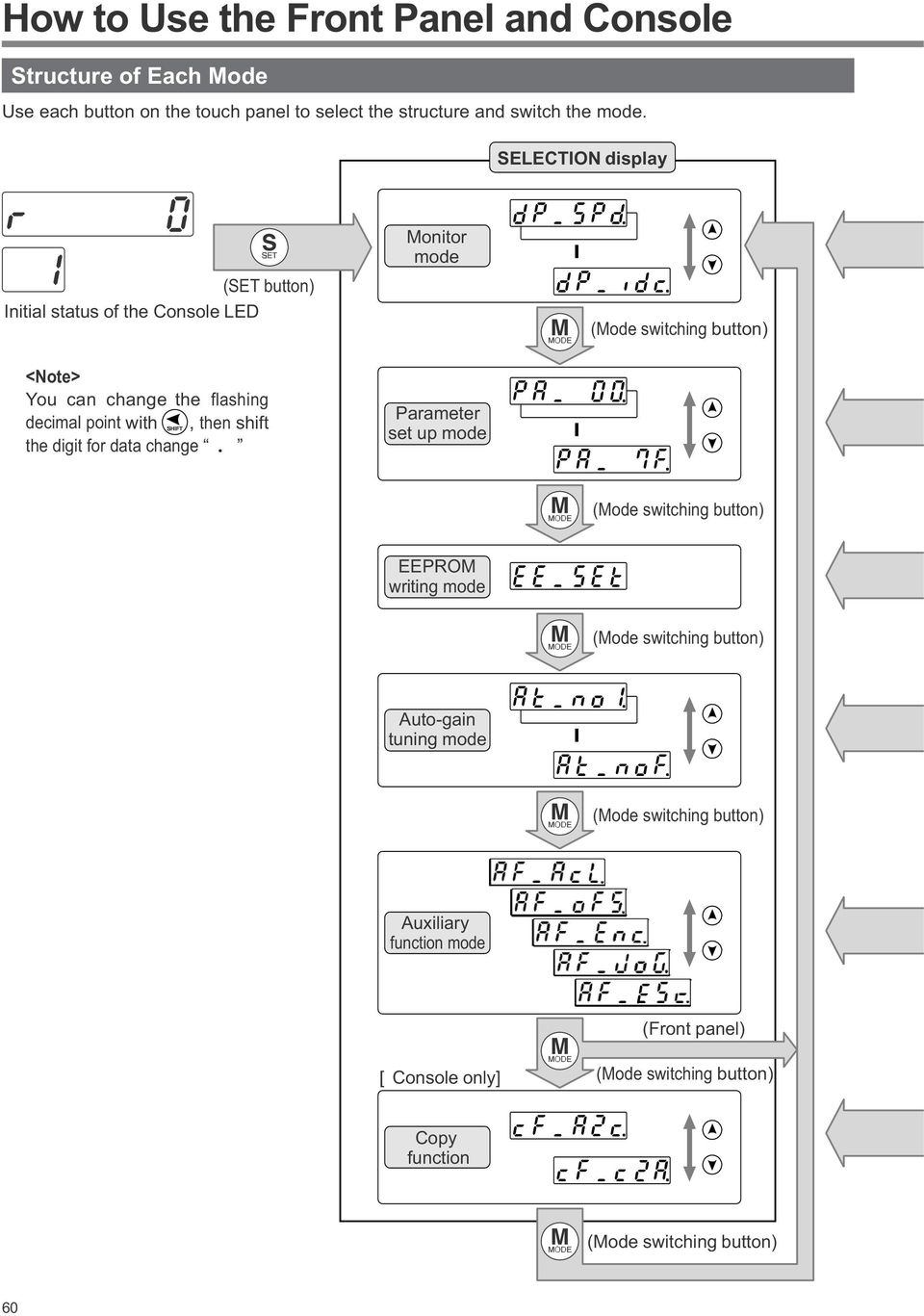
3 How to Use the Front Panel and Console Structure of Each Mode Use each button on the touch panel to select the structure and switch the mode. SELECTION display (SET button) Initial status of the Console LED <Note> You can change the flashing decimal point with, then shift the digit for data change Monitor mode Parameter set up mode (Mode switching button) (Mode switching button) EEPROM writing mode (Mode switching button) Auto-gain tuning mode (Mode switching button) Auxiliary function mode (Front panel) [ Console only] (Mode switching button) Copy function (Mode switching button) 60
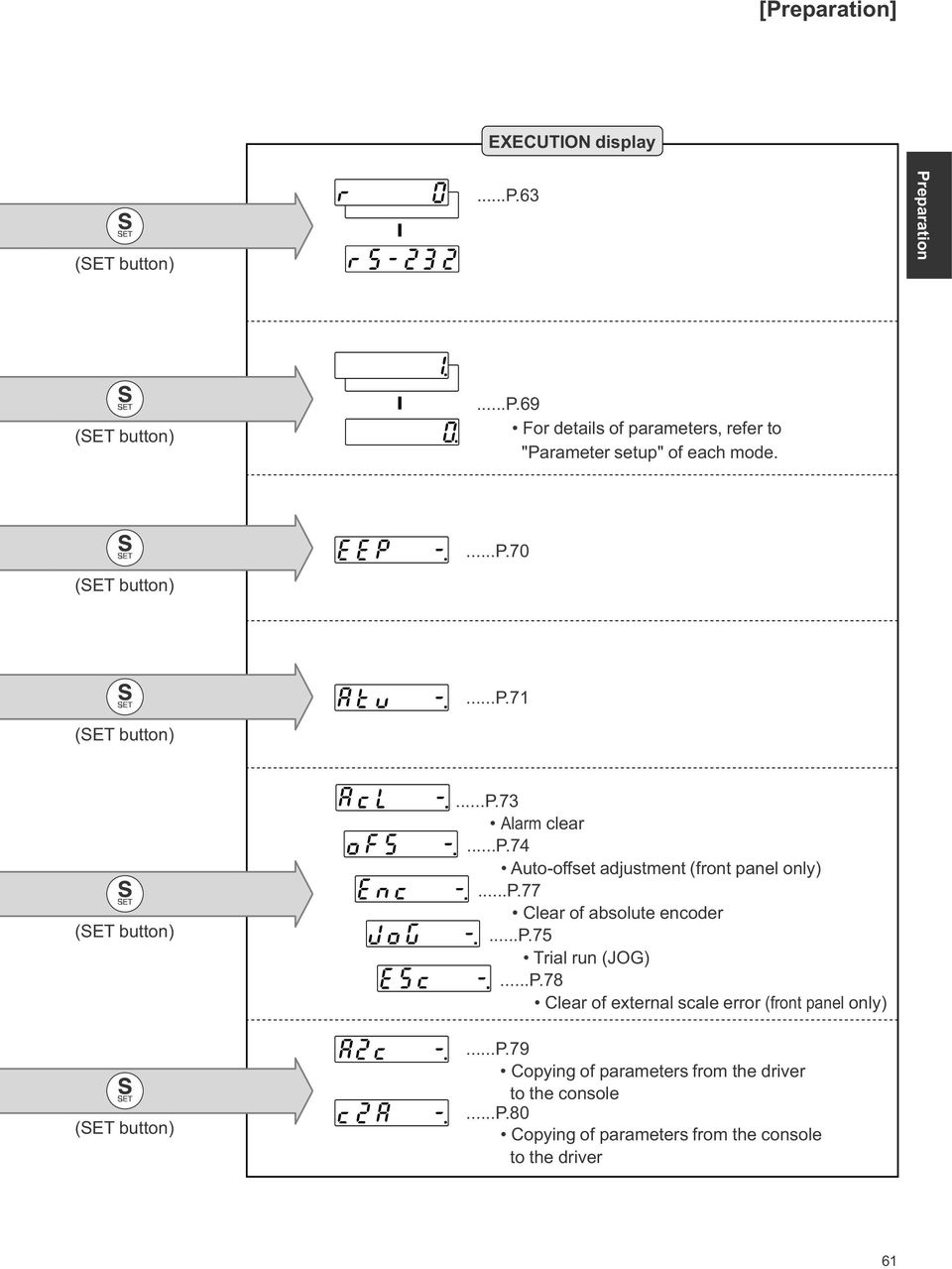
4 [Preparation] EXECUTION display (SET button)...p.63 Preparation (SET button)...p.69 For details of parameters, refer to "Parameter setup" of each mode. (SET button)...p.70 (SET button)...p.71 (SET button)...p.73 Alarm clear...p.74 Auto-offset adjustment (front panel only)...p.77 Clear of absolute encoder...p.75 Trial run (JOG)...P.78 Clear of external scale error (front panel only) (SET button)...p.79 Copying of parameters from the driver to the console...p.80 Copying of parameters from the console to the driver 61
5 How to Use the Front Panel and Console How to Set 1) Insert the console connector to CN X6 of the driver, and turn on the power of the driver. Parameter setup 2) Press. 3) Press. 4) Select the required parameters with and. 5) Press. 6) Change the value with, and. 7) Press. EEPROM writing 8) Press. 9) Press. 10) Keep pressing (for approx.5 sec), then the bars increases as the right Fig. shows. Writing starts. (displays for only a moment) Writing finishes Writing completes Writing error occurs. After the writing completes, return to SELECTION display by referring to "Structure of each mode" (P.60 and 61). <Remarks> will be displayed when you change the parameter setup which change will be validated only after the reset. Turn off the power of the driver, then reset it. When writing error occurs, repeat the writing. If the writing error persists, the console might be a failure. Do not shut down the power during EEPROM writing, otherwise wrong data might be written. In such case, set up all parameters again to write them again after full confirmation. Do not disconnect the console connector from the driver between and. If the connector is disconnected, insert the connector and repeat the procedure from the beginning. 62

6 [Preparation] Monitor Mode When you turn on the Product for the first time, display shows. (at motor stall) To change this display, change the setup of Pr01 (Initial status of LED). (For details, refer to Parameter of each control mode.) SELECTION display EXECUTION display Positional deviation Display example Description (5 deviation pulses) Pages to refer P.64 Preparation Motor rotational speed (1000r/min) P.64 Torque output (Torque output 100%) P.64 Control mode (Position control mode) P.64 I/O signal status (Input signal No.0 : Active) P.64 Error factor, history (No error currently) P.65 Software version (Software version of 0.23) P.66 Alarm (No alarm) P.66 Regenerative load factor (30% of permissible regenerative power) P.66 Overload factor (SET button) (28% of overload factor) P.66 Inertia ratio (Inertia ratio 100%) P.66 Feedback pulse sum (Feedback pulse sum is 50 pulses.) P.66 Command pulse sum (Command pulse sum is 10 pulses.) P.66 External scale deviation (External scale deviation is 5 pulses.) P.66 External scale feedback pulse sum External scale feedback pulse sum is 500 pulses. P.67 Automatic motor recognizing function (Automatic motor recognizing function is validated.) P.67 [ Console] Selection of communication [ Front panel] Analog value (RS232 communication) (SPR V) P.67 P.67 Factor for No-Motor Running (No Servo-ON ) P.68 Display shifts toward the arrowed direction by pressing and reversed direction by pressing. (Mode switch button) To Parameter Mode P.69 63

7 How to Use the Front Panel and Console Display of Position Deviation, Motor Rotational Speed and Torque Output Data...Positional deviation (cumulative pulse counts of deviation counter) display : generates rotational torque of CW direction (viewed from shaft end) no display : generates rotational torque of CCW direction (viewed from shaft end)...rotational speed of the motor unit [r/min] display : CW rotation, no display : CCW rotation...torque command unit [%] (100 for rated torque) display : CW rotation, no display : CCW rotation <Note> + is not displayed on LED, but only - appears. Display of Control Mode...Position control mode...velocity control mode...torque control mode...full-closed control mode Display of I/O Signal Status Displays the control and output signal to be connected to CN X5 connector. Use this function to check if the wiring is correct or not. Select the signal No. to be monitored by pressing....active (This signal is valid)...inactive (This signal is invalid) Signal No. (Hexadecimal number, 0-1F)...Input signal...output signal Transition when pressing. (Lowest place No. of signal) (Highest place No. of signal) (Lowest place No. of output signal) (Highest place No. of output signal) < Note> Shift the flashing decimal point with. The other way to change signal No. at I/O (Right side of decimal point : Signal selection mode) selection mode Signal selection mode. (Left side of decimal point : Input/Output selection mode) 64
![direction (viewed from shaft end)...rotational speed of the motor unit [r/min] display : CW rotation, no display : CCW rotation.](/docs-images/56/7622887/images/page_7.jpg "..torque command unit [%] (100 for rated torque) display : CW rotation, no display : CCW rotation <Note> + is not displayed on LED, but only - appears. Display of Control Mode...Position control mode.")
8 [Preparation] Signal No. and its title Input signal Signal No. Title Symbol Pin No. 0 Servo-ON SRV-ON 29 1 Alarm clear A-CLR 31 2 CW over-travel inhibit CWL 8 3 CCW over-travel inhibit CCWL 9 4 Control mode switching C-MODE 32 5 Speed-Zero clamp ZEROSPD 26 6 Switching of electronic gear DIV 28 8 Command pulse inhibition INH 33 9 Gain switching GAIN 27 A Deviation counter clear CL 30 C Selection 1 of Internal command speed INTSPD1 33 D Selection 2 of Internal command speed INTSPD Damping control switching VS-SEL Selection 3 of internal command speed INTSPD Torque limit switching TL-SEL 27 Input signal Signal No. Title Symbol Pin No. 0 Servo-Ready S-RDY 35/34 1 Servo-Alarm ALM 37/36 2 Positioning complete (In-position) COIN 39/38 3 Release of external brake BRK-OFF 11/10 4 Zero-speed detection ZSP 12 5 Torque in-limit TLC 40 6 In-speed(Speed coincidence) V-COIN 12/40 9 At-speed(Speed arrival) COIN 39/38 A Full-closed positioning complete EX-COIN 39/38 Preparation Reference of Error Factor and History Error code No. Error code No. ( appears if no error occurs)...present error...history 0 (latest error)...history 13 (oldest error) Error code No. and its content Error content 11 Under-voltage protection for control power 12 Over-voltage protection 13 Under-voltage protection for main power 14 Over-current protection 15 Overheat protection 16 Overload protection 18 Over-regenerative load protection 21 Encoder communication error protection 23 Encoder communication data error protection 24 Excess positional deviation protection 25 Excess hybrid deviation error protection 26 Over-speed protection 27 Command pulse multiplication error protection 28 External scale communication data error protection 29 Deviation counter overflow protection 34 Software limit protection 35 External scale communication data error protection 36 EEPROM parameter error protection 37 EEPROM parameter error protection 38 Run-inhibition protection You can refer the last 14 error factors (including present one) Press to select the factor to be referred. <Note> Following errors are not included in the history. 11:Under-voltage protection for control power 13:Under-voltage protection for main power 36:EEPROM parameter error protection 37:EEPROM check code error protection 38:Ocer-travel inhibition protection 95:Automatic motor recognition error protection When one of the errors which are listed in error history occurs, this error and history o shows the same error No. When error occurs, the display flashes. Error code No. Error content 39 Excess analog error protection 40 Absolute system-down error protection 41 Absolute counter-over error protection 42 Absolute over-speed error protection 44 Absolute single-turn error protection 45 Absolute multi-turn error protection 47 Absolute status error protection 48 Encoder Z-phase error protection 49 Encoder CS signal error protection 50 External scale status 0 error protection 51 External scale status 1 error protection 52 External scale status 2 error protection 53 External scale status 3 error protection 54 External scale status 4 error protection 55 External scale status 5 error protection 65 Excess CCWTL protection 66 Excess CWTL protection 95 Automatic motor recognition error protection others Other error 65

9 How to Use the Front Panel and Console Software Version Displays the software version of the driver. Alarm Display...no alarm...alarm occurrence Over-regeneration alarm : Turns on when regenerative load reaches more than 85% of alarm trigger level of regenerative load protection. Alarm trigger level is defined as 10% of regenerative resister working ratio, when Pr6C "Selection of external regenerative resister " is 1. Overload alarm : Turns on when the load reaches 85% or more of alarm trigger level of over-load protection. Battery alarm : Turns on when battery voltage for absolute encoder falls to alarm level (approx.3.2v) or lower. Cooling fan rotational speed error alarm : Shows cooling fan rotational speed error. External scale alarm : Turns on when external scale temperature rises to more than 85 C or Display of Regenerative Load Factor Display of Over-load Factor scale rigidity is not enough (adjustment is needed on mounting). Display the ratio (%) against the alarm trigger level of regenerative protection. This is valid when Pr6C (Selection of external regenerative resistor) is 0 or 1. Displays the ratio (%) against the rated load. Refer to P.258, "Overload Protection Time Characteristics" of When in Trouble. Display of Inertia Ratio Displays the inertia ratio (%). Value of Pr20 (Inertia ratio) will be displayed as it is. Display of Feedback Pulse Sum, Command Pulse Sum and External Scale Feedback Pulse Sum Total sum of pulses after control power-on. Display overflows as the figures show [0-clear EXECUTION display] 0 0 (at control power-on) 0 CW CCW By pressing for approx. 3 sec. or longer on either one of screens of total sum of pulses display, you can clear feedback total sum, command pulse total sum or external scale feedback pulse total sum to 0. Keep pressing to shift the as the right fig. shows. <Cautions> You can not clear the each date of [ PANATERM ] and console to "0" with this operation. Since accumulation process of command pulse cannot be executed when the command pulse prohibition is validated, during normal auto-gain tuning and while measuring function to frequency characteristics of [ PANATERM ] is used, actual pulse counts may differ from the displayed value of command pulse total sum. 66

10 [Preparation] External Scale Deviation Automatic Motor Recognizing Function Polarity (+ ) : CCW, (-) : CW Limited by ± Note) You can 0-clear the external scale deviation during normal auto-gain tuning and motor trial run. Automatic recognition is valid. Preparation Display of Analog Input Value (Front Panel Only) Input signal Input voltage value [ V] Select the signal No. to be monitored by pressings. (SPR analog value, unit [ V] ) Displays the value after offset correction. (CCWTL analog value, unit [ V] ) (CWTL analog value, unit [ V] ) Note) Voltage exceeding ± 10V can not be displayed correctly. Switching of the Driver to be Communicated RS232 communication...displays the ID of the connected driver. ID cannot be switched. RS485 communication...select the ID of the driver to be operated by pressing. Initial display of LED of the selected driver will appear by pressing. will appear when you select the ID of not-selected driver. 67
![Preparation Display of Analog Input Value (Front Panel Only) Input signal Input voltage value [ V] Select the signal No. to be monitored by pressings.](/docs-images/56/7622887/images/page_10.jpg "(SPR analog value, unit [ V] ) Displays the value after offset correction.")
11 How to Use the Front Panel and Console Display of the Factor of No-Motor Running Displays the factor of no-motor running in number....position control...torque control Factor No. Control mode... Velocity control... Full-closed control Explanation of factor No. Factor No. Factor flashing Occurrence of 00 error/alarm No particular factor Control mode all all Content An error is occurring, and an alarm is triggered. No factor is detected for No-motor run. The motor runs in normal case. 01 Main power shutoff all The main power of the driver is not turned on. 02 No entry of 03 SRV-ON Over-travel inhibition is valid 04 Torque limit setup 05 is small Analog torque limit is valid. all all all P,S,F The Servo-ON (SRV-ON) is not connected to COM. While Pr04 is 0 (Run-inhibition is valid), CCW over-travel inhibition (CCWL) is open and speed command is CCW direction. CW over-travel inhibition (CWL) is open and speed command is CW direction. Either one of the valid torque limit setup value of Pr5E (1st) or Pr5F (2nd) is set to 5% or lower than the rating. While Pr03 is 0 (analog torque limit accepted), CCW analog torque limit (CCWTL) is negative voltage and speed command is CCW direction. CW analog torque limit (CWTL) is positive voltage and speed command is CW direction. 06 INH is valid. P,F Pr43 is 0 (Command pulse inhibition is valid.), and INH is open. 07 Command pulse frequency is low. P,F 08 CL is valid. P,F ZEROSPD is valid. External speed command is small. Internal speed command is 0. Torque command is small. Speed limit is small. S,T 14 Other factor all S S T T The position command per each control cycle is 1 pulse or smaller due to, No correct entry of command pulse No correct connection to the selected with Pr40. No matching to status selected with Pr41 pr Pr42. While Pr4E is 0 (Deviation counter clear at level), the deviation counter clear (CL) is connected to COM. While Pr06 is 1 (Speed zero clamp is valid.), the speed zero clamp (ZEROSPD) is open. While the analog speed command is selected, the analog speed command is smaller than 0.06[ V]. While the internal speed command is selected, the internal speed command is set to lower than 30 [ r/min] The analog torque command (SPR or CCWTL) is smaller than 5 [ %] of the rating. While Pr5B is 0 (speed is limited by 4th speed of internal speed), Pr56, (4th speed of speed setup) is set to lower than 30 [ r/min]. While Pr5B is 1 (speed is limited by SPR ), the analog speed limit (SPR) is smaller than 0.06 [ V]. The motor runs at 20 [ r/min] or lower even though the factors from 1 to 13 are cleared, (the command is small, the load is heavy, the motor lock or hitting, driver/motor fault etc.) <Note> * Motor might run even though the other number than 0 is displayed. 68

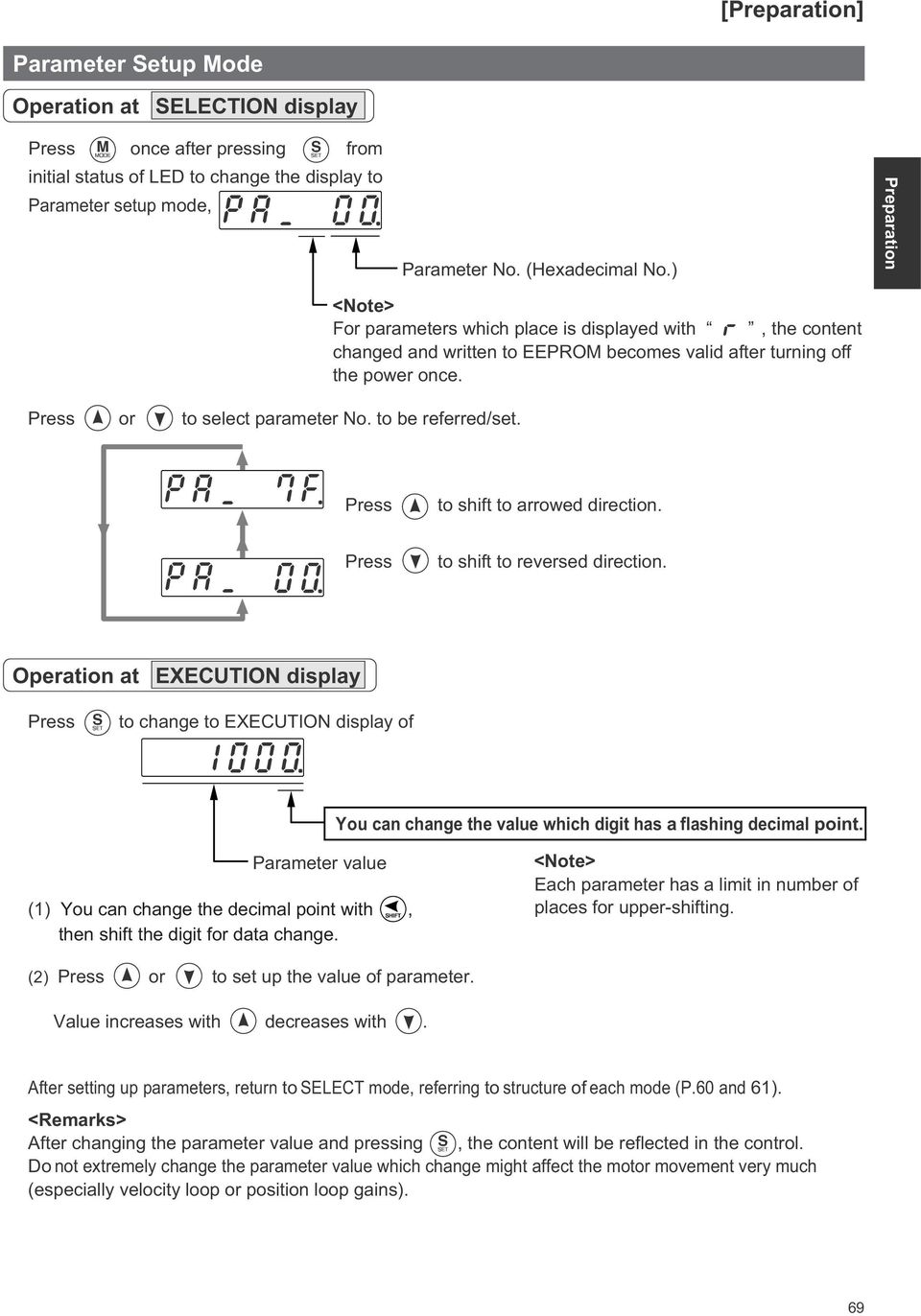
12 [Preparation] Parameter Mode Operation at SELECTION display Press once after pressing from initial status of LED to change the display to Parameter setup mode, Parameter No. (Hexadecimal No.) Preparation Press or to select parameter No. to be referred/set. <Note> For parameters which place is displayed with, the content changed and written to EEPROM becomes valid after turning off the power once. Press to shift to arrowed direction. Press to shift to reversed direction. Operation at EXECUTION display Press to change to EXECUTION display of You can change the value which digit has a flashing decimal point. Parameter value (1) You can change the decimal point with, then shift the digit for data change. <Note> Each parameter has a limit in number of places for upper-shifting. (2) Press or to set up the value of parameter. Value increases with decreases with. After setting up parameters, return to SELECT mode, referring to structure of each mode (P.60 and 61). <Remarks> After changing the parameter value and pressing, the content will be reflected in the control. Do not extremely change the parameter value which change might affect the motor movement very much (especially velocity loop or position loop gains). 69
13 How to Use the Front Panel and Console EEPROM Writing Mode EEPROM Writing Operation at SELECTION display Starting from the initial LED status, press two time after pressing, then brings the display of EEPROM Writing Mode, Operation at EXECUTION display Press to make EXECUTION DISPLAY to Keep pressing until the display changes to when you execute writing. increases while keep pressing (for approx. 5sec) as the right fig. shows. Starts writing. Finishes writing Writing completes Writing error When you change the parameters which contents become valid after resetting, displayed after finishing wiring. Turn off the control power once to reset. will be Note 1) When writing error occurs, make writing again. If the writing error repeats many times, this might be a failure. Note 2) Don't turn off the power during EEPROM writing. Incorrect data might be written. If this happens, set up all of parameters again, and re-write after checking the data. 70

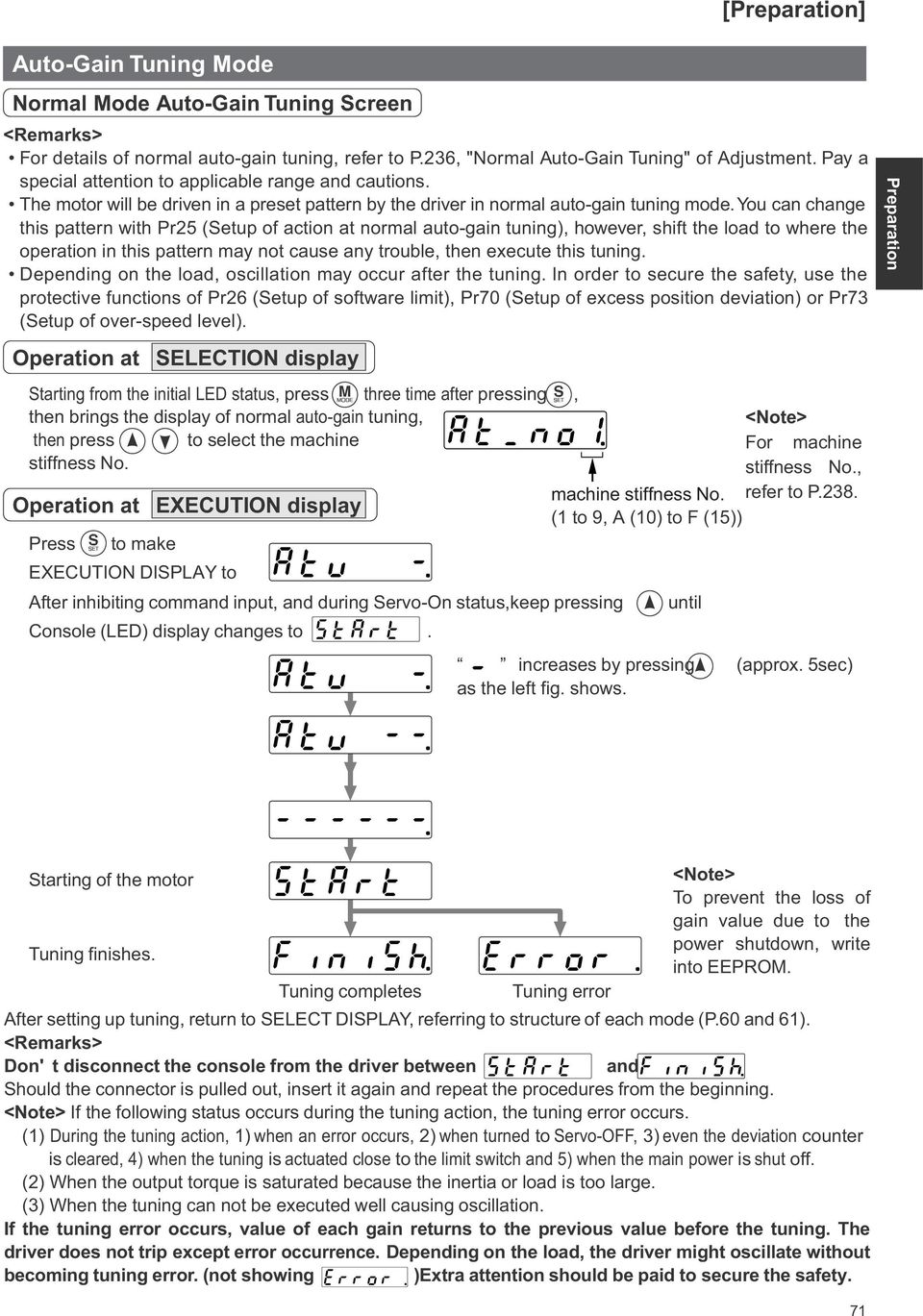
14 [Preparation] Auto-Gain Tuning Mode Normal Mode Auto-Gain Tuning Screen <Remarks> For details of normal auto-gain tuning, refer to P.236, "Normal Auto-Gain Tuning" of Adjustment. Pay a special attention to applicable range and cautions. The motor will be driven in a preset pattern by the driver in normal auto-gain tuning mode. You can change this pattern with Pr25 ( of action at normal auto-gain tuning), however, shift the load to where the operation in this pattern may not cause any trouble, then execute this tuning. Depending on the load, oscillation may occur after the tuning. In order to secure the safety, use the protective functions of Pr26 ( of software limit), Pr70 ( of excess position deviation) or Pr73 ( of over-speed level). Operation at SELECTION display Starting from the initial LED status, press three time after pressing, then brings the display of normal auto-gain tuning, <Note> then press to select the machine For machine stiffness No. stiffness No., machine stiffness No. refer to P.238. (1 to 9, A (10) to F (15)) Press to make Operation at EXECUTION display EXECUTION DISPLAY to After inhibiting command, and during Servo-On status,keep pressing Console (LED) display changes to. until increases by pressing (approx. 5sec) as the left fig. shows. Preparation Starting of the motor Tuning finishes. Tuning completes Tuning error <Note> To prevent the loss of gain value due to the power shutdown, write into EEPROM. After setting up tuning, return to SELECT DISPLAY, referring to structure of each mode (P.60 and 61). <Remarks> Don' t disconnect the console from the driver between and Should the connector is pulled out, insert it again and repeat the procedures from the beginning. <Note> If the following status occurs during the tuning action, the tuning error occurs. (1) During the tuning action, 1) when an error occurs, 2) when turned to Servo-OFF, 3) even the deviation counter is cleared, 4) when the tuning is actuated close to the limit switch and 5) when the main power is shut off. (2) When the output torque is saturated because the inertia or load is too large. (3) When the tuning can not be executed well causing oscillation. If the tuning error occurs, value of each gain returns to the previous value before the tuning. The driver does not trip except error occurrence. Depending on the load, the driver might oscillate without becoming tuning error. (not showing )Extra attention should be paid to secure the safety. 71
15 How to Use the Front Panel and Console Fit-Gain Screen Operation at SELECTION display Operation at EXECUTION display Press to call for EXECUTION DISPLAY. You can change/store the setup of real time auto-gain tuning/adaptive filter or start the fit-gain function by using key, after matching the (6) (5) (4) (3) (2) (1) decimal point to (1), (2), (4), (6) by pressing. (1) Stiffness setup of real time auto-gain tuning / Start of fit-gain Display Contents/Expansion function Stiffness 15 You can change with Stiffness 1 Stiffness 0 with each press of, stiffness changes in numerical/alphabetical order (0 to 9,A(10) to F(15). Fit gain function starts by pressing at stiffness 0. (2) Action setup of real time auto-gain tuning/start of fit-gain Display Contents/Expansion function You can change with Valid Valid Valid Valid Valid Valid Valid Invalid No gain switching : Load inertia does not change. Vertical axis mode : Load inertia changes rapidly. Vertical axis mode : Load inertia changes slowly. Vertical axis mode : Load inertia does not change. Normal mode : Load inertia changes rapidly. Normal mode : Load inertia changes slowly. Normal mode : Load inertia does not change. Executes automatic gain setup by pressing for approx.3sec. in this status. (3) Status of real time auto-gain tuning action (display only) : Invalid : Valid or : Estimating load inertia (4) Switch of adaptive filter action and copy to 1st notch filter pf adaptive filter setup You can change with Display Hold Valid Invalid Contents/Expansion function Save the present adaptive filter setup to Pr1D,Pr1E by pressing for approx. 3 sec. in this status. Clears 1st notch filter (Pr1D, Pr1E) by pressing (5) Status of real time auto-gain tuning action (display only) : Invalid : Valid for approx. 3 sec. in this status. or (6) EEPROM writing Display : Adaptive action working Contents/Expansion function Write the present setup into EEPROM by pressing approx. 3 sec. 72

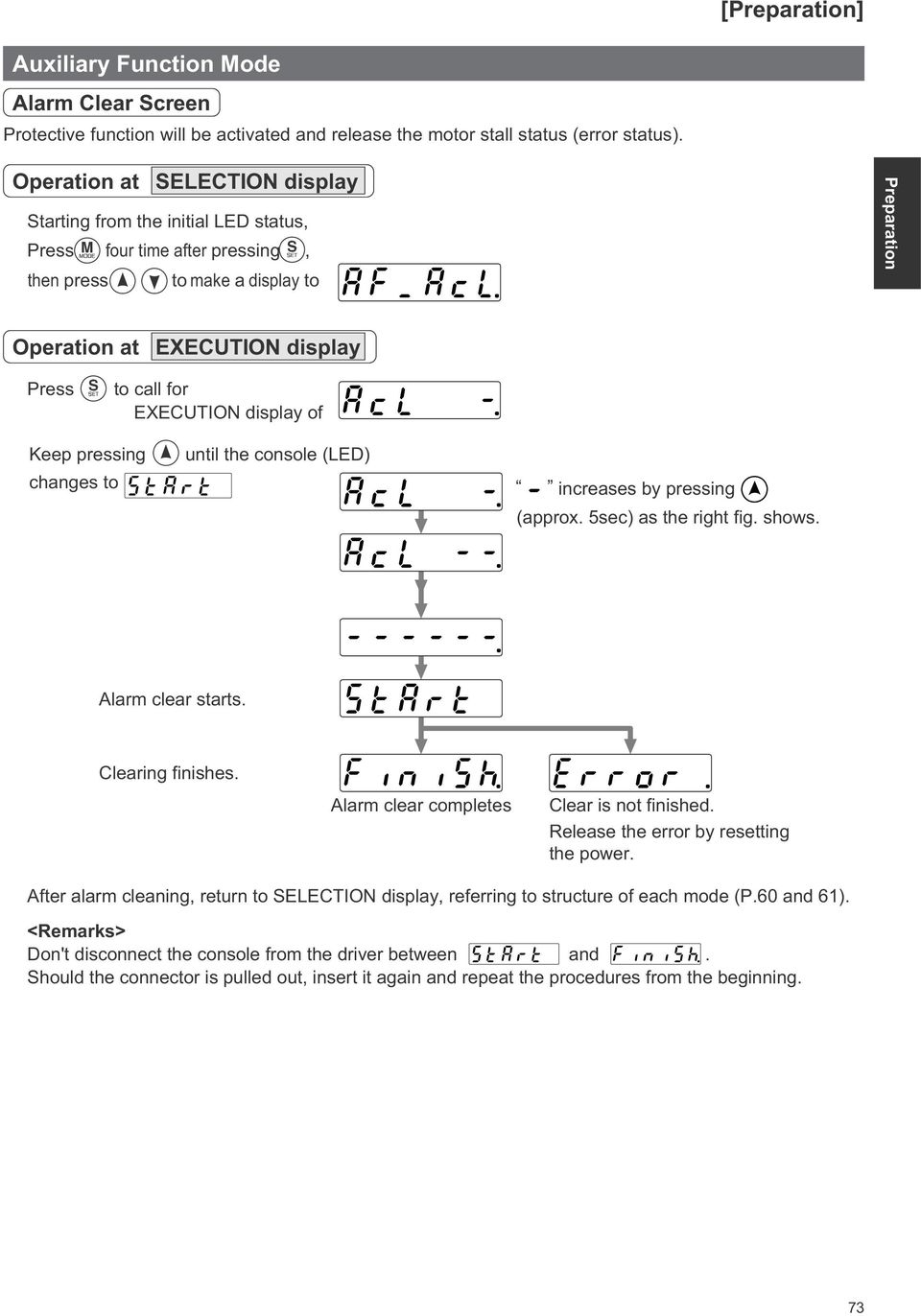
16 [Preparation] Auxiliary Function Mode Alarm Clear Screen Protective function will be activated and release the motor stall status (error status). Operation at SELECTION display Starting from the initial LED status, Press four time after pressing, then press to make a display to Preparation Operation at EXECUTION display Press to call for EXECUTION display of Keep pressing until the console (LED) changes to increases by pressing (approx. 5sec) as the right fig. shows. Alarm clear starts. Clearing finishes. Alarm clear completes Clear is not finished. Release the error by resetting the power. After alarm cleaning, return to SELECTION display, referring to structure of each mode (P.60 and 61). <Remarks> Don't disconnect the console from the driver between and. Should the connector is pulled out, insert it again and repeat the procedures from the beginning. 73
17 How to Use the Front Panel and Console Automatic Offset Adjustment (Front Panel Only) Automatically adjust the offset value of Pr52 (Velocity command offset) of analog velocity command (SPR/TRQR). Operation at SELECTION display Operation at EXECUTION display Press to call for EXECUTION display of When you execute automatic offset adjustment, make command to 0V, then keep pressing until the display changes to. increases by pressing (approx. 5sec) as the right fig. shows. Automatic offset adjustment starts. Adjustment finishes. Automatic offset adjustment finishes. Error occurs. Invalid mode is selected, or offset value ( exceeds the setup range of Pr52. ) <Notes> This function is invalid at position control mode. You cannot write the data only by executing automatic offset adjustment. Execute a writing to EEPROM when you need to reflect the result afterward. 74

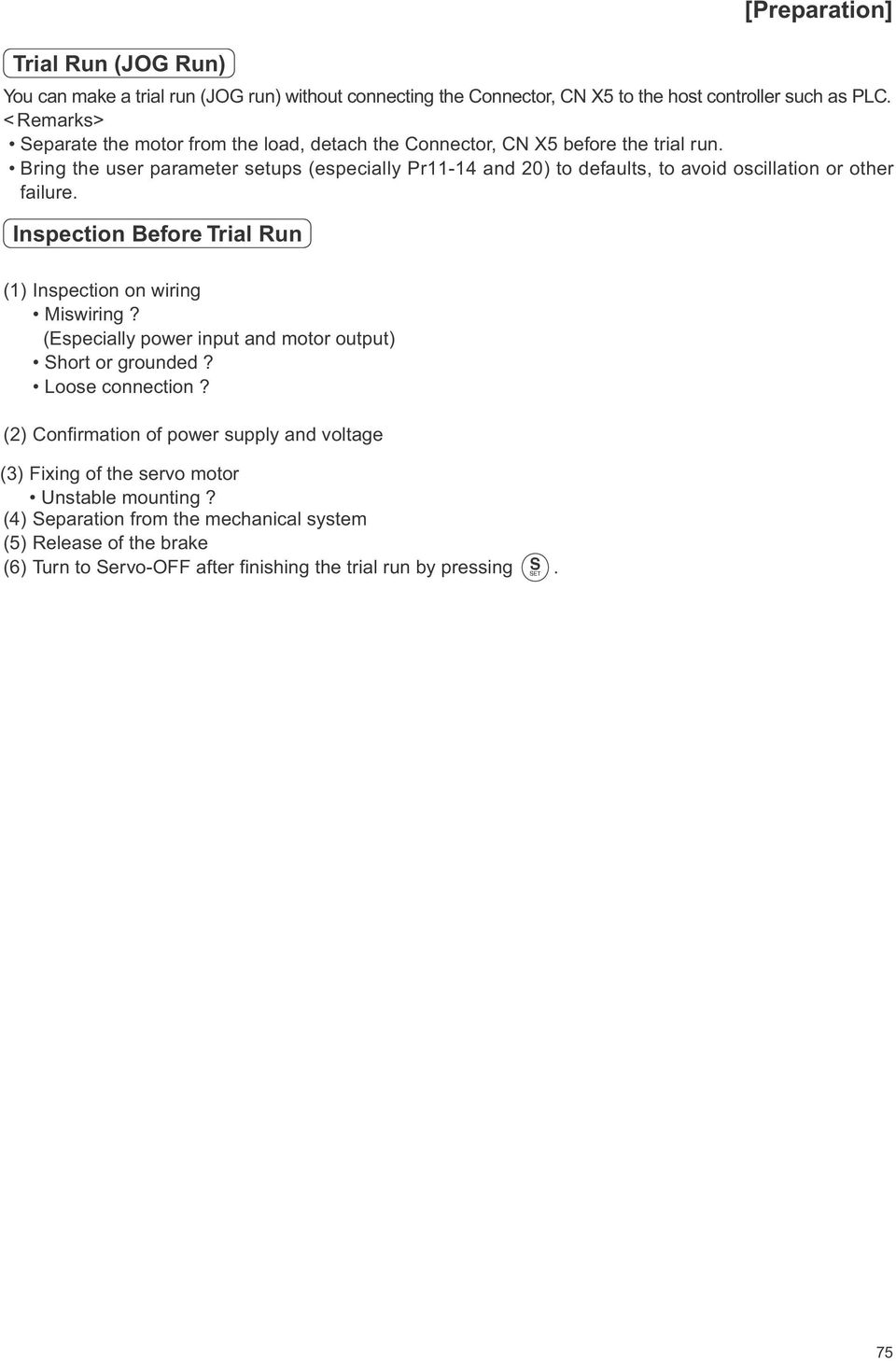
18 Trial Run (JOG Run) [Preparation] You can make a trial run (JOG run) without connecting the Connector, CN X5 to the host controller such as PLC. < Remarks> Separate the motor from the load, detach the Connector, CN X5 before the trial run. Bring the user parameter setups (especially Pr11-14 and 20) to defaults, to avoid oscillation or other failure. Inspection Before Trial Run (1) Inspection on wiring Miswiring? (Especially power and motor output) Short or grounded? Loose connection? (2) Confirmation of power supply and voltage (3) Fixing of the servo motor Unstable mounting? (4) Separation from the mechanical system (5) Release of the brake (6) Turn to Servo-OFF after finishing the trial run by pressing. 75
19 How to Use the Front Panel and Console Procedure for Trial Run When you use the console, insert the console connector to CN X4 of the driver securely and turn on the driver power. Operation at SELECTION display Press four time after pressing, to setup auxiliary function mode, then with, make a display to Operation at EXECUTION display Press to call for EXECUTION DISPLAY of Then keep pressing until the display of Console (LED) changes to. increases by pressing (approx. 5sec) as the left fig. shows. Preparation step 1 for trial run Then keep pressing until the display of LED changes to. Not a servo-ready status. (Shuts off the main when error occurs.) Keep pressing (approx. 5 sec) to shift the decimal point toward left as the left fig. shows. Turns to Servo-OFF Preparation step 2 for trial run by pressing. Servo-ON status Not a Servo-Ready. Or SRV-ON signal is not entered. After the Servo-ON of preparation step 2 for trial run, the motor runs at the preset speed with Pr3D (JPG speed) to CCW direction by pressing CW by pressing. The motor stops by pressing. After finished trial running, return to SELECTION display, referring to structure of each mode (P.60 and 61). <Notes> Set up torque limit invalidation (Pr03) to 1, run-inhibit invalidation (Pr04) to 1 and ZEROSPD (Pr06) to 0. If SRV-ON becomes valid during trial run, the display changes to which is normal run through external command. <Caution> If such trouble as disconnection of cable or connector occurs during trial run, the motor makes over-run for maximum 1 sec. Pay an extra attention for securing safety. 76

20 Clearing of Absolute Encoder [Preparation] Only applicable to the system which uses absolute encoder. You can clear the alarm and multi-turn data of the absolute encoder. Operation at SELECTION display Press four time after pressing, to setup auxiliary function mode, then with, make a display to Preparation Operation at EXECUTION display Press to call for EXECUTION DISPLAY of Then keep pressing changes to until the display of Console (LED) increases by pressing (approx. 5sec) as the left fig. shows. Clearing of absolute encoder starts Clearing finishes Clearing of absolute encoder completes Error occurs When non-applicable encoder is ( connected ) After clearing of absolute encoder finishes, return to SELECTION display, referring to structure of each mode (P.60 and 61). <Remarks> Don' t disconnect the console from the driver between to. Should the connector is pulled out, insert it again and repeat the procedures from the beginning. 77

21 How to Use the Front Panel and Console Clearing of External Scale Error (Front panel only) You can clear an error of the external scale. Operation at SELECTION display Press four time after pressing, to setup auxiliary function mode, then with, make a display to Operation at EXECUTION display Press to call for EXECUTION DISPLAY of Then keep pressing changes to until the display of Console (LED) increases by pressing (approx. 5sec) as the left fig. shows. Clearing of absolute encoder starts Clearing finishes. Clearing of absolute encoder completes Error occurs (At other control mode than full-closed control, and when no external scale error has occurred) After cleaning of External scale Error, return to SELECTION display, referring to the structure of each mode (P.60 and 61). 78
22 [Preparation] Copying Function (Console Only) Copying of Parameters from the Driver to the Console Operation at SELECTION display Starting from initial LED status, Press five time after pressing, then press, to make a display to Preparation Operation at EXECUTION display Press to call for EXECUTION DISPLAY of Keep pressing until the console display (LED) changes to increases by pressing (approx. 3sec) as the left fig. shows. Initialization of EEPROM of the console starts. Numeral decreases as time passes. Copying of parameters from the driver to the console starts. Writing of parameters into the console EEPROM starts. Copying completes normally. Error display <Remarks> If error is displayed, repeat the procedures from the beginning. Press for releasing error. After copying finishes, return to SELECTION display, referring to structure of each mode (P.60 and 61) <Remarks> Don't disconnect the console from the driver between to Should the connector is pulled out, insert it again and repeat the procedures from the beginning. <Note> If the error display repeats frequently, check the broken cable, disconnection of the connector, misoperation due to noise or failure of console. 79
23 How to Use the Front Panel and Console Copying of Parameters from the Console to the Driver Operation at SELECTION display Starting from initial LED status, Press five time after pressing, then press to make a display to Operation at EXECUTION display Press to call for EXECUTION DISPLAY of Keep pressing until the console display (LED) changes to increases by pressing (approx. 3sec) as the left fig. shows. Reading of EEPROM of the console starts....numeral decreases as time passes. Copying of parameters from the console to the driver starts. Writing of parameters into the driver EEPROM starts. Error display <Remarks> If error is displayed, repeat the procedures from the beginning. Press for releasing error. Copying completes normally. After copying finishes, return to SELECTION display, referring to structure of each mode (P.60 and 61). <Remarks> Don' t disconnect the console from the driver between to Should the connector is pulled out, insert it again and repeat the procedures from the beginning. <Note> If the error display repeats frequently, check the broken cable, disconnection of the connector, misoperation due to noise or failure of console. 80
24 [Connection and of Position Control Mode] page Control Block Diagram of Position Control Mode 82 Wiring to the Connector, CN X Wiring Example to the Connector, CN X Interface Circuit Input Signal and Pin No. of the Connector, CN X Output Signal and Pin No. of the Connector, CN X Connecting Example to Host Controller Trial Run (JOG Run) at Position Control Mode Inspection Before Trial Run Trial Run by Connecting the Connector, CN X Real-Time Auto-Gain Tuning Outline Applicable Range How to Operate Adaptive Filter Parameters Which are Automatically Set Parameter Parameters for Functional Selection Parameters for Adjustment of Time Constant of Gains and Filters Parameters for Auto-Gain Tuning Parameters for Adjustment (2nd Gain Switching Function) Parameters for Position Control Parameters for Velocity/Torque Control Parameters for Sequence
25 Control Block Diagram of Position Control Mode Pulse train PULS SIGN Reversal Input setup FIR smoothing Velocity feed forward Input selection Pr40 Damping control Mode Pr41 Pr42 Division/ Multiplication 1st numerator 2nd numerator Pr48 Average 1st travel times Pr4D frequency Primary delay + smoothing 1st filter 2nd frequency Pr2B Pr2C Pr2D Gain Filter Pr15 Pr16 Torque command monitor 2nd filter Pr2E Position control + Velocity control Notch filter Torque filter + + 1st proportion 1st Pr10 Pr11 1st frequency Pr1D 1st time Pr14 constant Pr12 1st width Pr1E Pr1C Selection Pr4C 2nd Pr18 1st integration 2nd Pr49 proportion Multiplier Pr4A 2nd integration Denominator Pr4B Command speed monitor Positional deviation monitor Speed detection filter Pr19 2nd frequency Pr28 2nd time constant 1st limit Pr5E Pr1A 2nd width Pr29 2nd limit Pr5F Inertia ratio Pr20 2nd depth Pr2A Adaptation Pr2F Motor 1st 2nd Pr13 Encoder Pr1B Actual speed monitor Feedback pulses OA/OB/OZ Division Numerator Pr44 Denominator Pr45 Speed detection Serial communication data Encoder reception processing Selection Pr46 82
26 Wiring to the Connector, CN X5 [Connection and of Position Control Mode] Wiring Example to the Connector, CN X5 Wiring Example of Position Control Mode In case of open collector I/F (1) When you use the external resistor with 12V and 24V power supply PULS1 3 Command PULS2 4 R 220 SIGN1 5 SIGN1 5 pulse A 7 1 Command pulse COM+ OPC1 inhibition k 2.2k 2 INH OPC2 Deviation counter 2.2k clear 30 3 CL PULS1 Servo-ON 29 4 SRV-ON PULS2 220 GAIN Gain switching 27 Electronic gear VDC-1.5. R+220 =.10mA switching 28 DIV SIGN2 6 (Use with 500kpps SIGN2 6 R Damping control or less.) switching 26 VS-SEL GND VDC GND Control mode switching 32 C-MODE 21 Alarm clear OA+ A-phase 31 Specifications A-CLR VDC output of R CCW over-travel OAinhibition 9 CCWL 48 12V 1k 1/2W CW over-travel OB+ B-phase 24V 2k 1/2W inhibition 8 CWL output OB- Servo-Ready output (2) When you do not use the S-RD Y+ OZ+ Z-phase external resistor with 24V 34 S-RDY- OZpower output supply Servo-Alarm output 37 ALM+ 2.2k OPC ALM- PULS2 4 Positioning complete output COIN+ GND 2.2k OPC COIN- 19 Z-phase output (open collector) SIGN2 6 Brake release output CZ BRKOFF+ GND 10 BRKOFF- Torque in-limit output 40 TLC Divider 24VDC VDC 12 to 24V 12 (Select with Pr09) Zero speed detection output ZSP SPR/TRQR 14 20k 41 (Select with Pr0A) COM- GND 15 CCW torque limit (0 to + 10V) CCWTL/TRQR 16 PULS 3.83k 10k GND 44 2k 43k PULSH PULSH2 CW torque limit (-10 to + 10V) 18 CWTL SIGN 3.83k 10k 2k 43k 46 SIGNH1 2k 43k SIGNH2 2k 43k Velocity monitor output 13 GND Torque monitor output 1k SP 43 1k IM FG Command pulse B (Use with 2Mpps or less.) ( represents twisted pair.) CN X5 83
27 Wiring to the Connector, CN X5 Interface Circuit Input Circuit SI Connection to sequence signals Connect to contacts of switches and relays, or open collector output transistors. When you use contact s, use the switches and relays for micro current to avoid contact failure. Make the lower limit voltage of the power supply (12 to 24V) as 11.4V or more in order to secure the primary current for photo-couplers. 12 to 24V 7 COM+ 4.7k 12 to 24V 7 COM+ 4.7k Relay SRV-ON etc. SRV-ON etc. PI1 Connection to sequence signals (Pulse train interface) (1) Line driver I/F (Input pulse frequency : max. 500kpps) This signal transmission method has better noise immunity. We recommend this to secure the signal transmission. (2)Open collector I/F (Input pulse frequency : max. 200kpps) The method which uses an external control signal power supply (VDC) Current regulating resistor R corresponding to VDC is required in this case. Connect the specified resister as below. VDC 12V 24V Specifications 1k 1/2W 2k 1/2W (1) (2) ON/OFF AM26LS31 or equivalent ON/OFF VDC VDC 1.5. =. 10mA R+ 220 (3) (3)Open collector I/F (Input pulse frequency : max. 200kpps) Connecting diagram when a current regulating resistor is not used with 24V power supply. represents twisted pair. Max. voltage : DC24V, Rated current : 10mA ON/OFF ON/OFF H/L H/L R R VDC 3 PULS1 4 PULS SIGN1 6 SIGN GND 3 PULS1 4 PULS SIGN1 6 SIGN2 13 GND OPC1 2.2k 4 PULS OPC2 2.2k 6 SIGN2 13 GND 220 H/L PULS H/L SIGN L/H PULS L/H SIGN L/H PULS L/H SIGN PI2 Connection to sequence signals (Pulse train interface exclusive to line driver) Line driver I/F (Input pulse frequency : max. 2Mpps) This signal transmission method has better noise immunity. We recommend this to secure the signal transmission when line driver I/F is used. represents twisted pair. H/L H/L GND 43k 2k 2k 43k 43k 2k 2k 43k AM26C32 or equivalent H/L PULS SIGN AM26C32 or equivalent H/L PULS SIGN AI Analog command The analog command goes through 3 routes, SPR/TRQR(Pin-14), CCWTL (Pin-16) and CWTL (Pin-18). Max. permissible voltage to each is ±10V. For impedance of each, refer to the right Fig. When you compose a simple command circuit using variable resistor(vr) and register R, connect as the right Fig. shows. When the variable range of each is made as 10V to + 10V, use VR with 2k, B-characteristics, 1/2W or larger, R with 200, 1/2W or larger. A/D converter resolution of each command is as follows. (1)ADC1 : 16 bit (SPR/TRQR), (including 1bit for sign), ±10V (2)ADC2 : 10 bit (CCWTL, CWTL), 0 to 3.3V + 12V R VR R 12V SPR/TRQR 14 20k 15 GND 20k V 1k CCWTL 16 10k + 1k 17 GND 3.83k + 3.3V 1k CWTL 18 10k + 1k 3.83k ADC 1 ADC 2 84
28 [Connection and of Position Control Mode] Output Circuit SO1 SO2 Sequence output circuit The output circuit is composed of open collector transistor outputs in the Darlington connection, and connect to relays or photo-couplers. There exists collector to emitter voltage, VCE (SAT) of approx. 1V at transistor-on, due to the Darlington connection of the output or. Note that normal TTL IC cannot be directly connected since it does not meet VIL. There are two types of output, one which emitter side of the output transistor is independent and is connectable individually, and the one which is common to side of the control power supply (COM ). If a recommended primary current value of the photo-coupler is 10mA, decide the resistor value using the formula of the right Fig. 12 to 24V R [ k ] = VDC VDC[ V] 2.5[ V] 10 Install toward the direction as the fig. shows without fail. SO1 ALM+ etc. ALM etc. SO2 ZSP, TLC 41 COM Max. rating 30V, 50mA For the recommended primary current value, refer to the data sheet of apparatus or photo-coupler to be used. Connection and of Position Control Mode PO1 Line driver (Differential output) output Feeds out the divided encoder outputs (A, B and Z-phase) in differential through each line driver. At the host side, receive these in line receiver. Install a terminal resistor (approx. 330 ) between line receiver s without fail. These outputs are not insulated. AM26LS31 or AM26LS32 or equivalent equivalent 21 OA+ A OA 22 OB+ 48 B OB 49 OZ+ 23 Z OZ 24 GND 25 represents twisted pair. Connect signal ground of the host and the driver without fail. PO2 Open collector output Feeds out the Z-phase signal among the encoder signals in open collector. This output is not insulated. Receive this output with high-speed photo couplers at the host side, since the pulse width of the Z-phase signal is narrow. represents twisted pair. Max. rating 30V, 50mA 19 CZ High speed 25 GND photo-coupler (TLP554 by Toshiba or equivalent) AO Analog monitor output There are two outputs, the speed monitor signal output (SP) and the torque monitor signal output (IM) Output signal width is ±10V. The output impedance is 1k. Pay an attention to the impedance of the measuring instrument or the external circuit to be connected. <Resolution> (1) Speed monitor output (SP) Measuring instrument or external circuit 43 SP 42 IM 17 GND With a setup of 6V/3000r/min (Pr07= 3), the resolution converted to speed is 8r/min/16mV. (2) Torque monitor output (IM) With a relation of 3V/rated torque (100%), the resolution converted to torque is 0.4%/12mV. 1k 1k 85
29 Wiring to the Connector, CN X5 Input Signal and Pin No. of the Connector, CN X5 Input Signals (common) and Their Functions Title of signal Pin No. Symbol Function I/F circuit Power supply for control signal (+) Power supply for control signal (-) CW over-travel inhibit CCW over-travel inhibit damping control switching 7 COM+ Connect + of the external DC power supply (12 to 24V). Use the power supply voltage of 12V ± 5% 24V ± 5% 41 COM Connect of the external DC power supply (12 to 24V). The power capacity varies depending on a composition of I/O circuit. 0.5A or more is recommended. 8 CWL Use this to inhibit a CW over-travel (CWL). Connect this so as to make the connection to COM open when the moving portion of the machine over-travels the movable range toward CW. CWL will be invalidated when you set up Pr04 ( of over-travel inhibit ) to 1.Default is "Invalid (1)". You can select the action when the CWL is validated with the setup of up Pr66 (Sequence at over-travel inhibit). Default is "Emergency stop with dynamic brake".(pr66= 0) 9 CCWL Use this to inhibit a CCW over-travel (CCWL). Connect this so as to make the connection to COM open when the moving portion of the machine over-travels the movable range toward CCW. CWL will be invalidated when you set up Pr04 ( of over-travel inhibit ) to 1.Default is "Invalid (1)". You can select the action when the CCWL is validated with the setup of Pr66 (Sequence at over-travel inhibit). Default is "Emergency stop with dynamic brake".(pr66= 0) 26 VS-SEL Function varies depending on the control mode. SI Velocity/ Torque control Position/ Full-closed control Becomes to a speed-zero clamp (ZEROSPD). Pr06 Connection to COM Content 0 ZEROSPD is invalid. 1 open close Speed command is 0 Normal action 2 open Speed command is to CCW close Speed command is to CW. In case Pr06 is 2 at torque control, ZERPSPD is invalid. Becomes to an of damping control switching (VS-SEL). While Pr24 (Damping filter switching selection) is 1, the 1st damping filter (Pr2B, Pr2C) will be validated when you open this, and the 2nd damping filter (Pr2D, Pr2E) will be validated when you connect this to COM. SI P.84 SI P.84 P.84 Gain switching or Torque limit switching 27 GAIN TL-SEL Function varies depending on the setups of Pr30 (2nd gain setup) and Pr03 (Selection of torque limit). Pr03 Pr30 Connection to COM open 0 close Content Velocity loop : PI (Proportion/Integration) action Velocity loop : P (Proportion) action when the setups of Pr31 and Pr36 are 2 open 1st gain selection (Pr10,11,12,13 and 14) close 2nd gain selection (Pr18,19,1A,1B and 1C) when the setups of Pr31 and Pr36 are other than 2 invalid Input of torque limit switching (TL-SEL) Pr5E ( of 1st torque limit) will be validated when you open this, and Pr5F ( of 2nd torque limit) will be validated when you connect this to COM. For details of 2nd gain switching function, refer to P.243 "Gain Switching Function" of Adjustment. SI P.84 86
30 [Connection and of Position Control Mode] Title of signal Pin No. Symbol Function I/F circuit Electronic gear (division/ multiplication) switching 28 DIV Function varies depending on the control mode. Position/ Full-closed control Velocity control You can switch the numerator of electronic gear. By connecting to COM, you can switch the numerator of electronic gear from Pr48 (1st numerator of electronic gear) to Pr49 (2nd numerator of electronic gear) For the selection of command division/multiplication, refer to the table of next page, "Numerator selection of command scaling" Input of internal speed selection 3 (INTSPD3). You can make up to 8-speed setups combining INH/ INTSPD1 and CL/INTSPD2 s. For details of setup, refer to the table of P.131, "Selection of Internal Speed". Torque control This is invalid. <Caution> Do not enter the command pulse 10ms before/after switching. Numerator selection of electronic gear CN X5 Pin-28 DIV Open Short of electronic gear Multiplier of command scaling (Pr4A) 1st numerator of electronic gear (Pr48) x 2 or Denominator of electronic gear (Pr4B) Encoder resolution* Command pulse counts per single turn (Pr4B) * Automatic setup by setting up Pr48 to 0 Multiplier of command scaling (Pr4A) 2nd numerator of electronic gear (Pr49) x 2 or Denominator of electronic gear (Pr4B) Encoder resolution* Command pulse counts per single turn (Pr4B) * Automatic setup by setting up Pr49 to 0 SI P.84 Connection and of Position Control Mode Servo-ON 29 SRV-ON Turns to Servo-ON status by connecting this to COM. Turns to Servo-OFF status by opening connection to COM, and current to the motor will be shut off. You can select the dynamic brake action and the deviation counter clearing action at Servo-OFF with Pr69 (Sequence at Servo-OFF). <Caution> 1.Servo-ON becomes valid approx. 2 sec after power-on. (see P.42, "Timing Chart" of Preparation.) 2.Never run/stop the motor with Servo-ON/OFF. 3.After shifting to Servo-ON, allow 100ms or longer pause before entering the pulse command. SI P.84 87
31 Wiring to the Connector, CN X5 Title of signal Pin No. Symbol Function I/F circuit Deviation counter clear 30 CL Function varies depending on the control mode. SI Position/ Full-closed control Input (CL) which clears the positional deviation counter and full-closed deviation counter. You can clear the counter of positional deviation and full-closed deviation by connecting this to COM. You can select the clearing mode with Pr4E (Counter clear mode). Pr4E 0 1 [ Default] Content Clears the counter of positional devia- tion and full-closed deviation while CL is connected to COM. Clears the counter of positional deviation and full-closed deviation only once by connecting CL to COM from open status. 2 CL is invalid P.84 Velocity control Torque control Input of selection 2 of internal command speed (INTSPD2) You can make up to 8-speed setups combining INH/ INTSPD1 and CL/INTSPD3 s. For details of setup, refer to the table in P.131, "Selection of Internal Speed" of Velocity Control Mode. This is invalid. Alarm clear 31 A-CLR You can release the alarm status by connecting this to COM for more than 120ms. The deviation counter will be cleared at alarm clear. There are some alarms which cannot be released with this. For details, refer to P.252, "Protective Function " of When in Trouble. Control mode switching Inhibition of command pulse 32 C-MODE You can switch the control mode as below by setting up Pr02 (Control mode setup) to 3-5. Pr02 setup Open (1st) Connection to COM (2nd) Position/ Full closed control Velocity control 3 Position control Velocity control 4 Position control Torque control 5 Velocity control Torque control <Caution> Depending on how the command is given at each control mode, the action might change rapidly when switching the control mode with C-MODE. Pay an extra attention. 33 INH Function varies depending on the control mode. SI Inhibition of command pulse (INH) Ignores the position command pulse by opening the connection to COM You can invalidate this with Pr43 (Invalidation of command pulse inhibition ) Pr43 Content 0 INH is valid. 1(Default) INH is valid. Selection 1 of internal command speed (INTSPD1) You can make up to 8-speed setups combining INH/INTSPD2 and CL/INTSPD3 s. For details of the setup, refer to the table of P.131, "Selection of Internal Speed" of Velocity Control Mode. Torque control This is invalid. SI P.84 SI P.84 P.84 88
32 [Connection and of Position Control Mode] Input Signals (Pulse Train) and Their Functions You can select appropriate interface out of two kinds, depending on the command pulse specifications. Pulse train interface exclusive for line driver Title of signal Pin No. Symbol Function I/F circuit Command pulse 1 Command pulse sign 1 Pulse train interface 44 PULSH1 45 PULSH2 46 SIGNH1 47 SIGNH2 Input terminal for position command pulse. You can select by setting up Pr40 (Selection of command pulse ) to 1. This becomes invalid at such control mode as velocity control or torque control, where no position command is required. Permissible max. frequency is 2Mpps. You can select up to 6 command pulse formats with Pr41 ( of command pulse rotational direction) and Pr42 ( of command pulse mode). For details, refer to the table below, "Command pulse format". Title of signal Pin No. Symbol Function I/F circuit Command pulse 2 Command pulse sign 2 1 OPC1 3 PULS1 4 PULS2 2 OPC2 5 SIGN1 6 SIGN2 Input terminal for the position command. You can select by setting up Pr40 (Selection of command pulse ) to 0. This becomes invalid at such control mode as the velocity control or torque control, where no position command is required. Permissible max. frequency is 500kpps at line driver and 200kpps at open collector. You can select up to 6 command pulse formats with Pr41 ( of command pulse rotational direction) and Pr42 ( of command pulse mode). For details, refer to the table below, "Command pulse format". PI2 P.84 PI1 P.84 Connection and of Position Control Mode Command pulse format Pr41 value ( of command pulse rotational direction) Pr42 value ( of command pulse mode) 0 or 2 Command pulse format 2-phase pulse with 90 difference (A+ B-phase) CW pulse train CCW pulse train Pulse train 3 + Sign 0 or 2 Signal title PULS SIGN PULS SIGN PULS SIGN CCW command A-phase 2-phase pulse with 90 PULS A-phase difference SIGN (A+ B-phase) CW pulse train CCW pulse train Pulse train 3 + Sign PULS SIGN PULS SIGN t1 t1 t1 t1 CW command B-phase t1 t1 t1 t1 B-phase advances to A by 90. B-phase delays from A by 90. t3 t2 t2 t2 t2 t4 t5 t4 t5 PULS and SIGN represents the outputs of pulse t1 t1 t1 t1 train in put circuit. Refer to the fig. of P.84, "Input Circuit". H L t6 t6 t6 t6 B-phase t1 t1 t1 t1 B-phase delays from A by 90. B-phase advances to A by 90. t2 t2 t3 t2 t2 t4 t5 t4 t5 L H t6 t6 t6 t6 In case of CW pulse train + CCW pulse train and pulse train + sign, pulse train will be cap tured at the rising edge. In case of 2-phase pulse, pulse train will be captured at each edge. Permissible max. frequency of command pulse signal and min. necessary time width Input I/F of PULS/SIGN signal Permissible max. Minimum necessary time width frequency t1 t2 t3 t4 t5 t6 Pulse train interface exclusive for line driver 2Mpps 500ns 250ns 250ns 250ns 250ns 250ns Pulse train interface Line driver interface 500kpps 2µs 1µs 1µs 1µs 1µs 1µs Open collector interface 200kpps 5µs 2.5µs 2.5µs 2.5µs 2.5µs 2.5µs Set up the rising/falling time of command pulse signal to 0.1µs or shorter. 89
33 Wiring to the Connector, CN X5 Input Signals (Analog Command) and Their Functions Title of signal Pin No. Symbol Function I/F circuit Speed command or Torque command 14 SPR TRQR Function varies depending on control mode. Pr02 Control mode Function Input of external speed command (SPR) when the velocity control is selected. Set up the gain, polarity, offset and filter of the Position/ Speed command with; 3 Velocity Pr50 (Speed command gain) Pr51 (Speed command reversal) Pr52 (Speed command offset) Pr57 (Speed command filter setup) 4 Position/ Torque Function varies depending on Pr5B (Selection of torque command) Pr5B 0 1 Content Torque command (TRQR) will be selected. Set up the torque (TRQR) gain, polarity, offset and filter with; Pr5C (Torque command gain) Pr5D (Torque command reversal) Pr52 (Speed command offset) Pr57 (Speed command filter setup) Speed limit (SPL) will be selected. Set up the speed limit (SPL) gain, offset and filter with; Pr50 (Speed command gain) Pr52 (Speed command offset) Pr57 (Speed command filter setup) AI P.84 Other control Others mode This is invalid. The resolution of the A/D converter used in this is 16 bit (including 1 bit for sign). ± (LSB) = ± 10[ V], 1[ LS.=Ḃ]0.3[ mv] *Function becomes valid when the control mode with underline ( / ) <Remark> Do not apply voltage exceeding ±10V to analog command of SPR/TRQR. 90
34 [Connection and of Position Control Mode] Title of signal Pin No. Symbol Function I/F circuit CCW-Torque limit 16 CCWTL Function varies depending on Pr02 (Control mode setup). Pr02 Control mode Torque Control Position/Torque Velocity/ Torque Function Function varies depending on Pr5B (Selection of torque command) Pr5B Content 0 This becomes invalid. Torque command (TRQR) will be selected. Set up the gain and polarity of the com- 1 mand with; Pr5C (Torque command gain) Pr5D (Torque command reversal) Offset and filter cannot be set up. Becomes to the torque command (TRQR). Set up the gain and polarity of the command with; Pr5C (Torque command gain) Pr5D (Torque command reversal) Offset and filter cannot be set up. AI P.84 Connection and of Position Control Mode 4 5 Other Position/Torque Velocity/Torque Other control mode Becomes to the analog torque limit to CCW (CCWTL). Limit the CCW-torque by applying positive voltage (0 to + 10V) (Approx.+ 3V/rated toque) Invalidate this by setting up Pr03 (Torque limit selection) to other than 0. CW-Torque limit Resolution of A/D converter used in this is 16 bit (including 1 bit for sign). ± 511 [ LSB] ±= 11.9[ V], 1 [ LSḄ=. ] 23[ mv] 18 CWTL Function varies depending on Pr02 (Control mode setup). Pr02 Control mode 2 Torque control 4 Position/Torque 5 Velocity/Torque 4 5 Other Position/Torque Velocity/Torque Other control mode Function This becomes invalid when the torque control is selected. Becomes to the analog torque limit to CW (CWTL). Limit the CW-torque by applying negative voltage (0 to 10V) (Approx.+ 3V/rated toque). Invalidate this by setting up Pr03 (Torque limit selection) to other than 0. AI P.84 Resolution of A/D converter used in this is 16 bit (including 1 bit for sign). ± 511 [ LSB] ±= 11.9[ V], 1 [ LS. =Ḅ]23[ mv] *Function becomes valid when the control mode with underline ( / ) is selected while the switching mode is used in the control mode in table. <Remark> Do not apply voltage exceeding ±10V to analog command of CWTL and CCWTL 91
35 Wiring to the Connector, CN X5 Output signal and Pin No. of the Connector, CN X5 Output Signals (Common) and Their Functions Title of signal Pin No Symbol Function I/F circuit External brake release signal Servo-Ready output Servo-Alarm output Positioning complete (In-position) 11 BRKOFF+ 10 BRKOFF 35 S-RDY+ 34 S-RDY 37 ALM+ 36 ALM 39 AT-SPEED+ 38 AT-SPEED Feeds out the timing signal which activates the electromagnetic brake of the motor. Turns the output transistor ON at the release timing of the electromagnetic brake. You can set up the output timing of this signal with Pr6A ( of mechanical brake action at stall) and Pr6B ( of mechanical brake action at motion). For details, refer to P42, "Timing Chart" of Preparation.) This signal shows that the driver is ready to be activated. Output transistor turns ON when both control and main power are ON but not at alarm status. This signal shows that the driver is in alarm status.. Output transistor turns ON when the driver is at normal status, and turns OFF at alarm status. Function varies depending on the control mode. Position control Full-closed control Velocity/ Torque control Output of positioning complete (COIN) The output transistor will turn ON when the absolute value of the position deviation pulse becomes smaller than the setup value of Pr60 (Positioning complete range). You can select the feeding out method with Pr63 ( of positioning complete output). Output of full-closed positioning complete (EX-COIN) The output transistor will turn ON when the absolute value of full-closed-position deviation pulse becomes smaller than the setup value of Pr60 (Positioning complete range). You can select the feeding out method with Pr63 ( of positioning complete output). Output at-speed (speed arrival) (AT-SPEED) The output transistor will turn ON when the actual motor speed exceeds the setup value of Pr62 (In-speed). SO1 P.85 SO1 P.85 SO1 P.85 SO1 P.85 Z ero-speed detection output signal Torque in-limit signal output 12 (41) 40 (41) Z SP (COM ) TLC (COM ) Content of the output signal varies depending on Pr0A (Selection of ZSP output). Default is 1, and feeds out the zero speed detection signal. For details, see the table below, "Selection of TLC,ZSP output". Content of the output signal varies depending on Pr09 (Selection of TLC output). Default is 1, and feeds out the torque in-limit signal. For details, see the table below, "Selection of TLC,ZSP output". SO2 P.85 SO2 P.85 Selection of TCL and Z SP outputs Value of Pr09 or Pr0A X5 TLC : Output of Pin-40 X5 Z SP : Output of Pin Torque in-limit output (Default of X5 TLC Pr09) The output transistor turns ON when the torque command is limited by the torque limit during Servo-ON. Z ero-speed detection output (Default of X5 Z SP Pr0A) The output transistor turns ON when the motor speed falls under the preset value with Pr61. Alarm signal output The output transistor turns ON when either one of the alarms is triggered, over-regeneration alarm, overload alarm, battery alarm, fan-lock alarm or external scale alarm. Over-regeneration alarm The output transistor turns ON when the regeneration exceeds 85% of the alarm trigger level of the regenerative load protection. Over-load alarm The output transistor turns ON when the load exceeds 85% of the alarm trigger level of the overload alarm. Battery alarm The output transistor turns ON when the battery voltage for absolute encoder falls lower than approx. 3.2V. Fan-lock alarm The output transistor turns ON when the fan stalls for longer than 1s. External scale alarm The output transistor turns ON when the external scale temperature exceeds 65, or signal intensity is not enough (adjustment on mounting is required). Valid only at the full-closed control. In-speed (Speed coincidence) output The output transistor turns ON when the difference between the actual motor speed and the speed command before acceleration/deceleration reaches within the preset range with Pr61. Valid only at the velocity and torque control. 92
36 Output Signals (Pulse Train) and Their Functions [Connection and of Position Control Mode] Title of signal Pin No Symbol Function I/F circuit A-phase output B-phase output Z -phase output 21 OA + 22 OA 48 OB + 49 OB 23 OZ + 24 OZ Feeds out the divided encoder signal or external scale signal (A, B, Z- phase) in differential. (equivalent to RS422) You can set up the division ratio with Pr44 (Numerator of pulse output division) and Pr45 (Denominator of pulse output division) You can select the logic relation between A-phase and B-phase, and the output source with Pr46 (Reversal of pulse output logic). When the external scale is made as an output source, you can set up the interval of Z-phase pulse output with Pr47 ( of external scale Z-phase). Ground for line driver of output circuit is connected to signal ground (GND) and is not insulated. Max. output frequency is 4Mpps (after quadrupled) Z -phase output 19 CZ Open collector output of Z-phase signal The emitter side of the transistor of the output circuit is connected to the signal ground (GND) and is not insulated. PO1 P.85 PO2 P.85 Connection and of Position Control Mode <Note> When the output source is the encoder If the encoder resolution X Pr44 is multiple of 4, Z-phase will be fed out synchronizing with A-phase. Pr45 In other case, the Z-phase width will be equal to the encoder resolution, and will not synchronize with A-phase because of narrower width than that of A-phase. when the encoder resolution Pr44 Pr44 is multiple of 4, when the encoder resolution is not multiple of 4, Pr45 Pr45 A A B B Z synchronized Z not-synchronized In case of the 5-wire, 2500P/r incremental encoder, the signal sequence might not follow the above fig. until the first Z-phase is fed out. When you use the pulse output as the control signal, rotate the motor one revolution or more to make sure that the Z-phase is fed out at least once before using. 93
37 Wiring to the Connector, CN X5 Output Signals (Analog) and Their Functions Title of signal Pin No Symbol Function I/F circuit Torque monitor signal output 42 IM The content of output signal varies depending on Pr08 (Torque monitor (IM) selection). You can set up the scaling with Pr08 value. Pr08 Content of signal 0, 11, Torque command Positional deviation 6 10 Full-closed deviation Function Feeds out the voltage in proportion to the motor torque command with polarity. + : generates CCW torque : generates CW torque Feeds out the voltage in proportion to the positional deviation pulse counts with polarity. + : positional command to CCW of motor position : positional command to CW of motor position Feeds out the voltage in proportion to the fullclosed deviation pulse counts with polarity. + : positional command to CCW of external scale position : positional command to CW of external scale position AO P.85 Speed monitor signal output 43 SP The content of the output signal varies depending on Pr07 (Speed monitor (IM) selection). You can set up the scaling with Pr07 value. Pr07 Control mode 0 4 Motor speed 5 9 Command speed Function Feeds out the voltage in proportion to the motor speed with polarity. + : rotates to CCW : rotates to CW Feeds out the voltage in proportion to the command speed with polarity. + : rotates to CCW : rotates to CW AO P.85 94
38 Output Signals (Others) and Their Functions [Connection and of Position Control Mode] Title of signal Pin No Symbol Function I/F circuit Signal ground 13,15, 17,25 GND Signal ground This output is insulated from the control signal power (COM ) inside of the driver. Frame ground 50 FG This output is connected to the earth terminal inside of the driver. Connection and of Position Control Mode 95
39 Wiring to the Connector, CN X5 Connecting Example to Host Controller Matsushita Electric Works, FPG-C32T PLC FPG-C32T(FP ) CW pulse command output CCW pulse command output Origin Y0 Y1 5.6k X2 COM + 2k 2k Driver A4-series 3 PULS1 CW 4 PULS2 5 SIGN1 6 SIGN2 19 CZ 13 GND pulse command CCW pulse command Z-phase output 7 COM+ Deviation counter reset output Origin proximity CCW limit excess 3k 5.6k Y2 COM X3 X5 from PLC I/O output 30 CL 29 SRV-ON 27 GAIN 31 A-CLR 9 CCWL 8 CWL 35 S-RDY+ 34 S-RDY 4.7k 4.7k 4.7k 4.7k 4.7k 4.7k Counter clear Servo-ON Gain switching Alarm clear CCW over-travel inhibit CW over-travel inhibit Servo-Ready output CW limit excess 5.6k X6 to PLC I/O 37 ALM+ 36 ALM Servo-Alarm output Origin proximity sensor CCW limit sensor CW limit sensor 39 COIN+ 38 COIN 41 COM Positioning complete output GND + 24V DC24V Power supply <Remark> represents twisted pair wire. 96
40 [Connection and of Position Control Mode] Matsushita Electric Works, FP2-PP2 AFP2430 PLC FP2-PP2 AFP2430 CW pulse command output CCW pulse command output A1 B1 A2 B2 Driver A4-series 3 PULS1 CW 4 PULS2 5 SIGN1 6 SIGN pulse command CCW pulse command Connection and of Position Control Mode Origin 220 A4 B3 23 OZ+ 24 OZ Z-phase output 13 GND 7 COM+ Deviation counter reset output Origin proximity External power supply 1.6 FG FG 24V+ 24V A6 B6 A7 B7 A19 B19 A20 B20 from PLC I/O output to PLC I/O 30 CL 29 SRV-ON 27 GAIN/TC 31 A-CLR 9 CCWL 8 CWL 35 S-RDY+ 34 S-RDY 37 ALM+ 36 ALM 4.7k 4.7k 4.7k 4.7k 4.7k 4.7k Counter clear Servo-ON Gain switching/ Torque limit switching Alarm clear CCW over-travel inhibit CW over-travel inhibit Servo-Ready output Servo-Alarm output Origin proximity sensor CW limit sensor CCW limit sensor to PLC I/O 39 COIN+ 38 COIN 41 COM Positioning complete output GND + 24V DC24V Power supply <Remark> represents twisted pair wire. 97
41 Wiring to the Connector, CN X5 Yokogawa Electric, F3NC11-ON PLC F3NC11-0N Driver A4-series CW pulse command output PULS1 4 PULS2 220 CW pulse command CCW pulse command output Origin line driver 1k SIGN1 6 SIGN2 23 OZ+ 24 OZ 220 CCW pulse command Z-phase output 13 GND Emergency stop 5V power supply for pulse output CCW limit V+ GND 3.5k 3.5k 9a 9b from PLC I/O output 7 COM+ 30 CL 29 SRV-ON 27 GAIN/TC 31 A-CLR 9 CCWL 8 CWL 35 S-RDY+ 34 S-RDY 4.7k 4.7k 4.7k 4.7k 4.7k 4.7k Counter clear Servo-ON Gain switching/ Torque limit switching Alarm clear CCW over-travel inhibit CW overtravel inhibit Servo-Ready output CW limit 3.5k 5 to PLC I/O 37 ALM+ 36 ALM Servo-Alarm output Origin proximity 3.5k 3 39 COIN+ 38 COIN Positioning complete output 41 COM Origin proximity sensor CCW limit sensor CW limit sensor GND + 5V DC5V Power supply GND + 24V DC24V Power supply <Remark> represents twisted pair wire. 98
42 [Connection and of Position Control Mode] Yokogawa Electric, F3YP14-0N/F3YP18-0N PLC F3YP14-0N/F3YP18-0N Driver A4-series CW pulse command output CCW pulse command output 14a 13a 12a 11a 3 PULS1 4 PULS2 5 SIGN1 6 SIGN CW pulse command CCW pulse command Connection and of Position Control Mode Origin line driver a 16a 23 OZ+ 24 OZ Z-phase output 13 GND Deviation pulse clear signal output 5V power supply for pulse output CCW limit V+ GND 7.4k 10a 9a 8b 8a 1a 3a from PLC I/O output 7 COM+ 30 CL 29 SRV-ON 27 GAIN/TC 31 A-CLR 9 CCWL 8 CWL 35 S-RDY+ 34 S-RDY 4.7k 4.7k 4.7k 4.7k 4.7k 4.7k Counter clear Servo-ON Gain switching/ Torque limit switching Alarm clear CCW over-travel inhibit CW over-travel inhibit Servo-Ready output CW limit 7.4k 2b to PLC I/O 37 ALM+ 36 ALM Servo-Alarm output Origin proximity 7.4k 4a 39 COIN+ 38 COIN Positioning complete output 41 COM Origin proximity sensor CCW limit sensor CW limit sensor GND + 5V DC5V Power supply GND + 24V DC24V Power supply <Remark> represents twisted pair wire. 99
43 Wiring to the Connector, CN X5 Omron, CS1W-NC113 CW pulse command output CCW pulse command output Origin line driver PLC CS1W- NC k 1.6k 150 A6 A8 A16 A14 Driver A4-series 3 PULS1 CW 4 PULS2 5 SIGN1 6 SIGN2 23 OZ+ 24 OZ pulse command CCW pulse command Z-phase output Power supply for output V+ GND A1 A2 13 GND 7 COM+ Deviation counter reset output Emergency stop Origin proximity 4.7k 4.7k A10 A24 A20 A21 from PLC I/O output 30 CL 29 SRV-ON 27 GAIN 31 A-CLR 9 CCWL 8 CWL 4.7k 4.7k 4.7k 4.7k 4.7k 4.7k Counter clear Servo-ON Gain switching Alarm clear CCW over-travel inhibit CW over-travel inhibit CCW limit excess 4.7k A23 35 S-RDY+ 34 S-RDY Servo-Ready output CW limit excess 4.7k A22 to PLC I/O 37 ALM+ 36 ALM Servo-Alarm output Origin proximity sensor CCW limit sensor CW limit sensor 39 COIN+ 38 COIN 41 COM Positioning complete output GND + 24V DC24V Power supply <Remark> represents twisted pair wire. 100
44 [Connection and of Position Control Mode] Omron, CS1W-NC133 PLC CS1W-NC133 Driver A4-series CW pulse command output CCW pulse command output Origin line driver 150 A5 A6 A7 A8 A16 A14 3 PULS1 CW 4 PULS2 5 SIGN1 6 SIGN2 23 OZ+ 24 OZ pulse command CCW pulse command Z-phase output Connection and of Position Control Mode 24V power supply for output V+ GND A1 A2 13 GND 7 COM+ Deviation counter reset output Emergency stop Origin proximity CCW limit over 4.7k 4.7k 4.7k A10 A24 A20 A21 A23 from PLC I/O output 30 CL 29 SRV-ON 27 GAIN 31 A-CLR 9 CCWL 8 CWL 35 S-RDY+ 34 S-RDY 4.7k 4.7k 4.7k 4.7k 4.7k 4.7k Counter clear Servo-ON Gain switching Alarm clear CCW over-travel inhibit CW over-travel inhibit Servo-Ready output CW limit over 4.7k A22 to PLC I/O 37 ALM+ 36 ALM Servo-Alarm output 5V power supply for pulse output GND + V A3 A4 39 COIN+ 38 COIN Positioning complete output 41 COM Origin proximity sensor CCW limit sensor CW limit sensor GND + 5V DC5V Power supply GND + 24V DC24V Power supply <Remark> represents twisted pair wire. 101
45 Wiring to the Connector, CN X5 Omron, C200H-NC211 PLC C200H-NC211 Pulse (CW+ CCW) output Directional output Origin line driver 1.6k 1.6k Driver A4-series 3 PULS1 4 PULS2 5 SIGN1 6 SIGN2 23 OZ+ 24 OZ CW pulse command CCW pulse command Z-phase output Power supply for output V+ GND GND 7 COM+ Deviation counter reset output Emergency stop Origin proximity 2k 2k from PLC I/O output 30 CL 29 SRV-ON 27 GAIN 31 A-CLR 9 CCWL 8 CWL 4.7k Counter clear 4.7k 4.7k 4.7k 4.7k 4.7k Servo-ON Gain switching Alarm clear CCW over-travel inhibit CW over-travel inhibit CCW limit over 2k S-RDY+ 34 S-RDY Servo-Ready output CW limit over 2k 18 to PLC I/O 37 ALM+ 36 ALM Servo-Alarm output Origin proximity sensor CCW limit sensor CW limit sensor 39 COIN+ 38 COIN 41 COM Positioning complete output GND + 24V DC24V Power supply <Remark> represents twisted pair wire. 102
46 [Connection and of Position Control Mode] Mitsubishi, A1SD75/AD75P1 PLC A1SD75/AD75P1 CW pulse command output CCW pulse command output Zero point signal Driver A4-series 3 PULS1 CW 4 PULS2 5 SIGN1 6 SIGN2 23 OZ+ 24 OZ pulse command CCW pulse command Z-phase output Connection and of Position Control Mode 13 GND 7 COM+ Deviation counter clear Drive unit ready In position Common Proximity signal Upper limit Lower limit 4.7k 4.7k 4.7k 4.7k 4.7k from PLC I/O output from PLC I/O output to PLC I/O 30 CL 29 SRV-ON 27 GAIN 31 A-CLR 9 CCWL 8 CWL 35 S-RDY+ 34 S-RDY 37 ALM+ 36 ALM 4.7k 4.7k 4.7k 4.7k 4.7k 4.7k Counter clear Servo-ON Gain switching Alarm clear CCW over-travel inhibit CW over-travel inhibit Servo-Ready output Servo-Alarm output Origin proximity sensor CCW limit sensor CW limit sensor 39 COIN+ 38 COIN 41 COM Positioning complete output GND + 24V DC24V Power supply <Remark> represents twisted pair wire. 103
47 Trial Run (JOG run) at Position Control Mode Inspection Before Trial Run (1) Wiring inspection Miswiring (Especially power /motor output) Short/Earth Loose connection (2) Check of power/voltage Rated voltage Power supply Display LED (3) Fixing of the motor Unstable fixing (4) Separation from mechanical system (5) Release of the brake Machine Motor ground CN X6 Trial Run by Connecting the Connector, CN X5 (1) Connect the CN X5. (2) Enter the power (DC12 to 24V) to control signal (COM+, COM ) (3) Enter the power to the driver. (4) Confirm the default values of parameters. (5) Match to the output format of the host controller with Pr42 (Command pulse mode setup). (6) Write to EEPROM and turn off/on the power (of the driver). (7) Connect the Servo-ON (SRV-ON, CN X5, Pin-29) and COM (CN X5, Pin-41) to bring the driver to Servo-ON status and energize the motor. (8) Enter low frequency from the host controller to run the motor at low speed. (9) Check the motor rotational speed at monitor mode whether, rotational speed is as per the setup or not, and the motor stops by stopping the command (pulse) or not. (10) If the motor does not run correctly, refer to P.68, "Display of Factor for No-Motor Running" of Preparation. Wiring Diagram DC 12V 24V 104 DC 12V 1k CN X5 7 COM k SRV-ON COM- PULS1 PULS2 SIGN1 SIGN2 PULSH1 PULSH2 46 SIGNH1 47 SIGNH2 13 GND CW/CCW pulse in case of open collector 2k 43k 220 2k 43k 2k 43k 220 2k 43k H/L PULS SIGN in case of line receiver Parameter PrNo. Title value 02 of control mode 0 04 Invalidation of over-travel inhibit 1 40 Selection of command pulse 0/1 42 Mode setup of command pulse 1 43 Inhibition setup of command pulse 1 4E Counter clear mode 2 Enter command pulses from the host controller. Input signal status No. Title of signal Monitor display 0 Servo-ON + A
48 [Connection and of Position Control Mode] of Motor Rotational Speed and Input Pulse Frequency Input pulse frequency (pps) 2M 500K 250K 100K 500K Motor rotational speed (r/min) bit 1 x x x x x Pr48 x 2 Pr4A Pr4B 2500P/r 2500 x x x x x <Note> Defaults of Pr48 and Pr49 are both 0, and encoder resolution is automatically set up as numerators.defaults of Pr48 and Pr49 are both 0, and encoder resolution is automatically set up as numerators. <Remarks> Max. pulse frequency varies depending on terminals. You can set up any values to numerator and denominator, however, setup of an extreme division ratio or multiplication ratio may result in dangerous action. Recommended ratio is 1/ Connection and of Position Control Mode Relation between the motor rotational speed and pulse counts Gear 60 Pulley ratio : Gear ratio : Total reduction ratio : e.g.) When you want to rotate the motor by 60 with the load of total reduction ratio of 18/ Pr48 x 2 Pr4A Pr4B Command pulse How to determine parameter 17-bit 365 x To rotate the output shaft by 60, enter the command of 8192 (2 13 ) pulses from the host controller. 365 x 1 x x = 365 x Encoder Hence the obtained numerator becomes > and denominator exceeds the max value of 10000, you have to reduce to the common denominator to obtain x x x x 2 10 = P/r 365 x To rotate the output shaft by 60, enter the command of pulses from the host controller x x = 365 x n Decimal figures *Refer to P.306 "Division Ratio for Parameters" of Supplement. 105
49 Real-Time Auto-Gain Tuning Outline The driver estimates the load inertia of the ma- Position/Velocity command Action command under actual condition Auto-gain setup Position/Velocity control Auto-filter adjustment Adaptive Filter Torque command Current control Motor current Motor optimum gain responding to the result. Also the driver automatically suppress the vibration caused by the resonance with an adaptive filter. Resonance frequency calculation Load inertia calculation Real-time auto-gain tuning Servo driver Motor speed Encoder Applicable Range Conditions which obstruct real-time auto-gain tuning Real-time auto-gain tuning is applicable to all Load is too small or large compared to rotor inertia. Load control modes. (less than 3 times or more than 20 times) inertia Load inertia change too quickly. (10 [ s] or less) Caution Machine stiffness is extremely low. Load Chattering such as backlash exists. Real-time auto-gain tuning may not be executed Motor is running continuously at low speed of 100 [ r/min] or lower. properly under the conditions described in the Acceleration/deceleration is slow (2000[ r/min] per 1[ s] or low). Action pattern right table. In these cases, use the normal mode auto-gain tuning (refer to P.236 of Adjustment), or execute a manual gain tuning. (refer to P.240, of Adjustment) Acceleration/deceleration torque is smaller than unbalanced weighted/viscous friction torque. When speed condition of 100[ r/min] or more and acceleration/deceleration condition of 2000[ r/min] per 1[ s] are not maintained for 50[ ms]. How to Operate (1) Bring the motor to stall (Servo-OFF). (2) Set up Pr21 (Real-time auto-gain tuning mode setup) to 1-7. Default is 1. value Real-time auto-gain tuning Varying degree of load inertia in motion 0 (not in use) < 1> no change 2 normal mode slow change 3 rapid change 4 no change 5 vertical axis mode slow change 6 rapid change 7 no-gain switching mode no change When the varying degree of load inertia is large, set up 3 or 6. When the motor is used for vertical axis, set up 4-6. When vibration occurs during gain switching, set up 7. When resonance might give some effect, validate the setup of Pr23 ( of adaptive filter mode). (3) Set up Pr22 (Machine stiffness at real-time auto-gain tuning) to 0 or smaller value. (4) Turn to Servo-ON to run the machine normally. (5) Gradually increase Pr22 (Machine stiffness at real-time auto-gain tuning) when you want to obtain better response. Lower the value (0 to 3) when you experience abnormal noise or oscillation. (6) Write to EEPROM when you want to save the result. Insert the console connector to CN X6 of the driver, then turn on the driver power. of parameter, Pr21 Press. Press. Match to the parameter No. to be set up with. (Here match to Pr21.) Press. Change the setup with. Press. of parameter, Pr22 Match to Pr22 with. Press. Numeral increases with, and decreases with. Press. Writing to EEPROM Press. Press. Bars increase as the right fig. shows by keep pressing (approx. 5sec). Writing starts (temporary display). (default values) Finish Writing completes Writing error occurs Return to SELECTION display after writing finishes, referring to "Structure of each mode"(p.60 and 61 of Preparation). 106
50 [Connection and of Position Control Mode] Adaptive Filters The adaptive filter is validated by setting up Pr23 ( of adaptive filter mode) to other than 0. The adaptive filter automatically estimates a resonance frequency out of vibration component presented in the motor speed in motion, then removes the resonance components from the torque command by setting up the notch filter coefficient automatically, hence reduces the resonance vibration. The adaptive filter may not operate property under the following conditions. In these cases, use 1st notch filter (Pr1D and 1E) and 2nd notch filter (Pr28-2A) to make measures against resonance according to the manual adjusting procedures. For details of notch filters, refer to P.246, "Suppression of Machine Resonance" of Adjustment. Conditions which obstruct adaptive filter action When resonance frequency is lower than 300[ Hz]. While resonance peak is low or control gain is small and when no affect from these condition is Resonance point given to the motor speed. When multiple resonance points exist. Load When the motor speed variation with high frequency factor is generated due to non-linear factor such as backlash. Command pattern When acceleration/deceleration is very extreme such as more than [ r/min] per 1 [ s]. <Note> Even though Pr23 is set up to other than 0, there are other cases when adaptive filter is automatically invalidated. Refer to P.235, "Invalidation of adaptive filter" of Adjustment. Connection and of Position Control Mode Parameters Which Are Automatically Set Up. Following parameters are automatically adjusted. Also following parameters are automatically set up. PrNo. Title 10 1st gain of position loop 11 1st gain of velocity loop 12 1st time constant of velocity loop integration 13 1st filter of velocity detection 14 1st time constant of torque filter 18 2nd gain of position loop 19 2nd gain of velocity loop 1A 2nd time constant of velocity loop integration 1B 2nd filter of speed detection 1C 2nd time constant of torque filter 20 Inertia ratio 2F Adaptive filter frequency PrNo. Title value 15 Velocity feed forward Time constant of feed forward filter of instantaneous speed observer nd gain setup st mode of control switching st delay time of control switching st level of control switching st hysteresis of control switching Position gain switching time nd mode of control switching 0 <Notes> When the real-time auto-gain tuning is valid, you cannot change parameters which are automatically adjusted. Pr31 becomes 10 at position or full closed control and when Pr21 ( of Real-Time Auto-Gain Tuning Mode) is 1 to 6, and becomes 0 in other cases. Cautions (1) After the start-up, you may experience abnormal noise and oscillation right after the first Servo-ON, or when you increase the setup of Pr22 (Selection of machine stiffness at real-time auto-gain tuning), until load inertia is identified (estimated) or adaptive filter is stabilized, however, these are not failures as long as they disappear immediately. If they persist over 3 reciprocating operations, take the following measures in possible order. 1) Write the parameters which have given the normal operation into EEPROM. 2) Lower the setup of Pr22 (Selection of machine stiffness at real-time auto-gain tuning). 3) Set up both Pr21 ( of real-time auto-gain tuning) and Pr23 ( of adaptive filter mode) to 0, then set up other value than 0. (Reset of inertia estimation and adaptive action) 4) Invalidate the adaptive filter by setting up Pr23 ( of adaptive filter mode setup) to 0, and set up notch filter manually. (2) When abnormal noise and oscillation occur, Pr20 (Inertia ratio) or Pr2F (Adaptive filter frequency) might have changed to extreme values.take the same measures as the above in these cases. (3) Among the results of real-time auto-gain tuning, Pr20 (Inertia ratio) and Pr2F (Adaptive filter frequency) will be written to EEPROM every 30 minutes. When you turn on the power again, auto-gain tuning will be executed using the latest data as initial values. (4) When you validate the real-time auto-gain tuning, Pr27 ( of instantaneous speed observer) will be invalidated automatically. (5) The adaptive filter is normally invalidated at torque control, however, when you select torque control while you set up Pr02 (Control mode setup) to 4 and 5, the adaptive filter frequency before mode switching will be held. (6) During the trial run and frequency characteristics measurement of "PANATERM ", the load inertia estimation will be invalidated. 107
51 Parameter Parameters for Functional Selection PrNo. 00 Address * Title range 0 to 15 < 1> Function/Content Standard default : < > In the communication with the host via RS232/485 for multi-axes application, it is necessary to identify which axis the host is communicating. Use this parameter to confirm the address of the axis in numbers. The address is determined by the setup value of rotary switch (0 to F) of the front panel at power-on. This value becomes the axis number at serial communication. The setup value of this parameter has no effect to the servo action. You cannot change the setup of Pr00 with other means than rotary switch. 01 LED initial status * 0 to 17 < 1> You can select the type of data to be displayed on the front panel LED (7 segment) at the initial status after power-on. Power -ON value of Pr01 Flashes (for approx. 2 sec) during initialization For details of display, refer to P.51 " of Parameter and Mode" of Preparation. value 0 < 1> Content Positional deviation Motor rotational speed Torque output Control mode I/O signal status Error factor/history Software version Alarm Regenerative load factor Over-load factor Inertia ratio Sum of feedback pulses Sum of command pulses External scale deviation Sum of external scale feedback pulses Motor automatic recognizing function Analog value Factor of "No-Motor Running" 02 of * control mode 0 to 6 < 1> You can set up the control mode to be used. Control mode value 1st mode 2nd mode 0 Position < 1> Velocity 2 Torque 3 **1 Position Velocity 4 **1 Position Torque 5 **1 Velocity Torque 6 Full-closed **1) When you set up the combination mode of 3, 4 or 5, you can select either the 1st or the 2nd with control mode switching (C-MODE). When C-MODE is open, the 1st mode will be selected. When C-MODE is shorted, the 2nd mode will be selected. Don't enter commands 10ms before/after switching. C-MODE open close open 1st 2nd 1st 10ms or longer 10ms or longer <Notes> For parameters which No. have a suffix of "*", changed contents will be validated when you turn on the control power. 108
52 [Connection and of Position Control Mode] PrNo. Title 03 Selection of torque limit 04 of * over-travel inhibit range 0 to 3 < 1> 0 to 2 < 1> Function/Content You can set up the torque limiting method for CCW/CW direction. Standard default : < > value CCW CW 0 X5 CCWTL : Pin-16 X5 CWTL : Pin-18 < 1> Pr5E is a limit value for both CCW and CW direction 2 Set with Pr5E Set with Pr5F When GAIN/TL-SEL is open, set with Pr5E 3 When GAIN/TL-SEL is shorted, set with Pr5F When the setup value is 0, CCWTL and CWTL will be limited by Pr5E (1st torque limit setup). At the torque control, Pr5E becomes the limiting value for CCW/CW direction regardless of the setup of this parameter. In linear drive application, you can use this over-travel inhibiting function to inhibit the motor to run to the direction specified by limit switches which are installed at both ends of the axis, so that you can prevent the work load from damaging the machine due to the over-travel. With this, you can set up the action of over-travel inhibit. CW direction Work CCW direction Connection and of Position Control Mode Servo motor Limit switch Limit switch CCWL CWL Driver value 0 < 1> 07 Selection of speed monitor (SP) 2 CCWL/CWL Valid Invalid Valid 0 to 9 < 3> Input CCWL (CN X5,Pin-9) CWL (CN X5,Pin-9) Connection to COM Close Open Close Open Action Normal status while CCW-side limit switch is not activated. Inhibits CCW direction, permits CW direction. Normal status while CW-side limit switch is not activated. Inhibits CW direction, CCW direction permitted. Both CCWL and CWL s will be ignored, and over-travel inhibit function will be invalidated. Err38 (Over-travel inhibit protection) is triggered when either one of the connection of CW or CCW inhibit to COM become open. <Cautions> 1. When Pr04 is set to 0 and over-travel inhibit is entered, the motor decelerates and stops according to the preset sequence with Pr66 (Sequence at overtravel inhibition). For details, refer to the explanation of Pr When both of CCWL and CWL s are opened while Pr04 is set to 0, the driver trips with Err38 (Overtravel inhibit error) judging that this is an error. 3. When you turn off the limit switch on upper side of the work at vertical axis application, the work may repeat up/down movement because of the loosing of upward torque. In this case, set up Pr66 to 2, or limit with the host controller instead of using this function. You can set up the content of analog speed monitor signal output (SP : CN X5, Pin43) and the relation between the output voltage level and the speed. value Signal of SP Relation between the output voltage level and the speed 0 6V / 47 r/min 1 6V / 188 r/min Motor actual 2 6V / 750 r/min speed < 3> 6V / 3000 r/min 4 1.5V / 3000 r/min 5 6V / 47 r/min 6 6V / 188 r/min Command 7 6V / 750 r/min speed 8 6V / 3000 r/min 9 1.5V / 3000 r/min 109
53 Parameter Standard default : < > PrNo. Title range Function/Content 08 Selection of torque 0 to 12 You can set up the content of the analog torque monitor of the signal output (IM : CN X5, Pinmonitor (IM) 42), and the relation between the output voltage level and torque or deviation pulse counts. value Signal of IM Relation between the output voltage level and torque or deviation pulse counts Torque command 3V/rated (100%) torque 1 3V / 31Pulse 2 3V / 125Pulse Position 3 3V / 500Pulse deviation 4 3V / 2000Pulse 5 3V / 8000Pulse 6 3V / 31Pulse 7 3V / 125Pulse Full-closed 8 3V / 500Pulse deviation 9 3V / 2000Pulse 10 3V / 8000Pulse 11 Torque 3V / 200% torque 12 command 3V / 400% torque 09 Selection of TLC output 0 to 8 You can assign the function of the torque in-limit output (TLC : CN X5 Pin-40). value Function Note Torque in-limit output 1 Zero speed detection output Alarm output of either one of Over-regeneration 2 /Over-load/Absolute battery/fan lock/external scale 3 Over-regeneration alarm trigger output 4 Overload alarm output 5 Absolute battery alarm output 6 Fan lock alarm output 7 External scale alarm output 8 In-speed (Speed coincidence) output For details of function of each output of the left, refer to the table of P.92, "Selection of TCL and ZSP outputs". 0A Selection of ZSP output 0 to 8 < 1> You can assign the function of the zero speed detection output (ZSP: CN X5 Pin-12). value Function Note 0 Torque in-limit output < 1> Zero speed detection output Alarm output of either one of Over-regeneration 2 /Over-load/Absolute battery/fan lock/external scale 3 Over-regeneration alarm trigger output 4 Overload alarm output 5 Absolute battery alarm output 6 Fan lock alarm output 7 External scale alarm output 8 In-speed (Speed coincidence) output For details of function of each output of the left, refer to the table of P.92, "Selection of TCL and ZSP outputs". 0B * of absolute encoder 0 to 2 < 1> You can set up the using method of 17-bit absolute encoder. value Content 0 Use as an absolute encoder. < 1> Use as an incremental encoder. 2 Use as an absolute encoder, but ignore the multi-turn counter over. 0C * Baud rate setup of RS232 communication 0 to 5 < 2> <Caution> This parameter will be invalidated when 5-wire, 2500P/r incremental encoder is used. You can set up the communication speed of RS232. value Baud rate bps bps < 2> 9600bps Error of baud rate is ±0.5%. value Baud rate bps bps bps 110
54 [Connection and of Position Control Mode] PrNo. Title range Function/Content 0D * 0 to 5 < 2> You can set up the communication speed of RS485. value Baud rate setup of RS485 communication Baud rate bps bps < 2> 9600bps Standard default : < > Error of baud rate is ±0.5%. value Baud rate bps bps bps 0E * of front panel lock 0 to 1 You can limit the operation of the front panel to the monitor mode only. You can prevent such a misoperation as unexpected parameter change. <Note> You can still change parameters via communication even though this setup is 1. To return this parameter to 0, use the console or the "PANATERM ". Parameters for Adjustment of Time Constants of Gains and Filters value Content Valid to all 1 Monitor mode only Connection and of Position Control Mode PrNo. Title range Unit Function/Content 10 1st gain of position loop 11 1st gain of velocity loop 12 1st time constant of velocity loop integration 13 1st filter of speed detection 14 1st time constant of torque filter 15 Velocity feed forward 16 Time constant of feed forward filter 0 to 3000 A to C-frame:<63> * D to F-frame:< 32> * 1 to 3500 A to C-frame:<35> * D to F-frame:< 18> * 1 to 1000 A to C-frame:<16> * D to F-frame:< 31> * 0 to 5 * A to C-frame:<65> * D to F-frame:< 126> * 2000 to 2000 < 300> * 0 to 6400 < 50> * Standard default : < > 1/s You can determine the response of the positional control system. Higher the gain of position loop you set, faster the positioning time you can obtain. Note that too high setup may cause oscillation. Hz You can determine the response of the velocity loop. In order to increase the response of overall servo system by setting high position loop gain, you need higher setup of this velocity loop gain as well. However, too high setup may cause oscillation. <Caution> When the inertia ratio of Pr20 is set correctly, the setup unit of Pr11 becomes (Hz). ms You can set up the integration time constant of velocity loop. Smaller the setup, faster you can dog-in deviation at stall to 0. The integration will be maintained by setting to "999". The integration effect will be lost by setting to "1000". You can set up the time constant of the low pass filter (LPF) after the speed detection, in 6 steps. Higher the setup, larger the time constant you can obtain so that you can decrease the motor noise, however, response becomes slow. Use with a default value of 0 in normal operation. 0.01ms You can set up the time constant of the 1st delay filter inserted in the torque command portion. You might expect suppression of oscillation caused by distortion resonance. 0.1% You can set up the velocity feed forward volume at position control. Higher the setup, smaller positional deviation and better response you can obtain, however this might cause an overshoot. 0.01ms You can set up the time constant of 1st delay filter inserted in velocity feed forward portion. You might expect to improve the overshoot or noise caused by larger setup of above velocity feed forward. <Notes> For parameters which No. have a suffix of "*", changed contents will be validated when you turn on the control power. Parameters which default values have a suffix of "*" will be automatically set up during real time auto-gain tuning. When you change manually, invalidate the real-time auto-gain tuning first then set, referring to P.239, "Release of Automatic Gain Adjusting Function" of Adjustment. 111
55 Parameter PrNo. Title range Unit Function/Content 18 2nd gain of position loop 1/s 19 2nd gain of velocity loop 1A 1B 1C 1D 1E 2nd time constant of velocity loop integration 2nd filter of velocity detection 2nd time constant of torque filter 1st notch frequency 1st notch width selection 0 to 3000 A to C-frame:<73> * D to F-frame:< 38> * 1 to 3500 A to C-frame:<35> * D to F-frame:< 18> * 1 to 1000 < 1000> * 0 to 5 * 0 to 2500 A to C-frame:<65> * D to F-frame:< 126> * 100 to 1500 < 1500> 0 to 4 < 2> Hz ms 0.01ms Parameters for Auto-Gain Tuning Position loop, velocity loop, speed detection filter and torque command filter have their 2 pairs of gain or time constant (1st and 2nd). For details of switching the 1st and the 2nd gain or the time constant, refer to P.226, "Adjustment". The function and the content of each parameter is as same as that of the 1st gain and time constant. Hz You can set up the frequency of the 1st resonance suppressing notch filter. The notch filter function will be invalidated by setting up this parameter to "1500". You can set up the notch filter width of the 1st resonance suppressing filter in 5 steps. Higher the setup, larger the notch width you can obtain. Use with default setup in normal operation. PrNo. Title range Unit Function/Content 20 Inertia ratio 0 to % You can set up the ratio of the load inertia against the rotor (of the motor) inertia. < 250> * Pr20= (load inertia/rotor inertia) X 100 [ %] 21 of real-time auto-gain tuning 0 to 7 < 1> Standard default : < > Standard default : < > When you execute the normal auto-gain tuning, the load inertial will be automatically estimated after the preset action, and this result will be reflected in this parameter. The inertia ratio will be estimated at all time while the real-time auto-gain tuning is valid, and its result will be saved to EEPROM every 30 min. <Caution> If the inertia ratio is correctly set, the setup unit of Pr11 and Pr19 becomes (Hz). When the inertia ratio of Pr20 is larger than the actual, the setup unit of the velocity loop gain becomes larger, and when the inertia ratio of Pr20 is smaller than the actual, the setup unit of the velocity loop gain becomes smaller. You can set up the action mode of the real-time auto-gain tuning. With higher setup such as 3 or 6, the driver respond quickly to the change of the inertia during operation, however it might cause an unstable operation. Use 1 or 4 for normal operation.for the vertical axis application, use with the setup of 4 to 6. When vibration occurs at gain switching, set up this to "7". value Real-time auto-gain tuning Varying degree of load inertia in motion 0 Invalid < 1> Little change 2 Normal mode Gradual change 3 Rapid change 4 Little change 5 Vertical axis mode Gradual change 6 Rapid change 7 No gain switching Little change 112
56 [Connection and of Position Control Mode] PrNo. Title range Unit Function/Content 22 Selection of machine stiffness at real-time low machine stiffness auto-gain tuning 23 of adaptive filter mode 24 Selection of damping filter switching 25 of an action at normal mode auto-gain tuning 26 of software limit 27 of instantaneous speed observer 0 to 15 A to C-frame: < 4> D to F-frame: < 1> 0 to 2 < 1> 0 to 2 0 to 7 0 to 1000 < 10> 0 to 1 * You can set up the machine stiffness in 16 steps while the real-time autogain tuning is valid. high low servo gain high Pr22 0, , 15 low response high Standard default : < > <Caution> When you change the setup value rapidly, the gain changes rapidly as well, and this may give impact to the machine. Increase the setup gradually watching the movement of the machine. You can set up the action of the adaptive filter. 0 : Invalid 1 : Valid 2 : Hold (holds the adaptive filter frequency when this setup is changed to 2.) <Caution> When you set up the adaptive filter to invalid, the adaptive filter frequency of Pr2F will be reset to 0. The adaptive filter is always invalid at the torque control mode. You can select the switching method when you use the damping filter. 0 : No switching (both of 1st and 2nd are valid.) 1 : You can select either 1st or 2nd with damping control switching (VS-SEL). when VS-SEL is opened, 1st damping filter selection (Pr2B, 2C) when VS-SEL is close, 2nd damping filter selection (Pr2D, 2E) 2 : You can switch with the position command direction. CCW : 1st damping filter selection (Pr2B, 2C). CW : 2nd damping filter selection (Pr2D, 2E). You can set up the action pattern at the normal mode auto-gain tuning. valuenumber of revolution Rotational direction CCW CW 1 CW CCW 2 [ revolution] 2 CCW CCW 3 CW CW 4 CCW CW 5 CW CCW 1 [ revolution] 6 CCW CCW 7 CW CW e.g.) When the setup is 0, the motor turns 2 revolutions to CCW and 2 revolutions to CW. 0.1 You can set up the movable range of the motor against the position revolution command range. When the motor movement exceeds the setup value, software limit protection of Pr34 will be triggered. This parameter is invalid with setup value of 0. With a high stiffness machine, you can achieve both high response and reduction of vibration at stall, by using this instantaneous speed observer. value Instantaneous speed observer setup * Invalid 1 Valid You need to set up the inertia ratio of Pr20 correctly to use this function. If you set up Pr21, real-time auto-gain tuning mode setup, to other than 0 (valid), Pr27 becomes 0 (invalid) <Notes> Parameters which default values have a suffix of "*" will be automatically set up during real time auto-gain tuning. When you change manually, invalidate the real-time auto-gain tuning first then set, referring to P.239, "Release of Automatic Gain Adjusting Function" of Adjustment. Connection and of Position Control Mode 113
57 Parameter PrNo. Title range Unit Function/Content 28 2nd notch frequency 100 to 1500 < 1500> Hz You can set up the 2nd notch width of the resonance suppressing filter in 5 steps. The notch filter function is invalidated by setting up this parameter to "1500" Selection of 2nd notch width 2A 2B 2C 2D 2E 2F Selection of 2nd notch depth 1st damping frequency of 1st damping filter 2nd damping frequency of 2nd damping filter Adaptive filter frequency 0 to 4 < 2> 0 to 99 0 to to to to to 64 Standard default : < > You can set up the notch width of 2nd resonance suppressing filter in 5 steps. Higher the setup, larger the notch width you can obtain. Use with default setup in normal operation. You can set up the 2nd notch depth of the resonance suppressing filter. Higher the setup, shallower the notch depth and smaller the phase delay you can obtain. 0.1Hz You can set up the 1st damping frequency of the damping control which suppress vibration at the load edge. The driver measures vibration at load edge. unit is 0.1[ Hz]. The setup frequency is 10.0 to 200.0[ Hz]. of 0 to 99 becomes invalid. Refer to P.250, "Damping control" as well before using this parameter. 0.1Hz While you set up Pr2B (1st damping frequency), set this up to smaller value when torque saturation occurs, and to larger value when you need faster action.use with the setup of 0 in normal operation. Refer to P.250, "Damping control" of Adjustment. <Caution> is also limited by 10.0[ Hz] Pr2= < BPr2C= < Pr2B 0.1Hz You can set up the 2nd damping frequency of the damping control which suppress vibration at the load edge. The driver measures vibration at the load edge. unit is 0.1 [ Hz]. frequency is 10.0 to [ Hz]. of 0-99 becomes invalid. Refer to P.250, "Damping control" of Adjustment as well before using this parameter. 0.1Hz While you set up Pr2D (2nd damping frequency), set this up to smaller value when torque saturation occurs, and to larger value when you need faster action. Use with the setup of 0 in normal operation. Refer to P.250, "Damping control" of Adjustment. <Caution> is also limited by 10.0[ Hz] Pr2= < DPr2E= < Pr2D Displays the table No. corresponding to the adaptive filter frequency. (Refer to P.234 of Adjustment.) This parameter will be automatically set and cannot be changed while the adaptive filter is valid. (when Pr23 ( of adaptive filter mode) is other than 0.) 0 to 4 Filter is invalid. 5 to 48 Filter is valid. 49 to 64 Filter validity changes according to Pr22. This parameter will be saved to EEPROM every 30 minutes while the adaptive filter is valid, and when the adaptive filter is valid at the next power-on, the adaptive action starts taking the saved data in EEPROM as an initial value. <Caution> When you need to clear this parameter to reset the adaptive action while the action is not normal, invalidate the adaptive filter (Pr23, " of adaptive filter mode" to 0) once, then validate again. Refer to P.239, "Release of Automatic Gain Adjusting Function" of Adjustment as well. <Notes> For parameters which No. have a suffix of "*", changed contents will be validated when you turn on the control power. Parameters which default values have a suffix of "*" will be automatically set up during real time auto-gain tuning. When you change manually, invalidate the real-time auto-gain tuning first then set, referring to P.239, "Release of Automatic Gain Adjusting Function" of Adjustment.
58 [Connection and of Position Control Mode] Parameters for Adjustment (2nd Gain Switching Function) PrNo. Title range Unit Function/Content 30 of 2nd gain 0 to 1 You can select the PI/P action switching of the velocity control or 1st/2nd gain switching. < 1> * value Gain selection/switching 0 1st gain (PI/P switching enabled) *1 < 1> * 1st/2nd gain switching enabled *2 31 1st mode of control switching 0 to 10 * *1 Switch the PI/P action with the gain switching (GAIN CN X5, Pin- 27). PI is fixed when Pr03 (Torque limit selection) is 3. *2 For switching condition of the 1st and the 2nd, refer to P.243, "Gain Switching Function" of Adjustment. You can select the switching condition of 1st gain and 2nd gain while Pr30 is set to 1. value Gain switching condition * Fixed to the 1st gain. 1 Fixed to the 2nd gain. 2 *1 2nd gain selection when the gain switching is turned on. (Pr30 setup must be 1.) 3 *2 2nd gain selection when the toque command variation is larger than the setups of Pr33 (1st level of control switching) and Pr34 (1st hysteresis of control switching). 4 *2 Fixed to the 1st gain. 5 *2 2nd gain selection when the command speed is larger than the setups of Pr33 (1st level of control switching) and Pr34 (1st hysteresis at control switching). 6 *2 2nd gain selection when the positional deviation is larger than the setups of Pr33 (1st control switching level) and Pr34 (1st hysteresis of control switching). 7 *2 2nd gain selection when more than one command pulse exist between 166µs. 8 *2 2nd gain selection when the positional deviation counter value exceeds the setup of Pr60 (Positioning completer range). 9 *2 2nd gain selection when the motor actual speed exceeds the setup of Pr33 (1st level of control switching) and Pr34 (1at hysteresis of control switching). *2 Switches to the 2nd gain while the position command exists. 10 Switches to the 1st gain when no-position command status lasts for the setup of Pr32 [ x 166µs] and the speed falls slower than the setups of Pr33 34[ r/min]. 32 1st delay time of control switching 0 to < 30> * x 166µs GAIN Open with COM Connect to COM Standard default : < > Action of velocity loop PI action P action *1 Fixed to the 1st gain regardless of GAIN, when Pr31 is set to 2 and Pr03 (Torque limit selection) is set to 3. *2 For the switching level and the timing, refer to P.243, "Gain Switching Function" of Adjustment. You can set up the delay time when returning from the 2nd to the 1st gain, while Pr31 is set to 3 or 5 to 10. Connection and of Position Control Mode 33 1st level of control switching 34 1st hysteresis of control switching 0 to < 50> * 0 to < 33> * You can set up the switching (judging) level of the 1st and the 2nd gains, while Pr31 is set to 3, 5, 6. 9 and 10. Unit varies depending on the setup of Pr31 (1st mode of control switching) You can set up hysteresis width to be implemented above/below the judging level which is set up with Pr33 Pr33. Unit varies depending on the Pr34 setup of Pr31 (1st control switching 0 mode). Definitions of Pr32 (Delay), 1st gain 2nd gain 1st gain Pr33 (Level) and Pr34 (Hysteresis) Pr32 are explained in the fig. below. <Caution> The setup of Pr33 (Level) and Pr34 (Hysteresis) are valid as absolute values (positive/negative). 115
59 Parameter PrNo. Title range Unit Function/Content 35 Switching time of position gain < 20> * 3D JOG speed setup < 300> (setup value + 1) x 166µs r/min Parameters for Position Control PrNo. Title 40 Selection of com- * mand pulse value 1 41 Command pulse * rotational direction setup range 0 to 1 You can setup the step-by-step switching e.g.) µs Kp1(Pr10)> Kp2(Pr18) time to the position Kp1(Pr10) 0 bold line loop gain only at gain Pr35= switching while the 1st and the 2nd gain switching is valid. Kp2(Pr18) thin line <Caution> The switching time is 1st gain 2nd gain 1st gain only valid when switching from small position gain to large position gain. You can setup the JOG speed. Refer to P.75, "Trial Run"of Preparation. Function/Content Standard default : < > Standard default : < > You can select either the photo-coupler or the exclusive for line driver as the command pulse. Content Photo-coupler (X5 PULS1:Pin-3, PULS2:Pin-4, SIGN1:Pin-5, SIGN2:Pin-6) Exclusive for line driver (X5 PULSH1:Pin-44, PULSH2:Pin-45, SIGNH1:Pin-46, SIGNH2:Pin-47) 0 to 1 42 of command 0 to 3 * pulse mode < 1> You can set up the rotational direction against the command pulse, and the command pulse format. Pr41 setup value Pr42 setup value Command (Command pulse (Command pulse rotational mode pulse direction setup) setup) format 0 or 2 < 1> 90 phase difference 2-phase pulse (A + B-phase) CW pulse train + CCW pulse train pulse train 3 + Signal 0 or 2 90 phase difference 2-phase pulse (A + B-phase) 1 CW pulse train 1 + CCW pulse train pulse train 3 + Signal Signal title PULS SIGN PULS SIGN PULS SIGN PULS SIGN PULS SIGN PULS SIGN CCW command A-phase Permissible max. frequency, and min. necessary time width of command pulse signal. t1 t1 t1 t1 CW command B-phase t1 t1 t1 t1 B-phase advances to A by 90. B-phase delays from A by 90. t3 t2 t2 t4 t5 t2 t2 t4 t5 H L t6 t6 t6 t6 t1 t1 t1 t1 A-phase B-phase t1 t1 t1 t1 B-phase delays from A by 90. B-phase advances to A by 90. t2 t2 t4 t5 t3 t2 t2 t4 t5 L H t6 t6 t6 t6 Permissible max. Min. necessary time width Input I/F of PULS/SIGN signal frequency t1 t2 t3 t4 t5 t6 Pulse train interface exclusive to line driver 2Mpps 500ns 250ns 250ns 250ns 250ns 250ns Line driver interface 500kpps 2µs 1µs 1µs 1µs 1µs 1µs Pulse train interface Open collector interface 200kpps 5µs 2.5µs 2.5µs 2.5µs 2.5µs 2.5µs Make the rising/falling time of the command pulse signal to 0.1µs or smaller. 116
60 [Connection and of Position Control Mode] PrNo. Title range Function/Content 43 Invalidation of command pulse 0 to 1 < 1> inhibit value You can select either the validation or the invalidation of the command pulse inhibit (INH : CN X5 Pin-33). INH 0 Valid < 1> Invalid Standard default : < > Command pulse will be inhibited by opening the connection of INH to COM. When you do not use INH, set up Pr43 to 1 so that you may not need to connect INH (CN I/F Pin-33) and COM (Pin-41) outside of the driver. 44 * 45 * Numerator of pulse output division Denominator of pulse output division 1 to < 2500> 0 to You can set up the pulse counts to be fed out from the pulse output (X5 0A+ : Pin- 21, 0A- : Pin-22, 0B+ : Pin-48, 0B- : Pin-49). Pr45= <0> (Default) You can set up the output pulse counts per one motor revolution for each OA and OB with the Pr44 setup. Therefore the pulse output resolution after quadruple can be obtained from the formula below. The pulse output resolution per one revolution = Pr44 (Numerator of pulse output division) X4 Pr45 0 : The pulse output resolution per one revolution can be divided by any ration according to the formula below. Pr44 (Numerator of pulse output division) Pulse output resolution per one revolution x Encoder resolution Pr45 (Denominator of pulse output division) < Cautions> The encoder resolution is [ P/r] for the 17-bit absolute encoder, an d [ P/r] for the 5-wire 2500P/r incremental encoder. The pulse output resolution per one revolution cannot be greater than the encoder resolution. (In the above setup, the pulse output resolution equals to the encoder resolution.) Z-phase is fed out once per one revolution of the motor. When the pulse output resolution obtained from the above formula is multiple of 4, Z-phase synchronizes with A-phase. In other case, the Z-phase width equals to output with the encoder resolution, and becomes narrower than A-phase, hence does not synchronize with A-phase. Pr44 Pr44 when encoder resolution x is multiple of 4 when encoder resolution x is not multiple of 4 Pr45 Pr45 Connection and of Position Control Mode A A B B Z Synchronized Z Not-synchronized <Notes> For parameters which No. have a suffix of "*", changed contents will be validated when you turn on the control power. 117
61 Parameter PrNo. Title range Function/Content 46 * Reversal of pulse output logic 0 to 3 You can set up the B-phase logic and the output source of the pulse output (X5 OB+ : Pin-48, OB : Pin-49). With this parameter, you can reverse the phase relation between the A-phase pulse and the B-phase pulse by reversing the B-phase logic. value A-phase (OA) at motor CCW rotation Standard default : < > at motor CW rotation, 2 1, 3 B-phase(OB) non-reversal B-phase(OB) reversal 48 1st numerator of electronic gear 49 2nd numerator of electronic gear 0 to to Pr46 B-phase logic Output source Non-reversal Encoder position 1 Reversal Encoder position 2 *1 Non-reversal External scale position 3 *1 Reversal External scale position *1 The output source of Pr46= 2, 3 is valid only at full-closed control. Electronic gear function-related (Pr48 to 4B) Electronic gear (Command pulse division/multiplication) function Purpose of this function (1) You can set up any motor revolution and travel per command unit. (2) You can increase the nominal command pulse frequency when you cannot obtain the required speed due to the limit of pulse generator of the host controller. Block diagram of electronic gear 4A 4B Multiplier of electronic gear numerator Denominator of electronic gear 0 to 17 0 to < 10000> Command *1 1st numerator (Pr48) Multiplier (Pr4A) Internal + pulse 2nd numerator (Pr49) x 2 command *1 Deviation f F counter Denominator (Pr4B) Feed back pulse 10000P/rev or (Resolution) 2 17 P/rev "Numerator" selection of electronic gear *1 : Select the 1st or the 2nd with the command electronic gear switching (DIV : CN X5, Pin-28) DIV open DIV connect to COM Selection of 1st numerator (Pr48) Selection of 2nd numerator (Pr49) The electronic gear ratio is set with the formula below. when the numerator is (Default) :Numerator (Pr48,49)X2 Pr4A ) is automatically set equal to encoder resolution, and you can set command pulse per revolution with Pr4B. Electronic gear ratio = Encoder resolution Command pulse counts per one revolution (Pr48) when numerator 0 : Electronic gear ratio = Numerator of command electronic gear (Pr48,49) x 2 Multiplier of command div/multiple numerator (Pr4A) Denominator of command electronic gear (Pr4B) <Caution> In actual calculation of numerator (Pr48, Pr49) X2 Pr4A, (Pr4D setup value + 1) becomes the max. value. (to be continued to next page) 118
62 [Connection and of Position Control Mode] PrNo. Title range Function/Content Electronic gear function-related (Pr48-4B) (continued from the previous page) 48 1st numerator of electronic gear 49 2nd numerator of electronic gear 4A 4B Multiplier of electronic gear numerator Denominator of electronic gear < example when numerator 0> When division/multiplication ratio= 1, it is essential to keep the relationship in which the motor turns one revolution with the command (f) of the encoder resolution. Therefore, when the encoder resolution is 10000P/r, it is required to enter the of f= 5000Pulses in case of duplicate, f= 40000Pulse in case of division of 1/4, in order to turn the motor by one revolution. Set up Pr48, 4A and 4B so that the internal command (F) after division / multiplication may equal to the encoder resolution (10000 or 2 17 ). f x Pr48 x 2 Pr4A F = = or 2 17 Pr4B F : Internal command pulse counts per motor one revolution f : Command pulse counts per one motor revolution. Standard default : < > Encoder resolution 2 17 (131072) (2500P/r x 4) Example 1 Pr4A Pr4A when making the command Pr48 1 x Pr x 2 (f) as 5000 per one motor revolution Pr4B 5000 Pr4B 5000 Example 2 Pr4A Pr4A when making the command Pr48 1 x 2 15 Pr x 2 0 (f) as per one motor revolution Pr4B Pr4B Connection and of Position Control Mode 4C of primary delay smoothing 0 to 7 < 1> Smoothing filter is the filter for primary delay which is inserted after the electronic gear. Purpose of smoothing filter Reduce the step motion of the motor while the command pulse is rough. Actual examples which cause rough command pulse are; (1) when you set up a high multiplier ratio (10 times or more). (2) when the command pulse frequency is low. You can set the time constant of the smoothing filter in 8 steps with Pr4C. value Time constant 0 No filter function < 1> Time constant small 7 Time constant large 4D * 4E of FIR smoothing Counter clear mode 0 to 31 0 to 2 < 1> You can set up the moving average times of the FIR filter covering the command pulse. ( value + 1) become average travel times. You can set up the clearing conditions of the counter clear signal which clears the deviation counter. value Clearing condition 0 Clears the deviation counter at level (shorting for longer than 100µs)*1 < 1> Clears the deviation counter at falling edge (open-shorting for longer than 100µs)*1 2 Invalid *1 : Min. time width of CL signal CL(Pin-30) 100µs or longer <Notes> For parameters which No. have a suffix of "*", changed contents will be validated when you turn on the control power. 119
63 Parameter Parameters for Velocity and Torque Control PrNo. Title range Unit Function/Content 5E 1st torque limit setup % 5F 2nd torque limit setup 0 to 500 < 500> *2 0 to 500 < 500> *2 % You can set up the limit value of the motor output torque (Pr5E : 1st torque, Pr5F : 2nd torque). For the torque limit selection, refer to Pr03 (Torque limit selection). This torque limit function limits the max. motor torque inside of the driver with parameter setup. In normal operation, this driver permits approx. 3 times larger torque than the rated torque instantaneously. If this 3 times bigger torque causes any trouble to the load (machine) strength, you can use this function to limit the max. torque. torque [ %] CCW value is to be given in % against the rated torque. Right fig. shows example of 150% setup with Pr03= 1. Pr5E limits the max. torque for both CCW and CW directions. 300(Max.) when Pr5E= (Rated) Standard default : < > speed 100 (Rating) (Max.) 200 CW 300 <Caution> You cannot set up a larger value to this parameter than the default setup value of "Max. output torque setup" of System parameter (which you cannot change through operation with PANATERM or panel). Default value varies depending on the combination of the motor and the driver. For details, refer to P.57, " of Torque Limit " of Preparation. <Note> For parameters which default. has a suffix of "*2", value varies depending on the combination of the driver and the motor. Parameters for Sequence PrNo. Title range Unit Function/Content 60 Positioning complete(in-position) 0 to Pulse You can set up the timing to feed out the positioning complete signal (COIN : CN X5, Pin-39). range < 131> The positioning complete signal (COIN) will be fed out when the deviation counter pulse counts fall within ± (the setup value), after the command pulse entry is completed. The setup unit should be the encoder pulse counts at the position control and the external scale pulse counts at the full-closed control. Basic unit of deviation pulse is encoder "resolution", and varies per the encoder as below. (1) 17-bit encoder : 2 17 = (2) 2500P/r encoder : 4 X 2500 = <Cautions> 1. If you set up too small value to Pr60, the time until the COIN signal is fed might become longer, or cause chattering at output. 2. The setup of "Positioning complete range" does not give any effect to the final positioning accuracy. deviation pulses COIN Standard default : < > ON Pr60 Pr60 120
64 [Connection and of Position Control Mode] Standard default : < > PrNo. Title range Unit Function/Content 61 Zero-speed 10 to r/min You can set up the timing to feed out the zero-speed detection output signal (ZSP : CN X5, Pin-12 or TCL : CN X5, Pin-40) in rotational speed [ r/min]. The zero-speed detection signal (ZSP) will be fed out when the motor < 50> speed falls below the setup of this parameter, Pr61. The setup of P61 is valid for both CCW and CW direction regardless of the motor rotating direction. There is hysteresis of 10 [ r/min]. (Pr61+ 10)r/min speed CCW (Pr61 10)r/min 63 of positioning complete (In-position) output 0 to 3 You can set up the action of the positioning complete signal (COIN : Pin- 39 of CN X5) in combination with Pr60 (Positioning complete range). value ZSP CW ON Action of positioning complete signal The signal will turn on when the positional deviation is smaller than Pr60 (Positioning complete range) The signal will turn on when there is no position command and the positional deviation is smaller than Pr60 (Positioning complete range). The signal will turn on when there is no position command, the zero-speed detection signal is ON and the positional deviation is smaller than Pr60 (Positioning complete range). The signal will turn on when there is no position command and the positional deviation is smaller than Pr60 (Positioning complete range). Then holds "ON" status until the next position command is entered. Connection and of Position Control Mode 65 LV trip selection at main power OFF 0 to 1 < 1> You can select whether or not to activate Err13 (Main power undervoltage protection) function while the main power shutoff continues for the setup of Pr6D (Main power-off detection time). value 0 < 1> Action of main power low voltage protection When the main power is shut off during Servo-ON, Err13 will not be triggered and the driver turns to Servo-OFF. The driver returns to Servo-ON again after the main power resumption. When the main power is shut off during Servo-ON, the driver will trip due to Err13 (Main power low voltage protection). 66 * Sequence at over-travel inhibit 0 to 2 <Caution> This parameter is invalid when Pr6D (Detection time of main power OFF)= Err13 (Main power under-voltage protection) is triggered when setup of P66D is long and P-N voltage of the main converter falls below the specified value before detecting the main power shutoff, regardless of the Pr65 setup. Refer to P.42, "Timing Chart-At Power-ON" of Preparation as well. You can set up the running condition during deceleration or after stalling, while over-travel inhibit (CCWL : Connector CN X5, Pin-9 or CWL : Connector CN X5, Pin-8) is valid value During deceleration After stalling Deviation counter content 1 Dynamic brake action Torque command= 0 towards inhibited direction 2 Emergency stop Torque command= 0 towards inhibited direction Torque command= 0 towards inhibited direction Torque command= 0 towards inhibited direction Hold Hold Clears before/ after deceleration <Caution> In case of the setup value of 2, torque limit during deceleration will be limited by the setup value of Pr6E (Torque setup at emergency stop ). <Notes> For parameters which No. have a suffix of "*", changed contents will be validated when you turn on the control power. 121
65 Parameter PrNo. Title range Unit Function/Content 67 Sequence at main power OFF 0 to 9 When Pr65 (LV trip selection at main power OFF) is 0, you can set up, 1) the action during deceleration and after stalling 2) the clearing of deviation counter content after the main power is shut off. 68 Sequence at alarm 0 to 3 69 Sequence at Servo-Off 0 to 9 Action value During deceleration After stalling Standard default : < > Deviation counter content DB DB Clear 1 Free-run DB Clear 2 DB Free-run Clear 3 Free-run Free-run Clear 4 DB DB Hold 5 Free-run DB Hold 6 DB Free-run Hold 7 Free-run Free-run Hold 8 Emergency stop DB Clear 9 Emergency stop Free-run Clear (DB: Dynamic Brake action) <Caution> In case of the setup value of 8 or 9, torque limit during deceleration will be limited by the setup value of Pr6E (Torque setup at emergency stop). You can set up the action during deceleration or after stalling when some error occurs while either one of the protective functions of the driver is triggered. Action value During deceleration After stalling Deviation counter content DB DB Hold 1 Free-run DB Hold 2 DB Free-run Hold 3 Free-run Free-run Hold (DB: Dynamic Brake action) <Caution> The content of the deviation counter will be cleared when clearing the alarm. Refer to P.43, "Timing Chart (When an error (alarm) occurs (at Servo-ON command status)" of Preparation. You can set up, 1) the action during deceleration and after stalling 2) the clear treatment of deviation counter is set up. The relation between the setup value of Pr69 and the action/deviation counter clearance is same as that of Pr67 (Sequence at Main Power Off) Refer to P.44, "Timing Chart"-Servo-ON/OFF action while the motor is at stall" of Preparation as well. <Notes> For parameters which No. have a suffix of "*", changed contents will be validated when you turn on the control power. 122
66 [Connection and of Position Control Mode] Standard default : < > PrNo. Title range Unit Function/Content 6A of mechanical brake 0 to 100 2ms You can set up the time from when the brake release signal (BRK-OFF : CN X5, Pin-10 and 11) turns off to when the motor is de-energized action at stalling (Servo-free), when the motor turns to Servo-OFF while the motor is at stall. Set up to prevent a micro-travel/ drop of the motor (work) due to the action delay time (tb) of the brake After setting up Pr6a > = tb, then compose the sequence so as SRV-ON BRK-OFF actual brake ON release release tb OFF hold hold 6B of mechanical brake action at running 0 to 100 2ms the brake is actually activated. non- energized motor energized energization Pr6A Refer to P.44, "Timing Chart"-Servo-ON/OFF Action While the Motor Is at Stall" of Preparation as well. You can set up time from when detecting the off of Servo-ON signal (SRV-ON : CN X5, Pin-29) is to when external brake release signal (BRK-OFF : CN X5, Pin-10 and 11) turns off, while the motor turns to servo off during the motor in motion. Connection and of Position Control Mode Set up to prevent the brake SRV-ON ON OFF deterioration due to the motor running. BRK-OFF release hold At Servo-OFF during the motor is tb actual running, tb of the right fig. will be energized nonenergize brake d a shorter one of either Pr6B 30 r/min setup time, or time lapse till the motor motor speed falls below 30r/min. energization 6C * Selection of external regenerative resistor 0 to 3 for A, B-frame < 3> for C to F-frame Refer to P.45, "Timing Chart"-Servo-ON/OFF action while the motor is in motion" of Preparation as well. With this parameter, you can select either to use the built-in regenerative resistor of the driver, or to separate this built-in regenerative resistor and externally install the regenerative resistor (between RB1 and RB2 of Connector CN X2 in case of A to D-frame, between P and B2 of terminal block in case of E, F-frame). Regenerative resistor value to be used (C, D, E and F-frame) Built-in resistor 1 External resistor 2 External resistor < 3> (A, B-frame) No resistor Regenerative processing and regenerative resistor overload Regenerative processing circuit will be activated and regenerative resistor overload protection will be triggered according to the built-in resistor (approx. 1% duty). The driver trips due to regenerative overload protection (Err18), when regenerative processing circuit is activated and its active ratio exceeds 10%, Regenerative processing circuit is activated, but no regenerative over-load protection is triggered. Both regenerative processing circuit and regenerative protection are not activated, and built-in capacitor handles all regenerative power. <Remarks> Install an external protection such as thermal fuse when you use the external regenerative resistor. Otherwise, the regenerative resistor might be heated up abnormally and result in burnout, regardless of validation or invalidation of regenerative over-load protection. <Caution> When you use the built-in regenerative resistor, never to set up other value than 0. Don't touch the external regenerative resistor. External regenerative resistor gets very hot, and might cause burning. 123
67 Parameter PrNo. Title range Unit Function/Content 6D Detection time of 35 to ms You can set up the time to detect the shutoff while the main power is kept * main power off < 35> shut off continuously. The main power off detection is invalid when you set up this to E Torque setup at emergency stop 70 of position deviation excess 72 of over-load level 73 of over-speed level 0 to to x < 25000> resolution 0 to to Standard default : < > % You can set up the torque limit in case of emergency stop as below. During deceleration of over-travel inhibit with the setup 2 of Pr66 (Sequence at over-travel inhibit ) During deceleration with the setup of 8 or 9 of Pr67 (Sequence at main power off) During deceleration with the setup of 8 or 9 of Pr69 (Sequence at Servo- OFF) Normal torque limit is used by setting this to 0. You can set up the excess range of position deviation. Set up with the encoder pulse counts at the position control and with the external scale pulse counts at the full-closed control. Err24 (Error detection of position deviation excess) becomes invalid when you set up this to 0. % You can set up the over-load level. The overload level becomes 115 [ %] by setting up this to 0. Use this with 0 setup in normal operation. Set up other value only when you need to lower the over-load level. The setup value of this parameter is limited by 115[ %] of the motor rating. r/min You can set up the over-speed level. The over-speed level becomes 1.2 times of the motor max. speed by setting up this to 0. Use this with 0 setup in normal operation. Set up other value only when you need to lower the over-speed level. The setup value of this parameter is limited by 1.2 times of the motor max. speed. <Caution> The detection error against the setup value is ±3 [ r/min] in case of the 7-wir e absolute encoder, and ±36 [ r/min] in case of the 5-wire incremental encoder. <Notes> For parameters which No. have a suffix of "*", changed contents will be validated when you turn on the control power. 124
68 [Connection and of Velocity Control Mode] page Control Block Diagram of Velocity Control Mode Wiring to the Connector, CN X Wiring Example to the Connector, CN X Interface Circuit Input Signal and Pin No. of the Connector, CN X Output Signal and Pin No. of the Connector, CN X Trial Run (JOG Run) at Velocity Control Mode Inspection Before Trial Run Trial Run by Connecting the Connector, CN X Real-Time Auto-Gain Tuning Outline Applicable Range How to Operate Adaptive Filter Parameters Which are Automatically Set Parameter Parameters for Functional Selection Parameters for Adjustment of Time Constant of Gains and Filters Parameters for Auto-Gain Tuning Parameters for Adjustment (2nd Gain Switching Function) Parameters for Position Control Parameters for Velocity/Torque Control Parameters for Sequence
69 Control block diagram of velocity control mode Command speed monitor Torque command Analog velocity Input setup Command Acceleration/ command SPR 16bit A/D Gain Pr50 Reversal Pr51 Offset Pr52 Filter Pr57 selection Deceleration limit + Velocity control Notch filter Torque filter 1st proportion Pr11 1st frequency Pr1D 1st time const. Pr14 Selection Pr05 Acceleration Pr58 1st integration Pr12 1st width Pr1E 2nd time const. Pr1C 2nd Deceleration Pr59 proportion Pr19 2nd frequency Pr28 1st limit Pr5E Sigmoid Pr5A 2nd integration Inertia ratio Pr1A Pr20 2nd width 2nd depth Pr29 Pr2A 2nd limit Pr5F Motor Internal velocity setup 1st speed Pr53 5th speed Pr74 2nd speed Pr54 3rd speed Pr55 6th speed Pr75 7th speed Pr76 Velocity detection filter 1st Pr13 2nd Pr1B Adaptation Pr2F Encoder 4th speed Pr56 8th speed Pr77 Actual speed monitor Feedback pulses OA/OB/OZ Division Numerator Denominator Pr44 Pr45 Velocity detection Encoder reception process Serial communication data Selection Pr46 126
70 Wiring to the connector, CN X5 [Connection and setup of velocity control mode] Wiring Example to the Connector CN X5 Wiring Example of Velocity Control Mode 7 COM+ 4.7k Selection 1 of INTSPD1 internal command speed 33 Selection 2 of INTSPD2 internal command speed 30 Servo-ON 29 SRV-ON Gain switching 27 GAIN INTSPD3 Selection 3 of internal command speed 28 Speed zero clamp Control mode switching ZEROSPD 32 C-MODE OA+ A-phase output 330 B-phase output 330 Alarm clear A-CLR OA- CCW over-travel inhibition 9 48 CCWL OB+ CW over-travel inhibition 8 49 CWL OB- 23 Servo-Ready output OZ+ 35 S-RDY+ 24 OZ- 34 S-RDY- Servo alarm output 37 ALM+ 36 ALM- Positioning complete GND 25 output 39 AT-SPEED+ Divider Z-phase output Z-phase output (open collector) AT-SPEED- CZ 11 BRKOFF+ Brake release output 20k SPR/TRQR 14 Velocity command (0 to ± 10V) GND 15 10k CCWTL/TRQR BRKOFF- Torque in-limit output 40 TLC (Select with Pr09) Zero speed detection output 12 ZSP (Select with Pr0A) 41 COM- CCW torque limit (0 to ± 10V) 3.83k GND 17 VDC 12 to 24V 10k CW torque limit (-10 to 0V) CWTL k Velocity monitor output Torque monitor output 1k SP 43 1k IM FG ( represents twisted pair.) CN X5 127
71 Wiring to the connector, CN X5 Interface Circuit Input Circuit SI Connection to sequence signals Connect to contacts of switches and relays, or open collector output transistors. When you use contact s, use the switches and relays for micro current to avoid contact failure. Make the lower limit voltage of the power supply (12 to 24V) as 11.4V or more in order to secure the primary current for photo-couplers. 12 to 24V 12 to 24V Relay 7 COM+ 4.7k SRV-ON etc. 7 COM+ 4.7k SRV-ON etc. AI Analog command The analog command goes through 3 routes, SPR/TRQR(Pin-14), CCWTL (Pin-16) and CWTL (Pin-18). Max. permissible voltage to each is ±10V. For impedance of each, refer to the right Fig. When you compose a simple command circuit using variable resistor(vr) and register R, connect as the right Fig. shows. When the variable range of each is made as 10V to + 10V, use VR with 2k, B-characteristics, 1/2W or larger, R with 200, 1/2W or larger. A/D converter resolution of each command is as follows. (1)ADC1 : 16 bit (SPR/TRQR), (including 1bit for sign), ±10V (2)ADC2 : 10 bit (CCWTL, CWTL), 0 to 3.3V + 12V R VR R 12V SPR/TRQR 14 20k 15 GND 20k V 1k CCWTL 16 10k + 1k 17 GND 3.83k + 3.3V 1k CWTL 18 10k + 1k 3.83k ADC 1 ADC 2 128
72 [Connection and setup of velocity control mode] Output Circuit SO1 SO2 Sequence output circuit The output circuit is composed of open collector transistor outputs in the Darlington connection, and connect to relays or photo-couplers. There exists collector to emitter voltage, VCE (SAT) of approx. 1V at transistor-on, due to the Darlington connection of the output or. Note that normal TTL IC cannot be directly connected since it does not meet VIL. There are two types of output, one which emitter side of the output transistor is independent and is connectable individually, and the one which is common to side of the control power supply (COM ). If a recommended primary current value of the photo-coupler is 10mA, decide the resistor value using the formula of the right Fig. 12 to 24V R [ k ] = VDC VDC[ V] 2.5[ V] 10 Install toward the direction as the fig. shows without fail. SO1 ALM+ etc. ALM etc. SO2 ZSP, TLC 41 COM Max. rating 30V, 50mA For the recommended primary current value, refer to the data sheet of apparatus or photo-coupler to be used. PO1 Line driver (Differential output) output Feeds out the divided encoder outputs (A, B and Z-phase) in differential through each line driver. At the host side, receive these in line receiver. Install a terminal resistor (approx. 330 ) between line receiver s without fail. These outputs are not insulated. AM26LS31 or AM26LS32 or equivalent equivalent 21 OA+ A OA 22 OB+ 48 B OB 49 OZ+ 23 Z OZ 24 Connection and of Velocity Control Mode GND 25 represents twisted pair. Connect signal ground of the host and the driver without fail. PO2 Open collector output Feeds out the Z-phase signal among the encoder signals in open collector. This output is not insulated. Receive this output with high-speed photo couplers at the host side, since the pulse width of the Z-phase signal is narrow. represents twisted pair. Max. rating 30V, 50mA 19 CZ High speed 25 GND photo-coupler (TLP554 by Toshiba or equivalent) AO Analog monitor output There are two outputs, the speed monitor signal output (SP) and the torque monitor signal output (IM) Output signal width is ±10V. The output impedance is 1k. Pay an attention to the impedance of the measuring instrument or the external circuit to be connected. <Resolution> (1) Speed monitor output (SP) Measuring instrument or external circuit 43 SP 42 IM 17 GND With a setup of 6V/3000r/min (Pr07= 3), the resolution converted to speed is 8r/min/16mV. (2) Torque monitor output (IM) With a relation of 3V/rated torque (100%), the resolution converted to torque is 0.4%/12mV. 1k 1k 129
73 Wiring to the connector, CN X5 Input Signal and Pin No. of the Connector, CN X5 Input Signals (common) and Their Functions Title of signal Pin No. Symbol Function I/F circuit Power supply for control signal (+) Power supply for control signal (-) CW over-travel inhibit CCW over-travel inhibit Speed zero clamp 7 COM+ Connect + of the external DC power supply (12 to 24V). Use the power supply voltage of 12V ± 5% 24V ± 5% 41 COM Connect of the external DC power supply (12 to 24V). The power capacity varies depending on a composition of I/O circuit. 0.5A or more is recommended. 8 CWL Use this to inhibit a CW over-travel (CWL). Connect this so as to make the connection to COM open when the moving portion of the machine over-travels the movable range toward CW. CWL will be invalidated when you set up Pr04 ( of over-travel inhibit ) to 1.Default is "Invalid (1)". You can select the action when the CWL is validated with the setup of up Pr66 (Sequence at over-travel inhibit). Default is "Emergency stop with dynamic brake".(pr66= 0) 9 CCWL Use this to inhibit a CCW over-travel (CCWL). Connect this so as to make the connection to COM- open when the moving portion of the machine over-travels the movable range toward CCW. CWL will be invalidated when you set up Pr04 ( of over-travel inhibit ) to 1.Default is "Invalid (1)". You can select the action when the CCWL is validated with the setup of Pr66 (Sequence at over-travel inhibit). Default is "Emergency stop with dynamic brake".(pr66= 0) Velocity/ Torque control Position/ Full-closed control Pr06 Connection to COM Content 0 ZEROSPD is invalid. 1 open close Speed command is 0 Normal action 2 open Speed command is to CCW close Speed command is to CW. In case Pr06 is 2 at torque control, ZERPSPD is invalid. Becomes to an of damping control switching (VS-SEL). While Pr24 (Damping filter switching selection) is 1, the 1st damping filter (Pr2B, Pr2C) will be validated when you open this, and the 2nd damping filter (Pr2D, Pr2E) will be validated when you connect this to COM. SI P.128 SI P Z EROSPD Function varies depending on the control mode. SI Becomes to a speed-zero clamp (ZEROSPD). P.128 Gain switching or Torque limit switching 27 GAIN TL-SEL Function varies depending on the setups of Pr30 (2nd gain setup) and Pr03 (Selection of torque limit). Pr03 Pr30 Connection to COM open 0 close Content Velocity loop : PI (Proportion/Integration) action Velocity loop : P (Proportion) action when the setups of Pr31 and Pr36 are 2 open 1st gain selection (Pr10,11,12,13 and 14) close 2nd gain selection (Pr18,19,1A,1B and 1C) when the setups of Pr31 and Pr36 are other than 2 invalid Input of torque limit switching (TL-SEL) Pr5E ( of 1st torque limit) will be validated when you open this, and Pr5F ( of 2nd torque limit) will be validated when you connect this to COM. For details of 2nd gain switching function, refer to P.243 "Gain Switching Function" of Adjustment. SI P
74 [Connection and setup of velocity control mode] Title of signal Pin No. Symbol Function I/F circuit Internal command speed selection 3 28 INTSPD3 Function varies depending on the control mode. SI Position/ Full-closed control Velocity control You can switch the numerator of electronic gear. By connecting to COM, you can switch the numerator of electronic gear from Pr48 (1st numerator of electronic gear) to Pr49 (2nd numerator of electronic gear) For the selection of command division/multiplication, refer to the table of next page, "Numerator selection of command scaling" Input of internal speed selection 3 (INTSPD3). You can make up to 8-speed setups combining INH/ INTSPD1 and CL/INTSPD2 s. For details of setup, refer to the table of P.131, "Selection of Internal Speed". Torque control This is invalid. P.128 Servo-ON 29 SRV-ON Turns to Servo-ON status by connecting this to COM. Turns to Servo-OFF status by opening connection to COM, and current to the motor will be shut off. You can select the dynamic brake action and the deviation counter clearing action at Servo-OFF with Pr69 (Sequence at Servo-OFF). <Caution> 1.Servo-ON becomes valid approx. 2 sec after power-on. (see P.42, "Timing Chart" of Preparation.) 2.Never run/stop the motor with Servo-ON/OFF. 3.After shifting to Servo-ON, allow 100ms or longer pause before entering the pulse command. SI P.128 Connection and of Velocity Control Mode Selection of Internal Speed Pin-33 INTSPD1(INH) Connector Pin No. of X5 Pin-30 INTSPD2(CL) Pin-28 INTSPD3(DIV) open open open short open open open short open short short open open open short short open short open short short short short short Pr05, Internal/external switching of speed setup Analog speed command (CN X5, Pin-14) Analog speed command (CN X5, Pin-14) Analog speed command (CN X5, Pin-14) Analog speed command (CN X5, Pin-14) Analog speed command (CN X5, Pin-14) Analog speed command (CN X5, Pin-14) Analog speed command (CN X5, Pin-14) Analog speed command (CN X5, Pin-14) 1st speed of speed setup (Pr53) 2nd speed of speed setup (Pr54) 3rd speed of speed setup (Pr55) 4th speed of speed setup (Pr56) 1st speed of speed setup (Pr53) 2nd speed of speed setup (Pr54) 3rd speed of speed setup (Pr55) 4th speed of speed setup (Pr56) 1st speed of speed setup (Pr53) 2nd speed of speed setup (Pr54) 3rd speed of speed setup (Pr55) Analog speed command (CN X5, Pin-14) 1st speed of speed setup (Pr53) 2nd speed of speed setup (Pr54) 3rd speed of speed setup (Pr55) Analog speed command (CN X5, Pin-14) 1st speed of speed setup (Pr53) 2nd speed of speed setup (Pr54) 3rd speed of speed setup (Pr55) 4th speed of speed setup (Pr56) 5th speed of speed setup (Pr74) 6th speed of speed setup (P75) 7th speed of speed setup (Pr76) 8th speed of speed setup (Pr77) 131
75 Wiring to the connector, CN X5 Title of signal Pin No. Symbol Function I/F circuit Selection 2 of internal command speed 30 INTSPD2 Function varies depending on the control mode. SI Position/ Full-closed control Input (CL) which clears the positional deviation counter and full-closed deviation counter. You can clear the counter of positional deviation and full-closed deviation by connecting this to COM. You can select the clearing mode with Pr4E (Counter clear mode). Pr4E Content Clears the counter of positional devia- 0 tion and full-closed deviation while CL is connected to COM. Clears the counter of positional deviation 1 and full-closed deviation only once by [ Default] connecting CL to COM from open status. 2 CL is invalid P.128 Velocity control Torque control Input of selection 2 of internal command speed (INTSPD2) You can make up to 8-speed setups combining INH/ INTSPD1 and CL/INTSPD3 s. For details of setup, refer to the table in P.131, "Selection of Internal Speed" of Velocity Control Mode. This is invalid. Alarm clear 31 A-CLR You can release the alarm status by connecting this to COM for more than 120ms. The deviation counter will be cleared at alarm clear. There are some alarms which cannot be released with this. For details, refer to P.252, "Protective Function " of When in Trouble. Control mode switching Selection 1 of internal command speed 32 C-MODE You can switch the control mode as below by setting up Pr02 (Control mode setup) to 3-5. Pr02 setup Open (1st) Connection to COM (2nd) 3 Position control Velocity control 4 Position control Torque control 5 Velocity control Torque control <Caution> Depending on how the command is given at each control mode, the action might change rapidly when switching the control mode with C-MODE. Pay an extra attention. 33 INTSPD1 Function varies depending on the control mode. SI Position/ Full closed control Velocity control Torque control Inhibition of command pulse (INH) Ignores the position command pulse by opening the connection to COM You can invalidate this with Pr43 (Invalidation of command pulse inhibition ) Pr43 Content 0 INH is valid. 1(Default) INH is valid. Selection 1 of internal command speed (INTSPD1) You can make up to 8-speed setups combining INH/INTSPD2 and CL/INTSPD3 s. For details of the setup, refer to the table of P.131, "Selection of Internal Speed" of Velocity Control Mode. This is invalid. SI P.128 SI P.128 P
76 Input Signals (Analog Command) and Their Functions [Connection and setup of velocity control mode] Title of signal Pin No. Symbol Function I/F circuit Speed command 14 SPR Function varies depending on control mode. Pr02 Control mode Velocity control Position/ Velocity Velocity/ Torque Velocity/ Torque Other control Others mode Pr5B Content 0 This becomes invalid. 1 Function Input of external speed command (SPR) when the velocity control is selected. Set up the gain, polarity, offset and filter of the Speed command with; Pr50 (Speed command gain) Pr51 (Speed command reversal) Pr52 (Speed command offset) Pr57 (Speed command filter setup) Function varies depending on Pr5B (Selection of torque command) Speed limit (SPL) will be selected. Set up the speed limit (SPL) gain, offset and filter with; Pr50 (Speed command gain) Pr52 (Speed command offset) Pr57 (Speed command filter setup) This is invalid. The resolution of the A/D converter used in this is 16 bit (including 1 bit for sign). ± (LSB) = ± 10[ V], 1[ LS.=Ḃ]0.3[ mv] *Function becomes valid when the control mode with underline ( / ) is selected while the switching mode is used in the control mode in table. <Remark> Do not apply voltage exceeding ±10V to analog command of SPR AI P.128 Connection and of Velocity Control Mode 133
77 Wiring to the connector, CN X5 Title of signal Pin No. Symbol Function I/F circuit CCW-Torque limit 16 CCWTL Function varies depending on Pr02 (Control mode setup). Pr02 Control mode 2 4 Torque Control Position/Torque Function Function varies depending on Pr5B (Selection of torque command) Pr5B Content 0 This becomes invalid. Torque command (TRQR) will be selected. Set up the gain and polarity of the com- 1 mand with; Pr5C (Torque command gain) Pr5D (Torque command reversal) Offset and filter cannot be set up. AI P Velocity/ Torque Becomes to the torque command (TRQR). Set up the gain and polarity of the command with; Pr5C (Torque command gain) Pr5D (Torque command reversal) Offset and filter cannot be set up. 4 5 Other Position/Torque Velocity/Torque Other control mode Becomes to the analog torque limit to CCW (CCWTL). Limit the CCW-torque by applying positive voltage (0 to + 10V) (Approx.+ 3V/rated toque) Invalidate this by setting up Pr03 (Torque limit selection) to other than 0. CW-Torque limit Resolution of A/D converter used in this is 16 bit (including 1 bit for sign). ± 511 [ LSB] ±= 11.9[ V], 1 [ LSḄ=. ] 23[ mv] 18 CWTL Function varies depending on Pr02 (Control mode setup). Pr02 Control mode 2 Torque control 4 Position/Torque 5 Velocity/Torque 4 5 Other Position/Torque Velocity/Torque Other control mode Function This becomes invalid when the torque control is selected. Becomes to the analog torque limit to CW (CWTL). Limit the CW-torque by applying negative voltage (0 to 10V) (Approx.+ 3V/rated toque). Invalidate this by setting up Pr03 (Torque limit selection) to other than 0. AI P.128 Resolution of A/D converter used in this is 16 bit (including 1 bit for sign). ± 511 [ LSB] ±= 11.9[ V], 1 [ LS. =Ḅ]23[ mv] *Function becomes valid when the control mode with underline ( / ) is selected while the switching mode is used in the control mode in table. <Remark> Do not apply voltage exceeding ±10V to analog command of CWTL and CCWTL 134
78 Output signal and Pin No. of the Connector, CN X5 Output Signals (Common) and Their Functions [Connection and setup of velocity control mode] Title of signal Pin No Symbol Function I/F circuit External brake release signal Servo-Ready output Servo-Alarm output Positioning complete (In-position) Z ero-speed detection output signal Torque in-limit signal output 11 BRKOFF+ 10 BRKOFF 35 S-RDY+ 34 S-RDY 37 ALM+ 36 ALM 39 AT-SPEED+ 38 AT-SPEED 12 (41) 40 (41) Z SP (COM ) TLC (COM ) Feeds out the timing signal which activates the electromagnetic brake of the motor. Turns the output transistor ON at the release timing of the electromagnetic brake. You can set up the output timing of this signal with Pr6A ( of mechanical brake action at stall) and Pr6B ( of mechanical brake action at motion). For details, refer to P42, "Timing Chart" of Preparation.) This signal shows that the driver is ready to be activated. Output transistor turns ON when both control and main power are ON but not at alarm status. This signal shows that the driver is in alarm status.. Output transistor turns ON when the driver is at normal status, and turns OFF at alarm status. Function varies depending on the control mode. Position control Full-closed control Velocity/ Torque control Output of positioning complete (COIN) The output transistor will turn ON when the absolute value of the position deviation pulse becomes smaller than the setup value of Pr60 (Positioning complete range). You can select the feeding out method with Pr63 ( of positioning complete output). Output of full-closed positioning complete (EX-COIN) The output transistor will turn ON when the absolute value of full-closed-position deviation pulse becomes smaller than the setup value of Pr60 (Positioning complete range). You can select the feeding out method with Pr63 ( of positioning complete output). Output at-speed (speed arrival) (AT-SPEED) The output transistor will turn ON when the actual motor speed exceeds the setup value of Pr62 (In-speed). Content of the output signal varies depending on Pr0A (Selection of ZSP output). Default is 1, and feeds out the zero speed detection signal. For details, see the table below, "Selection of TLC,ZSP output". Content of the output signal varies depending on Pr09 (Selection of TLC output). Default is 1, and feeds out the torque in-limit signal. For details, see the table below, "Selection of TLC,ZSP output". Selection of TCL and Z SP outputs Value of Pr09 or Pr0A X5 TLC : Output of Pin-40 X5 Z SP : Output of Pin SO1 P.129 SO1 P.129 SO1 P.129 SO1 P.129 SO2 P.129 SO2 P.129 Torque in-limit output (Default of X5 TLC Pr09) The output transistor turns ON when the torque command is limited by the torque limit during Servo-ON. Z ero-speed detection output (Default of X5 Z SP Pr0A) The output transistor turns ON when the motor speed falls under the preset value with Pr61. Alarm signal output The output transistor turns ON when either one of the alarms is triggered, over-regeneration alarm, overload alarm, battery alarm, fan-lock alarm or external scale alarm. Over-regeneration alarm The output transistor turns ON when the regeneration exceeds 85% of the alarm trigger level of the regenerative load protection. Over-load alarm The output transistor turns ON when the load exceeds 85% of the alarm trigger level of the overload alarm. Battery alarm The output transistor turns ON when the battery voltage for absolute encoder falls lower than approx. 3.2V. Fan-lock alarm The output transistor turns ON when the fan stalls for longer than 1s. External scale alarm The output transistor turns ON when the external scale temperature exceeds 65, or signal intensity is not enough (adjustment on mounting is required). Valid only at the full-closed control. In-speed (Speed coincidence) output The output transistor turns ON when the difference between the actual motor speed and the speed command before acceleration/deceleration reaches within the preset range with Pr61. Valid only at the velocity and torque control. 135 Connection and of Velocity Control Mode
79 Wiring to the connector, CN X5 Output Signals (Pulse Train) and Their Functions Title of signal Pin No Symbol Function I/F circuit A-phase output B-phase output Z -phase output 21 OA + 22 OA 48 OB + 49 OB 23 OZ + Feeds out the divided encoder signal or external scale signal (A, B, Z- phase) in differential. (equivalent to RS422) You can set up the division ratio with Pr44 (Numerator of pulse output division) and Pr45 (Denominator of pulse output division) You can select the logic relation between A-phase and B-phase, and the output source with Pr46 (Reversal of pulse output logic). When the external scale is made as an output source, you can set up the interval of Z-phase pulse output with Pr47 ( of external scale Z-phase). Ground for line driver of output circuit is connected to signal ground (GND) and is not insulated. Max. output frequency is 4Mpps (after quadrupled) PO1 P OZ Z -phase output 19 CZ Open collector output of Z-phase signal The emitter side of the transistor of the output circuit is connected to the signal ground (GND) and is not insulated. PO2 P.129 <Note> When the output source is the encoder If the encoder resolution X Pr44 is multiple of 4, Z-phase will be fed out synchronizing with A-phase. Pr45 In other case, the Z-phase width will be equal to the encoder resolution, and will not synchronize with A-phase because of narrower width than that of A-phase. when the encoder resolution Pr44 Pr44 is multiple of 4, when the encoder resolution is not multiple of 4, Pr45 Pr45 A A B B Z synchronized Z not-synchronized In case of the 5-wire, 2500P/r incremental encoder, the signal sequence might not follow the above fig. until the first Z-phase is fed out. When you use the pulse output as the control signal, rotate the motor one revolution or more to make sure that the Z-phase is fed out at least once before using. 136
80 Output Signals (Analog) and Their Functions [Connection and setup of velocity control mode] Title of signal Pin No Symbol Function I/F circuit Torque monitor signal output Speed monitor signal output 42 IM The content of output signal varies depending on Pr08 (Torque monitor (IM) selection). You can set up the scaling with Pr08 value. Pr08 Content of signal 0, 11, Torque command Positional deviation 6 10 Full-closed deviation Pr07 Control mode 0 4 Motor speed 5 9 Command speed Function Feeds out the voltage in proportion to the motor torque command with polarity. + : generates CCW torque : generates CW torque Feeds out the voltage in proportion to the positional deviation pulse counts with polarity. + : positional command to CCW of motor position : positional command to CW of motor position Feeds out the voltage in proportion to the fullclosed deviation pulse counts with polarity. + : positional command to CCW of external scale position : positional command to CW of external scale position 43 SP The content of the output signal varies depending on Pr07 (Speed monitor (IM) selection). You can set up the scaling with Pr07 value. Function Feeds out the voltage in proportion to the motor speed with polarity. + : rotates to CCW : rotates to CW Feeds out the voltage in proportion to the command speed with polarity. + : rotates to CCW : rotates to CW AO P.129 AO P.129 Connection and of Velocity Control Mode Output Signals (Others) and Their Functions Title of signal Pin No Symbol Function I/F circuit Signal ground 13,15, 17,25 GND Signal ground This output is insulated from the control signal power (COM ) inside of the driver. Frame ground 50 FG This output is connected to the earth terminal inside of the driver. 137
81 Trial Run (JOG run) at Velocity Control Mode Inspection Before Trial Run (1) Wiring inspection Miswiring (Especially power /motor output) Short/Earth Loose connection (2) Check of power/voltage Rated voltage Power supply Display LED (3) Fixing of the motor Unstable fixing (4) Separation from mechanical system (5) Release of the brake Machine Motor ground CN X6 138
82 [Connection and setup of velocity control mode] Trial Run by Connecting the Connector, CN X5 1) Connect the CN X5. 2) Enter the power (DC12-24V) to control signal (COM+, COM ) 3) Enter the power to the driver. 4) Confirm the default values of parameters. 5) Connect the Servo-ON (SRV-ON, CN X5, Pin-29) and COM (CN X5, Pin-14) to turn to Servo-ON and energize the motor. 6) Close the speed zero clamp (ZEROSPD) and apply DC voltage between velocity command, SPR (CN X5, Pin-14) and GND (CN X5, Pin-15), and gradually increase from 0V to confirm the motor runs. 7) Confirm the motor rotational speed in monitor mode. Whether the rotational speed is per the setup or not. Whether the motor stops with zero command or not. 8) If the motor does rotate at a micro speed with command voltage of 0, correct the command voltage referring to P.74, "Automatic offset adjustment" of Preparation. 9) When you want to change the rotational speed and direction, set up the following parameters again. Pr50 : Speed command gain Pr51 : Speed command reversal 14 DC SPR/TRQR 10V 15 GND Refer to P.152, "Parameter " (Parameters for Velocity/Torque Control) 10)If the motor does not run correctly, refer to P.68, "Display of Factor for No-Motor Running" of Preparation. Wiring Diagram DC 12V 24V 7 COM+ 29 SRV-ON ZEROSPD 41 COM Run with ZEROSPD switch close, and Stop with open In case of one-directional operation In case of bi-directional operation (CW/CCW), provide a bipolar power supply, or use with Pr06 = 3. Parameter PrNo. Title value 02 of control mode 1 04 Invalidation of over-travel inhibit 1 06 Selection of ZEROSPD 1 50 Velocity command gain 51 Velocity command reversal 52 Velocity command offset 57 of velocity command filter Input signal status Set up as required No. Title of signal Monitor display 0 Servo-ON + A 5 Speed zero clamp Connection and of Velocity Control Mode 139
83 Real-Time Auto-Gain Tuning Outline The driver estimates the load inertia of the ma- Position/Velocity command Action command under actual condition Auto-gain setup Position/Velocity control Auto-filter adjustment Adaptive Filter Torque command Current control Motor current Motor optimum gain responding to the result. Also the driver automatically suppress the vibration caused by the resonance with an adaptive filter. Resonance frequency calculation Load inertia calculation Real-time auto-gain tuning Servo driver Motor speed Encoder Applicable Range Real-time auto-gain tuning is applicable to all control modes. Caution Real-time auto-gain tuning may not be executed properly under the conditions described in the right table. In these cases, use the normal mode auto-gain tuning (refer to P.236 of Adjustment), or execute a manual gain tuning. (refer to P.240, of Adjustment) Load inertia Load Action pattern Conditions which obstruct real-time auto-gain tuning Load is too small or large compared to rotor inertia. (less than 3 times or more than 20 times) Load inertia change too quickly. (10 [ s] or less) Machine stiffness is extremely low. Chattering such as backlash exists. Motor is running continuously at low speed of 100 [ r/min] or lower. Acceleration/deceleration is slow (2000[ r/min] per 1[ s] or low). Acceleration/deceleration torque is smaller than unbalanced weighted/viscous friction torque. When speed condition of 100[ r/min] or more and acceleration/deceleration condition of 2000[ r/min] per 1[ s] are not maintained for 50[ ms]. How to Operate (1) Bring the motor to stall (Servo-OFF). (2) Set up Pr21 (Real-time auto-gain tuning mode setup) to 1-7. Default is 1. value Real-time auto-gain tuning Varying degree of load inertia in motion 0 (not in use) < 1>,4, 7 no change 2,5 normal mode slow change 3,6 rapid change When the varying degree of load inertia is large, set up 3 or 6. When resonance might give some effect, validate the setup of Pr23 ( of adaptive filter mode). (3) Set up Pr22 (Machine stiffness at real-time auto-gain tuning) to 0 or smaller value. (4) Turn to Servo-ON to run the machine normally. (5) Gradually increase Pr22 (Machine stiffness at real-time auto-gain tuning) when you want to obtain better response. Lower the value (0 to 3) when you experience abnormal noise or oscillation. (6) Write to EEPROM when you want to save the result. Insert the console connector to CN X6 of the driver, then turn on the driver power. of parameter, Pr21 Press. Press. Match to the parameter No. to be set up with. (Here match to Pr21.) Press. Change the setup with. Press. of parameter, Pr22 Match to Pr22 with. Press. Numeral increases with, and decreases with. Press. Writing to EEPROM Press. Press. (default values) Bars increase as the right fig. shows by keep pressing (approx. 5sec). Writing starts (temporary display). Finish Writing completes Writing error occurs Return to SELECTION display after writing finishes, referring to "Structure of each mode"(p.60 and 61 of Preparation). 140
84 Adaptive Filters [Connection and setup of velocity control mode] The adaptive filter is validated by setting up Pr23 ( of adaptive filter mode) to other than 0. The adaptive filter automatically estimates a resonance frequency out of vibration component presented in the motor speed in motion, then removes the resonance components from the torque command by setting up the notch filter coefficient automatically, hence reduces the resonance vibration. The adaptive filter may not operate property under the following conditions. In these cases, use 1st notch filter (Pr1D and 1E) and 2nd notch filter (Pr28-2A) to make measures against resonance according to the manual adjusting procedures. For details of notch filters, refer to P.246, "Suppression of Machine Resonance" of Adjustment. Conditions which obstruct adaptive filter action When resonance frequency is lower than 300[ Hz]. While resonance peak is low or control gain is small and when no affect from these condition is Resonance point given to the motor speed. When multiple resonance points exist. Load When the motor speed variation with high frequency factor is generated due to non-linear factor such as backlash. Command pattern When acceleration/deceleration is very extreme such as more than [ r/min] per 1 [ s]. <Note> Even though Pr23 is set up to other than 0, there are other cases when adaptive filter is automatically invalidated. Refer to P.235, "Invalidation of adaptive filter" of Adjustment. Parameters Which Are Automatically Set Up. Following parameters are automatically adjusted. Also following parameters are automatically set up. PrNo. Title 11 1st gain of velocity loop 12 1st time constant of velocity loop integration 13 1st filter of velocity detection 14 1st time constant of torque filter 19 2nd gain of velocity loop 1A 2nd time constant of velocity loop integration 1B 2nd filter of speed detection 1C 2nd time constant of torque filter 20 Inertia ratio 2F Adaptive filter frequency PrNo. Title value 27 of instantaneous speed observer nd gain setup st mode of control switching st delay time of control switching st level of control switching st hysteresis of control switching nd mode of control switching 0 <Notes> When the real-time auto-gain tuning is valid, you cannot change parameters which are automatically adjusted. Pr31 becomes 10 at position or full closed control and when Pr21 ( of Real-Time Auto-Gain Tuning Mode) is 1 to 6, and becomes 0 in other cases. Cautions (1) After the start-up, you may experience abnormal noise and oscillation right after the first Servo-ON, or when you increase the setup of Pr22 (Selection of machine stiffness at real-time auto-gain tuning), until load inertia is identified (estimated) or adaptive filter is stabilized, however, these are not failures as long as they disappear immediately. If they persist over 3 reciprocating operations, take the following measures in possible order. 1) Write the parameters which have given the normal operation into EEPROM. 2) Lower the setup of Pr22 (Selection of machine stiffness at real-time auto-gain tuning). 3) Set up both Pr21 ( of real-time auto-gain tuning) and Pr23 ( of adaptive filter mode) to 0, then set up other value than 0. (Reset of inertia estimation and adaptive action) 4) Invalidate the adaptive filter by setting up Pr23 ( of adaptive filter mode setup) to 0, and set up notch filter manually. (2) When abnormal noise and oscillation occur, Pr20 (Inertia ratio) or Pr2F (Adaptive filter frequency) might have changed to extreme values.take the same measures as the above in these cases. (3) Among the results of real-time auto-gain tuning, Pr20 (Inertia ratio) and Pr2F (Adaptive filter frequency) will be written to EEPROM every 30 minutes. When you turn on the power again, auto-gain tuning will be executed using the latest data as initial values. (4) When you validate the real-time auto-gain tuning, Pr27 ( of instantaneous speed observer) will be invalidated automatically. (5) The adaptive filter is normally invalidated at torque control, however, when you select torque control while you set up Pr02 (Control mode setup) to 4 and 5, the adaptive filter frequency before mode switching will be held. (6) During the trial run and frequency characteristics measurement of "PANATERM ", the load inertia estimation will be invalidated. 141 Connection and of Velocity Control Mode
85 Parameter Parameters for Functional Selection PrNo. 00 Address * Title range 0 to 15 < 1> Function/Content Standard default : < > In the communication with the host via RS232/485 for multi-axes application, it is necessary to identify which axis the host is communicating. Use this parameter to confirm the address of the axis in numbers. The address is determined by the setup value of rotary switch (0 to F) of the front panel at power-on. This value becomes the axis number at serial communication. The setup value of this parameter has no effect to the servo action. You cannot change the setup of Pr00 with other means than rotary switch. 01 LED initial status * 0 to 17 < 1> You can select the type of data to be displayed on the front panel LED (7 segment) at the initial status after power-on. Power -ON value of Pr01 Flashes (for approx. 2 sec) during initialization For details of display, refer to P.51 " of Parameter and Mode" of Preparation. value 0 < 1> Content Positional deviation Motor rotational speed Torque output Control mode I/O signal status Error factor/history Software version Alarm Regenerative load factor Over-load factor Inertia ratio Sum of feedback pulses Sum of command pulses External scale deviation Sum of external scale feedback pulses Motor automatic recognizing function Analog value Factor of "No-Motor Running" 02 of * control mode 0 to 6 < 1> You can set up the control mode to be used. Control mode value 1st mode 2nd mode 0 Position < 1> Velocity 2 Torque 3 **1 Position Velocity 4 **1 Position Torque 5 **1 Velocity Torque 6 Full-closed **1) When you set up the combination mode of 3, 4 or 5, you can select either the 1st or the 2nd with control mode switching (C-MODE). When C-MODE is open, the 1st mode will be selected. When C-MODE is shorted, the 2nd mode will be selected. Don't enter commands 10ms before/after switching. C-MODE open close open 1st 2nd 1st 10ms or longer 10ms or longer 142
86 [Connection and setup of velocity control mode] PrNo. Title 03 Selection of torque limit 04 of * over-travel inhibit range 0 to 3 < 1> 0 to 2 < 1> Function/Content You can set up the torque limiting method for CCW/CW direction. Standard default : < > value CCW CW 0 X5 CCWTL : Pin-16 X5 CWTL : Pin-18 < 1> Pr5E is a limit value for both CCW and CW direction 2 Set with Pr5E Set with Pr5F When GAIN/TL-SEL is open, set with Pr5E 3 When GAIN/TL-SEL is shorted, set with Pr5F When the setup value is 0, CCWTL and CWTL will be limited by Pr5E (1st torque limit setup). At the torque control, Pr5E becomes the limiting value for CCW/CW direction regardless of the setup of this parameter. In linear drive application, you can use this over-travel inhibiting function to inhibit the motor to run to the direction specified by limit switches which are installed at both ends of the axis, so that you can prevent the work load from damaging the machine due to the over-travel. With this, you can set up the action of over-travel inhibit. CW direction Work CCW direction value 0 < 1> 2 CCWL/CWL Valid Invalid Valid Input CCWL (CN X5,Pin-9) CWL (CN X5,Pin-9) Servo motor Connection to COM Close Open Close Open Limit switch Limit switch CCWL CWL Driver Action Normal status while CCW-side limit switch is not activated. Inhibits CCW direction, permits CW direction. Normal status while CW-side limit switch is not activated. Inhibits CW direction, CCW direction permitted. Both CCWL and CWL s will be ignored, and over-travel inhibit function will be invalidated. Err38 (Over-travel inhibit protection) is triggered when either one of the connection of CW or CCW inhibit to COM become open. <Cautions> 1. When Pr04 is set to 0 and over-travel inhibit is entered, the motor decelerates and stops according to the preset sequence with Pr66 (Sequence at overtravel inhibition). For details, refer to the explanation of Pr When both of CCWL and CWL s are opened while Pr04 is set to 0, the driver trips with Err38 (Overtravel inhibit error) judging that this is an error. 3. When you turn off the limit switch on upper side of the work at vertical axis application, the work may repeat up/down movement because of the loosing of upward torque. In this case, set up Pr66 to 2, or limit with the host controller instead of using this function. <Notes> For parameters which No. have a suffix of "*", changed contents will be validated when you turn on the control power. Connection and of Velocity Control Mode 143
87 Parameter PrNo. Title 05 Speed setup, Internal/External switching range 0 to 3 Function/Content Standard default : < > This driver is equipped with internal speed setup function so that you can control the speed with contact s only. value Speed setup method External speed command (SPR:CN X5, Pin-14) 1 Internal speed command 1st to 4th speed (Pr53 to Pr56) 2 Internal speed command 1st to 3rd speed (Pr53-Pr55), External speed command (SPR) 3 Internal speed command 1st to 8th speed (Pr53 to Pr56, Pr74 to Pr77) You can select a speed command at velocity control. When the setup value is 1 or 2, switch 4 kinds of internal speed command with 2 kinds of contact. (1) INH (CN X5, Pin-33) : Selection 1 of internal command speed (2) INH (CN X5, Pin-30) : Selection 2 of internal command speed DIV is ignored. Selection of internal speed Pin-33 INTSPD1(INH) Connector Pin No. of X5 Pin-30 INTSPD2(CL) Pin-28 INTSPD3(DIV) open open open short open open open short open short short open open open short short open short open short short short short short Example of 4-speed run with internal speed command. SRV-ON In addition to CL/INH s, use the ZROSPD speed zero clamp (ZEROSPD) and Servo-ON (SRV-ON) to INH control the motor stop and start. <Caution> You can individually set up acceleration time, deceleration time, and sigmoid acceleration/ deceleration time with parameter. Refer to Pr58 : Acceleration time setup Pr59 : Deceleration time setup Pr5A : Sigmoid acceleration/ deceleration time setup in this Chapter. When the setup value is 3, switch 8 kinds of internal speed command with 3 kinds of contact. (1) INH (CN X5, Pin-33) : Selection 1 of internal command speed (2) INH (CN X5, Pin-30) : Selection 2 of internal command speed (3) INH (CN X5, Pin-28) : Selection 3 of internal command speed Pr05, Internal/external switching of speed setup Analog speed command 1st speed of speed 1st speed of speed 1st speed of speed (CN X5, Pin-14) setup (Pr53) setup (Pr53) setup (Pr53) Analog speed command 2nd speed of speed 2nd speed of speed 2nd speed of speed (CN X5, Pin-14) setup (Pr54) setup (Pr54) setup (Pr54) Analog speed command 3rd speed of speed 3rd speed of speed 3rd speed of speed (CN X5, Pin-14) setup (Pr55) setup (Pr55) setup (Pr55) Analog speed command 4th speed of speed Analog speed command 4th speed of speed (CN X5, Pin-14) setup (Pr56) (CN X5, Pin-14) setup (Pr56) Analog speed command 1st speed of speed 1st speed of speed 5th speed of speed (CN X5, Pin-14) setup (Pr53) setup (Pr53) setup (Pr74) Analog speed command 2nd speed of speed 2nd speed of speed 6th speed of speed (CN X5, Pin-14) setup (Pr54) setup (Pr54) setup (P75) Analog speed command 3rd speed of speed 3rd speed of speed 7th speed of speed (CN X5, Pin-14) setup (Pr55) setup (Pr55) setup (Pr76) Analog speed command 4th speed of speed Analog speed command 8th speed of speed (CN X5, Pin-14) setup (Pr56) (CN X5, Pin-14) setup (Pr77) Stop Servo-ON Open Run Close CL Open Open 2nd speed speed 1st speed Open Close 3rd speed Close Close 4th speed time 06 Selection of ZEROSPD 0 to 2 You can set up the function of the speed zero clamp (ZEROSPD : CN X5, Pin-26) value 1 2 Function of Z EROSPD (Pin-26) ZEROSPD is ignored and the driver judge that it Is not in speed zero clamp status. ZEROSPD becomes valid. Speed command is taken as 0 by opening the connection to COM. Becomes speed command sign. You can set command direction to CCW by opening the connection to COM, and CW by closing. 144
88 [Connection and setup of velocity control mode] PrNo. Title range Function/Content 07 Selection of speed monitor (SP) 0 to 9 < 3> You can set up the content of analog speed monitor signal output (SP : CN X5, Pin43) and the relation between the output voltage level and the speed. 08 Selection of torque monitor (IM) 0 to 12 Standard default : < > value Signal of SP Relation between the output voltage level and the speed 0 6V / 47 r/min 1 6V / 188 r/min Motor actual 2 6V / 750 r/min speed < 3> 6V / 3000 r/min 4 1.5V / 3000 r/min 5 6V / 47 r/min 6 6V / 188 r/min Command 7 6V / 750 r/min speed 8 6V / 3000 r/min 9 1.5V / 3000 r/min You can set up the content of the analog torque monitor of the signal output (IM : CN X5, Pin- 42), and the relation between the output voltage level and torque or deviation pulse counts. value Signal of IM Relation between the output voltage level and torque or deviation pulse counts Torque command 3V/rated (100%) torque 1 3V / 31Pulse 2 3V / 125Pulse Position 3 3V / 500Pulse deviation 4 3V / 2000Pulse 5 3V / 8000Pulse 6 3V / 31Pulse 7 3V / 125Pulse Full-closed 8 3V / 500Pulse deviation 9 3V / 2000Pulse 10 3V / 8000Pulse 11 Torque 3V / 200% torque 12 command 3V / 400% torque Connection and of Velocity Control Mode 09 Selection of TLC output 0 to 8 You can assign the function of the torque in-limit output (TLC : CN X5 Pin-40). value Function Note Torque in-limit output 1 Zero speed detection output Alarm output of either one of Over-regeneration 2 /Over-load/Absolute battery/fan lock/external scale 3 Over-regeneration alarm trigger output 4 Overload alarm output 5 Absolute battery alarm output 6 Fan lock alarm output 7 External scale alarm output 8 In-speed (Speed coincidence) output For details of function of each output of the left, refer to the table of P135, "Selection of TCL and ZSP outputs". 0A Selection of ZSP output 0 to 8 < 1> You can assign the function of the zero speed detection output (ZSP: CN X5 Pin-12). value Function Note 0 Torque in-limit output < 1> Zero speed detection output Alarm output of either one of Over-regeneration 2 /Over-load/Absolute battery/fan lock/external scale 3 Over-regeneration alarm trigger output 4 Overload alarm output 5 Absolute battery alarm output 6 Fan lock alarm output 7 External scale alarm output 8 In-speed (Speed coincidence) output For details of function of each output of the left, refer to the table of P.135, "Selection of TCL and ZSP outputs". 145
89 Parameter PrNo. Title range Function/Content 0B of 0 to 2 You can set up the using method of 17-bit absolute encoder. * absolute encoder < 1> value Content 0 Use as an absolute encoder. < 1> Use as an incremental encoder. 2 Use as an absolute encoder, but ignore the multi-turn counter over. 0C * Baud rate setup of RS232 communication 0 to 5 < 2> <Caution> This parameter will be invalidated when 5-wire, 2500P/r incremental encoder is used. You can set up the communication speed of RS232. value Baud rate bps bps < 2> 9600bps Standard default : < > Error of baud rate is ±0.5%. value Baud rate bps bps bps 0D * Baud rate setup of RS485 communication 0 to 5 < 2> You can set up the communication speed of RS485. value Baud rate bps bps < 2> 9600bps Error of baud rate is ±0.5%. value Baud rate bps bps bps 0E * of front panel lock 0 to 1 You can limit the operation of the front panel to the monitor mode only. You can prevent such a misoperation as unexpected parameter change. value Content Valid to all 1 Monitor mode only <Note> You can still change parameters via communication even though this setup is 1. To return this parameter to 0, use the console or the "PANATERM ". Parameters for Adjustment of Time Constants of Gains and Filters PrNo. Title range Unit Function/Content 11 1st gain of velocity loop 12 1st time constant of velocity loop integration 13 1st filter of speed detection 14 1st time constant of torque filter 1 to 3500 A to C-frame:<35> * D to F-frame:< 18> * 1 to 1000 A to C-frame:<16> * D to F-frame:< 31> * 0 to 5 * 0 to 2500 A to C-frame:<65> * D to F-frame:< 126> * Standard default : < > Hz You can determine the response of the velocity loop. In order to increase the response of overall servo system by setting high position loop gain, you need higher setup of this velocity loop gain as well. However, too high setup may cause oscillation. <Caution> When the inertia ratio of Pr20 is set correctly, the setup unit of Pr11 becomes (Hz). ms You can set up the integration time constant of velocity loop. Smaller the setup, faster you can dog-in deviation at stall to 0. The integration will be maintained by setting to "999". The integration effect will be lost by setting to "1000". You can set up the time constant of the low pass filter (LPF) after the speed detection, in 6 steps. Higher the setup, larger the time constant you can obtain so that you can decrease the motor noise, however, response becomes slow. Use with a default value of 0 in normal operation. 0.01ms You can set up the time constant of the 1st delay filter inserted in the torque command portion. You might expect suppression of oscillation caused by distortion resonance. 146
90 [Connection and setup of velocity control mode] PrNo. Title range Unit Function/Content 19 2nd gain of velocity loop Hz 1A 1B 1C 1D 1E 2nd time constant of velocity loop integration 2nd filter of velocity detection 2nd time constant of torque filter 1st notch frequency 1st notch width selection 1 to 3500 A to C-frame:<35> * D to F-frame:< 18> * 1 to 1000 < 1000> * 0 to 5 * 0 to 2500 A to C-frame:<65> * D to F-frame:< 126> * 100 to 1500 < 1500> 0 to 4 < 2> ms 0.01ms Parameters for Auto-Gain Tuning Position loop, velocity loop, speed detection filter and torque command filter have their 2 pairs of gain or time constant (1st and 2nd). For details of switching the 1st and the 2nd gain or the time constant, refer to P.226, "Adjustment". The function and the content of each parameter is as same as that of the 1st gain and time constant. Hz You can set up the frequency of the 1st resonance suppressing notch filter. The notch filter function will be invalidated by setting up this parameter to "1500". You can set up the notch filter width of the 1st resonance suppressing filter in 5 steps. Higher the setup, larger the notch width you can obtain. Use with default setup in normal operation. PrNo. Title range Unit Function/Content 20 Inertia ratio 0 to < 250> * % You can set up the ratio of the load inertia against the rotor (of the motor) inertia. Pr20= (load inertia/rotor inertia) X 100 [ %] 21 of real-time auto-gain tuning 0 to 7 < 1> Standard default : < > Standard default : < > When you execute the normal auto-gain tuning, the load inertial will be automatically estimated after the preset action, and this result will be reflected in this parameter. The inertia ratio will be estimated at all time while the real-time auto-gain tuning is valid, and its result will be saved to EEPROM every 30 min. <Caution> If the inertia ratio is correctly set, the setup unit of Pr11 and Pr19 becomes (Hz). When the inertia ratio of Pr20 is larger than the actual, the setup unit of the velocity loop gain becomes larger, and when the inertia ratio of Pr20 is smaller than the actual, the setup unit of the velocity loop gain becomes smaller. You can set up the action mode of the real-time auto-gain tuning. With higher setup such as 3, the driver respond quickly to the change of the inertia during operation, however it might cause an unstable operation. Use 1for normal operation. value Real-time auto-gain tuning Varying degree of load inertia in motion 0 Invalid < 1>, 4, 7 Little change 2, 5 Normal mode Gradual change 3, 6 Rapid change <Notes> For parameters which No. have a suffix of "*", changed contents will be validated when you turn on the control power. Parameters which default values have a suffix of "*" will be automatically set up during real time auto-gain tuning. When you change manually, invalidate the real-time auto-gain tuning first then set, referring to P.239, "Release of Automatic Gain Adjusting Function" of Adjustment. Connection and of Velocity Control Mode 147
91 Parameter PrNo. Title range Unit Function/Content 22 Selection of machine stiffness at real-time low machine stiffness auto-gain tuning 23 of adaptive filter mode 25 of an action at normal mode auto-gain tuning 27 of instantaneous speed observer 0 to 15 A to C-frame: < 4> D to F-frame: < 1> 0 to 2 < 1> 0 to 7 0 to 1 * You can set up the machine stiffness in 16 steps while the real-time autogain tuning is valid. high low servo gain high Pr22 0, , 15 low response high Standard default : < > <Caution> When you change the setup value rapidly, the gain changes rapidly as well, and this may give impact to the machine. Increase the setup gradually watching the movement of the machine. You can set up the action of the adaptive filter. 0 : Invalid 1 : Valid 2 : Hold (holds the adaptive filter frequency when this setup is changed to 2.) <Caution> When you set up the adaptive filter to invalid, the adaptive filter frequency of Pr2F will be reset to 0. The adaptive filter is always invalid at the torque control mode. You can set up the action pattern at the normal mode auto-gain tuning. value Number of revolution Rotational direction CCW CW 1 CW CCW 2 [ revolution] 2 CCW CCW 3 CW CW 4 CCW CW 5 CW CCW 1 [ revolution] 6 CCW CCW 7 CW CW e.g.) When the setup is 0, the motor turns 2 revolutions to CCW and 2 revolutions to CW. With a high stiffness machine, you can achieve both high response and reduction of vibration at stall, by using this instantaneous speed observer. value Instantaneous speed observer setup * Invalid 1 Valid You need to set up the inertia ratio of Pr20 correctly to use this function. If you set up Pr21, real-time auto-gain tuning mode setup, to other than 0 (valid), Pr27 becomes 0 (invalid) 28 2nd notch frequency 29 Selection of 2nd notch width 2A Selection of 2nd notch depth 100 to 1500 < 1500> 0 to 4 < 2> 0 to 99 Hz You can set up the 2nd notch width of the resonance suppressing filter in 5 steps. The notch filter function is invalidated by setting up this parameter to "1500". You can set up the notch width of 2nd resonance suppressing filter in 5 steps. Higher the setup, larger the notch width you can obtain. Use with default setup in normal operation. You can set up the 2nd notch depth of the resonance suppressing filter. Higher the setup, shallower the notch depth and smaller the phase delay you can obtain. <Notes> Parameters which default values have a suffix of "*" will be automatically set up during real time auto-gain tuning. When you change manually, invalidate the real-time auto-gain tuning first then set, referring to P.239, "Release of Automatic Gain Adjusting Function" of Adjustment. 148
92 [Connection and setup of velocity control mode] Standard default : < > PrNo. Title range Unit Function/Content 2F Adaptive filter 0 to 64 Displays the table No. corresponding to the adaptive filter frequency. frequency (Refer to P.234 of Adjustment.) This parameter will be automatically set and cannot be changed while the adaptive filter is valid. (when Pr23 ( of adaptive filter mode) is other than 0.) 0 to 4 Filter is invalid. 5 to 48 Filter is valid. 49 to 64 Filter validity changes according to Pr22. This parameter will be saved to EEPROM every 30 minutes while the adaptive filter is valid, and when the adaptive filter is valid at the next power-on, the adaptive action starts taking the saved data in EEPROM as an initial value. <Caution> When you need to clear this parameter to reset the adaptive action while the action is not normal, invalidate the adaptive filter (Pr23, " of adaptive filter mode" to 0) once, then validate again. Refer to P.239, "Release of Automatic Gain Adjusting Function" of Adjustment as well. Parameters for Adjustment (2nd Gain Switching Function) PrNo. Title 30 of 2nd gain 31 1st mode of control switching value *, 6to *1 3 *2 4 *2 5 *2 range 0 to 1 < 1> * 0 to 10 * Unit Function/Content Standard default : < > You can select the PI/P action switching of the velocity control or 1st/2nd gain switching. value Gain selection/switching 0 1st gain (PI/P switching enabled) *1 < 1> * 1st/2nd gain switching enabled *2 *1 Switch the PI/P action with the gain switching (GAIN CN X5, Pin- 27). PI is fixed when Pr03 (Torque limit selection) is 3. GAIN Open with COM Connect to COM Action of velocity loop PI action P action *2 For switching condition of the 1st and the 2nd, refer to P.243, "Gain Switching Function" of Adjustment. You can select the switching condition of 1st gain and 2nd gain while Pr30 is set to 1. Gain switching condition Fixed to the 1st gain. Fixed to the 2nd gain. 2nd gain selection when the gain switching is turned on. (Pr30 setup must be 1.) 2nd gain selection when the toque command variation is larger than the setups of Pr33 (1st level of control switching) and Pr34 (1st hysteresis of control switching). Fixed to the 1st gain. 2nd gain selection when the command speed is larger than the setups of Pr33 (1st level of control switching) and Pr34 (1st hysteresis at control switching). *1 Fixed to the 1st gain regardless of GAIN, when Pr31 is set to 2 and Pr03 (Torque limit selection) is set to 3. *2 For the switching level and the timing, refer to P.243, "Gain Switching Function" of Adjustment. Connection and of Velocity Control Mode 149
93 Parameter PrNo. Title range Unit Function/Content 32 1st delay time of control switching 33 1st level of control switching 34 1st hysteresis of control switching 36 2nd mode of control switching 37 2nd delay time of control switching 38 2nd level of control switching 39 2nd hysteresis of control switching 0 to < 30> * 0 to < 50> * 0 to < 33> * 0 to 5 * 0 to to to D JOG speed setup 0 to 500 < 300> x 166µs You can set up the delay time when returning from the 2nd to the 1st gain, while Pr31 is set to 3 or 5 to 10. You can set up the switching (judging) level of the 1st and the 2nd gains, while Pr31 is set to 3, 5, 6. 9 and 10. Unit varies depending on the setup of Pr31 (1st mode of control switching) You can set up hysteresis width to be implemented above/below the judging level which is set up with Pr33 Pr33. Unit varies depending on the Pr34 setup of Pr31 (1st control switching 0 mode). Definitions of Pr32 (Delay), 1st gain 2nd gain 1st gain Pr33 (Level) and Pr34 (Hysteresis) Pr32 are explained in the fig. below. <Caution> The setup of Pr33 (Level) and Pr34 (Hysteresis) are valid as absolute values (positive/negative). You can select the switching condition of the 1st and 2nd gain while Pr30 is set to 1 and when the 2nd control mode is velocity control. *1 Fixed to the 1st gain regardless of the GAIN, when Pr31 is set to 2 and Pr03 (Torque limit selection) is set to 3. *2 For the switching level and timing, refer to P.244, " of Gain Switching Condition" of Adjustment. x 166µs You can set up the delay time when returning from 2nd to 1st gain, while Pr36 is set to 3 to 5. You can set up the switching (judging) level of the 1st and the 2nd gains, while Pr36 is set to 3 to 5 Unit varies depending on the setup of Pr36 (2nd mode of control switching). You can set up the hysteresis width to be implemented above/below the judging level which is set up with Pr38 Pr38. Unit varies depending on the setup Pr39 of Pr36 (2nd mode of control 0 switching).definition of Pr37 (Delay), 1st gain 2nd gain 1st gain Pr38 (Level) and Pr39 (Hysteresis) Pr37 are explained in the fig. below. <Caution> of Pr38 (Level) and Pr39 (Hysteresis) are valid as absolute value (positive/negative). r/min You can setup the JOG speed. Refer to P.75, "Trial Run"of Preparation. Standard default : < > value Gain switching condition * Fixed to the 1st gain 1 Fixed to the 2nd gain *1 2nd gain selection when gain switching is turned on 2 (GAIN : CN X5, Pin-27) (Pr30 setup must be 1.) 3 *2 2nd gain selection when the torque command variation is larger. *2 2nd gain selection when the speed command variation 4 (acceleration) is larger. 5 *2 2nd gain selection when the command speed is larger. <Notes> Parameters which default values have a suffix of "*" will be automatically set up during real time auto-gain tuning. When you change manually, invalidate the real-time auto-gain tuning first then set, referring to P.239, "Release of Automatic Gain Adjusting Function" of Adjustment. 150
94 Parameters for Position Control [Connection and setup of velocity control mode] PrNo. Title range Function/Content 44 Numerator of pulse 1 to You can set up the pulse counts to be fed out from the pulse output (X5 0A+ : Pin- * output division < 2500> 21, 0A- : Pin-22, 0B+ : Pin-48, 0B- : Pin-49). Pr45= <0> (Default) You can set up the output pulse counts per one motor revolution for each OA and OB with the Pr44 setup. Therefore the pulse output resolution after quadruple can be obtained from the formula below. 45 * Denominator of pulse output division 0 to The pulse output resolution per one revolution = Pr44 (Numerator of pulse output division) X4 Standard default : < > Pr45 0 : The pulse output resolution per one revolution can be divided by any ration according to the formula below. Pr44 (Numerator of pulse output division) Pulse output resolution per one revolution x Encoder resolution Pr45 (Denominator of pulse output division) <Cautions> The encoder resolution is [ P/r] for the 17-bit absolute encoder, an [ P/r] for the 5-wire 2500P/r incremental encoder. The pulse output resolution per one revolution cannot be greater than the encoder resolution. (In the above setup, the pulse output resolution equals to the encoder resolution.) Z-phase is fed out once per one revolution of the motor. When the pulse output resolution obtained from the above formula is multiple of 4, Z-phase synchronizes with A-phase. In other case, the Z-phase width equals to output with the encoder resolution, and becomes narrower than A-phase, hence does not synchronize with A-phase. Pr44 Pr44 when encoder resolution x is multiple of 4 when encoder resolution x is not multiple of 4 Pr45 Pr45 d Connection and of Velocity Control Mode A A B B Z Synchronized Z Not-synchronized <Notes> For parameters which No. have a suffix of "*", changed contents will be validated when you turn on the control power. 151
95 Parameter PrNo. Title range Function/Content 46 * Reversal of pulse output logic 0 to 3 You can set up the B-phase logic and the output source of the pulse output (X5 OB+ : Pin-48, OB : Pin-49). With this parameter, you can reverse the phase relation between the A-phase pulse and the B-phase pulse by reversing the B-phase logic. value A-phase (OA) at motor CCW rotation Standard default : < > at motor CW rotation, 2 1, 3 B-phase(OB) non-reversal B-phase(OB) reversal Pr46 B-phase logic Output source Non-reversal Encoder position 1 Reversal Encoder position 2 *1 Non-reversal External scale position 3 *1 Reversal External scale position *1 The output source of Pr46= 2, 3 is valid only at full-closed control. Parameters for Velocity and Torque Control Standard default : < > PrNo. Title range Unit Function/Content 50 Input gain of speed command 10 to 2000 < 500> (r/min)/v You can set up the relation between the voltage applied to the speed command (SPR : CN X5, Pin-14) and the motor speed. You can set up a "slope" of the relation between the command voltage CCW and the motor speed, with Pr50. Speed (r/min) Default is set to Pr50= 500 [ r/min], 3000 hence of 6V becomes 3000r/min. Slope at <Cautions> ex-factory 1. Do not apply more than ±10V to the 10 6 speed command (SPR) When you compose a position loop voltage (V) outside of the driver while you use the 3000 driver in velocity control mode, the setup of Pr50 gives larger variance to CW the overall servo system. Pay an extra attention to oscillation caused by larger setup of Pr50. Command <Notes> For parameters which No. have a suffix of "*", changed contents will be validated when you turn on the control power. 152
96 [Connection and setup of velocity control mode] Standard default : < > PrNo. Title range Unit Function/Content 51 Reversal of speed command 0 to 1 < 1> You can reverse the polarity of the speed command signal (SPR:CN X5, Pin-14). Use this function when you want to change the motor rotational direction without changing the polarity of the command signal from the host. value Motor rotating direction 0 CCW direction with (+) command (viewed from the motor shaft end < 1> CW direction with (+) command (viewed from the motor shaft end <Notes> Default of this parameter is 1, and the motor turns to CW with (+ ) signal, this has compatibility to existing MINAS series driver. When Pr06 (ZEROSPD) is set to 2, this parameter becomes invalid. <Caution> When you compose the servo drive system with this driver set to velocity control mode and external positioning unit, the motor might perform an abnormal action if the polarity of the speed command signal from the unit and the polarity of this parameter setup does not match. 52 Speed command offset 2047 to mV You can make an offset adjustment of analog speed command (SPR : CN X5, Pin-14) with this parameter. The offset volume is 0.3mV per setup value of "1". There are 2 offset methods, (1) Manual adjustment and (2) Automatic adjustment. 1) Manual adjustment When you make an offset adjustment with the driver alone, Enter 0 V exactly to the speed command (SPR/TRQR), (or connect to the signal ground), then set this parameter up so that the motor may not turn. when you compose a position loop with the host, Set this parameter up so that the deviation pulse may be reduced to 0 at the Servo-Lock status. 2) Automatic adjustment For the details of operation method at automatic offset adjustment mode, refer to P.73, "Auxiliary Function Mode" of Preparation. Result after the execution of the automatic offset function will be reflected in this parameter, Pr52. Connection and of Velocity Control Mode 53 1st speed of speed setup 54 2nd speed of speed setup 55 3rd speed of speed setup 56 4th speed of speed setup 74 5th speed of speed setup 75 6th speed of speed setup 76 7th speed of speed setup 77 8th speed of speed setup 57 of speed command filter to to to 6400 r/min r/min 0.01ms When the internal speed setup is validated with parameter Pr05, "Switching of internal or external speed setup", you can set up 1st to 4th speed into Pr53 to 56, 5th to 8th speed into Pr74 to 77 in direct unit of [ r/min]. <Caution> The polarity of the setup value represents that of the internal command speed. + Command to CCW (viewed from the motor shaft end) Command to CW (viewed from the motor shaft end) The absolute value of the parameter setup is limited with Pr73 ( of over-speed level) You can set up the time constant of the primary delay filter to the analog speed command/analog torque command/analog velocity control (SPR : CN X5, Pin-14) 153
97 Parameter Standard default : < > PrNo. Title range Unit Function/Content 58 Acceleration time setup 0 to ms/ (1000r/min) You can make the velocity control while adding acceleration and deceleration command to the speed command inside of the driver. With this function, you can make a soft-start when you enter the step-speed 5A setup (1000r/min) Sigmoid acceleration/ deceleration time setup 0 to 500 2ms Speed command Speed ta td <Caution> Do not use these acceleration/deceleration time setup when you use the external position loop. (Set up both Pr58 and Pr59 to 0.) In order to obtain a smooth operation, you can set up the quasi sigmoid acceleration/deceleration in such application as linear acceleration/ deceleration where acceleration variation is large at starting/stopping to cause a strong shock. speed 1. Set up acceleration/deceleration for basic linear portion with Pr58 and Pr59 2.Set up sigmoid time with time width centering the inflection point of linear acceleration/deceleration t s t s t s t s with Pr5A. (unit : 2ms) ta td ta td Pr58 x 2ms/(1000r/min) Pr59 x 2ms/(1000r/min) ta : Pr58 Use with the setup of td : Pr59 ta td ts : Pr5A 2 > ts, ts, and 2 > ts 5E 5F 1st torque limit setup 2nd torque limit setup 0 to 500 < 500> *2 0 to 500 < 500> *2 % % You can set up the limit value of the motor output torque (Pr5E : 1st torque, Pr5F : 2nd torque). For the torque limit selection, refer to Pr03 (Torque limit selection). This torque limit function limits the max. motor torque inside of the driver with parameter setup. In normal operation, this driver permits approx. 3 times larger torque than the rated torque instantaneously. If this 3 times bigger torque causes any trouble to the load (machine) strength, you can use this function to limit the max. torque. torque [ %] CCW value is to be given in % against the rated torque. Right fig. shows example of 150% setup with Pr03= 1. Pr5E limits the max. torque for both CCW and CW directions. 300(Max.) when Pr5E= (Rated) speed 100 (Rating) (Max.) 200 CW 300 <Caution> You cannot set up a larger value to this parameter than the default setup value of "Max. output torque setup" of System parameter (which you cannot change through operation with PANATERM or panel). Default value varies depending on the combination of the motor and the driver. For details, refer to P.57, " of Torque Limit " of Preparation. <Notes> For parameters which No. have a suffix of "*", changed contents will be validated when you turn on the control power. For parameters which default. has a suffix of "*2", value varies depending on the combination of the driver and the motor. 154
98 [Connection and setup of velocity control mode] Parameters for Sequence PrNo. Title range Unit Function/Content 61 Zero-speed 10 to < 50> r/min You can set up the timing to feed out the zero-speed detection output signal (ZSP : CN X5, Pin-12 or TCL : CN X5, Pin-40) in rotational speed [ r/min]. The zero-speed detection signal (ZSP) will be fed out when the motor speed falls below the setup of this parameter, Pr61. In-speed (Speed coincidence) signal (V-COIN) will be fed out when the difference between the speed command and the motor speed falls below the setup of this parameter, Pr61. Standard default : < > speed (Pr61+ 10)r/min CCW The setup of P61 is valid for both CCW and CW direction regardless of the motor rotating direction. There is hysteresis of 10 [ r/min]. ZSP CW ON (Pr61 10)r/min 62 At-speed (Speed arrival) 10 to < 50> r/min You can set up the timing to feed out the At-speed signal (COIN+ : CN X5, Pin-39, COIN- : CN X5, Pin-38) At-speed (Speed arrival) (COIN) will be fed out when the motor speed exceeds the setup speed of this parameter, Pr62 The setup of P62 is valid for both CCW and CW direction regardless of the motor rotational direction. There is hysteresis of 10 [ r/min]. (Pr62+ 10)r/min speed CCW Connection and of Velocity Control Mode CW (Pr62 10)r/min AT-SPEED OFF ON 65 LV trip selection at main power OFF 0 to 1 < 1> You can select whether or not to activate Err13 (Main power undervoltage protection) function while the main power shutoff continues for the setup of Pr6D (Main power-off detection time). value 0 < 1> Action of main power low voltage protection When the main power is shut off during Servo-ON, Err13 will not be triggered and the driver turns to Servo-OFF. The driver returns to Servo-ON again after the main power resumption. When the main power is shut off during Servo-ON, the driver will trip due to Err13 (Main power low voltage protection). <Caution> This parameter is invalid when Pr6D (Detection time of main power OFF)= Err13 (Main power under-voltage protection) is triggered when setup of P66D is long and P-N voltage of the main converter falls below the specified value before detecting the main power shutoff, regardless of the Pr65 setup. Refer to P.42, "Timing Chart-At Power-ON" of Preparation as well. 155
99 Parameter PrNo. Title range Unit Function/Content 66 Sequence at 0 to 2 You can set up the running condition during deceleration or after stalling, * over-travel inhibit while over-travel inhibit (CCWL : Connector CN X5, Pin-9 or CWL : Connector CN X5, Pin-8) is valid 67 Sequence at main power OFF 0 to 9 68 Sequence at alarm 0 to 3 Standard default : < > value During deceleration After stalling Deviation counter content 1 Dynamic brake action Torque command= 0 towards inhibited direction 2 Emergency stop Torque command= 0 towards inhibited direction Torque command= 0 towards inhibited direction Torque command= 0 towards inhibited direction Hold Hold Clears before/ after deceleration <Caution> In case of the setup value of 2, torque limit during deceleration will be limited by the setup value of Pr6E (Torque setup at emergency stop ). When Pr65 (LV trip selection at main power OFF) is 0, you can set up, 1) the action during deceleration and after stalling 2) the clearing of deviation counter content after the main power is shut off. Action value During deceleration After stalling Deviation counter content DB DB Clear 1 Free-run DB Clear 2 DB Free-run Clear 3 Free-run Free-run Clear 4 DB DB Hold 5 Free-run DB Hold 6 DB Free-run Hold 7 Free-run Free-run Hold 8 Emergency stop DB Clear 9 Emergency stop Free-run Clear (DB: Dynamic Brake action) <Caution> In case of the setup value of 8 or 9, torque limit during deceleration will be limited by the setup value of Pr6E (Torque setup at emergency stop). You can set up the action during deceleration or after stalling when some error occurs while either one of the protective functions of the driver is triggered. Action value During deceleration After stalling Deviation counter content DB DB Hold 1 Free-run DB Hold 2 DB Free-run Hold 3 Free-run Free-run Hold (DB: Dynamic Brake action) <Caution> The content of the deviation counter will be cleared when clearing the alarm. Refer to P.43, "Timing Chart (When an error (alarm) occurs (at Servo-ON command status)" of Preparation. <Notes> For parameters which No. have a suffix of "*", changed contents will be validated when you turn on the control power. 156
100 [Connection and setup of velocity control mode] PrNo. Title range Unit Function/Content 69 Sequence at Servo-Off 0 to 9 You can set up, 1) the action during deceleration and after stalling 2) the clear treatment of deviation counter is set up. The relation between the setup value of Pr69 and the action/deviation counter clearance is same as that of Pr67 (Sequence at Main Power Off) Refer to P.44, "Timing Chart"-Servo-ON/OFF action while the motor is at stall" of Preparation as well. 6A of mechanical brake action at stalling 0 to 100 Standard default : < > 2ms You can set up the time from when the brake release signal (BRK-OFF : CN X5, Pin-10 and 11) turns off to when the motor is de-energized (Servo-free), when the motor turns to Servo-OFF while the motor is at stall. Set up to prevent a micro-travel/ drop of the motor (work) due to the action delay time (tb) of the brake After setting up Pr6a > = tb, then compose the sequence so as SRV-ON BRK-OFF actual brake ON release release tb OFF hold hold 6B of mechanical brake action at running 0 to 100 2ms the brake is actually activated. non- energized motor energized energization Pr6A Refer to P.44, "Timing Chart"-Servo-ON/OFF Action While the Motor Is at Stall" of Preparation as well. You can set up time from when detecting the off of Servo-ON signal (SRV-ON : CN X5, Pin-29) is to when external brake release signal (BRK-OFF : CN X5, Pin-10 and 11) turns off, while the motor turns to servo off during the motor in motion. Connection and of Velocity Control Mode Set up to prevent the brake SRV-ON ON OFF deterioration due to the motor running. BRK-OFF release hold At Servo-OFF during the motor is tb actual running, tb of the right fig. will be energized nonenergize brake d a shorter one of either Pr6B 30 r/min setup time, or time lapse till the motor motor speed falls below 30r/min. energization Refer to P.45, "Timing Chart"-Servo-ON/OFF action while the motor is in motion" of Preparation as well. 157
101 Parameter PrNo. Title range Unit Function/Content 6C * 158 6D * 6E Selection of external regenerative resistor Detection time of main power off Torque setup at emergency stop 70 of position deviation excess 72 of over-load level 73 of over-speed level 0 to 3 for A, B-frame < 3> for C to F-frame 35 to 1000 < 35> 0 to to < 25000> 0 to to With this parameter, you can select either to use the built-in regenerative resistor of the driver, or to separate this built-in regenerative resistor and externally install the regenerative resistor (between RB1 and RB2 of Connector CN X2 in case of A to D-frame, between P and B2 of terminal block in case of E, F-frame). 2ms <Remarks> Install an external protection such as thermal fuse when you use the external regenerative resistor. Otherwise, the regenerative resistor might be heated up abnormally and result in burnout, regardless of validation or invalidation of regenerative over-load protection. <Caution> When you use the built-in regenerative resistor, never to set up other value than 0. Don't touch the external regenerative resistor. External regenerative resistor gets very hot, and might cause burning. You can set up the time to detect the shutoff while the main power is kept shut off continuously. The main power off detection is invalid when you set up this to % You can set up the torque limit in case of emergency stop as below. During deceleration of over-travel inhibit with the setup 2 of Pr66 (Sequence at over-travel inhibit ) During deceleration with the setup of 8 or 9 of Pr67 (Sequence at main power off) During deceleration with the setup of 8 or 9 of Pr69 (Sequence at Servo-OFF) Normal torque limit is used by setting this to x resolution Regenerative resistor value to be used (C, D, E and F-frame) Built-in resistor 1 External resistor 2 External resistor < 3> (A, B-frame) No resistor Standard default : < > Regenerative processing and regenerative resistor overload Regenerative processing circuit will be activated and regenerative resistor overload protection will be triggered according to the built-in resistor (approx. 1% duty). The driver trips due to regenerative overload protection (Err18), when regenerative processing circuit is activated and its active ratio exceeds 10%, Regenerative processing circuit is activated, but no regenerative over-load protection is triggered. Both regenerative processing circuit and regenerative protection are not activated, and built-in capacitor handles all regenerative power. You can set up the excess range of position deviation. Set up with the encoder pulse counts at the position control and with the external scale pulse counts at the full-closed control. Err24 (Error detection of position deviation excess) becomes invalid when you set up this to 0. % You can set up the over-load level. The overload level becomes 115 [ %] by setting up this to 0. Use this with 0 setup in normal operation. Set up other value only when you need to lower the over-load level. The setup value of this parameter is limited by 115[ %] of the motor rating. r/min You can set up the over-speed level. The over-speed level becomes 1.2 times of the motor max. speed by setting up this to 0. Use this with 0 setup in normal operation. Set up other value only when you need to lower the over-speed level. The setup value of this parameter is limited by 1.2 times of the motor max. speed. <Caution> The detection error against the setup value is ±3 [ r/min] in case of the 7-wir e absolute encoder, and ±36 [ r/min] in case of the 5-wire incremental encoder. <Notes> For parameters which No. have a suffix of "*", changed contents will be validated when you turn on the control power.
102 [Connection and of Torque Control Mode] page Control Block Diagram of Torque Control Mode Wiring to the Connector, CN X Wiring Example to the Connector, CN X Interface Circuit Input Signal and Pin No. of the Connector, CN X Output Signal and Pin No. of the Connector, CN X Trial Run (JOG Run) at Torque Control Mode Inspection Before Trial Run Trial Run by Connecting the Connector, CN X Real-Time Auto-Gain Tuning Outline Applicable Range How to Operate Parameters Which are Automatically Set up Parameter Parameters for Functional Selection Parameters for Adjustment of Time Constant of Gains and Filters Parameters for Auto-Gain Tuning Parameters for Adjustment (2nd Gain Switching Function) Parameters for Position Control Parameters for Velocity/Torque Control Parameters for Sequence
103 Control Block Diagram of Torque Control Mode when Pr5B (Torque command selection) is 0 Absolute value(magnitude) Command speed monitor Torque command monitor Analog Input setup Multiplication Velocity control Notch filter Torque filter torque command + 1st Gain Pr5C 16bitA/D Sign(±) proportion Pr11 Torque 1st frequency Pr1D 1st time const. Pr14 SPR/ limit 1st TRQR Reversal Pr5D integration Pr12 1st width Pr1E 2nd time const. Pr1C Offset Pr52 2nd Internal velocity limit proportion Pr19 2nd frequency Pr28 1st limit Pr5E 2nd Filter Pr57 integration Pr1A 2nd width Pr29 2nd limit Pr5F 4th speed Pr56 Inertia ratio Pr20 2nd depth Pr2A Velocity detection filter Motor 1st 2nd Pr13 Pr1B Encoder Monitor of actual speed Speed detection Feedback pulses Division Numerator Pr44 Encoder reception OA/OB/OZ Denominator Pr45 processing Selection Pr46 Serial communication data when Pr5B (Torque command selection) is 1 Absolute value (magnitude) Command speed monitor Torque command monitor Analog torque command CCWTL/ TRQR Analog velocity command SPR/SPL 16bitA/D 16bitA/D Input setup Gain Pr5C Reversal Pr5D Input setup Gain Pr50 Offset Pr52 Filter Pr57 Multiplication Sign(±) Absolute value (magnitude) + Velocity detection 1st 2nd Pr13 filter Pr1B Velocity control Notch filter Torque filter 1st proportion Pr11 Torque 1st frequency Pr1D 1st time const. Pr14 1st limit integration Pr12 1st width Pr1E 2nd time const. Pr1C 2nd proportion Pr19 2nd frequency Pr28 1st limit Pr5E 2nd integration Pr1A 2nd width Pr29 2nd limit Pr5F Inertia ratio Pr20 2nd depth Pr2A Motor Encoder Monitor of actual speed Speed detection Feedback pulses Division Numerator Pr44 Encoder reception OA/OB/OZ Denominator Pr45 processing Serial communication data Selection Pr46 160
104 Wiring to the connector, CN X5 [Connection and of Torque Control Mode] Wiring Example to the Connector CN X5 Wiring Example of Torque Control Mode 7 COM+ 4.7k INH 33 CL SRV-ON Servo-ON Gain switching 27 Speed zero clamp 28 GAIN DIV 26 ZEROSPD A-phase output Control mode switching B-phase output Divider Z-phase output C-MODE OA+ Alarm clear CCW over-travel A-CLR OA- 48 inhibition 9 CCWL OB+ CW over-travel inhibition CWL OB- 23 Servo-Ready output OZ+ 35 S-RDY OZ- 34 S-RDY- Servo-Alarm output 37 ALM+ 36 ALM- At-speed signal output GND AT-SPEED Z-phase output (open collector) AT-SPEED- CZ Brake release output 11 BRKOFF+ VDC 12 to 24V 10 BRKOFF- 40 TLC 20k SPR/TRQR 14 Torque command or GND 15 velocity limit (0 to ±10V) 12 ZSP 10k 16 CCWTL/TRQR Wiring example when control mode Pr02= 0 or Pr5B= 1, 41 COM- 3.83k GND 17 CCWTL/TRQR 16 CW torque limit 10k CWTL 3.83k 18 GND 17 (0 to ±10V) Select with Pr5B. Torque in-limit output (Select with Pr09) Zero speed detection output (Select with Pr0A) Velocity monitor output Torque monitor output 1k SP 43 1k IM FG <Remarks> In case Pr5B= 0, enter a speed limit value to ( represents twisted pair.) 4th speed of speed setup (Pr56). CN X5 161
105 Wiring to the connector, CN X5 Interface Circuit Input Circuit SI Connection to sequence signals Connect to contacts of switches and relays, or open collector output transistors. When you use contact s, use the switches and relays for micro current to avoid contact failure. Make the lower limit voltage of the power supply (12 to 24V) as 11.4V or more in order to secure the primary current for photo-couplers. 12 to 24V 12 to 24V Relay 7 COM+ 4.7k SRV-ON etc. 7 COM+ 4.7k SRV-ON etc. AI Analog command The analog command goes through 3 routes, SPR/TRQR(Pin-14), CCWTL (Pin-16) and CWTL (Pin-18). Max. permissible voltage to each is ±10V. For impedance of each, refer to the right Fig. When you compose a simple command circuit using variable resistor(vr) and register R, connect as the right Fig. shows. When the variable range of each is made as 10V to + 10V, use VR with 2k, B-characteristics, 1/2W or larger, R with 200, 1/2W or larger. A/D converter resolution of each command is as follows. (1)ADC1 : 16 bit (SPR/TRQR), (including 1bit for sign), ±10V (2)ADC2 : 10 bit (CCWTL, CWTL), 0 to 3.3V + 12V R VR R 12V SPR/TRQR 14 20k 15 GND 20k V 1k CCWTL 16 10k + 1k 17 GND 3.83k + 3.3V 1k CWTL 18 10k + 1k 3.83k ADC 1 ADC 2 162
106 [Connection and of Torque Control Mode] Output Circuit SO1 SO2 Sequence output circuit The output circuit is composed of open collector transistor outputs in the Darlington connection, and connect to relays or photo-couplers. There exists collector to emitter voltage, VCE (SAT) of approx. 1V at transistor-on, due to the Darlington connection of the output or. Note that normal TTL IC cannot be directly connected since it does not meet VIL. There are two types of output, one which emitter side of the output transistor is independent and is connectable individually, and the one which is common to side of the control power supply (COM ). If a recommended primary current value of the photo-coupler is 10mA, decide the resistor value using the formula of the right Fig. 12 to 24V R [ k ] = VDC VDC[ V] 2.5[ V] 10 Install toward the direction as the fig. shows without fail. SO1 ALM+ etc. ALM etc. SO2 ZSP, TLC 41 COM Max. rating 30V, 50mA For the recommended primary current value, refer to the data sheet of apparatus or photo-coupler to be used. PO1 Line driver (Differential output) output Feeds out the divided encoder outputs (A, B and Z-phase) in differential through each line driver. At the host side, receive these in line receiver. Install a terminal resistor (approx. 330 ) between line receiver s without fail. These outputs are not insulated. represents twisted pair. AM26LS31 or AM26LS32 or equivalent equivalent 21 OA+ A OA 22 OB+ 48 B OB 49 OZ+ 23 Z OZ 24 GND 25 Connect signal ground of the host and the driver without fail. Connection and of Torque Control Mode PO2 Open collector output Feeds out the Z-phase signal among the encoder signals in open collector. This output is not insulated. Receive this output with high-speed photo couplers at the host side, since the pulse width of the Z-phase signal is narrow. represents twisted pair. Max. rating 30V, 50mA 19 CZ High speed 25 GND photo-coupler (TLP554 by Toshiba or equivalent) AO Analog monitor output There are two outputs, the speed monitor signal output (SP) and the torque monitor signal output (IM) Output signal width is ±10V. The output impedance is 1k. Pay an attention to the impedance of the measuring instrument or the external circuit to be connected. <Resolution> (1) Speed monitor output (SP) Measuring instrument or external circuit 43 SP 42 IM 17 GND With a setup of 6V/3000r/min (Pr07= 3), the resolution converted to speed is 8r/min/16mV. (2) Torque monitor output (IM) With a relation of 3V/rated torque (100%), the resolution converted to torque is 0.4%/12mV. 1k 1k 163
107 Wiring to the connector, CN X5 Input Signal and Pin No. of the Connector, CN X5 Input Signals (common) and Their Functions Title of signal Pin No. Symbol Function I/F circuit Power supply for control signal (+) Power supply for control signal (-) CW over-travel inhibit CCW over-travel inhibit Speed zero clamp 7 COM+ Connect + of the external DC power supply (12 to 24V). Use the power supply voltage of 12V ± 5% 24V ± 5% 41 COM Connect of the external DC power supply (12 to 24V). The power capacity varies depending on a composition of I/O circuit. 0.5A or more is recommended. 8 CWL Use this to inhibit a CW over-travel (CWL). Connect this so as to make the connection to COM open when the moving portion of the machine over-travels the movable range toward CW. CWL will be invalidated when you set up Pr04 ( of over-travel inhibit ) to 1.Default is "Invalid (1)". You can select the action when the CWL is validated with the setup of up Pr66 (Sequence at over-travel inhibit). Default is "Emergency stop with dynamic brake".(pr66= 0) 9 CCWL Use this to inhibit a CCW over-travel (CCWL). Connect this so as to make the connection to COM- open when the moving portion of the machine over-travels the movable range toward CCW. CWL will be invalidated when you set up Pr04 ( of over-travel inhibit ) to 1.Default is "Invalid (1)". You can select the action when the CCWL is validated with the setup of Pr66 (Sequence at over-travel inhibit). Default is "Emergency stop with dynamic brake".(pr66= 0) Velocity/ Torque control Position/ Full-closed control Pr06 Connection to COM Content 0 ZEROSPD is invalid. 1 open close Speed command is 0 Normal action 2 open Speed command is to CCW close Speed command is to CW. In case Pr06 is 2 at torque control, ZERPSPD is invalid. Becomes to an of damping control switching (VS-SEL). While Pr24 (Damping filter switching selection) is 1, the 1st damping filter (Pr2B, Pr2C) will be validated when you open this, and the 2nd damping filter (Pr2D, Pr2E) will be validated when you connect this to COM. SI P.162 SI P Z EROSPD Function varies depending on the control mode. SI Becomes to a speed-zero clamp (ZEROSPD). P.162 Gain switching or Torque limit switching 27 GAIN TL-SEL Function varies depending on the setups of Pr30 (2nd gain setup) and Pr03 (Selection of torque limit). Pr03 Pr30 Connection to COM open 0 close Content Velocity loop : PI (Proportion/Integration) action Velocity loop : P (Proportion) action when the setups of Pr31 and Pr36 are 2 open 1st gain selection (Pr10,11,12,13 and 14) close 2nd gain selection (Pr18,19,1A,1B and 1C) when the setups of Pr31 and Pr36 are other than 2 invalid Input of torque limit switching (TL-SEL) Pr5E ( of 1st torque limit) will be validated when you open this, and Pr5F ( of 2nd torque limit) will be validated when you connect this to COM. For details of 2nd gain switching function, refer to P.243 "Gain Switching Function" of Adjustment. SI P
108 [Connection and of Torque Control Mode] Title of signal Pin No. Symbol Function I/F circuit Servo-ON 29 SRV-ON Turns to Servo-ON status by connecting this to COM. Turns to Servo-OFF status by opening connection to COM, and current to the motor will be shut off. You can select the dynamic brake action and the deviation counter clearing action at Servo-OFF with Pr69 (Sequence at Servo-OFF). <Caution> 1.Servo-ON becomes valid approx. 2 sec after power-on. (see P.42, "Timing Chart" of Preparation.) 2.Never run/stop the motor with Servo-ON/OFF. 3.After shifting to Servo-ON, allow 100ms or longer pause before entering the pulse command. Alarm clear 31 A-CLR You can release the alarm status by connecting this to COM for more than 120ms. The deviation counter will be cleared at alarm clear. There are some alarms which cannot be released with this. For details, refer to P.252, "Protective Function " of When in Trouble. Control mode switching 32 C-MODE You can switch the control mode as below by setting up Pr02 (Control mode setup) to 3-5. Pr02 setup Open (1st) Connection to COM (2nd) 3 Position control Velocity control 4 Position control Torque control 5 Velocity control Torque control <Caution> Depending on how the command is given at each control mode, the action might change rapidly when switching the control mode with C-MODE. Pay an extra attention. SI P.162 SI P.162 SI P.162 Connection and of Torque Control Mode 165
109 Wiring to the connector, CN X5 Input Signals (Analog Command) and Their Functions Title of signal Pin No. Symbol Function I/F circuit Torque command 14 TRQR Function varies depending on control mode. AI, Pr02 Control mode Function P.162 or Speed limit SPL Function varies depending on Pr5B (Selection of torque command) Pr5B Content 2 4 Torque control Position/ Torque 0 Torque command (TRQR) will be selected. Set up the torque (TRQR) gain, polarity offset and filter with; Pr5C (Torque command gain) Pr5D (Torque command reversal) Pr52 (Speed command offset) Pr57 (Speed command filter setup) 1 Speed limit (SPL) will be selected. Set up the speed limit (SPL) gain, offset and filter with; Pr50 (Speed command gain) Pr52 (Speed command offset) Pr57 (Speed command filter setup) 5 Velocity/ Torque Function varies depending on Pr5B (Selection of torque command) Pr5B Content 0 This becomes invalid. 1 Speed limit (SPL) will be selected. Set up the speed limit (SPL) gain, offset and filter with; Pr50 (Speed command gain) Pr52 (Speed command offset) Pr57 (Speed command filter setup) Others Other control mode This is invalid. The resolution of the A/D converter used in this is 16 bit (including 1 bit for sign). ± (LSB) = ± 10[ V], 1[ LS.=Ḃ]0.3[ mv] *Function becomes valid when the control mode with underline ( / ) is selected while the switching mode is used in the control mode in table. 166
110 [Connection and of Torque Control Mode] Title of signal Pin No. Symbol Function I/F circuit Torque command 16 TRQR Function varies depending on Pr02 (Control mode setup). Pr02 Control mode 2 4 Torque Control Position/Torque Function Function varies depending on Pr5B (Selection of torque command) Pr5B Content 0 This becomes invalid. Torque command (TRQR) will be selected. Set up the gain and polarity of the com- 1 mand with; Pr5C (Torque command gain) Pr5D (Torque command reversal) Offset and filter cannot be set up. AI P Velocity/ Torque Becomes to the torque command (TRQR). Set up the gain and polarity of the command with; Pr5C (Torque command gain) Pr5D (Torque command reversal) Offset and filter cannot be set up. 4 5 Other Position/Torque Velocity/Torque Other control mode Becomes to the analog torque limit to CCW (CCWTL). Limit the CCW-torque by applying positive voltage (0 to + 10V) (Approx.+ 3V/rated torque) Invalidate this by setting up Pr03 (Torque limit selection) to other than 0. Resolution of A/D converter used in this is 16 bit (including 1 bit for sign). ± 511 [ LSB] ±= 11.9[ V], 1 [ LSḄ=. ] 23[ mv] *Function becomes valid when the control mode with underline ( / ) is selected while the switching mode is used in the control mode in table. <Remark> Do not apply more than ±10V to analog command s of SPR/TRQR/SPL Do not apply more than ±10V to analog command of TRQR. Connection and of Torque Control Mode 167
111 Wiring to the connector, CN X5 Output signal and Pin No. of the Connector, CN X5 Output Signals (Common) and Their Functions 168 Title of signal Pin No Symbol Function I/F circuit External brake release signal Servo-Ready output Servo-Alarm output Speed arrival output Z ero-speed detection output signal Torque in-limit signal output 11 BRKOFF+ 10 BRKOFF 35 S-RDY+ 34 S-RDY 37 ALM+ 36 ALM 39 AT-SPEED+ 38 AT-SPEED 12 (41) 40 (41) Z SP (COM ) TLC (COM ) Feeds out the timing signal which activates the electromagnetic brake of the motor. Turns the output transistor ON at the release timing of the electromagnetic brake. You can set up the output timing of this signal with Pr6A ( of mechanical brake action at stall) and Pr6B ( of mechanical brake action at motion). For details, refer to P42, "Timing Chart" of Preparation.) This signal shows that the driver is ready to be activated. Output transistor turns ON when both control and main power are ON but not at alarm status. This signal shows that the driver is in alarm status.. Output transistor turns ON when the driver is at normal status, and turns OFF at alarm status. Function varies depending on the control mode. Position control Full-closed control Velocity/ Torque control Output of positioning complete (COIN) The output transistor will turn ON when the absolute value of the position deviation pulse becomes smaller than the setup value of Pr60 (Positioning complete range). You can select the feeding out method with Pr63 ( of positioning complete output). Output of full-closed positioning complete (EX-COIN) The output transistor will turn ON when the absolute value of full-closed-position deviation pulse becomes smaller than the setup value of Pr60 (Positioning complete range). You can select the feeding out method with Pr63 ( of positioning complete output). Output at-speed (speed arrival) (AT-SPEED) The output transistor will turn ON when the actual motor speed exceeds the setup value of Pr62 (In-speed). Content of the output signal varies depending on Pr0A (Selection of ZSP output). Default is 1, and feeds out the zero speed detection signal. For details, see the table below, "Selection of TLC,ZSP output". Content of the output signal varies depending on Pr09 (Selection of TLC output). Default is 1, and feeds out the torque in-limit signal. For details, see the table below, "Selection of TLC,ZSP output". Selection of TCL and Z SP outputs Value of Pr09 or Pr0A X5 TLC : Output of Pin-40 X5 Z SP : Output of Pin SO1 P.163 SO1 P.163 SO1 P.163 SO1 P.163 SO2 P.163 SO2 P.163 Torque in-limit output (Default of X5 TLC Pr09) The output transistor turns ON when the torque command is limited by the torque limit during Servo-ON. Z ero-speed detection output (Default of X5 Z SP Pr0A) The output transistor turns ON when the motor speed falls under the preset value with Pr61. Alarm signal output The output transistor turns ON when either one of the alarms is triggered, over-regeneration alarm, overload alarm, battery alarm, fan-lock alarm or external scale alarm. Over-regeneration alarm The output transistor turns ON when the regeneration exceeds 85% of the alarm trigger level of the regenerative load protection. Over-load alarm The output transistor turns ON when the load exceeds 85% of the alarm trigger level of the overload alarm. Battery alarm The output transistor turns ON when the battery voltage for absolute encoder falls lower than approx. 3.2V. Fan-lock alarm The output transistor turns ON when the fan stalls for longer than 1s. External scale alarm The output transistor turns ON when the external scale temperature exceeds 65, or signal intensity is not enough (adjustment on mounting is required). Valid only at the full-closed control. In-speed (Speed coincidence) output The output transistor turns ON when the difference between the actual motor speed and the speed command before acceleration/deceleration reaches within the preset range with Pr61. Valid only at the velocity and torque control.
112 Output Signals (Pulse Train) and Their Functions [Connection and of Torque Control Mode] Title of signal Pin No Symbol Function I/F circuit A-phase output B-phase output Z -phase output 21 OA + 22 OA 48 OB + 49 OB 23 OZ + Feeds out the divided encoder signal or external scale signal (A, B, Z- phase) in differential. (equivalent to RS422) You can set up the division ratio with Pr44 (Numerator of pulse output division) and Pr45 (Denominator of pulse output division) You can select the logic relation between A-phase and B-phase, and the output source with Pr46 (Reversal of pulse output logic). When the external scale is made as an output source, you can set up the interval of Z-phase pulse output with Pr47 ( of external scale Z-phase). Ground for line driver of output circuit is connected to signal ground (GND) and is not insulated. Max. output frequency is 4Mpps (after quadrupled) PO1 P OZ Z -phase output 19 CZ Open collector output of Z-phase signal The emitter side of the transistor of the output circuit is connected to the signal ground (GND) and is not insulated. PO2 P.163 <Note> When the output source is the encoder If the encoder resolution X Pr44 is multiple of 4, Z-phase will be fed out synchronizing with A-phase. Pr45 In other case, the Z-phase width will be equal to the encoder resolution, and will not synchronize with A-phase because of narrower width than that of A-phase. when the encoder resolution Pr44 Pr44 is multiple of 4, when the encoder resolution is not multiple of 4, Pr45 Pr45 A A Connection and of Torque Control Mode B B Z synchronized Z not-synchronized In case of the 5-wire, 2500P/r incremental encoder, the signal sequence might not follow the above fig. until the first Z-phase is fed out. When you use the pulse output as the control signal, rotate the motor one revolution or more to make sure that the Z-phase is fed out at least once before using. 169
113 Wiring to the connector, CN X5 Output Signals (Analog) and Their Functions Title of signal Pin No Symbol Function I/F circuit Torque monitor signal output 42 IM The content of output signal varies depending on Pr08 (Torque monitor (IM) selection). You can set up the scaling with Pr08 value. Pr08 Content of signal 0, 11, Torque command Positional deviation 6 10 Full-closed deviation Function Feeds out the voltage in proportion to the motor torque command with polarity. + : generates CCW torque : generates CW torque Feeds out the voltage in proportion to the positional deviation pulse counts with polarity. + : positional command to CCW of motor position : positional command to CW of motor position Feeds out the voltage in proportion to the fullclosed deviation pulse counts with polarity. + : positional command to CCW of external scale position : positional command to CW of external scale position AO P.163 Speed monitor signal output 43 SP The content of the output signal varies depending on Pr07 (Speed monitor (IM) selection). You can set up the scaling with Pr07 value. Pr07 Control mode 0 4 Motor speed 5 9 Command speed Function Feeds out the voltage in proportion to the motor speed with polarity. + : rotates to CCW : rotates to CW Feeds out the voltage in proportion to the command speed with polarity. + : rotates to CCW : rotates to CW AO P.163 Output Signals (Others) and Their Functions Title of signal Pin No Symbol Function I/F circuit Signal ground 13,15, 17,25 GND Signal ground This output is insulated from the control signal power (COM ) inside of the driver. Frame ground 50 FG This output is connected to the earth terminal inside of the driver. 170
114 Trial Run (JOG run) at Velocity Control Mode [Connection and of Torque Control Mode] Inspection Before Trial Run (1) Wiring inspection Miswiring (Especially power /motor output) Short/Earth Loose connection (2) Check of power/voltage Rated voltage Power supply Display LED (3) Fixing of the motor Unstable fixing (4) Separation from mechanical system (5) Release of the brake Machine Motor ground CN X6 Trial Run by Connecting the Connector, CN X5 1) Connect the CN X5. 2) Enter the power (DC12-24V) to control signal (COM+, COM ) 3) Enter the power to the driver. 4) Confirm the default values of parameters. 5) Set a lower value to Pr56 (4th speed of speed setup). 6) Energize the motor by connecting the Servo-ON (SRV-ON, CN X5, Pin-29) and COM (Pin-41 of CN X5) to turn to Servo-ON status. 7) Confirm that the motor runs as per the setup of Pr56 by applying DC voltage (positive/negative) between the torque command (Pin-14 of CN X5) and GND (Pin-41 of CN X5). 8) If you want to change the torque magnitude, direction and velocity limit value against the command voltage, set up the following parameters. Connection and of Torque Control Mode Pr56 : 4th speed of speed setup Pr5C : Torque command gain Pr5D : Torque command reversal Refer to P.183, "Parameter -Parameters for Velocity and Torque Control". 9) If the motor does not run correctly, refer to P.68, "Display of factor for No-motor running" of Preparation. Wiring Diagram DC 12V 24V 14 DC SPR/TRQR 10V 15 GND 7 COM+ 29 SRV-ON 41 COM In case of one way running For bi-directional running (CW/CCW), provide a bipolar power supply. Parameter PrNo. Title value 02 of control mode 2 04 Invalidation of over-travel inhibit 1 06 Selection of ZEROSPD th speed of speed setup lower value 5B Selection of torque command 0 5C Torque command gain Set up as 5D Torque command reversal required Input signal status No. Title of signal Monitor display Servo-ON + A
115 Real-Time Auto-Gain Tuning Outline The driver estimates the load inertia of the ma- Position/Velocity command Action command under actual condition Auto-gain setup Position/Velocity control Auto-filter adjustment Adaptive Filter Torque command Current control Motor current Motor optimum gain responding to the result. Also the driver automatically suppress the vibration caused by the resonance with an adaptive filter. Resonance frequency calculation Load inertia calculation Real-time auto-gain tuning Servo driver Motor speed Encoder Applicable Range Real-time auto-gain tuning is applicable to all control modes. Caution Real-time auto-gain tuning may not be executed properly under the conditions described in the right table. In these cases, use the normal mode auto-gain tuning (refer to P.236 of Adjustment), or execute a manual gain tuning. (refer to P.240, of Adjustment) Load inertia Load Action pattern Conditions which obstruct real-time auto-gain tuning Load is too small or large compared to rotor inertia. (less than 3 times or more than 20 times) Load inertia change too quickly. (10 [ s] or less) Machine stiffness is extremely low. Chattering such as backlash exists. Motor is running continuously at low speed of 100 [ r/min] or lower. Acceleration/deceleration is slow (2000[ r/min] per 1[ s] or low). Acceleration/deceleration torque is smaller than unbalanced weighted/viscous friction torque. When speed condition of 100[ r/min] or more and acceleration/deceleration condition of 2000[ r/min] per 1[ s] are not maintained for 50[ ms]. How to Operate (1) Bring the motor to stall (Servo-OFF). (2) Set up Pr21 (Real-time auto-gain tuning mode setup) to 1-7. Default is 1. value Real-time auto-gain tuning Varying degree of load inertia in motion 0 (not in use) < 1>,4, 7 no change 2, 5 normal mode slow change 3, 6 rapid change When the varying degree of load inertia is large, set up 3. (3) Set up Pr22 (Machine stiffness at real-time auto-gain tuning) to 0 or smaller value. (4) Turn to Servo-ON to run the machine normally. (5) Gradually increase Pr22 (Machine stiffness at real-time auto-gain tuning) when you want to obtain better response. Lower the value (0 to 3) when you experience abnormal noise or oscillation. (6) Write to EEPROM when you want to save the result. Insert the console connector to CN X6 of the driver, then turn on the driver power. of parameter, Pr21 Press. Press. Match to the parameter No. to be set up with. (Here match to Pr21.) Press. Change the setup with. Press. of parameter, Pr22 Match to Pr22 with. Press. Numeral increases with, and decreases with. Press. Writing to EEPROM Press. Press. (default values) Bars increase as the right fig. shows by keep pressing (approx. 5sec). Writing starts (temporary display). Finish Writing completes Writing error occurs Return to SELECTION display after writing finishes, referring to "Structure of each mode"(p.60 and 61 of Preparation). 172
116 Parameters Which Are Automatically Set Up. [Connection and of Torque Control Mode] Following parameters are automatically adjusted. Also following parameters are automatically set up. PrNo. Title 11 1st gain of velocity loop 12 1st time constant of velocity loop integration 13 1st filter of velocity detection 14 1st time constant of torque filter 19 2nd gain of velocity loop 1A 2nd time constant of velocity loop integration 1B 2nd filter of speed detection 1C 2nd time constant of torque filter 20 Inertia ratio PrNo. Title value 30 2nd gain setup st mode of control switching st delay time of control switching st level of control switching st hysteresis of control switching nd mode of control switching 0 <Notes> When the real-time auto-gain tuning is valid, you cannot change parameters which are automatically adjusted. Pr31 becomes 10 at position or full closed control and when Pr21 ( of Real-Time Auto-Gain Tuning Mode) is 1 to 6, and becomes 0 in other cases. Cautions (1) After the start-up, you may experience abnormal noise and oscillation right after the first Servo-ON, or when you increase the setup of Pr22 (Selection of machine stiffness at real-time auto-gain tuning), until load inertia is identified (estimated) or adaptive filter is stabilized, however, these are not failures as long as they disappear immediately. If they persist over 3 reciprocating operations, take the following measures in possible order. 1) Write the parameters which have given the normal operation into EEPROM. 2) Lower the setup of Pr22 (Selection of machine stiffness at real-time auto-gain tuning). 3) Set up both Pr21 ( of real-time auto-gain tuning) and Pr23 ( of adaptive filter mode) to 0, then set up other value than 0. (Reset of inertia estimation and adaptive action) 4) Invalidate the adaptive filter by setting up Pr23 ( of adaptive filter mode setup) to 0, and set up notch filter manually. (2) When abnormal noise and oscillation occur, Pr20 (Inertia ratio) or Pr2F (Adaptive filter frequency) might have changed to extreme values. Take the same measures as the above in these cases. (3) Among the results of real-time auto-gain tuning, Pr20 (Inertia ratio) and Pr2F (Adaptive filter frequency) will be written to EEPROM every 30 minutes. When you turn on the power again, auto-gain tuning will be executed using the latest data as initial values. (4) When you validate the real-time auto-gain tuning, Pr27 ( of instantaneous speed observer) will be invalidated automatically. (5) The adaptive filter is normally invalidated at torque control, however, when you select torque control while you set up Pr02 (Control mode setup) to 4 and 5, the adaptive filter frequency before mode switching will be held. (6) During the trial run and frequency characteristics measurement of "PANATERM ", the load inertia estimation will be invalidated. Connection and of Torque Control Mode 173
117 Parameter Parameters for Functional Selection PrNo. 00 Address * Title range 0 to 15 < 1> Function/Content Standard default : < > In the communication with the host via RS232/485 for multi-axes application, it is necessary to identify which axis the host is communicating. Use this parameter to confirm the address of the axis in numbers. The address is determined by the setup value of rotary switch (0 to F) of the front panel at power-on. This value becomes the axis number at serial communication. The setup value of this parameter has no effect to the servo action. You cannot change the setup of Pr00 with other means than rotary switch. 01 LED initial status * 0 to 17 < 1> You can select the type of data to be displayed on the front panel LED (7 segment) at the initial status after power-on. Power -ON value of Pr01 Flashes (for approx. 2 sec) during initialization For details of display, refer to P.51 " of Parameter and Mode" of Preparation. value 0 < 1> Content Positional deviation Motor rotational speed Torque output Control mode I/O signal status Error factor/history Software version Alarm Regenerative load factor Over-load factor Inertia ratio Sum of feedback pulses Sum of command pulses External scale deviation Sum of external scale feedback pulses Motor automatic recognizing function Analog value Factor of "No-Motor Running" 02 of * control mode 0 to 6 < 1> You can set up the control mode to be used. Control mode value 1st mode 2nd mode 0 Position < 1> Velocity 2 Torque 3 **1 Position Velocity 4 **1 Position Torque 5 **1 Velocity Torque 6 Full-closed **1) When you set up the combination mode of 3, 4 or 5, you can select either the 1st or the 2nd with control mode switching (C-MODE). When C-MODE is open, the 1st mode will be selected. When C-MODE is shorted, the 2nd mode will be selected. Don't enter commands 10ms before/after switching. C-MODE open close open 1st 2nd 1st 10ms or longer 10ms or longer <Notes> For parameters which No. have a suffix of "*", changed contents will be validated when you turn on the control power. 174
118 [Connection and of Torque Control Mode] PrNo. Title 04 of * over-travel inhibit range 0 to 2 < 1> Function/Content Standard default : < > In linear drive application, you can use this over-travel inhibiting function to inhibit the motor to run to the direction specified by limit switches which are installed at both ends of the axis, so that you can prevent the work load from damaging the machine due to the over-travel. With this, you can set up the action of over-travel inhibit. CW direction Work CCW direction Servo motor Limit switch Limit switch CCWL CWL Driver value 0 < 1> 2 06 Selection of ZEROSPD 07 Selection of speed monitor (SP) CCWL/CWL Valid Invalid Valid 0 to 2 0 to 9 < 3> Input CCWL (CN X5,Pin-9) CWL (CN X5,Pin-9) value, 2 1 Connection to COM Close Open Close Open Action Normal status while CCW-side limit switch is not activated. Inhibits CCW direction, permits CW direction. Normal status while CW-side limit switch is not activated. Inhibits CW direction, CCW direction permitted. Both CCWL and CWL s will be ignored, and over-travel inhibit function will be invalidated. Err38 (Over-travel inhibit protection) is triggered when either one of the connection of CW or CCW inhibit to COM become open. <Cautions> 1. When Pr04 is set to 0 and over-travel inhibit is entered, the motor decelerates and stops according to the preset sequence with Pr66 (Sequence at overtravel inhibition). For details, refer to the explanation of Pr When both of CCWL and CWL s are opened while Pr04 is set to 0, the driver trips with Err38 (Overtravel inhibit error) judging that this is an error. 3. When you turn off the limit switch on upper side of the work at vertical axis application, the work may repeat up/down movement because of the loosing of upward torque. In this case, set up Pr66 to 2, or limit with the host controller instead of using this function. You can set up the function of the speed zero clamp (ZEROSPD : CN X5, Pin-26) Function of Z EROSPD (Pin-26) ZEROSPD is ignored and the driver judge that it Is not in speed zero clamp status. ZEROSPD becomes valid. Speed command is taken as 0 by opening the connection to COM. You can set up the content of analog speed monitor signal output (SP : CN X5, Pin43) and the relation between the output voltage level and the speed. value Signal of SP Relation between the output voltage level and the speed 0 6V / 47 r/min 1 6V / 188 r/min Motor actual 2 6V / 750 r/min speed < 3> 6V / 3000 r/min 4 1.5V / 3000 r/min 5 6V / 47 r/min 6 6V / 188 r/min Command 7 6V / 750 r/min speed 8 6V / 3000 r/min 9 1.5V / 3000 r/min Connection and of Torque Control Mode 175
119 Parameter Standard default : < > PrNo. Title range Function/Content 08 Selection of torque 0 to 12 You can set up the content of the analog torque monitor of the signal output (IM : CN X5, Pinmonitor (IM) 42), and the relation between the output voltage level and torque or deviation pulse counts. value Signal of IM Relation between the output voltage level and torque or deviation pulse counts Torque command 3V/rated (100%) torque 1 3V / 31Pulse 2 3V / 125Pulse Position 3 3V / 500Pulse deviation 4 3V / 2000Pulse 5 3V / 8000Pulse 6 3V / 31Pulse 7 3V / 125Pulse Full-closed 8 3V / 500Pulse deviation 9 3V / 2000Pulse 10 3V / 8000Pulse 11 Torque 3V / 200% torque 12 command 3V / 400% torque 09 Selection of TLC output 0 to 8 You can assign the function of the torque in-limit output (TLC : CN X5 Pin-40). value Function Note Torque in-limit output 1 Zero speed detection output Alarm output of either one of Over-regeneration 2 /Over-load/Absolute battery/fan lock/external scale 3 Over-regeneration alarm trigger output 4 Overload alarm output 5 Absolute battery alarm output 6 Fan lock alarm output 7 External scale alarm output 8 In-speed (Speed coincidence) output For details of function of each output of the left, refer to the table of P168, "Selection of TCL and ZSP outputs". 0A Selection of ZSP output 0 to 8 < 1> You can assign the function of the zero speed detection output (ZSP: CN X5 Pin-12). value Function Note 0 Torque in-limit output < 1> Zero speed detection output Alarm output of either one of Over-regeneration 2 /Over-load/Absolute battery/fan lock/external scale 3 Over-regeneration alarm trigger output 4 Overload alarm output 5 Absolute battery alarm output 6 Fan lock alarm output 7 External scale alarm output 8 In-speed (Speed coincidence) output For details of function of each output of the left, refer to the table of P.168, "Selection of TCL and ZSP outputs". 0B * of absolute encoder 0 to 2 < 1> You can set up the using method of 17-bit absolute encoder. value Content 0 Use as an absolute encoder. < 1> Use as an incremental encoder. 2 Use as an absolute encoder, but ignore the multi-turn counter over. 0C * Baud rate setup of RS232 communication 0 to 5 < 2> <Caution> This parameter will be invalidated when 5-wire, 2500P/r incremental encoder is used. You can set up the communication speed of RS232. value Baud rate bps bps < 2> 9600bps Error of baud rate is ±0.5%. value Baud rate bps bps bps 176
120 [Connection and of Torque Control Mode] PrNo. Title range Function/Content 0D * 0 to 5 < 2> You can set up the communication speed of RS485. value Baud rate setup of RS485 communication Baud rate bps bps < 2> 9600bps Standard default : < > Error of baud rate is ±0.5%. value Baud rate bps bps bps 0E * of front panel lock 0 to 1 You can limit the operation of the front panel to the monitor mode only. You can prevent such a misoperation as unexpected parameter change. value Content Valid to all 1 Monitor mode only <Note> You can still change parameters via communication even though this setup is 1. To return this parameter to 0, use the console or the "PANATERM ". Parameters for Adjustment of Time Constants of Gains and Filters PrNo. Title range Unit Function/Content 11 1st gain of velocity loop 12 1st time constant of velocity loop integration 13 1st filter of speed detection 14 1st time constant of torque filter 19 2nd gain of velocity loop 1A 1B 1C 1D 2nd time constant of velocity loop integration 2nd filter of velocity detection 2nd time constant of torque filter 1st notch frequency 1 to 3500 A to C-frame:<35> * D to F-frame:< 18> * 1 to 1000 A to C-frame:<16> * D to F-frame:< 31> * 0 to 5 * 0 to 2500 A to C-frame:<65> * D to F-frame:< 126> * 1 to 3500 A to C-frame:<35> * D to F-frame:< 18> * 1 to 1000 < 1000> * 0 to 5 * 0 to 2500 A to C-frame:<65> * D to F-frame:< 126> * 100 to 1500 < 1500> Hz Standard default : < > You can determine the response of the velocity loop. In order to increase the response of overall servo system by setting high position loop gain, you need higher setup of this velocity loop gain as well. However, too high setup may cause oscillation. <Caution> When the inertia ratio of Pr20 is set correctly, the setup unit of Pr11 becomes (Hz). ms You can set up the integration time constant of velocity loop. Smaller the setup, faster you can dog-in deviation at stall to 0. The integration will be maintained by setting to "999". The integration effect will be lost by setting to "1000". You can set up the time constant of the low pass filter (LPF) after the speed detection, in 6 steps. Higher the setup, larger the time constant you can obtain so that you can decrease the motor noise, however, response becomes slow. Use with a default value of 0 in normal operation. 0.01ms You can set up the time constant of the 1st delay filter inserted in the torque command portion. You might expect suppression of oscillation caused by distortion resonance. Hz Position loop, velocity loop, speed detection filter and torque command filter have their 2 pairs of gain or time constant (1st and 2nd). For details of switching the 1st and the 2nd gain or the time constant, refer ms to P.226, "Adjustment". The function and the content of each parameter is as same as that of the 1st gain and time constant. 0.01ms Hz You can set up the frequency of the 1st resonance suppressing notch filter. The notch filter function will be invalidated by setting up this parameter to "1500". <Notes> For parameters which No. have a suffix of "*", changed contents will be validated when you turn on the control power. Parameters which default values have a suffix of "*" will be automatically set up during real time auto-gain tuning. When you change manually, invalidate the real-time auto-gain tuning first then set, referring to P.239, "Release of Automatic Gain Adjusting Function" of Adjustment. Connection and of Torque Control Mode 177
121 Parameter PrNo. Title range Unit Function/Content 1E 1st notch width selection 0 to 4 < 2> You can set up the notch filter width of the 1st resonance suppressing filter in 5 steps. Higher the setup, larger the notch width you can obtain. Use with default setup in normal operation. Parameters for Auto-Gain Tuning PrNo. Title range Unit Function/Content 20 Inertia ratio 0 to % You can set up the ratio of the load inertia against the rotor (of the motor) inertia. < 250> * Pr20= (load inertia/rotor inertia) X 100 [ %] 21 of real-time auto-gain tuning 22 Selection of machine stiffness at real-time auto-gain tuning 0 to 7 < 1> 0 to 15 A to C-frame: < 4> D to F-frame: < 1> When you execute the normal auto-gain tuning, the load inertial will be automatically estimated after the preset action, and this result will be reflected in this parameter. The inertia ratio will be estimated at all time while the real-time auto-gain tuning is valid, and its result will be saved to EEPROM every 30 min. <Caution> If the inertia ratio is correctly set, the setup unit of Pr11 and Pr19 becomes (Hz). When the inertia ratio of Pr20 is larger than the actual, the setup unit of the velocity loop gain becomes larger, and when the inertia ratio of Pr20 is smaller than the actual, the setup unit of the velocity loop gain becomes smaller. You can set up the action mode of the real-time auto-gain tuning. With higher setup such as 3, the driver respond quickly to the change of the inertia during operation, however it might cause an unstable operation. Use 1for normal operation. value Real-time auto-gain tuning You can set up the machine stiffness in 16 steps while the real-time autogain tuning is valid. low machine stiffness high low servo gain high Pr22 0, , 15 low response high Standard default : < > Standard default : < > Varying degree of load inertia in motion 0 Invalid < 1>, 4, 7 Little change 2, 5 Normal mode Gradual change 3, 6 Rapid change <Caution> When you change the setup value rapidly, the gain changes rapidly as well, and this may give impact to the machine. Increase the setup gradually watching the movement of the machine. 178
122 [Connection and of Torque Control Mode] PrNo. Title range Unit Function/Content 25 of an action 0 to 7 You can set up the action pattern at the normal mode auto-gain tuning. at normal mode valuenumber of revolution Rotational direction auto-gain tuning CCW CW 1 CW CCW 2 [ revolution] 2 CCW CCW 3 CW CW 4 CCW CW 5 CW CCW 1 [ revolution] 6 CCW CCW 7 CW CW 28 2nd notch frequency 29 Selection of 2nd notch width 2A Selection of 2nd notch depth 100 to 1500 < 1500> 0 to 4 < 2> 0 to 99 Standard default : < > e.g.) When the setup is 0, the motor turns 2 revolutions to CCW and 2 revolutions to CW. Hz You can set up the 2nd notch width of the resonance suppressing filter in 5 steps. The notch filter function is invalidated by setting up this parameter to "1500". You can set up the notch width of 2nd resonance suppressing filter in 5 steps. Higher the setup, larger the notch width you can obtain. Use with default setup in normal operation. You can set up the 2nd notch depth of the resonance suppressing filter. Higher the setup, shallower the notch depth and smaller the phase delay you can obtain. Parameters for Adjustment (2nd Gain Switching Function) PrNo. Title 30 of 2nd gain 31 1st mode of control switching value *, 4to *1 3 *2 range 0 to 1 < 1> * 0 to 10 * Unit Function/Content Standard default : < > You can select the PI/P action switching of the velocity control or 1st/2nd gain switching. value Gain selection/switching 0 1st gain (PI/P switching enabled) *1 < 1> * 1st/2nd gain switching enabled *2 *1 Switch the PI/P action with the gain switching (GAIN CN X5, Pin- 27). PI is fixed when Pr03 (Torque limit selection) is 3. GAIN Open with COM Connect to COM Action of velocity loop PI action P action *2 For switching condition of the 1st and the 2nd, refer to P.243, "Gain Switching Function" of Adjustment. You can select the switching condition of 1st gain and 2nd gain while Pr30 is set to 1. Gain switching condition Fixed to the 1st gain. Fixed to the 2nd gain. 2nd gain selection when the gain switching is turned on. (Pr30 setup must be 1.) 2nd gain selection when the toque command variation is larger than the setups of Pr33 (1st level of control switching) and Pr34 (1st hysteresis of control switching). *1 Fixed to the 1st gain regardless of GAIN, when Pr31 is set to 2 and Pr03 (Torque limit selection) is set to 3. *2 For the switching level and the timing, refer to P.243, "Gain Switching Function" of Adjustment. <Notes> Parameters which default values have a suffix of "*" will be automatically set up during real time auto-gain tuning. When you change manually, invalidate the real-time auto-gain tuning first then set, referring to P.239, "Release of Automatic Gain Adjusting Function" of Adjustment. Connection and of Torque Control Mode 179
123 Parameter Standard default : < > PrNo. Title range Unit Function/Content 32 1st delay time of control switching 0 to < 30> * x 166µs You can set up the delay time when returning from the 2nd to the 1st gain, while Pr31 is set to st level of control switching 34 1st hysteresis of control switching 35 Switching time of position gain 0 to < 50> * 0 to < 33> * 0 to < 20> * You can set up the switching (judging) level of the 1st and the 2nd gains, while Pr31 is set to 3. Unit varies depending on the setup of Pr31 (1st mode of control switching) You can set up hysteresis width to be implemented above/below the judging level which is set up with Pr33 Pr33. Unit varies depending on the Pr34 setup of Pr31 (1st control switching 0 mode). Definitions of Pr32 (Delay), 1st gain 2nd gain 1st gain Pr33 (Level) and Pr34 (Hysteresis) Pr32 are explained in the fig. below. <Caution> The setup of Pr33 (Level) and Pr34 (Hysteresis) are valid as absolute values (positive/negative). (setup value + 1) x 166µs You can setup the step-by-step switching e.g.) µs Kp1(Pr10)> Kp2(Pr18) time to the position Kp1(Pr10) 0 bold line loop gain only at gain Pr35= switching while the 1st thin line and the 2nd gain Kp2(Pr18) switching is valid. 1st gain 2nd gain 1st gain 37 2nd delay time of control switching 38 2nd level of control switching 39 2nd hysteresis of control switching 0 to to to D JOG speed setup 0 to 500 < 300> <Caution> The switching time is only valid when switching from small position gain to large position gain. x 166µs You can set up the delay time when returning from 2nd to 1st gain, while Pr36 is set to 3 to 5. You can set up the switching (judging) level of the 1st and the 2nd gains, while Pr36 is set to 3 to 5 Unit varies depending on the setup of Pr36 (2nd mode of control switching). You can set up the hysteresis width to be implemented above/below the judging level which is set up with Pr38 Pr38. Unit varies depending on the setup Pr39 of Pr36 (2nd mode of control 0 switching).definition of Pr37 (Delay), 1st gain 2nd gain 1st gain Pr38 (Level) and Pr39 (Hysteresis) Pr37 are explained in the fig. below. <Caution> of Pr38 (Level) and Pr39 (Hysteresis) are valid as absolute value (positive/negative). r/min You can setup the JOG speed. Refer to P.75, "Trial Run"of Preparation. 180
124 Parameters for Position Control [Connection and of Torque Control Mode] PrNo. Title range Function/Content 44 Numerator of pulse 1 to You can set up the pulse counts to be fed out from the pulse output (X5 0A+ : Pin- * output division < 2500> 21, 0A- : Pin-22, 0B+ : Pin-48, 0B- : Pin-49). Pr45= <0> (Default) You can set up the output pulse counts per one motor revolution for each OA and OB with the Pr44 setup. Therefore the pulse output resolution after quadruple can be obtained from the formula below. 45 * Denominator of pulse output division 0 to The pulse output resolution per one revolution = Pr44 (Numerator of pulse output division) X4 Pr45 0 : The pulse output resolution per one revolution can be divided by any ration according to the formula below. Pr44 (Numerator of pulse output division) Pulse output resolution per one revolution x Encoder resolution Pr45 (Denominator of pulse output division) <Cautions> The encoder resolution is [ P/r] for the 17-bit absolute encoder, an [ P/r] for the 5-wire 2500P/r incremental encoder. The pulse output resolution per one revolution cannot be greater than the encoder resolution. (In the above setup, the pulse output resolution equals to the encoder resolution.) Z-phase is fed out once per one revolution of the motor. When the pulse output resolution obtained from the above formula is multiple of 4, Z-phase synchronizes with A-phase. In other case, the Z-phase width equals to output with the encoder resolution, and becomes narrower than A-phase, hence does not synchronize with A-phase. Pr44 Pr44 when encoder resolution x is multiple of 4 when encoder resolution x is not multiple of 4 Pr45 Pr45 A A Standard default : < > d Connection and of Torque Control Mode B B Z Synchronized Z Not-synchronized <Notes> For parameters which No. have a suffix of "*", changed contents will be validated when you turn on the control power. Parameters which default values have a suffix of "*" will be automatically set up during real time auto-gain tuning. When you change manually, invalidate the real-time auto-gain tuning first then set, referring to P.239, "Release of Automatic Gain Adjusting Function" of Adjustment. 181
125 Parameter PrNo. Title range Function/Content 46 * Reversal of pulse output logic 0 to 3 You can set up the B-phase logic and the output source of the pulse output (X5 OB+ : Pin-48, OB : Pin-49). With this parameter, you can reverse the phase relation between the A-phase pulse and the B-phase pulse by reversing the B-phase logic. value A-phase (OA) at motor CCW rotation Standard default : < > at motor CW rotation, 2 1, 3 B-phase(OB) non-reversal B-phase(OB) reversal Pr46 B-phase logic Output source Non-reversal Encoder position 1 Reversal Encoder position 2 *1 Non-reversal External scale position 3 *1 Reversal External scale position *1 The output source of Pr46= 2, 3 is valid only at full-closed control. <Notes> For parameters which No. have a suffix of "*", changed contents will be validated when you turn on the control power. 182
126 Parameters for Velocity and Torque Control [Connection and of Torque Control Mode] Standard default : < > PrNo. Title range Unit Function/Content 50 Input gain of 10 to 2000 (r/min)/v You can set up the relation between the voltage applied to the speed speed command < 500> command (SPR : CN X5, Pin-14) and the motor speed. You can set up a "slope" of the relation between the command voltage CCW and the motor speed, with Pr50. Speed (r/min) Default is set to Pr50= 500 [ r/min], 3000 hence of 6V becomes 3000r/min. Slope at <Cautions> ex-factory 1. Do not apply more than ±10V to the 10 6 speed command (SPR) When you compose a position loop voltage (V) outside of the driver while you use the 3000 driver in velocity control mode, the setup of Pr50 gives larger variance to CW the overall servo system. Pay an extra attention to oscillation caused by larger setup of Pr50. Command 52 Speed command offset 2047 to mV You can make an offset adjustment of analog speed command (SPR : CN X5, Pin-14) with this parameter. The offset volume is 0.3mV per setup value of "1". There are 2 offset methods, (1) Manual adjustment and (2) Automatic adjustment. 1) Manual adjustment When you make an offset adjustment with the driver alone, Enter 0 V exactly to the speed command (SPR/TRQR), (or connect to the signal ground), then set this parameter up so that the motor may not turn. when you compose a position loop with the host, Set this parameter up so that the deviation pulse may be reduced to 0 at the Servo-Lock status. 2) Automatic adjustment For the details of operation method at automatic offset adjustment mode, refer to P.73, "Auxiliary Function Mode" of Preparation. Result after the execution of the automatic offset function will be reflected in this parameter, Pr52. Connection and of Torque Control Mode 56 4th speed of speed setup 57 of speed command filter 5B Selection of torque command to to to 1 r/min You can set up the speed limit value in unit of [ r/min]. <Caution> The absolute value of the parameter setup is limited by Pr73 (Set up of over-speed level). 10µs You can set up the time constant of the primary delay filter to the analog speed command/analog torque command/analog velocity control (SPR : CN X5, Pin-14) You can select the of the torque command and the speed limit. Pr5B Torque command Velocity limit SPR/TRQR/SPL Pr56 1 CCWTL/TRQR SPR/TRQR/SPL 183
127 Parameter Standard default : < > PrNo. Title range Unit Function/Content 5C Input gain of torque command 10 to 100 < 30> 0.1V/ 100% You can set the relation between the voltage applied to the torque command (SPR/TRQR : CN X5, Pin-14 or CCWTL/TRQR : CN X5, Pin-16) and the motor output torque. Unit of the setup value is [ 0 1V/100%] torque CCW 300[ %] and set up voltage necessary to Default Rated 200 produce the rated torque. torque 100 Default setup of 30 represents -10V V/100% V 100 command 200 voltage (V) CW 300[ %] 5D Input reversal of torque command 0 to 1 You can reverse the polarity of the torque command (SPR/TRQR : CN X5, Pin-14 or CCWTL/TRQR : CN X5, Pin-16) value Direction of motor output torque CCW direction (viewed from motor shaft) with (+) command 1 CW direction (viewed from motor shaft) with (+) command 5E 1st torque limit setup 0 to 500 < 500> *2 % You can limit the max torque for both CCW and CW direction with Pr5E. Pr03 setup and Pr5F are ignored. This torque limit function limits the max. motor torque with the parameter setup. In normal operation, this driver permits approx. 3 times larger torque than the rated torque instantaneously. If this 3 times bigger torque causes any trouble to the load (machine) strength, you can use this function to limit the max. torque. torque [ %] CCW value is to be given in % against the rated torque. Right fig. shows example of 150% setup with Pr03= 1. Pr5E limits the max. torque for both CCW and CW directions. 300(Max.) when Pr5E= (Rated) speed 100 (Rating) (Max.) 200 CW 300 <Caution> You cannot set up a larger value to this parameter than the default setup value of "Max. output torque setup" of System parameter (which you cannot change through operation with PANATERM or panel). Default value varies depending on the combination of the motor and the driver. For details, refer to P.57, " of Torque Limit " of Preparation. <Notes> For parameters which default. has a suffix of "*2", value varies depending on the combination of the driver and the motor. 184
128 [Connection and of Torque Control Mode] Parameters for Sequence PrNo. Title range Unit Function/Content 61 Zero-speed 10 to < 50> r/min You can set up the timing to feed out the zero-speed detection output signal (ZSP : CN X5, Pin-12 or TCL : CN X5, Pin-40) in rotational speed [ r/min]. The zero-speed detection signal (ZSP) will be fed out when the motor speed falls below the setup of this parameter, Pr61. In-speed (Speed coincidence) signal (V-COIN) will be fed out when the difference between the speed command and the motor speed falls below the setup of this parameter, Pr61. Standard default : < > speed (Pr61+ 10)r/min CCW The setup of P61 is valid for both CCW and CW direction regardless of the motor rotating direction. There is hysteresis of 10 [ r/min]. ZSP CW ON (Pr61 10)r/min 62 At-speed (Speed arrival) 10 to < 50> r/min You can set up the timing to feed out the At-speed signal (COIN+ : CN X5, Pin-39, COIN- : CN X5, Pin-38) At-speed (Speed arrival) (COIN) will be fed out when the motor speed exceeds the setup speed of this parameter, Pr62 The setup of P62 is valid for both CCW and CW direction regardless of the motor rotational direction. There is hysteresis of 10 [ r/min]. (Pr62+ 10)r/min speed CCW CW (Pr62 10)r/min AT-SPEED OFF ON Connection and of Torque Control Mode 65 LV trip selection at main power OFF 0 to 1 < 1> You can select whether or not to activate Err13 (Main power undervoltage protection) function while the main power shutoff continues for the setup of Pr6D (Main power-off detection time). value 0 < 1> Action of main power low voltage protection When the main power is shut off during Servo-ON, Err13 will not be triggered and the driver turns to Servo-OFF. The driver returns to Servo-ON again after the main power resumption. When the main power is shut off during Servo-ON, the driver will trip due to Err13 (Main power low voltage protection). <Caution> This parameter is invalid when Pr6D (Detection time of main power OFF)= Err13 (Main power under-voltage protection) is triggered when setup of P66D is long and P-N voltage of the main converter falls below the specified value before detecting the main power shutoff, regardless of the Pr65 setup. Refer to P.42, "Timing Chart-At Power-ON" of Preparation as well. 185
129 Parameter PrNo. Title range Unit Function/Content 66 Sequence at 0 to 2 You can set up the running condition during deceleration or after stalling, * over-travel inhibit while over-travel inhibit (CCWL : Connector CN X5, Pin-9 or CWL : Connector CN X5, Pin-8) is valid 67 Sequence at main power OFF 0 to 9 68 Sequence at alarm 0 to 3 Standard default : < > value During deceleration After stalling Deviation counter content 1 Dynamic brake action Torque command= 0 towards inhibited direction 2 Emergency stop Torque command= 0 towards inhibited direction Torque command= 0 towards inhibited direction Torque command= 0 towards inhibited direction Hold Hold Clears before/ after deceleration <Caution> In case of the setup value of 2, torque limit during deceleration will be limited by the setup value of Pr6E (Torque setup at emergency stop ). When Pr65 (LV trip selection at main power OFF) is 0, you can set up, 1) the action during deceleration and after stalling 2) the clearing of deviation counter content after the main power is shut off. Action value During deceleration After stalling Deviation counter content DB DB Clear 1 Free-run DB Clear 2 DB Free-run Clear 3 Free-run Free-run Clear 4 DB DB Hold 5 Free-run DB Hold 6 DB Free-run Hold 7 Free-run Free-run Hold 8 Emergency stop DB Clear 9 Emergency stop Free-run Clear (DB: Dynamic Brake action) <Caution> In case of the setup value of 8 or 9, torque limit during deceleration will be limited by the setup value of Pr6E (Torque setup at emergency stop). You can set up the action during deceleration or after stalling when some error occurs while either one of the protective functions of the driver is triggered. Action value During deceleration After stalling Deviation counter content DB DB Hold 1 Free-run DB Hold 2 DB Free-run Hold 3 Free-run Free-run Hold (DB: Dynamic Brake action) <Caution> The content of the deviation counter will be cleared when clearing the alarm. Refer to P.43, "Timing Chart (When an error (alarm) occurs (at Servo-ON command status)" of Preparation. <Notes> For parameters which No. have a suffix of "*", changed contents will be validated when you turn on the control power. 186
130 [Connection and of Torque Control Mode] PrNo. Title range Unit Function/Content 69 Sequence at Servo-Off 0 to 9 You can set up, 1) the action during deceleration and after stalling 2) the clearing of deviation counter content, after turning to Servo-OFF (SRV-ON signal : CN X5, Pin-29 is turned from ON to OFF) The relation between the setup value of Pr69 and the action/deviation counter clearance is same as that of Pr67 (Sequence at Main Power Off) Refer to P.44, "Timing Chart"-Servo-ON/OFF action while the motor is at stall" of Preparation as well. 6A of mechanical brake action at stalling 0 to 100 Standard default : < > 2ms You can set up the time from when the brake release signal (BRK-OFF : CN X5, Pin-10 and 11) turns off to when the motor is de-energized (Servo-free), when the motor turns to Servo-OFF while the motor is at stall. Set up to prevent a micro-travel/ drop of the motor (work) due to the action delay time (tb) of the brake After setting up Pr6a > = tb, then compose the sequence so as SRV-ON BRK-OFF actual brake ON release release tb OFF hold hold the brake is actually activated. non- energized motor energized energization Pr6A 6B of mechanical brake action at running 0 to 100 2ms Refer to P.44, "Timing Chart"-Servo-ON/OFF Action While the Motor Is at Stall" of Preparation as well. You can set up time from when detecting the off of Servo-ON signal (SRV-ON : CN X5, Pin-29) is to when external brake release signal (BRK-OFF : CN X5, Pin-10 and 11) turns off, while the motor turns to servo off during the motor in motion. Set up to prevent the brake SRV-ON ON OFF deterioration due to the motor running. BRK-OFF release hold At Servo-OFF during the motor is tb actual running, tb of the right fig. will be energized nonenergize brake d a shorter one of either Pr6B 30 r/min setup time, or time lapse till the motor motor speed falls below 30r/min. energization Connection and of Torque Control Mode Refer to P.45, "Timing Chart"-Servo-ON/OFF action while the motor is in motion" of Preparation as well. 187
131 Parameter PrNo. Title range Unit Function/Content 6C * 188 6D * 6E Selection of external regenerative resistor Detection time of main power off Torque setup at emergency stop 71 of analog excess 72 of over-load level 73 of over-speed level 0 to 3 for A, B-frame < 3> for C to F-frame 35 to 1000 < 35> 0 to to to to With this parameter, you can select either to use the built-in regenerative resistor of the driver, or to separate this built-in regenerative resistor and externally install the regenerative resistor (between RB1 and RB2 of Connector CN X2 in case of A to D-frame, between P and B2 of terminal block in case of E, F-frame). 2ms Regenerative resistor value to be used (C, D, E and F-frame) Built-in resistor 1 External resistor 2 External resistor < 3> (A, B-frame) No resistor Standard default : < > Regenerative processing and regenerative resistor overload Regenerative processing circuit will be activated and regenerative resistor overload protection will be triggered according to the built-in resistor (approx. 1% duty). The driver trips due to regenerative overload protection (Err18), when regenerative processing circuit is activated and its active ratio exceeds 10%, Regenerative processing circuit is activated, but no regenerative over-load protection is triggered. Both regenerative processing circuit and regenerative protection are not activated, and built-in capacitor handles all regenerative power. <Remarks> Install an external protection such as thermal fuse when you use the external regenerative resistor. Otherwise, the regenerative resistor might be heated up abnormally and result in burnout, regardless of validation or invalidation of regenerative over-load protection. <Caution> When you use the built-in regenerative resistor, never to set up other value than 0. Don't touch the external regenerative resistor. External regenerative resistor gets very hot, and might cause burning. You can set up the time to detect the shutoff while the main power is kept shut off continuously. The main power off detection is invalid when you set up this to % You can set up the torque limit in case of emergency stop as below. During deceleration of over-travel inhibit with the setup 2 of Pr66 (Sequence at over-travel inhibit ) During deceleration with the setup of 8 or 9 of Pr67 (Sequence at main power off) During deceleration with the setup of 8 or 9 of Pr69 (Sequence at Servo- OFF) Normal torque limit is used by setting this to V You can set up the excess detection judgment level of analog velocity command (SPR : CN X5, Pin-14) with voltage after offset correction. Err39 (Analog excess protective function ) becomes invalid when you set up this to 0. % You can set up the over-load level. The overload level becomes 115 [ %] by setting up this to 0. Use this with 0 setup in normal operation. Set up other value only when you need to lower the over-load level. The setup value of this parameter is limited by 115[ %] of the motor rating. r/min You can set up the over-speed level. The over-speed level becomes 1.2 times of the motor max. speed by setting up this to 0. Use this with 0 setup in normal operation. Set up other value only when you need to lower the over-speed level. The setup value of this parameter is limited by 1.2 times of the motor max. speed. <Caution> The detection error against the setup value is ±3 [ r/min] in case of the 7-wir e absolute encoder, and ±36 [ r/min] in case of the 5-wire incremental encoder. <Notes> For parameters which No. have a suffix of "*", changed contents will be validated when you turn on the control power.
132 [When in Trouble] page When in Trouble What to Check? Protective Function (What is Error Code?) Protective Function (Details of Error Code) Troubleshooting Motor Does Not Run Unstable Rotation (Not Smooth)/Motor Runs Slowly Even with Speed Zero at Velocity Control Mode Positioning Accuracy Is Poor Origin Point Slips Abnormal Noise or Vibration Overshoot/Undershoot, Overheating of the Motor (Motor Burn-Out) Motor Speed Does Not Reach to the /Motor Revolution (Travel) Is Too Large or Small Parameter Returns to Previous Display of "Communication port or driver cannot be detected" Appears on the Screen While using the PANATERM
133 When in Trouble What to Check? Isn't error code No. is displayed? Doesn't the power voltage vary? Is the power turned on? Any loose connection? Is the connecting portion disconnected? (Broke wire, contact) Is the wiring correct? Isn't the connector pulled off? Isn't the short wire pulled off? Is abnormal noise generated from the motor? Machine Isn't the connection loose? Isn't the electromagnetic brake engaged? Motor Ground Aren't the parameter setups wrong? Motor does not run. Check the cause by referring to P.68, Display of Factor of No Motor Running of Preparation, and then take necessary measure. Host controller Is the wiring to CN X5 correct? Or aren't any wires pulled off? Is the wiring to CN X6 correct? Or aren't any wires pulled off? Is the wiring to CN X7 in case of full-closed control correct? Or aren't any wires pulled off? External scale Protective Function (What is Error Code? ) Various protective functions are equipped in the driver. When these are triggered, the motor will stall due to error, according to P.43, "Timing Chart (When error occurs)"of Preparation, and the driver will turn the Servo-Alarm output (ALM) to off (open). Error status ands their measures During the error status, the error code No. will be displayed on the front panel LED, and you cannot turn Servo-ON. You can clear the error status by turning on the alarm clear (A-CLR) for 120ms or longer. When overload protection is triggered, you can clear it by turning on the alarm clear signal (A-CLR) 10 sec or longer after the error occurs. You can clear the time characteristics by turning off the connection between L1C and L2C or r and t of the control power supply of the driver. You can clear the above error by operating the front panel keys. (Refer to P.73, "Alarm Clear Mode" of Preparation.) You can also clear the above error by operating the "PANATERM ". <Remarks> When the protective function with a prefix of "*" in the protective function table is triggered, you cannot clear with alarm clear (A-CLR). For resumption, shut off the power to remove the cause of the error and re-enter the power. Following errors will not be stored in the error history. Control power supply under-voltage protection (Error code No. 11) Main power supply under-voltage protection (Error code No. 13) EEPROM parameter error protection (Error code No. 36) EEPROM check code error protection (Error code No. 37) Over-travel prohibition protection (Error code No. 38) Motor self-recognition error protection (Error code No. 95) 252
134 [When in Trouble] Protective Function (Detail of Error Code) Protective function Control power supply undervoltage protection Overvoltage protection Main power supply undervoltage protection * Overcurrent protection * Over-heat protection Error code No. Causes 11 Voltage between P and N of the converter portion of the control power supply has fallen below the specified value. 1)Power supply voltage is low. Instantaneous power failure has occurred 2)Lack of power capacity...power supply voltage has fallen down due to inrush current at the main power-on. 3)Failure of servo driver (failure of the circuit) 12 Voltage between P and N of the converter portion of the control power supply has exceeded the specified value 1)Power supply voltage has exceeded the permissible voltage. Voltage surge due to the phaseadvancing capacitor or UPS (Uninterruptible Power Supply) have occurred. 2)Disconnection of the regeneration discharge resistor 3)External regeneration discharge resistor is not appropriate and could not absorb the regeneration energy. 4)Failure of servo driver (failure of the circuit) 13 Instantaneous power failure has occurred between L1 and L3 for longer period than the preset time with Pr6D (Main power off detecting time) while Pr65 (LV trip selection at the main power-off) is set to 1. Or the voltage between P and N of the converter portion of the main power supply has fallen below the specified value during Servo-ON. 1)Power supply voltage is low. Instantaneous power failure has occurred 2)Instantaneous power failure has occurred. 3)Lack of power capacity...power supply voltage has fallen down due to inrush current at the main poweron. 4)Phase lack...3-phase driver has been operated with single phase. 5)Failure of servo driver (failure of the circuit) 14 Current through the converter portion has exceeded the specified value. 1)Failure of servo driver (failure of the circuit, IGBT or other components) 2)Short of the motor wire (U, V and W) 3)Earth fault of the motor wire 4)Burnout of the motor 5)Poor contact of the motor wire. 6)Melting of the relays for dynamic brake due to frequent Servo-ON/OFF operation 7)The motor is not applicable to the driver. 8)Timing of pulse is same as or earlier than Servo-ON. 9)Overheating of the dynamic brake circuit (F-frame only) 15 Temperature of the heat sink or power device has been risen over the specified temperature. 1)Ambient temperature has risen over the specified temperature. 2)Over-load Measures Measure the voltage between lines of connector (L1C and L2C) and terminal block (r and t). 1)Increase the power capacity. Change the power supply. 2)Increase the power capacity. 3)Replace the driver with a new one. Measure the voltage between lines of connector (L1, L2 and L3). 1)Enter correct voltage. Remove a phase-advancing capacitor. 2)Measure the resistance of the external resistor connected between terminal P and B of the driver. Replace the external resistor if the value is. 3)Change to the one with specified resistance and wattage. 4)Replace the driver with a new one. Measure the voltage between lines of connector (L1, L2 and L3). 1)Increase the power capacity. Change the power supply. Remove the causes of the shutdown of the magnetic contactor or the main power supply, then re-enter the power. 2)Set up the longer time to Pr6D (Main power off detecting time). Set up each phase of the power correctly. 3)Increase the power capacity. For the capacity, refer to P.32, "Driver and List of Applicable Peripheral Equipments" of Preparation. 4)Connect each phase of the power supply (L1, L2 and L3) correctly. For single phase, 100V and 200V driver, use L1 and L3. 5)Replace the driver with a new one. 1)Turn to Servo-ON, while disconnecting the motor. If error occurs immediately, replace with a new driver. 2)Check that the motor wire (U, V and W) is not shorted, and check the branched out wire out of the connector. Make a correct wiring connection. 3)Measure the insulation resistance between motor wires, U, V and W and earth wire. In case of poor insulation, replace the motor. 4)Check the balance of resister between each motor line, and if unbalance is found, replace the motor. 5)Check the loose connectors. If they are, or pulled out, fix them securely. 6)Replace the driver. Prohibit the run/stop operation with Servo-ON/OFF. 7)Check the name plate and capacity of the motor and driver, and replace with motor applicable to the driver. 8)Enter the pulses 100ms or longer after Servo-ON. 9)Discontinue the run/stop operation with Servo ON-OFF. Allow approx. 3 minutes pause when the dynamic brake is activated during high-speed running. 1)Improve the ambient temperature and cooling condition. 2)Increase the capacity of the driver and motor. Set up longer acceleration/deceleration time. Lower the load. 253 When in Trouble
135 When in Trouble Protective function Over-load protection * Overregeneration load protection Error code No. Causes 16 Torque command value has exceeded the over-load level set with Pr72 ( of over-load level) and resulted in overload protection according to the time characteristics (described later) 1)Load was heavy and actual torque has exceeded the rated torque and kept running for a long time. 2)Oscillation and hunching action due to poor adjustment. Motor vibration, abnormal noise. Inertia ratio (Pr20) setup error. 3)Miswiring, disconnection of the motor. 4)Machine has collided or the load has gotten heavy. Machine has been distorted. 5)Electromagnetic brake has been kept engaged. 6)While wiring multiple axes, miswiring has occurred by connecting the motor cable to other axis. 7)Pr72 setup has been low. 18 Regenerative energy has exceeded the capacity of regenerative resistor. 1)Due to the regenerative energy during deceleration caused by a large load inertia, converter voltage has risen, and the voltage is risen further due to the lack of capacity of absorbing this energy of the regeneration discharge resistor. 2)Regenerative energy has not been absorbed in the specified time due to a high motor rotational speed. 3)Active limit of the external regenerative resistor has been limited to 10% duty. Measures Check that the torque (current) does not oscillates nor fluctuate up an down very much on the graphic screen of the PANATERM. Check the over-load alarm display and load factor with the PANATERM. 1)Increase the capacity of the driver and motor. Set up longer acceleration/deceleration time. Lower the load. 2)Make a re-adjustment. 3)Make a wiring as per the wiring diagram. Replace the cables. Connect the black (W phase), white (V phase) and red (U phase) cables in sequence from the bottom at the CN X2 connector. 4)Remove the cause of distortion. Lower the load. 5)Measure the voltage between brake terminals. Release the brake 6)Make a correct wiring by matching the correct motor and encoder wires. 7)Set up Pr72 to 0. (Set up to max. value of 115% of the driver) Check the load factor of the regenerative resistor on the monitor screen of the PANATERM. Do not use in the continuous regenerative brake application. 1)Check the running pattern (velocity monitor). Check the load factor of the regenerative resistor and overregeneration warning display. Increase the capacity of the driver and the motor, and loosen the deceleration time. Use the external regenerative resistor. 2)Check the running pattern (speed monitor). Check the load factor of the regenerative resistor. Increase the capacity of the driver and the motor, and loosen the deceleration time. Lower the motor rotational speed. Use an external regenerative resistor. 3)Set up Pr6C to 2. <Remarks> Install an external protection such as thermal fuse without fail when you set up Pr6C to 2. Otherwise, regenerative resistor loses the protection and it may be heated up extremely and may burn out. * Encoder communication error protection * Encoder communication data error protection Position deviation excess protection 21 Communication between the encoder and the driver has been interrupted in certain times, and disconnection detecting function has been triggered. 23 Communication error has occurred in data from the encoder. Mainly data error due to noise. Encoder cables are connected, but communication data has some errors. 24 Deviation pulses have exceeded the setup of Pr70 ( of position deviation excess). 1)The motor movement has not followed the command. 2) value of Pr70 ( of position deviation excess) is small. Make a wiring connection of the encoder as per the wiring diagram. Correct the miswiring of the connector pins. Note that the encoder cable to be connected to CN X6. Secure the power supply for the encoder of DC5V±5% ( V)...pay an attention especially when the encoder cables are long. Separate the encoder cable and the motor cable if they are bound together. Connect the shield to FG...Refer to P.38, "Wiring to the Connector, CN X6" of Preparation. 1)Check that the motor follows to the position command pulses. Check that the output toque has not saturated in torque monitor. Make a gain adjustment. Set up maximum value to Pr5E ( of 1st torque limit) and Pr5F (2nd torque limit setup). Make a encoder wiring as per the wiring diagram. Set up the longer acceleration/deceleration time. Lower the load and speed. 2)Set up a larger value to Pr70, or set up 0 (invalid). 254
136 [When in Trouble] Protective function * Hybrid deviation excess error protection Error code No. Causes 25 Position of load by the external scale and position of the motor by the encoder slips larger than the setup pulses with Pr7B ( of hybrid deviation excess) at full-closed control. Measures Check the connection between the motor and the load. Check the connection between the external scale and the driver. Check that the variation of the motor position (encoder feedback value) and the load position (external scale feedback value) is the same sign when you move the load. Check that the numerator and denominator of the external scale division (Pr78, 79 and 7A) and reversal of external scale direction (Pr7C) are correctly set. Over-speed protection 26 The motor rotational speed has exceeded the setup value of Pr73 (Over-speed level setup) Do not give an excessive speed command. Check the command pulse frequency and division/multiplication ratio. Make a gain adjustment when an overshoot has occurred due to a poor gain adjustment. Make a wiring connection of the encoder as per the wiring diagram. Set up Pr73 to 0 (Set up to motor max. speed x 1.2.) Electronic gear error protection * External scale communication data error protection Deviation counter overflow protection 27 Division and multiplication ratio which are set up with Check the setup values of Pr48 to 4B. the 1st and the 2nd numerator/denominator of the Set up the division/multiplication ratio so that the electronic gear (Pr48 to 4B) are not appropriate. command pulse frequency after division. multiplication may become less than 80Mpps at deviation counter portion, and 3Mpps at command portion. 28 Communication error has occurred in data from the encoder. Mainly data error due to noise. Encoder cables are connected, but communication date has some error. Secure the power supply for the encoder of DC5±5% ( V)...pay attention especially when the encoder cables are long. Separate the encoder cable and the motor cable if they are bound together. Connect the shield to FG...refer to wiring diagram. 29 Deviation counter value has exceeded 2 27 ( ). Check that the motor runs as per the position command pulses. Check that the output toque has not saturated in torque monitor. Make a gain adjustment. Set up maximum value to Pr5E (1st torque limit setup) and Pr5F (2nd torque limit setup). Make a wiring connection of the encoder as per the wiring diagram. Software limit protection 34 The motor position has exceeded the range set with software limit. 1)Gain has not matched up. 2) value of Pr26 (Software limit setup) is small. Refer to P.258,"Software Limit Function" before using this. 1)Check the gain (balance of position loop gain and velocity loop gain) and the inertia ratio. 2) a larger value to Pr26. * External scale communication error protection 35 Communication between the external scale and the driver has been interrupted in certain times, and disconnection detecting function has been triggered. Make a wiring connection of the external scale as per the wiring diagram. Correct the miswiring of the connector pins. * EEPROM parameter error protection * EEPROM check code error protection 36 Data in parameter storage area has been damaged when reading the data from EEPROM at power-on. Set up all parameters again. If the error persists, replace the driver (it may be a failure.) Return the product to the dealer or manufacturer. 37 Data for writing confirmation to EEPROM has been Replace the driver. (it may be a failure). Return the damaged when reading the data from EEPROM at product to a dealer or manufacturer. power-on. When in Trouble Over-travel inhibit protection 38 Connection of both CW and CCW over-travel inhibit (CWL, Pin-8/CCW, Pin-9) to COM- have been opened, while Pr04 (Over-travel inhibit setup) is 0. Or either one of the connection of CW or CCW overtravel inhibit to COM- has been opened, while Pr04 is set to 2. Check that there are not any errors in switches, wires or power supply which are connected to CW/CCW over-travel inhibit. Check that the rising time of the control power supply (DC12-24V) is not slow. 255
137 When in Trouble Protective function Analog excess protection Absolute system down error protection * Absolute counter over error protection Absolute over-speed error protection * Absolute single turn counter error protection Error code No. Causes Measures 39 Higher voltage has been applied to the analog Set up Pr71 ( of analog excess) correctly. command (SPR : CN X5, Pin-14) than the value Check the connecting condition of the connector, CN that has been set by Pr71 (Analog excess setup) X5. This protective function is validated when SPR/TRQR/ Set up a larger value to Pr57 (Filter setup of Velocity SPL is valid such cases as, command). 1)Velocity control Set up Pr71 to 0 and invalidate the protective when Pr02 (Control mode setup) is set to 1, 3 or 5 and function. Pr05 (Velocity setup internal/external switching) is set to 0 or 2, and when analog velocity command is selected and speed zero clamp is invalidated. (velocity command is not zero). 2)Torque control when Pr02 (Control mode setup) is set to 2 or 4 and Pr5B (Torque command selection) is set to 0. 3)Torque control when Pr02 (Control mode setup) is set to 2, 4 or 5 and Pr5B (Torque command selection) is set to 1, and speed zero clamp is invalidated (Velocity command is not zero.) 40 Voltage of the built-in capacitor has fallen below the specified value because the power supply or battery for the 17-bit absolute encoder has been down. 41 Multi-turn counter of the 17-bit absolute encoder has exceeded the specified value. 42 The motor speed has exceeded the specified value when only the supply from the battery has been supplied to 17-bit encoder during the power failure. 44 Single turn counter error of 17-bit absolute encoder Replace the motor. has been detected. Single turn counter error of 2500[ P/r], 5-wire serial encoder has been detected. After connecting the power supply for the battery, clear the absolute encoder. (Refer to P.271, " (Initialization) of Absolute Encoder" of Supplement.) You cannot clear the alarm unless you clear the absolute encoder. Set up an appropriate value to Pr0B (Absolute encoder setup). Limit the travel from the machine origin within revolutions. Check the supply voltage at the encoder side (5V±5%) Check the connecting condition of the connector, CN X6. You cannot clear the alarm unless you clear the absolute encoder. * Absolute multi-turn counter error protection 45 Multi turn counter error of 17-bit absolute encoder has been detected. Replace the motor. Multi turn counter error of 2500[ P/r], 5-wire serial encoder has been detected. Absolute status error protection bit absolute encoder has been running at faster speed than the specified value at power-on. Arrange so as the motor does not run at power-on. * Encoder Z -phase error protection * Encoder CS signal error protection 48 Missing pulse of Z-phase of 2500[ P/r], 5-wire serialthe encoder might be a failure. Replace the motor. encoder has been detected 49 CS signal logic error of 2500[ P/r], 5-wire serial encoderthe encoder might be a failure. Replace the motor. has been detected 256
138 [When in Trouble] Protective function * External scale status 0 error protection * External scale status 1 error protection * External scale status 2 error protection * External scale status 3 error protection * External scale status 4 error protection * External scale status 5 error protection Error code No. Causes 50 Bit 0 of the external scale error code (ALMC) has been turned to 1. Check the specifications of the external scale. 51 Bit 1 of the external scale error code (ALMC) has been turned to 1. Check the specifications of the external scale. 52 Bit 2 of the external scale error code (ALMC) has been turned to 1. Check the specifications of the external scale. 53 Bit 3 of the external scale error code (ALMC) has been turned to 1. Check the specifications of the external scale. 54 Bit 4 of the external scale error code (ALMC) has been turned to 1. Check the specifications of the external scale. 55 Bit 5 of the external scale error code (ALMC) has been turned to 1. Check the specifications of the external scale. Measures Remove the causes of the error, then clear the external scale error from the front panel. And then, shut off the power to reset. CCWTL excess protection CWTL excess protection 65 Higher voltage than ±10V has been applied to the analog command (CCWTL : CN X5, Pin-16) This protective function is validated when CCWTL is valid such cases as, 1) Torque control when Pr02 (Control mode setup) is 5, or Pr02 is2 or 4 and when Pr5B (Torque command selection) is 1. 2) Position control, Velocity control and Full-closed control when Pr03 (Torque limit selection) is Higher voltage than ±10V has been applied to the analog command (CCWTL : CN X5, Pin-18) This protective function is validated when CCWTL is valid such case as, 1) Position control, Velocity control and Full-closed control when Pr03 (Torque limit selection) is 0. Check the connecting condition of connector, CN X5. Set the CCWTL voltage within ±10V. Check the connecting condition of connector, CN X5. Set the CWTL voltage within ±10V. * Motor automatic recognition error protection * Other error Other No. 95 The motor and the driver has not been matched. Replace the motor which matches to the driver. Control circuit has malfunctioned due to excess noise or other causes. Some error has occurred inside of the driver while triggering self-diagnosis function of the driver. Turn off the power once, then re-enter. If error repeats, this might be a failure. Stop using the products, and replace the motor and the driver. Return the products to the dealer or manufacturer. When in Trouble 257
139 When in Trouble Time characteristics of Err16 (Overload protection) time [ sec] Overload protection time characteristics (Motor type M* MA) MAMA 100W MQMA 100W 400W MAMA 200W 750W MDMA 1kW 5kW MHMA 1kW 5kW MFMA 400W 4.5kW MGMA 900W 4.5kW torque [ 100%] time [ sec] Overload protection time characteristics (Motor type M* MD) 100 MSMD 50W MSMD 100W (100V) MSMD 100W (200V) MSMD 200W 10 MSMD 400W MSMD 750W torque [ 100%] Software Limit Function 1)Outline You can make an alarm stop of the motor with software limit protection (Error code No.34) when the motor travels exceeding the movable range which is set up with Pr26 (Set up of software limit) against the position command range. You can prevent the work from colliding to the machine end caused by motor oscillation. 2) Applicable range This function works under the following conditions. Control mode Conditions under which the software limit works Either at position control mode or full-closed control mode Pr02 = 0 : Position control Pr02 = 3 : 1st control mode of Position control/velocity control Pr02 = 4 : 1st control mode of Position control/torque control Pr02 = 6 : Full-closed control Others (1) at Servo-ON (2) when Pr26 (Software limit setup) is other than 0. (3) After the last clearance of the position command range (0 clearance), the movable range of the motor is within for both CCW and CW direction. Once the motor gets out of the (3) condition, the software limit protection will be invalidated until the later mentioned "5) Condition under which the position command range is cleared" is satisfied. The position command range will be 0-cleared when the motor gets out of the conditions of (1) and (2). 258
140 [When in Trouble] 3) Cautions This function is not a protection against the abnormal position command. When this software limit protection is activated, the motor decelerates and stops according to Pr68 (Sequence at alarm). The work (load) may collide to the machine end and be damaged depending on the load during this deceleration, hence set up the range of Pr26 including the deceleration movement. This software limit protection will be invalidated during the trial run and frequency characteristics functioning of the PANATERM. 4) Example of movement (1) When no position command is entered (Servo-ON status), The motor movable range will be the travel range which is set at both sides of the motor with Pr26 since no position command is entered. When the load enters to the Err34 occurrence range (oblique line range), software limit protection will be activated. Motor Load Err34 occurrence range Pr26 Pr26 Motor movable range Err34 occurrence range (2) When the load moves to the right (at Servo-ON), When the position command to the right direction is entered, the motor movable range will be expanded by entered position command, and the movable range will be the position command range + Pr26 setups in both sides. Motor Load Err34 occurrence range Pr26 Position command range Motor movable range Pr26 Err34 occurrence range (3) When the load moves to the left (at Servo-ON), When the position command to the left direction, the motor movable range will be expanded further. Motor Load Err34 occurrence range Pr26 Position command range Motor movable range Pr26 Err34 occurrence range 5) Condition under which the position command range is cleared The position command range will be 0-cleared under the following conditions. when the power is turned on. while the position deviation is being cleared (Deviation counter clear is valid, Pr66 (Sequence at overtravel inhibition) is 2 and over-travel inhibition is valid.) At the starting and the finishing of the normal auto-gain tuning. When in Trouble 259
141 Troubleshooting Motor Does Not Run When the motor does not run, refer to P.68, "Display of Factor of No-Motor Running" of Preparation as well. Classification Causes Measures Parameter Wiring Installation 260 of the control mode is not correct Selection of torque limit is not correct of electronic gear is not correct. (Position/Full-closed) Servo-ON of CN X5 (SRV-ON) is open. CW/CCW over-travel inhibit of CN X5 (CWTL/CCWTL) is open. Command pulse setup is incorrect. (Position/Full-closed) Command pulse inhibition (INH) of CN X5 is open. (Position/Full-closed) Counter clear (CL) of CN X5 is connected to COM. (Position/Full-closed) Speed command is invalid (Velocity) Speed zero clamp (ZEROSPD) of CN X5 is open. (Velocity/Torque) Torque command is invalid (Torque) Velocity control is invalid (Torque) Check that the present control 1)Set up Pr02 ( of control mode) again. mode is correct with monitor 2)Check that the to control mode switching (C-MODE) of mode of the front panel. the CN X5 is correct, when Pr03 is set to 3-5. Check that the external analog (CWTL/CCWTL) is not used for the torque limit. Check that the motor moves by expected revolution against the command pulses. 1)Set up Pr03 (Selection of torque limit) to 0 and apply -9 [ V] to CWTL and + 9 [ V ] to CCWTL when you use the external. 2)Set up Pr03 (Selection of torque limit) to 1 and set up the max. value to Pr5E ( of 1st torque limit) when you use the parameter value. 1)Check the setups of Pr48-4B again. 2)Connect the electronic gear switching (DIV) of CN X5 to COM, or invalidate the division/multiplication switching by setting up the same value to Pr48 and Pr49. Check that the signal No.0 Check and make a wiring so as to connect the SRV-ON to or No.03 does not show "-", with COM. monitor mode of the front panel. Check that the signal No.02 or No.03 does not show 1)Check and make a wiring so as to connect both CWL and "A", with monitor mode of the front panel. Check that the pulse CCWL s to COM. 2)Set up Pr04 ( of over-travel inhibit ) to 1 (invalid) and reset the power. counts and variation of command pulse sum does not slips, direction selected with Pr40 (Selection of command pulse ). 1)Check that the command pulses are entered correctly to the with monitor mode of the front 2)Check that the command pulses are entered correctly in the panel. format selected with Pr42 ( of command pulse mode). Check that the signal 1)Check and make a wiring so as to connect the INH to No.08 does not show "A", with COM-. monitor mode of the front panel. 2)Set up Pr43 (Invalidation of command pulse inhibition ) to 1 (invalid). Check that the signal No.0A does not show "A", with monitor mode of the front panel. 1)Check and make wiring so as to open the CL 2)Set up Pr4E (Counter clear mode) to 2 (invalid). Check that the velocity command method (external (Internal or external switching of speed setup) to 0, when you 1)Check the setups of Pr50-52 again by setting up Pr05 analog command/internal velocity command) is correct. 2)Set up Pr53-56 and Pr74-77 by setting up Pr05 (Internal or use the external analog command. external switching of speed setup) to either one of 1, 2 or 3, when you use the internal speed command. Check that the signal 1)Check and make wiring so as to connect speed zero clamp No.05 does not show "A", with to COM. monitor mode of the front panel. 2)Set up Pr06 (Selection of ZEROSPD ) to 0 (invalid). Check that the torque command method (SPR/TRQR, CCWTL/TRQR ) is correct. Check that the velocity limit method (internal velocity, SPR/ TRQR/SPL ) is correct. 1)Check that the voltage is applied correctly by setting up Pr5B (Selection of torque command) to 0, when you use SPR/TRQR. 2)Check that the voltage is applied correctly by setting up Pr5B (Selection of torque command) to 1, when you use the CCWTL/CWTL. 1)Set up the desired value to Pr56 (Speed setup/4th speed) by setting up Pr5B (Selection of torque command) to 0, when you use the internal speed. 2)Check that the voltage is applied correctly by setting up Pr5B Selection of torque command) to 1, when you use the SPR/TRQR/SPL. Main power is shut off. Check that the output signal Check the wiring/voltage of main power of the driver (L1, L2 and No.0 does not show "-", with L3). monitor mode of the front panel. The motor shaft drags, the motor does not run. 1)Check that you can turn the motor If you cannot turn the motor shaft, consult with the dealer for shaft, after turning off the power repair. and separate it from the machine. 2)Check that you can turn the motor shaft while applying DC24V to the brake in case of the motor with electromagnetic brake.
142 Unstable Rotation (Not Smooth) Motor Runs Slowly Even with Speed Z ero at Velocity Control Mode Classification Causes Measures [When in Trouble] Parameter of the control mode is not correct. If you set up Pr02 to 1(Velocity control mode) by mistake at position Adjustment Gain adjustment is not proper. control mode, the motor runs slowly at servo-on due to speed command offset. Change the setup of Pr02 to 0. Increase the setup of Pr11, 1st velocity loop gain. Enter torque filter of Pr14 and increase the setup of Pr11 again. Velocity and position command are not Check the motor movement with check pin of the front panel or the stable. waveform graphic function of the PANATERM. Review the wiring, connector contact failure and controller. Wiring Each signal of CN X5 is chattering. 1) Servo-ON signal 2) CW/CCW torque limit signal 3) Deviation counter signal 4) Speed zero clamp signal 5) Command pulse inhibition 1)Check the wiring and connection between Pin29 and 41 of the connector, CN X5 using the display function of I/O signal status. Correct the wiring and connection so that the Servo-ON signal can be turned on normally. Review the controller. 2)Check the wiring and connection between Pin-18 and 17, 16 and 17 of the connector, CN X5 using tester or oscilloscope. Correct the wiring and connection so that CW/CCW torque limit can be entered normally. 3)Check the wiring and connection between Pin-30 and 41, 16 and 17 of the connector, CN X5 using display function of I/O signal status. Correct the wiring and connection so that the deviation counter can be turned on normally. Review the controller. 4)Check the wiring and connection between Pin-26 and 41of the connector, CN X5 using Display function of I/O signal status. Correct the wiring and connection so that the speed zero clamp can be entered normally. Review the controller. 5)Check the wiring and connection between Pin-33 and 41of the connector, CN X5 using display function of I/O signal status. Correct the wiring and connection so that the command pulse inhibition can be entered normally. Review the controller. Noise is on the velocity command. Use a shield cable for connecting cable to the connector, CN X5. Separate the power line and signal line (30cm or longer) in the separate duct. Slip of offset Check the voltage between Pin-14 and 15 (speed command ) using a tester or an oscilloscope. Adjust the Pr52 value so that the motor stops. When in Trouble 261
143 Troubleshooting Positioning Accuracy Is Poor Classification Causes Measures System Position command is not correct. Captures the positioning complete signal at the edge. Count the feedback pulses with a monitor function of the PANATERM or feedback pulse monitor mode of the console while repeating the movement of the same distance. If the value does not return to the same value, review the controller. Make a noise measure to command pulse. Monitor the deviation at positioning complete signal reception with a check pin (IM) or the waveform graphic function of the PANATERM. Make the controller capture the signal not at the edge but with some time allowance. If the shape of the command pulse is broken or narrowed, review the pulse generating circuit. Make a noise measure. Make a noise measure to external DC power supply and make no wiring of the unused signal lines. Shape or width of the command pulse is not per the specifications. Noise is superposed on deviation counter clear CL (CN X5, Pin-5). Adjustment Position loop gain is small. Check the position deviation with the monitor function of the PANATERM or at the monitor mode of the console. Increase the setup of Pr10 within the range where no oscillation occurs. Parameter of the positioning complete range Lower the setup of Pr60 within the range where no chattering of is large. complete signal occurs. Command pulse frequency have excee- Lower the command pulse frequency. Change the division/multiplication ded 500kpps or 2Mpps. ratio of 1st and 2nd numerator of command division/multiplication, Pr48 and Pr4B. Use a pulse line interface exclusive to line driver when pulse line interface is used. of the division/multiplication is not Check if the repetition accuracy is same or not. If it does not change, use correct. a larger capacity motor and driver. Velocity loop gain is proportion action at Set up Pr12 and Pr1A of time constant of velocity loop integration to motor in stall. 999 or smaller. Review the wiring and connection so that the connection between Pin- 27 and 41 of the gain switching connector, CN X5 becomes off while you set up Pr30 of 2nd gain setup, to 1. Wiring Each signal of CN X5 is chattering. 1) Servo-ON signal 1)Check the wiring and connection between Pin29 and 41 of the connector, CN X5 using the display function of I/O signal status. Correct the wiring and connection so that the servo-on signal can be turned on normally. Review the controller. 2) Deviation counter clear signal 2)Check the wiring and connection between Pin-30 and 41, 16 and 17 of the connector, CN X5 using display function of I/O signal status. Correct the wiring and connection so that the deviation counter clear can be turned on normally. Review the controller. 3) CW/CCW torque limit signal 3 Check the wiring and connection between Pin-18 and 17, 16 and 17 of the connector, CN X5 using tester or oscilloscope. Correct the wiring and connection so that CW/CCW torque limit can be entered normally. 4) Command pulse inhibition 4)Check the wiring and connection between Pin-33 and 41of the connector, CN X5 using display function of I/O signal status. Correct the wiring and connection so that the command pulse inhibition can be entered normally. Review the controller. Installation Load inertia is large. Check the overshoot at stopping with graphic function of the PANATERM. If no improvement is obtained, increase the driver and motor capacity. 262
144 [When in Trouble] Origin Point Slips Classification Causes Measures System Z-phase is not detected. Check that the Z-phase matches to the center of proximity dog. Execute the homing matching to the controller correctly. Homing creep speed is fast Lower the homing speed at origin proximity. Or widen the origin sensor. Wiring Chattering of proximity sensor (proximity dog sensor) output Noise is on the encoder line. No Z-phase signal output Miswiring of Z-phase output Check the dog sensor signal of the controller with oscilloscope. Review the wiring near to proximity dog and make a noise measure or reduce noise. Reduce noise (installation of noise filter or ferrite core), shield treatment of I/F cables, use of a twisted pair or separation of power and signal lines. Check the Z-phase signal with oscilloscope. Check that the Pin-13 of the connector, CN X5 is connected to the earth of the controller. Connect the earth of the controller because the open collector interface is not insulated. Replace the motor and driver. Request for repair. Check the wiring to see only one side of the line driver is connected or not. Use a CZ output (open collector if the controller is not differential. Abnormal Motor Noise or Vibration Classification Causes Measures Wiring Noise is on the speed command. Measure the speed command s of Pin-14 and 15 of the connector, CN X5 with an oscilloscope. Reduce noise (installation of noise filter or ferrite core), shield treatment of I/F cables, use of a twisted pair, separation of power and signal lines. Adjustment Gain setup is large. Lower the gain by setting up lower values to Pr11 and 19, of velocity loop gain and Pr10 and 18 of position loop gain. Installation Velocity detection filter is changed. Enlarge the setup of Pr13 and 1B, velocity detection filter within the range where noise level is acceptable, or return to default value. Resonance of the machine and the motor. Motor bearing Electro-magnetic sound, gear noise, rubbing noise at brake engagement, hub noise or rubbing noise of encoder Re-adjust Pr14 and 1C (Torque filter). Check if the machine resonance exists or not with frequency characteristics analyzing function of the PANATERM. Set up the notch frequency to Pr1D or Pr28 if resonance exists. Check the noise and vibration near the bearing of the motor while running the motor with no load. Replace the motor to check. Request for repair. Check the noise of the motor while running the motor with no load. Replace the motor to check. Request for repair. When in Trouble 263
145 Troubleshooting Overshoot/Undershoot Overheating of the Motor (Motor Burn-Out) Classification Causes Measures Adjustment Installation Gain adjustment is not proper. Load inertia is large. Check with graphic function of PANATERM or velocity monitor (SP) or torque monitor (IM). Make a correct gain adjustment. Refer to P.226 of Adjustment. Check with graphic function of PANATERM or velocity monitor (SP) or torque monitor (IM). Make an appropriate adjustment. Increase the motor Looseness or slip of the machine and driver capacity and lower the inertia ratio. Use a gear reducer. Review the mounting to the machine. Ambient temperature, environment Lower the temperature with cooling fan if the ambient temperature exceeds the predications. Stall of cooling fan, dirt of fan ventilation Check the cooling fans of the driver and the machine. Replace the driver duct fan or request for repair. Mismatching of the driver and the motor Check the name plates of the driver and the motor. Select a correct combination of them referring to the instruction manual or catalogue. Failure of motor bearing Check that the motor does not generate rumbling noise while turning it by hand after shutting off the power. Replace the motor and request for repair if the noise is heard. Electromagnetic brake is kept engaged Check the voltage at brake terminals. Apply the power (DC24V) to (left un-released). release the brake. Motor failure (oil, water or others) Avoid the installation place where the motor is subject to high temperature, humidity, oil, dust or iron particles. Motor has been turned by external force Check the running pattern, working condition and operating status, and while dynamic brake has been engaged. inhibit the operation under the condition of the left. Motor Speed Does Not Reach to the Motor Revolutions (Travel) Is Too Large or Small Classification Causes Measures Parameter Adjustment Velocity command gain is not cor- Check that the setup of Pr50, speed command gain, is made so as rect. to make the setup of 500 makes 3000 r/min. Position loop gain is low. Set up Pr10, position loop gain to approx Division/Multiplication is not proper. Set up correct values to Pr48, 1st numerator of electronic gear, 4A, numerator multiplier of electronic gear and 4B, denominator of electronic gear. Refer to parameter setup at each mode. Parameter Returns to Previous Classification Causes Measures Parameter No writing to EEPROM has been carried out before turning off the power. Refer to P.70, "How to Operate-EEPROM Writing" of Preparation. Display of "Communication port or driver cannot be detected" Appears on the Screen While Using the PANATERM. Classification Causes Measures Wiring Connect the communication cable (for RS232C) to connector, CN X4. Communication cable (for RS232C) is connected to the connector, CN X3. 264
Application Note AN-SERV-006
 THIS INFORMATION PROVIDED BY AUTOMATIONDIRECT.COM TECHNICAL SUPPORT IS SUPPLIED "AS IS", WITHOUT ANY GUARANTEE OF ANY KIND. These documents are provided by our technical support department to assist others.
ServoOne. Specification. Option 2 - Technology. x 11. x 8 X 8. x 10. x 9. x 7. x 6 TTL Encoder / TTL Encoder simulation
 x - + - + x L L L AC SO 4-45 A DC SO 4- A ServoOne Specification x 9 - + - + x 7 x 8 X 8 Option - Technology x 6 TTL Encoder / TTL Encoder simulation Specification ServoOne Specification Option - Technology
A1000 Cheat Sheet (Open Loop Vector)
 A1000 Cheat Sheet (Open Loop Vector) The following procedure is a supplement to supplied with this equipment and will guide the user in properly wiring the A1000 and. It will also show the user how to
APPENDIX. SureSERVO QUICK START GUIDE. In This Appendix... Quick Start for SureServo Drives...A 2. Tuning Quick Start for SureServo Drives...
 SureSERVO QUICK START GUIDE APPENDIX BA In This Appendix... Quick Start for SureServo Drives.............A 2 Spin the Motor......................................A 2 Position Mode Quick Start (Pt & Pr)......................A
A.3 ALARMS (SERIAL SPINDLE)
 A.3 ALARMS (SERIAL SPINDLE) NOTE*1 Note that the meanings of the indications differ depending on which LED, the red or yellow LED, is on. When the red LED is on, the indicates a 2 digit alarm number. When
Series LC6D/LC6C. To power supply PLC. LC6C dedicated teaching box P.971. Options P.973
 Series LCD To power supply Electric Actuator Series LCC Stepper Motor Driver LCD Series LX Dedicated Stepper Motor Driver and Positioning Driver Series LCD/LCC PLC Positioning unit (Not incl. To be provided
NX Series Inverters. HVAC Pocket Programming Guide
 NX Series Inverters HVAC Pocket Programming Guide HVAC Pocket Programming Guide HVAC Pocket Programming Guide / Contents This guide provides a single reference document for the user of NXL HVAC (product
OPERATING MANUAL. Table of contents. 2 Phase Stepping Motor Driver 2M542. Rev. A. Introduction page 2. Specifications page 2 Timing chart page 3
 2 Phase Stepping Motor Driver 2M542 OPEATING MANUAL Table of contents Introduction page 2 Specifications page 2 Timing chart page 3 Setting page 4 Current set page 4 educe current function page 4 Micro
$MPTFE -PPQ 4UFQQJOH 4ZTUFN XJUI /FUXPSL #BTFE.PUJPO $POUSPMMFS
 2 $MPTFE -PPQ 4UFQQJOH 4ZTUFN XJUI /FUXPSL #BTFE.PUJPO $POUSPMMFS 2 Position Table Function Position Table can be used for motion control by digital input and output signals of host controller. You can
Operation Manual AC servo driver MINAS series Set up support software PANATERM Ver. 5.0
 Operation Manual AC servo driver MINAS series Set up support software PANATERM Ver. 5.0 (For Windows XP/Windows Vista /Windows 7 ) We really appreciate that you have demand the Panasonic AC servodriver
How To Set Up A Servo Amplifier
 SERVO OPERATOR CHAPTER 0 INTRODUCTION 0 CHAPTER 1 INSTALLATION 1 CHAPTER 2 SEQUENCE MODE 2 CHAPTER 3 MONITOR MODE 3 CHAPTER 4 COPY MODE 4 CHAPTER 5 EDIT MODE 5 CHAPTER 6 TEST OPERATION MODE 6 CHAPTER
DMX-K-DRV. Integrated Step Motor Driver + (Basic Controller) Manual
 DMX-K-DRV Integrated Step Motor Driver + (Basic Controller) Manual DMX-K-DRV Manual page 1 rev 1.33 COPYRIGHT 2007 ARCUS, ALL RIGHTS RESERVED First edition, June 2007 ARCUS TECHNOLOGY copyrights this document.
DS3 series servo. User manual. Xinje Electronic Co., Ltd. No. SC309 20090706 1.0
 DS3 series servo User manual Xinje Electronic Co., Ltd. No. SC309 20090706 1.0 Safety notes DS3 series servo manual Confirmation after get the products If servo drive is missing parts, broken, type wrong,
Datasheet of the Easy Servo Drive ES-D808. 24-75VDC, 8.2A Peak, Close-loop, No Tuning. Version 0.1.0. http://www.leadshine.com
 Datasheet of the Easy Servo Drive ES-D808 4-75VDC, 8.A Peak, Close-loop, No Tuning Version 0.1.0 http://www.leadshine.com Features Step and direction control Closed position loop for no loss of movement
Technical data. General specifications. Signal voltage 15... 30 V DC Signal duration. 1 s Input 2. Signal voltage. 1 s Analog output.
 Model Number Features Very small housing High climatic resistance 4 Bit multiturn Analog output Surge and reverse polarity protection Description This absolute rotary encoder with internal magnetic sampling
Analog Servo Drive 25A8
 Description Power Range NOTE: This product has been replaced by the AxCent family of servo drives. Please visit our website at www.a-m-c.com or contact us for replacement model information and retrofit
Programmable Single-/Dual-/Triple- Tone Gong SAE 800
 Programmable Single-/Dual-/Triple- Tone Gong Preliminary Data SAE 800 Bipolar IC Features Supply voltage range 2.8 V to 18 V Few external components (no electrolytic capacitor) 1 tone, 2 tones, 3 tones
TwinCAT NC Configuration
 TwinCAT NC Configuration NC Tasks The NC-System (Numeric Control) has 2 tasks 1 is the SVB task and the SAF task. The SVB task is the setpoint generator and generates the velocity and position control
X8 Option 2 - Technology
 moog AC DC AC 4 to 450 A 4 to 210 A Compact MSD Servo Drive TTL in out Specification X8 Option 2 - Technology TTL Encoder Simulation / TTL Master Encoder moog Specification Option 2 - Technology TTL encoder
Servo Info and Centering
 Info and Centering A servo is a mechanical motorized device that can be instructed to move the output shaft attached to a servo wheel or arm to a specified position. Inside the servo box is a DC motor
Preface. Thank you very much for purchasing DELTA s AC servo products.
 Preface Thank you very much for purchasing DELTA s AC servo products. This manual will be helpful in the installation, wiring, inspection, and operation of Delta AC servo drive and motor. Before using
Whale 3. User Manual and Installation Guide. DC Servo drive. Contents. 1. Safety, policy and warranty. 1.1. Safety notes. 1.2. Policy. 1.3. Warranty.
 Whale 3 DC Servo drive User Manual and Installation Guide Contents 1. Safety, policy and warranty. 1.1. Safety notes. 1.2. Policy. 1.3. Warranty. 2. Electric specifications. 2.1.Operation ranges. 3. Connections
SERVICE INSTRUCTION R410A. WALL MOUNTEDtype INVERTER SPLIT TYPE ROOM AIR CONDITIONER. Models Indoor unit Outdoor unit
 SERVICE INSTRUCTION SPLIT TYPE ROOM AIR CONDITIONER WALL MOUNTEDtype INVERTER Models Indoor unit Outdoor unit ASYG07LECA ASYG09LECA ASYG12LECA ASYG14LECA AOYG07LEC AOYG09LEC AOYG12LEC AOYG14LEC R410A CONTENTS
GPD 506/P5 Start-up Procedure and Checklist
 GPD 506/P5 Start-up Procedure and Checklist Preparation for GPD506/P5 Drive Start-Up...2 HVAC Start-Up Procedure for GPD 506/P5 WITH Bypass Option:...4 HVAC Start-Up Procedure for GPD 506/P5 WITHOUT Bypass
Brushless DC Motors Intro duction BLF BLU BLH Installation. Brushless DC Motors. DC Input. AC Input DC Input. BLH Series. Page. BLH Series B-52 B-51
 DC Input BLH Series Brushless DC Motors Intro duction BLF BLU BLH Installation C Input DC Input Page BLH Series B-52 B-51 RoHS-Compliant Brushless DC Motor and Package BLH Series The BLH Series combines
HITACHI INVERTER SJ/L100/300 SERIES PID CONTROL USERS GUIDE
 HITACHI INVERTER SJ/L1/3 SERIES PID CONTROL USERS GUIDE After reading this manual, keep it for future reference Hitachi America, Ltd. HAL1PID CONTENTS 1. OVERVIEW 3 2. PID CONTROL ON SJ1/L1 INVERTERS 3
ABB Drives. User s Manual HTL Encoder Interface FEN-31
 ABB Drives User s Manual HTL Encoder Interface FEN-31 HTL Encoder Interface FEN-31 User s Manual 3AUA0000031044 Rev B EN EFFECTIVE: 2010-04-06 2010 ABB Oy. All Rights Reserved. 5 Safety instructions
Brake module AX5021. Documentation. Please read this document carefully before installing and commissioning the brake module!
 Documentation Brake module AX5021 Please read this document carefully before installing and commissioning the brake module! Version : 1.2 : 2012.03.05 Date Article-no. : TDmlAX-5021-0000-0200 Page 2/8
1115 4G SERIES GOVERNOR. 4-20 ma ANALOGUE DIGITAL SPEED SETTING
 1115 4G SERIES GOVERNOR with 4-20 ma ANALOGUE & DIGITAL SPEED SETTING PO Box 28, 9300AA Roden, The Netherlands Tel: +31 505019888 Fax: +31 505013618 E-mail: [email protected] 1115 4G
DS1621 Digital Thermometer and Thermostat
 Digital Thermometer and Thermostat www.dalsemi.com FEATURES Temperature measurements require no external components Measures temperatures from 55 C to +125 C in 0.5 C increments. Fahrenheit equivalent
2.1 FOR Series 15i. 2.1.1 Servo Alarm - 65 - TROUBLESHOOTING 2.ALARM NUMBERS AND BRIEF DESCRIPTIONS. Alarm No. SVM PSM Description Remarks
 B-65285EN/01 TROUBLESHOOTING 2.ALARM NUMBERS AND BRIEF DESCRIPTIONS 2.1 FOR Series 15i 2.1.1 Servo SVM PSM Description Remarks SV0027 Invalid digital servo parameter setting 3.3.6 SV0361 Pulse coder phase
MELDAS is a registered trademark of Mitsubishi Electric Corporation. Other company and product names that appear in this manual are trademarks or
 MELDAS is a registered trademark of Mitsubishi Electric Corporation. Other company and product names that appear in this manual are trademarks or registered trademarks of the respective companies. PREFACE
Impulse G+/VG+ Series 3, 24 VDC Interface Card Terminal Designations
 Impulse G+/VG+ Series 3, 24 VDC Interface Card Terminal Designations Addendum to: IMPULSE G+ Series 3 Manual (140-10258) IMPULSE VG+ Series 3 Manual (140-10257) This addendum should be used when a 24VDC
Flexible Counter Series in DIN size 24 x 48 mm
 Flexible Counter Series in DIN size 24 x 48 mm high contrast 8-digit LCD display or brilliant 6-digit LED display 2 different supply voltages available: independent of mains supply with lithium battery
Four/Five Axis TB6560 CNC Driver Users Manual
 Four/Five Axis TB6560 CNC Driver Users Manual Revision 2.0. Oct. 16. 2009 1 Content 1. GENERAL INFORMATION... 3 1.1. Scope... 3 1.2. General Description... 3 1.3. Key Features... 3 2. Descriptions of 4/5-AXIS
RS - SPM. Serial parallel translator module
 ReSatron GmbH Boisheimer Str. 162 D-41751 Viersen Telefon (+49) 02162-45 06 80 Telefax (+49) 02162-45 03 04 email: [email protected] RS - SPM Serial parallel translator module RSSPM000215SPM-021 - Subject
Manual 3-axle trajectory generator MI 389 Programmable trajectory generator with USB interface for stepper motor drivers
 Manual 3-axle trajectory generator MI 389 Programmable trajectory generator with USB interface for stepper motor drivers P.P.H. WObit E.K.J. Ober s.c. 62-045 Pniewy, Dęborzyce 16 tel.48 61 22 27 422, fax.48
VLT AutomationDrive for Marine winch applications
 MAKING MODERN LIVING POSSIBLE VLT APPLICATION NOTE VLT AutomationDrive for Marine winch applications This Application note is meant to be a guideline for using Danfoss VLT AutomationDrive in winch applications.
Current Loop Tuning Procedure. Servo Drive Current Loop Tuning Procedure (intended for Analog input PWM output servo drives) General Procedure AN-015
 Servo Drive Current Loop Tuning Procedure (intended for Analog input PWM output servo drives) The standard tuning values used in ADVANCED Motion Controls drives are conservative and work well in over 90%
11. PROTECTIVE CIRCUITS, LED INDICATORS and FAULT CONDITIONS... 15
 TRANS-5, 3-PHASE MICRO-STEPPING TRANSLATORS 220 V AC INPUT, 2.75 Aeff/PHASE MOTOR CURRENT Contents 1. WARNING... 3 2. AVAILABLE MODELS and ORDERING KEY:... 3 2.1. Available Accessories... 3 3. TERMINAL
GSM HOME SECURITY SYSTEM
 Cell /Mobile phone home security system GSM HOME SECURITY SYSTEM Model : GSM-120 TABLE OF CONTENTS 1. FEATURES... 1 2. APPLICATION... 2 3. SPECIFICATIONS... 3 4. FRONT PANEL & LAYOUT DESCRIPTION...6 5.
LIFT CONTROL SYSTEMS CATALOGUE 2007
 LIFT CONTROL SYSTEMS CATALOGUE 2007 All Your Needs For Elevators INDEX 1. Lift Control Cards... 3 2. Speed Control Units... 7 3. Emergency Rescue Cards... 8 4. Lift Control Panels... 10 5. Photocells...
SERVICE INSTRUCTION R410A. WALL MOUNTEDtype SPLIT TYPE ROOM AIR CONDITIONER INVERTER. Models Indoor unit Outdoor unit AOU 9RLFW AOU12RLFW AOU15RLS
 SERVICE INSTRUCTION SPLIT TYPE ROOM AIR CONDITIONER WALL MOUNTEDtype INVERTER Models Indoor unit Outdoor unit ASU 9RLF ASURLF ASU5RLS AOU 9RLFW AOURLFW AOU5RLS R40A CONTENTS. DESCRIPTION OF EACH CONTROL
Allen-Bradley/Rockwell
 MANUFACTURER DATA SHEET High Speed Counter Manufacturer: Allen-radley/Rockwell Model Number: 1746-HSCE See www.geomartin.com for additional PDF datasheets Martin Part Number: E-014901-03 VendorPartNumber:
Counter Module EH-CU/CUE
 HITACHI PROGRAMMABLE CONTROLLER Counter Module EH-CU/CUE APPLICATION MANUAL NJI-321B(X) Revision History No. Description of Revision Data of Manual Number 1 First edition NJI-321(X) 2 Count value record
SX460. Generator Automatic Voltage Regulator Operation Manual
 SX460 Generator Automatic Voltage Regulator Operation Manual Self Excited Automatic Voltage Regulator Compatible with Newage SX460* * Use for reference purpose only and not a genuine Newage product. 1.
Business/Home GSM Alarm System. Installation and User Manual
 Business/Home GSM Alarm System Installation and User Manual Brief Introduction: GSM 900/1800/1900 bands, can be used in most parts of the world Full duplex communication with the host Monitor the scene
Three Axis TB6560 CNC Driver Users Manual
 Three Axis TB6560 CNC Driver Users Manual Revision 2.0 Oct. 16. 2009 1 Content 1. GENERAL INFORMATION... 3 1.1. Scope... 3 1.2. General Description... 3 2. Descriptions of 3-AXIS CNC Board... 3 2.1. Photo
HCS-3300/3302/3304 USB Remote Programmable Laboratory Grade Switching Mode Power Supply
 1. INTRODUCTION HCS-3300/3302/3304 USB Remote Programmable Laboratory Grade Switching Mode Power Supply User Manual This family of efficient, upgraded SMPS with small form factor, auto cross over CV CC,
NTE2053 Integrated Circuit 8 Bit MPU Compatible A/D Converter
 NTE2053 Integrated Circuit 8 Bit MPU Compatible A/D Converter Description: The NTE2053 is a CMOS 8 bit successive approximation Analog to Digital converter in a 20 Lead DIP type package which uses a differential
FlexPak 3000 Digital DC Drive Software Reference Manual Version 4.3
 FlexPak 3000 Digital DC Drive Software Reference Manual Version 4.3 Instruction Manual D2-3405-2 The information in this manual is subject to change without notice. Throughout this manual, the following
MEMOBUS/Modbus Communications
 2 2.1 MEMOBUS/MODBUS CONFIGURATION............260 2.2 COMMUNICATION SPECIFICATIONS..............261 2.3 COMMUNICATION TERMINAL RESISTANCE........262 2.4 CONNECTING A PLC...........................263 2.5
MDC151-024031 Series
 MDC151-024031 Series 24V, 3A Brushless DC Controller User s Guide A N A H E I M A U T O M A T I O N 910 East Orangefair Lane, Anaheim, CA 92801 e-mail: [email protected] (714) 992-6990 fax: (714)
TOSVERT VF-MB1. Functions for lift application
 TOSVERT VF-MB1 Functions for lift application The technical information in this manual is provided to explain the principal functions and applications of the product, but not to grant you a license to
Speed Control Methods of Various Types of Speed Control Motors. Kazuya SHIRAHATA
 Speed Control Methods of Various Types of Speed Control Motors Kazuya SHIRAHATA Oriental Motor Co., Ltd. offers a wide variety of speed control motors. Our speed control motor packages include the motor,
Supply voltage Supervisor TL77xx Series. Author: Eilhard Haseloff
 Supply voltage Supervisor TL77xx Series Author: Eilhard Haseloff Literature Number: SLVAE04 March 1997 i IMPORTANT NOTICE Texas Instruments (TI) reserves the right to make changes to its products or to
CPW Current Programmed Winder. Application Handbook. Copyright 2002 by Eurotherm Drives, Inc.
 CPW Current Programmed Winder Application Handbook Copyright 2002 by Eurotherm Drives, Inc. All rights strictly reserved. No part of this document may be stored in a retrieval system, or transmitted, in
CAUTION! THE 7I29 USES VOLTAGE AND POWER LEVELS THAT REPRESENT A HAZARD TO LIFE AND LIMB.
 7I29 MANUAL Rev 1.5 CAUTION! THE 7I29 USES VOLTAGE AND POWER LEVELS THAT REPRESENT A HAZARD TO LIFE AND LIMB. THE 7I29 IS INTENDED FOR USE BY OEMS THAT WILL INTEGRATE IT INTO A SYSTEM WITH INTERLOCKS AND
How to read this guide
 How to read this guide The following shows the symbols used in this Quick start guide with descriptions and examples. Symbol Description Example P oint Reference Caution [ ] This symbol explains information
DS1307ZN. 64 x 8 Serial Real-Time Clock
 DS137 64 x 8 Serial Real-Time Clock www.maxim-ic.com FEATURES Real-time clock (RTC) counts seconds, minutes, hours, date of the month, month, day of the week, and year with leap-year compensation valid
Automatic start of a generator
 Automatic start of a generator General description This application note will help you to set your Xtender for an automatic start of a generator as per different parameters such as the output power, the
Smart DeviceNet Remote I/O Terminals
 Smart DeviceNet Remote I/O Terminals ather and Use Information for Effective Preventive Maintenance et more useful data for preventive maintenance when you build cost-effective parallel information systems
Kingservo. Manual AC Servo Motor KSMA Servo Driver KSDG Series. 20110602(Ver.5)
 Kingservo Manual C Servo Motor KSM Servo Driver KSDG Series 20110602(Ver.5) Content Chapter 1: Identificaiotns of Products...5 1-1Safety Sign...5 1-3 Indentification of C Servo Driver Type...7 1-3-1 Name-plate
LG Air Conditioning Multi F(DX) Fault Codes Sheet. Multi Split Units
 Multi Split Units If there is a fault on any LG Multi unit, an Error mark is indicated on the display window of the indoor unit, wired-remote controller, and LED s of outdoor unit control board. A two
EXTERNAL DIMENSIONS AND PARTS
 FX2N-4DA SPECIAL FUNCTION BLOCK USER S GUIDE JY992D65901A This manual contains text, diagrams and explanations which will guide the reader in the correct installation and operation of the FX2N-4DA special
EnDat 2.2 Bidirectional Interface for Position Encoders
 Technical Information EnDat 2.2 Bidirectional Interface for Position Encoders Digital drive systems and feedback loops with position s for measured value acquisition require fast data transfer with high
Contactless Encoder RI360P0-QR24M0-INCRX2-H1181
 Compact, rugged housing Many mounting possibilities Status displayed via LED Immune to electromagnetic interference 1024 pulses per revolution (default) 360, 512, 1000, 1024, 2048, 2500, 3600, 4096, parametr.
DS1621 Digital Thermometer and Thermostat
 www.maxim-ic.com FEATURES Temperature measurements require no external components Measures temperatures from -55 C to +125 C in 0.5 C increments. Fahrenheit equivalent is -67 F to 257 F in 0.9 F increments
2. Terminal arrangement. Default (PV display) (SV display) Communication protocol selection Selects the Communication protocol. Modbus ASCII mode:
 COMMUNICATION INSTRUCTION MANUAL TEMPERATURE CONTROLLER KT4, KT8 and KT9 No.KTC1E6 2009.05 To prevent accidents arising from the misuse of this controller, please ensure the operator receives this manual.
RF Etch Monitor. Introduction
 RF Etch Monitor Introduction A newly designed RF Matching Controller & RF Etch Monitor replaces the old OEM design of the RF Matching Controller and the RF Etch Monitor. OEM RF Matching Controller: - Analog
EGCP-3 LS 8406-113 Revision L. Explanation of Software Changes Made for the EGCP-3 LS Control. Application Note 51294
 EGCP-3 LS 8406-113 Revision L Explanation of Software Changes Made for the EGCP-3 LS Control Application Note 51294 WARNING DANGER OF DEATH OR PERSONAL INJURY WARNING FOLLOW INSTRUCTIONS Read this entire
HAM841K ALARM CONTROL PANEL FOR COMMERCIAL AND RESIDENTIAL SECURITY SYSTEMS
 ALARM CONTROL PANEL FOR COMMERCIAL AND RESIDENTIAL SECURITY SYSTEMS USER MANUAL USER MANUAL ALARM CONTROL PANEL FOR COMMERCIAL AND RESIDENTIAL SECURITY SYSTEMS INTRODUCTION The (HA-841K) is a complete
LIFT CONTROL SYSTEMS CATALOGUE 2007
 LIFT CONTROL SYSTEMS CATALOGUE 2007 All Your Needs For Elevators INDEX 1. Lift Control Cards... 3 2. Speed Control Units... 7 3. Emergency Rescue Cards... 8 4. Lift Control Panels... 10 5. Photocells...
Series AC Servo Drive System
 Series AC Servo Drive System Innovation, Value, Teamwork Shanghai Kinway Technologies,INC. Tel: +86-0755-21673778 Fax:+86-0755-26966252 Website: www.kinwaytech.com Headquarters address: Building No.1,188
Contents. Document information
 User Manual Contents Document information... 2 Introduction... 3 Warnings... 3 Manufacturer... 3 Description... Installation... Configuration... Troubleshooting...11 Technical data...12 Device Scope: PCB
Vibration Monitoring System Adash 3600
 " User's guide Application: Vibration Monitoring System Adash 3600! Vibration diagnostics, monitoring and protective on-line system! On-line vibration monitoring system of engines, fans, pumps, gearboxes,
MOUNTING AND OPERATING INSTRUCTIONS
 MOUNTING AND OPERATING INSTRUCTIONS CF 51/55 1. Delivery CF 51/55-1 calculator with battery (optionally with mains power supply) - 1 wall mounting bracket - package with material for sealing, screws, wall
AC Servo Motor Driver. Operating Manual. MINAS S-series. Be sure give this instruction manual to the user.
 AC Servo Motor Driver MINAS S-series Operating Manual Be sure give this instruction manual to the user. Thank you very much for your buying Panasonic AC Servo Motor Driver,A-series. Before use, read through
TURBOtech srl. SED-635 Digital Excitation System. Industrial Electronics Sector FEATURES
 SED-635 Digital Excitation System SED-635 is a complete excitation system capable of adapting to control synchronous generators of any size. The integration of the TOUCH SCREEN operator interface and a
Temperature Controller CD401/CD901/CD701/CD501/CD100/CD101 Instruction Manual
 Ⅰ. Warn Warning of connection Temperature Controller CD401/CD901/CD701/CD501/CD100/CD101 Instruction Manual If the controller fails to operate or error occurs, the system will bring fault for it, please
Data Acquisition Module with I2C interface «I2C-FLEXEL» User s Guide
 Data Acquisition Module with I2C interface «I2C-FLEXEL» User s Guide Sensors LCD Real Time Clock/ Calendar DC Motors Buzzer LED dimming Relay control I2C-FLEXEL PS2 Keyboards Servo Motors IR Remote Control
BIODEX ADDENDUM BIODEX EMG/ANALOG SIGNAL ACCESS CONFIGURATION UTILITY SOFTWARE FOR SYSTEM 3 REVISION 2 AND SYSTEM 4 DYNAMOMETERS
 ADDENDUM BIODEX EMG/ANALOG SIGNAL ACCESS CONFIGURATION UTILITY SOFTWARE FOR SYSTEM 3 REVISION 2 AND SYSTEM 4 DYNAMOMETERS 830-000 835-000 840-000 850-000 BIODEX Biodex Medical Systems, Inc. 20 Ramsey Road,
CAUTION OPC-LM1-IL. Option Card for Encoder of Line Driver Output. Instruction Manual
 Instruction Manual OPC-LM1-IL Option Card for Encoder of Line Driver Output CAUTION Deliver this instruction manual without fail to those who actually operate the equipment. Read this operation manual
Series AMLDL-Z Up to 1000mA LED Driver
 FEATURES: Click on Series name for product info on aimtec.com Series Up to ma LED Driver Models Single output Model Input Voltage (V) Step Down DC/DC LED driver Operating Temperature range 4ºC to 85ºC
Multifunction devices
 devices devices devices, electronic Type Page LED multifunction displays pulse, frequency, time (DC) Codix 524 240 pulse, frequency, time (AC+DC) Codix 544 243 LCD multifunction preset counters 1 or 2
OPENUPS. 6-30V Intelligent Uninterruptible Power Supply. Installation Guide. Version 1.0f P/N OPENUPS-06
 OPENUPS 6-30V Intelligent Uninterruptible Power Supply Installation Guide Version 1.0f P/N OPENUPS-06 Before you start Please take a moment and read this manual before you install the OPENUPS. Often times,
How To Use An Ams 5812 Pressure Sensor With A Usb Starter Kit
 User Guide USB Starter Kit AMS 5812 Phone:+49 (0)6131/91 0730-0 Fax: +49 (0)6131/91 073-30 Internet: E Mail: [email protected] Analog Microelectronics GmbH An der Fahrt 13, D 55124 Mainz May 2012 - Rev.
Technical Manual. FAN COIL CONTROLLER COOLING or HEATING ANALOG or PWM Art. 119914 631001A
 COOLING or HEATING ANALOG or PWM Art. 119914 631001A TOTAL AUTOMATION GENERAL TRADING CO. LLC SUITE NO.506, LE SOLARIUM OFFICE TOWER, SILICON OASIS, DUBAI. UAE. Tel. +971 4 392 6860, Fax. +971 4 392 6850
1. EXTERNAL ALARM MESSAGE
 . EXTERAL ALARM MESSAGE 00 SAFET DOOR EED CLOSE! ALARM 00 Is the safety door closed? Close the safety door. Is the window closed? Close the window. The diagnostic X8.=0. The limit switch (-A27) for the
BLE Series. Data setting software MEXE02 OPERATING MANUAL. Tabel of contents 1 Synchronization with the driver...2 2 Monitor function...
 HP-5046 Data setting software MEXE02 BLE Series OPERATING MANUAL Thank you for purchasing an Oriental Motor product. This operating manual describes product handling procedures and safety precautions.
Incremental Rotary Encoder E6B2
 Incremental Rotary Encoder General-Purpose Rotary Encoder Withstands arge Shaft oads Wide variety of supply voltages and output forms Easy-to-adjust zero index (phase Z) with origin indicating function
WinLIN Setup and Operation:
 Frequently Asked Questions about the 07551-Series Masterflex L/S Computer-Compatible drives and about the Masterflex WinLIN Linkable Instrument Control Software (07551-70) WinLIN Setup and Operation: Will
CSD5 Servo Drive. User Manual. Catalog Number(s): CSD5_xxBX1
 CSD5 Servo Drive User Manual Catalog Number(s): CSD5_xxBX1 Important User Information Solid state equipment has operational characteristics differing from those of electromechanical equipment. There are
R ADVANCED MODEL-SETUP
 M0008487C TYPE S R ADVANCED MODEL-SETUP Setup Software Preface Thank you for selecting our AC Servo Amplifier R ADVANCED MODEL. This User s Manual is a support tool explaining the use and specifications
Input signal Maximum Range Accuracy. Thermocouple E -50 to 700 C (-58 to 1832 F) ±1 C
 F4 Process Controller Installation and Operation Guide SAFETY ALERTS The symbols below are used on the equipment and throughout this document to draw the user s attention to important operational and safety
Multi-Protocol decoder 76 200 with Load regulation
 Multi-Protocol decoder 76 2 with Load regulation For locomotives with universal motors on digital layouts operating in the DCC and Motorola data format. Features 76 2 Load regulated multi-protocol decoder
DAM Series DAM124 4DIN+8AI+4DO Module Model No.:DAM124 WebSite: www.gsm-m2m.com
 DAM Series DAM124 4DIN+8AI+4DO Module Model No.:DAM124 WebSite: www.gsm-m2m.com This handbook has been designed as a guide to the installation and operation of King Pigeon Hi-Tech.Co.,Ltd DAM series. Statements
SVC400P/SVC800P. 4/8 Camera Live Tracking Vehicle DVR Installation Manual. Version 1.0
 SVC400P/SVC800P 4/8 Camera Live Tracking Vehicle DVR Installation Manual Version 1.0 1. MAIN FEATURES... 2 2. PRODUCT OVERVIEW... 2 3. DIMENSIONS... 4 4. PACKAGE CONTENTS... 5 5. MOUNTING AND ENVORNMENTAL
SIMATIC NET. CP 243-2 AS-Interface Master B C. Preface Contents. Technical Description and Installation Instructions Interface to the User Program
 Preface Contents SIMATIC NET CP 243-2 AS-Interface Master Manual Technical Description and Installation Instructions Interface to the User Program 2 in the S7-200 CPU Access to the Data of the AS-i Slaves