
Roche Holdings, Inc. Annual Report 2013
|
|
|
- Robert Pearson
- 10 years ago
- Views:
Transcription
1 r Roche Holdings, Inc. Annual Report

2 Roche Holdings, Inc. Consolidated Financial Statements Contents Management Report 2 Review for the year ended December 31, 2013 Principal risks and uncertainties 2 5 Responsibility statement 6 Consolidated Financial Statements 7 Consolidated income statement for the year ended December 31, Consolidated income statement for the year ended December 31, Consolidated statement of comprehensive income 8 Consolidated balance sheet 9 Consolidated statement of cash flows 10 Consolidated statement of changes in equity 11 Notes to the Consolidated Financial Statements General accounting principles Operating segment information Net financial expense Income taxes Business combinations Restructuring plans Property, plant and equipment Goodwill Intangible assets Inventories Accounts receivable Marketable securities Cash and cash equivalents Other non-current assets Other current assets Accounts payable Other non-current liabilities Other current liabilities Provisions and contingent liabilities Debt Equity attributable to RHI shareholder Employee benefits Pensions and other post-employment benefits Equity compensation plans Statement of cash flows Risk management Related parties Subsidiaries and associates Significant accounting policies 59 Report of the RHI Group Auditors 69 Roche Holdings, Inc. - Annual Report

3 Management Report 1. Review for the year ended December 31, 2013 Principal activities Roche Holdings, Inc. (RHI) is the holding company for the Roche Group s U.S. operations and performs financing activities for other members of the RHI Group. RHI Group results The RHI Group reported strong overall results in 2013, with sales up by 9.2% to $20.3 billion and operating profit up by 40.1% to $9.3 billion. RHI had a positive cash flow from operating activities of $7.3 billion. Pharmaceuticals Division sales increased by 10.9% to $17.2 billion driven by growth in recently launched medicines as well as established products. The key growth drivers in oncology were the HER2 franchise (Herceptin and the recently launched Perjeta and Kadcyla), Rituxan and Avastin. Sales of Lucentis, Activase/TNKase, Xolair and Tamiflu also increased. Negative impacts included decreases in sales of Pegasys and Boniva. Diagnostics Division sales remained stable at $3.1 billion with growth in Professional Diagnostics, Molecular Diagnostics and Tissue Diagnostics being offset by a decline in Diabetes Care. The RHI Group s operating profit margin improved by 10.1 percentage points to 45.9% of sales due to strong operating performance and lower restructuring expenses compared to The RHI Group s net income increased by 60.7% to $4.4 billion driven by the strong operating performance, lower restructuring expenses and lower financing costs. Pharmaceuticals Division Pharmaceuticals Division sales increased by 10.9% to $17.2 billion. The leading products were the oncology medicines Rituxan, Avastin and the HER2 franchise (Herceptin and the recently launched Perjeta and Kadcyla) with sales of $3.6 billion (+8.1%), $2.8 billion (+5.1%) and $2.6 billion (+33.1%), respectively. Of the other products, the main growth drivers were Lucentis (+15.4%), Activase/TNKase (+20.1%), Xolair (+13.3%) and Tamiflu (+24.6%) due to a severe flu season in North America. Gazyva received approval in November 2013 for previously untreated chronic, lymphocytic leukemia and sales for the remainder of 2013 were $3 million. Sales benefited from a reserves release of $196 million for the 340B Drug Discount Program (340B Program), more than half of which were for Rituxan. Negative impacts included decreases in sales of Pegasys and the expected further decline in Boniva. In oncology, demand for the established products grew due to expanded use in existing indications. Furthermore, growth was driven by the HER2 franchise following the launches of Perjeta and Kadcyla and increased usage of Herceptin in both breast and gastric cancer. Rituxan sales benefited from the release of sales reserves for the 340B Program. Avastin sales grew as a result of expanded use in colorectal cancer and also benefited from the release of the 340B Program sales reserves. In ophthalmology, Lucentis sales increased driven by growth in the retinal vein occlusion (RVO) and diabetic macular edema (DME) indications and a stable market share in wet age-related macular degeneration (wamd) following the approval given earlier this year for a less frequent dosing regimen. Pegasys sales decreased by 42.6% due to further treatment deferrals in anticipation of the expected launch of interferon-free combination therapies. Royalties and other operating income increased by 12.9% to $4.1 billion due to higher income from out-licensing agreements and royalties. The increase in out-licensing income was mainly due to the recognition of previously deferred income from related-parties under research and development cost-sharing agreements. The increase in royalty income was due to higher related party royalty bearing sales for Avastin and Herceptin and the new royalty income stream for Perjeta. Cost of sales increased by 1.9% to $4.7 billion, mainly due to higher sales volumes, initial costs of implementing supply chain strategies for future growth and unfavourable product mix effects, partially offset by a one-time income from restructuring plans. As a percentage of sales, cost of sales decreased by 2.5 percentage points to 27.5% of sales compared to 30.0% in Royalty expenses were 13.6% higher mainly driven by the newly launched oncology products and the increased sales of Tamiflu. In addition there were back royalty expenses of $45 million due to the latest developments in the Sanofi arbitration (see Note 19 to the RHI Consolidated Financial Statements). Expenses from collaboration and profit-sharing agreements increased mainly driven by higher co-promotion expenses. This was as a result of higher sales of Rituxan, including those related to the release of the 340B Program sales reserves, and increased sales of Xolair and Tarceva. The net income from restructuring plans was due to $573 million from the reversal of previously incurred impairment charges for a bulk drug production unit at the Vacaville site in California (see Note 7 to the RHI Consolidated Financial Statements). Roche Holdings, Inc. - Annual Report 2013 Management Report 2

4 Marketing and distribution costs remained stable at $2.3 billion. Sales and marketing efforts focused on supporting the existing portfolio and the newly launched products, such as Perjeta, Erivedge and Gazyva. Research and development costs decreased by 5.4% to $4.2 billion, with the decrease mainly driven by the higher restructuring costs for the Nutley site closure recorded in There was lower spending in therapeutic areas such as ophthalmology and inflammation, with the discontinuation of inflammation research in Nutley. These were partially offset by increased investments in the oncology therapeutic area, where activities were focused on new indications for recently launched products and other developments, such as PD-L1 targeted therapy. In addition the Pharmaceuticals Division capitalised $265 million (2012: $202 million) as intangible assets for the in-licensing of pipeline compounds and technologies. The impairments of intangible assets include $273 million following a portfolio reassessment within the hepatitis C virus (HCV) franchise and a further $58 million in respect of other projects. Restructuring costs of $76 million were recorded, consisting mainly of employee-related costs and outside services for the closure of the Nutley site. General and administration costs decreased by 13.5% to $0.9 billion, mainly driven by the lower restructuring costs in This was partially offset by an increase in administration costs mainly due to a shift of headcount from Corporate. There was also an increase in the U.S. Branded Pharmaceutical Product Fee ( Excise Tax ) to $189 million (2012: $174 million). Restructuring costs of $188 million were recorded mainly for site closure costs for Nutley, consisting of employee-related costs, property taxes and outside services and provisions of $95 million to cover site running costs until the expected divestment in The Pharmaceuticals Division s operating profit increased by 36.5% to $9.3 billion in 2013, driven by the strong operating performance and lower restructuring expenses compared to Diagnostics Division On April 23, 2013 it was announced that the Applied Science business area s portfolio of products would be integrated within the RHI Group s other Diagnostics business areas. The polymerase chain reaction technology (PCR), the nucleic acid purification (NAP) and biochemical reagents lines are now managed by Molecular Diagnostics. The Custom Biotech portfolio has moved to Professional Diagnostics. A dedicated unit has been established to focus solely on sequencing. Sales information has been reclassified retrospectively and the sales of the sequencing business are reported as part of the results for Molecular Diagnostics. Total divisional sales are unchanged. Diagnostics Division sales remained stable at $3.1 billion. Professional Diagnostics sales increased by 7.7% to $1.2 billion, driven by strong demand for immunoassays and platforms used in clinical laboratories. The main contributors were the cobas 6000 and cobas 8000 product lines and automation solutions. The coagulation patient self-monitoring business also had strong growth. Tissue Diagnostics sales increased by 2.2% to $0.5 billion. Sales were impacted by recent changes in U.S. guidelines and reimbursements (see below). Based on the latest business plans prepared during the second half of 2013, a goodwill impairment charge of $192 million was recorded in the Tissue Diagnostics business. The main factor leading to this impairment was reduced revenue expectations in the U.S. These follow recent changes in the College of American Pathologists guidelines for the use of negative reagent controls in immunohistochemistry testing which reduced volumes and changes which reduced the reimbursement amount to laboratories. Molecular Diagnostics sales increased by 2.8% to $0.7 billion, mainly driven by the blood screening business and tests for the human papilloma virus (HPV), which overcompensated for a decline in the Sequencing Business. Diabetes Care sales decreased by 12.8% to $0.7 billion, mainly due to reimbursement cuts for blood glucose monitoring supplies. Costs of sales increased marginally to $2.0 billion, driven by an increase in period costs. As a percentage of sales, cost of sales remained stable at 63.4% of sales compared to 63.1% in Marketing and distribution costs remained stable at $0.8 billion. This was driven mainly by lower spending in Diabetes Care and the former Applied Science business following the restructuring initiatives offset by increased spending for sales force and distribution in Professional and Molecular Diagnostics. Research and development costs increased by 43.5% to $0.2 billion, driven by increased spending for instrument development costs for major platforms in Professional and Molecular Diagnostics and lower compensation from related parties under research and development cost-sharing agreements. Furthermore, research and development cost increased due to the acquisition of Constitution Medical Inc. in Boston. This was partially offset by a decline in business expenses in the former Applied Science business as a result of the restructuring. Roche Holdings, Inc. - Annual Report 2013 Management Report 3
5 General and administration costs increased by 17.0% to $0.4 billion. In 2013 goodwill impairment charges of $192 million were recorded in the Tissue Diagnostics business and $33 million were incurred for the write-off of the goodwill from the 454 Life Sciences acquisition in the former Applied Science business. In 2012 a goodwill impairment charge of $200 million was incurred for the full write-off of the goodwill from the NimbleGen acquisition. Administration costs increased due to higher business taxes due to the new U.S. Medical Device Tax with costs of $26 million. Corporate operating results Corporate costs decreased to $21 million (2012: $337 million). In 2012 there was an expense of $259 million for environmental remediation activities in Nutley, New Jersey. In 2013 there was a release of $57 million for environmental remediation provisions for the Nutley site. Administration costs decreased mainly due to a shift of headcount to the Pharmaceuticals Division. Restructuring plans During 2013 the RHI Group has continued the implementation of a number of major restructuring initiatives to position the business for the future. The operational closure of the Nutley site in New Jersey, which was announced in 2012, was completed on schedule at the end of On October 14, 2013 the Pharmaceuticals Division published details of investments to increase its biologic medicine manufacturing network capacity. As part of this a bulk drug production unit at the Vacaville site in California that had been discontinued and fully written down in 2009 will be brought back into service, resulting in a reversal of the previously incurred impairment charges of $573 million. The Diagnostics Division continued the implementation of various programmes in the Diabetes Care and Applied Science businesses to address long-term profitability. On April 23, 2013 it was announced that the Applied Science business area s portfolio of products will be integrated within the other business areas of the Diagnostics Division. Restructuring costs in 2013 were over $1.6 billion lower compared to those in Impairment of goodwill and intangible assets Impairment charges of $556 million were recorded for goodwill and intangible assets, notably for product intangibles in the Pharmaceuticals Division s hepatitis C virus (HCV) franchise and goodwill in the Tissue Diagnostics business. Treasury and taxation results The RHI Group financed the Genentech transaction in 2009 by a combination of own funds, bonds, notes and commercial paper raising net proceeds of $40.3 billion through a series of debt offerings. All debt issued in 2009 is senior, unsecured and has been guaranteed by Roche Holding Ltd, the parent of the RHI Group. Financing costs were $1.3 billion representing a decrease of 20.0% compared to The main driver was a decrease of 25.4% in interest expense which reflects the continued repayment of the debt incurred to finance the Genentech transaction. The loss on early redemption of debt was $269 million, compared to $262 million in At December 31, 2013 debt was $33.6 billion compared to $39.3 billion in This decrease is mainly due to debt redemptions of $6.6 billion during the year. In January 2013 there was the retrospective re-enactment of the 2012 U.S. research and development tax credits, which means that the 2013 results include a whole year of tax credits in respect of 2012 as well as tax credits for Net income Net income increased by 60.7% to $4.4 billion, driven by the strong operating performance, lower restructuring expenses and lower financing costs. Also there was $573 million of income from the reversal of the previous impairment booked to a facility at the Vacaville site in California. Cash flow The cash inflows from operating activities decreased by $0.3 billion to $7.3 billion in This was mainly due to the increased cash generated from operations being more than offset by an increase in net working capital to related parties and higher income tax payments which increased by $0.7 billion to $2.4 billion. The cash outflows from investing activities increased by $0.8 billion to $1.1 billion mainly due to the acquisition of Constitution Medical Investors, Inc. in July 2013 and increased investments in intangible assets and property, plant and equipment. The cash outflows from financing activities of $6.1 billion were mainly due to debt repayments of $6.6 billion, interest payments of $1.2 billion, payments for equity compensation plans of $1.1 billion and dividends paid to related parties of $1.0 billion. This was partly offset by $4.1 billion drawn from the cash pool with related parties. Roche Holdings, Inc. - Annual Report 2013 Management Report 4
6 Financial position At December 31, 2013 the RHI Group had net liabilities of $20.9 billion (2012: net liabilities of $24.8 billion). In 2009 the Genentech transaction was accounted for in full as an equity transaction and as a consequence, the carrying amount of the consolidated equity of the RHI Group was significantly reduced (see Note 1 to the RHI Consolidated Financial Statements). The capacity of the RHI Group to generate positive cash flows and operating profit is not affected by this accounting treatment. In addition, RHI has bonds, notes and commercial paper outstanding with a carrying value of $14.2 billion which are guaranteed by Roche Holding Ltd, the parent company of the Roche Group. Total assets decreased by $3.8 billion to $24.7 billion at December 31, 2013 mainly due to a decrease in related party receivables. Total liabilities decreased by $7.7 billion to $45.6 billion at December 31, 2013 mainly due to debt repayments. At December 31, 2013 the carrying value of debt was $33.6 billion (2012: $39.3 billion), of which $17.7 billion (2012: $17.7 billion) is due to related parties. Merger and acquisitions On July 1, 2013 the RHI Group acquired a 100% controlling interest in Constitution Medical Investors, Inc. ( CMI ), a U.S. private company based in Boston. CMI is the developer of a highly innovative hematology testing system, which is designed to provide faster and more accurate diagnosis of blood-related diseases, helping to improve patient care. CMI is now reported in the Diagnostics operating segment as part of the Professional Diagnostics business area. The total consideration was $286 million, of which $220 million was paid in cash and $66 million arose from a contingent consideration arrangement. The contingent payments are based on the achievement of performance-related milestones that may arise until the end of 2017 and the range of undiscounted outcomes is between zero and $255 million. 2. Principal risks and uncertainties Risks The RHI Group is exposed to various financial risks arising from its underlying operations and corporate finance activities. The RHI Group s financial risk exposures are predominantly related to changes in interest rates, equity prices and to an extent, foreign exchange rates, as well as the creditworthiness and the solvency of RHI s counterparties. The RHI Group s financial risk management is described in Note 26 to the RHI Consolidated Financial Statements. Uncertainties Key accounting judgements, estimates and assumptions are described in Note 1 to the RHI Consolidated Financial Statements. Provisions and contingent liabilities are described in Note 19 to the RHI Consolidated Financial Statements. Roche Holdings, Inc. - Annual Report 2013 Management Report 5

7 3. Responsibility statement The directors of Roche Holdings, Inc. confirm that, to the best of their knowledge as of the date of their approval of the Annual Financial statements at February 3, 2014: the Annual Financial Statements at December 31, 2013, which have been prepared in accordance with the applicable set of accounting standards, give a true and fair view of the assets, liabilities, financial position and profit or loss of Roche Holdings, Inc. and the undertakings included in the consolidation taken as a whole; and that the Management Report gives a true and fair view of the development and performance of the business and the position of Roche Holdings, Inc. and the undertakings included in the consolidation taken as a whole, together with a description of the principal risks and uncertainties that they face. Franz B. Humer Alan Hippe Severin Schwan Chairman of the Board Vice Chairman of the Board Member of the Board Roger Brown Frederick C. Kentz III David P. McDede Bruce Resnick Member of the Board Member of the Board Member of the Board Member of the Board Roche Holdings, Inc. - Annual Report 2013 Management Report 6
8 Roche Holdings, Inc. Consolidated Financial Statements Roche Holdings, Inc. consolidated income statement for the year ended December 31, 2013 in millions of USD Pharmaceuticals Diagnostics Corporate RHI Group Sales 2 17,217 3,099-20,316 Royalties and other operating income 2 4, ,432 Cost of sales (4,739) (1,966) - (6,705) Marketing and distribution (2,271) (750) - (3,021) Research and development 2 (4,184) (244) - (4,428) General and administration (882) (372) (21) (1,275) Operating profit 2 9, (21) 9,319 Financing costs 3 (1,336) Financing costs related parties 27 (782) Other financial income (expense) 3 57 Other financial income (expense) related parties 27 - Profit before taxes 7,258 Income taxes 4 (2,905) Net income 4,353 Attributable to - Roche Holdings, Inc. shareholder 21 4,353 Roche Holdings, Inc. consolidated income statement for the year ended December 31, 2012 in millions of USD Pharmaceuticals Diagnostics Corporate RHI Group Sales 2 15,525 3,084-18,609 Royalties and other operating income 2 3, ,960 Cost of sales (4,651) (1,947) - (6,598) Marketing and distribution (2,291) (756) - (3,047) Research and development 2 (4,425) (170) - (4,595) General and administration (1,020) (318) (337) (1,675) Operating profit 2 6, (337) 6,654 Financing costs 3 (1,671) Financing costs related parties 27 (868) Other financial income (expense) 3 (84) Other financial income (expense) related parties Profit before taxes 4,153 Income taxes 4 (1,445) Net income 2,708 Attributable to - Roche Holdings, Inc. shareholder 21 2,708 As disclosed in Note 29, the consolidated income statement for the year ended December 31, 2012 has been restated following the accounting policy changes which were adopted in A reconciliation to the previously published consolidated income statement is provided in Note 29. Roche Holdings, Inc. - Annual Report 2013 Consolidated Financial Statements 7

9 Roche Holdings, Inc. consolidated statement of comprehensive income in millions of USD Year ended December 31, Net income recognised in income statement 4,353 2,708 Other comprehensive income Remeasurements of defined benefit plans (155) Items that will not be reclassified to the income statement 470 (155) Available-for-sale investments (1) Cash flow hedges Items that may be reclassified subsequently to the income statement Other comprehensive income, net of tax 515 (83) Total comprehensive income 4,868 2,625 Attributable to - Roche Holdings, Inc. shareholder 21 4,868 2,625 As disclosed in Note 29, the statement of comprehensive income for the year ended December 31, 2012 has been restated following the accounting policy changes which were adopted in A reconciliation to the previously published statement of comprehensive income is provided in Note Roche Holdings, Inc. - Annual Report 2013 Consolidated Financial Statements
10 Roche Holdings, Inc. consolidated balance sheet in millions of USD December 31, 2013 Non-current assets December 31, 2012 December 31, 2011 Property, plant and equipment 7 5,354 4,870 5,499 Goodwill 8 5,442 5,558 5,758 Intangible assets 9 2,659 2,586 3,175 Deferred tax assets 4 2,656 3,135 2,309 Defined benefit plan assets Other non-current assets Other non-current assets related parties Total non-current assets 16,706 16,775 17,564 Current assets Inventories 10 2,031 1,974 1,720 Accounts receivable trade 11 2,203 2,065 1,926 Accounts receivable related parties 26, 27 2,650 6,572 5,265 Current income tax assets Other current assets Other current assets related parties Marketable securities Total current assets 7,993 11,709 9,828 Total assets 24,699 28,484 27,392 Non-current liabilities Long-term debt 20 (13,930) (15,065) (23,033) Long-term debt related parties 20, 27 (13,130) (17,680) (15,030) Deferred tax liabilities 4 (475) (437) (580) Defined benefit plan liabilities 23 (1,404) (2,144) (1,918) Provisions 19 (435) (462) (406) Other non-current liabilities 17 (36) (50) (64) Other non-current liabilities related parties 27 (306) (229) (188) Total non-current liabilities (29,716) (36,067) (41,219) Current liabilities Short-term debt 20 (1,984) (6,571) (3,442) Short-term debt related parties 20, 27 (4,550) - (1,170) Current income tax liabilities 4 (599) (1,106) (582) Provisions 19 (1,766) (1,687) (1,314) Accounts payable trade and other 16 (565) (417) (490) Accounts payable related parties 27 (745) (2,349) (835) Other current liabilities 18 (3,949) (4,049) (3,820) Other current liabilities related parties 27 (1,732) (1,023) (525) Total current liabilities (15,890) (17,202) (12,178) Total liabilities (45,606) (53,269) (53,397) Total net liabilities (20,907) (24,785) (26,005) Equity Capital and reserves attributable to Roche Holdings, Inc. shareholder 21 (20,907) (24,785) (26,005) As disclosed in Note 29, the balance sheets at December 31, 2012 and December 31, 2011 have been restated following the accounting policy changes which were adopted in A reconciliation to the previously published balance sheets is provided in Note 29. Roche Holdings, Inc. - Annual Report 2013 Consolidated Financial Statements 9

11 Roche Holdings, Inc. consolidated statement of cash flows in millions of USD Year ended December 31, Cash flows from operating activities Cash generated from operations 25 11,295 9,932 (Increase) decrease in net working capital (258) (498) (Increase) decrease in net working capital - related parties (643) 456 Payments made for defined benefit plans 23 (151) (125) Utilisation of provisions 19 (620) (495) Cash flows from operating activities, before income taxes paid 9,623 9,270 Income taxes paid (2,360) (1,673) Total cash flows from operating activities 7,263 7,597 Cash flows from investing activities Purchase of property, plant and equipment (557) (425) Purchase of intangible assets (420) (202) Disposal of property, plant and equipment Disposal of intangible assets Business combinations 5 (219) - Interest received 2 1 Proceeds from repayment of loans issued to related parties - 54 Interest received from related parties 4 10 Sales of marketable securities Purchases of marketable securities - (2) Other investing cash flows 8 22 Total cash flows from investing activities (1,098) (343) Cash flows from financing activities Proceeds from issue of related party debt 20-2,705 Redemption and repurchase of bonds and notes 20 (6,616) (4,717) Repayment of related party debt 20 - (1,225) Increase (decrease) in commercial paper (732) Increase (decrease) in other debt 20 (21) (18) Hedging arrangements - related parties Interest paid (1,162) (1,412) Dividends paid to related parties (1,000) - Interests and other financing - related parties (800) (901) Recharges and prepayments to related parties for equity compensation plans 24 (1,133) (232) (Increase) decrease of cash pool balance with related parties 4,066 (781) Total cash flows from financing activities (6,124) (7,258) Increase (decrease) in cash and cash equivalents 41 (4) Cash and cash equivalents at January 1 (110) (106) Cash and cash equivalents at December 31 a), 13 (69) (110) a) Cash overdrafts of $69 million (2012: $110 million) are included within current liabilities in the balance sheet. 10 Roche Holdings, Inc. - Annual Report 2013 Consolidated Financial Statements

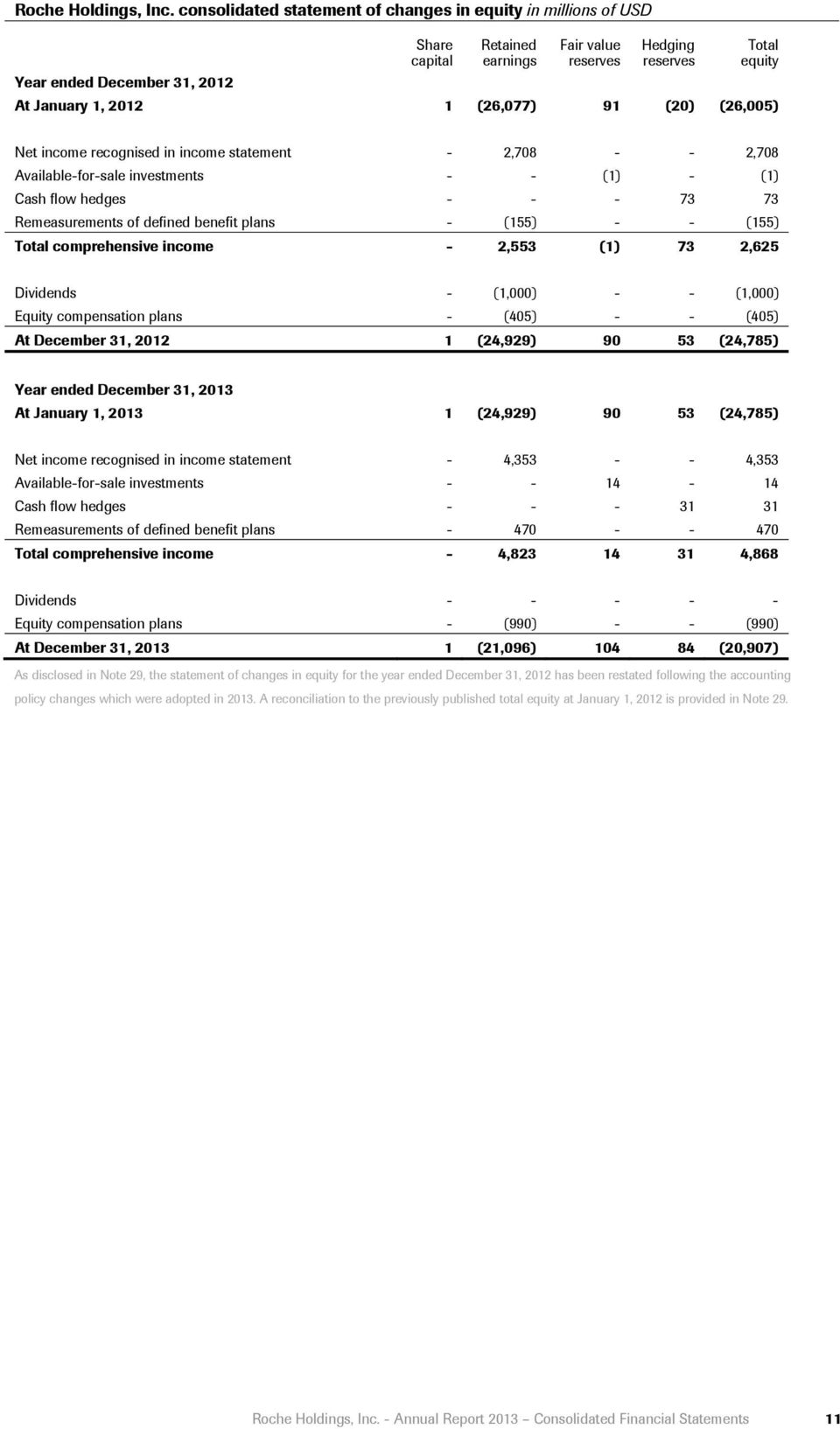
12 Roche Holdings, Inc. consolidated statement of changes in equity in millions of USD Share capital Retained earnings Fair value reserves Hedging reserves Total equity Year ended December 31, 2012 At January 1, (26,077) 91 (20) (26,005) Net income recognised in income statement - 2, ,708 Available-for-sale investments - - (1) - (1) Cash flow hedges Remeasurements of defined benefit plans - (155) - - (155) Total comprehensive income - 2,553 (1) 73 2,625 Dividends - (1,000) - - (1,000) Equity compensation plans - (405) - - (405) At December 31, (24,929) (24,785) Year ended December 31, 2013 At January 1, (24,929) (24,785) Net income recognised in income statement - 4, ,353 Available-for-sale investments Cash flow hedges Remeasurements of defined benefit plans Total comprehensive income - 4, ,868 Dividends Equity compensation plans - (990) - - (990) At December 31, (21,096) (20,907) As disclosed in Note 29, the statement of changes in equity for the year ended December 31, 2012 has been restated following the accounting policy changes which were adopted in A reconciliation to the previously published total equity at January 1, 2012 is provided in Note 29. Roche Holdings, Inc. - Annual Report 2013 Consolidated Financial Statements 11
13 Notes to the Roche Holdings, Inc. Consolidated Financial Statements 1. General accounting principles Basis of preparation The consolidated financial statements (hereafter the Annual Financial Statements ) of the RHI Group have been prepared in accordance with International Financial Reporting Standards (IFRS) as adopted by the European Union (EU). They have been prepared using the historical cost convention except for items that are required to be accounted for at fair value. They were approved for issue by the Board of Directors on February 3, These financial statements are the Annual Financial Statements of Roche Holdings, Inc., a company incorporated in the State of Delaware, and its subsidiaries ( RHI or the RHI Group ). RHI is 100% indirectly owned by Roche Holding Ltd, a public company registered in Switzerland and the parent company of the Roche Group. Roche Holdings, Inc. and its subsidiaries are therefore members of the Roche Group. The RHI Group s significant accounting policies and changes in accounting policies are disclosed in Note 29. Going concern: The RHI Group completed the purchase of the non-controlling interests in Genentech effective March 26, Based on the International Accounting Standard 27 Separate Financial Statements (IAS 27) and consistent with the International Financial Reporting Standard 10 Consolidated Financial Statements (IFRS 10), which was adopted by RHI in 2013, this transaction was accounted for in full as an equity transaction. As a consequence, the carrying amount of the consolidated equity of the RHI Group at that time was reduced by approximately $47 billion, of which $7.6 billion was allocated to eliminate the book value of Genentech non-controlling interests. At December 31, 2013 the RHI Group had a negative equity of $20.9 billion (December 31, 2012: $24.8 billion). The capacity of the RHI Group to generate positive cash flows and operating profit is not affected by this accounting treatment. In addition, RHI has bonds, notes and commercial paper outstanding with a carrying value of $14.2 billion which are guaranteed by Roche Holding Ltd. Management has assessed that it remains appropriate to prepare the RHI Group s financial statements on a going concern basis. In 2013, the RHI Group generated an operating profit of $9.3 billion and a positive operating cash flow of $7.3 billion. Key accounting judgements, estimates and assumptions The preparation of the Annual Financial Statements requires management to make judgements, estimates and assumptions that affect the reported amounts of revenues, expenses, assets, liabilities and contingent amounts. Actual outcomes could differ from those management estimates. The estimates and underlying assumptions are reviewed on an ongoing basis and are based on historical experience and various other factors. Revisions to estimates are recognised in the period in which the estimate is revised. The following are considered to be the key accounting judgements, estimates and assumptions made and are believed to be appropriate based upon currently available information. Revenue: The nature of RHI s business is such that many sales transactions do not have a simple structure and may consist of multiple components occurring at different times. RHI is also party to out-licensing agreements, which involve upfront and milestone payments occurring over several years and which may also involve certain future obligations. Revenue is only recognised when, in management s judgement, the significant risks and rewards of ownership have been transferred and when the RHI Group does not retain continuing managerial involvement or effective control over the goods sold or when the obligation has been fulfilled. For some transactions this can result in cash receipts being initially recognised as deferred income and then released to income over subsequent periods on the basis of the performance of the conditions specified in the agreement. There may be circumstances such that the level of sales returns, and hence revenues, cannot be reliably measured. In such cases sales are only recognised when the right of return expires, which is generally upon prescription of the products to patients. In order to estimate this, management uses publicly available information about prescriptions as well as information provided by wholesalers and other intermediaries. Roche Holdings, Inc. - Annual Report 2013 Notes to the Consolidated Financial Statements 12

14 At December 31, 2013 the RHI Group has $1,731 million in provisions and accruals for expected sales returns, chargebacks and other rebates, including U.S. Medicaid. Such estimates are based on analyses of existing contractual or legislatively mandated obligations, historical trends and the RHI Group s experience. At December 31, 2013 the RHI Group has $34 million of provisions for doubtful receivables (see Note 11). Such estimates are based on analyses of ageing of customer balances, specific credit circumstances, historical trends and the RHI Group s experience, taking also into account current economic conditions. Business combinations: The RHI Group initially recognises the fair value of identifiable assets acquired, the liabilities assumed, any non-controlling interest and the consideration transferred in a business combination. Management judgement is particularly involved in the recognition and fair value measurement of intellectual property, contingent liabilities and contingent consideration. In making this assessment management considers the underlying economic substance of the items concerned in addition to the contractual terms. Impairment: At December 31, 2013 the RHI Group had $5,354 million in property, plant and equipment (see Note 7), $5,442 million in goodwill (see Note 8) and $2,659 million in intangible assets (see Note 9). Goodwill and intangible assets not yet available for use are reviewed annually for impairment. Property, plant and equipment and intangible assets in use are assessed for impairment when there is a triggering event that provides evidence that an asset may be impaired. To assess whether any impairment exists estimates of expected future cash flows are used. Actual outcomes could vary significantly from such estimates of discounted future cash flows. Factors such as changes in discount rates, the planned use of buildings, machinery or equipment or closure of facilities, the presence or absence of competition, technical obsolescence and lower than anticipated product sales could lead to shorter useful lives or impairment. Pensions and other post-employment benefits: The RHI Group operates a number of defined benefit plans and the fair value of the recognised plan assets and liabilities are based upon statistical and actuarial calculations. The measurement of the net defined benefit obligation is particularly sensitive to changes in the discount rate, inflation rate, expected mortality and medical cost trend rate assumptions. At December 31, 2013 the present value of RHI s defined benefit obligation is $4,555 million (see Note 23). The actuarial assumptions used may differ materially from actual results due to changes in market and economic conditions, longer or shorter life spans of participants, and other changes in the factors being assessed. These differences could impact on the assets or liabilities recognised in the balance sheet in future periods. Legal provisions: The RHI Group provides for anticipated legal settlement costs when there is a probable outflow of resources that can be reliably estimated. At December 31, 2013, the RHI Group had $633 million in legal provisions. The status of significant legal cases is disclosed in Note 19. These estimates consider the specific circumstances of each legal case, relevant legal advice and are inherently judgemental due to the highly complex nature of legal cases. The estimates could change substantially over time as new facts emerge and each legal case progresses. Where no reliable estimate can be made, no provision is recorded and contingent liabilities are disclosed where material. Environmental provisions: The RHI Group provides for anticipated environmental remediation costs when there is a probable outflow or resources that can be reasonably estimated. At December 31, 2013, the RHI Group had $360 million in environmental provisions (see Note 19). Environmental provisions consist primarily of costs to fully clean and refurbish contaminated sites, including landfills, and to treat and contain contamination at certain other sites. These estimates are inherently judgemental due to uncertainties related to the detection of previously unknown contaminated sites, the method and extent of remediation, the percentage of the problematic materials attributable to the RHI Group at the remediation sites and the financial capabilities of the other potentially responsible parties. The estimates could change substantially over time as new facts emerge and each environmental remediation progresses. Income taxes: At December 31, 2013, the RHI Group had a current income tax net liability of $599 million and a deferred tax net asset of $2,181 million (see Note 4). Significant estimates are required to determine the current and deferred tax assets and liabilities. Some of these estimates are based on interpretations of existing tax laws or regulations. Factors that may impact on current and deferred taxes include changes in tax laws, regulations or rates, changing interpretations of existing tax laws or regulations, future levels of research and development spending and changes in pre-tax earnings. Roche Holdings, Inc. - Annual Report 2013 Notes to the Consolidated Financial Statements 13

15 Leases: The treatment of leasing transactions is mainly determined by whether the lease is considered to be an operating lease or a finance lease. In making this assessment, management looks at the substance of the lease, as well as the legal form, and makes a judgement about whether substantially all of the risks and rewards of ownership are transferred. Arrangements which do not take the legal form of a lease but that nevertheless convey the right to use an asset, are also covered by such assessments. Consolidation: The RHI Group periodically undertakes transactions that may involve obtaining control or significant influence of other companies. These transactions include equity acquisitions, asset purchases, alliance agreements and other transactions with structured entities. In all such cases management makes an assessment as to whether the RHI Group has control or significant influence of the other company, and whether it should be consolidated as a subsidiary or accounted for as an associated company. In making this assessment management considers the underlying economic substance of the transaction in addition to the contractual terms. 2. Operating segment information The RHI Group has two divisions, Pharmaceuticals and Diagnostics. Revenues are primarily generated from the sale of prescription pharmaceutical products and diagnostic instruments, reagents and consumables, respectively. Both divisions also derive revenue from the sale or licensing of products or technology to third parties. Certain corporate activities that cannot be reasonably allocated to the other reportable business segments based on RHI s management and organisational structure are reported as Corporate. These include functions for communications, human resources, finance (including treasury, taxes and pension fund management), legal, safety and environmental services. Divisional information in millions of USD Pharmaceuticals Diagnostics Corporate RHI Group Revenues from external customers and related parties Sales 17,217 15,525 3,099 3, ,316 18,609 Royalties and other operating income 4,110 3, ,432 3,960 Total 21,327 19,165 3,421 3, ,748 22,569 Segment results Operating profit 9,251 6, (21) (337) 9,319 6,654 Capital expenditure Business combinations Additions to property, plant and equipment Additions to intangible assets Total capital expenditure , Research and development Research and development costs 4,184 4, ,428 4,595 Other segment information Depreciation of property, plant and equipment Amortisation of intangible assets Impairment (reversal) of property, plant and equipment (535) (525) 453 Impairment of goodwill Impairment of intangible assets Equity compensation plan expenses Roche Holdings, Inc. - Annual Report 2013 Notes to the Consolidated Financial Statements

16 Net operating assets in millions of USD Assets Liabilities Net assets Pharmaceuticals 12,516 12,081 12,438 (5,049) (5,708) (4,741) 7,467 6,373 7,697 Diagnostics 7,242 6,998 7,378 (1,050) (886) (879) 6,192 6,112 6,499 Corporate (328) (299) (42) (299) (291) (28) Total operating 19,787 19,087 19,830 (6,427) (6,893) (5,662) 13,360 12,194 14,168 Non-operating 4,912 9,397 7,562 (39,179) (46,376) (47,735) (34,267) (36,979) (40,173) RHI Group 24,699 28,484 27,392 (45,606) (53,269) (53,397) (20,907) (24,785) (26,005) As disclosed in Note 29, the non-operating net assets at December 31, 2012 and December 31, 2011 have been restated following the accounting policy changes which were adopted in A reconciliation to the previously published balance sheet is provided in Note 29. Supplementary unaudited information on sales for major products is given in the Management Report. Major customers In total three U.S. national wholesale distributors represent substantially all of the RHI Group s revenues in The three U.S. national wholesale distributors are AmerisourceBergen Corp., with $5 billion (2012: $5 billion), McKesson Corp. with $5 billion (2012: $5 billion) and Cardinal Health, Inc. with $3 billion (2012: $3 billion). Approximately 96% of these revenues were in the Pharmaceuticals operating segment, with the residual in the Diagnostics segment. 3. Net financial expense Financing costs in millions of USD Interest expense (964) (1,292) Amortisation of debt discount 20 (20) (29) Net gains (losses) on redemption and repurchase of bonds and notes 20 (269) (262) Discount unwind 19 (13) (9) Net interest cost of defined benefit plans 23 (70) (79) Total financing costs (1,336) (1,671) Other financial income (expense) in millions of USD Net gains (losses) on sale of equity securities Write-downs and impairments of equity securities (1) (4) Net income from equity securities Net interest income 2 1 Foreign exchange gains (losses) 23 (121) Net other financial income (expense) 6 2 Total other financial income (expense) 57 (84) Net foreign exchange gains of $23 million were largely offset by a net loss of $25 million made on foreign exchange derivatives with related parties (see Note 27). Roche Holdings, Inc. - Annual Report 2013 Notes to the Consolidated Financial Statements 15

17 Net financial expense in millions of USD Financing costs (1,336) (1,671) Other financial income (expense) 57 (84) Net financial expense (1,279) (1,755) Financial result from Treasury management (1,209) (1,676) Financial result from Pension management (70) (79) Net financial expense (1,279) (1,755) As disclosed in Note 29, the net financial expense for the year ended December 31, 2012 has been restated following the accounting policy changes which were adopted in A reconciliation to the previously published net financial expense is provided in Note Income taxes Income tax expenses in millions of USD Current income taxes (2,262) (2,191) Deferred taxes (643) 746 Total income tax (expense) (2,905) (1,445) As disclosed in Note 29, the income tax expense for year ended December 31, 2012 has been restated following the accounting policy changes which were adopted in A reconciliation to the previously published income tax expense is provided in Note 29. In January 2013 there was the retrospective re-enactment of the 2012 U.S. research and development tax credits, which means that the 2013 results include a whole year of tax credits in respect of 2012 as well as tax credits for RHI s effective tax rate can be reconciled to the RHI Group s average expected tax rate as follows: Reconciliation of RHI s effective tax rate Average expected tax rate 35.0% 35.0% Tax effect of - Non-taxable income/non-deductible expenses +2.1% +3.2% - Equity compensation plans -0.3% -0.8% - Research, development and other manufacturing tax credits -4.4% -3.9% - U.S. state tax impacts +1.0% +2.3% - Other differences +6.6% -1.0% RHI s effective tax rate 40.0% 34.8% Tax effects of other comprehensive income in millions of USD Pre-tax amount Tax After-tax amount Pre-tax amount Tax After-tax amount Remeasurements of defined benefit plans 732 (262) 470 (240) 85 (155) Available-for-sale investments 22 (8) 14 (4) 3 (1) Cash flow hedges 48 (17) (41) 73 Other comprehensive income 802 (287) 515 (130) 47 (83) Income tax assets (liabilities) in millions of USD 2011 Current income taxes - Assets Liabilities (599) (1,106) (582) Net current income tax assets (liabilities) (599) (1,056) (548) Deferred taxes - Assets 2,656 3,135 2,309 - Liabilities (475) (437) (580) Net deferred tax assets (liabilities) 2,181 2,698 1, Roche Holdings, Inc. - Annual Report 2013 Notes to the Consolidated Financial Statements

18 Current income taxes: movements in recognised net assets (liabilities) in millions of USD Net current income tax asset (liability) at January 1 (1,056) (548) Income taxes paid 2,360 1,673 (Charged) credited to the income statement (2,262) (2,191) (Charged) credited to equity from equity compensation plans and other transactions with shareholders Other 2 2 Net current income tax assets (liabilities) at December 31 (599) (1,056) Deferred taxes: movements in recognised net assets (liabilities) in millions of USD Property, plant and equipment Intangible assets Defined benefit plans Year ended December 31, 2012 Other temporary differences At January 1, 2012 (326) (877) 644 2,288 1,729 Business combinations (Charged) credited to the income statement (16) (Charged) credited to other comprehensive income (38) 47 (Charged) credited to equity from equity compensation plans and other transactions with shareholders At December 31, 2012 (158) (672) 713 2,815 2,698 Total Year ended December 31, 2013 At January 1, 2013 (158) (672) 713 2,815 2,698 Business combinations 5 - (110) - 3 (107) (Charged) credited to the income statement (129) 363 (16) (861) (643) (Charged) credited to other comprehensive income (262) (25) (287) (Charged) credited to equity from equity compensation plans and other transactions with shareholders At December 31, 2013 (287) (419) 435 2,452 2,181 The deferred tax assets for other temporary differences mainly relates to accrued and other liabilities and provisions. Deferred tax assets are recognised for tax losses carried forward only to the extent that realisation of the related tax benefit is probable. The RHI Group has unrecognised tax losses, including valuation allowances, as follows: Unrecognised tax losses: expiry Amount ($ million) Applicable Amount Applicable tax rate ($ million) tax rate Within one year Between one and five years More than five years 3,932 3% 2,632 3% Total unrecognised tax losses 3,932 3% 2,632 3% The More than five years category includes losses that cannot be used for U.S. state income tax purposes in those states which only permit tax reporting on a separate entity basis. Deferred tax liabilities have not been established for the withholding tax and other taxes that would be payable on the unremitted earnings of subsidiaries, where such amounts are currently regarded as permanently reinvested. The total unremitted earnings of the RHI Group, regarded as permanently reinvested, were $7.3 billion at December 31, 2013 (2012: $4.2 billion). Roche Holdings, Inc. - Annual Report 2013 Notes to the Consolidated Financial Statements 17

19 5. Business combinations Acquisitions 2013 Constitution Medical Investors, Inc. On July 1, 2013 the RHI Group acquired a 100% controlling interest in Constitution Medical Investors, Inc. ( CMI ), a US private company based in Massachusetts. CMI is the developer of a highly innovative hematology testing system, which is designed to provide faster and more accurate diagnosis of bloodrelated diseases, helping to improve patient care. CMI is reported in the Diagnostics operating segment as part of the Professional Diagnostics business area. The total consideration was $286 million, of which $220 million was paid in cash and $66 million arose from a contingent consideration arrangement. The contingent payments are based on the achievement of performance-related milestones that may arise until the end of 2017 and the range of undiscounted outcomes is between zero and $255 million. The identifiable assets acquired and liabilities assumed are set out in the table below. Acquisitions 2013: net assets acquired in millions of USD CMI Intangible assets - Product intangibles: not available for use 283 Deferred tax liabilities (107) Other net assets (liabilities) 1 Net identifiable assets 177 Goodwill 109 Total consideration 286 Cash 220 Contingent consideration Total consideration 286 The fair value of the intangible asset is determined using an excess earning method that is based on management forecasts and observable market data for discount rates, tax rates and foreign exchange rates. The present value is calculated using a risk-adjusted discount rate of 12.5%. The valuation was performed by an independent valuer. Goodwill represents a control premium and synergies that can be obtained from the RHI Group s existing business. None of the goodwill is expected to be deductible for income tax purposes. Directly attributable transaction costs of $3 million are reported in the Diagnostics operating segment within general and administration expenses. The impact of the CMI acquisition on the Diagnostics Division and RHI Group reported results was not material. Cash flows from business combinations Acquisitions: net cash outflow in millions of USD 2013 Cash consideration paid (220) Cash in acquired company 1 Contingent consideration paid 26 - Total net cash outflow (219) 18 Roche Holdings, Inc. - Annual Report 2013 Notes to the Consolidated Financial Statements

20 6. Restructuring plans During 2013 the RHI Group continued with the implementation of several major restructuring plans initiated in prior years, notably the reorganisation of research and development in the Pharmaceuticals Division and programmes to address the long-term profitability in the Diabetes Care and former Applied Science businesses in Diagnostics. Additionally, there was income of $573 million from the reversal of previously incurred charges for a bulk drug production unit at the Vacaville site in California. Restructuring plans: costs incurred in millions of USD Diagnostics 1) Pharma R&D 2) Other Plans 3) Total Year ended December 31, 2013 Restructuring costs - Employee related costs Site closure costs (572) (510) - Other reorganisation expenses Total restructuring costs (545) (220) Additional costs - Impairment of goodwill Impairment of intangible assets Legal and environmental costs - (57) - (57) Total costs (545) (244) Year ended December 31, Employee related costs Site closure costs Other reorganisation expenses Total restructuring costs Additional costs - Impairment of goodwill Impairment of intangible assets Legal and environmental costs Total costs ,328 1) Includes restructuring of the Diabetes Care and former Applied Science business areas. 2) Includes closure of the Nutley site and associated infrastructure and environmental remediation costs. 3) Includes the Operational Excellence programme (Pharmaceuticals and Diagnostics) and in 2012 dalcetrapib (Pharmaceuticals). Diagnostics Division Applied Science and Diabetes Care restructuring On April 23, 2013 it was announced that the Applied Science business area s portfolio of products will be integrated within the other business areas of the Diagnostics Division. This will streamline decision-making and enhance technology flow from research use to the clinical setting. On September 26, 2013 Roche Diabetes Care announced its Autonomy and Speed initiative which will enable the business to focus on Diabetes Care specific requirements, speed up processes and decision making and drive efficiencies. Various initiatives were announced in 2012 for the Diabetes Care and Applied Science businesses, which included increasing the efficiency of marketing and distribution operations and research and development activities. During 2013 total costs of $77 million (2012: $36 million) were incurred mainly for headcount reductions. In addition, goodwill impairment charges of $33 million were incurred for the write-off of the goodwill from the 454 Life Sciences acquisitions in the former Applied Science business area. During 2012 a goodwill impairment charge of $200 million was incurred for the full write-off of the goodwill from the NimbleGen acquisition and intangible asset impairment charges of $9 million were incurred. Roche Holdings, Inc. - Annual Report 2013 Notes to the Consolidated Financial Statements 19

21 Pharmaceutical Division Research and Development reorganisation On June 26, 2012 the RHI Group announced a streamlining of the research and development activities within the Pharmaceuticals Division. The planned operational closure of the U.S. site in Nutley, New Jersey, was completed on schedule by the end of During 2013 total costs of $248 million were incurred. These costs include $115 million for employee-related and other reorganisation costs during the year and additional provisions of $95 million to cover site running costs until the expected divestment in The provisions were mainly for employee-related costs, property taxes and outside services. There was a further impairment of $38 million to the carrying value of the Nutley site, based on the most recent external property market data. In addition the first results of the environmental investigations showed that the expected cost of remediation may be lower than originally expected and accordingly the environmental provisions were reduced by $57 million. During 2012 total costs of $574 million were incurred mainly for severance, other employee-related costs and property, plant and equipment impairments at the Nutley site. In addition there were environmental remediation costs at the Nutley site of $259 million and intangible asset impairment charges of $31 million as a result of portfolio prioritisation decisions linked to the reorganisation. Other restructuring plans On October 14, 2013 the Pharmaceuticals Division announced that as part of its investments to increase its biologic medicine manufacturing network capacity, a bulk drug production unit at the Vacaville site in California that had been discontinued and fully written down in 2009 will be put back into service. This resulted in an income of $573 million from the reversal of previously incurred impairment charges (see Note 7). During 2013 costs of $19 million (2012: $161 million) were incurred for the previously announced Operational Excellence programme, mainly for employee-related costs in the Pharmaceuticals Division. Other plans totaled $9 million (2012: $5 million). In 2012 there were also $4 million of restructuring costs which consist of property, plant and equipment write-off. Additionally $49 million intangible asset impairment charges were expensed in respect of the termination of the dalcetrapib dal-outcomes trial and all the studies in the dal-heart programme. Restructuring plans: summary of costs incurred in millions of USD Employee-related costs - Termination costs Defined benefit plans - (72) - Other employee-related costs Total employee-related costs Site closure costs - Impairment (reversal) of property, plant and equipment (529) Accelerated depreciation of property, plant and equipment (Gains) losses on disposal of property, plant and equipment - (10) - Other site closure costs Total site closure costs (510) 469 Other reorganisation expenses Total restructuring costs (220) 779 Additional costs - Impairment of goodwill Impairment of intangible assets Legal and environmental costs 19 (57) 260 Total costs (244) 1, Roche Holdings, Inc. - Annual Report 2013 Notes to the Consolidated Financial Statements
22 Restructuring plans: classification of costs in millions of USD Depreciation, amortisation and impairment Other costs Depreciation, amortisation and Other Total impairment costs Total Cost of sales - Pharmaceuticals (572) 9 (563) Diagnostics Marketing and distribution - Pharmaceuticals Diagnostics Research and development - Pharmaceuticals Diagnostics General and administration - Pharmaceuticals Diagnostics Corporate - (56) (56) Total (495) 251 (244) ,328 Total by operating segment - Pharmaceuticals (534) 236 (298) Diagnostics Corporate - (56) (56) Total (495) 251 (244) ,328 Roche Holdings, Inc. - Annual Report 2013 Notes to the Consolidated Financial Statements 21
23 7. Property, plant and equipment Property, plant and equipment: movements in carrying value of assets in millions of USD Buildings Land and land improvements Machinery and equipment Construction in progress At January 1, 2012 Cost 437 5,319 4, ,904 Accumulated depreciation and impairment - (2,109) (3,280) (16) (5,405) Net book value 437 3,210 1, ,499 Total Year ended December 31, 2012 At January 1, ,210 1, ,499 Additions Disposals (2) (4) (13) - (19) Transfers (245) - Depreciation charge - (231) (349) - (580) Impairment reversal (charge) - (260) (133) (60) (453) Other 3 (4) (15) - (16) At December 31, ,808 1, ,870 Cost 439 5,359 5, ,084 Accumulated depreciation and impairment - (2,551) (3,641) (22) (6,214) Net book value 439 2,808 1, ,870 Year ended December 31, 2013 At January 1, ,808 1, ,870 Additions Disposals - (2) (24) - (26) Transfers (356) - Depreciation charge - (208) (341) - (549) Impairment reversal (charge) (1) 525 Other - - (31) - (31) At December 31, ,043 1, ,354 Cost 439 5,371 5, ,202 Accumulated depreciation and impairment - (2,328) (3,502) (18) (5,848) Net book value 439 3,043 1, ,354 Impairment reversal (charge) On October 14, 2013 the Pharmaceuticals Division announced details of investments to increase its biologic medicine manufacturing network capacity to meet the rising demand for licensed biologics and expected pipeline growth. The investments will be spread across sites in Vacaville and Oceanside. In 2009 a bulk drug production unit at the Vacaville site in California, which was not yet licensed, was discontinued and fully written down as part of a reassessment of the manufacturing network requirements at that time. The bulk drug production unit at the Vacaville site will require capital investment before it can become operational, which is expected to occur in The RHI Group s decision to restart licensing efforts and prepare for operational use of the discontinued bulk drug production unit at the Vacaville site for commercial manufacturing has resulted in an impairment reversal of property, plant and equipment of $573 million in The impairment reversal of $573 million represents the net book value from the time of the original impairment for the assets that will be brought back into use, less the depreciation that would have been charged in the intervening period had that impairment not occurred (see Note 6). This was partly offset by a further impairment of $38 million to the carrying value of the Nutley site, based on the most recent external property market data. During 2012 the impairment charges mainly related to property, plant and equipment at the Nutley site. 22 Roche Holdings, Inc. - Annual Report 2013 Notes to the Consolidated Financial Statements
24 Classification of impairment of property, plant and equipment in millions of USD Cost of sales 569 (19) Marketing and distribution (3) (5) Research and development (4) (105) General and administration (37) (324) Total impairment reversal (charge) 525 (453) In 2013 no reimbursements were received from insurance companies in respect of impairments to property, plant and equipment (2012: none). In 2013 no borrowing costs were capitalised as property, plant and equipment (2012: none). Leasing arrangements where the RHI Group is the lessee Finance leases: At December 31, 2013 the capitalised cost of property, plant and equipment under finance leases was $257 million (2012: $257 million) and the net book value of these assets was $128 million (2012: $150 million). The carrying value of the leasing obligation was $200 million (2012: $221 million), which is reported as part of Debt (see Note 20). Finance leases: future minimum lease payments under non-cancellable leases in millions of USD Future minimum lease payments Present value of minimum lease payments Within one year Between one and five years More than five years Total Future finance charges Total future minimum lease payments (undiscounted) Operating leases: RHI Group companies are party to a number of operating leases, mainly for plant and machinery, including motor vehicles, and for certain short-term property rentals. The arrangements do not impose any significant restrictions on the RHI Group. Total operating lease rental expense was $74 million (2012: $78 million). Operating leases: future minimum lease payments under non-cancellable leases in millions of USD Within one year Between one and five years More than five years Total minimum payments Leasing arrangements where the RHI Group is the lessor Finance leases: Certain assets, mainly Diagnostic instruments, are leased to third parties through finance lease arrangements. Such assets are reported as receivables at an amount equal to the net investment in the lease. Lease income from finance leases is recognised over the term of the lease based on the effective interest rate method. Finance leases: future minimum lease receipts under non-cancellable leases in millions of USD Present value of Gross investment in lease minimum lease receipts Within one year Between one and five years More than five years Total Unearned finance income (10) (10) n/a n/a Unguaranteed residual value n/a n/a 2 1 Net investment in lease The accumulated allowance for uncollectible minimum lease payments was $3 million (2012: $2 million). There were no contingent rents recognised in income. Roche Holdings, Inc. - Annual Report 2013 Notes to the Consolidated Financial Statements 23
25 Operating leases: Certain assets, mainly Diagnostics instruments, are leased to third parties through operating lease arrangements. Such assets are reported within property, plant and equipment. Lease income from operating leases is recognised over the lease term on a straight-line basis. At December 31, 2013, machinery and equipment with an original cost of $483 million (2012: $425 million) and a net book value of $180 million (2012: $165 million) was being leased to third parties. There were no contingent rents recognised in income. Operating leases: future minimum lease receipts under non-cancellable leases in millions of USD Within one year Between one and five years More than five years - - Total minimum receipts Goodwill Capital commitments The RHI Group has non-cancellable capital commitments for the purchase or construction of property, plant and equipment totaling $187 million (2012: $79 million). Goodwill: movements in carrying value of assets in millions of USD At January 1 Cost 5,758 5,758 Accumulated impairment (200) - Net book value 5,558 5,758 Year ended December 31 At January 1 5,558 5,758 Business combinations Impairment charge (225) (200) At December 31 5,442 5,558 Cost 5,867 5,758 Accumulated impairment (425) (200) Net book value 5,442 5,558 Allocated to the following cash-generating units Pharmaceuticals 1,960 1,960 Total Pharmaceuticals Division 1,960 1,960 Diabetes Care 2 2 Professional Diagnostics 1,574 1,465 Molecular Diagnostics - - Applied Science - 33 Tissue Diagnostics Strategic goodwill (held at divisional level and not allocated to business areas) 1,302 1,302 Total Diagnostics Division 3,482 3,598 Impairment charge During 2013 impairment charges totaling $225 million were recorded which related to: A goodwill impairment charge of $192 million was recorded in the Tissue Diagnostics business area within the Diagnostics Division. This impairment is based on the latest business plans prepared during the second half of The main factors leading to this impairment were reduced revenue expectations in the U.S. following recent changes in the College of American Pathologists guidelines for the use of negative reagent controls in immunohistochemistry testing which reduced volumes and changes which reduced the reimbursement amount to laboratories. 24 Roche Holdings, Inc. - Annual Report 2013 Notes to the Consolidated Financial Statements
26 On April 23, 2013 the reorganisation of the Applied Science business area was announced (see Note 6). A goodwill impairment charge of $33 million was incurred for the full write-off of the goodwill from the 454 Life Sciences acquisition in 2007 in the former Applied Science business area. During 2012 a goodwill impairment charge of $200 million was incurred for the full write-off of the goodwill from the NimbleGen acquisition in 2007 (see Note 6). Impairment testing Pharmaceuticals Division: For the Pharmaceuticals Division, the recoverable amount used in the impairment testing is based on value in use. The cash flow projections used for impairment testing are based on the most recent business plans approved by management. The business plans include management s latest estimates on sales volume and pricing, and production and other operating costs and assumes no significant changes in the organisation. The business plans are projected over five years. These valuations include a terminal value beyond these years, assuming no further growth. The discount rate used is based on an after-tax rate of 7.3% (2012: 6.4%), which is derived from a capital asset pricing model using data from capital markets, including government twenty-year bonds. A weighted average tax rate of 25.5% (2012: 25.5%) is used in the calculations and the corresponding pre-tax discount rate is 9.8% (2012: 8.6%). Diagnostics Division: The division s business areas are the cash-generating units used for the testing of goodwill. The goodwill arising from the Corange/Boehringer Mannheim acquisition and part of the goodwill arising from the Ventana acquisition is recorded and monitored at a divisional level as it relates to the strategic development of the whole division and cannot be meaningfully allocated to the division s business areas. Therefore the cash-generating unit for this goodwill is the entire division. The recoverable amount used in the impairment testing is based on value in use and the cash flow projections are based on the most recent business plans approved by management. The business plans include management s latest estimates on sales volume and pricing, and production and other operating costs and assumes no significant changes in the organisation. The business plans are projected over five years, except for the Tissue Diagnostics business area which is projected over ten years reflecting the long-term nature of this business. These valuations include a terminal value beyond these years, assuming no further growth. The discount rate used is based on an after-tax rate of 7.3% (2012: 6.4%), which is derived from a capital asset pricing model using data from capital markets, including government twenty-year bonds. A weighted average tax rate of 17.6% (2012: 15.9%) is used in the calculations and the corresponding pre-tax discount rate is 8.8% (2012: 7.7%). Sensitivity analysis Management has performed sensitivity analyses for both Roche Pharmaceuticals and the Diagnostics Division, which increased the discount rate by 1% combined with decreasing the forecast cash flows by 5%. Except for the Tissue Diagnostics business area, the results of the sensitivity analyses demonstrated that the above changes in the key assumptions would not cause the carrying value of goodwill to exceed the recoverable amount at December 31, The above key assumption changes would result in a further goodwill impairment of $394 million in the Tissue Diagnostics business area at December 31, Roche Holdings, Inc. - Annual Report 2013 Notes to the Consolidated Financial Statements 25
27 9. Intangible assets Intangible assets: movements in carrying value of assets in millions of USD Product Product intangibles: in use intangibles: not available for use Marketing intangibles: in use At January 1, 2012 Technology intangibles: in use Cost 5,243 1, ,813 Accumulated amortisation and impairment (3,811) (252) (1) (574) (4,638) Net book value 1,432 1, ,175 Total Year ended December 31, 2012 At January 1, ,432 1, ,175 Business combinations Additions Disposals (13) (126) - - (139) Transfers 20 (20) Amortisation charge (258) - (3) (5) (266) Impairment charge (25) (361) - - (386) At December 31, ,253 1, ,586 Cost 5,323 1, ,700 Accumulated amortisation and impairment (4,070) (461) (4) (579) (5,114) Net book value 1,253 1, ,586 Allocation by operating segment - Pharmaceuticals ,329 - Diagnostics ,257 Total RHI Group 1,253 1, ,586 Year ended December 31, 2013 At January 1, ,253 1, ,586 Business combinations Additions Disposals (20) (19) - - (39) Transfers 103 (103) Amortisation charge (275) - - (5) (280) Impairment charge (20) (311) - - (331) At December 31, ,297 1, ,659 Cost 5,676 2, ,368 Accumulated amortisation and impairment (4,379) (742) (4) (584) (5,709) Net book value 1,297 1, ,659 Allocation by operating segment - Pharmaceuticals ,103 - Diagnostics ,556 Total RHI Group 1,297 1, , Roche Holdings, Inc. - Annual Report 2013 Notes to the Consolidated Financial Statements
28 Significant intangible assets at December 31, 2013 in millions of USD Operating segment Product intangibles in use Net book value Remaining amortisation period Tanox acquisition Pharmaceuticals years Ventana acquisition Diagnostics years Product intangibles not available for use Ventana acquisition Diagnostics 516 n/a CMI acquisition Diagnostics 283 n/a Classification of amortisation and impairment expenses in millions of USD Amortisation Impairment Cost of sales - Pharmaceuticals (71) (70) - (14) - Diagnostics (161) (163) - (11) Marketing and distribution - Diagnostics - (3) - - Research and development - Pharmaceuticals (47) (29) (331) (361) - Diagnostics (1) (1) - - Total (280) (266) (331) (386) Internally generated intangible assets The RHI Group currently has no internally generated intangible assets from development as the criteria for the recognition as an asset are not met. Intangible assets with indefinite useful lives The RHI Group currently has no intangible assets with indefinite useful lives. Intangible asset impairment Impairment charges arise from changes in the estimates of the future cash flows expected to result from the use of the asset and its eventual disposal. Factors such as the presence or absence of competition, technical obsolescence or lower than anticipated sales for products with capitalised rights could result in shortened useful lives or impairment. Impairment charges 2013 Pharmaceuticals Division: Impairment charges totaling $331 million were recorded which related to: A portfolio reassessment within the hepatitis C virus (HCV) franchise ($273 million). The assets concerned, which were not yet being amortised, were written down to their recoverable value of $5 million. A portfolio reassessment within the cardiovascular and metabolic diseases franchise ($34 million). The asset concerned, which was not yet being amortised, was fully written down. A decision to stop two collaboration projects with alliance partners ($20 million). The assets concerned, which were being amortised, were fully written down. A decision to stop development of one compound with an alliance partner ($4 million). The asset concerned, which was not yet being amortised, was fully written down. Impairment charges 2012 Pharmaceuticals Division: Impairment charges totaling $375 million were recorded which related to: A clinical data assessment of a project acquired as part of the Marcadia acquisition ($172 million); Various restructuring initiatives ($80 million), mainly related to the termination of the dalcetrapib trials (see Note 6). Portfolio prioritisation decisions ($52 million), mainly related to the return of the monoclonal antibody RG 7334 anti- PLGF MAb to the alliance partners. A clinical data assessment of a collaboration project with an alliance partner ($57 million). A decision to stop development of one compound with an alliance partner ($14 million). Diagnostics Division: Impairment charges totaling $11 million were recorded which mainly related to the Applied Science business area restructuring (see Note 6). Roche Holdings, Inc. - Annual Report 2013 Notes to the Consolidated Financial Statements 27
29 Potential commitments from alliance collaborations The RHI Group is party to in-licensing and similar arrangements with its alliance partners. These arrangements may require the RHI Group to make certain milestone or other similar payments dependent upon the achievement of agreed objectives or performance targets as defined in the collaboration agreements. RHI s current estimate of future third party commitments for such payments is set out in the table below. These figures are undiscounted and are not risk adjusted, meaning that they include all such potential payments that can arise assuming all projects currently in development are successful. The timing is based on RHI s current best estimate. Potential future third-party collaboration payments at December 31, 2013 in millions of USD Pharmaceuticals Diagnostics RHI Group Within one year Between one and two years Between two and three years Total Inventories Inventories in millions of USD 2011 Raw materials and supplies Work in process Intermediates 923 1, Finished goods Less: provision for slow-moving and obsolete inventory (184) (204) (212) Total inventories 2,031 1,974 1,720 Inventories expensed through cost of sales totaled $4.7 billion (2012: $4.2 billion). Inventories write-downs during the year resulted in an expense of $152 million (2012: $175 million). 11. Accounts receivable Accounts receivable in millions of USD 2011 Trade receivables 2,387 2,363 2,110 Notes receivable Other receivables Allowances for doubtful accounts (34) (27) (24) Charge-backs and other allowances (194) (307) (189) Total accounts receivable 2,203 2,065 1,926 Allowances for doubtful accounts: movements in recognised liability in millions of USD At January 1 (27) (24) Additional allowances created (12) (3) Unused amounts reversed 3 - Utilised during the year 1 1 Other 1 (1) At December 31 (34) (27) Bad debt allowance expense charged to marketing and distribution totaled $6 million (2012: expense of $1 million). 28 Roche Holdings, Inc. - Annual Report 2013 Notes to the Consolidated Financial Statements
30 12. Marketable securities Marketable securities in millions of USD 2011 Available-for-sale financial assets Equity securities Total marketable securities Cash and cash equivalents Cash and cash equivalents in millions of USD 2011 Cash and cash equivalents Cash overdraft 18 (69) (110) (106) Total cash and cash equivalents (69) (110) (106) 14. Other non-current assets Other non-current assets in millions of USD 2011 Available-for-sale investments held at fair value Available-for-sale investments held at cost Loans receivable Long-term trade receivables Restricted cash Other receivables third and related parties Total financial non-current assets Long-term employee benefits Other assets Total non-financial non-current assets Total other non-current assets The available-for-sale investments are mainly equity investments in private biotechnology companies, which are kept as part of RHI s strategic alliance efforts. Some unquoted equity investments classified as available-for-sale are measured at cost, as their fair value cannot be measured reliably. 15. Other current assets Other current assets in millions of USD 2011 Derivative financial instruments Other receivables Total financial current assets Prepaid expenses Other assets Total non-financial current assets Total other current assets Other receivables are mainly related to royalty and licensing income receivables. Roche Holdings, Inc. - Annual Report 2013 Notes to the Consolidated Financial Statements 29
31 16. Accounts payable Accounts payable in millions of USD Trade payables Other taxes payable Other payables 4 (26) 19 Total accounts payable Other non-current liabilities Other non-current liabilities in millions of USD 2011 Deferred income Other long-term liabilities Total other non-current liabilities Other current liabilities Other current liabilities in millions of USD 2011 Deferred income Accrued payroll and related items Interest payable Derivative financial instruments Accrued charge-backs and other allowances Accrued royalties and commissions Other accrued liabilities Cash overdrafts Total other current liabilities 3,949 4,049 3, Roche Holdings, Inc. - Annual Report 2013 Notes to the Consolidated Financial Statements
32 19. Provisions and contingent liabilities Provisions: movements in recognised liabilities in millions of USD Legal provisions Environmental provisions Restructuring provisions Year ended December 31, 2012 Employee provisions Other provisions At January 1, ,720 Additional provisions created ,055 Unused amounts reversed (15) - (51) (4) (74) (144) Utilised (62) (10) (179) (78) (166) (495) Discount unwind Other At December 31, ,149 Total - Current portion ,687 - Non-current portion At December 31, ,149 Year ended December 31, 2013 At January 1, ,149 Additional provisions created Unused amounts reversed (24) (60) (8) - (40) (132) Utilised (163) (42) (202) (81) (132) (620) Discount unwind Business combinations - Acquired companies Contingent consideration Other (2) At December 31, ,201 - Current portion ,766 - Non-current portion At December 31, ,201 Expected outflow of resources - Within one year ,766 - Between one to two years Between two to three years More than three years At December 31, ,201 Legal provisions Legal provisions consist of a number of separate legal matters, including claims arising from trade, in various RHI Group companies. By their nature the amounts and timings of any outflows are difficult to predict. In 2013 legal expenses totaled $69 million (2012: $61 million) which reflect the recent developments in various legal matters. Details of the major legal cases outstanding are disclosed below. Environmental provisions Provisions for environmental matters include various separate environmental issues. By their nature the amounts and timings of any outflows are difficult to predict. Significant provisions are discounted by 5% where the time value of money is material. The significant provision relates to the closure of the U.S. site in Nutley, New Jersey. The first results of the environmental investigations at Nutley showed that the expected cost of remediation may be lower than originally expected and accordingly the environmental provisions were reduced by $57 million. Roche Holdings, Inc. - Annual Report 2013 Notes to the Consolidated Financial Statements 31
33 Restructuring provisions These arise from planned programmes that materially change the scope of business undertaken by the RHI Group or the manner in which business is conducted. Such provisions include only the costs necessarily entailed by the restructuring which are not associated with the recurring activities of the RHI Group. The timings of these cash outflows are reasonably certain. These provisions are not discounted as the time value of money is not material in these matters. The significant provisions relate to the restructuring of research and development activities within the Pharmaceuticals Division mainly related to the closure of the U.S. site in Nutley, New Jersey and the restructuring of the Diabetes Care and Applied Science businesses within the Diagnostics Division. Employee provisions These mostly relate to certain employee benefit obligations, such as sabbatical leave and long-service benefits. The timings of these cash outflows can be reasonably estimated based on past performance. Other provisions The timings of cash outflows are by their nature uncertain and the best estimates are shown in the table below. Other provisions in millions of USD Sales returns Contingent consideration Other items Total other provisions Contingent liabilities The operations and earnings of the RHI Group continue, from time to time and in varying degrees, to be affected by political, legislative, fiscal and regulatory developments, including those relating to environmental protection. The industries in which the RHI Group operates are also subject to other risks of various kinds. The nature and frequency of these developments and events, not all of which are covered by insurance, as well as their effect on future operations and earnings, are not predictable. The RHI Group has entered into strategic alliances with various companies in order to gain access to potential new products or to utilise other companies to help develop the RHI Group s own potential new products. Potential future payments may become due to certain collaboration partners achieving certain milestones as defined in the collaboration agreements. RHI Group s best estimate for future commitment payments are given in Note 9. Pharmaceuticals legal cases Accutane: Hoffmann-La Roche Inc. ( HLR ) and various other Roche affiliates have been named as defendants in numerous legal actions in the United States and elsewhere relating to the acne medication Accutane. The litigation alleges that Accutane caused certain serious conditions, including, but not limited to, inflammatory bowel disease ( IBD ), birth defects and psychiatric disorders. At December 31, 2013 HLR was defending approximately 7,760 actions involving approximately 7,863 plaintiffs brought in various federal and state courts throughout the U.S. for personal injuries allegedly resulting from their use of Accutane. Most of the actions allege IBD as a result of Accutane use. In 2009 HLR announced that, following a re-evaluation of its portfolio of medicines that are now available from generic manufacturers, rapidly declining brand sales in the U.S and high costs from personal-injury lawsuits that it continues to defend vigorously, it had decided to immediately discontinue the manufacture and distribution of the product in the U.S. All of the actions pending in federal court alleging IBD were consolidated for pre-trial proceedings in a Multi-District Litigation in the U.S. District Court for the Middle District of Florida, Tampa Division. Since July 2007 the District Court has granted summary judgment in favor of HLR for all of the federal IBD cases that have proceeded. Since August 2008 all of these rulings have been affirmed by the U.S. Court of Appeals for the Eleventh Circuit when plaintiffs appealed. Multiple recently filed matters remain pending. All of the actions pending in state court in New Jersey alleging IBD were consolidated for pre-trial proceedings in the Superior Court of New Jersey, Law Division, Atlantic County. At December 31, 2013 juries in the Superior Court have ruled in favor of the plaintiff in eight cases, assessing total compensatory damages totaling $67.7 million, and ruled in favor of HLR in four cases. For the eight cases that were originally ruled in favor of the plaintiff by the Superior Court, HLR is in the process of appealing two cases ($27.4 million); one case is scheduled for a retrial in January 2014 ($ Roche Holdings, Inc. - Annual Report 2013 Notes to the Consolidated Financial Statements
34 million); post-trial briefing is on-going for two cases ($18.0 million); and three cases have had their verdicts reversed in favor of HLR ($11.8 million). Additional trials may be scheduled for Individual trial results depend on a variety of factors, including many that are unique to the particular case and therefore the trial results to date may not be predictive of future trial results. The RHI Group continues to defend vigorously the remaining personal injury cases and claims. Rituxan arbitration: In October 2008 Genentech and Biogen Idec Inc. filed a complaint in California against Sanofi- Aventis Deutschland GmbH ( Sanofi ), Sanofi-Aventis U.S. LLC and Sanofi-Aventis U.S. Inc. seeking a declaratory judgment that certain Genentech products, including Rituxan, do not infringe Sanofi s U.S. Patent Nos. 5,849,522 and 6,218,140 and that the 522 and 140 patents are invalid. Sanofi alleged that Rituxan and another Genentech product infringe certain claims of the 522 and 140 patents. In March 2011 the district court ruled as a matter of law that Genentech and Biogen Idec do not infringe the asserted patent claims. In May 2011 Sanofi appealed the court s noninfringement ruling. The appellate court affirmed the district court s judgment of no patent infringement. In addition in October 2008 Sanofi affiliate Hoechst GmbH filed with the ICC International Court of Arbitration (Paris) a request for arbitration with Genentech, relating to a terminated patent-license agreement between one of Hoechst s predecessors and Genentech that pertained to the above-mentioned patents and related patents outside the U.S. Hoechst sought payment of patent-license royalties on sales of certain Genentech products, including Rituxan, damages for breach of contract, and other relief. In various arbitral awards in September 2012 and February 2013, the arbitrator found Genentech liable to Hoechst for patent-license royalties on Rituxan, and he awarded the royalties and interest that Hoechst had sought. In February 2013 the RHI Group recorded a back royalty expense of $45 million, net of the assumed reimbursement of a portion of the RHI Group s obligation by its co-promotion partner in the U.S, and a corresponding amount in accrued liabilities (December 31, 2012: accrued liability of $67 million). Hoechst initiated proceedings in the U.S, France and Germany seeking to enforce the arbitral awards. In October 2013 Genentech paid the awarded royalties and interest to Hoechst under protest. Genentech is seeking annulment of the arbitral awards through proceedings it initiated in the Court of Appeal of Paris. A hearing in those proceedings is scheduled for June The outcome of this matter cannot be determined at this time. Average Wholesale Prices litigation: HLR and Roche Laboratories Inc. ( RLI ), along with approximately 50 other brand and generic pharmaceutical companies, have been named as defendants in several legal actions in the U.S. relating to the pricing of pharmaceutical drugs and State Medicaid reimbursement. The primary allegation in these litigations is that the pharmaceutical companies misrepresented or otherwise reported inaccurate Average Wholesale Prices ( AWP ) and/or Wholesale Acquisition Costs ( WAC ) for their drugs, which prices were allegedly relied upon by the States in calculating Medicaid reimbursements to entities such as retail pharmacies. The States, through their respective Attorney General, are seeking repayment of the amounts they claim were over-reimbursed. The time period associated with these cases is 1991 through At December 31, 2013, HLR and RLI are defending one AWP action filed in the State of New Jersey. Discovery is currently pending in this case. HLR and RLI are vigorously defending themselves in this matter. The outcome of this matter cannot be determined at this time. PDL litigation: In August 2010 PDL Biopharma ( PDL ) filed a complaint in Nevada against Genentech seeking a judicial declaration concerning Genentech s obligation to pay royalties on certain ex-u.s. sales of Herceptin, Avastin, Xolair and Lucentis under a 2003 agreement between the parties. In September 2010 PDL filed a first amended complaint asserting additional claims against Genentech, including breach of contract and breach of the implied covenant of good faith and fair dealing. PDL also asserted new claims against Roche and Novartis for intentional interference with contractual relations. In addition to declaratory relief, PDL is seeking monetary damages including compensatory and liquidated damages. In November 2010 Genentech and Roche filed a motion to dismiss for failure to state a claim, and Roche filed an additional motion to dismiss for lack of personal jurisdiction. In July 2011 the court denied the motions. PDL settled its claim against Novartis. In addition to the litigation, PDL conducted a royalty audit related to sales of Avastin, Herceptin, Lucentis, Xolair and Raptiva for the years 2007 through The final audit report indicated that, under PDL s interpretation of certain contract terms, Genentech owes PDL additional royalties for the audit period. Under the same interpretation, Genentech may owe additional royalties for years subsequent to the audit period. The RHI Group disputes PDL s interpretation of the relevant contract terms and does not believe that additional royalties are owed. In June 2013 PDL filed a demand for arbitration related to its audit claims with the American Arbitration Association. Roche Holdings, Inc. - Annual Report 2013 Notes to the Consolidated Financial Statements 33
35 On January 31, 2014 the parties agreed to a settlement that resolves all of the disputes between them. Under the settlement agreement, PDL agreed to dismiss all of its claims against Genentech and Roche. In return Genentech agreed to pay PDL a single fixed royalty rate until the end of All of these matters are now concluded. GSK litigation: In September 2010 GlaxoSmithKline LLC ( GSK ) and Genentech each filed patent lawsuits against one another in Delaware and California, respectively. The lawsuits concern GSK s U.S. Patent Nos. RE40,070 and RE41,555. GSK is asserting claims against Genentech alleging infringement of the patents by Herceptin and Lucentis, and is seeking compensatory damages. In its lawsuit Genentech is seeking a judicial declaration of non-infringement and invalidity of the patents. In June 2012 the parties agreed to dismiss the California action without prejudice and the consolidated case is now proceeding in Delaware. On August 22, 2013 the Delaware Court issued a claim construction order construing two terms of the 555 patent. Trial is scheduled for June The outcome of this matter cannot be determined at this time. Boniva litigation: HLR, Genentech and various other Roche affiliates (collectively Roche ) have been named as defendants in numerous legal actions in the U.S. and Canada relating to the post-menopausal osteoporosis medication Boniva. In these litigations, the plaintiffs allege that Boniva caused either osteonecrosis of the jaw or atypical femoral fractures. At December 31, 2013 Roche is defending approximately 306 actions involving approximately 320 plaintiffs brought in federal and state courts throughout the U.S. and one action brought in the Court of the Queen s Bench, Province of Saskatchewan, Canada, for personal injuries allegedly resulting from the use of Boniva. All of these cases are in the early discovery stages of litigation. Individual trial results depend on a variety of factors, including many that are unique to the particular case. Roche is vigorously defending itself in these matters. The outcome of these matters cannot be determined at this time. 20. Debt Diagnostics legal cases Marsh Supermarkets litigation: In July 2008 Marsh Supermarkets Inc. ( Marsh ) filed a breach of contract suit against Roche Diagnostics Operations, Inc. ( RDO ). The lawsuit relates to the termination of a sub-lease agreement for a building by RDO. In December 2011 a Hamilton Superior Court judge awarded Marsh $19.5 million, which was provided for in On April 1, 2013 the Court of Appeals of Indiana upheld the judgment. On October 31, 2013, after the Indiana Supreme Court had declined to hear the further appeal by Roche, RDO paid the final awarded damages and interest of $22.5 million to Marsh. This matter is now concluded. Debt: movements in carrying value of recognised liabilities in millions of USD At January 1 39,316 42,675 Proceeds from issue of bonds and notes - - Redemption and repurchase of bonds and notes (6,616) (4,717) Increase (decrease) in commercial paper 436 (732) Increase (decrease) in amounts due to related parties - 1,480 Increase (decrease) in other debt (21) (18) Net (gains) losses on redemption and repurchase of bonds and notes Amortisation of debt discount Net foreign exchange (gains) losses At December 31 33,594 39,316 - Bonds and notes 14,923 21,060 - Commercial paper Amounts due to related parties 17,680 17,680 - Finance lease obligations Total debt 33,594 39,316 - Long-term debt 27,060 32,745 - Short-term debt 6,534 6,571 Total debt 33,594 39, Roche Holdings, Inc. - Annual Report 2013 Notes to the Consolidated Financial Statements
36 Foreign currency losses of $190 million are mainly related to the weaker U.S. dollar compared to the euro and occurred in Roche Holdings, Inc., which is the issuer of most of the outstanding bonds and notes. These losses were recorded in the income statement, where they have been offset by gains on the hedging derivatives. There are no pledges on RHI s assets in connection with debt. Bonds and notes Recognised liabilities and effective interest rates of bonds and notes in millions of USD Effective interest rate 2011 Underlying instrument Including hedging U.S. dollar-denominated notes fixed rate 5.0% notes due March 1, 2014, principal 2.75 billion U.S. dollars (ISIN: USU75000AL00 and US771196AQ59) 5.31% n/a - 1,820 1, % notes due March 1, 2019, principal 4.5 billion U.S. dollars outstanding 4.1 billion U.S. dollars (ISIN: USU75000AM82 and US771196AS16) 6.37% n/a 4,234 4,438 4, % notes due March 1, 2039, principal 2.5 billion U.S. dollars (ISIN: USU75000AN65 and US771196AU61) 7.43% n/a 2,416 2,414 2,413 European Medium Term Note program fixed rate 4.625% notes due March 4, 2013, principal 5.25 billion euros (ISIN: XS ) 4.82% 5.53% - 4,377 5, % notes due March 4, 2015, principal 1.25 billion pounds sterling, outstanding 0.90 billion pounds sterling (ISIN: XS ) 5.70% 5.78% 1,482 1,450 1, % notes due March 4, 2016, principal 2.75 billion euros, outstanding 2.10 billion euros (ISIN: XS ) 5.70% 6.36% 2,895 2,770 3, % notes due March 4, 2021, principal 1.75 billion euros (ISIN: XS ) 6.66% 7.00% 2,397 2,292 2,245 Swiss franc bonds fixed rate 2.5% bonds due March 23, 2012, principal 2.5 billion Swiss francs (ISIN: CH ) 2.68% 2.88% - - 2,338 Genentech Senior Notes 4.75% Senior Notes due July 15, 2015, principal 1.0 billion U.S. dollars (ISIN: US368710AG46) 4.87% n/a 1,000 1,000 1, % Senior Notes due July 15, 2035, principal 500 million U.S. dollars (ISIN: US368710AC32) 5.39% n/a Total bonds and notes 14,923 21,060 25,150 Bonds and notes - maturity in millions of USD 2011 Within one year 1,171 6,197 2,338 Between one and two years 2,482-5,547 Between two and three years 2,895 2,450 1,742 Between three and four years - 2,770 2,380 Between four and five years - - 3,556 More than five years 8,375 9,643 9,587 Total bonds and notes 14,923 21,060 25,150 Roche Holdings, Inc. - Annual Report 2013 Notes to the Consolidated Financial Statements 35
37 Unamortised discount included in carrying value of bonds and notes in millions of USD 2011 U.S. dollar notes Euro notes Swiss franc bonds Pound sterling notes Total unamortised discount Currency swaps: Subsequent to the debt issuances in 2009 to finance the Genentech transaction, the proceeds of all of the European Medium Term Note program and all Swiss franc-denominated bonds were swapped into U.S. dollars by entering into derivative contracts with related parties. The related party derivatives mirror exactly the terms of derivative contracts that a Roche Group affiliate outside the RHI Group has entered with third party financial institutions. As a result, in these financial statements, the bonds and notes have economic characteristics equivalent to U.S. dollardenominated bonds and notes. Issuance of new bonds and notes 2013 and 2012 The RHI Group did not issue any bonds or notes in 2013 and Redemption and repurchase of bonds and notes 2013 Redemption of euro-denominated notes: On the due date of March 4, 2013 the RHI Group redeemed the 4.625% fixed rate notes with a principal of billion euros. The cash outflow was $4,314 million, plus accrued interest, and there was no gain or loss recorded on the redemption. The effective interest rate of these notes was 5.53%. Redemption of U.S. dollar-denominated notes: On December 20, 2012 the RHI Group resolved to exercise its option to call for redemption of the entire outstanding U.S. dollar-denominated 5.0% fixed rate notes due March 1, On March 21, 2013 the RHI Group redeemed the remaining outstanding principal of $1.75 billion at an amount equal to the sum of the present values of the remaining scheduled payments of these notes discounted to the redemption date at the U.S. Treasury rate plus 0.50%, together with accrued and unpaid interest on the principal. The cash outflow was $1,821 million, plus accrued interest, and there was an additional $1 million loss recorded on redemption. The effective interest rate of these notes was 5.31%. Partial redemption of U.S. dollar-denominated notes: On June 28, 2013 the RHI Group resolved to exercise its option to call for early partial redemption of U.S. dollar-denominated 6.0% fixed rate notes due March 1, On August 29, 2013 the RHI Group redeemed an outstanding principal of $400 million at an amount equal to the sum of the present values of the remaining scheduled payments of these notes discounted to the redemption date at the U.S. Treasury rate plus 0.50%, together with accrued and unpaid interest on the principal. The cash outflow was $481 million, plus accrued interest, and there was an $86 million loss recorded on redemption. The effective interest rate of these notes was 6.37%. Early redemption of U.S. dollar-denominated notes in 2014: On December 26, 2013 the RHI Group resolved to exercise its option to call for early partial redemption of U.S. dollar-denominated 6.0% fixed rate notes due March 1, The RHI Group will redeem an outstanding principal of $1.0 billion on March 3, 2014 at an amount equal to the sum of the present values of the remaining scheduled payments of these notes discounted to the redemption date at the U.S. Treasury rate plus 0.50%, together with accrued and unpaid interest on the principal. The U.S. Treasury rate will be determined by an independent investment banker on the third business day preceding the redemption. A cash outflow of approximately $1,173 million, plus accrued interest, is expected on redemption. The RHI Group has revised the carrying value of these notes to take into account the changes to the amounts and timings of the estimated cash flows. The revised carrying value of these notes at December 31, 2013 is $1,171 million. The increase in carrying value of $182 million is recorded within financing costs (see Note 3) as a loss on redemption. The effective interest rate of these notes is 6.37%. Redemption and repurchase of bonds and notes 2012 During 2012 the RHI Group redeemed 2.2 billion Swiss francs ($2.4 billion) of bonds on their due date, completed a tender offer to repurchase 1.6 billion euros ($2.3 billion) of notes and exercised its option to call for the early redemption of $1.75 billion of notes on March 21, Roche Holdings, Inc. - Annual Report 2013 Notes to the Consolidated Financial Statements
38 Cash flows from issuance, redemption and repurchase of bonds and notes Cash outflows from redemption and repurchase of bonds and notes in millions of USD Swiss franc-denominated bonds - (2,406) European Medium Term Note program euro-denominated notes (4,314) (2,311) U.S. dollar-denominated notes (2,302) - Total cash outflows from redemption and repurchase of bonds and notes (6,616) (4,717) Commercial paper Roche Holdings, Inc. commercial paper program: Roche Holdings, Inc. has an established commercial paper program under which it can issue up to $7.5 billion of unsecured commercial paper notes guaranteed by Roche Holding Ltd. A committed credit line of 3.9 billion euro is available (jointly with other borrowers in the Roche Group) as backstop line. The maturity of the notes under the program cannot exceed 365 days from the date of issuance. At December 31, 2013 unsecured commercial paper notes with a principal of $791 million and an interest rate of 0.07% were outstanding. Movements in commercial paper obligations in millions of USD At January ,087 Net cash proceeds (payments) 436 (732) At December Recognised liabilities due to related parties The movements of the amounts due to related parties are shown in the table below: Recognised liabilities due to related parties in millions of USD 2011 At January 1 17,680 16,200 15,215 Cash inflows from related parties - 2,705 14,290 Cash outflows to related parties - (1,225) (13,305) At December 31 17,680 17,680 16,200 Effective interest rate 2011 Term note 0.48% due January 10, 2012, principal $20 million 0.48% Term note 6.20% due September 17, 2012, principal $250 million 6.29% Term note 5.70% due November 13, 2012, principal $900 million 5.78% Term note 1.99% due January 6, 2014, principal $1,750 million 2.00% 1,750 1,750 1,750 Term note 3.04% due March 3, 2014, principal $1,000 million 3.06% 1,000 1,000 1,000 Term note 2.25% due March 14, 2014, principal $500 million 2.26% Term note 5.52% due March 14, 2014, principal $800 million 5.60% Term note 6.45% due July 17, 2014, principal $200 million 6.56% Term note 2.53% due September 3, 2014, principal $300 million 2.55% Term note 2.12% due March 19, 2015, principal $1,300 million 2.13% 1,300 1,300 1,300 Term note 1.66% due April 16, 2015, principal $1,000 million 1.67% 1,000 1,000 1,000 Term note 1.56% due June 5, 2015, principal $1,750 million 1.53% 1,750 1,750 1,750 Term note 1.66% due June 19, 2015, principal $250 million 1.67% Term note 1.47% due August 6, 2015, principal $250 million 1.48% Term note 1.39% due January 14, 2016, principal $500 million 1.40% Term note 5.80% due February 12, 2018, principal $1,400 million 5.88% 1,400 1,400 1,400 Term note 5.80% due February 12, 2018, principal $2,000 million 5.88% 2,000 2,000 2,000 Term note 5.79% due February 25, 2020 principal $1,500 million 5.88% 1,500 1,500 1,500 Term note 5.60% due June 8, 2020, principal $280 million 5.68% Term note 4.65% due September 20, 2021, principal $1,000 million 4.71% 1,000 1,000 1,000 Term note 3.13% due March 25, 2022, principal $1,000 million 3.15% 1,000 1,000 - Term note 3.10% due November 13, 2022, principal $900 million 3.12% Total amounts due to related parties 17,680 17,680 16,200 Roche Holdings, Inc. - Annual Report 2013 Notes to the Consolidated Financial Statements 37
39 Issues from related parties: Issues of new term notes from related parties are shown in the table below: Cash inflows from related parties in millions of USD Term note 1.53% issued January 10, Term note 1.47% issued February 6, Term note 1.47% issued February 22, Term note 1.39% issued June 14, Term note 3.10% issued November 13, Term note 3.13% issued December 27, ,000 Total cash inflows from related party issues - 2,705 Payments to related parties: Payments of term notes to related parties are shown in the table below: Cash outflows to related party issues in millions of USD Term note 0.48% due January 10, 2012, principal $20 million - 20 Term note 1.53% due August 24, 2012, principal $35 million - 35 Term note 1.47% due August 24, 2012, principal $20 million - 20 Term note 6.20% due September 17, 2012, principal $250 million Term note 5.70% due November 13, 2012, principal $900 million Total cash outflows to related party issues - 1, Equity attributable to RHI shareholder Changes in equity attributable to RHI shareholder in millions of USD Reserves Share capital Retained earnings Fair value Hedging Total Year ended December 31, 2012 At January 1, (26,077) 91 (20) (26,005) Net income recognised in income statement - 2, ,708 Available-for-sale investments - Fair value gains (losses) taken to equity Transferred to income statement - - (34) - (34) - Income taxes Cash flow hedges - Gains (losses) taken to equity Transferred to income statement a) (115) (115) - Income taxes (41) (41) Defined benefit plans - Remeasurement gains (losses) 23 - (240) - - (240) - Income taxes Other comprehensive income, net of tax - (155) (1) 73 (83) Total comprehensive income - 2,553 (1) 73 2,625 Dividends paid - (1,000) - - (1,000) Equity compensation plans - (405) - - (405) At December 31, (24,929) (24,785) As disclosed in Note 29, the reserves at December 31, 2012 and December 31, 2011 have been restated following the accounting policy changes which were adopted in A reconciliation to the previously published reserves is provided in Note 29. a) The entire amount transferred to the income statement was reported in Other financial income (expense). 38 Roche Holdings, Inc. - Annual Report 2013 Notes to the Consolidated Financial Statements
40 Changes in equity attributable to RHI shareholder in millions of USD Reserves Share capital Retained earnings Fair value Hedging Total Year ended December 31, 2013 At January 1, (24,929) (24,785) Net income recognised in income statement - 4, ,353 Available-for-sale investments - Fair value gains (losses) taken to equity Transferred to income statement - - (26) - (26) - Income taxes (8) - (8) Cash flow hedges - Gains (losses) taken to equity Transferred to income statement a) (214) (214) - Income taxes (17) (17) Defined benefit plans - Remeasurement gains (losses) Income taxes 4 - (262) - - (262) Other comprehensive income, net of tax Total comprehensive income - 4, ,868 Dividends paid Equity compensation plans - (990) - - (990) At December 31, (21,096) (20,907) a) The entire amount transferred to the income statement was reported in Other financial income (expense). Genentech transaction The RHI Group completed the purchase of the non-controlling interests in Genentech effective March 26, Based on the International Accounting Standard 27 Separate Financial Statements (IAS 27) and consistent with the International Financial Reporting Standard 10 Consolidated Financial Statements (IFRS 10), which was adopted by RHI in 2013, this transaction was accounted for in full as an equity transaction. As a consequence, the carrying amount of the consolidated equity of the RHI Group at that time was reduced by approximately $47 billion, of which $7.6 billion was allocated to eliminate the book value of Genentech non-controlling interests. At December 31, 2013 the RHI Group had a negative equity of $20.9 billion (December 31, 2012: $24.8 billion). The capacity of the RHI Group to generate positive cash flows and operating profit is not affected by this accounting treatment. Share capital At December 31, 2013 the authorised and issued share capital of Roche Holdings, Inc., which is the RHI Group s parent company, consisted of 1,000 shares with a nominal value of $1,000 each, as in the preceding year. All the shares are indirectly owned by Roche Holding Ltd, a public company registered in Switzerland. Dividends On December 20, 2012 the Board of Directors of RHI resolved to declare a dividend of $1 million per share to RHI s sole stockholder, Roche Finance AG, which has been paid in the first six months of On January 14, 2014 the Board of Directors of RHI resolved to declare a dividend of $1 million per share to RHI s sole stockholder, Roche Finance AG, which will be paid during Own equity instruments The RHI Group holds none of its own equity shares. Reserves Fair value reserve: The fair value reserve represents the cumulative net change in the fair value of available-for-sale financial assets until the asset is sold, impaired or otherwise disposed of. Hedging reserve: The hedging reserve represents the effective portion of the cumulative net change in the fair value of cash flow hedging instruments related to hedged transactions that have not yet occurred. Roche Holdings, Inc. - Annual Report 2013 Notes to the Consolidated Financial Statements 39
41 22. Employee benefits Employee remuneration in millions of USD Wages and salaries 3,084 3,028 Social security costs Defined contribution plans Operating expenses for defined benefit plans Equity compensation plans Termination costs Other employee benefits Employees remuneration included in operating results 4,312 4,331 Net interest cost of defined benefit plans Total employees remuneration 4,382 4,410 Other employee benefits consist mainly of life insurance schemes and certain other insurance schemes providing medical coverage and other long-term and short-term disability benefits. 23. Pensions and other post-employment benefits As disclosed in Note 29, following the implementation of IAS 19 (revised) the RHI Group has amended its accounting policy with respect to pensions and other post-employment benefits and restated the related 2012 comparatives and disclosures. The RHI Group s objective is to provide attractive and competitive post-employment benefits to employees, while at the same time ensuring that the various plans are appropriately financed and managing any potential impacts on RHI's long-term financial position. Most employees are covered by post-employment benefit plans sponsored by RHI Group companies. The nature of such plans varies according to legal regulations, fiscal requirements and market practice within the U.S. Post-employment benefit plans are classified for IFRS as defined contribution plans if the RHI Group pays fixed contributions into a separate fund or to a third-party financial institution and will have no further legal or constructive obligation to pay further contributions. All other plans are classified as defined benefit plans. Defined contribution plans Defined contribution plans are funded through payments by employees and by the RHI Group to funds administered by third parties. The RHI Group s expenses for these plans were $220 million (2012: $194 million). No assets or liabilities are recognised in RHI s balance sheet in respect of such plans, apart from regular prepayments and accruals of the contributions withheld from employees wages and salaries and of RHI s contributions. The RHI Group s major defined contribution plan is the U.S. Roche 401(k) Savings Plan. Defined benefit plans RHI s plans are mostly established as trusts independent of the RHI Group and are funded by payments from RHI Group companies and by employees. In some cases, the plan is unfunded and the RHI Group pays pensions to retired employees directly from its own financial resources. The plans are governed by a senior governing body, the Roche U.S. Governance Committee. Funding of these plans is determined by local regulations using independent actuarial valuations. Separate independent actuarial valuations, together with a semi-annual update, are prepared in accordance with the requirements of IAS 19 for use in the RHI Group s financial statements. The RHI Group s major defined benefit plans have been closed to new members since New employees now join the U.S. Roche 401(k) Savings Plan. The largest of the remaining defined benefit plans is a funded pension plan. The benefits are based on the highest average annual rate of earnings during a specified period and length of employment. The plans are non-contributory for employees, with the RHI Group making periodic contributions to the plans. In 2013 payments made by the RHI Group were $130 million (2012: $114 million). Where there is an under-funding this would normally be remedied by additional company contributions. In 2013 some of the pension plans made an offer to deferred vested members to settle the defined benefit obligation for a lump sum payment. The total lump sum payment made from defined benefit assets was $244 million, which settled an obligation of $264 million. This led to a gain of $20 million, which is included as a settlement gain in Roche Holdings, Inc. - Annual Report 2013 Notes to the Consolidated Financial Statements
42 Past service costs in 2012 include $73 million of income recorded in respect of curtailments to defined benefit plans. This arose primarily from the reorganisation of the Pharmaceuticals Division s Research and Development organisation, which involved the closure of the site in Nutley, New Jersey. Other post-employment benefit ( OPEB ) plans: These consist mostly of post-retirement healthcare and life insurance schemes. These plans are mainly unfunded and are contributory for employees, with the RHI Group also making contributions directly from its own financial resources. The RHI Group s major defined benefit OPEB plans have been closed to new members since Part of the costs of these plans is reimbursable under the Medicare Prescription Drug Improvement and Modernization Act of Reimbursement rights are linked to the postemployment medical plan and represent the expected reimbursement of the medical expenditure provided under the Medicare Prescription Drug Improvement and Modernization Act of There is no statutory funding requirement for these plans. The RHI Group is funding these plans to the extent that it is tax efficient. In 2013 there were no payments made by the RHI Group to these plans (2012: none). At December 31, 2013 the IFRS funding status was 57% (2012: 51%), including reimbursement rights, for the funded OPEB plans. Defined benefit plans: income statement in millions of USD Pension plans Other postemployment benefit plans Other postemployment Total Pension Total expense plans benefit plans expense Current service cost Past service (income) cost 9 (1) 8 (67) (6) (73) Settlement (gain) loss (20) - (20) Total operating expenses Net interest cost of defined benefit plans Total expense recognised in income statement Funding status The funding of the RHI Group s various defined benefit plans is the responsibility of the sponsoring employer, and is managed based on local statutory valuations, which follow the statutory requirements in the United States. Qualified independent actuaries carry out statutory actuarial valuations on a regular basis. The actuarial assumptions determining the funding status on the statutory basis are regularly assessed by the local senior governing body. The funding status is closely monitored at a corporate level. During 2013 the fair value of plan assets remained stable as an increase due to favourable market conditions was offset by a settlement payment of $244 million. Higher discount rates compared to 2012 resulted in a decrease in the overall defined benefit obligation. As a result the IFRS funded status of the funded defined benefit plans improved to 76% (2012: 66%). Roche Holdings, Inc. - Annual Report 2013 Notes to the Consolidated Financial Statements 41
43 Defined benefit plans: funding status in millions of USD Pension plans Other postemployment benefit plans Other postemployment Pension Total plans benefit plans Total Funded plans - Fair value of plan assets 2, ,151 2, ,225 - Defined benefit obligation (3,273) (859) (4,132) (3,919) (998) (4,917) Over (under) funding (473) (508) (981) (1,045) (647) (1,692) Unfunded plans (229) (194) (423) (236) (216) (452) Total funding status (702) (702) (1,404) (1,281) (863) (2,144) Limit on asset recognition Reimbursement rights Net recognised asset (liability) (702) (567) (1,269) (1,281) (707) (1,988) Reported in balance sheet - Defined benefit plan assets Defined benefit plan liabilities (702) (702) (1,404) (1,281) (863) (2,144) Plan assets The responsibility for the investment strategies of funded plans is with the senior governance body, the Roche U.S. Governance Committee. Asset-liability studies are performed regularly for all major post-employment benefit plans. These studies examine the obligations from post-employment benefit plans, and evaluate various investment strategies with respect to key financial measures such as expected returns, expected risks, expected contributions, and expected funded status of the plan in an interdependent way. The goal of an asset-liability study is to select an appropriate asset allocation for the funds held within the plan. The investment strategy is developed to optimise expected returns, to manage risks and to contain fluctuations in the statutory funded status. The asset-liability study includes strategies to match the cash flows of the assets with the plan obligations. The RHI Group currently does not use annuities or longevity swaps to manage longevity risk. Plan assets are managed using external asset managers. The actual performance is continually monitored by the pension fund governance body as well as being closely monitored at a corporate level. In these financial statements the difference between the interest income and actual return on plan assets is a remeasurement that is recorded directly to other comprehensive income. During 2013 the actual return on plan assets was a gain of $241 million (2012: gain of $375 million). The recognition of pension assets is limited to the present value of any economic benefits available from refunds from the plans or reductions in future contributions to the plans. Defined benefit plans: fair value of plan assets and reimbursement rights in millions of USD Other postemployment benefit plans Other postemployment benefit plans Pension plans Total Pension plans Total At January 1 2, ,381 2, ,069 Interest income on plan assets Remeasurements on plan assets Employer contributions, net of reimbursements 130 (4) (7) 107 Employee contributions Benefits paid funded plans (157) (42) (199) (150) (37) (187) Benefits paid settlements (244) - (244) Past service income (cost) (2) (2) At December 31 2, ,286 2, , Roche Holdings, Inc. - Annual Report 2013 Notes to the Consolidated Financial Statements
44 Defined benefit plans: composition of plan assets in millions of USD Equity securities 1,285 1,727 Debt securities 1,061 1,095 Property Cash and money market instruments Other investments At December 31 3,151 3,225 Assets are invested in a variety of different classes in order to maintain a balance between risk and return as follows: Equity and debt securities which mainly have quoted market prices (Level 1 fair value hierarchy). Property which is mainly in REITs and commercial property funds which have quoted market prices (Level 1 fair value hierarchy) and other observable inputs (Level 2 fair value hierarchy). Cash and money market instruments which are mainly invested with financial institutions with a credit rating no lower than A. Other investments which mainly consist of hedge funds, private equity and commodities. These mostly have quoted market prices (Level 1 fair value hierarchy) or other observable inputs (Level 2 fair value hierarchy). Defined benefit obligation The defined benefit obligation is calculated using the projected unit credit method. This reflects service rendered by employees to the dates of valuation and incorporates actuarial assumptions primarily regarding discount rates used in determining the present value of benefits, projected rates of remuneration growth and mortality rates. The present value of the defined benefit obligation is determined by discounting the estimated future cash outflows using interest rates of high-quality corporate bonds. The corporate bonds have maturity terms approximating to the terms of the related pension obligation. The RHI Group s final salary-based defined benefit pension plans have been closed to new participants. Active employees that had been members of these pension plans at the time these were closed to new participants continue to accrue benefits in the final salary-based defined benefit pension plans. New employees now join the RHI Group s defined contribution plans. As a result, the proportion of the defined benefit obligation which relates to these closed plans is expected to decrease in the future. Roche Holdings, Inc. - Annual Report 2013 Notes to the Consolidated Financial Statements 43
45 Defined benefit plans: defined benefit obligation in millions of USD Other postemployment benefit plans Other postemployment benefit plans Pension plans Total Pension plans Total At January 1 4,155 1,214 5,369 3,666 1,175 4,841 Current service cost Interest cost Remeasurements: demographic assumptions financial assumptions (484) (147) (631) experience adjustments (22) (24) (46) 66 (35) 31 Employee contributions Benefits paid funded plans (157) (42) (199) (150) (37) (187) Benefits paid unfunded plans (6) (19) (25) (4) (14) (18) Benefits paid settlements (244) - (244) Past service (income) cost 9 (1) 8 (67) (8) (75) Settlement (gain) loss (20) - (20) At December 31 3,502 1,053 4,555 4,155 1,214 5,369 Composition of plan Active members 1, ,314 1, ,676 Deferred vested members , ,098 Retired members 1, ,525 1, ,595 At December 31 3,502 1,053 4,555 4,155 1,214 5,369 Duration in years Actuarial assumptions The actuarial assumptions used in these financial statements are based on the requirements set out in IAS 19 Employee Benefits. They are unbiased and mutually compatible estimates of variables that determine the ultimate cost of providing post-employment benefits. They are set on an annual basis by local management, based on advice from actuaries, and are subject to approval by Roche Group corporate management and the Roche Group s actuaries. Actuarial assumptions consist of demographic assumptions on matters such as mortality and employee turnover, and financial assumptions on matters such as interest rates, salary and benefit levels, inflation rates and costs of medical benefits. The actuarial assumptions vary based upon local economic and social conditions. The actuarial assumptions used in the various statutory valuations may differ from these based on local legal and regulatory requirements. Demographic assumptions: The most significant demographic assumptions relate to mortality rates. The Roche Group s actuaries use a mortality table which takes into account historic patterns and expected changes, such as further increases in longevity in the U.S. Rates of employee turnover, disability and early retirement are based on historical behaviour within the RHI Group. The average life expectancy assumed now for an individual at the age of 65 is as follows: Defined benefit plans: average life expectancy for major schemes in years Male Female Mortality table RP2000 projected to Roche Holdings, Inc. - Annual Report 2013 Notes to the Consolidated Financial Statements
46 Financial assumptions: These are based on market expectations for the period over which the obligations are to be settled. The assumptions used in the actuarial valuations are shown below. Defined benefit plans: financial actuarial assumptions Weighted average Range Weighted average Range Discount rates 4.70% 4.62% % 3.80% 3.71% % Expected rates of salary increases 5.20% 3.00% -5.20% 4.83% 3.00% % Expected rates of pension increases 1.50% 1.50% 1.50% 1.50% Expected inflation rates 3.00% 3.00% 3.00% 3.00% Immediate medical cost trend rate 7.40% 7.40% 7.60% 7.60% Ultimate medical cost trend rate (in 2029) 4.50% 4.50% 4.50% 4.50% Discount rates are determined with reference to interest rates on high-quality corporate bonds. Expected rates of salary increases are based on expected inflation rates with an adjustment to reflect the RHI Group s latest expectation of longterm real salary increases. Expected rates of pension increases are general link to the expected inflation rate. Expected inflation rates are derived by looking at the level of inflation implied by the financial markets in conjunction with the economists price inflation forecasts, historic price inflation as well as other economic variables and circumstances. Medical cost trend rates take into account the benefits set out in the plan terms and expected future changes in medical costs. Sensitivity analysis: The measurement of the net defined benefit obligation is particularly sensitive to changes in the discount rate, inflation rate, expected mortality and medical cost trend rate assumptions. The following table summarises the impact of a change in those assumptions on the present value of the defined benefit obligation. Defined benefit plans: sensitivity of defined benefit obligation to actuarial assumptions in millions of USD 1 year increase in life expectancy Discount rate 0.25% increase (129) (190) 0.25% decrease Expected inflation rates 0.25% increase % decrease (38) (49) Immediate medical cost trend rate 1.00% increase % decrease (101) (119) Each sensitivity analysis considers the change in one assumption at a time leaving the other assumptions unchanged. This approach shows the isolated effect of changing one individual assumption but does not take into account that some assumptions are related. The method used to carry out the sensitivity analysis is the same as in the prior year. Cash flows The RHI Group incurred cash flows from its defined benefit plans as shown in the table below. Defined benefit plans: cash flows in millions of USD Employer contributions, net of reimbursements funded plans (126) (107) Benefits paid unfunded plans (25) (18) Total cash inflow (outflow) (151) (125) Based on the most recent actuarial valuations, the RHI Group expects that employer contributions for funded plans in 2014 will be approximately $130 million, which includes an estimated $101 million of additional contributions. Benefits paid for unfunded plans are estimated to be approximately $33 million. Roche Holdings, Inc. - Annual Report 2013 Notes to the Consolidated Financial Statements 45
47 24. Equity compensation plans The Roche Group operates several equity compensation plans. IFRS 2: Share-based Payment requires that the fair value of all equity compensation plan awards granted to employees be estimated at grant date and recorded as an expense over the vesting period. Expenses for equity compensation plans in millions of USD Cost of sales Marketing and distribution Research and development General and administration Total operating expenses Equity compensation plans Roche Stock-settled Stock Appreciation Rights Roche Restricted Stock Unit Plan Roche Performance Share Plan 5 4 Total operating expenses of which - Equity-settled Cash-settled - - Cash inflow (outflow) from equity compensation plans in millions of USD Equity-settled plans Recharges and prepayments to related parties for equity compensation plans (1,133) (232) Equity compensation plans Roche Stock-settled Stock Appreciation Rights: The Roche Group issues Stock-settled Stock Appreciation Rights (S-SARs) to certain directors, management and employees selected at the discretion of the Roche Group. The S-SARs give employees the right to receive non-voting equity securities reflecting the value of any appreciation in the market price of the non-voting equity securities between the grant date and the exercise date. The S-SAR Plan regulations were restated and amended effective January 1, 2013 (referred to as the Roche S-SAR Plan ). Under the Roche S-SAR Plan, 180 million S-SARs will be available for issuance over a ten-year period. The rights, which are non-tradable equity-settled awards, have a seven-year duration and vest on a phased basis over three years. Roche S-SARs movement in number of rights outstanding Number of rights (thousands) Weighted average exercise price (CHF) Number of rights (thousands) Weighted average exercise price (CHF) Outstanding at January 1 40, , Granted 7, , Forfeited (1,173) (2,311) Exercised (14,739) (9,238) Expired (29) (3) Transfer of expatriate employees (933) Outstanding at December 31 31, , of which exercisable 12, , Roche Holdings, Inc. - Annual Report 2013 Notes to the Consolidated Financial Statements
48 Roche S-SARs terms of rights outstanding at December 31, 2013 Rights outstanding Rights exercisable Year of grant Number outstanding (thousands) Weighted average years remaining contractual life Weighted average exercise price (CHF) Number exercisable (thousands) Weighted average exercise price (CHF) , , , , , , , , , Total 31, , Roche Restricted Stock Unit Plan: The Roche Group issues Restricted Stock Units (RSUs) awards to certain directors, management and employees selected at the discretion of the Roche Group. The RSUs, which are nontradable, represent the right to receive non-voting equity securities which vest only after a three-year period, subject to performance conditions, if any. There are currently no performance conditions on outstanding RSUs at December 31, The RSU Plan regulations were restated and amended effective January 1, 2013 (referred to as the Roche RSU Plan ). Under the Roche RSU Plan 20 million non-voting equity securities will be available for issuance over a ten-year period. The Roche RSU Plan also includes a value adjustment which will be an amount equivalent to the sum of shareholder distributions made by the Group during the vesting period attributable to the number of non-voting equity securities for which an individual award has been granted. Roche RSUs movement in number of awards outstanding Number of awards (thousands) Number of awards (thousands) Outstanding at January 1 1,099 2,211 Granted Forfeited (97) (97) Transferred to participants (1,099) (955) Transfer of expatriate employees 19 (60) Outstanding at December ,099 - of which vested and transferable 2 1 Roche Performance Share Plan: The Roche Group offers future non-voting equity security awards (or, at the discretion of the Roche Group Board of Directors, their cash equivalent) to certain directors and key senior managers. These are non-tradable equity-settled awards. The program currently operates in annual three-year cycles. The Roche Performance Share Plan regulations were restated and amended effective January 1, 2013 (referred to as the Roche PSP Plan ). The Roche PSP Plan includes a value adjustment which will be an amount equivalent to the sum of shareholder distributions made by the Roche Group during the vesting period attributable to the number of non-voting equity securities for which an individual award has been granted. The amount of non-voting equity securities allocated will depend upon the individual s salary level, the achievement of performance targets linked to the Roche Group s Total Shareholder Return (shares and non-voting equity securities combined) relative to the Roche Group s peers during the three-year period from the date of the grant, and the discretion of the Roche Group Board of Directors. Each award will result in between zero and two non-voting equity securities (before value adjustment), depending upon the achievement of the performance targets. Roche Performance Share Plan terms of outstanding awards at December 31, Number of awards (thousands) Vesting period 3 years 3 years 3 years Allocated to recipients in Feb Feb Feb Fair value per unit at grant (CHF) Total fair value at grant (CHF millions) Roche Holdings, Inc. - Annual Report 2013 Notes to the Consolidated Financial Statements 47
49 Fair value measurement The inputs used in the measurement of the fair values at grant date of the equity compensation plans were as follows: Fair value measurement in 2013 Roche Stocksettled Stock Appreciation Rights Roche Restricted Stock Unit Plan Roche Performance Share Plan Vesting period Progressively over 3 years Cliff vesting after 3 years Cliff vesting after 3 years Contractual life 7 years n/a n/a Number granted during year 7,014, ,686 30,467 Weighted average fair value (CHF) Model used Binomial Market price a) Monte Carlo b) Inputs to option pricing model - Share price at grant date (CHF) Exercise price (CHF) Expected volatility c) 24.8% n/a n/a - Expected dividend yield 6.8% n/a n/a - Early exercise factor d) 1.19 n/a n/a - Expected exit rate 8.1% n/a n/a a) The fair value of the Roche RSUs is equivalent to the share price on the date of grant. b) The input parameters were the covariance matrix between Roche Group and the other individual companies of the peer group based on a threeyear history and a risk-free rate of minus 0.192%. The valuation takes into account the defined rank and performance structure which determines the pay-out of the plan. c) Volatility was determined primarily by reference to historically observed prices of the underlying equity. Risk-free interest rates are derived from zero coupon swap rates at the grant date taken from Datastream. d) The early exercise factor describes the ratio between the expected market price at the exercise date and the exercise price at which early exercises can be expected, based on historically observed behaviour. 48 Roche Holdings, Inc. - Annual Report 2013 Notes to the Consolidated Financial Statements
50 25. Statement of cash flows Cash flows from operating activities Cash flows from operating activities arise from the RHI Group s primary activities in the Pharmaceuticals and Diagnostics businesses. These are calculated by the indirect method by adjusting RHI s operating profit for any operating income and expenses that are not cash flows (for example depreciation, amortisation and impairment) in order to derive the cash generated from operations. This and other operating cash flows are shown in the statement of cash flows. Operating cash flows also include income taxes paid on all activities. Cash generated from operations in millions of USD Net income 4,353 2,708 Add back non-operating (income) expense - Financing costs 3 1,336 1,671 - Financing costs related parties Other financial income (expense) 3 (57) 84 Other financial income (expense) related parties 27 - (122) - Income taxes 4 2,905 1,445 Operating profit 9,319 6,654 Depreciation of property, plant and equipment Amortisation of intangible assets Impairment of goodwill Impairment of intangible assets Impairment (reversal) of property, plant and equipment 7 (525) 453 Operating (income) expenses for defined benefit plans Operating expense for equity-settled equity compensation plans Net (income) expense for provisions Bad debt (reversal) expense 6 1 Inventory write-downs Other adjustments 7 (8) Cash generated from operations 11,295 9,932 As disclosed in Note 29, the net income and non-operating (income) expense for the year ended December 31, 2012 have been restated following the accounting policy changes which were adopted in A reconciliation to the previously published net income and non-operating (income) expense is provided in Note 29. Cash flows from investing activities Cash flows from investing activities are principally those arising from the RHI Group s investments in property, plant and equipment and intangible assets, and from the acquisition and divestment of subsidiaries, associates and businesses. Cash flows connected with the RHI Group s portfolio of marketable securities and other investments are also included, as are any interest and dividend payments received in respect of these securities and investments. These cash flows indicate the RHI Group s net reinvestment in its operating assets and the cash flow effects of business combinations and divestments, as well as the cash generated by the RHI Group s other investments. Cash flows from financing activities Cash flows from financing activities are primarily the proceeds from the issue and repayment of the RHI Group s equity and debt instruments. They also include interest payments and dividend payments on these instruments. Cash flows from short-term financing, including finance leases, are also included. These cash flows indicate the RHI Group s transactions with the providers of its equity and debt financing. Cash flows from short-term borrowings are shown as a net movement, as these consist of a large number of transactions with short maturity. Significant non-cash transactions There were no significant non-cash transactions in 2013 (2012: none). Roche Holdings, Inc. - Annual Report 2013 Notes to the Consolidated Financial Statements 49
51 26. Risk management Group risk management Risk management is a fundamental element of the Roche Group business practice on all levels and encompasses different types of risks. At a Roche Group level risk management is an integral part of the business planning and controlling processes. Material risks are monitored and regularly discussed with the Corporate Executive Committee and the Audit Committee of the Board of Directors of Roche Holding Ltd. Financial risk management The RHI Group is exposed to various financial risks arising from its underlying operations and corporate finance activities. The RHI Group s financial risk exposures are predominantly related to changes in interest rates, equity prices and to an extent, foreign exchange rates, as well as the creditworthiness and the solvency of RHI's counterparties. Financial risk management within the Roche Group is governed by policies reviewed by the boards of directors of Roche Holding Ltd. as appropriate to their areas of statutory responsibility. These policies cover credit risk, liquidity risk and market risk. The policies provide guidance on risk limits, type of authorised financial instruments and monitoring procedures. As a general principle, the policies prohibit the use of derivative financial instruments for speculative trading purposes. Policy implementation and day-to-day risk management are carried out by the relevant treasury functions; and regular reporting on these risks is performed by the relevant accounting and controlling functions within Roche Group. Credit risk Credit risk arises from the possibility that counterparties to transactions may default on their obligations, causing financial losses for the RHI Group. The objective of managing counterparty credit risk is to prevent losses of liquid funds deposited with or invested in such counterparties. The maximum exposure to credit risk resulting from financial activities, without considering netting agreements and without taking account of any collateral held or other credit enhancements, is equal to the carrying value of RHI s financial assets. Accounts receivable: At December 31, 2013 the RHI Group has account receivables of $2.2 billion (2012: $2.1 billion). These are subject to a policy of active credit risk management which focuses on the assessment of credit availability, ongoing credit evaluation and account monitoring procedures. The objective of trade receivables management is to maximise the collection of unpaid amounts. At December 31, 2013 the RHI Group s account receivables balance are mainly with three U.S. national wholesale distributors. The combined accounts receivable balance with the three U.S. national wholesale distributors, AmerisourceBergen Corp., McKesson Corp. and Cardinal Health Inc., was equivalent to $1.6 billion representing 66% of RHI s consolidated third party trade receivables (2012: $1.6 billion representing 67%). The remaining accounts receivable balance is mostly with private customers. Risk limits and exposures are continuously monitored. The RHI Group obtains credit insurance and similar enhancements when appropriate to protect the collection of trade receivables. At December 31, 2013 no collateral was held for trade receivables (2012: none). Of the trade receivables, 98% are with customers located in the U.S. (96% in 2012). Of the overall balance of trade receivables in 2013, $75 million representing 3% were overdue (2012: $33 million representing 2%). In addition to third party trade receivables, the RHI Group had $2.7 billion accounts receivable balances with related parties mainly in the European Union and Switzerland (2012: $6.6 billion). Marketable securities: At December 31, 2013 the RHI Group has marketable securities of $469 million (2012: $266 million). Contract terms: At December 31, 2013 there are no significant financial assets whose terms have been renegotiated (2012: none). Impairment losses: During 2013 total impairment losses for available-for-sale financial assets amounted to $1 million (2012: $4 million). 50 Roche Holdings, Inc. - Annual Report 2013 Notes to the Consolidated Financial Statements
52 Liquidity risk Liquidity risk arises through a surplus of financial obligations over available financial assets due at any point in time. RHI s approach to liquidity risk is to maintain sufficient readily available reserves in order to meet its liquidity requirements at any point in time. The Roche Group enjoys strong credit quality and is rated by at least one major credit rating agency. The ratings will permit efficient access to the international capital markets in the event of major financing requirements. At December 31, 2013 the RHI Group has (jointly with other borrowers in the Roche Group) unused committed credit lines with various financial institutions totaling $5.4 billion (2012: $5.1 billion), all of which serves as a back-stop line for the commercial paper programme. The remaining undiscounted cash flow contractual maturities of financial liabilities, including estimated interest payments, are shown in the table below. Contractual maturities of financial liabilities in millions of USD Carrying value Total Less than 1 year 1-2 years 2-5 years Over 5 years Year ended December 31, 2013 Debt 20 - Bonds and notes 14,923 23,179 2,048 3,322 4,695 13,114 - Other debt 18,671 19,325 5,854 4,954 4,888 3,629 Contingent consideration Accounts payables Derivative financial instruments Total financial liabilities 34,530 43,440 8,811 8,278 9,608 16,743 Year ended December 31, 2012 Debt 20 - Bonds and notes 21,060 30,805 7, ,534 15,054 - Other debt 18,256 19, ,064 6,178 7,293 Accounts payable Derivative financial instruments Total financial liabilities 39,850 50,844 8,816 5,969 13,712 22,347 Market risk Market risk arises from changing market prices, mainly foreign exchange rates and interest rates, of RHI s financial assets or financial liabilities which affect RHI s financial result and equity. Value-at-Risk: The RHI Group uses Value-at-Risk (VaR) to measure the impact of market risk on its financial instruments. VaR indicates the value range within which a given financial instrument will fluctuate with a pre-set probability as a result of movements in market prices. VaR is calculated using a historical simulation approach and for each scenario, all financial instruments are fully valued and the total change in value and earnings is determined. VaR calculations are based on a 95% confidence level and a holding period of 20 trading days over the past ten years. This holding period reflects the time required to change the corresponding risk exposure, should this be deemed appropriate. Actual future gains and losses associated with our treasury activities may differ materially from the VaR analyses due to the inherent limitations associated with predicting the timing and amount of changes to interest rates, foreign exchange rates and equity investment prices, particularly in periods of high market volatilities. Furthermore, VaR does not include the effect of changes in credit spreads. Market risk of financial instruments in millions of USD VaR - Interest rate component VaR - Foreign exchange component 2 3 VaR - Other price component Diversification (18) (17) VaR - Total market risk Roche Holdings, Inc. - Annual Report 2013 Notes to the Consolidated Financial Statements 51
53 The interest rate component increased mainly due to a gradual increase in long-term interest rates in major economies partially offset by the repayment of debt during The foreign exchange component remained stable. The other price component arises mainly from movements in equity security prices and remained largely stable. Foreign exchange risk The RHI Group uses the U.S. dollar as its reporting currency and as a result is exposed to movements in foreign currencies, mainly the euro. The objective of RHI s foreign exchange risk management activities is to preserve the economic value of its current and future assets and to minimise the volatility of RHI s financial result. The primary focus of RHI s foreign exchange risk management activities is on hedging transaction exposures arising through foreign currency flows or monetary positions held in foreign currencies. The RHI Group does not currently hedge translation exposures using financial instruments. RHI uses forward contracts, foreign exchange options and cross-currency swaps to hedge transaction exposures. Application of these instruments intends to continuously lock in favorable developments of foreign exchange rates, thereby reducing the exposure to potential future movements in such rates. Interest rate risk The RHI Group mainly raises debt on a fixed rate basis for bonds and notes. The RHI Group is exposed to movements in interest rates, mainly for its U.S. dollar denominated financial instruments. The primary objective of RHI s interest rate management is to protect the net interest result. RHI may use forward contracts, options and swaps to hedge its interest rate exposures. Depending on the interest rate environment of the major currencies, RHI will use these instruments to generate an appropriate mix of fixed and floating rate exposures. Other price risk Other price risk arises mainly from movements in the prices of equity securities. In 2013, the RHI Group held equity securities with a market value of $0.5 billion (2012: $0.3 billion). RHI manages the price risk through placing limits on individual and total equity investments. These limits are defined both as a percentage of total liquid funds and as an absolute number for individual equity investments. Capital management The RHI Group defines the capital that it manages as RHI s total capitalisation, being the sum of debt plus equity. RHI s objectives when managing capital are: To safeguard RHI s ability to continue as a going concern, so that it can continue to provide benefits for patients and returns to investors. To provide an adequate return to investors based on the level of risk undertaken. To have available the necessary financial resources to allow the RHI Group to invest in areas that may deliver future benefits for patients and returns to investors. To maintain sufficient financial resources to mitigate against risks and unforeseen events. The capitalisation is shown in the table below. Capital in millions of USD 2011 Capital and reserves attributable to RHI shareholder 21 (20,542) (24,785) (26,005) Total equity (20,542) (24,785) (26,005) Total debt 20 33,594 39,316 42,675 Capitalisation 13,052 14,531 16,670 As disclosed in Note 29, the total equity at December 31, 2012 and December 31, 2011 has been restated following the accounting policy changes which were adopted in A reconciliation to the previously published reserves is provided in Note 29. The RHI Group s net equity was significantly impacted by the 2009 Genentech transaction (see Note 21). The RHI Group is not subject to regulatory capital adequacy requirements as known in the financial services industry. 52 Roche Holdings, Inc. - Annual Report 2013 Notes to the Consolidated Financial Statements
54 Financial instruments accounting classification and fair values The fair values of financial assets and liabilities, together with the carrying value shown in the consolidated balance sheet are as follows: Carrying value and fair value of financial instruments in millions of USD Availablefor-sale Fair value - hedging instruments Fair value - designated Loans and receivables Other financial liabilities Total carrying value Fair value Year ended December 31, 2013 Other non-current assets 14 - Available-for-sale investments Other financial non-current assets Accounts receivable ,203-2,203 2,203 Receivable related parties ,057-2,652 2,652 Marketable securities Other current assets 15 - Derivative financial instruments Other financial current assets Total financial assets ,814-5,913 5,913 Debt 20 - Bonds and notes (14,923) (14,923) (17,555) - Amounts due to related parties (17,680) (17,680) (17,680) - Other debt (991) (991) (991) Contingent consideration (67) - - (67) (67) Accounts payable (565) (565) (565) Payable related parties (2,783) (2,783) (2,783) Derivative financial instruments 18 - (304) (304) (304) Total financial liabilities - (304) (67) - (36,942) (37,313) (39,945) Year ended December 31, 2012 Other non-current assets 14 - Available-for-sale investments Other financial non-current assets Accounts receivable ,065-2,065 2,065 Receivable related parties ,285-6,743 6,743 Marketable securities Other current assets 15 - Derivative financial instruments Other financial current assets Total financial assets ,907-9,667 9,667 Debt 20 - Bonds and notes (21,060) (21,060) (25,001) - Amounts due to related parties (17,680) (17,680) (17,680) - Other debt (576) (576) (576) Accounts payable (417) (417) (417) Payable related parties (3,601) (3,601) (3,601) Derivative financial instruments 18 - (117) (117) (117) Total financial liabilities - (117) - - (43,334) (43,451) (47,392) The fair value of bonds and notes is calculated based on the observable market prices of the debt instruments or the present value of the future cash flows on the instrument, discounted at a market rate of interest for instruments with similar credit status, cash flows and maturity periods. Roche Holdings, Inc. - Annual Report 2013 Notes to the Consolidated Financial Statements 53
55 Fair value hierarchy The table below analyses financial instruments carried at fair value, by valuation method. The different levels have been defined as follows: Level 1 quoted prices (unadjusted) in active markets for identical assets and liabilities Level 2 observable inputs other than quoted prices in active markets for identical assets and liabilities Level 3 unobservable inputs. Fair value hierarchy of financial instruments in millions of USD Level 1 Level 2 Level 3 Total Year ended December 31, 2013 Marketable securities - Equity securities Derivative financial instruments related parties Available-for-sale investments held at fair value Financial assets recognised at fair value ,089 Derivative financial instruments 18 - (304) - (304) Contingent consideration - - (67) (67) Financial liabilities recognised at fair value - (304) (67) (371) Fair value hierarchy of financial instruments in millions of USD Level 1 Level 2 Level 3 Total Year ended December 31, 2012 Marketable securities - Equity securities Derivative financial instruments related parties Available-for-sale investments held at fair value Financial assets recognised at fair value Derivative financial instruments 18 - (117) - (117) Financial liabilities recognised at fair value - (117) - (117) Level 1 financial assets consist of treasury bills, bonds and quoted shares. Level 2 financial assets consist primarily of commercial paper, certificates of deposit and derivative financial instruments. The RHI Group determines Level 2 fair values using the following valuation techniques: Marketable securities and derivative financial instruments are based on valuation models that use observable market data for interest rates, yield curves, foreign exchange rates and implied volatilities for similar instruments at the measurement date. Available-for-sale investments using a valuation model derived from the most recently published observable financial prices. The RHI Group recognises transfers between levels of the fair value hierarchy as of the end of the reporting period during which the transfer has occurred. There were no significant transfers between Level 1 and Level 2 and vice versa during the year (2012: none). 54 Roche Holdings, Inc. - Annual Report 2013 Notes to the Consolidated Financial Statements
56 Level 3 fair values Details of the determination of Level 3 fair value measurements and the transfer out of Level 3 of the fair value hierarchy are set out below. Contingent consideration arrangements in millions of USD At 1 January - (48) Arising from business combination 5 (66) - Total unrealised gains and losses included in the income statement - Unused amounts reversed Additional amount created Discount unwind (1) - Transfers out of Level 3 - Utilised At December 31 (67) - Contingent consideration arrangements The RHI Group is party to certain contingent consideration arrangements arising from business combination arrangements. The fair value is determined considering the expected payment, discounted to present value using a risk-adjusted discount rate of 4.6%. The expected payments are determined by considering the possible scenarios of forecast sales or other performance criteria, the amount to be paid under each scenario, and the probability of each scenario. The significant unobservable inputs are the forecast sales or other performance criteria and the risk-adjusted discount rate. The estimated fair value would increase if the forecast sales or other performance criteria rate was higher or the risk-adjusted discount rate was lower. At December 31, 2013 the payments under contingent consideration arrangements could be up to $255 million. Derivative financial instruments The RHI Group has entered into various currency swaps for certain non-u.s. dollar debt instruments. Cash collateral agreements were entered into with the counterparties to the currency swaps to mitigate counterparty risk. The following table sets out the carrying value of derivative financial instruments and the amounts that are subject to master netting agreements. Derivative financial instruments in millions of USD Assets Liabilities Interest rate derivatives - Swaps Other derivatives (304) (117) (66) Carrying value of derivative financial instruments 15, (304) (117) (66) Derivatives subject to master netting agreements Net amount (304) (117) (66) Derivative financial instruments related parties in millions of USD Assets Liabilities Foreign currency derivatives - Forward exchange contracts (32) - Cross-currency swaps Total derivative financial instruments related parties (32) Derivative financial assets with related parties are included in accounts receivable related parties. The increase compared to 2012 is mainly due to a strengthening of the euro compared to the U.S. dollar during This was offset by foreign currency transaction losses on the non-u.s. dollar denominated bonds and notes (see Note 20). Derivative financial liabilities with related parties are included in accounts payable related parties. Hedge accounting At December 31, 2013 the RHI Group has the following cash flow hedges and fair value hedges which are designated in a qualifying hedge relationship. Roche Holdings, Inc. - Annual Report 2013 Notes to the Consolidated Financial Statements 55
57 Cash flow hedges: The RHI Group has entered into cross-currency swaps with related parties to hedge foreign exchange and interest rate risk on some of the bonds and notes which are denominated in euros and sterling. At December 31, 2013 such instruments are recorded as fair value assets of $578 million (2012: assets of $458 million). There was no ineffective portion. The expected undiscounted cash flows from qualifying cash flow hedges, including interest payments during the duration of the derivative contract and final settlement on maturity, are shown in the table below. Expected cash flows of qualifying cash flow hedges in millions of USD Total Less than 1 year More than 1 year Total Less than 1 year More than 1 year Cash inflows 7, ,680 11,123 4,392 6,731 Cash outflows (6,548) (330) (6,218) (10,835) (4,287) (6,548) Total cash inflow (outflow) 457 (5) The undiscounted cash flows in the table above will affect profit and loss as shown below. These include interest payments during the duration of the derivative contract but do not include the final settlement on maturity. Expected cash flows of qualifying cash flow hedges with impact on profit and loss in millions of USD Total Less than 1 year More than 1 year Total Less than 1 year More than 1 year Cash inflows 1, ,135 1, ,398 Cash outflows (1,476) (330) (1,146) (2,011) (536) (1,475) Total cash inflow (outflow) (16) (5) (11) (120) (43) (77) The changes in the hedging reserve within equity are shown in Note 21. Fair value hedges The RHI Group has equity investments in various biotechnology companies that are subject to a greater risk of market fluctuation than the stock market in general. To manage part of this exposure the RHI Group has entered into forward contracts, which have been designated and qualify as fair value hedges. At December 31, 2013 such instruments are recorded as fair value liabilities of $304 million (2012: liabilities of $117 million). During 2013 a loss of $187 million was recorded on these forward contracts (2012: loss of $51 million). The result of the forward contracts is offset by the changes in the fair value of the hedged equity investments. Net investment hedges: The RHI Group does not have any net investment hedges. 27. Related parties Controlling shareholder Roche Finance Ltd (Roche Finanz AG), a Swiss corporation, owns all of the issued and outstanding shares of Roche Holdings, Inc. Roche Finance Ltd is a wholly-owned, direct subsidiary of Roche Holding Ltd, a public company registered in Switzerland. As a member of the Roche Group, all of the RHI Group s related party transactions are with Roche Group affiliates. The transactions include purchases of inventory and other materials, sales of inventory and other materials, allocation of research and development costs under cost-sharing agreements and collaborations, allocation of marketing and distribution costs under cost-sharing agreements, allocations of other expenses attributable to the U.S. business, and the payment and receipt of royalties. 56 Roche Holdings, Inc. - Annual Report 2013 Notes to the Consolidated Financial Statements
58 Related party transactions in millions of USD Year ended December 31, Sales 1,473 1,298 Royalty income 2,314 2,179 Contract revenue Purchases of inventory and other materials (764) (672) Reimbursements received under research and development cost-sharing and collaboration agreements Payments issued under research and development cost-sharing and collaboration agreements (848) (533) Other revenue (expense), net (1) (2) Financing costs related parties Interest expense (663) (696) Guarantee fees (119) (172) Other financing costs - - Total financing costs related parties (782) (868) Other financial income (expense) related parties Gains (losses) on foreign currency derivatives, net (25) 112 Other financial income (expense) Total other financial income (expense) related parties A net loss of $25 million was mainly due to foreign exchange forward contracts with related parties that were entered into to hedge some of the foreign currency transaction exposure in euros. The related party derivatives mirror exactly the terms of derivative contracts that a Roche Group affiliate outside the RHI Group has entered with third party financial institutions. The interest expense decreased by $33 million mainly due to the lower level of debt with third parties following debt repayments in Related party balances in millions of USD 2011 Other non-current assets Other current assets Accounts receivable 2,650 6,572 5,265 - of which derivative financial assets Total receivable related parties 26 2,652 6,743 5,659 Long-term debt (13,130) (17,680) (15,030) Short-term debt (4,550) - (1,170) Total debt related parties 26 (17,680) (17,680) (16,200) Other non-current liabilities (306) (229) (188) Other current liabilities (1,732) (1,023) (525) Accounts payable (745) (2,349) (835) - of which derivative financial liabilities - - (32) Total payable related parties 26 (2,783) (3,601) (1,548) The RHI Group deposits surplus funds with Roche Pharmholding B.V. in its function as corporate cash pool leader for numerous Roche affiliates. Amounts deposited of $1 billion are immediately available and bear variable interest referenced to one month LIBOR. Subsidiaries and associates A listing of the major RHI Group subsidiaries is included in Note 28. Transactions between the parent company and its subsidiaries and between subsidiaries are eliminated on consolidation. The RHI Group has no associates. Roche Holdings, Inc. - Annual Report 2013 Notes to the Consolidated Financial Statements 57
59 Key management personnel The purpose of Roche Holdings, Inc. is to act as a holding and financing company for the U.S. operations of the RHI Group and to engage in any lawful act or activity for which a corporation may be organised under the General Corporation Law of Delaware. RHI has no operating functions except through its subsidiaries and the members of the RHI Group Board of Directors act as the chief operating decision-maker. Board of Directors of Roche Holdings, Inc. Date of appointment Dr Franz B. Humer Chairman May 15, 2001 Dr Alan Hippe Vice-Chairman April 1, 2011 Dr Severin Schwan Member of the Board April 29, 2008 Roger Brown Member of the Board October 28, 2011 Frederick C. Kentz III Member of the Board December 2, 2008 David P. McDede Member of the Board December 2, 2008 Bruce Resnick Member of the Board December 2, 2008 Dr Humer, Dr Hippe and Dr Schwan did not receive remuneration or payment for their time and expenses related to their services from RHI during 2013 and The RHI Group pays to the directors appointed on December 2, 2008, respectively October 28, 2011 salary, bonus, expense allowance, social insurance contributions in respect of the below remuneration and pays contributions to pension and other post-employment benefit plans. These directors also participate in the equity compensation plans Roche Long-Term and Roche Performance Share Plan. The terms, vesting conditions and fair value of these awards are disclosed in Note 24. Remuneration of members of the RHI Group Executive Committee in thousands of USD Salaries, including bonuses and expenses 7,451 4,226 Social security costs Pensions and other post-employment benefits Equity compensation plans 1,269 1,163 Other employee benefits Total 9,913 6,485 Defined benefit plans Transactions between the RHI Group and the various defined benefit plans for the employees of the RHI Group are described in Note Roche Holdings, Inc. - Annual Report 2013 Notes to the Consolidated Financial Statements
60 28. Subsidiaries and associates Subsidiaries and associates City Equity interest % 454 Life Sciences Corporation Branford 100% 100% Anadys Pharmaceuticals, Inc. South San Francisco 100% 100% BioVeris Corporation Indianapolis 100% 100% Genentech, Inc. South San Francisco 100% 100% Genentech USA, Inc. South San Francisco 100% 100% HLR Consumer Health Inc. Nutley 100% 100% Hoffmann-La Roche Inc. Nutley 100% 100% IGEN International, Inc. Pleasanton 100% 100% Marcadia Biotech, Inc. Nutley 100% 100% Roche Carolina Inc. Florence 100% 100% Roche Diagnostics Corporation Indianapolis 100% 100% Roche Diagnostics Hematology, Inc. a) Westborough 100% - Roche Diagnostics Operations, Inc. Indianapolis 100% 100% Roche Health Solutions Inc. b) Fishers 100% 100% Roche Molecular Systems, Inc. Pleasanton 100% 100% Roche NimbleGen Iceland, LLC c) Reykjavik - 100% Roche NimbleGen, Inc. Madison 100% 100% Roche TCRC, Inc. New York 100% 100% Spring Bioscience Corp. Pleasanton 100% 100% Ventana Medical Systems, Inc. Tucson 100% 100% a) CMI acquisition in 2013 b) Legal name change of Roche Insulin Delivery System Inc. in 2013 c) Liquidated in Significant accounting policies Consolidation policy Subsidiaries are all companies (including structured entities) over which the RHI Group has control. The RHI Group controls an entity when the RHI Group is exposed to, or has rights to, variable returns from its involvement with the entity and has the ability to affect those returns through its power over the entity. Companies acquired during the year are consolidated from the date on which control is transferred to the RHI Group, and subsidiaries to be divested are included up to the date on which control passes from the RHI Group. Inter-company balances, transactions and resulting unrealised income are eliminated in full. Changes in ownership interests in subsidiaries are accounted for as equity transactions if they occur after control has already been obtained and if they do not result in a loss of control. Associates are companies over which the RHI Group exercises, or has the power to exercise, significant influence, but which it does not control and they are accounted for using the equity method. Segment reporting The determination of the RHI Group s operating segments is based on the organisation units for which information is reported to the RHI Group s management. Transfer prices between operating segments are set on an arm s length basis. Operating assets and liabilities consist of property, plant and equipment, goodwill and intangible assets, trade receivables/payables, inventories and other assets and liabilities, such as provisions, which can be reasonably attributed to the reported operating segments. Nonoperating assets and liabilities mainly include current and deferred income tax balances, post-employment benefit assets/liabilities and financial assets/liabilities such as cash, marketable securities, investments and debt. Foreign currency translation RHI and its subsidiaries use the U.S. dollar as the functional and presentation currency. Local transactions in other currencies are initially reported using the exchange rate at the date of the transaction. Gains and losses from the settlement of such transactions and gains and losses on translation of monetary assets and liabilities denominated in other currencies are included in income, except when they are qualifying cash flow hedges, which are recorded in other comprehensive income. Roche Holdings, Inc. - Annual Report 2013 Notes to the Consolidated Financial Statements 59
61 Revenues Sales represent amounts received and receivable for goods supplied to customers after deducting trade discounts, cash discounts and volume rebates, and exclude sales taxes and other taxes directly linked to sales. Revenues from the sale of products are recognised upon transfer to the customer of significant risks and rewards. Trade discounts, cash discounts and volume rebates are recorded on an accrual basis consistent with the recognition of the related sales. Estimates of expected sales returns, charge-backs and other rebates, including Medicaid in the United States, are also deducted from sales and recorded as accrued liabilities or provisions or as a deduction from accounts receivable. Such estimates are based on analyses of existing contractual or legislatively mandated obligations, historical trends and RHI s experience. If the circumstances are such that the level of sales returns, and hence revenues, cannot be reliably measured, then sales are only recognised when the right of return expires, which is generally upon prescription of the products to patients. Other revenues are recorded as earned or as the services are performed. Single transactions are split into separately identifiable components to reflect the substance of the transaction, where necessary. Conversely, two or more transactions may be considered together for revenue recognition purposes, where the commercial effect cannot be understood without reference to the series of transactions as a whole. Cost of sales Cost of sales includes the corresponding direct production costs and related production overheads of goods sold and services rendered. Royalties, alliance and collaboration expenses, including all collaboration profit-sharing arrangements are also reported as part of cost of sales. Start-up costs between validation and the achievement of normal production capacity are expensed as incurred. Research and development Internal research and development activities are expensed as incurred for the following: Internal research costs incurred for the purpose of gaining new scientific or technical knowledge and understanding. Internal development costs incurred for the application of research findings or other knowledge to plan and develop new products for commercial production. The development projects undertaken by the RHI Group are subject to technical, regulatory and other uncertainties, such that, in the opinion of management, the criteria for capitalisation are not met prior to obtaining marketing approval by the regulatory authorities in major markets. Post-marketing studies after regulatory approval, such as phase IV costs in the pharmaceuticals business, generally involve safety surveillance and on-going technical support of a drug after it receives marketing approval to be sold. They may be required by regulatory authorities or may be undertaken for safety or commercial reasons. The costs of such post-marketing studies are not capitalised as intangible assets, as in the opinion of management; they do not generate separately identifiable incremental future economic benefits that can be reliably measured. Acquired in-process research and development resources obtained through in-licensing arrangements, business combinations or separate asset purchases are capitalised as intangible assets. The acquired asset must be controlled by the RHI Group, be separately identifiable and expected to generate future economic benefits, even if uncertainty exists as to whether the research and development will ultimately result in a marketable product. Consequently, upfront and milestone payments to third parties for pharmaceutical products or compounds before regulatory marketing approval are recognised as intangible assets. Assets acquired through such arrangements are measured on the basis set out in the Intangible assets policy Subsequent internal research and development costs incurred post-acquisition are treated in the same way as other internal research and development costs. If research and development are embedded in contracts for strategic alliances, the RHI Group carefully assesses whether upfront or milestone payments constitute funding of research and development work or acquisition of an asset. Licensing, milestone and other upfront receipts Royalty income is recognised on an accrual basis in accordance with the substance of the respective licensing agreements. If the collectability of a royalty amount is not reasonably assured, those royalties are recognised as revenue when the cash is received. Certain RHI Group companies receive upfront, milestone and other similar payments from third parties relating to the sale or licensing of products or technology. Revenue associated with performance milestones is recognised based on achievement of the deliverables as defined in the respective agreements. Upfront payments and license fees for which there are subsequent deliverables are initially reported as deferred income and are recognised in income as earned over the period of the development collaboration or the manufacturing obligation. 60 Roche Holdings, Inc. - Annual Report 2013 Notes to the Consolidated Financial Statements
62 Employee benefits Short-term employee benefits include wages, salaries, social security contributions, paid annual leave and sick leave, profit sharing and bonuses, and non-monetary benefits for current employees. The costs are recognised within the operating results when the employee has rendered the associated service. The RHI Group recognises a liability for profit sharing and bonuses where contractually obliged or where there is a past practice that has created a constructive obligation. Long-term employee benefits include long-service or sabbatical leave, long-service benefits and long-term disability benefits. The expected costs of these benefits are accrued over the period of employment. Any changes in the carrying value of other long-term employee benefit liabilities are recognised within the operating results. Termination benefits are payable when employment is terminated by the RHI Group before the normal retirement date, or whenever an employee accepts voluntary redundancy in exchange for these benefits. Termination costs are recognised at the earlier of when the RHI Group can no longer withdraw the offer of the benefits or when the RHI Group recognises any related restructuring costs. Pensions and other post-employment benefits For defined contribution plans the RHI Group contributions are recognised within the operating results when the employee has rendered the associated service. Prepaid contributions are recognised as an asset to the extent that a cash refund or a reduction in future payments is available. For defined benefit plans the liability recognised in the balance sheet is the present value of the defined benefit obligation less the fair value of the plan assets. All changes in the net defined benefit liability are recognised as they occur as follows: Recognised in the income statement: Current service costs are charged to the appropriate income statement heading within the operating results. Past service costs, including curtailment gains or losses, are recognised immediately in general and administration within the operating results. Settlement gains or losses are recognised in general and administration within the operating results. Net interest on the net defined benefit liability is recognised in financing costs. Recognised in other comprehensive income: Actuarial gains and losses arising from experience adjustments (the difference between previous assumptions and what has actually occurred) and changes in actuarial assumptions. The return on plan assets, excluding amounts included in net interest on the net defined benefit liability. Any change in the limit on the recognition of plan assets, excluding amounts included in net interest on the net defined benefit liability. Net interest on the net defined benefit liability comprises of interest income on plan assets, interest cost on the defined benefit obligation and interest on the effect of the limit on the recognition of pension assets. The net interest is calculated using the same discount rate that is used in calculating the defined benefit obligation, applied to the net defined liability at the start of the period, taking account of any changes from contribution or benefit payments. Pension assets and liabilities in different defined benefit plans are not offset unless the RHI Group has a legally enforceable right to use the surplus in one plan to settle obligations in the other plan. Equity compensation plans The fair value of all equity compensation awards granted to employees is estimated at the grant date and recorded as an expense over the vesting period. The expense is charged to the appropriate income statement heading within the operating results. For equity-settled plans, an increase in equity is recorded for this expense and any subsequent cash flows from exercises of vested awards are recorded as changes in equity. Roche Holdings, Inc. - Annual Report 2013 Notes to the Consolidated Financial Statements 61
63 Property, plant and equipment Property, plant and equipment are initially recorded at cost of purchase or construction, and include all costs directly attributable to bringing the asset to the location and condition necessary for it to be capable of operating in the manner intended by management. These include items such as costs of site preparation, installation and assembly costs and professional fees. The net costs of testing whether the asset is functioning properly, including validation costs, are also included in the initially recorded cost of construction. Interest and other borrowing costs incurred with respect to qualifying assets are capitalised and included in the carrying value of the assets. Property, plant and equipment are depreciated on a straight-line basis, except for land, which is not depreciated. The estimated useful lives of major classes of depreciable assets are as follows: Land improvements Buildings Machinery and equipment Diagnostic instruments Office equipment Motor vehicles 40 years years 4-15 years 3-5 years 3-6 years 5-8 years Where parts of an item of property, plant and equipment have different useful lives, they are accounted for as separate components. The estimated useful lives of the assets are regularly reviewed and, if necessary, the future depreciation charges are accelerated. Repairs and maintenance costs are expensed as incurred. Leases Where the RHI Group is the lessee: Finance leases exist when substantially all of the risks and rewards of ownership are transferred to the RHI Group. Finance leases are capitalised at the start of the lease at fair value, or the present value of the minimum lease payments, if lower. The rental obligation, net of finance charges, is reported within debt. Finance lease assets are depreciated over the shorter of the lease term and its useful life. The interest element of the lease payment is charged against income over the lease term based on the effective interest rate method. Operating leases exist when substantially all of the risks and rewards of ownership are not transferred to the RHI Group. Payments made under operating leases are charged against income on a straight-line basis over the period of the lease. Where the RHI Group is the lessor: Certain assets, mainly Diagnostics instruments, are leased to third parties through both finance and operating lease arrangements. Finance lease assets are reported as receivables at an amount equal to the net investment in the lease. Lease income from finance leases is recognised over the term of the lease based on the effective interest rate method. Operating lease assets are reported within property, plant and equipment. Lease income from operating leases is recognised over the lease term on a straight-line basis. Business combinations Business combinations are accounted for using the acquisition method of accounting. At the date of acquisition the RHI Group initially recognises the identifiable assets acquired, the liabilities assumed and any non-controlling interest in the acquired business. The consideration transferred is measured at fair value at the date of acquisition. Where the RHI Group does not acquire 100% ownership of the acquired business, non-controlling interests are recorded either at fair value; or as the proportion of the fair value of the acquired net assets attributable to the non-controlling interest. Directly attributable acquisition-related costs are expensed as incurred within general and administration expenses. Goodwill Goodwill arises in a business combination and is the excess of the consideration transferred to acquire the business over the underlying fair value of the net identified assets acquired. Goodwill is not amortised but is tested for impairment at least annually and upon the occurrence of an indication of impairment. 62 Roche Holdings, Inc. - Annual Report 2013 Notes to the Consolidated Financial Statements
64 Intangible assets Purchased patents, licenses, trademarks and other intangible assets are initially recorded at cost. Assets that have been acquired through a business combination are initially recorded at fair value. Once available for use, intangible assets are amortised on a straight-line basis over their useful lives. The estimated useful life is the lower of the legal duration and the economic useful life. The estimated useful lives of intangible assets are regularly reviewed. Estimated useful lives of major classes of amortisable intangible assets are as follows: Product intangibles in use Marketing intangibles in use Technology intangibles in use 4-20 years 2 years 7-10 years Impairment of property, plant and equipment and intangible assets An impairment assessment is carried out when there is evidence that an asset may be impaired. In addition intangible assets that are not yet available for use are tested for impairment annually. When the recoverable amount of an asset, being the higher of its fair value less costs to sell and its value in use, is less than its carrying value, then the carrying value is reduced to its recoverable amount. This reduction is reported in the income statement as an impairment loss. Value in use is calculated using estimated cash flows, generally over a five-year period, with extrapolating projections for subsequent years. These are discounted using an appropriate long-term interest rate. When an impairment loss arises, the useful life of the asset is reviewed and, if necessary, the future depreciation/amortisation charge is accelerated. If the amount of impairment loss subsequently decreases and the decrease can be related objectively to an event occurring after the impairment was recognised, then the previously recognised impairment loss is reversed through the income statement as an impairment reversal. Impairment of goodwill Goodwill is assessed for impairment at each reporting date and is additionally tested annually for impairment. Goodwill is allocated to cash-generating units and when the recoverable amount of the cash-generating unit, being the higher of its fair value less costs to sell or its value in use, is less than its carrying value, then the carrying value of the goodwill is reduced to its recoverable amount. This reduction is reported in the income statement as an impairment loss. The impairment testing methodology is further described in Note 8. Inventories Inventories are stated at the lower of cost and net realisable value. The cost of finished goods and work in process includes raw materials, direct labor and other directly attributable costs and overheads based upon the normal capacity of production facilities. Cost is determined using the weighted average method. Net realisable value is the estimated selling price less cost to completion and selling expenses. Accounts receivable Accounts receivable are carried at the original invoice amount less allowances made for doubtful accounts, trade discounts, cash discounts, volume rebates and similar allowances. An allowance for doubtful accounts is recorded where there is objective evidence that the RHI Group will not be able to collect all amounts due. These estimates are based on specific indicators, such as the ageing of customer balances, specific credit circumstances and RHI s historical experience, taking also into account economic conditions. Expenses for doubtful trade receivables are recognised within marketing and distribution expenses. Trade discounts, cash discounts, volume rebates and similar allowances are recorded on an accrual basis consistent with the recognition of the related sales, using estimates based on existing contractual obligations, historical trends and RHI s experience. Cash and cash equivalents Cash and cash equivalents include cash on hand and time, call and current balances with banks and similar institutions. Such balances are only reported as cash equivalents if they are readily convertible to known amounts of cash, are subject to insignificant risk of changes in their fair value and have a maturity of three months or less from the date of acquisition. Cash overdrafts that are repayable on demand and form an integral part of the RHI Group s cash management are included as a component of cash and cash equivalents for the purpose of the consolidated statement of cash flows. Roche Holdings, Inc. - Annual Report 2013 Notes to the Consolidated Financial Statements 63
65 Provisions and contingencies Provisions are recognised where a legal or constructive obligation has been incurred which will probably lead to an outflow of resources that can be reliably estimated. In particular, restructuring provisions are recognised when the RHI Group has a detailed formal plan that has either commenced implementation or has been announced. Provisions are recorded for the estimated ultimate liability that is expected to arise and are discounted when the time value of money is material. A contingent liability is disclosed where the existence of the obligation will only be confirmed by future events or where the amount of the obligation cannot be measured with reasonable reliability. Contingent assets are not recognised, but are disclosed where an inflow of economic benefits is probable. Fair values Fair value is the price that would be received to sell an asset or paid to transfer a liability in an orderly transaction between market participants at the measurement date. It is determined by reference to quoted market prices or by the use of established valuation techniques such as option pricing models and the discounted cash flows method if quoted prices in an active market are not available. Financial instruments Financial instruments are classified into the following categories which are disclosed in Note 26. Available-for-sale: These are non-derivative financial assets that are either designated as such or are not classified in any other financial asset category. Available-for-sale assets are initially recorded and subsequently carried at fair value. Changes in fair value are recorded in other comprehensive income except for impairments and interest and foreign exchange components. When an investment is derecognised the cumulative gains and losses in equity are reclassified to financial income (expense). Available-for-sale assets are mainly comprised of marketable securities. Fair value hedging instruments: These are derivative financial instruments that are used to manage the exposures to foreign currency, interest rate, equity market and credit risks. Derivative financial instruments are initially recorded and subsequently carried at fair value. Apart from those derivatives designated as qualifying cash flow hedging instruments, all changes in fair value are recorded as other financial income (expense). Fair value designated: These are non-derivative financial instruments that are designated as fair value through profit or loss on initial recognition. Designated fair value instruments are initially recorded and subsequently carried at fair value with changes in fair value recorded in the income statement. Designated fair value instruments mainly comprise of contingent consideration liabilities with changes in fair value recorded in General and Administration within the operating results. Loans and receivables: These are non-derivative financial assets with fixed or determinable payments that are not quoted in an active market. Loans and receivables are initially recorded at fair value and subsequently carried at amortised cost using the effective interest rate method, less any impairment losses. Loans and receivables are mainly comprised of accounts receivable and cash and cash equivalents. Other financial liabilities: These are non-derivative financial liabilities. Other financial liabilities are initially recorded at fair value and subsequently carried at amortised cost using the effective interest rate method. Other financial liabilities are mainly comprised of debt and trade payables. A financial asset is derecognised when the contractual cash flows from the asset expire or when the RHI Group transfers the rights to receive the contractual cash flows from the financial assets in a transaction in which substantially all the risks and rewards of ownership of the financial asset are transferred. A financial liability is derecognised when the contractual obligations are discharged, cancelled or expire. Impairment of financial assets Financial assets are individually assessed for possible impairment at each reporting date. An impairment charge is recorded where there is objective evidence of impairment, such as where the issuer is in bankruptcy, default or other significant financial difficulty. Available-for-sale equity securities that have a market value of more than 25% below their original cost, or have a market value below their original cost for a sustained six-month period will be considered as impaired. 64 Roche Holdings, Inc. - Annual Report 2013 Notes to the Consolidated Financial Statements
66 For financial assets carried at amortised cost, any impairment charge is the difference between the carrying value and the recoverable amount, calculated using estimated future cash flows discounted using the original effective interest rate. For available-for-sale financial assets, any impairment charge is the amount currently carried in other comprehensive income for the difference between the original cost and the fair value. An impairment loss is reversed if the reversal can be related objectively to an event occurring after the impairment loss was recognised. For debt securities measured at amortised cost or available-for-sale, the reversal is recognised in income. For equity securities held as available-for-sale, the reversal is recognised directly in other comprehensive income. Hedge accounting The RHI Group uses derivatives to manage its exposures to foreign currency, interest rate, equity market and credit risks. The instruments used may include interest rate swaps, cross-currency swaps, forwards contracts and options. The RHI Group generally limits the use of hedge accounting to certain significant transactions. To qualify for hedge accounting the hedging relationship must meet several strict conditions on documentation, probability of occurrence, hedge effectiveness and reliability of measurement. While many of these transactions can be considered as hedges in economic terms, if the required conditions are not met, then the relationship does not qualify for hedge accounting. In this case the hedging instrument and the hedged item are reported independently as if there were no hedging relationship which means that any derivatives are reported at fair value, with changes in fair value included in financial income (expense). Cash flow hedge: Is a hedge of the exposure to variability in cash flows that is attributable to a particular risk associated with a recognised asset or liability or a highly probable forecast transaction and could affect profit or loss. The hedging instrument is recorded at fair value. The effective portion of the hedge is included in other comprehensive income and any ineffective portion is reported in financial income (expense). If the hedging relationship is the hedge of the foreign currency risk of a firm commitment or highly probable forecasted transaction that results in the recognition of a non-financial item, the cumulative changes in the fair value of the hedging instrument that have been recorded in other comprehensive income are included in the initial carrying value of the non-financial item at the date of recognition. For all other cash flow hedges, the cumulative changes in the fair value of the hedging instrument that have been recorded in other comprehensive income are included in financial income (expense) when the forecasted transaction affects net income. Fair value hedge: Is a hedge of the exposure to changes in fair value of a recognised asset or liability, or an unrecognised firm commitment, or an identified portion of such an asset, liability or firm commitment, that is attributable to a particular risk and could affect profit or loss. The hedging instrument is recorded at fair value and the hedged item is recorded at its previous carrying value, adjusted for any changes in fair value that are attributable to the hedged risk. Changes in the fair values are reported in financial income (expense). Debt Debt instruments are initially recorded at cost, which is the proceeds received, net of transaction costs. Subsequently they are reported at amortised cost. Any discount between the net proceeds received and the principal value due on redemption is amortised over the duration of the debt instrument and is recognised as part of financing costs using the effective interest rate method. Taxation Income taxes include all taxes based upon the taxable profits of the RHI Group, including withholding taxes payable on the distribution of retained earnings within the RHI Group. Other taxes not based on income, such as property and capital taxes, are included within general and administration expenses. Liabilities for income taxes, mainly withholding taxes, which could arise on the remittance of retained earnings, principally relating to subsidiaries, are only recognised where it is probable that such earnings will be remitted in the foreseeable future. Deferred tax assets and liabilities are recognised on temporary differences between the tax bases of assets and liabilities and their carrying values. Deferred tax assets are recognised to the extent that it is probable that future taxable profit will be available against which the unused tax losses can be utilised. Roche Holdings, Inc. - Annual Report 2013 Notes to the Consolidated Financial Statements 65
67 Current and deferred tax assets and liabilities are offset when the income taxes are levied by the same taxation authority and when there is a legally enforceable right to offset them. Deferred taxes are determined based on the currently enacted tax rates applicable in each tax jurisdiction where the RHI Group operates. Changes in accounting policies The RHI Group has adopted the following new standards and amendments to standards, including any consequential amendments to other standards, with a date of initial application of January 1, IAS 19 (revised) Employee Benefits IFRS 10 Consolidated Financial Statements IFRS 11 Joint Arrangements IFRS 12 Disclosure of Interests in Other Entities IFRS 13 Fair Value Measurement Presentation of Items of Other Comprehensive Income (Amendments to IAS 1) Annual Improvements to IFRS cycle, cycle and cycle With the exception of the revisions to IAS 19, these do not have a material impact on the RHI Group s overall results and financial position. The nature and the effects of the changes most relevant to the RHI Group s financial statements are explained below. Pensions and other post-employment benefits: As a result of IAS 19 (revised) the RHI Group amended its accounting policy with respect to the basis for determining the income or expense related to defined benefit plans and restated the 2012 results retrospectively. The main changes are as follows: The revised standard eliminated the option to defer the recognition of actuarial gains and losses from defined benefit plans, known as the corridor method. The RHI Group did not apply this option, but rather uses the option to recognise such gains and losses directly in other comprehensive income. The option currently applied by the RHI Group is the requirement under the revised standard and therefore this change had no impact on the RHI Group s financial statements. Net interest on the net defined benefit liability comprises of interest income on plan assets, interest cost on the defined benefit obligation and interest on the effect of the limit on the recognition of pension assets. The net interest is calculated using the same discount rate that is used in calculating the defined benefit obligation, applied to the net defined liability at the start of the period, taking account of any changes from contribution or benefit payments. Previously, expected income on plan assets was based on the estimated long-term rate of the underlying assets in the various plans. The impact on the restated 2012 results was a reduction in net financial income of $110 million for the year ended December 31, The ongoing impact for 2013 and beyond is expected to be of a similar magnitude. There was no impact on the RHI Group s operating income or net assets from this change. Past service costs are now recognised immediately in the income statement in the period of a plan amendment. Previously, past service costs had the portion related to unvested benefits deferred on the balance sheet, which was then progressively released. The impact of this change was an increase in the RHI Group s net assets by $7 million at December 31, 2012 and an increase of $7 million at December 31, Following the revision to IAS 19 disclosed above the RHI Group has also made a presentational change to the income statement, which has renamed Financial income to Other financial income (expense) and moved this caption below Financing costs. 66 Roche Holdings, Inc. - Annual Report 2013 Notes to the Consolidated Financial Statements
68 The reconciliations between the results published previously in 2012 (using the previous accounting policy) and the restated amounts which are reported as comparatives in 2013 (using the revised accounting policy) are presented below. Restated RHI Group consolidated income statement in millions of USD Year ended December 31, 2012 As originally published Application of IAS 19 (revised) Restated Operating profit 6,654-6,654 Financing costs (1,802) 131 (1,671) Financing costs - related parties (868) - (868) Other financial income (expense) 157 (241) (84) Other financial income (expense) - related parties Profit before taxes 4,263 (110) 4,153 Income taxes (1,484) 39 (1,445) Net income 2,779 (71) 2,708 Restated RHI Group consolidated statement of comprehensive income in millions of USD Year ended December 31, 2012 As originally published Application of IAS 19 (revised) Restated Net income recognised in the income statement 2,779 (71) 2,708 Other comprehensive income, net of tax (154) 71 (83) Total comprehensive income 2,625-2,625 Restated RHI Group consolidated balance sheet (selected items) in millions of USD December 31, 2012 December 31, 2011 As originally Application of IAS 19 As originally Application of IAS 19 published (revised) Restated published (revised) Restated Deferred tax assets 3,139 (4) 3,135 2,313 (4) 2,309 Defined benefit plan assets Deferred tax liabilities (437) - (437) (580) - (580) Defined benefit plan liabilities (2,155) 11 (2,144) (1,929) 11 (1,918) Other net assets (25,495) - (25,495) (25,962) - (25,962) Net assets (24,792) 7 (24,785) (26,012) 7 (26,005) Capital and reserves attributable to RHI shareholders (24,792) 7 (24,785) (26,012) 7 (26,005) Total equity (24,792) 7 (24,785) (26,012) 7 (26,005) Consolidation policy: As a result of IFRS 10, the RHI Group has amended its accounting policy for determining whether it has control over and consequently whether it consolidates its investees. The RHI Group controls an entity when the RHI Group is exposed to, or has rights to, variable returns from its involvement with the entity and has the ability to affect those returns through its power over the entity. This change had no impact on the RHI Group s financial statements. Fair values: IFRS 13 establishes a single framework for measuring fair value and making disclosures about fair value measurements, when such measurements are required or permitted by other IFRSs. IFRS 13 unifies the definition of fair value as the price that would be received to sell an asset or paid to transfer a liability in an orderly transaction between market participants at the measurement date. It also replaces and expands the disclosure requirements about fair value measurements in other IFRSs, including IFRS 7 Financial Instruments: Disclosures. In accordance with the transitional provisions of IFRS 13, the RHI Group has applied the new fair value measurement guidance prospectively, and has not provided all of the comparative information for new disclosures. The change had no impact on the measurements of the RHI Group s assets and liabilities. Roche Holdings, Inc. - Annual Report 2013 Notes to the Consolidated Financial Statements 67
69 Presentation of items of other comprehensive income: As a result of the amendments to IAS 1, the RHI Group has modified the presentation of items of other comprehensive income in its consolidated statement of comprehensive income, to present separately items that may be reclassified to the income statement in the future from those that would not. The 2012 comparative information has been restated for this change. The change had no impact on the RHI Group s overall results and financial position. Future new and revised standards The RHI Group is currently assessing the potential impacts of other new and revised standards and interpretations that will be effective from January 1, 2014 and beyond. Based on the analysis to date, the RHI Group does not anticipate that these will have a material impact on the RHI Group s overall results and financial position. 68 Roche Holdings, Inc. - Annual Report 2013 Notes to the Consolidated Financial Statements
70 KPMG AG Audit Viaduktstrasse 42 P.O. Box3456 Telephone CH-4002 Basel CH-4002 Basel Fax Internet Report of the Statutory Auditor on the Consolidated Financial Statements to the Annual General Meeting of Shareholders of Roche Holdings, Inc., Wilmington, Delaware As independent auditor, we have audited the accompanying consolidated financial statements of Roche Holdings, Inc., which comprise the income statement, statement of comprehensive income, balance sheet, statement of cash flows, statement of changes in equity and notes on pages 7 to 68 for the year ended December 31, Board of Directors' Responsibility The board of directors is responsible for the preparation and fair presentation of the consolidated financial statements in accordance with International Financial Reporting Standards (IFRS). This responsibility includes designing, implementing and maintaining an internal control system relevant to the preparation and fair presentation of consolidated financial statements that are free from material misstatement, whether due to fraud or error. The board of directors is further responsible for selecting and applying appropriate accounting policies and making accounting estimates that are reasonable in the circumstances. Auditor's Responsibility Our responsibility is to express an opinion on these consolidated financial statements based on our audit. We conducted our audit in accordance with International Standards on Auditing. Those standards require that we comply with ethical requirements and plan and perform the audit to obtain reasonable assurance whether the consolidated financial statements are free from material misstatement. An audit involves performing procedures to obtain audit evidence about the amounts and disclosures in the consolidated financial statements. The procedures selected depend on the auditor's judgment, including the assessment of the risks of material misstatement of the consolidated financial statements, whether due to fraud or error. In making those risk assessments, the auditor considers the internal control system relevant to the entity's preparation and fair presentation of the consolidated financial statements in order to design audit procedures that are appropriate in the circumstances, but not for the purpose of expressing an opinion on the effectiveness of the entity's internal control system. An audit also includes evaluating the appropriateness of the accounting policies used and the reasonableness of accounting estimates made, as well as evaluating the overall presentation of the consolidated financial statements. We believe that the audit evidence we have obtained is sufficient and appropriate to provide a basis for our audit opinion. Opinion In our opinion, the consolidated financial statements for the year ended December 31, 2013 give a true and fair view of the financial position, the results of operations and the cash flows in accordance with International Financial Reporting Standards (IFRS) as adopted by the EU. KPMG AG/SA, a Swiss corporation, is a subsidiary of KPMG Holding AG/SA, which is a subsidiary of KPMG Europe LLP and a member of the KPMG network of independent firms affiliated with KPMG International Cooperative ( KPMG International ), a Swiss legal entity. Member of the Swiss Institute of Certified Accountants and Tax Consultants
71
Roche Holdings, Inc. Consolidated Financial Statements
 Roche Holdings, Inc. Annual Report 2014 1 Roche Holdings, Inc. Consolidated Financial Statements Contents Management Report 2 Review for the year ended December 31, 2014 2 Principal risks and uncertainties
Note 2 SIGNIFICANT ACCOUNTING
 Note 2 SIGNIFICANT ACCOUNTING POLICIES BASIS FOR THE PREPARATION OF THE FINANCIAL STATEMENTS The consolidated financial statements have been prepared in accordance with International Financial Reporting
Roche Capital Market Ltd Financial Statements 2009
 R Roche Capital Market Ltd Financial Statements 2009 1 Roche Capital Market Ltd, Financial Statements Reference numbers indicate corresponding Notes to the Financial Statements. Roche Capital Market Ltd,
The consolidated financial statements of
 Our 2014 financial statements The consolidated financial statements of plc and its subsidiaries (the Group) for the year ended 31 December 2014 have been prepared in accordance with International Financial
Roche Capital Market Ltd Financial Statements 2012
 R Roche Capital Market Ltd Financial Statements 2012 1 Roche Capital Market Ltd - Financial Statements 2012 Roche Capital Market Ltd, Financial Statements Reference numbers indicate corresponding Notes
Volex Group plc. Transition to International Financial Reporting Standards Supporting document for 2 October 2005 Interim Statement. 1.
 Volex Group plc Transition to International Financial Reporting Standards Supporting document for 2 October 2005 Interim Statement 1. Introduction The consolidated financial statements of Volex Group plc
Consolidated financial statements
 Summary of significant accounting policies Basis of preparation DSM s consolidated financial statements have been prepared in accordance with International Financial Reporting Standards (IFRS) as adopted
Roche Capital Market Ltd Financial Statements 2014
 Roche Capital Market Ltd Financial Statements 2014 1 Roche Capital Market Ltd - Financial Statements 2014 Roche Capital Market Ltd, Financial Statements Roche Capital Market Ltd, statement of comprehensive
Accounting policies. General information. Comparatives for 2011. Summary of significant accounting policies. Changes in accounting policies
 Accounting policies General information This document constitutes the Annual Report and Financial Statements in accordance with UK Listing Rules requirements and the Annual Report on Form 20-F in accordance
Acal plc. Accounting policies March 2006
 Acal plc Accounting policies March 2006 Basis of preparation The consolidated financial statements of Acal plc and all its subsidiaries have been prepared in accordance with International Financial Reporting
What science can do. AstraZeneca Annual Report and Form 20-F Information 2014
 What science can do Financial Statements Group Accounting Policies Basis of accounting and preparation of financial information The Consolidated Financial Statements have been prepared under the historical
ANNUAL FINANCIAL RESULTS
 ANNUAL FINANCIAL RESULTS For the year ended 31 July 2013 ANNUAL FINANCIAL RESULTS 2013 FONTERRA CO-OPERATIVE GROUP LIMITED Contents: DIRECTORS STATEMENT... 1 INCOME STATEMENT... 2 STATEMENT OF COMPREHENSIVE
International Accounting Standard 12 Income Taxes
 EC staff consolidated version as of 21 June 2012, EN IAS 12 FOR INFORMATION PURPOSES ONLY International Accounting Standard 12 Income Taxes Objective The objective of this Standard is to prescribe the
In addition, Outokumpu has adopted the following amended standards as of January 1, 2009:
 1. Corporate information Outokumpu Oyj is a Finnish public limited liability company organised under the laws of Finland and domiciled in Espoo. The parent company, Outokumpu Oyj, has been listed on the
ANNUAL FINANCIAL RESULTS FOR THE YEAR ENDED 31 JULY 2014 FONTERRA ANNUAL FINANCIAL RESULTS 2014 A
 ANNUAL FINANCIAL RESULTS FOR THE YEAR ENDED 31 JULY 2014 FONTERRA ANNUAL FINANCIAL RESULTS 2014 A CONTENTS DIRECTORS STATEMENT 1 INCOME STATEMENT 2 STATEMENT OF COMPREHENSIVE INCOME 3 STATEMENT OF FINANCIAL
G8 Education Limited ABN: 95 123 828 553. Accounting Policies
 G8 Education Limited ABN: 95 123 828 553 Accounting Policies Table of Contents Note 1: Summary of significant accounting policies... 3 (a) Basis of preparation... 3 (b) Principles of consolidation... 3
Opening doors to new ideas. Interim Report 2007/08
 Opening doors to new ideas Interim Report 2007/08 SPG Media Group Plc Interim Report 2007/08 Contents 2 Chairman s Statement 4 Consolidated Interim Income Statement 5 Consolidated Interim Balance Sheet
VASSETI (UK) PLC CONSOLIDATED FINANCIAL STATEMENTS FOR THE SIX MONTHS ENDED 30 JUNE 2013
 CONSOLIDATED FINANCIAL STATEMENTS FOR THE SIX MONTHS ENDED 30 JUNE 2013 INTERIM MANAGEMENT REPORT (UNAUDITED) FOR THE 6 MONTHS ENDED 30 JUNE 2013 1. Key Risks and uncertainties Risks and uncertainties
IFrS. Disclosure checklist. July 2011. kpmg.com/ifrs
 IFrS Disclosure checklist July 2011 kpmg.com/ifrs Contents What s new? 1 1. General presentation 2 1.1 Presentation of financial statements 2 1.2 Changes in equity 12 1.3 Statement of cash flows 13 1.4
Principal Accounting Policies
 1. Basis of Preparation The accounts have been prepared in accordance with Hong Kong Financial Reporting Standards ( HKFRS ). The accounts have been prepared under the historical cost convention as modified
EXPLANATORY NOTES. 1. Summary of accounting policies
 1. Summary of accounting policies Reporting Entity Taranaki Regional Council is a regional local authority governed by the Local Government Act 2002. The Taranaki Regional Council group (TRC) consists
SIGNIFICANT GROUP ACCOUNTING POLICIES
 SIGNIFICANT GROUP ACCOUNTING POLICIES Basis of consolidation Subsidiaries Subsidiaries are all entities over which the Group has the sole right to exercise control over the operations and govern the financial
Indian Accounting Standard (Ind AS) 12. Income Taxes
 Indian Accounting Standard (Ind AS) 12 Contents Income Taxes Paragraphs Objective Scope 1 4 Definitions 5 11 Tax base 7 11 Recognition of current tax liabilities and current tax assets 12 14 Recognition
Summary of Significant Accounting Policies FOR THE FINANCIAL YEAR ENDED 31 MARCH 2014
 46 Unless otherwise stated, the following accounting policies have been applied consistently in dealing with items which are considered material in relation to the financial statements. The Company and
The statements are presented in pounds sterling and have been prepared under IFRS using the historical cost convention.
 Note 1 to the financial information Basis of accounting ITE Group Plc is a UK listed company and together with its subsidiary operations is hereafter referred to as the Company. The Company is required
Interim Financial Statements
 [Type text] Interim Financial Statements KCA Deutag Alpha Limited For the twelve months ended 31 December 2015 Page 1 of 11 Table of Contents Consolidated income statement... 3 Consolidated statement of
A&W Food Services of Canada Inc. Consolidated Financial Statements December 30, 2012 and January 1, 2012 (in thousands of dollars)
 A&W Food Services of Canada Inc. Consolidated Financial Statements December 30, and January 1, (in thousands of dollars) February 12, 2013 Independent Auditor s Report To the Shareholders of A&W Food Services
International Accounting Standard 12 Income Taxes. Objective. Scope. Definitions IAS 12
 International Accounting Standard 12 Income Taxes Objective The objective of this Standard is to prescribe the accounting treatment for income taxes. The principal issue in accounting for income taxes
Residual carrying amounts and expected useful lives are reviewed at each reporting date and adjusted if necessary.
 87 Accounting Policies Intangible assets a) Goodwill Goodwill represents the excess of the cost of an acquisition over the fair value of identifiable net assets and liabilities of the acquired company
NOTES TO THE COMPANY FINANCIAL STATEMENTS
 FINANCIAL S 78 79 80 81 82 CONSOLIDATED INCOME CONSOLIDATED OF COMPREHENSIVE INCOME CONSOLIDATED OF FINANCIAL POSITION CONSOLIDATED OF CONSOLIDATED OF CHANGES IN EQUITY 83 NOTES TO THE CONSOLIDATED FINANCIAL
NAS 09 NEPAL ACCOUNTING STANDARDS ON INCOME TAXES
 NAS 09 NEPAL ACCOUNTING STANDARDS ON INCOME TAXES CONTENTS Paragraphs OBJECTIVE SCOPE 1-4 DEFINITIONS 5-11 Tax Base 7-11 RECOGNITION OF CURRENT TAX LIABILITIES AND CURRENT TAX ASSETS 12-14 RECOGNITION
Sri Lanka Accounting Standard LKAS 12. Income Taxes
 Sri Lanka Accounting Standard LKAS 12 Income Taxes CONTENTS paragraphs SRI LANKA ACCOUNTING STANDARD-LKAS 12 INCOME TAXES OBJECTIVE SCOPE 1 4 DEFINITIONS 5 11 Tax base 7 11 RECOGNITION OF CURRENT TAX LIABILITIES
Preliminary Final report
 Appendix 4E Rule 4.3A Preliminary Final report AMCOR LIMITED ABN 62 000 017 372 1. Details of the reporting period and the previous corresponding period Reporting Period: Year Ended Previous Corresponding
Transition to International Financial Reporting Standards
 Transition to International Financial Reporting Standards Topps Tiles Plc In accordance with IFRS 1, First-time adoption of International Financial Reporting Standards ( IFRS ), Topps Tiles Plc, ( Topps
Rabobank Group. Consolidated Financial Statements 2005. prepared in accordance with International Financial Reporting Standards
 Rabobank Group Consolidated Financial Statements 2005 prepared in accordance with International Financial Reporting Standards Rabobank Group Consolidated Financial Statements 2005 This publication, the
NEPAL ACCOUNTING STANDARDS ON BUSINESS COMBINATIONS
 NAS 21 NEPAL ACCOUNTING STANDARDS ON BUSINESS COMBINATIONS CONTENTS Paragraphs OBJECTIVE 1 SCOPE 2-14 Identifying a business combination 5-10 Business combinations involving entities under common control
SAGICOR FINANCIAL CORPORATION
 Interim Financial Statements Nine-months ended September 30, 2015 FINANCIAL RESULTS FOR THE CHAIRMAN S REVIEW The Sagicor Group recorded net income from continuing operations of US $60.4 million for the
Suruhanjaya Syarikat Malaysia Taxonomy Tagging List Templates ssmt_20131231
 Suruhanjaya Syarikat Malaysia Taxonomy Tagging List Templates ssmt_20131231 A view of financial and non financial elements as may be presented in set of financial statements. Content Page [010000] Filing
International Accounting Standard 7 Statement of cash flows *
 International Accounting Standard 7 Statement of cash flows * Objective Information about the cash flows of an entity is useful in providing users of financial statements with a basis to assess the ability
Fiat Group Consolidated Financial Statements
 Fiat Group 120 Income Statement 121 Statement of Comprehensive Income 122 Statement of Position 124 Statement of Cash Flows 125 Statement of Changes in Equity 126 Income Statement pursuant to Consob Resolution
Abbey plc ( Abbey or the Company ) Interim Statement for the six months ended 31 October 2007
 Abbey plc ( Abbey or the Company ) Interim Statement for the six months ended 31 October 2007 The Board of Abbey plc reports a profit before taxation of 18.20m which compares with a profit of 22.57m for
Financial Statements 2014
 Financial Statements 2014 This financial statement is part of Heijmans annual report 2014. The complete English version of the annual report will be published a number of weeks after the publication of
DATA GROUP LTD. ANNOUNCES SECOND QUARTER FINANCIAL RESULTS FOR 2015
 For Immediate Release DATA GROUP LTD. ANNOUNCES SECOND QUARTER FINANCIAL RESULTS FOR 2015 SECOND QUARTER HIGHLIGHTS Second quarter 2015 ( Q2 ) Revenues of $73.4 million, a decrease of 4.3% year over year
International Financial Reporting Standard 3 Business Combinations
 International Financial Reporting Standard 3 Business Combinations Objective 1 The objective of this IFRS is to improve the relevance, reliability and comparability of the information that a reporting
Contents. 3 Consolidated Financial Statements. 69 Financial Statements of Schindler Holding Ltd. 84 Compensation Report. 102 Corporate Governance
 Accelerating business. Smart mobility solutions. Financial Statements 2015 Contents 3 Consolidated Financial Statements 69 Financial Statements of Schindler Holding Ltd. 84 Compensation Report 102 Corporate
1. Accounting policies for consolidated financial statements
 1 1. Accounting policies for consolidated financial statements Corporate information The Sanoma Group comprises three reporting segments: Media, News and Learning. The Media segment consists of four strategic
Indian Accounting Standard (Ind AS) 7 Statement of Cash Flows
 Contents Indian Accounting Standard (Ind AS) 7 Statement of Cash Flows Paragraphs OBJECTIVE SCOPE 1 3 BENEFITS OF CASH FLOW INFORMATION 4 5 DEFINITIONS 6 9 Cash and cash equivalents 7 9 PRESENTATION OF
Restated Consolidated Financial Statements as at December 31, 2011
 Restated Consolidated Financial Statements as at December 31, 2011 (including the adjusted adidas AG Opening Consolidated Statement of Financial Position (IFRS) as at January 1, 2011) This excerpt from
IFRS Hot Topics. Full Text Edition February 2013. ottopics...
 IFRS Hot Topics Full Text Edition February 2013 ottopics... Grant Thornton International Ltd (Grant Thornton International) and the member firms are not a worldwide partnership. Services are delivered
CORNING INCORPORATED AND SUBSIDIARY COMPANIES CONSOLIDATED STATEMENTS OF INCOME (Unaudited; in millions, except per share amounts)
 CONSOLIDATED STATEMENTS OF INCOME (Unaudited; in millions, except per share amounts) Three months ended Nine months ended 2013 2012 2013 2012 sales $ 2,067 $ 2,038 $ 5,863 $ 5,866 Cost of sales 1,166 1,149
ADVANCED SYSTEMS AUTOMATION LIMITED (Company Registration No: 198600740M) (Incorporated in the Republic of Singapore)
 Financial Statements and Related Announcement::Second Quarter and/ or Half Yearly... http://infopub.sgx.com/apps?a=cow_corpannouncement_content&b=announcem... Page 1 of 1 8/13/2015 Financial Statements
OJSC PhosAgro. Consolidated Financial Statements for the year ended 31 December 2012
 Consolidated Financial Statements for the year ended 31 December 2012 Contents Auditors Report Consolidated Statement of Comprehensive Income 5 Consolidated Statement of Financial Position 6 Consolidated
Roche Finance Europe B.V. - Financial Statements 2013
 Roche Finance Europe B.V. - Financial Statements 2013 0 Financial Statements 2011 Roche Finance Europe B.V. Management Report 1. Review of the year ended 31 December 2013 General Roche Finance Europe B.V.,
Income Taxes STATUTORY BOARD SB-FRS 12 FINANCIAL REPORTING STANDARD
 STATUTORY BOARD SB-FRS 12 FINANCIAL REPORTING STANDARD Income Taxes This version of the Statutory Board Financial Reporting Standard does not include amendments that are effective for annual periods beginning
NN Group N.V. 30 June 2015 Condensed consolidated interim financial information
 Interim financial information 5 August NN Group N.V. Condensed consolidated interim financial information Condensed consolidated interim financial information contents Condensed consolidated interim
CONSOLIDATED FINANCIAL STATEMENTS AND NOTES
 CONSOLIDATED FINANCIAL STATEMENTS AND NOTES Consolidated Income Statements p.2 Statements of profit or loss and other comprehensive Income p.3 Statements of financial position p.4 Consolidated Cash Flow
ACCOUNTING POLICIES. for the year ended 30 June 2014
 ACCOUNTING POLICIES REPORTING ENTITIES City Lodge Hotels Limited (the company) is a company domiciled in South Africa. The group financial statements of the company as at and comprise the company and its
Large Company Limited. Report and Accounts. 31 December 2009
 Registered number 123456 Large Company Limited Report and Accounts 31 December 2009 Report and accounts Contents Page Company information 1 Directors' report 2 Statement of directors' responsibilities
1. Parent company accounting policies
 Financial Statements Notes to the parent company financial statements 1. Parent company accounting policies Basis of preparation The separate financial statements of the Company are presented as required
Summary of significant accounting policies
 1 (14) Summary of significant accounting policies The principal accounting policies applied in the preparation of Neste's consolidated financial statements are set out below. These policies have been consistently
HOLLY SPRINGS INVESTMENTS LIMITED HALF YEAR REPORT FOR THE SIX MONTHS ENDED 30 SEPTEMBER 2008 CONTENTS STATEMENT OF FINANCIAL PERFORMANCE 1
 HALF YEAR REPORT FOR THE SIX MONTHS ENDED 30 SEPTEMBER 2008 CONTENTS PAGES STATEMENT OF FINANCIAL PERFORMANCE 1 STATEMENT OF MOVEMENTS IN EQUITY 2 STATEMENT OF FINANCIAL POSITION 4-4 STATEMENT OF CASH
Consolidated Statement of Financial Position
 INTERIM CONDENSED CONSOLIDATED FINANCIAL STATEMENTS 30 JUNE 2014 Consolidated Statement of Financial Position in CHF 1,000 Note 30 June 2014 31 December 2013 (unaudited) (audited) Assets Non-current assets
NEPAL ACCOUNTING STANDARDS ON CASH FLOW STATEMENTS
 NAS 03 NEPAL ACCOUNTING STANDARDS ON CASH FLOW STATEMENTS CONTENTS Paragraphs OBJECTIVE SCOPE 1-3 BENEFITS OF CASH FLOWS INFORMATION 4-5 DEFINITIONS 6-9 Cash and cash equivalents 7-9 PRESENTATION OF A
Accounting policies for the year ended 31 March 2009
 Accounting policies for the year ended 31 March 2009 A. Basis of preparation of consolidated financial statements under IFRS National Grid s principal activities involve the transmission and distribution
Management s Review. For more details, please see the Management s Review in the Consolidated Financial Statements.
 Management s Review Principal activities Arla Foods amba and its subsidiary enterprises operate dairy activities based on milk weighed in by its members in Denmark, Sweden, Germany and now also the United
Consolidated Statement of Profit or Loss (in million Euro)
 Consolidated Statement of Profit or Loss (in million Euro) Q3 2014 Q3 2015 % change 9m 2014 9m 2015 % change Revenue 636 661 3.9% 1,909 1,974 3.4% Cost of sales (440) (453) 3.0% (1,324) (1,340) 1.2% Gross
KOREAN AIR LINES CO., LTD. AND SUBSIDIARIES. Consolidated Financial Statements
 Consolidated Financial Statements December 31, 2015 (With Independent Auditors Report Thereon) Contents Page Independent Auditors Report 1 Consolidated Statements of Financial Position 3 Consolidated Statements
ILLUSTRATIVE FINANCIAL STATEMENTS YEAR ENDED 31 DECEMBER 2013 International Financial Reporting Standards
 ILLUSTRATIVE FINANCIAL STATEMENTS YEAR ENDED 31 DECEMBER 2013 International Financial Reporting Standards 2 A Layout (International) Group Ltd Annual report and financial statements For the year ended
IFRS. Disclosure checklist. August 2012. kpmg.com/ifrs
 IFRS Disclosure checklist August 2012 kpmg.com/ifrs Contents About this publication 1 What s new? 2 The Checklist 3 1. General presentation 3 1.1 Presentation of financial statements 3 1.2 Changes in equity
TransUnion Reports Third Quarter 2014 Results
 TransUnion Reports Third Quarter 2014 Results Revenue of $338 million, an increase of 13 percent on a GAAP basis (14 percent on a constant currency basis) compared with the third quarter of 2013 Adjusted
Consolidated financial statements
 Rexam Annual Report 83 Consolidated financial statements Consolidated financial statements: Independent auditors report to the members of Rexam PLC 84 Consolidated income statement 87 Consolidated statement
IFRS Practice Issues for Banks: Loan acquisition accounting
 IFRS Practice Issues for Banks: Loan acquisition accounting August 2011 kpmg.com/ifrs Contents 1. Addressing complexity in loan acquisitions 1 2. When should the acquisition of a loan be recognised in
Consolidated Statement of Profit or Loss (in million Euro)
 Consolidated Statement of Profit or Loss (in million Euro) Q2 2012 Q2 2013 % H1 2012 H1 2013 % Restated * change Restated * change Revenue 779 732-6.0% 1,513 1,437-5.0% Cost of sales (553) (521) -5.8%
International Accounting Standard 36 Impairment of Assets
 International Accounting Standard 36 Impairment of Assets Objective 1 The objective of this Standard is to prescribe the procedures that an entity applies to ensure that its assets are carried at no more
74 iinet Annual Report 2014: Financial Report
 Financial Report 72 Contents Consolidated Statement of Comprehensive Income... 74 Consolidated Statement of Financial Position... 75 Consolidated Statement of Changes in Equity... 76 Consolidated Statement
Financial statements: contents
 Section 5 Financial statements 115 Financial statements: contents Consolidated financial statements Independent auditors report to the members of Pearson plc 116 Consolidated income statement 123 Consolidated
International Accounting Standard 1 Presentation of Financial Statements
 IAS 1 Presentation of Financial Statements International Accounting Standard 1 Presentation of Financial Statements Objective 1 This Standard prescribes the basis for presentation of general purpose financial
Bone Therapeutics. Consolidated Financial Statements For the years ended 31 December 2012 and 2013
 Bone Therapeutics Consolidated Financial Statements For the years ended 31 December 2012 and 2013 1 TABLE OF CONTENTS Consolidated statement of financial position... 3 Consolidated statement of comprehensive
Losses within a subsidiary are attributed to the non-controlling interest even if that results in a deficit balance.
 IFRS ACCOUNTING POLICIES 2012 CORPORTATE INFORMATION The consolidated financial statements of Visma AS, for the year ended 31 December 2012 were authorised for issue in accordance with a resolution of
Capcon Holdings plc. Interim Report 2011. Unaudited interim results for the six months ended 31 March 2011
 Capcon Holdings plc Interim Report 2011 Unaudited interim results for the six months ended 31 March 2011 Capcon Holdings plc ("Capcon" or the "Group"), the AIM listed investigations and risk management
Quarterly report containing interim financial statements of the Capital Group for Q1 of the financial year 2013-2014
 Quarterly report containing interim financial statements of the Capital Group for Q1 of the financial year 2013-2014 covering the period from 01-07-2013 to 30-09-2013 Publication date: 14 November 2013
Consolidated financial statements 2011
 Consolidated financial statements 2011 Page 1 4.2 Consolidated financial statements 4.2.1 Consolidated income statement ( million) 2011 2010 Sales of goods and services 41,192 37,654 Sales financing revenues
NOTES TO THE CONSOLIDATED FINANCIAL STATEMENTS
 105 SHELL ANNUAL REPORT AND FORM 20-F 2013 CONSOLIDATED FINANCIAL STATEMENTS NOTES TO THE CONSOLIDATED FINANCIAL STATEMENTS 1 BASIS OF PREPARATION The Consolidated Financial Statements of Royal Dutch Shell
CONSOLIDATED STATEMENT OF INCOME
 CONSOLIDATED STATEMENT OF INCOME Notes Sales 1) 5,429,574 5,169,545 Cost of Goods Sold 2) 3,041,622 2,824,771 Gross Profit 2,387,952 2,344,774 Selling Expenses 3) 1,437,010 1,381,132 General and Administrative
DATA GROUP LTD. ANNOUNCES FIRST QUARTER RESULTS FOR 2014
 For Immediate Release DATA GROUP LTD. ANNOUNCES FIRST QUARTER RESULTS FOR 2014 HIGHLIGHTS Q1 2014 First quarter 2014 ( Q1 ) Revenues of 77.9 million, Q1 Gross Profit of 18.8 million and Q1 Net Income of
DST SYSTEMS, INC. ANNOUNCES THIRD QUARTER 2015 FINANCIAL RESULTS
 ANNOUNCES THIRD QUARTER 2015 FINANCIAL RESULTS KANSAS CITY, MO - October 22, 2015 DST Systems, Inc. (NYSE: DST) reported consolidated net income of $75.1 million ($2.08 per diluted share) for the third
Core results Research and development 8,913 8,700 +2 +4 18.8 18.6 Core operating profit 17,636 17,904 1 +3 37.2 38.3 Core EPS (CHF) 14.29 14.
 Finance Report 2014 Finance in brief Key results Sales CER growth % Core operating profit margin, % of sales Pharmaceuticals 2014 +4.5 2013 +6.7 43.6 44.4 Diagnostics 2014 2013 +6.4 +4.3 19.5 20.8 Group
CONSOLIDATED FINANCIAL STATEMENTS AND NOTES
 CONSOLIDATED FINANCIAL STATEMENTS AND NOTES Consolidated Income Statements p.2 Statements of profit or loss and other comprehensive Income p.3 Statements of financial position p.4 Consolidated Cash Flow
NOTES TO THE FINANCIAL STATEMENTS For the financial year ended 31 March 2012
 For the financial year ended 31 March These notes form an integral part of and should be read in conjunction with the accompanying financial statements. 1. GENERAL The Company, Singapore Telecommunications
IFRS IN PRACTICE. IAS 7 Statement of Cash Flows
 IFRS IN PRACTICE IAS 7 Statement of Cash Flows 2 IFRS IN PRACTICE - IAS 7 STATEMENT OF CASH FLOWS TABLE OF CONTENTS 1. Introduction 3 2. Definition of cash and cash equivalents 4 2.1. Demand deposits 4
VITAFOAM NIGERIA PLC UNAUDITED INTERIM IFRS FINANCIAL STATEMENTS AS AT 30 JUNE 2015
 UNAUDITED INTERIM IFRS FINANCIAL STATEMENTS AS AT 30 JUNE 2015 1 UNAUDITED INTERIM IFRS FINANCIAL STATEMENTS AS AT 30 JUNE 2015 C O N T E N T S Page Statement of Financial Position Group & Company 3 Statement
Sri Lanka Accounting Standard-LKAS 7. Statement of Cash Flows
 Sri Lanka Accounting Standard-LKAS 7 Statement of Cash Flows CONTENTS SRI LANKA ACCOUNTING STANDARD-LKAS 7 STATEMENT OF CASH FLOWS paragraphs OBJECTIVE SCOPE 1 3 BENEFITS OF CASH FLOW INFORMATION 4 5 DEFINITIONS
Banking Department Income Statement for the year to 28 February 2011
 48 Bank of England Annual Report 2011 Banking Department Income Statement for the year to 28 February 2011 Note Profit before tax 4 132 231 Corporation tax net of tax relief on payment to HM Treasury 7
136 ST ENGINEERING / ABOVE & BEYOND
 136 ST ENGINEERING / ABOVE & BEYOND Independent auditors report Members of the Company Singapore Technologies Engineering Ltd Report on the financial STATEMENTS We have audited the accompanying financial
Statement of Cash Flows
 STATUTORY BOARD FINANCIAL REPORTING STANDARD SB-FRS 7 Statement of Cash Flows This version of SB-FRS 7 does not include amendments that are effective for annual periods beginning after 1 January 2014.