
74 iinet Annual Report 2014: Financial Report
|
|
|
- Lee Walton
- 10 years ago
- Views:
Transcription
1 Financial Report 72

2 Contents Consolidated Statement of Comprehensive Income Consolidated Statement of Financial Position Consolidated Statement of Changes in Equity Consolidated Statement of Cash Flows Note Index Directors Declaration Independent Auditor Report Shareholders Statistics Shareholder Information

3 Consolidated Statement of Comprehensive Income Revenue Note Consolidated Rendering of services 980, ,810 Sale of hardware 24,840 23,174 Other revenue 5(a) 705 1,006 Total revenue 1,006, ,990 Other income 2,093 1,081 Network and carrier costs (545,847) (494,672) Employee expenses 5(b) (156,289) (144,526) Marketing expenses (37,942) (34,833) Occupancy costs (26,563) (27,621) Corporate expenses (42,519) (44,491) Depreciation and amortisation expense 13, 14 (84,845) (82,045) Finance costs 5(c) (21,303) (22,729) Other costs (6,531) (7,913) Profit before income tax 86,420 83,241 Income tax expense 8 (23,396) (22,303) Profit for the year 63,024 60,938 Other Comprehensive Income Items that may be reclassified subsequently to profit or loss Cash flow hedges: Net loss taken to equity (4,498) (247) Income tax on items of other comprehensive income 1, Other comprehensive loss for the year, net of tax (3,049) (173) Total comprehensive income for the year attributable to the owners of the company 59,975 60,765 Earnings per share 6 Cents Cents Basic earnings per share Diluted earnings per share The above Consolidated Statement of Comprehensive Income should be read in conjunction with the accompanying notes. 74 iinet Annual Report : Financial Report

4 Consolidated Statement of Financial Position Assets Current assets Note Consolidated Cash and cash equivalents 9 25,166 12,369 Trade and other receivables 10 74,989 74,962 Prepayments 6,882 6,409 Inventory 11 12,887 18,469 Non-current assets held for sale 12-9,288 Derivative financial instruments ,171 Total current assets 120, ,668 Non-current assets Plant and equipment , ,413 Intangible assets and goodwill , ,471 Indefeasible right of use assets , ,537 Derivative financial instruments 25 1,569 7,291 Deferred tax assets 8 5, Other assets - 11 Total non-current assets 749, ,425 Total assets 870, ,093 Liabilities Current liabilities Trade and other payables 15 96,255 96,660 Unearned revenue 16 65,476 54,451 Interest bearing loans and borrowings 17 1,287 2,017 Indefeasible right of use (IRU) lease liabilities 18 18,205 14,621 Income tax payable 10,249 12,755 Provisions Employee benefit liability 20 13,044 11,963 Derivative financial instruments Total current liabilities 205, ,245 Non-current liabilities Interest bearing loans and borrowings , ,475 Indefeasible right of use (IRU) lease liabilities 18 99, ,344 Deferred tax liabilities 8-3,333 Provisions 19 3, Unearned revenue 16 1,231 - Employee benefit liability Total non-current liabilities 309, ,506 Total liabilities 514, ,751 Net assets 355, ,342 Equity Issued capital , ,069 Retained earnings 97,715 66,938 Other reserves 22 7,215 6,335 Total equity 355, ,342 The above Consolidated Statement of Financial Position should be read in conjunction with the accompanying notes. iinet Annual Report : Financial Report 75

5 Consolidated Statement of Changes in Equity Issued Capital Retained Earnings Consolidated Employee Equity Benefits Reserve Cash Flow Hedge Reserve Balance at 30 June 251,069 66,938 6,949 (614) 324,342 Profit for the year - 63, ,024 Other comprehensive loss (3,049) (3,049) Total comprehensive income for the year - 63,024 - (3,049) 59,975 Total Transactions with owners of the company: Contributions and Distributions Share-based payments - - 3,929-3,929 Dividends paid - (32,247) - - (32,247) Total transactions with owners of the Company - (32,247) 3,929 - (28,318) Balance at 30 June 251,069 97,715 10,878 (3,663) 355,999 Balance at 30 June ,528 31,777 4,785 (441) 286,649 Profit for the year - 60, ,938 Other comprehensive loss (173) (173) Total comprehensive income for the year - 60,938 - (173) 60,765 Transactions with owners of the Company: Contributions and Distributions Issue of share capital Share-based payments - - 2,164-2,164 Dividends paid - (25,777) - - (25,777) Total transactions with owners of the Company 541 (25,777) 2,164 - (23,072) Balance at 30 June 251,069 66,938 6,949 (614) 324,342 The above Consolidated Statement of Changes in Equity should be read in conjunction with the accompanying notes. 76 iinet Annual Report : Financial Report

6 Consolidated Statement of Cash Flows Cash flows from operating activities Note Consolidated Receipts from customers 1,109,149 1,030,823 Payments to suppliers and employees (908,205) (851,367) Interest received 705 1,006 Interest and other costs of finance paid (20,186) (20,135) Income tax paid (31,698) (22,057) Costs incurred on acquisition of business and disposal of assets (3,770) - Net cash flows from operating activities 9(b) 145, ,270 Cash flows from investing activities Purchase of plant and equipment (21,088) (31,651) Payment of project development and other intangible costs (20,407) (12,682) Payment for subscriber acquisition costs (8,910) (4,927) Acquisition of subsidiary, net of cash acquired 24 (59,115) - Proceeds from sale of plant and equipment 9,003 - Receipts from disposal of investments 24 - Net cash flows used in investing activities (100,493) (49,260) Cash flows from financing activities Proceeds from issue of shares Proceeds from borrowings 60,000 5,000 Repayment of borrowings (41,000) (45,000) Payment for transaction costs related to borrowings (1,289) (2,870) Payment of IRU and finance lease liabilities (18,169) (15,141) Equity dividends paid (32,247) (25,777) Net cash flows used in financing activities (32,705) (83,247) Net increase in cash 12,797 5,763 Cash and cash equivalents at the beginning of year 12,369 6,606 Cash and cash equivalents at the end of the year 9(a) 25,166 12,369 The above Consolidated Statement of Cash Flows should be read in conjunction with the accompanying notes. iinet Annual Report : Financial Report 77

7 Note Index Basis of Preparation 1 Corporate information Statement of compliance Basis of preparation Significant accounting judgements, estimates and assumptions...79 Performance for the Year 5 Revenue and expenses Earnings per share Segment reporting...81 Income Tax 8 Income tax...82 Assets 9 Cash and cash equivalents Trade and other receivables Inventory Non-current assets held for sale Plant and equipment Intangible assets and goodwill...89 Equity 21 Issued capital and capital management Other reserves Dividends paid and proposed...98 Other Information 24 Business combination Acquisition of Adam Derivative financial instruments Commitments and contingencies Financial risk management Share-based payment plans and other long term incentive plans Auditor s remuneration Events after the reporting date Related party disclosures Parent entity disclosures Accounting Policies 33 Changes in accounting policies Significant accounting policies New standards and interpretations not yet adopted Liabilities 15 Trade and other payables Unearned revenue Interest bearing loans and borrowings Indefeasible right of use lease liability Provisions Employee benefit liabilities
8 1. Corporate information The financial report of iinet Limited for the year ended 30 June was authorised for issue in accordance with a resolution of the directors on 23 September. iinet Limited ( the Company ) is a for profit entity limited by shares and incorporated and domiciled in Australia whose shares are publicly traded on the Australian Securities Exchange (ASX) and is the ultimate parent entity in the Group. The consolidated financial report for the year ended 30 June comprises the Company and its controlled entities ( the Group ). The nature of the operations and principal activities of iinet Limited and its subsidiaries are described in the Directors Report. 2. Statement of compliance The financial report is a general purpose financial report which has been prepared in accordance with the requirements of the Corporation Act 2001, Australian Accounting Standards and other authoritative pronouncements of the Australian Accounting Standards Board (AASB). The financial report also complies with International Financial Reporting Standards (IFRS) as issued by the International Accounting Standards Board. 3. Basis of preparation The financial report is presented in Australian Dollars. The financial report is prepared on the historical cost basis, except for derivative financial instruments which are measured at fair value. The Company is of the kind referred to in Class Order 98/100, issued by the Australian Securities and Investment Commission, relating to the rounding of amounts in the financial report. Amounts in the financial report have been rounded in accordance with that class order to the nearest thousand dollars, or in certain cases the nearest dollar. The accounting policies adopted are consistent with those of the previous financial year except that the Group has adopted all Australian Accounting Standards and Interpretations mandatory for annual periods beginning on or before 1 July. Refer to Note 33 and 34 for further details. 4. Significant accounting judgements, estimates and assumptions The preparation of the financial report requires the use of certain critical accounting estimates. It also requires management to exercise its judgement in the process of applying the Group s accounting policies. Actual results may differ from these estimates under different assumptions and conditions and may materially affect the financial results or the financial position reported in future periods. Significant accounting judgements (i) Lease classification Indefeasible Right of Use (IRU) Where the capacity purchased under IRU arrangements represents an exclusive right over a separately identifiable asset, the Group has concluded that these IRU arrangements contain a lease. The classification of the lease component of the IRU as an operating or finance lease is assessed in accordance with the Group s stated accounting policy on leases. In the case of finance leases, the right of use asset is presented as an intangible asset. (ii) Taxation Judgements are required in assessing whether deferred tax assets and certain deferred tax liabilities are recognised on the Statement of Financial Position. Deferred tax assets, including those arising from un-recouped tax losses, capital losses and temporary differences, are recognised only where it is considered more likely than not that they will be recovered, which is dependent on the generation of sufficient future taxable profits. Judgements about the generation of future taxable profits and repatriation of retained earnings depend upon management s estimates of future cash flows. These depend on estimates of future sales, cost of sales, operating costs, capital expenditure, dividends and other capital management transactions. Judgements are also required about the application of income tax legislation. These judgements and assumptions are subject to risk and uncertainty, hence there is a possibility that changes in circumstances will alter expectations, which may impact the amount of deferred tax assets and deferred tax liabilities recognised on the Statement of Financial Position and the amount of other tax losses and temporary differences not yet recognised. In such circumstances, some or all of the carrying amounts of recognised deferred tax assets and liabilities may require adjustment, resulting in a corresponding credit or charge to the Statement of Comprehensive Income. iinet Annual Report : Financial Report 79
9 4. Significant accounting judgements, estimates and assumptions - continued (iii) Capitalisation of development costs Development costs associated with intangible assets are only capitalised by the Group when it can demonstrate the technical feasibility of completing the asset so that the asset will be available for use or sale, how the asset will generate future economic benefits and the ability to measure reliably the expenditure attributable to the intangible asset during its development. Significant accounting estimates and assumptions (i) Impairment of goodwill The Group determines whether goodwill is impaired at least on an annual basis. This requires estimation of the recoverable amount of the cash generating units to which goodwill have been allocated. The assumptions used in this estimation of recoverable amount and the amount of goodwill are discussed in note 14. (ii) Share-based payment transactions The Group measures the cost of equity-settled share-based payment transactions with employees by reference to the fair value of the equity instruments at grant date. The fair value is determined by an external valuer using a Monte Carlo model simulation. The accounting estimates and assumptions relating to equity-settled share-based payments would have no impact on the carrying amounts of assets and liabilities within the annual reporting period but may impact expenses and equity. 5. Revenue and expenses Consolidated (a) Other revenue Bank and other interest received 705 1,006 (b) Employee expenses Wages and salaries 138, ,721 Superannuation expense 10,707 9,320 Expense arising from share-based payments 3,929 2,164 Other employee benefits expense 3,472 5,321 Total 156, ,526 (c) Finance costs Bank and other interest charges 11,096 12,062 Finance lease interest charges Indefeasible right of use lease interest charges 9,005 8,738 Other borrowing costs 1,133 1,858 Total 21,303 22,729 (iii) Amortisation of intangible assets with finite useful lives In relation to the amortisation of intangibles with finite useful lives, management s judgements are used to determine the estimated useful lives. Details of the useful lives are disclosed in note 34 (l). (d) Operating leases Lease expense included in the Statement of Comprehensive Income 10,745 9, iinet Annual Report : Financial Report

10 6. Earnings per share Earnings and weighted average number of ordinary shares used in calculating basic and diluted earnings per share are: (i) Net profit attributable to ordinary equity holders of the Company Weighted average number of shares Weighted average number of ordinary shares for basic earnings per share Add effect of dilution Consolidated 63,024 60,938 Consolidated Number 000 Number , ,171 - Share options (i) Shares allocable under the LTI plan 1, Weighted average number of ordinary shares for diluted earnings per share 162, ,024 Options granted to employees including key management personnel are considered to be potential ordinary shares and have been included in the determination of diluted earnings per share to the extent they are dilutive. There were no contingently issuable performance rights which were excluded from the calculation of diluted earnings per share that could potentially dilute basic earnings per share in the future (: none). There have been no transactions involving ordinary shares or potential ordinary shares that would significantly change the number of ordinary share or potential shares outstanding between the reporting date and the date of completion of these financial statements. 7. Segment reporting The accounting policies used by the Group in reporting segment information internally, is the same as those contained in note 34 to the financial statements. The iinet Group has identified its operating segments based on the internal management reporting that is used by the executive management team (the chief operating decision maker) in assessing performance and allocating resources. The iinet Group, Adam, Internode and TransACT are operating segments within the telecommunications sector in the Australian market and have been aggregated to one reportable segment given the similarity of the services provided, method in which services are delivered, types of customers and regulatory environment. The Group s principle activity is the provision of internet and telephony services to a wide range of residential, regional and corporate customers across Australia. As the Group is aggregated into one reportable segment, there are no inter-segment transactions. Revenue Internet related services 640, ,318 Telephony 285, ,157 Wholesale 4,572 3,643 Domains 27,947 17,736 Set up and sale of hardware 46,852 41,130 Other revenue 705 1,006 Total revenue 1,006, ,990 iinet Annual Report : Financial Report 81

11 8. Income tax (a) Income tax expense The major components of income tax expense recognised in the Statement of Comprehensive Income are: Current tax expense Consolidated Current income tax charge 33,911 31,581 Benefit arising from utilisation of previously unrecognised tax losses (5,122) (4,769) Adjustments in respect of previous years Deferred tax expense Relating to the origination and reversal of temporary differences (3,939) (3,703) Adjustments in respect of previous years (148) 1,030 Recognition of tax losses (1,818) (1,909) (c) Reconciliation between tax expense and pre-tax profit at the statutory rate A reconciliation between tax expense and the product of accounting profit before income tax multiplied by the Group s applicable income tax rate is as follows: Consolidated Profit before income tax 86,420 83,241 Tax at the Group s statutory income tax rate of 30% (: 30%) 25,926 24,972 Adjustments in respect of previous years 364 1,103 Expenditure not allowable for income tax purposes 4,046 2,906 Recognition of previously unrecognised tax losses (1,818) (1,909) Utilisation of previously unrecognised tax losses (5,122) (4,769) Income tax expense 23,396 22,303 Total 23,396 22,303 (b) Amounts charged or credited directly to other comprehensive income Consolidated Loss on cash flow hedge (1,449) (74) Total (1,449) (74) 82 iinet Annual Report : Financial Report

12 8. Income tax - continued (d) Recognised deferred tax assets and liabilities Deferred tax at 30 June relates to the following: Consolidated Statement of Financial Position Deferred tax assets Provisions 5,204 4,267 Creditors and accruals 688 1,779 Tax losses recognised 10,025 8,207 Other 3,734 1,300 Gross deferred tax assets 19,651 15,553 Deferred tax liabilities Accelerated depreciation of plant and equipment for tax purposes (10,505) (11,885) Accelerated amortisation of intangible assets for tax purpose (3,910) (6,299) Gross deferred tax liabilities (14,415) (18,184) Net deferred tax asset/(liability) 5,236 (2,631) Deferred tax as represented on the Statement of Financial Position: Deferred tax asset 5, Deferred tax liabilities - (3,333) Total 5,236 (2,631) Statement of Comprehensive Income Consolidated Deferred tax liabilities Accelerated depreciation of plant and equipment for tax purposes 1,380 3,275 Accelerated amortisation of intangibles for tax purposes 2,959 1,090 Deferred tax assets Provisions (715) (379) Creditors and accruals (521) (570) Tax losses recognised 1,818 1,909 Other 984 (743) Deferred tax expense 5,905 4,582 (e) Unrecognised deferred tax assets As at 30 June, the iinet Group has unrecognised tax losses of $200k (: $24,157k). iinet Annual Report : Financial Report 83

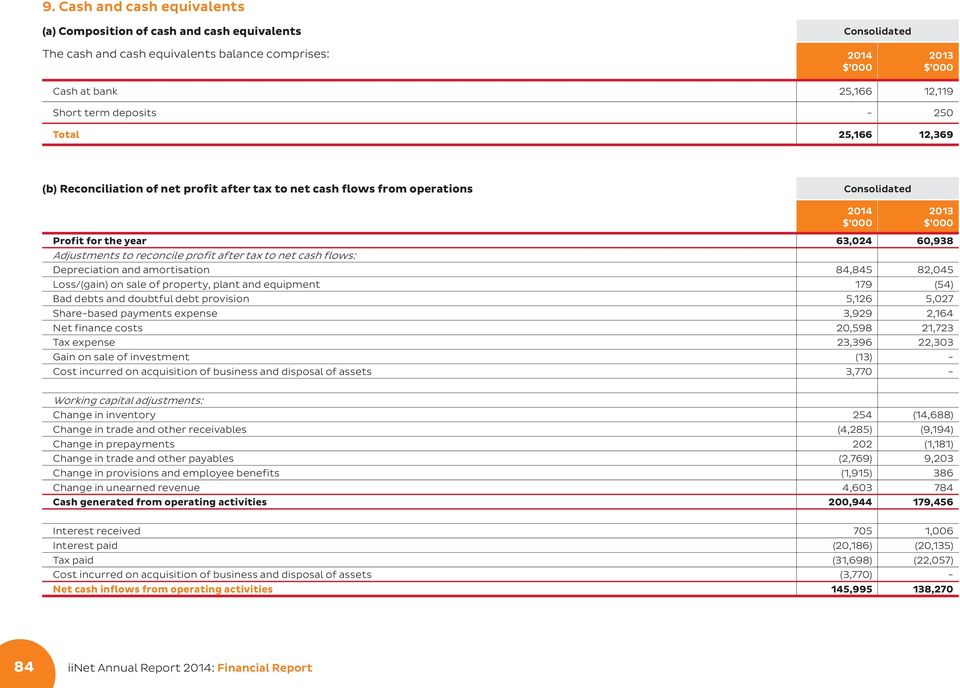
13 9. Cash and cash equivalents (a) Composition of cash and cash equivalents Consolidated The cash and cash equivalents balance comprises: Cash at bank 25,166 12,119 Short term deposits Total 25,166 12,369 (b) Reconciliation of net profit after tax to net cash flows from operations Consolidated Profit for the year 63,024 60,938 Adjustments to reconcile profit after tax to net cash flows: Depreciation and amortisation 84,845 82,045 Loss/(gain) on sale of property, plant and equipment 179 (54) Bad debts and doubtful debt provision 5,126 5,027 Share-based payments expense 3,929 2,164 Net finance costs 20,598 21,723 Tax expense 23,396 22,303 Gain on sale of investment (13) - Cost incurred on acquisition of business and disposal of assets 3,770 - Working capital adjustments: Change in inventory 254 (14,688) Change in trade and other receivables (4,285) (9,194) Change in prepayments 202 (1,181) Change in trade and other payables (2,769) 9,203 Change in provisions and employee benefits (1,915) 386 Change in unearned revenue 4, Cash generated from operating activities 200, ,456 Interest received 705 1,006 Interest paid (20,186) (20,135) Tax paid (31,698) (22,057) Cost incurred on acquisition of business and disposal of assets (3,770) - Net cash inflows from operating activities 145, , iinet Annual Report : Financial Report
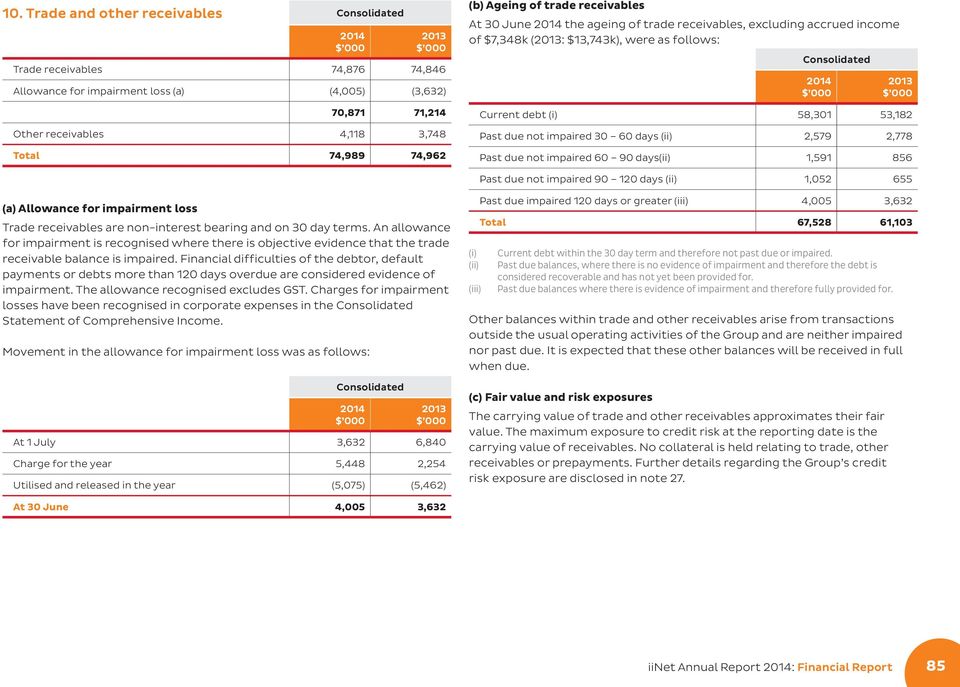
14 10. Trade and other receivables Consolidated Trade receivables 74,876 74,846 Allowance for impairment loss (a) (4,005) (3,632) 70,871 71,214 Other receivables 4,118 3,748 Total 74,989 74,962 (b) Ageing of trade receivables At 30 June the ageing of trade receivables, excluding accrued income of $7,348k (: $13,743k), were as follows: Consolidated Current debt (i) 58,301 53,182 Past due not impaired days (ii) 2,579 2,778 Past due not impaired days(ii) 1, Past due not impaired days (ii) 1, (a) Allowance for impairment loss Trade receivables are non-interest bearing and on 30 day terms. An allowance for impairment is recognised where there is objective evidence that the trade receivable balance is impaired. Financial difficulties of the debtor, default payments or debts more than 120 days overdue are considered evidence of impairment. The allowance recognised excludes GST. Charges for impairment losses have been recognised in corporate expenses in the Consolidated Statement of Comprehensive Income. Movement in the allowance for impairment loss was as follows: Consolidated At 1 July 3,632 6,840 Charge for the year 5,448 2,254 Utilised and released in the year (5,075) (5,462) (i) (ii) (iii) Past due impaired 120 days or greater (iii) 4,005 3,632 Total 67,528 61,103 Current debt within the 30 day term and therefore not past due or impaired. Past due balances, where there is no evidence of impairment and therefore the debt is considered recoverable and has not yet been provided for. Past due balances where there is evidence of impairment and therefore fully provided for. Other balances within trade and other receivables arise from transactions outside the usual operating activities of the Group and are neither impaired nor past due. It is expected that these other balances will be received in full when due. (c) Fair value and risk exposures The carrying value of trade and other receivables approximates their fair value. The maximum exposure to credit risk at the reporting date is the carrying value of receivables. No collateral is held relating to trade, other receivables or prepayments. Further details regarding the Group s credit risk exposure are disclosed in note 27. At 30 June 4,005 3,632 iinet Annual Report : Financial Report 85
15 Photograph by Adrian Lorenzo, Customer Service Representative 11. Inventory Consolidated Finished goods 9,252 16,207 Work in progress 3,635 2,262 Total 12,887 18,469 Inventories recognised as an expense during the year ended 30 June amounted to $26,420k (: $26,169k). This expense has been included in the network and carrier costs line in the Consolidated Statement of Comprehensive Income. 12. Non-current assets held for sale At 30 June the carrying amount relating to completed releases of TransACT s fibre-to the-premises (FTTP) network in the ACT region was classified as a non-current asset held for sale pending ACCC approval for completion of the sale to NBN Co Limited to occur. During the year ended 30 June the transaction completed and the sale was recognised. The consideration received for the disposal of these assets approximated their carrying value and there was no material impact on the Consolidated Statement of Comprehensive Income. 86
16 13. Plant and equipment (a) Reconciliation of carrying amounts (i) At 30 June Plant and Equipment Leasehold Improvements Total Consolidated Cost Balance at 1 July 329,689 16, ,802 Additions 27,950-27,950 Reallocation (3,630) - (3,630) Acquisition of Adam (refer note 24) 16, ,907 Balance at 30 June 370,867 16, ,029 Accumulated Depreciation Balance at 1 July (173,127) (8,262) (181,389) Depreciation expense (41,799) (1,407) (43,206) Balance at 30 June (214,926) (9,669) (224,595) Net Book Value At 30 June 155,941 6, ,434 At 30 June 156,562 7, ,413 iinet Annual Report : Financial Report 87

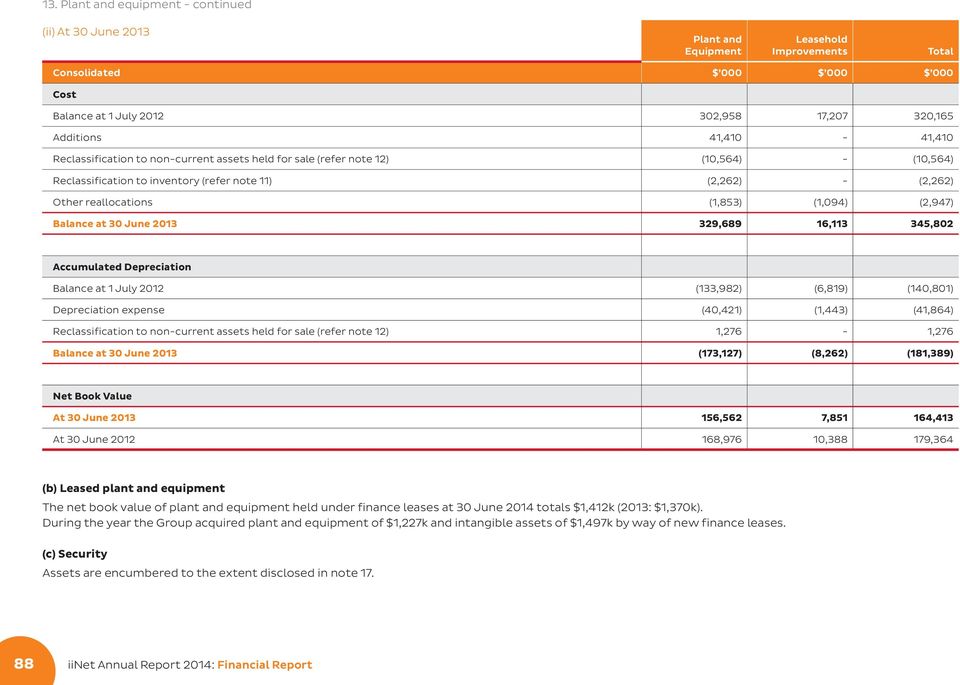
17 13. Plant and equipment - continued (ii) At 30 June Plant and Equipment Leasehold Improvements Total Consolidated Cost Balance at 1 July ,958 17, ,165 Additions 41,410-41,410 Reclassification to non-current assets held for sale (refer note 12) (10,564) - (10,564) Reclassification to inventory (refer note 11) (2,262) - (2,262) Other reallocations (1,853) (1,094) (2,947) Balance at 30 June 329,689 16, ,802 Accumulated Depreciation Balance at 1 July 2012 (133,982) (6,819) (140,801) Depreciation expense (40,421) (1,443) (41,864) Reclassification to non-current assets held for sale (refer note 12) 1,276-1,276 Balance at 30 June (173,127) (8,262) (181,389) Net Book Value At 30 June 156,562 7, ,413 At 30 June ,976 10, ,364 (b) Leased plant and equipment The net book value of plant and equipment held under finance leases at 30 June totals $1,412k (: $1,370k). During the year the Group acquired plant and equipment of $1,227k and intangible assets of $1,497k by way of new finance leases. (c) Security Assets are encumbered to the extent disclosed in note iinet Annual Report : Financial Report
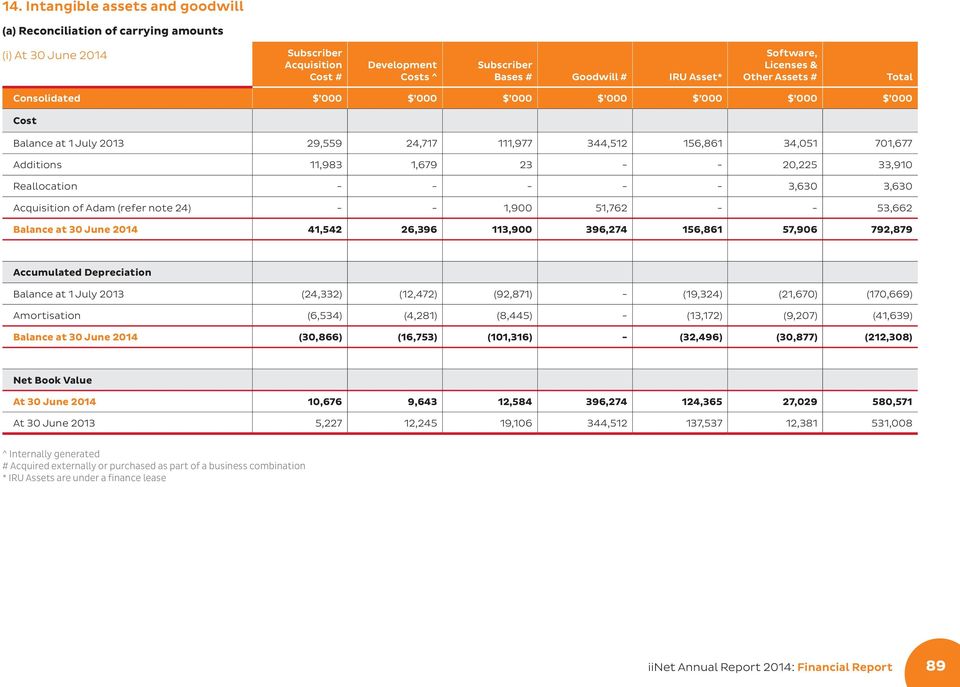
18 14. Intangible assets and goodwill (a) Reconciliation of carrying amounts (i) At 30 June Subscriber Acquisition Cost # Development Costs ^ Subscriber Bases # Goodwill # IRU Asset* Software, Licenses & Other Assets # Total Consolidated Cost Balance at 1 July 29,559 24, , , ,861 34, ,677 Additions 11,983 1, ,225 33,910 Reallocation ,630 3,630 Acquisition of Adam (refer note 24) - - 1,900 51, ,662 Balance at 30 June 41,542 26, , , ,861 57, ,879 Accumulated Depreciation Balance at 1 July (24,332) (12,472) (92,871) - (19,324) (21,670) (170,669) Amortisation (6,534) (4,281) (8,445) - (13,172) (9,207) (41,639) Balance at 30 June (30,866) (16,753) (101,316) - (32,496) (30,877) (212,308) Net Book Value At 30 June 10,676 9,643 12, , ,365 27, ,571 At 30 June 5,227 12,245 19, , ,537 12, ,008 ^ Internally generated # Acquired externally or purchased as part of a business combination * IRU Assets are under a finance lease iinet Annual Report : Financial Report 89
19 14. Intangible assets and goodwill - continued (ii) At 30 June Subscriber Acquisition Cost # Development Costs ^ Subscriber Bases # Goodwill # IRU Asset* Software, Licenses & Other Assets # Total Consolidated Cost Balance at 1 July ,632 19, , ,374 94,505 22, ,110 Additions 4,927 5, ,356 8,981 81,620 Reallocation ,514 2,947 Balance at 30 June 29,559 24, , , ,861 34, ,677 Accumulated Depreciation Balance at 1 July 2012 (19,658) (8,388) (81,508) - (6,936) (13,998) (130,488) Amortisation (4,674) (4,084) (11,363) - (12,388) (7,672) (40,181) Balance at 30 June (24,332) (12,472) (92,871) - (19,324) (21,670) (170,669) Net Book Value At 30 June 5,227 12,245 19, , ,537 12, ,008 At 30 June ,974 10,678 30, ,374 87,569 8, ,622 ^ Internally generated # Acquired externally or purchased as part of a business combination * IRU Assets are under a finance lease (b) Leased intangible assets Software, licenses and other intangible assets includes software licenses held under finance leases with a net book value totaling $666k (: $1,823k). 90 iinet Annual Report : Financial Report

20 14. Intangible assets and goodwill - continued (c) Goodwill impairment tests (i) Description of the cash generating unit and other information Goodwill acquired through business combinations has been allocated to three cash generating units (CGUs) for impairment testing. The aggregate carrying amounts of goodwill allocated to CGUs are as follows: Consolidated iinet 257, ,185 Internode 87,327 87,327 Adam 51,762 - Total 396, ,512 The annual impairment test undertaken at 30 June involved determining the recoverable amount of each CGU based on their fair value less cost to sell and comparing it to the CGU s carrying amount. Fair value reflects the best estimate of the amount that an independent third party would pay to purchase the CGUs, less related selling costs. Carrying value reflects goodwill and the other identifiable assets and liabilities that can be allocated to each CGU and that generate the CGU s cash flows. Fair value has been calculated using discounted future cash flows. The fair value measurement was categorised as a Level 3 fair value based on the inputs in the valuation technique used. Discounted cash flows includes a terminal value calculated in accordance with the Gordon Growth model using a long-term perpetuity growth rate of 0%. The valuation is based on cash flow projections over a five year period using assumptions that represent management s best estimate of the range of business and economic conditions at this time. The valuations have been reviewed and approved by the Board of iinet Limited. Discount rates are calculated using a weighted average cost of capital method which is based on market data, reflects the time value of money and includes a risk premium to account for current economic conditions. The pre-tax discount rates applied to the undiscounted cash flows were 12.0% (: 12.5%) for all CGUs. Management consider that, as all CGUs operate in the Telecommunications Industry in Australia and provide equivalent products and services in the same markets, the risk specific to each unit are comparable and therefore a discount rate of 12.0% is applicable to all CGUs. Based on the results of the tests undertaken no impairment losses have been recognised in relation to goodwill in the or financial years. (ii) Key assumptions used in the fair value less cost to sell for the CGUs for the year ended 30 June The models used in the calculation of fair value less cost to sell for the CGUs are sensitive to the following key assumptions: Subscriber growth rates; Gross margins; and Discount rates. Subscriber numbers are based on trends from historical data and are adjusted for churn and growth estimates based on the respective products life cycles, market trends and the expected future product mix. Subscriber growth is anticipated to be generated by organic growth calculated using historical trends from past experience and market trends from external industry information. Gross margins are based on historical and projected future average revenue per user (ARPU), average cost per user (ACPU) and the current and projected future product mix. ARPUs are forecasted to remain at their current levels or change depending on expected product pricing and/or services offered. ACPUs are forecasted to inflate at a forecast CPI rate or adjusted for variations to supplier contracts and market pricing. Overall gross margins for each CGU are forecasted to remain largely stable, in line with the market forecasts. (iii) Sensitivity to changes in assumptions for the CGUs With regard to the assessment of the fair value less cost to sell of the CGUs, management consider that no reasonably possible change in any of the key assumptions in (ii) above would significantly erode the headroom calculated and cause the carrying value of any CGU to exceed its recoverable amount. iinet Annual Report : Financial Report 91

21 14. Intangible assets and goodwill - continued This assurance has been obtained by the analysis performed in the fair value less cost to sell model whereby management assessed the results of the Group not meeting subscriber growth targets, applying the highest reasonable possible discount rates and lowest reasonable possible gross margins. 16. Unearned revenue Consolidated Current liabilities Billing in advance of service delivery 65,007 54,451 Government grants Trade and other payables Consolidated Trade creditors 86,246 89,213 Other payables and accruals 4,239 5,380 GST payable 5,770 2,067 Total 96,255 96,660 Fair value and risk exposures Due to the short term nature of trade and other payables, their carrying value approximates their fair value. Details regarding the Group s foreign exchange and liquidity risk exposure are set out in note 27. Total 65,476 54,451 Non-current liabilities Billing in advance of service delivery 1,035 - Government grants Total 1,231 - Unearned revenue amounts, billed in advance of service delivery, relate to customer accounts that having been billed in advance on their anniversary date, have outstanding services owing at the balance date of 30 June. Government grants relate to monies that are contingent on the provision of services specified in the grant and are recognised over the grant specified service period. 92 iinet Annual Report : Financial Report
22 17. Interest bearing loans and borrowings Consolidated Current liabilities Finance lease obligations 1,287 2,017 Total 1,287 2,017 Non-current liabilities Bank facility 202, ,792 Finance lease obligations Total 203, ,475 (a) Terms and conditions The Group s bank facility consists of a $250,000k (:$330,000k) revolving cash advance facility. Interest on the facility is recognised at the aggregate of the base rate plus a variable margin indexed to the Group bank gearing ratio. The facility consists of two parts, Facility A with a margin percentage range of 1.60% to 1.90% per annum and Facility B with a margin percentage range of 1.90% to 2.20%. Facility A and B matures in April 2017 and April 2019 respectively and continues to be secured by a fixed and floating charge over the assets of the Group. (b) Fair value and risk exposures The carrying amounts of the Group s borrowings approximate their fair value. Details regarding the Group s exposure to interest rate risk and liquidity risk are disclosed in note Indefeasible right of use (IRU) lease liability Consolidated Current liability 18,205 14,621 Non-current liability 99, ,344 Total 118, ,965 The lease component of the Group s international capacity supply agreement has been accounted for as an IRU finance lease. The carrying value of the IRU liability approximates its fair value. During the current and prior year, there were no defaults or breaches relating to the utilised bank facility. Total current and non-current borrowings include secured liabilities of $205,000k (: $186,000k) for the Group and Company. The finance lease obligations consist of several finance leases with lease terms up to a period of 3 years. The finance lease liabilities are secured on the assets to which they relate and have maturity dates ranging from September to October Refer to note 26 (b) for finance lease commitments. iinet Annual Report : Financial Report 93
23 19. Provisions Consolidated Current liabilities Onerous lease Make good leased premises Other Total Non-current liabilities Onerous lease 2,807 - Make good leased premises 1, Total 3, (a) Movement in provisions The movement in each class of provision (current and non-current) during the financial year is as follows: Onerous lease provision Make good leased premises Other Total Consolidated At 1 July Arising during the year Acquired during the year 3, ,400 Utilised or unused amounts reversed (451) - (640) (1,091) Balance at 30 June 3,349 1, , iinet Annual Report : Financial Report
24 19. Provisions - continued (b) Nature and timing of provisions (i) Onerous lease provision The onerous lease provision is a provision for above market office rental costs, under a non-cancellable lease in the Adelaide CBD, acquired as part of the acquisition of Adam. Refer to note 24. This provision will unwind over the remaining period of the lease term which ends 30th September (ii) Make good leased premises The provision for make good of leased premises relates to a provision identified as part of the Netspace and Adam acquisitions. The provision relates to the contractual commitment to restore leased premises to a non-altered, pre fit-out state at the end of the relevant lease term. The Netspace lease is expected to expire in 2017 and the Adam lease is due to expire in (iii) Other Other provisions include a provision for fringe benefits tax. The provision is expected to be utilised in the 2015 financial year. 20. Employee benefit liabilities Consolidated Liability for annual leave 7,438 6,982 Liability for long service leave 5,842 5,527 Liability for alternative leave Total employee benefit liabilities 13,863 12,793 Movement in employee benefit liabilities: Balance at 1 July 12,793 13,300 Arising during the year 8,962 9,493 Utilised or unused amounts reversed (9,000) (10,000) Acquisition of Adam (refer note 24) 1,108 - Balance at 30 June 13,863 12,793 Disclosed as follows: Current liability 13,044 11,963 Non-current liability Total 13,863 12,793 Refer to note 34 for the relevant accounting policy and a discussion of the significant estimates and assumptions applied in the measurement of the above liabilities. Accrued wages and salaries between the last pay date and 30 June of $4,239k (: $4,380k) are included within the other payables and accruals as disclosed in note 15. iinet Annual Report : Financial Report 95
25 21. Issued capital and capital management Consolidated and Company (a) Ordinary shares No. No. Issued and fully paid 161,238, , ,238, ,069 Movement in shares on issue: At 1 July 161,238, , ,968, ,528 Exercise of share options (i) , At 30 June 161,238, , ,238, ,069 (i) During, 270,000 options were exercised under various iinet employee share option plans. Consideration received is recognised in issued capital. Fully paid ordinary shares carry one vote per share and the right to dividends. The shares have no par value. (b) Capital management The Group s objectives when managing capital are to safeguard the Group s ability to continue as a going concern, in order to provide enduring returns for shareholders, benefits to other stakeholders and to maintain an optimal capital structure to reduce the cost of capital. In order to maintain or adjust the capital structure, the Group may adjust the amount of dividends paid to shareholders, issue new shares, buy-back shares, increase or decrease the Group s long term debt and adjust the tenure of long term debt. The Company paid dividends of $32,247k during (: $25,777k). For further details on dividends paid and proposed, please refer to note 23(a). The Group monitors capital on the basis of the gearing ratio. This ratio is calculated as net debt divided by total equity. Net debt is calculated as total interest bearing loans and borrowings less cash and cash equivalents. Consolidated The gearing ratio based on continuing operations at 30 June and was as follows: Total borrowings excluding IRUs 204, ,492 Less cash and cash equivalents (25,166) (12,369) Net Debt 179, ,123 Total Equity 355, ,342 Gearing Ratio 50% 54% The movement in the gearing ratio when compared to the prior financial year is due to an increase in cash and cash equivalents and total equity in the current year which offset the increase in borrowings to finance the acquisition of Adam (refer note 24). 96 iinet Annual Report : Financial Report
26 22. Other reserves (a) Nature and purpose of reserves Cash flow hedge reserve The cash flow hedge reserve records the effective portion of the cumulative net change in fair value of hedging instruments that are determined to be effective hedges, pending subsequent recognition of the hedged cash flows. Employee equity benefits reserve The employee equity benefits reserve records the value of the share-based payments provided to employees and key management personnel, as part of their remuneration. Refer to note 28 for further details of these share-based payment plans. (b) Movements in other reserves, net of tax, were as follows: Consolidated Cash Flow Hedge Reserve Employee Equity Benefits Reserve Total Balance at 30 June 2012 (441) 4,785 4,344 Loss on cash flow hedge taken to equity net of tax (173) - (173) Share-based payments - 2,164 2,164 Balance at 30 June (614) 6,949 6,335 Loss on cash flow hedge taken to equity net of tax (3,049) - (3,049) Share-based payments - 3,929 3,929 Balance at 30 June (3,663) 10,878 7,215 97
27 23. Dividends paid and proposed Consolidated (a) Recognised and un-recognised amounts Cents per share Cents per share Recognised amounts Current year fully franked interim dividend , ,899 Previous year fully franked final dividend , ,878 Total , ,777 Unrecognised amounts Current year fully franked final dividend (i) ,961 (i) The final dividend was declared on the 20 August. The amount has not been recognised as a liability in the financial year but will be brought into account in the 2015 financial year. (b) Franking credit balance The amount of franking credits available for the subsequent financial year is: Franking account balance as at the end of the financial year at 30% (: 30%) 48,736 35,857 Franking debits arising from the payment of the final dividends during the financial year (7,601) (5,519) Franking debits arising from the payment of the interim dividends during the financial year (6,219) (5,528) Franking debits arising from the refund of income tax receivable during the financial year (49) (3,161) Franking credits arising from the payment of income tax payable during the financial year 31,238 24,650 Franking credits transferred from acquired entities during the financial year 2,763 2,437 Total 68,868 48,736 The amount of franking credits available for future reporting periods is: Franking credits that will arise from the payment of income tax payable as at the end of the financial year 10,621 12,997 Impact of franking debits that will arise from the payment of recommended final dividends for the end of the financial year (8,983) (7,601) Total 70,506 54,132 (c) Tax rates The tax rate at which paid dividends have been franked is 30% (: 30%). Dividends proposed will be franked at the rate of 30% (: 30%). 98 iinet Annual Report : Financial Report
28 24. Business combination Acquisition of Adam On 30 August, iinet Limited acquired 100% of the shares and voting interest in Adam Internet Holdings Pty Ltd ( Adam ). The acquisition reinforces the Company s position as Australia s second largest DSL Internet Service Provider and the leading challenger brand in the Australian telecommunications market. Goodwill arising from the acquisition has been recognised as follows: Consideration transferred 60,425 Fair value of identifiable net assets acquired (8,663) Goodwill arising on acquisition 51,762 The purchase consideration was funded through a drawdown of iinet s available bank loan facility and existing cash. The fair value of the identifiable assets acquired and liabilities assumed at the acquisition date were as follows: Assets Cash and cash equivalents 1,310 Trade and other receivables 345 Prepayments 675 Inventory 309 Income tax receivable 118 Plant and equipment 16,907 Acquired subscriber base 1,900 Deferred tax assets 1,652 Total assets 23,216 Liabilities Trade and other payables (4,557) Unearned revenue (3,349) Provision for onerous lease and make good (4,400) Employee benefit liability (1,108) Deferred tax liabilities (1,139) Total liabilities (14,553) Fair value of identifiable net assets acquired 8,663 iinet Annual Report : Financial Report 99
29 24. Business combination - Acquisition of Adam - continued Cash flows on acquisition of subsidiary in the statement of cash flows comprises: 25. Derivative financial instruments Consolidated Current assets Purchase consideration paid 60,600 Less: Working Capital adjustment received (175) Consideration transferred 60,425 Less: Cash acquired (1,310) Net cash outflow on acquisition 59,115 Forward foreign exchange contracts cash flow hedge Non-current assets Forward foreign exchange contracts cash flow hedge 865 1,171 1,569 7,291 The acquired business contributed revenues of $48,780k and net profit after tax of $5,143k to the Group for the period from acquisition to 30 June. If the acquisition had occurred on 1 July, iinet Group revenues would have been $1,015,838k and net profit after tax would have been $64,333k (including costs in relation to acquisition and asset disposal of $2,779k after tax). Direct costs relating to the acquisition totalling $1,790k have been recognised as Corporate expenses and Other costs in the Statement of Comprehensive Income for the year ended 30 June. Total assets 2,434 8,462 Current liabilities Forward foreign exchange contracts cash flow hedge Interest rate swap contracts cash flow hedge (93) (225) (69) (176) Total liabilities (162) (401) Included in the business assets acquired were receivables with a gross contractual and fair value of $345k resulting from trade sales with customers. Management has collected these amounts in full and converted to cash consistent with customer terms. Total 2,272 8,061 Key factors contributing to the $51,762k of goodwill are the synergies expected to be achieved as a result of combining Adam with the rest of the Group. 100 iinet Annual Report : Financial Report
30 25. Derivative financial instruments - continued (a) Instruments used by the Group The Group is party to derivative financial instruments in the normal course of business to manage exposures to fluctuations in interest and foreign exchange rates in accordance with the Group s financial risk management policy. (i) Interest rate swap contract cash flow hedge The Group s bank facility is a variable interest rate facility. It is Group policy to protect a portion of the bank facility from exposure to fluctuations in interest rates. Accordingly the Group enters into interest rate swap contracts, under which it receives interest at a variable rate and pays interest at a fixed rate. The Group adopts hedge accounting to account for the swaps. At the reporting date, $105 million or 51% (: 46%) of the Group s bank loan facility outstanding was at a variable rate of interest. The average fixed interest rate was 2.77% at 30 June (: 2.89%). The swap contracts are settled on a net basis each month. The settlement dates coincide with the dates on which interest is payable on the underlying debt and the swaps are therefore considered highly effective. The gain or loss from measuring the interest rate swap contracts to their fair value is recognised in equity to the extent that the hedges are effective. The effective portion of the hedge recognised in other comprehensive income as a gain was $107k, before income tax, in (: gain of $242k). (ii) Forward foreign exchange contracts cash flow hedge The expenditure arising from both the Group s call centre operations in South Africa and New Zealand and IRU obligations are required to be settled in South African Rand, New Zealand Dollars and United States Dollars respectively. In order to protect against unfavourable exchange rate movements, the Group has entered into forward foreign exchange contracts. The Group has applied hedge accounting for the following forward exchange contracts. Currency Total notional amount of the contracts () Contract Expiry (i) Average exchange rate ZAR $14, June 2015 $0.099:ZAR1 NZD $4,398 1 October $0.880:NZD1 USD $46, July 2018 $1.090:USD1 USD $45, July 2018 $1.069:USD1 (i) Consists of a series of contracts expiring at various dates, with this being the expiry date of the last contract in the series. The settlements of the contracts are timed to mature when payments are scheduled to be made and are therefore considered to be highly effective. Contracts are settled gross. The effective portion of the hedges recognised in other comprehensive income was a loss of $4,605k, before income tax (: loss of $489k). During the year ended 30 June net losses of $970k (: net gains of $7,957k) have been reclassified from the hedge reserve to the Statement of Comprehensive Income. This includes a loss of $1,298k (: gain of $8,803k) relating to the revaluation of forward foreign exchange contracts entered into for the purpose of hedging the Group s exposure to the foreign currency risk associated with the IRU liability denominated in US dollars. The loss has off-set a gain recognised in the Statement of Comprehensive Income following the revaluation of the IRU liability at spot at 30 June. iinet Annual Report : Financial Report 101
31 25. Derivative financial instruments - continued The total loss taken to other comprehensive income in in relation to the cash flow hedges was $4,498k, before income tax, (: $247k). (b) Risk exposures Details about the Group s exposure to interest rate, liquidity, foreign currency and credit risk are provided in note 27. The maximum exposure to credit risk at the reporting date is the carrying amount of each class of derivative financial asset and liability mentioned above. 26. Commitments and contingencies (a) Capital expenditure commitments The Group had the following contractual obligations relating to capital expenditure at the reporting date: Consolidated Plant and equipment - within 1 year 3,950 11,400 Plant and equipment - later than 1 year but not later than 5 years - 3,413 (b) Finance lease commitments The Group has used finance leases to acquire international bandwidth supply, software licenses and plant and equipment. Future minimum lease payments under the purchase contracts together with the present value of the net minimum lease payments are as follows: Consolidated Within 1 year 27,129 25,527 After 1 year but not more than 5 years 98, ,874 More than 5 years 18,900 24,911 Total minimum lease payments 144, ,312 Less amounts representing finance charges (23,971) (33,647) Present value of minimum lease payments 120, ,665 Included in the financial statements as: Current liability Interest bearing loans and borrowings (note 17) 1,287 2,017 Indefeasible right of use lease liability (note 18) 18,205 14,621 Total 3,950 14,813 The contractual commitments relate to site establishment and installation costs and various other committed plant and equipment purchases. Non-current liability Interest bearing loan and borrowings (note 17) Indefeasible right of use lease liability (note 18) 99, ,344 Total 120, , iinet Annual Report : Financial Report
32 26. Commitments and contingencies - continued (c) Operating lease commitments Operating leases relate to premises with lease terms remaining between 1 and 6 years and international bandwidth capacity supply agreements. The Group does not have an option to purchase the leased assets at the expiry of the lease term. Future minimum rentals payable under non-cancellable operating leases as at the 30 June are as follows: Consolidated Within 1 year 17,136 17,398 After 1 year not more than 5 years 30,391 27,993 After more than 5 years 1,676 4,069 Total 49,203 49,460 (d) Other expenditure commitments The Group had the following other operating expenditure commitments at the reporting date: Consolidated 27. Financial risk management The Group s activities expose it to a variety of financial risks. These include interest rate risk, liquidity risk, foreign currency risk and credit risk. The Group manages its exposure to these risks in accordance with its risk management policy. This policy seeks to minimise the potential adverse effects these risks may have on the financial performance of the Group. The Group uses derivative financial instruments, such as forward foreign currency contracts and interest rate swaps, to manage the currency and interest rate risks that arise on the Group s overseas activities and its sources of finance. Derivatives are used for risk management purposes and not as trading or other speculative instruments. The Group uses different methods to measure the different types of risk to which it is exposed, including sensitivity analysis in the case of interest rate and foreign exchange risk, ageing analysis for credit risk and cash flow forecasts for liquidity risk. Risk management is carried out by executive management and the Audit and Risk Committee, both of whom act under the authority of the Board of Directors. There have been no significant changes in the Group s policy for managing interest rate risk, liquidity risk, foreign currency risk and credit risk from 30 June. The Group s financial assets and liabilities comprise cash and cash equivalents, receivables, payables, bank loans, finance leases (including IRU s) and derivatives. Within 1 year 17,092 21,398 After 1 year not more than 5 years 8,495 9,245 Total 25,587 30,643 The other expenditure commitments relate to exchange building access costs, tele-housing peering costs and dark fibre access costs. (e) Contingencies The Group has issued a number of guarantees totaling $17,665k (: $24,056k) for various operational and legal purposes. It is not expected that these will be called upon. iinet Annual Report : Financial Report 103
33 27. Financial risk management - continued (a) Interest rate risk Interest rate risk is the risk that the fair value or future cash flows of a financial instrument will fluctuate because of changes in market interest rates. At the reporting date the Group had the following financial assets and liabilities exposed to Australian variable interest rates that are not designated in a cash flow hedge: Financial assets Consolidated Cash and cash equivalents 25,166 12,369 Financial liabilities Bank loan (unhedged) 105,000 86,000 Borrowings and cash held at variable rates expose the Group to cash flow interest rate risk. The Group s policy to manage cash flow interest rate risk includes: Performing sensitivity analysis, where the Group calculates the impact on profit for a defined interest rate shift; Investigation into alternative financing and the renewal of existing borrowing positions to obtain more favourable terms; and The use of interest rate swaps to ensure approximately 50% of net debt is hedged to fixed interest rates. Interest rate swap contracts outlined in note 25 are exposed to fair value movements if interest rates change. An analysis of maturities is provided in note 27(b). Forward foreign currency contracts are exposed to fair value movements if interest rates change. Details of their fair value measurements is provided in note 27(e). Such swaps have the economic effect of converting borrowings from floating rates to fixed rates. Generally, the Group raises long term borrowings at floating rates and swaps them into fixed rates that are lower than those available if the Group had borrowed at fixed rates directly. Under the interest rate swap, the Group agrees with a financial institution to exchange at monthly intervals, the difference between the fixed contract rates and floating-rate interest amounts calculated by reference to the agreed notional principal amount. At the reporting date, 51% (: 46%) of the Group s bank loan facility outstanding was at a variable rate of interest. The following sensitivity analysis is based on the net cash flow interest rate exposure in existence at the reporting date. At 30 June if interest rates had moved as illustrated in the table below, with all other variables held constant, post tax profit and equity would have been affected as follows: Judgements of reasonably possible movements Post tax profit Higher/(Lower) Consolidated Other Comprehensive Income Higher/(Lower) % (: %) (140) (129) % (: %) (250) (250) The movements in profit are due to higher/lower interest costs from variable rate debt and cash balances. The movement in other comprehensive income is due to an increase / decrease in the fair value of the derivative instrument designated as a cash flow hedge. Management consider +25 basis points and -25 basis points as reasonably possible movements for the next twelve months based on management s expectations of future interest rate movements. Based on the results of the reviews performed, the Group considers its main interest rate risk arises from its variable interest rate exposure on its long term borrowings. To manage this risk the Group uses interest rate swaps. 104 iinet Annual Report : Financial Report
34 27. Financial risk management - continued (b) Liquidity risk Liquidity risk reflects the risk that the Group will have insufficient resources to meets its financial liabilities as they fall due. The Group s strategy in managing liquidity risk is to ensure that the Group has sufficient funds to meet all its potential liabilities as they fall due, in both normal and abnormal market and trading conditions. This ensures that the Group avoids any risk of incurring contractual penalties or damage to its reputation. Cash flow is monitored on a daily basis to ensure the utilisation of current facilities is optimised, on a monthly basis to ensure that long term liquidity is maintained and on a long term projection basis for the purpose of identifying long term funding requirements. Management assesses the balance of capital and debt funding of the Group as part of its monthly internal reporting. The Group has access to undrawn borrowing facilities totalling $45 million (: $144 million) at reporting date. The remaining facility may be drawn down at any time. Details of the loan facility are provided in note 17. The tables below analyse the Group s financial liabilities and net and gross settled derivative financial instruments into the relevant maturity periods. Management has based the analysis on the contracted maturity terms included in the Group s bank loans, finance lease and derivative financial instruments agreements. Maturity of the Group s trade creditors is based on the payment terms to suppliers. Consolidated (i) 30 June 6 months or less 6 12 months or less 1 5 years After more than 5 years Non-derivative financial liabilities Trade and other payables 96, Bank loan (principal and interest) 5,085 5, ,882 - Finance lease liabilities 1, IRU lease liabilities 12,825 13,049 97,362 18,900 Total non-derivative financial liabilities 115,184 18, ,916 18,900 Derivative financial liabilities Interest rate swap (settled net) Foreign currency forward contracts (settled gross) -Outflow 8,062 8,390 77, Inflow (7,800) (8,019) (75,576) - Total derivative financial liabilities ,630 - Total 115,514 18, ,546 18,900 Refer to note 25 for details relating to the Group s derivative financial instruments. iinet Annual Report : Financial Report 105
35 27. Financial risk management - continued (ii) 30 June 6 months or less 6 12 months or less 1 5 years After more than 5 years Non-derivative financial liabilities Trade and other payables 96, Bank loan (principal and interest) 5,361 5, ,297 - Finance lease liabilities 1, IRU lease liabilities 11,608 11, ,614 24,910 Total non-derivative financial liabilities 115,523 17, ,582 24,910 Derivative financial liabilities Interest rate swap (settled net) Foreign currency forward contracts (settled gross) -Outflow 11,129 10,458 88,869 2,526 -Inflow (11,541) (11,047) (96,240) (2,728) Total derivative financial liabilities (317) (548) (7,330) (202) Total 115,206 16, ,252 24,708 Refer to note 25 for details relating to the Group s derivative financial instruments. (c) Foreign currency risk Foreign exchange risk arises from recognised financial assets and liabilities denominated in a currency other than Australian Dollars and future commercial transactions that will require the Group to make payment for services in currencies other than Australian Dollars. Foreign currency risk is measured using sensitivity analysis and cash flow forecasting. The Group operates internationally through its call centre operations in New Zealand and South Africa. It also regularly enters into international bandwidth supply agreements and other inventory supply agreements with overseas vendors. The Group is therefore exposed to foreign currency risk arising mainly from the United States Dollar (USD), New Zealand Dollar (NZD) and the South African Rand (ZAR). The Group considers its key foreign currency exposures to relate to its international bandwidth supply agreements denominated in USD and costs associated with its call centre operations in South Africa denominated in ZAR. 106 iinet Annual Report : Financial Report
36 27. Financial risk management - continued In July 2012 the Group entered into a new international capacity supply agreement with Southern Cross Cables Limited. The lease component of this agreement has been accounted for as a USD denominated IRU finance lease. Whilst the USD is considered a stable currency the significant contract value, and resulting liability recognised in the Statement of Financial Position, creates a material USD exposure for the Group. The Group s call centre operations in South Africa is considered a key risk due to the high value of current and forecast South African Rand transactions and the volatile nature of that currency. The Group has managed its exposure to the risks identified above by entering into foreign forward exchange contracts. Details of the foreign forward exchange contracts are disclosed in note 25. Hedge accounting has been applied to each foreign forward exchange contract. These contracts are subject to fair value movements through Other Comprehensive Income as the exchange rates fluctuate against the Australian Dollar. During the period the Group commenced hedging its NZD exposures due to increased volatility in this currency, although the risk is still not considered a key exposure. The Group considers its exposure to fluctuations in the USD (other than the IRU finance lease identified above) not to be a significant risk due to the relatively low value of transactions and the relative stability of this currency. In this regard the Group has chosen not to enter into foreign forward exchange contracts to manage its residual USD exposures. The Group s exposure to foreign currency risk at the reporting date, expressed in Australian dollars, is as follows: Consolidated USD ZAR NZD USD ZAR NZD Cash at bank Trade payables (990) (5) (76) (2,621) (824) (100) IRU liability (Southern Cross) (77,276) - - (86,697) - - Statement of financial position exposure (78,264) (89,316) (20) (55) Hedged highly probable forecast and contracted transactions (11,461) (13,241) (3,485) (17,783) (8,034) - Total foreign currency exposure (89,725) (13,230) (3,424) (107,099) (8,054) (55) Forward exchange contracts 89,289 14,444 4, ,493 8,838 - Net exposure (436) 1,214 1,222 (2,606) 784 (55) iinet Annual Report : Financial Report 107
37 27. Financial risk management - continued At 30 June, if exchange rates had moved as illustrated in the table below, with all other variables held constant, post tax profit would have been affected as follows: Consolidated Post tax profit Higher/(Lower) Other Comprehensive Income Higher/(Lower) Judgements of reasonably possible movements + 10% (: + 10%) (111) (400) (1,879) (1,204) - 10% (: - 10%) ,296 1,472 The movements in profit are due to the appreciation/depreciation of the exchange rates impacting foreign currency cash and trade payable balances. Profit sensitivity is lower in due to lower foreign currency trade payables held by the Group as at 30 June. There is also an impact on Other Comprehensive Income due to the application of hedge accounting for the USD, ZAR and NZD foreign forward exchange contracts. Management considers +10% and -10% as reasonable possible movements for the next twelve months based on management s expectations of future USD, ZAR and NZD exchange rate movements. (d) Credit risk Credit risk refers to the risk that a counterparty will default on its contractual obligations resulting in a financial loss to the Group. The Group s credit risk arises from its financial assets which include cash and cash equivalents, deposits held with financial institutions, derivative financial instruments and trade receivable balances from customers. It is the Group s policy to only enter into derivative contracts and hold its cash and deposits with high credit quality financial institutions that have a credit rating of A and above as assessed by Standard and Poor s. Customer credit risk is managed by the Group s credit team subject to established policies, procedures and controls relating to credit risk management. For further information about the Group s trade receivables and other debtors refer to note 10. In the and financial years the Group has not requested any collateral to limit its exposure to credit risk nor has the Group securitised its trade and other receivables. The maximum exposure to credit risk is equal to the carrying amount of the asset and in the case of derivatives, their fair value. Exposure at the reporting date is addressed in each applicable note to the financial statements. There are no significant concentrations of credit risk within the Group as at 30 June or 30 June. 108 iinet Annual Report : Financial Report
38 27. Financial risk management - continued (e) Fair value of financial instruments AASB 7 Financial Instruments: Disclosures, requires disclosure of fair value measurement inputs by level using the following fair value measurement hierarchy: a. Quoted prices in active markets (Level 1); b. Inputs other than quoted prices included within Level 1 that are observable for the asset or liability, either directly or indirectly (Level 2); and c. Inputs that are not based on observable market data (Level 3). The following table analyses the Group s financial assets and liabilities measured and recognised at fair value. 30 June 30 June Level 2 Total Level 2 Total Derivative financial asset Foreign currency forward contracts cash flow hedge 2,434 2,434 8,462 8,462 Derivative financial liabilities Foreign currency forward contracts cash flow hedge (93) (93) (225) (225) Interest rate swap contracts cash flow hedge (69) (69) (176) (176) Total 2,272 2,272 8,061 8,061 The derivative contracts held by the Group are not traded on a recognised exchange and therefore their fair value has been determined using valuation techniques which are based on observable inputs such as forward interest and forward foreign currency rates. The fair values of foreign forward exchange contracts have been calculated by reference to forward market exchange rates for contracts with similar maturity profiles. The fair values of interest rate swap contracts are based on the present value of the estimated future cash flows. iinet Annual Report : Financial Report 109
39 28. Share-based payment plans and other long term incentive plans (a) Recognised share-based payment expenses The expense recognised for employee services received during the year is shown in the table as follows: Expense arising from equity-settled share-based payment arrangements Consolidated - Performance rights under LTI plans 3,929 2,164 Total 3,929 2,164 (b) LTI share-based payment plans LTI grants are designed to directly link executive rewards to the drivers of growth in long term shareholder wealth LTI share grant (i) Details of the grant The 2012 LTI award was granted on 1 July 2011 with a performance period 1 July 2011 to 30 June. A base pool LTI dollar value is determined for each executive at the start of each performance period with reference to benchmarked market rates and may be increased after assessment by the Remuneration and Nomination Committee of the performance of the executives. At the end of the performance period, the value of the allocated pool receivable by an executive will be calculated as a percentage of each individual s base pool LTI value approved at the start of the performance period. This percentage will be determined by the Board s Remuneration and Nomination Committee based on their performance against long term targets. The final allocable pool LTI dollar value awarded to an executive will be translated into Performance Rights at the iinet weighted volume share price. The period over which the iinet weighted volume share price is calculated will be determined and approved by the Board s Remuneration and Nomination Committee immediately after the allocation point. If the weighted share price used results in a change in the number of Performance Rights received, the change in value of the award measured at grant date fair value is recognised as an adjustment and taken to the Statement of Comprehensive Income. Each Performance Right represents an executive right to receive one iinet share in the future for no consideration. 50% of the Performance Rights earned vests 3 months after the conclusion of the performance period with the remaining 50% vesting 6 months after the conclusion of the performance period. At the release date the earned Performance Rights are rewarded in equity to executives. On termination of the employment of an executive by the Group, the unvested Performance Rights lapse immediately. On voluntary resignation by an executive, unvested Performance Rights lapse immediately while vested Performance Rights are required to be exercised within 30 days of termination. On redundancy, retrenchment, retirement, permanent incapacity, death or non-renewal of a fixed term contract of employment, unvested Performance Rights will lapse unless otherwise determined by the Board while vested Performance Rights are required to be exercised within 90 days of termination. (ii) Measurement of fair values Equity-settled transactions The fair value of the equity-settled performance rights to be awarded to the Executives was calculated at the grant date. This was determined to be $ which has not been adjusted for dividends, vesting conditions and other rights. Cash bonus The award to be granted to the Managing Director were to be paid out in cash. Accordingly, it was recognised as a bonus provision calculated as the base pool LTI dollar value discounted to present value adjusted for the relevant terms and conditions upon which the award was granted. 110 iinet Annual Report : Financial Report
40 28. Share-based payment plans and other long term incentive planscontinued (iii) Effect on profit or loss for the period Equity-settled transactions The performance period for this grant ended 30 June allowing for reliable assessment of actual performance against non-market based targets to determine the fixed allocable pool LTI dollar value awarded to each Executive. As certain stretch performance targets were met, the fixed allocated pool LTI dollar value exceeded the base pool LTI dollar value. Accordingly the sharebased payment expense was adjusted during the current financial year to recognise the impact of the increase in the number of performance rights which may vest, based on the increase in the final pool LTI dollar value. Cash bonus During the period the Managing Director resigned resulting in forfeiture of the allocated cash bonus. Amounts previously expensed relating to this award were reversed through profit or loss with a corresponding decrease in the bonus provision previously included in other payables and accruals in the Comprehensive Statement of Financial Position. LTI share grant (i) Details of the grant On 23 October 2012 the Group granted a fixed number of Performance Rights to eligible executives in 3 tranches. Each Performance Right represents an Executive s right to receive one iinet share in the future for no consideration subject to meeting the specific performance targets. The Board has selected absolute TSR as the performance hurdle for the LTI grant. This hurdle directly rewards executives for focusing on increasing shareholder wealth through business strategies that will result in share price growth. The Board set challenging levels of performance to be achieved with a minimum annual TSR of 15% required before any performance rights vest and a stretching 20% as the base target at which 100% of the performance rights vest. A stretch level of 25% TSR per annum is also available giving executives the opportunity to increase the number of performance rights by 50%. Terms and conditions relating to the grant are summarised in the table below. Number of instruments Tranche 1 Tranche 2 Tranche 3 Director 119, , ,579 Executives 358, , ,737 Total 478, , ,316 Performance period 1 July June 1 July June 1 July June 2015 Performance measure TSR TSR TSR Vesting period 3 years 3 years 3 years Fair value at grant date $3.71 $2.87 $2.39 On termination of employment all unvested performance rights lapse immediately with Board discretion to allow vesting situations such as redundancy, retirement, permanent incapacity and death. All vested performance rights are required to be exercised within 30 days of termination unless employment is terminated for cause where all vested performance rights are cancelled immediately. (ii) Measurement of fair values The fair value of the equity-settled performance rights was calculated separately for each tranche at grant date using the Monte Carlo simulation analysis. The determined fair value is reflected in the table in (i) above. (iii) Effect on profit or loss for the period The share-based payment expense continued to be recognised on a straight line basis over the vesting period. iinet Annual Report : Financial Report 111
41 28. Share-based payment plans and other long term incentive planscontinued The movement during the reporting period in the number of rights over ordinary shares in iinet Limited, held directly, indirectly or beneficially, by each key management person, including their related parties is as follows: LTI Plan 2012 LTI Plan No. No. No. No. Outstanding Opening 1,434, , ,045 Granted during the year Forfeited during the year - 1,434, ,397 - (358,739) The 5 year life of these options expired on 19 November 2012 (Opt 21) and 21 January (Opt 22). There were no outstanding options at 30 June (: nil). The following table illustrates the number (No.), weighted average exercise prices (WAEP) of, and movements in, share options issued during the year: No. WAEP (cents) No. WAEP (cents) On issue at 1 July , Exercised - - (270,000) On issue at 30 June No options were granted during the and financial years. Vested & exercised during the year Outstanding at 30 June Exercisable at 30 June ,076,217 1,434,956 1,488, , Auditor s remuneration The auditor of the Group is Ernst & Young. Amounts received or due and receivable by Ernst & Young for: Consolidated (c) Share-based payment option plans on issue in the current and prior financial years Two share-based payment option plans were previously on issue; Director Options 2008 (Opt 21) and Executive Options 2008 (Opt 22). The share-based payment expense relating to these options were fully recognised prior to the financial year. Audit and review of the annual report of the entity 552, ,000 Non-audit services - Due diligence services 315, ,527 - IT assurance and other services 176,548 - Total 1,044, , iinet Annual Report : Financial Report
42 30. Events after the reporting date In September, iinet Limited completed the acquisition of a 60% interest in The Tech2 Group Pty Ltd to partner with its founder, Glen Powys. Tech2 Group provides professional technology services and solutions to residential and business customers across Australia, including communications build services, remote and on-site technical support and installation services. The investment in Tech2 Group represents a unique opportunity to partner with a business with a strong focus on market-leading customer service, as well as providing a new sales channel and capability set. Due to the proximity of the transaction to the signing date of this report, the initial accounting for the business combination of the controlling interest is incomplete at the time the Group s financial statements were authorised for issue. Accordingly, details of the financial effect of the financial effect of the business combination have not been disclosed. On 20 August, the Group declared a fully franked final dividend of 13.0 cents per share with respect to the financial year ended 30 June. The dividend will have a record date of 1 September and a payment date of 15 September. 113
43 31. Related party disclosure (a) Subsidiaries The consolidated financial statements include the financial statements of iinet Limited and those entities detailed in the table below. Controlled entities Name Country of Incorporation Ownership Interest % Ownership Interest % ihug Pty Ltd+ Australia Connect West Pty Ltd+ Australia Chime Communications Pty Ltd+ Australia iinet Labs Pty Ltd (i) + Australia iinet (Oz ) Pty Ltd+ Australia Westnet Pty Ltd+ Australia iinet New Zealand AKL Ltd+ New Zealand Netspace Online Systems Pty Ltd+ Australia Netspace Networks Pty Ltd+ Australia Jiva Pty Ltd (ii) + Australia Netspace Communications Pty Ltd+ Australia TransACT Communications Pty Ltd+ Australia TransACT Victoria Holdings Pty Ltd+ Australia TransACT Broadcasting Pty Ltd+ Australia TransACT Capital Communications Pty Ltd+ Australia Transflicks Pty Ltd+ Australia ACN Pty Ltd+ Australia Cable Licence Holdings Pty Ltd+ Australia TransACT Victoria Communications Pty Ltd+ Australia Neighbourhood Cable Unit Trust Australia Internode Pty Ltd+ Australia Agile Pty Ltd+ Australia Adam Internet Holdings Pty Ltd+ Australia Adam Internet Pty Ltd+ Australia (i) (ii) Formerly known as Netscapade Pty Ltd Formerly known as Spacecentre Pty Ltd 114 iinet Annual Report : Financial Report
44 31. Related party disclosure - continued (b) Ultimate parent iinet Limited is the ultimate Australian parent entity and the ultimate parent of the Group. (c) Closed Group Pursuant to Class Order 98/1418, relief has been granted to those subsidiaries marked with a + from the Corporations Act 2001 requirements for preparation, audit and lodgement of their financial reports. As a condition of the Class Order, iinet Limited and its subsidiaries (the Closed Group) entered into a Deed of Cross Guarantee. The effect of the Deed is that iinet Limited has guaranteed to pay any deficiency in the event of the winding up of any of those subsidiaries. Those subsidiaries have also given a similar guarantee in the event that iinet Limited is wound up. The financial performance and position of the Consolidated Group reflects that of the Closed Group. (d) Transactions with director related entities The consolidated Group provides and receives internet services from certain director-related entities. Sales to and purchases from these entities are made at normal market prices and on normal commercial terms. (e) Other related parties transactions The Group provides internet services to the directors, employees and other related parties. These services are provided at normal market prices and on normal commercial terms. There were no other transactions that were entered into with related parties for the years ended 30 June and 30 June. (f) Key management personnel (i) Compensation of key management personnel Consolidated $ $ Short-term employee benefits 2,261,581 2,583,716 Long-term employee benefits (788,398) 624,815 Post-employment benefits 82,382 88,544 Termination benefits 36,776 - Share-based payments 3,319,460 2,015,960 Total 4,911,801 5,313,035 (ii) Loans to key management personnel As at the date of this report no loans have been entered into between the Group and any of its key management personnel. iinet Annual Report : Financial Report 115
45 32. Parent entity disclosures Key financial information relating to the parent entity (iinet Limited including the AAPT Consumer Division) is summarised below. $ $ Statement of Comprehensive Income Profit attributable to the owners of the company 40,301 35,663 Other comprehensive income (3,049) (173) Total comprehensive income attributable to the owners of the company 37,252 35,490 Statement of Financial Position Total current assets 67,892 78,040 Total non-current assets 744, ,814 Total current liabilities (140,786) (128,007) Total non-current liabilities (356,997) (425,108) Net assets 314, ,739 Issued capital 251, ,069 Accumulated profits 56,545 6,701 Other reserves 7,215 5,969 Total equity 314, ,739 Contractual obligations relating to capital expenditure of the parent entity amount to $3,799k at 30 June. The parent entity has issued a number of guarantees totalling $14,381k for various operational and legal purposes. It is not expected that these will be called upon. 116 iinet Annual Report : Financial Report
46 32. Parent entity disclosure - continued Income tax (i) Members of the tax consolidated Group and the tax sharing arrangement iinet Limited and its 100% owned Australian resident subsidiaries formed a tax consolidated Group from 1 July iinet Limited is the head entity of the tax consolidated Group. Members of the Group have entered into a tax sharing agreement that provides for the allocation of income tax liabilities between the entities should the head entity default on its tax payment obligations. No amounts have been recognised in the financial statements in respect of this agreement on the basis that the possibility of default is remote. (ii) Tax effect accounting by members of the tax consolidated Group Tax expense/income, deferred tax liabilities and deferred tax assets arising from temporary differences are recognised in the separate financial statements of the members of the tax consolidated Group using the Group allocation method. Current tax liabilities and assets and deferred tax assets arising from unused tax losses and tax credits of the members of the tax consolidated Group are recognised by iinet Limited, the head entity of the tax consolidated Group. Members of the tax consolidated Group have entered into a tax funding agreement. Amounts are recognised as payable to or receivable by the Company and each member of the tax consolidated Group in relation to the tax contribution amounts paid or payable between the parent entity and other members of the tax consolidated Group in accordance with this agreement. Where the tax contribution amount recognised by each member of the tax consolidated Group for a particular period is different to the aggregate of the current tax liability or asset and any deferred tax asset arising from unused tax losses and tax credits in respect of that period, the distribution is recognised as a contribution from (or distribution to) equity participants. iinet Limited has recognised the following amounts as tax consolidation adjustments: Tax effect accounting by members of the tax consolidated Group Company Total increase to the tax benefit of iinet Limited 2,156 2,106 Total reduction to intercompany assets of iinet Limited (2,156) (2,106) Total Changes in accounting policies The accounting policies adopted in the current year are consistent with those of the previous financial year except that the Group has adopted all Australian Accounting Standards and Interpretations mandatory for annual periods beginning on or before 1 July, including the following which are deemed to be relevant to the financial statements or performance of the Group: AASB 13 Fair Value Measurement AASB 13 establishes a single source of guidance for determining the fair value of assets and liabilities. AASB 13 does not change when an entity is required to use fair value, but rather provides guidance on how to determine fair value when fair value is required or permitted. Application of this definition may result in different fair values being determined for the relevant assets. AASB 13 also expands the disclosure requirements for all assets or liabilities carried at fair value. This includes information about the assumptions made and the qualitative impact of those assumptions on the fair value determined. The application of AASB 113 has not materially impacted the fair value measurements of the Group. Additional disclosures, where required, are provided in the individual notes relating to the assets and liabilities whose fair values were determined in accordance with AASB 13. AASB 119 Employee Benefits (Revised 2011) The revised standard changes the definition of short-term employee benefits. The distinction between short-term and other long-term employee benefits is now based on whether the benefits are expected to be settled wholly within 12 months after the reporting date. The change had no significant impact on the measurement of the Group s employee benefit liabilities. iinet Annual Report : Financial Report 117
47 33. Changes in accounting policies - continued AASB 10 Consolidated Financial Statements AASB 10 establishes a new control model that applies to all entities. It replaces parts of AASB 127 Consolidated and Separate Financial Statements dealing with the accounting for consolidated financial statements and UIG-112 Consolidation - Special Purpose Entities. The new control model broadens the situations when an entity is considered to be controlled by another entity and includes new guidance for applying the model to specific situations, including when acting as a manager may give control, the impact of potential voting rights and when holding less than a majority voting rights may give control. Given 100% ownership of all entities within the Group, the change had no impact on the Group. AASB Amendments to Australian Accounting Standards to remove Key Management Personnel disclosure requirements This amendment removes the individual KMP disclosure requirements for all disclosing entities in relation to equity holdings, loans and other related party transactions. As a result these KMP disclosures are now only included in the director s report. The adoption of other new and amended standards and interpretations had no impact on the financial position or performance of the Group. 34. Significant accounting policies The Group has consistently applied the following accounting policies in all periods presented in these consolidated financial statements. (a) Basis of consolidation The consolidated financial statements comprise the financial statements of the Group as at 30 June each year. Subsidiaries are those entities over which the Group has control. The Group controls an entity when it is exposed to, or has rights to, variable returns from its involvement with the entity and has the ability to affect those returns through its power over the entity. The existence and effect of potential voting rights that are currently exercisable or convertible are considered when assessing whether a Group controls another entity. The financial statements of subsidiaries are prepared for the same reporting period as the parent company, using consistent accounting policies. In preparing the consolidated financial statements, all intercompany balances and transactions, income and expenses and profit and loss resulting from intra-group transactions have been eliminated in full. Subsidiaries are consolidated from the date on which control commences until the date on which control ceases. (b) Business combinations Subsequent to 1 July 2009 The acquisition method of accounting is used to account for all business combinations. The consideration transferred comprises the fair value of the assets transferred, the liabilities incurred, the equity interest issued by the acquirer and the amount of any non-controlling interest in the acquiree. On an acquisition-by-acquisition basis, the Group recognises any non-controlling interest in the acquiree either at fair value or at the proportionate share of the acquiree s net identifiable assets. Acquisition related costs are expensed as incurred. When the Group acquires a business, it assesses the financial assets and liabilities assumed for appropriate classification and designation in accordance with the contractual terms, economic conditions, the Group s operating or accounting policies and other pertinent conditions as at the acquisition date. If the business combination is achieved in stages, the acquisition date fair value of the acquirer s previously held equity interest in the acquiree is remeasured at fair value as at the acquisition date through profit or loss. Any contingent consideration to be transferred by the acquirer is recognised at fair value at the acquisition date. Contingent consideration classified as an asset or liability that is a financial instrument and within the scope of AASB 139 Financial Instruments: Recognition and Measurement is measured at fair value with changes in fair value recognised either through profit or loss or as a change to other comprehensive income. If the contingent consideration is not within the scope of AASB 139, it is measured in accordance with the appropriate AASB. Contingent consideration that is classified as equity is not remeasured and subsequent settlement is accounted for within equity. The excess of the aggregate of the consideration transferred, the amount of any non-controlling interest in the acquiree and the acquisition date fair value of any previous equity interest in the acquiree over the fair value of the Group s share of the net identifiable assets acquired is recorded as goodwill. If those amounts are less than the fair value of the net identifiable assets of the subsidiary acquired and the measurement of all amounts has been reviewed, the difference is recognised directly in the Statement of Comprehensive Income as a bargain purchase. 118 iinet Annual Report : Financial Report
48 34. Significant accounting policies - continued Prior to 1 July 2009 Business combinations were accounted for using the purchase method. Transaction costs directly attributable to the acquisition formed part of the acquisition costs. (c) Foreign currency translation The functional and presentation currency of iinet Limited is Australian Dollars. The functional currency of its subsidiaries is Australian Dollars. Transactions in foreign currencies are initially recorded in the functional currency by applying the exchange rate ruling at the date of the transaction. Monetary assets and liabilities denominated in foreign currencies are retranslated at the foreign exchange rate ruling at the reporting date. Foreign exchange differences arising on translation are recognised in the Statement of Comprehensive Income. Non-monetary items are measured in terms of historical cost in a foreign currency and are translated using the exchange rate as at the date of the initial transaction. (d) Cash and cash equivalents Cash and cash equivalents comprise cash balances and short-term deposits that are readily convertible to known amounts of cash and are subject to an insignificant risk of change in value and generally have a maturity of three months or less. For the purpose of the Statement of Cash Flows, cash and cash equivalents consist of cash as defined above, net of outstanding bank overdrafts. Bank overdrafts are included within interest bearing loans and borrowings in current liabilities in the Statement of Financial Position. (e) Trade and other receivables Trade receivables, which generally have a 30 day term, are recognised initially at fair value and subsequently measured at amortised cost using the effective interest rate method, less allowance for impairment. Collectability of trade receivables is reviewed on an ongoing basis. Individual debts that are known to be uncollectable are written off when identified. An allowance for impairment is recognised when there is objective evidence that the Group will not be able to collect the receivable. Financial difficulties of the debtor, default payments or debt more than 120 days overdue are considered evidence of impairment. The amount of the impairment loss is the receivable carrying amount compared to the present value of estimated future cash flows, discounted at the original effective interest rate. (f) Inventory Inventories are initially measured and recorded at cost on a first-in, first-out basis and are subsequently valued at the lower of cost and net realisable value. Net realisable value is the estimated selling price in the ordinary course of business, less estimated costs of completion and the estimated costs necessary to make the sale. (g) Investments and other financial assets Investment and financial assets within the scope of AASB 139 Financial Instruments: Recognition and Measurement are categorised as either financial assets at fair value through the Statement of Comprehensive Income, loans and receivables, held to maturity investments, or availablefor-sale financial assets. The classification depends on the purpose for which the investments were acquired. When financial assets are recognised initially they are measured at fair value, plus, in the case of assets not at fair value through the Statement of Comprehensive Income, directly attributable transaction costs. All regular way purchases and sales of financial assets are recognised on the trade date, i.e. the date that the Group commits to purchase the asset. Regular way purchases or sales are purchases or sales of financial assets under contracts that require delivery of the assets within the period established generally by regulation or convention in the market place. Financial assets are de-recognised when the right to receive cash flows from the financial assets have expired or have been transferred. Loans and receivables are non-derivative financial assets with fixed or determinable payments that are not quoted in an active market. Such assets are carried at amortised cost using the effective interest method. Gains and losses are recognised in Statement of Comprehensive Income when the loans and receivables are de-recognised or impaired, as well as through the amortisation process. The Group does not hold any financial assets or investments classified as held to maturity investments or available for sale securities. (h) Plant and equipment Plant and equipment and leasehold improvements are stated at cost less accumulated depreciation and any accumulated impairment losses. iinet Annual Report : Financial Report 119
49 34. Significant accounting policies - continued Historical costs include expenditure that is directly attributable to the acquisition of the items. Subsequent costs are included in the assets carrying amount or recognised as a separate asset as appropriate, only when it is probable that future economic benefits associated with the item will flow to the Group and can be measured reliably. All other repairs and maintenance are charged to the Statement of Comprehensive Income during the reporting period in which they are incurred. Depreciation is calculated on a straight-line basis over the estimated useful life of the asset as follows: Plant and equipment: 2 5 years; Network Infrastructure assets: 5 40 years; Equipment under finance lease: 3 15 years or over the lease term; and Leasehold improvements: 3-15 years or over the lease term. The assets residual values, useful lives and amortisation methods are reviewed, and adjusted if appropriate, at each reporting date. An asset s carrying amount is written down immediately to its recoverable amount if the asset s carrying amount is greater than its estimated recoverable amount. Gains and losses on disposals are determined by comparing proceeds with carrying amounts. These are included in the Statement of Comprehensive Income. An item of plant and equipment is de-recognised upon disposal or when no further economic benefits are expected from its use or disposal. Any gain or loss arising on de-recognition of the asset (calculated as the difference between the net disposal proceeds and the carrying value of the asset) is included in the Statement of Comprehensive Income in the year the asset is de-recognised. (i) Leases The determination of whether an arrangement is or contains a lease is based on the substance of the arrangement and requires an assessment of whether the fulfillment of the arrangement is dependent upon the use of a specific asset or assets and the arrangement conveys a right to use the asset. Leases are classified as finance leases when the terms of the lease transfer substantially all the risks and rewards incidental to ownership of the leased asset to the lessee. All other leases are classified as operating leases. Finance leases are capitalised at the inception of the lease at the fair value of the leased asset or, if lower, at the present value of the minimum lease payments. Lease payments are apportioned between the finance charges and reduction of the lease liability so as to achieve a constant rate of interest on the remaining balance of the liability. Assets under finance leases are depreciated over the shorter of the estimated useful life of the asset and the lease term if there is no reasonable certainty that the Group will obtain ownership by the end of the lease term. Operating lease payments are recognised as an expense in the Statement of Comprehensive Income on a straight-line basis over the lease term. Lease incentives are recognised as a liability when received and subsequently reduced by allocating lease payments between rental expense and reduction of the liability. The Group is party to a number of international bandwidth capacity supply agreements which contains elements of a lease. The lease components of these agreements have been classified as indefeasible right of use ( IRU ) finance leases where it meets the criteria for such classification. When the Group is a lessor, leases are classified as either finance leases or operating leases. Under a finance lease, substantially all the risks and rewards incidental to legal ownership are transferred to the lessee. Other leases are classified as operating leases. In its capacity as a lessor, the Group recognises the assets held under finance leases in the Statement of Financial Position, as loans at an amount equal to the net investment in the lease. The recognition of finance income is based on a pattern of reflecting a constant periodic return on the Group s net investment in the finance leases. (j) Impairment of non-financial assets other than goodwill Assets that have finite useful lives are reviewed for impairment whenever events or changes in circumstances indicate that the carrying amount may not be recoverable. The Group conducts an annual internal review of asset values, which is used as a source of information to assess for any indicators of impairment. External factors such as changes in technology and economic conditions are also monitored to assess for indicators of impairment. If any indication of impairment exists, an estimate of the assets recoverable amount is calculated. An impairment loss is recognised for the amount by which the asset s carrying amount exceeds its recoverable amount. The recoverable amount is the higher of the asset s fair value less cost to sell and value in use. 120 iinet Annual Report : Financial Report
50 34. Significant accounting policies - continued For the purpose of assessing impairment, assets are grouped at the lowest levels for which there are separately identifiable cash flows that are largely independent of the cash inflows from other assets or Groups of assets (cash generating units). Non-financial assets other than goodwill that suffered impairment are tested for possible reversal of the impairment whenever events or changes in circumstances indicate that the impairment may have reversed. (k) Goodwill Goodwill acquired in a business combination is initially measured at the cost of the business combination, being the excess of the consideration transferred over the fair value of the Group s net identifiable assets acquired and the liabilities assumed. If this consideration transferred is lower than the fair value of the net identifiable assets of the subsidiary acquired, the difference is recognised in the Statement of Comprehensive Income. Following initial recognition, goodwill is measured at cost less accumulated impairment losses. Goodwill is reviewed for impairment annually or more frequently if events or changes in circumstances indicate that the carrying value may be impaired. For the purpose of impairment testing, goodwill acquired in a business combination is allocated to each of the Group s cash generating units ( CGUs ) that are expected to benefit from the synergies of the combination. The units to which goodwill is allocated are as follows: iinet CGU representing the applicable assets and liabilities of the iinet Group including Westnet Pty Ltd; and Internode CGU representing Internode Pty Ltd as a standalone cash generating unit; and Adam CGU representing Adam Internet Pty Ltd as a standalone cash generating unit. Impairment is determined by assessing the recoverable amount of the CGU to which the goodwill relates. The Group performs its impairment testing each financial year and calculates the recoverable amount of each CGU to which goodwill has been allocated using fair value less cost to sell based on discounted cash flow methodology. This method calculates the best estimate that an independent third party would pay to purchase the CGU, less applicable selling costs at the reporting date. Pre-tax discount rates are used to discount the cash flow to present value. For further details on the methodology and assumptions used please refer to note 14. When the recoverable amount of the CGU is less than the carrying amount, an impairment loss is recognised. When goodwill forms part of the CGU and an operation within that unit is disposed of, the goodwill associated with the operation disposed of is included in the carrying amount of the operation when determining the gain or loss on disposal of the operation. Goodwill disposed of in this manner is measured based on the relative values of the operation disposed of and the portion of the CGU retained. Impairment losses recognised for goodwill are not subsequently reversed. (l) Intangible assets other than goodwill Intangible assets acquired separately or in a business combination are initially measured at cost. The cost of an intangible asset acquired in a business combination is its fair value at the date of acquisition. Following initial recognition, intangible assets are carried at cost less any accumulated amortisation and any accumulated impairment losses. Intangible assets, excluding capitalised development costs and subscriber acquisition costs, which are created within the business, are not capitalised and recognised in profit or loss as incurred. The useful lives of these intangible assets are assessed to be either finite or indefinite. Intangible assets with finite useful lives are amortised over the useful life and assessed for impairment whenever there is an indication that the intangible asset may be impaired. The amortisation period and the amortisation method for an intangible asset with a finite useful life are reviewed at least at each financial year-end. Changes in the expected useful life or the expected pattern of consumption of future economic benefits embodied in the asset are accounted for by changing the amortisation period or method, as appropriate, which is a change in accounting estimate. Intangible assets with indefinite useful lives are tested for impairment annually, either individually or at the cash generating unit level. Such intangibles are not amortised. The useful life of an intangible asset with an indefinite useful life is reviewed each reporting period to determine whether the indefinite useful life assessment continues to be supportable. If not, the change in useful life assessment from indefinite to finite is accounted for as a change in an accounting estimate and is thus accounted for on a prospective basis. No intangible assets with indefinite useful lives are held other than goodwill which is discussed in note 34(k). iinet Annual Report : Financial Report 121
51 34. Significant accounting policies - continued (i) Research and development costs Research costs are expensed as incurred. Costs incurred on development projects are recognised as intangible assets when it is probable that the project will, after considering its commercial and technical feasibility, be completed and generate future economic benefits and its costs can be measured reliably. Expenditure capitalised comprises all directly attributable costs including costs of materials, services and direct labour. Other development expenditure that do not meet these criteria are recognised as an expense as incurred. The carrying value of an intangible asset arising from development expenditure is tested for impairment when an indication of impairment arises during the period. (ii) A summary of the policies applied to the Group s intangible assets are as follows: Development Costs Software Licenses Subscriber Bases Subscriber Acquisition Cost Patents and Trademarks Beneficial Lease Contract including IRUs Useful life Finite Finite Finite Finite Finite Finite Amortisation method Straight line over the period of the expected benefit Straight line over the period of the expected benefit Straight line over the period of the expected benefit Straight line over the period of the expected benefit Straight line over the period of the expected benefit Straight line over the period of the expected benefit Amortisation period 2 5 years 2 3 years 5 years 2 years 5 years Lease Term Acquired (A) or internally generated (IG) IG A A A A A Impairment testing When an indicator of impairment exists When an indicator of impairment exists When an indicator of impairment exists When an indicator of impairment exists When an indicator of impairment exists When an indicator of impairment exists Gains or losses arising from de-recognition of an intangible asset are measured as the difference between net disposal proceeds and the carrying amount of the asset, and are recognised in the Statement of Comprehensive Income when the asset is de-recognised. (m) Pension plans The Group s commitment to pension plans is limited to making contributions in accordance with the minimum statutory requirements. There are no legal or constructive obligations to pay further contributions if the funds do not hold sufficient assets to pay all employee benefits relating to current and past employee services. Contributions to defined contribution plans are recorded as an expense in the Statement of Comprehensive Income as the contributions become payable. (n) Trade and other payables Trade payables and other payables are carried at amortised cost and represent liabilities for goods and services provided to the Group prior to the end of the financial year that are unpaid and arise when the Group becomes obliged to make future payments in respect of the purchase of these goods and services. The amounts are unsecured and are usually paid within 30 days of recognition. 122 iinet Annual Report : Financial Report
52 34. Significant accounting policies - continued (o) Interest bearing loans and borrowings Interest bearing loans and borrowings are recognised initially at fair value, net of transaction costs incurred. Subsequent to initial recognition, interest bearing borrowings are measured at amortised cost using the effective interest method. Borrowings are classified as current liabilities unless the Group has an unconditional right to defer settlement of the liability for at least 12 months after the reporting date. Borrowing costs directly attributable to the acquisition, construction or production of qualifying assets are capitalised as part of the cost of the asset. All other borrowing costs are expensed in the period they occur. Borrowing costs consist of interest and other costs that an entity incurs in connection with the borrowing of funds. (p) Provisions A provision is recognised in the Statement of Financial Position when the Group has a present legal or constructive obligation as a result of a past event and it is probable that an outflow of resources embodying economic benefits will be required to settle the obligation and a reliable estimate can be made of the amount of the obligation. Provisions are measured at the present value of management s best estimate of the expenditure required to settle the present obligation using a discounted cash flow methodology. If the effect of the time value of money is material, the provision is discounted using a current pre-tax rate that reflects current market assessments of the time value of money and where appropriate, the risks specific to the liability. The increase in the provision resulting from the passage of time is recognised in finance costs. (q) Employee benefits (i) Wages, salaries and other benefits Liabilities for wages and salaries, including non-monetary benefits, and benefits including accumulating sick leave expected to be settled within 12 months of the reporting date are recognised in respect of employees services up to the reporting date. They are measured at the amounts due to be paid when the liabilities are settled. Liabilities for non-accumulating sick leave are recognised when the leave is taken and are measured at the rates paid or payable. Annual Leave expected to be settled greater than 12 months of reporting date are classified as long term employee benefits and are measured using the accrued benefit valuation method. This method involves projecting future cash flows and discounting these amounts back to the present value. (ii) Long service leave The liability for long service leave is recognised and measured as the present value of expected future payments to be made in respect of services provided by employees up to the reporting date. Consideration is given to expected future wage and salary levels, experience of employee departures, and periods of service. Expected future payments are discounted using market yields at the reporting date on national government bonds with terms to maturity and currencies that match, as closely as possible, the estimated future cash outflows. (r) Share-based payment transactions The Group provides benefits to employees (including KMP) in the form of share-based payments, whereby employees render services in exchange for share options or rights over shares ( equity-settled transactions ). The Group has used the LTI share plan to provide these benefits. The cost of equity-settled transactions for employees is measured by reference to the fair value of the equity instrument at the date they were granted. The fair value is determined by an external valuer using the Monte Carlo model simulation. In valuing equity-settled transactions, no account is taken of any vesting conditions, other than conditions linked to the price of the shares of iinet Limited (market conditions) if applicable. The cost of equity-settled transactions is recognised together with a corresponding increase in equity, over the period in which the performance and/or service conditions are fulfilled (the vesting period), ending on the date on which the relevant employees become fully entitled to the award (the vesting date). iinet Annual Report : Financial Report 123
53 34. Significant accounting policies - continued At each subsequent reporting date until vesting, the cumulative charge to the Statement of Comprehensive Income is the product of: the grant date fair value of the award; the current best estimate of the number of awards that will vest, taking into account such factors as the likelihood of employee turnover during the vesting period and the likelihood of non-market performance conditions being met; and the expired portion of the vesting period. The charge to the Statement of Comprehensive Income for the period is the cumulative amount as calculated above less the amount already charged in previous periods. There is a corresponding entry to equity. Until an award has vested, any amounts recorded are contingent and will be adjusted if more or fewer awards vest than were originally anticipated to do so. Any award subject to a market condition is considered to vest irrespective of whether or not that the market condition is fulfilled, provided that all other conditions are satisfied. If the terms of the equity-settled award are modified, as a minimum an expense is recognised as if the terms had not been modified. An additional expense is recognised for any modification that increases the total fair value of the share-based payment arrangement, or is otherwise beneficial to the employee, as measured at the date of modification. If an equity-settled award is cancelled, it is treated as if it had vested on the date of cancellation, and any expense not yet recognised for the award is recognised immediately. However, if a new award is substituted for the cancelled award and designated as a replacement award on the date it is granted, the cancelled and new award are treated as if they were a modification of the original award. The dilutive effect, if any, of outstanding options is reflected as additional share dilution in the computation of diluted earnings per share. There is no impact from Group transactions as all employees are employed by the parent. (i) Long term incentive share plan equity-settled The Group established share-based incentive plans to provide benefits to specific executives. The plan is designed to motivate executives to achieve corporate objectives over the long term. The plan grants are accounted for as follows: 2012 Grant The 2012 grant commenced on 1 July 2011 and has a 3-year performance period, with a subsequent retention period of 3 to 6 months. A base pool LTI value is determined for each executive at the start of each performance period. Each performance right represents an executive right to receive one iinet share in the future for no consideration, subject to meeting the specific performance targets. The fair value of the equity-settled performance rights to be awarded is calculated at the grant date and recognised in the Statement of Comprehensive Income, together with a corresponding increase in equity, over the vesting period. The assessment date will be at the end of the performance period. At each reporting date the current best estimate of the total number of performance rights to be awarded will be re-assessed based on the likelihood of executives achieving their objectives with all changes recognised in the Statement of Comprehensive Income. Grant Under the grant executives have been allocated a fixed amount of performance rights which are subject to 1, 2 and 3-year performance periods under which executives must remain employed until 30 June Performance rights will only vest if the TSR performance is achieved for each performance period. The grant-date fair value of the performance rights granted to executives is recognised as an employee expense, with a corresponding increase in equity, over the period that the executive becomes unconditionally entitled to the awards (vesting period). The amount recognised as an expense is adjusted to reflect the number of awards for which the related service conditions are expected to be met, such that the amount ultimately recognised as an expense is based on the number of awards that meet the related service condition at the vesting date. The grant-date fair value of the awards is measured to reflect market conditions and there is no true up for differences between expected and actual outcomes. The award will be equity settled and has been accounted for accordingly. (s) Contributed equity Ordinary shares are classified as equity. Incremental costs directly attributable to the issue of new shares or options are shown in equity as a deduction, net of tax, from the proceeds. 124 iinet Annual Report : Financial Report
54 34. Significant accounting policies - continued (t) Revenue recognition Revenue is recognised and measured at the fair value of the consideration received or receivable to the extent that it is probable that the economic benefits will flow to the Group and the revenue can be reliably measured. The following specific recognition criteria must also be met before revenue is recognised: (i) Rendering of services Revenue from the provision of telecommunications services includes the provision of internet and data services and other services, such as telephone calls. The Group records revenue earned from: internet and data services over the period of service provided; and telephone calls on completion of the call. Unearned revenue represents the component of cash received from the customer for the period from reporting date to the expiry date of the customer s subscription in advance of their subscription period. (ii) Sale of hardware Revenue is recognised when the significant risks and rewards of ownership of the goods have passed to the customer and the revenue can be measured reliably. Risks and rewards are considered passed to the customer at the time of delivery of the goods to the customer. (iii) Interest income Revenue is recognised as interest accrues using the effective interest method. This is a method of calculating the amortised cost of a financial asset and allocating the interest income over the relevant period using the effective interest rate, which is the rate that exactly discounts estimated future cash receipts through the expected life of the financial asset to the net carrying amount of the financial asset. (u) Derivative financial instruments and hedging The Group uses derivative financial instruments such as forward currency contracts and interest rate swaps to manage its risks associated with foreign currency and interest rate fluctuations. Such derivative financial instruments are initially recognised at fair value on the date on which a derivative contract is entered into and are subsequently remeasured to fair value. Derivatives are carried as assets when their fair value is positive and as liabilities when their fair value is negative. Any gains or losses arising from changes in the fair value of derivatives, except for those that qualify for hedge accounting, are taken to the Statement of Comprehensive Income. The fair values of forward currency contracts are calculated by reference to current forward exchange rates. The fair values of interest rate swaps are determined using valuation techniques that discount cash flows to present value using current market interest rates. Nonperformance risk is taken into account when valuing derivatives. Hedges that meet the strict criteria for hedge accounting are accounted for as follows: Cash flow hedges Cash flow hedges are hedges of the Group s exposure to variability in cash flows that are either attributable to a particular risk associated with a recognised asset or liability or a highly probable forecast transaction or the foreign currency risk in an unrecognised firm commitment. The effective portion of the gain or loss on the hedging instrument is recognised directly in Other Comprehensive Income, while the ineffective portion is recognised in the Statement of Comprehensive Income. Amounts taken to Other Comprehensive Income are transferred to the Statement of Comprehensive Income when the hedged transaction affects profit or loss, such as when the hedged financial income or financial expense is recognised, or when a forecast transaction occurs. Where the hedged item is the cost of a non-financial asset or non-financial liability, the amounts taken to equity are transferred to the initial carrying amount of the non-financial asset or liability. The Group tests the designated cash flow hedge for effectiveness and ineffectiveness at each reporting date both retrospectively and prospectively. If the hedging instrument no longer meets the criteria for hedge accounting then hedge accounting is discontinued prospectively. If the forecast transaction or firm commitment is no longer expected to occur, amounts recognised in equity are transferred to the Statement of Comprehensive Income. If the hedging instrument expires or is sold, terminated or exercised without replacement or rollover, or if its designation as a hedge is revoked (due to it being ineffective), amounts previously recognised in Other Comprehensive Income remain in Other Comprehensive Income until the forecast transaction occurs. iinet Annual Report : Financial Report 125
55 34. Significant accounting policies - continued (v) Tax Tax expense comprises current and deferred tax. Current tax and deferred tax are recognised in profit or loss except to the extent that it relates to a business combination, or items recognised directly in equity or other comprehensive income. (i) Current tax Current tax is the expected tax payable or receivable on the taxable income or loss for the year, using rates enacted or substantively enacted at the reporting date, and any adjustments to tax payable in respect of previous years. Current tax payable also includes any tax liability arising from the declaration of dividends. (ii) Deferred tax Deferred tax is recognised in respect of temporary differences between the tax bases of assets and liabilities and their carrying amounts for financial reporting purposes. Deferred tax is not recognised for: temporary differences arising from the initial recognition of goodwill or of an asset or liability in a transaction that is not a business combination and, at the time of the transaction, affects neither the accounting profit nor taxable profit or loss; or temporary differences related to investments in subsidiaries and the timing of the reversal of the temporary differences can be controlled and it is probable that the temporary differences will not reverse in the foreseeable future. Deferred taxes are measured at the tax rates that are expected to be applied to temporary differences when they reverse, using tax rates (and tax laws) enacted or substantially enacted at the reporting date. Deferred tax assets are recognised for unused tax losses, tax credits and deductible temporary differences, to the extent that it is probable that future taxable profits will be available against which they can be utilised. The carrying amount of deferred tax assets is reviewed at each reporting date and reduced to the extent that it is no longer probable that sufficient taxable profit will be available to allow all or part of the deferred tax to be utilised. Unrecognised deferred tax assets are reassessed at each reporting date and are recognised to the extent that it has become probable that future taxable profit will allow the deferred tax asset to be recovered. Deferred tax assets and deferred tax liabilities are offset only if a legally enforceable right exists to off-set current tax assets against current tax liabilities and the deferred tax assets and liabilities relate to the same taxable entity and the same taxation authority. (iii) Tax consolidation legislation iinet Limited and its wholly-owned Australian controlled entities have elected to implement the requirements of the tax consolidation legislation. The head entity, iinet Limited and the controlled entities in the tax consolidated Group continue to account for their own current and deferred tax amounts. (iv) Goods and service tax (GST) Revenues, expenses and assets are recognised net of the amount of associated GST, unless the GST incurred is not recoverable from the taxation authority. In this case it is recognised as part of the cost of acquisition of the asset or as part of the expense. Receivables and payables are stated inclusive of the amount of GST receivable or payable. The net amount of GST recoverable from, or payable to, the taxation authority is included with other receivables or payables in the Statement of Financial Position. Cash flows are presented on a gross basis. The GST components of cash flows arising from investing or financing activities which are recoverable from, or payable to, the taxation authority, are presented as operating cash flows. Commitments and contingencies are disclosed net of the amount of GST recoverable from, or payable to, that taxation authority. (w) Segmental reporting An operating segment is a distinguishable component of an entity that engages in business activities from which it may earn revenue and incur expenses, whose operating results are regularly reviewed by the Group s chief operating decision maker to make decisions about how resources should be allocated to the segment and assess its performance and for which discrete financial information is available. 126 iinet Annual Report : Financial Report
56 34. Significant accounting policies - continued Operating segments have been identified based on the information provided to the chief operating decision maker being the executive management team of the iinet Group. The Group aggregates two or more operating segments when they have similar economic characteristics, and the segments are similar in each of the following respects: nature of the products and services provided; nature of the production process; type or class of customer for the products and services; methods used to distribute the products or provide the services; and nature of the regulatory environment. Operating segments that meet the quantitative criteria as prescribed by AASB 8 are reported separately. An operating segment that does not meet the quantitative criteria is still reported separately where the information about the segment would be useful to the users of the financial statements. Information relating to other business activities and operating segments, below the quantitative criteria, as prescribed by AASB 8 are combined and disclosed in a separate category for all other segments. (x) Earnings per share Basic earnings per share is calculated as net profit attributable to members of the parent, adjusted to exclude costs of servicing equity (other than dividends) divided by the weighted average number of ordinary shares, adjusted for any bonus element. Diluted earnings per share is calculated as net profit attributable to members of the parent, adjusted for the cost of servicing equity (other than dividends) and the after tax effects of dividends and interest associated with dilutive potential ordinary shares that have been recognised as an expense, divided by weighted average number of ordinary shares and dilutive ordinary shares adjusted for any bonus element. 35. New standards and interpretations not yet adopted A number of new standards, amendments to standards and interpretations are effective for annual periods beginning after 1 July and have not been applied in preparing these consolidated financial statements. Those which may be relevant to the Group are set out below. The Group does not plan to adopt these standards early. Interpretation 21 Levies (Effective 1 July ) This interpretation confirms that a liability to pay a levy is only recognised when the activity that triggers the payment occurs. Applying the going concern assumption does not create a constructive obligation. The adoption of this interpretation is not expected to have a significant impact on the Group s financial statements. AASB 9/IFRS 9 Financial Instruments (Effective 1 July 2018) On 24 July the IASB issued the final version of IFRS 9 which replaces IAS 39 and includes a logical model for classification and measurement, a single, forward-looking expected loss impairment model and a substantiallyreformed approach to hedge accounting. IFRS 9 is effective for annual periods beginning on or after 1 January However, the Standard is available for early application. The own credit changes can be early applied in isolation without otherwise changing the accounting for financial instruments. The final version of IFRS 9 introduces a new expected-loss impairment model that will require more timely recognition of expected credit losses. Specifically, the new Standard requires entities to account for expected credit losses from when financial instruments are first recognised and to recognise the full lifetime expected losses on a more timely basis. The AASB is yet to issue the final version of AASB 9. A revised version of AASB 9 (AASB -9) was issued in December which included the new hedge accounting requirements, including changes to hedge effectiveness testing, treatment of hedging costs, risk components that can be hedged and disclosures. iinet Annual Report : Financial Report 127
57 35. New standards and interpretations not yet adopted - continued AASB 9 includes requirements for a simplified approach for classification and measurement of financial assets compared with the requirements of AASB 139. The main changes are described below: Financial assets that are debt instruments will be classified based on (1) the objective of the entity s business model for managing the financial assets and (2) the characteristics of the contractual cash flows. Allows an irrevocable election on initial recognition to present gains and losses on investments in equity instruments that are not held for trading in other comprehensive income. Dividends in respect of these investments that are a return on investment can be recognised in profit or loss and there is no impairment or recycling on disposal of the instrument. Financial assets can be designated and measured at fair value through profit or loss at initial recognition if doing so eliminates or significantly reduces a measurement or recognition inconsistency that would arise from measuring assets or liabilities, or recognising the gains and losses on them, on different bases. Where the fair value option is used for financial liabilities the change in fair value is to be accounted for as follows: the change attributable to changes in credit risk are presented in other comprehensive income and the remaining change is presented in profit or loss. AASB 9 also removes the volatility in profit or loss that was caused by changes in the credit risk of liabilities elected to be measured at fair value. This change in accounting means that the gains caused by the deterioration of an entity s own credit risk on such liabilities are no longer recognised in profit or loss. Consequential amendments were also made to other standards as a result of AASB 9, introduced by AASB and superseded by AASB , AASB and AASB -1 Part E. Conclusions relating to the likely impact of AASB 9/IFRS 9 on the Group is pending completion of a detailed impact assessment. AASB -3 Amendments to AASB 136 Recoverable Amount Disclosures for Non Financial Assets (Effective 1 July ) This amendment amends the disclosure requirements in AASB 136 Impairment of Assets. The amendments include the requirement to disclose additional information about the fair value measurement when the recoverable amount of impaired assets is based on fair value less costs of disposal. The adoption of this amendment is not expected to have a significant impact on the Group s financial assets and liabilities unless impairment is identified. AASB -9 Amendments to Australian Accounting Standards Conceptual Framework, Materiality and Financial Instruments (Part A was effective for the period ending 30 June, Part B effective 1 July, Part C effective 1 July 2015) The Standard contains three main parts and makes amendments to a number of Standards and Interpretations. Part A of AASB -9 makes consequential amendments arising from the issuance of AASB CF -1. Part B makes amendments to particular Australian Accounting Standards to delete references to AASB 1031 and also makes minor editorial amendments to various other standards. Part C makes amendments to a number of Australian Accounting Standards, including incorporating Chapter 6 Hedge Accounting into AASB 9 Financial Instruments. The adoption of this amendment is not expected to have a significant impact on the Group. Amendments to IAS 16* and IAS 38* Clarification of Acceptable Methods of Depreciation and Amortisation (effective 1 July 2016) IAS 16 and IAS 38 both establish the principle for the basis of depreciation and amortisation as being the expected pattern of consumption of the future economic benefits of an asset. The IASB has clarified that the use of revenue-based methods to calculate the depreciation of an asset is not appropriate because revenue generated by an activity that includes the use of an asset generally reflects factors other than the consumption of the economic benefits embodied in the asset. The IASB also clarified that revenue is generally presumed to be an inappropriate basis for measuring the consumption of the economic benefits embodied in an intangible asset. This presumption, however, can be rebutted in certain limited circumstances. The adoption of this amendment is not expected to have a significant impact on the Group s financial statements. 128 iinet Annual Report : Financial Report
58 Photograph by Alan Chu, Senior Customer Service Representative 35. New standards and interpretations not yet adopted - continued IFRS 15* Revenue from Contracts with Customers (Effective 1 July 2017) IFRS 15 establishes principles for reporting useful information to users of financial statements about the nature, amount, timing and uncertainty of revenue and cash flows arising from an entity s contracts with customers. IFRS supersedes IAS11 Construction Contracts, IAS 18 Revenue, IFRIC 13 Customer Loyalty Programmes, IFRIC 15 Agreements, IFRIC 18 Transfers of Assets from Customers and SIC-31 Revenue Barter Transactions involving Advertising Services. The core principle of IFRS 15 is that an entity recognises revenue to depict the transfer of promised goods or services to customers in an amount that reflects the consideration to which the entity expects to be entitled in exchange for those goods or services. An entity recognises revenue in accordance with that core principle by applying the following steps: Step 1: Identify the contract(s) with a customer Step 2: Identify the performance obligations in the contract Step 3: Determine the transaction price Step 4: Allocate the transaction price to the performance obligations in the contract Step 5: Recognise revenue when (or as) the entity satisfies a performance obligation. The adoption of IFRS 15 is expected to have some impact on the Group s financial statements. At this early stage that impact has not yet been fully assessed. The Group has not included all new IFRSs or amendments to IFRSs, because they will have no material effect on its financial statements. * Not yet adopted by the AASB. 129
59 Photograph by Alan Chu, Senior Customer Service Representative Directors Declaration In accordance with a resolution of the directors of iinet Limited, I state that: 1. In the opinion of the directors: a. The financial statements, notes and the additional disclosures included in the directors report designated as audited, of the consolidated entity are in accordance with the Corporations Act 2001, including: i. Giving a true and fair view of the consolidated entity s financial position as at 30 June and of its performance for the year ended on that date; and ii. Complying with Australian Accounting Standards (including the Australian Accounting Interpretations) and the Corporations Regulations 2001; b. The financial statements and notes also comply with International Financial Reporting Standards as disclosed in note 2; and c. There are reasonable grounds to believe that the Company will be able to pay its debts as and when they become due and payable. 2. This declaration has been made after receiving the declarations required to be made to the directors in accordance with section 295A of the Corporations Act 2001 for the financial year ended 30 June. 3. In the opinion of the directors, as at the date of this declaration, there are reasonable grounds to believe that the members of the Closed Group comprising the Company and the controlled entities marked + as identified in note 31 will be able to meet any obligation or liabilities to which they are or may become subject to by virtue of the deed of cross guarantee referred to in note 31. On behalf of the Board, Michael Smith Chairman Sydney, New South Wales, 23 September 130
60 iinet Annual Report : Independent Audit Report 131
61 Shareholders Statistics (c) Twenty largest holders of quoted equity securities Fully Paid Additional information required by the Australian Stock Exchange Limited and not shown elsewhere in this report is as follows. The information is current as at the 17 September. (a) Distribution of equity securities 161,238,847 fully paid ordinary shares are held by 12,456 individual shareholders. All issued shares carry one vote per share and carry the rights to dividends. The number of shareholders, by size of holding, in each class is: Fully paid ordinary shares 1 1,000 5,308 1,001 5,000 5,340 5,001 10,000 1,113 10, , ,001 and over 45 Total 12,456 Holding less than a marketable parcel 250 Ordinary shareholders Number Percentage HSBC Custody Nominees (Australia) Limited 31,792, % J P Morgan Nominees Australia Limited 30,057, % National Nominees Limited 20,894, % Citicorp Nominees Pty Limited 9,760, % BNP Paribas Noms Pty Ltd 3,673, % Value Added Network Pty Limited 3,500, % Mr Simon Walter Hackett 3,036, % Value Added Network Pty Ltd 2,966, % Blue Call Pty Limited 2,364, % AMP Life Limited 1,987, % RBC Investor Services Australia Nominees Pty Limited 1,631, % Bell Potter Nominees Ltd 1,352, % Citicorp Nominees Pty Limited (Colonial First State Inv A/C) HSBC Custody Nominees (Australia) Limited (NT-Comnwlth Super Corp A/C) 1,036, % 984, % (b) Substantial shareholders Fully Paid National Nominees Limited (DB A/C) 717, % Number Percentage TPG 10,184, % Total 10,184, % UBS Nominees Pty Ltd 666, % AJA Super IW Pty Ltd 500, % Caveo Communications Pty Ltd 461, % RBC Investor Services Australia Nominees Pty Limited (GSAM A/C) 384, % Newport Timber & Trading Pty Ltd 300, % Total 118,068, % 132 iinet Annual Report : Shareholders Statistics
62 Shareholder Information Annual General Meeting The Annual General Meeting of iinet Limited will be held at Level 2, 502 Hay Street, Subiaco, Western Australia, on 18 November. Stock Exchange Listing iinet Limited shares are listed on the Australian Securities Exchange ( ASX ) and are traded under the code IIN. Major Announcements iinet immediately informs the ASX of anything that may affect the Company s share price. All major Company announcements are available on the Company s website following their release to the ASX. Investors can register on iinet s website to receive alerts as and when media releases and ASX announcements are posted. Shareholder Enquiries Shareholders seeking information about their shareholding should contact iinet Limited share registry. Shareholders should have their Security holder Reference Number (SRN) or Holder Identification Number (HIN) available to assist in responding to their enquiries. The share registry website allows shareholders direct access to their holding information and to make changes to address and banking details online. Tax and Dividend Payments For Australian registered shareholders who have not quoted their Tax File Number (TFN) or Australian Business Number (ABN), iinet will be required to deduct tax at the top marginal rate from the unfranked portion of any dividends paid to shareholders. If you have not yet provided your TFN/ABN, you are able to do so by contacting the share registry or by registering your TFN/ABN online. Dividends will be paid in Australian Dollars directly into your nominated bank account. If you have not nominated a bank account, a dividend cheque will be mailed to your address as recorded at the share registry. Change of Name, Address or Banking details Shareholders who are issuer sponsored should advise the share registry immediately of a change of name, address or banking details. Appropriate forms can be downloaded from the share registry. Shareholders who are CHESS sponsored should instruct their sponsoring broker to notify the share registry of any change. iinet s Website iinet s investor website, provides investors with a wide range of information regarding its activities and performance, including its annual reports, share price, interim and preliminary results, investor presentations, major news releases and other Company statements. Share Registery Link Market Services Limited Level 4 Central Park 152 St Georges Terrace Perth, Western Australia 6000 Telephone: Fascimile: [email protected] Website: iinet Annual Report : Shareholder Information 133
63 Corporate Information Chairman M. Smith Non-executive Directors P. James D. Grant L. McCann P. McCarney P. O Sullivan Company Secretary B. Jenkins Registered Office and Principal place of business iinet Limited Level 1, 502 Hay Street Subiaco, Perth Western Australia 6008 Telephone: Facsimile: Website: Auditor Ernst & Young 134 iinet Annual Report : Corporate Information
64 Thank you for being a part of iinet s success iinet Annual Report : Financial Report 135
G8 Education Limited ABN: 95 123 828 553. Accounting Policies
 G8 Education Limited ABN: 95 123 828 553 Accounting Policies Table of Contents Note 1: Summary of significant accounting policies... 3 (a) Basis of preparation... 3 (b) Principles of consolidation... 3
ACCOUNTING POLICIES. for the year ended 30 June 2014
 ACCOUNTING POLICIES REPORTING ENTITIES City Lodge Hotels Limited (the company) is a company domiciled in South Africa. The group financial statements of the company as at and comprise the company and its
ANNUAL FINANCIAL RESULTS FOR THE YEAR ENDED 31 JULY 2014 FONTERRA ANNUAL FINANCIAL RESULTS 2014 A
 ANNUAL FINANCIAL RESULTS FOR THE YEAR ENDED 31 JULY 2014 FONTERRA ANNUAL FINANCIAL RESULTS 2014 A CONTENTS DIRECTORS STATEMENT 1 INCOME STATEMENT 2 STATEMENT OF COMPREHENSIVE INCOME 3 STATEMENT OF FINANCIAL
ABN 17 006 852 820 PTY LTD (FORMERLY KNOWN AS AQUAMAX PTY LTD) DIRECTORS REPORT FOR THE YEAR ENDED 30 SEPTEMBER 2015
 DIRECTORS REPORT FOR THE YEAR ENDED 30 SEPTEMBER 2015 In accordance with a resolution of the Directors dated 16 December 2015, the Directors of the Company have pleasure in reporting on the Company for
Acal plc. Accounting policies March 2006
 Acal plc Accounting policies March 2006 Basis of preparation The consolidated financial statements of Acal plc and all its subsidiaries have been prepared in accordance with International Financial Reporting
ANNUAL FINANCIAL RESULTS
 ANNUAL FINANCIAL RESULTS For the year ended 31 July 2013 ANNUAL FINANCIAL RESULTS 2013 FONTERRA CO-OPERATIVE GROUP LIMITED Contents: DIRECTORS STATEMENT... 1 INCOME STATEMENT... 2 STATEMENT OF COMPREHENSIVE
TCS Financial Solutions Australia (Holdings) Pty Limited. ABN 61 003 653 549 Financial Statements for the year ended 31 March 2015
 TCS Financial Solutions Australia (Holdings) Pty Limited ABN 61 003 653 549 Financial Statements for the year ended 31 March 2015 Contents Page Directors' report 3 Statement of profit or loss and other
Note 2 SIGNIFICANT ACCOUNTING
 Note 2 SIGNIFICANT ACCOUNTING POLICIES BASIS FOR THE PREPARATION OF THE FINANCIAL STATEMENTS The consolidated financial statements have been prepared in accordance with International Financial Reporting
SIGNIFICANT GROUP ACCOUNTING POLICIES
 SIGNIFICANT GROUP ACCOUNTING POLICIES Basis of consolidation Subsidiaries Subsidiaries are all entities over which the Group has the sole right to exercise control over the operations and govern the financial
POLICY MANUAL. Financial Management Significant Accounting Policies (July 2015)
 POLICY 1. Objective To adopt Full Accrual Accounting and all other applicable Accounting Standards. 2. Local Government Reference Local Government Act 1995 Local Government (Financial Management) Regulations
NOTES TO THE FINANCIAL STATEMENTS For the financial year ended 31 March 2012
 For the financial year ended 31 March These notes form an integral part of and should be read in conjunction with the accompanying financial statements. 1. GENERAL The Company, Singapore Telecommunications
EXPLANATORY NOTES. 1. Summary of accounting policies
 1. Summary of accounting policies Reporting Entity Taranaki Regional Council is a regional local authority governed by the Local Government Act 2002. The Taranaki Regional Council group (TRC) consists
ACCOUNTING POLICY 1.1 FINANCIAL REPORTING. Policy Statement. Definitions. Area covered. This Policy is University-wide.
 POLICY Area covered ACCOUNTING POLICY This Policy is University-wide Approval date 5 May 2016 Policy Statement Intent Scope Effective date 5 May 2016 Next review date 5 May 2019 To establish decisions,
The consolidated financial statements of
 Our 2014 financial statements The consolidated financial statements of plc and its subsidiaries (the Group) for the year ended 31 December 2014 have been prepared in accordance with International Financial
Transition to International Financial Reporting Standards
 Transition to International Financial Reporting Standards Topps Tiles Plc In accordance with IFRS 1, First-time adoption of International Financial Reporting Standards ( IFRS ), Topps Tiles Plc, ( Topps
Preliminary Final report
 Appendix 4E Rule 4.3A Preliminary Final report AMCOR LIMITED ABN 62 000 017 372 1. Details of the reporting period and the previous corresponding period Reporting Period: Year Ended Previous Corresponding
Global Value Fund Limited A.B.N. 90 168 653 521. Appendix 4E - Preliminary Financial Report for the year ended 30 June 2015
 A.B.N. 90 168 653 521 Appendix 4E - Preliminary Financial Report for the year ended 30 June 2015 Appendix 4E - Preliminary Financial Report For the year ended 30 June 2015 Preliminary Report This preliminary
FINANCE POLICY POLICY NO F.6 SIGNIFICANT ACCOUNTING POLICIES. FILE NUMBER FIN 2 ADOPTION DATE 13 June 2002
 POLICY NO F.6 POLICY SUBJECT FILE NUMBER FIN 2 ADOPTION DATE 13 June 2002 Shire of Toodyay Policy Manual FINANCE POLICY SIGNIFICANT ACCOUNTING POLICIES LAST REVIEW 22 July 2014 (Council Resolution No 201/07/14)
Financial statements. for the year ended 30 June 2015 TRADE ME GROUP ANNUAL REPORT 2015 51
 Financial statements for the year ended 30 June TRADE ME GROUP ANNUAL REPORT 51 Statement of comprehensive income for the year ended 30 June Note General Items 63,480 64,792 Classifieds 99,635 85,591 Other
Consolidated Financial Statements
 Consolidated Financial Statements Consolidated Income Statement for the year ended 30 June Consolidated Financial Statements Notes $'000 $'000 Revenue from continuing operations 437,459 336,460 Employee
Dick Smith Holdings Limited ACN 166 237 841
 Appendix 4D Dick Smith Holdings Limited ACN 166 237 841 Half-year financial report For the 26 weeks ended This half-year financial report is provided to the Australian Securities Exchange (ASX) under ASX
For personal use only
 General Purpose Financial Statements For the Half-Year Ended 31 December 2013 Financial Statements CONTENTS Pages Directors Report 2 Auditor s Independence Declaration 4 Independent Review Report 5 Directors
Dhanamitr Factoring Public Company Limited (Formerly: Dhanamitr Factoring Company Limited)
 Annual financial statements and Audit report of Certified Public Accountant For the years ended 31 December 2005 and 2004 DHANA MITR FACTORING COMPANY LIMITED Notes to Financial Statements (Continued)
STATEMENT OF COMPLIANCE AND BASIS OF MEASUREMENT
 Accounting policies REPORTING ENTITY The Waikato Regional Council is a territorial local authority governed by the Local Government Act 2002, and is domiciled in New Zealand. The main purpose of prospective
FINANCIAL STATEMENTS YEAR ENDED 30 JUNE 2015 ABORIGINAL AND TORRES STRAIT ISLANDER HEALTH PRACTICE COUNCIL OF NSW
 FINANCIAL STATEMENTS YEAR ENDED 30 JUNE 2015 ABORIGINAL AND TORRES STRAIT ISLANDER HEALTH PRACTICE COUNCIL OF NSW New South Wales Health Professional Councils Annual Report 2015 190 Aboriginal and Torres
SAMPLE MANUFACTURING COMPANY LIMITED CONSOLIDATED FINANCIAL STATEMENTS. Year ended December 31, 2011
 SAMPLE MANUFACTURING COMPANY LIMITED CONSOLIDATED FINANCIAL STATEMENTS Year ended SAMPLE MANUFACTURING COMPANY LIMITED CONSOLIDATED FINANCIAL STATEMENTS For the year ended The information contained in
Management's Responsibility for the Financial Statements
 AIRA Factoring Public Company Limited Report and financial statements 31 December 2012 Independent Auditor's Report To the Shareholders of AIRA Factoring Public Company Limited I have audited the financial
Abbey plc ( Abbey or the Company ) Interim Statement for the six months ended 31 October 2007
 Abbey plc ( Abbey or the Company ) Interim Statement for the six months ended 31 October 2007 The Board of Abbey plc reports a profit before taxation of 18.20m which compares with a profit of 22.57m for
BetaShares Geared U.S. Equity Fund - Currency Hedged (hedge fund) ASX code: GGUS
 BetaShares Geared U.S. Equity Fund - Currency Hedged (hedge fund) ASX code: GGUS ARSN 602 666 615 Annual Financial Report for the period 10 November 2014 to 30 June 2015 BetaShares Geared U.S. Equity Fund
NZX LIMITED. Financial Statements
 NZX LIMITED Financial Statements 1 Income Statement Group Note Revenue Securities information 4,929 4,423 8,924 Listings 6,202 5,656 12,984 Other issuer services 488 457 976 Securities trading 2,221 2,051
Summary of Significant Accounting Policies FOR THE FINANCIAL YEAR ENDED 31 MARCH 2014
 46 Unless otherwise stated, the following accounting policies have been applied consistently in dealing with items which are considered material in relation to the financial statements. The Company and
VASSETI (UK) PLC CONSOLIDATED FINANCIAL STATEMENTS FOR THE SIX MONTHS ENDED 30 JUNE 2013
 CONSOLIDATED FINANCIAL STATEMENTS FOR THE SIX MONTHS ENDED 30 JUNE 2013 INTERIM MANAGEMENT REPORT (UNAUDITED) FOR THE 6 MONTHS ENDED 30 JUNE 2013 1. Key Risks and uncertainties Risks and uncertainties
Significant Accounting Policies
 Apart from the accounting policies presented within the corresponding notes to the financial statements, other significant accounting policies are set out below. These policies have been consistently applied
The statements are presented in pounds sterling and have been prepared under IFRS using the historical cost convention.
 Note 1 to the financial information Basis of accounting ITE Group Plc is a UK listed company and together with its subsidiary operations is hereafter referred to as the Company. The Company is required
ANNOUNCEMENT TO AUSTRALIAN SECURITIES EXCHANGE LIMITED
 Registered Office: Unit 10, 62A Albert Street Preston VIC 3072 AUSTRALIA Telephone: National (03) 9416 7133 International +61 3 9416 7133 Facsimile: National (03) 9495 1099 International +61 3 9495 1099
Principal Accounting Policies
 1. Basis of Preparation The accounts have been prepared in accordance with Hong Kong Financial Reporting Standards ( HKFRS ). The accounts have been prepared under the historical cost convention as modified
COOK S BODY WORKS PTY LTD A.B.N. 42 005 070 084 DIRECTORS REPORT FOR THE YEAR ENDED 30 SEPTEMBER 2015
 DIRECTORS REPORT FOR THE YEAR ENDED 30 SEPTEMBER 2015 In accordance with a resolution of the Directors dated 16 December 2015 the Directors of the Company have pleasure in reporting on the Company for
Large Company Limited. Report and Accounts. 31 December 2009
 Registered number 123456 Large Company Limited Report and Accounts 31 December 2009 Report and accounts Contents Page Company information 1 Directors' report 2 Statement of directors' responsibilities
CONSOLIDATED INCOME STATEMENT for the year ended 31st December
 CONSOLIDATED INCOME STATEMENT for the year ended 31st December HK$ million Notes 2012 2011 Group turnover 5 4,105 3,493 Share of turnover of jointly controlled entities 5 1,644 1,532 5,749 5,025 Group
Sri Lanka Accounting Standard-LKAS 7. Statement of Cash Flows
 Sri Lanka Accounting Standard-LKAS 7 Statement of Cash Flows CONTENTS SRI LANKA ACCOUNTING STANDARD-LKAS 7 STATEMENT OF CASH FLOWS paragraphs OBJECTIVE SCOPE 1 3 BENEFITS OF CASH FLOW INFORMATION 4 5 DEFINITIONS
Rakon Limited. Annual Report 2016
 Rakon Limited Annual Report 2016 Table of Contents Directors Report 2 Statement of Comprehensive Income 3 Statement of Changes in Equity 4 Balance Sheet 5 Statement of Cash Flows 6 Notes to the Financial
In addition, Outokumpu has adopted the following amended standards as of January 1, 2009:
 1. Corporate information Outokumpu Oyj is a Finnish public limited liability company organised under the laws of Finland and domiciled in Espoo. The parent company, Outokumpu Oyj, has been listed on the
Volex Group plc. Transition to International Financial Reporting Standards Supporting document for 2 October 2005 Interim Statement. 1.
 Volex Group plc Transition to International Financial Reporting Standards Supporting document for 2 October 2005 Interim Statement 1. Introduction The consolidated financial statements of Volex Group plc
16FINANCIAL STATEMENTS FOR THE YEAR ENDED 31 MARCH 2016
 STATEMENTS FOR THE 16FINANCIAL YEAR ENDED 31 MARCH Independent Auditors Report to the shareholders of Pacific Edge Limited Report on the Consolidated Financial Statements We have audited the consolidated
Financial and statutory reports
 Financial and statutory reports Understanding our reports This financial report enables readers to assess the corporation s results for the year, including our present financial position, future outlook
The Uniting Church in Australia - Queensland Synod UnitingCare Queensland. Financial Statements
 The Uniting Church in Australia - Queensland Synod Financial Statements Contents Page Consolidated Statement of Profit or Loss and Other Comprehensive Income 1 Consolidated Statement of Financial Position
The acquisition method of accounting is used to account for business combinations by the group.
 ABN 79 114 456 781 Summary of Significant Accounting Policies Basis of Preparation Huon produce general purpose financial statements which are been prepared in accordance with the Corporations Act 2001,
CONSOLIDATED PROFIT AND LOSS ACCOUNT For the six months ended June 30, 2002
 CONSOLIDATED PROFIT AND LOSS ACCOUNT For the six months ended June 30, 2002 Unaudited Unaudited Note Turnover 2 5,576 5,803 Other net losses (1) (39) 5,575 5,764 Direct costs and operating expenses (1,910)
2012 FINANCIAL REPORT TO SHAREHOLDERS
 FINANCIAL REPORT TO SHAREHOLDERS CONTENTS Five Year Summary 89 Consolidated Income Statement 96 Consolidated Statement of Comprehensive Income 97 Consolidated Balance Sheet 99 Consolidated Cash Flow Statement
(Amounts in millions of Canadian dollars except for per share amounts and where otherwise stated. All amounts stated in US dollars are in millions.
 Notes to the Consolidated Financial Statements (Amounts in millions of Canadian dollars except for per share amounts and where otherwise stated. All amounts stated in US dollars are in millions.) 1. Significant
ANNUAL FINANCIAL RESULTS
 ANNUAL FINANCIAL RESULTS Directors Statement The directors of Air New Zealand Limited are pleased to present to shareholders the Annual Report* and financial statements for Air New Zealand and its controlled
Rubicor Group Limited and Controlled Entities
 Consolidated Statement of Profit or Loss and Other Comprehensive Income For the financial year ended 30 June Note Revenue 2 204,314 198,028 Other gains and losses 2 403 - Gain on debt forgiven 3-88,608
Statutory Financial Statements
 Statutory Financial Statements for the year ended December 31, 2007 by Kardan NV, Amsterdam, the Netherlands Consolidated IFRS Financial Statements Consolidated IFRS Balance Sheet 54 Consolidated IFRS
Income statements. Earnings per share: Basic and diluted earnings per share 10 13.46 10.76 2012 $000 2012 $000 2013 $000 2013 $000.
 46 Financial statements Income statements For the year ended 30 June Notes Income Airfield income 81,573 77,299 81,573 77,299 Passenger services charge 120,242 83,081 120,242 83,081 Terminal services charge
ILLUSTRATIVE FINANCIAL STATEMENTS YEAR ENDED 31 DECEMBER 2013 International Financial Reporting Standards
 ILLUSTRATIVE FINANCIAL STATEMENTS YEAR ENDED 31 DECEMBER 2013 International Financial Reporting Standards 2 A Layout (International) Group Ltd Annual report and financial statements For the year ended
Notes on the parent company financial statements
 316 Financial statements Prudential plc Annual Report 2012 Notes on the parent company financial statements 1 Nature of operations Prudential plc (the Company) is a parent holding company. The Company
PIZZAEXPRESS FINANCING 1 PLC. Interim financial report for the 40 weeks ended 3 April 2016
 Interim financial report for the 40 weeks ended 3 April 2016 1 Contents Operating and financial review 3 Condensed consolidated statement of comprehensive income 4 Condensed consolidated statement of financial
WELLINGTON INTERNATIONAL AIRPORT LIMITED (WIAL)
 WELLINGTON INTERNATIONAL AIRPORT LIMITED (WIAL) Annual Report For the Year Ended 31 March 2014 DIRECTORS' REPORT The s have pleasure in presenting to shareholders their twenty-fourth annual report for
International Financial Reporting Standard 7. Financial Instruments: Disclosures
 International Financial Reporting Standard 7 Financial Instruments: Disclosures INTERNATIONAL FINANCIAL REPORTING STANDARD AUGUST 2005 International Financial Reporting Standard 7 Financial Instruments:
HOLLY SPRINGS INVESTMENTS LIMITED HALF YEAR REPORT FOR THE SIX MONTHS ENDED 30 SEPTEMBER 2008 CONTENTS STATEMENT OF FINANCIAL PERFORMANCE 1
 HALF YEAR REPORT FOR THE SIX MONTHS ENDED 30 SEPTEMBER 2008 CONTENTS PAGES STATEMENT OF FINANCIAL PERFORMANCE 1 STATEMENT OF MOVEMENTS IN EQUITY 2 STATEMENT OF FINANCIAL POSITION 4-4 STATEMENT OF CASH
Indian Accounting Standard (Ind AS) 7 Statement of Cash Flows
 Contents Indian Accounting Standard (Ind AS) 7 Statement of Cash Flows Paragraphs OBJECTIVE SCOPE 1 3 BENEFITS OF CASH FLOW INFORMATION 4 5 DEFINITIONS 6 9 Cash and cash equivalents 7 9 PRESENTATION OF
SHIRE OF CARNARVON POLICY
 SHIRE OF CARNARVON POLICY POLICY NO C010 POLICY SIGNIFICANT ACCOUNTING POLICIES RESPONSIBLE DIRECTORATE CORPORATE COUNCIL ADOPTION Date: 27.5.14 Resolution No. FC 5/5/14 REVIEWED/MODIFIED Date: Resolution
How To Write A Budget For The Council
 FP5 SIGNIFICANT ACCOUNTING POLICIES - BUDGET Adopted: Audit Committee 20 June 2013 Committee Decision No. 10 Audit Committee Minutes endorsed by Council OMC 18 July 2013 Council Decision No. 2753 AASB
Roche Capital Market Ltd Financial Statements 2009
 R Roche Capital Market Ltd Financial Statements 2009 1 Roche Capital Market Ltd, Financial Statements Reference numbers indicate corresponding Notes to the Financial Statements. Roche Capital Market Ltd,
IFrS. Disclosure checklist. July 2011. kpmg.com/ifrs
 IFrS Disclosure checklist July 2011 kpmg.com/ifrs Contents What s new? 1 1. General presentation 2 1.1 Presentation of financial statements 2 1.2 Changes in equity 12 1.3 Statement of cash flows 13 1.4
HKAS 12 Revised May November 2014. Hong Kong Accounting Standard 12. Income Taxes
 HKAS 12 Revised May November 2014 Hong Kong Accounting Standard 12 Income Taxes HKAS 12 COPYRIGHT Copyright 2014 Hong Kong Institute of Certified Public Accountants This Hong Kong Financial Reporting Standard
Statement of Cash Flows
 STATUTORY BOARD FINANCIAL REPORTING STANDARD SB-FRS 7 Statement of Cash Flows This version of SB-FRS 7 does not include amendments that are effective for annual periods beginning after 1 January 2014.
Management s Review. For more details, please see the Management s Review in the Consolidated Financial Statements.
 Management s Review Principal activities Arla Foods amba and its subsidiary enterprises operate dairy activities based on milk weighed in by its members in Denmark, Sweden, Germany and now also the United
Redflex reports significant profit increase
 Redflex Holdings Limited ACN 069 306 216 31 Market Street, South Melbourne, Victoria, Australia 3205 Tel: +61 3 9674 1888 Fax: +61 3 9699 3566 www.redflex.com Release to Australian Stock Exchange Redflex
Consolidated Financial Statements (In Canadian dollars) ACUITYADS INC. Years ended December 31, 2013, 2012 and 2011
 Consolidated Financial Statements ACUITYADS INC. KPMG LLP Telephone (416) 228-7000 Yonge Corporate Centre Fax (416) 228-7123 4100 Yonge Street Suite 200 Internet www.kpmg.ca Toronto ON M2P 2H3 Canada To
eqube Gaming Limited Condensed Interim Consolidated Financial Statements For the Three and Nine Months Ended November 30, 2015 (Unaudited)
 Condensed Interim Consolidated Financial Statements For the Three and Nine Months Ended November 30, 2015 Notice to Reader The following interim consolidated financial statements and notes have not been
CONTENTS MMI HOLDINGS LTD ANNUAL FINANCIAL STATEMENTS 30 JUNE 2015
 CONTENTS MMI HOLDINGS LTD ANNUAL FINANCIAL STATEMENTS 30 JUNE Statement of financial position 238 Income statement 238 Statement of comprehensive income 239 Statement of changes in equity 239 Statement
Adslot Ltd ABN 70 001 287 510 and controlled entities. Half-Year Financial Report 31 December 2013. Lodged with the ASX under Listing Rule 4.2A.
 Adslot Ltd ABN 70 001 287 510 and controlled entities Half-Year Financial Report 31 December 2013 Lodged with the ASX under Listing Rule 4.2A.3 The half-year financial report does not include full disclosures
Consolidated financial statements
 Summary of significant accounting policies Basis of preparation DSM s consolidated financial statements have been prepared in accordance with International Financial Reporting Standards (IFRS) as adopted
Nufarm Finance (NZ) Limited Annual Report For the year ended 31 July 2013
 Nufarm Finance (NZ) Limited Annual Report For the year ended 31 July 2013 NUFARM FINANCE (NZ) LIMITED 1 Contents 2 Directors report 3 Company directory 4 Corporate governance 5-6 Auditor s report 7 Statement
International Accounting Standard 7 Statement of cash flows *
 International Accounting Standard 7 Statement of cash flows * Objective Information about the cash flows of an entity is useful in providing users of financial statements with a basis to assess the ability
MATRIX IT LTD. AND ITS SUBSIDIARIES CONSOLIDATED FINANCIAL STATEMENTS
 CONSOLIDATED FINANCIAL STATEMENTS AS OF DECEMBER 31, 2013 CONSOLIDATED FINANCIAL STATEMENTS AS OF DECEMBER 31, 2013 NIS IN THOUSANDS INDEX Page Auditors' Reports 2-4 Consolidated Statements of Financial
Historical cost is generally based on the fair value of the consideration given in exchange for goods and services.
 Overview business review sustainability and governance performance financials additional information 123 ANNUAL REPORT For the financial year ended 31 March These notes form an integral part of and should
NEPAL ACCOUNTING STANDARDS ON CASH FLOW STATEMENTS
 NAS 03 NEPAL ACCOUNTING STANDARDS ON CASH FLOW STATEMENTS CONTENTS Paragraphs OBJECTIVE SCOPE 1-3 BENEFITS OF CASH FLOWS INFORMATION 4-5 DEFINITIONS 6-9 Cash and cash equivalents 7-9 PRESENTATION OF A
SANTOS LTD (INCORPORATED IN SOUTH AUSTRALIA ON 18 MARCH 1954) AND CONTROLLED ENTITIES FINANCIAL REPORT
 Santos Ltd ABN 80 007 550 923 SANTOS LTD (INCORPORATED IN SOUTH AUSTRALIA ON 18 MARCH 1954) AND CONTROLLED ENTITIES FINANCIAL REPORT 1 STATEMENTS OF FINANCIAL PERFORMANCE Note CONSOLIDATED SANTOS LTD Product
Lodged with the ASX under Listing Rule 4.2A. Results for announcement to the market 2. Directors report 3. Consolidated interim income statement 6
 TPG Telecom Limited ABN 46 093 058 069 and its controlled entities ASX Appendix 4D and Half Year Financial Report 31 January 2012 Lodged with the ASX under Listing Rule 4.2A Contents Page Results for announcement
NEPAL ACCOUNTING STANDARDS ON BUSINESS COMBINATIONS
 NAS 21 NEPAL ACCOUNTING STANDARDS ON BUSINESS COMBINATIONS CONTENTS Paragraphs OBJECTIVE 1 SCOPE 2-14 Identifying a business combination 5-10 Business combinations involving entities under common control
Reporting under the IFRS for SMEs. Illustrative consolidated financial statements and guidance notes
 Reporting under the IFRS for SMEs Illustrative consolidated financial statements and guidance notes Important Disclaimer: This document has been developed as an information resource. It is intended as
NOTES TO THE COMPANY FINANCIAL STATEMENTS
 FINANCIAL S 78 79 80 81 82 CONSOLIDATED INCOME CONSOLIDATED OF COMPREHENSIVE INCOME CONSOLIDATED OF FINANCIAL POSITION CONSOLIDATED OF CONSOLIDATED OF CHANGES IN EQUITY 83 NOTES TO THE CONSOLIDATED FINANCIAL
CEMATRIX CORPORATION Consolidated Financial Statements (in Canadian dollars) September 30, 2015
 Consolidated Financial Statements September 30, 2015 Management s Responsibility for Financial Reporting and Notice of No Auditor Review of the Interim Consolidated Financial Statements for the Three and
Sonic Healthcare Limited ABN 24 004 196 909. PRELIMINARY FINAL REPORT FOR YEAR ENDED 30 JUNE 2007 Lodged with the ASX under Listing Rule 4.
 ABN 24 004 196 909 PRELIMINARY FINAL REPORT FOR YEAR ENDED 30 JUNE Lodged with the ASX under Listing Rule 4.3A RESULTS FOR ANNOUNCEMENT TO THE MARKET For the year ended Financial Results Revenue from ordinary
MOUNTAIN EQUIPMENT CO-OPERATIVE
 Consolidated Financial Statements of MOUNTAIN EQUIPMENT CO-OPERATIVE KPMG LLP PO Box 10426 777 Dunsmuir Street Vancouver BC V7Y 1K3 Canada Telephone (604) 691-3000 Fax (604) 691-3031 Internet www.kpmg.ca
Roche Capital Market Ltd Financial Statements 2014
 Roche Capital Market Ltd Financial Statements 2014 1 Roche Capital Market Ltd - Financial Statements 2014 Roche Capital Market Ltd, Financial Statements Roche Capital Market Ltd, statement of comprehensive
Residual carrying amounts and expected useful lives are reviewed at each reporting date and adjusted if necessary.
 87 Accounting Policies Intangible assets a) Goodwill Goodwill represents the excess of the cost of an acquisition over the fair value of identifiable net assets and liabilities of the acquired company
Capcon Holdings plc. Interim Report 2011. Unaudited interim results for the six months ended 31 March 2011
 Capcon Holdings plc Interim Report 2011 Unaudited interim results for the six months ended 31 March 2011 Capcon Holdings plc ("Capcon" or the "Group"), the AIM listed investigations and risk management
Example Consolidated Financial Statements. International Financial Reporting Standards (IFRS) Illustrative Corporation Group 31 December 2010
 Example Consolidated Financial Statements International Financial Reporting Standards (IFRS) Illustrative Corporation Group 1 Introduction 2010 The preparation of financial statements in accordance with
Cathay Life Insurance Co., Ltd. Financial Statements As of December 31, 2006 and 2007 With Independent Auditors Report
 Financial Statements With Independent Auditors Report The reader is advised that these financial statements have been prepared originally in Chinese. These financial statements do not include additional
GOODYEAR (THAILAND) PUBLIC COMPANY LIMITED FINANCIAL STATEMENTS 31 DECEMBER 2011
 GOODYEAR (THAILAND) PUBLIC COMPANY LIMITED FINANCIAL STATEMENTS 31 DECEMBER 2011 AUDITOR S REPORT To the Shareholders of Goodyear (Thailand) Public Company Limited I have audited the accompanying statements
Türkiye İş Bankası A.Ş. Separate Financial Statements As at and for the Year Ended 31 December 2015
 Türkiye İş Bankası A.Ş. Separate Financial Statements As at and for the Year Ended 2015 29 April 2016 This report includes 93 pages of separate financial statements together with their explanatory notes.
FLUIDRA, S.A. AND SUBSIDIARIES. Consolidated Annual Accounts and Consolidated Directors Report
 FLUIDRA, S.A. AND SUBSIDIARIES Consolidated Annual Accounts and Consolidated Directors Report (Prepared in accordance with International Financial Reporting Standards as adopted by the European Union)
NOTICE OF NO AUDITOR REVIEW OF INTERIM FINANCIAL STATEMENTS
 Condensed Interim Consolidated Financial Statements of THE BRICK LTD. For the three months ended March 31, 2013 NOTICE OF NO AUDITOR REVIEW OF INTERIM FINANCIAL STATEMENTS Under National Instrument 51-102,
SALADA FOODS JAMAICA LIMITED
 AUDITED ACCOUNTS TO STOCKHOLDERS The Directors are pleased to present the Audited Accounts of the Company for the year ended September 30, 2005. Turnover of $269 million reflects an increase of $20 million