
Xerox Secure Access Unified ID System Administration Guide
|
|
|
- Brian Norton
- 10 years ago
- Views:
Transcription
1 Version 1.6, October 2010 Xerox Secure Access Unified ID System Administration Guide 701P48478 Rev B 2010 Xerox Corporation. All rights All rights reserved. reserved.

2 Copyright by Xerox Corporation. All rights reserved. XEROX, Secure Access Unified ID System, SMARTsend, and FreeFlow are trademarks of or licensed to Xerox Corporation in the United States and other countries.

3 Contents 1 Safety Notes Electrical Supply WARNING - Electrical Safety Information Disconnect Device Regulatory Information Radio Frequency Emissions Product Recycling and Disposal European Union EH&S Contact Information Installation Checklist 3 Secure Access Overview What is Secure Access? Secure Access Components Core Authentication Server (CAS) Device Control Engine (DCE) Document Routing Engine (DRE) Making Changes to Server Components Data Reader Support and User Workflow Magstripe Device Reader Contactless Smart Cards and Proximity Cards Card Reader Signals and Modes Administering Secure Access Language Support Configuration & Management Configuration Workflow Add MFP Devices to the Secure Access Database Enter Device Parameters Associate the MFP with a Secure Access Authentication Device Setting Authentication Parameters HID Decoding Swipe Card Self-Registration Configure Follow-You Printing Convert Ports to use the Secure Access Port Monitor Creating a Print Queue with a Secure Access Port Create Pull Groups Xerox Secure Access Administration Guide 4
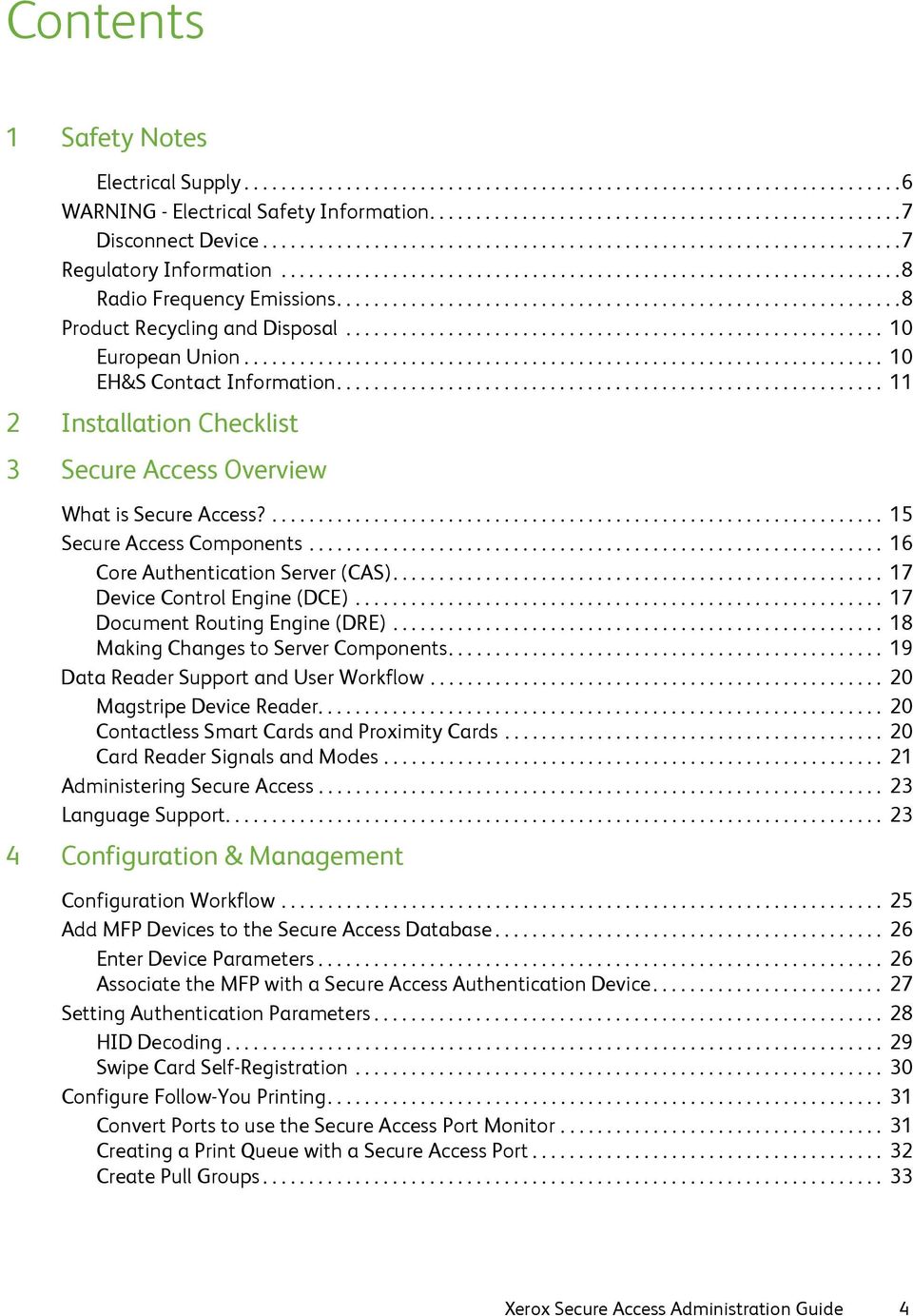
4 Contents Import and Synchronize User Accounts Use ADS to Import Existing Users Adding Users from A Flat File Import Add Delete Modify Creating Accounts Manually Monitor Authentication Events Configure the Release My Documents Custom Service Adding the Release My Documents Custom Service to the MFP Release My Documents End-User Workflow Appendices Directory Synchronization Access Permissions Resetting an Authentication Device Port Assignments Troubleshooting Troubleshooting the Release My Documents Custom Service Installation Accessing the Release My Documents Screen Setting the Number of Copies for a Print Job Ending a User Session Xerox Secure Access Administration Guide
5 Safety Notes 1 Read these safety notes carefully to ensure you operate the equipment safely and in compliance with applicable legislation. The equipment has been designed and tested to meet strict safety requirements. These include safety agency approval, and compliance to established environmental standards. Please read the following instructions carefully before operating the equipment and refer to them as needed to ensure continued safe operation. WARNING: Any unauthorized alteration, which may include the addition of new functions or connection of external devices, may impact the product certification. Please contact your authorized local dealer for more information Electrical Supply The power supply provided with the equipment must be operated from the type of electrical supply indicated on the data plate label. If you are not sure that your electrical supply meets the requirements, please consult your local power company for advice. Xerox Secure Access Administration Guide 6

6 Safety Notes WARNING - Electrical Safety Information Use only the power supply supplied with this equipment. Do not place this equipment where people might step on or trip on the power cord or its associated power supply. Do not place objects on the power supply power cord. If any of the following conditions occur, switch off the power to the equipment immediately and disconnect the power cord from the electrical outlet. Call an authorized local service representative to correct the problem. The equipment emits unusual odors. The power cord is damaged or frayed. A wall panel circuit breaker, fuse, or other safety device has been tripped. The equipment is exposed to water. Any part of the equipment is damaged. Disconnect Device The power cable to the power supply is the disconnect device for this equipment. To remove all electrical power from the equipment, disconnect the power cable from the electrical outlet. 7 Xerox Secure Access Administration Guide

7 Safety Notes Regulatory Information Radio Frequency Emissions United States, Canada Note: This equipment has been tested and found to comply with the limits for a Class B digital device, pursuant to part 15 of the FCC Rules. These limits are designed to provide reasonable protection against harmful interference in a residential installation. This equipment generates, uses and can radiate radio frequency energy and, if not installed and used in accordance with the instructions, may cause harmful interference to radio communications. However, there is no guarantee that interference will not occur in a particular installation. If this equipment does cause harmful interference to radio or television reception, which can be determined by turning the equipment off and on, the user is encouraged to try to correct the interference by one or more of the following measures: Reorient or relocate the receiving antenna. Increase the separation between the equipment and receiver. Connect the equipment into an outlet on a circuit different from that to which the receiver is connected. Consult the dealer or an experienced radio/tv technician for help. Shielded interface cables must be used with this equipment to maintain compliance with FCC regulations in the United States Canada This Class "B" digital apparatus complies with Canadian ICES-003. Cet appareil Numérique de la classe "B" est conforme à la norme NMB-003 du Canada. Xerox Secure Access Administration Guide 8

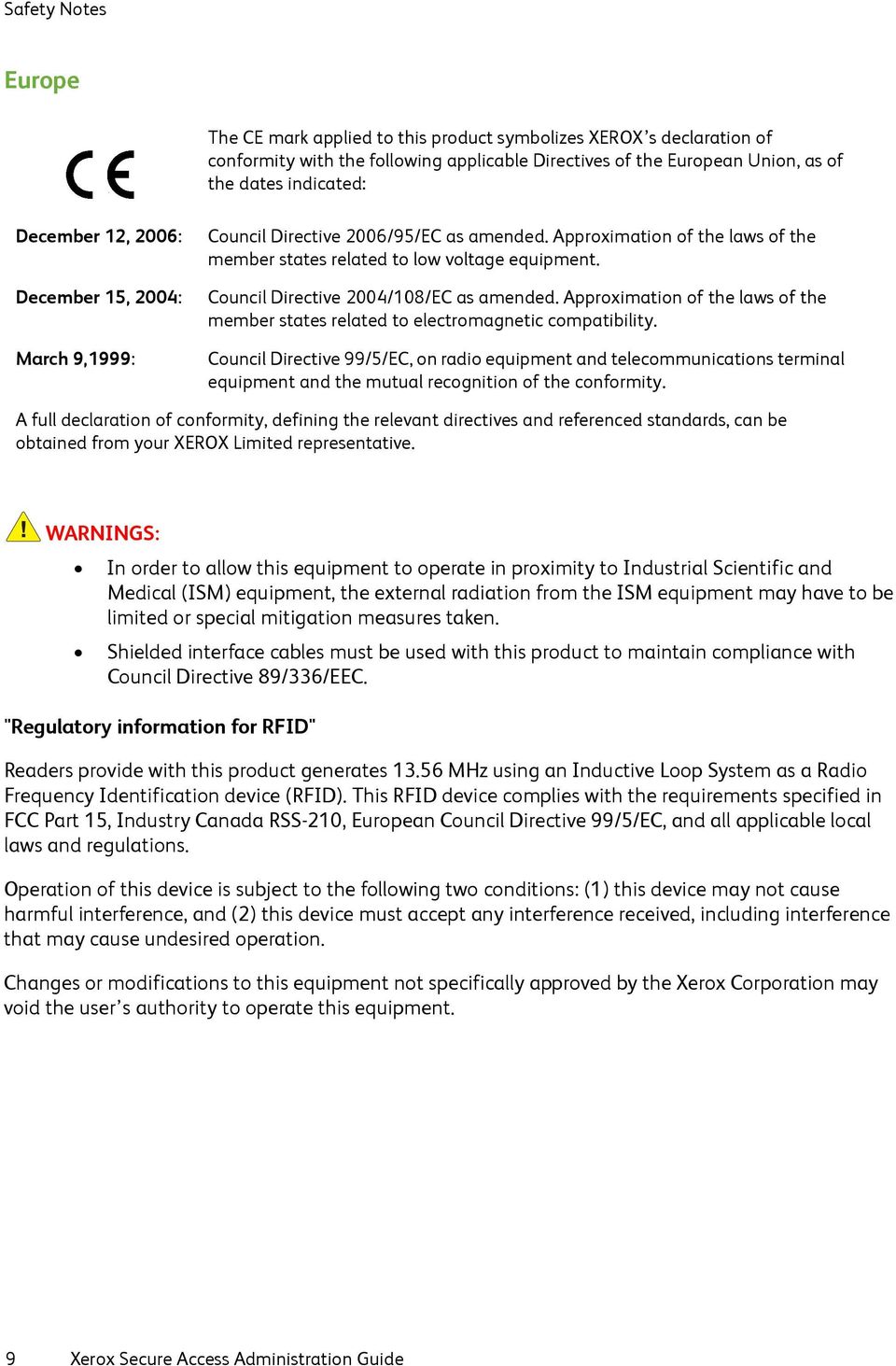
8 Safety Notes Europe The CE mark applied to this product symbolizes XEROX s declaration of conformity with the following applicable Directives of the European Union, as of the dates indicated: December 12, 2006: December 15, 2004: March 9,1999: Council Directive 2006/95/EC as amended. Approximation of the laws of the member states related to low voltage equipment. Council Directive 2004/108/EC as amended. Approximation of the laws of the member states related to electromagnetic compatibility. Council Directive 99/5/EC, on radio equipment and telecommunications terminal equipment and the mutual recognition of the conformity. A full declaration of conformity, defining the relevant directives and referenced standards, can be obtained from your XEROX Limited representative. WARNINGS: In order to allow this equipment to operate in proximity to Industrial Scientific and Medical (ISM) equipment, the external radiation from the ISM equipment may have to be limited or special mitigation measures taken. Shielded interface cables must be used with this product to maintain compliance with Council Directive 89/336/EEC. "Regulatory information for RFID" Readers provide with this product generates MHz using an Inductive Loop System as a Radio Frequency Identification device (RFID). This RFID device complies with the requirements specified in FCC Part 15, Industry Canada RSS-210, European Council Directive 99/5/EC, and all applicable local laws and regulations. Operation of this device is subject to the following two conditions: (1) this device may not cause harmful interference, and (2) this device must accept any interference received, including interference that may cause undesired operation. Changes or modifications to this equipment not specifically approved by the Xerox Corporation may void the user s authority to operate this equipment. 9 Xerox Secure Access Administration Guide
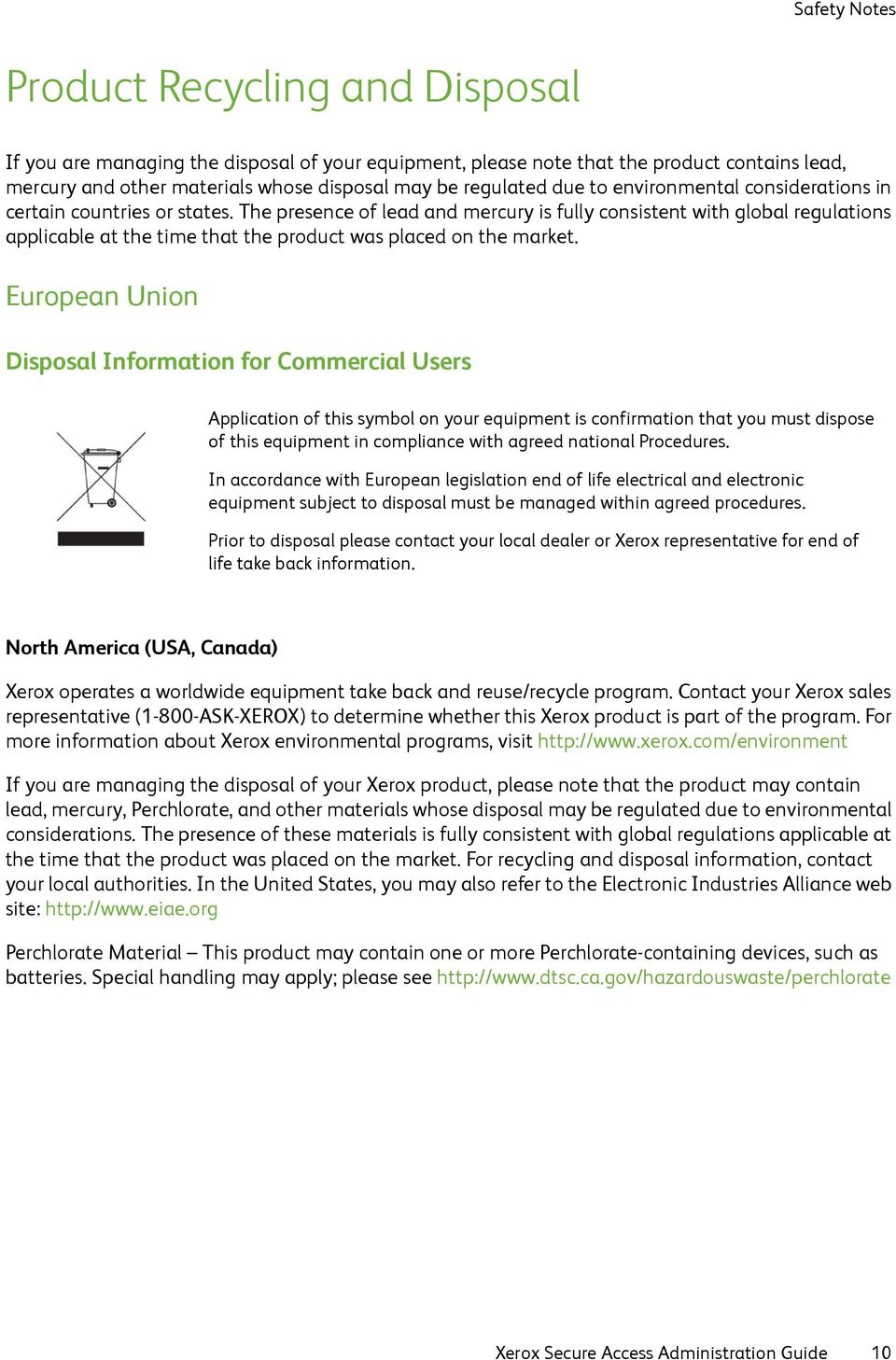
9 Safety Notes Product Recycling and Disposal If you are managing the disposal of your equipment, please note that the product contains lead, mercury and other materials whose disposal may be regulated due to environmental considerations in certain countries or states. The presence of lead and mercury is fully consistent with global regulations applicable at the time that the product was placed on the market. European Union Disposal Information for Commercial Users Application of this symbol on your equipment is confirmation that you must dispose of this equipment in compliance with agreed national Procedures. In accordance with European legislation end of life electrical and electronic equipment subject to disposal must be managed within agreed procedures. Prior to disposal please contact your local dealer or Xerox representative for end of life take back information. North America (USA, Canada) Xerox operates a worldwide equipment take back and reuse/recycle program. Contact your Xerox sales representative (1-800-ASK-XEROX) to determine whether this Xerox product is part of the program. For more information about Xerox environmental programs, visit If you are managing the disposal of your Xerox product, please note that the product may contain lead, mercury, Perchlorate, and other materials whose disposal may be regulated due to environmental considerations. The presence of these materials is fully consistent with global regulations applicable at the time that the product was placed on the market. For recycling and disposal information, contact your local authorities. In the United States, you may also refer to the Electronic Industries Alliance web site: Perchlorate Material This product may contain one or more Perchlorate-containing devices, such as batteries. Special handling may apply; please see Xerox Secure Access Administration Guide 10
10 Safety Notes Disposal Information for Domestic Users Application of this symbol on your equipment is confirmation that you should not dispose of the equipment in the normal household waste stream. In accordance with European legislation, end of life electrical and electronic equipment subject to disposal must be segregated from household waste. Private households within EU Member States may return used electrical and electronic equipment to designated collection facilities free of charge. Please contact your local disposal authority for information. In some Member States when you purchase new equipment your local retailer may be required to take back your old equipment free of charge. Please ask your retailer for information. Other Countries Please contact your local waste authorities and request disposal guidance. EH&S Contact Information Contact Information For more information on Environment, Health, and Safety in relation to this Xerox product and supplies, please contact the following customer help lines: USA: Canada: Europe: safety information US (Product Safety Information for US) safety information EU (Product Safety information for EU) 11 Xerox Secure Access Administration Guide
11 Installation Checklist 2 The Xerox Secure Access Installation and Administration Guides include step-by-step instructions for installing and configuring the Secure Access server and MFPs. This chapter provides a table outlining the order in which the installation should occur based on the type of Secure Access hardware configuration starting with the Installation Guide. Steps (*) indicates Required step Xerox Secure Access with USB Card Reader Xerox Secure Access with Authentication Device and Card Reader Installation Guide 1. Read Chapter 3 Installation Overview * * 2. Chapter 4 Installing the Secure Access Server: Section 1. Preparing the Network and Database 3. Chapter 4 Installing the Secure Access Server: Section 2. Run the Installation Wizard 4. Chapter 5 Setting Up the Hardware: Step 1. Configure the Authentication Device IP Address 5. Chapter 5 Setting Up the Hardware: Step 2. Mount the Secure Access Authentication Device 6. Chapter 5 Setting Up the Hardware: Step 3. Connect the Hardware 7. Chapter 5 Setting Up the Hardware: Step 4. Mount/Connect the Secure Access USB Card Reader * * * * Skip * Skip * Skip * * Skip Administration Guide 8. Read Chapter 3 Secure Access Overview * * 9. Chapter 4 Configuration Workflow: Step 1 - Configure Xerox MFP device to accept network authentication through the Xerox Secure Access mechanism * * 10. Chapter 4 - Add MFP devices to the Secure Access Database * * 11. Chapter 4 - Associate the MFP with a Secure Access Authentication Device Skip * 12. Chapter 4 - Configure Follow-You Printing (optional) * * 13. Chapter 4 - Set authentication parameters * * Xerox Secure Access Administration Guide 12

12 Installation Checklist Steps (*) indicates Required step Xerox Secure Access with USB Card Reader Xerox Secure Access with Authentication Device and Card Reader 14. Chapter 4 - Import and synchronize user accounts * * 15. Chapter 4 - Configure the Release My Documents Custom Service * * 13 Xerox Secure Access Administration Guide

13 Secure Access Overview 3 This chapter includes: What is Secure Access? on page 15 Secure Access Components on page 16 Data Reader Support and User Workflow on page 20 Administering Secure Access on page 23 Language Support on page 23 After you install the Xerox Secure Access Unified ID System Server and perform the physical setup of the Authentication Devices or Secure Access USB Card Reader, use this guide to add MFP (Multifunction Printer) devices to the Secure Access database, enabling communication between the Server and the Authentication Devices. Use this guide to perform advanced configuration tasks for all components and features of Secure Access. This chapter provides information about: The hardware and software components that comprise Xerox Secure Access Accessing the Secure Access Manager to administer the system Xerox Secure Access Administration Guide 14

14 Secure Access Overview What is Secure Access? Secure Access Unified ID System provides the ability to control access to the print, fax, copy and scan functions of Xerox Multifunction printers (MFP). When a user approaches a device controlled by Secure Access, they must either swipe their card or pass their card over the proximity card reader. The MFP front panel is active only when the user s account information is authenticated by the Secure Access server. Using a proprietary protocol (Convenience Authentication Protocol), the Secure Access Authentication Device contacts the Secure Access Server via an ethernet network connection to verify the user information gathered from the swipe or proximity card. If using a USB Card Reader the communication is from the MFP to the Secure Access Server directly. If the Secure Access Server verifies the user, the MFP device panel unlocks and is ready for use. If the user is not verified, the MFP remains locked and the user cannot perform any tasks at the device. Secure Access Authentication Device Secure Access Server Ethernet Connection USB Card Reader Card Reader Xerox MFP Figure 3-1: Secure Access Solution Components If the user wants to scan documents, the Secure Access server provides the network user ID to the compatible MFP; the MFP can then use the ID to implement Single Sign-on functionality and automatically authenticate for scanning. 15 Xerox Secure Access Administration Guide


15 Secure Access Overview Secure Access Components The solution requires two main components: 1. Secure Access Authentication Device, which is comprised of an Authentication Terminal and an external card reader. Users do not access the Authentication Terminal. The Card Reader is connected to the Authentication device via serial cable only, and is not attached directly to the MFP. Refer to the Installation Guide for placement and mounting instructions. Ethernet Connection Secure Access Authentication Device Card Reader Figure 3-2: Secure Access Authentication Device components or 1. Secure Access Server USB Card Reader, which is connected to the MFP. Refer to the Installation Guide for placement and mounting instructions 2. Secure Access Server, which is comprised of the following components: Core Authentication Server (CAS) Device Control Engine (DCE) Document Routing Engine (DRE) Secure Access Manager (Administrative Tools) Note: You can install these components on a single server, or distributed across multiple servers. In some deployments, you may also require more than one DCE or DRE. See the Installation Guide for complete details. DCE DRE CAS Mgmnt Tools Secure Access Server Figure 3-3: Secure Access Server Components Xerox Secure Access Administration Guide 16

16 Secure Access Overview The core server components communicate on designated ports. Each component listens on a specific port for information or requests from the other components. Refer to Port Assignments on page 44 for a complete list of port assignments per component. Core Authentication Server (CAS) The Core Authentication Server (CAS) houses the database that contains all user and MFP device data. Every Secure Access installation requires a pre-installed database. The CAS uses the database instance to create an accounts database that contains all user information, and all device information. See System Requirements in the Installation Guide for information about supported databases. Device Control Engine (DCE) The Device Control Engine (DCE) handles all communication with the MFP devices. When a user wants to use the copy, scan, or fax functionality on a MFP, they must first trigger the card reader. A swipe or proximity read initiates an access request. The Authentication Device forwards the login request to the DCE, which then contacts the CAS to verify the user account data associated with the card. This process is depicted in Figure 4 and Forward Request CAS 4. Verify User 5. User Verified DCE Authentication Device 2. Authentication Request Generated Card Reader 6. Send Unlock Request to MFP 1. User triggers card reader Ethernet Serial Cable Ethernet CAP Protocol MFP Figure 3-4: User Authentication Workflow 17 Xerox Secure Access Administration Guide

17 Secure Access Overview 4. Verify User CAS 5. User Verified DCE 2. Authentication Request Generated 1. User triggers card reader 6. Send Unlock Request to MFP Ethernet Serial Cable Ethernet CAP Protocol MFP Figure 3-5: User Authentication Workflow with USB Card Reader Document Routing Engine (DRE) The Document Routing Engine (DRE) is the print server. It s primary function is to enable document flow from user workstations to MFP devices. The following describes a typical DRE workflow: 1. A user generates a print request to an MFP that is registered in the Secure Access Manager database. 2. If the user prints to a print queue that is using a Secure Access Manager port the DRE holds the job on the print server. 3. When the user logs in at the MFP the DRE searches the jobs queued for that printer (and/or pull group) and releases those that were submitted by the logged in user. Note: If the Release My Documents custom service is installed, users can access the Release My Documents screen to view the secure print queue and release one or more documents as needed. See Configure the Release My Documents Custom Service on page 39. If a Secure Access port is not installed on the device, the print job is printed without validation If you want print jobs to be held in a secure queue, you can configure Follow-You Printing. To enable this functionality, you must configure the MFP to use a Secure Access port rather than a standard port. The Port Monitor integrates with the Windows printing subsystem and functions as part of the spooler service, allowing the Port Monitor to receive print jobs and then hold the jobs in a secure virtual queue until a verified user releases them to a particular MFP. When Follow-You Printing is enabled, the user must first authenticate at the MFP of their choice, as per Figure 3-4: User Authentication Workflow on page 17. If the authentication is successful, and the Release My Documents custom service is installed, the user can access the front panel on the MFP to view the print queue. The user can release one job or all jobs (if configured). Xerox Secure Access Administration Guide 18

18 Secure Access Overview Making Changes to Server Components If you make configuration changes within Secure Access Manager to any of the core Secure Access server components (CAS, DRE, DCE), such as adding new Secure Access devices, you must wait a minimum of thirty seconds before these changes take effect. The delay in updating server components is a function of the CAS polling feature. This means that the delay may be longer in the event that CAS is unavailable for some reason during that polling period after the server changes. CAS will send the change data to the relevant components once the connection is restored. 19 Xerox Secure Access Administration Guide
19 Secure Access Overview Data Reader Support and User Workflow The MFP functions are locked until a user provides valid authentication data. To do so, the user must pass their proximity or smart card over the proximity reader or swipe their card through a Magstripe device reader. When the user s data has been validated by the Core Authentication Server (CAS), the MFP is unlocked and ready for use. When the user is finished, they push either the Clear All or Access button on the MFP keypad to log out and lock the device. Secure Access supports several types of external readers: magnetic stripe, EM Marin, HID proximity, Hitag, Indala, Legic, and Mifare. All readers are pre-configured from the manufacturer and require no further configuration. Magstripe Device Reader Secure Access supports external magnetic stripe reader devices. Users can enter validation data by swiping an encoded magnetic card through the card reader. The magnetic stripe reader reads virtually any standard magnetic card medium on Track 2 and accepts standard or custom encoded data. Track 1 data is available with the USB mag stripe readers. Using a Magnetic Stripe Device Reader Instruct users to follow these steps to enter data using a magnetic card device reader: 1. Insert the card into the guide track with the magnetic stripe facing away from the terminal. Ensure the card is pressed firmly against the guide. 2. Pull the card down through the guide track and remove the card. Note: Do not run the card through at an angle or the terminal will not accept the data. If the terminal cannot read the entry, the LED stays solid red. Reinsert the card into the guide track and run the card through the reader again. Contactless Smart Cards and Proximity Cards Secure Access supports Legic and Mifare contactless smart cards, and EM Marin, HID, Hitag, and Indala proximity cards. Users can enter validation data by passing the proximity card within one inch of the external reader. Xerox Secure Access Administration Guide 20

20 Secure Access Overview Using a Proximity or Smart Card To enter data using a proximity card or smart card, pass the card within 1 inch or 2.5 cm of the proximity symbol located on the top of the card reader device. To locate the proximity card reader on the data reader module, look for this symbol: Pass the proximity card over this symbol on the card reader If the swipe is invalid, the LED flashes red. Card Reader Signals and Modes Secure Access displays its messages through an LED on the card reader module. The LED light indicates the status The LED behavior is the same for both types of Card Readers except where noted. The following signals may be displayed: LED Behavior Solid Red Solid Green Slow flashing green Slow flashing red Fast flashing red Meaning Authentication Subsystem is in Idle mode; it is ready but there is no active session. Authentication Device is in Ready mode and a session is active. This state will also occur if using a USB card reader while the MFP is booting and the Network controller has not yet been initialized. Data received from card reader, awaiting authentication for active session or user input (e.g. card self-registration or at the Release All Jobs prompt). Authentication Subsystem has no connection to server. Invalid card; access denied. 21 Xerox Secure Access Administration Guide

21 Secure Access Overview The Authentication Subsystem has two functional modes: Idle mode or Ready mode. An Authentication Subsystem that is ready for use is in Idle mode. When a user swipes a magstripe card, the device changes to Ready mode. The device returns to Idle mode when a user completes a transaction or after a configurable period of inactivity, as set on the MFP, in Ready mode. Note: The Authentication Subsystem returns to Idle mode if the MFP Sleep Mode Timer activates. When the device is in Idle mode, the LED on the card reader is solid red. While in Ready mode, the LED on the card reader is solid green and the user can begin using the controlled device to perform a transaction. Xerox Secure Access Administration Guide 22
22 Secure Access Overview Administering Secure Access All administration takes place in the Secure Access Manager. By default, the installer places the Secure Access Manager on the Start menu. Look under Start > All Programs > Xerox Secure Access > Secure Access Manager. Note: You must have Administrative privileges on the Secure Access server to launch the Secure Access Manager. Before you can open the Secure Access Manager, you must select the CAS that you want to work with. The CAS validates against a single authentication database, so you need to type in the correct database name, or choose it from the list. The Secure Access Manager interface is divided into five areas. When you choose a task from the tools, the contents of the right pane update to show you the available settings. Language Support When Secure Access was installed, the installation wizard prompted for the language setting to use for the components within the deployment. This setting applies to the Secure Access Manager interface only. The language displayed on the MFP front panel is determined by the device settings. The Secure Access Server checks the MFP device language setting each time a user swipes their card. If any language other than English, French, German, Italian, or Spanish is set on the MFP, the prompts displayed by Secure Access default to English. 23 Xerox Secure Access Administration Guide
23 Configuration & 4 Management This chapter includes: Configuration Workflow on page 25 Add MFP Devices to the Secure Access Database on page 26 Setting Authentication Parameters on page 28 Configure Follow-You Printing on page 31 Import and Synchronize User Accounts on page 34 Monitor Authentication Events on page 38 Configure the Release My Documents Custom Service on page 39 Configuration refers to the software configuration required to establish communication between the MFPs, the Authentication Devices, and the Secure Access Server. Ensure that you follow the workflow outlined on page 24 for the best results. This chapter provides information to: Step you through a complete initial configuration Add the MFP devices to the Secure Access database Associate a Secure Access Authentication Device with an MFP device, if not using a USB Card Reader Enforce authentication and set additional authentication options Import and synchronize user accounts with Active Directory Synchronization Monitor authentication events Xerox Secure Access Administration Guide 24
24 Configuration & Management Configuration Workflow Follow the steps in the order they are presented below. Failure to do so will result in an incomplete installation. Before you start, ensure that you have correctly installed the Secure Access Server. Follow the instructions provided in the Xerox Secure Access Unified ID System Installation Guide. Install the CAS and at least one DCE and DRE. 1. Configure Xerox MFP device to accept network authentication through the Xerox Secure Access mechanism This is performed through the CentreWare Internet Services, which you connect to via an internet browser. Refer to the MFP System Administration CD for information on how to install and configure Xerox Secure Access on the device. 2. Add MFP devices to the Secure Access Database Create an entry for each MFP device in the Secure Access Manager. Allocate each MFP to a particular DRE print server (if required). 3. Configure Follow-You Printing Note: This step is optional and should only be configured if Follow-You Printing is required at the site. To configure Follow-You Printing, create Pull Groups that group devices with like characteristics. When the user sends a document to an MFP within a Pull Group, they can authenticate at any MFP within the Pull Group and pull the job from the queue to be printed on that MFP. 4. Set authentication parameters Configure the parameters that Secure Access will require to authenticate user access requests, including enabling secondary prompts and card data setup. 5. Import and synchronize user accounts Set the Active Directory Synchronization parameters, then import existing User accounts into the Secure Access database. 6. Install the Release My Documents custom service To allow users to view release one or more documents from the secure print queue directly from the MFP front panel, install the Release My Documents custom service. 7. Configure user card self-registration To enable users to self-register their swipe cards. 25 Xerox Secure Access Administration Guide
25 Configuration & Management Add MFP Devices to the Secure Access Database Each MFP must be registered in the Secure Access Database. You need to assign a unique name to each MFP, and you require the network IP address of each device. This step is divided in two sub-steps for ease of administration: Enter Device Parameters and Associate the MFP with a Secure Access Authentication Device. Enter Device Parameters 1. In the Secure Access Manager, click Devices. 2. From the Settings, click Add... in the device listing. 3. In the Physical Device Summary dialog that appears, type the required information, outlined in the table below. Note: The Manufacturer and Model are populated automatically the first time the device contacts the DRE. The next time you open this dialog, this information will be populated. Setting Name Hostname/IP address Description Authentication Device Description Type a unique name for this MFP. You will use this name to identify the device in the Secure Access Manager. Type either the IP address or the Hostname. Ensure that you can resolve the Hostname if you do not know the IP address. Enter a description that will help other Administrators identify the device, usually by location. For example, second floor, HR. Select the Secure Access Authentication Device (from its MAC address) that will control access to this MFP. Note: If you are using a Secure Access USB Card Reader you do not associate an Authentication Device and you need to leave this as <USB Reader>. Secure Access compatibility MFP with Secure Access capability: Select if the MFP if using USB Card Reader or if you are using a Xerox MFP which supports Secure Access. Also enter the Admin ID and Password associated with this MFP. Other type of MFP or printer: Select if the Authentication Device is being used for Follow-You Printing with any MFP or printer which does not support Secure Access. Server Enter the servername that has DCE installed and will be controlling this MFP or printer. Xerox Secure Access Administration Guide 26
26 Configuration & Management Setting Initialize Secure Access device Behavior Description The Secure Access device is initialized automatically when it is first configured. If the MFP is changed, initialize the Secure Access device by clicking this button. A pop-up window will appear to confirm that the initialization was successful. Note: You can click this button to install the Release My Documents custom service. See Configure the Release My Documents Custom Service on page 39 for more information. If you are using the Secure Access Port Monitor to enable Follow-You Printing, you can select from one of two release options: At assigned control terminal: The user must swipe their card at the MFP to release documents sent to that device. Release documents from pull group: After authentication, the user can follow the instructions on the front panel to select queued documents from a specific pull group. For details, see Configure Follow- You Printing on page 31. If you are using the Windows port monitors, these settings have no effect. 4. Click OK to save the settings. Note: If Secure Access detects that the device is Custom-services enabled, and you made changes in the Devices dialog, a popup window will appear: If the Release My Documents extension is not currently installed on the device, the prompt Do you want to enable Follow-You Printing? appears. If the Release My Documents extension is installed on the device, the prompt asks Do you want to keep Follow-You Printing enabled? Associate the MFP with a Secure Access Authentication Device Note: If you are using a Secure Access USB Card reader you can skip this step. When you initially power on an Authentication Device connected to the network, the DCE registers the device. The device displays in the Secure Access Manager as an unassigned Secure Access Authentication Device. You then need to associate each MFP with a specific Secure Access Authentication Device. Use the Tear Sheet (see the Installation Guide) you filled in during the hardware setup to map each Authentication Device to the appropriate MFP. 1. In the Secure Access Manager, click Devices, then select the MFP you want to configure. 2. In the Physical Device Summary dialog, drop-down the Hardware Address list. 3. Using your tear sheet as a reference, locate the correct MAC Address of the Authentication Device that will control access to this particular MFP. 4. Click OK to save the changes. 27 Xerox Secure Access Administration Guide
27 Configuration & Management Setting Authentication Parameters Before you import user accounts, you need to configure the Core Authentication Server to validate the accounts against primary and secondary accounts PINs. PIN information connects a Secure Access user account with the information on a swipe card. The primary PIN is the numeric sequence that uniquely identifies the user, and is typically the card number. To enter the primary PIN, the user simply swipes their card. If you prefer an additional layer of security, you can also enable secondary PINs. When enabled, the user must first swipe their card, then they need to enter an additional password on the front panel of the MFP. Only when both the data on the swipe card and the secondary PIN password is authenticated, will the user have access to the MFP. 1. In Secure Access Manager, select Configuration > Authentication device settings. 2. In the Authentication mechanisms section, select one or more authentication mechanisms: Leave Secure Access PINs selected only if you want to connect a Secure Access printing account with logon information. Enable External user ID and password only if you are using swipe cards to verify all user information outside of Secure Access. Enable Secure Access PIN with external password if users will swipe their cards for identification, but must also enter their Secure Access domain user account password. Secure Access will cross-check the database for the corresponding account name, then verify the account against the selected external authority for network logon. Note: If you select an external authentication mechanism, the Enable secondary prompt field is enabled automatically. External authentication cannot occur if the Secondary PIN information is empty. 3. In the External authorities section, select one or more external authorities only if you selected a corresponding authentication method: Select Windows to validate accounts against a default Windows domain. Type the domain name in the Default domain field. Select NetWare to validate accounts against a default NetWare context. Enter the name in the Default context field. Note: You must install the Novell NetWare client for Windows on the Core Authentication Server if you plan to validate against a NetWare context. Select LDAP to validate accounts against a default LDAP server. Type the LDAP server name, then choose an LDAP type from the list. Select Force SSL encryption if you want use Secure Socket Layer encryption. 4. In the Card setup section, do the following: a. Enter the start and stop data position in the respective fields. The data retrieved from these positions will be used as the primary PIN. b. Click <None> beside HID decoding if you are using an HID Proximity card reader. The Authentication Devices must be configured to return card information in a standard format. For details on entering the decoding parameters, see HID Decoding on page 29. Xerox Secure Access Administration Guide 28
28 Configuration & Management c. Select Auto-register primary PINs to enable users to register an unrecognized swipe card for future use. See Swipe Card Self-Registration on page 30 for details. 5. In the Secure Access device prompts section, enter the default text that will be displayed on the MFP front panel: a. Enter a Title that will be displayed in all prompts. b. Enter the Login prompt text that will be displayed to prompt the user to login. For example Please swipe your card to login. c. Select Enable secondary prompt to display a prompt on the Xerox MFP front panel that requires the user to enter a secondary PIN code (or password). d. Select Enable release all jobs prompt to display a prompt on the Xerox MFP front panel that asks the user if they want to release all jobs that are queued for printing. 6. In the SNMP section, enter your Get and Set Community names. Note: If you change the default names in Secure Access, you must also change them on all of your physical devices to match, in order for SNMP communication to work. Consult the MFP documentation for information on changing these settings. 7. Enter the JBA Account ID number if you want to use Secure Access with a third-party JBA accounting application. 8. Set the Job expiry time (in hours) after which any jobs remaining in the print queue will expire and be removed from the queue. The default is 1 hour. 9. If you use non-default SNMP community names ( public for read access and private for write access) on your network, specify those community names in the corresponding fields in the dialog. Note that all devices must use the same community names. Note: If you do not enter the community names, the Secure Access server will not be able to automatically detect device types when you create new ports, but you can still create ports by manually specifying the connection details. 10. Click OK to save the settings HID Decoding To configure the HID encoding, do the following: 1. In Secure Access Manager, select Configuration > Authentication device settings. 2. Click <None> beside HID decoding within the Card Setup section. 3. In the HID decoding dialog, do the following: If you know the encoding, enter the following HID card encoding information. If you do not know the encoding, contact your HID vendor to determine the encoding type used on your proximity cards. In the case where you do not need to extract facility code information, check ID code only. If you need to extract both Facility code and ID code, check both options. a. In the Facility Start field, enter the position in the raw bitstream (0 based, left to right, inclusive) where the Facility code begins. b. In the Facility End field, enter the position in the raw bitstream (0 based, left to right, inclusive) where the facility code ends. 29 Xerox Secure Access Administration Guide
29 Configuration & Management c. In the Facility Width field, enter the number of decimal digits for the facility portion of the value that the Authentication Device will output. Numbers will be zero-padded on the left as needed. If your site or HID card format does not use a facility code, or if you do not require it to be returned as part of the card value, enter a width of 0 to disable extraction of the facility number. d. In the ID Start field, enter the position in the raw bitstream (0 based, left to right, inclusive) where the ID code begins. e. In the ID End field, enter the position in the raw bitstream (0 based, left to right, inclusive) where the ID code ends. f. In the ID Width field, enter the number of decimal digits for the ID code portion of the value that the Authentication Device will output. Numbers will be zero-padded on the left as needed. The Authentication Device will return a single value for each card swipe that is the decoded facility code followed by the decoded ID. g. Click OK to save the settings. Swipe Card Self-Registration If you want users to self-register their swipe cards, you must enable this option in Secure Access. 1. In Secure Access Manager, select Configuration > Authentication device settings. 2. Select Auto-register primary PINs within the Card Setup section. 3. Click OK to save the changes. When a user swipes an unregistered card, they are required to login to the MFP with valid user credentials (user ID and password). The user credentials must already exist in CAS to allow selfregistration. Once the user registers their card, the next time they swipe the card, their account information is automatically associated with the card, and they can login without manually entering their user credentials. If configured, the user may be prompted for Secondary PIN. Note: If the Secure Access PIN with external password option is selected when configuring card self-registration, the Secure Access PIN will be overwritten by the swipe card data once the card is authenticated and registered. The Secure Access PIN will no longer be a valid login credential. Xerox Secure Access Administration Guide 30
30 Configuration & Management Configure Follow-You Printing Follow-You Printing allows a user to submit a print job to a specific MFP, but authenticate at another MFP then view a list of jobs held in a secure queue. The user can then pull the print job to the MFP where they authenticated, even if it is not the original device selected for output. Pull Group Destination Printer Secure Print Queue Document held in virtual queue User authenticates at any MFP in the Pull Group to print the document at that device User Workstation Print Server Figure 4-1: Follow-You Printing User Workflow To configure Follow-You Printing, you need to perform two steps: 1. Use the Secure Access Port Monitor to enable configuration between the print server and all controlled MFPs. You can convert existing Windows ports to Secure Access ports. The port monitor intercepts all document sent to devices within a pull group and holds them in the secure queue until released by the authenticated user. See Convert Ports to use the Secure Access Port Monitor on page 31 for instructions. 2. Create the Pull Groups within Secure Access Manager. See Create Pull Groups on page 33. If you want to allow the user to view their jobs waiting in the secure queue directly on the MFP front panel, update the MFP to include the Release My Documents custom service. See Configure the Release My Documents Custom Service on page 39 for instructions. Convert Ports to use the Secure Access Port Monitor Secure Access uses specialized ports to enable Follow-You Printing. Each device that will be part of a Pull Group must use a Secure Access port monitor. If you have existing devices already set up to use Windows ports, you can easily convert the ports. 1. Ensure the devices you want to convert are powered on, are connected to the network and are configured to print. 2. Using My Computer, browse to the location where you installed Secure Access. 31 Xerox Secure Access Administration Guide
31 Configuration & Management 3. Open the Tools folder, and double-click SAPrinterConversionWizard.exe. 4. On the Printer Conversion wizard welcome screen, click Next. 5. Select the Print server location. If the print server (DRE) resides on the local machine, select Local machine, otherwise select Remote server. 6. Select Convert printers to use the Secure Access Port Monitor, then click Next. 7. Select or clear printers in the Convert Printers list, then click Next. 8. Click Finish to complete the conversion. Creating a Print Queue with a Secure Access Port Depending on your printing hardware, you may need more than one port using the Secure Access Port Monitor on a print server. You can configure a new printer definition that uses the Secure Access Port Monitor. 1. Using your standard Windows interface, open the Windows Add Printer wizard. 2. Follow the prompts to add a local printer and create a new port. 3. When prompted, select Secure Access Port as the type of port you want to create and click Next. The Add Secure Access Printer Port wizard displays and you are prompted to ensure that the printer device is turned on, connected to the network, and properly configured. 4. Click Next and select Physical printer as your Device Type from the drop list. 5. Specify a Printer name or IP address. 6. The wizard supplies a Port name based on the printer name or IP address. Change this name manually, if desired. 7. Click Next to continue with the port configuration options. The Port Configuration screen displays. The Detected device information displays automatically if the wizard can collect this data from the printer. 8. Specify whether to use standard or custom settings for this port. If you select the Use custom settings option: a. If you select Raw port communication, identify the TCP Port number, and specify if the Port Monitor should hold the connection open. b. If you select LPR, specify the name of the print Queue on the physical device (for example, PORT1). c. If you select Specific device, select the appropriate Manufacturer and Model from the drop lists. The device uses the relevant default communications parameters based on these selections. 9. Click Next and specify the Physical device name. This is the name of the device as it will display within Secure Access. 10. Review the details for this new port and device registration, and click Finish to close the Add Secure Access Printer Port wizard, or Back to change any of the settings. Closing the Add Secure Access Port wizard returns you to the Windows Add Printer wizard. Xerox Secure Access Administration Guide 32
32 Configuration & Management 11. Complete the remaining steps in the Add Printer wizard. When prompted, select Yes to print a test page. 12. Confirm the Windows printer details and click Finish to exit the wizard, or Back to change settings as necessary. Create Pull Groups The Pull Groups you create should reflect the needs of your organization. For example, you can group compatible devices by physical location, by department, by manufacturer, and so on. You can also create Pull Groups that include a selection of devices from a single print server. The device driver selected for the pull group must be compatible with all devices associated with that group. If you want a print job generated for one MFP to output successfully on another MFP, ensure that the other printer can understand all of the print commands included in the data stream from the driver. 1. In Secure Access Manager, click on one or more existing MFP devices that you want to assign to the same Pull Group. 2. In the Physical Device Summary dialog, select Release documents from pull group. Type in the name of the Pull group (the name can be any name that makes sense to you), then click OK to apply the change. Note: You only have to type in the name of the Pull group the first time you use it. Afterward, it will appear in the list automatically. 3. Repeat steps 1 and 2 to select devices and create other Pull Groups. 33 Xerox Secure Access Administration Guide
33 Configuration & Management Import and Synchronize User Accounts To enable authentication, you need to create user accounts that match the attributes used on the card swipe. When a user swipes their card, the Authentication Device forwards the access request to the DCE, which then forward the card swipe details to the CAS. If the CAS locates a user account with attributes matching those found on the card, the MFP is unlocked and the user can proceed with the fax, scan, copy, or print job release. There are three methods within Secure Access to import user accounts: Use Active Directory to import (and optionally synchronize) accounts Import user accounts from a CSV file. Create accounts manually within Secure Access Manager. Use ADS to Import Existing Users If you have an Active Directory server, you can select the account information you want to import and synchronize. Synchronization will minimize the administration overhead and allow account updates to occur automatically. Performing the steps outlined below causes a task to run in the background. In the Secure Access Manager, click the Users tool to see the result of the task - the list of users will populate automatically when the task is complete. Note: The Secure Access services must be started by a Domain account with access to the contact Active Directory. Ensure you are logged in as the Domain Administrator. If services are started under the local administrative account, the Active Directory synchronization will fail. It s important to select options in the correct order in the Active Directory Synchronization dialog, so follow the steps provided below carefully. 1. In Secure Access Manager, click Configuration > Active Directory Synchronization. 2. Under the Domain controllers area, click Add. A Domain controller is a server that provides access to the Active Directory for member computers. Type the Controller name in the field. 3. Under the Containers area, click Add. A container is a folder in the Active Directory tree structure containing users, groups, or computers. CAUTION: Ensure that the OU containers you choose are comprised of user account data only. If the OUs contain other data (such as system or contact info), you will see unexpected results. You may need to create specific OU containers to be used only for importing and synchronization purposes. 4. Adjust the Synchronization interval to change how often Secure Access synchronizes its database with the specified Active Directory. The synchronization interval value must be at least 15 minutes. 5. Select or clear the Active Directory updates to be applied options Adds, Deletes, or Changes to specify which Active Directory accounts Secure Access receives and applies to the accounts database during subsequent synchronizations. Xerox Secure Access Administration Guide 34
34 Configuration & Management You can choose to import added or changed users, or remove inactive accounts from the Secure Access database. Leave these settings at the default to ensure the accounts are updated and kept in sync with the Active Directory server. 6. The Assign Values from Active Directory attributes save you time and effort by assigning particular attributes to all users within the selected container. Note that you should enter the Active Directory attribute name, not the field label. Although you can update individual user accounts later on, choose these attributes before you import to speed up account creation. The Primary PIN and Secondary PIN attributes map the numeric PIN values found on the Active Directory server to the Primary PIN and Secondary PIN fields in Secure Access. Check the Secondary PIN value if you want to import these fields, which the user can enter on the MFP front panel (a secondary prompt is like a password that adds another layer of security) if the Secondary prompt is enabled in Configuration > User Authentication Device Settings. Type the attribute name for both the PIN1 (typically the card number) and the PIN2 fields that is used on the Active Directory server. The Primary PIN and Secondary PIN attributes can also map address. 7. Click Import to immediately begin the import task for the first time. The Import task runs in the background, and may take a few minutes depending on the size of the Active Directory you are importing. 8. You can click OK to exit the dialog. The task will continue to run even though the dialog is closed. 9. After a few minutes, refresh Secure Access Manager, then check the list of Users to ensure successful import of the accounts. Also open the properties for a user account and ensure that the settings are correct. Adding Users from A Flat File Import Use the SACmd.exe utility to add, delete, modify and query user accounts from a flat file. Note: This method is a one-time import and does not synchronize data beyond the import. Secure Access installs this utility by default on the authentication server in the directory: Program Files > Xerox >Secure Access > Tools. The command-line utility accepts commands in the following format: SACmd -s(server) (Action) (Obj_ID) [(Options)] Example: -stestserver add user1 "John Smith" [email protected] pin1 pin2 Execute the command with a batch file: SACmd -s(server) -f(batchfile) SACmd Batch File Process SACmd has a batch mode and accepts a CSV file as a batch file (one file per server). Batch operation allows all the command actions except for query command. Note: Copy the.csv file to the Secure Access > Tools folder. [Secure Access\Tools file path]\sacmd s(server) f BatchFileName.csv CVS file format: (Action), (Obj_ID) All, [(Details)] 35 Xerox Secure Access Administration Guide
35 Configuration & Management Command line parameters enclosed in brackets () are mandatory; parameters within square brackets [] are optional. Use the table below to fill in the parameter. Parameter Server Variables Specify the name or IP address of CAS. Action Obj_ID Options for Action Command Specify the action to take on the account. Use one of: add - Add user delete - Delete user query - Query database modify - Modify an object attribute Applies (action) only to the specified object ID. Use double quotes around object IDs that have a space, for example John Doe. Specify additional values. Use double quotes around detail values that have spaces or for empty values. Specify amounts with a period for the decimal separator. For the modify action, place! for required fields that you don't wish to change. (user_id): User ID (user_name): User name ( ): User Add Add can add user accounts. It requires values up to and including the final field needed. Add User: add(user_id) [(user_name) ( ) (PrimaryPIN) (SecondaryPIN)] Example: SACmd -SMyServer add JohnD John Doe [email protected] 123 Password Delete Delete can delete user accounts. Delete a user: delete (user_id) Example: SACmd -SMyServer delete JohnD Xerox Secure Access Administration Guide 36
36 Configuration & Management Modify Modify will allow user to modify the user database setting. It requires values up to and including final field needed. Modify a user: modify (user_id) [(user_name) ( ) (PrimaryPIN) (SecondaryPIN)] Example: update address of user johnd and keep the rest of the information: SACmd -SMyServer modify johnd! [email protected] Creating Accounts Manually You can use Secure Access Manager to add individual user accounts as needed. 1. Select Users, then right-click in the Settings pane and select Add User from the menu. 2. In the User Properties dialog, enter the required information, outlined in the table below. Field User ID Full Name address Primary PIN Secondary PIN Confirm Secondary PIN Description ID logged to the database to track the account. The full name of the user. Enter a full name to easily identify the user within Accounts Manager or Department Manager. This name also appears in account statements and reports. The address is provided to the MFP, for tasks such as scanning to . The primary PIN is typically the card number. The secondary PIN is used as a password, and the user must enter this PIN on the MFP front panel after swiping their card to authenticate. Type the secondary PIN again to confirm the password. 37 Xerox Secure Access Administration Guide
37 Configuration & Management Monitor Authentication Events Secure Access records each authentication event in the Secure Access database. You can generate an authentication log for any date, and view the history of events such as: Authentication Failure Start of Session (successful authentication) Each event logged contains the following information: Source IP Address Primary PIN Validation Result Server type Username Address Server Name To view an authentication log in Secure Access Manager, click Authentication log, and right-click View log by date. Select the date, and then click OK. Xerox Secure Access Administration Guide 38
38 Configuration & Management Configure the Release My Documents Custom Service The Release My Documents custom service updates the MFP to add the Release My Documents option to the Custom Services screen on the front panel. This screen (shown below) is populated with queued print jobs for the current user. The user can select one or more jobs and release or delete them directly from the MFP front panel. Note: Follow-You Printing must also be configured to enable this functionality. See Configure Follow-You Printing on page 31 for instructions. When the Release My Documents custom service is not installed, the Release My Documents screen on the MFP panel is not available and the user is therefore unable to select individual jobs for release. Instead, the user is presented with a prompt to release all jobs waiting on the print server immediately after they authenticate. When a user authenticates, DCE is notified of the current user and then DCE contacts the DRE Printer Server(s) to obtain a list of all queued documents for the user. The Release My Documents screen on the MFP front panel is then populated. Client Workstation DRE Print Server Secure Access DCE Service updated for Custom Services Queue 1. Doc 1 2. Doc 2 1 User releases document 2 in a secure printing environment Document is held in a secure print queue 4 DCE retrieves the list of queued documents for the user 3 User authenticates via the Secure Access Authentication Device 5 User accesses the Release My Documents screen on the MFP to choose document(s) to release Secure Access-Controlled MFP Figure 4-2: Release My Documents Architecture 39 Xerox Secure Access Administration Guide
39 Configuration & Management Adding the Release My Documents Custom Service to the MFP If you are adding new devices to Secure Access Manager, you are prompted to install the Release My Documents custom service when you click OK after making changes in the Device window. See Enter Device Parameters on page 26 for details. Note: Adding the custom service is optional. If it is not added the user will be prompted to release all documents during the authentication process. To add the custom service to a device already configured in Secure Access Manager, perform the following steps: 1. In Secure Access Manager, click Devices. 2. From the list of devices, click the device you want to update. 3. In the Physical Device Summary dialog that appears, click the Initialize Secure Access device button. 4. When prompted Do you want to enable Follow-You Printing?, click Yes. An executable runs in the background to update the DCE service to include the Release My Documents screen under Custom Services on the MFP front panel. To determine if the installation was successful, authenticate at the MFP, then press All Services. You should see a button labeled Release my documents. Depending on the model of MFP you may need to press the Custom Services button to see and access this feature. If the install was not successful, the button is labeled Servicex, where x is a number (i.e. Service4 or Service5). See Troubleshooting the Release My Documents Custom Service Installation on page 48 to resolve the problem. Release My Documents End-User Workflow The diagram below depicts the end-user workflow. After sending the print job, the user walks to a controlled MFP, authenticates via a Secure Access Authentication Device, then choose Custom Services > Release My Documents on the front panel to access the secure document release functions. Client Workstation MFP controlled by Authentication Device Secure Print Queue 1. Doc 1 2. Doc Document list retrieved User prints document in a secure printing environment 1 2 Document is held in a secure print queue 3 User authenticates via the Secure Access Authentication Device at the MFP 4 User accesses the Release My Documents screen on the MFP front panel to view documents in one or more secure queues Figure 4-3: End-User Workflow with Release My Documents Extension Installed Xerox Secure Access Administration Guide 40
40 Configuration & Management 41 Xerox Secure Access Administration Guide
41 Appendices A This chapter includes: Directory Synchronization Access Permissions on page 43 Resetting an Authentication Device on page 44 Port Assignments on page 44 Troubleshooting on page 45 Troubleshooting the Release My Documents Custom Service Installation on page 48 Accessing the Release My Documents Screen on page 49 Xerox Secure Access Administration Guide 42
42 Appendices Directory Synchronization Access Permissions SAModifyDeletedContainerSecurity.exe changes the administrative access permissions on the deleted objects container in a Windows Active Directory, so that Secure Access can access the objects during directory synchronizations. By default, only Active Directory administrators have access permission. The Windows account running the Secure Access services will need this access if you wish to synchronize deleted accounts between Active Directory and Secure Access. The account running this command must be an administrator in the Active Directory domain. See Use ADS to Import Existing Users on page 34 for more information on configuring Active Directory Synchronization options. Secure Access installs this utility by default on the authentication server in the directory: Program Files > Xerox > Secure Access > Tools. The command-line utility accepts commands in the following format: SAModifyDeletedContainerSecurity.exe (-s server) [-p {-r} -a accountname] Parameters enclosed in brackets () are mandatory; parameters within square brackets [ ] are optional. Parameter Description -s server Server name of the Active Directory domain controller. -p Display current permissions on the container. -r Remove access permissions for the specified account name. - a accountname Account to be granted access to the container. Access permission will be removed if specified with the -r option. 43 Xerox Secure Access Administration Guide
43 Appendices Resetting an Authentication Device Use the bypass key to reset the Authentication Device to the default settings. This key was provided with the device and should be stored in a safe place. 1. Ensure the Authentication Device is powered on. 2. Insert the bypass key into the key slot. 3. Turn the key a quarter turn TOWARD you. 4. Turn the key back to the original position. 5. Remove the key. Note: The device will beep every 10 seconds if the key is not turned back to its original position before you remove the key. Port Assignments Secure Access communicates on the following ports Component Port CAS TCP 2910 DRE TCP 2938 DCE TCP 1824, TCP 2939, UDP 2613 Secure Access Authentication Device TCP 1234 When you install Secure Access, these ports are opened automatically. However, if you need to work around Windows firewall settings, you can add the ports to the trusted list on each machine where you deployed a Secure Access Server component. Xerox Secure Access Administration Guide 44
44 Appendices Troubleshooting Before calling for assistance, check these troubleshooting symptoms and instructions on how to correct the problem. Symptom 1 Is the indicator light on the reader off? 2 Does the control unit have power? 3 Is the reader indicator light flashing red slowly? 4 Is the Ethernet link light off? 5 Is the Ethernet link light solid green? Instruction Authentication device: An unlit indicator light on the card reader signifies that there is no power to the reader. Authentication Device: Check that the reader cable is connected and the connector firmly seated in the mini-din connector on the control unit. If the cable is properly connected and there is still no light, continue to the next step. USB Reader: Verify that you have the appropriate level of software running on the MFP. Check to make sure the reader is securely plugged into the MFP. If the LED is still off after the connection is verified and still off after a power off, power on of the MFP then a replacement reader should be tried. Authentication device: Check the back (connector side) of the control unit. If there is power, the yellow indicator light next to the jack marked Ethernet will be lit. Check that the power supply cable is firmly seated, and that the power cord is plugged into the power supply brick and to the wall jack. Verify that the wall jack has power. Authentication device: A slow flashing of the reader indicator light signifies that the reader is correctly connected to the control unit, but the control unit failed to connect to the server. Check that the Ethernet cable is plugged into the control unit's jack marked Ethernet, and plugged into the wall Ethernet jack. USB Reader: The reader module in the MFP can not communicate with the server. Ensure there is network connectivity to the MFP and the device was properly initialized in the Secure Access Manager. Authentication device: If the green indicator light next to the jack marked Ethernet is off, there is no Ethernet connection. Check that the Ethernet patch cable is good by testing with another cable, and verify that the Ethernet wall jack is active. Authentication device: If the green indicator light next to the jack marked Ethernet is solid green, there is an Ethernet connection but no activity. Check that the Ethernet wall jack is connected to the correct hub or switch. 45 Xerox Secure Access Administration Guide
45 Appendices Symptom 6 Is the device listed on the Secure Access server? 7 Did the device receive an IP address? 8 Did the device receive a server address from DHCP? 9 Was the IP address set manually? 10 Is the device unreachable at its IP address? Instruction Authentication device: Check the authentication device drop-down list on the Secure Access console, and verify that it contains the problem device's MAC address. If the device's MAC address (as found on the serial number label on the control unit) is not listed, it has not been able to contact the server. USB Reader: No authentication device is listed if using a USB reader. Authentication device: If using DHCP to configure the devices, check the DHCP server to verify that an IP address was assigned to it (use the MAC address to verify). If no IP address was assigned, either the device is not able to communicate with the DHCP server, or it has been configured using manual IP configuration. Authentication device: If using DHCP to configure the devices, check that the DHCP server sets value 230 to the server's IP address. Verify that the value is the correct IP address for the server. Note that the Secure Access server itself should not be configured using DHCP. If value 230 was not set or set incorrectly, the device will not be able to contact the server. Authentication device: If the IP address was set manually, check the records to determine the device's IP address, and connect to the device using a web browser. If you are unable to connect to the web page at the device's IP address, either the device is not correctly connected, is unable to communicate or the IP address was recorded incorrectly. To eliminate the first possibility, connect the device directly to the PC using a crossover cable, and attempt a connection again. Once you establish the connection, verify that the networking settings and the server IP address are correct. Authentication device: If you are unable to connect to the device at its IP address using a regular Ethernet cable connected to the Downlink port, reset the device to its factory settings. You can do this by disconnecting power from the control unit, inserting the key and turning it to the on position, and reconnecting the power. After 30 seconds, remove power, remove the key, and connect power again. You should now be able to connect to the device at the default IP address of (Ensure that your PC's networking settings are correct for being able to reach that address.) If you can now reach the device's web page, you can then either configure the networking information manually, or attempt the DHCP configuration by connecting it to the network again. If the web page is still unreachable, the control unit may be defective. Xerox Secure Access Administration Guide 46
46 Appendices Symptom 11 Does the reader indicator light flash red rapidly when you swipe? 12 Does the reader indicator light stay red when you swipe? 13 Does the reader indicator light change to green when you swipe? 14 Is the MFP front panel always unlocked? 15 What do the error messages Failed to enable Follow-You Printing and Failed to enable Follow-You Printing: no site specified mean? 16 Device prompts (Title/Login prompt) not displayed at MFP front panel 17 Is the indicator light on the reader solid green after MFP reboot? Instruction Rapid red flashing of the reader indicator light signifies an invalid swipe at the reader; the Secure Access server has determined that the card ID does not correspond to a valid user on the network. Test the reader with another card for a user whose card is known to work at other readers. If the cards are not being read correctly at any reader, server configuration may be the cause; contact the technical support center to verify your server configuration. Should the reader indicator light not change when you swipe, it indicates that it did not detect a card. A magnetic card may have been encoded with a different standard or swiped upside down or facing the wrong direction; a proximity card or contactless smart card may not have been placed near enough the reader, or may be of an incorrect type. Verify that the swipe was done correctly. If the same card works at other readers at the same site, the reader module may be at fault. If the card does not work at other readers, verify the card technology with the card vendor, and cross-reference it against the reader card compatibility list. A red indicator light signifies an active Secure Access session. This means that the card was read correctly and corresponds to a valid Secure Access user. If the light changes to green, but the MFP is still disabled, the Secure Access device may be associates with an incorrect MFP. Check the device configuration in the Secure Access console to verify that the Secure Access device is associated with the correct MFP. The front panel on the MFP can only be locked on devices that support Xerox Secure Access. Verify that the model you are attempting to use is supported and has the correct version of firmware installed. These messages may appear if the Release My Documents custom service fails to install correctly. See Troubleshooting the Release My Documents Custom Service Installation on page 48. Open the specific device in Secure Access Manager. Click the Initialize Secure Access device button. The MFP front panel should now display the correct prompts. USB Reader: Verify that you have the appropriate level of software running on the MFP. 47 Xerox Secure Access Administration Guide
47 Appendices Troubleshooting the Release My Documents Custom Service Installation If the Release my documents button does not appear in the Custom Services screen on the MFP, you may need to run the installation executable with specific parameters. If your DNS does not allow the MFP to resolve the hostname of the server running DCE, the tool is not capable of registering the devices correctly. Refer to the table below for specific parameters that you must run instead. The Release My Documents extension executable is located in the Tools folder on the machine hosting Core Authentication Server. Ensure that you have Administrator permissions on the server hosting the CAS and DCE service to install the required files. 1. Open a command prompt, and change the path to the Tools folder. For example: c:\program Files\Xerox\SecureAccess\Tools\ 2. Run the executable with the parameters outlined in the table below: saxeroxeipregistration.exe Note: You can run the command with parameters to overwrite the failed install. You do not need to unregister the extension first. Parameter Result -i Identifies the MFPs IP Address that will receive the Release My Documents extension -r Registers the specified DCE Server on the specified MFP device -d Unregisters the Release My Documents extension from the specific MFP device -v View the registered information. Run this command to confirm the extension installation. -u Username for authorization to update the device -p Password for authorization to update the device -c Enumerates devices from the specified CAS server and registers the extension on all Xerox MFPs found in the Devices list /? View a list of parameters for this extension Example: saxeroxeipregistration.exe -i r MFP IP Address DCE IP Address Result: Registers the update with the specified DCE server, and installs the Release My Documents extension on a single MFP. Xerox Secure Access Administration Guide 48
48 Appendices Accessing the Release My Documents Screen If you installed the Release My Documents extension (see the Installation Guide for instructions), users can access the Release My Documents screen to view their print jobs from one or more secure queues, and then release or delete the jobs as required. 1. After authenticating, press All Services. 2. Press Custom Services. 3. Press Release My Documents. 4. All documents held for the user on the local print server are shown in the screen. Each button is described in the table below. Button Print Print & Save Delete Select All Refresh Details Exit Function Touch one or multiple documents in the list, then press Print to print the document(s) and delete the job(s) from the list. If the number of copies is set to more than 1, click OK to confirm the request. Touch one or multiple documents in the list, then press Print & Save to print the document(s), but keep the job(s) in the list. If the number of copies is set to more than 1, press OK to confirm the request. Touch one or multiple documents in the list, then press Delete to delete the job(s) from the queue without printing them. Selects all jobs in the list. Contacts the DCE server to determine if any pending jobs should be added to the list for the current user. If any documents are found, they are appended to the bottom of the list. Touch a document in the list, then press Details to view details such as Job name, date and time submitted, the name of the printer the job was originally sent to, and the client workstation the job originated from. Returns to the Custom Services screen. Setting the Number of Copies for a Print Job After authenticating, users can use the number pad on the MFP to enter the number of print copies to produce. If the number of copies is set to more than 1, a confirmation dialog pops up when you press the Print or Print & Save buttons. To print the current number of copies, press OK, To change the number, press Cancel, then type in the correct number of copies using the number pad on the MFP front panel. Press either Print or Print & Save to release your job again. If the original print job was printed as 2 copies using this feature and selecting 2 will produce 4 copies of the original document. 49 Xerox Secure Access Administration Guide
49 Appendices Ending a User Session While in the Release My Documents screen, you must first press Exit to return to the Custom Services screen. Then, press Close to return to the main screen on the front panel, To fully log out of your active session, press the Clear All button beside the panel keyboard twice and then choose Log out in the confirmation dialog. Xerox Secure Access Administration Guide 50
50 Appendices 51 Xerox Secure Access Administration Guide
Xerox Secure Access Unified ID System 5.4 Administration Guide
 2014 Xerox Secure Access Unified ID System 5.4 Administration Guide Xerox Secure Access Unified ID System 5.4 Administration Guide Document Revision History Revision Date Revision List September 12, 2014
TL-PS310U Single USB 2.0 Port MFP and Storage Server
 TL-PS310U Single USB 2.0 Port MFP and Storage Server Rev: 2.0.0 1910010313 Contents Chapter 1 Introduction... 1 1.1 Product Overview...1 1.2 Network Management...1 1.3 Components and Features...1 1.4 Hardware
Equitrac Office. Administration Guide 4.2.0. 2010 Equitrac Corporation
 Equitrac Office 4.2.0 Administration Guide 2010 Equitrac Corporation Equitrac Office Administration Guide Initial Document Release Date: May 31, 2006 Revision Date Revision List August 11, 2010 Updated
LabelWriter. Print Server. User Guide
 LabelWriter Print Server User Guide Copyright 2010 Sanford, L.P. All rights reserved. 08/10 No part of this document or the software may be reproduced or transmitted in any form or by any means or translated
Energy Smart Electric Water Heater Controller
 Installation, Operation and Troubleshooting Instructions Energy Smart Electric Water Heater Controller Table of Contents Installation and Setup, 2 Operation, 5 Troubleshooting, 7 Regulatory Notices, 11
Equitrac Print & Copy Control. Setup Guide 4.0.3. 2010 Equitrac Corporation
 Equitrac Print & Copy Control 4.0.3 Setup Guide 2010 Equitrac Corporation Equitrac Print & Copy Control Setup Guide Document Revision History Revision Date June 07, 2010 May 13, 2010 March 29, 2010 January
IEEE 802.11b WLAN PC Card
 IEEE 802.11b WLAN PC Card User s Guide Version: 1.3 August 2001 Please install the Utility/Driver first before inserting the PCMCIA Card. FCC Class B Radio Frequency Interference Statement The manufacturer
Installation Guide 1-port USB 2.0 Print Server 1 GPSU21
 Installation Guide 1-port USB 2.0 Print Server 1 GPSU21 2 Welcome Thank you for purchasing this 1-port USB 2.0 Print Server that allows any networked computer to share a USB printer. It complies with USB
How To Use A Fortivoice Phone On A Cell Phone On An Ipad Or Ipad (For A Sim Sim) On A Simplon (For An Ipod) On An Iphone Or Ipod (For Ipad)
 FortiFone QuickStart Guide for FON-260i FortiFone QuickStart Guide for FON-260i Revision 3 27-400-195511-20130729 Copyright 2013 Fortinet, Inc. All rights reserved. Fortinet, FortiGate, and FortiGuard,
EPSON Network Image Express Card User s Guide
 Network Scan Server English EPSON Network Image Express Card User s Guide All rights reserved. No part of this publication may be reproduced, stored in a retrieval system, or transmitted in any form or
User Guide. Guide d utilisation Guida dell'utente Benutzerhandbuch Guía del usuario Guia do Usuário WNA-100. Wireless Network Adapter
 WNA-100 Wireless Network Adapter User Guide Guide d utilisation Guida dell'utente Benutzerhandbuch Guía del usuario Guia do Usuário www.xerox.com/office/wna Copyright 2007 Xerox Corporation. All Rights
User guide. Miracast Wireless Display IM10
 User guide Miracast Wireless Display IM10 Contents Miracast Wireless Display User guide...3 Setting up the Miracast Wireless Display...4 Hardware overview...4 Turning on and connecting the Miracast Wireless
Wireless Travel Mouse with 5-Buttons User Manual
 Wireless Travel Mouse with 5-Buttons User Manual Product Features 1. Radio frequency 27MHz wireless transmission 2. Use of 256 ID codes to prevent interference between several wireless mice being used
SafeCom Smart Printing Administrator s Quick Guide
 SafeCom Smart Printing Administrator s Quick Guide D10600-08 March 2012 Trademarks: SafeCom, SafeCom Go, SafeCom P:Go, SafeCom epay and the SafeCom logo are trademarks of SafeCom a/s. Company and product
Diamond II v2.3 Service Pack 4 Installation Manual
 Diamond II v2.3 Service Pack 4 Installation Manual P/N 460987001B ISS 26APR11 Copyright Disclaimer Trademarks and patents Intended use Software license agreement FCC compliance Certification and compliance
mysensors mysensors Wireless Sensors and Ethernet Gateway Quick Start Guide Information to Users Inside the Box mysensors Ethernet Gateway Quick Start
 mysensors Information to Users mysensors Wireless Sensors and Ethernet Gateway Quick Start Guide This equipment has been tested and found to comply with the limits for a Class B digital devices, pursuant
HDMI or Component Standalone Capture Device 1080p
 HDMI or Component Standalone Capture Device 1080p USB2HDCAPS *actual product may vary from photos DE: Bedienungsanleitung - de.startech.com FR: Guide de l'utilisateur - fr.startech.com ES: Guía del usuario
HP-1000E v2. User s Manual. Powerline Ethernet Adapter. HP1000E v2 User s Manual
 HP-1000E v2 Powerline Ethernet Adapter User s Manual HP1000E v2 User s Manual Table of Contents Chapter 1: Introduction...1 Chapter 2: Planning your Powerline Network...1 Network Topology...1 Chapter 3:
TL-PS310U Single USB 2.0 Port MFP and Storage Server
 Single USB 2.0 Port MFP and Storage Server REV3.0.0 1910010947 COPYRIGHT & TRADEMARKS Specifications are subject to change without notice. is a registered trademark of TP-LINK TECHNOLOGIES CO., LTD. Other
SanDisk Connect Wireless Flash Drive QUICK START GUIDE
 SanDisk Connect Wireless Flash Drive QUICK START GUIDE GET STARTED 1. Charge your Wireless Drive Plug the Drive into a computer or USB-AC adaptor. A full charge can take up to 2 hours. 2) Turn on the
Ethernet Radio Configuration Guide
 Ethernet Radio Configuration Guide for Gateway, Endpoint, and Repeater Radio Units April 20, 2015 Customer Service 1-866-294-5847 Baseline Inc. www.baselinesystems.com Phone 208-323-1634 FAX 208-323-1834
HLWLAN 802.11b/g/n Transceiver Kit
 092524 RevB HLWLAN 802.11b/g/n Transceiver Kit Wireless Communications for OmniLogic Owner s Manual Contents Introduction...1 Installation...2 Configuration...6 Operation...8 Troubleshooting...9 HLWLAN
User Manual. Onsight Management Suite Version 5.1. Another Innovation by Librestream
 User Manual Onsight Management Suite Version 5.1 Another Innovation by Librestream Doc #: 400075-06 May 2012 Information in this document is subject to change without notice. Reproduction in any manner
Installation Guide Wireless 4-Port USB Sharing Station. GUWIP204 Part No. M1172-a
 Installation Guide Wireless 4-Port USB Sharing Station 1 GUWIP204 Part No. M1172-a 2011 IOGEAR. All Rights Reserved. PKG-M1172-a IOGEAR, the IOGEAR logo, MiniView, VSE are trademarks or registered trademarks
C24-CAMANL Video Server/Encoder
 C24-CAMANL Video Server/Encoder User s Guide Table of Contents CHAPTER 1 INTRODUCTION... 1 Overview... 1 Physical Details - Video Server... 2 Package Contents... 3 CHAPTER 2 BASIC SETUP... 4 System Requirements...
1.3 MEGAPIXEL WIRELESS NETWORK CAMERA SERIES
 1.3 MEGAPIXEL WIRELESS NETWORK CAMERA SERIES ADVANCED NETWORK SETUP Please read instructions thoroughly before operation and retain it for future reference. n812_813_network_v1.3 IMPORTANT SAFEGUARD All
USB 2.0 USB 2.0 ETHERNET AUDIO JACK AND RCA VIDEO HDMI MICRO SD CARD MICRO USB POWER
 3 USB 2.0 USB 2.0 ETHERNET 4 1 MICRO SD CARD HDMI MICRO USB POWER AUDIO JACK AND RCA VIDEO 2 TO SET UP YOUR RASPBERRY PI YOU WILL NEED: ITEM MINIMUM RECOMMENDED SPECIFICATION & NOTES 1 microsd card Minimum
User s Manual Model KB990W
 Wireless Internet Keyboard & Optical Mouse User s Manual Model KB990W FCC Statement This device complies with part 15 of FCC Rules. Operation is subject to the following two conditions: (1) this device
DMX USB PRO. User Manual. www.enttec.com
 DMX USB PRO User Manual www.enttec.com Firmware V1.43 February 2007 Package Contents Your DMX USB PRO package should contain these items: DMX USB PRO (Part No. 70304) Driver for Windows software on the
Xerox Multifunction Devices. Verify Device Settings via the Configuration Report
 Xerox Multifunction Devices Customer Tips March 15, 2007 This document applies to these Xerox products: X WC 4150 X WCP 32/40 X WCP 35/45/55 X WCP 65/75/90 X WCP 165/175 X WCP 232/238 X WCP 245/255 X WCP
Installation and Setup Guide
 Installation and Setup Guide Contents 1. Introduction... 1 2. Before You Install... 3 3. Server Installation... 6 4. Configuring Print Audit Secure... 11 5. Licensing... 16 6. Printer Manager... 17 7.
Addonics T E C H N O L O G I E S. NAS Adapter. Model: NASU2. 1.0 Key Features
 1.0 Key Features Addonics T E C H N O L O G I E S NAS Adapter Model: NASU2 User Manual Convert any USB 2.0 / 1.1 mass storage device into a Network Attached Storage device Great for adding Addonics Storage
Cloud Traveler. Manual. Portable Wireless Router/Hotspot APP
 Manual FREE APP Tablet PC Portable Wireless Router/Hotspot 1. Extends the coverage of wireless networks 2. Wireless access to storage devices 3. High Power charger for Smartphones/Tablets 4. Can be controlled
Version 1.0 January 2011. Xerox Phaser 3635MFP Extensible Interface Platform
 Version 1.0 January 2011 Xerox Phaser 3635MFP 2011 Xerox Corporation. XEROX and XEROX and Design are trademarks of Xerox Corporation in the United States and/or other countries. Changes are periodically
User Manual. PePWave Surf / Surf AP Indoor Series: Surf 200, E200, AP 200, AP 400. PePWave Mesh Connector Indoor Series: MC 200, E200, 400
 User Manual PePWave Surf / Surf AP Indoor Series: Surf 200, E200, AP 200, AP 400 PePWave Mesh Connector Indoor Series: MC 200, E200, 400 PePWave Surf AP Series: Surf AP 200-X, E200-X, 400-X PePWave Surf
Networking. General networking. Networking overview. Common home network configurations. Wired network example. Wireless network examples
 Networking General networking Networking overview A network is a collection of devices such as computers, printers, Ethernet hubs, wireless access points, and routers connected together for communication
WLAN600 Wireless IP Phone Administrator s Guide
 WLAN600 Wireless IP Phone Administrator s Guide Trademark Acknowledgement All brand names are trademarks or registered trademarks of their respective companies. Disclaimer This document is supplied by
4 Port PCI Express Gigabit Ethernet PoE PSE Network Card
 4 Port PCI Express Gigabit Ethernet PoE PSE Network Card ST4000PEXPSE *actual product may vary from photos DE: Bedienungsanleitung - de.startech.com FR: Guide de l'utilisateur - fr.startech.com ES: Guía
What is Bitdefender BOX?
 Quick Setup Guide What is Bitdefender BOX? Think about Bitdefender BOX like an antivirus for your network. It s a hardware device that sits next to your Wi-Fi router and protects all Internet connected
USB Card Reader Installation and Configuration Guide
 Version 1.0 October 2015 USB Card Reader Installation and Configuration Guide Xerox WorkCentre 3655 Multifunction Printer Xerox WorkCentre 5135/5150 Multifunction Printer Xerox WorkCentre 5325/5330/5335
MoCA Adapter MC1001 v2 Installation Guide
 Technical Support Thank you for selecting NETGEAR products. After installing your device, locate the serial number on the label of your product and use it to register your product at www.netgear.com/register.
Open Networking Adapter 1101GT Quick Install Guide
 Open Networking Adapter 1101GT Quick Install Guide 2016 Avaya Inc. 1 NN48800-300 01-07 2016 Avaya Inc. All Rights Reserved. Notice While reasonable efforts have been made to ensure that the information
USB Fieldbus Interface
 AW7060MNL, Rev 2 May 2014 USB Fieldbus Interface May 2014 Copyright Emerson Process Management, 2014. All rights reserved. Printed in the USA. Trademarks The Emerson logo is a trademark and service mark
USB Mini Print Server PS121. Installation Guide
 USB Mini Print Server PS121 Installation Guide Introduction Thank you for purchasing a NETGEAR PS121 USB Mini Print Server. With this print server you can share your printer with all the computers in your
EPSON USB/Parallel Adapter User s Guide
 EPSON USB/Parallel Adapter User s Guide EPSON Stylus COLOR 440 EPSON Stylus COLOR 800 EPSON Stylus COLOR 600 EPSON Stylus COLOR 850 EPSON Stylus COLOR 640 EPSON Stylus COLOR 1520 EPSON Stylus Photo EX
Congratulations on your HomePortal purchase. To install your HomePortal and configure your home network, follow these steps.
 Notice to Users 2003 2Wire, Inc. All rights reserved. This manual in whole or in part, may not be reproduced, translated, or reduced to any machine-readable form without prior written approval. 2WIRE PROVIDES
WhatsUp Gold v16.3 Installation and Configuration Guide
 WhatsUp Gold v16.3 Installation and Configuration Guide Contents Installing and Configuring WhatsUp Gold using WhatsUp Setup Installation Overview... 1 Overview... 1 Security considerations... 2 Standard
Professional USB to Serial Adapter Hub with COM Retention
 Professional USB to Serial Adapter Hub with COM Retention ICUSB2321X ICUSB2322X ICUSB2324X *actual product may vary from photos *actual product may vary from photos DE: Bedienungsanleitung - de.startech.com
User guide. Stereo Bluetooth Headset SBH70
 User guide Stereo Bluetooth Headset SBH70 Contents Introduction...3 Function overview...3 Hardware overview...3 Basics...5 Charging the battery...5 Battery and power management...5 Turning the headset
Network DK2 DESkey Installation Guide
 VenturiOne Getting Started Network DK2 DESkey Installation Guide PD-056-306 DESkey Network Server Manual Applied Cytometry CONTENTS 1 DK2 Network Server Overview... 2 2 DK2 Network Server Installation...
P-660HN-51. 802.11n Wireless ADSL2+ 4-port Gateway DEFAULT LOGIN DETAILS. Firmware Version 1.10 Edition 1, 9/2010. IP Address: http://192.168.1.
 P-660HN-51 802.11n Wireless ADSL2+ 4-port Gateway Firmware Version 1.10 Edition 1, 9/2010 DEFAULT LOGIN DETAILS IP Address: http://192.168.1.1 User Name: admin Password: 1234 www.zyxel.com Copyright 2010
DocuPrint C3290 FS Features Setup Guide
 DocuPrint C3290 FS Features Setup Guide Adobe and PostScript are trademarks of Adobe Systems Incorporated in the United States and/or other countries. Apple, Bonjour, ColorSync, EtherTalk, Macintosh, and
Installation Guide. APA-1460 SlimSCSI. PCMCIA-to-SCSI Host Adapter
 R Installation Guide APA-1460 SlimSCSI PCMCIA-to-SCSI Host Adapter Introduction This document explains how to install and use Adaptec s APA -1460 SlimSCSI PCMCIA-to-SCSI adapters. The SlimSCSI adapters
Wireless Router Setup Manual
 Wireless Router Setup Manual NETGEAR, Inc. 4500 Great America Parkway Santa Clara, CA 95054 USA 208-10082-02 2006-04 2006 by NETGEAR, Inc. All rights reserved. Trademarks NETGEAR is a trademark of Netgear,
Network Management Card
 Network Management Card AP9617 AP9618 AP9619 Installation and Quick-Start Manual How to Avoid Equipment Damage Disconnect UPS power You do not need to turn off a Symmetra or a Silcon model UPS to install
10/100 Mbps USB Print Server
 10/100 Mbps USB Print Server PM1115U *actual product may vary from photos DE: Bedienungsanleitung - de.startech.com FR: Guide de l'utilisateur - fr.startech.com ES: Guía del usuario - es.startech.com IT:
File Management Utility User Guide
 File Management Utility User Guide Legal Notes Unauthorized reproduction of all or part of this guide is prohibited. The information in this guide is subject to change without notice. We cannot be held
Network Management Card. Installation and Quick Start Manual
 Network Management Card Installation and Quick Start Manual Radio frequency interference Changes or modifications to this unit not expressly approved by the party responsible for compliance could void
Phone Adapter. with 2 Ports for Voice-over-IP. Installation and Troubleshooting Guide. Model No. PAP2 Ver. 2. Voice
 Phone Adapter with 2 Ports for Voice-over-IP Voice Installation and Troubleshooting Guide Model No. PAP2 Ver. 2 Copyright and Trademarks Specifications are subject to change without notice. Linksys is
Wireless Internet Keyboard and Laser Mouse
 Wireless Internet Keyboard and Laser Mouse User s Manual Model KB1045LSR FCC STATEMENT KB1045LSR This device complies with part 15 of FCC Rules. Operation is subject to the following two conditions: (1)
Technical Support. Package Contents. D6300 WiFi ADSL Modem Router Installation Guide
 Technical Support Thank you for selecting NETGEAR products. After installing your device, locate the serial number on the label of your product and use it to register your product at NETGEAR.com/register.
GE Healthcare Life Sciences UNICORN 5.31. Administration and Technical Manual
 GE Healthcare Life Sciences UNICORN 5.31 Administration and Technical Manual Table of Contents Table of Contents 1 Network setup... 1.1 Network terms and concepts... 1.2 Network environment... 1.3 UNICORN
Portions of this product were created using LEADTOOLS 1991-2009 LEAD Technologies, Inc. ALL RIGHTS RESERVED.
 Installation Guide Lenel OnGuard 2009 Installation Guide, product version 6.3. This guide is item number DOC-110, revision 1.038, May 2009 Copyright 1992-2009 Lenel Systems International, Inc. Information
In-Site Motion Webcam
 In-Site Motion Webcam User s Manual Model IC825C FCC STATEMENT IC825C This device complies with part 15 of FCC Rules. Operation is subject to the following two conditions: (1) this device may not cause
xpico Wi-Fi Embedded Device Server Evaluation Kit Quick Start Guide
 xpico Wi-Fi Embedded Device Server Evaluation Kit Quick Start Guide Part Number 900-685 Revision A June 2013 Copyright and Trademark Contacts 2013 Lantronix, Inc.. All rights reserved. No part of the contents
User s Manual. Bluetooth Calculator Keypad. Page
 User s Manual Bluetooth Calculator Keypad Page Regulatory Compliance This device complies with Part 15 of the FCC Rules. Operation is subject to the following two conditions: (1) This device may not cause
ATA User Manual. iinet ATA Telephone Adapter. Setting up for ADSL and VoIP. For model F1PG200ENau
 ATA User Manual Please insert your installation CD now and then follow the on screen instructions iinet ATA Telephone Adapter Setting up for ADSL and VoIP. For model F1PG200ENau F1PG200ENau Table of Contents
Phaser 3635MFP Software Upgrade Process
 Overview Phaser 3635MFP Software Upgrade Process The Software Upgrade feature allows the customer to upgrade the machine software as requested by a Xerox Customer Support Center Representative, without
PCMCIA Wireless LAN Card User s Manual
 PCMCIA Wireless LAN Card User s Manual Rev 1.0 Regulatory compliance FCC Warning This equipment has been tested and found to comply with the limits for a Class B digital device, pursuant to part 15 of
466-1936 Rev E October 2004 ZZZ*(6HFXULW\FRP. Part No: 60-883-95R. CareGard. User Guide
 ) *(6HFXULW\ 466-1936 Rev E October 2004 ZZZ*(6HFXULW\FRP Part No: 60-883-95R CareGard User Guide FCC Notices FCC Part 15 Information to the User Changes or modifications not expressly approved by GE Security
Legal Notes. Regarding Trademarks. 2011 KYOCERA MITA Corporation
 Legal Notes Unauthorized reproduction of all or part of this guide is prohibited. The information in this guide is subject to change without notice. We cannot be held liable for any problems arising from
Table of Contents. CHAPTER 1 About This Guide... 9. CHAPTER 2 Introduction... 11. CHAPTER 3 Database Backup and Restoration... 15
 Table of Contents CHAPTER 1 About This Guide......................... 9 The Installation Guides....................................... 10 CHAPTER 2 Introduction............................ 11 Required
56-K61A-15000. Plantronics Calisto Headset with Bluetooth USB Adapter. User Guide
 56-K61A-15000 Plantronics Calisto Headset with Bluetooth USB Adapter User Guide Table of Contents Package Contents... 1 Product Features... 2 Wearing Your Headset... 3 Powering... 4 Charging... 5 Indicator
Authentication Unit AU-211P User s Guide
 Authentication Unit AU-11P User s Guide Ver. 1. Contents Contents Contents... 1 1 Introduction... 4 1.1 Safety Information... 5 Getting Started... 8.1 Product Overview... 8. Part names and their functions...
Wireless Mouse USER GUIDE. for Mac. www.targus.com/us/formac ONE YEAR LIMITED WARRANTY N2953
 AMW43US / 410-1514-001C N2953 www.targus.com/us/formac 2008 Manufactured or imported by Targus Group International, Inc. (for U.S. sales: 1211 North Miller Street, Anaheim, CA 92806 USA, for Australia
WUA-0605 300Mbps Wireless USB Network Adapter
 WUA-0605 300Mbps Wireless USB Network Adapter User Manual V1.0 Certification FCC CE FCC Statement This equipment has been tested and found to comply with the limits for a Class B digital device, pursuant
QUICK START GUIDE. Cisco C170 Email Security Appliance
 1 0 0 1 QUICK START GUIDE Email Security Appliance Cisco C170 303357 Cisco C170 Email Security Appliance 1 Welcome 2 Before You Begin 3 Document Network Settings 4 Plan the Installation 5 Install the Appliance
56-A11A-10511. Plantronics Calisto Headset with Bluetooth USB Adapter. User Guide
 56-A11A-10511 Plantronics Calisto Headset with Bluetooth USB Adapter User Guide Table of Contents Package Contents... 1 Product Features... 2 Wearing Your Headset... 3 Powering... 4 Charging... 5 Indicator
Copy Audit Touch Installation and Operating Guide
 Copy Audit Touch Installation and Operating Guide Overview The software and hardware combination for Copy Audit Touch allows you to track walk-up copying on your copiers and report it in the Print Audit
Simple Scan to Email Setup Guide
 Simple Scan to Email Setup Guide Document Centre 555/545/535 Dc04cc0336 Scan to Email Scanning to email from a Xerox DC 555/545/535 requires the support of external email services on a network. These services
Quick Scan Features Setup Guide. Scan to E-mail Setup. See also: System Administration Guide: Contains details about E-mail setup.
 Quick Scan Features Setup Guide XE3024EN0-2 This guide includes instructions for: Scan to E-mail Setup on page 1 Scan to Mailbox Setup on page 6 Network Scanning Setup on page 9 Scan to PC Setup on page
AXIS 5810 A Bluetooth Print Plug. Quick Start
 AXIS 5810 AXIS 5810 A Bluetooth Print Plug Quick Start BLUETOOTH is a trademark owned by its proprietor and used by Axis Communications AB under license 1 AXIS 5810 Regulatory Information Regulatory Information
VFS24/32HDIP. Public Display IP Monitor User Manual
 VFS24/32HDIP Public Display IP Monitor User Manual 2 Contents Before You Begin...4 Side Panel Control buttons...6 Connections...7 OSD Function...7 LCD monitor Mounting Guide...9 Getting started... 10 Power
Quick Installation Guide
 Quick Installation Guide TEW-432BRP H/W: v.d1.0r Table of Contents... 1 1. Before You Start... 1 2. Install Router... 2 3. Replacing an existing router... 5 4. Adding the router behind an existing router...
2Wire Gateway Installation Guide. For 2070 Series
 2Wire Gateway Installation Guide For 2070 Series Notice to Users 2006 2Wire, Inc. All rights reserved. This manual in whole or in part, may not be reproduced, translated, or reduced to any machinereadable
Smart Card Installation and Configuration Guide
 Version 3.0 October 2014 Smart Card Installation and Configuration Guide (CAC/PIV/.Net/Access Client & Rijkspas) Xerox WorkCentre 3655 Multifunction Printer Xerox WorkCentre 5845/5855/5865/5875/5890 Multifunction
Scan to E-mail Quick Setup Guide
 Xerox WorkCentre M118i Scan to E-mail Quick Setup Guide 701P42574 This guide provides a quick reference for setting up the Scan to E-mail feature on the Xerox WorkCentre M118i. It includes procedures for:
USER GUIDE WEB-BASED SYSTEM CONTROL APPLICATION. www.pesa.com August 2014 Phone: 256.726.9200. Publication: 81-9059-0703-0, Rev. C
 USER GUIDE WEB-BASED SYSTEM CONTROL APPLICATION Publication: 81-9059-0703-0, Rev. C www.pesa.com Phone: 256.726.9200 Thank You for Choosing PESA!! We appreciate your confidence in our products. PESA produces
USB 2.0 Peripheral Switch USER MANUAL US221A / US421A
 USB 2.0 Peripheral Switch USER MANUAL US221A / US421A FCC Information This equipment has been tested and found to comply with the limits for a Class B digital device, pursuant to Part 15 of the FCC Rules.
USB Card Reader Plug-in Installation Guide. Xerox WorkCentre 5325/5330/5335 Xerox WorkCentre 7120 Xerox WorkCentre 7425/7428/7435
 USB Card Reader Plug-in Installation Guide Xerox WorkCentre 5325/5330/5335 Xerox WorkCentre 7120 Xerox WorkCentre 7425/7428/7435 July 2013 2012-2013 Xerox Corporation. All rights reserved. Xerox, Xerox
Xerox Secure Access Unified ID System 5.5 Installation Guide
 Xerox Secure Access Unified ID System 5.5 Installation Guide 2015 Xerox Secure Access Unified ID System Installation Guide Document Revision History Revision Date Revision List July 10, 2015 Updated for
CipherLab 5100 Time Attendance Utility Manual
 CipherLab 5100 Time Attendance Utility Manual K:\Products\Product Technical\BI\BI-PC5100T\CipherLab5100TimeAttendnaceUtilityManual0707-process.doc Page 1 / 13 1 Login A popup form as follows will appear
Technical Specification Data 1
 Equitrac Office 5.1 Software Suite Equitrac Office Software Suite Equitrac Office Suite Equitrac Office Small Business Edition (SBE) Applications Any size network with single or multiple accounting and/or
Customer Tips. Xerox Network Scanning TWAIN Configuration for the WorkCentre 7328/7335/7345. for the user. Purpose. Background
 Xerox Multifunction Devices Customer Tips dc07cc0432 October 19, 2007 This document applies to these Xerox products: X WC 7328/7335/7345 for the user Xerox Network Scanning TWAIN Configuration for the
4.0 SP1 (4.0.1.0) November 2014 702P03296. Xerox FreeFlow Core Installation Guide: Windows Server 2008 R2
 4.0 SP1 (4.0.1.0) November 2014 702P03296 Installation Guide: Windows Server 2008 R2 2014 Xerox Corporation. All rights reserved. Xerox, Xerox and Design, FreeFlow, and VIPP are trademarks of Xerox Corporation
MULTIFUNCTIONAL DIGITAL COLOR SYSTEMS. Easy Setup Guide GA-1310
 MULTIFUNCTIONAL DIGITAL COLOR SYSTEMS Easy Setup Guide GA-1310 Notice FCC Notice This equipment has been tested and found to comply with the limits for a Class A digital device, pursuant to Part 15 of
Meridian 1 Meridian 1 Attendant PC LAN Interface Installation Guide
 Meridian 1 Meridian 1 Attendant PC LAN Interface Installation Guide Document Number: P0874391 Document Release: Standard 1.00 Date: November 1997 Year Publish FCC TM 1997 All rights reserved Printed in
Disclaimers. Important Notice
 Disclaimers Disclaimers Important Notice Copyright SolarEdge Inc. All rights reserved. No part of this document may be reproduced, stored in a retrieval system, or transmitted, in any form or by any means,
N600 WiFi USB Adapter
 Model WNDA3100v3 User Manual December 2014 202-11470-01 350 East Plumeria Drive San Jose, CA 95134 USA Support Thank you for selecting NETGEAR products. After installing your device, locate the serial