
USER MANUAL. ShareCenter Pulse DNS-320 VERSION 2.0
|
|
|
- Eugene Collins
- 10 years ago
- Views:
Transcription
1 USER MANUAL ShareCenter Pulse DNS-320 VERSION 2.0
2 Table of Contents Product Overview... 1 Introduction... 1 Package Contents... 2 System Requirements... 2 Features... 3 Hardware Overview... 4 Front Panel... 4 Rear Panel (Connections)... 5 Getting Started... 6 ShareCenter Pulse Software CD... 6 Installation... 7 Setup Wizard... 7 Install the Hard Drives... 8 Power and Device Selection...10 Admin password...11 Network Setup...12 Dynamic DNS...13 DDNS Account and System Time Settings and Volume Information...15 RAID Configuration and Drive Mapping...16 Configuration Summary and Drive Formatting...17 Format Complete...18 D-Link Storage Utility...20 Table of Contents Configuration...22 Web UI Login...22 Web UI General Layout...23 Management...24 Setup Wizard (Web UI)...25 Disk Management...29 Hard Drive Configuration...29 Hard Drive Configuration Wizard...30 S.M.A.R.T Test...34 Scan Disk...36 Account Management...37 Users / Groups...37 Adding New Users Wizard...38 Adding New Groups Wizard...42 Quotas...46 Network Shares...47 Adding New Network Shares Wizard...48 Adding New ISO Mount Shares Wizard...54 Admin Password...58 Network Management...59 LAN Setup...59 Dynamic DNS...61 Application Management...62 FTP Server...62 UPnP AV Server...63 i

3 Table of Contents itunes Server...64 AFP Service...65 NFS Service...66 System Management...67 Language...67 Time and Date...68 Device...69 System Settings...70 Power Management...72 Notifications...74 Logs...78 Firmware Upgrade...79 Status...80 System Info...80 Hard Drive Info...81 Applications...82 FTP/HTTP Downloads...82 Remote Backups...84 Local Backups...89 Local Backups - Time Machine...90 P2P Downloads - Settings...91 P2P Downloads - Downloads...92 Web File Server...93 AjaXplorer...94 My Favorites...95 Re-arranging the My Favorites View...95 Add an Icon to My Favorites...96 Remove an Icon from My Favorites...97 Knowledge Base...98 What is RAID?...98 Mapping a Drive...99 Mapping the Recycle Bin USB Print Server Yahoo! Widget Installation Yahoo! Widget Display USB Copy Function ii
4 Section 1 - Product Overview Product Overview Introduction The D-Link ShareCenter Pulse DNS Bay Network Storage, when used with internal SATA drives, enables you to share documents, files, and digital media such as music, photos, and video with everyone on the home or office network. Remotely accessing files through the Internet is also possible with the built-in FTP server, Web File server and WebDAV protocol. Whether you are allowing access locally or over the Internet, keep data safe by only giving rights to specific users or groups. When configuring the ShareCenter Pulse, you can create users and groups and assign them to folders with either read or read/ write permissions. This is ideal for an office environment with employee-specific sensitive data or for the home where you can ensure your children will only have access to age appropriate material. The ShareCenter Pulse will be available to any computer (PC, MAC, or Linux-based) on your network, without the need to install any software on the computer. Back up your music, photo, and video collections to the ShareCenter Pulse for safekeeping. Then, enjoy the benefits of the built-in DLNA Certified media server as you stream digital content to compatible media players (such as the D-Link s Boxee Box). This feature is highly convenient as it allows you to turn off a computer that would normally be needed for the same function. The availability of four different hard drive modes (Standard, JBOD, RAID 0, RAID 1) allows you to choose the configuration best suited to your needs. Standard mode creates two separately accessible hard drives. JBOD combines both drives in linear fashion for maximum space efficiency. RAID 0 combines both drives in a striped configuration, which provides the highest performance when using a Gigabit Ethernet connection. RAID 1 causes the drives to mirror each other, providing maximum protection. If one drive fails while configured as RAID 1, the unaffected drive continues to function as a single drive until the failed drive is replaced. The new drive will then be re-mirrored, allowing the ShareCenter Pulse to return to its full protection. 1 Hard Drive(s) not included. 2 D-Link cannot guarantee full compatibility or proper playback with all codecs. Playback capability depends on the codec support of the UPnP AV media player. 1
5 Section 1 - Product Overview Package Contents D-Link ShareCenter Pulse DNS-320 CD-ROM with Manual and Software Quick Installation Guide Power Adapter Power Cord CAT5 Ethernet Cable Note: Using a power supply with a different voltage than the one included with the ShareCenter Pulse will cause damage and void the warranty for this product. If any of the above items are missing, please contact your reseller. System Requirements For best results, the following minimum requirements are recommended on any system used to configure and use the ShareCenter Pulse: Computer with: 1GHz processor / 512 MB RAM / 200 MB available space / CD-ROM drive Internet Explorer version 7, Mozilla Firefox 3 or Apple Safari 4 and above Windows XP (with Service Pack 2 or higher), Vista or Windows SATA Hard Drive(s) 2

6 Section 1 - Product Overview Features The DNS-320 is an easy to install data storage platform used for remote access through a local network or from the Internet. This ShareCenter Pulse supports up to 2 SATA hard drives and includes the product features listed below: Two Hard Drive Bays for 3.5 SATA Hard Drives Gigabit Ethernet Connectivity Simplified Hard Drive Installation Process USB port support External Storage Device, Printer Server, UPS Monitoring Four Hard Drive Configurations: Standard, JBOD (Linear), RAID 0, and RAID 1 Supports RAID Migration: Standard to RAID1 HDD S.M.A.R.T test Supports NFS/AFP. Supports DDNS Supports UPnP, Bonjour Supports PnP-X / LLTD Built-in FTP Server for File Access Over the Internet FTP Server supports FTP over SSL/TLS and FXP Supports Uni-code for both Samba and FTP Server Scheduled Downloads from Web or FTP Sites Supports P2P Downloading Supports Local Backup Full or Incremental Backups Supports Apple Time Machine Supports USB Copy Function Supports FAT16/32, NTFS (Read only) for USB external Storage Users and Groups Can Be Assigned to Folders with Read or Read/Write Permissions Quotas For Users and Groups Supports ISO mount Shares Power Management for Conserving Energy and Extending Hard Drive Life Supports Auto Power Recovery Supports Scheduled power off UPnP AV Server for Streaming Music, Photos, and Video to Compatible Media Designed for easy installation and allows remote access to important data via LAN or WAN. itunes Software will be able to automatically find and play music directly from the DNS-320 D-Link Storage Utility Configurable by Web Browser Supports HTTPS Management Function Network Recycle Bin Supports Yahoo! Widget Supports System Logging/FTP Logging Automatic and SMS Notifications Supports Remote File Access 3

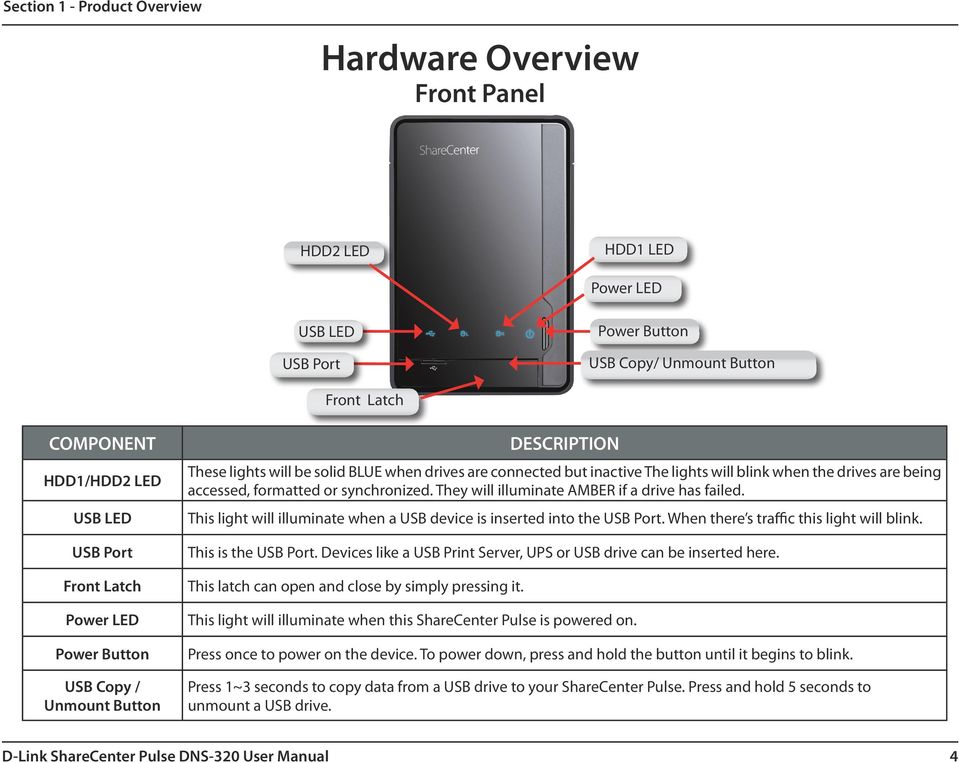
7 Section 1 - Product Overview Hardware Overview Front Panel HDD2 LED HDD1 LED Power LED USB LED USB Port Power Button USB Copy/ Unmount Button Front Latch COMPONENT HDD1/HDD2 LED USB LED USB Port Front Latch Power LED Power Button USB Copy / Unmount Button DESCRIPTION These lights will be solid BLUE when drives are connected but inactive The lights will blink when the drives are being accessed, formatted or synchronized. They will illuminate AMBER if a drive has failed. This light will illuminate when a USB device is inserted into the USB Port. When there s traffic this light will blink. This is the USB Port. Devices like a USB Print Server, UPS or USB drive can be inserted here. This latch can open and close by simply pressing it. This light will illuminate when this ShareCenter Pulse is powered on. Press once to power on the device. To power down, press and hold the button until it begins to blink. Press 1~3 seconds to copy data from a USB drive to your ShareCenter Pulse. Press and hold 5 seconds to unmount a USB drive. 4
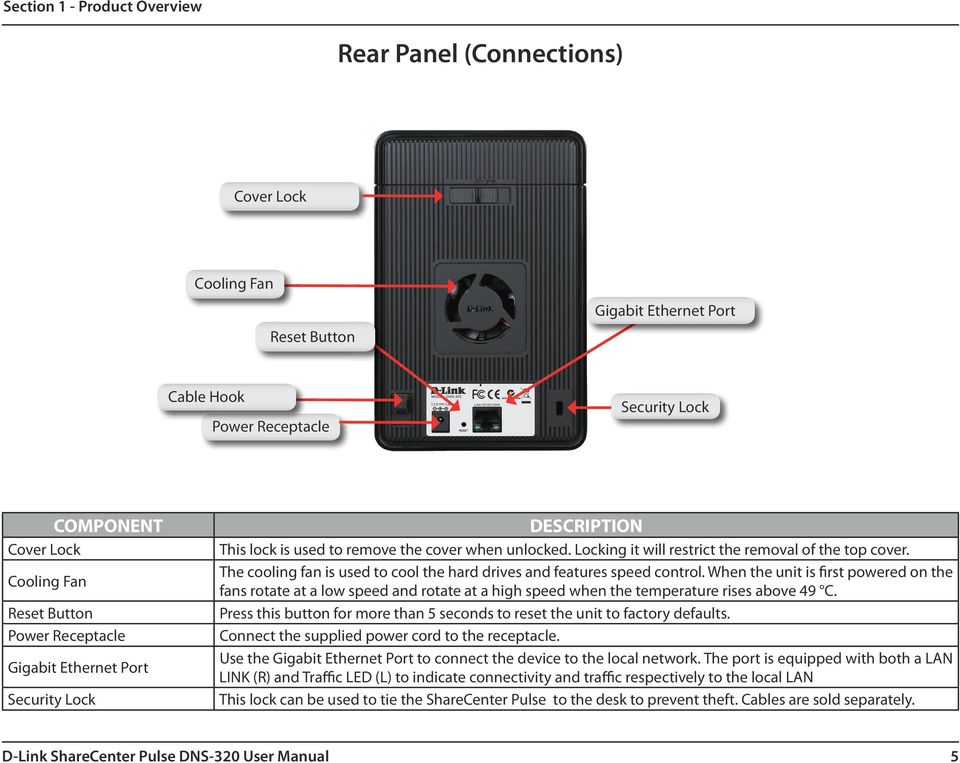
8 Section 1 - Product Overview Rear Panel (Connections) Cover Lock Cooling Fan Reset Button Gigabit Ethernet Port Cable Hook Power Receptacle Security Lock COMPONENT Cover Lock Cooling Fan Reset Button Power Receptacle Gigabit Ethernet Port Security Lock DESCRIPTION This lock is used to remove the cover when unlocked. Locking it will restrict the removal of the top cover. The cooling fan is used to cool the hard drives and features speed control. When the unit is first powered on the fans rotate at a low speed and rotate at a high speed when the temperature rises above 49 C. Press this button for more than 5 seconds to reset the unit to factory defaults. Connect the supplied power cord to the receptacle. Use the Gigabit Ethernet Port to connect the device to the local network. The port is equipped with both a LAN LINK (R) and Traffic LED (L) to indicate connectivity and traffic respectively to the local LAN This lock can be used to tie the ShareCenter Pulse to the desk to prevent theft. Cables are sold separately. 5
9 Section 2 - Getting Started Getting Started ShareCenter Pulse Software CD To get started with the ShareCenter Pulse Setup Wizard, insert the supplied CD into your CD-ROM drive: Click the START button to start the ShareCenter Pulse Setup Wizard. 6

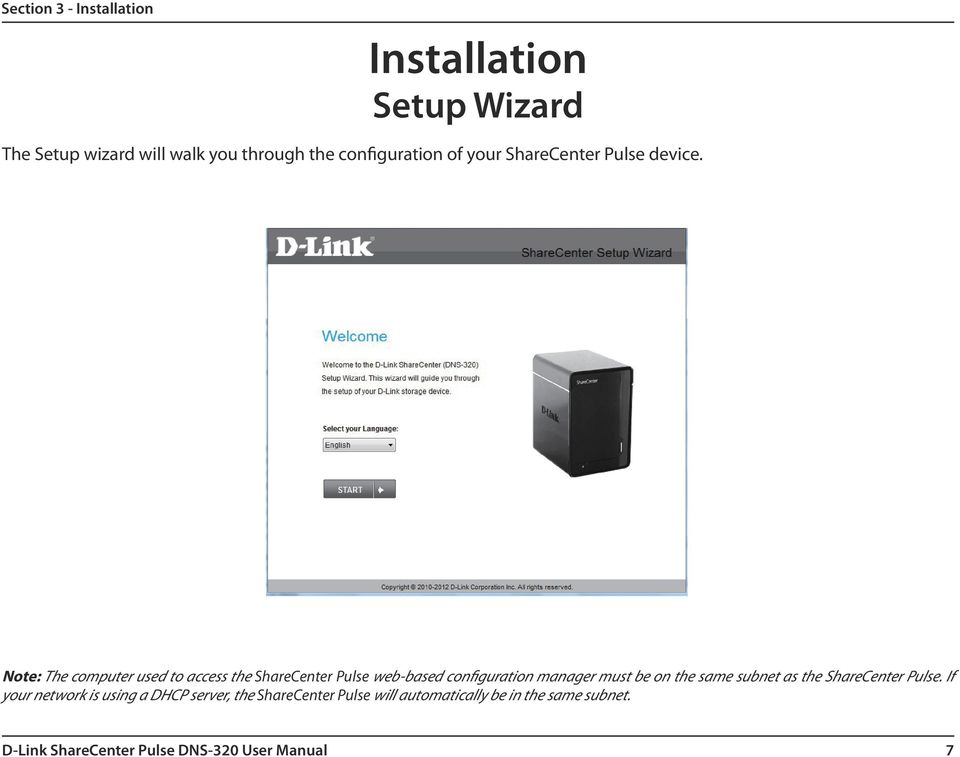
10 Section 3 - Installation Installation Setup Wizard The Setup wizard will walk you through the configuration of your ShareCenter Pulse device. Note: The computer used to access the ShareCenter Pulse web-based configuration manager must be on the same subnet as the ShareCenter Pulse. If your network is using a DHCP server, the ShareCenter Pulse will automatically be in the same subnet. 7
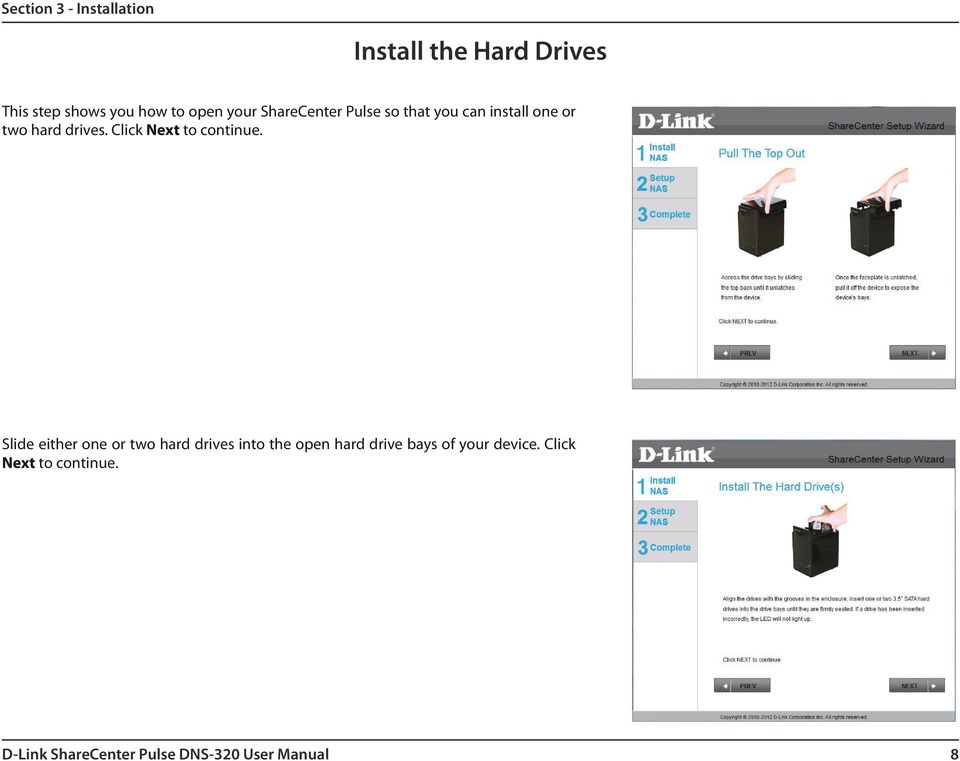
11 Section 3 - Installation Install the Hard Drives This step shows you how to open your ShareCenter Pulse so that you can install one or two hard drives. Click Next to continue. Slide either one or two hard drives into the open hard drive bays of your device. Click Next to continue. 8
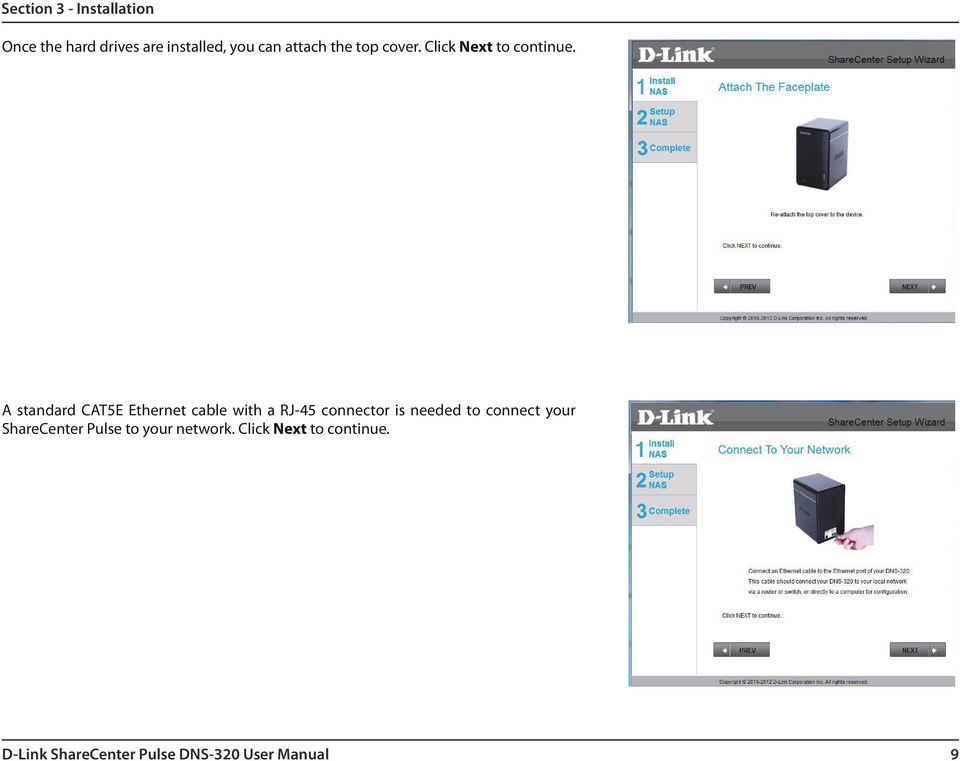
12 Section 3 - Installation Once the hard drives are installed, you can attach the top cover. Click Next to continue. A standard CAT5E Ethernet cable with a RJ-45 connector is needed to connect your ShareCenter Pulse to your network. Click Next to continue. 9
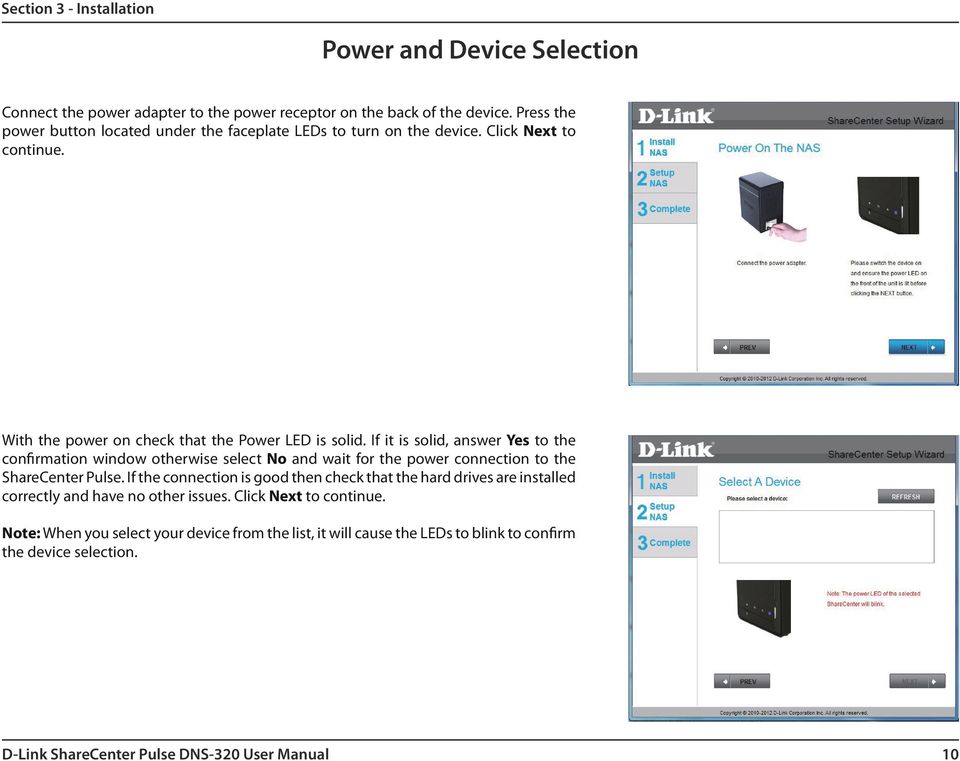
13 Section 3 - Installation Power and Device Selection Connect the power adapter to the power receptor on the back of the device. Press the power button located under the faceplate LEDs to turn on the device. Click Next to continue. With the power on check that the Power LED is solid. If it is solid, answer Yes to the confirmation window otherwise select No and wait for the power connection to the ShareCenter Pulse. If the connection is good then check that the hard drives are installed correctly and have no other issues. Click Next to continue. Note: When you select your device from the list, it will cause the LEDs to blink to confirm the device selection. 10
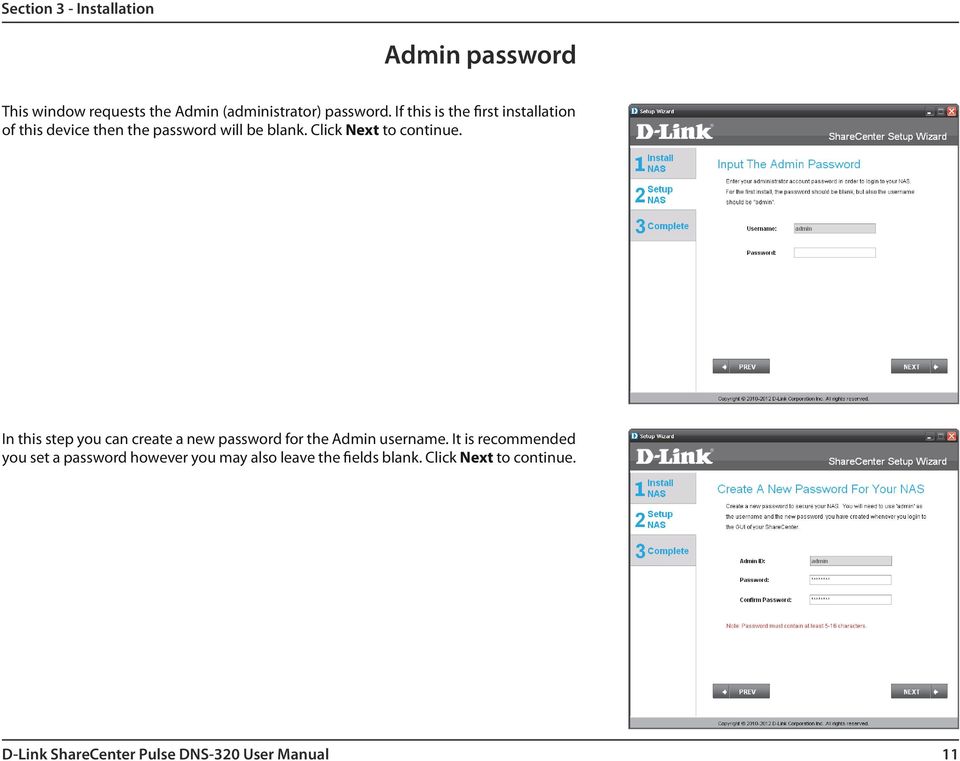
14 Section 3 - Installation Admin password This window requests the Admin (administrator) password. If this is the first installation of this device then the password will be blank. Click Next to continue. In this step you can create a new password for the Admin username. It is recommended you set a password however you may also leave the fields blank. Click Next to continue. 11
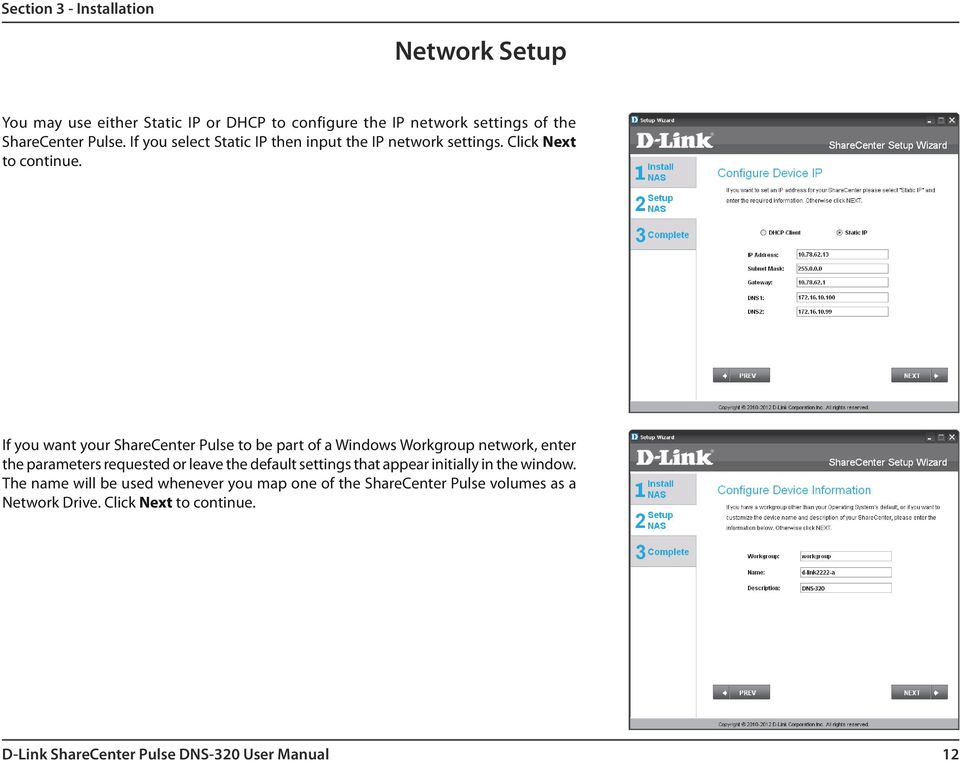
15 Section 3 - Installation Network Setup You may use either Static IP or DHCP to configure the IP network settings of the ShareCenter Pulse. If you select Static IP then input the IP network settings. Click Next to continue. If you want your ShareCenter Pulse to be part of a Windows Workgroup network, enter the parameters requested or leave the default settings that appear initially in the window. The name will be used whenever you map one of the ShareCenter Pulse volumes as a Network Drive. Click Next to continue. 12
16 Section 3 - Installation Dynamic DNS Click on the Yes radio button if you already have a DDNS account to use for the ShareCenter Pulse DDNS settings. If you do not have a DDNS account or do not want to use one, click on the No Radio button. Click Next to continue. If you clicked Yes, enter the DDNS parameters requested in this window so that your ShareCenter Pulse can be accessed by a URL over the Internet. Click Next to continue. 13

17 Section 3 - Installation DDNS Account and System Time If you want a DDNS account to use with your ShareCenter Pulse, D-Link provides a free DDNS account by clicking on the web link shown. You will need to do the following: Create an account with a username and password. Create a hostname that the DDNS service will use to track your device no matter what the Local Network WAN settings are (i.e. public IP address). Configure your device with the hostname and DDNS service provider details. Configure your router to forward port 80. Follow the steps listed here in order to create a DDNS account and configure your LAN equipment and ShareCenter Pulse to work with the new settings. Configure the time, date and time zone settings here. Select the time zone from the drop-down menu. You can set the time and date manually, from a NTP server or from the computer s settings. 14

18 Section 3 - Installation Settings and Volume Information You can configure messages to be sent alerting you to certain operational conditions and drive status conditions to your account. These alerts can prove helpful with the management and safeguarding of important data. Enter your information and settings and then click Next to continue. If you do not want to configure your settings, click Skip to continue. This step is informational and shows any currently configured Volumes previously setup on the ShareCenter Pulse. Click Next to continue. 15

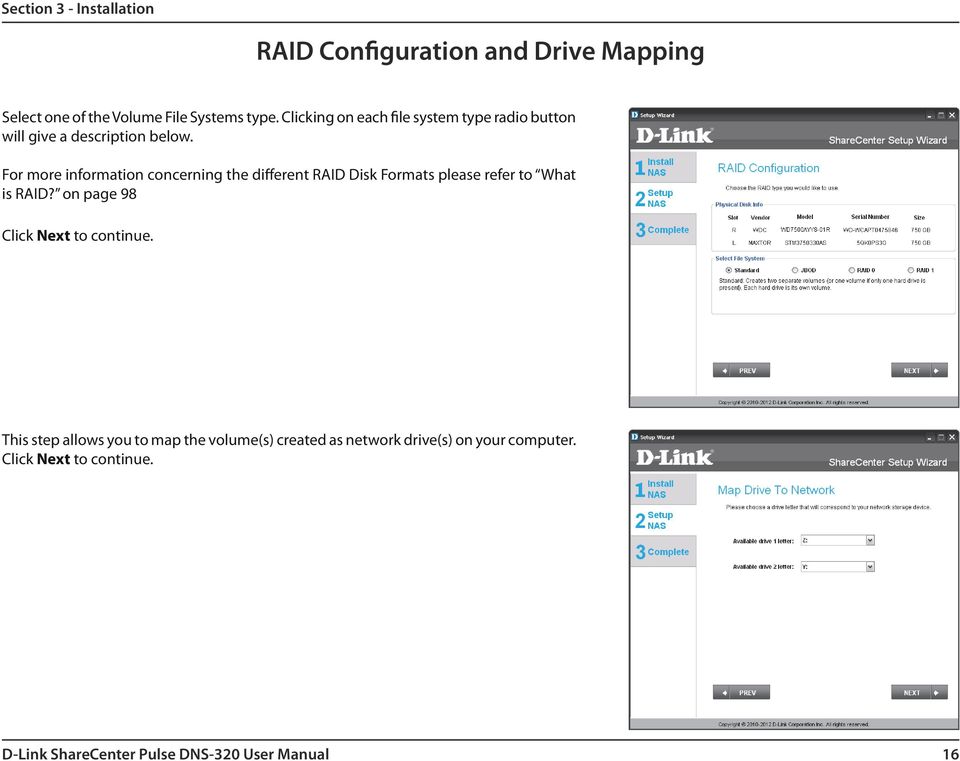
19 Section 3 - Installation RAID Configuration and Drive Mapping Select one of the Volume File Systems type. Clicking on each file system type radio button will give a description below. For more information concerning the different RAID Disk Formats please refer to What is RAID? on page 98 Click Next to continue. This step allows you to map the volume(s) created as network drive(s) on your computer. Click Next to continue. 16
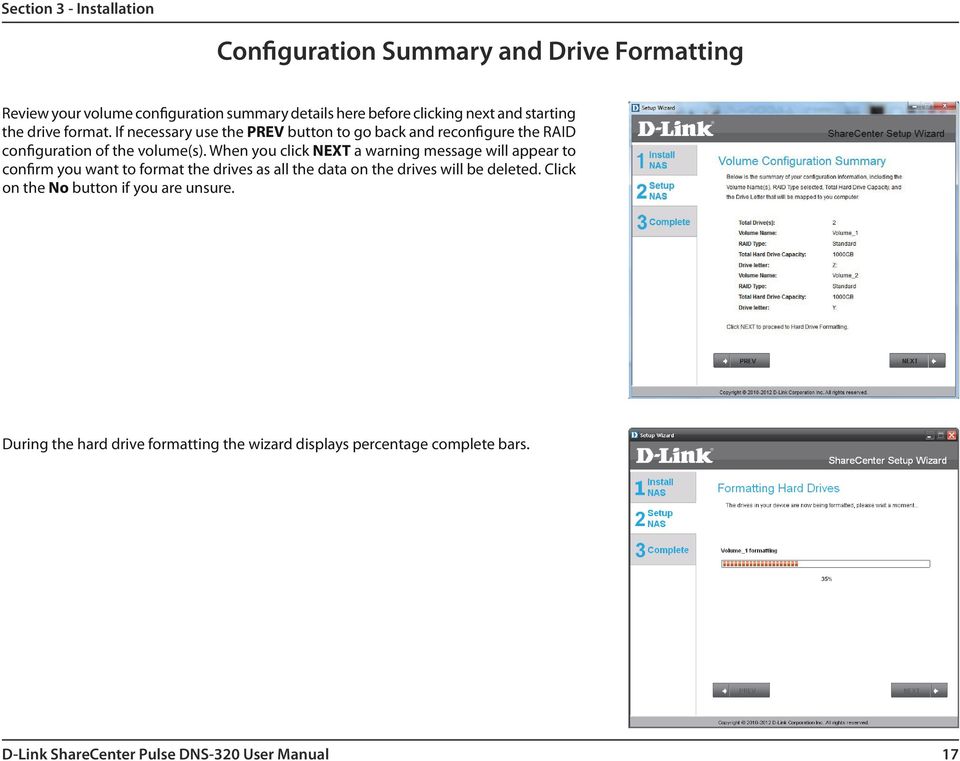
20 Section 3 - Installation Configuration Summary and Drive Formatting Review your volume configuration summary details here before clicking next and starting the drive format. If necessary use the PREV button to go back and reconfigure the RAID configuration of the volume(s). When you click NEXT a warning message will appear to confirm you want to format the drives as all the data on the drives will be deleted. Click on the No button if you are unsure. During the hard drive formatting the wizard displays percentage complete bars. 17
21 Section 3 - Installation Format Complete The wizard will show this window if the hard drive format(s) are successful. Click Next to continue. 18
22 Section 3 - Installation The final window of the installation wizard shows successful completion. Your device is now installed and ready for use. Your drives are network mapped from using the wizard so you will be able to access them under you My Computer icon. 19
23 Section 2 - Getting Started When first powered on, during the initial boot sequence, the device will wait to be assigned an IP address via DHCP. If it does not receive a DHCP assigned IP address the Auto-IP process will assign a xxx.xxx address to the device If you want to change the IP address before logging in or are unable to connect to the ShareCenter Pulse IP address, you can use the Storage Utility provided on the product CD to locate the device on your network and make any needed changes. Network Storage Device: D-Link Storage Utility The D-Link Storage Utility displays any ShareCenter Pulse devices it detects on the network. Refresh: Click to refresh the device list. Configuration: Click Configuration to access the Web-based configuration of the ShareCenter Pulse. LAN: Apply: Drive Mapping: Configure the LAN Settings for the ShareCenter Pulse here. Click Apply to save and activate the changes to the LAN Settings. Volumes available for mapping are displayed here. Available Drive Letters: Select an available drive letter. Click Connect to map the selected volume. Click Disconnect to disconnect the selected mapped volume. About: Click About to view the software version of the Easy Search Utility. Exit: Click Exit to close the utility. 20
24 Section 2 - Getting Started Select the device from the list and click the Configuration button. This will launch the computer s default web browser and direct it to the IP address listed for the device. Make sure the browser is not configured to use a proxy server. Note: The computer used to access the ShareCenter Pulse web-based configuration manager must be on the same subnet as the ShareCenter Pulse. If your network is using a DHCP server and the computer receives IP settings from the DHCP server, the ShareCenter Pulse will automatically be in the same subnet. 21
25 Configuration Web UI Login The Login screen will appear: Select System Administrator and enter the password you created during the Setup Wizard. Click Login Note: The computer, used to access the web-based configuration, manager must be on the same subnet as the ShareCenter Pulse. If your network is using a DHCP server and the computer receives IP settings from DHCP, the ShareCenter Pulse will automatically be in the same subnet. 22
26 If a hard disk volume has not been created, then the ShareCenter Pulse Web UI defaults to the Management tab. Once a volume is created, then the web UI defaults to the My Favorites tab. The configuration icons are located in the tabs at the top of the page. The icons available for configuration under each of the tabs include: My Favorites - a user-configurable area where: Users can add customized access to preferable functions into My Favorites in order to give quick access to these functions. Applications - Configuration for: FTP/HTTP and P2P Downloads. Remote and Local Backups. The Web File Server. Other applications which may be added to the page. Management - Contains the: Web UI General Layout Setup Wizard - Step-through settings for accounts, time and date, and connectivity. Disk Management - Configures the Volume Setup and perform Disk Diagnostics. Account Management - Configures the Admin Password, Users, Groups, Quotas and Network Share Folders. Network Management - Configures the LAN settings and Dynamic DNS. Application Management - Configures File Sharing protocols and Add-On management. System Management - Configures the Time and Date, Device, System Settings, Power Management, Alerts, Logs, and Firmware settings. These icons and their configuration sub-menus will be discussed in detail in the following pages of this manual. Note: After logging in to the ShareCenter Pulse for the first time it is recommended to add a password to the admin account. 23
27 Management This tab contains the Setup Wizard, Disk Management, Account Management, Network Management, Application Management, System Management and Status Icons. Click each of the icons to see the submenus. 24
28 Setup Wizard (Web UI) The ShareCenter Pulse has a System Wizard that allows you to quickly configure some of the basic device settings. Click the System Wizard icon to start the Setup Wizard. Click the Run Wizard button to start the setup wizard. Click Next to continue. 25
29 It is recommended you set an admin password here. Enter the new password and re-enter it for confirmation. Click Next to continue. Set the appropriate Time Zone for your location. Click Next to continue. 26
30 Edit or change the LAN settings. Selecting DHCP Client will cause the device to obtain an IP address from the local DHCP server such as a router. Selecting Static IP requires you to assign the IP information manually. Click Next to continue. Enter your workgroup, name and description, or leave the default values and click Next to continue. 27
31 Select Account and enter your parameters in the boxes to send event alerts from the device. Click Next to continue. Click Finish to save your settings and complete the wizard. You may click the Previous button to go back and edit your settings or click Exit to end the wizard without saving the settings. 28
32 Disk Management Hard Drive Configuration To setup the Hard Drive RAID configuration of your ShareCenter Pulse, click on the Management tab and then the Disk Management icon. Select the Hard Drive Configuration menu item on the left of the window. This menu will allow you set the RAID type and format your hard drives. Hard Drive: Configuration Current Raid Type: Set RAID type and Re-Format: Auto-Rebuild Configuration: Your ShareCenter Pulse hard drive can be configured and formatted in various configurations here. If the drives are already formatted the configuration will be displayed here. Click on this button to launch a wizard to allow you to select the RAID configuration and format the drives. Refer to the section titled What is RAID? on page 98. for more information about RAID. If you selected RAID 1 as the configuration option then set the Auto-Rebuild function here using the radio buttons. Enable Auto-Rebuild: Enabling Auto-Rebuild will rebuild a failed RAID 1 drive when a new drive has replaced the degraded one. Disable Auto-Rebuild: If you do not want to automatically rebuild drives after a failure when using the RAID 1 functionality then you can check this option. Manual Rebuild Now: Note: You can still rebuild a drive using the RAID 1 functionality however you must initiate the rebuild manually. If you have disabled Auto-Rebuild then you can use the Manual Rebuild option by clicking this button. 29
33 Hard Drive Configuration Wizard When you click the Set RAID type and Re-Format button in the Disk Management-Hard Drive Configuration menu, a wizard will launch allowing you to format your drives and create the RAID format. The following is an example of a RAID1 configuration: Initially the steps of the configuration process are shown. You must decide on the RAID type you would like to format your HDDs with. Click the Next button to continue or click Exit to cancel. This screen displays the currently installed HDD information. Any data on the installed hard drives will be lost by the formatting. Click Next to continue. 30
34 Select the format desired by clicking on the RAID type box to highlight it in blue. In this example the maximum data protection option of RAID 1 is selected. Click Next to continue. If you have selected RAID 1 then the wizard will display this step to enable or disable Auto-Rebuild. Auto-Rebuild will automatically rebuild a failed disk drive if it has been replaced with a new one. Set to disabled if you prefer to start this process manually. Click Next to continue. 31
35 If you select a RAID 0 or 1 option then you need to determine the size of the RAID volume. Any extra space will be formatted as a JBOD volume. Click Next to continue. Note: If you select Leaving the remaining disk space for future, you can format the JBOD partition at a later time. A Volume Configuration Summary is displayed. Check the table and click Next to format the drives. Otherwise click the Previous button to make changes to your configuration or click Exit to end the wizard. 32
36 During the formatting process a progress bar is displayed. When the formatting is completed the wizard displays the finished Volume Configuration table. Click Finish to end the wizard. 33
37 S.M.A.R.T Test S.M.A.R.T stands for Self-Monitoring, Analysis, and Reporting Technology. This is a system on a hard drive used to monitor and report on the health of the drive. If the HD is grayed out, then it does not support S.M.A.R.T. S.M.A.R.T Test: To run the S.M.A.R.T test, select the hard drive you wish to perform the S.M.A.R.T test on. Then select whether to run a Quick or Extended S.M.A.R.T test. Then click Start to run the test. Click the Create Schedule button to run the test at a pre-determined time and date. Quick Test: Runs a quick S.M.A.R.T test. The test usually takes less than 10 minutes. This test will check the electrical, mechanical, and read performance of the hard drive. The results are displayed as Passed/Failed on the web UI and can also be sent as an alert. Extended Test: Runs an extended S.M.A.R.T test. This test requires a lot more time to complete. However, it is a more thorough and complete test when compared to the Quick Test. Send result by Enable this function in order to have the results of the S.M.A.R.T test sent to you by . Create Schedule: Click on this button in order to create a scheduled S.M.A.R.T test. You will be able to schedule a test on a daily, weekly, and monthly basis. 34
38 Schedule: By clicking the Create Schedule button the user can create a S.M.A.R.T. test schedule where this test will run automatically at the configured time. Select the frequency (Daily, Weekly, Monthly) and the Time here. Click on the Create button to add a schedule. Schedule List: In the window all the created schedule lists will be displayed. Note: When performing a S.M.A.R.T. test, your hard drives will not be available over the network until it has completed testing. 35
39 Scan Disk Scan disk provides a method to test the disk s file system in your ShareCenter Pulse. Scan Disk: Scan Disk will scan your disks file system for errors and/or corruption. After completion, the test results will show Success or Failure. Click on the Scan Disk button to start the test. If the test fails you can try reformatting the drive and test again. Otherwise you will need 3rd party disk troubleshooting tools. Scan Disk Progress Window: Volume: Use the drop-down menu to select the disk volume that you want to run the Scan Disk test on. If you have started a Scan Disk test then a window with a progress bar will appear to monitor the test. Click the Exit button to abort the test if required or once the test has run 100 percent. 36
40 Account Management Users / Groups The Users / Groups menu is used to create and manage user and group accounts. Up to 256 users and 32 groups can be created. By default, all users have read and write access to all folders but access rules can be created in the Network Shares menu. User Settings: Your hard drives can be configured and formatted in various RAID configurations here. New: Click this button to launch a wizard that will walk you through adding a new user configuration. Modify: Click on an existing user in the table so that it is highlighted in red and then click the Modify button to change the configuration of an existing user. Delete: Click on an existing user in the table so that it is highlighted in red and then click the Delete button to remove a user from the configuration. 37
41 Adding New Users Wizard The following section will describe how to add a new user on this device. To add a user click on the New button. A easy to configure wizard will be launched and look like the following: This window welcomes the user to the setup wizard for adding or modifying a user. This wizard will guide the user through the steps of setup. In this wizard the user will be able to: 1) Create a new user account. 2) Join a group. 3) Configure the appropriate network shares settings. 4) Configure the user quota. 5) View a summary of the configuration before completing the addition. Click on the Next button to continue. Click on the Exit button to discard the changes made and return to the User/Group window. Step 1: Here you can enter the User Name and Password for the new user account. The password needs to be confirmed by re-entering the password in the Confirm Password field. Click on the Previous button to return to the previous window. Click on the Next button to accept the change and continue to the next window. Click on the Exit button to discard the changes made and return to the User/Group window. 38
42 Step 2: Here you can add this user account to a group. Select the appropriate Group Name by clicking the check box. Click on the Previous button to return to the previous window. Click on the Next button to accept the change and continue to the next window. Click on the Exit button to discard the changes made and return to the User/Group window. Step 3: Here the user can configure the appropriate Network Access settings for the user by simply selecting one of the following options: Read Only, Read/Write or Deny Access. Click on the Previous button to return to the previous window. Click on the Next button to accept the change and continue to the next window. Click on the Exit button to discard the changes made and return to the User/Group window. 39
43 Step 3-1: Here the user can configure the application privileges assigned to this user. Select either FTP or WebDAV. CIFs and AFP is set as default. CIFS is short for Common Internet File System. AFP is short for Apple Filing Protocol. FTP is short for File Transfer Protocol. WebDAV is short for Web-based Distribution, Authoring, and Versioning. Click on the Previous button to return to the previous window. Click on the Next button to accept the change and continue to the next window. Click on the Exit button to discard the changes made and return to the User/Group window. Step 3-1-1: Here the user can configure the WebDAV settings for the user account. Select the volumes the user can have WebDAV access to and then select whether to give Read Only or Read/Write access. Click on the Previous button to return to the previous window. Click on the Next button to accept the change and continue to the next window. Click on the Exit button to discard the changes made and return to the User/Group window. 40
44 Step 4: Here you can configure the Quotas settings for the user account. Enter the quota amount in the block(s) indicated in Megabytes. By entering 0Mb the quota will be set to unlimited. Click on the Previous button to return to the previous window. Click on the Next button to accept the change and continue to the next window. Click on the Exit button to discard the changes made and return to the User/Group window. Step 5: Here you can confirm to create the new account. Click on the Previous button to return to the previous window. Click on the Finish button to accept the change and complete the wizard. Click on the Exit button to discard the changes made and return to the User/Group window. After the new account has been created, a window will appear that states the account was created successfully. Click on the OK button to continue. Step 6: A final message appears indicating the user is successfully added to the ShareCenter Pulse configuration.. 41
45 Adding New Groups Wizard The following section will describe how to add a new group on this device. To add a group click on the New button. A wizard will be launched: This window welcomes the user to the setup wizard for adding or modifying a group. This wizard will guide the user through the steps of setup. In this wizard the user will be able to: 1) Create a new group. 2) Add a user to a group. 3) Configure the appropriate network shares settings. 4) Configure the quota settings. 5) View a summary of the configuration before completing the addition. Click on the Next button to continue. Click on the Exit button to discard the changes made and return to the User/Group window. Step 1: Enter the name for your new group. Click on the Previous button to return to the previous window. Click on the Next button to accept the change and continue to the next window. Click on the Exit button to discard the changes made and return to the User/Group window. 42
46 Step 2: Select the users you would like to add to your new group by checking the box. Click on the Previous button to return to the previous window. Click on the Next button to accept the change and continue to the next window. Click on the Exit button to discard the changes made and return to the User/Group window. Step 3: Assign the appropriate Network Access settings for this group by simply clicking one of the following options: Read Only, Read Write or Deny Access. Click on the Previous button to return to the previous window. Click on the Next button to accept the change and continue to the next window. Click on the Exit button to discard the changes made and return to the User/Group window. 43
47 Step 3-1: Select the application privileges assigned to this group. Options to select are FTP or WebDAV. CIFS and AFP is set as default. CIFS is short for Common Internet File System. AFP is short for Apple Filing Protocol. FTP is short for File Transfer Protocol. WebDAV is short for Web-based Distribution, Authoring, and Versioning. Click on the Previous button to return to the previous window. Click on the Next button to accept the change and continue to the next window. Click on the Exit button to discard the changes made and return to the User/Group window. Step 4: Configure the Quotas settings for this group. Enter the quota amount in the block indicated in Megabytes. By entering 0Mb the quota will be set to unlimited. Click on the Previous button to return to the previous window. Click on the Next button to accept the change and continue to the next window. Click on the Exit button to discard the changes made and return to the User/Group window. 44
48 Step 5: Verify the settings and click Finish. Click on the Previous button to return to the previous window. Click on the Finish button to accept the change and completed the wizard. Click on the Exit button to discard the changes made and return to the User/Group window. After the new group has been created, a window will appear that states the group was created successfully. Click on the OK button to continue. Success: A final message appears indicating the group was created successfully and added to the ShareCenter Pulse configuration. 45
49 Quotas The ShareCenter Pulse supports storage quotas for both groups and individual users. Assigning a quota to a group or user will limit the amount of storage they are allocated. By default, users and groups do not have a quota. Click the Enabled button to enforce the quotas that are set in the Users / Groups management or the tables below. In the User Quota Settings table you can view the current user usage and limit setting. Click on the blue font to set usage limits. In the Group Quota Settings table you can view the current group usage and limit setting. Click on the blue font to set the limit. 46
50 Network Shares The Network Shares page allows the user to configure shared folders and rights to specific users and groups. To be able to create new network access rules, the default rule must first be removed by simply selecting it and clicking on the Delete button. You can also mount.iso files in the ISO Mount Shares Setting. If a user has access to a mounted.iso file then that user will be able to read all the files within it. Network Shares: / ISO Mount Shares: The Network Shares Settings window allows you to add, modify and remove both new and existing Network Share and ISO Mount Share Settings. To add a rule click on the New button. To modify an existing rule click on the Modify button. To remove a rule click on the Delete button. To select a rule, simply click on the rule and the entry should change to red. At the bottom of the table the user can navigate through pages and also refresh the window by click on the Refresh button. If at any point the user wants to reset the network access list to the default configuration, click on the Reset Network Shares button. 47
51 Adding New Network Shares Wizard The following section will describe how to add a new Network Share on the ShareCenter Pulse. To add a Network Share click on the Add button. A easy to configure wizard will be launched and look like the following: Start: This window welcomes the user to the setup wizard for adding or modifying a network share. In this wizard the user will be able to: 1) Select share folders. 2) Configure shared folder access rights. 3) Configure network access settings. 4) View a summary of the configuration before completing. Click on the Next button to continue. Click on the Exit button to discard the changes made and return to the Network Shares Page. Step 1: Select the folder you want to include in this network share by checking the box. Click on the Previous button to return to the previous window. Click on the Next button to accept the change and continue to the next window. Click on the Exit button to discard the changes made and return to the Network Shares Page. 48
52 Step 2: Select which user accounts or group are allowed to access this folder(s). Select All Account to allow all accounts access to this folder. Select Specific User/Group to only allow certain users or groups access to this folder. Click on the Previous button to return to the previous window. Click on the Next button to accept the change and continue to the next window. Click on the Exit button to discard the changes made and return to the Network Shares Page. Step 2-1: Select the appropriate access rights for the share. Options to choose from are Read Only, Read Write and Deny Access. This procedure can also be used to block certain users from accessing certain folders. Click on the Previous button to return to the previous window. Click on the Next button to accept the change and continue to the next window. Click on the Exit button to discard the changes made and return to the Network Shares Page. 49
53 Step 2-2: If you select Specific User/Group in Step 2, then this step allows you to set the access rights for each User configured on the device. Click on the Previous button to return to the previous window. Click on the Next button to accept the change and continue to the next window. Click on the Exit button to discard the changes made and return to the Network Shares Page. Step 2-2-1: If you select Specific User/Group in Step 2 then this step allows you to set the access rights for each Group configured on the device. Click on the Previous button to return to the previous window. Click on the Next button to accept the change and continue to the next window. Click on the Exit button to discard the changes made and return to the Network Shares Page. 50
54 Step 3: Step 3-1: This step allows you to assign privileges to this share. Opportunistic locks (oplocks) are a characteristic of the LAN Manager networking protocol implemented in the 32bit Windows family. Oplocks are guarantees made by a server for a shared logical volume to its clients. These guarantees inform the Client that a file s content will not be allowed to be changed by the server, or if some change is imminent, the client will be notified before the change is allowed to proceed. Oplocks are designed to increase network performance when it comes to network file sharing. However it is recommended to set the share oplocks to No (off) when using file-based database applications. When enabled, the file attribute Map Archive will be copied as the file is being stored on the device. Click on the Previous button to return to the previous window. Click on the Next button to accept the change and continue to the next window. Click on the Exit button to discard the changes made and return to the Network Shares Page. Assign protocol privileges that a user can use to access this share. Options to choose from are FTP, NFS and WebDAV. CIFS and AFP are set as default. CIFS is short for Common Internet File System. AFP is short for Apple Filing Protocol. FTP is short for File Transfer Protocol. NFS is short for Network File System. WebDAV is short for Web-based Distributed Authoring and Versioning. Click on the Previous button to return to the previous window. Click on the Next button to accept the change and continue to the next window. Click on the Exit button to discard the changes made and return to the Network Shares Page. 51
55 Step 3-1-1: Select the FTP settings for this share. FTP access can be: 1) FTP Anonymous None (No Access). 2) FTP Anonymous Read Only (Limited Access). 3) FTP Anonymous Read/Write (Full Access). Click on the Previous button to return to the previous window. Click on the Next button to accept the change and continue to the next window. Click on the Exit button to discard the changes made and return to the Network Shares Page. Step 3-1-2: If you selected NFS as an access method to your network share then set the parameters below: Host - Allowable host address that can access using NFS (* indicates all hosts). Root Squash - Disables writing to the Root owned directories and files on the system when the user has root access privileges. Write - provide write permission to the file system. Click on the Previous button to return to the previous window. Click on the Next button to accept the change and continue to the next window. Click on the Exit button to discard the changes made and return to the Network Shares Page. 52
56 Step 3-1-3: If you selected WebDAV as an access method in Step 3 then this step allows you to set the access parameters. Click on the Previous button to return to the previous window. Click on the Next button to accept the change and continue to the next window. Click on the Exit button to discard the changes made and return to the Network Shares Page. Step 4: Click Finish to save your settings. Click on the Previous button to return to the previous window. Click on the Finish button to accept the change and complete the wizard. Click on the Exit button to discard the changes made and return to the Network Shares Page. 53
57 Setup: Adding New ISO Mount Shares Wizard The following section will describe how to add a new ISO mount on the ShareCenter Pulse. To add a ISO Mount click on the New button. A easy to configure wizard will be launched and look like the following: If you select Specific User / Group in Step 2, then set the access rights for each User configured on the device. Click on the Next button to accept the change and continue to the next window. Click on the Exit button to discard the changes made and return to the Network Shares Page. Step 2-2-1: If you select Specific User / Group in Step 2, then set the access rights for each Group configured on the device. Click on the Previous button to return to the previous window. Click on the Next button to accept the change and continue to the next window. Click on the Exit button to discard the changes made and return to the Network Shares Page. 54
58 Step 2: Assign access privileges to this ISO Mount share. Select All Accounts to assign the ISO Mount share read/deny privileges to all users. Select Specific User/Group in order to assign read/deny privileges to individual users and groups. Click on the Previous button to return to the previous window. Click on the Next button to accept the change and continue to the next window. Click on the Exit button to discard the changes made and return to the Network Shares Page. Step 2-1: You can assign Read Only or Deny Access privileges to the ISO Mount share here. Click on the appropriate radio button for the privileges you would like to assign. Click on the Previous button to return to the previous window. Click on the Next button to accept the change and continue to the next window. Click on the Exit button to discard the changes made and return to the Network Shares Page. 55
59 Step 3: You may add a comment that describes the ISO Mount Share. Click on the Previous button to return to the previous window. Click on the Next button to accept the change and continue to the next window. Click on the Exit button to discard the changes made and return to the Network Shares Page. Step 3-1: Assign protocol privileges that a user can use to access this share. Options to choose from are FTP, NFS and WebDAV. CIFS and AFP are set as default. CIFS is short for Common Internet File System. AFP is short for Apple Filing Protocol. FTP is short for File Transfer Protocol. NFS is short for Network File System. WebDAV is short for Web-based Distributed Authoring and Versioning. Click on the Previous button to return to the previous window. Click on the Next button to accept the change and continue to the next window. Click on the Exit button to discard the changes made and return to the Network Shares Page. 56
60 Step 4: Click Finish to save your settings. Click on the Previous button to return to the previous window. Click on the Finish button to accept the change and complete the wizard. Click on the Exit button to discard the changes made and return to the Network Shares Page. Step 5: Using the D-Link Storage Utility the ISO Mount Share can now be mapped to your computer so that you can access it. 57
61 Username: The administrator user name is admin, and this cannot be changed. Password: Enter the current password. (Leave this blank if you have not set a password yet.) New Password: Enter a new password. Confirm Password: Enter the new password again for confirmation. Admin Password 58
62 Network Management LAN Setup The LAN Settings allows you to enable LLTD and to configure the Link Speed and the IP address as a DHCP client or Static IP. DHCP Client: Selecting DHCP Client will cause the DNS-320 to obtain an IP address from the local DHCP server. Static IP: Selecting Static IP requires you to assign the IP information for the DNS-320 manually. IP Address: Enter an IP address for your device. The IP address of each device on the local area network must be within the same IP address range and subnet mask. Subnet Mask: Enter the Subnet Mask. The default subnet mask is Gateway IP Address: IP Settings Enter the Gateway IP Address for the device. The Gateway IP Address is almost always the LAN address of your router. Most D-Link routers have a default LAN IP address of DNS1/ DNS2: Specify the first and second DNS Addresses for the device. The first DNS address is usually the LAN address of your router. A DNS Address will allow the device to resolve names into IP addresses. Click Save Settings when finished 59
63 Link Speed and LLTD Settings Speed: Displays the current Ethernet bit rate in Megabits per second. Link Speed: Select either Auto (Auto-Negotiate), 100 Mbps, or 1000 Mbps by clicking the appropriate radio button. Then click the Save Settings button to save the new settings. LLTD: The device supports LLTD (Link Layer Topology Discovery) and is used by the Network Map application that is included in Windows Vista and Windows 7. Select to enable or disable LLTD. 60
64 Dynamic DNS The DDNS feature allows the user to host a server (Web, FTP, Game Server, etc ) using a domain name that you have purchased. ( with your dynamically assigned IP address. Most broadband Internet Service Providers assign dynamic (changing) IP addresses. Using a DDNS service provider, your friends can enter your domain name to connect to your server regardless of your IP address. DDNS Settings DDNS: Server Address: Host Name: Username or Key: Password or Key: Verify Password or Key: Status: Select Enable or Disable. Select a DDNS Server from the combo box on the right hand-side, or type in the server address manually. Enter your DDNS host name. Enter your DDNS username or key. Enter your DDNS password or key. Re-enter your password or key. Displays your DDNS status. When the user clicks on the Sign up for D-Link s Free DDNS service at link, the user will be re-directed to the D-Link DDNS page. Here the user can create or modify a D-Link DDNS account to use in this configuration. 61
65 Application Management FTP Server The device is equipped with a built in FTP Server. The server is easy to configure and allows users access to important data whether they are on the local network or at a remote location. The FTP server can be configured to allow user access to specific directories, and will allow up to 10 users to access the device simultaneously. Max. User: Idle Time: Port: Passive Mode: Client Language: Flow Control: SSL/TLS: FXP: Set the maximum amount of users that can connect to the FTP server. Set the amount of time a user can remain idle before being disconnected. Set the FTP port. Default is 21. If you are behind a router, you will need to forward the FTP port from the router to the device. Additional filtering and firewall settings may need to be modified on your router to allow FTP Access to the device from the Internet. Once the port has been forwarded on the router, users from the Internet will access the FTP server through the WAN IP address of the router. In situations where the device is behind a firewall and unable to accept incoming TCP connections, passive mode must be used. Most standard FTP clients like Windows FTP, only support Western European code page when transferring files. Support has been added for non standard FTP clients that are capable of supporting these character sets. Allow you to limit the amount of bandwidth available for each user. Here the user can enable the SSL/TLS connection only. Enable or Disable File exhange Protocol to transfer files from one FTP server to another. Note: In order to use FXP (File Exchange Protocol) for server-to-server data transfer, make sure to change the port from 21 to some other port as listed in the Port section of the Web UI. Also, make sure to open the corresponding port on your router and forward that port from your router to the device. 62
66 UPnP AV Server The device features a UPnP AV Server. This server provides the ability to stream photos, music and videos to UPnP AV compatible network media players. If the server is enabled, the device will be automatically detected by UPnP AV compatible media players on your local network. Click the Refresh All button to update all the shared files and folder lists. UPnP AV Server: Select Enable or Disable. After enabling the UPnP AV Server option, the following window will appear. In the window you will be able to add, delete and view existing UPnP AV Server shared folders. Add, Delete: To add a new folder to the shared list, click on the Add button. To delete an existing folder, click on the Delete button. To refresh the list, click on the Refresh button. Refresh All: Click the Refresh All button after adding new files to be used by UPnP AV compatible devices. 63
67 itunes Server The DNS-320 features an itunes Server. This server provides the ability to share music and videos to computers on the local network running itunes. If the server is enabled, the device will be automatically detected by the itunes program and the music and videos contained in the specified directory will be available to stream over the network. Click the Refresh All button to update all the shared files and folder lists. itunes Server: Folder: Password: MP3 Tag Codepage: Auto Refresh: Select to enable or disable the itunes Server. Specifies the folder or directory that will be shared by the itunes server. Select root to share all files on all volumes, or click Browse to select a specific folders. Sets password for the itunes server. (Optional) Here the user can select the MP3 Tag Codepage used by this device. Currently the Codepage is set to Western European. Here the user can select the Automatically Refresh time. After enabling the itunes server on the device, launch itunes. In your itunes utility, select the device and enter the itunes server password if required. Select the device When prompted, enter in the itunes server password. Click OK. Media stored on the device will then be available for use in itunes. 64
68 AFP Service The ShareCenter Pulse supports Apple Filing Service for connectivity with MAC OS based computers. If you need to use AFP service enable it here otherwise leave it disabled to reduce CPU resource overhead. AFP Service: Select enable to allow MAC OS based systems connect to your device using AFP protocol. Select disable to prevent unnecessary CPU resource depletion when AFP is not being used. Save Settings: Click to save your AFP settings. Note: Enabling AFP service will disable oplocks. 65
69 NFS Service The device supports Network File System (NFS) service. To enable this multi-platform file system on your device enable it here. Otherwise disable the option to prevent unnecessary CPU overhead. NFS Service: Select Enable to allow systems that support NFS to connect to your device using NFS protocol. Select Disable to prevent unnecessary CPU resource depletion when NFS is not being used. Save Settings: Click to save your NFS settings. Note: Applying NFS service to any Share will disable oplocks. 66
70 System Management Language This menu item allows you to install language packages onto your system. In addition, you can also install language packages to suit your local language needs. Languages: Click on Browse to search for the specific language pack you want to install. After selecting the language pack, then click Apply to install the language pack. Language Pack List: In the languages window you will see a table where the loaded language packs will be displayed and can be enabled at will by simply clicking the (>) play button. More than one language pack can be installed, but only one language pack can be used at a time. 67
71 Time and Date The Time and Date page contains several different options for setting the device s internal clock. It is important to set an accurate time so that backups and downloads can be accurately scheduled. System Time Settings: Displays the current date, time and time zone settings of the device. Manually: Enter the complete time and date settings manually. Click Save Settings to apply these settings. To synchronize the device clock with your computer, click the Set time from my computer button. Time Zone: Select your time zone from the drop-down menu. Click Save Settings after selecting your time zone NTP Server: Network Time Protocol (NTP) synchronizes the device with an Internet time server. D-Link provides two time servers for your convenience. Select the one closest to your location. Click Save Settings to accept these changes. 68
72 Device The device settings page allows you to assign a workgroup, name and description to the device. You can access this device by typing the host name in the URL section of your web browser. For example: Workgroup: Enter your Workgroup name here. The workgroup name should be the same as the computers on the network. Devices using the same workgroup will have additional file sharing methods available. Name: Enter your device name here. This name is what the device will appear as on the network. By default, the device name is dlink-xxxxxx, where xxxxxx is the last six digits of the MAC address. Description: Assign a device description to the device. Click Save Settings to accept these changes. 69
73 Restart: Clicking to reboot the device. Default: Click to restore the device back to the factory default settings. All previous settings that have been configured will be erased. Shutdown: Click to turn off the device. System Settings 70
74 Configuration Settings: Idle Time: System Temperature Threshold: Click on the Save button to save the current configuration settings to a file on your computer. If at a later time you need to reload this configuration after a system reset, browse to the file and click Load. Enter the time (in minutes) that the administrator and users will be allowed to remain idle while accessing the web UI. Here the user can configure the system temperature threshold value. This value can be set in Fahrenheit or Celsius. The device will automatically shutdown when it reaches the temperature set here. 71
75 Power Management The device Power Management feature allows you to configure the drives to shut down while power remains constant to the device. The drives will power up again when data is accessed. HDD Hibernation: Click Enable or Disable. Turn Off Hard Drive: Set the amount of idle time before the drives go into hibernation. Power Recover: Click Enable or Disable. The Power Recovery feature will automatically restart your device from a previously unexpected shutdown due to a power failure. 72
76 You can also control the speed of the fan using three different settings and you can power off the device at scheduled times for each day of the week. Fan Control: The speed of the fan can be controlled from this section. If you select Auto mode, the speed of the fan will change (Off/Low/High) depending on the internal temperature of the enclosure. Power Off Scheduling: Click Enable to turn on this function. Enable or disable the power off days using the check box and configure the time for each day that the power off will occur. 73
77 Notifications Settings With Alerts, you can configure s to be sent to you that alert you to certain operational conditions and drive status conditions. These alerts can prove helpful with the management and safeguarding of important data. Login Method: Select either Account or Anonymous. Choosing Anonymous does not require a User Name or Password. Username: Enter the appropriate user name for your account. Password: Enter the appropriate password for your account. Port: Enter the SMTP port number used here. SMTP Server: Enter the IP address or domain name of your outgoing mail server. If you are unsure of this value, contact your provider. Sender Enter the from address (e.g. alerts@ share.com). This field does not require a valid address. However, if your client is filtering spam, make sure you allow this address to be received. Receiver Enter the address you want to send the alerts to. This address must correspond with the SMTP server configured above. SMTP Authentication: Click this option to use SMTP authentication. Test Click the Test button to send a test alert and confirm your settings are correct. 74
78 SMS Settings The same alerts of system conditions that can be sent to an box can also be sent to a mobile phone or by SMS text messages. You need to have an agreement with a SMS service gateway that the device can then be configured to send the alerts to. The service provider then sends the received alerts to the configured mobiles as text messages. Enable SMS Notifications: Check this box to enable SMS alerts to be sent to your mobile phone. SMS Service Provider: Select from the drop-down list your SMS service provider you would like to use (these are added with the Add button) Add button: Click on the Add button and enter the information into the appropriate fields that your provider has given you to use for the configuration. Delete button: Remove the selected Service Provider from the configuration. Replace space character with: URL: The specific service provider URL provided and added in the Add procedure. If required by your service provider enter a character that will be used for the space. Phone Number 1: Automatically populated from the Add button function. Phone Number 2: Enter a second mobile telephone number. Verify that the number input is according to the configuration instructions from your Mobile Service Provider. Test SMS button: Click this button to send a test message to your mobile phone to verify the settings are correct and the API URL is functioning with your provider. 75
79 Adding an SMS Service Provider Once you have a SMS Service provide you with a HTTP API URL, enter it into the Add SMS Service Provider wizard. Enter the URL in the first window with an appropriate Provider Name. In the next window select the appropriate HTTP API URL parameter types definitions from the drop-down menus next to the parsed fields of the URL. Enter your SMS Provider name here. Enter the HTTP API URL provided to you. Choose the appropriate type parameter in the drop-down menu for the parsed parameters of the URL on the left. 76
80 Event Settings You can limit which events are sent as alerts to the or SMS settings by checking the events here. Event Settings: Select the information you want ed to the above address or sent over SMS messages to the above mobile number. The items checked will be sent when necessary. 77
81 Logs Within the Logs menu item you can setup your device to receive Log Events from other ShareCenter Pulses or send the log events to another ShareCenter Pulse or SysLog server. You can also view the NAS system logs and the FTP logs here. Enable Syslog: Click to activate the Syslog server functionality of your device to be able to receive logs from other ShareCenter Pulses. Syslog Server IP: Enter the IP address of an external Syslog server that you wish to send the logs of this device to. Clear Log: Click Clear Log to delete all the existing logs. Backup Log: Click Backup Log to save the existing logs to a text file on your computer. 78
82 Firmware Upgrade The Firmware Upgrade Page makes it simple to check for new firmware releases and upload them to the device. This section provides a link to check for new firmware on the D-Link support website. If a new firmware is available, download the file to your local computer. Current Firmware Version: Displays the current firmware version on your ShareCenter Pulse device. Firmware Date: Displays the date of when the firmware was created. Firmware Upload: When upgrading the firmware, click Browse to select the new firmware file on your local computer and then click Apply to begin the firmware upgrade process. 79
83 Status System Info. Here you can view various system information some of which is static and others dynamic. LAN Information: Device Information: Volume Information: Displays the local network settings of your device. Displays the workgroup, name, description, current temperature, packet counts, and system uptime. Displays the hard drive information, including the disk mode, total size, used and remaining drive space. 80
84 Hard Drive Info This section will display a summary of the hard drive(s) currently installed. The summary will include information such as the hard drive manufacturer, model, serial number, temperature, total capacity size, and status. The Status of the hard drive will display the health of the hard drive. If your hard drive is healthy, the status will display Normal. If your hard drive is not healthy, the status will display Abnormal. At any time, if you wish to view the S.M.A.R.T table of the hard drive, you can press the Normal/Abnormal button. After pressing the button a table appears with the S.M.A.R.T. data below the table of the Hard Drives installed. 81
85 FTP/HTTP Downloads. Schedule file and folder backups from an FTP server, web server, or local network share. Always test the URL before applying changes. This will help to ensure a successful download. Category: Use the radio buttons to select the type of server that the source files/folders for the Schedule Downloads are located on. Click the HTTP radio button to specify that the source files are located on a web server. Click the FTP radio button to specify that the source files/ folders are located on an FTP server. Login Method: Enter the login information for the site that contains the files that you want to schedule for downloading. If no password is required, select Anonymous. If a password is required, select Account and provide the user name and password. Username: Enter the user name here. Password: Enter the password here. Type: Select either File or Folder from the drop-down list depending on whether you wish to download a file or a folder. Select File if you wish to download a specific file. Select Folder if you wish to download all the files in a specific folder. URL: Enter the FTP/ HTTP site address for the scheduled download. Click on Test to verify access to the site address and file/folder. If you have chosen File from the above drop-down list, you must specify the exact file in the URL path, including the file extension. (e.g. Applications 82
86 Save To: Rename: Language: When: Recurring: Incremental Backup: Schedule Download List: Enter the specific destination on the internal drives for the downloaded files or folders to be saved to. Click Browse to browse the internal drives. If you would like to rename a file after it has been downloaded from the specified HTTP/FTP server, enter the name you would like the file to be renamed to in this field. Use the drop-down menu to select the language used in the file or folder that you are trying to download. Select the date and time for the download to occur. If you wish to schedule a recurring backup, select the desired interval (daily, weekly, or monthly) and the time you want the backup to start. This type of backup, if used, will compare files of identical names on both the source and destination folders. If the source file was modified later than the destination file, the source file will overwrite the existing (old) destination file. If the source file is the same as the destination file, no action will be taken. Pending and completed download events will be listed here. The current status for each event is displayed here. In addition, there is an option to delete a download event at anytime. Current download statistics, such as % completed and download speed, are displayed for each event. A refresh button is also provided to produce updated listings at any time. 83
87 Remote Backups Remote Backups allows you to back up your device to another ShareCenter Pulse or Linux Server or vice versa from a remote ShareCenter Pulse or Linux Server to your device. Click the Create button in the remote backups list to start a wizard where you can configure the Remote Backup functionality. Enable remote backup service: Check this box to enable the remote backup server functionality to that a remote NAS or Linux. Note: If you are not using the Remote Backup functionality leave this box unchecked so that your device performance will not be affected by the additional overhead used by this process. Password: Enter a password that the remote client will use. Remote Backups list: This is the list of remote backup jobs built by pressing the Create button above the list to configure each job. Create: Click the Create button to build a new remote backup job. Modify: Click to make changes to your existing Remote Backup jobs in the Remote Backup list. You must select the remote backup job first and then click the Modify button. Delete: To remove a Remote Backup job select the job in the list and then click the Delete button. 84
88 Remote Backups - Create wizard When you click the Create Button above the Remote Backup list this wizard will launch allowing you to configure a new Remote Backup job. Wecome: Displays the steps of the wizard. Service Type: NAS to NAS: Backup from the local NAS to a remote NAS or vice versa. NAS to Linux: Backup from the local NAS to a Linux file system or vice versa. Local to Remote: Sets the backup source as the local NAS and the target destination for the backup files as the remote NAS or Linux file system. Remote To Local: Sets the backup source as the remote NAS or Linux file system and the target destination for the backup files as the local NAS. 85
89 Local Settings: Task (Name): The name used to refer to the backup job which will be listed later in the Remote Backup list. Folder Path: Select a local network share folder or file as the target or source for the backup job. Remote Settings: Remote IP: The backup process uses Rsync protocol and needs to know the IP address of the destination source or target device for the backup. Input the IP of the remote NAS or Linux file system. Enable Encryption: Checking this box will enable SSH encryption of the files that are transferred (backed up) over the network between the local and remote devices. Ignore existing file(s): Checking this box prevents the backup process from writing over any files in the target file system that are not part of the backup files or folders. Therefore any existing files in the target system are preserved. Incremental backup support Num (#): Checking this box provides multiple backup-capability at scheduled times. The first backup in an incremental series captures all the files for backup. Subsequent backups are incremental in that only the files and the folders that have changed in the backup source since the last incremental backup will need to be backed up. Each incremental backup builds a complete snapshot of the backup source however only the initial backup contains all the original files and folders. The subsequent backups in the incremental series contain new files and folders plus the links to the first incremental backup. 86
90 Remote Settings: Remote Path: Using the drop-down menu, select the file system (folder) path to the remote target or source system for backup. Schedule Settings: Manual: Check either Yes or No selection below to start the backup (yes) immediately on completion of the wizard or (no) manually start the backup from the Remote Backup list. Once - Select this option to run the Remote Backup once at a specific date and time set. Scheduled: Select this option to set the backup to occur daily, weekly, or monthly per a specific schedule. 87
91 Finished: Click on Finish if you are satisfied with all the settings of the Backup job created. Otherwise click on the Previous button to go back and make changes. Alternatively click on Exit to end the configuration without adding a Remote Backup job. Remote Backups list: Task: The name of the Remote Backup job. Schedule: When the Remote Backup job will execute. Status: Current status which can be Ready the remote backup job is ready to be executed. Finished the remote backup job has executed completely and successfully. Failed the Remote backup job was unsuccessful during execution. Enable/Disable: If the button shows a red circle the remote backup job is enabled. Click the red button to disable the remote backup job and the button will change to a green triangle. Clicking the green triangle will enable the job again. Backup now: Click to execute the backup job immediately as long as the job is enabled. Recovery: Click to write the backup files and folders back into the source file system from the backup target system (reverse the file direction). Navigation buttons: Use these buttons to move up and down in the list when there are multiple jobs configured. Refresh Button: Click this button during a backup or recovery process to monitor the progress by updating the progress completed bar. 88
92 Local Backups Schedule local file and folder backups from the local network share of the device or from the local computer. Always test the URL before applying changes. This will help to ensure a successful download. Category: Login Method: Username: Password: Type: URL: Save To: Rename: Use the radio buttons to select the backup method. If your NAS device has two volumes you can click the Internal Backup radio button to backup the data from the first volume to the second volume and vice-versa. The Internal Backup feature also allows you to backup an existing folder on a volume to another folder on the same volume but nested folders in the same volume are not allowed. If you want to backup the data from your PC or another NAS device to your NAS device, click the LAN Backup radio button. Enter the login information for the site that contains the files that you want to schedule downloads from. If no password is required, select Anonymous. If a password is required select Account and provide the user name and password. This option is only available for LAN Backups. Enter the user name. Enter the password. Select File or Folder, depending on what you want to download or backup. Enter the URL of the site or server you are initiating a transfer from. E.g. ftp:// /test or ftp:// /test.txt Enter a valid destination drive on the device, or click Browse to select the destination. Enter the renamed file name here. When: Recurring Backup: Incremental Backup: Enter the date and time you want the scheduled backup or download to initiate. Designate the interval and time you want the backup or download to run unattended. By default all local backups and file/folder downloads are in Overwrite mode, meaning that identical files in the destination folder will be overwritten by the source files. Checking Incremental Backup will have the device compare identical file names at the source and destination. Files will only be overwritten if the source file is more recent. 89
93 Local Backups - Time Machine This section allows the user to configure the device so that it becomes a backup destination in the Mac OS X Time Machine. In order to use this function, the AFP service is required. The AFP service will start automatically as soon as this function is enabled. Enable Time Machine: Click this to enable the Time Machine function to work with a MAC OS X Time Machine. The Time Machine Settings list will appear when this checkbox is ticked. Time Machine Settings list: Remove all Network Shares: A list of destination folders on the Network Shares associated with the Time Machine backup. New: Click to add a NAS folder as a Time Machine destination. Delete: Click to delete a NAS folder setup. Deletes all of the NAS folders in the list. 90
94 P2P Downloads - Settings Within this menu you can configure the P2P download management settings. P2P: Select Enable or Disable. Disable: In the block provided the user can configure the running schedule for P2P downloads. Simply select the Start and Stop block for the appropriate day and time. Auto Download: Select Enable or Disable. Port Settings: Click Enable to allow the device to automatically choose incoming connection port or click Custom and configure the incoming connection port manually. Seeding: Select one of the three seeding options. Torrent Save Path: Displays the volume where the Torrent will be saved. Encryption: Select Enable or Disable. Bandwidth Control: Configure the maximum download rate and maximum upload rate. Enter -1 to set the respective field to unlimited. 91
95 Configure the Peer-to-Peer download manager settings. Add Torrent from URL: In the field provided you can copy and paste a link to a torrent file hosted on the Internet. The P2P download manager will add the torrent file to the download manager and download your files. Add Torrent from File: Browse for a torrent file you have downloaded onto your PC. P2P Downloads list: This window will display all the running tasks. Remove Completed: The user can click on the Remove Completed button to remove completed downloads. Detail: Click Detail to view the files that are being downloaded for each torrent. P2P Downloads - Downloads Top, Up, Down, Bottom: Click Top, Up, Down and Bottom buttons allows the user to move the selected P2P download in the task list. The downloads at the top of the list have a higher priority than the ones listed below them. Delete: Click Delete to remove a selected download. This will remove not only the torrent file, but also the partially downloaded files too. Start / Stop: The start and stop button allows the user to start and stop selected P2P downloads in the task list. Torrent Scheduling: Click the Torrent Scheduling button to configure a scheduling rule for the select P2P downloading task. Navigation: At the bottom of the P2P Task window there are a couple of navigation controls. When multiple tasks exist, the user can select how many tasks will be displayed by using the drop-down menu. The user can also navigate to next pages when more than one page exist. Refresh: Click Refresh to refresh the P2P task list to display the most updated statistics. 92
96 Web File Server. Whenever you cannot mount the network shares of your NAS, use the Web File Server to access the files using a browser over the Internet. If the network that your device is connected to is using NAT, you will need to forward HTTP port 80 across your router for access over the Internet. Up: Click the Up button to go up (or back) one directory in the folder structure of the network share selected. Upload: Select a destination folder in a network share by navigating in the folder view on the left. Click the Upload button to open a dialogue window where you can browse to select a file on your computer for uploading to the selected destination folder. Download: Select a file for download to your computer by navigating in the folder view on the left. Click on the file. Once the text turns red, click on the Download button and save or open the file as needed. You may select multiple files at the same time by holding the CTRL key and clicking on the files you want to download. Refresh: Click the Refresh button to update the folder and file view of the Web File Server. Download: Downloads the selected file to your computer. Copy: Click to copy the file to the clipboard. A wizard will launch and allow you to select the folder to paste the copy of the file to. Once you have selected the folder, click OK to paste the file in that folder. Move: Moves the file to a new folder. Delete: Removes the selected file. Rename: Allows you to configure a new file name for the selected file. Properties: Displays the file properties such as ownership, access rights and modify time. 93
97 Section 5 - Knowledge Base AjaXplorer This section allows you to configure the AjaXplorer function. AjaXplorer is a file explorer that allows you to remotely manage the files stored under the AjaXplorer folder by using a web browser. Launch Interface: This launches your browser with the Ajaxplorer file system interface to the ShareCenter Pulse. Documentation: Information regarding using the Ajaxplorer application can be found here: Administrator: User: If you launched the interface as the admin user in your ShareCenter Pulse then you will have administrator rights within the AjaXplorer interface. As the admin user you will have read write access to all areas of the files systems as well. If you launched the interface as a configured user in your ShareCenter Pulse then you will have the users rights within the AjaXplorer interface. That users read/write access privileges to the shares of the ShareCenter Pulse will be applicable within the AjaXplorer interface as well. 94
98 My Favorites The My Favorites tab allows you to add any icon you routinely access from the Applications or Management Tab in one convenient location for easy and quick access. You can add icons to the My Favorites tab using two different methods: Re-arranging the My Favorites View Within the My Favorites tab you can arrange the layout of the icon order according to your needs. To move the position of an icon, click and drag the icon to a new position anywhere in the current icon locations. Once you have dragged the icon to the new location, release the mouse button and the other icons will automatically reorder themselves. 95
99 Add an Icon to My Favorites There are two methods to add an icon alias to My Favorites. You can either right-click the icon and select Add to My Favorites or use the Drag and Drop method as per item 2 below. 1. Right-click on an icon in the applications or management tab and click on the Add to My Favorite menu item from the command list that appears. 2. While holding the left button down over the icon drag it over the My Favorites tab (drag and drop method). You will see an white arrow pointing to the My Favorites tab which is highlighted when you start to drag the icon 96
100 Remove an Icon from My Favorites To remove an icon alias from the My Favorites tab simply right-click on it and select Remove From My Favorite in the context selection that appears. Right-click an Icon alias in the My Favorites tab and select Remove From My Favorite option. The Icon alias should disappear from the My Favorites tab view. 97
101 Section 5 - Knowledge Base Knowledge Base What is RAID? RAID, short for Redundant Array of Independent Disks, is a combination of two or more disks with the aim of providing fault tolerance and improving performance. There are several different levels of RAID, with each one providing a different method of sharing or distributing data among the drives. The device supports JBOD, RAID 0, RAID 1, and Standalone. RAID 0 RAID 0 provides data striping, which spreads out blocks of data over all drives, but does not provide data redundancy. RAID 1 RAID 1 provides mirroring over multiple disks, with the same read/write speed of a single disk. A RAID 1 array can only be as large as it s smallest member disk. Although performance is improved, the lack of fault tolerance means that if one drive fails, all data in the array will be lost. Because the data is stored on multiple disks, RAID 1 provides fault tolerance and protection, in addition to performance advantages. 98
102 Section 5 - Knowledge Base Mapping a Drive You can use the Easy Search Utility to map drives to your computer. Insert the ShareCenter Pulse CD into your CD-ROM drive. Click Easy Search Utility The Easy Search Utility will load and detect any ShareCenter Pulse devices that are on the local network. 99
103 Section 5 - Knowledge Base If the device you are working with does not show up in the device list, click Refresh. Highlight an available device. Available volumes will be displayed under Drive Mapping. Highlight the volume you want to map. Select an available drive letter from the drop-down menu and click Connect. Once connected, your mapped drive(s) will appear in My Computer. 100
104 Section 5 - Knowledge Base Double-click the My Computer icon on your desktop. Double-click the mapped drive to access the files and folders. 101
105 Section 5 - Knowledge Base Mapping the Recycle Bin If you have turned on the Recycle Bin option with any of your Network Shares created, then you can map the recycle bin as a Network Drive to have access to it. The Recycle Bin will appear in the drive mapping area of the Storage Utility. Once connected the Recycle Bin of the device will appear as a Network Drive. 102
106 Section 5 - Knowledge Base USB Print Server The device features a built-in USB print server, giving users the ability to share a printer on their local network. Connect a USB printer to the USB port on the back of the device. It is important to ensure that any of the printer manufacturer s drivers are already installed or available on any computer you want to print from. Note: Only the print function is supported. The device does not support the copy and scan functions of Multi-Function Printers. To add a printer, connect your printer via USB cable to the USB port of your device: The printer should appear in your in the System Info menu of the Status icon. 103
107 Section 5 - Knowledge Base Connect to your device with Samba and then double-click the lp icon. The Windows Add Printer Wizard will launch: Select the printer driver from the installed Manufacturer list or use the Have Disk button to browse for the printer driver file. Click OK to continue. 104
108 Section 5 - Knowledge Base Once you have selected the proper driver as shown in the browse list then click OK to install the printer. The printer is now installed and the printer queue will appear. 105
109 Section 5 - Knowledge Base D-Link provides an added feature called a Yahoo! Widget. Yahoo! Widget Installation What is a Yahoo Widget? Yahoo! Widgets are free application platforms that can be used in Microsoft Windows and Mac OS X. The engine uses a JavaScript runtime environment combined with an XML interpreter to run small applications referred to as widgets, and hence is part of a class of software applications called widget engines. Step 1: Install the Yahoo! Widget. Once the Yahoo! Widget is installed a D-Link icon will appear in your Widget Dock. Once you hover with your mouse over the D-Link Widget you ll be able to click the configuration button. Step 2: Click the configuration button to configure the Widget. Enter the IP Address of your device and click the Save button. Now you are ready to use your new D-Link Yahoo! Widget! 106
110 Section 5 - Knowledge Base Yahoo! Widget Display The D-Link Widget is mainly used for monitoring the activities taking place. System: Hard Drive: Server: Download: In the System window information about your Computer, DNS-320, IP Address, Firmware Version and Current Operational Temperature are displayed. In the Hard Drive window information about the storage space of your device is displayed. In the Server window information about the USB Device, UPnP Server, ITunes and FTP Server configured is displayed. When the P2P Application is loaded, you can monitor your P2P download status here. 107
111 Section 5 - Knowledge Base USB Copy Function The DNS-320 supports on option where the user can enter a USB storage medium in to the USB port and with a click of a button automatically copy the contents of the USB storage medium into a folder on the device Step 1: Step 2: Step 3: Insert a USB storage device into the USB port, located on the front panel of the device. The USB Light on the front panel will start to flicker. Once the light is on solid, then the USB storage is ready for use. To copy the contents of the USB storage to a folder on the device, press and hold the USB Copy/Unmount Button button for 1-3 seconds. The device will create a new folder in the Volume 1 folder and will copy all the files from the USB storage to this folder. To unmount the USB storage device after the copy is complete, press and hold the USB Copy/Unmount Button button for 5 seconds. When the USB light has switched off, then the USB storage un-mounted successfully and is ready to be removed. USB Copy/Unmount Button USB Port To check whether the USB storage device is connected successfully, the user can navigate to the System Info menu of the System Status icon in the Management Tab of the Web GUI of the device and view the USB Information section. Note: It is a very good practice to un-mount an USB storage device before removing it from a USB port. 108
Table of Contents. Table of Contents
 Table of Contents Product Overview... 1 Introduction... 1 Package Contents... 2 System Requirements... 2 Features... 3 Hardware Overview... 4 Front Panel... 4 Rear Panel (Connections)... 5 Getting Started...
Table of Contents. Table of Contents
 Table of Contents Table of Contents Introduction...1 Product Overview...2 Package Contents...2 System Requirements... 2 Features... 3 Hardware Overview...4 Front Panel... 4 Rear Panel (Connections)...
USER MANUAL ShareCenter Pulse DNS-320 VERSION 1.0
 USER MANUAL ShareCenter Pulse DNS-320 VERSION 1.0 Document Created by Nick Schuster Table of Contents...2 Product Overview...4 Package Contents...4 System Requirements...4 Introduction...5 Features...5
Document Created by Nick Schuster
 Document Created by Nick Schuster Table of Contents...2 Product Overview...4 Package Contents...4 System Requirements...4 Introduction...5 Features...6 Hardware Overview...7 Front View...7 Rear Panel (Connections)...8
TRENDnet User s Guide. Cover Page
 Cover Page Contents Product Overview... 2 Package Contents... 2 Features... 2 Product Hardware Features... 3 Application Diagram... 5 Installing Hard Drive(s)... 5 Install NAS Setup Utility... 6 Configuring
Network Storage System with 2 Bays
 USER GUIDE Network Storage System with 2 Bays Model: NAS200 About This Guide About This Guide Icon Descriptions While reading through the User Guide you may see various icons that call attention to specific
Table of Contents. D-Link DNS-346 USER S MANUAL
 Table of Contents Table of Contents... 2 Product Overview... 3 About this User s Guide... 3 Introduction... 3 Package Contents... 4 System Requirements... 4 Features... 5 Hardware Overview... 6 Front Panel...
Dual Bay Home Media Store. User Manual
 Dual Bay Home Media Store User Manual CH3HNAS2 V1.0 CONTENTS Chapter 1: Home Page... 3 Setup Wizard... 3 Settings... 3 User Management... 3 Download Station... 3 Online User Manual... 3 Support... 3 Chapter
How To Use 1Bay 1Bay From Awn.Net On A Pc Or Mac Or Ipad (For Pc Or Ipa) With A Network Box (For Mac) With An Ipad Or Ipod (For Ipad) With The
 1-bay NAS User Guide INDEX Index... 1 Log in... 2 Basic - Quick Setup... 3 Wizard... 3 Add User... 6 Add Group... 7 Add Share... 9 Control Panel... 11 Control Panel - User and groups... 12 Group Management...
2-Bay NAS Media Server Enclosure (1 x 1 TB) TN-200T1 (v1.0r)
 2-Bay NAS Media Server Enclosure (1 x 1 TB) TRENDnet s 2-Bay NAS Media Server Enclosure (1 x 1 TB), model, is the entertainment and storage hub of a digital network. DLNA certified Smart TVs, media players,
Version 1.0 04/20/2012. User Manual. ShareCenter 2-Bay Cloud Network Storage Enclosure DNS-320L
 Version 1.0 04/20/2012 User Manual ShareCenter 2-Bay Cloud Network Storage Enclosure DNS-320L Table of Contents Table of Contents Product Overview... 1 Before you Begin... 2 System Requirements... 2 Package
BlackArmor NAS 110 User Guide
 BlackArmor NAS 110 User Guide BlackArmor NAS 110 User Guide 2010 Seagate Technology LLC. All rights reserved. Seagate, Seagate Technology, the Wave logo, and FreeAgent are trademarks or registered trademarks
ReadyNAS Setup Manual
 ReadyNAS Setup Manual NETGEAR, Inc. 4500 Great America Parkway Santa Clara, CA 95054 USA October 2007 208-10163-01 v1.0 2007 by NETGEAR, Inc. All rights reserved. Trademarks NETGEAR, the NETGEAR logo,
READYNAS INSTANT STORAGE. Quick Installation Guide
 READYNAS INSTANT STORAGE Quick Installation Guide Table of Contents Step 1 Connect to FrontView Setup Wizard 3 Installing RAIDar on Windows 3 Installing RAIDar on Mac OS X 3 Installing RAIDar on Linux
Dual HD Giganet NAS Enclosure User s Manual
 Before you begin Dual HD Giganet NAS Enclosure User s Manual 1. If you purchased the Dual HD Giganet NAS enclosure (indicated as The NAS hereafter) to share your file or media with other computers, you
Open Source and License Source Information
 BlackArmor NAS 220 BlackArmor NAS 220 User Guide 2010 Seagate Technology LLC. All rights reserved. Seagate, Seagate Technology, the Wave logo, and FreeAgent are trademarks or registered trademarks of Seagate
DNS-312H Network Attached Storage
 This product can be set up using any current web browser, i.e., Internet Explorer 5x, and Netscape Navigator 4x or above. DNS-312H Network Attached Storage Before You Begin 1. If you purchased this storage
Iomega Home Media Network Hard Drive
 Page 1 of 75 Iomega Home Media Network Hard Drive Iomega, the stylized "i" logo, and all Iomega brand blocks are either registered trademarks or trademarks of Iomega Corporation in the United States and/or
User s Manual Ver. 2.3
 Office NAS 3.5 IDE/SATA Network Attached Storage Model # ANAS350 User s Manual Ver. 2.3 Table of Contents 1. Introduction... 3 1.1 Package Contents... 3 1.2 Features... 3 1.3 NAS Diagram... 4 2. Hard Drive
ReadyNAS Duo Setup Manual
 ReadyNAS Duo Setup Manual NETGEAR, Inc. 4500 Great America Parkway Santa Clara, CA 95054 USA February 2008 208-10215-01 v1.0 2008 by NETGEAR, Inc. All rights reserved. Trademarks NETGEAR, the NETGEAR logo,
3.5 EXTERNAL NETWORK HDD. User s Manual
 3.5 EXTERNAL NETWORK HDD User s Manual Table of Content Before You Use Key Features H/W Installation Illustration of Product LED Definition NETWORK HDD Assembly Setup the Network HDD Home Disk Utility
Network Storage Server. User s Manual
 Network Storage Server User s Manual Introduction... 3 Features... 3 Minimum Requirements... 3 Package Contents... 3 Understand your Storage Server... 5 Back Panel... 5 Front Panel... 6 Getting started...
WD My Cloud EX4 Personal Cloud Storage Release Notes for Firmware 1.03.39
 WD My Cloud EX4 Personal Cloud Storage Release Notes for Firmware 1.03.39 These release notes provide information on the WD My Cloud EX4 personal cloud storage. Information on the firmware is provided
BlackArmor NAS 440/420 User Guide
 BlackArmor NAS 440/420 User Guide BlackArmor NAS 440/420 User Guide 2010 Seagate Technology LLC. All rights reserved. Seagate, Seagate Technology, the Wave logo, and FreeAgent are trademarks or registered
Introduction... 3 Features... 3 Minimum Requirements... 3 Package Contents... 3 Understand your storage server... 4 Back Panel... 4 Front Panel...
 Introduction... 3 Features... 3 Minimum Requirements... 3 Package Contents... 3 Understand your storage server... 4 Back Panel... 4 Front Panel... 5 Getting started... 7 Chapter 1... 14 Status... 14 Chapter
DVG-2101SP VoIP Telephone Adapter
 This product can be set up using any current web browser, i.e., Internet Explorer 6 or Netscape Navigator 6.2.3. DVG-2101SP VoIP Telephone Adapter Before You Begin 1. If you purchased this VoIP Telephone
Table of Contents. Installation...8 Hardware Setup...8
 Table of Contents Table of Contents Product Overview...3 Package Contents...3 System Requirements...3 Introduction...4 Features...5 Hardware Overview...6 Front View...6 Rear Panel (Connections)...7 Installation...8
CLICK HERE TO ACCESS AN UP-TO-DATE ONLINE VERSION
 CLOUDBOX USER MANUAL CLICK HERE TO ACCESS AN UP-TO-DATE ONLINE VERSION of this document. Online User Manuals feature easy navigation, expandable illustrations, and search capability. 1 INTRODUCTION The
Time Machine How-To Guide
 Configuration Guide Time Machine How-To Guide Overview Whether you are backing up data on a regular basis or periodically, Time Machine will save that data on a local or remote disk drive. Saving data
How To Set Up An Ipa Ez On A Pc Or Mac Or Macbook Or Ipa Or Ipamorade
 Iomega EZ Media and Backup Center User Guide Table of Contents Setting up Your Device... 1 Setup Overview... 1 Set up My Iomega StorCenter If It's Not Discovered... 2 Discovering with Iomega Storage Manager...
Coolmax CN-590 Network Storage Solution
 Coolmax CN-590 Network Storage Solution Model Name Controller hip CPU OS Memory Interface CN-590 S2892 150MHz RTOS 8MB SDRAM / 1MB NOR Flash LAN Standard 10/100Base-TX Auto MDI/MDI-X Connector Type RJ-45
Software User Manual. Omnitech Innovation, Inc.
 Software User Manual Omnitech Innovation, Inc. MCS5 2 or 4 Bay MCS4 1 or 2 Bay My Cloud Storage Private Cloud Server Index: 1. Method of Search IP address... 2 2. Disk Setup Utility... 4 3. Explanation
User s Manual. Copyright 2010 Vantec Thermal Technologies. All Rights Reserved.
 Copyright 2010 Vantec Thermal Technologies. All Rights Reserved. User s Manual Package Contents: 1 NexStar FX Gigabit NAS Enclosure x1 2 AC Adapter x1 3 Installation Guide x1 4 Rubber Feet x4 5 User s
HP MediaSmart Server Software Upgrade from v.2 to v.3
 HP MediaSmart Server Software Upgrade from v.2 to v.3 Table of Contents Table of Contents Upgrade Your Server Software to HP MediaSmart Server v.3 2 Before You Begin 3 What's New 3 Features That Will
User s Manual. Copyright 2010 Vantec Thermal Technologies. All Rights Reserved.
 Copyright 2010 Vantec Thermal Technologies. All Rights Reserved. User s Manual Package Contents: 1 NextStar FX Gigabit NAS Adapter x1 2 AC Adapter x1 3 Installation Guide x1 4 Rubber Feet x4 5 User s CD
Verbatim PowerBay NAS Array
 Verbatim PowerBay NAS Array Version 2.00 User Manual Table of Contents Product Overview... 2 About this User Guide... 2 Introduction... 2 Package Contents... 2 System Requirements... 2 Features and Benefits...
Quick Start Guide. NSS324 and NSS326 Smart Storage. Package Contents. Cisco Small Business
 Quick Start Guide Cisco Small Business NSS324 and NSS326 Smart Storage Package Contents Smart Storage Power Cord Quick Start Guide Ethernet Cable (2) Disk Tray Screws (2 Packs) Inline Switch Module HDD
MZK-NAS01SG User s Manual. Version. 1.0
 MZK-NAS01SG User s Manual Version. 1.0 Foreword Explanation of the Signals In order to let you set up and use this product correctly, please pay attention when reading or browsing the manual as you see
SILVER STORE 2-DRIVE NAS
 USER MANUAL SILVER STORE 2-DRIVE NAS NETWORK ATTACHED HARD DRIVE / 3.5" / RAID / GIGABIT LAN / USB 3.0 HOST Rev. 120 Dear user! Thank you very much for choosing the SilverStore 2-Drive NAS. The SilverStore
NAS HARD DRIVE ENCLOSURE USER MANUAL. S T O R E n S H A R E MUSIC DATA PHOTO MOVIE
 NAS HARD DRIVE ENCLOSURE USER MANUAL S T O R E n S H A R E MUSIC DATA PHOTO MOVIE w w w. v a n t e c u s a. c o m Package Contents: NexStar LX External 3.5 HDD NAS Enclosure: User Manual NexStar LX External
Single-bay NAS Server
 Single-bay NAS Server NAS-1100 User s Manual Copyright (C) 2004 PLANET Technology Corp. All rights reserved. The products and programs described in this User s Manual are licensed products of PLANET Technology,
WHICH INTERFACE: USB OR ETHERNET?... 3 CONNECTING NAS DRIVE USING USB...
 Revision 1.2 INTRODUCTION... 1 CONTROLS, CONNECTORS AND INDICATORS... 1 Front Panel Area... 1 Rear Panel Area... 2 ABOUT THE HARD DISK... 2 LOCATING NAS DRIVE ON YOUR DESK... 3 WHICH INTERFACE: USB OR
Network Attached Storage User Manual
 http://www.icybox.de IB-NAS902 Network Attached Storage User Manual Content Content... 2 Introduction... 3 SMB... 3 FTP... 3 DHCP... 3 More than a NAS... 3 Package content... 4 Take a look at the IB-NAS902...
Quick Start Guide. NSS322 Smart Storage. Package Contents. Cisco Small Business
 Quick Start Guide Cisco Small Business NSS322 Smart Storage Package Contents Smart Storage Power Adapter Quick Start Guide Ethernet Cable (2) Disk Tray Screws (2 Packs) Inline Switch Module HDD Sequence
HP MediaSmart Server Software Upgrade from v.1 to v.3
 HP MediaSmart Server Software Upgrade from v.1 to v.3 Table of Contents Upgrade Your Server Software to HP MediaSmart Server v.3 2 Before You Begin 3 What's New... 3 Features That Will Change... 4 Prepare
External Storage 200 Series. User s Manual
 External Storage 200 Series User s Manual Version 1.2 00P3DS200ZSEA2 Table of Contents User s Manual 1. Overview...3 2. Key Features...3 3. Rear Connectors...4 4. Setup the External Storage 200...4 5.
LOREX CLIENT Remote Software 4.0
 LOREX CLIENT Remote Software 4.0 Instruction Manual English Version 2.0 MODEL: L20WD800 Series www.lorexcctv.com Copyright 2008 LOREX Technology Inc. Table of Contents Table of Contents Software Installation...
User Manual OMNINAS KD20
 User Manual OMNINAS KD20 CHAPTER TITLE TABLE OF CONTENTS TABLE OF CONTENTS Product Overview Features................................. 1-2 Package Contents........................... 1-2 System Requirements........................
Addonics T E C H N O L O G I E S. NAS Adapter. Model: NASU2. 1.0 Key Features
 1.0 Key Features Addonics T E C H N O L O G I E S NAS Adapter Model: NASU2 User Manual Convert any USB 2.0 / 1.1 mass storage device into a Network Attached Storage device Great for adding Addonics Storage
Pleiades USB/LAN. User Manual. & Installation Guide. External Storage Enclosure for 3.5 Hard Drive. v1.1
 Pleiades USB/LAN External Storage Enclosure for 3.5 Hard Drive User Manual & Installation Guide v1.1 Table of Contents CHAPTER 1 - INTRODUCTION - 1 - CHAPTER 4 LAN DISK SETUP - 11 - ICON KEY - 1 - NETWORK
Network USB Storage Link
 Network USB Storage Link NUS1000 Users Manual V. 2.2 Table of Contents 1. Introduction... 2 2. Hardware & Installation... 3 3. Web Configuration... 6 4. Detailed Functions... 9 4.1. Status... 9 4.2. Setup...
USER GUIDE. Web Interface
 USER GUIDE Web Interface 1. Overview... 4 2. Install and Set Up... 4 2.1. Charge your Wi-Fi HDD... 4 2.2. For Mac users... 5 2.3. Connect your Wi-Fi HDD to your computer (no Internet connection required)...
Seagate Business Storage 1-Bay, 2-Bay, and 4-Bay NAS User Guide
 Seagate Business Storage 1-Bay, 2-Bay, and 4-Bay NAS User Guide Seagate Business Storage NAS User Guide 2013 Seagate Technology LLC. All rights reserved. Seagate, Seagate Technology, the Wave logo, and
Seagate Business Storage 1-Bay, 2-Bay, and 4-Bay NAS Administrator Guide
 Seagate Business Storage 1-Bay, 2-Bay, and 4-Bay NAS Administrator Guide Seagate Business Storage NAS Administrator Guide 2013 Seagate Technology LLC. All rights reserved. Seagate, Seagate Technology,
Welcome. Unleash Your Phone
 User Manual Welcome Unleash Your Phone For assistance with installation or troubleshooting common problems, please refer to this User Manual or Quick Installation Guide. Please visit www.vonage.com/vta
Hydra LAN - User Guide
 Hydra LAN - Macpower & Tytech Technology Co., Ltd. Date: June 12, 2008 - v1.1 Firmware: v2.6.3-20080528 PCB: MP-LNU23JSL-3516-V1.0 Model: HY-LNU2SS The diagrams and images contained in this manual may
3.5 Mobile LAN Disk. User Guide
 3.5 Mobile LAN Disk User Guide Contents 1. Hardware...2 1.1 Power...2 1.2 Ports...2 1.3 Reset Button...2 1.4 LEDs...2 1.5 Front View...3 1.6 Rear View...3 2. Installation....... 4 2.1 Requirements 4 2.2
ReadyNAS RAIDiator 4.1
 ReadyNAS RAIDiator 4.1 Software Manual Models: Duo NV+ 1100 350 East Plumeria Drive San Jose, CA 95134 USA November 2011 202-10926-01 2011 NETGEAR, Inc. All rights reserved No part of this publication
Network Storage Link
 A Division of Cisco Systems, Inc. WIRED Network Storage Link for USB 2.0 Disk Drives User Guide Model No. NSLU2 Copyright and Trademarks Specifications are subject to change without notice. Linksys is
Phone Adapter. with 2 Ports for Voice-over-IP. Installation and Troubleshooting Guide. Model No. PAP2 Ver. 2. Voice
 Phone Adapter with 2 Ports for Voice-over-IP Voice Installation and Troubleshooting Guide Model No. PAP2 Ver. 2 Copyright and Trademarks Specifications are subject to change without notice. Linksys is
Movie Cube. User s Guide to Wireless Function
 Movie Cube User s Guide to Wireless Function Table of Contents 1. WLAN USB Adapter Connection...3 2. Wireless Setup...4 2.1 Infrastructure (AP)...5 2.2 Peer to Peer (Ad Hoc)...7 2.3 Settings for PC...8
SSL-VPN 200 Getting Started Guide
 Secure Remote Access Solutions APPLIANCES SonicWALL SSL-VPN Series SSL-VPN 200 Getting Started Guide SonicWALL SSL-VPN 200 Appliance Getting Started Guide Thank you for your purchase of the SonicWALL SSL-VPN
Front LEDs... 2 Rear Ports... 3 BASIC INSTALLATION... 4 Connecting Your Router... 5 Network Configuration... 6
 0 P a g e Table of contents Front LEDs... 2 Rear Ports... 3 BASIC INSTALLATION... 4 Connecting Your Router... 5 Network Configuration... 6 Gateway Configuration... 11 Accessing your gateway... 11 Displaying
Quick Installation Guide
 V2.01 Model: FI9821W Quick Installation Guide Indoor HD Pan/Tilt Wireless IP Camera Black White For Windows OS ------- Page 1 For MAC OS ------- Page 16 ShenZhen Foscam Intelligent Technology Co., Ltd
Quick Installation Guide DAP-1360. Wireless N 300 Access Point & Router
 DAP-1360 Wireless N 300 Access Point & Router BEFORE YOU BEGIN Delivery Package Access point DAP-1360 Power adapter DC 12V Ethernet cable (CAT 5E) (brochure). If any of the items are missing, please contact
your Gateway Windows network installationguide 802.11b wireless series Router model WBR-100 Configuring Installing
 your Gateway Windows network installationguide 802.11b wireless series Router model WBR-100 Installing Configuring Contents 1 Introduction...................................................... 1 Features...........................................................
LinkStation Setup Manual www.buffalotech.com
 LinkStation Setup Manual www.buffalotech.com 35010969 ver.02 Contents Chapter 1 Setup...3 LinkNavigator Setup (LS-XHL, LS-CHL)... 3 LinkNavigator Setup (LS-WXL)... 5 LinkNavigator Setup (LS-WSXL)... 7
Initial Access and Basic IPv4 Internet Configuration
 Initial Access and Basic IPv4 Internet Configuration This quick start guide provides initial and basic Internet (WAN) configuration information for the ProSafe Wireless-N 8-Port Gigabit VPN Firewall FVS318N
Chapter 2 Connecting the FVX538 to the Internet
 Chapter 2 Connecting the FVX538 to the Internet Typically, six steps are required to complete the basic connection of your firewall. Setting up VPN tunnels are covered in Chapter 5, Virtual Private Networking.
User Manual. Onsight Management Suite Version 5.1. Another Innovation by Librestream
 User Manual Onsight Management Suite Version 5.1 Another Innovation by Librestream Doc #: 400075-06 May 2012 Information in this document is subject to change without notice. Reproduction in any manner
Datasheet Fujitsu CELVIN NAS Server Q700
 Datasheet Fujitsu CELVIN NAS Server Q700 Accessories 2-Drive RAID Protection The FUJITSU CELVIN NAS Server Line is an all-in-one, high performance NAS server line, designed principally for storage-hungry
EZblue BusinessServer The All - In - One Server For Your Home And Business
 EZblue BusinessServer The All - In - One Server For Your Home And Business Quick Start Guide Version 3.11 1 2 3 EZblue Server Overview EZblue Server Installation EZblue Server Configuration 4 EZblue Magellan
User Manual Version 4.0.0.5. User Manual A20 / A50 / A100 / A250 / A500 / A1000 / A2000 / A4000
 User Manual Version 4.0.0.5 User Manual A20 / A50 / A100 / A250 / A500 / A1000 / A2000 / A4000 I Endpoint Protector Appliance User Manual Table of Contents 1. Endpoint Protector Appliance Setup... 1 1.1.
c. Securely insert the Ethernet cable from your cable or DSL modem into the Internet port (B) on the WGT634U. Broadband modem
 Start Here Follow these instructions to set up your router. Verify That Basic Requirements Are Met Assure that the following requirements are met: You have your broadband Internet service settings handy.
NETWORK STORAGE CENTER NETWORK MEDIA CENTER
 USER MANUAL NETWORK STORAGE CTER NETWORK MEDIA CTER EXTERNAL NETWORK HARD DRIVE / 3.5" / LAN Rev. 924 Freecom Network Storage Center / Network Media Center Dear user, Thank you for selecting the Freecom
Chapter 6 Using Network Monitoring Tools
 Chapter 6 Using Network Monitoring Tools This chapter describes how to use the maintenance features of your RangeMax Wireless-N Gigabit Router WNR3500. You can access these features by selecting the items
Canon WFT-E1 (A) Wireless File Transmitter. Network Support Guide
 1 Canon WFT-E1 (A) Wireless File Transmitter Network Support Guide Windows XP - Infrastructure Wireless Mode Connection 2 Setting up the WFT-E1A on Windows XP Home or Professional Infrastructure Wireless
USER MANUAL NETWORK DRIVE XS EXTERNAL NETWORK HARD DRIVE / 3.5" / GIGABIT LAN / USB 2.0. Rev. 945
 USER MANUAL NETWORK DRIVE XS EXTERNAL NETWORK HARD DRIVE / 3.5" / GIGABIT LAN / USB 2.0 Rev. 945 Freecom Network Drive XS Dear user, Thank you for selecting the Freecom Network Drive XS. The Freecom Network
Iomega ix2-dl Users Guide D31593401
 Iomega ix2-dl Users Guide D31593401 Table of Contents Setting up Your Device... 1 Setup Overview... 1 Set up My Iomega StorCenter If It's Not Discovered... 2 Discovering with Iomega Storage Manager...
Iomega StorCenter px12-400r User Guide D31621400
 Iomega StorCenter px12-400r User Guide D31621400 Table of Contents Setting up Your Device... 1 Setup Overview... 1 Set up My Iomega StorCenter If It's Not Discovered... 2 Discovering with Iomega Storage
Cloud Storage. User s Guide. Quick Start Guide. NAS Series. Version 5.04 Edition 1. Default Login Details. nas520. Password 1234
 Cloud Storage NAS Series Version 5.04 Edition 1 Quick Start Guide User s Guide Default Login Details Web Address nas540 nas520 User Name www.zyxel.com admin Password 1234 Copyright 2015 ZyXEL Communications
Chapter 6 Using Network Monitoring Tools
 Chapter 6 Using Network Monitoring Tools This chapter describes how to use the maintenance features of your Wireless-G Router Model WGR614v9. You can access these features by selecting the items under
MN-700 Base Station Configuration Guide
 MN-700 Base Station Configuration Guide Contents pen the Base Station Management Tool...3 Log ff the Base Station Management Tool...3 Navigate the Base Station Management Tool...4 Current Base Station
Seagate NAS OS 4 Reviewers Guide: NAS / NAS Pro / Business Storage Rackmounts
 Seagate NAS OS 4 Reviewers Guide: NAS / NAS Pro / Business Storage Rackmounts Seagate NAS OS 4 Reviewers Guide 2 Purpose of this guide Experience the most common use cases for the product, learn about
Setting Up Your FTP Server
 Requirements:! A computer dedicated to FTP server only! Linksys router! TCP/IP internet connection Steps: Getting Started Configure Static IP on the FTP Server Computer: Setting Up Your FTP Server 1. This
Additional Requirements for ARES-G2 / RSA-G2. One Ethernet 10 Base T/100 Base TX network card required for communication with the instrument.
 TA Instruments TRIOS Software Installation Instructions Installation Requirements Your TRIOS Instrument Control software includes all the components necessary to install or update the TRIOS software, as
Building Networks For People. DIR-100 Ethernet Broadband Router User Manual
 Building Networks For People DIR-100 Ethernet Broadband Router User Manual CONTENTS About This User s Guide... iii Before You Start... iii Installation Notes... iv Installation Information... v INTRODUCTION...1
Manager Express Release 3.0 Software User Manual Jan 2012
 Manager Express Release 3.0 Software User Manual Jan 2012 0 Contents 1. Overview... 1 1.1. What s new... 1 1.2. Conventions... 1 1.3. Content management Overview... 2 2. Installation... 2 2.1. Minimum
Allworx Installation Course
 VPN Hello and welcome. In the VPN section we will cover the steps for enabling the VPN feature on the Allworx server and how to set up a VPN connection to the Allworx System from your PC. Page 1 VPN The
NBG6815. User s Guide. AC2200 MU-MIMO Dual-Band Wireless Gigabit Router. Quick Start Guide. Default Login Details. Version 1.00 Edition 1, 02/2016
 NBG6815 AC2200 MU-MIMO Dual-Band Wireless Gigabit Router Version 1.00 Edition 1, 02/2016 Quick Start Guide User s Guide Default Login Details LAN IP http://192.168.1.1 Address (Router Mode) www.zyxel.comhttp://192.168.1.2
Wireless Router Setup Manual
 Wireless Router Setup Manual NETGEAR, Inc. 4500 Great America Parkway Santa Clara, CA 95054 USA 208-10082-02 2006-04 2006 by NETGEAR, Inc. All rights reserved. Trademarks NETGEAR is a trademark of Netgear,
Chapter 1 Configuring Internet Connectivity
 Chapter 1 Configuring Internet Connectivity This chapter describes the settings for your Internet connection and your wireless local area network (LAN) connection. When you perform the initial configuration
Quick Start. Nighthawk X8 AC5300 Tri-Band WiFi Router Model R8500. Package Contents. NETGEAR, Inc. 350 East Plumeria Drive San Jose, CA 95134 USA
 Support Thank you for purchasing this NETGEAR product. You can visit www.netgear.com/support to register your product, get help, access the latest downloads and user manuals, and join our community. We
CPEi 800/825 Series. User Manual. * Please see the Introduction Section
 CPEi 800/825 Series User Manual * Please see the Introduction Section Contents Introduction...iii Chapter 1: CPEi 800/825 User Guide Overview... 1-1 Powerful Features in a Single Unit... 1-2 Front of the
SMARTSTOR. NAS Product Manual. Version 1.0
 SMARTSTOR NAS Product Manual Version 1.0 Copyright 2010 Promise Technology, Inc. All Rights Reserved. Copyright by Promise Technology, Inc. (Promise Technology). No part of this manual may be reproduced
10/2011 - English Edition 1. Quick Start Guide. NWA1100N-CE CloudEnabled Business N Wireless Access Point
 10/2011 - English Edition 1 Quick Start Guide NWA1100N-CE CloudEnabled Business N Wireless Access Point Package Contents - 1 x ZyXEL NWA1100N-CE Access Point - 2 x Detachable Antennas - 1 x Power Adapter
D-Link Central WiFiManager Configuration Guide
 Table of Contents D-Link Central WiFiManager Configuration Guide Introduction... 3 System Requirements... 3 Access Point Requirement... 3 Latest CWM Modules... 3 Scenario 1 - Basic Setup... 4 1.1. Install