
Requirements for Certification as an. IRCA Auditor (All Schemes)
|
|
|
- Junior Parrish
- 10 years ago
- Views:
Transcription
1 Requirements for Certification as an IRCA Auditor (All Schemes)


2 Requirements for Certification as an IRCA Auditor (All Schemes) Contents Note: This contents is hot-linked. Click on a section to be taken to that page 1. Introduction to IRCA Auditor Certification p Certification Grades and Summary of Grade Applicabilities p Instructions for Initial Certification, Maintenance of Certification, Renewal of Certification and Changing Your Certification Grade (Regrade) p How to: Make an initial application p How to: Maintain your certification p How to: Renew your certification p How to: Regrade p IRCA s evaluation process: What we do p Essential Guidance for Application p General p Guidance on educational requirements p What audits do we accept for certification? p What training course certificates does IRCA accept? p Guidance on continuing professional development (CPD) p Guidance on work experience p Guidance on flexibility and potential concessions within IRCA s criteria p Auditor Certification Criteria p Internal Auditor and Provisional Internal Auditor p Auditor and Provisional Auditor p Lead Auditor p Principal Auditor p Renewal of Certification Criteria and Requirements p Terms and Conditions p Appeals and complaints p Enforcement of certification p Confidentiality p Legal status p Fees p IRCA 1000 (Rev 1)
3 Appendix I p Scheme-specific requirements and guidance are given for the following: Appendix II Part 1 - Quality Management System Auditor Scheme p. 25 Part 2 - Environmental Management System Auditor Scheme p. 26 Part 3 - Occupational Health and Safety Management System Auditor Scheme p. 27 Part 4 - Information Security Management System Auditor Scheme p Part 5 - Information Technology Service Management System Auditor Scheme p. 30 Part 6 - Business Continuity Management System Auditor Scheme p Part 7 - Energy Management System Auditor Scheme p. 33 Part 8 - Pharmaceutical Management System GMP Auditor Scheme p Part 9 - Aerospace Quality Management System Auditor Scheme p Part 10 - TickIT Auditor Scheme p. 41 Part 11 - Food Safety Management System Auditor Scheme p Part 12 - Social Systems Auditor Scheme p Part 13 - EICC-GeSI Auditor Scheme p Part 14 - Maritime Auditor Scheme p Part 15 - SSiP Assessor Scheme p Definitions p. 59 Appendix III IRCA Code of Conduct p. 60 Copyright IRCA 2012 All rights reserved. No part of this publication may be reproduced, stored in a retrieval system or transmitted in any form or by any means electronic, mechanical, photocopying, recording or otherwise without prior permission of the International Register of Certificated Auditors (IRCA). 2

4 1. Introduction to IRCA Auditor Certification Commitment to professionalism IRCA auditor certification demonstrates your commitment to the profession through: a) Your demonstration of required knowledge and skills, gained through work experience, training and audit experience, to: Plan and organise an audit of a management system (MS) Identify, understand and audit relevant business processes Sample and evaluate audit evidence, and determine the effectiveness of a management system Report audit findings and conclusions accurately Communicate clearly, both orally and in writing, with personnel at all levels of an organisation Plan, organise and lead the audit team, and manage the audit process. b) Your adherence to principles of proper ethical conduct, fair presentation and due professional care, as articulated in the IRCA Code of Conduct c) Your commitment to continuing professional development (CPD) d) Your commitment to provide value to: The users and stakeholders who rely on management systems audits to establish if the organisation s management system can consistently meet customer and applicable regulatory requirements The auditee by providing management with information regarding the organisation s ability to meet its management system-related business objectives; identifying problems that may prevent the client from meeting its management system-related business objectives; and identifying meaningful opportunities for improvement, as well as those areas of risk that are not yet identified or managed. When you achieve IRCA auditor certification, you join over 14,000 management systems auditors in over 120 countries who share your professionalism and commitment, and benefit from: A globally recognised qualification, valued and often required by employers and clients Entry on to our publically available online register of auditors, which is used by employers globally Your individual certification card, to demonstrate your certification to clients and employers Your auditor certification logo, for you to use on your stationery and documents The IRCA system of continuing professional development, to support your career progression through always being able to demonstrate a currency of skills and knowledge. 3

5 The IRCA schemes To be efficient and competitive, business and industry needs competent auditors. The purpose of our management systems auditor certification schemes is to provide confidence through accredited certification, and to show business and industry that auditors certificated to these schemes are competent. As part of the certification process, we will evaluate you against requirements that reflect the key skills, knowledge and experience that define competence and which you, the management system (MS) auditor, need to possess and to demonstrate during an audit. Each scheme is based on a key standard, such as: ISO 9001: Quality management systems Requirements (latest issue) ISO 14001: Environmental management systems Requirements (latest issue), etc. And each scheme is influenced by the following auditing standards: ISO 19011: Guidelines for auditing management systems (latest issue) ISO 17021: Conformity assessment Requirements for bodies providing audit and certification of management systems (latest issue). Our award of certification means we have recognised that you understand and are competent (depending on the grade awarded) to: Uphold the principles of proper ethical conduct, fair presentation and due professional care Communicate clearly, both orally and in writing, with personnel at all levels of an organisation Plan and organise an audit of a management system Identify, understand and audit relevant business processes Sample and evaluate audit evidence, and determine the effectiveness of a management system Report audit findings and conclusions accurately Plan, organise and lead the audit team, and manage the audit process. The scope of certification is general. You may select from a list of up to six standard industry sectors in which you have acquired work experience. These details, although included within the register, are self-declarations and outside the scope of certification. The details of all certificated auditors are included within a register that is publicly available. The schemes are intended for: Auditors, eg those for whom auditing is a significant part of their role, including supply chain auditors, those employed by certification bodies/registrars, and those conducting audits within their own organisations Practitioners, eg consultants, audit programme managers, and others involved in auditing through the development and maintenance of management systems, auditor training and standards development. 4
6 2. Certification Grades and Summary of Grade Applicabilities Most auditor schemes have four main grades of certification and two provisional grades. However, some schemes have different/limited grades, or different terms (eg Assessor). Please refer to the respective appendix for further guidance on any scheme. Grade Applicability Guidance notes Internal Auditor Provisional Internal Auditor Auditor Provisional Auditor Lead Auditor Principal Auditor You should consider this grade if you conduct internal partial system audits of your organisation s management system, or a supplier s management system. It is likely that you will not be a fulltime auditor, and you may only audit a few times each year. Whilst the internal auditor grade requires the applicant to have conducted audits, the provisional grade does not. It is therefore appropriate for professionals who have attended an internal auditor training course, but that do not or have not had the opportunity to conduct audits, yet wish to receive formal recognition of their ability. The auditor grade is appropriate for those who conduct full system audits as a member of an audit team and/or as a sole auditor. They may be conducting internal full system audits, second-party full system audits, or conducting third-party audits for certification purposes but do not yet have sufficient experience of leading audit teams. Whilst the auditor grade requires the applicant to have conducted audits, the provisional grade does not. It is therefore appropriate for professionals who have attended an auditor training course, but that do not or have not yet had the opportunity to conduct audits. This grade applies to competent auditors experienced at managing audits and at leading audit teams. This would be the case for auditors working as audit team leaders for certification bodies or those who perform supplier audits for organisations. This grade is appropriate for Senior Audit professionals with an extensive and demonstrable history of conducting full system audits as lead auditors, who may no longer lead audit teams, or conduct audits on a regular basis. Principal Auditors are not required to submit evidence of audits at regrade, as they may have progressed into audit training or management roles. However, submission of any audits carried out is recommended. Partial system audits are audits that do not cover the entire management system in a single audit. They are commonly departmental, or focused on a particular process, procedure or requirement. It is important to note that the training course certificate is valid for initial application for a period of three years, after which it will no longer be accepted for auditor certification in an initial application. Internal full system audits are accepted. See 4.3 g (p.10). Training course certificates are valid for a period of three years, after which they will typically no longer be accepted for auditor certification in initial application (see 4.3b). However, once registered at the provisional auditor grade and as long as the CPD requirements are met, you will be eligible to apply to upgrade to Auditor and Lead Auditor status, should you start to conduct audits and lead audit teams at any point in the future. Internal full system audits are accepted. See 4.3 g (p.10). 5

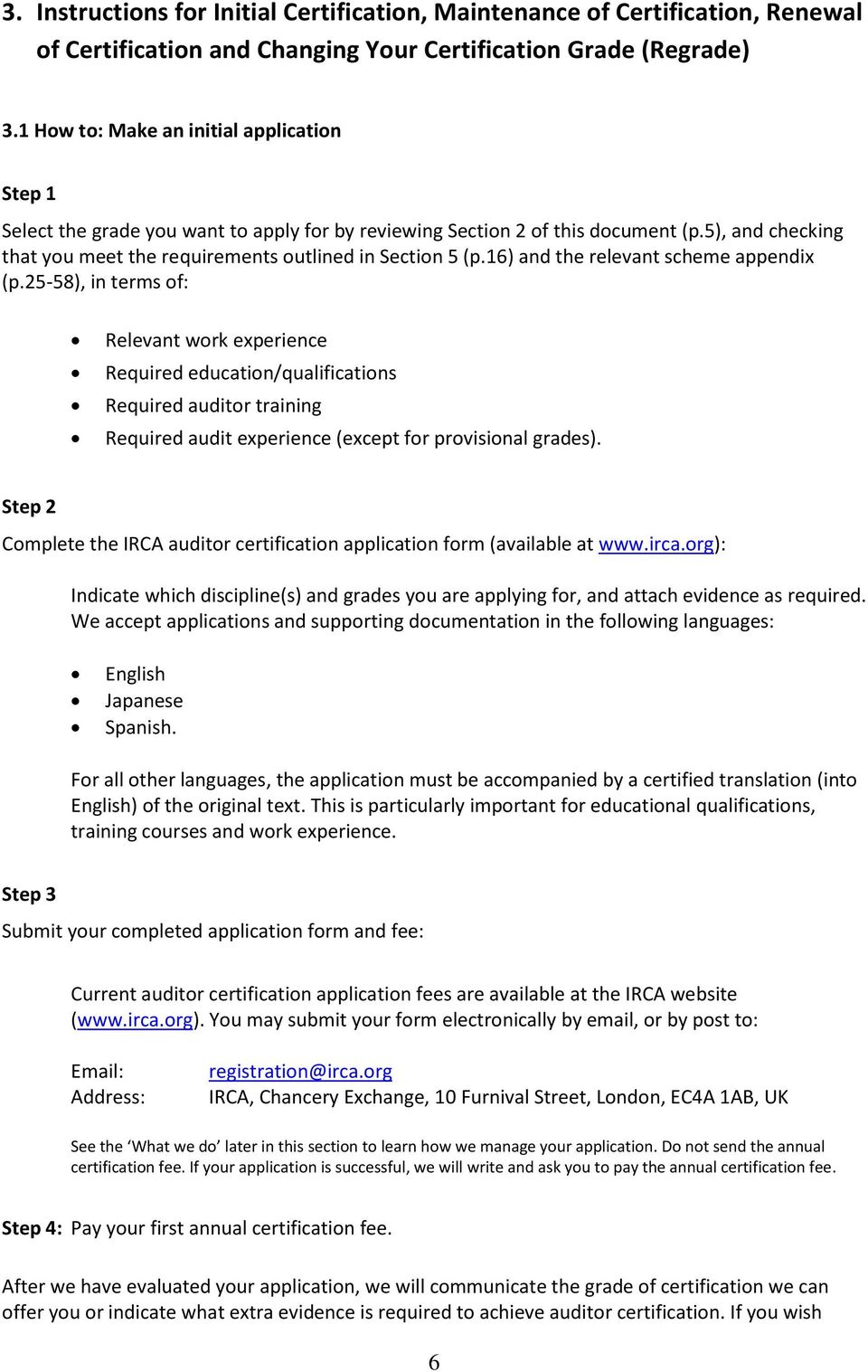
7 3. Instructions for Initial Certification, Maintenance of Certification, Renewal of Certification and Changing Your Certification Grade (Regrade) 3.1 How to: Make an initial application Step 1 Select the grade you want to apply for by reviewing Section 2 of this document (p.5), and checking that you meet the requirements outlined in Section 5 (p.16) and the relevant scheme appendix (p.25-58), in terms of: Relevant work experience Required education/qualifications Required auditor training Required audit experience (except for provisional grades). Step 2 Complete the IRCA auditor certification application form (available at Indicate which discipline(s) and grades you are applying for, and attach evidence as required. We accept applications and supporting documentation in the following languages: English Japanese Spanish. For all other languages, the application must be accompanied by a certified translation (into English) of the original text. This is particularly important for educational qualifications, training courses and work experience. Step 3 Submit your completed application form and fee: Current auditor certification application fees are available at the IRCA website ( You may submit your form electronically by , or by post to: Address: [email protected] IRCA, Chancery Exchange, 10 Furnival Street, London, EC4A 1AB, UK See the What we do later in this section to learn how we manage your application. Do not send the annual certification fee. If your application is successful, we will write and ask you to pay the annual certification fee. Step 4: Pay your first annual certification fee. After we have evaluated your application, we will communicate the grade of certification we can offer you or indicate what extra evidence is required to achieve auditor certification. If you wish 6
8 to accept our offer of certification, pay your first annual fee and you will receive your first IRCA auditor certification card, and be placed on the IRCA online register of auditors. Once your application is successful, we award certification for a period of three years beginning from the month we award certification. This three-year period is referred to as the certification period. During the certification period, at the end of the first and second years you may maintain certification by payment of the annual certification fee, and by compliance with the Code of Conduct. We don t, however, require you to submit any other documentation at the end of year one and year two. At the end of the third year, all certificated auditors are required to complete the triannual renewal of certification process. 3.2 How to: Maintain your certification Your entry onto the IRCA online register of certificated auditors is dependent on you paying your annual certification fee every 12 months (starting from your initial certification date) and by compliance with the IRCA Code of Conduct. 3.3 How to: Renew your certification We don t require you to submit any other documentation at the end of year one and year two. At the end of the third year, all certificated auditors are required to complete the renewal of certification process by providing evidence of continuing professional development, audit experience (depending on grade) and declarations of ongoing compliance with the IRCA Code of Conduct, including any complaints against you. If you are successful at renewal, we will award you certification for a further three-year certification period, and so on. Please refer to Section 6 (p.20) for the grade-specific renewal criteria. We will write to you two months prior to your certification expiring to remind you that your renewal is due. 3.4 How to: Regrade You can apply to be regraded at any time. When we offer you initial certification, we will indicate the audit experience and competencies you need to attain the next grade(s) of certification. To apply for regrade, you should complete IRCA/106 log sheets, enclose any additional information requested, and send it to us with the regrade fee. Please visit for costs. A successful application for regrade will not normally result in a change to your renewal of certification date. There is no regrade fee if you are regraded as part of the (three-year) renewal of certification process. Please contact us if you need any further advice on how to regrade. 7

9 3.5 IRCA s evaluation process: What we do We usually take about four weeks to process each application, but that time may vary depending on the time required to verify the information submitted with the application. Giving us all the information we need will speed up the application process, which has four stages: 1) Administrative check All applications are checked first by our certification staff to make sure you have included all of the information that we need. 2) Technical evaluation This phase is performed by IRCA's technical experts; the reviewing officers. The reviewing officers evaluate the information submitted against the certification requirements, then they will perform a verification of some or all of this information. At the conclusion of the technical evaluation, the reviewing officers will make a recommendation on certification to the certification manager. We consider verification to be an essential element supporting the overall credibility of the certification process. Consequently, great care is taken by the reviewing officers in reviewing and verifying applications against all aspects of the certification requirements. We will perform the evaluation as speedily as we can, but sometimes it is not possible to be as quick as we (or you) would like. Processing your application is likely to take longer if you have unusual educational qualifications, if your current (or former) employers are slow to provide verification information, or if the auditee organisations are not helpful. Typically, certification decisions will be made based on the documented information provided by the applicant. However, IRCA will, at its own discretion, invite a number of applicants for interview to verify the information provided, and evaluate the understanding of the auditor. 3) Certification The final decision on your certification is made by the certification manager. The certification decision is performed independently of the technical evaluation process detailed above. 4) Offer and award of certification The certification manager will write to you formally with an offer of certification to the appropriate grade. We will send you this offer and ask you to pay your first annual fee. Certification will be awarded when we receive your payment of the annual fee. Your details are then added to our online register of certificated auditors, and we will send you your certification card. Although the card is issued to you, it remains our property and you must return it to us should we ask you to. The IRCA certificate is intended for display as a formal recognition of your certification to a specific grade you should not use it as proof of certification. Please contact us if you wish to purchase a certificate. 8

10 4. Essential Guidance For Application 4.1 General a) Certification is available, without restriction, to all individuals worldwide who satisfy the certification requirements. b) You must meet the requirements within Section 5 (Auditor Certification Criteria) and any additional requirements contained within the respective scheme-specific requirements (see Appendix I). 4.2 Guidance on educational requirements a) All qualifications submitted must be supported by documentary evidence. An example of acceptable evidence would be a good-quality photocopy of the original certificate indicating the awarding body, the title and date of the award, and the name of the person to whom the award was made. If any of this information is not available or not clear, we may ask you to supply us with more evidence. The same applies if a copy of a certificate is not available, such as when it has been lost or destroyed for example. Acceptable evidence would include an official letter from the awarding body confirming the award. A transcript of an award (ie an official, detailed account of the course content) would also be acceptable evidence if it clearly states the date and title of the award. If no documentary evidence can be supplied by the awarding body, it is unlikely we would accept your qualification. IRCA reserves the right to verify this information with the relevant organisation and/or individual(s). b) Where our criteria states degree or near degree, all postgraduate diplomas, undergraduate and postgraduate degrees awarded in a relevant subject will normally be accepted. c) We use the UK definition of a degree as the degree benchmark. But we recognise that not all degrees awarded in the UK and in other countries meet this standard. Many fall just short, either in content or in duration, and we call these near degrees. For the purposes of auditor certification, we recognise a near degree as meeting the tertiary education requirement. 4.3 What audits do we accept for certification? a) Normally, we will only accept audits performed during the previous three-year period. We define previous period as being that period immediately prior to the date that we received your completed application. b) Audits can only be accepted once the respective training course has been successfully completed. (For example, lead audits conducted before a Lead Auditor course has been successfully completed will not be counted). c) We will only accept audits that have been performed in accordance with the auditing guidance standard ISO or ISO 17021, and against the relevant ISO standard for the scheme you are applying for (or an alternative standard we accept as being equivalent). Audits performed against alternative national, international or company standards may be acceptable. d) We must be able to verify all audit experience you submit in your log sheets. Please make 9

11 sure you include detailed information of the audits you perform, and provide sufficient contact details so that we are able to perform a verification. e) Applying for second and subsequent auditor schemes: If you are already certificated as an Auditor, Lead Auditor or Principal Auditor on one of our other schemes and you are applying for certification or regrade to a second or subsequent scheme, then a minimum of 75% of the audit days shall need to be relevant to the scheme you are applying for. The remainder may be relevant to the scheme(s) you are already certified for. Note: This does not apply to renewal, where you need to demonstrate that you meet the audit requirements for each scheme. f) Acceptability of combined/integrated audits: For new applications, where two or more standards are being audited during a combined/integrated management system audit, we will only accept the audit days allocated to the relevant scheme for which you are applying. For recertification, where two or more standards are being audited during a combined/integrated management system audit, the full audit duration will be accepted. g) Acceptability of internal audits: We will consider accepting internal audits for Auditor, Lead Auditor and Principal grades, providing you can demonstrate that the audit was of the full management system covering all clauses and requirements of the applicable management system standard, and that it was of a part of the organisation from which you are entirely independent (eg separate business unit or sister company). Audits submitted must demonstrate this. We require you to submit, with your audit log; An organisation structure diagram of the company, showing the auditor s independence from the system audited A sample audit report Any other information that you feel is supportive and relevant, such as written description of the type of audit, charts, reports, etc. h) Acceptability of consultancy audits: We will accept audits performed by you when acting as a consultant for a client if all of the following are satisfied: The client (auditee) already had a fully established management system prior to the audit You had no part in setting up the management system being audited (except in such specific circumstances as described below) You were independent of the auditee The scope of the audit included all elements of the management system. We will also accept pre-assessment audits performed by you on a management system that you were involved in developing, if the certification body subsequently awarded certification at the first attempt. 10

12 i) Acceptability of surveillance (partial system) audits: We do not normally accept surveillance (partial system) audits when submitted for initial certification or at regrade (except for Internal Auditor). However, we do accept surveillance audits for renewal of certification. j) Acceptability of on-site and off-site audits: IRCA will only accept on-site audits that have involved a significant amount of interaction with the auditee(s). If the audit is limited to conducting a document review (eg records or data analysis), observation of work performed, completing checklists and sampling (eg products) without interaction with the auditee(s), it is not acceptable. Further, significant onsite preparation time (eg half a day) may not be counted towards the days on site. A maximum of one day s off-site per audit will be accepted. k) Acceptability of remote audits: IRCA will accept remote audits as a substitute for the required on-site audit days, where there has been as much interaction between the auditor and the auditee as would occur during an on-site audit. Interaction may be achieved remotely through such means as video conferencing, document and record-sharing systems, etc (remote audit activities are performed at any place other than the location of the auditee, regardless of the distance). If you have conducted extensive remote audits that you feel are suitable, please provide additional information including the scope and nature of the audit, and, if possible, supporting documentation such as audit plans and reports. l) Acceptability of audits to standards other than those issued by the ISO: We will accept audits performed against standards that we have evaluated as being equivalent to the relevant ISO standard. We maintain a list of acceptable alternative standards for each auditor scheme, but it is possible that you may claim audits against a standard that is not on this list. We have a formal process for evaluating new standards, and you are advised to contact us for advice where you consider an alternative standard may be acceptable to us. m) Audits we do not accept: Audits of the same management system that are repeated more frequently than once every 12 months Audits of less than one day s duration (six hours of audit activity, exclusive of breaks), except for the internal auditor grade, where we will accept audits of three hours exclusive of breaks Gap analysis, close out or follow-up visits Audits performed before successful completion of the formal training requirement Audits performed outside the accepted three-year period. 4.4 What training course certificates does IRCA accept? a) We are looking for you to have a certificate for the successful completion of an IRCAcertified training course. IRCA does accept a very small number of non-irca-certified 11

13 training courses as being equivalent to its own courses. Please refer to this page on our website: or contact head office for information about accepted alternatives. b) You should normally have successfully completed auditor training within the three-year period immediately prior to application for certification. We may accept training completed prior to this period if you provide evidence of recent and relevant continuing professional development (CPD), work experience and currency of your auditing skills. We advise you to refer to the IRCA website ( for a current listing of all IRCA-certified training organisations offering IRCA-certified management system auditor training courses. c) All training course certificates submitted must be supported by documentary evidence. An example of acceptable evidence would be a good-quality photocopy of the original certificate indicating the awarding body, the title and date of the award, and the name of the person to whom the award was made. If any of this information is not available or is not clear, we may ask you to supply us with more evidence. If no documentary evidence can be supplied by the awarding body, it is unlikely we would accept your training course certificate. IRCA reserves the right to verify this information with the relevant organisation and/or individual(s). d) IRCA does not accept certificates of attendance. Certificates must be of successful completion of a course. The only exception to this rule is that IRCA will accept a certificate of attendance of an Auditor/Lead Auditor course, as meeting the training requirement for the Internal Auditor grade. 4.5 Guidance on continuing professional development (CPD) CPD is a framework that encourages you to continuously update your professional knowledge, personal skills and competencies. The purpose of CPD is to make you more effective as an auditor, and to make the auditing profession more credible. The concept of CPD and the value it contributes is now recognised and accepted throughout all professional fields. Any CPD submitted must be in subjects that are broadly related to auditing and the relevant management system. Because there are so many topics that we recognise will enhance your auditing competence, we do not attempt to list them all here. But we categorise them into four areas and three types. We also provide guidance here on what the focus of your CPD should be, and the approach you should take to conducting CPD: CPD Areas (not in order of significance): 1) Management system related (eg learning about a new standard or learning about updates to standards). 2) Auditing related (eg auditor skills refresher training). 3) Technical knowledge related (eg legislation and regulatory updates, industry changes, relevant technology changes, technical process knowledge and other technical knowledge that will enable you to audit more effectively). 4) Soft skills training (eg communication skills, conflict resolution and negotiation, personal effectiveness, creative problem solving, strategic thinking, management/business training, team building, influencing skills and other related training). 12

14 CPD Types 1. Unstructured Included in this category would be; Reading and contributing to a relevant online forum such as IRCA s discussion group on LinkedIn is also accepted Reading IRCA INform, our e-magazine available from Distance and open-learning study that is not assessed and does not lead to a qualification The reading of professional and technical journals, books and other publications. 2. Semi-structured Included in this category would be; Non-interactive lectures, talks etc Professional body meetings The research, preparation and first delivery of lectures/courses Technical research, either at work or at an external institution Forms of open and distance-learning that involve assessment, and that result in the acquisition of a qualification. 3. Structured Note: Repeated training deliveries and lectures/presentations cannot be counted more than once. Included in this category would be; Relevant aspects of on-the-job training and development where specific outcomes have been planned, identified and recorded by you (only new activities, training and development will be considered). General day to day tasks, activities that do not help maintain/enhance your skills as an auditor, or that are not relevant to auditing, will not be accepted Interactive and highly participative training courses Seminars and formal lectures Active participation in the development of applicable standards. CPD Focus CPD should be focused on appropriately developing ones knowledge and skills to maintain ones effectiveness as an auditor. In determining what your CPD objectives should be, you should consider: 1. What has changed/ is changing? This could be a standard update, a technical change 13

15 (such as to legislation or regulation) or an important change in industry, such as technology or techniques used 2. What your strengths and weaknesses are 3. What your ambitions are for the future are 4. Feedback you have been given. CPD Approach You should consider carefully what CPD you wish to do in the three-year certification period. You should identify some objectives early on, and plan your CPD activities in advance to ensure you continue to meet the CPD requirements. You may conduct CPD in a number of ways (types and areas). IRCA will not prescribe how you should accomplish your personal CPD objectives, however IRCA will normally only accept a maximum of 20 hours unstructured CPD. In certain circumstances, IRCA may accept a greater number of hours of unstructured CPD, if the auditor can demonstrate; a) Good reason for not conducting enough semi-structured or structured CPD b) That there have been no significant changes that would warrant a semi-structured or structured approach. (For example; an update to the standard may require formal update training). If you have conducted 45 hours of CPD, but IRCA determines that you have not conducted CPD in a specific area that it believes to be critically important, IRCA will advise you of this and you will be required to submit evidence of this CPD to IRCA within an agreed timeframe. For each CPD entry on your log, you are required to state/describe: 1. What type of CPD it was 2. What areas the CPD was focused on 3. What skills/knowledge you have gained, and how these have enhanced your capabilities as an auditor 4. The contact details of someone who can confirm that the CPD took place (for structured and semi-structured). It is your responsibility to provide a case for acceptance of any activity you submit, and this must be supported by sufficient and appropriate evidence, such as records of your activities, provision of the contact details of someone who can verify that the CPD took place (for nonindependent CPD) and any formal certificates or qualifications you may have received. Completing the CPD log sheet clearly, fully and providing an accurate description of the CPD undertaken and the skills/knowledge attained, will help ensure your CPD log is accepted. 4.6 Guidance on work experience a) Please refer to the scheme-specific appendix document and the guidance section of the application form for information about what will be accepted as experience relevant to the auditor scheme you are applying for. b) Short periods of training cannot be included in this work-experience requirement, 14

16 however apprenticeships and the like may be considered as acceptable work experience. Please provide additional information if you wish any training to be considered towards your work experience. 4.7 Guidance on flexibility and potential concessions within IRCA s criteria For any auditor certification grade on any IRCA scheme, IRCA may certificate an auditor who does not meet fully the criteria as displayed, so long as the auditor can demonstrate their competence and suitability for the grade by other means. To be considered for a certification grade for which you do not fully meet the criteria, please provide the following with your application: A cover letter highlighting which grade you are seeking to be certified for (this letter should also explain why you believe yourself to be suitable for this grade) A copy of your curriculum vitae All relevant training certificates and educational certificates A recommendation from an IRCA-certified Lead/Principal Auditor (if possible) Any other supporting documentation, for example an auditor certification from another auditor-certification body Completed IRCA audit logs and CPD logs to support your application. Note: The certification process will still require you to make a non-refundable application payment before your application can be formally reviewed. IRCA will review applications that request such concessions on a case-by-case basis, and will provide a full and justified explanation for any decisions made. Any flexibility or concessions to the IRCA requirements will be entirely at the discretion of the Certification Manager. 15

17 5. Auditor Certification Criteria Below are the generic IRCA criteria for becoming an auditor. You must refer to and meet the additional scheme-specific requirements within the relevant part of Appendix 1 also. 5.1 Internal Auditor (see the bottom of the page for Provisional Internal Auditor) Education At least to secondary education level. Work experience Four years full-time experience, or two years with a degree or near degree One year s full-time experience relevant to the auditor scheme. Auditor training A relevant IRCA-certified Foundation course and a relevant IRCA-certified Internal Auditor training course or The relevant IRCA-certified Auditor/Lead Auditor training course (refer to 4.4 for guidance on what training IRCA accepts). Note: IRCA will consider, on a case-by-case basis, auditors applying for an internal auditor grade that have successfully completed an Internal Auditor course, but not the respective Foundation course. The decision will be based on the information provided in the work experience and sector understanding parts of the application form. Auditing experience You need to have performed at least five internal audits, each of which must have been of at least three hours duration, have included all elements of the audit cycle audit planning, document review, auditing, interviewing and audit reporting and must not have involved areas or activities in which you yourself perform. However, we will accept audits of activities for which you are directly or indirectly responsible, eg as a line manager. (Refer to 4.3 for guidance on what audits are accepted.) Provisional Internal Auditor No audits are required. All other requirements are the same as those for an Internal Auditor. 16

18 5.2 Auditor (See the bottom of the page for Provisional Auditor) Education At least to secondary education level. Note: If you have a degree or near degree level qualification, we will reduce the requirement for work experience. Acceptable qualifications include those awarded by an institution recognised by a national governmental body or accredited by a national professional body. Work experience Four years full-time experience, or three years with a degree or near degree Two years full-time experience relevant to the auditor scheme you are applying for. Please refer to the scheme-specific appendix document for information about what will be accepted as experience relevant to the auditor scheme you are applying for. Auditor training A relevant IRCA-certified Auditor/Lead Auditor training course or The relevant IRCA-certified Auditor/Lead Auditor Conversion training course only acceptable if you have previously completed a five-day Auditor/Lead Auditor training course in another discipline. (Refer to 4.4 for guidance on what training IRCA accepts.) Auditing experience You need to have performed at least four full management system audits covering all clauses (requirements) of the applicable management system standard. Auditing activity must include document review, preparation and performance of on-site audit activities, and audit reporting. The total duration of these audits must not be less than 20 days, 15 of which must have been acquired on site. (Refer to 4.3 for guidance on what audits are accepted.) Note: Although we recommend you should complete all of the audits under the direction and guidance of an auditor competent as a team leader (one currently certificated as a lead auditor or who has equivalent competence), we acknowledge that for many auditors this will be very difficult and costly to arrange. Consequently, we will accept a minimum of one audit under these conditions. We may require this team leader to attest to your competence to audit as a team member. Provisional Auditor No audits are required. All other requirements are the same as those for an Auditor. 17

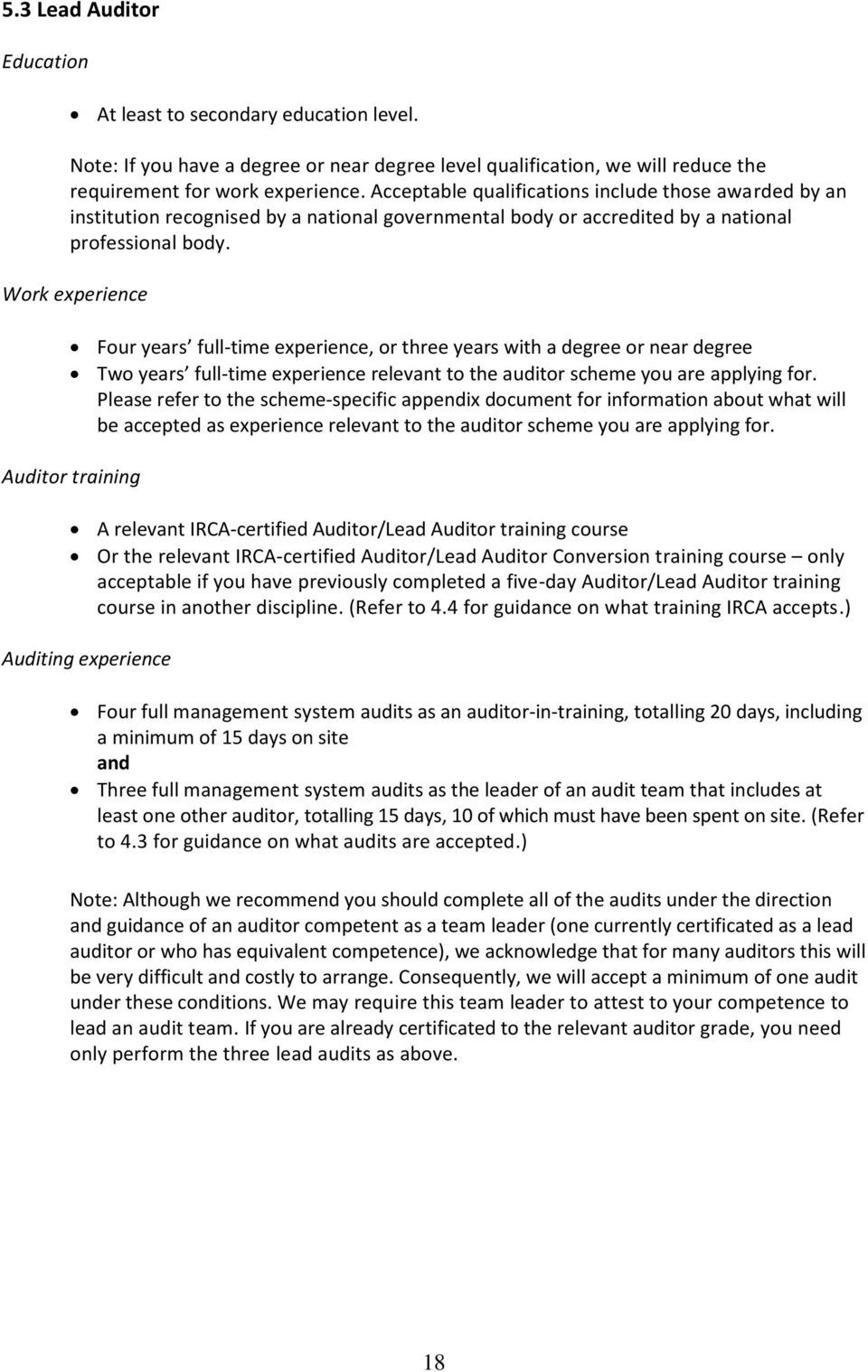
19 5.3 Lead Auditor Education At least to secondary education level. Note: If you have a degree or near degree level qualification, we will reduce the requirement for work experience. Acceptable qualifications include those awarded by an institution recognised by a national governmental body or accredited by a national professional body. Work experience Four years full-time experience, or three years with a degree or near degree Two years full-time experience relevant to the auditor scheme you are applying for. Please refer to the scheme-specific appendix document for information about what will be accepted as experience relevant to the auditor scheme you are applying for. Auditor training A relevant IRCA-certified Auditor/Lead Auditor training course Or the relevant IRCA-certified Auditor/Lead Auditor Conversion training course only acceptable if you have previously completed a five-day Auditor/Lead Auditor training course in another discipline. (Refer to 4.4 for guidance on what training IRCA accepts.) Auditing experience Four full management system audits as an auditor-in-training, totalling 20 days, including a minimum of 15 days on site and Three full management system audits as the leader of an audit team that includes at least one other auditor, totalling 15 days, 10 of which must have been spent on site. (Refer to 4.3 for guidance on what audits are accepted.) Note: Although we recommend you should complete all of the audits under the direction and guidance of an auditor competent as a team leader (one currently certificated as a lead auditor or who has equivalent competence), we acknowledge that for many auditors this will be very difficult and costly to arrange. Consequently, we will accept a minimum of one audit under these conditions. We may require this team leader to attest to your competence to lead an audit team. If you are already certificated to the relevant auditor grade, you need only perform the three lead audits as above. 18
20 5.4 Principal Auditor This grade is for Senior Audit professionals with an extensive and demonstrable history of conducting full system audits and lead audits. Principal Auditors may or may not conduct audits on a regular basis, as it is not uncommon for some to have progressed into managerial roles later in their career. Some examples of the sorts of individuals that may qualify for this grade include (but are not limited to): full-time third-party auditors, audit managers, certification managers, audit training and development personnel (including management system auditor training course designers), and persons involved in the development of relevant audit and management system standards (such as ISO 19011). Work experience Eight years full-time experience relevant to the auditor scheme you are applying for. Please refer to the scheme-specific appendix document for information about what will be accepted as experience relevant to the auditor scheme you are applying for. Other requirements Six years certification to Lead Auditor grade by IRCA (or acceptable alternative) prior to certification. Note 1: You must have completed six years certification as a Lead Auditor and meet the criteria for Lead Auditor certification at the second recertification (this is the earliest time possible to be eligible for Principal Auditor). If you have already completed two recertifications as a Lead Auditor, you may transition to Principal Auditor at any time. Note 2: You may choose to maintain your Lead Auditor certification, rather than progressing to Principal Auditor. However, you will need to continue to meet the renewal requirements for Lead Auditor if you do so. Or Submission of evidence of three years full-time employment as a management systems auditor with an accredited certification body (or demonstrable and significant evidence of contracted third-party audits with an accredited certification body). Note: Acceptable evidence of employment as a management systems auditor would typically include a letter from senior management confirming the duration and nature of the employment. 19
21 6. Renewal of Certification Criteria and Requirements You must renew your certification every three years, ie at the end of the third complete year. We will write to you two months before your certification period expires and ask you to send us your audit and CPD log, CPD objectives log and other documents. We will evaluate these against the renewal requirements listed below and make a certification decision. We will then write to you with the results. All criteria must be met for each individual scheme for which you hold certification. The renewal of certification process involves the following six requirements: 1) Continuing professional development (CPD) 2) Audit experience 3) Other requirements 4) Declaration of complaints 5) Compliance with the IRCA Code of Conduct 6) Payment of the annual fee. 1) Continuing professional development For Internal Auditor and Provisional Internal Auditor There is no CPD requirement. For Provisional Auditor, Auditor, Lead Auditor and Principal Auditor CPD Log: You must have completed at least 45 hours of appropriate CPD during the three-year period immediately prior to renewal of certification. (A maximum of 20 hours unstructured is permitted unless an exception is agreed with IRCA see guidance). Through CPD, you are required to demonstrate your currency of knowledge and skills through updates in subject areas within the four main categories, as stated in 4.5: Management system related Auditing related Technical knowledge related (eg legislation and regulatory updates) Soft skills training, eg communication skills, conflict resolution and negotiation, personal effectiveness, creative problem solving, strategic thinking, management/business training, team building, influencing skills or similar (not in order of significance). Note: CPD does not have to be conducted in all categories. You should identify CPD that is essential to maintaining your currency and effectiveness as an auditor, and CPD that can enhance your effectiveness as an auditor. 20
22 2) Audit experience We need you to record and submit your audit experience on the audit log sheets (IRCA/106) that we supply. For Internal Auditor: You need to have completed a minimum of five internal audits, the total duration of which must have been at least 15 hours. For Provisional Internal Auditor and Provisional Auditor There is no audit requirement. For Auditor: Five audits, two of which must be full system audits. Three of the five audits may be surveillance or partial system audits. Audit experience within the three-year certification period shall be not less than eight on-site audit days. You must have performed these audits within the previous three-year certification period. For Lead Auditor: Five audits, two of which must be full system audits. Three of the five audits may be surveillance or partial system audits. A minimum of one full system audit shall be while leading a team that includes at least one other person (a total team of two persons minimum). Note: IRCA may exercise discretion over this requirement, should the auditor have a substantial and demonstrable history of conducting lead audits. Audit experience within the three-year certification period shall be not less than eight on-site audit days. You must have performed these audits within the previous three-year certification period. For Principal Auditors: There is no formal audit requirement, however we strongly encourage you to submit a record of any audits that you do conduct, to support your application for recertification. Evidence of continuing involvement in auditing, such as the management of audit programmes, auditor training design or management, audit standards involvement and/or other responsibility in audit management, should be provided. 21
23 3) Additional Requirements For all grades other than Principal Auditor: There are no other requirements For Principal Auditor: You must submit evidence of continued work experience related to the relevant management system(s) and evidence of continued involvement in auditing or audit-related activities. 4) Declaration of complaints We need you to tell us about any complaints made against your professional conduct. It is important we know of any complaints, as we need to consider these as part of the renewal of certification process. We will investigate all instances of complaints. If complaints are made against your conduct and you do not declare them, the consequences will be far more serious and may result in suspension or withdrawal of your certification. 5) Compliance with the Code of Conduct We need you to make a declaration that you have always acted in compliance with the Code of Conduct (see Appendix III). 6) Payment of the annual fee And finally, we need you to pay the annual fee. Because the fee will be dependent on the grade we offer you after renewal, we do not ask you to pay this fee until we have completed renewal. We will write to you with the results of the renewal, enclosing the invoice and fee-due date. Failure to pay your annual fee within 28 working days of the date of the invoice will result in your certification being withdrawn, and the removal of your details from the online register. Once we have received your payment, we will write to you again enclosing your new certification card. 22
24 7. Terms and Conditions 7.1 Appeals and complaints You have the right to appeal against any certification decision taken by us. We operate a quality system that includes established procedures for considering appeals and complaints. 7.2 Enforcement of certification We enforce (ie suspend or withdraw) certification for three reasons: 1) If you fail to meet the certification criteria for the grade to which you are certificated. This enforcement occurs when you apply to renew your certification. In most cases, withdrawal will be preceded by an offer of an alternative grade, for a period during which you have the opportunity to meet the requirements of, and be reinstated to, the grade you originally held. 2) If you breach the Code of Conduct. We reserve the right to undertake action against your certification if we find you to have acted contrary to the Code of Conduct options available include suspending or, in instances of serious or sustained breach, withdrawing your certification. 3) If you fail to pay the requisite fees. 7.3 Confidentiality We undertake to consider as strictly confidential all information, correspondence and documentation you submit to us in support of your certification activities. We reserve the right to publish relevant details of each certificated auditor in our register, available online at We reserve the right to disclose details of your certification record to other auditor certification and accreditation bodies. We will do so with discretion and only in instances where we consider withholding this information will compromise the integrity of certification, eg where we have taken action against (ie suspended or withdrawn) your certification, and you have applied to another auditor-certification body without fully disclosing your record while certificated by us. 7.4 Legal status The certification of auditors by us and all activities associated with the administration of the register is governed in accordance with English law, and is subject to the exclusive jurisdiction of the English courts. 7.5 Fees Fees are set annually and apply to the calendar year (1 January-31 December). Contact us direct or see for details of current fees applicable for your country. Application fee: We need you to pay this fee when you send in your application. Alternatively, we will invoice you on receipt of your application. This fee covers the costs of the application process and is not refunded if the application is unsuccessful. Failure to pay this fee will cause a delay in the processing of your application. 23
25 Annual certification fee: This fee covers the annual cost of administering your certification. We will normally invoice you for this fee when we first offer you certification following your application, and each year thereafter, three months before payment is due. Failure to pay your fees within 28 days of them being due will result in withdrawal of your certification. Upon receipt of your fee, your card will be issued. Application for regrade fee: This fee covers the costs of evaluating your regrade. We need you to pay this when you submit your request and, as with the application fee, the regrade fee is not refundable. If you are regraded during the year, we will not ask you to pay any further certification fees for that current year. You may request a regrade at any stage during the certification period. There is no regrade fee if we regrade you as part of the (three-year) renewal of certification process. Except for every third year, when your renewal is due we invoice you after we have completed your renewal, on the basis that your grade (and fee) may have changed as a result. Upon receipt of payment, your card will be issued. 24
26 Appendix I Part 1 Quality Management System Auditor Scheme Specific Requirements and Guidance Scheme specific (additional) requirements In the sector understanding and work experience sections of the application form, you are required to demonstrate the following knowledge and competencies: Knowledge of basic quality management principles Understanding of quality management tools and techniques that are applied in organisations that will enable the auditor to assess a quality management system, and generate audit findings and conclusions An understanding of an organisation s operational activities and its interactions, to enable you to understand the relationship with product quality. The QMS Scheme is based on the auditing key standard: ISO 9001: Quality management systems Requirements Guidance for who this scheme is intended for Quality management system auditors, such as those employed by third-party certification bodies/registrars or by purchasing organisations (second-party auditors) Quality management practitioners, such as quality management consultants, quality managers and third-party certification managers Employees conducting quality management system audits within their own organisations (internal audits). 25
27 Appendix I Part 2 Environmental Management System Auditor Scheme Specific Requirements and Guidance Scheme specific (additional) requirements Within the sector understanding and work experience sections of the application form, you are required to demonstrate the following knowledge and competencies: Knowledge of environmental aspects and impacts Ability to judge aspect significance Knowledge of local environmental legislation Understanding of methods and techniques of environmental management that enable the auditor to examine an environmental management system, and to generate appropriate audit findings and conclusions Understanding of environmental science and technology that enables the auditor to understand the fundamental relationships between human activities and the environment Understanding of technical and environmental aspects of operations that enables you to understand the interaction of an organisation s activities, products, services and operations with the environment. The EMS Scheme is based on the auditing key standard: ISO 14001: Environmental management systems Specification with guidance for use (latest issue). Guidance on who this scheme is intended for Environmental auditors, eg those employed by third-party certification bodies/registrars or by purchasing organisations Environmental practitioners, eg environmental consultants, environmental managers and other environmental personnel Employees conducting environmental audits within their own organisation, ie internal audits. 26
28 Appendix I Part 3 Occupational Health and Safety System Auditor Scheme Specific Requirements and Guidance Scheme specific (additional) requirements In the sector understanding and work experience sections of the application form, you are required to demonstrate the following knowledge and competencies: Generic auditing skills as detailed earlier in this document (IRCA 1000) OH&S management methods and techniques that enable you to examine OH&S management systems, and to generate appropriate audit findings and conclusions OH&S technical competencies, such as the management of risk, health and safety activities in the workplace, including chemical/physical/biological hazards; legal and organisational factors within the country or area of operation, etc Acceptable work experience would include: o o o o o o o Full-time role as manager, supervisor, engineer or technician, involved in technical aspects of facility operation in compliance with OH&S regulations Implementation and maintenance of OH&S or integrated management systems involving health and safety compliance management Monitoring compliance with health and safety law and regulation, on behalf of a regulating body Auditing OH&S management systems on behalf of an accredited certification body Assessment of supplier probity against an acceptable OH&S management system standard on behalf of an employing organisation Provision of appropriate consultancy services involving OH&S Full-time role relating to the performance of OH&S risk assessment and management of safety audits of all types (not necessarily system audits). The OH&S Scheme is based on the auditing key standards: BS OHSAS 18001: Occupational health and safety management systems Requirements (latest issue), HSG65 and BS8800 (latest issues). Guidance on who this scheme is intended for Occupational health and safety professionals intending to demonstrate a core competency in audit management performance Management systems auditors (eg quality, environmental, IT, etc) who possess a considerable understanding and knowledge of OH&S issues, and who are able to demonstrate sufficient competence to participate in OH&S or integrated management system audits Occupational health and safety management system auditors who wish to have their auditing competence recognised. 27
29 Appendix I Part 4 Information Security Management System Auditor Scheme Specific Requirements and Guidance Scheme specific (additional) requirements In the sector understanding and work experience sections of the application form, you are required to demonstrate the following knowledge and competencies: Knowledge of the range of application for an ISMS Knowledge of information security-related legislation applicable to the country(s) of operation Knowledge of the techniques and tools used in information security management Understanding of the potential business impacts of ISMS Understanding the importance of asset and owner identification Knowledge of control objectives and how these are addressed Knowledge of risk assessment and identification Understanding of the threats, vulnerabilities and impacts Understanding the difference between risk assessment and risk evaluation Understanding of the methodology of risk treatment, application, residual risk and review of risk treatment plan Knowledge of the understanding of the importance of the statement of applicability in the ISMS, and how it is used Knowledge of the difference between an IS event and incident. The ISMS Scheme is based on the auditing key standards: ISO/IEC 27001:2005 Information technology Security techniques Information security management systems Requirements ISO/IEC 17799:2005 Information technology security techniques Code of practice for information security management EA 7/03: Guidelines for the accreditation of bodies operating certification/registration of information security management systems ISO/IEC 27001:2005 which provides correspondence and alignment with ISO 9001:2000 Quality management systems Requirements and ISO 14001:2004 Environmental management systems Requirements with guidance for use. 28
30 Guidance on who this scheme is intended for ISMS auditors, eg those employed/contracted by third-party certification/registration bodies and those involved in first or second-party ISMS audits Information security practitioners, eg information security consultants, IT security managers and IT personnel Employees conducting ISMS audits within their own organisation, ie internal ISMS audits. 29
31 Appendix I Part 5 Information Technology Service Management System Auditor Scheme Specific Requirements and Guidance Scheme specific (additional) requirements In the sector understanding and work experience sections of the application form, you are required to demonstrate the following knowledge and competencies: Knowledge of the role of IT service providers and their responsibilities Knowledge of the importance of governance in relation to the ITMS Basic training in IT service management knowledge (eg IRCA will accept the ITIL Foundation certificate or equivalent training) Knowledge of ITIL. (IRCA will accept the ITIL Foundation certificate or equivalent training as satisfying this requirement) Understanding identification and management via risk analysis applied to ITMS Understanding of service level agreement (SLA), service management system (SMS), and service management plans and their interaction Understanding of release and deployment management and the importance of the agreed release policy Understanding configuration management and the importance of configuration items (CI) Understanding of the service delivery, including continuity and availability, and problem resolution process Understanding of the business relationship management and of the importance of SLAs. The ITSMS Scheme is based on the auditing key standard: ISO 20000: Information technology Service management (current edition). Guidance on who this scheme is intended for Employees conducting IT service management system audits within their own organisation, ie internal audits IT service management system auditors, eg those employed by third-party certification bodies/registrars or by purchasing organisations IT service management practitioners, eg IT service management consultants and other IT service management personnel. 30
32 Appendix I Part 6 Business Continuity Management System Auditor Scheme Specific Requirements and Guidance Scheme specific (additional) requirements Within the sector understanding and work experience sections of the application form, you are required to demonstrate the following knowledge and competencies: 1) Knowledge of business continuity management principles that cover: BCM policy and programme management Understanding the organisation impact and risk Determining BCM strategies Developing and implementing BCM responses Exercising, maintaining and reviewing BCM arrangements Embedding BCM in organisational culture. Note: IRCA will accept completion of the BCI Certificate Examination (CBCI) as evidence of the above. 2) Understanding the core processes involved in business continuity management and the interrelationships that enable you to examine BCMS, and to generate appropriate audit findings and conclusions 3) Understanding the relationship processes based on business continuity management and supplier continuity management 4) Understanding resolution processes based on identifying potential threats and impacts, and handling disruptions and business continuity incidents 5) Knowledge of processes and products, including services, that enable you to comprehend the business context in which the audit is being conducted 6) Knowledge of relevant standards, regulatory or legal requirements pertaining to BCM, within the specific sector and geography being audited 7) Understanding the need for BCM to be a top management-led embedded business process, and the experience to evaluate whether this is being maintained effectively 8) Understanding the nature of continual improvement through the use of top management leadership, planning and performance evaluation. The BCMS Scheme is based on the auditing key standard: ISO 22301: Societal security Business continuity management Requirements. Guidance on who this scheme is intended for BCMS auditors, eg those employed by third-party certification bodies/registrars or by purchasing organisations BCMS practitioners, eg senior managers, BCMS consultants and other BC personnel Employees conducting BCMS audits within their own organisation, ie internal audits. 31
33 Guidance on transitioning to ISO from BS Please find guidance on transitioning to ISO from BS on the scheme page on the IRCA website: 32
34 Appendix I Part 7 Energy Management System Auditor Scheme Specific Requirements and Guidance Scheme specific (additional) requirements In the sector understanding and work experience sections of the application form, you are required to demonstrate the following knowledge and competencies: Knowledge of energy management and the principles of energy efficiency Understanding the principles of fuel combustion, heat transfer and energy flow Understanding the relevant sources of energy regulation, guidelines and standards Understanding the typical methods and technologies for increasing energy efficiency Ability to interpret energy measurement units, sources, costs, tariffs and scheduling Ability to scrutinise energy-use data analysis methods Ability to analyse energy baselines, energy targets, performance indicators, monitoring and performance measurement Understanding the impact of organisational processes and equipment on energy efficiency Understanding of methods and techniques of energy management that enable the auditor to examine an energy management system, and to generate appropriate audit findings and conclusions. Note: As a guide, courses such as the Energy Institute s Certificate in Energy Management Essentials (or equivalent) would meet this requirement, as would higher-level energy management-related qualifications. The EnMS Scheme is based on the auditing key standard: ISO 50001: Energy management systems Requirements with guidance for use (latest Issue). Guidance on who this scheme is intended for Energy management system auditors, eg those employed by third-party certification bodies/registrars or by purchasing organisations Energy management practitioners, eg energy consultants and other energy personnel Employees conducting energy management system audits within their own organisation, ie internal audits. 33
35 Appendix I Part 8 Pharmaceutical Management System GMP Auditor Scheme Specific Requirements and Guidance Scheme specific (additional) requirements In the sector understanding and work experience sections of the application form, you are required to demonstrate the following knowledge and competencies: Understanding of the lifecycle of a pharmaceutical medicinal product Knowledge and understanding of pharmaceutical GMPs and the relevant pharmaceutical legislation, eg EudraLex Volume 4 or the 21 CRF standards associated with them. This should be supported by; Evidence of successful completion of a GMP awareness training course or Two years demonstrable work experience in a GMP environment Knowledge and understanding of the pharmaceutical supply chain and the context of individual suppliers within the globalisation of the pharmaceutical supply chain, and the associated storage and distribution requirements Knowledge of ICH Q8 (current edition) and the interaction of ICH Q9 Quality risk management (current edition) and ICH Q10 Pharmaceutical quality system (current edition). This should be supported by; Evidence of successful completion of a GMP awareness training course or Two years demonstrable work experience in a GMP environment Understanding of patient risk and general risk management to establish the control strategy that can include parameters and attributes related to drug substance, finished product, starting materials and components. This should embody a working relationship with applicable GMP Understanding the requirements of a Pharmaceutical Quality Management System, and the importance of this in maintaining control and facilitating continual improvement throughout the product lifecycle Understanding of the required GMPs for the processes that the auditor is intending to audit, for example: 34
36 o o an auditor who is responsible for assessing the conformance of suppliers of active pharmaceutical ingredients must be familiar with EudraLex Volume 4 Part 2: ICH Q7 Manufacture of drug substances, and ICH Q11 if the drug substances are being developed as well an auditor performing internal audits on behalf of a biotech company must be familiar with EudraLex Volume 4 (Good manufacturing practice guidelines) and with Annex 2: Manufacture of biological medicinal products for human use. Audit requirements For Internal Auditor grade, for initial certification and renewal of certification, all GMP audits will be accepted, including those that are not full management system audits. For Auditor/Lead Auditor grades, for initial certification and renewal of certification, only full management system GMP audits will be accepted. Note: Please indicate on the audit log any audits that are full management system audits. The Pharmaceutical GMP Auditor Scheme is based on the auditing key standards: In Europe The GMP Directive 2003/94/EC and EudraLex Volume 4 In the USA CFRs Title 21, Parts 210 and 211 ICH Q10: Pharmaceutical quality system (current edition) ICH Q9: Quality risk management (current edition) ICH Q8: Pharmaceutical development (current edition) ICH Q7: Good manufacturing practice guide for active pharmaceutical ingredients ISO 19011: Guidelines for auditing management systems (current edition) ISO 17021: Requirements for bodies providing audit and certification of management systems (current version). Guidance on who this scheme is intended for: Internal auditors who conduct full or partial GMP and pharmaceutical quality management system audits within their own organisation Pharmaceutical auditors conducting audits of: o o o o o o suppliers of starting materials and packing components contract service providers manufacturing operations packing operations testing laboratories warehouse and distribution operations Third-party pharmaceutical auditors working for clients within the pharmaceutical industry Pharmaceutical quality practitioners consultants, audit programme managers and other related personnel Audits of pharmaceutical operations performed by regulators to ensure compliance 35
37 Pharmaceutical auditors working for third-party certification bodies/registrars who complete full GMP and pharmaceutical quality management system audits of suppliers, including: o o audits of raw material and component suppliers audits of different phases of the product lifecycle (ie research and development, clinical trial manufacture, commercial manufacture, distribution and supply, and product discontinuation). Note: If you are seeking auditor training or auditor certification to the PQG supplier standards for packaging and excipients, you should visit the CQI's Pharmaceutical Quality Group's website for further information. 36
38 Appendix I Part 9 Aerospace Quality Management System Auditor Scheme Specific Requirements and Guidance Scheme specific (additional) requirements Within the sector understanding and work experience sections of the application form, all applicants are required to demonstrate knowledge and competence in the application of aerospace requirements. This means services and products that have airworthiness, regulatory, legal or aerospace-specific requirements. It will not be sufficient for you to have experience of products such as seats and cabin equipment, simple fasteners, general forgings, castings, fabrications or machined parts that, while used in aerospace applications, are subject to general engineering requirements rather than the airworthiness requirements detailed below. You should demonstrate on the form knowledge and competence in the majority of the following aerospace industry-specific aspects of aerospace industry quality, regulatory and/or military aerospace requirements: First article inspection Airworthiness and safety requirements Aerospace material traceability requirements Aerospace subcontractor approval and control Variation management of key characteristics Flow-down of aerospace QMS requirements Foreign object damage/debris (FOD) prevention Use of customer-supplied products Calibration controls and positive recall systems Acceptance authority media Nonconforming material management Sampling inspection/statistical process control requirements and limitations Special processes Configuration management/requirements control Aerospace manufacturing techniques Tool control Design development verification and validation. Auditor training requirements For all aerospace auditor grades, you must have successfully completed (at a minimum) an IRCAcertified QMS Auditor training course appropriate to the grade for which you wish to apply. For all aerospace auditor grades, your work experience must have been within the last five years unless you have successfully completed an aerospace-specific auditor course within the last five years, such as the AS 9100 Auditor training course, in which case your work experience may still be accepted. 37
39 Adding additional aerospace scopes to your registration: 9100/9110/9120 Auditors who wish to have the 9100/9110/9120 aerospace auditing scopes added to their certification shall undertake recognised AQMS 9100/9110/9120 courses in order to have these certifications. Self study is not acceptable. Additional audit requirements For all grades: If you wish your aerospace certification scopes to include the 9100/9110/9120 aerospace standards, the audits you submit must cover some or all of these. (Scopes assigned to you will be aligned to the audits submitted.) CPD requirements For all grades other than Internal Auditor and Provisional Internal Auditor: At least 45 hours of appropriate CPD must have been completed over the previous three years. A minimum of at least 15 hours of this must be directly related to development of specific aerospace industry or services auditing skills, and address currency of aerospace standards and regulations. Examples of acceptable ways of keeping up-to-date might include: Audits in aerospace companies while employed by a certification body or consultant Attendance on aerospace QMS training courses, such as AS/EN9100, AS/EN9110 and EASA Part 21 or Part 145 Courses run by aerospace primes for their suppliers, other training courses, or membership of a quality group run by the CQI or similar. Guidance on acceptable work experience Note 1 Acceptable aerospace experience means employment in an organisation that is an aerospace prime or major supplier to a prime, designing or producing engine parts, avionics, landing gear, airframe components or auxiliary equipment, or a repair/maintenance organisation that has one or more of the following: AS9100/EN9100 certification AS9110/EN9110 certification FAR/EASA Part 21 or Part 145 approval CAA, JAA or FAA approval to airworthiness standards ISO 9001, where the applicant can clearly show the experience was not of products such as seats, fasteners, general forgings, castings or fabrications that, while used in aerospace, are 38
40 subject to general engineering requirements rather than the airworthiness requirements detailed above. Employment in one of the following is also considered as satisfying the aerospace work experience requirements: Civil, military (including armed forces personnel) or space organisations such as a national aviation authority (NAA), European space agency (ESA), NASA, or a government ministry or department of defence (MOD/DoD) where the prime responsibility was for aerospace. Note 2 For acceptable aerospace experience within the organisation as described in Note 1, the applicant s role is required to have been related to the Aerospace QMS. Examples would include quality manager or engineer; production or manufacturing engineer, if involved in setting quality standards or validating compliance of products or methods of manufacture in accordance with design intent; design engineer, if working with airworthiness requirements; supplier quality engineers, if evaluating suppliers QMS or products in compliance with aerospace requirements; applicants working in a national aviation authority (NAA), space agency or government department of defence, having responsibility for monitoring the design, manufacture and procurement of aerospace products from appropriately approved aerospace prime organisations or suppliers to prime organisations, the assessment and approval of such organisations quality management systems and compliance with airworthiness requirements. Also, armed forces personnel who have direct experience of the repair and maintenance of military aircraft and associated aircraft systems and subsystems. The Aerospace QMS Scheme is based on the auditing key standards: ISO 9001: Quality management systems Requirements (latest edition) or AS/EN/JSIQ 9100: Quality management systems Aerospace Requirements (latest edition) or AS/EN 9110: Quality management systems Aerospace Requirements for maintenance organisations (latest edition). Note a): AS9120: Quality management systems Aerospace Requirements for stockist distributors also exists, but is not deemed to be comprehensive enough for the IRCA Aerospace Sector Scheme, and so audits to this standard alone are not acceptable audit experience. Note b): The IRCA Aerospace QMS Scheme must not be confused with the International Aerospace Quality Group ICOP Scheme. The IRCA Scheme is not sufficient for auditors conducting certification audits to the standards referenced above to gain entry on to the OASIS database. Guidance on who this scheme is intended for QMS auditors expected to check the effectiveness and compliance with aerospace requirements, such as those employed by third-party certification bodies/registrars (but not for ICOP certification), or to conduct second-party audits on behalf of purchasing organisations, or on behalf of organisations carrying out first-party audits of a size or complexity beyond the capability of internal auditor grades 39
41 Quality practitioners, eg quality consultants, quality managers and other quality personnel that require the greater understanding or professional standing conferred by the grade Technical personnel/airworthiness surveyors etc with employment experience with civil aerospace regulatory authorities and government military aerospace organisations. 40
42 Scheme specific (additional) requirements Appendix I Part 10 TickIT Auditor Scheme Specific Requirements and Guidance In the sector understanding and work experience sections of the application form, you are required to demonstrate the following knowledge and competencies: Generic QMS auditing competence and skills as detailed in Appendix I Part 1 An understanding of quality assurance issues in rapid application development environments, especially those concerning customer involvement, system documentation and control of non-conforming product An understanding of the importance of industry-recognised lifecycle methods in computer system development, how they should be deployed, and their relative strengths and weaknesses An awareness of major contemporary issues in software development and quality assurance, both technically and standards related An in-depth knowledge of at least one industry-recognised software process (not necessarily hands-on programming experience) and associated process management techniques A working knowledge of key lifecycle activities, such as project management, risk management, requirements capture, feasibility, analysis, design, coding, configuration management, testing, integration, implementation, operation, support and maintenance An understanding of the importance of configuration management and change control in modern software development environments A broad understanding of current computer system architectures An awareness of integration issues in hardware/software systems, particularly when bought in or subcontracted software components are being utilised A wide knowledge of IT and IT applications/issues, such as database software, embedded systems, expert systems, real-time systems, data warehousing, communication systems, networks, web-based system design, information security, safety-critical systems, formal methods, development tools, etc. The TickIT Scheme is based on the following standards: ISO9001, ISO90003, ISO12207, ISO15288 and TickIT Guide (latest issues). Guidance on who this scheme is intended for Auditors working in the information technology industry, or in organisations involved in the development and/or procurement of: Software products Products that include software Software systems that facilitate service provision. 41
43 Appendix I Part 11 Food Safety Management System Auditor Scheme Specific Requirements and Guidance Important notes: For Part 1 of this scheme, all of the IRCA auditor grades are available (see table on p.5) For Part 1 of this scheme, the generic auditor criteria apply (Section 5) For Part 2 of this scheme, only one grade is available ISO 22003: Auditor For Part 2 of this scheme, all the generic criteria for auditor grade apply (see Section 5.2). Scheme specific (additional) requirements In the sector understanding and work experience sections of the application form, you are required to demonstrate the following knowledge and competencies: For Part 1 of FSMS Scheme: Experience of working within the food chain, preferably with an understanding of implementing and/or operating a management system Understanding the food sciences associated with food safety programmes Knowledge of relevant key food safety legislation Understanding prerequisite programmes Knowledge of relevant good practice guides, such as GMP, GHP, GAP, GVP, etc Understanding the principles of HACCP, as defined by the Codex Alimentarius Understanding the principles of food safety risk management and risk mitigation, including the processes used for determination of risk levels Understanding of methods and techniques of food safety management that enable the auditor to examine a food safety management system, and to generate appropriate audit findings and conclusions. For Part II of FSMS Scheme As with Part 1, plus the following: Acceptable qualifications corresponding to post-secondary education, within general microbiology and general chemistry, in the category in which you are seeking certification (see categories below). This may be part of a science-based degree or near degree qualification, or a separate award by a recognised institution. Each additional category requires this qualification. For those meeting the training requirements through an FSMS Auditor Conversion course, a minimum of a one-day course in HACCP principles, hazard assessment and hazard analysis, and food safety management principles including relevant prerequisite programmes (PRPs) of the Codex Alimentarius. 42
44 Part II: Auditing experience For initial certification to your first category, you need to have performed a minimum of 12 FSMS audit days and all under the direction and guidance of a Lead Auditor (or similarly qualified) competent to attest to your competence. The audits must have been conducted within four different organisations in the category you are applying for. Each additional category requires four FSMS audits under the direction and guidance of a qualified auditor in the new category. Part II: Renewal of certification or or You need to have completed at least five external audits per year, including at least two FSMS audits A minimum of four FSMS on-site external audits per year Ten FSMS audit days per year. The FSMS Scheme is based on the auditing key standards: Part I: ISO 22000: Food safety management systems Requirements for any organisation in the food chain (latest issue). Part II: As with Part I, but including additional requirements based on ISO/TS 22003, for auditors who only carry out third-party certification audits. Guidance on who these schemes are intended for Part I: Environmental health officers Quality, environmental or health and safety management systems auditors who possess a considerable understanding and knowledge of food safety issues, and who are able to demonstrate competence to participate in food safety or integrated management system audits Food safety auditors who wish to have their auditing competence recognised. Part II: Auditors conducting third-party audits on behalf of an accreditation or certification body, and performing audits to ISO (latest issue) and ISO/TS (latest issue) or an acceptable alternative. 43
45 FSMS Scheme Part II Food chain categories (as per ISO/TS 22003) Category codes Categories Examples of sectors A Farming 1 (Animals) Animals, fish, egg production, milk production, beekeeping, fishing, hunting and trapping B Farming 2 (Plants) Fruits, vegetables, grain, spices and horticultural products C Processing 1 Meat, poultry, eggs, dairy and fish products (Perishable animal products, including all activities after farming, eg slaughtering) D Processing 2 Fresh fruits and fresh juices, preserved fruits, (Perishable vegetable fresh vegetables and preserved vegetables products) E Processing 3 Canned products, biscuits, snacks, oil, drinking (Products with long shelf- water, beverages, pasta, flour, sugar and salt life at an ambient temperature) F Feed production Animal feed and fish feed G Catering Hotels and restaurants H Distribution Retail outlets, shops and wholesalers I Services Water supply, cleaning, sewage, waste disposal, development of product, process and equipment, and veterinary services J Transport and storage Transport and storage K Equipment manufacturing Process equipment and vending machines L (Bio)Chemical Additives, vitamins, pesticides, drugs, fertilizers, manufacturing cleaning agents and biocultures M Packaging material Manufacturing packaging material 44
46 Appendix I Part 12 Social Systems Auditor Scheme Specific Requirements and Guidance Scheme specific (additional) requirements In the sector understanding and work experience sections of the application form, you are required to demonstrate the following knowledge and competencies: Internationally accepted human rights norms, laws and regulations relating to labour and ethics issues Relevant industry codes of practice, legal requirements, guidelines and standards relating to labour, ethics, health and safety, and environmental issues Relevant international, national and local judicial systems and legislative frameworks Relevant social responsibility and labour culture, trade unions, non-governmental organisations (NGOs) and other interested parties within the country or area of operation. Auditors are required to have the ability to: Plan, conduct and report a social systems audit Communicate responsibly and clearly, both orally and in writing, with personnel at all levels of an organisation, including workers Apply methods and techniques to gather and evaluate objective evidence (including payroll) and determine the conformance of a system designed to meet the audit criteria Generate accurate, appropriate and responsible audit findings and conclusions Uphold the principles of proper ethical conduct, fair presentation and due professional care. The Social Systems Auditor Scheme is based on any of the following audit criteria: The Worldwide Responsible Accredited Production (WRAP) programme The Ethical Trading Initiative (ETI) Base Code performed in accordance with the SEDEX Members Ethical Trade Audit (SMETA) Best Practice Guidance The current versions of the EICC-GeSI Validated Audit Process (VAP) Audit Criteria, using the Electronic Industry Code of Conduct (EICC) and performed in accordance with the EICC-GeSI VAP Audit Operations Manual Any suitable proprietary scheme that includes the following United Nations (UN) and International Labour Organization (ILO) Conventions and core management principles. Relevant UN Conventions: Universal Declaration of Human Rights adopted and proclaimed by the General Assembly of the United Nations in resolution 217A (iii) 1948 UN Convention on the Rights of the Child 1924/1959 and 1989 UN Convention on All Forms of Discrimination Against Women 1979 ILO Tripartite Declaration of Principles Concerning Multinational Enterprises and Social Policy
47 Core ILO Conventions: ILO Conventions 29 and 105 and Recommendation 35 (Forced and Bonded Labour) ILO Convention 87 (Freedom of Association) ILO Convention 98 (Rights to Organise and Collective Bargaining) ILO Conventions 100 and 111 and Recommendations 90 and 111 (Equal Remuneration for Male and Female Workers for Equal Value; Discrimination in Employment and Occupation) ILO Convention 138 and Recommendation 146 (Minimum Age) ILO Convention 135 and Recommendation 143 (Workers Representatives) ILO Convention 155 and Recommendation 164 (Occupational Safety and Health) ILO Convention 159 and Recommendation 168 (Vocation Rehabilitation and Employment of Disabled Persons) ILO Convention 177 and Recommendation 184 (Home Working) ILO Convention 170 (Safe Use of Chemicals) ILO Convention 110 (includes reference to Provision of Housing for Migrant Workers). (A total of 185 ILO Conventions are published and others may be relevant.) Core management principles: The requirement for management commitment, including establishing policies relating to social and labour issues, and appointing a member of management to be responsible for its implementation The requirement for defined operational controls to address the audit criteria and relevant industry and legislative requirements The requirement for effective organisation controls, definition of documentation, operational controls and crisis management The requirement for monitoring and measurement, audits, corrective and preventative action, and management review The requirement for improvement based on monitoring and review activities The requirement for record-keeping to demonstrate that audit criteria are being met. Note: Audits performed to the standard SA8000, developed by Social Accountability International (SAI), may also be used to demonstrate audit experience. Guidance on who this scheme is intended for Certification to this scheme is generic and relevant to social systems audits performed within any industry, and therefore does not require any industry sector-specific competencies. There is a specialist scheme for social systems auditors operating within the electronics industry, which requires specific auditor training and sector competence as defined within the EICC-GeSI Auditor Scheme. The purpose of both these Social System Auditor Schemes is to provide confidence that auditors who are certified are competent to audit for a variety of stakeholders, including: Purchasing organisations Supplier organisations Regulatory authorities NGOs Contracted verification agencies. Note: EICC-GeSI Auditor training courses are accepted for registration onto this scheme. 46
48 Appendix I Part 13 EICC-GeSI Auditor Scheme Specific Requirements and Guidance Important note: This scheme only has three grades Provisional Auditor, Auditor and Lead Auditor. The generic criteria still apply. Scheme specific (additional) requirements The certification grades applicable to this scheme are limited and fall into two scopes, as below: Grade Scopes * Provisional Auditor Auditor Lead Auditor As a Provisional Auditor you must meet the requirements for at least one of these: Labour and ethics scope and/or Environmental, health and safety scope. As an Auditor you must meet the requirements for at least one of these: Labour and ethics scope and/or Environmental, health and safety scope. As a Lead Auditor it is mandatory that you meet the requirements for the labour and ethics scope. You may also meet the requirements for the environmental, health and safety scope. * Scope requirements Qualifications/ experience Auditor training Labour and ethics scope for all grades Five years general work experience, including either: or Either or Two years of relevant labour and ethics work experience Qualification(s) in a closely related field. EICC-GeSI Labour and Ethics Lead Auditor course EICC-GeSI Environmental, Health and Safety Lead Auditor course, plus EICC- GeSI Labour and Ethics Conversion course. Environmental, health and safety scope for all grades Five years general work experience, including either: or Either or Two years of relevant environmental and health and safety systems work experience Qualification(s) in a closely related field. EICC-GeSI Environmental, Health and Safety Lead Auditor course EICC-GeSI Labour and Ethics Lead Auditor course, plus EICC-GeSI Environmental, Health and Safety Conversion course. * Note: Only the Labour and Ethics scope is currently available. 47
49 Within the sector understanding and work experience sections of the application form, you are required to demonstrate the following knowledge and competencies: Internationally accepted human rights norms, laws and regulations relating to labour and ethics issues Relevant industry codes of practice, legal requirements, guidelines and standards relating to labour, ethics, health and safety, and environmental issues Relevant international, national and local judicial systems, and legislative frameworks Relevant social responsibility and labour culture, trade unions, non-governmental organisations (NGOs) and other interested parties within the country or area of operation. Auditors are required to have the ability to: Plan, conduct and report an EICC-GeSI audit Communicate responsibly and clearly, both orally and in writing, with personnel at all levels of an organisation, including workers Apply methods and techniques to gather and evaluate objective evidence (including payroll) and determine the conformance of a system designed to meet the EICC requirements Generate accurate, appropriate and responsible audit findings and conclusions Uphold the principles of proper ethical conduct, fair presentation and due professional care. The EICC-GeSI Scheme is based on the following audit criteria key documents: Electronic Industry Code of Conduct (current version) The EICC Code of Conduct establishes standards to ensure that working conditions in the electronics industry supply chain are safe, that workers are treated with respect and dignity, and that business operations are environmentally responsible. The EICC Code of Conduct encourages broad adoption of CSR best practices by all ICT companies and suppliers, through guidelines for performance and compliance with critical CSR policies. The EICC Code of Conduct is the primary reference document for the EICC-GeSI Audit Criteria. EICC-GeSI provides the tools for audit compliance with the code and helps companies report progress, hence the significance of the following two key criteria documents; EICC-GeSI Validated Audit Process (VAP) Audit Criteria (current version) EICC-GeSI VAP Audit Operations Manual (current version). Guidance on who this scheme is intended for Certification to this scheme is specific to social systems audits performed within the electronics industry, and therefore requires industry sector-specific competencies. If you don t meet this requirement and your experience is in other industry sectors, you will find the IRCA social systems generic scheme more suitable for your needs. The purpose of this EICC-GeSI Auditor Scheme is to provide confidence that auditors who are certified to it are competent to audit for a variety of stakeholders: Purchasing organisations Supplier organisations Regulatory authorities NGOs Contracted verification agencies. 48
50 Background to the EICC-GeSI Auditor Scheme: The Electronic Industry Citizenship Coalition (EICC) and the Global e-sustainability Initiative (GeSI) are nonprofit organisations composed of members of the information and communications technology (ICT) industries, collaborating to promote social and environmental responsibility, and shared efficiencies in the global electronics supply chain. Through their joint efforts, they are committed to upholding strong standards for labour, ethics, health and safety, environmental impact and management systems in the supply chain. GeSI and the EICC have introduced a common audit programme intended to save suppliers, and EICC and GeSI members the time and expense of multiple audits. Suppliers are audited once and can share the findings with all EICC and GeSI member companies. The audits are carried out by independent auditors, with coordination and communication managed by an independent audit project manager, to keep relationships between buyers and suppliers confidential, and prevent anti-competitive behaviour. 49
51 Appendix I Part 14 Maritime Auditor Scheme Specific Requirements and Guidance Scheme specific (additional) requirements Within the sector understanding and work experience sections of the application form, you are required to demonstrate the following knowledge and competencies: Knowledge of ship management and/or ship operations Related experience in quality assurance, marine safety or environmental management Knowledge of relevant maritime legislation/documentation, eg SOLAS, MARPOL, IMDG and STCW to latest IMO amendments and resolutions Understanding of methods and techniques of marine management that enable the auditor to examine a maritime safety management code system, and to generate appropriate audit findings and conclusions. Work experience You must have four years work experience in any of the positions below: Master, chief engineer, first mate, second engineer, superintendent or manager engaged in organising, managing and operating ships, surveying ships, or providing specific marine consultancy Deck and engineer officers sailing as chief mate or second engineer, having obtained their master and/or chief engineer certificates/qualifications Principal or senior lecturer in a marine college, teaching the above relevant marine courses and with supporting records of sea service. Note 1: Sea time is most important, and IRCA will not only review qualifications and work experience but also records of sea-time experience, so please make sure this is made clear in your application. Note 2: Experience as a cargo surveyor, shipbuilder, ship designer, ship repairer or a ship inspector is not acceptable. Academic qualifications Applicants are expected to hold at least one of the following: A degree in Nautical Science, Marine Engineering or Naval Architecture Under STCW 95 basic training; Deck Officer Certificate II/2 or Engineering Officer Certificate III/2 or a recognised equivalent. 50
52 Auditor training All applicants must have successfully completed a QMS Auditor/Lead Auditor training course and a two-day approved ISM Code training course OR an approved combined QMS Auditor/Lead Auditor/ISM Code training course, within a three-year period immediately prior to any application for certification. Such training courses must meet the requirements of ISO 19011:2011. Audit experience Auditor Requires a minimum of five audits, consisting of a maximum of four against the ISM code for the issue of the Ship s Safety Management Certificate, and a maximum of two audits for the purpose of issuing the Document of Compliance for the shipping company. Applicants shall state on their audit log sheets (IRCA/106) which certificate has been issued for each audit, and further details of at least five audits shall be included on the Supplementary Audit log form (IRCA/150). Lead Auditor Requires a minimum of a further five audits (in addition to those specified above) as team leader, leading a team of two or more auditors. The overall total of 10 audits shall include one audit (as team leader) for issuing the Document of Compliance to a company managing a minimum of 10 vessels, or include two audits (as team leader) for issuing the Document of Compliance for companies managing less than 10 vessels. Note: Details of the above audits must be included on the Supplementary Audit form IRCA/150. Renewal of certification The generic requirements for renewal of certification apply (see Section 6), although all qualifying audits shall have been performed against a management system that includes all the elements of the ISM code. In addition to the IRCA/106 audit log sheet, all auditors are required to complete the IRCA/150 Supplementary Maritime (ISM) audit log form for each audit claimed. The maritime scheme is based on the following key document: ISM Code: The International Management Code for the Safe Operation of Ships and for Pollution Prevention (latest issue). Guidance on who this scheme is intended for Maritime auditors, such as those employed by: Flag administrations Recognised organisations Third-party certification bodies/classification bodies/registrars Charterers, oil majors or P&I clubs. 51
53 Maritime practitioners, such as: Marine consultants Ship managers Other marine personnel. Employees conducting ISM code audits within their own organisation, ie: Internal audits Second-party audits. 52
54 Appendix I Part 15 SSiP Assessor Scheme Requirements and Guidance Important notes: Not all of the generic criteria apply to this scheme. This is indicated in the requirements below. This scheme has three grades that differ from the generic IRCA grades. These are Provisional Assessor, Assessor and Reviewer. There is also a separate application form and assessor log for the SSiP Scheme (IRCA/4007/11/01 and IRCA/4006/11/1). The scope of certification is general, ie it does not include any detailed industry sector-specific safety competencies. The scheme criteria for initial certification are detailed below: Education (generic criteria does not apply) For all grades: At least to secondary education level Minimum of NEBOSH General Certificate. Work experience (generic criteria does not apply) For all grades: Five years, or four years with a degree or near degree Two years of relevant health and safety work experience. Examples of acceptable work experience include: A full-time role as manager, supervisor, engineer or auditor involved in technical aspects of construction-related site work in compliance with OH&S regulations The implementation and maintenance of OH&S or integrated management systems involving construction-related site health and safety compliance management Monitoring compliance on behalf of a regulating body against health and safety laws and regulations Auditing construction OH&S management systems on behalf of an accredited certification body The assessment of supplier probity against an acceptable OH&S management system standard on behalf of an employing organisation Provision of appropriate consultancy services involving OH&S Full-time role relating to the performance of OH&S risk assessment and management of safety audits of all types (not necessarily systems audits) Irrespective of the nature of your job, a key requirement is that you have acquired and can demonstrate knowledge and understanding of risk assessment and risk mitigation. If you submit OH&S work experience that is not included in the examples above, you will need to provide us with evidence that supports your claim that your work experience is acceptable. 53
55 Auditor training (generic criteria does not apply) For all grades: Successful completion of an IRCA-certified SSiP Assessor course and examination. Auditing experience (generic criteria does not apply) For the Provisional Assessor: None. For the Assessor: You need to have performed at least 10 complete assessments against Core Criteria Stage 1; this assessment activity must include document review, preparation and performance of the assessment activities, and assessment reporting. Although we recommend you should complete all of the assessments under the direction and guidance of an SSIP reviewer, we acknowledge that for many small SSIP Forum members this will be very difficult and costly to arrange. Consequently, we will accept a minimum of one assessment under these conditions. We will require the reviewer to attest to your competence to assess. For the Reviewer: In addition to the assessment requirement for the SSIP Assessor grade listed above, you must have completed five acceptable assessment verifications. Additional requirements: For the Reviewer: You must provide a letter of recommendation from the SSiP Committee. Please note: For both an assessor and reviewer, assessment verifications must have taken place during the previous two-year period, and assessments must have taken place during the previous three-year period. We must be able to verify all assessment and verification experience you submit in your log sheets. We will only accept assessments that have been performed in accordance with the requirements of the CDM 2007 ACOP Appendix 4 for Core Criteria Stage 1. Assessments performed against alternative national, international or company standards may be acceptable, as long as the issues required in Core Criteria Stage 1 are addressed as a basic minimum. We will accept OHSAS audits performed by you if the scope of the audit included all elements of CDM 2007 ACOP Appendix 4 for Core Criteria Stage 1. 54
56 Renewal of certification The renewal of certification process involves five requirements: Continuing professional development (as per generic criteria) Assessment experience (generic criteria does not apply) Declaration of complaints (as per generic criteria) Compliance with the IRCA Code of Conduct (as per generic criteria) Payment of the annual fee (as per generic criteria). Assessment experience We need you to record and submit your assessment experience on the assessor log sheets (IRCA/4006) which we supply. For SSIP Assessor grade: You need to have completed at least 15 acceptable assessments. For SSIP Reviewer grade: You need to have completed at least 15 acceptable assessments, of which at least five must have been assessment verifications You must have performed all assessments within the previous three-year certification period. Background to the SSIP Scheme The revised Construction (Design and Management) Regulations, which came into force in April 2007, introduced the Stage 1 Core Criteria for assessing health and safety competence of contractors and consultants working in the construction industry. The introduction of these competence criteria provided an opportunity for existing health and safety prequalification schemes to build on and formalise mutual recognition already in operation amongst some schemes. The Safe Systems in Procurement (SSIP) Forum ( Acts as an umbrella organisation to facilitate mutual recognition between health and safety prequalification schemes, wherever it is practicable to do so Actively advises and influences clients about acceptable interpretation and appropriateness of health and safety competence standards in UK schemes Embraces the core guidance on competence and training in the Approved Code of Practice (ACoP) of the Construction (Design and Management) Regulations
57 The SSIP Scheme Assessor Certification Scheme: To have credibility, the SSIP scheme requires competent and consistent assessors. To be efficient and competitive, SSIP Forum member organisations need competent assessors. The purpose of the IRCA SSIP Assessor Certification Scheme (SSIP Scheme) is to provide confidence to SSIP Forum member organisations and contractors/clients using assessed service providers and organisations/contractors who apply for approval via the SSIP scheme, that assessors certified to this scheme are competent. As part of the certification process, we will evaluate you against requirements that reflect the key skills and attributes that define competence, and which you, the SSIP assessor, need to have and demonstrate during an assessment process. The management of health and safety in construction requires that a competency assessment of organisations (including principal contractors, contractors, designers and CDM coordinators) should be carried out as a two-stage process: Stage 1 is an assessment of a company s health and safety organisation and arrangements to determine whether these are sufficient to enable the organisation to carry out the work safely and without risk to health. Stage 2 is an assessment of the organisation s experience and track record to establish that it is capable of doing the work. In order to provide more consistency in the way in which competency assessments of companies are carried out, a set of core criteria has been agreed by industry and HSE. These core criteria are set out in Appendix 4 of the CDM Regulations HSE encourages clients to accept a valid accreditation from any of the SSIP Forum member schemes as having met Stage 1 of the Core Criteria, and should not then require any further evidence in relation to Stage 1. The possession of an SSIP Forum accreditation cannot be taken on its own as a sufficient assessment of competence for a business to commence construction work, and all clients must ensure that before engaging an accredited business to carry out construction work, a further Stage 2 assessment of the core criteria will always be needed. This Stage 2 assessment is the responsibility of the client. The SSIP Scheme is based on the following key document: Construction (Design and Management) Regulations Guidance on who this scheme is intended for Individuals and managers carrying out assessments against CDM 2007 Core Competence Stage 1 who wish to have their assessing competence recognised. 56
58 Assessor Competencies Provisional SSIP Assessor and SSIP Assessor grades: Activity Generic Competencies Assessment Understanding business and safety implications Plan the assessment A1 A2 Establishes and clearly understands the applicant s business and safety risks. Establishes awareness of the stakeholder expectations including customer expectation and regulator requirements, especially those associated with safety and safety compliance. Develops an assessment plan to: Meet the purpose, scope and criteria of the assessment against Core Criteria Stage 1 Reflect the risks, customer/stakeholder expectations and SSIP requirements Request additional data when considered necessary, and manages the assessment timeline to accommodate the receipt of this data Be aware of and able to prepare for typical problems encountered in assessments (incompleteness, generic submissions, lack of understanding of requirements, falsification, etc). Work process B1 Operates independently whilst working collaboratively within the company or SSIP membership. Opening discussions with applicant Understand safety needs in the context of the application and apply that knowledge to the assessment process Manage the assessment process C1 D1 D2 E1 E2 F1 Contacts the applicant in a credible and positive manner that sets the tone for an effective assessment and reporting dialogue. Deploys appropriate techniques for assessing top management commitment and involvement in the safety management and application process. Applies assessment criteria appropriately to the size, risk and type of business. Maintains and monitors the progress of individual assessments against realistic timelines, when the process requires additional data or clarification of evidence supplied in support of core competence criteria requirements. Maintains open communication with the applying organisation with respect to assessment progress. Acquires all required information effectively using appropriate techniques, to ensure conformity to the core competence criteria requirements. F2 Selects samples and topics that are relevant and commensurate with the safety risks associated with the business activity or service provided by the applicant. Gather assessment evidence F3 F4 Remains focused on assessment objectives and is not deflected away from required assessment trails. Collects information effectively through a variety of means, such as observing and reviewing documents, records and data, and where necessary interviewing and listening. F5 Effectively tests the level of compliance and robustness of the applying company s processes. F6 F7 Demonstrates effective assessment of stated processes via review of supplied inputs, outputs, controls, reviews and resources. Analyses data effectively and makes rational judgements. Evaluate findings and decide conformity and effectiveness of the safety system G1 G2 G3 Is aware of and acts upon factors that can affect the reliability of the assessment findings and conclusions. Evaluates the effectiveness of the system within the context of the business/industry sector. Evaluates and reports to the applying organisation as to whether the design and implementation of the safety system is appropriate to the required application, and the advancement of safety standards within the applying organisation. 57
59 Activity Generic Competencies Assessment Identify opportunities for use of simplification/ best practice beyond conformance H1 Adopts a value-added approach to the assessment, but does not offer consultancy Communicating giving feedback and effective verbal and written responses I1 I2 I3 I4 I5 Practices effective verbal communication through personal linguistic skills Discloses and discusses assessment findings openly and honestly with the applicant Communicates the findings of the assessment in a style that is credible and which is of value to the applying organisation Makes requests for additional data or clarification in a style that is accurate, easily understood and straightforward to follow Writes an assessment report that accurately and succinctly summarises the assessment findings using only verifiable facts Adapting and coping J1 J2 J3 J4 Adapts to changing circumstances, and is open to new ideas, approaches and methods Deals with ambiguity Works productively in high-pressure environments Keeps emotions under control, handles criticism well and learns from it SSIP Reviewer Grade In addition to the competencies for a Provisional Assessor and Assessor, a Reviewer also needs the following competencies: Activity Generic Competencies Assessment Ensure assessments are appropriate K1 Appropriately samples the assessment process to confirm consistency Confirm assessors are competent L1 L2 L3 Reviews assessors outputs to confirm standard assessment across the scheme Identifies and provides necessary assessors of CPD Identifies any trends with specific assessors Resolve complaints and disputes M1 M2 Reviews the complaint or dispute fairly and without pre-judgement Concludes the investigation in a thorough and appropriate manner 58
60 Appendix II Definitions Audit A systematic, independent and documented process for obtaining audit evidence and evaluating it objectively, to determine the extent to which audit criteria are fulfilled. Auditee The organisation being audited. Audit client The person or organisation requesting an audit. Audit team Two or more auditors performing an audit, one of whom is appointed as leader. Lead audit An audit where the auditor performed the audit whilst leading a team of at least one other auditor. Sole audit An audit where one auditor performed all phases of the audit. First-party audit An audit performed within an organisation by that organisation s own auditing resource. Also referred to as an internal audit. Second-party audit An audit of contractors/suppliers undertaken by, or on behalf of, a purchasing organisation. This may include the audit of companies or divisions supplying goods or services to others within the same group. Also referred to as a supplier audit. Third-party audit An audit of an organisation performed by a body that is independent of the organisation being audited, eg certification body or registrar. 59
61 Appendix III IRCA Code of Conduct It is a condition of certification that you agree to act in accordance with, and be bound by, the following Code of Conduct: a) To act in a strictly trustworthy and unbiased manner in relation to both the organisation to which you are employed, contracted or otherwise formally engaged (the audit organisation), and any other organisation involved in an audit performed by you or by personnel under your direct control. b) To disclose to your employer any relationships you may have with the organisation to be audited before undertaking any audit function in respect of that organisation. c) Not to accept any inducement, gift, commission, discount or any other profit from the organisations audited, from their representatives or from any other interested person, or knowingly allow personnel for whom you are responsible to do so. d) Not to disclose the findings, or any part of them, of the audit team for which you are responsible or of which you are part, or any other information gained in the course of the audit, to a third party, unless authorised in writing by both the auditee and the audit organisation to do so. e) Not to act in any way prejudicial to the reputation or interest of the audit organisation. f) Not to act in any way prejudicial to the reputation, interests or credibility of the IRCA. g) In the event of any alleged breach of this code, to cooperate fully with any formal enquiry procedure. 60
UK Aerospace Industry Controlled Other Party (ICOP) Auditor Authentication Scheme
 How to apply for and maintain UK Aerospace Industry Controlled Other Party (ICOP) Auditor Authentication Scheme Contents 1. General information 2 2. IRCA Aerospace auditor authentication grades 3 3. Criteria
Certification as a Sustainability Assurance Practitioner
 Certification as a Sustainability Assurance Practitioner Including the AccountAbility Sustainability Assurance Competency Framework built on AA1000 Assurance Standard platform 1 The information detailed
CP14 ISSUE 5 DATED 1 st OCTOBER 2015 BINDT Audit Procedure Conformity Assessment and Certification/Verification of Management Systems
 Certification Services Division Newton Building, St George s Avenue Northampton, NN2 6JB United Kingdom Tel: +44(0)1604-893-811. Fax: +44(0)1604-893-868. E-mail: [email protected] CP14 ISSUE 5 DATED 1 st OCTOBER
How to apply for and maintain. Training Organization Approval and Training Course Certification
 How to apply for and maintain Training Organization Approval and Training Course Certification Contents 1. Introduction 2 2. Applying 3 2.1 Applying for Training Organization Approval 3 2.2 Applying for
Certification criteria for the. Quality Management Systems (QMS) Auditor/Lead Auditor Training Course
 Certification criteria for the Quality Management Systems (QMS) Auditor/Lead Auditor Training Course CONTENTS 1. INTRODUCTION 2. LEARNING OBJECTIVES 3. ENABLING OBJECTIVES KNOWLEDGE & SKILLS 4. TRAINING
CHECKLIST ISO/IEC 17021:2011 Conformity Assessment Requirements for Bodies Providing Audit and Certification of Management Systems
 Date(s) of Evaluation: CHECKLIST ISO/IEC 17021:2011 Conformity Assessment Requirements for Bodies Providing Audit and Certification of Management Systems Assessor(s) & Observer(s): Organization: Area/Field
Application form for Certification
 Application form for Certification 2nd Floor North, Chancery Exchange 10 Furnival Street, London EC4A 1AB, United Kingdom T. +44 (0)20 7245 6883 [email protected] www.irca.org The following information
AUDITOR GUIDELINES. Responsibilities Supporting Inputs. Receive AAA, Sign and return to IMS with audit report. Document Review required?
 1 Overview of Audit Process The flow chart below shows the overall process for auditors carrying out audits for IMS International. Stages within this process are detailed further in this document. Scheme
P-01 Certification Procedure for QMS, EMS, EnMS & OHSAS. Procedure. Application, Audit and Certification
 Procedure Application, Audit and Certification Document No. P-01 Version 9.00 Date of Issue Nov 02, 2015 Reviewed & Approved by Name Designation Signature Date Kaushal Goyal Managing Director Nov 02, 2015
Criteria for SQF Consultants
 Criteria for SQF Consultants Consultant Competency and Registration 3 rd Edition S e p t e m b e r 2 0 1 4 2014 Safe Quality Food Institute 2345 Crystal Drive, Suite 800 Arlington, VA 22202 USA 202-220-0635
NABET Accreditation Criteria for QMS Lead Auditor Training Course
 NABET Accreditation Criteria for QMS Lead Auditor Training Course -0- Section 1: INTRODUCTION 1.1 This ISO 9000 series auditor/lead auditor training course shall provide training for potential auditors
Procedure PS-TNI-001 Information Security Management System Certification
 Table of Contents 1. Purpose 2. Scope 3. Definitions 4. Responsibilities 4.1 Head of the Certification Body 4.2 QM Manager / Management Representative 4.3 Auditors 4.4 Order Service 4.5 Certification Service
Certification Process Requirements
 SAAS Certification Process Requirements SAAS Procedure 200 and ISO/IEC 17021 Social Accountability Accreditation Services, June 2010 Accreditation Process and Policies SAAS Normative Requirements SAAS
Fact sheet and frequently asked questions: Continuing professional
 Fact Sheet and FAQ January 2012 Fact sheet and frequently asked questions: Continuing professional development (CPD) Background The National Board released its draft continuing professional development
CERTIFICATION REQUIREMENTS QUALIFICATION-BASED ENVIRONMENTAL MANAGEMENT SYSTEMS (EMS) AUDITOR CERTIFICATION PROGRAM
 CERTIFICATION REQUIREMENTS QUALIFICATION-BASED ENVIRONMENTAL MANAGEMENT SYSTEMS (EMS) AUDITOR CERTIFICATION PROGRAM Exemplar Global Personnel Certification Programs Exemplar Global is accredited by the
DQS UL ASSESSMENT AND CERTIFICATION REGULATIONS
 DQS UL ASSESSMENT AND CERTIFICATION REGULATIONS 1. Certification and Assessment Services 1.1 Scope and Applicability These DQS UL Certification and Assessment Regulations apply to all certification and
Certification Procedure of RSPO Supply Chain Audit
 : 1 of 19 Table of Contents 1. Purpose 2. Scope 3. Unit of Certification 3.1 Identity Preserved, Segregation, Mass Balance, 3.2. Book and Claim 4. Definitions 5. Responsibilities 5.1 Head of the Certification
NABET Criteria for INFORMATION SECURITY MANAGEMENT SYSTEMS (ISMS) Lead Auditor Training Courses
 NABET Criteria for INFORMATION SECURITY MANAGEMENT SYSTEMS (ISMS) Lead Auditor Training Courses - 0 - Section 1: INTRODUCTION 1.1 This auditor/lead auditor training course shall provide training for potential
3 Terms and definitions 3.5 client organization whose management system is being audited for certification purposes
 3 Terms and definitions 3.4 third-party certification audit audit carried out by an auditing organization independent of the client and the user, for the purpose of certifying the client's management system
Genito-urinary Medicine
 Specialty specific guidance on documents to be supplied in evidence for an application for entry onto the Specialist Register with a Certificate of Eligibility for Specialist Registration (CESR) Genito-urinary
Management Systems Recognition Booklet
 Management Systems Recognition Booklet Page 1 of 15 Contents Revision History... 4 Related Documents... 4 1 Management Systems Recognition Booklet... 5 2 Accreditation Status... 5 3 The Recognition Process...
EXAM PREPARATION GUIDE
 EXAM PREPARATION GUIDE PECB Certified ISO/IEC 27001 Lead Auditor The objective of the Certified ISO/IEC 27001 Lead Auditor examination is to ensure that the candidate has the knowledge and the skills to
EXAM PREPARATION GUIDE
 EXAM PREPARATION GUIDE PECB Certified ISO 9001 Lead Auditor The objective of the Certified ISO 9001 Lead Auditor examination is to ensure that the candidate possesses the needed expertise to audit a Quality
EA-7/01. EA Guidelines. on the application. Of EN 45012. Publication Reference PURPOSE
 Publication Reference EA-7/01 EA Guidelines on the application Of EN 45012 PURPOSE The purpose of the document is to provide explanations with a view to harmonise the application of ISO/IEC Guide 62/EN
Assessment Strategy for. Audit Practice, Tax Practice, Management Consulting Practice and Business Accounting Practice.
 Assessment Strategy for Audit Practice, Tax Practice, Management Consulting Practice and Business Accounting Practice December 2013 Introduction This Assessment Strategy has been designed to apply to qualifications
General Conditions for the Certification of Management System
 General Conditions for the Certification of Management System The National Standards Authority of Ireland, inc. (hereinafter referred to as NSAI) located at 20 Trafalgar Square Nashua, NH 03063 provides
REQUIREMENTS FOR CERTIFICATION BODIES TO DETERMINE COMPLIANCE OF APPLICANT ORGANIZATIONS TO THE MAGEN TZEDEK SERVICE MARK STANDARD
 REQUIREMENTS FOR CERTIFICATION BODIES TO DETERMINE COMPLIANCE OF APPLICANT ORGANIZATIONS TO THE MAGEN TZEDEK SERVICE MARK STANDARD Foreword The Magen Tzedek Commission has established a standards and certification
Introduction Continuing Competence Framework Components Glossary of Terms. ANMC Continuing Competence Framework
 continuing competence framework february 2009 Introduction Continuing Competence Framework Components Glossary of Terms ANMC Continuing Competence Framework Component Requirement PROFESSIONAL PORTFOLIO
Certification criteria for. OH&S Management Systems Auditor/Lead Auditor Training Course
 Certification criteria for OH&S Management Systems CONTENTS 1. INTRODUCTION 2. LEARNING OBJECTIVES 3. ENABLING OBJECTIVES KNOWLEDGE & SKILLS 4. TRAINING METHODOLOGY 5. COURSE CONTENT 6. COURSE DURATION
TG 47-01. TRANSITIONAL GUIDELINES FOR ISO/IEC 17021-1:2015, ISO 9001:2015 and ISO 14001:2015 CERTIFICATION BODIES
 TRANSITIONAL GUIDELINES FOR ISO/IEC 17021-1:2015, ISO 9001:2015 and ISO 14001:2015 CERTIFICATION BODIES Approved By: Senior Manager: Mpho Phaloane Created By: Field Manager: John Ndalamo Date of Approval:
The certification process
 TS004(COS)v01 The certification process for COSMOS standard Standard in force available on www.cosmos-standard.org or sent on request. 1 Contents I. When to apply... 3 II. The different steps in the certification
General Rules for the Certification of Management Systems Code: RG
 General Rules for the Certification of Management Systems Code: RG Drafted on: 1 April 2012 Effective from: 1 October 2012 TABLE OF CONTENTS CHAPTER TITLE PAGE CHAPTER 1 GENERAL 3 CHAPTER 2 REFERENCE STANDARD
TRANSPORT FOR LONDON (TfL) LOW EMISSIONS CERTIFICATE (LEC) GUIDANCE NOTES FOR THE COMPANY AUDIT PROCESS. LEC (Company Audit) Guidance Notes
 TRANSPORT FOR LONDON (TfL) LOW EMISSIONS CERTIFICATE (LEC) GUIDANCE NOTES FOR THE COMPANY AUDIT PROCESS LEC (Company Audit) Guidance Notes Glossary of Terms Transport for London (TfL) London Low Emission
National Home Inspector Certification Council. Policy & Procedures Manual
 National Home Inspector Certification Council Policy & Procedures Manual INTRODUCTION The National Home Inspector Certification Council (NHICC) accreditation is an objective and reliable verification.
Guide for Applicants. Funding Scheme for the Archiving of Programme Material
 Funding Scheme for the Archiving of Programme Material Guide for Applicants Round 2: Archiving of programme material which preserves a historic record of Irish culture, heritage and experience and in particular,
IAF Mandatory Document for the Transfer of Accredited Certification of Management Systems
 IAF MD 2:2007. International Accreditation Forum, Inc. IAF Mandatory Document IAF Mandatory Document for the Transfer of Accredited Certification of Management Systems (IAF MD 2:2007) IAF MD2:2007 International
APPLICATION PROCEDURES AND REQUIREMENTS FOR SPECIALIST ASSESSMENT
 APPLICATION PROCEDURES AND REQUIREMENTS FOR SPECIALIST ASSESSMENT Australian Medical Council The purpose of the Australian Medical Council is to ensure that standards of education, training and assessment
IAF Mandatory Document. Witnessing Activities for the Accreditation of Management Systems Certification Bodies. Issue 1, Version 2 (IAF MD 17:2015)
 IAF Mandatory Document Witnessing Activities for the Accreditation of Management Systems Certification Bodies (IAF MD 17:2015) Witnessing Activities for the Accreditation Page 2 of 18 The (IAF) facilitates
DRAFT GUIDANCE. This guidance document is being distributed for comment purposes only. Document issued on: July 2015
 Third-Party Auditor/Certification Body Accreditation for Food Safety Audits: Model Accreditation Standards Draft Guidance for Industry and Food and Drug Administration Staff DRAFT GUIDANCE This guidance
IRCA Briefing note ISO/IEC 20000-1: 2011
 IRCA Briefing note ISO/IEC 20000-1: 2011 How to apply for and maintain Training Organization Approval and Training Course Certification IRCA 3000 Contents Introduction 3 Summary of the changes within ISO/IEC
NABET Criteria for OH&S Lead Auditor Training Course
 NABET Criteria for OH&S Lead Auditor Training Course - 0 - Section 1: INTRODUCTION 1.1 The primary focus of the auditor/lead auditor training course shall be on training students to audit Occupational
Certification criteria for. OH&S Management Systems Foundation Training Course
 Certification criteria for OH&S Management Systems Foundation Training Course Occupational Health & Safety Management Systems Foundation Training Course CONTENTS 1. INTRODUCTION 2. LEARNING OBJECTIVES
OH&S Management Systems Auditor Conversion Training Course
 Certification criteria for OH&S Management Systems CONTENTS 1. INTRODUCTION 2. PRIOR KNOWLEDGE REQUIREMENT 3. LEARNING OBJECTIVES 4. ENABLING OBJECTIVES KNOWLEDGE & SKILLS 5. TRAINING METHODOLOGY 6. COURSE
Contents. 1 Exemption and accreditation 3. 2 Assessment for exemption 7. 3 Exemption accreditation applications 11.
 Contents 1 Exemption and accreditation 3 2 Assessment for exemption 7 3 Exemption accreditation applications 11 4 Appendices 15 2 exemption and accreditation What is exemption accreditation? 4 What types
Regulations for certification of quality management systems
 Regulations for certification of quality management systems 00 24/04/2013 Annulla e sostituisce il documento Regulations for certification of quality management systems in rev. 14 SG DIR AD Rev. Data Descrizione
Network Certification Body
 Network Certification Body Scheme rules for assessment of railway projects to requirements of the Railways Interoperability Regulations as a Notified and Designated Body 1 NCB_MS_56 Contents 1 Normative
Application for CISA Certification
 Application for CISA Certification 4/2015 Requirements to Become a Certified Information Systems Auditor become a Certified Information Systems Auditor (CISA), an applicant must: 1. Score a passing grade
Standard Monitoring Procedures
 Standard Monitoring Procedures GEO Certified Club and Course Management Golf Environment Organization 2 Quality Street North Berwick Scotland EH39 4HW T: +44 (0) 1620 895100 W: golfenvironment.org Reference:
FSSC 22000. Certification scheme for food safety systems in compliance with ISO 22000: 2005 and technical specifications for sector PRPs PART I
 FSSC 22000 Certification scheme for food safety systems in compliance with ISO 22000: 2005 and technical specifications for sector PRPs PART I REQUIREMENTS FOR ORGANIZATIONS THAT REQUIRE CERTIFICATION
Scheme Document. How could it be used to assess a multi-tenanted asset?
 Page: 1 of 21 1 DOCUMENT DETAILS Scope To formalise BREEAM In-Use operating procedures between BRE Global Ltd, BREEAM In- Use Clients and BREEAM In-Use Auditors. This document is applicable to UK and International
Specific Conditions for the Assessment of Management Systems and Product Certifications
 between DQS CFS GmbH, named DQS hereafter, with its contract partner, named the client" hereafter. 1 Assessment of Management Systems and DQS assesses the client s management system, or parts thereof,
2a. Membership of UKALA shall commence from the date advised in writing by UKALA and will last for a contract term of twelve calendar months.
 UKALA: letting agents thrive The UK Association of Letting Agents The UK Association of Letting Agents 22-26 Albert Embankment To promote and protect the interest s London SE1 7TJ of letting and management
Quality Management Systems Foundation Training Course
 Certification criteria for Quality Management Systems Foundation Training Course CERTIFICATION CRITERIA FOR THE QUALITY MANAGEMENT SYSTEMS FOUNDATION TRAINING COURSE Please read this document conjunction
IAC 8/11/10 Accountancy[193A] Ch 10, p.1. CHAPTER 10 CONTINUING EDUCATION [Prior to 7/13/88, see Accountancy, Board of[10]]
![IAC 8/11/10 Accountancy[193A] Ch 10, p.1. CHAPTER 10 CONTINUING EDUCATION [Prior to 7/13/88, see Accountancy, Board of[10]]](/thumbs/33/16670606.jpg "IAC 8/11/10 Accountancy[193A] Ch 10, p.1. CHAPTER 10 CONTINUING EDUCATION [Prior to 7/13/88, see Accountancy, Board of[10]]") IAC 8/11/10 Accountancy[193A] Ch 10, p.1 CHAPTER 10 CONTINUING EDUCATION [Prior to 7/13/88, see Accountancy, Board of[10]] 193A 10.1(542) Scope. The right to use the title Certified Public Accountant and
IAC 8/11/10 Accountancy[193A] Ch 10, p.1 CHAPTER 10 CONTINUING EDUCATION [Prior to 7/13/88, see Accountancy, Board of[10]] 193A 10.1(542) Scope. The right to use the title Certified Public Accountant and
About ACCA. Global infrastructure
 About ACCA ACCA is the global body for professional accountants. We aim to offer business relevant, first choice qualifications to people of application, ability and ambition around the world who seek
Copyright, Language, and Version Notice The official language of this [Certification Protocol] is English. The current version of the [Certification
![Copyright, Language, and Version Notice The official language of this [Certification Protocol] is English. The current version of the [Certification](/thumbs/28/12972204.jpg "Copyright, Language, and Version Notice The official language of this [Certification Protocol] is English. The current version of the [Certification") Copyright, Language, and Version Notice The official language of this [Certification Protocol] is English. The current version of the [Certification Protocol] is maintained on the Bonsucro website: www.bonsucro.com.
Copyright, Language, and Version Notice The official language of this [Certification Protocol] is English. The current version of the [Certification Protocol] is maintained on the Bonsucro website: www.bonsucro.com.
Criteria for the Accreditation of. DBA Programmes
 Criteria for the Accreditation of DBA Programmes 1 1 INTRODUCTION 1.1 This document sets out the criteria for DBA programme accreditation. While setting the standards that accredited provision is expected
GENERAL OPERATIONS MANUAL FOR ASTM PRODUCT CERTIFICATION PROGRAM
 GENERAL OPERATIONS MANUAL FOR ASTM PRODUCT CERTIFICATION PROGRAM INTERNATIONAL Standards Worldwide Issued September 25, 2012 Version 5.0 BY AMERICAN SOCIETY FOR TESTING AND MATERIALS INTERNATIONAL ASTM
TOGAF Certification for People Training Course Accreditation Policy
 TOGAF Certification for People Training Course Accreditation Policy January 2009 Version 1.0 Copyright, 2009, The Open Group All rights reserved. No part of this publication may be reproduced, stored in
APPLICATION FOR CM CERTIFICATION
 Note: Only 1 method and 1 product sector per application form APPLICATION FOR CM CERTIFICATION IN ACCORDANCE WITH ISO18436( and related Standards) Personal Details: Full Name of Applicant: (Given Names)
Certification Manual. Fair Trade USA V2.0 English Version. SCS Global Services Manual
 SCS Global Services Manual Certification Manual Fair Trade USA V2.0 English Version 2000 Powell Street, Ste. 600, Emeryville, CA 94608 USA +1.510.452.8000 main +1.510.452.8001 fax www.scsglobalservices.com
General Rules for the certification of Management Systems
 General Rules for the certification of Management Systems Effective from 19/11/2015 RINA Via Corsica 12 16128 Genova - Italy tel. +39 010 53851 fax +39 010 5351000 website : www.rina.org Technical rules
International Entrepreneurs Association, UK
 International Entrepreneurs Association, UK Accreditation Recognition & Credit Transfer Procedures Copyright IEA UK 2008 1 of 9 Updated as at 1 st December 2008 IEA Accreditation Recognition and Credit
Recognising excellence within the school business management profession: a guide to making an application to become a NASBM Fellow
 www.nasbm.co.uk Recognising excellence within the school business management profession: a guide to making an application to become a NASBM Fellow November 2015 1 1. Introduction In response to growing
GUIDE 62. General requirements for bodies operating assessment and certification/registration of quality systems
 GUIDE 62 General requirements for bodies operating assessment and certification/registration of quality systems First edition 1996 ISO/IEC GUIDE 62:1996(E) Contents Pag e Section 1: General 1 1.1 Scope
WESTERN AUSTRALIA HEAVY VEHICLE ACCREDITATION SCHEME (WAHVAS) BUSINESS RULES (DRAFT)
 WESTERN AUSTRALIA HEAVY VEHICLE ACCREDITATION SCHEME (WAHVAS) BUSINESS RULES (DRAFT) June 2015 DRAFT v1.3 Remove on final Contents 1. BUSINESS RULES OVERVIEW 3 1.1 Purpose 3 1.2 Legal Status of the Business
THE CERTIFIED IT PROJECT MANAGER PROGRAMME (CITPM)
 THE CERTIFIED IT PROJECT MANAGER PROGRAMME (CITPM) GUIDELINES ON RE-CERTIFICATION AND THE PROFESSIONAL LOG FOR CITPM (ASSOCIATE), CITPM AND CITPM (SENIOR) 1. INTRODUCTION Certified IT Project Managers
ACC AUDIT GUIDELINES - INJURY MANAGEMENT PRACTICES
 ACC AUDIT GUIDELINES - INJURY MANAGEMENT PRACTICES Guidelines to understanding the audit standards for the Injury Management Section of the ACC Partnership Programme Please note: There is a separate guideline
Contact address: Global Food Safety Initiative Foundation c/o The Consumer Goods Forum 22/24 rue du Gouverneur Général Eboué 92130 Issy-les-Moulineaux
 Version 6.3 Contact address: Global Food Safety Initiative Foundation c/o The Consumer Goods Forum 22/24 rue du Gouverneur Général Eboué 92130 Issy-les-Moulineaux France Secretariat email: [email protected]
DAQ Guide 9 December 2008. A Good Practice Guide to Accreditation of Prior Achievement (APA)
 DAQ Guide 9 December 2008 A Good Practice Guide to Accreditation of Prior Achievement (APA) This guide is for De Montfort University staff who want to introduce Accreditation of Prior Achievement (APA),
Certificate IV in Legal Services
 Certificate IV in Legal Services BSB42215 Course Guidelines General Information This document provides an overview of the Certificate IV in Legal Services (BSB42215) qualification offered via the Queensland
Quality Assurance of Medical Appraisers
 Quality Assurance of Medical Appraisers Recruitment, training, support and review of medical appraisers in England www.revalidationsupport.nhs.uk Contents 1. Introduction 3 2. Purpose and overview 4 3.
Aerospace Guidance Document
 Aerospace Guidance Document Introduction AS9100, AS9110 and AS9120 all include ISO 9001:2008 registration and specify additional requirements for a quality management system for the aerospace industry.
NICEIC Certification and Oil Firing Schemes
 Assessment Scheme Rules for the OFTEC Oil Firing Technician 1. Introduction This document contains the Scheme Rules applied by NICEIC Certification in the operation of the UK oil industry s Nationally
NABET Accreditation Criteria for 3 Day Modular OH&S Auditor Training Course
 NABET Accreditation Criteria for 3 Day Modular OH&S Auditor Training Course - 0 - Section 1: INTRODUCTION 1.1 Accreditation Course Criteria developed here meant for Training Course Providers/ Organization
Professional Competence. Guidelines for Doctors
 Professional Competence Guidelines for Doctors Professional competence at a glance What doctors need to know Contact the postgraduate training body most relevant to your day-to-day practice and enrol in
Fair Registration Practices Report
 Fair Registration Practices Report Nurses (2013) The answers that you submitted to OFC can be seen below. This Fair Registration Practices Report was produced as required by: the Fair Access to Regulated
CERTIFICATION REQUIREMENTS QUALIFICATION-BASED QUALITY MANAGEMENT SYSTEMS (QMS) AUDITOR CERTIFICATION PROGRAM
 CERTIFICATION REQUIREMENTS QUALIFICATION-BASED QUALITY MANAGEMENT SYSTEMS (QMS) AUDITOR CERTIFICATION PROGRAM Exemplar Global Personnel Certification Programs Exemplar Global is accredited by the Joint
AMERICAN POLYGRAPH ASSOCIATION EDUCATION ACCREDITATION COMMITTEE
 AMERICAN POLYGRAPH ASSOCIATION EDUCATION ACCREDITATION COMMITTEE ACCREDITATION STANDARDS Version 2.02 (Effective January 1, 2015) 1 Table of Contents 1.0 INTRODUCTION 3 1.1 Mission 3 1.2 History 3 1.3
Programme Specification PG Cert/ PG Dip/ MA Integrative Counselling
 Programme Specification PG Cert/ PG Dip/ MA Integrative Counselling 1. Awarding institution/body University of Worcester 2. Teaching institution The Iron Mill Institute, Exeter PCI College, Dublin 3. Programme
Health Informatics Service Accreditation Manual. Assessment Process. May 2013, Version 1
 Health Informatics Service Accreditation Manual Assessment Process May 2013, Version 1 Contents 1. Contacts... 2 2. Introduction... 3 3. Assessment principles... 6 4. Assessment outcome... 7 5. Planning
Accreditation by Overseas Qualification, Professional Association Membership or Advanced Standing
 BOOKLET C Accreditation by Overseas Qualification, Professional Association Membership or Advanced Standing Information Booklet This booklet has been developed to assist applicants wishing to obtain accreditation
Certification Handbook. CCHIT Certified 2011 Certification Program
 Certification Handbook CCHIT Certified 2011 Certification Program April 7, 2010 Table of Contents 1. OVERVIEW OF CCHIT CERTIFIED 2011 CERTIFICATION PROGRAMS... 4 1.1. Ambulatory EHR 2011 Certification...
Continuing Professional Development
 www.gdc-uk.org Continuing Professional Development for dental professionals 2 CPD for dental professionals is defined as: lectures, seminars, courses, individual study and other activities, that can be
Voluntary Certification Scheme for Traditional Health Practitioner
 ANNEX-3 Voluntary Certification Scheme for Traditional Health Practitioner 0. Introduction 0.1 This document defines the criteria to be followed by the bodies certifying persons against specific requirements,
SCS FSC Chain-of-Custody Guidance for Certification of Multiple Sites
 2000 Powell Street, Ste. 600 Emeryville, CA 94608 USA +1.510.452.8000 main +1.510.452.8001 fax www.scsglobalservices.com SCS FSC Chain-of-Custody Guidance for Certification of Multiple Sites Table of Contents
CERTIFICATION REQUIREMENTS COMPETENCY-BASED OCCUPATIONAL HEALTH AND SAFETY MANAGEMENT SYSTEM (OHSMS) AUDITOR CERTIFICATION PROGRAM
 CERTIFICATION REQUIREMENTS COMPETENCY-BASED OCCUPATIONAL HEALTH AND SAFETY MANAGEMENT SYSTEM (OHSMS) AUDITOR CERTIFICATION PROGRAM Exemplar Global Personnel Certification Programs Exemplar Global is accredited
3. Criteria for Recognition of Certification Bodies
 SYSTEMS CERTIFICATIONSCHEME FOR PROCESS, SERVICES AND MANAGEMENT SYSTEMS THROUGH BIS RECOGNIZED CERTIFICATION BODIES 1. Introduction Bureau of Indian Standards (BIS) is authorized under Section 10 (1)(l)
Programme Specification and Regulations
 Programme Specification and Regulations 2013 2014 Economics, Management, Finance and Social Sciences Programmes (New Regulations) (BSc, Diploma for Graduates, Diplomas in Economics and Social Sciences)
Document Reference APMG 15/015
 Information technology service management Requirements for bodies providing audit and certification of IT service management systems under the APMG Certification Scheme Document Reference APMG 15/015 Introduction
Procedures for Assessment and Accreditation of Medical Schools by the Australian Medical Council 2011
 Australian Medical Council Limited Procedures for Assessment and Accreditation of Medical Schools by the Australian Medical Council 2011 Medical School Accreditation Committee These procedures were approved
PROGRAMME SPECIFICATION University Certificate Psychology. Valid from September 2012. Faculty of Education, Health and Sciences -1 -
 Faculty of Education, Health and Sciences PROGRAMME SPECIFICATION University Certificate Valid from September 2012-1 - www.derby.ac.uk/ehs CONTENTS SECTION ONE: GENERAL INFORMATION... 1 SECTION TWO: OVERVIEW
FAMI-QS Certification Rules for Operators. Rules for Operators
 Rules for Operators TABLE OF CONTENTS 1. Application for certification and FAMI QS associate membership...2 2. Assessment of operators...3 2.1. Audit planning...3 2.2. Frequency of audits and re certification...5
PRCA Communications Management Standard (CMS) for In-House Teams
 PRCA Communications Management Standard (CMS) for In-House Teams PRCA Communications Management Standard (CMS) for In-House Teams Contents Introduction 4 The Communications Management Standard for In-House
Certification Process Requirements
 SAAS Certification Process Requirements SAAS Procedure 200 Social Accountability Accreditation Services, June 2010 Accreditation Process and Policies SAAS Normative Requirements SAAS maintains a set of
CIPS Chartered Status Assessment Terms and Conditions (v1.0 12.01.15)
 CIPS Chartered Status Assessment Terms and Conditions (v1.0 12.01.15) This page (together with the documents referred to on it) tells you ( you means the party contracting with CIPS) the terms and conditions