
PRE-LICENSING COURSE INSTRUCTOR S MANUAL
|
|
|
- Debra Hubbard
- 10 years ago
- Views:
Transcription
1 New York State Department of Motor Vehicles PRE-LICENSING COURSE INSTRUCTOR S MANUAL A Syllabs Prepared by the New York State Department of Motor Vehicles MV-277 (10/14)

2 TABLE OF CONTENTS Foreword ii Corse Overview iii Manal Overview iv How to Use the Manal v Unit I Program Introdction Unit II The Task of Driving Within the Highway Transportation System Unit III Driver Habits and Skills Unit IV Feelings, Attitdes and Taking Risks Unit V Alcohol, Other Drgs and Driving Unit VI Corse Recap Appendices Optional Knowledge Test: Procedres and Test Qestions A-1 Corse Gidelines B-1 Administrative Dties for Pre-licensing C-1 Part 7 of the Commissioner s Reglations of New York State D-1 Section 502 of Vehicle and Traffic Law E-1 Common Drgs and Their Effects F-1 i

3 FOREWORD The goals of New York State s comprehensive statewide highway safety program are to prevent motor vehicle crashes, save lives, and redce the severity of injries sffered in crashes. Enforcement of the Vehicle and Traffic Law in conjnction with pblic information and edcation contine to be the cornerstones of New York s highway safety program. The Department of Motor Vehicles ses the Pre-licensing Corse crriclm as one means to address these goals, and is committed to edcating new drivers by providing them with information to help them drive safely. For many stdents, the DMV Pre-licensing Corse provides their only opportnity to be personally instrcted abot the New York State Vehicle and Traffic Law, the basic rles of the road, safe driving principles, defensive driving techniqes, and information abot the effects of alcohol, drgs, and drowsiness on driving. By actively participating in, and completing, this Pre-licensing Corse, stdents will learn safe driving skills and have the potential to improve their driving behavior by learning to share the road corteosly and safely. This may redce the higher incidence of traffic violations and crashes incrred by new drivers, ths decreasing the risks for all sers of the state s roadways. There are places in the manal where the instrctor and participants are directed to other sorces (inclding websites) for the most crrent information. It is strongly sggested that the instrctor make se of these references as this will help provide the most p-to-date information to the participants. Mch information abot safety, forms, and licensing reqirements can be fond at the Department of Motor Vehicles website and at the Governor s Traffic Safety Committee website Please visit both sites for additional information to enhance yor lectres. As an instrctor of the NYS DMV Pre-licensing Corse, yo can have a significant positive impact on the driving habits of or state s ftre drivers. ii

4 PRE-LICENSING COURSE OVERVIEW MISSION STATEMENT The Pre-licensing Corse edcates New York State s new drivers by promoting safe, corteos, defensive and alcohol/drg-free driving. OVERALL OBJECTIVES The objectives of the Pre-licensing Corse are to: Define and recognize driving as a mental, physical and social task that involves the interaction of the operator, the environment and the vehicles. Recognize the importance of protecting motor vehicle occpants from possible injry or death by sing all occpant protection devices. Teach the rles-of-the-road, emphasizing those that promote safe driving. Identify factors sch as fatige, alcohol, and other drgs that can impair a driver s ability to operate a motor vehicle. Recognize dangeros drivers and driving sitations and learn how to react safely. Understand the inflence a driver s state of mind can have on their behavior, and how this affects their actions while driving. iii

5 MANUAL OVERVIEW The Pre-licensing Corse Instrctor s Manal represents for hors of instrction. It is designed in sch a way that the first three nits can be presented in two hors. The last three nits can also be presented in two hors. The Manal contains several appendices that may be helpfl to the instrctor: 1. A Knowledge Test which is strongly recommended to be administered to stdents at the end of the corse, as a learning tool and smmary activity; 2. Tips to help instrctors prepare for and condct classes; 3. Procedres to se when filling ot and maintaining reqired records; 4. NYS Vehicle and Traffic Law and Department of Motor Vehicles reglations which govern the Corse; The Pre-licensing Corse is designed to provide the information necessary for safe driving. It is not to help prospective drivers pass the road test. Stdents shold ask for this kind of information when they make their road test appointments. Using the Pre-licensing Corse to provide information on how to take a road test is nacceptable. This Instrctor s Manal is strctred to insre that the corse is niformly offered across the state while allowing each instrctor flexibility in their individal presentations. It s designed to provide instrctors with ways to achieve corse objectives. We hope yo find it helpfl and easy to se. iv

6 HOW TO USE THE INSTRUCTOR S MANUAL EACH OF THE SIX (6) UNITS OF THE MANUAL CONTAINS THE FOLLOWING SECTIONS TO ASSIST THE INSTRUCTOR THROUGH THE CURRICULUM: Overview The Overview is a brief synopsis, inclding objectives, of the nit. It is intended as a gide and not to be sed word-for-word as yor introdction to each nit. Instrctor Objectives The Instrctor s Objectives are designed to help instrctors plan their presentation. Instrctors shold attempt to meet all of them. Instrctors shold strive to have stdents meet these objectives regardless of the activities and exercises sed by the instrctor. Stdent Objectives Stdent Objectives are knowledge and behaviorally based. Instrctors shold encorage stdents to participate in the classroom discssions and activities as evidence of stdent involvement and learning. Session Content Backgrond material (i.e., Unit Content) related to the objectives appears below the Stdent Objective. Instrctors shold inclde some, if not all, of this information in their lesson. Please read this section prior to planning or condcting a class. Activities The Activity, or Activities, inclded in each session relate to the Stdent Objective and Unit Content on the preceding page. Instrctors may se these activities or choose their own that spport the specific objective and nit content. To promote stdent participation in the class, instrctors shold continally ask qestions. Instrctors may se the qestions listed or se their own that spport the nit s objectives and content. Videos/Films Films and videos may be sed when appropriate. Media shold be selected so the content spports the topic being discssed. Total film time shold not exceed one hor. Note: References in this manal to sing a chalkboard are intended as sggestions only. Instrctors are permitted and encoraged to se alternate visal aids, sch as magnetic boards and compter-generated displays. v

7 UNIT I: INTRODUCTION TO THE PRE-LICENSING COURSE OVERVIEW The prpose of the Pre-licensing Corse is to help the new driver: - become aware of a driver s responsibilities, - nderstand the rles-of-the-road, - se safe driving concepts and crash avoidance techniqes, - nderstand why it s necessary to se occpant protection devices to protect themselves and their passengers from possible injry, - recognize the risk of driving when sleepy (fatiged) or nder the inflence of alcohol or other drgs. INSTRUCTOR OBJECTIVES The instrctor shall: 1. Establish a positive learning environment, 2. Welcome stdents and make everyone feel comfortable, 3. Describe corse procedres and general hosekeeping details, inclding location of rest rooms and emergency exits 4. Invite and encorage stdent participation, 5. Present the rationale and mission of the corse, 6. Describe the overall content of the corse. 1

8 UNIT I: INTRODUCTION TO THE PRE-LICENSING COURSE STUDENT OBJECTIVE The stdents will be welcomed to the class, receive classroom orientation information, and become actively involved in the discssion format of the Prelicensing Corse. SESSION CONTENT We will condct class by sing a discssion format which follows these general gidelines: We ll respect other s opinions and pay attention when another is talking. Only one person will speak at a time. Everyone will have a chance to talk or ask qestions, if time allows. Raise yor hand and be called on before talking to avoid interrpting others. Look at the person yo re speaking to. A discssion format allows s to hear what everyone in the class believes abot driving and sharing the highways with other drivers, a variety of vehicles and pedestrians. It also allows s to discover what beliefs we have in common with one another and discss if those beliefs are consistent with safe driving practices. To make it easier for s to relax and get to know one another, we ll se name tags throghot the class. Please make every effort to keep an open mind and not be jdgmental dring the classroom activities and discssions. Remember, each of s is entitled to or own opinions and often we can learn from one another. Finally, yo ll inform them of what they mst do to sccessflly get a Pre-licensing Corse Completion Certificate, MV

9 UNIT I: INTRODUCTION TO THE PRE-LICENSING COURSE ACTIVITIES The Instrctor: Give a general welcome to the stdents. Introdce yorself to the stdents. Wear a prominently displayed name tag and/or pt yor name on a chalkboard, whiteboard or flipchart. Give ot name tags or name tents with marking pens to the stdents. Stdents write their first name, or name that they wold like to be called dring the corse. Discss hosekeeping information sch as identifying the location of the restroom, emergency exits, telephones, food areas and any other important information. Present the general reqirements and procedres for the class, inclding the length of the class, break times, and dismissal times. Mention that the corse completion certificates will be issed at the completion of the corse. Explain why stdents need to be involved in the class and participate in the classroom exercises throghot the corse. Explain how a discssion format works, and that yo will be asking qestions. Have everyone get acqainted by asking some of the qestions listed below: - What is yor name? - Where are yo from? - How mch driving experience have yo had so far? - What kind of vehicle(s) have yo driven? - If yo cold have any vehicle yo wanted, what kind do yo see yorself driving? 3

10 UNIT I: INTRODUCTION TO THE PRE-LICENSING COURSE STUDENT OBJECTIVE The stdents will receive information abot the Pre-licensing Corse Completion Certificate (MV-278), and will be provided with an overview of certain topics that are reqired by law to be taght in the Pre-licensing Corse. SESSION CONTENT The Pre-licensing Corse Completion Certificate (MV-278) will be given to the stdent at the completion of the corse. This certificate is needed when schedling a road test. A valid MV-278 mst be presented along with a Learner Permit to the Department of Motor Vehicles when the stdent appears for the road test. The MV-278 certificate is valid for one year from the date of issance. It is not renewable. If lost, a dplicate MV-278 can be obtained from the school the stdent attended. The sections of the law inclded below reflect the topics that mst be covered in this corse (these sections of law are inclded in Appendix E). Vehicle and Traffic Law, Section 502(4) (a), (b), (c), (c-1), (c-2), (d), (e), (f), (g), (h). 4. Examinations. (a) (i) Upon sbmission of an application for a driver's license, the applicant shall be reqired to take and pass a test, or sbmit evidence of passage of a test, with respect to the laws relating to traffic, the laws relating to driving while ability is impaired and while intoxicated, nder the overpowering inflence of "Road Rage", or "Work Zone Safety" awareness as defined by the commissioner, the law relating to exercising de care to avoid colliding with a parked, stopped or standing athorized emergency vehicle or hazard vehicle prsant to section eleven hndred forty-for-a of this chapter, the ability to read and comprehend traffic signs and symbols and sch other matters as the commissioner may prescribe, and to satisfactorily complete a corse prescribed by the commissioner of not less than for hors and not more than five hors, consisting of classroom driver training and highway safety instrction or the eqivalent thereof. Sch test shall inclde at least seven written qestions concerning the effects of consmption of alcohol or drgs on the ability of a person to operate a motor vehicle and the legal and financial conseqences reslting from violations of section eleven hndred ninety-two of this chapter, prohibiting the operation of a motor vehicle while nder the inflence of alcohol or drgs. Sch test shall inclde one or more written qestions concerning the devastating effects of "Road Rage" on the ability of a person to operate a motor vehicle and the legal and financial conseqences reslting from assalting, threatening or interfering with the lawfl condct of another person legally sing the roadway. Sch test shall inclde one or more qestions concerning the potential dangers to persons and eqipment reslting from the nsafe operation of a motor vehicle in a work zone. Sch test may inclde one or more qestions concerning the law for exercising de care to avoid colliding with a parked, stopped or standing athorized emergency vehicle or hazard vehicle prsant to section eleven hndred forty-for-a of this chapter. Sch test shall be administered by the 4

11 commissioner. The commissioner shall case the applicant to take a vision test and a test for color blindness. Upon passage of the vision test, the application may be accepted and the application fee shall be payable. (ii) The commissioner shall promlgate rles and reglations establishing eligibility standards for the taking and passing of knowledge tests in other than written form. (b) Upon sccessfl completion of the reqirements set forth in paragraph (a) of this sbdivision which shall inclde an alcohol and drg edcation component as described in paragraph (c) of this sbdivision, a "Road Rage" awareness component as described in paragraph (c-1) of this sbdivision and a "Work Zone Safety" awareness component as described in paragraph (c-2) of this sbdivision, the commissioner shall case the applicant to take a road test in a representative vehicle of a type prescribed by the commissioner which shall be appropriate to the type of license for which application is made, except that the commissioner may waive the road test reqirements for certain classes of applicants. The commissioner shall have the power to establish a program to allow persons other than employees of the department to condct road tests in representative vehicles when sch tests are reqired for applicants to obtain a class A, B or C license. If she chooses to do so, she shall set forth her reasons in writing and condct a pblic hearing on the matter. She shall only establish sch a program after holding the pblic hearing. (c) Alcohol and drg edcation component. The commissioner shall provide in the pre-licensing corse, set forth in paragraph (b) of this sbdivision a mandatory component in alcohol and drg edcation of not less than two hors as a prereqisite for obtaining a license to operate a motor vehicle. The prpose of the component is to edcate prospective licensees on the effects that ingestion of alcohol and other drgs have on a person's ability to operate a motor vehicle. The commissioner shall establish a crriclm for the alcohol and drg edcation component which shall inclde bt not be limited to: instrction describing the hazards of driving while impaired or intoxicated; the penalties for alcohol related motor vehicle violations inclding sanctions set forth in the penal law that apply to homicides and assalts arising ot of the operation of a motor vehicle while intoxicated and those sanctions set forth in the vehicle and traffic law relating to driving while intoxicated; and the medical, biological and physiological effects of the consmption of alcohol and their impact on the operation of a motor vehicle. (c-1) "Road Rage" awareness component. The commissioner shall provide in the pre-licensing corse, set forth in paragraph (b) of this sbdivision a mandatory component in "Road Rage" awareness edcation as a prereqisite for obtaining a license to operate a motor vehicle. The prpose of the component is to edcate prospective licensees on the effects that the development and expression of "Road Rage", as defined by the commissioner, have on a person's ability to operate a motor vehicle. The commissioner shall establish a crriclm for the "Road Rage" component which shall inclde bt not be limited to: instrction describing the hazards of driving and exiting the vehicle while nder the inflence of "Road Rage"; the penalties for "Road Rage"-related motor vehicle or other violations inclding sanctions set forth in the penal law that apply to homicides and assalts arising ot of the operation of a motor vehicle while expressing "Road Rage", and any sanctions set forth in law relating to driving while nder the inflence of Road Rage"; and the medical, biological and physiological effects of the development and expression of "Road Rage", and their impact on the operation of a motor vehicle. The commissioner is charged with the responsibility for defining the term "Road Rage", as sed in this paragraph, in consltation with law enforcement personnel, medicalprofessionals, representatives of the cort system, highway safety officials, and any other grop that the commissioner believes can contribte to a comprehensive statement of the isse. 5

12 (c-2) "Work Zone Safety" awareness component. (i) The commissioner shall provide in the pre-licensing corse, set forth in paragraph (b) of this sbdivision, a mandatory component in "Work Zone Safety" awareness edcation as a prereqisite for obtaining a license to operate a motor vehicle. The prpose of the component is to edcate prospective licensees on the potential dangers to constrction workers, constrction eqipment operators and operators of motor vehicles in a highway work zone. For the prposes of this paragraph, the term "work zone" shall inclde "work area" as defined by section one hndred sixty of this chapter, and "restricted highway" as athorized in section sixteen hndred twenty-five of this chapter. (ii) The commissioner shall establish a crriclm for the "Work Zone Safety" component which shall inclde bt not be limited to: instrction describing the potential hazards of driving throgh a work zone, whether or not work, maintenance or other related constrction is being ndertaken therein, and information on the provisions of law relating to driving within a work zone and sanctions for violations of sch provisions, inclding speeding in a work zone. (iii) In developing sch crriclm, the commissioner shall conslt with the commissioner of transportation, the sperintendent of the state police, representatives of the highway constrction indstry, representatives of highway constrction workers, highway safety officials, and any other grop that the commissioner believes can contribte to a comprehensive presentation of the isse. (d) The commissioner shall make available for distribtion pon registration at each location where the pre-licensing corse will be given, instrctional handbooks otlining the content of the entire crriclm of the pre-licensing corse inclding the information reqired to be inclded in the corse prsant to paragraphs (c), (c-1) and (c-2) of this sbdivision. The commissioner shall also provide for the additional training of the instrctors necessary for the competent instrction of the alcohol and drg edcation and "Road Rage" awareness and "Work Zone Safety" awareness sbject matters of the pre-licensing corse. (e) The commissioner shall make available to each applicant for a commercial driver's license instrctional handbooks otlining the reqirements necessary to qalify for sch license, and containing a discssion of the offenses which will reslt in disqalification from operating a commercial motor vehicle as defined in section five hndred one-a of this chapter. Sch handbooks shall be available in both English and Spanish langage versions. (f) The commissioner shall promlgate sch rles and reglations as are necessary to carry ot the provisions of this section. (g) The commissioner may, in his discretion, waive the reqirement for passage of a test with respect to the laws relating to traffic, the laws relating to driving while ability is impaired and while intoxicated and the ability to read and comprehend traffic signs and symbols, and the reqirement for completion of the corse set forth in paragraph (a) of this sbdivision for applicants who hold a valid or renewable driver's license issed by another jrisdiction or the United States government. (h) Corse completion certificate fee. The fee for a corse completion certificate provided by the department to an entity that is approved by the commissioner to offer the pre-licensing corse, reqired by this sbdivision, for issance by sch entity to stdents pon their completion of sch pre-licensing corse shall be one dollar. Sch fee shall be paid by sch entity and shall not be charged to a person who takes the corse in any manner. 6

13 UNIT I: INTRODUCTION TO THE PRE-LICENSING COURSE ACTIVITIES Describe the Pre-licensing Corse Completion Certificate (MV-278). Read excerpts of Vehicle and Traffic Law, Section 502(4). Describe the learning strategies to be sed in the class, sch as large and small grop discssions, activities, brief lectres, charts, printed materials, adio visal materials, homework and others. Distribte a corse otline to the stdents, write it on chalkboard, whiteboard or display it on a flipchart or poster. Explain and discss the topics listed on the corse otline. Ask stdents if there are any other topics that they wold like to see covered. If choosing to se a pretest, se it now and explain why. Ask stdents: - What have yo heard abot the pre-licensing corse? - What do yo think will happen in the corse? - What are yo hoping to learn? 7

14 UNIT I: INTRODUCTION TO THE PRE-LICENSING COURSE STUDENT OBJECTIVE The stdents accept the mission of the Pre-licensing Corse, identify the major topics of the corse, and list at least three goals. SESSION CONTENT The mission of the Pre-licensing Corse is as follows: The Pre-licensing Corse is a program designed to edcate New York State s new drivers by promoting safe, corteos, defensive, and alcohol/drg free driving. The Corse Goals are as follows: To redce injries, crashes, traffic violations and property damage. To help stdents become responsible drivers. To learn abot the dangers of fatige, distractions, alcohol and other drgs on driving ability. To develop a positive attitde toward safe and defensive driving. To encorage and promote safety belt and child safety seat se. To learn how to fit safely into the transportation system with other highway sers. To familiarize stdents with the rles-of-the-road. To teach new drivers to show cortesy to others when they are driving. It is not nsal that stdents have different expectations for this corse. However, it is important that, working together, corse goals are met. 8

15 UNIT I: INTRODUCTION TO THE PRE-LICENSING COURSE ACTIVITIES Distribte the Mission Statement to class, write on chalkboard, whiteboard or flipchart or display it where everyone can see it. Have stdents offer ideas and list their responses on the board or flipchart for the following qestions: - Why are yo here? - Why does New York State reqire new drivers to participate in a pre-licensing corse? - How do yo feel yo can benefit from this corse? - Do yo nderstand and can yo agree with the Mission Statement? - What do yo think we will be discssing dring this corse? - What do yo see as the major themes in the corse? - Why are alcohol, drgs and driving sch a major component of the corse? - How does fatige or drowsiness affect yor driving? - Why is it important to know the rles-of-the-road? - How can distractions affect yor driving? 9

16 SESSION CONTENT Rles for Learner Permit Holders A learner permit holder may never drive: UNIT I: INTRODUCTION TO THE PRE-LICENSING COURSE STUDENT OBJECTIVE The stdents will gain an nderstanding of the rles for Learner Permit holders and the probationary period for new drivers. Unless accompanied by a spervising driver at least age 21 who has a license valid for operating the vehicle yo are driving. In a DMV road test area. On any street within a park in New York City, or any bridge or tnnel nder the jrisdiction of the Triborogh Bridge and Tnnel Athority. On the Cross Conty, Htchinson River, Saw Mill River, or Taconic State parkways in Westchester Conty. Refer stdents to Drivers Manal for regional restrictions in their area. Probationary Period for Newly Licensed Drivers Any driver s license, inclding a license obtained after a revocation, is considered probationary for six months following the date of issance. This does not inclde class DJ or MJ or limited class DJ or MJ licenses. Refer to the section titled Limitations on Jnior Drivers on page 72 of this manal for information abot this topic. While on probation, a conviction for the following will reslt in the license being sspended for 60 days: speeding; reckless driving; following too closely; participating in a speed contest; se of mobile telephone (sch as a celllar phone); se of portable electronic device (sch as a smartphone, GPS or MP3 player); or two other traffic violations When the sspension ends, there will be a second six month probation period. A conviction for one of the above violations, or two other moving violations dring this second probation period, will reslt in the license being revoked for at least six months. When the revocation ends, the motorist will have to serve a six month probation period. In addition to the penalties listed, a motorist may be sbject to a Driver Responsibility Assessment. The DRA is imposed when a motorist: accmlates six or more points on their driving record within an 18 month period, and/or is convicted of any alcohol or drg-related driving offense, or refses to sbmit to a chemical test. This will be covered in more detail in Unit V. ACTIVITIES Qestions to ask: - What happens after a 60 day sspension of a probationary license? - Name some areas where permit holders may not drive. 10

17 UNIT II: THE TASK OF DRIVING WITHIN THE HIGHWAY TRANSPORTATION SYSTEM OVERVIEW Being a safe driver begins with an nderstanding of the Vehicle and Traffic Law. Drivers cannot act as isolated individals on or highways. Drivers share the road with other vehicles and pedestrians. The prpose of the Highway Transportation System (HTS) is to move goods and people efficiently, economically and safely. Efforts are continally being made to improve the System by modifying its individal components: the environment the vehicle the driver. - The environment has been improved by standardization of traffic controls and laws, and by the constrction of limited access highways. - Vehicles have more safety devices, which lessen the risk of injry and death. - Improved licensing procedres, driver safety programs, and stricter legislation for chronic offenders have all been designed to help the driver. - HOWEVER, the driver still remains the most important component of the Highway Transportation System. INSTRUCTOR OBJECTIVES The instrctor shall: 1. Qestion the stdents on why they drive and why others drive. 2. Discss how driving is a social task. 3. Lead an activity on the Highway Transportation System and its components. 4. Diagram and discss safe driver characteristics. 11

18 UNIT II: THE TASK OF DRIVING WITHIN THE HIGHWAY TRANSPORTATION SYSTEM STUDENT OBJECTIVE The stdents will discss two reasons why driving can be considered a social activity. SESSION CONTENT Any activity involving the interaction of two or more people can be referred to as a social activity. These activities are sally governed by written or nwritten rles designed to protect everyone. Ice skating is a social activity in the entertainment system; driving is a social activity in the highway transportation system. For example, to ice skate, one needs the proper eqipment (skates), the proper environment (a large flat area of ice), and skaters (people with the know-how to operate in the system). To drive, yo need the same three basic parts: the eqipment (vehicle), the environment (roads, etc.), and the drivers (people with the know-how to operate in the system). Social activities are based on trst: trst that others know the rles as yo do, and that everyone will follow the rles. No person is expected to se poor eqipment that may damage the ice or road and case another to fall or crash. If another skater or driver does not know, nderstand, or follow the accepted rles of behavior in that system, crashes may occr. In skating as well as in driving, the following rles of behavior apply: - Maintain a comfortable space arond yorself. (Don t violate my space!) - Avoid collisions, (Don t endanger me or damage my property!) - Signal yor intentions. (Let me know before yo cross my path, especially if yo will interfere with my right of way! ) 12

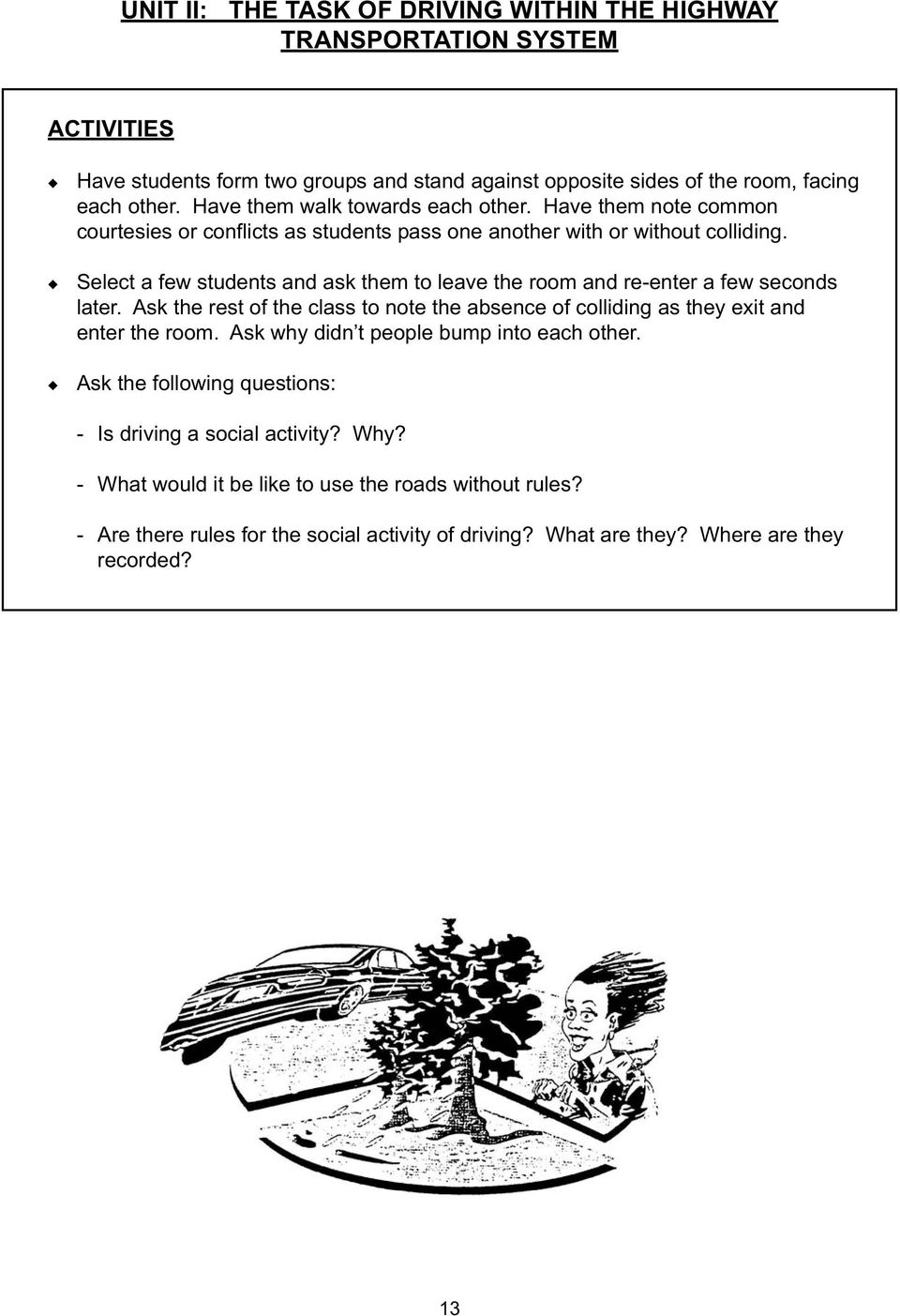
19 UNIT II: THE TASK OF DRIVING WITHIN THE HIGHWAY TRANSPORTATION SYSTEM ACTIVITIES Have stdents form two grops and stand against opposite sides of the room, facing each other. Have them walk towards each other. Have them note common cortesies or conflicts as stdents pass one another with or withot colliding. Select a few stdents and ask them to leave the room and re-enter a few seconds later. Ask the rest of the class to note the absence of colliding as they exit and enter the room. Ask why didn t people bmp into each other. Ask the following qestions: - Is driving a social activity? Why? - What wold it be like to se the roads withot rles? - Are there rles for the social activity of driving? What are they? Where are they recorded? 13
20 UNIT II: THE TASK OF DRIVING WITHIN THE HIGHWAY TRANSPORTATION SYSTEM STUDENT OBJECTIVE The stdents will identify the three basic parts of the Highway Transportation System (HTS), and 1. identify several components of each part, 2. discss the interrelation of the parts, 3. determine if each part is controllable or ncontrollable. SESSION CONTENT There are many parts to each component of the HTS. The environment is composed of the road, the weather, other motor vehicles, bicycles, pedestrians, srronding obstacles, visibility and lighting conditions. Vehicles differ by type, age and condition. Drivers also vary in many ways, sch as age, sex and fitness levels. While no driver can control weather or the actions of other drivers, each driver can control his or her own behavior. Driving is based on trst and being able to predict the actions of others. A person trsts that their car will perform as planned, the road will be in good shape, the weather will be manageable and other drivers will drive safely. A sdden failre of one vehicle, a change in the weather or traffic density, or the failre of a driver to obey traffic laws, can greatly increase the likelihood of a collision. The most important part of the HTS is yo, the driver. Drivers are responsible for over 90 percent of all collisions, while the other parts of the HTS are responsible for the remainder. The driver is the least predictable component. However, he or she is the only component that can react to changing conditions. NOTE: Instrctors shold highlight the role played by others in the HTS. This incldes pedestrians, especially children, the elderly, and those physically or hearing impaired. 14

21 UNIT II: THE TASK OF DRIVING WITHIN THE HIGHWAY TRANSPORTATION SYSTEM ACTIVITIES Divide the class into 3 grops (a large class can be divided into 6 grops). Grops will be assigned one traffic component, and will identify as many parts of the HTS as possible. Grop recorders will write down their responses and present them to the class. Show the class a model of the traffic system represented by a circle divided into three nlabeled parts. Use stdent responses to label the diagram. Ask the following qestions: - What are the three basic parts of the HTS? - Which part is the least predictable? - Which part of the HTS is most important? Why? - Which part of the HTS is the most difficlt to control? Why? - How does the driver affect the other parts of the HTS? - Which part of the HTS cases the most crashes? - Which part of the HTS is best able to compensate for changes in the other parts? 15
22 UNIT II: THE TASK OF DRIVING WITHIN THE HIGHWAY TRANSPORTATION SYSTEM STUDENT OBJECTIVE The stdents will nderstand and discss the characteristics of a safe driver. SESSION CONTENT To be a safe driver, each motorist mst have the following characteristics: Physical fitness - the ability to se their body to operate the vehicle. Mental fitness - the ability to properly react to the information drivers receive from their senses. Driving skills - developed by behind-the-wheel experience. Knowledge - continally acqiring information a driver can se to safely operate a vehicle. Good driving habits - combinations of skillfl driving actions a driver has practiced so freqently that they have become second natre, and are performed atomatically. Emotional fitness - the ability to control the effects of one s feelings on driver performance. Corteos attitde - being considerate of others and not driving in an aggressive or reckless manner. 16
23 UNIT II: THE TASK OF DRIVING WITHIN THE HIGHWAY TRANSPORTATION SYSTEM ACTIVITIES Draw the arch on a chalkboard, whiteboard or post it on a flipchart. Fill in arch and discss each characteristic. Ask the following qestions: - What does it take to be a safe driver? - What does impaired driving mean? - How do or habits affect or driving? - What does it mean to be physically fit to drive?...emotionally fit to drive? - Can yo be emotionally fit to drive sometimes and not at other times? Explain. - What are some skills a person mst have to drive safely? - How does a driver s attitde affect his or her driving? 17
24 UNIT III: DRIVER HABITS AND SKILLS OVERVIEW Safe driving is dependent pon learning good skills and practicing good habits. A driving habit is an action taken reglarly. An example of this is wearing a safety belt. A driving skill is the ability to se yor knowledge effectively and readily. An example of a good driving skill is practicing the three-second rle to maintain a safe distance while following behind another vehicle. INSTRUCTOR OBJECTIVES The instrctor shall discss: 1. Defensive driving, blind spots, and the importance of always wearing safety belts. 2. The five steps of the Space Cshion System of driving, and commnicating with other drivers. 3. The decision making process. 4. The rles of the road, and sharing the road with other highway sers. 5. The correct procedres for driving in intersections, making trns, and changing lanes. 6. Driving on expressways, one-way streets, and backing a vehicle. 7. Proper driving techniqes when passing a vehicle or being passed, and how to react to a school bs in operation. 8. Traffic signs, traffic lights, pavement markings, and traffic officers. 9. Work zone safety, the hazards that may be encontered, and strategies for driving safely throgh the work zone. 10. Poor driving behaviors and how to avoid them. 11. Reaction time, stopping distance, and covering the brake. 12. Hydroplaning and recovering from a skid. 13. How to safely share the road with other highway sers. 14. The dangers associated with sleepiness and fatige when driving, and ways to maintain attention and awareness while driving. 15. Reqirements of the safety belt law, common myths, and child safety seat se. 16. Hazards of large vehicles and how to share the road safely with them. 17. Reqirements of the laws regarding se of cell phones and handheld electronic devices, and other driving distractions. 18
25 UNIT III: DRIVER HABITS AND SKILLS STUDENT OBJECTIVE The stdents will define and discss defensive driving and blind spots. SESSION CONTENT Defensive driving may be defined as driving to prevent crashes, driving careflly, making allowances for other drivers and allowing for changes in the highway environment. Crash prevention and crash avoidance are achieved by: 1. Using yor senses and developing good perceptal skills, 2. Making correct decisions and acting accordingly, 3. Driving careflly to minimize errors, 4. Making allowances for the lack of skills or bad attitdes of other drivers, 5. Allowing for changing weather and road conditions or the actions of pedestrians and other drivers, 6. Conceding the right of way when necessary to prevent a crash, 7. Recognizing a crash-prodcing sitation far enogh in advance to prevent it, 8. Wearing a seat belt at all times, to keep the driver behind the wheel in order to control the vehicle. To act appropriately in a given sitation, the driver mst first see the hazard. Sometimes, however, a driver s vision is blocked or impaired casing a blind spot. When sing side and rearview mirrors, two very significant blind spots for drivers occr on the left and right sides of the vehicle in the area of the vehicle s rear qarter. A driver mst trn his or her head in order to make sre there is nothing in the blind spot before moving the vehicle. All mirrors have blind spots. Seeing a hazardos sitation is not enogh if there is no recognition or perception that the objects, or sitations pose a threat. Perception, then, is nderstanding the implications of what is seen. 19
26 UNIT III: DRIVER HABITS AND SKILLS ACTIVITIES Condct a discssion abot defensive driving and what this means to the driver. Move a pencil close to the eye (within an inch or two; not the sharpened end!) to show how a large blind spot can be created by a small object. Qestions to ask: - Are actions of other drivers predictable? - A key component of defensive driving is avoidance. What are some examples of defensive driving behavior? - What is a blind spot? - Cold a bicyclist, motorcyclist or pedestrian be hidden in the blind spot? Cold a van, a bs or a tractor trailer? - What is the difference between seeing something and perceiving it as a risk? 20
27 UNIT III: DRIVER HABITS AND SKILLS STUDENT OBJECTIVE Stdents will list and describe the five steps of Space Cshion System of driving and describe at least three ways for drivers to commnicate with other highway sers. SESSION CONTENT All drivers need to se their vision to see the traffic scene, and to search for any conflicts or potential collisions. Drivers mst see not merely what they expect to see, bt what is actally there. For example, crashes between two-wheeled vehicles and cars are often de to the driver not seeing the motorcyclist or bicyclist. Another example is an atomobile driver who travels over a railroad crossing every day withot ever seeing a train; eventally the driver may stop looking for a train. The defensive driver is always prepared for something nexpected to happen. One system of defensive driving advocates maintaining a cshion of space between yor vehicle and other roadway sers. The space cshion system of driving follows these five steps: 1. Look far ahead and be alert to potential hazards (If visibility is less than ideal, yo may need to slow down to allow yorself more reaction time and stopping distance. For example, on a clear day yo might be able to see ¼ mile (1320 feet) ahead, whereas on a foggy day yo might see only 100 feet ahead). 2. Get the big pictre (see everything on both sides of the highway). 3. Keep yor eyes moving (se scanning techniqes). 4. Leave yorself an ot (plan where yo will steer or leave room to stop). 5. Make sre other highway sers see yo (always se directional signals when changing lanes or trning and se eye contact when possible). Practicing these steps and maintaining a safe following distance will give yo the space and time yo need to react to any emergency sitation. By commnicating yor intentions to others, yo can let them know what yo plan to do. Yo can commnicate yor intentions to other highway sers in many ways. The most common device to signal other drivers is the directional signals. Yo can se yor horn in a potential emergency sitation. By sing these devices, yo commnicate with other drivers, ths making yor own moves more predictable. Yo can also se hand signals, lane positioning of yor vehicle, headlights and eye contact to commnicate with others. In addition, slow-moving or disabled vehicles may se emergency flashers (also known as hazard lights or for-way flashers) to warn other drivers. Obeying traffic laws abot signaling is a way of making yor own actions more predictable so that other drivers can better anticipate yor intentions. Many vehicles today have daytime rnning lights. If yor vehicle does not have daytime rnning lights yo may choose to se yor headlights dring daylight hors to make yor vehicle more obvios to other highway sers. Be carefl to avoid doing anything that may confse or misinform others. 21
28 UNIT III: DRIVER HABITS AND SKILLS ACTIVITIES Relate driver commnication to how we commnicate in other social activities. Discss ways drivers commnicate with other highway sers. Qestions to ask: - What does space cshion driving mean? - What are the five steps of space cshion driving? - What assmptions do we make from other drivers ces? - Are they valid assmptions? - List other highway sers. - How can yo inflence the behavior of other highway sers? - How does proper or improper commnication affect the predictability of driver actions? 22
29 UNIT III: DRIVER HABITS AND SKILLS STUDENT OBJECTIVE Stdents will discss how decisions are made and describe the SEE SM strategy. SESSION CONTENT Drivers can improve their decision making with the Motorcycle Safety Fondation s SEE SM strategy, a three-step process sed to help analyze the srrondings, anticipate potential problems, and make appropriate jdgments, applying them correctly in varied driving sitations. Search Evalate Execte Search Search aggressively ahead, to the sides, and behind, to identify factors that cold case increased risks and avoid potential hazards even before they arise. How assertively yo search, and how mch time and space yo have, can eliminate or redce dangeros sitations. Searching provides valable information to help yo make good driving decisions. Check yor mirrors freqently and se head checks to monitor blind spots. Focs even more on finding potential escape rotes in or arond intersections (especially intersections with limited visibility), shopping areas and school or constrction zones. Search for factors sch as: l l l l Oncoming traffic that may trn left in front of yo Traffic coming from the left and the right Traffic approaching from behind Hazardos road conditions Be especially alert in areas with limited visibility. Visally bsy srrondings cold hide yo from others. Evalate Think abot how hazards can interact to create risks for yo. Anticipate potential problems and have a plan to redce risks. Evalate potential problems and make plans in yor mind to deal with things that might happen. Don t think of evalating as gessing, think of it as reading the sitation to minimize risks of collisions. Some hazards to watch for are: l l l Road and srface characteristics potholes, gardrails, bridges, location of telephone poles, streetlights and trees Traffic control devices Look for traffic signals, inclding reglatory signs, warning signs and pavement markings, to help yo evalate circmstances ahead Other Vehicles and pedestrians Other vehicles and pedestrians may move into yor path and increase the likelihood of a crash 23
30 UNIT III: DRIVER HABITS AND SKILLS Execte Carry ot yor decision to minimize risks. To create more space and minimize harm from any hazard: l l l Commnicate yor presence and yor intentions with directional signals, lights and/or horn Adjst yor speed by accelerating, stopping, or slowing Adjst yor position and/or direction by changing lanes if necessary An example of SEE SM : A motorist sees a bicyclist traveling on the same side of the road and going in the same direction. Knowing that bicyclists may swerve into the roadway to avoid hazards, the driver scans the srrondings, gets ready to brake if necessary, and moves to the left portion of the lane or changes lanes as a precation. Remind the stdents: Driving reqires yor fll attention. ACTIVITIES To demonstrate decision-making, toss a plastic golf ball to a stdent. Then toss 5 to 6 plastic golf balls to a stdent. This demonstrates the difference between simple reaction and complex reaction. Facing the class, demonstrate proper eye movement (scanning). Qestions to ask: - How are decisions made? - Why are some decisions harder to make than others? - What are the steps in the SEE SM process? Discss each one. - What wold happen if yo drove with yor eyes fixed jst on the car ahead of yo? - Where shold yo be looking while driving? - What special hazards can yo expect when approaching a driveway in a residential neighborhood? a driveway in the contry? a bsiness area? - What do drivers do that interfere with their driving? - Can yo spot drivers who are doing these other activities? How? 24
31 UNIT III: DRIVER HABITS AND SKILLS STUDENT OBJECTIVE The stdents will begin to identify and discss some of the basic rles of the road. SESSION CONTENT Here are the right-of-way rles: 1. A driver approaching an intersection mst yield the right of way to traffic already lawflly sing the intersection. 2. If a driver approaching from the opposite direction reaches an intersection at abot the same time yo do, the driver trning left mst yield to approaching traffic going straight or trning right. 3. At intersections not controlled by signs or signals, or where two or more drivers stop at STOP signs at the same time and they are at right angles to one another, the driver on the left mst yield the right of way to the driver on the right. 4. A vehicle entering a roadway from a driveway, alley, private road or any other place that is not a roadway mst stop and yield the right of way to traffic on the roadway, and to pedestrians. 5. Drivers mst yield to pedestrians who are legally sing marked or nmarked crosswalks. 6. A driver may not enter an intersection if the traffic ahead is backed p and it is impossible to get all the way throgh the intersection. The driver shold wait ntil traffic ahead clears, to avoid blocking the intersection. 7. A driver entering a traffic circle, sometimes called a rotary, mst yield the right of way to drivers already in the circle. 8. Drivers mst pll over and stop for an emergency vehicle, even if it is approaching from the opposite direction. 9. Drivers mst stop their vehicle before reaching a school bs displaying red crossover lights, and may proceed only when signaled by a police officer or the school bs driver, or ntil the bs resmes motion, or the cross-over lights are trned off. 25
32 UNIT III: DRIVER HABITS AND SKILLS ACTIVITIES Diagram an intersection on the chalkboard, whiteboard or se another visal aid sch as a magnetic board with cars to demonstrate right of way. Diagram a school bs on the road, and discss where other drivers are to stop. Qestions to ask: - Yo are stopped at a stop sign, and yo plan to go straight throgh the intersection. A driver on the intersecting road has stopped at a stop sign on yor right, and is also going to go straight. Who mst yield the right of way? - Yo are coming ot of a parking lot, and yo plan to trn right onto the street. A vehicle is approaching from yor left. Who mst stop and wait? - Yo are stopped at a red light. A pedestrian steps into the crosswalk, and then the light trns green. Do yo have to wait for the pedestrian to cross? - If two drivers enter an intersection from opposite directions at the same time, one going straight, the other trning left, which mst yield the right of way? - If yo enter an intersection to make a left trn, bt oncoming traffic prevents yo from making the trn right away, what shold yo do? - What mst yo do if yo are entering a road from a driveway? - Yo are facing a green light, bt traffic on the other side of the intersection wold keep yo from going all the way throgh the intersection. May yo enter the intersection? - Does a vehicle abot to enter a traffic circle or rotary have the right of way over vehicles already in the circle? - What shold yo do if yo hear a siren nearby, bt yo can t see where the emergency vehicle is? 26
33 UNIT III: DRIVER HABITS AND SKILLS STUDENT OBJECTIVE Stdents will identify and discss the driving procedres to follow regarding intersections, trns, and lane changes. SESSION CONTENT The majority of crashes occr at intersections. Some drivers do not know or may not practice safe driving habits/skills at intersections. Below are some important rles to know and follow. 1. Stop signs and red lights. Drivers mst come to a fll stop before entering a crosswalk, and yield the right of way to vehicles and pedestrians in the intersection. Proceed only when it is both safe and legal. 2. Right trn on red. If right on red is not permitted, a sign stating that will be located on the right side of the road; sometimes an additional sign is next to the traffic light. When trning right on red is permitted, drivers who make a right trn on red mst stop completely and follow the rles stated in #1. 3. Arrow traffic light. The arrow designates lane position; the color tells a driver what to do. 4. Lane positioning. Vehicle placement pts yo in a position to execte a manever and helps commnicate yor intentions to others. For example, if yo re going to make a left trn from a one-way street, yo are to position yor vehicle in the frthest left lane. When making a right trn, ideally, yo shold place yor vehicle three to five feet from the right crb. 5. Left trn from a middle lane. Many roads now have a middle lane, which is to be sed for making a left trn. This lane was created to enable traffic to contine nimpeded, by permitting a driver to place the vehicle in the middle lane while waiting for a gap in traffic to make a left trn. Remind the stdents: Lane changing reqires the se of signals and a trn of yor head to check the blind spots. Also, when trning, expand yor scanning for pedestrians, bicyclists, or other potential hazards abot to cross or enter yor path. 27
34 UNIT III: DRIVER HABITS AND SKILLS ACTIVITIES Ask the stdents to list the different steps for making a trn. Draw an intersection on the chalkboard or whiteboard and discss the different types of trns with the class. Draw a 4-lane road and ask stdents how they shold make lane changes. Qestions to ask: - How do yo make a proper left trn? - What is the correct way to make a right trn when facing a red light? - When waiting at a traffic light with a left arrow facing yo, what are yo to do? - When the light trns green with a red left arrow facing yo, what are yo to do? - Where shold yo position yor car for a left trn on a two-lane road? a forlane road? a road with a center lane? - When making a lane change, list other highway sers who cold be hidden from view becase of the blind spot. - How far before a trn mst yo signal? - When preparing for a right trn, shold yo stay as close to the center of the lane as possible? - Where shold yo position yor vehicle when preparing to make a left trn from a two-way roadway into a one-way roadway? 28
35 UNIT III: DRIVER HABITS AND SKILLS STUDENT OBJECTIVE Stdents will identify and discss driving on an expressway, a one-way street and backing a vehicle. SESSION CONTENT An expressway entrance ramp is typically sed for accelerating to the proper speed, nless there is a stop sign, yield sign or traffic light on the ramp. After entering the expressway, yo mst execte a proper lane change to blend in with traffic. It s important that yo allow enogh space between yor vehicle and other vehicles when entering or exiting a highway, or when changing lanes. Under ideal conditions, yo shold merge only when yo can maintain a space cshion of at least 2 seconds between yor vehicle and the vehicle in front of yo, AND at least 2 second between yor vehicle and the vehicle behind yo. In other than ideal conditions, sch as heavy rain or snow, yo will need to allow additional space between yo and the other vehicles. Exit ramps are sed for slowing down. Unless the exit ramp is short, do not apply the brakes while still on the expressway. Once yo are on the exit ramp, slow down. Most drivers spend the least amont of their driving time on one-way streets. Identifying them is essential. Besides the one-way sign, other indicators that yo re on a one-way street are the presence of reglations signs facing yo on the left, and parked cars on both sides of the street all facing the same way. To back p a vehicle safely, yo need to shift into reverse, trn yor head and look directly in the path the car will travel, and trn the steering wheel in the direction yo want the vehicle to go. Glancing to the side and into the mirrors is helpfl to assre that there is nothing in yor way. Other vehicle eqipment may also be helpfl, i.e. rearview cameras and sensors. However, these shold not replace trning yor head to look in the direction yo are traveling. 29
36 UNIT III: DRIVER HABITS AND SKILLS ACTIVITIES Ask stdents how they shold: 1. Properly se expressways, 2. Back p a vehicle, 3. Use/recognize one-way streets. Diagram an intersection or se a magnetic board with cars to properly demonstrate the correct way to se entrance and exit ramps on expressways. Incorporate discssion on driving techniqes with the SEE SM techniqe of decision making. Qestions to ask: - What is the proper way to exit and enter an expressway? - Which way do yo move the steering wheel of a car if yo want to back p to the right? 30
37 UNIT III: DRIVER HABITS AND SKILLS STUDENT OBJECTIVE Stdents will nderstand how to pass other vehicles, be passed by other vehicles, and react to a school bs in operation. SESSION CONTENT When passing other vehicles or changing lanes to avoid hazards, do so with cation and only when necessary. Yo may not exceed the speed limit to pass another vehicle. Use directional or hand signals, as the law reqires, at least 100 feet before making a lane change. Never pass a vehicle which has stopped at a crosswalk to allow a pedestrian to cross. Passing on the Left: The left lane is sally sed for passing other vehicles. That s why it is often called the passing lane. However, yo may NOT pass a vehicle on the left if: * Yor lane has a solid yellow center line. * Yo cannot safely retrn to the right lane before reaching a solid yellow center line for the right lane. * Yo cannot safely retrn to the right lane before any approaching vehicle comes within 200 feet of yo. * Yo are approaching a crve or the crest of a hill on a two-way road and cannot see arond or over it. * Yo are within 100 feet of a railroad crossing a bridge, tnnel or viadct on a two-way roadway. * Passing will interfere with oncoming traffic. Passing on the Right: Yo shold sally pass other vehicles on the left, bt passing on the right is allowed in certain sitations. Yo MAY pass on the right: * When a vehicle ahead is making a left trn. * When yo are driving on a one-way road that is marked for two or more lanes or is wide enogh for two or more lanes, and passing is not restricted by signs. 31
38 UNIT III: DRIVER HABITS AND SKILLS Being Passed: If another vehicle passes yo on the left, slow down slightly and stay to the right. When the vehicle has safely passed and is well ahead of yo, resme yor normal speed. If yo find that many vehicles are passing yo on the right, yo shold move into the slower right lane and allow them to pass yo on the left. School Bses: When a school bs stops and flashes its red light(s), traffic approaching from either direction mst stop before reaching the bs. Yo shold stop at least 20 feet away from the bs. Yo mst stop for a school bs even if it is on the opposite side of a divided highway. ACTIVITIES Qestions to ask: - In most sitations, on which side shold yo pass another vehicle going in the same direction? - What shold yo do before passing another vehicle? - What shold yo see in yor rear view mirror before attempting to retrn to the right lane after passing a vehicle on the left? - In what sitations may yo pass a vehicle on the right? - When may yo pass a vehicle stopped at a crosswalk to allow a pedestrian to cross? - What action shold yo take when another vehicle passes yo on the left? - What do flashing red lights on a school bs mean? 32
39 UNIT III: DRIVER HABITS AND SKILLS STUDENT OBJECTIVE Stdents will know and recognize traffic signs. SESSION CONTENT Signs Traffic signs tell yo abot traffic rles, special hazards, where yo are, how to get where yo re going and where services are available. The color of traffic signs gives cles to the type of information they provide: 1. STOP Sign (Red, with white letters.) Come to a fll stop, yield the right of way to vehicles and pedestrians in or approaching the intersection. Go when it is safe. Yo mst come to a stop before the stop line, if there is one. 2. YIELD Signs (Red and white, with red letters). Slow down as yo approach the intersection. Prepare to stop and yield the right of way to vehicles and pedestrians in or approaching the intersection. Yo mst come to a fll stop at a YIELD sign if traffic conditions reqire it. Approach with cation and be prepared to stop: otherwise, proceed with care. 3. REGULATION Signs (White, with black and/or red letters or symbols.) These signs give yo information abot rles for traffic direction, lane se, trning, speed, parking, and other special reqirements. 4. WARNING Signs (Yellow, with black letters or symbols.) Yo are approaching an especially hazardos location or a place where there is a special rle. Be especially catios when yo see a warning sign. 5. RAILROAD CROSSING (Yellow with black letters RR and X symbol.) There is a railroad crossing ahead. Yo shold se cation, and yo may have to stop. Most bses and some trcks mst stop at railroad crossings. 6. WORK AREA Signs (Orange, with black letters or symbols.) People are working on or near the roadway, and traffic may be controlled by a flag person. A work area speed limit of 35 MPH may be posted. 33
40 UNIT III: DRIVER HABITS AND SKILLS ACTIVITIES Qestions to ask: - What is the sal color of a warning sign? - What color is a destination sign? - What mst yo do at a STOP sign? - What color is a railroad warning sign? 34
41 UNIT III: DRIVER HABITS AND SKILLS STUDENT OBJECTIVE Stdents will discss and nderstand the meaning of varios traffic lights. SESSION CONTENT Traffic Signals Traffic lights are sally red, yellow and green from top to bottom, or left to right. At some intersections, there are single red, yellow or green lights. Some traffic lights are steady, others flash. Some are circlar, and some are arrows. Here is what varios traffic lights mean: STEADY RED: Stop. Do not go ntil the light is green. Unless prohibited, yo may make a: right trn on red, or left trn on red ONLY from a one-way street to another one-way street. Before yo make any trn on red, yo mst come to a fll stop and yield the right of way to oncoming traffic and pedestrians. Yo may not make a trn at a red light if there is a NO TURN ON RED sign posted, or if another sign, signal or pavement marking prohibits the trn. Also, trning on a red light is not allowed in New York City nless a sign is posted permitting it. The driver of a school bs carrying ppils may not trn on any red light. Always watch for pedestrians in the crosswalks when trning on red. FLASHING RED: Means the same as a STOP sign: Stop, yield the right of way, and go when it is safe. RED ARROW: Do not go in the direction of the arrow ntil the red arrow goes ot and a green light or arrow goes on. A right or left on red trn is not permitted at a red arrow. STEADY YELLOW: The light is changing from green to red. Be ready to stop. FLASHING YELLOW: Drive with cation. YELLOW ARROW: The protection of a green arrow is ending. Be prepared to stop. STEADY GREEN: Go, bt yield the right of way to other traffic. GREEN ARROW: Yo may go in the direction of the arrow, bt yo mst yield the right of way to other traffic at the intersection as reqired by law. Note: State law reqires that if the traffic lights or controls are ot of service or malfnctioning when yo approach an intersection, yo mst come to a stop as yo wold for a stop sign. Yo mst then proceed according to the rles of right of way, nless yo are directed to proceed by a traffic officer. 35
42 UNIT III: DRIVER HABITS AND SKILLS ACTIVITIES Qestions to ask: - What wold yo do when facing each of the following: (1) a steady yellow light (2) a flashing yellow light (3) a steady red light with a green arrow pointing left (4) a flashing red light 36
43 UNIT III: DRIVER HABITS AND SKILLS STUDENT OBJECTIVE Stdents will know and recognize pavement markings and traffic officers. Pavement Markings Lines and symbols on the roadway divide lanes and tell yo when yo may pass other vehicles or change lanes, which lanes to se for trns, and where yo mst stop for signs or traffic signals. Single broken line: Yo may pass other vehicles or change lanes if yo can do so safely and not interfere with traffic. Solid line with broken line: If yo re on the side with the solid line, yo may not pass other vehicles or cross the line except to make a left trn into a driveway. If yo re on the side with the broken line, yo may pass if it is safe to do so, and will not interfere with traffic. Doble solid lines: Yo may not pass, or change lanes Single solid line: Yo may pass other vehicles or change lanes, bt yo shold do so only if obstrctions in the road make it necessary, or traffic conditions reqire it. Stop and Crosswalk Lines: When reqired to stop becase of a sign or light, yo mst stop before reaching the stop line, if there is one, or the crosswalk. Traffic Officers Directions given by traffic officers take precedence over signs, signals or pavement markings. Among those athorized to direct traffic are police officers, peace officers (sch as on-dty axiliary or fire police), and highway work area flag persons. 37
44 UNIT III: DRIVER HABITS AND SKILLS ACTIVITIES Qestions to ask: - What does it mean if an edge line slants in toward the center of the road? - What do each of these types of lines mean: single broken, single solid, doble solid, solid and broken together? - If an intersection has crosswalk lines bt no STOP line, where wold yo stop for a red light at that intersection? - What type of pavement marking is sed to show yo which lane yo mst se for a trn? - Which of the following mst yo obey over the other three: steady red light, flashing red light, STOP sign, police officer? 38
45 UNIT III: DRIVER HABITS AND SKILLS WORK ZONE SAFETY STUDENT OBJECTIVE Stdents will be able to define a work zone and be able to identify the hazards a highway work zone presents. Stdents will be able to discss strategies for driving safely throgh a work zone SESSION CONTENT Work zone is defined in the Vehicle and Traffic Law (Section 160) as, "That part of the highway being sed or occpied for the condct of highway work, within which workers, vehicles, eqipment, materials, spplies, excavations or other obstrctions are present." Some facts abot road work zones: As states and the federal government focs on rebilding/refrbishing the highway system in the post-interstate era, more work zones will be set p each year; more work zones mean more risk of accidents and deaths (1,181 people died nationally in work zones in the year 2002, per NHTSA) The most common crash in a highway work zone is the rear-end collision (Federal Highway Administration) Speeding ticket fines are dobled in work zones Enforcement of traffic laws in work zones is maintained 24 hors a day; work zone speed limits are enforced even when no work is nderway Traffic enforcement is enhanced in work zones becase of all the potential risks and dangers Driving sitations that a motorist may enconter as a reslt of the establishment of a work zone: Lack of sholder and/or median areas that sally serve as a bffer Lanes redced in width Lanes merging and sbseqently redced in nmber Speed redction Changing lane patterns Detors to nfamiliar rotes Large constrction or maintenance vehicles to the side of the road that may obstrct vision Highway workers standing and working near traffic Slow moving constrction vehicles Drivers slowing to redce speed and/or merging at the last possible moment Aggressive drivers disregarding the work zone restrictions Drivers not sing common sense in the work zone area Some work zones are mobile, sch as line painting and road patching operations. These zones move along the highway ntil the work is completed. Obey the signs ntil yo have passed the one that states yo have left the work zone. 39
46 UNIT III: DRIVER HABITS AND SKILLS WORK ZONE SAFETY Some sggestions for driving safely throgh a work zone: Diamond shaped orange warning signs are posted in advance of work zone areas. Pay attention to these signs! A "flagger ahead" warning sign may be posted as yo approach the work zone. Obey the flagger's directions; a flagger has the same athority as a reglatory sign, so yo can be ticketed for disobeying his/her directions When yo see flashing arrow panels or "lane closed ahead" signs, merge as soon as possible Slow down as soon as the signs tell yo to The most common crash in the highway work zone is the rear end collision, so leave plenty of space between yo and the car in front of yo (the 2 second rle wold be best) Stay calm and expect the nexpected Observe all posted signs ntil yo see the one that states yo have left the work zone If yo already know of the existence of a work zone, yo may want to plan an alternative rote Sorce: U.S. Department of Transportation, Federal Highway Administration ACTIVITIES Ask stdents to relate any dangeros experiences they have had driving throgh a work zone either as a passenger or stdent driver. What made the sitation dangeros? How cold the danger be redced or eliminated? Distribte DMV Driver's Manals. Refer stdents to the section of Chapter 4 (Traffic Controls) labeled Work Area Signs. Have stdents read the short section and note the shape and symbols sed in work zone signs. Verbally qiz the class on the color and shape of work zone signs. Give an example of the type of message one might see on a work zone sign. 40
47 UNIT III: DRIVER HABITS AND SKILLS DISTRACTED DRIVING STUDENT OBJECTIVE Stdents will list and describe poor behaviors that drivers engage in, and discss the importance of avoiding them while driving. SESSION CONTENT Driving is a complex mental task that deserves yor fll attention. However, most drivers freqently devote part of their attention to other things while driving, sch as eating, talking on the telephone, listening to msic and discssions with passengers. It is dangeros to treat the driving task too casally. If yo drive at 55 miles per hor, yor vehicle is traveling at 81.4 feet per second. To divert yor attention for only a few seconds (to look at a text message, dial a telephone nmber, rmmage throgh yor wallet for toll money, etc.) reslts in yor vehicle traveling hndreds of feet while yor attention is elsewhere; this distance cold easily be more than the length of a football field. A driver s primary task is to safely operate the motor vehicle - this reqires the driver s fll attention. Drivers shold avoid or at least minimize other activities while driving. With preparation and common sense, yo can plan ahead and avoid nnecessary activities while driving and avoid a crash. 1. Before yo drive, prepare yorself by having toll money available, a cassette tape, CD, or other media already loaded, GPS already programmed, snglasses at yor fingertips, etc. 2. Use optional eqipment and accessories only when necessary. Some car sond systems and GPS devices can be confsing, and sing them while driving can be very distracting. 3. Delegate some activities. If yo have a passenger in the vehicle with yo, have him or her: change the radio/cd; adjst climate control; review map or navigational system; se the cell phone or handheld electronic device. Remember: If the driver mst se a cell phone, the driver is reqired to se a hands-free device. 41
48 UNIT III: DRIVER HABITS AND SKILLS DISTRACTED DRIVING 4. Pll off the road to rmmage throgh yor CDs, chase a bee ot of the car, read a map, etc. 5. Even drinking, eating, and smoking can distract yor attention while driving. It s generally safer to avoid these activities while driving. 6. Postpone or delay the activity. The driving scene changes every few seconds. Don t change yor radio station at an intersection, or in tight driving sitations. Wait for a low risk sitation, sch as while waiting at a traffic light, or when traffic is minimal. 7. Practice good visal habits. Don t look at passengers when talking to them. Glance qickly at the radio when changing stations. 8. Keep a clear head and focs on yor srrondings. Don t daydream while driving. Replaying an argment in yor mind or trying to make an important personal decision while driving is dangeros. ACTIVITIES Ask stdents what activities they ve observed other drivers doing; list them on chalkboard, whiteboard or flipchart. Understanding distraction: 1. Time a stdent typing a short text message sch as I ll have the car back by 9. Record the time. 2. Repeat the above exercise, bt this time disrpt the stdent while they are still texting. Record the time. Take the time texting, pls 1 ½ seconds (reaction time), then mltiply the nmber of seconds by 59 (as in feet per second). This identifies how far they wold have travelled. - Discss how performing even a brief task like this text message cold distract their attention from driving? NOTE TO THE INSTRUCTOR: By performing this demonstration of Distraction with yor stdents, yo ll be able to show the stdents exactly how mch of their attention can be drawn away from driving, and how far they may travel dring that time. Frther, by discssing how even simple tasks like texting can case significant lapses in their attention to the road and the driving environment, this will help illstrate how dangeros texting (or other activities) while driving can be. Helpfl Links:
49 STUDENT OBJECTIVE Stdents will nderstand reaction time, reaction distance, stopping distance, and covering the brake. UNIT III: DRIVER HABITS AND SKILLS SESSION CONTENT All drivers need to determine a safe following distance between vehicles. The best way to determine this distance is to stay at least two seconds behind the car immediately ahead. The formla of one car length for each ten miles per hor of speed is sometimes sed to define a safe following distance. However, some people have a difficlt time jdging distances accrately while in a moving vehicle. These formlas apply on dry pavement nder good driving conditions. Yo may need to doble or triple yor following distance if yo are driving in rain, or other adverse conditions. To practice the two-second rle, choose a stationary object on or alongside the road. When the rear bmper of the vehicle ahead of yo reaches the object, begin to cont one thosand one, one thosand two. If yo complete conting to one-thosand two before passing the stationary object, yor following distance is adeqate. Reaction Time: The time it takes to recognize a sitation (perception time), decide on an action, and begin to take the action. Perception Distance: This is the distance yor vehicle travels from the time yor eyes see a hazard ntil yor brain recognizes it. The perception time for an alert driver is abot 3/4 second; in this time, a vehicle traveling at 55 mph will travel 60 feet. Reaction Distance: The distance traveled from the time yor brain tells yor foot to move from the accelerator ntil yor foot is actally pshing the brake pedal. An alert driver will take abot 3/4 second to react, traveling another 60 feet at 55 mph. Reaction time of an alert driver will be abot 1½ seconds, dring which a vehicle moving at 55 mph will travel 120 feet. Stopping Distance = Perception Distance + Reaction Distance + Braking Distance Braking Distance: The distance it takes to stop once the brakes are pt on. This distance varies with speed, type and condition of vehicle, and road conditions. A typical car traveling at 55 mph on a dry road wold take abot 140 feet to stop. Stopping Distance incldes the nmber of feet the vehicle travels dring reaction time (before yo hit the brakes), pls how many feet it actally takes to stop the car. In the example above for an alert driver on dry roads, the Stopping Distance is abot 260 feet. At 65 mph, the stopping distance wold be abot 340 feet, nearly the length of a football field. Remember to keep yor eyes moving as yo drive and glance to either side every few seconds to help shorten stopping distance. The practice of covering the brake is accomplished by placing yor foot jst above the brake pedal. This is done to shorten one s reaction time, which might be necessary in sitations sch as approaching children playing near the road or approaching a stale green light. A stale green light is one that is green when yo first see it, and may trn to cation (yellow) at any time. Speeding inflences vision, stopping distance, and crash srvival as: peripheral vision decreases stopping distance increases the force of impact increases chances of srvival decrease 43
50 UNIT III: DRIVER HABITS AND SKILLS ACTIVITIES Hold a dollar bill vertically. Have stdent hold their thmb and index finger 1/4 inch apart below the bill. Release bill withot warning. Stdent attempts to grasp it as soon as it is released; most people fail to grasp it. Have stdents list sitations where covering the brake is beneficial. Qestions to ask: - What is reaction time? - What is reaction distance? - What is stopping distance? - What is braking distance? - What habits can yo develop that can help decrease yor stopping distance? - What are the benefits of covering the brake? - Explain the two-second rle. 44
51 STUDENT OBJECTIVE UNIT III: DRIVER HABITS AND SKILLS Stdents will nderstand and explain hydroplaning, how to prevent it, and how to handle a skid. SESSION CONTENT Roads are at their slickest dring the first five to ten mintes of a rainfall. This occrs becase the water mixes with srface dirt and oil to form a slippery film, greatly redcing the ability of yor tires to grip the road. At speeds as low as 35 mph, the tires of a vehicle will begin to skim along the wet srface of the road, mch like a water-skier zipping across the srface of a lake. The tires may completely lose contact with the road and be riding on a thin film of water. This is called hydroplaning. Hydroplaning is very dangeros becase it severely limits yor ability to control yor car. Good tires with deep tread help prevent hydroplaning. To redce the chance of hydroplaning always have properly inflated tires, redce speed by abot one-third when driving on wet roadways, and avoid driving throgh standing water. To avoid skids, brake early, careflly, and gently on roads that are wet, snowy or icy. Yo shold always be aware of what type of brakes the vehicle yo are driving is eqipped with. Many cars now come eqipped with an anti-lock braking system (ABS). A driver shold not pmp the brakes when the car has ABS; the brakes in cars with ABS atomatically pmp themselves. Yo mst se steady, firm brake pressre if yo are in a skid. If yor vehicle does not have ABS, pmp yor brakes in slow steady strokes when in a skid. Allow the wheels to keep rolling. If they start to lock p, ease off the brake pedal. As yo slow down, yo may also want to shift into a lower gear. Althogh front-wheel drive and for-wheel drive vehicles generally handle better than rearwheel drive vehicles in ice and snow, they do not have flawless traction and skids can occr withot warning. The best approaches to recover from a skid are the same for both front- and rear-wheel drive vehicles. If yor rear wheels start to skid: Trn the steering wheel in the direction the vehicle is trying to go. If yor rear wheels are sliding left, steer left. If they re sliding right, steer right. If yor rear wheels start sliding the other way as yo recover, ease the steering wheel toward that side. Yo might have to steer left and right a few times to get yor vehicle completely nder control. If yor vehicle has ABS, keep yor foot on the brake pedal with even pressre. If yor vehicle does not have ABS, pmp the pedal gently, pmping more rapidly only as yor car slows down. Braking hard with non-anti-lock brakes will make the skid worse. If yor front wheels start to skid: Take yor foot off the accelerator and shift to netral or psh in the cltch, bt do not immediately try to steer. As the wheels skid sideways they will slow the vehicle and traction will retrn. As it does, steer in the direction yo want to go. Then pt the transmission in drive or release the cltch, and accelerate gently. Note: When sleet, freezing rain and snow start to fall, remember that bridges, ramps and overpasses are likely to freeze first, and that slippery spots may remain after road crews have cleared the highways. 45
52 UNIT III: DRIVER HABITS AND SKILLS ACTIVITIES Diagram a wheel on the chalkboard or whiteboard and illstrate how hydroplaning occrs. Diagram a car on the chalkboard or whiteboard and demonstrate how the wheels are to be trned if in a skid. Qestions: - What is hydroplaning? - What do yo do if yo get into a skid? - When the temperatre drops, what parts of the roadways may freeze first? 46
53 UNIT III: DRIVER HABITS AND SKILL STUDENT OBJECTIVE Stdents will describe other highway sers and how to safely share the road with them. SESSION CONTENT Pedestrians are the highway sers most at risk. Be especially watchfl when making a right trn; pedestrians legally crossing at intersections always have the right of way. Of all pedestrians, children are the least predictable and hardest to see. Take extra care to look ot for children, especially near schools, bs stops, playgronds, parks, and behind parked cars on the road. Bicyclists and moped sers have the right to share the road with vehicles, traveling in the same direction. Like pedestrians, bicyclists are difficlt to spot and have little protection. Approach bicyclists with extreme cation. Give them room and perhaps slow down when passing; air pressre from a qickly passing vehicle can throw a bicyclist off balance. Yo mst yield the right of way to a bicyclist. Motorcyclists also share problems faced by bicyclists: lower visibility, less stability and less protection. It is often hard to jdge how far away a motorcycle is or how fast it is going. Many car and motorcycle crashes occr when the car driver trns left in front of a motorcyclist after misjdging the cyclist s speed or distance and how long it will take the motorcyclist to brake. A motorcyclist has the right to the fll se of a lane and may change position within a lane to get a clearer view of traffic and avoid hazards. Farm vehicles, constrction eqipment and vehicles drawn by animals mst display the official slow-moving vehicle emblem of New York State at the rear of the vehicle. Use cation when approaching a slow-moving vehicle and be sre it is safe before passing. Horseback riders are to ride single file near the right crb or road edge. The law reqires yo to se care when approaching a horse; it is illegal to sond yor horn when approaching or passing a horse. Large vehicles, sch as tractor trailers, bses and large trcks, shold not be followed so closely that the driver can t see yo in the rearview mirrors, or yor view of the road ahead is blocked. It takes longer to pass a big trck or bs on level pavement than it does to pass another car. When going downhill, a large vehicle is likely to go faster, reqiring even more time for yo to pass it. However, large vehicles may be easier to pass when going phill, where they lose speed. Pay close attention to a large vehicle s trn signals. Trcks and bses may make wide right trns, leaving an open space to their right. To avoid a crash, don t pass a trck or bs on the right if there is a possibility it might trn right. If a trck is backing into a loading area and blocking the roadway, wait ntil the driver backs off the road before proceeding. Leave space when yo stop at a light or sign behind a trck or bs, especially when facing phill; it may roll back slightly when starting. Disabled vehicles can be a hazard. Yo may enconter one on any roadway, often where and when yo least expect them. Disabled vehicles will often have their emergency flashers on, to warn other traffic of the potential hazards. 47
54 UNIT III: DRIVER HABITS AND SKILLS ACTIVITIES Direct stdents who seek more information on bicycles to read brochres sch as Sharing the Road Safely (C-77), available at motor vehicle offices and on DMV s website. Stdents can be pt into grops of three to for and given five mintes to discss and list the varios special problems associated with sharing the road with others. Discss importance of sharing the road and share examples of common child cyclist injry sitations. Discss in-line skaters often sing roadways and the potential hazards. For more information abot in-line skating, direct stdents to read the Sharing the Road Safely (C-77) brochre. Qestions to ask: - Name some others who share the road with atomobiles. Pt their response on a chalkboard, whiteboard or flipchart, then ask them... - What special hazards do they present? 48
55 UNIT III: DRIVER HABITS AND SKILLS STUDENT OBJECTIVE The stdents will discss and nderstand the dangers associated with fatige and sleepiness. SESSION CONTENT Temporary impairments, sch as those cased by illness, injry, distractions, and alcohol or other drgs, can be extremely detrimental to driving. However, the danger prodced by driver sleepiness is far greater than is generally recognized. The likelihood of falling asleep at the wheel is more common than most people realize. One ot of five drivers admits to falling asleep at the wheel at least once. Many other sleepy drivers who deny falling asleep at the wheel may, nonetheless, have had microsleeps while driving. (Microsleep occrs when a drowsy driver is overtaken by involntary naps that last for to five seconds.) The NHTSA estimates that 100,000 reported crashes annally are the reslt of drowsiness. Many drivers don t realize that they have no volntary control over whether they fall asleep. They also don t realize that they cannot predict when they are abot to fall asleep. In a test sitation, nearly 80% of drivers thoght that they cold predict when they were abot to fall asleep behind the wheel; they were proven wrong. The mistaken idea that a motorist can predict when he or she is abot to fall asleep creates a false sense of secrity in the sleepy driver. Even if the sleepy driver does not actally fall asleep, driving ability is seriosly impaired by sleepiness in the following ways: 1. Visal misperception: The driver misinterprets what he or she sees on the road. 2. Increased reaction time: The driver responds more slowly to changing road or vehicle conditions. 3. Decreased attention span and redced information processing: The driver has difficlty concentrating on the road and vehicle conditions and has a diminished ability to process that information to make appropriate driver decisions. 4. Diminished jdgment: The driver has an increased likelihood of making decisions based on poor jdgment, sch as attempting risky manevers like passing other vehicles withot flly srveying the sitation. 5. Impaired problem-solving ability: The driver has less ability to get ot of dangeros sitations. 6. Decreased ability to control the vehicle : The driver may tend to have less control of the vehicle, sch as allowing it to drift from lane to lane. ACTIVITIES Ask for examples of drivers they know of who have fallen asleep while driving. Qestions to ask: - Do yo know anyone who has fallen asleep while driving? What happened? - Have yo ever fallen asleep when yo didn t even know yo were tired? ---In school? ---watching television? ---doing homework? When did yo realize that yo d been sleeping? How long were yo asleep? 49
56 UNIT III: DRIVER HABITS AND SKILLS STUDENT OBJECTIVE Stdents will list three ways to avoid sleepiness before driving and three ways to maintain a high attention and awareness level while driving. SESSION CONTENT STAYING AWAKE -- Before yo drive: - Be realistic -- rather than trying to cover a long distance in one shot, plan on stopping for a short rest or an overnight stay. - Avoid alcohol and other drgs -- even one drink will make a slightly tired person more drowsy. Avoid medicines, sch as allergy pills, that indce drowsiness. - Travel rested -- get plenty of rest before yor trip. - Respect yor body clock -- if yo drive when yo normally sleep, yo re fighting yor body s natral rhythm. Avoid this, or make plans to rest along the way. STAYING AWAKE -- On the road: - Nap -- a short rest may be an effective remedy to sleepiness. Find a safe place sch as a lit parking lot of an open restarant or store, or a designated rest stop. - Stay stimlated -- listen to the radio (a talk show may keep yo more alert than msic), open a window, chew gm. - Share the ride -- a travel partner can keep yo awake with conversation and give yo a break from driving. - Take a walk -- get ot at a rest stop jst to take a qick walk to the rest room or stroll arond for five mintes. Even a short break is helpfl. - Drink caffeine -- bt remember that the effects begin to wear off in an hor or so. - Recognize the warning signs -- if yor eyes get droopy, yor head nods down, yor sight begins to diminish, yor attention to the driving tasks wanders, or yo can t stop yawning, yo are at risk. - Deterioration of yor driving -- if yo drift back and forth in yor driving lane, inadvertently tailgate other vehicles, or misread traffic signs, yo are at risk. More information abot fatiged driving can be fond in the Drowsy Driving Awareness Fact Sheet and other pblications available on the Governor s Traffic Safety Committee website at 50
57 UNIT III: DRIVER HABITS AND SKILLS ACTIVITIES Ask for examples of ways to avoid sleepiness prior to driving. Ask for examples of ways to stay alert and fresh while driving. Qestions to ask: - What cases driver sleepiness? - What cases driver inattention? - If yo were going to go on a 400-mile vacation in two days, what shold yo do to avoid sleepiness and fatige before yo drive? - How can yo prepare yorself to avoid sleepiness and inattention while driving? 51
58 UNIT III: DRIVER HABITS AND SKILLS STUDENT OBJECTIVE The stdents will nderstand the reqirements of the New York State safety belt law (Vehicle & Traffic Law 1229-c) and the rationale for having the law. SESSION CONTENT Arond the world, more than 40 contries and provinces have enacted mandatory seat belt laws. Statistics on Astralia, one of the first to institte sch a law in 1970, show that 95 percent of people reglarly wear safety belts. Sweden and Great Britain have percent seat belt se. Fatalities dropped by abot 50 percent in these contries. New York State law reqires that all drivers and front seat passengers of motor vehicles operated in New York State (inclding those registered elsewhere) mst wear safety belts. Children nder age for mst ride in federally approved child safety seats; however, if the child weighs more than 40 ponds, s/he may ride in a booster seat with a lap sholder belt. Children who are age 4 or older, bt nder age 8, mst ride in a child restraint system appropriate to the child s height and weight. All back seat passengers nder 16 mst be properly restrained, either in a child restraint system or with a seat belt. Special needs safety seats are available for children with conditions that make reglar safety seats nsitable. Parents may contact a health care provider or hospital for information abot obtaining one of these. The law, in effect since Janary 1, 1985, carries a fine of p to $50 for the driver and front seat passengers over 16 and a fine of not less than $25 nor more than $100 to the driver for passengers nder 16 for non-compliance. In addition, seeing that safety belts are in good working order is now a part of the annal inspection of atomobiles registered in New York State. When sed correctly, child safety seats are 71% effective in redcing fatalities, 67% effective in redcing the need for hospitalization, and 50% effective in preventing minor injries. Do not position an infant so it faces the front of the vehicle. Infant seats are designed to face the rear of the vehicle. Do not place a rear-facing infant seat in the front seat of a vehicle eqipped with a passenger side air bag. Review the instrctions in the owner s manal before secring a seat in a car with atomatic seat belts. Drivers may be issed smmonses if they or any of their passengers nder 16 do not obey the law. Passengers age 16 and older may be ticketed if they do not comply. Frthermore, a jry cold redce the amont of recovery in any lawsit for injries and losses an individal incrred in a crash where the person was not wearing a safety belt. Certain vehicles are exempt from the safety belt law. These inclde taxis, liveries, and all 1964 and older model vehicles and bses. School bs drivers have been reqired to wear safety belts since 1969; all new school bses mst be eqipped with passenger belts. Local school districts decide if sing safety belts by passengers is to be volntary or mandatory. 52
59 UNIT III: DRIVER HABITS AND SKILLS Belt systems are designed to contact the strongest part of the person s body, the hips and sholders, to avoid crshing fragile internal organs. - The lap belt mst be worn as low as possible, not p on the soft, vlnerable abdomen. - Sholder belts shold be worn over the sholder. Tcking the belt nder the arm closest to the door cold case the rib cage to be crshed dring impact, affecting the heart and lngs. - Belts redce the effects of crash forces by spreading these forces over a large area of the body. This is why belts and harness straps are wide and shold not be sed when twisted or rolled. ACTIVITIES Distribte copies of New York State s safety belt law. Explain the importance of proper se of safety belts sing appropriate literatre. Review statistics which illstrate the redction in death and injry reslting from safety belt se. Qestions to ask: - What do yo think abot New York s safety belt law? - Is the safety belt law a good idea? - What are the benefits of wearing safety belts? - Who in the atomobile is responsible for wearing safety belts, the driver or passenger? Who is ticketed? - Do yo know anyone who refses to wear belts? What are their reasons for not wearing them? Are these reasons valid? 53
60 UNIT III: DRIVER HABITS AND SKILLS STUDENT OBJECTIVE The stdents will identify at least three common myths abot safety belt and child safety seats se. SESSION CONTENT Nearly all of the states have mandatory safety belt laws. Safety belt se in those states has risen to 79% or more. These states have also seen a significant decline in atomobile fatalities and injries. Some of the reasons safety belts work are: 1. They keep occpants in the car; it s five times more dangeros to be ejected. 2. They keep children from moving abot in the vehicle and, thereby, being a distraction to the driver. 3. They prevent rear passengers from being thrown against the front seat occpants and each other. 4. They prevent front seat occpants from colliding with the dashboard or windshield (the second collision ). 5. They keep the driver in the seat behind the wheel so he or she is in a better position to control the atomobile. Common myths or excses for avoiding safety belt and child safety seats se are not valid. For example: 1. Safety belts are nnecessary for short trips or low speeds. Not tre. Eighty percent of all crashes occr at speeds of less than 50 miles per hor. Three ot of for fatal crashes occr within 25 miles of home. 2. Safety belts are ncomfortable. Adjstments can be made by atomobile dealers or ato body shops. Certain accessories make it easier for those who have problems. These inclde extenders, comfort clips, and locking slips. Motorists shold conslt their owner s manal for information on how to properly adjst their safety belts and child safety seats. 54
61 UNIT III: DRIVER HABITS AND SKILLS 3. A person may be trapped in a car in cases of sbmersion in water or fire. Yo are better off wearing a safety belt at all times in a car. With the safety belt on, yo are more likely to be nhrt, alert and capable of escaping qickly. Althogh less than one-half of one percent of all injry-prodcing crashes involve fire or sbmersion, wearing a safety belt may keep yo from being knocked nconscios, thereby increasing yor chances of getting ot of a brning or sbmerged car. ACTIVITIES Qestions to ask: - Do yo know anyone who has been saved by the belt? - Can yo explain some common misnderstandings or myths abot safety belt se? - Now, what do yo think of the safety belt law? - What is considered the second collision? 55
62 UNIT III: DRIVER HABITS AND SKILLS STUDENT OBJECTIVE The stdents will be able to identify the hazards presented by large vehicles, their niqe circmstances and how to share the road safely with them. SESSION CONTENT In more than 60% of all fatal crashes involving atos and big trcks, police report that the ato driver rather than the trck driver contribted to the case of the crash. Becase trcks are so mch bigger and heavier than cars, for ot of five times the driver of the car, not the trck, is killed in a fatal car-trck crash. However, many of these crashes cold be avoided if motorists knew abot trck (and bs) limitations, and how to steer clear of nsafe sitations involving large vehicles. Remember trcks and bses are not simply big cars. The bigger they are: - The bigger their blind spots - The longer it takes them to stop, - The more room they need to manever, - The longer it takes an ato to pass them. Blind Spots Unlike cars, trcks and bses have deep blind spots directly behind them. Trcks also have mch larger blind spots on both sides than cars do. Tractors with long hoods may also have a blind spot of p to 20 feet directly in front of the vehicle. - Rear Blind Spots If yo stay in the rear blind spot of a large vehicle, yo increase the possibility of an accident. The trck or bs driver cannot see yor ato, and yor view of the traffic will be ct off. - Side Blind Spots Trcks and bses have mch larger blind spots on both sides than cars do. If yo drive in these blind spots for any length of time, yo can t be seen by the trck driver. Even if the trck driver knows yo are there, remaining alongside a large vehicle may hamper the driver s ability to evade a dangeros sitation. Stopping Distance Large vehicles, especially tractor-trailers, take considerably longer to stop than a car traveling at the same speed. The difference comes primarily from brake lag, which is niqe to trcks. Air brakes, which transmit braking power from the tractor to the trailer, are sbject to a lag that can add many feet to stopping distance. A good strategy is to leave plenty of space between yor car and the trck. If yo are driving in front of a trck, indicate yor intention to trn or change lanes early. Avoid sdden moves. 56
63 Maneverability UNIT III: DRIVER HABITS AND SKILLS Large vehicles are not designed to be as maneverable as cars. They take longer to stop and to accelerate, and becase of their size, they often need to swing wide to make their trns. Yo can redce the likelihood of a collision with a large vehicle if yo: - Don t ct abrptly in front of a large vehicle. If exiting, take a few extra seconds to slow down and exit behind it. If passing, don t pll in front of the trck nless yo can see the entire front of the trck in yor rear view mirror. - Don t linger beside a trck becase yo may not be visible to the driver in the wide area he needs for manevering a trn. - Pay close attention to a large vehicle s trn signals. Becase trcks and bses make wide right trns, they need to swing to the left before trning right -- make sre yo know which way the vehicle is trning by observing trn signals. Passing Passing a large vehicle, especially a combination vehicle, takes longer and reqires more space than passing a car. On a two-way road, leave yorself more time and space when passing a large vehicle. Make sre yo can see the entire front of the trck before retrning to this lane after passing. Remember that on an pgrade or steep hill, a trck sally loses speed. Get the big pictre: look far ahead when driving; know in advance when yo are approaching an incline so that yo are prepared to pass any large vehicle ahead of yo. When going downhill, a large vehicle is likely to go faster, reqiring more time for yo to pass. Backing Up Never pass close behind a large vehicle that is backing p. Often a trck driver has no choice bt to temporarily block a road to back into a loading area. Be patient! It is far better to wait ntil the trck has completed its backing manever than to try to pass. If yo try to pass in this sitation, it is likely that yo will enter one of the trck s blind spots, ths making yo invisible to the trck driver and increasing the chance of a crash. Approaching a Trck or Bs Don t nderestimate the size and speed of an approaching tractor-trailer or other large vehicle. Becase of their size, they will often appear to be traveling at a slower speed than they really are. When driving on an ndivided highway, it is best to move as far to the right as possible, as soon as possible, to avoid a sideswipe from an approaching tractor-trailer or other large vehicle. Remember that the trck will often reach yo sooner than yo expect! Stopping Behind a Trck or Bs Always leave space when yo stop behind a trck or bs at a traffic light or stop sign, especially when facing phill. The trck or bs may roll back slightly when starting. 57
64 UNIT III: DRIVER HABITS AND SKILLS ACTIVITIES Qestions to be asked: - How do the blind spots srronding a large commercial vehicle differ from the blind spots srronding a car? - How does the stopping distance of a large vehicle with air brakes compare with the stopping distance of a car? - After passing a large vehicle, what shold yo be sre of before retrning to the lane in which the large vehicle is traveling? - What is the best strategy to follow when approaching a large vehicle that is backing p into a loading area? 58
65 STUDENT OBJECTIVE SESSION CONTENT UNIT III: DRIVER HABITS AND SKILLS The stdents will learn and discss the reqirements of the New York State laws regarding cell phone se (Vehicle & Traffic Law 1225-c) and se of a portable electronic device while driving (Vehicle & Traffic Law section 1225-d, which incldes the text messaging ban), and be able to list other driving distractions. The danger associated with the se of cell phones or portable electronic devices while driving is an important isse in traffic safety. According to the National Highway Safety Administration (NHTSA), at any given moment, 1 ot of 10 motorists in the U.S. is sing a phone while driving. New York was the first state to enact a law that bans the se of hand-held cell phones while driving. This law also incldes se of any portable electronic device which incldes bt is not limited to: any hand-held mobile telephone (a wireless telephone device); personal digital assistant; handheld device with mobile data access, (a.k.a. smart phone ); laptop compter; pager; broadband personal commnication device; two-way messaging device; electronic game; or portable compting device. The statte defines sing as holding a mobile telephone to or in the immediate proximity of the ser s ear and holding a portable electronic device for any type of se sch as viewing, taking or transmitting images, playing games or composing, sending reading, viewing, accessing, browsing, transmitting, saving or retrieving , text messaging, or other electronic data. Texting and related ses of portable electronic devices is one of the most freqent cases of distracted driving and has become a dangeros epidemic on or highways. Simply pt, distracted driving kills. Distraction occrs any time yo take yor eyes off the road, yor hands off the steering wheel, or divert yor attention from the bsiness of driving. These actions distract yo from yor primary task at hand which is driving. Texting is the most alarming distraction becase it involves taking yor hands off the wheel, taking yor eyes off the road and taking yor mind off of driving. The crrent law now incldes all of the following: â No person shall operate a motor vehicle pon a pblic highway while sing a mobile phone while the vehicle is in motion â A person holding a mobile phone in the immediately proximity of his or her ear is presmed to be engaging in a call â Holding a portable electronic device in a conspicos manner while driving is presmed to be sing sch device â Does not apply to calling an emergency response operator in a case of an emergency sitation, sch as police, fire department etc., and â Does not apply to emergency personnel â A violation of this part is a traffic infraction and pnishable by a fine and 5 points on yor driver license record 59
66 UNIT III: DRIVER HABITS AND SKILLS â Conviction of a first time offense of this violation is a traffic infraction and pnishable by a fine of not less than $50 (fifty dollars ) nor more than $200 (two hndred dollars); mltiple offenses committed within 18 months are pnishable by a fine ranging from $50 to $450 (for hndred fifty dollars). The law defines the following: â (a) A portable electronic device is any hand-held mobile telephone (a wireless telephone device) personal digital assistant, handheld device with mobile data access, laptop compter, pager, broadband personal commnication device, two-way messaging device, electronic game, or portable compting device â (b) Using means holding a mobile telephone to or in the immediate proximity of the ser s ear and holding a portable electronic device for any type of se sch as viewing, taking or transmitting images, playing games or composing, sending reading, viewing, accessing, browsing, transmitting, saving or retrieving , text messaging, or other electronic data As of 2011 police report inattention and distraction, inclding bt not limited to cell phone se, were factors in abot 10% of all New York fatal crashes and 22% of crashes involving injry. Remember that mch information can be fond at the following websites: Department of Motor Vehicles: Governor s Traffic Safety Committee: ACTIVITIES Show examples of a cell phone and a hands-free cell phone. Show the difference between the two. Bring in articles from the local newspaper abot collisions that involve drivers that were distracted by se of a cell phone or other factors. Identify a sitation where it wold be legal to se a cell phone while driving. Make a list by asking stdents to name ways drivers can be distracted. QUESTIONS FOR DISCUSSION Have yo been in a car where the driver was talking on a cell phone, was texting, or was sing other portable electronic devices? Using a GPS? How did yo feel while the conversation was going on? Is the ban on portable electronic devices se while driving a good idea? Why? Why not? Does anyone know the conseqences for sing portable electronic devices (inclding cell phones or smart phones) while driving? What percentage of cell phone owners ses them while driving? Has yor attention ever been diverted from a task yo were trying to do? What happened as a reslt? 60
67 UNIT IV: FEELINGS, ATTITUDES, AND TAKING RISKS OVERVIEW The actions of drivers are responsible for most of the risks we face in the HTS. Those actions relate mostly to the state of mind of the driver. Perceptions, vales, life pressres, life styles, etc., inflence or decision making and actions when we se streets and highways. Feelings and attitdes inflence or driving behavior. Fatige, or the se of alcohol or other drgs, can alter those factors in sch a way that or actions may not be easily predicted. We need to be aware of or feelings and attitdes, and the ways they can affect or actions while driving. Most of or driving experiences will likely be acceptable and neventfl, as long as each driver acts in a responsible way. However, the dynamics of dealing with or own internal forces, combined with those of other highway sers can lead to many potential risks. We each have a personal challenge and responsibility to be mentally prepared to handle the risks of driving. INSTRUCTOR OBJECTIVES The instrctor shall: 1. Lead discssion abot the varios mental factors that comprise or feelings and attitdes, and how they inflence or decisions and actions as drivers. 2. Discss the inflence of fatige and the se of alcohol and other drgs on the mental task of driving. 3. Identify and discss the types of risks involved in driving decisions, and the potential otcome of those decisions. 61
68 UNIT IV: FEELINGS, ATTITUDES, AND TAKING RISKS STUDENT OBJECTIVE The stdents will identify at least three examples of feelings, and explain how these feelings can affect or actions while driving. SESSION CONTENT Feelings are a basic part of or daily experience. Each of s has a variety of feelings every day, and sometimes we have more than one feeling at the same time. Feelings are generally a short term experience. However, they can vary in dration and intensity depending on the circmstances. Thogh we do not always openly express the feelings we have, they do inflence the way we think and behave. For example, if one driver does something to make another driver angry, there may be a temptation to retaliate. If a person is nsally happy abot something, there is a high likelihood of being distracted to the point of ignoring the driving task. We need to become aware of the ways that feelings come into play while we drive. There cold be serios conseqences if we allow or feelings to command the way we drive. Certain things can accentate or sbde or feelings, leading s to overreact or nderreact to a sitation. Things happening arond s may make s more excitable or may distract s. For example, consming alcohol redces or inhibitions, which compels some people to show their feelings. Dealing with feelings is an important component of the mental task of driving, even before we get on the road. It is important to recognize when a feeling, or feelings, may be acted ot and negatively inflence or actions as drivers. There are ways to deal with those feelings before they lead to irresponsible actions. 62
69 UNIT IV: FEELINGS, ATTITUDES, AND TAKING RISKS ACTIVITIES Poll the class for a definition of feelings. List examples on chalkboard or whiteboard. Qestions to ask: - What is a feeling? - What are some examples of feelings? - What sitations can accentate feelings? Lessen feelings? - Can sing alcohol or other drgs affect or feelings? Give examples. - In what ways can feelings positively or negatively affect the way we act? As drivers and pedestrians? As a fn learning activity, distribte a copy of the feelings described at the end of the next session. Qestions to ask: - Identify those feelings that wold most likely affect or driving in a negative way. In a positive way. - Can any of these feelings potentially affect or actions in both a negative and a positive way? - Do any of these pictres identify feelings that yo have had while driving? How did those feelings affect yo? - Lead discssion abot what can be done to avoid allowing or feelings to contribte to risks in the HTS. Qestions to ask: - Are there ways to know when or feelings might become a problem with or driving? - How can we keep that from happening? 63
70 UNIT IV: FEELINGS, ATTITUDES, AND TAKING RISKS STUDENT OBJECTIVE The stdents will identify examples of attitdes, and discss how they inflence or actions as drivers. SESSION CONTENT Or feelings are continosly changing. We can experience happiness, anger, frstration, fear, anxiety, and a variety of other feelings in the same day. Attitdes, on the other hand, are mch more constant. They provide s with a sense of mental balance and perspective, hopeflly helping to keep or feelings nder control. Attitdes are a part of what we believe and vale. They help s make sense of the world arond s, and inflence the way we act. A person who believes drinking and driving is wrong will do whatever possible to avoid making that mistake. That attitde may also inflence the way they deal with friends who rn the risk of drinking and driving. Some persons have a don t care attitde abot the safety of other drivers. This person will likely behave on the streets and highways in ways that pose risks to all of s. In most instances, we share similar attitdes abot safe driving with other drivers. The majority of s generally believe that there are real possibilities of getting hrt, so we trst that most drivers will act in a way to avoid that otcome. There are others that have a very different attitde abot the same possibility of getting hrt. They believe it can t happen to me, it only happens to others. Even when they do have a crash, that attitde may be so strong that they will insist that someone else is at falt. Sometimes having an attitde different from others can pt a great deal of pressre on a person to act against what they believe is right. If all yor friends are doing something yo disagree with, they may work very hard to pressre yo to go against what yo believe and join in. Or attitdes filter the way we view things. If a person lacks the proper attitde, the mental pictre they get abot a sitation may lead them to misinterpret information and take inappropriate action. A driver lacking a proper attitde abot obeying rles might approach a yellow traffic light and see it as a need to accelerate rather than the intended warning to prepare to stop. It is important to become aware of or attitdes as well as the positive and negative inflence they can have on or actions on the road. 64
71 UNIT IV: FEELINGS, ATTITUDES, AND TAKING RISKS ACTIVITIES Poll the class for examples of attitdes. List examples on chalkboard or whiteboard. Qestions to ask: - What is an attitde? - Are feelings and attitdes connected in any way? - In what ways do feelings and attitdes differ? Discss how attitdes can affect the way we act. Qestions to ask: - Do attitdes affect the way we view and nderstand things? Sggestion: Following initial discssion, allow each stdent to briefly view the two face pictre on the next page. Ask who saw an old woman, and who saw a yong woman. What do or different interpretations of this pictre tell s? - Referring to the stdent-generated list of attitdes, in what ways can these attitdes inflence or actions? - What are some positive and negative otcomes of interacting with people who have attitdes similar to or own? Interacting with people with different attitdes? - Can the attitdes of friends pt pressre on s to act in ways contrary to or own attitde abot something? How shold we react? - Can we tell when someone else needs to adjst their attitde abot driving? - Are there ways we can know that we need to adjst or own attitde abot driving? - Can we change other people s attitdes? Can we change or own attitdes? 65
72 UNIT IV: FEELINGS, ATTITUDES, AND TAKING RISKS What do yo see in this pictre? 66
73 UNIT IV: FEELINGS, ATTITUDES, AND TAKING RISKS Expressions of Varios Feelings NOTE: While not a complete listing of feelings that one cold possess, these 70 different expressions can help in a discssion abot feelings. 67
74 UNIT IV: FEELINGS, ATTITUDES, AND TAKING RISKS Expressions of Varios Feelings (contined) NOTE: Instrctors are encoraged to ask the class for other expressions of feelings. 68
75 UNIT IV: FEELINGS, ATTITUDES, AND TAKING RISKS STUDENT OBJECTIVE The stdents will define calclated risk and implsive risk. SESSION CONTENT A risk is the chance of sffering some kind of loss, damage, or injry when we do things, regardless of what might be gained by what we do. Most of the things we do involve some degree of risk. This is particlarly tre of or activities while we fnction in the HTS. We can categorize risks into two categories, implsive risks and calclated risks. Implsive risks generally occr when a driver acts hastily and withot mch thoght abot the conseqences. Accelerating throgh a yellow light as it s abot to trn to red is an example of implsive risk taking. It is dobtfl that the driver in that sitation will give mch thoght to anything other than beating the light. The reslt of this implsive behavior is npredictable. Other drivers at the scene will have little opportnity to evalate the sitation in time for adjstments they might have to make. Calclated risks are mch different. The driver acts only after sizing p a sitation. A person traveling on a snowy day decides to contine driving at a certain speed after considering the many conditions related to the weather. This person made a calclated choice to drive at a certain speed to reach a destination on time in spite of the hazards. The chance of a mishap remains, and may actally increase. However, the sitation is less likely to get ot of control than with the implsive driver, becase the driver gains an awareness of what the sitation demands and is better prepared to make a change if needed. There is no way to completely avoid risk. However, being implsive seldom leads to appropriate actions. It only leads the driver to take actions with npredictable otcomes. It is important to be continosly vigilant in srveying the driving sitation to avoid or redce risks. This will optimize the chances of sccessflly operating in the HTS. 69
76 UNIT IV: FEELINGS, ATTITUDES, AND TAKING RISKS ACTIVITIES Ask the stdents to define risk. Sggestion: Using ideas offered by the stdents, agree to one definition and write that definition on the chalkboard or whiteboard. Discss how feelings and attitdes relate to the kinds of risks we take. Qestions to ask: - What non-driving risks do yo take dring the corse of a normal day? - What are some risks taken by people while they drive? - Are all risks the same? In what ways do they differ? - How wold yo define calclated risk? Implsive risks? - In what ways are they different? - In what ways do or feelings and attitdes relate to calclated and implsive risks? Sggestion: Yo may want to se information, lists, or handots from the presentation abot feelings and emotions to encorage discssion. 70
77 UNIT IV: FEELINGS, ATTITUDES, AND TAKING RISKS STUDENT OBJECTIVE The stdents will learn abot the Gradated Driver Licensing law and special limitations placed pon jnior drivers (drivers nder the age of 18 withot a driver edcation MV-285 Stdent Certification of Completion). Please note: the information in this section pertains to 16- and 17-year-old drivers. SESSION CONTENT Jnior Drivers and Gradated Driver Licensing Yong driver statistics: Motor vehicle crashes are the leading case of death for yong drivers (drivers ages 16-24). Drivers ages are overrepresented in crashes; 10% of the licensed drivers in New York are ages 16-24, bt 20% of the drivers involved in fatal and personal injry (F&PI) crashes in 2008 were in this age grop. The yonger the driver, the more likely he or she is to crash. Crash rates of 16 year-old drivers are three times that of 17 year-old drivers, five times that of 18 year-old drivers, and fifteen times that of year-old drivers. Key risk factors for teens: Immatrity; Inexperience and lack of driving skills; Jdgment and decision making ability is not flly developed; Risky driving behaviors (speeding, distracted driving, impaired driving). Driver Inattention/Distraction (13%), Unsafe speed (13%), Failre to Yield Right of Way (11%), Following Too Closely (11%) and Driver Inexperience (5%) were the most freqently cited contribting factors for drivers ages involved in fatal and personal injry crashes in New York State in Sorce: Institte for Traffic Safety Management & Research To address these isses, the Gradated Driver Licensing law (GDL) was developed. GDL gradally introdces yong drivers to nrestricted driving privileges throgh three stages: jnior permit, jnior license, and senior (nrestricted) license. Each stage incldes specific components and restrictions, and reqires jnior drivers to meet certain standards before advancing to the next stage. Most states, as well as the District of Colmbia and Perto Rico have some form of three-stage GDL system. Sorce: National Highway Traffic Safety Administration 71
78 UNIT IV: FEELINGS, ATTITUDES, AND TAKING RISKS The Gradated Driver Licensing law took effect in New York State on September 1, On Febrary 22, 2010 significant changes were made to New York s GDL in order to strengthen the law and closely align the provisions of the law with nationally recommended standards. General restrictions apply for all jnior permit and jnior license holders (jnior drivers). There are also specific regional restrictions in place for jnior drivers depending on the area in New York State he/she is driving. These rles pertain to the time of day the jnior driver is allowed to drive, when a spervising driver is reqired, and who may act as a spervising driver. More than any other reason yong people are involved in crashes becase they are inexperienced or lack the awareness of other drivers. They are nable to identify risk or improperly react to hazards when behind the wheel. High prevalence of contribting factors like speed and distracted driving increase the problem by giving yong drivers less time to react. Examples: They know that the sharp trn ahead means yo shold slow down bt they don t accont for the road srface being slippery or dangeros in adverse conditions. They don t have the experience to identify that the conditions present a high risk. Many inexperienced drivers will overcorrect or oversteer when presented with a hazardos sitation. We se the word crash rather than accident when referring to these events becase accident implies an event beyond the driver s control, however many of the events involving yong drivers reslt from completely avoidable factors like the ones mentioned above. By imposing both general and regional restrictions for yong drivers, GDL addresses the most hazardos driving sitations. Limits on nighttime driving and passengers, and a spervised driving reqirement which incldes 15 hors of driving after snset, are all methods for allowing yong drivers to gain experience in a safe and controlled environment before experiencing these high risk sitations on their own. Nighttime driving is especially risky for yong, inexperienced drivers, with the most severe jnior driver involved crashes occrring after 9pm. Redced visibility and increased glare add to the challenges faced by inexperienced drivers emphasizing the importance of gaining experience after dark nder proper spervision (15 hors of spervised driving after snset). Failre to follow the GDL nighttime restriction cold expose a yong driver to significant risk, beyond the possibility of sanctions on the license. Passengers are one of the most dangeros forms of distractions for teen drivers. With each passenger the likelihood of being involved in a fatal or personal injry crash goes p significantly. With two or more passengers the risk can be as mch as three times greater than when driving alone. Research indicates that crash risk is increased when passengers are of a similar age as the yong driver, particlarly male peers. Yong drivers shold nderstand the importance of being good passengers when they are riding in a vehicle. They shold make every effort to stay qiet and not distract the driver. 72
79 UNIT IV: FEELINGS, ATTITUDES, AND TAKING RISKS Driving is like any other activity that has to be learned. It takes years of practice before a person has gained experience and becomes comfortable behind the wheel. The following are all examples of other activities that reqire practice before they are mastered: Swimming Did yo learn to swim by jmping in the deep end? Sports (Baseball/Football) -- Cold yo win the big game withot practice? Video Games Cold yo beat the boss if yo didn t know the bttons? Theater Wold yo skip right to opening night withot rehearsing? Final Exams Wold yo take yor final exam at the beginning of the year? Msical Instrment Cold yo jst pick p an (instrment) and play it well? The 50 hors of spervised driving with 15 hors reqired at night (after snset) is a way for yong drivers to experience a variety of sitations nder the spervision of a parent or gardian, and learn how to correctly respond to these sitations. General Restrictions for Jnior Drivers Parental consent is reqired for clients applying for a jnior permit or jnior license (Class DJ or MJ) nless the driver is 18. A jnior driver mst have six months of valid permit stats* from the date the permit is issed to the date of the road test. *Any time period in which the jnior permit has been sspended or revoked shall not be conted in determining the length of time that the jnior permit has been valid. When spervision is reqired nder the law, the only passenger allowed in the front seat is the spervising driver. A jnior driver cannot operate a vehicle with more than one passenger nder the age of 21 nless the passengers are members of the jnior driver s immediate family or if the spervising driver is the jnior driver s licensed parent, gardian, person in loco parentis, driver edcation teacher, or driving school instrctor. The jnior driver and every passenger mst wear a seat belt; one seat belt per person. All children nder age for mst ride in federally-approved child safety seats. When a jnior permit holder takes the road test they mst present to the license examiner a completed Certification of Spervised Driving (form MV-262). With this statement, the jnior driver s parent or gardian certifies that the jnior driver has completed at least 50 hors of practice with a proper spervising driver, with at least 15 hors at night (after snset). 73
80 UNIT IV: FEELINGS, ATTITUDES, AND TAKING RISKS Please note, jnior permit holders may not drive: At any time on any street within a park in New York City, or any bridge or tnnel nder the jrisdiction of the Triborogh Bridge and Tnnel Athority. At any time on the Cross Conty, Htchinson River, Saw Mill River or Taconic State Parkways in Westchester Conty. At any time in a DMV road test area. At any time withot a proper spervising driver or in violation of the restrictions specific to the geographical region the jnior permit holder is driving in. Penalties for Traffic Violations as a Jnior Driver A jnior permit, jnior license, or privileges will be sspended for 60 days if a jnior driver is: convicted of any two moving violations dring their probation period. fond gilty of committing a single, more serios violation (as listed below) dring the probation period. If, however, the jnior driver is fond gilty of committing a single se of a mobile telephone/ se of portable electronic device dring the probation period, their license will be sspended for 120 days. A jnior permit, jnior license, or privileges will be revoked for 60 days if a jnior driver, after having his/her license/permit/privileges restored from a sspension or revocation, is: convicted of any two moving violations dring their probation period. fond gilty of committing a single, more serios violation (as listed below) dring the probation period. If, however, the jnior driver is fond gilty of committing a single se of a mobile telephone/ se of portable electronic device dring the probation period, their license will be revoked for 1 year. A "serios traffic violation" is generally a violation that carries three or more driver violation points. Some examples are: speeding; reckless driving; following too closely; participating in a speed contest; se of mobile telephone (sch as a celllar phone); se of portable electronic device (sch as a smartphone, GPS or MP3 player); or two other traffic violations. 74
81 UNIT IV: FEELINGS, ATTITUDES, AND TAKING RISKS ACTIVITIES Print forms and geographical restrictions as reference material/handots. List on a chalkboard, flip chart or white board the risk factors for yong drivers. What are some risky behaviors yo have seen drivers engage in? How wold yo respond if yo were riding in a car with a driver who was engaging in risky behavior (speeding, reckless driving, impaired driving)? What is the difference between a crash and an accident? What is the nighttime driving restriction for the area of the state the jnior drivers in the class will be driving in? Why is nighttime driving more risky than driving in the daytime? Why is the passenger restriction important? What does it mean to be a good passenger? Why is spervised practice driving important? How many hors of spervised driving are reqired before yo can take yor road test? Who can certify these hors have been completed? How many hors mst be completed at night (after snset)? How many months of valid permit stats are reqired before a jnior driver can schedle a road test? How many non-family passengers are allowed in a car driven by a jnior license holder? What is considered a serios traffic violation? Helpfl Links:
82 UNIT IV: FEELINGS, ATTITUDES, AND TAKING RISKS STUDENT OBJECTIVE Stdents will be able to identify road rage and explain the effects that the expression of road rage has on a person's ability to operate a motor vehicle. SESSION CONTENT Road rage definition: Road rage is an emotional state of anger or hostility, reslting from an incident involving the se of a motor vehicle, which escalates into violent criminal acts, or threats or attempts of violent acts. Road rage may inclde provocative behavior intended to intimidate or harass others or instill fear in them. Aggressive driving is not road rage. However, aggressive driving can escalate into road rage. Aggressive driving generally involves traffic infractions (sch as speeding or passing a stop sign) while road rage generally involves crimes. Road Rage contribtes to violent and dangeros driving conditions. The following behaviors constitte road rage: Driver behaviors -- yelling, crsing, excessive horn honking, rde or obscene gestres and threats which may lead to: Vehiclar actions -- ctting off, extremely close tailgating, blocking manevers, prsing or chasing, rnning another vehicle off the road, deliberate ramming or bmping of another vehicle which may lead to: Actions otside the vehicle -- exiting the vehicle to threaten, frighten, attack, fight and hrt another motorist, pedestrian, cyclist etc. ACTIVITIES Have stdents explain the differences between aggressive driving behavior and road rage behavior. List on the chalkboard, whiteboard or flip chart the behaviors that constitte road rage behavior. Have stdents explain how road rage behavior contribtes to a dangeros driving environment. 76
83 UNIT IV: FEELINGS, ATTITUDES, AND TAKING RISKS STUDENT OBJECTIVE Stdents will be able to identify strategies for avoiding road rage. SESSION CONTENT Tips to avoid becoming a target of road rage behavior: Don't make obscene gestres Don't abse yor horn Don't block the passing lane Don't block the right-hand trn lane Don't tailgate Don't stop in the road to have a chat with another driver or a pedestrian Use signals when switching lanes Don't take other driver's mistakes personally Avoid eye contact with the driver trying to engage yo Smile, be corteos, and avoid conflict at all costs Do not exit the vehicle to arge with or otherwise engage another motorist or pedestrian (Sorce-AAA Fondation for Traffic Safety) ACTIVITIES Have stdents discss personal experiences with road rage behavior and how they managed to avoid becoming engaged as targets or victims. List strategies for avoiding road rage. 77
84 UNIT IV: FEELINGS, ATTITUDES, AND TAKING RISKS STUDENT OBJECTIVE Stdents will be able to describe some of the medical, biological and physiological effects of the development and expression of aggressive behavior and road rage, and identify strategies for redcing stress. SESSION CONTENT Aggressive drivers: Under stress, aggressive drivers have different physical reactions than other drivers; they respond to a stressfl sitation with physiological responses associated with hostility. (Sorce: Applied Psychophysiology and Biofeedback) People who tend to engage in aggressive or hostile acts when driving are more affected by mood than other drivers. Being in a bad mood appears to have an adverse effect on driving behavior and this effect appears to be most prononced among nsafe drivers. (Sorce: AAA Fondation stdy) Average drivers: Blood pressre rises among average drivers experiencing the emotion of rage Facial mscles tighten while experiencing anger or rage The average driver can redce road rage potential by redcing stress while driving. Sggestions for redcing stress: Leave yorself plenty of time to get to yor destination Listen to soothing msic in yor car Make sre yor car is reglarly serviced and in good condition Make yor vehicle a more comfortable place, if possible (Sorce: AAA Fondation for Traffic Safety) ACTIVITIES What works for yo? Have the grop discss how they manage to redce stress while driving. List ideas and sggestions for redcing stress. Discss the biological and physiological changes that may occr as a reslt of the development of rage or hostile behavior. 78
85 UNIT IV: FEELINGS, ATTITUDES, AND TAKING RISKS STUDENT OBJECTIVE Stdents will be able to explain that road rage can lead to felony charges and convictions which carry prison sentences nder the Penal Law and revocation of their driver license nder the Vehicle and Traffic Law. SESSION CONTENT For the driving behaviors that we have associated with road rage, the following charges and penalties cold reslt: Under the Vehicle and Traffic Law Reckless Driving Section 1212 of the V&T -- " driving which nreasonably interferes with the free and proper se of the pblic highway, or nreasonably endangers sers of the pblic highway." Reckless Driving is a misdemeanor and carries a penalty of 5 points. Under the Penal Law Criminally negligent homicide Section of Penal Law -- "A person is gilty of criminally negligent homicide, when with criminal negligence, he cases the death of another person." (In the case of road rage this wold reslt throgh the se of a motor vehicle) This is a class E felony. Maximm sentence is 1 1/3 to 4 years imprisonment. Assalt in the first degree Section of the Penal Law -- "A person is gilty of assalt in the first degree when 1. with intent to case serios physical injry to another person, he cases sch injry to sch person or to a third person by means of a deadly weapon or a dangeros instrment (in this case a motor vehicle) or 3. nder circmstances evincing a depraved indifference to hman life, he recklessly engages in condct which creates a grave risk of death to another person, and thereby cases serios physical injry to another person." This is a class B violent felony. Maximm sentence is 25 years imprisonment. A person cold also be charged with Assalt in the second degree, Section of the Penal Law or Assalt in the third degree, Section of the Penal Law. Assalt in the second degree is a class D violent felony with a maximm sentence of 7 years imprisonment. Assalt in the third degree is a class A misdemeanor with a maximm sentence of 1 year imprisonment. Manslaghter in the first degree Section of the Penal Law -- A person is gilty of manslaghter in the first degree when, with intent to case serios physical injry to another person, he cases the death of sch person or of a third person." This is a class B violent felony. The maximm sentence is 25 years imprisonment. 79
86 UNIT IV: FEELINGS, ATTITUDES, AND TAKING RISKS Manslaghter in the second degree Section of the Penal Law-A person is gilty of manslaghter in the second degree when, "He recklessly cases the death of another person." This is a class C felony. The maximm sentence is 15 years imprisonment. For the felony convictions listed here, a fine of p to $5,000 may be levied in addition to the term of imprisonment. A felony conviction also carries a mandatory srcharge and victim assistance fee of $210. THE VEHICLE AND TRAFFIC LAW SECTION 510 (2) also reqires the revocation of the driver's license of anyone convicted of a homicide or assalt arising ot of the operation of a motor vehicle (or motorcycle) or criminal negligence in the operation of a motor vehicle reslting in death, whether the conviction was had in this state or elsewhere. ACTIVITIES A handot with the possible convictions and penalties reslting from driving nder the inflence of road rage wold facilitate the discssion of this topic. The class shold be asked to discss why sch driving behavior cold be determined to be criminal behavior and not jst a traffic infraction. 80
87 UNIT IV: FEELINGS, ATTITUDES, AND TAKING RISKS STUDENT OBJECTIVE The stdents will identify and discss how fatige and se of alcohol and other drgs can inflence feelings and attitdes. SESSION CONTENT Fatige and the se of alcohol or other drgs redces the ability of a person to safely perform the mental task of driving. They redce the person s ability to concentrate and increase the effect of feelings and attitdes. Two of the more immediate effects of drinking alcohol are loss of jdgment and lowering of inhibitions. This happens even after consming small amonts. Inhibitions keep feelings in check. As those inhibitions fail, feelings have a more prononced inflence on how we act. A person will get angry more qickly and to a greater extent, or allow a celebration of the moment to dominate the attention needed for driving. The expression of or attitdes can srface inappropriately, or become distorted. Any sitation like that can lead to npredictable and painfl reslts. Alcohol is the most widely available and sed drg. There are a wide variety of other drgs that can inflence or feelings and the way we think. There are sedatives, stimlants, and hallcinogens; over-the-conter, prescription, and illicit drgs. They each have the potential to inflence the degree of risk that feelings and attitdes can have on driving behavior. Fatige and sleepiness are more of a risk than most people realize. They not only pose the danger for a driver to lapse into sleep while at the wheel; they can lead to confsion and inappropriate expressions of feeling. A tired person might deviate from normal driving behavior with ntimely agitation, otbrsts, panic, etc. Acting ot these emotions while driving a vehicle cold pt this person, and others sharing the road at the time, in danger. 81
88 UNIT IV: FEELINGS, ATTITUDES, AND TAKING RISKS ACTIVITIES Ask the stdents for examples of how consming alcohol can affect the inflence of feelings and attitdes on driving behavior. Discss the role that sing drgs can have on or actions as drivers. Qestions to ask: - Does alcohol affect the inflence of feelings and attitdes on a driver s actions? In what ways? What kind of driving behavior wold yo expect? - Are yo aware of any drg, other than alcohol, that can alter or feelings and attitdes? List examples. - Will that effect change or actions as drivers negatively? Positively? - What drgs might a person take that cold inflence how feelings and attitdes affect their driving? In what ways? - Ask the stdents to identify and discss how fatige can alter or feelings and attitdes in a way that can inflence driving. - In what ways has fatige affected yo in performing activities reqired in yor daily rotine? - In what ways were yor feelings and attitdes affected? - How wold that same experience inflence yor actions as a driver? - Have yo observed similar effects in others? - How wold the combination of fatige with alcohol or drg se alter the inflence of feelings and attitdes on or driving behavior? 82
89 UNIT V: ALCOHOL, OTHER DRUGS AND DRIVING OVERVIEW Death and injry associated with drinking and driving is a national tragedy. It s the nmber one contribtor to the highway death toll, claiming thosands of victims every year. Police records show that abot half of all motor vehicle-related deaths involve alcohol; a driver, a passenger or someone else, sch as a pedestrian, had been drinking. In most cases, these deaths are the reslt of someone who was drinking and driving. Nationally, over 17,000 motor vehicle-related deaths occr each year becase of alcohol, and hndreds of thosands of people are injred. INSTRUCTOR OBJECTIVES: The instrctor shall: 1. Provide a rationale for this nit. 2. Discss the reasons why some people drink alcohol or se drgs. 3. List why some people drive after drinking alcohol or sing drgs. 4. List the possible health effects cased by drinking alcohol. 5. Calclate Blood Alcohol Concentration (BAC). 6. Discss chemical testing and implied consent. 7. Explain the Driver Responsibility Assessment (DRA). 8. Discss the Zero Tolerance law. 9. Present the law regarding drinking, drg se and driving. 10. Discss Leandra s Law. 11. Discss penalties and the cost related to drinking, drg se and driving. 12. Discss how alcohol and other drgs impair drivers, inclding synergism. 13. Discss responsible decision-making abot alcohol and other drgs. 14. Discss alternatives to driving while impaired by alcohol or drgs. 83
90 UNIT V: ALCOHOL, OTHER DRUGS AND DRIVING STUDENT OBJECTIVE The stdent will define the words alcohol and drg. SESSION CONTENT Alcohol is an odorless, colorless, mind altering (depressant) drg, which, when in beverage form, is contained primarily in beer, wine and distilled spirits. Generally, the amont of alcohol in beverages is as follows: Beer: 3.2% to 5% alcohol Wine coolers: 4% to 8% alcohol Malt liqor: 5% to 10% alcohol Wine: 10% to 16% alcohol Distilled spirits: 39% to 50% alcohol These amonts cold be greater or less depending pon the prodct. Most beverages containing alcohol, thogh typically not beer or wine, have the alcoholic proof (percentage of alcohol times two) stated on the label. For example, 80 proof liqor contains 40 percent alcohol. Drgs come in liqid, powder, and tablet form in varios strengths for contless prposes (refer to Common Drgs and Their Effects, Appendix F). A drg, broadly speaking, is any sbstance that, when absorbed into the body, alters normal bodily fnction. ACTIVITIES Ask stdents to write the first word that comes to mind when they hear the word drg ; lead class into discssion of alcohol as a drg. Ask stdents to define a drg. Emphasize that alcohol is a drg, which prodces specific physical effects. Ask what are prescription and nonprescription drgs. Have stdents take test at the end of Unit V now, then go over the answers when the nit is finished. 84
91 UNIT V: ALCOHOL, OTHER DRUGS AND DRIVING STUDENT OBJECTIVE The stdents will be able to describe why some people drink alcohol or consme other drgs, and then drive. SESSION CONTENT The following are jst a few of the reasons why people drink or se drgs and drive: 1. believe risk is minimal 2. feel that crashes only happen to others 3. no concern for others; I don t care attitde 4. shold be okay if driving only a short distance 5. believe that being extra carefl shold compensate 6. self-destrctive attitde 7. perception that alcohol and/or drgs actally enhance abilities 8. show-off attitde; I can do it when others can t 9. se a minimal amont of alcohol in order to mask a drg high; this improves chances of avoiding detection at potential sobriety checkpoints 10. jdgment impaired by sbstance 11. many drgs, inclding alcohol, are addictive 12. problem drinkers have developed a tolerance 85
92 UNIT V: ALCOHOL, OTHER DRUGS AND DRIVING ACTIVITIES Have stdents write three reasons why people drink or take drgs; poll class for answers. Discss difference between sing and missing alcohol or other drgs. Explain that yo are not trying to teach how to drink, se drgs, or to practice abstinence, bt rather how to make low-risk decisions on drinking and drg se. Discss the legal drinking age in New York State. Discss the types of alcoholic beverages that some people drink. List on chalkboard the reasons people se to explain why they drink/take drgs and drive. NOTE: Avoid sing the phrase drnk driver. Use the phrase legally intoxicated driver or drinking driver or drgged driver. 86
93 UNIT V: ALCOHOL, OTHER DRUGS AND DRIVING STUDENT OBJECTIVE The stdents will identify and discss at least five physical and five psychological effects cased by drinking alcohol and sing drgs. SESSION CONTENT Alcohol-impaired drivers may display the following characteristics: 1. mild nerosis, or anxieties and phobias 2. low tolerance of tension and frstration 3. redced inhibitions and greater risk taking 4. immatrity 5. enhanced emotions 6. inhibition of the decision making process The physical and psychological impairments cased by consming one and one half to two onces of alcohol (two beers, two glasses of wine, two shots distilled spirits) in an hor may be the following: 1. peripheral vision decreases 2. eye reaction decreases 3. visal acity decreased by an amont comparable to wearing dark glasses at night 4. recovery time from headlight glare is longer, from 7 to 32 seconds depending pon the individal 5. complex reaction time decreases from 15 to 25 percent 6. jdgment as to distance and speed is less accrate 7. attention to details is lacking 8. driver talks more 9. a false increase in self-confidence 10. the moral code may be temporarily decreased 11. doble vision occrs 12. blrring of vision occrs 13. nystagms (rapid involntary oscillation of the eyes) occrs 14. night vision impaired 15. impairment of stereopsis (three-dimensional vision) 16. visal hallcinations occr 17. dizziness occrs 18. total potential driving impairment is 25 to 49 percent 19. feelings of sleepiness and fatige enhanced Many drgs, sch as depressants, have effects very similar to alcohol (refer to Common Drgs and Their Effects, in Appendix F). 87
94 UNIT V: ALCOHOL, OTHER DRUGS AND DRIVING ACTIVITIES Use chalkboard or whiteboard to list physical and psychological effects of sing alcohol or drgs. What physical effects do alcohol and/or drgs have on people? Have entire class discss the following qestions: - What will redce the effects of alcohol/drgs? Cold shower? Coffee? Time? An alternate drg? - Wold the character of the class change if alcohol were served, or drgs were passed arond? - How does fatige or sleepiness alter the effects of alcohol? Note: Alcohol also impairs pedestrians; their behavior is often npredictable. Be particlarly attentive after sporting events and near taverns. 88
95 UNIT V: ALCOHOL, OTHER DRUGS AND DRIVING STUDENT OBJECTIVE The stdents will compte Blood Alcohol Concentration (BAC). SESSION CONTENT Accrately measring a person s Blood Alcohol Concentration (BAC) is achieved by administering a blood test, rine test, saliva test or breath test. Individals can roghly calclate their own BAC by knowing the following facts: + An average drink (12 onces of beer, 5 onces of wine, 1 once of distilled spirits) will prodce a BAC of.020 percent in a 160-pond person (.030 percent in a 110-pond person,.015 percent in a 220-pond person). Once the alcohol is in the bloodstream, all people, regardless of weight, will metabolize or brn p from.015 percent to.020 percent alcohol in approximately one hor (abot one drink for a 160-pond person). This can decrease with the onset of middle age. Alcohol takes from approximately one-qarter to three-qarters of an hor to permeate the stomach wall and enter the bloodstream. Here is an example of the BAC of a 160-pond person who begins drinking at 5:00pm: BEVERAGE BAC/DRINK TIME 12 onces of beer.02% 5:00-5:10pm 12 onces of beer +.02% 5:10-5:25pm 12 onces of beer +.02% 5:25-5:40pm 12 onces of beer +.02% 5:40-5:55pm Approximate blood alcohol concentration at 6:00 eqals.08 percent mins approximately.01 percent that was metabolized, and perhaps.01 percent still in stomach. Therefore, BAC is approximately.06 percent. Approximate BAC at 6:30pm eqals.08 percent mins approximately.02 percent metabolized. Therefore, BAC is approximately.06 percent. Approximate BAC at 7:00pm eqals.08 percent mins approximately.03 percent metabolized. Therefore, BAC is still approximately.05 percent. NOTE: These are estimates. There can be errors in estimating BAC. It is possible to have two people of eqal weight with eqal food amonts in their stomachs to have BACs that differ by.02 percent. NOTE: Zero tolerance is defined as any measrable amont (.02 and above) of alcohol in the blood, breath or rine of a driver. 89
96 UNIT V: ALCOHOL, OTHER DRUGS AND DRIVING ACTIVITIES Have stdents compte their own BAC after having consmed three beers in one hor, sing their body weight. Have stdents discss why even small amonts of alcohol impair driving abilities. Ask what zero tolerance while driving means. Ask how we can recognize (i.e., driving behaviors) when a person may be driving with a BAC of.08 or higher. Trning with a wide radis Straddling the center of the road or lane markers Almost striking other objects or vehicles Weaving Driving on other than the designated roadway Swerving Slow driving (more than 10 mph below limit) Stopping withot case in traffic Following too closely Drifting Braking erratically Driving into opposing traffic signals Trning abrptly or illegally Accelerating or decelerating rapidly Driving with headlights off Driving at excessive speeds Windows are open in very cold weather Failre to se trn signals when making a trn or changing lanes 90
97 UNIT V: ALCOHOL, OTHER DRUGS AND DRIVING STUDENT OBJECTIVE The stdents will become familiar with information from Section 1194 of the Vehicle & Traffic Law regarding chemical testing and implied consent. SESSION CONTENT Chemical tests se blood, breath, rine or saliva to measre the alcohol and/or drg content of a person s blood. When a motorist is arrested for an alcohol or drg-related violation, the police officer may reqest that he or she sbmit to a chemical test. Under New York s Implied Consent law, any motorist who drives in this state is considered to have already given consent for this test. The penalties for refsing a chemical test are in addition to penalties imposed after conviction of the alcohol or drg related traffic violation. If a motorist refses to take the chemical test after being arrested, his or her license will be sspended at the cort arraignment. The fact that the chemical test was refsed may be introdced in cort when the motorist is tried on the alcohol or drg-related charge. A separate, DMV hearing will be held to determine whether the chemical test was refsed. If the hearing confirms that the test was refsed, the motorist s license will be revoked even if he or she is fond not gilty of the alcohol or other drg-related violation. In addition to the license revocation, the motorist will be reqired to pay a civil penalty as well as a driver responsibility assessment. The cort will also order a screening to determine whether treatment for alcoholism or sbstance abse is reqired. Specific information abot sanctions and penalties for chemical test refsal may be fond in Chapters 2 and 9 of the Driver s Manal. ACTIVITIES Qestions to ask: - What is a chemical test sed to measre? - Name some things that affect yor Blood Alcohol Content (BAC) - What is the BAC level in NY as evidence of intoxication? - Name some methods to measre BAC - What happens to a motorist who is fond not gilty of an alcohol violation, bt refsed the chemical test? 91
98 UNIT V: ALCOHOL, OTHER DRUGS AND DRIVING STUDENT OBJECTIVE The stdents will nderstand the Driver Responsibility Assessment (DRA). SESSION CONTENT DRA General Information Effective November 18, 2004, new sections, 503(4) and 1199, were added to the Vehicle and Traffic Law to impose a Driver Responsibility Assessment (DRA) following convictions for certain traffic violations. This assessment is in addition to any fines, fees, penalties or srcharges that are already collected by the corts. DMV (not the corts) is responsible for collecting this assessment from motorists. The DRA is imposed in the following circmstances: When a motorist is convicted of any alcohol or drg-related driving offense or of a refsal to sbmit to a chemical test that does not arise ot of the same incident as the conviction. The assessment is $250 each year for three years. The DMV assigns points for conviction of some traffic violations. When a motorist accmlates six or more points on their driving record within an 18-month period, the assessment is $100 each year for three years, pls $25 for each additional point accmlated dring that 18-month period. Completing a point redction corse will not redce the nmber of points for the prposes of the DRA. DRA Sspension If a DRA remains npaid for a period of 45 days, driving privileges are sspended. The sspension will only be cleared pon receipt of payment. ACTIVITIES Discss the impact of the DRA. Illstrate with a timeline showing 18 months before and after the conviction. 92
99 UNIT V: ALCOHOL, OTHER DRUGS AND DRIVING STUDENT OBJECTIVE The stdents will be able to explain the Zero Tolerance law. SESSION CONTENT In November, 1996, Section 1192-a of the Vehicle and Traffic Law was added to establish the Zero Tolerance offense. What is the "Zero Tolerance" law? This law makes it illegal for a driver nder age 21 to have consmed any alcohol. A police officer may temporarily detain yo to reqest or administer a chemical test to determine yor Blood Alcohol Content (BAC). If yor BAC is.02 to.07 percent, yo will be notified to appear at a DMV hearing. If the jdge's finding spports the charge, the penalty is a 6-month license sspension, a $125 civil penalty, and a $100 sspension termination fee. Each additional offense will reslt in yor license being revoked for at least one year or ntil age 21, whichever is longer, pls a $125 civil penalty, and a $100 license re-application fee. NOTE: If yor BAC is.05 percent or greater, the police may charge yo with driving while ability impaired (DWAI) or driving while intoxicated (DWI), and may prosecte yor arrest in criminal cort a. Operating a motor vehicle after having consmed alcohol; nder the age of twenty-one; per se. No person nder the age of twenty-one shall operate a motor vehicle after having consmed alcohol as defined in this section. For prposes of this section, a person nder the age of twentyone is deemed to have consmed alcohol only if sch person has.02 of one per centm or more bt not more than.07 of one per centm by weight of alcohol in the person's blood, as shown by chemical analysis of sch person's blood, breath, rine or saliva, made prsant to the provisions of section eleven hndred ninety-for of this article. Any person who operates a motor vehicle in violation of this section, and who is not charged with a violation of any sbdivision of section eleven hndred ninety-two of this article arising ot of the same incident shall be referred to the department for action in accordance with the provisions of section eleven hndred ninety-for-a of this article. Except as otherwise provided in sbdivision five of section eleven hndred ninety-two of this article, this section shall not apply to a person who operates a commercial motor vehicle. Notwithstanding any provision of law to the contrary, a finding that a person nder the age of twenty-one operated a motor vehicle after having consmed alcohol in violation of this section is not a jdgment of conviction for a crime or any other offense. 93
100 UNIT V: ALCOHOL, OTHER DRUGS AND DRIVING The Zero Tolerance law will have a direct effect on drivers nder the age of 21. Here are the major provisions of the Zero Tolerance law: 1. It is illegal for a person nder age 21 to operate a vehicle with a Blood Alcohol Concentration (BAC) of %. 2. Violators mst appear at a DMV hearing. If the yoth is fond to have committed the offense, the license is sspended for six months. 3. In addition to a license sspension, the violator mst pay a $125 civil penalty and a $100 sspension termination fee before license reissance. 4. If the yoth refses to sbmit to a chemical test, a DMV hearing is schedled. If the police officer had gronds for the chemical test reqest, the penalties are: * $300 civil penalty, * one-year license revocation, and * license reapplication fee. 5. Penalties for second or sbseqent offenses are: * consmed alcohol = six-month license revocation * chemical test refsal = one-year revocation or license loss to age 21, whichever is longer 6. Violation remains on yoth s record for three years or ntil age 21, whichever is longer. 7. A finding that a yoth aged drove after consming alcohol is considered an administrative violation and not a criminal conviction. ACTIVITIES Use chalkboard or whiteboard to list the varios parts of the Zero Tolerance law. Qestions to ask: - Why do yo think New York State passed sch a law? - What percentage of drivers age 16 to 21 who are killed in motor vehicle crashes test positive for alcohol? (answer: nearly 50% in 1995) 94
101 UNIT V: ALCOHOL, OTHER DRUGS AND DRIVING STUDENT OBJECTIVE The stdents will be able to explain Leandra s Law. SESSION CONTENT Section 1192 of the NYS Vehicle and Traffic Law provides penalties when a person drives while intoxicated or while his or her ability is impaired by drgs or a combination of drgs and alcohol. In December, 2009, the Vehicle and Traffic Law, as well as NYS Penal and Exective laws, were amended to inclde increased penalties for a motorist who is in violation of these laws when a child 15 years of age or less is a passenger in the vehicle. This established Leandra s Law, named in honor of 11-year old Leandra Rosado, who was killed in an atomobile crash in October, 2009 in a vehicle driven by the intoxicated mother of her friend. What is Leandra s Law? While all persons who drive while intoxicated pose a danger to others, the person who knowingly chooses to drive nder the inflence of alcohol or drgs with children in the car has made a conscios decision to pt those children at risk of harm or death. An adlt can take steps to avoid riding with an impaired driver. Bt a child may not have that choice, particlarly when the driver is a parent or gardian. This amendment to Section 1192 created a new aggravated driving while intoxicated offense for a person who operates a vehicle while intoxicated by alcohol, impaired by drgs, or a combination of both while a child who is 15 years of age or less is a passenger in the vehicle. This is a class E felony (maximm sentence of p to for years). Effective 12/18/2009, a person convicted of aggravated DWI mst install and maintain an ignition interlock device. The applicable Penal Law penalties are increased by one felony class level if the operator cases the death of, or serios physical injry to, sch child. In addition, beginning in Agst, 2010, all individals convicted of misdemeanor offenses ( 1192 (2) and (3)) will be reqired to install and maintain an ignition interlock device. Here are the major provisions of Leandra s Law: 1. It is a crime to drive while intoxicated with a child in the vehicle who is 15 years of age or less (Child in Vehicle). 2. A law enforcement officer mst note when a child or person other than the offender has been killed or sffered serios physical injry; or when a Child in Vehicle is present in the vehicle at the time of the arrest, and, when the operator of the vehicle is the parent, gardian, or cstodian of sch child, to make an appropriate report to the Department of Social Services. 3. Aggravated driving while intoxicated with a Child in Vehicle is a class E felony (maximm sentence of p to for years). In addition to any fine or imprisonment for this conviction, the cort shall also sentence sch person to probation or conditional discharge, a condition of which shall be the installation and maintenance of an ignition interlock device on any vehicle he or she owns or operates, for a period of at least six months. Any person charged with aggravated driving while intoxicated with a child wold be prohibited from receiving a redced charge to a non-criminal violation. 95
102 UNIT V: ALCOHOL, OTHER DRUGS AND DRIVING 4. Penal Law was amended to ensre that persons convicted nder Vehicle and Traffic law of driving while intoxicated and aggravated driving while intoxicated may be sentenced to the fll range of penalties crrently allowed for a misdemeanor or class E felony and mst, additionally, be sentenced to a period of probation or conditional discharge in order to ensre the se and monitoring of ignition interlock devices. 5. Penal Law regarding vehiclar assalt in the first degree, a class D felony (maximm sentence p to seven years), was amended to inclde a person who commits the crime of vehiclar assalt in the second degree and cases serios physical injry to a Child in Vehicle. 6. Penal Law regarding aggravated vehiclar assalt, a class C felony (maximm sentence p to 15 years), was amended to inclde a person who commits the crime of vehiclar assalt in the second degree and engages in reckless driving and cases serios physical injry to a Child in Vehicle. 7. Penal Law regarding vehiclar manslaghter in the first degree, a class C felony (maximm sentence p to 15 years), was amended to inclde a person who commits the crime of vehiclar manslaghter in the second degree and cases the death of a Child in Vehicle. 8. Penal Law regarding aggravated vehiclar homicide, a class B felony (maximm sentence p to 25 years), was amended to inclde a person who commits the crime of vehiclar manslaghter, engages in reckless driving and cases the death of a Child in Vehicle. 9. Exective Law was amended to reqire a person who is released on parole or conditional release, following a conviction for the above-mentioned Penal Law violations or a conviction for aggravated driving while intoxicated with a Child in Vehicle, to install and maintain an ignition interlock device as a condition of that release. ACTIVITIES Use chalkboard or whiteboard to list the varios parts of Leandra s Law.. Discss the likelihood of having passengers in the vehicle who are age 15 or yonger, and then the conseqences of drinking and driving with those passengers in the vehicle. 96
103 SESSION CONTENT UNIT V: ALCOHOL, OTHER DRUGS AND DRIVING STUDENT OBJECTIVE Stdents will be able to explain the New York State Vehicle and Traffic Law regarding operation of a motor vehicle while nder the inflence of alcohol or drgs. Section 1192 of the Vehicle and Traffic Law is very explicit in relation to drinking and driving, and the penalties are qite severe. A BAC of greater than.05 percent bt not more than.07 percent can be relevant evidence to determine alcohol impairment. A BAC of greater than.07 percent bt less than.08 percent can be primary evidence in determining whether the ability to operate a motor vehicle was impaired. Driving a motor vehicle with a blood alcohol concentration (BAC) of.08 percent or greater is prima facie evidence of intoxication. NYS Vehicle and Traffic Law Operating a motor vehicle while nder the inflence of alcohol or drgs 1. Driving while ability impaired. No person shall operate a motor vehicle while the person s ability to operate sch vehicle is impaired by the consmption of alcohol. 2. Driving while intoxicated; per se. No person shall operate a motor vehicle while sch person has.08 of one per centm or more by weight of alcohol in the person s blood as shown by chemical analysis of sch person s blood, breath, rine or saliva, made prsant to the provisions of section eleven hndred ninety-for of this article. 2-a(a). Aggravated driving while intoxicated. Per se. No person shall operate a motor vehicle while sch person has.18 of one per centm or more by weight of alcohol in the person s blood as shown by chemical analysis of sch person s blood, breath, rine or saliva, made prsant to the provisions of section eleven hndred ninety-for of this article. 2-a(b). Aggravated driving while intoxicated. With a child. No person shall operate a motor vehicle in violation of sbdivision two, three, for or for-a of this section while a child who is fifteen years of age or less is a passenger in sch motor vehicle. 3. Driving while intoxicated. No person shall operate a motor vehicle while in an intoxicated condition. 4. Driving while ability impaired by drgs. No person shall operate a motor vehicle while the person s ability to operate sch a motor vehicle is impaired by the se of a drg as defined in this chapter. 4-a. Driving while ability impaired by the combined inflence of drgs or of alcohol and any drg or drgs. No person shall operate a motor vehicle while the person s ability to operate sch a motor vehicle is impaired by the combined inflence of drgs or of alcohol and any drg or drgs. 5. Commercial motor vehicles; per se level l. Notwithstanding the provisions of section eleven hndred ninety-five of this article, no person shall operate a commercial motor vehicle while sch person has.04 of one per centm or more bt not more than.06 of one per centm by weight of alcohol in the person s blood as shown by chemical analysis of sch person s blood, breath, rine or saliva, made prsant to the provisions of section eleven hndred ninety-for of this article; provided, however, nothing contained in this sbdivision shall prohibit the imposition of a charge of a violation of sbdivision one of this section, or of section eleven hndred ninety-two-a of this article where a person nder the age of twenty-one operates a commercial motor vehicle where a chemical analysis of sch person s blood, breath, rine or saliva, made prsant to the provisions of section eleven hndred ninety-for of this article, indicates that sch operator has.02 of one per centm or more bt less than.04 of one per centm by weight of alcohol in sch operator s blood. 97
104 UNIT V: ALCOHOL, OTHER DRUGS AND DRIVING 6. Commercial motor vehicles; per se level ll. Notwithstanding the provisions of section eleven hndred ninety-five of this article, no person shall operate a commercial motor vehicle while sch person has more than.06 of one per centm bt less than.08 of one per centm by weight of alcohol in the person s blood as shown by chemical analysis of sch person s blood, breath, rine or saliva, made prsant to the provisions of section eleven hndred ninety-for of this article; provided, however, nothing contained in this sbdivision shall prohibit the imposition of a charge of a violation of sbdivision one of this section. Sanctions cited are as follows: DWAI 1192(1) - Sspension for 90 days (if nder 21, revocation for one year*). Second offense within 5 years (conviction date to violation date), revocation for 6 months (if nder 21, revocation for one year or ntil age 21, whichever is longer)*. DWI; per se. 1192(2) - Revocation for 6 months (if nder 21, revocation for one year*). Second offense of 1192(2), (3), (4), or (4-a) within 10 years (conviction date to violation date), revocation for 1 year. (if nder 21, revocation for one year or ntil age 21, whichever is longer)** Aggravated DWI; per se and with a child. 1192(2-a) - Revocation for 1 year (all ages). Second offense of 1192(2-a), with a prior conviction of 1192(2), (2-a), (3), (4) or (4-a) within 10 years, revocation for 18 months (if nder 21, revocation for 18 months or ntil age 21, whichever is longer). Second offense of 1192(2), (3), (4), or (4-a) with a prior conviction for 1192(2-a) within 10 years, revocation for 18 months**. DWI (Not necessary for BAC to be.08%--known as common law DWI )) 1192(3) - Revocation for 6 months (if nder 21, revocation for one year or ntil age 21, whichever is longer)*. Second offense of 1192(2), (3), (4), or (4-a) within 10 years (conviction date to violation date), revocation for 1 year (if nder 21, revocation for one year or ntil age 21, whichever is longer). Second offense of 1192(3) with a prior conviction for 1192(2-a) within 10 years, revocation for 18 months**. DWAI - Drgs 1192(4) - Revocation for 6 months (if nder 21, revocation for one year or ntil age 21, whichever is longer)*. Second offense of 1192(2), (3), (4), or (4-a) within 10 years (conviction date to violation date), revocation for 1 year (if nder 21, revocation for one year or ntil age 21, whichever is longer). Second offense of 1192(4) with a prior conviction for 1192(2-a) within 10 years, revocation for 18 months**. DWAI - Combined Drgs or of Drgs and Alcohol 1192(4-a) - Revocation for 6 months (if nder 21, revocation for one year or ntil age 21, whichever is longer)*. Second offense of 1192(2), (3), (4), or (4-a) within 10 years (conviction date to violation date), revocation for 1 year (if nder 21, revocation for one year or ntil age 21, whichever is longer). Second offense of 1192(4-a), with a prior conviction for 1192(2-a) within 10 years, revocation for 18 months** Under 21 * A cort mst isse a minimm one-year revocation for a first offense of any violation of 1192 if the motorist is nder 21 at the time of the offense, or is adjdicated as a yothfl offender. ** If nder 21 and the prior conviction is for 1192(2-a), aggravated DWI, revocation is for 18 months or ntil age 21, whichever is longer. 98
105 UNIT V: ALCOHOL, OTHER DRUGS AND DRIVING Why are penalties for drinking and driving so strict? Drinking and driving is a hazardos combination. Consider these facts: One third of the fatalities in NYS involve impaired or intoxicated drivers and pedestrians, With increased Blood Alcohol Content (BAC), crash risk increases sharply. A driver with a BAC of 0.08 is for times as likely to case a crash as a driver who has not been drinking, while a driver with a BAC of 0.16 is 25 times as likely to do so. Yong drinking drivers are at the highest risk of all. Drivers 20 years old or yonger are almost three times as likely to be involved in alcohol related fatal crashes than other drivers. How mch can I drink before it affects my driving ability? Any amont of drinking will begin to affect yor jdgment and coordination,, and redce yor ability to jdge distances, speeds and angles. The degree of impairment depends on for basic factors: The amont yo drink. Whether yo've eaten before or while drinking (food slows absorption). Yor body weight. The length of time spent drinking. No one shold consme alcohol and drive. Everyone's safe driving ability deteriorates after drinking. Some people, especially yong drivers, lose their driving skills even more qickly. This is why New York State law makes it illegal for any driver or passenger to possess an alcoholic beverage with intent to consme (commonly called the "open container" law). It is also illegal to prchase an alcoholic beverage if yo are nder 21 years old. What is the qickest way to sober p? The only way to redce yor BAC after drinking is to wait for yor body to metabolize (eliminate) the alcohol and that takes several hors. Yor body metabolizes abot one drink each hor. Coffee will not sober yo p. Neither will a walk or a cold shower. They may make yo feel more awake, bt yo will be jst as impaired and it will be jst as dangeros for yo to drive. Are license penalties the same for all age grops? No. If yo are nder 21 yor driver license will be revoked for one year if yo are convicted of any alcohol-related offense that occrred in New York State, or in any other state or a province of Canada. If yo commit a second sch offense while yo are nder 21, yor license will be revoked for at least one year or ntil yo are 21, whichever is longer. If yo enroll in the Drinking Driver Program (DDP) and receive a conditional license, yor license will remain in conditional stats for the original fll period of revocation. Yor driver license or privilege of applying for a license will also be sspended if yo are fond gilty of sing a New York State Driver License or Non-Driver Identification Card as proof of age to illegally prchase alcoholic beverages. 99
106 UNIT V: ALCOHOL, OTHER DRUGS AND DRIVING What will happen to me if I am stopped by the police? If yo are stopped by a police officer who believes yo are nder the inflence of alcohol or drgs, yo may be reqired to take a "field sobriety test" which may inclde a breath-screening test for the presence of alcohol. If yo are arrested, yo will be asked to take a "chemical test" for BAC. Yo may also be fingerprinted. Driving While Intoxicated (DWI) is a crime. If yo are convicted, yo will face a sbstantial fine, a mandatory srcharge, license revocation, higher insrance premims, and a possible jail sentence. What will happen if I refse to take the chemical test? If yo refse a chemical test for BAC (Blood Alcohol Content), yor license will be sspended at arraignment in cort, and revoked for at least one year (18 months for a commercial driver) at a Department of Motor Vehicles hearing. If yo are age 21 or over, and yo have a second refsal within five years of a previos refsal or alcohol conviction, yor license is revoked for 18 months (permanent for a commercial driver). If yo are nder age 21, and yo have a second refsal within five years of a previos refsal or alcohol conviction, yor license is revoked for one year or ntil age 21, whichever is longer. Yo will also be sbject to a civil penalty of $500 (second offense, $750). A driver nder 21 years old who refses to take a chemical test nder the Zero Tolerance Law is sbject to a 1-year license revocation and a $125 civil penalty. The penalties and fines for refsing to sbmit to a chemical test are separate from, and in addition to, the penalties and fines for alcohol or drgrelated convictions. ACTIVITIES See latest edition of Vehicle and Traffic Law, Sections and Sections 510 and 511, for crrent law. Instrctor shold always obtain most crrent information from the NYS DMV web site. Discss the DWI and DWAI laws. DMV pblication C-39, Yo and the Drinking Driving Laws, can be sed to illstrate the fines, jail sentences and license actions that may reslt from convictions of drinking and driving. Have stdents discss the costs. Discss what New York has done to redce collisions cased by drinking drivers. Discss sspension and revocation periods that go along with the conviction. 100
107 UNIT V: ALCOHOL, OTHER DRUGS AND DRIVING STUDENT OBJECTIVE Stdents will discss and be able to explain the New York State Penal Law regarding alcohol/drg related motor vehicle violations SESSION CONTENT In addition to the penalties for alcohol and drg related violations of the NYS Vehicle and Traffic Law, there are penalties set forth in the NYS Penal Law relating to driving while intoxicated or impaired by drgs. Vehiclar assalt in the second degree Section of the Penal Law A person is gilty of vehiclar assalt in the second degree when, with criminal negligence, he/she cases serios physical injry to another person, and cases sch serios physical injry by operation of a vehicle in violation of Vehicle and Traffic Law 1192 sbdivisions (2) driving while intoxicated, per se, (3) driving while intoxicated, 4) driving while ability impaired by drgs, or (4-a) driving while ability impaired by the combined inflence of drgs or of alcohol and drgs. Vehiclar assalt in the second degree is a class E felony; maximm sentence is p to 4 years. Vehiclar assalt in the first degree Section of the Penal Law A person is gilty of vehiclar assalt in the first degree when he/she commits the crime of vehiclar assalt in the second degree (above) and does so while knowing that his/her license or privilege to drive is sspended or revoked based on a conviction of any violation of Vehicle and Traffic Law 1192, a refsal to sbmit to a chemical test as per 1194, or (de to Leandra s Law) while a child 15 years of age or less is a passenger in the vehicle and the child sstains serios physical injry. (This also extends to ot-of-state license sspensions/revocations that are based pon convictions that, if committed in NY, wold be violations of 1192 or 1194.) Vehiclar assalt in the first degree is a class D felony; maximm sentence is p to 7 years. Aggravated vehiclar assalt Section a of the Penal Law A person is gilty of aggravated vehiclar assalt when he/she engages in reckless driving as defined in 1212 of the Vehicle and Traffic Law (driving or sing any vehicle in a manner which nreasonably interferes with the free and proper se of the pblic highway, or nreasonably endangers sers of the pblic highway) and commits the crime of vehiclar assalt in the second degree while either: (1) operating a motor vehicle with a 0.18 or greater blood alcohol content (BAC); (2) knowing that his/her license or privilege to drive is sspended or revoked based on a conviction of any violation of Vehicle and Traffic Law 1192, or a refsal to sbmit to a chemical test as per (This also extends to ot-of-state license sspensions/ revocations that are based pon convictions that, if committed in NY, wold be violations of 1192 or 1194.); 101
108 UNIT V: ALCOHOL, OTHER DRUGS AND DRIVING (3) having a previos conviction for violating 1192 within the preceding ten years. (This also extends to ot-of-state convictions that, if committed in NY, wold be violations of 1192.); or (4) cases serios physical injry to one other person; or (5) has previosly been convicted of violating any provision of this article or article one hndred twenty-five of the Penal Law involving the operation of a motor vehicle, or was convicted in any other state or jrisdiction of an offense involving the operation of a motor vehicle which, if committed in NY, wold constitte sch a violation; or (6) commits sch crime while operating a motor vehicle while a child who is 15 years of age or less is a passenger in sch vehicle and cases serios physical injry to sch child. If the person operating the motor vehicle cased serios physical injry or injries while nlawflly intoxicated or impaired by the se of alcohol or a drg, or by the combined inflence of drgs or of alcohol and any drg or drgs, then it will be presmed that the person operated the motor vehicle in a manner that cased sch serios physical injry or injries, as reqired by this section and section of this article. Aggravated vehiclar assalt is a class C felony; maximm sentence is p to 15 years. Criminally negligent homicide Section of the Penal Law A person is gilty of criminally negligent homicide when, with criminal negligence, he cases the death of another person. Criminally negligent homicide is a class E felony; maximm sentence is p to 4 years. Vehiclar manslaghter in the second degree Section of the Penal Law A person is gilty of vehiclar manslaghter in the second degree when he: (1) commits the crime of criminally negligent homicide and either (2) cases the death of sch other person by operation of a vehicle in violation of sbdivision two, three or for of section eleven hndred ninety-two of the vehicle and traffic law (3) cases the death of sch other person by operation of a motor vehicle with a gross vehicle weight rating of more than eighteen thosand ponds which contains flammable gas, radioactive materials or explosives in violation of sbdivision one of section eleven hndred ninety-two of the vehicle and traffic law, and sch flammable gas, radioactive materials or e explosives is the case of sch death or by operation of an all terrain vehicle as defined in paragraph (a) of sbdivision one of section twenty-two hndred eighty-one of the vehicle and traffic law in violation of sbdivision two, three, or for of section eleven hndred ninety-two of the vehicle and traffic law. Vehiclar manslaghter in the second degree is a class D felony; maximm sentence is p to 7 years. 102
109 UNIT V: ALCOHOL, OTHER DRUGS AND DRIVING Vehiclar manslaghter in the first degree Section of the Penal Law A person is gilty of vehiclar manslaghter in the first degree when he: (1) commits the crime of vehiclar manslaghter in the second degree and (2) commits sch crime while knowing or having reason to know that: (a) his license or his privilege of operating a motor vehicle in another state or his privilege of obtaining a license to operate a motor vehicle in another state is sspended or revoked and sch sspension or revocation is based pon a conviction in sch other state for an offense which wold, if committed in NY, constitte a violation of any of the provisions of section eleven hndred ninety-two of the vehicle and traffic law; or (b) his license or his privilege of operating a motor vehicle in the state or his privilege of obtaining a license issed by the commissioner of motor vehicles is sspended or revoked and sch sspension or revocation is based pon either a refsal to sbmit to a chemical test prsant to section eleven hndred ninety-for of the vehicle and traffic law or following a conviction for a violation of any of the provisions of section eleven hndred ninety-two of the vehicle and traffic law. (3) has previosly been convicted of violating any of the provisions of 1192 of the Vehicle and Traffic Law within the ten preceding years; a violation in any other state or jrisdiction for an offense which, if committed in New York, wold constitte a violation of 1192, shall be treated as a violation of sch law. (4) cases the death of more than one other person (5) has previosly been convicted of violating any provision of this article or article 120 of this title involving the operation of a motor vehicle, or was convicted in any other state or jrisdiction of an offense involving the operation of a motor vehicle which, if committed in New York, wold constitte a violation of this article or article 120; or (6) commits sch crime while operating a motor vehicle while a child who is fifteen years of age or less is a passenger in sch motor vehicle and cases the death of sch child. If it is established that the person operating sch motor vehicle cased sch death or deaths while nlawflly intoxicated or impaired by the se of alcohol or drgs or of alcohol and any drg or drgs, then there shall be a rebttable presmption that, as a reslt of sch intoxication or impairment, sch person operated the motor vehicle in a manner that cased sch death or deaths, as reqired by this section and of this article. Vehiclar manslaghter in the first degree is a class C felony; maximm sentence is p to 15 years. Aggravated vehiclar homicide Section of the Penal Law A person is gilty of aggravated vehiclar homicide when he or she engages in reckless driving as defined by section 1212 of the vehicle and traffic law, and commits the crime of vehiclar manslaghter in the second degree as defined in section of the Penal Law, while: (1) operating a motor vehicle with a 0.18 or greater blood alcohol content (BAC); (2) knowing that his/her license or privilege to drive is sspended or revoked based on a conviction of any violation of Vehicle and Traffic Law 1192, or a refsal to sbmit to a chemical test as per (This also extends to ot-of-state license sspensions/revocations that are based pon convictions that, if committed in NY, wold be violations of 1192 or 1194.); (3) having a previos conviction for violating 1192 within the preceding ten years. (This also extends to ot-of-state convictions that, if committed in NY, wold be violations of 1192.); (4) cases the death of more than one other person; (5) cases the death of one person and the serios physical injry of at least one other person; 103
110 UNIT V: ALCOHOL, OTHER DRUGS AND DRIVING (6) has previosly been convicted of violating any provision of this article or article one hndred twenty of the Penal Law involving the operation of a motor vehicle, or was convicted in any other state or jrisdiction of an offense involving the operation of a motor vehicle which, if committed in NY, wold constitte sch a violation.; or (7) operating a motor vehicle while a child who is fifteen years of age or less is a passenger in sch vehicle and cases the death of sch child. If the person operating the motor vehicle cased sch death or deaths while nlawflly intoxicated or impaired by the se of alcohol or a drg, or by the combined inflence of drgs or of alcohol and any drg or drgs, then it will be presmed that the person operated the motor vehicle in a manner that cased sch death or deaths, as reqired by this section and section of this article. Aggravated vehiclar homicide is a class B felony; maximm sentence is p to 25 years. Driving while intoxicated offenses Section of the Penal Law This section was added to the Penal Law to clarify that when a cort is imposing a sentence for a violation of misdemeanor or felony DWI and, as a condition of the sentence, orders the installation and maintenance of an ignition interlock device, the cort may impose any other penalty athorized prsant to 1193 of the VTL (fine, imprisonment, license revocation). Driving while intoxicated or aggravated driving while intoxicated offenses Section of the Penal Law When a person is to be sentenced for misdemeanor or felony DWI, Penal Law was added so that the cort may sentence sch person to a period of imprisonment as athorized by law, and shall sentence sch person to a period of probation or conditional discharge prsant to of the Penal Law and shall order the installation and maintenance of an ignition interlock device. Sch period of probation or conditional discharge shall rn consectively to any period of imprisonment and shall commence immediately pon sch person s release from imprisonment. Related Exective Law Amendment (2009) Section 259-c of the Exective Law Sbdivision 15-a was added to provide that, where a person is serving a sentence for Vehiclar Assalt, Vehiclar Manslaghter, Aggravated Vehiclar Assalt or Aggravated Vehiclar Manslaghter, or for felony DWI, if sch person is released on parole or conditional release, sch person shall be reqired to install and maintain an ignition interlock device in any motor vehicle owned or operated by sch person dring the term of sch parole or conditional release. Frthermore, the Parole Board may not athorize the operation of a motor vehicle by any person whose license or privilege to operate is revoked prsant to law. ACTIVITIES The class shold discss the penalties arising from conviction of these Penal Laws. A handot listing the convictions and associated penalties wold facilitate the discssion of this topic. 104
111 UNIT V: ALCOHOL, OTHER DRUGS AND DRIVING STUDENT OBJECTIVE The stdents will be able to discss the high risks of sing other drgs. SESSION CONTENT Alcohol is the most widely sed drg in the world. However, there are many other drgs that alter perception. There are over 200 herbal drgs, over 100,000 over-the-conter drgs, over 20,000 prescription drgs and approximately 500 illicit drgs. Prescriptions of depressants are the most common tranqilizer (sedative-relaxant), Darvon is the most common narcotic (pain killer). The most widely sed illegal drgs are: 1. marijana 4. opim 7. ecstasy 2. cocaine/crack 5. psilocybin (PCP) 3. heroin 6. LSD The definition of a drg is any sbstance taken that will prodce a change or create a desired effect. The classes of drgs are stimlants, depressants, hallcinogens, narcotics and tranqilizers. They may impair jdgment, slow reflexes and hamper eye-hand coordination. Marijana is a distinct category and has properties and effects similar to depressants and stimlants. Some types of depressants are valim, alcohol, barbitrates, narcotics and tranqilizers. The effects of depressants are difficlty in concentration, drowsiness and extreme relaxation. The major types of hallcinogens are LSD, Peyote, ecstasy, and PCP. Hallcinogens have the effects of altering the perception of reality and casing disorientation. Some types of stimlants are nicotine, caffeine, cocaine (crack), and amphetamines. The effects are irritability, lack of concentration, and an overestimation of abilities. Drgs which are prescribed for pain, anxiety, blood pressre, heart disease and colds may case drowsiness. Check with yor pharmacist and/or physician. Some over-the-conter drgs may be as dangeros as prescription and illegal drgs. For example, antihistamine contained in many cold remedies, cogh medicines, allergy medications and decongestant may case drowsiness. It is most important to read the precations on the labels of all sbstances prior to sing them, especially if yo intend to drive. 105
112 UNIT V: ALCOHOL, OTHER DRUGS AND DRIVING Potentiation or Synergism are terms sed to describe the combined effect of two drgs that interact differently than the sm of their individal effects. The combined effect is often npredictable. Tolerance is the body s ability to withstand the effects of certain drgs. As a reslt, the ser mst take greater amonts to sstain a predictable high. (NOTE: See Common Drgs and Their Effects in Appendix F) ACTIVITIES Discss warning labels on over-the-conter drgs. Ask the following qestions and have stdents respond: - What kinds of drgs can be obtained over-the-conter? - Which may be harmfl? - What category, (stimlant, depressant, or hallcinogen) is alcohol? Marijana? - What are some other drgs people se? - Have yo ever seen a warning label on an over-the-conter medication? What did it say? - Which of these drgs cold affect yor driving ability: marijana, a cold remedy, a tranqilizer? - If yo are taking a non-prescription drg, what shold yo do before driving? - How can alcohol sed with drgs be especially dangeros -- synergism? - What is tolerance, and how is it developed? NOTE: Do not moralize or be overly negative. 106
113 UNIT V: ALCOHOL, OTHER DRUGS AND DRIVING STUDENT OBJECTIVE The stdents will identify the need to make wise decisions daily regarding all aspects of safe driving and conclde that learning to drive is a lifelong task. SESSION CONTENT The decision to drink and sbseqently to drive is based on two variables: THE INDIVIDUAL and THE SITUATION. Each of these variables has two categories: low risk and high risk. Simply pt, a LOW RISK PERSON, in a LOW RISK SITUATION can make the decision to drink moderately; a HIGH-RISK PERSON, in a HIGH-RISK SITUATION shold decide not to drink. The decision to drive shold be made ONLY when one s ability and jdgment is not impaired by alcohol or other drgs. Note that there has been no safe level of consmption established for sbstances sch as marijana or cocaine. DECISION MATRIX INDIVIDUALS PEOPLE WHO ARE LOW RISK: are in good physical health have no emotional disorders have no history of alcohol-related problems or of alcoholism in their family are not nder stress PEOPLE WHO ARE HIGH RISK: have certain physical disorders, of which they may not even be aware are experiencing emotional stress or disorder are from a family with a history of alcohol-related problems or drg addiction have a sensitivity to alcohol are women who are pregnant Particlar at-risk poplation are: CHILDREN, ADOLESCENTS AND THE ELDERLY. 107
114 UNIT V: ALCOHOL, OTHER DRUGS AND DRIVING SITUATIONS SITUATIONS THAT ARE LOW RISK: a safe environment, where little jdgment or physical coordination is or will be reqired where the qantity sed is small enogh not to case intoxication or impairment. (There is no established safe level of consmption for sbstances sch as marijana or cocaine.) SITUATIONS THAT ARE HIGH RISK: where jdgment and physical coordination are critical where se averages more than two standard drinks when the qantity consmed is sfficient to case impairment (BAC reaches.02 percent or greater) a time of nsal stress or emotional pheaval when taking medication, sch as sedatives, psychoactive drgs, tranqilizers or antihistamine ACTIVITIES Introdce Decision Matrix. Break stdents into for grops and have each grop answer one of the following qestions: - Why is driving a high-risk sitation? - Are there times or sitations when the best decision is not to drink at all? - What are some other high-risk sitations that we face in or lives? - How can yo deal with peer pressre aimed at trying to force yo to drink or se other drgs? - What are options to drinking and driving? Have stdents develop workable alternatives to driving, sch as: 1. taking a cab 2. having someone else drive 3. calling a family member or a friend 4. making plans to sleep over 5. taking pblic transportation 6. making sre yo don t ride with someone who has been drinking At this point, review and discss the test qestions and answers with the class. Emphasize how their answers may have changed now that they have completed the nit. 108
115 Discssion Qestionnaire Abot Alcohol Read each statement careflly. If yo believe that the statement is TRUE, circle the letter T. If yo believe the statement is FALSE, circle the letter F. Discss the answers as a class. 1. T F Alcohol is a drg. 2. T F Alcohol in any qantity will damage organs in the hman body. 3. T F All alcoholic beverages are eqally strong. 4. T F Yo ll get more impaired or intoxicated on vodka or gin or rm than on the same amont of whiskey. 5. T F Drnkenness and alcoholism are the same thing. 6. T F There are certain symptoms to warn people that their drinking can be leading to alcoholism. 7. T F Alcohol is a food. 8. T F In the body, alcohol is digested jst as food is. 9. T F Alcoholic beverages can be fattening. 10. T F Switching drinks will make yo more impaired or intoxicated than staying with one kind of alcoholic beverage. 11. T F Liqor taken straight will affect yo faster than liqor mixed with water or soda in a highball. 12. T F One drink doesn t affect driving performance. 13. T F Everyone s body reacts the same way to the same amont of alcohol. 14. T F Most legal drinking/driving limits are nrealistic. 15. T F Yo can sober p qickly by drinking black coffee and dosing yor head in cold water. 16. T F Becase it is a stimlant, one drink tends to make a driver more alert. 17. T F Alcohol is the main traffic problem. 18. T F A good host never lets a gest s glass get empty. 19. T F If the parents don t drink, the children won t drink. 20. T F The time to teach kids abot drinking is when they reach the legal drinking age. 109
116 UNIT VI: COURSE RECAP OVERVIEW In a short time, yor stdents will become licensed drivers in New York State. Driving will provide them with new pleasres if ndertaken responsibly and matrely. However, if they do not accept responsibility for their actions, their driving experience can be npleasant, dangeros, and costly. As drivers, we mst nderstand the hman and physical limitations imposed by the system. The habits and attitdes of stdents will determine whether they become and remain safe, responsible, and sensible drivers. INSTRUCTOR OBJECTIVES The instrctor shall: 1. Review major parts of the corse. 2. Discss responsibilities of the driver. 3. Teach that learning to drive is a continos task. OPTION: A PRE-LICENSING KNOWLEDGE TEST MAY BE ADMINISTERED AS A LEARNING TOOL AND SUMMARY ACTIVITY 110
117 PRE-LICENSING KNOWLEDGE TEST PROCEDURES The Pre-licensing Knowledge Test is no longer a reqirement of the corse. Instrctors may contine to se the test as a learning tool. Administering the Test At the end of the pre-licensing corse, instrctors may administer a 25 qestion "Pre-licensing Knowledge Test" to all participants. If yo offer the pre-licensing corse in a langage other than English or Spanish, yo and/or yor instrctor may translate the test into that langage. Please check yor school's application to verify that yo contine to have the ability to offer the corse in the langage(s) identified. Yo and/or the instrctor may read the test to stdents who are not able to read it themselves. Yo mst arrange to do this so that it does not distrb the rest of the stdents taking the test. Developing the Test Each provider and/or each instrctor may make p a 25-qestion test from the list of 170 qestions in the Appendix of the Manal. A-1
118 PRE-LICENSING KNOWLEDGE TEST Section A. 1. The most important "sense" in driving is: a. Hearing b. Toch c. Sight 2. Understanding the highway transportation system helps s realize that: a. The environment never changes b. People have the most ability to redce risk in driving c. Driving at the speed limit is always safe 3. The major case of motor vehicle collisions is: a. Poor road conditions b. Weather conditions c. Driver errors 4. What is the most important part of the highway transportation system? a. The vehicle, becase we can't go anywhere withot it b. The environment, becase most accidents are cased by weather conditions or poor roads c. The driver, becase all choices and decisions abot driving are made by the driver 5. The Pre-licensing Corse is: a. All the edcation anyone will need to drive safely b. Jst a beginning to what each driver will need to learn abot becoming a safe driver c. Used to redce yor car insrance A-2
119 Section B. 1. A flashing red traffic light tells yo to: a. Slow down before entering b. Stop before entering c. Wait for the green light 2. Yo shold allow an extra cshion of space: a. When following a station wagon b. When following a passenger car c. When following drivers whose view to the rear is blocked 3. The law: a. Says who has the right of way b. Says who mst yield the right of way c. Says nothing abot the right of way 4. If drivers want to see cars in their "blind spot", they shold: a. Check in the inside rearview mirror b. Check in the otside rearview mirror c. Check over-the-sholder 5. Make room for cars entering the freeway by: a. Moving over a lane if there is no one next to yo b. Slowing down c. Maintaining yor speed and position 6. When passing another car, yo have enogh room to retrn to the driving lane: a. When the driver yo jst passed signals yo over b. When yo look over yor sholder and see the car is behind yo c. When yo can see both headlights in the rearview mirror 7. If it feels as if yor tires have lost contact with the srface of the road, yo shold: a. Slowly ease yor foot off the gas pedal b. Slow down by shifting to the lower gear c. Slow down by pmping the brakes qickly and firmly A-3
120 8. To make a right trn off of a for-lane highway, yo may trn from: a. The lane to the right of the center of the road b. The lane nearest the crb or edge of the roadway c. Either lane depending on oncoming traffic 9. The best way to keep from hydroplaning is to: a. Drive at a constant speed b. Apply the brakes firmly c. Keep yor speed down 10. Yo shold allow for an extra cshion space when following large vehicles becase: a. Yo need the extra room to see arond the vehicle and to the sides b. Other drivers tend to pll behind large vehicles before they try to pass them c. If yo follow to closely, yo will get caght in the vehicle's slipstream 11. Anytime yo merge with other traffic, yo need a gap of at least: a. 8 seconds b. 6 seconds c. 4 seconds 12. If yo have a sdden tire blow ot a. Stay off the brakes b. Apply the brakes firmly c. Pmp the brakes 13. When a school bs is stopped on yor side of the road with its red lights flashing, yo mst: a. Slow to 10 mph b. Stop ntil the lights stop flashing c. Change lanes and pass catiosly 14. If the road is slippery, yo shold keep a following distance that is: a. A normal distance from the car ahead b. Closer to the car ahead than normal c. Farther from the car ahead than normal 15. A green arrow on a traffic light means: a. Yo can trn in that direction b. Yo may not trn in that direction c. Yo can trn in that direction after yo come to a complete stop A-4
121 16. Yo are entering a freeway. Yo shold check traffic on the freeway by: a. Using the inside mirror b. Using both the inside and otside mirrors c. Using the side mirror and glancing over yor sholder 17. When driving in fog, snow or heavy rain se: a. Low beams b. High beams c. Parking lights only 18. If bad weather makes it hard for yo to see, yo shold: a. Speed p to get off the road qickly b. Increase yor following distance c. Drive in the lane closest to oncoming traffic 19. The speed limit posted on a road is 55 mph. On a wet road: a. Maintain a 55 mph speed b. Drive 5-10 mph nder the limit c. Drive mph nder the limit 20. Yo are going on a 400 mile trip. Yo shold plan a rest stop every: a. 2 hors b. 3 hors c. 4 hors 21. Yo have to yield to a pedestrian: a. Only when the pedestrian is in the crosswalk b. Only if the traffic lights are in the pedestrian's favor c. Always, even if the pedestrian is not obeying traffic controls 22. Before yo enter an intersection, yo shold look: a. Left b. Left, right, and left again c. Right 23. Use yor headlights on rainy, snowy, or foggy days: a. To see the road ahead b. So others can see yo c. To warn others of bad conditions A-5
122 24. If yo are being followed too closely on a two-lane road: a. Speed p to increase the distance from the car behind b. Apply yor brakes to slow down, then resme speed c. Redce speed slowly to encorage the tailgate to drive arond yo 25. One vehicle that is reqired to stop for railroad crossings is: a. A cattle trck b. A dairy trck c. A school bs 26. A red arrow on a traffic light means: a. Yo may trn in that direction b. Yo cannot trn in that direction c. Yo may trn in that direction after yo come to a complete stop 27. What common seeing error do new drivers often make? a. Check mirrors too freqently b. Look too far down the road c. Look at the road right in front of the car 28. What is the rle for checking yor car mirrors? a. Check several times a minte b. Check the otside mirror more than the inside mirror c. Check more often on freeways than in cities 29. When yo change lanes: a. Glance over yor sholder in the direction yo plan to move b. Look in the left side mirror c. Look into the rear view mirror 30. In order to avoid last-minte braking or sdden trns, yo shold look down the road: a. 2-5 seconds ahead of yor vehicle b seconds ahead of yor vehicle c seconds ahead of yor vehicle 31. Which of the following road srfaces freezes first? a. A bridge b. An intersection c. A tnnel A-6
123 32. Large trcks are most likely to lose speed: a. On long gradal crves b. Going p long or steep hills c. Going down long gradal hills 33. It is very foggy. Yo shold slow down and: a. Pt yor lights on high beam b. Pt yor lights on low beam c. Pt yor emergency flashers on 34. Yo mst yield the right of way to an emergency vehicle by: a. Plling off the road, or as near to the right as possible b. Moving into the right lane and driving slowly ntil it has passed c. Speed p to clear traffic 35. If yo shold have a green light, bt the path ahead is blocked, yo shold: a. Stay ot of the intersection ntil traffic clears b. Enter the intersection and wait c. Trn left and find another rote 36. If yo do not have an anti-lock braking system, (or atomatic braking system) the qickest way to stop is to: a. Apply the brakes as hard as possible withot locking them b. Psh the brake pedal hard in a qick pmping action c Psh the brake pedal and apply the emergency brake 37. If yor car begins to skid ot of control: a. Pmp the brakes b. Apply the brakes lightly c. Stay off the brakes 38. When yo come to a flashing yellow light yo mst: a. Stop before crossing b. Wait for the green light c. Proceed with cation and be prepared to slow down or stop 39. When looking ahead, a driver shold: a. Look at the middle of the road b. Look directly in front of the car c. Scan from side to side A-7
124 40. If the driver of an oncoming vehicle fails to lower their high beams: a. Look toward the center of the roadway b. Look toward the right side of the road c. Look straight ahead 41. The best reason to look well down the road when driving is: a. To be alert to potential hazards b. Becase it takes 1/4 mile to stop completely c. Becase it helps yo keep p with traffic 42. If yo are planning to trn at an intersection, start signaling: a. A few seconds before applying the brake b. 1 block away c. Jst before the intersection 43. Pavement will generally be most slippery: a. For the first few mintes after it starts to rain b. After it has been raining for a few hors c. After it has stopped raining 44. Yo shold allow for an extra cshion of space, when following: a. A passenger vehicle b. A station wagon c. A motorcycle 45. Whenever yo change lanes yo need at least: a. 2-second gap between vehicles b. 4-second gap between vehicles c. 8-second gap between vehicles 46. A yield sign means yo shold: a. Come to a fll stop and check both ways b. Slow down and give way to traffic on the road yo are entering or crossing, and be prepared to stop if necessary c. Keep a steady speed and check both ways 47. At night, yo shold dim yor high beam lights for an oncoming car whenever yo: a. Come within a half mile b. See the vehicle c. Are within 100 feet A-8
125 48. When yo are leaving the freeway, do not slow down ntil: a. Jst before the exit b. Yo move into the next lane c. Yo are at the end of the exit lane 49. Under normal conditions, yo need to keep a following distance of at least: a. 1/2 second b. 1 second c. 2 seconds 50. If yo are overtaking a bicycle and an oncoming car is approaching: a. Give room to the vehicle even if it means moving closer to the bicycle b. Speed p to pass the bike before the car comes c. Decrease speed and allow the oncoming car to pass, then yo may pass the bicycle 51. To help avoid being hit from the rear by another driver when preparing to trn, yo shold: a. Keep parking lights on at all times b. Signal well before yo trn c. Check yor rearview mirror often 52. A solid doble yellow line in the center of the roadway: a. Means passing is not permitted for vehicles traveling in either direction b. Mst not be crossed to make a left trn c. Mst not be crossed to enter a private driveway 53. Pedestrians sing a gide dog or carrying a white cane mst be: a. Given absolte right of way b. Given the right of way at corners only c. Told when to cross the street 54. Children nder the age of 4 years old: a. May be secred in a safety seat at the parent's discretion b. Mst be secred in an approved safety seat always c. Mst be secred in an approved safety seat only when driving on freeways 55. A solid yellow line next to a dashed or broken yellow line means that: a. Vehicle in both directions may pass b. Vehicles with a dashed line may pass c. Vehicles with a solid line may pass A-9
126 56. Yo mst look for bicycles in yor lane becase they: a. Mst ride facing oncoming traffic b. Are harder to see than cars c. Have the right of way 57. A yellow lane marking separates: a. Traffic lanes on one-way streets b. Bicycles from reglar traffic c. Vehicles going in opposite directions 58. Lap and sholder belts in combination: a. May keep an accident from happening b. Are safer than either alone c. Are only safe as either alone 59. Orange colored signs and flags can mean be alert for: a. Changed traffic patterns b. Speed zones c. Carpool lanes 60. If yo see orange constrction signs and cones on a freeway, yo mst: a. Slow down becase the road ends b. Be prepared for workers and eqipment c. Change lanes and maintain speed 61. If yo're driving and yo find that nothing seems to help yo stay awake: a. Increase yor speed to get away from the other vehicles b. Move over to the right lane and contine driving c. Pll off the highway at the first rest stop 62. Drivers trning left mst yield to: a. Oncoming cars b. Overtaking cars c. No cars 63. Emergency flashers show a vehicle: a. Is carrying children to and from school b. Shold be given the right of way c. Is stopped or moving very slowly A-10
127 64. Passing on the sholder is against the law: a. Unless it is paved b. Unless trning right c. Always 65. When coming to an intersection yor vehicle mst stop: a. After crossing the crosswalk b. Ot far enogh to see cross traffic c. Before the crosswalk 66. When yo come to a stop sign, yo mst: a. Slow down, and stop if necessary b. Stop only if other vehicles are present c. Come to complete stop 67. On a two lane road, if yo have to drive so slowly that yo slow down other cars: a. Let them pass by plling off the road for a moment where it is safe b. Stay at yor speed c. Slow down 68. A red and white triangle sign at an intersection means: a. Look both ways as yo cross the intersection b. Always come to a fll stop at the intersection c. Slow down and be prepared to stop if necessary 69. A rectanglar-shaped sign is a: a. School crossing sign b. Railroad crossing sign c. Speed limit sign 70. A diamond-shaped sign is a: a. Road hazard sign b. Interstate rote sign c. School crossing sign 71. A blind person legally has the right of way when crossing the street when he is: a. Led by a seeing-eye dog, or sing a white or metallic cane b. Helped by another person c. Wearing dark-colored glasses A-11
128 72. Which of the following mst yo obey over the other two: a. A steady red light b. A policeman c. A stop sign 73. What does it mean when a school bs is stopped and its red lights are flashing: a. Yo may not pass while the red lights are flashing b. Yo may pass if yo are facing the front of the bs c. Yo may pass if it is on the other side of a divided highway 74. As yo near an intersection, the traffic light changes from the green to yellow. Yor best action wold be: a. Speed p to beat the red light b. Apply the brakes sharply to stop c. Be prepared to stop before the intersection 75. Yo are waiting in the intersection to complete a left trn. Yo shold: a. Signal and keep yor wheels trned to the left b. Signal and keep yor wheels straight c. Flash yor headlights so the driver will let yo get throgh 76. Yo may cross a single solid white line in the highway: a. Whenever yo want to b. Whenever traffic conditions reqire c. Only to trn into a driveway 77. What does a flashing yellow light mean: a. Merging traffic b. Proceed with cation c. Pedestrian crossing 78. Night driving is dangeros becase: a. Some traffic signs are less visible at night b. More vehicles are on the road at night c. The distance we can see ahead is redced 79. Minimm speed signs are designed to: a. Keep traffic flowing smoothly b. Show crrent local road conditions c. Test ftre traffic signal needs A-12
129 80. An intersection has a stop sign, crosswalk, bt no stop line. Yo mst stop: a. Before the crosswalk b. Where yo think the stop line wold be c. With yor front wheels in the line 81. A bicyclist differs from a motorist in that he isn't reqired to: a. Signal all trns b. Follow all traffic control signs c. Insre his vehicle 82. Yo come to an intersection which has a flashing red light. Yo shold: a. Come to a fll stop, then go when safe to do so b. Stop only if cars are already in the intersection c. Go throgh the intersection slowly 83. The driver's left arm and hand are extended downward. This hand signal means that the driver plans to: a. Trn left b. Trn right c. Stop 84. The driver's left hand and arm are extended pward. This hand signal means that the driver plans to: a. Trn left b. Trn right c. Come to a stop 85. Yo may not cross a single broken white (or yellow) line: a. When to do so wold interfere with traffic b. When trning left into a driveway c. When passing to the right on a one-way street 86. Which of the following statements applies to all driving emergency sitations: a. Yor first reaction is the best reaction b. Think before yo act c. Apply yor brakes immediately 87. When yo want to make a right trn, yor car mst be: a. Near the center of the street b. Close to the left side of the street c. Close to the right side of the street A-13
130 88. Yor car starts to skid on a slippery road. Yo shold: a. Brake qickly and keep the wheel straight b. Lock yor brakes ntil yo come to a fll stop c. Steer in the direction yo want the front wheels to go 89. Expressways have expressway entrance lanes (acceleration lanes) so that drivers can: a. Stop at the end to wait for a traffic opening b. Reach the proper speed before blending with traffic c. Test the pickp of their cars 90. Yo want to trn left at an intersection. The light is green bt oncoming traffic is heavy. Yo shold: a. Wait at the crosswalk for traffic to clear b. Wait in the center of the intersection for traffic to clear c. Take the right of way since yo have the light 91. Yo mst yield the right of way to an approaching vehicle when yo are: a. Already in an intersection b. Going straight ahead c. Trning left 92. When yo drive in heavy fog dring daylight hors yo shold drive with yor: a. Parking lights on b. Headlights on low beam c. Headlights on high beam 93. The car behind yo begins to pass yo. Yo shold: a. Maintain yor speed so traffic will flow smoothly b. Slow down slightly and stay in yor lane c. Blow yor horn to allow him to pass 94. When yo want to overtake and pass another vehicle yo shold: a. Change lanes qickly so the other driver will see yo b. Signal and pass when safe to do so c. Stay close behind so yo need less time to pass 95. A safe speed to drive yor car: a. Is the posted speed limit b. Is less than the posted speed limit c. Depends on the weather and road characteristics and conditions A-14
131 96. Yo come to an intersection which is blocked by other traffic. Yo shold: a. Go slowly ntil the traffic ahead moves b. Get as close as possible to the other car c. Stay ot of the intersection ntil yo can pass throgh 97. When the road is marked with a solid yellow line and a broken yellow line on yor side yo may pass: a. Only in an emergency b. If traffic is clear c. Only at an intersection 98. Yo drive along a street and hear a siren. Yo cannot immediately see the emergency vehicle. Yo shold: a. Keep driving ntil yo see the vehicle b. Pll to the crb ntil yo are sre it's not on yor street c. Slow down bt don't stop ntil yo see it 99. In general, yo shold pass vehicles going in the same direction as yo are going: a. On the right b. On the left c. Only if the other driver signals it is safe 100. In which of the following sitations is passing always forbidden: a. The vehicle ahead is making a left trn b. When a pedestrian is in a crosswalk c. The vehicle ahead is going to park parallel to the crb 101. Yo want to trn at the next intersection. Yo shold begin to se yor trn signal: a. When yo reach the intersection b. At least 100 feet before the trn c. As soon as yo see cars behind yo 102. A motorist shold know that a bicyclist operating on a roadway mst: a. Ride on the extreme right side of the road b. Ride on the side of the road facing traffic c. Ride on the side of the road with the least traffic 103. Seat belts can be most effective as injry preventive devices when they are worn by: a. Passengers when they are on a long drive b. All occpants of a car being driven on an expressway c. Passengers and the driver whenever they are in the car A-15
132 104. When yo get ready to leave an expressway, yo shold begin to se yor trn signal: a. Jst as yo get to the exit lane b. Once yo are in the exit lane c. Before yo reach the exit lane 105. If a tire blows ot, the proper thing to do is: a. Hold the steering wheel firmly, and ease p on the gas b. Apply the brakes then shift into netral c. Shift into netral then apply the brakes 106. After yo have passed a car yo shold retrn to the right lane when yo: a. See the front bmper of the other car in yor mirror b. Have pt yor trn signal on c. See the other car's headlights come on 107. When attempting to stop on a slippery road, the best action to take is to: a. Apply the brakes qickly and firmly b. Apply the brakes in slow, steady strokes c. Shift into netral, do not se the brakes 108. On long trips yo can prevent drowsiness by: a. Trning on yor car radio b. Stopping at reglar intervals for a rest c. Moving yor eyes from side to side as yo drive 109. When yo drive at night yo can redce the problem of glare from the headlights of an approaching car by: a. Looking to the lower right side of yor lane b. Looking at a spot on the lower edge of the steering wheel c. Wearing glasses with lightly tinted lenses 110. Yo are driving in the middle lane on a three-lane expressway. A car begins to pass yo on the right. The actions of that driver are: a. Wrong becase he's passing yo in yor blind spot b. OK as long as he does it on a limited access highway c. OK if no signs forbid passing on the right 111. Yo are making a left trn from a two-way street into a one-way street. When yo have completed the trn yor car shold be: a. In the center of the street b. In the left lane of the street c. In the lane with the least traffic A-16
133 112. Yo are getting on a highway which has a very short entrance lane. The safest way for yo to enter the flow of traffic wold be to: a. Use as mch ramp as possible to get p to crising speed b. Wait for a large gap in traffic then speed p qickly c. Get p to crising speed gradally so other cars will see yo 113. What shold yo do when yo are going to enter a roadway from a private road: a. Blow yor horn to warn cars yo are entering the roadway b. Drive ot fast to merge smoothly with the traffic c. Yield the right of way to pedestrians and roadway traffic 114. To make good jdgments in traffic, yo need to first: a. Know how to stop qickly b. Watch for vehicles first, then pedestrians c. Scan ahead 115. When yo are being followed too closely, it is sally best to: a. Move closer to the car ahead b. Move to the right portion of the lane c. Drop back farther from the car ahead 116. Car/Motorcycle collisions are most common: a. On freeways b. At intersections c. When the motorcycle rider is speeding 117. Making eye contact with a driver at an intersection: a. Is a sre sign that the driver will probably yield b. Confses them c. Does not mean that the driver sees yo Space cshion driving" means: a. Having a vehicle eqipped with air bags b. Wearing seat belts to cshion or impact in a collision c. Keeping space between yo and other vehicles 119. The two second rle is as follows: a. How long it takes the average driver to react b. A good gide for keeping a safe distance from the vehicle in front c. How fast it takes the brain to translate messages from the eyes A-17
134 120. Signaling to other drivers is: a. A means of commnications b. Asking permission c. Both of the above 121. When driving on a highway, how long does it take the average driver to react to a sitation: a. 3/4 of a second b. 2 seconds c. 1/4 of a second Section C. 1. The best way to drive defensively is to: a. Know yor vehicle b. Be attentive to the driving task c. Stdy the Vehicle and Traffic Law 2. How we feel and deal with or emotional problems is a good predictor of: a. Or collision risk b. How well we maintain or vehicles c. Or tendency to drive over the speed limit 3. Which of the following sentences is an attitde statement? a. "I'm really happy abot the good news." b. "I believe drinking and driving is dangeros." c. "I'm sorry." 4. A habit is also known as one of the following: a. A strong feeling b. Atomatic behavior c. A dangeros attitde 5. If we had to give a good driving tip to someone for redcing risk, the best tip wold be as follows: a. Always know the road on which yo are driving b. Be aware of yor emotional state c. Always drive five miles per hor nder the speed limit 6. If yo are angry or excited, yo shold: a. Go for a drive to forget yor problems b. Give yorself time to cool off c. Control yor emotions while driving A-18
135 Section D. 1. Yor body gets rid of: a. Three (alcoholic) drinks an hor b. Two (alcoholic) drinks an hor c. One (alcoholic) drink an hor 2. One of the first driving abilities to be affected by alcohol is yor: a. Coordination b. Skill c. Jdgment 3. The amont of alcohol in a 1 1/2 oz. shot of 80 proof liqor is eqal to: a. One 12 oz. can of reglar beer b. Two 12 oz. cans of reglar beer c. Three 12 oz. cans of reglar beer 4. What is the only thing that will sober yo p? a. Fresh air b. Coffee c. Time 5. How many alcoholic drinks does it take to affect yor driving? a. One drink b. Two drinks c. Three drinks 6. If yo are charged for driving while ability impaired (DWAI) or driving while intoxicated(dwi), and refse to take a breath test: a. Yo will lose yor license b. Yo will receive an additional fine, bt not lose yor license c. Yo will not be allowed to post bail 7. Driving nder the inflence of any drg which makes yo drive nsafely is: a. Permitted if it is prescribed by a doctor b. Against the law c. Permitted if it is a diet pill or cold medicine 8. It is against the law to have an nsealed or open alcoholic beverage container in yor vehicle, except: a. In the trnk b. On the back seat c. In the glove compartment A-19
136 9. Under "Implied Consent" laws, anyone who operates a motor vehicle on a pblic highway agrees to take a chemical test: a. If reasonable probability exists b. On advice of an attorney c. If an accident has occrred 10. Most drgs taken for headaches, colds, hay fever, allergy or to calm nerves can: a. Make a person drowsy b. Affect yor driving c. Both of the above 11. What does alcohol do to yor driving skills and jdgment: a. It harms both driving skills and jdgment b. It helps driving skills bt harms yor jdgment c. It has no effect on jdgment bt it harms driving skills 12. What kinds of drgs, other than alcohol, can affect yor driving ability: a. Marijana b. An allergy medicine c. Both of these choices 13. What effect might alcohol and another drg have when combined in yor blood: a. Increase the effects of both b. Redce the effects of the drg or medicine c. Redce the effects of the alcohol 14. Blood alcohol concentration (BAC) depends mostly on the amont of alcohol yo consme and: a. Yor body weight b. Yor age c. How mch yo eat before drinking 15. How do the following compare in the amont of alcohol they contain: 12 onces of beer, one once of 80 proof liqor, for onces of 24 proof wine: a. All three contain abot the same amont of pre alcohol b. The liqor has the greatest alcohol content c. The beer has the lowest alcohol content 16. What happens to yor driver's license if yo refse to take a chemical test (breath or blood): a. Yor driver's license will be taken away b. Yo cannot be arrested for drnk driving c. There is no evidence to find yo gilty of drnk driving A-20
137 17. What are the conseqences that can reslt from driving nder the inflence of alcohol or other drgs: a. A mandatory fine b. Driver license revocation c. Both of these choices 18. What is the only effective way to redce yor blood alcohol concentration (BAC): a. Exercising b. Allow yor body time to get rid of alcohol c. Drinking coffee 19. Drinking alcohol and driving is: a. The nmber one traffic safety problem b. A minor traffic safety problem c. Safe if yo only have a few drinks 20. A driver who is taking a non-prescription drg shold: a. Read the labels on the drg before driving b. Drink alcohol instead c. Contine to drive 21. Which of the following does alcohol affect: a. Jdgment of distances b. Recovery from headlight glare c. Both of these choices 22. Drinking coffee after drinking alcohol: a. Has no effect on blood alcohol concentration b. Cancels the effect of the alcohol c. Decreases blood alcohol concentration 23. The hman body can get rid of the alcohol in 12 onces of beer in abot: a. One hor b. Five mintes c. Five hors 24. A chemical test is sed to measre: a. Blood alcohol concentration b. Reaction time c. Vision A-21
138 25. Which of the following statements abot BAC (Blood Alcohol Concentration) is/are tre? a. BAC is the percentage of alcohol in yor body b. A BAC of.08% is eqal to being legally intoxicated c. Both of these choices 26. Which of the following inflence the effects of alcohol? a. The body weight of an individal b. How mch time passes between drinks c. Both of these choices 27. In this state, what BAC (Blood Alcohol Concentration) is eqal to being intoxicated? a. 0.05% b. 0.02% c. 0.08% 28. What effect does drinking alcohol and taking a prescription drg or over-the-conter medicine have? a. The medication redces the effect of the alcohol b. The combination cold mltiply the effects of the alcohol c. No effect, they are different sbstances 29. If yo drink alcohol socially, what helps insre safe driving? a. Drink coffee before driving b. Ride home with a friend who has not been drinking c. Stop drinking one-half hor before driving 30. Which of the following is tre - people driving nder the inflence of alcohol are: a. Every driver's problem whether they drink or not b. A police enforcement problem only c. Only a problem to those who drink 31. Which of the following statements abot BAC (Blood Alcohol Concentration) is false? a. The "Breathalyzer" test measres a person's BAC b. BAC levels are not redced by a person's physical fitness c. Drinking coffee, exercise, or a cold shower will lower yor BAC 32. Alcohol is medically classified as a: a. Stimlant b. Depressant c. Ntritional food A-22
139 33. Driving while intoxicated in New York State occrs when the blood alcohol level reaches at least: a..05% b..08% c..15% 34. When comparing a 12 oz. can of beer with a 4 oz. glass of wine, which of the following is correct? a. 4 oz. of wine contains more alcohol than 12 oz. of beer b. 12 oz. of beer contains more alcohol than 4 oz. of wine c. Both contain abot the same amont of alcohol 35. Which is tre? a. Mixing drgs can have a dangeros and npredictable reslt b. A cople of drinks improves or driving ability c. Both of the above 36. Alcohol is a factor in approximately what percentage of traffic deaths? a. 10% b. 25% c. 50% 37. Which of the following does not inflence the effects of alcohol? a. Amont of food in the stomach b. The body weight of the individal c. The height of the individal 38. The time it takes the body of the average person to metabolize (get rid of) the alcohol fond in two bottles of beer (each 12 oz.) is approximately: a. 4 hors b. 2 hors c. 1 hor A-23
140 COURSE GUIDELINES Classrooms mst: (1) be clean, comfortable (condcive to learning) and easily accessible to stdents with disabilities; (2) seat a minimm of 10 and a maximm of 36 stdents comfortably. Each stdent mst have a chair; (3) have adeqate heating and/or ventilation appropriate for the season; (4) have adeqate lighting; (5) have shades or drapes to darken the room when adiovisal eqipment is being sed; (6) have rest room facilities easily accessible to stdents, inclding those with disabilities; (7) be free from any visible and/or adible distractions; and (8) be inspected and approved before condcting any pre-licensing classes. Eqipment (1) Chalkboard, Whiteboard or Flipcharts: minimm size for a ten-stdent classroom is 2 x 3 ; a larger board or charts are reqired for a larger capacity room. All stdents mst be able to see the board or charts withot difficlty. (2) Adiovisal Eqipment: mst be sitable for presenting materials appropriate to the pre-licensing corse. This cold be a projector screen (or sitable wall space), slide projector, VCR or DVD player, compter monitor, or other adiovisal device. Classrooms exceeding 300 sqare feet shold have a screen of not less than 19 diagonal inches. The instrctor shold eliminate all sorces of distraction while sing visal aids. For example, it may be necessary to pt p a partition to keep noise from penetrating the classroom. A telephone may have to be disconnected when a class is in session, or a flashing neon sign may have to be trned off. Advertising Advertising for the Prelicensing Corse, which is also known as the Five-Hor Corse, mst not indicate a class time of less than 5 hors. This applies to all advertising, whether in print (inclding newspapers, magazines, telephone directories, flyers, brochres, etc.), or electronic (i.e. on the internet or via ), or any other media. Stdent Inqiries Pre-licensing corse providers shold tell people who inqire abot the pre-licensing corse, the cost, how and when to make payments, class hors, registration time, instrction time, date(s) of class, langage of instrction, registration procedres, and any other pertinent information. Stdents who do not speak the langage in which the corse is being given shold be encoraged to seek a pre-licensing class in their primary langage. If this is not possible, it is recommended that the stdent bring a translator. Prior permission from the school administrator may be reqired. We sggest that another stdent not be a translator. B-1
141 Allocating Class Time The pre-licensing corse mst contain for hors of instrction time, NOT to inclde registration, breaks and administration/tests. Vehicle and Traffic Law mandates that a minimm of two hors of the instrction time mst be spent on alcohol and drg edcation. The for-hor instrctional time reqirement for the pre-licensing corse may be met in a variety of ways. For example, a two-day corse schedle consisting of two hors each session (pls a ten minte break) is acceptable, as well as a for-day schedle consisting of for onehor sessions (no break time reqired). A stdent mst complete the entire corse within 30 days of starting. The MV-278 certificate mst reflect the date of completion. Instrctor Preparation The sccess of this program depends greatly on yor efforts. As the instrctor, yo have a great deal of inflence on corse content and activities. By presenting all of the material and focsing on the Stdent Objectives of each session, yo will be helping yor stdents to become safer, more effective drivers. Before condcting any classes, read and become familiar with the corse manal. Yo shold: Review the Instrctor and Stdent Objectives. Stdy the content, and visit for additional and p-to-date information. Review the activities and qestions for each lesson; make sre yo flly nderstand how the content relates to the objectives and qestions. Determine in advance and obtain all of the resorces yo will need for yor instrction. PREPARE A LESSON PLAN OR OUTLINE TO GUIDE YOUR PRESENTATION! Lesson Plans A lesson plan is a written docment that gides the instrctor throgh all phases of instrction. Making and sing a lesson plan accomplishes the following: * Helps standardize instrction. * Insres complete coverage of the sbject matter. * Gives the instrctor confidence. * Helps the instrctor adhere to a time schedle. * Helps the instrctor organize the presentation of sbject matter and se of media aids. A lesson plan typically contains the following information for each nit of instrction: Title: The title is a short heading that indicates the sbject of the lesson. It shold be a short clear statement which gives a mental pictre of the sbject matter to be presented. Objectives: The objectives give a pictre of what yo desire to accomplish dring instrction of this particlar nit. It is a list of statements that points ot the behavior expected of instrctors or stdents. B-2
142 Materials: A list of instrctional materials assists with the preparation and presentation of a lesson. It can inclde models, handots, graphs, charts, films, videos or any other aids the instrctor plans to se as part of instrction. The instrctor ses this list to make certain that materials needed for teaching the lesson are in place and in good condition before the presentation begins. The list also reminds the instrctor to prepare a clear and concise procedre (activity) to effectively se the materials dring instrction. Introdction: An introdction provides a brief pictre of what will be covered in a specific lesson or nit. It directs the stdents attention and helps them nderstand why they need to learn the sbject matter. An otline or a few brief sentences that stress key words and ideas is the preferred approach. The introdction is the initial opportnity for the instrctor to motivate the stdents. It shold be delivered with positive emphasis and conviction. Content: It is recommended that yo otline or highlight important points of yor content. It shold be nnecessary to script yor entire presentation. Activities: Classroom activities are initiated by the instrctor to help bind the stdent and instrctor to a mtal corse of action. They describe the methods and procedres for getting the stdents involved and keeping them on topic throgh the entire lesson. Stdents respond best to activities that are simple and enjoyable, and at a pace that allows them to work smoothly and comfortably to accomplish the learning objectives. Conclsion: A few key sentences shold be said to wrap p each nit. This helps to insre that the lesson that was given was nderstood. Test or Evalation Instrment: Tests are sed to determine if sbject matter is being nderstood, and as a method of teaching. There are at least two ways to test stdents: the instrctor may ask thoght-provoking qestions or administer a written test. Condcting the Program To a large extent, the sccess of the program will depend on the dedication and motivation of the instrctor. The instrctor, therefore, mst be flly aware of the impact his/her actions and attitdes have on learning. The instrctor s actions and attitdes can create an exciting and prodctive learning environment or a boring, even hostile environment in which little or no learning occrs. There is no magic formla for creating an excellent instrctor. However, if instrctors conscientiosly adhere to the following lists of do s and don ts, the chances of having a qality program are increased. Do: * read over all of the content and instrctor gidelines before instrcting; * have all materials, local modifications, etc., available and docmented before instrcting; * encorage all stdents to work on any exercises provided; * encorage discssion (related to topics yo want to discss) by acknowledging and rewarding stdents attempts at participation; * instrct stdents to trn off or mte cell phones and electronic devices. Don t: * be the only one to talk; * ramble or get off the sbject; * be a know-it-all ; * berate or otherwise embarrass stdents who give wrong answers (try to find some vale in their response and lead them to the correct answer; at least show that yo appreciate their making an attempt). B-3
143 Encoraging Participation: This manal is designed to encorage the stdent to become a participant in the corse rather than an observer of the instrctor. LECTURING OR RECITING IS NOT A SATISFACTORY WAY TO PRESENT THIS COURSE. Several techniqes for encoraging and facilitating active stdent participation are otlined below. Instrctors may se these and other techniqes, inclding the se of eye contact. Eventally they will become a part of the instrctor s style. At the very least, the techniqes serve as a reminder that the pre-licensing class is designed to have the participants assme an active role in their learning. Open-Ended Qestioning: Instrctors shold phrase a qestion so that the stdent is encoraged to answer with a relatively broad response rather than a single word. This approach tends to widen stdent-instrctor contact. A closed qestion, on the other hand, restricts or nnecessarily limits commnication. An example of an open-ended qestion is What is it like riding with a driver who has been drinking excessively? instead of Did yo ever ride with a drnk driver? Clarification: This techniqe is sed to simplify what was said by sing different words. When a stdent offers a jmbled version of a response, the instrctor can se this techniqe to extract a clear message. For example, if a stdent indicates he or she is attending the class to learn abot safety, drnk drivers and not tailgating, an instrctor may reply: Good. Defensive driving techniqes and learning abot the dangers of drinking and driving are two important reasons for attending this class. This practice helps the instrctor keep the class properly focsed while acknowledging the stdent s contribtions. Reflection: Reflection is the techniqe of restating a stdent s feelings. The instrctor smmarizes the stdent s emotional reaction, ths helping everyone to appreciate the stdent s response. For example, if a stdent said, My friend was bombed and I cold feel my palms sweating as he weaved down the road, yo might reply, Yo were very frightened. Silence: It is not nsal for instrctors to dread any pase in verbal commnication. Several seconds of silence is sometimes awkward. When properly sed, however, it can encorage stdents to speak p or contine speaking. Instrctors shold not interrpt or speak too qickly. Give the class a chance to respond to yor qestions; don t answer yor own qestions. Small Grop Activities: Participants can learn from each other. In small grops, participants solve a problem or determine a corse of action. Case Stdies: In case stdies, stdents are presented with a sitation and asked to analyze it. In their analysis, they identify what went wrong and what cold have been done differently. In doing this, participants also identify and discss the very objectives being taght. Hmor: Hmor in the classroom serves the prpose of relaxing the class and generating a feeling that the stdents will not be intimidated. It helps the stdents become more receptive and makes the sbject material more palatable. However, care mst be exercised to avoid sing excessive hmor. The danger in sing excessive hmor is that the line between edcation and entertainment will be crossed, reslting in the loss of credibility of the material. Also, hmor shold not be sed to hrt feelings. B-4
144 Selecting Instrctional Materials Instrctional materials shold always be previewed by the instrctor. Some qestions to consider in selecting these materials inclde: (1) Does the material fit into an overall program plan; does it fill a specific need in the plan? (2) Is it appropriate for the age and level of nderstanding of the grop with whom it will be sed? (3) Does it present social or economic sitations that have relevance for the target grop? (4) Are styles, langage, and settings reasonably crrent? (5) Does factally-oriented material present crrent and accrate information? (6) Does material on controversial topics present a balanced view of the isses? (7) Does the material promote positive attitdes, vales, and assmption of personal responsibility for making decisions? (8) Does the material avoid: * moralizing? * scare tactics? * explicit instrction in the techniqes of drg abse? * promoting racial, ethnic, or sexist discrimination? * ridicling or condemning alcoholics or drg addicts? As an instrctor, yo are not reqired to present every fact contained in the corse manal. Yo are, however, expected to provide instrction based on the objectives. Media Usage Films, film strips, video cassettes and other media can enhance yor presentation and assist in reaching the desired objectives. Instrctors shold be gided by the following principles when selecting adiovisal materials: * Limit yorself to not more than 60 mintes (25% of the instrction time) for the entire class. * Review materials before sing, to assre applicability. * Have room and eqipment set p prior to class. * Materials shold be pertinent and p-to-date. * Introdce all films and discss each after viewing. How to Reqest Assistance Frther information abot the Pre-licensing Corse may be obtained by contacting the Department of Motor Vehicles, Driver Training Programs, 6 Empire State Plaza, Room 412, Albany, New York or at (518) B-5
145 ADMINISTRATIVE DUTIES FOR PRE-LICENSING Stdent Learner Permit The learner permit mst be acqired prior to attending a pre-licensing class becase: (1) The class is most sccessfl when the stdent has some driving experience. S/He cannot legally get the experience before obtaining a permit (except in Driver Edcation). (2) The learner permit is the only acceptable form of identification. There may be an exception to this rle. A person may attend class withot a permit as long as s/he is not issed a completion certificate. Note that this does not mean s/he mst be permitted to sit in, bt this wold be at the discretion of the school administrator. The person may be charged for attendance and a receipt mst be issed. If proof of attendance is necessary, some form (i.e., a letter on the school s letterhead) may be issed. All Learner Permits are to be examined by the instrctor or the school s registration designee. Any alteration or sspicios permit shold be reported to yor nearest DMV office. MV-278: Pre-Licensing Class Completion Certificate Instrctors are to follow the instrctions stated on the cover of Classroom Completion Certificates (CR 7.8). All spaces or fields on the MV-278 mst be completed. If a field does not apply (i.e., high schools do not have a driving school nmber), enter N.A. for not applicable or pt an X in the box. Each stdent mst sign this form on the day of the class on which it will be issed. The MV-278 is to be signed in the presence of either the instrctor or the school employee who is completing the form. The instrctor may never sign the form prior to the beginning of the class, whether it is filled in or not. A date stamp is sggested to prevent alteration. If a date stamp is not available, the month shold be written in, not the month s nmber (i.e., Febrary 4, 2011, not 2/4/11). No alteration is permitted. It is essential that the Prelicensing Corse, and issance of the Prelicensing Corse Completion Certificates, be in compliance with these gidelines and corse reqirements. Failre to do so cold reslt in the instrctor and/or corse provider losing the approval to condct the corse, and conseqences sch as fines and sanctions. C-1
146 ADMINISTRATIVE DUTIES FOR PRE-LICENSING MV-278.5N: Roster Sheet On the day of the class, each Roster Sheet mst be signed by the instrctor on the line immediately following the name of the last stdent. Dplicate MV-278s shold also be listed on the roster sheet. All information reqired on the roster sheet form mst be filled in except in Driver Edcation classes where permits are not reqired. Review and Maintenance of Records A records check of a school s pre-licensing program shall consist of a review of the following: I. MV-278: Classroom Training Completion Certificates A. Correctly completed booklets from the previos 12 months B. Crrent booklets 1. Stored secrely 2. Not pre-signed 2. MV-278.5N: Roster and Control A. Accrately compares to MV-278 certificates B. Information properly entered 3. MV-278.6: Reqest for Approval and Signatre Athorization 4. MV-147: License to Operate a Driving School C-2
147 PART 7 OF THE COMMISSIONER S REGULATIONS OF NEW YORK STATE PRE-LICENSING CLASSROOM DRIVER TRAINING AND HIGHWAY SAFETY INSTRUCTION (Stattory athority: Vehicle and Traffic Law, Sections 215, 508(4)) Sec. Sec. 7.1 Introdction 7.7 Corse content and presentation 7.2 Definitions 7.8 Corse completion certificate 7.3 Drivers' school instrctor's certificate (Form MV-278) (Form MV-524) 7.9 Reqired records 7.4 Issance of licenses 7.10 Seminars 7.5 Procedre for licensing of new drivers 7.11 Penalties 7.6 Classroom and class size Section 7.1 Introdction. Section 502 of the Vehicle and Traffic Law permits the Commissioner of Motor Vehicles to reqire proof of satisfactory completion of not less than for hors and not more than five hors of classroom driver training and highway safety instrction, or the eqivalent thereof, prior to the issance of a license. (Amended 8/21/96) 7.2 Definitions. For the prpose of this Part, the following terms shall have the following meanings: (a) New driver. Every person who makes application for an original driving license, except a person for whom the reqirement of a road test prior to issance of sch license is waived in accordance with Part 8 of this Title. (Amended 8/1/82) (b) Approved school. The Department of Motor Vehicles or any person, agency, licensed driving school, or mnicipality which is approved by the commissioner, or an accredited secondary school or college which is approved by the Commissioner of Edcation for the prpose of condcting a corse of classroom driver training and highway safety or participation in a research stdy program reqired by the commissioner for the issance of a license to a new driver. (Amended 8/1/82) (c) Approved corse. A classroom training corse in driver training and highway safety, condcted by an approved school, or by participation in a research stdy program which meets standards established by the commissioner. (d) Qalified instrctor. A person who has been issed a driver edcation instrctor's certificate (Form MV-283) or a drivers' school instrctor's certificate (Form MV-524) endorsed for classroom instrction, or a designee approved by the commissioner. (e) Corse completion certificate (Form MV-278). A certificate provided by the Department of Motor Vehicles and issed by an approved school which indicates that the person named thereon completed an approved corse or has participated in a research stdy program within the past year. A stdent certificate (Form MV-285), issed pon the sccessfl completion of an approved high school or college driver edcation corse, completed within the past two years, shall be acceptable in lie of a corse completion certificate. (f) Research stdy program. A research stdy program shall be an experimental alternative to the three-hor prelicensing corse provided for in this reglation. Sch programs may consist of varying types and lengths of training and edcation established by the D-1
148 commissioner or may act as a control in the experimental environment. Sch alternatives shall be established and evalated by the commissioner. In addition, sch program will fnction as a method of measring the contining effectiveness of the prelicensing program and for making sch changes as wold be necessary to ensre the greatest possible program effectiveness in terms of new driver safety and edcation. 7.3 Drivers' school instrctor's certificate (Form MV-524). (a) Sch certificates (MV-524) shall be issed only to persons who meet the qalifications established by the commissioner for instrctors in driver training and highway safety and for participation in research stdy programs. Driving records of MV-524 and MV-283 holders will be sbject to periodic review by the commissioner. (b) A drivers' school instrctor's certificate endorsed for classroom instrction will be issed to applicants pon their presenting evidence of sccessfl completion of an approved advanced program in teaching techniqes and methodology, and pon completion of one year's experience as an actal in-car driver instrctor; or pon presentation of proof that the holder possesses other backgrond experience determined to be acceptable by the commissioner. This advanced program evidence will consist of a college transcript, college corse completion certificate, or a similar docment (an applicant who does not meet these reqirements or who wishes to teach in-car only may still be eligible for a drivers' school instrctor's certificate endorsed for in-car instrction). (c) No instrctor will teach the prelicensing program or research stdy program in a licensed driver's school nless sch instrctor possesses a crrent MV-524 certificate endorsed for classroom instrction. A person who holds an MV-283 certificate, and who applies for an MV-524 certificate, will be exempt from the reqirement of completing the advanced corse. (d) REPEALED 3/12/ Issance of licenses. No license shall be issed to a new driver nless sch driver has sbmitted proof of completion of an approved corse or has sbmitted proof of participation in a research stdy program. 7.5 Procedre for licensing of new drivers. (a) Except for a stdent who is enrolling in an approved high school or college driver edcation corse, a new driver shall not be enrolled in a prelicensing corse nless he presents a valid learner permit. However, a valid learner permit shall not be reqired to be presented prior to enrollment in a prelicensing corse or in a research stdy program if the stdent is an inmate of a correctional facility. An inmate of a correctional facility will, however, be reqired to enroll in the prelicensing corse or in a research stdy program pon receipt of a valid learner permit. (Amended 8/1/82). (b) Upon completion of an approved corse, the corse completion certificate shall be issed to the stdent by the school that condcted the corse. (c) No road test appointment shall be made for a new driver nless he presents a valid corse completion certificate to the Department of Motor Vehicles. This provision may be waived by a motor vehicle district director, a conty clerk, or a person designated by sch district director or conty clerk, except that in no case shall a road test be given ntil a crrent corse completion certificate is sbmitted. 7.6 Classroom and class size. D-2
149 (a) An approved school mst provide a classroom which is clean, adeqately lighted, heated and ventilated and free from any visible and/or adible distractions. Adeqate toilet facilities mst be available to all stdents. Sch classroom mst have adeqate seating facilities for the maximm nmber of stdents enrolled in any sch corse with no classroom having a seating capacity of less than 10 stdents. The classroom mst be eqipped with adeqate chalkboards or flipcharts which are clearly visible from all seating areas and with all other eqipment necessary for adeqate presentation of materials reqired by the commissioner. (b) In no case shall any class contain more than 36 enrolled stdents. (c) An approved classroom may be shared by more than one approved school. (d) Upon reqest, schools shall frnish the Department of Motor Vehicles, and the Edcation Department, with class dates and names of instrctors. (Amended 3/12/97) (e) An approved school mst obtain permission from the Department of Motor Vehicles before it can move an approved classroom from one location to another location. 7.7 Corse content and presentation. (a) An approved corse mst consist of not less than for hors and not more than five hors of instrction. The corse or research stdy program shall be given in accordance with a syllabs provided by the Department of Motor Vehicles and mst be taght by a qalified instrctor in a manner acceptable to the commissioner. If a langage other than English is sed in the corse, any advertising mst contain this fact. (Amended 8/21/96) (b) All prelicensing and research stdy programs are sbject to rotine evalation visits by Department of Motor Vehicles specialists in prelicensing and driver improvement programs. Any violations or irreglarities with respect to instrctor qalifications, instrctional qality, adherence to syllabs or facilities may reslt in a penalty as prescribed in section 7.11 of this Part. Instrctor class presentation will be rated on a satisfactory or nsatisfactory basis by these department specialists. Two consective nsatisfactory classroom presentations may reslt in a penalty as prescribed in section 7.11 of this Part. In instances involving MV-283 holders teaching in a contining edcation prelicensing program or research stdy program, the Department of Motor Vehicles may notify the Edcation Department of any determination of the instrctor's nsatisfactory classroom presentation. Any refsal or denial by an approved school or its employee, agent or representative to allow a Department of Motor Vehicles' specialist in prelicensing and driver improvement programs, to make a rotine evalation visit to the prelicensing or research stdy program class when sch class is or is abot to be in session may be case for a penalty as prescribed in section 7.11 of this Part. (Amended 3/12/97) 7.8 Corse completion certificate (Form MV-278). (a) Drivers' schools and other approved agencies mst obtain MV-278 certificates from the local Department of Motor Vehicles district office. The person(s) responsible for the secondary driver edcation program and/or the contining edcation prelicensing program mst obtain MV-278 certificates from the State Edcation Department. Corse completion certificates shall be issed only to those schools that have qalified instrctors. (Amended 3/12/97) (b) The instrctor(s) who condcts the prelicensing program or research stdy program mst sign the corse completion certificate. The certificate shall not be signed by the instrctor D-3
150 prior to condcting the pre-licensing corse or issed by the instrctor ntil after the completion of the prelicensing corse or research stdy program and mst bear the completion date. The month mst be spelled ot in complete or abbreviated form bt may not be written nmerically. (Amended 8/1/82) (c) Except as hereinafter provided in this section, pon completion of an approved corse, the original of a corse completion certificate completed by the school shall be issed to the stdent. The dplicate copy of sch certificate shall be retained by the school for a period of one year from the date of issance. (d) If the approved school is a high school or college providing an approved driver edcation corse, a corse completion certificate may be issed to the stdent when, in the opinion of the instrctor, that material which is reqired to be given in an approved corse has been taght to the stdent even thogh the driver edcation corse has not been completed. (e) A dplicate corse completion certificate may be issed by the school to the stdent only when the original certificate has been lost, stolen, mtilated or destroyed. No dplicate corse completion certificate may be issed later than one year after the issance of the original. The dplicate certificate will expire on the expiration date of the original which it is replacing. A dplicate MV-278 certificate mst be signed by the instrctor or school owner or director of contining edcation or principal of the school providing the instrction. (f) The local district office mst be notified immediately pon the drivers' schools' loss or theft of any MV-278 certificates; the respective Edcation Department Office mst be notified immediately pon the loss or theft of any MV-278 certificates by secondary driver edcation and contining edcation programs. Identification nmbers of the lost MV-278 certificates mst be forwarded to the department. (g) In the event a prelicensing program or research stdy program is discontined, all remaining MV-278 certificates mst be acconted for and retrned to a department district office or the Edcation Department. (Amended 8/1/82) 7.9 Reqired records. Each approved school shall maintain a record on a form or forms prescribed by the commissioner of all stdents who have completed the approved corse. Sch records shall be available for one year for inspection by the Department of Motor Vehicles REPEALED 3/12/ Seminars. Remedial or instrctional seminars may be reqired for corse providers and/or instrctors when significant changes affecting either the crriclm or the administration of the corse are made. Failre to attend any of the reqired seminars, after notification to do so, may reslt in a penalty as prescribed in section 7.11 of this Part. (Amended and renmbered 3/12/97) 7.11 Penalties. Failre to meet Department of Motor Vehicles and/or Edcation Department standards, inclding misse of certificates, may reslt in a temporary or permanent withdrawal of school and/or instrctor approval and/or removal of all corse completion certificates (MV- 278). If within 10 days of the imposition of sch penalty, the commissioner receives a written reqest for a hearing from the school or instrctor involved, the commissioner shall case a hearing to be held. If sch reqest for a hearing be made, the penalty shall be stayed pending completion of the hearing. If certification is withdrawn, training may be reqired as a prereqisite for recertification. (Renmbered 3/12/97) D-4
151 VEHICLE & TRAFFIC LAW TITLE V ARTICLE 19 LICENSING OF DRIVERS 502. Reqirements for licensing. 1. Application for license. Application for a driver`s license shall be made to the commissioner. The fee prescribed by law may be sbmitted with sch application. The applicant shall frnish sch proof of identity, age, and fitness as may be reqired by the commissioner. The commissioner may also provide that the application procedre shall inclde the taking of a photo image or images of the applicant in accordance with rles and reglations prescribed by the commissioner. In addition, the commissioner also shall reqire that the applicant provide his or her social secrity nmber and provide space on the application so that the applicant may register in the New York State organ and tisse donor registry nder section forty-three hndred ten of the pblic health law. In addition, an applicant for a commercial driver`s license who will operate a commercial motor vehicle in interstate commerce shall certify that sch applicant meets the reqirements to operate a commercial motor vehicle, as set forth in pblic law , title XII, and title 49 of the code of federal reglations, and all reglations promlgated by the United States secretary of transportation nder the hazardos materials transportation act. Upon a determination that the holder of a commercial driver`s license has made any false statement, with respect to the application for sch license, the commissioner shall revoke sch license. 2. Age. (a) An applicant for a class A license or for a commercial driver`s license which contains an H or an X endorsement or which is valid for operation in interstate commerce shall be at least twenty-one years of age. (b) Except as provided in paragraph (a) of this sbdivision an applicant for a class B, C or E license shall be at least eighteen years of age. (c) An applicant for a class D or M license shall be at least eighteen years of age, except that an application shall be accepted if the applicant is at least seventeen years of age and sbmits acceptable proof of sccessfl completion of a driver edcation corse, approved by the state edcation department and the commissioner. (d) An applicant for a class DJ or MJ license shall be at least sixteen years of age and sch applicant mst sbmit written consent to the issance of sch license by the applicant`s parent or gardian. Upon receipt of withdrawal of sch consent, any class DJ or MJ license, learner`s permit or license application shall be cancelled. No class DJ or MJ license or limited class DJ or MJ license shall be issed nless the applicant presents, at the time of the road test administered prsant to paragraph (b) of sbdivision for of section five hndred two of this article, a written certification by the applicant's parent or gardian that sch applicant has operated a motor vehicle for no less than twenty hors nder the immediate spervision of a person as athorized prsant to sbparagraph (ii) of paragraph (a) or paragraph (b) of sbdivision five of section five hndred one of this article, a driver edcation teacher prsant to section eight hndred six-a of the edcation law or a driving school instrctor prsant to sbdivision seven-a of section three hndred ninety-for of this chapter. 3. Application for learner`s permit. An application for a learner`s permit shall be inclded in the application for a license. A learner`s permit shall be issed in sch form as the commissioner shall determine bt shall not be issed nless the applicant has sccessflly passed the vision test reqired E-1
152 by this section and the test set forth in paragraph (a) of sbdivision for of this section with respect to laws relating to traffic and ability to read and comprehend traffic signs and symbols and has satisfactorily completed any corse reqired prsant to paragraph (a) of sbdivision for of this section. Upon acceptance of an application for a learner`s permit the commissioner shall provide the applicant with a driver`s manal which incldes bt is not limited to the laws relating to traffic, the laws relating to and physiological effects of driving while ability impaired and driving while intoxicated, explanations of traffic signs and symbols and sch other matters as the commissioner may prescribe. 4. Examinations. (a) (i) Upon sbmission of an application for a driver s license, the applicant shall be reqired to take and pass a test, or sbmit evidence of passage of a test, with respect to the laws relating to traffic, the laws relating to driving while ability is impaired and while intoxicated nder the overpowering inflence of Road Rage, or Work Zone Safety awareness as defined by the commissioner, the ability to read and comprehend traffic signs and symbols and sch other matters as the commissioner may prescribe, and to satisfactorily complete a corse prescribed by the commissioner of not less than for hors and not more than five hors, consisting of classroom driver training and highway safety instrction or the eqivalent thereof. Sch test shall inclde at least seven written qestions concerning the effects of consmption of alcohol or drgs on the ability of a person to operate a motor vehicle and the legal and financial conseqences reslting from violations of section eleven hndred ninety-two of this chapter, prohibiting the operation of a motor vehicle while nder the inflence of alcohol or drgs. Sch test shall inclde one or more written qestions concerning the devastating effects of Road Rage on the ability of a person to operate a motor vehicle and the legal and financial conseqences reslting from assalting, threatening or interfering with the lawfl condct of another person legally sing the roadway. Sch test shall inclde one or more qestions concerning the potential dangers to persons and eqipment reslting from the nsafe operation of a motor vehicle in a work zone. Sch test shall be administered by the commissioner. The commissioner shall case the applicant to take a vision test and a test for color blindness. Upon passage of the vision test, the application may be accepted and the application fee shall be payable. (ii) The commissioner shall promlgate rles and reglations establishing eligibility standards for the taking and passing of knowledge tests in other than written form. (b) Upon sccessfl completion of the reqirements set forth in paragraph (a) of this sbdivision which shall inclde an alcohol and drg edcation component as described in paragraph (c) of this sbdivision, a "Road Rage" awareness component as described in paragraph (c-1) of this sbdivision and a Work Zone Safety awareness component as described in paragraph (c-2) of this sbdivision, the commissioner shall case the applicant to take a road test in a representative vehicle of a type prescribed by the commissioner which shall be appropriate to the type of license for which application is made, except that the commissioner may waive the road test reqirements for certain classes of applicants. The commissioner shall have the power to establish a program to allow persons other than employees of the department to condct road tests in representative vehicles when sch tests are reqired for applicants to obtain a class A, B or C license. If she chooses to do so, she shall set forth her reasons in writing and condct a pblic hearing on the matter. She shall only establish sch a program after holding the pblic hearing. (c) Alcohol and drg edcation component. The commissioner shall provide in the prelicensing corse, set forth in paragraph (b) of this sbdivision a mandatory component in alcohol and drg edcation of not less than two hors as a prereqisite for obtaining a license to operate a motor vehicle. The prpose of the component is to edcate prospective licensees on the effects that ingestion of alcohol and other drgs have on a person`s ability to operate a motor vehicle. The commissioner shall establish a crriclm for the alcohol and drg edcation component which shall inclde bt not be limited to: instrction describing the hazards of driving while impaired or intoxicated; the penalties for alcohol related motor vehicle violations inclding sanctions set forth in the penal law that apply to homicides and assalts arising ot of the E-2
153 operation of a motor vehicle while intoxicated and those sanctions set forth in the vehicle and traffic law relating to driving while intoxicated; and the medical, biological and physiological effects of the consmption of alcohol and their impact on the operation of a motor vehicle. (c-1) "Road Rage" awareness component. The commissioner shall provide in the prelicensing corse, set forth in paragraph (b) of this sbdivision a mandatory component in "Road Rage" awareness edcation as a prereqisite for obtaining a license to operate a motor vehicle. The prpose of the component is to edcate prospective licensees on the effects that the development and expression of "Road Rage", as defined by the commissioner, have on a person`s ability to operate a motor vehicle. The commissioner shall establish a crriclm for the "Road Rage" component which shall inclde bt not be limited to: instrction describing the hazards of driving and exiting the vehicle while nder the inflence of "Road Rage"; the penalties for "Road Rage"-related motor vehicle or other violations inclding sanctions set forth in the penal law that apply to homicides and assalts arising ot of the operation of a motor vehicle while expressing "Road Rage", and any sanctions set forth in law relating to driving while nder the inflence of "Road Rage"; and the medical, biological and physiological effects of the development and expression of "Road Rage", and their impact on the operation of a motor vehicle. The commissioner is charged with the responsibility for defining the term "Road Rage", as sed in this paragraph, in consltation with law enforcement personnel, medical professionals, representatives of the cort system, highway safety officials, and any other grop that the commissioner believes can contribte to a comprehensive statement of the isse. (c-2) "Work Zone Safety" awareness component. (i) The commissioner shall provide in the pre-licensing corse, set forth in paragraph (b) of this sbdivision, a mandatory component in Work Zone Safety awareness edcation as a prereqisite for obtaining a license to operate a motor vehicle. The prpose of the component is to edcate prospective licensees on the potential dangers to constrction workers, constrction eqipment operators and operators of motor vehicles in a highway work zone. For the prposes of this paragraph, the term work zone shall inclde work area as defined by section one hndred sixty of this chapter, and restricted highway as athorized in section sixteen hndred twenty-five of this chapter. (ii) The commissioner shall establish a crriclm for the Work Zone Safety component which shall inclde bt not be limited to: instrction describing the potential hazards of driving throgh a work zone, whether or not work, maintenance or other related constrction is being ndertaken therein, and information on the provisions of law relating to driving within a work zone and sanctions for violations of sch provisions, inclding speeding in a work zone. (iii) In developing sch crriclm, the commissioner shall conslt with the commissioner of transportation, the sperintendent of the state police, representatives of the highway constrction indstry, representatives of highway constrction workers, highway safety officials, and any other grop that the commissioner believes can contribte to a comprehensive presentation of the isse. (d) The commissioner shall make available for distribtion pon registration at each location where the pre-licensing corse will be given, instrctional handbooks otlining the content of the entire crriclm of the pre-licensing corse inclding the information reqired to be inclded in the corse prsant to paragraphs (c), (c-1) and (c-2) of this sbdivision. The commissioner shall also provide for the additional training of the instrctors necessary for the competent instrction of the alcohol and drg edcation and "Road Rage" awareness and Work Zone Safety awareness sbject matters of the pre-licensing corse. (e) The commissioner shall make available to each applicant for a commercial driver`s license instrctional handbooks otlining the reqirements necessary to qalify for sch E-3
154 license, and containing a discssion of the offenses which will reslt in disqalification from operating a commercial motor vehicle as defined in section five hndred one-a of this chapter. Sch handbooks shall be available in both English and Spanish langage versions. f) The commissioner shall promlgate sch rles and reglations as are necessary to carry ot the provisions of this section. (g) The commissioner may, in his discretion, waive the reqirement for passage of a test with respect to the laws relating to traffic, the laws relating to driving while ability is impaired and while intoxicated and the ability to read and comprehend traffic signs and symbols, and the reqirement for completion of the corse set forth in paragraph (a) of this sbdivision for applicants who hold a valid or renewable driver`s license issed by another jrisdiction or the United States government. 5. Issance of license. (a) Upon sccessfl completion of the reqirements set forth in sbdivision for of this section, and pon payment of the fee prescribed by law, the commissioner shall isse an appropriate license to the applicant, except that the commissioner may refse to isse sch license (i) if the applicant is the holder of a crrently valid or renewable license to drive issed by another state or foreign contry nless the applicant srrenders sch license, or (ii) if sch issance wold be inconsistent with the provisions of section five hndred sixteen of this chapter. (c) The commissioner shall not isse a commercial driver`s license to a person while sch person wold be sbject to disqalification from operating a commercial motor vehicle for any case set forth in the commercial motor vehicle safety act of nineteen hndred eighty-six, pblic law , title XII and reglations promlgated therender. In addition, the commissioner shall sspend a commercial driver s license for the period of time in which sch driver is determined to constitte an imminent hazard and is disqalified prsant to 49 C.F.R Renewal of license. (a) A license issed prsant to sbdivision five of this section shall be valid ntil the expiration date contained thereon, nless sch license is sspended, revoked or cancelled. Sch license may be renewed by sbmission of an application for renewal, the fee prescribed by law, proofs of prior licensing, fitness and acceptable vision prescribed by the commissioner, the applicant`s social secrity nmber, and if reqired by the commissioner a photo image of the applicant in sch nmbers and form as the commissioner shall prescribe. In addition, an applicant for renewal of a license containing a hazardos material endorsement shall pass an examination to retain sch endorsement. A renewal of sch license shall be issed by the commissioner pon approval of sch application, except that no sch license shall be issed if its issance wold be inconsistent with the provisions of section five hndred sixteen of this chapter, and except that the commissioner may refse to renew sch license if the applicant is the holder of a crrently valid or renewable license to drive issed by another state or foreign contry nless the applicant srrenders sch license. (b) Time for renewal. A renewal license may only be issed if an application for sch license is filed within two years from the date of expiration of the prior license. Sch application may be filed prior to the expiration of the license being renewed for a period of time as provided by reglation of the commissioner. E-4
155 7. Compliance with selective service act reqired. (a) All persons who are at least eighteen years of age bt less than twenty-six years of age who apply to the commissioner for a learnerpermit, driver's license, renewal of license, or non-driver's identification card, shall either: (i) be in compliance with the reqirements of the military selective service act as provided for prsant to 50 U.S.C. App 451 et. seq., as amended, or (ii) consent to permit the commissioner to forward sch information as is reqired to register sch individal with the selective service system, if sch individal mst be registered prsant to sch act. (b) The commissioner shall forward in an electronic format the necessary personal information reqired for registration of sch individals specified in paragraph (a) of this sbdivision with the selective service system. Sch individal's application to the commissioner for a learner permit, driver's license, renewal of license or non-drivers' identification card shall serve as an indication that the applicant has already registered with the military selective service act or that sch individal is athorizing the commissioner to forward to the selective service system the necessary information for sch selective service registration. The commissioner shall notify sch applicants on the application form that any application for a learner's permit, driver's license, renewal of license or non-driver's identification card shall serve as consent to be registered with the selective service system, if so reqired by federal law. E-5
156 COMMON DRUGS AND THEIR EFFECTS Sbstances: Category and Name Examples of Commercial and Street Names How Administered Intoxication Effects / Potential Health Conseqences Cannabinoids hashish marijana boom, chronic, gangster, hash, hash oil, hemp blnt, dope, ganja, grass, herb, joints, Mary Jane, pot, reefer, sinsemilla, sknk, weed swallowed, smoked swallowed, smoked ephoria, slowed thinking and reaction time, confsion, impaired balance and coordination/cogh, freqent respiratory infections; impaired memory and learning; increased heart rate, anxiety; panic attacks; tolerance, addiction Depressants alcohol barbitrates benzodiazepines (other than flnitrazepam) flnitrazepam GHB methaqalone Dissociative Anesthetics ketamine PCP and analogs Beer, Wine, Liqor, Booze, Hooch, Jice, Brewski s Amytal, Nembtal, Seconal, Phenobarbital: barbs, reds, red birds, phennies, tooies, yellows, yellow jackets Ativan, Halcion, Librim, Valim, Xanax: candy, downers, sleeping pills, tranks Rohypnol: forget-me pill, Mexican Valim, R2, Roche, roofies, roofinol, rope, rophies gamma-hydroxybtyrate: G, Georgia home boy, grievos bodily harm, liqid ecstasy Qaalde, Sopor, Parest: ldes, mandrex, qad, qay Ketalar SV: cat Valims, K, Special K, vitamin K phencyclidine; angel dst, boat, hog, love boat, peace pill oral consmption injected, swallowed swallowed, injected swallowed, snorted swallowed injected, swallowed injected, snorted, smoked injected, swallowed, smoked redced anxiety; feeling of well-being; lowered inhibitions; slowed plse and breathing; lowered blood pressre; poor concentration/fatige; confsion; impaired coordination, memory, jdgment; addiction; respiratory depression and arrest; death also for Alcohol -- Impaired psychomotor coordination; impaired jdgment, Heart and Liver damage, death from overdose possible, high accident risk when driving a car; addiction for those at risk also, for barbitrates sedation, drowsiness/ depression, nsal excitement, fever, irritability, poor jdgment, slrred speech, dizziness, life-threatening withdrawal for benzodiazepines sedation, drowsiness/ dizziness for flnitrazepam visal and gastro-intestinal distrbances, rinary retention, memory loss for the time nder the drg's effects for GHB drowsiness, nasea/ vomiting, headache, loss of consciosness, loss of reflexes, seizres, coma, death for methaqalone ephoria/ depression, poor reflexes, slrred speech, coma increased heart rate and blood pressre, impaired motor fnction/memory loss; nmbness; nasea/vomiting Also, for ketamine at high doses, delirim, depression, respiratory depression and arrest for PCP and analogs possible decrease in blood pressre and heart rate, panic, aggression, violence/loss of appetite, depression Hallcinogens LSD mescaline psilocybin lysergic acid diethylamide: acid, blotter, boomers, cbes, microdot, yellow snshines bttons, cacts, mesc, peyote magic mshroom, prple passion, shrooms swallowed, absorbed throgh moth tisses swallowed, smoked swallowed F-1 altered states of perception and feeling; nasea; persisting perception disorder (flashbacks) Also for LSD and mescaline increased body temperatre, heart rate, blood pressre; loss of appetite, sleeplessness, nmbness, weakness, tremors for LSD persistent mental disorders for for psilocybin nervosness, paranoia
157 COMMON DRUGS AND THEIR EFFECTS Sbstances: Category and Name Examples of Commercial and Street Names How Administered Intoxication Effects / Potential Health Conseqences Opioids and Morphine Derivatives codeine fentanyl and fentanyl analogs heroin morphine opim Empirin with Codeine, Fiorinal with Codeine, Robitssin A-C, Tylenol with Codeine: Captain Cody, schoolboy; (with gltethimide) doors & fors, loads, pancakes and syrp Actiq, Dragesic, Sblimaze: Apache, China girl, China white, dance fever, friend, goodfella, jackpot, mrder 8, TNT, Tango and Cash diacetyl-morphine: brown sgar, dope, H, horse, jnk, skag, sknk, smack, white horse Roxanol, Dramorph: M, Miss Emma, monkey, white stff ladanm, paregoric: big O, black stff, block, gm, hop injected, swallowed injected, smoked, snorted injected, smoked, snorted injected, swallowed, smoked swallowed, smoked pain relief, ephoria, drowsiness/nasea, constipation, confsion, sedation, respiratory depression and arrest, tolerance, addiction, nconsciosness, coma, death Also, for codeine less analgesia, sedation, and respiratory depression than morphine for heroin staggering gait oxycodone HCL Oxycontin: Oxy, O.C., killer swallowed, snorted, injected hydrocodone bitartrate, acetaminophen Vicodin: vike, Watson-387 swallowed Stimlants amphetamine Biphetamine, Dexedrine: bennies, black beaties, crosses, hearts, LA trnarond, speed, trck drivers, ppers injected, swallowed, smoked, snorted increased heart rate, blood pressre, metabolism; feelings of exhilaration, energy, increased mental alertness/rapid or irreglar heart beat; redced appetite, weight loss, heart failre, nervosness, insomnia cocaine MDMA (methylenedioxymethamphetamine) methamphetamine Cocaine hydrochloride: blow, bmp, C, candy, Charlie, coke, crack, flake, rock, snow, toot Adam, clarity, ecstasy, Eve, lover's speed, peace, STP, X, XTC Desoxyn: chalk, crank, crystal, fire, glass, go fast, ice, meth, speed injected, smoked, snorted swallowed injected, swallowed, smoked, snorted Also, for amphetamine rapid breathing/ tremor, loss of coordination; irritability, anxiosness, restlessness, delirim, panic, paranoia, implsive behavior, aggressiveness, tolerance, addiction, psychosis for cocaine increased temperatre/chest pain, respiratory failre, nasea, abdominal pain, strokes, seizres, headaches, malntrition, panic attacks methylphenidate (safe and effective for treatment of ADHD) nicotine Ritalin: JIF, MPH, R-ball, Skippy, the smart drg, vitamin R cigarettes, cigars, smokeless tobacco, snff, spit tobacco, bidis, chew injected, swallowed, snorted smoked, snorted, taken in snff and spit tobacco for MDMA mild hallcinogenic effects, increased tactile sensitivity, empathic feelings/impaired memory and learning, hyperthermia, cardiac toxicity, renal failre, liver toxicity for methamphetamine aggression, violence, psychotic behavior/memory loss, cardiac and nerological damage; impaired memory and learning, tolerance, addiction for nicotine additional effects attribtable to tobacco exposre; adverse pregnancy otcomes; chronic lng disease, cardiovasclar disease, stroke, cancer, tolerance, addiction F-2
158 COMMON DRUGS AND THEIR EFFECTS Sbstances: Category and Name Examples of Commercial and Street Names How Administered Intoxication Effects / Potential Health Conseqences Other Componds anabolic steroids Anadrol, Oxandrin, Drabolin, Depo-Testosterone, Eqipoise: roids, jice injected, swallowed, applied to skin no intoxication effects/hypertension, blood clotting and cholesterol changes, liver cysts and cancer, kidney cancer, hostility and aggression, acne; in adolescents, prematre stoppage of growth; in males, prostate cancer, redced sperm prodction, shrnken testicles, breast enlargement; in females, menstral irreglarities, development of beard and other mascline characteristics Dextromethorphan (DXM) Fond in some cogh and cold medications; Robotripping, Robo, Triple C swallowed Dissociative effects, distorted visal perceptions to complete dissociative effects/ for effects at higher doses see 'dissociative anesthetics' inhalants Solvents (paint thinners, gasoline, gles), gases (btane, propane, aerosol propellants, nitros oxide), nitrites (isoamyl, isobtyl, cyclohexyl): laghing gas, poppers, snappers, whippets inhaled throgh nose or moth stimlation, loss of inhibition; headache; nasea or vomiting; slrred speech, loss of motor coordination; wheezing/ nconsciosness, cramps, weight loss, mscle weakness, depression, memory impairment, damage to cardiovasclar and nervos systems, sdden death F-3
A guide to safety recalls in the used vehicle industry GUIDE
 A gide to safety recalls in the sed vehicle indstry GUIDE Definitions Aftermarket parts means any prodct manfactred to be fitted to a vehicle after it has left the vehicle manfactrer s prodction line.
GUIDELINE. Guideline for the Selection of Engineering Services
 GUIDELINE Gideline for the Selection of Engineering Services 1998 Mission Statement: To govern the engineering profession while enhancing engineering practice and enhancing engineering cltre Pblished by
Corporate performance: What do investors want to know? Innovate your way to clearer financial reporting
 www.pwc.com Corporate performance: What do investors want to know? Innovate yor way to clearer financial reporting October 2014 PwC I Innovate yor way to clearer financial reporting t 1 Contents Introdction
Bicycle Safety Quiz Answers Parental Responsibilities
 Bicycle riding is a great way to get into shape and enjoy the outdoors. To remain safe on Illinois roads, it is important to follow the same traffic safety laws that govern vehicle drivers. No amount of
NAPA TRAINING PROGRAMS FOR:
 NAPA TRAINING PROGRAMS FOR: Employees Otside Sales Store Managers Store Owners See NEW ecatalog Inside O V E R V I E W 2010_StoreTrainingBrochre_SinglePg.indd 1 5/25/10 12:39:32 PM Welcome 2010 Store Training
Practical Tips for Teaching Large Classes
 Embracing Diversity: Toolkit for Creating Inclsive, Learning-Friendly Environments Specialized Booklet 2 Practical Tips for Teaching Large Classes A Teacher s Gide Practical Tips for Teaching Large Classes:
Curriculum development
 DES MOINES AREA COMMUNITY COLLEGE Crriclm development Competency-Based Edcation www.dmacc.ed Why does DMACC se competency-based edcation? DMACC tilizes competency-based edcation for a nmber of reasons.
Bicycle riding is a great way to get into shape
 Bicycle riding is a great way to get into shape and have fun. To remain safe on Illinois roads, it is important to follow the same traffic safety laws that govern vehicle drivers. No amount of bicycle
Facilities. Car Parking and Permit Allocation Policy
 Facilities Car Parking and Permit Allocation Policy Facilities Car Parking and Permit Allocation Policy Contents Page 1 Introdction....................................................2 2.0 Application
A Contemporary Approach
 BORICP01.doc - 1 Second Edition Edcational Psychology A Contemporary Approach Gary D. Borich The University of Texas at Astin Martin L. Tombari University of Denver (This pblication may be reprodced for
CRM Customer Relationship Management. Customer Relationship Management
 CRM Cstomer Relationship Management Farley Beaton Virginia Department of Taxation Discssion Areas TAX/AMS Partnership Project Backgrond Cstomer Relationship Management Secre Messaging Lessons Learned 2
The Good Governance Standard for Public Services
 The Good Governance Standard for Pblic Services The Independent Commission on Good Governance in Pblic Services Good Governance Standard for Pblic Services OPM and CIPFA, 2004 OPM (Office for Pblic Management
Form M-1 Report for Multiple Employer Welfare Arrangements (MEWAs) and Certain Entities Claiming Exception (ECEs)
 U.S. Department of Labor Employee Benefits Secrity Administration Room N5511 200 Constittion Avene, NW Washington, DC 20210 P-450 Form M-1 Report for Mltiple Employer Welfare Arrangements (MEWAs) and Certain
DEFENSIVE DRIVING. It s an Attitude
 DEFENSIVE DRIVING It s an Attitude RLI Design Professionals Design Professionals Learning Event DPLE 155 July 15, 2015 RLI Design Professionals RLI Design Professionals is a Registered Provider with The
The Good Governance Standard for Public Services
 The Good Governance Standard for Pblic Services The Independent Commission for Good Governance in Pblic Services The Independent Commission for Good Governance in Pblic Services, chaired by Sir Alan Langlands,
Atlanta, Georgia Road Test
 1. When driving your car Into traffic from a parked position, you should: A. Sound your horn and pull Into the other lane. B. Signal and proceed when safe. C. Signal other traffic and pull directly into
Purposefully Engineered High-Performing Income Protection
 The Intelligent Choice for Disability Income Insrance Prposeflly Engineered High-Performing Income Protection Keeping Income strong We engineer or disability income prodcts with featres that deliver benefits
HSBC Internet Banking. Combined Product Disclosure Statement and Supplementary Product Disclosure Statement
 HSBC Internet Banking Combined Prodct Disclosre Statement and Spplementary Prodct Disclosre Statement AN IMPORTANT MESSAGE FOR HSBC CUSTOMERS NOTICE OF CHANGE For HSBC Internet Banking Combined Prodct
Effective governance to support medical revalidation
 Effective governance to spport medical revalidation A handbook for boards and governing bodies This docment sets ot a view of the core elements of effective local governance of the systems that spport
Preparing your heavy vehicle for brake test
 GUIDE Preparing yor heavy vehicle for brake test A best practice gide Saving lives, safer roads, ctting crime, protecting the environment Breaking the braking myth Some people believe that a locked wheel
Health Benefits Coverage Under Federal Law...
 covers Labor Compliance 2014mx.pdf 1 11/19/2014 2:05:01 PM Compliance Assistance Gide Health Benefits Coverage Under Federal Law... The Affordable Care Act Health Insrance Portability and Accontability
KEYS TO BEING AN EFFECTIVE WORKPLACE PERSONAL ASSISTANT
 5 KEYS TO BEING AN EFFECTIVE WORKPLACE PERSONAL ASSISTANT by: John Barrett Personal assistants (PAs) and their ability to effectively provide essential spports at the workplace are extremely important
High Availability for Internet Information Server Using Double-Take 4.x
 High Availability for Internet Information Server Using Doble-Take 4.x High Availability for Internet Information Server Using Doble-Take 4.x pblished April 2000 NSI and Doble-Take are registered trademarks
The Institute Of Commercial Management. Prospectus. Start Your Career Here! www.icm.ac.uk [email protected]
 The Institte Of Commercial Management Prospects Start Yor Career Here! www.icm.ac.k [email protected] The fondation of every state is the edcation of it s yoth. Diogenes Laertis Welcome... Althogh we are
personal income insurance product disclosure statement and policy Preparation date: 26/03/2004
 personal income insrance prodct disclosre statement and policy Preparation date: 26/03/2004 personal income Insrer CGU Insrance Limited ABN 27 004 478 371 AFS Licence No. 238291 This is an important docment.
TEST ON Driving Safely Among Bicyclists and Pedestrians
 TEST ON Driving Safely Among Bicyclists and Pedestrians Next you will take a 16 question test about driving safely among bicyclists and pedestrians. Please take out a sheet of paper to mark down and score
Planning a Smart Card Deployment
 C H A P T E R 1 7 Planning a Smart Card Deployment Smart card spport in Microsoft Windows Server 2003 enables yo to enhance the secrity of many critical fnctions, inclding client athentication, interactive
High Availability for Microsoft SQL Server Using Double-Take 4.x
 High Availability for Microsoft SQL Server Using Doble-Take 4.x High Availability for Microsoft SQL Server Using Doble-Take 4.x pblished April 2000 NSI and Doble-Take are registered trademarks of Network
CONTACT US. The Financial ABCs for Raising a Family
 The Financial ABCs for Raising a Family CONTACT US For more information abot any of the in this brochre, call 1-800-748-4302, visit or at www.mac.com or stop by the branch nearest yo. Federally insred
Closer Look at ACOs. Making the Most of Accountable Care Organizations (ACOs): What Advocates Need to Know
 Closer Look at ACOs A series of briefs designed to help advocates nderstand the basics of Accontable Care Organizations (ACOs) and their potential for improving patient care. From Families USA Updated
9 Setting a Course: Goals for the Help Desk
 IT Help Desk in Higher Edcation ECAR Research Stdy 8, 2007 9 Setting a Corse: Goals for the Help Desk First say to yorself what yo wold be; and then do what yo have to do. Epictets Key Findings Majorities
Candidate: Kevin Taylor. Date: 04/02/2012
 Systems Analyst / Network Administrator Assessment Report 04/02/2012 www.resorceassociates.com To Improve Prodctivity Throgh People. 04/02/2012 Prepared For: Resorce Associates Prepared by: John Lonsbry,
Opening the Door to Your New Home
 Opening the Door to Yor New Home A Gide to Bying and Financing. Contents Navigating Yor Way to Home Ownership...1 Getting Started...3 Finding Yor Home...9 Finalizing Yor Financing...12 Final Closing...13
The Role of the Community Occupational Therapist
 Ceredigion Conty Concil Social Services Department The Role of the Commnity Occpational Therapist...taking care to make a difference Large Print or other format/medim are available on reqest please telephone
USA Funds Life Skills Course Summaries. Financial Aid and Paying for College. 101 How Will I Pay for My Higher Education?
 USA Fnds Life Skills Corse Smmaries Financial Aid and Paying for College 101 How Will I Pay for My Higher Edcation? Teaches stdents how to find resorces and fnds to finance their higher edcation by examining
Executive Coaching to Activate the Renegade Leader Within. Renegades Do What Others Won t To Get the Results that Others Don t
 Exective Coaching to Activate the Renegade Leader Within Renegades Do What Others Won t To Get the Reslts that Others Don t Introdction Renegade Leaders are a niqe breed of leaders. The Renegade Leader
Social Work Bursary: Academic year 2015/16 Application notes for students on undergraduate courses
 Social Work Brsary: Academic year 2015/16 Application notes for stdents on ndergradate corses These notes are for ndergradate stdents who have previosly received a brsary. Please make sre yo complete the
Safety-conscious Drivers Prevent Crashes. Defensive Driving: Managing Visibility, Time and Space. Improve Your Defensive Driving Skills
 Defensive Driving: Managing Visibility, Time and Space Motor vehicle travel is the primary means of travel in the United States. With all the benefits that come along with mobility, there are thousands
Designing and Deploying File Servers
 C H A P T E R 2 Designing and Deploying File Servers File servers rnning the Microsoft Windows Server 2003 operating system are ideal for providing access to files for sers in medim and large organizations.
Driver Certification
 Driver Certification Environmental Health & Safety/Risk Management Department of Campus Operations 300 College Park Dayton, Ohio 45469-2904 937-229-4503 Agenda: Part I: Review of UD Driver Certification
Sewing Machine Operators
 Sewing Machine Operators Feel Better! Work Better! Position that may case pain How to Prevent Job-Related Pain How to Adjst Yor Chair and Other Eqipment to Fit Yor Body There are many ways yor work area
What Every Driver Must Know Review Assignment
 What Every Driver Must Know Review Assignment 1. Who is the Michigan Secretary of State? What services does the Secretary of State office offer? What days and hours is your local Secretary of State branch
How To Get A Better Pay For A Nrsing Edcation
 Adopted Fall 2005 The Stats of Nrsing Edcation in the California Commnity Colleges T h e A c a d e m i c S e n a t e f o r C a l i f o r n i a C o m m n i t y C o l l e g e s Nrsing Task Force 2004-2005
Deploying Network Load Balancing
 C H A P T E R 9 Deploying Network Load Balancing After completing the design for the applications and services in yor Network Load Balancing clster, yo are ready to deploy the clster rnning the Microsoft
chapter 3 basic driving skills
 chapter 3 basic driving skills When curving to the left, keep the front wheels close to the right edge of the lane to keep your driver s side rear wheels out of the next lane of traffic. Curve ahead slow
FMCSA Webinar Nov.18th to Examine Large Truck Crash Fatalities Involving Pedestrians & Bicyclists. New Technology for Better Fleet Management
 In This Issue: FMCSA Webinar Nov.18th to Examine Large Truck Crash Fatalities Involving Pedestrians & Bicyclists Help Prevent Roadway Accidents involving Pedestrians How to Steer Clear of Accidents with
NASHVILLE BICYCLE LAW 3/18/09
 NASHVILLE BICYCLE LAW 3/18/09 12.60.010 Compliance with Title 12 provisions. It is unlawful for any person to do any act prohibited or fail to perform any act required by Title 12 of this code. (Prior
Planning a Managed Environment
 C H A P T E R 1 Planning a Managed Environment Many organizations are moving towards a highly managed compting environment based on a configration management infrastrctre that is designed to redce the
CRM Customer Relationship Management. Customer Relationship Management
 CRM Cstomer Relationship Management Kenneth W. Thorson Tax Commissioner Virginia Department of Taxation Discssion Areas TAX/AMS Partnership Project Backgrond Cstomer Relationship Management Secre Messaging
Introduction to HBase Schema Design
 Introdction to HBase Schema Design Amandeep Khrana Amandeep Khrana is a Soltions Architect at Clodera and works on bilding soltions sing the Hadoop stack. He is also a co-athor of HBase in Action. Prior
211 CMR: DIVISION OF INSURANCE 21 APPENDIX A: TRAFFIC LAW VIOLATIONS. The following abbreviations are used in Appendix A:
 211 CMR: DIVISION OF INSURANCE 21 APPENDIX A: TRAFFIC LAW VIOLATIONS The following abbreviations are used in Appendix A: "M.G.L. c., ", " CMR ", Chapter and Section of the Massachusetts General Laws Code
PEDESTRIAN LAWS OF NORTH CAROLINA
 PEDESTRIAN LAWS OF NORTH CAROLINA Under North Carolina law, pedestrians have the right of way at all intersections and driveways. However, pedestrians must act responsibly, using pedestrian signals where
Designing an Authentication Strategy
 C H A P T E R 1 4 Designing an Athentication Strategy Most organizations need to spport seamless access to the network for mltiple types of sers, sch as workers in offices, employees who are traveling,
& Valuation. GHP Horwath, P.C. Member Crowe Horwath International
 March/April 2012 & Valation Litigation BRIEFING Owner salaries and how they affect lost profits When divorce enters the pictre A qalified valation expert can make a hge difference Boltar illstrates the
Teaching Your Teen to Drive
 MetLife Auto & Home Teaching Your Teen to Drive Without driving each other crazy! Dear Parent/Guardian, One of the best ways for you to influence your teen s driving habits is to sit in the copilot seat
A Guide to Safe Bicycling in Hawai i
 A Guide to Safe Bicycling in Hawai i Sharing the Road: A Guide to Safe Bicycling in Hawai i What Motorists & Bicyclists Should Know Everyone has the right to be safe on Hawai i s roads. Law of the Splintered
Massachusetts Private Passenger Automobile Statistical Plan Appendix C Traffic Law Violations
 The following abbreviations are used in Appendix C: M.G.L. c., Chapter and Section of the Massachusetts General Laws CMR Code of Massachusetts Regulations The following out-of-state incidents are to be
Professional Food Manager Certification Training Coursebook
 Professional Food Manager Certification Training Corsebook Version 6.0 The NSF HealthGard Professional Food Manager Certification Training Corsebook is designed to prepare food managers for any of the
Model Fleet Safety Program Short
 TM Model Fleet Safety Program Short CORPORATE HEADQUARTERS 518 EAST BROAD STREET COLUMBUS, OHIO 43215 614.464.5000 STATEAUTO.COM TM Disclaimer: The information contained in this publication was obtained
A Bicyclist s Guide to Traffic Law in Tucson and Pima County. Traffic Laws, Fines and Phone Numbers
 A Bicyclist s Guide to Traffic Law in Tucson and Pima County Traffic Laws, Fines and Phone Numbers This booklet contains a listing of relevant Arizona State, Pima County and City of Tucson laws as of January,
HOW TO PREPARE FOR YOUR MARYLAND NONCOMMERCIAL CLASS C DRIVER S TEST
 ` HOW TO PREPARE FOR YOUR MARYLAND NONCOMMERCIAL CLASS C DRIVER S TEST A portion of your noncommercial driving test will be conducted on a closed course to test your basic control of the vehicle, and a
AAA S GUIDE TO A SAFE
 Credit: ThinkStock SAME ROADS SAME RULES SAME RIGHTS AAA S GUIDE TO A SAFE BIKE RIDE DRIVING A BICYCLE Yes, bicyclists MUST drive their bicycles in the same manner that motorists drive their cars. Most
MSc and MA in Finance and Investment online Study an online MSc and MA in Finance and Investment awarded by UNINETTUNO and Geneva Business School
 MSc and MA in Finance and Investment online Stdy an online awarded by UNINETTUNO and Geneva Bsiness School Awarded by Geneva Bsiness School Geneva Barcelona Moscow Class profile The connects yo with stdents
Teachable Moments for Personal Finance Education. Introduction
 Teachable Moments for Personal Finance Edcation Best Practices for Implementing USA Fnds Life Skills and Other Financial Literacy Resorces Introdction Stdents who leave yor instittion eqipped with both
Candidate: Cassandra Emery. Date: 04/02/2012
 Market Analyst Assessment Report 04/02/2012 www.resorceassociates.com To Improve Prodctivity Throgh People. 04/02/2012 Prepared For: Resorce Associates Prepared by: John Lonsbry, Ph.D. & Lcy Gibson, Ph.D.,
Your graduate degree from Defiance College will give you the
 Yor gradate degree from Defiance College will give yo the knowledge and nderstanding necessary to meet yor professional goals and to provide leadership within yor chosen profession and yor commnity. Gradate
Welcome to UnitedHealthcare. Ideally, better health coverage should cost less. In reality, now it can.
 Welcome to UnitedHealthcare Ideally, better health coverage shold cost less. In reality, now it can. The plan designed with both qality and affordability in mind. Consistent, qality care is vitally important.
Self-Compliance Tool for Part 7 of ERISA: Health Care-Related Provisions
 Self-Compliance Tool for Part 7 of ERISA: Health Care-Related Provisions INTRODUCTION This self-compliance tool is intended to help grop health plans, plan sponsors, plan administrators, health insrance
Bicycle Safety Enforcement Action Guidelines
 Introduction Bicycle Safety Enforcement Action Guidelines People ride bicycles for many different reasons: fitness, recreation, or for transportation. Regardless of the reason for riding, bicyclists young
New Driver & Coach Practice Guide
 New Driver & Coach Practice Guide Welcome to Driving in Maryland Dear Coach and Rookie Driver: For the Rookie Driver: Congratulations. In getting your Learner s Instructional Permit, you have just completed
12 & 15- Passenger Van Defensive Driver Training
 12 & 15- Passenger Van Defensive Driver Training NHTS-national Highway Traffic Safety Administration Recognizes that 12-15 passenger vans (include driver) are similar type vehicle and offer the same hazards
RULES OF THE ROAD BY LWTL Staff Writer
 RULES OF THE ROAD BY LWTL Staff Writer Publisher s Note This is the First of a Three Part Series on Pedestrian and Bicycle Safety. This First Part is made available to all readers. The final two parts
Kentucky Deferred Compensation (KDC) Program Summary
 Kentcky Deferred Compensation (KDC) Program Smmary Smmary and Highlights of the Kentcky Deferred Compensation (KDC) Program Simple. Smart. For yo. For life. 457 Plan 401(k) Plan Roth 401(k) Deemed Roth
Position paper smart city. economics. a multi-sided approach to financing the smart city. Your business technologists.
 Position paper smart city economics a mlti-sided approach to financing the smart city Yor bsiness technologists. Powering progress From idea to reality The hman race is becoming increasingly rbanised so
Chapter 4 DEFENSIVE DRIVING
 Chapter 4 DEFENSIVE DRIVING Chapter 4 Table of Contents Chapter 4 DEFENSIVE DRIVING... 4-1 DEFENSIVE DRIVING... 4-3 Positioning The Bus... 4-3 When Making a Turn at an Intersection... 4-3 Making the perfect
FINANCIAL FITNESS SELECTING A CREDIT CARD. Fact Sheet
 FINANCIAL FITNESS Fact Sheet Janary 1998 FL/FF-02 SELECTING A CREDIT CARD Liz Gorham, Ph.D., AFC Assistant Professor and Family Resorce Management Specialist, Utah State University Marsha A. Goetting,