
Widener University Undergraduate Catalog
|
|
|
- Silvester Miller
- 10 years ago
- Views:
Transcription
1
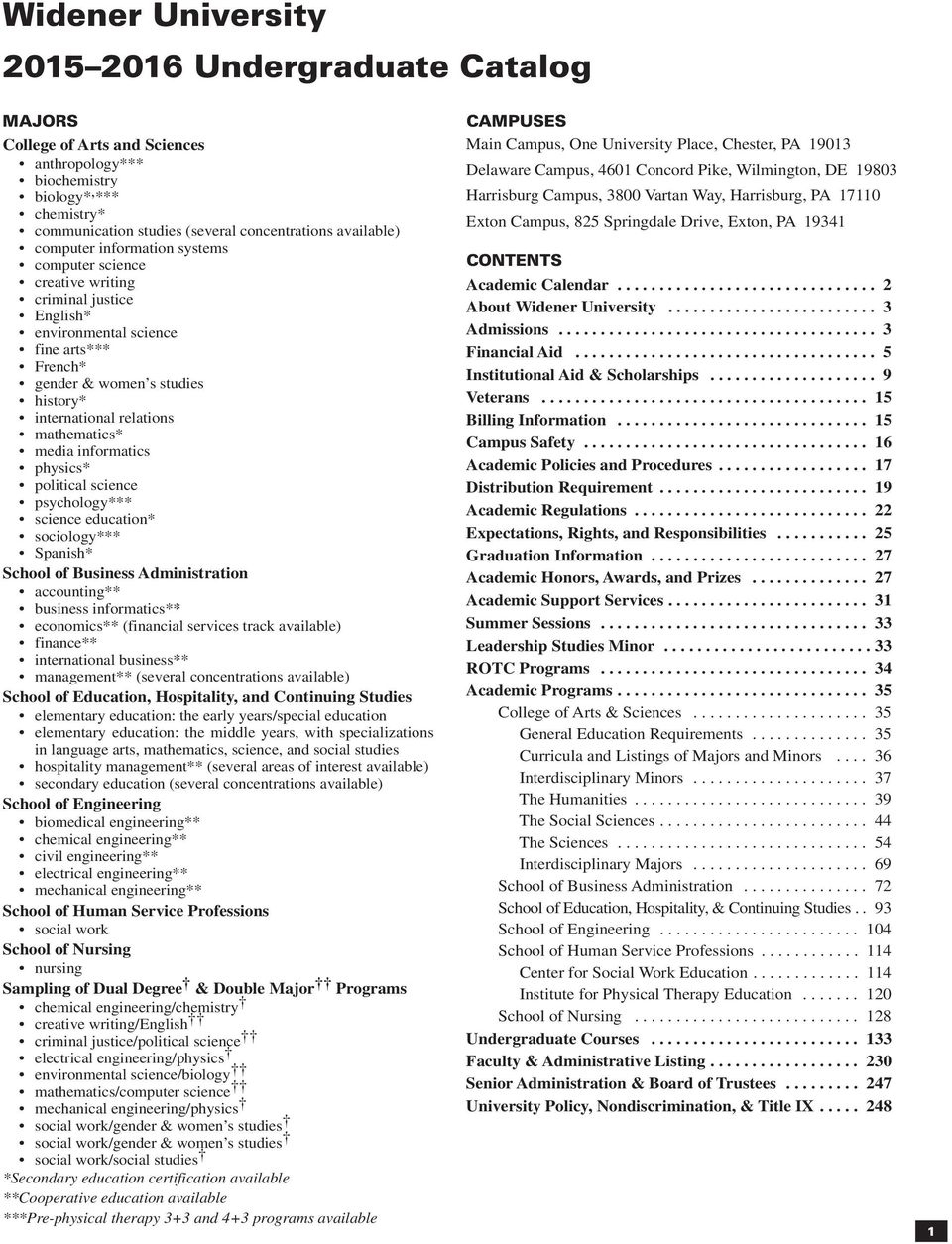
2 Widener University Undergraduate Catalog MAJORS College of Arts and Sciences anthropology*** biochemistry biology*, *** chemistry* communication studies (several concentrations available) computer information systems computer science creative writing criminal justice English* environmental science fine arts*** French* gender & women s studies history* international relations mathematics* media informatics physics* political science psychology*** science education* sociology*** Spanish* School of Business Administration accounting** business informatics** economics** (financial services track available) finance** international business** management** (several concentrations available) School of Education, Hospitality, and Continuing Studies elementary education: the early years/special education elementary education: the middle years, with specializations in language arts, mathematics, science, and social studies hospitality management** (several areas of interest available) secondary education (several concentrations available) School of Engineering biomedical engineering** chemical engineering** civil engineering** electrical engineering** mechanical engineering** School of Human Service Professions social work School of Nursing nursing Sampling of Dual Degree & Double Major Programs chemical engineering/chemistry creative writing/english criminal justice/political science electrical engineering/physics environmental science/biology mathematics/computer science mechanical engineering/physics social work/gender & women s studies social work/gender & women s studies social work/social studies *Secondary education certification available **Cooperative education available ***Pre-physical therapy 3+3 and 4+3 programs available CAMPUSES Main Campus, One University Place, Chester, PA Delaware Campus, 4601 Concord Pike, Wilmington, DE Harrisburg Campus, 3800 Vartan Way, Harrisburg, PA Exton Campus, 825 Springdale Drive, Exton, PA CONTENTS Academic Calendar About Widener University Admissions Financial Aid Institutional Aid & Scholarships Veterans Billing Information Campus Safety Academic Policies and Procedures Distribution Requirement Academic Regulations Expectations, Rights, and Responsibilities Graduation Information Academic Honors, Awards, and Prizes Academic Support Services Summer Sessions Leadership Studies Minor ROTC Programs Academic Programs College of Arts & Sciences General Education Requirements Curricula and Listings of Majors and Minors Interdisciplinary Minors The Humanities The Social Sciences The Sciences Interdisciplinary Majors School of Business Administration School of Education, Hospitality, & Continuing Studies.. 93 School of Engineering School of Human Service Professions Center for Social Work Education Institute for Physical Therapy Education School of Nursing Undergraduate Courses Faculty & Administrative Listing Senior Administration & Board of Trustees University Policy, Nondiscrimination, & Title IX
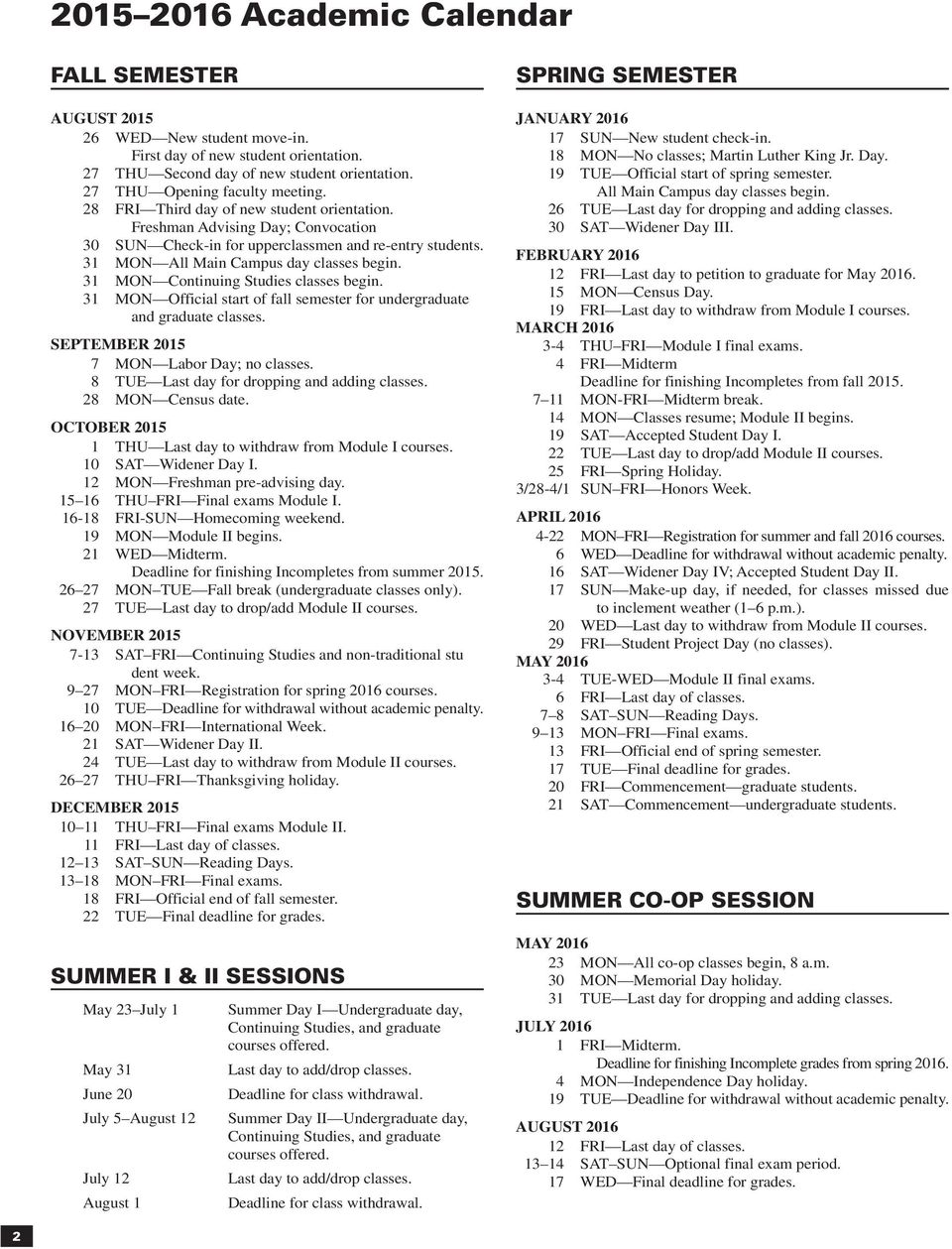
3 Academic Calendar FALL SEMESTER AUGUST WED New student move-in. First day of new student orientation. 27 THU Second day of new student orientation. 27 THU Opening faculty meeting. 28 FRI Third day of new student orientation. Freshman Advising Day; Convocation 30 SUN Check-in for upperclassmen and re-entry students. 31 MON All Main Campus day classes begin. 31 MON Continuing Studies classes begin. 31 MON Official start of fall semester for undergraduate and graduate classes. SEPTEMBER MON Labor Day; no classes. 8 TUE Last day for dropping and adding classes. 28 MON Census date. OCTOBER THU Last day to withdraw from Module I courses. 10 SAT Widener Day I. 12 MON Freshman pre-advising day THU FRI Final exams Module I FRI-SUN Homecoming weekend. 19 MON Module II begins. 21 WED Midterm. Deadline for finishing Incompletes from summer MON TUE Fall break (undergraduate classes only). 27 TUE Last day to drop/add Module II courses. NOVEMBER SAT FRI Continuing Studies and non-traditional stu dent week MON FRI Registration for spring 2016 courses. 10 TUE Deadline for withdrawal without academic penalty MON FRI International Week. 21 SAT Widener Day II. 24 TUE Last day to withdraw from Module II courses THU FRI Thanksgiving holiday. DECEMBER THU FRI Final exams Module II. 11 FRI Last day of classes SAT SUN Reading Days MON FRI Final exams. 18 FRI Official end of fall semester. 22 TUE Final deadline for grades. SUMMER I & II SESSIONS May 23 July 1 May 31 June 20 July 5 August 12 July 12 August 1 Summer Day I Undergraduate day, Continuing Studies, and graduate courses offered. Last day to add/drop classes. Deadline for class withdrawal. Summer Day II Undergraduate day, Continuing Studies, and graduate courses offered. Last day to add/drop classes. Deadline for class withdrawal. SPRING SEMESTER JANUARY SUN New student check-in. 18 MON No classes; Martin Luther King Jr. Day. 19 TUE Official start of spring semester. All Main Campus day classes begin. 26 TUE Last day for dropping and adding classes. 30 SAT Widener Day III. FEBRUARY FRI Last day to petition to graduate for May MON Census Day. 19 FRI Last day to withdraw from Module I courses. MARCH THU FRI Module I final exams. 4 FRI Midterm Deadline for finishing Incompletes from fall MON-FRI Midterm break. 14 MON Classes resume; Module II begins. 19 SAT Accepted Student Day I. 22 TUE Last day to drop/add Module II courses. 25 FRI Spring Holiday. 3/28-4/1 SUN FRI Honors Week. APRIL MON FRI Registration for summer and fall 2016 courses. 6 WED Deadline for withdrawal without academic penalty. 16 SAT Widener Day IV; Accepted Student Day II. 17 SUN Make-up day, if needed, for classes missed due to inclement weather (1 6 p.m.). 20 WED Last day to withdraw from Module II courses. 29 FRI Student Project Day (no classes). MAY TUE-WED Module II final exams. 6 FRI Last day of classes. 7 8 SAT SUN Reading Days MON FRI Final exams. 13 FRI Official end of spring semester. 17 TUE Final deadline for grades. 20 FRI Commencement graduate students. 21 SAT Commencement undergraduate students. SUMMER CO-OP SESSION MAY MON All co-op classes begin, 8 a.m. 30 MON Memorial Day holiday. 31 TUE Last day for dropping and adding classes. JULY FRI Midterm. Deadline for finishing Incomplete grades from spring MON Independence Day holiday. 19 TUE Deadline for withdrawal without academic penalty. AUGUST FRI Last day of classes SAT SUN Optional final exam period. 17 WED Final deadline for grades. 2
4 ABOUT WIDENER UNIVERSITY Member, Association for Continuing Higher Education PROFILE Widener University is a private, metropolitan university that connects curricula to social issues through civic engagement. Dynamic teaching, active scholarship, personal attention, leadership development, and experiential learning are key components of the Widener experience. A comprehensive doctorate-granting university, Widener is comprised of eight schools and colleges that offer liberal arts and sciences and professional and pre-professional curricula leading to associate's, baccalaureate, master s, and doctoral degrees. The university s campuses in Chester, Exton, and Harrisburg, PA, and Wilmington, DE, serve approximately 6,000 students. For more information, go to HISTORY Widener was founded in 1821 as a preparatory school for boys in Wilmington, Delaware. The institution moved to Pennsylvania in 1862 and was granted collegiate powers and privileges via universal charter by the Pennsylvania legislature. From 1892 to 1972, it was known as Pennsylvania Military College, though it had officially become PMC Colleges in 1966 when a nonmilitary, coeducational component was added. The name Widener College was adopted and the Corps of Cadets disbanded in Graduate programs were introduced in 1967, and the School of Law acquired in In recognition of its comprehensive offerings, Widener College became Widener University in Today, Widener is a four-campus university offering more than 150 programs of study. ACCREDITATIONS Widener University is accredited by the Middle States Association of Colleges and Schools. Widener University s graduate programs are additionally accredited by the following: AACSB International The Association to Advance Collegiate Schools of Business (School of Business Administration), American Association of Sexuality Educators, Counselors, and Therapists (Center for Human Sexuality Studies), American Bar Association (School of Law), American Psychological Association (Doctor of Psychology; Clinical Psychology Internship), Commission on Accreditation for Healthcare Management Education (MBA in Healthcare Management), Commission on Accreditation in Physical Therapy Education (Doctor of Physical Therapy), Commission on Collegiate Nursing Education (School of Nursing), Commission on Continuing Legal Education of the Supreme Court of Delaware (Delaware Law School), Council on Social Work Education (Center for Social Work Education), National Association for Education of Young Children (Child Development Center), National Council for the Accreditation of Teacher Educators (Center for Education), Pennsylvania State Board of Nursing (School of Nursing), Pennsylvania Continuing Legal Education Board of the Supreme Court (Commonwealth Law School), Pennsylvania Department of Education (Center for Education), Pennsylvania Department of Welfare (Child Development Center), Pennsylvania Private School Board (Center for Education). HONOR SOCIETIES National and international honor societies with chapters at Widener are Alpha Chi, scholastic honor society; Alpha Mu Gamma, modern languages; Alpha Phi Sigma, criminal justice; Alpha Psi Omega, dramatics; Alpha Sigma Lambda, adult student honor society; Beta Alpha Psi, financial information professionals; Beta Beta Beta, biology; Beta Gamma Sigma, AACSBaccredited business programs; Chi Alpha Epsilon, academic development; Eta Sigma Delta, hospitality management; Kappa Delta Pi, education; Gamma Eta Rho, human sexuality; Iota Iota Iota, gender and women s studies; Kappa Theta Epsilon, cooperative education; Lambda Pi Eta, communication studies; Omega Chi Epsilon, chemical engineering; Omicron Delta Epsilon, economics; Omicron Delta Kappa, leadership; Phi Alpha, social work; Phi Alpha Theta, history; Phi Beta Delta, international scholars; Phi Eta Sigma, freshman honor society; Phi Kappa Phi, scholastic honor society; Phi Lambda Upsilon, chemistry; Pi Gamma Mu, social science; Pi Sigma Alpha, political science; Psi Chi, psychology; Sigma Pi Sigma, physics; Sigma Tau Delta, English; Sigma Theta Tau, nursing; Tau Beta Pi, engineering; School of Business Administration Honors Program; School of Nursing Honors Program; and Widener University Honors Program in General Education. ADMISSIONS REQUIREMENTS Admission to Widener University is considered competitive. Applicants undergo individual evaluation to determine their potential for academic success. The university bases its decision on the strength of academic preparation, achievement, recommendations, extracurricular activities, personal qualifications, and the pattern of testing on the SAT Reasoning Test of the College Entrance Examination Board (CEEB) or the American College Test (ACT). Excluding those being considered for enrollment in special programs, candidates for admission must be graduates of approved secondary schools. Applicants should also meet additional recommendations for specific degree programs. Widener University has endeavored to comply with Section 504 of the Rehabilitation Act of 1973 and the Americans with Disabilities Act of 1990 by making its facilities accessible to handicapped students. It is the policy of the university not to discriminate against the disabled in its admission procedures or educational programs. The university makes every effort to integrate disabled and handicapped students into all areas of campus life. Support services are designed to enhance opportunities for student independence. These include liaisons between faculty, staff, counselors, other students, and outside groups, as well as assistance with obtaining housing, meals, tutoring/reading assistance, parking, class scheduling, etc. For information, call the Office of Student Life at HOW TO APPLY 1. To access the application, schedule an appointment, or request information, visit our website at 2. Complete the online application form and click submit. The application fee will be waived for those who apply directly online at 3. Give the Secondary School Report (which you can print) to the principal or guidance counselor at your school. The completed form should be returned directly to Widener along with an official transcript. 4. Take the necessary College Entrance Examination Board (CEEB) tests and have the results sent to Widener. REQUIRED TESTS All applicants for admission are required to take either the SAT Reasoning Test of the College Entrance Examination Board or the American College Test (ACT) of the American College Testing Program. Normally, students take one of these tests in the latter part of their junior year and repeat it in October, November, or December of their senior year. The SAT writing section is not a requirement for admission. The SAT Subject Tests are not required but are helpful in terms of placement and guidance. 3

5 Application forms for the CEEB test may be obtained from high school guidance departments or by writing to: Educational Testing Service, College Board Division, Box 592, Princeton, NJ 08540; or Box 1025, Berkeley, CA Students can also register online at When applying for the tests, applicants should request that their scores be reported to Widener University, No CAMPUS VISITS Prospective students are encouraged to arrange for an information session and tour of the campus. Admissions counselors are available for questions via phone at or by at Our Widener Day Open Houses are a great way to learn more about Widener. The Office of Admissions is open Monday Friday, 9:00 a.m. to 5:00 p.m. The Admissions Office also hosts events for those interested in visiting during the weekend. Check our website at or call us at or toll free Widener ( ) for availability and dates. In the event that it becomes necessary to cancel an appointment, please call the Office of Admissions to let us know. EARLY ADMISSION Generally speaking, most students are advised to complete their senior year of secondary school rather than bypassing it in favor of early admission into college. However, there are exceptions, and those students who are clearly ready for college without having completed secondary school are welcome at Widener and are eligible for early admission. An interview is required of all early admission applicants. HOME SCHOOL STUDENTS Home school students are encouraged to apply for admissions and are required to submit a curriculum validation along with their completed application. BASIC CURRICULUM REQUIREMENTS FOR ADMISSION Units English History/Social Science (4 recommended) Mathematics (4 recommended) Algebra I, II Plane Geometry Trigonometry/Pre-Calculus Science (4 recommended) Physics/Earth Science Biology Chemistry (required for Engineering and Nursing majors) Foreign Language Electives Total Note: Engineering students should at minimum have 4 units of math and science including chemistry and pre-calculus. Note: Equivalent studies under other names will be accredited. The extent of background training and mastery is the determining factor. It is recognized, e.g., that many schools are now giving college preparatory mathematics under such titles as Math IV or Math XII. All such mathematics will be fully credited. ADVANCED PLACEMENT CREDIT While credit granted for achievement through the College Entrance Examination Board s (CEEB) Advanced Placement Program will vary according to the area in which a student has been tested, generally some credit will be granted to any student scoring three or higher on one of the examinations. The test is scored on a one-to-five basis with five as the highest score. A list of examinations and scores acceptable for college credit can be obtained at Since students may accumulate substantial college credit prior to enrollment at Widener, it is recommended that exceptional high school students carefully consider this beneficial opportunity. Students concurrently enrolled in high school and college must submit official college transcripts in order to receive transfer credits. TRANSFER PROCEDURES Widener University welcomes students who wish to transfer from other colleges and universities. Transfer students are given the same consideration as other students for financial aid and campus housing. Students must achieve a minimum cumulative gradepoint average (GPA) of 2.00 and 12 credits of academic work to be considered for admission. Students who have completed less than 12 credits must submit a high school transcript and standardized test scores. Applicants for the nursing program must achieve a minimum cumulative GPA of 3.00 for consideration. After completing the admission application and sending all academic transcripts, accepted students will receive complete information on the transferability of their college courses. This information enables students to calculate the number of remaining credits required in their degree program. Following receipt of the acceptance materials, the student is instructed to arrange an appointment with their academic advisor to discuss transfer credit and schedule classes. Please note, students who do not disclose prior college records in their admission application are subject to dismissal at any future time when prior attendance is discovered. Transfer students are required to complete 50 percent of their major courses at Widener to graduate. Credit by examination via a Challenge Examination prepared by Widener faculty for Widener students may be included in the 50 percent. However, credit by examination via Advanced Placement or CLEP testing may not be included in the 50 percent. A maximum of 64 credits may be transferred from a two-year college. Students must earn a grade of C or better for credit to be transferred into Widener. Transfer students should also familiarize themselves with the residency requirements discussed in the Academic Policies, Procedures, and Programs section of this catalog. Students who are already matriculated at Widener and are interested in taking coursework elsewhere for transfer credit should see page 21, Transfer of Credit after Matriculation. INTERNATIONAL STUDENTS The university invites the matriculation of students from other nations and is authorized under federal law to issue SEVIS form I-20 for visa application and to enroll nonimmigrant alien students. A specific International Student Application is provided electronically for use by all international applicants, including those who have completed their secondary education in the United States. To be evaluated for admission, international freshman applicants must submit official secondary transcripts/academic records, in English, from all institutions attended, along with proof of graduation. If the educational system in the country of schooling requires students to take national examinations for either secondary school completion or for university entrance, official copies of those examination results must also be submitted for application consideration. International transfer applicants students who have attended university in either the United States or abroad must send official university transcripts from each institution attended. Course descriptions, course catalogs, and other academic information, in English, are required for coursework to be considered for transfer credit equivalency. Applicants may be required to submit an official course-by-course credential evaluation prepared by a NACES-certified credential evaluation organization for coursework taken outside of the United States. 4

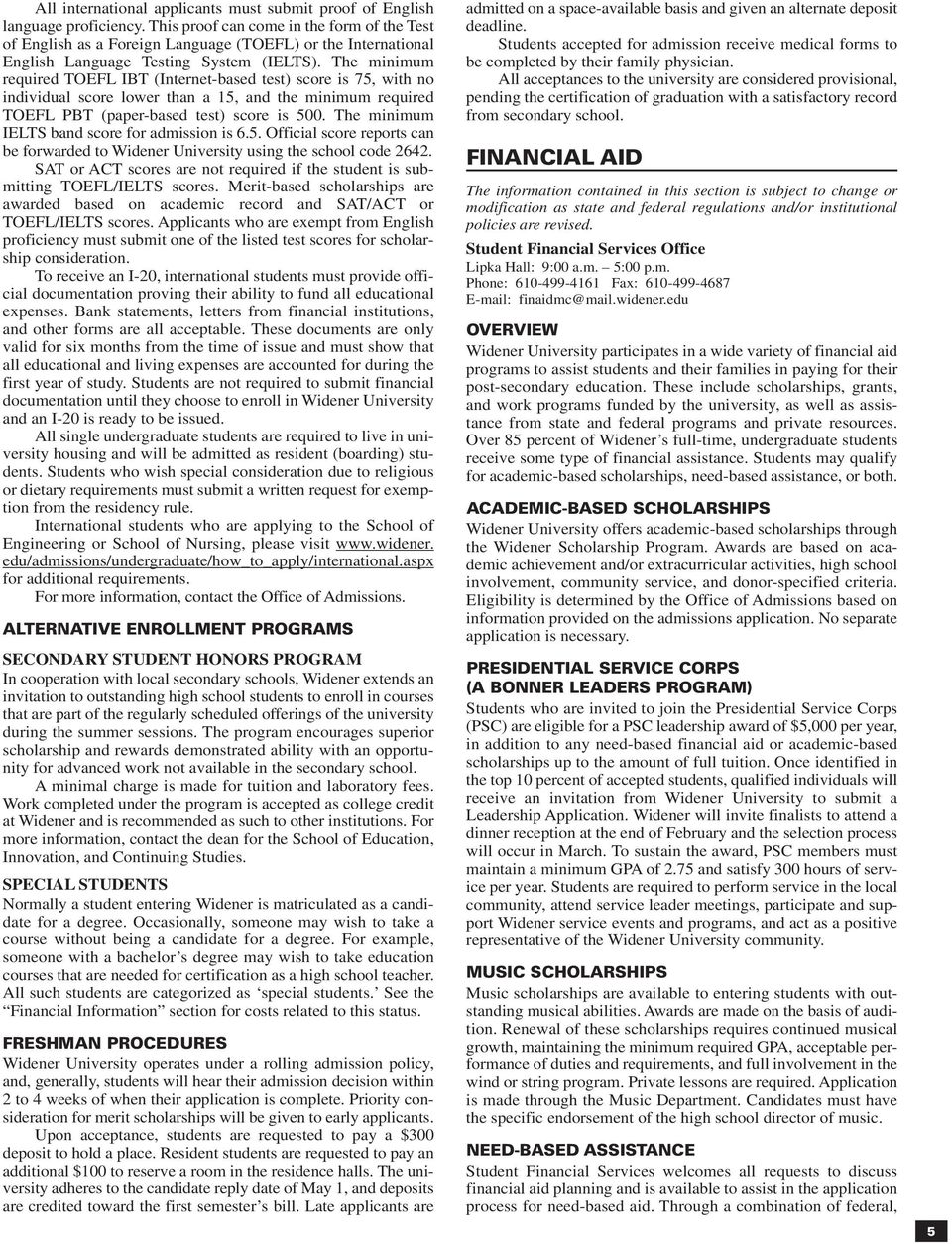
6 All international applicants must submit proof of English language proficiency. This proof can come in the form of the Test of English as a Foreign Language (TOEFL) or the International English Language Testing System (IELTS). The minimum required TOEFL IBT (Internet-based test) score is 75, with no individual score lower than a 15, and the minimum required TOEFL PBT (paper-based test) score is 500. The minimum IELTS band score for admission is 6.5. Official score reports can be forwarded to Widener University using the school code SAT or ACT scores are not required if the student is submitting TOEFL/IELTS scores. Merit-based scholarships are awarded based on academic record and SAT/ACT or TOEFL/IELTS scores. Applicants who are exempt from English proficiency must submit one of the listed test scores for scholarship consideration. To receive an I-20, international students must provide official documentation proving their ability to fund all educational expenses. Bank statements, letters from financial institutions, and other forms are all acceptable. These documents are only valid for six months from the time of issue and must show that all educational and living expenses are accounted for during the first year of study. Students are not required to submit financial documentation until they choose to enroll in Widener University and an I-20 is ready to be issued. All single undergraduate students are required to live in university housing and will be admitted as resident (boarding) students. Students who wish special consideration due to religious or dietary requirements must submit a written request for exemption from the residency rule. International students who are applying to the School of Engineering or School of Nursing, please visit edu/admissions/undergraduate/how_to_apply/international.aspx for additional requirements. For more information, contact the Office of Admissions. ALTERNATIVE ENROLLMENT PROGRAMS SECONDARY STUDENT HONORS PROGRAM In cooperation with local secondary schools, Widener extends an invitation to outstanding high school students to enroll in courses that are part of the regularly scheduled offerings of the university during the summer sessions. The program encourages superior scholarship and rewards demonstrated ability with an opportunity for advanced work not available in the secondary school. A minimal charge is made for tuition and laboratory fees. Work completed under the program is accepted as college credit at Widener and is recommended as such to other institutions. For more information, contact the dean for the School of Education, Innovation, and Continuing Studies. SPECIAL STUDENTS Normally a student entering Widener is matriculated as a candidate for a degree. Occasionally, someone may wish to take a course without being a candidate for a degree. For example, someone with a bachelor s degree may wish to take education courses that are needed for certification as a high school teacher. All such students are categorized as special students. See the Financial Information section for costs related to this status. FRESHMAN PROCEDURES Widener University operates under a rolling admission policy, and, generally, students will hear their admission decision within 2 to 4 weeks of when their application is complete. Priority consideration for merit scholarships will be given to early applicants. Upon acceptance, students are requested to pay a $300 deposit to hold a place. Resident students are requested to pay an additional $100 to reserve a room in the residence halls. The university adheres to the candidate reply date of May 1, and deposits are credited toward the first semester s bill. Late applicants are admitted on a space-available basis and given an alternate deposit deadline. Students accepted for admission receive medical forms to be completed by their family physician. All acceptances to the university are considered provisional, pending the certification of graduation with a satisfactory record from secondary school. FINANCIAL AID The information contained in this section is subject to change or modification as state and federal regulations and/or institutional policies are revised. Student Financial Services Office Lipka Hall: 9:00 a.m. 5:00 p.m. Phone: Fax: [email protected] OVERVIEW Widener University participates in a wide variety of financial aid programs to assist students and their families in paying for their post-secondary education. These include scholarships, grants, and work programs funded by the university, as well as assistance from state and federal programs and private resources. Over 85 percent of Widener s full-time, undergraduate students receive some type of financial assistance. Students may qualify for academic-based scholarships, need-based assistance, or both. ACADEMIC-BASED SCHOLARSHIPS Widener University offers academic-based scholarships through the Widener Scholarship Program. Awards are based on academic achievement and/or extracurricular activities, high school involvement, community service, and donor-specified criteria. Eligibility is determined by the Office of Admissions based on information provided on the admissions application. No separate application is necessary. PRESIDENTIAL SERVICE CORPS (A BONNER LEADERS PROGRAM) Students who are invited to join the Presidential Service Corps (PSC) are eligible for a PSC leadership award of $5,000 per year, in addition to any need-based financial aid or academic-based scholarships up to the amount of full tuition. Once identified in the top 10 percent of accepted students, qualified individuals will receive an invitation from Widener University to submit a Leadership Application. Widener will invite finalists to attend a dinner reception at the end of February and the selection process will occur in March. To sustain the award, PSC members must maintain a minimum GPA of 2.75 and satisfy 300 hours of service per year. Students are required to perform service in the local community, attend service leader meetings, participate and support Widener service events and programs, and act as a positive representative of the Widener University community. MUSIC SCHOLARSHIPS Music scholarships are available to entering students with outstanding musical abilities. Awards are made on the basis of audition. Renewal of these scholarships requires continued musical growth, maintaining the minimum required GPA, acceptable performance of duties and requirements, and full involvement in the wind or string program. Private lessons are required. Application is made through the Music Department. Candidates must have the specific endorsement of the high school director of music. NEED-BASED ASSISTANCE Student Financial Services welcomes all requests to discuss financial aid planning and is available to assist in the application process for need-based aid. Through a combination of federal, 5
7 state, and institutional resources, Student Financial Services offers aid packages to students and families who are unable to meet the full cost of attendance with their own resources. Needbased assistance is intended to supplement, not replace, the family s contribution. A simple equation illustrates how this works: Cost of Attendance Expected Family Contribution = Financial Need (potential aid eligibility) Cost of Attendance is determined annually from actual tuition and fees, a weighted average of room and board charges, and averaged costs of books and supplies, personal expenses, and student loan fees. Expected Family Contribution is the amount the student and the family are expected to contribute toward the cost of attendance. The federal family contribution is determined from information the student and family provide on the Free Application for Federal Student Aid (FAFSA). The reported information is subjected to a formula established by the U.S. Congress. All schools are required to use the results of the federal need analysis formula from the FAFSA to determine eligibility for federal student assistance. Widener Student Financial Services uses the information from the FAFSA to determine eligibility for needbased aid from the university. Each year Widener University establishes a policy of awarding need-based financial aid that takes into consideration annual allocations of federal student assistance, university funds, and anticipated enrollment. Guidelines are established to determine the best method of meeting students needs, and a formula for distributing a financial aid package is approved. Undergraduate applicants for need-based aid are expected to apply for their state s grant program (most states are reciprocal, except for NJ, NY, and MD), the Federal Direct Loan, and any other aid for which they might be eligible. The amount of Federal Direct Loan is included in the package, but there is no penalty if the student elects not to borrow. When or if a student rejects or fails to apply in a timely manner for a need-based aid program for which the student would be eligible, the university is unable to replace the funds with institutional aid. Priority for federal campus-based and Widener funds is given to full-time students who complete the application process in a timely fashion. On a limited basis, students enrolled less than full time with exceptional need may also be considered. To receive aid from the federal programs, the student must: have financial need, except for Federal Direct PLUS and Unsubsidized Federal Direct Loan programs. have a high school diploma or a General Educational Development (GED) certificate. be enrolled or accepted for enrollment as a regular student working toward a degree or certificate in an eligible program. be a U.S. citizen or eligible noncitizen. sign a statement on the FAFSA certifying that the student is not in default on a federal student loan and does not owe money back on a federal grant. have a valid Social Security Number. register with Selective Service, if required. make satisfactory academic progress. sign a statement on the FAFSA that the funds will be used for educational purposes. If substantial need still remains after federal aid and Widener funds have been awarded, Student Financial Services will inform the student about alternative sources of funding such as the Federal Direct PLUS Program. Students must reapply for financial aid each year. The amount of assistance from the university may increase or decrease from one year to the next depending on the family s financial circumstances, the availability of funds, and federal and state regulations. Widener is a NCAA Division III institution and does not award financial aid to any student-athlete based on athletic ability. The administration of financial aid based upon need and/or academic ability without the consideration of athletic ability or participation is a principle fundamental to Division III athletics. MINIMUM SATISFACTORY ACADEMIC PROGRESS FOR CONTINUANCE OF FINANCIAL AID FEDERAL AND INSTITUTIONAL AID To receive Federal Title IV and institutional financial aid, students must progress toward the completion of their program of study at a rate that will ensure graduation in a reasonable length of time. Widener University has established a minimum standard that measures academic progress both quantitatively (credit hours) and qualitatively (grades) at the end of each semester. Students must meet the following minimum academic progress standards to receive Federal Pell Grant, Federal SEOG, Federal Work Study, Federal Perkins Loan, Federal Direct Loan, Federal Direct PLUS, and Widener institutional funds. QUANTITATIVE MEASUREMENT Undergraduate students must successfully complete a minimum of 67 percent of the total credits attempted while enrolled at Widener. Successful completion is based on the percentage of total (i.e., cumulative) credit hours attempted compared to the total credit hours completed. Earned credits for a course cannot be counted more than once. Grades of I (Incomplete), W (Withdrawal), F (Failure), and NP (No Pass) count as credits attempted but do not count as credits completed. For a full definition of attempted and completed credits, please contact the Student Financial Services Office. QUALITATIVE MEASUREMENT Undergraduate students must achieve the cumulative grade-point average (GPA) below: Credit Hours Minimum Completed GPA 15.5 or fewer and more 2.00 An undergraduate student who fails nine credits in one semester may be dismissed for academic failure. MAXIMUM TIME FRAME REQUIREMENTS The maximum time to complete the credits required for graduation is measured in credit hours attempted. The maximum time frame may not exceed 150 percent of the published length of the academic program. The maximum time frame for a transfer student may not exceed 150 percent of the published length of the program minus the number of credits accepted for transfer at the point of matriculation. MEASUREMENT OF PROGRESS At the end of each academic year, students are evaluated for academic progress (quantitative and qualitative). Students who do not meet the minimum standards will be contacted by using their CampusCruiser address. Notification will outline student options to re-establish eligibility, such as attending subsequent classes or submitting an appeal for a waiver by a specified date. DISMISSAL, SUSPENSION, AND READMISSION Academically dismissed students are ineligible for financial aid. Students who are suspended are ineligible for financial aid during the term(s) of their suspension. Academic readmission to Widener University does NOT automatically grant reinstatement of financial aid eligibility. All dismissed students must appeal to regain their financial aid eligibility. 6

8 REINSTATEMENT Reinstatement of financial aid eligibility is possible once the student has earned 67 percent of total credits attempted and has achieved the required grade point average, either at the student s own expense or by completing unfinished class assignments, except when aggregate hours (total hours attempted) are the cause of ineligibility. APPEALS At the end of each academic year, a student may appeal any failed progress status based on extenuating circumstances, such as the death of a relative, a serious personal illness or injury, or a change of educational objective. The student must be able to demonstrate that the extenuating circumstance had a direct impact on the student s academic performance. Appeals will require an academic plan with input from the student s academic advisor or dean. An appeal for excessive aggregate hours must address, at a minimum, any degree program changes and include a degree completion plan from the dean of the student s school or college. WIDENER UNIVERSITY FUNDS In addition to meeting the minimum academic progress standard, students must be enrolled full-time and conduct themselves properly to receive funds from Widener University. If extracurricular activity is required as a condition of the grant, satisfactory performance is necessary. STANDARDS OF ACADEMIC PROGRESS FOR THE PENNSYLVANIA STATE GRANT PROGRAM Pennsylvania Higher Education Assistance Agency (PHEAA) has its own academic progress policy for students who receive Pennsylvania state grants. To continue to receive a Pennsylvania state grant, a student must meet the state s policy. PHEAA sends a copy of its policy to each state grant recipient. In brief, a student is required to successfully complete a minimum of 12 credits per semester for each full-time state grant received and a minimum of 6 credits per semester for each part-time state grant received. Academic progress for the continuation of state grant is measured at the end of the spring semester. A full copy of PHEAA s policy is also available upon request from the Student Financial Services Office. HOW TO APPLY To apply for need-based financial aid at Widener University, students must complete the Free Application for Federal Student Aid (FAFSA). New students and transfer students are encouraged to apply as soon as possible after January 1. Priority is given to completed applications received by the Student Financial Services Office by March 1. If requested, students must submit supporting documents necessary to complete their application requests. Students can get the FAFSA from the Student Financial Services Office or online at More information on applying for aid can be found in the financial aid section of Widener s website at widener.edu/financialaidoffice. FEDERAL AID PROGRAMS The rights and responsibilities of students receiving financial assistance under the Higher Education Assistance Act and a statement of the federal requirements for the return of grant or loan assistance provided thereunder is set forth in the Financial Aid Handbook, available on the Student Financial Services website. FEDERAL PELL GRANT is a federally administered program that awards grants to undergraduate students on the basis of exceptional need. The annual amount available is subject to federal fiscal year appropriations. Eligibility is limited to students who have not earned a bachelor s degree. Once a student has received a Pell Grant for 12 semesters or the equivalent the student will no longer be eligible for Pell Grants. FEDERAL SUPPLEMENTAL EDUCATIONAL OPPOR- TUNITY GRANT (FSEOG) is a federal campus-based program for undergraduate students who demonstrate exceptional need. Priority is given to Pell Grant recipients. The amount of the award depends on the student s need, the availability of funds, and the amount of other aid received. Eligibility is limited to students who have not earned a bachelor s degree. FEDERAL PERKINS LOAN is a federal campus-based, lowinterest loan (5 percent) made to students with exceptional need who have not earned a bachelor s degree. The amount of loan Widener University includes in its financial aid package depends on the applicant s need and the availability of funds. The Federal Perkins Loan is interest free during the time the student maintains at least half-time enrollment. For each year funds are received, the student must sign a promissory note agreeing to repay the loan. Repayment of the loan begins nine months after the student graduates, withdraws, or enrolls less than half time. You may have longer than nine months if you are on active duty with the military. Monthly payments are a minimum of $40 and are scheduled over a maximum 10-year period. Prior to receiving a Federal Perkins Loan, students must attend entrance loan counseling during which they are informed of their rights and responsibilities as a borrower. Before leaving school, students must attend an exit interview during which they are given a loan repayment schedule and other important information concerning repayment of the Perkins Loan (see table). Under certain circumstances, Perkins Loan repayment may be cancelled or deferred. A complete list of cancellation and deferment provisions is provided during the exit and entrance interviews. Students who wish to view these materials may request them from the Student Financial Services Office or the Perkins Loan Office. FEDERAL WORK STUDY (FWS) is the opportunity to earn funds through employment and is awarded as part of the student s aid package. The amount of FWS awarded represents a maximum eligibility amount determined by Student Financial Services. Students may work up to 15 hours per week during any week in which classes are held and up to 25 hours per week during break periods. Actual earnings depend on the number of hours worked and the wage rate, but may not exceed the FWS award amount. The wage rate starts at $7.25. The rights and responsibilities of students receiving financial assistance pursuant to federal work-study programs and a statement of the federal requirements for the return of assistance provided thereunder is set forth in the Financial Aid Handbook, available on the Student Financial Services website under Forms and Publications. FEDERAL DIRECT LOANS are low-interest loans from the U.S. Department of Education that are administered by Widener University. They are the U.S. Department of Education's major form of self-help aid and are available through the William D. Ford Federal Direct Loan Program. There are two types of Federal Direct Loans: subsidized and unsubsidized. Federal Direct Loans replace the Federal Stafford Loans, which were formerly known as Federal Guaranteed Student Loans. Because the funding for these loans comes straight from the U.S. Department of Education, you do not have to find a lender to borrow from through this program. Please disregard any offers you may receive about the Federal Stafford Loan program through private lenders. Since Widener University is a Federal Direct Lending institution, you may not use a private lender to apply for a Federal Stafford Loan. 7

9 Federal Direct Subsidized Loan A Federal Direct Subsidized Loan is available to help meet financial need after other resources are subtracted or to the annual maximum loan limit, whichever is lower. Visit the Student Financial Services section of Enrollment Services for current loan rates. Interest begins to accrue immediately upon graduating or when the student ceases to be enrolled at least half time. Effective July 1, 2013, first-time Direct Subsidized Loan borrowers are limited in the amount of time they can receive Direct Subsidized Loans. (First-time borrowers are students with no outstanding federal loan balance as of July 1, 2013.) Borrowers may receive Direct Subsidized Loans for no more than 150% of the length of the student s current academic program (e.g., 6 years for a 4-year program). Once students reach the 150% time limit, they will not be eligible for any further subsidized loans. If students reach the 150% time limit and continue to enroll, they will lose the interest subsidy on the subsidized loans they borrowed in the past. Students who have reached the 150% limit remain eligible for Direct Unsubsidized Loans. The time limit for borrowing subsidized loans will be adjusted to reflect part-time attendance and attendance for only one semester. Federal Direct Unsubsidized Loan A Federal Direct Unsubsidized Loan is not based on your financial need. If your estimated cost of attendance is greater than your financial aid and you have not reached your annual maximum loan limit through the Federal Direct Subsidized Loan, you may qualify for a Federal Direct Unsubsidized Loan. Visit the Student Financial Services section of Enrollment Services for current loan rates. You are charged interest on this loan from the time the loan is disbursed until it is paid in full. You have the option to pay on the interest while in school or to allow the interest to accumulate, which adds to the principal amount of the loan and increases the amount to be repaid. How to Apply for a Federal Direct Loan (Subsidized or Unsubsidized) To apply for a Federal Direct Loan, you must complete the FAFSA. To be eligible, you must be enrolled at least half time and meet other general federal student aid eligibility requirements. If you qualify for a Federal Direct Loan, it will be included in your Financial Aid Award Letter. E-sign the Federal Direct Loan Master Promissory Note (MPN) Students borrowing a Federal Direct Loan must complete a Federal Direct Loan Electronic Master Promissory Note (MPN) before loan money can be disbursed. Once a Federal Direct Loan MPN is completed and the loan is disbursed to you by Widener University, you do not have to sign a Federal Direct Loan MPN again (it is valid for 10 years). To complete the MPN, you must go to You will need your U.S. Department of Education PIN to sign your MPN electronically. The PIN is the same one used to sign your FAFSA. After you sign your MPN, electronic notification will be sent to Widener University. Widener may not disburse your Federal Direct Loan unless you have completed your MPN and have completed entrance counseling. Federal Direct Loan Entrance Counseling The federal government requires a student to participate in loan counseling prior to receiving a Federal Direct Loan. Entrance counseling will explain various aspects of student loans, such as repayment and interest, and the student's rights and responsibilities. It concludes with a 15-question quiz. You must get all answers correct to successfully complete the entrance counseling. Entrance counseling can be completed at You will need your U.S. Department of Education PIN to successfully complete the entrance counseling. After you complete entrance counseling, the results will be sent electronically to Widener University. You may wish to print a copy of the rights and responsibilities page for your personal records. Receiving Federal Direct Loan Funds When Widener University is notified by the Federal Direct Loan processor that they have a valid MPN on file for you and you have completed entrance counseling, your Federal Direct Loan will automatically be credited to your student account, as long as all other federal student aid eligibility requirements are met. Request Reduction or Cancellation of a Federal Direct Loan You have the right to reduce or cancel your Federal Direct Loan offer. You can do so by making a notation on your Financial Aid Award Letter and returning it to the Office of Student Financial Services. Eligibility Degree-seeking students who are enrolled at least half time may receive Federal Direct Loan funding as long as they meet the general eligibility requirements. Federal Direct Parent Loan for Undergraduate Students (PLUS) The Federal Direct PLUS loan enables parents with good credit histories to borrow funds to pay the educational expenses of each dependent undergraduate child enrolled at least half time. The yearly limit on a Federal Direct PLUS is equal to the cost of attendance minus any other financial aid. Parent borrowers can choose to defer payments on a Federal Direct PLUS loan until FEDERAL PERKINS LOAN MONTHLY PAYMENT AT 5% OVER 10 YEARS Total Loan Interest Number of Total Monthly Amount Charges Payments Repaid Payment $ 4,500 $1, $ 5, $ ,000 2, , ,000 4, , Typical monthly payments and total interest charges over a 10-year period based on 5 percent interest rate. FEDERAL DIRECT LOAN MONTHLY PAYMENTS AT 8.25% OVER 10 YEARS Total Interest Number of Total Monthly Indebtedness Charges Payments Repaid Payment $ 2,600 $ $ 3, $ ,000 2, , ,500 3, , ,000 4, , ,000 7, , Typical monthly payments and total interest charges over a 10-year period based on 8.25 percent interest rate. 8

10 six months after the date the student ceases to be enrolled at least half time. Accruing interest could either be paid by the parent monthly or quarterly, or be capitalized quarterly. Payments on interest are tax deductable, and there are no penalties on paying off the loan early. STATE AID PROGRAMS STATE GRANTS Each state has its own grant program, as well as its own award levels and eligibility criteria. Generally, state grants are awarded on the basis of need and limited to students attending school within their own state of residence. However, if a reciprocity agreement exists between two states such as Pennsylvania and Delaware, students may use the grant in the reciprocal state. All financial aid applicants are expected to apply for their state s grant (most states are reciprocal, except for NJ, NY, and MD). For information about your state s reciprocity agreement and application instructions, contact your state agency. INSTITUTIONAL AID & SCHOLARSHIPS GRANT-IN-AID is available each year to new and returning full-time students who demonstrate need. Grant-In-Aid funds are also used as matching funds for federal aid programs in which a student may participate. Assistance is limited to eight semesters for bachelor s degree candidates and four semesters for associate s degree candidates. Eligibility is limited to students who have not already earned a bachelor s degree. WIDENER EMPLOYMENT is funded from university resources. Students may work up to 15 hours during any week in which classes are held and up to 25 hours per week during vacation periods. (Contact the Office of Student Financial Services for information.) WIDENER SCHOLARSHIPS Each year, Widener offers a number of scholarships to academically talented students. These scholarships, ranging from $8,500 to full tuition, are awarded solely on the basis of merit. Each applicant is automatically reviewed for consideration for all awards for which he or she may be eligible, with the exception of the full-tuition Widener Scholarship. To be considered for the Widener Full Tuition Scholarship, applicants must apply to the university no later than February 15 and have a minimum combined SAT I score of 1350, a grade point average of 3.8, and a high school rank in the top 10 percent of the graduating class. An interview with the Office of Admissions is also required. Widener University scholarships are renewable subject to academic performance and are offered to entering freshmen only. African American Scholarship This scholarship is designed to assist African American students. Awards provide assistance to students with or without financial need to attract and retain students with outstanding academic or other non-athletic achievements. A. Groff Alderfer Memorial Endowed Scholarship Fund Named in honor of a dedicated and longtime member of the College of Arts and Sciences faculty, this partial scholarship is awarded to an incoming freshman declaring a major in the arts and sciences, with strong preference given to a declared science major. The scholarship is renewable provided the student is making satisfactory progress toward the baccalaureate degree. The Laila Al-Saleh Memorial Undergraduate Nursing Scholarship Established by Conrad 55 and Sheilagh Karl in memory of Laila Al-Saleh, this partial scholarship is awarded annually to a rising senior undergraduate in the School of Nursing. The recipient must demonstrate financial need and a commitment to community service. Alumni Engineering Scholarship This partial scholarship, created by an alumnus, is awarded to a second semester freshman or above student majoring in engineering in consideration of his/her contribution to college life and of financial need. A recipient may receive this scholarship more than once. American Legion Smith Howard Post #93 Veteran Scholarship Created by the American Legion s Smith Howard Post #93 of Media, Pennsylvania, this partial scholarship is awarded to a non-scholarship ROTC cadet or a veteran or the son, daughter, or grandchild of a parent or grandparent who served or is serving on active duty in any of the military services. The student will be a full-time undergraduate and maintain a 3.0 or higher GPA, be involved in extracurricular activities or involved in community service. Preference is given to residents of Delaware County, PA, who demonstrate financial need. Greta Jean Anderson Scholarship This partial scholarship was created in memory of Greta Jean Anderson, a 1988 graduate of Brandywine College. It is awarded annually to a female sophomore majoring in management. Emphasis is placed on academic performance and community service. The scholarship is renewable. The Association for Operations Management (APICS) Scholarship This partial scholarship is awarded to a junior enrolled in the School of Business Administration who is chosen for excellent academic performance in the area of operations management. William R. Bailey Scholarship Created by William R. Bailey 54, at least one partial scholarship is awarded to a sophomore or upperclassman with a declared major in one of the science curricula who demonstrates financial need. The awardee is chosen with the input of the dean of the College of Arts and Sciences. The scholarship is renewable. The Dr. Charles L. Bartholomew Scholarship This partial scholarship is awarded to a second year civil engineering student in good academic standing who demonstrates outstanding communication skills. The Bergeman Family Endowed Scholarship Established by Richard P. Bergeman 62, this renewable partial scholarship is awarded annually to a student with an excellent academic record who demonstrates financial need. Preference shall be given to students enrolled in the School of Business Administration. Additional preference may be given to a minority or female student. Richard P. Bergeman 62 Endowed Scholarship This renewable partial scholarship is awarded to an academically above average student in the School of Business Administration or Engineering with preference to an incoming freshman. The recipient is to be from Delaware County, Pennsylvania. Professor E. Randy Biddle Scholarship Created in memory of longtime Widener faculty member Edmund "Randy" Biddle, this partial scholarship assists students majoring in English who have achieved academic merit and demonstrated financial need. Blizzard MacQueen Endowed Scholarship Established by Frank Blizzard 53, 70, this partial scholarship is awarded to an undergraduate student with an outstanding academic record who demonstrates financial need. Preference shall first be given to residents of Upland, PA, then Delaware County, PA. The Dr. Leo Blumberg Engineering Scholarship This partial scholarship is awarded to a student entering the senior year who has been outstanding in theoretical studies and practical application of engineering concepts. Boeing Engineering Scholarship Established and funded by The Boeing Company, this scholarship is awarded to a student in the School of Engineering based on recommendations from engineering faculty. Boeing has been a steadfast supporter of higher education at Widener for several decades. Boeing School of Business Scholarship Established and funded by The Boeing Company, this scholarship is awarded to a student in the School of Business Administration based on faculty recommendations. Boeing has supported higher education at Widener for many decades. 9

11 Sarah E. Bone Endowed Scholarship Fund This scholarship is awarded to a student who has an outstanding academic record and demonstrates financial need. James E. Bowen 49 Endowed Scholarship Established by James E. Bowen 49, this partial scholarship is awarded to an entering freshman exhibiting academic merit and financial need. The scholarship is renewable. Amount and frequency of award is determined by financial considerations. Bowlby Accounting Endowed Scholarship Established by G. Robert and Barbara Bowlby, this renewable, partial scholarship is awarded annually to a sophomore or upperclassman in the School of Business Administration majoring in accounting. The recipient shall be making appropriate academic progress and demonstrate financial need. Ruth C. Bragg Scholarship Created by 1957 PMC graduate Russell Bragg, this partial scholarship is awarded to female School of Business Administration students who are in their junior or senior year and have demonstrated academic achievement and financial need. Robert J. and Judith G. Bruce Endowed Scholarship Established by Robert J. and Judith G. Bruce, this partial scholarship is awarded to a sophomore who demonstrates outstanding academic achievement as well as financial need and is renewable. Amount and frequency of the award is determined by financial considerations. Dermatological Nurses Association Gil and Carol Cacciutti Nursing Scholarship Established in honor of Mr. Gilbert Cacciutti, a 67 PMC alumnus, and his wife Carol, by Mr. Anthony J. DelVacchio Jr. 67 and Ms. Bonita Weyrauch, then President of the Dermatology Nurses Association, this partial scholarship is awarded to a student pursuing a degree within the School of Nursing. The recipient must demonstrate both academic merit as well as financial need. Chris A. Campana Memorial Scholarship Created in memory of Christopher A. Campana 91, this partial scholarship is awarded annually to a sophomore or upperclassman in the School of Business Administration, ideally specializing in management information systems. The recipient must demonstrate financial need. Children of Active & Reserve Military Personnel Educational Scholarship (Widener CARES) This scholarship is available to all dependent children whose parent was a member of the U.S. Armed Forces and was killed in action in either Operation Enduring Freedom or Operation Iraqi Freedom. The current scholarship total per applicant is $25,000 per year or $100,000 total. Seung W. Choi Endowed Scholarship Created by Seung W. Choi 67, at least one partial scholarship is awarded annually to an international student who demonstrates academic merit as well as financial need. Preference will be given to students from Korea or to Korean American students. Class of 1985 Endowed Scholarship Established by members of the undergraduate class of 1985, this partial scholarship is awarded annually to an undergraduate for his/her senior year. The recipient shall demonstrate financial need and academic merit. Class of 1986 Endowed Scholarship Established by members of the undergraduate class of 1986, this partial scholarship is awarded annually to an undergraduate for his/her senior year. The recipient shall demonstrate financial need and academic merit. Class of 1988 Endowed Scholarship Established by members of the undergraduate class of 1988, this partial scholarship is awarded annually to an undergraduate for his/her senior year. The recipient shall demonstrate financial need and academic merit. Class of 1989 Endowed Scholarship Established by members of the undergraduate class of 1989, this partial scholarship is awarded annually to an undergraduate for his/her senior year. The recipient shall demonstrate financial need and academic merit. Class of 1990 Endowed Scholarship Established by the members of the undergraduate class of 1990, this partial scholarship is awarded annually to an undergraduate for his/her senior year. The recipient shall demonstrate financial need and academic merit. Class of 1992 Endowed Scholarship Established by members of the undergraduate class of 1992, this partial scholarship is awarded annually to an undergraduate for his/her senior year. The recipient shall demonstrate financial need and academic merit. Class of 1993 Endowed Scholarship Established by members of the undergraduate class of 1993, this partial scholarship is awarded annually to an undergraduate for his/her senior year. The recipient shall demonstrate financial need and academic merit. Class of 1994 Endowed Scholarship Established by the members of the undergraduate class of 1994, this partial scholarship is awarded annually to an undergraduate for his/her senior year. The recipient shall demonstrate financial need and academic merit. Dr. Martin J. Collo Scholarship Established in memory of Martin J. Collo, a Widener University government and politics professor. This scholarship shall be awarded to a junior or senior political science student who has demonstrated high academic achievement (minimum 3.25 GPA) and financial need. This scholarship is renewable. If conditions cannot be met, faculty may award to the most deserving student closest to the outlined criteria. Annie Langham Cottee Scholarship Created by faculty member Col. William Langham Cottee in memory of his mother, Annie Langham Cottee, this partial scholarship is awarded to a male student having successfully completed at least two semesters at Widener. The awards are based on financial need and academic excellence and are renewable. Kenneth and Mary Dale Scholarship This scholarship was established by the late Mary E. Dale in honor of her husband, the late Kenneth S. Dale 76H. During his career, Mr. Dale was very connected to Chester, working with the Chester YMCA and the Crozer-Chester Medical Center. Mrs. Dale was an active community volunteer. This scholarship provides tuition assistance to deserving undergraduates who exhibit outstanding academic merit and demonstrate financial need. The scholarship is renewable with a minimum 3.0 GPA. Donald J. Daley Scholarship This renewable partial scholarship created by Donald J. Daley 87 is awarded annually to a graduate of Washington Township High School in Sewell, NJ. The recipient shall demonstrate financial need. Preference will be given to students majoring in engineering. Anthony D Angelo Scholarship Established in memory of Anthony D Angelo, 1993 School of Business Administration senior, this partial scholarship is awarded to an entering SBA freshman from Anthony s alma mater, Cardinal O Hara High School, who demonstrates strong academic skills and has participated in extracurricular activities. Delaware County Scholarships As a community service, the Board of Trustees, through the president of the university, awards two scholarships each year to residents of Delaware County, PA. As further assistance to local residents, several service clubs in the City of Chester and the Board of Trustees award scholarships to Delaware County students. To be considered, the applicant must be a senior in a Delaware County high school, be in the top fifth of the class, and have the specific recommendation of the high school principal. The Robert P. DePaul Scholarship This partial scholarship is awarded to a student in the School of Hospitality Management who exhibits financial need and is drug and alcohol free. The John A. and Hugh-Leene Dornsife Endowed Scholar-ship Fund This renewable partial scholarship is awarded to students majoring in arts and sciences, business, education, engineering, hospitality management, or nursing who demonstrate financial need and excellent academic merit (minimum 3.0 GPA). 10

12 Eleanore Dower Nursing Award An anonymous donor created this scholarship to honor Professor Eleanore O. Dower, a former nursing professor. This scholarship is awarded to a senior nursing student with a high academic average and financial need. ERIN Engineering and Research Scholarship This partial scholarship is awarded by the chairman of the mechanical engineering department to a mechanical engineering major who has a minimum GPA of 3.0 and demonstrates financial need and academic achievement. Faculty Scholarship Created by the faculty of Widener University, partial scholarships are awarded annually to rising juniors based on academic merit and community service. A recipient may receive this scholarship more than once. Sebastian and Sharon Faro Undergraduate Biology Scholarship Created by Sebastian Faro, MD, PhD 62, this partial scholarship is awarded to an incoming freshman with a declared major in biology. The recipient should exhibit outstanding academic merit and demonstrate financial need. The scholarship is renewable provided the recipient is making satisfactory progress toward his/her degree, and continues to qualify academically and financially. The Henry T. and Dorothy S. Feige Scholarship Fund Created by Henry T. 35 and Dorothy S. Feige, this partial scholarship is awarded annually to a junior or senior undergraduate majoring in environmental science. The recipient must demonstrate financial need, good academic standing (minimum 3.0 GPA), and, through academic and extracurricular activity, a strong interest in increasing the awareness of environmental protection issues within the general community. The Francine Saylor Ferris Memorial Award Partial scholarship for use in the senior year is presented annually in memory of Francine Saylor Ferris, a graduate of the nursing curriculum who met an untimely death in November The award is given to a nursing student who has achieved high scholastic standing in the junior year and who demonstrates the high personal characteristics necessary to enter into the nursing profession. Andrew D. Field 77 Endowed Scholarship Established by Mr. Andrew D. Field 77, this partial scholarship is awarded to a student who demonstrates financial need. Albie Filoretto Scholarship Created by John D. 63 and Maryann 63 Dishaw, this partial scholarship is awarded with preference given to an incoming freshman who has a minimum 2.5 GPA pursuing a course of study in the College of Arts and Sciences. First Presbyterian Church of Chester Memorial Scholarship Established by the First Presbyterian Church of Chester, this partial scholarship is awarded to a student from the City of Chester, Pennsylvania. Thomas and Karen Flynn Scholarship Established by Jeffrey T. Flynn 04, 05 in honor of his parents, Thomas and Karen, this partial scholarship is awarded to students demonstrating outstanding academic achievement and financial need. The Jeanne Gelman Endowed Scholarship Established by Professor Emerita Jeanne Gelman, this partial scholarship is awarded to a nursing student demonstrating financial need. General Adult Scholarship This partial scholarship is awarded to an undergraduate, non-traditional student. The scholarship was created in the early 1990s through the generous contributions of alumni from University College, and donations from the college s own staff and faculty members. John L. Geoghegan 63 Memorial Scholarship Established by John D. 63 and Maryann 63 Dishaw in memory of classmate John L. Geoghegan 63, this partial scholarship is awarded annually to a sophomore majoring in English. The recipient shall be a member of Widener University s ROTC Freedom Battalion or is a veteran of the Armed Forces and participate in university-sponsored extracurricular activities or be active in community service projects. The student shall demonstrate leadership skills and financial need. The Constance B. Girard-diCarlo Endowed Scholarship Fund This partial scholarship is awarded to a student entering his/her sophomore year who has successfully completed his/her freshman year with a grade point average of 3.0 and who demonstrates financial need. This scholarship is renewable if academic excellence is maintained. George W. Graner Scholarship Established by Mr. George W. Graner, a 66 PMC alumnus and Vietnam veteran, this partial scholarship will be awarded to a student pursuing a degree within the School of Business Administration demonstrating financial need. The scholarship is renewable annually throughout the student s uninterrupted study at Widener pending satisfactory academic performance as determined by the university s academic policy. John and Dorothy Hanna Memorial Scholarship Established by the family of John and Dorothy Hanna, this scholarship is awarded to an upperclassman who has demonstrated excellent academic abilities as well as financial need. Edith Hannum Scholarship The Edith Hannum Scholarship was created through an estate gift by the late Edith P. Hannum, a Haverford Township commissioner who served that community for over 45 years and tireless public library advocate. Preference for the scholarship is given to adult female students, 24 years of age or older. Applicants are judged on financial need, educational and professional goals, and academic potential. The scholarship may be renewed with a minimum 3.0 GPA. George A. Hansell Jr. Scholarship Created by George A. Hansell Jr., partial scholarships are awarded to deserving undergraduates in good academic standing who exhibit leadership qualities that will enhance their opportunity to be leaders in their fields of endeavor while contributing to the prominence of Widener University in some university activity. Awards are based on financial need. The James Thomas and Carolyn Sue Harris Scholarship Fund This partial scholarship is to support minority students who are at least sophomores that demonstrate an active commitment to and participation in community service, making appropriate academic progress, with preference given to students demonstrating financial need. The Leona Hayman Nursing Scholarship Fund Established by Ms. Charmane Hayman Sellers in honor of her late mother Ms. Leona Hayman, this partial scholarship is awarded to upperclassmen in the School of Nursing who demonstrate academic merit (minimum 3.0 GPA) and financial need. Preference is given to a single parent; a graduate of Chester High or a surrounding region of Delaware County, PA; a resident of the City of Chester, PA; or an adult student 25 years of age or older. The recipient is chosen with input from the dean or the dean s designees. James W. Hirschmann III Endowed Scholarship This partial scholarship created by James W. Hirschmann III 82 is awarded annually to a graduate of Archbishop Wood High School. The recipient shall have an outstanding academic record and demonstrate financial need. Huston Foundation Scholarship This partial scholarship is awarded annually to a well qualified junior or senior who has demonstrated academic ability pursuing a degree in the School of Business Administration. Mathews Johnson Scholarship At least one partial scholarship is awarded annually to a student in the School of Business Administration. The recipient(s) is chosen with the input of the dean of the School of Business Administration. Isobel O. Jones Endowed Nursing Scholarship Inspired by a Widener University nursing student, Mrs. Isobel O. Jones established this scholarship to demonstrate respect for the work that nurses do. This scholarship is awarded to a student in the School of Nursing. 11
13 12 Samuel and Hilda Karl Endowed Scholarship Established by Conrad 55 and Sheilagh Karl in memory of Connie s parents, Samuel and Hilda Karl, this scholarship is awarded to a full-time junior or senior nursing student who exhibits outstanding academic merit and demonstrates financial need and a commitment to community service. Rev. Dr. Martin Luther King Jr. Scholarship This partial scholarship is awarded to a student from Chester Public High School who best exhibits and exemplifies the principles of Rev. Dr. Martin Luther King Jr. The recipient shall be a full-time undergraduate student in good academic standing who is active in service to the community and demonstrates financial need. This scholarship is renewable. Mel R. Korn 51 Endowed Scholarship in Global Marketing Established by Mel R. Korn 51 in honor of the outstanding achievements of President Emeritus Clarence R. Moll, this scholarship is awarded to an outstanding junior majoring in marketing, and is presented during the senior academic year. The student is selected by the dean of the School of Business Administration based on a competitive paper on an innovative marketing topic. Guidelines for the paper are proposed by marketing faculty. Nathaniel and Shirley Kornfield Scholarship This scholarship was established by Dr. Nathaniel Kornfield, a former Widener faculty member and his wife Mrs. Shirley Kornfield. This partial scholarship is awarded to an undergraduate student in good academic standing in the School of Engineering. The scholarship may be renewed if the student continues to meet the criteria. Lawrence S. Kucharczuk Memorial Scholarship Fund Established by friends and family in memory of Larry Kucharczuk, this renewable partial scholarship is awarded to a freshman student demonstrating academic merit and financial need. Eva C. Leet Endowed Scholarship in Nursing Established by Eva C. Leet, this partial scholarship is awarded annually to an undergraduate nursing student from Atlantic, Cape May, or Cumberland County, New Jersey who demonstrates financial need. Preference will be given to an employee or child of an employee of The Shores at Wesley Manor, Ocean City, New Jersey. Thomas E. Leet 17 Endowed Scholarship in Civil Engineering Established by Eva C. Leet in memory of her husband, this partial scholarship is awarded annually to an upperclassman, preferably a member of the university s ROTC Freedom Battalion pursuing a degree in civil engineering. If no ROTC student is identified, it may be awarded to a non-rotc student. The recipient must demonstrate financial need and be a resident of Atlantic, Cape May, or Cumberland County, New Jersey. Theodore F. Locke Jr. '42 Freshman Scholarship This scholarship is awarded to a freshman who demonstrates financial need and general academic achievement. The Mervin R. Lowe Humanities Scholarship This award is given annually to at least two worthy rising juniors majoring in the humanities. Recipients are selected by the humanities faculty on the basis of demonstrated academic ability but with consideration given to financial need. The scholarship is funded from the estate of Mervin R. Lowe who was a full professor of English. James W. Lush Endowed Scholarship Created by James W. Lush 45, this partial scholarship is awarded annually to a sophomore or upperclassman in the School of Engineering, School of Business Administration, or College of Arts and Sciences. Preference shall be given to a student pursuing a career in transportation or distribution. The recipient shall provide evidence of financial need. MBNA Scholarships Funded by MBNA America, partial scholarships are awarded annually to residents from Wilmington or elsewhere in the state of Delaware who demonstrate financial need. McGowan Fellows Program Scholarship Widener's School of Business Administration awards the McGowan Fellows Program Scholarship to provide partial tuition support for an undergraduate student majoring in any of the six disciplines within the School of Business Administration: accounting, business informatics, economics, finance, international business, and management. Its purpose is to recognize and reward a student who has superior character, a track of excellent academic performance, leadership potential, and involvement in academic, campus, and community activities. Rose McLaughlin Memorial Scholarship This scholarship was created in memory of Miss Rose McLaughlin, who served as head housekeeper for more than 30 years, and is awarded annually to an outstanding junior or senior. Particular emphasis is placed upon the recipient s sincerity, scholarship, motivation, and financial need. Dean Thomas Grason McWilliams Jr. and Rosalinda Wepf McWilliams Engineering Scholarship Established by Thomas Grason and Rosalinda Wepf McWilliams, this partial scholarship is awarded to an incoming freshman majoring in engineering. The recipient shall have an outstanding high school record and be a resident of Cecil County, Maryland. This scholarship is renewable based on academic performance (minimum 2.5 GPA). George William and Ruth Axtmeyer Miller Scholarship Created by Winton A. Miller 55 to honor his parents, George William and Ruth Axtmayer Miller, this partial scholarship is awarded to a female student who has successfully completed her sophomore year with a minimum 3.0 GPA toward a degree in engineering. Kenneth D. '92 and Nancy M. Miller '88, '92 Endowed Scholarship Fund This scholarship is awarded to an undergraduate student in either the School of Business Administration or the College of Arts & Sciences. Preference is given to a science or math major. A minimum 3.0 high school GPA is required. Recipient shall demonstrate financial need. This is a renewable scholarship for recipients who maintain a 3.0 or higher GPA. The Clarence R. and Ruth H. Moll Scholarship This scholarship exists to provide significant financial support for the purpose of improving the quality of our health professions education program and students. A total of four renewable scholarships are available in each class year (freshman, sophomore, junior, and senior). Candidates for the award must be of the highest character and recommended by the health professions program committee. Ralph P. Muller and Alice B. Muller Endowed Scholarship Created by Ralph 62 and Alice Muller, this renewable partial scholarship is awarded to a student pursuing an undergraduate degree who has been impacted by an immediate family crisis and demonstrates financial need. General Carl E. Mundy Jr., USMC (Ret.) and Linda Sloan Mundy Marine Scholarship Established by '67 PMC alumnus and Trustee Thomas H. Bown II and Bonnie Bown, the General Carl E. Mundy Jr., USMC (Ret.) and Linda Sloan Mundy Marine Scholarship will match the amount students receive from the Marine Corps Scholarship Foundation up to $5,000 per year for four years. The scholarship shall also provide $5,000 per year to any direct descendant of General and Mrs. Mundy for up to a maximum of four years as a Widener University student in good standing. The scholarship is named in honor of General Mundy, a Vietnam veteran, retired Marine Corps Commandant, and former USO executive. Subba Rao Nadig Memorial Scholarship Created by faculty member Gopalakrishna Nadig, in memory of his father, this partial scholarship is applied to the tuition and room and board of the highest ranking student majoring in mechanical engineering who has completed at least 4 semesters at Widener University. Recipients are determined by the chairman of the Mechanical Engineering Department.
14 New Century Club of Chester This partial scholarship is awarded to a student in the School of Nursing who is a resident of the City of Chester or surrounding region and who demonstrates evidence of scholarship and professional growth. Charlotte W. Newcombe Scholarship The Charlotte W. Newcombe Foundation Scholarship supports the completion of bachelor s degrees for mature female students 25 years of age or older who are in need of financial assistance. The scholarships reduce dependence on loans and recognize the challenges faced by mature women who seek higher education while juggling family and work commitments. For more than four decades, the foundation has generously supported higher education opportunities for female students at Widener. The Charlotte W. Newcombe Foundation was created through a bequest by the late Mrs. Charlotte W. Newcombe, a notable Philadelphia philanthropist. The foundation supports students in their pursuit of higher education. Through grants to colleges and universities, the foundation s scholarships and fellowships assist mature female students, students with disabilities, economically disadvantaged students, and doctoral students researching ethical and religious views. The Office Depot College Scholarship This partial scholarship is awarded to student(s) demonstrating financial hardship. Leo A. Orlowsky Internship This award was established by the late 79 Brandywine College alumna Mrs. Marlene A. Orlowsky in memory of her late husband, Mr. Leo A. Orlowsky, a 59 PMC alumnus. The fund provides scholarship(s) of at least $1,000 each to Widener University students who display exceptional service and dedication to the university s athletic program as non-players. Osher Reentry Scholarship Established by The Bernard Osher Foundation, this tuition-only scholarship is awarded to undergraduate, non-traditional students who have experienced a cumulative gap in their education of at least five years. Preference may be given to students between years of age. The award is based on financial need and academic merit. Students who receive this scholarship are referred to as Osher Reentry Scholars. The Bernard Osher Foundation provides post-secondary scholarship funding to colleges and universities across the nation, with special attention to reentry students. In addition, the Foundation supports a national lifelong learning network for seasoned adults. Widener University is proud to have an Osher Lifelong Learning Institute, along with 115 other institutions of higher education throughout the United States. Steven Ross Oskin Scholarship Created by David W. 64 and JoEllen Oskin in memory of their son, this four-year scholarship is awarded to students demonstrating financial need and maintaining a minimum GPA of 3.0. Preference is given to African American students demonstrating leadership and commitment through previous accomplishments and enrolled in the School of Engineering or the School of Business Administration. One new scholarship will be awarded to an incoming freshman each year; all others are renewable. The Savas and Mary Elizabeth Özatalay Scholarship This scholarship was established by Dr. Savas Özatalay, dean of the School of Business Administration, and his wife Mrs. Mary Elizabeth Özatalay. This scholarship is awarded to a freshman majoring in economics or finance who demonstrates academic merit and financial need. The scholarship must be used toward tuition costs and can be renewed for an additional three years as long as the recipient maintains eligibility. Aram S. Papazian Scholarship Established by family, fellow alumni, and friends of Aram S. Papazian 58, at least one partial renewable scholarship is awarded annually to a sophomore who is actively involved in campus life through university-sponsored extracurricular activities or is an active volunteer outside the university. John F. and Clare M. Parkinson Endowed Scholarship Established by the estate of Clare M. Parkinson, this scholarship is awarded to a student residing in Delaware County, PA, and majoring in nursing or engineering. Louis Pellegrini Family Annual Scholarship in Accounting Established by Mr. Frank L. Pellegrini, a 66 PMC alumnus, this partial scholarship is awarded to a School of Business Administration student majoring in accounting who demonstrates financial need. PMC Alumni Scholarship This four-year partial scholarship is awarded to an academically superior incoming freshman and is renewable each year. The amount and frequency of the award is determined by financial considerations. PMC Prep School Scholarship Established by Elmer N. Strauss Jr. 56 and other graduates of the PMC Prep School, this partial scholarship is awarded to a freshman undergraduate engineering student who is in good academic standing and has demonstrated financial need. John and Anne Poulin Endowed Scholarship for the Center of Social Work Established by Dr. John Poulin, professor and associate dean of the School of Human Service Professions, and his wife Mrs. Anne Poulin, this scholarship is awarded to a bachelor of social work (BSW) or master of social work (MSW) student (an MSW student must have a 3.5 GPA). The recipient must have an interest in community service. Rotary Club of Chester Scholarships The Rotary Club of Chester provides scholarships to local residents who reside in the City of Chester, the Borough of Upland, and Chester Township. Students must be active members of the Rotaract Club of Widener. While it is anticipated that there will be one recipient from each school, both recipients can be from the same school if there is no equally qualified applicant from the other institution. Saad Outstanding International Student of Business Scholarship Established by Germaine Saad and family, this partial scholarship is awarded annually to an outstanding international rising senior in the School of Business Administration. The student shall have achieved the highest GPA among all international students, demonstrating academic merit in operations management at the conclusion of the junior year. The Herman M. Saunders Memorial Scholarship Created in memory of Herman M. Saunders 97 by his family and friends, this partial scholarship is awarded to a student demonstrating financial need. Preference will be given to members of the Phi Delta Theta fraternity who have demonstrated leadership within the Widener University community. John and Charles Sevier Memorial Scholarship Two partial scholarships are awarded to third- or fourth-year students in the School of Business Administration or the School of Nursing. Awards are based on academic excellence and financial need. The scholarships are in memory of faculty member John C. Sevier and his brother, Charles. The Margie A. Silli 93 Endowed Scholarship Created in memory of Margie A. Silli 93 by her family and friends, this partial scholarship is awarded to an upperclassman majoring in nursing. The award is based on academic merit and financial need. Preference will be given to graduates of Cardinal O Hara High School and St. Francis of Assissi Catholic Elementary School, both in Springfield, Pennsylvania. Preference is also given to children of employees of Lankenau Hospital, Philadelphia, PA. This scholarship is renewable provided the recipient continues to qualify academically (minimum 3.0 GPA) and financially. W.W. Smith Charitable Trust Scholarships An annual grant from the W. W. Smith Charitable Trust provides financial assistance to full-time, undergraduate students who are in good academic standing and who demonstrate financial need. W.W. Smith Prize Established as an addition to the W. W. Smith Scholarship, the prize recognizes each year two seniors 13

15 who have demonstrated academic excellence and involvement in the campus community. To be eligible students must have received the W. W. Smith Scholarship. The Professor Michael P. Smyth, PhD, Scholarship Fund This endowed scholarship has been created in memory of Dr. Michael P. Smyth by his wife Pamela and his family and friends. This is a partial scholarship awarded to a senior student majoring in electrical engineering who demonstrates integrity, leadership, service, and dedication. If no electrical engineering student is identified, other engineering majors may be considered. Professor Sophocles M. Sophocles Scholarship This scholarship was created in memory of longtime faculty member, Professor Sophocles M. Sophocles. At least one partial scholarship is awarded to a student in the Humanities Division of the College of Arts and Sciences who has completed two semesters at Widener. The student shall provide evidence of academic excellence. Of secondary consideration is the student s financial need. Recipients shall be selected by the dean of the College of Arts and Sciences with the advice of the humanities faculty. Frances and Leo Speck Scholarship Established by John 63 and Maryann 63 Dishaw in memory of Maryann s parents, this partial scholarship is awarded annually to a student in the School of Business Administration who demonstrates superior academic performance and financial need. Ron and Rita Stead Endowed Scholarship This endowed scholarship, established by Dr. Ronald S. and Mrs. Rita C. Stead, supports an incoming freshman or transfer student who is in good academic standing and is seriously interested in a career in education or public service. The student must demonstrate humane values and a service orientation in his or her high school or other activities. Drs. J. Jordan Storlazzi Sr. and Jr. Memorial Scholarship This partial scholarship is awarded to a rising senior biology student who is planning to attend medical school, a graduate biology program, or another graduate program involving physical science. The recipient shall demonstrate academic merit as well as financial need. Sykes Scholarship Created by Paul J. 62 and Bonnie Sykes, this partial scholarship is awarded annually to full-time undergraduate students providing evidence of financial need. A recipient may receive this scholarship more than once providing the recipient remains in good academic standing advancing toward a degree. Dean Dorothy Stewart Thompson Undergraduate Nursing Scholarship Named for the founding dean of Widener s School of Nursing, partial scholarships are awarded to senior nursing students in the day and evening divisions who demonstrate financial need and who exhibit service above and beyond expectation to the nursing profession and to patients in the clinical environment. General (Ret.) and Mrs. John H. Tilelli Jr. Annual Endowed Leadership Scholarship Established by Gen. John H. Tilelli Jr. 63, this partial scholarship is awarded to a member of the ROTC Dauntless Battalion who participates in university-sponsored extracurricular activities or is active in community service projects; alternatively the student may be a member of the Green to Gold program or a veteran of the armed forces. GPA of 3.0 is required. Nicholas P. Trainer Scholarship Fund This scholarship is awarded to a senior student in the School of Business Administration who has an outstanding academic record and is active in student activities. Robert and Jean Turrell Endowed Scholarship Created by Robert 37 and Jean Turrell to honor Robert s father, J. Elmore Turrell (Class of 1905), this partial scholarship is awarded annually to a student of outstanding academic record who has demonstrated financial need. Ukrainian Scholarship Fund This endowed scholarship, established by Mr. Peter B. Zacharkiw 72, 77M, and his friends, supports a full-time undergraduate student of Ukrainian decent. An essay is required that describes how the student s education at Widener can help the Ukraine. The recipient must also be willing to volunteer at the Ukrainian Cultural Center in Philadelphia. Vito R. Verni Endowed Scholarship Created by Vito R. Verni 61, this partial scholarship is awarded annually to a student from a West Chester County, New York high school, preferably Iona Preparatory School. The recipient shall be pursuing a field of concentration in physical therapy, allied health professions, or nursing. Preference will be given to a student enrolled in the Reserve Officer Training Corps. Wetherill Scholarship At least one partial scholarship is awarded to a junior or senior majoring in mathematics. Emphasis is placed on the individual s academic record and financial need. Widener-PMC Alumni Association Scholarship Fund Established by the members of the Widener-PMC Alumni Association and funded through gifts from Widener alumni and friends, corporations, and foundations, this partial scholarship is awarded to a full-time junior or senior student who is maintaining a GPA of 2.5 or better and participates in university sponsored extracurricular activities or community service projects. William J. Zahka Scholarship Created by gifts from faculty, alumni, staff, and friends to honor William J. Zahka, this partial scholarship is awarded annually to a student enrolled in the School of Business Administration, demonstrating academic merit and financial need. This scholarship is renewable. The John A. Zohlman Scholarship This scholarship fund was established in honor of John Zohlman, a cadet and battle group executive officer at PMC, by his friends and family. This partial scholarship is awarded to an upperclassman displaying academic merit and financial need. ROTC SCHOLARSHIPS Army ROTC National Scholarships The Army Four-Year and Three-Year Advanced Designee Scholarship programs are available to students who will graduate from high school or possess an equivalent certificate before September 1 of the first year they enroll in college. Students are awarded these scholarships through a highly competitive national selection process. The scholarships provide full tuition and mandatory fees per year, plus $1,200 per year for books and a $ (based on academic level) per month tax-free stipend. Army ROTC scholarship winners at Widener also receive free room and board (cost of basic double room and gold meal plan) as an incentive, after other grants are applied. The stipend and book allowance provided by the Army must be counted as gift aid when determining a student s overall eligibility for financial aid. Scholarship applications and information are available online at Applications must be received by the U.S. Army Cadet Command no later than January 10 of the year leading to fall semester college enrollment. Although the minimum requirements are as follows, scholarships are awarded competitively to the most qualified: applicants must have 920 or higher on the SAT (CR and Math), or 19 or higher composite score on the ACT; be a U.S. citizen; be 17 years old or older by October 1 of the year they enter college; and have four years of college remaining for a baccalaureate degree. Interested students should contact the Widener Department of Military Science at Army ROTC Campus-Based Scholarships The Campus- Based Scholarship program is available to freshman and sophomore students and to seniors applying to a two-year graduate program. The Widener University Department of Military Science awards to qualified students full tuition scholarships including mandatory fees, plus $1,200 per year for books and $ (based on academic level) per month tax-free stipend. 14

16 Army ROTC scholarship winners at Widener also receive free room and board (cost of basic double room and gold meal plan) as an incentive, after other grants are applied. The stipend and book allowance provided by the Army must be counted as gift aid when determining a student s overall eligibility for financial aid. Applications must be submitted to the Department of Military Science by November 1 or April 1 of the semester prior to anticipated benefits. Although the minimum requirements are as follows, scholarships are awarded competitively to the most qualified: applicants must have a cumulative GPA of 2.5 or higher, be full-time students, be U.S. citizens, pass the Army Physical Fitness Test, be DoD medically qualified, and be able to graduate and commission before the year of their 31st birthday. Interested students should contact the Widener Department of Military Science at Army ROTC Advanced Course The Department of the Army pays juniors $450 and seniors $500 per month during the regular school year to students enrolled in the Army ROTC Advanced Course. Upon completion of the Advanced Course and graduation from Widener University, students are commissioned as officers at the rank of second lieutenant. Interested students should contact the Widener Department of Military Science for further details at American Legion, Smith Howard Post 93 Scholarship A $1,500 scholarship is awarded annually to a senior Army ROTC cadet at Widener who demonstrates excellence in academics, leadership, and military service. General (Ret.) and Mrs. John H. Tilelli Jr. Annual Endowed Leadership Scholarship One partial scholarship is awarded annually to a student who is a member of the ROTC Dauntless Battalion, a member of the Green-to-Gold program, or a veteran of the armed forces. This recipient will be a student who participates in university-sponsored activities or who is active in community service projects, has no record of indiscipline, and who maintains an academic GPA of 3.0. OTHER SOURCES OF AID Students should contact local organizations such as the Lions Club, Kiwanis Club, Veterans organizations, and church organizations for local scholarship funds. Parents should contact their employers about scholarships and grants that may be available for their sons and daughters. VETERANS Widener University is approved for the training of veterans for all degree and internship programs. Veterans enrolling for the first time should contact their local Department of Veterans Affairs to verify benefits. The DVA will authorize an application and provide the veteran with a Certificate of Eligibility. The certificate should be taken to the coordinator of Veterans Affairs to establish receipt of benefits while attending Widener University. Veterans should apply at least six weeks prior to their expected date of enrollment. Veterans transferring from another institution to Widener University are required to submit VA Form (Request for Change of Program or Place of Training) at least four to six weeks prior to the expected date of change. Currently enrolled veterans are required to contact the campus coordinator of Veterans Affairs during each semester. This enrollment status requirement is designed to assist in avoiding delays in receipt of monthly benefits. For more information, visit online at or contact the coordinator of Veterans Affairs in Enrollment Services at The coordinator s office is open Monday Friday, 9 a.m. to 5 p.m. BILLING INFORMATION A complete listing of tuition rates, mandatory fees, dining and meal plans, residence hall rates, and more can be found on the Office of the Bursar s webpage: Go to widener.edu/bursaroffice and click on the Undergraduate Programs.pdf link in the Tuition Rate and Payment Guides section. BILLING AND STUDENT ACCOUNT STATEMENTS Students can view their account and billing statements through CampusCruiser and the My Online Student Account function. To access an online statement, students will need their Widener student ID and pin numbers. Contact Enrollment Services at [email protected] or call if you do not have your Widener student ID or pin number. All electronic statements will be sent to the student s CampusCruiser account and to any authorized users that have been set up by the student. PAYMENT DUE DATES Summer Session 2015: Due May 18, 2015 Note: Due date may vary. Tuition and fees are due on the first day of classes. For most students, this date will be May 18, If you are taking classes that begin on a different date, your tuition will be due on the first day of your class. Fall Semester 2015: Due August 13, 2015 Spring Semester 2016: Due January 19, 2016 LATE PAYMENT FEE A late payment fee of $125 is assessed to all student accounts that are not financially cleared as of the payment due date noted on the bill. Late payment fees will be assessed regardless of the source of payment. It is the student s responsibility to ensure that all payments have been received, payment plan enrollment has been completed, financial aid paperwork has been completed, and any third-party authorizations have been received by the published due dates. A $25 late fee will be assessed to payment plan accounts for each payment that is past due. FEE FOR INSUFFICIENT FUNDS A fee of $25 will be assessed for insufficient funds, including insufficient funds due to invalid account numbers, returned checks, and stop payments. HOW TO PAY To pay online with a credit card (Visa, MasterCard, American Express, Discover, or Direct Debit)*: Log on to your CampusCruiser account Select the WebAdvisor tab Locate the Financial Profile Section Click on My Online Student Account Follow the step-by-step instructions to log in to your online student account Important Note: You will need your Widener student ID and pin number to log on to your online student account. If you do not have this information, [email protected]. * Credit card payments are charged a 2.75% convenience fee by our vendor. There is no charge for using direct debit. If you would like to mail your payment: Make your check payable to Widener University, and write your student identification number on the check. The cancelled check will serve as your receipt. Please send payment to: Widener University Enrollment Services One University Place Chester, PA Caution: Do not send cash through the mail. 15

17 If you would like to pay your account in person: You may make your payments (cash, check, or money order) in person at Enrollment Services in Lipka Hall (Main Campus). Regular semester office hours are Monday through Friday, 9:00 a.m. to 5:00 p.m. If you have a sponsor or third-party guaranteed payment: If a company or a government agency is paying your tuition, please direct them to forward all appropriate paperwork to Enrollment Services. Their fax number is Once documentation is received, your student account will be updated for financial clearance and your sponsor will be billed after the drop/add period is ended. This information must be received by Enrollment Services prior to the payment deadline to avoid late payment fees. It is the student s responsibility to make sure the paperwork is received by the deadlines. If you have an employer tuition reimbursement payment plan, contact Enrollment Services regarding tuition payment options. UNIVERSITY PAYMENT PLANS Payment plans are designed to assist students in managing the gap or balance remaining after all charges and financial aid have been applied to the student account. Widener University assesses fees by semester; the statement of account will reflect charges for the current semester. A student s financial aid award letter also breaks up annual award by semester and applies financial aid to the student s account by semester. Widener offers three semesterbased payment plans designed to assist in covering each semester s balance. To find out about Widener s payment plans, log on to the Enrollment Services web page widener.edu/bursaroffice, [email protected], or call WITHDRAWAL REFUND SCHEDULE If you completely withdraw from the university, tuition and fees are refunded based on the date. Refer to widener.edu/bursaroffice and click on the Undergraduate Programs.pdf link in the Tuition Rate and Payment Guides section. Adjustments to charges for complete withdrawal or drops in credit hours are effective on the date written notice is received by the appropriate program office of Widener University. CAUTION: If you completely withdraw from the university and have received financial aid, you may be responsible for returning financial aid funds you have received based on the eligibility requirements set by the federal government. RECEIVING EXCESS FINANCIAL AID Enrollment Services disburses financial aid to student accounts daily. All financial aid is applied to outstanding charges on the student s account. If a student has more financial aid than charges, the student is entitled to have these funds remitted. To sign up for direct deposit, which is our preferred method of delivery, the electronic form is available through the Web Advisor tab in CampusCruiser. Financial aid refunds are available through direct deposit or paper check option. Paper checks will be automatically mailed to the address on file. WIDENER UNIVERSITY COLLECTION POLICY All university charges, fines, and services are subject to the University Collection Policy. Delinquent accounts will be sent to the address on file periodically throughout each semester, however all fees and charges must be paid by the published deadlines regardless of receipt of a billing statement. It is the sole responsibility of the student to pay all fees when due. All registration, housing, and miscellaneous student fees, including parking fines and library fines must be paid in the semester in which they are incurred. All accounts that are 90 days or more past due are subject to being sent to an external collection agency. The student is responsible for all additional costs associated with collecting the debt. Holds will be placed on future registration activity, transcripts, and other university services until the debt is paid in full. For the complete University Collection Policy, contact Enrollment Services at CONTACT INFORMATION For questions or concerns regarding the billing statement or the status of financial aid clearance, please contact Enrollment Services, Lipka Hall, Widener University, One University Place, Chester, PA ; phone: ; fax: ; [email protected]. CAMPUS SAFETY CAMPUS SECURITY AND FIRE SAFETY REPORTS Widener is committed to the safety and security of all members of the Widener University community. The university s annual Campus Safety and Fire Safety Reports are on the Widener website and contain information on campus security and personal safety, including crime prevention, university law enforcement authority, crime reporting policies, disciplinary procedures, and other campus security matters. The Campus Safety Reports contain statistics for the three previous calendar years on reported crimes that occurred on campus, in certain off-campus buildings and property owned and controlled by the university, and on public property within or immediately adjacent to and accessible from campus. The Fire Safety Report contains information on fire safety systems in on-campus student housing facilities, the number of fire drills held during the previous year, the university s policies on portable electrical appliances, smoking, and open flames in student housing facilities, the university s procedures for student housing evacuation in the case of a fire, policies regarding fire safety education and training programs provided to students and employees, a listing of persons or organizations to which fires should be reported, and plans for future improvements in fire safety. It also contains statistics for the three most recent calendar years concerning the number of fires and cause of each fire in each on-campus student housing facility, the number of persons who received fire-related injuries that resulted in treatment at a medical facility, the number of deaths related to a fire, and the value of property damage caused by a fire. The annual Campus Safety and Fire Safety Reports are available online: Main and Exton Campuses: Delaware Campus: delawarelaw.widener.edu and click on Current Students then Campus Safety. Harrisburg Campus: commonwealthlaw.widener.edu and click on Current Students then Campus Safety. If you would like a printed copy of these reports, contact the Campus Safety Office at to have a copy mailed to you. The information in these reports is required by law and is provided by the Campus Safety Office. 16
18 ACADEMIC POLICIES AND PROCEDURES GRADING SYSTEM Letter grades and their equivalents in quality points are: A (Excellent) 4.0 A 3.7 B+ 3.3 B (Good) 3.0 B 2.7 C+ 2.3 C (Satisfactory) 2.0 C * 1.7 D+* 1.3 D (Passing)* 1.0 F (Failure) 0.0 XF (Failure: Academic fraud) 0.0 P (Pass: pass/fail course) NP (Fail: pass/fail course) AU (Audit: No credit) I (Incomplete) W (Withdrawn) IP (In Progress)** *Passing but below the average required for graduation. **In courses designed with coursework that spans beyond a single semester, faculty have the option to assign an IP grade. The intent to use an IP grade for a course should be indicated in the grading policy of the course syllabus, and the faculty should specify when the final grade will be issued to the student. A final grade for a course that could not be completed during the timeframe of the semester must be issued by the end of the following semester. A final grade for the first semester of a two-semester course must be issued by the end of the second course. A faculty member may choose not to differentiate grades using the plus/minus system for any particular course. Students receiving an F in any course are required to repeat the course to obtain credit. They cannot enroll in any course for which the failed course or the course from which they have withdrawn is a prerequisite until they have successfully repeated the course they failed or from which they withdrew. Under certain conditions, students above the freshman level may enroll in elective courses on a pass/no pass basis. (See Pass/No Pass Option section.) CUMULATIVE AVERAGE To calculate your cumulative grade-point average (GPA), divide the number of quality grade points earned by the number of credits attempted. Example: If you enroll in five 3-credit courses for one term and receive the grades of A, B, C, D, and F, your cumulative GPA would be 2.00 (30 quality grade points divided by 15 attempted credits). If you enroll in five 3-credit courses for the next term and receive the grades A, A, B, B, and C, your cumulative GPA would be 2.60 (78 quality grade points divided by 30 attempted credits). Follow this same procedure for each additional term. Only coursework taken at a baccalaureate school or college of the Main Campus is included in the quality grade-point system. PASS/NO PASS OPTION Students may elect to take certain courses on a pass/no pass basis. Whether they receive a grade of pass or no pass, the grade will be recorded on the academic transcript but will not affect the cumulative average. The following conditions apply to pass/no pass: Students in good standing after the completion of the freshman year may elect to use the pass/no pass option for one course each semester if their curriculum in that semester allows for such a course. The course may not be within the student s major field nor be specifically required for graduation. Courses used to satisfy the general education and distribution requirement (all students are required to complete a minimum of 12 semester hours in each of the three areas of humanities, social sciences, and science/mathematics) may not be taken pass/no pass. Any course taken to meet teacher certification requirements may not be taken on a pass/no pass basis. Courses taken to satisfy the writing requirement should not be taken pass/no pass. Students should consult with their advisor to confirm that a course they wish to take meets these requirements. The pass/no pass option may be applied to no more than six courses, including any courses changed as part of a change in curriculum (see Retroactive Pass/No Pass Option in the section on Change in Curriculum ). No modules may be taken on a pass/no pass basis. No courses taken toward a minor may be taken on a pass/no pass basis. INCOMPLETE GRADES If a student has completed a majority of the work in a course but is unable to finish the remaining requirements within the time constraints of the semester because of illness, injury, or other extenuating circumstances, the instructor may decide to grant the student a grade of incomplete (I). A student who receives an I must arrange to make up all defeciencies with the instructor issuing the grade. If the work is not made up by midterm of the next semester (fall, spring, or summer co-op session) following the semester in which the incomplete is received, the grade will be automatically converted to F. The instructor may stipulate that the work be made up prior to the midterm deadline. REPETITION OF COURSES VOLUNTARY REPETITION OF A COURSE A student may repeat any course, regardless of the grade, to effect a change of cumulative average on his or her permanent record. The conditions are as follows: No course may be repeated more than once without written permission from the school/college dean or the dean s designate (who may stipulate further conditions). Courses previously taken under the standard grading system (A through F) may be repeated under the pass/no pass option. However, they must fall within the regulations for pass/no pass, and the student must receive a passing grade in order to effect any change on the transcript. Permission to repeat a course for cumulative average change must be approved by the student s advisor. The equivalency of the original and repeated courses will be determined by the discipline that offered the original course. When a course is repeated, the former grade remains on the transcript but carries no credit and is not used in calculating the student s cumulative average. The latter grade replaces the original grade for credit and quality grade points on the transcript; this applies even when the latter grade is lower than the former. If a student withdraws from a repeated course, no change will be effected. Please note that in cases of academic fraud, this policy does not apply. Repetition of Course forms are available from the student s school or college. The completed form must be presented to the registrar when the student enrolls in the course. Courses once attempted at Widener cannot be repeated at another institution without the permission of the student s school or college dean and in no case can the repetition affect the Widener University cumulative average. 17

19 MANDATORY REPETITION OF A COURSE Any student falling below the appropriate minimum GPA standard who fails a required course in his or her major must repeat the course in the next regular semester (i.e., fall or spring) that it is offered. The conditions and procedures for repeating a course are the same as those listed in the description of the voluntary repetition policy. ACADEMIC PROGRESS A student who makes normal progress may be expected to graduate after eight complete semesters of study. If at the end of any semester, a student falls below the minimal level of achievement required for graduation but remains above the level which necessitates dismissal, the student will be required to reduce the course load until the cumulative grade-point average is restored to a satisfactory level. This means that in order to make up the required work, the student will have to attend summer school, carry a course overload later, and/or delay graduation. ACADEMIC STANDING All full-time matriculated students are considered to be in good academic standing. While Widener University has no probationary status, each school/college may place specific requirements and conditions upon students to promote their academic success. Students should follow the guidelines outlined in the Standards for Academic Progress and Conditions for Reduced Load and Overload section. STANDARDS FOR ACADEMIC PROGRESS AND CONDITIONS FOR REDUCED LOAD AND OVERLOAD Cumulative Average Standards The standards for academic progress are as follows. To be in good standing, students who matriculated in fall 2003 and subsequent semesters must meet the following standards: Semester Hours Completed Minimum GPA 15.5 or fewer and more 2.00 Students who matriculated prior to fall 2003 must meet the minimum GPA outlined in the Undergraduate Catalog that was in effect during their first semester of coursework. Students who do not meet these standards or the standards of their school/college: will have their records reviewed by the dean of their school or college and by their advisor to determine if they should be dismissed or if they should be allowed to continue their studies. If students are allowed to continue, they may be required to meet specific conditions established by their school or college. may be required to reduce their course load by one course below their regular program of study as outlined above. This provision may be continued until a 2.00 cumulative GPA is attained. Students who change their curriculum may not have to reduce their course loads. are ineligible for intercollegiate athletics. A student who wishes to have these standards waived due to extenuating circumstances should submit his or her request for a waiver to the associate provost for undergraduate studies before the beginning of the semester the waiver would be in effect. Waivers are granted rarely and only in circumstances that are beyond a student s control. may be asked to withdraw from or reduce participation in extracurricular activities. Standards for Semesterly Progress Grounds for dismissal for academic failure include: failing to achieve the minimum GPA necessary for good standing consistent with the cumulative standards as listed. failing nine or more credits in one semester. failing to meet the specific requirements and conditions stipulated by the student s school/college. Note that the summer terms comprise a semester. Students who are dismissed have the option to petition for reinstatement under specific requirements and conditions. School/College Specific Eligibility Requirements It is important to note that some programs require a GPA higher than the minimum GPA on the progress ladder or stipulate other conditions for continuation into the junior year. To learn about such standards and conditions, students should consult the dean of their school or college. Review of Students Taking Reduced Course Loads Students with a reduced schedule because of unsatisfactory progress will have their records reviewed by their school or college and their advisor to determine dismissal or conditions for continuance. Conditions for Overload No student with less than a 3.00 GPA will be permitted to carry an overload. A student with less than a 3.00 GPA who wishes to carry an overload must request permission from the dean of the student s school or college. A student with a 3.00 GPA will be permitted to carry an overload of one course. An overload of more than one course may be permitted upon specific approval of the dean of the student s school or college. A student may carry one course more than the course-credits mandated in the student s curriculum for any given semester without additional charge. Credits taken beyond that point may only be taken with approval and with additional charge. GENERAL EDUCATION PURPOSE STATEMENT Widener University cultivates critical, creative, and independent thinking to develop undergraduates who demonstrate intellectual integrity, civic engagement, and potential for leadership. General education promotes awareness and synthesis of different strategies of knowing, questioning, and understanding. Through the integration of experiences both inside and outside the classroom, students learn to act as responsible citizens and to pursue knowledge beyond the boundaries of the university. This is commonly referred to as a liberal education, which is defined as: A philosophy of education that empowers individuals, liberates the mind from ignorance, and cultivates social responsibility. Characterized by challenging encounters with important issues, and more a way of studying than specific content, liberal education can occur at all types of colleges and universities. "General Education" and an expectation of in-depth study in at least one field normally comprise liberal education. ( advocacy/what_is_liberal_education.cfm) GENERAL EDUCATION GOALS AND OBJECTIVES 1. A liberally educated graduate communicates effectively. a. Gives clear presentations before a group. b. Writes papers that require locating, analyzing, and formally referencing information sources to support conclusions. 2. A liberally educated graduate thinks critically. a. Makes claims and draws conclusions that require the analysis and evaluation of evidence. b. Synthesizes divergent content, methodologies, and models. c. Makes and assesses ethical judgments. d. Demonstrates an awareness of different points of view and analyzes how these are informed by factors that may include culture, ethnicity, race, socioeconomic status, gender identity, age, disabilities, language, religion, sexual orientation, or geographical area, among others. 3. A liberally educated graduate uses quantitative methods effectively. 18

20 a. Solves problems using mathematical methods. b. Interprets, makes inferences, and draws conclusions from data. c. Determines whether numerical results are reasonable. 4. A liberally educated graduate has developed a wide range of intellectual perspectives and methodologies. a. Evaluates the workings of the natural and physical world using theories and models that can be tested by experiments and observations. b. Evaluates social science theories and research methods related to questions of human behavior, mental processes, communication, social and cultural structures, and institutions. c. Evaluates philosophical, historical, and aesthetic arguments, evidence, and artifacts. DISTRIBUTION REQUIREMENT All students are required to complete a minimum of 12 semester hours in each of the three areas of humanities, social science, and science/mathematics. A semester hour consists of one hour per week in the classroom per semester or two to three hours in laboratory or fieldwork per semester. This requirement is based on the conviction that a baccalaureate degree represents more than expertise in a specific field. Students broaden themselves by taking courses in academic areas that have traditionally been at the heart of an undergraduate education. Students should work closely with advisors in selecting courses appropriate to their interests and academic needs. Courses taken on a pass/no pass basis may not be used to satisfy the university distribution requirement. Both semesterlong and certain module courses may be used to satisfy distribution requirements. The following subject areas satisfy distribution requirements: Humanities art history art studio creative writing dance English (excluding ENGL 100, 101, 111) fine arts history humanities modern language music philosophy Science and Mathematics asronomy biology chemistry computer science (excluding CSCI ) earth and space science environmental science mathematics (excluding MATH ) physics psychology 355 science (excluding SCI 100) Social Science anthropology criminal justice economics (EC 201, 202 only) communication studies (excluding COMS 217, 260, 262, 264, 265, 266, 309, 317, 360, 362, 364, 367, 368, 384, 395) political science psychology (excluding PSY 381, 382, 383, 384, 385, 395, 409, 410, 419, 423) sociology DEVELOPMENTAL COURSES Developmental courses enable students to master fundamental knowledge that they need to succeed in their curricula at Widener. Freshmen are placed in developmental courses based on their performance on a placement test, which is given during the summer prior to enrollment, and their overall academic profile. The following courses are designated as developmental: CHEM 97 ENGL 100 ENGL 111 MATH 101 RDG 105 Developmental courses do not satisfy distribution requirements. No more than three credits of developmental coursework may be counted toward graduation. DUAL DEGREES AND DOUBLE MAJORS Students may take two majors at Widener. To do so, students must be accepted in both and are required to complete all of the requirements for each major. This is done by choosing courses that apply to both and using electives toward fulfilling the remaining requirements of the other major. Students who choose majors in separate schools/colleges will earn two degrees, known as a dual degree. An example is the physics/ mechanical engineering dual degree program within the College of Arts and Sciences and School of Engineering. Students who choose two majors within the same college/school, except the School of Engineering, will earn one degree that lists both majors. An example is the criminal justice/sociology double major within the College of Arts and Sciences. The School of Engineering awards dual degrees if students choose two engineering majors. An example is the biomedical/mechanical engineering dual degree program. THE UNDERGRADUATE WRITING PROGRAM Writing is more than simply a means of communication, and good writing is a skill that should be mastered by all students. Writing is also a means of thinking and learning, and as such it is an important tool that faculty can use as part of the learning process. In order to develop good writing in all students, Widener University has developed a university-wide writing program that consists of four parts: FRESHMAN COMPOSITION COURSE All students must complete the freshman composition course ENGL 101 Reading, Thinking, and Writing. Honors students instead complete ENGL 103 Freshman Honors English. All students are required to complete a 30-minute writing sample prior to placement in ENGL 101. Students who score below level 3 (on the NTE Scoring Guide, which ranges from 0 to 6) must complete ENGL 100 Fundamentals of English before they can take ENGL 101. Students whose placement in ENGL 101 is marginal may be required to take a four-contact-hour section of ENGL 101. WRITING ENRICHED COURSES In addition to ENGL 101, all students must complete at least four courses (preferably one per year) that are designated as writing enriched. Writing enriched courses have three or more writing assignments that include student editing and revision so that students learn to correct their writing errors. The multiple writing assignments, including revisions, total at least 25 pages. An emphasis on writing to learn assignments can be found in many of these courses. Writing enriched courses are specifically designated on the schedule of course offerings. Individual schools and certain majors within the College of Arts and Sciences may require specific courses to satisfy this requirement. These courses are designated in the detailed curriculum ladders that list the requirements for each school and major, and may total more than four. Any course taken to satisfy the writing enriched requirement may not be taken on a pass/no pass basis. Transfer courses do not count as writing enriched courses. 19

21 20 PERIODIC WRITING SAMPLE Each school/college periodically uses a writing sample administered by the Writing Center to follow and document the writing progress of their students. Students who need to raise their level of writing have the opportunity to complete a personal writing instruction plan coordinated by the Writing Center. Alternatively, students with serious deficiencies also have the option to take an appropriate course that addresses the deficiencies. The following table lists the semesters in which each school/ college requires the writing sample administered by the Writing Center. The table also gives the minimum score students are expected to obtain without having to complete additional work. Semester School/Major Minimum Score Freshman Fall Education 3 Sophomore Fall Education, A&S, Nursing, Business 4 Sophomore Spring Social Work, Engineering 4 Junior Fall Education, A&S, Nursing, Business 5 Junior Spring Social Work, Hospitality 5 DEMONSTRATION OF LEVEL 5 WRITING COMPETENCY FOR GRADUATING SENIORS Each school/college has the responsibility for assessing the writing level of graduating seniors. The following use the writing sample administered by the Writing Center to certify that graduating seniors have attained level 5 competency: Arts and Sciences, Business Administration, Human Service Professions, Nursing, and Hospitality Management. Level5 competency will be demonstrated by students in the School of Engineering in the Senior Project, ENGR , or equivalent. IMPLEMENTATION OF THE WRITING PROGRAM FOR TRANSFER STUDENTS Initial Writing Sample Transfer students will complete the writing sample during the summer orientation for transfer students. Transfer students who do not come to the summer orientation will complete the writing sample during their first semester on campus. The writing sample is administered by the Writing Center. Writing Enriched Courses Transfer students may be required to take fewer than four writing enriched courses according to the following schedule: A student transferring in as a: Must complete: Freshman 4 writing enriched courses Sophomore 3 writing enriched courses Junior and beyond 2 writing enriched courses Transfer students, depending on their major, may be required to take specific courses in order to complete their degree that are also designated writing enriched. Consequently, they may need to complete more than the minimum two or three writing enriched courses listed above. For more information on the undergraduate writing program, students should check with their dean s office. PROGRAM SUPPORT WRITING CENTER The university maintains a Writing Center to assist students with writing assignments in any course. Professional tutors in the center work individually with students and coordinate their efforts with instructors. The center is equipped with a network of computers for students to use. Faculty encourage students to use the center from the first draft of an assignment through to the final revision. Call the center at for more information. REGISTRATION FOR ADVANCED COURSES Registration for all courses beyond those taken in the freshman year will be held before the end of the preceding semester. The university reserves the right to withdraw any course for which fewer than eight students register. CREDIT FOR ACTIVITIES Students who are members of the Widener University Wind Ensemble, Concert Choir, Gospel Choir, String Ensemble, Jazz Ensemble, Chorale, Theatre Widener, or Dome staff are eligible to receive academic credit for participation in these activities. To receive credit, students must participate in a given activity for a minimum of four consecutive semesters. A maximum of four credits in any one activity and a total of eight credits in all activities may be applied toward fulfillment of graduation requirements. These credits may be used only as free electives. CREDIT BY EXAMINATION It is not intended that each student attend Widener for eight regular semesters to earn the bachelor s degree although this is the normal length of time prescribed for the average student. It is intended that the degree be awarded whenever equivalent mastery can be demonstrated with a minimum requirement of completion of 45 semester hours of study at the university, including the completion of a minimum of 50 percent of credits in the student s major. Theoretically, a well-read student can earn up to two years of credit in some fields via the College Level Examination Program (CLEP). Lesser amounts of credit can be earned in all fields. Those entering directly from high school can earn credit via the Advanced Placement (AP) program offered in many secondary schools today. Practicum courses exist that provide credit for supervised student work in community agencies, government, etc. The co-op (intern) program in business allows a student to work for a total of 12 months in industry while still satisfying all requirements for the degree within four years of attendance. COLLEGE-LEVEL EXAMINATION PROGRAM (CLEP) CLEP differs from other tests in that it is neither tied to nor based upon formal enrollment in a course of instruction. Degree credit can be earned on the basis of a college-level C performance on CLEP examinations. Accordingly, students coming to college directly from high school who seek to bypass courses in areas in which they are proficient, and those wishing to validate experience or personal knowledge in terms of college courses can do so. The tests are divided into two categories: 1. General examinations in five basic areas: English composition* humanities natural sciences social sciences/history mathematics By satisfactorily completing all five areas, a student interested in liberal arts or business will enter Widener with sophomore status. Students in engineering and science receive lesser totals because they need a higher level of testing in mathematics and science than is provided in the General Examinations. There are specific subject tests they can take to achieve sophomore standing also. *The general examination in English Composition is equivalent to Widener s English 100, a developmental course. The subject examination in College Composition must be passed to earn credit for the required ENGL Subject examinations measure achievement in specific college courses. More than 20 different tests are currently available. Applications, policy statements, test dates, and additional information regarding CLEP are available from the Division of Continuing Studies, Room 120, Kapelski Learning Center; phone The College Board Guide to the CLEP may be reviewed or purchased in the Widener Bookstore. Students cannot receive CLEP credit for courses previously taken at Widener or for tests on material at a lower level than courses already taken. There is no limit on the number of CLEP tests an applicant may take and the student is assured of degree credit at Widener in every instance where the college-level C is earned. While the number of cases would be rare, it is possible
22 for a particularly well-qualified student to satisfy up to two years of college via CLEP. TRANSFER OF CREDIT AFTER MATRICULATION After matriculation, students at Widener will not be authorized to take more than nine credits from other institutions and will only be authorized to take courses elsewhere if they have greater than 45 credits remaining until graduation with permission from the associate provost for undergraduate academic affairs. Transfer of credit for courses taken at other institutions after matriculation at Widener must have the prior approval of the associate provost for undergraduate academic affairs. The procedure to obtain this approval is: 1. Permission of student s school or college. 2. Approval of course as suitable for Widener credit by school or college within which credit is sought. 3. Final approval from the associate provost. Courses taken at other institutions will have no effect on the student s cumulative GPA at Widener since quality grade-point credits will not be transferred. A minimum grade of C must be earned in a course to have credits transferred to Widener. Exceptions for the transfer of C or lower grades differ among the academic majors. Students can learn about these policies from their academic deans. CHANGE OF CURRICULUM Any student desiring to change his or her curriculum should follow this procedure: 1. Report to advisor and obtain an Application for Change in Major/Minor form. 2. Obtain approval and signature from the dean of the college/ school whose area the student wishes to enter and from the dean whose area the student plans to leave. 3. Take the Application for Change in Major/Minor form to the office of the associate provost for undergraduate academic affairs for the final signature. Retroactive Pass/No Pass Option Any student who changes curriculum retains his or her previous record and must meet all requirements as stated in the Undergraduate Catalog at the time of the change. However, for certain curriculum changes, the student can request (at the time of change) retroactive pass/no pass credit for certain courses taken previously that do not lie within his or her new major field, are not used to meet teacher certification requirements, are not required for his or her new major, and are not being used to fulfill general educational requirements. Appropriate forms must be completed at the time of changing curriculum, approved by the dean of the new college or school, and submitted to the associate provost. This option may be applied to no more than four courses and will be specifically designated on the transcript. CURRICULUM REVISIONS Revisions in curriculum requirements will apply only to the semester beyond the student s level at the time of their introduction. WITHDRAWAL FROM OR ADDING COURSES During the drop/add period as established by the registrar, students can drop or add classes and their semester charges will be adjusted to reflect full-time or part-time status as of the last day of the drop/add period. No tuition or fee adjustments are made after the drop/add period for a student who reduces his/her course load to less than 12 credits. Students are encouraged to select their courses carefully and make all adjustments during the drop/add period. FULL-SEMESTER COURSES Students can change their class schedule during the drop/add period by dropping and adding classes online. Semester charges will be adjusted to reflect full- or part-time status as of the last day of the drop/add period. No tuition or fee adjustments are made after the drop/add period for students who reduce their course load to less than 12 credits. Students are encouraged to select their courses carefully and make all adjustments during the drop/add period. If a student cannot add a course online because it is closed or for some other reason, the student will need to bring a Registration form signed by his or her advisor to Enrollment Services in Lipka Hall. A student can drop a course online within the first six days of the semester without creating a record. Any student desiring to withdraw from a course after the first six days must submit to Enrollment Services a Registration form signed by his or her advisor and the instructor of the course. Any student who withdraws from a course after the first six days of the semester but prior to the last four weeks of the semester will be given a grade of W (withdrawal). A grade of W does not affect the student s cumulative average. If a student drops a class during the last four weeks of the semester without the signed approval of the associate provost or stops attending a class at any time without officially withdrawing from the class through Enrollment Services, the student will receive a grade of F for the course. Full-semester courses may be added during the first six days of a semester. No courses may be added after this time. MODULES During the first week of a module, a student may drop a module without record. Such a drop requires the approval of the student s advisor, who will complete and sign an official Registration form that the student must submit to Enrollment Services. Any student desiring to drop a module after the first week must obtain the written permission of his or her advisor and the signed acknowledgment of the course instructor on the official Registration form, which the student must return to Enrollment Services. A student who drops a course later than one week beyond the opening of the course, but earlier than two weeks before its close, will be given a grade of W (withdrawal) for the course. A grade of W does not affect the student s cumulative average. If the student drops a module during the last two weeks of class, or drops a module without permission at any time, he or she will receive a grade of F for the course. Modular courses may be added prior to the second week of a modular offering. No modules may be added after this time. WITHDRAWAL FROM THE UNIVERSITY AND ADJUSTMENT OF CHARGES The university must arrange in advance for its services for the student body for the full academic year. For this reason, registration by a student is considered a contract for the payment of tuition, fees, room and board as billed, and is subject to the provisions of this section. PROCEDURES FOR WITHDRAWAL All students withdrawing from the university must visit Enrollment Services and complete a Withdrawal Clearance form. In some circumstances, a meeting with the associate provost for undergraduate academic affairs may also be necessary when a student has a medical or personal hardship issue. When a resident student withdraws from the university, he or she is to vacate his or her room in good order within 24 hours. RE-ENROLLMENT POLICY FOR WITHDRAWN STUDENTS To return to Widener, students in good academic standing should contact Enrollment Services in Lipka Hall at Undergraduate students who have officially withdrawn or are not enrolled in classes by the last day of the drop/add period will have their programs closed by Enrollment Services. Before returning, students must first determine if there are any holds on 21
23 their account by referencing CampusCruiser or asking Enrollment Services. If a hold exists, the student must remedy the hold before proceeding in the re-enrollment process. After all holds are remedied, the student should go to Enrollment Services where it will be determined if academic progress was being made when the student left Widener. If academic progress standards were met, the student s program will be re-opened, and the student will be responsible for all requirements at the time of re-enrollment. If academic progress standards were not met and the student has not been academically dismissed, the student will go to the associate dean of his or her school or college to seek academic approval. Finally, the student will meet with an advisor to schedule classes. If the student has taken courses since leaving Widener, the student must submit an official transcript to the Registrar s Office for degree audit before the advising appointment. Credits may or may not be transferred depending on university policy. Students can only be re-enrolled to Widener under the curriculum they left. Once students are re-enrolled to Widener, they may pursue changing their major by following the process for Change of Curriculum (see page 21). RE-ADMISSION POLICY FOR ACADEMICALLY DISMISSED STUDENTS Students who have been academically dismissed from Widener University must fill out a re-admission application and submit it to the Office of Admissions. Students must submit an official transcript of coursework completed at other institutions since leaving Widener. ADJUSTMENT OF CHARGES In case of withdrawal, tuition and room/board charges are adjusted on a pro rata basis. The specific schedule for adjustment of charges for each academic term is developed in accordance with regulations of the U.S. Department of Education. In general, the adjustments will be 100 percent prior to the second class, 90 percent to the end of the third week, 75 percent at the beginning of week five, 50 percent for weeks five and six, and 25 percent to the beginning of week eight. No adjustment will be granted after the end of this period. Students who are dismissed from the university or residence halls are not eligible for an adjustment. All new students who decide not to attend should cancel their residence hall arrangement, application, or assignment by notifying the Admissions Office. Others not returning should contact the Housing and Residence Life Office in writing or by phone at the earliest possible date. Adjustments granted to resident students are based on the date personal effects are removed from the room, keys are surrendered, and proper and complete check-out has been effected. Any adjustment is made by check and mailed to the student s current billing address by the bursar. Notice of Withdrawal: The effective date used for all adjustment of charges will be the date written notice of withdrawal is received by the appropriate program office of Widener University. In the case of adjustment due to a student who has been awarded financial aid, the adjustment becomes the amount available for distribution to the federal, state, and institutional fund accounts. The amount returned to the funding agencies is determined in accordance with federal and state regulations. Any balance remaining after required repayments to sources of financial aid is refunded to the student. The detailed worksheet of the distribution formula can be obtained from Student Financial Services. READMISSION Readmitted students are liable for all qualitative and quantitative requirements for the degree that are in effect at the time of readmission as opposed to those that might have been in effect during the period of prior attendance. Students readmitted to Widener following an absence of three or more years may, at their option, have their prior Widener (PMC) credits recognized (in a similar manner to those of transfer students) in accordance with the following: All courses completed with grades of C or higher will be recognized as BLOC credit with no qualitative value. However, a student must receive graded (i.e., qualitative) credit for at least 50 percent of major coursework. Earlier courses in which a grade of F was earned are not carried forward. For a student with at least a 2.0 GPA at the time of reentry, courses with grades of C, D+, or D may be carried forward and used to satisfy curricular requirements consistent with the school s or college s policy on the transfer of C or lower grades. The determination as to which of the courses carried forward are acceptable in satisfying specific degree requirements will be made by the faculty in the major area into which the student is accepted. Calculation of the student s new GPA begins at the point of reentry. All courses taken at Widener are listed on the transcript. Honors will be awarded on the basis of the cumulative grade-point average under the same conditions as those stated for all transfer students. ACADEMIC REGULATIONS ACADEMIC INTEGRITY POLICY The Academic Integrity Policy was approved by the Faculty Council. Additional regulations are excerpted and paraphrased from the Minutes of the Academic Council. These regulations explain Widener University s expectations regarding students academic conduct and describe procedures related to those expectations. Exceptions to the regulations may be made only by special action of the school/college academic councils of the Academic Review Board. References in this catalog refer to the Main Campus only. STATEMENT ON ACADEMIC INTEGRITY Widener University strongly supports the concept of academic integrity and expects students and all other members of the Widener University community to be honest in all academic endeavors. Cheating, plagiarism, and all other forms of academic fraud are unacceptable; they are serious violations of university policy. In some circumstances, students conduct may require review under the research integrity policy, the freedom to learn policy, the judicial review policy, and other university policies. Widener University expects all students to be familiar with university policies on academic integrity, as outlined in this catalog. The university will not accept a claim of ignorance either of the policy itself or of what constitutes academic fraud as a valid defense against such a charge. VIOLATIONS OF ACADEMIC INTEGRITY Violations of academic integrity constitute academic fraud. Academic fraud consists of any action that serves to undermine the integrity of the academic process or that gives the student an unfair advantage, including: inspecting, duplicating or distributing test materials without authorization. cheating, attempting to cheat, or assisting others to cheat. altering work after it has been submitted for a grade. plagiarizing. using or attempting to use anything that constitutes unauthorized assistance. fabricating, falsifying, distorting, or inventing any information, documentation, or citation. Each student s program may have on record additional specific acts particular to a discipline that constitutes academic fraud. These specific acts are specified in relevant handbooks or course syllabi. 22
24 STATEMENT ON PLAGIARISM One of the most common violations of academic integrity is plagiarism. Plagiarism can be intentional or unintentional. However, since each student is responsible for knowing what constitutes plagiarism, unintentional plagiarism is as unacceptable as intentional plagiarism and commission of it will bring the same penalties. In many classes, faculty members will provide their definitions of plagiarism. In classes where a definition is not provided, students will be held to the definition of plagiarism that follows: Definition of Plagiarism Plagiarism submitting the work of others as one s own is a serious offense. In the academic world, plagiarism is theft. Information from sources whether quoted, paraphrased, or summarized must be given credit through specific citations. When a student paraphrases a work, it is still necessary to cite the original source. Merely rearranging a sentence or changing a few words is not sufficient. The citation style should be appropriate for the discipline and should clearly indicate the beginning and ending of the referenced material. All sources used in the preparation of an academic paper must also be listed with full bibliographic details at the end of the paper, as appropriate in the discipline. FACULTY AND STUDENT RESPONSIBILITIES Every student, faculty member, and administrator is responsible for upholding the highest standards of academic integrity. Every member of the Widener community shall honor the spirit of this policy by refusing to tolerate academic fraud. When expectations for a course are not addressed in this policy, it is the responsibility of the instructor to provide students with additional guidelines for what constitutes authorized and unauthorized assistance. It is the responsibility of every student to seek clarification if in doubt about what constitutes authorized and unauthorized assistance. In cases of collaborative work, all students within the collaborative group may be responsible for unauthorized assistance to any individual student within the collaborative group. Students are required to obtain permission prior to submitting work, any part of which was previously or will be submitted in another course. The instructor has the option of accepting, rejecting, or requiring modification of the content of previously or simultaneously submitted work. A student who suspects that a violation of academic integrity has occurred should report that violation to the associate provost for undergraduate academic affairs or their dean. In this report, the student should describe any action taken, such as talking with the person involved or with a faculty or staff member. Every effort will be made to preserve the anonymity of the student reporting the incident; however, confidentiality cannot be guaranteed. RESOLUTION AT THE FACULTY/STUDENT LEVEL Process A faculty member who becomes aware of possible academic fraud should inform the suspected student(s) in writing and send a copy to the Office of the Associate Provost for Undergraduate Academic Affairs. The faculty member will also provide the student with the opportunity to respond to the charges within five business days. If the student fails to respond to this opportunity, the student forfeits any right to appeal the decision to the school or college level where the course is taught and the faculty member will determine the penalty. The faculty member and student will discuss the academic fraud and agree to pursue student/faculty resolution, or, if no such agreement is reached, the matter will be referred at the school or college level where the course is taught. If the faculty member is not satisfied with the sanctions available, he or she may refer the case to the dean responsible for the course in question. If the student does not accept responsibility for the academic fraud or disagrees with the sanction imposed by the faculty member, the student may appeal the outcome at the school or college level. Penalties The suggested penalty for academic fraud in any course is failure in the course. However, faculty members may take alternative steps. Penalties available to faculty members include: Formal warning. Reduction in grade for the assignment. Reduction in the grade for the course. Failing grade for the assignment. A failing grade (F) in the course. A failing grade (XF) in the course (a grade of XF will appear on the transcript and be defined on the transcript as failure as a result of academic fraud). Reporting, and Offenses Subject to Expulsion In all cases where a faculty member informs a student of possible academic fraud, the faculty member will inform the Office of the Associate Provost for Undergraduate Academic Affairs as the office of record. In cases where a faculty member takes action for a case of academic fraud, the faculty member will send a report describing the academic fraud and the penalty being imposed to the student, the dean of the school or college where the course involved is taught, the dean of the school or college where the student is enrolled, and the Office of the Associate Provost for Undergraduate Academic Affairs as the office of record. All reports of academic fraud will be reviewed by the associate provost for undergraduate academic affairs to verify whether reports have been received indicating that the student has been found responsible for any other act of academic fraud. In cases where the associate provost finds that the case is a repeat offense where the student has received a failing grade (F or XF) in a course for each offense or a case where a student has stolen or attempted to steal an examination, the associate provost will expel the student from the university. The student may appeal cases resulting in expulsion to the Academic Review Board. RESOLUTION AT THE SCHOOL/COLLEGE LEVEL Process Cases of academic fraud outside the class will be referred to the school or college where the student is enrolled. Upon receiving the case, the dean of the school or college where the course is taught shall notify the student and the associate provost for undergraduate academic affairs in writing of the charge of academic fraud, the penalty to be imposed, and all rights of appeal. If a student wishes to contest the charge of academic fraud, the student may do so according to the process stipulated in the bylaws or Student Handbook of the school or college where the course is taught. In such a case, the student will also be informed of the process as stipulated by the school or college. In cases where the penalty results in dismissal of the student from the school or college, the student may appeal the decision at the university level in writing or by to the associate provost for undergraduate academic affairs. Penalties The maximum penalty imposed in school or college resolution for individuals convicted of academic fraud shall be dismissal from the school or college. Lesser penalties may include: Formal warning. Reduction in grade for the assignment. 23
25 Reduction in the grade for the course. Failing grade for the assignment. Failing grade (F) in the course. A failing grade (XF) in the course (a grade of XF will appear on the transcript and be defined on the transcript as failure as a result of academic fraud). Required attendance at an academic integrity workshop or tutorial. Reporting, and Offenses Subject to Expulsion The dean will send a report describing the academic fraud and the penalty being imposed to the student, the affected faculty member(s), the dean of the school or college where the student is enrolled, and the Office of the Associate Provost for Undergraduate Academic Affairs as the office of record. All reports of academic fraud will be reviewed by the associate provost for undergraduate academic affairs to verify whether reports have been received indicating that the student has been found responsible for any other act of academic fraud. In cases where the associate provost finds that the case is a repeat offense where the student has received a failing grade (F or XF) in a course for each offense or a case where a student has stolen or attempted to steal an examination, the associate provost will expel the student from the university. The student may appeal cases resulting in expulsion to the Academic Review Board. RESOLUTION AT THE UNIVERSITY LEVEL Process The associate provost for undergraduate academic affairs will review all reports of academic fraud. If the associate provost for undergraduate academic affairs finds the case is a repeat offense where the student has received a failing grade (F or XF) in a course for each offense, the associate provost will expel the student from the university. The student may appeal the case to the Academic Review Board. If the associate provost finds the case is a repeat offense where the student has not received a failing grade for both offenses, the case will be referred to the Academic Review Board. If the student has stolen or attempted to steal an examination, the associate provost will expel the student from the university. The student may appeal the case to the Academic Review Board. Penalties The maximum penalty imposed by the Academic Review Board for individuals convicted of academic fraud shall be expulsion from the university. Penalties include: An XF grade in the course (a grade of XF will appear on the transcript and be defined on the transcript as failure as a result of academic fraud). Removal of the privilege of representing the university in extracurricular activities, including athletics, as well as the privilege of running for or holding office in any student organization that is allowed to use university facilities or receives university funds. Suspension from the university for up to one academic year. Students suspended for academic fraud cannot transfer into Widener any credits earned during the suspension. Dismissal from the university. Students dismissed for academic fraud must apply for readmission according to the Academic Review Board guidelines. Readmission applications by students suspended for academic fraud must be approved by the Academic Review Board. Expulsion from the university without the opportunity for readmission. Reporting The associate provost for undergraduate academic affairs will send a report describing the academic fraud and the penalty being imposed to the student, the affected faculty members, the dean of the school or college where the course involved is taught, and the dean of the school or college where the student is enrolled, as well as maintain a copy as the office of record. APPEALS/DECISIONS When a student is expelled or dismissed by the associate provost for undergraduate academic affairs, the student may initiate his or her appeal to the Academic Review Board by notifying the associate provost for undergraduate academic affairs in writing of the request for an appeal, together with a concise statement of the grounds for the appeal. Written notice of the student's request for appeal, together with the concise statement of the student's grounds for the appeal, must be received by the associate provost for undergraduate academic affairs no more than ten business days following the decision of the faculty, school/college, or university. When a case is referred to the Academic Review Board, the associate provost for undergraduate academic affairs shall notify the student in writing of the time and location for the Academic Review Board hearing. The membership of the Academic Review Board consists of the provost, the associate provost for undergraduate academic affairs, the dean, the chair of the faculty, and the chair of the Faculty Council Academic Affairs Committee; provided, however, that any majority of the foregoing members shall constitute a quorum for purposes of conducting any matters to come before the Academic Review Board pursuant to these standards. Any faculty member on the Academic Review Board involved in the original accusations will not participate in deliberations in that case. At an appeal before the Academic Review Board, the student shall have the opportunity to be heard and the right to produce witnesses or introduce evidence subject to the reasonable discretion of the Academic Review Board. The student may also be accompanied by a representative of his or her choosing who may not participate in the appeal. The Academic Review Board shall not be subject to any evidentiary rules but shall accept or reject evidence in its sound discretion. All appeals shall be closed to the public and no stenographic record shall be required unless requested at the expense of the requesting party. In the absence of a stenographic record, the Academic Review Board shall provide, in its sole discretion, either a recorded record or notes of the proceedings taken by a member of the Academic Review Board. The results of all appeals to the Academic Review Board, permitted in the Academic Integrity Policy, shall be final. Any matter submitted to a faculty member, the school/college, or the university for decision or review under this policy shall be decided in a timely manner and the parties shall use their best efforts to conclude the proceedings within the semester in which the alleged offense has occurred or the appeal is received; provided, however, that any delay in the proceedings shall in no way operate as a waiver of the university's right to assess any or all of the sanctions permitted hereunder. CLASS ATTENDANCE A student s regular attendance at class meetings is in his or her best interest. Course instructors may specify in the course syllabi the number of absences permitted in a particular course and the consequences of absences beyond this limit. However, no action solely based on class absence can be imposed on a student if the number of absences in a semester does not exceed the number of weekly class meetings. This freedom must not be construed as an invitation to be absent from class without good cause. No failing 24
26 grade may be given solely due to class absences if the number of absences in a semester does not exceed twice the number of weekly class meetings. A student may receive a failing grade if the number of absences in a semester exceeds twice the number of weekly class meetings, if so specified in the course syllabus. In modules, the students are limited to half of the absences allowed in the above cases. In those courses that have laboratory components, laboratory meetings will be considered as a separate course in this class attendance policy. A student who anticipates a period of absence exceeding one class week should notify the Office of the Associate Provost for Undergraduate Academic Affairs immediately. In the interest of more effective student counseling, instructors in courses at all levels are encouraged to keep attendance records. All absences, including those due to both curricular and extracurricular activities, will normally be counted. FINAL EXAMINATION POLICY For undergraduate Main Campus day classes offered during the fall and spring semester, an exam worth more than 30 percent of the final grade cannot be given during the last five calendar days of classes. MISSED EXAMINATIONS POLICY Every student is responsible for all work missed, including examinations, due to absence from class. Every instructor is responsible for his or her own examination policy and will normally announce this policy early in the semester. Students who miss an examination due to documented illness, court appearance, or death in the family are often permitted to take make up the examination. However, the instructor is under no obligation to resolve the missed examination in this way, and the student should not assume that a make-up examination is forthcoming. Students who expect to miss a scheduled examination should immediately notify the instructor. A student who has missed an examination and is dissatisfied with the course instructor s remedy may appeal to the course instructor s dean. Further dispute may be resolved by the associate provost for undergraduate academic affairs. ACADEMIC GRIEVANCE APPEAL PROCEDURE If a student has a grievance concerning a class in which he or she is enrolled, the student will first try to resolve the problem with the instructor of the class. If it is impossible to resolve the matter at this level, the student must place the grievance in writing and can then appeal to the next higher level. The student should inquire at the office of the dean responsible for the course in question for the proper appeal procedure if the student s grievance is not resolved to the student s satisfaction after appeal to the instructor. ACADEMIC REVIEW BOARD The Academic Review Board consists of the provost, the associate provost for undergraduate academic affairs, the deans of each school/college, the vice chair of the University Council, and the chair of the University Council Academic Affairs Committee. Duties of the board include (1) hearing petitions for the waiver of academic regulations that transcend a single school or college (e.g., distribution or residency requirements, walk-through policy), and (2) serving as the appeal body in cases of an alleged violation of procedure in school/college Academic Council hearings. EXPECTATIONS, RIGHTS, AND RESPONSIBILITIES: THE WIDENER COMPACT Widener University is a corporation, chartered by the Commonwealth of Pennsylvania and the State of Delaware, with authority vested in its Board of Trustees. Appropriate authority, then, is specifically delegated by the board to the president of Widener University, and through the president to other members of the administration and faculty and to individuals and groups throughout the institution. The following policies and procedures articulate specific rights or privileges the university grants students and the expectations it has for them. The Office of Student Affairs will handle reports of violations of the Widener Compact directly by settlement or by referral to the appropriate hearing boards or administrator. At the discretion of the associate provost and dean of students, parents of students will be notified of disciplinary action or potential problems. Officers and faculty advisors should note that the Office of Student Affairs may withdraw university recognition from student groups or organizations for just cause. THE RIGHT AND FREEDOM TO LEARN Widener University is a comprehensive teaching institution. As members of our academic community, our students are encouraged to develop the capacity for critical judgment and to engage in sustained and independent study. Free inquiry and free expression in an environment of individual and group responsibility are essential to any community of scholars. The following guidelines have been developed to preserve and protect that community. 1. IN THE CLASSROOM a) Students are responsible for thoroughly learning the content of any course of study, but they should be free to take reasonable exception to the data or items offered, and to reserve judgment about matters of opinion. Therefore, students should be evaluated by their professors solely on the basis of their academic performance. b) Widener University is prepared to protect a student through orderly procedures against prejudiced or capricious academic evaluation by a faculty member. c) Protection against improper disclosure of information concerning a student is a serious professional obligation of faculty members and administrative staff that must be balanced with their other obligations to the individual student, the university, and society. 2. OUT OF THE CLASSROOM a) Campus organizations, including those affiliated with an extramural organization, must be open to all students without regard to sex, age, race, nationality or origin or ethnicity, religion, disability, status as a veteran of the Vietnam era or other covered veteran, sexual orientation, gender identity, or marital status. b) Widener students and university-sponsored or universityrecognized organizations are free to examine and discuss any issue and to express opinions, publicly or privately, and are free to support causes by orderly means that do not disrupt the regular and essential operations of the university. Any such expression must comply with university guidelines governing free expression activities. The participation by any student in any unlawful or disruptive activity that fails to comply with university guidelines or disrupts or interferes with the programs, functions, or conduct of the university is a serious offense punishable by suspension or expulsion. c) The student press is free of censorship, and its editors and managers are free to develop their own editorial policies and 25
27 26 news coverage; however, Widener expects accurate reporting, correct writing, and good judgments in matters of taste. d) As constituents of the academic community, students are free to express their views on institutional policy and on matters of general interest to the student body, provided they do so in a manner that is lawful and organized and complies with university guidelines regulating free expressive activities. For this purpose, students elect representatives to the Student Government Association. There is also the Student Services Committee, chaired by a member of the faculty, on which student members sit. ADDITIONAL STUDENT RIGHTS AND RESPONSIBILITIES The policies and procedures contained in this catalog are premised on several basic rights for all members of the Widener community. In addition to the rights articulated in the The Right and Freedom to Learn section, students have the following additional basic rights and responsibilities: 1. The Right to Safety and Security In order to assist Campus Safety and to promote security on campus, individuals must assume responsibilities for their own safety and security and for those of others. Students share this responsibility by carefully following all university and community rules and regulations. 2. The Right to a Clean Environment All members of the Widener community share the responsibility for maintaining a clean environment. 3. The Right to Communal Property For the general welfare of the university, all students have a responsibility to exercise reasonable care in the use of personal or university property. 4. The Right to an Environment Suitable for Study and for Community Living Academic study requires a reasonably quiet environment. Community living requires that all members of the Widener community respect one another and each person s property and share a responsibility for maintaining a clean and safe environment. ANNUAL NOTICE TO STUDENTS REGARDING EDUCATION RECORDS The Family Educational Rights and Privacy Act (FERPA) affords eligible students certain rights with respect to their education records. (An eligible student under FERPA is a student who is 18 years of age or older or who attends a postsecondary institution.) These rights include: The right to inspect and review the student s education records within 45 days after the day the university receives a request for access. A student should submit to the registrar, dean, head of the academic department, or other appropriate official, a written request that identifies the record(s) the student wishes to inspect. The university official will make arrangements for access and notify the student of the time and place where the records may be inspected. If the records are not maintained by the university official to whom the request was submitted, that official shall advise the student of the correct official to whom the request should be addressed. The right to request the amendment of the student s education records that the student believes are inaccurate, misleading, or otherwise in violation of the student s privacy rights under FERPA. A student who wishes to ask the university to amend a record should write the university official responsible for the record, clearly identify the part of the record the student wants changed, and specify why it should be changed. If the university decides not to amend the record as requested, the university will notify the student in writing of the decision and the student s right to a hearing regarding the request for amendment. Additional information regarding the hearing procedures will be provided to the student when notified of the right to a hearing. The right to provide written consent before the university discloses personally identifiable information (PII) from the student s education records, except to the extent that FERPA authorizes disclosure without consent. The university discloses education records without a student s prior written consent under the FERPA exception for disclosure to university officials with legitimate educational interests. A university official is a person employed by the university in an administrative, supervisory, academic, research, or support staff position (including, without limitation, law enforcement unit personnel, health staff, athletic coaches and trainers, and admissions counselors and recruiters); a person serving on the board of trustees; or a student serving on an official committee, such as a disciplinary or grievance committee. A university official also may include a volunteer or contractor outside of the university who performs an institutional service or function for which the university would otherwise use its own employees and who is under the direct control of the university with respect to the use and maintenance of PII from education records, such as an attorney, auditor, contractor, consultant, or collection agent, or a student volunteering to assist another university official in performing his or her tasks. A university official has a legitimate educational interest if the official needs to review an education record in order to fulfill his or her professional responsibilities for the university. Upon request, the university also discloses education records without consent to officials of another school in which a student seeks or intends to enroll. Such education records may include updated or corrected information, including, without limitation, disciplinary and health records. The right to file a complaint with the U.S Department of Education concerning alleged failures by the university to comply with the requirements of FERPA. The name and address of the Office that administers FERPA is: Family Policy Compliance Office U.S. Department of Education 400 Maryland Avenue, SW Washington, DC The right to withhold public disclosure of any or all items of directory information by written notification to the Registrar s Office of the university or the School of Law, as applicable, within two weeks after the commencement of the fall or spring semesters of any given academic year. Under current university policy, the term directory information includes, without limitation, a student s name, home and campus address, telephone listing(s), electronic mail address, photograph, major field of study, grade level, enrollment status (e.g., undergraduate or graduate, full-time or part-time); dates of attendance, participation in officially recognized activities and sports, weight and height of members of athletic teams, dates of attendance, degrees, honors, and awards received, and the most recent educational agency or institution attended.
28 GRADUATION INFORMATION A minimum of 121 credits is required for graduation. Some programs require additional credits. Consult the school or college dean for details. All students are required to complete a minimum of 12 semester hours in each of the three areas of humanities, social science, and science/mathematics as outlined earlier in this catalog. The successful completion of two semesters of physical education is a requirement for graduation. Veterans, freshmen, and transfer students who are 21 years of age or older, students transferring to Widener with sophomore or higher status (a minimum of 30 semester hours of approved transfer credit), and students with verifiable medical conditions that preclude their participation in physical education are exempted from this requirement. Exempted students are not required to make up the one credit in lieu of the physical education courses. To qualify for graduation, a student must also have: Satisfactorily completed all requirements pertinent to his or her particular curriculum. The student must clear any I grades (Incompletes) from the record in order to graduate. Completed his or her studies with a GPA of 2.00 (C average) or better; the GPA is calculated on the basis of work done at Widener only. Presented no more than 12 modules toward fulfillment of his or her graduation requirements. Satisfactory score on the Mathematics Assessment or completion of MATH 101. Presented no more than two 0.5-credit PE courses or one 1.0 credit PE course toward fulfillment of his or her graduation requirements. Presented no more than three credits of successfully completed developmental courses toward fulfillment of his or her graduation requirements. For more information, see the Developmental Courses section in this catalog. RECOMMENDATION FOR GRADUATION A student desiring to be recommended for graduation must file a Petition to Graduate form. This form is found online in CampusCruiser under Web Advisor, then Academic Profile, then Petition to Graduate Main Campus. On receipt of the student s petition for a degree, the registrar will apprise the proper school or college dean or group head of the student s credit status. The dean will then make a recommendation to the faculty, who in turn will make a recommendation to the provost. The provost will make a recommendation to the president, who will recommend the student, if approved for graduation, to the Board of Trustees. If the student fails to complete graduation requirements by the semester indicated on the petition, the registrar will advance the petition to the next available term. RESIDENCY REQUIREMENTS All candidates for degrees must take their last 45 semester hours in a Widener baccalaureate school or college. Military personnel who are forced to transfer as a result of change in duty assignment may fulfill the 45 semester hours residency requirement at any time within their programs. Exceptions may also be made for full-time students to take courses at another institution during the summer prior to the senior year subject to prescribed conditions. A minimum of 50 percent of credits in the student s major must be taken in residence at Widener. Credit by examination may not be included in the 50 percent. Additional requirements may be set by the student s school or college. Courses taken from the School of Education, Innovation and Continuing Studies by students in the other baccalaureate schools or colleges (with the approval of the student s academic dean in compliance with the school or college s policy) will be accorded full academic credit. Such courses will count toward a student s residency and the grades will be factored into the cumulative average. CONFERRING OF DEGREES Students who complete their graduation requirements by the end of the spring semester will have degrees conferred at the commencement exercises in May. Students who complete their work during either the summer or fall semester will be listed as having completed work in either August or December of that year, respectively. There will be no graduation exercises at that time, but students may elect to attend the commencement exercises the following May if they so desire. PARTICIPATION POLICY Students who have a cumulative grade-point average equal to or greater than 2.00 and who have no more than nine credits remaining to complete the requirements for the degree may petition for permission to participate in the May graduation ceremony. To petition for permission to participate in the ceremony, the student must (before the end of final exam week): Verify through consultation with the dean, assistant dean, or division head who has administrative oversight of the student s major discipline that the minimum academic requirements as stated above are met. Submit for approval a written summer course plan for completion on or before August 30 of these remaining credits to the dean, assistant dean, or division head who has administrative oversight of the student s major discipline. EXAM RETAKE POLICY FOR GRADUATING SENIORS In the case of failure of a final exam by a senior graduating at the end of that semester, the student will be allowed to take one reexam if, and only if, the final exam grade is the sole reason for failure of the course. ACADEMIC HONORS Honors will be calculated on all work completed in the baccalaureate programs of Widener, including original grades in the case of substitute courses. (This includes approved coursework taken at other schools while a Widener student.) A minimum of 60 credits of registered coursework must be taken at Widener to be eligible for honors. For May graduates, honors are calculated at the end of the final fall semester. For transfer students, the average of all courses taken on the Main Campus (minimum of 60 credits) will be considered for a preliminary review. For those who have honors averages at Widener, and only those, all prior work will be averaged in to determine final eligibility. The final average may not exceed the Widener average, in any case. For transfer or reentry students who have been out of college for three or more consecutive years, the prior record will be omitted for honors calculation, provided the student has at least 60 credit hours of classroom work at Widener. (If a reentry student does not have the minimum 60 credits, all prior work will be included in the honors calculation.) HONORS DESIGNATIONS The minimum grade-point averages for honors are: Cum Laude (with distinction) 3.50 Magna Cum Laude (with high distinction) 3.70 Summa Cum Laude (with highest distinction)
29 VALEDICTORIAN AND SALUTATORIAN To be eligible for consideration for valedictorian or salutatorian, a student must: be a graduating undergraduate student. after matriculation at Widener have been a full-time student for two semesters of each academic year. have received credit for no more than three transfer courses (totaling not more than nine credits), which will be averaged in to determine final eligibility. Please note that AP and CLEP credit are not considered as transfer credit. The valedictorian is the student with the highest GPA at the end of the fall semester before graduation in May, the salutatorian is the student with the second highest GPA, and within each school/ college, the student with the highest academic achievement is the student in that school/college with the highest GPA. DEAN S LIST A full-time student defined as a student who has completed a minimum of 12 credit hours in the semester whose average GPA for any semester is 3.00 to 3.49 will be awarded Academic Honors; 3.50 and above will be placed on the Dean s List. PRESIDENT S LIST A student who earns a 4.00 GPA in two consecutive semesters of full-time coursework (at least 12 credits each semester) will be named to the President s List. An Incomplete (I) or pass (P) grade in either semester disqualifies a student from consideration for the President s List unless it is the only grade the student could receive based on the student s curriculum or the type of course taken (e.g., in many two-semester senior seminar courses, an IP (in progress) is the only grade available at the end of the first semester). HONORS, PRIZES, AWARDS The Accounting Prize is awarded to a senior deemed most outstanding in the accounting program. The Alumni Association Award is awarded to a sophomore in the ROTC program who has demonstrated superior qualities of leadership and has exemplified the underlying principles of the university. The American Chemical Society Award for Chemical Engineering is awarded to a senior majoring in chemical engineering who has excellent standing in the field and who has been active in the student affiliate of the American Chemical Society. The American Chemical Society Scholastic Achievement Award is given to a senior chemistry major in recognition of outstanding achievement in chemistry. The American Institute of Chemists Award for Chemical Engineering is granted to a senior majoring in chemical engineering for scholarship in that field. The American Institute of Chemists Foundation Award is given to an outstanding senior majoring in chemistry major in recognition of a demonstrated record of ability, leadership, and professional promise. Candidates are chosen and nominated by faculty members. The American Institute of Chemical Engineers Delaware Valley Section Award is given by the Delaware Valley Section to a sophomore, a junior, and a senior majoring in chemical engineering based on scholarship and activity in the AIChE student chapter. The American Institute of Chemical Engineers Annual Chapter Award is given to the junior or senior majoring in chemical engineering who has the highest grade point average at the end of his/her sophomore year. The American Society of Mechanical Engineers Philadelphia Section Award is given to a senior deemed best overall student in the mechanical engineering program. The American Society of Mechanical Engineers Philadelphia Section Scholarship is awarded to a member of the rising senior class who is majoring in mechanical engineering and who is a member of the university s chapter of ASME. Appco s Sports World Outstanding Marketing Student Award is awarded to the School of Business Administration senior deemed most outstanding in the marketing program. The Association of Engineering Colleges of Pennsylvania Award is given to the graduating senior in engineering who has contributed most to professional development in the School of Engineering. The Biology Award is given annually by the biology faculty to a senior biology major with an outstanding academic record and demonstrated excellence in biological research. The Biology Award is funded by donations from alumni, faculty, and friends of the biology department. The Patricia Blair Criminal Justice Prize is awarded to the most outstanding student majoring in criminal justice. The William S. Blakely Award is presented to the student who maintains the highest record in scholarship for the entire year and who also makes a significant contribution to the civic, cultural, or social affairs of Widener. Members of the senior class are not eligible. The Julia B. Blumberg Engineering Award is given annually to the graduating senior who has demonstrated excellence in scholarship, leadership ability, and character traits. The K. B. Brannon Award is given to the student who has made a significant contribution to the life of the humanities at Widener University. The Robert J. and Judith G. Bruce Prize is presented annually to the Widener history major who has demonstrated outstanding achievement in the field of history during the past year. Selection is based on superior academic performance within the major, overall grade-point average, peer leadership, and active participation in student organizations and activities. This award is personally endowed by Mr. and Mrs. Bruce. The Giuseppe O. Calabrese Award is given annually to the engineering student who, at the completion of his/her junior year, has demonstrated the greatest academic improvement in cumulative grade-point average over that recorded at the end of the freshman year. This award is in memory of Giuseppe O. Calabrese, distinguished professor of engineering. The John R. Cellucci Fraternity/Sorority Trophy is awarded annually on a rotating basis to the fraternity or sorority judged to have made the greatest contribution to Widener during the year. The fraternity or sorority earning the award three times gains permanent possession of the trophy. Certificate of Honors in General Education is awarded to students who successfully complete a minimum of five honors courses, including Freshman Honors English and one honors colloquium. The Widener University Honors Program is designed to stimulate the highest level of intellectual activity by bringing together highly motivated students and dedicated faculty for spirited discussion and interaction. Certificate of Advanced Honors in General Education is awarded to students who exceed the criteria for the Certificate of Honors in General Education by successfully completing a minimum of six honors courses instead of five, including two honors colloquia, or one colloquium and one honors independent study in some field of general education. The Certificate of Recognition for Outstanding Academic Achievement is presented by the faculty of the School of Nursing to the graduating registered nurse who has earned the highest academic average in the nursing major. The Children s Choice Bridge Builder s Award is awarded to a graduating senior in social work who has been able to express 28
30 an understanding and commitment to the concept of Building Bridges between children, families, and the community in which they live. The Robert N. Chinquina Memorial Medal is awarded annually to the most outstanding senior to be commissioned as a second lieutenant in the combat arms of the U.S. Army. The Michael Clark Prize in American Life and Culture is awarded for the best scholarly paper or critical essay written on an American topic for a humanities course. The Class of 1970 Award is awarded to the graduating senior in the School of Nursing who was selected by classmates as outstanding in nursing abilities, class participation, and contributions to the Student Nurses Association and the school. The College of Arts And Sciences Prize is awarded to a senior in the college who has demonstrated high scholarly attainment and who has given significant service to the university, particularly to the College of Arts and Sciences. The Comcast Communication Studies Prize is awarded to a member of the senior class majoring in communication who demonstrates outstanding scholarship and distinction in that field. The Computer Science Award is awarded to a member of the senior class majoring in computer science who has demonstrated excellence in the field of computer science. The Cecil B. DeMille Award is awarded annually to a freshman, sophomore, junior, and senior in the ROTC program who have shown, in an outstanding manner, personal conviction of and devotion to the American ideal of individual freedom and the inalienable rights of man. The Lillian B. Wald Community Health Award is presented to the graduating senior in the School of Nursing who has demonstrated excellence in the ability to promote the health of a community and in providing nursing care to ill clients in their homes. The Complex Care Award recognizes the graduating senior in the School of Nursing who demonstrated outstanding academic and exceptional clinical nursing abilities in the care of adults with complex health problems. The Dean s Award is given to the senior deemed most proficient in School of Business Administration courses. The Department of the Army Superior Cadet Award is presented to the military science student in the senior class who has consistently demonstrated the potential qualities of an army officer on the basis of military and academic attainments, leadership performance, and display of outstanding discipline, courtesy, and character. The Eleanore O. Dower Award is given each year to a junior nursing student with a high academic average who has been exemplary during the junior year in the practice of nursing. The Economics Prize is awarded by the economics faculty to the senior economics major who has most excelled in the program. The Fairfax Leary Baseball Award is awarded to the baseball player who contributed most to the team during the current season. The Finance Prize is awarded to the senior deemed most outstanding in the finance program. The Financial Executives Institute Medallion Award is awarded to a senior student majoring in accounting or finance who has demonstrated scholastic accomplishment, leadership ability, and an interest in entering industry banking as opposed to public accounting. The William S. Fishman Award, sponsored by ARAMARK, is awarded to a senior who has demonstrated academic excellence and shown potential for success in the field of food service. The German Award, given by the Consulate General of the Federal Republic of Germany, is awarded to a graduating senior in recognition of the student s commitment to the study of German. The J. Wilson Graham Award is awarded annually to the senior English major who, in the opinion of the English department, has excelled in English literature. The George and Sis Hansell Scholar-Athlete Award is a silver bowl and prize given annually to a male and female senior who are outstanding in scholarship and have distinguished themselves in athletics. The H. Edward Hanway Prize is awarded to the senior deemed most outstanding in the international business program. The Allen M. Harwitz Award is a scholarship awarded annually to a Widener student who is a graduate of Chester High School. The student will be selected by Student Financial Services on the basis of financial need. The Howard C. Henderson Award is awarded to the member of the graduating class who has maintained the highest academic average through the equivalent of seven full semesters, not including the semester in which the award is bestowed. The recipient must have begun his or her college career at Widener and completed a minimum of 90 semester hours in residence. The Eileen H. Hepburn Prize is presented each year to the senior majoring in sociology who demonstrates outstanding scholarship and distinction in that field. The School of Hospitality Management Prize is awarded to a senior who has demonstrated excellence in academic endeavors, shown leadership in extracurricular activities, and has performed well in industry positions. The Donald M. Huntsinger Award is given each year to the Widener senior who, during his or her matriculation, has increasingly provided campus leadership, particularly through government activities. The Charles E. Hyatt Engineering Prize is awarded to the member of the senior class in the School of Engineering whose record shows that he/she has excelled in the work of the school. The Hobart C. Jackson Award is presented to an undergraduate student who has demonstrated commitment to community service. Preference is given to students who intend to pursue a career in gerontology, or who are preparing to pursue an MSW degree at Widener University. The Theodore S. and Kathryn R. Jaffin Award is given to one male and one female student who have demonstrated persistent determination, resilience, and joy in achieving academic success. The R. Kenneth Johnson Memorial Award is presented to the graduating School of Nursing senior who demonstrated outstanding academic and clinical abilities in the nursing care of childbearing families during the obstetrical nursing course in the junior year. The Nathaniel and Shirley Kornfield Memorial Undergraduate Award is presented to a graduating senior in the electrical engineering program of study who exemplifies the high academic standards and requirements of the cooperative education program. The Admiral Herbert F. Leary Award is presented each year to the senior majoring in political science who demonstrates outstanding scholarship and distinction in that field. The Dr. Theresa L. Lynch Award is presented by the faculty of the School of Nursing to the seniors with the highest GPA. The Major General E. E. MacMorland Award is given annually to a sophomore in the ROTC program who has maintained the most outstanding academic and military record in his/her class, has demonstrated a high degree of leadership potential, and has shown a genuine interest in the military science program. The Dorothy B. Madonna Award is awarded annually to the female student in each internship program who has attained the highest average for the freshman year. The Management Prize is awarded to the member of the senior class deemed most outstanding in the management program. The Management Information Systems Prize is awarded to the senior deemed most outstanding in the management information systems program. 29
31 30 The J. Willard Marriott Jr. Award is given to the senior who has shown through academic excellence, extracurricular and cocurricular activites, and on-the-job performance the greatest potential for success in hotel management. The Major Frank L. Martin Civil Engineering Award is a gold watch presented to a civil engineering senior who, by his or her perseverance and sincere and earnest efforts, has shown the greatest improvement in developing engineering ability. The award was established in 1960 by Mrs. John W. Roberts of Richmond, Virginia, in tribute to her father, Professor Frank L. Martin, who served the university in civil engineering for more than 30 years. The Master Tutor Award is given to graduating seniors in recognition of their excellence in tutoring. This award is sponsored by the College Reading and Learning Association. The Kathryne E. Melwert Award is given to the graduating seniors in the School of Nursing who have demonstrated the most outstanding growth professionally, academically, and socially toward becoming professional nurses. The Alice Nearing Prize is awarded to the student who shows the greatest ability in creative writing. The recipient is to be determined by the teachers of advanced writing courses. The Geoffrey Nearing Prize is awarded annually to a School of Business Administration senior who has demonstrated high scholastic achievement and who has contributed significantly to student activities. The Gregory Nearing Prize is awarded to the member of the senior class deemed most outstanding in the behavioral sciences. The Outstanding Student Teacher Award is presented to the student teachers who demonstrated excellence in teaching performance, organizational skills, lesson planning, and classroom management. The Omega Chi Epsilon Award is given by the Beta Mu Chapter of Omega Chi Epsilon to a member of the chapter who has displayed outstanding scholarship and service to the Department of Chemical Engineering. The Donald F. Othmer Sophomore Academic Excellence Award is presented to the junior/senior majoring in chemical engineering who had the highest GPA at the end of the sophomore year. The Outstanding Academic Achievement and College Service Award is awarded to the graduating bachelor of social work student who demonstrates an outstanding level of academic achievement as well as service to the university and community. The Outstanding Adult Student Award is awarded to a graduating adult student who has excelled in academic studies and contributed service to the university community. The Aram S. Papazian Award is presented to the ROTC graduate who has demonstrated a high level of academic achievement and leadership potential through participation and performance in campus-based ROTC programs. The Hildegarde E. Peplau Psychiatric-Mental Health Nursing Award is given to the graduating senior student in the School of Nursing who demonstrates excellence in clinical practice and mastery of theory in mental health-psychiatric nursing. The Pennsylvania Institute of Certified Public Accountants Award is given to a senior on the basis of high scholastic standing and qualities of leadership evidenced by campus activities. The Phi Alpha Theta Award for Excellence in Historical Research recognizes a student for outstanding achievement in the field of history. The Phi Kappa Phi Undergraduate Scholarship Award is awarded to a senior with outstanding academic scholarship who has maintained a GPA of at least 3.7, engaged in other scholarly and extracurricular activities, and has participated in service to the Widener community or the outside community. The William R.F. Phillips Criminal Justice Citizenship Award, named in honor of the founder of the criminal justice program at Widener University, is given annually to the graduating criminal justice student who has displayed academic excellence and a commitment to the criminal justice studies and activities at the university. The William R.F. Phillips Memorial Student Research Prize is given to the student member of Phi Kappa Phi who is judged to have presented the best research paper or poster on Student Project Day. The William R.F. Phillips Prize is awarded to an outstanding student in sociology or the humanities who has contributed, through academics or activities, to the knowledge and appreciation of urban studies, specifically the importance of cities and the value of urban life in society. The William R.F. Phillips and Joseph R.G. DeMarco Prize is awarded to outstanding students majoring in sociology or the humanities who have contributed, through academics or activities, to a positive understanding of the meaning of diversity in the life of a community. Pi Gamma Mu Award is awarded by the International Social Science Honor Society to the graduating senior member with the highest cumulative grade-point average. President s Award Main Campus is awarded to the senior on the Main Campus who has contributed most to campus life through scholarship and participation in extracurricular activities. Psychology Award for Service is presented to a senior majoring in psychology who has completed an internship or practicum of at least 100 hours and has a cumulative GPA of 3.0 or higher. The Psychology Prize is awarded to the graduating senior psychology majors who have demonstrated outstanding scholarship and distinction in that discipline. The Linda Richards Award recognizes a beginning senior in the School of Nursing who has demonstrated significant achievement for a junior level student in caring for adult clients. The Samuel S. Rodney Memorial Prize is given to the student over 24 years of age pursuing an undergraduate engineering degree with the highest grade-point average for the academic year. The student must have completed a minimum of 12 semester hours during the academic year to be eligible. SAP Certificate of Recognition is awarded to students who have completed three courses designated as SAP approved. This recognition is made possible through Widener s alliance with SAP AG, a German-based software solutions company specializing in enterprise systems. The Sartomer Management Leadership Award is awarded by the Sartomer Company to the senior management major who has demonstrated outstanding leadership qualities and organizational abilities in academic and extracurricular activities. School of Business Administration Certificate of Honors provides highly motivated students with courses and activities that provide a forum for the highest level of intellectual instruction with dedicated faculty. The School of Business Administration Certificate of Honors is awarded to students who successfully complete a minimum of three SBA honors courses. The School of Nursing Dean s Undergraduate Award is given to a day, evening, and registered nurse student in the undergraduate nursing program who demonstrates leadership ability and excellence in nursing. The School of Nursing Outstanding Alumni Award is given to a deserving alumnus of the Crozer Foundation, PMC Colleges, or Widener University. The recipient must have made an outstanding contribution to the nursing profession or to the community. The Science Award is awarded to the member of the senior class majoring in a science division program who has the highest academic average. The Rusel Silkey Prize in the Humanities and Social Sciences is awarded to an outstanding student majoring in the humanities
32 or social sciences who contributed to our understanding of minority or women s issues. The Excellence in Social Work Practice Prize is awarded to the graduating BSW student who demonstrates an outstanding level of academic achievement as well as service to the university and community. The Anna Sokol Commencement Award is given to a student who has completed his/her requirements for an undergraduate degree within the Center for Education. The student shall demonstrate academic merit and be a member of the Widener Student Education Association. The participant will also have participated in community service projects. The Dianne Stinitis Award is awarded annually to the female engineering freshman having the highest GPA in the two freshman mathematics courses and the highest cumulative GPA at the end of her freshman year. The two are averaged to determine the recipient. The Teacher Education Advisory Committee Award is awarded to the outstanding student in the Teacher Education Program, based on performance in the classroom and general contribution to the field of teacher education. The Teacher Education Award is awarded to the graduating senior who has completed requirements for certification in education and who has achieved an overall 3.5 grade-point average in education courses and an overall 3.2 in all other courses. The Undergraduate Teacher Education Award is presented to the graduating senior who has completed requirements for certification in education and who has achieved at least an overall 3.50 GPA in education courses and at least an overall 3.20 GPA in all other courses. The Dr. Norma D. Thomas Award is given to an African American MSW student who has demonstrated outstanding levels of service to the community and a commitment to practice in the field of gerontology. The Fredericka and Sidney Waldauer Award is awarded to a member of the senior class deemed most outstanding in the economics seminar. The Betty Weyn Award for Care to the Childrearing Family recognizes the graduating senior in the School of Nursing who has demonstrated true caring and understanding of pediatric clients and their families and who has demonstrated the most growth in clinical abilities. Widener/PMC Alumni Association Sabre Award is presented to the senior ROTC cadet who has made a marked contribution to the Widener University corps of cadets and has consistently demonstrated superior leadership characteristics. Widener University Recognition Scholarship Fund recognizes alumni or friends of the various colleges of the university. This fund provides income from the contributions of alumni, family, and friends to be awarded annually to undergraduate, graduate, or professional students whose academic and extra-academic achievements exemplify the high ideals of the institution and who demonstrate a need for supplemental financial resources to complete their education. In those cases where a gift has been designated for a specific purpose, the wishes of the donor(s) will be honored. The Howard A. Wiley Memorial Award is given to the senior who most intelligently, constructively, and effectively helped bring into being changes in university administrative practices that the student genuinely believed to be out of step with the needs and interests of the student body and who served as an unofficial ombudsman in the interest of the legitimate rights of students. The Lieutenant William J. Wolfgram Memorial Award is given annually to a junior in the ROTC program who has maintained high averages in academic and military subjects, has demonstrated outstanding leadership traits, and has shown a sincere interest in a military career. Athletic Letters are awarded to members of varsity teams deemed worthy of recognition. Letters may be worn on the regulation sweater and are a mark of excellence in the sport recognized. ACADEMIC SUPPORT SERVICES Widener provides numerous support services to help students achieve academic success. Programs include academic coaching for any level student through the Office of Academic Support Services; the Office of Student Success and Retention that targets and reaches out to freshmen who are not on the path to firstyear success; Tutoring Services for content area tutoring and assistance with study skills; Career Services for all aspects of career planning, including co-ops and internships; the Counseling Center for advice and help with coping; the Math Center for individual and group tutoring; and the Writing Center for comprehensive assistance with writing skills. Disabilities Services is the office providing disability support services for Widener students. The Office of Disabilities Services responds to requests for reasonable academic accommodation of a disability and provides individual academic coaching for students with disabilities. HONORS PROGRAM IN GENERAL EDUCATION The Honors Program is designed for students with a particularly strong academic record. It is intended to provide such students with classroom and extracurricular experiences that foster a spirit of inquiry and discovery. Participants in the Honors Program have the opportunity to take special honors courses. These courses, limited in enrollment to a maximum of 15 students, are not necessarily more demanding than regular classes in terms of the amount of work required. Rather, they are structured to allow for spirited discussion and interaction. Honors courses are taught by faculty members selected for their ability to stimulate and challenge inquisitive students to achieve the highest levels of intellectual activity. The Honors Program encourages participation by students from all of the different schools and colleges in the university. Honors courses count toward the university s general education requirements, which must be met by all Widener students. Thus, it is even possible for students with very demanding majors to participate in the program. In addition to the intellectual stimulation that participation in the program can provide, involvement in the program can have a positive impact on an individual s career. Employers and graduate schools view participation in an honors program very favorably in evaluating applicants. A Certificate of Honors in General Education is awarded at graduation to students who successfully complete a minimum of five honors courses. The usual course distribution is Freshman Honors English, one honors colloquium, and at least three other honors courses. Students are encouraged to take as many additional honors courses as they wish. A Certificate of Advanced Honors in General Education is awarded at graduation to students who successfully complete an additional honors colloquium or an honors independent study in some field of general education. To continue in the Honors Program, each participant must attend a minimum of eight outside-of-class academically or culturally enriching events during each academic year. Two of these eight events must be during Honors Week in the spring semester, and one event must be service related. Each participant must also have an overall grade-point average of 3.25 at the time of graduation. Incoming freshman students are invited to participate in the Honors Program based on their high school records and SAT scores. After the first and second semesters of the freshman year, other interested students displaying excellence in college work are invited to join the program. 31
33 EXPLORATORY STUDIES Not all freshman students wish to declare an academic major immediately upon entering Widener. Therefore, Widener provides a program known as Exploratory Studies, designed to meet the particular needs of students wishing to explore several academic major options. Any entering freshman student who has not made a decision about a college major may elect to be an Exploratory Studies (ES) student. Selection of an academic major generally occurs by the end of the freshman year, although some students continue their ES status into the sophomore year. Exploratory Studies students are cautioned that if the selection of an academic major is prolonged beyond the freshman year, summer and additional semester work may be required to meet graduation requirements, depending upon the field of study ultimately selected. Exploratory Studies students matriculate fully. Students take courses with students from all other academic divisions, and ES students have successfully pursued admission to every major program on campus. Each ES student is advised by an academic advisor; students are also encouraged to work with the staff in Career Services. Prospective students are encouraged to discuss this program with their Widener admissions counselor or to contact the director of Exploratory Studies. PRE-PROFESSIONAL PREPARATION PRE-LAW PREPARATION The Association of American Law Schools has emphasized that no single major or individual group of courses provides a secret key to preparation for law school. Students should major in a field that is intellectually challenging and that will develop: comprehension and expression in words. critical understanding of the human institutions and values with which the law deals. creative power and thinking. Widener maintains membership in the Northeastern Association of Pre-Law Advisors. Faculty members on Widener s Pre-Law Advisory Committee can provide special counseling in course selection and in the law school application process. Students are urged to contact the chair of the Pre-Law Advisory Committee or other members of this committee for more information. Students who graduate from Widener in the top 50 percent of their graduating class and score in the 50th percentile or better on the LSAT are guaranteed a seat in the Widener University School of Law. Common majors for pre-law include accounting, English, political science, history, management, criminal justice, and sociology. The faculty of the College of Arts and Sciences has approved a Minor in Legal Studies and Analysis to assist students in preparing for the study of law. HEALTH PROFESSIONS (FORMERLY PRE-MEDICAL) PREPARATION Widener fully subscribes to the position established by the Association of American Medical Colleges that individuals from diverse educational backgrounds are needed by the medical profession. Students may major in any field, provided that they acquire a strong foundation in the natural sciences (biology, chemistry, mathematics, and physics), highly developed communication skills, and solid background in the social sciences and humanities that medical schools uniformly seek in their applicants. Biochemistry, biology, biomedical engineering, chemistry, chemical engineering, mechanical engineering, nursing, and psychology are examples of majors that have been pursued by Widener students who have competed successfully to enter medical school. Students should contact the chair of the Health Professions Committee for more information. The health professions advisor actively assists students from the beginning of the first year of study to provide maximal opportunity for each student to attain an academic and extracurricular record worthy of admission to medical school. Students who are interested in preparing for professional careers in the physician assistant field, optometry, podiatric medicine, occupational therapy, physical therapy, dentistry, veterinary medicine, or chiropractics are also personally guided by the health professions advisor. A library of pertinent references is readily available in the advisor s office, and special efforts are made to enable each student to explore all the options which are available so that fully informed decisions can be made. Students may also avail themselves of the following extracurricular opportunities as their interests dictate: part-time volunteer experiences at Crozer-Chester Medical Center. field trips to nearby medical schools. mock admissions interviews in the senior year. Accelerated programs that enable students to earn the bachelor of science in biology and the MD, the doctor of optometry, the doctor of podiatric medicine, or the doctor of osteopathy exist between Widener University and St. George s University, Salus University, the Temple University School of Podiatric Medicine, and the Philadelphia College of Osteopathic Medicine, respectively. Details about the accelerated programs are available in the section devoted to the sciences. The Institute for Physical Therapy Education and College of Arts and Sciences also offer bachelor of science and doctor of physical therapy dual-degree programs. Qualified pre-physical therapy students may earn both Widener degrees in six years by pursuing this option. Details are available in the Institute for Physical Therapy Education section, which describes the curricula for several majors. THE WIDENER MEDICAL SCHOLARS PROGRAM Widener University, Crozer-Chester Medical Center, and Temple University School of Medicine offer an integrated, eight-year undergraduate/medical school and affiliated hospital BS/MD program known as the Widener Medical Scholars Program. Interviews at each institution are used to determine which candidates are admitted to the program. Admission to the Medical Scholars Program includes an early assurance, contingency admission to the School of Medicine. Candidacy is open to highly qualified high school seniors who have been accepted by Widener University for pre-medical study, who reside in Pennsylvania, Delaware, New Jersey, and Maryland and who are particularly inclined toward careers in family medicine, general internal medicine, and pediatrics. Students should contact the chair of the Health Professions Committee for more information. MODULE COURSES In addition to regular full semester courses, seven-week module courses are offered. They are offered in the areas of humanities, science, and mathematics and some can be used to fulfill distribution requirements. Modules are optional, and not more than 12 may be taken to fulfill graduation requirements. See Course Descriptions for more information. OPEN MAJOR The open major enables Widener students to design their own interdisciplinary program. It was created to encourage students to participate in many of the diverse disciplines offered at Widener. A student must be in good standing to qualify for participation in an open major program. Interested students should consult their academic advisors who will help them form an advisory committee of three members of the faculty. This 32
34 process should be instituted at the normal time for declaring a major. Once the student and committee have designed a program, it is submitted to the Faculty Committee on Open Majors. This faculty committee will approve and review the progress of each program once a year and (upon the recommendation of the student s advisory committee) will be responsible for recommending to the faculty the granting of the appropriate degree for which the student qualifies. There are a number of possibilities within this framework in such fields as international affairs, multinational enterprises, urban affairs, management, and others. Because of the nature of such programs, the advising relationship between the student and the faculty is important. PROJECT PREPARE In 1969, Widener launched Project Prepare to help educationally and economically disadvantaged students prepare for college. The project features a summer program for eligible high school seniors to prepare them for regular course enrollment in the fall. Core courses include writing, math, and success/study skills. In addition, seminars are designed to prepare students for specific majors. To complete the summer program successfully and gain admission to Widener University for the fall semester, a student must earn a C or better in all of their course work, not receive a failure in any course, and adhere to the university s code of conduct. Credits earned in the program are not developmental and cannot be used to fulfill graduation requirements. For more information contact the director of Project Prepare at STUDY ABROAD Widener offers you many options for a life-changing experience in another country. You can travel abroad for academic studies, service-learning, volunteer, or work opportunities. You can pursue these opportunities during the summer, winter, or spring break, a semester, or a full academic year. Living in a different country and experiencing another culture will broaden your horizons and contribute to your understanding of the world while giving you career-building international experience. Widener faculty members have organized study abroad experiences in countries such as Bolivia, Ecuador, France, Italy, Mexico, and Peru. Widener also has formal exchange programs with the University of Greifswald in Germany and Chongqing Technology and Business University in China. In recent years, Widener students have participated in service-learning projects in Argentina, Panama, and Costa Rica, and studied in Australia, China, France, Germany, Ireland, and Italy. INTERNATIONAL FOCUS ON CAMPUS Widener s curriculum incorporates international experiences: Widener has a robust study-abroad program. Many courses have a focus beyond the United States. Students can take French, Chinese, Italian, and Spanish courses. Majors and minors are offered in French and Spanish; a minor is offered in Italian. Majors are offered in international business and international relations. Extra and co-curricular activities and student organizations offer international-themed events. CONTACT For more information, Professor Kelly Helm, study abroad coordinator, [email protected] or Professor Patricia Dyer, study abroad director, [email protected]. SUMMER SESSIONS The summer sessions at Widener provide accredited courses in the humanities; social sciences; engineering; biology; computer sciences; mathematics; physical sciences; accounting; economics; management; hospitality management; and nursing. Special course offerings are in accordance with interest and demand. Courses are offered in a variety of formats, but typically attendance is Monday through Thursday for a six-week period. All classes and laboratories are conducted in fully air-conditioned facilities. There are also opportunities to use Widener s state-of-the-art Wellness Center, which includes an Olympic-size swimming pool. Tuition, fees, and room and board charges for summer sessions are listed on the website. In addition, there are two summer sessions during evening hours, each six weeks in length, Saturday Studies, and online programs offered by the Division of Continuing Studies. GRADUATE STUDIES Widener University offers graduate programs in business, criminal justice, education, engineering, hospitality management, law, liberal studies, nursing, physical therapy, clinical psychology, public administration, and social work. For information, contact the Office of Graduate Admissions at MINOR IN LEADERSHIP STUDIES The leadership studies minor is open to all undergraduate students regardless of major. With this minor, students develop the skills and capacities to recognize relevant theories and styles of effective leadership. Students also develop the ability to critically assess, reflect, and learn from their own leadership experiences, inside the classroom and beyond. The minor is specifically designed to provide opportunities for students to practice and hone four key attributes of professional and civic leadership: integrity, initiative, collaboration, and decision-making skills. The minor includes the introductory course LEAD 101 and the capstone course LEAD 401, which is designed to integrate and crystallize what students have learned about leadership throughout their Widener experience. For more information contact the Oskin Leadership Institute. MINOR IN LEADERSHIP STUDIES CURRICULUM credits LEAD Leadership-in-Context Course* Leadership-in-Context Course* Leadership-in-Context Course* LEAD 201 Module** LEAD 202 Module** LEAD 401*** TOTAL CREDITS 18 *Leadership-in-Context courses are available through the College of Arts and Sciences and most of our schools. Professors of Leadership-in-Context courses have woven different dimensions and components of leadership into their overarching course themes and topics. Each Leadership-in-Context course has been approved by the Oskin Academic Committee. Students should speak to their advisor to discuss which of these courses best suit their needs. Contact the director of the Oskin Leadership Institute to learn more about Leadership-in-Context courses. **These modules are open only to students who have taken LEAD 101 and are on track to earn a minor in leadership studies. ***LEAD 401 is open only to students who have taken LEAD 101 and are on track to earn a minor in leadership studies. 33
35 ROTC PROGRAMS ARMY ROTC The Department of Military Science offers a program of leadership development through study and practical application open to male and female students to be taken in conjunction with the curricula established for the academic majors. Upon completion of the ROTC program and fulfillment of all requirements for a baccalaureate degree, the student may receive a commission as a second lieutenant and is eligible for assignment with the Active or Reserve Forces of the U.S. Army. There are three basic ways to participate in Army ROTC: The first is to be a participating student. These students register for the military science classes only (MS 101 and MS 202). Because they are not enrolled as cadets, they are not covered for any liability beyond that of the university and therefore DO NOT participate in activities outside the classroom (e.g., physical training, leadership labs, and field leadership training). The second and most common way is to be an enrolled cadet. These students fully participate in ROTC by taking the military science classes, physical fitness training, leadership labs, and field leadership training. Enrolled cadets are covered by the government for any injuries occurring during ROTC sanctioned training. They wear the Army uniform (if issued) to all ROTC functions and must adhere to military customs and standards. Unless under contract, enrolled cadets are NOT obligated to future military service. The third category is to be a contracted cadet. Contracted cadets fully participate like other enrolled cadets, but they are also under obligation to future military service. Scholarship winners must contract to receive benefits. Nonscholarship cadets must contract by the MS III/junior year in order to continue in the program. For more information, contact the Widener University ROTC enrollment officer at or visit the ROTC office at the rear of Hanna Hall. See also the Military Science section of this catalog. BASIC COURSE (FRESHMEN/SOPHOMORES) Students may enroll in the ROTC Basic Course without incurring any financial or military obligation. The basic course introduces students to self development tools and basic military instruction. Sophomore students who did not participate in ROTC during their freshman year may enroll during their sophomore year. ROTC is a leadership development program. Its focus is on management techniques and leadership assessment. Students develop their leadership abilities by learning critical thinking, the value of character, competence and courage, self discipline, and team building. Students also challenge themselves through participation in activities such as physical fitness, orienteering, rappelling, small unit tactics, marksmanship, and leadership reaction courses. Students who volunteer for and are selected to move forward into the ROTC Advanced Course must also complete Cadet Initial Entry Training (CIET) at Fort Knox, KY the summer after the freshman or sophomore year. Students who have completed Basic Combat Training (BCT) as enlisted soldiers may be exempt from CIET. ADVANCED COURSE (JUNIORS/SENIORS) Students who have either completed or received completion credit for the Basic Course are eligible to apply for the Advanced Course. Basic Course completion credit may be awarded by attendance at CIET, or completion of Army BCT. Enrollment in the Advanced Course is dependent upon availability of positions within each year group, and ability to meet Army officership contracting standards. Upon acceptance, students must sign a contract for future officer service. Advanced course cadets are required to take one military science course each semester and participate in the full Leadership Development Program, which includes physical training, leadership labs, and off-site field leadership training exercises. During this period, the students are paid a $ per month subsistence allowance for each month enrolled in school. In addition, students must attend ROTC Cadet Leader s Course (CLC) at Fort Knox, KY the summer after the junior (or senior) year. Students are paid approximately $1,000 plus travel expenses while attending this course. ARMY ROTC TWO-YEAR PROGRAM Widener University offers the two-year Army ROTC Program for those students transferring from junior colleges or other institutions at which ROTC was not offered or who were previously unable to enroll in an ROTC program. To participate in the twoyear program, a student must complete CIET or Army BCT prior to the start of the junior year. Students interested in entering the two-year ROTC program must apply through Professor of Military Science prior to March 1 of their sophomore year. Students may compete for two-year Army ROTC scholarships, depending on availability of funds. Entry into the two-year program is also dependent upon availability of positions within each year group, and ability to meet Army officership contracting standards. SIMULTANEOUS MEMBERSHIP PROGRAM Students who are already members of or intend to join a U.S. Army Reserve (USAR) or Army National Guard (ARNG) unit may qualify for this program as early as their sophomore year. If accepted, students become officer trainees and are paid as Cadet (E-5) during reserve training assemblies until they have completed ROTC and are commissioned. During the years in ROTC, students are paid $ per month in addition to Army Reserve or National Guard pay. Students cannot have a scholarship and be in the Simultaneous Membership Program unless they have a Guaranteed Reserve Forces Duty or Dedicated USAR/ARNG Scholarship, in which case they are committed to serving in the Reserve Component upon commissioning. As members of the USAR or ARNG, students may also qualify for other financial programs, such as federal tuition assistance, state education assistance programs, and the Montgomery GI Bill- Selected Reserve. SERVICE OBLIGATION Once under contract, students incur a service obligation. Cadets commissioned as second lieutenants are required to serve for a period of eight years. How this obligation is fulfilled is determined by whether the student was a scholarship or non-scholarship cadet, and whether the student serves on Active Duty or in the Reserve Component. Those selected for Active Duty will typically serve 3 to 4 years full-time, with the remaining 5 or 4 years in the inactive reserve (available for recall). Those choosing or selected for the Reserve Component typically serve for 6 to 8 years part time in a drilling status (one weekend a month plus two weeks per year, other than periods of active duty for training or mobilization); their remaining years of obligation, if any, can be served in the inactive reserve. ARMY ROTC SCHOLARSHIP PROGRAM University students may apply for campus-based Army ROTC Scholarships for up to 3.5 years of tuition, fees, and books. All scholarships are very competitive and contingent on available funding per year group. See the Financial Aid section of this catalog for details on ROTC scholarships. 34
36 College of Arts and Sciences The College of Arts and Sciences consists of the Divisions of Humanities, Social Science, and Science. Those subjects referred to as the liberal arts are to be found in humanities and social science. Courses in these areas provide opportunities for students who wish to obtain a broad undergraduate preparation for leadership roles in our society, for the development of creative talents that can address themselves to the value conflicts of contemporary society, and for intellectual development that adds to the richness of life. GENERAL EDUCATION The college recognizes a conceptual distinction between distribution requirements and general education requirements. Distribution requirements compel students to take a specific number of credits in each of the areas of humanities, science, and social science. General education requirements usually involve more direction. The assumption is that there are certain identifiable skills and knowledge areas that should be part of a baccalaureate program. Therefore, university distribution requirements specifying that students complete 12 credits in each of the three areas have been incorporated into the general education program developed by the college. The program is based upon the following goals and objectives: 1. A liberally educated person communicates effectively. 1.1 Students will give a presentation before a group. 1.2 Students will write papers that require locating, analyzing, and formally referencing information sources to support conclusions. 2. A liberally educated person uses quantitative methods effectively. 2.1 Students will use mathematical methods to solve problems. 2.2 Students will interpret, make inferences, and draw conclusions from data presented in tabular or graphical form. 2.3 Students will determine if numerical results are reasonable. 3. A liberally educated person appreciates diversity and possesses the intellectual foundations of a variety of disciplines, including their histories and processes of knowledge construction, and the understanding necessary to apply their backgrounds to the theories and models of those disciplines. 3.1 Students will have the intellectual background to understand how science explains the workings of the natural and physical world using theories and models that can be tested using experiments and observations. 3.2 Students will understand and apply social science theories and qualitative and quantitative methods to questions of human behavior, mental processes, communication, and social and cultural structures and institutions. 3.3 Students will acquire historical and aesthetic knowledge, and use analysis and interpretation to evaluate and critique historical and aesthetic context, evidence, artifacts, and arguments. 4. A liberally educated person thinks, reads, and communicates critically and understands and uses frameworks of ethical judgment. 4.1 Students will examine, evaluate, and refine their habits of thinking, and accept ambiguity while questioning assumptions and ideas. 4.2 Students will make claims and draw conclusions supported by the marshalling and evaluation of evidence. 4.3 As reflective learners and thinkers across and within disciplines, students will synthesize divergent contents, methodologies, and models. 4.4 Students will develop the theoretical tools and imaginative capacity to make ethical judgments and effectively empathize with others. REQUIREMENTS The following general education requirements have been established for the College of Arts and Sciences. SKILLS Competence in writing, mathematics, critical thinking, and computer skills are identified as goals of general education. Writing Skills The writing general education requirements are: Writing Enriched Courses. In addition to ENGL 101, students must complete at least four courses (preferably one per year) that are designated as writing enriched. Annual Writing Sample. Each fall semester, all students, except freshmen, will be given the writing sample administered by the Writing Center. Students who score at level 3 or below during the sophomore year or at level 4 or below during the junior year will be referred to the Writing Center for additional help. Level 5 Competency. All students must attain level 5 competency on the writing sample prior to graduation. Students may satisfy the level 5 requirement any time in the junior or senior year. Students who do not attain level 5 during the fall of their junior year (or first semester of third year) will be encouraged to begin to satisfy the level 5 requirement early. Mathematics Skills The mathematics general education requirements are: MATH 101 or at least Level 3 on the Mathematics Assessment. Completion of one MATH course beyond MATH 101, or completion of PHIL 120. The MATH course counts as one of the required science general education courses; PHIL 120 counts as one of the required humanities general education courses. Quantitative Reasoning Completion of one course beyond the mathematics/phil 120 requirement designated Quantitative Reasoning (QR). QR courses expect students to (a) use simple mathematical methods from arithmetic, algebra, geometry, or statistics to solve problems; (b) determine if numerical results are reasonable; (c) recognize the limitations of the methods they have been taught to use; and (d) interpret, make inferences, and draw conclusions from data presented in tabular or graphical form. These goals are a central focus, and emphasis on quantitative reasoning is sustained throughout the required course. QR courses are structured so that the emphasis is on students doing the reasoning. The students work in these courses takes the form of problem sets, projects, computer programs, field research, lab reports, and similar assignments, and involves a process of growth through opportunities to correct/revise assignments. Computer Skills Computer skills appropriate to the major. Critical Thinking Satisfied by courses in the major and the Values Seminar. HUMANITIES (12 CREDITS) Courses in the humanities foster a sense of historical consciousness, aesthetic appreciation, and philosophical judgment. The study of the humanities demands rigorous interpretation and openness to multiple perspectives. Through this program, students develop depth and breadth in their understanding of the human condition. History, art history, or music history course (3 credits)* Aesthetics/philosophy Any course in literature (ENGL 130 or above, or 300-level modern language), art history, dance, creative writing, fine arts, music (excluding performance), philosophy, or studio art (3 credits)* Two additional courses in humanities (6 credits) 35
37 At least one of these four courses must be at an advanced level (300 level). This requirement must also be met by students taking two semesters of modern language at the elementary or intermediate level in the same language. * The same course cannot be used to satisfy both the aesthetics/philosophy and the history requirements. SCIENCE (12 CREDITS) Awareness of the natural world requires cultivation of the knowledge of and insight into phenomena that affect all life forms. Observation and reflection lead scientists to propose explanations for natural and physical phenomena that have predictive power and are both testable and falsifiable through carefully controlled experimentation. The constant forming, testing, and revising of hypotheses define the process of science and lead to the formation of scientific knowledge. Integral to this process, scientists respect the beauty inherent in the order and diversity of the natural and the physical realms. Three to four science courses, including one semester of a science course with an associated laboratory (12 credits) Students at Widener University are required to take 12 credits of sciences to learn how scientists acquire, synthesize, evaluate, and question knowledge. In these courses, students develop an understanding of how scientific knowledge is constructed and learn quantitative and qualitative skills necessary to develop models, propose and test hypotheses, and evaluate experimental results. Students learn how to access and clearly communicate scientific information, critically analyze conclusions, and judge the limits of scientific methods. As a result of these experiences, students acquire critical-thinking skills and an understanding of ethical conduct in science, thereby developing their ability to make rational, informed decisions about the use of science and technology in society. SOCIAL SCIENCE (12 CREDITS) Courses in the social sciences develop an appreciation for both the quantitative and qualitative methods for assessing human behaviors and interactions. Research questions are grounded in theoretical assumptions. The courses encompass a range of disciplines: anthropology, communication studies, criminal justice, political science, psychology, and sociology. Societal/cultural perspective Two introductory social science courses in different fields (6 credits) Advanced study Two additional courses in social science, one of which must be at an advanced level (200 level and above) (6 credits) VALUES SEMINAR (3 CREDITS) An upper-level interdisciplinary course that involves a discussion of values as affecting individual and societal decision making. Prerequisites: junior or senior status and completion of a minimum of six semester hours in each of the three divisions. ACADEMIC REQUIREMENTS Students are expected to make regular progress toward completion of course and cumulative grade-point average requirements for their major. In accordance with university requirements, a student will be dismissed who fails to meet the minimum standards for academic progress. A student who falls below a 2.0 cumulative average will be limited to 12 semester hours in the following semester. Subsequent failure to demonstrate progress toward the minimum standard will result in either a warning that the student is subject to dismissal at the next semester-end review or dismissal from the college. PRE-MEDICAL CONCENTRATION The Health Professions Committee has approved the following concentration of courses to assist students preparing for the study of medicine, optometry, dentistry, podiatric medicine, and veterinary medicine. Students are encouraged to consult with the health professions advisor to plan their programs. The courses listed as foundation courses satisfy the entrance requirements of most health professions schools. To be competitive, a student should have a cumulative average of 3.5 or better overall and in the sciences at the end of the junior year. Most medical and health professions schools minimally require two courses in biology, four courses in chemistry, two courses in physics, two courses in English, and two courses in mathematics. FOUNDATION COURSES 46 OR 50 CREDITS Biology with laboratory 8 credits BIOL 261 Biological Concepts III BIOL 262 Principles of Modern Genetic Analysis Chemistry with laboratory 18 credits CHEM 145 & 147 General Chemistry I CHEM 146 & 148 General Chemistry II CHEM 255 & 257 Organic Chemistry I CHEM 256 & 258 Organic Chemistry II English 6 credits ENGL 101 Reading, Thinking, & Writing ENGL 102 Literature & Critical Writing or ENGL 103 Freshman Honors English and ENGL 300-level literature course Mathematics 6 or 8 credits MATH 141 & 142 Calculus I and II or MATH 131 & 132 Calculus I and II with review or MATH 117 Elementary Functions and MATH 118 Elementary Calculus I Physics with laboratory 8 or 10 credits PHYS 161 & 163 Physics I PHYS 162 & 164 Physics II or PHYS 141 & 142 College Physics I and II SUGGESTED ADVANCED CONCENTRATIONS 20 CREDITS Two 300-level or higher courses in biochemistry, biology, chemistry, or physics. Two 300-level courses in English (literature focus), history, or modern language. Two 300-level courses in anthropology, behavioral sciences, psychology, or sociology. MAJORS The major programs of the College of Arts and Sciences are explained in detail in the pages that follow. Besides courses within the major programs of Arts and Sciences, students can also pursue studies in art, music, and philosophy. In addition, the teacher education program in the School of Education, Innovation, and Continuing Studies makes it possible for students majoring in the College of Arts and Sciences to obtain certification as an early childhood, elementary, special education, and secondary school teacher in a number of areas, including English, the sciences, and social studies. Students interested in the teaching profession should consult the Division of Education section. Students invited to participate in the Honors Program in General Education can take honors sections of Arts and Sciences courses. These can be used to fulfill requirements in majors and general education. These courses include Freshman Honors English and the Freshman Honors Seminar in the social sciences 36
38 and humanities. History majors may graduate with honors upon fulfillment of the Honors in History requirements. In the course of a student s college career, total semester hours will be divided among distribution requirements, a major field of concentration, subjects allied to and supporting the major, and free electives. Students can structure their free electives to pursue one of the minors listed below. A number of multidisciplinary certificate programs are also available to Arts and Sciences majors. Humanities Majors creative writing English fine arts French history Spanish Social Science Majors anthropology communication studies criminal justice international relations political science psychology sociology Science Majors biochemistry biology chemistry computer information systems computer science environmental science mathematics physics science education MINORS Interdisplinary Majors digital media informatics gender and women s studies Double Majors creative writing/english criminal justice/political science criminal justice/psychology criminal justice/sociology environmental science/biology mathematics/computer science Dual Degrees chemistry/chemical engineering physics/mechanical engineering physics/electrical engineering psychology/social work Within the College of Arts and Sciences, minors are offered in each of the three divisions: humanities, social science, and science. The college also offers several interdisciplinary minors. The purpose of minors is to permit students in arts and sciences and other majors to enhance their undergraduate education. A minimum of 50 percent of the credits in a student s minor must be completed at Widener. Humanities Minors arts administration creative writing dance English French history Italian music Spanish visual art Social Science Minors anthropology communication studies criminal justice international relations political science psychology sociology Science Minors astronomy biochemistry biology chemistry computer information systems computer science environmental science experimental science mathematics natural science physics Interdisciplinary Minors African & African American studies environmental studies gender and women s studies Pre-Law Minor legal studies and analysis MINOR IN AFRICAN AND AFRICAN AMERICAN STUDIES The interdisciplinary minor in African and African American Studies offers students an opportunity to explore the experiences of Africans and African-descended peoples in the diaspora from a variety of methodological viewpoints. The curriculum enables students to examine theories of race and how race intersects with gender, sexuality, class, and other factors in a variety of historical and contemporary settings. For the minor, students are required to complete AFAS 101 Introduction to African and African American Studies and 18 credit hours of electives. In the process of completing the 18 hours of electives, students must take courses that address these four learning outcomes: 1. historical awareness of African and African American peoples 2. critical analysis of the cultures of African and African American peoples 3. analysis of institutions in Africa and the Americas that are shaped by and contribute to views on race 4. evaluation of theoretical viewpoints on race and how race intersects with other categories of analysis REQUIREMENTS AFRICAN AND AFRICAN AMERICAN STUDIES MINOR Required Course (3 credits) AFAS 101 Intro. to African & African American Studies Electives (18 credits)* At least one course from each of the following Outcome categories: Historical Awareness (Outcome 1) HIST 376 Slavery & Abolition (diaspora) HIST 378 The Segregated South (diaspora) HIST 383 The Civil Rights Movement (diaspora) Cultural Analysis (Outcome 2) AH 360 African Art (Africa) ENGL 363 Literature in English after Empire* (Africa or diaspora) ENGL 369 African American Literature (diaspora) FREN 303 Intro. to Francophone Civilization & Culture FREN 310 Intro. to French & Francophone Short Stories (Africa) SOC 245 Rap, Hip Hop, & Society (diaspora) SOC 275 African & African American Women in Society (Africa or diaspora) Institutional Analysis (Outcome 3) ANTH 246 Rum, Rasta, & Revolution CJ 235 Race/Ethnicity, Class, Crime, & Justice (diaspora) Theoretical Viewpoints (Outcome 4) ANTH 255 Race & Racism (diaspora) ENGL 363 Literature in English after Empire* (Africa or diaspora) PSY 215 Multicultural Psychology (diaspora) SOC 235 Minorities in American Society (diaspora) TOTAL CREDITS 21 *Specific A&S Values Seminars and 188, 288, and 388 courses (Special Topics) are approved for a particular outcome on a case-bycase basis. Please see the Advising Alert for up-to-date information. No course may count toward fulfilling more than one outcome. Students must take: at least 9 credits at the 300 level. no more than 9 credits in a single discipline. at least one course with a primary focus on Africa. at least one course with a primary focus on the African diaspora. 37
39 MINOR IN ENVIRONMENTAL STUDIES The environmental studies minor is designed primarily for students in the arts and sciences who have an interest in environmental issues and policies. This minor provides students with the necessary interdisciplinary academic knowledge to understand complex environmental issues and the social, political, and cultural contexts that affect human interaction with the environment. Specifically, the curriculum is designed to provide students with an opportunity to apply knowledge from the scientific disciplines in conjunction with the principles of social science to help address some of our most pressing local, regional, and global environmental problems. REQUIREMENTS ENVIRONMENTAL STUDIES MINOR* CREDITS Introduction to ENVR ENVR 100 or ENVR ENVR 173 Investigating Environmental Science Environmental Sustainability ENVR 172 Principles of Sustainability Science ENVR Foundation and Elective Courses (Select Two): ENVR 201 Environmental Geology ENVR 207 Oceanography ENVR 209 Meteorology ENVR 261 Geographic Information Systems Global Perspective (Select One): ANTH 251 Progress & Poverty POLS 204 Current Issues In World Affairs SOC 240 Gender and International Development Politics and Policy (Select One): POLS 205 Public Policy POLS 215 Environmental Politics & Policy Societal, Legal, & Economic Context (Select One): EC 201 Macroeconomics EC 202 Microeconomics POLS 218 Law & Society SOC 266 Class Society TOTAL CREDITS 24 * 200-level ANTH, EC, POLS, and SOC courses can all be completed without prerequisites in the respective departments MINOR IN LEGAL STUDIES AND ANALYSIS This minor is designed to provide prospective law students with sound academic preparation in the skill areas required for success on the LSAT (Law School Admission Test), a critical factor in the law school admission process, and in the study and practice of law itself. The primary skill areas covered by the courses included in the minor are logical reasoning, analytical reasoning, and reading comprehension. Since most students will take the LSAT in June following their junior year, they should begin completing the courses for this minor in the second semester of their freshman year if at all possible. Students interested in pursuing the study of law and/or the minor should discuss it as soon as possible with their academic advisor. More information about the minor and the study of law is available through the university s pre-law advisors and through active participation in the Pre-Law Society. Pre-law students are urged to complete the minor as a way of acquiring requisite skills. MINOR IN LEGAL STUDIES AND ANALYSIS* BLAW 150 Legal & Ethical Environment of Business* POLS 101 American Government & Politics (prerequisite) POLS 218 Law & Society** PHIL 105 Introduction to Logic ENGL 102 Literature & Critical Writing or one from ENGL Two courses from the following: POLS 319 Introduction to Constitutional Law** POLS 320 Constitutional Rights & Liberties** CJ 325 Criminal Law & Procedure** TOTAL CREDITS 21 *All of the courses in the minor except BLAW 150 meet General Education Distribution requirements. **These courses employ a case approach and are therefore excellent preparation for the LSAT. Students take this course in the semester before taking the LSAT, usually junior spring. 38
40 THE HUMANITIES Curricula ladders for creative writing, English, fine arts, history, and modern languages are listed on the pages that follow. The humanities foster a sense of historical consciousness, aesthetic appreciation, and philosophical judgment. The study of the humanities demands rigorous interpretation and openness to multiple perspectives. Through this program, students develop depth and breadth in their understanding of the human condition. Students majoring in one of the humanities should work out a sound, balanced program of study in close consultation with their faculty advisors. Such a program would include a range of courses within the chosen field of study, as well as coursework in related disciplines. The curricula offerings for each major in the humanities follow a logical sequence; students should be advised to begin their course of study with lower-level classes. In addition to fulfilling the requirements leading to a bachelor of arts in the above fields, students can also pursue coursework in arts, art studio, art history, dance, music history, music performance, philosophy, and theater. Humanities faculty are committed to facilitating student learning and inquiry in all areas of the division, and to the development of strong writing, speaking, and critical thinking skills. CREATIVE WRITING CURRICULUM CREATIVE WRITING Credits Freshman Fall ENGL Humanities requirement Math requirement Social science requirement CRWR Freshman Spring /16.5 ENGL CRWR Science requirement /4 Social science requirement ENGL 131, 132, 133, 134, or Sophomore Fall /16 ENGL 131, 132, 133, 134, or Humanities requirement Science requirement /4 Social science requirement Electives Sophomore Spring /16 ENGL Humanities requirement Science requirement /4 Social science requirement Elective Junior Fall CRWR 305, 306, 307, or Advanced English courses Advanced humanities course Advanced creative writing course Junior Spring CRWR 305, 306, 307, or Advanced English courses Advanced creative writing course Elective Senior Fall CRWR 305, 306, 307, or Advanced English course Advanced creative writing course ASC 400 Values Seminar Elective Senior Spring CRWR 305, 306, 307, or CRWR Advanced English course Electives TOTAL CREDITS A minimum of 9 credits of advanced English should be in courses before 1800, and a minimum of 9 credits in courses after CREATIVE WRITING MAJOR PORTFOLIO Prospective creative writing majors must submit for evaluation a 10-page writing sample featuring work in at least two of the following categories: fiction, poetry, creative nonfiction, and drama. This portfolio, which will be evaluated by creative writing faculty, must be submitted at the end of the semester during which the student has declared his or her intention to major in creative writing. Students who are not initially invited to continue in the program may submit another portfolio at the end of the following semester. If, in the opinion of the faculty, this second portfolio still does not meet the basic standards for the creative writing program, the student will not be able to continue as a creative writing major. Please see the creative writing faculty for information about portfolio design, evaluation standards, and so on. REQUIREMENTS CREATIVE WRITING MINOR CRWR 153, CRWR CRWR 305, 306, 307, 308 (3 of 4) CRWR 351, 361, 379 (2 of 3) level English course TOTAL CREDITS 24 ENGLISH CURRICULUM ENGLISH Credits Freshman Fall ENGL Humanities requirement Math requirement Social science requirement ENGL 131, 132, 133, 134, or Freshman Spring /16.5 ENGL Humanities requirement Science requirement /4 Social science requirement ENGL 131, 132, 133, 134, or Sophomore Fall /16 Humanities requirement Science requirement /4 Social Science requirement Electives Sophomore Spring /16 Humanities requirement Science requirement /4 Social science requirement ENGL Elective
41 Junior Fall Advanced English courses Advanced humanities course Electives Junior Spring Advanced English courses Advanced humanities course Electives Senior Fall Advanced English courses Senior Seminar Electives Senior Spring Advanced English courses Electives ASC 400 Values Seminar TOTAL CREDITS A minimum of 9 credits of advanced English should be in courses before 1800, and a minimum of 9 credits in courses after CERTIFICATION IN ENGLISH EDUCATION The prescribed course of study is listed under the Center for Education section of this catalog. PRE-LAW OPTION FOR THE ENGLISH MAJOR English is a traditional major for pre-law students. English students considering the study of law may pursue the legal studies and analysis minor offered by the College of Arts and Sciences. Students seeking further information on this program and on preparation for law school should contact pre-law advisor Professor Gordon Henderson WIDENER LAW OPTION FOR THE ENGLISH MAJOR In addition to the pre-law option, students with a high level of academic potential interested in majoring in English with law school as their ultimate goal may be eligible for the program with a Widener law school. See Professor Janine Utell, department chair, for details. REQUIREMENTS ENGLISH MINOR Credits ONE 100-level English course selected from ONE 100-level English course selected from FIVE 300-level English courses: one pre-1800 course, one post-1800 course, and three electives TOTAL CREDITS 21 DOUBLE MAJOR: ENGLISH AND COMMUNICATION STUDIES Communication Studies is a natural pairing for English majors. Doing an ENGL/COMS double major gives you the chance to combine your interest in literature and writing with some realworld experience that will help position you for exciting employment opportunities after graduation. Interested? See Professor Janine Utell, department chair, for details. CURRICULUM CREATIVE WRITING AND ENGLISH DOUBLE MAJOR Credits Freshman Fall ENGL Humanities requirement Math requirement Social science requirement CRWR Freshman Spring /16.5 ENGL CRWR Science requirement /4 Social science requirement ENGL 131, 132, 133, 134, or Sophomore Fall /16 ENGL 131, 132, 133, 134, or Humanities requirement Science requirement /4 Social science requirement Elective Sophomore Spring /16 Humanities requirement Science requirement /4 Social science requirement ENGL Advanced humanities course Junior Fall CRWR 305, 306, 307, or Advanced English courses Advanced humanities course Advanced creative writing course Junior Spring CRWR 305, 306, 307, or Advanced English courses Advanced creative writing course Elective Senior Fall CRWR 305, 306, 307, or ENGL Advanced creative writing course ASC 400 Values Seminar Elective Senior Spring CRWR 305, 306, 307, or CRWR Advanced English courses Elective TOTAL CREDITS A minimum of 9 credits of advanced English should be in courses before 1800, and a minimum of 9 credits in courses after CREATIVE WRITING/ENGLISH DOUBLE MAJOR PORTFOLIO All creative writing/english double majors will compile a portfolio. This portfolio is designed to give students and creative writing/english faculty a cumulative vision of the quality of the students work over the course of their years in the major. As they progress through the creative writing/english program, students will continually update their portfolios by adding required elements. Students will receive a list of required elements from their major advisor when they declare. 40
42 FINE ARTS CURRICULUM FINE ARTS Credits Freshman Fall /16.5 AH 101 or MUS ENGL Humanities requirement Math requirement /4 Social science requirement Freshman Spring /16.5 ENGL Humanities requirement Science requirement /4 Social science requirement Practicum or elective Sophomore Fall /16 AH 101 or MUS ARTS Science requirement /4 Social science requirement Practicum or elective Sophomore Spring /16 Humanities requirement Science requirement /4 Social science requirement level AH, 300-level ARTS, 300-level MUS, or ARTS Elective Junior Fall level art history level music history PHIL Electives Junior Spring level art history level music history level AH, 300-level ARTS, 300-level MUS, or ARTS Electives Senior Fall level art history level music history ARTS 409 (Senior Seminar) Electives Senior Spring ASC 400 Values Seminar level humanities electives Electives TOTAL CREDITS CURRICULUM FINE ARTS WITH ARTS MANAGEMENT CONCENTRATION Credits Freshman Fall /16.5 AH 101 or MUS ENGL Humanities requirement Math requirement /4 Social science requirement Freshman Spring /16.5 ENGL Humanities requirement Science requirement /4 Social science requirement Practicum or elective Sophomore Fall /16 AH 101 or MUS ARTS ARTS ECON Science requirement /4 Sophomore Spring /16 ACCT ECON MGT Science requirement /4 Practicum or elective Junior Fall ARTS PHIL level art history level music history level AH, 300-level ARTS, 300-level MUS, or ARTS Junior Spring level art history level music history level AH, 300-level ARTS, 300-level MUS, or ARTS Humanities requirements Senior Fall ARTS 409 (Senior Seminar) MKT PRWR level art history Elective Senior Spring ASC 400 Values Seminar level music history level humanities electives Elective TOTAL CREDITS PRE-PHYSICAL THERAPY Fine arts majors who wish to apply for admission to Widener s graduate physical therapy program should take the following courses: BIOL 121 & 123, BIOL 122 & 124, BIOL 230 CHEM 101 & 103, CHEM 102 & 104 MATH 117 PHYS 141 & 143, PHYS 142 & 144 PSY 105, PSY 381 or 385 SOC or ANTH elective 41
43 ARTS MINOR CONCENTRATION IN ART Credits AH 101 and Three additional art history courses AS 111, 112, 121, 122, 131, or MUS 101 and Elective To be taken as an additional 300-level course in art history, creative writing, music, or aesthetics (PHIL 380) TOTAL CREDITS 27 CONCENTRATION IN ARTS ADMINISTRATION Credits ACCT AH ARTS ARTS EC MKT MUS Two from AH 301, 302, 303, 304, 305, 306, 310, 312, 314, 321, 322, Two from MUS 306, 307, 308, 309, 371, 390, One from 300-level AH, 300-level MUS, ARTS TOTAL CREDITS 36 CONCENTRATION IN DANCE PERFORMANCE Credits DAN 021 (3 semesters) + DAN 121 (1 semester) DAN 101 (4 semesters) DAN 102 (2 semesters) DAN 122 (2 semesters) AH 101 or AH Two 300-level art history courses MUS 101 or MUS Two 300-level music courses TOTAL CREDITS 27 CONCENTRATION IN MUSIC Credits MUS 101 and MUS 120 or Two additional 300-level music courses Music Activity AH 101 and Elective To be taken as an additional 300-level course in art history, creative writing, music, or aesthetics (PHIL 380) TOTAL CREDITS 27 HISTORY CURRICULUM HISTORY Credits Freshman Fall /16.5 ENGL Humanities requirement Math requirement /4 Social science requirement HIST 100, 101, 102, 104, 111, 112, 121, or Freshman Spring /16.5 ENGL Humanities requirement Science requirement /4 Social science requirement HIST 100, 101, 102, 104, 111, 112, 121, or Sophomore Fall /16 HIST 100, 101, 102, 104, 111, 112, 121, or Humanities requirement Science requirement /4 Social science requirement Elective Sophomore Spring /16 HIST 100, 101, 102, 104, 111, 112, 121, or HIST Humanities requirement Science requirement /4 Social science requirement Junior Fall Advanced history courses Advanced humanities course Electives Junior Spring Advanced history courses Electives Senior Fall HIST Advanced history courses Electives Senior Spring Advanced history courses Electives ASC 400 Values Seminar HIST TOTAL CREDITS A minimum of 6 semester hours of advanced history will be in U.S. history, a minimum of 6 semester hours will be in European history, and a minimum of 6 semester hours will be in non-western history. HISTORY MAJOR PORTFOLIO All history majors will compile a portfolio. This portfolio is designed to give individual students and history faculty a cumulative vision of the quality of the students work over the course of their years in the major. As they progress through the history program, students will continually update their portfolios by adding required elements: Résumé Source-based expository essay Secondary source analysis Primary source analysis Historiographic essay Research paper Sophomore self-assessment Senior self-assessment 42
44 CERTIFICATION IN SOCIAL STUDIES EDUCATION The prescribed course of study for history majors pursing teacher certification is listed under the Center for Education section of this catalog. PRE-LAW OPTIONS FOR THE HISTORY MAJOR History is one of the majors traditionally chosen by students interested in pursuing a law degree. By special arrangement with the Widener University Delaware School of Law, history majors may choose a three-three option whereby they use their first year at the law school to complete the last year of their Widener undergraduate degree in history. History students may also pursue a minor in legal studies and analysis offered by the College of Arts and Sciences. HONORS IN HISTORY Students may graduate with honors in history if they satisfy the following requirements: Maintain a grade-point average of 3.5 in upper division history courses (with no grade lower than a B) and an over-all grade-point average of 3.2. Achieve a grade of A- or better in History 409. Make at least one research presentation in a public forum (such as the regional and national Phi Alpha Theta conferences, the National Conference for Undergraduate Research, or Widener University s Honors Week presentations). HISTORY MINOR A total of 21 semester hours in history with no more than 6 semester hours in lower division (under 300-level) courses. Junior Fall FREN 301 or SPAN Civilization and culture course Advanced FREN or SPAN: Literature Elective or second language Elective Junior Spring FREN 302 or SPAN Advanced FREN or SPAN: Literature Civilization and culture course Elective or second language Elective Senior Fall Advanced FREN or SPAN: Literature Advanced FREN or SPAN: Literature or civilization & culture... 3 Elective or second language Electives Senior Spring FREN 409 or SPAN Elective or second language Electives ASC Values Seminar TOTAL CREDITS CERTIFICATION IN MODERN LANGUAGE EDUCATION The prescribed course of study is listed under the Center for Education section of this catalog. For ML education certification, students must take ML 330 in place of one advanced (300-level) language course in the major. MODERN LANGUAGES Majors are available in French and Spanish. Advanced ML courses are in student s designated major. CURRICULUM MODERN LANGUAGES (FRENCH OR SPANISH MAJOR) Credits Freshman Fall /16.5 ENGL Humanities requirement Math requirement /4 Social science requirement FREN 101 or SPAN Freshman Spring /16.5 ENGL Humanities requirement Science requirement /4 Social science requirement FREN 102 or SPAN Sophomore Fall /16 FREN 201 or SPAN Humanities requirement Science requirement /4 Social science requirement Elective Sophomore Spring /16 FREN 202 or SPAN Humanities requirement Science requirement /4 Social science requirement Elective MODERN LANGUAGES MINOR* Credits Elementary language Intermediate language Conversation and composition Civilization and culture course Literature course ML elective (at 300 level) TOTAL CREDITS 24 Minors are available in French, Italian, and Spanish. To complete the modern language minor, students must take at least 50% of their upper division language courses at Widener. 43
45 THE SOCIAL SCIENCES The curricula ladders for anthropology, communication studies, criminal justice, political science, international relations, psychology, and sociology are listed on the pages that follow. The goals of the Social Science Division are threefold: to give students the broad and varied educational experiences necessary for them to be informed and useful citizens in today s complex and ever-changing world; to enable students to pursue major areas of study that will prepare them for professional careers after graduation; and to provide students with the opportunity to relate their coursework in a meaningful fashion to the real world through direct placements in organizations and community agencies. There are three broad fields represented within the Social Science Division: behavioral sciences (includes majors in anthropology, criminal justice, psychology, and sociology), political science (includes international relations and political science), and communication studies. Students must achieve a grade-point average of 2.0 in courses required for the major. Brief descriptions of each field and of the courses required for each major are given below. Educational Options for Individualized Curricula in the Social Sciences The Social Science Division has a number of educational options that may be combined with most of its major programs. By selecting one of the options that includes minors and double majors, it is possible for students to develop individualized courses of study compatible with their career plans or their plans for graduate and professional education. Advisors work closely with students at the end of their freshman year to plan their programs in order to ensure that their education is consistent with their long-range interests. ANTHROPOLOGY Anthropology is a major for those who want to explore the world uncovering the workings of American culture or working in foreign countries or among ethnic groups. Anthropologists examine the cultural maps people use to make sense of their world and deal with its challenges. Anthropology investigates not only modern cultures, but also ancient cultures through archaeology. Anthropologists study the natural environments of humankind and their relation to human biology. In many ways, anthropology touches on all the other social sciences, as well as on sciences and humanities. Anthropology prepares students for careers in international relations, education, government, healthcare, business, marketing, and cultural resource management. Anthropology majors join the foreign service, work in museums, serve as corporate consultants, join international aid organizations, and even land jobs with Microsoft one of the biggest employers of anthropologists helping to understand how different cultures use technology. Anthropologists put ideas into action and work with policymakers to develop solutions for some of the world s social and economic problems. Within the anthropology major, students can tailor a program to fit individual needs. Emphasizing cultural courses serves those who want to work in a multicultural environment, go on to graduate study, take a certificate (e.g., education), or do a prelaw or related program. Combining cultural studies with management and economics courses serves those who want to pursue a career in business or international economic development. Emphasizing the biological side of anthropology is for students who want to pursue graduate school in anthropology, medicine, physical therapy, anatomy, forensic investigation, or the like. CERTIFICATE AND PRE-PROFESSIONAL PROGRAMS Students are encouraged to complement their study with minors in other programs. It is particularly appropriate for those pursuing early childhood, elementary, or secondary education certificates, pre-physical therapy, or other minors in international business, management, political science, international relations, bio-psych, industrial/organizational or social psychology, premed, environmental science, sociology (with emphasis on organization or urban sociology), criminal justice, and economics. There is space in the schedule to double major in many fields. REQUIREMENTS ANTHROPOLOGY MAJOR Credits Introduction to the Field (10 credits) ANTH 105 Cultural Anthropology ANTH 204 Physical Anthropology* ANTH 216 or other archaeology course *Counts as a lab science course for general education distribution. Culture Area Courses* (3 credits) ANTH/POLS 241 China ANTH 242 Japan ANTH 243 The Middle East ANTH 244 Africa ANTH 245 Native Americans ANTH 246 Rum, Rasta, and Revolution ANTH 247 Field Trip for Rum, Rasta, and Revolution *The courses that qualify must be certified by the advisor. Advanced Anthropology Electives (15 credits) All students must complete five 200- or 300-level courses approved by their advisor. Students should consult with their advisor to pick those that best fit their goals. Research Sequence (6 credits) ANTH 382 Ethnographic Research Methods ANTH 412 Senior Research or ANTH 394 Internship TOTAL CREDITS 34 44
46 CURRICULUM ANTHROPOLOGY Credits Freshman Fall ANTH ENGL Humanities Elective Science Elective Free Elective Freshman Spring ANTH Elective Humanities Elective ANTH 216 or Other Archeology Course Free Electives Sophomore Fall ANTH 204 (QR) ANTH Elective MATH/Science Elective Free Electives Sophomore Spring ANTH Elective Computer Course Science Elective Humanities Elective Free Elective Junior Fall ANTH Elective Science Elective Humanities Elective Free Electives Junior Spring ANTH Area Course Values Seminar Free Electives Senior Fall ANTH 382 (W) ANTH Elective Free Electives Senior Spring ANTH 412 (W) or ANTH Free Electives TOTAL CREDITS 121 ANTHROPOLOGY MINOR A total of 22 semester hours. Required basic courses: ANTH 105, ANTH 204, and ANTH 216 or other archaeology course. One of the following: ANTH 241, ANTH 242, ANTH 243, ANTH 244, ANTH 245, ANTH 246, or other area courses. Any three additional ANTH courses. COMMUNICATION STUDIES The communication studies program draws on the theories and perspectives of the social sciences and humanities to analyze and understand the role of the mass media in contemporary society. The communication studies curriculum is designed to enable the student to explore the impact of mass-mediated communication in society, within media organizations and within the public sphere. In completing a program of study, each student selects a concentration (advertising and public relations, broadcasting, film studies, graphic design, or leadership communication) designed to complement his or her career objectives. REQUIREMENTS COMMUNICATION STUDIES MAJOR Credits Introductory Courses (25 credits) COMS 130 Media & Society* COMS 180 Public Speaking & Presentation* COMS 213 Visual Literacy* COMS 220 Media, Law, & Ethics* COMS 230 Communication Theory (prerequisite COMS 130)*... 3 ENGL 102 Literature & Critical Writing (prerequisite ENG 101) FRS 101 Freshman Seminar (COMS section) PSY 105 Intro. to Psychology SOC 105 Intro. to Sociology Communication Studies Advanced Electives (6 credits) COMS Elective I COMS Elective II Courses must be 200-level and above nonstudio and nonwriting core classes and cannot be counted toward concentration or applied coursework. They may include only 3 credits of COMS 420 Practicum. Applied Coursework (12 credits) Two writing and two studio courses required. Courses counted here may not be counted toward concentration. Writing Core COMS 217 Broadcast News Writing COMS 277 IMC Writing COMS 285 Screenwriting (W) PRWR 100 Fundamentals of Professional Writing (W) PRWR 320 Advanced Technical Writing (W) PRWR 340 Copy Writing for Advertising & Marketing (W)... 3 Studio Core COMS 260 Basic Video (prerequisite COMS 213) COMS 262 Digital Photography COMS 264 Layout & Design (prerequisite COMS 213) COMS 265 Radio & Audio Production COMS 266 Basic Web Design Research Sequence (10 credits) COMS 382 Communication Research* (QR) (W) COMS 409 Senior Capstone* COMS 410 Senior Capstone* TOTAL CREDITS 49 *Students must maintain a cumulative GPA of 2.25 or higher in specified COMS classes to remain in good standing for graduation. 45
47 COMMUNICATION STUDIES CONCENTRATIONS CURRICULUM COMMUNICATION STUDIES Credits One 12-credit concentration required Advertising & Public Relations (12 credits) COMS 201 Social Media Informatics COMS 275 Intro. to Public Relations (required) COMS 280 Intro. to Advertising (required) COMS 375 PR Event Planning & Campaigns COMS 380 IMC Campaigns (required) COMS 390 Organizational Communication Advertising and public relations concentration students must take COMS 277 as one of their two writing core classes and COMS 264 as one of their two studio core classes, and they must complete one of the nonrequired concentration electives. Broadcasting (12 credits) COMS 265 Radio & Audio Production COMS 317 Broadcast News Production (prerequisites COMS 217, 260) (required) COMS 360 Advanced Video (prerequisite COMS 260) (required) COMS 367 Television Workshop (prerequisites COMS 217, 260) COMS 384 Visual Effects for TV & Film COMS 395 Editing Film & Video (required) Broadcasting concentration students must take COMS 217 as one of their two writing core classes and COMS 260 as one of their two studio core classes, and they must complete one of the nonrequired concentration electives. Communication Leadership (12 credits) COMS 290 Interpersonal Communication (required) COMS 330 Popular Culture COMS 335 Mass Media and Children COMS 340 Leadership Communication (required) COMS 345 Gender and Communication COMS 390 Organizational Communication (required) Communication leadership concentration students must complete at least one of the non-required concentration electives and must also take PHIL 105 as a humanities requirement. Film Studies (12 credits) COMS 251 Film Analysis (W) COMS 295 Directing Film & Video COMS 360 Advanced Video (prerequisite COMS 260) COMS 395 Editing Film & Video Film studies concentration students must take COMS 260 as one of their two studio core classes. Graphic Design (12 credits) COMS 264 Layout & Design (required) COMS 360 Advanced Video COMS 364 Digital Imaging (required) COMS 368 Interactive Video (required) COMS 384 Visual Effects in Film & Television Graphic design concentration students must take COMS 260 and COMS 266 as their two studio core classes. It is recommended that film studies students also take COMS 384. Multimedia Journalism (12 credits) COMS 217 Broadcast News Writing COMS 317 Broadcast News Production PRWR 350 Editing for Publications ENGL 388 Magazine Journalism Multimedia journalism concentration students must complete at least one of the non-required concentration electives and must take PRWR 110 as one of their two writing core courses and COMS 260 as one of their two studio core courses. COMS 217 may not count as fulfilling both the writing core and concentration requirement. Freshman Fall COMS 130 Media & Society ENGL 101 Reading, Thinking, & Writing or Free Elective FRS 101 Freshman Seminar PSY 105 Intro. to Psychology SOC 105 Intro. to Sociology Humanities Elective Freshman Spring COMS 213 Visual Literacy ENGL 102 Literature & Critical Writing Humanities Elective Math/Science Elective Free Elective or MATH Sophomore Fall COMS 180 Public Speaking & Presentation Math Requirement Studio Core Writing Core Humanities Elective Sophomore Spring COMS 230 Communication Theory Studio Core Writing Core Humanities Elective Science w/ Lab Junior Fall COMS 220 Media Law & Ethics Concentration Courses Math/Science Elective Free Elective Junior Spring COMS 382 Communication Research Concentration Course Advanced Communication Studies Elective Free Electives Senior Fall ASC 400 Values Seminar COMS 409 Senior Capstone I Concentration Course Advanced Communication Studies Elective Free Elective Senior Spring COMS 410 Senior Capstone II Concentration Course Free Electives TOTAL CREDITS 121 COMMUNICATION STUDIES MINOR A total of 21 semester hours, including COMS 130, COMS 180, COMS 213, COMS 230; one of the following production courses: COMS 260, COMS 262, COMS 264, COMS 265, COMS 266; and two or more COMS nonproduction courses. 46
48 CRIMINAL JUSTICE The criminal justice major prepares students for careers in corrections, the court system, probation, police work, and other lawrelated professions. The program is also intended as a good preparation for graduate work in law, public and criminal justice system administration, and the social sciences in general. The major provides a solid understanding of theory and research related to the criminal justice system at local, state, and federal levels. The curriculum emphasizes the development of analytical and research skills, which prepare criminal justice graduates to effectively meet the challenges of administering justice in applied settings. Coursework is designed to enable students to appreciate the interrelations between theory, research, and practice. The major is broad-based, emphasizing the study of crime and the criminal justice system within the context of the social and behavioral sciences. REQUIREMENTS CRIMINAL JUSTICE MAJOR Credits Criminal Justice Core Requirements (50 credits) CJ 105 Introduction to Criminal Justice SOC 201 Criminology CJ 205 Law Enforcement CJ 210 Criminal Courts CJ 215 The Correctional System CJ 315 Juvenile Justice System CJ 325 Criminal Law and Procedure CJ 405 Ethics in Criminal Justice CJ 423 Criminal Justice Internship PSY 385 Statistical Methods CJ 382 Research Methods CJ 409 Senior Research CJ 410 Senior Research Two CJ electives Core Related Requirements ( 9 credits) SOC 105 Introduction to Sociology PSY 105 Introduction to Psychology POLS 101 American Governments & Politics TOTAL CREDITS 59 *Required for both the POLS minor and the CJ/POLS major. **Required for the legal studies and analysis minor. ***Only open to students double majoring in psychology and criminal justice or with permission of psychology chair. Only open to criminal justice majors who are also majoring or minoring in sociology, or with permission of the sociology chair. CREDIT FOR GRADUATE COURSEWORK Undergraduate criminal justice majors may petition the MCJ (master s in criminal justice) director to take a maximum of two 500- or 600-level MCJ courses. Students must have senior standing and must file a written petition with the MCJ director. Students will receive undergraduate criminal justice credit, as well as credit toward completion of the graduate MCJ program for each MCJ course they successfully complete. CURRICULUM CRIMINAL JUSTICE Credits Freshman Fall CJ SOC ENGL MATH Requirement Science Elective PE Freshman Spring CJ Core Requirement POLS 101American Governments & Politics PSY Lab Science MATH Requirement PE Sophomore Fall CJ Core Requirement Free Electives Humanities Electives Sophomore Spring CJ Core Requirement Free Electives Humanities Electives MATH Requirement Junior Fall CJ Core Requirement PSY 385 Statistical Methods Free Electives Junior Spring CJ Core Requirement CJ Core Requirement CJ 382 Methods Free Elective Senior Fall CJ 405 Criminal Justice Ethics CJ 409 Senior Research I Values Seminar CJ Internship CJ Elective Senior Spring CJ 410 Senior Research II CJ Internship CJ Elective Free Electives TOTAL CREDITS 121 Academic Policies for Criminal Justice Majors Criminal justice majors are required to maintain a 2.0 average in the major from sophomore through senior year. This GPA is calculated using the criminal justice core requirements only. Student GPAs will be reviewed at the end of each academic year in May. If the student s GPA falls under a 2.0, the student is required to retake the courses in which he/she received below a C in order to raise the GPA to a 2.0. The student will retake the courses during the following summer or fall. If a student needs to repeat a core requirement elective, he/she must choose one that is offered in the following fall semester. All classes in which students receive an F must be repeated as soon as the course is offered again. 47
49 CRIMINAL JUSTICE/POLITICAL SCIENCE DOUBLE MAJOR The double criminal justice and political science major is designed for students interested in law school or careers in court- or government-related professions. Structured to fit within the overall fouryear curriculum, the major encompasses the requirements of both programs while allowing students to tailor research courses and internships to fit intellectual interests and professional goals. Introductory Courses (12 credits) CJ 105 POLS 101 SOC 105 PSY 105 Criminal Justice Core Courses (21 credits) CJ 205 CJ 210 CJ 315 CJ 325 CJ 215 CJ 405 SOC 201 Political Science Core Courses (15 credits) POLS 102 POLS 205 POLS 221 POLS 306 EC 201 Electives (18 credits) Two CJ elective courses; four POLS elective courses (at least one must be from the international relations series) Research Sequence (7 or 13 credits) PSY 385 or POLS 310* CJ 382** CJ 409/410 or POLS 410* *Option available to double majors only. **Not taken if POLS option selected. Internship (6 credits) CJ 423 or POLS 394/395* *Restricted to appropriate internship placements. Criminal Justice/Psychology and Criminal Justice/ Sociology double majors are also available with approval of the academic advisor CONCENTRATION IN ACCOUNTING FOR CRIMINAL JUSTICE MAJORS The purpose of the certificate in accounting is to provide non-sba students who are majoring in criminal justice with an opportunity to obtain additional exposure to accounting and business law. Courses in this program will provide, in varying degrees, the background needed to pursue professional certification in such areas as management accounting (certified management accountant), and internal auditing (certified internal auditor). The total number of accounting credits needed to earn a certificate is 12 credits. Three credits of business law are also required. There are also non-sba requirements. CERTIFICATE IN ACCOUNTING Credits Required Courses ACCT 204 Financial Accounting ACCT 205 Managerial Accounting MIS 180 Computing & Spreadsheets BLAW 150 Legal Environment of Business or BLAW 260 Business Law or BLAW 280 Sports & the Law or CJ 320 White Collar Crime Choose any two of the following courses: ACCT 304 Case Studies in Financial Reporting & Analysis ACCT 306 Taxation & Accounting for Small & Family Owned Businesses ACCT 307 Fraud Examination ACCT 308 Intermediate Accounting I (4 credits) ACCT 309 Intermediate Accounting II (4 credits) ACCT 314 Advanced Managerial Accounting ACCT 405 Federal Income Taxation (4 credits) ACCT 417 Internal Auditing TOTAL CREDITS CRIMINAL JUSTICE MINOR A total of 24 semester hours: CJ 105, CJ 205, CJ 210, CJ 215, CJ 315, CJ 325, SOC 201, and one additional CJ elective. 48
50 INTERNATIONAL RELATIONS International relations is an interdisciplinary major that leads to careers or graduate study in government, law, international business and finance, communications, and diplomacy. Graduates can also seek employment with nonprofit international institutions, such as the United Nations or the World Bank. Working with their academic advisor, students fashion a concentration in such areas as diplomacy, international business, national security, and the history and culture of a geographic region. Students must also study a foreign language. Study abroad is encouraged. REQUIREMENTS INTERNATIONAL RELATIONS MAJOR* Credits Required Courses ANTH 105 Cultural Anthropology EC 201 Macroeconomics POLS 101 American Governments & Politics POLS 102 Foreign Governments and Politics POLS 221 International Relations POLS 306 Western Political Theory POLS 307 Theories of International Relations (POLS 221) POLS 310 Empirical Political Analysis POLS 410 Senior Research Language Requirement: A minimum of two 3-credit courses (at or above the 200 level) in a single modern language Electives: Select four of the following From International Relations: POLS 204 Current Issues in World Affairs POLS 222 American Foreign Policy POLS 228 Politics of European Integration POLS 235 Coups, Cartels & Carnevale: Politics in Latin America POLS 247 Vodka & Capitalism: Politics in Russia POLS 250 Vietnam POLS 330 Becoming Democratic: Issues in Democratic Consolidation (POLS 102) POLS 335 Opening the Iron Curtain: Eastern Europe After Communism (POLS 102) POLS 337 Politics of the Middle East (POLS 102) POLS 345 War & Peace (POLS 204, 221 or 222) POLS 347 Star Wars, Star Trek, or Firefly? Nation-States & Globalization (POLS 101 or 102, or 204) POLS 384 Arms Control (POLS 221 or 222) POLS 385 Strategic Intelligence (POLS 221 or 222) Or from the following disciplines: ANTH 243 Anthropology of the Middle East ANTH 246 Rum, Rasta, & Revolution ANTH 251 Progress & Poverty ANTH 252 Culture, Power, & the World System ANTH 253 Business Culture in International Perspective EC 202 Principles of Microeconomics EC 300 Economic Issues in a Global Environment (EC 201 & 202) EC 408 International Economics (EC 201 & 202) FREN 303 or higher (all have FREN 301 or 302 prerequisites) HIST 314 The Industrial Revolution in Europe HIST 315 Contemporary Europe HIST 321 Women in the World Wars HIST 326 Gender in European History HIST 332 Germany since 1871 HIST 333 Nazi Germany & the Holocaust HIST 334 Russia in the 18th & 19th Centuries HIST 335 Russia in the 20th Century HIST 336 Russia s Holocaust HIST 337 Russia Since Communism HIST 343 Allies, Enemies, & World Wars HIST 344 Spies & Lies HIST 392 China in the Modern World HIST 395 Chinese Private Lives HIST 396 Human Rights in China HUM 211 French Civilization & Culture HUM 212 Contemporary French Civilization ITAL 304 or higher (all have ITAL 302 as a prerequisite) SPAN 304 Civilization & Culture (SPAN 202) SPAN 305 Latin American Civilization & Culture (SPAN 202) SPAN 309 or higher (all have SPAN 302 as a prerequisite) TOTAL CREDITS 46 Note: Prerequisites are in parentheses. *Students are encouraged to study abroad for one semester. Credits from pre-approved, overseas programs will be considered for transfer. If students wish to study abroad, they should plan to do so either in the summer or during their junior year. CURRICULUM INTERNATIONAL RELATIONS Credits Freshman Fall POLS 101 American Government & Politics ENGL 101 Reading, Thinking & Writing ANTH 105 Cultural Anthropology Language Science Elective Freshman Spring POLS 102 Foreign Governments & Politics ENGL 102 Advanced Composition & Literature POLS 204 Current Issues in World Affairs Language Science Elective Sophomore Fall POLS 221 Introduction to International Relations Language POLS IR Elective Lab Science Elective Humanities Elective Sophomore Spring EC 201 Macroeconomics POLS 306 Western Political Theory Language Humanities Elective Math Requirement Junior Fall POLS 307 Theories of International Relations POLS IR Elective Language/IR Elective Free Electives Junior Spring POLS 310 Empirical Political Analysis POLS IR Elective Language/IR Elective Free Electives Senior Fall POLS 410 Senior Research I ASC 400 Values Seminar POLS IR Elective Free Electives Senior Spring Free Electives TOTAL CREDITS 121 INTERNATIONAL RELATIONS MINOR A total of 30 semester hours. Required basic courses: EC 201, POLS 101, 102, 221 (12 credit hours). Two three-credit modern language courses at or above the 200 level; courses must be in the same language (6 credit hours). Four courses at 200 level or above from among the elective or required courses for international relations major (12 credit hours). 49
51 POLITICAL SCIENCE The political science major focuses on the way the rules of the game are established for conflict resolution and the processes by which conflicts in decision making are resolved or lead to forceful confrontation. Various forms of political institutions are examined with respect to making binding rules (legislation), applying them to ongoing activities (executive and administrative action), and settling disputes about the application of rules (adjudication). Strong preparation in political science can lead to graduate study in political science, law, international affairs, public administration, urban government, city planning, community affairs, and policy analysis. The field can also lead to careers in the administration of business, government, hospitals, and other types of nonprofit organizations. The major is good preparation for journalism and for other public service-oriented professions. PRE-LAW OPTION Political science is one of the majors traditionally chosen by students interested in going to law school. By special arrangement with Widener s School of Law, political science majors may choose a three-three option whereby they use the first year at Widener Law School to complete the last year of their Widener undergraduate degree in political science. Eligibility for participation in the three-three program is based upon high school record and SAT scores. Students considering this option should speak with the pre-law advisor for the College of Arts and Sciences. Political science students considering the study of law should pursue the legal studies and analysis minor offered by the College of Arts and Sciences. Students seeking further information on these programs and on preparation for law school admissions should contact pre-law advisor Professor Gordon Henderson (Arts & Sciences) or Anne Cole Servin, Esq. (School of Business Administration). CREDIT FOR GRADUATE COURSEWORK Undergraduate political science majors may petition the MPA Advisory Committee of the public administration faculty to take a maximum of two 500-level public administration courses. Students must have senior standing and must file a written petition with the political science faculty. Students will receive undergraduate political science credit as well as credit toward completion of the graduate MPA program for each MPA course they successfully complete. REQUIREMENTS POLITICAL SCIENCE Credits Introductory courses (12 credits) POLS 101 American Governments & Politics POLS 102 Foreign Governments & Politics POLS 221 International Relations EC 201 Principals of Macroeconomics Core courses (31 credits) POLS 205 Public Policy POLS 306 Modern Political Theory POLS 310 Empirical Political Analysis Two courses from the American Politics series: POLS 206, 207, 215, 218, 230, 265, 313, 314, 315, 316, 317, 318, 319, 320, Two courses from the International Relations series: POLS 204, 222, 228, 235, 247, 250, 305, 307, 330, 335, 337, 347, 384, Three electives in political science Research (3 credits) POLS TOTAL CREDITS 46 CURRICULUM POLITICAL SCIENCE Credits Freshman Fall POLS 101 American Governments & Politics ENGL 101 Reading, Thinking, & Writing Science Elective Humanities Elective Free Elective Freshman Spring POLS 102 Foreign Government & Politics American Politics Elective ENGL 102 or Science Elective Free Elective Sophomore Fall POLS 205 Public Policy POLS 221 Introduction to International Relations Humanities Elective Lab Science Elective Free Elective Sophomore Spring EC 201 Macroeconomics Humanities Elective International relations Elective Math Requirement Free Elective Junior Fall POLS 306 Modern Political Theory Political Science Electives Free Electives Junior Spring POLS 310 Empirical Political Analysis American Politics Elective Political Science Elective Free Electives Senior Fall International Relations Elective Free Electives POLS 410 Senior Research ASC Senior Spring POLS Practicum Free Electives TOTAL CREDITS 121 POLITICAL SCIENCE MINOR A total of 24 semester hours: POLS 101, 102, 205, 221, 306, plus any three courses in political science. 50
52 PSYCHOLOGY Psychology is the scientific study of human behavior and mental processes. Students may choose to study this field out of personal interest, as preparation for graduate study, or as preparation for careers in fields such as mental health counseling, child guidance, or personnel management. Psychology majors may qualify for certification as early childhood, elementary, and comprehensive secondary education social studies teachers. A number of students double major in psychology and social work. REQUIREMENTS PSYCHOLOGY MAJOR CREDITS Introductory Course (3 credits) PSY 105 Introduction to Psychology Domain Requirements (12 credits) Developmental Domain (choose one from the following) PSY 211 Human Growth & Development I PSY 212 Human Growth & Development II PSY 213 Adolescent Psychology Sociocultural Domain (choose one from the following) PSY 204 Social Psychology PSY 205 Personality PSY 210 Cross-Cultural Social Psychology PSY 215 Multicultural Psychology Biological Domain (choose one from the following) PSY 220 Learning and Memory PSY 230 Cognition PSY 355 Biological Psychology** Applied Domain (choose one from the following) PSY 200 Industrial/Organizational Psychology PSY 225 Abnormal Psychology PSY 235 Forensic Psychology PSY 240 Health Psychology Psychology Electives (6 credits) Choose two from the following PSY 202 Educational Psychology: Early Learners PSY 203 Consumer Behavior PSY 206 Psychology of Women PSY 216 Community Psychology PSY 245 Group Dynamics PSY 248 Brain, Behavior, & Culture PSY 250 Effective Instructional Practices PSY 260 Paranormal Psychology PSY 265 Evolutionary Psychology PSY 278 Problem Behaviors in Children: Assessment & Therapy PSY 360 Sensation & Perception PSY 375 Counseling & Psychotherapy PSY 376 Educational & Psychological Tests Research Sequence (8 credits) PSY 385 Statistical Methods with Laboratory PSY387 Research Design with Laboratory Psychology Elective with Laboratory (4 credits)* Choose one from the following PSY 331 Cognition with Laboratory PSY 332 Human Growth & Development I with Laboratory PSY 333 Forensic Psychology with Laboratory PSY 334 Consumer Behavior with Laboratory PSY 336 Groups: Theory & Experience with Laboratory PSY 338 Human Growth & Development II with Laboratory Capstone (3 6 credits) Choose one from the following PSY 409/410 Senior Research in Psychology PSY 423/424 Psychology Internship PSY 430 Current Issues in Psychology Related Fields (6 credits) Two courses from ANTH, BIOL,COMS, CJ, GWS, MGT, MKT, POLS, SOC, or SW. TOTAL CREDITS *Students may not take both a laboratory and non-laboratory version of the same class; therefore, students should take either PSY 203 or 334, PSY 230 or 331, PSY 211 or 332, PSY 212 or 338, PSY 235 or 333, PSY 245 or 336. **PSY 355 also counts as a science GE elective. CURRICULUM PSYCHOLOGY MAJOR Freshman Fall /13.5 PSY 105 Introduction to Psychology* ENGL 101 Reading, Thinking, and Writing MATH 101, 116, or 117* (math requirement) FRS 101 (optional) (1) Humanities Elective PE Elective Freshman Spring PSY Domain 1* Humanities Elective Related Fields Science Elective with Laboratory Free Elective or MATH 116 or 117 if 101 was taken in fall PE Elective Sophomore Fall PSY 385 Statistical Methods with Laboratory* PSY Domain 2* Humanities Elective 3 (W) Science/Math Elective PSY 292 or Free Elective (choose concentration/minor) Sophomore Spring PSY 387 Research design with Laboratory * PSY Domain 3* Related Fields 2 (200-level or above) Free Electives (concentration/minor) Junior Fall PSY Elective with Laboratory (W)* PSY 394 or 395 Practicum** or Psychology Free Elective Science/Math Elective Free Electives Junior Spring PSY Domain 4* PSY Elective Humanities Elective 4 (W) Free Electives Apply for PSY 409/410 Senior Research (if selected)** Senior Fall ASC 400 Values Seminar (W) PSY 409, 423, or 430** PSY Free Elective Free Electives Science/Math Elective Senior Spring PSY 410, 424, or 430** Free Electives TOTAL CREDITS 121/122 *A minimum grade of C is required to meet psychology major requirements. **One of these options is required to complete the practicum/internship capstone. PSY 430 may be taken in fall or spring. 51
53 HONORS IN PSYCHOLOGY Psychology majors who have demonstrated excellence in course work (minimum GPA of 3.5 in psychology and 3.2 overall) are eligible to apply for the Honors in Psychology program for PSY As preparation to begin an honors senior research project, students must first complete three laboratory-based research courses: PSY 385 Statistics with Laboratory, PSY 387 Research Methods with Laboratory, and a psychology elective with laboratory. Students complete an independent, empirical, research project under the supervision of a psychology department faculty member. For their senior research project, students choose a topic in psychology, review the scholarly literature, and prepare a formal research proposal. Upon approval of the research proposal by the psychology department faculty member, and the Widener University Institutional Review Board if necessary, students collect and analyze data and write a full APA-style research report. Students also present their research to the psychology department faculty in a formal, conference-style setting. A minimum grade of B+ is required in this two-semester course series to satisfy the requirement for Honors in Psychology. A grade lower than B+ will fulfill the psychology capstone requirement but without the honors distinction. Students interested in obtaining Honors in Psychology must submit an application during preregistration in the semester prior to beginning the research project. The application must be signed by the student s academic advisor and approved by the psychology department. PRE-CLINICAL/COUNSELING PSYCHOLOGY The pre-clinical/counseling curriculum is an advising guide that lists courses for students who are interested in pursuing careers in clinical or counseling psychology. The curriculum prepares students to take the bachelor-level state certification examination, pursue careers in psychology, and matriculate into graduate programs in clinical or counseling psychology. CERTIFICATE IN PRE-CLINICIAL/ COUNSELING PSYCHOLOGY PSY 105 Introduction to Psychology PSY 205 Personality PSY 225 Abnormal Psychology PSY 375 Counseling & Psychotherapy PSY 211, 212, or 213 (choose one) PSY 230, 235, 248, 355 (choose two) PSY 202, 215, 245, 338 (choose one) PSY 330 Psychology Capstone PSY 392 Professional Development Seminar PSY 394, 395 (3 or 6 credits) PSY 423, 424 (optional) PSY Senior Research Note: One psychology class must be a laboratory course. PRE-PHYSICAL THERAPY Psychology majors wishing to pursue a pre-physical therapy curriculum that will enable them to apply for early admission to Widener s graduate Physical Therapy Program during their junior year should consult the pre-physical therapy curriculum ladders in this catalog. PSYCHOLOGY MINOR A total of semester hours: PSY 105; PSY 381 or 385; plus any six advanced courses (200-level or above) in psychology (excluding PSY 387, 409, 410). SOCIOLOGY Sociology is the study of society, human behavior, and social interaction. The focus of study is the application of critical thought to social processes and social issues. Specific areas of interest include social institutions, symbolic meaning, bureaucratic organizations, socialization, deviance, political systems, class society, social interaction, the family, gender, minority relations, social movements, and social change. A degree in sociology prepares students for policy, research, and supervisory work in the public and private sectors, including such diverse fields as government agencies, advocacy groups, the criminal justice system, educational institutions, social services, counseling, business management, office administration, mass media, and the political arena. Students may choose the applied sociology, civic engagement and social change, social research, or sociology pre-thysical therapy concentration. APPLIED SOCIOLOGY CONCENTRATION The concentration in applied sociology cultivates an understanding of core concepts and theories in sociology and provides students with an opportunity to use sociology to address everyday problems in society. This track requires students to apply sociology to the real world and culminates in a 200-hour internship in an organization related to the student s chosen career field. Through classroom study, hands-on activities, and experiential learning, this track prepares and trains students for a wide variety of professional activities and for a life of engaged citizenship. REQUIREMENTS SOCIOLOGY MAJOR WITH APPLIED SOCIOLOGY CONCENTRATION Credits Introductory Courses (4 credits) SOC 105 Introduction to Sociology FRS 101 Freshman Seminar Core Requirements (30 credits) SOC 355 Social Theory SOC 382 Research Design SOC 405 Sociology Seminar Any six sociology electives Internship (6 credits) SOC 423 Internship TOTAL CREDITS 35 CIVIC ENGAGEMENT AND SOCIAL CHANGE CONCENTRATION Students in this concentration develop an understanding of core concepts and theories in sociology with a particular emphasis on the interaction between civic engagement, social movements, and social change. Students explore the ways that engaged citizens have worked to transform social structures and cultural relations in order to address social problems. This concentration provides students with real-world experience though servicelearning courses in multiple disciplines and culminates in a 200- hour internship with an organization working in an area of interest to the student. This concentration prepares students for a wide variety of careers in government and non-governmental organizations that are addressing societal problems, as well with groups advocating for social change such as unions and a wide range of social movement organizations. 52
54 REQUIREMENTS SOCIOLOGY MAJOR WITH CIVIC ENGAGEMENT AND SOCIAL CHANGE CONCENTRATION Introductory Courses (4 credits) SOC 105 Introduction to Sociology FRS 101 Freshman Seminar Core Requirements (22 credits)* SOC 202 Civic Engagement and Social Change SOC 355 Social Theory SOC 367 Social Movements or SOC 325 Unions, Labor, & Society SOC 382 Research Design SOC 405 Sociology Seminar Three additional sociology electives Internship (6 credits) SOC 423 Internship Related Fields (3 credits) One non-sociology service learning course or one of the following: POLS 265, HIST 371, HIST 382, or HIST 383 TOTAL CREDITS 35 * Two of the core courses must be service learning. SOCIAL RESEARCH CONCENTRATION The social research concentration trains and prepares students for graduate school as well as job opportunities in a wide range of organizations that require data collection, data management, and data analysis. Students develop an understanding of core sociological concepts and theories and learn how to use a variety of research methods to study the social world. This concentration culminates in a two semester sequence in which students use their training to craft, carry out, and present original research REQUIREMENTS SOCIOLOGY MAJOR WITH SOCIAL RESEARCH CONCENTRATION Credits Introductory Courses (4 credits) SOC 105 Introduction to Sociology FRS 101 Freshman Seminar Core Requirements (16 credits) SOC 355 Social Theory SOC 405 Sociology Seminar Any four sociology electives Research Sequence (16-17 credits) PSY 385 Statistics with Computer Lab SOC 382 Research Design ANTH 382 or ENVR /4 SOC Senior Research TOTAL CREDITS 36/37 SOCIOLOGY PRE-PHYSICAL THERAPY CONCENTRATION The sociology pre-physical therapy track prepares students for graduate school as well as job opportunities in a wide range of organizations in both the public and private sector. Students develop an understanding of core sociological concepts and theories and learn how to use a variety of research methods to study the social world. This track culminates in a 200-hour internship with an organization in the field of physical therapy or with an organization in a related health care field. Through class room study and experiential learning, this track provides excellent preparation for a career in physical therapy. Sociology majors interested in pursuing a pre-physical therapy curriculum that will enable them to apply for early admission to Widener s graduate physical therapy program during their junior year should consult the prephysical therapy requirements in this catalog. REQUIREMENTS SOCIOLOGY MAJOR WITH PHYSICAL THERAPY CONCENTRATION Introductory Courses (4 credits) SOC 105 Introduction to Sociology FRS 101 Freshman Seminar Core Requirements (19 credits) SOC 210 Medical Sociology SOC 215 The Family SOC 355 Social Theory SOC 405 Sociology Seminar Any three sociology electives Research Sequence (7 credits) PSY 385 Statistics with Computer Lab SOC 382 Research Design Internship (6 credits) SOC 423 Internship TOTAL CREDITS 36 DUAL DEGREE IN SOCIAL WORK/SOCIOLOGY Students may elect to earn a dual degree in social work and sociology (applied sociology track or civic engagement & social change track). This is accomplished by following the social work model curriculum and using free electives to complete requirements for the sociology major. Students who follow the curriculum receive a BSW degree and a BA in sociology. Please see the Social Work section of the undergraduate bulletin for a model curriculum ladder. SOCIOLOGY MINOR A total of 21 semester hours: SOC 105, SOC 355, plus any five advanced courses (200-level or above) in sociology. EDUCATIONAL OPTIONS FOR INDIVIDUALIZED CURRICULA FOR SOCIAL SCIENCE MAJORS DOUBLE MAJORS AND DUAL DEGREES Students wishing to earn a double major or dual degree may do so by meeting the requirements for each major. Only one research methods course and senior project are required. Students wishing to earn a double major or dual degree should meet with their advisors to discuss which majors would be appropriate. MINORS Social science majors may wish to minor in another social science or take one of the minors offered by the humanities or the science division. BILINGUAL CERTIFICATE IN SPANISH Students who are interested in careers requiring proficiency in a foreign language can obtain a bilingual certificate by completing the following 27 semester hours in Spanish in addition to the requirements for their major: ML and seven 300-level courses. TEACHER CERTIFICATIONS Social science majors may seek certification in social studies, early childhood education, elementary education, and special education. These certifications are described in the Center for Education section of this catalog. 53
55 THE SCIENCES The curricula ladders for biochemistry, biology, chemistry, computer science, environmental science, environmental science/biology, mathematics, physics, and science education appear on the pages that follow. The major programs in the sciences are designed to prepare students for further study at the graduate level or in professional schools; for employment in hospitals, industry, research institutions, and governmental agencies; or for teaching at the secondary level. For those who wish to be certified to teach science in Pennsylvania secondary schools, Widener offers certification in biology, chemistry, earth and space science, mathematics, physics, and comprehensive general science. All courses of study present opportunities for students to investigate the areas of the humanities, social sciences, and economics. Students pursuing a major in the sciences are awarded the bachelor of science (BS) degree upon completion of all graduation requirements. Biology offers a bachelor of arts (BA) in addition to the BS. The minor programs in the sciences offer students from other disciplines the opportunity to pursue a sub-specialization of interest in an orderly fashion. Most of the major programs offer minors, and minors in experimental science and natural science are also available. All students completing a major or minor in science are required to have a 2.0 GPA in all science courses and a 2.0 GPA in their major and minor to be eligible for graduation. Students must also satisfy the general education requirements of the College of Arts and Sciences listed at the beginning of this section. PRE-MEDICINE/HEALTH PROFESSIONS Students preparing for careers in medicine, dentistry, veterinary medicine, or other health professions may major in any discipline so long as they meet the basic course requirements of the professional school of interest. To ensure proper course selection, pre-professional students should register with the health professions advisor early in the first year and indicate their goals to their academic advisors. PRE-MEDICAL CONCENTRATION The Health Professions Committee of the College of Arts and Sciences has approved a concentration of courses to assist students preparing for the study of medicine, optometry, dentistry, podiatric medicine, and veterinary medicine. Students in any major are encouraged to consult with the health professions advisor to plan their programs. The courses listed as foundation courses (see page 38) satisfy the entrance requirements of most health professions schools. To be competitive, a student should have a cumulative average of 3.5 or better overall and in the sciences at the end of junior year. Most medical schools and other schools of the doctoral health professions minimally require two courses in biology, four courses in chemistry, two courses in physics, two courses in English, and two courses in mathematics. ACCELERATED PROGRAMS IN THE HEALTH PROFESSIONS In collaboration with St. George s University, Philadelphia College of Osteopathic Medicine, Temple University, Kornberg School of Dentistry, Temple University School of Podiatric Medicine, or Salus University, Widener offers seven-year programs leading to the degrees of bachelor of science and doctor of medicine, doctor of osteopathic medicine, doctor of dental medicine, doctor of podiatric medicine, or doctor of optometry. The three years of undergraduate study at Widener proceed at a normal pace, following an adapted curriculum ladder for the BS in biology, including all of the general education requirements of the College of Arts and Sciences. The bachelor of science degree will be awarded by Widener after successful completion of the first year at the professional school. PRE-PHYSICAL THERAPY Students wishing to pursue a pre-physical therapy curriculum that will enable them to apply for admission to Widener s graduate physical therapy program during their junior year should consult the pre-physical therapy information on pages ALLIED HEALTH Widener University s Center for Continuing Studies offers a BS in allied health. For course descriptions, track options, and requirements, see the Continuing Studies Catalog. BIOCHEMISTRY The biochemistry major is designed to provide a solid foundation in the sciences. In addition, it allows students the flexibility to focus their attentions on the chemical or biological aspects of the discipline. The curriculum emphasizes the molecular, analytical, and quantitative aspects of living systems and incorporates a research component that trains students to formulate questions, analyze data, and derive answers. The biochemistry curriculum prepares students for careers in academia, government, industry, or graduate education in the life sciences. The biochemistry major is open to those incoming freshmen who meet the following criteria: minimum math and verbal SAT score of 1100 (with math score greater than 600) and GPA of at least 3.5 on a 4.0 scale. Transfer students or students enrolled at Widener in another major should consult the biochemistry chair about pursuing the biochemistry major. 54
56 CURRICULUM BIOCHEMISTRY Credits Freshman Fall BCH 101 Biochemistry Seminar I CHEM 145 General Chemistry I CHEM 147 General Chemistry I Lab ENGL 101 Reading, Thinking, & Writing HUM/SSCI Elective MATH 141 Calculus I** Freshman Spring BCH 102 Biochemistry Seminar II CHEM 146 General Chemistry II CHEM 148 General Chemistry II Lab ENGL 102 Literature & Critical Writing PHYS 161 Physics I PHYS 163 Physics I Lab MATH 142 Calculus II** Sophomore Fall BIOL 261 Biological Concepts III CHEM 255 Organic Chemistry I CHEM 257 Organic Chemistry I Lab HUM/SSCI Elective PHYS 162 Physics II PHYS 164 Physics II Lab Sophomore Spring BIOL 262 Principles of Modern Genetic Analysis BIOL 299 Research Methods & Statistics CHEM 256 Organic Chemistry II CHEM 258 Organic Chemistry II Lab HUM/SSCI Elective Junior Fall /14 BCH 451 Biochemistry I BCH 453 Biochemistry I Lab Elective* or HUM/SSCI Elective /3 CHEM 385 Physical Chemistry I HUM/SSCI Elective Junior Spring BCH 301 Biochem Seminar III BCH 408 Senior Thesis Proposal BCH 452 Biochemistry II BCH 454 Biochemistry II Lab BIOL 310 Molecular Biology of the Gene or BIOL 302 Molecular Biology of the Cell CHEM 386 Physical Chemistry II HUM/SSCI Elective Senior Fall /17 ASC 400 or HUM/SSCI Elective BCH 409 Senior Thesis I HUM/SSCI Elective or Elective* /4 Electives* Senior Spring ASC 400 or HUM/SSCI Elective BCH 410 Senior Thesis II HUM/SSCI Elective Electives* /8 TOTAL CREDITS *Three must be upper-division electives from the following with at least one from biology and one from chemistry: CHEM 365/367 Analytical Chemistry, CHEM 366/368 Instrumental Analysis, CHEM 375 Inorganic Chemistry, and CHEM 461/463 Advanced Synthesis & Spectroscopy; BIOL 306 Developmental Biology, BIOL 314 Developmental Neurobiology, BIOL 316 Molecular Embryology, BIOL 319 Microbiology, BIOL 320 Immunology, and BIOL 326 Medical Genetics. **MATH 131/132/133 may be used to substitute for MATH 141/142. REQUIREMENTS BIOCHEMISTRY MINOR This minor requires a total of semester hours and is most suitable for biology, chemistry, and chemical engineering majors. Required courses: BCH 301 or 302; BCH 451/453, 452/454; BIOL 261, 262; CHEM , ; one course from CHEM 365/367, 366/368, 385, 386, 461/463; and MATH 141 and 142 or MATH 131 and 132. BIOLOGY The Department of Biology offers two degrees: a bachelor of science (BS) and a bachelor of arts (BA). The BS in biology is a traditional biology degree program that prepares students for graduate study in the biological sciences and for admission to medical school. The BA in biology is designed for students with a desire to study both biology and another field related to their post-graduation ambitions. The first three semesters of the BA and BS programs are identical and allow flexibility in the choice of major. BS IN BIOLOGY The BS in biology program is designed to provide a solid foundation in the sciences. In addition, it incorporates a flexible selection of biology electives that permits students to design biology curricula tailored to their individual academic interests and career goals. Through appropriate selection of courses, curricula can be designed to prepare students: For entrance into professional schools of medicine, dentistry, optometry, podiatric medicine, and other branches of the healing arts. For graduate education in various fields of the life sciences such as biochemistry, molecular biology, plant or animal physiology, environmental science, genetic engineering, or microbiology. For post-baccalaureate education in careers in the allied health fields such as physical therapy (Note: the BA in biology is an alternative preparation for allied health careers). For careers in academic or industrial research, governmental agencies, or technical sales. BA IN BIOLOGY The BA in biology program is designed to allow students to seek training in biology and in another field. Careers and graduate programs benefiting from this cross-disciplinary approach include physical therapy, genetic counseling, law, technical writing, and management in the biomedical sciences. Students pursuing the BA will design a curriculum of credits in some area of specialization outside of biology that supports their professional goals. This coursework must be approved by the biology faculty and should include at least 12 credits at an advanced (200 or above) level. Suggestions for achieving this objective are to minor in areas such as a modern language, anthropology or sociology (pre-pt), psychology (pre- PT, counseling), legal studies and analysis (pre-law), professional writing, and economics. Student-designed curricula are strongly encouraged. To facilitate this increase in course requirements, BA students have reduced requirements in their science coursework. A minimum of 12 credits used to satisfy the BA in biology coursework must be outside of those used to satisfy social science or humanities general education requirements. Students enrolled in the BS in biology program may switch to the BA in biology provided they have 12 credits or more remaining until graduation. 55
57 CURRICULUM BS IN BIOLOGY Credits Freshman Fall BIOL 161/165 Biological Concepts I w/ Lab CHEM 145 General Chemistry I CHEM 147 General Chemistry Lab I ENGL 101 Reading, Thinking, & Writing HUM/SSCI Elective Freshman Spring BIOL 162 Biological Concepts II CHEM 146 General Chemistry II CHEM 148 General Chemistry Lab II ENGL 102 Literature & Critical Writing HUM/SSCI Elective Sophomore Fall BIOL 261 Biological Concepts III CHEM 255 Organic Chemistry I CHEM 257 Organic Chemistry Lab I MATH 131 or 141 Calculus I HUM/SSCI Elective Sophomore Spring BIOL 262 Principles of Modern Genetic Analysis CHEM 256 Organic Chemistry II CHEM 258 Organic Chemistry Lab II MATH 132 or 142 Calculus II BIOL 299 Research Methods & Statistics Junior Fall /16 PHYS 141/143 College Physics I w/ Lab HUM/SSCI Elective BIOL Elective BIOL Elective or Free Elective* /3 Junior Spring /16 PHYS 142/144 College Physics II w/ Lab HUM/SSCI Elective BIOL Elective BIOL Elective or Free Elective* /3 Senior Fall /18 BIOL Elective BIOL Elective or Free Elective* /3 BIOL Elective or Free Elective* /3 HUM/SSCI Elective HUM/SSCI Elective Senior Spring /18 BIOL Elective BIOL Elective or Free Elective* /3 BIOL Elective or Free Elective* /3 ASC HUM/SSCI Elective TOTAL CREDITS *Seven biology electives are required and must include at least one from each of the following lists of courses: A. Organismal Biology: 303, 305, 307, 308, 309, 311, 315, 317, 325, 327. B. Cell & Molecular Biology: 302, 306, 310, 314, 316, 319, 320, 326, 405. C. Interorganismal Biology: 301, 312, 313, 318, 340/342, 401, 419. Students with a Science GPA of at least 2.3 may take BIOL 499 (at least 3 semester hours) as one of their four unspecified biology electives. BCH 451/453 may also be taken as an unspecified biology elective. For students with a strong interest in biology, it is recommended that additional advanced biology courses be considered for free electives. CURRICULUM BA IN BIOLOGY Credits Freshman Fall BIOL 161/165 Biological Concepts I w/ Lab CHEM 145 General Chemistry I CHEM 147 General Chemistry Lab I ENGL 101 Reading, Thinking, & Writing HUM/SSCI Elective Freshman Spring BIOL 162 Biological Concepts II CHEM 146 General Chemistry II CHEM 148 General Chemistry Lab II ENGL 102 Literature & Critical Writing HUM/SSCI Elective Sophomore Fall /16 BIOL 261 Biological Concepts III CHEM 255 Organic Chemistry I CHEM 257 Organic Chemistry Lab I MATH 118 Elementary Calculus or MATH 131 Calculus I or MATH 120 Pre-Calculus.... 3/4 HUM/SSCI Elective Sophomore Spring BIOL 262 Principles of Modern Genetic Analysis BIOL 299 Research Methods & Statistics BA Coursework HUM/SSCI Elective Junior Fall PHYS 141/143 College Physics I w/ Lab BIOL Electives HUM/SSCI Elective or BA Coursework Junior Spring PHYS 142/144 College Physics II w/ Lab BIOL Electives HUM/SSCI Elective or BA Coursework Senior Fall BIOL Elective BA Coursework HUM/SSCI Elective ASC Senior Spring BIOL Elective BA Coursework HUM/SSCI Elective Free Elective TOTAL CREDITS Coursework (18 24 credits) must be approved by the biology faculty. This coursework should serve the student s educational objectives and include at least 12 credits at an advanced (200 or above) level. Student-designed curricula are strongly encouraged. Coursework satisfying the BA in biology coursework category may also satisfy social science or humanities general education requirements. *Six biology electives are required and must include at least one from each of the following lists of courses: A. Organismal Biology: 303, 305, 307, 308, 309, 311, 315, 317, 325, 327. B. Cell & Molecular Biology: 302, 306, 310, 314, 316, 319, 320, 326, 405. C. Interorganismal Biology: 301, 312, 313, 318, 340/342, 401, 419. Students with a Science GPA of at least 2.3 may take BIOL 499 (at least 3 semester hours) as one of their four unspecified biology electives. BIOL 329 and BCH 451/453 may also be taken as an unspecified biology elective. For students with a strong interest in biology, it is recommended that additional advanced biology courses be considered for free electives. 56
58 HONORS IN BIOLOGY The Honors in Biology program is for students who wish to extend their studies beyond the requirements for a BS in biology. Students wishing to graduate with Honors in Biology must complete a senior thesis. The senior thesis is intended to provide an opportunity for students to participate in an independent, investigative research project with recognition of their commitment and their motivation to exceed the requirements of the bachelor in science degree in biology. The students will carry out novel laboratory or field research in the biological sciences. The program includes a three-semester sequence (BIOL 408, 409, and 410). Students must defend their theses before a committee and earn a minimum grade of A- in BIOL 409 and 410 to receive the honors designation. TEACHING CERTIFICATION IN BIOLOGY Students majoring in biology can seek secondary certification in biology by completing the appropriate science and education courses. However, students may choose instead to major in science education biology certification as described under Science Education later in this catalog. REQUIREMENTS BIOLOGY MINOR A minimum of 23 semester hours in biology, including BIOL 161, 162, 261, and 262, plus courses from at least two of the categories A, B, and C. In addition to the biology courses listed above, CHEM 145, 146, 147, 148, 255, and 257 are required. CHEMISTRY A degree in chemistry can lead to a variety of professional opportunities. Many of our graduates choose careers in chemistry; others pursue careers in biochemistry, material science, medicine, dentistry, education, pharmacology, toxicology, and patent law. Chemistry majors can choose from two options that lead to a bachelor of science in chemistry. The first option is designed to meet the needs of students who want a strong foundation in chemistry, but who do not necessarily wish to pursue a traditional career in chemistry. This program offers more flexibility in its curriculum by including more free electives and fewer required mathematics and chemistry courses. This flexibility allows students to tailor the degree to their particular interdisciplinary interests. As a second option, students who want more extensive coursework in chemistry and mathematics may choose to earn a bachelor of science with American Chemical Society (ACS) certification. The ACS has approved the chemistry program at Widener since Special Academic Policies for the Major and Minor All chemistry courses must be completed with a C- grade or better. Chemistry courses may be attempted no more than two times. Enrollment and subsequent withdrawal from a course is considered one attempt. To be approved for graduation, a chemistry major must have a GPA of 2.0 or higher in all science courses. CURRICULUM CHEMISTRY Credits Freshman Fall CHEM 145 General Chemistry I CHEM 147 General Chemistry I Lab ENGL 101 Reading, Thinking, & Writing FRS 101 Freshman Seminar MATH 131 Calculus w/ Review I HUM/SSCI Elective Freshman Spring CHEM 146 General Chemistry II CHEM 148 General Chemistry II Lab MATH 132 Calculus w/ Review II PHYS 161 Physics I PHYS 163 Physics I Lab HUM/SSCI Elective Sophomore Fall CHEM 255 Organic Chemistry I CHEM 257 Organic Chemistry I Lab MATH 133 Calculus w/ Review III PHYS 162 Physics II PHYS 164 Physics II Lab HUM/SSCI Elective Sophomore Spring CHEM 256 Organic Chemistry II CHEM 258 Organic Chemistry II Lab CHEM 375 Inorganic Chemistry CHEM 390 Chemical Literature HUM/SSCI Elective Elective Junior Fall CHEM 365 Analytical Chemistry CHEM 367 Analytical Chemistry Lab CHEM 385 Physical Chemistry I HUM/SSCI Elective Electives Junior Spring CHEM 366 Instrumental Analysis CHEM 368 Instrumental Analysis Lab CHEM 386 Physical Chemistry II CHEM 389 Physical Chemistry II Lab HUM/SSCI Elective Elective Senior Fall /14 CHEM 461 Synthesis & Spectroscopy CHEM 463 Synthesis & Spectroscopy Lab CHEM 498 Undergraduate Research Experience* HUM/SSCI Elective Advanced CHEM Elective*** Science Elective** /4 Senior Spring /16 ASC 400 Values Seminar CHEM 498 Undergraduate Research Experience* HUM/SSCI Elective Electives TOTAL CREDITS *A minimum of three semester hours of CHEM 498 must be completed prior to graduation. Students should consult with their advisors as soon as possible about scheduling. **At the 200 level or above. Students are encouraged to declare their track ACS certified or not early in their program, and no later than the end of their sophomore year. Electives should be undesignated. Students are encouraged to select courses removed from the physical sciences and attend chemistry seminars. Pre-medical students should take appropriate courses in biology in the freshman and sophomore years. ***BCH 451/453, BCH 452/454, CHEM 475, or CHEM
59 CURRICULUM CHEMISTRY WITH ACS CERTIFICATION Credits Freshman Fall CHEM 145 General Chemistry I CHEM 147 General Chemistry Lab I MATH 141 Calculus I ENGL 101 Reading, Thinking, & Writing FRS 101 Freshman Seminar HUM/SSCI Elective Freshman Spring CHEM 146 General Chemistry II CHEM 148 General Chemistry Lab II MATH 142 Calculus II PHYS 161 Physics I PHYS 163 Physics Lab I HUM/SSCI Elective Sophomore Fall CHEM 255 Organic Chemistry I CHEM 257 Organic Chemistry Lab I MATH 241 Multivariable Calculus PHYS 162 Physics II PHYS 164 Physics Lab II HUM/SSCI Elective Sophomore Spring CHEM 256 Organic Chemistry II CHEM 258 Organic Chemistry Lab II CHEM 375 Inorganic Chemistry CHEM 390 Chemical Literature HUM/SSCI Elective Elective Junior Fall BCH 451 Biochemistry I BCH 453 Biochemistry Lab I CHEM 365 Analytical Chemistry CHEM 367 Analytical Chemistry Lab CHEM 385 Physical Chemistry I HUM/SSCI Elective Junior Spring CHEM 366 Instrumental Analysis CHEM 368 Instrumental Analysis Lab CHEM 386 Physical Chemistry II CHEM 389 Physical Chemistry Lab II CHEM 408 Senior Thesis Proposal HUM/SSCI Elective Elective Senior Fall CHEM 409 Senior Thesis I CHEM 461 Synthesis & Spectroscopy CHEM 463 Synthesis & Spectroscopy Lab HUM/SSCI Elective Electives Senior Spring CHEM 410 Senior Thesis II CHEM 477 Advanced Inorganic Lab ASC 400 Values Seminar Advanced CHEM Elective* HUM/SSCI Elective Elective TOTAL CREDITS 122 *BCH 452/454, CHEM 475, or CHEM 488. CURRICULUM CHEMISTRY/CHEMICAL ENGINEERING DUAL DEGREE* Credits Freshman Fall ENGR 111 Engineering Techniques (W) MATH 141 Calculus I CHEM 145 General Chemistry I CHEM 147 General Chemistry Lab I ENGL 101 Reading, Thinking, & Writing Humanities Elective** Social Science Elective** Freshman Spring ENGR 112 Computer Program& EngrProblem Solving***... 2 MATH 142 Calculus II CHEM 146 General Chemistry II CHEM 148 General Chemistry Lab II PHYS 161 Physics I PHYS 163 Physics Lab I Social Science Elective** Sophomore Fall MATH 241 Multivariable Calculus CHEM 255 Organic Chemistry I CHEM 257 Organic Chemistry Lab I PHYS 162 Physics II PHYS 164 Physics Lab II Humanities Elective** Sophomore Spring MATH 242 Elementary Differential Equations CHEM 256 Organic Chemistry II CHEM 258 Organic Chemistry Lab II CHEM 375 Inorganic Chemistry CHEM 390 Chemical Literature ENGR 325 Thermodynamics CHE 222 Chemical Engineering Principles (W) Junior Fall ENGR 213 Statics CHE 329 Transport Phenomena CHE 330 Chemical Engineering Thermodynamics CHEM 365 Analytical Chemistry CHEM 367 Analytical Chemistry Lab CHEM 385 Physical Chemistry I Junior Spring ENGR 219 Electrical Circuits ENGR 223 Electrical Circuits Lab CHE 327 Chemical Engineering Lab I (W) CHE 332 Mass-Transfer Operations CHEM 366 Instrumental Methods of Analysis CHEM 368 Instrumental Methods of Analysis Lab CHEM 386 Physical Chemistry II Senior Fall ENGR 401 Senior Project I ENGR 314 Introduction to Control Systems CHE 425 Process Design Methods (W) CHE 427 Chemical Engineering Lab II (W) CHEM 389 Physical Chemistry Lab CHEM 498 Research Experience Humanities/Social Science Elective** ASC 400 Values Seminar (W)
60 Senior Spring /19 ENGR 402 Senior Project II CHE 428 Process Design CHE 429 Chemical Reaction Engineering CHEM 498 Research Experience Advanced Chemistry Elective** /4 Humanities Elective** Social Science Elective** TOTAL CREDITS *Students must maintain a cumulative GPA of 3.0 or above. **Details on the choices of electives in the dual degree program are available from the faculty advisor. The single advanced chemistry elective may be selected from: BCH 451/453 (3+1); CHEM 461/463 (1+2); CHEM 475 (3); or CHEM 488 (3). ***Students may take ENGR 113 Computer-Aided Engineering Design in lieu of ENGR 112. CHEMISTRY MINOR A total of 27 to 32 semester hours: CHEM 145, 146, 147, 148, 255, 256, 257, 258, and three courses with one accompanying lab chosen from CHEM 332, 365, 366, 375, 385, 386, 399 (3 credits), 475, 498 (3 credits), and BCH 451, 452. TEACHING CERTIFICATION IN CHEMISTRY Students majoring in chemistry can seek secondary certification in chemistry by completing the appropriate science and education courses. However, students may choose instead to major in science education chemistry certification as described under Science Education later in this catalog. CHEMISTRY WITH A PRE-MEDICAL STUDIES CONCENTRATION To satisfy the entrance requirements for most health professions schools, chemistry majors need the following courses in addition to the major courses: ENGL 102; BIOL 261; and BIOL 262. Chemistry majors will also enhance their credentials for medical school applications by taking the following courses as advanced chemistry electives or free electives: BCH 451/453 and BCH 452/454, and at least two of the following: BIOL 302, 303, 306, 307, 309, 310, 319, 320, 325, and 327. COMPUTER SCIENCE The computer science program at Widener consists of a sequence of core courses and a set of technical elective courses. The core courses cover fundamental principles. The upper-level courses include two full-year course sequences and provide in-depth exploration of chosen areas in computer science or related areas in mathematics, physics, or engineering. The program prepares students for graduate study or for employment as computer scientists. COMPUTING FACILITES A separate computing facility supports computer science majors, independent of the facilities that serve the computing needs of all university students. This computer science laboratory is housed in Freedom Hall and is run by students majoring in computer science or computer information systems under the supervision of the faculty. Students are hired as managers and consultants for this laboratory. The computing facility consists of a network of late-model Intel-based machines, including SMP machines, and HP LaserJet printers. A rich assortment of software is available, including translators for C, C++, Pascal, LISP, Prolog, FORTRAN, Python, and Java. Several operating systems are installed, including Windows XP and Linux. The database software used is Oracle and MYSQL. REQUIREMENTS COMPUTER SCIENCE MINOR A total of 39 semester hours: MATH 141 and 142 (or MATH 131, 132, 133), 151, and 152 (or 322); CSCI 151, 152, 257, 258, 264, and one CSCI elective approved by the minor advisor. COOPERATIVE COMPUTER SCIENCE PROGRAM Computer science majors with at least a 2.5 grade-point average may enroll in the cooperative program. This program gives students the opportunity to work and study on a year-round basis. At the end of four years, a student will have eight months of experience on the job in addition to the BS degree in computer science. COURSE SEQUENCE: COOPERATIVE COMPUTER SCIENCE PROGRAM Freshman Fall CSCI 151, MATH 151, ENGL 101, HUM/SSCI elective, Physical Education Elective Freshman Spring CSCI 152, MATH 152, three HUM/SSCI electives, Physical Education Elective Sophomore Fall CSCI 257, MATH 141, PHIL 120, PHYS 111, HUM/SSCI elective Sophomore Spring CSCI 258, CSCI 264, MATH 142, HUM/SSCI elective Sophomore Summer CSCI 373, CSCI 388, CSCI 434, two HUM/SSCI electives Junior Fall CSCI 347, MATH 273, technical elective, two free electives Junior Spring and Summer Industry period (eight months) Senior Fall CSCI 408, CSCI 451, PHYS 141/143, two technical electives Senior Spring CSCI 409, CSCI 344, PHYS 142/144, ASC 400, one technical elective 59
61 CURRICULUM COMPUTER SCIENCE Credits Freshman Fall CSCI 151 Introduction to Computer Science I* MATH 151 Introduction to Discrete Mathematics I ENGL 101 Reading, Thinking, & Writing HUM/SSCI Elective Freshman Spring CSCI 152 Introduction to Computer Science II* MATH 152 Introduction to Discrete Mathematics II HUM/SSCI Electives Sophomore Fall CSCI 257 Object-Oriented Programming MATH 141 Calculus I** PHIL 120 Symbolic Logic PHYS 111 Digital Circuits & Information HUM/SSCI Elective Sophomore Spring CSCI 258 Data Structures & Algorithms CSCI 264 Assembly Language MATH 142 Calculus II** HUM/SSCI Elective Junior Fall CSCI 347 Computer Architecture I CSCI 451 Operating Systems I PHYS 141/143 College Physics I with Lab MATH 273 Introduction to Probability Theory Technical Elective Junior Spring CSCI 373 Software Engineering CSCI 398 Research Topics PHYS 142/144 College Physics II with Lab Elective Technical Elective Senior Fall ASC 400 Values Seminar CSCI 408 Senior Project I HUM/SSCI Elective Technical Electives Elective Senior Spring CSCI 344 Programming Languages CSCI 409 Senior Project II Technical Elective Electives TOTAL CREDITS 124 *CSCI 143 and one technical elective may substitute for CSCI 151 and 152. **The MATH 131, 132, 133 sequence can substitute for MATH 141 and 142. Technical electives must be selected from the following: Any 300- level or 400-level CSCI course not in the core, ENGR 219 & 223; EE 230; MATH 361; PHYS 315, 316; or PHIL 320. Three of the technical electives must be 300-level or 400-level CSCI courses. Additionally, technical electives must include two of the following second semester courses: CSCI 348, 350, 356, 372, 382, 435, 452, 462. No more than 3 credits of CSCI 499 may be counted toward the technical elective requirement. Note that some of the selections for the technical and science electives require 3 and some 4 or 5 credit hours. The timing of courses in the above ladder is recommended; it may vary, subject to individual course prerequisites. COMPUTER INFORMATION SYSTEMS The computer information systems major is a combination of the computer science major in the College of Arts and Sciences and the management MIS (management information systems) option in the School of Business Administration. The major provides a less theoretical and more applied curriculum than the computer science major, taking advantage of some applied courses in MIS. The first two years of the curriculum are similar to the computer science major. The last two years of the curriculum introduce the student to advanced MIS courses and allow the student to focus on a number of areas in information systems through the CSCI/MIS electives. The major prepares students to design, build, and maintain computer information systems. Graduates of the major can gain employment as systems and network analysts and database and network administrators. Please refer to the computer science curriculum for a detailed description of the computing facilities. COMPUTER INFORMATION SYSTEMS MINOR A total of 33 semester hours: MATH 117, 118, 151, 152; CSCI 151,* 152,* 257, 258; MIS 290, 329; and CSCI/MIS elective.** *Students may substitute CSCI 143 and one CSCI elective for CSCI 151 & 152. **MIS and CSCI electives must be at the 300 level or above and may not include more than 3 credits of CSCI 499. COOPERATIVE COMPUTER INFORMATION SYSTEMS PROGRAM Computer information systems majors with at least a 2.5 GPA may enroll in the cooperative program. This program gives students an opportunity to work and study on a year-round basis. At the end of four years, a student will have eight months of experience on the job in addition to the BS in computer information systems. COURSE SEQUENCE: COOPERATIVE COMPUTER INFORMATION SYSTEMS PROGRAM Freshman Fall CSCI 151, ENGL 101, MATH 117, SSCI elective, PE 101 Freshman Spring CSCI 152; ENGL 102; MATH 118; HIST/AH elective; Physical Education Elective Sophomore Fall CSCI 257, QA 251, MATH 151, MGT 210, MIS 290 Sophomore Spring ANTH 105, CSCI 258, QA 252, MATH 152, MIS 358 Sophomore Summer CSCI 373, CSCI elective, EC 201 or 202, SSCI elective, two free electives Junior Fall PRWR 215, PHIL 120, OPM 352, MIS 441, CSCI/MIS elective Junior Spring and Summer Industry period (eight months) Senior Fall CSCI 408, CSCI 434, CSCI 451, CSCI/MIS elective, PHIL 352 Senior Spring ASC 400, CSCI 409, MIS 461, CSCI/MIS elective, two free electives 60
62 CURRICULUM COMPUTER INFORMATION SYSTEMS Credits Freshman Fall CSCI 151 Introduction to Computer Science I* ENGL 101 Reading, Thinking, & Writing MATH 117* Elementary Functions SSCI Elective Freshman Spring CSCI 152 Introduction to Computer Science II* ENGL 102 Literature & Critical Writing MATH 118* Elementary Calculus I History/Art History Elective Sophomore Fall CSCI 257 Object-Oriented Programming QA 251 Elementary Statistical Analysis MATH 151 Introduction to Discrete Mathematics I MGT 210 Foundations of Management PHIL 120 Symbolic Logic Sophomore Spring CSCI 258 Data Structures & Algorithms EC 201 or 202 Principles of Macro/Microeconomics QA 252 Intermediate Statistical Analysis MATH 152 Introduction to Discrete Mathematics II MIS 290 Management Information Systems Junior Fall ANTH 105 Cultural Anthropology PRWR 215 Effective Communication MIS 329 Structured Systems Analysis Design* MIS Elective** CSCI Elective** Junior Spring CSCI 398 Research Topics CSCI/MIS Electives** SSCI Elective, 200 level Free Elective Senior Fall CSCI 408 Senior Project I CSCI 434 Database Systems I CSCI 451 Operating Systems I PHIL 352 Business Ethics CSCI Elective** Free Elective Senior Spring CSCI 409 Senior Project II ASC 400 Values Seminar CSCI/MIS Electives** Free Electives TOTAL CREDITS 124 *Students may substitute CSCI 143 and one CSCI elective for CSCI 151 & 152; MATH 131 & 132 or MATH 141 & 142 for MATH 117 & 118; CSCI 373 for MIS 329. **MIS and CSCI electives must be at the 300 level or above and may not include more than 3 credits of CSCI 499. No more than 10 courses should be taken within the School of Business Administration, excluding EC 201, 202, 251, and 252. ENVIRONMENTAL SCIENCE The environmental science major addresses the growing need in our society for persons possessing both a broad scientific background and an understanding of environmental relationships. The curriculum is founded solidly on the traditional sciences of biology, chemistry, geology, mathematics, and physics, yet provides considerable breadth of experience in environmental science areas. Required electives are taken in any of the sciences or in civil engineering so students can emphasize an area of particular interest. Since the major does not have a narrow focus, students are prepared for a wide range of jobs or graduate study. CURRICULUM ENVIRONMENTAL SCIENCE Credits Freshman Fall BIOL 161/165 Biological Concepts I w/ Lab CHEM 145 General Chemistry I CHEM 147 General Chemistry Lab I ENGL 101 Reading, Thinking, & Writing ENVR 171 Principles of Environmental Science ENVR 173 Investigating Environmental Science Freshman Spring BIOL 162 Biological Concepts II CHEM 146 General Chemistry II CHEM 148 General Chemistry Lab II ENGL 102 Literature & Critical Writing ENVR 172 Principles of Sustainability Science Sophomore Fall BIOL 261 Biological Concepts III CHEM 255 Organic Chemistry I CHEM 257 Organic Chemistry I Lab MATH 131 Calculus I with Review HUM/SSCI Elective Sophomore Spring ENVR 209 Meteorology ENVR 261 Geographic Information Systems ENVR 299 Research Methods & Analysis MATH 132 Calculus II with Review HUM/SSCI Elective Junior Fall CHEM 365/367 Analytical Chemistry w/ Lab ENVR 301 Introductory Ecology PHYS 141/143 College Physics I w/ Lab HUM/SSCI Elective Junior Spring BIOL 308 General Botany ENVR 201 Environmental Geology PHYS 142/144 College Physics II w/ Lab HUM/SSCI Elective Senior Fall /18 ENVR 304 Environmental Pollution ENVR Electives* /8 HUM/SSCI Electives Senior Spring /17 ASC 400 Values Seminar ENVR Electives* /8 HUM/SSCI Elective Free Elective TOTAL CREDITS *Any 300- or 400-level ENVR course, or CE 304, 330, 347, 401, 435, 448, 457, or CHE 430. At least two of these must contain a lab component. + ENVR 301 is only taught in the fall of even-numbered years. 61
63 CURRICULUM ENVIRONMENTAL SCIENCE/ BIOLOGY DOUBLE MAJOR Credits Freshman Fall BIOL 161/165 Biological Concepts I w/ Lab CHEM 145 General Chemistry I CHEM 147 General Chemistry I Lab ENGL 101 Reading, Thinking, & Writing ENVR 171 Principles of Environmental Science ENVR 173 Investigating Environmental Science Freshman Spring BIOL 162 Biological Concepts II CHEM 146 General Chemistry II CHEM 148 General Chemistry II Lab ENGL 102 Literature & Critical Writing ENVR 172 Principles of Sustainability Science Sophomore Fall BIOL 261 Biological Concepts III CHEM 255 Organic Chemistry I CHEM 257 Organic Chemistry I Lab MATH 131 Calculus I with Review HUM/SSCI Elective Sophomore Spring BIOL 262 Principles of Modern Genetic Analysis BIOL 299 Research Methods & Analysis MATH 132 Calculus II with Review HUM/SSCI Electives Junior Fall BIOL 301 Introductory Ecology CHEM 365/367 Analytical Chemistry w/ Lab ENVR 261 Geographic Information Systems PHYS 141/143 College Physics I w/ Lab Junior Spring ENVR 201 Environmental Geology ENVR 209 Meteorology PHYS 142/144 College Physics II w/ Lab HUM/SSCI Electives Senior Fall BIOL 319 Microbiology ENVR 304 Environmental Pollution BIOL/ENVR Elective** HUM/SSCI Electives Senior Spring BIOL 308 General Botany BIOL Electives* BIOL/ENVR Elective** ASC 400 Values Seminar TOTAL CREDITS 136 *BIOL elective is to be selected from the list provided under the biology curriculum ladder. **BIOL/ENVR elective is to be selected from the following co-listed courses: BIOL/ENVR 401, 499 or BIOL 302, 303, 306, 307, 309, 310, 311, 312, 313, 320, 327, 340, BIOL 301 is only taught in the fall of even-numbered years. MATHEMATICS The mathematics major at Widener studies both pure and applied mathematics. This double thrust of the program gives the student knowledge of abstract mathematics and the ability to apply it to the various fields where mathematics are used. The study of mathematics may be profitably combined with the study of some aspects of computer science, engineering, physical science, operations research, accounting, economics, management, social and life sciences, or education. Students who wish to major in mathematics with a concentration in actuarial science should include MATH 273 (Intro. to Probability) and MATH 373 (Mathematical Statistics) among their electives. REQUIREMENTS MATHEMATICS MAJOR 1. There is no minimum SAT requirement for entering students; however, a combined score of at least 1100 is recommended. 2. The first course taken from the following requires the minimum grade listed: a. MATH 120 requires an A b. MATH 131 requires a B c. Any other core calculus course (MATH 132, 133, 141, 142, 241) requires a C A student who fails to meet this initial course grade requirement will be placed on probation beginning the next semester. Withdrawal from the course counts as failure to meet the requirement. To be taken off of probation, a student can retake the course and satisfy the minimum grade requirement above, or elect to take the next course in the sequence and achieve the minimum grade requirement for that course instead. If this option is elected and the new minimum grade is not met, then the student must repeat one of the courses until the minimum grade requirement is met. 3. In the core calculus classes MATH 131, 132, 133, 141, 142, 241 a maximum of one D grade is permitted. A student who has more than one D will need to repeat the appropriate course(s) to remove all but one D before being permitted to move on to 300-level MATH courses. 4. A student having more than one D, or an F, or a W in the core calculus classes at the beginning of a semester will be placed on probation that semester. 5. For students on the Mathematics: Secondary Education track, an overall GPA of 3.0 is required for entry into the junior year. 6. All students are required to meet the minimum standards for academic progress (see page 18 for more details). If a student is on probation for more than two semesters, the Mathematics Department recommends consideration of another major for that student. REQUIREMENTS ENVIRONMENTAL SCIENCE MINOR The following courses are required, minimum of 27 semester hours: ENVR 171/173, 201, 209, and either ENVR 172 or one 200-level or above ENVR course (in addition to 201 and 209); BIOL 101, 161 or 162, and 301; CHEM or
64 CURRICULUM MATHEMATICS: TRADITIONAL TRACK Credits Freshman Fall /14.5 MATH 141 Calculus I ENGL 101 Reading, Thinking, & Writing HUM/SSCI Elective Science Elective** /4 Freshman Spring /14.5 MATH 142 Calculus II HUM/SSCI Electives Science Elective** /4 Sophomore Fall /16 MATH 241 Multivariable Calculus HUM/SSCI Elective Science Electives** /6 Elective Sophomore Spring MATH 242 Elementary Differential Equations PHYS 161/163 Physics I w/ Lab HUM/SSCI Elective Electives Junior Fall MATH 300-level courses* HUM/SSCI Electives Elective Junior Spring MATH 300-level courses* HUM/SSCI Elective Electives Senior Fall MATH 300-level courses* ASC 400 Values Seminar Elective Senior Spring MATH 300-level courses* Electives TOTAL CREDITS 121 *A total of 32 credits, which must include MATH 331 and 341 and any other 300-level MATH courses. **A minimum of 12 credits, which must include one course from CSCI 131, 143, 144, or 151; and at least 2 courses from ASTR 208 or above; BIOL 108, 113, 118, 161, or above; CHEM 120 or above; CSCI 125 or above; ENVR 104 or above; or PHYS 162 or above. REQUIREMENTS MATHEMATICS MINOR Required courses: MATH 141, 142, or ; two courses from among MATH 241, 242, or 273; any two 300-level courses in mathematics. Total credits required: TEACHING CERTIFICATION IN MATHEMATICS Students majoring in mathematics can obtain secondary certification in mathematics by completing the secondary education track. Students must also follow the instructions and requirements in the Division of Education section. CURRICULUM MATHEMATICS: SECONDARY EDUCATION TRACK Credits Freshman Fall /14.5 MATH 141 Calculus I ENGL 101 Reading, Thinking, & Writing PSY 105 Introduction to Psychology Science Elective** /4 Freshman Spring /15.5 ED 101 Introduction to Teaching ED 102 Introduction to Educational Technology ENGL 115, 116, 117, 118, 119, 120, 121, or MATH 142 Calculus II Science Elective*** /4 Sophomore Fall ED/PSY 250 Effective Instructional Practices MATH 151 Introduction to Discrete Mathematics I* MATH 241 Multivariable Calculus HUM Elective Science Elective*** Sophomore Spring ED/PSY 213 Adolescent Psychology MATH 152 Introduction to Discrete Mathematics II* MATH 242 Elementary Differential Equations HUM Elective PHYS 161/163 Physics I w/ Lab Junior Fall ED 308 Methods Secondary Mathematics ED 1422 Teaching English Language Learners MATH 273 Introduction to Probability MATH 300-level courses**** Junior Spring ED 1421 Literacy Intervention in the Content Areas for Learners with Disabilities MATH 300-level courses**** English Literature Elective** Elective Senior Fall ED 1412 Student Teaching ED 1423 Collaboration & Inclusion Senior Spring MATH 300-level courses**** ASC 400 Values Seminar SSCI Elective TOTAL CREDITS 125/126 Students must have current criminal record checks, FBI clearances, and child abuse clearances. *MATH 322 can be substituted for MATH 151 & 152. **Pennsylvania Department of Education English literature requirement: Courses must be selected from ENGL 133, 134, 135, 146, 165, 167, 176, , , 356, 357, , , 374, 375. ***A minimum of 10 credits, which must include one course from CSCI 131, 143, 144, or 151; and at least 2 courses from ASTR 208 or above; BIOL 108, 113, 118, 161, or above; CHEM 120 or above; CSCI 125 or above; ENVR 104 or above; or PHYS 162 or above. ****MATH 325, 331, 332, 341, 351,
65 MATHEMATICS/COMPUTER SCIENCE DOUBLE MAJOR Students who complete the curriculum ladder below receive a BS in mathematics and computer science. CURRICULUM MATHEMATICS AND COMPUTER SCIENCE TRACK Credits Freshman Fall MATH 141 Calculus I CSCI 151 Introduction to Computer Science I ENGL 101 Reading, Thinking, & Writing HUM/SSCI Elective Freshman Spring MATH 142 Calculus II CSCI 152 Introduction to Computer Science II PHYS 161/163 Physics I w/ Lab HUM/SSCI Elective Sophomore Fall MATH 151 Introduction to Discrete Mathematics I* MATH 242 Elementary Differential Equations CSCI 257 Object Oriented Programming PHIL 120 Symbolic Logic HUM/SSCI Elective Sophomore Spring MATH 152 Introduction to Discrete Mathematics II* MATH 241 Multivariable Calculus CSCI 258 Data Structures & Algorithms CSCI 264 Assembly Language Junior Fall MATH 273 Introduction to Probability MATH 331 Linear Algebra CSCI 347 Computer Architecture I CSCI Elective*** HUM/SSCI Elective Junior Spring MATH Elective** CSCI Elective*** HUM/SSCI Elective SSCI Elective Elective Senior Fall HUM/SSCI Elective CSCI 451 Operating Systems I MATH Elective** CSCI Elective*** CSCI 408 or MATH 408 Senior Project I Senior Spring ASC 400 Values Seminar MATH Elective** Electives CSCI 409 or MATH 409 Senior Project II TOTAL CREDITS 123 *MATH 322 can be substituted for MATH 151 & 152. **Any 300-level MATH course except MATH 331 & 322. ***Any 300- or 400-level CSCI course not in the core. Either CSCI 408/409 sequence or MATH 408/409 sequence. PHYSICS The physics major curriculum provides a basic understanding of the various subdisciplines of physics and acquaints the student with the methods of measurement and mathematical and computer analysis. In addition, students receive a broad background in the liberal arts appropriate to the educated person in today s culture. The main research interests of the faculty are in quantum optics, low temperature physics, and astronomy and astrophysics. Widener is a member of the National Undergraduate Research Observatory (NURO) consortium, which maintains an observatory in Flagstaff, Arizona, exclusively for use by undergraduate students. Widener faculty and interested students travel to the observatory twice yearly for a week of observations using the 31-inch telescope and CCD detector. Data is analyzed yearround on campus. Physics majors may attain a minor in astronomy by taking PHYS 278 and selecting PHYS 310 and 311 as the two PHYS electives in the physics curriculum ladder. The astronomy minor may also be pursued by students in the School of Engineering by taking the appropriate and upper-level physics courses, while substituting several engineering courses for corresponding physics courses. Students who plan to pursue graduate studies in fields allied to physics (e.g., biophysics) may pursue a program of reduced loads in physics with additional coursework in the allied field. REQUIREMENTS PHYSICS MINOR A physics minor is an appropriate option for students majoring in disciplines such as engineering, mathematics, computer science, and chemistry. The requirements for a minor in physics are MATH 141/142 (or the 131/132/133 sequence), 241, 242; PHYS 161, 162, 163, 164, 261/263; two from PHYS 271, 323, 326; and two 300- or 400-level physics lecture courses (only one of ASTR 310 or 311 may count toward this requirement). REQUIREMENTS ASTRONOMY MINOR The astronomy minor requirements are designed to provide an introduction to the field of astronomy and astrophysics. The requirements for a minor in astronomy are ASTR 208, 278, 310, 311; MATH 141/142 (or the 131/132/133 sequence), 241, 242; PHYS 161, 162, 163, 164, 261/263; PHYS 313 (ENGR 213 & 214, or ME 315 may substitute for PHYS 313). PHYSICS/ELECTRICAL ENGINEERING DUAL DEGREE A special curriculum allows students to major in electrical engineering and in physics. Details of the curriculum can be obtained from the chairman of electrical engineering or the associate dean of science. PHYSICS/MECHANICAL ENGINEERING DUAL DEGREE A special curriculum allows students to major in mechanical engineering and in physics. Details of the curriculum can be obtained from the chairman of mechanical engineering or the associate dean of science. TEACHING CERTIFICATION IN PHYSICS Students majoring in physics can seek secondary certification in physics by completing the appropriate education courses. Students may also choose to major in science education physics certification as described under Science Education later in this catalog. 64
66 HONORS IN PHYSICS The Honors in Physics program is for students who wish to extend their studies beyond the requirements for a BS in physics. Students wishing to graduate with Honors in Physics must complete a senior thesis. The senior thesis is intended to provide an opportunity for students to participate in an independent, investigative research project with recognition of their commitment and their motivation to exceed the requirements of the bachelor in science degree in physics. The students will carry out novel laboratory, theoretical, or observational research in physics or astronomy. The program includes a three-semester sequence (PHYS 408, 409, and 410). Students must defend their theses before a committee and earn a minimum grade of A in PHYS 409 and 410 to receive the honors designation. SENIOR THESIS IN PHYSICS Outline of Program The senior thesis is intended to provide an opportunity for students to participate in an independent, investigative research project with recognition of their commitment and their motivation to exceed the requirement of the bachelor in science degree in physics. The students carry out novel research in a field of physics. The program includes a three semester sequence. A student typically takes the first course (PHYS 408 Senior Thesis Proposal) during the second semester of the junior year. The student may also take this course during the summer after the junior year. This 1-credit course involves generating a research proposal with extensive literature review. The student and his or her research advisor selects a committee of three members (including the advisor) approved by the Department of Physics and Astronomy. The committee grades the proposal and determines if the student can continue with the research. During the senior year, the student enrolls in two credits of research (PHYS 409 Senior Thesis I and PHYS 410 Senior Thesis II) during each semester. PHYS 409 is taken in the fall semester and is an automatic incomplete because the grade is based on successful completion of the thesis. PHYS 410 is a spring semester course. The student cannot take all four credits of research in one semester. Eligibility The student must be in good academic standing, with a minimum 3.0 GPA in physics, science, and overall course work.the student must have completed the four-semester physics core curriculum (PHYS 161, PHYS 163, PHYS 162, PHYS 164, PHYS 261, and PHYS 263). Requirements of Senior Thesis Presentation of Research Proposal A proposal, presented orally and in written form, must be approved by a Thesis Committee composed of the research advisor and two additional individuals approved by the Department of Physics and Astronomy. The proposal is developed as part of a 1- credit, graded course, PHYS 408 Senior Thesis Proposal. Written Thesis A 10- to 20-page report, due one week before Projects Day. The research is carried out as part of two 2-credit courses, PHYS 409 and 410 Senior Thesis I and II. Oral Presentation on Projects Day Defense Within one week of Projects Day, the student responds to questions from the thesis committee. The student submits a revised thesis, which the committee must approve before the final grade can be submitted. CURRICULUM PHYSICS Credits Freshman Fall PHYS 161/163 Physics I w/ Lab MATH 141 Calculus I CHEM 145/147 General Chemistry I w/ Lab ENGL 101 Reading, Thinking, & Writing PHYS 281 Physics Seminar Freshman Spring PHYS 162/164 Physics II w/ Lab MATH 142 Calculus II CHEM 146/148 General Chemistry II w/ Lab CSCI 131 Intro. to Programming PHYS 281 Physics Seminar Sophomore Fall ASTR 208 Astronomy & Astrophysics MATH 241 Multivariable Calculus ENGR 219/223 Electric Circuits w/ Lab PHYS 281 Physics Seminar HUM/SSCI Elective Sophomore Spring PHYS 261/263 Physics III w/ Lab MATH 242 Differential Equations ENGL 102 Literature & Critical Writing PHYS 281 Physics Seminar HUM/SSCI Electives (2) Junior Fall PHYS 271 Computational Methods in Physics PHYS 309 Mathematical Methods of Physics PHYS 315 Electromagnetic Theory HUM/SSCI Elective PHYS 281 Physics Seminar Free Electives (2) Junior Spring PHYS 272 Experimental Methods of Physics PHYS 316 Optics & Wave Motion PHYS 326 Optics Lab PHYS 413 Quantum Mechanics PHYS 281 Physics Seminar HUM/SSCI Electives (2) Senior Fall PHYS 313/323 Classical Mechanics w/ Lab Free Elective HUM/SSCI Elective Free Electives (2) Senior Spring PHYS 314 Thermodynamics ASC 400 Values Seminar Free Electives (2) TOTAL CREDITS 123 PHYS 316, 326, 413; and PHYS 314, 492 are taught in the spring semester alternate years. PHYS 315 and PHYS 313, 323 are taught in the fall semester alternate years. 65
67 SCIENCE EDUCATION The science education major is designed for students seeking secondary teaching certification in biology, physics, chemistry, earth and space science, and general science. Students must also follow the instructions and requirements in the School of Education, Hospitality, and Continuing Studies section. Students may seek certification in more than one field; however, this usually requires more than eight semesters. Students who wish to become certified in more than one area should work closely with their faculty advisor when planning course schedules. CURRICULUM SCIENCE EDUCATION: BIOLOGY CERTIFICATION Credits Freshman Fall BIOL 161/165 Biological Concepts I w/ Lab CHEM 145 General Chemistry I CHEM 147 General Chemistry Lab I ENGL 101 Reading, Thinking, & Writing PSY 105 Introduction to Psychology Freshman Spring BIOL 162 Biological Concepts II CHEM 146 General Chemistry II CHEM 148 General Chemistry Lab II ED 101 Introduction to Teaching ED 102 Introduction to Educational Technology ENGL 102 Literature & Critical Writing Sophomore Fall BIOL 261 Biological Concepts III CHEM 255 Organic Chemistry I CHEM 257 Organic Chemistry I Lab ED/PSY 250 Effective Instructional Practices MATH 141 Calculus I* Sophomore Spring BIOL 262 Principles of Modern Genetic Analysis ED/PSY 213 Adolescent Psychology MATH 142 Calculus II* HUM Elective SSCI Elective Junior Fall BIOL 301 Introductory Ecology ED 1422 Teaching English Language Learners ENVR 171 Principles of Environmental Science ENVR 173 Investigating Environmental Science PHYS 141/143 College Physics I w/ Lab Junior Spring /18 Advanced Science Elective** /4 ED 1421 Literacy Intervention in the Content Areas for Learners with Disabilities PHYS 142/144 College Physics II w/ Lab English Literature Elective*** Free Elective Senior Fall /20 ED 309 Methods: Secondary Science ACS 400 Values Seminar HUM Elective Advanced Science Elective** /4 Advanced Science Elective** /4 Free Elective Senior Spring ED 1412 Student Teaching ED 1423 Collaboration & Inclusion TOTAL CREDITS Students must have current criminal record checks, FBI clearances, and child abuse clearances. ENVR 209 may be substituted for ENVR 171 and 173. *Students may substitute MATH for MATH **One advanced science elective must be from the following organismal courses: BIOL 303, 307, 308, 309, 311, 325, 327; one must be from the following cell and molecular courses: BIOL 302, 306, 310, 314, 319, 320, 326; and one must be from the following interorganismal courses: BIOL 312, 315, 340/342, 401, or BCH 451. ***Pennsylvania Department of Education English literature requirement: Courses must be selected from ENGL courses in British or American literature. 66
68 CURRICULUM SCIENCE EDUCATION: CHEMISTRY CERTIFICATION Credits Freshman Fall CHEM 145 General Chemistry I CHEM 147 General Chemistry Lab I ENGL 101 Reading, Thinking, & Writing MATH 141 Calculus I PSY 105 Introduction to Psychology Freshman Spring CHEM 146 General Chemistry II CHEM 148 General Chemistry Lab II ED 101 Introduction to Teaching ED 102 Introduction to Educational Technology ENGL 102 Literature & Critical Writing MATH 142 Calculus II Sophomore Fall CHEM 255 Organic Chemistry I CHEM 257 Organic Chemistry Lab I ED/PSY 250 Effective Instructional Practices ENVR 171 Principles of Environmental Science HUM/SSCI Electives Sophomore Spring CHEM 256 Organic Chemistry II CHEM 258 Organic Chemistry Lab II CHEM 375 Inorganic Chemistry ED/PSY 213 Adolescent Psychology HUM/SSCI Electives Junior Fall CHEM 365 Analytical Chemistry CHEM 367 Analytical Chemistry Lab PHYS 161 Physics I PHYS 163 Physics I Lab BIOL 101 Principles of Biological Systems ED 1422 Teaching English Language Learners Junior Spring CHEM 366 Instrumental Analysis CHEM 368 Instrumental Analysis Lab CHEM 398 Research Experience ED 1421 Literacy Intervention in the Content Areas for Learners with Disabilities PHYS 162 Physics II PHYS 164 Physics Lab II English Literature Elective** Senior Fall /21 CHEM 385 Physical Chemistry I ED 309 Methods: Secondary Science Science Electives* /8 ASC 400 Values Seminar Free Elective Senior Spring ED 1412 Student Teaching ED 1423 Collaboration & Inclusion TOTAL CREDITS Students must have current criminal record checks, FBI clearances, and child abuse clearances. *Students must take a minimum of 6 credits of science electives. In the spring of their junior year or the fall of their senior year, they must select a course from the following: BCH 451/453, CHEM 386/389, CHEM 425/427, CHEM 461/463, CHEM 475, CHEM 488, or ENVR 304. The additional science elective can be any BIOL, BCH, CHEM, MATH, CSCI, PHYS, ENVR, or ESSC course at the 200 level or above. **Pennsylvania Department of Education English literature requirement: Courses must be selected from ENGL courses in British or American literature. CURRICULUM SCIENCE EDUCATION: EARTH AND SPACE CERTIFICATION Credits Freshman Fall BIOL 161/165 Biological Concepts I w/ Lab CHEM 145 General Chemistry I CHEM 147 General Chemistry Lab I ENGL 101 Reading, Thinking, & Writing MATH 141 Calculus I* Freshman Spring BIOL 162 Biological Concepts II CHEM 146 General Chemistry II CHEM 148 General Chemistry Lab II ED 101 Introduction to Teaching ED 102 Introduction to Educational Technology MATH 142 Calculus II* Sophomore Fall ENGL 102 Literature & Critical Writing ENVR 171 Principles of Environmental Science ENVR 173 Investigating Environmental Science PHYS 141/143 College Physics I w/ Lab PSY 105 Introduction to Psychology Sophomore Spring ED/PSY 213 Adolescent Psychology ENVR 261 Geographic Information Systems ESSC/ENVR Elective* PHYS 142/144 College Physics II w/ Lab Junior Fall ASTR 208 Astronomy & Astrophysics BIOL 301 Introductory Ecology ED/PSY 250 Effective Instructional Practices HUM Elective Free Elective Junior Spring ED 1421 Literacy Intervention in the Content Areas for Learners with Disabilities ENVR 209 Meteorology ENVR 201 Environmental Geology ESSC/ENVR Elective** SSCI Elective Senior Fall ASC 400 Values Seminar ED 309 Methods: Secondary Science ED 1422 Teaching English Language Learners English Literature Elective*** HUM Elective Senior Spring ED 1412 Student Teaching ED 1423 Collaboration & Inclusion TOTAL CREDITS 124 Students must have current criminal record checks, FBI clearances, and child abuse clearances. *Student may substitute MATH for MATH **ENVR electives must include ESSC/ENVR 207 and two other courses from the following list: ESSC , ESSC 203, ESSC 205, ESSC 206, ESSC 220. ***Pennsylvania Department of Education English literature requirement: Courses must be selected from ENGL courses in British or American literature. 67
69 68 CURRICULUM SCIENCE EDUCATION: PHYSICS CERTIFICATION Credits Freshman Fall ENGL 101 Reading, Thinking, & Writing MATH 141 Calculus I PHYS 161 Physics I PHYS 163 Physics I Lab PSY 105 Introduction to Psychology Freshman Spring ED 101 Introduction to Teaching ED 102 Introduction to Educational Technology ENGL 102 Literature & Critical Writing MATH 142 Calculus II PHYS 162 Physics II PHYS 164 Physics II Lab Sophomore Fall ASTR 208 Astronomy & Astrophysics CHEM 145 General Chemistry I CHEM 147 General Chemistry I Lab ED/PSY 250 Effective Instructional Practices MATH 241 Multivariable Calculus HUM Elective Sophomore Spring CHEM 146 General Chemistry II CHEM 148 General Chemistry II Lab ED/PSY 213 Adolescent Psychology MATH 242 Differential Equations PHYS 261 Physics III PHYS 263 Physics III Lab Free Elective Junior Fall BIOL 101 Principles of Biological Systems ED 1422 Teaching English Language Learners PHYS 271 Computational Methods of Physics PHYS 309 Mathematical Methods of Physics* PHYS 315 Electromagnetic Theory* English Literature Elective** Junior Spring ASTR 278 Astronomy & Astrophysics Lab ED 1421 Literacy Intervention in the Content Areas for Learners with Disabilities PHYS 272 Experimental Methods of Physics PHYS 314 Thermodynamics or PHYS 316 Optics*** PHYS 413 Quantum Mechanics*** HUM Elective Free Elective Senior Fall ASC 400 Values Seminar ED 309 Methods: Secondary Science PHYS 313 Classical Mechanics I* PHYS 492 Senior Seminar SSCI Elective Senior Spring ED 1412 Student Teaching ED 1423 Collaboration & Inclusion TOTAL CREDITS 126 Students must have current criminal record checks, FBI clearances, and child abuse clearances. *PHYS 309, 315 and PHYS 313, 323 are taught in the fall semester alternate years. **Pennsylvania Department of Education English literature requirement: Courses must be selected from ENGL courses in British or American literature. ***PHYS 316, 326, 413 and PHYS 314, 492 are taught in the spring semester alternate years. SCIENCE MINORS REQUIREMENTS NATURAL SCIENCE MINOR The natural science minor is intended for nonscience majors only. Any two 100-level BIOL courses (at least 1 with a lab) /8 Any two 100-level ESSC courses (at least 1 with a lab) /8 Either ENVR 100 and any 200 level ESSC or ENVR course with a lab, or ENVR 171/173 and any 200-level ESSC or ENVR course* /8 Any 100-level CHEM/PHYS course /4 TOTAL CREDITS *Note: One cannot obtain credit in this minor for both ENVR 100 and ENVR 200. REQUIREMENTS EXPERIMENTAL SCIENCE MINOR This minor requires a total of 32 semester hours. Courses: BIOL 161, BIOL 308 or BIOL 309 (or 499 with lab or field experience); CHEM 145, 146, 147, 148; MATH 141, 142 or MATH 131, 132; PHYS 161, 162, 163, 164 (or ). Note: The experimental science minor may not be awarded to biology majors.
70 INTERDISCIPLINARY MAJORS DIGITAL MEDIA INFORMATICS Digital media informatics looks at the interdependent relationships between humans, computers, and media systems. This relationship is deemed interdependent because each helps shape the other. Human agency creates both computers and media systems and humans are, in turn, shaped by those systems as well. Significantly, it is within this interdependent set of relationships that media texts are both consumed and created. The purpose of the digital media informatics major is to ensure graduates attain key competencies, an appreciation of the depth of the field, and an understanding of how they interact with both computers and information systems. The program is also designed to give students maximum flexibility in choosing a specialized focus that can be adapted to the changing job market and social environment. Therefore, in addition to a digitial media informatics core, students pursue a specialized concentration or cognate of courses to meet their interests and needs. Finally, digital media informatics students take part in a twosemester digital media informatics capstone experience during the senior year. APPLIED CONCENTRATIONS Digital media informatics students will: Choose one concentration and complete four courses from the selected concentration. Complete two additional courses from any concentration. Audio-Visual (select four courses) COMS 260 Basic Video COMS 265 Radio & Audio Production COMS 360 Advanced Video COMS 384 Visual Effects in Film & TV COMS 395 Editing Film and Video MSTU 309 Musical Aspects of Recording Graphics, Mobile, & Web Development (select four courses) COMS 266 Basic Web Design COMS 264 Layout & Design COMS 364 Digital Imaging COMS 368 Interactive Media COMS 311 Mobile App Development CSCI 371 Computer Graphics I* Gaming & Artificial Intelligence (select four courses) CSCI 175 Introduction to Game Design OR CSCI 125 Animation and Virtual Worlds with Alice CSCI 355 Artificial Intelligence I** CSCI 371 Computer Graphics I* CSCI 372 Computer Graphics II* CSCI 375 Game Design & Programming* Digital Writing (select four courses) PRWR 110 Fundamentals of Journalism (required) COMS 217 Broadcast Newswriting PRWR 320 Technical Writing PRWR 330 Multimedia Writing for Business & Training Program PRWR 370 Writing in the Sciences *Required prerequisites: MATH 151, CSCI 257, and CSCI 258. **Required prerequisites: MATH 151, CSCI 257, CSCI 258, and PHIL 120. CURRICULUM DIGITAL MEDIA INFORMATICS Credits Freshman Fall DMI 101 Introduction to Informatics COMS 130 Media & Society ENGL 101 Composition & Critical Thinking Free Elective HUM/SSCI Elective* FRS 101 Freshman Seminar Freshman Spring DMI 201 Social Media Informatics COMS 213 Visual Literacy CSCI 131 Introduction to Programming** ENGL 102 Literature & Critical Writing MATH 117 Elementary Functions Sophomore Fall COMS 220 Media Law & Ethics CSCI 200 Data Mining Science Elective* Free Electives Sophomore Spring COMS 230 Media Theory COMS 277 Integrated Marketing Communications Writing or PRWR 215 Effective Communication Applied Concentration Course HUM/SSCI Elective* Free Elective Junior Fall PHIL 350 Ethics CSCI Elective*** Applied Concentration Courses HUM/SSCI Elective* Junior Spring COMS 382 Communication Research Applied Concentration Course Free Electives Senior Fall COMS 409 Senior Capstone I ASC 400 Values Seminar Applied Concentration Course Free Electives Senior Spring COMS 410 Senior Capstone II Applied Concentration Course Free Electives TOTAL CREDITS 124 *Students must take one non-coms social science elective (3 credits) and one non-csci science elective with lab (4 credits). **Students may substitute CSCI 151 for CSCI 131. ***Any CSCI course other than CSCI 101, 131 and
71 GENDER AND WOMEN S STUDIES Gender and women s studies creates a critical framework for a systematic re-examination of the concept of gender from historical, economic, political, social, and cultural perspectives. The components of the major include interdisciplinary core courses that survey research methods and scholarship, and a selection of elective courses drawn from a variety of disciplines. Classes offered in or cross-listed with gender and women s studies examine the rich and complicated intersections of gender, sexuality, race, and class from a variety of crossdisciplinary perspectives. The gender and women s studies program and courses address one or more of the following issues: (1) the importance of becoming familiar with contemporary feminist theoretical frameworks, methodologies, issues, and topics, and their relation to traditional disciplines; (2) recognizing the importance of focusing on issues of gender, race, class, and sexuality and the connections among them; (3) broadening and enriching analytic skills while drawing on the interdisciplinary perspectives of gender and women s studies; (4) understanding the diversity of women s experiences in the United States and abroad. Students may pursue only a Gender and Women s Studies major, or a double major with another discipline. Students may also take advantage of the dual degree in Gender and Women s Studies and Social Work. GENDER AND WOMEN S STUDIES MINOR A total of 18 semester hours. Required courses are GWS 101 Introduction to Gender and Women s Studies and five elective gender and women s studies courses. A minimum of two courses must be selected from humanities, and a minimum of two courses must be selected from social sciences. At least two courses are required at the upper-division level. REQUIREMENTS GENDER & WOMEN S STUDIES MAJOR CREDITS Required Courses (9 credits)* GWS 101 Introduction to Gender & Women s Studies** GWS 257 Sex & Gender in Society GWS 355 Feminist Theories & Methodology Electives (18 credits)*** Students select six cross-listed courses from the following list. At least three courses must be from humanities, and two courses must be from the social sciences; two of the courses from humanities and all courses from social sciences must be upperlevel courses. Students may also choose GWS non-cross-listed courses in consultation with the director of the program. GWS 104/HIST 104 Women in the Western Tradition GWS 122/ENGL 122 Gender & Genre GWS 123/ENGL 123 Literature & Critical Writing: Literature of the Gay & Lesbian Experience GWS 126/CSCI 126 Women in Computing GWS 130/ENGL 130/HUM 200 Literature of the Non-Western World GWS 147/ENGL 147 Literature of the American Minority Experience GWS 188 Special Topics in Women s Studies GWS 203/SOC 203 Sociology of Youth GWS 206/PSY 206 Psychology of Women GWS 215/SOC 215 The Family GWS 225/SW 225 Women s Issues Across the Life Span GWS 230/CJ 230 Domestic Violence & the Justice System GWS 239/SOC 239/ANTH 239 Women & Development in Latin America GWS 240/SOC 240 Gender & International Development GWS 245/CJ 245 Women & Criminal Justice GWS 257/SOC 257 Sex & Gender in Society GWS 260/CJ 260 Victimology GWS 270/SW 270 Human Sexuality GWS 275/SOC 275 African & African American Women in Society GWS 288 Special Topics in Women s Studies GWS 305/PSY 305 Psychology of Women, Men, & Work GWS 312/SOC 312 Sexualities GWS 313/HUM 313 Selected Topics in Literature & Film GWS 315/EC 315 Women, Men, & Work GWS 321/HIST 321 Women in the World Wars GWS 326/HIST 326 Sex & Gender in European History GWS 345/COMS 345 Gender & Communication GWS 350/AH 350 Women & Art GWS 351/HIST 351 History of Women in America to 1870 GWS 352/HIST 352 History of Women in America Since 1870 GWS 367/SOC 367 Social Movements & Social Change GWS 371/HIST 371 Studies in American Women s History GWS 388 Special Topics in Women s Studies GWS 395 Gender & Women s Studies Practicum GWS 409 Senior Capstone GWS 499 Independent Study GWS 950/HUM 950 The Legacy of Eve I Related Fields (9 credits) Three courses from related disciplines to be determined in consultation with the director of gender and women s studies. TOTAL CREDITS 36 *Core gender and women s studies courses will periodically be offered in the evening for both day and evening students. **Counts for general education distribution credit. ***All gender and women s studies courses that are cross-listed with humanities courses count for general education humanities credit. Those cross-listed with science courses count for general education science credit. Those cross-listed with social science courses count for general education social science credit. 70
72 MILITARY SCIENCE (ARMY ROTC) Widener students are eligible to participate in the U.S. Army Reserve Officers Training Corps (ROTC) program at the university. Army ROTC offers students the opportunity to graduate with a college degree and a commission in the U.S. Army, Army National Guard, or the U.S. Army Reserve. There is no commitment or obligation to enroll in ROTC. The military science courses offered are electives that students can register for or withdraw from just like any other elective. Students do not major in ROTC, and they cannot be pulled out of college to participate in military operations. Although cadets wear Army uniforms to class once a week, they do not enter the Army until after they graduate and are fully qualified to become commissioned officers. Army ROTC is a four-year program consisting of a Basic Course taken during the freshman and sophomore years, and an Advanced Course taken during the junior and senior years. Successful completion of the Basic Course is required before placement into the Advanced Course. If a student is considering ROTC but has already completed one or two years of college, the Basic Course requirement can be satisfied through prior military service or attendance of the five-week Army ROTC Cadet Initial Entry Training at the end of the sophomore year if positions are available. The military science curriculum focuses on leadership development with the goal of preparing cadets for commissioning as second lieutenants following graduation. ROTC produces 60 percent of the Army s Officer Corps and over 90 percent of all Army Nurses. The curriculum is intense with a direct practical application under the Leadership Development Program. Activities are conducted on- and off-campus through tours, battlefield staff rides, social functions, and field training exercises. Hands-on training is given in land navigation, first aid, rifle marksmanship, rappeling, small unit tactics, drill and ceremony, physical training, and other basic military skills, all with a focus on leadership tasks. Army ROTC offers competitive 100% tuition scholarships, plus $1,200 per year for books and a $ per month taxfree stipend. All scholarship winners receive free room and board from Widener University. For more information, see the ROTC Scholarship section of this catalog and contact the Widener University Department of Military Science at BASIC COURSE Credits Students may enroll in the Basic Course to explore and evaluate the ROTC program without incurring any military or financial obligation and may withdraw at any time, subject to Widener course withdrawal requirements. Freshman Year MS 101 Introduction to the Army & Critical Thinking MS 102 Adaptive Leadership & Professional Competence Enroll in PE 107B MS 100 Leadership Lab* Sophomore Year MS 201 Foundations of Leadership MS 202 Foundations of Tactical Leadership MS 100 Leadership Lab* TOTAL CREDITS 6.5 *Restricted to enrolled/contracted cadets. ADVANCED COURSE Credits Junior Year MS 301 Training Management & the Warfighting Functions... 3 MS 302 Applied Leadership in Small Unit Operations Attend five-week Cadet Leader s Course at Fort Knox, Kentucky Nursing students can also volunteer for a three-week clinical at an Army hospital. Participate in leadership development program. Senior Year MS 401 Mission Command & the Army Profession MS 402 Mission Command & the Company Grade Officer MS 499 Independent Study Participate and complete the leadership development program. TOTAL CREDITS COMMISSIONING REQUIREMENTS Eligibility for commissioning in the U.S. Army, U.S. Army Reserve, and the Army National Guard through the ROTC program is contingent upon successful completion of the Cadet Leader s Course, as well as academic courses required by Widener and the U.S. Army. The required Professional Military Education (PME) courses are MS 301, 302, 401, 402, and a U.S. military HIST course approved by the professor of military science or MS
73 School of Business Administration All programs accredited by AACSB International The Association to Advance Collegiate Schools of Business PHILOSOPHY AND PURPOSE OF PROGRAM The role of the School of Business Administration has expanded significantly in recent years in response to demands upon our nation s energies and scarce resources. Men and women who aspire to positions of leadership in industry or government must enter their professional fields with a knowledge of the cultural environment and the societal values that provide the rationale for managerial and entrepreneurial activity. The faculty of the School of Business Administration has developed major programs to prepare graduates to assume the responsibilities of leadership in their chosen career fields. Each major curricula provides a balance of liberal and professional studies to develop technical competence and social sensitivity. Business students are taught applications of quantitative and scientific methods in both basic and advanced courses. Behavioral issues related to the role of business, business ethics, the future of capitalism, corporate social responsibility, economic power, and the significance of value premises in decision making are integral parts of each curriculum. Management is studied as an open system interacting with political, social, and economic institutions in a dynamic global environment. All majors provide a common body of knowledge through a core program of basic courses considered vital to the professional, manager, or entrepreneur. The core program provides the foundation for continuing professional growth and development. It consists of 18 courses, which are listed in the Curricula Section. In addition to the customary majors in accounting, economics, international business, and management, students may pursue double majors, minors, or specialized concentrations. Outstanding students may undertake independent study programs and special projects, and participate in internships and co-op. The widespread application of management principles in all types of not-for-profit organizations points out the utility of coursework in this field for students majoring in other disciplines. For students in the College of Arts and Sciences, special programs leading to a minor in business are available. The students are the primary focus of the School of Business Administration; thus, all aspects of the mission reflect a commitment to students growth and development. VISION Widener University School of Business Administration's vision is to be a premier business school in the region recognized for challenging, trend-setting programs for educating future business leaders. MISSION At the Widener University School of Business Administration, we prepare students for successful careers and leadership positions in business. We provide a challenging educational environment that promotes lifelong professional and personal growth through experiential and service learning. Our commitment to ethics and to diversity of thought, experience, and background inspires our students, faculty, and staff to become proactive and socially responsible citizens. As teacher-scholars, we value scholarship and generate knowledge that is valuable to our profession and the business community. We embrace the interests of our stakeholders and engage them in our programs and activities. STRATEGIC GOALS Goal 1: Create a challenging undergraduate program that motivates students to learn, inspires them to be responsible citizens, and develops their career potential through a rigorous classroom experience and experiential learning opportunities. Goal 2: Develop a high quality graduate program that enhances students' job performance and career advancement through stateof-the-art courses offered in flexible delivery modes. Goal 3: Increase graduate student enrollment while maintaining desirable levels of diversity and quality in the student body. Goal 4: Engage all SBA faculty in high quality research, the pursuit of teaching excellence, and active participation in the school's and the university's programs and events. Goal 5: Create an organizational environment at the School of Business Administration that will stimulate and reward innovation and provide for efficient development and implementation of new programs and other competitive initiatives. Goal 6: Create mutually beneficial partnerships with regional businesses that will increase our visibility and recognition, contribute to faculty development, and provide career and experiential learning opportunities for our students. Goal 7: Develop lifelong learning and career enhancement initiatives. LEARNING GOALS The learning goals for students graduating from the School of Business Administration s undergraduate program are: SBA students will demonstrate the knowledge, skills, and scholarship appropriate to their major field of study. SBA students will apply leadership skills in the development of business decisions. SBA students will be competent in the application of core business concepts and technologies. SBA students will utilize social responsibility principles in decision making. ACADEMIC ENRICHMENT WRITING ENRICHED COURSES A writing enriched course is one that has three or more writing assignments that include student editing and revision of corrected drafts so that students learn to identify and correct their writing errors. The multiple writing assignments, including revisions, must total at least 25 pages. In addition to ENGL 101, students must take at least four writing enriched courses, preferably one during each year of their four years. Students in the School of Business Adminstration typically take ENGL 102, PRWR 215, PHIL 352, and MGT 452 at Widener University to meet this requirement. Any course taken to satisfy the writing enriched requirement may not be taken on a pass/no pass basis. SBA HONORS PROGRAM The School of Business Administration Honors Program is experientially focused and intended to attract and challenge students who are interested in pursuing traditional business topics at a more intense level and/or studying current topics in more depth than allowed in the traditional business curriculum. Students are admitted to the SBA Honors Program at two points: as firstsemester freshman (based on high school rank and SAT scores) and at the end of freshman year (based on GPA). Students accepted into the SBA Honors Program are required to take a 72
74 minimum of three SBA honors courses, which may include honors sections of required courses and courses designed just for the Honors Program. SBA honors students are expected to maintain a minimum 3.25 GPA and attend at least four SBA enrichment activities, which may include the SBA Honors Banquet, the Speaker Series, or professional meetings. COOPERATIVE EDUCATION The Cooperative Education (co-op) program provides students with a well-balanced combination of classroom study and work experience. The opportunity for practical application in a careerrelated job complements the classroom learning. Widener s program allows students to gain up to twelve months of full-time work experience through two separate placements, while maintaining a four-year graduation timeline. Students earn, on average, $28,000 over the two co-op terms. Please contact the director of cooperative education for more information. INTERNSHIPS Students interested in gaining practical experience while pursuing an academic degree are strongly urged to perform an internship in the junior or senior year. The experience of working in a career related field significantly improves students understanding of the field and improves job prospects upon graduation. Internships may be paid or unpaid, and are usually completed during an academic semester. Some internships may qualify for academic credit for use as a free elective. Economics and finance majors are required to participate in an internship for academic credit. To enroll in an internship for academic credit, students must be in good academic standing and follow all course registration procedures prior to the start of the internship. Additional information on internships may be attained by contacting the School of Business Administration s director of experiential education; economics and finance majors should contact the department head of economics, finance, and taxation. SERVICE LEARNING The School of Business Administration provides opportunities for students to serve the community while learning business concepts. These opportunities range from class projects and assignments with local nonprofit organizations to assisting entrepreneurial start-up operations in the area and preparing income tax returns for low-income taxpayers. Students interested in engaging in discipline-specific community service activities will be appropriately trained and placed in structured experiences that include a reflective component such as a journal or group discussion. SUSTAINABILITY AND GLOBAL AWARENESS Sustainable development meets the needs of the present without compromising the ability of future generations to meet their own needs. Students interested in examining the network of dependant relationships that exist between the environment, the economy, and the culture, and understanding that these interrelationships exist on the local, regional, national, and global levels may choose their general education electives to focus on these areas. General education electives include humanities, social science, and math/science courses. SAP RECOGNITION AWARD The SAP Undergraduate Recognition Award is presented to students who have completed three courses designated as SAP approved. This recognition is made possible through Widener s alliance with SAP AG, a German-based software solutions company specializing in enterprise systems. The SAP courses include: ACCT 330 Accounting Information Systems MIS 290 Management Information Systems (only selected sections of this course) MIS 430 ERP Systems & Workflow Management MIS 441 Decision Support Systems MKT 409 Customer Relationship Management OPM 460 Supply Chain Management The courses currently listed as having SAP content are updated and modified on a regular basis. The list above is subject to change. Please consult the department head of accounting and information management to confirm that a listed course does have the appropriate SAP content in a given semester. PRE-LAW PREPARATION Students pursuing a major in the School of Business Administration with a well-organized selection of electives in the College of Arts and Sciences will be well prepared for law school. Law schools do not suggest any single curriculum path as an ideal preparation. School of Business Administration students considering the study of law should pursue the Legal Studies and Analysis Minor offered by the College of Arts and Sciences as part of their preparation. Widener University School of Law offers a special admittance program for Widener undergraduates. Students who graduate in the top 50 percent of their class and score in the top 50 percent on the LSAT are guaranteed a seat in the Widener Law School program. Students seeking further information on these programs and on preparation for law school admission should contact pre-law advisors Professor Anne Servin (SBA) or Professor Gordon Henderson (Arts and Sciences). ACCELERATED BS/MBA AND BS/MS PROGRAM For outstanding students in the SBA undergraduate programs, this is an accelerated path to obtaining a bachelor degree and a master s degree. Outstanding students in their junior year may apply for acceptance to the program. In most instances, this allows a student to complete the BS and MBA or MS in five years. All foundation courses should be completed in the bachelor s degree program. The GMAT must be taken before graduate courses can be started (i.e., junior year). The GMAT requirement may be waived for students with a cumulative GPA of 3.3. If the student s cumulative GPA at graduation falls below a 3.3, the student may be required to submit acceptable GMAT scores before admission to the graduate program. Upon acceptance to the accelerated program, two graduate courses can be taken in the senior year to complete the bachelor s degree and be counted toward the MBA or MS degree. First contact your undergraduate advisor and, after determining your eligibility, contact the department head and Office of SBA Graduate Programs. THE CURRICULA Basic Curricula in Accounting, Business Informatics, Economics, Finance, International Business, and Management Majors in the School of Business Administration must complete all courses listed below. All students are urged to elect a second year of mathematics particularly if they plan to pursue graduate studies. Entering students should complete BLAW 150, MGT 100, MATH , MIS 180, ANTH 105, and ENGL 101 and 102 in the freshman year to gain the prerequisites for many subsequent courses. For all SBA students, MATH 118 is a prerequisite for taking SBA core junior (300 level) business courses. Students should declare majors, concentrations, and minors prior to preregistration for the junior year. Coursework in the chosen area(s) of specialization should begin no later than the first semester of the junior year. 73
75 Transfer students may receive credit for required courses taken at other accredited institutions but must complete a minimum of 50 percent of their major program at Widener and meet the university s academic residency requirement. Note: Students outside the School of Business Administration are not permitted to take more than eight School of Business Administration courses (24 credits). BUSINESS ADMINISTRATION REQUIREMENTS Core Business Curriculum (52 credits) MGT 100 Understanding & Working in Organizations BLAW 150 Legal & Ethical Environment of Business MIS 180 Computing & Spreadsheets ACCT 204-ACCT 205 Financial/Managerial Accounting EC Macro- and Microeconomics MGT 210 Foundations of Management MIS 290 Management Information Systems QA Elementary / Intermediate Statistics EC Elective (300 level or above) FIN 303 Financial Management MGT 310 Leadership MGT 365 International Business MKT 300 Marketing Principles OPM 352 Operations Management MGT 452 Management Policy & Strategy Field of Specialization Accounting, 29 credits Business Informatics, 27 credits Economics, credits based upon concentration Finance, credits International Business, 18 credits Management, credits General Education ENGL 101 Reading, Thinking, & Writing ENGL 102 Literature & Critical Writing ANTH 105 Cultural Anthropology MATH 117 Elementary Functions (Math/Science) MATH 118 Elementary Calculus I (Math/Science) PRWR 215 Effective Communication PHIL 352 Business Ethics (Humanities) Humanities Electives (6 credits)** Social Science Electives (6 credits, one at 200+ level)** Math/Science Electives (6 credits) Free Electives (credits vary by major/concentration)** Physical Education Electives TOTAL CREDITS 122 * *Accounting majors require 127 credits for the bachelor of science in business administration. Economics majors following the financial services track require 123 credits for the bachelor of science in business administration. ** Major/concentration may specify courses. MINIMUM CLASS STANDING REQUIREMENTS Class year Completed credits Freshman Sophomore Junior Senior 89 or more To graduate in four years (eight semesters), students should complete credits per semester. ACADEMIC REGULATIONS Students must maintain a minimum cumulative GPA of 2.0 in SBA courses and an overall cumulative GPA of 2.0 to maintain academic good standing. Both are required for graduation. Upon graduation, students will earn a bachelor of science in business administration. ACCOUNTING The accounting curriculum meets both the short- and long-range needs of students who wish to enter the accounting profession. The program will prepare the student for entry into corporate, institutional (e.g., government and not-for-profit), or public accounting. The program is also designed to meet the needs of those who plan to extend their formal education at the graduate level and those who wish to pursue the 150-credit-hour requirement. In addition to the School of Business Administration s requirements, accounting majors must take the following courses (29 credits): ACCT 308 Intermediate Accounting I (4 credits) ACCT 309 Intermediate Accounting II (4 credits) ACCT 330 Accounting Information Systems ACCT 402 Advanced Accounting Concepts (4 credits) ACCT 405 Federal Income Taxation (4 credits) ACCT 415 Auditing, Attestation, & Professional Responsibility (4 credits) ACCT 451 Accounting Seminar ACCT Elective (300 level or higher) Note: In an effort to comply with state CPA boards 150-credit hour requirement, qualified accounting majors who meet the entrance requirements may count two of the graduate courses completed in the bachelor s program toward the MS in taxation and financial planning degree or two courses toward the MBA, MS in forensics and analytics, or MS in business process innovation degree. Experiential Learning Requirement All accounting students are required to complete one experiential learning opportunity. This requirement can be satisfied by one of the following: One full-time co-op assignment ACCT 498 an approved 3-credit internship MGT 451 Senior Project See also Cooperative (Co-Op) Programs in Accounting, Economics, International Business, and Management on page 85. CURRICULUM ACCOUNTING Credits Accounting majors pursuing the 150-credit requirement to become a CPA are strongly encouraged to take a one-course overload each semester starting in the freshman year spring semester. Students must be academically eligible to take a course overload and should consult with their academic advisors concerning the requirements. Freshman Fall ANTH 105 and 1 Elective; or 2 Electives ENGL 101 Reading, Thinking, & Writing MATH 117 Elementary Functions* MGT 100 Understanding & Working in Organizations MIS 180 Computing & Spreadsheets Freshman Spring ACCT 204 Financial Accounting** BLAW 150 Legal & Ethical Environment of Business MATH 118 Elementary Calculus I* PRWR 215 Effective Communications Elective Sophomore Fall ACCT 205 Managerial Accounting** EC 201 Principles of Macroeconomics MGT 210 Foundations of Management MIS 290 Management Information Systems QA 251 Elementary Statistical Analysis
76 Sophomore Spring ACCT 308 Intermediate Accounting** ACCT 330 Accounting Information Systems EC 202 Principles of Microeconomics ENGL 102 Advanced Compostion & Literature QA 252 Intermediate Statistical Analysis Junior Fall ACCT 309 Intermediate Accounting II** FIN 303 Financial Management MKT 300 Marketing Principles MGT 310 Leadership OPM 352 Operations Management Junior Spring ACCT 402 Advanced Accounting ACCT Elective MGT 365 International Business PHIL 352 Business Ethics Elective Senior Fall ACCT 405 Federal Income Taxation ACCT 498 or MGT 451*** EC 300- or 400-level Elective MGT 452 Management Policy & Strategy Elective Senior Spring ACCT 415 Auditing, Attestation, & Prof. Responsibility ACCT 451 Accounting Seminar Electives, TOTAL CREDITS 127 *Qualified students are urged to substitute MATH **Students must achieve at least a C+ (2.3) in both ACCT 204 and 205 or receive permission from the head of the Department of Accounting and Information Management to enroll in ACCT 308 or 309. Students should review the course descriptions for upper-level accounting classes as some have prerequisite grade requirements. **** Students who complete a three month full-time co-op experience are not required to complete ACCT 498 or MGT 451. These students may substitute a free elective in place of ACCT 498 or MGT 451. Accounting majors must complete two humanities electives, two social science electives (one at the 200+ level), two science/math electives, and two free electives. Accounting students who plan to sit for the CPA exam are encouraged to take BLAW 260. The completion of two business law courses (e.g., BLAW 150 and 260) and/or two finance courses is a CPA requirement in some states. For information, contact the Department of Accounting and Information Management or write to the applicable state CPA Board. Course may be taken in either fall or spring semester. FORENSIC ACCOUNTING MINOR This minor is designed exclusively for accounting majors who wish to develop expertise in the area of financial fraud examination, detection, and prevention. It is an advanced specialty within the accounting major. The minor is interdisciplinary in nature and includes courses from social science, computer science, and criminal justice. REQUIREMENTS: FORENSIC ACCOUNTING MINOR Prerequisites are in parentheses. Required Courses Credits ACCT 307 Fraud Examination (ACCT 204, 205, junior standing) MIS 358 Database Systems (MIS 290) or MIS 370 Business Analytics (MIS 290, QA 251, QA 252) Social Science Elective*: choose from PSY 105, PSY 200, PSY 235, SOC 105, SOC 201, CJ 105, CJ 225, CJ 305, CJ 320, CJ Elective Courses Select two of the following: ACCT 304 Case Studies in Financial Reporting and Analysis (ACCT 204, 205) ACCT 314 Advanced Managerial Accounting (ACCT 204, 205) ACCT 414 Case Studies in Managerial Accounting (ACCT 204, 205) ACCT 417 Internal Auditing (ACCT 204, 205) ACCT 435 Selected Topics in Accounting Information Systems (ACCT 204, ACCT 205, MIS 180, junior standing) One MIS 300- or 400-level elective (MIS 290) Any one 200-level or higher SSCI course not already taken from the social science elective list in the required courses section of this minor* CSCI 130 Introduction to Computer Forensics** A course approved by the department head of accounting and information management * Courses in these areas are eligible to be applied to meet the social science requirements. Refer to the Distribution Requirement (p. 19). ** This course counts as a science elective. MINORS IN ACCOUNTING Designed for non-accounting students in the School of Business Administration. Courses will provide, in varying degrees, the requisite background needed to pursue professional certification in areas such as management accounting (certified management accountant), and internal auditing (certified internal auditor). The minor consists of three courses beyond ACCT 204 and ACCT 205. Prerequisites must be met. Students may select from the following: ACCT 304 Case Studies in Financial Reporting & Analysis ACCT 306 Taxation & Accounting for Small & Family Owned Businesses ACCT 307 Fraud Examination ACCT 308 Intermediate Accounting I* (4 credits) ACCT 309 Intermediate Accounting II* (4 credits) ACCT 314 Advanced Managerial Accounting ACCT 330 Accounting Information Systems ACCT 400 Taxation for the Business Manager ACCT 401 Accounting & Taxation in the Sport Industry ACCT 402 Advanced Accounting Concepts (4 credits) ACCT 404 International Accounting & Reporting ACCT 405 Federal Income Taxation (4 credits) ACCT 407 Corporate Federal Income Tax ACCT 408 Principles of Estate Planning ACCT 409 Pensions & Retirement ACCT 410 Not-for-Profit & Governmental Accounting ACCT 414 Case Studies in Managerial Accounting ACCT 415 Auditing, Attestation, & Professional Responsibility (4 credits) ACCT 417 Internal Auditing ACCT 420 Accounting & Taxation of Mutual Funds ACCT 435 Selected Topics in Accounting Info. Systems ACCT 450 Selected Advanced Accounting Topics ACCT 451 Accounting Seminar BUS 320 Financial Literacy MIS 370 Business Analytics *Students must achieve at least a C+ (2.3) in both ACCT 204 and 205 or receive permission from the head of the Department of Accounting and Information Management to enroll in ACCT 308 or 309. Note: Students should be sure to satisfy prerequisite requirements for selected courses. 75
77 MINOR IN TAXATION This minor is designed for students in the School of Business Administration. It enables SBA students to develop more indepth knowledge in a specialty area that continues to offer strong employment opportunities in the marketplace. This minor also provides students with a niche that can differentiate them from the typical business student. Both the CFP and CPA examinations place significant emphasis on taxation concepts for individuals, business entities, estates, and trusts. REQUIREMENTS: TAXATION MINOR Required SBA Course Credits ACCT 405 Federal Income Taxation* Elective Courses Select two of the following: ACCT 400 Taxation for the Business Manager or ACCT 407 Corporate Federal Income Tax** ACCT 408 Principles of Estate Planning** ACCT 409 Pensions and Retirement** TOTAL CREDITS 10 Note: ACCT 204 and ACCT 205 are prerequisites for all courses. SBA students must also meet the requirements for an accounting minor. However, students will be awarded only one minor (accounting or taxation) based upon what is submitted when the minor is declared. *Although ACCT 405 is not a prerequisite for any of the undergraduate tax courses, students are highly recommended to complete ACCT 405 first. **Qualified SBA undergraduate students are permitted to substitute approved graduate tax courses from the MSTFP program upon successful completion of ACCT 405. CERTIFICATE IN ACCOUNTING FOR CRIMINAL JUSTICE MAJORS The purpose of the certificate in accounting is to provide non- SBA students who are majoring in criminal justice with an opportunity to obtain additional exposure to accounting and business law. Courses in this program provide, in varying degrees, the background needed to pursue professional certification in such areas as management accounting (certified management accountant), and internal auditing (certified internal auditor). The minimum number of accounting credits needed to earn a certificate is 12 credits. Three credits of business law are also required. There are also non-sba requirements. CERTIFICATE IN ACCOUNTING Credits Required Courses ACCT 204 Financial Accounting ACCT 205 Managerial Accounting MIS 180 Computing & Spreadsheets or CSCI BLAW 150 Legal Environment of Business or BLAW 260 Business Law or BLAW 280 Sports & the Law or CJ 320 White Collar Crime Choose any two of the following courses: ACCT 304 Case Studies in Financial Reporting & Analysis ACCT 306 Taxation & Accounting for Small & Family Owned Businesses ACCT 307 Fraud Examination ACCT 308 Intermediate Accounting I (4 credits) ACCT 309 Intermediate Accounting II (4 credits) ACCT 314 Advanced Managerial Accounting ACCT 405 Federal Income Taxation (4 credits) ACCT 407 Corporate Federal Income Tax ACCT 417 Internal Auditing 150-CREDIT HOUR REQUIREMENT IN PA Students aspiring to be CPAs in the Commonwealth of Pennsylvania and most other states are required to have 150 credit hours of qualifying education. The SBA and the Department of Accounting and Information Management have designed several options to meet this requirement. Options include earning a master s degree (5-year option) or meeting the requirement at the undergraduate level (4-year option). Qualified students with a cumulative GPA of 3.0 or higher are encouraged to complete one extra 3-credit course each semester starting in the second semester of their freshman year. Public accounting firms require accounting students to indicate their 150-credit plan on their résumés. Internships for credit count toward meeting this requirement. For questions concerning the 150-credit hour requirement and the options available, contact the department head of Accounting and Information Management. BUSINESS INFORMATICS Business informatics appeals to students who have an interest in the business world and enjoy working with technology, social networking, or the Internet. This rapidly growing area combines business strategy and information technology and applies to a wide range of industries. Graduates have the skills to become leaders in a variety of businesses, such as applications development, data and database administration, Internet and e-commerce, networking, telecommunications, and software development. Widener s business informatics major expands the breadth and depth of business and technology integration by sharing School of Business Administration faculty expertise with that of the computer science faculty from the College of Arts and Sciences. Business informatics students develop a business mindset and technology proficiency, a powerful combination in the job market of the future. Course work emphasizes the importance of leadership and ethics in the changing business environment. Students undertake a traditional core of business requirements combined with courses specific to the business informatics major, such as Introduction to Informatics, Project Management, and Structured Systems Analysis and Design. Graduates earn how to: Capture and analyze data. Understand how technology supports broader business objectives and adds value. Integrate and leverage programs, resources, and expertise of various disciplines, including computer science, management information systems, and communication studies. Utilize the principles of business process management. CURRICULUM BUSINESS INFORMATICS Credits Freshman Fall CSCI 131 Introduction to Programming ENGL 101 Reading, Thinking, & Writing MATH 117 Elementary Functions* MGT 100 Understanding & Working in Organizations DMI 101 Introduction to Informatics MIS 180 Computing & Spreadsheets** Freshman Spring ANTH 105 Cultural Anthropology** BLAW 150 Legal & Ethical Environment of Business MATH 118 Elementary Calculus I* PRWR 215 Effective Communication** Humanities Elective** TOTAL CREDITS
78 Sophomore Fall ACCT 204 Financial Accounting Science/Mathematic Elective EC 201 Principles of Macroeconomics** MIS 290 Management Information Systems** (SAP course)... 3 QA 251 Elementary Statistical Analysis Sophomore Spring ACCT 205 Managerial Accounting EC 202 Principles of Microeconomics** QA 252 Intermediate Statistical Analysis MGT 210 Foundations of Management** MIS 363 Object-Oriented Design Development Junior Fall ENGL 102 Advanced Compostion & Literature FIN 303 Financial Management** MGT 310 Leadership MGT 365 International Business** MIS 358 Database Management Systems Junior Spring COMS 201/DMI 201 Social Media Informatics MIS 370 Business Analytics MKT 300 Marketing Principles** OPM 352 Operations Management** OPM 360 Project Management Senior Fall MIS 430 ERP Systems (SAP course) PHIL 352 Business Ethics** MIS/CSCI Elective*** or SAP Course Social Science Elective** Upper-Level Economics Elective** Senior Spring MGT 452 Management Policy & Strategy** MIS 453 Business Informatics Integration or MGT 451 Senior Project Humanities Elective** MIS Elective or SAP Course** Elective** TOTAL CREDITS 122 *Qualified students are urged to substitute MATH 141, 142. **Course may be taken in either the fall or spring semester. ***Excluding CSCI 101 and 102. Note: Any student completing three SAP courses will earn the SAP Undergraduate Recognition Award upon graduation. See your advisor for more information. MINOR IN MANAGEMENT INFORMATION SYSTEMS Management Information Systems (MIS) is a dynamic and challenging field. Its interdisciplinary nature provides opportunity for students to explore the roles of technology in various industries. A minor in MIS will give students the basics of business computing and the ability to learn how to plan for, analyze, design, and implement information technology in a business environment. Students may earn a minor by completing the SBA core requirements, MIS 358 Database Management Systems, and two 300 level or above MIS courses. ECONOMICS The general economics curriculum prepares students for professional careers in business, government, law, and teaching, as well as for graduate study in economics and related disciplines. In addition to the core curriculum, economics majors are required to complete the following courses (21 credits): EC 311 Microeconomic Theory EC 312 Macroeconomic Theory EC 401 Money and Financial Institutions EC 408 International Economics EC 451 Economics Seminar One economics elective* One international SBA elective *In addition to the required SBA core economics elective. See also Cooperative Programs in Accounting, Economics, International Business, and Management on page 85. CURRICULUM ECONOMICS Credits Freshman Fall ANTH 105 Cultural Anthropology ENGL 101 Reading, Thinking, & Writing MATH 117 Elementary Functions* MGT 100 Understanding & Working in Organizations MIS 180 Computing & Spreadsheets** Elective Freshman Spring BLAW 150 Legal & Ethical Environment of Business** MATH 118 Elementary Calculus I* PRWR 215 Effective Communication** Electives Sophomore Fall ACCT 204 Financial Accounting EC 201 Principles of Macroeconomics** ENGL 102 Advanced Compostion & Literature MGT 210 Foundations of Management** QA 251 Elementary Statistical Analysis Sophomore Spring ACCT 205 Managerial Accounting EC 202 Principles of Microeconomics** MIS 290 Management Information Systems** QA 252 Intermediate Statistical Analysis Elective Junior Fall FIN 303 Financial Management** MGT 310 Leadership EC 312 Macroeconomic Theory EC 408 International Economics EC 497 Internship in Economics Junior Spring EC 311 Microeconomic Theory EC 401 Money & Financial Institutions MGT 365 International Business** MKT 300 Marketing Principles** OPM 352 Operations Management** Senior Fall MGT 452 Management Policy & Strategy PHIL 352 Business Ethics International SBA Elective EC Elective Elective Senior Spring EC 451 Senior Project EC Elective Electives TOTAL CREDITS 122 *Qualified students are urged to substitute MATH 141, 142. **Course may be taken in either the fall or spring semester. Economics majors must complete two humanities electives, two social science electives (one at the 200+ level), two science/math electives, and three free electives. 77
79 MINOR IN ECONOMICS The economics minor is designed for students who are majoring in accounting, international business, or management and who have an interest in economics, including the economic aspects of public policy issues. This minor enables such students to further pursue their intellectual interests and receive recognition that they have completed a minor field of study. The electives chosen to fulfill the economics minor will broaden students knowledge of economic matters, as well as strengthen their powers of reasoning and analytical skills. This minor will enhance student employment opportunities and their professional development, including preparation for graduate school. Students may earn a minor by completing the SBA core requirement 300-level or above economics elective, as well as three more 300-level or above economics electives. ECONOMICS/FINANCIAL SERVICES TRACK The Financial Services track provides students with a bachelor of science in business administration with an economics major, an accounting minor, and upper-level finance coursework that prepares students to also pursue a minor in finance. The coursework required for the degree is approved for registration by the Certified Financial Planner Board of Standards, Inc. Such registration would permit students who complete the degree to sit for the Certified Financial Planner (CFP ) exam. Courses in the Financial Services track include: ACCT 405* Federal Income Tax (4 credits) ACCT 408* Principles of Estate Planning ACCT 409* Pensions and Retirement EC 311 Microeconomic Theory EC 312 Macroeconomic Theory EC 335** Investments EC 401* Money and Financial Institutions EC 408 International Economics EC 453* Financial Services Seminar FIN 320* Risk Management and Finance *Courses meet the CFP course content requirements. **EC 335 is cross listed with FIN 305. Certified Financial Planner Board of Standards, Inc., (CFP Board) has registered specified curriculum, offered by Widener University, that enables students who complete the prescribed curriculum to sit for the CFP Certification Examination. Successful completion of the exam, along with other requirements, allows the candidate to use the CFP marks. CFP, Certified Financial Planner, and CFP [with flame logo] are certification marks owned by Certified Financial Planner Board of Standards. These marks are awarded to individuals who successfully complete CFP Board s initial and ongoing certification requirements. Widener University does not certify individuals to use the CFP, Certified Financial Planner, and CFP [with flame logo] certification marks. CFP certification is solely granted by Certified Financial Planner Board of Standards, Inc., to those persons who, in addition to completing the educational requirement such as this CFP Board-registered program, have met its ethics, experience, and examination requirements. CURRICULUM ECONOMICS/ FINANCIAL SERVICES TRACK Credits Freshman Fall ANTH 105 Cultural Anthropology* ENGL 101 Reading, Thinking, & Writing MATH 117 Elementary Functions MGT 100 Understanding & Working in Organizations MIS 180 Computing & Spreadsheets* Elective Freshman Spring BLAW 150 Legal & Ethical Environment of Business* MATH 118 Elementary Calculus I PRWR 215 Effective Communication Electives Sophomore Fall ACCT 204 Financial Accounting EC 201 Principles of Macroeconomics** ENGL 102 Literature & Critical Writing MGT 210 Foundations of Management QA 251 Elementary Statistical Analysis Sophomore Spring ACCT 205 Managerial Accounting EC 202 Principles of Microeconomics** MIS 290 Management Information Systems QA 252 Intermediate Statistical Analysis Elective Junior Fall EC 312 Macroeconomic Theory EC 408 International Economics FIN 303 Financial Management MGT 310 Leadership PHIL 352 Business Ethics* Junior Spring EC 311 Microeconomic Theory EC 401 Money & Financial Institutions FIN 320 Risk Management & Insurance Planning MGT 365 International Business* OPM 352 Operations Management Senior Fall ACCT 405 Federal Income Tax ACCT 408 Principles of Estate Planning EC 335 Investments*** EC 497 Internship in Economics MKT 300 Marketing Principles Senior Spring ACCT 409 Pension & Retirement Planning EC 453 Economic Seminar in Financial Services MGT 452 Management Policy & Strategy Electives TOTAL CREDITS 123 *Course may be taken in the fall or spring semester. ** EC 201 or EC 202 may be offered in summer or spring. ***EC 335 is cross listed with FIN 305. Economics/financial services majors must complete two humanities electives, two social science electives (one at the 200+ level), two science/math electives, one non-sba elective, and one free elective. Students may choose to enroll in a finance course as a free elective (dependent upon course availability) to complete a finance minor. 78
80 FINANCE The finance major permits students to specialize in the traditional finance discipline or in the emerging financial planning discipline. The traditional finance track is intended to prepare students for professional positions with financial institutions, finance departments of business enterprises, and investment companies. The financial planning track is appropriate for students who wish to start their own financial planning business or work in the broad area of financial services. In addition to the core curriculum, finance majors are required to complete the following courses (24 credits) and 3 credits of internship: EC 312 Macroeconomic Theory FIN 305 Investments FIN 423 International Finance FIN 450 Financial Practices and Regulations Four finance electives* *ACCT 420 qualifies as a finance elective. CURRICULUM FINANCE Credits Freshman Fall ANTH 105 Cultural Anthropology ENGL 101 Reading, Thinking, & Writing MATH 117 Elementary Functions* MIS 180 Computing & Spreadsheets** MGT 100 Understanding & Working in Organizations Elective Physical Education Elective Freshman Spring BLAW 150 Legal & Ethical Environment of Business MATH 118 Elementary Calculus I* PRWR 215 Effective Communication** Electives Sophomore Fall ACCT 204 Financial Accounting EC 202 Principles of Microeconomics** ENGL 102 Literature & Critical Writing MGT 210 Foundation of Management QA 251 Elementary Statistical Analysis Sophomore Spring ACCT 205 Managerial Accounting EC 201 Principles of Macroeconomics** MIS 290 Management Information Systems** QA 252 Intermediate Statistical Analysis Elective Junior Fall EC 312 Macroeconomic Theory FIN 303 Financial Management** MGT 310 Leadership OPM 352 Operations Management** Elective Junior Spring FIN 305 Investments MKT 300 Marketing Principles** MGT 365 International Business** FIN Elective Elective Senior Fall FIN 423 International Finance MGT 452 Management Policy & Strategy PHIL 352 Business Ethics FIN Elective FIN 497 Internship in Finance Senior Spring FIN 450 Financial Practices & Regulations FIN Electives Electives TOTAL CREDITS 122 *Qualified students are urged to substitute MATH 141, 142. ** Course may be taken in either the fall or spring semester. Finance majors must complete two humanities electives, two social science electives (one at the 200+ level), two science/math electives, and two free electives. See also Cooperative Programs in Accounting, Economics, International Business, and Management on page 85. MINOR IN FINANCE The finance minor is designed for students who are majoring in accounting, Informatics, international business, or management and who have an interest in finance. This minor enables students to further pursue their intellectual interests, enhance their career options, and receive recognition that they have completed a minor field of study. The electives chosen to fulfill the finance minor will broaden students knowledge of financial and financial planning matters as well as strengthen their powers of reasoning and analytical skills. This minor will enhance professional development beyond the students first job. It will also help to prepare students for graduate and law school. Students may earn a minor by completing the SBA core finance and economics requirements as well as three 300-level or above finance electives. CURRICULUM FINANCE/ FINANCIAL PLANNING TRACK Credits Freshman Fall ANTH 105 Cultural Anthropology* ENGL 101 Reading, Thinking, & Writing MATH 117 Elementary Functions MIS 180 Computing & Spreadsheets* MGT 100 Understanding & Working in Organizations Elective Physical Education Elective Freshman Spring BLAW 150 Legal & Ethical Environment of Business MATH 118 Elementary Calculus I PRWR 215 Effective Communication Electives Sophomore Fall ACCT 204 Financial Accounting EC 202 Principles of Microeconomics** ENGL 102 Literature & Critical Writing MGT 210 Foundation of Management QA 251 Elementary Statistical Analysis Sophomore Spring ACCT 205 Managerial Accounting EC 201 Principles of Macroeconomics** MIS 290 Management Information Systems QA 252 Intermediate Statistical Analysis Elective Junior Fall EC 312 Macroeconomic Theory FIN 303 Financial Management** MGT 310 Leadership PHIL 352 Business Ethics* Elective
81 Junior Spring FIN 305 Investments FIN 320 Risk Management & Insurance Planning MGT 365 International Business* OPM 352 Operations Management Elective Senior Fall ACCT 405 Federal Income Tax ACCT 408 Principles of Estate Planning MKT 300 Marketing Principles FIN Elective FIN 497 Internship in Finance Senior Spring ACCT 409 Pension & Retirement Planning FIN 450 Financial Practices & Regulations FIN 453 Financial Planning Seminar MGT 452 Management Policy & Strategy FIN Elective TOTAL CREDITS 123 * Course may be taken in either the fall or spring semester. **EC 201 and 202 may be offered in summer or spring. Finance majors must complete two humanities electives, two social science electives (one at the 200+ level), and science/math electives. See also Cooperative Programs in Accounting, Economics, International Business, and Management on page 85. INTERNATIONAL BUSINESS As the world business community continues to move toward a global economy, the demand for people skilled in international business rises. Therefore, it is the objective for the international business major to provide students with an opportunity to enhance their business administration background with intensive knowledge and skills in international business. This major is particularly useful for students pursuing careers in which knowledge of other cultures is beneficial. Students develop knowledge and skills in areas such as international relations, foreign languages, and the history, politics, language, and culture of particular geographic regions, as well as understanding the global business environment. The interdisciplinary approach exposes students to a variety of perspectives, which provides for a more well-rounded international education. In addition to the core curriculum, international business majors are required to complete the following courses: EC 408 International Economics FIN 423 International Finance MHR 465 International Human Resource Mgt MKT 410 International Marketing MGT 451 Senior Project OPM 445 Management of Tech., Productivity, & Change POLS 102 Foreign Governments POLS 221 Introduction to International Relations POLS 222 American Foreign Policy Management Elective (3 credits) Modern Language (6 credits) See also Cooperative Programs in Accounting, Economics, Economics/Financial Services, International Business, and Management on page 85. CURRICULUM INTERNATIONAL BUSINESS Credits Freshman Fall ANTH 105 Cultural Anthropology ENGL 101 Reading, Thinking, & Writing MATH 117 Elementary Functions* MGT 100 Understanding & Working in Organizations MIS 180 Computing & Spreadsheets Modern Language Elective Freshman Spring BLAW 150 Legal & Ethical Environment of Business MATH 118 Elementary Calculus I* PRWR 215 Effective Communication Modern Language Elective Elective Sophomore Fall ACCT 204 Financial Accounting EC 201 Principles of Macroeconomics ENGL 102 Literature & Critical Writing MGT 210 Foundations of Management QA 251 Elementary Statistical Analysis Sophomore Spring ACCT 205 Managerial Accounting EC 202 Principles of Microeconomics POLS 102 Foreign Government & Politics QA 252 Intermediate Statistical Analysis Elective Junior Fall FIN 303 Financial Management MGT 310 Leadership MGT 365 International Business MIS 290 Management Information Systems POLS 221 Introduction to International Relations Junior Spring MHR 465 International Human Resource Management MKT 300 Marketing Principles OPM 352 Operations Management PHIL 352 Business Ethics POLS 222 American Foreign Policy Senior Fall EC 408 International Economics FIN 423 International Finance MGT 451 Senior Project MGT Elective Elective Senior Spring MGT 452 Management Policy & Strategy MKT 410 International Marketing OPM 445 Management of Tech., Productivity, & Change Two Electives TOTAL CREDITS 122 *Qualified students are urged to substitute MATH 141, 142. International business majors must complete two science/math electives and three free electives. Course may be taken in either the fall or spring semester. 80
82 MINOR IN INTERNATIONAL BUSINESS The international business minor is designed for students who are majoring in accounting, economics, or management, and who would like to learn more about the global nature of various business functions. Businesses of all sizes and types are now competing in a global marketplace, and they expect their managers and employees to be familiar with the global economy and competent in the areas of international finance, world-wide operations, and cultural diversity. The international business minor enables students to develop skills in international finance, international economics, global operations, and international human resource management. Students may earn a minor by completing any three of the following courses: EC 408 International Economics FIN 423 International Finance MHR 465 International Human Resource Mgt MKT 410 International Marketing MANAGEMENT The management major prepares students for careers in the functional areas of management within private or public sector organizations. It also provides a sound preparation for students who want to pursue graduate studies in management and related areas of business. Students in the management major may specialize in functional fields such as general management, marketing and advertising, human resources management, operations management, or sports management by concentrating their electives in these specific areas. Descriptions and course requirements for the different management concentrations are provided below. See also Cooperative (Co-Op) Programs in Accounting, Economics, International Business, and Management on page 85. CONCENTRATION IN GENERAL MANAGEMENT Students in the general management concentration develop skills and learn innovative approaches in the management of people, processes, and projects. The ability to understand, deal with, and manage people, processes, and projects is critical in most jobs in today s competitive business environment. These are also competencies needed by supervisors and managers at every level of the organization. It is widely acknowledged that such skills are in great demand by employers and in short supply among the pool of job applicants. Students who graduate with these general management skills will be well positioned to perform effectively in their jobs and advance their careers. In addition to the core business curriculum, students in the general management concentration take the following courses: Required Courses: MGT 451 Senior Project MHR 316 Human Resources Management OPM 360 Project Management OPM 445 Management of Technology, Productivity, & Change Elective Courses Select any 3 of the following courses: MGT 335 Sustainability, Innovation, & Entrepreneurship MHR 325 Managing Diversity in the Workplace MHR 465 International Human Resource Management MIS 430 ERP Systems & Workflow Management MKT 320 Event Planning & Sport Management MKT 405 Sales Management OPM 460 Supply Chain Management CONCENTRATION IN HUMAN RESOURCE MANAGEMENT This concentration prepares students for careers in various areas of human resource management, including workforce planning and recruitment, compensation and benefits management, employee training and development, and labor relations. The effective management of people has become critical to business success, and companies of all types are looking for managers who can recruit, manage, and retain top talent. The courses in this concentration give students state of the art knowledge in talent management, human capital development, job design, and managing a diverse workforce. In addition to the core business curriculum, students in the human resource management concentration take the following courses: EC 315 Women, Men, and Work MGT 451 Senior Project MHR 316 Introduction to Human Resource Management MHR 325 Managing Diversity in the Workplace MHR 465 International Human Resource Management OPM 445 Management of Technology, Productivity, & Change International SBA elective CONCENTRATION IN MARKETING MANAGEMENT This concentration prepares students for careers in sales, advertising, promotions, public relations, distribution, and other marketing fields. Businesses are becoming more competitive and consumers are demanding better value for their money. In this type of environment, marketing becomes the key to business growth and success. Marketing jobs are highly coveted and greatly valued in all types of companies, and marketing managers are prime candidates for advancement to the highest ranks. Courses in this concentration will expose students to state of the art concepts in marketing and help them develop the skills needed for a job in this exciting field. In addition to the core business curriculum, students in the marketing concentration take the following courses: Required Courses: MGT 451 Senior Project OPM 445 Management of Technology, Productivity, & Change International SBA elective Elective Courses Select any 4 of the following courses: MKT 320 Event Planning and Sport Marketing MKT 400 Consumer and Business Buyer Behavior MKT 402 Marketing Management MKT 403 Professional Personal Selling MKT 405 Sales Management MKT 406 Marketing Research MKT 409 Customer Relationship Management MKT 410 International Marketing MKT 412 Advertising 81
83 CONCENTRATION IN OPERATIONS MANAGEMENT Business competitiveness is highly driven by effective management of operations. This concentration is for students interested in management careers in service and manufacturing operations. In addition to the core business curriculum, students in the operations management concentration take the following courses: Required Courses: MGT 451 Senior Project OPM 445 Management of Technology, Productivity, & Change OPM 460 Supply Chain Management International SBA elective Elective Courses Select any 3 of the following courses: MIS 430 ERP Systems & Workflow Management MKT 409 Customer Relationship Management OPM 360 Project Management OPM 375 Global Operations Management Course approved by the department head of Accounting and Information Management CONCENTRATION IN SPORT MANAGEMENT This concentration is designed for those students who would like to pursue careers in management of professional sports, intercollegiate sports, interscholastic sports, health/sports facilities, and community recreation, as well as in marketing of sports-related products and programs. In addition to the core business curriculum, students in the sport management concentration take the following courses: BLAW 280 Sports & the Law COMS 130 Mass Media & Society MHR 316 Intro. to Human Res. Mgmt. OPM 445 Mgmt. of Tech., Productivity, & Change PE 206 Org. & Adm. of Athletic Coaching or PE 215 Med. Aspects of Athletic Coaching PSY 105 Introduction to Psychology SMGT 300 Sport Mgmt. & Admin. SMGT 340 Sport Sales & Marketing SMGT 451 Senior Project SMGT Elective CURRICULUM MANAGEMENT: GEN. MGT Credits Freshman Fall ANTH 105 Cultural Anthropology ENGL 101 Reading, Thinking, & Writing MATH 117 Elementary Functions* MGT 100 Understanding & Working in Organizations MIS 180 Computing & Spreadsheets** Elective Freshman Spring BLAW 150 Legal & Ethical Environment of Business** MATH 118 Elementary Calculus I* PRWR 215 Effective Communication** Electives Sophomore Fall ACCT 204 Financial Accounting EC 201 Principles of Macroeconomics** MGT 210 Foundations of Management** QA 251 Elementary Statistical Analysis Elective Sophomore Spring ACCT 205 Managerial Accounting EC 202 Principles of Microeconomics** ENGL 102 Literature & Critical Writing MIS 290 Management Information Systems** QA 252 Intermediate Statistical Analysis Junior Fall FIN 303 Financial Management** MGT 365 International Business** MKT 300 Marketing Principles** MHR 316 Introduction to Human Resource Mgmt Elective Junior Spring MGT 310 Leadership OPM 352 Operations Management** PHIL 352 Business Ethics OPM 360 Project Management MGT Elective Senior Fall OPM 445 Management of Tech., Prod., & Change** MGT 451 Management Seminar** MGT Elective Electives Senior Spring MGT 452 Management Policy & Strategy** MGT Elective** EC Elective Electives TOTAL CREDITS 122 *Qualified students are urged to substitute MATH 141, 142. **Course may be taken in either the fall or spring semester. Management majors must complete two humanities electives, two social science electives (one at the 200+ level), two science/math electives, and three free electives. 82
84 CURRICULUM MANAGEMENT: MHR, MKT, OPM Credits Freshman Fall ANTH 105 Cultural Anthropology ENGL 101 Reading, Thinking, & Writing MATH 117 Elementary Functions* MGT 100 Understanding & Working in Organizations MIS 180 Computing & Spreadsheets** Elective Freshman Spring BLAW 150 Legal & Ethical Environment of Business** MATH 118 Elementary Calculus I* PRWR 215 Effective Communication** Electives Sophomore Fall ACCT 204 Financial Accounting EC 201 Principles of Macroeconomics** MGT 210 Foundations of Management** QA 251 Elementary Statistical Analysis Elective Sophomore Spring ACCT 205 Managerial Accounting EC 202 Principles of Microeconomics** ENGL 102 Literature & Critical Writing MIS 290 Management Information Systems** QA 252 Intermediate Statistical Analysis Junior Fall FIN 303 Financial Management** MGT 365 International Business** MKT 300 Marketing Principles** MGT Elective Elective Junior Spring MGT 310 Leadership OPM 352 Operations Management** PHIL 352 Business Ethics EC Elective** MGT Elective Senior Fall OPM 445 Management of Tech., Prod., & Change** MGT 451 Management Seminar** International SBA Elective Electives Senior Spring MGT 452 Management Policy & Strategy** MGT Electives** Electives TOTAL CREDITS 122 *Qualified students are urged to substitute MATH 141, 142. **Course may be taken in either the fall or spring semester. Students should select the course in his or her concentration in the first semester of the junior year. Management majors must complete two humanities electives, two social science electives (one at the 200+ level), two science/math electives, and three free electives. CURRICULUM MANAGEMENT: SPORT MANAGEMENT Credits Freshman Fall ENGL 101 Reading, Thinking, & Writing MATH 117 Elementary Functions* MGT 100 Understanding & Working in Organizations MIS 180 Computing & Spreadsheets** PSY 105 Introduction to Psychology Elective Freshman Spring ANTH 105 Cultural Anthropology BLAW 150 Legal & Ethical Environment of Business** COMS 130 Mass Media & Society MATH 118 Elementary Calculus I* PRWR 215 Effective Communication** Sophomore Fall ACCT 204 Financial Accounting EC 201 Principles of Macroeconomics** ENGL 102 Literature & Critical Writing MGT 210 Foundations of Management** QA 251 Elementary Statistical Analysis Sophomore Spring ACCT 205 Managerial Accounting EC 202 Principles of Microeconomics** MIS 290 Management Information Systems** QA 252 Intermediate Statistical Analysis SMGT 300 Sport Management & Administration Junior Fall BLAW 280 Sports & the Law FIN 303 Financial Management** MKT 300 Marketing Principles** EC Elective** Elective Junior Spring MGT 310 Leadership MGT 365 International Business** OPM 352 Operations Management** PHIL 352 Business Ethics SSCI Elective (upper level) Senior Fall OPM 445 Management of Tech., Prod., & Change** MHR 316 Introduction to Human Resource Mgmt SMGT 340 Sport Sales & Marketing SMGT 451 Seminar in Sport Management Elective Senior Spring MGT 452 Management Policy & Strategy PE 206 Org & Adm of Coach or PE 215 Med Asp of Coach... 3 SMGT Elective Electives TOTAL CREDITS 122 *Qualified students are urged to take MATH 141, 142. **Course may be taken in either the fall or spring semester. Students in the sport management option must complete two humanities electives, two social science electives (one at the 200+ level), two science/math electives, and one free elective. 83
85 84 MINORS IN MANAGEMENT Students pursuing a major in the School of Business Administration may earn a minor in human resource management or marketing by completing three 300-level or above elective courses in the appropriate field. To earn a minor in operations management, students must complete OPM 460 and two of the following courses: OPM 360, OPM 375, MIS 430, or MKT 409. Students may earn a minor in sport management by completing BLAW 280 and three of the following courses: SMGT 300, SMGT 340, SMGT 410, SMGT 415, MKT 320, and ACCT 401. SUSTAINABILITY MANAGEMENT MINOR FOR MAJORS IN SBA Sustainable development meets the needs of the present without compromising the ability of future generations to meet their own needs. Students interested in managing or knowing more about the network of dependent relationships that exist between the environment, the economy, and the culture, and understanding that these interrelationships exist on the local, regional, national, and global levels may choose to minor in sustainability management. Required Courses: CHEM 120 Sustainable Chemistry ENVR 172 Principles of Sustainability Science MGT 335 Sustainability, Innovation, & Entrepreneurship Two upper-level business sustainability courses* TOTAL CREDITS 15 * Upper-level business sustainability courses are under development and are targeted for offering in academic year Students are encouraged to take ENVR 100 Introduction to Environmental Science or ENVR 171 Principles of Environmental Science. Students are especially encouraged to take ENVR 180 Sustainable Development: Service Learning in Tropical America. COOPERATIVE (CO-OP) PROGRAMS The school s cooperative education (co-op) programs in business offer qualified students an optimum combination of theory and practice within a four-year time span. The opportunity for practical experience in a productive job heightens students appreciation of their classroom instruction; plus, the salaries earned during a total of twelve months of work help defray college expenses. Normally, students are employed in the surrounding Delaware Valley communities. Students may also arrange their own employment, subject to School of Business Administration approval, to meet individual preferences for employer and geographical location. Participants in the cooperative education program must maintain a GPA of at least 2.5 in their major field of study and overall academic record at the conclusion of their second semester for sophomore assignments and at the end of the fifth semester for junior co-op assignments. Sophomore and junior assignments are four and eight months respectively. In addition, students must exhibit professional characteristics meeting their potential employers recruiting standards, and must perform satisfactorily in their working positions. Although Career Services works with students during the job search process, it is the students responsibility to interview and qualify for the positions. A co-op student who falls short of these requirements but who meets the school s other standards may, of course, continue studies at Widener according to the standard (non co-op) curriculum. There is no guarantee that co-op students, upon graduation, will be offered permanent positions by their co-op employers, although this frequently occurs. In any event, their combined academic and practical experience should give them a distinct advantage in seeking employment and in identifying career alternatives. CURRICULUM ACCOUNTING: CO-OP Credits Freshman Fall ANTH 105 and 1 Elective; or 2 Electives ENGL 101 Reading, Thinking, & Writing MATH 117 Elementary Functions* MGT 100 Understanding & Working in Organizations MIS 180 Computing & Spreadsheets** Freshman Spring ACCT 204 Financial Accounting** BLAW150 Legal & Ethical Environment Business** MATH 118 Elementary Calculus I* PRWR 215 Effective Communications Elective Freshman Summer ACCT 205 Managerial Accounting** MGT 210 Foundations of Management or EC MIS 290 Management Information Systems QA 251 Elementary Statistical Analysis Elective Sophomore Fall First work period (four months) Sophomore Spring ACCT 308 Intermediate Accounting I** ACCT 330 Accounting Information Systems EC 202 Principles of Microeconomics or MGT ENGL 102 Literature & Critical Writing QA 252 Intermediate Statistical Analysis Sophomore Summer ACCT 309 Intermediate Accounting II** ACCT 405 Federal Income Tax FIN 303 Financial Management MKT 300 Marketing Principles OPM 352 Operations Management or MGT 365 Int l Business... 3 Junior Fall ACCT 402 Advanced Accounting ACCT Elective EC 201 Principles of Macroeconomics MGT 310 Leadership MGT 365 International Business or OPM 352 Operations Mgmt.. 3 Junior Spring and Summer Second Work Period (eight months) Senior Fall ACCT 415 Auditing, Attestation, & Prof. Responsibility EC 300 or 400 level Elective MGT 452 Management Policy & Strategy PHIL 352 Business Ethics Elective*** Senior Spring ACCT 451 Accounting Seminar Electives, TOTAL CREDITS 127 *Qualified students are urged to substitute MATH **Students must achieve at least a C+ (2.3) in both ACCT 204 and 205 or receive permission from the head of the Department of Accounting and Information Management to enroll in ACCT 308 or 309. ***Students who do not complete a three month full-time co-op experience are required to complete ACCT 498 (3 credits) or MGT 451. Accounting majors must complete two humanities electives, two social science electives (one at the 200+ level), two science/math electives, and two free electives. Accounting students who plan to sit for the CPA exam are encouraged to take BLAW 260. The completion of two business law courses (e.g., BLAW 150 & 260) or two finance courses is a CPA requirement in some states. Students should examine individual state requirements. For more information, contact the Department of Accounting and Information Management or write to the applicable state CPA Board. Course may be taken in either the fall or spring semester.
86 CURRICULUM-BUSINESS INFORMATICS: CO-OP CREDITS CURRICULUM ECONOMICS: CO-OP Credits Freshman Fall CSCI 131 Introduction to Programming ENGL 101 Reading, Thinking, & Writing MATH 117 Elementary Functions* MGT 100 Understanding & Working in Organizations MIN 101 Introduction to Informatics MIS 180 Computing & Spreadsheets** Freshman Spring ANTH 105 Cultural Anthropology** ACCT 204 Financial Accounting BLAW 150 Legal & Ethical Environment of Business MATH 118 Elementary Calculus I* PRWR 215 Effective Communication Freshman Summer ACCT 205 Managerial Accounting EC 202 Principles of Microeconomics MGT 210 Foundations of Management MIS 290 Management Information Systems QA 251 Elementary Statistical Analysis Sophomore Fall First work period (four months) Sophomore Spring Science/Mathematic Elective EC 201 Principles of Macroeconomics** ENGL 102 Literature & Critical Writing QA 252 Intermediate Statistical Analysis MIS 363 Object-Oriented Design Development Sophomore Summer FIN 303 Financial Management OPM 352 Operations Management MGT 365 International Business MKT 300 Marketing Principles Humanities Elective** Junior Fall COMS 201/MIN 201 Social Media Informatics MGT 310 Leadership MIS 358 Database Management Systems MIS 370 Business Analytics OPM 360 Project Management Junior Spring and Summer Second work period (eight months) Senior Fall MIS 430 ERP Systems PHIL 352 Business Ethics** MIS Elective or SAP Course Social Science Elective** Upper-Level Economics Elective** Senior Spring MGT 452 Management Policy & Strategy** MIS 453 Business Informatics Integration or MGT 451 Senior Project Humanities Elective** MIS/CSCI Elective*** or SAP Course Elective** TOTAL CREDITS 122 *Qualified students are urged to substitute MATH 141, 142. **Course may be taken in either the fall or spring semester. ***Excluding CSCI 101 and CSCI 102 Note: Any student completing three SAP courses will earn the SAP Undergraduate Recognition Award upon graduation. See your advisor for more information. Freshman Fall ANTH 105 Cultural Anthropology ENGL 101 Reading, Thinking, & Writing MATH 117 Elementary Functions* MGT 100 Understanding & Working in Organizations MIS 180 Computing & Spreadsheets Elective Freshman Spring ACCT 204 Financial Accounting BLAW 150 Legal & Ethical Environment of Business MATH 118 Elementary Calculus I* PRWR 215 Effective Communication Elective Freshman Summer ACCT 205 Managerial Accounting EC 202 Principles of Microeconomics MGT 210 Foundations of Management QA 251 Elementary Statistical Analysis Elective Sophomore Fall First work period (four months) Sophomore Spring EC 201 Principles of Macroeconomics** ENGL 102 Literature & Critical Writing MIS 290 Management Information Systems QA 252 Intermediate Statistical Analysis 3 Elective Sophomore Summer FIN 303 Financial Management OPM 352 Operations Management MKT 300 Marketing Principles Electives Junior Fall EC 312 Macroeconomic Theory EC 408 International Economics or PHIL 352 Business Ethics MGT 310 Leadership MGT 365 International Business EC Elective Junior Spring and Summer Second work period (eight months) Senior Fall EC 408 International Economics or PHIL 352 Business Ethics MGT 452 Management Policy & Strategy EC Electives EC 497 Internship in Economics Senior Spring EC 311 Microeconomic Theory EC 401 Money & Financial Institutions EC 451 Senior Project Electives TOTAL CREDITS 122 *Qualified students are urged to substitute MATH 141, 142. **EC 201 or EC 202 may be offered in the summer or spring. Economics majors must complete two humanities electives, two social science electives (one at the 200+ level), two science/math electives, and three free electives. 85
87 CURRICULUM ECONOMICS/ FINANCIAL SERVICES: CO-OP Credits Freshman Fall ANTH 105 Cultural Anthropology ENGL 101 Reading, Thinking, & Writing MATH 117 Elementary Functions MGT 100 Understanding & Working in Organizations MIS 180 Computing & Spreadsheets* 1 Elective Freshman Spring ACCT 204 Financial Accounting BLAW 150 Legal & Ethical Environment of Business* MATH 118 Elementary Calculus I PRWR 215 Effective Communication Elective Freshman Summer ACCT 205 Managerial Accounting EC 202 Principles of Microeconomics MGT 210 Foundations of Management QA 251 Elementary Statistical Analysis Elective Sophomore Fall First work period (4 months) Sophomore Spring EC 201 Principles of Macroeconomics** ENGL 102 Literature & Critical Writing MIS 290 Management Information Systems QA 252 Intermediate Statistical Analysis 3 Elective Sophomore Summer FIN 303 Financial Management MGT 365 International Business or Elective MKT 300 Marketing Principles* OPM 352 Operations Management Elective Junior Fall ACCT 405 Federal Income Tax EC 312 Macroeconomic Theory EC 408 International Economics FIN 305 Investments MGT 310 Leadership Junior Spring and Summer Second work period (8 months) Senior Fall ACCT 408 Principles of Estate Planning MGT 452 Management Policy & Strategy PHIL 352 Business Ethics EC 497 Internship in Economics Elective Senior Spring ACCT 409 Pension & Retirement Planning EC 311 Microeconomic Theory EC 401 Money & Financial Institutions EC 453 Economic Seminar in Financial Services FIN 320 Risk Management & Insurance Planning TOTAL CREDITS 123 *Course may be taken in the fall or spring semester. ** EC 201 or EC 202 may be offered in the summer or spring. Economics/financial services majors must complete two humanities electives, two social science electives (one at the 200+ level), two science/math electives, one non-sba elective, and one free elective. Students may choose to enroll in a finance course as a free elective (dependent upon course availability) to complete a finance minor. CURRICULUM FINANCE CO-OP Credits Freshman Fall ANTH 105 Cultural Anthropology ENGL 101 Reading, Thinking, & Writing MATH 117 Elementary Functions* MGT 100 Understanding & Working in Organizations MIS 180 Computing & Spreadsheets 1 Elective Freshman Spring ACCT 204 Financial Accounting BLAW 150 Legal & Ethical Environment of Business MATH 118 Elementary Calculus I* PRWR 215 Effective Communication Elective Freshman Summer ACCT 205 Managerial Accounting EC 202 Principles of Microeconomics** MGT 210 Foundations of Management QA 251 Elementary Statistical Analysis Elective Sophomore Fall First work period (4 months) Sophomore Spring EC 201 Principles of Macroeconomics** ENGL 102 Literature & Critical Writing MIS 290 Management Information Systems QA 252 Intermediate Statistical Analysis 3 Elective Sophomore Summer FIN 303 Financial Management MKT 300 Marketing Principles* OPM 352 Operations Management Electives Junior Fall EC 312 Macroeconomic Theory FIN 305 Investments MGT 310 Leadership MGT 365 International Business PHIL 352 Business Ethics Junior Spring and Summer Second work period (8 months) Senior Fall FIN 423 International Finance MGT 452 Management Policy & Strategy FIN Electives FIN 497 Internship in Finance Senior Spring ACCT 450 Financial Practices & Regulations FIN Electives Electives TOTAL CREDITS 123 *Qualified students are urged to substitute MATH 141, 142. ** EC 201 or EC 202 may be offered in the summer or spring. Finance majors must complete two humanities electives, two social science electives (one at the 200+ level), two science/math electives, and two free electives. 86
88 CURRICULUM FINANCE/FINANCIAL PLANNING CO-OP Credits Freshman Fall ANTH 105 Cultural Anthropology ENGL 101 Reading, Thinking, & Writing MATH 117 Elementary Functions MGT 100 Understanding & Working in Organizations MIS 180 Computing & Spreadsheets* 1 Elective Freshman Spring ACCT 204 Financial Accounting BLAW 150 Legal & Ethical Environment of Business* MATH 118 Elementary Calculus I PRWR 215 Effective Communication Elective Freshman Summer ACCT 205 Managerial Accounting EC 202 Principles of Microeconomics** MGT 210 Foundations of Management QA 251 Elementary Statistical Analysis Elective Sophomore Fall First work period (4 months) Sophomore Spring EC 201 Principles of Macroeconomics** ENGL 102 Literature & Critical Writing MIS 290 Management Information Systems QA 252 Intermediate Statistical Analysis Elective Sophomore Summer FIN 303 Financial Management MGT 365 International Business or Elective MKT 300 Marketing Principles* OPM 352 Operations Management Elective Junior Fall ACCT 405 Federal Income Tax EC 312 Macroeconomic Theory FIN 305 Investments MGT 310 Leadership FIN 497 Internship in Finance Junior Spring and Summer Second work period (8 months) Senior Fall ACCT 408 Principles of Estate Planning MGT 452 Management Policy & Strategy PHIL 352 Business Ethics FIN Elective Internship Senior Spring ACCT 409 Pension & Retirement Planning FIN 320 Risk Management & Insurance Planning FIN 450 Financial Practices & Regulations FIN 453 Capstone in Financial Planning FIN Elective TOTAL CREDITS 123 *Course may be taken in the fall or spring semester. ** EC 201 or EC 202 may be offered in the summer or spring. Finance/financial planning majors must complete two humanities electives, two social science electives (one at the 200+ level), and two science/math electives. CURRICULUM INTERNAT L BUSINESS: CO-OP Credits Freshman Fall ANTH 105 Cultural Anthropology ENGL 101 Reading, Thinking, & Writing MATH 117 Elementary Functions* MGT 100 Understanding & Working in Organizations MIS 180 Computing & Spreadsheets** Modern Language Elective Freshman Spring ACCT 204 Financial Accounting BLAW 150 Legal & Ethical Environment of Business MATH 118 Elementary Calculus I* PRWR 215 Effective Communication Modern Language Elective Freshman Summer ACCT 205 Managerial Accounting EC 202 Principles of Microeconomics MGT 210 Foundations of Management QA 251 Elementary Statistical Analysis Elective Sophomore Fall First work period (4 months) Sophomore Spring ENGL 102 Literature & Critical Writing MIS 290 MGT Information Systems POLS 102 Foreign Government & Politics POLS 222 American Foreign Policy QA 252 Intermediate Statistical Analysis Sophomore Summer FIN 303 Financial Management MGT 365 International Business MKT 300 Marketing Principles** OPM 352 Operations Management Elective Junior Fall EC 201 Principles of Macroeconomics MGT 310 Leadership POLS 221 Introduction to International Relations PHIL 352 Business Ethics Elective Junior Spring and Summer Second work period (8 months) Senior Fall EC 408 International Economics FIN 423 International Finance MGT 451 Management Seminar** MGT Elective MHR 465 International Human Resource Mgt Senior Spring MGT 452 Management Strategy & Policy** MKT 410 International Marketing OPM 445 Management of Tech., Prod., & Change** Electives TOTAL CREDITS 122 *Qualified students are urged to substitute MATH 141, 142. **Course may be taken in the fall or spring semester. International business majors must complete two science/math electives and three free electives. 87
89 CURRICULUM GENERAL MGMT: CO-OP Credits Freshman Fall ANTH 105 Cultural Anthropology ENGL 101 Reading, Thinking, & Writing MATH 117 Elementary Functions* MGT 100 Understanding & Working in Organizations MIS 180 Computing and Spreadsheets** Elective Freshman Spring ACCT 204 Financial Accounting BLAW 150 Legal and Ethical Env. of Business MATH 118 Elementary Calculus I* PRWR 215 Effective Communication Elective Freshman Summer EC 202 Principles of Microeconomics MGT 210 Foundations of Management MIS 290 Mgt Information Systems QA 251 Elementary Statistical Analysis Elective Sophomore Fall First work period (4 months) Sophomore Spring ACCT 205 Managerial Accounting EC 201 Principles of Macroeconomics ENGL 102 Literature & Critical Writing QA 252 Intermediate Statistical Analysis Elective Sophomore Summer FIN 303 Financial Management MGT 365 International Business MKT 300 Marketing Principles** OPM 352 Operations Management Elective Junior Fall MGT 310 Leadership PHIL 352 Business Ethics MGT Elective MHR 316 Introduction to Human Resource Management Elective Junior Spring and Summer Second work period (8 months) Senior Fall MGT 451 Management Seminar OPM 445 Management of Tech., Prod., & Change** MGT Elective EC Elective Elective Senior Spring MGT 452 Management Policy & Strategy MGT Elective OPM 360 Project Management Electives TOTAL CREDITS 122 *Qualified students are urged to substitute MATH 141, 142. **Course may be taken in either the fall or spring semester. Management majors must complete two humanities electives, two social science electives (one at the 200+ level), two science/math electives, and three free electives. CURRICULUM MANAGEMENT: CO-OP Credits Freshman Fall ANTH 105 Cultural Anthropology ENGL 101 Reading, Thinking, & Writing MATH 117 Elementary Functions* MGT 100 Understanding & Working in Organizations MIS 180 Computing and Spreadsheets** Elective Freshman Spring ACCT 204 Financial Accounting BLAW 150 Legal and Ethical Env. of Business MATH 118 Elementary Calculus I* PRWR 215 Effective Communication Elective Freshman Summer EC 202 Principles of Microeconomics MGT 210 Foundations of Management MIS 290 Mgt Information Systems QA 251 Elementary Statistical Analysis Elective Sophomore Fall First work period (4 months) Sophomore Spring ACCT 205 Managerial Accounting EC 201 Principles of Macroeconomics ENGL 102 Literature & Critical Writing QA 252 Intermediate Statistical Analysis Elective Sophomore Summer FIN 303 Financial Management MGT 365 International Business MKT 300 Marketing Principles** OPM 352 Operations Management Elective Junior Fall MGT 310 Leadership PHIL 352 Business Ethics MGT Electives Elective Junior Spring and Summer Second work period (8 months) Senior Fall MGT 451 Management Seminar OPM 445 Management of Tech., Prod., & Change** MGT Elective EC Elective Elective Senior Spring MGT 452 Management Policy & Strategy MGT Elective International SBA Elective Electives TOTAL CREDITS 122 *Qualified students are urged to substitute MATH 141, 142. **Course may be taken in either the fall or spring semester. Management majors must complete two humanities electives, two social science electives (one at the 200+ level), two science/math electives, and three free electives. 88
90 BUSINESS MINORS FOR MAJORS OUTSIDE OF SBA Students who are majoring in College of Arts and Sciences, School of Engineering, Center for Hospitality Management, and Center for Continuing Studies programs may benefit from an opportunity to take a series of courses in business to enhance their academic programs. To provide this option, the School of Business Administration (SBA) has approved a series of structured minor programs that provide a sequence of courses that will enrich other disciplines, can be monitored by the administrative staff, and meet AACSB guidelines. Students outside the School of Business Administration may not take more than 24 credits in business (excluding EC , which count toward the general education requirement). Students working toward a minor in business must take at least 15 credits from the School of Business Administration (residency requirement). MINOR IN ACCOUNTING Accounting is an exciting and dynamic field. This minor will provide students with broad-based knowledge in the functional areas of accounting. Students will obtain a better understanding of the role that accounting plays in corporate accountability and fiscal responsibility. Students minoring in accounting may also obtain the requisite background to sit for professional examinations such as the Certified Management Accountant and Certified Internal Auditor exams. REQUIREMENTS: ACCOUNTING MINOR Credits Prerequisites are in parentheses. Required SBA Courses ACCT 204 Financial Accounting ACCT 205 Managerial Accounting (sophomore standing) EC 201 Macroeconomics or EC 202 Microeconomics FIN 303 Corporate Finance (ACCT 205, junior standing) Elective Courses Three upper (300 or 400) level accounting electives (see course requirements) Recommended Courses: ACCT 304 Case Studies in Financial Reporting & Analysis ACCT 306 Taxation & Accounting for Small & Family Owned Businesses ACCT 307 Fraud Examination ACCT 314 Advanced Managerial Accounting ACCT 400 Taxation for the Business Manager or ACCT 405 Federal Income Taxation (4 credits) ACCT 417 Internal Auditing BUS 320 Financial Literacy Other 300- or 400-level accounting courses may be selected if prerequisites are met. TOTAL CREDITS 21 MINOR IN TAXATION Taxation is a dynamic field with numerous opportunities for students who are not business majors. This minor provides students with in-depth knowledge and research skills in the specialty area of taxation. Students interested in working for a government agency such as the IRS and/or planning on attending law school are encouraged to obtain advanced coursework in tax law. REQUIREMENTS: MINOR IN TAXATION Credits Prerequisites are in parentheses. Required SBA Courses ACCT 204 Financial Accounting (sophomore standing) ACCT 205 Managerial Accounting (sophomore standing) EC 201 Macroeconomics or EC 202 Microeconomics ACCT 405 Federal Taxation (ACCT 204 and ACCT 205**)... 3 Elective Courses Any two of the following ACCT 400 Taxation for Business Manager or ACCT 407 Corporate Federal Income Tax ACCT 408 Principles of Estate Planning ACCT 409 Pensions and Retirement Other 300- or 400-level accounting courses may be selected if prerequisites are met. TOTAL CREDITS 18 *Non-SBA students who complete FIN 303 in addition to all of the above requirements will also meet the requirements for an accounting minor. However, students can only be awarded one minor (accounting or taxation) based upon what is submitted when the minor is declared. ** Although ACCT 405 is not a prerequisite for any of the undergraduate tax courses, students are highly recommended to complete ACCT 405 first. MINOR IN GENERAL BUSINESS REQUIREMENTS: BUSINESS MINOR Credits Prerequisites are in parentheses. EC 201/202 Principles of Macro/Microeconomics MATH 117 Elementary Functions, or appropriate equivalent... 3 Eight Required SBA Courses ACCT Financial/Managerial Accounting QA 251 Elementary Statistics* FIN 303 Financial Management (ACCT 205, junior standing).. 3 MGT 210 Foundations of Management MIS 180 Computing & Spreadsheets MKT 300 Marketing Principles (EC 202, junior standing) One course offered by School of Business Administration 200-level or above with appropriate prerequisites TOTAL CREDITS 31 *Completion of PSY 381 will waive QA 251. Note: Students who complete the prescribed curriculum will have Business Minor noted on their transcript. 89
91 MINOR IN ECONOMICS The economics minor is designed for those non-sba students who have an interest in economics, including the economic aspects of public policy issues. The electives chosen to fulfill the economics minor will broaden students knowledge of economic matters, as well as strengthen their analytical skills and powers of reasoning. This minor will also enhance student employment opportunities and professional development, including preparation for graduate school. REQUIREMENTS: ECONOMICS MINOR Credits EC 201/202 Principles of Macro/Microeconomics MATH 117 Elementary Functions, or appropriate equivalent... 3 Four 300-level and above economics electives TOTAL CREDITS 21 MINOR IN FINANCE A minor in finance will give students the opportunity to understand the dynamic nature of financial management. Students will learn how a successful financial manager is involved in raising funds in the financial markets, making merger and acquisition decisions, new product introduction decisions, etc., all in an attempt to maximize shareholders wealth. Students will also get an overview of how finance relates to other areas of business. REQUIREMENTS: FINANCE MINOR Credits Prerequisites are in parentheses. Required SBA Courses ACCT 204 Financial Accounting ACCT 205 Managerial Accounting FIN 303 Financial Management (ACCT 205, junior standing) Elective Courses Choose one course: EC 201 Principles of Macroeconomics* MGT 210 Foundations of Management Choose three courses: FIN 305 Investments (FIN 303) FIN 307 Capital Budgeting (FIN 303) FIN 313 Entrepreneurial Finance (FIN 303) FIN 320 Risk Management & Insurance (FIN 303) FIN 406 Portfolio Theory & Management (FIN 303) FIN 408 Investing in Mutual Funds (FIN 303) FIN 423 International Financial Management (FIN 303) TOTAL CREDITS 21 *If not taken as part of a minor, it may be taken as a social science elective. MINOR IN HUMAN RESOURCE MANAGEMENT (MHR) The MHR program gives students the ability to examine contemporary challenges in human resources. It provides a comprehensive exposure to the practice of sound human resource management. The MHR program also emphasizes the importance of professional networking and the building of professional relationships to further one s professional career and increase knowledge and skills. Why consider a minor in MHR? The combination of a major from one field and a minor in MHR can be an excellent marriage between the skills and abilities developed in both programs. The minor in MHR can help students apply their degree in a variety of fields. REQUIREMENTS: HUMAN RESOURCE MANAGEMENT MINOR Credits Prerequisites are in parentheses. Required SBA Courses MGT 100 Understanding & Working in Organizations MGT 210 Foundations of Management MHR 316 Intro. to Human Resource Mgt. (MGT 210) MGT 310 Leadership (MGT 100, MGT 210) Elective Courses Choose any two courses: EC 315 Women, Men, & Work (EC 202) MHR 325 Managing Diversity in the Workplace (MGT 210) MHR 465 International Human Resource Mgt. (MGT 210) TOTAL CREDITS 18 MINOR IN INTERNATIONAL BUSINESS A minor in international business helps students understand and appreciate global business, as well as the motivations for international business, and international risks and opportunities. It will add a very competitive set of skills to students résumés. REQUIREMENTS: INTERNATIONAL BUSINESS MINOR Credits Prerequisites are in parentheses. Required SBA Courses MGT 210 Foundations of Management MGT 365 International Business (ANTH 105, MGT 210) Elective Courses Group 1 Choose three courses: EC 201 Principles of Macroeconomics EC 202 Principles of Microeconomics FIN 303 Financial Management (ACCT 204, ACCT 205) MKT 300 Marketing Principles (EC 202, junior standing) Group 2 Choose two courses: EC 408 International Economics (EC 201, 202) FIN 423 International Financial Management (FIN 303) MHR 465 International Human Resource Mgt. (MGT 210) MKT 410 International Marketing (MKT 300) TOTAL CREDITS 21 Note: Electives taken from Group 1 will determine what electives can be taken from Group 2. 90
92 MINOR IN MANAGEMENT A minor in management gives students the ability to understand, deal with, and manage people, processes, and projects. Skills in these areas are critical for job success and enable students to advance into management ranks in their chosen fields. Management competencies are in great demand by employers, and students who develop them will be well positioned to perform effectively in their jobs and advance their careers. REQUIREMENTS: MANAGEMENT MINOR Credits Prerequisites are in parentheses. Required SBA Courses MGT 100 Understanding & Working in Organizations MGT 210 Foundations of Management MHR 316 Human Resources Management (MGT 210) Elective Courses Choose two courses: MGT 310 Leadership (MGT 100, MGT 210) MGT 335 Sustainability, Innovation, & Entrepreneurship MHR 325 Managing Diversity in the Workplace (MGT 210) MHR 465 International Human Resource Management (MGT 210) OPM 360 Project Management (MIS 290, ACCT 204, ACCT 205, MGT 210) TOTAL CREDITS 15 MINOR IN MANAGEMENT INFORMATION SYSTEMS Management Information Systems (MIS) is a dynamic and challenging field. Its interdisciplinary nature provides opportunity for students to explore the roles of technology in various industries. A minor in MIS will give the student the basics of business computing and the ability to learn how to plan for, analyze, design, and implement information technology in a business environment. REQUIREMENTS: MANAGEMENT INFORMATION SYSTEMS MINOR Credits Prerequisites are in parentheses. Required SBA Courses ACCT 204 Financial Accounting ACCT 205 Managerial Accounting (ACCT 204) MIS 180 Computing & Spreadsheets MIS 290 Management Information Systems (MIS 180) MIS 358 Database Management Systems (MIS 290) or CSCI 434 Database Systems I (CSCI 248 or 258) Elective Courses Choose one course: FIN 303 Financial Management (ACCT 205, junior standing) MGT 210 Foundations of Management Choose two courses:* MIS 329 Structured Systems Analysis & Design (MIS 290) MIS 363 Object-Oriented Design & Develop. (MIS 290) MIS 421 Information Technology Solutions in Business (MIS 290) MIS 425 Special Topics in Information Tech. (MIS 290) MIS 430 ERP Systems & Workflow Management (MIS 290) MIS 441 Decision Support Systems (MIS 290) MIS 461 Data Communications (MIS 290) TOTAL CREDITS 22 *Upon graduation, students who have completed three SAP courses are eligible for a SAP Undergraduate Recognition Award. MINOR IN MARKETING Marketing impacts our daily lives. A minor in marketing will expose students to the dynamic and diverse nature of the field of marketing. It will also give students the opportunity to acquire necessary skills and knowledge to pursue professional career opportunities in this field. REQUIREMENTS: MARKETING MINOR Credits Prerequisites are in parentheses. Required SBA Courses EC 202 Principles of Microeconomics MGT 100 Understanding & Working in Organizations MKT 300 Marketing Principles (EC 202) PRWR 215 Effective Communications or QA 252 Intermediate Statistical Analysis (QA 251*, MIS 180) Elective Courses Choose any three of the following courses: MKT 320 Event Planning and Sport Marketing (MKT 300) MKT 402 Marketing Management (MKT 300) MKT 403 Professional Personal Selling (MKT 300) MKT 405 Sales Management (QA 252, MKT 300) MKT 406 Marketing Research (QA 252, MKT 300) MKT 409 Customer Relationship Management (MKT 300) MKT 410 International Marketing (MKT 300) MKT 412 Advertising (MKT 300) TOTAL CREDITS 21 *PSY 381 or PSY 385 may substitute for QA 251. MINOR IN OPERATIONS MANAGEMENT A minor in operations management is designed to advance students understanding of the challenges of value creation, and how to gain competitive advantages by transforming available resources into needed goods and services. This minor enhances students competencies and career opportunities in both manufacturing and the services sectors. REQUIREMENTS: OPERATIONS MANAGEMENT MINOR Credits Prerequisites are in parentheses. Required SBA Courses MGT 210 Foundations of Management MIS 180 Computing & Spreadsheets OPM 352 Operations Management (QA 251, junior standing).. 3 OPM 460 Supply Chain Mgmt. (OPM 352)* QA 251 Elementary Statistics (MATH 117) QA 252 Intermediate Statistics (QA 251) Elective Courses Choose two courses: MGT 365 International Business (ANTH 105, MGT 210, junior standing) MIS 430 ERP Systems & Workflow Management* (MIS 290) MKT 409 Customer Relationship Management* (MKT 300, EC 201 & 202) OPM 375 Global Operations Management (OPM 352, MGT 365) OPM 445 Mgmt. of Tech., Prod., & Change (OPM 352) TOTAL CREDITS 22 *Upon graduation, students who have completed three SAP courses are eligible for a SAP Undergraduate Recognition Award. 91
93 MINOR IN SPORT MANAGEMENT The business of sports has become a major part of both our local economy and the national economy. A minor in sport management prepares students for a career in professional, intercollegiate, and interscholastic sports, and in the various industries that serve them. Courses in this program enable students to develop skills in the sales and marketing of sports programs and products, as well as the planning and management of sports events and recreation facilities. Students will also develop an understanding of the economics and legal aspects of sports. REQUIREMENTS: SPORT MANAGEMENT MINOR Credits Prerequisites are in parentheses. Required SBA Courses BLAW 280 Sports & the Law EC 202 Principles of Microeconomics MGT 210 Foundations of Management MKT 300 Marketing Principles (EC 202, junior standing) SMGT 300 Sport Mgmt. & Admin. (MGT 210) Elective Courses Choose any two of the following courses: ACCT 401 Accounting & Taxation Implications in the Sports Industry (ACCT 204, 205) MKT 320 Event Planning & Sport Marketing (MKT 300) SMGT 340 Sport Sales & Marketing (MKT 300) SMGT 410 Economics of Sports (EC 202) SMGT 415 The Athlete & the Fan (MGT 210) TOTAL CREDITS 2 MINOR IN SUSTAINABILITY MANAGEMENT Sustainable development meets the needs of the present without compromising the ability of future generations to meet their own needs. Students interested in managing or knowing more about the network of dependent relationships that exist between the environment, the economy, and the culture, and understanding that these interrelationships exist on the local, regional, national, and global levels may choose to minor in sustainability management. REQUIREMENTS: SUSTAINABILITY MANAGEMENT MINOR Credits Prerequisites are in parentheses. BLAW 150 Legal & Ethical Environment of Business CHEM 120 Sustainable Chemistry EC 201 Principles of Macroeconomics or upper-level business sustainability course* EC 202 Principles of Microeconomics or upper-level business sustainability course* ENVR 172 Principles of Sustainability Science MGT 210 Principles of Management (sophomore standing)... 3 MGT 335 Sustainability, Innovation, & Entrepreneurship... 3 TOTAL CREDITS 21 *Upper-level business sustainability courses are under development and are targeted for offering in academic year Students are encouraged to take ENVR 100 Introduction to Environmental Science or ENVR 171 Principles of Environmental Science. Students are especially encouraged to take ENVR 180 Sustainable Development: Service Learning in Tropical America. 92
94 School of Education, Hospitality, and Continuing Studies The School of Education, Hospitality, and Continuing Studies houses the Center for Education, the Center for Hospitality Management, and the Center for Continuing Studies. The school serves students pursuing associate s, bachelor s, master s, and doctoral degrees. It also serves as the home for the Osher Lifelong Learning Institute and for various certificate and continuing education programs. MISSION STATEMENT The School of Education, Hospitality, and Continuing Studies (SEHCS) aspires to prepare individuals to become innovative scholars-practitioners-citizens. The disciplines of the school use dynamic teaching, active scholarship, personal attention, and community involvement in order to foster leadership, ethical and professional decision-making, interdisciplinary dialogue, a competent responsiveness to the needs of a culturally diverse community, and a commitment to the value of lifelong learning. CENTER FOR EDUCATION The State Board of Education adopted changes specific to elementary education programs. New certification guidelines became effective January 1, 2013, regardless of a candidate's enrollment date. The Center for Education prepares teacher candidates to become "knowledgeable and reflective practitioners." To reach this goal, the center has adopted the Interstate New Teacher Assessment and Support Consortium (InTASC) Principles. Teacher candidates are required to develop an electronic portfolio that contains artifacts that demonstrate the following achievements: Standard 1: Learner Development. The teacher understands how learners grow and develop, recognizing that patterns of learning and development vary individually within and across the cognitive, linguistic, social, emotional, and physical areas, and designs and implements developmentally appropriate and challenging learning experiences. Standard 2: Learning Differences. The teacher uses understanding of individual differences and diverse cultures and communities to ensure inclusive learning environments that enable each learner to meet high standards. Standard 3: Learning Environments. The teacher works with others to create environments that support individual and collaborative learning and that encourage positive social interaction, active engagement in learning, and self motivation. Standard 4: Content Knowledge. The teacher understands the central concepts, tools of inquiry, and structures of the discipline(s) he or she teaches and creates learning experiences that make the discipline accessible and meaningful for learners to assure mastery of the content. Standard 5: Application of Content. The teacher understands how to connect concepts and use differing perspectives to engage learners in critical thinking, creativity, and collaborative problem solving related to authentic local and global issues. Standard 6: Assessment. The teacher understands and uses multiple methods of assessment to engage learners in their own growth, to monitor learner progress, and to guide the teacher s and learner s decision making. Standard 7: Planning for Instruction. The teacher plans instruction that supports every student in meeting rigorous learning goals by drawing upon knowledge of content areas, curriculum, crossdisciplinary skills, and pedagogy, as well as knowledge of learners and the community context. Standard 8: Instructional Strategies. The teacher understands and uses a variety of instructional strategies to encourage learners to develop a deep understanding of content areas and their connections and to build skills to apply knowledge in meaningful ways. Standard 9: Professional Learning and Ethical Practice. The teacher engages in ongoing professional learning and uses evidence to continually evaluate his or her practice, particularly the effects of the teacher s choices and actions on others (learners, families, other professionals, and the community), and adapts practice to meet the needs of each learner. Standard 10: Leadership and Collaboration. The teacher seeks appropriate leadership roles and opportunities to take responsibility for student learning, to collaborate with learners, families, colleagues, other school professionals, and community members to ensure learner growth and to advance the profession. ELEMENTARY EDUCATION: THE EARLY YEARS AND SPECIAL EDUCATION Students majoring or seeking certification in this field pursue teaching careers in preschool through grade four (age 9) and may also work with special education populations. Students pursue an Elementary Education: The Early Years degree and teacher certification in early education (Pre-K 4) and special education (Pre-K 8). The curriculum consists of 90 credits in education and 44 credits in the arts and sciences (humanities, science, and social science) for a total of 134 credits. In this program, which received a special designation by the Pennsylvania Department of Education to be a Promising Model and Innovative Practice, students will prepare to meet the demands of today s diverse, inclusive, and technology-driven schools. ELEMENTARY EDUCATION: THE MIDDLE YEARS A student majoring in Elementary Education: The Middle Years program will become a specialist in one academic area of language arts, science, social studies, or math and become a generalist in the remaining areas. This enables the teacher candidate to become certified to teach grades four, five, and six as a generalist and teach for the subject area or areas of concentration in grades 7 and 8. Students in this program take credits in education courses and the remaining ( ) credits in the arts and sciences (humanities, science, social sciences) with special emphasis on the area of specialty. ADMISSION TO TEACHER CANDIDACY All students intending to pursue teacher certification in Pennsylvania must formally apply to become a teacher candidate upon completing 48 semester hours of coursework. Likewise, students seeking teacher certification or licensure in other states must also submit an application along the same timeline. This application process applies to students who enter the university majoring in education as well as those who later switch into the major. Transfer students are to consult with the director of field experiences and certification regarding their individual situation as soon as they are admitted to the university. Applications for admission to teacher candidacy are available at the Center for Education and through the center s website at under Applications, Forms, and Resources. Students should discuss their career plans with their major academic advisor early on so that they may plan accordingly to meet teacher candidacy admissions criteria, and subsequently Pennsylvania state certification requirements. 93
95 The director of student teachers makes the determination to admit students to teacher candidacy based on evidence that the students have completed or acquired the following: At least 48 semester hours of coursework. At least 3 semester hours of English composition and 3 semester hours of English/American literature. At least 6 semester hours of college level mathematics. An overall 3.0 GPA (also required to be recommended for certification upon completing the program in PA). Passing scores on the Pre-Professional Skills Test for reading, writing, and mathematics. Two favorable faculty recommendations. A C or better in education courses. Satisfactory scores on annual writing samples. A score of at least emergent on the portfolio review. Students who do not apply for teacher candidacy upon completing 60 semester hours of coursework will be barred from scheduling additional education courses. Additionally, their applications to student teach will be denied. ELECTRONIC PORTFOLIO All students in teacher education must submit an electronic portfolio four times during the following time frames: First submission For students in Elementary Education: The Early Years: During ED For students in Elementary Education: The Middle Years: During ED 1121 For all Secondary Education students: During ED Second submission For students in all certification areas: By February 15 of the sophomore year Third submission For students in all certification areas: Prior to student teaching Fourth submission For students in all programs: After student teaching FIELD-BASED EXPERIENCES AND STUDENT TEACHING Field experiences in local schools are an important part of the preparation for future teachers. Therefore, all education courses contain a field experience component that students must complete. Required field experiences involve observing and participating in a variety of school-related tutoring activities. Perhaps the most important reason for having field experiences is to allow students to confirm, through actually working in schools, whether or not they want to pursue a career in education. Because successful completion of field experiences is required by Pennsylvania state standards, and they are so integral to the certification program, students must arrange their schedules so that all other activities (including participation in athletics and other collegiate extracurricular programs) do not interfere with these field and teaching experiences. Prior to engaging in any field experience, students must obtain three criminal background clearances as mandated by the Pennsylvania Department of Education. Namely, these clearances are: the Pennsylvania State Police Request for Criminal Records Check (Act 34), the Child Abuse History Clearance (Act 151), and the Federal Criminal History Record (FBI Fingerprinting Act 114). Clearances must be less than one year old. In some cases, districts may require more recent clearances. Students who remain continuously enrolled in the teacher education program will not need to renew clearances until they graduate or change colleges. Transfer students will need new clearances at the time of their admission to Widener. Once obtained, students must present the originals to the Office of Certification for inspection. At which time, a copy will be made and maintained on file in that office. Each clearance has its own cost and processing turnaround time, so students should carefully plan ahead to obtain them. Otherwise, students will not be able to fully participate in the course, which will likely impact the grade earned for the course. Each year, students in teacher certification must complete an arrest and conviction form pursuant to 24 PS These forms will be kept in the Office of Certification. Questions about criminal background clearances may be directed to the Office of Certification at Special Note: The Center for Education maintains a strict dress code policy for all students engaged in field experiences. The policy calls for males to wear a dress shirt, tie, dress slacks, and dress shoes. Women must wear either a skirt or dress pants with a dress blouse or sweater, and dress shoes. Or, they may wear a dress. Please be mindful of length and appropriate body coverage. Students may be asked to leave a site for violating the dress code policy. Sweats, jeans, sneakers, and casual clothing are not permitted. Please refer to the Center for Education website at for a complete explanation. FIELD EXPERIENCES Field experiences in local schools are an important part of the preparation of future teachers. Required field experiences involve observing and participating in school-related activities. Students must complete all field experience requirements prior to student teaching. Transfer students must consult with the director of certification concerning this matter. The field experiences required of Widener students are coordinated by the director of certification. Since successful completion of field experiences is required by Pennsylvania state standards and because they are so integral to the certification programs, students must arrange their schedules so that all other activities (including participation in athletics and other collegiate extracurricular programs) do not interfere with these field and teaching experiences. Perhaps the most important reason for having field experiences is to allow students to confirm, by actual participation in the work of the schools, whether or not they want to pursue a career in education. LAB PRESCHOOL The Center for Education runs the Widener University Child Development Center, a full-time laboratory preschool for children two to six years of age. Many students in the Elementary Education: The Early Years program complete the field experiences for their undergraduate courses in education at this school. The school is licensed by the Pennsylvania Department of Education as a nursery school and by the Welfare Department as a child care center. The Child Development Center is an NAEYC (National Association for the Education of Young Children) accredited program. STUDENT TEACHING The culminating experience in preparing students seeking certification is a full-time, 14-week, student teaching experience during the senior year. This experience is designed to provide candidates with the opportunity to put into practice all the principles and techniques learned throughout their coursework. Applications to student teach must be submitted by March 1 if students anticipate that they will be ready to student teach in the following academic year (fall or spring semester). Students who have not applied for admission to teacher candidacy (see above) are not allowed to student teach. Those students who are declared ineligible for teacher candidacy for the Commonwealth of Pennsylvania should consult with their academic advisor or the director of certification about possible alternatives. A student cannot participate in student teaching without the approval of both the director of student teaching/certification and the student s academic advisor. A GPA of 2.9 must be achieved before approval for student teaching. Approval to student teach is 94
96 based on whether students have made progress toward meeting all requirements for student teaching. These requirements include the successful completion of all field experiences, all required professional education courses, the writing sample requirement, maintaining an overall GPA of 3.00, and the development of a portfolio according to INTASC principles. Please note that it is mandatory for all student teachers to participate in a portfolio development and review process. Students who do not achieve a score of at least proficient cannot earn an A for student teaching, nor will they be recommended for certification. STUDENT TEACHING OVERSEAS Students who qualify for student teaching are welcome to apply for a student teaching experience in another country. Students will complete the first half of their student teaching program in the regular program at Widener. If selected, they can complete the second half of their student teaching experience in the primary or secondary schools abroad under the auspices of a cooperating university. Students will be selected for the program via application, interview process, and review of academic credentials. A panel of faculty members will decide who is eligible for the program. A Widener faculty member will orient students, prior to their placement, regarding the culture, expectations, and guidelines for teaching in the public and private elementary and secondary schools. While in the foreign placement, students will be supervised by a member of the faculty of the host university and a faculty member from Widener. They will also be under the direction of a cooperating teacher from the elementary/secondary school in which they are doing their student teaching. WRITING REQUIREMENT Undergraduate majors in the Center for Education must take two writing enriched courses from the College of Arts and Sciences and two courses from the following: ED 101, 1101, 1201, 1202, 1302, 1306, 1307, 1405, 1410, 1411, 1412, 1423, and CERTIFICATION Students seeking teacher certification for the Commonwealth of Pennsylvania must satisfy the following criteria before being recommended: Be formally admitted to teacher candidacy status. Complete an array of courses that provide a rich and varied background necessary for the profession. Successfully pass all field experiences. Successfully complete the student teaching experience. Complete all requirements for a bachelor s degree. Successfully complete the writing sample requirements. Pass the portfolio requirement with at least a score of proficient. Earn a passing score on the PECT or Praxis Series of tests as required by the Pennsylvania Department of Education. Be approved by the director of student teachers and appropriate faculty members. Achieve a 2.9 GPA prior to student teaching semester. In the elementary education programs (both Pre-K 4 and 4 8), there is the possibility for high achieving students to earn up to 15 credits toward their graduate degree during their undergraduate enrollment. To qualify for the accelerated advanced standing program, students must apply at the end of the fall semester of their junior year, have a 3.5 GPA, maintain the GPA, and have two letters of recommendation. For more information, contact Dr. Merry Staulters at [email protected]. GRADUATE PROGRAMS The Center for Education offers master of education and doctor of education degrees. Students who declare their interest in certification after their first year of classes may need to complete additional requirements for certification as graduate students. BACHELOR S DEGREES IN EDUCATION CURRICULUM INFORMATION Due to possible revisions by the Pennsylvania Department of Education, the following curriculum ladders are meant only as guides for the programs. Changes may occur and will be communicated through each student s advisor. All students must have criminal record checks, child abuse clearances, and FBI fingerprints prior to the first class. Failure to have these records will result in a drop from the registration. Students must have a 3.0 overall GPA and pass Praxis l to be admitted to teacher candidacy. PA certificates do not guarantee another state will grant a teaching certificate. For direction and assistance in planning for an out-of-state certificate, contact the director of certification, Dr. Marcia Bolton at [email protected]. CURRICULUM ELEMENTARY EDUCATION: THE EARLY YEARS / SPECIAL EDUCATION* Credits Freshman Fall ED 1101 Family & Community Relations ED 1102 Effective Instructional Practices & Delivery Methods for All Levels of Special Education Support ENGL 101 Reading, Thinking, & Writing FRS 101 Freshman Seminar PSY 105 Introduction to Psychology Elective Freshman Spring ED/PSY 202 Child Psychology ED 1103 Evidence Based Effective Instruction High Incidence Disabilities ED 1104 Language Development in Early Childhood Education... 3 ENGL 102 Literature & Critical Writing MATH 111 Mathematical Ideas l Portfolio requirement transition point I Sophomore Fall ED 288 Classroom Mgmt for PK 4 Educators ED 1201 Family Collaboration & Diversity ED 1206 Language Development, Birth to Age HIST 121 or 122 American Civilization I or II Math 112 Mathematical Ideas II English Literature Elective For PDE literature requirement: Any ENGL courses except , 301, , 324, , 401, 405, 409. Note: Students should apply for teacher candidacy. Portfolio requirement transition point II Sophomore Spring TED 1211 Technology: Instructional, Assistive, Universal Design to Support Reading, Mathematics, & Writing ED 1202 Language-Rich Kindergarten Classrooms ED 1203 Math Early Foundations ED 1204 Engaging Young Children, Integrating Curriculum, & Instruction ED 1205 Special Education Processes & Procedures, Screening, Assessment, IEP Development, & Evaluation... 3 History Elective Junior Fall ED 1301 Child Development, Atypical ED 1302 Early Literacy Foundations: Grades 1 & ED 1304 Early Childhood Education Math Methods ED 1305 Intensive Reading, Writing, & Mathematics Intervention Approaches ED 1308 Integrating the Arts EC 201 Macroeconomics, EC 202 Microeconomics, or Government & Politics Elective Note: Apply for student teaching. 95
97 Junior Spring ED 1303 Social Studies Methods ED 1306 Literacy Foundations for the Primary Grades (3 4)... 3 ED 1307 Science Methods ED 1309 Evidence Based Effective Instruction Students with Behavioral Disabilities ED 1310 Subject Area Content Access for Students with Learning Disabilities Science Elective Senior Fall ED 1401 Evidence Based Effective Instruction Pervasive Developmental Disorders ED 1402 Evidence Based Effective Instruction Low Incidence Disabilities ED 1403 Evidence Based Practices in Early Childhood Care & Education Science Elective with Lab COMS 180 or Portfolio requirement transition point III Senior Spring ED 1405 Collaboration & Inclusion ED 1410 Student Teaching Portfolio requirement transition point IV TOTAL CREDITS 135 *Students must have current criminal record checks, FBI clearances, and child abuse clearances. Note: Students complete field experience each semester as required by PA state requirements. See the Center for Education s Field Experience Handbook for details. CURRICULUM ELEMENTARY EDUCATION: THE MIDDLE YEARS, LANGUAGE ARTS* Credits Freshman Fall MATH 111 Mathematical Ideas l ED 1121 Introduction to Teaching & Educational Technology*. 3 ENGL 101 Reading, Thinking, & Writing FRS 101 Freshman Seminar PSY 105 Introduction to Psychology BIOL 101 Principles of Biological Systems Note: Portfolio requirement transition point I Freshman Spring ED/PSY 213 Adolescent Psychology MATH 112 Mathematical Ideas II HIST 121 Growth of American Civilization I** ANTH 105 Cultural Anthropology ENGL 102 Literature & Critical Writing (or ENGL ).. 3 Sophomore Fall EC 201 Macroeconomics or EC 202 Microeconomics ED 1221 Implementing the Middle School Curriculum ENGL 131 or ENGL CHEM 100 Chemistry & Everyday Life English Elective*** Note: Students should apply for teacher candidacy. Portfolio requirement transition point II Sophomore Spring ED/PSY 250 Effective Instructional Practices & Delivery ED 1222 Adolescent Literacy CHEM 111 Implications of Chemistry Lab ENGL 131 or ENGL MATH 213 Mathematical Ideas III POLS Elective Junior Fall ED 1321 Instruction & Assessment Language Arts ED 1326 Classroom Management CRWR 153 Introduction to Creative Writing I ENVR 171 Principles of Environmental Science or ESSC 103 Intro. to Earth Science ENVR 173 Investigating Environmental Science or ESSC 113 Earth Science Lab English Elective*** Note: Apply for student teaching. Junior Spring ED 1322 Instruction & Assessment Math ED 1323 Instruction & Assessment Social Studies ED 1325 Advanced Assessment in Middle School ED 1421 Literacy Intervention in the Content Areas ENGL 301 Methods of Literary Study Senior Fall MATH 114 Basic Concepts of Probability & Statistics ED 1422 Teaching English Language Learners ED 1424 Instruction & Assessment Science SSCI M 906 Geography English Elective*** Note: Portfolio requirement transition point III Senior Spring ED 1411 Student Teaching ED 1423 Collaboration & Inclusion in MS + SPED Note: Portfolio requirement transition point IV TOTAL CREDITS *Students must have current criminal record checks, FBI clearances, and child abuse clearances. **Choice of HIST 121, 122, or any other history, art history, or music course. ***When selecting English electives, students must choose one course from each category: Category A (British/American Lit. Pre-1800): ENGL , 340, , 366 Category B (British/American Lit. Post-1800): ENGL Category C (Linguistics): ENGL Category D (Genre/Theme-Based/Creative Writing): ENGL 313, 314, 315, 357, 362, 363, 365, 369,
98 CURRICULUM ELEMENTARY EDUCATION: THE MIDDLE YEARS, MATHEMATICS* Credits Freshman Fall MATH 111 Mathematical Ideas l ED 1121 Introduction to Teaching & Educational Technology*. 3 ENGL 101 Reading, Thinking, & Writing FRS 101 Freshman Seminar PSY 105 Introduction to Psychology BIOL 101 Principles of Biological Systems Note: Portfolio requirement transition point I Freshman Spring MATH 112 Mathematical Ideas II ED/PSY 213 Adolescent Psychology HIST 121 Growth of American Civilization I** ANTH 105 Cultural Anthropology ENGL 102 Literature & Critical Writing (or ENGL ).. 3 Sophomore Fall /16.0 ED 1221 Implementing the Middle School Curriculum CHEM 100 Chemistry & Everyday Life MATH 116 The Nature of Mathematics MATH 117 Elementary Functions or MATH 120 Precalculus.. 3/4 POLS Elective Note: Apply for teacher candidacy. Portfolio requirement transition point II Sophomore Spring ED/PSY 250 Effective Instructional Practices & Delivery MATH 118 Elementary Calculus I MATH 213 Mathematical Ideas III CHEM 111 Implications of Chemistry Lab ED 1322 Instruction & Assessment Mathematics English Literature Elective For PDE literature requirement: ENGL 133, 134, 135, 146, 165, 167, 176, , , 356, 357, , , 374, 375. Junior Fall ED 1321 Instruction & Assessment Language Arts ED 1326 Classroom Management MATH 151 Elementary Discrete Math MATH 217 Elementary Calculus ENVR 171 Principles of Environmental Science or ESSC 103 Intro. to Earth Science ENVR 173 Investigating Environmental Science or ESSC 113 Earth Science Lab Junior Spring ED 1323 Instruction & Assessment Social Studies ED 1325 Advanced Assessment in Middle School ED 1421 Literacy Intervention in the Content Areas MATH 218 Elementary Calculus Elective Senior Fall EC 201 Macroeconomics or EC 202 Microeconomics MATH 114 Basic Concepts of Probability & Statistics ED 1422 Teaching English Language Learners ED 1424 Instruction & AssessmentScience ENGL 326 Languages & Cultures SCI M 906 Geography Note: Portfolio requirement transition point III Senior Spring ED 1411 Student Teaching ED 1423 Collaboration & Inclusion in MS + SPED Note: Portfolio requirement transition point IV TOTAL CREDITS 126.5/127.5 *Students must have current criminal record checks, FBI clearances, and child abuse clearances. **Choice of HIST 121, 122, or any other history, art history, or music course. CURRICULUM ELEMENTARY EDUCATION: THE MIDDLE YEARS, SCIENCE* Credits Freshman Fall ASTR 108/118 Introduction to Astronomy & Lab MATH 117 Elementary Functions ED 1121 Introduction to Teaching & Educational Technology*. 3 ENGL 101 Reading, Thinking, & Writing FRS 101 Freshman Seminar PSY 105 Introduction to Psychology Note: Portfolio requirement transition point I Freshman Spring MATH 118 Elementary Calculus or MATH 111 Math Ideas I... 3 ED/PSY 213 Adolescent Psychology ANTH 105 Cultural Anthropology ENGL 102 Literature & Critical Writing (or ENGL ).. 3 CHEM 100/111 Chemistry & Everyday Life & Lab Sophomore Fall ED 1221 Implementing the Middle School Curriculum BIOL 161 Biological Concepts ENVR 207 Water Resources MATH 112 Math Ideas II HIST Elective** Note: Apply for teacher candidacy. Portfolio requirement transition point II. Sophomore Spring ED/PSY 250 Effective Instructional Practices & Delivery EC 201 Macroeconomics or EC 202 Microeconomics ENVR 201 Environmental Geology POLS Elective English Literature Elective For PDE literature requirement: ENGL 133, 134, 135, 146, 165, 167, 176, , , 356, 357, , , 374, 375. Junior Fall ED 1321 Instruction & Assessment Language Arts ED 1326 Classroom Management PHYS 141 College Physics I PHYS 143 College Physics I Laboratory ESSC 109/119 Introduction to Weather & Climate w/ Lab Note: Apply for student teaching. Junior Spring ED 1322 Instruction & Assessment Math ED 1323 Instruction & Assessment Social Studies ED 1325 Advanced Assessment in Middle School ED 1421 Literacy Intervention in the Content Areas PHYS 142 College Physics II PHYS 144 College Physics II Laboratory Senior Fall MATH 114 Basic Concepts of Probability & Statistics ED 1424 Instruction & Assessment Science ED 1422 Teaching English Language Learners ENGL 326 Languages & Cultures SCI M906 Geography Note: Portfolio requirement transition point III. Senior Spring ED 1411 Student Teaching ED 1423 Collaboration & Inclusion in MS & SPED Note: Portfolio requirement transition point IV. TOTAL CREDITS *Students must have current criminal record checks, FBI clearances, and child abuse clearances. **Choice of HIST 121, 122, or any other history, art history, or music course. 97
99 CURRICULUM ELEMENTARY EDUCATION: THE MIDDLE YEARS, SOCIAL STUDIES* Credits Freshman Fall MATH 111 Mathematical Ideas l ED 1121 Introduction to Teaching & Educational Technology*. 3 ENGL 101 Reading, Thinking, & Writing FRS 101 Freshman Seminar HIST 111 World Civilization to 1500 or HIST 112 World Civilization since PSY 105 Introduction to Psychology Note: Portfolio requirement transition point I Freshman Spring MATH 112 Mathematical Ideas II ED/PSY 213 Adolescent Psychology HIST 100 Western Civilization I (Ancient World 1300) ANTH 105 Cultural Anthropology ENGL 102 Literature & Critical Writing (or ENGL ).. 3 Sophomore Fall BIO 101 Principles of Biological Systems ED 1221 Implementing the Middle School Curriculum HIST 101 Western Civilization II ( ) CHEM 100 Chemistry & Everyday Life POLS 101 American Government & Politics SCI M 906 Geography Note: Apply for teacher candidacy. Portfolio requirement transition point II. Sophomore Spring ED/PSY 250 Effective Instructional Practices & Delivery EC 201 Macroeconomics or EC 202 Microeconomics HIST 121 American Civilization I** CHEM 111 Implications of Chemistry Lab MATH 213 Mathematical Ideas III SOC 105 Introduction to Sociology Junior Fall ED 1321 Instruction & Assessment Language Arts ED 1326 Classroom Management ENVR 171 Principles of Environmental Science or ESSC 103 Intro. to Earth Science ENVR 173 Investigating Environmental Science or ESSC 113 Earth Science Lab American History 300-Level Elective Non-Western History 300-Level Elective Note: Apply for student teaching. Junior Spring ED 1322 Instruction & Assessment Math ED 1323 Instruction & Assessment Social Studies ED 1325 Advanced Assessment in Middle School ED 1421 Literacy Intervention in the Content Areas HIST 401 Research Methods English Literature Elective For PDE literature requirement: ENGL 133, 134, 135, 146, 165, 167, 176, , , 356, 357, , , 374, 375. Senior Fall MATH 114 Basic Concepts of Probability & Statistics ED 1420 Geography in the MS ED 1422 Teaching English Language Learners ED 1424 Instruction & Assessment Science ENGL 326 Languages & Cultures Note: Portfolio requirement transition point III. Senior Spring ED 1411 Student Teaching ED 1423 Collaboration & Inclusion in MS + SPED Note: Portfolio requirement transition point IV. TOTAL CREDITS *Students must have current criminal record checks, FBI clearances, and child abuse clearances. **Choice of HIST 121, 122, or any other history, art history, or music course. SECONDARY EDUCATION PROGRAMS Students can pursue secondary teacher certification in biology, chemistry, earth and space science, English, French, general science, mathematics, physics, social studies (history), and Spanish. Education courses required for secondary certification include ED 101, 201, 206, 250, 1421, 1422, 1423, and an appropriate course in teaching methods for the selected certification area. In addition, each student must adjust his/her subject-matter academic work to meet the requirements for a full-time student teaching experience during the senior year, a 14-week experience of teaching a full complement of secondary courses. For secondary education certification in mathematics, see page 65. For secondary education certification in biology, chemistry, earth and space science, and physics, see pages ENGLISH SECONDARY EDUCATION Liberal arts students who complete the major field requirements in English and who complete the requirements for teacher certification will upon graduation be licensed to teach secondary English. CURRICULUM CERTIFICATION IN ENGLISH* Credits Freshman Fall PSY 105 Introduction to Psychology ENGL 101 Reading, Thinking, & Writing ENGL Art History Elective Science Elective Freshman Seminar Freshman Spring ED 101 Introduction to Teaching ED 102 Introduction Educational Technology ENGL 102 Literature & Critical Writing ENGL 132 World Literature II Social Science Elective Humanities Elective Sophomore Fall ED/PSY 250 Effective Instructional Practices & Delivery Methods for All Levels of Special Education Support PRWR 215 Effective Communication in the Digital Age English Major Courses** Humanities Elective Math Elective Sophomore Spring ED/PSY 213 Adolescent Psychology Math Elective Psychology Elective Science Elective ENGL 301 Methods of Literary Study
100 Junior Fall ED 1326 Classroom Management in the Middle School ED 1422 Teaching English Language Learners English Major Courses English Elective in Creative Writing Advanced Humanities Elective Junior Spring ED 1421 Literacy Intervention in the Content Areas for Learners with Disabilities English Linguistics English Major Courses Advanced Humanities Elective Humanities Elective Senior Fall ASC 400 Values Seminar ED 307 Methods Secondary English English Major Courses Senior Seminar Senior Spring ED 1412 Student Teaching ED 1423 Collaboration & Inclusion in MS + SE TOTAL CREDITS 133 *Students must have current criminal record checks, FBI clearances, and child abuse clearances. **English major courses must be selected from ENGL and ENGL (British literature) or ENGL (American Literature). SOCIAL STUDIES EDUCATION Anthropology, psychology, sociology, history, political science, and economic majors who wish to teach social studies can seek certification. This comprehensive certificate permits graduates to teach secondary social studies courses, including history, political science, economics, geography, and world cultures in secondary schools. In addition to professional education courses of study and experiences in the field, the Pennsylvania Department of Education requires competency and a knowledge base in collegelevel history, economics, government, political science, comparative political systems, geography, non-western culture, and historical and social science research methods. This material is mastered in distribution requirements of the university. CURRICULUM CERTIFICATION IN SOCIAL STUDIES* (E.G., WITH HISTORY MAJOR**) Credits Freshman Fall ENGL 101 Reading, Thinking, & Writing PSY 105 Introduction to Psychology HIST Elective (100-level) Humanities Elective Science Elective Freshman Spring ED 101 Introduction to Teaching** ED 102 Introduction Educational Technology** ENGL 102 Literature & Critical Writing POLS 101 American Government & Politics HIST 112 World Civilization Since MATH Elective Sophomore Fall ED/PSY 250 Effective Instructional Practices & Delivery HIST 100, 101, 102, 104, or SOC 105 Introduction to Sociology Advanced HIST Course*** Science Elective Sophomore Spring ED/PSY 213 Adolescent Psychology HIST 401 Research Methods HIST Elective (100-level) Advanced HIST Course*** Math Elective Junior Fall ANTH 105 Cultural Anthropology ED 1421 Literacy Intervention in the Content Areas for Learners with Disabilities ED 1422 Teaching English Language Learners Advanced HIST Courses*** Advanced Humanities Course Junior Spring SSCI M 906 World Geography Advanced HIST Courses*** Advanced Humanities Course Humanities Elective For PDE literature requirement: ENGL 133, 134, 135, 146, 165, 167, 176, , , 356, 357, , , 374, 375. Senior Fall ASC 400 Values Seminar EC 201 Principles of Macroeconomics ED 306 Methods Secondary Social Studies/Citizenship ED 1326 Classroom Management in the Middle School HIST 409 Senior Seminar Advanced HIST Course*** Senior Spring ED 1412 Student Teaching ED 1423 Collaboration & Inclusion in MS + SE TOTAL CREDITS *Students must have current criminal record checks, FBI clearances, and child abuse clearances. **For other majors, students will meet with a faculty advisor to integrate social studies certification requirements with their majors. ***A minimum of 6 semester hours of advanced history will be in U.S. history, a minimum of 6 semester hours will be in non U.S. history, and a minimum of 6 semester hours will be in European history. MODERN LANGUAGE EDUCATION The completion of all the requirements for a major in French or Spanish and the completion of all teacher education requirements permit a student to be certified as a teacher of that language upon graduation. Occasionally, students who major in one of the humanities and who wish to become a teacher will complete the requirements of a second major. This permits the student upon graduation to be certified in more than one subject field. Many school districts find this to be a most desirable type of teaching candidate. Double majors such as French and Spanish, or a modern language and another field in the humanities, social science, or math/science are possible. If students are considering a double major, it is important that they begin working early with their advisor to complete the requirements for both major programs and teacher certification. It may not be possible to complete all of the requirements within the usual eight-semester undergraduate program. Another option open to Spanish and French majors is the teacher certification program in Spanish or French with an emphasis on bilingual education (see below). Students who wish to teach in an English as a Second Language program would complete both an English major and a minor in Spanish/French as well as the education courses required for certification. 99
101 CURRICULUM CERTIFICATION IN MODERN LANGUAGE* Credits Freshman Fall ENGL 101 Reading, Thinking, & Writing FREN 101 or SPAN 101 Elementary French/Spanish I PSY 105 Introduction to Psychology Humanities Elective Social Science Elective Freshman Spring ED 101 Introduction to Teaching ENGL 102 Literature & Critical Writing FREN 102 or SPAN 102 Elementary French/Spanish II Humanities Elective Science Elective Sophomore Fall ED/PSY 250 Effective Instructional Practices & Delivery FREN 201 or SPAN 201 Intermediate French/Spanish I Humanities Elective Science Elective Elective Sophomore Spring ED/PSY 213 Adolescent Psychology FREN 202 or SPAN 202 Intermediate French/Spanish II English Literature Elective Math Elective Social Science Elective Junior Fall ED 1422 Teaching English Language Learners FREN 301 or SPAN 301 Conversation & Composition I FREN 304 or SPAN 304 Civilization & Culture ML 330 Contrastive & Applied Linguistics Advanced FREN or SPAN: Literature Junior Spring FREN 302 or SPAN Advanced FREN or SPAN: Literature Advanced FREN or SPAN: Literature Math Elective Electives Senior Fall ED 310 Methods Modern Language FREN 305 or SPAN 305 Civilization & Culture FREN 409 or SPAN 409 Senior Seminar Advanced FREN or SPAN: Literature ASC 400 Values Seminar Senior Spring ED 1412 Student Teaching ED 1421 Literacy Intervention in the Content Areas ED 1423 Collaboration & Inclusion in MS + SE TOTAL CREDITS 128 *Students must have current criminal record checks, FBI clearances, and child abuse clearances. For PDE literature requirement: ENGL 133, 134, 135, 146, 165, 167, 176, , , 356, 357, , , 374, 375. SPECIALIZED WRITING PROGRAMS MINOR IN PROFESSIONAL WRITING REQUIREMENTS PROFESSIONAL WRITING MINOR Credits PRWR 100 Fundamentals of Professional Writing PRWR 150 Applications of Professional Writing* PRWR 215 Effective Communication in the Digital Age PRWR 350 Editing for Publications PRWR 360 Rhetoric for Writers PRWR 410 Portfolio Development in Professional Writing Two 300-level PRWR electives TOTAL CREDITS 22 *Students concurrently completing a certificate will be encouraged to substitute PRWR 405 Practicum in Professional Writing. CERTIFICATE IN HEALTH CARE WRITING REQUIREMENTS CERTIFICATE IN HEALTH CARE WRITING* Credits PRWR 320 Technical Writing PRWR 350 Editing for Publications PRWR 370 Writing in the Sciences PRWR 380 Writing for Health and Medicine PRWR 390 Writing for the Nonprofit Sector** TOTAL CREDITS 15 *Entry is limited to nursing students to ensure sufficient background in science. However, other students may be considered on a case-bycase basis. **PRWR 390 counts as NURS 480 for nursing students. 100
102 CENTER FOR HOSPITALITY MANAGEMENT Additionally accredited by the Accreditation Commission for Programs in Hospitality Administration (ACPHA) MISSION The mission of the Center for Hospitality Management is to develop civically engaged leaders for the global hospitality industry through an emphasis on experiential learning. Success in the hospitality industry requires substantial professional knowledge, business sense, and human relations skills. The curriculum is a good balance of professional, liberal arts, and science courses together with hands-on experience, which requires two summer field experiences with a cooperative education semester in the junior or senior year. The curriculum is designed to accommodate students with different needs and goals. This is primarily achieved through the selection of hospitality management (HM) electives. As students progress through the curriculum, they are free to use their electives to add concentrations in their individual areas of interest. Upon consultation with faculty advisors, students may minor in areas such as accounting or modern language as well as receive their BS degree in hospitality management. LEARNING OUTCOMES After completing the baccalaureate program, students will be able to: 1. Demonstrate a commitment to service specific to the context of the hospitality industry. 2. Inegrate business concepts in hospitality management. 3. Apply the skills relevant to the operational areas of hospitality management. 4. Communicate effectively. 5. Create a plan for personal leadership development. REQUIRED HM COURSES HM 101 Introduction to the Hospitality Industry HM 102 Introduction to Lodging Management HM 107 Introduction to Food Preparation HM 204 Applied Human Resource Management HM 207 Applied Food Production Management HM 304 Hospitality Accounting HM 306* Hospitality Marketing HM 352 Facilities Management HM 400* Cooperative Education HM 403 Hospitality Law HM 404* Strategic Human Resource Management HM 407 Restaurant Operations Management HM 498 Hospitality Capstone * Writing-enriched course. AREAS OF INTEREST Students may select elective courses in the hospitality field as well as free electives which can be combined with the appropriate work experience to create an area of interest in the junior and senior year. The areas of interest are as follows: Events Management Gaming Operations Hospitality Management (a self-directed concentration) Hotel and Resort Management Managed Services Pre-MBA Private Club Management Restaurant Management Tourism and Leisure Services HOSPITALITY MANAGEMENT Students may remain as general hospitality industry management students rather than select an area of interest. They should work with their faculty advisor in selecting courses that best prepare them for the wide range of career opportunities available in the hospitality industry. GAMING OPERATIONS This area of interest prepares students for management careers in the casino and gaming industry. Students are advised to select electives and work experiences in areas relating to this field. In addition to the core requirements, it is recommended that students select courses from the following: HM 351 Hospitality Labor Relations HM 358 Hospitality Technology HM 364 Casino Management (required) HM 450 Beverage Management MANAGED SERVICES This area of interest prepares students for management careers in the many segments of the managed services industry including food service management in health care, business and industry, colleges and universities, schools (K 12), corrections, vending, leisure and recreation, and in-flight. Management functions in this field also include facilities management, laundry services, and security. Students are advised to select electives and work experiences in areas relating to this field. In addition to the core requirements, it is recommended that students select courses from the following: HM 351 Hospitality Labor Relations HM 361 Managed Services (required) HM 363 Special Events Management HM 424 Hospitality Industry Training Systems HM 450 Beverage Management EVENTS MANAGEMENT This area of interest prepares students for managing a variety of social, business, political, cultural, and sporting events. In addition to the knowledge provided by the core curriculum, students can achieve an events management focus through work experience in summer internships, the cooperative education semester, and the selection of the following courses: HM 361 Managed Services HM 363 Special Events Management (required) HM 368 Principles of Tourism HM 450 Beverage Management HOTEL AND RESORT MANAGEMENT Students are prepared for management careers in hotels and resorts. They are advised to select electives and work experiences in areas relating to this field. In addition to the core requirements, it is recommended that students select courses from the following: HM 302 Advanced Lodging Management (required) HM 355 Resort & Timeshare Management HM 363 Special Events Management HM 424 Hospitality Industry Training Systems HM 450 Beverage Management 101
103 PRE-MBA Students who are planning on going to graduate school for a master s in business administration should take the following courses in fulfillment of the indicated curricular requirements: MATH 118 Elementary Calculus I, science elective MGT 210 Management Theory MKT 300 Marketing Principles QA 251 Elementary Statistical Analysis, non-hospitality elective QA 252 Intermediate Statistical Analysis, free elective PRIVATE CLUB MANAGEMENT This area of interest prepares students for management careers in the various types of private clubs including country clubs, city clubs, yacht clubs, athletic clubs, and military clubs. HM 354 Club Management (required) HM 358 Hospitality Computer Applications HM 363 Special Events Management HM 424 Hospitality Industry Training Systems HM 450 Beverage Management RESTAURANT MANAGEMENT This area of interest prepares students for management careers in the restaurant industry. Students are advised to select electives and work experiences in areas relating to this field. In addition to the core requirements, it is recommended that students select courses from the following: HM 354 Club Management HM 358 Hospitality Computer Applications HM 363 Special Events Management HM 424 Hospitality Industry Training Systems HM 450 Beverage Management TOURISM This area of interest prepares students for management careers in the broad field of tourism-related businesses including convention and visitors bureaus, theme parks, cruise ships, entertainment and sports facilities, and travel organizations. Students are advised to select electives and work experiences in areas relating to this field. In addition to the core requirements, it is recommended that students select courses from the following: HM 358 Hospitality Computer Applications HM 363 Special Events Management HM 368 Principles of Tourism (required) CURRICULUM HOSPITALITY MANAGEMENT Credits Freshman Fall ENGL 101 Reading, Thinking, & Writing HM 101 Introduction to Hospitality ML Elementary Modern Language MATH 117 Elementary Functions Introductory Social Science* Freshman Spring ENGL 102 Literature & Critical Writing HM 102 Introduction to Lodging Management MIS 180 Computing & Spreadsheets SCI 107 Food Science I ML Modern Language Humanities Elective Sophomore Fall ACCT 204 Basic Financial Accounting EC 201 Principles of Macroeconomics HM 107 Introduction to Food Prep HM 204 Applied Human Resource Management Free Elective Sophomore Spring ACCT 205 Basic Management Accounting COMS 290 Interpersonal Communication EC 202 Principles of Microeconomics or SSCI Elective HM 207 Applied Food Production Management MGT 210 Principles of Management Junior Fall HM 304 Hospitality Accounting HM 404 Strategic Human Resource Management SCI 209/210 Food Science and Laboratory II HM Elective Free Elective Junior Spring HM 400 Co-Op Leadership Development Seminar HM 401 Co-Op Leadership Skills Assessment HM 402 Co-Op Applied Hospitality Management Principles... 6 Senior Fall HM 306 Hospitality Marketing HM 407 Restaurant Operations Management FIN 303 Financial Management HM Elective Science Elective** Senior Spring HM 352 Facilities Management HM 403 Hospitality Law HM 498 Hospitality Capstone HM Elective Free Elective TOTAL CREDITS 126 *POLS 102 Foreign Governments and Politics is recommended for the Global Leadership Program. **Recommend BIOL 115 Human Nutrition Two summer field experiences (400 hours minimum each) are also required at an approved location in the hospitality industry. A workbook must be completed and submitted to the advisor for completion of the field experience requirement. 102
104 HOSPITALITY MANAGEMENT ELECTIVES Credits Casino Management Club Management Managed Services Hospitality Industry Training Systems Hospitality Computer Applications Independent Research Beverage Management Labor Relations in the Hospitality Industry Resort and Timeshare Management Special Events Management Advanced Lodging Management SUMMER FIELD EXPERIENCE REQUIREMENTS Bachelor s degree candidates must complete two field experiences. The first should be completed during the summer between the student s freshman and sophomore years. The second should be completed between the student s sophomore and junior years. To complete this requirement, a minimum of 400 hours per summer of paid employment in the hospitality industry must be documented and a workbook must be completed and approved by the faculty advisor. PROCEDURES A student is responsible for obtaining the appropriate field experience workbook from his/her faculty advisor prior to the beginning of each summer employment. Students may wish to discuss their employment options with faculty advisors at this time. During the summer, the student should complete the appropriate workbook and submit it to the HM faculty advisor upon returning to school in the fall. Transfer students may petition for acceptance of past work experience completed for other accredited institutions as fulfillment for one field experience requirement. Students transferring as juniors without prior work experience must work in the hospitality industry at least one summer prior to beginning the program. A workbook must be completed for this work experience. The transfer student is responsible for obtaining this booklet as well as petitions for acceptance of past work experience from his or her faculty advisor. COOPERATIVE EDUCATION REQUIREMENTS Enrollment in the cooperative education semester is based upon fulfillment of the following prerequisites: Two 400-hour field experiences. Minimum of 75 credits. Minimum 2.0 cumulative grade-point average. Successful completion of HM 204 and 207. Approval of the co-op director. PROCEDURES Students are assigned to the appropriate co-op semester based on their curriculum track. They must take co-op in the spring of the junior year or fall of the senior year. Transfers are not scheduled for co-op prior to their second semester on campus. A mandatory orientation meeting is held the semester prior to co-op enrollment. Students then work one-on-one with the coop director for placement advice. PROGRAM STRUCTURE Co-op is mandatory for all HM majors and is considered the capstone of the HM curriculum. The program consists of three distinct courses (HM 400, 401, 402) which total 15 credits and are taken simultaneously with full semester tuition charged. Co-op requires a minimum of 600 hours of paid employment in a pre-approved hospitality position for 16 weeks during the semester (average 37.5 hours per week). Students attend a six-hour management seminar one day per week for discussion of individual work-related issues, as well as relevant hospitality management and leadership topics. MINORS Center for Hospitality Management students may attain a minor in accounting, economics, finance, human resources, international business, management, marketing, MIS, modern language, operations management, and sports management along with the bachelor of science in hospitality management. These students should meet with their faculty advisor and the chairman of the department of their minor for guidance. In addition to the core curriculum, students seeking the accounting minor would select any three upper-level accounting courses. 103
105 104 School of Engineering The School of Engineering provides programs that combine theory and practice to educate men and women who will contribute to the economic vitality of their communities and the world and will continue learning to advance their professional careers. The curricula include a carefully chosen mix of basic science, engineering science, engineering design, practical engineering applications, and the humanities and social sciences. Majors in biomedical, chemical, civil, electrical, and mechanical engineering are offered. Freshmen may generally defer their decisions on a major until the beginning of their second semester. The chemical, civil, electrical, and mechanical engineering programs are accredited by the Engineering Accreditation Commission of ABET ( The biomedical engineering program will seek accreditation at the earliest opportunity allowed under the policies of the Engineering Accreditation Commission of ABET ( MISSION Widener University s School of Engineering is dedicated to providing quality undergraduate and graduate education and to advancing the state of knowledge in engineering, with the aim of preparing graduates for successful professional careers. ADMISSION REQUIREMENTS In addition to the university requirements, incoming engineering freshmen are expected to demonstrate proficiency in mathematics and critical reading through standardized tests: SAT or ACT. INTERNATIONAL APPLICANTS In addition to meeting the university s requirements for international students, applicants must complete the Mathematics Assessment Test administered through Widener University. ADMISSION WITH ADVANCED STANDING Incoming freshmen should refer to Advanced Placement Credit for details on credit granted through the College Entrance Examination Board s (CEEB) Advanced Placement program. ADMISSION FOR TRANSFER STUDENTS In addition to the university requirements, transfer students from four-year or two-year accredited institutions must have, at the time of their matriculation at Widener, a minimum cumulative GPA of 2.5 out of 4.0 and must have completed at least one calculus course and one science course in chemistry, physics, or biology that is approved for transfer credit toward the graduation requirements in one of the engineering curricula. The School of Engineering has articulation agreements with select two-year community colleges. This program assures admission into the School of Engineering with junior standing for students who have satisfactorily completed the first two years of an approved course sequence. ACADEMIC REQUIREMENTS The requirements for the degrees of bachelor of science in biomedical engineering, chemical engineering, civil engineering, electrical engineering, and mechanical engineering are shown under the various curricula on subsequent pages. Engineering students must satisfy the university distribution requirement of 12 credit hours in each of the two areas of humanities and social science. In addition, engineering students must complete the undergraduate writing program as described under Academic Policies and Procedures. Students should work with their academic advisor to ensure that this requirement is met. In addition, the writing exhibited by each student must satisfy the requirements of the Undergraduate Writing Program. Students interested in pursuing a dual degree in biomedical/chemical engineering, biomedical/electrical engineering, biomedical/mechanical engineering, or electrical/mechanical engineering should contact the dean s office or department chair. Dual degrees are also available in chemical engineering/chemistry, electrical engineering/physics, and mechanical engineering/physics. Students interested in pursuing a dual degree should contact the departments offering the dual degree and their academic advisor. The requirements for a minor in engineering are also shown on subsequent pages. Minors can be arranged in many areas, including biomedical engineering, chemical engineering, electrical engineering, environmental engineering, mechanical engineering, biology, business, chemistry, computer science, management, marketing, mathematics, and physics. Students interested in pursuing a minor should consult with their academic advisor. ACADEMIC PROFICIENCY AND GRADUATION REQUIREMENT In addition to satisfying university requirements, engineering students must demonstrate academic proficiency in their major by maintaining a technical GPA of 2.0 or better throughout their course of study. The technical GPA is the cumulative GPA applied to all engineering, mathematics, and science courses attempted at Widener University. Failure to meet the required academic proficiency may result in a warning, academic probation, or dismissal from the School of Engineering. It is the responsibility of the student to satisfy the university and the School of Engineering academic requirements for graduation as outlined in this catalog. Academic records of undergraduate students are reviewed by the Academic Review Committee of the School of Engineering at the end of each academic semester and summer co-op session to ensure students are making satisfactory academic progress. The Criteria for Satisfactory Academic Progress in Undergraduate Majors are maintained in the engineering departments and the dean s office. The criteria are designed to guide students whose academic performance is unsatisfactory toward successful completion of their degree requirements. ACADEMIC INTEGRITY POLICY OF THE SCHOOL OF ENGINEERING The Academic Integrity Policy of the School of Engineering consists of the university s Academic Integrity Policy and the following provisions: ELECTRONIC COMMUNICATIONS Unless otherwise stated in the course syllabus, the use of electronic communications during exams, tests, quizzes, and other times as determined by the instructor is prohibited. Electronic communications include the use of cell phones, earphones, headsets, pagers, Internet, , and unauthorized calculators. Authorized calculators are those listed under the current Calculator Policy of the National Council of Examiners for Engineering and Surveying ( Unauthorized electronic communication devices shall be powered off and placed in a secure place not accessible to the student during exams, tests, quizzes, and other times as determined by the instructor. RESOLUTION OF ACADEMIC INTEGRITY CASES AT THE SCHOOL LEVEL The faculty member or administrator who first becomes aware of possible academic fraud by engineering students inside or outside the classroom will inform the suspected student in writing
106 and will send a copy to the department chairman where the student is enrolled, the dean and the associate provost for undergraduate academic affairs. The faculty member or the administrator is required to report each incident as soon as he/she becomes aware of it. The faculty member or administrator will provide the student with the opportunity to respond to the charges within 5 business days and will reference the Academic Integrity Policy of the university and the school. The student must send a copy of his/her response, if any, to the department chairman, the dean, and the associate provost for undergraduate academic affairs. In cases of academic fraud on exams, tests, quizzes, and assignments, the faculty member will inform the suspected student in writing for each incidence of academic fraud and the penalty in accordance with the university s Academic Integrity Policy, and will send a copy to the department chairman, the dean, and the associate provost for undergraduate academic affairs. The student may appeal the charge of academic fraud or the penalty to the Executive Committee of the School of Engineering within 5 business days. The Executive Committee will review the appeal and will inform the student of its decision and the appeal process at the university level. In all other cases of academic fraud, the faculty member or administrator who first becomes aware of possible academic fraud by engineering students inside or outside the classroom will inform the suspected student in writing and will send a copy to the department chairman where the student is enrolled, the dean, and the associate provost for undergraduate academic affairs. The student may appeal the charge of academic fraud or the penalty to the Executive Committee of the School of Engineering within 5 business days. The Executive Committee of the School of Engineering will review the appeal and will inform the student of its decision and the appeal process at the university level. Students with multiple offenses may be assigned a final grade of (F) or (XF) in cases of academic fraud. Students with multiple offenses may also be subject to dismissal from the School of Engineering with no possibility for reinstatement. The Executive Committee will inform the student of its decision and the appeal process at the university level. The Executive Committee will send a copy of its findings to the faculty member or administrator, the faculty advisor, the department chairman, and the associate provost for undergraduate academic affairs. The dean s office will maintain records of all academic integrity cases. POSSIBLE PENALTIES AT THE SCHOOL LEVEL Dismissal from the School of Engineering. Failing grade (XF) in the course. Failing grade (F) in the course. Reduction in the grade for the course. Failing grade for the assignment. Reduction in grade for the assignment. Formal warning. Required attendance at an academic integrity workshop or tutorial. SENIOR PROJECT This capstone project is undertaken during both semesters of the senior year and is structured to allow students, working in teams, to pursue realistic problems. The projects are generally selected from current technology and include creative conception, planning, design, development, construction, and evaluation. Projects involve both analytical and laboratory experience under the supervision of a faculty advisor and, often, an industrial advisor. A written report and oral presentation of the project are required. PROGRAM OPTIONS There are several program options available for students to complete the requirements for the undergraduate engineering degree. These options include the bachelor s degree following the engineering curriculum during the traditional academic cycle (fall and spring); the cooperative education cycle (fall, spring, and summer), which includes intervals of paid work experience; an accelerated bachelor s/master s program; and dual degrees. The Engineering Honors program is available to qualified students pursuing any of the program options. TRADITIONAL PROGRAM This option follows one of the engineering curricula described on the following pages during the traditional academic cycle (fall and spring semesters). School attendance during summers is not required. Freshman students normally enter the program in the fall; however, students may matriculate in fall, spring, or summer, depending on their standing. COOPERATIVE EDUCATION PROGRAM In addition to the traditional engineering program, students can gain valuable practical experience with two work periods totaling 12 months of employment in industry and/or government. The bachelor s degree can still be completed within the normal fouryear period. It is open to all interested students who have a cumulative GPA of 2.5 or better. The Widener cooperative engineering education program has several important features: It is a four-year, year-round program. This enables Widener graduates to start their professional careers one year earlier and earn an additional one year of salary. The student s work experience is related as closely as possible to the course of study and personal interests. There is one four-month work period (Co-op I: September December) and one eight-month work period (Co-op II: January August). This permits students to be exposed to engineering in a real-world environment that is, to get to know and work with people and apply their education to practical engineering problems. Co-op courses taken in the summer are semester-long courses. The co-op program is optional. A student following the cooperative engineering program spends the first year in full-time study on campus. During the second year, four months are spent working in industry or government and the remaining eight months are spent on campus. The third year contains an eight-month industry or government work experience. During the final nine months, the senior year is completed on campus. Those students interested in only the eight-month work experience after the third year of their program or other variations for co-op employment should contact the Co-op Office for details. COOPERATIVE EDUCATION SCHEDULE Fall Spring Summer Freshman Year School School School Sophomore Year Co-op I School School Junior Year School Co-op II Co-op II Senior Year School School Students seeking a degree in engineering follow the same academic requirements whether or not they participate in the cooperative education program. However, those interested in the coop program should apply as early as possible with the director of cooperative education. A higher level of academic performance is required for both acceptance and retention in this program. 105
107 106 INTERNSHIPS Students who do not qualify or do not elect to participate in the Cooperative Education Program should pursue summer internship opportunities. For information, contact the dean s office or one of the engineering departments. ACCELERATED BACHELOR S/MASTER S PROGRAM The bachelor of science/master of engineering program is an accelerated program that enables engineering students to complete both their bachelor of science and master of engineering degrees in just four to five years. The School of Engineering offers the master of engineering degree with specializations in biomedical, chemical, civil, electrical, and mechanical engineering, and engineering management. The school also offers the master of engineering/master of business administration dual degree with the School of Business Administration. Certificate programs are also available. To be accepted in the program, students must hold juniorlevel status, possess a minimum cumulative grade point average of 3.0, and be recommended by faculty. The program allows for two graduate engineering courses taken at Widener to replace two undergraduate technical electives, and for six credit hours to apply to both the undergraduate and graduate degree requirements. For more information, contact the graduate program office or refer to the Graduate Engineering Catalog. THE ENGINEERING HONORS PROGRAM The Engineering Honors Program (EHP) offers an exciting opportunity for academically talented students to enrich their engineering education with advanced engineering honors courses, honors seminar, collaboration with faculty on research, civic engagement, and professional and leadership development. It is an elite program that is intended for highly motivated students who are interested in expanding their horizons and considering the bigger picture. Participants experience an intellectual and challenging classroom environment. Cocurricular programming focuses on creativity and innovation. Characteristics of successful leaders in the global engineering community are emphasized throughout the curriculum. The EHP is integrated into the engineering curriculum and offers participants the opportunity to complete their program of study in four years with a Certificate of Honors in Engineering. The EHP is administered by the EHP coordinator and the dean s office. ELIGIBILITY Engineering freshmen who have completed at least 16 credits in their first semester at Widener University with a cumulative GPA and tech GPA of 3.25 or higher are eligible for the Engineering Honors Program. In addition, freshmen must earn a grade B- or better in Math 141, Math 142, or higher; one prescribed science lecture and lab; and one engineering course during their first semester at Widener University. Transfer students who have a GPA of 3.5 or better and who earned approved transferrable credit in MATH 141, CHEM 145/147, and PHYS 161/163 with a grade of B or better at matriculation are also eligible. PROGRAM REQUIREMENTS Honors students must complete the following requirements to earn a certificate of honors in engineering: Engineering honors seminar; ENGR 213 Statics (honors); one junior-level course in the major (honors); one graduate course in the major (as a senior technical elective); completion of the Oskin Leadership Institute s LEADERworks certificate program; senior project (joint project with other schools/colleges or multidisciplinary project involving seniors from more than one engineering department); attend three professional societies and/or cultural campus events per year; and perform 150 hours of community service in approved areas. Transfer credit following matriculation in the courses listed above is not acceptable. Honors students must maintain a cumulative GPA of 3.25 and a tech GPA of 3.25 or higher in every semester while enrolled in the program. For more details on program requirements, contact the dean s office. CERTIFICATE COMPLETION To earn a Certificate of Honors in Engineering, students must have a cumulative GPA of 3.25 and a technical GPA (cumulative GPA applied to all engineering, mathematics, and science courses attempted at Widener University) of 3.25 or higher at graduation and satisfy the above program requirements. A Certificate of Honors in Engineering will be awarded to students who meet the requirements of the program at graduation. The official transcript will document the award of the certificate. MINORS IN ENGINEERING Interested students must apply in writing and be formally accepted by the department offering the minor. BIOMEDICAL ENGINEERING MINOR Biomedical engineering is a broad, interdisciplinary field in which engineering principles are integrated with the study of biology. At Widener, faculty members are pursuing research in a wide range of topics within biomedical engineering, such as cardiovascular mechanics, kidney dialysis, tissue engineering, and biomechanics. Required courses: BME 220 Introduction to Biomedical Engineering ENGR 401/402 Senior Project* *With a biomedical engineering focus One of the following options: ENGR 323 Mechanics of Deformable Bodies, BME 448 Biomedical Devices, and BME 465 Biomechanics or ENGR 325 Thermodynamics, BME 350 Biotransport, and BME 440 Bioheat & Mass Transfer Students enrolling in the biomedical engineering minor can expect to gain: An understanding of basic physiology and the application of engineering principles to biomedical problems. Practical application of their engineering skills to a bioengineering problem through the senior project. An appropriate background to enter the workforce as a traditional engineer (e.g., mechanical or electrical engineer) in a biomedical engineering setting or to excel in a bioengineering or biomedical engineering graduate program. Interested students should contact the biomedical engineering department chairman early in their sophomore year. CHEMICAL ENGINEERING MINOR Students pursuing majors in science or engineering who are interested in careers in the pharmaceutical, chemical process, or petrochemical industries should consider a minor in chemical engineering. A minor in chemical engineering includes important aspects of chemistry to provide significant exposure to the discipline. The minor is flexible and many of the required courses can be fulfilled as technical electives in the student s major. Interested students should consult with the chemical engineering department chairman for details. Required courses: CHE 222 Chemical Engineering Principles CHE 329 Transport Phenomena, or ENGR 320 Fluid Mechanics & ME 455 Heat Transfer CHE 330 Chemical Engineering Thermodynamics Required laboratory: CHE 327 Chemical Engineering Laboratory I or CHE 427 Chemical Laboratory II
108 ELECTRICAL ENGINEERING MINOR Interested students should consult with the electrical engineering department chairman for more details. An electrical engineering faculty advisor will be assigned to the student upon acceptance. Students must have at least a 2.5 cumulative grade point average to enroll. For courses to be counted toward the minor, students must earn grades of at least a C or higher. All prerequisites and corequisites must be satisfied before courses can be taken. At least 50 percent of the courses taken in the electrical engineering minor must have been successfully completed at Widener. Students wishing to enroll in the electrical engineering minor should do so by the first semester of the junior year. Required courses: ENGR 219 Electric Circuits (Corequisites: MATH 133 or MATH 142 and PHYS 162) ENGR 223 Electric Circuit Lab (Corequisite: ENGR 219) EE 220 Linear Electrical Systems (Prerequisites: ENGR 219, MATH 133 or MATH 142, PHYS 162) Choose a minimum of 9 credits from the following list: EE 101 Introduction to Microcontrollers EE 230 Logic Design EE 232 Logic Design Lab EE 313 Electromagnetics EE 333 Instrumentation Laboratory EE 346 Introduction to Signal Analysis EE 347 Introduction to Electronics EE 435 Power Engineering EE 471 Controls I EE 473 Computers I EE 477 Communications Systems ENVIRONMENTAL ENGINEERING MINOR A minor in environmental engineering is a good option for students interested in ways to protect and restore the quality of our air, water, and land resources, and in the environmental issues and problems that are vitally important to the sustainability of our society s infrastructure. Civil engineering majors can fit the requirements for the environmental engineering minor into their program of study without taking any additional courses. Other engineering majors as well as students majoring in environmental science, chemistry, and biology can earn the minor by taking at most four extra courses. Chemical engineering, environmental science, chemistry, and biology majors should be able to apply at least some of the courses for the minor toward requirements for their major. A minor in environmental engineering can be earned by completing the following requirements, assuming that all prerequisites and corequisites have been met for each course. Other restrictions apply. Interested students should consult with the civil engineering department chairman for details. Required courses: MATH 131/132 or MATH 141/142 CHEM 145/146 CE 347 Environmental Engineering CE 330 Water and Wastewater Treatment Required laboratory: CE 304, or ME 304, or CHE 327 & CHE 427, or CHEM 367 & CHEM 368 Electives; select two courses from: CE 435 (non-ce majors ONLY), CE 448, CE 457, ENVR 261, and ENVR 304* *Non-engineering majors may not select ENVR courses as electives; engineering majors may not select more than one ENVR course as an elective. Qualified undergraduates may take electives from among suitable 600-level ENGR courses with approval from the civil engineering department chairman. MECHANICAL ENGINEERING MINOR The minor in mechanical engineering is available to students in other engineering disciplines. The minor is designed to give students a broad understanding of the mechanical engineering fundamentals, as well as depth in one of the following areas: mechanical design, thermal sciences, or dynamics and vibrations. The minor in mechanical engineering requires completion of 15 credit hours. Students must have a GPA of 2.75 to enroll in the minor and must earn a grade of C or better in all courses required for the minor. Interested students should contact the mechanical engineering department chairman for details. Required courses: ENGR 213 Statics ENGR 214 Dynamics ENGR 325 Thermodynamics Choose one of the following three options: ENGR 320 Fluid Mechanics & ME 455 Heat Transfer ENGR 323 Mechanics of Deformable Bodies & ME 352 Mechanics of Materials ME 351 Kinematics & ME 453 Vibrations ENGINEERING PROGRAMS BIOMEDICAL ENGINEERING Biomedical engineering is the discipline in which experimental and analytical engineering principles and techniques are used to understand complex living systems and to develop devices, methods, and algorithms that improve the quality of human health and life. The biomedical engineering degree offers graduates productive careers in a wide variety of health care-related industries and government agencies. Graduates are trained not only to have a core understanding of traditional engineering disciplines, but also to have an in-depth knowledge of the body and the interactions between products developed and living beings. Biomedical engineers play a critical role in the design of artificial organs, prostheses, instrumentation, medical information systems, health management and care delivery systems, medical devices used in various medical procedures, and imaging systems. Technical electives in chemical, electrical, and mechanical engineering can significantly broaden the career choices for biomedical engineering graduates and are highly recommended. PROGRAM EDUCATIONAL OBJECTIVES The Widener University biomedical engineering program s graduates are expected to: Pursue a career in biomedical engineering or other related area in medicine, health professions, or law. Further their education or professional development in advanced degrees, certifications, etc. Communicate and work effectively with colleagues and develop personal and professional skills to obtain a leadership position within their chosen area. Engage in continuous service to their profession and community. STUDENT OUTCOMES Over the course of their studies, graduates from the biomedical engineering program will have demonstrated: An ability to apply knowledge of mathematics, science, and engineering. An ability to design and conduct experiments, as well as to analyze and interpret data. An ability to design a system, component, or process to meet desired needs within realistic constraints, such as economic, environmental, social, political, ethical, health and safety, manufacturability, and sustainability. 107
109 108 An ability to function on multidisciplinary teams. An ability to identify, formulate, and solve engineering problems. An understanding of professional and ethical responsibility. An ability to communicate effectively. The broad education necessary to understand the impact of engineering solutions in a global, economic, environmental, and societal context. A recognition of the need for, and an ability to engage in, lifelong learning. A knowledge of contemporary issues. An ability to use the techniques, skills, and modern engineering tools necessary for engineering practice. An ability to apply principles of engineering, biology, human physiology, chemistry, calculus-based physics, mathematics (through differential equations), and statistics to solve biomedical engineering problems, including those associated with the interaction between living and nonliving systems. An ability to analyze, model, design, and realize biomedical engineering devices, systems, components, or processes. An ability to take measurements and interpret data from living systems. PRE-MEDICAL AND PRE-HEALTH PROFESSION STUDIES Biomedical engineering is one of the best majors to prepare students for admission into medical, osteopathic, dental, veterinary, and other health profession schools. The biomedical engineering curriculum includes most of the coursework normally expected by medical and health profession schools. Interested biomedical engineering students are advised to complete two additional biology courses (with laboratories), two organic chemistry courses (with laboratories), and one English course. The biomedical engineering program coordinates with the Widener Health Professions Advisory Committee. With careful planning, students can complete the requirements for the biomedical engineering degree and pre-med/pre-health professions in four years. Students should consult with their academic advisor early in their freshman year. CURRICULUM BIOMEDICAL ENGINEERING Credits Freshman Fall ENGR 111 Engineering Techniques MATH 141 Calculus I CHEM 145 General Chemistry I CHEM 147 General Chemistry Lab I ENGL 101 Reading, Thinking, & Writing Humanities Elective Freshman Spring ENGR 112 Computer Prog. & Eng. Problem Solving* MATH 142 Calculus II CHEM 146 General Chemistry II CHEM 148 General Chemistry Lab II PHYS 161 Physics I PHYS 163 Physics Lab I Social Science Elective Sophomore Fall BME 220 Introduction to Biomedical Engineering (W) MATH 241 Multivariable Calculus ENGR 213 Statics PHYS 162 Physics II PHYS 164 Physics Lab II Humanities Elective Sophomore Spring MATH 242 Elementary Differential Equations ENGR 214 Dynamics ENGR 219 Electric Circuits ENGR 223 Electric Circuits Lab BIOL 121 Anatomy & Physiology I Social Science Elective Junior Fall ENGR 325 Thermodynamics ENGR 315 Probability, Statistics, & Random Processes BME 303 Biomedical Engineering Lab I (W) BIOL 122 Anatomy & Physiology II ENGR 323 Mechanics of Deformable Bodies Social Science Elective Junior Spring BME 350 Biotransport BME 360 Biomaterials BME 304 Biomedical Engineering Lab II (W) ENGR 312 Engineering Economics BME 340 Bioinstrumentation ENGR 328 Computational Methods in Engineering Senior Fall ENGR 401 Senior Project I ASC 400 Values Seminar (W) BME 410 Biomedical Engineering Seminar I BME 465 Biomechanics BME Technical Elective** Humanities Elective Senior Spring ENGR 402 Senior Project II BME 460 Regulatory & Manufacturing Practices BME 420 Biomedical Engineering Seminar II BME Technical Electives** Social Science Elective TOTAL CREDITS 130 *Students may take ENGR 113 Computer-Aided Engineering Design or ENGR 114 Engineering Graphics & Computer-Aided Design in lieu of ENGR 112. **BME 430 Thermodynamics of Biological Systems; BME 432 Mass Transfer in Biological Systems; BME 440 Bioheat & Mass Transfer; BME 442 Cell & Tissue Engineering; BME 445 Systems in Biomedical Engineering; BME 446 Biomedical Fluid Mechanics; BME 448 Biomedical Devices; BME 449 Bioimaging; 488 Special Topics in Biomedical Engineering. Other courses are possible with approval of academic advisor and consent of instructor, including graduate courses for qualified students. Students may substitute PHIL 352 Business Ethics (W). DUAL DEGREES WITH BIOMEDICAL ENGINEERING Students interested in a dual degree with chemical engineering, electrical engineering, or mechanical engineering should contact the chairman of the biomedical engineering department or the dean s office for details about the curriculum. Students wishing to pursue a dual degree must get written permission from both departments. CHEMICAL ENGINEERING Chemical engineering uses science, especially chemistry, engineering, and mathematics, to solve societal problems. Chemical engineering is key in the safe production of pharmaceuticals, fuels, food, clean water, and the modern materials used in electronics, apparel, and construction. Chemical engineers design processes, equipment, plant-testing procedures, evaluation techniques, and standards in all areas of chemical production, as well as with pharmaceuticals and biotechnology. Graduates from Widener s chemical engineering program are employed in the pharmaceutical, chemical, food, biochemical, pulp and paper, and polymer industries, as well as by the government. Many chemical engineering graduates continue their careers by earning advanced degrees and professional licenses. PROGRAM EDUCATIONAL OBJECTIVES Consistent with Widener University s mission to be a leading metropolitan university, the chemical engineering program s graduates will:
110 Engage in successful careers in a branch of chemical engineering or other professional areas using their knowledge and experience of science and engineering. Exhibit personal and interpersonal abilities such as communication, ethical behavior, and teamwork that contribute to the development of the organizations of which they are a part and their own development as professionals and as members of their community. Pursue professional development opportunities including advanced degrees, technical certifications, and professional registration. Continue their professional and personal growth, assuming technical, business, and administrative leadership positions within their chosen fields. STUDENT OUTCOMES Over the course of their studies, graduates from the chemical engineering program will have demonstrated: an ability to apply knowledge of mathematics, science, and engineering. an ability to design and conduct experiments, as well as to analyze and interpret data. an ability to design a system, component, or process to meet desired needs within realistic constraints such as economic, environmental, social, political, ethical, health and safety, manufacturability, and sustainability. an ability to function on multidisciplinary teams. an ability to identify, formulate, and solve engineering problems. an understanding of professional and ethical responsibility. an ability to communicate effectively. the broad education necessary to understand the impact of engineering solutions in a global, economic, environmental, and societal context. a recognition of the need for and an ability to engage in lifelong learning. a knowledge of contemporary issues. an ability to use the techniques, skills, and modern engineering tools necessary for engineering practice. a thorough grounding in physics and chemistry, with content at an advanced level, and the engineering application of these basic sciences to the design, analysis, and control of chemical, physical, and/or biological processes, including the hazards associated with these processes. a thorough grounding in the basic sciences including chemistry, physics, and/or biology, with content at an advanced level, and the engineering application of these basic sciences to the design, analysis, and control of chemical, physical, and/or biological processes, including the hazards associated with these processes. CURRICULUM CHEMICAL ENGINEERING Credits Freshman Fall ENGR 111 Engineering Techniques MATH 141 Calculus I CHEM 145 General Chemistry I CHEM 147 General Chemistry Lab I ENGL 101 Reading, Thinking, & Writing Humanities Elective Freshman Spring ENGR 112 Computer Prog. & Engr. Problem Solving* MATH 142 Calculus II CHEM 146 General Chemistry II CHEM 148 General Chemistry Lab II PHYS 161 Physics I PHYS 163 Physics Lab I Social Science Elective Sophomore Fall MATH 241 Multivariable Calculus CHE 222 Chemical Engineering Principles CHEM 255 Organic Chemistry I CHEM 257 Organic Chemistry Lab I PHYS 162 Physics II PHYS 164 Physics Lab II Sophomore Spring MATH 242 Elementary Differential Equations CHEM 256 Organic Chemistry II CHEM 258 Organic Chemistry Lab II ENGR 325 Thermodynamics Humanities Elective Social Science Elective Junior Fall ENGR 213 Statics CHE 329 Transport Phenomena CHE 330 Chemical Engineering Thermodynamics CHEM 385 Physical Chemistry I Technical Elective** Junior Spring ENGR 219 Electric Circuits ENGR 223 Electric Circuits Lab CHE 327 Chemical Engineering Lab I (W) CHE 332 Mass-Transfer Operations CHEM 386 Physical Chemistry II Social Science Elective Senior Fall ENGR 401 Senior Project I ENGR 314 Introduction to Control Systems CHE 425 Process Design I CHE 427 Chemical Engineering Lab II (W) CHEM 389 Physical Chemistry Lab II ASC 400 Values Seminar (W) Humanities Elective Senior Spring ENGR 402 Senior Project II CHE 428 Process Design II (W) CHE 429 Chemical Reaction Engineering Technical Electives** Humanities/Social Science Elective TOTAL CREDITS 132 *Students may take ENGR 113 Computer-Aided Engineering Designs in lieu of ENGR 112. **Students considering a career in the chemical process or petroleum industries should select from: ENGR 312, ENGR 315, ME 215, ME 354, CHEM 300- or 400-level courses, and, if qualified, graduate engineering courses. Students considering a career in the biochemical or pharmaceutical industries should select from: CHE 430; CHE 460/BME 460; CE 445; BCH 451 and 452; BIOL 121, 122, 261, and 262; CHEM 300- or 400-level courses; and, if qualified, graduate engineering courses. Students should check with their academic advisor. Students enrolled in a dual degree program and those taking biomedical engineering, mathematics, chemistry, or biology minors should check with their academic advisor before choosing an elective. Students may substitute PHIL 352 Business Ethics (W). DUAL DEGREES WITH CHEMICAL ENGINEERING Students interested in a dual degree with biomedical engineering or a dual degree with chemistry should contact the chairmen of the departments and the dean s office for details about the curriculum. Students wishing to pursue a dual degree must get written permission from both departments. 109
111 CIVIL ENGINEERING Civil engineers use imagination, creativity, and technical knowledge to design, construct, and maintain the physical and operational infrastructure systems that keep our society functioning. Buildings and bridges, railroads and airports, highways, mass transit systems, dams, waste disposal and environmental protection systems, water supplies, and harbors and beaches are examples of the types of structures and systems with which civil engineers work. Because of the wide range of projects in which civil engineers are involved, job prospects look good with opportunities in all aspects of the civil engineering profession. Widener s civil engineering program provides a broad-based education in a supportive environment that encourages inquisitive, analytical, and creative thinking, and also exposes students to real-world practical aspects of the civil engineering profession. Faculty members have either an earned doctorate or a professional engineering license. Most have both, and all advise and mentor students and actively encourage questions in and out of class. The civil engineering curriculum can easily be combined with a minor in environmental engineering or mechanical engineering. Minors in business or liberal arts are also available. PROGRAM EDUCATIONAL OBJECTIVES Graduates of Widener s civil engineering program are expected to: Perform successfully in civil engineering practice by utilizing technical, organizational, and business skills to meet the needs of their employers, clients, and communities. Demonstrate commitment to professionalism in engineering practice by pursuing professional licensure. Communicate and interact effectively with co-workers, other professionals, and the public. Engage in continuous learning through graduate studies or continuing professional development. Contribute to the advancement of the profession and the community through involvement with appropriate organizations and activities. STUDENT OUTCOMES Over the course of their studies, graduates of the program shall have demonstrated: An ability to apply knowledge of mathematics, science, and engineering. An ability to design and conduct experiments and to analyze and interpret data in several civil engineering areas. An ability to design civil engineering systems, components, and processes to meet desired needs within realistic constraints. An ability to function on multidisciplinary teams. An ability to indentify, formulate, and solve problems in at least four civil engineering areas. An understanding of professional and ethical responsibility. An ability to communicate effectively. The broad education necessary to understand the impact of civil engineering solutions in a global, economic, environmental, and societal context. A recognition of the need for and an ability to engage in lifelong learning. A knowledge of contemporary issues. An ability to use the techniques, skills, and modern engineering tools necessary for civil engineering practice. An understanding of professional practice issues such as business, management, public policy and leadership concepts, as well as the importance of professional licensure. CURRICULUM CIVIL ENGINEERING Credits Freshman Fall ENGR 111 Engineering Techniques MATH 141 Calculus I CHEM 145 General Chemistry I CHEM 147 General Chemistry Lab I ENGL 101 Reading, Thinking, & Writing Humanities Elective Freshman Spring ENGR 113 Computer-Aided Engineering Design* MATH 142 Calculus II PHYS 161 Physics I PHYS 163 Physics Lab I CHEM 146 General Chemistry II Social Science Elective Sophomore Fall MATH 241 Multivariable Calculus PHYS 162 Physics II ENGR 213 Statics CE 205 Surveying with CAD Applications Humanities Elective Sophomore Spring MATH 242 Elementary Differential Equations CE 206 Structures & Materials Lab (W) CE 250 Transportation Engineering ENGR 214 Dynamics ENGR 323 Mechanics of Deformable Bodies Social Science Elective Junior Fall CE 342 Structural Analysis I CE 347 Environmental Engineering ENVR 300 Geology for Engineers** ENGR 326 Materials Engineering Engineering Science Elective*** Humanities Elective Junior Spring CE 304 Water Resources & Envr Engr Lab (W) CE 334 Reinforced Concrete Design CE 343 Soil Mechanics CE 345 Structural Analysis II or CE 330 Water & Wastewater Treatment ENGR 320 Fluid Mechanics Social Science Elective Senior Fall CE 435 Hydraulics & Hydrology CE 441 Structural Steel Design CE 446 Foundation Engineering ENGR 312 Engineering Economics ENGR 401 Senior Project I Humanities or Social Science Elective Senior Spring ASC 400 Values Seminar (W) CE 445 Professional Practice Seminar CE 450 Highway Engineering CE Electives ENGR 402 Senior Project II TOTAL CREDITS 133 *Students may substitute ENGR 112 Computer Programming & Engineering Problem Solving or ENGR 114 Engineering Graphics and Computer-Aided Design. **Students may substitute BIOL 219 Microbiology, ENVR 171 Principles of Environmental Science, ENVR 201 Environmental Geology, ENVR 261 Geographic Information Systems, or other approved science course with permission of the department chairman. 110
112 ***Engineering science electives include ENGR 219 Electrical Circuits, ENGR 325 Thermodynamics, ENGR 315 Probability, Statistics, and Random Processes for Engineers, and ENGR 328 Computational Methods in Engineering. Students may substitute PHIL 352 Business Ethics (W). CE electives include CE 330 Water & Wastewater Treatment, CE 345 Structural Analysis II, CE 401 Land Development, CE 448 Municipal & Industrial Waste Engineering, CE 449 Construction Engineering & Management, CE 453 Advanced Soil & Rock Engineering, CE 457 Environmental Impact Analysis, CE 462 Additional Topics in Structural Design, CE 488 Special Topics in Civil Engineering, and ME 474 Introduction to Finite Element Analysis. Students in the accelerated BS/MEng program should select two graduate-level courses as their CE electives. Note: Co-op students may take ENGR 320 Fluid Mechanics in the summer session and ENVR 300 Geology for Engineers in the fall semester. ELECTRICAL ENGINEERING The electrical engineering profession makes possible a wide variety of products, systems, and services that support and enhance our modern world. Areas of growth include telecommunications, computers and computer networks, avionics, robotics, automatic control, microelectronics, power generation and distribution, medical imaging, virtual reality, sensors, and photonics. Upon graduation, students find employment in areas such as design, testing, development, research, and sales. Students are also prepared for graduate study. The electrical engineering program provides a solid foundation in physics, chemistry, mathematics, and engineering fundamentals. Advanced courses include electronics, signal analysis, logic design, power engineering, computers, automatic control, and communications. A dual degree with physics is available. Additional minors are also available in engineering and liberal arts. PROGRAM EDUCATIONAL OBJECTIVES Three to five years after having received their baccalaureate degree, graduates from the electrical engineering program are expected to have the following abilities: Graduates are expected to exhibit professional development in their chosen careers, as indicated by some combination of continuing education, professional registration, professional society activity, and a degree of responsibility and advancement. Graduates are expected, when a need is identified to seek out subject matter resources beyond their own individual or their team s area of expertise and apply this new knowledge to the identified need in solving problems, designing systems, components or processes, or in applying the principles of mathematics, science, or engineering. Graduates are expected to communicate effectively through continual use of oral and written expression as indicated by some combination of professional talks, oral presentations, written reports, or technical publications. Graduates are expected to understand the business model that applies to their career field and have assembled and used the appropriate tools to enhance their productivity in this environment. STUDENT OUTCOMES Students are expected to have attained the following outcomes upon graduation from the electrical engineering program: An ability to apply knowledge of mathematics, science, and engineering. An ability to design and conduct experiments, as well as to analyze and interpret data. An ability to design a system, component, or process to meet desired needs within realistic constraints such as economic, environmental, social, political, ethical, health, safety, manufacturability, and sustainability. An ability to function on multidisciplinary teams. An ability to identify, formulate, and solve engineering problems. An understanding of professional and ethical responsibility. An ability to communicate effectively. The broad education necessary to understand the impact of engineering solutions in a global, economic, environmental, and societal context. A recognition of the need for and an ability to engage in life-long learning. A knowledge of contemporary issues. An ability to use the techniques, skills, and modern engineering tools necessary for engineering practice. An ability to apply knowledge of probability, statistics, and other topics of advanced mathematics. An ability to demonstrate knowledge of basic hardware and software to solve engineering problems. SENIOR YEAR TECHNICAL ELECTIVES Students majoring in electrical engineering may select technical electives from the following list during their senior year, assuming that they meet the specific prerequisites for each course. Other courses may be permitted with approval of the electrical engineering faculty advisor. EE 472 Controls II EE 474 Computers II EE 476 Intro. to Image Processing EE 479 Optical Fiber Communication Systems EE 482 Computer Networking & Data Communications EE 488 Special Topics in Electrical Engineering Seniors may take one graduate course that is offered by the electrical engineering department as a senior technical elective for which they are qualified. A senior who wishes to take a graduate course for undergraduate credit must have a cumulative GPA of 3.0 or above and must get the approval of the course instructor, his or her academic advisor, and the department chairman. Students may also apply this course, when enrolled in the accelerated bachelor s/master of engineering degree program, toward their graduate studies in electrical engineering. Continued on next page. 111
113 112 CURRICULUM ELECTRICAL ENGINEERING Credits Freshman Fall ENGR 111 Engineering Techniques MATH 141 Calculus I CHEM 145 General Chemistry I CHEM 147 General Chemistry Lab I ENGL 101 Reading, Thinking, & Writing Humanities Elective Freshman Spring ENGR 112 Computer Prog. & Engr. Problem Solving CHEM 146 General Chemistry II MATH 142 Calculus II PHYS 161 Physics I PHYS 163 Physics Lab I EE 101 Introduction to Microcontrollers Social Science Elective Sophomore Fall ENGR 213 Statics ENGR 219 Electric Circuits ENGR 223 Electric Circuits Lab ENGR 312 Engineering Economics MATH 242 Elementary Differential Equations PHYS 162 Physics II PHYS 164 Physics Lab II Sophomore Spring EE 220 Linear Electrical Systems EE 230 Logic Design EE 232 Logic Design Lab MATH 241 Multivariable Calculus PHYS 261 Modern Physics with Applications PHYS 263 Physics III Lab* ENGL 102 Literature & Critical Writing Junior Fall ENGR 315 Probability, Statistics, & Random Processes ENGR 325 Thermodynamics EE 313 Electromagnetics EE 333 Instrumentation Lab EE 347 Introduction to Electronics Humanities Elective Junior Spring Engineering Science Technical Elective** EE 305 Professional Practices Seminar (W) EE 346 Introduction to Signal Analysis EE 348 Microelectronics EE 345 Junior Design Lab Social Science Elective Senior Fall ENGR 401 Senior Project I EE 471 Controls I EE 473 Computers I EE 477 Communications Systems EE 435 Power Engineering ASC 400 Values Seminar (W)*** Senior Spring ENGR 402 Senior Project II Senior Technical Electives Social Science Elective Humanities/Social Science Elective TOTAL CREDITS 133 *Students may substitute PHYS 271 Computational Methods in Physics. **Students may take one of the following: ENGR 214 Dynamics, ENGR 323 Mechanics of Deformable Bodies, or ENGR 326 Materials Engineering. ***Students may substitute PHIL 352 Business Ethics (W). The student s faculty advisor must approve the senior technical elective choices. DUAL DEGREES WITH ELECTRICAL ENGINEERING Students interested in a dual degree with biomedical engineering, mechanical engineering, or physics should contact the chairman of the electrical engineering department or the dean s office for details about the curriculum. Students wishing to pursue a dual degree must get written permission from both departments. MECHANICAL ENGINEERING Mechanical engineering is a highly progressive and dynamic field contributing to all areas of modern technology. Machines; mechanisms; vehicles for land, sea, and space; electromechanical devices; new materials; medical equipment; and electronic chip manufacturing are some examples of the multifaceted work of mechanical engineers. Mechanical engineers provide their services to industry, government, research, and academic institutions in various capacities, including design, manufacturing, research and development, process engineering, project management, marketing, sales, quality control, testing, and customer service. Widener s mechanical engineering program is designed to stimulate creative and analytical thinking and to provide exposure to real-world, practical aspects of the profession; it prepares graduates for employment and advanced graduate study. PROGRAM EDUCATIONAL OBJECTIVES Mechanical engineering graduates will demonstrate the following career and professional characteristics and accomplishments a few years after graduation: Successfully practice in the field of mechanical engineering or related fields, assume increasing levels of responsibility, and adhere to high ethical standards. Communicate effectively with others and exhibit teamwork. Grow both personally and professionally by embracing lifelong learning in their careers. Engage in service to the profession and community as contributing citizens. STUDENT OUTCOMES The educational experience provided by the curriculum integrates knowledge and skills acquired in a diverse set of courses to achieve the program objectives through the following outcomes: An ability to apply knowledge of mathematics, science, and engineering. An ability to design and conduct experiments, as well as to analyze and interpret data. An ability to design a system, component, or process to meet desired needs within realistic constraints such as economic, environmental, social, political, ethical, health and safety, manufacturability, and sustainability. An ability to function on multidisciplinary teams. An ability to identify, formulate, and solve engineering problems. An understanding of professional and ethical responsibility. An ability to communicate effectively. The broad education necessary to understand the impact of engineering solutions in a global, economic, environmental, and societal context. A recognition of the need for and an ability to engage in lifelong learning. A knowledge of contemporary issues. An ability to use the techniques, skills, and modern engineering tools necessary for engineering practice. An ability to apply multivariable calculus and differential equations. An ability to model, analyze, design, and realize physical systems, components, or processes and an ability to work professionally in either thermal or mechanical system areas.
114 CURRICULUM MECHANICAL ENGINEERING Credits Freshman Fall ENGR 111 Engineering Techniques CHEM 145 General Chemistry I CHEM 147 Chemistry Lab I MATH 141 Calculus I ENGL 101 Reading, Thinking, & Writing Humanities Elective Freshman Spring ENGR 114 Engineering Graphics & Computer-Aided Design*..2 CHEM 146 General Chemistry II CHEM 148 Chemistry Lab II MATH 142 Calculus II PHYS 161 Physics I PHYS 163 Physics Lab I Social Science Elective Sophomore Fall ENGR 213 Statics ENGR 219 Electric Circuits ENGR 223 Electric Circuits Lab MATH 241 Multivariable Calculus PHYS 162 Physics II PHYS 164 Physics Lab II Humanities Elective Sophomore Spring ENGR 214 Dynamics ENGR 312 Engineering Economics ENGR 323 Mechanics of Deformable Bodies MATH 242 Differential Equations ME 215 Fundamentals of Engineering Materials & Design Social Science Elective Junior Fall ME 303 Mechanical Measurements I (W) ME 351 Kinematics ENGR 320 Fluid Mechanics ENGR 328 Computational Methods in Engineering ENGR 325 Thermodynamics Humanities Elective Junior Spring ENGR 314 Introduction to Control Systems ME 304 Mechanical Measurements II (W) ME 346 Thermodynamics II ME 352 Mechanics of Engineering Materials Mechanical Engineering Technical Elective or Science/Engineering Elective** Social Science Elective Senior Fall ENGR 401 Senior Project I ME 407 Mechanical Engineering Seminar I ME 453 Engineering Vibrations ME 455 Heat Transfer ME 461 Design ASC 400 Values Seminar (W) Senior Spring ENGR 402 Senior Project II ME 408 Mechanical Engineering Seminar II Mechanical Engineering Design Elective*** Mechanical Engineering Technical Electives Humanities/Social Science Elective TOTAL CREDITS 134 *Students may take ENGR 112 Computer Programming and Engineering Problem Solving or ENGR 113 Computer-Aided Engineering Design in lieu of ENGR 114. **Science/engineering electives: 300-level physics or math course; BME 220 Introduction to Biomedical Engineering; CE 347 Environmental Engineering; CHEM 255 Organic Chemistry; ENGR 315 Probability, Statistics, and Random Processes for Engineers. Other courses are possible with approval of the academic advisor and consent of the instructor. ***Mech. engineering design electives: ME 462 Design of Mech. Systems, ME 464 Design of Fluid/Thermal Systems. Mech. engineering technical electives: ME 474 Intro. to Finite Element Analysis; ME 477 Intro. to Composite Materials; ME 488 Special Topics in Mech. Engineering; ENGR 499 Independent Study. Other courses are possible with approval of the academic advisor and consent of the instructor. Students may substitute PHIL 352 Business Ethics (W). DUAL DEGREES WITH MECHANICAL ENGINEERING Students interested in a dual degree with biomedical engineering, electrical engineering, or physics should contact the chairman of the mechanical engineering department or the dean s office for details about the curriculum. Students wishing to pursue a dual degree must get written permission from both departments. 113
115 School of Human Service Professions 114 The purpose of the School of Human Service Professions is to provide academic programs devoted to educating undergraduate and graduate students for professions that have as their primary focus the provision of human services. The school consists of the following academic units: the Center for Human Sexuality Studies, the Center for Social Work Education, the Institute for Graduate Clinical Psychology, and the Institute for Physical Therapy Education. MISSION STATEMENT The School of Human Service Professions aspires to prepare individuals to become innovative scholars-practitioners-citizens. The disciplines of the school use dynamic teaching, active scholarship, personal attention, and community involvement in order to foster leadership, ethical and professional decision-making, interdisciplinary dialogue, a competent responsiveness to the needs of a culturally diverse community, and a commitment to the value of lifelong learning. CENTER FOR SOCIAL WORK EDUCATION THE SOCIAL WORK PROGRAM The social work program is accredited by the Council on Social Work Education and leads to the bachelor of social work degree. The program prepares students to provide competent and effective generalist social work services in agency-based settings to individuals, families, groups, organizations, and communities. The curricula are developed as part of a competency model based on the Educational Policy and Accreditation Standards of the Council on Social Work Education. The courses are designed to promote critical thinking, an appreciation of diversity and different ways of knowing, a commitment to high ethical standards, and an understanding of both the art and science of social work practice. Students take social work courses and specific courses in the behavioral and social sciences, and complete 480 hours of supervised field work experience in a variety of social service settings. In addition, the social work core curriculum involves service learning. This is a teaching approach that requires students to step out of the classroom and into a community where they will experience social work firsthand. This method is incorporated in BSW classes beginning in the freshman year. Students will be incrementally exposed to a variety of settings and populations connecting academic learning to real-life experiences through reflection and classroom assignments. As part of the competency assessment educational approach, students are required to develop a portfolio. DECLARING THE SOCIAL WORK MAJOR Students may declare social work as a major upon entering the university or at any time prior to the junior year. Enrollment in professional social work courses beyond introductory level courses (SW 107 and SW 330/331) is restricted to social work majors or by special permission by the instructor or BSW program director. When a student declares social work as a major, the director of the baccalaureate social work program meets with the student to discuss the course of study appropriate for a social work major, develop a tentative plan for completion of required course work, and assign a social work faculty advisor. The social work faculty advisor will meet with the student each semester to review his or her course of study and to provide assistance with other academic concerns or personal problems. APPLICATION TO THE BSW PROGRAM: BSW CANDIDACY Four-year students are formally considered for admission to the BSW program in the spring semester of their sophomore year. Transfer students are considered for admission in the fall semester of their junior year. Below are the two separate procedures for four-year students and transfer students: Four-Year Students To be considered for admission to the BSW program, a four-year student must have completed at least 45 credits and completed SW 107 and be enrolled in SW 330 and SW 320 meeting the academic performance standards. All four-year social work majors must submit an application for admission to the BSW program no later than the spring semester of the sophomore year to be eligible to earn the BSW degree. The application procedure requires students to meet with their advisors to discuss their qualifications for admission. Four-year students applying to the BSW program will submit a BSW candidacy packet. To be considered for admission to the BSW program, a student must have: Completed at least 45 credit hours. Completed SW 107. Enrolled in SW 320 and SW 330 Achieved a cumulative GPA of 2.5 or higher. Earned no lower than a grade of a C in any social work course. Demonstrated competency in oral and written expression of the English language. Demonstrated personal characteristics consistent with potential for professional social work practice. The student must complete an application, which includes a personal statement, and be accepted by the BSW Admissions Committee. Transfer Students To be considered for admission to the BSW program, a transfer student must have been accepted to the university with a completed transfer equivalency report that was discussed with the BSW program director when the student entered the university. Transfer students must be enrolled in appropriate social work courses depending upon the transfer equivalency report and meet the academic performance standards. All transfer social work majors must submit an application for admission to the BSW program no later than the fall semester of the junior year to be eligible to earn the BSW degree. The application procedure requires students to meet with the BSW program director to discuss their qualifications for admission. Transfer students applying to the BSW program will submit a BSW candidacy packet. To be considered for admission to the BSW Program, a transfer student must have: A Widener University Transfer Equivalency Report, which should be discussed with the BSW program director. Enrolled in appropriate social work courses according to the academic planning established upon entering the university. Achieved a cumulative GPA of 2.5 or higher. Earned no lower than a grade of a C in any social work course. Demonstrated competency in oral and written expression of the English language. Demonstrated personal characteristics consistent with potential for professional social work practice. Met with the BSW program director for a formal interview. The student must complete an application, which includes a personal statement, and be accepted by the BSW Admissions Committee.
116 GENERAL EDUCATION REQUIREMENTS Students must satisfy the university s skill requirements; meet the undergraduate distribution requirements in the social sciences, humanities, and science and mathematics; and successfully complete the required courses in the major. Students must complete a minimum of 122 credits to graduate (121 credits for transfer students who are exempt from the PE requirement or for some dual degree programs). SKILL REQUIREMENTS Writing: Students must complete ENGL 101, the freshman composition course. In addition, all students must complete at least four writing-enriched courses. Writing-enriched courses have three or more writing assignments that include student editing and revision so that students learn to correct errors. The multiple writing assignments, including revisions, total at least 25 pages. The social work curriculum includes the following writing-enriched courses: SW 330, 331, 341, 342, and 440. To graduate, students must attain by their senior year a level "5" competency in the writing sample assessment administered by the Writing Center. Mathematics: All students must demonstrate mathematics proficiency either by successfully completing the mathematics proficiency test administered by the Science Division or completion of three mathematics semester hours. GENERAL EDUCATION DISTRUBUTION REQUIREMENTS Science and Mathematics (12 credits) Four 3-credit courses in science or mathematics Humanities (12 credits)* History or art history course One humanities course with diversity content Two additional courses in humanities** *All social work students in the Center for Social Work Education must either have one of the four humanities courses at the 300 level or two semesters of a modern language at the elementary or intermediate level. In addition, double majors (e.g., social work/psychology, social work/women s studies) must have one course in literature, art history, music, or philosophy). **All social work students are strongly encouraged to satisfy their humanities requirement by taking modern languages. Social Science (12 credits) Societal/cultural perspective Two introductory social science courses in different fields Two additional courses in social sciences at an advanced level (200 level and above) SOCIAL WORK PROGRAM REQUIREMENTS Enrollment in the social work courses beyond the introductory level is restricted to social work majors unless granted permission by the BSW program director. SOCIAL WORK MINOR Nursing students may elect to take a social work minor with a total of 21 credit hours. Required courses include: SW 107, SW 270, and SW 341. The remaining 12 credit hours could include SW 320, 321, 330, 331, 342, 440 or 441. Additionally, some nursing students with the social work minor may elect to take SW 350/SW 351 to fulfill their nursing research requirements. Note that some courses have prerequisites from the fall semester. REQUIREMENTS SOCIAL WORK MAJOR Credits Introductory courses (21 credits) ANTH 105 Cultural Anthropology ENGL 101 Reading, Thinking, & Writing PSY 105 Introduction to Psychology SOC 105 Introduction to Sociology SW 107 Introduction to Social Work & Social Welfare Science Electives 1 and Core courses (36 credits) SW 320 Generalist Social Work Practice with Individuals, Families, & Groups I SW 321 Generalist Social Work Practice with Individuals, Families, & Groups II SW 330 Human Behavior & Cultural Diversity I SW 331 Human Behavior & Cultural Diversity II SW 341 Social Work History & Policy I SW 342 Social Work History & Policy II SW 350 Social Work Research Methods I* SW 351 Social Work Research Methods II* SW 409 Social Work Capstone I SW 410 Social Work Capstone II SW 440 Social Work with Organizations SW 441 Social Work with Communities Field Practicum Sequence (16 hours/week or 240 hours/semester) SW 420 Social Work Practice with Individuals, Families, & Groups I SW 421 Social Work Practice with Individuals, Families, & Groups II SW 423 Social Work Field Placement I SW 424 Social Work Field Placement II TOTAL CREDITS 69 *See specific dual degree ladders for research requirements. CURRICULUM SOCIAL WORK MAJOR Credits Freshman Fall ENGL 101 Reading, Thinking, & Writing FRS 101 Freshman Seminar PSY 105 Introduction to Psychology SW 107 Introduction to Social Work & Social Welfare Science Elective Developmental Course (if required) Physical Education Elective Freshman Spring ANTH 105 Cultural Anthropology SOC 105 Introduction to Sociology Humanities Elective Science Elective Free Elective Physical Education Elective Sophomore Fall Humanities Elective Science Elective Social Science Elective Free Electives Sophomore Spring Humanities Electives 3 & Science Elective Free Electives Junior Fall SW 320 Generalist Social Work Practice with Individuals, Families, & Groups I SW 330 Human Behavior & Cultural Diversity I SW 341 Social Work History & Policy I SW 350 Social Work Research Methods I Free Elective
117 Junior Spring SW 321 Generalist Social Work Practice with Individuals, Families, & Groups II SW 331 Human Behavior & Cultural Diversity II SW 342 Social Work History & Policy II SW 351 Social Work Research Methods II Free Elective Senior Fall SW 409 Social Work Capstone I SW 420 Social Work Practice with Individuals, Families & Groups I SW 423 Social Work Field Placement I SW 440 Social Work with Organizations Free Elective Senior Spring SW 421 Social Work Practice with Individuals, Families, & Groups II SW 424 Social Work Field Placement II SW 410 Social Work Capstone II SW 441 Social Work with Communities Free Elective TOTAL CREDITS 122 DUAL DEGREE IN SOCIAL WORK/PSYCHOLOGY Students may elect to earn a dual degree in social work and psychology. This is accomplished by using free electives to complete requirements for the psychology major. Students who follow the curriculum below receive a BSW degree and a BA in psychology. CURRICULUM SOCIAL WORK/ PSYCHOLOGY DUAL DEGREE Credits Freshman Fall ENGL 101 Reading, Thinking, & Writing FRS 101 Freshman Seminar MATH 101 (if required) PSY 105 Introduction to Psychology SW 107 Introduction to Social Work & Social Welfare Science Elective Physical Education Elective Freshman Spring ANTH 105 Cultural Anthropology POLS 101 American Government & Politics MATH 116 or 117 (Science Elective 2) SOC 105 Introduction to Sociology PSY Advanced Elective Physical Education Elective Sophomore Fall PSY 385 Statistical Methods w/ Lab SW 330 Human Behavior & Cultural Diversity I PSY Advanced Elective Humanities Elective Science Elective Sophomore Spring PSY 387 Research Design & Lab PSY Advanced Elective SW 331 Human Behavior & Cultural Diversity II Humanities Elective 2 (W) Humanities Elective Junior Fall PSY 355 Biological Psychology (PSY Advanced Elective 4/Science Elective 4)* PSY Advanced Elective SW 320 Generalist Social Work Practice with Individuals, Families, & Groups I SW 341 Social Work History & Policy I Humanities Elective Junior Spring PSY 330 or PSY 377 (W) PSY Advanced Elective 6 w/ Lab SW 321 Generalist Social Work Practice with Individuals, Families, & Groups II SW 342 Social Work History & Policy II ASC 400 Values Seminar Senior Fall PSY 409 Senior Research I SW 409 Social Work Capstone I SW 420 Social Work Practice with Individuals, Families, & Groups I SW 423 Social Work Field Placement I SW 440 Social Work with Organizations Senior Spring PSY 410 Senior Research II SW 410 Social Work Capstone II SW 421 Social Work Practice with Individuals, Families, & Groups II SW 424 Social Work Field Placement II SW 441 Social Work with Communities TOTAL CREDITS 124 *PSY 355 Biological Psychology counts as both a psychology and science elective. Psychology electives are in the Requirements Psychology Major section of this catalog. Select two electives from each advanced electives cluster: experimental, professional/applied, and social/developmental. For the social/developmental electives, students must select one of the following: PSY 204, 205, 206, 210, or 245. DUAL DEGREE IN SOCIAL WORK/ GENDER & WOMEN S STUDIES Students may elect to earn a dual degree in social work and gender and women s studies. This is accomplished by using free electives to complete requirements for the gender and women s studies major. Students who follow the curriculum below receive a BSW degree and a BA in gender and women s studies. CURRICULUM SOCIAL WORK/GENDER AND WOMEN S STUDIES DUAL DEGREE Credits Freshman Fall ANTH 105 Cultural Anthropology ENGL 101 Reading, Thinking, & Writing SW 107 Introduction to Social Work & Social Welfare GWS 101 Introduction to Women s Studies* Science Elective Physical Education Elective Freshman Spring MATH Skills Requirement (Science Elective 2) POLS 101 American Governments & Politics PSY 105 Introduction to Psychology SOC 105 Introduction to Sociology GWS/Humanities Elective* Physical Education Elective Sophomore Fall SW 330 Human Behavior & Cultural Diversity I GWS/Humanities Electives* 2 and GWS/Social Science Elective* MATH/Science Elective Sophomore Spring SW 331 Human Behavior & Cultural Diversity II GWS/Humanities Elective* GWS/Social Science Elective* MATH/Science Elective Free Elective
118 Junior Fall SW 320 Generalist Social Work Practice with Individuals, Families, & Groups I SW 341 Social Work History & Policy I SW 350 Social Work Research Methods I GWS/Social Science Elective* Free Elective Junior Spring GWS 355 Feminist Theories and Methodology SW 321 Generalist Social Work Practice with Individuals, Families, & Groups II SW 342 Social Work History & Policy II SW 351 Social Work Research Methods II GWS/Social Science Elective* Senior Fall GWS 409 Senior Capstone SW 409 Social Work Capstone I SW 420 Social Work Practice with Individuals, Families, & Groups I SW 423 Social Work Field Placement I** SW 440 Social Work with Organizations Senior Spring SW 410 Social Work Capstone II SW 421 Social Work Practice with Individuals, Families, & Groups II SW 424 Social Work Field Placement II SW 441 Social Work with Communities Free Elective TOTAL CREDITS 121 *All gender and women s studies courses that are cross-listed with humanities courses count for general education humanities credit. Those cross-listed with science count for general education science credit. Those cross-listed with social science count for general education social science credit. For cross-listed courses, see the Requirements Gender and Women s Studies Major section of the catalog. Please refer to the General Education Distribution Requirements under the Center for Social Work Education section of the catalog for details. **The dual degree will fold the GWS practicum (GWS 394) into the SW practicum (SW 423), with the addition of a separate paper of at least 15 pages and regular meetings with the GWS director, as well as a requirement that the SW practicum must involve work with women. DUAL DEGREE IN SOCIAL WORK/SOCIOLOGY Students may elect to earn a dual degree in social work and sociology (applied sociology track or civic engagement and social change track). This is accomplished by using free electives to complete requirements for the sociology major. Students who follow the curriculum receive both a BSW degree and a BA in sociology. CURRICULUM SOCIAL WORK/SOCIOLOGY (APPLIED SOCIOLOGY) Credits Freshman Fall ENGL 101 Composition & Critical Thought FRS 101 Freshman Seminar MATH 101 (if required) SOC 105 Introduction to Sociology SW 107 Introduction to Social Work & Social Welfare Science Elective Physical Education Elective Freshman Spring ANTH 105 Cultural Anthropology MATH Skills Requirement (Science Elective 2) PSY 105 Introduction to Psychology Humanities Elective Sociology Elective Physical Education Elective Sophomore Fall SOC 207 The Social Self SW 330 Human Behavior & Cultural Diversity I Sociology Elective Humanities Elective Science Elective Sophomore Spring SW 331 Human Behavior & Cultural Diversity II SOC 382 Research Design Humanities Elective Science Elective Sociology Elective Junior Fall SOC 355 Social Theory SW 320 Generalist Social Work Practice with Individuals, Families, & Groups I SW 341 Social Work History & Policy I Humanities Elective Sociology Elective Junior Spring ASC 400 Values Seminar SW 321 Generalist Social Work Practice with Individuals, Families, & Groups II SW 342 Social Work History & Policy II SW 351 Research Methods II Sociology Elective Senior Fall SW 409 Social Work Capstone I SW 420 Social Work Practice with Individuals, Families & Groups I SW 423 Social Work Field Placement I* SW 440 Social Work with Organizations Sociology Elective Senior Spring SOC 405 Sociology Seminar SW 410 Social Work Capstone II SW 421 Social Work Practice with Individuals, Families & Groups II SW 424 Social Work Field Placement II SW 441 Social Work with Communities TOTAL CREDITS 122 *Students pursuing a dual degree in sociology and social work may substitute SW 423 for SOC 423. CURRICULUM SOCIAL WORK/SOCIOLOGY (CIVIC ENGAGEMENT & SOCIAL CHANGE) Credits Freshman Fall ENGL 101 Composition & Critical Thought FRS 101 Freshman Seminar MATH 101 (if required) SOC 105 Introduction to Sociology SW 107 Introduction to Social Work & Social Welfare Science Elective Physical Education Elective Freshman Spring ANTH 105 Cultural Anthropology MATH Skills Requirement (Science Elective 2) PSY 105 Introduction to Psychology Humanities Elective 1* Sociology Elective Physical Education Elective Sophomore Fall SOC 202 Civic Engagement & Social Activism SW 330 Human Behavior & Cultural Diversity I Humanities Elective Science Elective Sociology Elective
119 Sophomore Spring SOC 382 Research Design SW 331 Human Behavior & Cultural Diversity II Humanities Elective Science Elective Sociology Service Learning Elective Junior Fall SOC 355 Social Theory SOC 367 Social Movements or SOC 325 Unions, Labor, and Society SW 320 Generalist Social Work Practice with Individuals, Families, & Groups I SW 341 Social Work History & Policy I Humanities Elective Junior Spring ASC 400 Values Seminar SW 321 Generalist Social Work Practice with Individuals, Families, & Groups II SW 342 Social Work History & Policy II SW 351 Research Methods II Free Elective Senior Fall SW 409 Social Work Capstone I SW 420 Social Work Practice with Individuals, Families & Groups I SW 423 Social Work Field Placement I** SW 440 Social Work with Organizations Sociology Elective Senior Spring SOC 405 Sociology Seminar SW 410 Social Work Capstone II SW 421 Social Work Practice with Individuals, Families & Groups II SW 424 Social Work Field Placement II SW 441 Social Work with Communities TOTAL CREDITS 122 *To fulfill the sociology related fields requirement, students should take HIST 371, 382, or 383 as one of their humanities electives or another appropriate course approved by the sociology academic advisor. **Students pursuing a dual degree in sociology and social work may substitute SW 423 for SOC 423. ***Two of the core requirements must be service learning courses. DUAL DEGREE IN SOCIAL WORK/CRIMINAL JUSTICE Students may elect to earn a dual degree in social work and criminal justice. This is accomplished by using free electives to complete requirements for the sociology major. Students who follow the curriculum below receive a BSW degree and a BA in criminal justice. CURRICULUM SOCIAL WORK/CRIMINAL JUSTICE DUAL DEGREE Credits Freshman Fall SW 107 Introduction to Social Work & Social Welfare ENGL 101 Composition & Critical Thought CJ 105 Introduction to Criminal Justice MATH 101 (if required) FRS 101 Freshman Seminar Science Elective Freshman Spring POLS 101 American Government & Politics PSY 105 Introduction to Psychology SOC 105 Introduction to Sociology Humanities Elective 1 (Philosophy/Aesthetics) MATH Skills Requirement (Science Elective 2) Sophomore Fall SW 330 Human Behavior and Cultural Diversity I CJ 210 Criminal Courts SOC 201 Criminology Humanities Elective 2 (History/Art History) Science Elective Physical Education Elective Sophomore Spring SW 331 Human Behavior and Cultural Diversity II CJ 215 Corrections CJ 315 Delinquency Humanities Elective 3 (w/ Diversity Content) Science Elective Physical Education Elective Junior Fall SW 320 Generalist Social Work Practice with Individuals, Families, and Groups I SW 341 Social Work History and Policy I PSY 385 Research Design w/ Lab CJ 325 Law/Procedure Humanities Elective 4 (300 Level) Junior Spring SW 321 Generalist Social Work Practice with Individuals, Families, and Groups II SW 342 Social Work History and Policy II CJ 382 Research Design Criminal Justice Core Requirement* ASC 400 Values Seminar Senior Fall SW 420 Social Work Practice with Individuals, Families & Groups I SW 423 Social Work Field Placement I*** SW 409 Social Work Capstone I or CJ 409 Senior Research I** SW 440 Social Work with Organizations CJ 405 Ethics Senior Spring SW 421 Social Work Practice with Individuals, Families & Groups II SW 424 Social Work Field Placement II*** SW 410 Social Work Capstone II or CJ 409 Senior Research II** SW 441 Social Work with Communities Criminal Justice Core Requirement* TOTAL CREDITS 123 * See Criminal Justice section for CJ core requirement courses. ** Student may select either SW 409/410 or CJ 409/410 for their senior capstone project. ***Students pursuing a dual degree in criminal justice and social work may substitute SW 423/SW 424 for CJ 423. CURRICULUM SOCIAL WORK MAJOR WITH FINE ARTS CONCENTRATION* Credits Students may elect to take the social work major with a fine arts concentration. This is accomplished by using free electives to complete requirements for the fine arts concentration. Students who follow the curriculum below receive a BSW degree only. Freshman Fall SW 107 Introduction to Social Work & Social Welfare ENGL 101 Reading, Thinking & Writing PSY 105 Introduction to Psychology Developmental Course (if required) FRS 101 Freshman Seminar Science Elective Optional Performance Class* 118
120 Freshman Spring AS 111 Drawing I or AS 121 Painting I ANTH 105 Cultural Anthropology ENG 102 Advanced Composition & Literature SOC 105 Introduction to Sociology Math Skills Requirement (Science Elective 2) PE 102 Physical Education Optional Performance Class* Sophomore Fall MUS 101 History & Literature of Music I AH 101 Art History I SW 330 Human Behavior & Cultural Diversity I Science Elective 3 (Math) CJ/GWS/SOC/PSY Elective (200 Level) PE 101 Physical Education Optional Performance Class* Sophomore Spring ARTS SW 331 Human Behavior & Cultural Diversity II level MUS (Percussion Techniques) Science Elective 4 (Quantitative Reasoning) level Art History course (w/ diversity content) Optional Performance Class* Junior Fall level AH or MUS course PHIL 380 Aesthetics SW 320 Generalist Social Work Practice w/ Individuals, Families, & Groups I SW 341 Social Work History & Policy I SW 350 Social Work Research Methods I Optional Performance Class* Junior Spring level Music History course SW 321 Generalist Social Work Practice w/ Individuals, Families, & Groups II SW 342 Social Work History & Policy II SW 351 Social Work Research Methods II SW/ARTS 360 Arts-Informed Social Work Optional Performance Class* Senior Fall level AH or MUS course SW 409 Social Work Capstone I** SW 420 Social Work Practice w w/ Individuals, Families, & Groups I SW 423Social Work Field Placement I*** SW 440Social Work with Organizations Optional Performance Class* Senior Spring SW 410 Senior Work Capstone II** SW 421Social Work Practice w/ Individuals, Families, & Groups II SW 424 Social Work Field Placement II*** SW 441 Social Work with Communities ASC 400 Values Seminar (WE) Optional Performance Class* TOTAL CREDITS* 121 *Students may also enroll in dance and/or music performance classes. Students can earn three or more credits in these classes. However, such credits are only counted after a certain number of semesters are completed. Students need a minimum of 121 credits for the degree, not counting optional performance classes. Students should speak to their advisors about credit accumulation for dance and music. **In SW 409 & SW 410, students will need to craft their capstone research project to incorporate arts-informed social work practice. This should be done in consultation with the instructor. ***The social work major with fine arts concentration student will meet with the social work field department to develop a social work field placement (SW 423/SW 424) that incorporates a field placement experience with a fine arts component. This may include the use of art therapeutic techniques such as music, movement, drawing, and painting with client populations. FIVE-YEAR BSW/MSW PROGRAM Eligible Widener BSW students may apply for the accelerated 5- year BSW/MSW advanced standing program as part of their BSW Candidacy Application. Admission occurs during the fall semester of the junior year and requires a GPA of 3.4 or higher. Students complete three MSW courses during their undergraduate studies that are counted toward their BSW degrees. The graduate courses are then transferred to the MSW program. This program enables students to complete a 30-credit MSW curriculum ladder instead of the regular 39-credit program. This option reduces both the cost and time of graduate education. CURRICULUM FIVE-YEAR BSW/MSW Credits Freshman Fall SW 107 Introduction to Social Work & Social Welfare ENGL 101 Reading, Thinking, & Writing PSY 105 Introduction to Psychology Developmental Course (if required) or Free Elective Science Elective Freshman Seminar Freshman Spring ANTH 105 Cultural Anthropology SOC 105 Introduction to Sociology Humanities Elective Science Elective Free Elective Physical Education Elective Sophomore Fall Humanities Elective Social Science Elective Science Elective Free Electives Physical Education Elective Sophomore Spring Humanities Electives 3 and Science Elective Free Electives Junior Fall SW 320 Generalist Social Work Practice with Individuals, Families, and Groups I SW 330 Human Behavior and Cultural Diversity I SW 341 Social Work History and Policy I SW 350 Social Work Research Methods I Free Elective Junior Spring SW 321 Generalist Social Work Practice with Individuals, Families, and Groups II SW 331 Human Behavior and Cultural Diversity II SW 342 Social Work History and Policy II SW 351 Social Work Research Methods II MSW Elective* Senior Fall SW 420 Social Work Practice with Individuals, Families & Groups I SW 423 Social Work Field Placement I SW 409 Social Work Capstone I SW 440 Social Work with Organizations SW 503 Interpersonal Processes
121 Senior Spring SW 421 Social Work Practice with Individuals, Families & Groups II SW 424 Social Work Field Placement II SW 410 Social Work Capstone II SW 441 Social Work with Communities MSW Elective* Subtotal Credits Graduate with BSW Fall Semester SW 503 Interpersonal Processes SW 630 Clinical Social Work Practice with Individuals SW 633 Clinical Social Work Practice with Families SW 657 Field Instruction III SW 502 Human Behavior & the Social Environment II Spring Semester SW 635 Clinical Social Work Practice with Groups SW 639 Clinical Practice Seminar SW 658 Field Instruction IV SW 636 Organizations and Program Development MSW Elective Subtotal Credits TOTAL CREDITS 152* Graduate with MSW Note: This is instead of the 39 credits required for regular advanced standing students the accelerated students are saving 9 credits by doing them in their BSW junior and senior years. *Students may select from one of the following electives: SW 648, 655, 659, 663, 674, 680, or 683. INSTITUTE FOR GRADUATE CLINICAL PSYCHOLOGY The Institute for Graduate Clinical Psychology offers a graduate course of studies and supervised experiences leading to the degree of doctor of psychology (PsyD). For information, consult the Institute for Graduate Clinical Psychology Catalog. INSTITUTE FOR PHYSICAL THERAPY EDUCATION The Institute for Physical Therapy Education offers a graduate course of studies and supervised experiences leading to the degree of doctor of physical therapy. For more information on the graduate physical therapy program, contact the associate dean of the Institute for Physical Therapy Education. PRE-PHYSICAL THERAPY PROGRAMS THREE-PLUS-THREE GUARANTEED PROGRAM The following curriculum ladders enable undergraduate students majoring in either anthropology, biology, fine arts, psychology, or sociology to complete prerequisite coursework so as to be able to gain admission to Widener s graduate physical therapy program during their junior year. Because of the intense demands of these curriculum ladders, the three-plus-three admissions program is recommended only for students with a record of outstanding academic achievement at the high school level. Those students accepted into the graduate program through this option begin the physical therapy curriculum in the fall of their fourth year of study at the university. Students following these curriculum ladders must meet all requirements of their selected major as described in the sections of this catalog pertaining to the Science Division and the Social Science Division of the College of Arts and Sciences. Students following these curriculum ladders must also satisfy the general education requirements of the College of Arts and Sciences. Please see the relevant sections of this catalog for details. Students who successfully complete the prescribed program of study are guaranteed a seat in Widener University s graduate physical therapy program. To remain a part of the program, the student must maintain an overall GPA of 3.0. In addition, the student must complete all of the specific courses required for admission to the graduate physical therapy program with a minimum grade of B and must meet periodically with a physical therapy faculty member designated as the professional education advisor. Students who fail to meet these requirements can still apply for admission to the graduate physical therapy program. See the section on Alternative Admission to the graduate physical therapy program. By the fall of the student s junior year, he or she must complete all required volunteer work in physical therapy practice sites. The student must also submit by November 15 of the junior year a complete set of supplemental materials required by the graduate physical therapy program, including one letter of recommendation from a physical therapist, the transcript analysis form, and confirmation/documentation of at least 40 volunteer hours in physical therapy. The letter of recommendation and documentation of volunteer hours must meet the existing standards for all applicants to the physical therapy program. The courses that the Three-Plus-Three students take during the first year of the physical therapy program count toward requirements for the baccalaureate degree and toward requirements for the graduate physical therapy degree. The baccalaureate degree in anthropology, biology, fine arts, psychology, or sociology is conferred upon completion of the first year of graduate study. Students pursuing a pre-physical therapy curriculum ladder should consult with an advisor in the physical therapy program in the School of Human Service Professions in addition to their science or social science faculty advisor. THREE-YEAR CURRICULUM: PRE-PHYSICAL THERAPY FOR ANTHROPOLOGY MAJORS Credits Freshman Fall ANTH 105 Cultural Anthropology CHEM 101 Introduction to Chemistry I w/ Lab 103* ENGL 101 Reading, Thinking, & Writing* MATH 117 Elementary Functions (math requirement) PSY 105 Introduction to Psychology** Freshman Spring ANTH 204 Biological Physical Anthropology ANTH Area Course BIOL 121 Anatomy & Physiology I w/ Lab 123** CHEM 102 Introduction to Chemistry II w/ Lab 104* Humanities Elective Sophomore Fall ANTH Elective BIOL 122 Anatomy & Physiology II w/ Lab 124* PSY 385 Statistics w/ Lab* (QR requirement) PSY Elective** Humanities Elective 2** Sophomore Spring ANTH 216 or Other Archaeology ANTH Elective BIOL 230 Cells & Genes* MATH 118 Elementary Calculus I Humanities Elective 3**
122 Junior Fall ANTH 255 Race & Racism or Other Biological ANTH ANTH 382 Ethnographic Method (W) ANTH Elective** ASC 400 Values Seminar (W) PHYS 141 College Physics I w/ Lab 143* Junior Spring ANTH 412 Senior Research in Anthropology (W) ANTH Elective Humanities Elective PHYS 142 College Physics II w/ Lab 144* PSY Elective TOTAL CREDITS 102 *Prerequisite course required for admission to the graduate physical therapy program. Students must complete these courses with a minimum grade of B. If the course sequence shown in this ladder is not followed, the specific prerequisite courses required for admission may differ from those shown here. Please consult your advisor. **Courses that may count as prerequisite courses for admission to the graduate physical therapy program include the last six credits of psychology courses, the last six credits of humanities courses, and the last three credits of anthropology courses completed prior to application to the graduate program. Students must complete all prerequisites with a minimum grade of B. THREE-YEAR CURRICULUM: PRE-PHYSICAL THERAPY FOR BA IN BIOLOGY MAJORS Credits Freshman Fall BIOL 161/165 Biological Concepts I w/ Lab CHEM 145/147 General Chemistry w/ Lab I ENGL 101 Reading, Thinking, & Writing PSY 105 Introduction to Psychology Freshman Spring BIOL 162 Biological Concepts II CHEM 146/148 General Chemistry w/ Lab II ENGL 102 Literature & Critical Writing HUM/SSCI Elective Sophomore Fall /15 BIOL 261 Biological Concepts III CHEM 255/257 Organic Chemistry w/ Lab I MATH 118 Elementary Calculus, or MATH 120 Precalculus, or MATH 131 Calculus I /4 HUM/SSCI Elective or BA Coursework Sophomore Spring /19 BIOL 262 Principles of Modern Genetic Analysis BIOL 299 Research Methods BA Coursework HUM/SSCI Electives Junior Fall PHYS 141 College Physics I w/ Lab BIOL Anatomy Elective BIOL Interorganismal Elective* HUM/SSCI Electives or BA Coursework Junior Spring PHYS 142 College Physics II w/ Lab BIOL Cell & Molecular Elective BIOL Physiology Elective HUM/SSCI Elective or BA Coursework ASC 400 Values Seminar If student does not matriculate into the graduate physical therapy program, the following courses are required to complete the degree. Fourth Year Fall /17 BIOL Electives* HUM/SSCI Elective BA Coursework + or Free Electives Fourth Year Spring BIOL Elective* BA Coursework + or Free Electives TOTAL CREDITS Coursework (18 24 credits) approved by the biology faculty. This coursework should be designed to serve the student s educational objectives. The coursework should include at least 12 credits at an advanced (200 or above) level. For pre-physical therapy, the Department of Biology recommends a minor in psychology, anthropology, or sociology. However, student-designed curricula are strongly encouraged. A minimum of 12 credits used to satisfy the BA in biology coursework must be outside of those used to satisfy social science or humanities general education requirements. Note: Widener University s graduate physical therapy program requires 6 credits of psychology and 3 credits of either sociology or anthropology. *Six biology electives are required and must include at least one from each of the following lists of courses: A. Organismal Biology: 303, 305, 307, 308, 309, 311, 315, 317, 325, 327. B. Cell & Molecular Biology: 302, 306, 310, 314, 316, 319, 320, 326, 405. C. Interorganismal Biology: 301, 312, 313, 318, 340/342, 401, 419. Students with a science GPA of at least 2.3 may take BIOL 499 (at least 3 credits) as one of their three unspecified biology electives. BCH 451/453 may also be taken as an unspecified biology elective. For students with a strong interest in biology, it is recommended that additional advanced biology courses be considered for free electives. Prerequisite course required for admission to the graduate physical therapy program. Students must complete these courses with a minimum grade of B. If the course sequence shown in this ladder is not followed, the specific prerequisite courses required for admission may differ from those shown here. Please consult your advisor. Note: Courses that may count as prerequisite courses for admission to the graduate physical therapy program include the last six credits of psychology courses, the last six credits of humanities courses, and the last three credits of either sociology or anthropology courses completed prior to application to the graduate program. Students must complete all prerequisites with a minimum grade of B. Qualified students admitted to the graduate program in physical therapy will take the first year of courses prescribed by that program. These graduate courses will include histology, physiology, gross anatomy, and neuroscience. Biology majors who have been admitted to the graduate program in physical therapy in their third year of study will complete their undergraduate study with these courses. They will also receive credit for one social science elective based on the first-year physical therapy curriculum. THREE-YEAR CURRICULUM: PRE-PHYSICAL THERAPY FOR BS IN BIOLOGY MAJORS Credits Freshman Fall BIOL 161/165 Biological Concepts I w/ Lab CHEM 145/147 General Chemistry w/ Lab I ENGL 101 Reading, Thinking, & Writing PSY 105 Introduction to Psychology Freshman Spring BIOL 162 Biological Concepts II CHEM 146/148 General Chemistry w/ Lab II ENGL 102 Literature & Critical Writing HUM/SSCI Elective
123 Sophomore Fall BIOL 261 Biological Concepts III CHEM 255/257 Organic Chemistry w/ Lab I MATH 131 or 141 Calculus I HUM/SSCI Electives Sophomore Spring BIOL 262 Principles of Modern Genetic Analysis CHEM 256/258 Organic Chemistry w/ Lab II MATH 132 or 142 Calculus II BIOL 299 Research Methods Junior Fall PHYS 141/143 College Physics w/ Lab I HUM/SSCI Electives BIOL Anatomy Elective BIOL Interorganismal Elective* Junior Spring PHYS 142/144 College Physics w/ Lab II HUM/SSCI Elective BIOL Cell & Molecular Elective BIOL Physiology Elective ASC 400 Values Seminar Biology majors who have not been admitted to the graduate program will complete their undergraduate studies with the elective courses listed below. Fourth Year Fall BIOL Electives* Free Electives Fourth Year Spring BIOL Electives* Free Electives TOTAL CREDITS 130 Prerequisite course required for admission to the graduate physical therapy program. Students must complete these courses with a minimum grade of B. If the course sequence shown in this ladder is not followed, the specific prerequisite courses required for admission may differ from those shown here. Please consult your advisor. Note: Additional courses taken in the student s fourth year as part of the physical therapy curriculum will complete the course requirements for the biology major. *Seven biology electives are required and must include at least one from each of the following lists of courses: A. Organismal Biology: 303, 305, 307, 308, 309, 311, 315, 317, 325, 327. B. Cell & Molecular Biology: 302, 306, 310, 314, 316, 319, 320, 326, 405. C. Interorganismal Biology: 301, 312, 313, 318, 340/342, 401, 419. The biology elective taken in the junior year must be from the categories listed above. BCH 451/453 may also be taken as an unspecified biology elective. Courses that may count as prerequisite courses for admission to the graduate physical therapy program include the last six credits of psychology courses, the last six credits of humanities courses, and the last three credits of either sociology or anthropology courses completed prior to application to the graduate program. Students must complete all prerequisites with a minimum grade of B. Students with a science GPA of at least 2.3 may take BIOL 499 as one of their 4 unspecified biology electives. For students with a strong interest in biology, additional advanced biology courses should be considered for free electives. Qualified students admitted to the graduate program in physical therapy will take the first year of courses prescribed by that program. These graduate courses will include histology, physiology, gross anatomy, and neuroscience. Biology majors who have been admitted to the graduate program in physical therapy in their third year of study will complete their undergraduate study with these courses. They will also receive credit for one social science elective based on the first year physical therapy curriculum. THREE-YEAR CURRICULUM: PRE-PHYSICAL THERAPY FOR FINE ARTS MAJORS Credits Freshman Fall AH 101 Art History I ENGL 101 Reading, Thinking, & Writing* MUS 101 History & Literature of Music I CHEM 101 Introduction to Chemistry I w/ Lab 103* PSY 105 Introduction to Psychology* Freshman Spring BIOL 121 Anatomy & Physiology I w/ Lab 123* CHEM 102 Introduction to Chemistry II w/ Lab 104* ENGL 102 Literature & Critical Writing SOC or ANTH Elective* level art history Sophomore Fall BIOL 122 Anatomy & Physiology II w/ Lab 124* MATH 117 Elementary Functions (math requirement) Methods level music history Practicum Sophomore Spring BIOL 230 Cells & Genes* PHIL 380 or 381 Aesthetics or Honors Aesthetics level art history level music history Practicum Junior Fall /18 ARTS 409 Senior Seminar PHYS 141 College Physics I* w/ Lab level art history* level music history* PSY 385 Statistics w/ Lab* (QR requirement) /4 Junior Spring ASC 400 Values Seminar PHYS 142 College Physics II w/ Lab 144* level AH, 300-level MUS, or ENGL 325, 336, 338, 362*.. 6 PSY Elective* TOTAL CREDITS 100/101 *Prerequisite course required for admission to the graduate physical therapy program. Students must complete these courses with a minimum grade of B. If the course sequence shown in this ladder is not followed, the specific prerequisite courses required for admission may differ from those shown here. Please consult your advisor. Courses that may count as prerequisite courses for admission to the graduate physical therapy program include the last six credits of psychology courses, the last six credits of humanities courses, and the last three credits of either sociology or anthropology courses completed prior to application to the graduate program. Students must complete all prerequisites with a minimum grade of B. 122
124 THREE-YEAR CURRICULUM: PRE-PHYSICAL THERAPY FOR PSYCHOLOGY MAJORS Credits Freshman Fall PSY 105 Introduction to Psychology ENGL 101 Reading, Thinking, & Writing* Humanities Elective CHEM 101 Introduction to Chemistry I w/ Lab 103* MATH 117 Elementary Functions (math requirement) Freshman Spring PSY Advanced Electives 1 & CHEM 102 Introduction to Chemistry II w/ Lab 104* BIOL 121/123 Anatomy & Physiology I w/ Lab 123* Humanities Elective Sophomore Fall /17 ANTH 105 Cultural Anthropology* or SOC 105 Introduction to Sociology* BIOL 122 Anatomy & Physiology II w/ Lab 124* PSY 385 Statistics w/ Lab* (QR requirement) /4 PSY Advanced Electives 3 & Sophomore Spring PSY Advanced Elective 5, ** PSY 387 Research Design w/ Lab MATH 118 Elementary Calculus I BIOL 230 Cells & Genes* Humanities Elective 3** Junior Fall PHYS 141 College Physics I* w/ Lab PSY 409 Senior Research PSY 377 or 330 History & Systems PSY Advanced Elective 6, ** Humanities Elective 4** Junior Spring PHYS 142 College Physics II w/ Lab 144* PSY 410 Senior Research II ASC 400 Values Seminar Electives TOTAL CREDITS 101/102 *Prerequisite course required for admission to the graduate physical therapy program. Students must complete these courses with a minimum grade of B. If the course sequence shown in this ladder is not followed, the specific prerequisite courses required for admission may differ from those shown here. Please consult your advisor. **Courses that may count as prerequisite courses for admission to the graduate physical therapy program include the last six credits of psychology courses, the last six credits of humanities courses, and the last three credits of either sociology or anthropology courses completed prior to application to the graduate program. Students must complete all prerequisites with a minimum grade of B. See psychology major for distribution requirements. Note: The advanced laboratory elective is waived for students enrolled in the three-year pre-physical therapy program for psychology majors. In the event that a student opts to complete a fourth year as an undergraduate in the pre-physical therapy or psychology programs, the waiver will no longer apply and an advanced laboratory elective will be required in order to graduate. THREE-YEAR CURRICULUM: PRE-PHYSICAL THERAPY FOR SOCIOLOGY MAJORS CREDITS Freshman Fall CHEM 101 Introduction to Chemistry I w/ Lab 103* PSY 105 Introduction to Psychology* SOC 105 Introduction to Sociology ENGL 101 Reading, Thinking, & Writing* MATH 117 Elementary Functions (math requirement) FRS 101 Freshman Seminar Freshman Spring CHEM 102 Introduction to Chemistry II w/ Lab 104* BIOL 121 Anatomy & Physiology I w/ Lab 123* SOC 210 Medical Sociology SOC 215 The Family Humanities Elective Sophomore Fall BIOL 122 Anatomy & Physiology II w/ Lab 124* PSY 385 Statistics w/ Lab* (QR requirement) SOC 210 Medical Sociology Humanities Electives 2 & 3* Sophomore Spring BIOL 230 Cells & Genes* MATH 118 Elementary Calculus I SOC 382 Research Design Sociology Elective Psychology Elective* Junior Fall PHYS 141 College Physics I w/ Lab 143* SOC 355 Social Theory Humanities Elective 4* ASC 400 Values Seminar Sociology Elective* Junior Spring PHYS 142 College Physics II w/ Lab 144* SOC 405 Sociology Seminar SOC 423 Internship Sociology Elective TOTAL CREDITS 102 *Prerequisite course required for admission to the graduate physical therapy program. Students must complete these courses with a minimum grade of B. If the course sequence shown in this ladder is not followed, the specific prerequisite courses required for admission may differ from those shown here. Please consult your advisor to ensure all major requirements for the degree and pre-physical therapy concentration are met. Courses that may count as prerequisite courses for admission to the graduate physical therapy program include the last six credits of psychology courses, the last six credits of humanities courses, and the last three credits of sociology courses completed prior to application to the graduate program. Students must complete all prerequisites with a minimum grade of B. One humanities elective must be from the discipline of either history or philosophy in order to fulfill the related fields requirement of the major. 123
125 FOUR-PLUS-THREE GUARANTEED PROGRAM In addition to the three-plus-three program, Widener University offers the four-plus-three program for pre-physical therapy students. The four-plus-three program provides for a less intensive schedule of courses, thereby increasing the opportunity for students to broaden their undergraduate experiences and to complete the program successfully. The following curriculum ladders for majors in anthropology, biology, fine arts, psychology, and sociology include the prerequisite coursework to be considered for matriculation in Widener University s physical therapy program. The requirements for remaining a part of this program are the same as those described above in the section on the threeplus-three program. Students who successfully complete the prescribed program of study are guaranteed a seat on Widener University s graduate physical therapy program. Students who fail to meet the requirements for this program can still apply to the graduate physical therapy program. See the section on Alternate Admission to the Graduate Physical Therapy Program below. In this program, students apply for admission to the graduate physical therapy program in their senior year. By the fall of the senior year, the student must complete all required volunteer work in physical therapy practice sites. The student must also submit by November 15 of the senior year a complete set of supplemental materials required by the graduate physical therapy program, including one letter of recommendation from a physical therapist, the transcript analysis form, and confirmation/documentation of at least 40 volunteer hours in physical therapy. The letter of recommendation and documentation of volunteer hours must meet the existing standards for all applicants to the physical therapy program. Students pursuing these curriculum ladders should consult with the advisors in the physical therapy program, in addition to their science or social science faculty advisor. ALTERNATE ADMISSION TO THE GRADUATE PHYSICAL THERAPY PROGRAM Students who fail to meet the requirements for continuing in either the three-plus-three or four-plus-three guaranteed program may apply for admission to the graduate physical therapy program in the regular admissions cycle. For more information on admission to the graduate physical therapy program via the regular admissions process, please contact the associate dean of the Institute for Physical Therapy Education. As of July 15, 2011, all applicants that are not in the Widener guaranteed programs must apply via the Physical Therapy Centralized Application Service (PTCAS). Review the physical thereapy website for details, FOUR-YEAR CURRICULUM: PRE-PHYSICAL THERAPY FOR ANTHROPOLOGY MAJORS Credits Freshman Fall ANTH 105 Cultural Anthropology CHEM 101 Introduction to Chemistry I w/ Lab 103* ENGL 101 Reading, Thinking, & Writing* FRS 101 (optional) or MATH 101 (if needed) /3 Humanities Elective Freshman Spring CHEM 102 Introduction to Chemistry II w/ Lab 104* PSY 105 Introduction to Psychology ANTH Elective Humanities Elective Sophomore Fall MATH 117 Elementary Functions (math requirement) ANTH 204 Physical Anthropology ANTH Area Course PSY Elective 1** Free Elective Sophomore Spring ANTH 216 or Other Archaeology BIOL 121 Anatomy & Physiology I w/ Lab 123* MATH 118 Elementary Calculus I Humanities Elective 3 (W)** Free Elective Junior Fall ANTH 255 Race & Racism BIOL 122 Anatomy & Physiology II w/ Lab 124* PSY 385 Statistics w/ Lab* (QR requirement) PSY Elective 2** ANTH Elective 2** Junior Spring BIOL 230 Cells & Genes* ANTH Elective 3** Humanities Elective 4** Free Electives** Senior Fall ANTH 382 Ethnographic Method (W) ASC 400 Values Seminar (W) PHYS 141 College Physics I w/ Lab 143* ANTH Elective 4* Free Elective** Senior Spring ANTH 412 Senior Research in Anthropology (W) PHYS 142 College Physics II w/ Lab 144* Humanities Elective (300-Level) Free Elective** TOTAL MINIMUM CREDITS TO GRADUATE *Prerequisite course required for admission to the graduate physical therapy program. Students must complete these courses with a minimum grade of B. If the course sequence shown in this ladder is not followed, the specific prerequisite courses required for admission may differ from those shown here. Please consult your advisor. **Courses that may count as prerequisite courses for admission to the graduate physical therapy program include the last six credits of psychology courses, the last six credits of humanities courses, and the last three credits of anthropology courses completed prior to application to the graduate program. Students must complete all prerequisites with a minimum grade of B. 124
126 FOUR-YEAR CURRICULUM: PRE-PHYSICAL THERAPY FOR BA IN BIOLOGY MAJORS Credits Freshman Fall BIOL 161/165 Biological Concepts I w/ Lab CHEM 145/147 General Chemistry w/ Lab I ENGL 101 Reading, Thinking, & Writing HUM/SSCI Elective Freshman Spring BIOL 162 Biological Concepts II CHEM 146/148 General Chemistry w/ Lab II ENGL 102 Literature & Critical Writing HUM/SSCI Elective Sophomore Fall /16 BIOL 261 Biological Concepts III CHEM 255/257 Organic Chemistry w/ Lab I MATH 118 Elementary Calculus, or MATH 120 Precalculus, or MATH 131 Calculus I /4 HUM/SSCI Elective Sophomore Spring BIOL 262 Principles of Modern Genetic Analysis BIOL 299 Research Methods BA Coursework HUM/SSCI Elective Junior Fall /16 PHYS 141/143 College Physics w/ Lab I HUM/SSCI Elective or BA Coursework BIOL Anatomy Elective BIOL Elective or Free Elective*, /4 Junior Spring /16 PHYS 142/144 College Physics w/ Lab II HUM/SSCI Elective or BA Coursework BIOL Physiology Elective BIOL Elective or Free Elective*, /4 Senior Fall /18 BIOL Electives, Free Electives*,, or BA Coursework /9 HUM/SSCI Electives Senior Spring /18 ASC 400 Values Seminar (W) BIOL Electives, Free Electives*,, or BA Coursework /9 Free Elective TOTAL CREDITS *A total of 6 biology electives are required, which must include at least one from each of the following lists of courses: A. Organismal Biology: 303, 305, 307, 308, 309, 311, 315, 317, 325, 327. B. Cell & Molecular Biology: 302, 306, 310, 314, 316, 319, 320, 326, 405. C. Interorganismal Biology: 301, 312, 313, 318, 340/342, 401, 419. The unspecified biology elective taken in the junior year must be from the Interorganismal category listed above. BCH 451/453 may also be taken as an unspecified biology elective. Prerequisite courses required for admission to the graduate physical therapy program. Students must complete these courses with a minimum grade of B. If the course sequence shown in this ladder is not followed, the specific prerequisite courses required for admission may differ from those shown here. Please consult your advisor. Coursework (18 24 credits) approved by the biology faculty. This coursework should be designed to serve the student s educational objectives. The coursework should include at least 12 credits at an advanced (200 or above) level. For pre-physical therapy, the Depar-tment of Biology recommends a minor in psychology, anthropology, or sociology. However, student-designed curricula are strongly encouraged. A minimum of 12 credits used to satisfy the BA in biology coursework must be outside of those used to satisfy social science or humanities general education requirements. Courses that may count as prerequisite courses for admission to the graduate physical therapy program include the last six credits of psychology courses, the last six credits of humanities courses, and the last three credits of either sociology or anthropology courses completed prior to application to the graduate program. Students must complete all prerequisites with a minimum grade of B. Students with a science GPA of at least 2.3 may take BIOL 499 (at least 3 semester hours) as one of their four unspecified biology electives. For students with a strong interest in biology, it is recommended that additional advanced biology courses be considered for free electives. 125
127 FOUR-YEAR CURRICULUM: PRE-PHYSICAL THERAPY FOR BS IN BIOLOGY MAJORS Credits Freshman Fall BIOL 161/165 Biological Concepts I w/ Lab CHEM 145/147 General Chemistry w/ Lab I ENGL 101 Reading, Thinking, & Writing HUM/SSCI Elective Freshman Spring BIOL 162 Biological Concepts II CHEM 146/148 General Chemistry w/ Lab II ENGL 102 Literature & Critical Writing HUM/SSCI Elective Sophomore Fall BIOL 261 Biological Concepts III CHEM 255/257 Organic Chemistry w/ Lab I MATH 131 or 141 Calculus I HUM/SSCI Elective Sophomore Spring BIOL 262 Principles of Modern Genetic Analysis BIOL 299 Research Methods CHEM 256/258 Organic Chemistry w/ Lab II MATH 132 or 142 Calculus II Junior Fall /16 PHYS 141/143 College Physics w/ Lab I HUM/SSCI Elective BIOL Anatomy Elective BIOL Elective or Free Elective*, /4 Junior Spring /16 PHYS 142/144 College Physics w/ Lab II HUM/SSCI Electives BIOL Physiology Elective BIOL Elective or Free Elective*, /4 Senior Fall /18 BIOL Electives or Free Electives*, /9 HUM/SSCI Electives Senior Spring /18 ASC 400 Values Seminar (W) BIOL Electives or Free Electives* /9 Free Elective TOTAL CREDITS *A total of 7 biology electives are required, which must include at least one from each of the following lists of courses: A. Organismal Biology: 303, 305, 307, 308, 309, 311, 315, 317, 325, 327. B. Cell & Molecular Biology: 302, 306, 310, 314, 316, 319, 320, 326, 405. C. Interorganismal Biology: 301, 312, 313, 318, 340/342, 401, 419. The unspecified biology elective taken in the junior year must be from the Interorganismal category listed above. BCH 451/453 may also be taken as an unspecified biology elective. Prerequisite course required for admission to the graduate physical therapy program. Students must complete these courses with a minimum grade of B. If the course sequence shown in this ladder is not followed, the specific prerequisite courses required for admission may differ from those shown here. Please consult your advisor. Courses that may count as prerequisite courses for admission to the graduate physical therapy program include the last six credits of psychology courses, the last six credits of humanities courses, and the last three credits of either sociology or anthropology courses completed prior to application to the graduate program. Students must complete all prerequisites with a minimum grade of B. Students with a science GPA of at least 2.3 may take BIOL 499 (at least 3 credits) as one of their four unspecified biology electives. Students who have a strong interest in biology should consider additional advanced biology courses for free electives. FOUR-YEAR CURRICULUM: PRE-PHYSICAL THERAPY FOR FINE ARTS MAJORS Credits Freshman Fall AH 101 or MUS CHEM 101 Introduction to Chemistry I w/ Lab 103* ENGL 101 Reading, Thinking, & Writing* PSY 105 Introduction to Psychology* Elective Freshman Spring BIOL 121 Anatomy & Physiology I w/ Lab 123* CHEM 102 Introduction to Chemistry II w/ Lab 104* ENGL 102 Literature & Critical Writing Humanities Requirement Sophomore Fall AH 101 or MUS BIOL 122 Anatomy & Physiology II w/ Lab 124* MATH 117 Elementary Functions (math requirement) Methods Practicum Sophomore Spring BIOL 230 Cells & Genes* Humanities Requirements PSY Elective* Practicum Junior Fall /16 PHIL 380 or 381 Aesthetics or Honors Aesthetics level AH, 300-level MUS, or ENGL 325, 336, 338, level Art History level Music History PSY 385 Statistics w/ Lab* (QR requirement) /4 Junior Spring level AH, 300-level MUS, or ENGL 325, 336, 338, level Art History level Music History SOC/ANTH Elective* Elective Senior Fall ARTS 409 Senior Seminar PHYS 141 College Physics I* w/ Lab level Art History* level Music History* Senior Spring ASC 400 Values Seminar PHYS 142 College Physics II w/ Lab 144* level Humanities Electives TOTAL CREDITS 121/122 *Prerequisite course required for admission to the graduate physical therapy program. Students must complete these courses with a minimum grade of B. If the course sequence shown in this ladder is not followed, the specific prerequisite courses required for admission may differ from those shown here. Please consult your advisor. Courses that may count as prerequisite courses for admission to the graduate physical therapy program include the last six credits of psychology courses, the last six credits of humanities courses, and the last three credits of either sociology or anthropology courses completed prior to application to the graduate program. Students must complete all prerequisites with a minimum grade of B. 126
128 FOUR-YEAR CURRICULUM: PRE-PHYSICAL THERAPY FOR PSYCHOLOGY MAJORS Credits Freshman Fall ANTH 105 Cultural Anthropology or SOC 105 Introduction to Sociology** CHEM 101 Introduction to Chemistry I w/ Lab 103* ENGL 101 Reading, Thinking, & Writing* FRS 101 (optional) or MATH 101 (if necessary) /3 PSY 105 Introduction to Psychology Freshman Spring CHEM 102 Introduction to Chemistry II w/ Lab 104* MATH 117 Elementary Functions (math requirement) PSY Advanced Elective Humanities Elective Sophomore Fall MATH 118 Elementary Calculus I Humanities Elective PSY 385 Statistics w/ Lab* (QR requirement) PSY Advanced Elective Free Elective** Sophomore Spring BIOL 121 Anatomy & Physiology I w/ Lab 123* Humanities Elective 3 (W)** PSY Advanced Electives 3 & 4** Free Elective Junior Fall BIOL 122 Anatomy & Physiology II w/ Lab 124* PSY Advanced Electives 5 & 6** Free Electives Junior Spring ASC 400 Values Seminar (W) BIOL 230 Cells & Genes* PSY 387 Research Design w/ Lab Free Electives** Senior Fall PHYS 141 College Physics I w/ Lab 143* PSY 377 History & Systems or PSY 330** PSY 409 Senior Research Humanities Elective 4 (300-Level, W)** Free Elective** Senior Spring PHYS 142 College Physics II w/ Lab 144* PSY 410 Senior Research II Free Electives MINIMUM CREDITS TO GRADUATE 121 *Prerequisite course required for admission to the graduate physical therapy program. Students must complete these courses with a minimum grade of B. If the course sequence shown in this ladder is not followed, the specific prerequisite courses required for admission may differ from those shown here. Please consult your advisor. **Courses that may count as prerequisite courses for admission to the graduate physical therapy program include the last six credits of psychology courses, the last six credits of humanities courses, and the last three credits of either sociology or anthropology courses completed prior to application to the graduate program. Students must complete all prerequisites with a minimum grade of B. See psychology major for distribution requirements. FOUR-YEAR CURRICULUM: PRE-PHYSICAL THERAPY FOR SOCIOLOGY MAJORS Credits Freshman Fall CHEM 101/103 Introduction to Chemistry I w/ Lab* ENGL 101 Reading, Thinking, & Writing* FRS 101 Freshman Seminar SOC 105 Introduction to Sociology Humanities Elective Freshman Spring CHEM 102/104 Introduction to Chemistry II w/ Lab* PSY 105 Introduction to Psychology Humanities Elective Sociology Elective Free Elective Sophomore Fall MATH 117 Elementary Functions (math requirement) SOC 210 Medical Sociology Psychology Elective** Sociology Elective Free Elective Sophomore Spring BIOL 121/123 Anatomy & Physiology I w/ Lab* MATH 118 Elementary Calculus I SOC 215 The Family Humanities Elective 3** Free Elective Junior Fall BIOL 122/124 Anatomy & Physiology II w/ Lab* PSY 385 Statistics w/ Lab* (QR requirement) SOC 355 Social Theory Sociology Elective Junior Spring BIOL 230 Cells & Genes* SOC Humanities Elective 4** Psychology Elective** Sociology Elective** Senior Fall ASC 400 Values Seminar (W) PHYS 141/143 College Physics I w/ Lab* Sociology Elective Free Elective** Senior Spring HUM 300 (W) PHYS 142/144 College Physics II w/ Lab* SOC 405 Sociology Seminar SOC 423 Internship MINIMUM CREDITS TO GRADUATE 124 *Prerequisite course required for admission to the graduate physical therapy program. Students must complete these courses with a minimum grade of B. If the course sequence shown in this ladder is not followed, the specific prerequisite courses required for admission may differ from those shown here. Please consult your advisor to ensure all major requirements for the degree and pre-physical therapy concentration are met. **Courses that may count as prerequisite courses for admission to the graduate physical therapy program include the last six credits of psychology courses, the last six credits of humanities courses, and the last three credits of sociology courses completed prior to application to the graduate program. Students must complete all prerequisites with a minimum grade of B. 127
129 School of Nursing Accreditation: The School of Nursing of Widener University is fully accredited by the Commission on Collegiate Nursing Education and approved by the State Board of Nurse Examiners of the Commonwealth of Pennsylvania. Commission on Collegiate Nursing Education (CCNE) One Dupont Circle, Suite 530, Washington, DC ; (202) Commonwealth of Pennsylvania, State Board of Nursing P.O. Box 2649, Harrisburg, PA ; (717) VISION The Widener University School of Nursing (SON) aspires to be a preeminent metropolitan school of nursing recognized for developing clinically prepared, scientifically oriented, technologically proficient, professional nurses who provide leadership as clinicians, educators, scholars, and researchers to transform the health and quality of life of diverse communities. MISSION As a leading, comprehensive school of nursing, we achieve our mission by creating a learning environment where curricula are connected to societal health issues through diverse community engagement. We lead by providing a unique professional nursing education in a challenging, scholarly, and supportive learning community. We engage our students through interactive teaching, professional role modeling, active scholarship, and experiential learning. We inspire our students to be professionals who demonstrate leadership in nursing practice, education, scholarship, and research throughout the global community. We contribute to the health and well-being of the communities we serve. GOALS Foster a SON community whose members are diverse and where our students are prepared for living and serving in a pluralistic and ever-changing world. Achieve an unparalleled academic environment in the SON by promoting rigorous educational programs, productive scholarship, and lifelong learning. Create a student-centered living and learning experience that supports the achievement of academic excellence by nursing students. Promote the SON as a school known for offering programs that use experiential and collaborative learning, mentoring, and engaged teaching, and that emphasize the linkage between the curricula and societal needs. Expand and diversify the SON s financial resources and manage its assets in an efficient and effective manner. Make the SON an employer of first choice and a place that attracts talented people at all levels to work or volunteer to fulfill the mission of the SON. Implement strategies to strengthen the integration of liberal arts and sciences and professional programs, and enrich our general education offerings to ensure that every undergraduate nursing student has common educational experiences involving civic engagement and experiential learning. Foster an environment that encourages innovation in teaching, scholarship, and program development. Raise the profile of the SON among metropolitan nursing leaders, the general public, and among the national professional nursing and higher education communities. Optimize the SON s enrollment to achieve a vital university community at both the undergraduate and graduate levels. Address the metropolitan region s most pressing health concerns and enhance our program offerings to respond to the needs of our communities. Actively promote the development of leadership skills and provide opportunities for leadership experiences for nursing students, faculty, and alumni so that they may demonstrate civic and professional leadership. Ensure academic excellence by maintaining the SON s commitment to academic freedom and by upholding faculty governance, especially in matters pertaining to pedagogy, curriculum, and scholarship. ORGANIZING FRAMEWORK INTRODUCTION The organizing framework of the Widener University School of Nursing is derived from the unique mission and vision of the university and the School of Nursing, which addresses the needs of our community of interest. It embraces professional nursing standards and the essential concepts as articulated by the American Association of Colleges of Nursing (AACN) in the AACN Essentials documents for undergraduate and graduate education. Foundational to the organizing framework are the metaparadigm concepts: human being, environment, health, and nursing, which are incorporated throughout the curricula in all programs. The bachelor of science in nursing program prepares graduates to function as generalists in multiple settings. The program equips graduates to assume professional responsibility for making knowledgeable, collaborative judgments leading to nursing diagnoses and interventions. As members of a learned profession, nursing graduates accept personal and professional responsibility and exercise leadership within their communities by acting as consumer advocates and educators in promoting health. DEFINITION OF AACN ESSENTIAL CONCEPTS Liberal Education The baccalaureate nursing curriculum provides a liberal education that includes broad exposure to multiple disciplines and ways of knowing, as well as in-depth study in the discipline of nursing. Learning outcomes include knowledge of human culture and the natural world gleaned from science, social science, mathematics, humanities, and the arts. Intellectual and practical skills, including written and oral communication, inquiry, critical and creative thinking, quantitative literacy, information literacy, teamwork, and integration of learning are additional outcomes of a liberal education. Civic responsibility and engagement demonstrate individual and social responsibility. Liberal education also fosters ethical reasoning, knowledge of diverse cultures, and a propensity for lifelong learning. The graduate curriculum builds upon the liberal education acquired at the baccalaureate level. (AACN, 2008) Role Nursing education prepares its graduates to assume the role of the professional nurse as a generalist at the baccalaureate level and advanced practice nurse or nurse scholar at the graduate level. Nurses are prepared to be providers, designers, managers, and coordinators of care, as well as active members of the nursing profession within a global community. Nurses collaborate with consumers, educators, and other health professionals in multidisciplinary settings to promote, maintain, and restore health. As a provider of care to diverse populations in a global community, the professional nurse must have a theoretical and evidence-based body of knowledge. Nurses are prepared to transform the health and quality of life of diverse communities using professional ethical frameworks, enhanced knowledge, 128
130 and by providing culturally sensitive care. As an advocate, the nurse engages in partnership with patients/clients whether individuals, families, groups, or communities to deliver high quality care, evaluate care outcomes, provide leadership in improving care, promote reduction of health disparities, and foster active participation in health care decisions. As an educator, the nurse must help individuals, families, groups, and communities acquire, interpret, and use information related to health care, illness, and health promotion. The nurse must be a health care designer, manager, and coordinator, using research findings and evidence-based outcomes to guide clinical decision making. As a designer of care, the nurse must design and implement high quality, evidencebased, cost-effective care guiding the patient/client through the health care system. As a manager of care, the nurse must delegate and prioritize interventions, promote health literacy, and educate patients/clients in developing self-care to promote, maintain, and restore health. As coordinator, the nurse manages care to meet the needs of vulnerable populations to maximize independence and quality of life. Core Competencies Professional nursing requires strong critical thinking, communication, assessment, and technical skills as a foundation for the development of sound clinical judgment and decision-making. The nursing curricula are designed to provide graduates with coursework and clinical experiences that promote the development of these essential core competencies. Core Knowledge Nursing core knowledge builds upon the nursing essential core competencies. An appropriate set of values, an ethical framework, knowledge, and action within the political and regulatory processes defining health care delivery and systems of care are required along with a commitment to lifelong learning. The school's mission statement embodies the key concepts of core knowledge in its five-pronged approach to professional nursing education by creating curricula to address diverse societal health issues, promoting supportive and challenging learning environments, engaging students in scholarship and experiential learning, motivating students to demonstrate leadership in all areas of professional nursing, and contributing to the overall health and well-being of the communities we serve. Opportunities to explore emerging health care technologies are afforded to our students through a variety of course objectives and experiences. Professional Values Students enter nursing education already possessing a diverse set of personal beliefs and values. The delivery of health care is fraught with moral dilemmas and the need to make ethical decisions based on professional values, as well as the values of the patient/client. The School of Nursing promotes the development of professional values by providing curricula that incorporate the concepts of caring, altruism, autonomy, human dignity, integrity, social justice, and accountability. SCHOOL OF NURSING UNDERGRADUATE HANDBOOK Widener University general policies regarding academic admission, progression, graduation, student rights/responsibilities, and student organizations are found in this catalog and in the Widener University Student Handbook. Policies specific to the School of Nursing, including academic/clinical requirements, dismissal, readmission, appeal, and other such matters, are found in the School of Nursing Undergraduate Student Handbook, which is available on the School of Nursing Undergraduate website. All students are responsible for familiarizing themselves thoroughly with university and School of Nursing policies and for complying with such policies. UNDERGRADUATE PROGRAM The School of Nursing offers a four-year full-time baccalaureate program, which begins with a broad foundation in the humanities and natural and social sciences and expands to the role of the professional nurse. Clinical practice in varied health care settings is an integral part of the educational experience. The curriculum plan can be found in the School of Nursing Undergraduate Student Handbook, as well as in this catalog. UNDERGRADUATE LEARNING OUTCOMES Synthesize theoretical concepts and constructs from the humanities, social sciences, mathematical, natural, and physical sciences into nursing practice. Use individual, organizational, and systems leadership and management theories to interact constructively and ethically to influence and assure effective, evidence-based, safe, quality outcomes in the delivery of nursing care to human beings in an ever-changing world and global society. Apply methods of scholarly inquiry and interpretation to translate best current evidence into nursing practice. Implement evidence-based and theoretically sound nursing care by collaborating with other health care team professionals to promote optimal health for individuals and populations. Use technology to facilitate care to provide safe, ethical, and effective clinical decision making for individuals, populations, and health care workers. Integrate into practice a basic knowledge of health care policy, finance, and regulatory environments, including local, national, and global trends with system cost factors and the impact on individuals and populations. Integrate into practice a basic knowledge of the impact of socio-cultural, economic, legal, and political factors influencing health care delivery and practice. Use effective communication techniques to produce positive interprofessional and intraprofessional working relationships. Demonstrate appropriate team building strategies when working with interprofessional and intraprofessional teams. Use health promotion along with disease and injury prevention strategies to maximize the health of individuals and populations across the lifespan. Advocate for social justice with a commitment to the health of vulnerable populations and the elimination of health disparities. Assume accountability for professional standards of moral, ethical, and legal conduct through self-refection of attitudes, beliefs, and values as they relate to decision making, advocacy, collaboration, and social responsibility. Foster personal and professional growth and development through self-care and lifelong learning. Perform developmentally and culturally focused patient and family assessments that include a comprehensive appraisal of physical, behavioral, socioeconomic, and environmental parameters. Deliver patient-centered education that reflects consideration for patient developmental level, cultural background, literacy, and family system. Recognize the relationships of genetics and genomics to health, prevention, screening, diagnostics, prognostics, selection of treatment, and monitoring of treatment effectiveness. Apply effective communication in interactions with patient and patient s support network. Demonstrate in clinical practice the application of sound principles of psychomotor skills that reflect efficient, safe, and compassionate patient care. 129
131 ADMISSION TO THE BSN PROGRAM Incoming freshmen must have: Completed the application to Widener University specifying a major in nursing. SAT Score of 900 or higher (combined verbal and math). High school GPA of 2.85 or higher (on a 4.0 scale). In addition, international students need passing TOEFL scores or equivalent: IBT scores of 79 (total score)/26 (spoken) or paperbased exam scores of 550/55 (spoken).* Widener students who are transferring to nursing from another major must have: 2.75 or higher cumulative GPA at Widener. Grade of C or higher in CHEM 105/106. Grade of C or higher in all courses required for the nursing curriculum. In addition, international students need passing TOEFL scores or equivalent: IBT scores of 79 (total score)/26 (spoken) or paperbased exam scores of 550/55 (spoken).* Students who are transferring to Widener from another college or university must have: Completed the application to Widener University specifying a major in nursing. 3.0 or higher cumulative GPA in previous course work with a pattern of academic success in science courses. Letter of good standing from the dean/director/chair of the nursing program for students whose transcript contains evidence of nursing courses. In addition, international students need passing TOEFL scores or equivalent: IBT scores of 79 (total score)/26 (spoken) or paperbased exam scores of 550/55 (spoken).* *All non-native English speaking applicants born outside the United States (international applicants, immigrants to the United States, and U.S. permanent residents), including students who have completed English as a Second Language course(s), are required to take the TOEFL examination. Results from the TOEFL taken up to two years prior to admission will be accepted. Non-native English speaking applicants born outside the United States but who have attended high school in the United States since the 9th grade must submit their official high school transcript and either the SAT or TOEFL. An interview may be required. CURRICULUM NURSING: Full-Time BSN Program Credits Freshman Fall CHEM 105/106 General, Organic, & Biochemistry w/ Lab*... 4 ENGL 101 Reading, Thinking, & Writing** PSY 105 Introduction to Psychology(F/S) Freshman Seminar Humanities Elective (F/S) Physical Education Elective Freshman Spring BIOL 121/123 Anatomy & Physiology I (Includes Lab) ENGL 102 Literature & Critical Writing SOC 105 Introduction to Sociology(F/S) NURS 125 Introduction to Nursing (W, S) Social Science 100-Level Elective (F/S) Physical Education Elective Sophomore Fall BIOL 122/124 Anatomy & Physiology II (Includes Lab) NURS 201 Introduction to Informatics I NURS 232 Research Design PHIL 350 Ethics (F/S) Sociology or Psychology 200-Level Elective (F/S) Humanities Elective (F/S) Sophomore Spring BIOL 219/220 Microbiology w/ Lab NURS 205 Pharmacokinetics & Medication Administration (L) 3 NURS 216 Nutrition in Health Care (F/S) NURS 261 Health Assessment (L) PSY 381 Statistical Methods (F/S) All freshman and sophomore year courses must be completed by the end of sophomore year summer in order to enter the junior year courses. Students must have a minimum cumulative average of 3.0 or higher and earn a C or higher in all required and elective courses; a C- is not acceptable. Junior Fall NURS 301 Introduction to Informatics II NURS 305 Pathopharmacology I NURS 330 Medical Surgical Nursing I (C) NURS 333 Family Foc. Maternal-Newborn Care (C, F/S) NURS 340 Introduction to Gerontological Nursing (S) NURS 374 Knowledge Synthesis for Nursing Practice I Junior Spring NURS 306 Pathopharmacology II NURS 331 Medical Surgical Nursing II (C) NURS 332 Evidence-Based Nursing Practice (W) NURS 334 Family Focused Care of Children (C, F/S) NURS 375 Knowledge Synthesis for Nursing Practice II Senior Fall NURS 405 Pathopharmacology III NURS 432 Medical Surgical Nursing III (C) NURS 465 Psychiatric/Mental Health Nurs. (C, F/S) NURS 474 Knowledge Synthesis for Practice III Nursing Elective (W, S, F/S) Senior Spring NURS 445 Nursing Leadership (C) NURS 485 Population Health (C, F/S) NURS 475 Knowledge Synthesis for Practice IV TOTAL CREDITS 124 *Math 101 is a prerequisite for chemistry or a SAT score of 530 or higher, ACT score of 21 or higher, or math placement score of 3 or higher. **Students in the university s Honors Program take ENGL 103 plus one additional elective in lieu of ENGL 101 and Veterans, incoming transfer students, freshmen 21 or older, students transferring with sophomore or above status, and students with verifiable excuses are exempt from physical education requirements. They may graduate with 122 or 123 credits. Incoming transfer students may be exempt from the Freshman Seminar. (C) = a clinical course and (L) = a nursing laboratory course, with both classroom and clinical/laboratory experiences. Each credit is equivalent to one hour of class each week, or 2 hours of laboratory and 3 hours of clinical. (W) = writing enriched. (S) = service learning. (F/S) = can be taken in fall or spring. ***Minor in a foreign language, social work, or professional writing. Note: The School of Nursing, in conjunction with the College of Arts and Sciences and the Schools of Human Service Professions and Education, Hospitality, and Continuing Studies, have developed curricular plans to provide students the opportunity to complete a minor while obtaining a nursing degree. Contact the assistant dean of student services in the School of Nursing for more information. SPECIAL ACADEMIC PROGRESSION POLICIES Lower Division Policies Nursing prerequisites and electives may be repeated only once following either a grade of less than C or withdrawal. The repeat attempt requires written permission from the school dean or dean s designee on the Repetition of Course form. If, on the repeat attempt, the student does not complete the course with a minimal grade of C or withdraws 130
132 from the course, the student will be dismissed from the School of Nursing BSN program. BIOL 121 and 122 or corresponding transfer courses must be successfully completed not more than five years prior to entry to upper division (junior year). Students enrolled at Widener in a major other than nursing who wish to be considered for the school of nursing BSN program must fulfill the following requirements: (1) successfully complete CHEM 105 and 106 with a grade of C or higher, (2) earn a grade of C or higher in any courses that are part of the required nursing curriculum, and (3) achieve a cumulative GPA of 2.75 in their present major (see Change in Curriculum section of current catalog). A cumulative GPA of 3.0 must be attained for entry into junior level nursing courses. Students with a GPA of less than 2.90 at the end of the fall semester sophomore year may not progress to the spring semester nursing courses NURS205/206 and NURS261/262. Matriculated students may take a maximum of nine semester credits off campus. The Associate Dean of Academics or the Assistant Dean of Students approval nust be acquired for all courses taken off campur prior to the start of the class. A Course Transfer Authorization must be completed for all courses taken off campus. NURS 205/206 and NURS 261/262 must be completed in the semester immediately preceding the start of the junior year. Sophomore students who do not progress but who have taken NURS 205/206 or NURS 261/262 are required to repeat those courses in the semester immediately preceding the junior year. Progression to Upper Division Students must achieve a Widener University cumulative GPA of 3.0 and a grade of C or higher on all lower division prerequisite courses listed for the freshman and sophomore years, including those courses meeting elective requirements in the nursing curriculum. Students must demonstrate compliance with all clinical requirements as specified in the School of Nursing Undergraduate Student Handbook. Nursing Progression Policies Theory grades are calculated per the course syllabus and reported as a letter grade. Students are required to earn a grade of C or higher in the theory component of all nursing courses, including clinical and non-clinical required courses. The minimum numeric score required to earn a grade of C in any nursing course is 75. Laboratory or clinical grades are evaluated per the course syllabus and reported as pass or fail. A grade of pass in the clinical/laboratory component of a course is required to successfully complete, or pass, the course. Students who fail or withdraw from an upper division nursing course must repeat the course in the same semester it is offered in the following year. Students may not move forward to subsequent courses until all prior courses from the semester the student is enrolled is complete. If the course withdraw or failure occurs in the spring semester, senior year, the student must also repeat NURS 475 with the failed or withdrawn course. Students failing either the classroom or clinical component of a nursing course must repeat the course in its entirety, including classroom and clinical components. Students who withdraw from a nursing course with corequisite requirements before midterm must withdraw from the corequisite courses as well. For progression purposes, withdrawal from one course and its corequisites will be considered as one withdrawal. Students are permitted only one unsuccessful attempt to complete a nursing course throughout the program. Both withdrawals and failures count as an attempt. o A grade of less than C in the same nursing course twice will result in dismissal from the nursing program. o A withdrawal from a nursing course and a grade of less than C on a subsequent attempt after a previous withdrawal from the same course will result in dismissal. o A grade of less than C in any nursing course with subsequent withdrawal from the same course on the second attempt will result in dismissal from the nursing program. o A grade of less than C in any two nursing courses will result in dismissal from the nursing program. o A withdrawal from a nursing course followed by a subsequent withdrawal from any other nursing course will result in dismissal from the nursing program. o A withdrawal from a nursing course, followed by a subsequent failure of any nursing course will result in dismissal form the nursing program. Students who are dismissed from the School of Nursing will follow the policy as outlined in the School of Nursing Undergraduate Handbook, available online. SCHOOL OF NURSING HONORS PROGRAM The School of Nursing Honors Program is designed for academically talented nursing students. Its purpose is to provide meaningful learning experiences that prepare students to continuously learn, apply, and create new knowledge throughout their lifetimes. Class time is spent cultivating critical thinking, skill in self-expression, and independent analysis of material. This program is intended as a complement to the university Honors Program in General Education. Participation may be in addition to or independent of the Honors Program in General Education. Eligible students must have a 3.2 cumulative GPA by the end of the sophomore year and a 3.5 GPA in the nursing major. NURSES EDUCATED TOGETHER (NET) LIVING AND LEARNING COMMUNITY This rich experience offers freshman students admitted to the nursing major an opportunity to attend selected freshman courses with a small cohort of peers who live in a designated freshman residential hall. This program enhances the freshman year with faculty-led experiential learning activities and provides an immediate peer support group. Students engage in regularly scheduled co-curricular learning experiences that enhance the freshman experience. Students typically develop strong relationships among peers and with freshmen advisors. Students apply to the NET program during the summer, prior to freshman orientation. Students are selected on the basis of their applications. Only students who are eligible to enroll in CHEM 105/106 during the fall of the freshman year are eligible. NURSES EDUCATED TOGETHER (NET) COMMUTING AND LEARNING COMMUNITY The NET Commuting and Learning Community is open to commuting freshman students admitted to the nursing major. The students have the opportunity to attend selected freshman courses and faculty-led activities with a small cohort of commuter students. This program enhances the freshman year through scheduled cocurricular activities and provides an immediate peer support group. Students apply to the NET program during the summer, prior to freshman orientation. Students are selected on the basis of their applications. Only students eligible to enroll in CHEM 105/106 during the fall of freshman year are eligible. PROGRAMS FOR REGISTERED NURSES Widener s School of Nursing is committed to meeting the needs of registered nurses who wish to further their education at the baccalaureate and graduate level. The RN to BSN program is offered for registered nurses holding an associate s degree or diploma who 131
133 wish to pursue the bachelor of science in nursing (BSN) degree. The RN/MSN option of the MSN program is offered for registered nurses prepared with the associate s degree or diploma who also hold a bachelor s degree in another field of study. RN/BSN PROGRAM The RN/BSN program can be completed in as little as 12 months as a full-time student or in 3 years as a part-time student. Students can enter the program in any semester fall, spring, or summer. Courses are delivered online to enable students to maintain fulltime employment while completing the course of study. Faculty are prepared to create an outstanding online experience; students learn in a small class environment, receiving support from classmates and mentorship from faculty members. PROGRAM OF STUDY FOR RN TO BSN STUDENTS Liberal Studies/Sciences Humanities Electives must include: ENGL 102 Literature & Critical Writing Social Science Electives must include: Intro to Psychology and Intro to Sociology Science Electives must include: Human Anatomy & Physiology Additional courses: ENGL 101 Reading, Thinking, & Writing Statistics Free Electives Nutrition in Health (NURS 216) or NLN Challenge Pennsylvania RN license (33 bloc credits) RN to BSN Courses Term 1 (9 credits) NURS 442 Nursing Theories and Professional Practice** NURS 446 Research Design for the RN** NURS 447 Evidence-Based Practice for the RN** Term 2 (12 credits) NURS 443 Population Health for the RN (W)* NURS 444 Genetics and Genomics** NURS 448 Gerontology for the RN** Term 3 (9 credits) NURS 440 Leadership and Management for the RN** NURS 441 Healthcare Policy for the RN* TOTAL CREDITS 122 These courses can be transferred before entering the RN to BSN program or completed at Widener: The prerequisites for these courses are the Liberal Studies/ Sciences courses and a Pennsylvania RN license. *All 6-credit courses will be 14 weeks in length. **All 3-credit courses will be 7 weeks in length. (W) = writing enriched. Students may take up to 6 credits of graduate courses as a nonmatriculated student while obtaining their bachelor degree. The graduate tuition rate applies to these courses. RN/MSN OPTION OF THE MSN PROGRAM Registered nurses holding a bachelor s degree in another field of study are eligible to apply to the master of science in nursing (MSN) program. Registered nurses must hold a license to practice in the State of Pennsylvania to be accepted into the RN/MSN option of the MSN program. Students applying for the RN/MSN must submit the graduate application available online RN/MSN OPTION COURSE REQUIREMENTS (12 CREDITS) * NURS 443 Population Health for the RN (W)* NURS 446 Research Design for the RN** NURS 447 Evidence-Based Practice for the RN** TOTAL CREDITS 12 * All courses must be completed with a grade of B or higher (W) = writing enriched. Admission requirements for the RN/MSN option of the master of science in nursing (MSN) program are described in the online graduate nursing catalog. Upon admission into the MSN program, satisfactory completion of three undergraduate bridge courses above supports progression to the master level courses. Students are eligible to take up to two graduate courses concurrently with the bridge courses as specified in the graduate catalog. The student selects an advanced practice registered nurse (APRN) specialty role as either family nurse practitioner (FNP) or as a clinical nurse specialist (CNS) in the area of adult-gerontology. A subspecialty of adult-gerontology in emergency/critical care (ECC) is also available. A bachelor s degree in nursing (BSN) is not awarded. GRADUATE PROGRAMS IN NURSING The School of Nursing offers a master of science in nursing (MSN), a doctor of nursing practice (DNP), and a doctor of philosophy (PhD). Post-master s certificates in clinical specialties are also available. Information on all of the graduate nursing programs can be found in the School of Nursing s online graduate catalog, which can be found at ADDITIONAL COSTS FOR NURSING STUDENTS In addition to the general matriculation charges tuition, room and board, books, etc. (see Financial Information section) for all undergraduates, students in the School of Nursing incur additional expenses that begin with and continue through the clinical portions of the program. The approximate costs are as follows: Payable to Freshman Sophomore Junior Senior Appropriate Agency Year Year Year Year CPR $60 90 Criminal check, drug testing, & child abuse clearance* $157 Student uniforms & equipment $250 Physical exams, immunizations $300 $100 National Council of State Board of Nursing fees** $250 Payable to Widener University Membership in NSNA, SNAP, WUSNA $60 $60 $60 $60 Testing fees $30 $220 $155 $375 Nursing Clinical Fee $145 $145 Nursing Technology Fee $23 $65 $155 $65 NCLEX Review $275 White Breakfast & Nightingale Ceremony $50 Note: Transportation to all clinical and other health care agencies is the responsibility of the student. *All nursing students are required to complete the criminal check, child abuse clearance, and drug testing forms prior to beginning clinical components. **Approximate cost. Fee may vary from state to state. 132
134 Undergraduate Courses Accounting (ACCT) African and African American Studies (AFAS) Anthropology (ANTH) Art History (AH) Arts and Sciences (ASC) Art Studio (AS) Astronomy (ASTR) Biochemistry (BCH) Biology (BIOL) Business Administration (BUS) Business Law (BLAW) Chemistry (CHEM) Communication Studies (COMS) Computer Science (CSCI) Creative Writing (CW) Criminal Justice (CJ) Dance (DAN) Digital Media Informatics (DMI) Earth and Space Science (ESSC) Economics (EC) Education (ED, TED) Engineering (ENGR, BME, CHE, CE, EE, ME) English (ENGL) Environmental Science (ENVR) Finance (FIN) Fine Arts (ARTS) Freshman Studies (FRS) Gender & Women s Studies (GWS) History (HIST) Honors In General Education Hospitality Management (HM) Humanities (HUM) Human Resource Management (MHR) Management (MGT) Management Information Systems (MIS) Marketing (MKT) Mathematics (MATH) Military Science (MS) Modern Languages (CHIN, FREN, GRMN, ITAL, JAPN, SPAN, ML)* Music (MUS) Music Studio (MSTU) Nursing (NURS) Operations Management (OPM) Philosophy and Religion (PHIL) Physical Education (PE) Physics (PHYS) Political Science (POLS) Professional Writing (PRWR) Psychology (PSY) Quantitative Business Analysis (QA) Reading (RDG) Science (SCI) Social Work (SW) Sociology (SOC) Sport Management (SMGT) Theater (THTR) *Chinese, French, German, Italian, Japanese, Spanish, modern language general offerings
135 134 ACCOUNTING Most 300- and 400-level courses require at least junior standing. ACCT 204 FINANCIAL ACCOUNTING This course is designed to provide students with fundamental exposure to the steps in the accounting cycle leading up to the preparation and analysis of financial statements. An emphasis will be placed on the accounting theory and practice as it falls within the framework of U.S. Generally Accepted Accounting Principles (GAAP). A brief introduction to International Financial Reporting Standards (IFRS) is provided. In addition, the student will be made aware of the opportunities within the accounting profession and the organizations that influence and contribute to its body of knowledge. Finally, ethical issues confronted by the accountant will also be introduced and discussed. Prerequisites: None. 3 semester hours ACCT 205 MANAGERIAL ACCOUNTING Managerial accounting focuses on the uses of accounting data internally by managers in directing the affairs of business and nonbusiness organizations. Topics include cost concepts, systems, and procedures directed toward job order costing, cost behavior, cost allocation, shortand long-term budgeting, the time value of money and present value analysis, forecasted financial statements, the contribution approach to break-even analysis, standard costing, relevant costing, and statement of cash flows. Emphasis is placed on the analysis of information and interpretation of data within the framework of a manufacturing concern. However, the use of accounting information by the service industry and not-for-profit sector is also discussed. Finally, students are also introduced to the Institute of Management Accountants (IMA) Code of Professional Conduct, and selected homework assignments will address ethical situations confronted by the management accountant. Prerequisite: Sophomore standing, ACCT 204, or permission from the head of the Department of Accounting and Information Management. 3 semester hours ACCT 304 CASE STUDIES IN FINANCIAL REPORTING AND ANALYSIS This course involves a fundamental study of selected topics in corporate reporting using a case method approach. The cases will focus on the analysis and interpretation of financial information with particular attention to issues involving misrepresentation and fraudulent reporting. Outside speakers from such organizations as the FBI, IIA (Institute of Internal Auditors), and CFE (Certified Fraud Examiners) will inform students on the use of accounting information in the investigation of white collar crime. Students will also work problems using spreadsheet software. Prerequisite: ACCT 204 and ACCT semester hours ACCT 306 TAXATION AND ACCOUNTING FOR SMALL AND FAMILY OWNED BUSINESSES This course provides the basic accounting and taxation knowledge essential in starting and operating a small business. The focus of the course is on financial and tax reporting for private-sector entities based on an assessment of the range and information needs of users. More specifically, the course addresses the cash method for financial and tax reporting purposes. The course focuses on entities that (a) are relatively small, (b) are not listed on any exchange, (c) are not publicly accountable by virtue of a fiduciary relationship with the public (for example, are not deposit-taking institutions or insurers), and (d) are closely held by a small group of shareholders. Prerequisite: ACCT 204, ACCT 205, and MIS 180 or equivalent. 3 semester hours ACCT 307 FRAUD EXAMINATION This course familiarizes students with the various types of fraudulent financial transactions potentially present in accounting records. This course is designed for both accounting majors and non-accounting majors interested in learning about the elements of fraud examination. Basic accounting and auditing theory as it relates to fraud schemes as well as internal controls to deter fraud will be stressed. A key component of the course is examining fraud as it relates to financial statements and financial reporting. Emphasis is also placed on elements of fraud investigation including interviewing, taking statements, obtaining information from public records, tracking illicit transactions, evaluating deception, and reporting the results. Prerequisites: ACCT 204, ACCT 205, and junior standing. 3 semester hours ACCT 308 INTERMEDIATE ACCOUNTING I An in-depth study of current accounting theory and current practices as they relate to the preparation of corporate financial statements. Emphasis is given to developing an understanding of the theoretical foundations of modern corporate reporting. This includes both U.S. GAAP and international financial reporting issues (IFRS). Selected projects require the use of spreadsheet software. Prerequisite: ACCT 204 and 205. Corequisite: MIS semester hours ACCT 309 INTERMEDIATE ACCOUNTING II The course involves an intermediate to advanced level treatment of a wide range of issues faced in measuring a firm s financial status and performance. Careful attention is given to strengthening and developing the understanding of the theoretical foundations of modern corporate financial reporting. Considerable emphasis is also given to applying accounting theory to practical and contemporary financial reporting problems. Topics include disclosure issues related to equity reporting, off-balance sheet financing, long-term debt, accounting for pensions, revenue recognition, income taxes, earnings per share, and the statement of cash flows. Prerequisite: ACCT 204, 205, and 308, and junior standing. A grade of B or better in ACCT 308 is required, or passing a proficiency exam administered by the department. Students who earn a grade below a C in ACCT 308 are not eligible to take the proficiency exam. These students must retake ACCT 308 and earn a grade of B or better to enroll in ACCT semester hours ACCT 314 ADVANCED MANAGERIAL ACCOUNTING An examination of the accountant s role in developing cost analyses for management decisions is conducted in the areas of capital investment, performance evaluation, product pricing, intra-company transfer pricing, etc. Students are also exposed to cost allocation in more detail. In addition, students are introduced to the behavioral implications of accounting systems. Prerequisite: ACCT 204 and ACCT semester hours ACCT 330 ACCOUNTING INFORMATION SYSTEMS The course examines the systems for collecting and processing information used in financial reporting and in planning, decision making, and control in business organizations. Issues examined include the nature and purpose of an accounting information system (AIS), capture and delivery of relevant information, internal controls related to an AIS, and auditing of an AIS. These topics will be supported by hands-on computer experience with SAP. Prerequisite: ACCT 204 and ACCT 205, and MIS 180. Corequisite: MIS semester hours ACCT 400 TAXATION FOR THE BUSINESS MANAGER A study of selected fundamental tax areas in the individual, partnership and corporate framework. Emphasis is placed on major issues which would likely be encountered with some regularity in most business operation. The importance of tax planning in the management process and the value of research is also stressed. Prerequisite: ACCT 204 and ACCT semester hours ACCT 401 ACCOUNTING AND TAXATION IMPLICATIONS IN THE SPORTS INDUSTRY This course is designed to explore selected accounting and tax issues particularly common to the sport industry. Topics include the accounting and tax treatment of leases, television rights, intangible assets, and deferred compensation contracts. In addition, franchise accounting valuation measures are discussed along with related party transactions and a variety of contingencies. In this area, conflicts of interest and ethical matters surrounding bargaining issues and players contracts are examined. Further, because this industry is characterized by a large volume of transactions with significant amounts of cash changing hands, students will examine budgeting procedures and internal controls pertinent to the sports franchise. Finally, the course also addresses two controversial areas pertaining to amateur sports: the tax consequences of athletic scholarships to the granting institution and the scholarship-recipient and the status of contributions and similar payments to amateur athletic organizations. Prerequisite: ACCT 204 and ACCT semester hours
136 ACCT 402 ADVANCED ACCOUNTING CONCEPTS This course familiarizes students with advanced topics in financial and managerial accounting. Topics include governmental and not-for-profit accounting, accounting for foreign currency transactions, accounting for business combinations, consolidated financial statements, financial instruments, interim financial statements, and segment reporting requirements. Prerequisite: ACCT 308 or ACCT semester hours ACCT 404 INTERNATIONAL ACCOUNTING AND REPORTING Financial reporting is increasingly serving users whose decision needs are international in scope. This course examines the external and internal reporting problems associated with multinational business entities. It provides an overview of the organizations that have evolved in response to international accounting, reporting, and policy issues. Prerequisite: ACCT 204 and ACCT semester hours ACCT 405 FEDERAL INCOME TAXATION A study of federal income tax law as related primarily to individuals, but also covering business activities in which an individual may become involved. Students are required to do tax research and examine ethical dilemmas in tax practice. Topics include the determination of income, exclusions, deductions, credits, and other tax issues. Prerequisite: ACCT 204 and ACCT semester hours ACCT 407 CORPORATE FEDERAL INCOME TAX An in-depth study of corporate, partnership, estate, and trust income tax law, as well as the federal gift and estate tax. The interrelationships among the three areas are stressed. Considerable tax research is required. Prerequisite: ACCT 204 and ACCT semester hours ACCT 408 PRINCIPLES OF ESTATE PLANNING This course provides an overview of estate taxation and planning. The course begins with a consideration of the ownership of property. It explores real property, personal property, types of property interests, including remainder interests and community property. It also provides an overview of the law pertaining to trusts, fiduciaries, and powers of appointment. The course focuses on the federal estate and gift tax system and discusses basic federal estate tax planning strategies. It also places emphasis on the special legal, business, and estate planning challenges presented by the privately-owned family business. The course considers the following legal and tax areas: (1) fundamental property ownership rules, (2) fiduciary duties owed by trustees and business partners, (3) estate and business planning opportunities for private business, (4) the use of limited liability companies and family limited partnerships in business planning, and (5) basic concepts involving estate and gift taxation. Prerequisite: ACCT 204 and ACCT semester hours ACCT 409 PENSIONS AND RETIREMENT Approximately half of ACCT 409 is intended to provide you with an understanding of pension plans and the qualified and nonqualified plan environments. At the end of this material, you will be able to select and design plans for small business-owners and other clients. Two-fifths of the course surveys other ERISA plans, the so-called welfare benefit plans. The final three-fifths of ACCT 409 is dedicated to the study of individual retirement planning. It includes the study of retirement accumulation models, social security, and several retirement planning strategies. Prerequisite: ACCT 204 and ACCT semester hours ACCT 414 CASE STUDIES IN MANAGERIAL ACCOUNTING This course involves an in-depth study of selected topics in managerial accounting using a case method format. Students examine issues using both a conceptual and pragmatic approach. Outside readings from professional journals supplement the textbook material and are used as a vehicle for introducing new topics and reinforcing concepts addressed in the cases. Group presentations of cases are used throughout the course. Prerequisite: ACCT 204, ACCT 205, and junior standing. 3 semester hours ACCT 415 AUDITING, ATTESTATION, AND PROFESSIONAL RESPONSIBILITY This course is an intensive study of fundamental concepts and principles underlying the examination of financial statements. Emphasis is placed on enhancing the capacity for sound judgment in the evaluation of evidential matter and the system of internal control. Considerable attention is paid to accountants professional responsibility; professional standards, including GAAS, PCAOB, and quality control; and ethical issues including the AICPA Code of Conduct. Prerequisite: ACCT 308 or ACCT 309, and junior standing. 4 semester hours ACCT 417 INTERNAL AUDITING A study of the independent appraisal activity within an entity in the form of financial, compliance, and operational audits. This course focuses on the objective and scope of internal auditing, the responsibility and authority of internal auditors, and the independence of the function. Topics include the Institute of Internal Auditors: Statement of Responsibilities of Internal Auditors, Standards for Professional Practice, and Code of Ethics. Each student will perform research on the topic and participate in a group presentation. This is a required course for criminal justice students in the Certificate in Accounting program. Prerequisite: ACCT 204, ACCT 205, and junior standing. 3 semester hours ACCT 420 ACCOUNTING AND TAXATION OF MUTUAL FUNDS This course examines the role of the investment accountant for a mutual fund. Students learn about the regulatory environment in which mutual funds operate and the role of the SEC. Students also gain an understanding of the types of transactions handled by a mutual fund accountant and how they affect the daily determination of the fund s net asset value (NAV). Students are placed into teams and do the accounting for their own mutual fund. Finally, students learn about tax implications pertinent to mutual funds. Students study the subchapter M rules relevant to a regulated investment company (RIC) and examine the typical tax issues that a mutual fund shareholder will encounter. Prerequisite: ACCT 204 and ACCT semester hours ACCT 435 SELECTED TOPICS IN ACCOUNTING INFORMATION SYSTEMS The course examines accounting issues that relate to advances in information technology. Students examine internet resources, terms, and applications (including exchange of accounting information, tax research, etc.), internet and computer security and controls, and auditing in the computer environment. These topics will be supported by hands-on computer experience using the Internet and SAS. Prerequisite: ACCT 204, ACCT 205, MIS 180, and junior standing. 3 semester hours ACCT 450 SELECTED ADVANCED ACCOUNTING TOPICS This course involves an in-depth study of accounting for partnerships, bankruptcies, segment and interim reporting, and selected emerging issues in financial reporting, foreign exchange transactions and accounting, and the internet. Attention is given to relevant questions and problems on past CPA and CMA examinations. Prerequisite: ACCT 204, 205, either 308 or 309, and junior standing. 3 semester hours ACCT 451 ACCOUNTING SEMINAR In this course, emphasis is placed on current problems in accounting theory, auditing, and practice, and there is significant coverage of international financial reporting standards (IFRS). Discussions are based on individual and group research. Outside readings are assigned from professional journals and students serve as discussants who analyze and critique selected topics. Abstracts, debates, and a short research proposal are required. Must be an accounting major in the senior year. All sections are writing enriched. Prerequisite: ACCT 308 and ACCT 309 and senior standing. 3 semester hours ACCT 498 ACCOUNTING INTERNSHIP This course, developed for the accounting major, provides opportunities to obtain practical experience by applying knowledge gained through class work in an actual business environment. Students 135
137 work on projects developed with industry partners and prepare reports on these experiences with their academic and industry supervisors. Prerequisite: junior or senior standing. Note: This course can only be taken pass/no pass as a free elective. This course cannot be used as an accounting elective. 3 semester hours ACCT 499 INDEPENDENT STUDY IN ACCOUNTING The student undertakes independent study of significant accounting problems. A topic, approved by the instructor, is chosen for research, and a written report is required. Discussions as to the progress of the work are held periodically. Prerequisite: Open to qualified students with the permission of the faculty advisor and the head of the Department of Accounting and Information Management. Junior or senior standing. 3 semester hours AFRICAN AND AFRICAN AMERICAN STUDIES AFAS 101 INTRODUCTION TO AFRICAN AND AFRICAN AMERICAN STUDIES This course focuses on the experiences of Africans and African Americans and the significance of race from an interdisciplinary and multicultural perspective. It explores the extent to which race, as well as other social characteristics such as gender, class, and sexual orientation, affects access to opportunity, power, and resources. 3 semester hours ANTHROPOLOGY ANTH 105 CULTURAL ANTHROPOLOGY This course acquaints students with how anthropologists use a crosscultural approach to understanding shared human perceptions and behaviors, and teaches anthropological research techniques of ethnography and corporate culture analysis. Why are cultures different? This course looks at similarities and differences among world s cultures in terms of technological levels, social organization, and ideology. Topics include symbolism, language, sex roles, economic systems, kinship, political systems, religion, warfare, and cultural change. Students get to explore local culture through experiential projects outside the classroom. No prerequisite. 3 semester hours ANTH 204 BIOLOGICAL/PHYSICAL ANTHROPOLOGY Human beings are culture bearing animals but also biological ones. What effect does the cultural system have on the biological and vice versa? This course deals with this question for the evolution and adaptations of ancient and modern humans. Students in this course explore the theories of human evolution. Students study evolutionary theory, compare humans with our ancient precursors and our closest non-culture bearing cousins, the Great Apes, investigate the clues to the evolution of us. Students will also come to understand variation in modern humans in various climates and regions, and explain how variation in biological form skin color, body form, eye shape, variation in growth patterns, menarche, disease, sexual behavior, and race is affected by biological and cultural factors. A two-hour lab permits hands-on examination of the specimens and the tools and techniques physical anthropologists use. No prerequisite. Meets the general education requirement for a science with lab or a social science elective. 4 semester hours ANTH 216 DIGGING CULTURE: ARCHAEOLOGY AND EVOLUTION Archaeology is one of the four fields of anthropology. Its techniques involve the recovery of artifacts from the earth, including buried material from crime scenes. Its subject involves discovering the past and the nature and causes of societal evolution, especially over the longer term. This course looks at the methods, interpretative tools, and insights of archaeology with hands-on work in class, and the results of archaeological work from Old and New World cases. This course emphasizes problem-solving techniques and perspectives. No prerequisite. 3 semester hours ANTH 218 ARCHAEOLOGICAL EXCAVATION Archaeology is not only an intellectual pursuit; it is a series of techniques used by its practitioners to retrieve artifacts from the ground in a systematic way. To learn how archaeologists work, how they convert buried remains into cultural patterns that reveal the nature of the past and how cultures change, one should actually learn through the experience of excavating. In this course, students join an excavation team at a local archaeological site and learn by doing and by reviewing the rationale for what is being done. No prerequisites. 3 semester hours ANTH 239 WOMEN AND DEVELOPMENT IN LATIN AMERICA (SAME AS SOC 239 AND GWS 239) This team-taught service-learning travel course engages students in thinking about the challenges of development in Latin America, with particular emphasis placed upon the gendered dimensions of both development theory and practice. Through a combination of readings, films, lectures, discussion, and travel to a developing region in Mexico, Central America, or South America where women play key roles in development, students will be challenged to understand the burdens placed on women in underdeveloped nations as well as the roles that women have played in that region s development. During all phases of this course, students are expected to reflect on their readings, service, and other experiences. 3 semester hours ANTH 241 CHINA (SAME AS GP 241) Traditional and modern China are compared. The treatment of traditional Chinese culture includes consideration of religion and philosophy, social and political institutions, arts, and literature. The development of the present-day political and economic systems is also covered, with emphasis on the Communist revolution. No prerequisite. 3 semester hours ANTH 242 JAPAN This course familiarizes students with contemporary Japanese culture, politics, economic structure, education, and religion. After a brief survey of Japanese history and traditions, the course focuses on Japan as a dynamic urban society that has both similarities and differences with other industrial societies. Topics include the family, national and local politics, Shinto and Buddhist religions, the national educational system, economic strategies, the salaried worker, yakuza (gangsters), the burakumin caste, mass media, women s roles, the elderly, and Japan s international role. No prerequisite. 3 semester hours ANTH 243 THE MIDDLE EAST This course introduces students to the cultures and culture history of a region that has had a critical impact on the development of Western traditions and on global politics, yet remains foreign and incomprehensible to most Westerners. This course illustrates the diversity of Middle Eastern cultures, economic and political systems, ethnicities, languages, and environments. At the same time, it shows how common histories have created some patterns that define the region and its peoples. Customs, ways of thinking and organizing, music, art, and literature that reflect both the commonalities and differences among Middle Easterners are examined. Of special note is the place of religion, especially Islam, in the lives and cultures of the peoples of the region. In this way, we try to understand the events of our day in a deeper way. No prerequisite. 3 semester hours ANTH 244 AFRICA This course is a general introduction to the societies and cultures of sub-saharan Africa. The goal of this course is to provide background information on traditional patterns of African life. This course provides a foundation for understanding modern African ethnography, sociology, politics, and economics, which require a knowledge of traditional society and culture. The course illustrates the differences and similarities of Africa s people and cultures. It looks at their geography, environments, languages, and food-getting practices. Major emphasis is placed on the different culture areas and their typical social organizations and cultural practices. Among those are marriage and kinship, power and social control, seniority systems, thought, and religion. The rise of the African states will be considered at the end of the course. No prerequisite. 3 semester hours 136
138 ANTH 245 NATIVE AMERICANS: CULTURE AND CONQUEST Many children grow up playing cowboys and Indians. Yet how much do we know of the first Americans? When did they arrive, and from where did they come? In what ways are the cultures of the Native Americans different and the same in religion, philosophy, customs, making a living, organizing, and establishing their territory? How many know that the Plains Indians that dominate movies actually evolved only after contact with the Spanish? Students in this course explore these different Native American groups, emphasizing the Indians of the Northeast (Delaware, Iroquois, and Huron), Plains (Sioux, Cheyenne, Paiute, Fox, Apache), and the People of the Southwest (Pueblo people Hopi and Zuni and the Navajo). No prerequisite. 3 semester hours ANTH 246 RUM, RASTA, AND REVOLUTION The Caribbean region is known for its crystal clear waters, white sand beaches, and, most of all, cultural diversity. It is the region that gave birth to Calypso, Reggae, and Santería, where dreadlocked Rastafarians live alongside modern-day witches (brujas) and Voudou priests who claim to have the power to raise the dead. The region s key place in the history of the African slave trade and European colonialism infused it with a mixture of West African, Native American, European, and East Indian cultural traditions. This course introduces students to the tremendous cultural diversity of the Caribbean region and gives them an opportunity to understand the historical processes that made the region what it is today. No prerequisites. 3 semester hours ANTH 247 FIELD TRIP FOR RUM, RASTA, AND REVOLUTION In coordination with ANTH 246 Rum, Rasta, and Revolution, this is a spring break trip to the Caribbean to explore the themes presented in the course. The trip focuses on the island of Trinidad and on the ethnically and socio-economically diverse population of the island. No prerequisites. Corequisite: ANTH semester hour ANTH 250 SYMBOLISM, COGNITION, AND SOCIETY One early anthropologist said that the unique characteristic of human beings is their ability to use symbols. What are symbols? How do they work to define our understanding of our world, to establish our beliefs, and motivate us to act? In this course, students explore the way societies around the world (including the United States) construct and use symbols and their narrative forms: rituals, myths, and artistic performance. Symbols and symbol making reflect a uniquely human way in which people express their identification with certain social groups and with the ideals or values those groups represent. Topic areas explore the manner in which people from different cultures create and use symbols. Among the topics covered are symbols in marketing and advertising, in religion, politics, promoting change, confronting external threats, constructing social groups and social movements. No prerequisite. 3 semesters hours ANTH 251 PROGRESS AND POVERTY (FORMERLY ANTH 304) Did you ever wonder why there are such disparities between rich and poor countries when many of the raw materials used in industry are found in those poor countries? What is the relationship between the richer "developed" (First World) countries and poorer "underdeveloped" (Third World) countries? This course introduces students to the historical roots of the crisis of underdevelopment and looks critically at what development agencies are doing to solve it. Students examine the nature of world-wide economic systems at the root of these disparities and how these disparities have lead to broad trends of unemployment, poverty, disease, and political instability in the developing world and, increasingly, in the developed world as well. No prerequisite. 3 semester hours ANTH 252 CULTURE, POWER, AND THE WORLD SYSTEM (FORMERLY ANTH 306) We live in a world that is becoming more connected. Previously uncontacted native tribes find themselves face to face with capitalist entrepreneurs and state bureaucrats. Walmart shelves are filled with products made in other countries that American consumers know little or nothing about. How did this happen? How is it affecting different people around the world? Are local and national cultural differences being erased as we move toward a single global culture? This course exposes students to the critical role of culture in the development of the modern world system. By looking at the ways globalization impacts different cultures around the world, students learn that it has very different meanings and consequences for people in different cultural settings. Topics include modern slavery, NGO-based social movements, trade liberalization, and the U.S.-led War on Terror. No prerequisite. 3 semester hours ANTH 253 BUSINESS CULTURE IN INTERNATIONAL PERSPECTIVE (FORMERLY ANTH 305) Like everything else in human societies, culture defines the way people do business. This course teaches students how to use the ethnographic method and anthropological literature to deal more effectively with foreign business people, foreign markets, and foreign development agencies. Students study a series of case studies from a variety of countries/cultures. Aside from background on the cultural practices and ideas of the people of these countries, the course deals with the more general problem of understanding foreign cultures with which we need to interact. Prerequisite: ANTH 105 or permission of the instructor. 3 semester hours ANTH 254 GODS, RITUALS, AND ALTERED REALITIES (FORMERLY ANTH 202) Every culture studied by anthropologists to date worships some god, gods, or spirits. Why? What is the role of religion in culture? How do god concepts structure the way people view their world, define their values, and impel them to social action? Why are science and religion completely different ways of knowing? What is spiritual reality? How do religions make their concepts real through ritual and myth? This course looks at the more familiar religions but also very different ones including ancient witchcraft, and practices from high church ceremonies to magic and divination (astrology, spirit mediums, and sorcery). Students also explore the social uses of religions in group formation and cohesion, politics, and cultural revitalization. No prerequisite. 3 semester hours ANTH 255 RACE AND RACISM (FORMERLY ANTH 208) As social scientists assert, race matters. What is race? How does race play a role in American society? This course explores race from all of its dimensions: biology, culture, language, and cultural evolution. In addition to investigating the evolutionary factors that give rise to physical human variation some use to define race, this course addresses the processes that gave rise to social inequality. Students use an anthropological approach to trace the formation of the current U.S. racial hierarchy from the colonial era to the present and examine the shifting character of racial discrimination across time and space. No prerequisite. 3 semester hours ANTH 256 FORENSIC ANTHROPOLOGY (FORMERLY ANTH 308) Forensic anthropology is a distinct subfield of biological anthropology that applies the techniques of osteology and biomechanics to questions in forensic science. It is a diverse and rapidly growing field of anthropology that has very practical implications for criminal justice. Class topics include human osteology, crime scene investigation, search, recovery and taphonomy of human remains (locations of body), laboratory analysis, postmortem interval (or time since death), trauma analysis (cause and manner of death), and the development and application of innovative and specialized techniques. No prerequisite. 3 semester hours ANTH 258 LEADERS, THE LED, AND THE EVOLUTION OF POLITICS What makes great leaders and why do people follow them? Leaders are not born; they learn what it takes to lead. Great leaders have certain qualities and skills that will make others want to follow them. However, leadership strategies that are highly effective in one culture may be useless in others. In order to be successful in the modern globalizing world, leaders must appreciate the value of a wide range of leadership methods. This course introduces students to the study of leadership in the cross-cultural perspective. Students investigate how 137
139 people become leaders and examine the specific ways cultural factors impact people s reactions to different leadership styles. No prerequisites. 3 semester hours ANTH 259 ANTHROPOLOGY THROUGH THE LENS From history to philosophy, to religion, to folklore, to art, to eating habits, much of what we know (or at least think we know) about other peoples and cultures comes from what we have seen in movies and films, but the accuracy of these films has a lot to do with who made them and why. In this course, students explore the politics of representation by examining a series of films that attempt to depict cultural others. This course introduces students to the basic theories and methods of visual anthropology. Students apply these by analyzing excerpts of commercial and ethnographic representations of culture in film. No prerequisite. 3 semester hours ANTH 260 WORD, SOUND, POWER: LANGUAGE IN THE HUMAN EXPERIENCE While virtually all animals communicate with one another, humans are the only species on earth with the capacity to create and use language. As a means of building and sharing knowledge, language has enabled mankind to survive and thrive in virtually every environment on this planet. This course introduces students to the field of linguistic anthropology in order to address the following questions: What is language? How do humans acquire language? Where and when did written and spoken languages first originate? What can language tell us about the way people see themselves and the world? What is the difference between standard dialects and slang? How can language both empower and disempower? How do languages change over time? No prerequisite. 3 semester hours ANTH 261 URBAN ANTHROPOLOGY: CHESTER In this course, students embark on a guided exploration of the history and culture of the city of Chester, PA. Students learn the research methods employed by anthropologists working in modern urban centers and then partner with a community service organization in Chester to conduct their own original fieldwork. As participant-observers, students not only get firsthand experience interacting with local residents and investigating the culture of a community service organization, they also provide a valuable service to the city Widener calls "home." No prerequisite. 3 semester hours ANTH 382 ETHNOGRAPHIC METHOD This course is designed for anthropology majors and other social science students using qualitative research methods. It teaches the students the essentials of the ethnographic method, which is needed to conduct senior research projects. The ethnographic method is a qualitative method that emphasizes participant observation, outside observation, and informants. This course does not require a statistics prerequisite (e.g., PSY 385) and is the only research methods course required before ANTH 412 Senior Research, for anthropology majors. Other advanced social science majors are welcomed. Prerequisite: Sophomore or junior students, anthropology majors, or permission of the instructor. 3 semester hours ANTH 394, 395 ANTHROPOLOGY PRACTICUM For both ANTH 394 and 395, students work 6 8 hours per week off campus in one of several research institutions under the supervision of institutional personnel. Students are required to become familiar with the scholarly literature relevant to their placement, to participate in on-campus meetings, and to write a research paper integrating the research and fieldwork aspects of the practicum. Permission of instructor and ANTH coordinator required prior to registration. Open only to juniors and seniors. Not available to students who are student-teaching. Prerequisite: ANTH major. Maximum of 3 credits each for ANTH 394 and semester hours ANTH 412 SENIOR RESEARCH IN ANTHROPOLOGY Research in an area of a student s interest. Required of all majors in anthropology. Prerequisites: ANTH 382 and ANTH major. 3 semester hours ANTH 499 INDEPENDENT STUDY Individual study for a limited number of students in consultation with a member of the anthropology faculty. Admission is dependent on formal approval of the faculty member involved and approval by the dean. 3 semester hours ANTH 188, 288, 388, 488 SPECIAL TOPICS IN ANTHROPOLOGY Topics offered in response to student and/or faculty interest. 3 semester hours each ART HISTORY AH 101 ART HISTORY I A survey of the major visual arts architecture, painting, sculpture from prehistoric times through the Middle Ages. Given fall semester every year. 3 semester hours AH 102 ART HISTORY II A survey of the major visual arts architecture, painting, sculpture from the Renaissance to the present. Given spring semester every year. 3 semester hours AH 105 CONCEPTS OF ART HISTORY This course surveys Western art from antiquity to the present. Although designed primarily for education majors, the course is open to all students. The major media (i.e., painting and prints, sculpture, architecture, and photography) will be addressed, allowing students to familiarize themselves with works from a broad spectrum of Western culture. Assignments include visits to local art collections so that students might acquaint themselves with some of the major museums in the greater-philadelphia area. 3 semester hours AH 301 GREEK ART This course surveys the vase painting, sculpture, and architecture of Greece, commencing with its Cycladic and Minoan/Mycenaean beginnings and proceeding to the final Greek period, Hellenistic. Although the approach to Greek art will be primarily historical, students will also be introduced to new research dealing with current questions explored for the period, including gender issues and critical reevaluations of well-known monuments. Students will use local collections to familiarize themselves with Greek art. 3 semester hours AH 302 ROMAN ART AND ARCHITECTURE This course is intended to acquaint the student with the major monuments as well as the historical questions regarding the art and architecture of the Roman world, with material ranging in time from the Etruscans to the Late Roman/Early Christian period. 3 semester hours AH 303 MEDIEVAL ART The purpose of this course is to acquaint the student with the major ideas and monuments of medieval art, beginning with the Early Christian period and progressing through the Late Gothic. Through a study of the art and architecture of this period, students will explore the ways that religion, philosophy, and commerce helped to shape the material culture of this important part of the history of the Western world. 3 semester hours AH 304 ITALIAN RENAISSANCE ART AND ARCHITECTURE A survey of painting, sculpture, and architecture in Italy from 1300 to 1600, an era encompassing figures such as Leonardo, Michelangelo, Raphael, and Titian. The course covers the new dignity accorded to the human form, the rediscovery of classical culture, the emergence of empirical science, the development of perspective and new uses of color, the expanding market for art, and the changing role of the artist. 3 semester hours AH 305 NORTHERN RENAISSANCE ART A survey of the arts of Northern Europe in the 15th and 16th centuries, an era encompassing such figures as van Eyck, van der Weyden, Bosch, Bruegel, and Dürer. The course examines how the changing political, economic, and religious systems of Northern Europe shaped the production of art. Topics to be considered include the coexistence of naturalism and spirituality in Northern Art, the development of oil painting and graphic design, the impact of the Italian Renaissance on Northern artists, and the influence of the Reformation on the visual arts. 3 semester hours 138
140 AH 306 BAROQUE AND ROCOCO ART AND ARCHITECTURE A survey of painting, sculpture, and architecture from 1600 to Topics include the decline in Renaissance values and influence of the Counter-Reformation on artistic production, the rise of Protestantism and the changing structure of patronage, and the aggrandizement of the artist. Special emphasis is given to the careers of the major artists Caravaggio, Bernini, Rubens, Rembrandt, and Velazquez, and to the major artistic centers of Rome, Amsterdam, Madrid, and Paris. 3 semester hours AH 310 IMPRESSIONISM An examination of French painting from roughly 1860 to The course investigates Impressionist art as part of the historical, social, economic, and political context of later 19th-century French culture. 3 semester hours AH TH-CENTURY EUROPEAN PAINTING Painting from Neoclassicism through Impressionism: an examination of the effects on painters of political and economic upheavals in 19th-century France, England, Spain, and Germany. Formerly listed as AH semester hours AH TH-CENTURY ART A survey and explication of painting and sculpture in Europe and the United States from Post-Impressionism to the present. In an effort to understand the increasing role of abstraction in 20th-century art, special emphasis is given to the artists such as Van Gogh, Cézanne, Picasso, and Matisse, who were among the first to challenge the expectation that art must always imitate reality. Formerly listed as AH semester hours AH 321 AMERICAN ART AND ARCHITECTURE: COLONIAL TO CIVIL WAR The purpose of this course is to acquaint the student with American painting, sculpture, architecture, and decorative arts produced from the Colonial Period to the Civil War. Works of art will be examined in light of their cultural, social, and political significance, and ideas about the revision of thought regarding American imagery will be introduced. 3 semester hours AH 322 AMERICAN ART AND ARCHITECTURE: CIVIL WAR TO PRESENT This course acquaints students with the painting, sculpture, architecture, and decorative arts of the United States produced during the years beginning with the Civil War to the present. Works of art are discussed as products of the political, social, and cultural conditions found in the United States, and ideas about the revision of research in studies about American art is introduced. 3 semester hours AH TH-CENTURY EUROPEAN ART AND ARCHITECTURE A survey of painting, sculpture, architecture, and photography in Europe from 1750 to The course examines how each of the media at once drew upon the art of the past and broke with longestablished conventions to formulate models of representation that anticipate modern art. 3 semester hours AH TH-CENTURY ART AND ARCHITECTURE A survey of painting, sculpture, and architecture in Western Europe and the United States from 1900 to the present. 3 semester hours AH 347 ART SINCE 1945 This course examines the principal artists, artistic movements, and radical changes that have helped shape American and European art since In addition to painting and sculpture, happenings, performance art, public art, installation art, and video and digital art are considered. The course examines Jackson Pollock and the emergence of abstract expressionism in the late 1940s and 50s, Andy Warhol and the pop artists of the 1960s, conceptual artists and Earth artists of the 1970s, the resurgence of Europe as a major art center during the 1980s, and the collapse of traditional artistic hierarchies during the 1990s. The course concludes with an examination of current key artists and themes such as cultural dislocation and gender. 3 semester hours AH 350 WOMEN AND ART (SAME AS GWS 350) This course looks at studies over the past twenty years that have resituated the significant contributions of women in making, commissioning, and inspiring artistic images. These re-evaluations have led to a richer, more nuanced history one that posits gender as an integral factor and that reveals the key role women have played in the world of art. The class will focus on how artists portrayed women and the ways representations of women function as a manifestation of culture. The work of women artists and feminist critical discourse will be included. 3 semester hours AH 360 AFRICAN ART This course covers the outstanding arts of Africa, encompassing visual arts and architecture of ancient cultures, regional artistic traditions in more recent pre-colonial times, and contemporary art. Students gain an appreciation of the scope of this field while achieving an in-depth understanding of particular African artistic traditions, artists, and artworks within their historical and cultural contexts. The course also promotes an understanding of the arts of the African Diaspora, focusing on artistic expressions in Brazil, the Caribbean, and the United States. 3 semester hours AH 370 HISTORY OF PHOTOGRAPHY This course presents the history of photography, from its beginnings in the 1830s to the recent post-modern era. Key figures in the history of photography are placed within the context of corresponding artistic movements of the 19th and 20th centuries. 3 semester hours AH 499 INDEPENDENT STUDY Individual investigation of a topic in art history. Reading, research, consultation, and discussion are required. Credit, scope, topic, and prerequisite to be arranged individually. May be taken no more than once. 3 semester hours AH 188, 288, 388, 488 SPECIAL TOPICS IN ART HISTORY Offered in response to student and/or faculty interest. Varied topics of interest will be selected. Courses may be planned to coincide with special exhibitions in the Greater Philadelphia area, or with the research interests of the instructor. 3 semester hours each ARTS AND SCIENCES ASC 105 QUANTITATIVE REASONING IN EVERYDAY LIFE This course is intended to fulfill the quantitative reasoning requirement in the College of Arts and Sciences, particularly for nonscience majors. The purpose of this course is for students to explore how numbers can be used and misused. Using examples from published sources such as print and Internet media, students evaluate the validity of conclusions drawn from numerical data. Students examine how data can be presented in different ways, including graphs and tables, to influence the reader. 2 lecture hours weekly. 1 semester hour ASC 390 WAYS OF KNOWING (HONORS) Students strive to understand how knowledge is constructed. To understand our complex world, students must develop a multidimensional consciousness of the human condition. This course explores these ideas using a case-study approach that concentrates specifically on Africa. Students explore the differences among science, religion, ethics, culture, and other ways of understanding our diverse world. Open only to students in the Honors Program in General Education. 3 semester hours ASC 400 VALUES SEMINAR This upper-level interdisciplinary course involves a discussion of values as affecting individual and societal decision making. Completion of a paper is a major component of the course. Prerequisites: completion of six credits in each of the three areas (science, humanities, and social sciences) and junior or senior status. This course does not meet distribution requirements without approval of the dean of Arts and Sciences. 3 semester hours 139
141 ART STUDIO AS 111 DRAWING I (FORMERLY AS 100) An introduction to drawing and the concepts of line, texture, composition, value, and perspective. Students develop a visual vocabulary, an appreciation of diverse drawing styles, and the ability to view works from a critical perspective. Mandatory visits to museums provide students with additional opportunities to study works of established artists. 3 semester hours AS 112 DRAWING II A continuation of Drawing I, incorporating the use of color and broader critical aesthetic awareness. Students are introduced to a variety of drawing media both in class and through visits to the Philadelphia gallery district. Prerequisite: AS 111 or permission of instructor. 3 semester hours AS 121 PAINTING I (FORMERLY AS 101) An introduction to painting and the concepts of color and light. Students develop a visual vocabulary, an appreciation of diverse painting styles, and the ability to assess works in a critical manner. Mandatory museum visits provide additional opportunities to study the works of established artists. 3 semester hours AS 122 PAINTING II A continuation of Painting I, focusing on the exploration of artistic solutions and aesthetic values. Students are introduced to a variety of painting styles both in class and through visits to Philadelphia area museums. Prerequisite: AS 121 or permission of instructor. 3 semester hours AS 131 TWO-DIMENSIONAL DESIGN An introduction to two-dimensional design and basic concepts that can be applied to all visual arts media: shape, line, composition, space, texture, pattern, and value. Students develop a visual vocabulary, an appreciation of diverse approaches and styles, and the ability to assess works in a critical manner. Mandatory visits to museums provide students with additional opportunities to study the works of established artists. 3 semester hours AS 301 ADVANCED STUDIO ART Students research living and historical artists; develop a series of exploratory exercises in drawing, painting, or mixed media; and complete a body of original works of art. Coursework is derived from collections in premier regional museums, national traveling exhibitions, and commercial galleries in nearby urban centers. The course may be repeated. Prerequisites: Minimum of two 100-level studio art classes. 3 semester hours ASTRONOMY ASTR 108 INTRODUCTION TO ASTRONOMY This course is designed for nonscience majors. The course provides an overview of the whole universe. Astronomy topics include understanding the planets, the Sun, stars and stellar evolution, the Milky Way, galaxies, and cosmology. The history of astronomy, telescopes, and the nature of light and gravity are also covered. Students are expected to have basic math and calculator skills. Evening observation sessions using the Widener Observatory are a required part of the course. No prerequisites. 3 hours lecture. 1 hour observing. 3 semester hours ASTR 118 ASTRONOMY LABORATORY This laboratory course is designed to complement ASTR 108. Lab exercises include identifying moon features, optics, understanding star properties, spectral analysis, classification of galaxies, etc. The laboratories are mostly pen and paper exercises to be completed in class. This course fulfills the College of Arts and Sciences science laboratory requirement. Corequisite: ASTR hours laboratory. 1 semester hour ASTR 136 COSMOLOGIES ANCIENT AND MODERN (HONORS) This course investigates the evolution of humankind s conception of the universe from ancient Greek times until the present. The ideas, theories, and discoveries of such renowned figures as Pythagoras, Aristotle, Aristarchus, Ptolemy, Copernicus, Kepler, Galileo, Mach, Newton, Hubble, and Einstein are examined and compared. While the emphasis of this course is on history, some scientific concepts such as gravity, general relativity, and the uncertainty principle are also discussed. Students observe some of the more prominent celestial objects with the Widener Observatory 16-inch reflecting telescope. For nonscience majors in the Honors Program. 3 semester hours ASTR 207 LIFE IN THE UNIVERSE This course is designed for students in any major who are interested in the nature of life, especially the current intriguing possibility of the existence of extraterrestrial life. The course provides an introductory coverage of topics in the fields of astronomy, biology, chemistry, and geology to explore profound scientific questions about astrobiology, including How did life begin on Earth? What are the most extreme forms of life currently known? and Is it reasonable to imagine life beyond Earth? Prerequisite: one introductory science course in ASTR, BIOL, CHEM, ESSC, ENVR, or PHYS, or permission of the instructor. 3 semester hours ASTR 208 ASTRONOMY AND ASTROPHYSICS This course provides a calculus-based introduction to astronomy and astrophysics for all science and engineering students, including qualified freshmen. Topics include celestial mechanics, planets and the solar system, the Sun and energy generation, electromagnetic radiation, optics, stars and stellar evolution, the Milky Way and other galaxies, cosmology, and the start of the Universe. Evening observation sessions using the 16-inch telescope at the Widener Observatory are a required part of the course. Prerequisite PHYS 161. Corequisite: MATH 131 or MATH hours lecture. 1 hour observing. 3 semester hours ASTR 278 ASTRONOMY AND ASTROPHYSICS LABORATORY This course provides a hands-on, practical laboratory experience in astrophysics. Students become proficient in planning to take data, using a telescope to obtain their own data, reducing their data using software packages, and presenting results. Some of the laboratory time is spent at the telescope taking the data. Topics include creating finding charts, observing standard stars, photometry of variable stars, photometry of visual binaries, color-magnitude relation of open clusters, surface brightness profile of globular clusters, and spectroscopy of bright stars. Students are expected to write up their results in the format of a journal including abstract, introduction, results, discussion, and bibliography. Prerequisite: ASTR semester hour ASTR 310 THEORETICAL ASTROPHYSICS This course applies mathematical and physical techniques to astronomical objects and phenomena. Topics include stellar atmospheres and interiors, stellar evolution, supernova, degenerate stars, electromagnetic processes in space, galaxy formation, large-scale structure, and cosmology. Computer projects are a required part of the course. Prerequisites: PHYS 162, ASTR 208, MATH 241 and CSCI 131 or equivalent. 3 hours class. 3 semester hours ASTR 311 METHODS OF OBSERVATIONAL ASTRONOMY This course provides an overview of the various instruments and techniques used by professional astronomers to obtain and reduce their data. Topics include telescope design, optical and infrared detectors, noise, radio telescopes, x-ray and gamma-ray detectors, neutrino detectors, CCD detectors and electronic imaging, speckle interferometry, photometry, and spectroscopy. A primary objective is the direct participation in astronomical research by studying variable stars using the facilities of the Widener University Observatory. Students learn how to operate the 16-inch telescope and CCD camera, take calibration frames, and employ photometry to obtain stellar magnitudes. Sessions are run in part lecture, part laboratory/project format, and require some outside reading. Students also solve problems and exercises that involve analyses of astronomical data. Prerequisite: ASTR hours lecture/laboratory/projects. 3 semester hours 140
142 BIOCHEMISTRY BCH 101 BIOCHEMISTRY SEMINAR I In this first seminar course in a two-semester sequence, students are introduced to the essence of biochemistry. The course involves active learning strategies, student presentations, guest lectures or external seminars, and other activities designed to acquaint students with and promote understanding of the discipline. It may not be used to satisfy the science general education requirement. Prerequisite: Biochemistry major or permission of the instructor. 2 hours lecture. 1 semester hour BCH 102 BIOCHEMISTRY SEMINAR II This is the second seminar course in a two-semester sequence. Students enhance their understanding of the biochemistry discipline via active learning strategies, student presentations, guest lectures, field trips, and other activities designed to promote understanding of the discipline. This course may not be used to satisfy the science general education requirement Prerequisite: BCH 101 or permission of the instructor. 2 hours lecture. 1 semester hour BCH 301 BIOCHEMISTRY SEMINAR III This upper-division seminar course is taught in a journal club style. Weekly meetings include discussions of a variety of papers (current hot topics, reviews, seminal works) from different areas in biochemistry. Pre- or Corequisite: BCH hours lecture. 1 semester hour BCH 302 BIOCHEMISTRY SEMINAR IV A special topics seminar course taught in a journal club style, offered in response to faculty/student interest. Prerequisites: CHEM 256/258, BIOL 262, and BIOL hours lecture. 1 semester hour BCH 399 RESEARCH EXPERIENCE Students conduct investigative research under the direction of a biochemistry faculty member. Scope, topics, and requirements are arranged individually. Prerequisite: Permission of the instructor and junior standing. This course is not a substitute for the Senior Thesis. Students may enroll in BCH 399 for two semesters. 1 4 semester hours BCH 408 SENIOR THESIS PROPOSAL Development of a research proposal for the senior thesis. Proposal must be approved by a thesis committee for successful completion of the course. Prerequisites: CHEM 256/258, BIOL 262, and BIOL semester hour BCH 409 SENIOR THESIS IN BIOCHEMISTRY I Independent biochemical research based on a proposal developed in BCH 408. Prerequisite: BCH semester hours BCH 410 SENIOR THESIS IN BIOCHEMISTRY II Independent biochemical research based on a proposal developed in BCH 408. A written thesis, a final oral presentation, and a thesis defense are required. The thesis must be approved by a thesis committee for a final grade to be submitted. Prerequisite: BCH semester hours BCH 451 BIOCHEMISTRY I This is the first of a two-semester sequence in the fundamentals of biochemistry. Major goals are (l) to introduce the language of biochemistry and (2) to provide an understanding of the physical, chemical, and biological context in which biochemistry takes place. The course provides the structural framework of biochemistry through examination of the molecular components of the cell and protein dynamics. Topics include the thermodynamics of biological systems, amino acids and protein structure, carbohydrates, lipids and membrane structure, membrane transport systems, nucleotides and nucleic acid structure, and enzyme dynamics kinetics and mechanism of catalysis. Prerequisite: CHEM 256. Corequisite: BCH hours lecture. 3 semester hours BCH 452 BIOCHEMISTRY II This is the second course in a two-semester sequence in the fundamentals of biochemistry. Major goals are (1) to introduce the language of biochemistry and (2) to provide an understanding of the physical, chemical, and biological context in which biochemistry takes place. The course covers bioenergetics and intermediate metabolism: glycolysis, the TCA Cycle, electron transport and oxidative phosphorylation, photosynthesis, glucose and glycogen metabolism, fatty acid catabolism, lipid biosynthesis, amino acid metabolism, and the synthesis and degradation of nucleotides. Prerequisite: BCH 451. Corequisite: BCH hours lecture. 3 semester hours BCH 453 BIOCHEMISTRY LAB I This laboratory course is taken together with the lecture course BCH 451 and includes laboratory exercises that are complementary to the topics covered in that course. It is the first-semester laboratory course in a two-semester sequence that includes BCH 454. The laboratory exercises are designed to further develop analytical and laboratory skills as applied to a modern biochemistry laboratory setting. In addition, this course may include exercises in biochemical modeling and bioinformatics. Prerequisites: CHEM 256 and 258. Corequisite: BCH hours laboratory. 1 hour lab discussion. 1 semester hour BCH 454 BIOCHEMISTRY II LAB This second laboratory course is designed to be taken together with the lecture course BCH 452 and includes laboratory exercises that are complementary to the topics covered in that course. The laboratory exercises are designed to further develop analytical and laboratory skills as applied to a modern biochemistry laboratory setting. In addition, this course may include exercises in biochemical modeling and bioinformatics. Prerequisite: BCH 453. Corequisite: BCH hours laboratory. 1 semester hour BCH 490 BIOCHEMISTRY INTERNSHIP This biochemistry-related work experience or other activity is offered only upon special application from the student and a supervising faculty member. Approval must be obtained in advance from the biochemistry committee and requires a specific outline of work to be done: the nature and extent of its academic relevance and the academic and special preparation of the student for the proposed activity. Written approval must be obtained from the employer/sponsor, and arrangements must be made for regular contact between the student and the supervising faculty member. The student is responsible for making all arrangements. A written final report must be submitted upon completion of the activity. The student is required to make an on-campus presentation detailing the internship. A pass/fail grade will be assigned. The number of semester hours earned will depend on the extent of the approved activity (12 semester hours corresponds to full-time work for a semester). Prerequisites: Junior or senior standing, a GPA of at least 2.5 both in the major and cumulative in all courses, and approval of both the academic advisor of the student and the head of the science division semester hours BCH 499 RESEARCH EXPERIENCE Students engage in individual investigation of a problem in biochemistry by carrying out original research under the direction of a biochemistry faculty member. A written final report must be submitted upon completion of the project, and the student is required to make a presentation at an on- or off-campus forum. Prerequisites: Senior standing and permission of the sponsoring faculty member. The student is required to complete a minimum of three credit hours. Topics are arranged individually. Students may enroll in BCH 499 for two semesters. This course is not a substitute for the Senior Thesis. 3 or more semester hours BIOLOGY BIOL 100 PRINCIPLES OF BIOLOGICAL SYSTEMS Introductory course designed to emphasize the established fundamental principles common to all known forms of life. Topics for discussion include the origin of life forms (abiogenesis) on this planet, and the evolution and operation (metabolism and self-perpetuation) of such forms of life at various levels of biological organization. Comprehension of the principles including complementarity between structure and function is emphasized throughout. Designed as a science elective for Legal Education Institute students, available only on the Delaware Campus. 3 hours lecture. 3 semester hours 141
143 BIOL 101 PRINCIPLES OF BIOLOGICAL SYSTEMS Introductory course designed to emphasize the established fundamental principles common to all known forms of life. Topics for discussion include the origin of life forms (abiogenesis) on this planet, and the evolution and operation (metabolism and self-perpetuation) of such forms of life at various levels of biological organization. Comprehension of the principles including complementarity between structure and function is emphasized throughout. Designed as a science elective for business, humanities, and social science students. 3 hours lecture. 3 hours laboratory. 4 semester hours BIOL 102 PRINCIPLES OF HUMAN BIOLOGY This is an introduction to the processes that normally occur in the human body. Anatomical and physiological considerations include the nervous and endocrine systems, the muscle and skeletal systems, the respiratory and digestive systems, the circulatory system, and the reproductive system. Designed as a science elective for business, humanities, social work, and social science students. Prerequisite: BIOL 101 or BIOL hours lecture. 3 semester hours BIOL 104 HUMAN PHYSIOLOGY LABORATORY The functions of the human body are studied, and investigative experiences are emphasized. Necessary biology and chemistry background are presented, and the principles of data collection and analysis are stressed. Exercise, muscle, nerve, digestive, and respiratory physiology are among the topics studied. Electro-encephalography is a technique used to gather data. This course is designed to satisfy a science laboratory requirement and may not be used to satisfy major or minor requirements in any of the sciences. Prerequisite: BIOL 101 or BIOL 107. Corequisite: BIOL laboratory hours weekly. 1 semester hour BIOL 107 BIOLOGY AND SOCIETY: BIOLOGY FOR AN ENGAGED CITIZENRY This writing-enriched course for nonscience majors is designed to fulfill the lab science distribution requirement. The goals of the class are (1) to empower students (our future citizenry) to make informed decisions (2) by helping students to acquire the tools of gathering information (research), decision making, and persuasion. The class is centered on four topics: evolution, environmental pollution, biotechnology, and human populations and reproductive health. We encourage students to become engaged in issues regarding all four topics by assigning action papers. These action papers are letters sent to people in profit and nonprofit organizations and government agencies, and to politicians and other individuals in positions to take action on any of these matters. The letters request information, prompt certain actions, or express an opinion regarding a specific policy based on sound understanding of the science involved. Small inquiry groups conduct web-based research on these topics and present their findings in oral presentations/discussions to the class community. Each inquiry group and individual student writes a paper on each of the four topics. Course assessment is based on these assignments. 6 hours of lecture and laboratory. 4 semester hours BIOL 108 MARINE DIVERSITY This course explores the diversity of marine animal life using an ecosystem approach. The first part of the class focuses on the structure and function of the dramatically diverse body plans of marine organisms. The second part explores a variety of marine ecosystems and the interactions of animals with their environments. This course fulfills the science distribution requirement. 3 hours lecture. 3 hours lab. 4 semester hours BIOL 113 EVOLUTION This course is designed for non-science majors interested in understanding the theory of evolution. An understanding of evolution requires knowledge of the scientific process, how hypotheses are formulated, and the definition of scientific theory. These topics are covered at the beginning of the course. Other topics include a discussion of the origin of life on Earth, biographical information about Charles Darwin and discussion of his books The Voyage of the Beagle and On the Origin of Species, the evidence supporting the theory of evolution, basic concepts in genetics, and a comparison between artificial and natural selection. The course concludes with a discussion of evolutionary developmental biology and human evolution. This course fulfills the science distribution requirement. Prerequisite: None. 3 hours lecture. 3 semester hours BIOL 114 SEX AND CONSEQUENCES (HONORS) In this course, students examine scientific evidence for the evolution of sexes and of sexual reproduction and analyze some of the numerous biological and social consequences of being a sexually reproducing species. In-class activities include both student- and instructor-led discussions. This course is for nonscience majors in the Honors Program in General Education and fulfills the general education requirement in science. No prerequisites. 3 hours lecture. 3 semester hours BIOL 115 HUMAN NUTRITION This course is an introduction to the science of nutrition. Human nutrient requirements, nutrient absorption, malnutrition (overconsumption as well as underconsumption), recommended dietary guidelines, and topics of current interest are covered. Special attention is paid to helping students evaluate their own nutrition practices. Designed as a science elective for nonscience majors. 3 hours lecture. 3 semester hours 142
144 BIOL 118 NEUROANATOMY, FUNCTION, AND DISEASE: HOW YOUR BRAIN WORKS (HONORS) The brain is a complex organ that is the center of the human nervous system. The wide array of human behaviors is a function of how the brain receives, processes, and responds to sensory input from our environment. This course explores the anatomy of the brain and how that anatomy powers human brain function. Neurological diseases are examined in the context of the physiological function of nervous tissue. No prerequisites. 3 hours lecture. 3 semester hours BIOL 121 ANATOMY AND PHYSIOLOGY I This is an integrated lecture/laboratory course. The principal animal used for dissection is the cat. Fundamental principles of biological systems are presented in the context of human anatomy and physiology. The cell as the fundamental unit of life is discussed and examined, including structure and metabolism. The organization of cells into tissues, tissues into organs, and organs into systems is thoroughly explored, and the integumentary, skeletal, muscular, and nervous systems are focal points of study. The somatic and special senses are examined, and the basic principles of endocrine and prostaglandin physiology are introduced. This course does not satisfy any biology or science elective requirements for a biology major. Prerequisite: CHEM , CHEM , or CHEM class hours and 3 laboratory hours weekly. 4 semester hours BIOL 122 ANATOMY AND PHYSIOLOGY II This course is a continuation of BIOL 121. The course examines the structure and function of seven organ systems: (1) endocrine system, (2) cardiovascular system, (3) lymphatic and immune system, (4) respiratory system, (5) digestive system, (6) urinary system, (7) reproductive system and inheritance. The course emphasizes structure and function relationships as well as the interaction among the organ systems. Many of the laboratory exercises involve the use of computerized data acquisition and computerized data analyses. This course does not satisfy any biology or science elective requirements for a biology major. Prerequisite: BIOL class hours and 3 laboratory hours weekly. 4 semester hours BIOL 161 BIOLOGICAL CONCEPTS I PRINCIPLES OF EVOLUTION AND ECOLOGY This course is intended for biology majors and premedical students. The course, the first of the core curriculum, will center on evolution as the organizing principle of living systems which will form the framework for the problems and processes considered in courses II and III that follow. This course begins with Unit (1) Elements of Living Organisms, which will explore the biological, physical, and chemical principles that govern a living organism. The context in which these principles will be explored is the evolutionary origin of life on Earth. Unit (2) Biological Evolution will continue this evolutionary theme and will focus upon genetic mechanisms of inheritance and the resulting micro- and macroevolutionary processes. Unit (3) Ecological Systems of Life will elucidate organizational principles by which groups of interacting individuals form populations, ecological communities, and ecosystems. Contextual themes for this unit include the ecological significance of biodiversity, conservation ecology, and the global ecosystem consequences of our 6+ billion human population. 3 hours lecture. 3 hours laboratory. 1 hour discussion. 4 semester hours BIOL 162 BIOLOGICAL CONCEPTS II PLANT AND ANIMAL STRUCTURE AND FUNCTION This course is intended for biology majors and premedical students. The course thoroughly explores the structure and function of the major organ systems of plants and animals and examines the diversity of solutions to ecological problems that these taxa have evolved. This course also explores the major evolutionary trends underlying the variation in (organ) systems structure and function and their integration and coordination along lineages of evolving animals and plants. Prerequisite: BIOL 161 and CHEM 145 or permission of instructor. 3 hours lecture. 3 hours laboratory. 1 hour discussion. 4 semester hours BIOL 172 SERVICE LEARNING IN BIOLOGY: TEACHING CONCEPTS OF FRESHMAN BIOLOGY TO MIDDLE SCHOOL STUDENTS Students travel to Smedley Middle School and offer life science enrichment education sessions for 6th, 7th, and 8th graders as part of an ongoing after school enrichment education program by the Chester Education Foundation. The goals and content of these enrichment sessions are closely aligned with ongoing middle school curricula in these classrooms and are based on the content areas of the freshman major s curricula in biology at Widener (ecology, evolution, and plant and animal structure and function [BIOL 161 and 162]). These science enrichment sessions constitute experiential service learning for students. Prerequisite: BIOL 161. Pre- or corequisite: BIOL 162, or permission of the instructor. 3 hours classroom/lab time per week. 3 semester hours BIOL 219 MICROBIOLOGY An introduction to the basic principles of microbiology. The classification, structure, function, and metabolism of bacteria, fungi, algae, protozoans, and viruses are discussed. The role of microorganisms in human health and disease and the control of microbial growth is stressed. Prerequisite: BIOL ; CHEM Credit may be obtained for only one of the following: BIOL 219 or hours lecture. 3 semester hours BIOL 220 MICROBIOLOGY LABORATORY A laboratory course designed to introduce basic microbiological techniques. Topics include bright field and phase contrast microscopy, aseptic techniques, simple and differential bacterial staining methods, pure culture techniques, identification of unknown microorganisms, cultivation of bacterial viruses, serological methods, and the isolation and identification of microorganisms from clinical specimens. Corequisite: BIOL hours laboratory. 1 semester hour BIOL 230 BIOLOGY OF CELLS AND GENES This course is an exploration of the inner workings of eukaryotic cells. Students focus on structure-function relationships while examining organelles, cell physiology, intracellular communication, and the flow of information from DNA to protein (replication, transcription, and translation). Principles of classical genetics, molecular genetics, and the regulation of gene expression are considered. The laboratory emphasizes diagnostic and forensic applications of modern cell biological and genetic analysis. This course is intended for nonscience majors and is not open to biology majors. Premedical students (regardless of major) should enroll in BIOL 261. Prerequisites: BIOL 121, 122, and CHEM 101, hours lecture. 3 hours laboratory. 4 semester hours BIOL 261 BIOLOGICAL CONCEPTS III PRINCIPLES OF CELLULAR AND MOLECULAR BIOLOGY This course is intended for biology majors and premedical students. The course, the third in the core curriculum, focuses on cellular and intracellular processes amongst all living organisms. Students examine cell physiology of both prokaryotes and eukaryotes. Topics include energy metabolism, such as fermentation, respiration and photosynthesis, and the core metabolic pathways, such as the biosyntheses of amino acids and nucleotide precursors. Special attention is paid to the flow of information from DNA to protein (replication, transcription and translation) and the regulation of gene expression. The course also connects the ecological and physiological phenomena studied in the first two courses of the core to the fundamental intracellular processes that determine organismal performance. Prerequisite: BIOL 161, 162, and CHEM 102 or 146 or permission of instructor. 3 hours lecture. 3 hours laboratory. 1 hour discussion. 4 semester hours BIOL 262 PRINCIPLES OF MODERN GENETIC ANALYSIS In this lecture and laboratory course designed to examine how different characteristics are inherited and expressed in living organisms, students focus on understanding the mode of action, regulation, and transmission of genes. Special emphasis is placed on the use of model organisms, recombinant DNA technology, and bioinformatics to better understand animal development, human disease, and mechanisms 143
145 144 of evolution. In laboratory, students apply Mendelian genetics and molecular biology techniques in multi-week projects. Prerequisites: BIOL 261 and CHEM hours lecture. 1 hour recitation. 3 hours laboratory. 4 semester hours BIOL 297 RESEARCH DEVELOPMENT This course is designed to familiarize the student with the fundamentals of developing a biological research program. Topics include an examination of the philosophy of science and scientific revolutions, literature review and bibliographic searching techniques, the design and implementation of a research project, and the written and graphical presentation of scientific material. Students may not receive credit for both BIOL 297 and BIOL 299. Sophomore standing or permission of the instructor is required. 2 hours lecture. 1.5 semester hours BIOL 299 RESEARCH METHODS AND STATISTICS This course is designed to provide students with sufficient theoretical and practical knowledge to plan, conduct, evaluate, and present faculty-directed original research. Topics for discussion include the historical and philosophical development of scientific research; introduction to the scientific method; writing a research proposal; selection of research arena; qualitative and quantitative observations; sampling techniques; collecting, recording, summarizing, statistically analyzing, and graphically presenting data; bibliographic searching techniques; oral presentation of research; and writing a research paper. The laboratory portion is dedicated to statistical methods and their application. Prerequisite: Sophomore standing in a science major and MATH 118 or higher or permission of the instructor. 3 hours lecture. 3 hours laboratory. 3 semester hours BIOL 301 INTRODUCTORY ECOLOGY (SAME AS ENVR 301) This course teaches ecological and environmental literacy. Participants will understand (1) the physical, biological, and evolutionary processes that determine ecosystem structure and function; and (2) the process of ecological inquiry that is the scientific method, through which natural phenomena are observed, interpreted, and reported. This course teaches students how to read global environmental signposts (climate changes, ozone depletion, and biodiversity loss), recognize their role in causing these trends, and evaluate the courses of action in terms of consumer and disposer decisions, they must take in order to sustain themselves. Prerequisite: BIOL 262 or its equivalent, or permission of the instructor. 3 hours of lecture. 3 hours lab and field work. 4 semester hours BIOL 302 MOLECULAR BIOLOGY OF THE CELL Current understandings of cell structure and function are studied. Emphasis is placed on analysis of experimental results and study of the current research literature. Enzyme kinetics and the behavior of membranes are investigated in the laboratory. Quantitative aspects of cellular phenomena are a major focus. Prerequisite: BIOL 262 and CHEM hours lecture. 3 hours laboratory. 4 semester hours BIOL 303 COMPARATIVE ANIMAL PHYSIOLOGY Using an integrative and comparative approach, this course focuses on the basic principles and mechanisms of animal functions. A major goal of the course is the development of a qualitative and intuitive understanding of these basic principles and mechanisms. The experimental basis of animal physiology is the central theme of the course. The course examines specializations, ecological relationships, and behavioral characteristics of animals and emphasizes cellular and molecular topics throughout to underscore the importance of relating cellular activity to systemic functions. In the laboratory, students carry out a research project on basic animal physiology. Prerequisite: BIOL 261 and CHEM hours lecture. 3 hours laboratory. 4 semester hours BIOL 305 NEUROBIOLOGY Neurobiology is an upper-level biology course that explores the structure and function of the nervous system of humans and other animals. Topics include the history of neuroscience, cellular and molecular basis for cell signaling, neuroanatomy, sensory and motor systems, learning and memory, and neural mechanisms involved in behavior. The course emphasizes how the nervous system is built, how it changes with experiences during life, how it functions in normal behavior, and how it is disrupted by injury and disease. Laboratory activities include a dissection of preserved brain, staining and mounting brain tissue onto slides, and analysis of brain tissue at the cellular level. Fulfills 1 organismal biology elective. Prerequisites: BIOL 161, 162, 165, hours lecture and 3 hours lab. 4 semester hours BIOL 306 DEVELOPMENTAL BIOLOGY Students examine major events occurring in embryological development using examples taken from a wide range of organisms. Emphasis is placed on recent experimental findings concerning initiation and regulation of development at the cellular and molecular levels. Relationships between development and evolution, as well as special topics from human embryology, are considered. In a laboratory sequence that focuses on model organisms, students perform studies of comparative development and design and conduct independent experiments to elucidate developmental mechanisms. Prerequisite: BIOL 261 and CHEM hours lecture. 3 hours laboratory. 4 semester hours BIOL 307 COMPARATIVE VERTEBRATE ANATOMY A comparative study of the nine major organ systems found in vertebrate animals. Evolutionary and functional aspects of morphological differences among vertebrate groups are emphasized. The laboratory work primarily involves dissections and identification of anatomical structures found in fish and mammals. Where appropriate, amphibians, reptiles, and birds are also examined. Prerequisite: BIOL hours lecture. 5 hours laboratory. 4 semester hours BIOL 308 GENERAL BOTANY This course covers several major themes in the study of botany. Topics include plant anatomy and physiology, plant evolution and genetics, plant classification and identification, and plant ecology. Major emphasis is placed on plant anatomy and physiology, and plant classification and identification. Students use live plants, preserved plant materials, and tissue slides to observe and experiment with plant anatomy and physiology. To observe and study plants in natural environments, students are expected to participate in some outdoor coursework, including one field trip. A research paper on a botanical topic of interest is required. Prerequisite: BIOL 261 or permission of the instructor. 3 hours lecture. 3 hours laboratory. 4 semester hours BIOL 309 ZOOLOGY This course explores the vast diversity in form and function found in the invertebrate phyla. The interactions between invertebrate morphologies and the ways in which invertebrates interact with their environments are emphasized. The evolutionary relationships between the phyla and the major hypotheses regarding the origins of major taxonomic groups are also examined. The laboratory consists of observation and experimentation with live examples of many invertebrate phyla. Prerequisite: BIOL 262 or permission of instructor. 3 hours lecture. 3 hours laboratory. 4 semester hours BIOL 310 MOLECULAR BIOLOGY OF THE GENE An investigation of the regulation and control of cellular processes at a molecular level. Emphasis is placed on analysis of experimental results and study of the current research literature. The laboratory exposes the student to the methods of molecular biology, including gel electrophoresis, affinity chromatography, Western and Southern blots, polymerase chain reaction, and nucleic acid sequencing. Prerequisite: BIOL 262 and CHEM 255, or permission of instructor. 3 hours lecture. 3 hours laboratory. 4 semester hours BIOL 311 PLANT PHYSIOLOGY This introduction to the metabolism of green plants emphasizes photobiology, respiration, fermentation, and the role of growth regulators from a cellular point of view. Mineral nutrition and water absorption and transport in higher plants are discussed in lesser detail. Group experiments are performed in the laboratory. Prerequisite: BIOL 162 and CHEM 255, or permission of the instructor. 3 hours lecture. 3 hours laboratory. 4 semester hours BIOL 312 PLANT-ANIMAL INTERACTIONS This course examines the diverse array of interactions between plants and animals. Specifically, the course focuses on interactions between land plants (primarily angiosperms) and animals (primarily insects). Course topics are broadly divided into two areas: (1) interactions
146 between plants and the animals that facilitate the plants reproduction through pollination and seed dispersal, and (2) interactions between plants and the animals that eat them (herbivores). Lecture discussion topics are drawn from textbook material and critical reading of current scientific literature. The laboratory portion of the course involves student-designed field-based research projects and writing/in-class presentation of a formal research proposal. Prerequisite: BIOL 262 or permission of the instructor. 3 hours lecture. 3 hours laboratory. 4 semester hours BIOL 313 MECHANISMS OF EVOLUTION In this presentation of modern evolutionary theory, the mechanisms, processes, and patterns of evolution are emphasized. The history of evolutionary thought and its impact on the development of the biological sciences is explored. This course is intended to integrate and expand evolutionary concepts from population biology, genetics, ecology, and phylogenetic systematics. Prerequisites: BIOL 262, or permission of instructor. 3 hours lecture. 3 hours laboratory. 4 semester hours BIOL 314 DEVELOPMENTAL NEUROBIOLOGY The precise and reproducible connections between nerve cells allow animals to execute simple and complex behaviors. Research using model organisms has revealed a common set of molecular mechanisms underlying neural development. Uncovering processes through which undifferentiated cells adopt diverse neuronal identities is key to understanding nervous system development and function. A comparative approach to better understand nervous system development using model organisms like nematodes, fruit flies, and zebrafish enables students to explore evolutionarily conserved genetic pathways and molecular mechanisms in detail. Prerequisite: BIOL 262 and CHEM hours lecture. 3 hours laboratory. 4 semester hours BIOL 316 MOLECULAR EMBRYOLOGY Students examine the molecular basis of embryological development using examples taken from a small subset of model organisms. Emphasis is placed on recent experimental findings and critical readings from current scientific literature. Relationships between development and evolution are considered. In the laboratory, students design and conduct investigations in gene expression and developmental mechanisms. Prerequisites: BIOL 262 and 299, CHEM 255 and hours integrated laboratory and lecture per week. 4 semester hours BIOL 317 ANGIOSPERM TAXONOMY (SAME AS ENVR 317) An introductory study of the classification, nomenclature, and identification of common families of flowering plants with particular emphasis on the local native flora and nearby areas. Field trips and a plant collection are required. Prerequisite: BIOL hours lecture. 3 hours laboratory and field trips. 4 semester hours BIOL 318 EVOLUTION OF SEX This course explores the relationship between sexual reproduction and evolutionary theory in a diverse array of organisms and sexual systems. Course topics include the origin and maintenance of sex, costs and benefits of sex, and conflicts of interest between genders. Class discussions focus on critical papers in the primary literature. The laboratory includes student-designed experiments on mate choice and sexual selection. Prerequisite: BIOL hours lecture. 3 hours laboratory. 4 semester hours BIOL 319 PRINCIPLES OF MICROBIOLOGY A lecture and laboratory course in microbiology for biology majors and premedical students. The classification, structure, function, and metabolism of the major groups of microorganisms including prokaryotes, eukaryotes, archaebacteria, and viruses are discussed. The course places special emphasis on the relationship between microorganisms and man. Topics include host parasite relationships, the immune system, and the role of microorganisms in human diseases. Prerequisites: BIOL 262 and CHEM 255/257. Credit may be obtained for only one of the following courses: BIOL 219 or BIOL hours lecture. 3 hours laboratory. 4 semester hours BIOL 320 IMMUNOLOGY This is a discussion of both cellular and humoral immunity and their interrelationships. The first half of the course specifically addresses cells of the immune system, their lymphokine products, structure and function of antigens and antibodies, and the production and use of monoclonal antibodies. The second half of the course examines mechanisms of microbial virulence and host immune response, tolerance, autoimmunity, trends in vaccine development, allergies, immunodeficiency diseases, and the human immunodeficiency virus. The laboratory part of the course includes exercises in the areas of basic histology, immunofluorescence microscopy, cell culture, monoclonal antibody production, purification, quantitation, and the response of lymphoid tissue to bacterial pathogens and inert particulate antigens. Prerequisite: BIOL hours lecture. 3 hours laboratory. 4 semester hours BIOL 325 HUMAN PHYSIOLOGY Currently, human physiology is a rapidly advancing field of study largely due to the advances that occurred in the last three decades in the fields of cell and molecular biology. This course emphasizes the function of organ systems and their impact on whole body functions as well as the molecular and cellular mechanisms underlying them. The course is designed to facilitate the acquisition of problem-solving and high-level cognitive skills in the context of human physiology. The course is divided into six units; each unit corresponds to one or two physiological systems. The units are (1) cell physiology, (2) excitable tissue (muscular and nervous systems), (3) the endocrine system and bioenergetics, (4) the cardiovascular and respiratory systems, (5) urinary system (kidney function; fluid, electrolyte, and acidbase balance), and (6) the digestive system. Many of the laboratory exercises involve use of computer models, computerized data acquisition, and computerized data analyses. Prerequisites: BIOL 261, CHEM hours lecture. 3 hours laboratory. 4 semester hours BIOL 326 MEDICAL GENETICS A lecture and laboratory course for pre-medical students and biology and biochemistry majors that examines the importance of genetics and model organisms to better understand human disease. Special emphasis is placed on the genetic dissection of homologous genes in model organisms to explore specific defects that cause human genetic disorders and to investigate potential therapies that ameliorate the disease condition. Critical reading of current scientific literature forms the basis of the lectures. Students submit a review paper on a genetic disorder of interest, based on current research using primary literature, policy reviews, and books. Laboratory exercises enable students to use Drosophila melanogaster as a model to investigate the effect of mutations in homologous disease-causing genes and to identify developmental or biochemical pathways that might influence disease severity or progression. Prerequisites: BIOL 262, CHEM 255, and CHEM hours lecture. 3 hours laboratory. 4 semester hours BIOL 327 FUNCTIONAL ANATOMY OF MAMMALS The course focuses on form-function relationships in extant mammals and related fossil forms. The course surveys the morphology of all the mammals with special emphasis on insectivores, carnivores, rodents, primates, and ungulates (mammals with hooves). The goal is to familiarize students with the diversity of form in mammals and to correlate that variation with differences in behavior and ecology. Particular attention is paid to the morphology of the musculoskeletal, digestive, and neurosensory systems in the context of locomotion and acquisition of food. The laboratory allows for detailed morphological examination of a rodent, a carnivore, and an ungulate herbivore, as well as field trips to examine mammals in the field and in captivity. Prerequisite: BIOL hours lecture. 3 hours laboratory. 4 semester hours BIOL 340 TROPICAL ECOLOGY (SAME AS ENVR 340) This course examines the nature, evolution, structural and functional components, and relationships that exist within tropical forests worldwide. A broad range of topics covering the physical, biological, and chemical aspects of tropical environments are explored. Specific topics include forest succession and architecture, tropical microclimate, vertical organization of canopy biota, evolution of 145
147 tropical plants, tropical parasites, decomposition and nutrient cycling, plant/animal coevolutionary interactions, survival strategies, and the evolutionary history of tropical forests. This course is open to upper-division biology and environmental science majors. Prerequisites: BIOL 161, hours lecture. 3 semester hours BIOL 342 TROPICAL ECOLOGY LABORATORY (SAME AS ENVR 342) This laboratory course is the field component of BIOL/ENVR 340. Students design and carry out a research project that is completed during a one-week field-trip experience in a tropical forest environment. Students develop a research question and conduct an extensive literature search on a topic pertaining to tropical ecology prior to traveling to the research site. Students work closely with the instructor(s) to ensure that they are able to complete a project during the week-long field experience. After the project has been completed, students are responsible for analyzing and writing their results as if they intend to submit their research to a journal for publication. Students present their findings to the Widener community or at a regional or national meeting. This course is open to upper-division biology and environmental science students. Upper-division students from other majors within the sciences may be allowed to enroll with the permission of the instructor. Prerequisites: BIOL 161, 162. Corequisite: BIOL/ENVR 340. A total of 35 hours prior to the field experience and 45 hours in the field. 2 semester hours BIOL 399 INDEPENDENT STUDY Individual investigation of a problem in biology. Projects are smaller in scope than those undertaken in BIOL 499. Lab work, computation, readings, and orals as appropriate. Scope, topic, and prerequisites to be arranged individually. Credit to be arranged BIOL 401 PHYSIOLOGICAL ECOLOGY OF EXTREME ENVIRONMENTS: LIFE AT THE EDGE This course focuses on the evolutionary adaptation of physiology to the problems posed by the biophysical extremes of this world including warm deserts, arctic and alpine environments, freshwater and saline wetlands, deep sea environments, and human-disturbed environments. Although topics represent the extremes of this world, an important message is that all environments are variable and the rules at the extremes apply everywhere life is always at the edge. The course includes a project-oriented lab that uses methods available to teach the processes of physiological inquiry described in this course. Prerequisites: BIOL 261 or instructor s permission. 2 hours lecture. 6 hours laboratory. 4 semester hours BIOL 405 HISTOLOGY This course is a comprehensive study of the microscopic and submicroscopic structure of mammalian tissues. Emphasis is also placed on the function of cellular structures and recent research findings in the area of cell biology. Enrollment is limited to those with an undergraduate degree in biology or matriculants in the graduate program in physical therapy. Undergraduate biology majors may enroll with permission of the chair of biology. 4 hours lecture. 3 semester hours BIOL 408 SENIOR THESIS PROPOSAL Development of a research proposal for senior thesis. Proposal must be approved by a thesis committee for successful completion of the proposal. Prerequisites: BIOL 262 and 297 or semester hour BIOL 409, 410 SENIOR THESIS IN BIOLOGY I AND II Independent biological research based on a proposal developed in BIOL 408. Prerequisite: BIOL semester hours each BIOL 490 BIOLOGY INTERNSHIP This subject-related work experience or other activity is offered only upon special application from the student and a supervising faculty member. Approval must be obtained in advance from the biology faculty and requires a specific outline of work to be done; the nature and extent of its academic relevance; and the academic and special preparation of the student for the proposed activity. Written approval must be obtained from the employer/sponsor, and arrangements must be made for regular contact between the student and the supervising faculty member. The student is responsible for making all arrangements. A final report must be submitted upon completion of the activity, and a pass/ fail grade will be assigned. The number of semester hours earned will depend on the extent of the approved activity (12 semester hours corresponds to full-time work for a semester). Prerequ-isites: Junior or senior standing, a GPA of at least 2.5 both in the major and cumulative in all courses, and approval of both the academic advisor of the student and the head of the Science Division semester hours BIOL 499 INDEPENDENT STUDY This is an individual investigation of a problem in biology. Lab work, computation, readings, and orals as appropriate. Scope, topic, and prerequisites to be arranged individually. Prerequisites: Junior or senior standing and prior completion of BIOL 299. Credit to be arranged BIOL 188, 288, 388, 488 SPECIAL TOPICS IN BIOLOGY Topics offered in response to student and/or faculty interest. 3 semester hours each BUSINESS ADMINISTRATION BUS 110 INTRODUCTION TO BUSINESS CONCEPTS This is an introductory course for freshman business students and students who may be undecided about their choice of major at Widener. The objective of this course is to excite students about the prospect of majoring in business and to teach them about careers in business. The course provides a basic grounding in business fundamentals emphasizing the integrated nature of management and how business relates to other subjects in the curriculum. Another objective of this course is to encourage students to grow and develop in their understanding of themselves, their relationship with others, and uses of team, communication, and leadership skills. Students with significant business experience may be eligible for a waiver for this course. Open to freshman, or with permission of the SBA assistant dean. 3 semester hours BUS 320 FINANCIAL LITERACY In this course, students learn to effectively evaluate and manage finances in order to make independent decisions toward reaching life goals and achieving financial well-being. A life cycle approach is taken, starting with students current status through adulthood and planning for retirement. The course helps students to be better informed financial consumers and in turn better personal money managers. Topics include personal financial statements, budgeting, money and credit management, tax and insurance issues, as well as the buying and selling of investments and retirement planning. Emphasis is placed on the fact that sound financial planning is a lifelong activity and that personal financial goals will change throughout life. This course may count as an accounting elective. Prerequisites: Junior standing. 3 semester hours BUSINESS LAW BLAW 150 LEGAL AND ETHICAL ENVIRONMENT OF BUSINESS This course includes an examination of the contemporary legal and ethical environment as it relates to the formation and management of business and other organizations. A study of the major classifications of the law such as civil law, criminal law, constitutional law, and administrative law, as well as a review of our legal system, is therefore necessary. Emphasis is placed on recent legislation governing areas such as employment, consumer rights, and environmental issues, as well as the ethical dilemmas that are present in the modern business organization. This course is required of all majors in the School of Business Administration. 3 semester hours BLAW 260 BUSINESS LAW This course is designed to supplement BLAW 150 in providing the necessary legal education for the accounting major, and is also highly suggested for all other students, especially other business majors. The course covers many of those legal areas that affect a business in daily operations. Among the topics included are an indepth treatment of contract law, the Uniform Commercial Code, and debtor-creditor relationships. The course is offered only in the spring 146
148 semester. Prerequisites: Sophomore standing. Students interested in taking the CPA exam should take this course. 3 semester hours BLAW 280 SPORTS AND THE LAW (FORMERLY SMGT 280) This course includes an analysis of the legal process within the sport enterprise. A historical overview of the changes in sport law and the factors that have influenced them are discussed. Additionally, there is an in-depth analysis of contract law, tort law, constitutional law, administrative law, antitrust law, labor law, collective bargaining, and arbitration as it relates to sports. Issues dealing with both amateur and professional athletics are included. Among the more recent developments being studied are discrimination in amateur athletics and the role of free agency in professional sports. The approach used includes lectures, discussions, class presentations, guest lectures, filmstrips, and possible field trips. An emphasis is to be placed on conveying to the student an understanding of the role of the law in sports and not on replacing the role of the attorney with self-representation. 3 semester hours BLAW 288 BUSINESS LAW FOR STUDENTS OF CRIMINAL JUSTICE This course is designed as a supplement to the criminal justice curriculum. It is a required course for the Certificate of Accounting for criminal justice majors. Students become familiar with areas of the law that may affect them in the everyday rigors of their profession. The course begins with an in-depth analysis of the Constitution and the potential violations of rights that could occur. A discussion of various aspects of the law as they affect today s businesses follow. Included is a review of the law of business organizations, employment law, consumer protection, antitrust law, securities regulations, and environmental protections. Aspects of the UCC that might have an impact on the criminal justice major, such as the Law of Sales and Negotiable Instruments, is also considered. Emphasis is placed on the legal and ethical ramifications of the above topics by using classroom methods that include lectures, discussions, role-plays, and debates. Prerequisite: none. 3 semester hours BLAW 351 EMPLOYMENT LAW This course is designed to meet the needs of business majors, students in the social sciences, or students in the field of human resources. It provides an overview of the legal protection provided to the employeremployee relationship, including a study of various pieces of legislation, such as the Fair Labor Standards Act, Occupational Safety and Health Act, ERISA, etc. The course focuses on legal issues concerning discrimination on the basis of gender, age, race, and health. A study of the field of labor-management relations is also included. Emphasis is placed on the rights and duties of the employee as well as those of the employer. Legal and ethical dilemmas will be considered. Prerequisite: Junior standing. 3 semester hours BLAW 357 CONTEMPORARY CONSUMER LEGAL ISSUES This course provides an intensive review of special topics in consumer protection law. The common law concerning fraud is reviewed at the outset, followed by a review of relevant legislation. The Federal Trade Commission Act is analyzed, and the Truth-in-Lending Act is studied. Other topics include a study of state lemon law acts, state provisions for small claims, and consumer protection statutes in real estate. Implied warranties of habitability and other implied warranties in real estate, such as warranties for environmental safety, are considered. The course requires field work. Students are required to do case studies of actual businesses, which must correspond to the consumer laws under consideration. Written reports of these studies are presented to the class. Prerequisite: Junior standing. 3 semester hours CHEMISTRY For chemistry majors and minors, the term prerequisite in a chemistry course description means that any course(s) so listed must have been completed with a grade of at least a C prior to the start of the course in question. CHEM 97 DEVELOPMENTAL CHEMISTRY This course is designed for students with weak math and problem solving skills. It is intended to prepare students for CHEM 145. The development of problem-solving skills, and the introduction of basic chemical concepts is emphasized. Does not satisfy the general education or distribution requirement in science. 1.5 semester hours CHEM 100 CHEMISTRY AND EVERYDAY LIFE This course introduces chemical concepts and how they impact human beings in their daily activities. The goals of the course are to develop an appreciation for the molecular world and the fundamental role it plays in daily life and to develop an understanding of the major scientific and technological issues affecting our society. The course discusses matter, atomic theory, bonding, molecular structure, acids and bases, states of matter, and organic chemistry. Other topics include the role that chemistry plays in energy production, especially from fossil fuels and alternative fuel sources, and in the structure and properties of polymers and plastics including recycling issues. Designed as a science elective for business, humanities, and social science majors. Students may not receive credit for both CHEM 100 and SCI 107. CHEM 111 is a laboratory course designed to accompany this course, but students are not required to take both the lecture and the laboratory course. Prerequisite: MATH 101 or at least Level 3 on the Mathematics Assessment. 3 semester hours CHEM 101 INTRODUCTION TO CHEMISTRY I This course is designed for students who are in a nonscience prephysical therapy major and students who do not intend to major in science or engineering. The various principles of chemical behavior are discussed and correlated with other sciences. Topics include bonding, structure, reactivity, stoichiometry, gas laws, solutions, solubility, equilibrium, energy relationships, periodic table, an introduction to organic chemistry, and hydrocarbons. Prerequisite: MATH 101 or at least Level 3 on the Mathematics Assessment. CHEM 101 must be taken concurrently with CHEM hours lecture. 1 hour recitation. 3 semester hours CHEM 102 INTRODUCTION TO CHEMISTRY II This course is a continuation of CHEM 101 and is designed for nonscience students who are in a pre-physical therapy major. The first part is devoted to establishing the fundamental structure, properties, and chemistry of a variety of organic functional groups. This background is then applied to the study of the chemistry of biological systems. Emphasis is placed on carbohydrates, lipids, proteins, hormones, and enzymes. Prerequisite: CHEM 101, 105, or hours lecture. 1 hour recitation. 3 semester hours CHEM 103 INTRODUCTION TO CHEMISTRY LABORATORY I This laboratory course is closely coordinated with CHEM 101 and serves to illustrate the principles examined in that course. Qualitative and quantitative experiments involving primarily inorganic systems are carried out. CHEM 101 must be taken concurrently with CHEM semester hour CHEM 104 INTRODUCTION TO CHEMISTRY LABORATORY II This laboratory course is closely coordinated with CHEM 102 and serves to illustrate the principles of organic and biochemistry examined in that course. Qualitative experiments involving primarily organic and biological systems are carried out. Prerequisite: CHEM 103, 106, or 147. Corequisite: CHEM semester hour CHEM 105 GENERAL, ORGANIC, AND BIOCHEMISTRY Designed for nursing majors and students who do not intend to major in science or engineering. This course presents principles of chemical constitution and their relation to chemical, physical behavior with particular emphasis on compounds of biological interest. Topics include atomic structure, chemical bonding, properties of gases and solutions, acid/base equilibria, organic functional groups and their reactions, and properties of biologically important molecules proteins, carbohydrates, nucleic acids, and lipids. Nursing majors are required to take CHEM 106 concurrently with CHEM 105. Prerequisite: MATH 101 or at least Level 3 on the Mathematics Assessment. 3 hours lecture. 1 hour recitation. 3 semester hours 147
149 CHEM 106 GENERAL, ORGANIC, AND BIOCHEMISTRY LABORATORY A laboratory program closely coordinated with and designed to accompany CHEM 105. Experiments develop basic principles of laboratory technique with an emphasis on observations and measurement. Qualitative and quantitative characterizations and syntheses are performed. Nursing majors are required to take CHEM 106 concurrently with CHEM 105. The combination of both CHEM 103 and 104 is equivalent to CHEM 106. Prerequisite: MATH 101 or at least Level 3 on the Mathematics Assessment. Corequisite: CHEM 105 or successful completion of CHEM laboratory hours. 1 semester hour CHEM 111 IMPLICATIONS OF CHEMISTRY LAB This laboratory augments the topics covered in CHEM 100 and highlights their applications to everyday life. Readily available materials are used so that the activities can be easily adapted to use in elementary classrooms. This course supplements CHEM 100 for early childhood, elementary, and special education students and may not be used to substitute for CHEM 106 or 147. Pre- or corequisite: CHEM laboratory hours weekly. 1 semester hour CHEM 120 SUSTAINABLE CHEMISTRY This course is open to all students who have an interest in sustainability and the role of chemistry in the environment and a sustainable world. The course introduces basic chemical concepts through their relationship with our natural world using a triple-bottom line and cradle-to-cradle approach. The chemical topics discussed include matter, chemical nomenclature, reactivity, atomic theory, molecular structure, stoichiometry, energy relationships, solutions, solubility, acids and bases, radiation, electrochemistry, and polymers. These topics are broached using the following environmental issues: air pollution, the ozone layer, global climate change, energy, water, acid rain, nuclear power, alternative energy, and recycling. Prerequisite: MATH 101 or at least Level 3 on the Mathematics Assessment. 3 semester hours CHEM 125 INTRODUCTION TO FORENSIC SCIENCE (SAME AS SCI 125) This course is designed for a general audience and is open to all students who have interest in forensic science and how chemistry plays an important role in this field. The course and its laboratory content include the scope of forensic chemistry, types of physical evidence, and techniques in the identification and analysis of physical evidence. Laboratory experiments involve analyzing a simulated crime scene using chemical techniques. The course is a required course for the forensic chemistry concentration and it will be available as a science distribution course with lab. Prerequisite: None. 2 hours lecture. 2 hours laboratory. 3 semester hours CHEM 145 GENERAL CHEMISTRY I (FORMERLY FUNDAMENTALS OF CHEMISTRY I) This is the first semester of a two-semester introductory chemistry sequence for science, engineering, and pre-med programs. Topics include elements, atomic structure, molecular structure, chemical reactions, stoichiometry, thermochemistry, gases, liquids, and solids. Prerequisite: MATH 101 or at least Level 3 on the Mathematics Assessment. Corequisite: CHEM hours lecture. 1 hour recitation. 3 semester hours CHEM 146 GENERAL CHEMISTRY II (FORMERLY FUNDAMENTALS OF CHEMISTRY II) This is the second semester of a two-semester introductory chemistry sequence for science, engineering, and pre-med programs. Topics include kinetics, equilibria, acid base reactions, aqueous equilibria, thermodynamics, and electrochemistry. Prerequisite: CHEM 145. Corequisite: CHEM hours lecture. 1 hour recitation. 3 semester hours CHEM 147 GENERAL CHEMISTRY LAB I (FORMERLY FUNDAMENTALS OF CHEMISTRY I LAB) This course provides the basic laboratory exercises in general chemistry correlated to the material in CHEM 145. Fundamentals of measurement and quantitative aspects of chemistry are emphasized. The course includes safe handling of solids and liquids, physical separations, inorganic syntheses, solution concentrations, gas laws, energy transfer, microscale reactions, and molecular models. Prerequisite: MATH 101 or at least Level 3 on the Mathematics Assessment. Corequisite: CHEM 145 or successful completion of CHEM hours laboratory. 1 semester hour CHEM 148 GENERAL CHEMISTRY LAB II (FORMERLY FUNDAMENTALS OF CHEMISTRY II LAB) This course provides the basic laboratory exercises in general chemistry correlated to the material in CHEM 146. Fundamentals of measurement and quantitative aspects of chemistry are emphasized. The course includes basic concepts of physical chemistry, including colligative properties, kinetics, and equilibria, in addition to acidbased chemistry, coordination chemistry, and electrochemistry. The use of computers in data collection and analysis is emphasized. Prerequisite: CHEM 147. Corequisite: CHEM 146 or successful completion of CHEM hours laboratory. 1 semester hour CHEM 255 ORGANIC CHEMISTRY I This is the first semester of a two-semester introductory organic chemistry sequence for science, engineering, and pre-med programs. The course provides an introduction to the basic principles of the chemistry of carbon compounds and green organic chemistry. The chemistry of a number of functional groups is examined, with emphasis on nomenclature, structure-reactivity correlations, stereochemistry, conformational analysis, reaction mechanisms, use of greener reagents in synthesis, and introductory spectroscopic methods. Prerequisite: CHEM 146, class hours. 4 semester hours CHEM 256 ORGANIC CHEMISTRY II This is the second semester of a two-semester introductory organic chemistry sequence for science, engineering, and pre-med programs. The course emphasizes the nomenclature, structure, properties, and identification (IR, 1H- and 13C-NMR, and MS) of a large number of classes of organic compounds. The course also provides an introduction to alternative green reagents/reactions and multistep synthesis. The course concludes with a discussion of carbohydrates and amino acids. Prerequisite: CHEM class hours. 4 semester hours CHEM 257 ORGANIC CHEMISTRY LABORATORY I This laboratory course provides experience in basic techniques for the preparation, isolation, purification, interconversion, and characterization of organic compounds. The course has a strong emphasis on introducing an awareness of green chemistry concepts, and the application of these concepts to the design of a multistep synthesis. Prerequisite: CHEM 148. Corequisite: CHEM hours laboratory. 1 hour recitation. 1 semester hour CHEM 258 ORGANIC CHEMISTRY LABORATORY II This laboratory course is devoted to the synthesis and characterization of organic molecules using traditional qualitative and modern instrumental methods (IR, 1H- and 13C-NMR, and UV-Vis). The course culminates with the students working in groups to devise a multistep synthesis of pharmaceutically or industrially relevant molecules. There is an emphasis on the use of greener reagents in the design of the multistep syntheses. Prerequisite: CHEM 257. Corequisite: CHEM hours laboratory. 1 hour recitation. 1 semester hour CHEM 298 RESEARCH EXPERIENCE The sophomore research experience provides an opportunity for students to participate in an independent, investigative research project in chemistry. Students carry out novel laboratory or field research in the chemical sciences. Pedagogical projects will be considered but require departmental approval. A written report is required for completion of the course. Three hours of lab work are required per semester hour. Prerequisite: Permission of instructor and sophomore standing. 1 4 semester hours CHEM 320 INDUSTRIAL CHEMISTRY AND CATALYSIS This course covers the chemical process industries. After a brief introduction to economics and logistics, the processes leading to the top 50 industrial chemicals are discussed and interrelated. The final products and intermediates are also discussed in light of a changing world feedstock supply. Other industries, including dye, drugs, and explosives, are also covered. Catalysis, since it leads to a better 148
150 selectivity and lower energy cost, is becoming more and more important and is included in some detail. Prerequisite: CHEM 255, semester hours CHEM 332 ENVIRONMENTAL CHEMISTRY (SAME AS ENVR 332) This course deals with the study of the sources, reactions, transport, effects, and fates of chemical species in the air, soil, and water environments; and the effect of human activity on these. Emphasis is placed on thermodynamics and kinetics of reaction cycles, and on quantitation of chemical species. Prerequisite: CHEM 255, semester hours CHEM 365 ANALYTICAL CHEMISTRY Students concentrate on equilibria with specific reference to ionic solutions including acid-base, complex ion, redox, and solubility equilibrium phenomena, with applications to the development of procedures for the analysis of inorganic systems. Prerequisites: MATH 131 or 141, CHEM 255, CHEM 257. Corequisite: CHEM class hours. 3 semester hours CHEM 366 INSTRUMENTAL ANALYSIS A study of instrumentation and its applicability to structural determination and chemical analysis is made. Included are elementary electronics and circuitry, electrochemical, spectrophotometric, and chromatographic methods. Prerequisite: CHEM 365 or permission of instructor. Corequisites: CHEM 368 and class hours. 3 semester hours CHEM 367 ANALYTICAL CHEMISTRY LABORATORY The core of this laboratory course will focus on analyzing a diverse array of samples and matrices (biological, chemical, environmental, agriculture, and others) using classical analytical quantitative methods of analysis. Sampling, experimental design, data reduction methods, and computer applications are also included. Corequisite: CHEM laboratory hours. 1 semester hour CHEM 368 INSTRUMENTAL ANALYSIS LABORATORY This laboratory focuses on the optimization and application of different instrumental techniques, including computer interfacing, spectroscopy, chromatography, and electrochemistry. Emphasis is placed on instrumental techniques used for environmental and clinical applications. Computers are used extensively for analyzing and presenting data. Corequisite: CHEM laboratory hours. 1 semester hour CHEM 375 INORGANIC CHEMISTRY This course presents an introduction to the chemistry of the elements with a focus on chemical bonding, periodic properties, and the chemistry of metals and non-metals. This course is intended to provide knowledge of the fundamental properties of important elements and their compounds. Major topics to be covered include the solid state, coordination compounds, materials chemistry, and organometallic chemistry. Prerequisites: CHEM , 255, and class hours. 3 semester hours CHEM 385 PHYSICAL CHEMISTRY I This course provides a comprehensive study of the structure, properties, and interactions of matter. Equations of state, thermodynamics, thermochemistry, and both chemical and phase equilibria are examined in detail. A strong mathematics background is recommended. Prerequisites: CHEM , CHEM , PHYS 162, MATH 133 or 142, or permission of the instructor. 4 class hours. 4 semester hours CHEM 386 PHYSICAL CHEMISTRY II This course continues the examination of the structure, properties, and interactions of matter. Specific focus areas include molecular energy distributions, the kinetic theory of gases with introductory statistical mechanics, and quantum mechanics. Concepts are described in mathematical detail using calculus and differential equations. Prerequisites: CHEM , CHEM , and PHYS 162, MATH 133 or 142, or permission of the instructor. 4 class hours. 4 semester hours CHEM 389 PHYSICAL CHEMISTRY LABORATORY II Fundamental concepts such as calorimetry, kinetics, and quantum state energy transitions determined spectroscopically are a sampling of the experiments implemented in this laboratory course. The materials covered are inclusive of both semesters of the physical chemistry lecture. Pre- or corequisites: CHEM 385 and hours weekly. 1 semester hour CHEM 390 CHEMICAL LITERATURE This course provides an introduction to the organization and utilization of chemical literature and software. Traditional (e.g., books) and online/electronic (e.g., Scifinder) techniques for information management are examined. The main focus of the course involves the preparation of a research paper on a topic of the student s choosing and an oral presentation of the research topic to the class near the end of the semester. Prerequisite: CHEM semester hour CHEM 398 RESEARCH EXPERIENCE The junior research experience provides an opportunity for students to participate in an independent, investigative research project in chemistry. Students carry out novel laboratory or field research in the chemical sciences. Pedagogical projects will be considered but require departmental approval. A written report is required for completion of the course. Three hours of lab work are required per semester hour. Prerequisite: Permission of instructor and junior standing. 1 4 semester hours CHEM 408 SENIOR THESIS PROPOSAL Development of a research proposal for senior thesis. Proposal must be approved by a thesis committee for successful completion of the requirements of this course. Prerequisites: CHEM 256, 258, and semester hour CHEM 409, 410 SENIOR THESIS IN CHEMISTRY I, II Independent chemistry research based on a proposal developed in CHEM 408 in conjunction with a faculty advisor. An oral thesis defense presented to the thesis committee follows successful completion of the project. (The semester hours are not equal to the weekly class or laboratory hours. Research requires a substantial time commitment.) Prerequisite: CHEM semester hours each CHEM 425 FORENSIC CHEMISTRY This upper-level chemistry course is built on concepts of CHEM 125. The course covers chemistry topics most commonly applicable to the everyday functions of a crime laboratory professional. Students learn modern instrumental methods of analysis as applied to analyzing illicit drugs, combustibles in arson and fire investigation, gunresidues in fire-arms, toxins in toxicology, and DNA analysis. Prerequisites: CHEM 125 and CHEM 366, or permission of the instructor. Corequisite: CHEM hours lecture. 3 semester hours CHEM 427 FORENSIC CHEMISTRY LABORATORY This laboratory course provides experience in basic techniques for the application of the principles, methods, and instrumentation of chemistry to forensic problems. It covers topics in chemistry most commonly applicable to the everyday functions of a crime laboratory professional. Prerequisites: CHEM 125 and CHEM 366, or permission of the instructor. Corequisite: CHEM hours laboratory. 1 semester hour CHEM 447 SPECIAL TOPICS A consideration of selected topics at an advanced level includes the areas of organic, inorganic, analytical, and physical chemistry. Subjects to be presented are determined by the mutual interests of students and staff. Prerequisite: junior or senior status and permission of instructor. 3 class hours. 3 semester hours CHEM 454 POLYMER CHEMISTRY An introductory course in the organic and physical chemistry of high polymers. The following topics are discussed: polymer synthesis, molecular weight determinations, physical and mechanical properties of polymers, reactions of macromolecules, applications of specific polymer compositions. Prerequisite: CHEM 256, class hours. 3 semester hours 149
151 CHEM 456 BIOCHEMISTRY This introduction to the structures, functions, and transformations occurring within living cells is in terms of established chemical principles. Emphasis is placed on the chemistry of biomacromolecules, thermodynamics, kinetics, and mechanisms of enzymatic reactions and selected aspects of molecular biology. Prerequisite: CHEM class hours. 3 semester hours CHEM 461 ADVANCED SYNTHESIS AND SPECTROSCOPY This course focuses on advanced synthesis and spectroscopic techniques. Applications of NMR, mass spectrometry, and Fourier Transform Infrared are studied. Advanced synthesis methods such as enantioselective Aldol reactions and Diels-Alder reactions, among others, will be discussed. Special emphasis is placed on understanding the theoretical basis of these instruments, operational techniques, the use of specialized methods to solve specific chemical problems, and the interpretation of spectral information. Prerequisite: CHEM 366, 385, and 386, or permission of the instructor. Corequisite: CHEM lecture hour. 1 semester hour CHEM 463 ADVANCED SYNTHESIS AND SPECTROSCOPY LABORATORY Students design and carry out a multistep chemical synthesis and use advanced spectroscopic techniques to follow the progress of the synthesis. This requires understanding the theoretical basis for NMR, Mass Spectrometry, and Fourier Transform Infrared spectroscopy. Techniques include electron ionization, chemical ionization, and high resolution mass spectrometry; H-1, C-13, DEPT, COSY, HET- COR, and other NMR experiments. Corequisite: CHEM laboratory hours. 2 semester hours CHEM 475 ADVANCED INORGANIC CHEMISTRY An advanced overview of the chemistry of the elements. The course begins with an examination of chemical bonding in covalent, ionic, and metallic substances. It continues with a discussion of theories of acids and bases, the chemistry of the main group elements, coordination chemistry, and the chemistry of the transition elements. Prerequisite: CHEM 375 and 386 or permission of instructor. 3 semester hours CHEM 477 ADVANCED INORGANIC LABORATORY This laboratory course emphasizes advanced methods of synthesis (Schlenk-ware, dry-box, vacuum-line techniques) and characterization (FT-NMR, FT-IR, magnetic susceptibility, HPLC) in inorganic chemistry. Pre- or corequisite: CHEM laboratory hours. 1 semester hour CHEM 485 BONDING THEORY An introduction to modern theories of the chemical bond. The course begins by reviewing the principles of quantum mechanics, then applies these principles, with appropriate approximations, to simple model systems, to atoms, and to increasingly complicated molecules. Topics include molecular orbital theory, valence bond theory, Hueckel theory, and molecular mechanics. Computer methods, particularly for semi-empirical and molecular mechanics calculations, will be emphasized throughout the course. Pre- or corequisite: CHEM 386 or permission of the instructor. 3 semester hours CHEM 490 CHEMISTRY INTERNSHIP This subject-related work experience or other activity is offered only upon special application from the student and a supervising faculty member. Approval must be obtained in advance from the chemistry faculty and requires a specific outline of work to be done; the nature and extent of its academic relevance; and the academic and special preparation of the student for the proposed activity. Written approval must be obtained from the employer/ sponsor, and arrangements must be made for regular contact between the student and the supervising faculty member. The student is responsible for making all arrangements. A final report must be submitted upon completion, and a pass/fail grade will be assigned. The number of semester hours earned will depend on the extent of the approved activity (12 semester hours corresponds to full-time work for a semester). Prerequisites: Junior or senior standing, a GPA of at least 2.5 both in the major and cumulative in all courses, and approval of both the academic advisor of the student and the head of the Science Division semester hours CHEM 498 UNDERGRADUATE RESEARCH EXPERIENCE The senior research experience is intended to provide an opportunity for students to participate in an independent, investigative research project as part of the requirements for the bachelor of science degree in chemistry. The students carry out novel laboratory or field research in the chemical sciences. Pedagogical projects will be considered, but require departmental approval. A written report and a public oral presentation (preferably on Student Projects Day) are required for completion of the course. Four hours of laboratory or field work are required per semester hour. The program requires a minimum of 3 credit hours during the senior year. Prerequisite: CHEM 390, permission of instructor and senior standing. 1 4 semester hours CHEM 499 INDEPENDENT STUDY This is an individual investigation of a problem in chemistry. Lab work, computation, readings, and orals as appropriate. Scope, topic, and prerequisites to be arranged individually. Credit to be arranged CHEM 188, 288, 388, 488 SPECIAL TOPICS IN CHEMISTRY Topics offered in response to student and/or faculty interest. 3 semester hours each CHINESE See courses listed under Modern Languages. COMMUNICATION STUDIES COMS 130 MEDIA AND SOCIETY This course examines the historical evolution and the present day structure and composition of the mass media and its related industries. It also briefly examines the impact of mass media on individuals and society and introduces students to mass communication research. 3 semester hours COMS 180 PUBLIC SPEAKING & PRESENTATION The course provides students with the skills needed to deliver compelling speeches and presentations. Students will learn to communicate information powerfully for both small groups and large audiences. 3 semester hours COMS 201 SOCIAL MEDIA INFORMATICS (SAME AS MIN 201) The prevalence of social media in our culture creates an expectation that people communicate through technological platforms more often than traditional interpersonal means. Business and industry professionals market to specific audiences through evolving social media channels. Students actively follow case studies of current social media strategies, compare this activity to national trends, and report their findings to the class. In addition, students understand the value of building social capital, comprehend the newest technological applications, and evaluate social media campaigns. No prerequisites. 3 semester hours COMS 213 VISUAL LITERACY This course examines the structure and effects of visual form and media (photography, film, television, digital and other kinds of images). It aims to develop students perceptual, cognitive, and analytical skills of how meaning is created visually. 3 semester hours COMS 217 BROADCAST NEWS WRITING This course surveys the basic tools and skills used in writing broadcast news. In addition to a theoretical overview, the course is also a skills class aimed at teaching news writing for broadcast operations. Students are expected to learn competent reporting and writing techniques. Does not satisfy the general social science requirement. 3 semester hours COMS 220 MEDIA LAW AND ETHICS This course presents the basic principles of communications law and ethics. Major topics are explored through case studies utilizing, 150
152 as appropriate, current issues. Both the ethics of decision-making and the legal status of decisions are studied. 3 semester hours COMS 230 COMMUNICATION THEORY Theories and research in many different areas of communication are introduced in this course. The first half of the course surveys theories and research in the fields of interpersonal, group, organizational, and public communication. The second half of the course focuses on mass communication theories (at both the individual and societal levels) and research. Prerequisite: COMS semester hours COMS 251 FILM ANALYSIS (W) This course introduces students to the basic methods of film analysis. Methods of film production are examined with particular emphasis placed on the study of films as cultural products. This is a writingenriched course. No prerequisite. 3 semester hours COMS 260 BASIC VIDEO This course introduces video concepts and production techniques. In combination with readings, screenings, and discussions, students begin hands-on experience. Principles of shooting and composition, lighting, sound, and editing are examined and followed up with individual and group projects. This course does not satisfy the general social science requirement. Prerequisite: COMS semester hours COMS 262 DIGITAL PHOTOGRAPHY This course introduces fundamental principles and creative techniques used in digital still photography. Students are introduced to basic optics, lenses, and still camera operations. Other topics include composition, design, creative lighting, and visual sensitivity. Students learn the basics of Photoshop and digital photography hardware/software. Additional lab fee required. This course does not satisfy the general social science requirement. No prerequisite. 3 semester hours COMS 264 LAYOUT AND DESIGN This course introduces basic graphic design principles and how the computer can be used as a conceptual image-producing tool. Students gain practical computer design experience using leading industry standard hardware and software. The study of design concepts introduced and how they may be applied to communications problems and issues. This course does not satisfy the general social science requirement. Prerequisite: COMS semester hours COMS 265 RADIO AND AUDIO PRODUCTION This course introduces students to studio recording and digital audio editing. Students work on voicing and production techniques for radio, using microphones, and writing copy. Students produce public service announcements, radio promos, sound effects, newscasts, and more. Students also host their own radio show on student station Widecast during the course term. This course does not satisfy the general social science requirement. 3 semester hours COMS 266 BASIC WEB DESIGN This course is a basic course in web design. It introduces HTML and the DreamWeaver software program. Students learn principles of design that apply to web page publishing. This course does not satisfy the general social science requirement. 3 semester hours COMS 267 MEDIA, CRIME, AND CRIMINAL JUSTICE (SAME AS CJ 267) The purpose of this course is to provide an introduction to the study of the influence of the mass media, especially film and television, on public perceptions of crime and the effectiveness of the criminal justice system in contemporary America. Drawing on contemporary communications theory, the accuracy of media depictions of crime and the criminal, the operations of criminal justice, and the part played by media imagery in the cause or prevention of criminal behavior are subject to critical analysis. The role of the mass media in the construction of a collective image of crime and justice that is sharply at odds with real trends is explored in order to highlight the growing potential for conflict between public demand for crime control and the requirements of due process and the preservation of civil rights and personal freedom. Prerequisite: CJ 105 or COMS 130, or instructor s permission. 3 semester hours COMS 275 INTRODUCTION TO PUBLIC RELATIONS This course introduces the field of public relations, its functions, and its various applications. It examines basic concepts and principles of public relations and the history of the field. The basic public relations process research, planning, execution, evaluation is applied to a course project. 3 semester hours COMS 277 INTEGRATED MARKETING COMMUNICATIONS WRITING This course covers advanced writing instruction and analysis of all types of public relations and advertising writing. Students emerge with a thorough understanding of persuasive writing and media relations, as well as a completed portfolio. Writing styles studied include news releases, backgrounders, fact sheets, television and radio advertisements, PSAs, brochures, and pitch letters. Special emphasis is placed on grammar, punctuation, editing, and rewriting. 3 semester hours COMS 280 INTRODUCTION TO ADVERTISING A thorough introduction to the field of advertising and examination of advertising as a socioeconomic force in modern society. Concepts and activities that form the foundations of a professional practice provide a picture of how advertisements are planned and executed. Media selection and consumer research are also introduced. 3 semester hours COMS 285 SCREENWRITING (W) This course examines the basics of writing for the screen. Topics include pitching, format, structure, dialogue, characterization, and the screenplay as framework for production of a film/video. Students study how to create a story through editing, exercises, and scene readings. The class is conducted as a workshop with all students reading, writing, viewing, and constructively critiquing the work of others. This is a writing-enriched course. 3 semester hours COMS 290 INTERPERSONAL COMMUNICATION This course introduces students to principles of interpersonal communication. The course examines basic verbal and nonverbal elements that affect communication between individuals in a variety of interpersonal and small group contexts: friendship, romantic relationships, marriage, the family, the social peer group, and the work group. 3 semester hours COMS 295 DIRECTING FILM AND VIDEO This course introduces basic theoretical and practical understandings of the pivotal role of the director in the creation of feature films and documentaries. Students learn to analyze the director s input in the planning, scripting, shooting, and editing of film and video. They will understand how directorial decisions are made and what impact stylistic choices have in drama and documentary. They will also be equipped to think more critically about cinema language and the meaning of film texts. 3 semester hours COMS 309 ADVANCED AUDIO This course is an intensive studio workshop focusing on techniques of audio production and post-production. Students learn the technical and aesthetic aspects of sound and develop critical listening skills. Students prepare a portfolio piece representative of a professional project. Prerequisite: COMS 265. Does not satisfy the general social science requirement. 3 semester hours COMS 316 MEDIA CRITICISM (W) This course examines the function and nature of media criticism. It examines how professional media critics view their work and how they compare and contrast with the academic media critic and the literary critic. Numerous examples of media criticism are viewed and analyzed to determine what makes for excellence and value in criticism. This is a writing-enriched course. 3 semester hours COMS 317 BROADCAST NEWS PRODUCTION This course introduces basic practices of electronic news production. Emphasis is placed on applying skills learned in the writing and studio core courses to broadcast news. Prerequisite: COMS 217, COMS 260. Does not satisfy the general social science requirement. 3 semester hours 151
153 COMS 330 POPULAR CULTURE This course examines elements of American popular culture as symbols or texts that reflect both the society and the public. Contemporary cultural artifacts such as television shows, advertisements, and music videos are examined via a range of analytic approaches including Freudian, Marxist, Semiotic, cultural, and post-modern. 3 semester hours COMS 335 MASS MEDIA AND CHILDREN This course acquaints students with the issues, theories, and research findings pertinent to children and the mass media. Classic and emerging issues and theories will be covered. The emphasis is on television, given its dominance among media competing for children s attention, but the course also focuses on other media, including radio, newspapers, books, video games, and the Internet. No prerequisite. 3 semester hours COMS 340 LEADERSHIP COMMUNICATION Strong leadership is the cornerstone of every successful organization. While most of us can name common qualities shared among leaders, defining leadership is a challenging task. Articulating, comprehending, and responding to leadership issues requires keen communication skills. Leadership involves a number of interrelated qualities, skills, and philosophies. This course explores the transient and long-term nature of leadership within groups and organizations. We also focus on individual traits shared by leaders. No prerequisites. 3 semester hours COMS 345 GENDER & COMMUNICATION (SAME AS GWS 345) This course evaluates the role of communication and how cultural expectations are transmitted (and continually reproduced) through language, non-verbal communication, and social traditions. Students study historical movements and current research in gender communication to gain an informed appreciation of the social and personal roles of gender. 3 semester hours COMS 360 ADVANCED VIDEO This course is an intensive studio and field workshop with an emphasis on the pre-production, production, and post-production process. Students plan, script, shoot, and edit their independent projects. Students are encouraged to develop alternative views that both examine and challenge the conventions of commercial media. Digital nonlinear editing techniques and skills are introduced. Prerequisite: COMS 260. Does not satisfy the general social science requirement. 3 semester hours COMS 362 PHOTOJOURNALISM This course builds upon basic photographic skills and explores visual representations of people and events through an analysis of magazines and newspapers. The course relies on photo assignments with fixed deadlines as encountered by working photojournalists. Prerequisite: COMS 262. Does not satisfy the general social science requirement. 3 semester hours COMS 364 DIGITAL IMAGING This course presents advanced concepts about how an image effects and influences as it relates to advertising, image perception, and the Internet. It begins with desktop publishing and moves to more advanced digital photo manipulation techniques. The Adobe Photoshop software application is used extensively along with other industry leading software applications. Prerequisite: COMS 264, or permission of instructor. Does not satisfy the general social science requirement. 3 semester hours COMS 367 TELEVISION WORKSHOP This course introduces students to TV production techniques in a professional studio setting. Students are divided into production teams to conceptualize, script, direct, and produce news-oriented programming. Students are assigned both field production and studio production. Prerequisite: COMS 217, COMS 260. Does not satisfy the general social science requirement. 3 semester hours COMS 368 INTERACTIVE MEDIA This course is an in-depth study of critical aspects of interactive multimedia design and production. Through lectures, workshops, the World Wide Web, and possibly field trips and outside speakers, this course explores the merging of electronic media, image, sound, video, and computer technology into an interactive experience. The student produces a CD-ROM that may include an interactive portfolio, entertainment CD-ROM, informational CD-ROM. Prerequisites: COMS 260 and COMS 264 or instructor s permission. Does not satisfy the general social science requirement. 3 semester hours COMS 375 PR EVENT PLANNING AND CAMPAIGNS This course reviews and evaluates major trends and successful business practices in event planning management. Students study public relations case studies and manage a portfolio of events for clients throughout the semester. Students analyze their work through communication theory from public relations, interpersonal and organizational communication. Prerequisite: COMS 275 or COMS semester hours COMS 380 IMC CAMPAIGNS This course reviews and evaluates various strategies and case studies in understanding advertising/ public relations problems and solutions. Student teams design their own IMC (integrated marketing communications) campaign for real-life clients, in real time, by incorporating various IMC tools. Prerequisite: COMS 275 or COMS semester hours COMS 382 COMMUNICATION RESEARCH (W) This writing-enriched course teaches the goals, objectives, and methods of communication research. The relationship between theory and research is stressed. The course provides both a primer on designing, writing, and presenting primary communication research, as well as an overview of interpreting and evaluating research conducted by others. Both qualitative and quantitative research methods are introduced, including experiments, surveys, content analyses, focus groups, interviews, and participant observation. No prerequisites. 4 semester hours COMS 384 VISUAL EFFECTS IN FILM AND TELEVISION Visual effects have become ubiquitous in the television and film industries. This course examines the process of planning, designing, and producing visual effects for the television and film industry. Topics include visual effect formats and structure as framework for visual effects in a film/video production. Adobe After Effects is a premier software package used in the television and film industry. Students learn and use Adobe After Effects to complete visual effects coursework assignments. At the conclusion of the course, students will have planned and completed various visual effects. The class is conducted as a lecture laboratory workshop with all students designing and producing visual effects and constructively studying and critiquing the effectiveness of visual effects. Does not fulfill the social science general education requirement. Prerequisite: COMS semester hours COMS 390 ORGANIZATIONAL COMMUNICATION This course introduces students to the field of organizational communications and its practices in both nonprofit and business organizations. The course is both theoretical and practical in nature. Students are expected to learn the basic understandings on which communication in organizations is founded and the skills to effectively identify and communicate with audiences within and outside of organizations. Students are also exposed to organizational problems and communication solutions within those organizations. 3 semester hours COMS 395 EDITING FILM AND VIDEO This course introduces editing theory and digital editing practice. Students examine editing methods, styles, and ideas through readings and analysis of a variety of film/video examples. Students use the Final Cut Pro nonlinear editing facilities and read technical information on nonlinear editing practice. Students apply their understanding of editing styles and theories to the creation of editing projects. 3 semester hours COMS 409/410 SENIOR CAPSTONE I/II These courses serve as a capstone experience for the communication studies student. Students work in teams to create communication 152
154 materials for clients. Students perform primary and secondary research to guide their choices. Both semesters must be completed successfully. Prerequisite: COMS semester hours COMS 420 COMMUNICATION STUDIES PRACTICUM This course features actual experience in the mass media field. Students intern in a media-related industry such as a television station, newspaper or advertising agency. Students work six to eight hours per week on-site and keep daily logs of their activities. They are expected to tie their experience in the field with their academic experience in a project at the end of the semester. Limited to juniors and seniors. May be repeated once for credit. 3 semester hours COMS 499 INDEPENDENT STUDY Individual study for a limited number of specially qualified advanced students in consultation with a member of the communication studies faculty. Admission to the course is at the discretion of the faculty member who would be involved and requires written permission of the faculty supervisor and the social science division head. 6 semester hours maximum credit COMS 188, 288, 388, 488 SPECIAL TOPICS IN COMMUNICATION STUDIES Topics offered in response to student and/or faculty interest. 3 semester hours COMPUTER SCIENCE CSCI 101 INTRODUCTION TO PERSONAL COMPUTERS This course introduces microcomputer applications as tools for productive automation of work. It introduces the computer system and the operating system. It instructs the student in the rudiments of three popular software applications word processing, spreadsheets, and presentation graphics. CSCI or CIS students may not take this course. This course does not satisfy the science distribution requirement. 3 semester hours CSCI 125 ANIMATION AND VIRTUAL WORLDS WITH ALICE In this course, students learn to create small virtual worlds and animations using Alice ( an innovative 3D programming environment. Using Alice, each student can be the director of a movie in which 3D objects in a virtual world move around according to the directions the student provides. Students discover how much fun it is to write computer animations by creating their own storyboards and movies. No previous experience with programming is required. This course fulfills the science with laboratory distribution requirement. 3 semester hours CSCI 126 WOMEN IN COMPUTING (SAME AS GWS 126) In the history of computing, while women have served significant roles, their contributions have often been overlooked. This course provides an opportunity for students to learn about pioneering women of computing and their contributions to the computing field. The course provides a tour through the world of computing by linking various computer science concepts to specific contributions. Students have an opportunity to explore different aspects of computer systems through hands-on activities. While introducing historical perspectives on women in computing, the course also provides an opportunity to learn about modern trends and modern gender issues in computer science, and to learn about online communities for women and girls interested in technology and computing and different organizations of women in computing and technology. This course fulfills the science with laboratory distribution requirement. 3 semester hours CSCI 130 INTRODUCTION TO COMPUTER FORENSICS Computer forensics is the scientific examination and analysis of data held on, or retrieved from, computer storage media in such a way that the information can be used as evidence in a court of law. This course introduces students to the fundamentals of computer forensics and cyber-crime scene analysis. The various laws and regulations dealing with computer forensic analysis are discussed. Students are introduced to various computer forensics and steganography tools. This course fulfills the science with laboratory distribution requirement. 3 semester hours CSCI 131 INTRODUCTION TO PROGRAMMING This introductory course is designed for the Arts and Sciences student who has no previous experience in programming. The Python language is used to work with lists, strings, arrays, and files using loops, user-defined functions, and Python library functions. This course fulfills the science with laboratory distribution requirement. Credit may not be received for both CSCI 131 and CSCI semester hours CSCI 143 PROGRAMMING IN C A study of the C programming language, including syntax and use in developing algorithms and implementing them for a variety of applications. Some previous experience with programming is desirable. Credit may not be received for both CSCI 143 and CSCI 152. This course fulfills the science with laboratory distribution requirement. 4 semester hours CSCI 144 JAVA PROGRAMMING A basic discussion of applets. Introduction to object-oriented terminology including encapsulation, inheritance, etc. and their function within Java. Development of Java building blocks: data types, variables, arithmetic expressions, arrays, conditional statements, and loops. Creation of classes and Java applications. Basics of applets; creating HTML pages that contain applets. Java classes for drawing shapes and characters. Basics of animation and interactivity. Prerequisite: CSCI 143, or experience in programming. 3 semester hours CSCI 151 INTRODUCTION TO COMPUTER SCIENCE I This is the first course in a two-semester sequence that introduces students to algorithmic problem-solving and programming in a highlevel language. The course covers the fundamentals of imperative programming: basic data types, arithmetic, Boolean logic, conditional statements and loops. Students gain experience solving problems through programming by writing and testing their own code in weekly lab sessions. The course also includes an introduction to the Linux operating system. No previous experience with programming is required. Credit may not be received for both CSCI 151 and CSCI hours lecture; 3 hours laboratory. 4 semester hours CSCI 152 INTRODUCTION TO COMPUTER SCIENCE II This course is the continuation of CSCI 151. Topics include functions, formal and actual parameters, and one- and two-dimensional arrays. Credit may not be received for both CSCI 143 and CSCI 152. Prerequisite: CSCI hours lecture; 3 hours laboratory. 4 semester hours CSCI 175 INTRODUCTION TO GAME DESIGN Basic concepts of game design are introduced, including game genres, rules, strategies, core mechanics, game animation and simulation, multiplayer and online games. The course is centered on the development of working games. A variety of projects are assigned throughout the semester. No previous experience with programming is required. 3 semester hours CSCI 200 DATA MINING This is an introductory course on data mining. Data mining is a relatively new field that refers to the process of exploration and analysis of large quantities of data in order to discover meaningful patterns and knowledge. The course focuses on predictive analytics algorithms and computational methods to discover and report influential and meaningful patterns in data and predict future behavior. Prerequisites: MATH 117, MATH 120, MATH 131, or MATH 141. CSCI 257 OBJECT-ORIENTED PROGRAMMING This course provides an introduction to the Java programming language and the concepts of object-oriented design, including objects and classes, inheritance, polymorphism, and exceptions. Students are also introduced to container classes such as ArrayList and HashMap, as well as iterators. Concepts are reinforced through weekly lab sessions. Prerequisite: CSCI 131 or CSCI 143 or CSCI hours lecture. 1 hour laboratory. 4 semester hours CSCI 258 DATA STRUCTURES AND ALGORITHMS Stacks, queues, linked lists, trees, and heaps are treated theoretically and in the context of the Java programming language. Complexity analysis of algorithms including sorting and searching algorithms, graph algorithms, and recursion is also discussed. Prerequisites: 153
155 CSCI 247 (or CSCI 257) and MATH hours lecture. 1 hour laboratory. 4 semester hours CSCI 264 ASSEMBLY LANGUAGE This course is an in-depth study of a particular assembly language (currently the x86). The aim of the course is to illuminate the structure and behavior of computers. It covers arithmetic, logic, and stack operations, the general organization of a CPU, main memory, and peripheral systems. The structure of executable files, linking, interfacing assembler with a high-level language and the operating system, and protected instructions are also discussed. Supervised laboratory exercises are used to illustrate all the main topics of the course. Some familiarity with a high-level programming language is desirable. 4 semester hours CSCI 311 MOBILE APP DEVELOPMENT This course introduces students to the design and implementation of apps for mobile devices. Students learn how to design and construct a user interface using common components such as buttons and layouts. Students also learn how to implement the program logic through source code. Concepts are introduced and reinforced through a series of lab projects. By the end of the course, students will have created an app of their own design. Prerequisite: CSCI 131 or CSCI 143 or CSCI semester hours CSCI 329 BIOINFORMATICS This course introduces the basic computational concepts and methods used in molecular biology and molecular genetics, and introduces students to the analysis of genetic sequences. The course discusses available computational tools for extracting biological information from DNA and protein sequences. It also provides a brief introduction to bioinformatics algorithms. The course teaches Biopython (Python for computational molecular biology) programming language in the UNIX environment. Prerequisite: CSCI 257 and 258 or CSCI 247 and hours lecture. 3 semester hours CSCI 331 QUANTUM COMPUTING I This course is a basic introduction to quantum computing relying mainly on linear algebra. It includes a review of linear algebra as applied to quantum mechanics. The main concepts covered are qubits, quantum logic gates, and models of simple quantum computers. The models include those of Feynman, Benioff, and Deutsch and are used to create simulations of simple quantum computers. Prerequisite: PHYS 232 or PHYS 261. Corequisite: MATH semester hours CSCI 332 QUANTUM COMPUTING II This course is a continuation of CSCI 331. Topics covered include Shor s algorithm for factoring numbers, teleportation of quantum states, and quantum cryptography, including error-correcting codes and code-breaking. Prerequisite: CSCI semester hours CSCI 344 PROGRAMMING LANGUAGES In this course, students study concepts related to the design and implementation of high-level programming languages. Topics include syntax, semantics, dynamic and static scope, procedure call conventions, and garbage collection. Theoretical foundations of programming languages are also discussed, including automata, regular expressions, and context-free grammars. Students design and build their own simple programming language. Prerequisite: CSCI 257 and 258 or CSCI 247 and semester hours CSCI 347 COMPUTER ARCHITECTURE I (SAME AS EE 473) An introduction to computer system architecture; evolution of computer systems; performance criteria; instructions, addressing modes, subroutines, encoding of machine instructions; program examples using real machines; RAM, ROM, and cache memories; virtual memories; memory management requirements; secondary storage; computer arithmetic such as addition, subtraction, multiplication, and division using signed/unsigned and floating-point numbers; I/O organization; hardwired and microprogram controllers. Prerequisite: CSCI semester hours CSCI 348 COMPUTER ARCHITECTURE II (SAME AS EE 474) A continuation of CSCI 347 that includes an overview of computer systems from serial to parallel point of view, the need for pipeline and parallel processing, system attributes to performance, pipeline performance measures, instruction and arithmetic pipelines, pipeline hazards, pipeline scheduling, vector and array processors, static versus dynamic networks, network properties and routing, network topologies such as bus, ring, mesh-connected, hypercube, shuffleexchange, multistage networks, interconnection design issues, communication models for multiprocessor systems, shared-memory multiprocessors, and message passing multicomputers. Prerequisite: CSCI semester hours CSCI 349 PARALLEL COMPUTING I This course introduces students to the basic issues of parallel computing including the different models of parallel algorithms and interconnection networks that support them. The concept of message passing is covered. The performance trade-offs among different ways of paralleling an application are discussed, as well as different scientific and engineering applications that can benefit from parallel computing. With the aid of a Beowulf computer cluster, students design and implement parallel programs for a few of the applications. Prerequisite: CSCI 257 and 258 or CSCI 247 and semester hours CSCI 350 PARALLEL COMPUTING II A continuation of CSCI 349 Parallel Computing I. More advanced topics of parallel computing are discussed. This course also emphasizes more applications of parallel computing. At the end of the course, every student is required to complete a project for solving some problem pertaining to his/her academic field of study. Prerequisite: CSCI semester hours CSCI 355 ARTIFICIAL INTELLIGENCE I Basic concepts of tree searching, heuristic search, game playing, first order logic knowledge representation, and automated reasoning are introduced in conjunction with a thorough study of programming in LISP. Recursion is emphasized. Logic programming is also discussed. Prerequisites: PHIL 120 and CSCI 257 and 258 or CSCI 247 and semester hours CSCI 356 ARTIFICIAL INTELLIGENCE II Various areas of artificial intelligence are introduced including vision processing, natural language processing, advanced and current topics in expert systems, mathematical theorem proving, machine learning, and neural network. Prerequisite: CSCI semester hours CSCI 365 LARGE SCALE COMPUTING This course provides students with an introduction to the design, development, and management of large-scale applications. Different architectures of large-scale systems are discussed, the main focus being IBM mainframes. Students learn software design considerations for large scale applications and implement them in the COBOL programming language. Programming lab assignments make up a majority of the assigned course work. Topics include data sets, data organization/access methods, job control language, COBOL programming, transaction processing, hierarchical and relational databases, high availability, and security. Prerequisite: CSCI 247 or CSCI semester hours CSCI 371 COMPUTER GRAPHICS Basic concepts of raster graphics algorithms and systems, interactive graphics, geometrical transformations, and 3D viewing. Advanced topics are selected from representation of curves, surfaces, and solids; geometric modeling and graphics standards; color models; image synthesis including visible surface determination, shading, illumination, and ray tracing; modeling of texture, growth and change with fractals, grammar-based models, particle systems; animation; image processing and coding methods; high-performance hardware architectures including frame-buffer strategies and parallel processing. Prerequisite: CSCI 257 and 258 or CSCI 247 and semester hours CSCI 372 COMPUTER GRAPHICS II This course is a continuation of CSCI 371 Computer Graphics I. Advanced topics of computer graphics are discussed: static and dynamic computer graphics, interaction of lighting and materials, textures, shading, and modeling. Computer graphics applications in science, engineering, and other fields are discussed. A variety of 154
156 computer graphics projects will be assigned for the entire semester. Prerequisite: CSCI semester hours CSCI 373 SOFTWARE ENGINEERING Study of methodologies for the development of large-scale software systems: requirements analysis, system design techniques, implementation, system testing, verification, and maintenance, particularly in a team-programming environment. Prerequisite: CSCI 257 and 258 or CSCI 247 and semester hours CSCI 375 GAME DESIGN AND PROGRAMMING Basic concepts of game design and programming are introduced including game rules, game strategies, game animation and simulation, and multiplayer games. The course is centered on the development of working games. A variety of projects will be assigned for the entire semester. Prerequisite: CSCI 247 or CSCI semester hours CSCI 381 COMPUTER NETWORK I This course introduces the basic concepts of computer networks. Topics include network models, data and signals, digital and analog transmissions, bandwidth utilization, transmission media, switching methods, error detection, and correction. Logical addressing and network security are also introduced. Prerequisite: CSCI 131 or CSCI 143 or CSCI semester hours CSCI 382 COMPUTER NETWORK II Continuation of CSCI 381. Medium-access sublayer and local area networks. Data Link layer, error detection and correction, and flow control. Network layer, routing and congestion control, and Inter-networking. Discussion of transport, session, presentation, and application layers. Prerequisite: CSCI semester hours CSCI 391 PRACTICAL CRYPTOLOGY Cryptology is about making and breaking codes. This course covers the historical development of cryptographic methods and cryptanalysis tools. Before modern cryptographic algorithms are discussed in detail, an overview of the classical encryption algorithms is given. Both symmetric (private key) and asymmetric (public key) encryption schemes are analyzed. The course also focuses on methods and algorithms for data integrity and authenticity and protection of information. Prerequisites: CSCI 131 or 151; MATH 151 or PHIL semester hours CSCI 392 NETWORK AND COMPUTER SECURITY This course is designed to extend coursework in practical cryptology and parallel computing. The course teaches topics in computer security, including topics in the theory of security and protocols for securing computer networks. This course includes lectures/presentations by guest speakers from the fields of computer and network security. Practical skills include the development of a security protocol, written for and implemented in a parallel computing environment. Prerequisite: CSCI 391. Corequisite: CSCI 257 and 258 or CSCI 247 and semester hours CSCI 393 COMPUTER FORENSICS Computer forensics is the scientific examination and analysis of data held on, or retrieved from, computer storage media in such a way that the information can be used as evidence in a court of law. This course introduces students to the fundamentals of computer forensics and cyber-crime scene analysis, evidence acquisition, and data decryption. Students learn investigative and analytical techniques to acquire and protect potential legal evidence. The various laws and regulations dealing with computer forensic analysis are discussed. Students are introduced to the emerging international standards for computer forensic analysis, as well as a formal methodology for conducting computer forensic investigations. Prerequisites: MATH 151 or PHIL 120 or PHIL 105, and CSCI 131 or CSCI 143 or CSCI semester hours CSCI 398 RESEARCH TOPICS This course introduces students to potential research topics for the senior project. Students attend lectures given by members of the computer science faculty and begin preliminary research into the topic of their choice. By the end of the semester, students will develop a proposal for a project to be completed in CSCI 408/409. Prerequisite: CSCI 257 and 258 or CSCI 247 and semester hour CSCI 408, 409 SENIOR PROJECT I, II Design and implementation of a project approved by the faculty. Prerequisite for CSCI 408: CSCI 398. Prerequisite for CSCI 409: CSCI semester hours each CSCI 434 DATABASE SYSTEMS I Study of the semantics, design theories, architecture and manipulation of relational database systems; review of hierarchical and network models; query processing and optimization strategies; principles of security, recovery, and concurrency control. Projects will be assigned to use a commercially available database system. Prerequisite: CSCI 257 and 258 or CSCI 247 and semester hours CSCI 435 DATABASE SYSTEMS II The contents of this course include the theory of expert systems, logic programming and database systems, and their application to science problems. Emphasis is placed on new ideas and general concepts of knowledge base systems, including principles, architectures, techniques and tools, algorithms for efficient processing of queries, heuristic search in problem solving, inferences and reasoning, and current topics in database systems. Prerequisite: CSCI semester hours CSCI 451 OPERATING SYSTEMS I Basic concepts of operating systems. Process creation and control, scheduling of resources, interprocess communication, device, memory and file management, user interfaces. Lab assignments may include designing and implementing components of a multiprogrammed operating system, such as a command handler, a process control block manager, a process scheduler/dispatcher, an interprocess message handler, an interrupt handler, device drivers, dynamic memory allocation mechanisms, a page-fault handler, a file handler, and a multiprogramming executive. Prerequisite: CSCI 257 and 258 or CSCI 247 and semester hours CSCI 452 OPERATING SYSTEMS II Continuation of Operating Systems I. Source-code level study of the kernel of an operating system, such as UNIX. Distributed and realtime operating systems, virtual machines, reliability, security, performance analysis. Lab assignments include performance measurement with software and hardware monitors. Prerequisite: CSCI semester hours CSCI 462 COMPILER DESIGN AND CONSTRUCTION This course presents compiler construction theory and techniques including top-down and bottom- up parsing algorithms and attribute grammars. 3 semester hours CSCI 490 COMPUTER SCIENCE INTERNSHIP This subject-related work experience or other activity is offered only upon special application from the student and a supervising faculty member. Approval must be obtained in advance from the computer science faculty and requires a specific outline of work to be done; the nature and extent of its academic relevance; the academic and special preparation of the student for the proposed activity. Written approval must be obtained from the employer/sponsor, and arrangements must be made for regular contact between the student and the supervising faculty member. The student is responsible for making all arrangements. A final report must be submitted upon completion of the activity, and a pass/fail grade will be assigned. The number of semester hours earned depends on the extent of the approved activity (12 semester hours corresponds to full-time work for a semester). Prerequisite: junior or senior standing, a GPA of at least 2.5 both in the major and cumulative in all courses, and approval of the student s academic advisor and the head of the Science Division semester hours CSCI 499 INDEPENDENT STUDY Students conduct independent assignments under faculty supervision. 1 4 semester hours CSCI 188, 288, 388, 488 SPECIAL TOPICS IN COMPUTER SCIENCE Topics offered in response to student and/or faculty interest. 3 semester hours each 155
157 CREATIVE WRITING CRWR 153 INTRODUCTION TO CREATIVE WRITING I Focused on the genres of fiction and creative nonfiction, CRWR 153 is one of two courses that introduces students to the discipline of creative writing. Students study works by classic and contemporary short story writers and essayists, using them as models for their own fiction and creative nonfiction. Through activities such as writing exercises, craft analyses, and classroom workshops, students hone creative writing skills, as well as understand what it takes to establish a writing life of their own. 3 semester hours CRWR 154 INTRODUCTION TO CREATIVE WRITING II Focused on the genres of poetry and drama, CRWR 154 is one of two courses that introduces students to the discipline of creative writing. Students study works by classic and contemporary poets and dramatists, using them as models for their own poetry and plays. Through activities such as writing exercises, craft analyses, and classroom workshops, students hone creative writing skills, as well as understand what it takes to establish a writing life of their own. 3 semester hours CRWR 156 INTRODUCTION TO FICTION WRITING (SAME AS ENGL 156) This course introduces the beginning fiction writer to the technical aspects of the short story: setting, character, dialogue, point of view, and plot. In addition, each class emphasizes the aesthetic dimensions of language. Not open to students who have completed ENGL 306 or CRWR semester hours CRWR 157 INTRODUCTION TO POETRY WRITING (SAME AS ENGL 157) This course introduces the beginning poet both to the aesthetic and qualitative dimension of poetry writing and to the technical and quantitative considerations: meter, form, rhyme, image, simile, metaphor, and symbol. Not open to students who have completed ENGL 307 or CRWR semester hours CRWR 305 ADVANCED PROSE WRITING (SAME AS ENGL 305) This course is an in-depth study of creative nonfiction. Students work on enhancing writing skills in such areas as journal writing, autobiography/memoir, literary journalism, biography, and history. Prerequisite: CRWR 153 or permission of instructor. 3 semester hours CRWR 306 ADVANCED FICTION WRITING (SAME AS ENGL 306) This course explores in detail the fundamental technical aspects of fiction writing: characterization, point of view, imagery, setting, dialogue, plot, and theme. Using classic and contemporary short fiction as models, students complete a variety of exercises and write and revise full-length stories. Prerequisite: CRWR 153 or permission of instructor. 3 semester hours CRWR 307 ADVANCED POETRY WRITING (SAME AS ENGL 307) This course explores in detail the fundamental aspects of poetry writing: imagery, figurative language, diction, lineation, meter, and form. Using classic and contemporary poetry as models, students compose a variety of traditional and free verse poems. Prerequisite: CRWR 154 or permission of instructor. 3 semester hours CRWR 308 PLAYWRITING (SAME AS ENGL 308) Practice in writing one-act plays on assigned themes, with special attention to the tone of dialogue, techniques of exposition, and visualization of characters and scene. Prerequisite: CRWR 154 or permission of instructor. 3 semester hours CRWR 341 HUMOR WRITING In this course, students learn how to write humorous poems, stories, and creative nonfiction essays. Satire, absurdist humor, gentle humor, and black humor are included. Writers such as Jonathan Swift, Eugene Ionesco, Flannery O Connor, David Sedaris, and Anne Sexton provide models for students work. Prerequisite: CRWR 153 and CRWR 154 or permission of instructor. 3 semester hours CRWR 351 THE CONTEMPORARY LITERARY SCENE In this course, students examine developments in creative writing (fiction, poetry, drama, nonfiction) of the last 25 years. Special attention is devoted to thematic, stylistic, and structural concerns. Prerequisite: CRWR 153 and CRWR 154 or permission of instructor. 3 semester hours CRWR 361 WRITING FOR PUBLICATION In this course, students learn how to write for and publish in various kinds of publications. Small press and major press work will be examined in both print and online journals. In addition, students learn about the history of literary publishing in America and trends that will shape the future of publishing. Prerequisites: 300-level CRWR course and junior standing. 3 semester hours CRWR 379 TOPICS IN CREATIVE WRITING Various subgenres and technical aspects of creative writing are explored with each offering of this course. Subjects include historical fiction, regional writing, science fiction and fantasy, flash writing, setting, and character. Prerequisite: CRWR 153 and CRWR 154 or permission of instructor. 3 semester hours CRWR 405 WRITING PRAXIS Students work six to eight hours a week at a literary magazine or in the office of another appropriate publication to acquire practical experience under supervision of professionals in the field. Students attend a seminar once a week to exchange expertise and write a final report on their experiences. Students should consult with the instructor before the beginning of the semester. 3 semester hours CRWR 409 SENIOR SEMINAR (FOR CREATIVE WRITING MAJORS ONLY) This capstone course gives creative writing majors the opportunity to revise work originally written in other creative writing courses and generate new work. Students create a 50-page creative writing portfolio, which includes a critical introduction that discusses such matters as influence, aesthetic issues, and the writing process. Prerequisite: A grade of C or better in ENGL 301 in addition to the required creative writing courses. 3 semester hours CRWR 188, 288, 388, 488 SPECIAL TOPICS IN CREATIVE WRITING Topics offered in response to student and faculty interest. 3 semester hours each CRIMINAL JUSTICE CJ 105 INTRODUCTION TO THE CRIMINAL JUSTICE SYSTEM A general introduction to the study of the American system of criminal justice. The crime problem, the police, the judicial system, and correctional agencies are examined. Both the legal and behavioral realities of each stage of the criminal justice process are discussed and analyzed. 3 semester hours CJ 185 CRIME AND JUSTICE IN AMERICA (HONORS) This honors course examines the processes of justice in America from an analytical perspective. Law Enforcement, adjudication, and punishment systems are examined with an emphasis on the competing models of due process and crime control, and how such models are manifested in criminal justice practice. No prerequisite required. 3 semester hours CJ 205 LAW ENFORCEMENT AND POLICE IN SOCIETY An introduction to a range of historical, political, and sociological problems in institutions vested with the responsibility to enforce laws, and/or preserve order. Emphasis is also placed on the study of the relationship between police and the communities in which they serve. Prerequisite: CJ semester hours CJ 210 CRIMINAL COURTS An analysis of judicial decision making with an emphasis on the structure and performance of American trial and appellate courts. In addition to reviewing the basic legal concepts that underlie the criminal 156
158 courts, students examine research findings on the behavior of judges, juries, prosecutors, defense attorneys, defendants, and other key actors in the judicial process. Prerequisite: CJ semester hours CJ 215 THE CORRECTIONAL SYSTEM A general overview of the American corrections system and a survey of today s most important correctional problems. Emphasis is placed upon the nature of the prison experience, alternatives to incarceration, judicial intervention in correctional affairs, and the controversy concerning the effectiveness of rehabilitation programs. Prerequisite: CJ semester hours CJ 225 PRINCIPLES OF CRIMINAL INVESTIGATION This course is an introduction to the fundamentals of the criminal investigation process. It is designed to provide students with an understanding of the investigative process, beginning with the detection of a crime and culminating with the presentation of the case in court. In addition to the basic investigative processes, students examine crime scene searches, including the proper procedures for recording, collecting, and preserving evidence. Students also identify the elements of crime, as defined in applicable state law, and incorporate the rules of evidence and criminal procedure as appropriate. Prerequisite: CJ semester hours CJ 230 DOMESTIC VIOLENCE AND THE JUSTICE SYSTEM (SAME AS GWS 230) The main objective of the course is to introduce students to the subject of family violence, especially as it relates to the legal system in the United States. This will be accomplished by exploring (a) the historical roots of domestic violence, (b) social science theoretical perspectives, (c) the roles and the players, (d) the typical criminal prohibitions, (e) the experiences of victims who seek help from the court, religious, and medical authorities, and (f) efforts at developing prevention and intervention strategies. In addition, the course will seek to develop skills in students to find and evaluate information on family violence, especially as it is found in sociological sources and court records. 3 semester hours CJ 235 RACE/ETHNICITY, CLASS, CRIME, AND JUSTICE This course focuses on how various dimensions of social stratification influence the nature and types of crimes committed, responses of the criminal justice system to such crime, and strategies for reform. With a primary emphasis on race/ethnicity and class, students study not only the effects of stratifying factors on socialization, but also how such socialization processes relate to crime and society's reaction to criminal deviance. Prerequisite: CJ semester hours CJ 240 DOMESTIC TERRORISM This course explores domestic terrorism, or terrorism committed by Americans on American soil. Students study the history and case studies of domestic terrorism, such as the Oklahoma City bombing, eco-terrorists, the Unabomber crime spree, the DC Snipers, and political assassinations. This course also focuses on hate groups and militias (nearly 1,000 hate groups are active in the United States). Students examine the U.S. governmental responses to cults, hate groups, and militias, including law enforcement and state-sponsored violence. Students learn the organizational structure and philosophies behind domestic terrorism events and how to interpret terrorist acts from various theoretical perspectives. Prerequisite: CJ semester hours CJ 245 WOMEN AND CRIMINAL JUSTICE (SAME AS GWS 245) This course explores theoretical and empirical research that relates to gender and criminal justice. The course is divided into three sections: women as offenders, women as victims, and women as criminal justice practitioners. Emphasis is placed on the intersection of victimization and offending for women and girls. Topics include the nature and pattern of criminal offenses by women and girls, their treatment by the criminal justice system, and how their gender may influence their punishment. The course also addresses the experiences of women as survivors of domestic violence, sexual abuse, and sexual harassment. Additional topics include women s experiences as law enforcement officers, attorneys, judges, and correctional officers. 3 semester hours CJ 255 GANGS IN AMERICA This course covers important issues surrounding the study of gangs in America. In particular are discussions of the definition of gangs, the nature and extent of the gang problem in the United States, theoretical explanations for gang activity, and gang policies. The course is designed to help students gain an understanding of gang activity in the United States, and to think critically about ways to address this problem. No prerequisites. 3 semester hours CJ 260 VICTIMOLOGY This course explores the field of victimology, or the study of crime victims. The course covers the prevalence and victimization experiences of crimes including child abuse, intimate partner violence, elder abuse, hate crimes, etc. In addition to exploring theories of victimization, this course examines how victimization is handled by the criminal justice system. Both historical trends in victimology and its current controversies are discussed. Prerequisite: CJ semester hours CJ 265 COMMUNITY-BASED CORRECTIONS (FORMERLY CJ 355) This course examines the development and popularity of community-based sanctions in American corrections. Beginning with an understanding of the historical development of such programs for both adults and juveniles, students study the traditional options of probation and parole, as well as the more recent innovations of electronic monitoring, intensive supervision, boot camps, and the like. The overall focus of the course is on assessing the effectiveness of such programs, both in terms of stemming the tide of recidivism among criminal offenders and easing the incarceration burden on our jails and prisons. 3 semester hours CJ 267 MEDIA, CRIME, AND CRIMINAL JUSTICE (SAME AS COMS 267) The purpose of this course is to provide an introduction to the study of the influence of the mass media, especially film and television, on public perceptions of crime and the effectiveness of the criminal justice system in contemporary America. Drawing on contemporary communications theory, the accuracy of media depictions of crime and the criminal, of the operations of criminal justice and the part played by media imagery in the cause or prevention of criminal behavior are subject to critical analysis. The role of the mass media in the construction of a collective image of crime and justice that is sharply at odds with real trends is explored in order to highlight the growing potential for conflict between public demand for crime control and the requirements of due process and the preservation of civil rights and personal freedom. Prerequisite: CJ 105 or COMS 130, or instructor s permission. 3 semester hours CJ 268 CYBER CRIME The ever growing advances of technology have resulted in the increase in the commission of cyber crimes crimes that involve a computer, any computer technology, or the Internet. This course reviews the history of cyber crime, types of cyber crime, laws that pertain to cyber crime, and efforts by state and U.S. federal law enforcement to combat cyber crime. The role of and investigations by computer forensic experts are also explored. No prerequisites. 3 semester hours CJ 285 ORGANIZED CRIME This course addresses that branch of criminality commonly known as organized crime. Discussions focus on a more precise understanding of the term itself, as well as the various forms this type of criminal deviance has taken. There is also an analysis of the impact of notorious criminals whose exploits have shaped organized crime throughout the 20th century. 3 semester hours CJ 305 CRIMINAL EVIDENCE Exploring authentication, reliability, and credibility of evidence through lecture, role playing, and discussion, the course uses and learns the Federal Rules of Evidence. Students will learn, for example, why certain types of evidence are not permitted in courtrooms; gain insight into investigation and research techniques which will be likely to establish a credible basis for prosecution, defense, or presentation of academic or scientific argument. 3 semester hours 157
159 CJ 310 CRIMINAL VIOLENCE IN AMERICA (HONORS) This course provides students with an overview of criminal violence in America. To this end, the class explores violent offenses and behaviors by discussing the frequency of and theoretical explanations for such violence. Criminal justice policy responses to criminal violence are also examined. No prerequisites. 3 semester hours CJ 315 JUVENILE JUSTICE SYSTEM This course provides an overview of the juvenile justice system and related juvenile issues. It focuses on the law enforcement, court, and corrections responses to those in the juvenile justice system. Topics include probation, pre-trial diversion programs, detention, and sealing of juvenile records. The course examines how the juvenile justice system addresses issues of child abuse, gangs, and egregious violent crime. Prerequisite: CJ semester hours CJ 320 WHITE COLLAR CRIME This course will examine various forms of white collar crime, including corporate crime, occupational crime, and governmental crimes. Case studies will illustrate the features of many of the different offenses that are included under the term white collar crime, including consumer frauds, embezzlement, bribery, and insider trading. An introduction to some of the legal issues involved in the investigation and prosecution of white collar crime will be provided. The course will also review some of the theoretical explanations for this form of criminality and will consider the challenges associated with the enforcement of relevant laws, the investigation and prosecution of such offenses, and the sentencing of white-collar offenders. 3 semester hours CJ 325 CRIMINAL LAW AND PROCEDURE This course addresses the phenomenon of the criminal law and the procedures involved in the criminal justice system. Topics to be covered include the issues of the legal presumptions of innocence and individual culpability, rules of evidence, legal representation, and sentencing/punishment. The course also addresses Constitutional guidelines governing the procedures of arrest, adjudication, and appeal. Prerequisite: CJ semester hours CJ 330 CAPITAL PUNISHMENT This course is designed as a comprehensive study of the practice of capital punishment in America. Historical, philosophical, legal, and criminological sources are used to explore what is arguably one of the most controversial issues facing criminal justice today. Through various written assignments, students are encouraged to develop an understanding of capital punishment that is based on fact, rather than emotion, and one that recognizes the complex interplay of legal and moral issues at the heart of the public debate on this punishment practice. 3 semester hours CJ 335 COMMUNITY-BASED YOUTH DEVELOPMENT INTERVENTION STRATEGIES AND PRACTICES: INTEGRATING CRIMINAL JUSTICE AND PSYCHOLOGICAL APPROACHES (SAME AS PSY 335) This is an interdisciplinary criminal justice and psychology yearlong course on community intervention strategies and practices for at-risk youth. Theories and research that explain problem behaviors (i.e., mental health, substance abuse, delinquency) are reviewed, focusing on both the macro-structural factors emphasized in criminology and the micro-level perspective emphasized in psychology. Current intervention and prevention programs are examined and combined with field experience to train students in the principles of civic engagement, as well as in the mentoring and treatment of atrisk youth. Open to criminal justice or psychology majors with junior standing or above, or with instructor s permission. 6 semester hours CJ 345 CRITICAL ISSUES IN CRIMINAL JUSTICE Selected issues confronting the criminal justice system and society in the United States are examined through assigned readings, discussion, visiting speakers, and research papers or projects. 3 semester hours CJ 346 ISSUES IN POLICING This course focuses on the challenges presented by policing in modern communities. Focusing on the practical side of policing, topics include the impact of selection, training and professional socialization on community law enforcement, as well as the effects of discretion, racial diversity, and urban crime. 3 semester hours CJ 382 RESEARCH METHODS AND LABORATORY IN CRIMINAL JUSTICE This research seminar teaches the application of the scientific method to the study of issues related to crime and criminal justice. Topics include the relationship between theory, hypotheses, and empirical research; various methodological designs including survey research and quasi-experimental and qualitative methods; as well as ethical concerns that govern the study of crime and justice. Required of all criminal justice majors. Prerequisite: PSY semester hours CJ 392 PRE-INTERNSHIP PROFESSIONAL DEVELOPMENT SEMINAR In this course, students learn the logistics of setting up an internship, ethical and professional development issues pertinent to internship sites, the enrollment process, placement site supervision requirements, matching interests to sites, and interviewing skills relevant to acquiring an internship position. Students explore the process of skill-building techniques (e.g., interpersonal, demeanor), the connection between the internship experience and future academic and/or occupational goals, and how to integrate learning in the field with academic theory and research. Prerequisites: Criminal justice majors, junior standing. 1 semester hour CJ 405 ETHICS IN CRIMINAL JUSTICE This senior-level seminar addresses various aspects and approaches to the practice and study of ethics in the criminal justice system. Topics include philosophical approaches to crime, justice, and punishment, as well as practical ethics for those who work in the system. After studying the concepts of ethical justice, students apply ethical principles to law, law enforcement, and corrections. Required for all seniors in the major. Prerequisite: Senior standing in the major. Students from other majors, by permission of instructor only. 3 semester hours CJ 409, 410 SENIOR RESEARCH Research in an area of the student s special interest. Required of all majors in criminal justice. Prerequisites: CJ 382, PSY semester hours CJ 423 CRIMINAL JUSTICE INTERNSHIP Subject-related work experience. Setting must be approved by the faculty. Required of all criminal justice majors in senior year; others not eligible. Prerequisites: CJ 382, PSY semester hours CJ 499 INDEPENDENT STUDY Individual study for specially qualified advanced students. Requires permission of criminal justice faculty member. 3 semester hours DANCE DAN 021 DANCE REPERTOIRE I This course provides students with structured rehearsal and performing experience. Students learn one or more dances and perform for at least one public performance during the semester. Repertory varies each semester. Students may enroll in the course up to three times. Corequisite: DAN semester hours. DAN 101 MODERN DANCE I This course provides an introduction to the principles and practice of modern dance. Ongoing dance technique classes incorporate aspects of modern and postmodern dance, dance improvisation, Bartenieff Fundamentals, Pilates mat work, and stretching and relaxation techniques. Through these movement experiences, students develop their technical dance skills, learn basic concepts of dance design, and further their understanding and cultivation of the body as an instrument of expression. The course provides a basis for understanding the aesthetic principles of modern dance through movement experiences, critical viewing and analysis of masterworks of modern dance choreography, and class discussions. Students attend one or more live 158
160 dance performances. Students may enroll in the course up to four times. Corequisite: DAN 021 or DAN semester hour DAN 102 MODERN DANCE II This course, a continuation of Modern Dance I, integrates the study of modern dance practice with the basic anatomical principles underlying sound dance technique. The class will attend one or more live dance performances. Students may enroll in the course up to four times. Corequisite: DAN 122. Prerequisite: DAN 101 with a grade of C or better or permission of instructor. 1 semester hour DAN 121 DANCE REPERTOIRE II A continuation of DAN 021. Prerequisite: 3 semesters of DAN 021. Corequisite: DAN semester hours DAN 122 DANCE REPERTOIRE III A continuation of DAN 121. Students may enroll in the course up to four times. Corequisite: DAN 102. Prerequisites: DAN 021, semester hours DIGITAL MEDIA INFORMATICS DMI 101 INTRODUCTION TO INFORMATICS This course introduces students to the field of informatics and serves as a foundation course to the digital media informatics, business informatics, and health informatics majors. Through lecture and lab activities, students learn about the growth of computer technologies and their impact on the media and business in modern society. Students participate in several computer-based exercises. Key components of the course include an introduction and definition of informatics; computers and how they work; data and knowledge representation; business information systems; digital media technology; health care data systems; and computerized technology trends. Does not fulfill social science or science general education requirements. No prerequisites. 3 semester hours DMI 201 SOCIAL MEDIA INFORMATICS (SAME AS COMS 201) The prevalence of social media in our culture creates an expectation that people communicate through technological platforms more often than traditional interpersonal means. Business and industry professionals market to specific audiences through evolving social media channels. In this course, students actively follow case studies of current social media strategies, compare this activity to national trends, and report their findings to the class. In addition, students learn the value of building social capital, comprehend the newest technological applications, and evaluate social media campaigns. No prerequisites. 3 semester hours DMI 188, 288, 388, 488 SPECIAL TOPICS IN DIGITAL MEDIA INFORMATICS Topics offered in response to student and faculty interest. 3 semester hours each EARTH AND SPACE SCIENCE ESSC 103 INTRODUCTION TO EARTH SCIENCE The purpose of this course is to expand students awareness of science in general with particular emphasis on the geosciences. The principal topics include study of Earth, its oceans, resources, and climate; Earth as compared to other planets in our solar system; and the fate of planet Earth. Enrollment is limited to nonscience majors. 3 semester hours ESSC 109 INTRODUCTION TO WEATHER AND CLIMATE (SAME AS PHYS 109) This course is designed to provide a descriptive survey of weather and climate for nonscience majors. Subjects include composition and structure of the atmosphere, solar and terrestrial radiation, temperature, atmospheric stability, forms of condensation and precipitation, pressure and wind systems, severe weather (thunderstorms, tornadoes, and hurricanes), weather analysis and forecasting methods, air pollution, the changing climate, world climates, and optical phenomena in the atmosphere. The laboratory component ESSC 119 is a separate course. Credit will not be granted for both this course and ENVR/PHYS 209 Meteorology. No prerequisites. 3 hours lecture. 3 semester hours ESSC 113 EARTH SCIENCE LABORATORY Lab associated with ESSC 103. Selected laboratory and/or field exercises related to appropriate text topics on planet Earth. Corequisite: ESSC lab hours weekly. 1 semester hour ESSC 119 WEATHER AND CLIMATE LABORATORY (SAME AS PHYS 119) This laboratory course is designed to complement ESSC 109. Students engage in exercises that involve analyses of daily weather cycles, employing instruments to determine atmospheric temperature and humidity, learning about the forms of condensation and precipitation, studies of global pressure and wind systems, analyses of surface and upper-air weather maps, understanding the nature of air pollution, and classification of world climates. This course fulfills the College of Arts and Sciences science laboratory requirement. Corequisite: ESSC hours laboratory. 1 semester hour ESSC 171 PRINCIPLES OF ENVIRONMENTAL SCIENCE (SAME AS ENVR 171) This course provides an intensive examination of the fundamental principles that govern and shape our environment. While designed primarily as an introduction to the field of environmental science for science majors, this course is intended for all students who want to learn about environmental issues and problems. Topics include ecosystems, human populations, geologic processes, atmospheric and hydrologic systems, pollution, energy resources, urbanization, and environmental history and ethics. Prerequisite: none. 3 hours lecture. 3 semester hours ESSC 173 INVESTIGATING ENVIRONMENTAL SCIENCE This is a laboratory course designed to complement ESSC 171. Lab inquiry activities include topics in experimental ecology in model ecosystems, ecosystem modeling, and environmental assessment/ environmental quality. There are weekly assignments and/or projects for each topic and a final exam. Corequisites: BIOL 161, 162, CHEM , ESSC hours laboratory/field. 1 semester hour ESSC 201 ENVIRONMENTAL GEOLOGY (SAME AS ENVR 201) This course details treatment of the structure of the Earth s crust, its igneous, sedimentary, and metamorphic rocks their kinds, origin, and importance. This course covers such topics as erosion processes, mountain building, development of continents and landforms, volcanism, earthquakes, glaciation a survey of the geological past. Lab includes studies of rocks, minerals, fossils, geologic and topographical maps, aerial photographs, and local field work. 3 hours lecture. 3 hours laboratory. 4 semester hours ESSC 202 EARTH HISTORY The history of the Earth and its inhabitants through geologic time is traced. This interpretation of Earth history explores such areas as dating the past, relationship of Earth s history to life development and evolution of plants and animals, and study of the geological-tectonic provinces of North America. 3 hours lecture. 3 semester hours ESSC 203 ANCIENT LIFE Morphology and classification of plant and animal fossils are taught. Lab includes selected field trips and the identification and classification of common index fossils. 3 hours lecture. 3 hours laboratory. 4 semester hours ESSC 205 MINERALOGY A study of the physical properties, occurrences, associations, and origins of minerals includes consideration of fundamental principles of crystallography. The laboratory involves the examination, identification, and classification of the common economic and rock-forming minerals. 3 hours lecture, 3 hours laboratory. 4 semester hours ESSC 206 PHYSICAL GEOGRAPHY Students consider distribution of the world s landforms, their characteristics, causes, and significance. Topographic and geologic features of the physiographic provinces, distribution of the world s climates, vegetation types, soils, and mineral resources are investigated. 3 hours lecture. 3 hours lab. 4 semester hours 159
161 ESSC 207 OCEANOGRAPHY (SAME AS ENVR 207) The world ocean covers 70 percent of the planet s surface making it the most important physical feature on the planet. This course concentrates on the environmental issues that adversely affect the health of the ocean and the biological organisms that live there. These issues are usually a function of human interference and examples are ocean pollution, coral reef destruction, commercial fishing, planetary-scale destructive weather patterns, rising sea levels, loss of marine biodiversity, tsunamis, coastal erosion and dynamic shorelines, and economic resources in the marine environment. The unique biology from selected ecosystems of the ocean are also studied to emphasize the magnitude of marine biodiversity. No prerequisites. 3 hours lecture. 3 semester hours ESSC 209 METEOROLOGY (SAME AS PHYS 209/ENVR 209) This introductory course teaches an understanding of the Earth s atmosphere, including the forces producing weather and climate, the dynamics of air movements, pressure changes, mass density, volume relationships, as applied to the changing atmosphere, and the production of hurricanes, tornadoes, and thunderstorms. Also studied are atmospheric structure, the effects produced by solar radiation on the Earth s magnetic field auroras, Van Allen belts, and similar phenomena. Meteorological instrumentation is studied in laboratory experiments designed to integrate theory with practice, together with the production of weather maps by students from empirical data recorded in the laboratory. This course is designed primarily for students majoring in science or engineering. 3 hours lecture. 2 hours laboratory. 4 semester hours ESSC 212 EARTH HISTORY LABORATORY Lab associated with ESSC 202. Includes related laboratory and field investigations in interpreting Earth history. Corequisite: ESSC semester hour ESSC 220 MARINE GEOLOGY (SAME AS ENVR 220) A study of the sediments, rocks, structure, geophysics, microfossils, stratigraphy and history of the ocean basins and their margins. Lab includes field work. 6 hours weekly. 3 hours lecture. 3 hours laboratory/field. 4 semester hours ESSC 490 EARTH AND SPACE SCIENCE INTERNSHIP This course is offered only upon special application from the student and a supervising faculty member. Approval must be obtained in advance from the environmental science faculty and requires a specific outline of work to be done; the nature and extent of its academic relevance; and the academic and special preparation of the student for the purposed activity. Written approval must be obtained from the employer/sponsor, and arrangements must be made for regular contact between the student and the supervising faculty member. The student is responsible for making all arrangements. A final report must be submitted upon completion of the activity, and a pass/fail grade will be assigned. The number of semester hours earned will depend on the extent of the approved activity (12 semester hours corresponds to full-time work for a semester). Prerequisites: Junior or senior standing, a GPA of at least 2.5 both in the major and cumulative in all courses, and approval of both the student s academic advisor and the head of the Science Division semester hours ESSC 499 INDEPENDENT STUDY Individual investigation of a problem in earth and space science. Lab work, computations, readings, and orals as appropriate. Scope, topic, and prerequisites are arranged individually. 1 4 semester hours ESSC 188, 288, 388, 488 SPECIAL TOPICS IN ENVIRON- MENTAL SCIENCE Topics offered in response to student and/or faculty interest. 3 semester hours each ECONOMICS EC 103 HONORS PRINCIPLES OF MACROECONOMICS This course is devoted to an introductory study of aggregate economic activity. Attention focuses on the aggregation concepts used to compute national product accounts, the rate of unemployment, and the consumer price index. Distinctions between actual and equilibrium values, as well as real and nominal measures are highlighted. A simple Keynesian equilibrium model and the aggregate demand/aggregate supply framework are developed and utilized to examine various fiscal and monetary policy options. This course substitutes for EC 201 on student transcripts. Students cannot receive credit for both EC 103 and EC 201. This course is restricted to university honors students. 3 semester hours EC 104 HONORS PRINCIPLES OF MICROECONOMICS This course is an introductory study of the principles of microeconomic theory and how these principles are used in the analysis of current economic problems and issues. The underlying decision-making process at the household and firm level is explored. Topics include price theory and resource allocation under various market structures, the implications of externalities, and the reality of the global economy to the decision-making process. Emphasis is placed on class participation and the integration of principles through class applications. This course substitutes for EC 202 on student transcripts. Students cannot receive credit for both EC 104 and EC 202. This course is restricted to university honors students. 3 semester hours EC 201 PRINCIPLES OF MACROECONOMICS An introductory study of the determinants of the aggregate level of economic activity in a global economy. Attention focuses on the demand for output by households (consumption), businesses (investment), government and trade with the rest of the world (net exports), as well as the roles played by fiscal and monetary policies. In addition, interest centers on the problems of inflation, unemployment, federal budget deficits, and stimulating economic growth. Topics include measuring the levels of output and income, Keynesian and classical models of aggregate demand and supply, the banking system and money creation, impacts of government fiscal and monetary policies, inflationary processes and models of inflation, unemploymentinflation tradeoff controversies, public debt burdens, international trade policies, and determinants of economic growth. This course may be used to satisfy the social science general education distribution requirement. Prerequisite: Sophomore standing. 3 semester hours EC 202 PRINCIPLES OF MICROECONOMICS An introductory study of the operations of output (product) and input (resource) markets as they relate to demand and supply decisions by households, businesses, government, and the rest of the world (foreign trade patterns). Attention centers on the role of prices in allocating scarce resources among competing uses, as well as imperfections in and failures of markets to effectively allocate such resources. Among the topics covered are introduction to economizing problems and issues, market systems and demand and supply analysis, consumer behavior and product demand, production functions and costs, output pricing under various market structures, input pricing under various market structures with special emphasis on labor markets, and demand and supply determinants of international trade patterns. This course may be used to satisfy the social science general education distribution requirement. Prerequisite: Sophomore standing. 3 semester hours EC 300 ECONOMIC ISSUES IN A GLOBAL ENVIRONMENT Based on micro and macro principles of economics, major economic issues facing society are examined and analyzed from a global context. Among the issues studied are the economic role of government, natural resource development and use, labor markets and human resource development, capital markets and investment in productive capacity, impacts of fiscal and monetary policies on economic activity levels, international trade and finance policies, strategies for economic growth and development, and economic systems and economic reform. Prerequisite: EC 201 and 202 or equivalents. 3 semester hours EC 305 HISTORY OF ECONOMIC THOUGHT This is a study of the historical development of economic thought from the early philosophers through the scholasticists and mercantilists to the socialist, classical, and neoclassical economists. This is followed by an examination of the evolution of economic thought in the 20th century through the Keynesian resolution and counter- 160
162 revolution. Prerequisite: EC 201 and 202 or equivalents. 3 semester hours EC 311 MICROECONOMIC THEORY Analysis of household and business firm economic behavior under various market conditions; consumer demand; production theory; costs and output pricing; factor pricing and resource use; government regulation and resource allocation. Prerequisite: EC 202 or equivalent, MATH 118 or equivalent. Course offered only in fall semester. 3 semester hours EC 312 MACROECONOMIC THEORY Analysis of aggregate income and employment determination under varying degrees of market competition; national income and product accounting; consumption theories; investment theories; role of foreign trade and the import function; government stabilization policies fiscal and monetary; business cycle fluctuations; inflation theories; introduction to economic growth. Prerequisite: EC 201 or equivalent, MATH 117. Course offered only in spring semester. 3 semester hours EC 315 WOMEN, MEN, AND WORK (SAME AS GWS 315) This course focuses on gender issues in the labor force and the household. Topics include labor force participation patterns and trends, allocation of time between household and market work, unemployment, leadership styles, occupational segregation, discrimination, and sexual harassment. This course may be used as a human resource management elective. Prerequisite: EC semester hours EC 316 THE ECONOMICS OF SPORTS (SAME AS SMGT 410) See SMGT 410 for course description. EC 320 ECONOMICS OF ANTITRUST AND REGULATIONS An economic analysis of the role of antitrust and regulation in the U.S. economy. The course examines such issues as monopolization, mergers, collusion, price discrimination, patents, and regulations. Prerequisite: EC 202 or equivalent. 3 semester hours EC 335 INVESTMENTS Survey of the problems and procedures of investment management, including types of risk, timing, selection, and basic determinants of investment values as applied to specific companies and industries. Emphasis on fundamental and technical analysis, sources of information, and the efficient markets concept. This course is cross listed as FIN 305 and students cannot take both EC 335 and FIN 305. Prerequisites: FIN semester hours EC 401 MONEY AND FINANCIAL INSTITUTIONS Students analyze the effects of credit and money flows on aggregate economic activity: e.g., roles of financial intermediaries and central banking; sources and uses of funds (flow of funds analysis and accounts); term structure of interest rates; portfolio choice and macroeconomic behavior; alternative monetary theories; and the role of money in inflationary process. This course is offered only in the spring semester. This course is cross listed with FIN 401. Students may not receive credit for both. Prerequisite: EC 201 and 202 or equivalents. 3 semester hours EC 406 GOVERNMENT EXPENDITURE AND TAX POLICIES This course is devoted to the economic analysis of the effects that government expenditures (purchases of products, transfer payments, and subsidies) and taxation have on business and how household spending and saving decisions are influenced by government fiscal policies. Topics include the efficient use of resources, economic growth, and income redistribution patterns. Prerequisite: EC 201 and 202 or equivalents. 3 semester hours EC 408 INTERNATIONAL ECONOMICS This course is an analysis of international trade and economic relations: theory of comparative advantage; factor pricing and terms of trade; international finance and balance of payments disequilibria; foreign exchange markets; commercial policies and protectionism, including use of tariffs and quotas. This course is offered only in the fall semester. Prerequisite: EC 201 and 202 or equivalents. 3 semester hours EC 410 LABOR ECONOMICS This course undertakes to describe, analyze and theorize about the organization, institutions, and behavior of the labor market. This course concentrates on the application of economic theory to the problems of labor markets. Prerequisite: EC 201 and 202 or equivalents. 3 semester hours EC 440 MANAGERIAL ECONOMICS Analysis of economic decision-making models employed by managers to achieve the organization s goals. Economic tools of analysis applied to nonbusiness and nonprofit organizations, as well as traditional business organizations; optimization techniques, estimation of demand curves, empirical cost analysis, capital budgeting, and forecasting. Prerequisite: QA 252 or equivalent. 3 semester hours EC 451 SENIOR PROJECT (SAME AS MGT 451) This course helps integrate and reinforce concepts, theories, and practices studied in previous coursework and apply them to complex business problems. Successful completion of the course requires students to demonstrate effective communication, project management, and collaborative skills. The class operates in a seminar mode providing opportunities to examine key business, economic, ethical, and environmental issues confronting managers of contemporary organizations. Students complete individual research assignments and report their findings through presentations, papers, and blogs. Student teams complete projects involving complex real world business problems or opportunities. They work with local businesses and nonprofit organizations in coordination with the Small Business Development Center (SBDC) to perform a variety of business tasks, including market research, financial projections and feasibility studies, and strategic business plans. Through project teams, students learn about contemporary business issues, develop critical technical and leadership skills, and make a meaningful contribution to the local business community. Prerequisite: Senior standing and completion of all SBA core business courses except MGT semester hours EC 453 FINANCIAL SERVICES SEMINAR This is an integrative course that looks at the entire spectrum of the financial services market. Organizational structure in the industry is explored, spanning a continuum that includes the individual financial planner through the large corporate financial services provider. The focus is on market variables that are driving strategic change in the financial services industry, and how successful players in the field integrate information to develop, implement, and monitor strategic financial plans. Prerequisites: FIN 305 and senior standing. Corequisites: EC 401, FIN semester hours EC 497 INTERNSHIP IN ECONOMICS This is a required internship course for students majoring in economics. The purpose of this internship is to provide students with career-relevant on-the-job experiences where knowledge of economics obtained from classroom theory is integrated with actual practical work experiences. Each student is required to work for a minimum of 150 hours per semester in an economics related position. Internship positions can be paid or unpaid, but most positions are paid. Grading is based on the following elements, supervisor s evaluation, internship activity logs, internship project, and final presentation. Students must receive internship approval for academic credit prior to starting an internship. Prerequisites: economics major, EC 201, EC 202, and junior standing. EC 499 INDEPENDENT STUDY IN ECONOMICS Intensive study and analysis of some economic topic will be presented as a major research paper under the close supervision of an assigned faculty member. Prerequisite: EC 311 and 312; available to qualified students upon approval of faculty advisor and the head of the Department of Economics, Finance, and Marketing. 3 semester hours EDUCATION ED 101 INTRODUCTION TO TEACHING Intended for students who want to learn more about the teaching profession, this course has been designed to provide an opportunity to explore and to experience the nature and role of a classroom 161
163 teacher as facilitator for learning, as classroom manager, and as decision maker. Through class discussions, school visits, field trips, interaction with practicing teachers, and field placements, students witness first-hand what a good teacher does. The duties, responsibilities, and preparation of the classroom teacher is emphasized concurrently with an examination of the foundations of education. As part of this course, students participate in field experiences inside and outside of regularly scheduled class times, which enable them to relate the course content to teaching. All students must have required clearances before the semester begins. Please contact the Office of Field Experience and Certification for more information. Corequisite: ED semester hours ED 102 INTRODUCTION TO EDUCATIONAL TECHNOLOGY In this course, students are provided with the technical skills and theoretical knowledge necessary to use emerging technologies (computers, internet, multimedia applications) in their coursework and when student teaching. This course complements and complies with the International Society for Technology in Education Foundation Standards for teacher preparation programs. Corequisite: ED semester hour ED 201 EDUCATIONAL PSYCHOLOGY (SAME AS PSY 201) This course is an introduction to the application of psychological theories and principles to educational settings. Topics include basic concepts in measurement and assessment, theories of learning and motivation, developmental characteristics of learners, individual differences, classroom management and teacher behavior, and diversity in the schools. Taken during the freshman or sophomore year, this course is a prerequisite for other education courses. As part of this course, students participate in field experiences inside and outside of regularly scheduled class times, which enable them to relate the course content to teaching. All students must have required clearances before the semester begins. Please contact the Office of Field Experience and Certification for more information. Prerequisite or corequisite: ED semester hours ED 202 EDUCATIONAL PSYCHOLOGY: EARLY LEARNERS (SAME AS PSY 202) This course is an introduction to the application of psychological theories and principles to educational settings for young learners. Topics include basic concepts of measurement and assessment, developmental characteristics of learners, theories of learning and motivation, classroom management and teacher behavior, and individual differences of young learners. Diversity in family and community contexts, as well as the culture of child development/day care, pre-school, and elementary school settings are explored. This is a service-learning course. Education majors must receive a B or better in this course to remain in the Teacher Certification program. 3 semester hours ED 213 ADOLESCENT PSYCHOLOGY (SAME AS PSY 213) This course focuses on human development from the preteen through the late adolescent years. The course addresses physical, intellectual, social, and emotional development. Important topics covered include eating disorders, self-concept, academic achievement, dating, drug and alcohol use, suicide, delinquency, and sexuality. 3 semester hours ED 250 EFFECTIVE INSTRUCTIONAL PRACTICES AND DELIVERY METHODS FOR ALL LEVELS OF SPECIAL EDUCATION SUPPORT (SAME AS PSY 250) This course involves the foundations of special education. The purpose is four-fold, to: (1) examine historical background information related to the field of special education (legislation and litigation); (2) review components necessary for effective collaboration and consultation with parents, school personnel, and other professionals, and related multicultural issues/perspectives; (3) examine the nature and characteristics of various disabilities; and (4) discuss services and programs to help meet the educational, social, and/or personal goals for students with disabilities. This is achieved via case studies, large and small group class discussions, chapter readings, class assessments, and related exercises. 3 semester hours ED 306 METHODS SECONDARY EDUCATION SOCIAL STUDIES/CITIZENSHIP This course prepares prospective secondary school teachers for the challenges and responsibilities associated with teaching middle and high school social studies. The course will provide students with (1) the opportunity to consider their philosophy of education as it applies to the goals of social studies, (2) a knowledge of the major social studies disciplines and standards, (3) an appreciation for the different learning needs of students, and (4) a variety of methods and teaching strategies to teach effectively in a performance-based learning environment. As part of this course, students participate in field experiences inside and outside of regularly scheduled class times, which enable them to relate the course content to teaching. All students must have required clearances before the semester begins. Please contact the Office of Field Experience and Certification for more information. 3 semester hours ED 307 METHODS SECONDARY ENGLISH This course is designed to prepare prospective secondary teachers for the instructional and administrative duties and responsibilities associated with the methods of teaching English. The four major components of the course include curriculum development and planning; classroom management and discipline; appropriate instructional practices and procedures relative to this area of certification; and familiarity with instructional media and materials. As part of this course, students participate in field experiences inside and outside of regularly scheduled class times, which enable them to relate the course content to teaching. All students must have required clearances before the semester begins. Please contact the Office of Field Experience and Certification for more information. 3 semester hours ED 308 METHODS SECONDARY MATHEMATICS This course is designed to prepare prospective secondary teachers for the instructional and administrative duties and responsibilities associated with the methods of teaching mathematics. The four major components of the course include curriculum development and planning; classroom management and discipline; appropriate instructional practices and procedures relative to this area of certification; and familiarity with instructional media and materials. The Principles and Standards for School Mathematics, a publication of NCTM (National Council of Teachers of Mathematics), provides a central focus for this course. As part of this course, students participate in field experiences inside and outside of regularly scheduled class times, which enable them to relate the course content to teaching. All students must have required clearances before the semester begins. Please contact the Office of Field Experience and Certification for more information. 3 semester hours ED 309 METHODS SECONDARY SCIENCE This course is designed to prepare prospective secondary teachers for the instructional and administrative duties and responsibilities associated with the methods of teaching science. The four major components of the course include curriculum development and planning; classroom management and discipline; appropriate instructional practices and procedures relative to this area of certification; and familiarity with instructional media and materials. As part of this course, students participate in field experiences inside and outside of regularly scheduled class times, which enable them to relate the course content to teaching. All students must have required clearances before the semester begins. Please contact the Office of Field Experience and Certification for more information. 3 semester hours ED 310 METHODS MODERN LANGUAGE This course is designed to prepare prospective secondary teachers for the instructional and administrative duties and responsibilities associated with the methods of teaching modern language. The four major components of the course include: curriculum development and planning; classroom management and discipline; appropriate instructional practices and procedures relative to this area of certification; and familiarity with instructional media and materials. As part of this course, students participate in field experiences inside and outside of regularly scheduled class times, which enable them to relate the 162
164 course content to teaching. All students must have required clearances before the semester begins. Please contact the Office of Field Experience and Certification for more information. 3 semester hours ED 499 INDEPENDENT STUDY Individual investigation of a problem in education, involving original research on the part of the student. Scope, topic, and prerequisites are arranged individually with the associate dean for education. 1 3 semester hours ED 188, 288, 388, 488 SPECIAL TOPICS IN EDUCATION Topics offered in response to student interest. 3 semester hours each FE1 FIELD EXPERIENCE 1 STATEMENT FOR ED 11XX AND 12XX COURSES For ED 1100-level and 1200-level courses, students participate in field experience stages 1 and 2 as defined by the Pennsylvania State Department of Education. Students must have required clearances on file in the Office of Certification before entering the field experience placement. Candidates work with groups of students in school or in after-school settings under the supervision of a certified teacher. ED 1101 FAMILY AND COMMUNITY RELATIONS This course focuses on how candidates use their understanding and knowledge about the complex characteristics of children s families and communities to create and sustain respectful, reciprocal relationships that support and empower families, and to involve families in their children s development and learning. (PA Department of Education Pre-K 4 Program Specific Guidelines, 2008). (FE1) 3 semester hours ED 1102 EFFECTIVE INSTRUCTIONAL PRACTICES AND DELIVERY METHODS FOR ALL LEVELS OF SPECIAL EDUCATION SUPPORT (PRE-K 8) This course involves the foundations of special education. The purpose is four-fold, to (1) examine historical background information related to the field of special education (legislation and litigation); (2) review components necessary for effective collaboration and consultation with parents, school personnel, and other professionals; (3) examine the nature and characteristics of various disabilities; and (4) discuss services and programs to help meet the educational, social, and personal goals of students with disabilities. This is achieved via case studies, large and small group class discussions, chapter readings, class assessments, and related exercises. (FE1) 3 semester hours ED 1103 EVIDENCE-BASED INSTRUCTION IN EDUCATING STUDENTS IDENTIFIED WITH A HIGH INCIDENCE DISABILITY This course provides a historical perspective and a critical overview of definitions, identification procedures, educational strategies, and service delivery options for students with learning disabilities and emotional/behavioral disabilities. Current trends in assessment and educational interventions are emphasized. The purpose of the course is to (1) examine historical background information related to these disability groups; (2) examine the nature and characteristics of learning and emotional/behavioral disabilities; and (3) develop knowledge of services and programs for students with these disabilities. This is achieved via case studies, class discussions, chapter readings, class assessments, and related exercises. (FE1) 3 semester hours ED 1104 LANGUAGE DEVELOPMENT IN EARLY CHILDHOOD EDUCATION This course focuses on young children s language and reading development and the relationship between language and reading acquisition. Students learn concepts central to language development, language achievements at different ages, concepts of emergent literacy, and models of reading acquisition and skilled reading. As part of this course, students participate in field experience stages 1 and 2 as defined by the Pennsylvania State Department of Education. (FE1) 3 semester hours ED 1121 INTRODUCTION TO TEACHING AND EDUCATIONAL TECHNOLOGY This is an introductory course, and learning experiences focus on the art and science of teaching and the practical applications and responsibilities of the teaching profession. Participants have the opportunity to explore the roles of teachers in various settings. The foundations, history, and philosophy of education are examined and current trends in education are presented. Through classroom discussions, technology experiences, interviews, and other activities, students assess themselves against the criteria for excellence in teaching. As adult learners who bring their own experiences to the classroom, it is expected that learners will challenge their own views of the structure, politics, and theories of teaching. Students learn the technical skills and theoretical knowledge necessary to use emerging technologies (computers, Internet, multimedia applications) in their coursework and when student teaching. This course complements and complies with the International Society for Technology in Education Foundation standards for teacher preparation programs and competencies as outlined by the Pennsylvania Department of Education. (FE1) 3 semester hours ED 1201 FAMILY COLLABORATION AND DIVERSITY: CORRELATES OF EMERGENT LITERACY This course involves the way candidates must use their understanding and knowledge about the complex characteristics of children s families and communities to create and sustain respectful, reciprocal relationships that support and empower families, and to involve all families in their children s development and learning. (Pennsylvania Department of Education PreK 4 Program Specific Guidelines, 2008). (FE1) 3 semester hours ED 1202 LANGUAGE RICH KINDERGARTEN CLASS- ROOMS: ADVOCACY, COLLABORATION, & COOPERATIVE LEARNING This course centers on the language and print-rich curriculum of the kindergarten and early first-grade classrooms. Children s acquisition of word learning, early reading and writing skills, and comprehension of oral and written language are emphasized. (FE1) 3 semester hours ED 1203 MATH FOUNDATIONS (PRE-K 4) This course prepares pre-service early childhood teachers to effectively teach mathematics to students in pre-kindergarten and kindergarten. Early Childhood Mathematics: Promoting Good Beginnings, a joint position statement of the National Association for the Education of Young Children (NAEYC) and the National Council for Teachers of Mathematics (NCTM) [ and NCTM s Curriculum Focal Points provide a central focus for this course. Topics studied are how young children learn mathematics, teaching strategies, techniques, and learning activities related to specific mathematical topics, use of technology, and assessment of mathematics learning. The Pennsylvania Department of Education competencies covered in this course include those listed for number and operation, algebra, geometry, measurement, and data analysis and probability. As part of this course, the students participate in field experiences with preschool and kindergarten children that enable them to relate the course content to teaching. (FE1) 3 semester hours ED 1204 ENGAGING YOUNG CHILDREN IN THE LEARNING PROCESS This course focuses on the development of the social child and the implications on learning. Candidates must know and understand prerequisite skills for learning that promote academic achievement and school success. Candidates learn that academic achievement is founded on emotional and social skills and that learning is a process that requires self-regulation, self-awareness, confidence, motivation, and problem-solving skills. Candidates examine Pennsylvania s learning standards Pre-K 4 for personal and social development. Candidates learn to integrate the development of social and personal skills throughout instruction, including getting along with others, following directions, identifying and regulating one s emotions and behavior, thinking of appropriate solutions to conflict, persisting on task, engaging in social conversation and cooperative play, correctly interpreting other s behavior and emotions, and feeling good about self and others. Candidates consider students potential in the broader sense of their self concept and peer relationships when making decisions about what and how to teach. Candidates learn to use their knowledge of self concept, motivation, peer relationships, development of character, aspiration, and civic virtues to develop instruction that nurtures students intellect. This course also describes the information that pre-k 4 candidates need to know in 163
165 order to develop professional attitudes and behaviors. Candidates demonstrate knowledge of and competence in fostering professionalism in school and community settings. (FE1) 3 semester hours ED 1205 SPECIAL EDUCATION PROCESSES AND PROCEDURES (PRE-K 4): SCREENING, ASSESSMENT, IEP DEVELOPMENT, AND EVALUATION This course prepares discipline-based educators who engage in reflective decision-making and research-validated professional practice that results in creation of effective instructional programs for diverse groups of children (e.g., children with learning disabilities, mental retardation, emotional/behavioral disorders). Educational goals and assessment strategies are essential components of reflective practice, and the course provides participants with the knowledge and skills necessary to collect and use a wide range of assessment data in general education and special education settings. (FE1) 3 semester hours ED 1206 EARLY LANGUAGE DEVELOPMENT, BIRTH TO AGE 6 Language development skills are central to successful learning in the academic areas. Students who are language impaired are at a high risk for learning difficulties because language content, form, and function are basic prerequisites to academic learning. An emphasis on language development prior to formal instruction in academic subjects such as reading is essential to successful teaching and learning. Children who begin reading instruction with inadequate language skills are at high-risk for encountering reading problems. Many researchers have identified that deficient readers are deficient in language skills such as syntactical errors, reduced vocabulary, articulation, inability to interpret spoken words completely, poor memory for sequence of words, and inability to tell the difference between objects unless they are visible. Primarily, these deficiencies involve basic language production errors. Consequently, they adversely affect both reading development and academic achievement. Sequentially, therefore, language development precedes reading development. A student will encounter difficulty in successfully learning to read and write if his language development is inadequate. The basis of the Pre-K 4 experience is language development. Language development provides a fundamental base and retrieval system that allows for both the encoding and decoding of information. (Pennsylvania Department of Education Pre-K 4 Program Specific Guidelines, 2008). (FE1) 3 semester hours ED 1221 IMPLEMENTING THE MIDDLE SCHOOL CURRICULUM This course provides middle school teacher candidates with a framework for understanding the unique philosophy of middle level education and its impact on program structure and curriculum design at that level. Emphases include curriculum theory, traditional and alternative models for middle level curricula, as well as research, trends, and current issues in middle school education. (FE1) 3 semester hours ED 1222 ADOLESCENT LITERACY This course surveys adolescent literature. The course emphasizes extensive reading and evaluation of literature appropriate for adolescent students in grades 6 through 12 or ages 11 18, developing criteria for selecting and using literature to match developmental stages, and analysis and discussion of issues in this field. Candidates must use the relevant national standards for grades 4 8 (i.e., National Council for Teacher of English (NCTE)/IRA standards) to create opportunities and resources for students to develop the literacy and language skills they need to pursue life s goals and to participate as informed, productive members of society. (FE1) 3 semester hours FE2 FIELD EXPERIENCE 2 STATEMENT FOR ED 13XX AND 14XX COURSES For ED 1300-level and 1400-level courses, students participate in field experience stage 3 as defined by the Pennsylvania State Department of Education. Students must have required clearances on file in the Office of Certification before entering the field experience placement. Candidates teach groups of students in school or in after-school settings under the supervision of a certified teacher. For this phase of clinical (field) experience, candidates will have been admitted to the teacher certification program and have taken at least one methods course but will not be in full control of the class. ED 1301 CHILD DEVELOPMENT, PRENATAL TO AGE 9 (GRADE 4), ATYPICAL DEVELOPMENT In this course, students use typical developmental milestones in an effort to understand and evaluate atypical development. Students become acquainted with the prenatal and early developmental genetic and environmental influences that contribute to atypical developmental outcomes, the methods of assessment and instruction used by early intervention providers, and the legal and practical practices associated with these methods. The home environment, collaboration with family members and professionals, diagnosed categories of disability, the use of observational assessments and various methods of direct and indirect instruction (including play) are introduced. An understanding of family values, community supports, evidence based practice, and functional behavioral assessment are used to show how educators must include a view of the whole child when designing appropriate and effective instruction. (FE2) 3 semester hours ED 1302 EARLY LITERACY FOUNDATIONS, 1 2 The core curriculum for reading education should equip graduating teachers to produce readers who are successful in the classroom and on standardized tests and use reading effectively to negotiate the world. This course enables new teachers to understand and use effective instructional strategies. Coursework, field experiences, skills in assessment, and skills in developing intervention strategies need are organized coherently to address the development of strong reading skills and habits. The course and related experiences also must include direct and specific linkages to content in mathematics, the sciences, and social science so that candidates acquire and demonstrate knowledge and skills for nonfiction literacy instruction, assessment, and interventions. (Adapted from the Pennsylvania Department of Education Pre-K 4 Program Specific Guidelines, 2008). (FE2) 3 semester hours ED 1303 SOCIAL STUDIES METHODS, PRE-K 4 The program of preparation for pre-service teachers focuses on the formation of individuals who have both the content of subject matter and the methodology to transmit this subject matter to elementary students. This course strives to help the preservice teacher develop self reflection in the teaching/learning process, foster content knowledge of the social sciences, enhance skills related to learning theories, and create authentic and appropriate assessments. The goals of this course reflect the standards of the National Council for Social Studies National Standards for Social Studies Teachers (2000) to assure that (1) social studies teachers possess the knowledge, capabilities, and dispositions associated with the central concepts, tools of inquiry, and structures of the disciplines that make up the social studies, and (2) that they are able to create learning experiences that make these aspects of the subject matter meaningful for learners. As part of this course, students participate in a field experience component designed to allow preservice teachers to use the knowledge and skills they have learned. (FE2) 3 semester hours ED 1304 MATH FOUNDATIONS, 1 4 This course prepares preservice primary grade teachers to effectively teach mathematics in grades one through four. Early Childhood Mathematics: Promoting Good Beginnings, a joint position statement of the National Association for the Education of Young Children (NAEYC) and the National Council for Teachers of Mathematics (NCTM) [ id=6352], and NCTM s Curriculum Focal Points provide a central focus for this course. Topics studied are the changing mathematics curriculum, how children learn mathematics, teaching strategies, techniques, and learning activities related to specific mathematical topics, use of technology, and assessment of mathematics learning. The Pennsylvania Department of Education competencies covered in this course include those listed for number and operation, algebra, geometry, measurement, and data analysis and probability. (FE2). 3 semester hours 164
166 ED 1305 INTENSIVE READING, WRITING, AND MATHEMATICS INTERVENTION APPROACHES This course involves development and implementation of effective curriculum and materials to educate students with special needs in reading, writing, and mathematics. (FE2) 3 semester hours ED 1306 LITERACY FOUNDATIONS FOR THE PRIMARY GRADES, 2 4 The core curriculum for reading education should equip graduating teachers to produce readers who are successful in the classroom and on standardized tests and use reading effectively to negotiate the world. This course enables new teachers to understand and use effective instructional strategies. Coursework, field experiences, skills in assessment, and skills in developing intervention strategies are organized coherently to address the development of strong reading skills and habits. The course and related experiences also include direct and specific linkages to content in mathematics, the sciences, and social science so that candidates acquire and demonstrate knowledge and skills for nonfiction literacy instruction, assessment, and interventions. (Adapted from the Pennsylvania Department of Education Pre-K 4 Program Specific Guidelines, 2008). (FE2) 3 semester hours ED 1307 SCIENCE METHODS As a result of this course, candidates will demonstrate their understanding of learning as a process that integrates all areas of development. They will recognize the wide range of students that they will encounter those beginning school with previous exposure to high quality science experiences, those with learning challenges, and those whose innate curiosity about the world around them has yet to be tapped by effective science instruction. As a result of recognizing the many different types of children and areas of development to be addressed, candidates learn to utilize a variety of instructional strategies so that all children can become engaged in science learning. Candidates learn how to think like scientists and help their students develop the same set of age appropriate knowledge and skills. To this end, the course uses an inquiry-based perspective for teaching science. Science process skills are practiced and studied as a means of introducing students to science investigation. Teacher candidates explore the application of alternative learning theories to develop early childhood and elementary level hands-on, minds-on science unit plans. As part of this course, students participate in field experiences to apply these units. All students must have required clearances on file in the Office of Field Experiences and Certification. (FE2) 3 semester hours ED 1308 INTEGRATING THE ARTS This course helps candidates to understand and know Pennsylvania s Pre-K 4 learning standards. The course focuses on arts and humanities, motor development, and health and social development of the young child. (FE2) 3 semester hours ED 1309 EVIDENCE BASED INSTRUCTION IN EDUCATING STUDENTS IDENTIFIED WITH BEHAVIORAL DISABILITIES (TARGETING SOCIAL AND EMOTIONAL DISABILITIES) This course involves the management of student behavior from an applied behavioral perspective. The principles that underlie learned behavior and how to apply them in various settings to modify or change behavior are emphasized. The course is taught using lectures, discussion, activities, and film. (FE2) 3 semester hours ED 1310 SUBJECT AREA CONTENT ACCESS FOR STUDENTS WITH LEARNING DISABILITIES This course involves an introduction to definitions, concepts, and strategies of inclusive education in providing content access for students with learning disabilities. The course examines the philosophical, legal, and educational foundations and implications of inclusive education. Best practices for promoting participation of students with and without learning disabilities in general education are identified and discussed. (FE2) 3 semester hours ED 1321 LANGUAGE ARTS INSTRUCTION AND ASSESSMENT IN THE MIDDLE SCHOOL This course is intended for students who plan to teach in a content area at the middle, junior, or high school level. Strategies to motivate and help secondary school students develop vocabulary and comprehend content texts are presented. As part of this course, students participate in field experiences inside and outside of regularly scheduled class times, which enable them to relate the course content to teaching. All students must have required clearances before the semester begins. Please contact the Office of Field Experience and Certificaiton for more informaiton. (FE2) 3 semester hours ED 1322 INSTRUCTION AND ASSESSMENT MATHEMATICS This course prepares preservice middle level teachers to effectively teach mathematics in grades four through eight and to design assessments that target academic standards and assessment anchor content standards in mathematics. The National Council for Teachers of Mathematics (NCTM) Principles and Standards for School Mathematics and Curriculum Focal Points, and the National Middle School Association (NMSA) Initial Level Teacher Preparation Standards provide a central focus for this course. Topics studied are the foundations and perspectives of teaching mathematics, the development of mathematical concepts and procedures, teaching strategies, learning activities related to specific mathematical topics, and the use of technology. The Pennsylvania Department of Education competencies covered in this course include those listed for number and operation, algebra, geometry, measurement, and data analysis and probability. (FE2) 3 semester hours ED 1323 SOCIAL STUDIES INSTRUCTION AND ASSESSMENT IN MIDDLE SCHOOL The purpose of this course is to provide students an opportunity to (1) examine the major issues and challenges in the field of social studies; (2) learn to develop lesson plans, assessments, and curriculum units appropriate to the needs of students in grades 4 through 8 and aligned with state and professional association standards; and (3) experience through assignments, instruction, and field placements a variety of strategies that enable them to teach social studies effectively in an integrated and engaging performance-based learning environment. The goals of this course reflect the academic standards of the Pennsylvania Department of Education and the content standards and performance expectations of the National Council for Social Studies National Standards for Social Studies Teachers (2000) to assure that (1) social studies teachers possess the knowledge, capabilities, and dispositions associated with the central concepts, tools of inquiry, and structures of the disciplines that make up the social studies and (2) that they are able to create learning experiences that make these aspects of the subject matter meaningful for learners (p. 17). (FE2) 3 semester hours ED 1325 ADVANCED ASSESSMENT IN MIDDLE SCHOOL The course content is organized to provide candidates with the knowledge and skills to recognize students having difficulty, identify student challenges, design interventions (with collaborative assistance from colleagues when needed), and test the effectiveness of appropriate interventions. Course content enables candidates to learn how to understand and use data about student learning (standardized tests and other assessment practices), adapt and modify instruction, use technology appropriately, and adapt curriculum successfully. Explicit attention is paid to Pennsylvania s academic standards and assessment anchor content standards for grades 4 8, as well as be consistent with authentic, screening, diagnostic, formative, benchmark, and summative assessments. This course includes 15 hours of Stage Three (pre-student teaching) fieldwork. Candidates work with small groups of students in school or in after school settings under the supervision of a certified teacher. For this phase of clinical (field) experience, middle level candidates will be admitted to the education program and have taken at least one methods course, but will not be in full control of a class. (PDE s Framework for Grades 4 8 Program Guidelines, 2008) (FE2) 3 semester hours ED 1326 CLASSROOM MANAGEMENT IN THE MIDDLE SCHOOL This course examines the issues involved with the control of behavior in a middle school classroom setting. The course discusses the different philosophies, models, and concrete strategies that can be used 165
167 to guide and maintain classroom organization and control, as well as those strategies used to defuse or redirect inappropriate adolescent behaviors. Student motivation and the relationship between curriculum content and student motivation are discussed. Students learn to use functional behavioral assessments within the classroom and the specific strategies necessary to deal with severe behaviors. Building a positive, supportive, and challenging learning environment is emphasized as the pivotal mechanism for the shaping of appropriate academic behaviors in both inclusive and general classroom situations. (FE2) 3 semester hours ED 1401 EVIDENCE -BASED EFFECTIVE INSTRUC- TIONAL PRACTICES FOR EDUCATING STU- DENTS WITH DEVELOPMENTAL DISORDERS: INSTRUCTIONAL AND ASSESSMENT PRACTICES This course provides students with an understanding of the theoretical and conceptual issues currently under debate in the field of developmental disabilities. Students examine the identification criteria, instructional strategies, and program development for children with mental retardation and autistic spectrum disorders. Objectives stress adapting environments, materials, and instruction to facilitate inclusion and teaching functional life skills within a special education curriculum. (FE2) 3 semester hours ED 1402 EVIDENCE-BASED EFFECTIVE INSTRUCTION IN EDUCATING STUDENTS IDENTIFIED WITH A LOW INCIDENCE DISABILITY This course provides information on the nature and needs of students (Pre-K 8) with low-incidence disabilities. This includes individuals with moderate to severe mental retardation, autism, physical disabilities and/or multiple disabilities. The course begins with an overview of the psychological, social, and emotional characteristics of students with low-incidence disabilities. A variety of assessments (functional, criterion-referenced, curriculum-based, and state alternative assessments) are reviewed. Emphasis is on instructional strategies for the acquisition of age appropriate functional skills in both general education and community-based settings. Current research-based evidence to support effective practice is emphasized. (FE2) 3 semester hours ED 1403 EVIDENCE-BASED PRACTICES IN EARLY CHILDHOOD EDUCATION This course assists candidates in identifying and becoming involved with the Pre-K 4 field and developing their leadership capacity. Issues of evidence based practice as related to advocacy, collaboration, cooperation, and issues and trends in early childhood education are addressed. (FE2) 3 semester hours ED 1405 COLLABORATION AND INCLUSION This course helps students develop an understanding of the major issues involved in working as a member of a team and in helping others from multiple teaching positions in general and special education. This course focuses on effective strategies for facilitating inclusion of students with special needs in the general education classroom, and collaboration with families, general and special educators, paraprofessionals, and related service providers in the school and community. A multidisciplinary approach to assessment and intervention is emphasized. Prerequisites: ED (FE2) 3 semester hours ED 1410 STUDENT TEACHING EARLY CHILDHOOD EDUCATION AND SPECIAL EDUCATION Student teachers observe and teach in classroom situations during the course of this semester. The classroom experience is a period of fourteen weeks and is under the supervision of a professor from the teacher education program and also experienced teachers from local cooperating schools. The student teaching experience requires fulltime presence in the school for one full semester. Open to seniors only. All students must have required clearances before the semester begins. Please contact the Office of Field Experience and Certification for more information. Prerequisite: Permission of the director of field experience and certification. 12 semester hours ED 1411 STUDENT TEACHING MIDDLE YEARS Student teachers observe and teach in classroom situations during the course of this semester. The classroom experience is a period of fourteen weeks and is under the supervision of a professor from the teacher education program and also experienced teachers from local cooperating schools. The student teaching experience requires full-time presence in the school for one full semester. Open to seniors only. All students must have required clearances before the semester begins. Please contact the Office of Field Experience and Certification for more information. Prerequisite: Permission of the director of field experience and certification. (FE2) 12 semester hours ED 1412 STUDENT TEACHING SECONDARY EDUCATION Student teachers observe and teach in classroom situations during the course of this semester. The classroom experience is a period of fourteen weeks and is under the supervision of a professor from the teacher education program and also experienced teachers from local cooperating schools. The student teaching experience requires fulltime presence in the school for one full semester. Open to seniors only. All students must have required clearances before the semester begins. Please contact the Office of Field Experience and Certification for more information. Prerequisite: Permission of the director of field experience and certification. 12 semester hours ED 1420 TEACHING GEOGRAPHY AT THE MIDDLE LEVEL The purpose of this course is to provide students an opportunity to (1) examine the major issues and challenges in the field of geography education; (2) learn to develop lesson plans and assessments appropriate to the needs of students in grades 4 8 and aligned with relevant state and professional association standards; (3) experience through assignments and instruction a variety of strategies that enable them to teach geography and relevant social studies concepts effectively in an integrated and engaging performance-based learning environment; and (4) improve their own understanding of important geography concepts. (FE2) 3 semester hours ED 1421 LITERACY INTERVENTION IN THE CONTENT AREAS FOR LEARNERS WITH DISABILITIES This course involves development and implementation of effective curriculum and materials to educate students with special needs in reading, writing, and mathematics. (FE2) 3 semester hours ED 1422 TEACHING ENGLISH LANGUAGE LEARNERS This course includes both culture and English language skills in a comprehensive format. It seeks to provide students with the theories as well as practical and effective resources necessary to meet the educational challenges faced by mainstream classroom teachers of culturally diverse English learners. Students study current and established theories of culture and language through a variety of formats, including readings, classroom observations, literature reviews, and class discussions. Upon completion of the course, students have a basic understanding of the theoretical and foundational base of multicultural education and English as a second language, which will better equip them to accommodate diversity in the classroom. (FE2) 3 semester hours ED 1423 COLLABORATION AND INCLUSION IN MIDDLE SCHOOL AND SECONDARY EDUCATION This course helps students develop an understanding of the major issues involved in working as a member of a team and in helping others from multiple teaching positions in general and special education. This course focuses on effective strategies for facilitating inclusion of students with special needs in the general education classroom, and collaboration with families, general and special educators, paraprofessionals, and related service providers in the school and community. A multidisciplinary approach to assessment and intervention is emphasized. Prerequisites: ED 1422, (FE2) 3 semester hours ED 1424 SCIENCE INSTRUCTION AND ASSESSMENT IN MIDDLE SCHOOL This course is intended to prepare teacher candidates for a wide variety of middle level students. Teacher candidates learn how to examine curricular resources through the lenses of accuracy of factual knowledge, organization according to young adolescent conceptual development, and how well the materials link to students natural curiosity 166
168 to build skills and knowledge in the sciences. This course enables teacher candidates to evaluate students knowledge of science; conceptual and skill development; and metacognitive abilities in relation to this knowledge base. Teacher candidates learn how to utilize effective instructional strategies drawn from evidence based best practices. As a result, teacher candidates understand students learning in the context of science; learn how to recognize and respond to their students preconceptions and limited knowledge; and have extensive opportunities to practice instructional strategies to address these issues. (FE2) 3 semester hours TED 1211 TECHNOLOGY: INSTRUCTIONAL, ASSISTIVE, UNIVERSAL DESIGN TO SUPPORT READING, MATHEMATICS AND WRITING Consistent with the concepts and applications of universal design for learning (UDL), this course provides experiences that help develop knowledge of technology integration and its ability to support students with diverse abilities, including students who are English language learners (ELL). Students acquire instructional technology strategies that support differentiated practices and can be applied to the construction of lesson and activity plans and instructional goals and objectives that incorporate content, pedagogy, and developmental considerations consistent with state learning standards. Students have opportunities to create assessments utilizing a variety of tehnologies. Additionally, the course assists students understanding of the various types of adaptive and assistive technologies used in special education. This course complements and complies with the International Society for Technology in Education Foundation Standards for Teacher Preparation Programs and Competencies as outlined by the Pennsylvania Department of Education. 3 semester hours ENGINEERING ENGR 100 UNDERGRADUATE ENGINEERING RESEARCH Independent research with a faculty member on a topic of mutual interest. Credit is granted only to students who function as unpaid undergraduate research assistants, working with a faculty member on research in the professor s area of expertise. Prerequisite: Consent of instructor. Optional course. 1 3 semester hours ENGR 107 HONORS SEMINAR Workshops and activities presenting aspects of leadership and professional development, such as critical thinking, communication skills, civic and professional engagement, collaboration, creativity and innovation, and engineering ethics. 0 semester hours ENGR 111 ENGINEERING TECHNIQUES This course helps freshmen understand the engineering profession and its various disciplines through a variety of seminars and interdisciplinary projects. Attributes and skills that are essential to a successful college life and career, such as professionalism, sense of community, communication skills, ethics, time and stress management, meeting deadlines, and entrepreneurial mindset are emphasized. The course is also designed to help freshmen make a successful transition to academic and extracurricular campus life at Widener, and to become familiar with campus resources, policies, and procedures. One-hour seminar and one two-hour project session per week. Corequisite: MATH semester hours ENGR 112 COMPUTER PROGRAMMING AND ENGINEERING PROBLEM SOLVING An introductory course in structured computer programming and its use in solving engineering problems. The emphasis is on the logical analysis of problems and the formulations leading to solutions. One lecture and one two-hour lab per week. 2 semester hours ENGR 113 COMPUTER-AIDED ENGINEERING DESIGN An introduction to graphics and computer-aided drafting skills using Auto-CAD. This course explores various application areas to include architectural, construction, design, civil site, and mechanical systems. One lecture and one two-hour lab per week. 2 semester hours ENGR 114 ENGINEERING GRAPHICS AND COMPUTER-AIDED DESIGN An introduction to engineering graphics and visualization, including sketching, line drawing, and solid modeling, using a commercial CAE package to demonstrate various concepts. This course develops students' ability to think visually, communicate spatial information to an engineering audience through parametric solid modeling drafting standards, and begin to recognize the connection between a virtual design and an actual component. One lecture and one twohour lab per week. 2 semester hours ENGR 200 UNDERGRADUATE ENGINEERING RESEARCH Independent research with a faculty member on a topic of mutual interest. Credit is granted only to students who function as unpaid undergraduate research assistants, working with a faculty member on research in the professor s area of expertise. Prerequisite: Consent of instructor. Optional course. 1 3 semester hours ENGR 213 STATICS Topics in this course include vector algebra, concurrent force systems and equilibrium of a particle, general force systems and equilibrium of a rigid body, elements of structural analysis, shear and bending moment diagrams, centroids, hydrostatic forces, moments of inertia, and friction. Prerequisite: MATH 131 or 141. Corequisite: PHYS semester hours ENGR 213H HONORS STATICS Topics in this course include vector algebra, concurrent force systems and equilibrium of a particle, general force systems and equilibrium of a rigid body, elements of structural analysis, shear and bending moment diagrams, centroids, hydrostatic forces, moments of inertia, and friction. Supplemental work includes solution of open-ended problems and application of software to solve more complex problems. Prerequisite: MATH 131 or 141. Corequisite: PHYS semester hours ENGR 214 DYNAMICS Topics in this course include kinematics of a particle; kinetics of a particle using Newtonian, energy, and momentum methods; kinematics of rigid bodies in two dimensions; mass moments of inertia and kinetics of rigid bodies; and mechanical vibrations. Prerequisite: ENGR 213. Corequisite: MATH 133 or semester hours ENGR 219 ELECTRIC CIRCUITS The fundamental laws and procedures of electric circuit analysis, including Kirchhoff s laws, superposition, and Thevenin s and Norton s theorems. Elementary transients, sinusoidal steady-state analysis, impedance, power transfer, and operational amplifiers are covered. Corequisites: MATH 133 or 142, PHYS semester hours ENGR 223 ELECTRIC CIRCUITS LABORATORY Laboratory experiments related to the topics in ENGR 219. Selected topics in linear algebra, matrix methods, and the solution of simultaneous equations are covered. Corequisite: ENGR semester hour ENGR 300 UNDERGRADUATE ENGINEERING RESEARCH Independent research with a faculty member on a topic of mutual interest. Credit is granted only to students who function as unpaid undergraduate research assistants, working with a faculty member on research in the professor s area of expertise. Prerequisite: Consent of instructor. Optional course. 1 3 semester hours ENGR 312 ENGINEERING ECONOMICS An introduction to the concepts and analytical techniques of engineering economics, including present and annual worth, capitalized cost, rate of return, cost/benefit analysis, and risk analysis. Prerequisites: sophomore standing and MATH 131 or MATH semester hours ENGR 314 INTRODUCTION TO CONTROL SYSTEMS Dynamics of open- and closed-loop systems. Development and linearization of nonlinear system models. Design, analysis, and tuning of PID feedback control based on transient response, Laplace domain, and frequency response methods. Introduction to feedforward, cascade, and advanced control strategies. Corequisite: MATH semester hours 167
169 ENGR 315 PROBABILITY, STATISTICS, AND RANDOM PROCESSES This course is designed to give engineering students an introduction to the essentials of probability, statistics, and random processes. The engineering application of these concepts is reinforced by example. Topics include conditional probability, Bayes theorem, continuous and discrete random variables and their distribution functions, point and interval estimation, hypothesis testing, ensemble and time averages, stationarity, and ergodicity. Prerequisite: MATH 133 or semester hours ENGR 320 FLUID MECHANICS A study of incompressible fluids at rest and in motion. Topics include hydrostatics, buoyancy, and stability; Eulerian and Lagrangian descriptions; the velocity field; control-volume analysis and the conservation of mass, energy, and momentum; inviscid flows; the Euler and Bernoulli equations; viscous flows; the boundary layer, lift, and drag; dimensional analysis and similarity; laminar and turbulent flow in pipes, fittings, and open channels; as well as application and computer techniques to the solution of problems. Prerequisites: ENGR 214 and MATH semester hours ENGR 323 MECHANICS OF DEFORMABLE BODIES Fundamental principles of mechanics: equilibrium, force-deformation relations, geometric compatibility, stress, and strain. Introduction to the analysis of simple structural elements subjected to axial loads, shear, bending, and torsion. Combined stresses at a point. Euler buckling theory. Prerequisite: ENGR 213. Corequisite: MATH 133 or semester hours ENGR 325 THERMODYNAMICS Properties of pure substances; the ideal gas; the principle of corresponding states; first and second laws of thermodynamics; enthalpy, entropy, and exergy; thermodynamic processes and thermodynamic cycles; equations of state and other thermodynamic relations for simple compressible substances; and introduction to power and refrigeration cycles are the focus of this class. Prerequisites: CHEM 146, PHYS 161, and MATH 142 or semester hours ENGR 325H HONORS THERMODYNAMICS Properties of pure substances; the ideal gas; the principle of corresponding states; first and second laws of thermodynamics; enthalpy, entropy, and exergy; thermodynamic processes and thermodynamic cycles; equations of state and other thermodynamic relations for simple compressible substances; and introduction to power and refrigeration cycles are the focus of this class. Additional topic areas may be added at the instructor s discretion, such as the role of thermodynamics in analyzing energy and environmental concerns, unsteady-state processes, heat transfer mechanisms, and biological systems. A project is assigned requiring analysis of a complex multistep process.prerequisites: CHEM 146, PHYS 161, and MATH 142 or semester hours ENGR 326 MATERIALS ENGINEERING The interrelationship between the structure of materials in the solid state (atomic, molecular, crystalline, and aggregate structure) and their engineering properties. Theory of the behavior of materials including metals, polymers, ceramics, asphalt, concrete, wood, and composites. Introduction to corrosion. Processing techniques. Discussion of destructive and nondestructive testing, statistical quality control, joining, composite materials, polymers, and degradation. Prerequisites: ENGR 213 and CHEM semester hours ENGR 328 COMPUTATIONAL METHODS IN ENGINEERING Application of computational methods to solve engineering problems from various disciplines using numerical solutions typically used in linear algebra, nonlinear systems of equations, differentiation and integration, and ordinary differential equations. Corequisite: MATH hours lecture and 2 hours lab. 3 semester hours ENGR 400 UNDERGRADUATE ENGINEERING RESEARCH Independent research with a faculty member on a topic of mutual interest. Credit is granted only to students who function as unpaid undergraduate research assistants, working with a faculty member on research in the professor s area of expertise. Prerequisite: Consent of instructor. Optional course. 1 3 semester hours ENGR 401, 402 SENIOR PROJECT I, II A capstone experience in which the student undertakes an engineering project incorporating standards and realistic constraints that include the following considerations: economic; environmental; sustainability; manufacturability; constructability; ethical; health and safety; social; and political. These projects involve creative conception, design, development, construction, and evaluation. Students work in small groups under the guidance of a faculty advisor. Progress reports are required in both semesters. A formal written report and an oral presentation are also required at the conclusion of the project. Prerequisite: Senior engineering status. 2 semester hours each ENGR 488 SPECIAL ENGINEERING TOPICS Senior elective offering special topics according to student and faculty interest. 3 semester hours ENGR 499 INDEPENDENT STUDY The student, under the general supervision of a faculty member or qualified specialist from the industry, pursues an approved research topic of his or her own choice. The student is encouraged to investigate areas for which background material is not included in the regular curriculum. The student researcher is encouraged to become progressively more independent and experience research as it is done in graduate thesis work. Enrollment is restricted to students recommended by a faculty member. Credit to be arranged. BIOMEDICAL ENGINEERING BME 220 INTRODUCTION TO BIOMEDICAL ENGINEERING Overview of applications of engineering in medicine and health care. Introduction to biological and biomedical problems using fundamental concepts and tools from electrical, mechanical, and chemical engineering. This is a writing enriched course. Prerequisites: CHEM 145 and PHYS semester hours BME 303 BIOMEDICAL ENGINEERING LABORATORY I Experimental techniques covering basic topics of biomedical engineering. This is a writing enriched course. Prerequisites: BIOL 121, BME 220. Corequisite: ENGR semester hour BME 304 BIOMEDICAL ENGINEERING LABORATORY II Experimental techniques covering a range of advanced topics in biomedical engineering. BME 304 is a continuation of BME 303. This is a writing enriched course. Prerequisite: BME 303. Corequisites: BME 350 and BME semester hour BME 340 BIOINSTRUMENTATION Study of fundamental principles in bioinstrumentation. Topics include design and building of biomedical instrumentation, data acquisition, and signal processing. Prerequisites: ENGR 219 and BIOL semester hours BME 350 BIOTRANSPORT Topics include the principles and applications of biotransport fundamentals, macroscopic biotransport, 1-D steady and unsteady state transport, and general multidimensional microscopic transport. Prerequisites: ENGR 325, MATH 242, and BIOL semester hours BME 360 BIOMATERIALS This course covers materials used in biomedical applications, biological/biomaterials interactions, host responses, and materials evaluations. Topics include chemical structures of materials used in medicine, physical and mechanical properties, biocompatibility, tissue-biomaterial interactions, and immune response. Prerequisites: CHEM 145 and BIOL semester hours BME 410 BIOMEDICAL ENGINEERING SEMINAR I Students learn how to prepare and make professional presentations. Each student chooses a topic in a current BME area of his/her interest. Prerequisite: Senior status. 1 semester hour BME 420 BIOMEDICAL ENGINEERING SEMINAR II Students study ethical theories and codes in BME. Topics include security, confidentiality, privacy, and bioethical dilemmas. Prerequisite: Senior status. 1 semester hour 168
170 BME 430 THERMODYNAMICS OF BIOLOGICAL SYSTEMS The study of the formation of energy-rich macromolecules and the relation of this process compared to classical thermodynamics. Understanding of the complexity of living systems in terms of open system, non-equilibrium thermodynamics. Prerequisites: ENGR 325 and BIOL semester hours BME 432 MASS TRANSFER IN BIOLOGICAL SYSTEMS Understanding molecular movement in solids, liquids, and gases with application to biological systems. Included are free and facilitated diffusion, convective mass transfer, diffusion-reaction phenomena, active transport, biological mass transfer coefficients. Prerequisite: BME 350 or CHE semester hours BME 440 BIOHEAT AND MASS TRANSFER Introduction to the multidisciplinary knowledge (in thermodynamics, heat and mass transfer, physical chemistry, biology) and methodologies that are required to study cryobiology and artificial organs; Students will study cryobiology, artificial kidneys, and hemodialysis fundamentals. Prerequisites: ENGR 325 and BIOL semester hours BME 442 CELL AND TISSUE ENGINEERING This course introduces students to the fundamentals of tissue engineering and understanding of the biomaterials, cells, and growth factors used in tissue engineering. Specific applications include skin, nerve, bone, and soft tissue regeneration. Prerequisite: BME semester hours BME 445 SYSTEMS IN BIOMEDICAL ENGINEERING Students are introduced to computational and theoretical systems biology at the cellular and molecular level. Topics include organizational patterns of biological networks, analysis of metabolic networks, and signal transduction networks. Prerequisites: BME 340, BME semester hours BME 446 BIOMEDICAL FLUID MECHANICS This course introduces and applies the fundamentals of fluid mechanics to biological cardiovascular, respiratory and other biofluid systems. Prerequisites: MATH 241 and BME 350 or ENGR 320 or CHE semester hours BME 448 BIOMEDICAL DEVICES An examination of policies and procedures relating to medical device design and approval. Topics are applied through the study of a currently marketed medical device. Prerequisites: ENGR 214 and ENGR semester hours BME 449 BIOIMAGING This course introduces the major imaging modalities used in clinical medicine and biomedical research, as well as the fundamentals of images from a signals and systems standpoint. Prerequisite: BME semester hours BME 460 REGULATORY AND MANUFACTURING PRACTICES Understanding the regulatory structure and regulations governing the manufacture of health care and pharmaceutical products. Regulatory requirements for the design, construction, and operations of manufacturing facilities. Quality control and quality management systems used in the pharmaceutical and health care industries. Prerequisites: Senior status. 3 semester hours BME 465 BIOMECHANICS This course introduces the engineering and biological foundations of biomechanics. The course focuses on the response of the body to different applied loads, with a particular emphasis on relationships among anatomy (structure), physiology (function), and mechanical behavior in these systems. Examples are drawn from diverse fields in biomechanics, including automobile safety, orthopedic biomechanics, and injury biomechanics. Prerequisites: ENGR 214, ENGR semester hours BME 488 SPECIAL TOPICS IN BIOMEDICAL ENGINEERING Senior elective offering special topics according to student and faculty interest. 3 semester hours CHEMICAL ENGINEERING CHE 222 CHEMICAL ENGINEERING PRINCIPLES Stoichiometry of industrial-scale chemical and biochemical processes. Process variables and their measurement. Correlation of physical and thermophysical properties, including introduction to vapor liquid equilibria. Material and energy balances on nonreacting and reacting systems. Ethics, safety, and loss prevention. Prerequisite: CHEM semester hours CHE 327 CHEMICAL ENGINEERING LABORATORY I Principles of material and energy balances, fluid mechanics, heat transfer, and multi-stage mass transfer applied to small-scale equipment for chemical and biochemical processes. The evaluation of experimental observations and report writing are emphasized. This is a writing-enriched course. Prerequisites: CHE 329 and semester hour CHE 329 TRANSPORT PHENOMENA The transport of momentum, heat, and mass. Emphasis is placed on the discussion of engineering problems and the mathematical description of underlying principles. Topics include motion of viscous and inviscid fluids, including boundary-layer theory and turbulent momentum transfer; stream functions and velocity profiles; fluid rheology; conductive, convective, and radiative heat transfer; molecular diffusion and convective mass transfer; application of fundamental principles to analysis of fluids-handling equipment; application of fundamental principles to analysis of heat transfer operations. Corequisites: MATH 242 and CHE semester hours CHE 330 CHEMICAL ENGINEERING THERMODYNAMICS Review of first and second laws; heat effects; PVT and secondary thermodynamic relationships for real fluids; properties of mixtures, fugacity, activity; phase equilibria; chemical equilibria. Prerequisites: CHE 222 and ENGR semester hours CHE 332 MASS-TRANSFER OPERATIONS Underlying principles of mass transfer operations, including both staged and continuous contacting. Application of principles to the design and operation of binary and multicomponent distillation, gas adsorption, and liquid extraction processes. Introduction to adsorption and membrane permeation operations. Prerequisite: CHE 222. Corequisite: CHE semester hours CHE 425 PROCESS DESIGN I Development of process design methods for continuous processing, with emphasis on an integrated industrial system; design basis; choice of unit operations; choice of process operating conditions; estimation of capital and operating costs, their effect on profitability; rules of thumb for equipment design choices; relationship between design choices and costs; process optimization; computer simulation techniques for equipment; and process design and flow sheeting. Corequisite: CHE semester hours CHE 427 CHEMICAL ENGINEERING LABORATORY II Continuation of CHE 327 to include operations such as adsorption, distillation, drying, extraction, bioseparations, and bioreactions, as well as control of processes. This is a writing-enriched course. Prerequisites: CHE 329 and semester hour CHE 428 PROCESS DESIGN II Continuation of CHE 425, with emphasis on essential issues affecting the design of an integrated continuous chemical process. Operating procedures, including startup, shut down, turn down, control; redundancy and secondary equipment to ensure operability; identification of potential process safety hazards; selection of mitigation techniques; identification and mitigation of potential environmental effects; and details of mathematical techniques for optimization of individual equipment. Professional ethics and ethical codes are discussed. This is a writing-enriched course. Prerequisite: CHE semester hours CHE 429 CHEMICAL REACTION ENGINEERING Kinetics of homogeneous reactions; differential and integral analysis of kinetic data; design of ideal reactors for simple and complex reactions; analysis of non-isothermal reactors; reaction stability and reactor hazards; introduction to hazard-mitigation techniques; introduction 169
171 to fluid-fluid and catalyzed gas-solid reactors. Prerequisites: CHE 329 and semester hours CHE 430 INTRODUCTION TO BIOTECHNOLOGY Survey of the application of engineering principles to biotechnology. Introduction to fundamental biological principles affecting the growth of cells and their synthesis of useful biochemicals; factors affecting cell growth; growth kinetics and growth curves; sterilization and sterile processing; batch and continuous culture; bioreactors; introduction to post-fermentation processing. Prerequisites: CHE 329 and 332, or by permission of instructor. 3 semester hours CHE 460 REGULATORY AND MANUFACTURING PRACTICES Understanding the regulatory structure and regulations governing the manufacture of health care and pharmaceutical products. Regulatory requirements for the design, construction, and operations of manufacturing facilities. Quality control and quality management systems used in the pharmaceutical and health care industries. Prerequisite: Senior status. 3 semester hours CHE 488 SPECIAL TOPICS IN CHEMICAL ENGINEERING Senior elective offering special topics according to student and faculty interest. 3 semester hours CIVIL ENGINEERING CE 205 SURVEYING WITH CAD APPLICATIONS An introduction to surveying and mapping with applications of computer-aided drafting using Auto-CAD. Measurements and errors in measuring. Leveling, distance, and angular measurements. Traversing, topographic surveys, and mapping. Construction and civil site drawings. Two 1-hour lectures and one 3-hour laboratory per week. Prerequisite: ENGR semester hours CE 206 STRUCTURES AND MATERIALS LABORATORY Basic lab tests to measure engineering properties of construction materials such as concrete, steel, timber, masonry, etc. Experimental analysis and evaluation of behavior of structural elements and systems under various loading states. This is a writing-enriched course with emphasis on technical writing skills. One 1-hour lecture and one 3-hour laboratory per week. Corequisite: ENGR semester hours CE 250 TRANSPORTATION ENGINEERING Study of the general concepts in planning and design of airports, highways, railroads, water transportation, and mass transit systems. Methodology of determining transportation systems requirements and feasibility. 3 semester hours CE 304 WATER RESOURCES AND ENVIRONMENTAL ENGINEERING LABORATORY Lab and field experiments to introduce, demonstrate, or apply theory from fluid mechanics, hydrology, chemistry, and environmental engineering. One 1-hour lecture and one 3-hour laboratory per week. This is a writing-enriched course. Prerequisite: CHEM semester hours CE 330 WATER AND WASTEWATER TREATMENT Water quality standards and regulations governing the design and operation of water and wastewater treatment systems. Reaction kinetics and material balances for the design and analysis of reactors and environmental systems. Design and analysis of water and wastewater treatment systems. Prerequisite: CE 347 or CHEM semester hours CE 334 REINFORCED CONCRETE DESIGN Design of reinforced concrete structural elements such as beams, one-way slabs and columns for moment, shear, and axial force. Deflection computation techniques and the design of reinforced concrete systems. Emphasis is on ultimate strength method of design. Prerequisites: CE 342, ENGR semester hours CE 342 STRUCTURAL ANALYSIS I Analysis of statically determinate beams, trusses, and frames for axial force, shear, and moment. Displacement of structures using equilibrium, geometric, energy, and virtual work methods. Influence lines. Introduction to the solution of statically indeterminate problems. Prerequisite: ENGR semester hours CE 343 SOIL MECHANICS Soil description, clay mineralogy, phase relationships, and classification systems. Fundamentals of stress distribution, principal stresses, and effective stresses. One- and two-dimensional flow through porous media. Consolidation theory and time rate of settlement. Elements of shear strength and applications to foundations, retaining walls, and slope stability. Lab tests of basic soil properties. Three hours lecture and one 2-hour laboratory per week. Prerequisite: ENGR semester hours CE 345 STRUCTURAL ANALYSIS II Matrix flexibility and stiffness techniques applied to the solution of statically determinate and indeterminate framed structures. Approximate analysis techniques including moment distribution. Computer applications. Prerequisite: CE semester hours CE 347 ENVIRONMENTAL ENGINEERING Basic concepts of environmental analysis and planning; introduction to water supply, water and wastewater treatment, air pollution, noise pollution, municipal waste, hazardous waste, and biodiversity; relationships among local, regional, and global environments; environmental-economic relationships. Prerequisite: CHEM semester hours CE 401 LAND DEVELOPMENT An integrated theory and applications course on urban area site planning. Site planning analysis, zoning, subdivisions, environmental concerns, techniques of design, and public meeting presentations. The course is taught from a project perspective with practical applications from a nearby site. Prerequisites: CE 205, 343, semester hours CE 435 HYDRAULICS AND HYDROLOGY Design of water supply networks, including pump stations; gradually varied open-channel flow; and design of sanitary sewer systems. Frequency analysis of hydrologic events; rainfall-runoff analyses, including unit hydrograph and synthetic hydrograph methods; and design of stormwater sewers and control systems. Prerequisites: CHE 329 or ENGR 320, CE semester hours CE 441 STRUCTURAL STEEL DESIGN General principles of structural design. Design of structural steel elements under the action of axial, shear, bending, and combined stresses. Stability of structural elements. Connections. Composite design. Introduction to the design of framed structures. Prerequisites: CE 342, ENGR semester hours CE 445 CIVIL ENGINEERING PROFESSIONAL PRACTICE SEMINAR Presentation and discussion of current civil engineering problems and practices. Standards of professionalism and ethics. Professional practice issues and professional licensure. Prerequisite: Senior standing. 1 semester hour CE 446 FOUNDATION ENGINEERING Design of simple and combined footings, retaining walls, piles, and drilled pier foundations. Prerequisites: CE 334, semester hours CE 448 MUNICIPAL AND INDUSTRIAL WASTE ENGINEERING Design of waste control systems: generation; storage; collection; transfer; disposal; reuse; recycling; materials and energy recovery; equipment; routing methodologies; waste systems analysis; economic, environmental, and regulatory considerations. Prerequisite: CE semester hours CE 449 CONSTRUCTION ENGINEERING AND MANAGEMENT Systems, practices, and procedures for resource, schedule, and financial management. Planning, estimating, and scheduling of manpower and equipment. Design and construction engineering. Organizations, contracts, analysis, and reporting. Computer-based network systems and applications. Prerequisite: Junior standing. 3 semester hours 170
172 CE 450 HIGHWAY ENGINEERING Design of alignment, grades, channelization, and intersections. Traffic engineering, drainage, and introduction to asphalt and concrete pavement design. Prerequisite: CE semester hours CE 453 ADVANCED SOIL AND ROCK ENGINEERING Advanced topics in settlement and stability analyses. Rock mechanics, interaction of structure and supporting medium. Prerequisite: CE semester hours CE 457 ENVIRONMENTAL IMPACT ANALYSIS This course is an analysis of environmental impacts with emphasis on preparation of environmental impact statements; NEPA regulations and CEQ guidelines; physical impacts; land use and related impacts, socioeconomic impacts; health risk assessment; public involvement; assessment methodologies; and presentation. Prerequisite: CE semester hours CE 462 ADDITIONAL TOPICS IN STRUCTURAL DESIGN Advanced topics in the design of reinforced and prestressed concrete, structural steel, masonry, and wood structures. Seismic design and connections. Computer applications in structural design. Prerequisites: CE 334, semester hours CE 488 SPECIAL TOPICS IN CIVIL ENGINEERING Senior elective offering special topics according to student and faculty interest. 3 semester hours ELECTRICAL ENGINEERING EE 101 INTRODUCTION TO MICROCONTROLLERS Students are introduced to the basic principles of microcontrollers through a hands-on laboratory experience. The course covers building an automated microcontroller device, programming the embedded microcontroller in a high-level language, and testing the completed design to meet certain specifications. One 2-hour laboratory per week. Corequisite: ENGR semester hour EE 220 LINEAR ELECTRICAL SYSTEMS Students are introduced to the concepts of linear systems theory as applied to electrical networks. AC steady state analysis, frequency response, two-port models, Fourier series, and Laplace transforms are covered. Prerequisites: ENGR 219, MATH 133 or 142, PHYS semester hours EE 230 LOGIC DESIGN An introduction to digital system design methods including Boolean algebra, minimization of combinational switching functions, Karnaugh maps, the Quine-McClusky method, number systems, typical logic gates, codes, code conversion methods, design of sequential switching circuits, flip-flops, electronic switching circuit packages, and typical design problems. 3 semester hours EE 232 LOGIC DESIGN LABORATORY A laboratory course related to the topics of EE 230 Logic Design. Students design, simulate, construct, and test various logic circuits. Prerequisite: ENGR 223 or permission from the instructor. Corequisite: EE semester hour EE 305 PROFESSIONAL PRACTICE SEMINAR This seminar familiarizes engineering students with professional ethical issues using case studies. The students will be able to analyze, reflect on, and act to resolve ethical issues arising from engineering decisions in accordance with the National Society of Professional Engineers (NSPE) Code of Ethics for Engineers. This course is writing enriched. 1 semester hour EE 313 ELECTROMAGNETICS A study of distributed electromagnetic systems and their lumped parameter characteristics. The applications of Maxwell s equations (in differential and integral forms) to electrostatic, magnetostatic, and time varying fields. Simple boundary values problems using Laplace s and Poisson s equations. Development of concepts embodying wave phenomena, generalized conductances, and conservation principles. Prerequisites: EE 220, MATH semester hours EE 333 INSTRUMENTATION LABORATORY Students are introduced to the operation of various sensors through a series of laboratory exercises that detect physical quantities, such as vibration, strain, rotational speed, and temperature. In addition, students learn to use an analog to digital converter (ADC) in acquiring data. The essentials of signal conditioning are also covered. Prerequisite: EE 220. Corequisite: EE semester hour EE 345 JUNIOR DESIGN LABORATORY Students are presented with an open-ended, technical problem(s) and must use relevant theory, analysis methods, and laboratory practice learned in earlier coursework to meet the goals of the design. A formal written report is required, as well as an oral presentation. Prerequisites: EE 220, EE 230, EE 232, and EE 347. Corequisite: EE semester hours EE 346 INTRODUCTION TO SIGNAL ANALYSIS This course focuses on the representation, design, and analysis of continuous and discrete time signals and systems. Topics include convolution, Fourier series, Fourier transforms, Nyquist sampling theorem, z transform, and linear filters. Prerequisite: EE semester hours EE 347 INTRODUCTION TO ELECTRONICS Students are introduced to the operation of solid state devices at the circuit component level through various circuit device models. Analytical techniques include small signal circuit models, biasing considerations, switching models, and AC/DC load lines. The PN junction diode, Zener diode, BJT, and FET families of transistors are presented. Circuit models for operational amplifier applications are included. Prerequisites: ENGR 219, MATH 133 or 142, PHYS semester hours EE 348 MICROELECTRONICS In this course, students study electronic devices that can be used singly in the design of discrete circuits or as components within an integrated circuit. The course covers the design and analysis of the interconnections of these devices to form discrete and integrated circuit modules to perform a wide variety of circuit functions. Topics include differential amplifiers, negative feedback amplifiers, power amplifiers, and semiconductor fabrication. Prerequisite: EE semester hours EE 435 POWER ENGINEERING This course focuses on theory, modeling, and performance of power system components such as synchronous machines, induction machines, transformers, and transmission lines. Prerequisite: EE semester hours EE 471 CONTROLS I Modeling of physical systems including electromechanical systems. Reduction of block diagrams. Signal flow graphs and Mason s gain formula. Response of second order systems: natural frequency and damping ratio and how they relate to rise-time, peak-time, settlingtime, and overshoot. Stability and the Routh-Hurwitz criterion. Steady-state error and sensitivity. Root locus. Design of cascade compensators using root locus and frequency response. Prerequisite: EE 220 or permission from the instructor. 3 semester hours EE 472 CONTROLS II Introduction to discrete-time systems. Sampling and reconstruction. A/D and D/A converters. Pulse transfer functions of analog systems with samplers. Relationship of closed-loop poles in the z-domain to digital compensators using root locus and frequency response. Statevariable models of physical systems including discrete-time state models of sampled analog systems. Solution of state equations. Controllable, observable, and Jordan form models. Transfer function matrices of multi-input and multi-output systems. State-variable design by pole placement. Prerequisite: EE semester hours EE 473 COMPUTERS I An introduction to computer system architecture; evolution of computer systems; performance criteria; instructions, addressing modes, subroutines, encoding of machine instructions; program examples using real machines; RAM, ROM, and cache memories; virtual memories; memory management requirements; secondary storage; computer arithmetic such as addition, subtraction, multiplication, 171
173 172 and division using signed/unsigned and floating-point numbers; I/O organization; and hardwired and microprogram controllers. Prerequisites: EE 230, EE 232, senior status. 3 semester hours EE 474 COMPUTERS II A continuation of EE 473 that includes an overview of computer systems from serial to parallel point of view, the need for pipeline and parallel processing, system attributes to performance, pipeline performance measures, instruction and arithmetic pipelines, pipeline hazards, pipeline scheduling, vector and array processors, static versus dynamic networks, network properties and routing, network topologies such as bus, ring, mesh-connected, hypercube, shuffleexchange, multistage networks, interconnection design issues, communication models for multiprocessor systems, shared-memory multiprocessors, and message-passing multicomputers. Prerequisite: EE semester hours EE 476 INTRODUCTION TO IMAGE PROCESSING An introduction to the theory and application of image processing techniques. Topics include image acquisition and display; the human visual response; image enhancement, smoothing, and sharpening; selected topics from two-dimensional signal and system theory; image segmentation and restoration; and pseudocolor image processing. Prerequisite: EE semester hours EE 477 COMMUNICATIONS SYSTEMS An introduction to the theory and design of digital and analog communication systems. Includes a brief review of the Fourier transform, Fourier series, and signal analysis. The generation, detection, design, and performance of baseband pulse modulation, bandpass digital modulation, and analog modulation systems are discussed. If time permits, additional topics may include link budget analysis and spread spectrum systems. Prerequisites: EE 346, EE 347, and ENGR 315, or permission of the instructor. 3 semester hours EE 479 OPTICAL FIBER COMMUNICATION SYSTEMS An introduction to optical communication systems covering the characteristics of the optical fiber as well as photodetection/ phototransmission devices. Specific topics include dispersion and attentuation in SI and GRIN fiber, LEDs/semiconductor lasers in phototransmission and PIN/avalanche photodiodes in photodetection. Prerequisite: EE semester hours EE 482 COMPUTER NETWORKING AND DATA COMMUNICATIONS Students are introduced to the concepts of network communications using the 5-layer Internet model, which consists of the physical, data link, network, transport, and applications layers. Students learn how information is transmitted, how errors in transmission are removed, how data frames are routed in a network, how transmission flow control is achieved, and what services are provided by standard TCP/IP networks from the application viewpoint. By the end of this course, students should understand how data communications operate and should be able to design a basic computer network. Prerequisite: Senior status. 3 semester hours EE 483 WIRLESS COMMUNICATION SYSTEMS This course extends and builds on the topics covered in EE 477, with a focus on the analysis and design of wireless communication systems. Topics include transmission fundamentals, antennas, noise, detection and performance of digital modulation sysems, link budget analysis, spread spectrum techniques, satellite communications, and cellular networks. Prerequisite: EE semester hours EE 484 DIGITAL SIGNAL PROCESSING This course applies the concepts and tools covered in EE 346, with an emphasis on the analysis and processing of signals and the design of discrete-time linear systems and digital filters. The Fourier and z- transform are utilized and covered in more depth. Prerequisite: EE semester hours EE 488 SPECIAL TOPICS IN ELECTRICAL ENGINEERING Senior elective offering special topics according to student and faculty interest. 3 semester hours MECHANICAL ENGINEERING ME 215 FUNDAMENTALS OF ENGINEERING MATERIALS AND DESIGN Atomic structure, arrangement, and movement. Microstructure and mechanical properties of materials. Properties of alloys, polymers, ceramics, and composite materials. Destructive and nondestructive testing. Deterioration and failure of materials. Materials selection and design considerations. Prerequisite: CHEM semester hours ME 303 MECHANICAL MEASUREMENTS I Basic principles underlying the construction and use of sensing and recording instrumentation for mechanical measurements. Data reduction and error analysis. Discussion and lab experience in the use of transducers for the measurement of displacement; strain and stress; force and torque. One lecture and one 3-hour lab per week. This is a writing-enriched course. Corequisite: ENGR semester hours ME 304 MECHANICAL MEASUREMENTS II A continuation of ME 303. Emphasis is on measurement of mechanical and thermodynamic properties of liquids and gases: pressure, temperature, viscosity, conductivity, etc. A variety of basic experiments illustrating the principles of fluid mechanics, thermodynamics, and heat transfer are conducted. One lecture and one three-hour lab per week. This is a writing-enriched course. Corequisites: ENGR 320, semester hours ME 346 THERMODYNAMICS II Energy analysis; vapor and gas power cycles; vapor and gas refrigeration cycles; thermodynamic properties of mixtures and solutions; psychrometry and air conditioning; reacting mixtures and combustion. Prerequisite: ENGR semester hours ME 351 KINEMATICS Geometry of motion position, velocity, and acceleration. Motion analysis of linkages quadric chains, slider-crank mechanisms, quick-return mechanisms, and intermittent motion mechanisms. Mechanism trains. Static and dynamic force analysis in mechanisms. Graphical, analytical, and numerical methods of solution. Prerequisite: ENGR semester hours ME 352 MECHANICS OF ENGINEERING MATERIALS Topics include deflection of beams; energy methods and structural analysis; analysis of stress and strain, stress and strain transformations, stress-strain relations, stresses in thin-walled pressure vessels, and failure criteria; buckling instability; and elementary plasticity. Prerequisite: ENGR semester hours ME 407 MECHANICAL ENGINEERING SEMINAR I Presentation and discussion of current engineering problems and solutions. Each student makes a presentation with faculty and visiting engineers participating as available. Prerequisite: Senior status. 1 semester hour ME 408 MECHANICAL ENGINEERING SEMINAR II Professionalism in engineering, including ethics, safety, management, and society. Presentations and discussions. Prerequisite: Senior status. 1 semester hour ME 453 ENGINEERING VIBRATIONS The response of single degree of freedom systems, damped and undamped, is found for harmonic and impulsive excitations. Application is made for the control of undesirable vibrations in structures, machines, and vehicles. Theory of measurement instruments, seismic, velocity, and acceleration. Two or more degrees of freedom systems are considered and analyzed using matrix formulation and computer solutions. Prerequisites: ENGR 214, MATH 242. Corequisite: ENGR semester hours ME 455 HEAT TRANSFER An introduction to heat transfer, including steady and transient conduction, foundations of free and forced convection in internal and external flows, principles of thermal radiation including the concepts of black and gray surfaces, and gas radiation. Prerequisite: ENGR 320, 325, and MATH semester hours ME 461 DESIGN Introduction to the design of mechanical elements and assemblages. Design of components to static and dynamic failure criteria.
174 Consideration of material use; economics; weight; ease of manufacture; etc. The integration of components into an assemblage with necessary compromises. Short projects to design components and assemblages to given criteria by synthesis and analysis. Prerequisite: ME 352. Corequisite: ME semester hours ME 462 DESIGN OF MECHANICAL SYSTEMS This course involves individual and team design of mechanical systems. Theories and applications of optimization, engineering statistics, and risk and reliability analysis are covered. Prerequisite: ME semester hours ME 464 DESIGN OF FLUID-THERMAL SYSTEMS Review of basic fluid mechanics and heat transfer principles. Design methodology of fluid-thermal systems and piping systems, including the economics of pipe size selection, pump, and piping systems. Design aspects include entire system for moving fluids that is efficient and cost effective, various heat exchangers, and optimization of the fluid-thermal system. Prerequisites: ME 346 and ME semester hours ME 474 INTRODUCTION TO FINITE ELEMENT ANALYSIS This course provides an introduction to the theory and application of finite elements with an emphasis on structural mechanics. The course includes the development of the underlying matrix equations, the treatment of element properties, implementation of boundary conditions, and solution of the system of equations. Emphasis is placed on problems of engineering interest. Students are also introduced to the use of commercial finite element packages. Prerequisite: Senior status. 3 semester hours ME 477 INTRODUCTION TO COMPOSITE MATERIALS Students study the use of composite materials (fiber reinforced plastics) for advanced components. Students are introduced to the structural advantages of various composites, including laminate theory and the use of sandwich construction. This is followed by a discussion of manufacturing approaches to fabricate composite parts. Throughout the course, contemporary issues in composite materials are studied using a project-based approach. By the end of the course, students should be able to identify applicable areas for the use of composite materials, as well as the most appropriate manufacturing approach. Prerequisite: Senior status. 3 semester hours ME 488 SPECIAL TOPICS IN MECHANICAL ENGINEERING Senior elective offering special topics according to student and faculty interest. 3 semester hours ENGLISH ENGL 100 FUNDAMENTALS OF ENGLISH This course reviews the fundamentals of English composition: parts of speech, punctuation and mechanics, spelling, diction, sentence structure, the paragraph, outlining, and the theme. The course, designed to assist students in increasing their level of competency in written expression, provides intense drill in fundamentals and frequent short writing exercises. Some writing exercises are designed to teach students the use of the dictionary and the use of the library. After successful completion of ENGL 100, students must enroll in ENGL 101. Not open to students who have received credit for ENGL 101. ENGL 100 may not be used as a humanities elective or to satisfy the humanities distribution requirement. 3 semester hours ENGL 101 READING, THINKING, AND WRITING Success in college calls for curiosity, engagement, and a willingness to be challenged, as well as having a strong foundation in reading, writing, and thinking. First-year students at Widener begin their college career with ENGL 101, a course designed to prepare undergraduates for serious academic inquiry, full participation in the intellectual life and mission of the university, and sustained self-directed learning throughout the curriculum. Students have the opportunity to select a section of ENGL 101 focused on a particular theme or topic. Through a variety of challenging reading and writing assignments engaging with the topic of choice (including a common reading), students become more careful and discerning readers. They will express insights and craft sustained arguments supported by carefully chosen evidence from primary and secondary material, and they will strengthen their ability to ask questions, evaluate, and synthesize complex information and draw conclusions. 3 semester hours ENGL 102 LITERATURE AND CRITICAL WRITING (W) Students are introduced to the principal literary genres of fiction, drama, and poetry as a means of stimulating critical thinking and further developing skills in writing and analysis. This course contributes towards satisfying the humanities distribution requirement. All sections are writing enriched. Satisfies a humanities general education requirement for non-majors. Students who have taken ENGL 103 are exempt from taking ENGL 102 to fulfill first-year writing requirements but may take the equivalent courses ENGL for humanities distribution credit. Prerequisite: ENGL semester hours ENGL 103 FRESHMAN HONORS ENGLISH (W) Designed for students in the General Education Honors program, this course provides a challenging and unique experience in advanced exposition and literature. To enhance their reading, writing, and critical thinking skills, students study fiction, poetry, and drama and complete writing assignments pertaining to those literary forms. The course satisfies the ENGL 101/102 requirement in any major. All sections are writing enriched. Note: students who have taken ENGL 103 are exempt from taking ENGL 102 to fulfill first-year writing requirements but may take the equivalent courses ENGL for humanities distribution credit. 3 semester hours ENGL 111 ENGLISH AS A SECOND LANGUAGE This course is an intensive study of English grammar and pronunciation and includes systematic vocabulary building. Students work on an individual basis in the particular areas where their communication skills are weakest. Reading, writing, and oral skills correlate with other courses they are attending. After successful completion of ENGL 111, students must enroll in ENGL 101. Not open to students who have received credit for ENGL 101. ENGL 111 may not be used as a humanities elective or to satisfy the humanities distribution requirement. 3 semester hours ENGL 115 LITERATURE AND CRITICAL WRITING LITERARY GENRES (W) Students are introduced to the principal literary genres of fiction, drama, and poetry as a means of stimulating critical thinking and further developing skills in writing and analysis. This course contributes toward satisfying the humanities distribution requirement. All sections are writing enriched. Satisfies a humanities general education requirement for non-majors. Prerequisite: ENGL 101 or 103 or equivalent. Students who have taken ENGL 103 may take ENGL for humanities distribution credit. 3 semester hours ENGL 116 LITERATURE AND CRITICAL WRITING POETRY AND POETIC FORM (W) This course is an introduction to the reading, study, and general appreciation of poetry with emphasis on the lyric tradition as it has developed in English but with some attention given to pertinent classical and continental precedents in Western literature. Students study the formal choices poets make when they write poems and learn how to read and discuss poetry with attention to such matters as genre, form, stanza, rhyme, meter, diction, figure, and allusion. The course includes units on specific poetic traditions such as the ode, the sonnet, the pastoral, and the ballad, among others. Poets studied range from canonical poets of the past to contemporary poets writing today. The course does not involve student composition of poetry. This course contributes toward satisfying the humanities distribution requirement. All sections are writing enriched. Satisfies a humanities general education requirement for non-majors. Prerequisite: ENGL 101 or 103 or equivalent. Students who have taken ENGL 103 may take ENGL for humanities distribution credit. 3 semester hours ENGL 117 LITERATURE AND CRITICAL WRITING SHORT FICTION (W) A survey of the various forms, techniques, and themes of the short story. Attention is given to larger aesthetic concerns and social context. This course is offered alternately as American and British. American authors studied range from Hawthorne, James, and 173
175 Chopin, to O Connor, Carver, Bambara, Alexie, and O Brien. British authors range from Joyce, Lawrence, and Mansfield, to Amis, Sillitoe, Carter, and McEwan. This course contributes toward satisfying the humanities distribution requirement. All sections are writing enriched. Satisfies a humanities general education requirement for non-majors. Prerequisite: ENGL 101 or 103 or equivalent. Students who have taken ENGL 103 may take ENGL for humanities distribution credit. 3 semester hours ENGL 118 LITERATURE AND CRITICAL WRITING SCIENCE FICTION, FANTASY, AND HORROR (W) An investigation of various themes and issues raised in the literary and cinematic genres of science fiction, fantasy, and horror, including scientific dystopia and apocalypse, the quest myth, vampire literature, magical realism, and cyberpunk. Authors may include Poe, Asimov, Le Guin, Tolkien, Carter, King, and Rice. This course contributes toward satisfying the humanities distribution requirement. All sections are writing enriched. Satisfies a humanities general education requirement for non-majors. Prerequisite: ENGL 101 or 103 or equivalent. Students who have taken ENGL 103 may take ENGL for humanities distribution credit. 3 semester hours ENGL 119 LITERATURE AND CRITICAL WRITING SPORTS LITERATURE (W) Through the analysis of novels, short stories, films, poetry, and essays, this course explores the ways in which sports comment on our needs, desires, and values as Americans. Particular attention is given to the ways in which gender, sexuality, race, ethnicity, and class influence the way writers (and their characters) think about and use sports. Authors may include Hemingway, Malamud, Irving, Wilson, Kumin, Oates, and DeLillo. This course contributes toward satisfying the humanities distribution requirement. All sections are writing enriched. Satisfies a humanities general education requirement for non-majors. Prerequisite: ENGL 101 or 103 or equivalent. Students who have taken ENGL 103 may take ENGL for humanities distribution credit. 3 semester hours ENGL 120 LITERATURE AND CRITICAL WRITING FILM AS NARRATIVE (W) An introductory course that focuses on analyzing and interpreting film as narrative art. Beginning with the early days of film, members of the class study cinema in its historic and artistic contexts using the tools of literary analysis, such as characterization, perspective, metaphor, symbolism, allusion, and intertextuality. Emphasis is placed on theories of narrative, genre, and authorship. Works studied include a range of genres (comedies, musicals, film noir, war film) by filmmakers such as Charlie Chaplin, Orson Welles, Alfred Hitchcock, Martin Scorsese, and the Coen Brothers. Students are expected to attend screenings as part of the course requirements. This course contributes toward satisfying the humanities distribution requirement. All sections are writing enriched. Satisfies a humanities general education requirement for non-majors. Prerequisite: ENGL 101 or 103 or equivalent. Students who have taken ENGL 103 may take ENGL for humanities distribution credit. 3 semester hours ENGL 121 LITERATURE AND CRITICAL WRITING INTRODUCTION TO SHAKESPEARE (W) This course introduces students to Shakespearean comedy, romance, history, and tragedy. Classes incorporate close readings, discussions of cultural background and interpretive approaches, skits, recordings, and movies. This course is not open to students who have completed ENGL 336. This course contributes toward satisfying the humanities distribution requirement. All sections are writing enriched. Satisfies a humanities general education requirement for non-majors. Prerequisite: ENGL 101 or 103 or equivalent. Students who have taken ENGL 103 may take ENGL for humanities distribution credit. 3 semester hours ENGL 122 LITERATURE AND CRITICAL WRITING GENDER AND GENRE (W) This course examines the ways that men and women use literary expression from past to present to explore and reflect upon gender. Students study the literary forms, genres, and techniques that women writers use to share their experiences around work, family, love, sex, the body, as well as to respond to male literary tradition. This course contributes toward satisfying the humanities distribution requirement. All sections are writing enriched. Satisfies a humanities general education requirement for non-majors. Prerequisite: ENGL 101 or 103 or equivalent. Students who have taken ENGL 103 may take ENGL for humanities distribution credit. 3 semester hours ENGL 123 LITERATURE AND CRITICAL WRITING: LITERATURE OF THE GAY AND LESBIAN EXPERIENCE (W) This course introduces students to writing by historical and contemporary LGBTQ writers. Skills in analysis and in critical thinking are enhanced. This course contributes toward satisfying the humanities distribution requirement and is writing enriched. Satisfies a humanities general education requirement for non-majors. Prerequisite: ENGL 101 or 103 or equivalent. Students who have taken ENGL 103 may take ENGL for humanities distribution credit. 3 semester hours ENGL 124 LITERATURE AND THE ENVIRONMENT The literary imagination has depicted the natural world in varied ways as untamed wilderness, pastoral ideal, scenic and sublime landscapes, and the damaged and threatened environment of industrialized society. Whenever human impact on the non-human environment has changed, authors have continued re-imagining nature s significance and rethinking relationships between environment, self and society. In this course, students explore how the natural environment gets mythologized, celebrated, altered, lost, lamented, and recovered in works of classic and contemporary literature. The course investigates the work of nature writing as genre its common tropes, archetypes, and aesthetic strategies. Students use literary interpretation as a lens for seeing and reflecting on a range of environmental issues such as sustainability, ecology, urbanization, pollution, overpopulation, consumerism, tourism, climate change, animal rights, and land stewardship. They are also asked to situate their own experience of nature into environmental discourse. Prerequisite: ENGL 101 or 103 or the equivalent. Students who have taken ENGL 103 may take ENGL for humanities distribution credit. 3 semester hours ENGL 131 LITERATURE OF THE WESTERN WORLD I A critical and historical survey of the significant works in Western literature from the Ancient World through the Renaissance. Authors and works may include the Bible, Homer, Sophocles, Sappho, Ovid, Marie de France, Dante, Milton, and others. Satisfies a humanities general education requirement for non-majors. 3 semester hours ENGL 132 LITERATURE OF THE WESTERN WORLD II A critical and historical survey of the significant works in Western literature from the early modern period to the present day. Authors may include Voltaire, Dostoevsky, Dickinson, Duras, Achebe, and others. Satisfies a humanities general education requirement for nonmajors. 3 semester hours ENGL 133 BRITISH LITERATURE I (FORMERLY ENGLISH LITERATURE I) A critical and historical survey of the significant works in British literature from the medieval period to the early modern period. Authors and works may include Beowulf, Chaucer, Shakespeare, Donne, Wroth, Milton, Behn, and others. Satisfies a humanities general education requirement for non-majors. 3 semester hours ENGL 134 BRITISH LITERATURE II (FORMERLY ENGLISH LITERATURE II) A critical and historical survey of the significant works in British literature from the early modern period to the present day. Authors may include Blake, Austen, Tennyson, Joyce, Woolf, Lessing, and others. Satisfies a humanities general education requirement for nonmajors. 3 semester hours ENGL 135 AMERICAN LITERATURE A critical and historical survey of the significant works in American literature from the colonial period through the modern and postmodern periods. Authors may include Franklin, Poe, Hawthorne, Dickinson, Faulkner, Hughes, O Connor, Erdrich, and others. Satisfies a humanities general education requirement for non-majors. 3 semester hours 174
176 ENGL 145 WORLD LITERATURE (FORMERLY ENGL 130) A study in literary traditions ranging from China, India, Japan, African nations, and other cultures. The course investigates connections between Eastern and Western writers. Works studied include those by Li Po, Basho, Roy, Achebe, Dangarembga, Rumi, Aidoo, Desai, and others. Satisfies a humanities general education requirement for non-majors. 3 semester hours ENGL 147 LITERATURE OF THE AMERICAN MINORITY EXPERIENCE (SAME AS GWS 200 AND GWS 247) America is often called a great melting pot, yet many voices are often ignored or marginalized because they are not the voices of majority culture. In this class, students examine significant works from African Americans, Asian Americans, Hispanics, Native Americans, and others. Studied writers include Zora Neale Hurston, June Jordan, Maxine Hong Kingston, M. Scott Momaday, Simon Ortiz, and Alberto Rios. Satisfies a humanities general education requirement for non-majors. 3 semester hours ENGL 156 INTRODUCTION TO FICTION WRITING (SAME AS CRWR 156) This course introduces the beginning fiction writer to the technical aspects of the short story: setting, character, dialogue, point of view and plot. In addition, each class emphasizes the aesthetic dimensions of language. Not open to students who have completed ENGL 306/CRWR 306. Satisfies a humanities general education requirement for non-majors. 3 semester hours ENGL 157 INTRODUCTION TO POETRY WRITING (SAME AS CRWR 157) This course introduces the beginning poet both to the aesthetic and qualitative dimension of poetry writing and to the technical and quantitative considerations: meter, forms, rhyme, image, simile, metaphor, and symbol. Not open to students who have completed ENGL 307/CRWR 307. Satisfies a humanities general education requirement for non-majors. 3 semester hours ENGL 301 METHODS OF LITERARY STUDY An introduction to advanced literary study for English majors covering both research methods and reading and writing literary criticism. The course uses a workshop format. Work includes practice in library, archival, and online research; a study of significant critics and critical traditions; an introduction to literary theory; bibliography and editing; and explication. Prerequisite: English major or permission of the instructor. Satisfies a humanities general education requirement for non-majors. 3 semester hours ENGL 305 ADVANCED PROSE WRITING (SAME AS CRWR 305) This course is an in-depth study of creative nonfiction. Students work on enhancing writing skills in such areas as journal writing, autobiography/memoir, literary journalism, biography, and history. Satisfies a humanities general education requirement for nonmajors. Prerequisite: CRWR 153 or permission of instructor. 3 semester hours ENGL 313 SPECIAL TOPICS IN NARRATIVE FILM The rise of film as an artistic medium and as a vehicle for storytelling has shaped our understanding of narrative in the 20th and 21st centuries. We can learn a great deal about how stories work in terms of character, theme, and perspective through the study of film, and an appreciation of how film directors, actors, and their creative teams have developed and exploited the medium through specific artistic choices can deepen our grasp of how narrative works in a variety of genres and contexts. This course offers the opportunity to explore cinema in depth, using critical studies and film theory to develop vocabulary and techniques to analyze an array of special topics given on a rotating basis from screwball comedy to cinema of the 1970s; from the work of Billy Wilder to the Coen Brothers; from women in film to westerns. Satisfies a 300-level English elective for majors or a humanities general education requirement for non-majors. Prerequisite: ENGL 102, ENGL 103, ENGL 120, or COMS 130, or permission of the instructor. 3 semester hours ENGL 314 GRAPHIC NARRATIVE Graphic narrative fiction, nonfiction, and life writing has emerged as an important form in late-20th- early-21st century literary study and in the literary marketplace. More than just comic books, graphic narrative engages with subjects as personal as coming of age and mourning, as global as 9/11 and conflict in the Middle East, and everything in between. The form allows for the opportunity to think about the relationship between word and image, author and artist. This course examines the way these books use sophisticated storytelling strategies, as well as visual innovation survey of the form and focuses on significant works of graphic narrative. Satisfies a humanities general education requirement for nonmajors. 3 semester hours ENGL 315 LIFE WRITING It seems as though everyone has a life story to tell from memoirs and social media to biopics and reality television, people feel compelled to tell the stories of their lives, and readers and audiences feel compelled to consume them. In this course, students study and analyze the artistic and cultural phenomenon of life writing with a focus on narrative technique. Texts are drawn from biography, autobiography, memoir, graphic narrative ( autography ), and film. Satisfies a 300-level English elective for majors or a humanities general education requirement for non-majors. 3 semester hours ENGL 316 LITERARY CRITICISM A study of literary criticism and various critical approaches from Aristotle to the present. Students read the work of exemplary literary critics and practice techniques for close reading and analysis to develop original insights and interpretations of literature. The course may be organized according to trends in literary theory or according to a selection of major works or critics. Satisfies a 300-level English elective for majors or a humanities general education requirement for non-majors. 3 semester hours ENGL 317 SATIRE A consideration of the nature of the satirical approach to life through literature, viewing the historical development of satire from the satyr play of Greek drama proceeding to satire written in English (fiction, essay, drama, poetry). Satisfies a humanities general education requirement for non-majors. 3 semester hours ENGL 324 ISSUES IN BILINGUALISM This course is a study of current research on literacy and bilingualism from linguistics and related fields. Educational programs as well as related social and political issues are considered. Case studies are used to explore individual experiences. Satisfies a humanities general education requirement for non-majors. 3 semester hours ENGL 325 COMPARATIVE DRAMA This course examines the drama of Western civilization through reading and discussing plays selected from the literatures of ancient (e.g., Aeschylus, Seneca), medieval (liturgical, anonymous), Renaissance (e.g., Racine, Jonson, Calderon de la Barca), and contemporary Europe (e.g., Stoppard, Beckett, Churchill). Some study will be made of the complex relationship between culture and literary form and instances will sometimes be taken from non-western literature. The critical method of studying these texts will vary from year to year. This course fulfills one of the pre-1800 literature requirements for English majors. Satisfies a humanities general education requirement for non-majors. 3 semester hours ENGL 326 LANGUAGES AND CULTURES An interdisciplinary approach to the study of languages as they reflect cultures. Focus is on cultural factors which influence the communication process. Topics include linguistic analysis of English sounds, structures, and meanings; contrastive analysis of English and several other languages; contrastive analysis of several cultures; and consideration of differences in non-verbal language across cultures. Investigation of sociolinguistic implications of intercultural communication. Satisfies a humanities general education requirement for non-majors. 3 semester hours ENGL 327 ENGLISH LINGUISTICS The course is designed to increase students knowledge of the grammatical and phonic features of the English language and the major 175
177 influences on its development, as well as to acquaint them with more general linguistic topics, including the communication of animals, theories of language origin, psychological differences among languages, types of semantic change, sources of new words, the development of lexicography, and recent theories such as those of structural linguistics and generative grammar. Satisfies a humanities general education requirement for non-majors. 3 semester hours ENGL 328 HISTORY OF ENGLISH: VARIATIONS AND CHANGE A linguistic investigation of the changes in English from Old English to Modern English. Study of differences among the varieties of contemporary English found throughout the world, with emphasis on American English. Analysis of regional dialects, social and ethnic dialects, gender, language variation, and language diversity. Satisfies a humanities general education requirement for non-majors. 3 semester hours ENGL 329 SEMANTICS An introduction to semantics from both a historical and linguistic approach. Students observe, analyze, and discuss meaning in human languages and become familiar with traditional and modern semantic theories. While English is used to illustrate universal concepts in semantics, semantic structures in other languages are also analyzed. Satisfies a humanities general education requirement for nonmajors. 3 semester hours ENGL 335 MEDIEVAL LITERATURE (FORMERLY CHAUCER: MEDIEVAL LITERATURE) A study of English and related literature from the 8th through the 15th centuries. Works and authors may include Beowulf, de Troyes, Chaucer, Kempe, Julian of Norwich, Langland, and Arthurian legends. Attention will be given to the historical and cultural foundations of the literature. Satisfies one pre-1800 literature requirement for the English major. Satisfies a humanities general education requirement for non-majors. 3 semester hours ENGL 336 SHAKESPEARE An in-depth study of various aspects of Shakespeare s plays and poems, with special attention given to his cultural and historical importance. The course considers Shakespeare s influence on other authors, the plays in performance, and the variety of critical responses to his work. This course satisfies one pre-1800 literature requirement for the English major. Satisfies a humanities general education requirement for non-majors. 3 semester hours ENGL 337 RENAISSANCE LITERATURE (FORMERLY 16TH-CENTURY LITERATURE) A study of the nondramatic literature of the late 15th, 16th, and 17th centuries. Authors may include More, Spenser, Sidney, Donne, Lanyer, Wroth, Bacon, Browne, and others. Special attention is given to the development of poetic form during the Renaissance. Satisfies one pre-1800 literature requirement for the English major. Satisfies a humanities general education requirement for nonmajors. 3 semester hours ENGL 338 RENAISSANCE DRAMA A study of drama in England exclusive of Shakespeare from the 14th century to the closing of the theaters in The course examines the development of drama from religiously oriented plays to complex and professional works during the reigns of Queen Elizabeth and King James. Attention is given to the continuing cultural unease with actors during this time. Works and authors may include The Second Shepherd s Play, Everyman, Greene, Heywood, Marlowe, Jonson, and Webster. Satisfies one pre-1800 literature requirement for the English major. Satisfies a humanities general education requirement for non-majors. 3 semester hours ENGL 340 AUTHOR STUDY (PRE-1800) An in-depth study of the career of a single author or the careers of a small group of authors, writing prior to 1800, with emphasis on selected works and their literary, political, social, and biographical contexts. Satisfies one pre-1800 literature requirement for the English major. Satisfies a humanities general education requirement for non-majors. 3 semester hours ENGL 345 MILTON An in-depth study of Milton s Paradise Lost, emphasizing close reading of the poem and critical thinking about such topics as the problem of evil, free will, divine retribution, titanic aspiration, women s rights, human sexuality, and Christian ethics. The course considers the poem in its literary, historical, and religious contexts with special attention given to Milton s reworking of epic conventions and Biblical material and to its reception in the centuries following its publication. Satisfies one pre-1800 literature requirement for the English major. Satisfies a humanities general education requirement for non-majors. 3 semester hours ENGL TH-CENTURY BRITISH LITERATURE A study of 18th-century literature from Great Britain, including some study of the late 17th century, the Restoration period. The course places particular emphasis on the works of Swift and Pope and examines various genres and modes of the period such as Restoration comedy, satire in prose and verse, the periodical essay, Enlightenment science and aesthetics, and literature of sensibility. Other authors studied may include Dryden, Behn, Defoe, Johnson, Wollstonecraft, and Godwin. Satisfies a pre-1800 requirement for English majors or a humanities general education requirement for non-majors. 3 semester hours ENGL 347 BRITISH ROMANTICISM An in-depth study of British literature of the late 18th century and early 19th century, particularly of the canonical Romantic poets Blake, Wordsworth, Coleridge, Byron, Shelley, and Keats and selected works by their contemporaries, including various women writers of the period. The aesthetic concept of Romanticism is explored in its literary and historical context with critical attention also given to certain writers, texts, and genres of the period that challenge the traditional view of the Romantic literature. Satisfies either pre- or post-1800 literature requirement for the English major. Satisfies a humanities general education requirement for non-majors. 3 semester hours ENGL 356 VICTORIAN LITERATURE The Victorian Period ( ) was a dynamic era caught between tradition and innovation. Victorian writers and thinkers questioned everything: the existence of God, the value of science and technology, the role of women, the purpose of work and art. They defined public life through ethical demands and social engagement and private life through new forms of intimacy and companionship and tried to balance both. In this course, students study the poetry and prose of mid- and late-19th century England, considering social and historical context, literary technique, and relevance to our own lives. Emphasized authors may include Thomas Carlyle, Alfred Tennyson, Elizabeth Gaskell, Charles Dickens, George Eliot, Oscar Wilde. Satisfies a post-1800 requirement for English majors or one humanities general education requirement for non-majors. 3 semester hours ENGL 357 THE BRITISH NOVEL A study of the rise of the novel in Great Britain from the 18th century to the 20th century, considering the change in the novel s cultural status during this time and its increasing popularity and social relevance. The course takes various critical approaches to novels by such authors as Burney, Austen, the Brontës, Gaskell, Dickens, George Eliot, Hardy, and others. Satisfies either pre- or post-1800 literature requirement for the English major. Satisfies a humanities general education requirement for non-majors. 3 semester hours ENGL 359 DICKENS This course examines the career of British novelist Charles Dickens, with emphasis on selected novels as popular and literary culture. Dickens achievement is studied in terms of the elements of fiction; the Victorian literary marketplace and its audience; the conditions of serial authorship; the generic expectations for fiction as art and as entertainment; the literary, political, social, and biographical contexts of Dickens books; and the continuing appeal of his novels today. Satisfies one post-1800 literature requirement for the English major. Satisfies a humanities general education requirement for nonmajors. 3 semester hours 176
178 ENGL 360 BRITISH LITERATURE: This course examines major literary movements and authors from 1890 through World War II. Students consider the impact of Modernism and its transformation through the period. Writers studied include Hardy, Wells, Ford, Joyce, Woolf, Rhys, and Green. Satisfies one post-1800 literature requirement for the English major. Satisfies a humanities general education requirement for nonmajors. 3 semester hours ENGL 361 BRITISH LITERATURE: 1945 TO PRESENT This course examines British literature after World War II. Writers and texts are considered in light of the changing place of England in the world and the economic and social transformation of Britain. Authors studied include Beckett, Amis, Murdoch, Burgess, Winterson, and Ishiguro. Satisfies one post-1800 literature requirement for the English major. Satisfies a humanities general education requirement for non-majors. 3 semester hours ENGL TH-CENTURY BRITISH DRAMA A study of modern British drama in its various modes (realistic, comic, experimental). The course examines concepts of performance and staging and looks at the plays within their social and historical contexts. Playwrights covered include Shaw, Synge, Coward, Osborne, Delaney, Beckett, Pinter, Stoppard, Churchill, and others. Satisfies one post-1800 requirement for the English major. Satisfies a humanities general education requirement for non-majors. 3 semester hours ENGL 363 LITERATURE IN ENGLISH AFTER EMPIRE Studies in literature written in English from Australia, New Zealand, Canada, the Indian subcontinent, Africa, and the Caribbean. Students consider the authors in light of ideas about identity and origin, as well as their historical and political contexts. Satisfies one post-1800 literature requirement for the English major. Satisfies a humanities general education requirement for non-majors. 3 semester hours ENGL 365 THE AMERICAN NOVEL An investigation of thematic and formal developments of the American novel from the early 19th century to the present. Writers may include Hawthorne, Melville, James, Twain, Cather, Faulkner, Hurston, Morrison, Erdrich, and DeLillo. Satisfies one post-1800 literature requirement for the English major. Satisfies a humanities general education requirement for non-majors. 3 semester hours ENGL 366 EARLY AMERICAN LITERATURE (FORMERLY AMERICAN LITERATURE OF THE COLONIAL AND EARLY FEDERAL PERIODS) This course surveys the burgeoning American literary scene in the 17th and 18th centuries. Students consider within a historical context the moral, social, and aesthetic issues raised in the work of such representative writers as Bradstreet, Taylor, Edwards, Franklin, Jefferson, and Cooper. Satisfies one pre-1800 literature requirement for the English major. Satisfies a humanities general education requirement for non-majors. 3 semester hours ENGL 367 AMERICAN ROMANTICISM A study of the manifestations of Romanticism in the essays, novels, and poems of such 19th-century American writers as Hawthorne, Poe, Thoreau, Emerson, Douglass, Melville, Whitman, and Dickinson. Satisfies one post-1800 literature requirement for the English major. Satisfies a humanities general education requirement for non-majors. 3 semester hours ENGL 368 AMERICAN REALISM AND NATURALISM (FORMERLY REALISM AND NATURALISM IN AMERICAN LETTERS) A study of prose and poetry by late 19th- and early 20th-century American writers from Rebecca Harding Davis to Theodore Dreiser, including such major figures as Twain, James, Crane, Chesnutt, Wharton, Chopin, Frost, and Robinson. Some attention is given to European influences and parallel developments in the other arts. Satisfies one post-1800 literature requirement for the English major. Satisfies a humanities general education requirement for nonmajors. 3 semester hours ENGL 369 AFRICAN AMERICAN LITERATURE This course explores the African American literary tradition from its beginnings in the 18th century to the present day. Students cover a variety of genres, periods, and topics, including the slave narrative, local color and regionalist fiction, the Harlem Renaissance, and the Black Arts movement. Along the way, they consider recurring aesthetic and political questions that continue to shape African American writing. Representative writers include Frederick Douglass, Phillis Wheatley, Langston Hughes, Zora Neale Hurston, Richard Wright, and Toni Morrison. Satisfies one post-1800 literature requirement for the English major. Satisfies a humanities general education requirement for non-majors. 3 semester hours ENGL 374 AMERICAN POETRY: POST WORLD WAR II Students examine significant figures and movements in American poetry written after 1945, including work from the Fugitives, the Beats, the Black Mountain School, African-American writers, the New York School, and others. Writers covered include Robert Creeley, Rita Dove, Denise Levertov, Allen Ginsberg, Frank O Hara, and Adrienne Rich. The course provides a strong introduction to developments in American poetry over the last 50 years. Satisfies one post-1800 literature requirement for the English major. Satisfies a humanities general education requirement for non-majors. 3 semester hours ENGL 375 MODERN AMERICAN LITERATURE A study of the eclectic manifestations, literary and philosophical, in American letters from 1914 to the present. Writers studied range from O Neill, Hemingway, and Eliot to Plath, Baldwin, and Ginsberg. Satisfies one post-1800 literature requirement for the English major. Satisfies a humanities general education requirement for non-majors. 3 semester hours ENGL 376 SOUTHERN LITERATURE A study of fiction, poetry, and drama that depicts the South as a complex and distinctive culture. Works from the antebellum period, the Reconstruction, the Renascence, and the postmodern or post-southern era are considered from both a historical and thematic perspective. Authors include Douglass, Poe, Chopin, Faulkner, Welty, Wright, Williams, O Connor, Dickey, Walker, and McCarthy. Satisfies one post-1800 literature for the English major. Satisfies a humanities general education requirement for non-majors. 3 semester hours ENGL 380 AUTHOR STUDY (POST-1800) An in-depth study of the career of a single author, or the careers of a small group of authors, writing after 1800, with emphasis on selected works and their literary, political, social, and biographical contexts. Satisfies one post-1800 literature requirement for the English major. Satisfies a humanities general education requirement for non-majors. 3 semester hours ENGL 401 TEXTUAL SCHOLARSHIP This advanced experiential-learning course investigates how literary texts have come to be, how they have been, and how they ought to be transmitted. The primary goal of the course is for students to learn the principles behind the editions of literary texts that we read by putting them into practice. Students work closely with an instructor who is involved professionally in the editing, production, and/or representation of literary texts in print or in electronic form and thus gain experience working with literature and its transmission in academic publishing and digital humanities. The course is open only to English majors and may be repeated for free-elective credit. Prerequisite: ENGL 301 (or corequisite) and one other 300-level English course. 3 semester hours ENGL 405 WRITING PRAXIS A course emphasizing the application of knowledge and skills practiced in the discipline of English. Under the supervision of an English professor, students practice reading and writing skills in the completion of various scholarly activities, including editing and proofreading scholarly writing, researching primary and secondary sources, and compiling annotated bibliographies. Students also assist in the management of the English Club and the maintenance of the English Department website. These duties include organizing and promoting events, reporting news to the website, and generally contributing to the intellectual life of the English Department and the 177
179 Humanities Division. One third-year student enrolled in the English Praxis will serve as the manager of the English Club for the academic year, having served as the assistant manager for the club during the previous year. Open only to English majors. This course does not satisfy a humanities or upper-level English requirement for English majors. 3 semester hours ENGL 409 SENIOR SEMINAR The required capstone course for English majors. Students conduct advanced study of a literary subject selected by the instructor and complete a pertinent scholarly project for written and oral presentation. Offered in the fall semester only. Prerequisites: A grade of C or better in ENGL 301 and at least three 300-level literature courses. 3 semester hours ENGL 499 INDEPENDENT STUDY Independent English study and research: individual investigation of a problem in literature or a closely related topic may be arranged by a student and professor. May be taken no more than once as part of the English major. A cumulative grade-point average of 3.25 is required. 3 semester hours ENGL 188, 288, 388, 488 SPECIAL TOPICS IN ENGLISH Topics offered in response to student and faculty interest. 3 semester hours each ENVIRONMENTAL SCIENCE ENVR 100 INTRODUCTION TO ENVIRONMENTAL SCIENCE This course is designed for nonmajors in science who are interested in the environment and environmental issues. Topics include an overview of humans and nature (environmental problems and their causes), principles and concepts (matter and energy, ecosystems, risk, toxicology, human health), resources and wastes, biodiversity, and living sustainably. No prerequisites. 3 lecture hours weekly. 3 semester hours ENVR 104 EARTH PROCESSES AS NATURAL DISASTERS This course is a survey of Earth's surface processes that have a direct impact, often violently and without warning, on our global society. Information presented in this course integrates the principles of geology, meteorology, climatology, oceanography, and ecology and explores the many ways humans leave themselves susceptible to hazards driven by Earth's dynamic geologic and atmospheric processes. A series of case studies will be presented to students that outline each topic area covered. These include the broad topic areas of earthquakes, volcanoes, flooding, mass wasting, coastal hazards, subsidence, severe weather, mass extinction, wildfires, and global climate change. Designed for a general audience, this course is opened to all students who have a natural curiosity about events that often control our global existence. No prerequisites. 3 semester hours ENVR 171 PRINCIPLES OF ENVIRONMENTAL SCIENCE (SAME AS ESSC 171) This course provides an intensive examination of the fundamental principles that govern and shape our environment. While designed primarily as an introduction to the field of environmental science for science majors, this course is intended for all students who want to learn about environmental issues and problems. Topics include ecosystems, human populations, geologic processes, atmospheric and hydrologic systems, pollution, energy resources, urbanization, and environmental history and ethics. ENVR majors must also register for ENVR 173. This course is not open to students who have taken ENVR hours lecture. No prerequisites. 3 semester hours ENVR 172 PRINCIPLES OF SUSTAINABILITY SCIENCE This course addresses the cultivation, integration, and application of knowledge about our planetary environment from a dimension that considers the dynamics of human-centered environmental activity and systems. This approach is taken to facilitate the evaluation and implementation of essential interventions that not only promote sustainability but also help arrest conditions that we as a global society must resolve over the next several decades. Specific topic areas include scientific and systems thinking, global climate change, human population growth, sustainable agriculture, ecological footprint analysis, environmental ethics, biological diversity and conservation, solid waste recycling, natural capital and services provided by ecosystems, ecological economics and globalization, alternative energy, green transportation and building design, sustainable architecture, environmental health, and community-based environmental literacy. In addition to the above, this course requires that students engage in real-world problem solving activities and student presentations. No prerequisites. 3 semester hours ENVR 173 INVESTIGATING ENVIRONMENTAL SCIENCE This is a laboratory course designed to complement ENVR 171. Lab inquiry activities include topics in experimental ecology in model ecosystems, ecosystem modeling, and environmental assessment/ environmental quality. There are weekly assignments and/or projects for each topic and a final exam. The class meets three hours weekly. Corequisites: BIOL 161, 162, CHEM , ENVR semester hour ENVR 180 SUSTAINABLE DEVELOPMENT: SERVICE LEARNING IN TROPICAL AMERICA This course introduces students to the concept of sustainable resource development by allowing them to work closely with community members in tropical America that traditionally harness biological resources as a source of income. Students explore how people form a different culture using biological resources to create an income stream that is both continuous and sustainable. Students provide service to the community by helping members develop and refine biological resources for the purpose of augmenting their income. Additionally, students help to direct efforts toward developing sound conservation initiatives. Specific goals focus on maintaining the integrity of the environment along with restoring and repairing areas traditionally degraded by poor land use practices. This experience will help build community spirit and cultural bridges between people from diverse backgrounds. Evening sessions prior to and after the field experience are a part of this course. This course fulfills a science distribution course for non-majors. This course is open to all students. 3 hours lecture. 3 semester hours. ENVR 201 ENVIRONMENTAL GEOLOGY (SAME AS ESSC 201) This course details treatment of the structure of the Earth s crust, its igneous, sedimentary and metamorphic rocks, their kinds, origin, and importance. This course covers such topics as erosion processes, mountain building, development of continents and land forms, vulcanism, earthquakes, glaciation a survey of the geological past. Lab includes studies of rocks, minerals, fossils, geologic and topographical maps, aerial photographs, and local field work. Three hours lecture, three hours laboratory. 4 semester hours ENVR 204 THE EARTH SYSTEM (HONORS) This course investigates the interplay between the various components that comprise the Earth system: the solid Earth, the atmosphere, the oceans, and living organisms. Discussions involve timely environmental problems such as global warming, ozone depletion, and loss of biodiversity, and how these problems have analogues from Earth history. Open to students in the Honors Program and to science majors with permission of the instructor. No prerequisites. 3 hours lecture. 3 semester hours ENVR 207 OCEANOGRAPHY (SAME AS ESSC 207) The world ocean covers 70 percent of the planet s surface making it the most important physical feature on the planet. This course concentrates on the environmental issues that adversely affect the health of the ocean and the biological organisms that live there. These issues are usually a function of human interference and examples are ocean pollution, coral reef destruction, commercial fishing, planetary-scale destructive weather patterns, rising sea levels, loss of marine biodiversity, tsunamis, coastal erosion and dynamic shorelines, and economic resources in the marine environment. The unique biology from selected ecosystems of the ocean are also studied to emphasize the magnitude of marine biodiversity. No prerequisites. 3 hours lecture. 3 semester hours 178
180 ENVR 209 METEOROLOGY (SAME AS PHYS 209 AND ESSC 209) This introductory course teaches an understanding of the Earth s atmosphere, including the forces producing weather and climate, the dynamics of air movements, pressure changes, mass density, volume relationships as applied to the changing atmosphere, and the production of hurricanes, tornadoes, and thunderstorms. Also studied are atmospheric structure, the effects produced by solar radiation on the Earth s magnetic field auroras, Van Allen belts, and similar phenomena. Meteorological instrumentation is studied in laboratory experiments designed to integrate theory with practice, together with the production of weather maps by students from empirical data recorded in the laboratory. This course is designed primarily for students majoring in science or engineering. 3 hours lecture. 2 hours laboratory. 4 semester hours ENVR 220 MARINE GEOLOGY (SAME AS ESSC 220) A study of the sediments, rocks, structure, geophysics, microfossils, stratigraphy, and history of the ocean basins and their margins. Lab includes field work. 6 hours weekly. 3 hours lecture. 3 hours laboratory/field. 4 semester hours ENVR 250 ENVIRONMENTAL CHALLENGES AND CURRENT SOLUTIONS (HONORS) This honors course is intended for students who are concerned about the problems facing our planet s environment today. It provides a background for the most serious environmental challenges facing Earth s inhabitants, both human and non-human, what possible solutions are currently available, and what preventative measures can be taken to mitigate or prevent future disasters. Sessions are run in part lecture, part seminar format, and use current information available in print, in video format, and on the World Wide Web. Topics include the causes and effects of environmental crises in recorded history, and topics of global and regional concern such as deforestation and biodiversity loss, air and water pollution, acid precipitation, global warming, destruction of stratospheric ozone, and solar energy and alternative fuels. This course is open only to students in the Honors Program, and does not fulfill the ENVR technical elective requirement or the CHEM science elective. No prerequisites. 3 hours lecture. 3 semester hours ENVR 261 GEOGRAPHIC INFORMATION SYSTEMS This course provides a skill that is cross-disciplinary and applicable to the interpretation of any data that has a spatial relationship. Of particular interest are environmental data sets that are collected within a geographic context. The lecture portion of the class introduces the basic principles of using and interpreting data within a computerized Geographic Information System (GIS). Topics of spatial data analysis are introduced as a way to showcase the extended data analysis capabilities of a GIS. This course provides students with a broad framework upon which to access and assess geographic information for the purpose of better understanding spatial relationships. The lab component of the course integrates lecture material into a GIS assessment. An important component of the lab is the collection of digital data using global positioning system (GPS) equipment and uploading the data to the GIS system. Students are required to develop and demonstrate a working knowledge of the GPS/GIS techniques through an independent research project that they will present orally to the class. Lab students are required to submit a final written project report. Open to all students across disciplines. No prerequisites. 3 hours lecture. 3 hours laboratory. 4 semester hours ENVR 299 RESEARCH METHODS AND ANALYSIS This course is designed to provide students with sufficient theoretical and practical knowledge to plan, conduct, evaluate, and present faculty directed original research. Topics include the historical and philosophical development of scientific research, introduction to the scientific method, writing a research proposal, selection of research arena, qualitative and quantitative observations, sampling techniques, collecting, recording, summarizing, statistically analyzing, and graphically presenting data, bibliographic searching techniques, oral presentation of research, and writing a research paper. Prerequisite: Sophomore standing in a science major and MATH 131/141 or permission of the instructor. 3 hours lecture. 3 hours laboratory. 4 semester hours ENVR 300 GEOLOGY FOR ENGINEERS Principles of physical geology designed to illustrate the interactions between geology and engineering. Topics to include minerals, rocks, forces and processes acting on Earth, crustal structure, problems associated with shorelines, groundwater, earthquakes, land subsidence. Prerequisite: Junior standing. 3 semester hours ENVR 301 INTRODUCTORY ECOLOGY (SAME AS BIOL 301) This course teaches ecological and environmental literacy. Participants will understand (1) the physical, biological, and evolutionary processes that determine ecosystem structure and function, and (2) the process of ecological inquiry which is the scientific method, through which natural phenomena are observed, interpreted, and reported. This course also teaches how to read global environmental signposts (climate changes, ozone depletion, and biodiversity loss), recognize our role in causing these trends, and evaluate the courses of action, in terms of our consumer and disposer decisions, we all must take to sustain ourselves. Three hours of lecture, three hours of lab, and field work. Prerequisite: BIOL 161, semester hours ENVR 304 ENVIRONMENTAL POLLUTION A critical examination of the integral processes that affect Earth s atmosphere, hydrosphere, and lithosphere with regard to man s activities. Topics addressed include chemistry of the atmosphere, soil, and water chemistry, waste disposal and treatment, regulatory strategies for air, water, and soil pollution abatement, principles of wastewater treatment, solid and hazardous waste management, thermal pollution, and mining and reclamation. Three hours lecture, three hours laboratory weekly. Prerequisite: ENVR 303 and CHEM semester hours ENVR 309 EARTH S CHANGING ATMOSPHERE AND CLIMATE This course provides an in-depth investigation into the major causes of atmospheric and climatic change and their effects on Earth s biosphere. Special emphasis is placed on natural geological factors such as volcanic eruptions and also on astronomical factors such as intrinsic changes in the luminosity of the Sun, variations in the eccentricity of Earth s orbit and the inclination of its axis, and impacts of large bodies from space. Topics covered will include atmospheric radiation budget and circulation, ice core records, climate history of ancient Earth, sunspot cycles, Milankovitch theory, climate change and major extinction events, and short-term and long-term global climate changes. Sessions are run in part lecture, part seminar format, and will require some use of information available on the World Wide Web. Students also solve problems involving the concepts presented in the lecture topics. Three hours lecture. Open only to science majors and minors with junior standing or above. 3 semester hours ENVR 312 ATMOSPHERIC PHYSICS (SAME AS PHYS 312) This course provides a mathematically rigorous investigation into the science of meteorology. Graphical analyses and calculus-based numerical problems are used throughout. Topics include radiation principles, heat, boundary layers, moisture, stability, cloud formation, precipitation, atmospheric dynamics, global circulation, air masses, fronts, cyclones, numerical weather prediction, thunderstorms, air pollution, and climate change. ENVR 209 is a prerequisite for environmental science majors, and is recommended to be taken concurrently for physics majors. Corequisite: PHYS 162 or PHYS semester hours ENVR 317 ANGIOSPERM TAXONOMY (SAME AS BIOL 317) An introductory study of the classification, nomenclature, and identification of common families of flowering plants, with particular emphasis on the local native flora and nearby areas. Field trips and a plant collection are required. 3 hours lecture. 3 hours laboratory/field trips. Prerequisite: BIOL semester hours 179
181 180 ENVR 332 ENVIRONMENTAL CHEMISTRY (SAME AS CHEM 332) This course deals with the study of the sources, reactions, transport, effects, and fates of chemical species in the air, soil, and water environments; and the effect of human activity on these. Emphasis is placed on thermodynamics and kinetics of reaction cycles, and on quantitation of chemical species. Prerequisite: CHEM 255, semester hours ENVR 340 TROPICAL ECOLOGY (SAME AS BIOL 340) This course examines the nature, evolution, structural and functional components, and relationships that exist within tropical forests worldwide. A broad range of topics covering the physical, biological, and chemical aspects of tropical environments are explored. Specific topics include forest succession and architecture, tropical microclimate, vertical organization of canopy biota, evolution of tropical plants, tropical parasites, decomposition and nutrient cycling, plant/animal coevolutionary interactions, survival strategies, and the evolutionary history of tropical forests. This course is open to upper division biology and environmental science majors. Prerequisites: BIOL 161, hours lecture. 3 semester hours ENVR 342 TROPICAL ECOLOGY LABORATORY (SAME AS BIOL 342) This laboratory course is the field component of BIOL/ENVR 340. Students design and carry out a research project that is completed during a one-week fieldtrip experience in a tropical forest environment. Students develop a research question and conduct an extensive literature search on a topic pertaining to tropical ecology prior to traveling to the research site. Students work closely with the instructor(s) to ensure that they are able to complete a project during the week-long field experience. After the project has been completed, students are responsible for analyzing and writing their results as if they intend to submit their research to a journal for publication. Students present their findings to the Widener community or at a regional or national meeting. This course is open to upper-division biology and environmental science students. Upper-division students from other majors within the sciences may be allowed to enroll with the permission of the instructor. Prerequisites: BIOL 161, 162. Corequisite: BIOL/ENVR 340. A total of 35 hours prior to the field experience and 45 hours in the field. 2 semester hours ENVR 361 ADVANCED GEOGRAPHIC INFORMATION SYSTEMS This course introduces students to the advanced features of spatial data analysis and how to analyze these features within the context of a geographic information system (GIS). In this course, students explore and interpret datasets that possess a spatial relationship and that align to topics germane to the environmental, ecological, physical, and social sciences. Topics include the basic principles of spatial data analysis and visualization, distinct types of spatial data, spatial statistics, linear spatial data, interpretation of three-dimensional surfaces, and the professional presentation of maps. Prerequisite: ENVR semester hours ENVR 363 REMOTE SENSING AND DIGITAL MAPPING This laboratory course introduces students to remote sensing techniques and the field collection of digital data for importation into a geographic information system (GIS). In this course, students collect and analyze geographic datasets in the environmental, ecological, physical, and social sciences. Topics include the basic principles of remote sensing and global positioning systems (GPS), the analysis of remote sensing and GPS data, types and accuracy of GPS data, and the field collection of GPS data using high-accuracy handheld GPS units. The application of these techniques for research and industrial projects is emphasized. Prerequisite: ENVR semester hours ENVR 388 HYDROLOGY As the human population continues to grow the worlds fresh water resources become more important to develop and protect. Fresh water is all connected through the hydrologic cycle, and this course covers the physical aspects and mathematical analysis of each part of the hydrologic cycle. Emphasis is placed on analyzing the hydrologic cycle to support scientific and engineering development of the resource. Select computer models and geographic information system technology are introduced that analyzes rainfall-runoff relationships, large-scale watershed characteristics, surface water flow, and ground water flow. The integration of hydrology and computerized modeling are also studied to support research projects in the hydrologic sciences. Prerequisite ENVR hours lecture. 3 semester hours ENVR 401 PHYSIOLOGICAL ECOLOGY OF EXTREME ENVIRONMENTS: LIFE AT THE EDGE (SAME AS BIOL 401) This course focuses on the evolutionary adaptation of physiology to the problems posed by the biophysical extremes of this world including warm deserts, arctic and alpine environments, freshwater and saline wetlands, deep sea environments, and human-disturbed environments. Although topics represent the extremes of this world, an important message is that all environments are variable and the rules at the extremes apply everywhere life is always at the edge. The course includes a project-oriented lab that uses methods available to teach the processes of physiological inquiry described in this course. Two hours lecture and six hours lab. Prerequisite: Introductory Biology (BIOL 161, 162), and either Ecology (BIOL/ENVR 301) or instructor s permission. 4 semester hours ENVR 403 ADVANCED ENVIRONMENTAL GEOLOGY This course introduces students to advanced topics in geology that apply to the characterization of the geologic environment at a sitespecific scale. The course is divided into two subject areas. The first half of the course introduces the basic principles of structural geology and their applications to engineering and environmental site characterizations. It includes the study of folded and faulted structures, the orthogonal and stereographic solutions to characterize near-surface geologic structure, and the construction and interpretation of geologic maps, geologic cross sections, and block diagrams. The second half of the course concentrates on the occurrence and distribution of earth s surficial materials and their engineering and environmental properties. The geochemistry of soil formations that influence the engineering and environmental index properties is emphasized as a function of the soils origin. The geohazards of surficial processes are also studied in the context of geologic history and the planning and use of the geologic environment. Prerequisite: ENVR 201 or ENVR semester hours ENVR 405 GEOLOGICAL FIELD METHODS This is a laboratory course that introduces students to interpretation methods used by geologists to identify existing field conditions for rock and soil formations. The course is intended for all students who require a working knowledge of the geologic conditions encountered in the characterization of the natural environment. Topics include the field measurement and interpretation of exposed rock and soil formations, field investigation techniques for rock and soil formations, quantitative interpretation of engineering and environmental index properties of soil and rock formations from field data, computerized mapping techniques for the visualization of field data, and the presentation of field data for professional reports. Prerequisite: ENVR 201 or ENVR 300. Corequisite: ENVR semester hour ENVR 408 SENIOR THESIS PROPOSAL IN ENVIRONMENTAL SCIENCE This course involves generating a research proposal with an extensive literature review in the area of environmental science. Prerequisite: ENVR semester hour ENVR 409, 410 SENIOR THESIS IN ENVIRONMENTAL SCIENCE I & II The Senior Thesis in Environmental Science provides an opportunity for students to participate in independent, investigative research under the direction of select faculty mentors. Prerequisite: ENVR semester hours each ENVR 419 APPLIED AND ENVIRONMENTAL MICROBIOLOGY A lecture and laboratory course in microbial ecology and applied microbiology. The role of microorganisms in the environment is studied with emphasis on their roles in the biogeochemical cycles of the elements essential for life. Applied topics such as the microbiology of foods, fermentations, antibiotics, and other industrial
182 processes are discussed. The application of microbial systems to molecular genetics research is also discussed including laboratory exercises in recombinant DNA techniques. Six hours weekly. Prerequisite: BIOL 319 or equivalent. 2 hours lecture. 4 hours laboratory. 4 semester hours ENVR 490 ENVIRONMENTAL SCIENCE INTERNSHIP This subject-related work experience or other activity is offered only upon special application from the student and a supervising faculty member. Approval must be obtained in advance from the environmental science faculty and requires a specific outline of work to be done; the nature and extent of its academic relevance; the academic and special preparation of the student for the purposed activity. Written approval must be obtained from the employer/sponsor, and arrangements must be made for regular contact between the student and the supervising faculty member. The student is responsible for making all arrangements. A final report must be submitted upon completion of the activity, and a pass/fail grade will be assigned. The number of semester hours earned will depend on the extent of the approved activity (12 semester hours corresponds to full-time work for a semester). Prerequisite: Junior or senior standing, a GPA of at least 2.5 both in the major and cumulative in all courses, and approval of both the academic advisor of the student and the head of the Science Division semester hours ENVR 499 INDEPENDENT STUDY Individual investigation of a problem in environmental (earth and space) science. Lab work, computations, readings and orals as appropriate. Scope, topic, and prerequisites are arranged individually. 1 4 semester hours ENVR 188, 288, 388, 488 SPECIAL TOPICS IN ENVIRONMENTAL SCIENCE Topics offered in response to student and faculty interest. 3 semester hours each FINANCE All 300- and 400-level finance courses require at least junior standing. FIN 301 PROFESSIONAL FUND MANAGEMENT This course provides an in-depth analysis of investment opportunities in mutual funds. It presents a clear understanding of the basic concepts and terms, as well as the complexities of evaluating mutual funds. In addition, the course covers topics such as the structure and working of atypical funds; meaning of total return; the role of various entities (e.g., fund manager, custodian, distributor) in operating a fund; fees and expenses associated with investing in funds; services available to shareholders; and performance measurements to be examined and compared before investing. This course enables students to understand the tools necessary to select a mutual fund that will given the investment objective, risk tolerance, and time horizon be the top performer in its group or sector. Corequisite: FIN semester hours FIN 303 FINANCIAL MANAGEMENT A fundamental introduction to the theory and practice of financial management in the business firm is offered including financial planning and control, valuation and financial structure, cash flows, economic and financial optimization, cost of capital, capital budgeting decisions, short- and long-term financing, and valuation processes in mergers liquidation and reorganization. Prerequisites: ACCT 205 and junior standing. 3 semester hours FIN 305 INVESTMENTS Survey of the problems and procedures of investment management, including types of risk, timing, selection, and basic determinants of investment values as applied to specific companies and industries. Emphasis on fundamental and technical analysis, sources of information, and the efficient markets concept. This course may count as an economics elective for economics majors only. This course is cross listed with EC 305. Students may not receive credit for both courses. Prerequisite: FIN semester hours FIN 307 CAPITAL BUDGETING The objective of this course is to conduct an in-depth study of the capital budgeting process, including evaluation of projects under various risk conditions, buy/lease decision making, and capital budgeting for the multinational firm. Emphasis will be placed on bringing together the theory, quantitative methods, and application of capital budgeting techniques. Prerequisite: FIN semester hours FIN 313 ENTREPRENEURIAL FINANCE Entrepreneurial activities are the engines that drive most economies. Almost every big business we see today came into existence by virtue of an entrepreneurial action. Yet conventional finance courses do very little to cover the unique financing needs of entrepreneurial firms. This course familiarizes students with financial management of small and medium organizations. The course analyzes specific issues that confront small businesses through their life cycle of development. Issues addressed include valuation, financial planning, performance measurement, obtaining and organizing finance, cost of financial capital, and exit strategies. Prerequisite: FIN semester hours FIN 320 RISK MANAGEMENT AND INSURANCE A study of the concept of risk and its treatment by insurance. The principal types of insurance are studied and concepts of risk management are introduced for business and personal uses. Prerequisite: FIN semester hours FIN 401 MONEY AND FINANCIAL INSTITUTIONS Students analyze the effects of credit and money flows on aggregate economic activity: for example, roles of financial intermediaries and central banking; sources and uses of funds (flow of funds analysis) and accounts; term structure of interest rates; portfolio choice and macroeconomic behavior; alternative money theories; and the role of money in the inflationary process. This course is offered only in the spring semester. This course is cross listed as EC 401 and students cannot take both FIN 401 and EC 401. Prerequisites: EC 201 and 202 or equivalents. 3 semester hours FIN 406 PORTFOLIO THEORY AND MANAGEMENT Examination of modern concepts relating to management of security portfolios. Students research and evaluate investment opportunities, and participate in the investment decisions. Topics include security analysis, Markowitz Portfolio Theory, risk and portfolio construction, and portfolio performance measurement. Students invest funds provided by Grace and John Sevier Investment Portfolio Fund in a balanced portfolio. Prerequisite: FIN semester hours FIN 408 INVESTING IN MUTUAL FUNDS This course provides an in-depth analysis of investment opportunities in mutual funds. It presents a clear understanding of the basic concepts and terms, as well as the complexities of evaluating mutual funds. In addition, topics include the structure and working of a typical fund, what a fund s total return actually means, the role of various entities (e.g., fund manager, custodian, distributor) in operating a fund, fees and expenses associated with investing in funds, services available to shareholders, and performance measurements to be examined and compared before investing. This course would enable students to understand the tools necessary to select a mutual fund that will given the investment objective, risk tolerance, and time horizon be the top performer in its group or sector. Prerequisite: FIN semester hours FIN 423 INTERNATIONAL FINANCIAL MANAGEMENT Study of the concepts and principles of international financial management. The course covers in detail the current financial practices, tools, and theories of multinational business finance. Prerequisite: FIN semester hours FIN 450 FINANCIAL PRACTICES AND REGULATIONS The primary objective of this course is to give students to a broad knowledge of the organization, management, and regulation of financial markets, financial products, and financial service providers. This broad exposure is intended to enable participants to familiarize themselves with the ethical responsibilities, regulatory environment, and best practices of the investments and financial services industry. A large number of topical areas of series 63, 65, and 66 FINRA licensure exams are covered in the course. Please 181
183 note however, this course should not be considered as a preparatory course for FINRA licensure examinations. 3 semester hours FIN 453 SEMINAR IN FINANCIAL PLANNING This is an integrative course that looks at the entire spectrum of the financial services market. Organizational structure in the industry is explored, including the dynamic regulatory environment facing financial services professionals. The focus of the course is on the market variables that are driving strategic change in the financial services industry and how successful players in the field integrate information to develop, implement, and monitor strategic financial plans. Prerequisite: FIN semester hours FIN 497 INTERNSHIP IN FINANCE This is a required internship course for students majoring in finance. The purpose of this internship is to provide students with career-relevant on-the-job experiences where finance knowledge obtained from classroom theory is integrated with actual practical work experiences. Each student is required to work for a minimum of 150 hours per semester in finance/financial services related position. Internship positions can be paid or unpaid, but most positions are paid. Grading is based on the following elements, supervisor s evaluation, internship activity logs, internship project, and final presentation. Students must receive internship approval for academic credit prior to starting an internship. Prerequisites: finance major, FIN 303, and junior standing. FIN 498 FINANCE INTERNSHIP This is a course developed for the Finance Option to provide opportunities to obtain practical experience by applying their knowledge gained through the classwork in an actual business environment. Students work on projects developed with industry partners and prepare reports on these experiences with their academic and industry supervisors. Prerequisite: Junior or senior standing. Note: This course can only be taken pass/no pass as a free elective. 3 semester hours FINE ARTS See also courses listed under Art History, Art Studio, Dance, and Music. ARTS 101 INTRODUCTION TO FINE ARTS This course examines the interdisciplinary nature of the arts and incorporates materials from disciplines within the fine arts dance, music, theater, and visual arts. 3 semester hours ARTS 111 INTRODUCTION TO ARTS MANAGEMENT This course provides an introduction to the inner workings of nonprofit visual and performing arts organizations. Students examine the field of arts management; the social, economic, and political trends that shape arts organizations; professional opportunities in the field; working with artists; the multiple programming and administrative activities of arts organizations; marketing and audience development; and the use of new technologies. The course combines lectures and discussions with guest speakers, behind-the-scenes field trips to arts organizations, and student presentations and projects. 3 semester hours ARTS 311 ADVANCED ARTS MANAGEMENT This course focuses on current concerns and issues facing nonprofit visual and performing arts organizations. Classes consist of discussions based on case studies and readings, presentations by arts professionals, visits to arts organizations in the region, and problem solving to better understand the complex points of view that shape the arts industry today. Included are such topics as balancing the demand to develop audiences with the need to maintain excellence in programming; issues pertaining to financial stability, fundraising initiatives, and earned income sources; controversial programming and its public relations implications; staff and board responsibilities and relationships; diversification of personnel and programming; and managing capital campaigns and designing new facilities. Prerequisite: ARTS 111 or permission of instructor. 3 semester hours ARTS 401 RESEARCH METHODS This course provides fine arts majors with the skills needed to engage in research about the arts. It includes instruction in the assessment of sources (both primary and secondary), evaluation of art works, synthesis and presentation of scholarly material, and organization and completion of an analytical essay. This course is intended for sophomores. Prerequisite: Fine arts major or minor. 3 semester hours ARTS 405 ARTS PRAXIS This course is an independent experiential learning project in arts organizations. Students support a variety of nonprofit arts organizations, where they are involved in meaningful projects and ongoing operations and learn the organizational structure and operations of the host agency. Students are not be paid for the services they provide to the partner organization. Off-campus assignments are combined with in-class discussions and reflection. In addition to written assignments, students may be required to present their individual projects in a public forum. May be repeated once. 3 semester hours ARTS 409 SENIOR SEMINAR Only offered in the fall semester. 3 semester hours ARTS 499 INDEPENDENT STUDY Individual investigation of a topic in fine arts. Reading, research, consultation, and discussion as required. Credit, scope, topic, and prerequisite to be arranged individually. May only be taken once. 3 semester hours. ARTS 188, 288, 388, 488 SPECIAL TOPICS IN FINE ARTS Topics offered in response to student and/or faculty interest. 1 3 semester hours FRENCH See courses listed under Modern Languages. FRESHMAN STUDIES FRS 101 FRESHMAN SEMINAR This course is designed to help first-year students make a successful transition to academic and extracurricular campus life at Widener. All Freshman Seminars share a common curriculum emphasizing the skills needed for academic success, as well as familiarity with campus resources, policies, and procedures. Along with the common curriculum, each individual seminar is organized around a topic reflecting the intellectual interests of the faculty leading them. Offered only in the fall semester. 2 contact hours per week. 1 semester hour GENDER AND WOMEN S STUDIES GWS 101 INTRODUCTION TO GENDER AND WOMEN S STUDIES This course focuses on the experiences of women and the significance of gender from an interdisciplinary and multicultural perspective. It explores the extent to which gender, as well as other social characteristics such as race, class, and sexual orientation, affect access to opportunity, power, and resources. It also examines the contributions of women to society and to social change. Satisfies distribution requirement. 3 semester hours GWS 104 WOMEN IN THE WESTERN TRADITION (SAME AS HIST 104) This course examines Western society s attitudes toward women and how these attitudes shaped women s participation in the social, political, economic, and cultural development of the Western world from ancient times to the present. A special effort is made to use primary source material in the course readings. 3 semester hours GWS 122 GENDER AND GENRE (W) This course examines the ways that men and women use literary expression from past to present to explore and reflect upon gender. 182
184 Students study the literary forms, genres, and techniques that women writers use to share their experiences around work, family, love, sex, the body, as well as to respond to male literary tradition. This course contributes toward satisfying the humanities distribution requirement. All sections are writing enriched. Prerequisite: ENGL 101 or 103 or equivalent. 3 semester hours GWS 123 LITERATURE AND CRITICAL WRITING: LITERATURE OF THE GAY AND LESBIAN EXPERIENCE (SAME AS ENGL 123) (W) This course introduces students to writing by historical and contemporary LGBTQ writers. Skills in analysis and in critical thinking will be enhanced. This course contributes toward satisfying the humanities distribution requirement and is writing enriched. Prerequisite: English 101 or 103 or equivalent. 3 semester hours GWS 126 WOMEN IN COMPUTING (SAME AS CSCI 126) In the history of computing, while women have served significant roles, their contributions have often been overlooked. This course provides an opportunity for students to learn about pioneering women of computing and their contributions to the computing field. The course provides a tour through the world of computing by linking various computer science concepts to specific contributions. Students have an opportunity to explore different aspects of computer systems through hands-on activities. While introducing historical perspectives on women in computing, the course also provides an opportunity to learn about modern trends and modern gender issues in computer science, and to learn about online communities for women and girls interested in technology and computing and different organizations of women in computing and technology. This course fulfills the science with laboratory distribution requirement. 3 semester hours GWS 130 LITERATURE OF THE NON-WESTERN WORLD (SAME AS HUM 200 AND ENGL 130) Students read works by major writers from Japan, China, India, African nations, and other cultures. This course includes works by writers such as Basho, Firdausi, Confucius, Li Po, Motokiyo, and Mushima. In addition, students study selections from The Koran and The Bhagavad Gita and a number of Japanese Noh plays. 3 semester hours GWS 146 WOMEN WRITERS: 1800 TO THE PRESENT (SAME AS ENGL 146) This course examines the contributions of women in both fiction (the novel and the short story) and poetry in the 19th and 20th centuries. Some of the authors studied include Jane Austen, Emily Dickinson, Jean Rhys, and Virginia Woolf. The class emphasizes both the singular perspectives each writer brings to her work, as well as each author s perspectives on the role of women in her particular era. 3 semester hours GWS 147 LITERATURE OF THE AMERICAN MINORITY EXPERIENCE (SAME AS ENGL 147) America is often called a great melting pot, yet many voices are often ignored or marginalized because they are not the voices of majority culture. In this class, students examine significant works from African Americans, Asian Americans, Chicano/as, Native Americans, and others. Writers to be studied include Zora Neale Hurston, June Jordon, Maxine Hong Kingston, M. Scott Momaday, Simon Ortiz, and Alberto Rios. 3 semester hours GWS 203 SOCIOLOGY OF YOUTH (SAME AS SOC 203) Youth, adolescence, young adulthood different terms, but all imply a period in life when individuals face various new issues, physically and emotionally. In this course, students explore such issues in the context of social and cultural frameworks. Students consider how sociologists view a category termed youth and explore how social systems determine who is a part of this category. Students also look at the personal and social implications of youth and the intersections and impact of race, class, and gender on the experiences of youth. Students are introduced to the social constructionist approach to study the issues of youth in the United States, as well as comparative perspectives. Prerequisite: SOC semester hours GWS 204 SOCIAL PROBLEMS (SAME AS SOC 204) The study of social problems in the United States and other parts of the world. This course looks at political policy and the unrest that follows from inequality based on race, gender, class, sexual orientation, and subcultural group practices. Through film, readings, and discussion, the class focuses on the application of critical thinking to understand and address the effects of social differentiation on individuals and groups. Prerequisite: SOC 105 or permission of instructor. 3 semester hours GWS 206 PSYCHOLOGY OF WOMEN (SAME AS PSY 206) The social construction of gender and its impact on the lives of women are examined in this course. This survey course is designed to cover a wide array of psychological topics as they relate to the female experience in American culture. The influence of historical, developmental, and social contexts on psychological experiences is also examined. Prerequisite: PSY semester hours GWS 215 THE FAMILY (SAME AS SOC 215) An examination of the family as a social institution with multicultural and cross-cultural differences. Areas of study include the organization of kinship systems, historical antecedents of family structure in the United States, gendered family roles, domestic violence, and the theoretical implications of societal change on intimacy patterns and family relations. Prerequisite: SOC semester hours GWS 225 WOMEN S ISSUES ACROSS THE LIFE SPAN (SAME AS SW 225) This course examines some of the dilemmas facing women at various points during the life cycle. The course begins with an exploration of the underpinnings of female gender identity in childhood and includes an examination of adolescence (issues such as teenage pregnancy, bulimia, abortion), early adulthood (marriage/choosing to be single, work/family stresses, day care, timing of motherhood, dual career marriages), middle adulthood (empty nest debate, adult daughter/mother relationships, caregiving, depression), and later adulthood (living alone/widowhood, poverty, sexuality, social networks). Attention is given to minority women throughout the course. 3 semester hours GWS 230 DOMESTIC VIOLENCE AND THE JUSTICE SYSTEM (SAME AS CJ 230) The main objective of the course is to introduce students to the subject of family violence, especially as it relates to the legal system in the United States. This is accomplished by exploring (a) the historical roots of domestic violence, (b) social science theoretical perspectives, (c) the roles and the players, (d) the typical criminal prohibitions, (e) the experiences of victims who seek help from the court, religious, and medical authorities, and (f) efforts at developing prevention and intervention strategies. In addition, the course seeks to develop skills in students to find and evaluate information on family violence, especially as it is found in sociological sources and court needs. 3 semester hours GWS 239 WOMEN AND DEVELOPMENT IN LATIN AMERICA (SAME AS SOC 239 AND ANTH 239) This team-taught service-learning travel course engages students in thinking about the challenges of development in Latin America, with particular emphasis placed upon the gendered dimensions of both development theory and practice. Through a combination of readings, films, lectures, discussion, and travel to a developing region in Mexico, Central America, or South America where women play key roles in development, students will be challenged to understand the burdens placed on women in underdeveloped nations as well as the roles that women have played in that region s development. During all phases of this course, students are expected to reflect on their readings, service, and other experiences. 3 semester hours GWS 240 GENDER AND INTERNATIONAL DEVELOPMENT (SAME AS SOC 240) This course focuses on how gender inequality is structured globally and how economic and political changes in the last half of the 20th century have impacted these inequalities. To understand the impact 183
185 of economic and political changes, we will specifically examine regions such as Latin America, Asia (Southeast, South Asia, China), Africa, and the Middle East and make comparisons with the United States. We will look at the social, economic, and political structure in different countries of these areas and see how gender inequality is socially constructed and impacted by changes. We will end the course by looking at some of the ways women have made changes in the structure of their countries and ultimately their own lives. 3 semester hours GWS 245 WOMEN AND CRIMINAL JUSTICE (SAME AS CJ 245) This course explores theoretical and empirical research that relates to gender and criminal justice. The course is divided into three sections: women as offenders, women as victims, and women as criminal justice practitioners. Emphasis is placed on the intersection of victimization and offending for women and girls. Topics include the nature and pattern of criminal offenses by women and girls, their treatment by the criminal justice system, and how their gender may influence their punishment. The course also addresses the experiences of women as survivors of domestic violence, sexual abuse, and sexual harassment. Additional topics include women s experiences as law enforcement officers, attorneys, judges, and correctional officers. 3 semester hours GWS 257 SEX AND GENDER IN SOCIETY (SAME AS SOC 257) An examination of sex/gender systems in historical, cross-cultural, and contemporary societies. Identity politics and the interconnections between gender, race, class, ethnicity, and sexual orientation are core segments of this course. Feminist, socialist, liberal, and conservative thought on sex/gender issues are examined. Readings include classic early writings from the contemporary women s movement and more recent gender analyses. Prerequisite: SOC semester hours GWS 260 VICTIMOLOGY (SAME AS CJ 260) This course explores the field of victimology, or the study of crime victims. The course discusses the prevalence and victimization experiences of crimes, including child abuse, intimate partner violence, elder abuse, hate crimes, etc. In addition to exploring theories of victimization, the course also examines how victimization is handled by the criminal justice system. Both historical trends in victimology and its current controversies are discussed. Prerequisite CJ semester hours GWS 270 HUMAN SEXUALITY (SAME AS SW 270) This course explores human sexuality in three separate sections using a biopsychosocial approach. The first of these units addresses an overview of sexuality information and functioning. The second examines psychosocial issues as they exist within sexuality. Lastly, the manifestations of human sexuality as they occur within the social work context and subsequent practice issues are investigated. 3 semester hours GWS 275 AFRICAN AND AFRICAN AMERICAN WOMEN IN SOCIETY (SAME AS SOC 275) This course will explore some of the significant life experiences of women in sub-saharan Africa (such as marriage, sex and sexuality, motherhood, being a wife, families, aging, widowhood, work, and urban vs. rural life), how the same type of experiences are lived by African American women, and how an understanding of culture and social organization helps us understand why African and African American women sometimes experience these similarly and sometimes differently. This is a writing-enriched course. 3 semester hours GWS 305 PSYCHOLOGY OF WOMEN, MEN, AND WORK (SAME AS PSY 305) Women and men working together is a fact of life in today s workplace. This course will address issues that face women and men both separately and together in today s workplace. Facing these issues is no longer an attempt at political correctness but a legal necessity. As such, we will address both social interaction issues and legal requirement issues for the workers and the employers. 3 semester hours GWS 312 SEXUALITIES (SAME AS SOC 312) This course looks at sexuality in the broadest sense, which means diversity of sexual practices, behavior, orientation, identity, disease, violence, comparative studies, and research. In covering these topics, students look at sex-related controversies such as birth control, abortion, procreation, symbolic meaning and language usage, school education programs, social control, rape, traffic in women, sex tourism, and commercialization. Through the use of readings, films, and guest speakers, the class applies a historical, transnational, and sociological perspective on sexualities from the past and present, and critical thinking to differences among social groups. The impact of gender, race, class, and ethnicity is integrated throughout the course. Student involvement through discussion, research, and presentations ensure an active and meaningful learning environment. Prerequisites/corequisites: SOC 105 or SOC 204 or junior standing. 3 semester hours GWS 313 SELECTED TOPICS IN LITERATURE AND FILM (SAME AS HUM 313) Literature and film represent two of the media in which society explores its most puzzling questions. This course examines the way particular issues are treated in literature and film, focusing on both the issues and the analytical skills necessary to critique the two media. Issues are different each time the course is offered. This course counts as a women s studies course when the selected topic and issues focus on women. 3 semester hours GWS 315 WOMEN, MEN, AND WORK (SAME AS EC 315) This course focuses on gender issues in the labor force and the household. Topics include labor force participation patterns and trends, allocation of time between household and market work, unemployment, leadership styles, occupational segregation, discrimination, and sexual harassment. Prerequisite: EC semester hours GWS 321 WOMEN IN THE WORLD WARS (SAME AS HIST 321) This course examines the experiences of British, French, German, Russian, and American women on both the home and battle fronts during the First and Second World Wars. Through a comparative study of women s attitudes, their domestic and public activities, and government policies toward them, the course investigates women s traditional and nontraditional wartime roles. It also considers the impact of the World Wars on attitudes toward women and on women s opportunities and status in the immediate post-war years. Memoirs, diaries, and correspondence by women who worked in war industries, served in auxiliary military services, and fought on the front lines are among the primary sources students use to obtain evidence about women s wartime experiences. 3 semester hours GWS 326 SEX AND GENDER IN EUROPEAN HISTORY (SAME AS HIST 326) The course focuses on the changing nature of male and female genders from the Renaissance to the present. The purpose of the course is to familiarize students with gender as an analytical category, distinguish it from sex, make students conscious of the variability of gender, and knowledgeable of the forces that have acted upon gender in the past. Students will explore the nature of men s and women s conditions, social status, and thought, as well as development of their political, social, and cultural powers from the 15th century to our day. 3 semester hours GWS 345 GENDER & COMMUNICATION (SAME AS COMS 345) This course evaluates the role of communication and how cultural expectations are transmitted (and continually reproduced) through language, non-verbal communication, and social traditions. Students study historical movements and current research in gender communication to gain an informed appreciation of the social and personal roles of gender. 3 semester hours GWS 350 WOMEN AND ART (SAME AS AH 350) This course looks at studies over the past twenty years which have resituated the significant contributions of women in making, commissioning, and inspiring artistic images. These re-evaluations have led to a richer, more nuanced history one that posits gender as an integral factor and that reveals the key role women have played in the world of art. The course will focus on how artists have portrayed 184
186 women and the ways representations of women function as a manifestation of culture. The work of women artists and feminist critical discourse will be included. 3 semester hours GWS 351 HISTORY OF WOMEN IN AMERICA TO 1870 (SAME AS HIST 351) Explores the lives of women in America from the beginning of the colonial era to 1870, with special emphasis on how race, class, region, and gender have affected women s identities, relationships, and daily lives. Topics include religion, paid and unpaid labor, life cycles, friendships, family life, community, health and sexuality, the women s rights movements, and the impact of the American Revolution and the Civil War. This is primarily a lecture-based course, with writing and discussion as important elements. 3 semester hours GWS 352 HISTORY OF WOMEN IN AMERICA SINCE 1870 (SAME AS HIST 352) Explores the lives of women in America from 1870 to today, with special emphasis on how race, class, region, and gender have affected women s identities, relationships, and daily lives. Topics include religion, paid and unpaid labor, prostitution, friendships, family life, community, health and sexuality, birth control, the women s rights movement, and the impact of U.S. involvement in international wars. This is primarily a lecture-based course, with writing and discussion as important elements. 3 semester hours GWS 355 FEMINIST THEORIES AND METHODOLOGY This seminar-style course focuses on feminist theories as they have evolved since the beginning of organized activity on behalf of women s rights. Theoretical foundations of liberal, radical, and socialist feminism are covered, as well as more recent works on standpoint theory, masculinist studies, post-colonial research, multiculturalism, social constructionism, post-modern and queer theory. Critical thinking is applied to the intersections of gender with race, class, sexual orientation, ethnicity, age, and other social group characteristics. Critiques and innovations in research methodology are also covered. Prerequisite: GWS 101 or permission of instructor. 3 semester hours GWS 367 SOCIAL MOVEMENTS AND SOCIAL CHANGE (SAME AS SOC 367) This course explores the interaction between social movements and social change. The focus is on intentional change; on social movements as expressions of people s interest in transforming social structures and cultural relations. Activism organized around class, race, gender, and other socially defined positions are examined through film, readings, and class discussion. Symbols, propaganda, music, marches, historical reference, and other forms of emotional involvement constitute part of the exploration of social movement organizations and the strategies they employ. Prerequisite: SOC semester hours GWS 371 STUDIES IN AMERICAN WOMEN S HISTORY (SAME AS HIST 371) A focused examination of key themes in American women s history from colonial times to the present. Topics include changing roles within the family, the empowering and restricting effects of religion, the changing definitions and status of women s work, women s involvement in reform movements, and the evolution of the women s rights movement. This is a seminar-style course centered on discussion of required readings, in-class presentations, and written assignments. 3 semester hours GWS 394, 395 PRACTICUM Students work in a sustained and in-depth manner with an organization whose focus is gender related, or on a gender-related project for a more broadly oriented organization. Students meet regularly with the director of GWS, or a designated faculty member or organizational leader, and are expected to write a reflective paper integrating the field work with research and scholarship in both the field of the practicum and gender and women s studies. Permission of the director is required. Open to juniors and seniors. Not available to students who are student teaching. May be taken in one or two semesters. Six credits maximum. Prerequisite: GWS semester hours GWS 409 SENIOR CAPSTONE This is a senior level research course in a specialized area of gender and women s studies available to all gender and women s studies majors. This is a writing enriched course. Prerequisite: GWS 355 or permission of instructor. 3 semester hours GWS 499 INDEPENDENT STUDY The student undertakes independent study of significant issues concerning gender and women s studies. A topic, approved by the instructor, as well as the director of gender and women s studies, is chosen for research and a written report is required. Discussions as to the progress of the work are held periodically. Prerequisite: Open to qualified students with the permission of the faculty advisor and the director of gender and women s studies. Student must have a junior or senior standing. 3 6 semester hours GWS 950 THE LEGACY OF EVE I (SAME AS HUM 950) A historical and literary survey of women who appear in the Bible and their archetypal sisters who populate subsequent literature throughout the centuries. The essential woman: ordinary, extraordinary, submissive, aggressive, good, evil. Discussion focuses on famous and not-so-famous women throughout the readings, which include related stories, retellings, and observations from contemporary (and not-so-contemporary) sources. 1.5 semester hours GERMAN See courses listed under Modern Languages. HISTORY HIST 021 HISTORY PORTFOLIO In this course, students compile the portfolios required to complete the history major, selecting their best work in each category. Students also review the two self-assessment essays they completed in the sophomore and senior years. Enrollment is limited to seniors in the history major. Prerequisite: Permission of instructor. 0 semester hours HIST 100 WESTERN CIVILIZATION I (ANCIENT WORLD 1300) A study of select themes in historical development from ancient Egyptian and Mesopotamian civilizations through Classical Greece and Rome to the Later Middle Ages. A humanistic analysis of the traditional and popular elements in social behavior. 3 semester hours HIST 101 WESTERN CIVILIZATION II ( ) A study of select themes in European history from the later Middle Ages to the French Revolution. Topics of special interest include the Renaissance, the Reformation, the Scientific Revolution, the Enlightenment, and the start of the French Revolution. 3 semester hours HIST 102 WESTERN CIVILIZATION III (1789 PRESENT) A study of select themes in European history from the French Revolution to the present. Topics of special interest include the emergence of liberalism, nationalism, the growth of industrialization, socialism, and militarism. 3 semester hours HIST 104 WOMEN IN THE WESTERN TRADITION (SAME AS GWS 104) This course examines Western society s attitudes toward women and how these attitudes shaped women s participation in the social, political, economic, and cultural development of the Western World from ancient times to the present. A special effort is made to utilize primary source material in the course readings. 3 semester hours HIST 105 WIVES, WITCHES, AND WARRIORS (HONORS) (SAME AS GWS 105) This course examines Western attitudes toward women from ancient to modern times. It focuses on three types of women: those who conformed to societal expectations (wives), those who resisted those expectations (witches), and those who consciously sought to change society's attitudes about women's roles and status (warriors). 3 semester hours 185
187 HIST 111 WORLD CIVILIZATION TO 1500 This course provides a global perspective on the past before Beginning with the emergence of civilization, the course surveys the diffusion of civilization and the development of selected societies in regions such as Asia, the Middle East, and Africa. Attention is given to the major cultural, social, economic, and political experiences of the peoples in these areas. 3 semester hours HIST 112 WORLD CIVILIZATION SINCE 1500 This course provides a global perspective on the past since Building on the themes of tradition and encounter, the course examines the development of political, social, economic, and cultural experiences that have shaped the peoples of such regions as Asia, the Middle East, and Africa from the 16th century to the present. 3 semester hours HIST 121 AMERICAN CIVILIZATION I American Civilization I surveys the history of the United States to 1877, with emphasis on how major economic, political, and social changes affected the lives and values of Americans. The focus is on how diverse peoples experienced and influenced the processes of colonization, nation-building, and sectional development. The class examines the kinds of evidence historians use to reconstruct the past and challenges students to think analytically about historical sources to learn how people made sense of and shaped American civilization. 3 semester hours HIST 122 AMERICAN CIVILIZATION II American Civilization II surveys the history of the United States from 1877 to the present, with emphasis on how major economic, political, and social changes affected the lives and values of Americans. The focus is on how the processes of industrialization, immigration, and urbanization transformed American life from a parochial, homogeneous, rural, and agricultural experience to an urban, industrial, multicultural nation in an increasingly interdependent world. The class examines the kinds of evidence that historians use to reconstruct the past and challenges students to think analytically about historical sources to learn how people made sense of and shaped modern American civilization. 3 semester hours. HIST 310 TOPICS IN MEDIEVAL HISTORY The Western world from the decline of Rome to the age of discovery and exploration is examined. Special notice is taken of religious and intellectual developments: Byzantine and Saracenic civilizations; feudalism and the growth of feudal monarchy; the economic and cultural society of manor and town; the growth of trade and the political evolution of Western Europe. 3 semester hours HIST 311 THE RENAISSANCE The literary, artistic, and intellectual achievements of the 14th and 15th centuries are examined in the context of the economic, political, and social development of Western Europe. 3 semester hours HIST 312 THE REFORMATION The origin and growth of Protestantism and the Catholic Refor-mation of the 16th century are examined in the context of the economic, political, and social development of Western Europe. 3 semester hours HIST 313 EUROPE IN THE 17TH AND 18TH CENTURIES An examination of the politics, society, and culture of early modern Europe. Topics of special interest include the crisis of 17th-century Europe, the establishment of absolutism, salient characteristics of the Age of Reason and Enlightenment, and the emergence of the 18thcentury balance of power. 3 semester hours HIST 314 THE INDUSTRIAL REVOLUTION IN EUROPE This course is a survey of the origins and spread of rapid sustained economic growth since 1750 with emphasis on the change from a commercial and agricultural to an industrial economy. 3 semester hours HIST 315 CONTEMPORARY EUROPE This course is an interpretation of the far-flung events and movements of world history since the beginning of the First World War. 3 semester hours HIST 321 WOMEN IN THE WORLD WARS (SAME AS GWS 321) This course examines the experiences of British, French, German, Russian, and American women on both the homefront and battlefront during the First and Second World Wars. Through a comparative study of women's attitudes, their domestic and public activities, and government policies toward them, the course investigates women's traditional and nontraditional wartime roles. It also considers the impact of the World Wars on attitudes toward women and on women's opportunities and status in the immediate post-war years. Memoirs, diaries, and correspondence by women who worked in war industries, served in auxiliary military services, and fought on the front lines are among the primary sources students use to obtain evidence about women's wartime experiences. 3 semester hours HIST 325 FAMILY, SEX, AND DEATH: EUROPEAN SOCIAL HISTORY The course examines the forces that shaped life and thought from the late medieval era to the early 20th century. In addition to making students aware of the conditions of life that prevailed for the vast majority of Europeans, the course will expose students to the application of cultural and gender theory, as well as cultural anthropology and quantitative methods to the study of history. 3 semester hours HIST 326 SEX AND GENDER IN EUROPEAN HISTORY (SAME AS GWS 326) The course focuses on the changing nature of male and female genders from the Renaissance to the present. The purpose of the course is to familiarize students with gender as an analytical category, distinguish it from sex, make students conscious of the variability of gender, and knowledgeable of the forces that have acted upon gender in the past. Students explore the nature of men s and women s conditions, social status, and thought, as well as development of their political, social, and cultural powers from the 15th century to our day. 3 semester hours HIST 327 OUTCASTS AND OTHERNESS IN LATE MEDIEVAL EUROPE, This course looks at ways in which late medieval Christian Europe attempted to enforce dominant social, religious, and sexual norms by defining standards of normalcy and punishing those who deviated from those standards. Students read and discuss historical monographs on witches, demons, heretics, sodomites, peasant visionaries, and portentous monstrosities, among other outcasts. Students also write papers that investigate historical and contemporary manifestations of otherness. 3 semester hours HIST 328 THE FRENCH REVOLUTION AND NAPOLEON The course examines the causes, development, spread, and defeat of the Great French Revolution. The course will first familiarize the students with the politics of the Old Regime and Enlightenment political philosophy. They will also explore the development of constitutional monarchy, political and economic Liberalism, a democratic republic, and authoritarian government. The course will especially focus upon the relationship between social and political conflict and between foreign and domestic policy. Students will become familiar with Romantic Nationalist, Marxist, Social, Revisionist, and more recent interpretations of the Revolution. 3 semester hours HIST 329 WORLD WAR AND MEMORY The course examines the memory and commemoration of the two world wars, with an emphasis on European memories. Students study the political, social, and cultural construction of both personal and national memories during and after the wars. Students read about and discuss the fierce debates regarding major political decisions, personal initiatives, the experience of war, and issues of personal and national guilt and responsibility for war crimes. 3 semester hours HIST 330 TUDOR AND STUART ENGLAND A close study of the emergence of the modern English state under the Tudors and of the struggle between monarch and subject for the control of the machinery of government during the time of the Stuarts. 3 semester hours 186
188 HIST 331 FRANCE IN THE BOURGEOIS CENTURY, The course focuses on the history of France between the French Revolution and World War I, with a special emphasis on its political, social, intellectual, and cultural history. The purpose of the course is to explore French modernization. 3 semester hours HIST 332 GERMANY SINCE 1871 The development of modern Germany is studied with particular emphasis on the era of National Socialism, the democratic experiments after the Second World War, and the process of German reunification. 3 semester hours HIST 333 NAZI GERMANY AND THE HOLOCAUST An investigation of the origins and consequences of the Nazi regime, with particular attention to the planning and implementation of the Final Solution and the destruction of Europe s Jews. 3 semester hours HIST 334 RUSSIA IN THE 18TH AND 19TH CENTURIES The political, economic, and social history of Russia from the reign of Peter the Great to the end of the 19th century. Among the topics examined are Russia s territorial expansion, the growth of industrialization, the transformation of the nobility and the peasantry, and the emergence of the revolutionary movement. 3 semester hours HIST 335 RUSSIA IN THE 20TH CENTURY A survey of Russia from the reign of the last tsar, Nicholas II, to the present. Special attention is given to the political revolutions of 1905, 1917, and in the context of the economic and social modernization of a multinational state. Topics to be considered include the transformation of the peasantry, the expansion of industrialization, and the emergence of a civil society. 3 semester hours HIST 336 RUSSIA S HOLOCAUST: LIFE AND DEATH IN STALIN S TIME This course provides students with a better understanding of Josef Stalin s dictatorship ( ), a period of unparalleled terror and mass repression in the USSR. It will examine Stalin s personality and policies; the apparatus of terror and repression he employed to gain and maintain power; and the social, economic, political, and cultural consequences of Stalinism for its victims and for the future development of the USSR/Russia. 3 semester hours HIST 337 RUSSIA SINCE COMMUNISM This course examines the political, economic, social, and cultural development of post-soviet Russia, with particular attention to the impact of the communist legacy after This examination takes place within the framework of two competing analytical perspectives: 1) Westernism, according to which Russia is in the process of assimilating Western values and incorporating Western institutions, and 2) Traditionalism, according to which Russia is fundamentally different from the West due to its authoritarian, communal, and Orthodox heritage, and thus highly unlikely to adopt Western ways. Primary sources mainly observer and participant accounts provide the basic reading for this course. 3 semester hours HIST 343 ALLIES, ENEMIES, AND WORLD WAR: EUROPEAN DIPLOMACY, An examination of European diplomacy in the last quarter of the 19th century and first half of the 20th century, with special attention to the origins and consequences of World War I and World War II. This course focuses on Great Power diplomacy to examine in detail how the development of imperialism, nationalism, and militarism shaped international relations and eventually led the Great Powers into two cataclysmic and catastrophic conflicts. In this examination, attention is given not only to the role of governments, but also to the role of individual diplomats and public opinion in shaping Great Power policy and diplomatic strategies. 3 semester hours HIST 344 SPIES AND LIES: EUROPEAN DIPLOMACY SINCE 1945 An examination of European diplomacy since the Second World War, with special attention to the causes, course, and consequences of the Cold War. This course focuses on relations among and between Eastern and Western European states in the period , as well as on the process of international realignment that followed the subsequent collapse of communism in Eastern Europe and the Soviet Union. 3 semester hours HIST 346 MEDIEVAL POPULAR CULTURE: EUROPE, This course examines popular culture in Central and Western Europe during the late Middle Ages. It briefly surveys the historical context of the period , focusing on the assumptions of the elite, literate establishment. It then considers elements of popular belief, notions of cosmic order and disorder, the customs of the reversible world (carnival), medieval attitudes toward sexuality, and manifestations of anticlericalism. In examining these aspects of the lives of non-elite, "ordinary" people, it pays special attention to the relationship between high and low culture, the use of imagery for the communication of ideas to the illiterate lower classes, and the subversive dimension of popular culture. 3 semester hours HIST 351 HISTORY OF WOMEN IN AMERICA TO 1870 (SAME AS GWS 351) Explores the lives of women in America from the beginning of the colonial era to 1870, with a special emphasis on how race, class, region, and gender have affected women s identities, relationships, and daily lives. Topics include religion, paid and unpaid labor, life cycles, friendships, family life, community, health and sexuality, the women s rights movements, and the impact of the American Revolution and the Civil War. 3 semester hours HIST 352 HISTORY OF WOMEN IN AMERICA SINCE 1870 (SAME AS GWS 352) Explores the lives of women in America from 1870 to today, with special emphasis on how race, class, region, and gender have affected women s identities, relationships, and daily lives. Topics include religion, paid and unpaid labor, prostitution, friendships, family life, community, health and sexuality, birth control, the women s rights movement, and the impact of United States involvement in international wars. 3 semester hours HIST 353 COLONIAL AMERICA TO 1760 An in-depth survey of political, cultural, social, and economic developments in America to Topics include Native American societies, founding the English colonies, the adoption of slavery, religious diversification, the consumer revolution, the French and Indian War, and changes in the family. 3 semester hours HIST 354 REVOLUTIONARY AMERICA, An in-depth survey of political, cultural, social, and economic developments in America from 1760 to Topics include the imperial crisis, religious and intellectual currents, changes in the family, the American Revolution and its impact, the Constitution, the rise of party politics, and life in the Early Republic. 3 semester hours HIST 355 ANTEBELLUM AMERICA, An in-depth survey of political, cultural, social, and economic developments in America from 1820 to Topics include the development of classes, party politics, slavery, changes in the family, westward expansion, sectionalism, and the origins of the Civil War. 3 semester hours HIST 356 AMERICA FROM CIVIL WAR TO WORLD STAGE, An in-depth survey of political, cultural, social, and economic developments in America from 1861 to Topics include Civil War, Reconstruction, the Gilded Age, national growth and its impact on people of color, and Progressive Reform. 3 semester hours HIST 357 AMERICA BETWEEN THE WARS, An in-depth survey of political, cultural, social, and economic developments in America from 1914 to Topics include the decline of Progressivism, cultural conflict in the 1920s, the Great Depression and the New Deal, and the home front during World War II. 3 semester hours HIST 358 RECENT AMERICA, 1945 PRESENT An in-depth survey of political, cultural, social, and economic developments in America since Topics include the origins and development of the Cold War, McCarthyism, the rise of a counterculture, the civil rights movement, the Vietnam War, and recent ideological conflict between liberalism and conservatism. 3 semester hours 187
189 HIST 364 RACE, VIOLENCE, AND MEMORY (HONORS) An investigation of selected episodes of violent racial conflict in American history, with particular emphasis on clashes between African Americans and white Americans. Students explore collective memory of the African slave trade, slave revolts, black military participation, lynchings, race riots, and violence during the civil rights movement. Sources include fiction, films, official records, oral histories, and historians' accounts. The course culminates in an oral history project on the civil rights demonstrations in 1960s Chester, Pennsylvania. 3 semester hours HIST 371 WOMEN AND WORK IN THE 20TH CENTURY UNITED STATES (SAME AS GWS 371) From the Triangle Shirtwaist Company fire in 1911 to the second shift in the 1980s, this course examines experiences of working women and the nature of women's work in the United States in the 20th century. How have societal expectations for women shaped their paid and unpaid labor? How have class, ethnicity, and race impacted definitions of and women's experiences with work? Researching from both primary and secondary sources that describe a variety of work settings and occupations, students study the labor process and sexual division of labor, consider changes in the labor market and modes of managerial control, and debate the historical resilience of job segregation and the ideology of sex-typing. 3 semester hours HIST 372 STUDIES IN AMERICAN IMMIGRATION HISTORY A focused examination of key themes in American immigration history from colonial times to the present. Topics include push-pull factors in immigration, assimilation and cultural diversity, changing immigration patterns, the development of American immigration policy, and the impact of immigration in American history. This is a seminar-style course centered on discussion of required readings, inclass presentations, and written assignments. 3 semester hours HIST 376 SLAVERY AND RESISTANCE This course examines the political, economic, social, and cultural developments that occurred in Europe since the Renaissance with a focus on gender, family, marriage, sex and sexuality. The purpose of the course is to familiarize students with gender as an analytical category as distinguished from sex, make students conscious of the variability of gender, and knowledgeable of the forces that have acted upon gender and sexuality in the past. Students will explore themes such as gender construction, norms and transgressions; marriage and the family; concepts of masculinity/femininity and respectability; paternity; sex, deviance, and sexual danger; regulation, repression, and liberation; and the relationship between the state and the private lives of individuals. 3 semester hours HIST 377 STUDIES IN THE AMERICAN CIVIL WAR A focused examination of the Civil War, from its origins to its immediate consequences. Social, cultural, political, economic, and military developments are emphasized. This is a seminar-style course, centered on required readings, in-class presentations, and written assignments. 3 semester hours HIST 378 THE SEGREGATED SOUTH This course explores life under the system of legal segregation that existed in the American South from the late 19th century to the passage of the Civil Rights Act in Topics addressed include the sharecropping system, disfranchisement, segregation, and lynching, as well as ways in which black southerners resisted these economic, political, legal, and extralegal obstacles to racial equality in this period. 3 semester hours HIST 379 INDUSTRIAL AMERICA, This course surveys the causes, dynamics, and consequences of America s industrial growth and maturity from 1850 to Students read and discuss primary and secondary sources to explore the process of industrialization from economic, technological, political, and cultural aspects, as it transformed the nation s social order and people s everyday lives. 3 semester hours HIST 380 U.S. LABOR AND LEISURE: HISTORY OF THE AMERICAN WORKING CLASSES This course examines developments and important episodes in the history of the American working classes on the shop floor and beyond the factory s gates from the 1820s through modern times. It surveys major themes and issues in U.S. labor history, including the rise of industrialization, formations of class and class consciousness, changes to labor markets and work processes, labor radicalism, unionization, and the impacts of gender, race, and ethnicity on working-class history. 3 semester hours HIST 383 THE CIVIL RIGHTS MOVEMENT This course contextualizes the movement for social justice and legal equality for African Americans that took place during the 1950s and 1960s within a much longer history of protest against racial injustice in the United States. It envisions the struggle for civil rights in America, even during the 1950s and 1960s, as not one movement but many, facilitated by a variety of individuals and groups that adhered to different goals, philosophies, and strategies in a collective quest for racial equality. Students examine the origins, achievements, and failures of the civil rights movement, as well as its legacy in our own time. 3 semester hours HIST 386 SAMURAI JAPAN: The Samurai era in Japan began with the Kamakura period ( ) and ended with the 1868 Meiji Restoration. During this long span of Japanese history, elite warriors in Japan enjoyed significant political power. As rulers, administrators, land-managers, scholars, physicians, and martial arts instructors, they profoundly influenced the whole of Japanese society and in particular Japanese masculinity. Through studying the changing population, status, values, training, and individual experiences of the samurai class, students gain a critical understanding of feudalism, economy, religion, culture, gender relations, and daily life in medieval and early-modern Japan. 3 semester hours HIST 390 U.S. CHINA RELATIONS SINCE 1900 This course is an overview of U.S.-China relations since Topics include the 1900 Boxer Uprising, the U.S.-China alliance against Japan during WWII, the U.S.-China military conflict during the Korean War, Henry Kissinger s secret visit to communist China in 1971, and current trade disputes. Throughout the semester, students analyze how cultural identities, geo-political interests, commercial interests, religious establishments, and prominent individuals have influenced the historical trajectory of the relationship between the two countries. 3 semester hours HIST 392 CHINA IN THE MODERN WORLD This course explores China s often chaotic journey from empire to nation, and China s ongoing work of being a nation in the modern world. The readings begin with the decline of China s last dynasty and arrive at China s hosting of the summer Olympics in China s historic path into participation in the modern global and international system has been neither obvious nor inevitable. Over the course of the last century, China has undergone enormous changes, not just in terms of political regimes, but also of the cultural and social fabric and the changing values and identities of its citizens. Though the course is structured to follow chronologically through the major political changes China has faced during the 20th century, our emphasis is on the cultural and social changes affecting the lives of Chinese people and the intersection between state and society. 3 semester hours HIST 395 CHINESE PRIVATE LIVES: BEYOND THE INNER CHAMBERS Over the last decade, historians of China have made exciting discoveries and told compelling stories about the lives of ordinary Chinese who lived outside of the scope of more standard histories. This course gives students an opportunity to explore the ways in which changes in Chinese culture, ideals, identities, and regimes have affected the more intimate aspects of Chinese lives. This course introduces primary documents in translation and introduces students to some of the challenges historians of China face in locating, evaluating, and interpreting Chinese sources, exposing students to 188
190 sources outside of the Western historical tradition. This course fulfills a requirement for history majors for coursework in non-western world history. 3 semester hours HIST 396 HUMAN RIGHTS IN CHINA: A HISTORICAL PERSPECTIVE Although an international human rights regime has come into being since WWII, debates concerning cultural relativism versus universalism are far from settled. Is there a specifically Chinese approach to human rights? When have human rights been discussed in Chinese history? What has been the historical development of human rights concepts, concerns, and instruments in global history? Where, when, and how have concerns about human rights in China been raised, and with what historical outcomes? This course explores these and other questions by examining the global history of human rights; debates about cultural relativism and non-western states; Chinese historical concepts and institutions that may or may not have supported human rights; and the historical development of particularly sensitive human rights issues that tend to draw international attention to China. 3 semester hours HIST 398 THE TWO KOREAS Despite a shared cultural and historical heritage, the two Koreas have moved in radically different directions since national division in Who divided Korea? How do we explain North Korea s extreme totalitarianism and cult of personality? How do we account for South Korea s economic miracle and its transformation from a military dictatorship to one of Asia s most stable democracies? How can we understand the strong nationalist sentiment in both Koreas? Moreover, how do we appreciate the experiences of ordinary Koreans who have been caught in dramatic, tumultuous, and frequently devastating political, economic, and social transformations? This course seeks to understand Korea and its recent past by engaging both secondary and primary sources. To shed light on the above questions, students analyze the themes central to the fields of modern Korean history: colonialism and post-colonialism, communism and capitalism, democracy and authoritarianism, tradition and modernity. 3 semester hours HIST 401 RESEARCH METHODS This course is designed to impart the basic skills needed to do historical research. It includes instruction in organizing and completing a research project; the nature, variety, uses, strengths, and weaknesses of primary and secondary sources; assessing the biases and reliability of source materials; use of traditional and computerized finding aids; synthesis and presentation of historical evidence; and citation and bibliography preparation. This course is intended for sophomores. A grade of C or better in this course is a prerequisite for HIST semester hours HIST 405 HISTORY PRAXIS Students work off-campus eight hours a week with an area museum, government archive, historical society, or similar organization to acquire practical experience under the supervision of professionals in the field. Students keep a journal of their activities and meet regularly on campus with the directing faculty member. Each student also writes a final paper discussing the experience and the relationship of the job to the history profession generally. Available only to history majors and minors with at least junior standing. 3 semester hours HIST 409 SENIOR SEMINAR The required capstone for the history major, this course is designed to enable seniors to conduct independent research and produce a work of original scholarship for presentation orally and in writing. Prerequisites: A grade of C or better in HIST 401 and in the designated preparatory course. This course may only be attempted twice. 3 semester hours HIST 499 INDEPENDENT STUDY Individual investigation of a problem in history. Reading, research, consultation, and discussion as required. Credit, scope, topic, and prerequisite to be arranged individually. May be taken no more than once. 3 semester hours HIST 188, 288, 388, 488 SPECIAL TOPICS IN HISTORY Topics offered in response to student and faculty interest. 3 semester hours each HONORS PROGRAM IN GENERAL EDUCATION In addition to the following, other honors courses may be available. Contact the Honors Program Office for more information. ANTH 306 GLOBALIZATION (HONORS) This honors seminar invites students to explore the many dimensions of what is being called globalization, the increasing interconnectedness of societies around the world primarily involving veconomic production and exchange, but extending beyond economics to cultural exchange and politics. The issue of globalization is analyzed from beyond just the anthropological perspective, and incorporates perspectives of history, technology, communication, philosophy, economics, politics, and literature. Its anthropological focus emphasizes the adoption of other societies cultural patterns, such as music and food, the expansion of supranational loyalties, and the instantaneous nature of world globalization. No prerequisite. 3 semester hours ASC 390 WAYS OF KNOWING (HONORS) Students strive to understand how knowledge is constructed. To understand our complex world, students must develop a multidimensional consciousness of the human condition. This course explores these ideas using a case-study approach that concentrates specifically on Africa. Students explore the differences among science, religion, ethics, culture, and other ways of understanding our diverse world. Open only to students in the Honors Program in General Education. 3 semester hours ASTR 136 COSMOLOGIES ANCIENT AND MODERN (FORMERLY PHYS 136) (HONORS) This course investigates the evolution of humankind s conception of the universe from ancient Greek times until the present. The ideas, theories, and discoveries of such renowned figures as Pythagoras, Aristotle, Aristarchus, Ptolemy, Copernicus, Kepler, Galileo, Mach, Newton, Hubble, and Einstein are examined and compared. While the emphasis of this course is on history, some scientific concepts such as gravity, general relativity, and the uncertainty principle are also discussed. Students observe some of the more prominent celestial objects with the physics department s 8-inch reflecting telescope. For nonscience majors in the Honors Program. 3 semester hours BIOL 114 SEX AND CONSEQUENCES (HONORS) In this course, students examine the scientific evidence for the evolution of separate sexes and of sexual reproduction and analyze some of the numerous biological and social consequences of being a sexually reproducing species. In-class activities include case studies, reflective writing, and both student- and instructor-led discussions. For nonscience majors in the Honors Program in General Education. 3 semester hours BIOL 118 NEUROANATOMY, FUNCTION, AND DISEASE: HOW YOUR BRAIN WORKS (HONORS) The brain is a complex organ that is the center of the human nervous system. The wide array of human behaviors is a function of how the brain receives, processes, and responds to sensory input from our environment. This course explores the anatomy of the brain and how that anatomy powers human brain function. Neurological diseases are examined in the context of the physiological function of nervous tissue. No prerequisites. 3 hours lecture. 3 semester hours CJ 185 CRIME AND JUSTICE IN AMERICA (HONORS) This honors course examines the processes of justice in America from an analytical perspective. Law Enforcement, adjudication and punishment systems are examined with an emphasis on the competing models of due process and crime control, and how such models are manifested in criminal justice practice. No prerequisite required. 3 credit hours. 189
191 190 EC 103 HONORS PRINCIPLES OF MACROECONOMICS This course is devoted to an introductory study of aggregate economic activity. Attention focuses on the aggregation concepts used to compute national product accounts, the rate of unemployment, and the consumer price index. Distinctions between actual and equilibrium values, as well as real and nominal measures are highlighted. A simple Keynesian equilibrium model and the aggregate demand/aggregate supply framework are developed and utilized to examine various fiscal and monetary policy options. This course substitutes for EC 201 on student transcripts. Students cannot receive credit for both EC 103 and EC 201. This course is restricted to university honors students. 3 semester hours EC 104 HONORS PRINCIPLES OF MICROECONOMICS This course is an introductory study of the principles of microeconomic theory and how these principles are used in the analysis of current economic problems and issues. The underlying decision-making process at the household and firm level is explored. Topics include price theory and resource allocation under various market structures, the implications of externalities, and the reality of the global economy to the decision-making process. Emphasis is placed on class participation and the integration of principles through class applications. This course substitutes for EC 202 on student transcripts. Students cannot receive credit for both EC 104 and EC 202. This course is restricted to university honors students. 3 semester hours ENGL 103 FRESHMAN HONORS ENGLISH Designed for students in the General Education Honors program, this course provides a challenging and unique experience in advanced exposition and literature. To enhance their reading, writing, and critical thinking skills, students study fiction, poetry, and drama and complete writing assignments pertaining to those literary forms. The course satisfies the ENGL 101/102 requirement in any major. All sections are writing enriched. 3 semester hours ENVR 204 THE EARTH SYSTEM (HONORS) This course investigates the interplay between the various components that comprise the Earth system: the solid Earth, the atmosphere, the oceans, and living organisms. Discussions involve timely environmental problems such as global warming, ozone depletion, and loss of biodiversity, and how these problems have analogues from Earth history. Open to students in the Honors Program and to science majors with permission of the instructor. Three hours lecture. No prerequisites. 3 semester hours ENVR 250 ENVIRONMENTAL CHALLENGES AND CURRENT SOLUTIONS (HONORS) This honors course is intended for students who are concerned about the problems facing our planet s environment today. It provides a background for the most serious environmental challenges facing Earth s inhabitants, both human and non-human, what possible solutions are currently available, and what preventative measures can be taken to mitigate or prevent future disasters. Sessions are run in part lecture, part seminar format, and use current information available in print, in video format, and on the World Wide Web. Topics include the causes and effects of environmental crises in recorded history, and topics of global and regional concern such as deforestation and biodiversity loss, air and water pollution, acid precipitation, global warming, destruction of stratospheric ozone, and solar energy and alternative fuels. This course is open only to students in the Honors Program, and does not fulfill the ENVR technical elective requirement or the CHEM science elective. Three hours lecture. No prerequisites. 3 semester hours HIST 105 WIVES, WITCHES, AND WARRIORS (HONORS) (SAME AS GWS 105) This course examines Western attitudes toward women from ancient to modern times. It focuses on three types of women: those who conformed to societal expectations (wives), those who resisted those expectations (witches), and those who consciously sought to change society's attitudes about women's roles and status (warriors). 3 semester hours HIST 364 RACE, VIOLENCE, AND MEMORY (HONORS) An investigation of selected episodes of violent racial conflict in American history, with particular emphasis on clashes between African Americans and white Americans. Students explore collective memory of the African slave trade, slave revolts, black military participation, lynchings, race riots, and violence during the civil rights movement. Sources include fiction, films, official records, oral histories, and historians' accounts. The course culminates in an oral history project on the civil rights demonstrations in 1960s Chester, Pennsylvania. 3 semester hours HUM 341 HUMANITIES AND MEDICINE (HONORS) (FORMERLY HUM 340 [HONORS]) By exploring medicine through the humanities, students can discover mirrors within societies that reflect the many faces of medicine. This course challenges students to widen their viewpoints on medicine, especially considering the dichotomous terms of life-death, health-illness, and provider-patient. Key activities include writing a formal research paper, leading a classroom discussion, and participating in special course activities (i.e., guest speakers, museum visits, and live performances). This course also requires students to participate in preparing, enacting, and critiquing a live dramatic performance related to the medical humanities. 3 semester hours HUM 355 WORLD WAR AND CINEMA (HONORS) This course examines the post-war cinematic representation of the World Wars in many of the combatant nations, including France, Germany, Great Britain, Italy, Russia, and the United States. The course familiarizes students with the experience of these wars as well as the politics of national memory in order to facilitate contextual analysis. Students study both cinematic techniques and film theory and learn to apply these methods to the analysis of film. Collective and individual study of films expose significant shifts in the creation of each nation s memories of world war. 3 semester hours MUS 309 AMERICAN MUSIC: S (HONORS) This honors course examines music in the United States from 1890 to the 1980s. Topics include music of the cultivated tradition, jazz, musicals, and various popular genres. 3 semester hours MUS TH-CENTURY AMERICAN MUSICAL (HONORS) The American musical is a distinctively American art form that took shape during the first half of the 20th century. Throughout the century, it developed and evolved, reflecting events and changes in American society and culture. This course considers selected American musicals through the lens of entertainment, identity, ethnicity, and genre. Using original literary texts as a point of departure, students examine the transformation of these works from play, novel, or short story to musical, and determine how music and lyrics serve, ignore, or contradict the dramatic themes and ideas. 3 semester hours PHIL 116 PHILOSOPHICAL IDEAS (HONORS) This introductory honors course offers readings in classical as well as modern sources. The emphasis is on social, political, ethical, epistemological, and metaphysical issues; the course includes consideration of questions raised by both oriental and Western systems. No prerequisite. 3 semester hours PHIL 360 PHILOSOPHY OF SEX AND LOVE (HONORS) This course provides an examination of philosophical issues relating to romantic love and human sexuality. Readings include philosophical and literary selections from a variety of intellectual perspectives, including contemporary feminist thought, Christian thought, Classical Greek thought, psychoanalytic perspectives, Marxist thought, and modern analytic thought. This course satisfies Humanities general education distribution requirements. 3 semester hours PHIL 381 HONORS AESTHETICS This honors course considers a range of classic aesthetic theories, and a number of central problems in aesthetics. Among the issues discussed are the definition of art, the nature of aesthetic value and evaluation, the relationship between art and morality, and questions of style and form. The major aesthetic theories discussed are Formalism, Mimetic theory, and Expressionism. Various works of art, including examples from poetry, film, music, architecture, painting, sculpture, and photography will be used in discussing these theories and problems. This course satisfies the distribution requirements for humanities. 3 semester hours
192 PHYS 135 THE PHYSICS OF LIGHT (HONORS) A conceptual study of the physics of light. Using minimal mathematics, the course will follow the path that the physical understanding of light has followed, from Newton s times to the present. Lab exercises are designed to observe and study the fascinating properties of light. For nonscience majors in the Honors Program. Three hours lecture, two hours laboratory. 4 semester hours HOSPITALITY MANAGEMENT HM 100 SUMMER FIELD EXPERIENCE I The first of two required paid summer field experiences. All students must complete two summer hospitality industry work experiences of 400 hours each, one after the freshman year and one after the sophomore year. The HM 100 field experience workbook is to be completed through the course of the summer and will include the employer s evaluation. The workbook is returned to the student s faculty advisor in the beginning of the fall semester. This is a noncredit requirement and a prerequisite for registration in the required cooperative education semester. HM 101 INTRODUCTION TO THE HOSPITALITY INDUSTRY This course provides an overview of the global hospitality industry and the many segments that it encompasses. Students are exposed to the various functions of each segment, as well as contemporary issues, trends, career options, and the complex role of the hospitality manager. Professionalism in the hospitality industry is emphasized through topics such as appropriate business communication, selfawareness, job searching skills, developing a business portfolio, career development, and appreciating diverse environments. Students learn the importance of corporate social responsibility through participation in service-learning projects. 3 semester hours HM 102 INTRODUCTION TO LODGING MANAGEMENT This course provides an overview of lodging management. Emphasis is placed on the management of the room division area of a hotel. Reservations, front office, guest services, registration, night audit, and account settlement functions are discussed. Safety and security, housekeeping, and revenue management areas are also introduced. Students experience the guest cycle through the use of a property management system. Prerequisite: HM semester hours HM 107 INTRODUCTION TO FOOD PREPARATION This course introduces students to the basic principles of food preparation in commercial operations. The areas of study cover food and kitchen safety and sanitation practices; proper use of kitchen tools and equipment; reading and understanding recipes, basic measurements and conversions, food identification and terminology; and basic culinary techniques in stocks and sauces, soups, salads, dressings, sandwiches, meats, poultry, fish, vegetables, starches, legumes, and baking. Food labs and demonstrations play a significant role in the course. Each student must purchase an exam code for a nationally accepted sanitation certification and a chef s uniform prior to the start of the course. HM majors only. 4 semester hours HM 200 SUMMER FIELD EXPERIENCE II The second required summer field experience of 400 hours of paid hospitality industry employment. The experience must be different from the first field experience (HM 100). The HM 200 Summer Field Experience workbook is to be completed through the course of the summer and returned to the student s faculty advisor at the beginning of the fall semester. This is a noncredit requirement and a prerequisite for registration in the required cooperative education semester. HM 204 APPLIED HUMAN RESOURCE MANAGEMENT IN THE HOSPITALITY INDUSTRY This course provides an overview of human resource management in today's workplace. Emphasis is placed on organizational structure, the human resource function, and employment law. These foundational areas provide the basis for exploration of the employment process, employee development, and employee communications. Effective business communication is also introduced. An historical perspective of management principles and their evolution into the hospitality human resource arena are explored. Prerequisite: HM semester hours HM 207 APPLIED FOOD PRODUCTION MANAGEMENT An entry-level restaurant simulation where students manage the Marriot Dining Room. Emphasis is placed on developing service skills, management and leadership skills, food production techniques, recipe development, budgeting, purchasing, and team building. Students accomplish course objectives through rotation among management and employee assignments. Prerequisite: HM semester hours HM 302 ADVANCED LODGING MANAGEMENT This course provides an in-depth discussion of lodging management. Emphasis is placed on room pricing structures, revenue and yield management strategies, and hotel operating statistical and financial information. The housekeeping, security and safety, food and beverage, and conference/convention services areas of a hotel are discussed in detail. An overview of hotel technology and current issues and trends in the lodging industry are also addressed. Students experience the RFP process for events and meeting management through the use of an online industry program. Prerequisite: HM 102 and junior standing. 3 semester hours HM 304 HOSPITALITY ACCOUNTING The study of accounting systems for hotels, restaurants, and private clubs. The course examines the flow of data from source inputs through financial statement preparation and analysis. Included are control tools and common techniques used by managers to synthesize information in quantitative decision making for hospitality operations. Prerequisites: ACCT 204 and ACCT semester hours HM 306 HOSPITALITY MARKETING The study of marketing as it applies to service industries, and especially of methods of marketing a hotel or restaurant. Topics include the basics of marketing, sales promotion, and special problems relating to the hospitality industry. Writing-enriched course. Prerequisite: HM semester hours HM 351 HOSPITALITY LABOR RELATIONS This course provides an in-depth exposure to the complex and dynamic nature of labor-management relations in the hospitality industry. Students are exposed to the management of the collective bargaining process and union contracts. Within the labor relations process, students learn how to manage areas such as union organization campaigns, strikes, unfair labor practices, disciplinary procedures, and grievances and arbitrations. Prerequisite: HM semester hours HM 352 FACILITIES MANAGEMENT A study of basic decision-making models for maintenance and engineering situations, especially as applied to facilities in the hospitality industry. Basic terminology is covered along with discussions of water, heating, ventilation and air conditioning, electrical, lighting, safety and security, and structural systems, with particular emphasis on costs and sustainability management. HM majors only. 3 semester hours HM 354 CLUB MANAGEMENT An in-depth understanding of the private club industry is the focus of this course. The course will cover concepts of the history of private clubs, the responsibilities of a club manager, the club organization including the responsibilities of the board of directors, types of club operations and membership forms, recreation and social programming, and the unique concerns of the private club industry. Prerequisite: HM semester hours HM 355 RESORT AND TIMESHARE MANAGEMENT This introductory course focuses on the concepts of resort and timeshare management. Topics directly relating to resort management include the historical background, development process, market analysis, feasibility studies, site planning issues, operations, and management issues. Timeshare management issues will include exchange systems, ownership and calendar issues, legal obligations, budgeting, and customer relations. Case studies, video and audio clips, and the 191
193 internet will be used directly within the class to enhance the students understanding of this segment of hospitality. Prerequisite: HM semester hours HM 358 HOSPITALITY COMPUTER APPLICATIONS Study of various applications of computers in the hospitality industry. Systems studied include front office management, management accounting, restaurant management systems, bar and beverage management systems, telephone management systems, security management, and property management systems. Prerequisite: HM 102. HM majors only. 3 semester hours HM 361 MANAGED SERVICES This elective course is designed to introduce the student to specific segments in the hospitality industry which are often overlooked as career options. These segments include health care, college/university, school (K 12), business and industry, leisure/ recreation, vending, in-flight, and corrections. The traditional food service opportunities are enhanced, but the course goes further in-depth into the other services now being offered by the hospitality companies; i.e., housekeeping, environmental services, and patient care. Prerequisite: HM semester hours HM 363 SPECIAL EVENTS MANAGEMENT This course is designed to teach the student about special events that occur on a very frequent basis in the hospitality industry. Special events include such things as company parties, golf/tennis tournaments, large city-wide functions, and large catered events. These events are becoming bigger and bigger, requiring more planning and preparation on the part of the function coordinator and caterer. 3 semester hours HM 364 CASINO MANAGEMENT This course provides an overview of casino management and casino operations. Topics include gaming trends in the United States, casino organizational structure, government regulations, and casino games. Also covered are the practices and problems associated with casino management including staffing, control, credit, security, and marketing. HM majors only. 3 semester hours HM 368 PRINCIPLES OF TOURISM The course gives an insight into the nature, scope, and significance of the tourism industry. Subjects studied include tourism s historical development as well as its economic, sociological, and environmental impact. Current trends in the marketing and management of the tourism industry are discussed. 3 semester hours HM 400 LEADERSHIP DEVELOPMENT SEMINAR, CO-OP This 6-credit seminar is part of the 15-credit co-op capstone program and must be taken in conjunction with two other courses: HM 401 Leadership Skills Assessment and HM 402 Applied Hospitality Management Principles. Class activities and assignments focus on the interrelated areas of self-management, managing and leading others, organizational leadership, and future perspectives of management and leadership in the hospitality industry. Extensive use of the Myers-Briggs Type Indicator is utilized. Writing enriched course. 6 semester hours HM 401 LEADERSHIP SKILLS ASSESSMENT, CO-OP This 3-credit course is part of the 15-credit co-op capstone program and must be taken in conjunction with two other courses: HM 400 Leadership Development Seminar and HM 402 Applied Hospitality Management Principles. In this course, students implement critical thinking skills as they assess themselves as well as other managers. These projects focus on analyzing and developing characteristics essential for leadership. 3 semester hours HM 402 APPLIED HOSPITALITY MANAGEMENT PRINCIPLES, CO-OP This 6-credit course is part of the 15-credit co-op capstone program and must be taken in conjunction with two other courses: HM 400 and HM 401. Students work in an approved paid position in a hospitality industry organization within the pre-established semester parameters for at least 16 weeks as full-time employees for a minimum of 600 hours. During the semester, the employer twice evaluates the student s job performance. In addition, students identify and accomplish on-the-job employment objectives, analyze organizational management styles, and develop an awareness of societal need in the context of civic responsibility. 6 semester hours HM 403 HOSPITALITY LAW Legal rights and responsibilities of managers of hotels, restaurants, and private clubs. The course consists of lectures, reading, and written assignments. Topics include the innkeeper s responsibility for loss or injury to guest s property, the relationship of the innkeeper and guest, and the specific laws relevant to situations in the hospitality industry. HM majors only. 3 semester hours HM 404 STRATEGIC HUMAN RESOURCE MANAGE- MENT IN THE HOSPITALITY INDUSTRY This senior-level seminar explores contemporary human resource issues in the hospitality industry through research and case study analysis. Topics include labor relations and collective bargaining, compensation and benefits, performance assessment tools, social and ethical issues, and leading change in the 21st century. This seminar defines the relationship between strategic management and human resources. Contemporary issues are analyzed through a research project. This is a writing enriched course. Prerequisite: HM semester hours HM 407 RESTAURANT OPERATIONS A food production and service management restaurant simulation where the students operate the J. Willard and Alice S. Marriott Dining Room. Emphasis is placed on food and alcoholic beverage service, food production techniques, team building, and group dynamics. Student groups develop a total restaurant concept based on regional and international cuisines, and accomplish course objectives through rotation among management and employee assignments. Prerequisites: HM 107 and HM semester hours HM 424 HOSPITALITY INDUSTRY TRAINING SYSTEMS Students are introduced to the benefits of effective training within the hospitality industry in this course. Students examine and define training needs, plan a training program, implement the training itself, and evaluate the training process. Areas of exploration include the needs assessment, the task analysis, learning objectives, individual and group training methods, and the use of training tools, aids, and technology in enhancing the training program. This course also emphasizes the importance of effective delivery technique. Prerequisite: Junior or senior standing and HM semester hours HM 450 BEVERAGE MANAGEMENT A systematic study of wines, spirits, and beers. Topics of study include the history, sales, service, and controls involved in beverage management. The wines of Europe and America are studied and discussed. For juniors and seniors only. 3 semester hours HM 455 STATISTICS FOR HOSPITALITY OPERATIONS This course provides students with the knowledge of descriptive and inferential statistics for prediction and decision making with managerial applications in the hospitality industry. Topics include probability theory, distribution, hypothesis testing, and regression analysis. 3 semester hours HM 488 SPECIAL TOPICS IN HOSPITALITY MANAGEMENT Particular topics which have special appeal to instructors and students because of their timely quality or particular qualifications may be selected. 1 3 semester hours HM 498 HOSPITALITY CAPSTONE A culminating class in hospitality management considered as part of the outcomes assessment of all that students have learned in the major when considered in combination with HM 407 and the cooperative education semester (HM 400, HM 401, HM 402). A student project is required for presentation in written and oral form to a panel of faculty. 3 semester hours HM 499 INDEPENDENT RESEARCH Students may conduct independent research projects under the direction of a faculty member. 1 3 semester hours 192
194 HUMANITIES HUM 050 ORAL COMMUNICATION FOR NON-NATIVE SPEAKERS This is a course in oral communication skills for non-native speakers of English. Practice in developing strategies for academic interaction. Emphasis on structuring information for presentation, summarizing, speaking spontaneously, and making formal and informal presentations. Attention given to pronunciation, enunciation, non-verbal language, projection, and presence. Course may not be used as a humanities elective nor to satisfy the humanities distribution requirement and is considered a developmental course. 3 semester hours HUM 051 RESEARCH TECHNIQUES FOR NON-NATIVE SPEAKERS This course is in research techniques for non-native speakers of English. Focus on the development of library research methods and related writing skills, including summarizing, paraphrasing, and incorporating source quotations. Attention is given to the conventions of organization and style for several disciplines by writing short research papers which will be presented orally. Course may not be used as a humanities elective nor to satisfy the humanities distribution requirements and is considered a developmental course. 3 semester hours HUM 101 INTRODUCTION TO THE HUMANITIES This course will examine the interdisciplinary nature of Western culture and will incorporate materials from all disciplines within the humanities art, literature, philosophy, history, and music. 3 semester hours HUM 111 INTRODUCTION TO EAST ASIAN STUDIES This course introduces East Asian cultures through the classic works of China, Japan, and Korea. Students read various cultural texts such as fiction, poetry, drama, and prose in English translation. In doing so, students learn how to appreciate and analyze East Asian texts and better grasp the cultural legacies of East Asia. Students develop a more sophisticated understanding of and critical appreciation for East Asian cultures. No knowledge of East Asian languages or prior coursework on East Asian cultures is required. 3 semester hours HUM 200 LITERATURE OF THE NON-WESTERN WORLD (SAME AS ENGL 145) Students read works by major writers from Japan, China, India, African nations, and other cultures. This course includes works by writers such as Basho, Firdausi, Confucius, Li Po, Motokiyo, and Mishima. In addition, students study selections from The Koran, The Bhagavad Gita, and a number of Japanese Noh plays. 3 semester hours HUM 211 FRENCH CIVILIZATION AND CULTURE From the Gallo-Roman period to the Space Age, this course will examine particularly how political, philosophical, and social conditions and developments are reflected in achievements in French literature and the arts. Taught in English. 3 semester hours HUM 212 CONTEMPORARY FRENCH CIVILIZATION This course concentrates on a study of contemporary French political, economic, and social structures and their development from the end of World War II to the present. Emphasis will be placed upon the evolution of family life, the changing role of women, education, leisure time activities, immigrant workers, and the sphere of French influence in other Francophone regions of the modern world. Current newspapers and magazines will be the sources of many topics. 3 semester hours HUM 232 ANCIENT GREEK DRAMA IN TRANSLATION Plays from tragedy, satyr drama, old comedy, and new comedy will be read with the emphasis on tragedy. For each play, attention centers on its structure and the version of myth presented or the political context from which it arose and which it influenced. 3 semester hours HUM 251, 252 AFRICAN-AMERICANS IN THE UNITED STATES I & II A course designed to explore, examine, and analyze the Black Experience in the United States from a humanistic perspective. The disciplines of history, philosophy, religion, languages, literature, and art provide the interpretive, interdisciplinary frame of reference. The first semester covers the period up through the Civil War. The second semester includes Reconstruction to the present. 6 semester hours HUM 310 AMERICAN FOLKLORE Designed and intended as an introduction to the field of folklore, this course is essentially a survey encompassing the basic, major divisions of the discipline: oral narrative, belief systems, material culture, and popular culture. Attention will be given to the nature, development, function, and appropriateness of folklore in our culture. Through the examination, analysis, and discussion of the components of folklore, the student will gain an understanding of and an appreciation for the discipline, especially with respect to its interdisciplinary ramifications. The opportunity to engage in fieldwork-oriented research will also be afforded. 3 semester hours HUM 313 SELECTED TOPICS IN LITERATURE AND FILM (SAME AS GWS 313) Literature and film represent two of the media in which society explores its most puzzling questions. This course examines the way particular issues are treated in literature and film, focusing on both the issues and the analytical skills necessary to critique the two media. Issues are different each time the course is offered. 3 semester hours HUM 316 THE LITERATURE OF SPAIN & THE AMERICAS DURING THE AGE OF EXPLORATION In this introduction to the literature of Spain and New Spain from pre-contract through 1650, students read and discuss the discourse of exploration and conquest and analyze the themes of discovery, cultural encounter, and identity from both Spanish and indigenous perspectives. It begins with an overview of the chivalric spirit and the literature which molded the minds and spirits of the conquistadores, and continues with the chronicles of discovery and exploration and with an examination of Spanish colonialism. Finally, students consider an alternative perspective to the encounter of the two worlds through the reading selections and the iconography from the Amerindian accounts of the invasion of their lands. All readings, discussions, and assignments are in English. 3 semester hours HUM 325 CONTEMPORARY GERMANY This course focuses on historical, political, scientific, and cultural issues of the German-speaking countries. Students consider art, architecture, history, music, politics, science, technology, and much more. The regional focus of the class varies. The course includes lectures in English, instruction in basic German, and a mandatory trip to the German-speaking countries over spring break. Prerequisite: Permission of the instructor. 3 semester hours HUM 330 REPRESENTATIVE MODERN LATIN AMERICAN FICTION IN TRANSLATION This course introduces the student to modern Latin American fiction in translation. Part of the course will be dedicated to the study of short fiction and part to representative contemporary novels. Both genres should enable the student to reach a clearer understanding of the real rather than the official story of Latin America. A broad spectrum of writers is reflected in the choice of novels and short fiction studied. These writers represent a variety of countries and will invite interesting comparisons and contrasts regarding style and content. A dominant theme that characterizes much of the literature is a search for identity, and the student will come to see realismo mágico not only as a style but also as an integral part of the Latin American way of life. 3 semester hours HUM 335 HISPANICS IN THE UNITED STATES This course traces the history of the Hispanic presence in the United States and focuses on issues concerning immigration, exile, race, language, assimilation, and transculturation. Selected readings trace the evolution of U.S. and Latin American cultures and illustrate how significant social, economic, and political differences developed within the various regions of the Americas. In addition to historical monographs and essays, students read autobiographies, novels, short stories, poetry, and drama by writers who document contemporary Hispanic experience in the United States in a variety of ways. No knowledge of Spanish required. 3 semester hours 193
195 194 HUM 340 HUMANITIES AND MEDICINE By exploring medicine through the humanities, students can discover mirrors within societies that reflect the many faces of medicine. This course challenges students to widen their viewpoints on medicine, especially considering the dichotomous terms of life-death, health-illness, and provider-patient. Key activities include writing a formal research paper, leading a classroom discussion, presenting in a public forum, and participating in special course activities (i.e., guest speakers, museum visits, and live performances). Students may not receive credit for both HUM 340 and semester hours HUM 341 HUMANITIES AND MEDICINE (HONORS) By exploring medicine through the humanities, students can discover mirrors within societies that reflect the many faces of medicine. This course challenges students to widen their viewpoints on medicine, especially considering the dichotomous terms of life-death, health-illness, and provider-patient. Key activities include writing a formal research paper, leading a classroom discussion, and participating in special course activities (i.e., guest speakers, museum visits, and live performances). This course also requires students to participate in preparing, enacting, and critiquing a live dramatic performance related to the medical humanities. Students may not receive credit for both HUM 340 and semester hours HUM 355 WORLD WAR AND CINEMA (HONORS) This course examines the post-war cinematic representation of the World Wars in many of the combatant nations, including France, Germany, Great Britain, Italy, Russia, and the United States. The course familiarizes students with the experience of these wars as well as the politics of national memory in order to facilitate contextual analysis. Students study both cinematic techniques and film theory and learn to apply these methods to the analysis of film. Collective and individual study of films expose significant shifts in the creation of each nation s memories of world war. 3 semester hours HUM 360 SEEING OTHERS, SEEING OURSELVES This course will explore representations of the relations between dominant and minority cultures. The representations under scrutiny enter into a wide range of cultural practices, and thus call for an interdisciplinary study involving various branches of the humanities. Literature, music, art, film, and history all will be considered in an examination of how culture creates systems of inclusion and exclusion that position individuals inside or outside a domain of privilege on the basis of criteria such as class, race, and gender. 3 semester hours HUM 370 DISTINCT AND DIVERSE VOICES: THE WORLDS OF CURRENT INTERNATIONAL ENGLISH WRITERS The intent of this course is to examine selected works from the growing body of postcolonial or international English writing and art. The works are from Africa, the Caribbean, and the Pacific Rim. Students will look at the cultural, social, historical, and political background of these works and the areas of the world they represent. The stories, novels, poems, plays, essays, music, art, and films read and viewed represent the diversity and unity of the multinational community we inhabit. Two major themes dominate the survey: first, the impact of whites upon the indigenous culture, and second, the problems of modernization, independent nation stature, and internal political corruption once the colonial power has been removed. The readings are all in their original English. 3 semester hours HUM 375 TWIN PEAKS AND POSTMODERN TELEVISION This course examines the intersections between popular culture and postmodernism, reading the television series Twin Peaks as a literary text. By studying Twin Peaks as narrative art and as cultural phenomenon, the course aims to give the student a sophisticated understanding of the differences between consumable and readable culture as well as critical strategies for interpreting the nuances in this wonderfully strange and mysterious text. 3 semester hours HUM 381 CHINESE CULTURE AND CINEMA This course examines the cinematic representation of history and culture in Chinese films from China, Taiwan, and Hong Kong. In addition to analyzing historical, political, and social components of the selected films, students develop an understanding of the crosscultural and transnational traits of Chinese cinema. Through critical analysis and discussion, this course provides an overview of Chinese cinema in response to issues such as national identity, historical trauma, and global consciousness. 3 semester hours HUM 382 MODERN CHINESE LITERATURE IN TRANSLATION This course surveys the literary representation of historical, political, and social conflicts in the 20th century of China. This course brings into focus the literary revolution and revolutionary literature in modern China, as well as the writers political agenda in shaping Chinese modernity. Through close reading and critical discussion, students develop a nuanced appreciation for the literary texts of modern China, Taiwan, and Hong Kong. No knowledge of Mandarin Chinese or prior coursework on Chinese literature is required. 3 semester hours HUM 499 INDEPENDENT STUDY Individual investigation of a topic in humanities. Reading, research, consultation, and discussion as required. Credit, scope, topic, and prerequisites to be arranged individually. May be taken more than one semester. 3 semester hours HUM 188, 288, 388, 488 SPECIAL TOPICS IN HUMANITIES Topics offered in response to student and faculty interest. 3 semester hours each HUMANITIES MODULES HUM 905 GREEK MYTHOLOGY This module considers psychoanalytic and anthropological theories of myth origin, the Olympian deities, Greek myths, and treatment of myths in modern literature. 1.5 semester hours HUM 916 PASSION AND DEATH These themes are studied in six dramas by F. Garcia Lorca: Blood Wedding, Yerma, The House of Bernada-Alba, Dona Rosita, The Spinster, and The Love of Don Perlimplin for Belisa in Her Garden. Poetry is also read to illustrate how these themes permeate Lorca s works. 1.5 semester hours HUM 921 WORLD CULTURES This module is an introductory survey that examines the cultural background of the non-western world in a historical framework. It introduces the origins and development of the human communities of East and South Asia, Africa, the Middle East, and Central and South America. Special emphasis is placed on the early histories of these areas insofar as they show the foundations of the cultural legacies of their peoples that continue to the present. 1.5 semester hours HUM 934 POVERTY AND THEFT This module deals with Spain as the most powerful country in 16thcentury Europe and the progenitor of the picaresque genre. Works studied include Lazareillo de Tormes, The Celestina; and Cervantes, Six Exemplary Novels. 1.5 semester hours HUM 946 GENESIS: THE BEGINNINGS Key concepts of the Judeo-Christian culture find their roots in Genesis whose composition consists of both early and late writing. The Hebraic traditions of the creation of the universe and of human beings, the relationship between the Creator and the created, the relationship of human with human, and the early experience of one people are explored. The book provides insight into the strivings of people who in their humanity respond to what they regard as the revealed Word of God. Judaism, Christianity, and Islam are indebted to the book. 1.5 semester hours HUM 947 JESUS IN THE GOSPELS A look at the life and mission of Jesus Christ who is the center of one of the world s dominant religions. Emphasis is placed on the Gospel as revealed in Mark, Matthew, Luke, and John. 1.5 semester hours HUM 950 THE LEGACY OF EVE I (SAME AS GWS 950) A look at woman s role as depicted in the Bible. The essential woman: ordinary, extraordinary, submissive, aggressive, good, evil. 1.5 semester hours HUM 951 LONDON A study, through literature and visual aids, of one of the world s most emblematic cities. The course emphasizes the uniqueness of
196 London, its boroughs (especially the city and Westminster) and institutions, as a successful mergency of modernization and tradition. 1.5 semester hours HUM 953 THE LEGACY OF EVE II A look at the way a predominantly patriarchal culture viewed women in Jesus s time, and how his view differed. The traditional picture of Eve is compared with the picture of the Virgin Mary. Emphasis is on the women who surrounded and were a vital part of the early Christian church. 1.5 semester hours HUM 954 DESCENT OF WORDS A study of word origins with consideration of related topics such as theories of language origin, the development of dictionaries, sources of new words, types of semantic change, and the history of the English language. 1.5 semester hours HUM 955 DIALOGUE WRITING Exercises in writing dialogue for assigned situations aimed at sharpening students dramatic perception and encouraging them to take advanced courses in creative writing. 1.5 semester hours HUMAN RESOURCE MANAGEMENT In addition to the following MHR courses, see also EC 315 and GWS 315: Women, Men, and Work. MHR 316 INTRODUCTION TO HUMAN RESOURCE MANAGEMENT This course examines the role and function of human resources management in organizations. Major areas studied include trends in human resource management; human resource planning and utilization; job analysis and work design; employee recruitment, selection, and training; compensation and benefits; and managing the performance of people in a global environment. The course is designed to provide students with the knowledge and skills required by both human resource specialists and line managers. Prerequisite: MGT 210 and junior standing. 3 semester hours MHR 325 MANAGING DIVERSITY IN THE WORKPLACE This course examines the rapidly changing workforce and population shifts in the United States and around the world in the 21st century. It looks at the differences and similarities that each person brings to the workplace. Students become aware of individual and cultural differences and examine a new organizational paradigm in which diversity can thrive. They focus on the issues, challenges, and subtle dynamics that operate in cross-cultural organizations and learn how to build work relationships that are functional, effective, and satisfying. The course considers the realities of increasing global competition, the renewed emphasis on human capital to achieve organizational goals, and the increasing diversity of customers. It evaluates the benefits and costs of having a diverse workforce. Prerequisite: MGT semester hours MHR 416 LABOR-MANAGEMENT RELATIONS Study of contemporary industrial relations at both the micro and macro level. Analysis of the factors shaping the American system of industrial relations; theories and history of the American labor movement; evolution of public policy; the impact of social and economic forces on employer-employee relations in public and private enterprise are included as is evaluation of collective bargaining through case studies. Prerequisite: MGT semester hours MHR 420 ORGANIZATIONAL BEHAVIOR An examination of the traditional structures of management and organizational theory as they meet a changing technology, a changing work force, changing job structures, and changing market demands. Organizational and management issues are examined in the context of whether the theories of organization and management that have served us productively in the past will have a significant meaning for effective managerial performance and worker productivity in the 21st century. Prerequisite: MGT semester hours MHR 460 TRAINING AND DEVELOPMENT This course is designed to provide students interested in the field of human resources with the knowledge and skills necessary to understand the processes of learning, training, and development, and their applications in business and industry. Students learn analytical and problem-solving approaches to training and development problems. Prerequisite: MHR semester hours MHR 465 INTERNATIONAL HUMAN RESOURCE MANAGEMENT U.S. corporations are moving into global markets at a very rapid pace. This increased level of globalization has a significant impact on how organizations recruit, develop, and manage their employees. This course explores the implications of internationalization on human resource management policies and activities. It discusses differences between domestic and international HR perspectives and identifies challenges and opportunities presented by HRM at the global level. Students develop an international perspective in various HR functions, including recruitment and selection, performance management, training and development, compensation, and labor relations. Cases and short projects play an important role in presenting international issues. Prerequisite: MGT semester hours MHR 498 HUMAN RESOURCES MANAGEMENT INTERNSHIP This is a course developed for the Human Resources Option to provide opportunities for obtaining practical experience by applying knowledge gained through classwork in an actual business environment. Students work on projects developed with industry partners and prepare reports on these experiences with their academic and industry supervisors. Prerequisite: Junior or senior standing. Note: This course can only be taken pass/no pass as a free elective. 3 semester hours ITALIAN See courses listed under Modern Languages. JAPANESE See courses listed under Modern Languages. MANAGEMENT MGT 100 UNDERSTANDING AND WORKING IN ORGANIZATIONS This introductory course is for freshman business students and students who are undecided about their major. The objective of the course is to develop students understanding of the fundamentals of how firms work, succeed, and compete in the business landscape. Using the value chain framework, this course exposes students to the general functions of business, how different business activities fit together to make an organization, and what it means to work and manage in different functional areas. Students develop an understanding of how industry dynamics and business activities affect operations and outcomes. The course has a strong career development component. Students participate in activities generated from Widener s Career Services, which include completing a personal assessment of interests, developing a résumé that will be critiqued by Career Services, developing a career action plan, and meeting with Career Services counselors. This course also provides opportunities for students to become more actively engaged in the world of business by learning about local industries and potential employment opportunities. The course plays a key role in establishing a foundation for subsequent courses in the SBA curriculum and uses a learning-by-doing pedagogical model that incorporates hands-on assignments, industry speakers from different functional areas of business, and career development activities. Open to freshman or sophomores. 3 semester hours MGT 210 FOUNDATIONS OF MANAGEMENT This course is an introduction to management and organization theory. It integrates classic management thought with contemporary business and behavioral concepts. Students learn about the environment of business and the role that managers play in guiding the business firm to success. The class discusses the responsibilities and functions of management. Students learn how to plan, design organizations, lead 195
197 196 and motivate people, and exercise control. Prerequisite: Sophomore standing. 3 semester hours MGT 310 LEADERSHIP IN BUSINESS The ability to take charge and lead effectively is critical for success in today s performance-driven workplace. This course helps students develop the self-awareness and professional and interpersonal skills that they need to assume leadership roles in the early phases of their careers. In the area of self-awareness, students develop an appreciation of their own managerial and interpersonal styles. In the area of professionalism, students develop competencies in time management, stress management, and professional and ethical integrity. Finally, students develop interpersonal skills including the ability to communicate, influence, delegate, and empower effectively. They also develop a range of leadership styles and learn to match them to the situation at hand. This course uses a hands-on learning-by-doing teaching approach that includes assessments, role plays, and simulations. Students create a personalized leadership skill development plan that includes a reflective component and action steps. Prerequisite: Junior standing and MGT semester hours MGT 335 SUSTAINABILITY, INNOVATION, AND ENTREPRENEURSHIP Three trends are shaping the current business landscape: the role of entrepreneurs as the driving force in the global economy, the use of innovation to gain competitive advantage in the marketplace, and the move toward environmentally sustainable products, services, practices, and business models. These three trends represent the sweet spot for future job growth and career development in a variety of fields and industries. MGT 335 positions students to capitalize on these trends by helping them gain knowledge and develop competencies in the areas of entrepreneurship, innovation, and sustainability. Its interdisciplinary nature enables students to pursue careers in a diverse and changing world. Students engage in class discussion, problem solving, and experiential learning to assimilate the methods and skills of successful entrepreneurs with a focus on sustainabilityrelated innovation in product, process, and strategy development. Students investigate complex issues, deliver oral presentations, meet and interact with business and technology leaders, and develop a personal journal, notebook, or blog. This course is suitable for students in business, technology, the arts, and sciences. Prerequisite: Junior standing. 3 semester hours MGT 365 INTERNATIONAL BUSINESS The course is designed to present a specialized, managerial overview of environmental and operational issues of international business. Several related topical areas will be investigated. First, the course examines the scope and patterns of international business and the environments it confronts. Emphasis is placed on the economic, political, legal, financial, and cultural environments of international business. Second, the theories and institutions of international business are explored, with a focus on multinational corporations (MNCs) and their global strategy formulation and implementation. Prerequisite: ANTH 105, MGT 210, and junior standing. 3 semester hours MGT 390 ENTREPRENEURSHIP AND SMALL BUSINESS MANAGEMENT The course deals with fundamental principles that would prove helpful to those preparing to enter the world of business or to those who intend to pursue specific advanced courses in finance, real estate, insurance, and law. Topics include forms of business organization, financing, insuring against business risks, acquisition and financing of real estate, business failures and reorganizations, and a general study of the Bankruptcy Act and Rules. Prerequisite: MGT 210, FIN 303, and junior standing. 3 semester hours MGT 409 SENIOR PROJECT Team-type projects for small groups of students working under faculty supervision. Projects combine analytical and field work. Written and oral presentation may be required. Prerequisite: Senior standing and approval of instructor. 3 semester hours MGT 440 MANAGEMENT AND SOCIETY The interaction of the Judeo-Hellenistic customs and mores and legal constraints on the action of the manager are studied through lectures, discussions, and analyses of cases to provide students with an awareness of the ethical requirements of managerial professionalism. Prerequisite: MGT 210 and junior standing. 3 semester hours MGT 451 SENIOR PROJECT (SAME AS EC 451) This course helps integrate and reinforce concepts, theories, and practices studied in previous coursework and apply them to complex business problems. Successful completion of the course requires students to demonstrate effective communication, project management, and collaborative skills. The class operates in a seminar mode providing opportunities to examine key business, economic, ethical, and environmental issues confronting managers of contemporary organizations. Students complete individual research assignments and report their findings through presentations, papers, and blogs. Student teams complete projects involving complex real world business problems or opportunities. They work with local businesses or nonprofit organizations in coordination with the Small Business Development Center (SBDC) to perform a variety of business tasks, including market research, financial projections and feasibility studies, and strategic business plans. Through project teams, students learn about contemporary business issues, develop critical technical and leadership skills, and make a meaningful contribution to the local business community. Prerequisite: Senior standing and completion of all SBA core business courses except MGT 452 and 300- level economics courses. 3 semester hours MGT 452 MANAGEMENT POLICY AND STRATEGY Policy formulation and strategic decision-making from the viewpoint of the top-level manager is presented. The student is called upon to integrate the frameworks of accounting, finance, management, economics, and marketing through case analysis and group discussion. This is the capstone course for the bachelor of science in business administration. Early in the semester, students are assessed on business concepts covered previously in the SBA core curriculum via a comprehensive examination. All sections are writing enriched. Prerequisites: Senior standing and completion of all SBA core courses except PHIL 352 and 300-level economics courses. 3 semester hours MGT 498 MANAGEMENT INTERNSHIP This is a course developed for management majors to provide opportunities to obtain practical experience by applying their knowledge gained through the classwork in an actual business environment. Students work on projects developed with industry partners and prepare reports on these experiences with their academic and industry supervisors. Prerequisite: Junior or senior standing. Note: This course can only be taken pass/no pass as a free elective. 3 semester hours MGT 499 INDEPENDENT STUDY Intensive study and analysis of some management topic is culminated with the presentation of a major research paper under the close supervision of an assigned faculty member. Prerequisites: Junior or senior standing and the approval of the faculty advisor. 3 semester hours (MHR COURSES: SEE HUMAN RESOURCE MANAGEMENT) MANAGEMENT INFORMATION SYSTEMS MIS 180 COMPUTING AND SPREADSHEETS Today s business professionals are required to be more involved with computer application usage and development. The student has to demonstrate this understanding and ability using electronic spreadsheets for decision support purposes. Using state-of-the-art spreadsheet techniques, the student will be required to create and manipulate spreadsheet data, perform sensitivity analysis (what-if scenarios), perform simple macro programming, and create graphs and charts. 1 semester hour MIS 290 MANAGEMENT INFORMATION SYSTEMS This course provides elementary concepts to the management of information systems. The single most important factor in doing business in today s competitive environment is how accurate, complete,
198 and fast information is disseminated to managers. Other important factors include how a manager can model and automate decisions to save time and money while delivering quality products and services and how a manager can plan and optimize decisions based upon a given set of parameters. The above factors necessitate an understanding of information technology and its role in business in today's global environment. This course covers the understanding of gathering, storing, organizing, and disseminating information so that it can be utilized efficiently. It incorporates security of the vital information and the cost of using hardware, software, and personnel. The purpose of this course is to understand the underlying principle of information systems from a user perspective for different management functions. The course surveys the impact of current information systems technology on various business functions, including accounting, economics, marketing, human resources, finance, sports management, and international management. The impact of information on the role of management is stressed. Issues include how information should be integrated into the organization to provide a competitive advantage. Selected sections of this course count toward the SAP Recognition Award. Prerequisite: MIS semester hours MIS 329 STRUCTURED SYSTEMS ANALYSIS AND DESIGN The study of systems analysis has long been a key component in the education of computer information systems professionals. Today, managers are faced with the need to communicate with systems professionals to assist them in designing systems to meet managers needs. This course covers the system development process including analysis, the logical and physical design, and system implementation and maintenance. Prerequisite: MIS semester hours MIS 358 DATABASE MANAGEMENT SYSTEMS A study of the technology and management of database information systems. This course surveys various theories of data modeling, emphasizing the entity-relationship and object-oriented models. Topics include data structures, organization, design, auditing, security, and recovery. A leading commercially available database management system is used, and its capabilities are evaluated. The role of the database administrator in the modern corporation is explored. Prerequisite: MIS 290. Students cannot receive credit for both MIS 358 and CSCI semester hours MIS 363 OBJECT-ORIENTED DESIGN AND DEVELOPMENT This course emphasizes the object-oriented aspects of programming, analysis, and design. Students learn how to design and develop information systems using an object-oriented/event-driven language. Topics include object-oriented concepts such as classes, inheritance, polymorphism, abstraction, hierarchy, modularity, and encapsulation. The course reinforces object design concepts using an object-oriented programming language. Students are required to write a number of computer programs. Prerequisite: MIS semester hours MIS 370 BUSINESS ANALYTICS Business analytics uses business programming, the knowledge discovery process, and data mining (with appropriate statistical analyses) to convert massive amounts of data into actionable information. Effective use of business analytics helps an organization build knowledge, improve decision-making, gain new insights, and improve effectiveness. Course topics include business programming, data analysis, data visualization, data mining with statistical analysis, and business communication (written and verbal). The course is taught using a leading data analytics software package. Prerequisite: MIS 290, QA 251, QA 252, and junior standing. 3 semester hours MIS 421 INFORMATION TECHNOLOGY SOLUTIONS IN BUSINESS This course includes the technology of data processing relative to computer hardware, computer software, and business data processing systems. Other topic areas involve management information systems and their life cycle of definition, development, and implementation activities. As actual examples, or case studies, of the application of computer-based information systems, this control course studies accounting information systems for the control of general ledgers, budgeting, working capital, production, and fixed assets. Other information systems studied include strategic planning and decision support systems. Prerequisite: MIS semester hours MIS 425 SPECIAL TOPICS IN INFORMATION TECHNOLOGY The only constant in the management of information technologies is change. As a result, university-level information systems curricula need frequent updating to remain effective. In an effort to provide students with the latest MIS issues, technologies, and uses of those technologies, it is imperative to bring the latest innovations and issues in MIS to the classroom. This course therefore, involves the in-depth study of a selected MIS topic or business use of a state-ofthe-art information technology. All aspects of the computing field have had rapid and continuous change. This course allows MIS curriculum to present an in-depth coverage of a current MIS issue or technology. The purpose is to bring new and creative issues in MIS to the classroom. Prerequisite: MIS semester hours MIS 430 ERP SYSTEMS AND WORKFLOW MANAGEMENT To survive in the 21st century, organizations have focused on integrating enterprise-wide technology solutions in an attempt to improve their business processes. The largest of these information technology solutions has been in the area of Enterprise Resource Planning (ERP) Systems. This course introduces the student to ERP systems and the role of workflow management in enabling those systems. Students examine the ERP market, then experience an overview of the SAP ERP system. Students are introduced to various modules of SAP and receive basic hands-on experience with SAP. There is an emphasis on analysis and design of business processes in order to improve organizational workflow. As a result, students gain experience with SAP Business Workflow. This course covers both functional and technical issues of ERP systems. This course counts toward the SAP Recognition Award. Prerequisite: MIS semester hours. MIS 440 WEB DESIGN This course provides the knowledge and skills necessary to develop an organization s web-based solution using Extensive Markup Language (XML). It introduces XML-based design for electronic commerce (EC) and electronic business (EB). The focus is on the design of B2B business models using whiz-bang possibilities of XML. Various alternatives to web design are explored. Qualities of internet tools such as HTML, web servers, and browsers are discussed. Working as members of a team, students complete a small scale, electronic commerce solution. Prerequisite: MIS 290 or equivalent. 3 semester hours MIS 441 DECISION SUPPORT SYSTEMS As organizations and the business environment become increasingly complex, the role of information technology in supporting informed and intelligent decisions has continued to increase. Webbased technologies deliver enterprise information and knowledge, business environment data, analysis tools, and collaboration capabilities to support decision making. Systems designed to support decisions take many forms and functions. This course surveys the theories and the applications in these systems, including decision support systems, group collaboration and support systems, executive information systems, artificial intelligence, expert systems, intelligence agents, organizational learning, and knowledge management. Extensive use of spreadsheets and SAP are incorporated into this course. This course counts toward the SAP Recognition Award. Prerequisite: MIS semester hours MIS 453 BUSINESS INFORMATICS INTEGRATION This course integrates the areas covered in prior coursework, including databases, systems analysis and design, programming, and web design. The course enables students to gain an appreciation for how these subjects interrelate when developing, implementing, and using information systems in the real world. Students enhance their technical and managerial skills by analyzing, designing, and implementing an information system for an organization or constituency. Prerequisites: MIS 329 or 370; 358; and semester hours 197
199 198 MIS 461 DATA COMMUNICATIONS This course is an introduction to fundamental data communications concepts and technology. Topics of discussion include transmission methods and media, various hardware devices and software required to implement data communications systems, techniques to minimize the cost of operating networks, the management and maintenance of a network environment, and detecting and correcting common data communication errors. Network configurations such as LAN, WAN, client/server, internet, intranet, and commercial network offerings are presented and evaluated. Each student is required to participate in designing an efficient data communications network. Prerequisite: MIS semester hours MIS 498 MANAGEMENT INFORMATION SYSTEMS INTERNSHIP This course developed for the Management Information Systems Option provides opportunities for obtaining practical experience by applying knowledge gained through classwork in an actual business environment. Students work on projects developed with industry partners and prepare reports on these experiences with their academic and industry supervisors. Prerequisite: Junior or senior standing. Note: This course can only be taken pass/no pass as a free elective. 3 semester hours MARKETING MKT 300 MARKETING PRINCIPLES This course fulfills a core requirement and serves as the foundation for further study in marketing. The course primarily has a micro-marketing orientation in that it presents marketing from the perspective of an individual manager or firm in the design of the marketing mix, target market selection, environmental assessment, securing information, and understanding consumer/buyer behavior. Marketing s macro interface with society and the ethical responsibilities of managers in a global context are examined. A dynamic computer simulation stressing team work and group decision making is an integral part of the course. Prerequisites: EC 202, and junior standing. Students may not receive credit for both MKT 180 and semester hours MKT 320 EVENT PLANNING AND SPORT MARKETING In this course, students plan and execute a simulated marketing and publicity event designed to accomplish a sport organization s goals. Students not only apply business skills in an event-marketing context but also receive exposure to the interdepartmental nature of a marketing decision-making process, blending together input from sales, marketing, publicity, creative services, broadcasting, events/entertainment, and accounting. Prerequisite MKT 300 and junior standing. 3 semester hours MKT 400 CONSUMER AND BUSINESS BUYER BEHAVIOR This is a marketing elective that analyzes in detail the qualitative and quantitative factors contributing to the thought processes, feelings, and behaviors of individual consumers and business organizations. The course critically examines the contributions of economics, marketing, and related behavioral disciplines to modern consumer behavior theories to deduce and predict consumer behavior of firms and individuals. Topics include a review of cultural, social, personal, and psychological factors influencing behavior. Problems and contributions of modern psychoanalytic theory and motivation research are studied from the perspective of their impact on improved marketing decision making. Students are introduced to current research trends in the discipline as reflected in the leading academic marketing journals. The course requires an in-depth research paper investigating a current consumer behavior topic. Prerequisite: MKT 180 or MKT 300. Students may not receive credit for both MKT 400 and PSY 203 (Consumer Behavior and Advertising). 3 semester hours MKT 402 MARKETING MANAGEMENT Strategic marketing decision making is the principal focus of this course. Students are introduced to the strategic and tactical decisions managers make on a daily basis. Analysis of a firm s core competencies and mission is related to its target market and competitive environment. Through a series of case studies, students are required to select a strategic marketing alternative and defend the logic and soundness of their choice. Examples from the internet are integrated throughout the course. A marketing simulation is used to provide students with deeper appreciation of the details in designing a marketing mix and assessing competitive environments. Prerequisites: EC 201 and 202, MKT 180 or 300, and MATH semester hours MKT 403 PROFESSIONAL PERSONAL SELLING Personal selling is the face-to-face, personalized method of communicating with customers. Often, salespeople constitute the largest expense for marketing communications within a business. In this course, students learn the strategies, skills, and behaviors an individual needs to be able to create, communicate, and deliver value to a customer. The primary topic is the steps in the selling process designed to initiate, develop, and enhance customer relationships. Other topics are the buying process, adaptive selling, negotiation skills, and ethical issues in selling. This hands-on course makes extensive use of exercises, role plays, and interactions with the professional sales community. Prerequisite: Junior standing and MKT 300 or permission of the instructor. 3 semester hours MKT 405 SALES MANAGEMENT This marketing elective course provides an overview of the terminology, methods and issues in managing the personal selling function of the promotional mix. Topics include sales forecasting and quota methods, selection and recruiting of sales people, training, compensation, and motivation methods and issues, organization of sales territories, sales force automation, and the professional personal selling process. The course relies on a mix of lectures, exercises, guest speakers, case studies, and an interview project. Prerequisites: EC 201, EC 202, MKT 180 or MKT 300, and MATH semester hours MKT 406 MARKETING RESEARCH This course introduces students to the methodology and procedure of securing information for improved marketing decision making. The marketing research process is presented as a sequence of logically connected steps that depends on problem definition, research design, sample selection and data interpretation, and presentation. Questionnaire design, scale development, hypothesis testing, and regression analysis are other topics studied. Students are assigned a semester-long research project addressing one of the areas of study. Prerequisites: EC 201 and 202, MKT 180 or 300, and QA semester hours MKT 409 CUSTOMER RELATIONSHIP MANAGEMENT Customer relationship management (CRM) is a business strategy that enables companies to understand and connect with their customers more effectively. Emerging technologies permit firms to become more customer-centric a new strategic imperative. Defining and implementing an effective CRM strategy is currently a key topic for marketers. The technology available to support a CRM strategy is new and rapidly changing, requiring that marketers rethink their interactions with customers. In this course, students learn about how a company crafts and implements a strategy to coordinate and integrate all of the various touchpoints available to a customer, including web pages, call centers, and the field sales force. Various CRM software packages are examined and discussed. Technology is explored from the point of view of the technology purchaser and user, so a technical background is not necessary. Projects and exercises enable sudents to become familiar with a variety of the software packages. This course counts toward the SAP Certificate of Recognition. Prerequisite: EC 201, EC 202, and MKT 180 or MKT semester hours MKT 410 INTERNATIONAL MARKETING The global dimensions of marketing activities are emphasized in this course. As such, the course stresses the importance of cultural, political, social, religious, technological, and economic factors in determining how consumer preferences are formed. The conditions for designing successful marketing strategies across diverse markets are studied. Major topics include comparative advantage, the standardization customization debate, currency fluctuations, market entry strategies, nature of business risks in global markets, growth of regional alliances, and
200 manipulating controllable marketing variables on a global scale. The course makes use of case studies to reinforce concepts. A major term paper is required. Prerequisite: EC 201, EC 202, and MKT 180 or MKT semester hours MKT 412 ADVERTISING This marketing elective course provides an overview of the terminology, methods, and issues in managing the advertising function of the promotional mix. Topics include social, ethical, and regulatory aspects, advertising research, advertising campaign development, media selection, advertising on the internet, direct marketing, creative process, and the functions of advertising participants. A significant creative project is required. The course relies on a mix of lectures, case study discussions, and projects. Prerequisite: EC 201, EC 202, and MKT 180 or MKT semester hours MKT 498 MARKETING INTERNSHIP This course provides opportunities to obtain practical experience by applying marketing knowledge gained through classwork in an actual business environment. Students work on projects developed with industry partners and prepare reports on these experiences with their academic and industry supervisors. Prerequisite: Junior or senior standing. Note: This course can only be taken pass/no pass as a free elective. 3 semester hours MATHEMATICS Any student entering Widener who plans to take a MATH course other than MATH 101 as a first mathematics course may be required to take the Mathematics Assessment. The sequence MATH is primarily for students in the social sciences, economics, accounting, and management. The sequences MATH and MATH are primarily for students in engineering, the sciences, and mathematics. Students may not receive credit for MATH as well as credit for either of the other sequences. The sequence MATH covers the same material as MATH at a more rapid pace. Students who need a review of trigonometry are strongly advised to take MATH Students may not receive credit for both sequences. MATH 101 FUNDAMENTALS OF MATHEMATICS This is a developmental mathematics course designed to review elementary algebra, to prepare students for further mathematics courses, and to develop problem-solving skills and critical thinking in mathematics. Topics include the real number system, linear equations and inequalities, exponents and polynomials, factorization, rational expressions, roots and radicals, and graphing. Because this course is developmental, it cannot count toward fulfilling the science distribution requirement. It may not be taken after completing any mathematics course with a higher number. 3 semester hours MATH 111 MATHEMATICAL IDEAS I This course is designed for students pursuing early childhood or elementary school teacher certification. Emphasis is placed on learning concepts and developing an understanding of mathematics as a body of connected ideas. The NCTM (National Council of Teachers of Mathematics) Principles and Standards for School Mathematics provides a framework for the selection of topics for this course. Topics are presented in a historical context and include an introduction to problem solving; elementary set theory; patterns, relations, and functions; number concepts and relationships; and elementary number theory. Prerequisite: Humanities or social science major, elementary/early childhood major, or permission of instructor; MATH 101 or at least Level 3 on the Mathematics Assessment. 3 semester hours MATH 112 MATHEMATICAL IDEAS II This is a second course in mathematics designed for students pursuing early childhood or elementary school teacher certification. Emphasis is placed on learning concepts and developing an understanding of mathematics as a body of connected ideas. The NCTM (National Course of Teachers of Mathematics) Principles and Standards for School Mathematics provides a framework for the selection of topics for this course. Topics are presented in a historical context and include proportional reasoning, measurement, geometry, geometric transformations, and data analysis. Prerequisites: Humanities or social science major, elementary/early childhood major, or permission of instructor; MATH 101 or at least Level 3 on the Mathematics Assessment. 3 semester hours MATH 113 EARTH ALGEBRA This course is designed as a science elective for students majoring in humanities or social science. Concepts of elementary algebra are introduced in the context of simple models for the greenhouse effect. Linear, quadratic, exponential, and logarithmic functions are studied and used to make long-term predictions. Credit will not be granted for both MATH 113 and 117. Prerequisite: MATH 101 or at least Level 3 on the Mathematics Assessment. 3 semester hours MATH 114 BASIC CONCEPTS OF PROBABILITY AND STATISTICS This course is designed as a science elective for students pursuing early childhood and/or elementary school teacher certification. Topics may include empirical and theoretical probability, principles of counting, graphical representation of data, measures of central tendency and variability, and statistical inference. Prerequisite: Humanities or social science major, elementary/early childhood major, or permission of instructor; MATH 101 or at least Level 3 on the Mathematics Assessment. 3 semester hours MATH 116 THE NATURE OF MATHEMATICS This course is an introduction to the nature and utility of mathematics, designed for students majoring in humanities, social sciences, or education. Mathematical topics are chosen from the following: sets, logic, numeration systems, numbers, trigonometry, networks and graph theory, probability and statistics with applications to growth, financial management, combinatorics, and voting. Prerequisites: Humanities, social sciences, or education major, or permission of instructor; MATH 101 or at least Level 3 on the Mathematics Assessment. 3 semester hours The sequence MATH is primarily for students in the social sciences, economics, accounting, and management. The sequences MATH and MATH are primarily for students in engineering, the sciences, and mathematics. Students may not receive credit for MATH as well as credit for either of the other sequences. MATH 117 ELEMENTARY FUNCTIONS The course starts with a review of elementary algebra and moves on to the study of functions and graphs (emphasizing polynomial, exponential, and logarithmic functions), systems of linear equations, and matrices and linear programming. Prerequisite: MATH 101 or at least Level 3 on the Mathematics Assessment. 3 semester hours MATH 118 ELEMENTARY CALCULUS I Concepts of calculus are studied. The emphasis is on the differentiation and integration of polynomial, rational, exponential, and logarithmic functions. Prerequisite: MATH 117 or MATH 120 or at least Level 4 on the Mathematics Assessment. 3 semester hours MATH 120 PRECALCULUS This course is designed for students who need to take calculus but lack the prerequisite background. Topics include a review of real numbers; algebra (fractions, exponents, roots, equations of degree 1 and 2); elementary functions (polynomials, rational functions, trigonometric functions); and basic concepts from geometry. Solving of word problems is emphasized throughout. Credit will not be granted for both MATH 120 and 117. Prerequisite: MATH 101 or at least Level 3 on the Mathematics Assessment. 4 semester hours The sequence MATH covers the same material as MATH at a more rapid pace. Students who need a review of trigonometry are strongly advised to take MATH Students may not receive credit for both sequences. MATH 131 CALCULUS WITH REVIEW I This is the first semester of a three-semester sequence in differential and integral calculus of a single variable. The course introduces the concept of the derivative and some of its applications. After a review 199
201 of coordinate systems and functions, including polynomials, rational and trigonometric functions, the course covers limits, continuity, differentiation, and applications of derivatives. Typical applications include related rates, curve sketching, linearization and differentials, Newton s method, and optimization. Prerequisite: MATH 120 or at least Level 4 on the Mathematics Assessment. 4 semester hours MATH 132 CALCULUS WITH REVIEW II The course introduces the concept of the Riemann integral and some of its applications. Topics include the mean value theorem, antiderivatives, Riemann sums, the fundamental theorem of calculus, the logarithmic and exponential functions, hyperbolic and inverse trigonometric functions, indeterminate forms, and applications of definite integrals. Prerequisite: MATH 131 or MATH semester hours MATH 133 CALCULUS WITH REVIEW III This is the final semester in the three-semester sequence in differential and integral calculus. It covers further techniques of integration, improper integrals, infinite sequences and series, power series, Taylor polynomials, and polar coordinates. Prerequisite: MATH semester hours MATH 141 CALCULUS I This is the first of a two-semester sequence in differential and integral calculus. It covers limits and continuity, differentiation of algebraic and trigonometric functions, applications of derivatives, the mean value theorem, antiderivatives, Riemann sums, the fundamental theorem of calculus, integration by substitution, and some applications of definite integrals. Prerequisite: MATH 120 with a grade of at least a B or Level 5 on the Mathematics Assessment. 4 semester hours MATH 142 CALCULUS II This is the final semester in the two-semester sequence in differential and integral calculus. It covers logarithmic and exponential functions, indeterminate forms, inverse trigonometric and hyperbolic functions, techniques of integration, improper integrals, infinite sequences and series, power series, Taylor polynomials, and polar coordinates. Prerequisite: MATH 141 or MATH semester hours MATH 151 ELEMENTARY DISCRETE MATHEMATICS I This is an introductory approach to discrete mathematics. Topics include propositional logic and an introduction to first order logic, set theory, number theory, and relations. Various proof techniques, including induction, are taught and used throughout the course. Applications are stressed. Prerequisite: MATH 101 or at least Level 3 on the Mathematics Assessment. 3 semester hours MATH 152 ELEMENTARY DISCRETE MATHEMATICS II A continuation of MATH 151. Topics include functions, recursion, graph theory, algebraic structures, and combinatorics. Combinatorial problems are solved using various counting techniques including permutations, combinations, inclusion-exclusion, and the binomial theorem. Various graph algorithms are studied and their complexities evaluated. Proof techniques are stressed. Prerequisite: MATH semester hours MATH 213 MATHEMATICAL IDEAS III This course is designed for students pursuing middle-level teaching certification. Emphasis is placed on learning concepts and developing an understanding of mathematics as a body of connected ideas. The NCTM Principles and Standards for School Mathematics provides a framework for the selection of topics for this course. Topics are presented in a historical context and include rational numbers, probability and counting, number theory, and algebra and functions. Prerequisites: MATH 111 and 112 or permission of the instructor. 3 semester hours MATH 217, 218 ELEMENTARY CALCULUS II, III A continuation of MATH 118 which considers special methods of integration, differential and difference equations, applications of matrix algebra, and linear programming with particular emphasis on applications in economics and management. Prerequisite: MATH 118 for MATH 217 and MATH 217 for MATH 218, or permission of the instructor. 6 semester hours MATH 241 MULTIVARIABLE CALCULUS The course covers parametric curves and vectors in the plane and three-space, differentiation of vector functions, motion in space, curvature, functions of several variables, partial derivatives, directional derivatives and gradient, double and triple integrals, area and volume, integration in cylindrical and spherical coordinates, vector fields, line integrals, Green s theorem, surface integrals, and Stoke s theorem. Prerequisite: MATH 142 or MATH semester hours MATH 242 ELEMENTARY DIFFERENTIAL EQUATIONS Analytical, numerical, and graphical approaches to the solution of linear and nonlinear first order ordinary differential equations are discussed. Solution methods for second and higher order linear equations are treated together with selected applications. Prerequisite: MATH 142 or MATH semester hours MATH 273 INTRODUCTION TO PROBABILITY This course introduces the basic concepts of probability, including elementary events, sample spaces, independence, conditional probability, Bayes formula, expectation, and random variables. Both discrete and continuous random variables are considered, with examples drawn from games, genetics, coding theory, elementary decision theory, and queuing theory. Prerequisite: MATH 142 or MATH semester hours MATH 322 TOPICS IN DISCRETE MATHEMATICS This course concentrates on algorithmic thinking and proofs. Topics include sets and functions, relations and orders, counting techniques, analysis of algorithms, induction, recurrence relations, elements of the theory of numbers, and graph theory. Prerequisite: MATH 142 or MATH 133. Credit will not be granted for both MATH 322 and MATH semester hours MATH 325 HISTORY AND PHILOSOPHY OF MATHEMATICS This course traces the development of mathematical ideas. Historical details form the course s foundation, but the emphasis is on the changing face of mathematics in relation to different opinions about the nature of mathematics. The role of logic, formalization, experimentation, applications, examples, analogy, and motivation in mathematics are probed. The contributions of different societies and groups are explored. Prerequisite: MATH 241 or MATH semester hours MATH 331 LINEAR ALGEBRA An introductory treatment of linear algebra, including systems of linear equations, matrices, determinants, vector spaces, linear independence, bases, linear maps, eigenvalues and eigenvectors, together with selected applications. Prerequisite: MATH 142 or MATH semester hours MATH 332 MODERN ALGEBRA An introductory study of algebraic structures such as groups, rings, and fields is done in this course. Galois Theory is studied as time permits. Prerequisite: MATH 142 or MATH semester hours MATH 341 ADVANCED CALCULUS I This course covers the fundamentals of real analysis: the axioms of the real number system, convergence of sequences and series, the topology of Euclidean spaces, continuity, uniform continuity, and differentiability. Prerequisite: MATH semester hours MATH 342 ADVANCED CALCULUS II Continuation of MATH 341. Topics include the Riemann integral, Riemann-Stieltjes integration, sequences and series of functions, normed linear spaces, linear transformations, and inverse and implicit function theorems. Prerequisite: MATH semester hours MATH 343 APPLIED ANALYSIS The course covers Fourier series, Fourier transforms, and integrals. These tools are applied to the study of partial differential equations; in particular, the wave equation, heat equation, and Laplace s equation. Prerequisites: MATH 241 and MATH semester hours MATH 351 TOPICS IN GEOMETRY The content varies from year to year to accommodate special interests of instructors and students. Topics may include an axiomatic treatment of synthetic geometry, projective geometry, classical differential geometry, and convex sets. Prerequisite: MATH semester hours 200
202 MATH 352 POINT SET TOPOLOGY A study of the topology of the real line and of higher dimensional Euclidean spaces serves as a model for the study of metric spaces; these in turn lead to general topological spaces. Particular attention is paid to the notions of compactness, connectedness, completeness, and continuity. Prerequisite: MATH semester hours MATH 361 NUMERICAL METHODS An introduction to numerical methods, covering fixed point arithmetic, solutions of equations in one variable, interpolation and approximation, numerical integration, initial-value problems for ordinary differential equations, and numerical techniques in matrix algebra. Prerequisite: MATH 242; recommended: MATH semester hours MATH 373 MATHEMATICAL STATISTICS After a preliminary study of probability spaces, the notions of random sampling theory are introduced. The binomial and the normal distributions are examined in detail, leading to techniques for estimating parameters, determining confidence intervals, and testing hypotheses. Prerequisite: MATH semester hours MATH 376 INTRODUCTION TO COMPLEX ANALYSIS The algebra of complex numbers is developed. The elementary functions are studied, including a description of the singularities of rational functions. The technique of contour integration is developed, including the residue method of evaluation. An application is made to the computation of definite integrals. Prerequisite: MATH semester hours MATH 408, 409 SENIOR PROJECT I, II Design and implementation of a project approved by the faculty. Prerequisite: Senior standing. 2 semester hours each MATH 490 MATHEMATICS INTERNSHIP This subject-related work experience or other activity is offered only upon special application from the student and a supervising faculty member. Approval must be obtained in advance from the mathematics faculty and requires a specific outline of work to be done; the nature and extent of its academic relevance; the academic and special preparation of the student for the proposed activity. Written approval must be obtained from the employer/ sponsor, and arrangements must be made for regular contact between the student and the supervising faculty member. The student is responsible for making all arrangements. A final report must be submitted upon completion of the activity, and a pass/fail grade will be assigned. The number of semester hours earned will depend on the extent of the approved activity (12 semester hours corresponds to full-time work for a semester). Prerequisites: Junior or senior standing, a GPA of at least 2.5 both in the major and cumulative in all courses, and approval of both the academic advisor of the student and the head of the Science Division semester hours MATH 499 INDEPENDENT STUDY Students may pursue the study of mathematical topics not included in the previously listed courses; or students may participate in problems seminars. May be repeated. Prerequisite: Junior or senior status and subject to the selection of a faculty sponsor. 1 4 semester hours MATH 188, 288, 388, 488 SPECIAL TOPICS IN MATHEMATICS Topics offered in response to student and faculty interest. 3 semester hours each MILITARY SCIENCE MS 100 LEADERSHIP LAB The Leadership Lab presents hands-on training in basic soldier skills such as customs and courtesies, drill and ceremony, first aid, weapons employment, and troop movement techniques, as well as leadership training for U.S. Army Officership. Offered fall and spring semesters. Required for and restricted to contracted/enrolled ROTC cadets. 0 semester hours MS 101 INTRODUCTION TO THE ARMY AND CRITICAL THINKING MS 101 introduces students to the personal challenges and competencies that are critical for effective leadership and communication. Students learn how the personal development of life skills, such as cultural understanding, goal setting, time management, stress management, and comprehensive fitness, relate to leadership, officership, and the Army profession. As students become further acquainted with MS 101, they learn the structure of the ROTC Basic Course program, consisting of MS 101, 102, 201, and 202; fall and spring Leadership Labs; and CIET. The focus is on developing basic knowledge and comprehension of Army leadership dimensions, attributes, and core leader competencies while gaining an understanding of the ROTC program, its purpose in the Army, and its advantages for the student. 1 semester hour MS 102 ADAPTIVE LEADERSHIP AND PROFESSIONAL COMPETENCE MS 102 introduces students to the professional challenges and competencies that are needed for effective execution of the profession of arms and Army communication. Through this course, students learn how Army ethics and values shape their Army and the specific ways that these ethics are inculcated into Army culture. This semester, students explore the Seven Army Values and the Warrior Ethos, investigate the Profession of Arms and Army leadership, as well as an overview of the Army, and gain practical experience using critical communication skills. 1 semester hour MS 201 FOUNDATIONS OF LEADERSHIP Students explore the dimensions of creative and innovative tactical leadership strategies and styles by examining team dynamics and two historical leadership theories that form the basis of the Army leadership framework. Aspects of personal motivation and team building are practiced through planning, executing, and assessing team exercises. While participation in the leadership labs is not mandatory during the MS II year, significant experience can be gained in a multitude of areas and participation in the labs. The focus continues to build on developing knowledge of the leadership attributes and core leader competencies through the understanding of Army rank, structure, and duties, as well as broadening knowledge of land navigation and squad tactics. Case studies will provide a tangible context for learning the Soldier s Creed and Warrior Ethos. 2 semester hours MS 202 FOUNDATIONS OF TACTICAL LEADERSHIP Students examine the challenges of leading teams in the complex operational environment. The course highlights dimensions of terrain analysis, patrolling, and operation orders. Further study of the theoretical basis of the Army Leadership Requirements Model explores the dynamics of adaptive leadership in the context of military operations. MS 202 prepares students for MS 301. Students develop greater self awareness as they assess their own leadership styles and practice communication and team building skills. Case studies give insight into the importance and practice of teamwork and tactics in real-world scenarios. 2 semester hours MS 301 TRAINING MANAGEMENT AND THE WARFIGHTING FUNCTIONS Students study, practice, and apply the fundamentals of Army leadership, officership, Army values and ethics, personal development, and small-unit tactics at the team and squad level. At the conclusion of this course, students are capable of planning, coordinating, navigating, motivating, and leading a team or squad in the execution of a tactical mission during a classroom PE, a Leadership Lab, or during a Situational Training Exercise (STX) in a field environment. Successful completion of this course will help prepare students for success at the ROTC Cadet Leader Course (CLC), which they attend in the summer at Fort Knox, KY. This course includes reading assignments, homework assignments, small group assignments, briefings, case studies and practical exercises, a mid-term exam, and a final exam. Students receive systematic and specific feedback on their leader attributes values and core leader competencies from their instructor and other ROTC cadre and MSL IV Cadets who will evaluate them using the ROTC Leader Development Program (LDP) model. 3 semester hours 201
203 MS 302 APPLIED LEADERSHIP IN SMALL UNIT OPERATIONS Students study, practice, and apply the fundamentals of Army leadership, officership, Army values and ethics, personal development, and small unit tactics at the platoon level. At the conclusion of this course, students will be capable of planning, coordinating, navigating, motivating, and leading a squad and platoon in the execution of a mission during a classroom PE, a Leadership Lab, or during a Leader Training Exercise (LTX). They will be required to write peer evaluations and receive feedback on their abilities as a leader and how to improve those leader skills that further develop them into successful officers. This course includes reading assignments, homework assignments, small group assignments, briefings, case studies and practical exercises, a mid-term exam, and a final exam. Students receive systematic and specific feedback on their leader attributes, values, and core leader competencies from their instructor, other ROTC cadre, and MSL IV Cadets who will evaluate them using the Cadet Officer Evaluation System (OES). Successful completion of this course prepares students for the ROTC Cadet Leader Course (CLC), which they will attend in the summer at Fort Knox, KY. 3 semester hours MS 400 U.S. MILITARY HISTORY In MS 400, students develop awareness of the relationship of the military establishment to society, particularly in the United States. Students also develop their interest in the evolution of modern war and the progression of military professionalism. 3 semester hours MS 401 MISSION COMMAND AND THE ARMY PROFESSION Students explore the dynamics of leading in the complex situations of current military operations. They examine differences in customs and courtesies, military law, principles of war, and rules of engagement in the face of international terrorism. They also explore aspects of interacting with non-government organizations, civilians on the battlefield, the decision-making processes, and host-nation support. The course places significant emphasis on preparing students for BOLC B and their first unit of assignment. It uses mission command case studies and scenarios to prepare them to face the complex ethical demands of serving as a commissioned officer in the United States Army. Students will explore military professional ethics, organizational ethics, and ethical decision making processes; gain practical experience in Cadet battalion leadership roles and training management; begin their leadership self-development, including civil military and media relations; and prepare for the transition to a career as an Army Officer. 3 semester hours MS 402 MISSION COMMAND AND THE COMPANY GRADE OFFICER Students explore the dynamics of leading in the complex situations during Unified Land Operations I, II, and III. They examine the Art of Command and how to properly communicate with their NCOs and soldiers during Taking Charge 1, 2 and 3, and Developing Others (counseling). During Cultural Awareness and Cultural Property Protection (CPP), students discuss numerous situations on how ethical decisions impact personnel and the unit mission. Through the understanding of their roles and responsibilities, students learn how Comprehensive Soldier Fitness (CSF), being Ready and Resilient (R2C), and Individual and Family Readiness can assist them in preparing their soldiers and their families on reducing and managing stress during times of uncertainty. The course places significant emphasis on preparing students for BOLC B and their first unit of assignment. It uses mission command case studies and scenarios to prepare them to face the complex ethical demands of serving as a commissioned officer in the United States Army. This semester, students will identify the leader s roles and responsibilities for enforcing Army policies and programs, explore the dynamics of building a team prepared to handle any future operational environment and win, examine the importance of understanding culture and how it can affect their unit and mission, and develop both oral and written communication skills by conducting a battle analysis and decision briefs. 3 semester hours MS 499 A, B, C ROTC INDEPENDENT STUDY This independent study course is only open to contracted ROTC cadets and is subject to the selection of a faculty sponsor. The course may be repeated. 1 3 semester hours MODERN LANGUAGES All courses are taught in the target language. CHINESE CHNS 101, 102 ELEMENTARY CHINESE I & II These courses introduce students to basic Chinese grammar and vocabulary through a variety of speaking, listening, reading, and writing activities. Recommended for students with little or no previous Chinese instruction. CHNS 101, or permission of instructor, is a prerequisite for CHNS semester hours each CHNS 201, 202 INTERMEDIATE CHINESE I & II Intermediate Chinese I and II aim to improve students language skills with regard to daily conversation and specific fields. Students do more oral practice to improve their capacity to communicate with others in Mandarin Chinese. In addition, students learn to read long paragraphs in Chinese and write short compositions. These courses help students become more proficient in real-life situations. The courses are very useful for students who would like to travel, study abroad, and conduct business in overseas Chinese communities like China, Hong Kong, Taiwan, and Singapore. Prerequisite: CHNS 102 or permission of instructor. 3 semester hours each CHNS 188, 288, 388, 488 SPECIAL TOPICS IN CHINESE Topics offered in response to student and faculty interest. 3 semester hours each FRENCH FREN 101, 102 ELEMENTARY FRENCH I & II These courses introduce students to basic French grammar and vocabulary through a variety of speaking, listening, reading, writing, and cultural activities. Recommended for students with little or no previous French instruction. FREN 101, or permission of instructor, is a prerequisite for FREN semester hours each FREN 103, 104 ELEMENTARY FRENCH LAB I & II These practice sessions emphasize the development of oral-aural competence. Through role-playing in a wide spectrum of real-life situations, students master proficiencies that enable them to react and respond naturally in current and accurate idiomatic French. These sessions integrate and expand upon materials concurrently studied in the elementary language courses. 1 semester hour each FREN 201, 202 INTERMEDIATE FRENCH I & II This intermediate course study of the French language with equal emphasis on speaking, listening, reading, and writing offers instruction in the more complex structures of the language. In addition, the course expands students knowledge of the culture of France and the French-speaking world. Prerequisite: FREN 102 or permission of instructor. 3 semester hours each FREN 301, 302 FRENCH CONVERSATION AND COMPOSITION I & II Intensive practice in oral and written expression. Topics for discussion and written assignments will be drawn from contemporary French and Francophone culture. Prerequisite: FREN 202 or consent of the instructor. 3 semester hours each FREN 303 INTRODUCTION TO FRANCOPHONE CIVILIZATION AND CULTURE In this course, students explore the diversity of the Francophone world as well as investigate the various Francophone immigrant communities found throughout the United States. Students also study the country of origin of each of these immigrant communities. Students conduct a research project culminating in a written paper in French and an oral presentation on topics related to Francophone culture. Course conducted in French. Prerequisite: FREN 301 or 302 or by permission of instructor. 3 semester hours 202
204 FREN 304 FRENCH CIVILIZATION AND CULTURE From the Gallo-Roman period to the Space Age, this course examines particularly how political, philosophical, and social conditions and developments are reflected in achievements in French literature and the arts. Prerequisite: FREN 301 or 302 or by permission of instructor.3 semester hours FREN 305 CONTEMPORARY FRENCH CIVILIZATION AND CULTURE This course concentrates on a study of contemporary French political, economic, and social structures and their development from the end of World War II to the present. Emphasis is placed upon the evolution of family life, the changing role of women, education, leisure time activities, immigrant workers, and the sphere of French influence in other Francophone regions of the modern world. Current newspapers and magazines, in French and in English, are the sources of many topics. Prerequisite: FREN 301 or 302 or by permission of instructor. 3 semester hours FREN 306 FRENCH CINEMA AND SOCIETY Selected French films serve as the basis for an exploration of many aspects of French culture. This course considers films from the 20th and 21st centuries, which treat periods in French history from the Middle Ages through the present. All films in French (some with subtitles). Course conducted in French. Fulfills Culture and Civilization requirement for French major and minor. Prerequisite: FREN 301 or 302 or by permission of instructor. 3 semester hours FREN 307 FRENCH MEDIA AND SOCIETY French television news programs, radio broadcasts, Internet sites, and press articles serve as the basis for an exploration of many aspects of contemporary French culture. This course considers a broad range of issues affecting contemporary society including, but not limited to, the economy, politics (both national and international), religion, public health, crime, immigration, the arts, and tourism. In addition to learning about French culture, students also discuss the role of media in French society and explore the ways in which the French represent themselves in the media. All media documents will be in French (some with subtitles). The course is conducted in French. Fulfills Culture and Civilization requirement for French major and minor. Prerequisite: French 301 or 302 or by permission of instructor. 3 semester hours FREN 309 INTRODUCTION TO FRENCH LITERATURE This course introduces students to French literature. In addition to reading representative works in French, students study literary concepts such as theme, discourse, figurative language, dialogue, and text. Students read works from the four major categories of literary production narrative, poetry, drama, and essay with special attention given to the ways in which categories of genre are both constructed and challenged. Prerequisite: French 301 or 302 or by permission of the instructor. 3 semester hours FREN 310 INTRODUCTION TO FRENCH AND FRANCOPHONE SHORT STORIES Selected 19th- and 20th-century French and Francophone short stories are studied and interpreted as a reflection of the development of the short story and social, philosophical, and artistic changes throughout this period. Authors may include Camus, Djebar, Flaubert, Maupassant, and Sembéne. The course is conducted in French. Prerequisite: French 301 or 302 or by permission of instructor. 3 semester hours FREN 311, 312 READINGS IN FRENCH LITERATURE FROM THE MIDDLE AGES TO THE PRESENT I & II Selected works of French literature are studied and interpreted as a reflection of the development of literary genres and social, philosophical, and artistic changes throughout French history. The first half of the course considers texts from the Middle Ages through the 18th century. The second half of the course deals with illustrative examples from the 19th century to the present day. Prerequisite: FREN 301 or 302 or by permission of instructor. 3 semester hours each FREN 330 TOPICS IN FRANCOPHONE LITERATURE Topics can vary but may include all periods and genres of literature from the French-speaking world. Readings may be drawn from a single country or from multiple countries. Possible topics include but are not limited to Francophone African theater, Francophone Caribbean novels, or Francophone Quebecois short stories. Studied authors may include Léopold Senghor, Assia Djebar, Anne Hébert, Aimé Césaire, Bernard Dadié, and Gabrielle Roy. Prerequisite: FREN 301 or 302 or by permission of instructor. 3 semester hours FREN 341 CONTEMPORARY FRENCH AND FRANCOPHONE WOMEN WRITERS The quest to create fiction has been a difficult one for women from French-speaking countries around the world. Many of the authors featured in this course have overcome obstacles of sexism, racism, and ethnocentrism. Against all odds, writers such as Marguerite Duras, Edwidge Danticat, Maryse Conde, and Assia Djebar have created literary works of extraordinary beauty and depth. Students discuss a variety of issues, including the representation of women in literature, colonialism and its aftermath, exile and repatriation, and the many purposes that literature can serve. Prerequisite: FREN 301 or 302 or by permission of instructor. 3 semester hours FREN 405 PRACTICUM IN FRENCH Students assist in a variety of nonprofit social and educational organizations and programs. A core component of this course consists of engaging students language skills and specialized cultural knowledge. Off-campus assignments are combined with in-class discussion and reflection. Students may work with local or international organizations in French-speaking countries. Students will not be paid for the services they provide to the partner organization. In addition to written assignments, students may be required to present their individual projects in a public forum. The course fulfills a culture distribution requirement for the major. Prerequisite: FREN 301 or 302 or by permission of instructor. 3 semester hours FREN 406 INTERNSHIP IN FRENCH Students pursue internship experiences in a range of governmental organizations, businesses, and nonprofit institutions. The internship must relate directly to the Francophone world, and French must be the primary language used in the workplace. A minimum of 75 hours on site is required. Interns are solely responsible for providing adequate documentation (e.g., letter from supervisor, time sheets, and contract) as to the number of hours fulfilled and the duties performed. Students may be paid for their work at the partner institution. A research paper in French focusing on an aspect of the internship is required. Students must consult the supervising faculty member prior to their internship to determine whether the internship fulfills the criteria for credit in this course. Depending on the nature of the internship, this course may fulfill one culture distribution requirement for the major. Prerequisite: FREN 301 or 302 or by permission of instructor. 3 semester hours FREN 409 SENIOR SEMINAR Offered in fall semester only. For French majors only. Prerequisite: Senior status. 3 semester hours FREN 499 INDEPENDENT STUDY Independent study and research; individual investigation of a problem in literature or a closely related topic may be arranged by a student and professor. 3 semester hours FREN 188, 288, 388, 488 SPECIAL TOPICS IN FRENCH Topics offered in response to student and faculty interest. 3 semester hours each GERMAN GRMN 101, 102 ELEMENTARY GERMAN I & II These courses introduce students to basic German grammar and vocabulary through a variety of speaking, listening, reading, writing, and cultural activities. Recommended for students with little or no previous German instruction. GRMN 101, or permission of instructor, is a prerequisite for GRMN semester hours each 203
205 GRMN 103, 104 ELEMENTARY GERMAN LAB I & II These practice sessions emphasize the development of oral-aural competence. Through role-playing in a wide spectrum of real-life situations, students master proficiencies that enable them to react and respond naturally in current and accurate idiomatic German. These sessions integrate and expand upon materials concurrently studied in the elementary language courses. 1 semester hour each GRMN 201, 202 INTERMEDIATE GERMAN I & II The language and culture of Germany are studied in an intensive review of German grammar and German linguistics done exclusively in German. An introduction to all elements of German culture and civilization through readings of graded literary texts and cultural materials is included. Prerequisite: GRMN 102 or permission of instructor. 3 semester hours each GRMN 301, 302 GERMAN CONVERSATION AND COMPOSITION I & II Intensive practice in oral and written expression. Topics for discussion and written assignments will be drawn from contemporary culture of the German-speaking world. Prerequisite: GRMN 202 or consent of the instructor. 3 semester hours each GRMN 304 GERMAN CIVILIZATION AND CULTURE A survey of the historical, political, and social factors from 763 A.D. to the present which have influenced the character and culture of the German-speaking countries of Western Europe. Prerequisite: GRMN 202 or its equivalent. 3 semester hours GRMN 306 GERMAN FILM AND SOCIETY This course treats films from the German-speaking world over the past century. Films are discussed in terms of techniques and sociocultural contexts. All discussion and written work are done in German. This course may be used for fulfilling the cultural requirement for the German minor. Prerequisite: GRMN 202 or by permission of the instructor. 3 semester hours GRMN 320 MODERN GERMAN LITERATURE Reading and critical analysis of representative writers from Germany, Switzerland, and Austria. Classroom discussion, brief presentation, and short papers in German are required. Prerequisite: GRMN 202 or its equivalent. 3 semester hours GRMN 330 GOETHE The early works of Goethe are considered, with special emphasis on Faust. Prerequisite: GRMN 202 or its equivalent. 3 semester hours GRMN 499 INDEPENDENT STUDY Independent study and research; individual investigation of a problem in literature or a closely related topic may be arranged by a student and professor. 3 semester hours GRMN 188, 288, 388, 488 SPECIAL TOPICS IN GERMAN Topics offered in response to student and faculty interest. 3 semester hours each ITALIAN ITAL 101, 102 ELEMENTARY ITALIAN I & II These courses introduce students to basic Italian grammar and vocabulary through a variety of speaking, listening, reading, writing, and cultural activities. Recommended for students with little or no previous Italian instruction. ITAL 101, or permission of instructor, is a prerequisite for ITAL semester hours each ITAL 103, 104 ELEMENTARY ITALIAN LAB I & II These practice sessions emphasize the development of oral-aural competence. Through role-playing in a wide spectrum of real-life situations, students master proficiencies which enable them to react and respond naturally in current and accurate idiomatic Italian. These sessions integrate and expand upon materials concurrently studied in the elementary language courses. 1 semester hour each ITAL 201, 202 INTERMEDIATE ITALIAN I & II A thorough review of Italian grammar and linguistics done exclusively in Italian. This is an introduction to all elements of Italian culture and civilization through reading of graded literary texts and cultural material. Prerequisite: ITAL 102, or permission of instructor. 3 semester hours each ITAL 301, 302 ITALIAN CONVERSATION AND COMPOSITION I & II Intensive practice in oral and written expression. Topics for discussion and written assignments will be drawn from contemporary Italian and Italian-American culture. Prerequisite: ITAL 202 or consent of the instructor. 3 semester hours each ITAL 304 ITALIAN CIVILIZATION AND CULTURE An analysis of Italian civilization from pre-roman times to the present. This course surveys the political, social, and historical events that have shaped Italian culture. Use of audiovisual materials and Italian films are part of the program. Prerequisite: ITAL 301 or its equivalent. 3 semester hours ITAL 311, 312 TOPICS IN ITALIAN LITERATURE I & II Reading and critical analysis of representative Italian writers. These courses focus on major genres, movements, and themes. Classroom discussions and short papers in Italian are required. Prerequisite: ITAL 301 or its equivalent. 3 semester hours each ITAL 499 INDEPENDENT STUDY Independent study and research; individual investigation of a problem in literature or a closely related topic may be arranged by a student and professor. 3 semester hours ITAL 188, 288, 388, 488 SPECIAL TOPICS IN ITALIAN Topics offered in response to student and faculty interest. 3 semester hours each JAPANESE JAPN 101, 102 ELEMENTARY JAPANESE I & II These courses introduce students to basic grammar and vocabulary through a variety of speaking, listening, reading, writing, and cultural activities. Recommended for students with little or no previous Japanese instruction. JAPN 101, or permission of instructor, is a prerequisite for JAPN semester hours each JAPN 103, 104 ELEMENTARY JAPANESE LAB I & II These practice sessions emphasize the development of oral-aural competence. These sessions integrate and expand upon materials concurrently studied in the elementary language courses. 1 semester hour each JAPN 201, 202 INTERMEDIATE JAPANESE I & II A thorough review of Japanese grammar and linguistics done exclusively in Japanese. This is an introduction to all elements of Japanese culture and civilization through reading of graded literary texts and cultural material. Prerequisite: JAPN 102, or permission of instructor. 3 semester hours each SPANISH SPAN 101, 102 ELEMENTARY SPANISH I & II These courses introduce students to basic grammar and vocabulary through a variety of speaking, listening, reading, writing, and cultural activities. Recommended for students with little or no previous Spanish instruction. SPAN 101, or permission of instructor, is a prerequisite for SPAN semester hours each SPAN 103, 104 ELEMENTARY SPANISH LAB I & II These practice sessions emphasize the development of oral-aural competence. Through role-playing in a wide spectrum of real-life situations, students master proficiencies which enable them to react and respond naturally in current and accurate idiomatic Spanish. These sessions integrate and expand upon materials concurrently studied in the elementary language courses. 1 semester hour each SPAN 201, 202 INTERMEDIATE SPANISH I & II This course introduces students to more advanced grammar and vocabulary through a variety of speaking, listening, reading, and writing activities. Recommended for students with two or more years of high school Spanish. Prerequisite: SPAN 102, or permission of instructor. 3 semester hours each 204
206 SPAN 301, 302 SPANISH CONVERSATION AND COMPOSITION I & II This course involves intensive practice in oral and written expression through readings, films, discussion topics, and writing assignments that reflect the diversity of cultures in present-day Spain and Latin America. Students continue to refine their reading, writing, listening, and speaking skills. Advanced grammar and vocabulary topics are reviewed. Prerequisite: SPAN 202 or consent of the instructor. 3 semester hours each SPAN 304 SPANISH CIVILIZATION AND CULTURE An examination of Spanish civilization from its pre-historic roots to its present-day status as a modern European country composed of diverse cultural, linguistic, and ethnic communities. The course surveys the political, social, and historical events that have shaped Spanish culture, and provides opportunities to learn about the literature, art, music, and film of Spain. Students continue to refine their reading, writing, listening, and speaking skills. Prerequisite: SPAN 202 or consent of the instructor. 3 semester hours SPAN 305 LATIN AMERICAN CIVILIZATION AND CULTURE A survey of the social, historical, and political currents in Latin America from pre-columbian times to the present. The course deals with the quest for identity and the sense of orfandad and other legacies of colonialism and independence. Prerequisite: SPAN 202 or consent of the instructor. 3 semester hours SPAN 309 INTRODUCTION TO HISPANIC LITERATURE This course introduces students to the study of Hispanic literature. In addition to reading representative works in the Spanish language, students study literary concepts such as theme, discourse, figurative language, dialogue, and text. Students read works from the four major categories of literary production narrative, poetry, drama, and essay with special attention given to the ways in which categories of genre are both constructed and challenged. This course is strongly recommended for students majoring or minoring in Spanish. All coursework and class discussions are done in Spanish. Prerequisite: SPAN 302 or consent of the instructor. SPAN 304 or 305 recommended but not required. 3 semester hours SPAN 310 THE HISPANIC SHORT STORY This course focuses on understanding and analyzing short prose forms by authors from Spain and Latin America. The stories feature an array of thematic and formal elements that include language, culture, religion, politics, gender, and economic conditions, while the studied authors represent a diversity of cultural, ethnic, and literary backgrounds. Students learn to analyze narrative techniques through theoretical and practical criticism of the genre while continuing to refine their reading, writing, listening, and speaking skills. Prerequisite: SPAN 302 or consent of the instructor. 3 semester hours SPAN 311 SPANISH LITERATURE BEFORE 1700 An introduction to the literature of Spain from its inception in the jarchas to Readings include selections from epic and lyric poetry, ballads, drama, and prose forms. Coursework focuses on the ability to read and to discuss literature critically. Prerequisite: SPAN 302 or consent of the instructor. 3 semester hours SPAN 312 SPANISH LITERATURE AFTER 1700 This course continues the exploration of Spanish literature from 1700 to the present with the writings of representative authors and movements including Romanticism, the Generation of 98, the Generation of 27, and literature of post-civil War Spain. Coursework emphasizes critical evaluation and appreciation of the Peninsular literary tradition. Prerequisite: SPAN 302 or consent of the instructor. 3 semester hours SPAN 313 LATIN AMERICAN LITERATURE, This course surveys the major works of Latin American literature written between approximately 1492 and The course begins with an examination of the chronicles that document the first European encounters with the indigenous peoples of the Americas. Students read selections by major writers of the colonial period that feature the prominent themes of identity, class, race, gender, violence, miscegenation, and an emergent Latin American consciousness. These works are interpreted according to the artistic and ideological requirements of the Renaissance, baroque, and neoclassical periods. This course is required for students seeking secondary education certification in Spanish. Prerequisite: SPAN 302 or consent of the instructor. 3 semester hours SPAN 314 LATIN AMERICAN LITERATURE, 1810 TO THE PRESENT This course surveys the major works of Latin American literature since 1810, when the first independent Latin American republics were founded. Students will learn the characteristics of the romantic, realist, naturalist, and modernist literary periods, and who the major exponents of these periods were. As the course moves further into the 20th century, students continue to read works of poetry, drama, essay, and narrative, and study the literary and commercial phenomenon known as the Boom. This section of the course focuses on the function of literature within contemporary society by contrasting the artistic and ideological objectives of the magical and social realist genres. This course is required for students seeking secondary education certification in Spanish. Prerequisite: SPAN 302 or consent of the instructor. 3 semester hours SPAN 316 CERVANTES A detailed discussion and analysis of the Quijote, with reference to the novelas ejemplares and the entremeses. Prerequisite: SPAN 302 or consent of the instructor. 3 semester hours SPAN 317 SPANISH DRAMA OF THE GOLDEN AGE An introduction to the Golden Age Theater with special emphasis on the drama of Lope de Vega and the influence of his Arte nuevo de hacer comedias on other major dramatists, including Tirso de Molina, Ruiz de Alarcón and Calderón de la Barca. Prerequisite: SPAN 302 or consent of the instructor. 3 semester hours SPAN 320 MODERN SPANISH DRAMA The development of modern Spanish drama from Romanticism to the works of Paso, Sastre, and Buero Vallejo is taught. Given in alternate years. Prerequisite: SPAN 302 or consent of the instructor. 3 semester hours SPAN 330 TOPICS IN LATIN AMERICAN LITERATURE Topics vary but can include pre-columbian works, early chronicles, and literature of the 19th and early 20th centuries. Prerequisite: SPAN 302 or consent of the instructor. 3 semester hours SPAN 331 MODERN LATIN AMERICAN FICTION This course introduces the student to modern Latin American fiction with particular emphasis on literature beginning with the 1940s. Novels as well as short fiction are read and analyzed. Writers such as García Márquez, Fuentes, Borges, Vargas Llosa, María Luisa Bombal, Isabel Allende, and others will be discussed. Prerequisite: SPAN 302 or consent of the instructor. 3 semester hours SPAN 340 SPANISH, LATIN AMERICAN, AND LATINA WOMEN WRITERS This course focuses on the role of women in the cultural production of Spain, Latin America, and the United States, and their historical marginalization from the literary canon and the public sphere. Through drama, poetry, and prose by Spanish, Latin American, and Latina writers, the class explores issues including the construction of gender, the public and private spheres, love and friendship, motherdaughter relationships, power relations, violence, migration, and poverty. Prerequisite: SPAN 302 or consent of the instructor. 3 semester hours SPAN 405 PRACTICUM IN SPANISH Students assist in a variety of nonprofit social and educational organizations and programs. A core component of this course consists of engaging the students language skills and specialized cultural knowledge. Off-campus assignments are combined with in-class discussion and reflection. Students may work with local or international organizations in Spanish-speaking countries. In addition to written assignments, students may be required to present their individual projects in a public forum. The course fulfills a culture distribution requirement for the major. Prerequisite: SPAN 202 or consent of the instructor. 3 semester hours 205
207 SPAN 406 INTERNSHIP IN SPANISH Students pursue internship experiences in a range of governmental organizations, businesses, and nonprofit institutions. The internship must relate directly to the Hispanic world, and Spanish must be the primary language used in the workplace. A minimum of 75 hours on site is required. Interns are solely responsible for providing adequate documentation (e.g., letter from supervisor, time sheets, and contract) as to the number of hours fulfilled and the duties performed. Students may be paid for their work at the partner institution. A research paper in Spanish focusing on an aspect of the internship is also required. Students must consult the supervising faculty member prior to their internship in order to determine whether the internship fulfills the criteria for credit in this course. Depending on the nature of the internship, this course may fulfill a culture distribution requirement for the major. 3 semester hours SPAN 409 SENIOR SEMINAR Offered in fall semester only. 3 semester hours SPAN 499 INDEPENDENT STUDY Independent study and research; individual investigation of a problem in literature or a closely related topic may be arranged by a student and professor. 3 semester hours SPAN 188, 288, 388, 488 SPECIAL TOPICS IN SPANISH Topics offered in response to student and faculty interest. 3 semester hours each GENERAL OFFERINGS ML 330 CONTRASTIVE AND APPLIED LINGUISTICS This is a comparative overview of the linguistic structures of the major Germanic and Romance languages. Phonetics, semantics, and syntax across the languages are examined, and language use in other cultures is also considered. Special attention is given to using this knowledge in teaching modern languages. Prerequisite: Completion of two semesters of intermediate level language courses or its equivalent, or permission of the instructor. 3 semester hours MUSIC MUS 021 GOSPEL CHOIR I A performance-based class focusing on traditional and contemporary gospel literature. Students perform several times a semester. Does not satisfy the humanities distribution requirement. Prerequisite: Permission of instructor. Students may enroll in the course up to three times. 0 semester hours MUS 031 WIDENER CHORALE I A performance-based class focusing on choral literature from the Renaissance period up to the present day. Students will perform at least once a semester. Does not satisfy the humanities distribution requirement. Prerequisite: Permission of instructor. Students may enroll in the course up to three times. 0 semester hours MUS 041 CHAMBER ENSEMBLE I A performance-based class focusing on chamber literature from the Baroque period up to the present day. Students are organized into groups according to ability and meet twice a week throughout the academic year. Performances are on campus. Does not satisfy the humanities distribution requirement. Prerequisite: Permission of instructor. Students may enroll in the course up to three times. 0 semester hours MUS 051 WIND ENSEMBLE I A performance-based class that focuses on contemporary American band literature. Students meet weekly throughout the academic year and perform on campus. Does not satisfy the humanities distribution requirement. Prerequisite: Permission of instructor. Students may enroll in the course up to three times. 0 semester hours MUS 061 JAZZ ENSEMBLE I A performance-based class that focuses on the classical jazz idiom. Students meet weekly throughout the academic year and perform on campus. Does not satisfy the humanities distribution requirement. Prerequisite: Permission of instructor. Students may enroll in the course up to three times. 0 semester hours MUS 101 HISTORY AND LITERATURE OF MUSIC I An introduction to the language of music and a survey of music in Western civilization from the Middle Ages through Bach. 3 semester hours MUS 102 HISTORY AND LITERATURE OF MUSIC II An introduction to the language of music and a survey of music in Western civilization from 1750 to the present. 3 semester hours MUS 105 CONCEPTS OF MUSIC This course surveys Western music from the medieval period up to the present day, as well as a limited number of non-western music. The former is examined from an historical perspective; the latter, from a cultural perspective. Upon successful completion of the course, students will have the ability to critically evaluate a composition for stylistic content and historical characteristics. This course differs from MUS 101 and 102 in its subject matter, and in the substantial writing and listening components. Non-Western topics include Native American, Ghanaian, and Japanese music. Western music topics/composers include Gregorian chant, symphony, and 20th-century experiments; Bach, Vivaldi, Beethoven, Wagner, Stravinsky, and Glass. 3 semester hours MUS 109 AMERICA S MUSIC Treatment of the music of the United States which reveals the diversity of America s music from the early 17th century until the present. The factors that have contributed to the music s growth including folk, sacred, and secular elements are discussed. 3 semester hours MUS 120 MUSIC THEORY I This course serves as an introduction to the fundamentals of music theory of the common practice period ( ): notation, terminology, key and time signatures, rhythm, scales, intervals, and triads. Each concept is illustrated with practical examples that expose students to a wide variety of forms and styles including classical, pop, musical theater, film music, hymns, spirituals, folksongs, and children s songs. Students will be provided with written, aural, and performance experiences. Satisfies the aesthetics but not the history general education requirement. Recommended for students with limited or no previous music instruction. Students with music-reading knowledge should enroll in MUS semester hours MUS 121 GOSPEL CHOIR II A continuation of MUS 021. Does not satisfy the humanities distribution requirement. Prerequisites: 3 semesters of MUS 021 and permission of instructor. 2 semester hours MUS 122 GOSPEL CHOIR III A continuation of MUS 121. Does not satisfy the humanities distribution requirement. Prerequisites: MUS 121 and permission of instructor. Students may enroll in the course up to four times. 0.5 semester hours MUS 123 MUSIC THEORY II This course provides an introduction to melody, diatonic harmony, basic voice-leading, and ear training. Exercises include writing original second parts to given melodies, four-part harmonization of diatonic melodies, analysis of music literature excerpts, and rhythmic and melodic dictation. Satisfies the aesthetics but not the history general education requirement. Prerequisite: MUS 120, or musicreading knowledge and permission of instructor. 3 semester hours MUS 131 WIDENER CHORALE II A continuation of MUS 031. Does not satisfy the humanities distribution requirement. Prerequisites: 3 semesters of MUS 031 and permission of instructor. 2 semester hours MUS 132 WIDENER CHORALE III A continuation of MUS 131. Does not satisfy the humanities distribution requirement. Prerequisites: MUS 131 and permission of instructor. Students may enroll in the course up to four times. 0.5 semester hours 206
208 MUS 141 CHAMBER ENSEMBLE II A continuation of MUS 041. Does not satisfy the humanities distribution requirement. Prerequisites: 3 semesters of MUS 041 and permission of instructor. 2 semester hours MUS 142 CHAMBER ENSEMBLE III A continuation of MUS 141. Does not satisfy the humanities distribution requirement. Prerequisites: MUS 141 and permission of instructor. Students may enroll in the course up to four times. 0.5 semester hours MUS 151 WIND ENSEMBLE II A continuation of MUS 051. Does not satisfy the humanities distribution requirement. Prerequisites: 3 semesters of MUS 051 and permission of instructor. 2 semester hours MUS 152 WIND ENSEMBLE III A continuation of MUS 151. Does not satisfy the humanities distribution requirement. Prerequisites: MUS 151 and permission of instructor. Students may enroll in the course up to four times. 0.5 semester hours MUS 161 JAZZ ENSEMBLE II A continuation of MUS 061. Does not satisfy the humanities distribution requirement. Prerequisites: 3 semesters of MUS 061 and permission of instructor. 2 semester hours MUS 162 JAZZ ENSEMBLE III A continuation of MUS 161. Does not satisfy the humanities distribution requirement. Prerequisites: MUS 161 and permission of instructor. Students may enroll in the course up to four times. 0.5 semester hours MUS 231 VOCAL STUDIO Private vocal instruction. Does not satisfy the humanities distribution requirement. Corequisite: MUS 031, 131, or 132. Prerequisite: Permission of instructor. Students may enroll in the course up to eight times semester hours MUS 241 STRING INSTRUMENT STUDIO Private violin, viola, or cello instruction. Does not satisfy the humanities distribution requirement. Corequisite: MUS 041, 141, or 142. Prerequisite: Permission of instructor. Students may enroll in the course up to eight times semester hours MUS 242 KEYBOARD STUDIO Private keyboard instruction. Does not satisfy the humanities distribution requirement. Corequisite: MUS 041, 141, or 142. Prerequisite: Permission of instructor. Students may enroll in the course up to eight times semester hours MUS 251 WIND INSTRUMENT STUDIO Private wind instrument instruction. Does not satisfy the humanities distribution requirement. Corequisite: MUS 051, 151, or 152. Prerequisite: Permission of instructor. Students may enroll in the course up to eight times semester hours MUS 252 PERCUSSION STUDIO Private percussion instruction. Does not satisfy the humanities distribution requirement. Corequisite: MUS 051, 151, or 152. Prerequisite: Permission of instructor. Students may enroll in the course up to eight semesters semester hours MUS 306 MUSIC OF THE CLASSICAL PERIOD This course examines music of the second half of the 18th century. Although the focus will be on the works of Wolfgang Amadeus Mozart, Joseph Haydn, and Ludwig van Beethoven, students will also look at the place of the musician in society, lesser-known composers, and the development of genres such as the string quartet, the symphony, and opera. 3 semester hours MUS 307 MUSIC OF THE ROMANTIC ERA The course examines Western European 19th-century music. Students study works by both well-known composers such as Schubert, Brahms, and Wagner, and lesser known ones such as Balakirev, Field, and Clara Schumann. Selected topics for discussion include the impact of Beethoven, the lied, keyboard works, symphonic traditions, and opera. 3 semester hours MUS 308 MUSIC OF THE 20TH CENTURY Developments in musical composition in the 20th century. Examination of styles and composers from impressionism to postminimalism. 3 semester hours MUS 309 AMERICAN MUSIC: S This course examines music in the United States from 1890 to the 1980s. Topics include art music, jazz, the musical, and various popular genres. 3 semester hours MUS 371 POSTROMANTICISM: An examination of the music of the postromantic period ( ). Students focus on works by such composers as Bizet, Debussy, Franck, Mahler, Mascagni, Schoenberg, Strauss, and Wolf, with particular attention paid to the influence of Wagner and the role of text in generating sound and structure. 3 semester hours MUS 390 THE AMERICAN MUSICAL The American musical is a unique genre, one that both delights and challenges its audience. It is simultaneously an entertaining combination of song, dance, and dialogue and a persuasive form of communication. It teaches us what and whom to care about and how to achieve this. Engaging us through music and drama, the creators and composers ask us to consider/reconsider ideas and concepts, and, potentially, change our behavior. This course explores selected 20thcentury American musicals from a variety of perspectives, including musical style, the role of dance, identity, and ethnicity. Students who have taken MUS 391 may not receive credit for this course. 3 semester hours MUS 391 THE 20TH-CENTURY AMERICAN MUSICAL (HONORS) The American musical is a distinctively American art form that took shape during the first half of the 20th century. Throughout the century, it developed and evolved, reflecting events and changes in American society and culture. This course considers selected American musicals through the lens of entertainment, identity, ethnicity, and genre. Using original literary texts as a point of departure, students examine the transformation of these works from play, novel, or short story to musical, and determine how music and lyrics serve, ignore, or contradict the dramatic themes and ideas. Students who have taken MUS 390 may not receive credit for this course. 3 semester hours MUS 499 INDEPENDENT STUDY Individual investigation of a topic in fine arts. Reading, research, consultation, and discussion as required. Credit, scope, topic, and prerequisite to be arranged individually. May only be taken once. 3 semester hours MUS 188, 288, 388, 488 SPECIAL TOPICS IN MUSIC Topics offered in response to student and/or faculty interest. 1 3 semester hours MUSIC STUDIO MSTU 309 MUSICAL ASPECTS OF RECORDING A course designed to develop a better understanding of recording technology and the ability to apply the acquired knowledge and techniques. Does not satisfy the humanities distribution requirement. 3 semester hours MSTU 499 INDEPENDENT STUDY Independent study. Individual work in aspects of recording or music performance. 3 semester hours NURSING NURS 125 INTRODUCTION TO NURSING This course introduces students to the discipline of nursing. A variety of topics pertinent to professional nursing are presented, including the nursing process, nursing history, professional behaviors, communication, cultural competency, ethical and legal issues, critical thinking, and utilizing the nursing process as a standard for problem solving. Through the service learning and writing requirements, students 207
209 develop self-awareness of their attitudes, beliefs, and values related to the practice of nursing. The service learning experiences require students to engage in a reciprocal relationship with a service agency, giving the students opportunities for personal and professional growth. The writing requirements focus on reflection on topics that are discussed in the course. This course is designated as a writing enriched and service learning course. Prerequisites: ENGL 101 or semester hours NURS 201 INTRODUCTION TO INFORMATICS I This course prepares students to develop basic computer competencies and proficiencies in the identification, access, evaluation, and use of information for nursing practice. The course provides a basic understanding of concepts related to information and communication technology, the use of the computer and managing files, using a word processing application, understanding databases, web browsing, and communication. The context of health information technology in nursing practice is introduced. Prerequisite: Admission to the School of Nursing. 1 semester hour NURS 205/206 PHARMACOKINETICS AND MEDICATION ADMINISTRATION These courses are designed to develop a beginning understanding of medication administration and pharmacokinetics. Skills are applied to medication calculation and administration. Basic pharmacological principles are explored. Students also develop an understanding of the processes that are the basis for mathematical applications in medication and fluid administration. Students are guided toward developing their own style of problem solving that promotes conceptual understanding of the underlying concepts of critical thinking and medication calculation. Students must begin clinical courses in the fall of the academic year immediately subsequent to the successful completion of NURS 205/206. Pre- or corequisites: CHEM 105/106, BIOL 121/123, BIOL 122/124, BIOL 219/220, NURS 125, NURS 261/262. (2 credits theory; 1 credit laboratory; 28 laboratory hours) 3 semester hours NURS 216 NUTRITION IN HEALTH CARE This course, taught by a registered dietician, is designed to increase the student s knowledge of the basic principles of nutrition. The course content focuses on the normal nutritional needs of humans throughout the life cycle and the application of nutrition principles to promote health. The course assists students in assessing nutritional status and initiating nursing interventions to improve or maintain nutritional status and to promote wellness. Prerequisite: none. 3 semester hours NURS 232 RESEARCH DESIGN This course is designed to promote in students a knowledgeable and enthusiastic interest in research and to provide a beginning foundation for the use of research findings as a basis for nursing practice. Ethical issues in research are discussed. The knowledge gained in this course prepares students to understand the language of research and the steps of the scientific research method. Students gain knowledge to be able to read, interpret, and evaluate selected research studies. Pre- or corequisites: PSY 105, NURS 125, and matriculation. 2 semester hours NURS 261/262 HEALTH ASSESSMENT This course, based on Gordon's Health Pattern's Model, provides the nursing student with skills in physical, spiritual, and psychosocial assessment of adult clients. The course assists in development of selected skills in safety, infection control, mobility, and hygiene. History-taking and physical examination techniques presented in the course help students develop strong assessment skills upon which further knowledge and practice can be built. Students learn the nursing process and develop a prioritized plan of care with associated nursing interventions. Fundamental clinical and health assessment skills are demonstrated by the students in the laboratory portion of the class. Students must begin clinical courses in the fall of the academic year immediately subsequent to the successful completion of NURS 261/262. Pre- or corequisites: CHEM 105/106, BIOL 121/123, BIOL 122/124, BIOL 219/220, NURS 125, NURS 205/206. (2 credits theory; 1 credit laboratory; 28 laboratory hours) 3 semester hours NURS 299 INDEPENDENT STUDY Individual investigation and analysis of a nursing topic in an area of special interest is undertaken. Reading, research, consultation, and discussion are required. Credit, scope, topic, and prerequisites are arranged individually with the faculty mentor. Open to freshmen and sophomore students. Semester hours vary NURS 301 INTRODUCTION TO INFORMATICS II This course prepares students to effectively and efficiently use technology to provide safe, quality patient care in diverse health care environments, as well as documentation of patient care, communication, clinical decision making, patient education, and data management in the clinical setting. The course emphasizes the protection of patients rights in computerized information management. Additionally, this course emphasizes the use of information technology to support evidence-based practice, professional development, and safety, quality, and efficiency in patient care. Prerequisites: All requirements of lower division. 1 semester hour NURS 305 PATHOPHARMACOLOGY I Pathopharmacology I is the first of three courses that establishes the foundational conceptual content upon which, NURS 306 and 405 will be based. This course will use prototype disease and pharmacologic presentation. The students will explore disease development as a multifactorial progression from normal physiology to pathology. The pharmacologic management of the disease states will be explored with a drug prototype approach. Issues related to drug pharmacokinetics, pharmacodynamics, and safe medication practices are presented as it relates to care of diverse individuals across the lifespan. The course provides the student with opportunities to recognize the impact of disease on the patient and evidence based pharmacologic management. Prerequisites: All requirements of lower division. Corequisites: NURS semester hours. NURS 306 PATHOPHARMACOLOGY II Pathopharmacology II is the second of three courses which build on the foundational conceptual content of the first course offering. A systembased approach to disease development as a multifactorial progression from normal physiology to pathology is used. This content is closely linked to the pharmacologic management of selected disease states. Issues related to drug pharmacokinetics, pharmacodynamics, and safe medication practices are presented as it relates to care of diverse individuals across the lifespan. The course provides the student with opportunities to recognize the impact of disease on the patient. Prerequisites: All requirements of lower division, and NURS 301, 305, 330, 340, and 374. Corequisites: NURS semester hours NURS 330 MEDICAL/SURGICAL NURSING INTERVENTIONS: APPROACHES TO THE CARE OF THE ADULT I In conjunction with Pathopharmacology I, this first of three courses introduces the student to care of the adult in various states of illness. Utilizing Gordon s Health Patterns, nursing process, and nursing diagnoses as organizers, the health needs of individual clients are considered. Mental health concepts, therapeutic communication, developmental stages, culture, gerontological considerations, and nutritional aspects are integrated both in theory and in clinical situations. Foundational skills and pathophysiologic/pharmacologic concepts are addressed within Gordon s health patterns of health perception and health management, elimination/nutrition, and activity and rest. The course provides students with opportunities to learn and demonstrate the nurse's caregiver roles. Prerequisites: All requirements of lower division. Corequisites: NURS 305. (3 credits theory; 2 credits clinical; 84 hours clinical) 5 semester hours NURS 331 MEDICAL/SURGICAL NURSING INTERVENTIONS: APPROACHES TO THE CARE OF THE ADULT II In conjunction with Pathopharmacology II, this second of three courses introduces students to care of the adult in various states of illness. Utilizing Gordon s Health Patterns, nursing process, and nursing diagnoses as organizers, the health needs of individual clients are considered. Mental health concepts, therapeutic communication, developmental stages, culture, gerontological considerations, and nutritional aspects are integrated both in theory and in 208
210 clinical situations. Foundational skills and pathophysiologic/pharmacologic concepts are addressed within Gordon s Health Patterns of nutrition and metabolism, and activity and exercise. The course provides students with opportunities to learn and demonstrate the nurse's caregiver roles. Prerequisites: All requirements of lower division, and NURS 301, 305, 330, 340, and 374. Corequisites: NURS 306. (3 credits theory; 2 credits clinical; 84 hours clinical) 5 semester hours NURS 332 EVIDENCE-BASED PRACTICE Best clinical practices are based on research. This course introduces the science of evidence-based practice through a synthesis of introductory research knowledge with emphasis on evidence-based nursing practice, enhanced writing, and scholarly exchange. The topics of articulating the clinical questions, finding the evidence, evaluating levels of evidence, and then translating the research into practice are explored. The course focuses on enhancing the student's ability to read, comprehend, evaluate, and apply research evidence to the practice of nursing. This course is designated as a writing-enriched course. Prerequisites: All requirements of lower division, and NURS 301, 305, 330, 340, and semester hours NURS 333 FAMILY-FOCUSED MATERNAL NEWBORN CARE This course focuses on the evidence-based nursing care of childbearing women and their families through all stages of pregnancy and childbirth, as well as the first four weeks after birth, including the nursing care of fetus and neonate. This course prepares students to competently apply the theoretical concepts of maternal-child nursing care using evidence-based guidelines in a culturally relevant manner in various clinical settings (home, community, primary care settings, tertiary care settings). Cultural diversity, family dynamics, genetics, financial, and emotional state are important psychosocial components that are addressed in the care of these families. Legal issues, ethical issues, informatics, health policy, research, and trends in maternal and child care in the United States relevant to care of the childbearing families are addressed. Prerequisites: All requirements of lower division. (3 credits theory; 2 credits clinical; 84 hours clinical) 5 semester hours NUR 334 FAMILY FOCUSED CARE OF CHILDREN This course focuses upon the child, infancy through adolescence, within a family system. Content is presented to provide students with the knowledge and skills needed to apply the nursing process in activities directed toward assisting in the health promotion and restoration of children and adolescents. Emphasis is placed on the stages of normal growth and development and acute illnesses commonly found in the hospitalized child. Students provide care to children and adolescents in a variety of settings, including hospitals and long-term care facilities. Prerequisites: All requirements of lower division. (3 credits theory; 3 credits clinical; 84 hours clinical) 5 semester hours NURS 340 GERONTOLOGY Because of the increasing number of older adults in the United States and the aging of immigrant and refugee populations, nursing will need to address the health care needs of a diverse population of older adults. This course focuses on the physical, psychological, social, economic, and cultural forces that influence the health of this population. A wide range of health care needs, from primary prevention to end-of-life, are explored. Evidenced-based strategies are discussed to help older adults improve and maintain their quality of life by maximizing their health, function, and independence. The emphasis is on healthy aging and the provision of safe, effective, and culturally appropriate care to older adults. This course is designated as a service learning course. Prerequisites: All requirements of lower division. Corequisites: NURS 305 and semester hours NURS 374 KNOWLEDGE SYNTHESIS I Nursing practice is continually confronted with complex patient situations that require clinical reasoning skills. Competency in nursing practice requires reasonable and reflective decision making. Using an inquiry-based approach, students working in small groups actively participate in problem solving within a case study design. These case studies address important issues in current nursing practice and focus on concepts contained in concurrent clinical nursing courses. Progressive cases are presented that build as complications occur and/or patient situations change. Prerequisites: All requirements of lower division. Corequisites: NURS 301, 305, 330, 333 or 334, and semester hour NURS 375 KNOWLEDGE SYNTHESIS II Nursing practice is continually confronted with complex patient situations. Competency in nursing practice requires reasonable and reflective decision making. Using an inquiry-based approach, students working in small groups actively participate in problem solving within a case study design. These case studies address important issues in current nursing practice and focus on concepts contained in concurrent clinical nursing courses. Progressive cases are presented that build as complications occur and/or patient situations change. Prerequisites: All requirements of lower division, and NURS 301, 305, 330, 340, and 374. Corequisites: NURS 306, 331, 332, 333, or semester hour NURS 399 INDEPENDENT STUDY Individual investigation and analysis of a nursing problem in an area of special interest is undertaken. Reading, research, consultation, and discussion are required. Credit, scope, topic, and prerequisites are arranged individually with the faculty mentor. Open to junior nursing students. Semester hours vary NURS 405 PATHOPHARMACOLOGY III Pathopharmacology III is the final course that builds on the content of the first two Pathopharmacology course offerings. A systembased approach to disease development as a multifactorial progression from normal physiology to pathology is used, building on prior learning. This content is closely linked to the pharmacologic management of selected disease states. Issues related to drug pharmacokinetics, pharmacodynamics, and safe medication practices are presented as they relate to the care of diverse individuals across the lifespan. The course provides the student with opportunities to identify and evaluate the impact of disease on the patient. Prerequisites: All junior level courses. Corequisites: NURS semester hours. NURS 430 SENIOR HONORS PROJECT Students conduct extensive readings and study in a particular area of nursing practice. The students projects must demonstrate evidence of independent, abstract, analytical, and critical thinking. Presentation of the project is during Honors Week or on Student Project Day in the spring semester of the senior year. By invitation. 3 semester hours NURS 432 MEDICAL/SURGICAL NURSING INTERVENTIONS: APPROACHES TO CARE OF THE ADULT III In conjunction with Pathopharmacolgy III, this third of three courses introduces students to care of the adult in various states of illness. Utilizing Gordon s Health Patterns, nursing process, and nursing diagnoses as organizers, the health needs of individual clients are considered. Mental health concepts, therapeutic communication, developmental stages, culture, gerontological considerations, and nutritional aspects are integrated both in theory and in clinical situations. Foundational skills and pathophysiologic and pharmacologic concepts are addressed within Gordon s Health Patterns. The course provides students with opportunities to learn and demonstrate the nurse's caregiver roles. Prerequisites: All junior level courses. Corequisite: NURS 405. (3 credits theory; 2 credits clinical; 84 hours clinical) 5 semester hours NURS 440 NURSING LEADERSHIP AND MANAGEMENT FOR THE RN This course focuses on the synthesis of leadership and management roles and theories. The course facilitates personal growth and professional practice for safe, evidence-based, quality, patient-centered care and clinical outcomes. Student support for professional practice occurs through exploration of competencies in leadership and management, interdisciplinary communication, collaboration, conflict management, teamwork, delegation, prioritization, change, resource management, and decision-making. A guided project provides an 209
211 opportunity for the student to develop in the roles of leader, manager, and member of a profession. Students use evidence-based practice to design and plan a quality improvement project in an approved health care setting in order to demonstrate and apply knowledge, skills, and attitudes required in professional practice. This is a writing-enhanced course. Prerequisite: Registered nurse. 6 semester hours NURS 441 HEALTH CARE POLICY FOR THE RN This course focuses on the economic, political, and social factors that influence and affect nursing care in the 21st century. Students examine the ethical, financial, legal, and social aspects of the health care delivery system and its functions. The course focuses on historical and current processes that shape health care policies, the impact of policy decisions, and how resources can be used effectively with the three main cornerstones of health care delivery: access, cost, and quality. Students discuss the role of information technology in managing health care and the impact on cultural and global trends. This course introduces the role of the nurse as advocate and change agent in influencing policy decisions that improve patient, provider, and system outcomes. It also focuses on strategies for shaping future health care policy and the needs of vulnerable and culturally diverse populations. Prerequisite: Registered nurse. 3 semester hours NURS 442 NURSING THEORY AND PROFESSIONAL PRACTICE OF THE RN This course provides an opportunity to explore professional nursing from the perspective of a baccalaureate education. The course is designed to increase the learner s knowledge of the history, philosophy, and conceptual basis of professional nursing. The impact on current trends in health care on the client, the nurse, and the profession are discussed. Prerequisite: Registered nurse. 3 semester hours NURS 443 POPULATION HEALTH FOR THE RN This course focuses on clinical prevention and population health across the life span. Biological, psychological, sociocultural, environmental, political, ethical, and economic factors that influence population health and illness are explored, including the contribution of these factors to health disparities. Because the health of a population is contingent upon the health of the individuals, families, and groups that exist within it, both individual and population focused, evidence-based interventions are discussed. Nursing interventions focus on primary and secondary levels of prevention within the context of social justice. This is a service learning course. Prerequisite: Registered nurse. 6 semester hours NURS 444 GENETICS AND GENOMICS FOR THE RN This course explores the relationship of genetics and genomics to physiology and pathophysiology. How genes, environmental, and lifestyle factors interact to influence health and illness is explored. The course examines the use of genetics and genomics in a comprehensive nursing health and physical assessment in order to identify factors that predispose clients to disease and affect their treatments and prognosis. The course discusses how nurses incorporate genetics and genomics into their practice to improve clients health and increase their longevity. Resources to assist clients seeking genetics and genomics screening or services are explored. The ethical, legal, and social issues associated with genomic information are discussed. Prerequisite: Registered nurse. 3 semester hours NURS 445 NURSING LEADERSHIP This course focuses on the synthesis of leadership and management roles and theories to facilitate personal growth and professional practice for safe, evidence-based, quality, patient centered care and clinical outcomes. Student support for transition to professional practice occurs through exploration of competencies in leadership and management, interdisciplinary communication, collaboration, conflict management, teamwork, delegation, prioritization, change, resource management, and decision-making. A clinical immersion experience provides an opportunity for the student to develop in the roles of provider of care, manager of care, and member of a profession. Students are placed with faculty and nurse preceptors in a variety of health care settings to demonstrate and apply knowledge, skills, and attitudes required for transition to professional practice. Prerequisites: NURS 405, 432, 465 or 485, and 474. (3 credits theory; 2 credits clinical; 84 hours clinical) 5 semester hours NURS 446 RESEARCH DESIGN FOR THE RN This course promotes in students a knowledgeable and enthusiastic interest in research. The course provides a beginning foundation for the use of research through a synthesis of introductory research knowledge with emphasis on writing and scholarly exchange. The knowledge gained in this course enables students to understand the language of research and the scientific process. Topics include the language of research, the steps of the scientific research method, and articulating and translating research into practice. Ethical issues in research are discussed. This course focuses on enhancing the students ability to read, comprehend, critically appraise, and apply the best evidence to the practice of nursing. Prerequisites: Registered nurse, PSY 381 (Statistics). 3 semester hours NURS 447 EVIDENCE-BASED PRACTICE FOR THE RN This course promotes in students a knowledgeable and enthusiastic interest in evidence-based practice (EBP). The course provides a beginning foundation for the use of evidence-based practice through a synthesis of introductory research knowledge, with emphasis on evidence-based nursing practice, writing, and scholarly exchange. The course prepares students to understand the steps to implementing evidenced-based practice. Topics include articulating clinical questions, using electronic databases to locate evidence, evaluating levels of evidence, and identifying EBP models used to translate evidence into practice. Ethical issues in evidence-based practice are discussed. The course focuses on enhancing the students ability to read, comprehend, critically appraise, and apply the best evidence to the professional practice of nursing. Prerequisites: Registered nurse, NURS semester hours NURS 448 GERONTOLOGY FOR THE RN Because of the increasing number of older adults in the United States and the aging of immigrant and refugee populations, nursing professionals must address the health care needs of a diverse population of older adults. This course focuses on the physical, psychological, social, economic, and cultural forces that influence the health of this population. A wide range of health care needs, from primary prevention to end-of-life, are explored. Evidenced-based strategies are discussed to help older adults improve and maintain their quality of life by maximizing their health, function, and independence. Ethical issues that affect this population are examined. The emphasis is on healthy aging and the provision of safe, effective, and culturally appropriate care to older adults. Prerequisite: Registered nurse. 3 semester hours NURS 465 PSYCHIATRIC/MENTAL HEALTH NURSING This course builds upon the learning activities included in the mental health integration in Medical/Surgical Nursing Interventions and Pathopharmacologic Approaches to Care of the Adult I. Content includes patterns of behavior related to coping/stress and alterations in cognition, sensory perceptions, and thought. Concepts of group process, family process, cultural/spiritual variations, and psychological and developmental theories are introduced. Clinical practice emphasizes the application of therapeutic communication. This course includes 84 clinical hours. Prerequisites: All junior level courses. (3 credits theory; 2 credits clinical; 84 hours clinical) 5 semester hours NURS 474 KNOWLEDGE SYNTHESIS III Nursing practice is continually confronted with complex patient situations. Competency in nursing practice requires reasonable and reflective thinking that is focused on decision making. Using an inquiry-based approach, students working in small groups actively participate in problem solving within a case study design. These case studies address important issues in current nursing practice and focus on concepts contained in concurrent clinical nursing courses. Progressive cases are presented that build as complications occur and/or patient situations change. Prerequisites: All junior level courses. Corequisites: NURS 405, 432, 465, or semester hour NURS 475 KNOWLEDGE SYNTHESIS IV This is the final of four courses that provides students with application of nursing knowledge to patient care situations within a case study design. Emphasis is placed on the refinement of critical thinking skills and the integration of a range of therapeutic interventions into nursing practice, including those appropriate to individual clients, their families/significant others, and relevant population 210
212 groups. The case-based format provides students with opportunities to explore and analyze patient care situations thus helping students to develop high level clinical judgment and decision-making abilities. Prerequisites: NURS 405, 432, 465, 474, or 485. Pre- or corequisite: NURS 445, 465, or semester hours NURS 480 SENIOR NURSING ELECTIVE The senior nursing elective is an in-depth exploration of and analysis of a specific nursing content area. The course contains both service learning and writing components. The service-learning experience integrates meaningful community service with instruction and reflection to enrich the learning experience, teach civic responsibility, and strengthen communities specifically related to the topic of the nursing elective. The writing requirements focus on developing excellence in written communication. Prerequisites: all required lowerdivision and junior-level courses. NURS 481 SENIOR HONORS PROJECT Students conduct extensive reading and study in a particular area of nursing practice. The students projects must demonstrate ec=evidence of independent, abstract, analytical and critical thinking. Presentation of the project is during Honors Week or on Student Project Day in the spring semester if the senior year. By invitation. 3 semester hours. NURS 485 POPULATION HEALTH The focus of this course is clinical prevention and population health across the life span. Biological, psychological, sociocultural, environmental, political, and economic factors that influence population health and illness are explored, including the contribution of these factors to health disparities. Because the health of a population is contingent upon the health of the individuals, families, and groups that exist within it, both individual and population focused, evidence-based interventions are discussed. Nursing interventions focus on primary and secondary levels of prevention within the context of social justice. Prerequisites: All junior-level courses. (3 credits theory; 2 credits clinical; 84 hours clinical) 5 semester hours NURS 499 INDEPENDENT STUDY Individual investigation and analysis of a nursing problem in an area of special interest is undertaken. Reading, research, consultation, and discussion are required. Credit, scope, topic, and prerequisites are arranged individually with the faculty mentor. Open to senior nursing students. Semester hours vary OPERATIONS MANAGEMENT OPM 352 OPERATIONS MANAGEMENT Operations management is one of the three major functional fields in business management. This course covers the techniques needed to understand, manage, and improve organizational processes whether within a manufacturing or service organization. Specifically, students evaluate business process flows using financial measures and performance metrics. Various operations techniques are used to determine optimal product mix and appropriate inventory levels. Six Sigma techniques are used to understand variability, process capacity, and process capability. Prerequisites: QA 251 and junior standing. 3 semester hours OPM 360 PROJECT MANAGEMENT This course introduces students to the art and science of successful project management with applications in planning, performing, and controlling both technical and managerial projects. Material is presented following the 5 phase project life cycle: initiating, planning, executing, monitoring, and closing. Topics include project management terminology, project selection, forming project teams, project planning, negotiation and conflict resolution, budgeting and costs estimation, project scheduling, project integration, and termination. Prerequisites: ACCT 205, MGT 210, MIS 290, junior standing. 3 semester hours OPM 375 GLOBAL OPERATIONS MANAGEMENT This course addresses both the opportunities generated from and the global challenges faced by organizations involved in operations. A main goal of the course is to expose students to how to transform the challenges faced in global operations into actual business opportunities and positive outcomes. It examines the international aspects of quality, productivity, and strategy while addressing concerns of customers, employees, and shareholders. Issues of risks and disruptions faced in global supply chains are covered. Learning is supported by case analysis, empirical findings, and projects. Prerequisite: MGT 365. Corequisite: OPM semester hours OPM 445 MANAGEMENT OF TECHNOLOGY PRODUCTIVITY AND CHANGE Continuous improvement, repeated innovation, and rapid technological advances make it necessary for today s companies to successfully manage technology and organizational change. This course prepares students for this environment by familiarizing them with the various aspects of technological and organizational change including the innovation funnel, technology S-curve, managing innovation and intellectual capital, obstacles and pitfalls of technology implementation, and how people within an organization are affected by and react to change. Prerequisite: MGT 210. Corequisite: OPM semester hours OPM 460 SUPPLY CHAIN MANAGEMENT A second course in production management, this course covers topics such as production planning, inventory management, sourcing decisions, revenue management, master production schedule, material requirement planning, green supply chains, managing supply chain operations, and other advance topics. During the course, students are exposed to SAP systems and a series of hands-on applications are used. This course counts toward the SAP Recognition Award. Prerequisite: OPM semester hours PHILOSOPHY AND RELIGION PHIL 105 INTRODUCTION TO LOGIC A consideration of the forms of valid reasoning and argument with practice in detection of fallacies, including a survey of methods of deductive and inductive reasoning. Examination of the concepts of validity and consistency, factual support, and probability with special emphasis on methods of verification and proof in various sciences and in daily life. Given every semester. 3 semester hours PHIL 115 PHILOSOPHICAL IDEAS This introductory course offers readings in classical as well as modern sources. The emphasis is on social, political, ethical, epistemological, and metaphysical issues; the course includes consideration of questions raised by both oriental and Western systems. Given every semester. Students may not receive credit for both PHIL 115 and PHIL semester hours PHIL 116 PHILOSOPHICAL IDEAS (HONORS) This introductory honors course offers readings in classical as well as modern sources. The emphasis is on social, political, ethical, epistemological, and metaphysical issues; the course includes consideration of questions raised by both oriental and Western systems. Students may not receive credit for both PHIL 115 and PHIL semester hours PHIL 120 SYMBOLIC LOGIC This course is a rigorous examination of the theory and methods of symbolic logic. Students do problems and proofs in both sentential logic and first-order predicate logic, using truth tables, logic trees, and INT/ELIM systems of natural deduction. Special emphasis is placed on developing skills in translating sentences from natural language into symbolic notation. This course is especially useful for majors in computer science, mathematics, engineering, and any discipline in which knowledge of formal systems is important. 3 semester hours PHIL 225 HISTORY OF ANCIENT AND MEDIEVAL PHILOSOPHY This course covers Western philosophy from the pre-socratics to the Schoolmen. The writers studied include Plato, Aristotle, St. Thomas Aquinas, St. Augustine, and Occam. 3 semester hours 211
213 PHIL 226 HISTORY OF MODERN PHILOSOPHY (16TH THROUGH 19TH CENTURY) This course offers an examination of the major philosophers from the late 16th century to the end of the 19th century. The works of Descartes, Leibniz, Spinoza, Locke, Berkeley, Hume, Kant, Nietzsche, Marx, and Mill are examined. No prerequisite. Given alternate years. 3 semester hours PHIL 251 SOCIAL AND POLITICAL PHILOSOPHY This course considers such questions as: What is the proper function and organization of the state? What is justice? What is the proper relationship between society and the individual? Contributions of philosophers on these topics from ancient Greece to the present are discussed. 3 semester hours PHIL 320 ADVANCED TOPICS IN LOGIC A survey of key concepts in the metatheory of Symbolic Logic as well as an introduction to various alternative logics. The course will consider such topics as the nature of a formal system with emphasis on the distinction between Syntax and Semantics, account of the Soundness and Completeness of formal systems along with related concepts, Godel s incompleteness theorem, and Epistemic, Modal, and Probabilistic Logics. Prerequisite: PHIL 120 or permission of the instructor. 3 semester hours PHIL 350 ETHICS This approach to philosophy is through the analysis of moral problems and the critical investigation of theories of moral characteristics in various cultures. 3 semester hours PHIL 352 BUSINESS ETHICS This course examines ethical issues in the business world. Topics covered include product safety, consumerism, affirmative action, ecological damage, and the relationship between morality and economics. This is a writing-enriched course. 3 semester hours PHIL 360 PHILOSOPHY OF SEX AND LOVE (HONORS) This course provides an examination of philosophical issues relating to romantic love and human sexuality. Readings include philosophical and literary selections from a variety of intellectual perspectives, including contemporary feminist thought, Christian thought, Classical Greek thought, psychoanalytic perspectives, Marxist thought, and modern analytic thought. 3 semester hours PHIL 378 PHILOSOPHY OF RELIGION This course explores the nature and development of religion, with interpretation of its significance in contemporary cultures representing every part of the world. 3 semester hours PHIL 379 PHILOSOPHY OF SCIENCE An examination of the basic issues in scientific methodology, including discussion of the concepts of verification, confirmation, scientific explanation, and the data-theory relationship. Material for this course is relevant to a wide variety of sciences: primarily physics, biology, and psychology. 3 semester hours PHIL 380 AESTHETICS An examination of fundamental philosophical questions about art. What is art? Are artistic standards objective? What is the significance of art? Problems and examples from painting, sculpture, literature, music, poetry, and architecture are discussed. Some familiarity with at least one of the arts is necessary. Given spring semester. Students may not receive credit for both PHIL 380 and PHIL semester hours PHIL 381 HONORS AESTHETICS This honors course considers a range of classic aesthetic theories, and a number of central problems in aesthetics. Among the issues discussed are the definition of art, the nature of aesthetic value and evaluation, the relationship between art and morality, and questions of style and form. The major aesthetic theories discussed are Formalism, Mimetic theory, and Expressionism. Various works of art, including examples from poetry, film, music, architecture, painting, sculpture, and photography will be used in discussing these theories and problems. Students may not receive credit for both PHIL 380 and PHIL semester hours PHIL 188, 288, 388, 488 SPECIAL TOPICS IN PHILOSOPHY Topics offered in response to student and faculty interest. 3 semester hours each PHYSICAL EDUCATION All physical education courses are offered on a Pass/No Pass basis (there is no letter grade). Each class is 0.5 credit. 1.0 credit is needed to graduate. No class may be repeated for credit. PE 103 TENNIS Introduces basic skills and techniques of tennis. Students practice serves, forehand drive, backhand drive, volley, grip, footwork, rules, and etiquette. 0.5 semester hours PE 105 BEGINNING SWIMMING Learn to swim. Covers basic skills of strokes and water safety for those who want to swim. 0.5 semester hours PE 107A PERSONAL FITNESS All around cross-training includes running and lifting. Cardio-based training with heart monitors and circuit training. 0.5 semester hours PE 107B PERSONAL FITNESS For Army ROTC students. Early morning (6 a.m.) physical training. 0.5 semester hours PE 109 VOLLEYBALL Introduction to rules and technique. Basic instruction to advanced play of competitive volleyball. 0.5 semester hours PE 112 GOLF Learn to hit like Tiger Woods! Introduction to basic technique, rules, and etiquette of golf. 0.5 semester hours PE 116 AEROBICS Learn the basics to great cardio health through movement to music. 0.5 semester hours PE 118 WEIGHT TRAINING Teaches proper techniques of lifting and spotting. Provides information for putting together individual workout programs. 0.5 semester hours PE 119 INTERMEDIATE SWIMMING Stroke mechanics offered. Students learn to swim with ease and strength. 0.5 semester hours PE 120 SCUBA Be a certified scuba diver. Discounted cost. Contact Wayne Mumford at for complete information. 1 semester hour PE 122 SOCIAL DANCE Eight weeks only. Two hour classes. Rule the floor with Jitterbug, Cha-Cha, Salsa, Swing, and more. 0.5 semester hours PE 124 OUTDOOR SKILLS Develop the confidence to take on wilderness adventure through ropes instruction, land navigation, and survival techniques. 0.5 semester hours PE 129 YOGA Reduce stress. Take yourself to a new level of mind body harmony and fitness. 0.5 semester hours PE 130 STREET-WISE SELF DEFENSE Introduces and develops self defense techniques and practical applications for a variety of situations. Enhance awareness of personal safety. 0.5 semester hours PE 137 ROCK CLIMBING Scale new heights on our award-winning indoor climbing wall. Basic instruction and belay certification offered. 0.5 semester hours PE 139 T AI CHI CHIH Students learn the 19 moves of Moving Meditation to discover internal peace and harmony. This is not a martial art, but a globally practiced stress release. 0.5 semester hours PE 141 INTRODUCTION TO BASKETBALL Students learn the fundamentals and rules to play ball for life. 0.5 semester hours 212
214 PE 188A ZUMBA AEROBICS The latest in Latin Aerobics. Join the fun. 0.5 semester hours PE 188B ABS, CORE, AND MORE Tighten and tone. This class will get it done. 0.5 semester hours PE 188C RUN YOUR FIRST 5K Get professionally trained to conquer a 3.2 mile run/race. 0.5 semester hours PE 188D KICKBOXING Get fit and learn some kickin self defense moves. 0.5 semester hours PE 188E PILATES Improve all areas of fitness in a fun and challenging environment. 0.5 semester hours PE 188F CARDIO BLAST Intense cardio training done to a unique beat. 0.5 semester hours PE 188G POWER WALKING Low impact, fun and easy way to develop life long fitness. 0.5 semester hours PE 200 VARSITY SPORT PARTICIPATION Fall sports register in the fall. Winter and spring sports register in the spring. Participation in one full season of Varsity Sport satisfies the PE requirement for graduation. Check with the head coach and advisor for information. 1 semester hour Fall Spring 200A, Football 200I, Women s Basketball 200B, Women s Soccer 200J, Men s Basketball 200C, Men s Soccer 200K, Men s Swimming 200D, Men s Cross Country 200L, Women s Swimming 200E, Women s Cross Country 200M, Women s Indoor Track 200F, Volleyball 200N, Men s Indoor Track 200G, Cheerleading 200O, Men s Track 200H, Field Hockey 200P, Women s Track 200Q, Men s Lacrosse 200R, Women s Lacrosse 200S, Golf 200T, Softball 200U, Baseball PE 206 ORGANIZATION AND ADMINISTRATION OF ATHLETIC COACHING An introduction to athletic supervision, care of equipment, coaching leadership, athletic facilities, budgeting, and finances in athletics. Scheduling, game management, staff planning, and organization are also covered. Offered spring semester. 3 semester hours PE 215 MEDICAL ASPECTS OF ATHLETIC COACHING AND INTERN TRAINING The care and prevention of athletic injuries is studied, with special consideration to taping, first aid, weight training, physical fitness, nutrition, and body mechanics. Offered fall semester. 3 semester hours PHYSICS PHYS 109 INTRODUCTION TO WEATHER AND CLIMATE (SAME AS ESSC 109) This course is designed to provide a descriptive survey of weather and climate for nonscience majors. Subjects include composition and structure of the atmosphere, solar and terrestrial radiation, temperature, atmospheric stability, forms of condensation and precipitation, pressure and wind systems, severe weather (thunderstorms, tornadoes, and hurricanes), weather analysis and forecasting methods, air pollution, the changing climate, world climates, and optical phenomena in the atmosphere. The laboratory component PHYS 119 is a separate course. Credit will not be granted for both this course and ENVR/PHYS 209 Meteorology. No prerequisites. 3 hours lecture. 3 semester hours PHYS 111 PHYSICS OF DIGITAL CIRCUITS AND INFORMATION This course covers the concepts of electric charge, current, voltage, power, heat, and the basic principles of digital circuits. In the lab, simple circuits such as gates, flip-flops, and counters are assembled and tested. 1 hour lecture. 2 hours lab. 2 semester hours PHYS 119 WEATHER AND CLIMATE LABORATORY (SAME AS ESSC 119) This laboratory course is designed to complement PHYS 109. Students engage in exercises that involve analyses of daily weather cycles, employing instruments to determine atmospheric temperature and humidity, learning about the forms of condensation and precipitation, studies of global pressure and wind systems, analyses of surface and upper-air weather maps, understanding the nature of air pollution, and classification of world climates. This course fulfills the College of Arts and Sciences science laboratory requirement. Corequisite: PHYS hours laboratory. 1 semester hour PHYS 120 CONCEPTUAL PHYSICS An introductory course for students who do not plan to major in science. The central ideas, principles, and relationships of physics are applied to the study of the natural universe and the human environment. Many of the concepts discussed are investigated through activities. The concepts presented are developed and supported with minimal mathematics. Concepts discussed can include mechanics, properties of matter, heat, sound, electricity and magnetism, light quantum mechanics, and atomic and nuclear physics. 3 semester hours PHYS 121 FUNDAMENTALS OF PHYSICS I This is the first course in a two-semester non-calculus introductory physics sequence. This sequence is designed for pre-physical therapy students who do not intend to major in science or engineering. Students are expected to be familiar with basic algebra, geometry, and trigonometry but need no background in calculus. Topics include mechanics, fluids, and thermodynamics. Students cannot claim credit for both the PHYS and PHYS sequences. Prerequisite: MATH 117 or a mathematics assessment score of level 3 or higher on the Mathematics Assessment. Corequisite: PHYS hours lecture. 1 hour recitation. 4 semester hours PHYS 122 FUNDAMENTALS OF PHYSICS II This course is continuation of PHYS 121. Topics include electricity, magnetism, wave motion, sound, and optics. Prerequisite: PHYS 121. Corequisite: PHYS hours lecture. 1 hour recitation. 4 semester hours PHYS 130 CONCEPTS OF MUSIC AND SOUND (SAME AS SCI 130) An introductory course which describes the basic physical principles of sound production, propagation, and perception and applies these principles toward an understanding of music. Topics include oscillations, wave motion, sound intensity, the ear and hearing, elemental ingredients of music, musical instruments, scales, and harmony. The course is designed for the musician and nonmusician alike and assumes no previous background in music, physics, or college mathematics. PHYS 132 is not a corequisite. 3 semester hours PHYS 132 CONCEPTS OF MUSIC AND SOUND LAB (SAME AS SCI 132) This laboratory course is designed to complement PHYS 130. The course includes an introduction to oscillations, wave motion, sound production from strings and air columns, measurement of the speed of sound, interference of waves, the oscilloscope, amplifiers, and the technologies for recording and playing back music. 2 laboratory hours weekly. 1 semester hour. PHYS 135 THE PHYSICS OF LIGHT (HONORS) A conceptual study of the physics of light. Using minimal mathematics, the course will follow the path that the physical understanding of light has followed, from Newton s times to the present. Lab exercises are designed to observe and study the fascinating properties of light. For nonscience majors in the Honors Program. 3 hours lecture. 2 hours laboratory. 4 semester hours 213
215 PHYS 141 COLLEGE PHYSICS I This first course in a two-semester noncalculus-based physics sequence covers both classical and modern physics. Students are expected to be familiar with basic geometry and trigonometry but need no background in calculus. Topics include classical mechanics, elementary fluids, wave motion, sound, thermodynamics, and kinetic theory. Students cannot claim credit for both the PHYS sequence and the PHYS sequence. Co- or Prerequisite: MATH 117. Corequisite: PHYS hours lecture. 1 hour recitation. 4 semester hours PHYS 142 COLLEGE PHYSICS II This course is a continuation of PHYS 141. Topics include classical electromagnetic theory, DC and AC circuit theory, geometrical and physical optics, special relativity, quantum phenomena, an introduction to atomic, molecular, and solid state physics, and nuclear and elementary particle physics. Prerequisite: PHYS 141. Corequisite: PHYS hours lecture. 1 hour recitation. 4 semester hours PHYS 143 COLLEGE PHYSICS I LABORATORY Lab experiments coordinated with topics in PHYS 141 and PHYS semester hour PHYS 144 COLLEGE PHYSICS II LABORATORY Lab experiments coordinated with topics in PHYS 142 and PHYS semester hour PHYS 161 PHYSICS I This first course of a two-semester calculus-based physics course for engineering and physics majors includes the following topics from classical physics: kinematics and dynamics of particles, particle systems and rigid bodies, simple harmonic motion, kinetic theory, heat, and thermodynamics. Corequisites: MATH 141 or MATH 131, PHYS hours lecture. 1 hour recitation. 3 semester hours PHYS 162 PHYSICS II This course is a continuation of PHYS 161. Topics include gravitation, classical electromagnetic theory including vector and scalar fields, DC and AC circuits, waves motion, and geometrical and physical optics. Prerequisite: PHYS 161. Corequisite: MATH 142 or MATH hours lecture. 1 hour recitation. 3 semester hours PHYS 163 PHYSICS I LABORATORY Lab experiments coordinated with topics in PHYS 161. Concurrent registration in PHYS 161 is required. 1 semester hour PHYS 164 PHYSICS II LABORATORY Lab experiments coordinated with topics in PHYS 162. Concurrent registration in PHYS 162 is required. 1 semester hour PHYS 209 METEOROLOGY (SAME AS ESSC/ENVR 209) This introductory course teaches an understanding of the Earth s atmosphere, including the forces producing weather and climate, the dynamics of air movements, pressure changes, mass density, volume relationships, as applied to the changing atmosphere, and the production of hurricanes, tornadoes, and thunderstorms. Also studied are atmospheric structure, the effects produced by solar radiation on the Earth s magnetic field auroras, Van Allen belts, and similar phenomena. Meteorological instrumentation is studied in laboratory experiments designed to integrate theory with practice, together with the production of weather maps by students from empirical data recorded in the laboratory. This course is designed primarily for students majoring in science or engineering. 3 hours lecture. 2 hours laboratory. 4 semester hours PHYS 261 MODERN PHYSICS WITH APPLICATIONS This course begins with an introduction to quantum physics, including the quantum theory of light, matter waves and the study of solutions to the Schrödinger equation for free electrons, the particle in the box, tunneling phenomena and atomic hydrogen. This is followed by a study of statistical physics and solids accompanied by a wide variety of applications. Applications include solid state electronic devices such as the diode, transistor, JFET, MOSFET, diode laser, solar cells, photodetectors, and CCDs. Prerequisite: PHYS 162 and MATH 133 or MATH hours lecture. 1 hour recitation. 3 semester hours PHYS 263 PHYSICS III LAB This is a laboratory course in classic modern physics to be taken concurrently with PHYS 261 and is required for physics majors. Students not majoring or minoring in physics may elect to take this lab. 1 semester hour PHYS 271 COMPUTATIONAL METHODS IN PHYSICS This course is designed to introduce students to the use of the desktop computer programs Mathematica and Matlab in solving problems in physics. Topics include numerical integration and differentiation, algebraic manipulation, and graphical presentation. Prerequisites: PHYS 162 and hours of laboratory/lecture weekly. 1 semester hour. PHYS 272 EXPERIMENTAL METHODS OF PHYSICS This course is designed to introduce students to experimental design and techniques. Topics include electronics and circuit design, and signal detection and data collection instrumentation. Prerequisites: PHYS 162 and hours of laboratory/lecture weekly. 1 semester hour PHYS 281 PHYSICS SEMINAR This course is designed for physics majors. The course is a structured forum for students and faculty to discuss current topics in physics and astrophysics. A new topic is covered every meeting in a two-hour session. Readings are assigned by the instructor to facilitate the discussions. This course is offered only on a Pass/No Pass basis. Students must enroll in this course up to a total of 3 credits. 0.5 semester hours PHYS 309 MATHEMATICAL METHODS OF PHYSICS This course is a survey of mathematical techniques useful in physics, including vector analysis, matrices, coordinate transformations, Sturm-Liouville problems, Fourier series, Fourier transforms, boundary value problems, and complex variables. Prerequisite: MATH semester hours PHYS 312 ATMOSPHERIC PHYSICS (SAME AS ENVR 312) This course provides a mathematically rigorous investigation into the science of meteorology. Graphical analyses and calculus-based numerical problems are used throughout. Topics include radiation principles, heat, boundary layers, moisture, stability, cloud formation, precipitation, atmospheric dynamics, global circulation, air masses, fronts, cyclones, numerical weather prediction, thunderstorms, air pollution, and climate change. PHYS 209 is a prerequisite for environmental science majors and is recommended to be taken concurrently for physics majors. Corequisite: PHYS semester hours PHYS 313 CLASSICAL MECHANICS This course involves the rigorous study of Newtonian mechanics and its applications to the motion of particles, particle systems, and extended bodies. Vector calculus methods are used freely. Applications to astronomy and particle physics will be treated. Prerequisites: PHYS 162 and MATH hours lecture. 1 hour recitation weekly. 3 semester hours PHYS 314 THERMODYNAMICS AND STATISTICAL MECHANICS The laws of thermodynamics with applications to problems in chemical, electrical, and magnetic systems are studied. The course is an introduction to statistical methods for the study of properties of matter. Offered alternate years. Prerequisite: PHYS 162. Corequisite: MATH class hours. 3 semester hours PHYS 315 ELECTROMAGNETIC THEORY This course introduces electromagnetic theory. Topics include electric and magnetic fields, dielectric and magnetic materials, Maxwell s field equations, displacement current, the Poynting theorem and electromagnetic waves, boundary-value problems, and radiation. Corequisite: PHYS 309. Prerequisite: PHYS semester hours PHYS 316 OPTICS AND WAVE MOTION Studies include principles of geometrical and physical optics; interference; diffraction; polarization; the nature and characteristics of sound waves; and acoustics. Prerequisites: PHYS 162 and MATH class hours. 3 semester hours 214
216 PHYS 317 RELATIVITY AND ADVANCED TOPICS Special Relativity Theory and elementary aspects of Einstein s General Relativity Theory (geometrodynamics) are studied, with applications in electromagnetism, particle physics, and cosmology. Prerequisites: MATH 242, PHYS 261, and PHYS 309 or ENGR semester hours PHYS 318 SOLID STATE PHYSICS An introduction to solid state physics. Topics include crystal structures, mechanical properties, thermal properties, electrical and magnetic properties, and band theory and its applications. Prerequisite: PHYS semester hours PHYS 319 LASER PHYSICS An introduction to the physics of lasers. Topics include classical theory of dispersion and absorption, rate equations, the density matrix, semi-classical radiation theory, laser oscillation characteristics, multi-mode and transient oscillations, applications to specific laser systems, optical coherence, and laser applications. Prerequisites: PHYS 261 and MATH semester hours PHYS 323 CLASSICAL MECHANICS LAB This laboratory course involves selected advanced experiments in the area of Newtonian mechanics. Experiments and projects involve such topics as Kepler's laws of planetary motion, the frictional drag on falling bodies, resonance and damping in a harmonic oscillator, determination of the universal gravitational constant G using a Cavendish balance, numerical integration of galactic orbits, and Rutherford scattering of alpha particles. 3 hours laboratory. 1 semester hour PHYS 326 OPTICS LAB Selected experiments of an advanced nature in the area of optics. 3 hours laboratory. 1 semester hour PHYS 333 ADVANCED TOPICS IN MECHANICS Advanced methods of mechanics using Lagrange s equations and tensor algebra. Topics include mechanics of fluids, Lagrange s and Hamilton s equations, inertial and stress tensors, rotation of rigid bodies, perturbation theory, and special relativity. Applications to vibrating systems and fluids. Prerequisite: PHYS semester hours PHYS 399 SPECIAL PROBLEMS Individual investigation of a problem in physics includes laboratory work, computation, readings, and discussion as appropriate. Credit, score, topic, and prerequisites to be arranged individually. May be taken more than one semester. Credit open PHYS 408 SENIOR THESIS PROPOSAL Development of a research proposal for a senior thesis. The proposal must be approved by a thesis committee for successful completion. Prerequisites: PHYS 261 and PHYS semester hour PHYS 409, 410 SENIOR THESIS IN PHYSICS I, II Independent physics research based on the proposal developed in PHYS 408. Prerequisite: PHYS semester hours each PHYS 413 QUANTUM MECHANICS An introduction to quantum theory, beginning with the Schrödinger equation and the statistical interpretation of the wave function. Onedimensional applications include the infinite square well, finite square well, and harmonic oscillator; three-dimensional applications include the theory of angular momentum, central potentials, and the hydrogen atom; spin, identical particles, and the Pauli exclusion principle; and time-independent perturbation theory. Prerequisite: PHYS class hours. 4 semester hours PHYS 414 ADVANCED TOPICS IN QUANTUM MECHANICS A continuation of Quantum Mechanics. Topics include photon polarization, scattering, time-independent and time-dependent perturbation theory, interaction of the quantized radiation field with matter, spin, identical particles, second quantization, applications to atoms and molecules, and the Klein-Gordon and Dirac equations. Prerequisite: PHYS semester hours PHYS 490 PHYSICS INTERNSHIP This subject-related work experience or other activity is offered only upon special application from the student and a supervising faculty member. Approval must be obtained in advance from the physics faculty and requires a specific outline of: work to be done; the nature and extent of its academic relevance; the academic and special preparation of the student for the proposed activity. Written approval must be obtained from the employer/sponsor, and arrangements must be made for regular contact between the student and the supervising faculty member. The student is responsible for making all arrangements. A final report must be submitted upon completion of the activity, and a pass/fail grade will be assigned. The number of semester hours earned depends on the extent of the approved activity (12 semester hours corresponds to full-time work for a semester). Prerequisites: Junior or senior standing, a GPA of at least 2.5 both in the major and cumulative in all courses and approval of both the academic advisor of the student and the head of the Science Division semester hours PHYS 492 SENIOR SEMINAR This senior seminar course focuses on a conceptual understanding of classical physics along with an introduction to current topics in physics and astrophysics. Each student reports on four topics orally. Prerequisite: Senior standing in the physics major. 3 semester hours PHYS 188, 288, 388, 488 SPECIAL TOPICS IN PHYSICS Topics offered in response to student and faculty interest. 3 semester hours each POLITICAL SCIENCE POLS 101 AMERICAN GOVERNMENT AND POLITICS An introduction to basic concepts, functions, and processes of politics and government, using the American system as a model. The course includes topics such as political socialization, constitutional government, legislative process, presidential leadership and bureaucracy, the role of the judiciary, political parties, interest groups, and problems of civil rights. There are no prerequisites. 3 semester hours POLS 102 FOREIGN GOVERNMENT AND POLITICS The principal goal of this introductory course is to provide students with a basic knowledge of how political systems around the world function. By examining a wide range of countries, students learn how and why the rules of the political game differ from country to country. It is hoped that, after taking this course, students will better understand political events that take place outside the United States and appreciate the diverse political ideas and aspirations of people around the world. There are no prerequisites. 3 semester hours POLS 204 CURRENT ISSUES IN WORLD AFFAIRS This course introduces students to current issues in international relations. The course focuses primarily on such issues as relations between rich and poor nations, the race between food and population, energy, technology, and the threat to the environment. In addition, students may examine other issues in the headlines, such as terrorism, immigration, human rights, international trade, and the proliferation of chemical, nuclear, and biological weapons. The course hews rather closely to recent events. 3 semester hours POLS 205 AMERICAN PUBLIC POLICY AND POLITICS This course surveys the formal and informal processes by which public policy is made and implemented at all levels of government in the United States. Topics include how issues get onto the public and governmental agendas, basic policy formulation processes in the executive and legislative branches, budgetary policies and practices, the role of courts in the policy process, implementation and administrative law, and informal factors affecting policy such as the economy, interest groups, the media, and technology. Prerequisite: POLS semester hours POLS 206 ETHICS, POLITICS, AND POLICY This course examines the intersection between ethics, elections, policymaking, and policy implementation in the American political system. Consideration is given to how ethical standards apply to election campaigns; executive, legislative, and judicial policymaking; and corruption of policy and administrative processes. No prerequisites. 3 semester hours POLS 207 POWER AND INFLUENCE: INTEREST GROUPS IN AMERICAN POLITICS This course evaluates the roles of interest groups in the American political system. Students examine the classic questions of how interest groups organize, develop agendas, and lobby government 215
217 officials. Special emphasis is placed on exploring the proper role of interest groups in a democratic society. Students also learn how to frame issues and design their own advocacy campaign. Prerequisite: POLS semester hours POLS 215 ENVIRONMENTAL POLITICS AND POLICY This course examines the context surrounding the debate, enactment, and implementation of environmental policies in the United States. It will explore the complex interactions between politicians, bureaucrats, pressure groups, and the public on issues of the environment. It will then examine the policies that the political system produces and their effects on American society. The course places a special emphasis on the way in which political actors frame issues related to the environment. No prerequisites. 3 semester hours POLS 218 LAW AND SOCIETY An analysis of the basic concepts related to the role of law in the polity including law as an instrument of dispute resolution, social control, and change. Also examined is the relationship of the individual to the state, and economic foundations of legal precepts and global perspectives. There are no prerequisites. 3 semester hours POLS 221 INTRODUCTION TO INTERNATIONAL RELATIONS An introduction to various approaches and methods of analysis in international relations. The course examines the nature of the international system, the manner in which states and other actors behave, the causes of war and techniques of conflict resolution, economic interactions, and the implications of growing international interdependence. The course also addresses socio-economic imbalances among nations. Sophomore standing required. There are no prerequisites. 3 semester hours POLS 222 AMERICAN FOREIGN POLICY This course begins with a description of American foreign policy from the earliest days of the Republic up to the present time. Students then consider the interacting roles of the leading policy makers, including the president, Congress, State Department, and CIA. The final portion of the course involves the tools of foreign policy, such as covert action, diplomacy, and economic assistance, as well as pressing foreign policy problems of the day. Sophomore standing required. 3 semester hours POLS 226 THE THIRD WORLD This course examines politics in the developing countries of Latin America, Africa, and Asia. The focus is on the problems facing Third World countries in their quest for economic development and political stability. 3 semester hours POLS 228 POLITICS OF EUROPEAN INTEGRATION This course is an exploration of the process of policymaking and integration in the European Union. Its aim is to increase students knowledge and understanding of the dynamics of European Union politics. Students examine why countries with historical animosities decide to work together; how economic, monetary, and labor relations are linked; and why average citizens of democratic countries sometimes oppose the institutions to which they belong. Students enrolled in this course are eligible to participate in the model European Union simulation (EuroSim). 3 semester hours POLS 229 EUROSIM: MODEL EUROPEAN UNION This course is preparation for participation in EuroSim the European Union simulation. Students conduct in-depth research on the simulation topic and take on roles as prime ministers, other ministers, members of the European parliament, and other EU officials. The venue alternates between the United States and Europe. Students are responsible for costs associated with travel. Prerequisites: POLS 102 or POLS 228 and by permission of instructor. 1 semester hour POLS 230 POLITICS AND THE MEDIA A study of the role of mass media in the political system is conducted. The rights and responsibilities of the media in a free society are examined as are the effects of the media on elections, political attitudes, issues and decision-making. Case studies are used for analysis. Prerequisite: POLS 101 or SOC 105 or COMS semester hours POLS 235 COUPS, CARTELS, AND CARNEVALE: POLITICS IN LATIN AMERICA The goal of this course is to provide students with a basic understanding of how the political systems of Latin America function. The course focuses on the evolution of those systems and analyzes how they have dealt with problems of socioeconomic development. 3 semester hours POLS 241 CHINA (SAME AS ANTH 241) Traditional and modern China are compared. The treatment of Chinese culture includes consideration of religion and philosophy, social and political institutions, arts, and literature. The development of present-day political and economic systems are also covered, with emphasis on the Communist revolution. 3 semester hours POLS 242 JAPAN (SAME AS ANTH 242) This course familiarizes students with contemporary Japanese culture, politics, economic structure, education, and religion. After a brief survey of Japanese history and traditions, the course focuses on Japan as a dynamic urban society which has both similarities and differences with other industrial societies. Topics include the family, national and local politics, Shinto and Buddhist religions, the national educational system, economic strategies, the salaried worker, yakuza (gangsters), the burakumin caste, mass media, women s roles, the elderly, and Japan s international role. 3 semester hours POLS 247 VODKA AND CAPITALISM: RUSSIAN POLITICS IN THE 21ST CENTURY This course examines the various political, economic, and social problems facing Russia and the 14 so-called Newly Independent States (NIS), which together formerly composed the Soviet Union. Topics addressed include the transition and evolution of the Russian political system, the transformation of the Soviet command economy into a capitalist economy, the attendant rise of organized crime, the war in Chechnya, and Russian foreign policy. In addition, students examine the post-soviet developments in the Central Asian republics (the "Stans"), and their role in the war on terror. 3 semester hours POLS 250 VIETNAM In this course, Vietnam is explored through the mediums of films, books, and lectures with emphasis placed upon America s involvement in Vietnam. While the course consists of a case study, the subject of Vietnam leads naturally to several issues of a more general nature. These issues include imperialism, colonialism, anticolonialism, North- South relations, containment of communism, military strategy, and American politics. 3 semester hours POLS 265 POLITICAL AND CIVIC ENGAGEMENT This course examines the nature and influence of political and civic engagement in American politics. Areas of focus include rights and responsibilities of citizenship, historical trends and generational differences in engagement, and linkages between citizen participation and electoral and public policy outcomes. The course also examines conflicting perspectives on the intersection of civic and political engagement across different academic disciplines. Students are exposed to strategic and tactical elements of effective civic and political activism in the context of national, state, or local election cycles and public policy debates. 3 semester hours POLS 306 MODERN POLITICAL THEORY An in-depth survey of the major pre-20th-century thinkers who influenced Western political tradition, including Plato and Aristotle; Machiavelli; Hobbes, Locke, and Rousseau; Hegel and Marx. A critical reading of the original texts promotes careful discussion of their historical contexts and relevance to contemporary issues. Students also administer the Democracy Project a campus-wide undergraduate survey and analyze its results. Required for majors. No prerequisites. 3 semester hours POLS 307 THEORIES OF INTERNATIONAL RELATIONS As the study of international politics has emerged as a separate discipline, various contending theories have been developed to explain the nature of the international state system. Students in this course examine several of these theories and attempt to evaluate them. This course is intended for advanced students in political science. Prerequisite: POLS semester hours 216
218 POLS 310 EMPIRICAL POLITICAL ANALYSIS The main goal of this course is to provide students with the theoretical background and research skills for behavioral political analysis. Topics include research design, data collection, data analysis, computer techniques, and research applications. Laboratory sessions provide further opportunities for research skills development. Students are required to take this course in the junior year. 4 semester hours POLS 313 THE AMERICAN PRESIDENCY Examines the institutional, behavioral, and societal forces that have given rise to the modern presidency, the factors that enhance and constrain the exercise of presidential power, the nature and consequences of the presidential decision-making process, together with the desirability and feasibility of reforming the presidency. Prerequisite: POLS semester hours POLS 314 CONGRESS An analysis of the United States Congress, including theories of representation, historical development of Congress, and the impact of the electoral process on Congressional behavior. Also studies the norms and expectations for Congressional behavior, the rules of the legislative process, the internal organization of Congress (committees, parties, staff) and the relations among Congress, the presidency, the bureaucracy, and the courts. Prerequisite: POLS semester hours POLS 315 STATE AND LOCAL GOVERNMENT An examination of political organization at the state and local levels and the effectiveness of governmental action in dealing with problems of community life. Attention is given to rapidly expanding metropolitan areas, conflicts over community participation in the governmental process, and problems of relations between governments at different levels. Political structure and history of Pennsylvania are used for examples. Prerequisite: POLS semester hours POLS 316 AMERICAN POLITICAL PARTIES AND ELECTIONS An examination of the characteristics of the American party system and how the individual can organize to use it, or other private groups, to influence elections and public policy. Prerequisite: POLS semester hours POLS 317 THE PRESIDENCY AND CONGRESS An examination of the presidency, Congress, and the administrative bureaucracy. The course includes an examination of the way in which these institutions are organized, how they jointly develop and carry out governmental programs, and current efforts to assure their responsiveness to the public. Prerequisite: POLS semester hours POLS 318 THE JUDICIARY This course is a study of judicial processes in the American political system. Topics include judicial decision making, organization of the court system, legal development and justice, and the relationship between law and social change. No prerequisites. 3 semester hours POLS 319 INTRODUCTION TO CONSTITUTIONAL LAW This course introduces the student to the development of constitutions, constitutionalism, and judicial review as a way of granting, limiting, and dividing power within nations; studies briefly the evolution of the Anglo-Saxon common law system as a way of developing constitutional precedents; examines specific cases dealing with judicial review, the scope of powers granted to the federal government, and the division of American governmental authority through federalism. Prerequisites: POLS 101 and junior standing or permission of instructor. 3 semester hours POLS 320 CONSTITUTIONAL RIGHTS AND LIBERTIES This course is a study of the development of constitutional law relating to the rights of individuals and limitations on the power of government. The course examines the way in which precedents develop, focusing on the Bill of Rights and other relevant portions of the Constitution. Prerequisites: POLS 101 and junior standing or permission of instructor. 3 semester hours POLS 321 PUBLIC ADMINISTRATION A study of the process of attaining governmental objectives through large organizations and the types of obstacles that must be overcome if public bureaucracies are to function effectively and responsibly. Recommended particularly for students contemplating public employment or seeking in-depth understanding of the American political system. Prerequisite: POLS semester hours POLS 330 BECOMING DEMOCRATIC: ISSUES IN DEMOCRATIC CONSOLIDATION This course focuses in depth on the issues surrounding the concept of democratic consolidation and its application to transitioning states. Through the comparison of experiences in Eastern Europe, Southern Europe, and Latin America, students gain insights into the process that occurs during and after a transition from a nondemocratic to a (hopefully) democratic political system. No prerequisites. 3 semester hours POLS 335 OPENING THE IRON CURTAIN: EASTERN EUROPE AFTER COMMUNISM This course provides students with an understanding and appreciation for the momentous changes that have taken place in Central and Eastern Europe since This is a part of the world often overlooked in international relations, yet it has played and will continue to play a significant role in European and international politics. This class investigates the ideas of Eastern Europe, Central Europe, and Mittleeuropa. Where is Eastern Europe? How do we define it? How did this concept change over the course of the 20th century? Political and cultural changes since 1989 are examined and analyzed. No prerequisites. 3 semester hours POLS 337 POLITICS IN THE MIDDLE EAST An analysis of the Middle East (the Arabic-speaking countries, as well as Israel, Turkey, and Iran) and its role in world politics, focusing on the period since World War II. Attention is given to integrative and disintegrative forces within and among the Middle Eastern countries. Students also examine the Arab-Israeli impasse and the roots of terrorism in the Middle East. American relations with the Middle East are also stressed. Prerequisite: POLS semester hours POLS 345 WAR AND PEACE This course examines various facets of war and peace. Peace is treated here as more than the absence of war. Over the years, humankind has developed various tactics and strategies that sometimes succeed in promoting peace and cooperation among states. The course also explores the causes of war and examines some of the techniques to prevent war and keep the peace, such as deterrence and arms control, Wilsonian collective security, complex multilateralism and integration, negotiation and mediation, peace-keeping, peace enforcement, and peace building. Prerequisite: POLS 204, 221, or 222. Sophomore standing required. 3 semester hours POLS 347 STAR WARS, STAR TREK, OR FIREFLY: NATION-STATES AND GLOBALIZATION In the TV series Star Trek, the world is ruled by a political structure called The Federation. All former nation-states have been merged under one political system. In the universe of Firefly, the United States and China formed one political entity combining politics and languages on Earth-That-Was. Is this the direction we are headed through globalization? Are nation-states becoming an artifact of the past. This course focuses on the political, economic, and social impacts of globalization on nation states around the world. It builds on and encompasses theories and arguments from international relations, comparative politics, and even American politics. Prerequisites: POLS 102 or POLS semester hours POLS 384 ARMS CONTROL This seminar gives students an opportunity to write a research paper on one or more facets of arms control. The course covers the development of arms control and focuses on arms control efforts since World War II. Students also study current arms control initiatives, including START. Grades for the course are based primarily upon research papers. Prerequisites: Junior or senior standing plus POLS 221 or POLS semester hours POLS 385 STRATEGIC INTELLIGENCE This course is designed to explain the nature of strategic intelligence, review the evolution of American intelligence, study the organizations that engage in American intelligence today, and consider the dangers of secret intelligence in a free society. In addition, 217
219 the course examines the basic elements of intelligence: collection, analysis and estimates, counterintelligence, and covert action. Prerequisite: POLS 221 or POLS semester hours POLS 390 INTERNSHIP This subject-related work experience or other activity occupies the principal time of the student for one semester. Offered only upon special application from the student and a sponsoring faculty member. Approval must be obtained in advance from the social science faculty and requires a specific outline of work to be done; the nature and extent of its academic relevance; student academic and other preparations qualifying the individual for the proposed activity; and methods to be used in evaluating the quality of the work. Students enrolling must make arrangements for regular contact with supervising faculty members and may not engage in extraneous outside employment in excess of 10 hours per week. Junior or senior standing required and permission of the political science faculty semester hours POLS 394, 395 POLITICAL SCIENCE PRACTICUM This is off-campus work experience of 6 8 hours per week with a governmental, quasi-governmental, or community service agency. Students work under the direct supervision of agency personnel, keep a diary of their experiences, become familiar with the scholarly literature relevant to their placement activity, and participate in weekly on-campus meetings. Each student also writes an end-ofsemester paper about the experience, drawing on the diary record, the student s overall impressions, and the concurrent readings. May be taken for one or two semesters for a maximum of 6 credits. Permission of instructor is required prior to registration. Open only to juniors and seniors, and not available to individuals who are student-teaching. 3 6 semester hours POLS 410 SENIOR RESEARCH SEMINAR Preparation of the senior research paper in a specific field of political science. Required of all majors in political science. 3 semester hours POLS 499 INDEPENDENT STUDY Individual study for a limited number of specially qualified advanced students in consultation with a member of the political science faculty. Admission to the course is at the discretion of the faculty member who would be involved, and requires written permission of the faculty supervisor and the social science division head. 6 semester hours maximum credit POLS 188, 288, 388, 488 SPECIAL TOPICS IN POLITICAL SCIENCE Investigation of special topics, preferably on an interdisciplinary basis. Offering depends upon faculty approval and student interest. 3 semester hours each PROFESSIONAL WRITING PRWR 100 FUNDAMENTALS OF PROFESSIONAL WRITING (FORMERLY PRWR 260) This writing-enriched course introduces students to the diverse field of professional writing. Through required assignments and in-class exercises, students learn, practice, and improve their writing skills for various professional media, as well as begin compiling their first professional portfolio. Writing forms include print and electronic material. This course provides the suggested (but not required) basis for other courses in professional writing. 3 semester hours PRWR 215 EFFECTIVE COMMUNICATION IN THE DIGITAL AGE This writing-enriched course covers the theory and application of oral, written, and interactive (computer) communication techniques. Using topics relating to their own disciplines, students prepare appropriate forms of communication, including oral presentations, short reports, letters, memos, proposals, and a research report. Does not satisfy humanities distribution requirement. Prerequisite: ENGL 101 or semester hours PRWR 320 TECHNICAL WRITING (FORMERLY PRWR 220) This writing-enriched course concentrates on developing strategies for organizing and reporting technical concepts and research in written documents. Assignments include reviewing and writing technical specifications, manuals, and other industrial publications. The major writing project is a long technical paper treating a subject in the student s field of study. 3 semester hours PRWR 340 COPYWRITING FOR ADVERTISING AND MARKETING (FORMERLY PRWR 240) This writing-enriched course focuses on strategizing and writing advertisement copy for various print media, notably newspapers, magazines, and brochures. Elements of layout and design are covered but technical production is not. Activities and assignments are selected to familiarize students with preparing and critiquing advertisements targeting various audiences with specific messages on products and services. Students then apply this knowledge in preparing cohesive advertising pieces for a selected product or service. This course may have a service-learning component. Does not satisfy humanities distribution requirement. Prerequisite: ENGL 101 or semester hours PRWR 350 EDITING FOR PUBLICATIONS (FORMERLY PRWR 250) This writing-enriched course examines editing principles for print documents, notably newspaper and magazine articles. Elements of the editing process covered encompass both macroediting (overall organization and content) and microediting (grammar, syntax, diction, and punctuation), along with steps in the publication process (proofreading, revising, layout, and design). Prerequisite: PRWR 100 or semester hours PRWR 360 RHETORIC FOR WRITERS This writing-enriched course examines the Aristotelian tradition of rhetoric, with a focus on written (rather than oral) communicaiton. The effective use of elements of rhetoric is explored in readings, which will be critiqued and criticized from the perspective of rhetoric. Elements include classical appeals of persuasion, as well as form through style and structure. Using this knowledge, students design and conduct projects in the application of rhetoric to their own disciplines. 3 semester hours PRWR 370 WRITING IN THE SCIENCES (FORMERLY PRWR 270) This writing-enriched course explores science communication by dissecting case studies and preparing documents that convey scientific and technological information; types vary from descriptive pieces and literature reviews to grant proposals and journal manuscripts. Audiences vary from research professionals to lay communities. Students select topics from their own fields and career interests to carry throughout the course projects. Although designed for students in biology, psychology, and other sciences, students in other disciplines may also benefit from this course. 3 semester hours PRWR 380 WRITING FOR HEALTH AND MEDICINE This writing-enriched course examines the types of writing particular to the fields of health and medicine. Students review and critique example documents from fields such as medicine, pharmacy, physical therapy, and nursing; as needed, background on particular specialties, such as writing for the pharmaceutical industry, is provided. This course is especially relevant to students interested in careers in any health care or medical field. 3 semester hours PRWR 390 WRITING FOR THE NONPROFIT SECTOR This writing-enriched course prepares students to plan, write, and disseminate the types of documents needed by nonprofit organizations in the community. Documents such as grant proposals, branding campaigns, and outreach pieces are examined. Of particular focus is writing within budgetary constraints of the nonprofit sector. This course may be of special interest to students who plan to work in community engagement or with community agencies. Assignments are tailored to the interests of students. This course may have a service-learning component. 3 semester hours 218
220 PRWR 395 TOPICS IN PROFESSIONAL WRITING This writing-enriched course rotates topics in response to student and faculty interest. Topics include sports journalism, environmental advocacy, and international reporting. Does not satisfy humanities distribution requirement. Prerequisite: At least 12 credits in the PRWR sequence, plus permission of the instructor. May be repeated once for credit. 3 semester hours PRWR 405 PRACTICUM IN PROFESSIONAL WRITING Students work six to eight hours a week in supervised writing, editing, or publishing settings either on- or off-campus; these settings include University Relations, Alumni Relations, and Community Engagement; paid or unpaid positions in area corporations; as well as individualized work with faculty on defined projects such as newsletters for units of the university. Students attend a seminar once a week to exchange expertise; they also write a final report that integrates their experiences with material covered in other courses in this discipline. Prerequisite: At least 12 credits in the PRWR sequence, plus permission of the instructor. May be repeated once for credit. 3 semester hours PRWR 410 PORTFOLIO DEVELOPMENT IN PROFESSIONAL WRITING In this course, students completing the minor in professional writing or the certificate in health care writing compile their required professional portfolios, with a reflection paper, documenting their growth throughout the program. Working with the instructor, students assess work from all courses in their program, revise pieces for reviewers comments, and produce a final version suitable for professional use. Enrollment is limited to students completing the minor in professional writing or the certificate in health care writing. Prerequisites: 15 credits in PRWR courses and permission of instructor. Course offered only on Pass/No Pass basis. 1 semester hour PRWR 188, 288, 388, 488 SPECIAL TOPICS IN PROFESSIONAL WRITING Topics offered in response to student and faculty interest. 3 semester hours each PSYCHOLOGY PSY 105 INTRODUCTION TO PSYCHOLOGY A general introduction to scientific psychology, including biological psychology, development, learning, memory, psychological disorders, and social psychology. Psychology majors must receive a C or better in this course to satisfy psychology major requirements. 3 semester hours PSY 200 INDUSTRIAL/ ORGANIZATIONAL PSYCHOLOGY Relation of general psychology to aspects of business and industry including personnel selection, training, placement, supervision, and evaluation. Deals with organizational influences on behavior, job motivation and satisfaction, leadership, communication, problem solving, and research methods in I/O psychology. Prerequisite: PSY 105. Psychology majors must receive a C or better in this course to satisfy psychology major requirements. 3 semester hours PSY 202 EDUCATIONAL PSYCHOLOGY: EARLY LEARNERS (SAME AS ED 202) This course is an introduction to the application of psychological theories and principles to educational settings for young learners. Topics include basic concepts of measurement and assessment, developmental characteristics of learners, theories of learning and motivation, classroom management and teacher behavior, and individual differences of young learners. Diversity in family and community contexts, as well as the culture of child development/day care, preschool, and elementary school settings are explored. This is a servicelearning course. Education majors must receive a B or better in this course to remain in the Teacher Certification program. Students can only receive credit for PSY 201 or PSY 202. Prerequisite: PSY semester hours PSY 203 CONSUMER BEHAVIOR AND ADVERTISING An investigation of how psychological processes influence the marketing and consumption of products as well as the marketing and acceptance of ideas. Some of the topics include how advertising attempts to change attitudes and behavior, the influence of motivation theory on advertising content, how persuasion influences the adoption of products and political beliefs, and cultural differences in consumption patterns. Students may not get credit for both PSY 203 and MKT 400. Prerequisite: PSY semester hours PSY 204 SOCIAL PSYCHOLOGY The study of human behavior in a social setting, emphasizing types of research that may be used to study social behavior. Among topics covered are attitude formation and change, aggression and its opposite, helping behavior, factors that influence like and dislike of other people, group processes, conformity to a group, and leadership. This course may be used as an advanced elective in either psychology or sociology. Prerequisite: PSY 105 or SOC 105. Students should not take both PSY 204 and 210. Psychology majors must receive a C or better in this course to satisfy psychology major requirements. 3 semester hours PSY 205 PERSONALITY Examples of four major types of contemporary personality theory are examined, contrasted, and compared. The role of theory and the relationship of research and evaluation strategies to theory are considered with examples from each of the theories studied, which include psychoanalytic, trait, phenomenological, and behavioral approaches to the study of personality. Psychology majors must receive a C or better in this course to satisfy psychology major requirements. Prerequisite: PSY semester hours PSY 206 PSYCHOLOGY OF WOMEN (SAME AS GWS 206) The social construction of gender and its impact on the lives of women are examined in this course. This survey course is designed to cover a wide array of psychological topics as they relate to the female experience in American culture. The influence of historical, developmental, and social contexts on psychological experiences are also examined. Prerequisite: PSY semester hours. PSY 210 CROSS-CULTURAL SOCIAL PSYCHOLOGY Cross-cultural social psychology deals with research done outside the United States and looks both for the universals of social behavior and for differences that might be brought about by culture. Differences between subcultures (e.g., groups defined by race, ethnicity, or social class) are also considered. Psychology majors must receive a C or better in this course to satisfy psychology major requirements. Prerequisite: PSY 105. Students should not take both PSY 204 and semester hours PSY 211 HUMAN GROWTH AND DEVELOPMENT I This course studies human development from birth to adolescence. The course addresses the interplay of biological, intellectual, social, and emotional development. Students cannot receive credit for both PSY 211 (Human Growth and Development I) and PSY 332 (Human Growth and Development I with Lab). Psychology majors must receive a C or better in this course to satisfy psychology major requirements. Prerequisite: PSY semester hours PSY 212 HUMAN GROWTH AND DEVELOPMENT II This course focuses on human development from adolescence through adulthood and old age. It explores changing capacities and stresses throughout the human life span. Psychology majors must receive a C or better in this course to satisfy psychology major requirements. Prerequisite: PSY semester hours PSY 213 ADOLESCENT PSYCHOLOGY (SAME AS ED 213) This course studies human development from the preteen through the late adolescent years. The course addresses physical, intellectual, social, and emotional development. Important topics covered include eating disorders, self-concept, academic achievement, dating, drug and alcohol use, suicide, delinquency, and sexuality. Psychology majors must receive a C or better in this course to satisfy psychology major requirements. Prerequisite: PSY semester hours 219
221 PSY 215 MULTICULTURAL PSYCHOLOGY This course is an introduction to the principles, theories, and applications of multiculturalism. Students are required to examine their own sense of self and others identity, beliefs and assumptions, and behaviors. Theories, research, and skills are explored so that students can acquire the necessary multicultural competencies for effective work with children and adolescents from diverse backgrounds (i.e., culture, race, ethnicity, class, and gender) in multicultural environments (i.e., public schools, community organizations). This is a service-learning course. Psychology majors must receive a C or better in this course to satisfy psychology major requirements. Prerequisite: PSY semester hours PSY 216 COMMUNITY PSYCHOLOGY This course provides an introduction to the field of community psychology. Students learn about social issues, social institutions, and other settings that influence individuals, groups, and organizations. Principles, theories, and methods, and their application to community issues and settings are also explored. This is a service-learning course. Prerequisite: PSY semester hours PSY 220 LEARNING AND MEMORY This class provides an in-depth look at how animals including humans learn about their environment. Students explore topics such as animal behavior, associative learning, classical and operant conditioning, the effects of reward and punishment, and spatial navigation. Students also learn about how the fundamental principles of conditioning and learning are applied in current psychology and research. Prerequisites: PSY semester hours. PSY 225 ABNORMAL PSYCHOLOGY This course focuses on similarities and differences between normal and abnormal behavior, individual and environmental genesis and treatment of neurosis and psychosis, and relation of abnormality to social, religious, educational, and other aspects of living. Psychology majors must receive a C or better in this course to satisfy psychology major requirements. Prerequisite: PSY semester hours PSY 230 COGNITION This course involves an in-depth analysis of human information processing. Topics include perception, attention, memory, and higher cognitive functions. Practical applications of cognitive principles are also discussed. Psychology majors must receive a C or better in this course to satisfy psychology major requirements. Prerequisite: PSY semester hours PSY 235 FORENSIC PSYCHOLOGY Psychological research has much to offer to the fields of law and law enforcement. In this course, the potential impact and relevance of empirical psychological research to the criminal justice system is discussed in detail. Topics include basic methodological issues, lie detection, repressed memories, jury selection, line-up construction, eyewitness identification and testimony, courtroom persuasion, and group decision making. Psychology majors must receive a C or better in this course to satisfy psychology major requirements. Prerequisites: PSY 105 and three additional credit hours in either psychology or criminal justice. 3 semester hours PSY 240 HEALTH PSYCHOLOGY This course studies the contributions of psychology to the promotion and maintenance of health and to the prevention and treatment of illness. The course is concerned with understanding how behavior affects health, how health affects behavior, and how this knowledge is applied to diagnosis, prevention, treatment, and rehabilitation. Psychology majors must receive a C or better in this course to satisfy psychology major requirements. Prerequisite: PSY semester hours PSY 245 GROUP DYNAMICS This advanced course in social psychology deals with behavior in group settings. Among topics covered are: one-to-one relationships in personal and work settings; group formation, structure and leadership; group functioning, conformity, and effective work groups. Prerequisite: PSY 105 or SOC semester hours PSY 248 BRAIN, BEHAVIOR, AND CULTURE This course explores the relationship between brain and environment, with emphasis on cultural context. For the longest time, it was believed that the brain influences behavior in a unidirectional manner and plasticity was almost absent in all age groups except the youngest (infants and children). Groundbreaking research in the fields of neuroscience and behavioral science together has provided new insights into the way we look into the brain-behavior relationship. Multiple environmental and cultural influences on the brain including sensory loss, work, language, migration, and emotion are examined in this course. Prerequisite: PSY semester hours PSY 250 EFFECTIVE INSTRUCTIONAL PRACTICES AND DELIVERY METHODS FOR ALL LEVELS OF SPECIAL EDUCATION SUPPORT (SAME AS ED 250) This course involves the foundations of special education. The purpose is four-fold, to: (1) examine historical background information related to the field of special education (legislation and litigation); (2) review components necessary for effective collaboration and consultation with parents, school personnel, and other professionals, and related multicultural issues/perspectives; (3) examine the nature and characteristics of various disabilities; and (4) discuss services and programs to help meet the educational, social, and/or personal goals for students with disabilities. This is achieved via case studies, large and small group class discussions, chapter readings, class assessments, and related exercises. Prerequisite: PSY semester hours PSY 260 PARANORMAL PSYCHOLOGY This course involves a critical examination of beliefs in paranormal phenomena. Students read and discuss reports of ESP, human spontaneous combustion, near death experiences, and other parapsychological experiences. In addition, the psychological processes that underlie beliefs in other paranormal phenomena, such as aliens, ghosts, and hidden animals, are discussed. An emphasis is placed on understanding the errors in cognitive processes that can lead to erroneous beliefs. This course counts as an experimental advanced elective for psychology majors. Prerequisite: PSY semester hours PSY 265 EVOLUTIONARY PSYCHOLOGY This course examines a range of psychological phenomena within the framework of evolutionary psychology. The basic principles of evolution through natural selection are introduced, followed by their application to animal and human behavior. Topics include ethology, food preferences, short-term mating strategies, long-term mating strategies, parental investment, kinship, alliances, aggression, and dominance. An introduction to behavior genetics is also covered. Prerequisite: PSY semester hours PSY 270, 271 SUPERVISED RESEARCH TOPICS IN PSYCHOLOGY Students work with a faculty member in conducting a research project of mutual interest. Students are required to become familiar with the scholarly literature relevant to the research project in addition to their active involvement with other aspects of the research, such as research design, construction of research materials, data collection, data analysis, and report writing. Regular meetings with the supervising faculty member and a final written report are required. This course may be taken for two semesters for a maximum of 6 credits. This course may be used to fulfill one psychology advanced elective based on the area of research. Prerequisites: PSY 105 and permission of instructor prior to registration. 3 semester hours PSY 278 PROBLEM BEHAVIOR IN CHILDREN: ASSESSMENT AND THERAPY (SAME AS ED 378) An introduction to the principles, practices, and applications of applied behavior analysis and behavior modification in special education and counseling. Specifically, this course examines functional assessments, behavior/classroom management strategies, reinforcement techniques, token economies, and cognitive-behavior/social skills training designed for children and adolescents with emotional and behavioral disorders. Ethical issues associated with each type of individual and classroom intervention are also explored. As part of 220
222 this course, students participate in field experiences outside of regularly scheduled class times, which enable them to relate the course content to teaching. Prerequisite: PSY semester hours PSY 292 CAREERS IN PSYCHOLOGY Students in this course learn about different career opportunities in psychology, acquire information about graduate programs, and obtain the skills necessary for a post-baccalaureate career endeavor in psychology. Students develop their own well-informed and customized education plan. Students network with professionals who are directly and indirectly involved with the psychology major. In addition, students learn the logistics of setting up a practicum and an internship. Students learn about ethical and professional development issues pertinent to the sites in which they work, the enrollment process, placement site supervision requirement, and interviewing skills relevant to acquiring a practicum or internship position. This course is as a prerequisite for PSY 394 Applied Practicum and PSY 395 Clinical/Counseling Practicum. Students should take this course during the sophomore year. Prerequisite: PSY 105 (grade C or better). 3 semester hours PSY 331 COGNITION WITH LABORATORY This course involves an in-depth analysis of human information processing through lecture and structured lab activities. Topics include perception, attention, memory, and higher cognitive functions. Practical applications of cognitive principles are also discussed. Students design and conduct experiments in cognitive psychology and write laboratory reports. Psychology majors only. Students take either PSY 230 or PSY 331; they may not take both. Psychology majors must receive a C or better in this course to satisfy psychology major requirements. Prerequisites: PSY 105 (grade C or better), PSY 385 (grade C or better), and PSY 387 (C or better). 4 semester hours PSY 332 HUMAN GROWTH AND DEVELOPMENT I WITH LABORATORY Through both lecture and structured lab activities, this course focuses on biosocial, cognitive, and psychosocial changes that occur from birth to adolescence. Topics introduced in lecture are further explored using a variety of qualitative and quantitative research methods used in the field. Psychology majors only. Students take either PSY 211 or PSY 332; they may not take both. Psychology majors must receive a C or better in this course to satisfy psychology major requirements. Prerequisites: PSY 105 (grade C or better), PSY 385 (grade C or better), and PSY 387 (C or better). 4 semester hours PSY 333 FORENSIC PSYCHOLOGY WITH LABORATORY The purpose of this course is to give students an understanding of the role of psychological research as it pertains to the fields of law and law enforcement. Through lecture and lab activities, students learn about basic methodological issues, lie detection, repressed memories, jury selection, line-up construction, eyewitness identification and testimony, courtroom persuasion, and group decision making. Students use experimental design, existing measures of legal attitudes, and computer technology to design studies to investigate some of the lecture topics. Students prepare laboratory reports using the APA style. Psychology majors only. Psychology majors must receive a C or better in this course to satisfy psychology major requirements. Students take either PSY 235 or PSY 333; they may not take both. Prerequisites: PSY 105 (grade C or better), PSY 385 (grade C or better), and PSY 387 (C or better). 4 semester hours PSY 334 CONSUMER BEHAVIOR WITH LABORATORY Consumer Behavior with Laboratory is a course concerning the processes involved when people acquire, use, and dispose of goods, services, ideas, and experiences. Consumer behavior topics include attitude development and change, product knowledge and involvement, decision-making, learning, personality and social influences such as culture, race, income, age, and social class. In addition, this course is dedicated to learning about the research process in the field of consumer behavior. This includes the responsibilities of the Institutional Review Board, APA style, literature search, descriptive, survey, and experimental research methodologies, statistical analysis, interpretation and presentation of results, and the final written product of scientific work. Students participate in a number of research-related activities, including the replication of important research in consumer behavior as well as conducting their own original research. Psychology majors only. Students take either PSY 203 Consumer Behavior or PSY 334 Consumer Behavior with Laboratory; they may not take both. Psychology majors must receive a C or better in this course to satisfy psychology major requirements. Prerequisites: PSY 105 (grade C or better), PSY 385 (grade C or better), and PSY 387 (C or better). 4 semester hours PSY 335 COMMUNITY-BASED YOUTH DEVELOPMENT INTERVENTION STRATEGIES AND PRACTICES: INTEGRATING CRIMINAL JUSTICE AND PSYCHOLOGICAL APPROACHES (SAME AS CJ 335) This is an interdisciplinary criminal justice and psychology year-long course on community intervention strategies and practices for at-risk youth. Theories and research that explain problem behaviors (i.e., mental health, substance abuse, delinquency) are reviewed, focusing on both the macro-structural factors emphasized in criminology and the micro-level perspective emphasized in psychology. Current intervention and prevention programs are examined and combined with field experience to train students in the principles of civic engagement, as well as in the mentoring and treatment of at-risk youth. Open to criminal justice or psychology majors with junior standing or above, or with instructor s permission. 6 semester hours PSY 336 GROUPS: THEORY AND EXPERIENCE WITH LABORATORY This course presents students with a general introduction to the influences that small group dynamics have on individual and group behavior. Through readings, lectures, group exercises, and structured observations, students learn about the stages of group development, individual and group goals, and the role membership has on group effectiveness. Psychology majors must receive a C or better in this course to satisfy psychology major requirements. Prerequisites: PSY 105 (grade C or better), PSY 385 (grade C or better), and PSY 387 (C or better). 4 semester hours PSY 338 HUMAN GROWTH AND DEVELOPMENT II WITH LABORATORY Human Growth and Development II with Laboratory focuses on adult development and aging and changes in physical, cognitive, and psychosocial domains. The specific goals of this class are: 1) to study the process of aging in adulthood, including the gains and losses associated with physiological and psychological aging; 2) to understand the social influences on this process, such as culture, race, income, age, and social class; and 3) to increase awareness of aging and ageism. In addition, students learn about the research process in the field of adulthood and aging. This includes the use of qualitative and quantitative research methodologies, statistical analysis, interpretation of results, and writing an empirical research article. This laboratory fulfills a social/developmental advanced elective. Students take either PSY 212 or PSY 338; they may not take both. Psychology majors must receive a C or better in this course to satisfy psychology major requirements. Prerequisites: PSY 105 (grade C or better), PSY 385 (grade C or better), and PSY 387 (C or better). 4 semester hours PSY 355 BIOLOGICAL PSYCHOLOGY An introduction to the anatomy, physiology, and pharmacology of the nervous system and its role in experience and behavior. Topics include the biological basis of perception, memory, motivation, emotion, and mental illness. Satisfies science or social science distribution requirements. Psychology majors must receive a C or better in this course to satisfy psychology major requirements. Prerequisite: PSY semester hours PSY 360 SENSATION AND PERCEPTION This course deals with the physiological and psychological systems that allow us to see, hear, feel, smell, and taste the incredible range of stimuli we can perceive. Although intimately related, sensation and perception play two complimentary but different roles in how we interpret our world. Sensation is the process of sensing our environment through touch, taste, sight, sound, and smell. Perception is the way we interpret these sensations and therefore make sense of everything 221
223 222 around us. The study of sensation and perception also involves an exploration of the constraints on our perceptual systems, since what we can't perceive is often just as important (and often even more interesting) as what we can. Prerequisite: Psychology semester hours PSY 368 HUMAN NEUROPSYCHOLOGY Human neuropsychology is the branch of psychology that seeks to understand the relationship between neural structure and function. In this course, students learn about neural anatomy and physiology and the role these play in determining normal and disordered behaviors. Topics of discussion include the neuropsychology of perception, attention, memory, language, emotion, and action. Prerequisite: PSY semester hours PSY 375 COUNSELING AND PSYCHOTHERAPY Theories and methods used in therapeutic interventions with individuals are emphasized. In addition to readings and lectures, the course includes practice at introductory-level skills and class presentations. Prerequisites: PSY 105 and semester hours PSY 376 PSYCHOLOGY/EDUCATIONAL TESTING (SAME AS ED 376) A critical examination of potentials and limitations of the presently used tests of intelligence, achievement, aptitude, interests, attitudes, and personality. The use of tests in educational and psychological research, counseling and guidance, and industry is also examined. The development, use, and standardization of tests for evaluation and research is included. Prerequisite: PSY semester hours PSY 377 HISTORY AND SYSTEMS OF PSYCHOLOGY This course involves studying the historical and philosophical roots of contemporary systems of psychology. The systems discussed include structuralism, functionalism, behaviorism, Gestalt psychology, and psychoanalytic theory. These systems are examined historically, in terms of the individuals whose ideas contributed to their formulation, and philosophically, in terms of how each system resolves the problem of knowledge, the mind-body problem, and the issue of scientific verification and theory construction. Prerequisites: PSY 105 and one 200-level psychology course. 3 semester hours PSY 385 STATISTICAL METHODS WITH LABORATORY FOR SOCIAL SCIENCES Elementary statistics for psychology and other social science majors. Majors from other departments should take PSY 381 instead. This is a course for those who wish to analyze data from their own research, as well as understand the presentation of others analyses. Topics include the calculation and interpretation of methods for graphing data, descriptive statistics such as measures of central tendency and dispersion, correlation, and simple probability theory. Inferential statistics covered include t-tests, ANOVA, and non-parametric statistics such as chi-square. The use of SPSS, a statistical software package for the behavioral sciences, is emphasized in this course. Students learn how to enter data, analyze and interpret results, and perform a wide range of statistical functions using SPSS. This course is required of majors in criminal justice, psychology, and social work. Majors from other departments are welcome. Students may not receive credit for both PSY 385 and another statistical methods course such as PSY 381, QA 251, QA 252, POLS 310, ENGR 111, ENGR 315, MATH 114, or MATH 373. This course may not be used to satisfy the social science general education requirement. Psychology majors must receive a C or better in this course to satisfy psychology major requirements. Prerequisites: Basic computing skills, proficiency with the Windows computing environment, and completion of the math requirement with a grade of C or better. A minimum grade of C in PSY381 will satisfy this prerequisite, but will not satisfy the university math requirement. Must achieve a grade of C or better to advance to PSY semester hours PSY 387 RESEARCH DESIGN AND LABORATORY FOR PSYCHOLOGY (FORMERLY PSY 382 AND 384) This course teaches the application of scientific method to the study of human behavior. Topics include the relationship between theory, hypotheses and empirical research, ethical considerations of research with humans, laboratory and field experimental methods, survey research, participant observation, and the use of documents and available data. The laboratory reinforces the theoretical issues covered in the lecture portion of the course. Students complete structured, hands-on exercises with experimental and non-experimental research methods in psychology. Students use the computer to analyze data, conduct literature reviews, and write research reports. Required of psychology majors. Psychology majors must receive a C or better in this course to satisfy psychology major requirements. Prerequisite: Junior status and minimum grade of C in PSY 385 for psychology majors. Must achieve a grade of C or better to advance to PSY semester hours PSY 394 APPLIED PSYCHOLOGY PRACTICUM The Applied Psychology Practicum is an experiential learning course that provides students with an opportunity to earn academic credit for discipline-specific career-related work. The practicum enables students to engage in fieldwork in an applied setting. Placements include I/O psychology, human resources, physical therapy clinics, research, government agencies, rehabilitation centers, and other appropriate settings. Students are required to work 75 hours per semester for three credits under the supervision of a practicing professional. They are also required to serve as an ambassador for Widener University and for the Psychology Department at the placement site. Students connect their field experiences to the psychology content through reflection and discussion in the seminar. Prerequisites/corequisites: Two psychology courses at or above the two-hundred level; completion of PSY 292 with a grade of a C or better or with permission of instructor for students enrolled in the 3+3 PSY/Pre-PT program; a cumulative GPA of at least a 2.80 and a GPA in the psychology major of at least a 3.0; must be a junior (students in the 3+3 program can take this course during their sophomore year); and complete a practicum application and all other corresponding paperwork with the psychology practicum coordinator. 3 semester hours PSY 395 CLINICAL-COUNSELING PSYCHOLOGY PRACTICUM Students in this course gain valuable training and work experience at human service agencies, and serve as an ambassador for Widener University and for the Psychology Department at the placement site. Placements includemental-health facilities, educational intervention programs, school systems, drug and alcohol counseling programs, and other human service agencies in which students are able to exercise helping skills and put their knowledge of clinical/counseling psychology into practice. Students are required to work 75 hours per semester for three credits under the supervision of the field site supervisor at the placement site. In addition, students are required to connect their experiential learning experiences to the clinical/counseling psychology content through reflection and discussion in the seminar. Prerequisites/corequisites: Two psychology courses at or above the two-hundred level (one course must be in abnormal psychology); completion of PSY 292 with a grade of a C or better; a cumulative GPA of at least a 2.80 and a GPA in the psychology major of at least a 3.0; must be a junior; and complete a practicum application and all other corresponding paperwork with the psychology practicum coordinator. 3 semester hours PSY 396 ADVANCED PRACTICUM The advanced practicum course is an experiential learning course in which students have an opportunity to gain extensive real world experience by working with industry leaders, psychologists, and psychology-related professionals in organizations involved in psychological research and practice. Placements include research, human service agencies, service delivery, human resources, and government agencies. This course serves as an alternate for an internship and provides students with in-depth training with another population at a different placement site than experienced in the applied or clinical-counseling practicum courses. Students are required to complete 75 hours of fieldwork and connect their fieldwork to the psychology content in the seminar. Students cannot take PSY 396 and PSY 423/424. Prerequisites/corequisites: A C or better in either PSY 394 or PSY 395; a cumulative GPA of at least a 2.80 and a GPA in the psychology major of at least a 3.0; must be a senior; and complete a practicum application and all other corresponding paperwork with the practicum/internship coordinator. 3 semester hours
224 PSY 409, 410 SENIOR RESEARCH IN PSYCHOLOGY This two-semester course series involves designing and conducting an independent research project in psychology. To successfully complete this course series, students must pass both PSY 409 and 410. Note that if a student successfully passes PSY 409 but does not pass PSY 410, both courses must be repeated to meet requirements for graduation. Prerequisites: Minimum grade of B in PSY 385 and 387 and permission of the Department of Psychology. 3 semester hours each PSY 423, 424 PSYCHOLOGY INTERNSHIP The psychology internship serves as one of the capstone experiences for senior psychology majors. This course series provides experiential learning in which students put their knowledge of psychology into practice. Students are required to gain extensive, realworld experience in a clinical or counseling setting. Placements include mental-health facilities, drug and alcohol counseling programs, educational intervention programs and school settings, and other human service agencies in which students are able to exercise helping skills and put their knowledge of clinical/counseling psychology into practice. Students complete 150 hours over the course of two semesters for a total of 6 credits. In addition, students connect the clinical/counseling context to the psychological practice by writing a paper in which they integrate psychological theories and research with fieldwork aspects of the clinical/counseling internship. Students cannot take both PSY 396 and PSY 423/425. Psychology majors only. Prerequisites/corequisites: A C or better in either PSY 394 or 395; a cumulative GPA of at least a 2.80 and a GPA in the psychology major of at least a 3.0; must be a senior; and complete an internship application and all other corresponding paperwork with the practicum/internship coordinator. 3 semester hours each PSY 430 CURRENT ISSUES IN PSYCHOLOGY This capstone course involves a survey of a wide range of issues in psychology. Students read and discuss recent journal articles with two goals in mind. The first is to gain proficiency in reading journal articles and the second is to become knowledgeable of the cutting edge in psychology. In addition to articles provided by the course instructor, the students find additional sources and use them to supplement class discussions. For psychology majors only. Prerequisites: PSY 105 (grade C or better) and senior standing. 3 semester hours PSY 188, 288, 388, 488 SPECIAL TOPICS IN PSYCHOLOGY Topics offered in response to student and faculty interest. 3 semester hours each QUANTITATIVE BUSINESS ANALYSIS QA 251 ELEMENTARY STATISTICS This course is an introduction to basic statistics. Upon completion of the course, students will be able to understand the importance of both descriptive and inferential statistics; display data in tabular and graphical form; apply summary statistics of measures of central tendency and the spread of a distribution; determine the probabilities of different events occurring; distinguish between discrete and continuous distributions and apply the correct distribution to situations; apply the Central Limit Theorem and the sampling distribution of the mean and proportion; distinguish between the concepts of systematic error and random error; apply the standard normal and t distributions to calculate probabilities; calculate confidence intervals for the population mean and proportion. Prerequisites MATH 117 or 118 (or equivalent) and sophomore standing. Corequisite: MIS semester hours QA 252 INTERMEDIATE STATISTICS This course combined with QA 251 provides students with the basic statistical tools for decision-making. At the completion of this course, students should be able to perform one and two population hypothesis testing on population means and proportions; perform chi-square tests for goodness of fit and for independence; perform one-factor and two-factor analysis of variance (ANOVA); calculate a simple regression and the associated statistics; analyze and interpret the output of simple and multiple regression; understand the trend, seasonal, cyclical, and irregular components of time-series; calculate seasonal indices; and seasonally adjust a time-series and perform nonparametric tests. Prerequisites QA 251, MIS 180, and sophomore standing. 3 semester hours READING RDG 105 CRITICAL READING AND STUDY STRATEGIES In this course, students develop critical thinking skills and study techniques for reading college level texts. Teaching and learning activities focus on strategies for developing vocabulary, maximizing reading comprehension, enhancing note taking from texts and lectures, building organizational skills, applying test-taking strategies, and demonstrating flexibility in reading. Learning activities emphasize the direct application of these reading strategies to current coursework in the various disciplines. This is a developmental course for freshmen. Offered only in the fall. 3 semester hours SCIENCE SCI 100 SCIENCE PROBLEM SOLVING Problems drawn from various areas of science, engineering, and daily life are used to help students develop strategies in problem solving. Measurement tools, physical objects, demonstrations, manipulatives, and the like are used to stress that the language of science refers to the real world and not simply to textbook examples. The course is taught in a laboratory setting to encourage free exploration of problem solving strategies and learning from others. Emphasis is placed on method and rationale rather than on correct answers. Students learn to justify solutions to problems in clear, logical language. One two-hour meeting weekly. Open to all students. Offered only as pass/no pass. It does not count toward satisfying the science distribution requirement. 1 semester hour SCI 107 FOOD SCIENCE I An introductory science course directed at meeting the needs and interests of students enrolled in the School of Hospitality Management. A foundation for understanding chemical reactions, particularly those pertinent to foods, will be developed by first examining the fundamental nature of molecules, in particular organic molecules. The molecular nature of foodstuffs and the most common and important transformations these undergo will then be discussed. This course, designed for nonscience majors, cannot be used to fulfill requirements for any major or minor in science. Students may not receive credit for both SCI 107 and CHEM semester hours SCI 125 INTRODUCTION TO FORENSIC SCIENCE (SAME AS CHEM 125) This course is designed for a general audience and is open to all students who have interest in forensic science and how chemistry plays an important role in this field. The course and its laboratory content include the scope of forensic chemistry, types of physical evidence, and techniques in the identification and analysis of physical evidence. Laboratory experiments involve analyzing a simulated crime scene using chemical techniques. The course is a required course for the forensic chemistry concentration and it will be available as a science distribution course with lab. Prerequisite: None. 2 hours lecture. 2 hours laboratory. 3 semester hours SCI 130 CONCEPTS OF MUSIC AND SOUND (SAME AS PHYS 130) An introductory course which describes the basic physical principles of sound production, propagation, and perception and applies these principles toward an understanding of music. Topics include oscillations, wave motion, sound intensity, the ear and hearing, elemental ingredients of music, musical instruments, scales, and harmony. The course is designed for the musician and nonmusician alike and assumes no previous background in music, physics, or college mathematics. SCI 132 is not a corequisite. 3 semester hours 223
225 224 SCI 132 CONCEPTS OF MUSIC AND SOUND LAB (SAME AS PHYS 132) This laboratory course is designed to complement SCI 130. The course includes an introduction to oscillations, wave motion, sound production from strings and air columns, measurement of the speed of sound, interference of waves, the oscilloscope, amplifiers, and the technologies for recording and playing back music. 2 laboratory hours weekly. 1 semester hour. SCI 190 INTRODUCTION TO RESEARCH This course introduces students to research and the process necessary to complete successful research projects in the natural sciences. Students define and explore research questions that face modern scientists. To accomplish this, students gather and evaluate pertinent scientific information, use techniques to complete a successful literature review, acquire publically available information, retrieve electronic and print sources, and synthesize this information to answer scientific questions. The course incorporates a variety of learning methodologies including lecture, discussion, and small group work. Students are exposed to scientists working on current research projects to provide them with a professional research perspective. The course is only open to those students in the SIRAE program. 1 semester hour SCI 209 FOOD SCIENCE II A continuation of SCI 107, which surveys the various types of microorganisms. Emphasis is placed on the interactions between microorganisms and man and the significance of microorganisms in the food industry and food-borne diseases. This course, designed for nonscience majors, cannot be used to fulfill requirements for any major or minor in science. Prerequisite: SCI 107 or CHEM 105. Corequisite: SCI hours lecture. 3 semester hours SCI 210 FOOD SCIENCE II LAB Lab course designed to be taken with SCI 209. This course is for nonscience majors and cannot be used to fulfill requirements for any major or minor in science. Prerequisite: SCI 107 or CHEM 105. Corequisite: SCI hours laboratory weekly. 1 semester hour SCI M906 WORLD GEOGRAPHY The World Geography module is an introductory survey that examines the relationship between the physical features of the Earth and the various human societies that reside on it. The module introduces the study of geography, the problems geographers encounter, and the methods and tools used to solve these problems. Does not satisfy the general education or distribution requirement in science. 1.5 semester hours SOCIAL WORK SW 107 INTRODUCTION TO SOCIAL WORK AND SOCIAL WELFARE This introductory course provides students with a general understanding of the field of social work, its value base, and unique contribution to individuals, families, groups, and the community. It also provides students with an understanding of the history, purpose, and function of the social welfare system. A major focus of the course is to examine the broad application of social work practice in a variety of settings. Social work theory and methods, contemporary trends in the field, social policy, and the relationship between social work and other human service professions is explored. Special attention is given to the areas of diversity, oppression, and social justice. Students are also involved in a service learning project as one of the key assignments. 3 semester hours SW 225 WOMEN S ISSUES ACROSS THE LIFE SPAN (SAME AS GWS 225) This course examines some of the dilemmas facing women at various points during the life cycle. The course begins with an exploration of the underpinnings of female gender identity in childhood and includes an examination of adolescence (issues such as teenage pregnancy, bulimia, abortion), early adulthood (marriage/choosing to be single, work/family stresses, day care, timing of motherhood, dual career marriages), middle adulthood (empty nest debate, adult daughter/mother relationships, caregiving, depression), and later adulthood (living alone/widowhood, poverty, sexuality, social networks). Attention is given to minority women throughout the course. Cross-listed as GWS semester hours SW 229 FAMILIES AT RISK This course focuses on the dynamics of domestic violence, child abuse, elder abuse, sibling abuse, and single parent and teen-parent families. Students consider illiteracy, homelessness, and substance abuse, among other factors that place families at risk. Students explore prevailing attitudes that shape current social policy. Students are encouraged to exercise creativity in designing alternative models of intervention and service delivery. Prerequisite: SW semester hours SW 260 ADDICTIONS This course is designed to give students an overview of the dynamics of addiction. Students will explore the effects of alcohol and drug abuse on individuals and families. Topics include the disease concept, co-dependencies, theories of addiction and treatment, and the role of families in addiction behavior. Prerequisite: PSY semester hours SW 270 HUMAN SEXUALITY (SAME AS GWS 270) This course explores human sexuality in three separate sections using a biopsychosocial approach. The first of these units addresses an overview of sexuality information and functioning. The second examines psychosocial issues as they exist within sexuality. Lastly, the manifestations of human sexuality as they occur within the social work context and subsequent practice issues are investigated. 3 semester hours SW 320 GENERALIST SOCIAL WORK PRACTICE WITH INDIVIDUALS, FAMILIES, AND GROUPS I This is the first of a two-semester sequence designed to provide an overview of generalist social work practice with individuals, families, and groups. The course provides students with the conceptual frameworks and skills for strength-based practice, including the role of values and ethics in informing the process. The purpose of the course is for students to develop skills in establishing helping relationships, engaging clients in the change process, conducting assessments, and collaborative planning. Attention is given to understanding ethnic, racial, and cultural diversity with regard to practice. Each student is required to participate in a service learning experience for 15 hours throughout the semester. This service learning opportunity enables students to practice interviewing skills in an agency-based practice and to evaluate their appropriateness for the social work profession. 3 semester hours SW 321 GENERALIST SOCIAL WORK PRACTICE WITH INDIVIDUALS, FAMILIES, AND GROUPS II This is the second course in a two-semester sequence designed to prepare students for social work practice with individuals, families, and groups. Building on the theoretical and experiential learning from the previous semester, students develop skills in assessment and intervention at the micro level, including skills for contracting with clients, developing a treatment plan, and monitoring and evaluating progress. Students develop skills for self-awareness, identification of ethical conflicts and ethical decision making, and working with diverse populations. In addition, students begin developing a professional social work identity in preparation for the senior year field placement. Each student is required to participate in a service learning experience for 15 hours throughout the semester. This service learning opportunity enables students to practice interviewing and assessment skills in an agency-based practice and continue to evaluate their appropriateness for the social work profession. Prerequisite: SW semester hours SW 330 HUMAN BEHAVIOR AND CULTURAL DIVERSITY I This is the first half of a two-semester course sequence covering the major traditional and nontraditional theoretical perspectives for understanding human behavior and cultural diversity in the social environment. Students explore theoretical concepts of human development of the self using shifting paradigms and perspectives as an organizing framework. These perspectives include working with individuals, families, groups, communities, and organizations while incorporating a
226 global context. Within this framework, students engage, discuss, and critically analyze important factors of human growth, functioning, identity development, and diversity, including race, gender, religion, ethnicity, class status, sexual orientation, gender identity, and physical ability. In light of these sociocultural dimensions and the aforementioned frameworks, students reflect upon their own personal values, biases, and development through experiential education, including service learning and structured in-class activities. During the first semester, students examine human behavior from traditional and nontraditional theoretical perspectives, including multidimensional development of the self within the context of family, group, community, and organizations. This is a writing enriched and service learning course. 3 semester hours SW 331 HUMAN BEHAVIOR AND CULTURAL DIVERSITY II This is the second half of a two-semester course sequence covering the major traditional and nontraditional theoretical perspectives for understanding human behavior and cultural diversity in the social environment. Utilizing the risk and resiliency perspective, students explore theories of human development and cultural diversity using the life cycle as an organizing framework. Within this framework, students engage, discuss, and critically analyze important factors of human diversity, such as, race, gender, gender identity, ethnicity, class status, sexual orientation, and physical ability within different lifecycle stages. In light of these sociocultural dimensions and the life cycle, students reflect upon their own personal development through experiential education, including service learning and structured in-class activities. Particular attention is paid to the application of these theories to understanding the developmental challenges of differing life stages. Implications for social work from micro through macro levels of practice are discussed. This is a writing enriched and service learning course. 3 semester hours SW 335 GRIEF AND LOSS This course focuses on understanding losses and appropriate interventions for clients who endure loss across the lifecycle. These losses will focus upon death, but will include other losses such as chronic illness. Numerous topics will be addressed including losses across the lifespan, loss of a child, loss of an adolescent, parental loss, spousal/partner loss, and loss of an adult child, loss in later life, disenfranchised loss (domestic partners, gay and lesbian partners), the dying patient and end-of-life issues. Theoretical perspectives are drawn from both traditional and postmodern approaches to grief and loss. Issues of cultural diversity are addressed throughout the course. A service-learning experience will provide an opportunity to gain practical skills in working with individual and community organization end-of-life needs, experience an interdisciplinary approach to service provision, and gain an understanding of the importance of civic engagement. Through service learning, students will come into contact with dying persons, their families, and the staff who care for this population, students will strengthen their knowledge, interpersonal skills, competence in the field, professional leadership abilities, and understanding of responsible citizenship. This is a service-learning course. No prerequisites. 3 semester hours SW 340 SOCIAL WORK WITH THE ELDERLY This course examines the conditions of and services for the aged. The course focuses upon the problems of aging in society, special groups of the aged, and the policies and programs directed at the reduction of such problems. Prerequisite: SW semester hours SW 341 SOCIAL WELFARE HISTORY AND POLICY I This course provides students with an understanding of the role history and values play in societal responses to social issues and the impact upon social work practice and the development of social work policy. It provides students with an understanding of the differences in the experiences of women, racial, ethnic, and sexual minorities, the poor, and other disenfranchised groups in American society. Students explore the contextual arrangements associated with the development of the social welfare system, as well as gain a philosophical, theoretical, and historical frame of reference for social welfare as an institutional form in society. This is a writing enriched course. 3 semester hours SW 342 SOCIAL WELFARE HISTORY AND POLICY II This undergraduate social work course is the second of a two-course sequence examining social welfare policy. The first course (SW 341) focused on the historical development of social welfare policies and services in Western society and their emergence in the United States. A major purpose of this second course is to introduce students to the arena of social welfare policy: the socio-political environment in which social welfare policy is formulated and developed as a species of general public policy in competition with other public policy areas. The course provides an overview of the political and economic dynamics of policy formation, development, and enactment; the roles of various critical actors in the policy-making process; and the issues and components of social welfare policy design. A primary intent is to develop an essential capacity for the examination and critical analysis of social welfare policy. To this end, selected areas of social welfare policy are examined using theoretical and analytical principals that have broad application. This enrichment of students understanding of the central role of policy in U.S. social welfare and the enhanced ability to scrutinize, analyze, and evaluate current and proposed social welfare policies are primary course objectives. This is a writing enriched and service learning course. 3 semester hours SW 350 SOCIAL WORK RESEARCH METHODS I This course is the first of a two-semester research sequence. This course focuses on general research methods and their application to social work. The course introduces students to the scientific method; culturally competent research; protection of human subjects; surveys; experimental, quasi-experimental, and qualitative research designs; evidenced-based research; measurement; sampling; questionnaire construction; and qualitative data collection methods. Specifically, the course prepares students to 1) design social work research related to needs assessments, program evaluations, and practice evaluations; 2) appreciate and understand the benefits of evidence-based practice; and 3) develop the ability to critically evaluate and consume social work research. These areas of social work research are fundamental components of generalist social work practice with individuals, families, groups, organizations, and communities. 3 semester hours SW 351 SOCIAL WORK RESEARCH METHODS II This is the second of a two-semester research methods course. The courses are designed to prepare students to be critical consumers of research. This course covers quantitative data analysis methods, SPSS, questionnaire construction, sampling, and research writing. Prerequisite: SW semester hours SW 409 SOCIAL WORK CAPSTONE I This is the first half of a two-semester capstone course incorporating all areas of curricular content experienced thus far. Students collectively and individually initiate a year-long community social problem analysis, including (1) identification and integrated micro and macro assessment of social problems of clients and communities; (2) narrative needs assessment of a specific community social problem; (3) qualitative inquiry of members of said community regarding the social problem; (4) risk and resiliency assessment of the community and individual members; (5) social policy and diversity assessment of community and individual members; and, (6) identification and relevance of community and organizational contexts. Students develop interview protocols, conduct interviews with community members, identify community and organizational social supports, and explore policy implications and relevant sociocultural dimensions. The culmination of this community social problem analysis is the preparation of either a poster or presentation for Undergraduate Student Project Day in the spring semester. Prerequisite: SW semester hours SW 410 SOCIAL WORK CAPSTONE II This is the second half of a two-semester capstone course incorporating all areas of curricular content experienced thus far. Students collectively and individually initiate a year-long community social problem analysis, including (1) identification and integrated micro and macro assessment of social problems of clients and communities; (2) narrative needs assessment of a specific community social problem; (3) qualitative inquiry of members of said community regarding the social problem; (4) risk and resiliency assessment of the community and individual members; (5) social policy and diversity assessment of 225
227 community and individual members; and, (6) identification and relevance of community and organizational contexts. Students develop interview protocols, conduct interviews with community members, identify community and organizational social supports, and explore policy implications and relevant sociocultural dimensions. The culmination of this community social problem analysis is the preparation of either a poster or presentation for Undergraduate Student Project Day in the spring semester. Prerequisite: SW semester hours SW 420 SOCIAL WORK PRACTICE WITH INDIVIDUALS, FAMILIES, AND GROUPS I Building on SW 320 and SW 321, this course provides students with the knowledge, skills, and values of generalist social work practice with individuals, families, and groups. It provides students with a multi-theoretical, strength-based, and empowerment approach to engagement, assessment, contracting, intervention, and termination of clients in agency-based practice. The course focuses on social work values and ethics and the needed knowledge and skills to work with micro client systems. Students develop critical thinking skills to understand and begin to integrate the theoretical framework that informs generalist social work practice. Students cultivate cultural sensitivity and the ability to work with diverse populations. Class and field discussions, case presentations, exercises, role-plays, readings, and assignments help students identify with the values and ethics of and become socialized into the social work profession. Students develop the helping relationship skills and purposeful use of self throughout the stages of change and promote critical thinking and the ability to work with diverse populations. Prerequisites: SW 320 and SW 321. Corequisite: SW semester hours SW 421 SOCIAL WORK PRACTICE WITH INDIVIDUALS, FAMILIES, AND GROUPS II This course builds upon the generalist social work foundation provided in SW 420. It provides students with increased knowledge and skills to work with families and groups in agency-based practice. Students focus on case management skills, including related assessment, advocacy, and collaboration with others to obtain needed and at times scarce resources for clients. Students integrate relevant theories and literature into practice and select and use a variety of social work roles and skills in the work with the client. Strategies and techniques for monitoring and evaluating practice interventions are addressed and implemented. Various service systems are explored to give students exposure to a wide variety of populations and agency setting. Critical thinking and experiential learning are paramount throughout the course. Class and field discussions, exercises, readings, professional career and educational presentations, and assignments are directed at increased self-awareness; skill development with individuals, families, and groups; critical analysis to inform practice; effective work with a diverse population; and socialization into the social work profession. Prerequisite: SW 420. Corequisite: SW semester hours SW 423 SOCIAL WORK FIELD PRACTICUM I The senior practicum is a professional level field placement in a supervised social work setting for two days per week (16 hours) for one semester. Students are placed in an agency that allows a range of social work roles and tasks of the generalist social worker. Emphasis is placed on the development of professional abilities and attitudes. May be taken on a pass/no pass basis only. Social work majors only. Prerequisite: Permission of the instructor. Corequisite: SW semester hours SW 424 SOCIAL WORK FIELD PRACTICUM II The final practicum continues the experience of SW 423. Students are expected to develop a strong professional commitment and identity and the skills necessary to function effectively as a professional social worker. These skills include the ability to develop and maintain a helping professional relationship with clients, understand social welfare policy as it relates to individual practice, identify and use existing resources, and function efficiently within a social work setting. May be taken on a pass/no pass basis only. Social work majors only. Prerequisite: Permission of the instructor. Corequisite: SW semester hours SW 440 SOCIAL WORK PRACTICE WITH ORGANIZATIONS This course helps students better understand social service delivery within the context of human service organizations, communities, and the societal environment. Organizational and community theories are used to help beginning generalist practitioners interpret the context in which they will be working as direct service providers. Issues in service delivery include client and community empowerment and strategies designed to meet the needs of vulnerable and diverse populations. Students are also introduced to administrative roles in social work. Key concepts in this area include grants and development, supervision, leadership, and program evaluation. This is a writing enriched and service learning course. Prerequisite: SW semester hours SW 441 SOCIAL WORK PRACTICE WITH COMMUNITIES This course prepares students for generalist social work practice with organizations and communities. The course builds upon the students conceptual base and skills developed in SW 320 and SW 321 by applying practice skill sets and knowledge base to macro practice. Students develop a fundamental understanding of the knowledge, values, and skills in organizing, planning, and facilitating macro practice. This course also introduces students to community needs and capacity assessments, community organizing, and community development. Students examine the influence of diversity on the helping process with regard to communities and further develop their understanding of the role of social work values and ethics in the development of a professional identity. A major focus of this course is on the service-learning component in which students gain handson experience in the community. Students are introduced to various technologies including Geographic Information Systems mapping and online advocacy. The objectives of this course are achieved through field experiences, lecture, class presentations and discussions, guest speakers, reading and writing assignments, and experiential exercises. This is a service learning course. Prerequisite: SW 320 and SW semester hours SOCIOLOGY SOC 105 INTRODUCTION TO SOCIOLOGY A general introduction to sociology covering empirically based theoretical insights on social groups, culture, institutions, social organization, stratification, deviance, social movements, and social change. The development of a sociological perspective through the application of core concepts, such as the sociological imagination and the social construction of reality, formulates the basic framework for this course. 3 semester hours SOC 201 CRIMINOLOGY The study of crime in society its origins and relationships to other institutions. These topics are discussed both historically and in the context of contemporary American society. The following theoretical perspectives are explored: biological, psychological, social disorganization, differential association, anomie, cultural and subcultural, functional, social conflict, labeling, and social control. Special topics include organized crime, white collar and corporate crime, victimless crime, and violence in society. Prerequisite: SOC semester hours SOC 202 CIVIC ENGAGEMENT AND SOCIAL ACTIVISM This course is a service learning course that includes some form of civic/political engagement in the form of social activism. Students learn about social activism by doing it, reflecting on their experiences and doing research related to the activism in which they engage. Experiential learning sites can be found in multiple settings that provide service or take action on behalf of groups or issues where action committees are organized. Social activism offers opportunities to develop leadership skills and work within political/activist organizations. No prerequisites. 3 semester hours 226
228 SOC 203 SOCIOLOGY OF YOUTH (SAME AS GWS 203) Youth, adolescence, young adulthood different terms but all imply a period in life when individuals face various new issues, physically and emotionally. In this course, students explore such issues in the context of social and cultural frameworks. Students consider how sociologists view a category termed youth and explore how social systems determine who is a part of this category. Students also look at the personal and social implications of youth and the intersections and impact of race, class, and gender on the experiences of youth. Students are introduced to the social constructionist approach to study the issues of youth in the United States, as well as comparative perspectives. Prerequisite: SOC semester hours. SOC 204 SOCIAL PROBLEMS (SAME AS GWS 204) The study of social problems in the United States and other parts of the world. This course looks at political policy and the unrest that follows from inequality based on race, gender, class, sexual orientation, and subcultural group practices. Through film, readings, and discussion, the class focuses on the application of critical thinking to understand and address the effects of social differentiation on individuals and groups. No prerequisite. 3 semester hours SOC 207 THE SOCIAL SELF This sociologically framed social psychology course is taught from an interactionist perspective. It is concerned with the reciprocal manner in which individuals and small groups influence one another. The focus is on the interaction that takes place between people in a social setting. Readings and exercises provide a means to understand the self in relation to others and to the society and culture in which we live. Prerequisite: SOC semester hours SOC 210 MEDICAL SOCIOLOGY The institution of medicine from a sociological and cultural perspective with special emphasis on the relationship of medicine to the value system of the society, the sociology of the profession, and the socialization of the professional. Prerequisite: SOC semester hours SOC 215 THE FAMILY (SAME AS GWS 215) An examination of the family as a social institution with multicultural and cross-cultural differences. Areas of study include the organization of kinship systems, historical antecedents of family structure in the United States, gendered family roles, domestic violence, and the theoretical implications of societal change on intimacy patterns and family relations. Prerequisite: SOC semester hours SOC 235 MINORITIES IN AMERICAN SOCIETY The course investigates the role of race, ethnicity, and gender as the foundation of group relations and minority status in American society. The socio-historical process of creating subordinate groups and the nature of prejudice and discrimination are examined. The social, economic, and political consequences of the process for both minorities and the majority population are explored and related to issues of current interest. Prerequisite: SOC semester hours SOC 239 WOMEN AND DEVELOPMENT IN LATIN AMERICA (SAME AS GWS 239 AND ANTH 239) This team-taught service-learning travel course engages students in thinking about the challenges of development in Latin America, with particular emphasis placed upon the gendered dimensions of both development theory and practice. Through a combination of readings, films, lectures, discussion, and travel to a developing region in Mexico, Central America, or South America where women play key roles in development, students will be challenged to understand the burdens placed on women in underdeveloped nations as well as the roles that women have played in that region s development. During all phases of this course, students are expected to reflect on their readings, service, and other experiences. 3 semester hours SOC 240 GENDER AND INTERNATIONAL DEVELOPMENT (SAME AS GWS 240) This course focuses on how gender inequality is structured globally and how economic and political changes in the last half of the 20th century have impacted these inequalities. The specific regions of Latin America, Asia (Southeast, South Asia, China), Africa, and the Middle East will be compared with the United States. Some of the ways women have made changes in their countries and ultimately their own lives will also be examined. 3 semester hours SOC 245 RAP, HIP HOP, AND SOCIETY This course explores the contemporary emergence of rap and hip hop culture. The course engages students in listening to music, viewing DVDs, and reading books and articles related to rap, hip hop, and cultural values. Societal issues of social control and freedom of speech are examined. Students explore these issues with the intent to broaden their sociological imaginations. Prerequisite: SOC semester hours SOC 257 SEX AND GENDER IN SOCIETY (FORMERLY SOC 317; SAME AS GWS 257) An examination of sex/gender systems in historical, cross-cultural, and contemporary societies. Identity politics and the interconnections between gender, race, class, ethnicity, and sexual orientation are core segments of this course. Feminist, socialist, liberal, and conservative thought on sex/gender issues are examined. Readings include classic early writings from the contemporary women s movement and more recent gender analyses. Prerequisite: SOC 105 or GWS semester hours SOC 266 CLASS SOCIETY This course traces the sociological and historical process of class formation in American society. Emphasis is on the styles of life characteristic of each class, on relationships among the classes, and on the consequences of inequality relative to the economic, political, and social opportunities available to individuals and groups. Prerequisite: SOC semester hours SOC 275 AFRICAN AND AFRICAN AMERICAN WOMEN IN SOCIETY (SAME AS GWS 275) This course will explore some of the significant life experiences of women in sub-saharan Africa (such as marriage, sex and sexuality, motherhood, being a wife, families, aging, widowhood, work, and urban vs. rural life), how the same type of experiences are lived by African American women, and how an understanding of culture and social organization helps us understand why African and African American women sometimes experience these similarly and sometimes differently. This is a writing-enriched course. 3 semester hours SOC 304 FILM AND SOCIETY Films allow us to understand a little of what it would be like to be someone else a different race, gender, sexual orientation, class, ethnic group and to imagine living in another place or time. This class is intended to engage students in social issues through the lens of an art form most of us enjoy but often do not analyze. The goal is to sharpen observations and develop perceptive viewing through the difficult task of total immersion in the film while, at the same time, maintaining objectivity and critical detachment. No prerequisites. 3 semester hours SOC 307 SOCIAL DEVIANCE A study of various forms of norm-violating behavior, including individual and group acts, using the societal reaction or interactionist perspective. Types of deviant behavior examined include sexual deviation, mental illness, juvenile gangs, alcoholism, and drug use. Prerequisite: SOC semester hours SOC 311 PRACTICUM IN MEDICAL SOCIOLOGY Enrollment is limited to students in the accelerated program in podiatry and optometry. Students select a field placement in a medical setting and complete field-related assignments. Prerequisite: SOC 105. Corequisite: SOC semester hour SOC 312 SEXUALITIES (SAME AS GWS 312) This course looks at sexuality in the broadest sense, which means diversity of sexual practices, behavior, orientation, identity, disease, violence, comparative studies, and research. In covering these topics, students look at sex-related controversies such as birth control, abortion, procreation, symbolic meaning and language usage, school education programs, social control, rape, traffic in women, sex tourism, and commercialization. Through the use of readings, films, and guest speakers, the class applies a historical, transnational, and sociological perspective on sexualities from the past and present, and critical 227
229 thinking to differences among social groups. The impact of gender, race, class, and ethnicity is integrated throughout the course. Student involvement through discussion, research, and presentations ensure an active and meaningful learning environment. Prerequisites/corequisites: SOC 105 or SOC 204 or junior standing. 3 semester hours SOC 315 POVERTY AND SOCIETY When compared to most other advanced industrial capitalist nations, poverty rates in the United States are high, particularly in many of the nation s urban centers. This course examines the causes and consequences of poverty. It explores the ways that social scientists define and measure poverty, examines the characteristics of poor Americans today, and considers a broad range of issues relating to poverty such as education, family structure, culture, economic restructuring, segregation, social movements, and public policy. To facilitate better comprehension and understanding of course content, there is a service learning component to the class that requires students to participate weekly in an organized activity with a community partner in Chester. Prerequisite: SOC semester hours SOC 320 CITIES AND SOCIETY ANCIENT TO THE EARLY 20TH CENTURY This course traces Western urban development from Ancient Mesopotamia to the beginning of the 20th century. Cities are viewed as distinctive physical environments composed of architectural elements and spatial planning created by social and economic activity. We explore the forces that have shaped these environments and how the relationships between people have been influenced by these urban arrangements during different historical eras. Prerequisite: SOC semester hours SOC 321 THE CONTEMPORARY CITY The course focuses on how European and American cities have developed in the 20th century from the period of great industrial growth to the present. Included are the following topics: the emergence and development of urban sociological theory, the formation of modern city planning, urban deconcentration and suburban development, problems of housing, poverty and homelessness, and the role of technology in shaping the urban environment. Prerequisite: SOC semester hours SOC 325 UNIONS, LABOR, AND SOCIETY Upon graduation, many Widener students will be employed in sectors of the economy in which unions play a significant role in determining wages, hours, and working conditions. This is especially true of the many students who will enter occupations in criminal justice, education, health care, and government services. This course examines the history, role, and function of labor unions in American society. It provides an overview of the development and growth of the labor movement, examines the process of collective bargaining and contract administration, and explores the current state of the labor movement. By the conclusion of the course, students are better prepared to enter into a unionized profession. Prerequisite: SOC semester hours SOC 330 MODERN ORGANIZATIONS AND WORK This course discusses the development of modern organizations and the nature of work roles within them. Topics include the impact of industrialization, Weber s theory of bureaucracy, 19th-century industrial ideologies, the emergence of Taylorism and human relations, alienation and work, the development of participatory organizational models, leadership, power, informal group processes, the law regarding hiring and promotion, and organizations in the larger political economy. Prerequisite: SOC semester hours SOC 335 DYNAMICS OF ORGANIZATIONS Study concentrates on the structural and psychosocial processes in public and private sector organizations. It includes an examination of the following topics: authority and power, communication, decision making, leadership, and conflict and change. Prerequisite: SOC semester hours SOC 355 SOCIAL THEORY Major theoretical concepts in sociology are examined with emphasis on classical theorists Marx, Weber, and Durkheim. Other theorists, including more contemporary theorists, and specific theories such as Symbolic Interactionism, are covered. A look at post-modern critiques are also discussed. Required of sociology majors. Prerequisite: SOC 105, junior or senior standing, or permission of the instructor. 3 semester hours SOC 367 SOCIAL MOVEMENTS AND SOCIAL CHANGE (SAME AS GWS 367) This course explores the interaction between social movements and social change. The focus is on intentional change on social movements as expressions of people s interest in transforming social structures and cultural relations. Activism organized around class, race, gender, and other socially defined positions are examined through film, readings, and class discussion. Symbols, propaganda, music, marches, historical reference, and other forms of emotional involvement constitute part of the exploration of social movement organizations and the strategies they employ. Prerequisite: SOC semester hours SOC 382 RESEARCH DESIGN FOR SOCIOLOGY The course teaches the application of scientific method to the study of human behavior. Topics include the relationship between theory, hypotheses and empirical research, laboratory and field experimental methods, survey research, participant observation, and the use of documents and available data. After completing the course, students should be able to design scientifically valid research and also interpret and evaluate research conducted by others. Required of all majors in sociology. 3 semester hours SOC 394, 395 SOCIOLOGY PRACTICUM Students work 6 8 hours per week off campus in one of several social service agencies under the supervision of agency personnel. Students are also required to become familiar with the scholarly literature relevant to their placement, to participate in on-campus meetings, and to write a research paper integrating the research and fieldwork aspects of the practicum. Permission of instructor and the student s advisor required prior to registration. Open only to juniors and seniors. Not available to students who are student-teaching. May be taken for one or two semesters. Six credits maximum. Prerequisite: SOC semester hours SOC 405 SOCIOLOGY SEMINAR This course is designed to apply sociological theory and analytical tools to contemporary social issues. The course will be structured as a seminar focusing on class discussion of readings and research assignments. Students will be responsible for presenting to the class comprehensive analyses of selected topics. Prerequisite: Junior or senior sociology majors and minors or permission of instructor. 1 semester hour SOC 409, 410 SENIOR RESEARCH Research in an area of the student s special interest. Required of all sociology majors in the social research track. Prerequisites: PSY 385 and SOC semester hours SOC 419 SENIOR RESEARCH The SOC sequence taken in one semester. Offered only in fall semester. Open only to December graduates or seniors who will be student-teaching in the spring semester. Prerequisites: PSY 385 and SOC semester hours SOC 423 SOCIOLOGY INTERNSHIP This subject-related work experience or other activity occupies the principal time of the student for one semester. Offered only upon special application from the student and a sponsoring faculty member. Approval must be obtained in advance from the social science faculty and requires a specific outline of work to be done; the nature and extent of its academic relevance; student academic and other preparations qualifying the individual for the proposed activity; and methods to be used in evaluating the quality of the work. Students enrolling must make arrangements for regular contact with the supervising faculty member. Junior or senior standing and permission of the faculty advisor required. 6 9 semester hours SOC 499 INDEPENDENT STUDY Individual investigation of a topic in sociology. Readings, research, consultation, and discussion are required. Credit, scope, topic, and prerequisites to be arranged individually. May be taken more than one semester. 3 semester hours 228
230 SOC 188, 288, 388, 488 SPECIAL TOPICS IN SOCIOLOGY Topics offered in response to student and faculty interest. 3 semester hours each SOCIAL SCIENCE SSCI M906 WORLD GEOGRAPHY The World Geography module is an introductory survey that examines the relationship between the physical features of the Earth and the various human societies that reside on it. The module introduces the study of geography, the problems geographers encounter, and the methods and tools used to solve these problems. 1.5 semester hours SPANISH See courses listed under Modern Languages. SPORT MANAGEMENT SMGT 300 SPORT MANAGEMENT AND ADMINISTRATION This course focuses on the management and administration of organizations in six different industries professional sport teams, college and secondary school athletic departments, sport facilities, sport equipment manufacturing, recreation and fitness, and sport broadcasting and promotion. The focus of each industry studied is on how organizations in the industry plan and structure their organizations in an effort to meet their goals and competitively position themselves within the industry. Each organization is studied in terms of its mission, planning and decision-making process, budgeting and allocation of resources, and policies governing the implementation of plans for human resources, production, marketing, and product development. These industries were chosen because they represent the diversity of sport management applications and thus offer the opportunity for comparative study. Teams of students will carry out case studies. A variety of sports are included in the case studies reflecting both team and individual sports. Prerequisite: MGT semester hours SMGT 340 SPORT SALES AND MARKETING This course assesses and analyzes the markets for various sports organizations and businesses. It focuses on how to position a product in these markets and to create and design specific sales and promotion programs. Students prepare actual campaigns designed to achieve marketing and sales goals. Group projects and case studies are used. The objective of the course is to help the students develop skills that allow them to create marketing programs for various sports organizations including professional teams, athletic departments, and sports-related businesses. Prerequisite: MKT 180 or MKT semester hours SMGT 410 THE ECONOMICS OF SPORTS (SAME AS EC 316) This course is a microeconomic analysis of the various markets that encompass the sports industry. The contemporary economic issues in professional and college sports are examined. Such topics as the sports industry, market structure and performance, the market for franchises, rival leagues, barriers to entry and expansion are analyzed. The various behaviors in the markets such as cooperation, collusion, player compensation, labor unions, strikes, and lockouts are discussed. Various public policy issues such as antitrust, subsidies of new stadiums, and inducements by city and states to keep or attract teams are covered. Prerequisite: EC semester hours SMGT 415 THE ATHLETE AND FAN: THE CREATION OF BUSINESS PRODUCTS AND SERVICES The industries that have grown up around the business of sports have as their primary focus one or more of the following two constituencies: the athlete (whether child, amateur, or elite) and the fan or spectator. It is for these two participants in the sport process that the business of sport has created their products and services. Why people participate in sport and why they watch is crucial to the sport industry. Without such an awareness and understanding they would not be able to identify and create the products and services that fans both need and want. Such knowledge can only help to enhance the ability to meet and grow the needs of the sport industry. The perceptions, cognitions, motives and behavior of athletes and fans and the business opportunities that they present are the focus of this course. Prerequisite: MGT 210 and junior standing. 3 semester hours SMGT 451 SENIOR PROJECT (SAME AS MGT 451) This course helps integrate and reinforce concepts, theories, and practices studied in previous coursework and apply them to complex business problems. Successful completion of the course requires students to demonstrate effective communication, project management, and collaborative skills. The class operates in a seminar mode providing opportunities to examine key business, economic, ethical, and environmental issues confronting managers of contemporary organizations. Students complete individual research assignments and report their findings through presentations, papers, and blogs. Student teams complete projects involving complex real world business problems or opportunities. They work with local businesses or nonprofit organizations in coordination with the Small Business Development Center (SBDC) to perform a variety of business tasks, including market research, financial projections and feasibility studies, and strategic business plans. Through project teams, students learn about contemporary business issues, develop critical technical and leadership skills, and make a meaningful contribution to the local business community. Prerequisite: Senior standing and completion of all SBA core business courses except MGT semester hours SMGT 498 SPORT MANAGEMENT INTERNSHIP This is a course designed for the Sport Management Option students in order to provide opportunities to gain practical experience by applying their knowledge gained through the classwork in an actual sport management environment. Students work on projects developed with industry partners and prepare reports on these experiences with their academic and industry supervisors. Prerequisite: senior standing. Note: This course can only be taken pass/no pass as a free elective. 3 semester hours THEATER THTR 021 THEATER FOR YOUNG AUDIENCES I In this course, students assess the suitability of, adapt, and develop material from stories, tales, and original literature into theatrical presentations. Emphasis is on ensemble acting and improvisational skills. Students rehearse, develop educational materials, and perform for local schools. Does not satisfy the humanities distribution requirement. Prerequisite: Permission of instructor. Students may enroll in the course up to three times. 0 credit hours THTR 103 THEATER ARTS WORKSHOP Designed to increase students awareness of the elements of theater and of the relationship of these elements to life, this course introduces students to the appreciation and creation of good theater. Theater is viewed as a synthesis of a variety of skills. Fifteen hours of work on an actual theater production is required. Does not satisfy the humanities distribution requirement. 3 semester hours THTR 104 ELEMENTS OF THEATER PRODUCTION This is an intensive study of selected works by three playwrights of the modern theater (e.g. Chekhov, Shaw, and O Neill) from the viewpoint of actual theatrical production. Following an orientation analyzing all of the required plays, students select one particular play for an intensive study emphasizing their particular area of interest in theater production. Each study, under the professional supervision of the instructor, is developed from initial selection of play to actual performance capability. Limited to fifteen students in seminar-type class. Does not satisfy the humanities distribution requirement. 3 semester hours THTR 105 STAGECRAFT WORKSHOP The purpose of the course is to introduce the student of theater, a many-faceted art, to the aesthetic as well as practical importance of the scenery, properties, light, etc. as the background for the play. Subject matter includes the techniques of designing, constructing, 229
231 and painting scenery; the methods of stage lighting; and the various types of settings (realistic, naturalistic, expressionistic, etc.) as exemplified by settings used in famous productions. Fifteen hours of work on an actual theater production is required. Does not satisfy the humanities distribution requirement. 3 semester hours THTR 106 INTRODUCTION TO ACTING An introduction to the basic elements of character study, character development, and scene study, and to the relationship between the rehearsal process, and the on-stage action. Students will work on improvisation and monologues and perform theater exercises. The plays to be performed by Theatre Widener in any given semester may provide the texts for the course. Does not satisfy the humanities distribution requirement. 3 semester hours THTR 121 THEATER FOR YOUNG AUDIENCES II A continuation of THTR 021. Does not satisfy the humanities distribution requirement. Prerequisites: Permission of instructor and three semesters of THTR semester hours THTR 122 THEATER FOR YOUNG AUDIENCES III A continuation of THTR 121. Does not satisfy the humanities distribution requirement. Prerequisites: THTR 121 and permission of instructor. Students may enroll in the course up to four times. 0.5 semester hours WIDENER UNIVERSITY FACULTY & STAFF FACULTY COLLEGE OF ARTS AND SCIENCES SCHOOL OF BUSINESS ADMINISTRATION SCHOOL OF EDUCATION, HOSPITALITY, AND CONTINUING STUDIES SCHOOL OF ENGINEERING SCHOOL OF HUMAN SERVICE PROFESSIONS SCHOOL OF NURSING PROFESSORS Steven P. Adams Associate Professor, Physics BS, Dickinson College; PhD, Bryn Mawr College Jonathan S. Akins Assistant Professor, Biomedical Engineering BS, Oklahoma State Univ.; MS, PhD, Univ. of Pittsburgh Fred Fathy A. Akl Professor, Civil Engineering BS, Cairo Univ., Egypt; MS, PhD, Univ. of Calgary, Alberta, Canada; PE, Ohio Bretton Alvare Assistant Professor, Anthropology BA, Univ. of Richmond; MA, Temple Univ. Sachi Ando Assistant Professor, Social Work BA, Univ. of Albany; BA, Kansai Gaidi Univ.; MSW, PhD, Univ. of Texas Yvonne Lederer Antonucci* Professor, Management BS, BA, Shippensburg State College; MS, Lehigh Univ.; PhD, Drexel Univ. Harry J. Augensen Professor, Physics and Astronomy BA, Elmhurst College; MS, PhD, Northwestern Univ. Luke Ayers Assistant Professor, Psychology BA, Arcadia Univ.; PhD, Univ. of Delaware Beth Barol Associate Professor, Social Work BA, Temple Univ.; MSS, PhD, Bryn Mawr College Marina Barnett Associate Professor, Social Work BA, Clarion Univ.; MSW, Univ. of Michigan; PhD, Univ. of Penn Loyd D. Bastin Associate Professor, Chemistry BA, Univ. of Kentucky; PhD, Univ. of Washington Rachel A. Batch Associate Professor, History BA, Carnegie Mellon Univ.; MA, PhD, Univ. of Pennsylvania Mary Baumberger-Henry Associate Professor, Nursing BSN, Mount Mary College; MSN, PhD, Widener Univ. Thomas K. Benedetti Associate Professor, Modern Languages BA, LaSalle Univ.; PhD, Temple Univ. Linda Benavides Assistant Professor, Social Work Krishna L. Bhat* Associate Professor, Chemistry BSc, MSc, Karnatak Univ.; PhD, Indian Institute of Technology Geraldine A. Bloemker Associate Professor, Education BA, MA, MS, Villanova Univ.; PsyD, Widener Univ. Marcia Bolton Associate Professor, Education; Director of Student Teaching Intern Program BA, Univ. of Florida; MEd, Univ. of S. Carolina; EdD, Shenandoah Univ. Robert J. Bonk Director of Professional Writing Programs; Professor, Professional Writing BA, Univ. of Delaware; MS, Drexel Univ.; PhD, Univ. of the Sciences Bret A. Boyer Associate Professor, Clinical Psychology BA, Pennsylvania State Univ.; MA, Southern Illinois Univ.; PhD, Temple Univ. Virginia Brabender, ABPP (clinical) Professor, Clinical Psychology BA, Univ. of Dayton; MA, PhD, Fordham Univ. Mark G. Bradley Associate Professor, Chemistry BS, Providence College; PhD, Pennsylvania State Univ. Marc A. Brodkin Professor, Biology BA, Ohio Univ.; MA, Univ. of South Dakota; PhD, State Univ. of New York at Buffalo Esther R. Brown Associate Professor, Nursing BSN, EdD, Immaculata Univ.; MSN, West Chester Univ. Vicki L. Brown Professor, Civil Engineering BS, Univ. of Pittsburgh; PhD, Univ. of Delaware; PE, Pennsylvania Benjamin P. Brownlee Assistant Professor, Military Science BA, Pennsylvania State Univ.; MA, Univ. of Texas at El Paso Geraldine Budd BSN, Univ. of Maine; MSN, Univ. of South Maine; PhD, Duquesne Univ. Donna Callaghan* Associate Professor, Nursing BSN, Pennsylvania State Univ.; MSN, Villanova Univ.; PhD, Widener Univ. 230
232 Sandra L. Campbell Clinical Associate Professor, Academic Coordinator of Clinical Education, Physical Therapy BS, Thomas Jefferson Univ., MBA, Widener Univ.; PhD, Univ. of the Sciences Michael C. Cassano Assistant Professor, Clinical Psychology BA, Boston College; MA, PhD, Univ. of Maine Annalisa Castaldo Director of Women s Studies; Associate Professor, English BA, Wellesley College; MA, Johns Hopkins Univ.; PhD, Temple Univ. Katia Ciampa Assistant Professor, Education BA/BEd, MEd, PhD, Brock Univ., Canada Michael Cocchiarale Associate Professor, English BA, John Carrol Univ.; MA, Ohio Univ.; PhD, Purdue Univ. Norma Jean Colby Assistant Professor, Nursing BSN, MSN, Widener Univ.; PhD, Widener Univ. Richard M. Cooper Clinical Assistant Professor, Social Work BS, West Chester Univ.; MSW, Howard Univ.; PhD, Temple Univ. Angela Corbo Associate Professor, Communication Studies BA, Cabrini College; MS, PhD, Univ. of Pennsylvania David J. Coughlin Professor, Biology BS, St. Louis Univ.; MA, PhD, Boston Univ. Betsy Crane Professor, Human Sexuality BA, Nazareth College; MA, Univ. of Texas; PhD, Cornell Univ. Kerri Crowne Brannen Associate Professor, Management BS, MBA, LaSalle Univ.; PhD, Temple Univ. Jen Cullen Assistant Professor, Social Work Keivan Davami Visiting Assistant Professor, Mechanical Engineering BS, Univ. of Najaf Abad; MS, Univ. of Tehran; PhD, POSTECH Univ. John F. Davis Associate Professor, Civil Engineering BS, ME, PhD, Pennsylvania State Univ.; PE, Delaware Marcine Pickron Davis Assistant Professor, Social Work BS, Pennsylvania State Univ.; MSW, Temple Univ.; PhD, Univ. of Pennsylvania Lydia DeBiase Assistant Director of Field Education & Clinical Assistant Professor, Social Work Maria Elayne DeSimone Clinical Professor, Nursing BSN, MSN, Stonybrook Univ.; PhD, Adelphi Univ. Dwight DeWerth-Pallmeyer Associate Professor, Communication Studies BA, Valparaio Univ.; MA, Univ. of Minnesota; PhD, Northwestern Univ. Joy P. Dickerson Associate Professor, Hospitality Management BS, Penn State Univ.; MS, Widener Univ.; EdD, Wilmington College Robin L. Dole Professor, Physical Therapy; Associate Dean, Institute of Physical Therapy Education BS, Ithaca College; MS, Univ. of Indianapolis; EdD, Nova Southeastern Univ.; DPT, MGH Institute of Health Professions Shirlee Drayton-Brooks Professor, Nursing BSN, PhD, Temple Univ.; MSN, Univ. of Pennsylvania Patricia M. Dyer Professor, English BA, Cornell Univ.; MEd, PhD, Univ. of Delaware Donald Dyson Associate Professor, Human Sexuality BA, Eastern College; MSS, Bryn Mawr College; PhD, Univ. of Pennsylvania Stuart Eimer Associate Professor, Sociology BA, Rutgers Univ.; MS, PhD, Univ. of Wisconsin Ellen Erdman Academic Coordinator of Clinical Education & Clinical Assistant Professor, Physical Therapy BS, Quinnipiac Univ.; DPT, Rocky Mountain Univ. of Health Cathy Evans Clinical Assistant Professor, Nursing BSN, Immaculata Univ.; MSN, Widener Univ. Erika Evans Clinical Assistant Professor, Human Sexuality; Practicum Coordinator for Human Sexuality Studies Lawrence A. Fehr Professor, Psychology BA, Monmouth College; MA, Fairleigh Dickinson Univ.; PhD, Univ. of Cincinnati David W. Fendrich Professor, Psychology BA, State Univ. of New York; MA, PhD, Univ. of Colorado Adam Fischbach Associate Professor, Computer Science BS, Drew Univ.; PhD, Pennsylvania State Univ. Shirley G. Fischer-Drowos Associate Professor, Chemistry AB, Vassar College; MS, PhD, Univ. of Illinois Patricia Fletcher Associate Professor, Social Work BA, MSW, Widener Univ. John C. Flynn Jr. Associate Professor, Education BS, Bloomsburg Univ.; MS, Medical College of Pennsylvania; PhD, Univ. of Pennsylvania Virginia Focht-New Visiting Clinical Assistant Professor, Social Work MSN, Widener Univ.; MSN, Univ. of Pennsylvania Suzanne Foley Assistant Professor, Nursing BSN, Thomas Jefferson Univ.; MSN, Univ. of Pennsylvania; PhD, Villanova Univ. Annetta Fortune Assistant Professor, Management BS, MS, Univ. of N. Carolina; PhD, Duke Univ. Kamran Fouladi Assistant Professor, Mechanical Engineering BS, Florida International Univ.; ME, PhD, Old Dominion Univ. Amy R. Franzini Associate Professor, Communication Studies BA, Elizabethtown College; MA, PhD, Temple Univ. Mary Francis Assistant Professor, Nursing BSN, Thomas Jefferson Univ.; MSN, Univ. of Pennsylvania PhD, Widener Univ. Chad Freed Associate Professor, Environmental Science BS, MS, Drexel Univ.; PhD, Univ. of Pennsylvania Joseph P. Fuhr Professor, Economics BA, LaSalle College; MA, PhD, Temple Univ. 231
233 Beverly Funkhouser Assistant Professor, Education BA, Univ. of Maryland; MEd, George Mason Univ.; EdD, Univ. of Delaware Barbara Gilin Clinical Associate Professor, Social Work MSW, Univ. of Pennsylvania Brenda Gilio Associate Professor, Education BS, Shippensburg Univ.; MEd, EdD, Lehigh Univ. Richard J. Goeke* Associate Professor, Management BS, Bowling Green State Univ.; MBA, Univ. of Akron; PhD, Kent State Univ. Kenneth B. Goldberg Associate Professor, Clinical Psychology BA, Franklin & Marshall; MS, Univ. of Pennsylvania; MA, PsyD, Widener Univ. Paul L. Goldberg Associate Professor, Modern Language BA, Connecticut College; MA, PhD, Univ. of New Mexico Robin S. Goldberg-Glen Associate Professor, Social Work BA, Boston Univ.; MSW, PhD, Univ. of Chicago Martin E. Goldstein Professor, Political Science BA, Cornell Univ.; PhD, Univ. of Pennsylvania Katherine Goodrich Associate Professor, Biology BA, Franklin Pierce Univ.; PhD, Univ. of S. Carolina Mary Gozza-Cohen Assistant Professor, Special Education AAS, Orange County Community College; BA, MS, PhD, Univ. of Albany Bruce W. Grant Professor, Biology BS, Marlboro College; PhD, Univ. of Pennsylvania Paula Gray Clinical Assistant Professor, Nursing BSN, MSN, DNP, Widener Univ. Mark S. Graybill Professor, English BA, Roanoke College; MA, Univ. of Tennessee; PhD, Univ. of South Carolina Penelope Sue Greenberg Associate Professor, Accounting BA, BS, Univ. of Arkansas; MA, PhD, Ohio State Univ.; CPA, Ohio, CMA John Guigliano Associate Professor, Social Work BA, Villanova Univ.; MSW, Univ. of California; PhD, Smith College Dawn T. Gulick Professor, Physical Therapy BS, Lock Haven Univ.; MPT, Emory Univ.; PhD, Temple Univ. Adrienne Hall Clinical Assistant Professor, Hospitality Management BPS, Culinary Institute of America; MS, Drexel Univ. Katarzyna M. Hallenbeck Professor, Mathematics MS, Maria Curie-Sklodowska Univ., Poland; PhD, Univ. of Delaware Joseph M. Hargadon Professor, Accounting BS, MS, Widener Univ.; PhD, Drexel Univ.; CPA, Pennsylvania; CMA James T. Harris III Professor, Education BEd, Univ. of Toledo; MEd, Edinboro Univ. of Pennsylvania; DEd, Pennsylvania State Univ. William E. Harver Associate Professor, Criminal Justice BS, MS, Virginia Commonwealth Univ.; PhD, Univ. of Delaware Kathryn N. Healey Professor, Psychology BA, Vassar College; MA, PhD, Bryn Mawr College Gordon P. Henderson Professor, Political Science BA, Eisenhower College; MA, PhD, Purdue Univ. Jerry Hionis Assistant Professor, Economics BA, St. Joseph s Univ.; PhD, Temple Univ. Nancy Hirschinger-Blank Associate Professor, Criminal Justice BA, Univ. of Pennsylvania; MA, Columbia Univ.; PhD, Rutgers Univ. Richard S. Hopkins Assistant Professor, History BA, PhD, Arizona State Univ. Kathleen L. Hornberger Associate Professor, Science BS, Albright College; MS, Southwest Missouri State Univ.; PhD, Univ. of Arkansas Linda Houser Assistant Professor, Social Work Zhongping Huang Associate Professor, Mechanical Engineering BS, MS, Zhejiang Univ.; PhD, Univ. of Kentucky Matthew F. Ignatovig Professor, Military Science BS, Stockton College; MS, U.S. Naval War College Lorraine Igo Assistant Professor, Nursing BSN, Neumann Univ.; MSN, Villanova Univ.; EdD, Widener Univ. Annemarie B. Jay Associate Professor, Education BS, MEd, West Chester State College; PhD, Univ. of Penn Raymond P. Jefferis III Professor, Engineering BSEE, MSEE, PhD, Univ. of Pennsylvania Stephanie Jeffers Assistant Professor, Nursing BSN, Eastern Univ.; MSN, PhD, Villanova Univ. M. Nazieh Jlilati Visiting Assistant Professor, Civil Engineering BS, Damascus Univ.; MS, PhD, Gifu Univ., Japan Celeste Johnson Associate Professor, Social Work MSW, MSS, PhD, Bryn Mawr College Rebecca R. Jones Associate Professor, Political Science BA, Pomona College; MA, California State Univ.; PhD, Claremont Graduate Univ. Keith R. Karbel Assistant Professor, Military Science BS, Penn State Univ.; MS, Widener Univ. Stephen E. Kauffman Associate Professor, Social Work BA, Univ. of the South; MSW, Washington Univ.; PhD, Bryn Mawr College C. Michael Kelly Professor, Chemical Engineering BS, MS, PhD, Michigan State Univ. Linda Knauss, ABPP (clinical) Professor, Clinical Psychology BA, Dickinson College; MA, PhD, Temple Univ. 232
234 Yana Kortsarts Associate Professor, Computer Science MSc, Kharkov State Univ.; PhD, Tel-Aviv Univ. JoAnn B. Koskol Associate Professor, Electrical Engineering BS, MEE, Rensselaer Polytechnic Institute; MDiv, Palmer Theological Seminary; PhD, Univ. of Delaware; PE, Delaware Anne Marie Krouse Professor, Nursing BSN, Villanova Univ.; MBA, St. Joseph s Univ.; MSN, PhD, Univ. of Pennsylvania Janice L. Krumm* Associate Professor, Biology BS, Michigan State Univ.; PhD, Univ. of California, Riverside Brenda Kucirka Assistant Professor, Nursing BSN, Hahnemann Univ.; MSN, Univ. of Pittsburgh; PhD, Widener Univ. Ismail Kul Professor, Chemistry BS, Ege Univ.; MS, PhD, Clemson Univ. Dennis R. Laker* Associate Professor, Management BA, Hanover College; MA, PhD, Univ. of Illinois Nancy LaPlante Associate Professor, Nursing BSN, William Paterson Univ.; MSN, West Chester Univ.; PhD Widener Univ. Brian V. Larson Associate Professor, Management BA, MBA, Chadron State College; PhD, Oklahoma State Univ. Kim Larson Assistant Professor, Psychology Beth Latshaw Assistant Professor, Sociology BA, Collge of William and Mary; MA, PhD, Univ. of North Carolina at Chapel Hill Jill B. Lattanzi Assistant Professor, Physical Therapy BS, MS, EdD, Univ. of Delaware; DPT, Widener Univ. J. Wesley Leckrone* Associate Professor, Government & Politics BA, American Univ.; MA, PhD, Temple Univ. Kristin Lefebvre Associate Professor, Physical Therapy BA, MPT, Univ. of Delaware, PhD, Univ. of the Sciences Karen Leppel Professor, Economics AB, Douglass College; MA, PhD, Princeton Univ. Cary H. Leung Assistant Professor, Biology BA, Cornell Univ.; MA, PhD, Emory Univ. Xiao Bao Li Associate Professor, Mathematics Education BA, Chuzhou Teacher College, China; MS, Nanjing Normal Univ., China; PhD, Texas A&M Univ. Louise Liable-Sands Associate Professor, Chemistry BS, Glassboro State College (Rowan Univ.); PhD, Univ. of Delaware Ilene D. Lieberman Professor, Art History Gabriel Lucas Endowed Professorship, Fine Arts BA, Univ. of California at Berkeley; PhD, Princeton Univ. Cornelia Loder Visiting Assistant Professor, English Jeffrey C. Lolli Associate Professor, Hospitality Management BS, MS, EdD, Widener Univ. Frank C. Lordi Associate Professor, Accounting BS, MBA, Pennsylvania State Univ.; MS, Taxation, Drexel Univ.; CPA, Florida; CMA, CIA Janusz M. Lysko Associate Professor, Mathematics and Computer Science BChe, MChe, MS, PhD, Univ. of Warsaw, Poland Stephen R. Madigosky Professor, Science Education BS, Univ. of Connecticut; MS, EdD, Ball State Univ. John F. Mahoney Associate Professor, Hospitality Management BS, Univ. of Massachusetts; MBA, Michigan State Univ.; PhD, Pennsylvania State Univ. Shana L. Maier Associate Professor, Criminal Justice BS, MS, St. Joseph s Univ.; PhD, Univ. of Delaware Suzanne Mannes Assistant Professor, Psychology BA, State Univ. of New York, Plattsburgh; MA, PhD, Univ. of Colorado Iqbal Mansur Professor, Management BA, Goshen College; MA, Western Michigan Univ.; PhD, Univ. of Cincinnati Yufeng Mao Assistant Professor, History BA, Bejing Foreign Studies Univ.; MA, PhD, George Washington Univ. Kevin Marshall Assistant Professor, Physics and Astronomy BS, Pennsylvania State Univ.; PhD, Georgia State Univ. Paul S. Marshall Associate Professor, Management BS, Univ. of Virginia; MBA, Univ. of Pennsylvania; C.MA, PhD, Univ. of Bath, England Andrea E. Martin Associate Professor, Chemistry BS, Ursinus College; PhD, Univ. of Delaware, Newark Reza Masoodi Assistant Professor, Mechanical Engineering Frank Masterpasqua Professor, Clinical Psychology BA, PhD, Rutgers Univ. Shiang-Lih Chen McCain Associate Professor, Hospitality Management BBA, Providence Univ., Taiwan; MS, PhD, Univ. of Nevada, Las Vegas Donna Weaver McCloskey Associate Professor, Management BS, Univ. of Delaware; MBA, Widener Univ., PhD, Drexel Univ. Nadine McHenry Professor, Education BS, Pennsylvania State Univ.; MA, Beaver College; EdD, Temple Univ. Sharon Meagher Professor, Philosophy BA, Boston College; PhD, State Univ. of New York at Stony Brook William R. Merchant Assistant Professor, Education BA, Keene St. College; MEd, PhD, Kent State Univ. Ronald L. Mersky Associate Professor, Civil Engineering BSE, MSE, PhD, Univ. of Pennsylvania; PE, Pennsylvania Sandra K. Miller Professor, Accounting and Taxation BS, SUNY; MSA, American Univ.; JD, Hofstra Univ.; LLM, Villanova Univ.; CPA, Pennsylvania Susan Mills Assistant Professor, Nursing BSN, Widener Univ.; MSN, Villanova Univ.; PhD, Widener Univ. 233
235 234 Hemlata Mistry* Associate Professor, Biology BS, Univ. of Glasgow; PhD, Univ. of Cambridge Robert W. Morris Associate Professor, Biology BS, Massachusetts Institute of Technology; PhD, Univ. of Oregon Alexis Anne Nagengast Associate Professor, Chemistry BS, Duquesne Univ.; MA, Univ. of Delaware; PhD, Case Western Reserve Univ. Sanjay Nath Associate Professor, Clinical Psychology; Associate Dean, Institute of Graduate Clinical Psychology BA, MA, Univ. of Chicago; PhD, Temple Univ. Bob Neveln Associate Professor, Mathematics and Computer Science BS, CalTech; PhD, Northwestern Univ. Sarah Nicksa Assistant Professor, Social Science BA, College of Charleston; MA, PhD, Northeastern Univ. Mark A. Nicosia Professor, Mechanical Engineering BS, PhD, Penn State Univ. Kim Noble Assistant Professor, Nursing BSN, Penn State Univ.; MSN, Widener Univ.; PhD, Temple Univ. Babatunde O. Odusami* Associate Professor, Management BS, MBA, Univ. of Lagos; MS, PhD, Univ. of New Orleans Dana Olanoff Assistant Professor, Mathematics Education BA, William Smith College; MS, Michigan State Univ.; PhD, Syracuse Univ. Gerassimos Orkoulas Assistant Professor, Chemical Engineering Diploma with Honors, University of Patras; PhD, Cornell Univ. Savas Özatalay Professor, Management BS, Middle East Technical Univ.; MA, PhD, Northwestern Univ., CFPIM Kerstin Palombaro Assistant Professor, Physical Therapy BS, St. Joseph s Univ.; MS, Columbia Univ.; PhD, Temple Univ. Mara Parker Professor, Musicology and String Performance Univ. of California, B.M., San Francisco Conservatory of Music; MA, San Francisco State Univ.; PhD, Indiana Univ. Barbara J. Patterson Professor, Nursing BSN, D Youville College; MSN, Univ. of Southern Maine; PhD, Univ. of Rhode Island Mark L. Paterson Clinical Assistant Professor, Physical Therapy BS, Rutger s Univ.; MPT, Hahnemann Univ. Sachin Patil Assistant Professor, Chemical Engineering BS, Shivaju Univ.; MS, Univ. of Mumbai; PhD, Michigan State Univ. Samuel Pierce Associate Professor, Physical Therapy BA, MSPT, Beaver College; PhD, Temple Univ. Meghan J. Pifer Assistant Professor, Education BA, Univ. of Pittsburg; EdM, Boston Univ.; PhD, Penn State Univ. Sabitha Pillai Assistant Professor, Human Sexuality Education BA, Holy Cross College; MSW, Univ. of Madras; PhD, Bryn Mawr College Kenneth G. Pobo Professor, English BA, Wheaton College; MA, PhD, University of Wisconsin, Milwaukee John E. Poulin Professor, Social Work; Associate Dean, Center for Social Work Education BA, Univ. of Maine; MSW, Univ. of Michigan; PhD, Univ. of Chicago E. Jose Proenca Professor, Health & Medical Services Administration BSPharm., MBA, Univ. of Bombay; PhD, Univ. of Alabama Maurice F. Prout, ABPP (clinical) Professor, Clinical Psychology BS, St. Peter s College; PhD, American Univ. Edwin Quiles Assistant Professor, Military Science BS, MA, Univ. of Phoenix Dana Reisboard Associate Professor, Education BA, George Washington Univ.; MA, New York Univ.; PhD, Rutgers Univ. Daniel Robinson Homer C. Nearing Distinguished Professor of English; Professor, English BA, James Madison Univ.; MA, PhD, Univ. of South Carolina Marisa Roman Visiting Assistant Professor, Physics Karen Rose* Professor, Psychology BA, Douglas College; MEd, PhD, Temple Univ. Michael D. Rosko Professor, Health and Medical Services Administration BS, Univ. of Pennsylvania; MBA, PhD, Temple Univ. Sara N. Roth Associate Dean of Humanities; Associate Professor, History BA, Southwestern Univ.; MA, PhD, Univ. of Virginia Mitchell S. Rothman Professor, Anthropology BA, Univ. of Michigan; MA, Hunter College; PhD, Univ. of Pennsylvania Mary Rourke Assistant Professor, Clinical Psychology BA, Smith College; MA, PhD, Bryn Mawr College Jeffrey Rufinus* Professor, Computer Science BSEE, Trisakti Univ.; MSEE, MS, PhD, Univ. of Wisconsin Philip Rutter Associate Professor, Human Sexuality BA, Penn State Univ.; MEd, PhD, Temple Univ. Dipendu Saha Assistant Professor, Chemical Engineering BTech, Vidyasagar Univ.; MChe, Jadavpur Univ.; PhD, New Mexico State Univ. Tony Salloum Associate Professor, Physics maîtrise en science, L Université Libanaise; MS, PhD, Drexel Univ. Cynthia J. Saltzman Professor, Economics BA, MA, Pennsylvania State Univ.; PhD, Univ. of Maryland; CFP Brent A. Satterly Associate Professor, Social Work BA, Eastern College; MSS, Bryn Mawr College; PhD, Univ. of Pennsylvania Susan Schaming Associate Professor, Education BS, MS, EdD, Duquesne Univ. Stephanie Schechner Professor, Modern Language BA, Amherst College; MA, PhD, Univ. of Wisconsin Mariah Schug Assistant Professor, Psychology BA, Univ. of Minnesota; MS, PhD, Univ. of Utah
236 Rose Schwartz Associate Professor, Nursing BSN, Villanova Univ.; MSN, Univ. of Pennsylvania; PhD, Widener Univ. John H. Serembus Associate Professor, Philosophy BA, St. Joseph s Univ.; MA, Villanova Univ.; PhD, Temple Univ. Sohail Sheikh Associate Professor, Electrical Engineering MS, Government College, Pakistan; MS, PhD, Syracuse Univ. Lauren O Neill Shermer* Associate Professor, Criminal Justice BS, The College of New Jersey; MA, PhD, Univ. of Maryland Mary Shoemaker Associate Professor, Management BS, Villanova Univ.; MBA, Temple Univ.; PhD, Drexel Univ. Hal Shorey Associate Professor, Clinical Psychology BA, California State Univ.; MA, PhD, Univ. of Kansas Yongzhen Shu Assistant Professor, Modern Languages BA, Fuyang Teacher s College; MA, Sun Yat-sen (Zhongshan) College, China; MA, PhD, Univ. of Texas at Austin Paula T. Silver Dean, School of Human Service Professions; Professor, Social Work BA, Univ. of Chicago; MSW, Univ. of Pennsylvania; PhD, Bryn Mawr College Lori Simons Professor, Psychology BA, Neumann College; MA, St. Joseph s Univ.; PhD, Temple Univ. Anita Singh Assistant Professor, Biomedical Engineering BEng, Lukhdhirji Engineering College; MS, PhD, Wayne State Univ. Justin Sitron Associate Professor, Human Sexuality Education BA, BS, Villanova Univ.; MEd, PhD, Widener Univ. Courtney Slater Assistant Professor, Clinical Psychology Maria Slomiana Associate Professor, Mechanical Engineering BSME, MSME, Warsaw Technical Univ., Poland; MSE, Univ. of Pennsylvania; PhD, Drexel Univ. Xiaomu Song Assistant Professor, Electrical Engineering BS, MS, Northwestern Polytechnical Univ., Xi an, China; PhD, Oklahoma State Univ. Merry L. Staulters Associate Professor, Education BS, Wheelock College; MS, PhD, State Univ. of New York Debra Stein Visiting Assistant Professor BS, St. Joseph s Univ.; MA, PhD, Temple Univ. Ross Steinman Associate Professor, Psychology BS, Pennsylvania State Univ.; MA, PhD, Temple Univ. Timothy Sullivan Associate Professor, Education BA, Stonehill College; MBA, Bryant Univ.; EdD, Nova Southeastern Univ. Kenn B. Tacchino Professor, Taxation and Financial Planning BA, Muhlenberg College; JD, Western New England College School of Law; LL.M., Widener Univ. School of Law Xiaochao Tang Assistant Professor, Civil Engineering BEng, Central South Univ.; MS, West Virginia Univ.; PhD, Penn State Univ. Stephen Thorpe Assistant Professor, Management BS, EdD, Univ. of Delaware; MBA, Delaware State College Richard E. Thurlow Associate Professor, Education BS, PhD, Univ. of Minnesota Eamonn Tweedy Assistant Professor, Mathematics BS, California State Univ.; MA, PhD, Univ. of California, Los Angeles James J. Tucker III Associate Professor, Accounting BS, Univ. of Delaware; PhD, Pennsylvania State Univ.; CPA, Delaware Beatriz Urraca Associate Professor, Modern Languages BA, Universidad Complutense; MA, PhD, Univ. of Michigan Janine M. Utell Professor, English BA, Barnard College, Columbia Univ.; MA, Catholic Univ. of America; PhD, City Univ. of New York Scott E. Van Bramer Professor, Chemistry BA, The Colorado College; PhD, Univ. of Colorado Itzick Vatnick Professor, Biology BS, MS, Univ. of Vermont; PhD, Binghamton Univ. James Vike Associate Professor, Political Science BA, Willamette Univ.; MA, PhD, Syracuse Univ. Bin Wang Assistant Professor, Biomedical Engineering BS, Qiqihar Univ.; MS, Tianjin Univ. of Science and Technology; MS, Univ. of Tennessee Health Science Center; PhD, Temple Univ. Ning Wang Professor, Education BS, MEd Beijing Normal Univ.; MS, PhD, Univ. of Pittsburgh David V. Ward Professor, Philosophy BA, Pennsylvania State Univ.; PhD, Temple Univ. Neil A. Watling Associate Professor, Mathematics BSc, MSc, PhD, Univ. of Warwick Frances E. Weaver Professor, Biology BA, Smith College; PhD, Johns Hopkins Univ. Robert Wellmon Associate Professor, Physical Therapy BS, St. Joseph s Univ.; BS, Thomas Jefferson Univ.; MS, PhD, Temple Univ. Stephen C. Wilhite Professor, Psychology BS, Emory Univ.; DPhil, Univ. of Oxford Pamela Williams Assistant Professor, Nursing BSN, Duquesene Univ.; MN, Univ. of Pittsburgh; PhD, Widener Univ. Zora Wolfe Assistant Professor, Education Jeannette Wyatt Assistant Professor, Social Work BS, Univ. of California; MSS, Bryn Mawr College Noreen M. Yoder Associate Professor, Education BS, MEd, Cabrini College; EdD, Widener Univ. Suk-Chung Yoon Professor, Computer Science, Business Informatics; Bailey Endowed Professorship in Computer Science BS, Yonsei Univ.; MS, PhD, Northwestern Univ. 235
237 236 Hamid Zangeneh Professor, Economics BS, Tehran College; MA, Ball State Univ.; PhD, Univ. of Missouri INSTRUCTORS Regina Baruseviciso Clinical Instructor BA, Widener Univ.; MA, Immaculata Univ. Christopher A. Curtis Instructor, Military Science Don Devilbiss Instructor, Education Amy Luckowski Clinical Instructor, Nursing BSN, MSN, West Chester Univ.; PhD, Widener Univ. Royd M. Nuckols III Instructor, Military Science KayMarie Platt Instructor, Education Megan Reilly-Marley Instructor, Accounting LECTURERS Yasmine A. Akl Senior Lecturer, Mathematics BS, MS, Ohio Univ. Kristen Anderson Senior Lecturer, Biology BS, Widener Univ.; MS, West Chester Univ. Kevin J. Boyer Senior Lecturer, Biology BS, Albright College; MS, Villanova Univ. Lisa Bussom Senior Lecturer, Business Administration West Chester Univ. Shara K. Compton Senior Lecturer, Chemistry BS, Purdue Univ.; PhD, Univ. of California Davis Elizabeth A. DiScala Senior Lecturer, Mathematics BS, MS, Drexel Univ. James Esch Senior Lecturer, College Writing BA, West Chester Univ.; MA, Univ. of Texas at Austin Abbas Fattah Senior Lecturer, Mechanical Engineering BS, Shiraz Univ.; MS, Isfahan Univ. of Technology; PhD, McGill Univ. Tara E. Friedman Senior Lecturer, College Writing BA, Wilkes University.; MA, Salisbury Univ. Piotr Hryniewicz Senior Lecturer, Mechanical Engineering BS, MS, Technical Univ. of Gdansk, Poland; PhD, Univ. of Delaware Mary Lou McDowell Senior Lecturer, Mathematics BA, Hollins College; MEd, Univ. of Virginia Robert Reutter Senior Lecturer, College Writing BA, Rutgers Univ.; MA, Rosemont College Timothy Scepansky Senior Lecturer, Communication Studies BS, Villanova Univ.; MEd, Widener Univ. Theresa Shea Visiting Lecturer, Accounting & Taxation Vernon Smith Senior Lecturer, Sociology BA, Edinboro State Univ.; MA, Lincoln Univ. Jayne Campbell Thompson Lecturer, College Writing BA, MA, West Chester Univ.; MFA, Farleigh Dickinson Univ. Diana Vecchio Senior Lecturer, College Writing BA, MA, Rosemont College Alison Wakelin Senior Lecturer ADJUNCT FACULTY Dana Abel Physical Therapy BA, DPT, Widener Univ. Nazhat Aboobaker Civil Engineering BS, N.E.D. Univ. of Engineering, Pakistan; MS, PhD, New Jersey Institute of Technology; P.E. Jules C. Abrams Clinical Psychology AB, MA, PhD, Temple Univ. John Andelfinger English BA, Indiana Univ. of Pennsylvania; MA, Arcadia Univ. Jaime Anderson Environmental Science BS, Muhlenberg College; MA, West Chester Univ. Alessandro Antonini Physical Therapy BA, Univ. of the Sciences; DPT, Drexel Univ. Elisa S. Arch Biomedical Engineering BS, Univ. of Virginia; PhD, Univ. of Delaware James E. Arnone Physical Therapy BA, Univ. of Delaware; MPT, Widener Univ. Edward Avery-Natale Social Sciences BA, Bloomsbury Univ.; MA, PhD, Temple Univ. Mark Bailey Social Work MDiv, Philadelphia Divinity School; Th.M., Princeton Theological Seminary; MSS, PhD, Bryn Mawr College Sharon Barnes Nursing BSN, MSN, Univ. of Delaware Nancy Batty Art History BA, Simmons College; MA, Tufts Univ. Paula H. Bell Mathematics BA, Oglethorpe Univ.; MA, West Chester Univ. Anthony Bellezza Mechanical Engineering BSE, Duke Univ.; MS, PhD, Tulane Univ. A. Douglas Bender Management BA, Williams College; MS, State Univ. of Iowa; PhD, Jefferson Medical College Robert Bleakley Education BS, Newark State College; MEd, Springfield College
238 William Bleam Education BS, Pennsylvania State Univ., MA, West Chester Univ. Maribel Blythe Nursing BSN, West Chester Univ.; MSN, Widener Univ. Judith Bonaduce Nursing BSN, Villanova Univ.; MSN, PhD, Widener Univ. Anne Bornschein Modern Languages BA, Univ. of Kentucky; MA, PhD, Univ. of Pennsylvania Christina Bouikidis Nursing BSN, Widener Univ.; MSN, Univ. of Pennsylvania Earl Bowen Social Work BA, Saint Paul s College; MSW, Temple Univ. Ellen Bayda Nursing BSN, MSN, Univ. of Delaware; Post Master s FNP, Widener Univ. Carl Bradford Clinical Psychology BA, BS Guilford College; MEd Ohio Univ.; MS, PhD, Virginia Commonwealth Univ. Thomas M. Brinker Jr. Accounting and Taxation BS, Saint Joseph s Univ.; MS, Accounting, MS, Taxation, Widener Univ.; C.P.A., Pennsylvania Stephanie Brooks Social Work MSW, Univ. of Pennsylvania Dianne Butera Social Work MSW, Univ. of Toronto Daria Campeggio Nursing BSN, MSN, Widener Univ. Ruth Cary College Writing BA, MA, Univ. of Pennsylvania Irene Casey Nursing BSN, LaSalle Univ. David (Hongjen) Chen Sociology BS, MA, The American Univ.; PhD, National Chen-Chi Univ., Taipei, Taiwan Jack C. Chu Biomedical Engineering BS, State College of New Jersey; MBA, LaSalle Univ. Michael Ciocci Chemistry BS, State Univ. of New York at Albany; PhD, Univ. of Maryland Robert Clark Mathematics BA, Temple Univ.; MS, New York Univ. Lisa Eckley Cocchiarale Theater BA, John Carroll Univ. Robert N. Cochran Engineering BS, Westminster College; PhD, Michigan State Univ. William Coffey Social Work BA, Villanova Univ.; MSS, Bryn Mawr College Cynthia J. Corbin Social Work BSW, MSW, Temple Univ. Elizabeth Corcoran College Writing BA, Trenton State College; MA, Temple University John Costello Management Information Systems BS, MBA, Widener Univ. William E. Coughenour Jr. Engineering BS, Penn State Univ.; BS, East Stroudsburg Univ.; MEng, Widener Univ. Renee L. Crossman Physical Therapy BS, Quinnipiac College; MA, DPT, Drexel Univ. Robin Czyzewicz Engineering BS, MS, Drexel Univ. John Davies History BFA, Kutztown Univ.; MA, Millersville Univ.; MA, PhD, Univ. of Delaware G. Michael Davis Education, College Writing BS, MEd, West Chester Univ.; EdD, Univ. of Pennsylvania Tommy Davis III Clinical Psychology BA, MS, Northeast Louisiana Univ.; MA, City College of New York; MPhil, PhD, City College of New York Celeste DeBease Clinical Psychology BA, Univ. of Pennsylvania; MEd, PhD, Temple Univ. Dennis Debiak Clinical Psychology BS, New York Univ.; PsyD, Widener Univ. Joseph DeFelice Soical Sciences BA, LaSalle Univ.; JD, Widener Univ. David DeMatteo Clinical Psychology BA, Rutgers Univ.; JD, Villanova Univ.; PhD, Medical College of Pennsylvania Hahnemann Univ. Rosalie Del Borrello Education BA, Immaculata College; MA, Rosemont College Christopher Devenney English BA, Univ. of Massachusetts at Boston; MA, State Univ. of New York at Stoney Brook; PhD, State Univ. of New York at Buffalo James Dickerson Social Work BSW, Temple Univ.; MSW, Widener Univ. Michele Dickinson Management Information Systems BS, St. Joseph s Univ.; MS, Widener Univ. Anthony Dougherty Engineering BS, Penn State Univ.; MS, Villanova Univ.; PE Debra Dunivin (ABPP Clinical) Clinical Psychology PhD, St. John s Univ.; Lieutenant Colonel, U.S. Army Linda S. Durant Public Administration BS, SUNY Plattsburgh; MEd, SUNY Cortland Bruce Dworkin Clinical Psychology BA, Temple Univ.; MSEd, PhD, Univ. of Pennsylvania 237
239 Donald L. Ely Chemistry BS, Lafayette College; PhD, Penn State Univ. Jon J. Esposito Nursing BSN, MSN, LaSalle Univ. Carol Factor Education BA, Rowan Univ. April Fallon Clinical Psychology BA, Allegheny College; PhD, Univ. of Pennsylvania Denise Faust Clinical Psychology BA, Loyola College; MA, PsyD/MBA, Widener Univ. Marc V. Felizzi Social Work BA, Glassboro State College; MSW, Delaware State Univ. Dawn Ferry Nursing BSN, MSN, Widener Univ. Barbara Field Mathematics BS, Duquesne Univ.; MA, Villanova Univ. Deborah Fischer Nursing BSN, Trenton State College; MSN, Widener Univ. Tim Fitts English BA, Univ. of South Florida; MFA, Univ. of Maryland Patricia Fletcher Social Work BA, MSW, Widener Univ. Constantine G. Fountzoulas Engineering Dipl. Engr., National Technical Univ., Greece; MS, PhD, Northeastern Univ. Jason B. Frank Physical Therapy BS, MS, DPT, Ithaca College Marian Frattarola-Saulino Social Work BSW, MSW, Temple Univ. Tim Furlong Communication Studies BA, American Univ. Maggi D. Gehman Education BA, MEd, West Chester Univ. Robert Gillespie Clinical Psychology BA, Manhattan College; MA, PhD, Long Island Univ. John Glowa Mechanical Engineering BS, Massachusetts Institute of Technology; MS, Drexel Univ. Jean E. Godsall-Myers Modern Languages BA, Smith College; MA, Univ. of Michigan; PhD, Bryn Mawr College Julie Goldman Clinical Psychology BS, Boston Univ.; MS, PsyD, Hahnemann Univ. Barbara Goldsmith Clinical Psychology BA, SUNY Albany; MEd, Boston Univ.; PsyD, Hahnemann Univ. Ann Robinson Gordon Education AB, Douglass College; MEd, Temple Univ. John Gordon Clinical Psychology BA, George Washington Univ.; PhD, Vanderbilt Univ. Tara Greatorex Modern Language BA, Monmouth Univ.; MA, Univ. of Delaware John T. Groce Sr. Social Work BSW, MSW, EdD, Temple Univ. Thomas C. Grubb Education BS, Cheyney Univ.; MS, West Chester Univ. Susan C. Guiher Physical Therapy BA, Ithaca College; PhD, Temple Univ. Robert Gulay Biology BA, Rutgers Univ.; MPH, Univ. of California Berkeley William Haas Clinical Psychology MA, PsyD, Widener Univ. David Haman Financial Planning, Accounting MS, ME, Pennsylvania State Univ.; MST, Widener Univ., CFP, CHFC Carol Ann Hanna Nursing BSN, Villanova Univ.; MSN, Gwynedd-Mercy College; PhD, Widener Univ. Theresa Harm Accounting Information Systems BS, MS, Neumann Univ. Michael Hassler Social Work BA, DeSales Univ.; MA, DeSales School of Theology; MSW, Catholic Univ. Wendy A. S. Hatch Studio Art BFA, Syracuse Univ.; MFA, Pratt Institute Rhonda Hazell Biology BS, College of St. Elizabeth Convent Station; MS, Fairleigh Dickinson Univ.; MEd, Temple Univ.; Doctor of Podiatric Medicine, Ohio College of Podiatric Medicine Darren S. Heffer Physical Therapy BA, DPT, Widener Univ. Darla Henry Social Work BA, Indiana Univ. of Pennsylvania; MSW, Univ. of Michigan; PhD, Univ. of Maryland at Baltimore Jason Heyduk Physical Therapy BS, Indiana Univ. of Pennsylvania; DPT, Widener Univ. Erica Hill-Yates Social Sciences BA, San Diego State Univ.; MA, Univ. of Phoenix; MA, PhD, Univ. of Illinois Martha Hollomon Chemistry PhD, North Carolina State Univ. Paul M. Hopkins Civil Engineering BS, Drexel Univ.; MS, Arizona State Univ.; PhD, Univ. of Idaho; PE, SE Beth Howlett Clinical Psychology BSE, SUNY Cortland; MSE, Univ. of Scranton; PhD, Temple Univ.; Certified Sports Psychology Consultant, Olympic Registry 238
240 Rosemary Hughes Biology BS, Marywood Univ.; MA, New York Univ. Kim Huynh-Ba Chemistry BA, Millersville Univ. of Pennsylvania; MS, Villanova Univ. Carolyn S. Iafrate Business Law, Taxation BS, JD, Widener Univ.; CPA, Pennsylvania Matthew Illich Criminal Justice BS, West Chester Univ.; MS, St. Joseph s Univ. Madhura A. Ingalhalikar Biomedical Engineering BE, Univ. of Pune; MS, Tennessee Technological Univ.; PhD, Univ. of Iowa Angela Meyers Jancosko Physical Therapy BS, MPT, Duquesne Univ. Stacey L. Julye Social Work BA, Northwestern Univ.; MSS, Bryn Mawr College Arthur B. Kalemkarian Engineering BS, Widener Univ.; MBA, Temple Univ. Jeffrey Kauffman Social Work BA Temple Univ.; MSS, Bryn Mawr College Joscelyn Keeve-Crawford Social Work BA, Univ. of South Florida; MSS, Bryn Mawr College Ronald Kerins Jr. Civil Engineering BS, Temple Univ.; MBA, Pennsylvania State Univ.; CCM, Leed AP Irina Knyazeva Chemistry MS, PhD, Lomonosov Moscow State Univ., Russia Monjama Korngor Nursing BSN, MSN, Thomas Jefferson Univ. Yvette Kounios College Writing BA, MA, West Chester Univ. Robert Kravis Clinical Psychology BA, Univ. of Pennsylvania; MS, PsyD, Hahnemann Univ. Lee A. Krug Chemistry BS, Muhlenberg College; MAT, Northwestern Univ. Laura Krych Physical Therapy BS, MPT, Univ. of the Sciences Dilip Kumar Engineering BTech, Indian Institute of Technology; MBA, George Washington Univ.; MS, PhD, Mississippi State Univ. Joshua Kutinsky Clinical Psychology BA, Univ. of Colorado at Boulder; MA, JD, PsyD, Widener Univ. Tage Kvist Physical Therapy BS, MS, Univ. of British Columbia; PhD, Univ. of Pennsylvania Craig Lacy Social Work BA, Alvernia College; MS, Chestnut College Jayant Lal Mathematics BS, Univ. of Roorkeg; MS, Georgia Tech; PhD, Univ. of Wisconsin Arthur Lallo Management BS, Drexel Univ.; MEng, MBA, EdD, Widener Univ. Susan D. Larson Education BS, SUNY-Pottsdam Mary Lazar Clinical Psychology BA, Lafayette College; MA, New York Univ.; MA, Univ. of Hartford; PsyD, Widener Univ. Sandra Lawrence Modern Language BA, Universidad Statal, Costa Rica; Drexel Univ.; Widener Univ. Marianne Leagans Education BS, SUNY Cortland Robert J. Leipold Chemical Engineering BS, Rose-Hulman Institute of Technology; PhD, Univ. of Delaware Mary Lenczewski Chemistry BS, Hiram College; PhD, Univ. of Rochester William Letzkus Philosophy BA, Univ. of San Diego; MA, Villanova Univ.; MS, Univ. of Pennsylvania; Bryn Mawr College; PhD, Temple Univ. Sean P. Loughlin Physical Therapy BS, Pennsylvania State Univ.; MSPT, Beaver College Carole Lorup Nursing BSN, Widener Univ.; MSN, Waldron Univ. Meredith Madigosky English BA, Widener Univ.; MA, Univ. of Pennsylvania Christine L. Malecka Physical Therapy BA, Colgate Univ.; MPT, DPT, Northwestern Univ. David Mark Clinical Psychology BFA in Music, State Univ. of New York; PhD, Temple Univ. Deborah McCracken Business Law BS, Widener Univ.; JD, Rutger s Univ.; LLM Taxation, Villanova Univ.; CPA, Pennsylvania Marla McCulloch Social Work BS, Eastern College; MSS, Bryn Mawr College R. Robert McElwee Accounting BS, Drexel Univ.; MS, Accounting, Widener Univ.; CPA, Pennsylvania Donald McKinney Education BA, Univ. of Pennsyslvania Ruthanne McKnight-Chelius Nursing BSN, Immaculata Univ.; MSN, Widener Univ. MaryAnn McLaughlin Clinical Psychology BS, West Chester Univ.; MA, Immaculata College; MA, PsyD, Widener Univ. Jill Meehan Music BM, Boston Univ.; MM, Temple Univ. 239
241 240 Sherman N. Miller Mathematics BS, Delaware State Univ.; MS, Univ. of Delaware Wayne Miller Philosophy BA, Univ. of Rochester; MA, PhD, Drew Univ. Valerie Molaison Clinical Psychology BA, Louisiana State Univ.; MA, PhD, Univ. of Maryland Barbara Mongelli-Hanes Education BA, Cabrini College, MSEd, St. Joseph's Univ. Terri Morris Clinical Psychology BA, Univ. of North Carolina; MA, Univ. of Notre Dame; PhD, Univ. of Maryland Melissa Mowday College Writing BA, Beaver College; MA, St. Joseph s Univ. Christopher Murphy English BA, Widener Univ.; MA, West Chester Univ. Michael Murphy Nursing BSN, MSN, Widener Univ. Duane Myers Accounting BS, MST, Widener Univ.; CPA, New Jersey Anthony Nardini History BA, Temple Univ.; MA, Villanova Univ. Mohamed Nassir Mathematics BS, Univ. of Baghdad; MS, Univ. of Baghdad/Univ. of Illinois; PhD., Univ. of Maine Michael Noonan Civil Engineering BS, Widener Univ.; P.E. William O Connor Education BS, Drexel Univ.; MEd, Temple Univ. Terri O Donnell Nursing BSN, Seton Hall Univ.; MSN, Widener Univ. Paul Okami Social Sciences BA, City Univ. of New York; MA, PhD, Univ. of California Linda J. O Kane Nursing BSN, Widener Univ.; MSN, West Chester Univ. Stephen Oliver Management BA, West Virginia Univ.; MA, Marymount Univ. Donna Osburn Nursing BSN, Eastern Univ.; MSN, Widener Univ. Antoinette Crumby Patterson Physical Therapy BS, Howard Univ.; DPT, Widener Univ. Jason Payne Management Information Systems BS, Drexel Univ.; MBA, Villanova Univ. Philip Pisani Criminal Justice MS, West Chester Univ.; BA, PhD, Widener Univ. Ashanti Prentice Sociology MA, Pennsylvania State Univ.; MS, St. Joseph s Univ. Laura A. Prosser Physical Therapy BS, MPT, Univ. of Scranton; PhD, Temple Univ. Michael E. Radbill Engineering BS, Clarkson Univ.; MS, Penn State Univ.; PE Murali Rao Electrical Engineering BA, Univ. of Pennsylvania; MSEE, Drexel Univ. Mindy K. Reed Social Work MSW, Temple Univ. Nancy Reeves Sociology BA, West Chester Univ.; MA, Temple Univ. Lauren B. Reitano Physical Therapy BS, Elizabethtown College; MSPT, Medical College of Virginia Wayne Riddle Nursing BSN, MSN, Widener Univ. Margaret Robinson College Writing BA, Univ. of Vermont; MA, Univ. of Wisconsin Dave Rogers Philosophy BA, Grinnell College; MA, Temple Univ. Janusz Romanski Mechanical Engineering BS, MS, PhD, Technical Univ., Gdansk, Poland C. Alan Rowe Mathematics BS, MATM, Villanova Univ. Cheryl Sadeghee Social Work BA, Univ. of Maryland; MSW, Widener Univ. Robert E. Samuel Engineering BS, MS, Widener Univ.; MS, Penn State Univ. Sheila B. Saphire Education BA, Temple Univ.; MEd, West Chester Univ. Kay A. Scanlon Physical Therapy BS, Ferris State Univ.; DPT, Arcadia Univ. Norman Schaffer Clinical Psychology BA, Yale Univ.; MA, PhD, Michigan State Univ. Joseph Schaller Clinical Psychology AB, Georgetown Univ.; MDiv, Weston School of Theology; MA, Univ. of Notre Dame; MA, PsyD, Widener Univ. Keith A. Schlegel Environmental Science BA, Temple Univ.; MS, Drexel Univ. Joseph A. Schneider Electrical Engineering BS, MEng, Widener Univ. Deborah Schoch Nursing BSN, MSN, PhD, Widener Univ. Anne C. Servin Business Law BA, Univ. of Michigan; JD, Boston Univ. Vasha Shah Economics BA, Gujarat Univ.; MEd, MA, Univ. of Delaware; MS, Drexel Univ.; PhD, Gujarat Univ.
242 Ramesh G. Shah Hospitality Management BCom, College of Commerce, India; MS, Temple Univ.; MA, Univ. of Delaware; MBA, Univ. of Pennsylvania; PhD, Gujarat Univ., India Rosalie Shaw Chemistry BA, Chestnut Hill College; MS, Ohio State Univ.; EdD, Widener Univ. Z. Amanda Shen Chemistry BS, Fudan Univ.; PhD, Utah State Univ. Victor Shklyarevsky Clinical Psychology BA, Temple Univ.; MA, PsyD, Widener Univeristy Laurel Silber Clinical Psychology PsyD, Hahnemann Univ. Paul A. Silver Chemistry BA, Temple Univ.; PhD, Univ. of Delaware Pavel Simacek Mechanical Engineering MS, Czech Technical Univ.; PhD, Univ. of Delaware Judy Simkin Education BA, William Paterson Univ.; MEd, The College of New Jersey Elliot D. Singer Social Work MSW, Aldephi Univ. (HBSE, clinical practice) Adelina Smith Clinical Psychology BA, Villanova Univ.; MA, PsyD, Widener Univ. Janet Smith Nursing BSN, Holy Family Univ.; MSN, Univ. of Pennsylvania; MBA, LaSalle Univ.; Post Master s Certificate, Villanova Univ. Julia Sparks Nursing BSN, Univ. of Delaware; MSN, West Chester Univ. Michael Stanford Physics & Astronomy BS, Stockton State College; PhD, State Univ. of New York Eileen Starr Social Work BA, Marywood Catholic Univ.; MSW, Widener Univ. Gerald Stefanatos Clinical Psychology DPhil, Oxford Univ. Sarah A. Sturgis Nursing BSN, Univ. of Buffalo; MSN, CRNP, Widener Univ. Brian F. Thomson Electircal Engineering BS, Rochester Institute of Tech.; MS, PhD, Pennsylvania State Univ. John Thompson College Writing BA, Widener University; MA, West Chester University Robert Thompson Clinical Psychology BA, Hahnemann Univ.; MA, Berklee College of Music; MA, PsyD, Widener Univ. Jean Thorpe Education BS, MEd, Temple Univ. Vincent Touey Mathematics BS, LaSalle Univ.; MS, Widener Univ. Ross P. Ulmer Civil Engineering BS, Widener Univ.; MS, Drexel Univ. John Vanore Music BS, Widener Univ. Tonia Mastrocolo Virnelson Physical Therapy BS, DPT, Widener Univ. Joseph Viscuso Civil Engineering BS, Widener Univ.; MS, Villanova Univ., PE Michael J. Viscuso Civil Engineering BS, JD, Widener Univ. Scott Voshell Physical Therapy BS, Univ. of Pittsburgh Stephanie Walkup Civil Engineering BS, MS, Lehigh Univ.; PE David Walsh Chemistry BSc, Bristol Univ.; PhD, Univ. of Manchester Po-Yen Wang Civil Engineering BS, Tunghai Univ.; MS National Tsing Hua Univ. Jessica Warchal-King Dance BA, Muhlenberg College; MFA, Temple Univ. Kimberly Watson Nursing BSN, MSN, Widener Univ. Frederick W. Wendt Jr. Operations Management BS, Widener Univ.; MBA, Villanova Univ.; CPIM, CSCP John N. Whitby Education BS, West Chester Univ.; MEd, EdD, Temple Univ. Deborah S. Williams Accounting and Business Law BS, MST, Widener Univ.; JD, Univ. of Maryland; CPA, Maryland Kristen Wilson Physical Therapy BS, MPT, Ithaca College; DPT, Temple Univ. Michael A. Wilson Physical Therapy BS, MSPT, Ithaca College; DPT, Temple Univ. Brian J. Wisner Engineering BS, Widener Univ.; MS, Drexel Univ. Kenneth F. Wochele Engineering BS, ME, Widener Univ. Brenda Wolfer College Writing BA, Widener Univ.; MA, West Chester Univ. John Yanoshak Business Law BS, Drexel Univ.; JD, Villanova Univ.; CPA Pennsylvania Nancy A. Yoshimura Mathematics BA, MSE., PhD, Univ. of Pennsylvania Julia You Chemistry PhD, Univ. of Akron 241
243 LaVerne Ziegenfuss Clinical Psychology BS, West Chester State College; MA, Immaculata College; MA, PsyD, Widener Univ. Lisa Zielinski Nursing BSN, MEd, Widener Univ. Penny Zimmerman Physical Therapy BS, Univ. of Maryland; MS, Univ. of Miami EMERITI Jules C. Abrams Professor Emeritus of Clinical Psychology AB, MA, PhD, Temple Univ. Marguerite M. Barbiere Professor Emerita of Nursing BSN, Boston College; MAEd, St. Joseph s College; MSN, Widener Univ.; EdD, Temple Univ. Elizabeth W. Bayley Professor Emerita of Nursing BSN, Univ. of Pennsylvania; MS, Univ. of Michigan; PhD, Univ. of Pennsylvania A. Douglas Bender Associate Professor Emeritus of Management BA, Williams College; MS, State Univ. of Iowa; PhD, Jefferson Medical College Linda R. Betz Associate Professor Emerita of Chemistry BS, Univ. of Pittsburgh; MS, Pennsylvania State Univ.; PhD, Villanova Univ. G. Robert Bowlby Associate Professor Emeritus of Accounting BS, Lafayette College; MBA, Temple Univ.; CPA, Pennsylvania Jane M. Brennan Associate Professor Emerita of Nursing BSN, St. Joseph s; MSN, Univ. of Pennsylvania; DNSc, Widener Univ. Lawrence P. Buck Professor Emeritus of History BA, Wichita State Univ.; MA, PhD, Ohio State Univ. Susana Bullrich Associate Professor Emerita of Psychology PhD, Belgrano Univ. David H. T. Chen Engineering BS, Cheng Kung Univ.; MS, Univ. of Rhode Island; PhD, Univ. of Rochester; PE, Delaware Clifford M. DeCato, ABPP (clinical) Professor Emeritus of Psychology BA, MA, Univ. of New Hampshire; PhD, Temple Univ. Balaur S. Dhillon Professor Emeritus of Engineering BS, Panjab Univ., India; MS, PhD, Univ. of Colorado; PE, Colorado and Pennsylvania Rocco A. DiTaranto Professor Emeritus of Engineering BSME, Drexel Univ.; MS, PhD, Univ. of Pennsylvania; PE, Pennsylvania Eleanore O. Dower Associate Professor Emerita of Nursing BSNEd, MSEd, Univ. of Pennsylvania Arlene L. Dowshen Professor Emerita of Mathematics Education AB, Douglas College; MSW, Univ. of Pennsylvania; MEd, EdD, Temple Univ. Vijaya G. Duggal Professor Emeritus of Economics BA, Bennington College; MA, PhD, Harvard Univ. J. Joseph Edgette Professor Emeritus of Education BS, West Chester State College; MS, MA, PhD, Univ. of Pennsylvania William W. Fairweather Jr. Associate Professor Emeritus, Romance Languages BA, Ursinus College; MA, Pennsylania State Univ. Ilda Ficher Professor Emerita of Clinical Psychology PhD, Union Graduate School) Marian M. Fox Associate Professor Emerita of Education and Psychology BSN, Duke Univ.; MSM, Univ. of Pennsylvania; MEd, PhD, Temple Univ. Jeanne S. Gelman Associate Professor Emerita of Nursing BSN, MAEd, Villanova Univ.; MSN, Univ. of Pennsylvania Alfred T. Johnson Jr. Professor Emeritus of Engineering BS, Drexel Univ.; PhD, Univ. of Pennsylvania; PE, Pennsylvania Blanche E. Kauffman Assistant Professor Emerita of Psychology BA, Univ. of Michigan; MS, City Univ. of New York; PhD, Teachers College, Columbia Univ. Kyung-Joo Kim Library Assistant Professor Emerita BA, Shinhung Univ., Korea; MSLS, Drexel Univ. Kathleen S. L Armand Professor Emerita of Psychology BA, The College of Wooster; MA, Univ. of Minnesota; MA, PhD, Univ. of Pennsylvania Patricia A. Lawler Professor Emerita of Education BA, College of New Rochelle; MS, Villanova Univ.; EdD, Columbia Univ. Anastas Lazaridis Professor Emeritus of Engineering BS, Robert College; MS, ScD, Columbia Univ.; PE, Delaware Bryen E. Lorenz Engineering BA, Temple Univ.; MS, PhD, Drexel Univ. Gennaro J. Maffia Professor Emeritus of Chemical Engineering B.Ch.E., M.Ch.E., Manhattan College; MBA, New York Univ.; D.E., Dartmouth College Kenneth M. McNeil Associate Professor Emeritus of Engineering B.Sc., Univ. of Edinburgh; PhD, Univ. of Cambridge; PE, Pennsylvania John T. Meli Professor Emeritus of Management BS, St. Joseph s College; MBA, PhD, Univ. of Pennsylvania John E. Molyneux Professor Emeritus of Engineering BS, MS, PhD, Univ. of Pennsylvania; PE, New York Robert Myers Professor Emeritus of Clinical Psychology BA, MA, PhD Temple Univ. Charles R. Nippert Engineering BS, MS, PhD, Lehigh Univ. Barbara T. Norton Professor Emerita of History BA, Guilford College; MA, PhD, Pennsylvania State Univ. Marye O Reilly-Knapp Associate Professor Emerita of Nursing BSN, MSN, Univ. of Pennsylvania; PhD, Widener Univ. 242
244 Theodore J. O Tanyi Jr. Associate Professor Emeritus of Biology BS, Pennsylvania Military College; MS, PhD, Lehigh Univ. Janette L. Packer Professor Emerita of Nursing BS, EdD, Temple Univ.; MSN, Univ. of Pennsylvania Surendra Pal Associate Professor Emerita of Management BS, MS, Agra Univ.; A.M., MBA, PhD, Univ. of Pennsylvania Bernard J. Reilly Professor Emeritus of Management BA, St. Joseph s College; MA, Catholic Univ. of America; PhD, Georgia State Univ. Elnora M. Rigik Professor Emerita of Humanities BA, Linfield College; MAT, Harvard Univ.; PhD, Univ. of Delaware Barbara E. Ryan Professor Emerita of Sociology BS, MS, MA, Southern Illinois Univ.; PhD, Washington Univ. Ahmad W. Salam Professor Emeritus of Management B. Comm., Ein Shams Univ., Cairo; MBA, Northwestern Univ.; PhD, Univ. of Illinois Kenneth A. Skinner Professor Emeritus of Anthropology BA, Stanford Univ.; PhD, Univ. of Minnesota George Spivack Professor Emeritus of Clinical Psychology BA, Hunter College; MA, Columbia Univ.; PhD, Univ. of Pennsylvania Annette Steigelfest Professor Emerita of Political Science BA, Brooklyn College, City Univ. of New York; MA, Villanova Univ.; PhD, Bryn Mawr College Richard T. St. John Associate Professor Emeritus of Biology BS, Rider College; MS, PhD, Univ. of Wisconsin Clifford T. Stewart Professor Emeritus of Psychology BS, Pennsylvania State Univ.; MA, PhD, Univ. of Denver Elizabeth Thornton Associate Professor Emerita of Chemistry AB, Mount Holyoke College; PhD, Univ. of Pennsylvania David L. Tucker Associate Professor Emeritus of Hospitality Management BS, Drexel Univ.; MBA, Univ. of New Haven; MEd, Widener Univ. Mariamma Varki Assistant Professor Emerita of Library Reference Services BS, CMS College, Kottayam, Kerala, India; MSLS, Villanova Univ. Charles Waldauer Professor Emeritus of Economics BS, The City College of New York; PhD, Syracuse Univ. Carolyn A. Walter Professor Emerita of Social Work BA, Juniata College; MSS, PhD, Bryn Mawr College Dorothy W. Wolfe Professor Emerita of Mathematics BS, Univ. of Illinois; MA, Wayne State Univ.; PhD, Univ. of Pennsylvania Robert J. Wright Professor Emeritus of Education BSEd, Kutztown Univ.; MEd, West Chester Univ.; PhD, Temple Univ. William J. Zahka Professor Emeritus of Economics AB, Boston College; MA, Boston Univ.; MA, Univ. of Pennsylvania LIBRARY FACULTY Janet Alexander, Associate Librarian, Reference & Instruction; Widener University Archivist Jill M. Borin, Associate Librarian, Reference & Instruction; Widener University Assistant Archivist Robert Danford, Professor & Library Director Rosalyn Goldstein, Assistant Librarian, Head of Cataloging & Serials Deborah G. Holl, Associate Librarian, Head of Technical Services, & Systems Administrator Adam A. Mizelle, Affiliate Librarian, Reference & Instruction Samuel Stormount, Associate Librarian, Head of Reference & Instruction Susan Tsiouris, Assistant Librarian, Head of Public Services Molly M. Wolf, Associate Librarian, Reference & Instruction ATHLETIC STAFF Donovan Anglin, Head Coach, Volleyball Robin Baxter, Head Coach, Women s Lacrosse; Coordinator of Student Athlete Advisory Council Cassandra Benitez, Assistant Athletic Trainer Paul Boudreau, Assistant Football Coach Chris Carideo, Assistant Director of Athletics; Head Coach, Men s Basketball Isaac Collins, Head Football Coach Derek Crudele, Sports Information Director Kevin Cunningham, Head Coach, Women s Cross Country; Track & Field Alisa DiBonaventura, Head Coach, Women s Basketball Fred Dohrmann, Director of Physical Education, Director of Weight Room, & Head Coach, Women s Softball A. J. Duffy III, ATC, PT, Head Athletic Trainer, Physical Therapist, & Assistant Professor of Physical Education Charles Eger, Assistant Head Football Coach; Offensive Coordinator Charlie Evans, Head Equipment Manager Mark Fetterman, Assistant Head Football Coach; Defensive Coordinator Larissa Gillespie, Assistant Director of Athletics, Senior Woman Administrator; Head Coach, Field Hockey Brent Jacquette, Head Coach, Men s Soccer Keith Moodie, Assistant Equipment Manager, Game Management Kathryn Peterson, Head Coach, Men s & Women s Swimming; Pool Manager Jack Shafer, Director of Athletics Brian Sheehan, Head Coach, Women s Soccer; Golf Coach Ian Simon, Assistant Coach, Men s Basketball; Fundraising Administrator Vince Touey, Head Coach, Men s Cross Country & Track & Field ADMINISTRATIVE STAFF ACADEMIC AFFAIRS ACADEMIC SUPPORT SERVICES (Office of Student Success and Retention, Academic Coaching, Counseling Center, Disabilities Services, Exploratory Studies, Project Prepare, & Tutoring Services) Timothy Cairy, Director of Student Success & Retention Jennifer Cullen, Assistant Director of Student Success & Retention Karen Daly, Academic Counselor & Advisor 243
245 Jennifer Horowitz, Counseling Center Psychologist Beth Howlett, Director of the Counseling Center Johanna Isaacs, Director of Disabilities Services Tiffany Jones, Academic Counselor & Advisor Jocelyn Manigo, Director of Tutoring Services Andrea Miner-Isaacson, Counseling Center Psychologist Mary T. Walkett, Academic Accommodations Facilitator Amy Yarlett, Director of Exploratory Studies CAREER SERVICES Samantha Camoni, Assistant Director of the Career Development Center Laura Bickert Ciarlello, Career Counselor & Cooperative Education Advisor Mary McCaffrey, Associate Director of the Career Development Center Craig Single, Career Counselor & Cooperative Education Advisor Stephanie Smith, Employer Relations Specialist COLLEGE OF ARTS AND SCIENCES Harry J. Augensen, Director of the Widener Observatory Michelle Donnelly-Kelleher, Chemistry Laboratory Assistant Patricia Dyer, Director of the Writing Center & Director of the Study Abroad Program Mark Graybill, Associate Dean of the Humanities Division Gordon Henderson, Director of the MPA Program Rebecca R. Jones, Director of Assessment Irina Knyazeva, Chemistry Stockroom Manager & Laboratory Coordinator Louise Liable-Sands, Director of Advising and Student Success Dalia C. Lemus, Biology Laboratory Coordinator Shana Maier, Director of the MA in Criminal Justice Program Sharon M. Meagher, Dean of the College of Arts & Sciences Iain Moyer, Director of Athletic Bands & Music Programs Recruiter Mara Parker, Director of Chamber Music Program, Chair of Fine Arts, & Coordinator of Vocal & Dance Performance Programs Doris Politz, Biology Laboratory Manager & Chemical Hygiene Officer Stephanie Schechner, Director of the MA in Liberal Studies Program Martin Schultz, Support Scientist John Vanore, Director of Music & Recording Technology James Vike, Associate Dean of the Social Sciences Division Rebecca Warda, Collections Manager of the Art Gallery Frances Weaver, Associate Dean of the Science Division HEALTH CENTER SERVICES L. Luke Cellini, Director of the Health Center Lisa Klinger, Assistant Director & Nurse Practitioner Julia Monaco, Staff Nurse Lynn Nelson-Russom, Administrative Director of the Health Center & Nurse Practitioner MULTICULTURAL & INTERNATIONAL STUDENT SERVICES Michelle Davis, Director of Multicultural Student Affairs Ryan Henderson, Chaplin Daniel Stabb, Assistant Director of International Student Services OFFICE OF THE PROVOST Geraldine Bloemker, Associate Provost for Undergraduate Academic Affairs Elizabeth DeFrancisco, Assistant Director of Sponsored Research Denise Gifford, Associate Provost & Dean of Students Penelope S. Greenberg, Associate Provost for Graduate Studies Jerry M. Grenier, Interim Provost Ilene Lieberman, Director of Honors Program Bridgette Valesey, Assistant Provost for Teaching, Learning, & Assessment SCHOOL OF BUSINESS ADMINISTRATION Shawn Cohen, Management Information Systems Lab Administrator Penelope Sue Greenberg, Associate Dean of the School of Business Administration & Director of SBA Graduate Programs Joseph Hargadon, Department Head of Accounting & Information Management Jessica Hoopes, Assistant Dean for Relationship Development E. José Proença, Department Head of Management & Health Administration Lou Anne Vike, Assistant Dean for Academic Programs Hamid Zangeneh, Department Head of Economics, Finance, & Taxation SCHOOL OF EDUCATION, HOSPITALITY, AND CONTINUING STUDIES Marcia Bolton, Assistant Dean for Education, Licensure Assessment, and Accredidation, Center for Education Karen M. Chiarini, Coordinator of Distance Learning Donald Devilbiss, Director of Administrative Operations Joy Dickerson, Assistant Dean, Center for Hospitality Management Shawn M. Fitzgerald, Dean of the School of Education, Hospitality, & Continuing Studies John C. Flynn, Associate Dean Patricia Gallagher, Teacher in the Child Development Center Linda Knauss, Director of Internship Training Lisa Lockley, Teacher for the Child Development Center Nancy Maffia, Advisor, Continuing Studies Jhiang-Lih Chen McCain, Director of Graduate Programs in Hospitality Management Alexa Moragas, Coordinator of Outreach and Recruitment Patricia Newman, Teacher for the Child Development Center Margaret Place, Coordinator for Special Programs KayMarie Platt, Assistant Dean, Center for Continuing Studies Lisa Reed-Logue, Laboratory Technician Betty Samuels, Assistant Director for Member & Facility Services, OLLI Matthew R. Weidman, Director of Exton Campus Noreen Yoder, Director of the Child Development Center SCHOOL OF ENGINEERING Fred Fathy A. Akl, Dean of the School of Engineering Vicki Brown, Chairman of Civil Engineering Jacob Fenstermaker, Engineering Technician Robert Gardner, Engineering Technician Zhongping Huang, Chairman of Biomedical Engineering C. Michael Kelly, Chairman of Chemical Engineering Nora Kogut, Assistant Dean of the School of Engineering Bryen Lorenz, Engineering Honors Program Coordinator Ronald L. Mersky, Director of Recruitment & Outreach Karl Nelson, Engineering Technician Mark A. Nicosia, Chairman of Mechanical Engineering Andrew Nodolski, Engineering Technician Keith Riess, Technology Coordinator 244
246 Sohail Sheikh, Chairman of Electrical Engineering Rudolph Treichel, Assistant Dean & Director of Graduate Programs SCHOOL OF HUMAN SERVICE PROFESSIONS Beth Barol, Director of the MSW Program Sandra Campbell, Academic Coordinator of Clinical Education for the Institute for Physical Therapy Education Robin Dole, Associate Dean & Director of the Institute for Physical Therapy Education Patricia A. Fletcher, Director of Field Instruction in the Center for Social Work Education Elizabeth Gibbings, Director of Admissions & Practicum in Clinical Psychology Linda Knauss, Director of Internship Training John Poulin, Acting Associate Dean of the School of Human Service Professions & Acting Director of the Center for Social Work Education Tracey Rush, Director of Field Experiences Laura Sadtler, Director of BSW Field Instruction in the Center for Social Work Education Brent A. Satterly, Director of Undergraduate Social Work Program Paula Silver, Dean of the School of Human Service Professions Thomas Young, Director of the Doctoral Social Work Program SCHOOL OF NURSING Nancy Laplante, Director of the RN to BSN/MSN Programs Geraldine Budd, Assistant Dean of Harrisburg Campus Nursing Programs Kim Noble, Director of the MSN Program Denise Diaz, Director for Clinical/Community Realtions and Continuing Education Shirlee Drayton-Brooks, Director of the Doctor of Nursing Practice Program Laura Dzurec, Dean of the School of Nursing Dawn Ferry, Director of the Center of Simulation Paula Gray, Director of Family (Individual Across the Lifespan) CRNP option Linda O Kane, Assistant Dean of Undergraduate Student Affairs Barbara Patterson, Director of the PhD Program Esther Brown, Director of Civic Engagement & Multicultural Health Affairs; Coordinator of the Community Health Program Rose Schwartz, Director of the BSN Prelicensure Program; Associate Dean for Academics STUDENT AFFAIRS Courtney Allen, Area Coordinator for Residential Life Catherine Bermudez, Assistant Dean for Residential Life Adrienne Michele Craig, Assistant Dean for Student Life Waverly DeBraux, Area Coordinator for Residential Life Corina Evans, Director of the Wellness Center Denise Gifford, Associate Provost & Dean of Students Hillary Grumbine, Area Coordinator for Residential Life Carlyle Lawrence, Assistant Dean for Judicial Affairs Melissa Dianne Otis, Director of Greek Life & Volunteer Services Lindsay Ruby, Assistant Director of University Center Jennifer Scuderi, Assistant Director of the Wellness Center WOLFGRAM LIBRARY Robert Danford, Director of Wolfgram Library Joan Hannigan, Circulation Supervisor Linda Verlinghieri, Interlibrary Loan Supervisor ADMINISTRATION AND FINANCE Joseph Baker, Senior Vice President for Administration & Finance ACCOUNTING DEPARTMENT LisaMarie Barlow, Staff Accountant Megan Brady, Staff Accountant Renee Marquis, Senior Staff Accountant Karen Pedano, Assistant Controller Mikala Ryan, Staff Accountant Joseph Wicklund, Senior Staff Accountant ACCOUNTS PAYABLE OFFICE Audrey Strickland, Director of Accounts Payable BUDGET OFFICE Shelieta Leatherbury, Financial Analyst Kerry O Brien, Budget Analyst John Reagan, Budget Director CAMPUS SAFETY OFFICE Osmond Mbaeri, Logistics & Administrative Specialist Kevin Raport, Chief of Campus Safety for the School of Law Patrick Sullivan, Director of Campus Safety Department Gary Stelzig, Deputy Director of Campus Safety Department CONTROLLER S OFFICE Catherine McGeehan, Associate Vice President & Controller ENROLLMENT SERVICES Diana Barraclough, Associate Director of Student Financial Services/Bursar Karen Carpenter, Director of Campus1Card Scott Carroll, Assistant Bursar Kristen Chando, Registrar Karen Chrostek, Director of Enrollment Management Information & Systems Christopher Corrato, Assistant Director, Student Financial Services Tanya Keenan, Student Financial Services Counselor & Work Study Coordinator Kevin Letrinko, Assistant Registrar Thomas Malloy, Executive Director of Enrollment Services Alison McGregor, Data Analyst, Student Financial Services Deanna O Driscoll, Loan Collections Supervisor Diane Pelli, Associate Director of Graduate Student Financial Services Stephanie Prazenka, Assistant Registrar Wendy Rossillo, Student Financial Services Counselor Michelle Santangelo, Student Financial Services Counselor Colleen Shinkle, Student Financial Services Counselor Kathleen Smith, Associate Director of Student Financial Services HUMAN RESOURCES George Hassell, Associate Vice President for Compliance and Risk Management Suzanne Driscoll Beckett, Assistant Director of Human Resources Jennifer Branam, Benefits Manager Kim Brown-Trent, Human Resources Assistant Beth R. Glassman, Chief Human Resources Officer Grace Karmiol, Assistant Director of Human Resources & Title IX Coordinator Caroline Kulik, Talent Acquisition Coordinator 245
247 Karen Snyder, Assistant Director of Human Resources Patricia Strano, Assistant Director of Administration Deborah Tatum, Information Systems Specialist Keith Wong, Benefits Assistant INFORMATION TECHNOLOGY SERVICES Cameron Anderson, PC Support Specialist J. Aaron Anderson, Web Developer Erica Austin, Business Systems Analyst Barbara Bardsley, Communications Coordinator Michael Blanche, Network Technician Sharon Buczala, Director of University Support Systems Jason Buttacavoli, Network Technician Michele Dickinson, Information Security Officer Ken Donaberger, LAN Technician Perry Drayfahl, Director of Technical Resources Thomas Erbe, Network Administrator Tom Evans, Instructional Technologist Thomas Gelato, Server Administrator Laura Hanson, Senior Programmer Analyst Lea Horton, Business Systems Analyst Andrew Januszka, Jr. Systems Administrator Michael Komisor, LAN Administrator T. Brendan Layton, Senior Business Systems Analyst Peter MacNeal, PC Support Specialist Peg Marge, Assistant Director, University Systems John Neary, Senior LAN Engineer Jeff Oaster, Multimedia & Classroom Support Administrator Linda Peifer, Budget & Purchasing Coordinator Jacqueline Reel, UNIX Administrator Dan Sanders, Information Security Officer Peter Shoudy, Chief Information Officer Jasveer Singh, PC Support Specialist Christopher Smith, Director of Systems Administration Linda Taylor, Director of University Systems Eric Woebkenberg, Director, MMCS Bridget Yates, PC Support Specialist OPERATIONS Michael Gaffney, Emergency Management Administrator Carmen Lex, Director of Maintenance Steven Martin, Operations Administrative Director C. Jerry Pasquariello, Director of Physical Plant Carl Pierce, Director of Operations ADMISSIONS R. Jason Britton, Associate Director of Admissions Lauren Haley, Assistant Director of Admissions Courtney Kelly, Associate Director of Admissions Christine May, Systems Administrator Joseph McGeever, Assistant Director of Admissions Roberta Nolan, Director of Graduate Enrollment Management OFFICE OF THE PRESIDENT Marcine Pickron-Davis, Chief Community Engagement & Diversity Officer Janis Sendek, Senior Presidential Assistant Stephen Thorpe, Director Institutional Research Stephen C. Wilhite, Interim President Suk-Chung Yoon, Special Assistant to the President; Associate Provost for Experiential Learning & Global Engagement UNIVERSITY ADVANCEMENT Linda Durant, Senior Vice President for Advancement OFFICE OF ALUMNI ENGAGEMENT Noelle Cordeaux, Associate Director of Alumni Engagement Amy Sheely Pecsi, Assistant Director of Alumni, Regional, & Campaign Events Tina Phillips, Executive Director of Alumni Engagement Meghan Radosh, Associate Director of Alumni Engagement Amy Sheely Pecsi, Associate Director of Alumni Volunteer Management & Regional Events Nancy Ravert Ward, Director of Alumni Engagement Katrina Womack, Alumni Engagement Coordinator OFFICE OF DEVELOPMENT Erin Burns, Associate Director of Development Kathy Butler, Director of Development Communications Megan Cantalupo, Associate Director of Development Neva Graham, Assistant Director of Development Tiffany Kator, Assistant Vice President of Development & Alumni Relations for the School of Law Natasha Lewis, Director of Development Judy McLaughlin, Donor Relations Coordinator Nova Johnson Morgan, Associate Director of Stewardship Jessica Prince, Associate Director of Alumni Initiatives Maria Reed, Data Specialist Mike Talarico, Director of Development Sandy Dedinas Thomas, Director of Data Services A. J. Wiley, Director of Donor Services & Stewardship Amy Wilson, Associate Vice President of Development OFFICE OF GOVERNMENT RELATIONS Julie Dietrich, Director of Government Relations OFFICE OF UNIVERSITY RELATIONS Mary Allen, Public Relations Officer for School of Law Lou Anne Bulik, Assistant Vice President of University Relations Phil Dunn, Digital Media Editor & Producer Melanie Franz, Senior Graphic Designer Dan Hanson, Director of Public Relations Bridget Hilferty, Director of Digital Communications Jennifer Kitchen, Assistant Director of Public Relations Jeannine McKnight, Senior Editor Deborah Perreca, Senior Graphic Designer Allyson Roberts, Assistant Director of Public Relations Joe Samuel Starnes, Marketing & Magazine Writer George Thompson, Web Content Manager 246
248 SENIOR ADMINISTRATION Stephen C. Wilhite Interim President Jerry M. Greiner Interim Provost Joseph J. Baker Senior Vice President for Administration & Finance Linda S. Durant Senior Vice President for University Advancement Marcine C. Pickron-Davis Chief Community Engagement & Diversity Officer Suk-Chung Yoon Special Assistant to the President & Associate Provost for Sponsored Programs, Research, & Entrepreneurial Initiatives COLLEGIATE DEANS Fred Fathy A. Akl Dean, School of Engineering Laura Dzurec Dean, School of Nursing Shawn Fitzgerald Dean, School of Education, Hospitality, & Continuing Studies Christian Johnson Dean, Commonwealth Law School Sharon Meagher Dean, College of Arts and Sciences Catherine Morgan Interim Dean, School of Business Administration Paula Silver Dean, School of Human Service Professions Rod Smolla Dean, Delaware Law School Robert J. Bruce, AB, MA, 92H President Emeritus BOARD OF TRUSTEES OFFICERS John H. Tilelli Jr. 63, 96H Chair General, U.S. Army, Retired; Chairman & CEO, Cypress International, Inc. Paul S. Beideman 79, 14H Vice Chair President & CEO Avenue of the Arts, Inc. James J. Mack III 85 Vice Chair Partner: EisnerAmper, LLP Eugene D. McGurk Jr., Esq. 78L Secretary Partner: Raynes, McCarty Cynthia H. Sarnoski 74 Treasurer Reitired Senior Vice President, Global Compliance & Quality Systems, Pfizer Pharmaceuticals Stephen C. Wilhite Executive Committee Staff Liason Interim President, Widener University David W. Oskin 64, 07H Chair Emeritus President, Four Winds Ventures MEMBERS Jessica Borders 16 Student Trustee, Nursing Major Thomas H. Bown II 67 President, Charter Associates Anthony R. Britton Jr. 82 Managing Director (retired), RBS Global Banking and Markets Leslie A. Brun Chairman and CEO, Sarr Group, Inc. Barbara Chamberlain 07 Retired Program Manager Transforming Care at the Bedside New Jersey Hospital Association Jeffrey T. Flynn 04, 05 Partnerships Manager, Discovery Education James J. Hargadon 75 Retired Executive Vice President & CFO, Oki Data Americas, Inc. James W. Hirschmann III 82 CEO, Western Asset Management Co. Antoinette Leatherberry Principal, Deloitte Consulting, LLP Kathleen W. McNicholas 06L, 10LLM Medical Director, Christiana Healthcare System Miguel O. Peña 99, 14 Principal & Senior Vice President, Preferred Sands, LLC Cattherine Pulos 84 Senior Vice President, Chief People & CFO, WaWa, Inc. Thomas L. Sager, Esq. Partner, Ballard Spahr, LLP Ronald S. Stead Retired Senior Consultant, AGB Search, Inc. Suzanne M. Sears Vice President of Global Diversity and Inclusion, Kimberly-Clark Ronald S. Stead Retired Senior Consultant, AGB Search Min S. Suh, Esq., 95L Partner: Obermayer Rebmann Maxwell & Hippel, LLP Richard L. P. Tan 09H Founder & President, Pacific Mellenium Group Brian P. Tierney, Esq., 87L Founder & CEO, Realtime Media & Brian Communications Vito R. Verni 61 Chairman, Verco Properties, LLC Sophia Wisniewska Regional Chancellor, University of South Florida HONORARY TRUSTEES Harry B. Bissell Jr. Russell J. Bragg 57 Michael G. DeFino, Esq., 75 Ira Harkavy Jack Schmutz, Esq. Nicholas P. Trainer 64 Donald P. Walsh, Esq. Karol M. Wasylyshyn 84 Stephen M. Wynne 77, 08H Peter B. Zacharkiw 72,
249 WIDENER UNIVERSITY POLICY It is the policy of Widener University not to discriminate on the basis of sex, gender, pregnancy status, age, race, national origin or ethnicity, religion, disability, status as a veteran of the Vietnam era or other covered veteran, sexual orientation, gender identity, marital status, or genetic information in its educational programs, admissions policies, employment practices, financial aid, or other schooladministered programs or activities. This policy is enforced under various federal and state laws, including Title VII of the Civil Rights Act of 1964 as amended by the Civil Rights Act of 1991, Title IX of the Education Amendments of 1972, Section 504 of the Rehabilitation Act of 1973, the Age Discrimination in Employment Act, and the Americans with Disabilities Act. Further, in compliance with state and federal laws, Widener University will provide the following information upon request: (a) copies of documents pertinent to the university s accreditations, approvals, or licensing by external agencies or governmental bodies; (b) reports on crime statistics and information on safety policies and procedures; and (c) information regarding gender equity relative to intercollegiate athletic programs Contact: Senior Vice President for University Advancement, Widener University, One University Place, Chester, PA 19013; tel Comments or requests for information regarding services and resources for disabled students should be directed to: Director of Disability Services, Widener University, One University Place, Chester, PA 19013; tel ; or Dean of Students, Widener University Delaware Law School, P.O. Box 7474, Wilmington, DE 19803; tel Title IX of the Education Amendments of 1972 ("Title IX") prohibits discrimination based on sex and gender in educational programs and activities that receive federal financial assistance. Such programs include recruitment, admissions, financial aid and scholarships, athletics, course offerings and access, hiring and retention, and benefits and leave. Title IX also protects students and employees from unlawful sexual harassment (including sexual violence) in university programs and activities. In compliance with Title IX, the university prohibits discrimination and harassment based on sex in employment as well as in all programs and activities. The university's Title IX coordinator monitors compliance with Title IX and its accompanying regulations. Individuals with questions or concerns about Title IX and/or those who wish to file a complaint of noncompliance may contact the Title IX coordinator or deputy coordinators: The university's Title IX coordinator is Assistant Director for Employee Relations Grace Karmiol, One University Place, Chester, PA 19013; tel ; [email protected]. The university has also appointed several deputy Title IX coordinators: For students on the Chester, PA, campus and Continuing Studies students: Assistant Dean for Residence Life Catherine Bermudez, One University Place, Chester, PA 19013; tel ; [email protected]. For Athletics: Assistant Director of Athletics Larissa Gillespie, One University Place, Chester, PA 19013; tel ; [email protected]. For students and employees on the Wilmington, DE, campus: Associate Dean for Student Services Susan Goldberg, Widener University Delaware Law School, 4601 Concord Pike, Wilmington, DE 19803; tel ; [email protected]. For students and employees on the Harrisburg, PA, campus: Assistant Dean Keith Sealing, Widener University Commonwealth Law School, 3800 Vartan Way, Harrisburg, PA 17106; tel ; [email protected]. The U.S. Department of Education's Office for Civil Rights (OCR) is the division of the federal government charged with enforcing compliance with Title IX. Information regarding OCR can be found at: Questions about Title IX may be directed to OCR as well as to the university's Title IX coordinator or deputy coordinators. This publication contains information, policies, procedures, regulations, and requirements that were correct at the time of publication. In keeping with the educational mission of the university, the information, policies, procedures, regulations, and requirements contained herein are continually being reviewed, changed, and updated. Consequently, this document cannot be considered binding and must be used solely as an informational guide. Students are responsible for keeping informed of official policies and meeting all relevant requirements. The university reserves the right and authority at any time to alter any or all of the statements contained herein, to modify the requirements for admission and graduation, to change or discontinue programs of study, to amend any regulation or policy affecting the student body, to increase tuition and fees, to deny admission, to revoke an offer of admission, and to dismiss from the university any student at any time, if it is deemed by the university to be in the best interest of the university, the university community, or the student to do so. The provisions of this publication are subject to change without notice, and nothing in this publication may be considered as setting forth terms of a contract between a student or a prospective student and Widener University. Published by the Office of University Relations, September
250 Index A academic calendar 2 academic honors 28 academic grievance appeal procedure 25 academic integrity policy 23 academic progress 18 academic regulations 23 academic review board 25 academic support services 32 accounting programs & courses 76, 133 accreditations 3 admissions 4 advanced placement credit 4 African & African American studies minor 38 anthropology programs & courses 45, 135 art history courses 137 arts and sciences course 138 art studio courses 138 arts programs 42 astronomy courses 139 attendance, class, 25 awards, honors, prizes 28 B billing information 16 biochemistry programs & courses 56, 139 biology programs & courses 57, 140 biomedical engineering programs & courses 104, 156 Board of Trustees 244 business administration courses 144 business informatics program 78 business law courses 145 business minors for non-sba students 90 business programs 74 C campus safety 34 Center for Social Work Education 114 chemical engineering programs & courses 106, 167 chemistry programs & courses 59, 145 Chinese courses 198 civil engineering programs & courses 107, 167 CLEP 21 College of Arts & Sciences 36 communication studies programs & courses 46, 148 computer information systems programs 62 computer science programs & courses 61, 151 cooperative opportunities 61, 85, creative writing programs & courses 40, 154 credit by examination and for activities 20 criminal justice programs & courses 48, 154 curriculum, change of, 21 D Dean s List 28 developmental courses 19 digital media informatics programs & courses 71, 157 distribution requirement 19 E earth and space science courses 157 economics programs & courses 79, 158 education programs & courses 93, 159 electrical engineering programs & courses 108, 168 elementary education programs 95 engineering minors 103 engineering programs & courses 101, 165 English programs & courses 41, 171 environmental engineering minor 104 environmental science programs & courses 63, 175 environmental studies minor 39 examinations policy, missed, 25 expectations, rights, and responsibilities 25 exploratory studies 32 F faculty and staff, Widener University, 226 finance programs & courses 80, 178 financial aid 6 fine arts programs & courses 42, 179 federal aid programs 7 fees, mandatory and general, 16 French courses 198 freshman studies course 179 G gender & women s studies programs & courses 72, 179 general education requirements 36 German courses 200 goals of Widener University 3 grading system 17 graduate studies 34 graduation information 27 H health care writing certificate 100 history programs & courses 43, 182 history of Widener University 3 honor societies 3 honors, academic, 28 honors program in general education & courses 32, 185 hospitality management programs & courses 111, 187 human resource management program 83 humanities, the, 40 humanities courses 189 I incomplete grades 17 Institute for Graduate Clinical Psychology 119 Institute for Physical Therapy Education 119 institutional aid and scholarships 9 interdisciplinary majors 71 international business programs 82, 89, 91 international relations programs 50 international students 5 Italian courses 200 J Japanese courses 200 L leadership awards 6 leave of absence 21 legal studies and analysis minor 39 M majors, list of, 1 management courses 192 management programs 83 management information systems courses 193 management information systems minor 84 marketing courses 194 marketing minor 92 mathematics programs & courses 64, 195 mathematics education programs 65, 97 mechanical engineering programs & courses 109, 170 Medical Scholars Program, Widener, 33 military science courses 197 military science (ROTC) program 35, 73 mission of Widener University 3 modern language programs & courses 44, 198 music courses 202 music scholarships 6 music studio courses 204 N need-based assistance (financial) 6 nursing programs & courses 127, 204 O open major 33 operations management courses 207 operations management minor 92 overseas learning experiences 34 P pass/no pass option 17 payment information 16 philosophy and religion courses 207 physical education courses 208 physical therapy programs 53 physics programs & courses 66, 209 plagiarism, statement on, 23 political science programs & courses 51, 211 pre-law 32, 51, 75 pre-medicine 32, 37, 56 pre-physical therapy 53, 119 Presidential Service Corps 6 professional writing minor & courses 100, 214 Project Prepare 33 psychology programs & courses 52, 119, 126, 215 Q quantitative business analysis courses 219 R reading course 219 readmission 22 records, educational, 26 refund schedule 16 repetition of courses 18 rights & responisibilites 26 ROTC 15, 35, 73, 197 S scholarships 6, 9 School of Business Administration 74 School of Education, Innovation, and Continuing Studies 93 School of Engineering 101 School of Hospitality Management 111 School of Human Service Professions 114 School of Nursing 127 science courses 219 science education programs 68 sciences, the, 56 secondary education programs 98 senior administration, Widener University, 244 social sciences, the, 45 social science educational options 55 social work programs & courses 114, 220 sociology programs & courses 53, 222 Spanish courses 201 special education programs 95 sport management programs & courses 85, 224 state financial aid programs 9 study abroad 34 summer sessions 2, 34 T teacher certifications 93 theater courses 225 transfer of credit after matriculation 21 transfer procedures 4 tuition 16 V veterans 15 vision of Widener University 3 W walk-through (participation) policy 28 Widener Compact, The, 25 withdrawal & adjustment of charges 16, 21 withdrawal from or adding of courses 21 writing program 20
Widener University 2014 2015 Undergraduate Catalog
 Widener University 2014 2015 Undergraduate Catalog MAJORS College of Arts and Sciences anthropology*** biochemistry biology*, *** chemistry* communication studies (several concentrations available) computer
Financial Aid. Application Procedure. Financial Aid
 21 Financial Aid Seattle University is pleased to offer a variety of strategies and resources aimed at helping eligible students meet the costs of education. Approximately 70 percent of undergraduate students
Financial Aid Guide 2015 2016
 Financial Aid Guide 2015 2016 The University of South Dakota and the Office of Financial Aid are pleased to provide you with your financial aid award letter for the 2015 2016 academic year. Your eligibility
Fees and Financial Aid
 Fees and Financial Aid Student Costs and Student Fees All fees and all policies governing the refund of fees are subject to change by the Board of Regents, State of Iowa. Current information on tuition,
A Guide to Your Financial Aid Award >>>
 A Guide to Your Financial Aid Award >>> 2012 2013 Contents 1 3 Important Information for All Students Who to Contact How Your Award Was Determined How to Accept Your Award 3 5 How to Determine Your Bill
Scholarships and Grants
 Scholarships and Grants More than 5,000 scholarships and grants are awarded annually to Drake University students. These scholarships include awards based on demonstrated financial need, academic achievement,
Financial Aid Freshman and sophomore students of the Research/Rockhurst BSN Program who wish to apply for financial aid do so through Rockhurst
 Financial Aid Freshman and sophomore students of the Research/Rockhurst BSN Program who wish to apply for financial aid do so through Rockhurst University. Junior, senior, accelerated option and graduate
2014-2015 MSSU FINANCIAL AID HANDBOOK
 2014-2015 MSSU FINANCIAL AID HANDBOOK INTRODUCTION Thank you for your interest in the financial aid programs at Missouri Southern State University. This handbook describes various sources of federal Title
For purposes of awarding all forms of financial assistance, the following definitions apply for the fall and spring semesters:
 University of Illinois at Springfield Office of Financial Assistance Student Guide University of Illinois at Springfield Office of Financial Assistance, University Hall, One University Plaza, MS UHB 1015
Understanding Your Undergraduate Financial Aid Award
 Understanding Your Undergraduate Financial Aid Award The financial assistance administered by the M Center is governed by regulations from federal and state agencies, guidelines established by the College,
Financial Aid Guide. School Code: 003732
 Radford University Financial Aid Guide School Code: 003732 Table of Contents The Purpose and Benefit of a Booklet... 2 Getting Started... 2 What is Financial Aid... 2 Cost of Attendance... 3 Financial
Please contact the Office of International Student and Scholars Services for more information (www.temple.edu/isss/).
 Financial Aid 1 Financial Aid Student Financial Services Craig Fennell, Director Conwell Hall, Ground Floor 215-204-2244 http://sfs.temple.edu/ [email protected] Application Procedures Documents Needed to
FINANCIAL AID OFFICE OF FINANCIAL AID FINANCIAL AID POLICIES AND PROCEDURES ELIGIBILITY REQUIREMENTS FOR FINANCIAL AID APPEALS PROCESS
 FINANCIAL AID OFFICE OF FINANCIAL AID FINANCIAL AID POLICIES AND PROCEDURES ELIGIBILITY REQUIREMENTS FOR FINANCIAL AID APPEALS PROCESS COSTS OF ATTENDANCE AND BUDGETS CREDIT BALANCES ACADEMIC REQUIREMENTS
Financial Aid. Eligibility Requirements for Federal Student Aid. University of California, Irvine 2015-2016 1. On This Page:
 University of California, Irvine 2015-2016 1 Financial Aid On This Page: Financial Aid Eligibility Requirements for Federal Student Aid UCI Policies on Satisfactory Academic Progress for Financial Aid
Financial Aid. ROTC Scholarships: Applying for Financial Aid Merit Scholarships: Federal, State, and Institutional Grants: Financial Aid
 Financial Aid Students receive funding for their educational expenses from a variety of government and institutional programs. All undergraduates accepted to academic programs taught at our residential
Financial Aid Award Information 2016 17
 Financial Aid Award Information 2016 17 We are pleased to provide this brochure, along with your financial aid Award for the 2016 17 academic year. This booklet contains important information about your
Financial Aid Guide Adult Online Students Graduate Students 2012/2013. the catholic franciscan learning place
 Financial Aid Guide Adult Online Students Graduate Students 2012/2013 the catholic franciscan learning place BRIAR CLIFF UNIVERSITY 2012/2013 TUITION & FEES COST PER CREDIT Adult Online Degree Completion
FINANCIAL AID AND SCHOLARSHIPS
 102 Financial Aid and Scholarships FINANCIAL AID AND SCHOLARSHIPS FINANCIAL AID Columbia College s financial aid program exists to make education affordable for all students who qualify. The College believes
Application Fee. Non-refundable fee charged to all students that covers application for admission processing.
 Tuition and Fees Tuition and fees help cover the costs of providing educational programs for students. Definitions of charges, payment policy, refund policy and schedules are described here. Differences
Financial Aid Guide For adult and graduate online students
 Financial Aid Guide For adult and graduate online students 2015-2016 Table of Contents 2015-2016 Costs... 2-3 Federal & State Grant Programs... 3 Student Loans and Supplemental Loans... 4 How to Obtain
How to Accept Your Financial Aid Offer
 How to Accept Your Financial Aid Offer A Step-by-Step Guide Office of Financial Aid and Scholarships One University Plaza Youngstown, OH 44555 330-941-3505 [email protected] www.ysu.edu/finaid Dear Student,
The Financial Aid Application Process and Frequently Asked Questions
 The Financial Aid Application Process and Frequently Asked Questions Step 1 - To apply for financial aid, a student must complete the Free Application for Federal Student Aid (FAFSA) each year. Students
ADMISSION REQUIREMENTS AND PROCEDURES
 ADMISSION REQUIREMENTS AND PROCEDURES Changes to some admission requirements have occurred, edits are indicated below in red. Santa Fe University of Art and Design is an academically challenging institution
FINANCIAL AID APPLYING FOR FINANCIAL AID ELIGIBILITY FOR FINANCIAL AID. with students by email using our address of [email protected].
 FINANCIAL AID APPLYING FOR FINANCIAL AID Application for student aid administered by the University of Maine at Machias (UMM) is made by completing the Free Application for Federal Student Aid (FAFSA)
Financial Aid. How to Apply. Deadlines for Applications. Return of Financial Aid. Satisfactory Academic Progress Policy
 Financial Aid 41 Financial Aid Office of Financial Aid Cope Administration Building 218 The Office of Student Financial Aid is a department within the Division of Student Affairs, Enrollment, and Academic
FINANCIAL AID. Applying for Federal Financial Aid. Eligibility for Federal and State Financial Aid
 16 Financial Aid FINANCIAL AID Columbia College s financial aid program exists to make education affordable for all students who qualify. The College believes that if students desire to attend college
Financial Aid Guide. for adult and graduate online students 2014-2015. the catholic franciscan learning place
 Financial Aid Guide for adult and graduate online students 2014-2015 the catholic franciscan learning place 2014-2015 BCU Financial Aid Booklet 1 Table of Contents 2014-2015 Costs... 2-3 Federal & State
Admissions. Office of Admissions. Admission. When to Apply. How to Apply. Undergraduate Admission Directly from High School
 Iowa State University 2015-2016 1 Admissions Office of Admissions Director Katharine Johnson Suski Admission When to Apply Applicants for the fall semester are encouraged to apply during the fall of the
Coastal Carolina University Catalog 2004/2005 ADMISSIONS
 ADMISSIONS 25 ADMISSION INFORMATION The Office of Admissions is committed to marketing the University and attracting students who seek to attend a comprehensive liberal arts institution. As a team, we
Find yourself here FINANCIAL AID Y O U R G U I D E T O
 Find yourself here Application Eligibility Helpful Hints Rights & Responsibilities Verification Academic Progress Dependent/Independent Status Y O U R G U I D E T O FINANCIAL AID Bright Futures Federal
Admission to Keystone College
 Admission to Keystone College Keystone College accepts applicants on a rolling admissions basis; however, priority is given to applications received by May 1 for fall semester applications and December
Glossary of College Terms
 Glossary of College Terms Academic Advisor: Member of student services who helps and advises students on what classes to take, what major to pursue, etc. He or she also assists students during the registration
Accepted Student Reception Financial Aid Presentation. March 29, 2015
 Accepted Student Reception Financial Aid Presentation March 29, 2015 Understanding Your Financial Aid Award Letter Screen shot of award letter here Screen shot of award letter here Estimated costs and
CONSUMER INFORMATION
 CONSUMER INFORMATION To help students meet the financial obligations of college attendance, Mohave Community College administers a varied and comprehensive financial aid program. Financial aid is designed
Admission Information and Requirements
 Admission Information and Requirements Admission Contacting the Office of Admission Office of Admission Butler University 4600 Sunset Ave. Indianapolis, IN 46208-3485 Local: (317) 940-8100 Fax: (317) 940-8150
Financial Aid @ Austin Grad Overview & Policies
 Financial Aid @ Austin Grad Overview & Policies Financial Aid Director Dave Arthur (512) 476-2772 x 105 [email protected] CONTENTS Financing your Austin Grad Education 2 The FAFSA 3 Helpful websites
Regulation of Florida A&M University
 Regulation of Florida A&M University 2.015 Admissions. (1) General Policies. (a) Florida A&M University (FAMU) uses the common application form for undergraduate admission to any one of the state universities.
2005-06 UC Merced Catalog pp. 32-34 excerpted
 UNDERGRADUATE FINANCIAL AID AND SCHOLARSHIPS The Office of Financial Aid and Scholarships strives to make a college education affordable for all students regardless of their families' financial situations.
Benedict College Columbia, SC
 C O L L E G E P R O F I L E - O V E R V I E W Benedict College Columbia, SC Benedict, founded in 1870, is a private, liberal arts college. Its 100-acre campus is located in Columbia. Web Site www.benedict.edu/
Racer Aid. Murray State University Financial Aid Guide for Families
 Racer Aid Murray State University Financial Aid Guide for Families Work-study provides students the opportunity to work while going to school. Numerous offices on campus offer employment opportunities.
William D. Ford Federal Direct Loan Program Loans made through this program are referred to as Direct Loans. Eligible students
 Frequently Asked Questions 1. How and when to apply for Financial Aid? To apply for financial aid at Northark, you should: Submit the Free Application for Federal Student Aid (FAFSA) at www.fafsa.gov Complete
Labette Community College 200 South 14 th Parsons, KS 67357 (620) 421-6700 www.labette.edu STUDENTS FINANCIAL AID RIGHTS & RESPONSIBILITIES
 Labette Community College 200 South 14 th Parsons, KS 67357 (620) 421-6700 www.labette.edu STUDENTS FINANCIAL AID RIGHTS & RESPONSIBILITIES Students who have applied for financial assistance must READ
Financial Aid Guide. Student Financial Services. Adelphi University Office of. One South Avenue P.O. Box 701 Garden City, NY 11530-0701
 Financial Aid Guide Adelphi University Office of Student Financial Services One South Avenue P.O. Box 701 Garden City, NY 11530-0701 Phone: 516.877.3080 Fax: 516.877.3380 For the ninth straight year, Adelphi
Financial Aid. Financial Aid. Course Descriptions
 Monmouth University believes that financing a student s education should be a cooperative effort between the student and the institution. To that end, the staff of the Financial Aid Office is available
POLICY FOR APPLICANTS FOR UNDERGRADUATE ADMISSION: Degree and Non-Degree 11/16/2015. Policy Statement
 OFFICIAL POLICY 12.1.6 POLICY FOR APPLICANTS FOR UNDERGRADUATE ADMISSION: Degree and Non-Degree 11/16/2015 Policy Statement Undergraduate Admissions Policy Statement: In support of the statement of institutional
Financial Aid. How to Apply. Deadlines for Applications. Return of Financial Aid. Office of Financial Aid Cope Administration Building 218
 42 Financial Aid Financial Aid Office of Financial Aid Cope Administration Building 218 The purpose of Student Financial Aid is to provide assistance to qualified students who would find it difficult or
Financial Aid Consumer Information Booklet 2015-2016
 Financial Aid Consumer Information Booklet 2015-2016 FINANCIAL AID CONSUMER INFORMATION BOOKLET 2015-2016 Table of Contents Page I. Conditions Governing Financial Aid Awards...................... 1 II.
New York School of Interior Design New York, NY
 New York School of Interior Design New York, NY C O L L E G E P R O F I L E - O V E R V I E W The New York School of Interior Design, founded in 1916, is a private, primarily specialized institute. Its
FINANCIAL AID. Applying for Federal Financial Aid. Eligibility for Federal and State Financial Aid
 FINANCIAL AID Columbia College s financial aid program exists to make education affordable for all students who qualify. The College believes that if students desire to attend college they should not be
Peabody Conservatory of Johns Hopkins University Baltimore, MD
 C O L L E G E P R O F I L E - O V E R V I E W Peabody Conservatory of Johns Hopkins University Baltimore, MD The Peabody Conservatory is a private, coeducational school of music and dance affiliated with
2014-2015 FINANCIAL AID GUIDE For Undergraduate Students (As of 01/20/2014)
 2014-2015 FINANCIAL AID GUIDE For Undergraduate Students (As of 01/20/2014) HOW TO USE THIS GUIDE The purpose of this guide is to assist you with understanding important information about the financial
Gabriela Ramirez, Financial Aid Assistant Catherine Acosta, Assistant Director Maryville Tuzon, Associate Director Robin Thompson, Director
 Financial Aid Award Information 2015-2016 We are pleased to provide this brochure, along with your Financial Aid Award for the 2015-2016 academic year. This booklet contains important information about
Everglades University - Boca Raton Boca Raton, FL
 Everglades University - Boca Raton Boca Raton, FL C O L L E G E P R O F I L E - O V E R V I E W Web Site www.evergladesuniversity.edu/ Institution Type Private Coeducational Yes Undergraduate Students
STUDENT FINANCIAL SERVICES
 STUDENT FINANCIAL SERVICES Jacksonville State University offers a broad program of financial aid to assist as many qualified students as possible. Since the University cannot meet the financial needs of
Understanding Your Undergraduate Financial Aid Award 2016 2017
 STUDENT FINANCIAL SERVICES Understanding Your Undergraduate Financial Aid Award 2016 2017 WWW.BABSON.EDU/UGRADAID TABLE OF CONTENTS Financial Aid Checklist... 1 Financial Aid Programs... 3 Financial Aid
KING S COLLEGE W I L K E S - B A R R E, P E N N S Y L V A N I A
 COLLEGE KING S W I L K E S - B A R R E, P E N N S Y L V A N I A A Guide To Your Financial Aid Awards Important Dates May 1 - New Freshmen Reply Date. Reply to our offer of assistance (Accept or Decline)
F i n a n c i a l a i d 2015-2016
 F i n a n c i a l a i d 2015-2016 Trinity University provides students with a remarkable educational experience in a stimulating and collaborative environment. Thanks to extraordinary resources and the
The Honors Program is under review, and these terms may be modified for the 2012-13 Academic Year.
 The Honors Program is under review, and these terms may be modified for the 2012-13 Academic Year. HONORS PROGRAMS In 1957 the faculty of the University of Miami established the General Honors Program
FAFSA (Free Application for Federal Student Aid) 2013-2014 www.fafsa.gov The federal school is: 015230 (Geneva General Hospital)
 2013-2014 Financial Aid Information Finger Lakes Health College of Nursing & Marion S. Whelan School of Practical Nursing At FLHCON, we know that the cost of a college education and the financial assistance
Student loan terms to know
 Definition of words related to federal student loans and the Nelnet payment process. Accrue The act of interest accumulating on the borrower s principle balance. Aggregate Loan Limit The maximum total
Admissions. Admissions Application Procedures. Visiting Campus. English Language Competency Requirement for All Applicants
 University of Illinois at Chicago 1 Admissions Mailing Address: Office of Undergraduate Admissions (MC 018) University of Illinois at Chicago Suite 1100 Student Services Building 1200 West Harrison Street
Terms and Conditions Governing Student Financial Aid. LSCS Financial Aid Departments
 Terms and Conditions Governing Student Financial Aid LSCS Financial Aid Departments Cy-Fair Kingwood Montgomery North Harris Tomball University Park 9191 Barker Cypress Road Cypress, Texas 77433 2000 Kingwood
2013-2014. National University. Guide to Financial Aid 1 1 3 5 5 N O R T H T O R R E Y P I N E S R O A D, L A J O L L A, C A 9 2 0 3 7-1 0 1 3
 2013-2014 National University Guide to Financial Aid 1 1 3 5 5 N O R T H T O R R E Y P I N E S R O A D, L A J O L L A, C A 9 2 0 3 7-1 0 1 3 Planning ahead and applying for financial aid programs can help
2005-2007. Admission. View from main gate
 Admission View from main gate 23 Wofford College admits, on a competitive basis, men and women of good character who demonstrate the potential for successful academic work at Wofford. The college seeks
Understanding Your Offer of Financial Aid 2015-2016
 Understanding Your Offer of Financial Aid 2015-2016 Understanding Your Offer of Financial Aid Along with your financial aid award, we are pleased to provide this guide to understanding your award as well
Federal Supplemental Education Opportunity Grant Work Study Federal Work Study (may not be available at all school locations) Loans
 Financial Aid Information Schools recognize that in many instances individuals and their families are not able to meet the entire cost of education. Therefore, the Financial Aid Office will assist students
Financial Aid Information
 Financial Aid Information Schools recognize that in many instances individuals and their families are not able to meet the entire cost of education. Therefore, the Financial Aid Office will assist students
Your Financial Aid Package and Guide
 Your Financial Aid Package and Guide 3 SAINT MICHAEL S COLLEGE smcvt.edu What You Need to Know The Office of Student Financial Services at Saint Michael s College has created this guide to explain the
GENERAL AWARDING POLICIES
 GENERAL AWARDING POLICIES 1. All federal and state awards are subject to government funding. 2. Eligibility for financial aid is based on the definition of an academic year as prescribed by the U.S. Department
COMPONENTS OF AID PACKAGES: WHAT TO EXPECT
 23359_ch01.qxd 7/15/04 9:00 AM Page 176 176 Paying for College based grants or scholarships if the institution provides them, may decrease loans in the aid package and increase grants even at an institution
Undergraduate Admissions Policy
 Undergraduate Admissions Policy STATEMENT OF POLICY: Winston-Salem State University (WSSU) is committed to equality of educational opportunity. Admission to the university is based on merit and there is
UNDERGRADUATE PROGRAM UNDERGRADUATE PROGRAM. Undergraduate Admission Traditional Programs
 UNDERGRADUATE PROGRAM Undergraduate Admission Traditional Programs 800.422.4101 Institutional Codes 574.807.7600 ACT 1178 574.807.7650 (fax) SAT 1079 [email protected] TOEFL 1079 Bethel College
CURRY COLLEGE FINANCIAL AID AWARD INFORMATION. Curry College is pleased to offer you
 CURRY COLLEGE FINANCIAL AID AWARD INFORMATION Curry College is pleased to offer you Financial Aid for the 2014-2015 academic year. This brochure will help you understand your financial aid offer and the
FINANCIAL AID AWARD GUIDE 2013-2014. csudh.edu/financialaid. Division of Enrollment Management and Student Affairs
 FINANCIAL AID AWARD GUIDE 2013-2014 csudh.edu/financialaid Division of Enrollment Management and Student Affairs What You Need To Do To Receive Your Financial Aid Steps to review your financial aid award
Understanding Your Undergraduate Financial Aid Award 2015 2016
 STUDENT FINANCIAL SERVICES Understanding Your Undergraduate Financial Aid Award 2015 2016 WWW.BABSON.EDU/UGRADAID TABLE OF CONTENTS Financial Aid Checklist... 1 Financial Aid Programs... 3 Financial Aid
OUTDATED. 1. A completed University of Utah admission application and processing fee.
 Policy 9-6 Rev 12 Date October 14, 2002 Subject: FACULTY REGULATIONS - Chapter VI UNDERGRADUATE ADMISSION SECTION 1. APPLICATION FOR ADMISSION All prospective undergraduate students must apply through
Financial Aid Information
 Financial Aid Information Schools recognize that in many instances individuals and their families are not able to meet the entire cost of education. Therefore, the Financial Aid Office will assist students
Applying for Financial Aid and Determining Aid Eligibility
 Applying for Financial Aid and Determining Aid Eligibility Applying for Federal Student Financial Aid To apply for federal financial aid, student and parents (if applicable) are required to complete the
Quick Guide to Getting Started. Admission. Students Not Seeking Degrees or Certificates. Transfer Students. Credit for Prior Learning
 Getting Started 14 getting started Quick Guide to Getting Started www.clackamas.edu (click on Admissions & Aid) www.clackamas.edu/como_inscribirse.aspx Apply to CCC Apply for financial aid (if applicable)
Undergraduate Admission
 Undergraduate Admission ADMISSION PHILOSOPHY The Office of Undergraduate Admission and University Registrar supports the mission of the University of Kentucky. Consistent with the University s mission
FINANCIAL AID TO LOWER THE COST OF HIGHER EDUCATION
 CONTACT US FIN ANCIAL INF O C A N H E R E FO R S Phone: 281-283-2480 Fax: 281-283-2502 E-mail: [email protected] Web: www.uhcl.edu/finaid University of Houston-Clear Lake Office of Student Financial Aid