
How To Improve Public Sector Performance
|
|
|
- Camilla Blair
- 5 years ago
- Views:
Transcription
1 STRENGTHENING PUBLIC REVENUE AND EXPENDITURE MANAGEMENT TO ENHANCE SERVICE DELIVERY EXECUTIVE SUMMARY Message 1. Public service delivery is hindered by low tax collection and inefficient expenditure at the federal, state, and municipal levels. On the revenue side, upgrading public service delivery requires improving tax administration and incentive frameworks, especially in subnational governments. Message 2. On the expenditure side, Mexico needs to improve public sector performance and expenditure quality. Mexico lags behind its OECD peers on management of key functions in the budget cycle from planning to execution and evaluation. Under a new legal framework intended to increase expenditure efficiency, Mexico has made considerable progress in improving the quality of expenditures and of the decision making process on budget formulation and reallocation. Message 3. Mexico needs to strengthen public sector management systems, complete accounting harmonization, implement performance-informed budgeting, consolidate implementation of the new financial management system, and strengthen the federal procurement system. OBJECTIVES To achieve higher growth and reduce poverty and inequality, Mexico needs to improve public service delivery. Mexico is a middle-income country with continuing high levels of poverty (46.2 percent of the population) and inequality (a Gini coefficient of current disposable income close to 0.50). It has maintained macroeconomic stability over the past 15 years, a necessary but not a sufficient condition for growth and poverty reduction. To accelerate growth and reduce poverty, it needs to build the capacity of its public sector institutions to collect revenue and execute public programs effectively and efficiently. To improve public sector service delivery, Mexico needs to ensure sufficient financial and human resources relative to the needs of the population, and effective and efficient public management of spending programs to address those needs two basic prerequisites for an effective public sector. Mexico s public service delivery is hindered by low tax collection and expenditure inefficiencies at all three levels of government: federal, state, and municipal. KEY CHALLENGES Mexicans trust in the state is among the lowest in Latin America (figure 1). Contributing factors are the uneven quality of public spending programs and low tax collection rates, reflecting taxpayers disappointment with the use of their taxes. Improving the quality of public spending programs should gradually enhance the perceived trustworthiness of the state. World Bank- Public Sector Modernization 1

2 Uruguay Ecuador Panama Venezuela El Salvador Argentina Costa Rica LAC Brasil Paraguay Bolivia Colombia Nicaragua Chile Peru Mexico Honduras Dominican Rep. Guatemala Mexico Policy Note 9 Draft July 28, 2012 Figure 1. Citizens trust in the state, % 60% 50% 40% 30% 20% 10% 0% 62% 62% 52% 51% 51% 48% 40% 40% 39% 37% 37% 36% 36% 34% 34% 31% 29% 25% 18% Source: Latinobarómetro Revenue management Mexico s tax collection is low by Organization for Economic Co-operation and Development (OECD) standards. Mexico has one of the lowest tax collection rates in the world. It has the lowest share of tax revenues to GDP in the OECD (figure 2). 1 And its share of tax revenue (including oil income) was a little over half the OECD average in 2010 (18 percent of GDP compared with 33 percent). Mexico s tax collection is also low by Latin American standards. It can be argued that comparing Mexico s tax revenues with those of the OECD economies is unfair because of the income gap between Mexico and those economies. But comparing Mexico s tax revenues with those of other Latin American countries (drawing on Economic Commission for Latin America data, which measure tax collection rates more accurately than OECD data) produces striking results: Mexico has the lowest tax-to-gdp ratio and is well below other Latin American countries in the collection of both direct and indirect tax revenues (figure 3). Figure 2. Total tax revenues as percentage of GDP, 2010 Figure 3. Tax revenues for selected Latin American countries, 2010 Denmark Germany Average OECD Argentina Spain USA Brasil Chile Colombia Chile 21 5 Mexico Mexico Total Tax Revenues Direct Taxes Indirect Taxes Source: OECD provisional data (2010). Source: Economic Commission for Latin America (CEPAL) (2010). World Bank- Public Sector Modernization 2

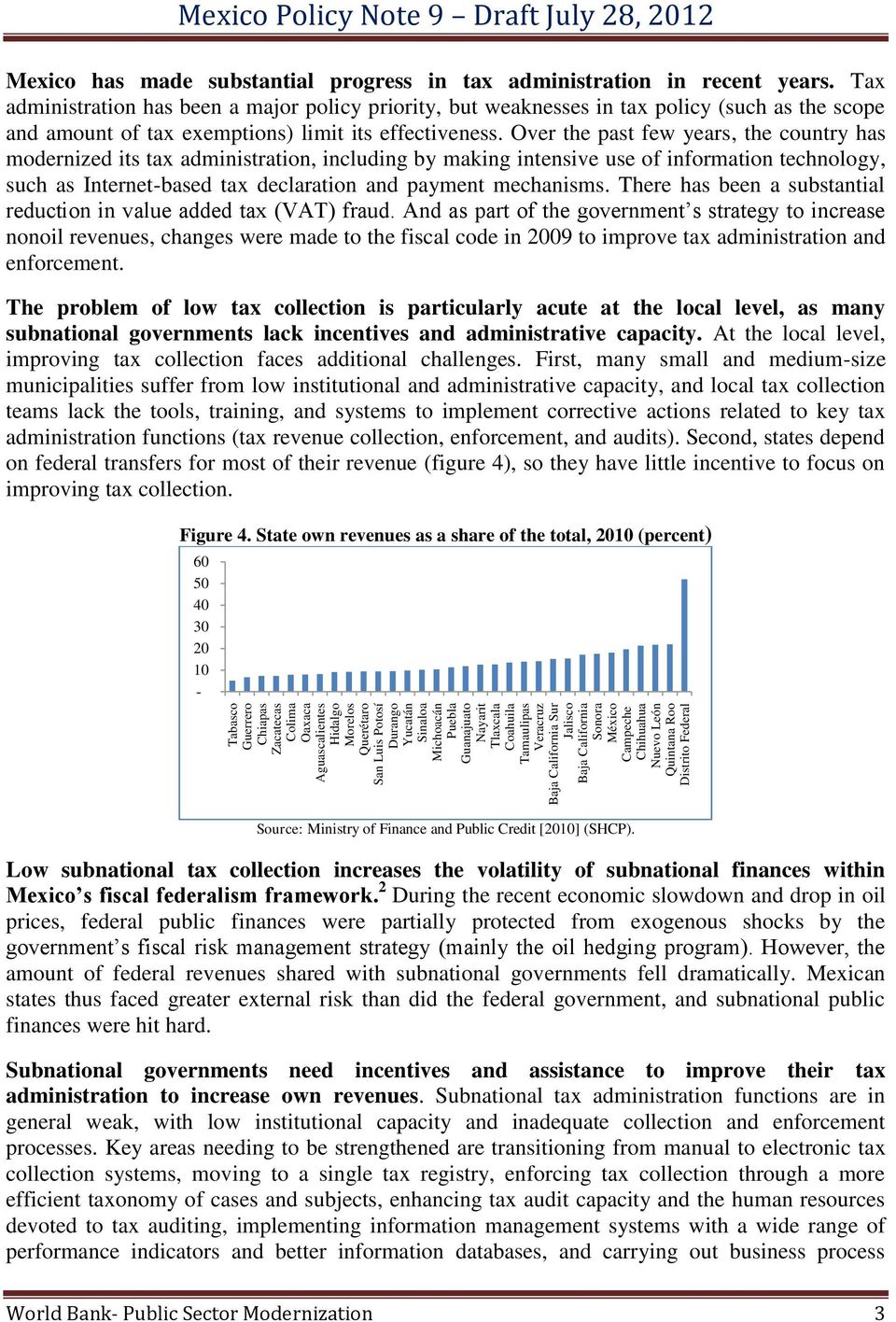
3 Tabasco Guerrero Chiapas Zacatecas Colima Oaxaca Aguascalientes Hidalgo Morelos Querétaro San Luis Potosí Durango Yucatán Sinaloa Michoacán Puebla Guanajuato Nayarit Tlaxcala Coahuila Tamaulipas Veracruz Baja California Sur Jalisco Baja California Sonora México Campeche Chihuahua Nuevo León Quintana Roo Distrito Federal Mexico Policy Note 9 Draft July 28, 2012 Mexico has made substantial progress in tax administration in recent years. Tax administration has been a major policy priority, but weaknesses in tax policy (such as the scope and amount of tax exemptions) limit its effectiveness. Over the past few years, the country has modernized its tax administration, including by making intensive use of information technology, such as Internet-based tax declaration and payment mechanisms. There has been a substantial reduction in value added tax (VAT) fraud. And as part of the government s strategy to increase nonoil revenues, changes were made to the fiscal code in 2009 to improve tax administration and enforcement. The problem of low tax collection is particularly acute at the local level, as many subnational governments lack incentives and administrative capacity. At the local level, improving tax collection faces additional challenges. First, many small and medium-size municipalities suffer from low institutional and administrative capacity, and local tax collection teams lack the tools, training, and systems to implement corrective actions related to key tax administration functions (tax revenue collection, enforcement, and audits). Second, states depend on federal transfers for most of their revenue (figure 4), so they have little incentive to focus on improving tax collection. Figure 4. State own revenues as a share of the total, 2010 (percent) Source: Ministry of Finance and Public Credit [2010] (SHCP). Low subnational tax collection increases the volatility of subnational finances within Mexico s fiscal federalism framework. 2 During the recent economic slowdown and drop in oil prices, federal public finances were partially protected from exogenous shocks by the government s fiscal risk management strategy (mainly the oil hedging program). However, the amount of federal revenues shared with subnational governments fell dramatically. Mexican states thus faced greater external risk than did the federal government, and subnational public finances were hit hard. Subnational governments need incentives and assistance to improve their tax administration to increase own revenues. Subnational tax administration functions are in general weak, with low institutional capacity and inadequate collection and enforcement processes. Key areas needing to be strengthened are transitioning from manual to electronic tax collection systems, moving to a single tax registry, enforcing tax collection through a more efficient taxonomy of cases and subjects, enhancing tax audit capacity and the human resources devoted to tax auditing, implementing information management systems with a wide range of performance indicators and better information databases, and carrying out business process World Bank- Public Sector Modernization 3
4 reengineering of state administrations, particularly for property and payroll taxes. Also crucial are consistency in property valuation techniques, support to cadastre management and improved inter-agency coordination for property tax administration (including property registry, public notaries, and construction licenses). In addition to promoting better tax administration capacity, the federal government could promote incentives for tax collection and reduce discretionary transfers. Stronger incentives are needed for the states, for example by building on the one that the Tax Administration Service (Servicio de Administración Tributaria) introduced under the Régimen de los Pequeños Contribuyentes (For more details on proposals to raise federal and subnational tax revenue see Mexico Policy Notes 9 and 10). Expenditure management Mexico needs to improve public sector performance and the quality of expenditures. Budget and financial management covering key functions in the budget cycle, from planning to execution to evaluation, have traditionally focused on process compliance and input control. These functions and systems need upgrading to provide public sector managers and decisionmakers with relevant, timely, high-quality information on financial inputs and outputs and on outcomes from public projects and programs. This challenge requires actions on several fronts: implementing modern harmonized accounting standards and performance-informed budgeting policies, using information technologies more intensively for public sector management (egovernment), raising standards of administrative procedures and procurement, and strengthening the capacity of federal and subnational governments to deliver high-quality public goods and services in a timely fashion. A modern financial management system and harmonized accounting standards would allow proper financial management, costing, execution, control, and transparency of federal, state, and municipal public programs, increasing accountability to the public and Congress and contributing to an open government. Information on the performance of public programs and policies would enable the government to measure progress toward its goals, revealing which public programs are working and which are not, and giving decision-makers some impartial information on the performance of departments, agencies, and programs. Although Mexico has developed a new legal framework to increase expenditure efficiency, the country still lags behind its OECD peers on key functions of budget management. Remaining challenges include strengthening cash management and harmonizing budget information on public expenditures, revenues, debt, and contingent liabilities at both the federal and state levels. The Performance Evaluation System (Sistema de Evaluación del Desempeño, or SED), anchored in a new legal framework affecting all three levels of government, defining new policies on results-based management and results-based budgeting. The new legal framework includes the 2007 Fiscal Reform, which details the SED framework; the 2008 Constitutional Reform on Expenditure, which requires all levels of government to adopt results-based budgeting, performance evaluation, and multiyear budgeting for investment projects; the Ley de Fiscalización y Rendición de Cuentas de la Federación, which regulates and strengthens oversight of government accounts (cuenta pública) and includes newly defined performance audits as part of the oversight function; and the Ley General de Contabilidad Gubernamental (LGCG), approved in December 2008, which dictates the rules underlying government accounting and financial information with a view to harmonizing all levels of government and decentralized government institutions. World Bank- Public Sector Modernization 4

5 Several key actions have been taken to institutionalize this legal framework. Critical measures include integration of the SED, including the development of methodologies, guidelines, and procedures for its implementation (2008); implementation of budgetary programs and their alignment with performance indicators ( ); integration of performance information with budgeting to inform decisions about program and activities (2011 budget); and design of the Evaluation and Fiscal Transparency Unit in the Ministry of Finance and Public Credit (2011) and of a Performance Evaluation and Fiscal Transparency System (2011). Under this legal framework, the Ministry of Public Administration (Secretaría de la Función Pública, or SFP) is implementing the Special Program for Management Improvement in Federal Public Administration (Programa Especial de Mejora de la Gestión en la Administración Pública Federal, or PMG; ). Also critical have been consolidation of the Evaluation Council (CONEVAL), development of an evaluation program for federal transfers (Ramo 33) to subnational governments (2011), and development of key principles for implementing the performance-informed budgeting agenda at the subnational level. Implementing these reforms at all levels of government is expected to enhance public sector performance, improve the expenditure quality, increase public sector accountability, and enhance fiscal discipline and sustainability. By linking government finance and actions to results-based budgeting, the reforms should help achieve announced public policy goals. Simplifying expenditure execution procedures and budget execution and procurement processes will in turn contribute to more effective programs and service delivery. Implementing performance-informed budgeting requires a cultural change that implies a very different budget management style, particularly in a federal system with sovereign states. Mexico has strengthened budget discipline by improving budget management across the budget cycle, from planning through execution to audit and evaluation. The new legal framework has been followed by specific actions and the adoption of policy reforms in line with best international practice: the conceptual model for the financial management information system (Sistema Integral de Administración Financiera Federal, or SIDAFF), approved by the Ministry of Finance in July 2009, began implementation in 2012; the General Accounts Plan (Plan General de Cuentas), approved by the Ministry of Finance in September 2010; the General Government Accounting Manual (Manual General de Contabilidad Gubernamental), approved in November 2010; the Government Accounting Manual for the Executive Branch (Manual de Contabilidad Gubernamental para el Poder Ejecutivo); and the reforms for implementation of the treasury single account. With these reforms, plus the fiscal and expenditure reforms, budget management is expected to become a policy and planning tool, and SIDAFF will be able to produce real-time reports, thereby strengthening budget control, accountability, and transparency. In 2009, the Ministry of Public Administration created the Management and Government Performance Evaluation Unit to guide and lead its internal efficiency effort. The PMG is being implemented throughout the entire federal government. In 2010, the federal government approved nine regulations standardizing the internal public administration procedures that all federal government agencies should use for auditing, procurement, control, financial management, human resources, asset management, information technology, transparency, and accountability. This reform eliminated 3,549 regulations in federal administration. The PMG will also improve public sector management efficiency by simplifying and standardizing external regulations and procedures for 10 key public services. The PMG, though it has had some impact World Bank- Public Sector Modernization 5

6 and has been able to mobilize resources, has not been consolidated as a cross-cutting tool to enable better public sector management across agencies. A number of fundamental cross-cutting public sector reforms (not addressed in this note) remain to be addressed for example, civil service and regulation simplification. Over the coming years, the government needs to either consolidate the PMG effort or consider an alternative implementation strategy. The performance budgeting and evaluation system 3 reform led by the Ministry of Finance has advanced a results- and performance-informed orientation in the federal budget process. To incorporate results and performance dimensions into resource allocation, the new system uses performance indicators for public sector programs, along with systematic evaluation of public sector policies and programs. The Ministry of Finance has developed guidelines with standardized logical framework instruments for federal government entities to use in formulating their strategic plans. Performance indicators were developed for each program, and recently the Ministry of Finance also developed a complex methodology to synthesize, prioritize, and monitor federal government programs using results and performance information. Budget classifications used in budget allocation have been adjusted and expanded to facilitate effective monitoring and accountability of government programs, allowing for effective results-informed budget deliberations (even though implementing the programmatic classification is still a pending issue). Consolidating performance-based budgeting at the federal and state level depends on consolidating the SIDAFF and equivalent state financial management systems, completing the harmonization agenda, improving the quality of the performance information, institutionalizing the evaluation function, and working with sector ministries to consolidate the performance culture, implement the new tools and processes, and expand capacities to use them. The Ministry of Finance recently established a specialized function for comprehensive evaluation of selected federal government policies and programs. Based on an annual evaluation plan, the Ministry of Finance commissions evaluations that analyze government programs: conceptualization, technical approach and design, efficiency and effectiveness in implementation, achievement of intended objectives, and impact. The evaluations highlight positive aspects of each program and point out deficiencies and areas for further improvement. Several evaluations have been completed, and the results are starting to inform resource allocation through the budget process. The evaluations have also served as the basis for creating an evaluation capacity and culture within the federal government. The challenge now will be to clarify the process of generating and using evaluations. Currently, the law provides competencies for generating evaluations to three institutions CONEVAL, the Ministry of Public Administration, and the Ministry of Finance creating potential competency conflicts and uncertainty on who will do what (aside from the general rule that CONEVAL focuses on social programs). Program discussion during budget preparation and program redesign remains informal, and mechanisms need to be developed to provide incentives for good program performance. Finally, it is essential to institutionalize the evaluation function to move forward and consolidate the reform. Mexico has also achieved substantial progress in fiscal transparency. After a broad consultation and participatory process involving specialized nongovernmental organizations and experts, and in collaboration with the regulatory entity for access to information (Instituto Federal de Acceso a la Información y Protección de Datos), the Ministry of Finance launched a fiscal transparency portal to detailed information on the allocation and use of federal government World Bank- Public Sector Modernization 6
7 resources. The portal includes a citizen-friendly application city budget (presupuesto ciudadano) that facilitates access to budget information and describes the budget process in a very accessible way. The initiative has been successful, but if it is to contribute fully to improving citizens trust in government, it needs to be consolidated, scaled up, and explicitly linked to the action plan on open government. At the state level, progress has been uneven; accounting harmonization will be a prerequisite to further progress. As part of an ambitious strategy to modernize public sector financial management, the government has started to harmonize the public accounts and accounting practices of the federal and subnational governments. Because results-informed management requires mechanisms for accounting, reporting, and consolidating information, accounting systems are being modernized and harmonized. At the federal level, the Ministry of Finance has developed a new conceptual model to integrate core public financial management functions (budget, treasury management, and accounting) and related administrative procedures (human resources, procurement, use and maintenance of assets and materials, and provision of services) as the basis of SIDAFF. Besides providing a common framework and instruments for integrating core public financial management functions within the Ministry of Finance, SIDAFF helps simplify and harmonize activities across the federal government, emphasizing back-office functions. Completing the accounting harmonization program will remain a challenge for the next administration. This task, not simply technical, will require strong political leadership to ensure that the accounting and reporting changes are implemented as the basis for effective resource management in the public sector. At the subnational level, the Ministry of Finance has developed guidelines for the accounting harmonization; supporting the country s 1,200 smaller and less developed municipalities must remain a priority. In partnership with the government s technology department and complemented by an ambitious capacity-building program, the Ministry of Finance needs to do more work on developing the new web-based solution for modernizing, harmonizing, and consolidating municipal financial information using a common platform. Finally, the Ministry of Finance needs to prepare guidelines for decentralized entities and state-owned companies at the federal level and develop the consolidation model and associated instruments for automated integration and consolidation of public accounts at all government levels and for the production of consolidated accounting reports for the entire public sector, following international best practices. Improving the efficiency of government delivery of goods and services requires continuing the procurement system reform that begun in Mexico s public procurement system has a large impact on the country s economy: public procurement accounts for 40 percent of the federal budget and about 10 percent of GDP, and the estimated savings from effective procurement are substantial. 4 Until recently, the procurement system was overregulated, focused heavily on the administrative function, and based primarily on legal regulations. The electronic procurement system was outdated by 2009, incapable of improving transparency, generating competition, or streamlining processes. In addition, procurement staff lacked both knowledge and professionalism. Recent efforts have resulted in savings for the government and have improved delivery of works, goods and services, but further improvements are needed. The key challenges are to consolidate the current system and to target more areas. Especially important is continued emphasis on performance outcomes. Because the risk of waste and corruption in World Bank- Public Sector Modernization 7
8 procurement systems is known to be high, procurement reform and monitoring can yield substantial gains for the economy and society. Mexico aims to align its public procurement system more closely with expenditure policy to generate value for money, ensure transparency and efficiency, and improve the quality of the works, goods and services procured. Over , operational changes and amendments to the legal and regulatory framework have addressed several weaknesses. Among the most important reforms are introducing framework agreements and reverse auction mechanisms, establishing a more comprehensive role for the electronic procurement management system, Compranet (including the possibility of electronic bidding), addressing some of the bid-opening procedures, and establishing a non-judicial conciliation process. By reducing red tape and improving the management of public sector operations, these reforms are expected to improve public service delivery. POLICY OPTIONS On the revenue side, subnational governments need incentives and assistance to improve their tax administration to increase own revenues. There is a blueprint to guide further reforms of tax administration at the federal level, but more work is needed at the subnational level, where tax administration functions are in general weak. Problems include low institutional capacity and poor collection and enforcement processes. Several key areas would benefit from federal support to state governments (see below). On the expenditure side, Mexico needs to strengthen its public sector budget management functions, focusing on performance in formulating, executing, and evaluating public spending programs. Mexico has made good progress on three main fronts of its public sector modernization agenda: harmonizing accounting at the federal and subnational levels, introducing performance-informed budgeting, implementing SIDAFF and the treasury single account, and building on the success of procurement reform in centralized government and sector delivery units to strengthen core public sector management functions. However, further actions are needed to strengthen those core functions, particularly at the subnational level. As experience from other countries shows, setting up a performance-informed system requires a cultural change, with a new management style based on performance incentives, management delegation, and a focus on inputs, outputs, and outcomes. On procurement, the legal, institutional, and operational frameworks must remain dynamic and responsive to the challenges in the market as new technologies and ways of doing business arise in Mexico and elsewhere. The transformation of the procurement system has strategically targeted key legal, institutional, and operational aspects. Legal reforms involved amending procurement law (2009) and secondary legislation ( ) and eliminating many internal regulations. Institutional and operational changes strengthened the roles and capabilities of the Ministry of Public Administration with the development of a Procurement Intelligence Unit, 5 improved stakeholder engagement, a procurement certification process for procurement professionals, and process standardization and system improvements in the e-procurement platform, Compranet. Future short- and medium-term policy reforms should focus on achieving greater efficiency and best-value-for-money outcomes, and increasing competition and transparency by shifting procurement toward performance outcomes. World Bank- Public Sector Modernization 8
9 Progress on performance-based budgeting requires progress on accounting harmonization. A strong financial management system, as envisioned by SIDAFF and the accounting harmonization agenda, is fundamental to performance-based budgeting. Pursuing the agenda of the Accounting Harmonization Council (CONAC) and consolidating performance-based budgeting will be critical. However, CONAC s ambitious agenda needs to be revised to ensure smooth implementation, and an enforcement mechanism needs to be established since there is no incentive mechanism to truly engage the states. In addition, evaluation functions including those of CONEVAL, the Ministry of Finance, and the Ministry of Public Administration 6 need to be clarified and consolidated. Finally, Mexico should continue working on its open budget/government transparency agenda, a proven tool for citizen influence on service delivery standards in other countries. The federal government needs to complete the implementation of SIDAFF s systems and apply the accounting manual principles throughout the government, including in stateowned enterprises. Going forward, the key issue is to preserve the role, effective application, and maintenance of SIDAFF. That makes it critical to reach the so called point of no return the implementation strategy milestone that secures all those requirements through the end of the current administration and the six years of the next. It is thus important to have in place a program to advance ownership and effective application, with proper indicators. The program should include strengthening the staff capacity of the Government Accounting Unit (Unidad de Contabilidad Gubernamental e Informes para la Gestión Publica, UCGIGP). In addition to having an implementation strategy and building political and technical consensus, political leadership, training, and dissemination strategies are key to the successful implementation and sustainability of SIDAFF. Establishing a strong fiscal accounting culture will protect all the products developed under SIDAFF (accounting manual, guides, functional specifications, and system integration) and implemented after years of painstaking preparation. Continuing training and communication activities will complement the sound accounting rules. The training has to be done within UCGIGP and the rest of the Ministry of Finance, including the Oficialías Mayores and the rest of the federal administration. At the subnational level, it will be important to provide support and incentives for implementing state-level financial management systems consistent with the accounting harmonization. For states and municipalities, establishing a common budget classification system in parallel with accounting harmonization would enhance fiscal transparency and support standardization across levels of government. Fiscal transparency at the subnational level would promote accountability and fiscal consolidation. In addition, a more transparent accounting framework would improve expenditure monitoring and encourage efficiency. The Ministry of Finance and CONAC 7 will be important if SIDAFF implementation at subnational level is to continue according to the LGCG. Incentive mechanisms for subnational governments that adopt an integrated system, and support to those that are willing to move forward with the requirements of the LGCG, will be important through World Bank- Public Sector Modernization 9
10 MATRIX OF SHORT- AND MEDIUM-TERM POLICY REFORM OPTIONS* POLICY AREA SHORT-TERM OPTIONS (1 YEAR) MEDIUM-TERM OPTIONS (2 3 YEARS) Improve tax collection and administration Improve quality of public expenditure: public financial management, accounting harmonization, and performanceinformed budgeting Improve quality of public expenditure: procurement Transition from manual to electronic tax revenue collection systems. (AR) Improve management of collection enforcement through a more efficient taxonomy of cases and subjects (AR). Enhance tax audit capacity and increase related human resources (AR) Carry out business process reengineering of state administrations (AR). Implement CONAC s agenda with a realistic framework that facilitates and enforces implementation at the state level (AR) Consolidate evaluation functions and clarify evaluation competencies among CONEVAL, the Ministry of Finance and Public Credit, and the Ministry of Public Administration (AR). Institutionalize the specialized unit into a formal evaluation unit within the Ministry of Finance (AR) Clarify the process and roles for using evaluations in program redesign (AR). Continue to implement the treasury single account (AR). Develop training and dissemination strategies for SIDAFF (AR). Provide support and incentives for subnational implementation of SIDAFF (AR). Advance the open budget/government transparency agenda (AR). Conduct risk and benefit assessments of the market and suppliers (AR). Support the Procurement Intelligence Unit and Compranet (AR) Review the legal framework for civil works, goods, and services (including framework agreements, reverse auctions, and standardization process). (LR) *LR=Legal Reform; AR=Administrative Reform. Preliminary Classification Implement a more ambitious tax revenue reform (LR, see Policy Note 8). Move toward a single tax registry (AR). Implement information management systems with a wide range of performance indicators and better databases (AR). Improve consistency in property valuation techniques, cadastre management, and interagency coordination (AR). Promote incentives for tax collection and reduce discretionary transfers (AR). Implement and consolidate performance-informed budgeting reforms across sectors and coordinate with the accounting harmonization agenda and SIDAFF (LR). Strengthen public sector budget management functions to gradually move to a performance orientation (LR). Professionalize the procurement workforce. (AR) Introduce management tools and functions (such as monitoring and evaluation, data collection, performance indicators, and outcome evaluations). (AR) World Bank- Public Sector Modernization 10

11 NOTES 1 OECD data combine property tax collection with proceeds from state-owned enterprises, which tend to overestimate Mexico s collection rate. 2 See World Bank policy note Subnational Public Finances in Mexico: Main Challenges and Possible Solutions. 3 The Presupuesto Basado en Resultados y Sistema de Evaluación del Desempeño (PBR-SED). 4 Unidad de Política de Contrataciones Públicas, Política General de Contrataciones Públicas, Unidad de Políticas de Contrataciones Públicas, Subsecretaría de Responsabilidades Administrativas y Contrataciones Públicas, Ministry of Public Administration. 6 The law designates CONEVAL, the Ministry of Public Administration, and the Ministry of Finance as the public entities to coordinate evaluations. CONEVAL covers evaluations for social programs, and the Ministry of Public Administration and the Ministry of Finance cover the other evaluations for public programs. Having these competencies dispersed across three major players is a valid yet sometimes confusing framework. 7 The LGCG created CONAC, which has issued most of the harmonized accounting instruments for the government accounting system required to implement the law. REFERENCES Latinobarómetro OECD (Organisation for Economic Co-operation and Development), OECD Stats extracted on 29 May CEPAL (Economic Commission for Latin America) Statistics (2010). World Bank- Public Sector Modernization 11

MIGRATION FACTS. Variable Impacts: State-level Analysis of the Slowdown in the Growth of Remittances to Mexico
 The Migration Policy Institute is an independent, non-partisan, and non-profit think tank dedicated to the study of the movement of people worldwide. The institute provides analysis, development, and evaluation
Three Continuing Years of Proven Success!
 Three Continuing Years of Proven Success! Thanks to your valuable participation, Mexico WindPower 2014 was a great success, consolidating its reputation as the most important wind power event in Mexico
Catastrophe Risk Insurance Pools: Opportunities and Challenges for the Mexican States
 Seminario sobre Modelos de Gestión Financiera del Riesgo de Desastres para las Entidades Federativas en México Mexico, D.F. 1 de diciembre de 2011 Catastrophe Risk Insurance Pools: Opportunities and Challenges
University of Colima, México.
 MEXICO COLIMA University of Colima, México. Government Offices, Old Situation Government of Colima State,, México A New Era Of Management for the Government of Colima A New Era of Management for the Government
Agrimonitor: PSE Agricultural Policy Monitoring System in LAC INE/RND
 Agrimonitor: PSE Agricultural Policy Monitoring System in LAC INE/RND WHAT POLICY MONITORING IS,WHY IS IMPORTANT AND WHAT HAS ALREADY BEEN DONE IN OUR COUNTRIES? Monitor and evaluate developments in agricultural
How To Improve The Mining Industry In Usa
 MEXICO S MINING POLICY May 2014 MEXICAN MINING SECTOR DEVELOPMENT 2001-2012 Metal prices Competitiveness GDP Investment Employment Productivity Exports Increase of 209.2% 5th best mining investment destination
Criminal Justice System Reform
 2014 NGO Submission to the UN Human Rights Committee on the List of Issues Prior to Reporting for the Periodic Report of Mexico. Citizen Observatory of the Criminal Justice Reform in Mexico aims to monitor,
OECD REPORT BEST PRACTICES IN PUBLIC REGISTRIES AND CADASTRES IN MEXICO
 OECD REPORT BEST PRACTICES IN PUBLIC REGISTRIES AND CADASTRES IN MEXICO Executive Summary Property rights are essential to economic growth and social development Protecting property rights in an economy
Accounting Education in Latin America and the Caribbean
 REPARIS A REGIONAL PROGRAM Accounting Education in Latin America and the Caribbean Henri Fortin, Program Manager, CFRR THE ROAD TO EUROPE: PROGRAM OF ACCOUNTING REFORM AND INSTITUTIONAL STRENGTHENING (REPARIS)
Developing Diagnostic Tools for National Monitoring and Evaluation Systems: A Pilot Experience in Latin America
 IDEAS Global Assembly 11 15 April 2011 Amman, Jordan Session 6.7 Complexity of Assessing Evaluation Approaches Developing Diagnostic Tools for National Monitoring and Evaluation Systems: A Pilot Experience
Business Intelligence Unit 2015
 Business Intelligence Unit 2015 Wind Solar Biomass Marine Total # of projects Under About to start construction operations Total % Share MW Sonora 25 237 518 755 19% Chihuahua 20 181 495 676 17%
Luke Haggarty General Manager, IFC Advisory Service Office, Latin America and the Caribbean
 Improving the Business Environment through Sub-national Regulatory Simplification Luke Haggarty General Manager, IFC Advisory Service Office, Latin America and the Caribbean OECD, Global Forum for Governance.
Part 1. MfDR Concepts, Tools and Principles
 Part 1. Concepts, Tools and Principles 3 Overview Part 1. MfDR Concepts, Tools and Principles M anaging for Development Results (MfDR) is multidimensional, relating back to concepts about how to make international
Reducing Costs: Promoting Economic development Enhancing Transparency and Accountability: Improving Service Delivery Improving Public Administration
 Rapid and revolutionary changes in technology have created an increasingly information-centric global economy, where knowledge has become a key factor in competitiveness. The challenge for many governments
SECTOR ASSESSMENT (SUMMARY): PUBLIC RESOURCE MANAGEMENT. 1. Public Resource Management Sector Issues and Opportunities
 Country Partnership Strategy: SRI, 2012 2016 SECTOR ASSESSMENT (SUMMARY): PUBLIC RESOURCE MANAGEMENT 1. Public Resource Management Sector Issues and Opportunities 1. The problems in Sri Lanka are multifaceted
Characteristics of Public Budgets in 5 Latin American Countries
 Characteristics of Public Budgets in 5 Latin American Countries The Latin American Network for Legislative Transparency is a network of civil society organizations in Latin America that promote transparency,
ECON 4311: The Economy of Latin America. Debt Relief. Part 1: Early Initiatives
 ECON 4311: The Economy of Latin America Debt Relief Part 1: Early Initiatives The Debt Crisis of 1982 severely hit the Latin American economies for many years to come. Balance of payments deficits and
Chile: Management Control Systems and Results-Based Budgeting
 Chile: Management Control Systems and Results-Based Budgeting 17 Chile: Management Control Systems and Results-Based Budgeting Author: Marcela Guzmán, Sr. Economist, Chief of Management Controls Division,
Subnational Borrowing and Debt Management
 6 Subnational Borrowing and Debt Management Marcelo Giugale, Fausto Hernandez Trillo, and João C. Oliveira As a result of political opening and administrative decentralization, subnational governments
ECLAC Economic Commission for Latin America and the Caribbean
 1 FOR PARTICIPANTS ONLY REFERENCE DOCUMENT DDR/2 22 June 2012 ENGLISH ORIGINAL: SPANISH ECLAC Economic Commission for Latin America and the Caribbean Eleventh meeting of the Executive Committee of the
The Mexican Model: Health Policy Frame
 Contents The Mexican Model Alto TB Mexico Alto TB at state level Implemented strategies Financial protection Assuring detection and cure TB/HIV-AIDS DOTS Network Advocacy, communication and social mobilisation
Trends in Institutional Arrangements for Public Debt Management
 First Annual Meeting of Latin American and Caribbean Public Debt Management Specialists Rio de Janeiro, March 17-19, 2005 Trends in Institutional Arrangements for Public Debt Management Elizabeth Currie
Open access policies: What can we learn from Latin America? Roxana Barrantes Instituto de Estudios Peruanos
 Open access policies: What can we learn from Latin America? Roxana Barrantes Instituto de Estudios Peruanos 8.00 GDP growth 1999 2009 (percetual variation) 6.00 4.00 2.00 0.00-2.00-4.00-6.00 1999 2000
Performance-Informed Budgeting in Latin America Experiences and Opportunities 1
 Performance-Informed Budgeting in Latin America Experiences and Opportunities 1 April 2009 Working Paper 0309 1 This note was prepared by Pedro Arizti, Mariano Lafuente, Nick Manning, Fernando Rojas and
Uruguayan Electoral Process 2014-2015
 Uruguayan Electoral Process 2014-2015 Rafael Piñeiro Departamento de Ciencias Sociales y Políticas Universidad Católica del Uruguay Elections in Latin America Woodrow Willson Center Washington, January
MONTERREY CONSENSUS EVALUATION AND RECOMMENDATIONS BASED ON THE SITUATION IN LATIN AMERICA
 www.latindadd.org MONTERREY CONSENSUS EVALUATION AND RECOMMENDATIONS BASED ON THE SITUATION IN LATIN AMERICA In practice, the application of the Monterrey Consensus still has important gaps to close, commitments
Dr. Laura Ruiz Pérez Director, Social Programs Tecnológico de Monterrey, Mexico
 Building Strong Local Governments New perspectives p in Learning and Capacity Building 1 January, 2010 Dr. Laura Ruiz Pérez Director, Social Programs Tecnológico de Monterrey, Mexico Mr. Gerardo Guajardo
HIGHER EDUCATION IN PERU
 HIGHER EDUCATION IN PERU THE ROLE OF GOVERNMENT IN QUALITY ASSURANCE RAFAEL YAYA QUIJANDRÍA HIGHER EDUCATION IN PERU ROLE OF GOVERNMENT IN QUALITY ASSURANCE 1 Higher Education in Peru 2 Main Problems and
POLICE REFORM AND INNOVATION IN LATIN AMERICA. AN ASSESSMENT. Hugo Frühling Centro de Estudios en Seguridad Ciudadana - Universidad de Chile
 POLICE REFORM AND INNOVATION IN LATIN AMERICA. AN ASSESSMENT Hugo Frühling Centro de Estudios en Seguridad Ciudadana - Universidad de Chile Content: I. The concept of democratic policing II. Changes in
SECTOR ASSESSMENT (SUMMARY): FINANCE 1. 1. Sector Performance, Problems, and Opportunities
 Country Partnership Strategy: Bangladesh, 2011 2015 SECTOR ASSESSMENT (SUMMARY): FINANCE 1 Sector Road Map 1. Sector Performance, Problems, and Opportunities 1. The finance sector in Bangladesh is diverse,
DG ENLARGEMENT SECTOR BUDGET SUPPORT GUIDELINES
 Ref. Ares(2014)571140-04/03/2014 DG ENLARGEMENT SECTOR BUDGET SUPPORT GUIDELINES EXECUTIVE SUMMARY January 2014 TABLE OF CONTENTS Introduction 1. RATIONALE FOR BUDGET SUPPORT 1.1 What is Budget Support?
How To Help The Republic Of The Maldives
 Technical Assistance Report Project Number: 47150 Capacity Development Technical Assistance (CDTA) December 2013 Republic of the Maldives: Enhancing Tax Administration Capacity (Financed by the Japan Fund
How To Understand The Relationship Between Free Trade And Meat Production In Mexico
 FREE TRADE AND MEXICO S MEAT SECTOR September 27, 2012 Contents I. Trade Agreements signed by Mexico II. Benefits of Foreign Trade III. External Challenges of Foreign Trade IV. Foreign Trade and the Mexican
SUBCOMMITTEE ON PLANNING AND PROGRAMMING OF THE EXECUTIVE COMMITTEE
 PAN AMERICAN HEALTH ORGANIZATION WORLD HEALTH ORGANIZATION SUBCOMMITTEE ON PLANNING AND PROGRAMMING OF THE EXECUTIVE COMMITTEE 31st Session, 23-24 November 1998 Provisional Agenda Item 8 SPP31/8, Rev.1
Economic and Social Council
 United Nations E/ICEF/2010/13 Economic and Social Council Distr.: General 5 April 2010 Original: English For information United Nations Children s Fund Executive Board Annual session 2010 1-4 June 2010
Obtaining Finance in Latin America and the Caribbean 1
 Obtaining Finance in Latin America and the Caribbean 1 World Bank Group latin America and the Caribbean Series Note No. REV. 8/14 Basic Definitions Countries surveyed in and how they are grouped for analysis:
Access to Financial Services in Developing Countries: Identification of Obstacles. Liliana Rojas-Suárez July 2006
 Access to Financial Services in Developing Countries: Identification of Obstacles Liliana Rojas-Suárez July 2006 Background Even though banks are the most important providers of financial services Evolution
Papua New Guinea: Supporting Public Financial Management, Phase 2
 Technical Assistance Report Project Number: 44379 012 Capacity Development Technical Assistance (CDTA) November 2012 Papua New Guinea: Supporting Public Financial Management, Phase 2 The views expressed
Latin America s s Foreign Debt
 Latin America s s Foreign Debt Causes and Effects Internal Causes of the Debt Overvalued currency associated with ISI Returns on projects in future, but payments now: Debt trap Populist economic policies:
How To Know If A Country Is Ready For E Commerce
 A report into regional conditions for e-commerce E-Readiness in Latin America Conditions in the region for the development of e-commerce improved by 47.6% over the last four years. The gap with developed
FCPA and Anti-Corruption in Latin America
 FCPA and Anti-Corruption in Latin America May 2011 FCPA Enforcement "FCPA enforcement is stronger than it's ever been and getting stronger. We are in a new era of FCPA enforcement; and we are here to stay."
Title Implementing Here a Shared Inspection Management System
 Investment Climate l World Bank Group Nuts & Bolts Technical Guidance for Reform Implementation Title Implementing Here a Shared Inspection Management System Insights from recent international experience
Human Development Research Paper 2010/23 Advances in sub national measurement of the Human Development Index: The case of Mexico
 Human Development Research Paper 2010/23 Advances in sub national measurement of the Human Development Index: The case of Mexico Rodolfo de la Torre and Hector Moreno United Nations Development Programme
Open Government Partnership (OGP) ACTION PLAN BY THE REPUBLIC OF ARMENIA
 Open Government Partnership (OGP) ACTION PLAN BY THE REPUBLIC OF ARMENIA INTRODUCTION The decision to join the Open Government Partnership initiative reflects Armenia s commitment to promote greater transparency
352 UNHCR Global Report 2010
 352 UNHCR Global Report 2010 Argentina Bolivia (Plurinational State of) Brazil Chile Colombia Costa Rica Cuba Ecuador El Salvador Guatemala Honduras Mexico Nicaragua Panama Paraguay Peru Uruguay Venezuela
Key Performance Indicators Strengthen Procurement in Latin America
 Key Performance Indicators Strengthen Procurement in Latin America Country teams from Guatemala and Honduras work together to share lessons on procurement at a Latin America and the Caribbean Contraceptive
Colombia: sustaining reforms over time
 26 Colombia: sustaining reforms over time Colombia s experience shows the importance of sustaining reform efforts over time and adjusting them to the changing needs of the economy, whether at the national
Session 6: Budget Support
 Session 6: Budget Support Paper 6.1 - Introductory Paper on Budget Support [1] Introduction Budget support has become an increasingly important instrument of development assistance. It has not only received
Framework for Managing Programme Performance Information
 Framework for Managing Programme Performance Information Published by the National Treasury Private Bag X115 Pretoria 0001 South Africa Tel: +27 12 315 5948 Fax: +27 12 315 5126 The Framework for Managing
Receivables Management Solutions
 Receivables Management Solutions Unlock trapped liquidity, reduce costs and make collections more predictable Citi Transaction Services Latin America and Mexico Citi Transaction Services Latin America
Preventing through education
 Ministerial Declaration Preventing through education The Ministerial Declaration Preventing through Education, was approved in Mexico City in the framework of the 1st Meeting of Ministers of Health and
FINANCIAL INCLUSION REPORT December 2009
 3 4 FINANCIAL INCLUSION REPORT December 2009 National Banking and Securities Commission President Guillermo Babatz Torres Vice-president of Regulatory Policies General Direction on Access to Financial
KPI UN Women Response Key Actions I. UN-Women s organisational effectiveness KPI 1: Providing direction for results
 KPI UN Women Response Key Actions I. UN-Women s organisational effectiveness KPI 1: Providing direction for results KPI 2: Corporate strategy and mandate KPI 3: Corporate focus on results KPI 4: Focus
APEC Information Privacy Principles in the Development of Outsourcing Business: Contact Center in Peru
 2008/SOM1/ECSG/SEM/018 APEC Information Privacy Principles in the Development of Outsourcing Business: Contact Center in Peru Submitted by: Peru Technical Assistance Seminar on International Implementation
INTERNATIONAL FACTORING
 INTERNATIONAL FACTORING November 3, 2011 1 L. Gabriel Segura President and founding officer of CVCredit Inc, a Miami-based company which focuses in USA-domestic and international factoring services. Nine
Preparation of the Informal Ministerial Meeting of Ministers responsible for Cohesion Policy, Milan 10 October 2014
 Preparation of the Informal Ministerial Meeting of Ministers responsible for Cohesion Policy, Milan 10 October 2014 Cohesion Policy and economic governance: complementing each other Background paper September
INTERNATIONAL MONETARY FUND. Manual on Fiscal Transparency (2007) Abbreviations and Acronyms...3
 INTERNATIONAL MONETARY FUND Manual on Fiscal Transparency (2007) Contents Page Abbreviations and Acronyms...3 Revised Code of Good Practices on Fiscal Transparency (2007)...4 Overview...8 I. Clarity of
Bringing Control to Global Supply Management Business Process Management (BPM) and Advanced Project Management Practices
 Bringing Control to Global Supply Management Business Process Management (BPM) and Advanced Project Management Practices Jason Klemow, CTP, Partner The JK Group 301/948-2134; [email protected] Francine
COMPARED EXPERIENCES REGARDING PUBLIC DEBT MANAGEMENT
 COMPARED EXPERIENCES REGARDING PUBLIC DEBT MANAGEMENT MIRELA-ANCA POSTOLE, RODICA GHERGHINA, IOANA DUCA, IRINA ZGREABAN ACADEMY OF ECONOMIC SCIENCES, TITU MAIORESCU UNIVERSITY BUCHAREST [email protected],
REPORT OF THE KNOWLEDGE TRANSFER NETWORK*
 Distr. LIMITED LC/L.3379(CEA.6/7) 19 October 2011 ENGLISH ORIGINAL: SPANISH Sixth meeting of the Statistical Conference of the Americas of the Economic Commission for Latin America and the Caribbean Bávaro,
Doing Business in Mexico
 http://www.pwc.com/mx/doing-business-maquiladora PwC-IMMEX Maquiladora Guide Doing Business in Mexico A guide for smart investments. PwC Mexico March 2013 Introduction For your convenience, PwC put together
THE PROCESS OF PLANNING AND INSTITUTIONAL FRAMEWORK FOR POVERTY REDUCTION STRATEGY: THE CASE OF UGANDA.
 THE PROCESS OF PLANNING AND INSTITUTIONAL FRAMEWORK FOR POVERTY REDUCTION STRATEGY: THE CASE OF UGANDA. By Margaret Kakande Poverty Analyst Ministry of Finance, Planning and Economic Development, Government
Conference Statement:
 Conference Statement: Strengthen Resilient Recovery and Reconstruction in the Post-2015 Framework for Disaster Risk Reduction Preamble: The growing incidence of high-impact disasters has made countries
Global Conference on Accounting and Reporting by Governments The global case for transparency
 www.pwc.com Global Conference on Accounting and Reporting by Governments The global case for transparency Brian Quinn, World Bank Group The Global Case for Transparency Brian Quinn Director World Bank
Sub- Regional Workshop and Consulta;ons on Capacity- Building in Travel Document Security: Colombia, 2013
 Sub- Regional Workshop and Consulta;ons on Capacity- Building in Travel Document Security: Colombia, 2013 Carlos Gómez Head of R&D and Innova.on, FNMT- RCM, Spain ICAO TRIP: Building Trust in Travel Document
Recommended Roadmap for Shared Inspection Management Solutions
 Recommended Roadmap for Shared Inspection Management Solutions This roadmap outlines the phases of activities required in order to plan, design and implement a shared inspection management solution. While
Association of Panamerican Veterinary Medical Colleges
 Association of Panamerican Veterinary Medical Colleges Animal Welfare and ONE HEALTH concept Dr. Juan de Jesus Taylor Preciado [email protected] PANVET Panamerican Veterinary Sciences Association
Uganda s IFMS project has been SUMMARY CHARACTERISTICS OF THE IFMS AND ITS ROLE IN SUPPORTING THE BUDGET PROCESS
 COUNTRY LEARNING NOTES Uganda: implementing an Integrated Financial Management System and the automation of the budget process Lawrence Semakula & Robert Muwanga * July 2012 SUMMARY The Implementation
The IMF s Fiscal Affairs Department has developed a suite of
 IMF Fiscal Assessment Tools The IMF s Fiscal Affairs Department has developed a suite of standardized assessment tools to strengthen the conceptual and analytical basis for fiscal surveillance. These tools
APS DISTRICT HIGH SCHOOL CURRICULUM FRAMEWORK
 APS DISTRICT HIGH SCHOOL CURRICULUM FRAMEWORK Course Title: Mexican Folkdance, Culture, and Music III Course Number: 61042 Department: Modern, Classical, and Native Languages ADS Number: 12998900 Prerequisites:
Solid Waste Management in LAC: Actual and Future CH4 Emissions and Reductions
 Solid Waste Management in LAC: Actual and Future CH4 Emissions and Reductions The World Bank, August 2008 This presentation will focus on: 1. Current Situation of MSWM service provision in LAC and identification
The recent decline in income inequality in Brazil: magnitude, determinants and consequences. Ricardo Paes de Barros (IPEA)
 The recent decline in income inequality in Brazil: magnitude, determinants and consequences Ricardo Paes de Barros (IPEA) Cuidad de Guatemala, July 2007 1. Magnitude 0.610 Evolution of inequality in per
The Hospital Strategy Project in South Africa
 8 The Hospital Strategy Project in South Africa Monitor Company, Health Partners International, Center for Health Policy, and National Labor and Economic Development Institute, South Africa This chapter
Performance Monitoring and Evaluation System (PMES) Framework Document
 Performance Monitoring and Evaluation System (PMES) Framework Document Performance Management and Evaluation Unit Cabinet Support and Policy Division Cabinet Office 8 th November 2010 Table of Contents
Capacity building for non communicable disease prevention and control in Latin America and Caribbean
 Capacity building for non communicable disease prevention and control in Latin America and Caribbean Advances and challenges Branka Legetic, Anselm Hennis Pan American Health Organization- World Health
A FRAMEWORK FOR NATIONAL HEALTH POLICIES, STRATEGIES AND PLANS
 A FRAMEWORK FOR NATIONAL HEALTH POLICIES, STRATEGIES AND PLANS June 2010 A FRAMEWORK FOR NATIONAL HEALTH POLICIES, STRATEGIES AND PLANS June 2010 This paper reviews current practice in and the potential
NATIONAL TREASURY STRATEGIC PLAN 2011/14
 NATIONAL TREASURY STRATEGIC PLAN 2011/14 PRESENTATION TO PARLIAMENTARY FINANCE COMMITTEES Presenter: Lungisa Fuzile Director General, National Treasury 31 May 2011 TREASURY AIMS AND OBJECTIVES Chapter
Prepanet Monterrey Tech Community High School
 Prepanet Monterrey Tech Community High School Monterrey Tech Private institution founded in 1943. Non-profit Non-government operational support 27 non-profit sponsoring organizations 565 members on the
Effective Debt Management. Improving Debt Management Practices Worldwide
 Effective Debt Management Improving Debt Management Practices Worldwide Effective debt management is essential for economic development. As countries develop they confront increasing challenges in managing