
SOCIAL WORK AND SUSTAINABLE WELLBEING: A COMPARATIVE VIEW
|
|
|
- Kristina Alexandra Anthony
- 10 years ago
- Views:
Transcription
1 SOCIAL WORK AND SUSTAINABLE WELLBEING: A COMPARATIVE VIEW Materials from Sustainable Wellbeing Intensive Programme Madrid 23 March 4 April 2014 Faculty of Social Work Complutense University of Madrid
2 SOCIAL WORK AND SUSTAINABLE WELLBEING: A COMPARATIVE VIEW Materials from Sustainable Wellbeing Intensive Programme Madrid 23 March 4 April 2014 Faculty of Social Work Complutense University of Madrid

3 Coordinator: Marta Blanco Carrasco Faculty of Social Work. Complutense University. Collaborating companies and institutions: Exclusion Observatory Family Meeting Point of the City of Madrid (PEF, or Punto de Encuentro Familiar del Ayuntamiento de Madrid) Family Support Centre of the City of Madrid (CAF, or Centro de Atención a las Familias del ayuntamiento de Madrid) Fundación Telefónica Metro de Madrid Real Democracy Now! (Democracia Real, Ya!) Roma Foundation (Fundación Secretariado Gitano) Samur Social Wayra (Telefonica) Funding companies and institutions: Organismo Autónomo Programas Educativos Europeos European Association of Schools of Social Work Metro de Madrid Faculty of Social Work. Complutense University of Madrid. ISBN:

4 Index Chapter I: Introduction to Sustainable Wellbeing Intensive Programme Sustainable Wellbeing Erasmus Intensive Programme (Marta Blanco Carrasco and Alejandra González Bonilla) Intensive Programmes Our Intensive Programme: Sustainable Wellbeing Complutense University Intensive Programme Inauguration of Intensive Programme: Infoactualidad Press Release Inaugural Lecture: Marta Blanco Carrasco, IP Coordinator Methodology Chapter II: Social Work and Sustainable Wellbeing: a Comparative Perspective. María Vizcarro Sustainable Wellbeing International Context European Context Social Work and Sustainable Development Bibliography Chapter III: A Fair Future For All Social Work on the Finite Planet. Arto O. Salonen Big Questions in the Era of Anthropocene An Ecosocial Well-being Paradigm Transition towards a Sustainable and Resilient Society Changing values from materialism to post materialism Reforming economies towards a culture of trust Strengthening resilience of communities Multiple benefits is a way forward References Chapter IV: Social Work and Sustainable Wellbeing: a Comparative Perspective Belgium Country Profile (Vives) First historical perspective: The professionalization of Social Work... 52

5 Second historical perspective: A canon of Social Work Hans Achterhuis: criticism on Social Work Recovery after the uppercut Stef Herman The Social Work Bachelor Programme (Artevelde University) Introduction Curriculum structure Specialisations of the social work bachelor programme Differentiation Overview Combination: Major and Minor Advanced Topical Study Sustainability within the Study Social Work and Sustainability (Thomas More) Czech Republic Finland Germany Lithuania Spain ANNEXES Annex 1: IP Participants Students Teachers Press Committee: Students from the Faculty of Information Sciences Translation Committee: Students from the Faculty of Translation History and Art Committee: Students from the Faculty of Geography and History Contact Information Annex 2: Template, Comparative Overview of Social Work and Sustainable Wellbeing Annex 3: Template, Good Practice Example Annex 4: Daily Programme

6 Chapter I: Introduction to Sustainable Wellbeing Intensive Programme 1. Sustainable Wellbeing Erasmus Intensive Programme (Marta Blanco Carrasco and Alejandra González Bonilla) The aim of this book is to collect the materials produced in the intensive programme coordinated by Universidad Complutense, Madrid, during academic year The programme took place between 23 March and 4 April It has resulted in four books focusing on the relationship between social work and sustainable wellbeing, in addition to a website and a work seminar on the UCM moodle platform Intensive Programmes Intensive programmes (IPs) 1 are activities or projects within the Erasmus programme, subsidized by the National Erasmus Agency and in the case of Spain by the Autonomous Body of European Educational Programmes (Organismo Autónomo de Programas Educativos Europeos, or OAPEE) 2, and coordinated and run by higher educational institutions forming part of the Erasmus scheme. An IP is a short-term study programme involving students and teaching staff from higher education institutions in different countries with the aims of: - Promoting effective and multinational education on specialized topics that would not otherwise be taught anywhere at all, or at best in a limited number of institutions; - Allowing students and teachers to work together in multinational groups and to benefit, therefore, from special teaching and learning conditions not normally available in a single institution, offering new perspectives on the topic studied; and - Allowing members of teaching staff to exchange views on educational content and new curricular approaches, and test teaching methods in an international academic environment. The structure and methodology of this type of programme permit the attainment of goals that would not be possible in other short-term international learning programmes. IPs offer students and teachers a single learning space, placing particular value upon innovation, internationalization and multidisciplinarity. The programmes generally take place over two or three weeks, with intensive working days creating

7 immersion both in the central topic of the programme and in linguistic terms. Teachers and students participating in IPs report high levels of satisfaction despite the tiring working days in unfamiliar environments. The keys to this success are undoubtedly cooperation among participating institutions and painstaking organization and management of budget by the coordinating institution. It is important to note that IPs are not congresses and do not seek to offer students a series of conferences and lecturers; nor is their format that of an international congress. They do not involve the carrying out of pure research, though they unquestionably open up interesting lines of future investigation. Most importantly, as highlighted by OAPEE, an IP must provide something new with relation to learning opportunities, skills development, access to information, etc., to the participating teachers and students (principle of innovation). The IP must offer added value compared with existing courses offered by the participant institutions 3. IPs aim to offer students and teachers a unique learning space, which places particular value on innovation, internationalization and multidisciplinarity. It has also been observed that students participating in IPs often consider the possibility of travelling and studying abroad in later years, through Erasmus programmes. IPs hence offer a platform to encourage mobility among students and teachers. Institutions participating in IPs are also expected to recognize the efforts of students by awarding credits. They should make use of ICT tools and services in the preparation and completion of the programme. Additionally, institutions must ensure that the proportion of teaching staff to students is appropriate in order to guarantee active participation in the classroom and provide an element of curricular development in the implementation of the IP. On the completion of the IP, a final report and justification of costs are to be drafted and submitted, if required, for the perusal of the Erasmus National Agency Our Intensive Programme: Sustainable Wellbeing The IP developed and coordinated during academic year in the Faculty of Social Work of UCM has the principal objective of considering so-called social sustainability as a means of encouraging responsible and active European citizenship. The Sustainable Wellbeing project has its origins in the SOS!, Social Work and Sustainability IP, which resulted in successes and experiences that were considered worth expanding upon from an entirely new perspective (though recognizing the undeniable connections between the two IPs). 3 FAQs regarding intensive programmes: pdf?documentId=0901e72b e.

8 On 11 August 2011, the European Commission proposed designating 2013 as the "European Year of Citizens" to mark the 20th anniversary of the establishment of European Union Citizenship under the 1993 Maastricht Treaty. Social workers all over Europe play a fundamental part in this transition process towards a sustainable future, as agents of social change. Three international organizations representing social work practice (IFSW, IASSW, ICSW), committed in their 2012 Global Agenda ( to: - Promote standards in education and practice that facilitate sustainable social development outcomes. - Encourage and facilitate research into the role of social work with relation to disasters and environmental challenges. - Promote the importance of sustainable, interdependent communities to achieve social development and wellbeing. The main aim of this IP is therefore to analyze the contributions of social work as an agent of change to encourage social action, responsible citizenship and sustainable development. The IP will offer students and teachers the opportunity to participate in an English-speaking programme that is part of the European Policy statement of all partners in the network. Specifically, the Sustainable Wellbeing IP involved a total of nine foreign institutions in addition to the Faculty of Social Work of UCM, with 59 students and 16 teachers from those countries and institutions. City/country Institución Number of students Kortrijk/Belgium Katho University College 7 1 Geel/Belgium Thomas More University 7 1 Gent/Belgium Artevelde Hogeshool 7 2 Birmingham/U.K. Newman University 5 2 Helsinki/Finland Helsinki Metropolia of Applied Sciences 6 2 Ludwigsburg/Germany Protestant University of Applied 7 2 Sciences Vilnius/Lithuania Faculty of Social Policy, Mykolas 6 2 Romeris University Prague/Czech Protestant Theological Faculty 7 2 Republic Madrid/Spain Social Work Faculty, Complutense 7 2 University of Madrid Number of teachers The existence of this kind of programme allows for a comparative analysis of the issues under study and an in-depth reflection that other kinds of programme cannot achieve.

9 The project includes, in addition to the intensive workgroup sessions, the production of four books and a webpage, in which the work and research conducted can be collected and made accessible to other institutions. One of the expected outcomes is a collection of good practices provided by the social work students from the various participant institutions, as well as a summary of the visits undertaken during the programme to see examples of those good practices. It has also been sought to take the greatest possible advantage of the efforts of our students and teachers, in linking the work performed in IPs with Final Theses. In such Theses, students may consider chosen themes in greater depth and take the opportunity to enrich their work by including a comparative view of issues thanks to knowledge obtained during the IP. Additionally, the presentation of this work in English which is undoubtedly reflected in the ultimate evaluation of the work by the judging panel is encouraged. Extracts from certain of these works have been included within this book. It is noteworthy that only two Faculties in the whole of the Universidad Complutense have risked carrying out this work, taking into account that IPs are a common and widespread practice in neighbouring countries and, additionally, that they have been permanently incorporated into the curricula of these universities. On 16 and 17 September 2013, the Faculty of Social Work hosted a preparatory meeting attended by representatives of all the institutions participating in the Sustainable Wellbeing IP (except, for scheduling reasons, MRU of Lithuania). Over the course of two full days of meetings, with morning and afternoon sessions, attendees considered administrative and organizational aspects (budgetary matters, sponsorship, recruitment and selection of participating students, dissemination of outcomes, publications), and academic and didactic matters (Tutor s Guide, Student s Guide, moodle platform, supervision, workgroup tasks, individual tasks, expected outcomes, evaluation). Before commencing the IP, a platform was created on the virtual moodle campus to which both teachers and students were granted access. The platform offered both the IP programme and the two books developed as guides for students and teachers, containing all information needed prior to the IP as well as links to allow uploading of the preparatory work that the national workgroups were required to complete. The IP took place in Madrid, during the two weeks from 24 March to 4 April The daily programme for the IP may be consulted at annex IV of this book, which lists both conferences and visits to the institutions deemed by participant institutions to be examples of good practices. In addition to the tutors for each group, the IP featured five guest speakers recognized as experts in their field: 1. Carmen Roncal (Faculty of Social Work, UCM) 2. Elena Roldán (Faculty of Social Work, UCM) 3. Begoña Leyra (Faculty of Social Work, UCM) 4. Antonia Picornell (Faculty of Social Work, University of Salamanca)

10 5. Remmelt Veenkamp (Inholland University of Applied Sciences, Rotterdam, Holland). Guest speakers (non-academic): Exclusion Observatory (Observatorio de la Exclusión), Stop Evictions (Stop Desahucios). Field visits: Nine field visits took place, offering direct contact with associations, institutions and places of special interest for the issues considered during the IP: Samur Social Fundación Telefónica Wayra Metro de Madrid Family Meeting Point (PEF, or Punto de Encuentro Familiar) Family Support Centre of the City of Madrid (CAF, or Centro de Atención a las Familias) Real Democracy Now! (Democracia Real, Ya!) Roma Foundation (Fundación Secretariado Gitano) Cañada Real Extra-academic activities: Visit to Paraninfo hall of Complutense University Guided visit: Madrid de las Austrias Guided visit: Madrid de los Borbones Guided visit: the Museo del Prado Guided visit: the Museo Reina Sofía Collaborating companies and institutions: Metro de Madrid, which counts sustainability as one of its priorities, collaborated in this IP in a double sense. Not only did Metro de Madrid facilitate a field visit, but it also contributed sufficient metro/bus tickets to cover the travel needs of all IP participants for its two-week duration. Synergies with other Universidad Complutense Faculties: School of Labour Relations (Escuela de Relaciones Laborales): The School of Labour Relations (situated on Calle San Bernardo in central Madrid) was the main location for teaching activities on the IP. There were two reasons for this decision. First, and mainly, classroom and teaching space were limited in the Faculty of Social Work. Second was the more central and easily accessible location of the School of Labour Relations compared with the Faculty of Social Work. Given the numerous trips and field visits included in the programme, movement to and from the Faculty s

11 Somosaguas campus would have meant added difficulty in terms of both time spent and transport costs (unacceptable given the IP s budget). Faculty of Information Sciences (Facultad de Ciencias de la Información): Coordinated and supported at all times by professor María Luisa Sánchez Calero of the Department of Journalism I, 17 students from the Faculty of Information Sciences (essentially from the Journalism and Audiovisual Communication Departments) organized and managed the Press and Communication Group. During the months prior to the IP, the Press Group was entrusted with designing the Logo for the IP, which was subsequently used on the identification of the IP collaborative team as well as on official IP documentation: Logo IP Sustainable Wellbeing During the two weeks of the IP itself, the Press and Communication Committee (Gabinete de Prensa y Comunicación) was responsible for coverage written and graphic (photo/video) of all programme activities, drafting and issuing press releases, and publishing immediately and constantly updated information at Infoactualidad ( In the months following the completion of the IP, the Press Committee assisted in compiling a Dossier on its impact and coverage. The experience of the Press Committee was considered very positive, both by its coordinating professor and by all participating students. It was unanimously agreed to have offered a rare opportunity for professional practice. The 17 Information Sciences students who collaborated in the IP also obtained elective ECTS credits, available to students participating in cultural, sporting, representative, fraternal and cooperative university activities. CES Felipe II (Translation and Interpreting) Undergraduate students in Translation and Interpreting at CES Felipe II made a vital contribution. Both the Head of Studies, Marta Guirao, and other tutors (Manuel Mata, Juan Carlos Alcalá, Arsenio Andrades and James Flath) offered determined and enthusiastic support for the project from the outset, and actively collaborated in terms
12 of both coordination of the Translation and Interpreting Committee and personal and consistent attendance at all activities in which the students took part. The Translation and Interpreting group performed the following tasks: 1- Translation into English of all documents (guides, dossiers, etc.) necessary for the IP and originally written in Spanish. 2- Review of documents drafted in English by non-native speakers of English, prior to the dissemination of such documents. 3- Simultaneous translation from Spanish into English for all visits and activities imparted by or involving non-english-speaking persons. 4- Simultaneous translation from English into Spanish for activities undertaken directly in English. A total of 20 students of Translation and Interpreting collaborated in these tasks. As with their colleagues from Information Sciences, they obtained elective ECTS credits available to students participating in cultural, sporting, representative, fraternal and cooperative university activities. Geography and History: In contrast to CES Felipe II and the Faculty of Information Sciences, the proposal made to the Faculty of Geography and History did not meet with a clear response at the institutional level. Despite this absence of support or academic guidance from teaching staff, some undergraduate students of History of Art collaborated with the IP, participating purely out of personal motivation and interest in the project. The History and Art group contributed in the following manner: Development and drafting of practical guides to Madrid (key information) Development and drafting of essential Prado guide Coordination of cultural activities: guided visits to Madrid de las Austrias, Madrid de los Borbones, the Museo del Prado, and the Museo Reina Sofía (the latter two including organization of advance group bookings). The 3 undergraduate students of History of Act who collaborated in these tasks received, as with their colleagues, elective ECTS credits available to students participating in cultural, sporting, representative, fraternal and cooperative university activities. Both UCM and the other participant institutions wish to extend to all the participants our sincere gratitude for all the effort and support received in the holding of this IP.

13 Many thanks! 2. Complutense University Intensive Programme 2.1. Inauguration of Intensive Programme: Infoactualidad Press Release Heading: The Complutense University of Madrid brings together nine European universities for the intensive program Sustainable well-being Written by: Redacción Infoactualidad. Friday, 28 March :33 Translation into English: Traducción e Interpretación, CES Felipe II (UCM). From March 24 th to April 4 th, institutions, students and professors from nine different universities from all over Europe are gathering at the intensive program called Sustainable well-being. This program is coordinated by the Complutense University of Madrid s School of Social Work.
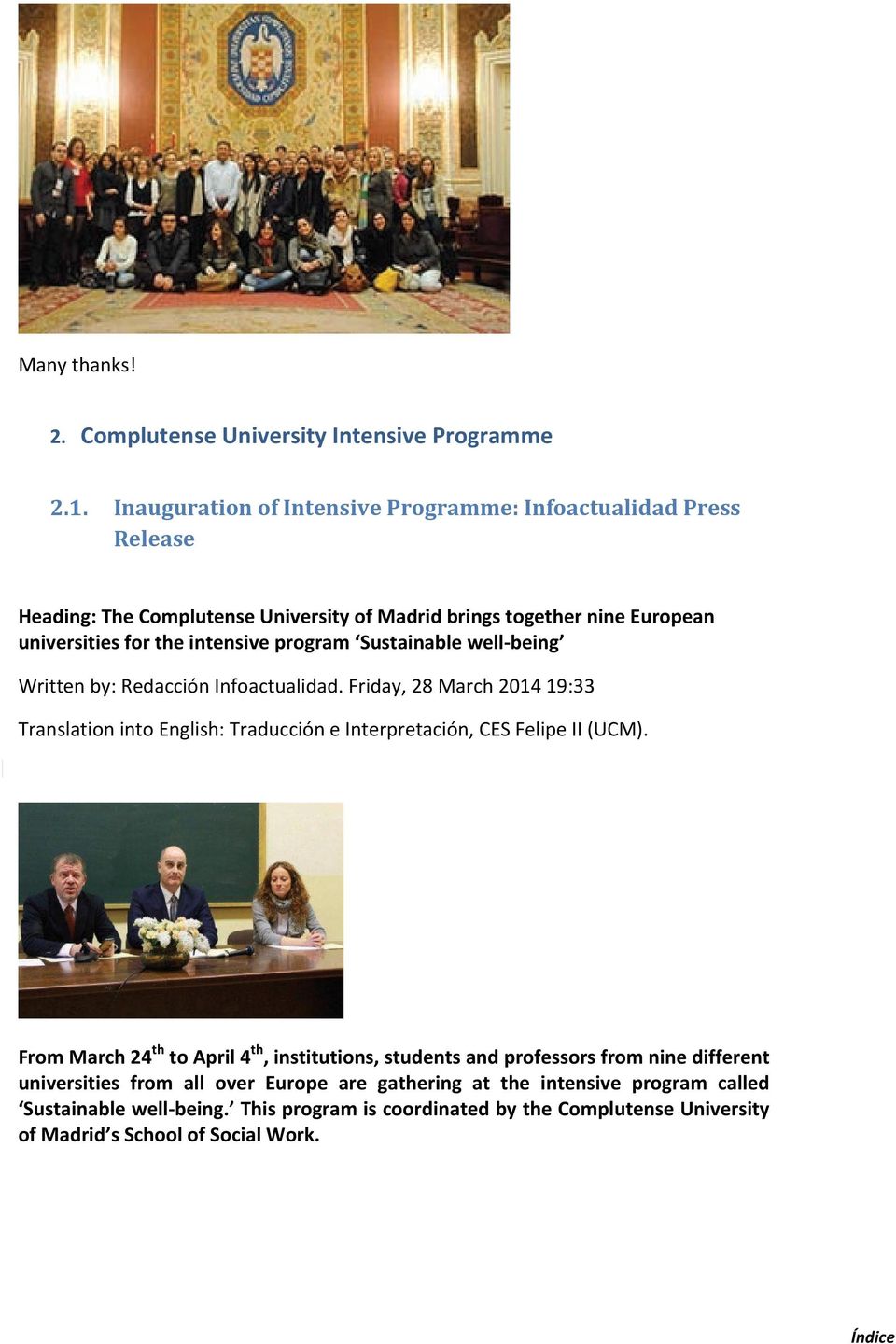
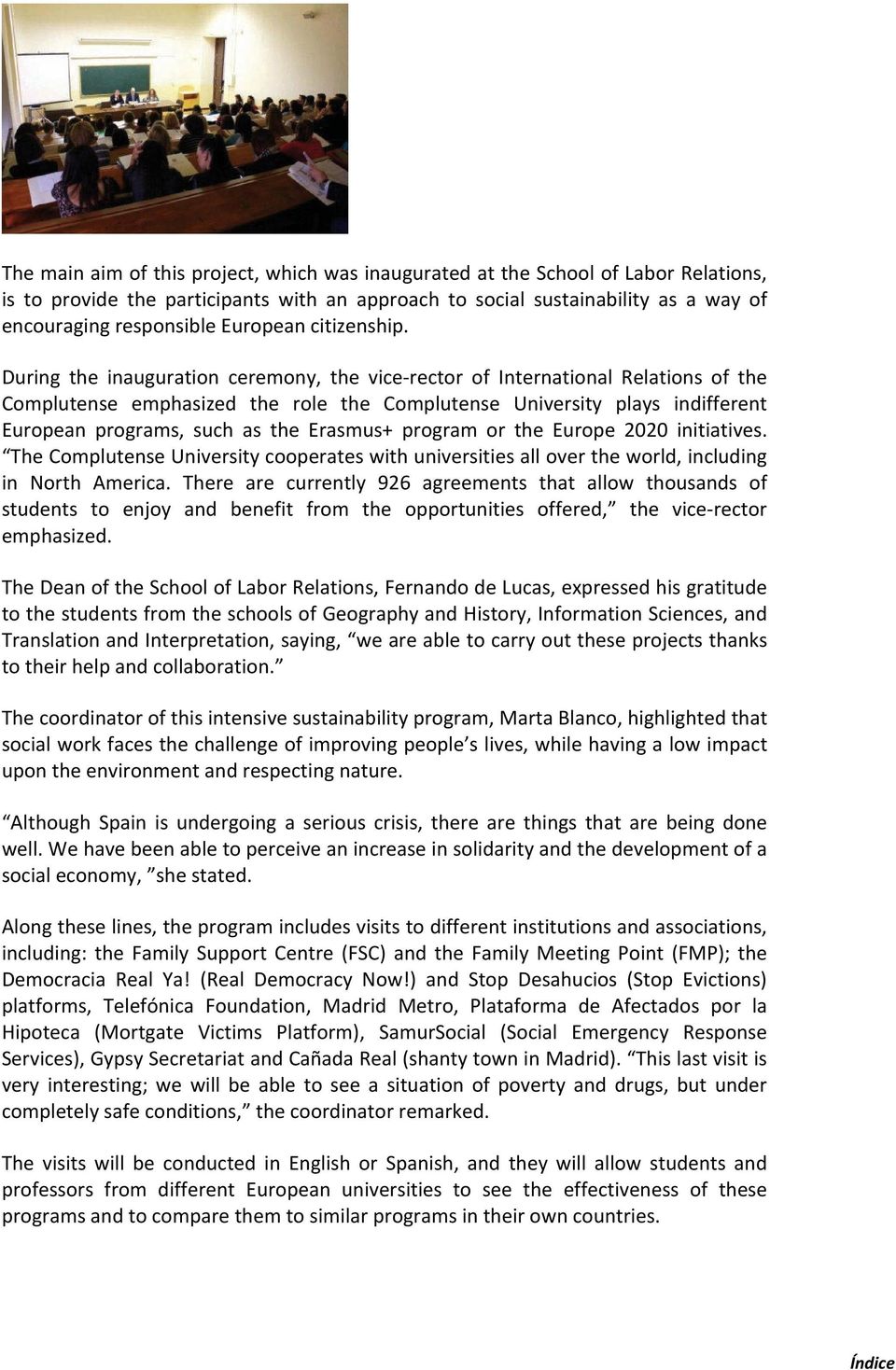
14 The main aim of this project, which was inaugurated at the School of Labor Relations, is to provide the participants with an approach to social sustainability as a way of encouraging responsible European citizenship. During the inauguration ceremony, the vice-rector of International Relations of the Complutense emphasized the role the Complutense University plays indifferent European programs, such as the Erasmus+ program or the Europe 2020 initiatives. The Complutense University cooperates with universities all over the world, including in North America. There are currently 926 agreements that allow thousands of students to enjoy and benefit from the opportunities offered, the vice-rector emphasized. The Dean of the School of Labor Relations, Fernando de Lucas, expressed his gratitude to the students from the schools of Geography and History, Information Sciences, and Translation and Interpretation, saying, we are able to carry out these projects thanks to their help and collaboration. The coordinator of this intensive sustainability program, Marta Blanco, highlighted that social work faces the challenge of improving people s lives, while having a low impact upon the environment and respecting nature. Although Spain is undergoing a serious crisis, there are things that are being done well. We have been able to perceive an increase in solidarity and the development of a social economy, she stated. Along these lines, the program includes visits to different institutions and associations, including: the Family Support Centre (FSC) and the Family Meeting Point (FMP); the Democracia Real Ya! (Real Democracy Now!) and Stop Desahucios (Stop Evictions) platforms, Telefónica Foundation, Madrid Metro, Plataforma de Afectados por la Hipoteca (Mortgate Victims Platform), SamurSocial (Social Emergency Response Services), Gypsy Secretariat and Cañada Real (shanty town in Madrid). This last visit is very interesting; we will be able to see a situation of poverty and drugs, but under completely safe conditions, the coordinator remarked. The visits will be conducted in English or Spanish, and they will allow students and professors from different European universities to see the effectiveness of these programs and to compare them to similar programs in their own countries.
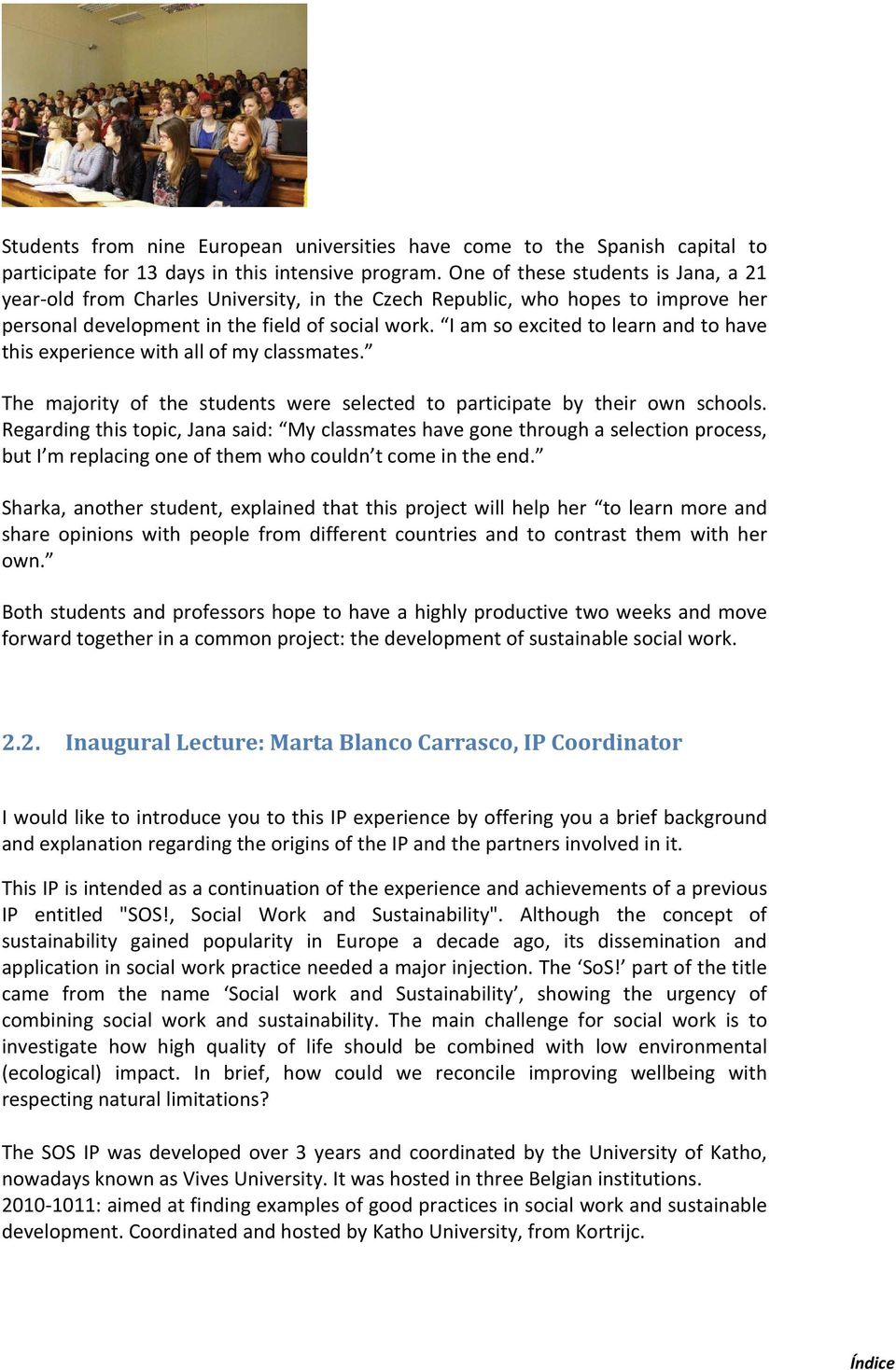
15 Students from nine European universities have come to the Spanish capital to participate for 13 days in this intensive program. One of these students is Jana, a 21 year-old from Charles University, in the Czech Republic, who hopes to improve her personal development in the field of social work. I am so excited to learn and to have this experience with all of my classmates. The majority of the students were selected to participate by their own schools. Regarding this topic, Jana said: My classmates have gone through a selection process, but I m replacing one of them who couldn t come in the end. Sharka, another student, explained that this project will help her to learn more and share opinions with people from different countries and to contrast them with her own. Both students and professors hope to have a highly productive two weeks and move forward together in a common project: the development of sustainable social work Inaugural Lecture: Marta Blanco Carrasco, IP Coordinator I would like to introduce you to this IP experience by offering you a brief background and explanation regarding the origins of the IP and the partners involved in it. This IP is intended as a continuation of the experience and achievements of a previous IP entitled "SOS!, Social Work and Sustainability". Although the concept of sustainability gained popularity in Europe a decade ago, its dissemination and application in social work practice needed a major injection. The SoS! part of the title came from the name Social work and Sustainability, showing the urgency of combining social work and sustainability. The main challenge for social work is to investigate how high quality of life should be combined with low environmental (ecological) impact. In brief, how could we reconcile improving wellbeing with respecting natural limitations? The SOS IP was developed over 3 years and coordinated by the University of Katho, nowadays known as Vives University. It was hosted in three Belgian institutions : aimed at finding examples of good practices in social work and sustainable development. Coordinated and hosted by Katho University, from Kortrijc.
16 : aimed at analyzing the transition process towards a sustainable society. Hosted by Artevelde, in Gent : seeking to explore and understand policies related to sustainability. Hosted by Kempen University, nowadays known as Thomas More, in Geel. The three above-mentioned Belgian institutions were the engine of this learning process, working enthusiastically throughout the 3 years and giving the rest of the partners the chance to share a friendly and collaborative example of managing and learning, itself an example of good practices. They also gave us the opportunity to visit Belgium and appreciate all it has to offer. I would like to record my appreciation for all their effort during this time, and we hope to continue their excellent work as well as we can. The other IP partners have also been hard at work during the last three years. Teachers have organized and offered lectures in their fields of expertise. Students have worked positively and faced heavy workloads with good humour. We have seen some changes which have proven greatly beneficial for the group. Newman University joined last year, and this breath of fresh air has been really useful for the rest of us. We are delighted to have all of you with us this year. I would now like to offer some words regarding this year s IP. This year s IP aims to focus on other aspects of sustainable development which were not necessarily analyzed in detail during previous IPs. On 11 August 2011, the European Commission proposed designating 2013 as the "European Year of Citizens" to mark the 20th anniversary of the establishment of European Union Citizenship under the 1993 Maastricht Treaty. Active citizenship primarily means the involvement of citizens as participants in community life, fundamentally in terms of activity and decision-making. Social sustainability is understood as a combination of redistributive justice (access to education and resources, redistribution of wealth) and the satisfaction of human needs (identity, health, understanding). Indeed, active democratic citizenship is one of the defining features of a sustainable society. Social workers all over Europe play an essential part in this transition process as agents of change supporting eco-justice within our communities. Three international organizations representing social work practice (IFSW, IASSW, ICSW), committed in their 2012 Global Agenda ( to: - promote standards in education and practice that facilitate sustainable social development outcomes - encourage and facilitate research into the role of social work with relation to disasters and environmental challenges - promote the importance of sustainable, interdependent communities in achieving social development and wellbeing.

17 This is the aim of the first part of this IP: to analyze the role of social workers in achieving a sustainable society, focusing on how a social worker can contribute to the change from passive to active citizenship. Spain is a country in crisis, as everybody is aware, but we do think that some things are very well done here. We have very good examples of how the crisis has activated solidarity, social movements and the social economy. There are fine examples of organizations offering ways to deal with the crisis, trying not only to cover the needs of citizens but also to change the way they face their problems. As mentioned earlier by the Dean, the organization of the IP has involved the collaboration of three Faculties of Complutense University, for which we are grateful: - The Information Sciences Faculty: which will follow the IP for press and radio. We consider that this type of initiative is not only interesting to you, but also to the rest of the academic community and indeed to society in general. For this purpose, you will see students taking photos and accompanying us at certain points during the programme. - The Translation Faculty: we have prioritized the interests of the debate and presentations above language, meaning we have preferred to offer excellent presentations though the speaker may not speak in English rather than choosing a less interesting topic or speaker. Students from the Translation Faculty will therefore help us to transmit the information provided by our speakers in English. We expect that at times this may lead to short delays in or extensions of presentations, but we are sure that their content will make up for any inconvenience in this regard. - The Geography and History Faculty: which will help to show us around Madrid, with two planned field visits in the centre and a visit to a museum, which we hope will prove interesting for you. We wish to thank the students from these Faculties, and their coordinators, for all the help they have provided in organizing the IP particularly since they are under no strict obligation to assist us, and have chosen to do so because international cooperation and development is one of the key goals of Complutense University. Moving now to the assignments you were required to complete before attending the IP, I hope they proved to be of interest and did not involve too much work. The first assignment, the country profile, will be presented by country from tomorrow onwards. The presentations will offer us a comparative overview of the history and social work background of each participant country, as well as providing information on matters relating to sustainable wellbeing. The second assignment, an example of good practices, will be presented by each of you in your international groups, in an informal setting. As a group, we would like you to identify and reflect upon the ideal features of a good practice experience in the
18 context of wellbeing and social work. Then, on the final day of the IP, we would like you to make a presentation to all the IP participants. This presentation should outline the good practice issues you discussed in your group and explain the two best examples of good practices you encountered. You should also offer your final reflections on the IP and what you have learnt regarding the role of social work in achieving sustainable wellbeing. I would like to explain some practical aspects of the daily programme we will be following during the IP, including transport, accommodation and meals. The programme we have developed seeks to offer a view of the real situation existing in Spain today, following the crisis, the most pressing social problems and some examples that, from our perspective, may be identified as instances of good practices. Madrid has both positive and negative points. Among the negative, there is plenty of distance between locations meaning it is possible that at times we will have to devote time to transport. Among the positive, though, is Madrid s Metro system, which is not only offering us a presentation but has also provided us with the free tickets you will find in your folders. Moving a group of 75 people around Madrid is a complicated task. For this reason, we think it is best that you find your own way to the field visit locations, where we will meet in order to begin at an agreed time and place. This is all explained in the document on the website explaining the daily programme. For afternoon or evening field visits, you can travel by metro with Spanish students acting as guides, who will be happy to accompany you at least until you are comfortable using the metro system. For the morning field visits you will need to travel directly from the hotel or the youth hostel to the meeting point indicated in the programme. If you have any doubts whatsoever, please ask me or any of your Spanish colleagues. There are also two field visits for which we will split into two sub-groups, A and B, due to the size of our group. Meals will be at a nearby restaurant which is ten minutes walking distance. The food is a set daily menu prepared by the restaurant. Thank you very much for your attention, and I hope you have a pleasant stay in Madrid. I hope you enjoy both the programme and the city. 3. Methodology The two books collecting the work materials produced during the IP are among its most important outcomes.

19 These materials were developed using a collaborative and learning-by-doing methodological approach. Due to the long distances separating the participants of the programme and with the aim of increasing the efficiency of information research and systemization, two templates (assignments) were offered to students and teachers requesting all information necessary for the course. These two templates allowed the creation of two books. This book focuses on providing a comparative view of social work and sustainable development. The second book offers good practice examples in the field of social work and sustainable wellbeing. The first template, at Annex 2, contains the first assignment worked on in national groups (those made up of students with the same country of origin). The group had to find the information requested and complete the template accordingly. The aim of the template was to obtain the following details: - Information about students and teachers country of origin - Information on the situation of social work as a profession in country of origin - Information about the status of social work as a field of study in country of origin - Useful information and views of teachers and students regarding sustainable wellbeing and sustainability as they relate to social work practice or studies in their country of origin. Key topics: o Bibliography references o Curriculum plans and subjects o Databases o Web pages o Art and sustainable wellbeing Using the information collected in the template for pre-assignment 1, the students prepared a thirty-minute presentation for the other participants about their country, the academic and professional status of social work, and what they consider noteworthy regarding sustainable wellbeing in their country. The presentations were made during the first days of the IP, in order to give participants a background of each country and the different ways in which social work and sustainable development are understood. Each institution decided how to make this presentation, trying to be innovative, interactive and interesting for the rest of the group: resources used included Prezzi presentations, Powerpoint presentations, and video. As three Belgian institutions were participating in the IP, we suggested that they prepare an international framework for the rest of the participants, including a detailed and coordinated presentation. After all the presentations the students reflected in their national groups (for thirty minutes) before offering feedback on all the presentations. The other template, at Annex 3, was produced in respect of the second preassignment. Each participant institution had to complete a template to share good practice knowhow. The template contained basic information regarding the institution,

20 organisation, enterprise, or experience selected. This common template made it easier for the whole group to identify the outstanding aspects of each experience and take a decision on the three most interesting experiences presented. Students then prepared a short presentation about the good practice experiences they had selected. The ten-minute presentation explained the reasons for the selection. All of the students had to make this presentation to the rest of the participants in their working groups during the IP. The aim was to select an attractive experience related to social work and sustainable wellbeing. Subsequently, workgroups were asked to choose the two experiences they considered most interesting or illuminating and present their findings to the whole group of students and teachers.

21 Chapter II: Social Work and Sustainable Wellbeing: a Comparative Perspective. María Vizcarro This chapter is part of the content of a Final Thesis completed by a Spanish student in the fourth year of an undergraduate degree in Social Work who participated in the IP. The Final Thesis is entitled Social Work and Sustainable Development Criteria for Good Experiences. This work was originally presented and defended in Spanish before a panel comprising three members of the academic staff of the Faculty of Social Work in June 2014, obtaining an outstanding grade. For purposes of translation of the article into English, free translation has been used for quotes where necessary (whether the work was originally published in Spanish or English). 1. Sustainable Wellbeing 1.1. International Context Society is currently immersed in a deep economic, social, environmental and political crisis. This crisis is affecting millions of people who are finding themselves in situations of ever-greater vulnerability, families who are losing their homes, young people with no opportunity to obtain work, citizens with precarious jobs, and is causing poverty, exclusion and environmental destruction all over the planet. In the face of this crisis is an increasingly strong model for sustainable societal development, grounded in human rights and allowing for a fairer world. It is based on a commitment to solidarity with both present and future generations, ensuring its durability over time and, as explained by the former Director General of UNESCO Mayor Zaragoza (2009), it does not merely focus on economic growth as the key to development. The model also encourages integration and incorporates the protection of the environment. This is a model for the people, by the people. This development model arose in the 1970s and was first defined in 1987, at the Río de Janeiro Summit of that year, by the Norwegian Minister Groe Harlem Brundtland in the Report entitled Our Common Future (also known as the Brundtland Report). The sustainable development model has not, to date, been fully implemented in society, since development has mainly remained linked to economic growth, with
22 social and environmental development secondary (Cruz Suaza and De la Red Vega, 2000). However, it is noteworthy that various local, national and international bodies have sought to implement the model through different policies, recommendations and initiatives, as is set out below with particular attention to the United Nations, the European Union and Spain. Social workers are also aware that society cannot go on as it has, and that change is necessary to push toward a more inclusive, fair, democratic, participative and sustainable society, as set out in the Global Agenda for Social Work and Social Development Commitment to Action In this context, the Faculty of Social Work at Universidad Complutense of Madrid has organized an intensive programme, Sustainable Wellbeing, from 24 March to 4 April 2014, inspired by the International Year of Active Citizenship (2013) and with the objective of allowing students and teachers of Social Work from nine universities in Germany, Belgium, Finland, the Czech Republic, Lithuania and Spain to examine social work and its links with sustainable development in depth. From an international perspective the need for society to develop in a sustainable fashion has become particularly important since the 1970s. There is awareness of the impossibility of unlimited growth on a finite planet with limited resources (Cruz Suaza, y De la Red Vega, 2000, p. 159). Production systems and mass consumption by society cannot continue to grow without limit, since the planet is limited, and if natural resources are not preserved, future generations will be unable to enjoy a good quality of life. In 1972, at the United Nations Conference on the Human Environment (held in Stockholm between 5 and 16 July), the importance of sustainable development from a strictly environmental perspective began to be discussed for the first time. The Conference Report contains a total of 26 principles to preserve the environment, which state that natural resources must be protected for the benefit of present and future generations (1st, 2nd and 11th principles). This is what sustainable development seeks to achieve. Initially, the social and economic dimensions of sustainability were not included. Sustainable development would be defined for the first time in 1987, by Groe Harlem Brundland at the Río de Janeiro Summit, speaking as a representative of the Environmental and Development Committee of the United Nations, in the abovementioned Brundtland Report: Sustainable development is development that meets the needs of the present without compromising the ability of future generations to meet their own needs (Peeters, 2012a, p.9). This definition makes it clear that we are dealing with a development model the aim of which is to meet human needs. That is, the objective is to promote the wellbeing of people, but regardless of whether they are from present or future generations. An
23 intragenerational and intergenerational balance is advanced, meaning access to resources in order to meet needs will be equitable and fair. The United Nations Conference on the Environment and Development took place later, between 3 and 14 June 1992 in Río de Janeiro. There, it was argued that the achievement of sustainable development must include three dimensions: environmental, economic and social. This is reflected in the fourth principle of the Río Declaration resulting from the Conference: environmental protection shall constitute an integral part of the development process and cannot be considered in isolation from it. Peeters (2012b) explains that sustainable development is most commonly understood as an interaction among three dimensions-the social, ecological and economic or triple P : people, planet and prosperity (p.8). In addition to preserving natural resources, for society to endure it is considered necessary to include people and a responsible economic system. In this light, Agenda 21 was adopted at the aforementioned United Nations Conference on 14 June This is a plan of action on a global scale, applicable on a local level, aimed at achieving sustainable development with an emphasis on the importance of participation. Ten years later, between 26 August and 4 September 2002, representatives of the countries of the world met at a Global Summit on sustainable development in Johannesburg (South Africa), and reaffirmed their commitment to this approach: we assume a collective responsibility to advance and strengthen the interdependent and mutually reinforcing pillars of sustainable development - economic development, social development and environmental protection - at the local, national, regional and global levels saw the holding of a United Nations Conference on sustainable development in Río de Janeiro, also known as Rio+20. The commitments contained in the ensuing Resolution, in order to achieve sustainable development, included the following: - Eradication of poverty, reduction of inequality, promotion of systems for social protection, encouragement of active citizenship, empowerment of the poorest, gender equality, fairness and the defence of human rights. - Protection and preservation of the environment, making appropriate use of natural resources and protecting ecosystems. - Sustainable production and consumption systems, redistribution of wealth, green employment and decent jobs.
24 As regards the final document approved at Río+20, in 2012 the UN presented the report entitled The Future We Want. This report was a precursor to the publication of the UN Post-2015 Development Agenda, and a continuation of the Millennium Development Goals, taking those Goals as a base from which to establish new objectives, directed at attaining sustainable development. The post-2015 UN System Task Team Report to the Secretary-General, entitled Realizing the Future We Want for All, contains a summary of the problems affecting our world. Point IV, Vision: the future we want for all, considers how to face these problems, stating that it is necessary to move toward a model of inclusive, peoplecentred, sustainable development (p.31), based on three fundamental principles: human rights, equality and sustainability. These act in turn upon four core dimensions: inclusive social development, environmental sustainability, inclusive economic development and peace and security European Context The European Union, for its part, is not unaware of the need to implement sustainable development within its agenda. The Treaty Establishing the European Community, in its consolidated version published in 2002, establishes at article 2 that the Community shall have as its task to promote throughout the Community a harmonious, balanced and sustainable development. In 2007, the Lisbon Treaty amended the Treaty of European Union and the Treaty Establishing the European Community. Articles 2.3 and 2.5 state that the Union will work toward a sustainable development, based on balanced economic growth, the protection and enhancement of the environment, and the promotion of social justice and protection of citizens. Similarly, in 2001 the European Union formulated its own sustainable development strategy, known as the Lisbon Strategy (updated in 2006). This aimed to enhance the quality of life of present and future generations, establishing a series of goals to promote sustainable development with indicators permitting the measurement of results obtained through Eurostat. As a successor to the Lisbon Strategy, in June 2010 the Europe 2020 Strategy was established, prioritizing the encouragement of intelligent, sustainable and integrating growth in the European Union. Five fundamental aims were established, on employment, research and innovation, climate change and energy, education and the fight against poverty. Finally, it is worth noting that, on 11 June 2004 at the Fourth European Conference on Sustainable Cities and Towns, Aalborg +10, local European governments adopted the Aalborg Commitments, which seek to promote sustainable development at the local level.
25 Following the European recommendation to encourage sustainable development, in November 2007 Spain introduced the Spanish sustainable development strategy. This seeks to make compatible a dynamic of economic prosperity together with increased social wellbeing and the enhancement of the environment (p.9, author s translation). It represents a continuation of the 2002 consultation document Spanish Strategy for Sustainable Development. The aforementioned Strategy states that environmental sustainability is achieved through protection of the atmosphere, air quality, water, land and nature, and social sustainability, involving the improvement of employment, social cohesion, public health, dependency and reducing poverty. The economic dimension, for its part, is considered in parallel in the National Reform Agenda (Programa Nacional de Reformas), with economic growth and employment established as priority goals. From 2011, through the National Reform Agenda Spain established the objectives of the Europe 2020 Strategy within its own agenda in order to promote sustainable development. Lastly, it should be noted that numerous Spanish municipalities and cities have signed up to the Aalborg Commitments and to Agenda Social Work and Sustainable Development As may be observed from the various UN policies and recommendations, Europe and Spain are advocating a change toward a society that develops in a sustainable manner, including the three dimensions. This transaction will affect all aspects of society and people s lives, involving a new paradigm that will undoubtedly also affect and is affecting the practice of social work itself (Peeters, 2012 c, p. 289). It must be stressed that social workers are not unaware of the need to carry out social change that promotes sustainable development through citizen participation. For this reason, as a response to the recommendations of the UN on sustainable development, through the International Federation of Social Workers (IFSW), the International Association of Schools of Social Work (IASSW-AIETS), and the International Council on Social Welfare (ICSW), social workers, educators and social development practitioners, in the Global Agenda on Social Work and Social Development, have demonstrated their commitment to focus their efforts during the period on: promoting social and economic equalities, promoting the dignity and worth of peoples, working toward environmental sustainability, and strengthening recognition of the importance of human relationships (p.2). Social justice, human rights and sustainable development will be promoted through these commitments.
26 Social workers, as witnesses to the daily realities of people, communities and society in general, state in the 2012 Global Agenda that there currently exist great social inequalities, as a consequence of an unjust and poorly regulated economic system. As such, now is the ideal time to promote social change incorporating sustainable development of society, creating a more socially-just and fair world that we will be proud to leave to future generations (p.2). On the basis of the defence of human rights and the rights of children, older people, women, persons with disabilities and indigenous peoples, social workers commit to opposing the causes of oppression and inequality (second commitment). It will be necessary to promote initiatives aimed at achieving social and economic equality through guaranteed access to health, education, housing and employment for all (first commitment), based upon a people-centred global economy achieving sustainable social welfare. They will work together with the UN and other international bodies, as well as with other communities and within the three organizations (IFSW, IASSW-AIETS, ICSW), to promote the importance of sustainable and inclusive communities through the empowerment of people and communities that allow members to belong and to participate. For this purpose to be achieved, policies aimed at integration and social cohesion must also be promoted (fourth commitment). In the third commitment, social workers commit to carry out environmental protection initiatives and to encourage community participation in the prevention of and response to human and natural disasters. Social workers therefore commit to encourage sustainable development through the reduction of social and economic inequalities, the integration of people, families, groups and communities, the protection of the environment, the empowerment of people and finally through active citizenship. As may be seen from the Global Agenda, the activity of social workers is mainly directed at the social dimension of sustainable development, though the Agenda does include the other two dimensions (economic and environmental), since as previously explained, the three are interlinked. So, for example, if a social worker carries out a project aimed at improving the social inclusion of homeless persons, they must take into account that such action cannot damage the environment. They cannot fell all the trees in a forest to create housing for all homeless persons, or reduce economic inequalities by creating other imbalances through their activities. Peeters (2012a) explains that there is a meaningful normative similarity between the principles of sustainable development in its social dimension and social work, in terms of attention to welfare, intergenerational fairness, the defence of human rights and social justice, and the promotion of gender equality, diversity and active citizenship. This similarity is grounded in the very definition of social work according to the IFSW, and in its ethical principles.
27 Peeters argues that social work must integrate the perspective of sustainable development within its practices and, hence, must analyze social problems taking a contextual approach. Natural surroundings must be incorporated, and social work must contribute to strengthening the social dimension of sustainable development, principally through empowerment and the encouragement of participative practices, as well as by paying greater attention to the areas of distribution and redistribution (Peeters, 2012a). 3. Bibliography Barranco Expósito, C. (2011). Buenas prácticas de calidad y Trabajo Social. Alternativas. Cuadernos de Trabajo Social, N. 18, Bolívar, A. (2012). Justicia Social y Equidad Escolar. Una revisión actual. Revista Internacional de Educación para la Justica Social (RIEJS). Vol. 1, Núm. 1, Castillo Trigo, R. (2009). El trabajo en red. Reflexiones desde una experiencia. Zerbitzuan: Gizarte zerbitzuetarako aldizkaria = Revista de servicios sociales, Nº. 46, Comisión Europea (2010). Estrategia europea Recuperado en: [2014, 17 de abril]. Comisión Europea (2007). Estrategia europea para un desarrollo sostenible. Un futuro sostenible a nuestro alcance. Recuperado en: nible_ve_tcm pdf [2014, 17 de abril]. Compromisos de Aalborg (2004). Recuperado en: 005_es.pdf [2014, 7 de Abril]. Consejería de la Educación, Juventud y Deporte (2014). Buenas prácticas. Madrid. Recuperado en: [2014, 21 de Abril]. Consejo General del Trabajo Social (2012). Código Deontológico de Trabajo Social. Madrid: Consejo General del Trabajo Social. Recuperado en: [2014, 7 de Marzo]. Cruz Roja (2003). Criterios para la detección y selección de buenas prácticas. Recuperado en: QUE_HACEMOS/B10_INTERVENCION_SOCIAL/POBREZA/PRACTICAS/03- CRITERIOS%20DE%20BUENAS%20PRACTICAS.PDF [2014, 27 de Abril]. Cruz Suaza, F y De la Red Vega, N. (2000). Intervención integral para el desarrollo en el medio rural. Intervención Psicosocial, Vol. 9 N. 2,
28 De la Paz Elez, P. (2011). La intervención en Trabajo Social desde la perspectiva de las fortalezas. Cuadernos de Trabajo Social. Vol. 24, De la Paz Elez, P., Rodríguez Marín, V. y Mercado García, E. (2014). Nuevas tendencias de intervención en Trabajo Social. AZARBE. Revista Internacional de Trabajo Social y Bienestar, Nº03, Eito Mateo, A. (2012). La participación del usuario en el Trabajo Social. Una mirada desde el presente hacia el humanismo de Concepción Arenal. Acciones e Investigaciones Sociales, 32, FAO (2014). Plantilla de buenas prácticas. Recuperado en: Feb2014_0.pdf [2014, 16 de Marzo]. Folarodi. G. (2006). La insostenibilidad social del desarrollo sostenible. Portularia, VOL. VI, Nº 2, Franceshi, M.H. (2000). Trabajo Social y desarrollo sostenible: elementos teórico metodológicos de una estrategia profesional para la acción social. Costa Rica, Universidad de Costa Rica, Escuela de Trabajo Social, IFSW-IASSW-ICSW (2012). Global Agenda of Social Work and Social Development Commitment to Action International Federation of Social Workers (IFSW), International Association of Schools of Social Work (IASSW), International Council on Social Welfare (ICSW). Recuperado en: ifsw.org [2014, 26 de Febrero]. Libera Bonilla, B. E. (2007). Impacto, impacto social y evaluación del impacto. Acimed: revista cubana de los profesionales de la información y la comunicación en salud, Vol. 15, Nº. 3, 1-9. Masa Carreño, M. (2011). Criterios de valor en el diseño de proyectos sociales. Material didáctico. Trabajo Social, 1, Mayor Zaragoza, F. (2009). La problemática de la sostenibilidad en un mundo globalizado. Revista de Educación, Nº Extra 1,2009, Ministerio de Empleo y Seguridad Social. Programa Nacional de Reformas. España Recuperado en: [2014, 8 de Abril]. Ministerio de la Presidencia (2007). Estrategia española de desarrollo sostenible. España. Recuperado en: estrategias/estrategia-espanola-desarrollo-sostenible/eedsnov07_editdic_tcm pdf [2014, 15 de Abril]. Ministerio de Sanidad, Servicios Sociales e Igualdad. Buenas prácticas en Servicios Sociales. España. Recuperado en: [2014, 27 de Abril]. Moreira Silva, R. (coord. 2013). Bases Conceptuales de una política de Innovación Social. Bogotá. Colombia, 1-17.
29 ONU (1987). Nuestro Futuro Común. Informe de la Comisión Mundial sobre el Medio Ambiente y el Desarrollo en Río de Janeiro. A/42/427. Recuperado en: [2014, 21 de Febrero]. ONU (1972). Informe de la Conferencia de las Naciones Unidas sobre el Medio Humano. EstocoImo, A/CONF. 48/14/Rev.1. Recuperado en: REV.1.pdf [2014, 16 de Febrero]. ONU (1992). Conferencia de las Naciones Unidas sobre el Medio Ambiente y el Desarrollo. Río de Janeiro. A/CONF.151/26. Recuperado en: [2014, 5 de Marzo]. ONU (1992). Programa 21. A/CONF.151/26 (Vol. I, II y III). Recuperado en: [2014, 5 de Marzo]. ONU (2000). Declaración del Milenio. Resolución aprobada por la Asamblea General. A/RES/55/2. Recuperado en: [2014,17 de Marzo]. ONU (2002). Cumbre mundial sobre el desarrollo sostenible. Johannesburgo. A/CONF Recuperado en: [2014, 7 de Marzo]. ONU (2012). El futuro que queremos para todos. Recuperado en: pdf [2014, 16 de Marzo]. ONU (2012). Resolución aprobada por la Asamblea General de la Conferencia de las Naciones Unidas sobre el desarrollo sostenible. Río de Janeiro, Brasil, Rio+20. A/ RES/66/288. Recuperado en: [2014, 7 de Marzo]. ONU-HABITAT. Ciudades para un futuro más sostenible. Buenas prácticas. Recuperado en: [2014, 21 de Abril]. Pastor Seller, E. (2004). La participación ciudadana en el ámbito local, eje transversal del Trabajo Social comunitario. Alternativas. Cuadernos de Trabajo Social. Nº Pastor Seller, E. (2009). El Trabajo Social en la dimensión de las políticas públicas de proximidad: responsabilidad y compromiso social. Humanismo y Trabajo Social. Vol. 8, Pastor Seller, E. (2012). Sostenibilidad, impacto y eficacia de las Políticas Sociales municipales mediante la democratización e implicación social. Sociedad y Estado. Vol. 27 nº 3,
30 Peeters, J. (2012a). Sustainable Development: a mission for Social Work? A Normative Approach. Journal of Social Intervention: Theory and Practice. Volume 21, Issue 2, Peeters, J. (2012b). Social Work and Sustainable Development: Towards a Social- Ecological Practice Model. Journal of Social Intervention: Theory and Practice. Volume 21, Issue 3, Peeters, J. (2012c). The place of Social Work in Sustainable Development: Towards Ecosocial Practice. Internacional Journal of Social Welfare. Volume 21, Prólogo: Gaviria, M. (1996). El Caso Social Individual. El diagnóstico Social. Textos seleccionados. TALASA Ediciones S.L. Raya Díez, E. (coord.) (2011). Herramientas para el diseño de proyectos sociales. Material didáctico. Trabajo Social, 1, Rodríguez E, Carreras I. y Sureda M. (2012). Innovar para el cambio social. De la idea a la acción. Ed. El Tinter. Tratado constitutivo Unión Europea (2002, 24 de diciembre). Diario Oficial de las Comunidades Europeas. C 325/36 Recuperado en: [2014, 14 de Abril]. Tratado de Lisboa (2007, 17 de diciembre). Diario Oficial de la Unión Europea. C. 306/01. Recuperado en: [2014, 15 de Abril]. Teixidó Saballs, J. (2001). La participación, elemento clave en la construcción de una cultura colaborativa. Universidad de Girona. XX Cursos de Verano en San Sebastián.
31 Chapter III: A Fair Future For All Social Work on the Finite Planet. Arto O. Salonen Dr. Arto O. Salonen is an adjunct professor at University of Helsinki. His research focuses on social change to promote flourishing lives. Salonen s transdisciplinary research interest integrates humans and the rest of nature on multiple time and space scales. He has several publications concerning sustainable development. The title of his doctoral dissertation was Sustainable Development and its Promotion in a Welfare Society in a Global Age. 1. Big Questions in the Era of Anthropocene Social workers all over the world are interested in knowing what makes human lives go well. They want to ensure a fair future for all (IFSW & IASSW 2004; The Global Agenda 2012; Jones & Truell 2012). However, their approach may be narrow, local, and human centred without a proper integration of social and ecological systems. Better understanding of the interdependence of all the elements sustaining life is needed (Max-Neef 2010). Considering a bigger picture of the good life, the ecological challenge we face is that our current way of living depletes life-support systems (Millennium Ecosystem Assessment 2005; Rockström et al. 2009). The social challenge is that inequality is growing almost everywhere (The Royal Society 2012; UNDP 2011). In fact, humanity has never been moving faster and further from sustainability and sufficiency than it is now (Caldeira 2012; Ehrlich, Kareiva and Daily 2012). In the era of Anthropocene (Crutzen 2002), human activity is putting such strain on the natural functions of earth that the ability of the planet s ecosystems to sustain future generations can no longer be taken for granted (Millennium Ecosystem Assessment 2005, 5). Man-made climate change is one of the biggest global challenges for social justice (World Bank 2012). Human activities affect the face of the earth more than natural forces do. In addition, changes caused by humans occur at a speed that is greater than changes in nature (Sachs & Santarius 2007, 22 41). We lack a sustainable approach that recognizes a relationship between generations, so that earlier generations fulfil their individual needs and desires but do not destroy, or close off, the same options for future generations (Norton 2005, 363).
32 The main roots of unsustainability are consumerism and population growth. It might be more important to focus on transforming societies from ever-growing consumption to sustainability and self-sufficiency than to seek to control population growth. The world population is projected to reach 9 10 billion by 2050, and it will be approximately the same in 2100 (UN 2013). Meanwhile, the dominant economic paradigm pushes rapid economic growth at any cost. Mass consumption is a goal that intrinsically promotes economic growth. More profitable ways to produce goods and services are sought by migrating to countries where the environmental and social costs of enterprises are lowest and profits are highest (Gray 1998). The most unfair but, at the same time, most profitable way to produce goods and services is through forced labour without any ecological concern. The vast majority of the 20.9 million forced labourers throughout the world are working in agriculture, construction, domestic work, manufacturing, mining and utilities in countries where ecological regulation is low (ILO 2014). Due to the aforementioned dominant economic paradigm, people feel that consumerism is the way to happiness (Max-Neef 2010, 201). Citizens rarely try to define how much is enough or how much is too much they simply want to get more even though all of us live on the finite planet (Ginsborg 2005, 61). It is fair that people in developing countries have the right to develop fast so that they can fulfil their basic material needs, such as water, food, shelter, energy, education and health services. This is important because human rights follow from human nature and they are universal as well as equal (Searle 2009, ). Yet since the affluent account for over 80% of consumption and pollution, even modest shifts in their behaviour can effectively reduce the environmental burden and free up resources to raise poorer peoples living standards (Munasinghe 2014, 260). Our planet is a system of interdependence. We are living in a global village where our lifestyles are dependent on other people, natural resources, and ecosystem services in other places. No nation can achieve sustainability on its own because the effects of our everyday choices have impacts on other people, nature and the economy on both local and global levels. For instance, 60 percent of Switzerland's ecological impact and 47 percent of Finland s water footprint is produced abroad (EEA 2011, 4). This demands us to extend frames of justice, including people who are a part of the causal chains of production and consumption. Failures to act in ways that reflect humanity s shared interest in survival with dignity may lead to civil insurrection, geopolitical tension and resource wars (Rees 2014, ). One major question is: what is our response to available data, the historical record, and ongoing trends (Rees 2014, 193)? Fortunately, human beings are clever, intelligent, and morally compassionate. We have a capacity for evidence based reasoning and logical analysis. We are able to engage in long term planning. Humans also have the capacity to exercise moral judgment, and an ability to feel compassion for other people and species. If we look back on the global changes that have occurred during the last decades, we recognize that great changes are eminently possible for human beings. We have already learned how to feed six billion people. We have created universal education
33 and universal medical care. We have also almost doubled our life spans and managed to stop global ozone depletion. Even alarming climate change is a solvable problem because we have all the necessary know-how (see Randers 2012, 254; Randers & Gilding 2010; Sachs 2008, ). In this article I try to find a way to achieve a fair future for all. Pushes and pulls for social change towards new ways of thinking and behaving are presented in Table 1. As we see, transition towards a sustainable and resilient society is a holistic process (Hopwood et al. 2005; Schultz et al. 2005). Social workers can be powerful agents of change. I start by describing the meaning of the holistic ecosocial well-being paradigm in society and in social work practices. I focus on (a) changing values from materialism to post materialism; (b) reforming economies towards a culture of trust; and (c) strengthening the resilience of communities. Fundamentally, I have two questions in mind: 1. How, in the future, will 9-10 billion people be able to enjoy dignified lives on the finite planet? 2. How can social workers empower people and societies so that future generations will be proud of us? TABLE 1. Pushes and pulls towards a new way of thinking and behaving. Adopted from Raskin et al. (2002, 56) Pushes Pulls Anxiety about the future Promise of security and solidarity Concern that policy adjustments are insufficient to avoid crises Ethics of taking responsibility for others, nature and the future Fear of loss of freedom and choice Participation in community, political and cultural life Alienation from dominant culture Pursuit of meaning and purpose Stressful lifestyles Time for personal endeavours and stronger connection to nature 2. An Ecosocial Well-being Paradigm Fundamental value, attitude and behavioural changes are necessary for human survival (Haberl et al. 2011). The values of life, liberty, and the pursuit of happiness need to be reconfigured (Tucker & Swimme 2014, ). In the era of Anthropocene, life is global, individual freedom requires responsibility to the community, and well-being is not the same as achieving economic growth and material goods (Layard 2006; Max-Neef 2010; Randers 2012). Paradigms can be seen as the driving sources of systems. They constitute the set of beliefs about how the world works. For example, we have learned that there are not
34 enough resources to overcome poverty. However, the size of the rescue package following the 2008 crisis was equal to having funds to save the one billion poorest people in the world from hunger for a period of 600 years (Max-Neef 2010, 200). Hence, transition towards a sustainable and resilience society is an existential challenge requiring changing paradigms that shape human behaviour (Haughton 1999, 235). Social change is not possible if the ideas that guide our actions and policies remain untouched (Hirvilammi & Helne 2014, 2161). Unsustainability is the result of the failure of a global development paradigm. Western welfare states are based on a long history of intellectual tradition, where the development of human societies has been seen as independent from ecological constraints (Pattberg 2007). According to the dominant traditional thinking, development is also dependent on economic growth (Max-Neef 2010, ). The failed paradigm is a social construct, a product of the human mind. This means that the model can be replaced (Rees 2014, 193). All major challenges in the era of Anthropocene have ecological and social backgrounds (Ehrlich & Ehrlich 2013). We need a shift toward a holistic understanding of the human nature relationship an orientation integrating social and ecological concerns (Coates 2003; Coates and Besthorn 2010; Hirvilammi & Helne 2014). Holistic and multidisciplinary thinking is needed in order to create systems that can manage the causal complexity of the world (EEA 2013, 40). Social systems are related to ecological systems on which social systems depend (Adger 2000, 350). According to Donella Meadows: The real system is interconnected. No part of the human race is separate either from other human beings or from the global ecosystem. It will not be possible in this integrated world for your heart to succeed if your lungs fail, or for your company to succeed if your workers fail, or for the rich in Los Angeles to succeed if the poor in Los Angeles fail, or for Europe to succeed if Africa fails, or for the global economy to succeed if the global environment fails. (Meadows 2009, 184.) In other words, a better understanding of the human-nature (socio-ecological) relationship helps us to reconfigure well-being. It may be outside our well-being paradigm that according to the empirical evidence students who can see nature out of their classroom windows have better learning results than those without the view (Matsuoka, 2010). Moreover, students with higher degrees of nature relatedness also have significantly higher life satisfaction, more positive emotions and fewer negative emotions (Nisbet et al. 2011). The ultimate development goal is to provide all humans with the necessary external conditions to live a good life (Di Giulio et al. 2014, 51). The survival of humankind depends on its ability to achieve greater social equity and economic security in ways that reflect the biophysical reality (Rees 2014, 193). We need a societal transformation that offers a more ecologically stable, socially equitable, and economically secure future. In a sustainable and resilient world:
35 resource regeneration is at least as great as resource depletion. It s a world where emissions are no greater than the ability of the planet to absorb and process those emissions. Of course it s a world where the population is stable or maybe even decreasing; where prices internalize all costs; a place where no one is hungry or desperately poor; a place where there is true enduring democracy. (Meadows 2014, 12.) In order to save civilization, it is paramount to remain within planetary boundaries. This is clear because without the well functioning biosphere there can be no society, and without society there can be no societal functions, including economy. The economy is a sub-system (Max-Neef 2010, ). The hierarchy of ecological, social and economic aspects of well-being (strong sustainability) is a base for the ecosocial well-being paradigm. The starting point is the limited carrying capacity of earth. The hierarchy means we are well aware that humans are fully dependent on life support systems (the ecosystem services), which take care of provisioning, regulating and supporting of absolutely necessary benefits such as fruitful soil, crop pollination, purification of water, and control of both climate and disease (Millennium Ecosystem Assessment 2005). In contrast to the pre-industrialized age, our modern lifestyles are dependent on non renewable raw materials that cannot be regenerated within a human time scale. In addition, on the finite planet, economic progress is most often blocked not by a shortage of fishing boats but by a shortage of fish; not by poorly performing pumps but by the sinking of groundwater; not by a lack of chainsaws but by the disappearance of forests (Hawken et al. 1999). If the natural life support systems collapse, the foundation of human subsistence also breaks down. The big picture of the hierarchy is presented in Figure 1. It is worth noting that the dominant Western well-being paradigm is opposite to this: economic growth is the first priority the ultimate intrinsic goal.
36 FIGURE 1. The integration and hierarchy of ecological, social and economic aspects of well-being (Salonen 2014) Human thinking and behaviour in accordance with the ecosocial well-being paradigm maintains diverse life, social justice and a robust economy. More specifically, it maintains current human capabilities and opportunities and supports their expansion so that future generations will have equal opportunities to realize their concepts of a good human life (Ott 2003, 60; Sen 2009, ). For example, accelerating emissions decrease the hope for future. Accelerating emissions promote erosion of land and have negative effects on human health and nutrition, representing a threat to a stable and flourishing society. Accounting for the damage caused to societies and nature doubles or triples the price of electricity produced by coal, the dominant but most polluting energy source (Ackerman & Stanton, 2011; Epstein et al., 2011; Markandya & Wilkinson, 2007). Therefore, switching to clean energy is one of the most effective paths towards a sustainable society. Due to climate change, resilience becomes a strategy for the administration of life on a planetary scale (Nelson 2014). Ecological resilience is the ability of the ecosystem to regenerate after stress and overloading. Meanwhile, social resilience is the ability of communities to withstand external shocks to their social infrastructure (Adger 2000, 361). Social resilience is observed by examining positive and negative aspects of social exclusion, marginalization and social capital (Adger 2000, 352). It is supported by relationships and the trust of other neighbouring people. The dynamics of social and ecological systems are essentially similar (Cote & Nightingale 2012, 475). Therefore, diversity and modularity protects the resilience of both natural and constructed networks (Haldane & May 2011). A flourishing community is one where people from different backgrounds feel unconditionally loved and respected. A decentralized house with its own water, energy and food sources may not be efficient, but it is resilient. Resilient human beings have positive attitudes, the ability to regulate emotions, and are capable of seeing failure as a form of helpful feedback. After a misfortune, resilient people are able to change course and go on. As we recognize, in many ways, resilience is similar to sustainability (Brown 2014, 114). Adopting the ecosocial well-being paradigm supports societal change towards sustainable and resilient society. As a summary, differences between the old and new paradigm are illustrated in Table 2. In the following pages I describe that change in more detail. TABLE 2. Differences between the old and the proposed ecososial well-being paradigm WELL-BEING Old Paradigm material consumption, individualism, needs of our generation The Ecosocial Well-being Paradigm non-material consumption, sharing and caring, needs of future generations ECONOMY competition, more, cooperation, better,
37 NATURAL RESOURCES TIME maximizing of owners profits lots of waste, fossil fuels, cradle to grave short termism, intra generational equity benefits of society waste indicates incorrect product or service design, clean energy, cradle to cradle long term orientation, intra generational and inter generational equity 3. Transition towards a Sustainable and Resilient Society Principles of human rights and social justice are fundamental to social work. Social work deals with the processes of human growth. It promotes inclusion, participation, social identity, and social competence (see Boström 2012; Hämäläinen 2003; Murphy 2012). Social workers tie people to the systems, institutions and communities that are important to their well-being. As a practice of holistic education, traditional social work focuses on emancipation of people and takes the bottom up approach of empowerment (Hämäläinen 2003, 76; Peeters 2012). According to Kati Närhi and Aila Leena Matthies (Närhi & Matthies, 2001, 33) social workers should also be political actors, and they should have an agenda to guide society in the direction of sustainability. Social work that has adopted the ecosocial well-being paradigm takes into account the notion of planetary boundaries and a meaning of the natural environment for human well-being. It combines social and ecological systems in order to achieve a sustainable and resilient society with flourishing citizens. Below, I describe how we can ensure a fair future for all by adopting the ecososial well-being paradigm Changing values from materialism to post materialism Transition towards a sustainable and resilient society is based on values. Inglehart (1977) called a re orientation from materialism to post materialism a silent revolution. The shift is based on the fact that the importance of material things decreases when people can fulfil their basic needs and achieve more social capital. The paradigmatic shift was also described by Abraham Maslow (1954 and 1962), Erik Allardt (1976) and Shalom Schwartz (1992). Post-materialistic aspects of well-being are altruistic. They cannot be traded in markets and are not captured by monetary measures (Stiglitz et al. 2009, 63). Policymakers, business people, and the media typically use economic indicators, such as gross national product, consumer confidence, and stock market trends, to express the health and prosperity of a nation. However, these measurements do not tell us if the nation is sustainable and resilient. Moreover, they do not fully measure the subjective well-being of citizens. Human well-being is only loosely coupled with
38 resource consumption since the material contribution to human well-being is limited. Longitudinal analyses of Japan, UK and USA since the 1950s show per capita gross domestic product has grown between 3 and 8 fold, but mean levels of citizens subjective well-being have remained unchanged (Kubiszewski et al. 2013). Replacing or supplementing GDP with more comprehensive measures of human well-being is an essential goal for our societies (Rees 2014, 196). Human well-being can be measured by non monetary measures such as subsistence, protection, affection, understanding, knowledge, participation, leisure, creation, identity and freedom, as well as establishment of civil rights and personal expression (Alkire 2002; Costanza 2014, 76; Diener & Seligman 2004: Jackson 2009, 143, ; Nevarez 2011, 39). According to Abraham Maslow (1962, 118), the highest jewel in the crown of needs satisfaction is self actualization or full humanness, which highlights altruism, dedication, ties to other people and society, egolessness and self transcendence. Human beings are altruistic. They achieve happiness through living with and for other people (Helliwell 2014, 81). For example, children choose altruistic acts irrespective of rewards (Warneken & Tomasello, 2009), and they are happier when they give rather than receive (Aknin et al. 2012). People get primary value from making decisions that are equitable (Zaki & Mitchell 2011). In contrast, people who prioritise prosperity and goods tend not to be satisfied with their lives (Boyle et al. 2008). Since social relationships are highly important for well-being, the causality between materialism and unhappiness can work both ways. Weakening of social relationships can drive people to work and consume more (Bartolini 2014). However, increased opportunities to spend more cause an inability to enjoy the things that are obtained with money (Quoidbach et al. 2010). Material prosperity, therefore, could become a barrier to the well-being of people living in high-consumption societies. People s ways of living are based on both needs and desires. All actions involve them. A mother breastfeeding her baby is satisfying the infant s needs for subsistence, protection, affection, and identity (Max-Neef 1991). Objective needs refer to universally valid elements of the good life. They are ends themselves, as opposed to subjective desires, which are not related to universal elements of the good life. They can be ethically questioned (Di Gaulio et al. 2014, 51). This is the question of what is enough and what is good for us (Sachs & Santarius 2007, 161). In order to begin to answer the big questions of the twenty-first century, political, social, and economic systems should generate such conditions that all people can satisfy their basic needs (Max-Neef 2010, 205). If we hope to achieve a sustainable and desirable future for all, in the context of the finite planet, we need to shift our focus away from maximizing production and consumption. Overconsumption, driven by desires, poses a threat to environmental, economic and social sustainability, especially over long term periods (Ehrlich and Ehrlich 2004, 115; Stiglitz et al. 2009, 10). Mohan Munasinghe (2014) suggests that the Millennium Consumption Goals should guide Western consumerism. In high-consumption societies, ethical demands have often been sacrificed to economic growth (Bauman 2008). However, permanent economic growth is impossible because the economy is a sub-system of a larger but finite planetary system (Max-Neef 2010, ). According to Dietrich Bonhoeffer, the ultimate test of a moral society
39 is the kind of world it leaves to its children. The good news is that softer post material values are growing fastest in countries where a given generation grows up under conditions that permit it to take survival for granted (Inglehart 2008, 145). Focusing on material wealth (economic growth) tends to neglect the new well-being problems, such as stress and fast pace of life, depression, loneliness, and ecologically destructive behaviour (Bartolini 2014). People who prioritize money, image, and status experience less happiness and life satisfaction, fewer pleasant emotions such as joy and contentment, and more unpleasant emotions such as anger and anxiety. They also tend to be more depressed and anxious. Even physical problems like headaches, stomach aches, and backaches as well as use of substances are associated with a strong focus on material values (Kasser 2002 and 2014). A strong emphasis on material values is also associated with manipulative and competitive behaviours. Unethical business and antisocial behaviours are more common among those who highly prioritize material values (Kasser, Vansteenkiste & Deckop 2006). These people also care less about the environment and other species, whereas softer post material values promote more ecologically sustainable attitudes and behaviours (Kasser 2011b). Social workers can encourage citizens to take altruistic actions that benefit other people and society as a whole. Focusing on altruistic behaviour means a fundamental shift from material values such as greed and competition to post-material values of solidarity, cooperation, and compassion (Max-Neef 2010, ). In addition, social workers can raise awareness, including engaging in discussions about different future scenarios and their outcomes, and develop more holistic approaches to meeting the needs and addressing the desires of citizens (Dominelli 2012, 62). This is important because activating such post material values and behaviour can cause a beneficial bleed over, leading people to support the larger community of people, other species, and future generations (Kasser 2014, ) Reforming economies towards a culture of trust There is a strong correlation between equality and well-being (Wilkinson & Pickett 2010). The deepest essence of this development is a convergence of poor and rich people, because confidence and shared responsibility among citizens form a foundation for society. This stands in contrast to the dominant neoliberal idea that competitiveness and generous rewards for winners are the basis for a good society. Thinking like a traditional economist reduces the attractiveness of cooperation and sharing (Marglin, 2008). According to the World Economic Forum, severe income disparity is the top global risk (Howell 2013). Even if some economic inequality is necessary to foster positive development, extreme levels of wealth concentration threaten to exclude vulnerable people from realizing the benefits of their talents and hard work. Seven out of ten people live in countries where economic inequality has increased in the last 30 years. The bottom half of the world s population owns the same as the richest 85 people in the world, and almost half of the world s wealth is owned by one percent of its population. (Fuentes Nieva & Galasso 2014.) For
40 a fair future we need an equitable steady state economy that can satisfy at least the basic needs of the entire population within the means of nature (Daly 2010). Earth s natural resources are our collective inheritance. However, the majority of government income is personnel related, while raw materials are rarely taxed. This means the more people you employ, the more tax you pay. Companies tend to optimize their operations by reducing personnel to a minimum, even if this means using more energy and raw materials. In a sustainable and resilient society, government taxes the bads such as depletion and pollution, and not the goods such as labour and capital (Max-Neef 2010, 204; Rees 2014, ). By doing so, companies will be encouraged to optimize their operations by manufacturing fewer or more durable products thereby consuming fewer raw materials and enhancing their software or service orientation thereby requiring more personnel (Wintzen 2014, ). In order to construct a culture of trust, we need economies that recognize the carrying capacity of earth and are able to empower citizens. In practical terms, this means a shift from quantitative growth towards equitable and qualitative development. From the standpoint of nature, economic growth is a process that transfers natural resources from mines, forests and fields to landfills. In nature, material and energy flow forever. The circular economy based on the model of nature secures the sufficiency of natural resources, saves energy and decreases mining and emissions (Ackerman et al. 2008). Natural ecosystem services do not waste anything, but instead everything circulates. In the circular economy a landfill is a symbol of an incorrect industry process and failed product design (Salonen 2013). Many goods and services are under-priced in the marketplace and thus overconsumed by citizens. This is due to globalization encouraging the externalization of the ecological and social costs of production and consumption. Efficient market economy requires radical transparency and internalization of hidden costs so that prices tell consumers the truth. This kind of true costs economy also requires recognition of the need to rethink the subsidies to the unsustainable fossil fuel sector that are the main reason for the alarming current levels of climate change (IPCC 2013; Rees 2014, ). Human cooperation is based on nurturing of integrity and trust (Gert 2004). Cooperation moderates competition (Speth 2014, 186). The participatory economy targets benefits for society as a whole. It can be more inclusive than the current economy, which is steered mainly by markets. A transition towards a sustainable and resilient society requires cooperation rather than competition between individuals. A culture of trust can be created by well functioning social relations and confidence networks. People feel, then, that their activities make a difference and that their choices can influence things. Respectful interaction between people and positive expectations of the future are crucial to citizens satisfaction with life. A fairer distribution of economic resources will be possible when people are less status oriented, then also becoming more caring and less grasping (Speth 2014, 186). Job sharing, for instance, can improve self actualization because of improved work life balance (Rees 2014, ).
41 The thriving local economy represents a deep-rooted democracy, in which communities have opportunities to decide matters affecting their daily life. If producers and consumers are located in the same neighbourhood, trust could replace formal regulations in ways that improve happiness and save resources simultaneously (Ladner 2011; Basu et al. 2013). Local business maintains connections between people and enhances a sense of partnership and cooperation. Local products and services strengthen the vitality of an area. Local food, for example, supports local farmers and entrepreneurs, saves energy, and reduces greenhouse gas emissions (Salonen 2013). A monetary localization means that money circulates in its place of origin. According to economic models, money circulating at least five times in its place of origin may generate a small economic boom (Max-Neef 2010, 204). Local business is also more transparent and accountable than global markets because it brings consumption closer to the point of production. According to the empirical evidence, having a sense of belonging in one s community has a larger effect on life satisfaction than a tripling of household income. Trusting that your wallet would be returned if found by a neighbor has the additional life-satisfaction equivalent of a one-third higher income (Helliwell & Barrington-Leigh, 2011). People who live in more walkable neighborhoods trust others, and feel more a part of their community than those in car-dependent suburbs (Leyden, 2003). The socially and ecologically responsible local business is increasingly associated with the sale of services including sports clubs, gyms and art galleries, as well as maintenance, repair, and rental services. The service economy is based on human interaction. Use of services does not highlight the importance of owning. It also supports local labour intensity more than capital intensity (Salonen, 2013; Salonen & Åhlberg, 2013). Non-material consumption produces high affiliation that improves life satisfaction (Pretty 2013). Prioritization of services instead of owning goods is also linked to tolerance of diversity in society (Hofstede 2010, et al ). The most significant life experiences are rarely related to goods. Developing new social economic relations through bottom up economic projects is crucial for a just and sustainable future. Social enterprises, for example, can help to provide food security, neighbourhood services, sheltered workshops for repair and recycling, community supported agriculture, community gardens, sustainable catering and mobility services. All of these are important for the sustainability and resilience of social ecological systems (Lietaer, Ulanowicz, & Goerner, 2009; Walker & Salt, 2006). A well functioning society is also one in which citizens contributions are based on their personal strengths. Enriching interaction is based on diversity of citizens. It increases creativity and innovation. This kind of society is characterized by continuous improvement and an ability to regenerate. In order to obtain such benefits, society needs to provide opportunities for citizens to discover their strengths, develop and train those strengths, and apply such strengths effectively (Burns 2014, ). Flourishing of one s life is supported by activities offering experiences of losing oneself in an appropriately challenging task (Csikszentmihalyi 2014). In order to reform economies towards a culture of trust, social workers can work as facilitator, negotiator or mediator. Social workers can initiate policy dialogue with policy makers and local citizens. These dialogues can question the business-as-usual
42 society that posits rapid economic growth at any cost. They can also address issues around utilizing limited natural resources such as land, air, water, energy sources and minerals for the benefit of all rather than the privileged few. Together, they can find solutions to structural inequalities including the unequal distribution of power and resources, and eliminate poverty by promoting global interdependencies, solidarity and egalitarian social relations (Dominelli 2012, 25, 62). Implementing an equity oriented economic contraction requires a shift in our values from competitive greed and narrow self interest towards cooperation and common surviving with dignity (Rees 2014, 194) Strengthening resilience of communities Community is the basis of human existence, which is all about relationships. The relationships occur through conversation, dialogue, participation, and communal life (Vasquez 2005, 37 38). In communities people have responsibilities towards each other. Community brings individuals together in united awareness and feeling. Together they share time, energy and information. Mutuality and sharing represent a recognition of our ultimate interdependence that is the ultimate substance of social peace (Graeber 2011, ). In contrast, increased individualism is related to the pursuit of one s own interests and material life goals (Kasser 2011a, 207). Individualism is linked to separation from society and a lack of solidarity (Ginsborg 2005, 51). Even if individualism correlates with an accumulation of material goods (Hofstede et al. 2010), it is an inefficient way to achieve subjective well-being because even though we work harder and harder, we never seem to get anywhere (Haque 2011; Kahneman et al. 2006). The good life is achievable without harming the earth s ecosystems (Jackson 2009). Ecological, social and economic sustainability can be reached by shifting the focus of human activities towards creating, maximizing and nurturing social cohesion. This invites reconsideration of the notion of emancipation, the meaning of citizenship, and meaningful participation in society. Nurturing people to people and human to nature relationships enhances socio-ecological resilience (Peeters 2012). Social peace is a basis for resilience. Community oriented people take into account immaterial aspects of well-being and tend to care about ensuring opportunities for future generations (Kasser 2011a, 207). In addition, the pursuit of happiness pushes us to adopt a more community-based life orientation (Graham 2011). Social harmony and cohesion is a core goal for communities and nations. We may have democracy, or we may have wealth concentrated in the hands of the few, but we cannot have both (Fuentes Nieva & Galasso 2014). We need strong local governance that will stress participatory, direct, and deliberative democracy (Speth 2014, 185). In a sustainable and resilient society, citizens participate directly in decision-making rather than acting through their elected representatives (Costanza 2014, 76). As mentioned, in a sustainable and resilient society the economy is driven by transparent local production rather than by global consumption. Resilience, in this context, means that a nation or a community strives for greater self reliance in food,
43 energy, and other essential resources as a buffer against climate change, rising scarcity costs, and global strife. All of this is based on thrift and conservation rather than credit and waste (Jones 2014, ). Resilience acts as a bridging concept for citizens and societies. It brings together traditional human-centred social work and the holistic ecosocial approach that integrates human and non-human environments. Resilience thinking may contribute creative alternatives and opportunities which can help people to see the world from a different point of view (Brown 2014, 114; Walker 2014, ). Traditional social work and the holistic ecosocial approach are compared in Table 3. The essential difference lies between the human and non-human worlds. Traditional social work may ignore the importance of biodiversity and the limited carrying capacity of earth. Adopting the holistic ecosocial well-being paradigm helps to maintain both the human and the non-human world and to understand their interdependencies. TABLE 3. Comparison of the orientation of human-centred traditional social work and the holistic approach Human world Social justice, solidarity, intra generational equity Democracy, participation, trust Global justice, solidarity, diversity Inter generational equity, future generations, futurity Non human world Inter species equity (importance of biodiversity) Planetary boundaries (ecosystem services, natural resources) Traditional social work yes yes yes yes Holistic approach yes yes yes yes yes yes A social worker acting as a community mobilizer creates contexts that bring people together and build networks. Understanding the interdependencies of social and ecological systems helps mitigate human impact, improve individual and community resilience and create long term sustainable solutions (Dominelli 2012, 149). 4 Multiple benefits is a way forward The ecosocial well-being paradigm holds promise not only for solving social and ecological problems but also for helping people to be happier and healthier. It emphasizes human relationships and the meaningfulness of people s unique lives, including trust, community resilience and participation in societal life, as well as establishment and flourishing of civil rights and personal expression. In order to
44 achieve common acceptance for the ecosocial well-being paradigm, I suggest the following arguments as a summary of this article: (a) According to the ecological evidence, it is not clear that future generations will have the same or better possibilities in their life than we enjoy. (b) According to the evidence from social sciences, we understand that the chances of having a good life are threatened by increasing inequality. (c) According to the philosophical evidence, we know that after meeting basic human needs (water, food, clothes, shelter, energy, healthcare and education), it is difficult to increase well-being by focusing mainly on material things. (d) According to the psychological evidence we know that, in overdeveloping countries, mass consumption leads to anxiety. Increased opportunities to spend more cause an inability to enjoy things obtained with money. (e) According to the economic evidence, we know that more sharing, cooperative and local economies are possible. Focusing on multiple benefits is a way forward. It is possible to reach egoistic and altruistic life goals simultaneously. For instance, healthier diets and lifestyles will not only save resources and combat climate change but will also improve quality of life. One good example is the multiple benefits of locally produced vegetables. This embraces optimally different benefit perspectives: money spent on a consumer choice benefits the local economy, food and nutrition promote public health and animal wellbeing, and consumer choice maintains biodiversity and helps establish global food security (Salonen et al. 2014, 77). Moreover, strategies to increase natural resource productivity and to decrease pollution are policies of peace (Sachs 2008). Strictly speaking according to systems thinking burning fossil fuels is a crime against humanity, as it has multiple irreversible and negative consequences. I argue that adopting the holistic ecosocial well-being paradigm is the main challenge to the human centred social work carried out in order to create a safe and just world for all. Social workers who have adopted the ecosocial well-being paradigm are able to combine social and ecological information. They promote social and environmental justice, and display the ability to imagine the predicaments of many types of people and of future generations. They can develop empowering and sustainable relationships between people and their environments (see Nussbaum 2010, 136). They respect all living things alongside their socio cultural and physical environments, and understand the value of a renewed sense of community, cooperative relationships, and generosity (see Rees 2010, 22). Ecosocially-oriented social workers are agents of societal change because they have the chance to facilitate individual, organizational, social and cultural changes. Social workers can adopt a number of roles when supporting social change towards a sustainable and resilient society. They can reduce vulnerabilities and increase the resilience of communities and individuals. Social workers have a significant role to play in empowering processes that link the local to the global and vice versa, and also have roles to play in raising questions about the equitable sharing of the planet s limited resources. They mobilize local communities engaging in sustainable living, and ensure that locally relevant and culturally appropriate strategies are implemented. They can act as facilitator, coordinator, community mobilizer, advocate, negotiator, mediator,
45 consultant, trainer, cultural interpreter, and scientific translator (see Dominelli 2012, 62, ). Empowering citizens is important because everyday choices consist of balancing competing factors and conflicting results, and tolerating compromises. In fact, citizens do not necessarily lack information about the sustainable way of life. The challenge is often that they do not feel they have the opportunities or resources to be able to engage in an alternative way of life (Salonen & Åhlberg 2012). Social workers can work as trainers to help citizens achieve a better understanding of lifestyles and their relationship to the environment. Social workers can also train, consult, and support citizens to develop the capabilities and skills that will help them attain better control over their lives. Acting as scientific translators, social workers can raise awareness about sustainable production and consumption. In the era of Anthropocene, a just and sustainable future is in our hands because we have power over societies, animals, plants, and ecosystems. People who act in accordance with the ecosocial well-being paradigm seek a good life for everyone, everywhere and forever. This is a lot, but their morals do not allow less. We already have knowledge. Our awareness of local and global challenges is good, too. Margaret Mead s dictum has a clear message for all of us: Never doubt that a small group of thoughtful, committed citizens can change the world. Indeed, it s the only thing that ever has. Small actions can have large consequences, releasing latent forms of consciousness as well as political association. References Ackerman, F., Monosson, E., & Black, B. (2008). Recycling, In C. Cleveland (Ed.), Encyclopedia of Earth. World Development, 30(2), Ackerman, F., & Stanton, E. A. (2011). Climate Risks and Carbon Prices: Revising the Social Cost of Carbon. Somerville: Stockholm Environment Institute-US. Adger, N. (2000). Social and ecological resilience: are they related. Progress in Human Geography, 24(3), Aknin, L., Hamlin, J., & Dunn, E. (2012). Giving leads to happiness in young children. PLoS ONE 7(6), e Alkire, S. (2002). Dimensions of Human Development. World Development 30(2), Allardt, E. (1976). Dimensions of welfare in a Comparative Scandinavian Study. Acta. Sociology, 19, Bartolini, S. (2014). Buying alone: how the decreasing American happiness turned into the current economic crisis. In: Timo Hämäläinen and Juliet Michaelson (eds.) Well-being and Beyond Broadening the Public and Policy Discourse. Northampton: Edward Elgar Publishing Basu, A., Kaplan, R., & Kaplan, S. (2014). Reasonableness as a way to move towards sustainable well-being. In T. Hämäläinen & J. Michaelson (Eds.), New Theories and Policies for Well-Being. Northampton, MA: Edward Elgar. Batson, C. & Shaw, L. (1991). Evidence for altruism: toward a pluralism of prosocial motives. Psychological Inquiry 2(2),
46 Bauman, Z. (2008). Does Ethics Have Change in a World of Consumers? Cambridge: Harvard University. Boström M. (2012). A missing pillar? Challenges in theorizing and practicing social sustainability: introduction to the special issue. Sustainability: Science, Practice, & Policy 8(1), Boyle, D., Cordon, C., & Potts, R. (2008). Are you happy? New economics past, present and future. London: The New Economics Foundation. Brown, K (2014). Global environmental change I: A social turn for resilience? Progress in Human Geography, 38(1), Burns, G. (2014). Happiness and Psychological Well-being: Building Human Capital to Benefit Individuals and Society. In: Robert Costanza and Ida Kubiszewski (eds.) Creating a Sustainable and Desirable Future. London: World Scientific, Caldeira, K. (2012). The Great Climate Experiment. Scientific American 307, Coates, J. (2003). Ecology and social work. Toward a new paradigm. Halifax: Fernwood Publishing. Coates, J. and Besthorn, F. (eds.) (2010). Building Bridges and Crossing Boundaries: Dialogues in Professional Helping. Critical Social Work 113. Costanza, R. (2014). A Virtual Visit to a Sustainable In: Robert Costanza and Ida Kubiszewski (eds.). Creating a Sustainable and Desirable Future. London: World Scientific, Cote, M. and Nightingale A. (2012). Resilience thinking meets social theory: Situating social change in social ecological systems. Progress in Human Geography 36(4), Crutzen, P. (2002). The effects of industrial and agricultural practices on atmospheric chemistry and climate during the Anthropocene. Journal of Environmental Science and Health, Part A, 37, Csikszentmihalyi, M. (2014). The politics of consciousness. In: Timo Hämäläinen and Juliet Michaelson (eds.) Well-being and Beyond Broadening the Public and Policy Discourse. Northampton: Edward Elgar Publishing Daly, H. (2010). From a Failed Growth Economy to a Steady State Economy. Solutions. 1(2), Di Giulio, A., Fischer, D., Schäfer, M., & Blätter-Mink, B. (2014). Conceptualizing sustainable consumption: toward ad integrative framework. Sustainability: Science, Practice, & Policy 10(1), Diener, E. & Seligman, M. (2004). Beyond Money. Psychological Science in the Public Interest 5(1), Dominelli, L. (2012). Green Social Work. From Environmental Crises to Environmental Justice. Cambridge: Polity. EEA (2011). Survey of resource efficiency policies in EEA member and cooperating countries. Country Profile: Switzerland. European Environment Agency. Luxembourg: Publications Office of the European Union. efficiency/switzerland country profile onresource. EEA (2013). Late lessons from early warnings: science, precaution, innovation. Summary. Volume II. EEA Report No. 1. European Environment Agency. Luxembourg: Publications Office of the European Union. Doi: / lessons 2/at_download/file.
47 Ehrlich, P. and Ehrlich, A. (2013). Can a collapse of global civilization be avoided? Proceeding of the Royal Society 280(1754), Ehrlich, P., Kareiva, P., & Daily, G. (2012). Securing natural capital and expanding equity to rescale civilization. Nature 486, Epstein, P., Buonocore, J., Eckerle, K., Hendryx, M., Stout III, B., Heinberg, R., Glustrom, L. (2011). Full cost accounting for the life cycle of coal. Ecological Economics Reviews, 1219(2), Fuentes Nieva, R. & Galasso, N. (2014). Working for the few. Political capture and economic inequality. Oxford: Oxfam International. Gert, B. (2004). Common morality. Deciding what to do? New York: Oxford University. Ginsborg, P. (2005). The Politics of Everyday Life. Making Choices Changing Lives, Yale University Press, London. Global Slavery Index (2013) Dalkeith: Walk Free Foundation. Retrieved from Graeber, D. (2011). Debt. The First 5000 Years. Brooklyn, NY: Melville House. Graham, C. (2011). The pursuit of happiness. An economy of well-being. Washington: Brookings Institution Press. Gray, J. (1998). The Delusions of global capitalism. London: Granta Books. Haberl, H., Fischer Kowalski, M., Krausmann, F., Martinez Alier, J. and Winiwarte, V A socio metabolic transition towards sustainability? Challenges for another great transformation, Sustainable Development, 19(1), Haldane, A. & May, R. (2011). Systemic risk in banking ecosystems. Nature 469, Hämäläinen, J. (2003). The Concept of Social Pedagogy in the Field of Social Work. Journal of Social Work 3(1), Haque, U. (2011). Betterness: Economics for Humans. Harvard: Harvard Business Press. Haughton, G. (1999). Environmental justice and the sustainable city. Journal of Planning Education and Research 18(3), Hawken, P., Lovins, A. & Lovins H. (1999). Natural capitalism: Creating the next industrial capitalism. Boston. Helliwell, J. & Barrington-Leigh, C. (2011). How much is social capital worth? In J. Jetten, C. Haslam, & S. Haslam (Eds.), The Social Cure. pp London: Psychology Press. Helliwell, J. (2014). Social norms, happiness, and the environment: closing the circle. Sustainability: Science, Practice, & Policy 10(1), Hirvilammi, T. & Helne, T. (2014). Changing Paradigms: A Sketch for Sustainable Wellbeing and Ecosocial Policy. Sustainability 6(4), Hofstede, G., Hofstede., G.J. and Minkov, M. (2010). Cultures and Organizations, Software of the Mind. Intercultural Cooperation and its Importance for Survival, McGraw Hill, London. Hopwood, B., Mellor, M. & O Brien, G. (2005). Sustainable Development: Mapping Different Approaches. Sustainable Development 13(1), Howell, L. (2013). Global Risks Eighth Edition. An Initiative of the Risk Response Network. World Economic Forum. IFSW & IASSW (2004). Ethics in Social Work, Statement of Principles. International Federation of Social Workers IFSW. and International Association of Schools of Social Work IASSW.
48 ILO (2014). Profits and Poverty: The Economics of Forced Labour. Geneva: International Labour Office. Inglehart, R. (1977). The silent revolution, Changing values and political styles among the Western Public. Princeton, Princeton University, NJ. Inglehart, R. (2008). Changing Values among Western Publics from 1970 to West European Politics, 31(1 2), IPCC (2013). Climate Change 2013: The Physical Science Basis. Stockholm: IPCC Working Group. Jackson, T. (2009). Prosperity without growth. Economics for a finite planet. London: Earthscan. Jones, D. & Truell, R The Global Agenda for Social Work and Social Development: A place to link together and be effective in a globalized world. International Social Work 55(4), Jones, V. (2014). Time for a Bold Vision: A New, Green Economy. In: Robert Costanza and Ida Kubiszewski (eds.) Creating a Sustainable and Desirable Future. London: World Scientific, Kahneman, D., Krueger, A., Schkade, D., Schwarz, N., & Stone, A. (2006). Would you be happier if you were richer? A focusing illusion. Science, 312(5782), Kasser, T. (2002). The High Price of Materialism. Cambridge: MIT Press. Kasser, T. (2011a). Cultural values and the well-being of future generations: a cross national study, Journal of Cross Cultural Psychology, 42(2), Kasser, T. (2011b). Ecological challenges, materialistic values, and social change. In: R. Biswas Diener (ed.) Positive Psychology as Social Change. Dordrecht: Springer, Kasser, T. (2014). A Values Based Set of Solutions for the Next Generation. In: Robert Costanza and Ida Kubiszewski (eds.). Creating a Sustainable and Desirable Future. London: World Scientific, Kasser, T., Vansteenkiste, M. & Deckop, J. (2006). The ethical problems of a materialistic value orientation for business. In: J. Deckop (ed.) Human Resource Management Ethics. Greenwich: Information Age Publishing, Kubiszewski, I, Costanza, R. Franco, C., Lawn, P., Talberth, J., Jackson, T. Aylmer, C. (2013). Beyond GDB: Measuring and achieving global genuine progress. Ecological Economics 93: Ladner, P. (2011). The Urban Food Revolution. Gabriola Island, BC: New Society. Layard, R. (2006). Happiness: Lessons from a New Science. New York: Penguin. Leyden, K. (2003). Social capital and the built environment: the importance of walkable neighborhoods. American Journal of Public Health 93(9), Lietaer, B., Ulanowicz, R., & Goerner, S. (2009). Options for managing a systemic bank crisis. Sapiens journal, 2(1), Marglin, S. (2008). The Dismal Science. How Thinking Like an Economist Undermines Community. London: Harvard University. Markandya, A., & Wilkinson, P. (2007). Electricity generation and health. The Lancet, 370(9591), Maslow, A. (1954). Motivation and Personality. New York: Harper & Brothers. Maslow, A. (1960). Toward a Psychology of Being. Blacksburg: Wilder Publications. Matsuoka, R. (2010). Student performance and high school landscapes: examining the links. Landscape and Urban Planning 97(4),
49 Max-Neef, M. (1991). Human Scale Development: Conception, Applications and Further Reflections. London: Apex Press. Max-Neef, M. (2010). The World on a Collision Course and the Need for a New Economy. Ambio 39(3), Meadows, D. (2009). Thinking in Systems. A Primer. Ed. by Diana Wright, Sustainability Institute. London, Sterling, VA: Earthscan. Meadows, D. (2014). Envisioning Sustainable World. In: Robert Costanza and Ida Kubiszewski (eds.) Creating a Sustainable and Desirable Future. London: World Scientific, Millennium Ecosystem Assessment (2005). Living beyond our means: natural assets and human well-being. Statement from the Board. Retrieved from Munasinghe, M. (2014). Millennium Consumption Goals MCGs. at Rio+20: A Practical Step Toward Global Sustainability. In: Robert Costanza and Ida Kubiszewski (eds.) Creating a Sustainable and Desirable Future. London: World Scientific, Murphy, K. (2012). The social pillar of sustainable development: a framework for policy analysis. Sustainability: Science, Practice, & Policy 81. Närhi, K., & Matthies, A. L. (2001). What is the ecological self consciousness of social work? Perspectives on the relationship between social work and ecology. In A. L. Matthies, K. Nähri, & D. Ward (eds.) The eco social approach in social work. Jyväskylä: Sophi, Nelson, S. (2014). Resilience and the neoliberal counter revolution: from ecologies of control to production of the common, Resilience: International Policies, Practices and Discourses, 2(1), Nevarez, L. (2011). Pursuing Quality of Life. From the Affluent Society to the Consumer Society, Routledge, New York. Nisbet, E. & Zelenski, J. (2011). Underestimating nearby nature: affective forecasting errors obscure the happy path to sustainability. Psychological Science 22(9), Norton, B. (2005). Sustainability: A philosophy of adaptive ecosystem management. Chicago: University of Chicago. Nussbaum, M. (2010). Not for Profit. Why Democraties Needs the Humanities. Princeton: Princeton University Press. Ott, K. (2003). The Case for Strong Sustainability. In: Ott, K. & P. Thapa (eds.) Greifswald s Environmental Ethics. Steinbecker Verlag. Pattberg, P. (2007). Conquest, Domination and Control: Europe s Mastery of Nature in Historic Perspective. Journal of Political Ecologies 14(4), 1 9. Peeters, J. (2012). The place of social work in sustainable development: Towards ecosocial practice. International Journal of Social Welfare 21(3), Pretty, J. (2013). The Consumption of a Finite Planet: Well-being, Convergence, Divergence and the Nascent Green Economy. Environmental and Resource Economics. 55(4), Quoidbach, J., Dunn, E., Petrides, K.V., & Mikolajczak, M. (2010). Money Giveth, Money Taketh Away: The Dual Effect of Wealth on Happiness. Psychological Science 21(6), Randers, J. & Gilding, P. (2010). The one degree war plan. Journal of Social Responsibility 1(1),
50 Randers, J. (2012) A global forecast for the next forty years. Vermont: Chelsea Green Publishing. Raskin, P., Banuri, T., Gallopín, G., Gutman, P., Hammond, A., Kates, R., & Swart, R. (2002). Great Transition. The Promise and Lure of the Times Ahead. A report of the Global Scenario Group. SEI Pole Star Series Report no. 10. Rees, W. (2010). What s blocking sustainability? Human nature, cognition, and denial. Sustainability: Science, Practice, & Policy, 6(2), Rees, W. (2014). The Way Forward: Survival In: Robert Costanza and Ida Kubiszewski (eds.). Creating a Sustainable and Desirable Future. London: World Scientific, Rockström J., Steffem W., Noone K., Persson Å., Chapin S., Lambin E., Lenton T., Scheffer M., Folke C., Schellnhuber H., Nykvist B., de Wit C., Hughes T., van der Leeuw S., Rodhe H., Sörlin S., Snyder P., Costanza R., Svedin U., Falkenmark M., Karlberg L., Corell R., Fabry V., Hansen J., Walker B., Liverman D., Richardson K., Crutzen P., & Foley J. (2009). A safe operating space for humanity. Nature 461, Sachs, J. (2008). Common Wealth. Economics for a Crowded Planet. New York: Penguin Press. Sachs, W. & Santarius T. (eds.) Fair Future. Resource conflicts, security & global justice. London: Zed Books. Salonen, A. (2014). Ecosocial Approach in Education. In: Rolf Jucker ja Reiner Mathar (eds.) Schooling for Sustainable Development: Concepts, Policies and Educational Experiences at the End of the UN Decade of Education for Sustainable Development. Berlin-Heidelberg: Springer. Salonen, A. (2013). Responsible Consumption. In: Idowu, S., Capaldi, N., Zu, L., Das Gupta, A. (Eds.). Encyclopaedia of Corporate Social Responsibility. Berlin: Springer, Salonen, A., Fredriksson, L., Järvinen, S., Korteniemi, P. & Danielsson, J. (2014). Sustainable consumption in Finland the phenomenon, consumer profiles and future scenarios. International Journal of Marketing Studies 6(4), Salonen, A. & Tast, S. (2013). Finnish Early Childhood Educators and Sustainable Development. Journal of Sustainable Development 6(2), Salonen, A. & Åhlberg, M. (2013). Towards sustainable society From materialism to post-materialism. International Journal of Sustainable Society 5(4), Salonen, A. & Åhlberg, M. (2012). The Path towards Planetary Responsibility Expanding the Domain of Human Responsibility Is a Fundamental Goal for Life Long Learning in a High Consumption Society. Journal of Sustainable Development, 5(8), Schultz, P., Gouveia, V., Cameron, L., Tankha, G., Schmuck, P. & Franek, M. (2005). Values and their Relationship to Environmental Concern and Conservation Behavior. Journal of Cross Cultural Psychology 36(4), Schwartz, S. (1992). Universals in the content and structure of values: Theoretical advances and empirical tests in 20 countries. Advances in experimental social psychology 25(1), Searle, J. (2009). Making the social world. The structure of human civilization. New York: Oxford University Press. Sen, A. (2009). The idea of justice. Cambridge: Harvard University
51 Speth, J. (2014). A Vision of America the Possible. In: Robert Costanza and Ida Kubiszewski (eds.). Creating a Sustainable and Desirable Future. London: World Scientific, Stiglitz, J., Sen A., Fitoussi, J P. (2009). The Measurement of Economic Performance and Social Progress Revisited. Commission on the Measurement of Economic Performance and Social Progress. Retrieved from sen fitoussi.fr/documents/overview eng.pdf The Global Agenda (2012). The Global Agenda for Social Work and Social Development Commitment to Action. International Federation of Social Workers IFSW., the International Association of Schools of Social Work IASSW., and the International Council on Social Welfare ICSW. Retrieved from The Royal Society (2012). People and the planet. The Royal Society. Science Policy Centre Report 01/12. London: The Royal Society. Retrieved from planet/report/ Tucker, M. & Swimme, B. (2014). An Integrated Story for a Sustainable Future. In: Robert Costanza and Ida Kubiszewski (eds.) Creating a Sustainable and Desirable Future. London: World Scientific, UN (2013). Fertility Levels and Trends as Assessed in the 2012 Revision of World Population Prospects. Department of Economic and Social Affairs. New York: United Nation, Population Division. UNDP (2011). Sustainability and Equity: A Better Future for All. New York: United Nations Development Programme. Retrieved from UNEP (2011). Visions for Change: Recommendations for Effective Policies on Sustainable Lifestyles. New York: UNEP. Vasquez, G. (2005). Nurturance in the Andes. In C.A. Bowers & Frédérique Apffel Marglin (eds.) Rethinking Freire. Globalization and the Environmental Crisis, Mahwah, NJ; London: Lawrence Erlbaum Associates. Walker, B. & Salt, D. (2006). Resilience Thinking. Sustaining ecosystems and people in a changing world. Washington, DC: Island Press. Walker, B. (2014). How to Apply Resilience Thinking: In Australia and Beyond. In: Robert Costanza and Ida Kubiszewski (eds.) Creating a Sustainable and Desirable Future. London: World Scientific, Warneken, F. & Tomasello, M. (2009). The roots of human altruism. British Journal of Psychology 100(3), Wilkinson, R., & Pickett, K. (2010). The spirit level. Why equality is better for everyone. London: Penguin. Wintzen, E. (2014). Re Engineering the Planet: Three Steps to a Sustainable Free Market Economy. In: Robert Costanza and Ida Kubiszewski (eds.) Creating a Sustainable and Desirable Future. London: World Scientific, World Bank. (2012). Turn Down the Heat. A Report for the World Bank by the Potsdam Institute for Climate Impact Research and Climate Analytics. Retrieved from Zaki, J. & Mitchell, J. (2011). Equitable decision-making is associated with neural markers of intrinsic value. Proceedings of the National Academy of Sciences 108(49),
52 Chapter IV: Social Work and Sustainable Wellbeing: a Comparative Perspective This chapter contains the work performed by each country or national group for preassignment 1, which can be found at Annex II of this book. Though the structure provided for completion of the assignment was the same for each country, some did not follow the established format. Additionally, as three participant institutions in the IP were Belgian, it was decided that the presentation on Belgium should be more extensive in order that all institutions prepare a presentation requiring a similar investment of time and effort. As such, it was agreed that the Belgian institutions should split the information they were required to work upon and present during the IP. It was agreed that this split should take the following form: - Country profile and link with sustainable development: Students of Thomas More (Geel/Antwerp) - Status of social work as a profession in Flanders (and when sustainable development became an issue): Students of Vives (Kortrijk) - Social work as a field of study (curriculum) in Flanders (and status of sustainable development): Students of Arteveldehogeschool (Ghent) Newman University prepared the presentation but did not upload the materials to the website. Nor has it been possible to obtain the materials through other means, for which reason they are not included in this book. Below are the materials presented by each of the participant countries (as originally written).
53 1. Belgium 1.1. Country Profile (Vives) First historical perspective: The professionalization of Social Work a. Underlying roots - Religiously inspired charity work for the less fortunate (=philanthropy) - Poverty was a normal phenomenon and the people who performed good deeds towards the poor could get a place in heaven - (Philanthropy: development of private initiatives for public welfare, focused on improving life circumstances of others). b. The start of professionalization and the first foundation wave of social schools - Context: the social issue at the end of the 19th century Industrialization and proletarianization -> social tensions (working classes = dangerous ) Education, employment, = important tools to integrate the workers into society. - College expansions 2 visions about moralizing the common people -> (re)education: humbleness, moral subjugation, being aware of their position -> social integration: disparity in knowledge is the cause of social inequality transfer of knowledge and cultural elevation!. - Incite to professionalization. Women's movements = compartmentalized emancipation (origin of General Secretary of the Christian social women s emancipation (later KAW, now Femma) and the first two social schools in Belgium in 1920) First laws on child welfare: education is the most important tool to take preventive actions on social issues (the National Work for Child Welfare (now Kind & Gezin) was established in 1919). - Model Vandervelde: Socialist minister Emiel Vandervelde recognized the need for skilled professionals in counseling and the need for a social school. In 2 years time, 8 schools were established. c. The second foundation wave of social schools after the Second World War - The Social Pact and the education expansions in Western Europe 1944: Social Pact: laws on social insurance. Continuing need for skilled workers and highly educated people leads to expansion of education across Western Europe.
54 - Legal protection of the title Social Assistant in 1945 (by Maria Baers). The formal recognition of the diploma is a fact. - School battle in Belgium: Formal education <-> free education Second historical perspective: A canon of Social Work Introduction Canon = a collection of important milestones in a particular domain. Stories and considerations are interpretations of the contribution of social work (depending on the angle from which you look at the past, it also changes the interpretation of the past). The eternal themes of social work The identity of social work (= what belongs to social work?) - Discussion about the nature of professional knowledge of social work - The question whether social work contributes on self-reliance - Assistance = favor or right? - The question whether social work can be organized by the government, private individual or through market principles Hans Achterhuis: criticism on Social Work Hans Achterhuis was a philosopher, born in 1942, who regularly interfered in public debates. We are not doing a good job. Achterhuis gave fundamental criticism on the Belgian welfare policy: Welfare policy makes people more powerless. That is why it becomes contrary to the objective of which is implied in the concept of welfare. -> Alternatives: - Provide people more knowledge about their own bodies (instead of more doctors) - Grouping of individual problems - Community work to be able to situate immediately health issues of the patient in his living and working conditions - Status reduction of the healthcare worker - Looking for methods, possibilities and situations in which people can regain trust in their own empowerment, possibilities and responsibilities - The complex challenge: how can we help people without making them dependent? Recovery after the uppercut Stef Herman Periods after Achterhuis: : postmodern deprofessionalization o Insecurity salvation was sought by the use of different methodological styles eclectic working o Professionalization and managementism: company rationality in social work Focus on: predictability and control, economic maximization, measurable income
55 Soft sector -> social profit o Professional cluttering. Chaos - how should social workers relate to therapists and psychologists? - 90s: Renaissance, normative professionalization. How could we provide social work more qualitative depth from the inside? 1.2. The Social Work Bachelor Programme (Artevelde University) Introduction The training consists of three years. For all first-year students the subjects are alike. At the end of the first year, the student chooses one of the five specializations. There are many theoretical subjects and through practical training and methodology courses, the skills and knowledge for practice will be learned. In the second year there is a first work experience, an internship of 8 weeks. During these weeks you are guided and supported by a tutor from school and one within your organization. In your third and last year, there is an internship of approximately 16 weeks, or you ve got the possibility to do an internship abroad. FIRST YEAR: In the first year you explore social work, applied methods and you are introduced to the most relevant social sciences. SECOND YEAR: you start to specialize in some specific topics. Apart from a lot of specific courses, you ve still got some main courses which are the same for the entire second year, regardless of your specialization. Internship for the first time in the second disc you get both common courses and courses within your major. There are also courses you can choose individually. THIRD YEAR: your last year is even more devoted to specialization and professionalization. In the second semester you have a long internship. Before graduating you have to write a bachelor paper on a topic that s related with your internship. This may be associated with the mission of Artevelde: The department of social work at Artevelde University College is an internationally oriented center of expertise for social work. Students, staff and partners cooperate in teaching, practice based research and social services. At the department we coach students in their development towards critical professionals of social work. We build up expertise and knowledge of students and staff and make this expertise available for the professionals in the field and society as a whole. Our point of departure is the power underlying human diversity and the difference of ideas, knowledge and opinions. We strive for and work towards a democratic and inclusive world based on the core values of social justice, sustainability and care for others. Everything we do is grounded in the fundamental attitudes of commitment, involvement and integrity. Students and staff share the passion for social work and are committed towards each other and society. Each individual s expertise and talent is
56 acknowledged and used for the fulfilment of this mission. We endorse an open dialogue as well as thought over social action based on a broad view of the world and today s reality. We encourage a stimulating and dynamic environment for learning and working Curriculum structure The first structural element consists of the semester accents. The semester accents form the content structure towards specialisation and professionalism in the programme. Students are able to expand this structure by means of the optional course units. Individualised itineraries cannot always be consistently elaborated according to the semester accents. This could only be achieved by incorporating a strong order of enrolment, which causes a considerable delay in the study progress. Learning lines are horizontal content clusters that should allow maintaining consistency in content and teaching methods and quality throughout the study semesters. Learning lines often reassemble collaborators in course fields or core methods and this concept can therefore be compared with course groups in other programmes. The important added value of learning lines in the organisational chart is that they cover all semesters and so they involve all course units and collaborators in the training programme. Nowadays, the Social Work study programme is offered by 11 hogescholen. In addition to a common trunk, the curriculum offers some specialisation in different fields of practice: - social work, oriented towards psycho-social guidance; - social advice and legal services, specialising in the application of social legislation and in advocacy outgoing from social organisations; - community educational and cultural work, preparing professionals for the field of non-formal education, cultural animation and community work; - Personnel management or training in personnel administration and personnel policy. The new training programme for the full-time and part-time model itineraries is pictured in the diagrams. The uncoloured course units are mandatory for all students, the course units in grey are specific for the specialisation and the course units in black may be freely chosen by the students. The structural content of the training programme is described hereafter, based upon the subdivision in learning lines.
57 Specialisations of the social work bachelor programme A structural element in the training programme is the specialisation. The 5 fields of specialisation, described by decree as a unit with a minimum of 30 credits, are the content lines along which a specialisation of the bachelor programme of social work is formed. Social Counselling (Social advice) Social Work Staff Work (Personnel Management) Social-Cultural Work Social Policy (trade-union Work)
58 1.2.4 Differentiation Social workers work in diverse sectors and functions. In order to show how their professional profile coincides with different activities, we give a brief presentation of the options offered within the basic training programme. The options are social counselling, social work, HR management, socio-cultural work and social policy. This classification adequately mirrors the reality in the work field. The Social Counselling option focuses on socio-juridical help, offered by social organisations such as trade unions, health insurance companies, social secretariats, public agencies etc. Essential components of the social counsellor s work are: social law application, wages and social benefits administration, familiarising people with their rights and duties, mediating between people and agencies. In social organisations assistance is often connected with advocacy and lobbying. Specific skills for the specialisation: Social Advice MAD 1 The social advisor is able to organise services and social advice with the intention of providing a service regarding the client s requirements and providing a changed, better living situation or a better support of the client and their system. MAD 2 The social advisor is able to deal with a social legal question and is able to put the personal impact for the client next to the legal impact. MAD 3 The social advisor is able to apply mediation and mediate as a multifaceted party between conflicting parties. MAD 4 The social advisor is able to help construct the accessibility of law, legislation and democratic administration of justice. MAD 5 The social advisor is able to assist people in the social activation and integration process. The option Social Work trains assistants to work for the many autonomous or incorporated social services of the welfare society. Providing clients with help and psycho-social guidance, advising decision-making authorities belong to the core of the social worker s profession. Social workers point out to agencies what the social backgrounds of people s problems are and, by doing so, they both prevent and remedy. Specific skills for the specialisation: Social Work MW 1 The social worker is able to set up psychosocial assistance processes and implement these with and for clients, to relieve or resolve their problematic living circumstances regarding personal and social issues, material as well as immaterial issues, or to make these manageable. MW 2 The social worker reflects and acts from an integral and holistic vision: he investigates the concrete and total situation of people, focusing on the person, the relational environment, the social context and the continuous, complex interaction between these factors. MW 3 The social worker is able to use the appropriate methods and forms of assistance in voluntary as well as involuntary assistance.
59 MW 4 The social worker is able to develop various functional cooperation relationships with all persons involved: clients, family and social networks, fellow social workers and other disciplines, social organisations and policy institutions. MW 5 The social worker develops a personal professionalism. In order to do this, he learns to know and use himself, his reference framework, his values and standards. MW 6 The social worker recognises and considers the problems in deontological issues and is able to reason and act in a structured and well-considered way, based upon ethical aspects and the applicable legislation. Those who graduate in the Human Resources Management option have received comprehensive training including both personnel administration and personnel management in firms and companies, non-profit-organisations and public services. The professional activities of personnel managers encompass the entire careers of staff members, i.e. personnel planning (staff selection and recruitment), personnel development (on-the-job training, career coaching), terms of employment, labour conditions, industrial relations and organisational development. Specific skills for the specialisation: Staff Work PW 1 the HRM specialist explicitly supports the values and organisation objectives by daily demonstrating exemplary behaviour. PW 2 the HRM specialist acquires specific expertise regarding the topic of labour, which is not necessarily the same as corporate life. PW 3 the HRM specialist has a good knowledge of the industry and the activities of the organisation in order to play his role as a strategic partner. PW 4 the HRM specialist is able to facilitate changes in the organisation by means of a strategic staff policy. PW 5 the HRM specialist is specialised in designing, implementing and following up on professional HR systems. Social-cultural Workers are trained to organise and coach educational programmes, cultural activities and processes of social activation in the broad socio-cultural field, i.e. in youth work, socio-cultural work with adults, community work, cultural centres etc. Professionals in this option are also assigned tasks of organisational administration and policy development. Specific skills for the specialisation: Social-Cultural Work SCW 1 The social-cultural worker is creative and change-oriented in his thoughts and actions regarding persons, groups and society. SCW 2 The social-cultural worker knows and analyses the social and cultural context. SCW 3 The social-cultural worker is able to do social and cultural businesses in and from an organisation. SCW 4 The social-cultural worker develops and assists social-cultural initiatives regarding social participation. SCW 5 The social-cultural worker integrates the cultural, educational, communityforming, social activation function in his actions.
60 SCW 6 The social-cultural worker assists groups and develops initiatives, in a formal as well as an informal context. SCW 7 The social-cultural worker activates various (target) groups. Social Policy (Trade Union Work): Unique in Artevelde. You tackle collective problems, and together with the stakeholders you try to weigh on the policy. This in lots of different cases, for example: affordable habitation for everyone. You protect the rights of the voiceless. The goal of your work is to change the behavior of citizens in terms of mobility, ecological questions, overconsumption it s important to view these topics in a broader, international perspective. Specific skills for the specialisation: Social Policy - Union Work SYW 1 The social policy collaborator is able to investigate collective interests from critical reflection and studied methods. SYW 2 The social policy collaborator is able to develop and reinforce an emancipatory perspective from a social point of view. SYW 3 The social policy collaborator is able to formulate well-founded suggestions for policy change. SYW 4 The social policy collaborator is able to select and mobilise the appropriate players in political-social decision-making. SYW 5 The social policy collaborator is able to correctly apply in-depth knowledge and insights into the policy-political context. SYW 6 The social policy collaborator is able to collect, analyse and interpret empirical material in a thorough scientific way. Optional subject: Justice and mental health The students who study social work and social counseling can choose a specialization in justice and mental health. They learn how to give professional counseling to delinquents who have mental and psychiatric issues, are addicted. The students are being prepared to work with target groups in (forensic) psychiatry, addiction treatment, mediation, youth care, prison, and much more. Social workers clearly perform a wide range of functions. It goes without saying that the division into options does not fully cover reality as there are many borderline areas where social workers hold mixed functions. For instance, recently we have seen new developments which simultaneously have a caring function and require sociocultural action, e.g. in the local authorities fight against poverty. Overview From the chart below, showing the most common tasks and interventions of social workers, one can derive that our basic training bears the complex social reality in mind, as it prepares for a large variety of tasks, at least at an elementary level. Each option, however, emphasises its own aspects (shaded in the chart): specific types of help are given more attention in the different training programmes than others.
61 These option-specific types of help are: Socio-juridical help, dossier administration and advocacy in the Social Counselling option; Caring-oriented assistance, psycho-social help and dossier administration in the Social Work option; Personnel administration, personnel management, training of staff in the Personnel and Organization option; Educational work, cultural work, activation and advocacy in the Sociocultural Work option; and Assistance, dossier administration, advocacy, educational work, preventive and proactive work, influencing policy in the Social Policy option. Organisational development, preventive or pro-active work and lobbying have been shaded for all options since social workers face tasks of this nature in any function. Interventions Social counselling Individual social work Assistance Social-legal Caringoriented Dossier administration Advocacy Psycho-social assistance Personnel administration Personnel management Educational work Cultural work Organisational development Preventive and proactive work Influencing policy Personnel management Education, training and development Social cultural work Including activation Social policy Collective advocacy Combination: Major and Minor Apart from the above, there s also the combination of major and minor. A major consists of a cluster of methods such as the methods used as teaching processes in the social and community work field. A major or teaching process is linked to every specialisation and there are 5 majors:
62 assistance services organisation development policy influencing education The majors are spread over 3 course units, some of which are divided into partial course units. Over these 3 course units, a major counts for 16 credits. The major is linked to the specialisation, but the students are free to choose their minor. They usually do this based upon their interests or their work placement. A minor contains a selection of learning content from the corresponding major. By linking the mandatory major to 2 minors that the students are free to choose, the specialisation is linked to each student's individual profile. Students receive thorough training in one learning process, while they receive an introduction to 2 learning processes, which they are free to choose. This way they expand their own interest profile in a targeted way and increase the multi-disciplinary skills acquired during the broad training programme. The combination of major and minor offers students a much broader foundation for entering the work field Advanced Topical Study In connection with this, there s another balance between obligatory and optional courses. There is a general mandatory part (81 credits), a partially directed choice, linked to the specialisation or to the chosen learning process (84 credits, consisting of 23 credits containing specific contents for the specialisation from scientific learning lines) and an individual choice (15 credits). The individual choice contains the minors, but also the 'advanced topical study' and 'Artevelde mobility' course units. For this last course unit students choose a course unit from another training programme within the Association of the Ghent University. sustainable wellbeing (/development) poverty justice bioethics (issues) Sustainability within the Study The bachelor of social work tries its best to teach students something about sustainable wellbeing. In the second year of our bachelor, we have two big chances to learn about sustainability and the wellbeing of people. First of all there is the SWIP, social work in an international perspective. In this one-week study trip we go to 12 different cities all
63 over Europe to experience social work habits abroad. Here we can choose from different cities, such as Amsterdam, Copenhagen, Stockholm, Berlin, Manchester In each case, we look at how these megacities try to cope with poverty, habitation, ecological problems Each city has its own approach, and in this week we try to see what is good about the city, and how they can improve. By looking at other countries/cities, we try to open our gaze to new initiatives. What can we do to improve all these typical problems of big cities? And especially, how can we implement some good ideas in our own projects? This is on 3 study points. A chance to learn something about wellbeing is why we are here in Madrid for an intensive project about a subject that is relative to social work. Madrid wasn t the only city that we could choose. For example we could go to Nijmegen or Brussels. In each course, we try to learn something about a subject relative to wellbeing. If you don t want to go abroad, that s not a problem. But you have to follow a course in school. You can choose Sustainable Development, Poverty, Bioethical Issues or Justice and Healthcare. This is on 3 study points Social Work and Sustainability (Thomas More) Students from Geel (Belgium) decided to include all their information in a Prezzi presentation that you can find at:
64 2. Czech Republic Population people (2012) Map Size (sq m) km² COUNTRY PROFILE Bordering countries Czech Republic shares borders with Germany (north), Poland (east), Slovakia (south) and Austria (west) Flag Form government of Social/administr ative organisation The Czech Republic is a pluralist multi-party parliamentary representative democracy, with the Prime Minister as head of government. The Parliament is bicameral, with the Chamber of Deputies (200 members) and the Senate (81 members). The head of state is the President. Capital city: Prague The Czech Republic has been divided into thirteen regions and the capital city of Prague. Each region has its own elected regional assembly and hejtman. In Prague, the assembly and presidential powers are executed by the city council and the mayor. There are seventy-six smaller districts.
65 Official religion and languages SOCIAL WORK Where is it studied? universities, schools, others How many institutions offer social work qualifications? Curriculum plan Available postgraduate qualifications The official language is Czech. It is a West Slavic language and is similar to and mutually intelligible with Slovak and the Sorbian languages. The Czech Republic has one of the least religious populations in the world. According to the 2011 census, 34.2% of the population stated they had no religion, 10.3% were Roman Catholic, and 0.8% were Protestant. Social Work is a 3-year degree which you can study at a school of further education, school of higher education and high school. In your country In the Czech Republic: 57 In your city In Prague: Philosophy and ethics 2. Sociology 3. Psychological theory 4. Theory and methods in social work 5. Supervision of professional experience (placement) 6. Methods and techniques of social research 7. Introduction to legal theory and practice 9. Social policy 10. Social pathology 11. Minority groups 12. Health and diseases - Charles University Faculty of arts subject of study: social worksociology - Masaryk University Faculty of social studies - subject of study: social policy and social work - University of Ostrava Faculty of arts - subject of study: social policy and social work + Faculty of social studies subject of study: social work - ETF UK Protestant theological faculty - we don t have an exact
66 subject of study in social work, but we can mention Christian social practice (because it s in our own faculty) Historical 1) St. Agnes of Bohemia (Czech royal family of Premysl) approach to 2) Maria Theresa, Joseph II. of Austrian Empire social work and 3) 1948: beginning of the Communist era; 1989, the Velvet social services revolution: beginning of the democratic era Critical Cons approach and - social workers are not engaged enough in politics analysis of - lack of social work supervisors (often it happens that the social work as a supervisor is a member of the organization and he is supervising his profession colleagues) (what it is) - bad communication among various fields of social work - low publicity of social services (when publicity works, it stigmatizes) - fighting with lingering prejudices - a lot of employees without proper education or qualification - slow legal processes - low salary - mentally and physically tiring job - danger of burnout syndrome - danger of motivation loss - the wider public don t take social workers seriously - stereotype (in sense of prejudice about the job) Pros + personal fulfillment + meaningfulness + acquisition of the detached view on problems + being in contact with oneself + sense of usefulness + constant education + ease in finding the suitable vocation (lots of various services with constant need for employees) + creative activities + flexible working hours + direct care SOCIAL WORK AND SUSTAINABILITY Bibliography in 1. Navrh udrzitelneho rozvoje socialnich sluzeb pro bezdomovce your native (Kolektiv autoru) Projekt Strategie socialni inkluze bezdomovcu v CR language /Proposal for sustainable development of social services for homeless people/ (available here: 20rozvoje.pdf) The main purpose of this book was collecting data and information about sustainability and efficiency of social services for homeless people concerning good practice in the Czech Republic. It is focused on possibilities of how to work with those clients, how to prevent homelessness and also how to provide a sustainable and
67 Bibliography in English Databases websites & economically convenient social service. 2. Studie infrastruktury socialni ekonomiky v CR (Daniela Bednarikova, Petra Francova) /Study of the Infrastructure of the Social Economy in the Czech Republic/ (available here: podnikani.cz/images/pdf/studie_infrastruktury_tessea_plna_verze _podzim2011.pdf) This paper presents the concept of the social economy with all the positives that the authors (Daniela Bednáriková, Petra Francová) think this kind of activity entails, but it also offers recommendations for support and development of these activities. Social entrepreneurship can be one of the solutions to the existing situation. 3. Socialni ekonomika a ti druzi (Petr Andrle) /Social economy and the others/ 4. Strategie udrzitelneho rozvoje CR /Strategy of sustainable development of the Czech Republic/ (available here: A framework that determines the long-term aims for the three basic development spheres of modern society- economic, social and environmental. 5. Socialni ekonomika a socialni podnik v teorii a praxi (Magdalena Huncova) /Social economy and social enterprise in theory and practice/ (Compile a bibliography of literature in English regarding the link between social work and sustainable wellbeing or social sustainability, and alternatively regarding good practice in the field of social work and sustainable wellbeing) SOCIAL ENTERPRISE IN THE CZECH REPUBLIC (Ceske socialni podnikani) website: This website is administrated by the P3 project (People, Profit, Planet) to provide information about the current social economy and social enterprise in the Czech Republic and other issues related to those mentioned. WORKING SATURDAY (Pracovni sobota) website: Social enterprise specialized in gardening and cleaning public places, which offers jobs to people with disabilities. CENTRE OF BEAUTY AND RELAXATION (Centrum krasy a odpocinku) website: Social enterprise which employs people with disabilities as massage therapists. GREEN CIRCLE (Zeleny kruh) website: Association of 28 environmental NGOs working in the Czech Republic. It is a project regarding indicators of wellbeing.
68 Art and sustainability CIVIL SOCIETY DEVELOPMENT FOUNDATION (Nadace rozvoje obcanske spolecnosti) website: It provides endowment contributions from the grants of the European Union and supports projects for disadvantaged children, develops activities for young people and cultivates professionalism of NGOs. Dedicated to the promotion of the non-profit sector and the development of civil society. GOODIES WITH STORIES (Dobroty s pribehem) website: Social business, workplace for people with mental disabilities. AC AERO website: Workplaces for Roma people. TWO FRIENDS BISTRO (Bistro u dvou pratel) website: Training workplace (restaurant) for people with disabilities. ELEKCE website: Social business for homeless people, people with disabilities and all other people who have trouble finding work. SOCIAL IMPACT AWARD- CZECH REPUBLIC website: Opportunities for fresh graduates to create the workplace for themselves and others. It belongs to the field of social enterprise. SOCIAL ENTREPRISES (Socialni firmy) website: It provides a list of social enterprises in the Czech Republic. 1) ZDROJOVNA - We turn waste into treasure - Ecological and social project, which gives space for activation of things and relationships ) MEETFACTORY - A place for live art / Gallery / Residence. - MeetFactory, o.p.s., is creating a new platform within the Prague art scene which has direct contact with artists of all disciplines and allows for the opportunity to establish cooperation with representatives of international cultural institutions. - MeetFactory's mission is the promotion and development of contemporary art and culture in general, with an emphasis on visual art and making it available to the public
69 3) NEVIDITELNÁ VÝSTAVA (INVISIBLE EXHIBITION) - Imagine that all the lights have gone out - The Invisible Exhibition in Prague - is a unique interactive journey to an invisible world, where in total darkness - you find your way out only by touch, sounds and scent. - Give us your blind trust! - 4) THE TAP TAP - Music band which is comprised of people with disabilities. These people are absolvents of a school called Jedličkův ústav. It s a special school for people with disabilities situated in Prague ) CAFÉ NA PŮLI CESTY (CAFÉ ON THE HALF WAY) - Work and social rehabilitation for people with mental disorders (schizophrenia, depression, and so on). - Concerts, DJs, exhibitions, theatres, -
70 3. Finland COUNTRY PROFILE Population Size (sq Bordering countries m) 5,454,444 (2013) Sweden, Russia, Norway Map Form of government Social/administr ative organisation Official religion and languages SOCIAL WORK Parliamentary Republic Lutheranism, Eastern Orthodox Finnish, Swedish, Sami Where is it studied? universities, schools, others Universities of Helsinki, Itä-Suomi, Jyväskylä, Lappi, Tampere, Tampere (The unit of Pori) and Turku Various Universities of Applied Sciences (e.g. Metropolia) How many In your country In your city institutions offer Social work: 7 Social work: 1 institution (University of social work institutions Helsinki) qualifications? Social services: 23 Social services: several institutions (e.g. institutions Metropolia, Diak, Laurea) Curriculum plan Years or terms Social work: About 5 years Social services: 3.5 years Subject organisation (nº Social work: of compulsory and Bachelor: 180 credits, about elective elective credits, work credits
71 placements, final thesis) Master: 120 credits, about elective credits The practice of work placements varies (e.g. 3 periods, overall 30 credits) Final thesis: Pro Gradu, 40 credits Social services: Bachelor of social services: 210 credits, about 43 elective credits Work placement: about 45 credits Final thesis: 15 credits Website sid=130&uilang=fi&lang=fi&lvv=2012&kouli d=12 alityo-kaytanto Available postgraduate qualifications Common fields of work (NGOs, private, public sector, etc.) Historical approach to social work and social services Critical approach and analysis of social work as a profession (what it is) Challenges and possibilities (what it should be) Social services: Master of Social Services, 90 credits Organisations, project work, social welfare office, child protection, health care, substance abuse counselling services, family counselling, immigration unit, residential home for people with disabilities In the 16 th century the State starts take charge of poor people legally. 1898: the first step of social insurance: occupational accident insurance. After the Second World War: the minimal livelihood for everyone. The social work profession promotes social change, problem solving in human relationships and the empowerment and liberation of people to enhance wellbeing. Utilising theories of human behaviour and social systems, social work intervenes at the points where people interact with their environments. Principles of human rights and social justice are fundamental to social work. In the long run budget cuts hurt the economy and sustainability of the Finnish society- decision-makers short-sighted, long-term effects not evaluated. Too much bureaucracy- takes time from the actual social work, focusing too much energy on the individual. Challenges: Neoliberalist approach on social policy and economy So-called austerity measures imposed on the public sector- how much can we cut? Public sector takes almost 60% of GDP Income inequalities
72 SOCIAL WORK AND SUSTAINABILITY Possibilities: Strengthening the sense of community through austerity measures with social methods - caring for one another Multi-professional and cross-sectional work when minimizing bureaucratic work Preventative work when decision makers start looking at the future - long-sightedness Bibliography in your native language Salonen, A. (2010). Kestävä kehitys globaalin ajan hyvinvointiyhteiskunnan haasteena. Väitöstutkimus. Tutkimuksia 318. Helsinki: Yliopistopaino. Luettavissa Salonen, A. (2011). Kestävyysajattelun eettisiä lähtökohtia. Natura 48(1), Luettavissa Salonen, A. (2011). Kohti kestävyysperustaista hyvinvointia. Teoksessa Juha Hämäläinen (toim.) Sosiaalipedagoginen aikakauskirja, vuosikirja Suomen sosiaalipedagoginen seura ry., Luettavissa hyvinvointia.pdf Salonen, A. (2012). Sosiaalisen kestävyyden edistäminen on kestävän kehityksen ydinosaamista. LastenTarha 2012:1, Luettavissa Gitte Jutvik, Inese Liepina, Taina Kaivola, Liisa Suomela, Helena Suomela, Hannele Rikkinen (toim.) Education for change - kestävän kehityksen kasvatuksen käsikirja +kest%c3%a4v%c3%a4n+kehityksen+kasvatuksen+k%c3%a4sikirja&ie=ut f-8&oe=utf-8&aq=t&rls=org.mozilla:en-us:official&client=firefox-a Sosiaalipolitiikka rajallisella maapallolla / Tuula Helne, Tuuli Hirvilammi ja Markku Laatu. Julkaistu:Helsinki : Kelan tutkimusosasto, _rajallisella_maapallolla.pdf?sequence=4 Suomen kestävän kehityksen toimikunta (2013). Suomi, jonka haluamme Kansallinen kestävän kehityksen yhteiskuntasitoumushttp:// Korpela Salla (toim.) Yltäkylläisten pidot - Hyvinvoinnin tulevaisuus, 2010, Helsinki, Into Kustannus
73 Bibliography in English Dominelli, L. (2012). Green Social Work. Cambridge: Polity. Dauvergne, P. (2008). The shadows of consumption: Consequences for the global environment. Cambridge: MIT. Doppelt, B. (2008). The power of sustainable thinking: How to create a positive future for the climate, the planet, your organization and your life. London: Earthscan Ehrenfeld, J. (2008). Sustainability by design: A subversive strategy for transforming our consumer culture. New Haven: Yale University. Giddens, A. (2009). The politics of climate change. Cambridge: Polity Press. Jackson, T. (2009). Prosperity without growth: Economics for a finite planet. London: Earthscan. Marglin, S. (2008). The Dismal Science: How Thinking Like an Economist Undermines Community. London: Harward University. Sachs, J. (2008). Common Wealth: Economics for a Crowded Planet. New York: Penguin Press. Senge, P., Smith, B., Kruschwitz, N., Laur, J., Schley, S. (2008). The Necessary Revolution: How Individuals and Organizations Are Working Together to Create a Sustainable World. London: Doubleday. Wilkinson, R., & Pickett, K. (2010). The spirit level: Why equality is better for everyone. London: Penquin International Federation of Social Workers. Berne, Switzerland. Definition of social work. Available at Kates, R., Parris T., & Leiserowitz, A. (2005). What is Sustainable Development. Goals, Indicators, Values and Practice. Environment: Science and Policy for Sustainable Development 47(3), Available at pdf The Global Agenda (2012). The Global Agenda for Social Work and Social Development Commitment to Action. International Federation of Social Workers (IFSW), the International Association of Schools of Social Work (IASSW), and the International Council on Social Welfare (ICSW). Available at: Dobson, A. 2007: Environmental Citizenship: Towards Sustainable Development Sustainable Development 15: Databases websites &
74 Art and sustainability The documentary or film Koyaanisqatsi is notable for its deep connection to environmental issues: You can see the official trailer on youtube: It has no vocalized narration nor dialogue so it fits for wide audiences (for the illiterate and every language group) Tavarataivas (My Stuff) documentary by Petri Luukkanen. The film is about consumerism and happiness: is happiness based on material wellbeing? Trailer: Some environmental art: Kaikki on mahdollista - piece of art ('Everything is possible') by sculptor and professor Villu Jaanisoon Environmental art project made from recycled materials Others Permaculture (in a nutshell): Renewable energy passive and active Greywater and rainwater catchment Soil regeneration and land restoration Food forests, trees, and garden design Urban apartment permaculture and more!
75 4. Germany COUNTRY PROFILE Population Size (sq m) Bordering Map countries Switzerland Belgium Poland Luxembourg Netherlands Denmark Czech Republic France Austria Flag Black-red-gold (nationalflaggen.de) Form of government Social/admini strative organization Official religion and languages Parliamentary Democracy Federal government Federal states Area states City states Administrative districts Counties Municipal alliances Alliance member municipalities Non-County city No official religion: freedom of worship 60 % Christians (Catholics + Protestants) 30% no religion 2-4% Muslims German
76 SOCIAL WORK Where is it studied? universities, schools, others How many institutions offer social work qualifications? Curriculum plan University and University of applied sciences In your country In your city Available postgraduate qualifications Common fields of work (NGOs, private, public sector, etc.) Years or terms: 7 semesters Website Master of Arts Working with people who need support and care (handicapped people, disabled persons, homeless people, youths, prisoners, addicted persons, refugees) NGOs, public sector, church organizations
77 Historical approach to social work and social services (summarize milestones); 3 key milestones for the development of the profession Critical approach and analysis of social work as a profession (what it is) Challenges and possibilities (what it should be) SOCIAL WORK AND SUSTAINABILITY Bibliography in your native language Part 1: Middle Age: Social Groups mostly from Church. Providing charity for poor or homeless people. Through urban development the number of poor people increased. First bureaucratic changes were necessary such as for example a register for poor people. Later there was also a development of poor houses or schools for poor people. Bismarck s Social Legislation: Insurance Social, Invalid, Health Insurance Necessity for professional sight of the work. Part 2: 1908: First Social School for Women in Berlin under Alice Salomon Part 3: First World War Social Work stopped during war in its original way. After the War: Special Social Work disciplines were established kept growing and specialising over the years Part 4: Second World War: Ideology of the Nazis racial laws, holocaust Huge setback for Social Work. Part 5: Collapse of social work system. Slow development of social work and social pedagogy Social worker s function as generalist - no specialization Dependency on politics, administration and finances Different conditions and understanding of SW in different countries Unequal global structures Globalization, Administration and finances, Global warming, ecology and its consequences on human beings, Social interaction on every level, Connecting people, Establishment of new perspectives and new environments, Opportunity of prevention. Embacher, C. /P. Wehling (2002): Soziale Dimensionen der Nachhaltigkeit. TheoretischeGrundlagen und Indikatoren, Studientexte des Instituts für sozial-ökologische Forschung, Nr. 11, Frankfurt a. Main 2002 Bizer, Kilian (2000): Die soziale Dimension in der Nachhaltigkeit, in: ZAU, Jg. 13 (2000), H. 3/4, S HILDEBRANDT, Eckart: Ökologie und soziale Krise: Wie zukunftsfähig ist die Nachhaltigkeit? Wien ALISCH, Monika: Armut und soziale Integration. Strategien sozialer Stadtentwicklung und lokaler Nachhaltigkeit. Opladen 1998.
78 Bibliography in English Databases & websites BRANDL, Sebastian: Deutsches Modell oder globalisiertes Arrangement?: Transformation industrieller Beziehungen und sozialer Nachhaltigkeit. Berlin BECKE, Guido (Hrsg.) Soziale Nachhaltigkeit in flexiblen Arbeitsstrukturen. Problemfelder und arbeitspolitische Gestaltungsperspektiven. Berlin 2008 BRANDL, Sebastian/HILDEBRANDT, Eckart: Zukunft der Arbeit und soziale Nachhaltigkeit. Zur Transformierung der Arbeitsgesellschaft vor dem Hintergrund der Nachhaltigkeitsdebatte. Wiesbaden 2002 RITT, Thomas (Hrsg.): Soziale Nachhaltigkeit: von der Umweltpolitik zur Nachhaltigkeit? Wien 2002 Mary, N. L. (2008): Social work in a sustainable world. Chicago: Lyceum. DOCHERTY, Peter/KIRA, Mari/SHANI, Abraham B.: Creating Sustainable Work Systems. New York LEAL FILHO, Walter: International experiences on sustainability. Frankfurt am Main BROWN, Kandi: Sustainable land development and restoration: decision consequence analysis. Amsterdam 2010 Kalff, Michael/Kern, Peter (2008): Nachhaltige Entwicklung und Soziale Arbeit. Majer, Helge: Ganzheitliche Sicht von sozialer Nachhaltigkeit: f Dewane, Claudia (2011): Environmentalism & Social Work: The Ultimate Social Justice Issue, in: Social Work Today, Vol. 11 No. 5 P A model for Social Work in a sustainable world. 07.pdf Peeters, Jef (2011): The place of social work in sustainable development: Towards ecosocial practice. In: International Journal of Social Welfare. ers_july_2012_ownversion1.pdf
79 Art and sustainability Source: hs-esslingen.de Source:
80 5. Lithuania COUNTRY PROFILE Population Size (sq m) Bordering countries 2,971,905 65,300 km² Latvia, Belarus, Poland and Russia Flag Map Form of government Social/administrative organisation Parliamentary Representative Democratic Republic. Ministry of Social Security and Labour. Web page of Ministry: ( Official religion and languages SOCIAL WORK Where is it studied? universities, schools, others Lithuania does not have an official religion, because religion is separated from the state. In other words religious questions are not controlled by the government. Due to the Constitution of the Republic of Lithuania: every human being shall have the right to freely choose any religion of belief, it means that no religion has special privileges in Lithuania, although the majority of the population are Roman Catholics. The official language Lithuanian. In Lithuania Social Work studies are provided in universities and colleges. These schools are located in different cities such as Vilnius, Kaunas, Klaipeda and others. How institutions social qualifications? many offer work In Lithuania Social Work studies are provided in universities and colleges. These schools are located in different cities such as Vilnius, Kaunas, Klaipeda and others In your country Altogether there are 13 institutions In your city
81 that offer Social Work qualification in Lithuania. These studies are organized in five Lithuanian universities: Mykolas Romeris University; Vilnius University; Vytautas Magnus University; Klaipeda University; Siauliai University; and 8 Lithuanian colleges: Kaunas College; Kolping College; Marijampole College; Panevezys College; Siauliai State College; St. Ignatius of Loyola College; Utena College; Zemaitija College. 2 institutions offer Social Work qualification in Vilnius: Mykolas Romeris University; Vilnius University Mykolas Romeris University offers Social Work Bachelor & Master programmes in English for international students. Furthermore, Mykolas Romeris University is a leading institution of higher education in Lithuania, according to criteria of internationalization. Curriculum plan Years or terms The form of Social Work studies: Full-time; Part-time. Subject organization Universities Bachelor s degree programmes: years Master s degree programmes: Colleges Professional bachelor s degree programmes (or nonuniversity study programmes): years. Three degree programmes - fulltime studies last 3 years and part-time studies last 4 years. Six degree programmes: fulltime studies last 3.5 years and parttime studies last years. Website According to the Law on Higher Education and Research volume of Social Work study programmes:
82 1. College social work studies credits*; 2. university undergraduate studies credits; 3. university graduate studies credits; According to the Social Work Study Area Regulation: the structure of Social Work Professional Bachelor s and Bachelor s degree programmes is: For general education part: For basics of the study program: For special (professional) part: The subjects of this part are important for the student's worldview. This part may include Philosophy, Political Science, Ethics, Public Health, Foreign Languages, Lithuanian language and other subjects. Studying basic subjects is important for gaining knowledge and skills for further deeper studies, self-study of specific subjects, investigation and data processing, verbal and written communication skills formation. Compulsory groups of subjects in this part: 1.Informatics, Economics and Law; 2.Psychology and Educology subjects; 3. Sociology, Social Work and Social Policy subjects. Specific school subjects are selected in accordance with the needs and relevant problems of society and Social Work development trends in order to develop a systematic approach to the causes of social problems and their solutions, creatively and critically applying acquired practical skills and knowledge in Social Work practice. The subjects list of this part includes Social Work with the individual and social risk groups, communication, individual and group consulting in Social Work, crisis intervention, community organizing, Social Work and human rights, professional self-knowledge, labor market politics, Lithuanian and foreign countries social security law, Social Work with family, social integration and rehabilitation, social services, labor market politics, and so on.
83 For general education part of compulsory choice: For professional practice: Work placements: Not less than 5 percent of the program should be given to free elective courses for students in the same or another institution of higher education. If student works as social worker, s/he should be allowed to perform practices in her/his workplace in accordance with the individual practice program. According to the Social Work Study Area Regulation, practice of Social Work (Professional Bachelor s, Bachelor s and Master s study programmes) is an integral and mandatory part of Social Work study. Professional activities practice in Professional Bachelor s study programs must be at least 30 credits, and in university Bachelor degree study programs at least 15 credits. In Master's degree study programs, depending on the character of the study program, at least 5 credits should be given to professional activities practice. Social Work practice is organized in accordance with the higher education institution s practice organization regulation, which defines the requirements for practice, specific practice tasks, expected results and assessment system for achievements, support for students during the practice, as well as the criteria according to which acquired appropriate level skills of students during the practice are determined and assessed. During the practice organization process conditions should be created for learning from the experience, combining the professional activities, education and personal growth. The practice in first stage (Professional Bachelor s and Bachelor s) study must be accompanied by practical case analysis in groups, which are led by a professor who has experience of participation in internships. During the practice, students reflect on practical cases, share experiences, critically consider their
84 Final thesis Website practice processes in contexts of study and practice organization. During the second stage (Master s) study, the practice must be accompanied by individual or group supervisions, which are led by a professional supervisor (practice mentor). Practice is effective for social issues consideration. During the practice preparation process, the idea of cooperation with social partners is realized. Students can perform Social Work practice in municipalities, child protection services, centres for social help like residential care institutions, day-care and community centres, nongovernmental organizations, hospitals, schools night shelters, crisis centres, penitentiaries, other public and confessional organizations that work with different vulnerable groups. Higher education institutions have to offer for students a list of possible practice places with which the partnership agreements are signed. Students can find the practice place by themselves in agreement with an educational institution. After practice institution selected, a tripartite agreement is signed between the student, college/university and practice institution. According to the Social Work Study Area Regulation, Social Work studies (Professional Bachelor s and Bachelor s degree programs) are completed with Diploma work. The final thesis should be based on empirical research methods. In order to assess acquired overall knowledge and skills of students higher education institutions can additionally organize a final exam (or exams). Not less than 6 credits must be given to non-university (Professional Bachelor s) study final thesis preparation and defence, and to university bachelor - no less than 8 credits.
85 Available postgraduate qualifications Ministry of Education and Science of the Republic of Lithuania: Universities: Mykolas Romeris University; Vilnius University; Vytautas Magnus University; Klaipeda University; Siauliai University; Colleges: Kaunas College; Kolping College; Marijampole College; Panevezys College; State College St. Ignatius of Loyola College; Utenos College; Zemaitija College; - Graduates of Social Work Bachelor s Programme could continue studies in Master degree programmes of Social Work, Sociology, Social Policy or (after completion of additional courses, if required) in Master degree programmes of Law, Anthropology, Economics, Management, Public administration, Education. - Graduates of the Social Work Master s Programme could continue their studies in PhD of Sociology, Educology and other Social Science programmes in Lithuanian and foreign universities. - Graduates of Social Work Master s Programme could continue their studies in a PhD of Social Work in foreign universities. In Social Workers Professional qualification development procedure (approved by the Lithuanian Social Security and Labour Minister in January 4. edict No. A1-2), it is stated that: "The goal of Social Workers professional qualification
86 development is to improve professional qualifications of social workers, ensuring a high level of Social Work and the quality and effectiveness of social services. This attitude is very important: that the social worker, as well as other professionals in today's knowledge and information society, must constantly improve their professional qualifications. Professional qualifications are assessed during the social worker certification. The professional competence of the social worker, who has Social Work education, is assessed and qualification category is given according to the following requirements: - Education level in Social Work area; - Social Work experience; - Professional qualification development time; - Practical activities evaluation. Common fields of work (NGOs, private, public sector, etc.) Social services in Lithuania are provided by four sectors: public, private, non-governmental organizations and "informal" support involving family, friends, neighbours and others. Social services may be provided both at social service institutions (social care centres, foster families, temporary shelters, day centres for social care, independent living centres, social care centres, community institutions, etc.) and at home. Non-governmental organization types can be understood by their orientation and level of operation. NGO type by level of orientation: - Charitable orientation often involves a top-down paternalistic effort with little participation by the "beneficiaries". It includes NGOs with activities directed toward meeting the needs of the poor. -Service orientation includes NGOs with activities such as the provision of health, family planning or education services in which the programme is designed by the NGO and people are expected to participate in its implementation and in receiving the service. NGO type by level of operation: - Community-based organizations arise out of people's own initiatives. They can be responsible for raising the consciousness of the urban poor, helping them to understand their rights in accessing needed services, and providing such services. - City-wide organizations include organizations such as chambers of commerce and industry, coalitions of business, ethnic or educational groups, and associations of community
87 organizations. National NGOs include national organizations such as Visų Šventųjų šeimos paramos centras, professional associations, organization for disabled people. Viltis, etc. International NGOs range from secular agencies such as Save the Children organizations and Unicef, to religious organizations as Caritas. Private sector Solving social problems in Lithuania: the private sector in most cases provides health and social services for elderly people, because the State retirement homes cannot satisfy the rapidly growing demand. According to the research data provided by the Institute of Labour and Social Research, at the beginning of this year in Lithuania there were 173,846 elderly people. Corporate social responsibility means policy and practice of businesses whereby, in keeping with laws, international agreements and agreed norms of behaviour, they voluntarily integrate social, environmental and transparent business principles into their activities. The Ministry of Social Security and Labour is responsible for corporate social responsibility. Corporate social initiatives means voluntary company investment in measures to improve the following: - development of employee social welfare; - working conditions; - health-promoting activities; - psychological support; - skill development; - promotion of life-long learning; - leisure time organisation and a healthy way of living; - development of social partnerships; - other social partnerships aimed at promoting employee motivation and their loyalty to the company. The National Network of Responsible Business in Lithuania currently comprises more than 90 companies. Among the members of the network are finance, telecommunications, industrial, consulting and other industry representing companies, associations, trade unions and academic institutions. Public sector Municipalities are the main organisers of social service provision. They assess and analyse people's needs for social services, forecast and establish the scope and types of social services according to the people's needs, assess and establish the budget of social services. Examples of public sector
88 organizations are: Child daycare centers, Family and Social support centers, etc. Region governors establish, reorganise and wind up social service institutions of regional importance and ensure their operation, and develop and implement social service programmes and projects in the county. Historical approach to social work and social services (summarise milestones); 3 key milestones for the development of the profession Time Stage of Characteristics development Till 1974 GDL union with First shelter Poland Tsarist occupation Natural family period support, charity, care Interwar independence Care of the church, weak NGOs, family support, charity Soviet social Institutionalization, welfare models segregation, medicalization Formal Social Work Social security adoption by the reform, the need concept of work for social work Professionalization of Social Work Legal framework, a strong interest in academics, international support, the initial certification From 2002 Professional social Professional work dominance of Social Work, value, knowledge and skills integration From 2005 Integration to Social security and Social Europe social service internationalization In Lithuania the history of Social Work is closely related to social transformation that took place after the restoration of Independence in The first professional social workers started to be educated in 1991 at Utena, Higher Medical School. In 1992 such studies programs have been organized at other educational institutions as well. In 1995, a new profession called Social Work was added to the Lithuanian Occupation register. However, only in 1996, after the Social Services Act approval, Social Work was defined and legalized as a profession. In 2000 Lithuania had 825 qualified
89 social workers (including social pedagogues). From the summer of 2013 social work education has been mandatory in order to work in the social field. Now social workers must constantly improve their professional qualifications in order to keep up with the rapidly changing society and people s needs. Critical approach and analysis of social work as a profession (what it is) In Lithuania the Social Work profession belongs to the social science group. Social Work as a professional practice is defined by the Lithuanian Law of Social Services of the Republic of Lithuania (approved by the Social Security and Labour Minister in 2006 January 19. Edict No. X-943): Social Work means the activities helping an individual or a family to solve their social problems according to their abilities and with their involvement with due respect to human dignity and by increasing their responsibilities based on partnership between the individual, family and the society. Furthermore, social services are provided, as well as Social Work being carried out, by educated social workers and assistant social workers employed by social service institutions or as volunteers. It should be noted that Social Work is a challenging profession because social workers work with the most vulnerable cases as well as having to overcome difficult and complicated challenges and problems related to their work. Social Work professionals have to be good negotiators, and should be highly skilled in communication and able to build relationships quickly because it helps to overcome complicated situations and take active decisions. Social Work professionals work with different age and social risk group, for instance teenagers, adults or pensioners, families, homeless, disabled people, etc. The reasons for problems also can be various. On the one hand there might be deep-rooted social problems such as using drugs, alcohol or absence of social skills. On the other hand, nowadays social workers also face new challenging problems influenced by economics, globalizations or demographic challenges. It should be mentioned too that the nature of problems (cases) which are faced by social workers influences the nature of Social Work goals and objectives. Challenges and possibilities (what it should be) Social Work in education Challenges: Recently there have been considerations to open up a national doctoral study Social Work as a profession Rating of professions has revealed that Social Work in the Lithuanian society is among the lower, but not in
90 program in Social Work. There is an evident need for such programs. The Social Work PhD is an academic degree for social workers who wish to continue their careers. People who are studying Social Work at this level gain experience at doctoral level in education, training in advanced practice, teaching, supervision, research and/or policy analysis and development. Possibilities: Social Work PhD degree would allow current practitioners to gain specific knowledge or receive more specialized training in an area of practice. It is an indisputable need for people who want to achieve more in their career, improve their skills and lead to academic teaching and research or to more leadership roles in practice and policy developments at a local or international level. In this case Social Work as a profession would be more appreciated and respected. the lowest position among professions. The profession does not have long-lasting historical roots. It is now only the 23th year as this profession appeared in the country. Of course the profession can no longer be called a new one, but it is still a young profession. In 2009, researchers from Mykolas Romeris University carried out a survey (in Lithuanian) regarding the main factors for job dissatisfaction such as: - wages - low pay was identified as the main cause of job dissatisfaction. According to the Occupational Wellbeing report (2013), in the sector of Social Work services in Lithuania, the survey showed social workers were far from satisfied with their wages. The majority (70%) of the respondents said their pay was low (50%) or very low (20%). - poor social security. stress at work difficult, stressful and dangerous work. Social workers in Lithuania pay much less attention to stress at work and other psychosocial threats compared to the European Union average. lack of opportunities to improve qualifications - the survey findings suggest that Lithuanian social workers are generally not optimistic about their career opportunities which were assessed to be
91 good or very good by only 40% of respondents. According to the Lithuanian Social Research Centre implemented research Occupational well-being in the sector of social work services in Lithuania (2013) results, Social workers in Lithuania face: violence at work - the survey asked how frequently social workers were exposed to different types of violence such as harassment, humiliation, swearing, pushing and verbal threats. workload - the survey found that more than half of the social workers questioned (52%) felt their workload was so heavy. job satisfaction - more than half (68%) of the respondents said they were satisfied (60%) or highly satisfied (8%) with their job. Social Work as practice Social Work and Sustainability Social work practice consists of the professional application of social work values, principles, and techniques to one or more of the following ends: helping people obtain tangible services; counselling and psychotherapy with individuals, families, and groups; helping communities or groups provide or improve social and health services; and participating in legislative processes. The practice of Sustainable development is one of the fields where social workers can use their professional skills. Social workers can work as case managers who promote sustainability in the social economy, ecology areas. These leadership skills can be used in non-governmental or non-profit organizations, as well as social economy enterprises, human resource departments and creating opportunities for social
92 social work requires knowledge of human development and behavior; as well as knowledge about social, economic, and cultural institutions. Also the interaction of all these factors is important to know for social workers. The strengths perspective in social work practice continues to develop conceptually. The strengths-based approach to case management with people with severe mental illness is well established. More recently, there have been developments in strengths-based practice with other client groups and the emergence of strengths orientations in work with communities. In order to enhance the development of common practice in areas such as developmental resilience, healing and wellness institutions, it is a necessity to gain new skills from others and to increase your own for a better future. workers to promote the ideals of sustainability. Working in communities is another place where the social worker may just adapt their knowledge of sustainable development principles. Furthermore, social workers need to know and understand what the economy is. This knowledge has to be consistent with the social reality of understanding and interaction skills. Initial understanding of the business is required as well. A social worker who works in the field of sustainability has a good understanding of the ecology in order to understand the relationships and the effects of human activities on the planet. The social worker is required to have multicultural knowledge and skills, because most of the issues related to sustainable development are worldwide and require international cooperation. The Social Work profession promotes social change, problem solving in human relationships and enables people to freely pursue greater prosperity. Applying human behaviour and social systems theories, Social Work should begin to operate in places where people interact with their surroundings. It is important to understand that the Social Work and sustainable development can reinforce each other. Major Social Work, ensuring sustainable development begins with the promotion of ecological disciplines to
93 Bibliography in your native language integrate it into the Social Work profession, then it is very important to provide information to the public and work with people, enabling them to discover their strengths in this concept. SOCIAL WORK AND SUSTAINABILITY 1. Bernotas, D., Guogis, A. (2006). Globalizacija, socialinė apsauga ir Baltijos šalys. Vilnius: MRU leidybos centras. 2. Castells, M. (2006). Tinklaveikos visuomenės raida. Tapatumo galia. II tomas. Kaunas: Poligrafija ir informatika. 3. Castells, M. (2005). Tinklaveikos visuomenės raida. Informacijos amžius: ekonomika, visuomenė ir kultūra. I tomas. Kaunas: Poligrafija ir informatika. 4. Castells, M. (2007). Tūkstantmečio pabaiga. Informacijos amžius: ekonomika, visuomenė ir kultūra. III tomas. Kaunas: Poligrafija ir informatika. 5. Čiegis, R. (2004). Ekonomika ir aplinka: subalansuotas plėtros valdymas. Monografija, Kaunas: Vytauto Didžiojo universiteto leidykla. 6. Čiegis, R. (2002). Tolydi plėtra ir aplinka: ekonominis požiūris. Vilnius: Aldorija. 7. Čiužas, A. (2008). Visuomenės darni plėtra: problemos ir perspektyvos. Vilnius: Vilniaus pedagoginio universitetoleidykla. 8. Dromantienė, L. (2008). Socialinės Europos kūrimas. Vilnius: Mykolo Romerio universitetas. 9. Douglas, C. N. (2003). Institucijos, jų kaita ir ekonomikos veikmė. Vilnius: Eugrimas. 10. Giddens, A. (2005). Sociologija. Kaunas: Poligrafija ir informatika. 11. Held, D. McGrew, A., Goldblatt, D., Perraton, J. (2002). Globaliniai pokyčiai: politika, ekonomika ir kultūra. Vilnius: Margi raštai. 12. Jociutė, A. (2013). Visuomenės darnus vystymasis : metodinė priemonė. Vilnius: Mykolo Romerio universitetas. 13. Kasnauskienė, G. (2006). Demografijos pagrindai: mokomoji knyga. Vilnius: Vilniaus universitetas. 14. Laurinavičius A., Reklaitis J. (2011). Darnaus verslo socialinė atsakomybė : vadovėlis. Vilnius: Mykolo Romerio universitetas. 15. Petrylaitė, D. (2008). Profesinių sąjungų veikla ir socialinės partnerystės plėtra Lietuvoje. Jonava : AB "Achema". 16. Rimkutė, J. (2001). Žmogaus socialinė raida. Vadovėlis. Vilnius: Homo Liber.
94 17. Staniškis, J., Kriaučiūnienė, M. (2008). Darni plėtra. Kaunas: KTU leidykla Technologija. 18. Vitkauskaitė, D. (2001). Teoriniai socialinio darbo modeliai. Šiauliai: Šiaulių universiteto leidykla. 19. Vyšniauskienė, D. (2008). Socialinės veiklos profesinė etika.vadovėlis. Kaunas.: Technologija. 20. Zaicevas, S. (2008). Socialinio sektoriaus ekonomika. Mokomoji knyga. Vilnius: Technika. Bibliography in English Databases & websites 1. Barnes, M., Heady, Ch., Middleton, S., Millar, J., Papadopoulos, F., Room, G., Tsakloglou, P. (2002). Poverty and social exclusion in Europe. Cheltenham, Northampton: Edward Elgar. 2. Blau, J. (2007). The dynamics of social welfare policy. Oxford: Oxford University Press. 3. Blowfield, M., Murray, A. (2008). Corporate responsibility: a critical introduction. Oxford: Oxford University Press. 4. Docherty, P., Kira, M., Rami Shani, A.B. (2009). Creating sustainable work systems: developing social sustainability. Routledge, London. 5. Grewal, D. S. (2008). Network power: The social dynamics of globalization. London: Yale University Press. 6. Jones, K., Cooper, B., Ferguson, H. (2008). Best practice in social work: critical perspectives. Available at Perspectives/dp/ Johnson, L. C. Stephen, J. Y. (2007). Social work practice: a generalist approach. Pearson: Allyn and Bacon. 8. Letcher, T. M. (2008). Future energy: improved, sustainable and clean options for our planet. Amsterdam: Elsevier. 9. Payne, M. (1991). Modern Social Work Theory. A critical introduction. Chicago. 10. United Nations Population Fund (UNFPA). State of the World Population. Footprints and milestones: Population and environmental change. New York: UNFPA. Available at Zastrow, Ch. (1999). The Practice of Social Work. (sixth ed.) Brooks /Cole publishing company. 12. Zastrow, Ch. (2001). Social work with groups. (5th ed.) Brooks /Cole publishing company. 1. Global campaign for education provides information about education on sustainable human development for everyone: [
95 2. National Non-Governmental Development Cooperation Organisations Platform (NGDO Platform) provides information about 18 Lithuanian organizations that have cooperated since 2007 in various fields including sustainable development: [ 3. Institute of Environmental Engineering of Kaunas University of Technology provides information about APINI. The Institute of Environmental Engineering systematically implements sustainable development and cleaner production programmes and projects in Lithuania and abroad in various international projects and programmes, carrying out research and cooperating with foreign universities: [ 4. Ministry of Environment of the Republic of Lithuania provides information about activities to implement the principle of sustainable development: [ 5. Republic of Lithuania Ministry of Social Security and Labour provides information about social activities such as social insurance, social integration: [ 6. ROCHE. Roche was one of the first companies to recognise the importance of external innovation. Roche provides information about companies and since 1986 has developed a deep understanding of the business case for investing in sustainable policies and practices: [ 7. The Development Education Program (DEP) team provides information about principally at the secondary school level, study -- and think critically about -- the often complex social, economic, and environmental issues of sustainable development affecting their countries, their regions, and the world: [ 8. Triodos Bank provides information about making money work for positive social, environmental and cultural change: [ 9. The Division for Sustainable Development (DSD) provides information about possibilities of sustainable development and how to promote integration, coherence of policies and the implementation of actions in the social, economic and environmental areas (DSD): [ 10. The National Association of Social Workers (NASW) provides information about enhancing the professional growth and development of its members, to create and
96 Art and sustainability Others maintain professional standards, and to advance sound social policies (NASW): [ International glass art exhibition: Manifesto - Destruction of deposit of glass Summary: This exhibition focused attention on environmental ecology, recycling glass containers and waste utilization, and encouraged citizens to sort rubbish simultaneously. In this way, there appears a possibility for creation of art as well as for increasing understanding of everyone s responsibility to sort rubbish, save the planet and be socially responsible. Web link of exhibition examples: [ * ECTS - a newly implemented credit system in Lithuania. Following the Law on Higher Education and Research of the Republic of Lithuania Higher Education Institutions on 1 September, 2011, Lithuania moved to a new system for calculating credits - ECTS. Some educational institutions are still on process of replacing the old credits system with the ECTS system, while some of the most advantaged institutions such as Mykolas Romeris University have already replaced the old system with the new one.
97 6. Spain COUNTRY PROFILE Population Size (in metres) Territorial limits 46,704,314 people (2013) 505,992 km² France and Andorra (north), Portugal (west) and Morocco in Africa (south). Flag Map Political organization Spain is a constitutional monarchy whose government is defined by the Constitution of Spain. There are three main institutions known as the Cortes Generales, which are legally independent: - The general assembly of representatives whose controlling faction forms an executive government and proposes legislative changes. - The assembly or senators consider the wider implications and compatibility of proposed legislation. - The judicial branch, composed of a hierarchy of law courts which ensure that any proposed or imposed executive enforcement complies with Spanish and European law. For the presentation: There is a social debate about the elimination of the Senate, which implies the change of the Spanish Constitution with a referendum. Moreover, the Monarchy of Spain, Juan Carlos I, is the constitutional head of state, which has no executive role other than appointing officials, requiring reports of official activities and representing Spain at formal and ceremonial occasions. The King is also the commander of the Spanish Armed Forces. The Spanish President is the first minister and is elected by the Congress of Deputies. Currently, he is Mariano Rajoy.
98 Social and administrative organization Official language and religion The political division of Spain is based on the Spanish Constitution, which establishes three levels of territorial organization: municipalities, provinces and autonomous communities. It is called "State of Autonomies", where each autonomous community has the right of autonomy or selfgovernment, but the State is superior to the communities. There are 17 autonomous communities which constitute the first order (highest) level of territorial organization of Spain. Provinces are in the second level, and municipalities (cities and towns) are the lowest level of territorial organization in the country. The competence in Social Services corresponds to the different autonomous communities. Each of them organizes Social Services as they want, although the government sets directives. This also happens at municipal and local levels. The official language is Spanish (español), which is officially recognized in the constitution as Castilian (castellano). But there are other official languages of Spain, co-official with Spanish: Basque (euskera), Catalan (català), Galician (galego), of the different autonomous communities. Roman Catholicism is the main religion in Spain. But Spain officially is a secular state, there is not any official religion. There have been some agreements established with Judaism, Protestantism and Islam. SOCIAL WORK Where is it studied? Universities, Schools, others In how many institutions can you study Social Work? Social Work is a 4-year degree which you can study at universities. Country City (Community) 33 universities 3 universities: Complutense, UNED and Pontificia de Comillas.
99 Curriculum plan - Subject organisation (nº of compulsory and elective credits, work placements, final thesis) Compulsory subjects: 90 ECTS Electives: 36 ETCS Basic subjects:60 ECTS Work placements: 42 ECTS Final thesis: 12 ECTS Total: 240 ECTS - Years or terms: 4 years: FIRST YEAR: General Sociology Fundamentals of Political Science and Administration Legal Foundations and Individual Introduction to Social and Cultural Anthropology Theoretical Bases of Social Work Basic Psychology Foundations of Economics Statistics for Social Sciences Methodological Foundations of Social Work Institutional Framework for Social Services SECOND YEAR: Methods and Techniques of Social Research Fundamentals of Human Interaction Social Work with Individuals Structure of Social Services in Spain and Europe Foundations of Social Work with Groups Social Philosophy and Culture Institutions and Social Processes State Law and Organization Social Work with Families Intervention Methodology in Social Work with Groups THIRD YEAR: Organization, Management and Planning of Social Services Social Policy and Social Work Conduct in its Contexts Fundamentals of Medicine and Public Health Social Work with Communities Five optional subjects FOURTH YEAR: One optional subject Practicum
100 Final Project Optional subjects for third and fourth years: Dependence: Aging and Disability Applied Psychology and Aging Unit Medical Basis of Disability Social Work and Social and Cultural Diversity Sociology of Migration and Ethnic Relations Development Cooperation and Social Work Gender Relations in Contemporary Society Social Work from a Gender Perspective Social Work with Children and Adolescents Family Law and Children Social Work in the Socio Scope Social Work in the Education New Forms of Social Inequality Sociology of Exclusion History of Social Exclusion Brokerage, Survey and Labour Insertion Psychology and Mental Health Behavior in group contexts Professional Ethics for Social Work Social Work and Mediation Mediation : A Conflict Resolution System Social Work In Europe and commonalities differences Comparative Social Work: A European Perspective in Core Aspects of Social Work Community Work and Community Development From an International and Comparative Perspective Credits for Participation (any course) Web Postgraduate studies There are two postgraduate qualifications: - On the one hand: Research, methods, and techniques applied to social work. - On the other hand: Community social work, management and evaluation of Social Services. These two postgraduate courses are not financed by the university, they are very expensive and only take one year. However, this year there is a postgraduate course that is carried out over two years. The postgraduate and the doctorate have existed since Some years before there wasn't any kind of internalization and in order to do a doctorate it was necessary to study another degree. The transformation of the School of Social Work into the Faculty of Social Work in the year 2012 is also very significant.
101 Work fields In the public sector the most important institution of social work is Social Services. In relation to the private sector, social workers usually work in residences, associations or foundations. Finally, there are a lot of NGOs in which social workers work. The two most important are Cruz Roja and Cáritas. - Social Services: basic and primary care, emergency social support and home care, social services by specialized groups, care homeless, the elderly, children and the family, women, people with disabilities and reception services and social care for immigrants and refugees. - Health: health centers or services: primary health care services, socio-home health care to patients with chronic and terminal diseases, general, maternity hospitals and children, social and health centers, mental health care services to drug addiction, associations and nonprofit organizations that work with people suffering from various illnesses and their families. - Education: formal education, education unregulated. - Justice: juvenile justice, technical advisory services to judges, family mediation, monitoring programs, criminal action alternatives to prison, victim assistance, prison institutions. - Company: care and social benefits. - Housing: promotion programs, study and award of social housing, community revitalization of neighborhoods of new construction or in the process of remodelling. - Third sector expanding field composed of organizations and non profits working against social exclusion: prevention programs, care, educational, social and employment locally developed in many cases, programs for international cooperation. - Training and technical assistance: training of social work students, ongoing training, technical support. - New areas of intervention: family mediation, risk prevention, social marketing, human rights, etc. It is important to mention that related to the job opportunities there are some friction between professionals, commonly referred to as professional intrusion. Historical approach to social work and social services As in other countries, Social Work in Spain, as a profession, was born in a religious and charity framework. The first precedent in Spain was Juan Luis Vives. He was a Spanish philosopher. Vives is considered the forefather of Social Assistance in an organized way, in Europe. In 1500 he wrote a book called Treatise: Relief to the poor. In this book, he called social workers: door-to-door poor canvassers and charity ladies, to highlight the female role. Four stages are distinguished in the evolution of Social Work.
102 Critical approach and analysis of social work as a profession : One of the stages that caused a change in terms of responsibility to respond to social needs. After the Spanish Civil War, the power changed from the Catholic Church to being a political responsibility. Focusing on the Social Work area, during this period, one important moment in Spain was in In this year the first School of Social Work for women was founded in Barcelona : Another important characteristic is industrialization, characterized by an exodus from rural places to the city. This fact caused changes in the social structure and the creation of a new collective. This situation helped the creation of social assistance. In 1969 was the First Congress of Social Work : The consolidation of democracy and the ideas of Latin America. The movement is called Reconceptualization. The policy is based on trying to change society, and in this way all the members of society can live in it. The Second Congress of Social Work was focused on improving the training of professionals. This development has got two important influences: sociology and psychology. During the second period and a half of the third one, Spain was living Franco s dictatorship ( ). In this period, the role of the social worker was connected to the religious area, specifically in a Catholicism context. During this period the School of Family and Social Training was founded in Madrid. This fact is in relation with the Catholicism context, because the person who had to do this work was a Christian woman. Since 1980: the consolidation of democracy allowed the development of a new framework which better allows attention to the population s needs. Another important fact is that we are living nowadays in the academic area. Social Work has his own long history, maybe not as long as Philosophy, but quite significant and remarkable, with a noble purpose from its beginning, with charity and beneficence, till finally becoming more important after the Second World War with the Welfare State and public social services. It seems like we, the social workers, are the gear which makes society go ahead, working and taking care of the less fortunate part of our community, but, is this real? Is this all the truth? Maybe we are just a tool, not the saviors that we would like to feel, maybe we are just the people that keep the poor and unprotected part of society calm, giving them a piece of hope or just a few things to keep them alive. But I'm sure that no one wants to be that. We have the academic training, the knowledge and the initiative, and we know the people around us really need help, at least we know the real needs that have to be solved because we work directly with them
103 Challenges possibilities and SOCIAL WORK AND SUSTAINABILITY Bibliography in your native language Bibliography English in (or we try it), we struggle to find out the origin of the problems. And due to all of this, we have a lot to say and to do in the present and in the future of our communities, cities, countries or essentially, for the people. What could we do as social workers nowadays? With a global crisis that it seems is going to be with us still for a while, with the Welfare State being raped and kidnapped by our politicians, destroying our Public Health System, Social Services, Public Education, access to Justice, etc., is our professional profile still useful? During an economic crisis it is evident that the first cuts will focus on the social stuff (Social Services), so, we need to rethink what we can do. If the public jobs seem to be quite hard to reach, what other options do we have? In relation with Sustainable Wellbeing, our field could be more related for example with the empowerment of the people, helping them to fight against injustices, being kind of a guide. Right now in Spain there are a lot of different and new social movements, full of initiatives and people with the aim of achieving a better place to live with dignity. Social workers had a long tradition creating different associations, foundations, NGOs and so on, but maybe today we should become ''agents of change'' and work directly with the people, work together, and be an active part of all the changes that are about to happen. - Don Melnick, C. C. (2005). Medio ambiente y bienestar humano: una estrategia, versión resumida. - El desarrollo sostenible: los pilares medioambiental, social y económico. (2004). Nueva Economía Forum (págs ). Colección de ponencias y debates. - Foladori, G. (2006). La insostenibilidad social del desarrollo sostenible. Portularia, Prats, J. (2012). No Solo Se Indignen: Propuestas para un Estado de Bienestar Sostenible. Plataforma Editorial SL. - Cahill, M., & Fitzpatrick, T. (2002). Environmental issues and social welfare. Blackwell Publishing. - Gray, M., Coates, J., & Hetherington, T. (2012). Environmental Social Work. Routledge. - Jordan, B. (2007). Social work and well-being. Rushel House Publishing. - Kurzman, P., & Akabas, S. (1993). Work and well-being: the occupational social work advantage. NASW Press. - Mary, N. L. (2008). Social Work in a Sustainable World. - Zastrow, C. (2009). Introduction to Social Work and Social Welfare: Empowering People. Brooks Cole.
104 Websites databases and - Biblioteca Cisne UCM: - Centro de recursos de la FONGDCAM: it has manuals related with sustainable development, as well as various materials. - Coordinadora ONG para el desarrollo, España: - Concord, the European NGO confederation for relief and development: - Bond, for international development: - Mediacciona: Art and sustainability Boa Mistura: Boa Mistura is an urban art group formed at the end of 2001 in Madrid, Spain. The term "Boa Mistura", from the Portuguese for "good mixture", refers to the diversity of perspectives of each member. Distinct visions which complement each other, and combine to create something unique and coherent. The collective is composed of the Architect Javier Serrano "Pahg", the Civil Engineer Rubén Martín "Dick", Pablo Purón "Purone", graduated in Advertising and Public Relations, and two Fine Art graduates: Pablo Ferreiro "Arkoh" and Juan Jaume "Derko". The group works mainly on the public space, and has developed projects in South Africa, Norway, Berlin, Sao Paulo and Río de Janeiro. Boa Mistura have taken part in exhibitions in art galleries such as the "Museo Reina Sofía", "Casa Encendida" and the "Museo DA2". They have collaborated with foundations like ONCE, Red Cross, Oxfam and Antonio Gala, and given lectures at universities such as Madrid, Seville, Cuenca and Alcalá de Henares. Examples of their projects: Example: Critical Cartoonists; Eneko, Forges and El Roto. - Eneko (1963, Caracas), cartoonist on 20 Minutos newspaper. Eneko works Text: Eviction
105 - Forges (1942, Madrid) cartoonists on El País newspaper. Forges works Text: -Poor thing, what is it? -Public Education -I pity her -Yes - El Roto (1947, Madrid) cartoonist on El País newspaper. El Roto works Text: -Are you a normal citizen or do you still think? These are maybe some of the most remarkable cartoonists that are working nowadays in some of the most well-known newspapers of Spain, drawing and writing ironic, satirical and funny vignettes that a lot of people can see every day. But their work is not just entertaining the people and making them laugh. They move consciences, they make people think about current problems that affect them, showing them what is going on. So actually their artistic works are also social ones. Others Álvaro García (El País journalist): PLAZA DE SOL, MADRID After 40 people decided to camp in Puerta del Sol, there were a series of peaceful protests in Spain, which intention was to promote a better participatory democracy against the power of the two major political parties PP - PSOE and the domain of banks. In this picture, you can see about 25,000 people. According to the police, they were crowding the Puerta del Sol of Madrid on the sixth day of protests, and on the last day of the election campaign.
106 ANNEXES Annex 1: IP Participants 1. Students Institution Country Name Family Name Protestant Faculty Theological Faculty of Social Policy, Mykolas Romeris University Helsinki Metropolia of Applied Sciences Vives University Prague, Czech Republic Vilnius, Lithuania Helsinki, Finland Kortrijk, Belgium Jana Petra Frantiska Tereza Petra Jitka Sarka Monika Eglė Laura Ivona Skirmantė Jolita Samira Josefiina Satu Sirja-Mari Nina Elena Gilles Ali Jozefien Jessica Jana Georgievova Voracova Hejdukova Rousova Bigasova Spicanova Vavrova Ūselytė Vaitaitytė Šimkutė Bukovska Steponauskaitė Lapinskaitė Assad-Zadeh-Yassamani Kuusikallio Punju Taskinen Toija Wahlsten Vanhaverbeke Rahimi Colman Scofferi Joly Artevelde Gent, Belgium Janne Delphine Thomas Klaas Gabriël Van Maele Eeckman Decorte
107 Thomas More University Protestant University of Applied Sciences, Evangelische Hochschule Ludwigsburg Geel, Belgium Ludwigsburg, Germany Gemma Maxim Lukas Jozefien Charlotte Margit Charley Kaat Innelien Lise Koen Patricia Valenti Lea Anni Annalena Natalia Louisa Ajabu Bruyneel Feys De Block Wynants Opstal Hannes Lever Schillebeeckx De Ceuster Vermaercke Willems Wieser Thomas Merz Mosthaf Stehle Brown Selina Fischer Theresa Andrea Klüber Newman University Birmingham, UK Kika Anita Shannon Bubala Raju Edwards Kate Hibbert Asma Zohra Faculty of Social Work, UCM Madrid, Spain Marta Beatriz Miryam Cervera Gómez Gil Rico Lorenzo Naranjo Alba Nuñez García Óscar Rodríguez Castro María Salamanca González María Vizcarro Iglesias
108 2. Teachers Name Family Name Institution Agata Katkoniene Faculty of Social Policy, Mykolas Romeris University Aleidis Devillé Thomas More, Geel, Belgium Andoni Alonso Puelles Faculty of Social Work, UCM, Madrid, Spain Arto Salonen Helsinki Metropolia of Applied Sciences, Helsinki, Finland Birgit Groner Protestant University of Applied Sciences, Ludwigsburg, Germany Christina Rais Protestant University of Applied Sciences, Ludwigsburg, Germany Christina Hyland Newman University, Birmingham, UK Frank Monsecour Artevelde Hogeshool, Gent, Belgium Isabel Steverlynck Vives University, Kortrij, Belgium Jo Lefevere Artevelde Hogeshool, Gent, Belgium Jolanta Pivoriene Faculty of Social Policy, Mykolas Romeris University Laura Palmer Newman University, Birmingham, UK Lauri Narinem Helsinki Metropolia of Applied Sciences, Helsinki, Finland Marta Blanco Carrasco Faculty of Social Work, UCM, Madrid, Spain Michal Parizek Protestant Theological Faculty, Prague, Czech Republic Ondrej Fischer Protestant Theological Faculty, Prague, Czech Republic 3. Press Committee: Students from the Faculty of Information Sciences Teacher coordinator: Maria Luisa Sanchez Calero Students: UCM Faculty Name Family Name Information Sciences Jaime Álvarez Gallardo Information Sciences Victoria Carrazoni Quiralte Information Sciences Borja de Jorge Cañaveras Information Sciences Ylenia Espinosa Torres Information Sciences Marina Gallardo Izquierdo Information Sciences Miguel Ángel Gavilanes García Information Sciences José Mª Lirón de Robles García Information Sciences Carlos Lisbona Frías Information Sciences Esperanza Martín Rodríguez Information Sciences Miren Beatrice Masides Alizo Information Sciences Javier Mateo Ballesta Information Sciences Mª Teresa Morate Cacho Information Sciences Felipe Pulido Esteban Information Sciences Antía Rego García
109 Information Sciences Emma Vaquero Martín Information Sciences Eline Sophie Wubbolts 4. Translation Committee: Students from the Faculty of Translation Teacher coordinators: Name Jan Carlos Arsenio James Marta Manuel Cristina Juan Family Name Alcalá Velasco Andrades Moreno Flath Guirao Ochoa Mata Pastor McLaren Torres Students: UCM Faculty Name Family Name C.E.S Felipe II María Alcocer Bernal C.E.S Felipe II Marina Bilbao Ganuza C.E.S Felipe II Ángela Camúñez Moreno C.E.S Felipe II María Gabriela Cañizo Canto C.E.S Felipe II Iván Conde Losa C.E.S Felipe II Noemi de la Fuente Corredera C.E.S Felipe II Cristina de Vega Vecino C.E.S Felipe II Adrián Díaz-Parreño Gozalo University Institute of Modern Languages and Translation, Faculty of Philology Kate Fortin C.E.S Felipe II Cristina García Arribas C.E.S Felipe II Esperanza García Guijarro C.E.S Felipe II Maya García Pérez C.E.S Felipe II Alejandro Guidotti García C.E.S Felipe II Helena Martín Gourguechon C.E.S Felipe II Aitana Mendioroz Gallo C.E.S Felipe II Irene Menéndez de la Rosa C.E.S Felipe II Luciana Cezara Moisa C.E.S Felipe II Carlos Moreno Pérez C.E.S Felipe II Mónica Ortiz Navajo C.E.S Felipe II Lorena Rubiano Jiménez C.E.S Felipe II Raquel Seijo Fernández C.E.S Felipe II Helena Valdés Parra C.E.S Felipe II Miriam Varas Navas
110 5. History and Art Committee: Students from the Faculty of Geography and History Role UCM Faculty Name Family Name Coordinator Geography and History Lourdes Cecilia Da Silva Torres Coordinator Geography and History Alberto Cordón Support Staff Geography and History Pedro Zaragoza O'Hanlon 6. Contact Information The university college in charge of the organisation is the Social Work Faculty at Complutense University of Madrid Address: Campus de Somosaguas, Pozuelo de Alarcón, Madrid (Spain) Web: People in charge of the organisation of the IP: Marta Blanco Carrasco Sandra Bonilla Flor Martinez Yustas
111 Annex 2: Template, Comparative Overview of Social Work and Sustainable Wellbeing COUNTRY PROFILE Population Size (sq m) Bordering countries Flag Map Form of government Social/administrative organisation Official religion and languages SOCIAL WORK Where is it studied? universities, schools, others How many institutions offer social work qualifications? Curriculum plan Available postgraduate qualifications Common fields of work (NGOs, private, public sector, etc.) Historical approach to social work and social services (summarize milestones); 3 key milestones for the development of the profession Critical approach and analysis of social work as a profession (what it is) Challenges and possibilities (what it should be) Bibliography in your Native language In your country Years or terms Subject organization (nº of compulsory and elective credits, work placements, final thesis) Website SOCIAL WORK AND SUSTAINABILITY In your city Compile a bibliography of literature in your native language regarding the link between social work and sustainable wellbeing or social sustainability, and alternatively regarding good practice in the field of social work and sustainable wellbeing
112 Bibliography in English Databases & websites Art and sustainability Others Compile a bibliography of literature in English regarding the link between social work and sustainable wellbeing or social sustainability, and alternatively regarding good practice in the field of social work and sustainable wellbeing Indicate if you know of any databases or websites related to social work and sustainable wellbeing, social sustainability, good practice in the field of social work and sustainable wellbeing Choose a picture, film, song, sculpture, building, etc. that in your opinion is notable for its connection to this IP. If possible add a link, web, picture, summary, etc. Any other questions that in your opinion may be of interest for the IP
113 Annex 3: Template, Good Practice Example BASIC (ESSENTIAL) DATA Name of the Institution Web Logo Topic area Location Country City Community, Zone, Area Name of the student making the proposal Person of contact Name and position Telephone Type of organization: Enterprise, Association, Foundation, Administration Object of the activity: Different activities Notable Activity (in case only one is outstanding) Structure: Technical team, direction, coordination Tools and methodology Aims Challenges Videos/webs/links Observations (other) PERTINENCE: Does it respond to a real necessity? DESCRIPTION GOOD PRACTICE CRITERIA Yes No Comments:
114 EFFECTIVENESS: benefits/profits for society/the institution EFFICIENCY: results and their cost FIT TO THE VALUES OR ETHICS OF THE INSTITUTION TEAM AND DIRECTION INVOLVEMENT: staff initiative, supported by management? IMPACT: will the project achieve changes? Does it involve actions that will result in real differences? SUSTAINABILITY: positive impacts of the continuation guarantees project, GENDER: gender relations are taken into account INNOVATION AND CREATIVITY: originality in their contributions PUBLICITY: is it known, publicized? Yes No Comments: Yes No Comments: Yes No Comments: Yes No Comments: Yes No Comments: Yes No Comments: Yes No Comments: Yes No Comments: Yes No Comments:
115 Annex 4: Daily Programme
116
117
118
119
120
121
122
123
THE GLOBAL AGENDA FOR SOCIAL WORK AND SOCIAL DEVELOPMENT COMMITMENT TO ACTION March 2012
 THE GLOBAL AGENDA FOR SOCIAL WORK AND SOCIAL DEVELOPMENT COMMITMENT TO ACTION March 2012 OUR COMMITMENTS As social workers, educators and social development practitioners, we witness the daily realities
 UPC International Relations Plan 2003-2006 Servei de Comunicació Institucional de la UPC, 2003 (7077) Contents Introduction Teaching Subsection 1: The European Higher Education Area Subsection 2: The internationalisation
DECLARATION OF SANTA CRUZ DE LA SIERRA
 DECLARATION OF SANTA CRUZ DE LA SIERRA 1. We, the elected Heads of State and Government of the Americas, gathered in Santa Cruz de la Sierra as decided at the Summit of the Americas held in Miami in 1994,
Analysis of Experience of Designing the Professional Master Study Programme Career Counselling in Latvia Ilze MIKELSONE *
 Analysis of Experience of Designing the Professional Master Study Programme Career Counselling in Latvia Ilze MIKELSONE * Abstract A person s creativity is a natural, enduring process having a structure
Realising the European Higher Education Area
 Realising the European Higher Education Area Communiqué of the Conference of Ministers responsible for Higher Education in Berlin on 19 September 2003 Preamble On 19 June 1999, one year after the Sorbonne
AN ROINN OIDEACHAIS AGUS EOLAÍOCHTA THE JUNIOR CERTIFICATE CIVIC, SOCIAL AND POLITICAL EDUCATION SYLLABUS
 AN ROINN OIDEACHAIS AGUS EOLAÍOCHTA THE JUNIOR CERTIFICATE CIVIC, SOCIAL AND POLITICAL EDUCATION SYLLABUS 1 INTRODUCTION 1.1 The Importance of Civic, Social and Political Education 1.1.1 Civic, Social
Graz Declaration on Principles of Human Rights Education and Human Security
 Graz Declaration on Principles of Human Rights Education and Human Security 5 th Ministerial Meeting of the Human Security Network Graz, 8 10 May 2003 Preamble We, the Members of the Human Security Network
Co-operatives for Europe: Moving forward together
 Co-operatives for Europe: Moving forward together 3 In Finland, 75% of the population are members of a co-operative enterprise. In Belgium, when you enter a pharmacy, there is a 1 in 5 chance that you
Treaty on Environmental Education for Sustainable Societies and Global Responsibility
 Treaty on Environmental Education for Sustainable Societies and Global Responsibility (This treaty, as in education, is a dynamic process and should therefore promote reflection, debate and amendments.)
2011 Tunza International Children and Youth Conference Bandung Declaration October 1, 2011. The Voice of Children & Youth for Rio+20
 1 2 3 4 5 6 7 8 9 10 11 12 13 14 15 16 17 18 19 20 21 22 23 24 25 26 27 28 29 30 31 32 33 2011 Tunza International Children and Youth Conference Bandung Declaration October 1, 2011 The Voice of Children
ETUCE Policy Paper on School Leadership
 ETUCE Policy Paper on School Leadership Submitted for adoption by the ETUCE Committee to the ETUCE Conference, the Regional Conference of Education International, meeting in Budapest on 26-28 November
2011 UNDP Global Management Meeting 27 June 2011. Speech delivered at the Opening Plenary by
 2011 UNDP Global Management Meeting 27 June 2011 Speech delivered at the Opening Plenary by H.E. Izabella Teixeira, Minister of the Environment of Brazil Your Excellency Mr Ban Ki-moon, the United Nations
Bridges in education: primary education Artevelde University College, Gent, Belgium
 Bridges in education: primary education Artevelde University College, Gent, Belgium This information is still under revision for 2015-2016! Bridges in education is a programme for international students
High-level Panel on Global Sustainability Third Meeting of the Panel Helsinki, 16-17 May 2011. Meeting Report
 I. Introduction High-level Panel on Global Sustainability Third Meeting of the Panel Helsinki, 16-17 May 2011 Meeting Report Prepared by the Panel secretariat with guidance from the Co-Chairs 1. The third
Designing a Sustainable Future through School Community Collaboration. Final Conference of the Comenius Lifelong Learning Network CoDeS
 Designing a Sustainable Future through School Community Collaboration Final Conference of the Comenius Lifelong Learning Network CoDeS Barcelona, Catalonia, Spain, May 21-23rd, 2014 Communities are at
Education 2030: Towards inclusive and equitable quality education and lifelong learning for all. ED/WEF2015/MD/3 Original: English
 Education 2030: Towards inclusive and equitable quality education and lifelong learning for all ED/WEF2015/MD/3 Original: English 1. We, Ministers, heads and members of delegations, heads of agencies and
NATIONAL REPORT. European Conference of Ministers of Higher Education. Berlin, September 2003 GENERAL DIRECTORATE OF UNIVERSITIES
 NATIONAL REPORT European Conference of Ministers of Higher Education Berlin, September 2003 GENERAL DIRECTORATE OF UNIVERSITIES Madrid, July 2003 CONTENTS 1.- Introduction... page 3 2.- Degree recognition
ILA New Delhi Declaration of Principles of International Law Relating to Sustainable Development, 2 April 2002*
 International Environmental Agreements: Politics, Law and Economics 2: 211 216, 2002. 2002 Kluwer Academic Publishers. Printed in the Netherlands. ILA New Delhi Declaration of Principles of International
(OECD, 2012) Equity and Quality in Education: Supporting Disadvantaged Students and Schools
 (OECD, 2012) Equity and Quality in Education: Supporting Disadvantaged Students and Schools SPOTLIGHT REPORT: SPAIN www.oecd.org/edu/equity This spotlight report draws upon the OECD report Equity and Quality
COMPARATIVE RESEARCH ON PROJECT MANAGEMENT APPROACH IN THE EUROPEAN EDUCATIONAL INSTITUTIONS
 COMPARATIVE RESEARCH ON PROJECT MANAGEMENT APPROACH IN THE EUROPEAN EDUCATIONAL Armenia ANDRONICEANU The Bucharest University of Economic Studies, Bucharest, Romania [email protected] Bianca
Second International Conference on Health Promotion, Adelaide, South Australia, 5-9 April 1998
 Second International Conference on Health Promotion, Adelaide, South Australia, 5-9 April 1998 Adelaide Recommendations on Healthy Public Policy (WHO/HPR/HEP/95.2) The adoption of the Declaration of Alma-Ata
TUNIS COMMITMENT. Document WSIS-05/TUNIS/DOC/7 -E 18 November 2005 Original: English
 Document WSIS-05/TUNIS/DOC/7 -E 18 November 2005 Original: English TUNIS COMMITMENT 1. We, the representatives of the peoples of the world, have gathered in Tunis from 16-18 November 2005 for this second
(OECD, 2012) Equity and Quality in Education: Supporting Disadvantaged Students and Schools
 (OECD, 2012) Equity and Quality in Education: Supporting Disadvantaged Students and Schools SPOTLIGHT REPORT: NETHERLANDS www.oecd.org/edu/equity This spotlight report draws upon the OECD report Equity
Declaration and Statutes of the Community of Portuguese-Speaking Countries, of July 17, 1996 (CPLP)
 Declaration and Statutes of the Community of Portuguese-Speaking Countries, of July 17, 1996 (CPLP) The Heads of State and Government of Angola, Brazil, Cape Verde, Guinea-Bissau, Mozambique, Portugal
Supporting the United Nations Decade on Education for Sustainable Development
 Supporting the United Nations Decade on Education for Sustainable Development 2005-2015 IUCN COMMISSION IN EDUCATION AND COMMUNICATION Education for Sustainable Development is an investment in our future
Evaluation of degree programs. Self-Evaluation Framework
 Evaluation of degree programs Self-Evaluation Framework COVER, December 2009 FOREWORD UNIL's approach to quality emphasizes procedures based on reflection that encourage the faculties and units concerned
Spanish Network of University Quality Agencies Guidelines for drafting verification reports for master's degrees linked to entering the professions
 Spanish Network of University Quality Agencies Guidelines for drafting verification reports for master's degrees linked to entering the professions of lawyer and attorney Version 1.0 18/01/2012 Goal The
National Report Sweden - Report on the Swedish follow-up of the Bologna Declaration and the Prague Communiqué
 Memorandum 30 April 2003 Ministry of Education and Science Sweden Division for Higher Education National Report Sweden - Report on the Swedish follow-up of the Bologna Declaration and the Prague Communiqué
Bridges in education: ECEC Artevelde University College, Gent, Belgium
 Bridges in education: ECEC Artevelde University College, Gent, Belgium 2016: 1 st February 15 th April/15 th May/17 th June This information is still under revision for 2015-2016! Bridges in education
192 EX/6. Executive Board Hundred and ninety-second session
 Executive Board Hundred and ninety-second session 192 EX/6 PARIS, 31 July 2013 Original: English Item 6 of the provisional agenda PROPOSAL FOR A GLOBAL ACTION PROGRAMME ON EDUCATION FOR SUSTAINABLE DEVELOPMENT
CONCLUSIONS AND RECOMMENDATIONS OF THE 48 TH SESSION OF THE INTERNATIONAL CONFERENCE ON EDUCATION (ICE)
 Distribution: limited ED/BIE/CONFINTED 48/5 Geneva, 28 November 2008 Original: English UNITED NATIONS EDUCATIONAL, SCIENTIFIC AND CULTURAL ORGANIZATION INTERNATIONAL CONFERENCE ON EDUCATION Forty eighth
The Committee of Ministers, under the terms of Article 15.b of the Statute of the Council of Europe,
 Recommendation CM/Rec(2014)1 of the Committee of Ministers to member States on the Council of Europe Charter on shared social responsibilities 1 (Adopted by the Committee of Ministers on 22 January 2014
OUTLINE. Source: 36 C/Resolution 16, 190 EX/Decision 9 and 192 EX/Decision 6.
 37th Session, Paris, 2013 37 C 37 C/57 4 November 2013 Original: English Item 5.19 of the provisional agenda PROPOSAL FOR A GLOBAL ACTION PROGRAMME ON EDUCATION FOR SUSTAINABLE DEVELOPMENT AS FOLLOW-UP
Outcome Document The New Delhi Declaration on Inclusive ICTs for Persons with Disabilities: Making Empowerment a Reality
 United Nations Educational, Scientific and Cultural Organization Organisation des Nations Unies pour l éducation, la science et la culture Outcome Document The New Delhi Declaration on Inclusive ICTs for
Priorities and Challenges for Higher Education in Suriname. Prof.dr. Henry R. Ori Dinsdag 28 mei 2013 Landenstrategie VLIRUOS
 Priorities and Challenges for Higher Education in Suriname Prof.dr. Henry R. Ori Dinsdag 28 mei 2013 Landenstrategie VLIRUOS AGENDA Higher incomes, more qualified manpower The current state affairs The
As of 2010, an estimated 61 million students of primary school age 9% of the world total - are out of school vi.
 YOUTH AND EDUCATION HIGHLIGHTS 10.6% of the world s youth (15-24 years old) are non-literate i. Data from 2011 indicates that in developing countries, the percentage of non-literate youth is 12.1%, with
What Is Development? Goals and Means of Development. How do we. determine which countries are more. developed and which less?
 BEG_i-144.qxd 6/10/04 1:46 PM Page 7 1 What Is Development? Are you sure that you know what development really means with respect to different countries? And can you determine which countries are more
INTRODUCTION THE 2ND EUROPEAN YOUTH WORK CONVENTION
 INTRODUCTION This Declaration, prepared within the framework of the Belgian Chairmanship of the Committee of Ministers of the Council of Europe, is addressed to the Member States of the Council of Europe,
MA in International Development
 MA in International Development Overview International development is an exciting field of study at the forefront of international affairs exploring questions of poverty, inequality, social orders and
(AGENDA -OVERVIEW OF THE DAY) 1. COOPERATION IN THE FIELD OF POLICIES 2. COMMUNITY PROGRAMMES 3. OTHER COMMUNITY INSTRUMENTS
 (AGENDA -OVERVIEW OF THE DAY) 1. COOPERATION IN THE FIELD OF POLICIES 2. COMMUNITY PROGRAMMES 3. OTHER COMMUNITY INSTRUMENTS 4. OTHER OBLIGATIONS RELATED TO THE ACQUIS 1 COOPERATION IN THE FIELD OF POLICIES
Changes in educational and economic environment require continuing academic curriculum development
 Changes in educational and economic environment require continuing academic curriculum development Annika Mauno 1 Department of Forest Products Technology, Helsinki University of Technology, P.O. Box 6400,
Faculty of Law. Master Programme in European Economic Law
 Faculty of Law Master Programme in European Economic Law Master Programme in European Economic Law 2016 2017 Introduction The master programme of European Economic Law (EEL) at Stockholm University offers
How To Help The World
 The World We Want A North-East Asian Youth Vision This Declaration was handed to His Excellency Kim Sung-hwan, Minister of Foreign Affairs and Trade of the Republic of Korea, in Seoul on 9 th of January
Curriculum. for the Master's degree programme in. International Management
 Curriculum for the Master's degree programme in International Management Curriculum for the Master's degree programme in "International Management" Table of contents 1 General... - - 2 Qualification profile...
STRATEGIC PRIORITIES 2013-2018
 STRATEGIC PRIORITIES 2013-2018 ADOPTED BY THE EXTRAORDINARY GENERAL ASSEMBLY BRUSSELS, BELGIUM 22 APRIL 2012 1 INTRODUCTION A strategy is a combination of the goals for which an organisation strives and
International Relations Office
 Dear student, thank you for your interest in our university. The University of Cadiz offers foreign students different possibilities of enrolment depending on the student s needs: The whole study period
REFLECTING ON EXPERIENCES OF THE TEACHER INDUCTION SCHEME
 REFLECTING ON EXPERIENCES OF THE TEACHER INDUCTION SCHEME September 2005 Myra A Pearson, Depute Registrar (Education) Dr Dean Robson, Professional Officer First Published 2005 The General Teaching Council
THE INTERNATIONALIZATION OF STUDIES
 THE INTERNATIONALIZATION OF STUDIES Guy HAUG European university expert Universidad Politécnica de Valencia The first aim of this article is to define what is understood by the internationalization of
Curriculum for the Master of Science (MSc) in Social Sciences in Comparative Public Policy and Welfare Studies
 Curriculum for Master of Science (MSc) in Social Sciences in Comparative Public Policy and Welfare Studies Odense 2013 1 of 19 This curriculum has been prepared under powers conferred by The Ministry of
SCHOOL OF SOCIAL SCIENCES DOUBLE DEGREE: INTERNATIONAL HOSPITALITY AND TOURISM MANAGEMENT + MARKETING AND COMMERCIAL MANAGEMENT
 SCHOOL OF SOCIAL SCIENCES DOUBLE DEGREE: INTERNATIONAL WELCOME TO UNIVERSIDAD EUROPEA DE MADRID Welcome to Universidad Europea de Madrid, a young, dynamic institution, fully prepared to meet the challenges
UN Decade of Education for Sustainable Development
 UN Decade of Education for Sustainable Development 2005-2014 The DESD at a glance Education for Sustainable Development is everyone s business. 1. WHAT IS SUSTAINABLE DEVELOPMENT, AND HOW CAN WE MAKE IT
Higher Education in Business Administration in Spain: Adapting to the European Area of Higher Education *
 Higher Education in Business Administration in Spain: Adapting to the European Area of Higher Education * Leandro Cañibano Professor of Financial Economics and Accounting Autonomous University of Madrid
Driving Sustainable Development: the role of Science, Technology and Innovation
 G-SCIENCE ACADEMIES STATEMENTS 2013 Driving Sustainable Development: the role of Science, Technology and Innovation 1. Introduction The framework of Millennium Development Goals has led to several in-depth
Sustainable jobs, secure incomes and social protection
 3 rd ITUC World Congress 18-23 May 2014 Berlin Sustainable jobs, secure incomes and social protection Framework for Action INTERNATIONAL TRADE UNION CONFEDERATION Sustainable jobs, secure incomes and social
Grand Valley State University School of Social Work
 Grand Valley State University School of Social Work Grand Valley State University was chartered by the Michigan Legislature in 1960, in response to the need for a public, four-year institution of higher
How To Get A Degree In International Trade
 DEGREE IN INTERNATIONAL TRADE (GCI) University of Leon Almost since the very day it opened, the Faculty of Economics and Business Studies of the University of Leon has taken on the task of training professionals.
Polytechnic Sector in Norway the University Colleges
 Polytechnic Sector in Norway the University Colleges Mr. Widar Hvamb Vice-Secretary General Association of Norwegian Higher Education The Structure of Higher Education in Norway today The general structure
How To Improve The Quality Of Higher Education In Europe
 The Bologna Process 2020 - The European Higher Education Area in the new decade Communiqué of the Conference of European Ministers Responsible for Higher Education, Leuven and Louvain-la-Neuve, 28-29 April
VOLUNTARY GUIDELINES ON THE GOVERNANCE OF TENURE. At a glance
 VOLUNTARY GUIDELINES ON THE GOVERNANCE OF TENURE At a glance VOLUNTARY GUIDELINES ON THE GOVERNANCE OF TENURE At a glance FOOD AND AGRICULTURE ORGANIZATION OF THE UNITED NATIONS Rome, 2012 The designations
SHARING INFORMATION ON PROGRESS (SIP) REPORT 2014
 SHARING INFORMATION ON PROGRESS (SIP) REPORT 2014 OBS ONLINE BUSINESS SCHOOL OBS Online Business School www.obs.es 932278090 INDEX I. OBS Online Business School General Overview II. III. Renewal of the
SCHOOL OF SOCIAL SCIENCES BACHELOR S DEGREE IN BUSINESS MANAGEMENT AND ENTREPRENEURSHIP
 SCHOOL OF SOCIAL SCIENCES BACHELOR S DEGREE IN WELCOME TO UNIVERSIDAD EUROPEA DE MADRID Welcome to Universidad Europea de Madrid, a young, dynamic institution, fully prepared to meet the challenges of
Study program. Bachelor of Northern Studies 180 ECTS
 Study program Bachelor of Northern Studies 180 ECTS Study year 2014/15 Approved by Dean of Faculty of Finnmark Date 9.12.2013 Bachelor of Northern Studies Study points/ects : 180 Full- or part-time: Optional
NB! This is a translation of the original. The original was
 Strategy 2013 2016 Strategy of the University of Vaasa 2013 2016 Contents The University of Vaasa 2013 2016... 2 1. Current State and Future Challenges... 4 2. Vision... 5 3. Strategic Goals and Measures...
Master in Management. Marianne Snakers
 Master in R The of Key success factors A position of excellence through the production of original intellectual work that creates a difference in teaching and expertise, recognized for and by businesses
Council conclusions on a transformative post-2015 agenda. General Affairs Council meeting Brussels, 16 December 2014
 Council of the European Union PRESS EN COUNCIL CONCLUSIONS Brussels, 16 December 2014 Council conclusions on a transformative post-2015 agenda General Affairs Council meeting Brussels, 16 December 2014
STATISTICS, BIG DATA AND A BETTER WORLD
 STATISTICS, BIG DATA AND A BETTER WORLD Markandey Rai, Ph. D. Senior Advisor UN-Habitat P.O. Box-30030 Nairobi-00100, Kenya [email protected] 1 Abstract The presentation focuses on the changing
BUSINESS COMMUNICATION- SPANISH FOR BUSINESS
 BUSINESS COMMUNICATION- SPANISH FOR BUSINESS 6 ECTS credits 65 teaching hours/ 5 contact hours per week The goals, contents and activities of this course are organized in three main blocks and cover all
Programme description for PhD Programme in Educational Sciences for Teacher Education (180 ECTS credits) at Oslo and Akershus University College of
 Programme description for PhD Programme in Educational Sciences for Teacher Education (180 ECTS credits) at Oslo and Akershus University College of Applied Sciences Approved by the Oslo and Akershus University
SCHOOL OF SOCIAL SCIENCES BACHELOR S DEGREE IN INTERNATIONAL RELATIONS
 SCHOOL OF SOCIAL SCIENCES BACHELOR S DEGREE IN WELCOME TO UNIVERSIDAD EUROPEA DE MADRID Welcome to Universidad Europea de Madrid, a young, dynamic institution, fully prepared to meet the challenges of
European Higher Education Fair - 2014
 EU Public Diplomacy and Outreach in India and in the SAARC European Higher Education Fair - 2014 New Delhi - 30 November to 01 December Bengaluru - 03 December Kolkata - 05 December Students FAQs Answered
Preparation of a new EU Disability Strategy 2010-2020 Summary of the main outcomes of the public consultation
 Preparation of a new EU Disability Strategy 2010-2020 Summary of the main outcomes of the public consultation European Commission 2 Table of Contents 1. Background of the public consultation...5 2. Questionnaire...5
EMBRACING A CULTURE OF ACTIVE CITIZENSHIP IN INTERIOR DESIGN EDUCATION. Ilse PRINSLOO. Abstract
 EMBRACING A CULTURE OF ACTIVE CITIZENSHIP IN INTERIOR DESIGN EDUCATION Ilse PRINSLOO University of Johannesburg Abstract Citizenship implies association and involvement in a community. Even though the
Original: English Rio de Janeiro, Brazil 20-22 June 2012
 United Nations A/CONF.216/5* Distr.: General 19 June 2012 Original: English Rio de Janeiro, Brazil 20-22 June 2012 Item 10 of the provisional agenda** Outcome of the Conference Letter dated 18 June 2012
UNIVERSITY OF ALCALÁ EDUCATION OFFICE OF THE SPANISH EMBASSY MINISTRY OF EDUCATION, SCIENCE AND SPORTS SPANISH CULTURE AND ITS USE AT THE ELE CLASSES
 UNIVERSITY OF ALCALÁ EDUCATION OFFICE OF THE SPANISH EMBASSY MINISTRY OF EDUCATION, SCIENCE AND SPORTS SPANISH CULTURE AND ITS USE AT THE ELE CLASSES COURSE FOR TEACHERS OF SPANISH OF THE UNITED STATES
Baku, Azerbaijan, 14 May 2008
 Address by Mr Koïchiro Matsuura, Director-General of UNESCO, on the occasion of UNESCO Regional Conference in Support of Global Literacy, Addressing Literacy Challenges in Europe with a sub-regional focus:
Discussion Paper. This document is intended to nurture the debate of the informal Council of Ministers meeting in Turin on the 24 September.
 INFORMAL E.U. CULTURE MINISTERS MEETING Venaria Reale, Turin, 24 September 2014 Discussion Paper This document is intended to nurture the debate of the informal Council of Ministers meeting in Turin on
PSYCHOLOGICAL CONTRIBUTIONS TO THE ERADICATION OF POVERTY. The Psychology Coalition at the United Nations, New York
 1 PSYCHOLOGICAL CONTRIBUTIONS TO THE ERADICATION OF POVERTY The Psychology Coalition at the United Nations, New York Submitted on the occasion of the United Nations International Day for the Eradication
Fact Sheet: Youth and Education
 Fact Sheet: Youth and Education 11% of the world s youth (15-24 years old) are non-literate. Data from 2005-2008 indicates that in developing countries, the percentage of nonliterate youth is 13%, with
DOCTORAL PROGRAMME IN MANAGEMENT ENGINEERING
 DIPARTIMENTO DI INGEGNERIA GESTIONALE DOCTORAL PROGRAMME IN MANAGEMENT ENGINEERING POLITECNICO DI MILANO SCHOOL OF MANAGEMENT 2 INDEX Why Us 4 Key Facts 5 International Research Environment 6 Aims and
ELICIT European Literacy and Citizenship Education
 ELICIT European Literacy and Citizenship Education Progress Report Public Part 510624-LLP-1-2010-1-FR-COMENIUS-CMP Project information Project acronym: Project title: Project number: Sub-programme or KA:
Eurocentrum Praha 4 th October 2007. A stronger Europe for a better world is the motto of the current Portuguese Presidency.
 Eurocentrum Praha 4 th October 2007 Portuguese Presidency of the European Union A stronger Europe for a better world A stronger Europe for a better world is the motto of the current Portuguese Presidency.
SHANGHAI CONSENSUS. Building skills for work and life
 United Nations Cultural Organization Third International Congress on Technical and Vocational Education and Training Shanghai, People s Republic of China, 14-16 May 2012 SHANGHAI CONSENSUS Transforming
Economics, Law and Political Science
 Corporate Performance Management - Tool for New Public Management JAN FUKA, PETRA LEŠÁKOVÁ Faculty of Economics and Administration University of Pardubice Studentská 95 CZECH REPUBLIC [email protected],
RECOMMENDATION ON THE RECOGNITION OF JOINT DEGREES
 The Committee of the Convention on the Recognition of Qualifications concerning Higher Education in the European Region RECOMMENDATION ON THE RECOGNITION OF JOINT DEGREES Adopted on 9 June 2004 RECOMMENDATION
THE MASTER'S DEGREE IN ENGLISH
 Academic regulations for THE MASTER'S DEGREE IN ENGLISH THE FACULTY OF HUMANITIES THE UNIVERSITY OF AARHUS 2007 1 Framework conditions Title Prepared by Effective date Prescribed points Master s degree
Declaration on the 20th Anniversary of the Barents Euro-Arctic Cooperation. (Kirkenes, Norway, 3 4 June 2013)
 1 Declaration on the 20th Anniversary of the Barents Euro-Arctic Cooperation (Kirkenes, Norway, 3 4 June 2013) Prime Ministers and other high-level representatives of the members of the Barents Euro- Arctic
(COSAC) CONTRIBUTION OF THE XLI COSAC
 Conference of Community and European Affairs Committees of Parliaments of the European Union (COSAC) CONTRIBUTION OF THE XLI COSAC Prague, 10-12 May 2009 1. Current Economic and Financial Situation 1.1
The Work on Gender Mainstreaming in the Ministry of Employment by Agnete Andersen, legal adviser
 The Work on Gender Mainstreaming in the Ministry of Employment by Agnete Andersen, legal adviser Agnete Andersen The outset for the work on gender mainstreaming Gender equality is a difficult bird because
M.A. EDUCATION M.A. DEVELOPMENT M.A. PUBLIC POLICY AND GOVERNANCE Specialisations in. Specialisations in
 About Us, Our Vision and Mission Azim Premji University was established by the Azim Premji Foundation, in 2010. The Foundation s vision is to contribute to the realization of a just, equitable, humane