
Hanover Borough & Penn Township Joint Comprehensive Plan
|
|
|
- Beatrix Daniels
- 10 years ago
- Views:
Transcription
1
2
3
4

5 Hanover Borough & Penn Township Joint Comprehensive Plan March 2015 This plan was prepared by a Joint Steering Committee, endorsed by the Hanover Borough and Penn Township Planning Commissions, and adopted by the Hanover Borough Council and the Penn Township Board of Commissioners. This plan was funded by Hanover Borough and Penn Township with grants from the Community Development Block Grant Program. Hanover Borough & Penn Township Joint Comprehensive Plan
6 Intentionally blank for two-sided printing Hanover Borough & Penn Township Joint Comprehensive Plan

7 TABLE OF CONTENTS 1. Plan Purpose and Preparation The Hanover Area Downtown Economic Development Land Use, Housing, and Signs Transportation Utilities Community Services and Facilities Parks & Recreation Community Character Compatibly and Consistency Interrelationships and Implementation Plans Appendix A 2013 Audit of Downtown Conditions, April 2013 Appendix B Maps Appendix C Appendix D 1. Existing Land Use (2012) 2. Significant Natural and Cultural Features 3. Candidate Economic Development Sites 4. Business Zoning vs. Land use 5. Future Land Use 6. Water and Sewer 7. Community Facilities 8. Community Facilities in Hanover 9. Park and Recreation Sites Table C-1 Land Uses by Activity and Type Summer 2013 Municipal Newsletter/Press Release Spring 2014 Municipal Newsletter (Hanover only)/press Release Summary of the May 15, 2014 Joint Planning Commission Public Meeting Summary of the December 17, 2014 Joint Borough Council and Township Board of Commissioners Public Hearing Hanover Borough & Penn Township Joint Comprehensive Plan i
8 ACKNOWLEDGEMENTS HANOVER BOROUGH COUNCIL Ben Adams, Mayor Kimberly Griffin Gerald Funke William W. Reichart II John Gerken, Chairman Robert J. Marcoccio Henry McLin Raye Morris Bernard (Sonny) Eline Sylvia Yingling James A. Roth PENN TOWNSHIP BOARD OF COMMISSIONERS Wendell Felix, President Phillip Heilman, Vice President Joseph Klunk Craig Prieber Daniel Goldsmith JOINT STEERING COMMITTEE Gerald Funke John Gerken Barbara Krebs, Borough Manager Cindy Wyatt, Assistant to the Borough Manager Zachary Steckler, Engineering Assistant Joseph Klunk Ray Van de Castle Jeffrey Garvick, Township Manager Kristina Rodgers, Assistant to the Township Manager Eric Bortner, P.E. ii Hanover Borough & Penn Township Joint Comprehensive Plan
9 CHAPTER 1 PLAN PURPOSE AND PREPARATION THE PURPOSE OF THE PLAN The Comprehensive Plan is a policy guide for the ongoing development of municipalities in Pennsylvania. The Plan establishes a foundation for land use and development regulations and a framework for policy and investment decisions regarding transportation, housing, municipal services, utilities, and natural and historic resource conservation. Its purpose in considering these topics simultaneously is to ensure that municipal decisions and investments are coordinated and complementary to the land use plan and to one another. This joint comprehensive plan was prepared and adopted by Hanover Borough and Penn Township. Its goal in planning for both municipalities jointly is to analyze both municipalities as the Hanover Area" and recommend municipal and multi-municipal action, as appropriate, to coordinate regulatory, service, and capital improvement decisions. This plan furthers current cooperative efforts and includes new opportunities for intergovernmental approaches to the cost effective delivery of government services. For at least the next 10 years, the Borough and the Township aim to remain independent, cooperating municipalities. Consolidation as one municipality is not intended as a goal of this planning effort. There is certainly interest in operating efficient, cost-effective local government services and coordinating those services, one department at a time. If interest arises to consolidate these two and/or other municipalities in the Hanover Area in the future, a joint planning effort to discuss and evaluate that alternative would be appropriate. AUTHORITY FOR MUNICIPAL AND INTERGOVERNMENTAL PLANNING The Pennsylvania Municipalities Planning Code (MPC), Act 247 of 1968, as reenacted and amended, authorizes municipalities to plan for the future using a variety of planning tools. These seven tools include the municipal planning commission, the comprehensive plan, the official map, the subdivision and land development ordinance, the capital improvement program, the zoning ordinance, and the zoning hearing board. The MPC also authorizes municipalities to apply these tools in cooperation with one another through PENNSYLVANIA S MUNICIPAL PLANNING TOOLS 1. Planning Agencies 2. Comprehensive Plan 3. Official Map 4. Subdivision and Land Development Ordinance 5. Capital Improvement Program 6. Zoning Ordinance 7. Zoning Hearing Board Hanover Borough & Penn Township Joint Comprehensive Plan 1

10 Chapter 1 intergovernmental agreements. Comprehensive plans are required for counties and voluntary for boroughs and townships. Article III of the MPC requires that a comprehensive plan consider the many factors that influence a community s development. Comprehensive plans are to project future community and economic growth trends and recommend a future land use pattern, transportation and infrastructure investments, and community service improvements that accommodate expected growth while protecting natural and cultural resources in response to the community s needs. The recommendations to make changes to regulations, services, or municipal infrastructure systems should be based on studies of the local population and existing patterns and trends in land use, transportation, housing, community facilities and services, and natural and cultural resources. These studies should focus on the study area and pay some attention to these features in the surrounding area. In addition, the Comprehensive Plan should include strategies to implement or carry out the plan through application of other planning tools and public investments. The MPC recognizes that comprehensive planning is an ongoing process one that plans, takes action as directed by the plan, evaluates the effects of those actions, and plans again to address continuing issues in new ways and to address new issues that arise over time. The municipal planning agency is required to report its activities to its governing body each year (Article II, Section 207). The municipal planning agency is also required to review and, as appropriate, renew or update its plan at least every 10 years (Article III, Section 301(c)). More frequent review may be warranted in times of rapid development, redevelopment, or other community change. An annual assessment of the relevance of the comprehensive plan to current conditions would be appropriate to include in the planning commission annual report. ISSUES IN THE HANOVER AREA Downtown Revitalization Traffic and Parking Patterns Economic Growth Housing Needs Infrastructure Capacity Community Service Demands Regional Character and Identity In 2008, the Pennsylvania Department of Community and Economic Development published guidance, Creating an Implementable Comprehensive Plan. This guidance emphasizes that the MPC guides the scope of a comprehensive plan but that its content should be determined by the problems, issues and opportunities that a community faces and wishes to address. If there are no concerns in a certain functional area, such as housing or natural resource protection, then a statement of maintaining current policy without any specific action, as long as consistent with county policy, would be sufficient. The issues and concerns that the Borough and the Township wish to address are presented, analyzed and planned for in Chapters 3 through Hanover Borough & Penn Township Joint Comprehensive Plan
11 Plan Purpose and Preparation THE EFFECT AND BENEFITS OF THE JOINT COMPREHENSIVE PLAN The Joint Comprehensive Plan addresses common issues and opportunities with shared or coordinated approaches that are consistent, efficient, and cost effective. The Joint Comprehensive Plan in itself represents a cost effective approach to updating comprehensive plans of both the Borough and the Township. Once adopted, the Joint Comprehensive Plan will legally enable the municipalities to implement additional planning tools, if desired, as provided by Article VIII-A and Article XI. Additional powers recommended by the joint comprehensive plan are outlined in Chapter 12, Implementation. As a policy document, the Comprehensive Plan does not add, change or remove municipal regulations, procedures or standards. It may recommend that such action be taken to guide the development of a more cohesive and sustainable community. But it is only through the ordinance, budget and other approvals not the plan itself that the community s quality of life will be affected. THE JOINT COMPREHENSIVE PLAN AND ITS PREPARATION CAN Engage local officials and community residents in a discussion about quality of life in the Hanover Area. Establish and prioritize needs. Provide a realistic projection of future land use patterns and propose one or more scenarios for a more desirable pattern. Form consensus on goals for the Hanover Area for the next 10 years. Identify best practices and innovative solutions to address trends and issues in the Hanover Area. Assist state, county, and municipal officials in their decision-making for projects and investments. Outline feasible areas for consistency and cooperation in land use regulations (zoning), infrastructure investments, and municipal services and utilities. THE JOINT COMPREHENSIVE PLAN CANNOT Establish or change land use regulation. Land use is regulated by zoning ordinances and maps. Require new standards for development and construction. Subdivision and land development ordinances regulate these topics. Determine what land will be developed and what will be conserved or preserved. Development, conservation, or preservation is a property owner s decision. Determine landownership as public or private. Hanover Borough & Penn Township Joint Comprehensive Plan 3
12 Chapter 1 MUNICIPAL PLANNING AND COOPERATION TO DATE IN THE HANOVER AREA Historically, the Borough and Township have used their respective comprehensive plans as policy and improvement guides for community and economic development. The Borough s first plan was developed in the 1960s, after nearly 100 years of steady growth, to address the changing patterns of new development influenced by the automobile. In response to subsequent population and economic decline, the Borough prepared a plan update focusing on revitalization in After successful recovery of the resident population to near peak numbers and release of census data from the first decade of the 21st century, the Borough desired to explore ways to maintain the Borough s competitiveness as a quality place to live and work. Similarly, Penn Township has been guided by a comprehensive plan and updates since Its 2001 update addressed traffic flow and safety, water and wastewater system capacity and proper management of on-lot systems, emergency response capacity and response times, recreation and library planning, and growth management, promoting development within the utility served areas. Following the amendments to the MPC made in 2000, the update emphasized implementation with how-to strategies and a directory of funding sources. The plan update was followed by a zoning ordinance update in 2004 and a variety of street and utility improvements that implemented the plan. The adoption dates of these plans and the adoption and most recent amendment dates of the municipal zoning ordinances and subdivision and land development ordinances, are as shown in Table 1-1. Table 1-1 Use and Currency of Municipal Planning Tools Municipality Hanover Borough Penn Township Planning Commission ; 1979; 1990; 2001 Comprehensive Plan Official Map No No Zoning Ordinance 1961; 1968; amended thru 2014 amended thru 2004 Zoning Map 1961; 2004; amended thru 2010 amended thru 2009 Subdivision & Land Development 1993; Ordinance amended thru Zoning Hearing Board Yes Yes Capital Improvement Plan No No Source: Hanover Borough, Penn Township 4 Hanover Borough & Penn Township Joint Comprehensive Plan

13 Plan Purpose and Preparation In addition, the York County Economic Development Corporation worked with the Borough and the Township to prepare an Economic Development Study in The effort identified land use, infrastructure and community service issues that were perceived to impede economic growth, similar to a comprehensive plan, and made recommendations to address those concerns. Notably, several of the recommended transportation improvements have been completed over the course of the past 10 years. A ten year update of the Study was completed as an Economic Development Plan in 2012 by the York County Economic Alliance. Furthermore, the Borough and Township have developed a cooperative relationship in providing public safety services, namely regular communications between the municipal police chiefs and more recently a joint fire chief. These completed items should be counted as successful implementation of an informal community improvement plan and as evidence of a successful partnership. RELATIONSHIP TO LOCAL PLANS AND REGULATIONS AND COUNTY PLANS The Joint Comprehensive Plan gives direction to municipal regulation and other planning efforts. The Regional Comprehensive Plan makes recommendations to prepare, update, and implement the following municipal plans and regulations: Borough and Township Zoning Ordinances Borough and Township Subdivision and Land Development Ordinances The Joint Comprehensive Plan also recommends that the Borough and Township actively represent the Hanover Area in county and regional planning efforts. This participation would include supporting and implementing completed studies and providing input on ongoing planning processes, such as: Economic Development Plan, Hanover Borough and Penn Township, 2012 Hanover Regional Economic Development Plan, Hanover Borough, Penn Township, McSherrystown Borough, and Conewago Township, 2013 Market Analysis For The Hanover Area Heritage Conference Center, 2012 York County Comprehensive Plan York County MPO Long-Range Transportation Plan, and updated approximately every five years, and its Transportation Improvement Program, and updated every two years Gettysburg To Hanover Trail Feasibility Study, 2010 Such representation may include advance announcement of new projects, contracts, improvements along municipal and county borders that promote desired community and economic development in the Hanover Area and status reporting of the same. Invitation to Hanover Borough & Penn Township Joint Comprehensive Plan 5
14 Chapter 1 partner on projects with mutual benefits and completion of projects would be especially worthy of communicating to other government and community partners. These planning documents were reviewed for their guidance and suggestions for community improvement in the Hanover Area. Brief summaries and potential applications of these documents can be found in the Appendix. AN OVERVIEW OF THE PLAN PREPARATION The preparation of the Joint Comprehensive Plan began in early 2013 with the appointment of a Joint Steering Committee and a scope of work to involve the officials, staff, and citizens of the Hanover Area in the planning process. SUMMARY OF TECHNICAL PREPARATION Preparation of the joint comprehensive plan began with a regional overview of demographic, socio-economic, land use and resource patterns and trends. Research and analysis of local issues and concerns followed, resulting in draft material for the chapters on downtown vitality, regional economic development, circulation and parking, land use, housing, parks & recreation, community character, utilities, and community services and facilities. Potential goals, objectives, and recommendations were discussed and revised as action plans for each topic. PARTICIPATION AND COMMUNITY OUTREACH The participation process included a variety of techniques to obtain input from elected officials, staff, and citizens, and build support for plan approval and implementation. 1. A Joint Steering Committee comprised of municipal officials, planning commission members, municipal staff and representatives of both the York County Planning Commission and York County Economic Alliance met throughout the planning process to oversee preparation of the plan. 2. Elected officials and staff were interviewed for their individual perspectives on community issues and goals. 3. Key person interviews were conducted with: Hanover Area Chamber of Commerce Downtown merchants Major employers, including Hanover Hospital Sports League Representatives 4. Articles highlighting the progress of the planning effort were published in the municipal newsletters. 6 Hanover Borough & Penn Township Joint Comprehensive Plan

15 Plan Purpose and Preparation 5. Press releases about the project were provided to The Evening Sun prior to each public meeting. 6. A planning project website, was launched in Spring 2013 and maintained until adoption. The website provided a factsheet about the joint comprehensive plan, committee meeting summaries, public meeting notices and summaries, municipal newsletter articles, press releases, and contact information. REVIEW AND ADOPTION A joint public meeting was conducted by the Borough and Township planning commissions on May 14, 2014 at the Bare Center in Hanover. The planning consultant gave a presentation overviewing the draft plan s issues, analysis and recommendations and welcomed genral questions and comments. Afterward, attendees were invited to talk with the project staff about specific topics at various stations around the room. Comments offered after the presentation and at the stations reflected concern and support for the following: 1. Concern for traffic queuing on downtown routes near Center Square as a safety concern that impacts emergency response. 2. Concern for ongoing investment in Carlisle and York Streets with limited return 3. Concern for increase in truck traffic in area (particularly downtown) and potential increase in truck trailer sizes (beyond 53 ). 4. Support for a by-pass to remove trucks from the urban core area 5. Support for this, a revised draft, is a good guiding document; thanks to the project team and steering committee for its preparation. 6. Support for annual apartment inspection and ordinance updates to assist with deterring blight and allowing slum lords to let properties deteriorate. 7. Support for historic districts or neighborhoods to have consistent curb appeal. Need sign and façade consistency for businesses in the same districts. 8. Support for initiatives to attract young professionals to live, work, and play in the downtown area. 9. Concerned that the Borough is not committed to attracting businesses downtown and revitalization, e.g. with incentives and programs other successful communities have. Points to Manayunk as an example. 10. Support for other organizations helping to stimulate economic development and bring businesses downtown. 11. Concern for a proposed parking garage when parking is plentiful. The Hanover Borough Planning Commission approved a motion to forward the draft plan to Borough Council on June 4, The Penn Township Planning Commission approved a motion to forward the draft plan to the Board of Commissioners on June 5, Hanover Borough & Penn Township Joint Comprehensive Plan 7

16 Chapter 1 The Borough Council and Board of Commissioners held a joint public hearing to hear public comments on the draft Joint Comprehensive Plan on December 17, Comments offered during the hearing reflected concern and support for the following: 1. A vision for overall community improvement. 2. Interested in government s plans for its future. 3. Caution for recommendations that may exceed government s duties. 4. Additional suggestions on traffic circulation. 5. Objective implementation of an Historic Architectural Review Board (HARB) and rental inspection programs, if pursued. 6. Annual review of plan status to keep the goals in view, and annual update to keep the plan current. The Hanover Borough Council passed Resolution No. 1097, adopting the joint comprehensive plan, on March 25, The Penn Township Board of Commissioners passed its adopting resolution, Resolution No. 848, on March 16, Hanover Borough & Penn Township Joint Comprehensive Plan
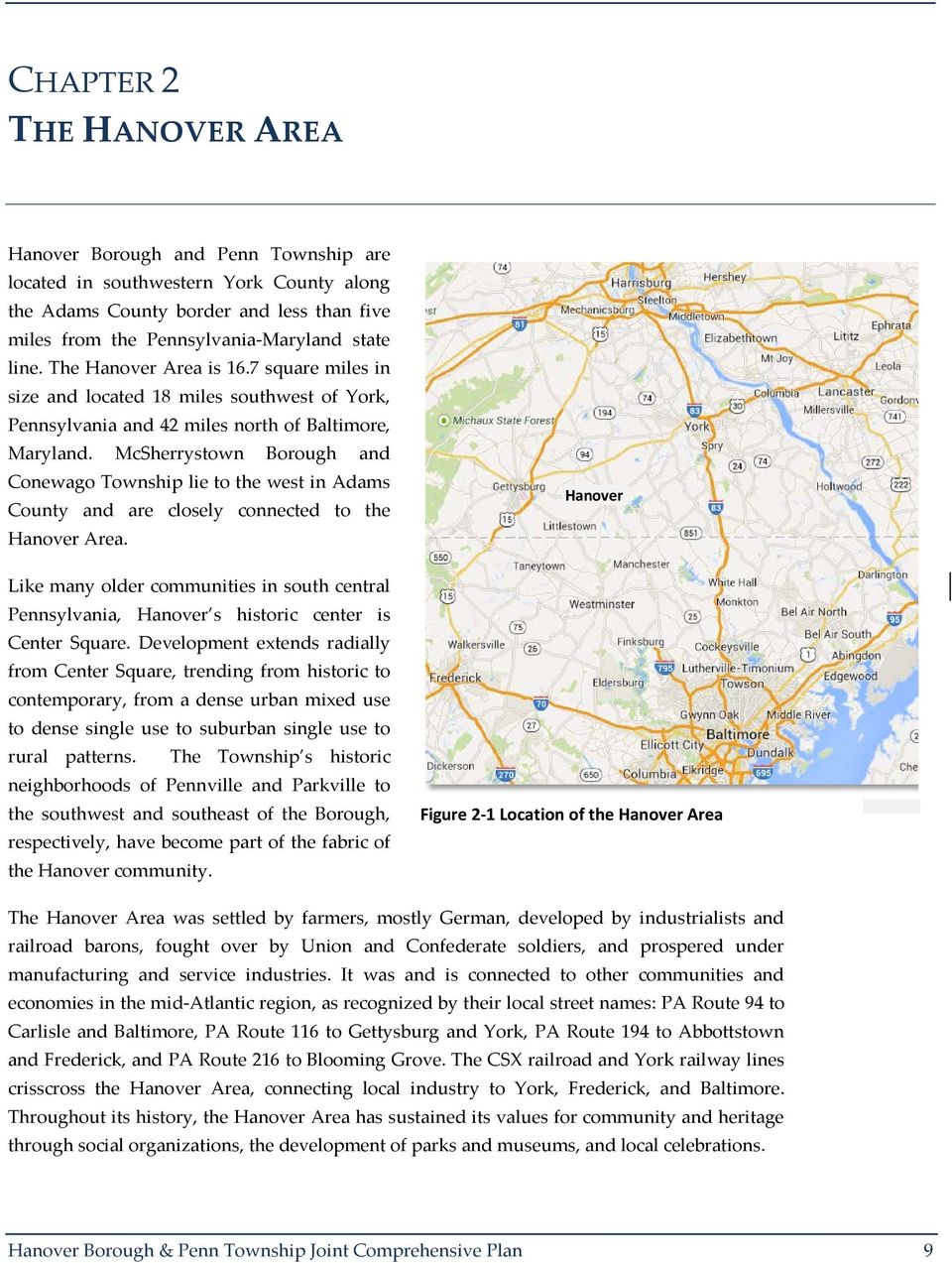
17 CHAPTER 2 THE HANOVER AREA Hanover Borough and Penn Township are located in southwestern York County along the Adams County border and less than five miles from the Pennsylvania-Maryland state line. The Hanover Area is 16.7 square miles in size and located 18 miles southwest of York, Pennsylvania and 42 miles north of Baltimore, Maryland. McSherrystown Borough and Conewago Township lie to the west in Adams County and are closely connected to the Hanover Area. Like many older communities in south central Pennsylvania, Hanover s historic center is Center Square. Development extends radially from Center Square, trending from historic to contemporary, from a dense urban mixed use to dense single use to suburban single use to rural patterns. The Township s historic neighborhoods of Pennville and Parkville to the southwest and southeast of the Borough, respectively, have become part of the fabric of the Hanover community. Hanover Figure 2-1 Location of the Hanover Area The Hanover Area was settled by farmers, mostly German, developed by industrialists and railroad barons, fought over by Union and Confederate soldiers, and prospered under manufacturing and service industries. It was and is connected to other communities and economies in the mid-atlantic region, as recognized by their local street names: PA Route 94 to Carlisle and Baltimore, PA Route 116 to Gettysburg and York, PA Route 194 to Abbottstown and Frederick, and PA Route 216 to Blooming Grove. The CSX railroad and York railway lines crisscross the Hanover Area, connecting local industry to York, Frederick, and Baltimore. Throughout its history, the Hanover Area has sustained its values for community and heritage through social organizations, the development of parks and museums, and local celebrations. Hanover Borough & Penn Township Joint Comprehensive Plan 9
18 Chapter 2 The Hanover Area landscape features the broad gently rolling foothills of the Blue Ridge Mountains, cultivated as farmland or covered by mixed oak forest. This landscape presents few constraints for man-made development. The York County Environmental Resources Inventory (2002) classifies most of the Hanover Area as buildable (soils with slopes less than 25 percent and more locally, less than 8 percent). The limestone geology underlying the Borough and its immediate surroundings has numerous karst features and two documented sinkholes but these have not precluded development. In fact, the underlying rock is actively quarried in nearby Conewago Township by Vulcan Materials. While the majority of the surface soils are classified as prime for agriculture, these same soils have some limitations for on-lot (septic) disposal systems. The few surface waterways are headwaters of the Conewago and Codorus Creeks, including Gitts Run and Plum Creek, that drain the area to the Susquehanna River, and are minimally affected by the floodplain. Wetlands, too, are few, small and scattered. RESIDENT POPULATION POPULATION HISTORY The Hanover Area has grown steady as a residential and employment center since The Borough s population peaked at 15,623 in 1970, and after two decades of decline, returned to 15,300 as of The Township s growth rate has been consistently at or above 25 percent since the mid-century, except in the most recent decade, when it was a smaller 7 percent. As of 2000, the Borough and Township were almost equal in population size. The opening of the Hanover Shoe Apartments boosted population in the Borough in the early 2000s, nearly keeping pace with the increase in the Township. The Hanover Area s 2010 total population was 30,901, which represents a 6 percent increase over the 2000 total population of 29,127. POPULATION PROJECTIONS BY YORK COUNTY York County periodically prepares population projections by municipality and aggregates these figures to present a county population projection. The projections (e.g., 2020) are drafted as a mathematical trend then analyzed for reasonableness using the number of housing units in the previous two decades (2000 and 2010), average household size, number and/or trends in subdivision reviews, and number and/or trends in building permit issuance. The above group of data is used to calculate low and high limits based on number of potentially available housing units, average household size, and vacancy rate. (York County Planning Commission) The resulting decennial projection is placed in line with historical decennial counts ( ) for trend projection over future decades (2030, 2040 and 2050). 10 Hanover Borough & Penn Township Joint Comprehensive Plan
19 The Hanover Area The most recent projections prepared in October 2011 indicated that the populations of both the Borough and the Township are expected to steadily increase through A five percent increase of roughly new residents is expected in each municipality by 2020, followed by a smaller two percent increase in the Borough (+325) and a larger fifteen percent increase (+2,500) in the Township by Thereafter, the Borough s growth rate is projected to remain at 2 percent per decade (+325) and the Township s growth rate, to decline to 9.7 percent (+1,850) by 2040 and 7.2 percent (+1,500) by These figures result in joint projections of approximately 32,500 residents by 2020, 35,300 by 2030, 37,500 by 2040 and 39,300 by See Table 2-1. Table 2-1 Population Counts, , and Projections, Hanover Borough 14,890 14,399 14,573 15,289 16,053 16,375 16,702 17,036 Penn Township 9,234 11,658 14,592 15,612 16,410 18,945 20,792 22,288 Joint Total 26,104 28,047 29,165 30,901 32,463 35,320 37,494 39,324 Source: York County Planning Commission (2011) LOCALLY PROJECTED POPULATION AND HOUSING NEEDS The July 1, 2012 population of the Hanover Area was estimated by the U.S. Census Bureau as 31,021 residents. This figure reflected an increase of 39 residents in the Borough and 47 residents in the Township since April Projecting this rate of increase over the next two decades, the Hanover area would reach 31,362 by 2020 and 31,792 by These figures are lower than the projections prepared by YCPC. Converting the population increase to projected households and adding a vacancy factor results in essentially the same number of projected new housing units, namely 9 for the Borough and 10 for the Township. See Population-based Projections in Table 2-2. Housing starts in the Borough ( ) have been nominal and very much in line with the population-based projection. The phased Cherry Tree development is the only active residential development, representing 268 new units and a future population increase of approximately 595 residents. However, the Township s housing starts have averaged 38 per year since Using this figure as a basis for projection and working back to a projected housing increase of 380 units over 10 years and a projected household increase of 364 results in a revised 2020 projection of 16,543 residents and a revised 2030 projection of 17,474 residents for the Township. See Housing starts-based Projections in Table 2-2. See Joint Totals for Locally Projected Population and Housing in Table 2-3. Hanover Borough & Penn Township Joint Comprehensive Plan 11
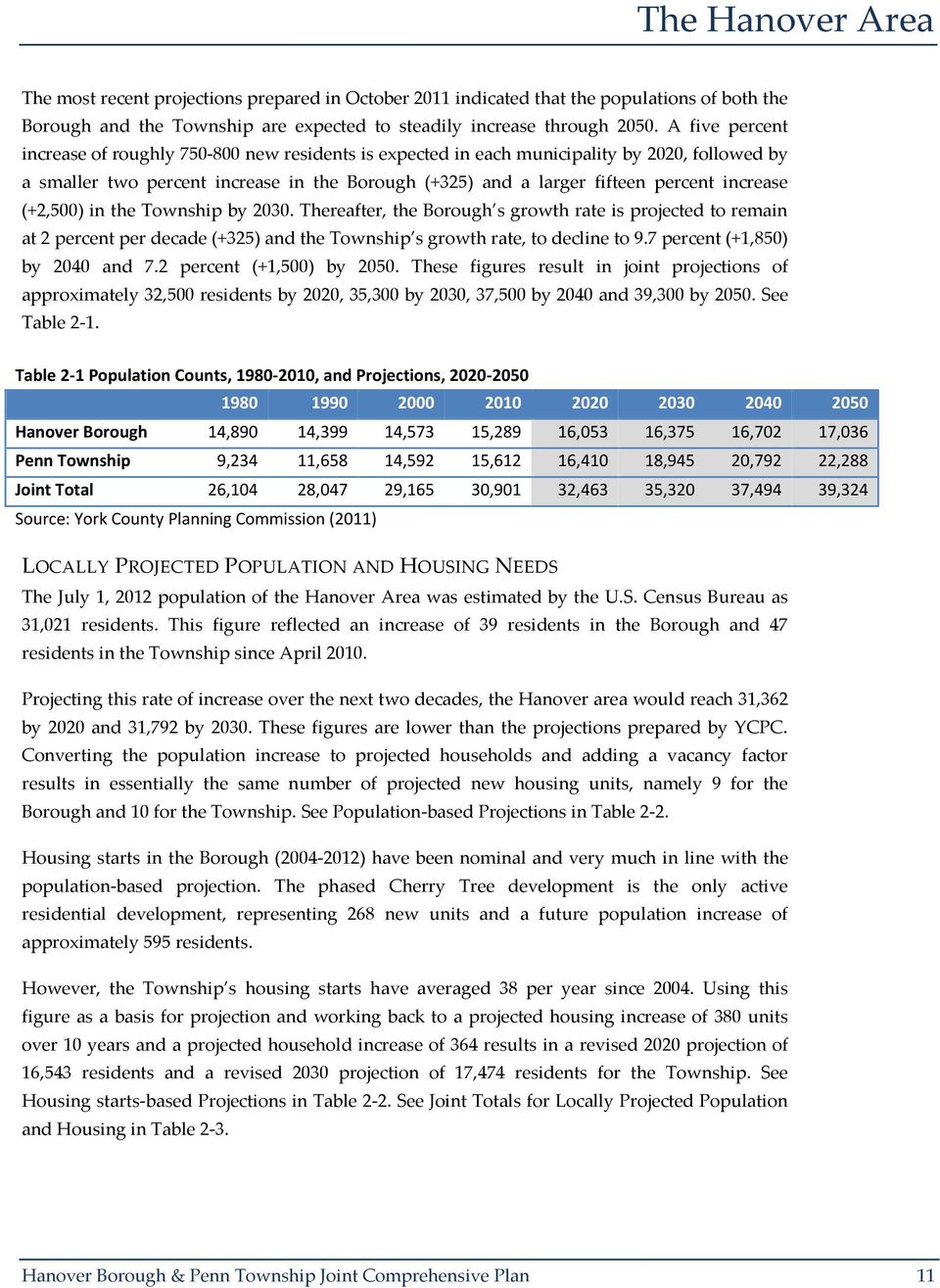
20 Chapter 2 Table 2-2 Projected Population and Housing, 2020 and 2030 Geography April 1, 2010 Population Estimate (as of July 1) Census Persons Vacancy per household Rate Hanover Borough 15, ,310 15,339 15,349 Penn Township 15, ,625 15,629 15,672 Joint Total 30,935 30,968 31,021 Population-based Projections 2020 Population Change Household Change Housing Unit Change Housing Unit Change/Yr Hanover Borough 15, Penn Township 15, Joint Total 31, Population Change Household Change Housing Unit Change Housing Unit Change/Yr Hanover Borough 15, Penn Township 16, Joint Total 31, Housing starts-based Projections 2020 Population Change Household Change Housing Unit Change Housing Unit Change/Yr Penn Township 16, Population Change Household Change Housing Unit Change Housing Unit Change/Yr Penn Township 17, Source: U.S. Census Bureau; Gannett Fleming Table 2-3 Locally Projected Population and Housing, 2020 and 2030 Locally Developed Projections 2020 Population Change Household Change Housing Unit Change Housing Unit Change/Yr Hanover Borough pop-based 15, Penn Township housingstarts 16, based Joint Total 32,051 1, Population Change Household Change Housing Unit Change Housing Unit Change/Yr Hanover Borough pop-based 15, Penn Township housingstarts 17, based Joint Total 33,177 1, Source: U.S. Census Bureau; Gannett Fleming A further look into the backlog of development in the Township shows 815 units proposed for development or lot subdivision in advance of development, as of April See Table 2-4. A population projection based upon build-out of anticipated units in the Borough and the Township shows a capacity for 34,617 residents, as shown in Table Hanover Borough & Penn Township Joint Comprehensive Plan
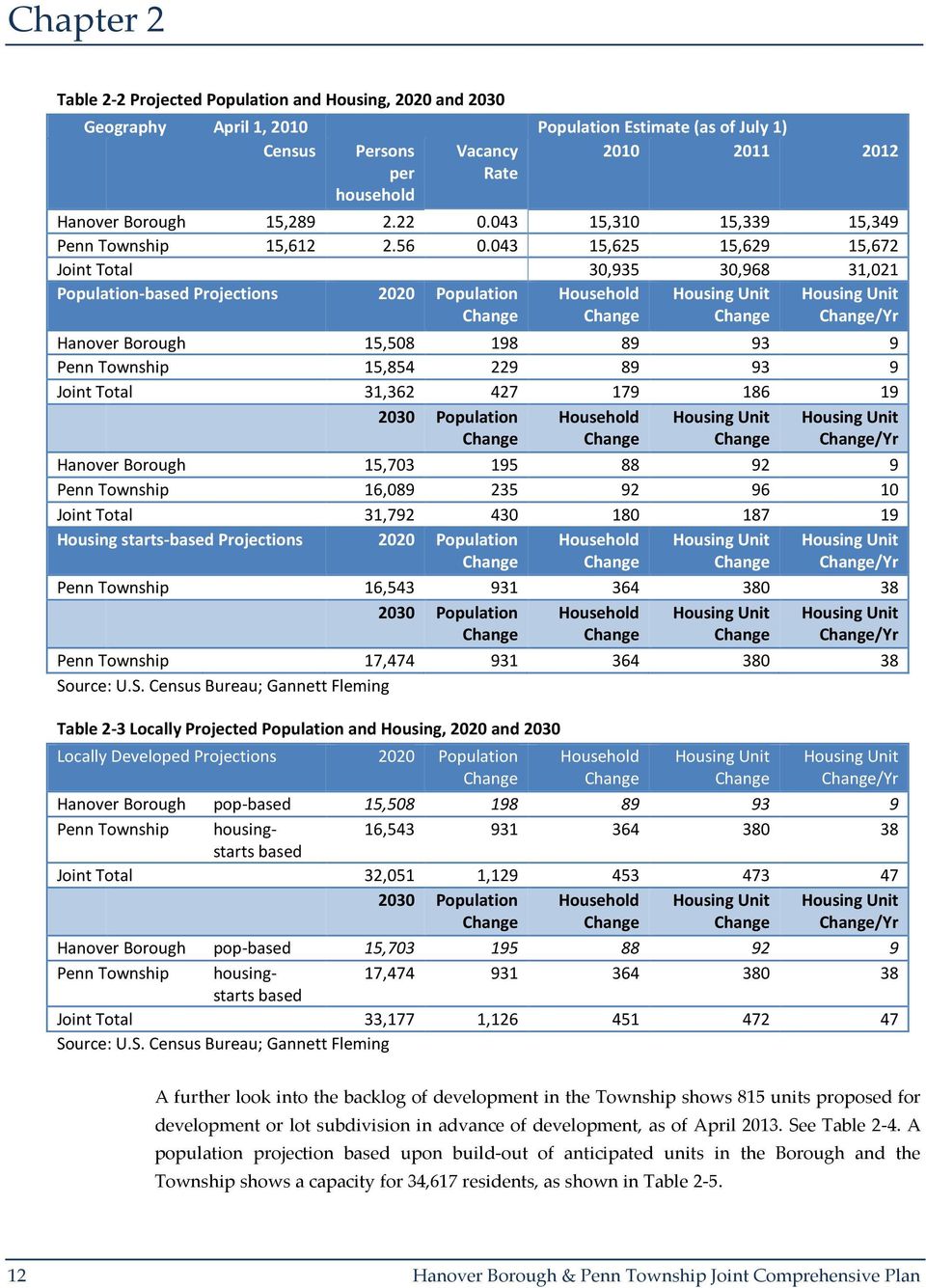
21 The Hanover Area Table 2-4 Proposed Residential Planning and Development Projects, Hanover Area, April 2013 Project Name Development Type Zoning Residential Lots (Units) Projected Population Hanover Borough Cherry Tree (Phase 3) Single-family attached townhouses R3 and O/A by Ryan Homes Cherry Tree Court (Phase 4) Single-family dwellings O/A and M Subtotal 268 units 595 Penn Township Avion Breezewood Drive Single-family semi-detached R townhouses Brookside Avenue Single-family attached townhouses R Townhouses Brookside Heights - Phase I Single-family attached townhouses R Glade Village Multi-family apartments R High Pointe North High Pointe (South) Single-family dwellings R22, R at Rojen Farms Mustang Heights Mustang Pointe Single-family dwellings R Park Hills Manor Single-family attached townhouses R Pine Brooke South Heights Single-family dwellings R Stonewicke Single-family dwellings R Thornbury Hunt Whispering Run R York Village Apartments Multi-family A/O Subtotal 1,219 units 3,121 Total 1,487 units 3,716 Source: Hanover Borough, Penn Township; projected population by Gannett Fleming Table 2-5 Projected Residents from Planned Developments by Municipality Geography Hanover Penn Joint 2010 Population 15,289 15,612 30,901 Projected Residents from Planned Developments 595 3,121 3,716 Population based upon Build-out of Planned Developments 15,884 18,733 34,617 Source: Gannett Fleming Given the expressed residential development interest in the Hanover Area, as shown in Table 2-4, neither municipality needs to consider zoning changes to increase residential dwelling capacity to house its projected population. The housing units in approved and proposed development projects have more than enough capacity to accommodate projected growth shown in Table 2-5. Hanover Borough & Penn Township Joint Comprehensive Plan 13
22 Chapter 2 POPULATION AND DEMOGRAPHICS AT THE CENSUS BLOCK GROUP Demographic data is presented on the following pages in text, maps and charts. Data were collected from the 2010 U.S. Census of Population and Housing and the American Community Survey 5-year Estimates, , as noted. Data were collected at the census block group level to characterize demographics on a smaller scale or neighborhoods level, and aggregated for Borough, Township and Joint Hanover Area totals and percentages. The figures in this section illustrate more than one data set. For example, Figure 2-2 shows population overlaid with bar charts of that block group s population by age. POPULATION In 2010, there were 26 census block groups in the Hanover Area, 16 in the Borough and 10 in the Township, ranging in size from 53.9 acres in the center of Hanover to 3,130.5 acres along the northern and northeastern border of Penn Township. The number of residents by census block group ranged from approximately 600 to 3,200. Smaller census block groups tended to have fewer residents and still have higher population densities than larger block groups. Total population by block group is shown in Figure 2-2. AGE GROUP DISTRIBUTION The distribution of residents ages provides an indication of community needs, such as schools and playgrounds for children, employment for adults, and health care for seniors. Mature adults ages 40 to 64 comprised the largest age group in each municipality, followed by young adults ages 18 to 39, then children and youth under age 17, and finally seniors age 65 and over. In the downtown block groups and areas just beyond the core, young adults equaled or outnumbered mature adults as the largest age group and seniors were relatively few in number. These areas represent residents active in the labor force and their families. Seniors were nearly equal with mature adults as the largest age group and younger age groups were sparse in the north central part of the Borough. This area represents older workers and retirees. Smaller, more densely populated block groups, which have smaller lots and yards, had fewer children and youth. These areas are clearly less attractive to families with children. 14 Hanover Borough & Penn Township Joint Comprehensive Plan
23 The Hanover Area Total Population By census block group Total Population By census block group, shown as bar chart Total Population by Municipality and Joint Area Hanover Borough 15,289 Penn Township 15,612 Joint Area 30,901 Figure 2-2 Total Population and Age Group Distribution by Census Block Group, Municipality and Joint Area Hanover Borough & Penn Township Joint Comprehensive Plan 15
24 Chapter 2 MINORITY GROUPS Residents racial and ethnic identities enable decision-makers to consider the fair and reasonable impact of public projects and policy on minority populations; this is one aspect of environmental justice. Some communities also choose to celebrate their ancestry and diversity through fairs and festivals. Knowledge of their residents ancestry and ethnicities enables community leaders to consider this cultural opportunity. In 2010, residents of a minority race, any race other than White Alone, were present in every block group and averaged 6.29% across the Hanover Area. Percentages of racial minority residents ranged from 1.3% to 16.7%. The block groups with the highest and lowest percentages were located in the Borough; percentages of minorities in the Township were much narrower, from 2.5% to 5.3%. Percentages of racial minorities were generally highest in the downtown and declined outward with a few exceptions. Block groups immediately east and west of Center Square had percentages of racial minorities above 16 percent; block groups at and north of Center Square also had percentages above 10%. Residents of Hispanic ethnicity were also present in every block group in 2010, ranging from 1.2% to 15%, and averaged 4.8% across the Hanover Area. Percentages of ethnic minorities were generally highest in the downtown and declined outward with exceptions similar to racial minorities, namely the north central part of the Borough and one block group southwest of Center Square. 16 Hanover Borough & Penn Township Joint Comprehensive Plan
25 The Hanover Area Percent Racial Minority By census block group Percent Hispanic Population By census block group Figure 2-3 Racial and Ethnic Minorities by Census Block Group, Municipality and Joint Area Hanover Borough & Penn Township Joint Comprehensive Plan 17
26 Chapter 2 ESTIMATES OF EDUCATIONAL ATTAINMENT OF RESIDENTS 25 YEARS AND OLDER Residents education attainment, the highest level of education completed, indicates their workforce readiness and aptitude. Such figures are often a part of a community profile shared with prospective businesses. Estimated percentages of residents who have earned a high school diploma or its equivalent ranged from 60.6% to 97.0%. These percentages were generally higher in the south and lower in the north; block groups with the lowest percentages were in the northeastern portion of the Borough. Estimated percentages of residents who have obtained a Bachelor s degree ranged from 4.9% to 43.2% and averaged 18.38% across the Hanover Area. Block groups with the highest percentages were typically along the edge of the Borough and in the southern portion of the Township. The lowest percentages were just outside downtown. Patterns were similar for the estimated percentages of residents who have obtained a Master s, Professional, or Doctoral Degree, which ranged from 0% just north of downtown to 19.7% west of downtown and averaged 6.77% across the Hanover Area. 18 Hanover Borough & Penn Township Joint Comprehensive Plan
27 The Hanover Area Percent with Post-Secondary Degree By census block group 8.1% with Bachelor s Degree (9.0%) with Master s or Professional Degree Percent with High School Degree or Equivalent By census block group Figure 2-4 Educational Attainment by Census Block Group, Municipality and Joint Area Hanover Borough & Penn Township Joint Comprehensive Plan 19
28 Chapter 2 HOUSEHOLDS The resident population of the Hanover Area lived as 12,847 households in 2010; 6,806 households in the Borough and 6,041 households in the Township. Whether family or nonfamily, households were smaller in the Borough at 2.22 persons per household and 2.85 persons per family household versus 2.56 persons per household and 2.94 persons per family household in the Township. Incorporating age data, nearly one in three households had children less than 18 years of age and a similar number of households have at least one resident age 65 or older. HOUSEHOLD INCOME AND POVERTY, 2010 Household income and poverty statistics reflect the economic status of residents and indicate areas where disadvantaged, low income households are concentrated. Estimates of median household income by census block ranged from approximately $29,000 to $83,000 and averaged $53,174 across the Hanover Area. Average median household income was estimated as $47,878 for the Borough and $61,648 for the Township. Households in the downtown tended to have the lowest median incomes and those at edges of the Hanover Area, the highest median incomes, however the pattern in between was mixed. Most blocks groups adjacent to downtown had notably higher incomes, with block groups in the next tier, moving outward from downtown, with slightly lower incomes. According to estimates, there were residents living below poverty in every block group in recent years. Estimates of individual living in poverty by census block ranged from approximately 1.5% to 29.7% and averaged 9.1% across the Hanover Area. Rates of poverty were highest in the lower income areas of downtown and its surrounding block groups, and lowest in the outlying block groups. HOUSING UNITS There were 13,573 housing units in the Hanover Area in Of these, the majority were occupied and specifically owner-occupied. Owner-occupancy was higher in the Township (79.8%), and renter-occupancy was higher in the Borough (45.6%). Of the total units, 726 units (5.3%) were vacant, mostly for sale or rent. The homeowner unit vacancy rates were very low: 2.3% in the Borough and 1.9% in the Township, reflecting a tight homeowner market. The rental unit vacancy rates were 6.6% in the Borough and 4.4% in the Township, reflecting a healthy rental market with a reasonable number of available units. Available rental units made up more than half of all vacancies in the Borough. 20 Hanover Borough & Penn Township Joint Comprehensive Plan
29 The Hanover Area Median Household Income By census block group Percent Living Below Poverty By census block group 6.4% Figure 2-5 Income and Poverty by Census Block Group, Municipality and Joint Area Hanover Borough & Penn Township Joint Comprehensive Plan 21
30 Chapter 2 LENGTH OF HOME OCCUPANCY AND RESIDENCY Estimates from the American Community Survey indicate that the majority of residents of the Hanover Area (60.09%) moved into their current home since 2000 or within about the past 10 years (Table 2-6). Another 19.13% have been in their current homes since 1990 or a little over 20 years ago. This data shows that the Hanover Area is attractive to residents and that the housing market has been active since These movers include those who have relocated within the Hanover Area as well as those from farther away. Only about than 1 in 5 householders (20.78%) has been in the same unit since 1980 or earlier. Residency data (Table 2-7) reveals from where new residents have relocated. The American Community Survey estimated that slightly more new residents in the past year relocated locally within York County (2,249) than from other counties (1,876). This figure could, in fact, be higher if adjacent Adams County were included as a local relocation; this data was not available. The majority of county-to-county movers (1,289 of 1,876) relocated from elsewhere in Pennsylvania. The remainder of new residents (619) came from other states or abroad Census 2002 reported a similar distribution of new residents though in a longer 5 year history. The most significant difference was that more new residents relocated from outside of Pennsylvania. This data shows that a portion of new residents are coming from other communities, where government services and responsibilities may be different from those in the Hanover Area. These new residents may have expectations that do not align with services, service quality or duties of local government and community services providers. Municipal mailings, newsletters and websites are therefore an important means of educating new residents about services and department contacts. Table 2-6 Year Householder Moved into Unit Borough Township Joint Area Occupied housing units 6,659 6,013 12,672 Moved in 2010 or later % % 1, % Moved in 2000 to , % 3, % 6, % Moved in 1990 to , % 1, % 2, % Moved in 1980 to % % 1, % Moved in 1970 to % % % Moved in 1969 or earlier % % % Source: American Community Survey 5-year Estimates, Hanover Borough & Penn Township Joint Comprehensive Plan
31 The Hanover Area Table 2-7 Past Residency Hanover Penn Joint Area Estimate Percent Estimate Percent Estimate Percent RESIDENCE 1 YEAR AGO Estimate Percent Estimate Percent Estimate Percent Source: American Community Survey 5-Year Estimates Population 1 year and 15,128 15,128 15,446 15,446 30,574 30,574 over Same house 12, % 13, % 26, % Different house in the U.S. 2, % 1, % 4, % Same county 1, % % 2, % Different county 1, % % 1, % Same state % % 1, % Different state % % % Abroad % % % RESIDENCE IN 1995 Number Percent Number Percent Number Percent Source: Census 2000 Summary File 3 (SF 3) - Sample Data Population 5 years and 13, , , over Same house in , , , % Different house in the U.S. in , , , % Same county 3, , , % Different county 2, , , % Same state 1, , % Different state 1, , , % Elsewhere in % THE ECONOMY The Hanover Area economy (the zip code) included more than 24,000 people employed at 1,192 businesses in The number of businesses peaked at nearly 1,280 in 2007 and employment peaked over 27,000 in However, between 2008 and 2010, more than 1,400 jobs were lost each year. This was the same time that most of the nation was experiencing a severe economic downturn. Both Hanover Borough and Penn Township are home to several major employers, some with national and international renown. As of 2012, the largest employer in Hanover Borough was Hanover Hospital, with approximately 1,300 employees. The second largest was Utz Quality Foods, employing almost 1,300 as well. R.H. Sheppard was another significant employer in the Borough with over 1,000 workers. Numerous smaller businesses, mostly manufacturing, were small to mid-size employers. Hanover Borough & Penn Township Joint Comprehensive Plan 23
32 Chapter 2 Penn Township's largest employer in 2012 was Snyder's of Hanover with a workforce of 850, followed by ESAB Welding with 400. While the Township's largest employers were not as large as the Borough s, the Township had seven businesses employing more than 100 people. Like the Borough, most of these were manufacturers. ECONOMIC DRIVERS A wide range of industries contribute to the Hanover Area economy but a few truly generate economic value as measured by various business and employment metrics. These economic drivers are outlined below and detailed in Chapter 4. MANUFACTURING Hanover Area manufacturers produce goods for sale (or providing services) beyond the local area and thus import economic value. Manufacturing employers with 300 or more employees include: Utz Quality Foods, R. H. Sheppard Company, Snyder s of Hanover, ESAB Welding and Cutting Products, the Sheridan Group and Hanover Foods Corporation. DID YOU KNOW? As a major center of food and snack manufacturing, the Hanover Area positively impacts the overall economy of South Central Pennsylvania. ACCOMMODATION AND FOOD SERVICES Accommodation and food services ranked second in its value for employment and economic value. This industry includes local lodging and national hotels and restaurants of all types, and represents a portion of the tourism industry. employment. RETAIL TRADE Retail trade ranked fourth for employment and economic value to the Hanover Area. Recent growth in the retail trade industry, including the development of Hanover Gateway Shopping Center, has likely increased business numbers and HEALTH CARE AND SOCIAL ASSISTANCE Health care and social assistance ranked sixth in 2010 and represented 156 businesses and 3,074 jobs. All metrics have trended positive since 2005: business growth (+4), job growth (+1,431, 87.1%), and resident employment (+1,431). With more than 1,300 employees, the Hanover Hospital was the largest employer. THE LAND USE PATTERN 24 Hanover Borough & Penn Township Joint Comprehensive Plan
33 The Hanover Area As shown by land use data from the York County GIS Department, the Hanover Area has an established development pattern radiating from Center Square along the state highways. See Map 1, 2012 Existing Land Use. URBAN CORE Small-scale, mixed-use urban patterns are found in the Borough s core and adjoining areas of the Township. Small- to mid-size commercial uses dominate these areas, at least on the ground floor. Some parcels are multi-use, hosting residential or opportunities for residential uses above; others are single use. Tax-exempt public services are also common in the core. The rail corridor hosts commercial uses in the downtown and industrial uses east and west of downtown. Structures commonly share walls. Yards are small, if present at all. Sidewalks provide a visual and functional connection between individual lots and the community at large. Vacancies, blighted buildings, and surface parking lots indicate that the historic urban fabric is stressed by modern living and travel. Land Use Legend Figure 2-6 Excerpt from the 2012 Land Use Map showing the urban land use pattern Hanover Borough & Penn Township Joint Comprehensive Plan 25
34 Chapter 2 SUBURBAN SURROUNDINGS Outside of the core, mid-size commercial and public uses and small- to mid-size industrial uses line the spokes of the state highways. Suburban neighborhoods occupy the spaces between the spokes of PA 94/Carlisle Street, PA 116/Frederick and High, and PA 194/Broadway in the north and between PA 216/Blooming Grove Road and Westminster Avenue in the south. Beyond the residential area to the north, large commercial retail uses line the east-west corridor of Eisenhower Drive. East of town, large industrial and public uses occupy lands from Moulstown Road to PA 116/York Road. Industrial uses along the rail lines become less dense as they extend from the core into Conewago Township. Urban Area shown in Figure 2-6 Land Use Legend Figure 2-7 Excerpt from the 2012 Land Use Map showing the suburban land use pattern 26 Hanover Borough & Penn Township Joint Comprehensive Plan
35 The Hanover Area Throughout this suburban area, parcels tend to be single use and single story with clear separation between lots and buildings. Each lot is served by its own parking lot, thus larger uses have larger lots and more internal circulation. Sidewalks are still common in both business and residential areas but are not completely continuous. Pockets of farmed fields that are present today in southern Penn Township are planned for residential uses. RURAL EDGES At the northern and southeastern edges of the Hanover Area, the rural landscape includes farmed fields, a few larger lot residential subdivisions, country homes tucked in the wooded Pigeon Hills, and Codorus State Park. These low density properties are typically served by onlot wells and septic systems, and primarily connected to the community by the roadway network. Land use patterns are generally compatible with few if any conflicts, particularly within areas of similar development scale. Land Use Legend Figure 2-8 Excerpt from the 2012 Land Use Map showing the rural land use pattern in the north Figure 2-9 Excerpt from the 2012 Land Use Map showing the rural land use pattern in the southeast These three patterns generally introduce the land use pattern of the Hanover Area. Detailed analysis of the land use distribution and trends is presented in Chapter 5. Hanover Borough & Penn Township Joint Comprehensive Plan 27
36 Chapter 2 Each municipality determines its tax rate based on the distribution of uses, particularly those eligible for taxation, and their total land and building value. Because the distribution and concentration of their uses and total assessed values vary (see Figure 2-9), as well as the services provided, their municipal tax rates also vary: Hanover Borough, 5.5 mills; Penn Township, 3.65 mills. Figure 2-9 Distribution of Uses by Acreage and Total Assessed Value, Hanover Borough and Penn Township, 2013 Hanover Borough Acreage by Use, 2013 Exempt 13% Utility 0% Apartment 3% Commercial 26% Hanover Borough Total Assessed Value by Use, 2013 Exempt 10% Utility 0% Apartment 3% Commercial 23% Residential 45% Farm 2% Industrial 11% Residential 59% Farm 0% Industrial 5% TOTAL ACREAGE: 1, TOTAL ASSESSED VALUE: $1,076,814,607 Exempt 36% Penn Township Acreage by Use, 2013 Utility 1% Apartment 1% Commercial 7% Farm 22% Penn Township Total Assessed Value by Use, 2013 Exempt 12% Utility 0% Apartment 4% Commercial 10% Farm 1% Industrial 10% Residential 24% Industrial 9% Residential 63% TOTAL ACREAGE: 10, TOTAL ASSESSED VALUE: $1,286,704,420 Source: York County Assessment Office 28 Hanover Borough & Penn Township Joint Comprehensive Plan
37 The Hanover Area UNIQUE NATURAL AND CULTURAL FEATURES The Hanover Area a community has been growing for more than a century in a landscape with few natural constraints. The Borough sits at a high point between the Conewago Creek to the west and the Codorus Creek to the east. The topography is relatively flat, and perennial headwater streams begin just outside the Borough in the Township. Forests were cleared and converted for farmland generations ago. Prime agricultural soils remain open and farmed in the northern portion of Penn Township between the Borough and the Pigeon Hills. Other farmed land in the central and southern portions of the Township have been developed for community and economic uses. There are designated floodplains along the streams and scattered wetlands in the Hanover Area, generally affecting portions of the Township. The headwaters of Oil Creek to the east of the Borough are listed by PA DEP as impaired by siltation or sediment from non-point local sources. A detailed environmental inventory is available in York County planning documents and GIS data. Cultural values and history, however, are evident in historic architecture, parks and civic spaces, and snack manufacturers who open their doors to curious consumers. See Map 2, Significant Natural and Cultural Features. HISTORIC SITES The Hanover Historic District is a National Historic District designated by the National Park Service. The district includes 2,632 contributing buildings, 4 contributing sites, 3 contributing structures, and 1 contributing object (The Picket) in the central business district and surrounding residential area of Hanover. Most of the buildings date between 1870 and 1946, with some notable Colonial Revival, Queen Anne, and Pennsylvania German vernacular style frame and brick buildings. Notable contributing buildings include: the Forney House (1905), Evangelical Brethren Church Rectory (c. 1930), Hanover Shoe Store (c. 1930), Sheppard and Myers Building (c. 1890), Richard McAllister Inn (c. 1925), Peoples Bank building (1901), Hanover Broad Silk Works (c. 1910), Myers and Sheppard Residences ( ), Emmanuel United Church of Christ (1899), Union Station (1892), Bank of Hanover (1906), and Hanover Public Library (1910). The contributing structures are two natural gas pumping stations (c. 1940) and a railroad freight car (1922). Located in the district and separately listed on the National Register of Historic Places are the Eichelberger High School, George Nace (Neas) House (c. 1783), and former U.S. Post Office. Read more in Chapter 10. Hanover Borough & Penn Township Joint Comprehensive Plan 29
38 Chapter 2 Other distinctive buildings in the Hanover Area include the Hanover Theater, the Gitt Memorial Library, and the Charles P. Ketterer Wagon Factory. Construction of the Hanover Branch Railroad to Hanover Junction was completed in In 1858, the Gettysburg Railroad opened a railroad link to Gettysburg and the Hanover and York Railroad completed a rail line to York in These rail lines connections attracted industry and spurred broader economic growth across the Hanover Area. Union Station (Union Depot) at 235 Railroad Street, one of the historic district's most significant contributing buildings, was Hanover's passenger depot. During the American Civil War, the Battle of Hanover was fought on June 30, Union cavalry under Judson Kilpatrick encountered Confederate cavalry under J.E.B. Stuart and a sharp fight ensued in the town and in farm fields to the south, particularly along Frederick Street. The inconclusive battle delayed the Confederate cavalry on their way to the Battle of Gettysburg. Three days before the battle, another detachment of Virginia cavalry had briefly occupied Hanover, collecting supplies and horses from local citizens. 2 PARKS AND CIVIC SPACES Center Square has been renamed several times but has always been a focal point for the community. In 1815, it was Market House Square, when the open-sided market house stood in the center of the intersection. In 1873, a large park-like traffic circle with an ornate fountain at its hub replaced the market house and the name was changed to Fountain Square. In 1904, the fountain was removed to Wirt Park and replaced by the Pickett, a bronze statue of a soldier on horseback commemorating the 1863 Battle of Hanover, and the name was changed to Center Square. In 1968, the traffic circle was removed and the Pickett, a cannon and other memorabilia were relocated, some of them more than once. The Hanover Farmer's Market has operated since 1815 and been housed at the Markethouse on 210 East Chestnut Street since The Hanover Fire Museum was established in 1980 after the consolidation of the Hanover Fire Company #1 and Eagle Fire Company #2 into 1 Prowell, George R. (1907). History of York County, Pennsylvania. 2 Ibid. 30 Hanover Borough & Penn Township Joint Comprehensive Plan
39 The Hanover Area one building. Each volunteer fire company had its own collection of fire memorabilia and apparatus and both expressed an interest in preserving this history. In response, a museum room was included in the design of the new Central Station at Wirt Park. The museum contains three pieces of apparatus a 1882 Silsby Steamer, a 1830 circa 2 cylinder piston hand pumper, and a 1770 circa Nushem grinder hand engine a working 1911 Gamewell Alarm Board, and various small pieces of fire memorabilia. Guthrie Memorial Library, previously the Young Memorial Library and the Hanover Public Library, was established in 1911 after three major contributions from benefactors George Metzger in 1879, Jacob Smith in the in the 1880s, and Howard and Martha Young. In over 100 years, the library's core mission has not changed: to provide free access to educational, cultural and recreational resources. The library was renovated and rededicated in The Borough and the Township have numerous public parks for local recreation. They range in size from small neighborhood parks and historic sites to mid-size and large complexes for athletics and picnicking. Many of the parks are named in honor of historic residents, e.g. Attlesberger, Baer, DeGuy, Moul, Myers, Wirt and Young. The York-Hanover Trolley once carried passengers from Hanover to York. The corridor is now owned by GPU Energy as a transmission line corridor and has been developed as the Hanover Trolley Trail for local recreation. Trail segments in the Borough and the Township are complete. The 3,452-acre Codorus State Park spans the border between Penn and West Manheim Townships in the rolling hills of southern York County. The 1,275-acre man-made Lake Marburg has 26 miles of shoreline and is a rest stop for migrating waterfowl and shorebirds. The lake is also popular with sailboaters and motorboaters. Boat, canoe, and paddle boat rentals are available. 3 Anglers love the lake for warm water fishing and can also fish Codorus Creek for trout. Picnicking, swimming in one of the largest pools in the state, disc golf, and camping are among the most popular activities, though a wide array of activities, including winter sports, as well as open space conservation are supported at the park. Lake Marburg provides habitat for a PA-threatened animal species and is therefore noted as a natural area in the York County Natural Areas Inventory. MANUFACTURERS AS COMMUNITY AND ECONOMIC DEVELOPERS The Hanover Shoe Company was established in 1899 by Mr. Harper Donelson Sheppard and Mr. Clinton N. Myers to sell the best shoes for one price, $2.50 a pair, directly to the public. They opened their first store in York in 1900 and a large shoe factory in Hanover in The two men were also responsible for financing or operating such ventures as the Hanover General Hospital, the Evening Sun, the public waterworks and two impounding dams, the 3 accessed February 20, Hanover Borough & Penn Township Joint Comprehensive Plan 31
40 Chapter 2 local athletic field and the Hanover Shoe Farms. 4 In 1978, C&J Clark bought the Hanover Shoe Company and the Bostonian shoe company the following year, and moved most manufacturing to West Virginia, where operations were cheaper, and keeping a plant along Kindig Lane in Conewago Township. A distribution center was later built adjacent to the plant and the manufacturing plant was closed. The factory on Carlisle Street was converted into apartments in 2001 and the power plant, into the Hanover Fire Museum. 5 The Clark Company built its US logistics center in Conewago Township in 2012, encouraged by a Federal Trade Zone designation. Utz Quality Foods began in 1921 as "Hanover Home Brand Potato Chips and in 2003 opened its fourth local production facility. In 2004, sales reached $235 million annually, spurred in part by market expansion, a targeted advertising campaign in the New York City metropolitan region and a 2001 Consumer Reports taste test ranking Utz as the best tasting potato chip in the nation. Today, Utz Quality Foods remains a family-owned Hanover Area business. 6 The company has worked in partnership with the Hanover Soccer Club to develop sports fields behind its Carlisle Street facility. Snyder's of Hanover dates to 1909 when Harry V. Warehime, founder of Hanover Canning Company, began producing Olde Tyme Pretzels for the Hanover Pretzel Company and to the 1920s, when Eda and Edward Snyder II began frying potato chips in a kettle at their home on Centennial Avenue and peddling the snack door-to-door and to fairs and farmers' markets. Hanover Canning bought Snyder s in 1961 and split off the snackfocused enterprise in Snyder s flagship pretzel bakery on York Street houses a factory store and offers a free inhouse tour. In 2010, Snyder s of Hanover merged with Lance, Inc. In 2012, the company added a research and development center to serve all of the company s snack lines, powered by a 26-acre solar field. 4 accessed February 20, accessed February 20, and accessed February 20, Hanover Borough & Penn Township Joint Comprehensive Plan
41 Chapter 3 Downtown Vitality Downtown isn t just a location, it s a key element in a community s self-identity a community that may extend as far as the local zip code. Every community wants a positive identity to retain its residents and businesses, who can, in turn, attract others. That identity results from the value of services and amenities in the downtown, the physical layout and design of streets and blocks, and the character of the built environment in the minds of locals and visitors who patronize the downtown. Downtown Hanover has both challenges and visionaries. Citizens want their downtown to be economically successful and culturally interesting. They want to see successful and longstanding retail stores, offices, and eateries. They want to see old buildings restored and occupied. They want to see modern market rate housing opportunities. They want to feel safe and secure exploring new stores and restaurants during the day and into the evening hours. Residents also recognize that revitalization is a real challenge. Past efforts have had some success but haven t been able to reach full momentum. Some efforts were viewed as valuable but uncoordinated. Revitalization is difficult, lengthy and complicated, and most importantly requires an ongoing effort to respond to economic and social conditions. It s difficult because there are many players where lots are small and buildings are subdivided and leased from landlords to tenants. It s takes time to impact the causal conditions of decline and reverse those trends. And it s complicated because public policies and programs, and private development and financing practices may all need to be revised. And they may need to be revised again as economic markets change. Several successful revitalization efforts are highlighted on page 62. Hanover Borough and the Hanover Area Chamber of Commerce have begun working together to revitalize the downtown through the Main Street Program. A vision for downtown was prepared and adopted in An organizational structure of volunteers is in place and initial projects are underway. However, surmounting the challenges will require far more than a volunteer effort. The Borough and Chamber will need to dig deep into public capabilities and private capital to make structural changes and investments. Hanover Borough & Penn Township Joint Comprehensive Plan 33
42 Chapter 3 This chapter outlines downtown conditions, including the efforts of Main Street Hanover, and recommendations to renew the business and living environments of downtown. DOWNTOWN S PHYSICAL STRUCTURE There are 40 blocks in the Borough s central business district, defined as the general business district per the zoning ordinance. The district has about 250 parcels and all have been developed at some point in time. The street network is a modified grid. Public parking is available along most streets and metered in the 000, 100 and 200 blocks. There are about 225 primary buildings. Several "cornerstone" buildings are four and five stories tall, while most are 2-1/2 or 3 stories. The shortest buildings, including several office/retail and industrial buildings and garages, are just one story. Primary buildings in the 100 blocks beyond Center Square average 2 floors. The remaining 25 parcels are used for surface parking. Some lots comprise more than one parcel. Six lots are owned by the Borough and the rest are owned by churches, banks and businesses. The assessment of circulation and parking in the Hanover Area are presented in Chapter 6. A 10-YEAR VISION FOR DOWNTOWN HANOVER The Hanover Area Chamber of Commerce led an effort to develop a community-supported vision for downtown Hanover in summer Market research and opportunities for public involvement were conducted by the PA Downtown Center. The vision statement was prepared and presented to the public and later adopted by Borough Council. It is shown on the following page. Underlined words were drawn directly from the public comments and contributions. It emphasizes Hanover as a self-identified historic community of industrial design and innovation, a place that offers urban living in the downtown, and one that enjoys an active social scene. For the vision to move from a forecast to reality, the community of Borough officials and staff, Chamber staff, businesses, developers and the public will need to move steadily from current conditions and mindsets to belief and action toward those desirable outcomes. Individually or collectively, the community will need to address: land use, building stock and business and resident occupancy convenient access and safe circulation the functional design of public spaces, and safety, comfort and security. 34 Hanover Borough & Penn Township Joint Comprehensive Plan
43 Downtown Vitality HISTORIC DOWNTOWN HANOVER VISION STATEMENT Hanover, Pennsylvania, at the crossroads of history and heritage in the southwestern corner of York County is a bucolic residential community and a bustling hub of industry and innovation. Centrally located, Downtown Hanover is easily accessible, at the intersection of PA State Routes 94, 194 and 116, and a relaxing scenic drive from Gettysburg. Experience Downtown Hanover as an affordable place to live, an ideal place to work, a vibrant place to shop, and a fun place to be. Get a taste of what Downtown Hanover has to offer As a way of life. Downtown Hanover is an inviting home to young professionals, families, and empty nesters, where people choose to live and work in a walkable and healthy community, enjoying a high quality of life. Utilizing upper floor living opportunities, downtown offers a variety of unique and creative places to be and to be seen. Gather on the Square and town s many parks, meet new friends and connect with old ones for a quick lunch, a relaxing dinner, or an evening concert. As an economic & industrial hub. Supported by an educated workforce focused on lifelong learning and a strong work ethic, Downtown Hanover is the center of inventive and traditional manufacturing and industry. By sustaining and investing in local artists and innovators, start up businesses, or lasting generational establishments, the spirit of entrepreneurism is strong and thriving in Downtown Hanover. Appreciate the rich historic character. Downtown Hanover s storied past and legendary colonial and Civil War history provide the foundation for discovering and honoring those who have come before - from the town s sturdy German roots to tales from the Battle of Hanover. As a first time visitor or a lifelong resident, stroll through town and enjoy the strong preservation ethic while marveling at the historic architecture including Colonial Revival and Queen Anne style buildings. Enjoy food, glorious food whether it s enjoying the bounty from the Hanover Farmers Market, sampling the flavors of Hanover s local snack food kings, or dining at outdoor cafés, neighborhood pubs, and local bistros, Downtown Hanover appeals to a variety of tastes. Celebrate a special occasion, grab a quick bite, or enjoy an everyday meal and delight in locally-grown food and locally-inspired cuisine. This vision is realized and will become a reality as a result of a unified, coordinated, and progressive group of private, public, and non-profit stakeholders and community members. Underlined words were drawn directly from the public comments and contributions. Hanover Borough & Penn Township Joint Comprehensive Plan 35
44 Chapter 3 LAND USE AND HOUSING ISSUES A SPRING 2013 SURVEY OF USE AND OCCUPANCY A survey of land use and occupancy was conducted in April The survey was used to characterize land use and housing conditions based on visual observations made from the sidewalk, since this is the perspective that most residents and visitors have when traveling through downtown. The data was then used to identify issues, concern, and opportunities for improvement. Each block was observed from all sides or segments and notes taken on building size, use, and occupancy. Table 3-1 summarizes the survey and analysis. Observations of individual blocks and buildings follow. Data provided by the York County Economic Alliance on available real estate at the time of the survey showed 37 available properties or a 12% vacancy rate in commercial/industrial buildings in downtown. It is important to note that use and occupancy in any one building or block can change quickly, so trends over time are more indicative of the market and its perceived value of the downtown environment. Table 3-1 Survey of Downtown Land Use, Occupancy and Physical Conditions Feature Count / % Feature Type General 40 Blocks in the General Business District 153 Block segments/sides 264 Lots 467 Number of units Land Use 168 Number of commercial units 52 Number of commercial unit vacancies 31% Commercial vacancy 278 Number of residential units 22 Number of residential unit vacancies 8% Residential vacancy 21 Number of other buildings (e.g. churches) 26 Parking as primary parcel use Source: Gannett Fleming INVENTORY & ANALYSIS OF CENTER SQUARE AND THE 000 BLOCKS Commercial vacancies were high on Center Square and in the 000 block. Recent relocation of businesses was apparent. Upper floors were observed as predominately occupied, particularly those that appeared to be used as apartments as evidenced by open window and decorative curtains; the interior quality of apartments was not observed in the survey. 36 Hanover Borough & Penn Township Joint Comprehensive Plan
45 Downtown Vitality Anchor Buildings for their size and placement o On Center Square: Gitt Building, Clarks Bostonian, Square Commercial Center o On the 000 block of downtown Carlisle St: PNC Bank (occupied), HCC building (under redevelopment) Broadway: Hot Weiner Shop York: McAllister Hotel (mixed non-profit/residential occupancy; opportunity for reuse as retail/service and market rate apartments/condos) Baltimore: M&T Bank (occupied) Frederick: Former Montgomery Ward (vacant/at risk), Hanover Theatre (vacant/at risk) Underutilized Properties for a downtown district o Non-profit agencies o Automotive repair (at West Walnut) o Modern gas station and convenience store (Royal Farms) o Residential uses on first floor of Center Square o Excessive private commercial parking (Rite-Aid) INVENTORY & ANALYSIS OF THE 100 AND 200 BLOCKS Predominance of mixed use, multi-story buildings with commercial use on the first floor and apartments above continues outward from Center Square; some second story areas appeared to be used for storage. Some single use commercial and residential buildings are present, including single family homes. Other uses are predominantly churches, social services, and community organizations. Public and private parking lots occupy corner and mid-block locations. Secondary Anchors include o the former Goodfellow Chevrolet Dealership (Railroad and Chestnut)(vacant) o Markethouse o Professional Office building (Broadway and Locust) o Evening Sun (news) building o Old school (W Walnut and Centennial) o Waltersdorff Furniture at 219 Baltimore Street Underutilized Properties for a downtown district o Old firehouse (E Chestnut, adjacent to the former Goodfellow Chevrolet Dealership) o Automotive repair (at Franklin and Gail) o Below market rate housing between South Railroad and Eagle Streets o Borough Public Works along railroad corridor Hanover Borough & Penn Township Joint Comprehensive Plan 37
46 Chapter 3 PRELIMINARY RECOMMENDATIONS 1. Review the Borough s property maintenance code and its code enforcement practices. Do the existing provisions sufficiently address property maintenance concerns? If not, what new provisions should be added? Do other communities property maintenance codes offer additional provisions that would benefit the Borough? Are enforcement practices effective? Are stronger penalties needed and would they result in better maintenance of property? Are there alternative penalties that would improve property maintenance? 2. Take aggressive action to move neglected and underutilized properties back to productive use, particularly anchor buildings such as : 219 Baltimore Street if plans for the transit station do not materialize The Hanover State Theater at 39 Frederick Street Former Montgomery Ward building at 34 Frederick Street Former Goodfellow Chevrolet, Inc., East Chestnut Street A. Outline a range of possible legal options, including notification of the property owner, condemnation, acquisition, such as by the Redevelopment Authority of the County of York (RACY) or through eminent domain, and re-sale. B. Explore options for property improvement or redevelopment before re-sale. Where multiple properties are available within a single block, consider a master redevelopment plan for all properties. 3. Use incentives to promote reuse. Potential incentives include: Expedited processing, e.g. permit review, inspection, etc. Relaxed standards, e.g. parking Increased density Tax credits and/or tax abatement A. Establish or enact incentives. B. Publicize incentives to desirable re-use projects, such as the Heritage Conference Center at 22 N Carlisle Street (in the former Wachovia Bank building). Work with Main Street Hanover on language for a downloadable brochure for its website and distribution. 4. Lead a redevelopment project. A. Pursue Keystone Communities Funding for anchor building acquisition and physical building improvements. This may require the Borough to define Hanover s anchor buildings individually or by criteria. B. Find partners in private redevelopment, property management, and community or private finance. Look to York County community, redevelopment and finance organizations, such as the Renaissance Fund, York County Community Foundation, and the Redevelopment Authority of the County of York (RACY). 38 Hanover Borough & Penn Township Joint Comprehensive Plan
47 Downtown Vitality Consider a local redevelopment authority, only if no other options are feasible. Assess market demand for market rate housing. Consider middle or upper income, size of unit, desired amenities, etc. Identify a target site/building. Acquire property; assemble property, if desirable. Assess building and façade preservation. Determine preservation and demolition intent(s). Design project. Fund project with private investment and public subsidies (e.g. tax credits from federal, state and local sources). It s worth mentioning that the Borough office is the one local anchor for which the Borough has complete control. If the Borough were to relocate or expand its office space, a downtown location would continue to draw bill-paying and meeting-attending residents to downtown and its businesses. Any new or modified Borough office facility should demonstrate the design standard for downtown (see Community Character). Use design choices in location, scale and materials to convey civic stature and permanence. RETAIL MARKET OPPORTUNITIES The 2012 Retail Market Analysis for the Hanover Area Heritage Conference Center (HCC) identified a series of downtown retail opportunities. Excerpts from the report are shown below. Full analysis and discussion can be found in the full report. The retail market analysis was conducted to describe the current performance of retailers located in the greater Hanover area and to suggest targeted potential for new downtown retail development associated with the HCC. Factors considered to determine a logical retail trade area for the site include the type of smaller-scale retailers appropriate for downtown Outside demand for Hanover (the central business district) and typical distances local Hanover area retail may be related to the area s customers travel for them, Hanover's proximity to other centers of economic trade areas population, and physical factors such as the area s road network. Cleveland Trade Area Based on these considerations and using Census boundary Pittsburgh Trade Area delineations, the Downtown Hanover Retail Trade Area was defined as the Borough of Hanover and the surrounding municipalities of Buffalo/Rochester Trade Area Penn, Heidelberg, Manheim, and West Manheim Townships in York Baltimore/Washington Trade Area County; and Berwick, Oxford, Conewago, and Union Townships, and New York Trade Area Abbottstown, New Oxford, Littlestown, and McSherrystown Boroughs Philadelphia Trade Area in Adams County. which may become targets for promotional efforts. As of July 2012, the Downtown Hanover Retail Trade Area supplied 511 operating retail businesses occupying nearly 3,317,500 square feet Hanover Borough & Penn Township Joint Comprehensive Plan 39
48 Chapter 3 of store space and generating nearly $900 million in sales. More than half of these establishments (291) are community-serving stores meeting the everyday needs of nearby residents, including 11 supermarkets, 88 limited-service restaurants, 51 full-service restaurants, and 66 hair/nail salons. The trade area also includes 8 department stores, 32 apparel stores, 68 home furnishings stores, 35 specialty goods stores, and 26 other retail stores. Demand for retail goods and services in the Downtown Hanover Retail Trade Area is derived from the trade area's population and income, as well as spending habits. Aggregating these potential sources of retail demand, we estimate a total potential retail demand of approximately $662 million in goods and services from the 74,000 residents in the Retail Trade Area that could be captured by area retailers. The retail development opportunities were determined by subtracting total sales at all Downtown Hanover Retail Trade Area stores from the trade area s total demand for each retail category. As Table 3-1 shows, total sales ($900 million) in the trade area are exceeding demand ($662 million). This means that for several categories of retail goods, there is an oversupply and customers are coming from outside the designated trade area to purchase them. These types of stores include convenience stores, restaurants (both limited and full-service), full-service department stores, family clothing stores, home centers, general-line sporting goods stores, and hobby stores. Much of this has been fairly recent with the construction of significant new retail space that has begun to attract customers from further distances. These stores are generally found in the suburbs, so it likely will not impact the demand for the types of stores that would be desirable for downtown Hanover. Conversely, the comparison of demand figures against trade area sales figures reveals that there is approximately $42 million of unmet retail demand in the retail trade area. This condition indicates that consumers are leaving the trade area for purchases in a variety of retail categories. These categories therefore have the strongest potential for additional capture, and accordingly, the potential for supportable store space in downtown Hanover. Within the retail categories, as the table highlights, are specific store opportunities in downtown Hanover. These opportunities include: Specialty foods (local origin or theme and providing on-site prepared food) Drug stores/pharmacies Pubs and taverns Dry cleaners Men's clothing Window treatment stores Electronics/Cell Phone stores Paint and wallpaper stores Retail lumber yards, and Specialty goods stores such as for sporting goods, leatherworks, and collector s items stores. 40 Hanover Borough & Penn Township Joint Comprehensive Plan
49 Downtown Vitality Table 3-2 Retail Capture and Development Opportunities for Downtown Hanover RETAIL CATEGORY Total Potential Demand Current Downtown Hanover Trade Area Sales Strongest Potential for Additional Retail Capture Opportunities for HCC TOTAL $661,746 $900,087 $42,450 COMMUNITY-SERVING GOODS & SERVICES $301,248 $343,935 $19,072 Supermarkets, Grocery Stores $142,938 $136,113 Convenience Stores $10,895 $28,275 Speciality Foods $7,585 $6,175 $1,410 X Liquor & Beer Distributors $14,668 $19,100 Drug Stores/Pharmacies $40,520 $29,110 $11,410 Cosmetics, Beauty Supplies, & Perfume $1,304 ** Health Food Supplements $1,142 ** Limited-Service Restaurants $36,452 $57,975 Bars and Lounges $4,789 $3,264 $1,525 Dollar Stores & Other General Merchandise Stores $9,008 $18,848 Jewelry Stores $5,257 $5,890 Optical Stores $2,313 $3,250 Gift, Novelty, Souvenir Stores $3,337 $10,700 Hardware Stores $6,313 $8,800 Florists $1,566 $2,910 Hair Salons $5,392 $6,032 Laundries; Dry Cleaning $7,770 $3,043 $4,727 FULL SERVICE RESTAURANTS $40,115 $65,865 DEPARTMENT STORES $160,115 $221,060 Full-Service Department Stores $22,186 $62,580 Discount Department Stores $36,039 ** Warehouse Clubs $101,891 ** APPAREL $22,016 $41,540 $283 Men's Clothing $923 ** $283 Women's Clothing $4,269 $5,000 Children's Clothing $1,010 ** Family Clothing $9,092 $23,550 Clothing Accesories $617 $1,600 Other Clothing $1,202 $1,450 Shoe Stores $4,903 $7,700 HOME FURNISHINGS & IMPROVEMENT $90,204 $142,910 $11,057 Furniture $10,782 $12,420 Floor Coverings $4,323 $5,610 Window Treatments $200 $0 $200 X Other Home Furnishings $3,532 $7,700 Household Appliances $2,623 $3,400 Radio/TV/Electronics $8,829 $5,300 $3,529 X Home Centers $42,277 $90,000 Paint & Wallpaper Stores $3,156 ** $1,116 X Retail Lumber Yards $6,211 $0 $6,211 Nursery & Garden Centers $7,014 $8,940 Antique Stores $1,257 $7,500 Continued Hanover Borough & Penn Township Joint Comprehensive Plan 41
50 Chapter 3 RETAIL CATEGORY Total Potential Demand Current Downtown Hanover Trade Area Sales Strongest Potential for Additional Retail Capture Opportunities for HCC OTHER SPECIALTY GOODS $27,738 $62,732 $3,894 Luggage & Leatherwork $200 $0 $200 X Computer & Software Stores $1,738 $1,450 $288 X Camera, Photo Supply $339 $0 $339 X General-Line Sporting Goods $5,423 ** Specialty Sporting Goods $4,430 $4,140 $290 X Toys & Hobbies $4,280 $18,942 Sewing, Needlework $282 $4,200 Music Stores $1,758 ** Book Stores $3,108 ** $2,328 X Record/CD/Tape/Video Stores $489 $1,350 Office Supply/Stationers $4,976 ** Art Dealers $66 $1,200 Collectors' Items & Supplies $650 ** $450 X OTHER RETAIL STORES $20,308 $22,045 $8,144 Auto Parts & Accessories Stores $9,995 $5,670 $4,325 Pet Supply Stores $3,136 $10,820 Tobacco Stores $2,166 $3,060 Other Health & Personal Care $1,132 ** $832 Other Used Merchandise $197 $1,500 Other Miscellaneous Retail Stores $3,682 ** $2,987 Urban Partners 8/2012 ** Data Suppressed Community-serving goods and services stores have the largest amount of store potential in terms of size with a demand of approximately 54,000 square feet. There appears to be opportunity for 4,000 square feet of specialty foods retailing with perhaps a local origin or theme, and providing on-site prepared foods. In addition, while a Rite Aid exists downtown just off Center Square, there is opportunity for approximately 14,000 square feet of additional drug store/pharmacy potential, which is the typical size for a modern drug store. Any such store in downtown Hanover should be appropriate in design and scale to fit in with the historic character. There also exists the potential for about 8,000 square feet of bars/lounges. This demand would likely be distributed among two or three establishments, which could serve alcohol as well as food in the form of a 'gastropub'. Downtown stakeholders have indicated the need for a more upscale pub. Lastly, there is a significant dearth of laundromats and dry cleaners downtown. The analysis shows there is about 28,000 square feet of potential for these types of retailers. The retail category with the next highest amount of estimated supportable space is home furnishings and improvement, with a total demand of about 47,000 square feet. This includes a 1,000 square-foot window treatment store, a 3,300 square-foot paint and wallpaper store, and 10,000 square feet of electronics retail space, likely occupying several smaller stores. Some of these could focus on cell phones and equipment. In addition, demand exists for 33,000 square 42 Hanover Borough & Penn Township Joint Comprehensive Plan
51 Downtown Vitality feet of retail lumber yards. This would likely be combined with some hardware and gardening supplies and should fit in with the scale and character of downtown Hanover. About 21,000 square feet of retail demand exists in the 'other retail stores' category, the bulk of which is an auto parts and accessories store. As with other larger stores with retail potential downtown, a store of this type should be sympathetic to the urban environment in which it would be located. There also exists the opportunity for 4,000 square feet of health and personal care stores. While generally small in size, many opportunities exist for stores selling 'other specialty goods' in downtown Hanover. These include a luggage and leatherwork store of about 600 square feet, a 900 square-foot computer/software store, and a 1,000 square-foot camera shop. In addition, there is demand for a 1,000 square-foot specialty sporting goods store, likely taking the form of a bike, running, ski, or golf shop, as well as 2,000 square feet of collectors' items/supplies. While a downtown bookstore currently exists, there appears to be demand for an additional 10,000 square feet of store space. Finally, very limited retail demand exists in downtown Hanover for apparel stores due to the number of clothing stores and department stores that carry clothing in the trade area. There appears, however, to be an opportunity for an additional 900 square feet - a small shop - for men's clothing. PRELIMINARY RECOMMENDATIONS 5. Review and revise permitted uses in the central business district to focus on those most relevant to the downtown vision. These uses include but are not limited to: Heritage retail or retail that features products related to the history and heritage of the local region, e.g. quilts made and sold by the Amish in Lancaster County Tourism/Hospitality, such has gift shops, antique shops, and restaurants, especially those with outdoor seating Boutique retail Arts, including visual and performing arts education, such as a dance studio Professional Office 6. Offer tax incentives for reuse/redevelopment projects. Local Economic Revitalization Tax Abatement or LERTA was authorized in Pennsylvania to incentivize reinvestment in existing communities. Local Economic Revitalization Tax Assistance districts are defined areas that provide property owners forgiveness on real property taxes that are directly attributable to a property s increased valuation brought about by new construction or other improvements. According to state law, a LERTA district shall be established for a period not to exceed 10 years. A taxpayer who applies for an exemption any time before the LERTA district expires Hanover Borough & Penn Township Joint Comprehensive Plan 43
52 Chapter 3 REBUILDING RETAIL TAKES Great Champions to lead a cooperative effort of public and private players. The champions are able to direct the revitalization strategy, evaluate and report progress, re-direct effort when appropriate, manage conflict, celebrate successes large and small, and sustain momentum. 2. A Specific Local Vision to direct efforts. 3. A Residential Component. Both renter and owner units for a variety of incomes. Residents are the neighborhood customer base for downtown retail. Other customers will come from surrounding neighborhoods and other communities. 4. A Pedestrian-Friendly Streetscape where people feel safe along and crossing the street; they can walk side by side; baby strollers, walkers and wheelchairs travel smoothly; parking is convenient and visually connected to the streetscape and business entrances at the front, side and rear; windows offer a view of the goods, services, and ambiance available within; and shade, seasonal plantings, and seating encourage people to linger longer. 5. Convenient Access and Adequate Parking for shoppers arriving by personal vehicle, as well as on foot, on bicycle, or by bus, if conditions allow. Sidewalks, bus shelters, and parking lots need to belit for evening use. Shared parking saves valuable real estate for commercial and residential uses. Large lots can be divided to allow some portion for regular shared use. 6. The Right Retail Mix supported by a retail leasing and management agency to coordinate a leasing strategy, actively recruit tenants, and direct prospective tenants to suitable properties for private lease agreements. 7. Commitment to Clean, Safe and Friendly for access corridors and public spaces. Keep the streetscape tidy and require owners to do the same on their properties. Provide an extra layer of security to deter crime, respond quickly to incidents, and lend peace of mind. Work with social services to address homelessness, welfare and other resident needs, preferably away from prime downtown retail and residential areas. 8. Coordinated Action by All Players. Regulatory, enforcement and finance tools by local government. Financing through private banks and non-profit community organizations. Preparation for redevelopment of key sites by local government, implemented by private developers. 9. Day and Evening Activity. Daytime uses with regular customers who along with staff are potential shoppers. Civic, cultural and entertainment anchors for day and evening activity. 10. Management for Long-Term Success. Recognize the need for ongoing effort. Monitor trends and conditions. Re-vamp what doesn t work; stop, if it still doesn t work; and consider trying again later. Adapt to changing markets. Revisit the vision, as needed, to set new direction. Adapted from Ten Principles for rebuilding Neighborhood Retail, Urban Land Institute, Hanover Borough & Penn Township Joint Comprehensive Plan
53 Downtown Vitality is entitled to the full exemption schedule authorized by local ordinance. Local ordinances typically establish an exemption schedule that abates a percentage of a property's assessed value. After the exemption schedule has been satisfied, property owners resume paying all real estate taxes based on their property s full assessed value. Properties located within a LERTA district must continue to remit taxes associated with the property's base value (i.e., the assessed value prior to district establishment). Pennsylvania s LERTA law gives local governments complete discretion in how they structure tax abatements in a LERTA district. Some taxing bodies provide different tax abatements for new construction vs. building renovations and/or might extend the abatement period for projects associated with significant job creation. It is less common that a taxing body would provide 100% abatement for a full 10 years without attaching specific capital investment and/or job creation requirements. RESIDENTIAL OPPORTUNITIES Throughout Pennsylvania and across the nation, urban lifestyles are appealing to empty nesters and seniors, singles, immigrants and non-traditional households. Smaller housing units mean less maintenance time and cost. Proximity to social and transit services means more independence for seniors and non-drivers. Small commercial rentals are better suited to startups with the possibility of living upstairs or down the street. Persons with disabilities and special needs will continue to benefit from affordable housing in proximity to services, but there is a growing interest in urban living among a wider portion of the population. When the first CODO housing project in the City of York was conceived, there wasn t a quantifiable demand, but a group of investors felt that the potential was strong enough to pilot a project. As time has shown, there is demand for urban living in York. A second project is open and a third is on the drawing table. There s reason to believe that similar demand also not yet quantifiable lies in Hanover. Whether characterized seniors, singles, and non-traditional households or doctors, technicians and other staff on short-term residency at Hanover Hospital, new executives in the manufacturing industry scoping out the right suburban neighborhood before moving the family, or young teachers moving to area school districts, there is likely a small to moderate market for small to mid-size urban rentals. There is certainly space for improved apartments on the upper floors of existing buildings. The physical challenge lies in the condition of the building stock; more specifically, whether to renovate an existing structure, build a modern structure behind a preserved façade, or design a new building altogether. Hanover Borough & Penn Township Joint Comprehensive Plan 45
54 Chapter 3 PRELIMINARY RECOMMENDATIONS 7. Inspect residential rental units at least once per year. Regular rental inspection, e.g. annual, bi-annual, or other specified cycle, enhances public safety for tenants, property owners, and the public. Tenants are assured of safe, sanitary housing. Landlords gain protection from tenant lawsuits regarding sub-standard units. Adjacent property owners and the community benefit from proper maintenance that keeps the neighborhood marketable. Penn Township has a rental inspection program. Many college towns also have rental inspection programs. The Borough might review several of these programs and tailor the most appropriate provisions to suit its needs. 8. Offer incentives for private housing reuse/redevelopment projects. Expedited processing, e.g. permit review, inspection, etc. Relaxed standards, e.g. parking Increased density. Consider provisions to allow buildings taller than three stories if they are stepped back from the front façade. Tax credits ARCHITECTURAL CHARACTER OF DOWNTOWN HANOVER The significance of the downtown s architectural character lies in its reflection of periods of economic prosperity and community growth. Several buildings retain the names of their original owners, early businessmen in the community, on their upper façades. Business and industry have remained strong, enabling community leaders and average citizens to maintain older properties with integrity. The results of the building character portion of the Spring 2013 Survey are shown in Table 3-3. Table 3-3 Building Features Inventoried in the Spring 2013 Survey Feature Count / % Feature Type Building 132 Number of buildings of historic architectural character Character 48 Number original/restored facades 88 Number modified facades or modern buildings Source: Gannett Fleming As the community s value became more diverse and economic interests changed, the standard for architectural character has fallen. In the past 50 years, buildings have been lost to destruction or demolition; notable gaps in the building pattern are found in the 100 and 200 blocks of Baltimore, Carlisle, Frederick and York Streets. A few buildings have been severely neglected, such as State Theater and the former Montgomery Ward building on Frederick 46 Hanover Borough & Penn Township Joint Comprehensive Plan
55 Downtown Vitality Street, and the Goodfellow Chevrolet Building at the corner of Railroad and Chestnut Streets, and the Waltersdorff Furniture Store on Baltimore Street; some may be beyond feasible restoration. New buildings have been built, such as the current M&T Bank building and Rite- Aid on Baltimore Street, generally with a larger footprint and lower height, larger modular materials and fewer architectural details. Where buildings were sound, facades were improved. Many facades were modified with new prefabricated doors and windows and contemporary additions or covered with new materials. Indeed some were intended to display a modern architectural style, such as Square Commercial Center, and others again to reduce maintenance. In addition, there were visual intrusions (distractions) by the installation or upgrade of transportation infrastructure. Despite these changes, the downtown still retains much of its historic architectural character and appearance. But the future of this visual character, and its contribution to the community s identity, is unclear. The most prosperous businesses are now located outside of the downtown and not otherwise vested in downtown real estate. Many of the current property owners are absentee landlords with few if any social, civic or economic connections to the Hanover area. As a result, buildings are deteriorating from neglect. Without action, the architectural character will likely continue to erode. As our assets age, decisions must be made about which historic resources to save, which to rehabilitate and reuse, which to memorialize, and which to clear for other uses. PA Historic Preservation Plan, THE FAÇADE IMPROVEMENT PROGRAM Hanover Borough and the Hanover Area Chamber of Commerce administer grants and loans for building façade improvements in downtown, providing an incentive for private investment in downtown restoration projects and property reinvestment. The façade program is available to property owners interested in exterior improvements as minor as painting, lighting and signage replacement, and awning installation to project that restore the historic appearance of the building through masonry projects and door and window replacement. Design assistance is also an eligible expense. The program is funded in multi-year cycles with a grant from the Pennsylvania Department of Community and Economic Development. The program was closed in June 2013 and is currently awaiting response to its current grant application. Property owners meeting the grant criteria can obtain a grant of up to $5,000 per property to help off-set expenses. Grants are made on a cost reimbursement basis, following a process of application, design review and approval, and construction. The selection of Façade Improvement Grant recipients is based solely on project merit and not on financial need. Any person(s) or other legal entity owning property in the Central Business District is eligible to apply; leasing tenants are also eligible with consent of the property owner. Funds for the grant program are limited, and priority may be given to applicants who have not previously Hanover Borough & Penn Township Joint Comprehensive Plan 47
56 Chapter 3 received rehabilitation grants, and who are proposing a project that is consistent with the program s design standards. In addition to the grants, the Chamber offers low interest loans (3% fixed interest, 10-year payback, up to $50,000) to help finance larger projects up to 50% of the project costs. In 2010, the Chamber renewed its program guide, which defines eligible projects and design standards and offers design guidance to improve the character of the downtown as a whole. The program guide also recognizes the potential for property owners to qualify for rehabilitation tax credits. OPTIONS FOR HISTORIC ARCHITECTURAL PRESERVATION If the Borough and the larger Hanover area want to stave off further loss and erosion of historic architectural character, the intent and scope of preservation need to be established through policies and programs. The intent could range from district-wide to case-by-case preservation, and entire building to façade only preservation. In addition, preservation could be highly formalized or heavily incentivized. STREETSCAPE AS PUBLIC SPACE Streetscapes comprise all the elements that create a unified appearance across multiple properties. As part of the use and occupancy audit conducted in April 2013, streetscape conditions were observed. The streetscape features of the Spring 2013 Survey area listed below followed by additional observations. SIDEWALK/CROSSWALK CONDITIONS Sidewalks are present along both sides of all streets and along one side of alleys in the 000 block Sidewalk surfaces are in fair to good condition; cracks and uneven surfaces were present in many of the older sidewalks (>5 years) but only in small sections, not any entire block Sidewalks are generally passable but only passable by a single person in many locations; stoops, poles, sign posts, and vegetation impeded the width of the sidewalk Crosswalks were provided at major intersections; cross walks were not provided to cross alleys along major streets Crosswalks were consistently faded Many crosswalks have curb ramps; only those at major intersections have detectable warning surfaces, likely installed within 5 years BENCHES Numerous benches are located on Center Square Very few are located on in the 000 blocks; benches should be more widely available throughout the downtown ( blocks) 48 Hanover Borough & Penn Township Joint Comprehensive Plan
57 Downtown Vitality Table 3-4 Streetscape Features Inventoried in the Spring 2013 Survey Feature Count / % Feature Type Sidewalk 5 No Sidewalk Present 21 Blocked by poles/posts, stoops, signs, vegetation 14 Broken, cracked, uneven 21 Good surface, comfortable width Crosswalk 14 No Crosswalk Present 29 Faded 3 Lacks detectable warning surface 0 Good condition (survey was completed prior to Spring repainting of crosswalks) Bicycle All No Bicycle Facilities or Signage Present 46 High volume traffic block segments 6 High speed traffic block segments 0 Uneven road surface 0 Good surface, comfortable width and conditions Buildings 132 Number of buildings of historic architectural character 48 Number original/restored facades 88 Number modified facades or modern buildings Vegetation 13 Block segments with no street trees 6 Block segments with young street trees 18 Block segments with mature street trees 15 Block segments with private trees, shrubs, flowerbeds, planters Seating 20 Benches on Center Square Source: Gannett Fleming 1 Benches on other block segments STREETLIGHTS Located at corners and mid-blocks; and staggered on both sides of the street Highway-or Cobra-style lamps mounted <20 feet above the ground surface; not effective for sidewalk/ pedestrians safety and security; lighting for pedestrians should be lower, more frequent, and focused on the sidewalk Ornamental lamps are located in Center Square and some parking areas: municipal lot #1 on Baltimore Street and the Wellspan lot south of Frederick Street; lamps were few and far-spaced Hanover Borough & Penn Township Joint Comprehensive Plan 49
58 Chapter 3 STREET TREES AND PLANTINGS There are mature street trees in Center Square and in the 000 block; many street trees have been removed from the 100 block; this is obvious as there are more mature street trees in the nearby 200 blocks Some street tree species have been heavily pruned, perhaps due to poor species selection; the Borough has revised its species list but few new trees have been planted per this list There are few planters and landscaping areas in public spaces. There are few private planters TRASH AND RECYCLING RECEPTACLES Trash receptacles were few, observed on Frederick and York Streets; units were utilitarian in design There were no recycling receptacles The presence or scarcity of these features and their condition reflect the commitment to quality public space on the part of the Borough as well as downtown property owners. If the downtown is to be promoted as a destination worth changing everyday patterns to visit once and again, the experience needs to be inviting, comfortable and compelling. Developing a unified streetscape design that can be implemented in phased projects is important in creating this destination atmosphere. PRELIMINARY RECOMMENDATIONS Streetscape is what ties properties together and distinguishes them from other neighborhoods. It should provide a functional comfortable space that reflects local character, most commonly history. Streetscape design can include sidewalks, crosswalks, and bicycle facilities; street lights, street furniture, trash and recycling cans, as well as street paving and traffic lights; welcome and wayfinding signage; building facades; landscaping and public art. 9. Improve sidewalk and crosswalk conditions. Sidewalk surfaces are in good to fair condition, however several blocks have very narrow sidewalks (<4 feet wide) or sidewalks with many obstacles that result in a narrow walkable pathway. Examine each block to determine if obstacles can be minimized or removed, or if the sidewalk can be widened when replaced. Crosswalks were due for annual repainting when the audit was conducted. A different type of crosswalk delineation could improve visibility of the crosswalks yearound. Consider a different pavement type, such as concrete paver (in brick or other color) or stamped crosswalk pattern (polyvinyl). Crosswalks should also be added across the alleyways. 50 Hanover Borough & Penn Township Joint Comprehensive Plan
59 Downtown Vitality 10. Provide additional bicycle racks. There is one bike rack at Center Square, Install additional bike racks at municipal parking lots and civic buildings. Encourage or require parking lots of a minimum size to include bike racks as well. Be sure that bike racks meet industry standards. When bikes cannot be secured properly, they are more easily stolen, resulting in high risk, less biking and low use of the racks. 11. Make improvements consistent with the character of other design improvements. Replace street oriented lighting with lighting that illuminates the sidewalk and the street and scaled to pedestrians. Add street furniture more regularly throughout the downtown. (Continue to) Add trash and recycling containers at regular intervals. Upgrade the design of containers to complement streetscape elements. 12. Increase greenspace on Center Square. Expand the seasonal planter program. Enable community organizations and businesses, including those outside of downtown, to sponsor seasonal plantings or planters in Center Square, municipal parking lots, parks and other civic places. If the Center Square intersection is redesigned as a roundabout, its center should include grass, seasonal flowers, and/or seasonal shrubs; minimal signage (use design features to guide the flow of traffic); and a sculpture, monument, or fountain and lighting. 13. Encourage private greenspace that is functional and/or aesthetic. Encourage sustainable design practices including the use of greenroofs, green surface parking, and other best practices to maximize energy efficiency and minimize environmental impact. 14. Continue to host fairs, festivals and parades in downtown. 15. Enhance Saturdays on Main with live music and performance entertainment. 16. Promote the Battle of Hanover Walking Tour and develop other walking tours along different themes and routes, such as: Churches and Cemeteries Founders and Philanthropists (homes, schools, and business locations) Scholars and Industrialists (homes, schools, and business locations) Arts and Architecture Each tour site s description could be written broadly enough so that it could be used for multiple tours. Hanover Borough & Penn Township Joint Comprehensive Plan 51
60 Chapter Enhance the Farmers Market as a civic destination. Include the market as an attraction in promotional materials. Program special events at the market. 18. Add sculpture to the streetscape. Sculpture should be professional and locally relevant by theme, materials, etc. As such, sponsorship or special funding may be needed. Designs could be submitted as in a competition or for juried review and acceptance. Pieces could each be individual or be developed along a theme and individually expressive as in the CowParade of Harrisburg, sponsored by the Mid-Atlantic Dairy Association and later auctioned for charity in 2004, or ice sculptures common to winter Fire & Ice festivals. WELCOME, WAYFINDING AND SIGNAGE Finally, signage was mentioned as an issue early in the planning process. Too much and poor physical conditions were repeated comment. As a result, signage was observed in the April 2013 downtown audit and the following observations were made. GATEWAY BANNERS There were no community banners, an indication of community pride and seasonal emphasis, on Center Square or along the major streets. Since the audit, the Main Street Program installed 24 Discover Hanover banners in the 100 block around Center Square in SIGNAGE Transportation signage includes route and street signs, speed limit signs, permitted and no parking signs; the number, size and placement and posts for these signs create visual clutter or inconsistencies with local character. Business identification and product signage consists of façade-mounted signs and shingles, inwindow signs, and sandwich boards; in-window signs block views to the interior and the placement of some sandwich boards decrease the walkable width of sidewalks. Landmark signage includes pedestals and plaques; these were interesting and informative; some showed signs of age, such as fading; no systemwide map or guide to the landmark signage was observed. Event signage includes overhead banners, such as those hung over Carlisle Street and Frederick Street just outside the downtown district. Since, April 2013, Met-Ed has established a new policy that prohibits banners on utility-owned poles. 52 Hanover Borough & Penn Township Joint Comprehensive Plan
61 Downtown Vitality Sign management is one of the most effective actions toward improving or protecting its visual character. Signs are necessary for identification, navigation, and even promotion. But too many, oversized, poorly located signs make for a disorderly, unwelcoming scene. Based on the April observations, signage is not the most critical of downtown issues but guidelines or standards for signage may perhaps be one of the easiest improvements to make. PRELIMINARY RECOMMENDATIONS 19. Outline the signage system. A. Inventory and assess existing signage. Recognize that PennDOT signage will need to remain, however the Borough and Township can request more context sensitive replacements when replacements are made. Specific attention and effort should be given to: i. Remove unnecessary, outdated signage. ii. Identify signage that is necessary but has not been maintained for future replacement. iii. Identify needs for additional signage. iv. Select specifications for sign posts that complement the downtown streetscape. B. Identify signage needs that will enhance activity, mobility and safety: v. Directional signage to attractions and parking. Attractions include places such as Center Square, the library, the farmers market, the fire museum, the Eichelberger Performing Arts Center, the (future) Heritage Conference Center, and Borough Hall. Include identification signage for the same. vi. Identification signage for gateways, street names, historic sites and buildings, particularly those featured on walking or other tours. Consider street address numbers. vii. Wayfinding signage, such as a user friendly, map of downtown attractions and parking, possibly integrated in a kiosk of other information as well as made available online. 20. Accompany the new signage system with a review and revision of business and product signage standards in the Borough ordinance for consistency and applicability with the objectives of Main Street Hanover and local character, as described in Chapter 10. Ensure that signage does not clutter properties or windows or obstruct sidewalks. Hanover Borough & Penn Township Joint Comprehensive Plan 53
62 Chapter 3 SUCCESSFUL REDEVELOPMENT AND PROMOTION IN CENTRAL PA DOWNTOWNS Downtowns are dynamic. Physical, economic, and social conditions change. New efforts and fresh ideas are needed to sustain activity in the downtown. These communities have taken action in the past few years to change the course of their downtowns. TOWNSHIP-LED REUSE AND REDEVELOPMENT A block-long section of downtown Annville at the intersection of US 422/East Main and PA 934/North White Oak had been underutilized for years. The corner pizza shop had changed hands many times prior to closing and five properties owned by Lebanon Valley College had not been reused or redeveloped as once envisioned, so the Township took action. It began with the purchase of the anchor lots, the former Fink Bakery at 25 E. Main and the former Salvatore's pizzeria in A master plan for Annville Center was developed later that year. A town green or mini-park and parking lot were shown in place of the pizza shop as phase 1. Two and three story buildings were shown as commercial uses boutique shops, offices and eateries, as identified in a marketing study and restored the remaining buildings to their 1980s appearance. In April 2008, the Township created an economic development authority to oversee and finance the estimated $2.4 million, 3-year redevelopment project. More specifically, the authority established a flexible revolving Line of Credit to acquire and consolidate the properties into one parcel, prepare the site and market it to developers. The Township received a $1 million Redevelopment Assistance Capital Program grant from the state and Lebanon Valley College contributed $250,000 toward the project. Source: Lebanon Daily News Articles ROADS, REDEVELOPMENT AND RECRUITING The Borough of Carlisle and the Downtown Carlisle Association (DCA) have tackled street design, key site redevelopment and retail recruitment. DCA s Retail Recruiter, created in 2007 as a part-time position, is responsible for figuring out what businesses Carlisle needs downtown and then recruiting businesses to fill those needs. The Borough s Road Diet was intended to increase efficiency and stabilize flow, slow speeds and create safer conditions for bicyclists and pedestrians. The design converted a four-lane traffic pattern to two-lane with a center turn lane, installed adaptive traffic signals (adaptive to real-time traffic monitored by cameras), added bicycle lanes, removed some crosswalks. Two years after completion, some see a friendlier downtown that s safer, and others see slower traffic and fewer customers. 54 Hanover Borough & Penn Township Joint Comprehensive Plan
63 Downtown Vitality SUCCESSFUL REDEVELOPMENT CONTINUED The Borough s Urban Redevelopment Plan was undertaken in 2012 to create walkable, mixed-use infill redevelopment concepts for the north side of town near the Carlisle Fairgrounds, where three manufacturers closed their doors. A draft plan was presented in May 2013 and final documents are being prepared. The Borough matched local funds to receive state and federal grants for the planning effort. Ordinance amendments or revisions are envisioned to follow. REVITALIZING THE HEART OF GETTYSBURG Despite its historic significance, downtown Gettysburg had modern troubles that it addressed in a 2009 revitalization plan. The downtown was lacking in quality attractions, design standards, public gathering spaces, pedestrian safety, and parking, not to mention gaps in coordination and marketing. The plan outlined projects, partnerships, and customer markets as angles for the revitalization effort. Streetscapes and public restrooms, parking, gateways and signage would comprise the first phase of improvements and be funded through a Business Improvement District. New civic and public spaces and street realignment would demonstrate commitment to structural improvements and capture private sector interest. Funding from county, state and federal agencies would assist in the short-term investment for long-term returns of increased property tax revenue, job retention and creation, and higher sales. PROMOTING MAIN STREETS IN LEWISBURG, LITITZ AND MANHEIM Main Street organizations and similar merchant groups are actively promoting their downtowns locally and afar. Discover Lewisburg is the slogan of the Lewisburg Downtown Partnership. The website, hosts information for shoppers, visitors, and businesses. It features things to do and current happenings, several downloadable maps of walking tours featuring sites throughout the downtown, resources for prospective businesses. Online and print adverting for Lititz are headed up by Venture Lititz. Its logo is a postmark lookalike for Destination Lititz, Pennsylvania Its website features the farmers market, 2 nd Fridays, and the visitors guide. In addition, the website highlights Lititz as a great place to live and/or to have a business. Venture Lititz promotes Lititz not just locally but throughout Central Pennsylvania. See Manheim s Downtown Development Group promotes its shopping and events, as well as staycation packages and volunteer opportunities to consumers. It provides guidance on doing business in Manheim, seminars, and the local façade program. See Hanover Borough & Penn Township Joint Comprehensive Plan 55
64 Chapter 3 RENEWED EFFORTS TO REVITALIZE MAIN STREET IN HANOVER Maintaining a vibrant downtown is an under-recognized challenge. Social and economic conditions change quickly and repeatedly often faster than the markets observe and react. Past efforts to revitalize the downtown have fallen short of success but the community continues to believe that the downtown can be better than it is now. In 2008, the Hanover Area Chamber of Commerce and the Borough of Hanover began planning for a reinvigorated downtown Hanover effort. The Chamber successfully launched a façade grant program in Simultaneously, the Chamber began organizing for the Main Street Four-Point Approach, a community-driven, comprehensive strategy to revitalize downtowns throughout the United State, while the Borough contracted with the Pennsylvania Downtown Center (PDC) to provide guidance, technical support, and education to move the process forward. By the end of 2012, financial and staff commitments to a five-year main street effort were in place. That summer, the PDC facilitated a downtown visioning process with input from the public, resulting in the vision statement shown earlier in this chapter. The PDC also conducted a Community Revitalization Academy. That same year, the Chamber and the Borough conducted a Heritage Conference Center feasibility study, which found a small to moderate market for a downtown conference center one that might reuse a downtown anchor building and perhaps spur additional redevelopment. As a result of these formative efforts, Main Street Hanover was launched in January 2013 as a collaboration of Hanover Borough, the Hanover Area Chamber of Commerce, York County Economic Alliance (YCEA) and the Partnership for Economic Development of York County (PEDYC). YCEA is contracted to staff the initiative and PEDYC serves as Main Street Hanover s fiscal agent. Main Street Hanover commits to continue the Main Street Four-Point Approach of organization, design, economic restructuring, and promotion. A brief description of each of the points follows, as well 56 Hanover Borough & Penn Township Joint Comprehensive Plan
65 Downtown Vitality ORGANIZATION Organization is defined as getting everyone working towards common goals. The commonsense formula of a volunteer-driven program and an organizational structure of boards and committees assisting professional management can ease the difficult work of building consensus and cooperation among the varied groups that have a stake in the Hanover area. Main Street Hanover s Organization Committee, referred to as the Steering Committee, guides Main Street Hanover with the principles reflected in the vision and mission statement. The five year strategy for Organization includes: Organizational Goals Objectives Outcomes Strategically identify grant funds and resources to execute strategies set forth in the five year strategy. Develop a Strategic Downtown Action Plan. Build support of community organizations. Develop a volunteer recruitment strategy. Develop a consistent community strategy to keep everyone up-to-date on the development of the downtown revitalization strategy. Apply for and receive Keystone Community designation with PA Department of Community and Economic Development; identify grant opportunities and match to strategies. Create a macro scope for Design, Economic Restructuring, and Promotions to implement; set direction and tone of Main Street Hanover movement. Identify community organizations to target for support with like-missions and values. Selectively identify volunteers for each of the four points, enhancing the overall volunteer effort and placing volunteers strategically to maximize results. Create an information sharing platform for priorities, actions steps and goals for each of the four-points. Increase investment dollars in the General Business District. Increase understanding and consistency in each of the four points, uniting the micro scope of each committee to the macro scope of Organization. Increase the number of outlets of information and strategic alliances for Main Street Hanover. Increase the number of volunteers. Improve communication between Committees. Hanover Borough & Penn Township Joint Comprehensive Plan 57
66 Chapter 3 DESIGN Design is defined as getting Main Street into top physical shape. Capitalizing on its best assets such as historic buildings and the traditional downtown layout is just part of the story. An inviting atmosphere can be created through window displays, parking areas, signs, sidewalks, street lights, and landscaping. Good design conveys a visual message about what Main Street is and what it has to offer. Main Street Hanover s Design Committee developed an action statement, to transform the downtown streetscape, creating a friendly atmosphere in which to live, work and play. The five year strategy for Design includes: Design Goals Objectives Outcomes Improve parking ease and accessibility. Establish a façade program. Improve signage, including business, transit, and wayfinding signs. Create a consistent look for municipal parking; install better signage; develop a parking awareness program, including a description of available spaces and a better standardized map on downtown publications and website. Develop a comprehensive façade grant program and tie it to complementary resources. Establish and enforce a sign ordinance; inventory signage and reduce as appropriate; educate the public. Decrease confusion around parking and increase the number of visitors to the downtown. Increase the number of façade grants and overall investment dollars in the General Business District while increasing property values. Increase the number of signage inspections. Develop a streetscape plan for specific areas of downtown. Connect energy centers in downtown Hanover. Address sidewalk improvement, signage, gateways, façade, and waste disposal. Develop a Design and Walkability Plan for Center Square. Increase safety and walkability with effective lighting and surface upgrades and/or repairs and improve downtown image with banners and gateways. Increase foot traffic in the General Business District and strategically reduce travel times. 58 Hanover Borough & Penn Township Joint Comprehensive Plan
67 Downtown Vitality ECONOMIC RESTRUCTURING Economic Restructuring, defined as finding new or better purposes for Main Street enterprises, is an important element of Main Street Hanover. A successful Main Street converts unused space into productive property and sharpens the competitiveness of its business community. Main Street Hanover s Economic Restructuring Committee developed aims to grow the local economy by retaining and expanding the downtown business base, attracting new businesses and investment and removing barriers for growth. The five year strategy for Economic Restructuring includes: Economic Goals Objectives Outcomes Promote anchor buildings for economic development projects. Create a business retention program. Create a business recruitment program. Increase number of residents in the downtown area, particularly those who live and work in downtown. Develop a business incentive package. Identify a list of anchor buildings and determine Main Street Hanover s role in redeveloping each identified buildings. Consider anchor buildings in planning, grants and promotion. Work with local businesses to develop a retention awareness strategy; develop a financial assistance strategy for business assistance and/or expansion. Develop a business recruitment package to recruit desirable businesses to downtown; follow the vision statement and current market data; inventory first floor vacancies in the downtown. Develop market rate housing options downtown; review ordinances; work with the Borough to develop supportive ordinances; encourage and promote redevelopment projects for increased market rate housing in the downtown; inventory second floor vacancies in the downtown. Create a financial incentive package for start-up businesses; create a How to Open A Business in Hanover toolbox; include information for start-ups, relocations, and adaptive reuse of historic buildings. Increase investment dollars in the General Business District and increase tax potential. Increase the retention rate of downtown business. Increase the number of businesses in the downtown and infill vacant properties. Increase the number of market rate housing units in the downtown. Increase the number of businesses in the General Business District. Hanover Borough & Penn Township Joint Comprehensive Plan 59
68 Chapter 3 PROMOTIONS Promotions, defined as selling the image and promise of Main Street to all prospects, is essential to Main Street Hanover s success. By effectively marketing unique characteristics through advertising, retail promotional activities, special events, and marketing campaigns, the promotion strategy forges a positive image to shoppers, investors, new businesses and visitors. Main Street Hanover s Promotion Committee will develop a marketing plan highlighting Main Street Hanover s niche market(s), and create an image campaign to promote retailers and events. The five year strategy for Promotions includes: Promotional Goals Objectives Outcomes Create an identity for Main Street Hanover. Bring more people downtown. Encourage customers to spend more time and money downtown. Develop an image campaign; develop a new logo; encourage customers to spend time and money within the boundary; increase the visibility of Main Street Hanover. Promote retailers, businesses, and events in the General Business District; create an e- publication, to be distributed on a consistent basis, announcing sales, promotions, events, activities, and information; develop an effective social media strategy; enhance existing Main Street Hanover events and promote the downtown as an event destination. Reinvigorate the downtown merchants group; develop a Shop Around Downtown Hanover feature on select days of the year; implement Independent s Week, a national program the first week of July; celebrate and market existing strengths and assets. Increase the visibility of Main Street Hanover and improve the image of the downtown. Increase foot traffic in the downtown and dollars spent in the General Business District. Increase foot traffic in the downtown and dollars spent in the General Business District. 60 Hanover Borough & Penn Township Joint Comprehensive Plan
69 Downtown Vitality PRELIMINARY RECOMMENDATIONS 21. Continue to fund Main Street Hanover as the lead organization for revitalization. A. Increase staff and volunteer capacity for the Main Street Hanover initiative, as needed. Consider strategic part-time additions that bring expertise to the staff in areas such as business retention and recruitment, property leasing and management, and other discussed below. 22. Consider integrating a slogan with a new downtown logo, adding a key message to the iconic graphic. 23. Identify a variety of visitor types, such as those listed below, and advertise Downtown Hanover to these target markets. Tailor unique versions of the marketing message that would appeal to each. Visitors to civil war destinations Visitors to Hanover hospital Visitors to Hanover Shoe Farms Regional shoppers to regional retail See also event and destination programming mentioned in preliminary recommendations on page 51. GOALS, OBJECTIVES AND RECOMMENDATIONS FOR DOWNTOWN Downtown vitality results from dense, compatible and synergistic land uses, convenient access and circulation for all modes, the functional design of public spaces, and a sense of safety and security. These areas are the focus of recommendations for the Borough and its partners. Promotion and economic restructuring of the business community are noted as recommendations to pursue through Main Street Hanover, which is supported by the Borough and others. GOAL Our long-standing goal is that Downtown Hanover is a retail, office, civic and tourism destination and a desirable urban living location. OBJECTIVES To achieve this goal, the Borough and Township need to continue to: 1. Build relations and capacity with Hanover Area partners. 2. Increase occupancy through quality re-use and redevelopment. 3. Create a Unified and Attractive Streetscape. Hanover Borough & Penn Township Joint Comprehensive Plan 61
70 Chapter 3 In conjunction with Main Street Hanover, 4. Promote downtown as a shopping destination, an event venue, and an urban living location. 5. Support economic restructuring. LEADS AND PARTNERS FOR IMPLEMENTATION Main Street Hanover and the Hanover Area Chamber of Commerce can conduct business marketing and recruitment services, encourage new business development, provide promotion assistance, host business-oriented events and liaison with the York County Economic Alliance. The Main Street Program and Manager can help create a downtown environment that encourages through the advertisement of retail space, and ensuring that the public realm is attractive and welcoming. The Redevelopment Authority of the County of York redevelops blighted sites throughout York County. RACY can play an integral role in rehabilitation projects by holding title to a property while it is being developed, securing grant and loan funding, or assisting with master planning and blight designation. RACY has been involved in housing, office and industrial redevelopment projects in conjunction with other county agencies and private developers. The York County Economic Alliance and the York County Industrial Development Authority can offer additional research resources and serve as a conduit for certain state and federal funding programs. Redevelopment funding programs include the Redevelopment Assistance Capital Program (RACP) and Tax Increment Financing (TIF) among others. Partnership for Economic Development of York County (PEDYC) serves as the fiscal agent for York County s Industrial Art and Design branding initiative and Main Street Hanover. Recommendations Leads; Partners Priority: Year of Completion Build relations and capacity with Hanover Area partners. 1. Continue to utilize and fund Main Street Hanover as the lead organization for revitalization. Increase staff and volunteer capacity for the Main Street Hanover initiative, as needed. Borough, Chamber Increase occupancy through quality re-use and redevelopment. 2. Review the property maintenance code and code enforcement practices. Take more aggressive action to move neglected properties from a status of neglect to maintenance, particularly anchor buildings. 3. Lead a mixed use redevelopment project. Pursue Keystone Communities Funding for Borough, Main Street Hanover Borough, Main Street Hanover; High: Ongoing Review High: 2014 Action High: 2015 and Ongoing High: Hanover Borough & Penn Township Joint Comprehensive Plan
71 Downtown Vitality Recommendations Leads; Partners Priority: Year of Completion anchor building acquisition and physical building improvements PEDYC and YCEA for access to state and federal funding programs, including Redevelopment Assistance Capital Program (RACP) and Tax Increment Financing (TIF), RAYC 4. Establish incentives to promote reuse. Borough; School District, County 5. Review and revise permitted uses in the central business district to focus on those most relevant to the downtown vision. 6. Offer tax incentives for reuse/redevelopment projects. 7. Establish a residential rental inspection program and inspect rental units at least once per year. Regular rental inspection enhances public safety for tenants, property owners, and the public. 8. Offer incentives for private housing reuse/redevelopment projects. Create a Unified and Attractive Streetscape. 9. Improve sidewalk and crosswalk conditions. Borough, Main Street Hanover Borough Borough Borough High: 2015 High: 2014/2015 High: 2017 Establish Program High: 2015 Begin Inspections Moderate: 2016 High: 2017 Moderate: Ongoing 10. Provide additional bicycle racks. Moderate: Make improvements to street lights, street Moderate: 2018 for furniture, and trash/recycling cans consistent Center Square (or with the character of other design other prioritized improvements. 12. Increase greenspace on Center Square. Borough, Main Street Hanover locations) Moderate: Ongoing 13. Encourage functional private greenspace. Moderate: Revise the Façade Improvement Program. High: Design and install a signage and wayfinding Moderate: 2018 system. 16. Review and revise business and product Moderate: 2017 signage provisions of the Borough ordinance. 17. Consider adding sculpture. Low: 2020 Hanover Borough & Penn Township Joint Comprehensive Plan 63
72 Chapter 3 Recommendations Leads; Partners Priority: Year of Completion Support downtown promotion. 18. Advertise Downtown Hanover to target markets, using unique marketing messages. 19. Continue to host fairs, festivals and parades in downtown. 20. Enhance Saturdays on Main with live music and performance entertainment. Main Street Hanover Moderate: 2016 High: Ongoing High: Ongoing 21. Promote the Battle of Hanover Walking High: Ongoing Tour; develop other tours along different themes. Support economic restructuring and downtown promotion. 22. Enhance the Farmers Market. Moderate: Create a business retention program. High: Create a financial incentive package for startup businesses. 25. Create a How to Open a Business in Hanover toolbox; include information for start-ups, relocations, and adaptive reuse of historic buildings. Main Street Hanover Moderate: 2016 Moderate: Hanover Borough & Penn Township Joint Comprehensive Plan
73 Chapter 4 Economic Development While downtown is in need of economic revitalization, a strong Hanover Area economy operates in businesses large and small located along state highways, in the industrial park, in shopping centers and even in home-based locations. These businesses provide jobs and wages that enable workers to provide for themselves and their families and contribute to the tax base that supports services for the community. Retaining and attracting businesses is therefore an important part of community planning. Analyzing trends by industry can help to forecast the demand for land zoned for retail, office space, manufacturing and other uses, water and sewer utilities and a ready workforce with particular knowledge and skills. From this analysis, the Hanover Area can determine if suitable land is available, accessible to the street and highway network, and utility-served, or if rezoning, street and utility service extensions are needed. It might also assess the business climate the tax rates and regulations that contribute to the cost of construction and operations. Workforce supply and readiness is not typically a municipal service, however quality of life and housing options have a strong influence. Additionally, communication and cooperation among municipal and business partners can foster support from school district and county-level education and workforce institutions. After an initial characterization of the Hanover Area economy, this chapter analyzes key economic sectors of the Hanover Area economy, finds agreement for pursuing several sectors in York County planning, and outlines local initiatives in other target industries. It then discusses needs and opportunities for the key economic sectors in the areas of workforce and land, and discusses favorable aspects of a local business climate. The section concludes with goals, objectives and recommendations to coordinate economic development with local and county partners. THE HANOVER AREA ECONOMY TOTAL BUSINESSES, TOTAL EMPLOYMENT In total, more than 24,000 people were employed at 1,192 businesses in the zip code in 2010 (see Table 4-1). These were the lowest figures experienced for this area in at least six years. Business and employment counts peaked in 2007 when the number of businesses was at its highest in recent years, and in 2008 when the number of employees was at its highest Hanover Borough & Penn Township Joint Comprehensive Plan 65
74 Chapter 4 following significant employment growth. However, between 2008 and 2010, more than 1,400 jobs were lost each year. This was the same time that most of the nation was experiencing a severe economic downturn. TABLE 4-1 NUMBER OF BUSINESSES BY INDUSTRY FOR THE ZIP CODE, 2005 AND 2010, RANKED BY 2010 BUSINESS COUNT Number of Businesses % Industry Change Change Retail Trade % Health Care and Social Assistance % Other Services % Accommodation and Food Services % Construction % Manufacturing % Professional, Scientific, and Technical Services % Finance and Insurance % Administrative and Support and Waste % Management Wholesale Trade % Real Estate and Rental and Leasing % Transportation and Warehousing % Arts, Entertainment, and Recreation % Information % Educational Services % Management of Companies and Enterprises % Mining, Quarrying, Oil/Gas Extraction % Agriculture, Forestry, Fishing/Hunting N/A Utilities % Industries not Classified % Total 1,245 1, % Source: County Business Patterns 66 Hanover Borough & Penn Township Joint Comprehensive Plan
75 Economic Development TABLE 4-2 NUMBER OF EMPLOYEES BY INDUSTRY FOR THE ZIP CODE, 2005 AND 2010, RANKED BY 2010 EMPLOYEE COUNT Number of Employees % Industry Change Change Manufacturing 6,701 5, % Retail Trade 3,699 3, % Health Care and Social Assistance 1,643 3,074 1, % Accommodation and Food Services 2,036 2, % Other Services (excluding Public Admin.) % Educational Services % Administrative and Support and Waste % Management Transportation and Warehousing % Construction % Professional, Scientific, and Technical Services % Wholesale Trade % Finance and Insurance % Public Administration % Information % Arts, Entertainment, and Recreation % Management of Companies and Enterprises % Real Estate and Rental and Leasing % Agriculture, Forestry, Fishing/Hunting % Utilities % Mining, Quarrying, Oil/Gas Extraction % Total 19,669 20, % Source: On The Map LARGEST EMPLOYERS Both Hanover Borough and Penn Township are home to several major employers, some with national and international renown. As of 2012, the largest employer in Hanover Borough was Hanover Hospital, with approximately 1,300 employees (see Table 4-3). The second largest was Utz Quality Foods, employing almost 1,300 as well. R.H. Sheppard was another significant employer in the Borough with over 1,000 workers. The Borough had numerous smaller businesses, mostly manufacturing, providing significant numbers of jobs. Penn Township's largest employer in 2012 was Snyder's of Hanover with a workforce of 850 (see Table 4-3). While Penn Township's largest employers are not as large as the Borough s, the Township had seven businesses employing more than 100 people. Like Borough, most of these were manufacturers. ESAB Welding & Cutting and the Sheridan Group each provided 400 jobs each. Hanover Foods and Direct Brands each employed 300 people. Hanover Borough & Penn Township Joint Comprehensive Plan 67
76 Chapter 4 TABLE 4-3 LARGEST EMPLOYERS IN HANOVER BOROUGH AND IN PENN TOWNSHIP, Companies in Hanover Borough Companies in Penn Township # of Employees # of Employees Hanover Hospital, Inc. 1,300 Snyder's of Hanover, Inc. 850 Utz Quality Foods, Inc. 1,270 South Western School District 590 R. H. Sheppard Co., Inc. 1,068 ESAB Welding & Cutting Products Hanover Public School District 258 Sheridan Group 400 New York Wire, Co. 200 Hanover Foods Corporation 305 Adams-Hanover Counseling Services, Inc. 136 Schindler Elevator +/- 300 Leonhardt Manufacturing Company, Inc. 120 Direct Brands, Inc. 300 Hanover Logistics 80 Gerard Daniel Worldwide 160 Elsner Engineering Works, Inc. 65 GlaxoSmithKline 104 Sonoco Products Company 60 McClarin Plastics, Inc. 85 Vulcan Materials 59 Crown Cork and Seal Company, Inc. Source: Hanover Area Chamber of Commerce LABOR FORCE WORKER CLASS In Hanover Borough, Penn Township, and York County, private-sector employees made up the vast majority of the labor force in As Table 4-4 shows, the private-sector labor force was slightly larger in Hanover Borough (86%) and Penn Township (88%) than in York County (84%) due to the County s higher percentage of government workers. Hanover Borough had the highest percentage of self-employed residents among the three jurisdictions, and Penn Township the lowest. Unpaid family workers represented less than 1% of the labor force in each location. TABLE 4-4 LABOR FORCE BY WORKER CLASS, 2011, FOR PERSONS 16 YEARS AND OLDER IN LABOR FORCE (EXCLUDING MILITARY) Class of Worker Hanover Borough Penn Township York County Private wage and salary workers 6, % 7, % 181, % Government workers % % 23, % Self-employed workers % % 11, % Unpaid family workers % % % Total Workers 7,890 8, ,693 Source: American Community Survey Estimates UNEMPLOYMENT Unemployment rates were slightly higher in the Hanover Area than across York County in Between 2000 and 2011, unemployment among residents increased in Hanover Borough and Penn Township, as well as York County (See Table 4-5). In each of the jurisdictions, 68 Hanover Borough & Penn Township Joint Comprehensive Plan
77 Economic Development absolute numbers of both employed and unemployed grew, mirroring population growth, but unemployment more than doubled. TABLE 4-5 EMPLOYMENT STATUS OF PERSONS 16 YEARS AND OLDER IN LABOR FORCE (EXCLUDING MILITARY) (Est.) Change Joint Area # Employed 15,094 16,149 1,055 # Unemployed 532 1, % Unemployed 3.4% 7.5% 4.0% York County # Employed 195, ,693 20,731 # Unemployed 7,301 17,283 9,982 % Unemployed 3.6% 7.4% 3.8% Source: American Community Survey Estimates KEY ECONOMIC SECTORS As of 2010, there were more than 24,000 people employed at almost 1,200 businesses in the zip code that encompasses Hanover Borough and Penn Township as well as surrounding areas. While the Hanover Area peaked in number of businesses in 2007 and number of employees in 2008, almost 3,000 jobs were lost in the Great Recession between 2008 and Despite these changes, several key industries continue to drive the Hanover Area's economy. The top economic sectors by these and other metrics are: Defining Our Metrics Jobs employment positions offered by a Hanover area employer Resident Worker a Borough or Township resident employed in the Hanover area Economic Value a concentration of jobs in one industry greater than the concentration of jobs in the same industry in the larger region/state 1. Manufacturing, with 82 businesses in the Hanover Area, was the primary leader in producing goods for sale (or providing services) beyond the local area and thus importing economic value. Manufacturing was also the number one industry in terms of total jobs (5,841) and employed the most residents (3,122). The largest manufacturing employers, each with more than 300 employees, included: Utz Quality Foods, R. H. Sheppard Company, Snyder s of Hanover, ESAB Welding and Cutting Products, the Sheridan Group and Hanover Foods. Schindler Elevator s expansion in 2012 raised its employment to approximately 300. While manufacturing was the largest industry in the Hanover Area in 2010, it declined by 10 businesses and 860 jobs from 2005 to Recent expansion by Clarks, Snyder s of Hanover and Schindler Elevator likely added employment. As Hanover Borough & Penn Township Joint Comprehensive Plan 69
78 Chapter 4 the leading industry in the Hanover Area and one with target specialty industries, business and employment trends should be monitored through local contacts and data analysis. 2. Accommodation and food services ranked second for employment and economic value in the Hanover Area and fourth in number of businesses (113), business growth since 2005 (+18), total jobs (2,128) and job increase (+92), and resident employment (1,336). These businesses are the core of the hospitality industry and provide a foundation for expanded tourism. 3. Other (private) services, which includes machine repairing, personal care services, pet care services, religious services, and household services, was the third largest industry in the Hanover Area in The number of businesses declined from 153 to 145 (-8), but total jobs increased by 61 and resident employment in this industry increased by Retail trade showed declining trends by several metrics. From 2005 to 2010, the number of businesses fell from 245 to 235 (-10, -4.1%), total jobs declined to 3,535 (-164, -4.4%), and resident employment dropped by 255 (-22.3%). Recent growth in the retail industry, including the development of Gateway Hanover Shopping Center and new leases such as Burlington Coat Factory at the North Hanover Mall, likely increased business numbers by at least 10 and employment by 100 or more. 5. Agriculture, forestry, fishing and hunting, which with more than 2,500 acres in farm and woodlands, reported only one business in Yet, 2,500 acres is a relatively small acreage for these resource-based industries and the one business may very well serve an even larger region. Total jobs were just 78 (-68 jobs, -46.6% since 2005), but these industries provide essential raw materials for manufacturing and food processing other economic engines in the area. And they have a place in economic development as local, direct sales food producers. 6. Health care and social assistance represented 156 businesses and 3,074 jobs. All metrics trended positive since 2005: business growth (+4), job growth (+1,431, 87.1%), and resident employment (+1,431). With more than 1,300 employees, the Hanover Hospital was the largest employer. 7. Administrative and support and waste management, in which businesses specialize in one or more of general management, personnel administration, clerical activities, cleaning activities, provides services to clients in a variety of industries and, in some cases, to households. The industry s 51 businesses increased by 12, its jobs by 729, and resident employment by Hanover Borough & Penn Township Joint Comprehensive Plan
79 Economic Development YORK COUNTY PLANNING PERSPECTIVE The 2014 Update to the York County Economic Development Plan is an important reference for economic development in the Hanover Area. Consistency with county planning is required but more importantly should align recommendations with economic development resources and assistance from the county. The 2009 Plan analyzes sub-county regions for localized economic development visions and recommendations. Hanover Borough and Penn Township lie within the South Western Region, for which the vision is as follows: Small business retention and expansion where infrastructure supports growth Revitalization and infill development (redevelopment) Diversification of manufacturing and industrial-based development Agricultural protection Recruitment of target industries, including firms engaged in research and development, technology and innovation Office, retail and industrial growth directed to existing industrial parks Conservation of rural and scenic areas Hanover Borough & Penn Township Joint Comprehensive Plan 71
80 Chapter 4 In many ways, the Hanover Area is already implementing this vision. The Borough and the Township and their economic development partners are targeting commercial and industrial growth to suitable sites; working to revitalize Hanover Borough as the core of the South Western Region; seeking to expand services that support residents; pursuing the diversification of its manufacturing base; and supporting agriculturally-based businesses. Furthermore, the Hanover Area is pursuing this vision cooperatively; both Hanover Borough and Penn Township are working jointly on several initiatives intended to support economic development collectively, including this Comprehensive Plan, the 2012 Economic Development Plan, and the 2013 Greater Hanover Region Economic Development Plan. YORK COUNTY S TARGET INDUSTRIES The 2008 York County Industry Cluster Analysis, as reported in the 2009 York County Economic Development Plan, assessed the strengths and weaknesses of county industries. The analysis concluded that target industries in the following three categories become the core of the county s economic development strategy: 1. Current industry strengths, defined as strong national performers with a current local specialization. In the South Western Region, these include advanced materials and diversified manufacturing (specifically vehicle/vehicle equipment), followed by logistics/transportation. 2. High-priority retention targets, defined as lagging national performers with a current local specialization. In this region, retention targets include agriculture and food production, followed by advanced materials and diversified manufacturing (specifically metals/metal fabrication and printing), and Utz Facility on High Street building and construction. 3. Emerging strengths, identified as strong national performers but not a current local specialization. In this region, emerging strengths include biomedical, followed by health care and business and financial services. The Hanover Area is home to industries from each of these priority categories. Advanced materials and diversified manufacturing is represented by R. H. Sheppard, Schindler Elevator, and Crown Cork and Seal Company, as well as by the addition of Yazoo Mills. Logistics/transportation is represented by Hanover Terminal and Gerard Daniel Worldwide. Despite recent declines and identification as a lagging national performer, the agriculture and food production industry is considered a high-priority retention target and includes the companies of Utz, Hanover Foods and Snyder s-lance. Finally, as the fastest growing industry in the region and a strong national performer, health care is an emerging strength industry, provided predominantly by Hanover Hospital. 72 Hanover Borough & Penn Township Joint Comprehensive Plan
81 Economic Development RECENT MANUFACTURING EXPANSION AS REPORTED IN THE CENTRAL PENN BUSINESS JOURNAL SNYDER'S-LANCE TO BUILD HANOVER RESEARCH FACILITY February 21, 2012 by Jim T. Ryan North Carolina-based snack food maker Snyder's-Lance Inc. today said it will build a 60,000- square-foot research and development center in Hanover near one its largest bakeries. The facility, scheduled to be complete in the fourth quarter, would be used to research, develop and enhance products for the company's full line of snack foods, according to Snyder's-Lance. There are no immediate plans to add new employees to the research center, but operation and staffing details have not yet been finalized, according to the company. The research facility will use green technologies and design, including drawing 100 percent of its electricity from a nearby 26-acre solar farm, the company said. Its solar farm now supplies about 30 percent of the electricity needed for the manufacturing facilities in Penn Township. Snyder's-Lance, based in Charlotte, formed in 2010 through a merger of Lance Inc. and Snyder's of Hanover. Snyder's-Lance trades its shares on the Nasdaq under the ticker symbol LNCE. SCHINDLER BREAKS GROUND ON NEW PENN PLANT October 22, 2012 By Craig K. Paskoski, The Evening Sun Calling it an investment in the future of the company and the community, Schindler Elevator Corp. broke ground on a new, environmentally friendly manufacturing plant in Penn Township Monday afternoon. Officials from Schindler, contractors for the project, and local political leaders stuck polished shovels into the ground and simultaneously turned over dirt to formally get construction of the 152,000-square-foot plant started. Schindler expects to employ about 60 workers at the plant, which will manufacture visible finished elevator parts and serve as an order consolidation center. Most of those employees are coming from Schindler's manufacturing facility in Gettysburg, which is scheduled to be phased out as the new plant nears a summer 2013 opening. Schindler Vice President of Manufacturing Dave Thomas said the company hopes to eventually build a 70,000-squarefoot addition to the plant on Industrial Drive. SCHINDLER ELEVATOR LEASES SUPPORT SITE IN HANOVER August 8, 2013, York Daily Record/Sunday News Hart Corporation completed a long term lease with Schindler Elevator Corporation for Penntown Properties' 93,778-square-foot facility in Hanover. The facility will be used as a support location for Schindler's new manufacturing facility at 21 Industrial Drive in Hanover. Hanover Borough & Penn Township Joint Comprehensive Plan 73
82 Chapter 4 THREE LOCAL TARGET INDUSTRIES While manufacturing and health care are targeted for their potential long-term positive economic impacts across York County, other industries have trended positively in the Hanover Area economy in recent years and hold potential for continued economic growth. These industries include tourism/hospitality, retail, and agriculture. All three represent or have the potential to represent local heritage -a theme of the downtown community visioning that also has value for the broader economy. TOURISM/HOSPITALITY As a means for celebrating the rich history of the Hanover Area and promoting an economic development niche, the Hanover Area Chamber of Commerce undertook a study in 2012 to examine the feasibility of a downtown Heritage Conference Center (HCC) that would increase the area's tourism and visitation. The heritage aspect of the HCC could feature retailers of heritage-oriented products, display artifacts of the Hanover Area's history and/or host related events. With the positive finding of market potential for such a facility, the Chamber is pursuing the development of the HCC with the preferred location identified as the former Wachovia Bank building at 22 Carlisle Street. 22 CARLISLE STREET Simultaneously, the Chamber also led a visioning initiative for downtown, from which a heritage and hospitality theme emerged. Furthermore, the snack food manufacturing industry contributes to tourism and hospitality in the Hanover Area. As the home to Utz, Snyder's-Lance, and Revonah Pretzels, all of which host factory tours of their facilities, this area is part of York County's "Sweet Treats and Salty Eats Trail". This campaign promotes all of York County's snack food manufacturers and coordinates factory tour information through the York County Convention and Visitors Bureau. The trail and tours receive special emphasis in June as part of the national Made in America tours. RETAIL While the Census Bureau reports a decline in the retail workforce between 2005 and 2010, Gateway Hanover, a major regional shopping center opened in 2011, creating new jobs at Target, Ross, Pet Smart, and a variety of other retailers. Other major shopping centers are located nearby, including North Hanover Mall and Hanover Crossing. Collectively they contain major national retailers including Wal-Mart, Home Depot, Lowe's, Kohl's, Bon Ton, JCPenney, and Sears. Supplementing these stores are a variety of "mid-box" national retailers and smaller, independent stores located across the Hanover Area in downtown, in neighborhood commercial centers, and in the larger shopping complexes. 74 Hanover Borough & Penn Township Joint Comprehensive Plan
83 Economic Development There is in fact demand for additional retail in the Hanover Area and the surrounding region, and thus, an opportunity for increased employment in the retail sector. An analysis of retail spending performed for Heritage Conference Center feasibility identified potential in several retail areas that aren t suitable for downtown. [T]here is approximately $42 million of unmet retail among various categories in the Downtown Hanover Retail Trade Area [the area from which downtown shoppers originate]. These categories have the strongest potential for additional capture in the trade area, and accordingly, the potential for additional store space. Categories of opportunities include specialty foods, drug stores/pharmacies, bars (pubs and taverns), dry cleaners, men's clothing, window treatment stores, electronics stores, paint and wallpaper stores, retail lumber yards, and a variety of specialty goods stores. Many of these retailers seek the types of store spaces offered in Downtown Hanover. Source: Market Analysis for the Hanover Area Heritage Conference Center, 2012, p. 32. While many of these retail types may indeed be suitable as downtown businesses, they may be equally suitable for neighborhood and regional commercial districts. AGRICULTURE AS LOCAL MARKETS AND TOURISM There are two angles to agriculture as an economic development opportunity. First, there is increasing demand for locally grown and locally produced food products, inspired by the Pennsylvania Department of Agriculture s Pennsylvania Preferred brand and by consumers interested in buying direct from growers, known as farm-to-table. Where producers own large parcels, they may be able to set up a roadside stand to sell their goods. For those that farm farther from town and busy travel routes, a collective farmers market may be a more practical point of distribution. The Hanover Market House, the Carriage House Market, and the Amish Market on Broadway, north of Eisenhower, are local outlets for farm-made products to Hanover Area residents. Second, and similar to buying local from a producer one knows, agriculture has entered into the tourism industry, offering pick-outyour own fruits and vegetables, harvest time mazes, and firsthand experiences of food production and life on the farm. FARMERS MARKET Both aspects represent ways to retain agricultural heritage and support short-term farmland conservation or long-term preservation, but they are by no means simple to develop. They require facilities for product display and parking small facilities for individual producers and larger ones for collective markets. And as consumer products and services, they require consumer-oriented marketing in the markets one aims to attract. Hanover Borough & Penn Township Joint Comprehensive Plan 75
84 Chapter 4 WORKFORCE NEEDS AND OPPORTUNITIES IN TARGET INDUSTRIES The key economic sectors and regional target industries discussed above each contain multiple businesses. While each business has its own training, businesses within an industry could benefit from a workforce with a higher baseline skill set specific to the industry. Several trends are emerging or impacting workforce needs in the food production/manufacturing industry. As automation replaces worker effort, workers with skills in engineering and science are increasingly in demand. On the other hand, some jobs require less formal education since training is done largely on the job. Furthermore, the aging workforce of this industry will retire over the next decade providing a need for younger workers to fill in the workforce. For metal manufacturing, engineering degrees, and in some cases advanced degrees, are increasingly sought out as the industry employs higher-technology. Production workers with advanced technical skills are also in demand. On-the-job training will continue to be important, as will the issue of unionization. As with food production, the metal manufacturing industry has an aging workforce that will need to be replaced with younger, more highly skilled employees. The health care industry is quite different in terms of worker needs. This workforce usually requires at least a two-year degree in a medical field and up to several years of advanced education for physicians; continuing education is important across the medical field. As medical technology becomes automated, office and administrative support will become less indemand. However, registered nurses are already in a shortage, and as they continue to retire alongside the baby boomers, a renewed if not larger health care workforce will be necessary. WORKFORCE EDUCATION AND TRAINING OPPORTUNITIES Education and training programs exist in the Hanover Area to help prepare its workforce for the opportunities that exist in its key industries. The Hanover Area Chamber of Commerce is particularly instrumental in sponsoring workforce training and education initiatives, and connecting prospective applicants with employers and job openings. The Chamber offers a comprehensive approach to workforce development in the Hanover Area. Through its Workforce Development Committee a partnership between local business and education leaders the Chamber has built a collaborative foundation for students and other prospective workers to explore multiple career paths leading to employment. The Hanover Center for Workforce Excellence (HCWE) is one such initiative. The HCWE was established in 2008 to address training opportunities and skill enhancement of the local workforce. It offers programs at a training facility adjacent to R.H. Sheppard. The HCWE, located at 400 Pine St. (adjacent to R.H. Sheppard), was established through the Hanover Chamber s Workforce Development Committee in 2008 in partnership with HACC 76 Hanover Borough & Penn Township Joint Comprehensive Plan
85 Economic Development Gettysburg Campus, McClarin Plastics, R.H. Sheppard and Utz Quality Foods. Through various partnerships, the Center offers for-credit classes, General Educational Development (GED) classes as well as workforce training programs for local business and industry. In 2013, HCWE offered classes in industrial electricity, blueprint reading, motors and controls, hydraulics, pneumatics, programmable logic controllers (PLCs) and automation at the center. The Chamber also offers School to Work Partnerships through the HACC-Gettysburg Campus. Sponsored by a partnership of the Chamber, HACC, local school districts, and area manufacturers, the Introduction to Manufacturing program is designed to educate high school seniors about the manufacturing industry, potential career paths, and local career opportunities. Other programs include training in the banking industry, an introduction to healthcare for prospective nurses, and a career camp that exposes high school students to in-demand career options with local businesses, and internships. York County also offers workforce development resources. The not-for-profit York County Alliance for Learning (YCAL) works with area businesses and schools to provide career education, and academic and work-based experience for all York County students. YCAL is affiliated with the York HANOVER HOSPITAL WELLNESS AND County Economic Alliance's Office of Workforce Development EDUCATION CENTER (OWD). The organizations work together to build strong connections between the county's business and education communities. The partnership enhances the OWD's mission to create a life-long learning environment that attracts and retains strong businesses and a diverse talented workforce. The Economic Alliance also holds the International Business and Workforce Expo, an annual event that connects local and international businesses with the county workforce. SITE NEEDS OF TARGET INDUSTRIES Site needs are also a consideration for the growth and expansion of targeted industries, which can vary by type and size of establishment. For food production/manufacturing, transportation (truck) access to supply and distribution networks (highways and rail) is key and an on-going issue in the Hanover Area. A location near other manufacturers, such as in industrial parks, is preferred because of close proximity to suppliers and workforce. Proximity to water and other utilities is also a high priority, as are the local costs of such utilities and doing business here.for metal manufacturing, preferred sites are those with access to multiple modes of transportation and close proximity to end-users (including other manufacturers), such as in industrial parks. Industrial parks also offer room to expand and are typically buffered from other land uses. As Hanover Borough & Penn Township Joint Comprehensive Plan 77
86 Chapter 4 with food manufacturing, utilities and cost of doing business are important considerations for metal manufacturers. For health care establishments, the top site consideration is access to a qualified labor force, particularly the ability to attract and retain such workers. Health care facilities must also be located close to population, particularly seniors (both existing and in-migrating). It also helps to be located close to strong community colleges and/or universities, particularly those with pre-med and medical research programs. Another key locational consideration for health care is the ability to expand, since it is a growing industry. Adequate space for parking is important as well, as is access from residential areas. While it is not currently seeking to expand its campus footprint, Hanover Hospital is growing through outreach and outpatient services, such as an orthopedic urgent care center and a total wound care center. AVAILABLE LANDS FOR ECONOMIC DEVELOPMENT The Hanover Area has appropriate sites available for continued growth and economic development of the targeted industries. The 2009 York County Economic Development Plan suggests more than 30 candidate sites for economic development in the South Western Region of York County based on: 1) Availability criteria: located in a growth area appropriate commercial or industrial zoning, three buildable acres or more, and 2) Land suitability criteria: good highway/rail access located in a primary growth area, and available water and sewer. Sites were ranked based on the number of suitability criteria met (Level 1, all 3 criteria; Level 4, 0 criteria) and compared suitable site acreage as a whole to market demand. York County updated the analysis in 2013 and identified 28 sites. (See Candidate Economic Development Sites Map). Several of these sites are already planned for development. (See Table 4-6). Others, which are undeveloped, are owned by local companies for future expansion. (See Table 4-7) None are expected to need external marketing to bring them to a developed, tax-producing condition. 78 Hanover Borough & Penn Township Joint Comprehensive Plan
87 Economic Development Table 4-6 Candidate Economic Development Sites that are in Use or Planned for Development Map Address Owner Acres Notes ID - Wilson Ave Conewago North Ridge Partners, LP Future Sam's Club development; plans approved - N Forney Ave Winebrenner, James B, III 5.06 Location of Good's Field; used for baseball; maintained by Borough - W Chestnut Rear St York Building Products Co., Inc Used as storage lot for materials - 12 Industrial Dr Hawk Hill, Inc Under development - Grant Dr Mummert Enterprises Under development as Cherry Tree Phase 3 (residential) and future development of Cherry Tree Phase 4 (residential) - Karen Ln Esab Group, Inc Used for baseball and parking Source: York County Table 4-7 Underutilized and Vacant Candidate Economic Development Sites Map ID Address Owner Acres Notes Underutilized Broadway Extd CD Investors York Rd Hanover Brands, Inc Center St Western MD Railroad Co Dewco Rd Delias Distribution Co Barnhart Dr Penntown Properties Blettner Ave McClarin Plastics Inc Wilson Ave Conewago North Ridge Partners, LP 0.36 Vacant Baltimore St Stonewicke, LP Ridge Ave Snyder's of Hanover Inc Moulstown Rd CD Investors York Rd Snyder's of Hanover, Inc York Rd Warehime Enterprises, Inc Grandview Rd Hanover Brands, Inc Gateway Dr Conewago North Ridge Partners, LP Baltimore St Wellspan Properties, Inc Industrial Dr Hanover Foods Corp Hanover Borough & Penn Township Joint Comprehensive Plan 81
88 Chapter 4 Table 4-7 Continued Map ID Address Owner Acres Notes Vacant Source: York County 13 Metropolitan Ln Penntown Properties Barnhart Dr Triple S Leasing, LLC Industrial Dr Schindler Elevator, Co Karen Ln Arwco Corporation Barnhart Dr Penntown Properties Broadway Ext Bair, Michael & Mary Wilson Ave Wilson Avenue, LLC Ridge Ave Hanover Brands, Inc Wilson Ave Conewago North Ridge Partners, LP Barnhart Dr Penntown Properties Gitts Run Rd GTY, Inc Gitts Run Rd GTY, Inc Total Acres As a result, a more accurate view of economic development potential for the Hanover Area includes: Re-use of existing vacant sites in the industrial and commercial zoning districts of the Borough and Township. Development of residentially and other under-used sites in the Township s industrial park. Future development/expansion of Hanover Brands and Snyder s-lance; lands are currently leased for agriculture. Integration of new neighborhood scale commercial in senior housing and other residential developments. A FAVORABLE BUSINESS CLIMATE FOR TARGET INDUSTRIES The business climate encompasses the development and financial policies and financial assistance of a community or region. A favorable business climate reflects knowledge of current conditions and emerging trends in each of these areas. USE AND DEVELOPMENT REGULATIONS The Hanover Area s development policies are well-established and yet continue to evolve in relation to laws and regulations. At the same time, business patterns are also ever-changing in response to markets. Commercial and industrial land use patterns should be periodically reviewed to identify areas transitioning in from one dominant use or use mix to another and new uses that may not fit existing definitions, e.g. co-working. As appropriate, development regulations and standards should be updated consistent with state and federal law and zoning 82 Hanover Borough & Penn Township Joint Comprehensive Plan
89 Economic Development district assignments and boundaries refined to clearly designate where desired business uses are to locate. A decision to retain or to modify regulations should be made on a case-by-case basis. Areas that should be reviewed based on a comparison of land use and zoning data include: 1. The Township s shopping center designation abutting the Borough s local business designation at the intersection of Eisenhower Drive and Route 194/Broadway. Most current commercial uses are not retail. 2. The highway business district along Route 194/Broadway from Washington Avenue to Wilson Avenue. 3. Various commercial uses in the residential zoning district surrounding Hanover Hospital. If many are related to the health care industry, a hospital overlay district could accommodate them. 4. A cluster of commercial uses in residential districts between Stock Street and the rail corridor. 5. Commercial uses in residential districts along Dart Drive between Eichelberger Street and McCosh. 6. Commercial and industrial uses in a residential district along Route 194/Frederick Street between Forney and Kirkpatrick. 7. Several small non-contiguous office-apartment districts, some with apartment uses, between Route 94/Carlisle Street and High Street; another along Parkview Lane abutting the rear of the big box commercial along Eisenhower Drive. 8. A commercial use parcel along Route 194/Broadway, just north of the Primary Growth Area in Penn Township s RC district. 9. An industrial use parcel that extends beyond the industrial zoning along Route 116/York Street to (Amanda/Grandview Road). 10. Commercial uses in residential districts along Route 94/Baltimore Street from the Borough to Grace Street. 11. Commercial use parcels that extend beyond the commercial zoning district on both sides of Route 94/Baltimore Street north of Hillside Road. These areas are among the 16 targeted zoning recommendations presented in Chapter 5, page 95. Hanover Borough & Penn Township Joint Comprehensive Plan 83
90 Chapter 4 MUNICIPAL TAX AND UTILITY RATES Financial polices include municipal and school taxes and municipal utility rates. Businesses expect to pay for community services and utilities through taxes and utility fees at rates that are fair and reasonable in the context of the community. Municipal tax rates for the Borough and the Township are among the 10 highest in York County as shown in Table 4-8. The Borough ranks at 4; the Township ranks at 10. This is not unusual given the size and intensity of development and infrastructure in the Hanover Area. TABLE 4-8 SELECT MUNICIPAL TAX RATES, YORK COUNTY, 2014 Municipal Tax Amount Municipality (mills) 1. York City West York Boro North York Boro Hanover Boro Wrightsville Boro Jefferson Boro Red Lion Boro York Haven Boro Spring Grove Boro Penn Twp Mt Wolf Boro Glen Rock Boro Hallam Boro Yoe Boro Delta Boro West Manheim Twp Stewartstown Boro Dover Boro Manchester Boro Carroll Twp Heidelberg Twp 1.25 Source: School district tax rates are more favorable within York County as shown in Table 4-9. The Hanover Public School District ranks at 10; the South Western School District serving the Township ranks at 14. TABLE 4-9 SCHOOL DISTRICT TAX RATES, YORK COUNTY, 2014 School District Tax School District Amount (mills) 1. York City Northeastern York Co Red Lion Area Dallastown Area Dover Area South Eastern York Suburban West York Area Spring Grove Area Hanover Public Eastern York Central York Southern York Co South Western Northern York Co West Shore Source: Municipal Statistics Tax Reports at newpa.com 84 Hanover Borough & Penn Township Joint Comprehensive Plan
91 Economic Development Water and sewer rates in the Hanover Area are also comparable to those found in other water- and sewer-served areas of York County as shown in Tables 4-10 and TABLE 4-10 WATER RATES, 2014 Base Charge per meter (select sizes) Hanover Borough Penn Township as served by Borough York Water Company (effective 2/28/2014) 5/8 $26.55 $26.55 $ $57.09 $57.09 $ $ $ $ $ $1, $ Consumption Rate per 1,000 gallon Residential $2.230 $2.683 $4.435 / $7.321 Commercial/Public $2.604 $2.604 $4.111* / $6.828* Industrial $2.680 $2.680 $4.111* / $6.828* Large Industrial $2.433 $ Comparative Examples (Base Charge + Consumption Rate) 5,000 gallons on 5/8 meter at commercial rate 15,000 gallons on 1 meter at commercial rate * Rates per 1,000 gal decline after first 5,000 gal Source: Hanover Borough Water Department, York Water Company TABLE 4-11 SEWER RATES, 2014 Quarterly $ $ $ / $50.14 Hanover Borough* Up to 7,000 gallons $54.00 (minimum) $97.29 $97.29 $ / $ Penn Township $53.00 (minimum) City of York $8.25 per 1,000 $54.00 (minimum) Per additional 1,000 gallons up to 18,000 $ Per additional 1,000 gallons up to 25,000 $ Per additional 1,000 gallons $5.00 $8.25 Comparative Examples 5,000 gallons $54.00 $53.00 $ ,000 gallons $ $ $ *Non-residential Hanover customers pay a minimum; the quarterly or 75% of highest quarterly bill in the prior 12 months Source: Hanover Borough Wastewater Treatment Department, Penn Township, York Water Company Hanover Borough & Penn Township Joint Comprehensive Plan 85
92 Chapter 4 FINANCIAL ASSISTANCE Knowledge of financial assistance available through local and county sources is a key component of a favorable business climate. The York County Economic Alliance is the primary conduit for various federal, state, and local economic development financing programs. Attentive listening to business and industry needs followed up with contacts for relevant financial tools and programs demonstrates commitment to economic development success. Key funding sources and programs that could apply to economic development projects by category type include: Real Estate Community and Economic Development Loan Program First Industries Fund Pennsylvania Industrial Development Authority Redevelopment Assistance Capital Program Small Business Administration 504 Small Business First Small Business Lending Fund Community First Fund Business Consortium Fund Tax-Exempt Financing Local Economic Revitalization Tax Assistance Tax Increment Financing Working Capital Community and Economic Development Loan Program Small Business First Small Business Lending Fund PA Minority Business Development Authority Community First Fund Business Consortium Fund Machinery & Equipment Community and Economic Development Loan Program First Industries Fund Machinery and Equipment Loan Fund Small Business Administration 504 Small Business First Small Business Lending Fund Community First Fund Business Consortium Fund Tax-Exempt Financing Job Creation Tax Credit Job Creation Tax Credits Minority Business Loan - PA Minority Business Development Authority Small Business Lending Fund Training Workforce and Economic Development Network of PA Community First Fund Small Business Lending Fund Energy Related Pollution Prevention Assistance Account Program 86 Hanover Borough & Penn Township Joint Comprehensive Plan
93 Economic Development GOALS, OBJECTIVES AND RECOMMENDATIONS GOAL Our goal for the Hanover Area economy is to retain, grow and add businesses that add value to our community through support for our economic engines of manufacturing and health care engines, diversification into hospitality and tourism, and expansion of personal and business services to serve our community. OBJECTIVES 1. Retain and grow the manufacturing and health care engines. 2. Grow the hospitality and tourism sector to feature our history, agricultural heritage, and snack manufacturers. 3. Attract education and workforce development providers to support key industries. 4. Encourage the expansion of personal and business services to serve our community. The Hanover Regional Economic Development Plan indicates that entrepreneurial and small business assistance is limited in the Hanover Area and the broader region. Since economic development is not a direct municipal service, no objective for business is made here. Such uses would be accommodated commercial office uses in more than one zoning district. PARTNERS IN IMPLEMENTATION The Borough and Township can provide tactical zoning for desired uses, practical land development standards, reliable water/sewer utilities with available capacity, a good transportation system for freight and employee commuting, and attractive community services and amenities for employees at an affordable business tax rate. The Hanover Area Chamber of Commerce can provide marketing assistance, especially local business services (supply chain), host networking events, provide and guide workforce development services, and help recruit new businesses. The Main Street Program/Manager can help create a downtown environment that encourages new business expansion through the advertisement of retail space, business marketing and recruitment services, and ensuring that the public realm is attractive and welcoming. The York County Economic Alliance can offer county oversight and resources, providing marketing, workforce development, and financing expertise. Hanover Borough & Penn Township Joint Comprehensive Plan 87
94 Chapter 4 Recommendations Lead; Partners Priority: Year of Completion Increase retail and office uses in the downtown business district. See Downtown Vitality. Retain and grow the manufacturing and health care engines. 1. Review locations of existing industrial development and location for expanded or future industrial development. Revise zoning ordinance and map, as appropriate, to create districts with clear purpose and compatible uses. Revise zoning as necessary to permit desired industrial uses byright or otherwise in select appropriate locations. 2. Regularly meet with major manufacturers to discuss facility and operation needs that the local municipalities could meet and workforce needs that other partners could fulfill. If manufacturers are members of the Chamber, industry group or other existing forum, request that Facilities and Operations be added to the agenda as a discussion item. When a manufacturer s needs are identified, set up a separate work session with municipal staff to discuss the details. 3. Work with Hanover Area and regional partners and county economic development agencies to market available industrial properties for re-use or redevelopment. 4. Determine potential locations for or limits of health care-related development. Consider the decentralization of Hanover Hospital services and future expansion of service into Penn Township. Amend zoning as necessary to permit desired health care uses by-right or otherwise in select locations. Borough; Township, Hanover Region partners and other adjacent municipalities Chamber, YCEA; Borough, Township, Hanover Region partners and other adjacent municipalities Chamber, YCEA; Borough, Township Borough, Township; Hanover HealthCorp, Inc. High High High: Ongoing Low: Ongoing (Hospital zone overlay is in place) Grow the hospitality and tourism sector. 5. Re-institute a local tourism entity within the Chamber to: a. Examine the cultural and recreational offerings of the Hanover Area. Investigate opportunities to cross promote uses, activities and events. b. Identify unmet needs and potential new offerings. Publish findings to solicit private interest. Local/Regional Committee; York County Convention and Visitors Bureau High 88 Hanover Borough & Penn Township Joint Comprehensive Plan
95 Economic Development Recommendations Lead; Partners Priority: Year of Completion 6. Revise zoning as necessary to permit desired uses in appropriate districts, such as restaurants, sidewalk cafes and bed and breakfasts. Borough; Township, Hanover Region partners and other adjacent municipalities Low 7. Work with economic development agencies to promote tourism and hospitality offerings in target geographic markets, e.g. Baltimore, Washington, DC, Philadelphia to civil war markets and in publications, e.g. Journey through Hallowed Ground as local staycation opportunities. 8. Promote the farm-to-table concept with activities and events. Borough and Township for promotion on municipal websites and newsletters; York County Convention and Visitors Bureau Borough and its Markethouse; Township for park-based activities and events High High Attract education and workforce development providers to support key industries. 9. While meeting with industry representatives, ask about workforce availability, readiness, and needed training. Request that YCEA (or other agency) seek to offer training in areas of need, e.g. managerial training. Chamber, YCEA, School District; Borough, Township High (with Chamber as lead) 10. Explore a school to work program for hospitality. Chamber, YCEA, School Districts Low Encourage the expansion of personal and business services to serve our community. 11. Review locations for or limits of commercial Borough; High development in the region. Revise zoning Township, ordinance and map, as appropriate, to create Hanover Region districts with clear purpose and compatible uses. partners and other Revise zoning as necessary to permit desired adjacent commercial uses by-right or otherwise in select municipalities appropriate locations. Hanover Borough & Penn Township Joint Comprehensive Plan 89
96 Chapter 4 Intentionally blank for two-sided printing 90 Hanover Borough & Penn Township Joint Comprehensive Plan
97 Chapter 5 Land Use and Housing The Hanover Area is attractive to residents and businesses for its location, services and amenities. This section will discuss the amount, timing, location and character of growth and redevelopment both residential and non-residential. Improvements to infrastructure and services to support future growth and sustain the quality of life are explored in Chapters LAND USE INVENTORY As classified by the York County Assessment Office, development that is intensive in service and infrastructure needs covers 76.4% of the Hanover Area; the remaining 23.6% is used for farmland, woodland, and other open space. See Table 5-1 and Map 1, 2012 Existing Land Use. Residential uses occupy the largest land area, occupying 3,619 acres, or 33.6% of the Hanover Area. A small portion of this residential acreage (171 acres) is specifically used for apartments, per the York County classification. Residential development has occurred in both the Borough and the Township in recent years and will have the largest impact on the remaining open space in Penn Township. Commercial uses occupy the second largest area, 1,220 acres or 11.3%. These lands include individual commercial use lots and clusters in downtown, neighborhood shopping centers, supercenters and their outparcels, as well as recreational businesses operated for profit, such as the South Hills Golf Club, the Hanover Bowling Centre, and Hickory Falls Family Entertainment Center. Commercial uses have increased over the past decade as a result of new development along Eisenhower Drive, the Gateway Hanover Shopping Center, and others. Of similar size, industrial uses occupy 1,164 acres or 10.8%. These lands include manufacturing operations, transportation and warehousing operations, and the solid waste transfer station. Industrial and other uses have nearly filled the Penn Township Industrial Park and have spilled over into Conewago Township. Public or community service and utility uses occupy 1,188 acres or 11.0%; public uses are generally tax exempt and comprise most of this acreage. These uses include Hanover Hospital, public and private schools, houses of worship and cemeteries, and state and municipal parks. Streets and highways occupy and additional 1,043 acres, or 9.7%. Hanover Borough & Penn Township Joint Comprehensive Plan 91
98 Chapter 5 TABLE 5-1 LAND USE INVENTORY BY LAND USE CLASS Hanover Borough Change % of Total Apartment % Commercial % Exempt % Farm and Wooded % Industrial % Street/Highway Right-of-Way % Residential % Utility % Total 2, , % Penn Township Change % of Total Apartment % Commercial % Exempt % Farm and Wooded 2, % Industrial % Street/Highway Right-of-Way % Residential 2, % Utility % Total 8, , % Joint Hanover Area, 2012 Hanover Penn Total Acres % of Total Apartment % Commercial , % Exempt , % Farm and Wooded , , % Industrial , % Street/Highway Right-of-Way , % Residential , , % Utility % Total 2, , , % Source: Hanover Borough Comprehensive Plan, 1980; Penn Township Comprehensive Plan, 2001; York County GIS Department Note: There are two reasons that some land use classes reflect a decrease in total acreage since last inventoried in the Borough or the Township. 1) Preparation of the 2012 land use data included a review of the land use class assignment given by the York County Assessment Office. In some cases, the land use class was changed to more accurately reflect the current land use activity on the parcel. Previous land use mapping may have used another source of land use data or may not have included detailed correction and therefore may have over- or under-estimated land use class acreage. 2) Mapping and measurement technology has changed dramatically since the previous inventories. Geographic information systems (GIS) have enabled digital mapping of parcels and associated data but are variable or imperfect for mapping and measuring the area of street/highway right-of-way. In this analysis, the total parcel acreage was subtracted from the municipal acreage to determine the street/highway rightof-way acreage. 92 Hanover Borough & Penn Township Joint Comprehensive Plan
99 Land Use and Housing ARE LAND USE PATTERNS COMPATIBLE? YES Land use patterns are generally compatible with few conflicts. Dissimilar uses, such as residential and commercial, are in close proximity to one another in the Borough and in older portions of the Township. In many instances where older homes have been converted to offices they are visually compatible in lot size and scale of the structure. There are complaints from time to time often operational in nature. However the uses involved have been long-standing though the occupants are new. When zoning is reviewed to implement the future land use plan, performance standards should be reviewed or possibly added to address common or repeat complaints. IS ZONING EFFECTIVE AND EFFICIENT? GENERALLY, YES Typically, zoning districts are named for the highest and best use of the land within the district s boundaries. A comparison of zoning districts to existing uses shows where zoning designations is presented here to inform the adjustment of commercial, industrial and mixed use district designations in subsequent zoning updates. COMMERCIAL ZONING Commercial zoning districts are used predominantly for commercial uses. Commercial uses occupy 55% of commercial districts. Non-commercial developed uses occupy 21% and farm and woodland open spaces occupy 24%. TABLE 5-2 COMMERCIAL ZONING BY CURRENT LAND USE Land Use Non- Farm/ Zoning Acres Commercial Commercial Wooded Commercially Zoned Land Total Acres: (55%) (21%) (24%) Commercial Districts In the Borough: GB, HB, LB Commercial Districts In the Township: HB, SC Source: Gannett Fleming 691 Number Of Parcels: 390 Number Of Parcels: Scattered commercial uses also occupy parcels in other zoning districts. Examples include offices near the Hanover Hospital, shops and offices along the state highways, and South Hills Golf Course Most of these are located on parcels very similar in size to adjacent parcels, so from a visual and dimensional stand-point, the parcels are consistent with their surroundings. If commercial uses begin to cluster in these areas increases, rezoning to a commercial district may be appropriate. Hanover Borough & Penn Township Joint Comprehensive Plan 93
100 Chapter 5 INDUSTRIAL ZONING Industrial zoning districts are used predominantly for industrial uses. Industrial uses occupy 56% of industrial districts. Non-industrial developed uses occupy 28% and farm and woodland open spaces occupy 16%. TABLE 5-3 INDUSTRIAL ZONING BY CURRENT LAND USE Zoning Acres Land Use Non- Industrial Industrial Industrially Zoned Land 1, Total Acres: Industrial Districts in the Borough: HI, M, LM Industrial Districts in the Township: I Source: Gannett Fleming 376 Number of Parcels: 206 Number of Parcels: (56%) (28%) Farm/ Wooded (16%) A few industrial uses are located outside of the industrial districts. Examples include: The Utz facility along PA 94/Carlisle Street in a commercial district HBH Management Inc. at the corner of High and Granger Streets in a residential district HBH Management Inc. near the south end of Baer Avenue in a small commercial district surrounded by a residential district N&G Holdings along PA 116 in a residential district These isolated industrial parcels tend to be larger in size than adjacent parcels and thus more obvious in their inconsistency. Yet as noted previously, uses are longstanding and conflicts are few and manageable. MIXED USE ZONING Efficiency of mixed use zoning districts is somewhat harder to measure since the intent to have a variety of uses though the exact composition is generally not specified. Mixed use zoning districts in the Hanover Area are used predominantly for single-family residential uses, which occupy 53% of office/apartment zoning districts. Multi-family apartments (i.e. apartment complexes) occupy 12%; commercial uses, 16%; farm and woodland, 7%; and other uses, 12%. 94 Hanover Borough & Penn Township Joint Comprehensive Plan
101 Land Use and Housing TABLE 5-4 MIXED USE (OFFICE AND APARTMENT) BY CURRENT LAND USE Zoning Acres Land Use Apartment Residential Commercial Farm/ Wooded Mixed Use Zoned Lands Total Acres: (12%) Mixed Use District in the Borough: O-A Mixed Use District in the Township: A-O Source: Gannett Fleming 584 Number of Parcels: 230 Number of Parcels: (53%) (16%) (7%) Other (12%) These percentages indicate that residential uses have the strongest presence in the office/apartment districts with about one third devoted to commercial, industrial and public uses. These districts are truly functioning as mixed use districts. WHAT LAND USE CHANGES ARE EXPECTED? The Borough s development pattern is well established and has essentially been fully developed. The phased Cherry Tree residential project is the only active residential development with additional phases to be built. Additional development of outparcels, located in both the Borough and the Township, is expected at Gateway Hanover. The Borough s primary land use challenge will be in managing new and evolving uses within its development pattern and maintaining vitality as its building stock ages. The Township can expect to experience more development. Several large lots have been subdivided as future residential neighborhoods (see Table 2-3) and developers will begin land development plans as the economy continues to improve. These new homes, estimated to total 417 acres, will increase the demand and interest in commercial goods and services. Using acreages from 2012 as a ratio, this residential development could spur another 100 acres of commercial development. The 2012 ratio of industrial to residential uses projects 142 acres of new industrial development. Public and utility uses would also increase to serve the growing community possibly by 45 acres and 3-4 acres, respectively. This development, totaling roughly 740 acres, would occur on lands that are currently farmed, wooded or otherwise vacant. The timing will largely depend on the strength of the local and national economies as well as the flexibility of financing institutions. The housing units in approved and proposed development projects in the Township have more than enough capacity to accommodate the projected population growth. Not all proposals will necessarily be approved. The current land development proposals emphasize multi-family and single-family attached units, which if approved and constructed will further expand choice in Hanover Borough & Penn Township Joint Comprehensive Plan 95
102 Chapter 5 housing type in the Hanover Area. The Township does not need to consider zoning changes to increase housing opportunities. Conewago North Ridge Partners, LP plans to build a Sam s Club retailer on a 12.2-acre site on Wilson Avenue. Hawk Hill, Inc., plans to develop a 9.8-acre site at 12 Industrial Road. Local corporate ownership of other vacant properties suggests that Snyder s of Hanover, Hanover Foods, Warehime Enterprises, Schindler Elevator, and McClarin Plastics hope to expand locally. Demand in their respective industries will determine when such development occurs. Street, water and sewer conveyance, and stormwater infrastructure will be built by developers and dedicated to the Municipalities for maintenance as both residential and economic development occur. These uses will also increase the demand for municipal services, such as police, fire protection, trash collection and recycling. Increased demand for services may require additional staff, larger facilities, and faster depreciation of equipment. Since the rate of growth is slowing, these increases will likely be absorbed without much impact. Residential uses will generate additional school students mostly for the South Western School District. WHAT CONTEMPORARY USE/DEVELOPMENT TECHNIQUES SHOULD ZONING UPDATES CONSIDER? Two contemporary land use and development techniques offer options for the development and redevelopment that is consistent with either urban or rural character. TRADITIONAL NEIGHBORHOOD DEVELOPMENT, I.E. MIXED USE NEIGHBORHOODS Walkable neighborhoods have been a principle of urban designers and planners for decades. Advocates note the public health, traffic reduction and air quality benefits, and utility efficiencies, while consumers appreciates the smaller, safer street system, available sidewalks, walkable proximity to convenience shops and eateries, integrated parks and social spaces, and intimate neighborhood atmosphere. The Pennsylvania Municipalities Planning Code defines this type of mixed use development as Traditional Neighborhood Development traditional referring development patterns prior to the early 20 th century and the advent of the personal automobile. Locations for these developments are often zoned as a village mixed use district or as a residential district with an enabling mixed use overlay. Traditional neighborhood developments have been built in central Pennsylvania over the past 10 to 15 years. Examples include Brighton and Richmond Square in Lancaster County, just off the Fruitville Pike, and Carroll Village at Dillsburg in York County. Traditional neighborhood development could be applied to redevelopment of adjoining residential and commercial areas in the Borough. The zoning ordinance could assist by defining a compatible mix of uses and indicating desired redevelopment areas with a Traditional Neighborhood Development overlay. In the Township, future development of the R-8 parcel along Moulstown Road or other parcels could include both residential and commercial uses in 96 Hanover Borough & Penn Township Joint Comprehensive Plan
103 Land Use and Housing a walkable arrangement. If such a neighborhood pattern were desired, a zoning amendment or overlay could define traditional neighborhood development as a land use option. CONSERVATION SUBDIVISION OR CONSERVATION BY DESIGN Conservation subdivision allows communities to protect specified natural and cultural resource lands from displacement by easement and accommodate the permitted intensive development on the remainder of the tract. Natural features to be conserved may include farmland soils, forested lands, wetlands, floodplains, and rare ecological communities. Cultural features can include historic sites, structures, viewsheds and walking paths or trails. As a zoning technique, Conservation by Design is most commonly used for residential subdivision and land development, however it can be applied to non-residential and mixed use districts, as well. It is generally applied to larger parcels where the specified natural or cultural features are present. This technique could be applied to northern areas of the Township, allowing for residential or non-residential development that also preserves open space. LAND USE PLANNING ARE ZONING ORDINANCE UPDATES NEEDED? YES The Borough s zoning ordinance was prepared in 1961 and has been amended to add new uses, new districts, and other provisions as the community has evolved. The ordinance reflects the age of its preparation in the detailed uses listed in the ordinance. Some listed uses no longer exist in contemporary society while other uses are common today but not mentioned in the ordinance. Therefore, at minimum, the uses and their definitions need a thorough review and update. The Borough also has many districts 14 districts, plus 2 overlays that outline unique combinations of compatible uses within its one square mile area. Too many districts? Not necessarily if they are all still effective in the uses and locations they manage. The Township enacted a zoning ordinance in 2003 to implement its 2001 comprehensive plan. This ordinance remains generally current in its uses and definitions. The primary benefit to the Township in a zoning update is the improved consistency in use and character especially along shared corridors. In the mid-2000s, the Borough and the Township worked together to enhance consistency among the residential districts, creating a range of districts from dense R-3 to the rural R-40. Revisions to the ordinances were viewed as a positive step toward land use management in the Hanover Area. A cooperative effort to coordinate commercial and industrial districts could yield further consistency along shared highway corridors as noted above. Table C-1 in the Appendix lists the majority of uses permitted by the Hanover Borough and Penn Township zoning ordinances. Uses are grouped first by general activity, then by type, Hanover Borough & Penn Township Joint Comprehensive Plan 97
104 Chapter 5 then by distinguishing aspects or impacts that suggest the use should be managed or regulated. (These impacts are not exhaustive.) The table is intended to cluster uses that might be similarly regulated, and may perhaps be grouped or generalized e.g. at the type level, to simplify zoning for municipal administration and enforcement and for a developer or property owner s understanding and compliance. For example, the Borough of Narberth, Montgomery County, recently updated its zoning ordinance toward a simpler ordinance to encourage redevelopment. Planners and officials decided that, for the most part, a store is a store, whether its sells food, clothing or electronics. (Auto dealers are different.) This simplified the number of use listings in each district and made for a more practical set of land use rules for (re)developers. Table C-1 provides a starting point for discussion of similar commercial districts and industrial districts during the anticipated zoning update. ARE ZONING MAP CHANGES NEEDED? YES Land uses evolve over time and so do their locational preferences. The zoning map should be reviewed to accommodate such changes and to plan for other anticipated or desired changes. For established communities, the zoning map need not be started from scratch but each block, neighborhood and corridor should be assessed for changes in land use and for appropriate changes in district designation, such as boundary adjustments or designation of a different or new district. Since the land use and development pattern is well-established in the Hanover Area, the focus of future land use planning is on locations in transition from one dominant use to another, such as: 1. The hospital zone where medical offices are increasing and residential uses declining within the blocks surrounding Hanover Hospital. 2. PA 94/Carlisle Street north of Eisenhower Drive, where commercial uses are expanding. 3. The manufacturing district between Broadway and Railroad Streets, where little if any production of goods occurs and commercial and public uses are now located. 4. Downtown, in terms of its function as a civic destination and the potential inclusion of civic and social spaces, such as the Guthrie Memorial Library, the Farmer s Market, and the Eichelberger Performing Arts Center. 5. The PA 194/Broadway corridor north of Eisenhower Drive. FUTURE LAND USE MAP The Map 5 Future Land Use and the land use recommendations provide the basic parameters for updates to municipal zoning policy. The comprehensive plan is limited to policy recommendations and cannot itself change the zoning ordinance or zoning map. These changes are expected to occur separately and subsequently to the Joint Comprehensive Plan. 98 Hanover Borough & Penn Township Joint Comprehensive Plan
105 Land Use and Housing The Future Land Use Map displays desired land use patterns most of which are in place today and some that are in transition. Because the land use pattern in the Hanover Area is wellestablished, the Future Land Use Map aligns closely with the current Borough and Township zoning maps. Discussion of these evolving areas begins on page 95. The York County s Established Primary Growth Area encompasses most of the Hanover Area; the balance is designated by York County as the Established Rural Area. For clarity in reading Map 5 Future Land Use, the smaller Established Rural Area is shown; the balance and majority of the map remains designated as the Established Primary Growth Area. A revision to include the Hickory Falls within the Established Primary Growth Area is shown on Map 5. Table 5-6 lists the zoning districts in the Borough and the Township along with the future land use class that most closely aligns with each. There are some exceptions since the current land use pattern is not entirely consistent with the zoning district and therefore a district boundary adjustment or new designation may be appropriate. In addition, similar district names in the Borough and in the Township do not necessarily mean that the uses permitted by right, by conditional use, or by special exception as well as dimensional and use-specific provisions are similar. Examination of these provisions will be left to the zoning update process. TABLE 5-6 ZONING DISTRICTS AND FUTURE LAND USE CLASSES Hanover Borough Zoning Districts Penn Township Zoning Districts Hanover Area Future Land Use Classes Shopping Center Shopping Center Regional Commercial Highway Business Highway Business Community Commercial Local Business Neighborhood Commercial General Business Downtown Commercial Industrial, Manufacturing, Industrial Limited Manufacturing Heavy Industrial Heavy Industrial Office-Apartment Apartment/Office Residential Office R-3, R-5 High Density Residential R-6 R-8, R-15 Medium Density Residential R-22, R-40 Low Density Residential Open Space (parks and schools) Rural Conservation Recreation Conservation Source: Gannett Fleming, Inc. Descriptions of the land use classes shown on Map 5 Future Land Use are provided in Table 5-7. The description of each land use class outlines compatible uses as primary or secondary. This recommendation does not exclude other uses that a local municipality may wish to include. Instead, it is intended to suggest which uses should comprise the majority of uses in each category, i.e., uses permitted by right, and which may comprise a minority of uses, i.e., by right, by condition, or by special exceptions. The description of each land use class also recommends infrastructure as served by public or on-lot systems, and district design features compatible with the desired outcome and footprint of any future development. Hanover Borough & Penn Township Joint Comprehensive Plan 99
106 Chapter 5 Table 5-7 Future Land Use Classes Land Use Class Guidance for Implementation through Zoning Regional Primary Uses: Large retail stores, service offices Commercial Secondary Uses: Institutional uses (public safety, education, health care and local government), and recreational uses Infrastructure provided or enabled: public water and public sewer utilities street system; sidewalks, bike lanes, and transit service along thoroughfares on-street and on-site parking (side and rear locations preferred; shared parking arrangements between complementary uses) Other Considerations: Streetscapes along thoroughfares, access management (for the number/placement of driveways), vehicular-oriented lighting and signage Community Commercial Neighborhood Commercial Downtown Commercial Primary Uses: Mid-size retail, service office (size limited) Secondary Uses: Institutional (public safety, education, health care and local government), and recreational uses Infrastructure provided or enabled: public water and public sewer utilities street and alley system; sidewalks; bike lanes and transit service along thoroughfares on-street and on-site parking (side and rear locations preferred; shared parking arrangements between complementary uses) Other Considerations: Streetscapes along thoroughfares, access management (for the number and placement of driveways), design guidelines for facades, vehicular-oriented lighting and signage Primary Uses: Small service office, retail (size limited) Secondary Uses: Institutional uses (public safety, education, health care and local government), and recreational uses (mini parks, trails) Infrastructure provided or enabled: public water and public sewer utilities street and alley system; sidewalks; bike lanes and transit service along thoroughfares on-street and on-site parking (side and rear locations preferred; shared parking arrangements between complementary uses) Other Considerations: Streetscapes along thoroughfares, design guidelines for facades, vehicular- and pedestrian-oriented lighting and signage Primary Uses: Small and mid-size retail, service office Secondary Uses: Institutional (public safety, education, health care and local government), and recreational uses (mini parks, trails) Infrastructure provided or enabled: public water and public sewer utilities street and alley system; sidewalks; bike lanes and transit service along thoroughfares on-street and on-site parking (side and rear locations preferred; shared parking arrangements between complementary uses) 100 Hanover Borough & Penn Township Joint Comprehensive Plan
107 Land Use and Housing Table 5-7 Future Land Use Classes Land Use Class Guidance for Implementation through Zoning Industrial Heavy Industrial Residential Office Health Care Services High Density Residential Other Considerations: Streetscapes along thoroughfares, access management (for the number and placement of driveways), design guidelines for facades, vehicular- and pedestrian-oriented lighting and signage, Primary Uses: Production, processing, and packaging; laboratories Secondary Uses: Office, retail, and recreation (trails only, not parks) Infrastructure provided or enabled: public water and public sewer utilities street system; sidewalks; bike lanes and transit service along thoroughfares Other Considerations: Access management (manage number/placement of driveways, vehicular-oriented lighting and signage Primary Uses: Production, processing, and packaging, warehousing Secondary Uses: Office, retail (limited, not general retail) and recreational uses (trails only, no parks) Infrastructure provided or enabled: public water and public sewer utilities street system; sidewalks; bike lanes and transit service along thoroughfares Other Considerations: Access management (manage number/placement of driveways, vehicular-oriented lighting and signage Primary Uses: Small office (size limited), institutional uses (public safety, education, health care and local government) Secondary Uses: Small retail (size limited), medium and high density housing (single-family attached and multi-family dwellings), and recreational uses (mini and neighborhood parks, trails) Infrastructure provided or enabled: public water and public sewer utilities street and alley system; sidewalks; bike lanes and transit service along thoroughfares on-street and on-site parking (side and rear locations preferred; shared parking arrangements between complementary uses) Other Considerations: Design guidelines for facades, vehicular and pedestrianoriented lighting and signage This land use class should follow the guidance listed above for Residential Office, further limiting office uses to medical service and medical supply offices. It could limit other uses, if desired. Primary Uses: Medium and high density housing (single-family attached and multi-family dwellings, particularly in multistory buildings and/or on small lots with small to zero setbacks) Secondary Uses: Low density housing (single-family detached and semi-detached dwellings), home occupations, limited office and retail, institutional uses (public safety, education, health care and local government), and recreational uses (mini and neighborhood parks, trails) Density/Lot Size: maximum units per acre continued Hanover Borough & Penn Township Joint Comprehensive Plan 101
108 Chapter 5 Table 5-7 Future Land Use Classes Land Use Class Guidance for Implementation through Zoning High Density Residential (cont d) Medium Density Residential Low Density Residential Infrastructure provided or enabled: public water and public sewer utilities street and alley system; sidewalks; bike lanes and transit service along thoroughfares on-street and on-site parking (side and rear locations preferred; shared parking arrangements between complementary uses) Other Considerations: Streetscapes along thoroughfares Primary Uses: Medium and high density housing (single-family attached and multi-family dwellings) Secondary Uses: Low density housing (single-family detached and semi-detached dwellings), home occupations, small retail, small office, and institutional uses (public safety, education, health care and local government), and recreational uses (mini and neighborhood parks, trails) Density/Lot Size: 3-6 units per acre/minimum 7,000 sf per lot Infrastructure provided or enabled: public water and public sewer utilities street system; alleys (optional); sidewalks; bike lanes and transit service along thoroughfares on-street and on-site parking (side and rear locations preferred; shared parking arrangements between complementary uses) Other Considerations: Streetscapes along thoroughfares Primary Uses: Low density housing (single-family detached) Secondary Uses: Home occupations, institutional uses (education, health care and local government), and recreational uses (mini and neighborhood parks, trails) Density/Lot Size: maximum 2 units per acre/minimum 22,000 sf per lot Infrastructure provided or enabled: public water and public sewer utilities street system, sidewalks along thoroughfares Recreation Conservation Other Considerations: Streetscapes along thoroughfares Primary Uses: Low density housing (single-family detached dwellings); home occupations; agriculture, forestry, private recreation (camps, clubs), and recreation (preserves, and trails) Secondary Uses: Institutional uses (education and local government) Infrastructure provided or enabled: on-lot water and on-lot sewage disposal; public systems where necessary to protect human health street system Other Considerations: Clustering to maintain large open spaces, e.g. Conservation by Design; includes Codorus State Park 102 Hanover Borough & Penn Township Joint Comprehensive Plan
109 Land Use and Housing No land use class is named for public or institutional uses as these uses are often integrated within residential neighborhoods or commercial areas. Municipal public safety facilities, school district facilities, and religious facilities are generally very stable uses but certainly can change. Therefore they are not specifically planned for on the Future Land Use Map. TARGETED ZONING RECOMMENDATIONS Map 5 Future Land Use recommends zoning district revision for 16 targeted areas in the Hanover Area. Below, each location is identified and accompanied by the 2012 land use pattern in the first graphic and the current zoning district (in black) overlaid on the future land use designation (in color and pattern) in the second graphic. These targeted locations should be reviewed during the anticipated zoning update. These targeted locations are presented approximately clockwise as they appear on the Future Land Use Map. 1. PA 194/Broadway north of Eisenhower Drive The issue along PA 194/Broadway north of Eisenhower Drive is the future development pattern, including the street system, for this partially developed northern area of the Township. Inadequate land use planning could further complicate congestion at the PA 194 at Eisenhower Drive intersection, so forethought is needed. Preservation of the Gitt Farm constrains development to the north but the area between the intersection and Hickory Falls Family Entertainment Center and extending east to Youngs Road and west toward PA 94 is suitable for development. Will there be continued expansion of large scale, regionally serving commercial development? Will demand for residential uses adjacent to the Eisenhower Drive shopping corridor emerge? A mix of both? Something else? In an urban pattern or with a conservation approach? At this point, there is no clear demand for development in this area, so there is time for careful deliberation. When a preferred use pattern is determined, the zoning and growth area boundary will need to be updated EXISTING LAND USE CURRENT ZONING OVER FUTURE LAND USE Hanover Borough & Penn Township Joint Comprehensive Plan 103
110 Chapter 5 2. Broadway between Highland Avenue and Wilson Avenue Parcels fronting Broadway between Highland Avenue and Wilson Avenue are zoned R-3, R-5, or Highway Business and have such uses but the corridor also hosts a number of professional offices. Due to the anticipated increase in traffic associated with growth to the north among other reasons, this segment is designated Neighborhood Commercial; alternatively, Residential Office is also applicable EXISTING LAND USE CURRENT ZONING OVER FUTURE LAND USE 3. Ridge Avenue between Middle Street and the railroad Ridge Avenue between Middle Street and the railroad corridor was partially or perhaps wholly addressed in text during zoning review and approval of the phased Cherry Tree Court development. Zoning map data still shows manufacturing north of Ridge Avenue. South of Ridge Avenue, assessment data show industrial, commercial and residential uses. The zoning update should review each of these parcels current use and any plans for use changes in updating district boundaries in this area EXISTING LAND USE CURRENT ZONING OVER FUTURE LAND USE 104 Hanover Borough & Penn Township Joint Comprehensive Plan
111 Land Use and Housing 4. Superblock defined by Middle to Pleasant and Fulton to Factory The superblock between Middle and Pleasant and Fulton and Factory has residential, commercial, industrial and public uses as defined by the York County Assessment Office. Industrial uses may in fact be offices, not manufacturing facilities. This area is designated as High Density Residential; alternatively, Residential Office may also be appropriate EXISTING LAND USE CURRENT ZONING OVER FUTURE LAND USE 5. Area defined by Locust to York to Hanover/Penn border The wedge of land between Locust Street, York Street, and the Hanover/Penn border is classified as residential use, zoned R-8 by the Township and wedged between an apartment/office district in the Township and a local business district in the Borough. This is designated Residential Office on the Future Land Use Map, the same as properties to the east, south and west EXISTING LAND USE CURRENT ZONING OVER FUTURE LAND USE Hanover Borough & Penn Township Joint Comprehensive Plan 105
112 Chapter 5 6. Marburg Memorial Gardens Marburg Memorial Gardens is located in the R-15 district in the Township. As a memorial site, it is most consistent with the Recreation Conservation land use class, however spot zoning this single parcel is not recommended. Incorporating this parcel into the adjacent R-40 zoning district is perhaps a better alternative and more reflective of the site s open space. R-15 R EXISTING LAND USE CURRENT ZONING OVER FUTURE LAND USE 7. PA 94/Baltimore Street from O Neill Avenue to Grandview Road The segment of PA 94/Baltimore Street from O Neill Avenue to Grandview Road is a mix of commercial and residential uses. Zoning districts along this segment include R-15, Apartment/Office, Highway/Business and Shopping Center. The Highway Business and Shopping Center zoning districts could influence additional congestion on this corridor. The corridor has minimal opportunities for access and congestion management, unless significant redevelopment and reverse subdivision occur. Therefore, limits to the size of commercial development should be considered if not already provided. The Future Land Use Map designates the eastern side of this corridor as Neighborhood Commercial. 106 Hanover Borough & Penn Township Joint Comprehensive Plan
113 Land Use and Housing 2012 EXISTING LAND USE CURRENT ZONING OVER FUTURE LAND USE 8. PA 194/Frederick Street from Conewago Township to Stuart Avenue (3 areas) First, the segment of PA 194/Frederick Street from the municipal border with Conewago Township to North Blettner Avenue is developed on the north side and relatively undeveloped on the south side. Its zoning is mostly Highway Business though an Apartment/Office district encompasses a few parcels. Given limited development pressure, an expanded Apartment/Office district may be suitable for the north side of PA 194 and continued residential districts on the south side. R EXISTING LAND USE CURRENT ZONING OVER FUTURE LAND USE Hanover Borough & Penn Township Joint Comprehensive Plan 107
114 Chapter 5 Second (shown on previous graphic pair), from North Blettner Avenue to Westminster Avenue uses are a mix of commercial and residential, yet the zoning is Highway Business. The Future Land Use Map designates the Neighborhood Commercial land use class for this segment assuming the uses are smaller in scale (and intensity) as the parcel pattern suggests. This type of district could still provide an adequate buffer between the Industrial district to the north and the residential district to the south. Third, from Westminster Avenue to Stuart Avenue, current uses are a mix of commercial, industrial and residential and the current zoning is Apartment/Office. Continued application of the Neighborhood Commercial land use class is designated for this segment EXISTING LAND USE CURRENT ZONING OVER FUTURE LAND USE 9. West Chestnut Street Corridor From PA 116/High Street to North Forney Avenue, the West Chestnut Street corridor is a mix of public, residential, industrial and commercial uses in a manufacturing district. The Future Land Use Map designates this area as Heavy Industrial in areas that are still active in industrial/manufacturing uses and Neighborhood Commercial in remaining areas that are less intensively used. If uses are community serving, not just neighborhood serving, Community Commercial could apply here EXISTING LAND USE CURRENT ZONING OVER FUTURE LAND USE 108 Hanover Borough & Penn Township Joint Comprehensive Plan
115 Land Use and Housing 10. The PA 116 Corridor at Third Street Parcels along PA 116/High Street and PA 116/Third Street are predominantly residential uses. Zoning in this area includes R-3, R-5. Office-Apartment and Manufacturing. The Future Land Use Map designates the Office-Apartment and Manufacturing areas as High Density Residential EXISTING LAND USE CURRENT ZONING OVER FUTURE LAND USE 11. The Hospital Zone and Areas South (2 areas) The area bounded by Allegheny Avenue to Stock Street and McCosh Street to George Street are currently designated as a Hospital Overlay to the underlying residential district. Current uses include Hanover Hospital, various medical offices, and residences. The Future Land Use Map designates this area as its own land use class in support of continued expansion of medical services in this neighborhood. Parcels south of Stock Street are designated Residential Office and could accommodate additional medical office and convenient housing for medical staff EXISTING LAND USE CURRENT ZONING OVER FUTURE LAND USE Hanover Borough & Penn Township Joint Comprehensive Plan 109
116 Chapter The Rail Corridor north of Downtown Uses along the rail corridor just north of downtown include commercial, public, and only a few industrial sites in a manufacturing district. The Future Land Use Map designates this area as Community Commercial in recognition of current, predominantly commercial, uses and the limited access to parcels in this area as a result of the rail corridor EXISTING LAND USE CURRENT ZONING OVER FUTURE LAND USE 13. PA 94/Carlisle Street between Fourth Street and Elm Avenue Uses along Carlisle Street between Fourth Street and Elm Avenue transition from a mix of residential uses including apartments and commercial uses to predominantly commercial uses. Current zoning defines Office-Apartment for the southern portion and Local Business for the northern portion with the change occurring between Fifth Street and Maple Avenue. Parcel sizes suggest that a change of districts should occur between districts at Maple Avenue on the west side and Allegheny Avenue on the east side. The Future land Use Map designates Neighborhood Commercial for the southern portion and Community Commercial for the northern portion. LB O-A 2012 EXISTING LAND USE CURRENT ZONING OVER FUTURE LAND USE 110 Hanover Borough & Penn Township Joint Comprehensive Plan
117 Land Use and Housing 14. PA 94/Carlisle Street from Maple and Allegheny to Kuhn and Dart Commercial uses indeed dominate the PA 94/Carlisle Street corridor from Maple and Allegheny Avenues to Kuhn and Dart Drives. Current zoning designates this corridor for Local Business. The Future Land Use Map designates this corridor as Community Commercial in recognition of the fact the larger parcel sizes found here and the current range of uses that include community serving (or drive-to) destinations EXISTING LAND USE CURRENT ZONING OVER FUTURE LAND USE 15. East Side of High Street between Elm Avenue and Kuhn Drive The east Side of High Street between Elm Avenue and Kuhn Drive is a mix of apartments, parking for the Utz facility on the west side of High Street, public housing, and one open tract. Current zoning is predominantly Office-Apartment; an R-3 district lies to the east and a Manufacturing district to the west. In the middle, the open tract is zoned as Local Business district. The Future Land Use Map designates this area uniformly as Residential Office EXISTING LAND USE CURRENT ZONING OVER FUTURE LAND USE Hanover Borough & Penn Township Joint Comprehensive Plan 111
118 Chapter The R-15 District along Radio Road The R-15 District along Radio Road seems a bit of an anomaly. It includes about a dozen single family homes and one undeveloped parcel. It was likely put in place to protect the homes from surrounding commercial and industrial growth. The Township may want to talk with property owners and see if such protection through zoning is desired. If not, all areas west of PA 94/Carlisle Street and north of Keith Drive/Kuhn Drive could be designated community serving commercial uses as shown on the Future Land Use Map EXISTING LAND USE CURRENT ZONING OVER FUTURE LAND USE Additional areas may be considered for rezoning during the zoning update process. Any consideration for rezoning should include outreach from the governing body and planning commission to landowners to gain an understanding of their intent for land development or conservation as an early step in the zoning update process. PROJECTED LAND USE These recommended zoning changes and the subsequent development of respective uses would result in the approximate land use acreages shown in Table 5-7. These projections are only approximate because 1) the land use classes are generalized, meaning uses will vary somewhat in each land use class (or zoning district, once implemented); 2) the Residential Office class can only by counted once (it was counted in the generalized residential class); and 3) these recommendations may be adjusted during the zoning map update and other changes could be made. Nonetheless, these figures suggest that the land use composition in the Borough will shift only slightly, while the composition in the Township will change to accommodate increased residential development much of which is already planned, if not already approved. 112 Hanover Borough & Penn Township Joint Comprehensive Plan
119 Land Use and Housing TABLE 5-7 PROJECTED LAND USE ACREAGES, HANOVER BOROUGH, PENN TOWNSHIP AND JOINT AREA Hanover Borough, 2012 Existing and Projected Future by Major Land Use Class Land Use Class 2012 Existing Use Acres by Parcel % of Total Acres General Future Land Use Class Approximate Future Land Use Acres Approximate % of Total Acres Approximate Change in Acres Commercial % Commercial % 10 Industrial 197 8% Industrial 130 5% -70 All Residential % Residential (incl. apartment/office) % 0 Farm and Wooded 57 2% Recreation Conservation 120 5% 60 All Exempt % Exempt uses - not planned as a land use class; steady % 0 Total 2, % 2, % 0 Penn Township, 2012 Existing and Projected Future Land Use Class 2012 Existing Use Acres by Parcel % of Total Acres General Future Land Use Class Approximate Future Land Use Acres Approximate % of Total Acres Approximate Change in Acres Commercial 631 8% Commercial 470 6% -160 Industrial % Industrial 1,090 13% 200 All Residential 2,793 34% Residential (incl. apartment/office) 2,850 34% 60 Farm and Wooded 2,530 30% Recreation Conservation 2,130 25% -400 All Exempt 1,554 19% Exempt uses - not planned as a land use class on the map 1,850 22% 300 Total 8,394 8, % 0 Joint Hanover Area, 2012 and Projected Future Land Use Class 2012 Existing Use Acres by Parcel % of Total Acres General Future Land Use Class Approximate Future Land Use Acres Approximate % of Total Acres Approximate Change in Acres Commercial 1,169 23% Commercial 1,020 9% -150 Industrial 1,083 8% Industrial 1,220 11% 140 All Residential 3,737 35% Residential (incl. apartment/office) 3,790 35% 50 Farm and Wooded 2,586 2% Recreation Conservation 2,250 21% -340 All Exempt 2,197 0% Exempt uses - not planned as a land use class on the map 2,490 23% 290 Total 10,772 68% 10, % 0 Source: Gannett Fleming Hanover Borough & Penn Township Joint Comprehensive Plan 113
120 Chapter 5 PRELIMINARY RECOMMENDATIONS 1. Update zoning ordinances and maps. a. In the ordinances: i. Remove outdated language in uses, definitions, etc. ii. Consider consolidating uses and simplifying districts iii. Add a use matrix as a quick reference for permitted uses by district iv. Address administrative challenges b. On the zoning map, revise district designations in the following locations consistent with the Future Land Use Map and as described on pages 95 to 104: 1. PA 194/Broadway north of Eisenhower Drive 2. Broadway between Highland Avenue and Wilson Avenue 3. Ridge Avenue between Middle Street and the railroad 4. Superblock defined by Middle to Pleasant and Fulton to Factory 5. Area defined by Locust to York to Hanover/Penn border 6. Marburg Memorial Gardens 7. PA 94/Baltimore Street from O Neill Avenue to Grandview Road 8. PA 194/Frederick Street from Conewago Township to Stuart Avenue (3 areas) 9. West Chestnut Street Corridor 10. The PA 116 Corridor at Third Street 11. The Hospital Zone and Areas South 12. The Rail Corridor north of Downtown 13. PA 94/Carlisle Street between Fourth Street and Elm Avenue 14. PA 94/Carlisle Street from Maple and Allegheny to Kuhn and Dart 15. East Side of High Street between Elm Avenue and Kuhn Drive 16. The R-15 District along Radio Road 114 Hanover Borough & Penn Township Joint Comprehensive Plan
121 Land Use and Housing HOUSING TO OWN OR TO RENT The ratio of owner-occupied to renter-occupied housing units is 6:4 in the Borough and 8:2 to the Township, averaging 7:3 across the Hanover Area (Table 5-8). These figures represent reasonable choices in housing tenure (own vs. rent) among existing housing units in the Hanover Area. There is no obvious need to revise housing policies to encourage more rental housing. TABLE 5-8 TENURE (OWNERS AND RENTERS) HOUSING TENURE Borough % Township % Joint Joint % Total Occupied housing units 6,763 5,851 12,614 Owner-occupied 3, % 4, % 8, % Renter-occupied 2, % 1, % 4, % Source: American Community Survey, HOUSING CHOICE, ALSO KNOWN AS FAIR SHARE The PA MPC requires all municipalities or multi-municipal planning regions to provide for all types of housing, including a variety of housing unit types and affordability levels for current residents and expected future residents. To ensure that each municipality is providing for its fair share of the various types of affordability of housing units, the courts have determined that the percentage of land available for non-single-family dwellings is relevant. This percentage must be considered in light of population growth pressures within the community and the county, and in light of the total amount of undeveloped land in the community. Where the amount of land for non-singlefamily dwellings is disproportionately small in relation to the above factors, the municipality will be held to be exclusionary. The courts apply two methodologies in determining whether a municipality or region satisfies its fair share needs. For the purposes of this analysis fair share uses include: single-family attached units, also known as duplexes or twins, and townhouses, multifamily units (apartments), and mobile home parks. Test #1 examines the amount of land zoned for fair-share uses and compares it to the total land area of the region (gross acres). Test #2 examines the ratio of multi-family share units to single-family detached units to determine if they are substantially unequal. If so, the courts will examine whether or not current zoning will permit the ratio to improve at buildout. The current housing composition pattern favors single-family to multi-family housing units, but is not exclusionary as analyzed in the following sections. Hanover Borough & Penn Township Joint Comprehensive Plan 115
122 Chapter 5 CHOICE IN HOUSING TYPE According to the American Community Survey ( ), there were 13,209 housing units in the Hanover Area. 57.4% were single family detached dwellings (Table 5-9). Another 19.9% were single family attached dwellings for a total of 77.3% single family units. 1,031 (7.8%) were two family structures and 168 were mobile homes. The remaining 1,808 (13.7%) were in multifamily structures (and relatively evenly distributed among 3-4 unit, 5-9 unit, unit and 20 or more unit structures). There were no boats, recreational vehicles, vans or other vehicles used as housing units. The concentration of multi-family units in the Borough and the predominance of single family dwellings in the Township are typical. The range and abundance of single and multi-family housing unit types provides choice in housing types. Residents have choices in housing unit types among existing housing units in the Hanover Area, and planned residential development emphasizes multi-family and single-family attached homes. Therefore, there is no need to revise housing policies to encourage a wider range of housing types. TABLE 5-9 HOUSING UNIT TYPE UNITS IN STRUCTURE Borough % Township % Joint Joint % Total Total housing units 7,138 6,071 6,071 13,209 1-unit, detached 3, % 4, % 7, % 1-unit, attached 1, % 1, % 2, % 2 units % % 1, % 3 or 4 units % % % 5 to 9 units % % % 10 to 19 units % % % 20 or more units % % % Mobile home % % % Boat, RV, van, etc % 0 0.0% 0 0.0% Source: American Community Survey, CHOICE IN HOUSING UNIT VALUE Value is the respondent's estimate of how much the property (house and lot, mobile home and lot, or condominium unit) would sell for if it were for sale. For vacant units, value was the price asked for the property. Over the survey period, the majority (79.7%) of housing values in the Borough, in the Township, and in the Hanover Area were between $100,000 and $299,999 (Table 5-10). Just over 10% are valued at less than $100,000. The remaining 10.1% were valued at $300,000 or more. 116 Hanover Borough & Penn Township Joint Comprehensive Plan
123 Land Use and Housing TABLE 5-10 OWNER-OCCUPIED UNIT VALUE AND COST VALUE Borough % Township % Joint Joint % Total Owner-occupied units 3,895 4,556 8,451 Less than $50, % % % $50,000 to $99, % % % $100,000 to $149, % 1, % 2, % $150,000 to $199,999 1, % 1, % 2, % $200,000 to $299, % 1, % 2, % $300,000 to $499, % % % $500,000 to $999, % % % $1,000,000 or more 0 0.0% % % Median (dollars) $166,000 (X) $189,500 (X) Source: American Community Survey, A very few (1.4%) of the housing units in the Hanover Area were valued at less than $50,000. These units were likely smaller, older and/or unimproved. They made up a very small portion of the housing stock. Therefore homeowners and prospective homeowners have had reasonable choices in housing unit values among existing housing units in the Hanover Area. Data and trends from the Realtors Association of York and Adams Counties, Inc. (RAYAC) report more recent sales data and trends. RAYAC reports that homes sales year-to-date in Hanover total 112, a 6% decrease from 2013 when 119 homes sold in the same time period. In Penn, the year-to-date sales total 113, a 3% decrease from 2013 when 116 homes sold in the same time period. There were more detached homes sold than any other type, however semidetached and attached homes tended to sell fastest in Hanover and mobile home with land tended to sell fastest in Penn. RAYAC also reports median sales price of homes sold in Hanover through August 2014 at $124,950 and in Penn at $139,175. Hanover s sales price has remained steady since August 2013, and Penn s has dropped slightly (4%) over the past year. Sales prices are down significantly in both municipalities since their peaks; median home sale prices peaked in Hanover in 2007 at $160,900 and in Penn in 2008 at $187,500, resulting in declines of 22% and 26% respectively. CHOICE IN RENTAL UNITS COSTS The majority (86.5%) of rental unit values in the Hanover Area are between $500/month and $1,499/month (Table 5-11). One tenth (10.7%) are valued at less than $500/month. The remaining 2.8% are valued at $1,500/month or more. Renters and prospective renters have choices in values among rental units in the Hanover Area. Hanover Borough & Penn Township Joint Comprehensive Plan 117
124 Chapter 5 TABLE 5-11 RENTER-OCCUPIED UNIT VALUE AND COST GROSS RENT Borough % Township % Joint Joint % Total Occupied units paying rent 2,799 2,799 1,276 1,276 4,075 Less than $ % 0 0.0% % $200 to $ % 0 0.0% % $300 to $ % % % $500 to $749 1, % % 1, % $750 to $ % % 1, % $1,000 to $1, % % % $1,500 or more % % % Median (dollars) 750 (X) 895 (X) Source: American Community Survey, ANALYSIS OF HOUSING AFFORDABILITY While housing is important, it is not the sole need of a household and therefore the cost of provision and maintenance should not consume even a majority of a households income. Many government agencies that provide funding for low to moderate income individuals and households define costs that exceed 30 percent of household income as a burden and higher percentages as an excessive burden. This Census Bureau relates household income and housing costs to characterize the housing burden in each jurisdiction. Directly or indirectly, income and cost are both homeowner choices choices that may benefit or be stretched by local employment and housing markets. Municipalities can influence the larger cost of living by locating housing near transportation facilities, where residents need not rely on personal vehicles, and in mixed use neighborhoods, where employment, goods and services may be within walking distance. HOUSING AFFORDABILITY FOR HOMEOWNERS For homeowners, selected monthly owner costs are calculated from the sum of payment for mortgages, real estate taxes, various insurances, utilities, fuels, mobile home costs, and condominium fees. When compared to income, a measure of housing cost is defined Selected Monthly Owner Costs as a Percentage of Household Income. In recent years, 1,800 homeowners spent 30% or more of their monthly household income on housing (Table 5-12). More specifically, 1,249 homeowners spent 35% or more. 118 Hanover Borough & Penn Township Joint Comprehensive Plan
125 Land Use and Housing Table 5-12 Homeowner Housing Costs SELECTED MONTHLY OWNER Borough % Township % Joint Joint % COSTS AS A PERCENTAGE OF HOUSEHOLD INCOME Total Housing units with a mortgage 2,273 3,314 5,587 (excluding units where selected monthly owner costs cannot be computed) 30.0 to 34.9 percent % % % 35.0 percent or more % % 1, % Source: American Community Survey, HOUSING AFFORDABILITY FOR RENTERS The Census Bureau prepares a cost burden analysis to compare the cost of rental units to renter income. In the Hanover Area, 1,575 homeowners spend 30% or more of their monthly household income on housing (Table 5-13). More specifically, 1,177 homeowners spend 35% or more. TABLE 5-13 RENTER HOUSING COSTS GROSS RENT AS A PERCENTAGE Borough % Township % Joint Joint % OF HOUSEHOLD INCOME Total Occupied units paying rent 2,773 1,229 4,002 (excluding units where gross rent cannot be computed) 30.0 to 34.9 percent % % % 35.0 percent or more % % 1, % Source: American Community Survey, Cost burden is also an issue for many households in York County. Based on data, 28.9% of the total renters in York County are cost burdened by 30-50% and 12.7% more than 50% cost burdened. The issue becomes more pronounced for those with lower incomes. CONDITIONS AND TRENDS IN HOUSING AFFORDABILITY IN YORK COUNTY In 2012, Pennsylvania Housing Finance Agency prepared the Pennsylvania Housing Availability & Affordability Report. The report examined trends in homeownership, housing costs and household income at the county level from 2000 when the economy and housing markets were strong to 2010 just one year after the Great Recession. Findings for York County included the following: Homeownership decreased from 2000 to Persons per household increased from 2000 to The percentages of median renter income needed to rent a 2-bedroom apartment increased from 23.8% to 26.5%. Hanover Borough & Penn Township Joint Comprehensive Plan 119
126 Chapter 5 The cost of a home affordable to the median household income rose from $130,702 to $191,832 an increase of $61,130 or 46.8%. 1 In 2000, median annual pay for police officers enabled officers to afford a home valued at $119,022; elementary school teachers, a home valued at $125,573. Median annual pay for licensed practical nurses and retail sales staff was not enough to afford the county s median home value. Furthermore, retail sales staff would have spent 40.2% of their pay for the median 2-bedroom apartment. The same general conditions were found for police officers and school teachers in 2010, however, the median annual pay for a licensed practical nurse reduced the percentages needed for the median 2-bedroom apartment to 21.5% of monthly income; and the percentage of the median annual pay for a retail sales person to rent a 2-bedroom apartment rose to 41.5% and the affordable home cost fell to $23,312. This report demonstrates that workers in community service occupations, even skilled occupations, as well as retail positions, have more limited resources for housing. When these workers cannot find affordable housing in the communities where they work, they locate elsewhere and commute to work, increasing traffic and time spent in travel. HOUSING UNIT CONDITIONS VACANCY When all housing units in the Hanover Area are considered, vacancy rates are in the healthy range of 4%-6% (Table 5-14). However, removing vacant units that are not available for housing, including those that are rented but not occupied; sold but not occupied; used for seasonal, recreational, or occasional uses; used for migrant workers; and otherwise vacant, reflects a much tighter housing market at 4.3% availability. When only occupied units are considered, the rate dips further into a tight housing market with only 2.6% of owner units available and 3.3% of rental units available. The tight housing market is an indication of the Hanover Area s desirability. The housing market nationwide has been tight since the recessions and subsequent tightening of lending policies and regulations. Housing sales that were withheld during the recession and initial recovery period have noticeably been moved to the market since As planned homes are constructed, supply will further increase. 1 Affordable Home Cost is calculated using Median Household Income; average annual interest rate from Freddie Mac; average fire, hazard and flood insurance from the U.S. Census Bureau (Census 2000 Public Use Microdata Sample and American Community Survey Public Use Microdata Sample); private mortgage insurance rate from Mortgage Guaranty Insurance Corporation; and median real estate tax from the U.S. Census Bureau (Census 2000 Public Use Microdata Sample and American Community Survey). 120 Hanover Borough & Penn Township Joint Comprehensive Plan
127 Land Use and Housing TABLE 5-14 HOUSING UNIT OCCUPANCY AND VACANCY Borough % Township % Joint Total Joint % Total housing units 7,138 6,071 13,209 Occupied housing units 6, % 5, % 12, % Vacant housing units % % % For rent % % % For sale only % % % Subtotal % % % Rented, not occupied % % % Sold, not occupied % % 0 0.0% For seasonal, recreational, or % % % occasional use For migrant workers % % 0 0.0% Other vacant % % % Subtotal % % % Homeowner vacancy rate Rental vacancy rate Source: American Community Survey, TABLE 5-15 AGE OF HOUSING UNIT STRUCTURE YEAR STRUCTURE BUILT Borough % Township % Joint Total Total housing units 7,138 6,071 13,209 Joint % Built 2000 or later % % 1, % Built 1990 to % 1, % 1, % Built 1980 to % % 1, % Built 1970 to % % 1, % Built 1960 to % % 1, % Built 1950 to , % % 1, % Built 1940 to , % % 1, % Built 1939 or earlier 2, % % 3, % Source: American Community Survey, Built before U.S. Lead Paint Ban # % 9, % Hanover Borough & Penn Township Joint Comprehensive Plan 121
128 Chapter 5 LEAD PAINT Approximately 9,100 existing homes were built in the Hanover Area prior to 1978, when the U.S. ban on lead-based paint went into effect (Table 5-15). These homes may still contain lead paint surfaces. In Pennsylvania, the disclosure of lead paint or its potential presence in older homes is the responsibility of the homeowner or seller. In the interest of public safety, the Borough and Township could promote mitigation by providing information or links to mitigation techniques and services on their websites or in other municipal publications. HEATING FUEL By far, the majority of homes (76.2%) are heated with utility gas (piped natural gas) (Table 5-16). Electricity ranks second at 15.1% and fuel oil/kerosene, third at 5.9%. TABLE 5-16 HEATING FUEL HOUSE HEATING FUEL Borough % Township % Joint Total Joint % Occupied housing units 6,763 5,851 12,614 Utility gas 5, % 4, % 9, % Bottled, tank, or LP gas % % % Electricity % % 1, % Fuel oil, kerosene, etc % % % Coal or coke % 0 0.0% % Wood % % % Other fuel % % % Solar energy 0 0.0% 0 0.0% 0 0.0% No fuel used 0 0.0% 0 0.0% 0 0.0% Source: American Community Survey, HOUSING UTILITIES Less than 5% of homes lack complete in-home utilities (Table 5-17). Only 54 homes lack complete plumbing facilities, 161 homes lack complete kitchen facilities, and 420 homes lack telephone service. TABLE 5-17 HOUSING UTILITIES SELECTED CHARACTERISTICS Borough % Township % Joint Total Joint % Occupied housing units 6,763 5,851 12,614 Lacking complete plumbing 0 0.0% % % Lacking complete kitchen % % % No telephone service % % % available Source: American Community Survey, Hanover Borough & Penn Township Joint Comprehensive Plan
129 Land Use and Housing OVERCROWDING Overcrowding is defined as more than one person per room in the housing unit. Less than 1% of housing units (109) in the Hanover Area have more than one person per room (Table 5-18). This condition is slightly more common in the Township, where the average household size is larger. Overcrowding is not an issue in the Hanover Area. TABLE 5-18 HOUSING UTILITIES OCCUPANTS PER ROOM Borough % Township % Joint Total Joint % Occupied housing units 6,763 5,851 12, or less 6, % 5, % 12, to % % % 1.51 or more % % % Source: American Community Survey, PUBLIC HOUSING AND HOUSING ASSISTANCE There are two emergency shelters in the Hanover Area: Changing Lives Shelter, operated by the Hanover Area Council of Churches with capacity for 2 family units, 11 family beds, 24 individual beds YWCA of Hanover Safe Home Program, which serves victims of domestic violence and their families Transitional housing is defined as programs assisting homeless individuals for as long as one year; providing housing and arranging supportive services, with the goal of returning clients to the most independent life situation possible. One transitional housing program is available in the Hanover Area: Still Waters, Hanover, operated by YWCA/ACCESS-York, Inc. with capacity for 12 family beds, 5 individual beds and serves domestic violence victims and their families. AFFORDABLE HOUSING There are affordable housing units for the elderly, for families and for those with special needs in the Hanover Area. In its 2009 Housing and Community Development Plan, York County inventoried 182 subsidized units, 194 elderly units, 160 family units, and 20 units for persons with special needs. With regard to the units rehabilitated through the HOME Program, these subsidized units are lost as affordable units once the loan is paid in full. In December 2010, the 11 units at the Tailored Lady Apartments were no longer subsidized, reducing the number of affordable family units. Table 5-19 shows the 2009 inventory and subsidy expiration dates. Hanover Borough & Penn Township Joint Comprehensive Plan 123
130 Chapter 5 TABLE 5-19 AFFORDABLE HOUSING DEVELOPMENTS IN THE HANOVER AREA Units Housing Development Total Elderly Family Accessible/ Subsidies Subsidized Sp Needs Clearview Terrace I & II HUD 236, HUD 202, Section Scattered sites- HA Hanover Fire Mod Rehab, House Section 8 12 McAllister Inn LIHTC, HOME 34 Tailored Lady Apts LIHTC, HOME 11 Warehouse Apts LIHTC, (Yards at Baltimore St) HOME 33 Walnut Street School Mod Rehab, Section 8 39 The Residence at Hanover Shoe LIHTC, HOME, DCED 70 Hanover Senior Residence LIHTC, HOME, DCED 24 Kain Rehab Rental Rehab Baltimore St Expiration of HOME Subsidies 12/15/ /21/2010 9/24/ /13/ /14/2037 Totals Source: York County Housing and Community Development Plan and Consolidated Plan for York County, Pa, (Table 13) HOMELESS ASSISTANCE Several facilities to assist the homeless population are located in the Hanover Area. Soup Kitchen: Provide A Lunch (PAL) - Hanover Area Council of Churches Food Pantry: Hanover Area Council of Churches, New Hope Ministry Health Outreach Centers: Hanover Health Center, Hanover Hospital Health Connect Rental and Mortgage Assistance: American Red Cross, Greater Hanover Chapter, St. Matthew Lutheran Church, Hanover Health Counseling: Hanover Health Center, Hanover Hospital, Health Connect Employment: HART(Hanover/Adams Rehabilitation and Training Center), Hanover Industries for the Blind Adult Education: Literacy Council Specialized Case Management: York/Hanover MH/MR Case Management HOUSING ASSISTANCE The Housing Improvement Program is administered by the Housing & Community Development Division of the York County Planning Commission. It is designed to help income eligible resident homeowners in York County by providing financial and technical assistance to 124 Hanover Borough & Penn Township Joint Comprehensive Plan
131 Land Use and Housing obtain necessary home repairs. The funds in the Home Improvement Program are provided in the form of a loan with a deferred payment. This means that a mortgage in the amount of the loan is filed against the property for security. As long as the program participant remains the occupant and owner of the property, no repayment is required and no interest is charged. When the property is sold or transferred in any way or it ceases to become the participant s residence, the full balance on the loan becomes due and payable to the County of York. The deed to the property remains in the participant s name and is not transferred to the County. NEIGHBORHOOD STABILIZATION HUD s Neighborhood Stabilization Program (NSP) is authorized under Title III of the Housing and Economic Recovery Act, signed into law on July 30, The NSP provides emergency assistance to State and local governments to acquire and redevelop foreclosed properties that might otherwise become sources of abandonment and blight within their communities. The NSP provides grants to every State and certain local communities to purchase foreclosed or abandoned homes and to rehabilitate, resell, or redevelop these homes in order to stabilize neighborhoods and stem the decline of property values of neighboring homes. It is authorized as a special allocation of the 2008 Community Development Block Grant (CDBG) Program and $3.92 billion was provided nationally to assist redevelopment efforts. York County received an allocation of $2,017,253; the funds were focused on the acquisition and redevelopment of abandoned and foreclosed homes in the Boroughs of Dallastown, Hanover, Red Lion, West York and Yoe. Eligible uses of NSP funding include: the establishment of financing mechanisms for purchase and redevelopment of foreclosed upon homes and rental properties the purchase and rehabilitation of residential properties that have been abandoned or foreclosed upon, in order to sell, rent, or redevelop such properties the establishment of land banks for homes that have been foreclosed upon the demolition of blighted structures the redevelopment of demolished or vacant properties PRELIMINARY RECOMMENDATIONS 1. Support development of senior housing choices in the Hanover Area. These include senior apartments as well as nursing homes and continuum of care facilities. 2. Consider promoting lead paint mitigation through information on municipal websites and in municipal publications. 3. Consider the application for and use of Neighborhoods Stabilization Program grants as one in a mix of funding sources for a downtown redevelopment project. Hanover Borough & Penn Township Joint Comprehensive Plan 125
132 Chapter 5 SIGNS Municipalities regulate signs for some of the same reasons that they regulate land uses: to create order and consistency in development, to improve the appearance of a community, and to promote public safety. For this reason, sign regulations are often placed within (or referenced by) a zoning ordinance and may have requirements that vary based on the zoning district. Comprehensive and successful sign regulations have several common characteristics. These ordinances: Contribute to meeting relevant goals of the municipality s comprehensive plan, such as downtown revitalization and traffic safety. Contain regulations that are nuanced enough to provide standards for the different land uses and densities, e.g. downtown and suburban locations, that occur within and are planned for the municipality. Seek to allow signs that complement the land uses and don t detract from them. Promote the fair and equitable treatment of all residents and business owners. Similar land uses in different parts of the municipality are given similar (but not necessarily identical) treatment and nonconforming uses and signs are addressed. Promote consistency throughout the municipality and seek to be consistent with regulations in adjacent municipalities where land use character is similar. Recognize that signs have free speech implications and therefore do not attempt to regulate content. Are easy to understand for residents and business owners seeking to erect a sign. Allow straightforward administration by the zoning officer by addressing most issues directly and minimizing the need for the zoning officer to interpret the ordinance or its requirements. To achieve local relevance, the process of crafting a locally relevant ordinance should: Analyze the community s vision and goals within the comprehensive plan and tailor regulations to help meet those goals. Make a thorough assessment of the existing ordinance and any difficulties that it has presented in the past. Review sign ordinances in municipalities that have community characteristics that are desired. Use tables and graphics to simplify and organize regulations. Provide references to complementary regulations in other parts of the zoning ordinance or other ordinances. Use relevant best practices from guidebooks that are published by national organizations such as the United States Sign Council and the American Planning Association. 126 Hanover Borough & Penn Township Joint Comprehensive Plan
133 Land Use and Housing Signage, e.g. along Carlisle Street, appears to differ depending on whether the property is in the Borough or the Township. While this may be due to historical differences or business preference, it is also true that the two municipalities have differing allowances for some signs. Both Hanover Borough and Penn Township have expressed an interest in updating the sign ordinances in their municipality. This desire provides an unparalleled opportunity to craft two ordinances that are compatible and complementary. Currently, the sign regulations of each municipality are contained within a standalone ordinance. While new sign regulations for both municipalities could continue in this fashion, they could also be placed within the Zoning Ordinances, or within a single Joint Zoning Ordinance, if such is deemed appropriate, for greater consistency in administration and enforcement. In addition to the issue of business signs, which are regulated by the sign ordinances, Hanover Borough has identified the abundance of PennDOT s highway route marking signs as an issue. The number and size of these signs is a visual detraction and could work against downtown revitalization goals. Although Hanover has limited influence on the placement of these signs, the Borough could approach PennDOT with a request to inventory the existing signs and evaluate if any signs could be eliminated (if they are outdated or redundant), reduced in size or moved to a location less visually obtrusive to local character. When researching sign ordinances in York County that could serve as examples for an update of Hanover and Penn s ordinances, Terry Ruby at York County Planning Commission suggested the sign ordinances of York Township and Hopewell Township. Both ordinances are contained within the zoning ordinance and are relatively brief. They have both organized the majority of regulations into tables that enable quick scanning and location of information. York Township s ordinance also contains regulations for electronic variable message signs that are becoming more commonplace today. PRELIMINARY RECOMMENDATIONS 1. Make a thorough assessment of the existing ordinance and any difficulties that it has presented in the past. Identify the functional provisions that should be carried forward and the problematic provisions that should be replaced. 2. Prepare new sign provision. Follow the guidance of successful signage ordinances on page 126 with particular attention to: a. Incorporating relevant goals of the municipality s comprehensive plan, such as downtown revitalization and traffic safety. b. Promoting consistency throughout the municipality and seek to be consistent with regulations in adjacent municipalities where land use character is similar. c. Enabling straightforward administration by the zoning officer and clear understanding by property owners. Use of summary tables and graphics is often helpful. Hanover Borough & Penn Township Joint Comprehensive Plan 127
134 Chapter 5 GOALS, OBJECTIVES AND RECOMMENDATIONS Land use and development regulations are the primary tool the Borough and the Township have for guiding their futures. Both should be reviewed regularly to identify difficulties in ordinance administration, changes in demand for use types, new uses that have emerged or could emerge, and changes in development practices. Ordinance updates that are responsive to the desires of the market may spark interest and spur investment. GOAL Our goal is to host a compatible variety of residential, business, and community uses within the Primary Growth Area where infrastructure is available, and conserve lands in the Rural Area as a buffer to Codorus State Park and the Pigeon Hills. OBJECTIVES To achieve this goal, the Borough and Township need to: 1. Revise ordinances to address use and administrative challenges and encourage highest and best uses. 2. Take a leadership role in redevelopment. LEADS AND PARTNERS FOR IMPLEMENTATION The Main Street Program and Manager can help create a downtown environment that encourages through the advertisement of retail space, and ensuring that the public realm is attractive and welcoming. Recommendations Leads; Partners Priority: Year of Completion Revise ordinances to address use and administrative challenges and encourage highest and best uses. 1. Update zoning ordinances and maps. High: 2016 a. In the ordinances: i. Remove outdated language in uses, definitions, etc. ii. Consider consolidating detailed, individualized uses. Borough and iii. Add new uses, e.g. renewable energy, Township such as solar fields iv. Review setbacks for consistency with current building pattern. v. Consider expanding districts where senior apartments and nursing homes are permitted. 128 Hanover Borough & Penn Township Joint Comprehensive Plan
135 Land Use and Housing Recommendations Leads; Partners Priority: Year of Completion vi. Add a use matrix as a quick reference for permitted uses by district. vii. Address administrative challenges. b. On the zoning map, revise district designations consistent with the Future Land Use Map and as described on pages 103 to Make a thorough assessment of the existing sign ordinance and any difficulties that it has presented in the past. Identify the functional provisions that should be carried forward and the problematic provisions that should be replaced. 3. Prepare new sign provision. Follow the guidance of successful signage ordinances on page 118 with particular attention to: a. Incorporating relevant goals of the municipality s comprehensive plan, such as downtown revitalization and traffic safety. b. Promoting consistency throughout the municipality and seek to be consistent with regulations in adjacent municipalities where land use character is similar. c. Enabling straightforward administration by the zoning officer and clear understanding by property owners. Use of summary tables and graphics is often helpful. Take a leadership role in redevelopment. 4. Consider the application for and use of Neighborhoods Stabilization Program grants as one in a mix of funding sources for a downtown redevelopment project. See additional recommendations in Chapter 3 Downtown Vitality. Borough and Township; Main Street Hanover, PennDOT Borough and Township; Main Street Hanover Borough; Main Street Hanover Medium: 2016 Medium: 2018 High: 2018 Hanover Borough & Penn Township Joint Comprehensive Plan 129
136 Chapter 5 Intentionally blank for two-sided printing 130 Hanover Borough & Penn Township Joint Comprehensive Plan
137 Chapter 6 Circulation and Parking Draft April 18, 2015 Safe, convenient and efficient circulation is important to residents, businesses, and public services. This chapter presents data and analysis of traffic flow on major corridors and areas of safety concern, identifies potential street extensions, assesses public parking in proximity to downtown, and offers best practices and principles for the Hanover area circulation system. It concludes with recommendations for the Borough, the Township and additional municipalities in the Greater Hanover Region. TRAFFIC FLOW ON MAJOR CORRIDORS Congested corridors create travel delays for deliveries, emergency responders and general schedules and should be evaluated for improvement, modification, or alternative routing. A comparison of traffic volume to roadway capacity standards for nine major state and local roads was used to determine congested corridors in the Hanover area. The 2011 peak hour traffic volume data were collected from PennDOT. Roadway capacities for urban/suburban roadways, drawn from the Highway Capacity Manual,2000, indicate the following capacities for a level of service D or better: 2 lanes 1,600 vehicles/hour, 3 lanes 2,410 vehicles/hour, and 4 lanes 3,220 vehicles/hour. Where the level of service was less than D, the corridor was deemed congested. The results of the comparison are listed in Table 6-1 and illustrated in Figure 6-1. TABLE 6-1 VOLUME TO CAPACITY RATIOS FOR MAJOR ROADS IN THE HANOVER AREA Road Segment Volume to Capacity Ratio Considered Congested SR 94/Carlisle Street, north of Center Square No SR 94/Baltimore Street, south of Center Square 1.18 Yes SR 194/Broadway 0.88 No SR 116/York Street, east of Center Square to SR No SR 116/York Road, east of SR No SR 116/194/Frederick Street west of Center Square No SR 216/Blooming Grove Road 0.59 No W Elm Avenue 0.59 No Eisenhower Drive No Source: Gannett Fleming Hanover Borough & Penn Township Joint Comprehensive Plan 131
138 Chapter 6 FIGURE 6-1 VOLUME TO CAPACITY RATIOS FOR MAJOR ROADS IN THE HANOVER AREA ONE CONGESTED CORRIDOR: SR 94/BALTIMORE STREET Of the nine roads analyzed, only SR 94/Baltimore Street showed a ratio higher than 1.0 or peak hour traffic volumes higher than the roadway s capacity. In fact, traffic demand during the peak hour on SR 94/Baltimore Street was 18% higher than the available capacity. This heavy traffic flow results, in part, from residents in southern Penn Township traveling to employment, service and shopping destinations on the north, east and west sides of the Borough and beyond such as New Oxford, Gettysburg, and York. Widening SR 94 in this corridor would be prohibitively expensive and politically unpopular. There are few signals in this corridor, so mitigation options are focused on improving alternative routes, such as Grandview Road, and safety in the midst of recurring congestion. Due in part to its high traffic volumes, PennDOT evaluated SR 94 for safety hazards in September The road safety audit is reported on page Hanover Borough & Penn Township Joint Comprehensive Plan
139 Circulation and Parking TWO CORRIDORS TO WATCH SR 94/Carlisle Street and SR 194/Broadway each had ratios of 80-90% of capacity ratios that should be re-checked as the region grows and as transportation improvements, which may influence travel patterns, are made. CONGESTION AT SR 194/BROADWAY AND EISENHOWER DRIVE In addition to these corridors, the Borough and the Township have observed congestion at the intersection of SR 194/Broadway and Eisenhower Drive specifically, westbound traffic queues that blocks one or both driveways to the Utz facility on the northwest quadrant. The right-of-way was expanded to the north several years ago to accommodate a westbound left turn lane, but long queues continue to occur. An analysis of traffic patterns and the signal timing plan showed that most traffic is thrubound and a second thru lane option is needed to reduce the queue. The recommended lane configuration is one left turn, one thru, and one thru/right. Additional right-of-way to the north would be needed. Other concerns at this intersection included the complex street pattern in the northwest quadrant, which raised questions about land use planning in this portion of the Hanover area. The Hanover Area is growing but slowly and generally in the southern portion at the present time. Land use planning changes in the northern portion are limited to extension of commercial designation to a few parcels along PA 94/Carlisle Street and PA 194/Broadway. The rest of the northern area remains designated for low density rural residential and conservation uses. When land use planning for the northern area is needed, it should consider reservation of a transportation corridor between PA 94/Carlisle Street and PA 194/Broadway. East of PA 194/Broadway, land designated for commercial and residential uses is undeveloped. Because this area lies between the existing industrial area and PA 94/Carlisle Street, planning for streets in this area should aim to provide mobility for both through and local traffic. INTERSECTIONS AND CORRIDORS OF SAFETY CONCERN Safety hazards of the transportation system, whether by design, lack of maintenance, or driver behavior, put travelers and property at risk and should be corrected, where possible. Hanover Borough and Penn Township listed 16 intersections of concern for analysis. Recent crash data ( ) for these intersections and others, where data was available, was examined for each site to validate concerns before proceeding with site investigation. Hanover Borough & Penn Township Joint Comprehensive Plan 133
140 Chapter 6 Typically, a section of roadway or intersection that experiences 10 or more reportable crashes in a 5 year period is considered a safety concern. A reportable crash is where at least one vehicle becomes disabled and must be towed from the scene. These intersections are listed in Table 6-2 with their crash reportable statistics for the period Where differences between the police data and PennDOT occurred, the higher number of crashes was utilized. TABLE 6-2 REPORTABLE CRASHES AT LOCALLY-IDENTIFIED LOCATIONS OF CONCERN Intersections Location Reportable Crashes, SR 94 at Eisenhower Drive Borough 33 Eisenhower Drive at Wilson Ave Borough 31 SR 194 at Eisenhower Drive Borough 22 Eisenhower at Eichelberger Borough 19 Eichelberger St at Clearview Rd Borough 16 SR 116/High St at Poplar St Borough 13 SR 94 at Wilson Ave Borough 12 SR 94 at Elm Ave Borough 12 SR 94 at Walnut Borough 12 Wilson Ave at Moul Ave Borough 12 Hanover Square (SR 94 at SR 116) Borough <10 SR 94/Baltimore St at Wirt Ave Township <10 SR 94/Baltimore St at Clover Ln Township <10 3 rd St at SR 116/High St Borough <10 High St at Kindig Ln Borough <10 Wilson Ave at SR 194 Borough <10 Moul Ave at Ridge Ave Borough <10 Grandview Rd at SR 216/Blooming Grove Rd Township <10 SR 116/York St at John St Township <10 SR 116/York St at Baer Ave Township <10 SR 116/York St at Center St Township <10 Corridors Grandview Rd from SR 94 to Colonial Drive Township 21 Source: Hanover Police Dept., PennDOT Central Office SAFETY ASSESSMENT This section documents existing conditions and deficiencies which may be a safety concern along with potential mitigation option(s) to improve safety and/or operations. Information from the crash analysis section was utilized when determining potential mitigation options at study intersections. Mitigation options range from immediate/short-term improvements to long-term improvements that may need additional analysis. 134 Hanover Borough & Penn Township Joint Comprehensive Plan
141 Circulation and Parking HANOVER SQUARE (SR 94 AT SR 116) Condition: All pedestrian phase and traffic volume fluctuations throughout the day on approaches entering the square increase delay leading to aggressive driving and red light running. Heavy truck movements through the square increase congestion and delay. Mitigation Option(s): Do not allow pedestrians to cross in the middle of the square forcing them to cross on the approaches to the square which reduces the length of the all pedestrian phase. Install a traffic adaptive signal system to improve traffic signal operations for the signals in the square and the surrounding intersections. Long-term, consider new roadway connections surrounding the square to restrict truck movements through the square. 3RD STREET AT HIGH STREET Condition: Unique intersection configuration with at-grade railroad crossing leads to confusion with who has right-of-way. Vehicles were observed queuing onto railroad tracks. Flashing lights are provided at the railroad crossing but no gates. Faded pavement markings at intersection. Surprisingly low number of crashes for complexity of intersection. Mitigation Option(s): Replace faded pavement markings and install DO NOT STOP ON TRACKS signs. Consider installing gates to prevent vehicles from queuing or entering the track when a train is approaching. Continue to monitor crash activity at the intersection; motorists Hanover Borough & Penn Township Joint Comprehensive Plan 135
142 Chapter 6 appear to avoid or drive extremely cautiously through intersection. Long-term, grade separated crossing should be considered along with a reconfiguration of 3rd Street to eliminate one of the legs entering the intersection. HIGH STREET AT KINDIG LANE Condition: Stop sign is located too far from the intersection. No stop bar is provided. Mitigation Option(s): Relocate stop sign closer to the intersection and stripe a stop bar. Consider installing a double arrow panel on the east side of the intersection for motorist exiting Kindig Lane. High volume of traffic along High Street, evaluate for ALL- WAY stop in the future. EICHELBERGER AT CLEARVIEW Condition: Stop bars are faded. No ADA ramps are provided at the intersection. Mitigation Option(s): Restripe stop bars and upgrade curb ramps at each corner as appropriate. If crashes continue to occur, evaluate the intersection for ALL-WAY Stop in the future. 136 Hanover Borough & Penn Township Joint Comprehensive Plan
143 Circulation and Parking RIDGE AVENUE AT MOUL AVENUE Condition: Skewed intersection with unnecessary roadway connection on the west side. Skew creates sight distance concerns for motorist stopping on Ridge Ave. Intersection has perception that it should be an ALL-WAY STOP. Pavement markings are faded and curb ramps are in poor condition. X Mitigation Option(s): Eliminate connector road on the west side of the intersection. Install CROSS TRAFFIC DOES NOT STOP signs below existing stop signs. Restripe pavement markings and upgrade curb ramps to meet ADA. Evaluate intersection for ALL-WAY Stop. SR 94 BETWEEN 3RD STREET AND KUHN/DART DRIVE Condition: Corridor transitions from a 2-lane cross section to a 3-lane cross section with a center left turn lane starting north of Stock St. Faded pavement markings were noted along the corridor. A number of crashes at Elm Ave were attributed to red light running in the southbound direction. Mitigation Option(s): Extend the center left turn lane through the 3rd Street intersection. Restripe faded pavement markings along SR 94. Verify clearance (all red phase) is adequate at SR 94 and Elm Ave. Provide retroreflective tape around the signal backplates to enhance visibility. Hanover Borough & Penn Township Joint Comprehensive Plan 137
144 Chapter 6 EISENHOWER DRIVE BETWEEN SR 94 & SR 194 Condition: Some minor driveways along Eisenhower near SR 94 are full access creating additional conflict points. Left turn phasing along Eisenhower is protected/permitted allowing vehicles to make left turns without the green arrow. Mitigation Option(s): Install median treatments and concrete islands on minor driveways to restrict turning movements to right in/right out along Eisenhower where appropriate. If angle crashes continue to be a problem along Eisenhower, consider a protected only left turn phase. However, switching to a protected only left turn phase will reduce capacity at signalized intersections. WILSON AVENUE AT SR 194 Condition: Vegetation in southeast corner restricts sight distance for vehicles existing Wilson Avenue. Trucks were observed using Wilson Avenue even though trucks are restricted. Mitigation Option(s): Work with property owner to remove vegetation in southeast corner. Increase enforcement of truck restrictions along Wilson Avenue. Consider striping left turn lanes into Wilson Ave on SR 194. Long-term, as traffic continues to increase evaluate intersection for a traffic signal. 138 Hanover Borough & Penn Township Joint Comprehensive Plan
145 Circulation and Parking WILSON AVENUE AT MOUL AVENUE Condition: Intersection has perception that it should be an ALL-WAY Stop. Several near misses were noted when observing the intersection. School traffic creates significant congestion and delay to the approaches along Wilson Ave. Motorist were observed cutting through the school driveway between Wilson and Moul to avoid the westbound stop sign. Only half of the intersection is ADA compliant. Mitigation Option(s): Intersection appears to meet ALL-WAY STOP warrants during peak periods. ALL-WAY stop would assist crossing guards and help to mitigate cut-through traffic on the school driveway. If intersection does not meet ALL-WAY STOP warrants, consider utilizing a traffic cop during school dismissal to control the intersection to improve operations. Upgrade entire intersection to meet ADA, especially since it s a heavy school crossing location. Long-term, consider implementing a small roundabout to improve operations at the intersection. GRANDVIEW FROM SR 94 TO COLONIAL DRIVE Condition: Turn radius in the southeast corner is inadequate for large commercial vehicles. Access points for the gas station and Grandview plaza are offset creating additional conflict points. The full-access into the gas station along Grandview creates problems for vehicles turning left into the gas station since there is no storage lane. The intersection of Hillside Road and SR 94 is right-in, right-out, allowing access to and from southbound SR 94 only. This limited access reduces conflicts with northbound traffic but doesn t eliminate conflict at this intersection. Hanover Borough & Penn Township Joint Comprehensive Plan 139
146 Chapter 6 Mitigation Option(s): Enlarge the curve radii in the southeast corner to improve truck movements. Modify the island at the gas station access along SR 94 to allow left turns into the gas station but still restrict left turns exiting the gas station onto SR 94 South. The current signal timing and phasing provides a gap in the SR 94 northbound traffic for vehicles to make left turns. Install a concrete island in the gas station access along Grandview to restrict turning movements to right-in/right-out only. Restrict Hillside Road to right-in/right-out by installing a concrete island to prevent left turns in and out. Long-term or if the gas station were to expand, realign the gas station driveway along Grandview to create a 4-way intersection with the Grandview Plaza entrance and revisit the need for turning restrictions based on traffic volumes and turning counts at that time. GRANDVIEW AT BLACK ROCK Condition: Pavement markings are faded. Pedestrian accommodations are provided at the signal but no sidewalk is provided along the roadway. Mitigation Option(s): Restripe faded pavement markings. Provide sidewalk or other pedestrian facility along Grandview and Black Rock Roads to provide a more complete street for all local modes. 140 Hanover Borough & Penn Township Joint Comprehensive Plan
147 Circulation and Parking GRANDVIEW AT BLOOMING GROVE Condition: Traffic signal is old and needs to be retimed. No tether wire is provided to keep signal heads from swaying during windy conditions. Push buttons are provided but no other pedestrian accommodations. No left turn lanes are provided resulting in excessive delay when left turning vehicles block through traffic, according to a local citizen. Mitigation Option(s): Retime the traffic signal and install tether wire. Long-term, consider installing a new signal, adding left turns lane where appropriate based on traffic volumes, and adding ADA-compliant pedestrian accommodations, including sidewalk and crosswalk markings. BALTIMORE STREET AT CLOVER LANE Condition: Missing supplemental street name sign on the advance intersection warning signs. No crosswalk is provided across Clover Lane. Faded pavement markings. Property owner s hedges in the northwest corner restrict sight distance. A new traffic signal was installed at this intersection in Spring The mitigation options identified at the time of field assessment remain applicable to the intersection. Mitigation Option(s): Install supplemental street name signs on advance intersection warning signs. Stripe a crosswalk on Clover Lane. Restripe faded pavement markings and consider striping a left turn lane into Clover Lane on Baltimore Street. Work with property owner to trim/remove hedges. Hanover Borough & Penn Township Joint Comprehensive Plan 141
148 Chapter 6 BALTIMORE STREET AT WIRT AVENUE Condition: Traffic signal is old and only provides 8 signal heads. No overhead street name signs are provided. Signals are missing tether wire to prevent them from swaying during windy conditions. Mitigation Option(s): Replace 8 signal heads with 12 heads. Install overhead street name signs and tether wire. Long-term, consider installing a new traffic signal. JOHN STREET AT YORK STREET Condition: Curb ramps are not ADA compliant and no crosswalks are provided. Some pavement markings are faded. Only 4 reportable crashes from 2008-present. Mitigation Option(s): Install ADA compliant curb ramps and replace faded pavement markings. Stripe crosswalks at the intersection as appropriate. BAER AVENUE AT YORK STREET Condition: Curb ramps are not ADA compliant and no crosswalks are provided. Some pavement markings are faded. Only 2 reportable crashes from 2008-present. Mitigation Option(s): Install ADA compliant curb ramps and replace faded pavement markings. Stripe crosswalks at the intersection as appropriate. 142 Hanover Borough & Penn Township Joint Comprehensive Plan
149 Circulation and Parking CENTER STREET AT YORK STREET Condition: No stop sign is provided on the northbound approach. Northbound approach is gravel, not pavement. No stop bar is provided on the southbound approach. Poor curb ramps and sidewalk condition. Property owner s hedges in the northwest corner restrict sight distance for southbound vehicles. A new traffic signal was installed at this intersection in Spring The mitigation options identified at the time of field assessment remain applicable to the intersection. Mitigation Option(s): Pave the northbound approach and provide a stop sign and stop bar. Stripe a stop bar on the southbound approach and work with property owners to trim/remove the hedges in the northwest corner. Upgrade curb ramps and sidewalk to meet ADA requirements. FREDERICK AT BLETTNER Condition: Sight distance on the southbound approach is limited to houses located adjacent Frederick Street. Left turning vehicles along Frederick occasionally queue cars on Frederick creating additional congestion and delay. Turn radii on the north side of the intersection are inadequate for turning large commercial vehicles. No stop bars are provided on the northbound and southbound approaches. Curb ramps are not ADA compliant except for the southeast corner and no crosswalks are provided. Mitigation Options: Increase turn radii as necessary on the north side of the intersection to accommodate the appropriate design vehicles. Stripe crosswalks and stop bars on the northbound and southbound approaches. Upgrade existing curb ramps to meet ADA standards. Consider striping dedicated left turn lanes along Frederick Street at the intersection and restricting on-street parking as necessary. As development continues to occur, monitor traffic volumes at this location to determine if a traffic signal may be warranted in the future. Hanover Borough & Penn Township Joint Comprehensive Plan 143
150 Chapter 6 ROUTE 94 ROAD SAFETY AUDIT PennDOT and the York MPO conducted a road safety audit for the Route 94 corridor from Eisenhower Drive to Footer Street in Gannet Fleming was the consulting engineering firm. The purpose of the Route 94 Road Safety Audit was to analyze SR 94 to identify potential transportation safety improvements. As part of the audit, the following strategies were identified to further enhance safety along the study corridor. Thirty-one (31) short-term strategies focus on sign visibility, sign placement, parking restrictions, and signal timing. Eleven (11) mid-term strategies identified updates and retrofits to signals, curb radii, driveways, etc. Six (6) long-term strategies suggested upgrades to curb ramps, signal systems, turning lanes, and Center Square. ROUTE 116 ROAD SAFETY AUDIT PennDOT and the York MPO also conducted a road safety audit for the Route 116 corridor from McSheersytown to Orchard Street in Hanover later in The purpose of this Road Safety Audit was also to identify potential transportation safety improvements. As part of the audit, the following strategies were identified to further enhance safety along the study corridor: Twenty (20) short-term strategies focused primarily on sign visibility, sign placement, and pavement markings. Thirteen (13) mid-term strategies identified updates turning restrictions and phasing, emergency preemption, and one-way travel patterns. Seven (7) long-term strategies suggested upgrades to curb ramps, hydrant and utility pole placement, sidewalks, lighting, and Center Square. 144 Hanover Borough & Penn Township Joint Comprehensive Plan
151 Circulation and Parking POTENTIAL STREET EXTENSIONS Extensions of the existing street network can provide alternative routes that will help to alleviate traffic volumes on the major routes and remove some truck traffic from the downtown. The following potential extensions are suggested for consideration and further study. 1. Construct an extension of High Street from Wetzel Drive into Oxford Township, Adams County. The extension would connect with Hanover Street. 2. Moul Avenue north to PA 194/Broadway or a future cross street. 3. West Chestnut Street to Blettner Avenue. Based on field observation, this extension would follow parcel lines and not divide any large parcels. This extension would provide an alternate for traffic westbound on PA 194, or could operate in tandem with Frederick Street as a pair of one-way streets. Under the one-way pair concept, West Chestnut would continue one-way west and Frederick would become one-way east from Blettner to Fulton. This concept may be worth further study in a feasibility study. Additional implications including the following should be explored: a. If Frederick were to become one-way eastbound, West Chestnut would have to handle all traffic westbound and therefore would need to be built better/wider than if constructed as an alternative to Frederick westbound. b. The transition from a one-way to a two-way system typically happens at a major intersection. If West Chestnut were to be extended to Blettner, Blettner at Frederick may need to be improved. If West Chestnut were to be extended farther west, it could be tied directly into Frederick farther west. Plum Creek lies west of Blettner and may pose an environmental challenge. c. The land use implication of more traffic (more eyes) on West Chestnut is more visibility to parcels along West Chestnut, which could make the land more attractive to commercial uses. If uses change from industrial, more side streets may be needed between Forney and Blettner. 4. To serve the greater Hanover region, a new connector roadway between PA Route 116 in Conewago Township to PA 194/Hanover Pike in Conewago Township to Grandview Road in Penn Township. The new connector could utilize portions of existing Mount Pleasant Road. It could also be designed to provide truck access from the industrial areas on the west side of Hanover to state routes. Further extension of West Chestnut Street and other streets to this connector should also be considered to extend the street in grid in some fashion. Hanover Borough & Penn Township Joint Comprehensive Plan 145
152 Chapter 6 DOWNTOWN PARKING A lack of convenient parking in downtown is a common complaint. Before considering options to increase parking or to dismiss the complaint, the Borough needs to determine if the complaint is valid. The use of downtown public parking was assessed on Thursday, May 16, Usage was inventoried during the 10am-11am hour and again during the 1pm-2pm hour for the five municipal parking lots, the farmer s market lot, SR 116 lot, and approximately 700 metered onstreet spaces within two blocks of Center Square as shown in Figure 2 along with AM and PM utilization rates. If on-street parking was permitted on both sides of the road, occupancy was totaled for that block. Un-metered on-street parking outside of downtown was not inventoried. At the time of the parking assessment, parking meters were all mechanical, coin-operated and in fair to good condition. Parking meters were marked as enforced from 8AM to 5PM. In comparison to similar-sized downtown areas, metered parking is inexpensive: 5 cents for 30 minutes, 10 cents for 1 hour, and 25 cents for 2 ½ hours. SUFFICIENT CAPACITY An optimal parking capacity rate is approximately 85 percent. This rate accommodates regular turnover and occasional higher peaks in parking demand. On-street spaces near offices along Carlisle, Frederick and Broadway, in Center Square, and the municipal lot on Baltimore Street had utilization rates of 50% or more in both the AM and PM periods. Only one location exceeded a utilization rate of 85 percent East Chestnut Street between Railroad and Carlisle Streets in the AM where only a few metered parking spaces are provided. Demand in most locations was fairly even between the morning and afternoon periods. The lots and areas with the greatest difference in AM to PM utilization rates were on-street spaces in the first block of East Chestnut Street (100% in the AM and 50% in the PM), in the first block of Frederick Street (50% in the AM and 14% in the PM), and SR 194/Broadway east of Railroad (76% in the AM and 52% in the PM). AM and PM occupancy rates in all other lots and on-street locations were ranged 0-17%. 146 Hanover Borough & Penn Township Joint Comprehensive Plan
153 Circulation and Parking FIGURE 6-2 PARKING UTILIZATION FOR MORNING AND MID-AFTERNOON TIME PERIODS Legend % AM Utilization % PM Utilization Based on the May 2013 observation, downtown Hanover has an ample parking supply in onand off-street locations for the current demand. If occupancy in the downtown were higher, demand would also likely be higher. Parking demand and supply should be revisited periodically as occupancy increases. Hanover Borough & Penn Township Joint Comprehensive Plan 147
154 Chapter 6 FACTORS THAT INFLUENCE PARKING PERCEPTIONS Given this conclusion, the complaint of limited parking needs to be considered from other perspectives: Is available parking located too far from destinations or otherwise inconvenient? Lots located farther from Center Square had lower utilization rates but lots and spaces nearer Center Square still had a high percentage of open spaces. On-street spaces near offices along Carlisle, Frederick and Broadway had rates higher than nearby lots but were not full. One could consider the quality and comfort of the pedestrian corridor between the available parking and destinations as a potential influence on the perception of parking convenience. This may be especially true for older residents, who have physical mobility limitations and for whom comfortable sidewalks and streetscapes are both necessary and integral to their memory of downtown shopping, as well as younger residents looking for attractive downtown living. Is parking occupied by the same vehicles throughout the workday, indicating an employee vehicle not a customer vehicle? Indeed, this does occur as evidenced by business owners and managers who complain about employees leaving their stations to feed the meter. The Borough has a monthly parking pass program, which allows a vehicle unlimited parking in one designated lot for $15 per month. The program has issued approximately 100 passes. The program is under review and may be revised and/or expanded. Expansion should consider: 1. Would more employees use the program if more/sufficient passes were available? 2. How many passes would be needed to provide adequate employee parking in downtown lots? What capacity would be left for other users? 3. Would employer-paid passes increase use of the program and employee use of off-street parking? Are there other times of day or week for which parking utilization is higher? Indeed parking demand may be highest on Saturday, for example. However, to build parking to meet peak demand is generally not cost-effective, so demand is sampled on a typical day, such as mid-week. There has also been some discussion of taking action to increase parking in the downtown by constructing a two-level parking deck. Because a parking structure comes at considerable expense, parking inefficiencies and perceptions should be thoroughly explored and addressed to the extent practical. As a concurrent step, the Borough may want to include parking structures as a new use for the downtown when it updates its zoning ordinance. 148 Hanover Borough & Penn Township Joint Comprehensive Plan
155 Circulation and Parking CURRENT TRANSPORTATION PLANNING PRINCIPLES LONG RANGE TRANSPORTATION PLANNING Transportation planning under the current federal transportation bill, MAP-21, has expanded the definition of transportation needs to include all needs not just those that fit into a fiscally constrained transportation plan. This is important because those who make decisions about transportation funding need a complete picture of transportation needs, not just those that are eligible for current programs. This enhanced view of transportation needs should help the state and federal government to revise and develop new funding programs that better meet common needs. The Borough and the Township should maintain and expand the transportation recommendations in this plan and submit as candidate projects for the York MPO s long range transportation plan. SMART TRANSPORTATION PennDOT has adopted Smart Transportation as its program to make better transportation and land use investments. It uses ten principles to evaluate candidate projects for their support of community goals and objectives (not just for transportation), affordability, and timeliness. Smart Transportation Principles Money counts; plan, design, and construct affordable projects Understand the context; plan and design within the context Choose projects with high value to price ratios Enhance the local network Look beyond level of service Safety first and maybe safety only Accommodate all modes Leverage and preserve existing investments Build towns, not sprawl Develop local governments as strong land use partners The Borough and the Township should reference the Joint Comprehensive Plan when projects are being developed for state and federal funding and explain the benefits of the project in terms of smart transportation principles in order to be competitive for funds. COMPLETE STREETS Complete streets is an approach to street design that accommodates all modes of transportation in use or desired by the community. It aims to meet the design standards for all Hanover Borough & Penn Township Joint Comprehensive Plan 149
156 Chapter 6 modes but may make adjustments, e.g. a narrower cartway to accommodate a sidewalk or bike lane within a constrained right-of-way. In some communities, complete streets supports extension and infill of sidewalks. In other communities, accommodations or road-sharing signage for bicyclists is emphasized. In yet other areas, dedicated bus or transit lanes can be the focus. Regardless of the modes, complete streets addresses both linear segments and intersections with cross-corridors to provide facilities for all users. A complete streets philosophy may be used to support a more visible bicycle network throughout the Hanover Area and improved pedestrian environment in the downtown. GOALS, OBJECTIVES AND RECOMMENDATIONS FOR TRANSPORTATION Safe, efficient, and reliable transportation infrastructure is essential to the economy and quality of life in the Hanover Area. The street and highway pattern laid out by generations past do not fully meet the needs of today s businesses, residents and visitors. Minor adjustments, major improvements and infrastructure extensions can continue to make the Hanover Area a desirable place for industry and small town living. Our goal for transportation is to move people and goods safely and efficiently throughout the Hanover Area and to accommodate parking. To achieve this goal, the Borough and Township and their transportation partners need to: 1. Improve interconnectivity 2. Optimize operations in the Square and along key corridors and intersections 3. Address safety concerns 4. Maintain adequate parking 5. Improve transit infrastructure 6. Improve bicycle/pedestrian infrastructure LEADS AND PARTNERS FOR IMPLEMENTATION The Borough and Township are responsible for local street and roadway infrastructure as well as signal operation and maintenance. York County/York MPO can help fund and lead studies to evaluate improvement options, program state and federal transportation funds for improvements in the Hanover Area, and coordinate with PennDOT on improvement and maintenance of state highways. In addition to transportation funds, the County s Community Development Block Grant funds can be used for transportation projects that meet certain criteria. PennDOT provides some state and federal funding directly to the York County MPO for transportation improvement projects within the County. It provides other funding directly to 150 Hanover Borough & Penn Township Joint Comprehensive Plan
157 Circulation and Parking municipalities on an allocation basis, such as liquid fuels funds, or on a competitive basis. PennDOT District 8-0 can study and design improvements to state highways. Other special funding programs, such as the state s Automated Red Light Enforcement (ARLE) program, may be suitable sources of funding for eligible projects. Business in the private sector can contribute to transportation improvements through cooperation in the acquisition/transfer of right-of-way process, contributions to the local match required for some project funding, and local perspective on the use and needs of transportation infrastructure in the Hanover Area. Recommendations Lead; Partners Priority: Year of Completion Improve interconnectivity 1. Improve the SR 194/Broadway at Eisenhower/Moulstown intersection with an additional northbound left turn lane. Borough 2. Reserve land for a Grandview to SR 116 connection. 3. If truck use of Wilson Ave past the Hanover High School becomes more than occasional, interview or survey local industry about their use of SR 94 and SR 194 north of Hanover for shipping/receiving. Based on the response, determine if there is potential benefit from a new or improved connector from SR 116 to Moulstown Road and study alternatives, if appropriate. 4. Reserve land for a Moulstown to SR 194/Broadway to SR 94/Carlisle connector. (Program with Recommendation 6) Township, surrounding municipalities, York County/MPO, private sponsors Borough, Township, York County/MPO Borough, Township, Medium: 2018 Medium (feasibility only): 2019 Medium (corridor designation only): 2020 Optimize operations in the Square and along key corridors and intersections 5. Determine the feasibility of replacing the current signalized center Square intersection with a roundabout. (Gettysburg and Chambersburg have signalized roundabouts, where signals 1-2 blocks away control the flow of traffic into the roundabout. Abbottstown and New Oxford have unsignalized roundabouts.) a. Collect and analyze traffic volumes and turning count data to determine if a Borough, York MPO, PennDOT; Township and other surrounding municipalities High: 2018 (feasibility only; if feasible, ~12 years to construction) Hanover Borough & Penn Township Joint Comprehensive Plan 151
158 Chapter 6 Recommendations Lead; Partners Priority: Year of Completion roundabout is feasible; count adjacent intersections for a more complete data set of traffic demand in downtown. b. Determine the size (radius) of a roundabout and its impact on travel speed through the Square. c. Determine the impact of a roundabout on parking in Center Square. Initial assessment of the available space suggest that there is not enough space for vehicles to safely enter and exit parking spaces if a roundabout were to be installed. However, other parking improvements are being discussed. Determine if their benefit would reasonably offset the loss of parking capacity in the Square. 6. Install/Improve signal coordination and update signal timing along SR 94. Consider an adaptive signal system that adjusts the timing of each signal to the actual traffic flow. Add emergency preemption equipment where lacking. Prioritize along SR 94/Baltimore to address current congestion. Consider for all of SR 94 from Eisenhower to Grandview. 7. Remove on-street parking on SR 94 from Stock to Clover and reconfigure travel lanes as one northbound, one southbound, and one center turn lane. Consider pedestrian refuge islands at midblock or at intersections where turning lanes are not necessary. Prioritize along SR 94/Baltimore from Center Square to Clover to address current congestion. Consider for SR 94 from Stock to Center Square. 8. Continue to monitor traffic volumes on SR 94/Carlisle and SR 194/Broadway. If volume to capacity exceeds 1.00, re-evaluate conditions and congestion management options and alternative routes. 9. Improve the SR 194/Broadway at Eisenhower/Moulstown intersection. Expand the right-of-way and construct a thru/right lane to the westbound Moulstown approach. Borough, Township, York MPO, PennDOT Borough, Township, York MPO, PennDOT Borough, Township, York MPO, PennDOT Borough, PennDOT; Township High: 2019 Low: 2020 Medium: Ongoing High: Hanover Borough & Penn Township Joint Comprehensive Plan
159 Circulation and Parking Recommendations Lead; Partners Priority: Year of Completion 10. Upgrade the intersection and signal at Grandview at SR 216/Blooming Grove. Add turning lanes, if traffic volumes warrant. Township, PennDOT High: Restripe pavement markings and add sidewalk or other pedestrian facility at the intersection of Grandview at Black Rock. Township, PennDOT Medium: 2022 Address safety concerns 12. Re-align Walnut Street intersection with SR 94. Borough, PennDOT 13. See road safety audit reports for SR 94 and SR 116 for additional and more detailed safety improvement options. Borough, Township, York County/MPO, PennDOT Maintain adequate parking 14. Expand the parking pass program. Borough; Chamber, Main Street Hanover 15. Determine the desirability and potential locations for a mixed use parking structure in downtown in conjunction with zoning updates. Consider a conditional overlay approach to specify criteria for location. Consider commercial uses on the first floor and aesthetic treatments for the façade. Borough; Chamber, Main Street Hanover Low: 2024 unless integrated with another improvement Medium: 2018 Medium: 2016 High: 2017 Improve transit infrastructure 16. Support relocation of the bus transfer station from the McAllister Hotel to another site in downtown. The current site under consideration is 219 Baltimore Street. Include transfer station in zoning update. Borough, Rabbittransit; York MPO Medium: 2020 Improve bicycle/pedestrian infrastructure 17. Bike racks at all schools, parks, and the bus transfer station. Borough, York MPO, (Bike advocacy org) 18. Improve signage (frequency) for rail-trail. Borough, York Rail- Trail Authority Low: 2020 Low: 2020 Hanover Borough & Penn Township Joint Comprehensive Plan 153
160 Chapter 6 Recommendations Lead; Partners Priority: Year of Completion 19. Add crosswalks and detectable warning surfaces at alley crossings in downtown. Such visual markings will queue drivers to look for pedestrians as they exit the alleys. Borough Low: 2022 unless integrated with other improvements 154 Hanover Borough & Penn Township Joint Comprehensive Plan
161 CHAPTER 7 UTILITIES Water, sewer, and stormwater utilities are essential to supporting existing community and economic uses and enabling future development in the Hanover area. The purpose of this chapter is to provide an overview of public water-related utility conditions and needs in the Hanover area. Information on current service areas and usage, facility capacities, current inadequacies, and future needs are discussed, followed by recommendations for system maintenance, improvement, and expansion. More detailed planning for each of these utilities is referenced. THE REGIONAL WATER SYSTEM WATER SUPPLY The Borough of Hanover Water Department supplies potable water to a population of approximately 40,900 in Hanover Borough, Penn Township, Conewago Township and McSherrystown Borough. Combined, its customers use approximately 5.2 million gallons per day (mgd). The Water Department serves all water-served properties in Hanover Borough, estimated at 6,176 properties (100%), and 6,119 of properties (96%) in Penn Township, as shown on Map 6 Sewer and Water Services Areas. Approximately 210 residential lots in the Township are `without water service. The Water Department serves all of McSherrystown and a majority of Conewago Township. The Water Department supplies this water through a system of collection, treatment and distribution facilities. Raw water is normally collected from the South Branch of the Conewago Creek. During periods of low flow, water is pumped from Slagle Run as needed. Two upland reservoirs, the Sheppard-Myers Reservoir and the Lawrence-Baker-Sheppard (Long Arm) Reservoir, discharge into the South Branch of the Conewago Creek and augment its water supply. The Sheppard-Myers Reservoir, formed by construction of the Sheppard-Myers Dam in 1931, has a storage volume of million gallons. Its surface area is approximately 46.5 acres. Groundwater, springs, tributaries and runoff from agricultural, forest, and low- The Sheppard-Myers Reservoir Hanover Borough & Penn Township Joint Comprehensive Plan 155
162 Chapter 7 density development across West Manheim Township, York County, Pennsylvania, and Carroll County, Maryland flow into the reservoir. The Long Arm Reservoir The Long Arm Reservoir was constructed in The reservoir has a storage volume of 1,660 million gallons and a surface area of approximately 225 acres. Groundwater, springs, tributaries and runoff from agricultural and forest land and low-density development across southern York County, Pennsylvania and Carroll County, Maryland feed the reservoir. The reservoir discharges into Long Arm Creek, which converges with the South Branch of the Conewago Creek upstream of the Kitzmiller Dam. The Kitzmiller Dam provides the water retention needed to raise the water level of the creek to the intake. The water then flows by gravity from the intake to a raw water storage reservoir, Clear Lake, located adjacent to the water treatment plant. Clear Lake has a storage capacity of approximately 60 million gallons. Water from Slagle Run is pumped to Clear Lake when the South Branch of the Conewago Creek/Clear Lake Intake cannot meet the demand. The Slagle Run Intake is located on a small in-stream pool along Slagle Run and feeds a raw water pumping station that discharges to Clear Lake. Stream flow at the intake is essentially derived from groundwater that is pumped from the Vulcan Materials Company mining operations immediately upstream from the intake, as well as the Slagle Run drainage area. Discharge from the mining operation is treated onsite by sedimentation prior to discharge to Slagle Run approximately 200 feet upstream of the intake. As noted in the Pennsylvania planning code, lawful activities, such as extraction of minerals, impact water supply sources. Such activities are governed by statutes regulating mineral extraction that specify replacement and restoration of water supplies affected by such activities. Commercial agriculture production may also impact water supply sources. Neither mineral extraction nor commercial agriculture production exist at any significant scale in the Hanover Area, however they do exist in surrounding communities and could have indirect effects on local streams and surface supplies and storage. Significant expansion of these types of activities should be carefully observed. WATER SUPPLY CONDITIONS AND NEEDS Source water quality from the South Branch of the Conewago Creek is typically not an issue. During periods of high turbidity, the intake at Kitzmiller Dam is inactivated, and the water treatment plant utilizes the stored water in Clear Lake. When raw water from Slagle Run is utilized, customer complaints have been reported. At rates of 10-50% flow from Slagle Run, the 156 Hanover Borough & Penn Township Joint Comprehensive Plan
163 Utilities water hardness level in the finished water increases. Customers report a difference but the increased water hardness level is still within regulatory standards. The Pennsylvania Department of Environmental Protection (PADEP) performs periodic visual inspections at each dam in order to monitor constantly changing physical condition. The Water Department also performs annual inspections of each dam to ensure public safety. These inspection reports are then utilized to prioritize repairs and develop the scope of future improvements. In 2009, the Pennsylvania Department of Environmental Protection (PADEP), Division of Dam Safety conducted an in-depth review of Sheppard-Myers Reservoir and determined that the existing dam spillway is undersized. The dam is not at risk of imminent failure, but the Water Department plans to make improvements to increase the spillway capacity. In June 2013, an Initial Condition Assessment and Conceptual Design Report was developed to further evaluate the existing dam and provide recommended improvements. The Water Department intends to conduct a Condition Assessment of the Long Arm Dam. These deficiencies have initially been classified as a lower priority in comparison to the required Sheppard-Myers Reservoir improvements, but the Condition Assessment will confirm priority. Following this assessment, the findings for both dams will be evaluated and a prioritized improvement plan and Water Treatment Plant schedule will be developed. WATER TREATMENT The Water Department s water treatment plant includes two process trains, referred to as the Old Plant and the New Plant. Each process includes conventional flocculation, sedimentation, filtration and disinfection. The Old Plant has a permitted capacity of 3.6 million gallons per day (mgd) and the New Plant has a permitted capacity of 8.0 mgd, for a total capacity of 11.6 mgd. The oldest portions of the plant date to the 1920s, and the most recent improvements to the plant occurred in The WTP performs well. It has reported high water quality and achieved a satisfactory performance rating from the PADEP 2010 Filter Plant Performance Evaluation. However, due to the age of the facility, the Water Department is exploring various improvements to ensure long term dependability and to ease operations. In June 2013, a Water Treatment Plant Evaluation report was developed outlining recommended improvements to the facility. These improvements will be implemented using a two-phase approach over 3-5 years. These improvements, by phase, include: Hanover Borough & Penn Township Joint Comprehensive Plan 157
164 Chapter 7 Phase One Improvements: Old Plant Improvements o Install raw water quality analyzers. o Install rapid mixer and baffles. o Replace Low Duty Pumps. o Filter renovation: Modify underdrain, install dual media, install air scour equipment, coat interior of filter boxes, construct curbs and raise troughs. o Filter structural repairs: Pressure inject cracks, coat exterior of filter boxes. o Filter instrumentation: Install controls, motor operated valves, and instrumentation. o Replace all filter piping. o Filter electrical repairs: Replace filter pipe gallery lighting and receptacles. o Install heating and ventilation improvements within filter pipe gallery. Electrical System Upgrades o Construct new Electrical Room, located above floodplain elevation. o Replace switchboard with new equipment. o Implement generator control improvements. Monitoring and Controls o Control system programming, startup, and testing. o Chemical Facilities: Install controls and instrumentation. Security o Install card access system on primary entry doors in each building. o Install fence around WTP site. Architectural Improvements o Install handrail, stairway, and door improvements at the chemical delivery area. o Implement code compliance improvements. Miscellaneous Phase One Improvements o Backwash Waste Recycle: Replace pumps and install piping to New Plant. Install controls and instrumentation to operate and split flow. o Clear Basin: Install influent chlorine feed points. Install effluent water quality analyzers. o Backwash Water Tank: Install control valve and instrumentation. o New Chemical Building: Construct new chemical building housing storage and feed equipment for chemicals and install appropriate safety devices. 158 Hanover Borough & Penn Township Joint Comprehensive Plan
165 Utilities Phase Two Improvements: New Plant Improvements o Install new raw water quality analyzers. o Install rapid mixer and baffles. o Filter renovation: Modify underdrain, install dual media, install air scour equipment, and raise troughs. o Filter instrumentation: Install controls, motor operated valves, and instrumentation. o Replace all filter piping. o Filter electrical repairs: Replace filter pipe gallery lighting and receptacles. Install new boiler switch disconnect. o Install heating and ventilation improvements within filter pipe gallery. Electrical System Upgrades o Replace MCC-1 with new equipment. o Replace MCC-2 with new equipment. o Install generator control improvements. Monitoring and Controls o High Service Pumps: Install controls and instrumentation. Install disconnect switch. o Waste Sludge Pumping Station: Install instrumentation. o Install new primary control station. o Control system programming, startup, and testing. o Install fiber optic communications network. Architectural Improvements o Painting and masonry cleaning. Miscellaneous Phase Two Improvements: o High Duty Pumping Station: Replace pumps with variable speed pumps and pipe to a common flow meter. o Backwash Equalization Basin: Install floating decanter. o Clear Basin: Clean and repaint interior of galvanized roof. o Improve garage ventilation. It is anticipated that Phase One Improvements will be designed by the end of 2014 and constructed by Phase Two Improvements will be designed during the Phase One Improvements construction period, and constructed by Hanover Borough & Penn Township Joint Comprehensive Plan 159
166 Chapter 7 WATER DISTRIBUTION The Water Department s distribution system consists of the following: two finished water reservoirs ( the Parr s Hill Reservoirs ) with a combined volume of approximately 13 million gallons of finished water, the Parr s Hill Pump Station adjacent to the reservoirs, a 250,000 gallon elevated tank in McSherrystown, a 500,000 elevated water tank on Terrace Drive in Hanover Borough, 190 miles of water mains ranging in size from 4 inch to 20 inch in diameter, 16,850 service connections, and approximately 730 fire hydrants. The distribution system is comprised of a low service pressure zone and a high service pressure zone. Pressure in the low service pressure zone is provided by the water treatment plant s pumps and by the system storage tanks and reservoirs via gravity. The high service zone consists of a high elevation area within Penn Township that must be served by the Parr s Hill Pump Station, utilizing the Parr s Hill Reservoirs as a source of supply. This configuration allows for all customers to be served with adequate water pressure. Water supply to the high service pressure zone is constrained by the fact that the zone has no storage capacity and the existing pumps can draw only approximately 5 million gallons from the reservoir s 13 million gallon capacity. For this reason, the pump station will be replaced with a new pump station housing higher capacity vertical turbine pumps that will be able to utilize the full volume of the reservoirs and accommodate projected future demands and fire flows. Construction of the new pump station is anticipated to begin in the spring of Additionally, in the long term, the Water Department also plans to install a new elevated water storage tank in the high service pressure zone to add additional storage and fire flow capacity. Water Department staff performs maintenance throughout the distribution system to ensure that a high level of water quality and service dependability can be provided. The McSherrystown and Terrace Drive tanks were painted in The two finished water reservoirs were rehabilitated with new liners and covers in Existing cast iron water mains are lined or replaced, as appropriate, to provide adequate distribution. Valves are tested on a regular basis to confirm performance. Hydrants are also flushed and inspected annually and repaired/replaced, as needed. In 2013, a Hydraulic Modeling and Water Distribution Evaluation was initiated to identify areas of hydraulic constraint, such as small diameter or aged piping, that could result in pressure inadequacies, and to recommend distribution system improvements. This evaluation will be completed in 2014 and the report will recommend distributions system improvements to the Water Department. (Preliminary recommendations will be incorporated in the Comprehensive Plan as they are available.) 160 Hanover Borough & Penn Township Joint Comprehensive Plan
167 Utilities WASTEWATER SYSTEMS All properties in the Borough and the majority of the Township s developed parcels are served by one of the two public sewer systems: the Hanover (Borough) Area Regional sewer system and the Penn Township sewer system. The service areas for both systems extend into adjacent municipalities, including a service exchange between the Borough and the Township. The service areas are shown on Map 6 Water and Sewer Service Areas. The Pennsylvania Sewage Facilities Act of 1966 (as amended), which is more commonly known as Act 537, is the primary law controlling individual and community sewage disposal systems. Act 537 requires local municipalities to submit official sewage facility plans to the PADEP for approval. These plans show the current and projected needs of the municipality and assess wastewater facility options to address these needs. The Borough s Act 537 plan was updated in 2007, and the Township submitted a plan update in 2008, for which PADEP review was deferred until the facility improvements required by the Chesapeake Bay Strategy were completed. The Township completed the improvements in late 2013, and anticipated a new plan update in 2014 with subsequent PADEP review and approval. The following descriptions of wastewater systems and their needs are drawn from these plans, annual water quality reports (Chapter 94 reports), and interviews with municipal staff. HANOVER AREA REGIONAL WASTEWATER SYSTEM SERVICE AREAS AND COLLECTION SYSTEMS According to the 2012 Borough of Hanover Chapter 94 report, the Hanover Area Regional Wastewater System serves 11,993 customers: 5,883 connections in Hanover Borough, 2,439 connections in Penn Township, 2,801 connections in Conewago Township and 870 connections in McSherrystown Borough. Each contributing municipality is responsible for the operation and maintenance of the collection system serving their respective jurisdiction, including inflow and infiltration (I&I) control activities to identify failures in the underground pipes and sediment buildup. Within Hanover Borough, the wastewater is transported by gravity through 72 miles of pipeline to the Hanover Regional Wastewater Interceptor System. Hanover Borough & Penn Township Joint Comprehensive Plan 161
168 Chapter 7 Figure 7-1 Inflow and infiltration Diagram Four pumping stations lift wastewater from the contributing collection systems and low points in the Borough into the Borough s gravity fed system: one for the Conewago Township collection system, one for the Penn Township system, one in the Borough at the water treatment plant, and one dedicated to the Regional Interceptor system. The pumping stations are reported to be in good condition and the two serving Conewago Township have additional capacity. The Conewago Township owned pump station, Allwood Manor Pumping Station, is designed to pump 350 gpm with provisions to allow for 500 gpm of pumping capacity in the future. The Regional Interceptor pumping station is located near the Village of Edgegrove in Conewago Township. This pumping station, the Edgegrove Station, was upgraded to 6.2 mgd in The average annual measured flow during 2012 was 0.94 mgd, however flows are expected to increase as development in Conewago Township occurs. Prior to 2005, the Borough occasionally experienced Sanitary Sewer Overflows (SSOs) throughout the collection system as well as at the Hanover Regional WWTP. The SSOs occurred as a result of heavy wet weather flows into the sewer system caused by inflow and infiltration (I&I) into aging service laterals and collections lines and by hydraulic bottlenecks. This results in raw sewage discharging into the surrounding environment prior to reaching the wastewater treatment plant. Since 2005, the Borough has implemented an extensive sewer inspection program consisting of manhole inspection and closed-circuit television inspection of main sewers and service laterals. More than 13.5 miles of sewer mains have been televised and more than 100,000 gallons per 162 Hanover Borough & Penn Township Joint Comprehensive Plan
169 Utilities day of excessive infiltration was detected from specific defects. Responding to these deficiencies, the Borough has completed improvements that included: The Edgegrove Pumping station upgrade (construction completed in 2007), Enlargement of a portion of the Plum Creek Interceptor (construction complete in 2011), An extended commitment to implement a sewer evaluation survey and maintenance/repair program of the Borough of Hanover s wastewater collection system (ongoing), Hanover Area Regional Wastewater Improvements to the North and West Side Trunk Sewers Treatment Plant (construction complete in 2011), and Improvements to the Hanover Regional WWTP (construction substantially complete in 2013). In addition, the Borough has allotted funds for lining approximately 20,000 linear feet (3.8 miles) of 8-, 10-, and 12-inch diameter sewer mains and approximately 80 point repairs within the HB and HC subsheds, located at the north end of the Borough. These improvements were completed in WASTEWATER TREATMENT AND DISCHARGE The Hanover Area Regional Wastewater Treatment Plant (WWTP) is located in Conewago Township, and is operated by the Borough of Hanover. The WWTP has an average daily flow permitted capacity of 5.6 mgd. According to the Borough of Hanover Chapter 94 Report, the plant averaged mgd with a five-year average ( ) of 373 gallons per day per equivalent dwelling unit. The projected 2017 average daily flow is 4.6 mgd. The Hanover Regional WWTP was originally constructed and placed into operation in In 2012, the WWTP experienced its most recent upgrade to increase hydraulic capacity and organic loading capacity, and to remove adequate Total Nitrogen and Total Phosphorus in consonance with the Chesapeake Bay Tributary Strategy Nutrient Requirements. The treatment process consists of fine screening, grit removal, primary clarification, oxidation ditch activated sludge biological treatment, final clarification and continuous backwash filtration for denitrification. The finished water is disinfected using chlorine gas and dechlorinated using sulfur dioxide prior to being discharged to the South Branch of the Conewago Creek in Conewago Township during normal flow conditions. As part of the 2012 upgrade, a second outfall was installed to allow plant discharge to Plum Creek during peak flow events. Because substantial improvements have recently been made to the Hanover Regional WWTP, no upgrades are projected in the near future. Hanover Borough & Penn Township Joint Comprehensive Plan 163
170 Chapter 7 PENN TOWNSHIP WASTEWATER SYSTEM SERVICE AREAS AND COLLECTION SYSTEMS The Penn Township wastewater collection system serves approximately 10,565 customers: 5,286 connections in Penn Township, 1,176 connections in Hanover Borough, 1,612 connections in West Manheim Township, and two non-residential customers in Heidelberg Township. In total, the waste stream consists of 60% domestic wastewater and 40% industrial wastewater. As a result of the flow exchange agreement between the municipalities, 2,467 connections from Penn Township flow to the Hanover Regional WWTP. The remaining properties in the northern and southeastern extremes of the Township utilize on-lot disposal. The collection system includes 399,745 feet of gravity sewer lines, and 11 pumping stations with 30,398 feet of force main (a pressurized line). The existing wastewater collection system utilizes 11 pumping stations, as listed in Table 7-1 with their respective rated capacities and recent flows. A routine preventive maintenance, checks, and services program was implemented for each of these stations. The pump stations are checked every weekday, and the wet wells are cleaned every three months. These measures help prevent equipment fatigue and extend their service life. Since the program was established, the stations have experienced very few problems. If a pump fault or high wet well level does occur, each pumping station is outfitted with an alarm system to notify the system operator of a problem. Penn Township has undertaken various projects to improve the condition of its collection system. Projects include televising sewer lines, inspecting manholes, installing flow meters, repairing leaking laterals, and installing water tight manholes. For example, several developments were constructed during the 1970s and 1980s, using clay pipe for the main sewer lines. Over the years, the joints between these sections of pipe have failed which allowed roots and groundwater to enter the sewer system. The Township has televised the lines in several of these developments and completed point repairs. In addition, at least twice per year all the lines that lay relatively flat are cleaned with high-pressure water equipment. The most recent improvements include the replacement of the main interceptor line, installed in 1963, from the wastewater treatment plant to York Street at Breezewood Drive. This project included the installation of 35 manholes, 176 feet of 30 pipe, 4,231 feet of 27 pipe, 1,466 feet of 24 pipe and 2,600 feet of 18 pipe. Existing branch connections from the old interceptor were connected to the new line and the original interceptor was abandoned. 164 Hanover Borough & Penn Township Joint Comprehensive Plan
171 Utilities TABLE 7-1 PENN TOWNSHIP WASTEWATER TREATMENT SYSTEM PUMPING STATIONS, 2013 Station Location No. of Pumps Gallons Per Minute (gpm) Installed Type Annual Average Daily Flow (mgd) Capacity (mgd) Mullertown W/D Codorus State Park W/D Penn Village ; Upgraded in 1986 S Janet Street S Lark Avenue S Colonial Hills S Barnhart Drive S Grandview Acres S Breezewood Drive S Northview Acres S Nottingham Village S Laurel Drive Taken off-line, April 2011 Timberland II Taken off-line, February 2012 Notes: S = Submersible, W/D = Wet/Dry Well Source: Annual Chapter 94 Report (Year Ending 2013), Penn Township, York County. PLANNED IMPROVEMENTS The Mullertown Pumping Station was built in 1963 and is scheduled to be replaced in The Codorus State Park Pumping Station was built in 1971 and is a buried metal station. Township staff has recommended that this station be replaced in 2016, prior to potential rust through of the existing station. The Laurel Drive and Timberland II pumping stations were replaced by a gravity main. WASTEWATER TREATMENT AND DISCHARGE Based on data included in the Township 2013 Chapter 94 Report, the Penn Township wastewater treatment plant s existing annual average flow rate is 2.08 mgd, which constitutes approximately 49 percent of the treatment capacity of 4.2 mgd. The five-year projected average flow rate is 2.5 mgd. Demand is not expected to increase significantly from the domestic/residential portion of the customer base in Penn Township. Only limited infill development and sewer service extension could occur and would be developer funded. The biggest contributor of the industrial wastewater is Hanover Foods Corporation who is a processor of fresh vegetables. This important employer may request additional capacity as it Penn Township Wastewater Treatment Plant Hanover Borough & Penn Township Joint Comprehensive Plan 165
172 Chapter 7 expands its operations. Hanover Foods also operates a direct discharge wastewater treatment facility. West Manheim Township holds 0.64 mgd in reserve and could need more in the long term. Penn Township wastewater treatment plant is located in the Township at 1020 Wilson Avenue. It was originally constructed in 1964, expanded in 1979, and upgraded in 2012 to comply with the Chesapeake Bay Tributary Strategy Nutrient Reduction Requirement. During the 2012 upgrade, all the mechanical equipment throughout the plant was replaced. The treatment process consists of raw water screening, grit and grease removal, anoxic and aerobic treatment (MLE process), cloth filters and chlorination/dechlorination. The treated effluent is conveyed to Oil Creek, a tributary of the West Branch of Codorus Creek. The Township s current five-year maintenance plan outlines the following maintenance and improvement projects for the wastewater treatment plant: Roof Replacement on Blower Building scheduled for Sandblast/Repaint or Replace Sludge Storage Pad Cover scheduled for Sandblast/Repaint Lime Silo scheduled for Boiler Replacement scheduled for Centrifuge Feed Pumps Replacement scheduled for ON-LOT SEWAGE DISPOSAL SYSTEMS In the interest of protecting public health and as recommended in the Township s 2008 draft Act 537 plan update, Penn Township enacted an on-lot sewage management program in The program requires the inspection, pumping, maintenance and rehabilitation of on-lot sewage disposal systems to protect water quality. Pumping is required at least once every four years, unless the Township approves a longer cycle, and proof of pumping must be submitted to the Township. Repair, modification or replacement is required of a malfunctioning system. In extreme circumstances of imminent health hazard, the Township has the authority to perform or to contract to have performed the work necessary to abate the hazard. The Township has not put this program into effect but is prepared to do so as an implementation of the next plan update. STORMWATER MANAGEMENT SYSTEMS Stormwater is water that accumulates on the ground surface after rain or snow events or as a result of melting ice and snow. Stormwater is a concern for two reasons: the volume and timing of water movement can cause flooding and erosion, and the water can pick-up and carry pollutants into surface waters and water treatment systems. Stormwater management is the control and release of runoff in ways that minimize these negative impacts on human life, property, the environment, and the cost of water infrastructure and its operation. 166 Hanover Borough & Penn Township Joint Comprehensive Plan
173 Utilities In the past, stormwater management focused on minimizing the amount of stormwater generated by newly constructed impervious surfaces, such as buildings, parking lots and roads, and managing the location of stormwater infiltration or discharge facilities both on a site development basis. Pennsylvania s Stormwater Management Act (No. 167) was passed in 1978 and required counties to prepare stormwater management plans for each watershed within its boundary. Municipal development regulations were to comply. More recently, as water quality conditions in the Chesapeake Bay have not improved as quickly as desired by the U.S. Environmental Protection Agency (EPA), the EPA has required the states to develop strategies to include water quality among the management objectives. York County covers the Act 167 Stormwater Management Plan Requirements and addresses water quality within its Integrated Water Resources Plan dated March STREAM IMPAIRMENT AND MAXIMUM POLLUTANT LOADS As identified in the Integrated Water Resources Plan, the Borough and the Township have areas located within the Conewago Creek and Codorus Creek watersheds. This portion of the Conewago Creek watershed is drained by the South Branch of the Conewago Creek and includes Plum Creek, Beaver Creek, and Indian Run. The Codorus Creek watershed is drained by the West Branch of the Codorus Creek and includes Furnace Creek, Oil Creek, Long Arm Creek, and Gitt Run. These watercourses within the Borough and Township along with their respective watersheds are shown throughout the maps in the Appendix. According to emappa, all streams located in the Hanover area are designated as warm water fisheries. Table 7-2 lists these streams and their impairment status and source. Siltation from agriculture is the most common source of impairment in local streams, however only a small portion of the Hanover area is actively farmed. The source of this impairment is likely the farmland surrounding the Hanover area in Berwick, Conewago, Heidelberg, and West Manheim Townships. According to York County s Integrated Water Resources Plan, a Total Maximum Daily Load (TMDL) or total allowable pollutant load is to be established for each impairment of each impaired waterway. The Pennsylvania Department of Environmental Protection (PADEP) established a TMDL for siltation for Oil Creek in 2003 and has proposed a TMDL for siltation for the entire Conewago watershed. Hanover Borough & Penn Township Joint Comprehensive Plan 167
174 Chapter 7 TABLE 7-2 STREAMS AND STREAM CLASSIFICATIONS, HANOVER BOROUGH AND PENN TOWNSHIP Designated Use Streams in the South Branch Conewago Creek watershed Impaired Cause Source of Impairment TMDL Status (6/13) Beaver Creek WWF Siltation Agriculture Tentative Indian Run WWF Not Impaired - - Plum Creek WWF Siltation Agriculture, Urban Runoff/Storm Sewers South Branch Conewago Creek (main stem) WWF Streams in the West Branch Codorus Creek watershed Oil Creek WWF Metals, PH, Suspended Solids, Nutrients, Siltation The portion closest to Penn Township is not Impaired. Abandoned Mine Drainage, Crop Related Agricultural, Agriculture Tentative Tentative Final for Siltation Gitts Run WWF Siltation Agriculture Tentative Furnace Creek WWF Not Impaired - - Long Arm Creek WWF Not Impaired - - West Branch Codorus WWF Not Impaired - - Creek (main stem) Source: York County Integrated Water Resources Plan, March 2011 and PA emap. POLLUTANT DISCHARGE ELIMINATION FROM MUNICIPAL STORM SEWER SYSTEMS Phase I of the U.S. Environmental Protection Agency s (EPA) stormwater program was promulgated in 1990 under the Clean Water Act. Phase I relies on National Pollutant Discharge Elimination System (NPDES) permit coverage to address stormwater runoff from: (1) medium and large municipal separate storm sewer systems (MS4s) generally serving populations of 100,000 or greater, (2) construction activity disturbing 5 acres of land or greater, and (3) ten categories of industrial activity. In 1999, Phase II extended coverage of the NPDES stormwater program to include certain small MS4s. It requires operators of MS4s in urbanized areas, as classified by the US Census Bureau, to implement programs and practices to control polluted stormwater. Each MS4 must outline its program, including the six minimum controls listed below, identify its goals and best management practices, and report annually to the NPDES permitting authority on its progress. 168 Hanover Borough & Penn Township Joint Comprehensive Plan
175 Utilities SIX MINIMUM MS4 CONTROLS 1. Public education and outreach (often fulfilled by information in municipal newsletters). 2. Public participation and involvement. 3. Illicit discharges detection and elimination. 4. Construction site runoff control. 5. Post-construction stormwater management in new development and redevelopment. 6. Pollution prevention and good housekeeping for municipal operations and maintenance. The Phase II Final Rule enabled PA DEP, as a NPDES permitting authority, to phase-in coverage for small MS4s serving jurisdictions with a population under 10,000 on a schedule consistent with its state watershed approach. Both the Borough and portions of the Township were classified as urban areas in the 2010 Census. To date, PADEP has not mandated municipalities newly classified as urbanized areas to apply for an MS4 NPDES stormwater permit, however, it is anticipated that notification will occur in In summary, stormwater management has become increasingly regulated. The municipalities are required to adopt ordinances consistent with the County s Integrated Water Resources Plan, the requirements of the NPDES MS4 permit, and consistent with the TMDL. Once enacted, developers will be required to follow the local drainage regulations as well as comply with the PADEP NPDES permits associated with Construction Activities. The Penn Township Board of Commissioners adopted a stormwater management ordinance in November The Penn Township Stormwater Ordinance has both volume of runoff controls and peak rate runoff controls. No increase in the post-development total runoff volume for all storms equal to or less than the 2-year 24-hour duration precipitation is permitted. Post-development discharge rates shall not exceed the pre-developed discharge rates for the 1 through 100-year 24-hour storms. The Township may modify its ordinance and procedures to comply with MS4 program as it reviews its efforts after notification. The Borough of Hanover has not yet adopted a dedicated Municipal Stormwater Ordinance, the stormwater control requirements are embedded within the Subdivision and Land Development Ordinance. The Borough has no requirements for peak runoff or volume controls. The Borough of Hanover is at the preliminary stages of developing a dedicated Stormwater Ordinance to comply with the Act 167 plan and the MS4 program. Hanover Borough & Penn Township Joint Comprehensive Plan 169
176 Chapter 7 POTENTIAL PARTNERS The federal mandate for a municipal stormwater program, including the municipal NPDES permit, was not accompanied by funding assistance. Municipalities must develop, implement, enforce and report on their programs using local funds. In several counties in Pennsylvania, municipalities and others have formed voluntary partnerships to share successful approaches to meeting the new requirements. In York County, the York County Coalition for Clean Waters is such as partnership. This group began as the York County TMDL Work Group tasked with developing the County s Watershed Implementation Plan (WIP) ) to reduce nutrients and sediment. Once developed, the group s interest was drawn to implementation. The York County Commissioners have endorsed this organization as the lead advocate for the implementation of the WIP. In addition, the York County Planning Commission is preparing a countywide pollutant reduction plan. The Watershed Implementation Plan Appendix F contains information on an array of local, State, and Federal financial resources. It also includes a brief description of, and links to, guidance documents, case studies, and training materials that can assist local governments and other stakeholders in understanding the many available funding options for stormwater projects. With regard to fundraising, it may be advantageous to have a fiscal sponsorship. Through a fiscal sponsorship, a municipality or organized group can raise funds as charitable contributions without the necessity of obtaining its own 501(c)(3) status. This can serve as an impetus to stimulate project interest and donations. A fiscal sponsorship also allows municipalities and organizations to access grant funds requiring a 501(c)3 applicant. The Community Foundation of York is one entity to pursue for a fiscal sponsorship. Another is the Partnership for Economic Development of York County (PEDYC), however, it only acts as a fiscal sponsor for economic and community development projects in the County that support the goals of the York County Economic Development Plan. There is potential for some stormwater BMP projects to be considered a community or economic development project, particularly when it is a park, parking area, or business area improvement project. The implementation plan indicates that a municipality that financially participates in a project to improve impaired waters within an impaired watershed, whether within its jurisdiction or in another jurisdiction, will be acknowledged as having implemented watershed improvements. It further notes that such multi-municipal or regional project applications typically are more competitive for grant funding than single municipality applications. 170 Hanover Borough & Penn Township Joint Comprehensive Plan
177 Utilities GOAL, OBJECTIVES AND RECOMMENDATIONS The Hanover area already demonstrates smart growth principles in the coordination of its utility infrastructure with land use policies. Therefore water and wastewater planning appropriately focuses on operations by the municipalities and usage behaviors by utility customers. Stormwater management is a not a utility service with customer subscribers. However, increasing regulation and reporting requirements, integrated with other water resource planning and permitting, suggests that stormwater management is becoming a more complex municipal responsibility. GOAL Our long-standing goal in the area of municipal utilities is to provide adequate, reliable water, sewer and stormwater utilities to the Primary Growth Area and portions of the Rural Area in the interest of public health. OBJECTIVES To achieve this goal, the Borough and Township need to continue to: 1. Maintain facilities to meet state and federal requirements and to sustain/improve efficiency. 2. Update utility standards, as needed, for compliance with state and federal regulations and best local practices. 3. Coordinate utilities for system efficiency. 4. Extend utilities in coordination with the land use planning and the PGA. 5. Educate citizens on water conservation in water, sewer and stormwater utilities. LEADS AND PARTNERS FOR IMPLEMENTATION As the owners and operators of the water and wastewater systems, the Borough and Township are responsible for the condition of facilities and the quality of these utility services. Neither has created a municipal authority to govern these facilities and services, therefore the responsibility for operation, maintenance and improvement, and service extension lie directly with Borough Council and the Penn Township Board of Commissioners. The Borough and Township can look to others for assistance in programming and funding utility recommendations. Developers will pay the cost of constructing service line extensions. The Pennsylvania Department of Environmental Protection provides partial funding for Act 537 plan updates and works in conjunction with PENNVEST to fund water resource projects. The Pennsylvania Infrastructure and Investment Authority (PENNVEST) administers the Clean Water State Revolving Fund and the Drinking Water State Revolving Fund and uses Commonwealth General Obligation bonds to provide loans and grants for water projects. The Hanover Borough & Penn Township Joint Comprehensive Plan 171
178 Chapter 7 Drinking Water State Revolving Fund offers low interest loans with flexible terms to assist a variety of borrowers for construction, expansion and maintenance of drinking water facilities (treatment plants, distribution mains, storage facilities), and improvements and upgrades to water quality systems. The Clean Water State Revolving Fund program provides low interest loans with flexible terms for the construction and maintenance of wastewater treatment facilities, storm water management projects, nonpoint source pollution controls, and watershed and estuary management. It also finances water management, solid waste disposal, sewage treatment and pollution control projects undertaken by or on behalf of private entities. PENNVEST funding can be leveraged in support of redevelopment, where waters have been impacted by previous development. Like many public agencies, PENNVEST tracks its progress through performance measures. Projects that help PENNVEST reach its goals for increasing compliance and reducing pollutants may be more competitive for available funding. The York County Planning Commission and the York County Coalition for Clean Waters can provide local examples of successful water resource management practices. Recommendations Leads; Partners Priority: Year of Completion 1. Design and construct Phase One Improvements to the Water Treatment Plant. Borough; Township and others served by the system High: Design, 2014; Construction, Replace the Parr s Hill Pump Station. High: Construction Completed in Fall Complete Condition Assessment and construct improvements to Long Arm Dam and Reservoir. High: Assessment, 2015; Construction TBD 4. Construct improvements to Sheppard-Myers Dam and Reservoir. 5. Complete evaluation and program improvements recommended by the Hydraulic Modeling and Water Distribution Evaluation. 6. Line the 8-, 10-, and 12-inch diameter sewer mains and complete point repairs within the HB and HC subsheds. Borough High: Construction, TBD High: Evaluation, 2015; Improvements, TBD High: Completed in Replace the Mullertown Pumping Station. Township High: Prepare and adopt a stormwater ordinance consistent with the County s Integrated Water Resources Management Plan. The County s model ordinance or one consistent with it will fulfill the pending MS4 ordinance Borough; Township, County for example ordinances High: Hanover Borough & Penn Township Joint Comprehensive Plan
179 Utilities Recommendations Leads; Partners Priority: Year of Completion requirement. 9. Review stormwater ordinance for compliance, after notice of MS4 requirement is provided by PADEP. Township; County, WAY High, after notice by PADEP 10. Design and construct Phase Two Improvements to the Water Treatment Plant. 11. Miscellaneous WWTP Improvements: Blower building roof replacement, Sludge storage pad rehabilitation, Lime silo rehabilitation, replace boiler, replace centrifuge feed pumps. 12. Replace the Codorus State Park Pumping Station. Borough; Township and others served by the system Medium: Design, 2015; Construction, 2016/2017 Township Medium: Township Medium: Install an elevated water storage tank in the high service pressure zone. 14. Broadway, Oak Hills, Hershey Heights collection system and pumping station installation. 15. Extend water and wastewater service to new development within the Primary Growth Area (PGA). 16. Evaluate all new infrastructure and capital improvements for nutrient loading reductions, green infrastructure opportunities, and low impact development feasibility. 17. Work with landowners to evaluate existing aboveground stormwater management facilities for potential upgrades. Borough; Township and others served by the system Township Borough, Township and others served by the system Borough and Township Borough and Township Medium/Low Medium Low: As constructed by developers Medium: Ongoing Medium: 2020 Hanover Borough & Penn Township Joint Comprehensive Plan 173
180 Chapter 7 Intentionally blank for two-sided printing 174 Hanover Borough & Penn Township Joint Comprehensive Plan
181 Chapter 8 Community Facilities and Services Community services are provided by the Borough, the Township and private providers in the interest of the community s health, safety, and welfare of the public. Services and their sources include: Safety Services - police, fire and emergency medical service provided municipally and privately Education schools, provided publicly, workforce training, provided privately, and public library, provided as tax-supported private service Health/Medical services Hanover Hospital and various nursing care services provided privately Recreation parks, trails and recreation programs provided municipally and privately (addressed separately in Parks and Recreation) Waste Disposal and Recycling provided municipally and privately Services offered by the private sector are generally acknowledged in a comprehensive plan but not specifically assessed or planned for, since the municipalities have no authority to change private provider policies. Facilities for all community services are shown on Map 7 Community Facilities and Map 8 Community Facilities in Hanover, an enlargement for the Borough. Current services offered by the municipalities can be assessed in comparison to requests and complaints, department managers reports and opinions, services in the surrounding area, e.g. York and Adams Counties, or to performance standards and guidelines for staff, equipment, responsiveness, etc. The increase in service needs associated with projected community growth (about 1,125 residents or 4% per decade) and any planned service/facility changes should also be considered. Four percent is small but steady increase in fact, 1% in the Borough and 6% in the Township. For services offered to the Hanover area, it may or may not result in a noticeable increase in service needs. Alongside an increase in service needs comes the increasing cost of providing services including wage and benefit increases, new technology, etc., which may further inform decision-making about service adjustments. Hanover Borough & Penn Township Joint Comprehensive Plan 175
182 Chapter 8 PUBLIC SAFETY POLICE Hanover Borough and Penn Township each have a municipal police department. They are two of eight (8) single jurisdiction police departments in York County. Other police departments include six (6) multi-jurisdiction departments (one department contracted to serve one or more other municipalities) and five (5) regional police departments. The Borough and the Township are roughly tied for the third largest police departments of the single jurisdiction departments. TABLE 8-1 SINGLE JURISDICTION POLICE DEPARTMENTS Department Population, 2012 (est.) Officers Officers per 1,000 Residents York City 43, Springettsbury Township 26, Fairview Township 16, Penn Township 15, Hanover Borough 15, Spring Garden Township 12, West Manheim Township 7, West York Borough 4, Source: Population - U.S. Census Bureau, American Community Survey; Municipalities Each department is co-located with the municipal office. The size and configuration of the Township s facility was reported as sufficient, although the force lacks a secure outbuilding and is in need of a larger evidence locker. The Borough s utilization of its space within the Borough building is at a maximum. In recent years, the Hanover police force has filled some available officer positions with female personnel, which required the reconfiguration of facilities for both male and female personnel. Any significant expansion of the force or increase in its need for space may require a reconfiguration of the existing space or a new facility. CRIME RATES Serious crimes include violent and property crimes such as murder, rape, aggravated assault, robbery, burglary, theft, and arson. Data from the Annual Uniform Crime Report of Pennsylvania shows that serious crime in both York and Adams Counties peaked in the mid- 2000s and has since declined (Table 8-2). Serious crime data for the Borough and the Township show that crime also declined locally (Table 8-3) and is lower than the statewide average (Table 8-4). 176 Hanover Borough & Penn Township Joint Comprehensive Plan
183 Community Facilities and Services TABLE 8-2 TRENDS IN SERIOUS CRIME, ADAMS AND YORK COUNTIES, CRIME RATE Adams York PA Serious Crimes Per 1,000 Residents, Serious Crimes Per 1,000 Residents, Serious Crimes Per 1,000 Residents, Serious Crimes Per 1,000 Residents, Serious Crimes Per 1,000 Residents, Source: Annual Uniform Crime Report of Pennsylvania, TABLE 8-3 TRENDS IN SERIOUS CRIME, HANOVER BOROUGH AND PENN TOWNSHIP, CRIME RATE Hanover Penn Hanover Area Serious Crimes, Serious Crimes, Serious Crimes, Serious Crimes, Serious Crimes, Serious Crimes, Source: Annual Uniform Crime Report of Pennsylvania, ; Profile of Crime Statistics, 2013, Hanover Borough and Penn Township Using the same data and proprietary algorithms, online community profiles, such as those prepared by NeighborhoodScout.com, report crime statistics for specified geographies. NeighborhoodScout.com further analyzes the data to rank the safety of neighborhoods, as shown in Table 8-5. While this analysis may or may not align with local police crime data, it points out to the kind of information residents and prospective residents may access as they develop perceptions and make decisions about relocating to or from the Hanover area. TABLE 8-4 ANNUAL CRIMES, 2013 Crimes Hanover Borough pop. 15,373* Penn Township pop. 15,679* Hanover Area, pop. 31,052* Hanover Area Rate Per 1,000* Murder Rape Robbery Assault VIOLENT CRIMES Burglary Theft Motor Vehicle Theft Arson PROPERTY CRIMES TOTAL SERIOUS CRIMES * 2013 population estimates were not available; 2012 population estimates were used Source: Profile of Crime Statistics, 2013, Hanover Borough and Penn Township Hanover Borough & Penn Township Joint Comprehensive Plan 177
184 Chapter 8 More constructively and if verified by local police data, the neighborhood safety analysis may suggest targeted areas for police strategies to combat crime. Further analysis could help to select the most effective crime prevention or reduction strategies. For example, property crimes occur on both occupied and vacant properties. If one is more prevalent, then certain strategies may be more relevant and effective. TABLE 8-5 SAFEST HANOVER NEIGHBORHOODS* Rank Name Municipality 1 Fuhrmans Mill / Hobart West Manheim 2 Mount Pleasant / Brushtown Conewago 3 Blooming Grove Penn 4 Edgegrove Conewago 5 Westminster Ave / Grandview Road Penn 6 New Baltimore Hanover 7 Parkville / Pennville Penn 8 Baltimore St / W Hanover Street Hanover 9 Borough Center Hanover 10 Carlisle St / W Elm Ave Hanover * Hanover is defined as Hanover Borough, Penn Township, West Manheim Township and Conewago Township; not McSherrystown Source: TRENDS IN POLICE SERVICE CALLS AND CRIME According to the Borough and Township Police Chiefs, calls for police service have increased over the past five years, particularly from non-residents and for drug-related incidents such as assaults, retail thefts, and emergency calls for overdose victims. This increase in calls for service reflect a greater attentiveness to public safety and reporting, not necessarily an increase in actual crime. The Borough and Township have recognized the presence of illegal narcotics and drug trafficking since at least the early 1990s. Both have participated in drug task forces to consider means to deter such activity. The Township currently has an officer assigned to the York County drug task force. The Police Chiefs also reported that increasing local and visitor traffic to various destinations outside of downtown shopping areas on the north side of town, to Gettysburg, to Codorus State Park that require travel through downtown or inconvenient routes around downtown, resulting in more frequent aggressive driving, speeding and crashes. Traffic signals on Grandview have helped by providing controlled access to this southern bypass. Local traffic diverting to secondary streets also increases wear and tear to streets not built for heavy use. 178 Hanover Borough & Penn Township Joint Comprehensive Plan
185 Community Facilities and Services CAPITAL AND LONG RANGE PLANNING The Borough and Township each generally replace two police cars per year. COOPERATION Police Departments in the Borough and Township have mutual aid agreements with one another for police services. The Police Chiefs communicate regularly to coordinate. And the Borough Police are allowed shared use of Township s weapons training facility. Mutual training involving both departments occurs several times per year. FIRE PROTECTION AND EMS The Hanover Fire Department comprises 15 paid personnel and 8 active volunteer firefighters in two volunteer companies. The Eagle (Volunteer) Fire Company is housed at the Wirt Park Fire Station, which was built in the early 1980s at 201 North Franklin Street. The Clearview (Volunteer) Fire Company is housed at the Clearview Fire Station, built in 1966 and expanded in the 1990s at 41 North George Street. Both stations are more than 20 years old and in good condition, though the Clearview Station is nearing capacity for both apparatus and personnel. The department operates with one 95 tower (ladder) truck, four pumpers each capable of pumping 1,000 gallons per minute, one air cascade and mobile canteen unit, one salvage unit, and one utility vehicle. Ownership and housing locations of the apparatus are shown in Table 8-6. Similarly, Penn Township provides 24/7 fire protection service through Township and volunteer services. The Township has a paid fire-fighting staff of 16 that owns two engines, a ladder truck and a utility vehicle. Penn Township Volunteer Emergency Services (PTVES), the result of consolidating the Friendship Fire Company No.1 of Pennville, Parkville Fire Company, Penn Township Ambulance Club, and Penn Township SCUBA Team in 2007, is an all-volunteer organization that provides personnel support in its 12 active volunteer firefighters and additional apparatus. A state-of-the-art emergency services facility to house personnel and the equipment was completed in 2008 at 204 Clover Lane. The ambulance unit is licensed for Basic Life Support (BLS) and Advanced Life Support (ALS) transports. Pleasant Hill Volunteer Fire Company in West Manheim Township and Southeastern Adams Volunteer Emergency Services (SAVES) provide mutual aid service when the local department is already responding to a call. Hanover Borough & Penn Township Joint Comprehensive Plan 179
186 Chapter 8 CONCERNING TRENDS The Joint Fire Chief reported that fire calls have increased 2-4%, which falls in line with community growth. The most notable increases are calls for service to vehicle crashes and good intent calls by crash/incident witnesses but where no fire/ems assistance is needed. There s been a minor increase in structure fires of older buildings as well. CAPITAL AND LONG RANGE PLANNING Given the rising costs of operation and declining volunteerism, the Joint Fire Chief is constantly looking for opportunities to improve efficiency and cost-effectiveness. The current priority is replacement of the Hanover ladder truck, which is 16 years old and requires extensive annual maintenance and repair. The Joint Fire Chief also anticipates long range consolidation among fire departments to follow a period of increasing cooperation but did not indicate when this might occur. TABLE 8-6 FIRE AND EMS APPARATUS Hanover Fire Eagle and Penn PTVES Department Clearview Volunteer Companies Township Department of Fire and Rescue Engines 2 at Wirt Park 1 at Clearview 1 at Clover Lane 1 at Clearview Ladder Truck Rescue Truck at Clover Lane Brush Truck 1 at Clover Lane Traffic Unit 1 at Clover Lane Utility Truck 1 at Wirt Park 1 air cascade and 2 at Clover Lane mobile canteen unit at Wirt Park 1 salvage unit at Clearview Service 1 at Clover Lane Command Duty Officer 1 1 Vehicle Mobile Intensive Care Unit 1 at Wirt Park 1 at Clover Lane Ambulance 2 at Clover Lane 1 at Clearview Sources: Hanover Borough, Penn Township 180 Hanover Borough & Penn Township Joint Comprehensive Plan
187 Community Facilities and Services COOPERATION Fire Departments in the Borough have mutual aid agreements in place for fire protection services and share in fire training activities and costs. The Borough and Township share a joint Fire Chief to coordinate administrative duties. This position is partially grant-supported. The Borough and the Township are studying the feasibility of combining or sharing fire protection services. A steering committee has been formed, with the assistance of PA DCED, representing both municipalities and businesses. The committee will research the options, costs and benefits of creating more efficient fire protection services through shared or consolidated career and volunteer staffs, equipment and facilities. A completed study is expected by mid The recommendations of the study should be considered, programmed and implemented in a timely manner. OTHER EMERGENCY MEDICAL SERVICES Other licensed ambulance services are listed in Table 8-7. Hanover Hospital Medic 46 covers 25 municipalities throughout the South Western quadrant of York County, the Eastern area of Adams County, plus mutual aid coverage to Gettysburg and western York County areas. According to the Hanover Hospital Annual Report 2012, Medic 46 also provides educational training and certification preparations to local service providers and provides educational materials and demonstrations at community events on prevention and preparation. SAVES Emergency Medical Services operates two BLS-ambulances. One is staffed by paid personnel 24 hours a day, seven days a week. The second ambulance is staffed 100% by volunteers. TABLE 8-7 OTHER LICENSED AMBULANCE SERVICES Ambulance Service Location License Licensure Units Expiration Date Hanover Hospital, MEDIC George Street, 07/01/15 ALS SQ 1 Hanover Pleasant Hill Volunteer Fire 2941 Baltimore Pike, 01/01/16 Private 2 Company West Manheim Transportation Only Southeastern Adams Volunteer 5865 Hanover Rd., 10/01/15 BLS 2 Emergency Services (SAVES) Conewago Licensure: Basic Life Support (BLS), Advanced Life Support Mobile Care (ALSMC), ALS Squad (ALS SQ) Source: Pennsylvania Department of Health (updated 1/3/2014); Hanover Borough & Penn Township Joint Comprehensive Plan 181
188 Chapter 8 EHS Federation, Inc., based in New Cumberland, serves EMS providers in Adams, Cumberland, Dauphin, Franklin, Lancaster, Lebanon, Perry, and York Counties with education, provider support and advocacy. SHARED CONCERNS FROM PUBLIC SAFETY DEPARTMENTS The Police and Fire Chiefs were asked how future development could affect their respective services. They expressed their perspectives on land use and development. They indicated that higher density development puts people and potentially conflicting values closer together, resulting in more neighborhood friction and more complaints and calls for service. They stated that narrow or one-lane streets either by design or by legal or illegal on-street parking--constrain access to property and increase response times. For existing development, additional on-street parking enforcement, perhaps in particular locations or at specific times of day if such trends can be identified, could help. Police and Fire Chiefs are already provided an opportunity to comment as development plans. Their input would also be valuable in planning or reviewing traffic circulation and parking concepts for special events. PRELIMINARY RECOMMENDATIONS FOR PUBLIC SAFETY 1. Implement the recommendations of the joint fire services study. 2. Explore cooperative options to provide the Township with outdoor storage space or large evidence locker. 3. Continue to participate in interagency activities to prevent and deter drug trafficking in and through the Hanover Area. 4. Continue to address traffic congestion in conjunction with York County and PennDOT. 5. Encourage self-protection and safety practices by citizens to prevent and deter crime and fire. 6. Encourage reporting of suspicious activity and crime by citizens to the police departments. 7. Evaluate problem locations where on-street parking blocks street access. Determine if additional on-street parking enforcement would improve access. 182 Hanover Borough & Penn Township Joint Comprehensive Plan
189 Community Facilities and Services EDUCATION Educational services are provided by the public school districts, individual private schools, regional institutions of higher learning as local course offerings (no campuses), the community library, and private workforce training organizations. The South Western School District, serving Penn, Manheim, and West Manheim Townships, is the 7 th largest district by total population of the 16 districts in York County. The Hanover Public School District, serving only the Borough, is the smallest. Both districts grew steadily in total population from 1990 to Resident populations of the school districts are shown in Table 8-8. TABLE 8-8 COMMUNITY POPULATON OF LOCAL SCHOOL DISTRICTS, Total Population Change School District Hanover Public SD 14,399 14,573 15, % 4.9% South Western SD 18,940 22,576 26, % 18.6% Source: US Census Bureau ENROLLMENT HISTORY AND PROJECTIONS Enrollment in the Hanover Area schools has been relatively stable since 2000, while enrollment in South Western schools has grown (Table 8-9). TABLE 8-9 RECENT STUDENT ENROLLMENT OF LOCAL SCHOOL DISTRICTS Change District to Hanover Public SD 2,148 2,073 2,000 2, % 1,701 1,810* South Western SD 3,916 3,908 4,097 4, % 4,108* * Enrollment with placements in alternative educational facilities/programs Source: PA Department of Education The Pennsylvania Department of Education projects significant increases in enrollment particularly among K-6 grades in both districts through school year (Table 8-10). These projections were based on historic enrollments through the school year as well as recent historic trends in births and trends in the progression of students from one grade to the next. The projection model uses only this data to formulate projections. It does not consider development trends, land use and infrastructure planning, or other local factors. Local school districts may have access to this information and as a result may have alternate enrollment projections for their student populations. Hanover Borough & Penn Township Joint Comprehensive Plan 183
190 Chapter 8 TABLE 8-10 SCHOOL DISTRICT ENROLLMENT PROJECTIONS AND DISTRIBUTION AMONG ELEMENTARY AND SECONDARY POPULATIONS Change District to Hanover Public SD 2,000 2,039 2, % K-6 1,055 1,173 1, % (53%) (58%) (56%) % (47%) (42%) (44%) South Western SD 4,097 4,204 4, % K-6 2,147 2,353 2, (52%) (56%) (56%) ,932 1,851 2, (48%) (44%) (44%) Source: PA Department of Education based on enrollment history through HANOVER PUBLIC SCHOOLS The district operates five facilities, as listed in Table Capacities of these schools are also shown, as reported by York County in Comparing enrollment projections to facility capacity, it appears that the Hanover Public schools may be operating near capacity; this condition may continue as the student enrollment is projected to increase. The district may use various techniques, such as re-assigning neighborhoods to different elementary school, re-assigning grade levels to different facilities, and utilizing temporary facilities, to maximize the use of existing facilities while it evaluates long-term student population trends. SOUTH WESTERN SCHOOLS The district operates six facilities, as listed in Table Like Hanover Public, it appears that the South Western schools were nearing capacity in the mid 2000s. An alternative facility arrangement may be needed as the student population continues to grow. The significance of student population growth from other municipalities will help to determine if construction of new facilities is warranted. 184 Hanover Borough & Penn Township Joint Comprehensive Plan
191 Community Facilities and Services TABLE 8-11 PUBLIC SCHOOLS Hanover Public Schools Grades Capacity South Western Schools Grades Capacity Hanover High South Western High ,600 Hanover Middle Emory H. Markle Intermediate 6-8 1,200 Clearview Elementary K Baresville Elementary K Hanover Street Elementary K Manheim Elementary K Washington Elementary K Park Hills Elementary K Total 1,955 West Manheim Elementary K Total 4,800 Source: York County Community Facilities Report, 2006 PUBLIC CHARTER AND CYBER (CHARTER) SCHOOLS Charter Schools are self-managed public schools that are approved by local school districts. Cyber charter schools are approved by the PA Department of Education. They both are created and controlled by parents, teachers, community leaders, and colleges or universities to offer alternatives in education using strategies that may save money and improve student performance. They operate free from many educational mandates, except for those concerning nondiscrimination, health and safety and accountability. There are no charter schools in the Hanover Area. Because cyber schools are accessed via the internet, students from the Hanover Area can enroll in any cyber school approved by the PA Department of Education. RELATED EDUCATIONAL SERVICES The York County School of Technology (York Tech) is the vocational career and technical school for the students of York County school districts. York Tech is located on Queen Street in York. Students are bussed to the facility from their home district. The Hanover Foundation for Excellence in Education, Inc. encourages partnership between local business leaders and the Hanover Public School District to offer innovative learning opportunities not able to be implemented through local tax dollar revenue. Sponsored projects include: (Junior Achievement) JA Biztown an 8000 sq. ft. community in York, PA that offers students the opportunity to run their own business Bridge to Success an after-school tutorial program Imagination Library - the oldest of the Foundation programs, which provides one book per month, free of charge, to all Borough residents between birth and five years of age Hawk Labs - science laboratories for each of the three elementary schools, stocked with equipment and expendables to aid instruction Hanover Borough & Penn Township Joint Comprehensive Plan 185
192 Chapter 8 in almost every area of the science curriculum and several areas of the math and social studies curricula Metal Technology a fully equipped teaching lab enabling students to experience machining, foundry, casting, welding and fabrication The South Western Education Foundation was established as a fundraising entity to supplement local, state and federal funding so the teachers and administrators can continue to seek new educational opportunities to help the students increase academic achievement. The Foundation is a non-profit 501(c)(3) organization, separate and distinct from the school district. During the school year, five projects were funded: Elementary Career Program for all Elementary Schools SWHS Diversity Committee Kindles for the Baresville Elementary School Library IPODS to enhance learning centers at the West Manheim Elementary School Water Robotics for the Middle School The South Western Recreation Commission is a partnership of the school district and the member municipalities to provide recreation programs for residents of the school district. The Recreation Commission provides supervised playground activities at Park Hills, Baresville, West Manheim, and Manheim Elementary playgrounds in the summer from mid-june to early August. SCHOOL-TO-WORK PROGRAMS The Introduction to Manufacturing (ITM) program is a partnership between the Hanover Area Chamber of Commerce, HACC-Gettysburg Campus, local school districts and area manufactures. ITM is an 18-week program designed to educate high school seniors about the manufacturing environment, potential career paths in manufacturing, and local career opportunities within the Hanover marketplace. ITM also provides students with the opportunity to earn 1 3 college credits in engineering at HACC. In addition to class instruction, students visit local manufacturers. Industry representatives provide students with an introduction to their business, a plant tour and information about operations and administration. Both school districts look for opportunities for local businesses to provide students with opportunities to explore careers in instructional and in student internships, coops, and job shadowing. Each district provides a Transition or School-to-Career Coordinator who prepares, monitors and instructs the students within the high school and on-site. ADULT EDUCATION PROGRAMS 186 Hanover Borough & Penn Township Joint Comprehensive Plan
193 Community Facilities and Services The Borough offers adult education programs. Regular classes include: Basket Weaving, Small Engine Repair, and Computers and ipods Basic Instruction. All classes are funded by enrollment fees. New classes are offered as local interests are matched with willing teachers. The South Western School Districts Community Adult Education program offers classes and one-time workshops to residents for their continuing education and enrichment. Classes and workshops are regularly offered in the areas of: Arts/Crafts/Photography Career Development/Preparation Computer Use and Technology Cooking Dance Exercise Community Nights for Volleyball at the Gym or Swimming in the Pool are also part of the program. The program charges modest fees to cover the cost of instructors, facility use, and supplies. Information is available on the school district s website. HANOVER CENTER FOR WORKFORCE EXCELLENCE The Hanover Center for Workforce Excellence (HCWE) was established through the Chamber s Workforce Development Committee in 2008 to address training opportunities and skill enhancement of the local workforce. It offers programs at the Chamber s training room (adjacent to R.H. Sheppard). Through a partnership with HACC-Gettysburg Campus, credit classes in industrial electricity, including blueprint reading, motors and controls, hydraulics and pneumatics and PLC s and automation are offered at the Pine Street location. The site also provides a number of workforce training programs, including communication and soft skills, computer and IT classes. Welding classes are also available through HACC at the technical welding lab at South Western High School. GUTHRIE MEMORIAL LIBRARY The local public library celebrated its centennial in It provides print and non-print materials, as well as programing for adults, teens and children. The library had 30,582 cardholders in The library is led by a Board of Governors and supported by Friends of the Library and the Hanover Public Library Association. It is a member of the York County Library System, which entitles the library to additional services, including access to ebooks and online research tools. Hanover Borough & Penn Township Joint Comprehensive Plan 187
194 Chapter 8 The York County Library System is funded through municipal, county, and state taxes, fees and contracts, and donations and grants. The Community Report shows the system income and expenses as equal at $8 million. Municipal support for the Guthrie Memorial Library comes from the Borough and the Township as well as other communities. Support has not always been equitable and the Borough has often covered the gap between contributions and actual expenses. Citizens can estimate the value of the library services they use and donate their financial support at the Library System website. In 2014, the library conducted a study to identify more equitable funding options. At the time of this report, results were not yet available. Recent improvements near the Library include a new connector street between Third Street and Railroad St, and new crosswalks and accessible curb ramps. Pedestrian improvements to cross the railroad crossing are planned for the future. PRELIMINARY RECOMMENDATIONS FOR EDUCATION 1. Communicate approvals of planned development to the respective school district to aid in student enrollment projections and facility planning. 2. Encourage the development of other locally relevant school-to-work programs, e.g. for health care, tourism/hospitality, etc., by educational institutions, private industry and economic development/workforce partners. 3. Survey the community for their interests in participating in adult education classes/workshops as students or as teachers. Expand local programs accordingly. 4. Program and fund pedestrian improvements in the vicinity of the library to improve access north along PA 94/Carlisle Street and Railroad Street. 188 Hanover Borough & Penn Township Joint Comprehensive Plan
195 Community Facilities and Services HEALTH CARE HANOVER HOSPITAL Located at 300 Highland Avenue, Hanover Hospital is a private, voluntary non-profit hospital for short-term acute care. Acute care services include cancer care, diabetes, emergency, express care (at South Hanover, Spring Grove, and New Oxford sites), heart & vascular, medical fitness center, nutrition, orthopedics, pharmacy, pulmonary, rehab centers, and sleep. Hospitals are required to conduct community health needs assessments and to use the results to inform their service and program offerings. The Hanover Hospital conducted its more recent assessment in The report for the Hanover Area mirrors the concerns that are prevalent in the South Central region of Pennsylvania. Our aging population, a recent downturn in the local economy and a culture that has not valued certain health behaviors has led to an increase in conditions associated with chronic disease and a prematurely diminishing quality of life. The report also highlighted health behaviors that have been shown to have a high correlation to chronic disease such as cardiovascular disease, diabetes and some forms of cancer. Mental health issues, including stress and depression were also identified as areas of concern, and the community health coalitions that participated in this assessment have identified the need to include programming and advocacy for increased services in the area. Source: Hanover Hospital 2012 Annual Report From the 475 survey respondents in the Hanover area, excessive body weight was the most common health/wellness issue identified. The Borough and the Township provide parks and recreation programs as opportunities for citizens to be physically active and to exercise. HANOVER AREA COMMUNITY HEALTH NEEDS ASSESSMENT (CHNA) From 1,800 CHNA surveys completed in York and Adams Counties, the following risk results were compiled from 475 respondents from the Hanover area. The results are a comprehensive snapshot of the health and well-being of residents in the service areas covered by Hanover Hospital. This information helps us to identify gaps in care, plan strategic initiatives and build stronger community partnerships. 1. Body Mass Index (overweight and obese) 70% 2. High cholesterol 39% 3. High blood pressure 39% 4. Depression 19% 5. Heart disease 12% 6. Diabetes 11% 7. Cancer 11% 8. Asthma 11% 9. COPD, emphysema, etc. 8% Source: Healthy York Healthy Adams Behavioral Risk Factor Survey, November 2011, Hanover Area Respondents subset. Hanover Borough & Penn Township Joint Comprehensive Plan 189
196 Chapter 8 OTHER HEALTH CARE PROVIDERS HOME HEALTH AGENCIES Home Health Agencies provide health care services to ill, disabled, or vulnerable individuals in their homes or places of residence, enabling them to live as independently as possible. These services include: Nursing Services Home Health Aide Services Physical Therapy Services Occupational Therapy Services Speech Therapy Services Medical Social Work Services All home health agencies (HHAs) in Pennsylvania are licensed by the Department of Health to provide care within the minimum health and safety standards established by rules and regulations. The Department enforces the standards by conducting initial and periodic, unannounced state licensure surveys of these agencies. Community Home Nursing and Therapy Services, Inc. is the only local home health agency in the Hanover Area, as listed in Table HOME CARE AGENCIES Home care agencies and home care registries provide non-skilled services to individuals in their homes or other independent living environments. These services include: Assistance with self-administered medications Personal care such as assistance with personal hygiene, dressing, and feeding Homemaking such as assistance with household tasks housekeeping, shopping, meal planning and preparation, and transportation Companionship Respite care such as assistance and support provided to the family; and Other non-skilled services There are four home care agencies in the Hanover Area, as listed in Table NURSING HOMES There are three nursing homes in the Hanover Area, as listed in Table 8-12, with a total of 214 beds for residents who need skilled nursing care on a daily basis. They include Hanover Hall (94% occupancy), Homewood at Plum Creek (95% occupancy), and Skilled Care Center at Utz Terrace (98% occupancy). Additional nursing homes just outside the Hanover Area include Cross Keys Village, A Brethren Home Community in New Oxford with 270 licensed beds at 96% occupancy, several facilities in the Gettysburg area and several more in the York area. 190 Hanover Borough & Penn Township Joint Comprehensive Plan
197 Community Facilities and Services TABLE 8-12 NURSING CARE PROVIDERS Facility Address Service Community Home Nursing 401 Allegheny Avenue Home Health and Therapy Services, Inc. Hanover Hall 267 Frederick Street For-Profit Nursing Home, 152 Beds Hanover Surgicenter LLC 250 Fame Avenue, Ambulatory Surgical Center Suite 130 Hillside Endoscopy Center, 250 Fame Avenue Ambulatory Surgical Center LLC Homewood At Plum Creek 425 Westminster Avenue Home Care Agencies/Registries, Non- Profit Nursing Home, 120 beds Hospice Program/VNA Of Hanover & Spring Grove 440 North Madison Street Hospice/ Home Care Agencies/Registries Lutheran Retirement 2100 Utz Terrace Home Care Agencies/Registries Village at Utz Terrace Skilled Care Center At Utz Terrace 2100 Utz Terrace Non-Profit, Nursing Home, 40 Beds Visiting Angels Living 104 Carlisle Street, Home Care Agencies/Registries Assistance Services Suite 1 York Adams Pain 250 Fame Avenue, Ambulatory Surgical Center Specialists Pc Suite 120 Source: PA Department of Health (2012) Based on these high occupancy ratings, there may be demand for additional nursing home facilities or continuum of care facilities (independent and assisted living and skilled care services in one facility) in the Hanover Area. However, if additional nursing homes or other senior living options are considered a community need, some consideration should be given to providing for an expansion of this use. PRELIMINARY RECOMMENDATIONS FOR HEALTH CARE 1. Assess if there is available land suitable and zoned for additional nursing homes. Consider this use when updating the zoning ordinance, in terms of the districts that permit nursing homes, and the zoning map, in terms of available land. SOLID WASTE AND RECYCLING The Borough performs curbside waste and recyclables collection as a municipal service. Trash is collected weekly. Households are limited to three trash bags per week. Recyclables are collected monthly September through April and twice a month May thru August. Recyclables collected curbside include: Aluminum & bimetal (co mingled in same bin) Hanover Borough & Penn Township Joint Comprehensive Plan 191
198 Chapter 8 Cardboard (broken down & bundled) Newspaper (bundled) Leaf and garden waste (May and October or until all leaves are collected) Christmas tree collection (January) The service also includes street sweeping from mid- March through December, storm drain cleaning, trash collection from containers at parks, playgrounds and Center Square and the pickup of road kill carcasses within the Borough. The Borough s recycling center on North Street receives clear, green, and brown glass bottles, magazines, phone books and quality paper. A textile box is available to receive used clothing. Residents can drop off the following items at the recycling center or contact the Borough office for free collection: Large items such as furniture, mattresses, box springs, and appliances. Storm damage items, such as downed limbs, brush, and wood. Construction waste, such as roof shingles, wallboard, sinks, and commodes. Refuse fees in the Borough also provide access to the Transfer Station to dispose of large items and construction waste such as roof shingles, wallboard, sinks, and commodes and for disposal of tires without rims, empty paint cans, and appliances as refuse. They also permit access to the electronic recycling available at the Township. The Township also provides trash and recyclables collection as a municipal service, though it contracts this service to a private hauler. The Township uses a pay-as-you-throw method to fund this service. Pre-printed Penn Township trash bags are sold at local stores for $3.50 each. Recyclables are collected weekly and include: Aluminum & steel cans Glass food and beverage containers Plastics numbered 1 through 7 with a capacity of one gallon or less In addition, brush and tree limbs are collected in the spring and fall followed by leaf collection from late October to late November. Christmas tree collection occurs in January. The service also includes Christmas wrapping and packaging collection. The Township s recycling center receives: Newsprint, Junk Mail, Inserts Magazines Telephone books Greeting Cards Eyeglasses and Hearing Aids Cell Phones Plastic Shopping Bags Corrugated and Cardboard Clothing and Textiles Electronics, including TV s, computers & monitors, laptops, keyboards, mice, and printers 192 Hanover Borough & Penn Township Joint Comprehensive Plan
199 Community Facilities and Services The trash collection service includes one weekly bulk item, such as the following, though large metal items require a scheduled pickup: Appliances Carpet Furniture Mattresses and Box Spring Scrap Metal Water Heaters Doors Tile Windows (less than 48" x 48") Wood PRELIMINARY RECOMMENDATIONS FOR SOLID WASTE AND RECYCLING 1. Before changing the level or type of service offered, explore opportunities to partner with community organizations and/or other municipalities to provide the service or minimize the financial cost to taxpayers. GOALS, OBJECTIVES AND RECOMMENDATIONS Community facilities and services are a large factor in how citizens evaluate their quality of life. They include a variety of services that benefit individuals and the community as a whole in the short and long terms. Since these services are provided by numerous entities to the same community, there are opportunities to cooperate in planning for these services. GOAL Our goal for community services is to meet local needs and support desired growth at reasonable costs. OBJECTIVES To achieve this goal, the Borough and Township need to: 1. Forecast capital needs for community services. 2. Provide reasonable service frequency and response times. 3. Ensure reasonable access to community facilities and services. 4. Promote crime prevention. 5. Work in partnership with the community to support operation of the library. 6. Cooperate in the provision of workforce education and training to key economic sectors. 7. Work in partnership with the community and with other municipal partners to provide additional or enhanced services. Hanover Borough & Penn Township Joint Comprehensive Plan 193
200 Chapter 8 LEADS AND PARTNERS FOR IMPLEMENTATION For those services provided by the Borough and the Township, or notably supported by them, the municipalities will need to define reasonable service frequency, response and access. In some service areas, there are performance measures or standards. In other service areas, citizens opinions should inform the level of service to be provided. The Borough and Township could partner with community organizations to ask about the broad array of services in one or more community quality of life/quality of service surveys. The Hanover Area Chamber of Commerce and local arm of the York County Economic Alliance can track industry trends and report the performance of target industries and local employers. They can also liaison with the South Central Workforce Investment Board and industry associations about workforce education and training needs. Corporate and private benefactors can contribute to provision of certain community services. They often prefer to target their support to services that align with their corporate or personal values. They are also more likely to support services that have tangible benefits, not statistics, to know that their contribution has made a difference in the lives of those served. Recommendations Leads; Partners Priority: Year of Completion Forecast capital needs for community services. 1. Communicate approvals of planned development to the respective school district to aid in student enrollment projections and facility planning. Borough and Township Medium: Ongoing 2. (If not addressed by the fire services study that request municipal donations) Request a capital program or at minimum and inventory of major equipment, facilities and expected service life. Incorporate into municipal capital programs to forecast equipment replacement. 3. Explore cooperative options to provide the Township with outdoor storage space or large evidence locker. Borough and Township; emergency services providers Borough and Township Medium: 2015 Medium: 2015/2016 Provide reasonable service frequency and response times. 4. Implement the recommendations of the joint fire service study. Borough and Township Medium: recommended as 5. Evaluate problem locations where on-street parking blocks street access. Determine if additional on-street parking enforcement would improve access. Borough and Township Medium: Hanover Borough & Penn Township Joint Comprehensive Plan
201 Community Facilities and Services Recommendations Leads; Partners Priority: Year of Completion 6. Partner with community organizations to ask citizens about services in one or more broad quality of life surveys. Ensure reasonable access to community facilities and services. Borough and Township; school districts, Hanover Hospital, SW Recreation Commission, Guthrie Memorial Library, YMCA, adjacent municipalities, etc. High: Program and fund pedestrian improvements in the vicinity of the library to improve access north along PA 94/Carlisle Street and Railroad Street. 8. Assess if there is available land suitable and zoned for additional nursing homes. Consider this use when updating the zoning ordinance, in terms of the districts that permit nursing homes, and the zoning map, in terms of available land. Promote crime prevention. 9. Continue to participate in interagency activities to prevent and deter drug trafficking in and through the Hanover Area. 10. Encourage self-protection and safety practices by citizens to prevent and deter crime and fire. Use municipal websites and publications to encourage citizen reporting of suspicious activity, organization of neighborhood watch groups, and self-protection methods, such as locking doors, windows, and cars. Borough Borough and Township Borough and Township; School Districts Borough and Township High: Ongoing Medium: 2016 Work in partnership with the community to support operation of the library. 11. Work with the Library Board of Governors to expand donations and sponsorships of library services. Explore the feasibility of a library tax by municipalities in the Hanover Area. Borough; Township Hanover Borough & Penn Township Joint Comprehensive Plan 195
202 Chapter 8 Recommendations Leads; Partners Priority: Year of Completion Cooperate in the provision of workforce education and training to key economic sectors. 12. Work with the Chamber, YCEA, the school districts, and local industries to make education and training that leads to employment available in the Hanover Area. Chamber, YCEA, school districts, and local industries; Borough and Township High: ongoing Work in partnership with the community and with other municipal partners to provide additional or enhanced services. 13. Before changing the level or type of service offered, explore opportunities to partner with community organizations and/or other municipalities to provide the service or minimize the financial cost to taxpayers. Borough and Township; school districts, Hanover Hospital, SW Recreation Commission, Guthrie Memorial Library, YMCA, adjacent municipalities, etc. As needed 196 Hanover Borough & Penn Township Joint Comprehensive Plan
203 Chapter 9 Parks and Recreation Parks and recreation facilities and services are often a hallmark of community life. As places, they provide opportunities for physical activity that has numerous health benefits. Through programs, special events and public art, they sustain local culture, transferring skills, knowledge and values from one person to another--even one generation to another. Through all of these aspects of parks and recreation, people learn and practice new skills and make new friends. PARKS For the purposes of this plan, parks are lands used primarily for free recreation by the public. In most cases, parks are owned by public entities. School facilities and commercial recreation are considered other recreation sites because of their limited or for-fee access. Table 9-1 lists the parks and some other recreation sites, their size, and basic park facilities in the Hanover Area. Table 9-2 lists the recreation facilities within each site. MEASURING LOCAL PARKLAND Measuring parkland by a population-based measure dates to the early 1900s when the Playground Association of America adopted a London schoolyard policy of 30 square feet of playground area per child. In the 1930s, the often cited 10 acres of parkland per 1,000 residents was published by the National Recreation Association (now the National Recreation and Park Association, NRPA). A reference within the recommendation to the city appears to place the parkland acreage in an urban context. A less well known and complementary recommendation from the National Recreation Association called for an additional 10 acres of parkways, large parks, and forests per 1,000 residents. Both of these points were largely ignored. In its 1969 National Park, Recreation and Open Space Standards and Guidelines, the NRPA endorsed the 10 acres per 1,000 residents provision, increased the regional parkland recommendation to 20 acres per 1,000, and in recognition of sweeping growth trends, recommended 25 percent of new towns and large residential developments be devoted to parks, recreation and open space. After witnessing indiscriminate application of the standard to communities large and small, urban and rural, the NRPA framed its 1983 update to emphasize a recreational needs assessment as a guide to planning parkland acquisition and Hanover Borough & Penn Township Joint Comprehensive Plan 197
204 Chapter 9 expanded its parkland standards to a range of 6.25 acres to acres of local parkland and 15 to 20 acres of regional (county or state) parkland per 1,000 residents. This guidance allowed for a higher acreage to be justified in areas rich in natural and cultural resources and a lower figure may where recreational needs were less land intensive. In its 1996 update titled Park, Recreation, Open Space and Greenway Guidelines, NRPA further shifted its philosophy of park and recreation planning to a locally driven planning process and a recreational systems approach to ensure that a community knows how to go about securing enough of the right kind of land to provide the scale of park and open space system the citizens desire. It focused not on the standards but on the process for determining the diversity of recreational facilities and the size and type of land needed to accommodate those facilities. This approach compares resident participation in programs, leagues, clubs, special events, etc. to the available facilities for those activities. From this comparison, a gap or need is determined for specific facilities and the land area and type needed to accommodate them. The analysis can also project participation and recreational facilities needs over time, if historic data is available. This analysis results in more specific recommendations for land acquisition policies and park and facility development projects. The Hanover Area has more than 1200 acres of parkland. The two largest tracts are the Sheppard-Myers and Long Arm Reservoirs, which are 1,130 acres and 95 acres respectively, and located just south of the community. Local public parkland within the Borough and the Township totals 88.3 acres. Using a population-based measure, this yields 2.86 acres of local parkland per 1,000 residents. This figure is below the past guideline of 10 acres per 1,000. However, before suggesting that more parkland is needed, one should consider the types of facilities provided within the parks, the availability of other recreation sites and the local needs of Hanover Area residents, both present and future. This approach is in line with the 1996 NRPA guidance. OTHER OUTDOOR RECREATION SITES School playgrounds and athletic fields are available to community organizations when not in use for school curriculum, athletics or other programs. Tri-Township Park was developed by the South Western School District on its campus for shared use with the community. Within the school campus, the environmental center offers an outdoor learning environment among the woods, pond, stream and walking trails. The indoor pool at the Emory H. Markle Intermediate School in the Township is open to community use. Outdoor swimming pools are available nearby at Codorus State Park and Neiderer s Swimming Pool on North Second Street, McSherrsytown. Local walking trails are noted on page Hanover Borough & Penn Township Joint Comprehensive Plan
205 Table 9-1 Parks and Recreation Sites in the Hanover Area Seating Infrastructure Access Site Size Active, Passive, Both Classification Picnic tables Pavilions Benches/ Bleachers Restrooms Water, Electric Lighting Sidewalk/ Crosswalk Bike Rack(s) Parking Hanover Borough Parks 1. Attlesberger Park 0.7 A N X X - 2. Baer Avenue Playground 0.1 A N X X X W St 3. Center Square 2.0 P SU X X X X X All 4. DeGuy Avenue Playground 0.9 A N X X W X St 5. Elm Avenue Playground 0.9 A N X X X X W X X St 6. Fisher Crouse Farmhouse and Borough/YMCA Ballfield 14.5 A C X X Site 7. Good Field 3.5 A N X X? Site 8. Moul Avenue Recreation Complex 12.0 A SC X? X X W/E?? Site 9. Myer's Arboretum at the Warehime-Myers 0.1 SU? X X St Mansion 10. Myers Memorial Recreation Complex 2.0 A SC X X X X W?? Site 11. German (Calvinist) Graveyard Park 0.7 P SU X X Sh 12. West Hanover Playground 3.5 A N X X X W X Site 13. Wirt Park 1.5 A N X X X X X St Subtotal Acreage/Parks with Listed Features for Borough Hanover Borough & Penn Township Joint Comprehensive Plan 199
206 Seating Infrastructure Access Site Size Active, Passive, Both Classification Picnic tables Pavilions Benches/ Bleachers Restrooms Water, Electric Lighting Sidewalk/ Crosswalk Bike Rack(s) Parking Penn Township Parks Penn Township Community Park 31.5 B C X W/E Site Colonial Hills 2.4 B N 1 2 St Grandview Estates 2.4 B N 1 2 St Little Knoll Estates 1.2 B N 1 St Northview Acres 1.4 B N 2 St Timberland I (Forest Circle) 0.8 B N 2 1 X St Timberland II (Arbor Lane/Nature Trail) 2.4 B N 2 2 X St Youngs Woods 20.1 B C 50 4 M/F W/E Site Subtotal Acreage/Parks with Listed Features for Township Total Local Parkland Public School District Facilities Tri-Township Park 5.0 B C Site South Western School District Environmental Center P NR? Site Other Outdoor Recreation Sites Codorus State Park 3,490.0 B R X X X M/F W Site Total Source: Hanover Borough, Penn Township, Gannett Fleming Park Classifications (and size/service area): N = Neighborhood Park (1-10 acres; serves ¼- ½ mile); School-Park (variable); C = Community Park (30-50 ac, serves ½-3 mile); R = Regional (50+ acres, serves needs not accommodated in other parks); NR = Natural Resource Area (variable, serves resource conservation); G = Greenways (variable, serves resource conservation and trail connections); SC = Sports Complex ( ac, serves community); SU = Special Use (variable) Parking: Site = On-site; St = Street; Sh = Shared, includes municipal lot on adjacent block; All = all types available 200 Hanover Borough & Penn Township Joint Comprehensive Plan
207 TABLE 9-2 Facilities in Parks and Recreation Sites in the Hanover Area Park/Playground Play Structures Tennis Court Handball Court Basketball Court Sand Volleyball Baseball Field Flat Field Horseshoe Pits Other Open Space Off-road Trails Fishing (F)/ Boating (B) Memorials Other Hanover Borough Facilities Attlesberger Park Baer Avenue Playground X 2 X Center Square X DeGuy Avenue Playground X 1 Elm Avenue Playground X 2 1 Fisher Crouse Farmhouse and Borough/YMCA Ballfield X 2 (1) shared with baseball outfield Historic home Good Field 4 Moul Avenue Recreation Complex X P P 3 12 Myer's Arboretum Myers Memorial Recreation Complex X 2 1? German (Calvinist) Graveyard Park X X West Hanover Playground X 4 1 Wirt Park X ½ X X Subtotal in Hanover Parks ½ 9 (1) Hanover Borough & Penn Township Joint Comprehensive Plan 201
208 Park/Playground Play Structures Tennis Court Handball Court Basketball Court Sand Volleyball Baseball Field Flat Field Horseshoe Pits Other Open Space Off-road Trails Fishing (F)/ Boating (B) Memorials Other Penn Township Facilities Penn Township Community Park X X Colonial Hills X X Grandview Estates X ¼ X Little Knoll Estates X ¼ X Northview Acres X ½ X Timberland I (Forest Circle) X 1 X Timberland II (Arbor Lane/Nature Trail) X 1,½, X ½ Youngs Woods X X Subtotal in Township Parks Local School District Facilities Tri-Township Park Southwestern School District Environmental Center Source: Hanover Borough, Penn Township X X Woods, Stream, Pond Other Recreation Sites Codorus State Park Y X X X/X 202 Hanover Borough & Penn Township Joint Comprehensive Plan
209 Parks and Recreation The 3,490-acre Codorus State Park offers trails for hiking, mountain biking, horseback riding, cross country skiing, and snowmobiling, hills for sledding, a swimming pool, a disc golf course, picnic facilities, areas for hunting and camping, and the 1,275-acre Lake Marburg for boating, fishing, and scuba diving, as well as iceboating, ice fishing, and ice skating in winter. Hanover Little League and Mustang Softball play on two fields at Eagle Park, 60 Park Street, just south of SR 116/York Street; four Firehouse fields at Pleasant Hill, 3003 Baltimore Pike in West Manheim Township; and two ESAB Fields, 1601 Karen Lane in the Penn Township Industrial Park. Utz and the Hanover Soccer Club have developed a field complex behind the Utz facility at the intersection of High Street and Kindig Lane; fields are in Conewago Township. The South Hills Golf Course offers three 9-hole courses and spans Penn Township and Conewago Township. The course is open to the public and hosts tournaments of up to 216 players. A golf shop, restaurant and bar and driving range are located on the site. Hickory Falls Family Entertainment Center offers outdoor minigolf, as well as indoor laser tag, go-karts, play structures, and arcade. Hanover Shoe Farms is located approximately 3 miles from the Hanover Square, halfway between Hanover and Littlestown on Route 194 South. The farm is open to visits by the public, 7 days a week during daylight hours. All tours are self-guided. The Farm s Fairgrounds are located at 451 York Street and extend to Eagle Avenue. Other indoor recreation opportunities include a bowling alley, the YMCA and YWCA, and private fitness centers, among others. WHAT OUR PARKS OFFER Recreation represents a wide range of activities that requires different types of parks and facilities. NRPA outlines several local and regional park types that together comprise the recreational system of a community. Each park type is associated with a certain size, types of facilities and amenities, and maintenance requirements. Hanover Borough & Penn Township Joint Comprehensive Plan 203
210 Chapter 9 PARKS BY SIZE AND TYPE Public parks and other recreation sites in the Hanover Area range from less than one acre to more than 1,200 acres. There are fourteen neighborhood parks or playgrounds for close-tohome play see Table 9-1. There are three sites used for community celebrations and memorials Center Square, the German Graveyard Park and the Myers Arboretum. There is one community park Penn Township Community Park with multiple facilities, including Kid s Kingdom, a wooden play structure, for up to a half-day of activity. There are two sports field complexes Moul Ave Recreation Complex and the Fisher/YMCA ballfields. Young s Woods, two large natural resource sites (the reservoirs), and Codorus State Park are primarily for passive recreation. Among other recreation sites, the Tri-Township Park is best classified as a neighborhood park for its size and few facilities, but feels like a community park among the school district s other outdoor facilities. PARKS BY TYPES OF FACILITIES Nearly all public parks offer some basic park facilities and infrastructure. Seating is essential. The majority has benches or picnic tables for seating and many have pavilions. Drinking water is advisable for community parks and sports complexes, where people are more likely to spend longer periods of time, unless there is a clear packin/pack-out policy. The parks in the Hanover Area have water. Restrooms are also advisable for community parks and sports complexes. The parks in the Hanover Area have restrooms. Electric outlets for public use, which might be used for specialized equipment for persons with special needs, is also advisable. Moul Field, Youngs Woods and the Penn Township Community Park have electric outlets available for park users. Facility lighting is optional, as preferred by the community. Facility lighting enables people to be active into the evening hours, when the working population has more time for leisure activities. But it can have negative impacts on the neighborhood if not managed. Lighting should be timer-driven, so that lights self-extinguish, and can be coin-operated. A few of the neighborhood parks and playgrounds in the Borough have lighting for basketball and tennis courts, however parks are officially dawn to dusk. 204 Hanover Borough & Penn Township Joint Comprehensive Plan
211 Parks and Recreation Public parks and recreation sites offer opportunities for both active and passive recreation activities. Most parks in the Borough focus on one or the other, while parks in the Township offer facilities for both active and passive interests. DISTRIBUTION AND ACCESS Park and recreation sites are distributed throughout the Borough to offer a walkable distance of five blocks or less from most residences. Park and recreation sites in the Township are located in the southern and eastern portion of the township, where the majority of its residences are located. Community parks are planned for the central and northern parts of the Township. Access to the parks is good and diverse, especially and appropriately in the Borough. Sidewalks and crosswalks are important in urban neighborhoods. Pedestrians, persons using strollers, wheelchairs, etc. should have safe access to parks. Parks and playgrounds in the Borough urban neighborhoods can be accessed by walking. Maintenance of crosswalks is also important. Bike rack(s) are also important in urban neighborhoods and in parks with access to trails. Bicyclists need a place to secure their bikes while they play. Parks and playgrounds in the Borough s urban neighborhoods can be accessed by biking but there are few bike racks. Parking for automobiles is necessary at larger parks, where sports are played and thus equipment needs to be transported. The parks in the Hanover Area typically have some on-site or on-street parking available. The Township s larger parks are essentially driving destinations as a result of their locations along busy roads without sidewalks. Transit is a good option to advertise where it is available. Center Square and the Moul Avenue Recreation Complex are served by transit routes at this time. While transit may not be used on a regular basis, these routes can be helpful if the parks and their parking lots are used as satellite parking for downtown events. PARK USE Most parks with fields are well-used, especially by youth sports programs. There have been few complaints about facilities or maintenance. Participation has been declining in baseball and increasing in soccer and lacrosse across the community, as observed by activity at the Moul Avenue Recreation Complex Hanover Borough & Penn Township Joint Comprehensive Plan 205
212 Chapter 9 in recent years. As a result of this shift in sports participation, there may be a need to change one or more diamond ballfields to rectangular flat fields. Since the ground surface is key to the quality of play, lacrosse clubs, like soccer clubs, often prefer fields clustered in one park so that turf maintenance is efficient and cost-effective. The level of turf maintenance may be more than the Borough can provide. There is precedent for sports clubs to pay or contribute to turf maintenance, and there is of course the option that lacrosse clubs provide their own facilities through leasing or corporate sponsorship, as the Hanover Soccer Clubs has done. Further discussion with the local lacrosse clubs is needed before a decision on field conversion is made. Based on informal feedback to the Township, the Penn Township Community Park is the favorite park in the Township among children, youth and young adults. Kids Kingdom, the creative playground, is a draw for children and their families. Youth and adults enjoy the disc golf course. And older adults and seniors are fond of Young s Woods for picnicking. Residents have requested walking trails in the Community Park, more pavilions, and more fields. PARK MAINTENANCE The Borough s Public Works Department maintains the parks and playgrounds it owns and also the Moul and Myers Recreation Complexes, which are owned by the Hanover Public School District. It checks equipment and facilities for needed repairs and replacements in the spring and fall seasons. Safety checks of parks are performed once a year at Township parks. The safety check follows no specified checklist. PARK AND RECREATION PLANNING AND DEVELOPMENT Neither the Borough nor the Township have a current park, recreation and open space plan, but both are actively involved in park development. The Borough and school district work cooperatively to provide the summer playground program and a baseball/softball director for community sports programs and field scheduling. Together they distribute programming flyers to the public and parochial schools in the Borough. While, the Township disbanded its Recreation Board in the mid 2000s, officials and staff remain committed to ongoing development of the Township Community Park. They recognize that previous planning recommended parks for the central and northern areas of the Township but have not acted upon this recommendation since most development in the central area is nonresidential and the population in the northern area is small and dispersed. Township parks and any events held are advertised on the Township website and included in the municipal newsletter. The Township continues to acquire parkland or fees in lieu of parkland through the land development process. Its Subdivision and Land Development Ordinance requires that a 206 Hanover Borough & Penn Township Joint Comprehensive Plan
213 Parks and Recreation minimum of 0.02 acres per lot or dwelling unit of a single family detached residential subdivision be dedicated as parkland. Similarly, it requires dedicated parkland in the amount of 20% of the total tract for multi-family and attached housing. In cases where the dedication of the required amount of land is impractical or would adversely impact the proposed development, the Board of Commissioners may request a fee in lieu of land dedication. The fee may be used to develop new or improve existing parkland that would benefit the future residents of the proposed development. The ordinance does not require the provision of pedestrian and bike pathways. Since the Township s residential areas are nearing build-out, any refinement of these regulations will have limited benefit. Currently, the Township prefers to receive a fee in lieu rather than the actual parkland to help fund the development of its current parks. However, if an opportunity for parkland comes about, the Township should consider: Does the site offer land suitable for the kinds of facilities that residents want, such as rectangular fields or linear trails? Does it offer unusual natural or cultural features that public parkland would help to protect? Does the subdivision/land development ordinance provide for safe walking access from nearby residential areas? FINDINGS ON PARKS AND RECREATION SITES PRELIMINARY RECOMMENDATIONS 1. Continue development of the Penn Township Community Park. 2. Install benches, bleachers, picnic tables or other appropriate seating in every park. 3. Add at least one bike rack to each neighborhood park and playground. 4. Ensure that some shade---either trees mature enough to provide shade or a pavilion--- is available at each park and playground. 5. Provide trash and recycling receptacles at each park and playground or clearly state the municipality s park-in/pack-out policy. 6. Develop a signage system for parks in the Hanover Area. This may include McSherrystown and Conewago Township and even West Manheim Township, since many recreational programs are open to residents of these communities. Park signage should clearly feature the park and may include a park system map to point visitors to other nearby parks. Hanover Borough & Penn Township Joint Comprehensive Plan 207
214 Chapter 9 TRAILS YORK-HANOVER TROLLEY TRAIL The York-Hanover Trolley Trail is planned for a 16.5-mile corridor between the Boroughs of West York, Spring Grove and Hanover through Penn, Heidelberg, and Jackson Townships. The corridor was originally developed as a passenger trolley line, which was in service from 1908 to The corridor is now owned by GPU Energy and utilized for electric transmission lines. A feasibility study was prepared in 2003 and currently two trail segments have been completed by the York Rail-Trail Authority. The Hanover segment begins at Moul Field and extends for just under two miles to Gitts Run Road. The 0.5-mile Penn Township segment was constructed in The trail consists of a 10-foot wide crushed-stone surface. In addition, where the width of the corridor permits, an 8-foot wide dirt/grass pathway for horse riders parallels the trail. (An on-street bicycling route and sidewalks connect Moul Field to Center Square.) The Jackson Township segment runs from the Spring Grove Borough/Jackson Township line for approximately 1.5 miles to Martin Road. The York-Hanover Trolley Trail is planned as one of several segments of the Grand History Trail from Maryland s Torrey C. Brown Rail Trail to Gettysburg: Heritage Rail Trail County Park open York On-Street Route gap through York and West York Hanover Trolley Trail open in Spring Grove and Jackson Township; gap from Jackson Township to Gitts Run Road; open from Gitts Run Road to Moul Field Hanover On-Street Route gap from Moul Field to the planned eastern terminus of the Gettysburg to Hanover Trail at Guthrie Memorial Library; streets and sidewalks are available for use, however there is no designated or signed route. Gettysburg to Hanover Trail planned from Gettysburg to the Guthrie Memorial Library. BATTLE OF HANOVER WALKING TOUR The Battle of Hanover Walking Tour is a two-mile self-guided tour through 33 sites in downtown Hanover. A brochure of the walking tour is available at the Hanover Area Chamber of Commerce and online at Hanover Borough & Penn Township Joint Comprehensive Plan
215 Parks and Recreation PRELIMINARY RECOMMENDATIONS 1. Encourage the York Rail-Trail Authority and Heidelberg Township to complete the gap in the York-Hanover Trolley Trail and to work with partners on completing the Gettysburg to Hanover Trail. RECREATION PROGRAMS FOR CHILDREN AND YOUTH The Hanover Borough Recreation Department provides a summer playground program for area residents. Supervised by playground staff members, the program includes daily games and activities often along a weekly theme, such as science week, sports week, or the everpopular water week. The program is offered mid-june to early August, weekdays 9-11:30 am and 6-8:30 pm, at six Borough playgrounds and the Washington and Hanover Street Elementary school playgrounds. The Recreation Department also offers a baseball/softball program for children and youth of the Hanover Area ages Leagues are organized by age and gender and games are played at the Moul Avenue Recreation Complex and Good Field, off North Forney Avenue. See Table 9-3. Table 9-3 Hanover Recreation Department Youth Baseball/Softball Leagues League Age Group League Age Group Boys Morning Instructional Years Girls Morning Years League Instructional League Boys Mustang League 9-10 Years Girls Youth Fast Pitch 9-10 Years Boys Bronco League Years Girls Junior Fast Pitch Years Boys Pony League Years Girls Fast Pitch Years The Hanover Borough Recreation Board sponsors special events throughout the year, such as the July 4 th Liberty Day and 5k, Hanover Chili Cook-off on Labor Day weekend, and the Winter Holiday (Santa) Parades. The Chamber of Commerce sponsors Hanover Dutch Days held in late July on Center Square. The Hanover Allied Council sponsors the Memorial Day parade. Penn Township relies on recreation programming for children and youth provided by the South Western Recreation Commission, a joint effort with the South Western School District. The Commission provides no adult programming. The Hanover Little League and Mustang Softball is the baseball/softball organization that resulted from the consolidation of South Hanover, West Manheim and girls softball leagues in late Hanover Borough & Penn Township Joint Comprehensive Plan 209
216 Chapter 9 The Hanover Soccer Club is the Hanover Area s club in the American Youth Soccer Association. The club provides leagues for boys and girls ages 4-18 at the fields behind Utz s High Street facility and Penn Township Community Park. Some youth from Penn Township may play for West Manheim Soccer, another local club. South Western Youth Lacrosse Club offers league play and camps/clinics for boys and girls ages The club plays by boys lacrosse rules and is a member of the York County Lacrosse Association competing with other teams in the league throughout York and Adams counties. South Western Girls Lacrosse is a parallel spring league for girls only. The Hanover Public School District and the South Western School District offer a wide variety of boys, girls and co-ed sports for students 7th grade and older. The schools also offer music and performing arts programs band, choir, orchestra, and drama. York and Adams Counties share youth basketball and elementary football leagues, as well. The Hanover Area YWCA offers a variety of programs in its focus areas of youth development, healthy living and social responsibility. Camps, runners races, teen center, youth fitness classes, youth committee, sports programs (baseball, football, basketball, volleyball, soccer, floor hockey, field hockey, track and field) are offered for youth. Also pee wee games and activities for children ages 3-5. Fitness, runners races, and sports (basketball, football, racquetball, and volleyball) are offered for adults. Community garden, a garden club for all ages is also provided. Finally, the Y s child care service, free-of-charge events for non-profit community groups, canned food drives, and membership scholarships are offered as social responsibility actions to the Hanover Area. The Hanover Area YWCA operates three facilities one at 500 North George Street in Hanover, one at 1013 Baltimore Street in Penn Township, and one in Littlestown. FOR ADULTS Recreation activities for adults are offered among the Borough s and South Western s adult education programs. See page 185. The Eichelberger Performing Arts Center hosts local and traveling concerts, shows, and other performances in its 800+-seat theatre. In addition, social clubs, such as the Hanover Cyclers and various car clubs, offer activities and events for their members. PROGRAM DIVERSITY BY AGE GROUP AND TOPIC Children and youth are well-served by baseball/softball and soccer clubs. Outside of summer playground, the YMCA is the sole source of programs for children and youth, which tend to focus on sports and fitness. There are no programs outside of schools offering activities in the performing arts, history and culture, environmental exploration such as geocaching, etc. 210 Hanover Borough & Penn Township Joint Comprehensive Plan
217 Parks and Recreation There are few recreation programs for active adults and seniors. There are annual special events but few, if any, recurring recreation programs or activities for families. PRELIMINARY RECOMMENDATIONS 1. Explore community interest in additional recreation programs. In conjunction with quality of life/quality of service surveyed recommended in Chapter 8 Community Facilities and Services, ask residents about their interest in programs for performing arts, arts and crafts, history and culture, technology, environmental exploration, etc. by age group. Ask for suggested program leaders and volunteers as well as preferred means of advertising programs. If the survey has a high response rate, is representative of the community s age distribution, and does ask for additional programs, look for ways to enhance programming and promotion through the Borough, the Recreation Commission and/or other entities. PROTECTED OPEN SPACE Few lands in the Hanover Area are protected from development by farmland preservation or other permanent easements. The Gitt Farm is the only land protected by an easement held by the Farm and Natural Lands Trust of York County. This is not unexpected given that York County s open space analysis ranked lands outside the growth area very low for open space value and priority for protection. The Hanover Area is viewed as a growing community that has few significant natural landscape elements that warrant protection. Codorus State Park is the only site identified as a significant natural area by the York County Natural Area Inventory and the central node in the County s Southwestern Reservoirs/Codorus State Park Focus Area (Focus Area 6), is the largest focus area of York County. It contains all of the Codorus State Park area, the Codorus Creek West branch and main stem (high quality cold water fishes) and the Long Arm and Sheppard Myers reservoirs, as well as two natural areas sites as listed in the NAI. The Codorus State Park has also been identified as an important bird area (IBA) by PA Audubon. This focus area contains the only eight-point concentration, the highest identified in this analysis. Concentrations of high and very high priority areas follow the Codorus Creek West Branch. The Bandana Woods, a mixed hardwood forest, is home to a Pennsylvania endangered plant species. The focus area surrounds the Hanover Borough, Penn Township and West Manheim Township growth area (2004). The Long Arm Reservoir and Sheppard Myers Reservoir areas are both buffered by municipally-owned protected land. The Township s zoning ordinance aims to conserve open space in three ways: By its steep slope protection overlay By its rural conservation zone, which uses a sliding scale to determine subdivision limits Hanover Borough & Penn Township Joint Comprehensive Plan 211
218 Chapter 9 By allowing cluster residential development in its urban (R-8) and apartment-office (A- O) districts. The provision gives the Board of Commissioners flexibility in approving the placement, bulk, and interrelationship of proposed buildings and uses within residential developments comprising 10 acres or more. PRELIMINARY RECOMMENDATIONS 1. Continue to buffer Codorus State Park and the Pigeon Hills with low density uses. GOALS, OBJECTIVES AND RECOMMENDATIONS FOR PARKS AND RECREATION Parks and recreation can be a key service for connecting residents to their neighbors, their community, and its culture and heritage. Our goal for parks and recreation is to provide relevant close-to-home and community parks and facilities and programs that residents of all ages enjoy and to make residents aware of other recreation opportunities in the region. To achieve this goal, the Borough and Township need to: 1. Ensure facilities are safe and accessible. 2. Expand walking trails and walkable and bikeable intercommunity connections. 3. Continue to develop and enhance parks and to promote their availability. 4. Expand programs in areas of expressed interest. 5. Work collectively to fund parks, facilities and programs. LEADS AND PARTNERS FOR IMPLEMENTATION The municipalities can lead efforts to further develop, redevelop and enhance parks to serve the needs of residents. The Borough, Hanover Public School District and the Recreation Commission can enhance programming as funds allow. Corporate and private benefactors, including Friends of Codorus State Park organizations, can and do help support parks and recreation by providing land for sports fields and sponsoring local leagues. 212 Hanover Borough & Penn Township Joint Comprehensive Plan
219 Parks and Recreation Recommendations Leads; Partners Priority: Year of Completion Ensure facilities are safe and accessible. 1. Inspect recreation equipment and facilities monthly during the spring, summer and fall seasons. For playgrounds, use the U.S. Consumer Product Safety Commission s Public Playground Safety Checklist. Borough and Township High: 2014 Expand walking trails and walkable and bikeable intercommunity connections.. 2. Add walking trails within existing parks, where feasible. Borough and Township Medium: Encourage the York Rail-Trail Authority and Heidelberg Township to support completion of the York-Hanover Trolley trail with letters of support. Borough and Township Medium: Ongoing Continue to develop and enhance parks and to promote their availability. 4. Continue to promote parks and programs via municipal websites and newsletters. Township Medium: Ongoing 5. Continue development of the Penn Township Community Park. Township Medium: Ongoing 6. Install benches, bleachers, picnic tables or other appropriate seating in every park. Borough Low: Add at least one bike rack to each neighborhood park and playground. 8. Ensure that some shade---either trees mature enough to provide shade or a pavilion---is available at each park and playground. Borough and Township Borough and Township Low: 2019 Low: Provide trash and recycling receptacles at each park and playground or clearly state the municipality s park-in/pack-out policy. 10. Develop a signage system for parks in the Hanover Area. This may include McSherrystown and Conewago Township. Park signage should clearly feature the park and may include a park system map to point Borough and Township; adjacent municipalities Borough and Township; adjacent municipalities Low: 2019 Low: 2022 Hanover Borough & Penn Township Joint Comprehensive Plan 213
220 Chapter 9 Recommendations Leads; Partners Priority: Year of Completion visitors to other nearby parks. Expand programs in areas of expressed interest. 11. Explore community interest in additional recreation programs. In conjunction with quality of life/quality of service surveyed recommended in Chapter 8 Community Facilities and Services, ask residents about their interest in programs for performing arts, arts and crafts, history and culture, technology, environmental exploration, etc. by age group. Ask for suggested program leaders and volunteers as well as preferred means of advertising programs. If the survey has a high response rate, is representative of the community s age distribution, and asks for additional programs, look for ways to enhance programming and promotion through the Borough, the Recreation Commission and/or other entities. Borough and Township; school districts, Hanover Hospital, SW Recreation Commission, Guthrie Memorial Library, YMCA, adjacent municipalities, etc. Based on results Work collectively to fund parks, facilities and programs. 12. Based on the results of a community survey or Borough and other communitywide outreach, prioritize Township; projects and submit a package of projects for adjacent municipalities grant funding. High: as needed 13. Discuss field capacity and turf quality needs with the boys and girls lacrosse clubs. Consider the trends of baseball participation in deciding whether or not to convert one or more baseball fields to flat fields. Borough Medium: Hanover Borough & Penn Township Joint Comprehensive Plan
221 Chapter 10 Character Parcel and street patterns, building style or architecture, building materials and physical amenities in public spaces define a distinguishable visual character. Over time as materials, technology and building practices change, development introduces new kinds of character. This contemporary character is added along the edges where communities grow and also in the older business centers and neighborhoods through redevelopment. Changing character is not in itself good or bad. Some communities decide they value a certain visual character and put in place regulations, incentives, or promotions to conserve that character over time. Other communities like to see a progression of styles, patterns, and materials or have no preference. Officials of Hanover Borough in the mid-1990s felt that the historical architectural character in the Borough was worth highlighting. They submitted an application to the National Park Services to have a specific portion of the Borough listed on the National Register of Historic Places as the Hanover Borough Historic District. The application was reviewed by the State Historic Preservation Office and recommended to the National Park Services. The National Park Service approved the designation in Listing on the National Register provided credibility to the Borough s claim of historic character and some promotion of the district as a tourism destination to those that follow and visit National Register sites. The designation provides no preservation of the architectural style of buildings for which the district was recognized. Structural additions and façade modifications within the district have introduced building character that is inconsistent with the district s historic character. In response, the Borough and the Hanover Area Chamber of Commerce developed a façade improvement program to help fund restoration or improvements that are consistent. This incentive has been used but has not removed all of the mid to late 20 th century intrusions or deterred other intrusions from occurring. Some residents would like to see the Borough commit to local historic preservation and others oppose. This section characterizes the Hanover Historic District at the time of its application and outlines alternative for local historic preservation. It also discusses features of public spaces that contribute to distinctive community character. Hanover Borough & Penn Township Joint Comprehensive Plan 215
222 Chapter 10 THE HANOVER HISTORIC DISTRICT The Hanover Historic District is roughly bounded by Elm Avenue, Middle Street at Ridge Avenue., Spring Avenue at York Street, Granger Street at Baltimore Street, and Commerce Street at High Street. This area comprises 18 th to early 20 th century single- and multi-family domestic dwellings and commercial structures that served as banks, specialty stores, government facilities and schools. Its overall appearance is strongly influenced by Victorian-era architecture of the mid to late 19 th century. The district includes five distinctive areas: the downtown Center Square area the residential mid-section Victorian residential neighborhoods in the north central portion of the Borough one 20 th century residential neighborhood, and the industrial area along the railroad. Historically, buildings in the downtown were positioned against one another and flush against the sidewalk. The tallest, signature and landmark buildings were located around Center Square with large churches located just a block or two away. Larger industrial lots were located along the railroad corridor. Buildings were constructed of brick, stone or frame in distinctive architectural styles. Styles vary along many streets, as buildings were built or replaced to serve the needs of the time. A few blocks from Center Square in each direction in largely residential neighborhoods along Locust, McAllister, Middle Pleasant, and Walnut Streets and Centennial, Ruth, and Second Avenues, buildings are 2½ -story dwellings or duplexes with an occasional rowhouse. They sit fairly close to one another and flush against the sidewalk or set back only a few feet. Most have small rear yards with a garage access by an alley. One of the most frequently found types of dwelling in these neighborhoods is a rather narrow L- or T-shaped Colonial Revival and/or Queen Anne residence. American Four-squares and Pennsylvania German vernacular houses (four-bay 2½story houses with two central front doors) stand side-by-side with these Victorian era dwellings. Victorian residential neighborhoods are found in the north central portion of the Borough along Eichelberger, McCosh and Stock Streets, as well as along Fourth and Frederick Streets. Early 20 th century homes, many built in variations of the Colonial Revival style, comprise neighborhoods along Baer, Fleming, Meade, and Potomac Avenues, as well as Princess and South Streets, Stephen Place, and Young Circle. Both the Victorian and early 20th century 216 Hanover Borough & Penn Township Joint Comprehensive Plan
223 Character homes were often built with rear garages and alley access. The application also made note of the district s tree-lined streets and Center Square, parks, and lawns, gardens, trees, and shrubbery in residential areas. Community building, such as churches and schools, are commonly found among these neighborhoods and there are few truly commercial structures. Figure 10-1 The Hanover Historic District, listed on the National Register of Historic Places in 1997 Hanover Borough & Penn Township Joint Comprehensive Plan 217
224 Chapter 10 The industrial areas are noted for their brick, one to four story structures along Factory, High, North, Philadelphia, and Railroad Streets and along Carlisle and Broadway where they intersect with the railroad. ARCHITECTURAL CHARACTER AS DESIGNATED The significance of the downtown s architectural character lies in its reflection of periods of economic prosperity and community growth. Several buildings retain the names of their original owners, early businessmen in the community, on their upper façades. Business and industry have remained strong, enabling community leaders and average citizens to maintain older properties with integrity. For many years, the affluence of property owners afforded them the ability to maintain buildings with architectural integrity. CHARACTER INTRUSIONS As the community s value became more diverse and economic interests changed, the standard for architectural character has fallen. In the past 50 years, buildings have been lost to destruction or demolition; notable gaps in the building pattern are found in the 100 and 200 blocks of Baltimore, Carlisle, Frederick and York Streets. A few buildings have been severely neglected, such as State Theater and the former Montgomery Ward building on Frederick Street, and the Goodfellow Chevrolet Building at the corner of Railroad and Chestnut Streets and Waltersdorff Furniture on Baltimore Street; some may be beyond feasible restoration. Where buildings were sound, facades were improved. Many facades were modified with new prefabricated doors and windows and contemporary additions or covered with new materials. Indeed some were intended to display a modern architectural style, such as Square Commercial Center, and others again to reduce maintenance. In addition, there were visual intrusions (distractions) by the installation or upgrade of transportation infrastructure. New buildings have been built, such as the current M&T Bank building and Rite-Aid on Baltimore Street, generally with a larger footprint and lower height, larger modular materials and fewer architectural details. CHALLENGES The future of the district s historic architectural character and its contribution to the community s identity is unclear. The most prosperous businesses are now located outside of the downtown and not vested in downtown real estate. Many of the current property owners are absentee landlords with few social, civic or economic connections to the Hanover Area. As a result, buildings are deteriorating from neglect. Without action, the architectural character will continue to erode over time. 218 Hanover Borough & Penn Township Joint Comprehensive Plan
225 Character OTHER NOTABLE HISTORIC BUILDINGS Several buildings in the Borough are listed individually on the National Register. These and other notable historic buildings offer opportunities for local historic preservation. The Eichelberger Professional Building, located at 195 Stock Street, was built in 1896 in the Georgian Revival style. A. W. Eichelberger, founder of the Eichelberger Academy, was a local railroad baron and benefactor of community activities. The private school was used as a high school from 1900 to 1917, a grammar school until 1931, as a high school from 1932 to 1964, and finally as a junior high school (Hanover Middle School) until The property was purchased privately from the Eichelberger heirs in 1993 and renovated as a performing arts theatre and professional office building. 1 It was listed on the National Register of Historic places in The George Nace (Neas) House is a Georgian residence located at West Chestnut and High Streets was built around 1783 by Mathias Neas, a tanner, and later acquired by the eldest son, George Neas, Jr., who served as Hanover's third postmaster from 1790 to 1813, and was the first representative of the borough of Hanover (known as a burgess) in He also served several terms in the state legislature. The home was later occupied by Mathias Nace Forney ( ), an editor and inventor whose reversible seats made railroad passenger traffic more practical, and his steam locomotive was the marvel of its day. It was listed on the National Register of Historic places in The old Hanover Post Office at the corner of Broadway and Locust was designed by James Knox Taylor in 1910, and opened in The building was constructed of smooth cut sandstone. The postal service moved their facilities to a new location in In 1972, the old building was renovated to serve as a clothing store operated by Trone and Weikert, Inc. In 1991, it was converted to office suites. Despite changes to the building, the building's integrity is very good, and its most important features have been preserved. It was listed on the National Register of Historic places in The Gitt Memorial Library was once the home of J.W. and Elizabeth Gitt. Gitt was publisher of the "Gazette and Daily" newspaper in York, PA from 1915 to Their son, Charles, was Assistant Editor of the same for thirty-some years. The house was built in 1928 by the Gitts and 1 "National Register of Historic Places Inventory Nomination Form: Eichelberger High School" (PDF), accessed February 20, Hanover Borough & Penn Township Joint Comprehensive Plan 219
226 Chapter 10 Elizabeth s mother, Clara Moul, as a summer house in the Pigeon Hills to the north of town and quickly became a permanent residence. In the late 1930s, after the death of Mrs. Moul, her side of the house was altered. The random width oak floors were originally railroad ties, which were trimmed and cut at C.E. Moul Co. The beams in the library came from a barn on the Gitt farm at Cross Keys, and the cornerstone of the barn was built into the stone fireplace. Elizabeth's environmental concerns are evident in the solar panels on the roof, (1968) and the solar panels on the lawn, (1970) for hot water and first floor heat. The library includes the personal papers of J.W. and Charles Gitt. Visitors to the library have included Governor Gifford Pinchot and Huston Thompson, Attorney General in F.D.R.'s cabinet, among others. The Gitt Memorial Library is available for use for private events. The Hanover Theater, formerly the State Theatre, was open on Frederick Street from 1928 to Indirect lighting, "modern heating and cooling" and lights in the seats along the aisles were among the innovations included. The building was designed by William Harold Lee, and decorated by Arthur Brounet, who often collaborated with Thomas Lamb, the most prolific theater architect of his day. Today there are only two complete Brounet-decorated theaters still in existence, the Hanover Theater and the Byrd Theatre in Richmond, VA. One of the storefronts was used as a candy store and the other as a shoe store. The ticket booth that we see today was moved from the Park Theater (which was once the Hanover Opera House) to the Hanover Theater around On the southwest corner of West Elm Avenue and the railroad tracks in Hanover stands a three-story brick building that housed the Charles P. Ketterer Wagon Factory, a manufacturer of wagon wheels, light delivery wagons, trucks and vans, and later motor truck bodies, as indicated by the lingering paint on the building. The factory was in operation from the 1850s to 1908 under management by Ketterer as the Ketterer Manufacturing Company and from 1908 to 1915 by George D. Hopkins as the Hopkins Manufacturing Company. The most successful of specialty wagons were sold to American Telephone and Telegraph for use during the installation of long distance lines. The Warehime-Myers Mansion at 305 Baltimore Street was built by Clinton N. Myers of Hanover Shoe Company. The Sheppard Mansion at 117 Frederick Street was the home of Mr. Harper Donelson Sheppard. Both the Myers and Sheppards' residences were designed by Herman Miller, an architect from Philadelphia. The bowling alleys in each basement are still intact, as are the intricately Greek Key design border in the oak floors throughout the 2 accessed February 20, Hanover Borough & Penn Township Joint Comprehensive Plan
227 Character Warehime-Myers Mansion. William Warehime purchased the home from the Myers family in The 1901 high-style brownstone building at 4 Center Square on Frederick Street continues to display excellent integrity as the current home of Lincoln Investment Planning. TOOLS FOR HISTORIC PRESERVATION THE FAÇADE IMPROVEMENT PROGRAM On behalf of Hanover Borough, the Hanover Area Chamber of Commerce administers grants and loans for building façade improvements in downtown, providing an incentive for private investment in downtown restoration projects and property reinvestment. The façade program is available to property owners interested in exterior improvements, such as minor as painting, lighting and signage replacement, and awning installation, that restore the historic appearance of the building through masonry projects and door and window replacement. Design assistance is also an eligible expense. The program is funded in multi-year cycles with a grant from the Pennsylvania Department of Community and Economic Development. The program was closed in June 2013 and is currently awaiting response to its current grant application. Property owners meeting the grant criteria can obtain a grant of up to $5,000 per property to help off-set expenses. Grants are made on a cost reimbursement basis, following a process of application, design review and approval, and construction. The selection of Façade Improvement Grant recipients is based solely on project merit and not on financial need. Any person(s) or other legal entity owning property in the Central Business District is eligible to apply; leasing tenants are also eligible with consent of the property owner. Funds for the grant program are limited, and priority may be given to applicants who have not previously received rehabilitation grants, and who are proposing a project that is consistent with the program s design standards. In addition to the grants, the Chamber offers low interest loans (3% fixed interest, 10-year payback, up to $50,000) to help finance the cost of larger projects up to 50% of the project costs. In 2010, the Chamber renewed its program guide, which defines eligible projects and design standards and offers design guidance to improve the character of the downtown as a whole. The program guide also recognizes the potential for property owners to qualify for rehabilitation tax credits. Hanover Borough & Penn Township Joint Comprehensive Plan 221
228 Chapter 10 OTHER OPTIONS FOR HISTORIC AND ARCHITECTURAL PRESERVATION Ensuring the preservation of existing historic character will require the municipalities to establish policies and programs with that aim. The extent could range from district-wide to case-by-case preservation, and entire building to façade only preservation. In addition, preservation could be highly formalized or heavily incentivized. THROUGH MUNICIPAL LEADERSHIP Prepare a historic resources inventory. In order to manage the size of the effort, municipalities should focus on areas at-risk for structural modification, expansion, or complete redevelopment. Develop and implement a historic preservation plan for the same key locations. With an up-to-date inventory, municipalities can develop a plan for which historic resources to protect (and which to leave in private hands), how to protect them (through public ownership, façade easement, etc.), and how to interpret or explain their value to citizens and visitors. A historic preservation plan should include tasks that: o o o Categorize resources into themes for interpretation; think about how resources might be compiled as a themed walking tour. Evaluate alternative means of preservation, conservation, stewardship and interpretation. Determine a best approach(es) for each property. Establish/Lead an Anchor Building Restoration Program. THROUGH REGULATION Enact a local historic district and associated historic preservation regulations. Establish a Historic Architectural Review Board. Require the submission of a historic resources impact statement. Require any demolition permit issued by the Borough to allow an opportunity for documentation by historical society or similar entity. Adopt a design review ordinance. THROUGH PROMOTION WITH PARTNERS Encourage façade preservation by easements through a conservancy; encourage local contributions/sponsorships of façade preservation. Support collective purchasing of building maintenance/restoration services. Initiate a recognition or certification program for historic structures. A certification program would acknowledge each site with a certificate, plaque or other marker and supplement the inventory of known historic resources for possible reference in land use/development incentives. 222 Hanover Borough & Penn Township Joint Comprehensive Plan
229 Character THROUGH VOLUNTARY EFFORTS AND INCENTIVES OF THE PRIVATE SECTOR As our assets age, decisions must be made Prepare and publish historic review and design guidelines. Community character, whether historic or recent, can add cultural and economic value to new construction by designing structures and neighborhoods that appear to about which historic resources to save, which to rehabilitate and reuse, which to memorialize, and which to clear for other uses. belong together and belong in their surrounding PA Historic Preservation Plan, community or landscape. Local or vernacular building styles often share similar building or building complex layouts, rooflines, door and window placement, and porch design and placement. They may also share material types and dimensions that can often be well-imitated even with modern materials. Photographs, such as those taken in conjunction with a historic resource inventory update, can provide a visual library to review, define and evaluate building styles in the preparation of a patternbook or design guide. Establish incentives for developers to preserve and re-use historic structures and façades, e.g. additional density or uses not permitted by the base zoning. Incentives can encourage developers to consider cultural and economic values and evaluate the feasibility of incorporation and re-use of a historic feature or features in their plans. Such will not be feasible in all cases, but the incentive provides a basis for municipaldeveloper discussion about the issue. Historic features will need to be defined, e.g. by age or by reference to an inventory. DISTINCTIVE CHARACTER OUTSIDE THE HISTORIC DISTRICT Outside of the Hanover Historic District, other neighborhoods have a consistent character from a somewhat later point in time. Desirability and property values in these neighborhoods are influenced by the homes themselves and the character of other homes that surround them. Clearview, from Clearview Road north to Dart Drive between Eichelberger and George Streets. This is the Borough s low density, large lot residential neighborhood. Streets are loosely gridded. Lots have generous setbacks in front, side and rear. Homes are one and two story single family detached structures built in the 1960s and 1970s. Thornhill off Hickory Lane just east of PA 194/Abbottstown Pike. This neighborhood offers large custom homes in a countryside setting. These neighborhoods aren t considered historic at least not at this point in time. Over the decades, modifications and rebuilding in the case of fire could introduce features or styles that are significantly different. Some neighborhoods privately control or restrict character through a covenant, thus protecting their property values. Others look to the municipality to provide guidance or regulation as a special district to that same end. Hanover Borough & Penn Township Joint Comprehensive Plan 223
230 Chapter 10 At this point, there s no need to take up action on these neighborhoods, unless requested by the residents. It is simply noted that neighborhoods of non-historic character are present and the character of recent and ongoing development impacts property values. PUBLIC SPACES Public spaces are places where people come together to participate in their communities. Spaces where there are regularly lots of people are characterized as great or successful spaces. Why? In part due to location but also due to the intentional design of the spaces and its amenities for access, comfort and interest, activities, and the ability to interact or observe others, or sociability. STREETSCAPES As streetscapes are planned, refreshed or renewed, in downtown or in other parts of the Hanover Area, consider the aesthetic and comfort qualities that each of these features provides. Improvements could be made over the long term, in conjunction with street and utility maintenance and improvements. A physical environment, including building facades, scaled to people traveling at walking speed creates a sense of belonging and security Continuous sidewalk and crosswalk conditions for all abilities with clear widths for two persons walking side-by-side invite pedestrians, moms with strollers, etc. and give equal access to persons with disabilities Street trees provide shade, green color, and seasonal interest Seasonal plantings offer color and seasonal interest in beds, raised planters, baskets, etc. at or near eye level Places to sit, e.g. benches, walls, and sculptures, provide relief and a place to from which to observe community activity Thematic/Seasonal/Event banners make people aware of community culture and activities Permanent or seasonal public art represents culture, art and history and creates landmarks for meeting and gathering Not all streets need to be great places, but perhaps the main street of each neighborhood connecting to other main streets in adjacent neighborhoods could be great streets. Where two great streets intersect, there could be a special park or commons. In less dense areas, street trees and sidewalks may be the only elements that symbolically connect individual properties as one community. 224 Hanover Borough & Penn Township Joint Comprehensive Plan
231 Character Figure 10-2 What Makes a Great Place? Project for Public Spaces. Used with permission. PARKS AND CIVIC PLACES The features of streetscapes are also applicable to parks and civic places. In addition, as gathering places, signage and maintenance are of extreme importance. Scheduled special events are a way to introduce completed improvements and give new residents and visitors a reason to find these community treasures. Identification signage express welcomes and provides assurance that a first time visitor has arrived at their destination. Maintenance and repair indicates a priority for safety. Major improvements would be made over the long term, in conjunction with other improvements, by friends of the park organizations, scouts or community service efforts, etc. Hanover Borough & Penn Township Joint Comprehensive Plan 225
232 Chapter 10 Figure 10-3 Benefits of Place (diagram), Project for Public Spaces. Used with permission. CIVIC BUILDINGS Finally, any new civic buildings, whether public or private, can demonstrate character through the design and orientation of the building and the open space around it. At present, the only public facility anticipated is a new transfer center for rabbittransit. As plans are drawn and the Borough considers its formal attitude toward historic preservation such as guidance for new structures, this building could make a lasting architectural contribution to the Hanover Area. PRELIMINARY RECOMMENDATIONS 1. Prepare a historic resources inventory. 2. Develop and implement a historic preservation plan for the same key locations. 3. Establish/Lead an Anchor Building Restoration Program. 4. Enact a local historic district and associated historic preservation regulations. 5. Establish a Historic Architectural Review Board. 226 Hanover Borough & Penn Township Joint Comprehensive Plan
233 Character 6. Require the submission of a historic resources impact statement. 7. Require any demolition permit issued by the Borough to allow an opportunity for documentation by historical society or similar entity. 8. Adopt a design review ordinance. 9. Encourage façade preservation by easements through a conservancy; encourage local contributions/sponsorships of façade preservation. 10. Support collective purchasing of building maintenance/restoration services. 11. Initiate a recognition or certification program for historic structures. 12. Prepare and publish historic review and design guidelines. 13. Evaluate the effectiveness of the façade improvement program. 14. Establish incentives for developers to preserve and re-use historic structures and façades, e.g. additional density or uses not permitted by the base zoning. 15. Make improvements to streetscapes beginning in downtown with Center Square and the adjacent blocks. 16. Enhance public parks with amenities. Begin with community parks and sports complexes where large numbers of people gather. GOALS, OBJECTIVES AND RECOMMENDATIONS FOR COMMUNITY CHARACTER The historic character of the Hanover Historic District was developed with the construction of each building, park, and civic space over more than a century. That process continues with each structural addition, streetscape enhancement, and park development. The tangible and intangible qualities of these features have a direct impact on the identity, desirability and quality of life throughout the Hanover Area. GOAL Our goal is to maintain and enhance our historic district, distinctive neighborhoods and civic spaces to add value to property and our community. OBJECTIVES To achieve this goal, the Borough and Township need to: 1. Define the Borough s philosophy toward historic preservation 2. Strengthen use policies and development standards to reflect existing character. 3. Enhance public parks and civic spaces with quality amenities. Hanover Borough & Penn Township Joint Comprehensive Plan 227
234 Chapter 10 LEADS AND PARTNERS FOR IMPLEMENTATION The Main Street Program and Manager can help create a downtown environment that is attractive and welcoming. There is no local or countywide historic preservation organization. However, residents in York County are exploring an umbrella organization for historic preservation according to a May 23, 2013 article in the York Daily Record/Sunday News. Recommendations Leads; Partners Priority: Year of Completion Define the Borough s philosophy toward historic preservation 1. Prepare a historic resources inventory. Borough Medium: Develop and implement a historic preservation plan for the same key locations. 3. Prepare and publish historic review and design guidelines. 4. Establish/Lead an Anchor Building Restoration Program. Borough Medium: 2021 Borough Medium: 2022 Borough Medium: Initiate a recognition or certification program for historic structures. Borough and Township Low: 2021 Strengthen use policies and development standards to reflect existing character. 6. Enact a local historic district and associated Borough High: 2016 historic preservation regulations. 7. Establish a Historic Architectural Review Board. Borough High: if desired 8. Require the submission of a historic resources impact statement. 9. Require any demolition permit issued by the Borough to allow an opportunity for documentation by historical society or similar entity. Borough Medium: 2022 Borough High: Adopt a design review ordinance. Borough High: 2016 Establish Incentives for the Private Sector 11. Evaluate the effectiveness of the façade improvement program. Explore how the program could be used more widely and have more impact. Determine if such changes are feasible, including additional funding, which might be solicited from the private sector. Borough and Chamber Medium: 2015 or before the next grant application 228 Hanover Borough & Penn Township Joint Comprehensive Plan
235 Character Recommendations Leads; Partners Priority: Year of Completion 12. Encourage façade preservation by easements through a conservancy. Borough; Conservancy Medium: Support collective purchasing of building maintenance/restoration services. 14. Establish incentives for developers to preserve and re-use historic structures and façades, e.g. additional density or uses not permitted by the base zoning. Chamber, Main Low: 2015 Street Hanover Borough Medium: 2022 Enhance public parks and civic spaces with quality amenities 15. Make improvements to streetscapes beginning in downtown with Center Square and the adjacent blocks. Borough; Township High: Ongoing 16. Enhance public parks with amenities. Begin with community parks and sports complexes where large numbers of people gather. Borough and Township Medium: Ongoing Hanover Borough & Penn Township Joint Comprehensive Plan 229
236 Chapter 10 Intentionally blank for two-sided printing 230 Hanover Borough & Penn Township Joint Comprehensive Plan
237 CHAPTER 11 COMPATIBILITY AND CONSISTENCY COMPATIBILITY IN LAND USE PLANNING Section 301(a)(5) of the Municipalities Planning Code requires that municipal comprehensive plans strive to minimize existing and potential land use conflicts along their borders. EXISTING LAND USE PATTERNS Land use patterns and policy between the Borough, the Township and adjacent municipalities are generally consistent. In most areas, the use, the development type or even a single structure spans the municipal border without any noticeable effect. The only noticeable change in land use and character occurs at Gateway Hanover, where largescale commercial uses abut a more rural and developing Conewago Township and Berwick Township, Adams County. Zoning in these municipalities allows for commercial development, and in Conewago incentives it, so the uses over time may become similar. See land use in adjacent municipalities depicted on the 2012 Existing Land Use Map. FUTURE LAND USE PATTERNS This Joint Comprehensive Plan recommends few changes in land use policy (zoning) and only one change along the Hanover Area border adjacent to Berwick Township, Adams County, where an industrial use has been operating for some time. See zoning in adjacent municipalities depicted on the Future Land Use Map. CONSISTENCY WITH ADJACENT MUNICIPAL PLANNING Berwick Township, Adams County, lies to the north of Penn Township. Berwick is less intensively developed overall. Nearby residential and small business development patterns along PA 194/Abbottstown Pike are nestled in the Pigeon Hills. Development along the PA 94 corridor is more commercial in nature and increasingly more intense toward Penn Township and Hanover Borough. Vulcan Materials Hanover quarry lies to the west of PA 94 just north of the Hanover Area. Berwick has designated the PA 94 corridor for highway commercial uses, an adjacent area to the east and another along PA 194/Abbottstown Pike for rural residential and the remainder of the lands along the Penn Township border as rural conservation. This plan recommends no change in use along the Berwick Township border, this land use policy remains compatible with Berwick Township uses and zoning. Hanover Borough & Penn Township Joint Comprehensive Plan 231
238 Compatibility and Consistency Conewago Township, Adams County, lies to the west of Hanover Borough and Penn Township and surrounds McSherrystown Borough. Between Radio Road and PA 194, Conewago has dense development patterns. Conewago has designated a mixed use district along PA 116, residential village districts to the north and south, and a village commercial district along West Elm Avenue. A suburban residential district lies just south between Diller Road and Poplar Street. Conewago s industrial districts align with industrial development in Hanover Borough from Kindig Lane to Radio Road and from Blettner Avenue to PA 194 and Plum Creek. Lands to the south are designated for agriculture and natural resources uses. Along PA 94, patterns and zoning are more suburban and highway-oriented in character and commercial in use. Conewago has a transfer of development rights (TDR) receiving zone in the far northern portion of its highway commercial district. Development intensity could be transferred from anywhere in the agricultural district to this commercial district. Considering the intensive commercial development that is Gateway Hanover, this TDR zoning is very compatible with uses in the Hanover Area. Heidelberg Township, York County, lies east of Penn Township and is more rural in landscape character. Heidelberg Township has designated lands between Industrial Drive and PA 116/York Road at the railroad for industrial uses, consistent with the industrial zoning in Penn Township. A few commercial and industrial properties have been developed in this industrial district but most are farmed at present. North and south of this industrial area rural zoning districts accommodate agriculture, forestry, and low density residential uses compatible with low density, low intensity uses in abutting Penn Township. West Manheim Township, York County, lies to the south of Penn Township. Roughly, onethird of the border is occupied by Codorus State Park and Lake Marburg. Overall, West Manheim is more intensively developed than Heidelberg Township and less intensively developed than Penn Township. However, development is concentrated in the northern part of the township. Residential patterns are similar to low density patterns in Penn Township and some are served by public water and public sewer utilities. West Manheim s residential, suburban residential and farming districts abut Penn Township all consistent with similar zoning designations in Penn Township. CONSISTENCY WITH YORK COUNTY PLANNING YORK COUNTY COMPREHENSIVE PLAN The York County Comprehensive Plan is a tool for coordinating land use planning throughout York County and was developed based on the following three goals: 1. To protect and preserve important natural resources, 2. To direct growth and development to appropriate locations, and 3. To facilitate coordinated planning at all levels of government. 232 Hanover Borough & Penn Township Joint Comprehensive Plan
239 Chapter 11 The County Comprehensive Plan is a living document, comprised of eight planning and four resource components, each created, periodically updated and incorporated into the Plan as an amendment. The planning components include: Growth Management Plan Open Space and Greenways Plan Integrated Water Resources Plan (meets requirement for a countywide Act 167 Plan) Agricultural Land Protection Plan Transportation Plan Housing & Community Development Plan (also meets HUD Consolidated Plan requirements for the CDBG, HOME and ESG Programs) Economic Development Plan, and Hazard Mitigation Plan. The most recent amendment was on November 13, 2014 when the York County Commissioners adopted the 2014 Update to the York County Economic Development Plan. As defined by the Plan s goals, the basic land use concept is to promote development within designated growth areas, in order to preserve important open space, farmland, and natural resource areas, as well as encourage efficiency in the provision and extension of public services and facilities. By this concept, new development outside of the growth areas should be located in and around existing boroughs and villages. It is recommended that these village extensions be designed in a way that protects not only the surrounding natural environment and landscape, but also the character, qualities, and design elements that make the village a desirable place to live. Finally, the Plan recognizes the need to allow for a very limited amount of residential development beyond existing village areas. It is recommended that residential densities in rural areas be based on some type of agricultural protection zoning. The countywide vision is to accommodate growth and change, and at the same time protect the unique features that make York County special. The plan for urban and rural York County, described above, provides a balanced framework for both development and preservation. Successful implementation of this countywide strategy is dependent upon a cooperative relationship between the County and its 72 municipalities that maintains municipal autonomy, provides opportunities for regional coordination, and implements countywide goals and objectives. PRIMARY GROWTH AND RURAL AREAS The Growth Management Plan designates primary growth areas and primary rural areas with York County. Land use patterns and zoning are generally consistent with those designated by York County. See the Primary Rural Area depicted on the various land use maps in Appendix Hanover Borough & Penn Township Joint Comprehensive Plan 233
240 Compatibility and Consistency B. Since so much of the Hanover Area is designated Primary Growth Area, it was clearer to illustrate the more limited Primary Rural Area. This plan requests that one commercially-used parcel on the east side of PA 194/Broadway be included in the County s primary growth area. With this change, land use policies will remain generally consistent with the county s land use policy and its foundation. Figure 11-1 Current Primary Growth Area/ Rural Growth Boundary Figure 11-2 Recommended Adjustment of the Primary Growth Area/Rural Growth Boundary Revisions to the municipal zoning ordinances are anticipated to emphasize contemporary uses and compatibility and are not anticipated to result in additional requests to adjust the primary growth area. 234 Hanover Borough & Penn Township Joint Comprehensive Plan
241 CHAPTER 12 INTERRELATIONSHIPS AND IMPLEMENTATION INTERRELATIONSHIPS The Pennsylvania Municipalities Planning Code requires a statement of interrelationships to acknowledge how the various elements of the plan affect and are affected by one another. The following statements reflect the interrelationships among the elements or chapters of this plan. Downtown vitality is a desired realistic outcome of recommendations for residential and business land use planning and for streetscape improvements that are functional, attractive and reflect local character. A healthy economy and employment market result from land use planning and zoning, a safe, efficient transportation system, and a community quality of life and services, including parks and recreation, that attract and retain a good workforce. All three are recommended for improvement within this plan. A future land use plan becomes reality as land use and development regulations are revised to remain relevant to real estate and economic markets and as incentives are established to mitigate the risk of innovative or untraditional development. Since the development pattern is largely established in the Hanover Area, the focus of recommendations is on keeping regulations in sync with contemporary uses and development practices and incentivizing, even leading, redevelopment activity. Downtown housing needs a boost through redevelopment but otherwise the housing stock is in relatively good condition and offers choices in type and cost. The one issue that may lie beneath the surface is a shortage of senior housing options, which limits turnover of smaller, less expensive homes to younger residents working in community service occupations. Single family attached and multi-family units proposed in Penn Township, once built, will provide additional housing that may be affordable to this market and help to meet this need. Like the land use pattern, the core street and highway system is well established. This plan recommends continuing to extend the modified grid and interconnect minor routes to provide alternate routes and alleviate congestion on the state highways. It also recommends minor improvements to provide facilities for all local users, including bicyclists and pedestrians, and regular maintenance of the entire right-of-way to ensure safety and visibility for all users. Hanover Borough & Penn Township Joint Comprehensive Plan 235
242 Chapter 12 Finally, it supports an enhanced transit facility, which could spur re-use and redevelopment along Baltimore Street. Water and sewer programs are currently focused on maintenance and improvement of older facilities. Treatment capacity in relationship to the pace of development is not the primary concern. This plan simply lists the various improvements and larger maintenance projects needed to maintain these systems. The pending permitting of stormwater will require a larger compliance effort and administration of new regulations for new development. Community facilities and services have far fewer standards than utilities but are often just as important to residents and employers perceptions of quality of life. Deciding which to provide and at what level of service is an important ongoing conversation. This plan recognizes the ongoing cooperation between public safety services and the potential for further regionalization to support 24/7 fire protection in the Hanover Area. The plan also recognizes the ongoing expansion of health services in the Hanover Area and prompts the Borough and the Township to consider associated uses in their zoning updates. Parks and recreation is important to all ages and even all employers to some degree. Opportunities for one s leisure time to be relaxing, refreshing, or fulfilling makes for healthy productive workers and a socially connected community. This plan calls for continued development and enhancement of existing parks and support for trails and extensions. Where residents express interest in new programs, the Borough, the Township and other service providers should seek to expand programming and create more places to see and things to do in the Hanover Area. Finally, community character is the result of the physical development of structures and the spaces between them, as built over generations, as well as the social nature of the people who live in the community. This plan indicates that the Hanover Historic District could be a distinctive destination, not just a one-time designation. It also recommends that in parks and civic spaces, just like in downtown, the inclusion of seating, seasonal plantings, lighting, etc. make for comfortable, social spaces where people can come together to celebrate the past, take in the present, and make memories for the future. IMPLEMENTATION Table 12-2 on pages summarizes the ongoing community development efforts of the Borough and the Township. Table 12-3 on pages lists the high priority (high impact) recommendations. Recommendations are listed in order of priority. Each recommendation retains its number from the planning element of chapter (first column) where it was introduced. Some completion years, especially for infrastructure projects, are toward the end of the 10-year planning horizon since it will take additional planning, design, permitting, etc. to get ready for construction or other implementation. 236 Hanover Borough & Penn Township Joint Comprehensive Plan
243 Plan Purpose and Preparation TABLE 12-2 SUMMARY RECOMMENDATIONS FOR ONGOING IMPLEMENTATION Planning Element Recommendations Leads; Partners Priority: Year of Completion Downtown 1. Continue to utilize and fund Main Street Hanover as the lead organization for revitalization. Increase staff and volunteer capacity for the Main Street Hanover initiative, as needed. Borough, Chamber High: Ongoing Community Facilities and Services 10. Continue to participate in interagency activities to prevent and deter drug trafficking in and through the Hanover Area. Borough and Township High: Ongoing Community Facilities and Services 12. Work with the Library Board of Governors to expand donations and sponsorships of library services. Borough; Township High: Ongoing Community Facilities and Services 13. Work with the Chamber, YCEA, the school districts, and local industries to make available education and training that leads to employment in the Hanover Area. Chamber, YCEA, school districts, and local industries; Borough and Township High: Ongoing Character 15. Make improvements to streetscapes beginning in downtown with Center Square and the adjacent blocks. Borough; Township High: Ongoing Downtown 18. Continue to host fairs, festivals and parades in downtown. High: Ongoing Downtown 19. Enhance Saturdays on Main with live music and performance entertainment. High: Ongoing Downtown 20. Promote the Battle of Hanover Walking Tour; develop other tours along different themes. High: Ongoing Economic Development 3. Work with Hanover Area and regional partners and county economic development agencies to market available industrial properties for re-use or redevelopment. Downtown 6. Establish a rental inspection program and inspect rental units at least once per year. An annual rental inspection enhances public safety for tenants, property owners, and the public. Chamber, YCEA; Borough, Township Borough High: Ongoing High: Ongoing Hanover Borough & Penn Township Joint Comprehensive Plan 237
244 Chapter 12 Planning Element Recommendations Leads; Partners Priority: Year of Completion Community Facilities and Services 8. Program and fund pedestrian improvements in the vicinity of the library to improve access north along PA 94/Carlisle Street and Railroad Street. Borough High: Ongoing Parks and Recreation 3. Continue to promote parks and programs via municipal websites and newsletters. Borough and Township Medium: Ongoing Parks and Recreation 4. Continue development of the Penn Township Community Park. Township Medium: Ongoing Community Facilities and Services 1. Communicate approvals of planned development to the respective school district to aid in student enrollment projections and facility planning. Borough and Township Medium: Ongoing Community Facilities and Services 11. Encourage self-protection and safety practices by citizens to prevent and deter crime and fire. Use municipal websites and publications to encourage citizen reporting of suspicious activity, organization of neighborhood watch groups, and selfprotection methods, such as locking doors, windows, and cars. Borough and Township Medium: Ongoing Utilities Character Parks and Recreation 17. Evaluate all new infrastructure and capital improvement for nutrient loading reductions, green infrastructure opportunities, and low impact development feasibility. 16. Enhance public parks with amenities. Begin with community parks and sports complexes where large numbers of people gather. 3. Encourage the York Rail-Trail Authority and Heidelberg Township to support completion of the York-Hanover Trolley trail with letters of support. Transportation 4. Continue to monitor traffic volumes on SR 94/Carlisle and SR 194/Broadway. If volume to capacity exceeds 1.00, reevaluate conditions and congestion management options and alternative routes. Borough and Township Borough and Township Borough and Township Borough, Township, York MPO, PennDOT Medium: Ongoing Medium: Ongoing Medium: Ongoing Medium: Ongoing 238 Hanover Borough & Penn Township Joint Comprehensive Plan
245 Plan Purpose and Preparation Planning Element Recommendations Leads; Partners Priority: Year of Completion Economic Development 4. Determine potential locations for or limits of health care-related development. Consider the trend in decentralization of Hanover Hospital services and future expansion of service into Penn Township. Amend zoning as necessary to permit desired health care uses by-right or otherwise in select locations. Borough, Township; Hanover HealthCorp, Inc. Low: Ongoing (Hospital zone overlay is in place) Community Facilities and Services 14. Before changing the level or type of service offered, explore opportunities to partner with community organizations and/or other municipalities to provide the service or minimize the financial cost to taxpayers. Borough and Township; varied community partners As needed Parks and Recreation 10. Explore community interest in additional recreation programs. Same as above Based on results Hanover Borough & Penn Township Joint Comprehensive Plan 239
246 Chapter 12 TABLE 12-3 SUMMARY RECOMMENDATIONS FOR HIGH PRIORTY IMPLEMENTATION Planning Element Recommendations Leads; Partners Priority: Year of Completion Economic Development 1. Review locations of existing industrial development and location for expanded or future industrial development. Revise zoning ordinance and map, as appropriate, to create districts with clear purpose and compatible uses. Revise zoning as necessary to permit desired industrial uses by-right or otherwise in select appropriate locations. Borough; Township, Hanover Region partners and other adjacent municipalities High Economic Development 11. Review locations for or limits of commercial development in the region. Revise zoning ordinance and map, as appropriate. Borough; Township, Hanover Region partners and other adjacent municipalities High Economic Development 2. Regularly meet with major manufacturers to discuss facility and operation needs that the local municipalities could meet and workforce needs that other partners could fulfill. Chamber; Borough, Township, Hanover Region partners and other adjacent municipalities High Economic Development 5. Re-institute a local tourism entity within the Chamber to: a. Examine the cultural and recreational offerings of the Hanover Area and opportunities to cross promote activities and events. Local/Regional Committee; York County Convention and Visitors Bureau High b. Identify unmet needs and potential new offerings. Publish findings to solicit private interest. Economic Development 7. Work with economic development agencies to promote tourism and hospitality offerings. Borough and Township for promotion on municipal High 240 Hanover Borough & Penn Township Joint Comprehensive Plan
247 Interrelationships and Implementation Planning Element Recommendations Leads; Partners Priority: Year of Completion Economic Development 8. Support existing local food markets/outlets and promote the farm-to-table concept with activities and events. Utilities 8. Prepare and adopt a stormwater ordinance consistent with the County s Integrated Water Resources Management Plan. The County s model ordinance or one consistent with it will fulfill the pending MS4 ordinance requirement. websites and newsletters Borough and High Markethouse; Township for park-based activities and events Borough High: 2015 Utilities 9. Review stormwater ordinance for compliance, once notice of MS4 requirement is provided by PADEP. Township; County, WAY High, once notified by PADEP Parks and Recreation 1. Inspect recreation equipment and facilities monthly during the spring, summer and fall seasons. For playgrounds, use the U.S. Consumer Product Safety Commission s Public Playground Safety Checklist. Borough and Township High: 2014 Downtown 10. Revise the Façade Improvement Program. High: 2014 Downtown 13. Expand the seasonal planter program. High: 2014 Utilities 6. Line the 8-, 10-, and 12-inch diameter sewer mains and complete point repairs within the HB and HC subsheds. Borough High: Completed in 2014 Utilities 7. Replace the Mullertown Pumping Station. Township High: 2015 Downtown 5. Review and revise permitted uses in the central business district to focus on those most relevant to the downtown vision. Borough, Main Street Hanover High: 2014/ Hanover Borough & Penn Township Joint Comprehensive Plan
248 Chapter 12 Planning Element Recommendations Leads; Partners Priority: Year of Completion Downtown 22. Create a business retention program. High: 2015 Downtown 4. Establish incentives to promote reuse. Borough; School District, County High: 2015 Character 10. Adopt a design review ordinance. Borough High: 2016 Character 6. Enact a local historic district and associated historic preservation regulations. Community Facilities and Services 7. Partner with community organizations to ask citizens about services in one or more broad quality of life surveys. Character 9. Require any demolition permit issued by the Borough to allow an opportunity for documentation by historical society or similar entity. Land Use 1. Update zoning ordinances and maps. Borough High: 2016 Borough and High: 2016 Township; varied community partners Borough High: 2016 High: 2016 Transportation 2. Determine the desirability and potential locations for a mixed use parking structure in downtown in conjunction with zoning updates. Consider a conditional overlay approach to specify criteria for location. Consider integration of commercial uses on the first floor and aesthetic treatments for the façade. Downtown 3. Lead a mixed use redevelopment project. Pursue Keystone Communities Funding for anchor building acquisition and physical building improvements. Borough; Chamber, Main Street Hanover Borough, Main Street Hanover; PEDYC and YCEA for access to state and federal funding programs, including Redevelopmen High: 2017 High: Hanover Borough & Penn Township Joint Comprehensive Plan
249 Interrelationships and Implementation Planning Element Recommendations Leads; Partners Priority: Year of Completion Land Use 4. Consider the use of Neighborhoods Stabilization Program grants as one in a mix of funding sources for a downtown redevelopment project. Transportation 1. Determine the feasibility of replacing the current signalized center Square intersection with a signalized or unsignalized roundabout. (Gettysburg and Chambersburg have signalized roundabouts, where signals control the flow of traffic into the center. Abbottstown and New Oxford have unsignalized roundabouts.) Transportation 2. Install/Improve signal coordination and update signal timing along SR 94. Consider an adaptive signal system that adjusts the timing of each signal to the actual traffic flow. Add emergency preemption equipment where lacking. Prioritize along SR 94/Baltimore to address current congestion. Consider for all of SR 94 from Eisenhower to Grandview. Transportation 5. Improve the SR 194/Broadway at Eisenhower/Moulstown intersection. Expand the right-ofway and construct a thru/right lane to the westbound Moulstown approach. t Assistance Capital Program (RACP) and Tax Increment Financing (TIF), RAYC Borough, York MPO, PennDOT; Township and other surrounding municipalities Borough, Township, York MPO, PennDOT Borough, PennDOT; Township High: 2018 High: 2018 (feasibility only; if feasible, ~12 years to construction) High: 2019 High: Hanover Borough & Penn Township Joint Comprehensive Plan
250 Chapter 12 Planning Element Recommendations Leads; Partners Priority: Year of Completion Transportation 6. Upgrade the intersection and signal at Grandview at SR 216/Blooming Grove. Add turning lanes. Township, PennDOT High: 2020 Parks and Recreation 11. Based on the results of a community survey or other communitywide outreach, prioritize projects and submit a package of projects for grant funding. Borough and Township; adjacent municipalities High: as needed Utilities 3. Complete Conditions Assessment and construct improvements to Long Arm Dam and Reservoir. Utilities 2. Replace the Parr s Hill Pump Station. Utilities 4. Construct improvements to Sheppard-Myers Dam and Reservoir. Utilities 1. Design and construct Phase One Improvements to the Water Treatment Plant. Utilities 5. Complete evaluation and program improvements recommended by the Hydraulic Modeling and Water Distribution Evaluation. Character 7. Establish a Historic Architectural Review Board Borough; Township and others served by the system Borough High: Assessment, 2015; Construction TBD High: Construction, Completed in 2014 High: Construction, TBD High: Design, 2014; Construction, 2016 High: Evaluation, 2015; Improvements, TBD High: if desired 244 Hanover Borough & Penn Township Joint Comprehensive Plan
251 Interrelationships and Implementation INTERGOVERNMENTAL IMPLEMENTATION The Joint Comprehensive Plan recommends regulatory changes, investments and activities that would benefit the Hanover Area whether undertaken by each municipality independently or in a multi-municipal arrangement. Once adopted, the Joint Comprehensive Plan enables intergovernmental implementation, primarily related to cooperative zoning techniques, but does not require it. It is, however, a best practice for the participating municipalities to agree on how they will put the plan into action. An implementation agreement spells how cooperative planning will transition to cooperative implementation through selected tools and procedures. SUPPLEMENTAL IMPLEMENTATION TOOLS EMPOWERED BY AN ADOPTED JOINT OR MULTI-MUNICIPAL COMPREHENSIVE PLAN Once adopted, the Joint Comprehensive Plan will legally enable the municipalities to implement additional planning tools, if desired, as provided by Article VIII-A and Article XI of the MPC. These additional tools include: Joint Zoning, whereby two or more municipalities adopt one joint zoning ordinance and zoning map that is consistent with a joint comprehensive plan. They may have a joint zoning officer or individual zoning officers. They may have a joint zoning hearing board or individual zoning hearing boards. Multi-municipal zoning, whereby two or more municipalities with a cooperative (plan) implementation agreement in place adopt individual zoning ordinances and zoning maps that are consistent with a joint comprehensive plan. They may have a joint zoning officer or individual zoning officers. They may have a joint zoning hearing board or individual zoning hearing boards. Tax revenue and fee sharing, among two or more municipalities with a cooperative implementation agreement in place. Transfer of Development Rights Program by adoption of an ordinance, whereby development rights may be transferred from rural resource areas in any municipality within the plan to designated growth areas in any municipality within the plan. Specific Plans for any nonresidential part of the area covered by the plan, which shall include a text and a diagram or diagrams and implementing ordinances which specify all of the following in detail: (1) The distribution, location, extent of area and standards for land uses and facilities, including design of sewage, water, drainage and other essential facilities needed to support the land uses. 245 Hanover Borough & Penn Township Joint Comprehensive Plan
252 Chapter 12 (2) The location, classification and design of all transportation facilities, including, but not limited to, streets and roads needed to serve the land uses described in the specific plan. (3) Standards for population density, land coverage, building intensity and supporting services, including utilities. (4) Standards for the preservation, conservation, development and use of natural resources, including the protection of significant open spaces, resource lands and agricultural lands within or adjacent to the area covered by the specific plan. (5) A program of implementation including regulations, financing of the capital improvements and provisions for repealing or amending the specific plan. USING THE PLAN IN THE INTERIM ADDRESSING REZONING REQUESTS WITH A COMPREHENSIVE PERSPECTIVE Municipalities will likely be asked to consider rezoning requests before the plan s recommendations are fully implemented. These requests should prompt municipal officials, staff and planning commission members to ask the following questions, based on Article 6, Section 609 Enactment of Zoning Ordinance Amendments of the PA MPC, and specifically Procedure for Landowner Curative Amendments: Does the scale and intensity of the proposed district (use) fit the site? How will the proposed district (use) impact roads, sewer facilities, water supplies, schools and other public service facilities? If the proposed district (use) is for a residential use, what is the impact of the proposal upon regional housing needs and the effectiveness of the proposal in providing housing units of a type actually available to and affordable by classes of persons otherwise unlawfully excluded by the challenged provisions of the ordinance or map? Are the site and its resources (soils, slopes, woodlands, wetlands, flood plains, aquifers, natural resources and other natural features) and available infrastructure suitable for the proposed district (use) and intensity? What impacts to natural resources are anticipated? How will the proposed district (use) impact the community or adjacent communities, specifically on agriculture and other land uses which are essential to public health and welfare? 246 Hanover Borough & Penn Township Joint Comprehensive Plan
253 Interrelationships and Implementation Is the proposed district (use) consistent with the goals of the comprehensive plan, and specifically with the future land use plan? How will the proposed district (use) impact adjacent sites? Responses to these questions should provide the foundation for factual, informed decision-making on rezoning requests as municipal officials consider their approval/denial options, and any suggested alternatives: 1. Deny rezoning request based on compatibility and impacts. 2. Amend receiving zoning district to accommodate the proposed use by right, by conditional use, or by special exception, if compatible. 3. Subdivide property and rezone only the necessary portion (appropriate only where a relatively small footprint is to be developed on a large site and the action would not result in spot zoning). 4. Approve rezoning request, if the action would not result in spot zoning. ANNUAL PLAN REVIEW AND PLAN UPDATES Amendments to the MPC (Section 302(d)) require municipal comprehensive plans to be reviewed every 10 years [Section 301(c)]. In rapidly growing planning areas, more frequent updates may be needed to maintain timely polices and priorities. In slow growing areas, a 10-year update of population, demographic, and socio-economic information that shows little or no change could provide the basis for sustaining the current plan and policies with re-adoption of the existing plan. Indeed, the Joint Comprehensive Plan will only be useful if its recommendations are implemented, evaluated and updated. For this to occur, it is recommended that the Borough and Township Planning Commission jointly perform the following actions: Annually evaluate the Joint Comprehensive Plan and, if necessary, propose modifications to the governing bodies to ensure the plan remains useful regarding the future growth and preservation decisions in the region. Specifically, as recommendations are completed, remaining recommendations should be reviewed, refined, and reprioritized. Prepare an annual written report summarizing plan evaluation, the past year s implementation activities, upcoming implementation activities, and crucial issues that will, or may, impact the region. Submit the annual report to the governing bodies and shared with regional media for public awareness. 247 Hanover Borough & Penn Township Joint Comprehensive Plan
254 Chapter 12 END OF DOCUMENT 248 Hanover Borough & Penn Township Joint Comprehensive Plan
255 Appendix C Table C-1 Land Uses by Activity and Type Activity Type Distinguishing aspects, impacts, etc. Uses (source: H=Hanover, P=Penn; a few combinations have been made) Natural Resource Agricultural uses, such as general farming, pasture, grazing, outdoor plant nurseries, horticulture, truck farming, forestry, sod farming, and wild Agriculture crop harvesting (P) Quarries and Mines; Extraction of sand, Extraction gravel, and other materials (P) Forestry Timber Harvesting (P) Concentrated Animal Feeding Intensive Animal Agriculture Operation (P) Drainage ways or channels, watersheds, and general conservation Conservation of natural resource uses (H) Housing Household Owner-occupied One-family detached dwelling (H/P) One-family attached dwelling; row house; townhouse (H/P) Conversion of Dwelling for Additional Family Members (P) Owner or renter-occupied Two-family dwellings (H) Three and four-family dwellings (H) Row dwellings, multiple dwellings, and dwelling groups (H) Single to Two Family Conversion (P) Renter-occupied Apartment houses, multiple-family dwellings, and dwelling groups (H/P) Multi-family Dwelling (P) Multiplex Dwelling (P) Mobile home communities (H) Institutional Private Business/NonProfit/Govt Retirement Village (P) Group Home (P) Half-Way House (P) Nursing and convalescent homes (H) Govt Jails or Prisons Transient Private Business Rooming House (P) Auto and trailer courts (H) Hanover Borough & Penn Township Joint Comprehensive Plan C-1
256 Appendix C Activity Type Distinguishing aspects, impacts, etc. Uses (source: H=Hanover, P=Penn; a few combinations have been made) Boarding and lodging houses (P) Bed and breakfasts (P) Hotel, motel (P) Tourist homes (H/P) Assembly Social High demand for access/parking Worship High demand for access/parking Club Room; Meeting Hall (P) Churches or similar places of worship, parish houses and convents (H) Churches or similar places of worship; house of worship (P) Churches, assembly halls, lodges, and indoor theaters having a seating capacity of less than six hundred (600) persons (H) Leisure Culture Historic sites (H) Museums, libraries, community centers, and municipal buildings (H) Societal/Community Service Service Culture Educational High demand for access/parking seasonally High demand for access/parking seasonally High demand for access/parking Higher Education; Public or private Parks, playgrounds, playfields and public markets (H) Public and private parks and recreation grounds and facilities operated by nonprofit organizations (H) Public Recreational Facility (H) Temporary uses, such as circuses, carnivals, and similar activities (H) Commercial recreation (H) Golf Course (P) Cemetery (P) Colleges and universities (H) Public and private schools having a curriculum for educational purposes comparable to those in public Public/Quasi-public elementary and secondary schools (H) Private schools for gain or profit. (H) Government Office Public/Municipal buildings or uses (P) Health Care Hospital, Skilled Health Care (P) Hospitals and sanitariums (H) Utility Communication, Transmitting and Receiving Facilities (P) Electric and telephone public-utility Hanover Borough & Penn Township Joint Comprehensive Plan C-2
257 Appendix C Activity Type Distinguishing aspects, impacts, etc. Uses (source: H=Hanover, P=Penn; a few combinations have been made) transmission and distribution facilities, including substations, water pumping stations, and reservoirs (P) Power Generation Facility/Gas Fired Generators (P) Public Utility Building (P) Business Office Administrative/Technical Research and administrative activities (H/P) Wholesale Establishment in conjunction with Retail (P) Business offices: insurance, real estate, building and loan, sales (no merchandise), etc. (H) Professional offices: doctors, dentists, lawyers, engineers, architects, etc. (H) Medical and dental clinics (H/P) Restaurant/Food Service Eating Establishment (P) Restaurants, tea rooms, cafes, and other places serving food or beverages. (H) Restaurant/ Food Service, Drive-in service type facilities. (H) Sales/Service Drive-in/Drive-thru access Sales/Service Automotive; Citizen/Business Customers Business Customers Auto parking. (H) Automobile and auto-body repair shops. (H) Automobile filling station. (H) Automobile indoor display and sales. (H) Automobile sales, service (H) Service Stations (P) Tire repair shops, excluding recapping (H) Vehicle Washing facility (P) Business Services (P) Medical and dental laboratories (P) Office equipment. (H) Print shop. (H) Sign painter. (H) Wholesale business (H/P) Wholesale and jobbing businesses (H) Hanover Borough & Penn Township Joint Comprehensive Plan C-3
258 Appendix C Activity Type Distinguishing aspects, impacts, etc. Citizen Customers Citizen Customers; Child Care Uses (source: H=Hanover, P=Penn; a few combinations have been made) Retail sales of goods and services, prepared foods and beverages, (H) excluding Personal service shops, including barbers, beauty parlors, tailors, shoe repair, and dry cleaning; Personal Services (H/P) Taxidermist. (H) Adult Regulated Facilities (P) Animal hospital (P) Antiques, repairing and restoring. (H) Child Care Center (P) Family day Care Home (P) Group Day Care Home (P) Business Sales/Service Citizen Customers Cleaning and dyeing offices (customer services) (H) Convenience Store (P) Cutting and distributing meat. (H) Florist. (H) Florists or nurseries, (H) Jeweler. (H) Kennel (P) Laundry, Dry Cleaning Establishment (P) Medical and dental clinics and laboratories. (H) Model Home and/or Sales Office (P) Mortuaries; Funeral Homes (H) Sale of agricultural products (P) Shopping Center or Mall (P) Citizen Customers; Assembly facility Church Day Care Center (P) Citizen and/or Business Customers Retail Business (P) Stores for the retailing of food, drugs, confectionery, hardware, bakery products, clothing, household appliances, flowers, or house plants (H) Banks; Financial Institution (H/P) Contractors equipment, sales, service, and storage. (H) Hanover Borough & Penn Township Joint Comprehensive Plan C-4
259 Appendix C Activity Type Distinguishing aspects, impacts, etc. Citizen and/or Business Customers; Farm based Housing Based Storage As business or as accessory use only? Outdated; remove Uses (source: H=Hanover, P=Penn; a few combinations have been made) Electricians. (H) Floor cleaning and waxing. (H) Floor covering, wall and ceiling tile. (H) Indoor and outdoor retail sales of goods and services, etc. (H) Locksmith. (H) Motor vehicle, tire, motor homes, travel trailers, and boat, etc. (H) Outdoor sales and Services (P) Painting and paperhanging. (H) Saw sharpening. (H) Riding Academy and/or Boarding Stable (P) Home Occupation (accessory use) (P) No Impact Home Based Businesses (P) Storage garage. (H) Storage. (H) Garages for the storage and repair of motor vehicles, but not automobile body shops (H) Shoemaker. (H) Water related uses and activities, such as marinas, docks, wharves, piers, etc. (P) Industry Manufacturing Chemicals, trucks Assembly of electronic apparatus (P) Blacksmith and machine shops. (H) Bottling works and bookbinding. (H) Cleaning, distribution, processing, production, repair, storage, or testing of materials, goods and/or products, etc. (H) Cleaning, dyeing and steam laundry. (H) Laundries, cleaning, dyeing, carpet and rug cleaning. (H) Electrical, optical, and textile manufacturing. (H) electroplating metals, molding plastics (P) instrument making, tool & die making, cabinet making (P) Hanover Borough & Penn Township Joint Comprehensive Plan C-5
260 Appendix C Activity Type Distinguishing aspects, impacts, etc. Dust, trucks Fuels, trucks Outdoor activity/storage, trucks Trucks Uses (source: H=Hanover, P=Penn; a few combinations have been made) Laboratories and lithographing. (H) Lace manufacture, sewing apparel (P) Manufacturing of shoes, shoe bindings, and leather goods. (H) Manufacturing, compounding, processing, or treatment of such products as bakery goods, candy, cosmetics, dairy products, drugs, pharmaceutical and food products, except the following: fish products, sauerkraut, vinegar, yeast, and rendering or refining of fat and oils. (H) Printing & publishing (P) Printing and newspaper publishing. (H) Soft drink bottling, packaging products in the form of powder or other dry state (P) Foundries (H) Manufacturing of pottery and figurines or other similar ceramic products, using only clay, and kilns fired only by electricity or gas. (H) Mixing plant for concrete and concrete products. (H) Gas (illuminating or heating) manufacturing and storage. (H) Grain elevators and bulk storage of petroleum and similar products. (H) Structural steel fabricating yards (H) Industrial Park; Industrial Park Complex (P) Manufacture, compounding, assembling, or treatment of articles or merchandise from the following previously prepared materials: bone, cellophane, canvas, cloth, cork, feathers, felt, film, fur, glass, hair, leather, paper, plastics, precious or semiprecious metals or stones, shell, textiles, tobacco, wool yarns, and paint not employing a boiling process. (H) Manufacturing and processing other than an accessory use customarily Hanover Borough & Penn Township Joint Comprehensive Plan C-6
261 Appendix C Activity Type Distinguishing aspects, impacts, etc. Uses (source: H=Hanover, P=Penn; a few combinations have been made) incidental to permitted commercial sales and service uses (H) Industry Manufacturing Trucks Livestock yards or slaughterhouses (H) Storage/Disposal Citizen/Business Customers Environmental protection, trucks Outdoor activity/storage, trucks Trucks Metal fabrication and forging. (H) Mini-Storage Warehouses (P) Sanitary Landfill (P) Building materials storage, lumber yards, and lumber mills. (H) Dumps; junkyards (P) Distribution plants, parcel delivery, and service industries. (H) Solid Waste Processing Facility Warehouses (P) Wholesale business, welding shops, warehouses, and cold storage plants. (P) Transportation Parking Parking Lot; Parking Garage (P) Storage Bus, taxi, and truck yards (H) Non-passenger Terminal/Yard Airport, Heliport, Helistop (P) Freight terminal and freight yards. (H) Railroad yards and truck terminals. (H) Transportation terminals (H/P) Transportation terminals, railway tracks, and rights-of-way (H) Truck or Motor Freight Terminal Hanover Borough & Penn Township Joint Comprehensive Plan C-7
262 Appendix C Intentionally blank for two-sided printing Hanover Borough & Penn Township Joint Comprehensive Plan C-8
263 Summer 2013 Hanover/Penn Newsletter Article Hanover and Penn Assess Needs for Community Over the years, Hanover Borough and Penn Township have developed a cooperative relationship in providing public safety and public water and sewer services. The two entities are now assessing needs in other areas that span their borders or affect one another. Together, Borough and Township representatives, along with input from the Chamber and York County, are looking at conditions, trends and projections, and exploring opportunities to strengthen downtown vitality and the area s overall economy, to refine zoning, development and signage regulations to improve traffic flow and safety for motorists, bicyclists, and pedestrians to maintain quality and improve the efficiency of public safety services, parks and recreation services, and public utilities, as well as coordination with the educational and medical service provided by others to emphasize and enhance community character Information about the planning effort and on the topics discussed to date is available at Committee meeting summaries are posted on the Events and News tab. Many include the presentation slides with committee comments. The draft plan chapters and map will be posted after initial review. A public meeting will be scheduled this fall to present and discuss opportunities for the Borough and the Township to work together to meet the Hanover area s development needs. A formal review process will occur next year after the plan is prepared. The Joint Comprehensive Plan project is being coordinated with the Greater Hanover Regional Economic Development Plan and is funded with Community Development Block Grant funds.
264 Spring 2014 Hanover Newsletter Article Joint Comprehensive Plan for Hanover & Penn soon to be shared for comment Last spring, Hanover Borough and Penn Township began a joint planning process to update their long range plans for community and economic development. A preliminary plan is under review by the Joint Steering Committee. The plan recognizes several themes Downtown revitalization through a zoning update to encourage redevelopment and streetscape and signage projects to make downtown more welcoming and easy to navigate Updates and continued consistency in the municipal zoning and signage regulations across common districts to define and enhance community character Improved traffic flow and safety for motorists, bicyclists, and pedestrians in Center Square and along the state highways as well as potential street network extensions Continued coordination in the provision of public safety services, parks and recreation services, and public utilities, as well as coordination with other community service providers Once the preliminary plan is reviewed, it will be posted on for citizens to read sections of interest and view the associated maps. A public meeting is scheduled for Wednesday, May 14 at 7pm at the Bare Center to present highlights of the plan and ask for comments and questions from citizens. Look for an announcement on the Borough s and Township s websites or in the Evening Sun and Merchandiser. The Joint Comprehensive Plan project is being coordinated with the Main Street Hanover program, Greater Hanover Regional Economic Development Plan, which includes McSherrystown and Conewago Township, and is funded with Community Development Block Grant funds.
265 Joint Planning Commission Public Meeting Hanover Borough-Penn Township Joint Comprehensive Plan Summary Wednesday, May 14, :00pm at John D. Bare Center, Guthrie Memorial Library. Hanover Advertised in The Evening Sun, 5/6/2014, and the Hanover Merchandiser, 5/12/2014 and online. 1. Welcome Ray Van de Castle, Chairman, Penn Township Planning Commission, thanked the 35 attendees for their time and interest. 2. Call to Order and Roll Call Mr. van de Castle indicated that this meeting is a joint meeting of the Borough and Township Planning Commissions to review and hear public comments on the draft Joint Comprehensive Plan. He asked Kristina Rodgers, Penn Township Secretary, to conduct the roll call. Those present were: Hanover Borough Nevin Shultz, Chairman Steve Edwards Scott Roland Penn Township David Baker Ray Van de Castle, Chairperson Joseph Klunk Wendell Felix Henry Senatore 3. Overview of the Draft Joint Comprehensive Plan Michelle Brummer, AICP, Gannett Fleming, overviewed the draft Joint Comprehensive Plan using an illustrated presentation. (see She noted the purpose of the plan, highlighted each chapter, its findings and recommendations, and the steps of the review and adoption process (see below for details). 4. Public Comment Michelle Brummer, assisted by Dale Glatfleter, Gannett Fleming, asked for public comments of a general nature and directed persons with specific questions to visit the poster stations in the room to talk with the project team. Dan Brady, Borough resident, made several comments. 1. Traffic queuing on downtown routes near the Square creates a safety concern and severely impacts emergency response. Doesn't want any more investment in Carlisle and York Streets 2. Concerned with increase truck traffic in area (particularly downtown) and potential increase in truck trailer sizes (beyond 53 ). 3. He would like to see a by-pass to remove trucks from the urban core area 4. There has been a lot of planning in our area, and not much to show for it. I hope this one is different. Scott Roland stated that this, a revised draft, is a good guiding document. He thanked the project team and steering committee for its preparation. 1
266 Joint Planning Commission Public Meeting 5. Next Steps Michelle Brummer Hanover Borough-Penn Township Joint Comprehensive Plan Planning Commission acceptance of the draft Joint Comp Plan; motion to forward the draft Joint Comp Plan to the Borough Council and Township Board of Commissioners and to the public and agencies for review: Borough PC meeting is scheduled for June 4; Township PC meeting is scheduled for June 5. Approx. June 16-July 30 Public Review for public, county, adjacent municipalities, and school district The draft plan is available for review by chapter at There is a link to submit comments about the plan on the Plan & Maps page. Comments will be reviewed, summarized and posted on that same page for others to see. Comments will be shared with Council and the Board of Commissioners in advance of the next public meeting/hearing. Joint Council/Board of Commissioners Public Hearing TBD Council and Board of Commissioners adoption of the Joint Comp Plan after July 30 and the Public Hearing 6. Open House Several poster stations were available at the back of the room. Attendees were invited to visit those stations that interest and offer comments on the sticky notes provided or speak with a project team member. Comments offered are summarized below. Downtown / Economic Development Station Add school districts to the chart of leading employers. From a downtown business owner: Strong supporter of the annual apartment inspection. Concerned with property inspection overall. There is nothing to hold property owners accountable for their buildings. Said a number of properties are going to blight/slums. Local ordinances need to be updated to require annual apartment inspection. Wants ordinances enacted to assist with deterring blight and allowing slum lords to let properties deteriorate. Wants historic districts or neighborhoods to have consistent curb appeal. Need to develop building standards and stick to them, no mixing and matching of historical buildings and a modern gas station, etc. Need sign and facade consistency for businesses in the same districts Interested to see what other organizations and this plan are going to do for economic development and bringing businesses downtown. Would like to see 2
267 7. Exit Survey Joint Planning Commission Public Meeting Hanover Borough-Penn Township Joint Comprehensive Plan larger, commercial chains in the downtown area. Doesn t approve of the amount of non-profits in the downtown area, which are non-taxable and hurt the tax base. Wants young professionals to live in the downtown area, Borough, Chamber, and Planning Commission need to work on initiatives to attract young professionals to live, work, and play in the downtown area. Says the Borough has too many stores/businesses (tattoo parlors, etc.) that attract the wrong crowd. Concerned the Borough is not committed to attracting businesses downtown. Does not provide incentives for the ideal businesses downtown. Wants to know why the Borough is not looking at other communities that have revitalized their downtown areas in recent years. Wants to utilize a similar blueprint as Manayunk as an example. Circulation and Parking Station No comments. Land Use, Parks and Recreation, and Character Station Thank you for the presentation. Center Square, the parks, neighborhoods and other places could be submitted as Great Places, a program to recognize Great Neighborhoods and Great Public Spaces that are unique, memorable places that work not only for their community, but as a model others want to emulate places of exemplary character, quality, planning, identity, cultural interest, and community involvement with a sustainable vision for tomorrow. Visit for more information and to complete a nomination. Utilities Station No comments. Attendees were provided with an exit survey to share any comments about the draft Joint Comp Plan with the Planning Commissions. Only one exit survey was returned. No parking garage discussion until a last resort. Parking is plentiful. The Boro needs to make a good faith effort at stimulating economic development and revitalization. 3
268 Joint Borough Council-Township Board Public Hearing Summary Hanover Borough-Penn Township Joint Comprehensive Plan Wednesday, December 17, :00pm at Hanover Borough Municipal Office, Borough Council Chambers 1. Welcome John Gerkin, President, Hanover Borough Council, thanked the attendees for their time and interest. 2. Call to Order and Roll Call Mr. Gerkin indicated that this public hearing is a joint hearing of the Borough Council and Township Board of Commissioners to hear public comments on the draft Joint Comprehensive Plan. The roll call indicated both the Borough and the Township had a quorum. 3. Overview of the Draft Joint Comprehensive Plan Michelle Brummer, AICP, Gannett Fleming, overviewed the draft Joint Comprehensive Plan using an illustrated presentation. (see She noted the purpose of the plan, highlights of each chapter, and the steps of the review and adoption process. 4. Public Comment Mr. Gerkin asked for public comments and Ms. Brummer s assistance in answering questions about the draft plan. Comments are listed below. PUBLIC HEARING COMMENTS Dan Brady, Borough resident Made additional suggestions; no corrections to plan 1. Need turning arrow/phase at traffic light on 94 at Elm 2. High St to Centennial to Frederick should be a single movement; utility poles are damaged and replaced regularly 3. Supports study of roundabout at Center Square 4. Frederick as a one way street from Forney to Center Square 5. Stop the loss of historic buildings 6. Add turn lane/phase from York to Baltimore Steve Herrell, Township resident Expressed interested in government s plans for its future; read the draft and felt some recommendations may exceed government s duties 1. P 3 says plan does not decide/determine land ownership, use, etc. But the plan does recommend the same. 2. Ch 3 - Asked for definitions of underutilized property and excessive commercial parking 3. Ch 3 - Expressed concern for characterization and appropriateness of below market rate housing; cautions against implied housing exclusivity 1
269 Joint Borough Council-Township Board Public Hearing Hanover Borough-Penn Township Joint Comprehensive Plan 4. Ch 3, p 40 - Does not support eminent domain 5. Ch 12 questions the real need for a rental inspection program 6. Hanover needs investment from the outside. Access is only by highway. Seek to incentivize transportation improvements to improve access to Hanover. Scott Roland, Borough resident Expressed support for the plan s adoption and implementation; asked for objective implementation of HARB and rental inspection programs, if pursued Dan Brady, Borough resident (2 nd comment) Noted his personal involvement with a transportation improvement study many years ago; he can provide details if desired Tim Seitz/Sites, Borough resident Expressed support the plan as a vision for overall community improvement John Gerken, Borough resident Asked if the plan mentions the desire for transportation in/around McSherrystown Scott Roland, Borough resident (2) Suggested annual review of plan status to keep the goals in view, and annual update to keep the plan current 2
Chapter 5 Land Use and Housing
 Land Use and Housing The Hanover Area is attractive to residents and businesses for its location, services and amenities. This section will discuss the amount, timing, location and character of growth
2010 Salida Community Priorities Survey Summary Results
 SURVEY BACKGROUND The 2010 Salida Community Priorities Survey was distributed in September in an effort to obtain feedback about the level of support for various priorities identified in the draft Comprehensive
SECTION ONE CHAPTER 2: A LAND USE PROFILE OF MANCHESTER
 SECTION ONE CHAPTER 2: A LAND USE PROFILE OF MANCHESTER Land use is the central element of a comprehensive plan because it establishes the overall physical configuration of the city, including the mix
TABLE OF CONTENTS. INTRODUCTION...1 Purpose of a Comprehensive Plan...1 McKenzie County Comprehensive Plan...1 Definitions...2 Goal...2 Vision...
 MCKENZIE COUNTY COMPREHENSIVE PLAN TABLE OF CONTENTS INTRODUCTION...1 Purpose of a Comprehensive Plan...1 McKenzie County Comprehensive Plan...1 Definitions...2 Goal....2 Vision...3 ECONOMIC DEVELOPMENT...4
Near West Side Comprehensive Plan Executive Summary (Revised) April 2004 City of Milwaukee DCD
 Near West Side Comprehensive Plan Executive Summary (Revised) April 2004 City of Milwaukee DCD Boundaries The Near West Side Comprehensive Plan covers a broad area immediately west of Milwaukee s downtown.
Chapter 7 ZONING PLAN
 Chapter 7 ZONING PLAN Introduction This Chapter opens with a general description of a zoning plan. It is followed by a brief explanation of the relationship between this Growth Management Plan and the
Corridor Goals and Objectives
 Corridor Goals and Objectives This chapter presents the goals and objectives, developed by the Corridor Study Committee, that serve as the purpose and intent of the Corridor Plan. This plan covers a twenty
100% LEASED - FLEX INDUSTRIAL BUILDING
 1012 Airpark Drive Sugar Grove, IL 60554 PRESENTED BY: PROPERTY HIGHLIGHTS 45,000 SF Industrial Flex Building 2001 Masonry Construction 100% Leased to 3 Tenants Potential for up to 8 Units 4 Docks - 9
CHAPTER 1 INTRODUCTION AND SETTING FOR THE PLAN
 CHAPTER 1 INTRODUCTION AND SETTING FOR THE PLAN 1 Why a Comprehensive Plan? The purpose of the Comprehensive Plan is to work proactively to assure that the future of the Germany/Littlestown/Union Region
Lake County. Government Finance Study. Supplemental Material by Geography. Prepared by the Indiana Business Research Center
 County Government Finance Study Supplemental Material by Geography Prepared by the Indiana Business Research www.ibrc.indiana.edu for Sustainable Regional Vitality www.iun.edu/~csrv/index.shtml west Indiana
1 2 3 4 Appendix A Appendix B Appendix C
 1 2 3 4 Appendix A Appendix B Appendix C Introduction This chapter provides the foundation for the Comprehensive Plan, outlining why we plan, the planning process, Smart Growth Planning, and the planning
Sarasota, Florida. City Manager. Some of the City s accolades include:
 Sarasota, Florida Permanent Population 51,917 per 2010 Census Daytime Population is approximately 80,000 Seasonal Population reaches 150,000 Located on Florida s Gulf Coast, the City of Sarasota is an
Draft Goals and Objectives Wadena Comprehensive Plan City of Wadena, Minnesota. Land Use Goals:
 Draft Goals and Objectives Wadena Comprehensive Plan City of Wadena, Minnesota Land Use Goals: 1. Growth in Wadena will be undertaken in such a manner as to create a full range of living, working, shopping,
Sewage Disposal plan
 Community Utilities Plan Sewage Disposal plan Existing Facilities There are three public sewage treatment plants and four central sewage systems operating in the Nazareth Area. A public sewage system is
Appendix C Related Studies
 Appendix C Related Studies Intermodal Transit Village Concept Plan Appendix C Related Studies This appendix summarizes studies that are current at the time of this Plan. Intermodal Transit Village Concept
ASPEN HILL Minor Master Plan Amendment
 ASPEN HILL Minor Master Plan Amendment Agenda Welcome and Introductions (6:30 PM) Staff Presentation (6:40-7:30 PM) Q&A (7:30-8:00 PM) Community Meeting #2 April 1, 2014 Aspen Hill Library Planning Process
administrative subdivisions of the counties and are not counted as separate governments in census statistics on governments. IOWA
 IOWA Iowa ranks 17th among the states in number of local governments with 1,954 as of October 2007. COUNTY GOVERNMENTS (99) There are no areas in Iowa lacking county government. The county governing body
Iowa Smart Planning. Legislative Guide March 2011
 Iowa Smart Planning Legislative Guide March 2011 Rebuild Iowa Office Wallace State Office Building 529 East 9 th St Des Moines, IA 50319 515-242-5004 www.rio.iowa.gov Iowa Smart Planning Legislation The
SACRAMENTO COUNTY SUMMARY OF ZONING CLASSIFICATIONS
 SACRAMENTO COUNTY SUMMARY OF ZONING CLASSIFICATIONS This document provides a brief overview of zoning designations only. Inaccuracies may be present. Please consult the Sacramento County Zoning Code for
Maryland 1. Dependent Public School Systems (39) Maryland ranks 46th among the states in number of local governments, with 265 as of June 2002.
 Maryland Maryland ranks 46th among the states in number of local governments, with 265 as of June 2002. COUNTY GOVERNMENTS (23) The entire state is encompassed by county government with the exception of
CITY OF ROANOKE AND TOWN OF VINTON, VIRGINIA. RSTP Funds Joint Application FOR
 CITY OF ROANOKE AND TOWN OF VINTON, VIRGINIA RSTP Funds Joint Application FOR Tinker Creek Pedestrian Bridge: Tinker Creek and Glade Creek Greenways Connection Date: September 15, 2014 RSTP Project Profile
BASSETT CREEK VALLEY MASTER PLAN OPEN HOUSE
 BASSETT CREEK VALLEY MASTER PLAN OPEN HOUSE February 23, 2006 PROJECT INTRODUCTION Project Area 230 acres $50 million estimated market value (approximately) 50 acres parkland 100 residences (estimated)
REPORT OF THE PLANNING AND DEVELOPMENT DEPARTMENT FOR APPLICATION FOR REZONING ORDINANCE 2015-0183 TO PLANNED UNIT DEVELOPMENT APRIL 9, 2015
 AWH REPORT OF THE PLANNING AND DEVELOPMENT DEPARTMENT FOR APPLICATION FOR REZONING ORDINANCE 2015-0183 TO PLANNED UNIT DEVELOPMENT APRIL 9, 2015 The Planning and Development Department hereby forwards
How to do a Comprehensive Plan Part 1-1. Purdue Land Use Team Christine E. Nolan, Chair
 How to do a Comprehensive Plan Part 1-1 June 16 th, 2005 A Presentation by Purdue Land Use Team Christine E. Nolan, Chair Source: APA Why Plan? In today s world of fast-paced change, footloose companies,
the sixth class. Eighth class--fewer than 20,000 inhabitants PENNSYLVANIA
 PENNSYLVANIA Pennsylvania ranks 2nd among the states in number of local governments, with 4,871 as of October 2007. COUNTY GOVERNMENTS (66) The entire area of the state is encompassed by county government
A Best Practice Presentation By: Dr. Eddie B. Thomas Associate Vice President Community Outreach Programs Stillman College Tuscaloosa, Alabama 35405
 THE U. S. DEPARTMENT OF HOUSING AND URBAN DEVELOPMENT OFFICE OF UNIVERSITY PARTNERSHIPS HISTORICALLY BLACK COLLEGES AND UNIVERSITIES NATIONAL CONFERENCE Adam s s Mark Hotel Dallas, Texas October 17-19,
Motorcycle & Pedestrian Master Plans in Indianapolis, Indiana
 PROJECT PURPOSE The Warsaw + Winona Lake Bicycle and Pedestrian Master Plan establishes a comprehensive framework for a connected bicycle and pedestrian system that will be used for both recreation and
COUNTY OF ALBEMARLE PLANNING STAFF REPORT SUMMARY. Staff: Claudette Grant
 COUNTY OF ALBEMARLE PLANNING STAFF REPORT SUMMARY Project Name: ZMA 2013-00004 Hollymead Town Center Block VI Planning Commission Public Hearing: July 29, 2014 Staff: Claudette Grant Board of Supervisors
# U N I V E R S I T Y A V E N U E S P E C I F I C P L A N Page 1-1 # 1.0 INTRODUCTION. 1.1 University Avenue, Historical Context
 1.0 INTRODUCTION 1.1 University Avenue, Historical Context By the late 1880s, the role of University Avenue, then known as Eighth Street, was already well established as a link between the original Riverside
Presentation to Knox County Commission Monday, February 23, 2015
 The Northwest County Sector Plan Update Presentation to Knox County Commission Monday, February 23, 2015 COMMUNITIES OF THE NORTHWEST COUNTY SECTOR Ball Camp Cedar Bluff Last NW Sector Update: 2003 Land
City of Arnold, Missouri
 City of Arnold, Missouri Business Brochure City of Arnold 2101 Jeffco Blvd. Arnold, MO 63010 Phone: 636-282-2378 Fax: 636-282-6677 E-mail: [email protected] The City of Arnold is a suburban community
Los Angeles Union Station, CA Sustainable Neighborhood Assessment. April 22-23, 2014
 Los Angeles Union Station, CA Sustainable Neighborhood Assessment April 22-23, 2014 Sustainable Neighborhood Assessment Through the Sustainable Neighborhood Assessment Tool developed by Global future development
Frederick. Frederick. Maryland. Smart Growth Successes. Frederick. Maryland Department of Planning
 Frederick Frederick Maryland Smart Growth Successes Frederick Maryland Department of Planning Smart, Green & Growing Martin O Malley Governor Anthony G. Brown Lt. Governor Maryland Department of Planning
Philadelphia County. Land Use and Growth Management Profile
 Philadelphia County is located in the southeastern corner of Pennsylvania and is bordered by the Pennsylvania counties of Delaware, Montgomery, and Bucks, and the New Jersey counties of Burlington, Camden,
CHAPTER 2 - Population and Economy
 CHAPTER 2 - Population and Economy Siler City is located in Western Chatham County West of Raleigh and the Triangle and South of Greensboro at the junction of US Highway 64 and US Highway 421. It was incorporated
ECONOMIC DEVELOPMENT. in this chapter. 8.1 Overview of Economic Conditions. 8.2 Priority Economic Development Needs
 8 ECONOMIC DEVELOPMENT in this chapter 8.1 Overview of Economic Conditions 8.2 Priority Economic Development Needs 8.3 Economic Development Goals and Policies chapter 8 economic development Creating new
VANDERBILT COMPARISON
 Village of Vanderbilt Comparison One County, One Vision Master Plan (2000) 1 15 Improve recreation in Otsego County by assessing the availability and need to improve bike paths, county recreation facilities,
Neighborhoods & Housing
 Chapter 6 Neighborhoods & Housing Introduction A major goal of this plan is to improve the livability of the City s neighborhoods. For existing neighborhoods, this may be achieved through conservation,
Village of Spring Valley Comprehensive Plan 2009-2029
 Chapter 8: Intergovernmental Cooperation Introduction Intergovernmental communication, coordination, and cooperation can make a significant difference in the implementation and administration of a comprehensive
III. Focused Issues. 1. Economic Development C I T Y OF P E T E R S B U R G, V I R G I N I A - C O M P R E H E N S I V E P L A N 2 011
 III. Focused Issues 1. Economic Development Economic development efforts require a multi-faceted approach to best serve the current workforce, train the next generation, and position the City to adapt
Zoning Districts, Gwinnett County, Georgia
 Zoning Districts, Gwinnett County, Georgia The zoning district descriptions in this section should be used as a guide only for the unincorporated areas of Gwinnett County. Before buying or selling property,
A PPENDICES C OLLIERVILLE 2040 LAND USE PLAN UPDATE
 A PPENDICES C OLLIERVILLE 2040 LAND USE PLAN UPDATE Traditional Neighborhood Character Study with a Neighborhood Center Commercial Node Aldi s is appropriate in a Neighborhood Center School Greenbelt Trail
Conducting a Land Use Inventory
 Chapter 3 Conducting a Land Use Inventory Included in this chapter: Determining Current Land Use Conditions Preparing a Base Map Deciding on Land Use Categories Collecting Current Land Use Data Preparing
Arizona 1. Dependent Public School Systems (14) Arizona ranks 39th among the states in number of local governments, with 639 as of June 2002.
 Arizona Arizona ranks 39th among the states in number of local governments, with 639 as of June 2002. COUNTY GOVERNMENTS (15) There are no areas in Arizona lacking county government. The county governing
Rezoning case no. RZ15-08: Adam Development Properties, LP
 PLANNING AND ZONING COMMISSION STAFF REPORT June 4, 2015 Rezoning case no. RZ15-08: Adam Development Properties, LP CASE DESCRIPTION: LOCATION: a request to amend the development plan of a previously-approved
NEW JERSEY. New Jersey ranks 24th among the states in number of local governments, with 1,383 as of October 2007. COUNTY GOVERNMENTS (21)
 NEW JERSEY New Jersey ranks 24th among the states in number of local governments, with 1,383 as of October 2007. COUNTY GOVERNMENTS (21) There are no areas in New Jersey lacking county government. The
Lower Crooked Creek Watershed Conservation Plan EXECUTIVE SUMMARY
 EXECUTIVE SUMMARY Project Background Located in southwestern Pennsylvania, Crooked Creek is a major tributary of the Allegheny River, entering near Ford City in Armstrong County. It is rich in natural
Revere Beach Transit-Oriented Development Parcels Revere, Massachusetts. Design and Development Guidelines. Part Two.
 Revere Beach Transit-Oriented Development Parcels Revere, Massachusetts Design and Development Guidelines Request for Qualifications and Expressions of Interest with Preliminary Development Plans Part
7.0 INTRODUCTION 7.1 BACKGROUND
 Section 7: Economic Development 7.0 INTRODUCTION A community s character is a function of its residential neighborhoods, its open spaces, and its commercial districts. Commercial uses also play another
INTRODUCTION TO ZONING DISTRICT REGULATIONS
 INTRODUCTION TO ZONING DISTRICT REGULATIONS Classification of Zoning Districts Zoning districts in Dorchester County are categorized as Suburban Urban, Suburban Transition, or Rural. These districts are
IV. Market Analysis. A. Executive Summary. The Economy. The Site
 IV. Market Analysis A. Executive Summary The Economy The St. Louis metropolitan area population has grown at the moderate annual rate of 4.4% over the last eight years while employment (the best measure
Chapter 13: Implementation Plan
 Chapter 13: 13.1. INTRODUCTION The purpose of the implementation chapter of the Comprehensive Plan is to set forth the actions that the City will take to ensure that the plans, programs and policies set
Town of Montezuma, New York Community Survey 2015
 Town of Montezuma, New York Community Survey 2015 The Montezuma Comprehensive Planning Committee and the Central New York Regional Planning & Development Board MONTEZUMA, NEW YORK COMMUNITY SURVEY PLEASE
Kirkland Zoning Code 113.25
 Kirkland Zoning Code 113.25 Chapter 113 COTTAGE, CARRIAGE AND TWO/THREE-UNIT HOMES Sections: 113.05 User Guide 113.10 Voluntary Provisions and Intent 113.15 Housing Types Defined 113.20 Applicable Use
SUSTAINABLE HOUSTON: DEMOGRAPHIC TRENDS, IMPACTS, AND FUTURE PLANS
 SUSTAINABLE HOUSTON: DEMOGRAPHIC TRENDS, IMPACTS, AND FUTURE PLANS Dr. Philip Berke Professor, UNC Chapel Hill Department of City & Regional Planning Deputy Director, UNC Institute for the Environment
AREA: 2.37 acres NUMBER OF LOTS: 1 FT. NEW STREET: 0 LF. Single-family, Non-conforming machine shop
 FILE NO.: Z-8958 NAME: Rock Structure Repair Short-form PID LOCATION: Located at 8024 Stanton Road DEVELOPER: Rock Structure Repair Attn. Rudy Gutierrez 3 Kipling Court Little Rock, AR 72209 ENGINEER:
Envision Venice Strategic Plan for Fiscal Year Ending. September 30, 2016. Preserving and Enhancing the Venice Quality of Life.
 Adopted April 28, 2015 October 1, 2015 through September 30, 2016 Envision Venice Strategic Plan for Fiscal Year Ending September 30, 2016 Preserving and Enhancing the Venice Quality of Life Table of Contents
Opal Service District Plan
 8 The Opal Service District includes a variety of planned land uses including commercial, mixed-use, flex office, industrial, and hospitality. This Plan seeks to simplify the land use categories to allow
FOR SALE. The Friedman Building 1701 18th Avenue South, Seattle 98144. Nicholas T. Gill 206.505.9410. Allan Friedman. 206.505.
 FOR SALE FOR MORE INFORMATION PLEASE CONTACT: The Friedman Building 1701 18th Avenue South, Seattle 98144 PRICE: $4,800,000 FEATURES: LAND SF: 40,000 SF + Fantastic Large Townhome Site BUILDING SF: 33,332
DENSITY AND PUBLIC SPACE AT BISHOP STREET
 DENSITY AND PUBLIC SPACE AT BISHOP STREET Niehoff Urban Studio Senior Planning Capstone Spring 2015 Justin M. Lightfield U N I V E R S I T Y O F C I N C I N N A T I Table of Contents Overview... 3 Design
SPECIAL USE PERMIT 22-01. JCSA Groundwater Treatment Facility Staff Report for the November 5, 2001, Planning Commission Public Hearing
 SPECIAL USE PERMIT 22-01. JCSA Groundwater Treatment Facility Staff Report for the November 5, 2001, Planning Commission Public Hearing This report is prepared by the James City County Planning Division
Chapter 7 COMMUNITY FACILITIES and SERVICES PLAN
 Chapter 7 COMMUNITY FACILITIES and SERVICES PLAN Introduction Community facilities play an important role in ensuring a quality standard of living for Township residents, as well as impacting the location
COMPREHENSIVE PLAN HOUSING ELEMENT
 COMPREHENSIVE PLAN HOUSING ELEMENT Policy Document CHAPTER 3: HOUSING ELEMENT TABLE OF CONTENTS Chapter 3: HOUSING ELEMENT... 1 INTRODUCTION... 2 GOALS, OBJECTIVES AND POLICIES... 3 Goal: Housing... 3
DRAFT POLICIES COUNTY OF HALIBURTON OFFICIAL PLAN UPDATE
 SETTLEMENT AREAS Introduction Urban Serviced DRAFT POLICIES These urban areas have either full or partial primary urban services, mainly water, sewage and roads. Functionally, they tend to service larger
C O M P R E H E N S I V E H O U S I N G M A R K E T A N A L Y S I S. Dallas, Texas. Summary. Economy. Sales Market
 C O M P R E H E N S I V E H O U S I N G M A R K E T A N A L Y S I S Dallas, Texas U.S. Department of Housing and Urban Development Office of Policy Development and Research As of April 1, 26 Summary Housing
Understanding the tax base consequences of local economic development programs
 Understanding the tax base consequences of local economic development programs Gsottschneider, Richard K It is generally accepted by economic development professionals and municipal officials that new
KEYPORT COMMUNITY PLAN
 PLANNING COMMISSION TASKS Collect Public Comments on Draft Plan. Provide Clear Direction for: Preferred LAMIRD Boundary Lot Clustering Provision View Protection Recommendation to Board of County Commissioners.
Appendix A: Affordable Housing Site Inventory
 Appendix A: Affordable Housing Site Inventory Following is a brief summary of the various sites considered for the Affordable Housing Project. Each site is provided with a photo when available and a concise
The Lancaster Medical District Master Plan. The Lancaster Campus District 1
 The Lancaster Medical District Master Plan The Lancaster Campus District 1 Table of Contents 1 INTRODUCTION 3 2 THE PLANNING PROCESS 4 Assumptions 6 3 PLANNING CONTEXT AND ECONOMIC OUTLOOK 7 Site Analysis
STAFF REPORT. December 20, 2004. North District Community Council. Director of Community Planning - North
 STAFF REPORT December 20, 2004 To: From: Subject: North District Community Council Director of Community Planning - North Preliminary Report Respecting Revised Application OPA & Rezoning Application 01
Market Analysis Retail Housing Office [CITY OF BERLIN MARKET ANALYSIS] City of Berlin, Wisconsin
![Market Analysis Retail Housing Office [CITY OF BERLIN MARKET ANALYSIS] City of Berlin, Wisconsin](/thumbs/34/17190064.jpg "Market Analysis Retail Housing Office [CITY OF BERLIN MARKET ANALYSIS] City of Berlin, Wisconsin") 2013 Market Analysis Retail Housing Office [CITY OF BERLIN MARKET ANALYSIS] City of Berlin, Wisconsin Executive Summary Berlin is a community of roughly 5,500 residents, located along the Fox River in
2013 Market Analysis Retail Housing Office [CITY OF BERLIN MARKET ANALYSIS] City of Berlin, Wisconsin Executive Summary Berlin is a community of roughly 5,500 residents, located along the Fox River in
THE RUSKIN COMMUNITY PLAN
 THE RUSKIN COMMUNITY PLAN Introduction Ruskin is a historic community situated on the shores of Tampa Bay, the Little Manatee River and the Ruskin Inlet, approximately 16 miles southeast of Tampa. The
Goals & Objectives. Chapter 9. Transportation
 Goals & Objectives Chapter 9 Transportation Transportation MISSION STATEMENT: TO PROVIDE A TRANSPORTATION NETWORK CAPABLE OF MOVING PEOPLE AND GOODS EFFICIENTLY AND SAFELY. T he transportation system
FIRST-TIME HOMEBUYERS: UPDATE FROM THE 2005 AMERICAN HOUSING SURVEY
 FIRST-TIME HOMEBUYERS: UPDATE FROM THE 2005 AMERICAN HOUSING SURVEY In 2005, there were nearly 75 million homeowning households in the United States, representing nearly 69 percent of all households. During
 INTRODUCTION As part of a statewide realignment of due dates for updating local comprehensive plans, the Georgia Department of Community Affairs (DCA) is requiring partial updates as an interim step for
7.0 GOALS, OBJECTIVES & POLICIES
 7.0 GOALS, OBJECTIVES & POLICIES The following Goals, Objectives and Policies specific to Housing are organized into broad categories including: 7.1: Housing Availability 7.2: Protection of Existing Neighborhoods
Technical Memorandum: Land Use Study
 2. Development Density The Lower East Side covers a large area, and so it is reasonable that it represents more than a third of all buildable surface area in the study area (Table 1). Looking at existing
Using Land Use Planning Tools to Support Strategic Conservation
 Using Land Use Planning Tools to Support Strategic Conservation Resources A Citizen s Guide to Planning & Zoning in Virginia (2003) Provides background information on how basic land use planning tools
Smart Growth Illustrated: Developer s Guidebook. City of Bentonville Community Development Department October 2006
 Smart Growth Illustrated: Developer s Guidebook City of Bentonville Community Development Department October 2006 1 Table of Contents What is Smart Growth...3 Six Goals of Smart Growth 5 Ten Tools of Smart
COMMONWEALTH OF PENNSYLVANIA AGRICULTURAL SECURITY AREA HANDBOOK
 COMMONWEALTH OF PENNSYLVANIA AGRICULTURAL SECURITY AREA HANDBOOK Bureau of Farmland Preservation 2301 North Cameron Street Harrisburg, PA 17110 Phone: 717-783-3167 Fax: 717-772-8798 www.agriculture.state.pa.us
Market Analysis for Padre Boulevard Initiative in the Town of South Padre Island, TX
 Market Analysis for Padre Boulevard Initiative in the Town of South Padre Island, TX Prepared for Gateway Planning Group Spring 2010 TXP, Inc. 1310 South 1st Street; Suite 105 Austin, Texas 78704 (512)
William Penn established Pennsylvania s units of local government when he owned all the
 Pennsylvania Municipalities: In a Class by T hemselves Courtesy of the Pennsylvania Township News magazine William Penn established Pennsylvania s units of local government when he owned all the land that
ENVIRONMENTAL REVIEW SCREENING QUESTIONS
 ENVIRONMENTAL REVIEW SCREENING QUESTIONS All applications to WHEDA are required to meet the Department of Housing and Urban Development s environmental compliance standards listed in 24 CFR Part 58. Your
TOWN OF CARY CONDITIONAL USE ZONING PERMIT. 412 Rutherglen Cary, NC 27511-6437. 412 Rutherglen Cary, NC 27511-6437
 TOWN OF CARY CONDITIONAL USE ZONING PERMIT PETITION: PETITIONER(S): OWNER(S): LOCATION: 01-REZ-16 204 N. Dixon Avenue, Cary, NC PARCEL IDENTIFICATION: 076418218784 REALID: 0031004 AREA: APPROVED ZONING:
THE OBJECTIVES AND FRAMEWORK FOR THE DEVELOPMENT OF FORUS
 What Forus will be CONTENTS WHY A JOINT PLAN FOR FORUS?... 3 WHAT IS A PLAN PROGRAMME?... 3 THE OBJECTIVES AND FRAMEWORK FOR THE DEVELOPMENT OF FORUS... 3 THE PLAN AREA... 4 THE LONG-TERM GOALS FOR FORUS...
Restoration. a brief look at
 Copyright 2009 Canin Associates, Inc. All rights reserved. No part of this publication may be reproduced or transmitted by any means without written permission from Canin Associates, Inc. a brief look
Land Use and Zoning. Land Use Within the Port Madison Indian Reservation
 Land Use and Zoning Land Use Within the Port Madison Indian Reservation A portion of the Suquamish Rural Village is Trust land, owned either by the Tribe or individual tribal members. The following list
Financial Analysis for the Ambleside Centre Zoning Districts
 Financial Analysis for the Ambleside Centre Zoning Districts July 2013 Prepared for: The District of West Vancouver By: Coriolis Consulting Corp. Table of Contents 1.0 Introduction... 1 1.1 Purpose...
Special Planning. What is a. What does an SPP affect?
 What is a Special Planning Program (SPP)? It s a detailed plan that is created when an area is undergoing or expected to undergo significant change. It sets future goals for the area and describes how
Farragut Pointe FARRAGUT (KNOXVILLE), TN
 Farragut Pointe FARRAGUT (KNOXVILLE), TN PROPERTY OVERVIEW Property Location GLA Site Size 11132 Kingston Pike Knoxville, Tennessee +/- 71,311 SF + 10.4 Acres Zoning Commercial Year Built 1991 Parking
CITY MANAGER $175,000 - $195,000. Plus Excellent Benefits. Apply by March 20, 2016 (open until filled)
 CITY MANAGER $175,000 - $195,000 Plus Excellent Benefits Apply by March 20, 2016 (open until filled) WHY APPLY? Located in south Lake Washington, just 10 minutes east of Seattle and 10 minutes west of