
REUTERS/Tim Wimborne SCHOLARONE MANUSCRIPTS ADMINISTRATOR USER GUIDE
|
|
|
- Blake Neal
- 10 years ago
- Views:
Transcription
1 REUTERS/Tim Wimborne SCHOLARONE MANUSCRIPTS ADMINISTRATOR USER GUIDE 21-JULY-2015

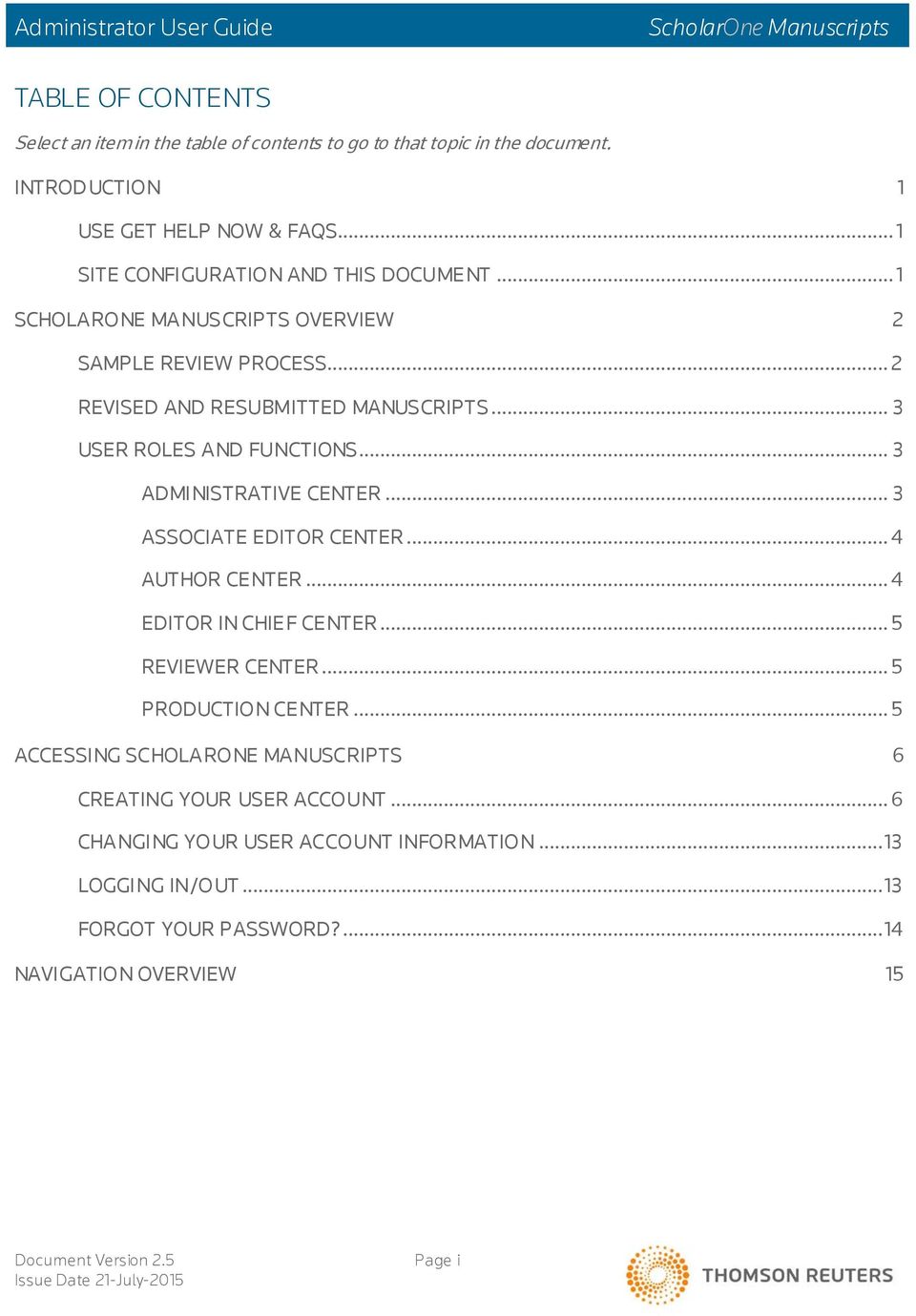
2 TABLE OF CONTENTS Select an item in the table of contents to go to that topic in the document. INTRODUCTION 1 USE GET HELP NOW & FAQS... 1 SITE CONFIGURATION AND THIS DOCUMENT... 1 SCHOLARONE MANUSCRIPTS OVERVIEW 2 SAMPLE REVIEW PROCESS... 2 REVISED AND RESUBMITTED MANUSCRIPTS... 3 USER ROLES AND FUNCTIONS... 3 ADMINISTRATIVE CENTER... 3 ASSOCIATE EDITOR CENTER... 4 AUTHOR CENTER... 4 EDITOR IN CHIEF CENTER... 5 REVIEWER CENTER... 5 PRODUCTION CENTER... 5 ACCESSING SCHOLARONE MANUSCRIPTS 6 CREATING YOUR USER ACCOUNT... 6 CHANGING YOUR USER ACCOUNT INFORMATION LOGGING IN/OUT FORGOT YOUR PASSWORD? NAVIGATION OVERVIEW 15 Document Version 2.5 Page i
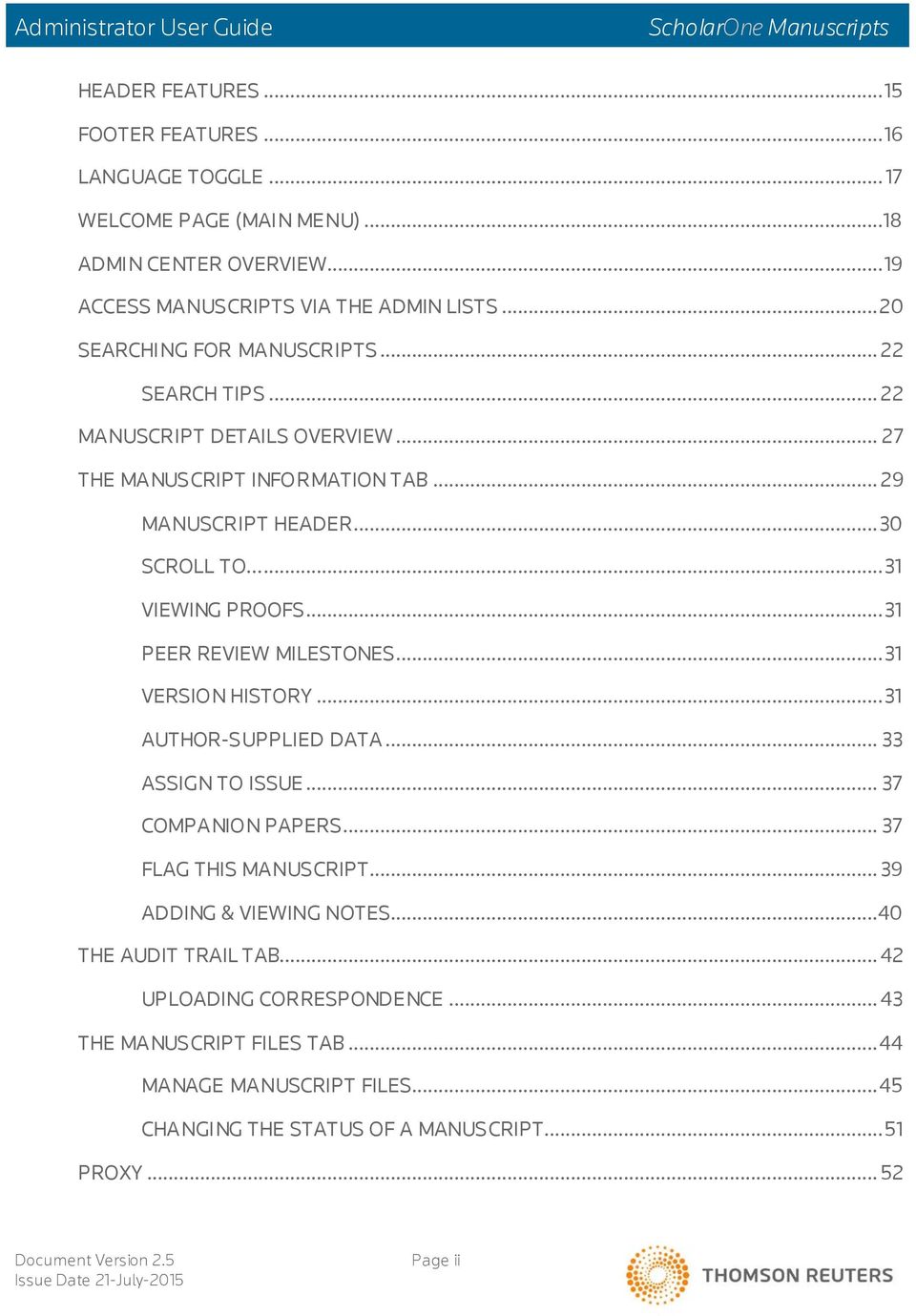
3 HEADER FEATURES FOOTER FEATURES LANGUAGE TOGGLE WELCOME PAGE (MAIN MENU)...18 ADMIN CENTER OVERVIEW ACCESS MANUSCRIPTS VIA THE ADMIN LISTS SEARCHING FOR MANUSCRIPTS SEARCH TIPS MANUSCRIPT DETAILS OVERVIEW THE MANUSCRIPT INFORMATION TAB MANUSCRIPT HEADER SCROLL TO VIEWING PROOFS PEER REVIEW MILESTONES VERSION HISTORY AUTHOR-SUPPLIED DATA ASSIGN TO ISSUE COMPANION PAPERS FLAG THIS MANUSCRIPT ADDING & VIEWING NOTES...40 THE AUDIT TRAIL TAB UPLOADING CORRESPONDENCE THE MANUSCRIPT FILES TAB MANAGE MANUSCRIPT FILES CHANGING THE STATUS OF A MANUSCRIPT PROXY Document Version 2.5 Page ii
4 JOURNAL ADMINISTRATOR CENTER PEER REVIEW TASKS 55 WORKFLOW STEP: AUTHOR SUBMITS MANUSCRIPT WORKFLOW STEP: ADMIN COMPLETES CHECKLIST ACCESS THE MANUSCRIPT VIEWING MANUSCRIPT PROOFS AND FILES COMPLETING THE ADMIN CHECKLIST WORKFLOW STEP: EDITOR-IN-CHIEF ASSIGNS TO ASSOCIATE EDITOR WORKFLOW STEP: ASSOCIATE EDITOR INVITES AND/OR ASSIGNS REVIEWER(S) REVIEWER LOCATOR WORKFLOW STEP: REVIEWERS SCORE EDITING A COMPLETED REVIEW OR RECOMMENDATION SETTING SEARCH PREFERENCES FOR REVIEWER SEARCH WORKFLOW STEP: ASSOCIATE EDITOR RECOMMENDS DECISION WORKFLOW STEP: EDITOR-IN-CHIEF MAKES DECISION WORKFLOW STEP: PRODUCTION CENTER INVITED PAPERS 70 CREATE AN INVITED PAPER (MANUSCRIPT STUB) SELECT AN AUTHOR INVITE THE AUTHOR ASSIGN THE AUTHOR AUTHOR SUBMITS THE INVITED PAPER THE COMPLETED SUBMISSION DELETING AN INVITED PAPER...80 TRANSFER OF MANUSCRIPTS BETWEEN JOURNALS 82 Document Version 2.5 Page iii

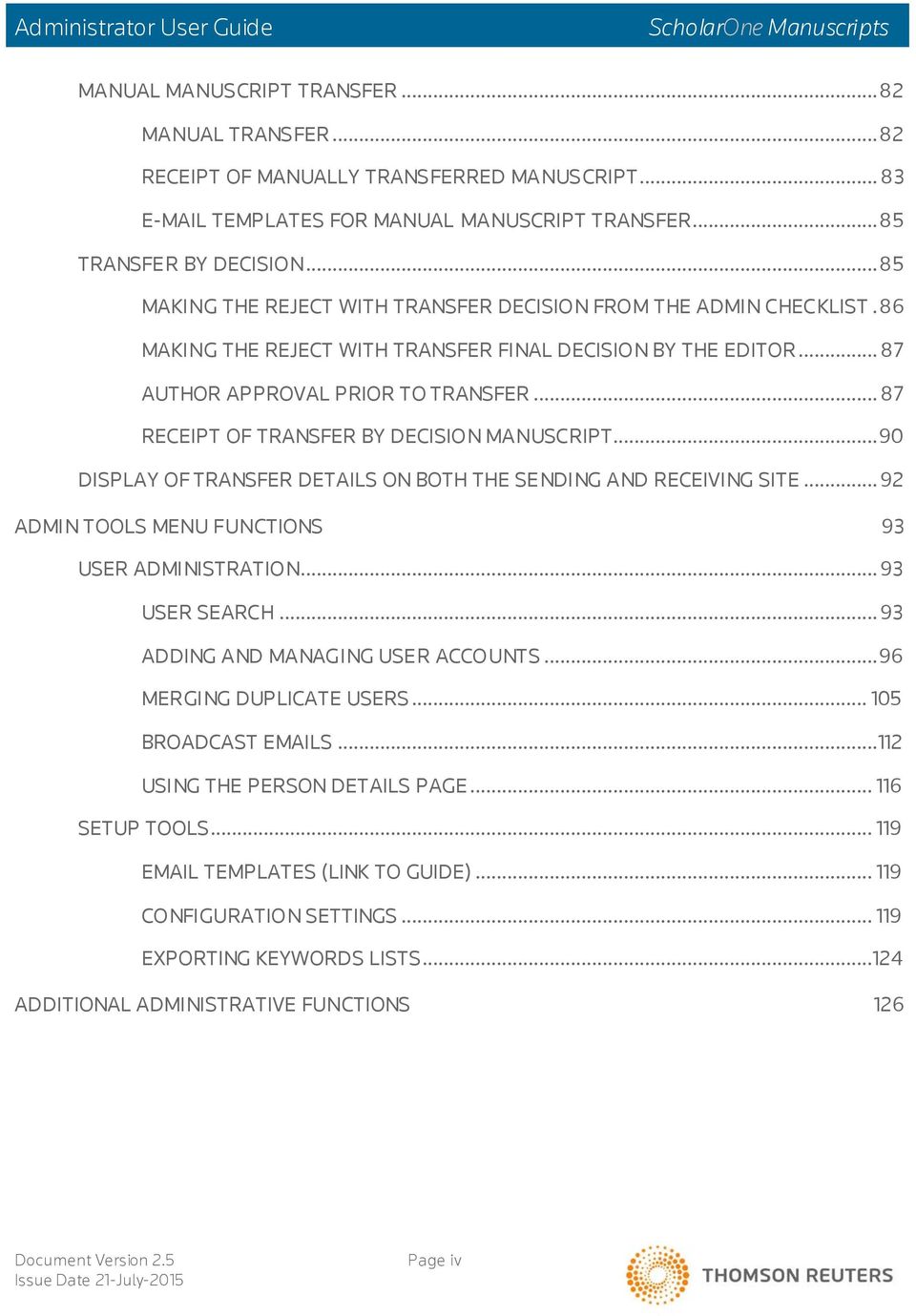
5 MANUAL MANUSCRIPT TRANSFER MANUAL TRANSFER RECEIPT OF MANUALLY TRANSFERRED MANUSCRIPT TEMPLATES FOR MANUAL MANUSCRIPT TRANSFER TRANSFER BY DECISION MAKING THE REJECT WITH TRANSFER DECISION FROM THE ADMIN CHECKLIST. 86 MAKING THE REJECT WITH TRANSFER FINAL DECISION BY THE EDITOR AUTHOR APPROVAL PRIOR TO TRANSFER RECEIPT OF TRANSFER BY DECISION MANUSCRIPT DISPLAY OF TRANSFER DETAILS ON BOTH THE SENDING AND RECEIVING SITE ADMIN TOOLS MENU FUNCTIONS 93 USER ADMINISTRATION USER SEARCH ADDING AND MANAGING USER ACCOUNTS MERGING DUPLICATE USERS BROADCAST S USING THE PERSON DETAILS PAGE SETUP TOOLS TEMPLATES (LINK TO GUIDE) CONFIGURATION SETTINGS EXPORTING KEYWORDS LISTS ADDITIONAL ADMINISTRATIVE FUNCTIONS 126 Document Version 2.5 Page iv
6 CONFIGURING CONTEXTUAL INSTRUCTIONS CONFIGURING JOURNAL SPECIFIC INSTRUCTIONS FOR USERS INSTRUCTIONS & FORMS FORMATTING TIPS ABOUT ATTRIBUTES (KEYWORDS) GRANTING EXTENSIONS TO AUTHORS PLAIGARISM CHECKING REPORTING AT-A-GLANCE STATISTICS COGNOS REPORTING PUBLISHER-LEVEL REPORTING APPENDIX ADDITIONAL REFERENCE GUIDES 139 Document Version 2.5 Page v

7 INTRODUCTION USE GET HELP NOW & FAQS As a Admin, one of your greatest help tools is ScholarOne s Frequently Asked Questions tab on our help site, Get Help Now. Our FAQs provide immediate answers to common user questions. In addition, Get Help Now offers downloadable guides (such as this one), video tutorials, and the ability to create a case to get assistance from our support group. We recommend that you bookmark our help site and consult it often. SITE CONFIGURATION AND THIS DOCUMENT is configured for your specific site based on the needs of the journal or publisher. The role names and fields used in this document may differ from your site. The essential functions will be the same; however, you may not have some of the configurable options available to you. Document Version 2.5 Page 1

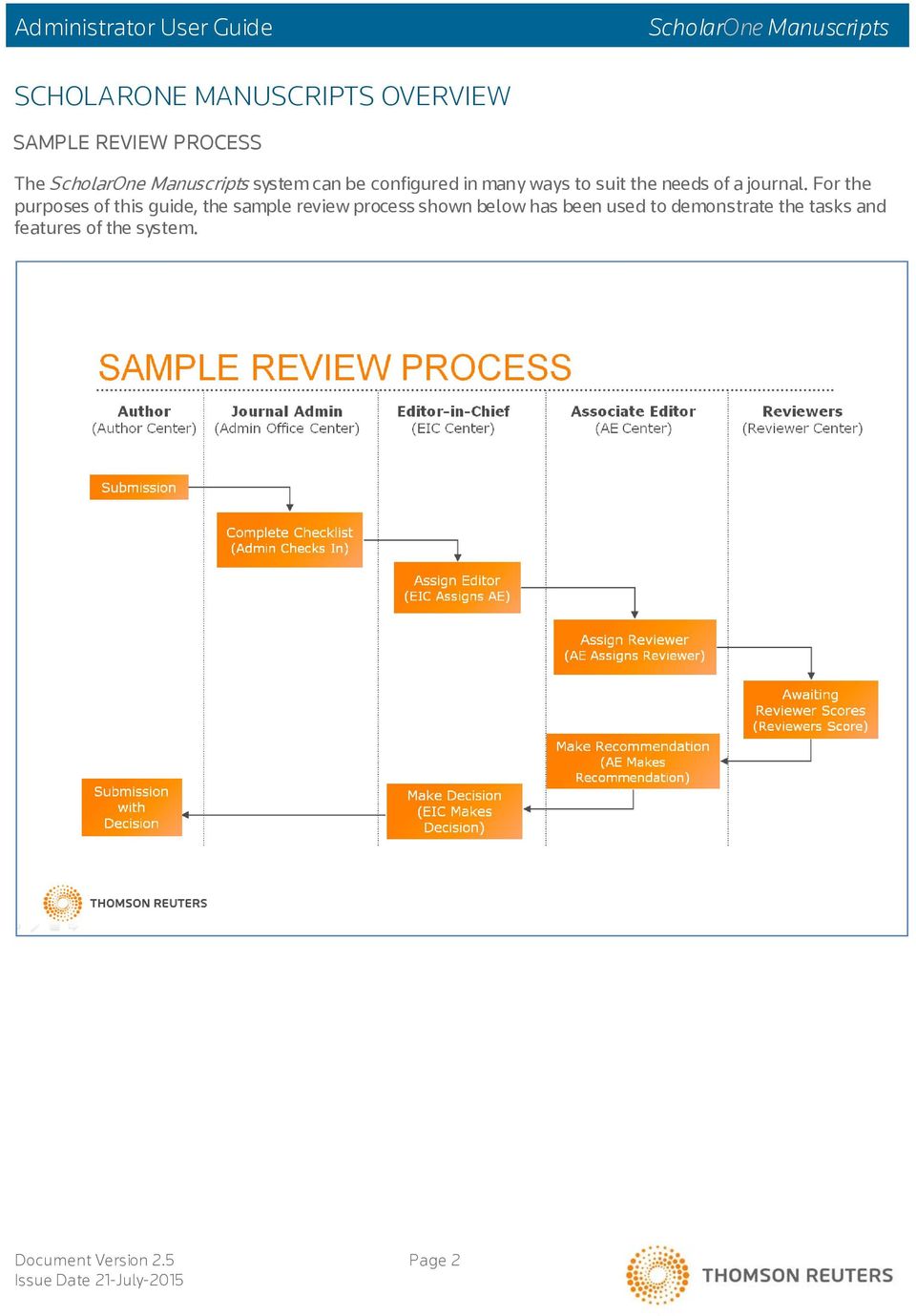
8 SCHOLARONE MANUSCRIPTS OVERVIEW SAMPLE REVIEW PROCESS The system can be configured in many ways to suit the needs of a journal. For the purposes of this guide, the sample review process shown below has been used to demonstrate the tasks and features of the system. Document Version 2.5 Page 2
9 REVISED AND RESUBMITTED MANUSCRIPTS A manuscript may go through several versions while in the peer review process. has workflow options for revised and resubmitted papers. Manuscript Version Original Revised Resubmission (if configured for your site) Definition The first time the author submits the manuscript Author is asked to make changes to the paper The Manuscript ID is appended with an.r1 The revised submission is linked with the original in the version history Author is sent a decision of Revise and Resubmit The paper will receive a new Manuscript ID when resubmitted The resubmission is linked with the original in the version history USER ROLES AND FUNCTIONS A site is organized around Centers, each one a logical destination for peer review participants. accommodates all possible user role types in the peer review process including Authors, Editors-in-Chief, Associate Editors, Reviewers, Administrative Staff and Boards of Editors. Note: Roles are configured specifically for your journal; role names may be different and you may have more or fewer roles than shown in the example here. Administrative Center The Administrative Center allows the journal s administrative staff to check-in submitted manuscripts and to monitor the full review process. This is also where you perform your administrative tasks such as setting up user accounts, and creating templates, etc. Key features of the Admin Center include: Peer Review Process Functions o o o o Quick links and summaries to all submitted manuscripts Proxy function with Logged in as user display Advanced search capability including the ability to save frequently used searches Ability to edit all author-submitted manuscript data Document Version 2.5 Page 3

10 Administrative Tools and Functions: o o o o o o o Audit trail of all letters and actions by manuscript Unique set of templates for each manuscript status workflow and task Generation of broadcast s Journal-specific instructional text on each page Selection and merge capability for duplicate user accounts Management of all files associated with a manuscript Generate and create reports on manuscript and user activity" Associate Editor Center The Associate Editor Center is used to invite and assign reviewers as well as make recommendations or final decisions. The Associate Editor center displays only manuscripts assigned to the specific AE. Key features of the Associate Editor Center include: Workflow configuration allows the tasks of reviewer selection, invitation, and assignment to be completed by a single Associate Editor, or to be divided among a combination of users Selection of reviewers by Quick Search, Advanced Search, Related Papers or Keyword Matching Ability to add reviewers on-the-fly to journal database with notification to potential reviewer and enforcement of journal-required fields for account creation Ability to grant reviewer deadline extensions Sending final commits decision (workflow dependent) Ability to make recommendations to EIC (workflow dependent) Author Center The Author Center is used for submitting manuscripts and tracking manuscript status. The Author center displays only manuscripts submitted by the specific author. Key features of the Author Center include: Quick links and summaries for all manuscripts submitted Display of recent manuscript-related correspondence Prompts for creating revision and resubmission manuscripts Check status and progress of submitted manuscripts Check for existing co-authored manuscripts Document Version 2.5 Page 4
11 Easy manuscript upload with multiple files allowed and upload progress indicators Validation of complete submission process Editor in Chief Center The Editor-in-Chief Center is used for receiving and reviewing manuscripts, assigning Editors, and making decisions. Key features of the Editor-in-Chief Center include: At-a-Glance statistics display for journal site Select Associate Editor by dropdown selection list or search field Tabs for viewing manuscript information, audit trail, and file management Immediate decision capability Make final decisions based on AE and/or reviewer recommendations (workflow dependent) Reviewer Center Reviewers access manuscripts for review through their Reviewer Center. Key features of the Reviewer Center include: Newly added reviewers are required to complete and update their User Profile before proceeding Pan and zoom capabilities on HTML- embedded figures and images Links to specified database targets like PubMed for automated referencing Manuscript status and final decision can be displayed on completed reviews Production Center also provides you with the capability to include a Production Center for accepted manuscripts. As specified by the journal, Production Editors are allowed to: Send the Author a web-ready PDF of the manuscript for final approval (First Look ), if configured Track and approve electronic copyright and disclosure forms, if configured Review accepted manuscripts for adherence to a production checklist Create manual or automated batches for export Assign accepted manuscripts to a batch for exporting Create and manage journal volumes and issues Document Version 2.5 Page 5
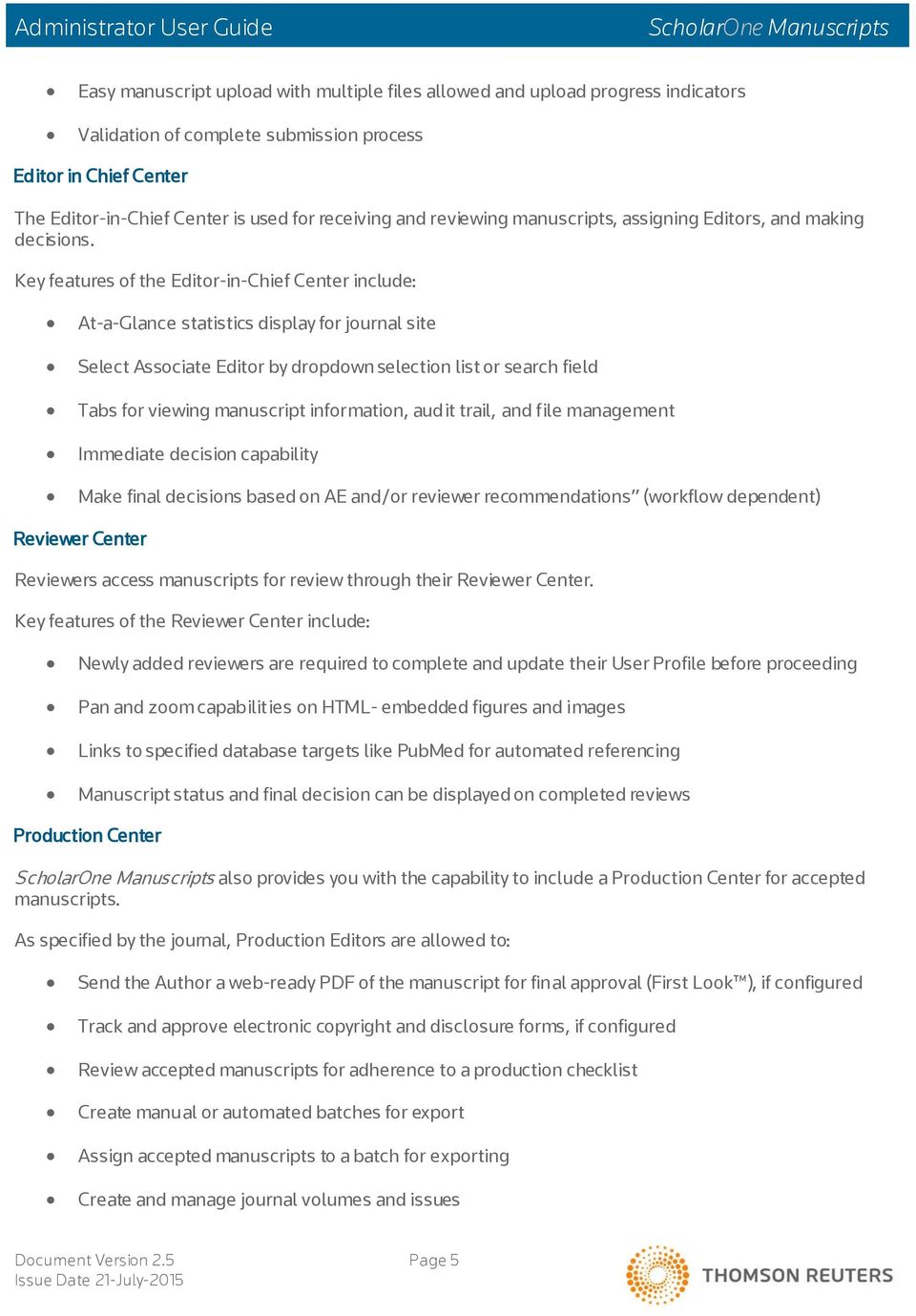
12 ACCESSING SCHOLARONE MANUSCRIPTS CREATING YOUR USER ACCOUNT As an admin, you will need to create your user account and then ScholarOne Implementation or Support teams will need to add the administrative role to your account. Alternately, the journal may create you account in advance and you will edit your account to complete the details. Each journal s site has a unique web address that is sent to you by . To access the site, click the link within the or enter the web address (URL) in the address field of your browser. If the journal has not already created an account for you, you can create your user account. To begin, click the Create An Account link on the journal s Log In screen. Create your Account 1. / Name Screen During account creation, new users will be given the option to associate an ORCID id with their account by either registering for a new ORCID id or associating and existing ORCID id. Each of these options will be presented to the user as links in the first step of the account creation process. In prior versions, new users entered their ORCID as text in the third step of account creation and it was not validated by ORCID. Document Version 2.5 Page 6
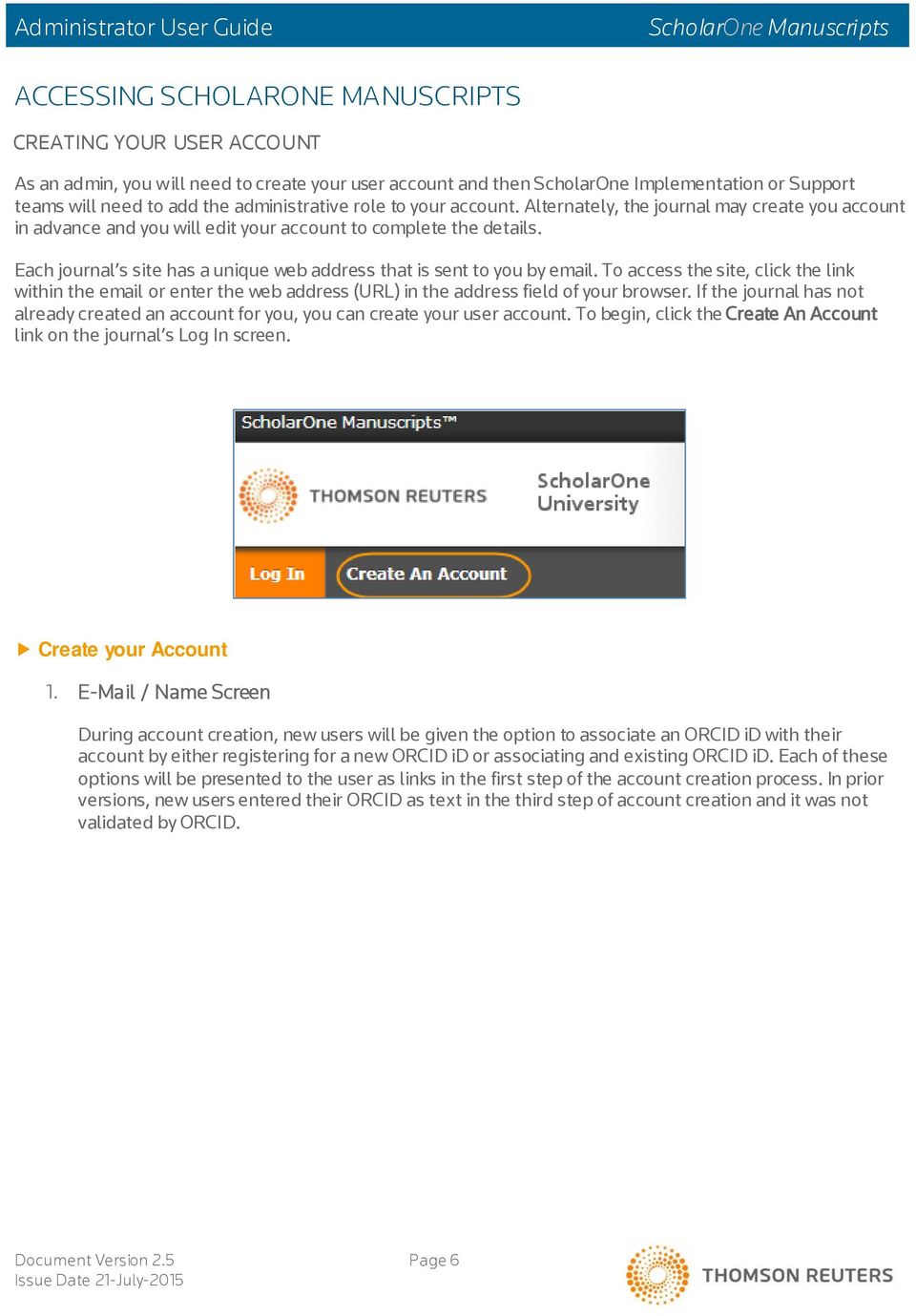
13 When the user selects one of the options to associate an ORCID id with their account, a new browser window will open a registration page on the ORCID website. Document Version 2.5 Page 7
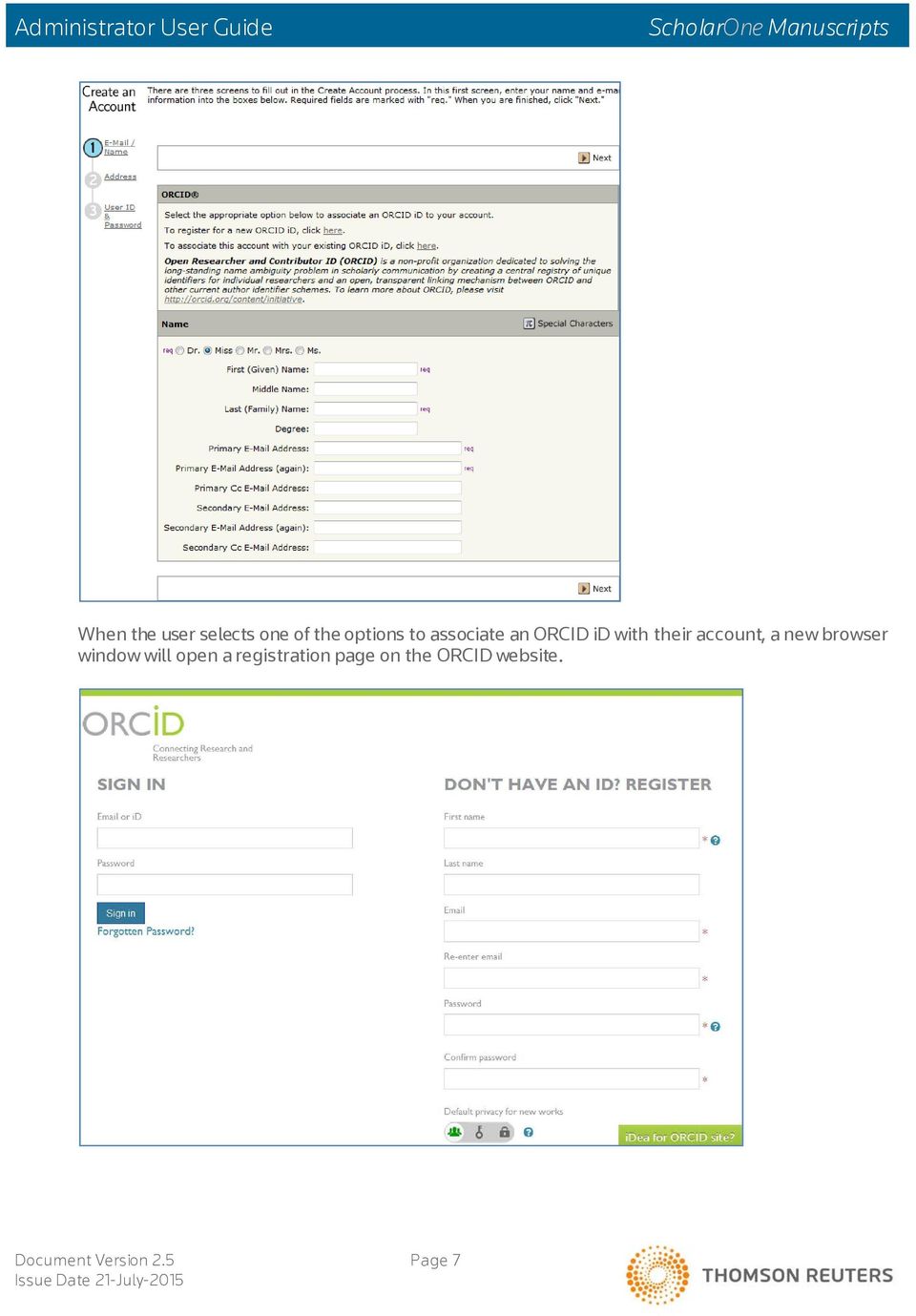
14 The user must sign in using their existing ORCID credentials or register for a new ORICID id. Once the user has validated an ORCID id using one of the options, they will be asked to either authorize or deny the journal s site access to their limited data. If the user clicks Authorize, they will be redirected back to their journal s site with a validated ORCID id. As part of the redirect process they will have an opportunity to update their account registration form with data from their ORCID profile. Click OK to update the journal s site. Click Cancel to return to ScholarOne Manuscripts without updating the data. Document Version 2.5 Page 8

15 Note: Required information is denoted by the required symbol (req) beside the field. Enter your name and information. As needed, click the Special Characters icon to insert characters in your first, middle, or last name. Click the Next button. Document Version 2.5 Page 9

16 2. Address Screen Enter your address information. Optionally, you can enter secondary address information. Click the Next button. Document Version 2.5 Page 10

17 3. User ID & Password Screen The User ID field defaults to the address you entered in Step 1. You can change your User ID here if you wish. For example, you can use make your User Id a single word for ease of login. We do not recommend entering a different address than that used in Step 1 in the User ID field. Enter your password in the Password field then again in the Confirm Password field. For security reasons, you may not copy and paste. Note: Please retain your password. Our best practice is to avoid sending passwords via . Complete additional fields as appropriate: o Keywords: Many journals require keywords be associated with their users. This allows journals to keep track of specialty areas for each user. Add keywords to your account by selecting a word from the left column and clicking the Add button. The keyword is added to the column on the right. If your journal does not have pre-defined keywords, you may be able to type in keywords. Document Version 2.5 Page 11

18 o Unavailable Dates: Enter calendar dates that you are unavailable as needed. The journal may also display a field to enter reason for unavailability. o Signature: If you enter a personalized signature here the journal may choose to use the text in correspondence. o File Attachments: gives you the option of attaching files to your user account. The journal may have specific requests or you may include documents you deem relevant such as a Curriculum Vitae. This feature may not be configured on your site. Note: This is NOT the area you use to attach a manuscript. After completing all applicable fields, click the Finish button. 4. When your account setup is complete, you will see the following message. 5. When you log in you will have only the Author and Reviewer roles (or the default roles for your journal). Contact ScholarOne Implementation to have your administrative rights activated. Document Version 2.5 Page 12

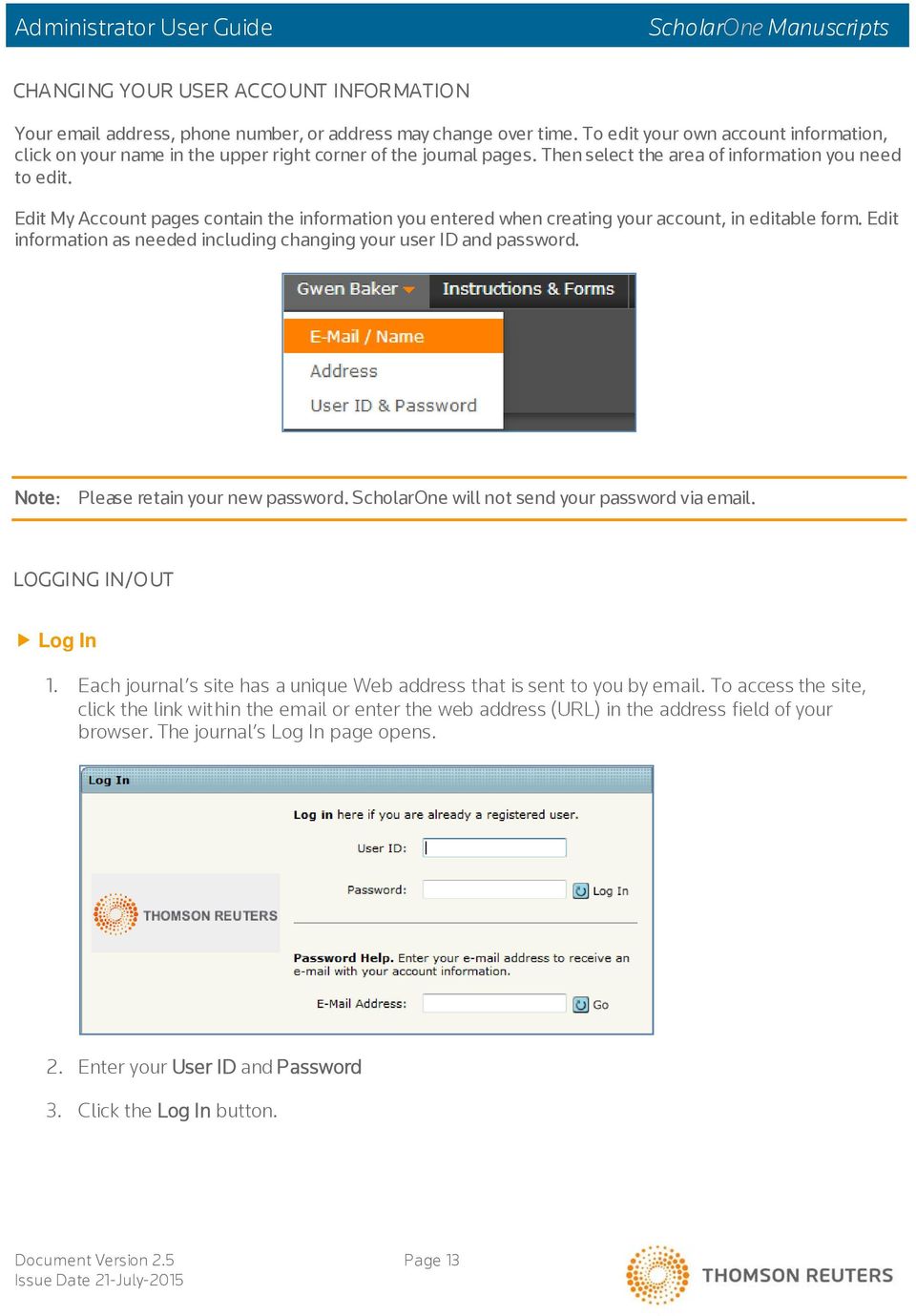
19 CHANGING YOUR USER ACCOUNT INFORMATION Your address, phone number, or address may change over time. To edit your own account information, click on your name in the upper right corner of the journal pages. Then select the area of information you need to edit. Edit My Account pages contain the information you entered when creating your account, in editable form. Edit information as needed including changing your user ID and password. Note: Please retain your new password. ScholarOne will not send your password via . LOGGING IN/OUT Log In 1. Each journal s site has a unique Web address that is sent to you by . To access the site, click the link within the or enter the web address (URL) in the address field of your browser. The journal s Log In page opens. 2. Enter your User ID and Password 3. Click the Log In button. Document Version 2.5 Page 13
20 Log Out 1. You can log out at any time by clicking Log Out at the top right corner of the page you are on. 2. You will be returned to the Log In page. Note: After 3 hours of inactivity you will be automatically logged out and returned to the Log In page. FORGOT YOUR PASSWORD? For security reasons, we will not send you your current password. Instead, by entering your primary address in the Password Help field, you will receive an that provides instructions on how to log in and reset your password. Document Version 2.5 Page 14

21 NAVIGATION OVERVIEW Please Note: The header and footer shown here are new with the Version 4.15 releasee and show throughout the system. However, the some pictures in this user guide may show the old header. The screens were only updated if functions changed. HEADER FEATURES The header displays at the top of every page regardless of where you are currently located. Details will vary slightly depending on your role, but in general, the features of the header are as follows: Journal Logo: The logo of your journal as configured during implementation of your site Navigation (The Breadcrumb Trail): The menu path you have followed to arrive at the current page. You can click a link to navigate back to a previous page. Quick Links: Links that allow you to perform the following functions: Your user name click to edit your account Instructions & Forms Page journal-specific instructions for users and any journal-specific forms required for the peer review process; Admins see the screens for editing the page Help links you to various help functions Log Out Simple Search: This feature displays in the header for the Admin, Associate Editor, EIC, and Production Editor Dashboards. You may perform a wildcard search by placing an asterisk (*) at the beginning and/or end of your search text. Document Version 2.5 Page 15
22 Note: Users with Admin privileges can also use this function to search for a person s account by address and first and last name. FOOTER FEATURES In addition to Copyright and Trade mark Information, the footer contains: Link to ScholarOneNews Link to System Requirements Link to Privacy Statement Link to Terms of Use Link to ScholarOne Ideas where you may submit, discuss, and vote on potential enhancements to (visible to Admins and Editors only) Document Version 2.5 Page 16
23 LANGUAGE TOGGLE Language toggle allows you to switch the display from the default language of English to another language. If configured for your site, you will find the language toggle located on the header at the top of the screen. Current languages available are French, Chinese and Japanese. Note: All uploaded documents and end-user supplied text will not toggle and will be displayed in the language entered by the user. Document Version 2.5 Page 17
24 WELCOME PAGE (MAIN MENU) When you log into the site the Welcome page displays. This page provides links to all centers you have access to, as well as supporting actions and information. The look of the Main Menu is customizable by each journal, so you may also see images, links, and text with journal-specific information. Centers Centers for each role you have access to display here. Each center contains the functions specific to that role. Resources This section contains links to helpful resources. Instructions & Forms: Journal-specific links and documents for download User Tutorials: Access to author and reviewer user guides, PDF quick guides, and links to the Education and Support portal System Requirements: Information on operating system/browser requirements and links to required software downloads Home Page: Direct link to the journal/publisher website. Switch to a different publication: In addition, journals configured to share a database ( portal sites ) can jump to another journal by choosing from a dropdown menu that will be displayed here. Document Version 2.5 Page 18
25 ADMIN CENTER OVERVIEW The Admin role is considered the Super User of the system. The Admin Dashboard allows you to manage submitted manuscripts and monitor them through the full review process. This is also where you perform administrative tasks such as setting up user accounts, creating reports, and editing templates. Document Version 2.5 Page 19
26 Admin Lists: Admin Lists displays the number of manuscripts in any given status. The Admin Lists section of your dashboard is key to navigating to manuscripts in the peer review process. Clicking the number opens the first manuscript in that status. Clicking the status name link opens a list of manuscripts in the status. Admin Tools: This section and its functionality appear only on the Admin dashboard. Manage the journal s configuration and functionality through this section. Reports: The Admin has a robust reporting section available to them for creating standard and custom reports. Quick and Advanced Manuscript Searches: Except for Author and Reviewer roles, each center s dashboard contains a manuscript search section. You can search using the quick or advanced search functions to find single or multiple manuscripts. See below for examples of how to use these search functions. ACCESS MANUSCRIPTS VIA THE ADMIN LISTS To view manuscript information, you may also select any active hyperlink in the Admin Lists section of your dashboard. Access Manuscripts via the Admin Lists 1. From the Admin dashboard, select any active link in the Admin Lists. 2. The View Manuscripts page displays a table containing any manuscripts in the selected status category. For example, if you selected the link for Admin Complete Checklist task, the table will display the Admin Complete Checklist header and all manuscripts listed are in a status where the next step is to complete the Admin Checklist. Document Version 2.5 Page 20
27 3. Each manuscript listing displays the following: Manuscript ID: A system-generated ID unique to the manuscript Manuscript Type: Category of manuscript Manuscript Title: The title of the manuscript and a link to view the submission Submitting Author: Name of the submitting author, a button to view author details, and a hyperlink to send the author an Date Submitted: Date of submission (or revision if viewing a revision) Status: Status of the submission in the peer review process and the editorial staff assignments Take Action: drop-down list or button indicating the next action to be taken on the submission 4. You can sort the list by clicking on a (linked) column header. 5. Select an action from the Take Action drop-down list to access the Manuscript Details. Document Version 2.5 Page 21
28 Note: For speed, the Admin and Production Editor views allow selection of an action (including View Details), from the dropdown list. SEARCHING FOR MANUSCRIPTS Except for Author and Reviewer roles, each center's dashboard contains multiple ways to search manuscript information. You can search using the simple, quick or advanced search functions. Searches are dependent on your role: Administrators can search on all search fields listed in any of the search methods, including both user and manuscript information. Editors can search on manuscript data but may not search on user data. Search Tips The asterisk (*) allows for wild card searches in many places in. These are helpful for locating manuscripts, authors, and reviewers. E.g., if you enter John* in a Last Name field, you will find people with the name John, Johnson, and Johnston. Use at least four (4) characters or numbers in the search string and the results will be returned more quickly. Press the Enter key to start your search. This saves time by avoiding scrolling down the screen to find the Search button. Document Version 2.5 Page 22
29 Use the Simple Search 1. The Simple Search is located on the right side of the screen. 2. Enter the search criteria in the search field. If needed, use the asterisk (*) as a wild card. 3. Select the type of search from the drop-down list. 4. Click the Search button. 5. The Search Results screen displays any manuscripts meeting the search criteria. 6. Select an action from the Take Action drop-down list to access the Manuscript Details. Document Version 2.5 Page 23
30 Use the Quick Search 1. The Quick Search appears on the role dashboard. It allows you to find a manuscript by number, title, author, or keyword. 2. Enter search criteria in any of the fields. If needed, use the asterisk (*) as a wild card. (Note that there is a Saved Search option. You will see in the Used the Advanced Search section how to save a search.) 3. Click the Search button. 4. The search results appear showing all manuscripts that met your search criteria. 5. Select an action from the Take Action drop-down list to access the Manuscript Details. Document Version 2.5 Page 24
31 Use the Advanced Search 1. The Advanced Search can be accessed by clicking the Advanced Search link in the Quick Search pane of your dashboard. The advanced search allows you to find groups of manuscripts by workflow or status or assigned person and other criteria. 2. You are presented with a variety of search fields, filter options, and date options. You can select any combination of criteria for your search. For example, you can find all manuscripts accepted last month. 3. If you want to save your search criteria for future use, select the Save this Search, called: checkbox and name your search before clicking the Search button. (The saved search can be accessed from the Quick Search.) 4. Click the Search button. 5. The search results display allowing you access to the manuscript. 6. Select an action from the Take Action drop-down list to access the Manuscript Details. Document Version 2.5 Page 25
32 Document Version 2.5 Page 26
33 MANUSCRIPT DETAILS OVERVIEW Your role's view of manuscript details contains any information and action tabs you will need in order to move a manuscript to the next stage in the peer review process. Access this page by clicking in the Take Action button of the View Manuscripts page, or, in Admin or Production Editor view, select View Details from the drop-down list. Manuscript Header: The Manuscript Header displays a summary of information about the manuscript including the unique manuscript ID number, title, author, and other basic information about the manuscript. This header remains at the top of page throughout the workflow. Manuscript Files: Click on any of the links to access the manuscript files. There are PDF and HTML versions of the manuscript files, and other supporting files for the manuscript (if applicable to the specific manuscript.) Because these files are in the header, they will display on all Manuscripts screens. External Searches: makes it easy for editors and reviewers to find a variety of information online. Clicking the External Searches button displays the following popup box: Document Version 2.5 Page 27
34 Select checkboxes in the Search On section. You can enter your own criteria in the Other field. Then choose from the Search Across search engine links. Action Tabs: A tab displays at the top right of the screen for the next action to be taken. The action displayed is dependent upon the status of the manuscript in the workflow and the user s role in the workflow. General Information Tabs: Each of these three tabs contains detailed information and functions for the Admin. They are summarized here, and specific instructions can be found in later sections of this document. Manuscript Information: This tab is displayed by default when you access Manuscript Details. It contains information such as the manuscript summary, peer review milestones, version history, author-supplied data, and companion paper information. Audit Trail: A description of time and date-stamped events and changes. The most recent action is displayed first in the list. If more than 10 events associated with the manuscript have taken place, access them from the Events dropdown. To view only the correspondence, click the letters only link. Clicking the envelope icon allows you to view and forward the . Manuscript Files: Within this tab, you (typically the Administrator) have the ability to manage manuscript files, perform exports, and unsubmit or withdraw the manuscript. Content Area: The main body of the screen displays the content of the General Information tab (Manuscript Information, Audit Trail, or Manuscript Files) selected on the left of the screen. In the example above, the contents of the Manuscript Information tab are displayed. Document Version 2.5 Page 28
35 THE MANUSCRIPT INFORMATION TAB The Manuscript Information tab displays by default when you access the Manuscript Details page. It can be accessed through the tab at the left side of the Manuscript Details page as well. Your journal's Manuscript Information tab contains some/all of the following sections: Manuscript header Peer review milestones Version history Author-supplied data Companion paper information Information related to all previous actions performed on the manuscript (if configured) Flag Manuscripts Notes (Notes display at the bottom of all General Information tabs) Document Version 2.5 Page 29
36 Manuscript Header Manuscript Details contain a summary section at the top. This header remains at the top of pages throughout the peer review process. The header may list the following: Manuscript ID may include a revision number, Invited, or Resubmission Notes link if applicable, appears to the left of the manuscript ID. Title Companion Paper link if applicable, appears to the left of the manuscript ID. Author (and any co-authors) author's name is hyperlinked for correspondence Status appears green if OK, red for overdue Dates submitted, last updated, total time in review Names and roles of people assigned to the manuscript. Names are hyperlinked for correspondence. If you have administrative permissions, you also see proxy links. Author Due Date for Revised Paper Proofs and files links to the HTML and PDF proofs of the submission as well as other associate files and the Author s response (on revisions and resubmissions only) Document Version 2.5 Page 30
37 Scroll To To jump directly to a section of the Manuscript Details page, select from the Scroll To dropdown list. Viewing Proofs View proofs by clicking the links in the header. See the Viewing Manuscript Proofs and Files section of this document for more details. Peer Review Milestones This section provides a quick look at a manuscript's current progress through the peer review process, by role and date. You may also a person by clicking the named link. Those viewing this section using admin permissions can perform actions as another person by clicking the proxy link. Version History You have access to all versions of a manuscript. Revisions are indicated by a revision number appended to the Manuscript ID. (E.g., R1 or R2.) Document Version 2.5 Page 31
38 Click the links in the Decision Letter & Response column to view decision-related correspondence regarding a previous version. Click on the Switch Details button to view the Manuscript Details page for a previous version. Additional Version Information To help you keep track of which version you are currently viewing, a colored bar displays along the left of the page indicating a revision. Original submission: no colored bar Revision: purple bar Resubmitted Manuscript: blue bar Invited Manuscript: yellow bar Document Version 2.5 Page 32
39 Revised and resubmitted files will also include a link to the Author s response on the header. Author-Supplied Data This section lists all the information entered by the author during the manuscript submission process (excluding uploaded files). The Admin may review to ensure the author-supplied data is correct and edit if necessary. Document Version 2.5 Page 33
40 Components of the Author-Supplied Data section may include the following: Manuscript type Title Manuscript ID Funding Institution Name of funding institution and grant number using the FundRef taxonomy Submitting author: Name of the submitting author, a button to view author details, and a hyperlink to send the author an Authors and institutions: Name(s) of the submitting and additional authors, a button to view author details, and a hyperlink to send the author an , and a link to their ORCID id if configured Contact author: The Contact Author defaults to Submitting Author or the Corresponding Author (if your site is configured to have Corresponding Author). Depending on role permissions, this field can be edited Running head Any keyword attributes entered by the author The Author s preferred and non-preferred reviewers and editors Cover letter text Custom questions: Click Show to view any custom questions asked by the journal during the manuscript submission process Those viewing this section using Admin permissions can perform additional functions: Change the Submitting Author. If there are multiple authors on the manuscript, you may select a different author from the Submitting Author drop down list. Changing the submitting author will change the author who has the access to make the revision, if needed, on a paper. Change the Contact Author. If there are multiple authors on the manuscript, you may select a different author from the Contact Author drop down list. Updating the contact author changes what author receives the correspondence from the journal. Editing Author-Supplied Data 1. Locate the Author-Supplied Data section. Document Version 2.5 Page 34
41 Tip: By default, the Author who submits the paper is listed as both the contact and submitting author unless they contact the Admin to make a change. 2. Click the Edit This Information button. Document Version 2.5 Page 35
42 3. The submission opens to the Review & Submit page of the submission. A message appears indicating that you are editing Author-Supplied data. 4. Edit the author's data. Any of the data may be updated by the Admin by clicking the Edit link located next to each section. 5. Click Save and Return when finished editing Author-Supplied Data. You will return to the submission in the Admin center. Document Version 2.5 Page 36
43 Assign to Issue If you are using the Issue Management tool in the Production Center, you can pre-assign a manuscript to an issue. (For more information on the Issue Management tool, see the Production Center Guide.) To assign to an issue, simply select the issue from the list then click the Assign button. To unassign from an issue, you do the same thing; select the issue in the list and click the Assign button. It will be unassigned. Companion Papers You can link the current manuscript with another manuscript for many reasons. An Admin may want to keep track of which papers are going to be in the same special issue. An Editor may want to compare an older paper with similar subject matter to a paper they have currently been assigned. Assigning Companion Papers 1. Click the Search for a Companion Paper button. 2. The Manuscript Search screen displays. Enter search criteria then click the Search button. Document Version 2.5 Page 37
44 3. When you locate the desired manuscript, click Use This Paper (+) button. Document Version 2.5 Page 38
45 4. The companion paper information will now be viewable in the Companion Papers section with links to View the Submission and View Details. 5. A handshake icon will also appear on the Manuscript Header and is a direct link to the companion papers section. 6. If you no longer need the papers linked together, you can delete the paper from the list. Note: Designating a companion paper is reciprocal - both papers will be linked to each other. Flag this Manuscript provides 10 color flags that can be used to mean special information regarding a manuscript. For example, a blue dot may mean the paper was submitted by a non-society member. You can use multiple flags by selecting more than one from the checklist. The colored flags appear after the Manuscript ID number. You can also create custom reports based on the colored flags. Document Version 2.5 Page 39
46 Note: You can have the flag labels configured with specific names meaningful to your site by the Client Solutions team. Be advised that a later change to these flag labels would change the label in all papers, including historical papers. Adding & Viewing Notes Notes are only viewable to the Admin and Editor roles. Authors and Reviewers will not see the notes section. Notes appear at the bottom of each tab. They can be configured to have the ability to attach files to this section, as well as the ability to carry over from the original submission to the revised submission. Adding a Note 1. Click the Add a Note icon in the manuscript header. 2. The Add a Note screen displays. Document Version 2.5 Page 40
47 3. Enter the Title and Note text. 4. Click the Save button. 5. Notes appear at the bottom of the Manuscript Details screen. You may add, edit, or delete notes from this section. TIP: Notes can be configured to have the ability to carry over to revisions and to attach files. Document Version 2.5 Page 41
48 THE AUDIT TRAIL TAB The Audit Trail page contains a chronological listing of events, communications, and changes to a manuscript's history in the system. The audit trail page lists the time/date, event description, and status of the actions, letters, and changes that occur. This page also displays the manuscript details Notes section. Note: The Audit Trail tab displays for the Admin role and may also be configured for the EIC or AE. The following events are tracked in the Audit Trail. Actions: If the event in the list was an action, the list displays the date of the action, the name of the action, who performed the action and their role, the date and time that the action was performed, and the status of the manuscript at the time the action was performed. Changes: If the event that occurred was a change, the list displays the date of the change, what general aspect of the manuscript was changed (manuscript metadata, custom questions, checklist), what specific aspect of the manuscript was changed (plus a link to view the previous value), the person and role who changed the aspect, the date and time the change was performed, and the status of the manuscript at the time the change was made. s: If the event that occurred was the sending of a letter (any , including decision s, automatic reminder s, invitation s, etc.), the list displays the date the letter was sent, the name of the letter, who sent the letter, and the date and time the letter was sent. Document Version 2.5 Page 42
49 Tip: Clicking the Envelope icon opens a popup box with the text of the that was sent. You have the option to re-send, forward, and edit from the popup box. Revisions and Resubmissions: If a revision or resubmission is created, it is indicated in the last audit trail entry. If the screen shows the details for a revised/resubmitted manuscript, the first entry in the audit trail indicates that a revision/resubmission was created and displays the original Manuscript ID. File Manage ment Activity: The audit trail also displays file manage ment activity. If a manuscript file is deleted, uploaded, or re-categorized (from the Manuscript Files tab), the activity is recorded and displayed in the audit trail. Tip: You can view only correspondence by clicking the Letters Only link in the Audit Trail pane title bar. Uploading Correspondence The audit trail allows users to enter correspondence sent or received outside of the system. This allows you to include that correspondence as part of the manuscript record. A section at the bottom of the audit trail allows you to save the information about the correspondence. Upload Correspondence 1. Complete the fields with information regarding the correspondence. Be sure to include both the date and time You may upload a file attachment with the correspondence or paste the text into the body field 2. Click the Save button. This correspondence is saved in the appropriate location within the audit trail. It includes Last Updated information and a link to edit the entry. Document Version 2.5 Page 43
50 THE MANUSCRIPT FILES TAB Based on role permissions (typically Admin), your journal's Manuscript Files tab allows you to perform the following: Manage manuscript files Upload files Export files Change the manuscript's status Note: You may access the Manuscript Files tab as shown above, or select it directly from the Take Action drop-down list on the View Manuscripts screen. Document Version 2.5 Page 44
51 Manage Manuscript Files The Manage Manuscript Files section displays all files associated with a submission. It may include Manuscript, Review, Recommendation, and Decision files as well as file sent in offline. In addition to the displayed files, you may also upload files from this section. For each file, the following elements are displayed. Order: Change the display order of the files by selecting from the drop-down list File Name: Select the hyperlink to download the file File Designation: The type of file, e.g., Main Document Uploaded By: The name of the person who uploaded the file Upload Date: The date the file was uploaded HTML/PDF Proof: The checkbox will be checked if the file was included in the proof for review. You may deselect the checkbox if you wish to remove the file from the proof Ready for Batch/Page Count: This will usually be checked automatically and indicates that the file will be included in the export for production. You may deselect the checkbox if you wish to exclude the file from export Edit Details: Click the Edit Details button to edit the details including changing the file designation, uploading a later version Delete: We recommend you do not delete any files as you will lose historical data in the system. If you choose to delete a file, click the Delete button. Edit Details Click the Edit Details button to change the file designation, upload a later version of the file, and, in the case of images, edit the proof caption and/or file tags. The File Details page opens. Document Version 2.5 Page 45
52 Here you can perform a variety of actions on the file, including: Change the file designation: Select from the drop-down list; see the About File Designations section of this document for additional information Upload a new version of an existing file: Click Browse to locate the updated file and click Upload. You can choose to designate the uploaded file as a minor or major version. We also recommend that you type notes in the Comments field. Edit the Caption / Legend of a figure file Document Version 2.5 Page 46
53 View Version History: When you upload a new version of a file, previous versions are stored in Version History. To avoid confusion, these versions are only viewable from File Details. When finished making changes on the Edit Details page, please click the Save button to save and close the window. Uploading Files As needed, you can upload new or additional files for this manuscript. When you upload files, the system automatically re-concatenates the manuscript PDF Proof. Note: If you are uploading files for authors or reviewers while the manuscript is in their centers, then you should not use this. Instead, proxy as the author or reviewer and upload from the Author or Reviewer Centers. Document Version 2.5 Page 47
54 Upload Files 1. Select the Browse button in the Manage Manuscript files section. Browse to the file you wish to upload. 2. Select a File Designation from the drop-down list. 3. You may upload 3 files at a time. 4. Click the Upload button. 5. When the upload is complete, the File Details page displays. Review the information, enter a comment if needed, and click the Save button. Document Version 2.5 Page 48
55 About File Designations When uploading files, you must pick an appropriate file designation for each. Here is a brief description of file types that may be available. Your journal may have different items or different names. Main Document: The main content of a manuscript Figure: An image file that depicts a graph or chart Image: An image file that shows a drawing or photograph Supplementary Files Not for Review: Files intended for reference or background information, but not suitable for peer review Supplementary Review Files: Files that provide valuable background or reference information for peer review Table: An image or other format document that contains a table Table Data: The data used to create a table TeX/LaTeX Suppl File: Any file that is part of a TeX/LaTeX document Additional Tex/LaTex Upload Information When uploading a TeX/LaTeX main document, the system analyzes the file to determine what additional resource files (such as image files and bibliographic files) are necessary to complete the document. The system will not allow submission until the author has completed the full TeX/LaTeX document upload, including all necessary resource files. The system will also not allow submission of the manuscript if a file is designated as a TeX/LaTeX Suppl File but is not referenced by any TeX/LaTeX files uploaded to the system. When you view the HTML proof of a manuscript, a link to the TeX/LaTeX document opens the PDF proof. This is necessary to ensure all formulas, and other special formatting, are rendered correctly. Files uploaded as TeX/LaTeX Suppl Files will not be viewable as individual files in the HTML proof and will not be rendered independently of the entire TeX/LaTeX document. Therefore, images and other content will show up in the PDF proof at the location specified in the TeX/LaTeX document. In addition, captions for images displayed within a TeX/LaTeX proof must be created in the TeX/LaTeX document, since image proofs cannot be created separately. Exporting files You may export a manuscript directly from the Manuscript Files tab. All files with "Ready for Batch / Page Count" checkbox selected will export. Document Version 2.5 Page 49
56 Export Files 1. Click the Export button. 2. The Export window displays. 3. Choose one of the following two options: Select a pre-defined export target, or Define a new export target and format o o o o o Enter the Export Name, optional Select a radio button for the types of files you want to export Specify the Location Select a Format Select when it will be available Document Version 2.5 Page 50
57 4. Click the Export button. 5. The Export History section lists all exports that have been performed for this manuscript. Note: See Batch Configuration in the Production Center Guide for detailed information. Changing the Status of a Manuscript If the author has made an error in their manuscript submission and wishes to edit it, or if the journal would like to withdraw the submission from peer review, the Admin may either unsubmit or withdraw the manuscript by clicking the appropriate link. Perform these actions from within the manuscript's Manuscript Files tab. Unsubmitting a Manuscript You should only unsubmit a manuscript that has not yet begun the peer review process because it will remove all history of work on the manuscript so far by the editorial office. Often, unsubmitting a manuscript is used when an author has additions or removals to make to the manuscript files. Clicking this link places the manuscript in the author's Unsubmitted Manuscripts list. The manuscript retains its Manuscript ID number and the author may edit it and re-submit. Note: Do not unsubmit a manuscript that has a decision. Withdrawing a Manuscript This action takes the manuscript out of the peer review process and places it back in the author's dashboard, in the Withdrawn Manuscripts list. Withdrawing a manuscript makes it unavailable to resubmit. (Use Advanced Search if you need to locate a manuscript that has been withdrawn.) The manuscript ID number is no longer used by the system. Note: If you need to withdraw a manuscript that has already begun the review process, first remove all reviewers. Document Version 2.5 Page 51
58 PROXY As the Journal Administrator, you have the unique ability to proxy (log in) as another user, which means that you may perform tasks in the system as that user. This is helpful when you need to push papers through the review process or assist a user with any of their tasks in the system. The upper right of the page indicates when you are proxied in as another person. logs all actions you perform while you are proxied as another user. This information is tracked in the Audit Trail tab. Key Points You may proxy as another user whenever you see a proxy link near a user s name. You can return to your account using the End Proxy link in the header. You cannot double-proxy (proxy as another user when you have already proxied). You must first select End Proxy. E.g., if you are proxied as the Associate Editor, you may not then click the Proxy link to proxy as the Reviewer. There are several ways to access this capability. Two methods are described below. Proxy as Another User via Manuscript Details 1. Select a hyperlink in the Admin Lists section of the Dashboard. 2. The View Manuscripts page displays. Select the View Details link in the Take Action column. Document Version 2.5 Page 52
59 3. The Manuscript Information page displays. All users associated with the manuscript appear in the header with a proxy link next to their names. 4. Select the proxy link. 5. When you are proxied in as another user, you will see a note in the upper right corner. It will have your name and the user s name you are proxied as. Proxy as Another User via User Search 1. Search for users using either the Adv. User Search in the Quick Link area on the top right of pages or through Admin Tools > User Administration area of your dashboard. (See the User Search section of this guide for detailed instructions.) OR 2. When you have located the person, click the Proxy link. Document Version 2.5 Page 53
60 3. When you are proxied in as another user, you will see a note in the upper right corner. It will have your name and the user s name you are proxied as. Return to Your Role 1. To return to your role, you simply click the End Proxy link in the upper right corner of the screen. 2. The proxy will be removed and you will see Logged in as your name in the upper right. Note: You cannot double proxy (proxy as another user when already proxied). To proxy in as another user, first click End Proxy, then proxy as the next user. Document Version 2.5 Page 54
61 JOURNAL ADMINISTRATOR CENTER PEER REVIEW TASKS In the following section you will learn about the tasks that the Journal Administrator is responsible for, as well as any other times during the peer review process that you might need to assist another user with a function. We recommend that you review the user guides for the Authors, Editors, and Reviewers to fully understand the functions they perform in the system. In this section, we will follow the Sample Review Process shown below, referring to additional user guides where appropriate. Sample Review Process: Author Submits Admin Checks and Passes to Editor-in-Chief Editor-in-Chief Assigns to Associate Editor Associate Editor Invites and/or Assigns Reviewer(s) Reviewers Score Associate Editor Recommends Decision Editor-in-Chief Makes Final Decision As Journal Administrator, you have specific tasks to perform on manuscripts as part of the review process. This work begins in the Admin Lists section of your dashboard. Here you view the number of manuscripts that are in each status category or queue. As the Admin, you will see all status categories or queues and the number of manuscripts in each of those queues for the entire journal. Other roles, such as Editors and Associate Editors, will view only those manuscripts assigned to that role or user. If a queue has an active hyperlink, there are manuscripts in that stage of the peer review process. Clicking any of the links opens the View Manuscripts page for that task. The number of manuscripts in that stage appears to the left of the link. Document Version 2.5 Page 55
62 Note: Journal list configurations vary widely among journals and roles. Document Version 2.5 Page 56
63 WORKFLOW STEP: AUTHOR SUBMITS MANUSCRIPT The first step in the peer review process is for an Author to submit a manuscript. The Admin may need to assist the author in the steps for submitting the manuscript. The Admin may proxy as the Author. Please review the Author Guide below. Author Guide Additionally, the Admin may need to assist the Author with account setup. Please see the Adding User Accounts section of this guide. WORKFLOW STEP: ADMIN COMPLETES CHECKLIST The admin reviews the submission to ensure it is complete and follows journal submission requirements before sending it into the peer review process. Access the Manuscript Access Manuscript for Check-In 1. From the Admin Dashboard, click the Admin Complete Checklist link. 2. The View Manuscripts page displays a list of all manuscripts awaiting check-in. 3. In the Take Action drop-down list, choose Admin Checklist. (Alternately, you can select View Details and from there click the Complete Checklist tab.) Document Version 2.5 Page 57
64 Unsubmit allows the admin to move the paper back to the Author Approve moves the paper to the next step in the process Reject will create a reject decision and letter to the Author Reject and Transfer will allow the admin to transfer the paper to another journal Save will save all changes you make in the checklist Viewing Manuscript Proofs and Files Viewing manuscript proofs is generally the first action the Admin will take for any manuscript. From the Manuscript Details page, view manuscript files using the icons contained in the header. Depending on your journal's preference, you may view some or all of the following options. Document Version 2.5 Page 58
65 Viewing HTML Proofs and Files 1. On the Manuscript Details page header, click the HTML button. 2. The HTML Proof displays in your browser and may contain: Links to figures called out in the text References link to Web of Science or PubMed (if properly formatted and configured by your journal) 3. All of the submission files display separately in the column to the left of the main document. Click the links to view the individual files. 4. You can use ScholarOne Image Spy to proof your images more carefully. Click the linked name of the image at the left side of the screen. 5. The image opens in an Image Spy window and instructions for use are displayed. Click on the image to zoom. Document Version 2.5 Page 59
66 Viewing PDF Proofs and Files 1. From the Manuscript Details page, click the PDF button. 2. The concatenated manuscript files display in Adobe Acrobat. By default, the first page of the proof is the cover and metadata. The PDF will contain all files submitted by the author that have the HTML / PDF Proof checkbox selected on the manuscripts files tab. If something is missing, check which files are checked. Document Version 2.5 Page 60
67 Viewing Supplementary Files 1. From the Manuscript Details page, click the Supplementary Files button. 2. The Supp. Files for Review page displays. These are files sent in by the author with the manuscript. Your journal may be configured to designate file types that automatically separate files into "For Review" and "Not For Review." 3. Click the File Name link to view a file. Viewing Original Files 1. From the Manuscript Details page, click the Original Files button. 2. The Original Files page displays the original submission files (e.g.,.doc,.jpeg, etc). Select a link to open a file. Viewing the Abstract 1. From the Manuscript Details page, click the Abstract button. 2. The Abstract page displays the abstract as submitted with the manuscript. Document Version 2.5 Page 61
68 Completing the Admin Checklist Many review processes include a step where manuscript files and details are reviewed prior to sending the manuscript out for peer review. If your journal has configured this step into the review process, the first step in the Admin Lists section of the dashboard will be to complete the Admin Checklist. Admin Complete Checklist 1. Tasks to complete the Admin checklist may vary by journal, but in most cases, you will be required to review the manuscript and supporting files. To do so, use the HTML or PDF links in the header, and any other appropriate file links. (See previous section for details.) 2. Complete all tasks listed in the Admin Checklist, checking the boxes when complete. Complete any additional fields as required. 3. Click the Approve (or Checklist Complete) button to move the manuscript to the next step in the peer review process. 4. Click the Reject button to reject the manuscript immediately. The system requires you to confirm this choice. Some journals give you the option to reject a manuscript immediately. 5. Click the Save button to save your work without moving the manuscript to the next step in the peer review process. Note: There is also the option to send the manuscript back to the author using the Unsubmit a Manuscript on the manuscript files page. See the Changing the Status of a Manuscript section of this manual. Tip: If the Admin does not have the ability to Reject a manuscript, a Checklist Complete button is displayed in place of the Approve button. Document Version 2.5 Page 62
69 WORKFLOW STEP: EDITOR-IN-CHIEF ASSIGNS TO ASSOCIATE EDITOR The next step in the peer review process is for the Editor-in-Chief to assign the manuscript to an Associate Editor. The Admin may be required to assist the EIC in this process. Please review the Editor Guide below. Editor Guide Additionally, the Admin may need to assist the EIC with account setup. Please see the Adding User Accounts section of this document. WORKFLOW STEP: ASSOCIATE EDITOR INVITES AND/OR ASSIGNS REVIEWER(S) The Associate Editor assigns the manuscript to a Reviewer. The Admin may be required to assist the AE in the process. Please review the Editor Guide below. Editor Guide Reviewer Locator Some site will have a search option for Associate Editors called the Reviewer Locator. Reviewer Locator analyzes manuscript metadata and abstracts, linking key entities and topics to create a manuscript fingerprint. This fingerprint is then compared to the fingerprints of other papers indexed in the Web of Science, finding relevant research in the same field and thus, qualified reviewers. When Reviewer Locator is configured, results from the Reviewer Locator service display on the Select Reviewers tab just below the Author s Preferred/ Non-Preferred Reviewers. Search requests are generated automatically for each manuscript when it reaches the Select Reviewers task so results are waiting for the editor as soon as they enter the site. Note: Only submissions with an abstract will return Reviewer Locator results. Document Version 2.5 Page 63
70 Each potential reviewer found in the Web of Science is returned with a set of biographic and bibliographic data designed to help the AE assess the potential reviewer s suitability for the submitted manuscript. In addition to the reviewer s name, their address and institutional affiliation will be provided, when available. Their ORCID id will be provided as a link to their ORCID record (if configured for the site). In addition, up to three papers published by the potential reviewer will be listed in order of relevance to the submitted manuscript. Each listed publication will have a View Details link which, when selected, will bring up more information about the paper. In addition to authors, journal name and publication year, both the DOI and Web of Science record are provided as links for quick access to additional information. When new Reviewer Locator results are received by a ScholarOne site we attempt to match these potential reviewers to user accounts already in the system. We use both address and ORCID id to generate matches. For example, if a new reviewer is received and this person shares an address with an account already on the site, we link them together. This helps prevent the creation of duplicate accounts when an AE wants to add a new account based on a Reviewer Locator results. It also allows the AE to view not only information from Web of Science when making their reviewer selections but also current reviewer statistics from the site such as current reviews, days since last review, average R-score, etc. Review Locator results Document Version 2.5 Page 64
71 matched to an existing account will appear with a magnifying glass logo next to their name. This logo will link to their Person Details Pop-up page. When adding a reviewer from Reviewer Locator, the EA clicks the Add button. A new window will appear to create an account for the reviewer and add them into the reviewer list for invitation. Additionally, the Admin may need to assist the AE with account setup. Please see the Adding User Accounts section of this document. WORKFLOW STEP: REVIEWERS SCORE The Reviewer will review and score the manuscript. The Admin may be required to assist the Reviewer in this process. The Admin may proxy as the Author. Please review the Reviewer Guide below. Reviewer Guide Additionally, the Admin may need to assist the Reviewer with the following functions: Account Setup. Please see the Adding User Accounts section of this document Document Version 2.5 Page 65
72 Granting Extensions to Reviewers. Please see the Using the Person Details Page section of this document. Editing a completed review. Please see the Editing a Completed Review or Recommendation section of this document. Editing a Completed Review or Recommendation Administrators have the ability to edit completed review or recommendation forms without rescinding them. This may be useful if there is a comment to the author that is not appropriate or if there is anything else that needs to be edited. Exercise caution in editing; if edited, there is no way to get the original review back. Edit a Completed Review or Recommendation 1. To access the completed review form, select the appropriate link from the Admin Lists section of the Admin Dashboard. Alternately, use Quick Search to locate the manuscript. 2. From the View Manuscripts page, select from the Take Action drop-down list. You may access the completed review from the View Details page or from one of the actions such as Assign Reviewers or Make Decision. 3. You will find the View Review link either in the Status column or in the Reviews section on the right. Document Version 2.5 Page 66
73 4. The Completed Review form displays. Click the Edit button at the bottom of the screen. The form opens in editable mode. 5. Make changes as needed and then click the Save button. Any changes made to these forms are tracked in the Audit Trail. Setting Search Preferences for Reviewer Search Editors and Admins may set search preferences for how they search for reviewers. The Admin may also proxy in as the Editor and set these preferences on their behalf. Set Search Preferences 1. Access the Assign Reviewers tab for a manuscript requiring reviewers to be assigned. 2. Select the Set My Search Preferences button on the right side of the screen. Document Version 2.5 Page 67
74 3. The Set My Preferences screen displays with options for reviewer search and sort order. Select the options you wish to use. 4. Click the Save button. Document Version 2.5 Page 68
75 WORKFLOW STEP: ASSOCIATE EDITOR RECOMMENDS DECISION The Associate Editor will recommend a decision on the manuscript. The Admin may be required to assist the AE in this process. Please review the Editor Guide below. Editor Guide WORKFLOW STEP: EDITOR-IN-CHIEF MAKES DECISION The Editor-in-Chief will make a final decision on the manuscript. The Admin may be required to assist the EIC in this process. Revisions may be required of the Author before a final decision is made or a final decision may be made at this point. Please review the Editor Guide below. Editor Guide WORKFLOW STEP: PRODUCTION CENTER Some sites utilize the Production Center to prepare accepted manuscripts for publication. The Production Center is also a place that can be used to export submissions to a depository such as an FTP site or address. It may also be used for in-house exports for independent publishers or journals. The Admin or a Production Editor role may perform the Production Center tasks. Please review the Production Center Guide below. Production Center Guide Document Version 2.5 Page 69
76 INVITED PAPERS Invited Papers is a method of formally inviting an author to submit a manuscript to your Journal. This can be useful to invite specific authors to submit a manuscript, or you can determine a topic and match to authors in the system based on keywords. Once submitted, an invited paper follows the same peer review process as all other manuscript submissions. The basic steps in the process are as follows: Create an Invited Paper (Manuscript Stub) Select an Author Invite the Author Author Submits and Invited Paper CREATE AN INVITED PAPER (MANUSCRIPT STUB) The process to create an invited paper starts with the creation of the Manuscript Stub or draft. This is the start of the submission process and acts as a placeholder in the system for the paper. The Admin creates the stub by completing some basic information. Much of the information will be left blank to be completed by the Author during submission. Create a Manuscript Stub 1. In the Invited Papers section of the Admin Lists, select the Go link. 2. The Manuscript Details screen displays. The header says Draft Invited and a yellow ribbon on the left side of the screen. Document Version 2.5 Page 70
77 3. Add a Stub: Complete fields on the Add a Stub section as needed. You may leave all fields blank or with default values and still create the stub, however there may be some fields you wish to use. Status: Should always be set to Active. The other options that appear in the dropdown list are for Books and Encyclopedia sites. Tracking Number: You may enter your own tracking number. Your site may be configured so that the tracking number becomes the Manuscript ID number. You can also create reports on the tracking number. Author Submission Template: If needed, you can upload a template for the Author to follow. This may be a submission format for a specific type of document, like a book review. Assign to Issue: If your site is using Issue Management in the Production Center, you can preassign the invited paper to an issue. 4. Click the Add Stub Submission Details button. Document Version 2.5 Page 71
78 5. Type: You may select the manuscript type from a list. You have the option to make this readonly so that the author cannot change the manuscript type later in the submission process. 6. Click the Next Step button. 7. All Other Fields: We recommend you leave all other fields at the default values or blank. The Author will complete them as appropriate during the submission process. Tip: Do not enter the Author in the stub. 8. Click the Commit Stub button. Document Version 2.5 Page 72
79 SELECT AN AUTHOR The process of selecting the Author is same process a selecting a Reviewer. Use one of the search options to search the user database: Quick Search Related Papers Search Auto-Suggest Advanced Search Or the Create Author Account option on the right-side of the screen. We recommend you always search the database for an author before creating a new account. Select an Author 1. After you commit the stub, the Manuscript Details page displays the Select Authors tab. Document Version 2.5 Page 73
80 2. Search for an author. Search for the Author by Name: If you know the author you wish to invite, use either the Quick Search or Advanced Search to search for the author. Search for the Author by Keywords: If you would like to identify an author by topic or keyword, use the Related Papers Search or Auto-Suggest features to search for an author. 3. Select the Author from Search Results by ticking the Add checkbox and clicking the Add button. Tip: We recommend that you select only one author at a time for a manuscript stub. If the author declines, you may select another. 4. If you could not find the author in the system, you may create an account for the author using the Create Author Account box on the right side of the screen. Document Version 2.5 Page 74
81 Enter First Name, Last Name, and Address. Click the Create and Add button. 5. Once selected, the Author appears in the Author List. INVITE THE AUTHOR The next step is to invite the author. This formally invites the Author via and provides the Author a method to respond to the invitation. Invite the Author 1. On the Author List, click the Invite button. Document Version 2.5 Page 75
82 2. An invitation displays. 3. The invitation is editable before sending, so you can add additional information for the Author if needed. You may create more than one invitation letter template if you wish. 4. The invitation can be configured to include the automatic response links of Agreed and Decline. (Refer to the Templates user guide for details.) Document Version 2.5 Page 76
83 5. You may attach files if needed. Any files attached when you created the stub will be included automatically. 6. Click Save and Send to send the invitation The is sent to the Author. Document Version 2.5 Page 77
84 ASSIGN THE AUTHOR The Author may accept or decline the invitation using the Agreed and Declined hyperlinks in the . However, there may be times when you want to update the status manually. For example, an Author may verbally agree to submit a paper or may have already agreed offline before you created the stub in the system. Assign the Author 1. Select Assign Author in the Invited Papers section of the Admin Lists. (If you are assigning an Author immediately after inviting the Author, you will already be at the correct screen and may skip this step.) 2. The Invited Paper Stubs screen displays. Select Assign Author in the Take Action column. 3. The Manuscript Details page displays. Select an option from the Response drop-down list. 4. Click the Save button. 5. will send an to the Author confirming that they have agreed to submit a paper. It will contain a link for them to access their Author Center on your site. Document Version 2.5 Page 78
85 AUTHOR SUBMITS THE INVITED PAPER For the Author to complete the invited paper, they can either click on Invited Manuscripts under the My Manuscripts section or click on the green star under Author Resources. THE COMPLETED SUBMISSION Once the author submits, the word Invited will appear after the manuscript ID number. The yellow ribbon will remain after the invited paper is submitted. Document Version 2.5 Page 79
86 DELETING AN INVITED PAPER If the author does not submit the paper, it will still be in the queue of Awaiting Author Submission. Delete an Invited Paper 1. Select Awaiting Author Submission in the Invited Papers section of the Admin Lists. 2. The Invited Paper Stubs screen displays. Select View Details from the Take Action list. 3. The Manuscript Details screen displays. Select the Manuscript Files tab. Document Version 2.5 Page 80
87 4. Select Delete Manuscript Stub in the Change Manuscript Status section. 5. Click OK to delete the manuscript stub. Document Version 2.5 Page 81
88 TRANSFER OF MANUSCRIPTS BETWEEN JOURNALS Manuscripts are often submitted to one journal when they are better suited for another journal. To address this, your site and one or more partnering journal sites can be configured by ScholarOne to transfer manuscripts. Transfers are usually performed by users with the Admin role. Transfers can be made through a manual process or through a Reject with Transfer decision type. Transfers are recorded in the manuscript s Audit Trail on both the sending and receiving sites. MANUAL MANUSCRIPT TRANSFER The manual transfer functionality allows key journal users to transfer a manuscript from their journal site to another journal site to which it s better suited. The transfer is easily initiated from the Manuscript Files page. Once the transfer is complete, the manuscript on the sending site will no longer be in the workflow. The receiving site will show the manuscript in an Unsubmitted Transferred Manuscripts queue on the Admin Dashboard. The Admin on the receiving site will check the manuscript in, and then the manuscript will enter the first task in the Submitted Workflow. Manual Transfer Manually Transfer the Manuscript 1. From the Manuscript Files tab of the manuscript to be transferred, locate the Transfer Manuscript section. Document Version 2.5 Page 82
89 2. In the Move To field, select a journal from the dropdown list 3. Click the Transfer Manuscript button. 4. Optionally, click the Audit Trail tab to confirm the transfer. It will be reflected in the header and the Manuscript Status. Receipt of Manually Transferred Manuscript Receipt of Manuscript in the Receiving Journal 1. Once transferred, the manuscript will appear in the Manuscripts Transferred In queue under the Unsubmitted Transferred Manuscripts heading in the receiving journal s Admin Center. 2. Click the Manuscripts Transferred In link then View Details to access the file and go to the Manuscript Details screen. 3. Check for an error message at the bottom of the Author-Supplied Data section. This document has errors: Errors occur if the required fields during the original submission are incomplete, or the required fields in the sending and receiving journals are not an exact match. The Author-supplied data must be edited (see below). This document may be submitted: There are no errors. Document Version 2.5 Page 83
90 4. Click the This document has errors message to see a screen listing the errors. 5. Click OK. 6. Correct the errors or ask the Author to do so. The Admin corrects the errors: Click the Edit this Information button. Make necessary changes then click the Save & Check for Errors button. A resource for the Admin to make appropriate changes can be found on the Manuscript Files tab. In the Managed Manuscript Files section, you will see the Transferred Document Metadata. Click the link to view a listing of the manuscript metadata exactly as it was entered on the sending site. The Author corrects the errors: The Admin must unsubmit the manuscript so it returns to the Author Center and the Author may then update and resubmit the manuscript. Document Version 2.5 Page 84
91 7. Once all fields have been corrected, the Admin will click the This document can be submitted link at the bottom of the Author Supplied Data section. 8. Click OK to place the manuscript in the first task in the journal workflow, typically the Complete Admin Checklist task. Note: The sending journal can still find the manuscript for historical purposes by selecting the Transferred to Another Journal option in the Workflow/Status area of the Advanced Manuscript search. Once a manuscript is transferred out of a journal, the manuscript details are inaccessible. Templates for Manual Manuscript Transfer To support the manual transfer functionality, a System called Transfer Manuscript is received will need to be made active for the site. The tags that can be used for the are: ##TARGET_JOURNAL## (the receiving journal) ##TARGET_JOURNAL_ADMIN_CONTACT_ ## (the address of the Admin Center Contact for the receiving journal) ##TARGET_JOURNAL_ADMIN_CONTACT_NAME## (the full name of the Admin Center Contact for the receiving journal). Tip: You may want to configure two s, one to go to the receiving site s admin as a notification, and one to go to the Author letting him/her know about the transfer. It is a good idea to notify the Author once the manuscript has been transferred and checked in so the Author knows his/her manuscript s status and the new manuscript ID. TRANSFER BY DECISION The Reject with Transfer decision type allows the sending journal to render the Reject with Transfer decision and commit the transfer at the same time. This decision type will be recorded as a hard reject decision where applicable in the application, and is available in any place a traditional Reject decision can be made, including the Admin Checklist. Document Version 2.5 Page 85
92 Selecting a Reject with Transfer decision allows the user to select the journal they d like to transfer the paper to. Rendering the decision automatically records both the Reject decision and transfers the manuscript into the selected site. There is an option for the Author to approve the transfer. The manuscript and associated metadata are transferred to the Author or Admin on the new journal. An example transfer process is depicted below. Making the Reject with Transfer Decision from the Admin Checklist The Admin can make the Reject with Transfer decision directly from the Admin Checklist. Do not use this method if your site uses the optional feature for the Author to approve before a transfer. (See below for details.) Reject and Transfer from the Admin Checklist 1. Access the Manuscript Details page for the manuscript to reject and transfer. 2. From the Admin Checklist you can click the Reject and Transfer button. 3. Click the OK button to confirm. 4. In the Move To field, select a journal to transfer the manuscript to. Document Version 2.5 Page 86
93 Making the Reject with Transfer Final Decision by the Editor Reject and Transfer as a Final Decision 1. Access the Manuscript Details page for the manuscript to reject and transfer. 2. Select the decision to Reject with Transfer. 3. Select the journal site you would like to transfer the manuscript to. 4. Click the Commit Decision button. Author Approval Prior to Transfer Many journals prefer to obtain author permission before transferring their manuscript prior to actually transferring it. To support this process, an Approval step can be added. Once a Reject with Transfer decision is rendered on the sending site, the submitting author will be able to approve or reject the transfer request either from their Author Center or an . Document Version 2.5 Page 87
94 TIP: There are two deep link tags titled ##APPROVAL_TRANSFER_AUTHOR## and ##REJECT_TRANSFER_AUTHOR## that, when clicked, will register the Author s approval or rejection of the transfer. Author Approval Prior to Transfer Via 1. If configured, an template will display. This will be sent to the Author with links to the target journal, as well as links to directly accept or reject from the Click Save to send. Document Version 2.5 Page 88
95 3. The author clicks either the Approve or Reject links. Author Approval Prior to Transfer Via the Author Center 1. The Manuscripts Awaiting Approval to Transfer queue will be in the My Manuscripts section of the Author Center. 2. The Author clicks on the queue to see the options to Approve or Reject the transfer. Document Version 2.5 Page 89
96 3. The Author clicks Approve or Reject as appropriate. Receipt of Transfer by Decision Manuscript Once a manuscript is transferred into a receiving journal, it may be placed directly in the Manuscripts Transferred In queue in the Administrator Center. If the site receiving the transferred manuscript needs to await author approval, the admin will see the manuscript in a queue awaiting author approval. Note: If there are custom questions that need to be completed or additional files required on the receiving site, the administrator must unsubmit the manuscript to return it to the author. In order to expedite processing of transferred manuscripts, journals have the ability to configure their sites so that manuscripts can be automatically sent to the author on the receiving site. The Transferred Unsubmitted Manuscripts queue houses these transferred manuscripts in the Author Center. Document Version 2.5 Page 90
97 If the transferred paper is present in the Admin Center, and the Admin wishes to send it back to the Author, clicking the Send Transferred Paper Back to Author button will move the manuscript directly to the Transferred Unsubmitted Manuscripts in the Author Center. Document Version 2.5 Page 91
98 DISPLAY OF TRANSFER DETAILS ON BOTH THE SENDING AND RECEIVING SITE When a manuscript is transferred from one journal to another, it is important that critical data be displayed on both the sending and the receiving sites. Access to this data helps prevent possible delay in the peer review process and assists journal staff in data collection and reporting. Information is displayed in the following areas: Version History: The receiving site can view details about a transferred manuscript in the Version History section on the Manuscript Details page. A link to the Review Details of the transferred manuscript is also available (if configured) on the Audit Trail tab. Manuscript Notes: When a manuscript is transferred, the notes associated with the manuscript prior to transfer are transferred to the receiving site. Person Details: When a manuscript is transferred, information about the transfer is displayed in the History column of the Person Details pop-up screen. Document Version 2.5 Page 92
99 ADMIN TOOLS MENU FUNCTIONS USER ADMINISTRATION User Search Simple User Search Use the Simple Search function in the upper right corner to quickly search for users. Use the Simple Search 1. Enter the name text in the box. 2. Select an appropriate option from the drop-down list. 3. Click the Search button. Quick and Advanced User Search As the Journal Administrator, you have significant user search capabilities. User search can find any system user including Authors, Reviewers, and Editors. The User Search link is in the Admin Tools, User Administration area of your dashboard. The Quick Search page allows you to search for a user based on their First Name, Last Name, User ID, and/or Address. Advanced Search provides more search options for such as keywords and flags. You may use an asterisk (*) as a wildcard in your search. Document Version 2.5 Page 93
100 Use the Quick Search 1. Select User Search from the Admin Tools. 2. Enter the search criteria. 3. Click Search. 4. The system displays any user that matches the criteria. Use the Advanced Search 1. Select User Search from the Admin Tools. 2. Click the Advanced Search link. 3. Enter the search criteria in any of the fields or combinations of fields. Document Version 2.5 Page 94
101 4. Click Search. 5. The system displays any user that matches the criteria. Search Results Regardless of how you searched, the Search Results Screen displays any user who meets the search criteria. For each user found, you will see the Name, User ID / address and Journals and Roles. You can perform some basic functions from the results screen. Examples include: Click the Name link to create an to the user. Click the Proxy link in the User ID/ section to proxy in to the system as the user. Click the Send Account Info link to send the user their User ID and Password information. Click Details to view more user details. You may re-send s from the Details screen. Click Edit to update user account information. Click New Search to return to the search criteria screen and enter new criteria. Click Modify Search to return to the search criteria screen with you existing criteria pre-filled. Go To Merge allows merging user accounts. This function will be described later in this manual. Export to CSV exports search results to a file that can be accessed in spreadsheets and other programs. Document Version 2.5 Page 95
102 Adding and Managing User Accounts One of the tasks of the Journal Administrator is to create user accounts. Adding a new user is a process accessed from the Admin Tools section of the dashboard. Adding User Accounts Tip: Always search for the user before adding a new user to avoid creating duplicate accounts. Add User Account In each of the following sections, complete the fields listed below. 1. Name (Required for Account Setup) Enter name and address information. Document Version 2.5 Page 96
103 2. Primary Address (Required for Account Setup) Enter primary and (optional) secondary address information. 3. User ID (Required for Account Setup) The User ID defaults to the primary address. An with a temporary password is sent to the user when you finish adding the account. Document Version 2.5 Page 97
104 Note: The temporary password allows users to log in and set their own password (they can also change their User ID). Our best practice is to avoid sending permanent passwords via Keywords (Optional, may be required by your journal) If your journal uses keywords to further define a user, add those keywords here. If the list is hierarchical or allows for multiple selections, highlight a word (or multiple words) and click the Add button. If keywords are configured as a dropdown list, select from the list. If not, you may enter keyword text. 5. Unavailable Dates and Exemptions (Optional) You can enter dates that a user is not available for assignments or contact. You can further designate what happens to any task-related reminders during the user's absence. Enter unavailable dates in mm/dd/yyyy format or click to select from a calendar. Your journal may also display a field for entering the reason for unavailability. Document Version 2.5 Page 98
105 Next, select a radio button for activity during the user's absence. The three choices are: Any reminder s will still sent by the system - default No reminder s will be sent Only reminders for the role of reviewer will not be sent If choosing one of the two exemptions, you have the option to enter exemption start and end dates that are different than the unavailable dates (e.g., start sending reviewer reminder s three days before the unavailable end date). 6. Person Designations (Optional) Your journal may include this configured section. Person designations flag users as specialized, e.g., Editorial Board Member, and may be useful when searching for reviewers. 7. Comments (Optional) Enter comments as appropriate. These comments are visible only to the Admin, Editor-in-Chief, and Associate Editor roles. 8. Signature (Optional) Users can enter a signature as part of their user profile. Your journal can then choose to use that signature by entering a specific Signature tag in templates. Document Version 2.5 Page 99
106 9. Attach File(s) (Optional) Attach files as needed by browsing to the file and clicking the Attach button. Attachments can be managed from the right side of the section. The journal may have specific requests or you may include documents you deem relevant such as a Curriculum Vitae. This feature may not be configured on your site. Note: Do not upload manuscripts in this area. Manuscripts are uploaded through the Author Center s Submit a New Manuscript function. 10. Roles & Permissions (Required for Account Setup) In the final step, set user roles and permissions. Note: The Admin may assign any role to a user except the Administrator role. This role may only be added or modified by ScholarOne Customer Support. For each of the sites listed, click the Edit button to edit the default roles and permissions. The user Permissions & Roles dialog box displays. Document Version 2.5 Page 100
107 Edit roles and permissions by selecting choices from the configured dropdown lists and using the checkboxes. You can give a user any combination of roles by selecting the checkbox for multiple role names. Member Status on [Site Name]: Select from the drop-down list whether the person is active, inactive or staff. Permissions on [Site Name]: Select Default or Admin permissions. Default should be used for all roles other than the Admin role Reviewer Status: Indicate whether the user is eligible to review manuscripts, see the Excluding Reviewers section for more details Role Checkbox: Select a checkbox to grant a role to a user Note: Once a user has been assigned a role, you cannot deselect the checkbox next to the role. See Inactivating User Roles for details. Start Date: Enter the date the role will become active for the user Soft End Date: A soft end date is used when a user will be ending a role but has existing work to complete. For example, enter the date an Associate Editor will no longer be accepting new assignments. The user will still have access to complete existing assignments. Hard End Date: Enter the date the user will no longer have access to this role. Document Version 2.5 Page 101
108 Click the Save button at the bottom of the dialog box. 11. To save and create the account, click the Save button at the bottom of the Add User screen. Editing a User Account You can edit a user's account to update or change any of the account information. First, perform a user search in order to display their account. Click the Edit button on Search Results to view account screens. Move through the editable pages and click Save when you have completed your changes. User may also edit their own account. See the Account Owner Modify Account section below. Inactivating User Roles Use the Soft End Date and Hard End Date fields to inactivate a user s role. You cannot remove a user role by deselecting the checkbox next to the role. Instead, use the Start Date and Soft End Date and Hard End Date fields to inactivate the role by calendar date. When a Soft End Date is entered for a role, the user will have the privileges of that role only for papers they were already working on, but will not be able to be assigned any new papers under that role. This function is particularly useful for editors who will be leaving their role, but, need to complete work on manuscripts assigned during their tenure. When the Hard End Date passes, the user will no longer have privileges for that role. If a journal is using the feature to automatically assign the editorial staff member who worked on a manuscript to later revisions, those revisions may be automatically assigned to them during the period between the Soft End Date and Hard End Date, even though they would not otherwise receive new assignments during that period. Account Owner Edit Account A useful feature is the user's ability to edit their own account. Please encourage your users to use the Edit Account tab to update their contact information. Document Version 2.5 Page 102
109 The Edit Account link displays on all Manuscript pages after log in. Users do not have access to change roles & permissions. Otherwise, they can change all information including their User ID (which they will want to do if their User ID is an old address) and password. The User ID does not have to be their address. Also, please remind users that they must click the Finish button in order for their changes to be saved. Excluding Reviewers There are a variety of reasons why a journal may wish to have a reviewer in the system but to exclude them from selection in the peer review process. You can designate a Reviewer as "Excluded" on their User Permissions & Roles page. When you designate a Reviewer Status of Excluded: That reviewer can still to log in and access their Reviewer Center. Their name does not appear in a selection dropdown list of reviewers. If an Editor or Admin tries to create an account for an excluded reviewer, they are notified that this person already exists in the system and is not eligible to review the manuscript. Note: Reviewers marked as excluded are not provided with any indication of this setting. For Internal Use Only Person Attributes Journals have the ability to designate a Person Attribute that is for internal use only. These attributes allow a publication to pre-define the attribute and a list of designations they can use to classify people. These attributes are invisible to Authors and Reviewers, but are visible to other roles. The Admin can add the attributes to a person s account from the Edit User page. In the example above, the Reviewer Ranking attribute has been created with the values listed on the left. Click on a value then click the Add button. The Person Attributes may be used by Editors to search for Reviewers. When selecting a reviewer, the person attributed is available in the Advanced Search panel. Document Version 2.5 Page 103
110 In the example above, the Reviewer Ranking attribute displays in the Advanced Search panel. Click the Pick button to select from the pre-defined values. The search results show all reviewers with that attribute value. Click the Person Details button to view the attribute on the user s account information. Document Version 2.5 Page 104
111 On the Account Information Tab, the Person Attribute will be shown in the Attributes section. Merging Duplicate Users Administrators should routinely check for duplicate user accounts. Duplicate accounts can prevent user from logging in, from getting their password when using the Password Help function, from locating a manuscript for review, and even from locating a manuscript that has received a decision. Thus, it benefits the journal Administrator to keep these duplicates to a minimum. Multiple accounts can result from a user who has been entered into the system more than once, from Editors adding Reviewers "on-the-fly", from authors adding coauthors, and from users creating a second account. To correct such multiple accounts the solution is to merge them. Document Version 2.5 Page 105
112 Considerations when Merging Duplicate Users Merging cannot be undone and should be done with caution. Before merging any account, it is important that you first consider the following. Confirm that the two (or more) accounts are for the same person before merging. You can generally do this by carefully examining the account details, but occasionally you may need contact the user to confirm. Determine which account should be the primary account. Only select accounts for a single person at a time. When selecting accounts to merge, if you see two accounts for John Smith and two accounts for Jane Smith, only select the accounts for a single user and perform the merge. Return later to merge the accounts for the second user. If you selected all 4 accounts, they would all merge, combining information for both John Smith and Jane Smith in the same user account. What is merged? o o o Historical manuscript data Correspondence Tasks to be completed. What is not merged? o o o o Account information (address, password, etc.) Keywords Comments "Has pending reminders for" Admins may not merge accounts for other Admins If this confirmation window shows pending reminders, consider merging the accounts the other way. If you merge away an account with pending reminders the system will send the review reminder letters even after the user has submitted the review. There are 2 ways to access the Merge Users page: from the user Search Results page and from the Merge Duplicate Users link located in the Tools section of the Admin dashboard. Instructions for each are detailed below. Document Version 2.5 Page 106
113 Merge Users Method 1: User Search Results If you notice duplicate user accounts when you have performed a user search, you can easily merge duplicate accounts from User Search results. Merge User Accounts via Search Results 1. Check the box to mark for merge each duplicate account and click the Go to Merge button. 2. The Merge Users page opens, with the selected accounts displayed in the Search Results. Document Version 2.5 Page 107
114 3. Review the information to confirm that the accounts actually belong to the same person. You may need to contact the account holder to verify and determine the primary account. Remember to select only accounts for one user when merging. 4. Select one radio button to designate an account as Primary Account. The other account information will merge into this one. Document Version 2.5 Page 108
115 5. Click the Merge button. (The Merge button can be found at both the top and bottom of the Search Results, for your convenience.) 6. The system asks for confirmation before the merge is completed. A record of the merge is written into the primary account's Comments field. Click the OK button. 7. When the merge is complete, you are returned to the search results. The accounts you merged are removed from the results. You may continue merging users from these results if desired. Merge Users Method 2: Merge Duplicate Users Function Merge User Accounts via Merge Duplicate Users 1. Select Merge Duplicate Users from the User Administration area of the Admin Tools dashboard. 2. The Merge Users screen displays. Select the radio for the search option you'd like to use. By clicking the radio button next to "Perform the search below," you can search for a specific user. Document Version 2.5 Page 109
116 3. Click the Search button to display the results in the lower half of the page. 4. The grid format allows you to review the information to confirm that the accounts actually belong to the same person. You may need to contact the account holder to verify and determine the primary account. Remember to select only accounts for one user when merging. To make reviewing easier, you can set a filter and expand the results to be full screen. You can also customize your columns of information. Document Version 2.5 Page 110
117 5. Select one radio button to designate an account as Primary Account. The other account information will merge into this one. 6. Click the Merge button. 7. The system asks for confirmation before the merge is completed. A record of the merge is written into the primary account's Comments field. Click the OK button. 8. When the merge is complete, you are returned to the search results. The accounts you merged are removed from the results. You may continue merging users from these results if desired. Document Version 2.5 Page 111
118 Broadcast s The Broadcast feature allows the Journal Administrator to create and send an message, independent of tasks or documents, to a large group of users. For example, you could use this feature to send a thank you to all reviewers at the end of the year. All broadcast s sent are captured in Broadcast s History. Create Broadcast 1. The first step in sending a broadcast is to create the template you wish to send. Do this in the System s > Misc. Event-Driven s section of your Templates. Refer to Template User Guide linked here for instructions. Note: When creating a new broadcast , it is important to use the Person tag (instead of the PRole tag) in the To: field. Also, be sure to mark the new template as Active. 2. Select Broadcast s from the User Administration area of the Admin Tools dashboard. 3. The Broadcast s page displays. Document Version 2.5 Page 112
119 4. Run the user search. You may use a combination of any of the following selection criteria to perform your search. User Account Information Search for a specific user, or use Keywords associate with the user account to select users Filter Options use pre-defined filter criteria based on role and other criteria 5. Select the template you created for this broadcast from the dropdown list of selections. 6. Click Schedule Search. 7. The following page displays. Document Version 2.5 Page 113
120 Depending on the size of the search, results may take up to 30 minutes to display. You can click the refresh link on this page, or you may leave the Broadcast feature to perform other tasks. You will be notified by when the search is completed. At any time before the search results are available, you may cancel the search by clicking the Start a New Search button. This action returns you to the main Broadcast s page. 8. When the search is completed, the results display in sets of 10. Use the Results dropdown list or the arrows to move through pages. 9. By default, all users in the search results are selected. You may exclude users from the by deselecting their Include in checkbox. If the results do not include the expected users you may wish to abandon the search results. Click the Start a New Search button. This action returns you to the main Broadcast s Document Version 2.5 Page 114
121 page. Otherwise, search results remain available for 7 days. After 7 days, the main Broadcast E- Mails page re-displays. 10. Click the Send Test button to send a test to yourself to verify the Perform a final review of the broadcast sent to your inbox. When the test is sent, the Confirm window displays. 12. Click the Send Now button to send the mail to all broadcast recipients. Note: s will be sent in batches of 200 at a time. If you are sending more than 200 s, you will be prompted to send each batch. Tip: Do not use the CC field when sending a Broadcast . The address in the CC field would receive a copy of each of the s sent. Broadcast s History Once the s are scheduled for sending they are recorded in Broadcast History. View the list of broadcast s sent by clicking the Broadcast History link in the User Administration section of Admin Tools. A table lists the broadcast s sent from your journal site. You can click the view search criteria link. Clicking displays the details of the send and gives you the opportunity to view the . Document Version 2.5 Page 115
122 Using the Person Details Page The Person Details page provides you with a summary of the user account information and role information for a person. Viewing the Person Details Page 1. You can access a user s Person Details page in several ways. Two common ways are detailed below, however, any time you see the magnifying glass next to a person s name, you can click to access the Person Details page. From the View Manuscripts page when performing any of the Admin Lists tasks including assigning Editors and selecting Reviewers. Click the Details (magnifying glass) button. When performing a User Search, click the Details button in the search results. 2. The Person Details popup allows you to view valuable user information. Information will vary depending upon how you access the Person Details tab and what roles the person has in the system. In the example below, you see the Account information tab and two role history tabs, AU History and REV History. Document Version 2.5 Page 116
123 3. Account Information Tab: The list below contains all the possible information that will be displayed. Not all items will be displayed for all users. For example, if you are viewing someone with only the Author role, you will not see a Send a Reminder to this Reviewer item. Account Information o o o o User information including name, user ID, primary address, and roles. Hyperlinked name will open an editable addressed to that person. You may apply a flag to the user. Only available if configured for your site and role. External Links section allows you to view author information in PubMed. Attributes may vary by site and can be used to identify a user s area of expertise, member status, or other identifying information. This aids in identifying appropriate reviewers for a manuscript. In the example below, a pink asterisk indicates free-text keywords. No asterisk indicates keywords are selected from a pre-defined list. Document Version 2.5 Page 117
124 Comments are used by the Admin and customer support at ScholarOne to make notes on an account for items such as merging duplicate accounts. Administration Options allow the Admin to send an with a link to the password reset process to the user or to delete the user account (if configured). Do not delete an account if it is tied to any submission, as you will lose historic data about that user on the submission. Send a Reminder to this Reviewer allows you to send an directly to the reviewer from their Person Details screen. Correspondence contains a link which expands the correspondence history of the user. You may resend from here. Password History contains a link which documents the password history. 4. Role History Tab: There will be one or multiple role history tabs, based on the roles granted to the user. Each tab contains the following: History Analysis by Role (including details) for the person. Manuscript History Statistics include recommendations and decisions by that person for manuscripts. Change reminder dates to Authors for submitting their revised paper. Grant an Extension to a reviewer to allow more review time. Enter an extended due date. You may also consider sending a manual re minder . Document Version 2.5 Page 118
125 SETUP TOOLS Te mplates (link to Guide) Te mplates are used to send pre-defined s to users when certain actions occur. These templates may be customized to your journal s specific needs. Please see the Te mplate User Guide for details. Configuration Settings ScholarOne configures these settings for your site prior to going live. You have access to this information, but we highly recommend that you do not change some of the settings. See below for a table of the settings and our recommendations of whether you should change them. Document Version 2.5 Page 119
126 The Configuration Settings page allows you to view and edit key configuration values: Feature Turn reviewer rating feature on or off Reviewer and Reviewer Center configuration options Set invited author invitation reminders Set permissions defaults - the roles automatically assigned to all users when their accounts are created. Set contacts Setting Default Journal Options Recommendation Do not change without consulting ScholarOne You will lose historical data if you turn off this feature OK to change OK to change Do not change without consulting ScholarOne Will limit users ability to access the system and will affect historical data OK to change OK to change Activating/Deactivating Reviewer Rating Reviewer rating allows Editors to rate the reviewers. We recommend that you do NOT change this without consulting ScholarOne. 1. Select Configuration Settings from the Admin Tools. 2. Select or deselect this check box to turn the Reviewer Rating feature on or off. 3. Click Save. Configuring Reviewers and the Review Center 1. Select Configuration Settings from the Admin Tools. Document Version 2.5 Page 120
127 2. Select the checkboxes if you wish the Reviewer to see the listed people s names on the Details Tab in their Manuscript Details. This is a blinding feature. Editor names will only be displayed to the Reviewer in the Manuscript Details screens if they are checked here. 3. You can send up to two invitation reminders to a reviewer. Enter the number of days from invitation to reminder. To send no reminders, leave the fields blank. Note: Be sure to set up Reviewer Invitation Reminders in the journal's System templates. 4. Overdue Reviewer Response This setting indicates the number of days until a reviewer response to invitation becomes overdue. This setting flags overdue reviewer responses in red, in both the appropriate manuscript lists and in the header of the manuscript. 5. Click the Save button. Setting Invited Author Invitation Reminders 1. Select Configuration Settings from the Admin Tools. Document Version 2.5 Page 121
128 2. If your journal has an invitation or MRW workflow, you can send up to two invitation reminders to an invited author. Enter the number of days from invitation to reminder. To send no reminders, leave the fields blank. Note: Be sure to set up Author Invitation Reminders 1 and 2 in the journal's System templates. 3. Click the Save button. Setting Permission Defaults We recommend that you do NOT change this without consulting ScholarOne. 1. Select Configuration Settings from the Admin Tools. 2. You can remove the ability for users to create their own accounts by deselecting the Allow users to create accounts? checkbox. Document Version 2.5 Page 122
129 3. Check the boxes corresponding to role names to assign permission defaults for your system. Each new user will automatically be granted the permissions for the checked roles. (We suggest author only or author and reviewer). 4. Click the Save button. Set Contacts 1. Select Configuration Settings from the Admin Tools. 2. This section allows you to configure the names and contact information for the Journal Administrator and the Editor in Chief. Fields using tags for these people will populate with this information. ScholarOne uses this information to contact the journal. 3. Enter a default address to use for users who do not have an address listed in their account. Typically, these s will go to the Journal Admin. Be sure to check this box often for s. This feature alerts you to user accounts that no longer have a valid address. 4. Enter an address to send errors to. Typically, these s will go to the Journal Admin. 5. Click the Save button. Setting Default Journal Options Default Journal Options are used as part of the export information for accepted papers. 1. Select Configuration Settings from the Admin Tools. Document Version 2.5 Page 123
130 2. You can set a number of defaults including country, print and digital ISSNs, and your journal name abbreviation. This information becomes part of the manifest that is sent out when exporting files for publication. 3. Click the Save button. Exporting Keywords Lists The keyword export feature allows you to export your journal's list of attributes/keywords as a CSV (comma separated values) file. The list will show all keywords, whether active or inactive. This may be particularly useful for a journal with no pre-defined list of keywords, allowing users to enter any keywords in a text box. Tip: Alternately, you can use Cognos reports to create a report that includes the keyword list as well as additional information such as the percentage of manuscripts submitted that have selected specific keywords from the pre-defined list or which authors and reviewers have certain keywords. Export Keywords 1. Select Keyword Export from the Admin Tools. Document Version 2.5 Page 124
131 2. Choose what you want to export by selecting one of two radio buttons: Export all system: choose from the dropdown list. Select Keywords. Export [choose from dropdown list] entered by users between: select From: and To: calendar dates. Select Keywords and enter the date range. 3. Click the Go button. You are prompted to save the file to your local drive. You can then open the file in Excel. The export includes A: Keyword s unique identifier B: Keyword C: Use unique identifier will be repeated here if the keyword has been used, otherwise it will be a 0 4. Performing an export will refresh the page and add the export to the Previous Exports table. This table lists the type of export performed, who performed the export, when it was performed, and the option to download the file produced. Document Version 2.5 Page 125
132 ADDITIONAL ADMINISTRATIVE FUNCTIONS CONFIGURING CONTEXTUAL INSTRUCTIONS Contextual instructions appear near each field in the Submission process and are denoted by a question mark icon. These instructions provide information about the associated field. These instructions may be customized by the journal administrator. Configuring Contextual Instruction 1. Open the Author Center and click the link to create a new manuscript. 2. Each field will contain a question mark icon with the word Edit next to it. (Note: The Edit function is only visible to Administrators). 3. Click the Edit link. The Edit Tooltip Text dialog box opens. 4. Enter a title, the content of the contextual help, and in Learn More, you may put a link to an external web site for further information. 5. Click the Save button. 6. Click the question mark icon to view the completed instructions. Document Version 2.5 Page 126
133 Note: The question mark icon will only display to users if instructions have been configured. The question mark icon and help link will always display to administrators. CONFIGURING JOURNAL SPECIFIC INSTRUCTIONS FOR USERS Instructions & Forms As the journal administrator, you may have been granted the permissions to customize all page instructions. This is particularly helpful for ensuring that your journal s processes are followed for every role. Configuring Instructions 1. Select the Configure Instructions link at the bottom of a page. 2. The Instructions dialog box opens. Here you can add, edit or delete the brief and full instructions and insert links to files. Document Version 2.5 Page 127
134 3. The Preview section displays the instructions as they currently appear on the page. This section will update with any changes you make after you click the Save button at the bottom of the screen. 4. Enter instruction text in Edit Instructions section. Tips: You may copy and paste from a basic text editor, such as Notepad. Do not copy and paste from Word. You may use HTML to format your text. Please test HTML formatting on mc-impl before applying to your live site. See the Formatting Tips section below. Brief Instructions display at the top of the page. We typically recommend this be no more than 3 or 4 lines. Full Instructions will display by a clicking a link at the end of the brief instructions. Use this section for more detailed information. 5. To include a link to a file, first upload the file to the system by clicking Browse. Locate and double-click the file, then click Upload. The page refreshes to show the file has successfully uploaded to the site. Document Version 2.5 Page 128
135 6. Now create a link to the uploaded file by copying the full HTML A HREF tag and pasting it where you want the link to go in either the Brief Instructions or Full Instructions. 7. Click the Save button. Formatting Tips We strongly recommend that you use formatting sparingly and with purpose when creating instructions. You may use HTML to format the text of your instructions. It is best practice to use formatting and color sparingly. Too much makes your text difficult to read and loses impact. See some examples below. Example 1: Poor Formatting In this example: Everything is bold which means that no additional emphasis is added to any particular text through the bold format There is only one bullet with multiple instructions under it. Use bullets to distinguish like items. Blue is used for the heading as well as the first part of the bullet. These two things have different purposes so they should not have the same formatting. Red color was used for Save and Continue, but red should be reserved for warnings. Example 2: I mproved Formatting Document Version 2.5 Page 129
136 Blue is now used only for the heading, to call the reader s attention to the instructions. Bold is only used to highlight certain parts of the instructional text. Using bold to highlight the button names (Search, Add, Save and Continue) allows us to remove the quotation marks, providing a cleaner look. Save and Continue is no longer red, as it is not a warning. Basic HTML Codes for Formatting To format text in HTML, you must put a code before and after the text. Examples are below Formatting Start Code End Code Bold <b> </b> Italic <i> </i> Bullet <li> </li> Color <font color=blue> Note: you may change the color name to another color such as red or green. </font> Paragraph <p> </p> Line Break <br> ABOUT ATTRIBUTES (KEYWORDS) Attributes (keywords), are characteristics associated with a user or a submission. Combination attributes are characteristics used to describe both. File designations are also a type of attribute. Keywords may be a pre-defined list of keywords specific to your journal to allow it to be specific to your field of study or industry. It may only be changed by ScholarOne. Keywords may also be a free-text field depending on journal configuration. User Attributes User attributes are selected by the user when creating or modifying their account. You may have multiple user attributes as shown in the example below. Document Version 2.5 Page 130
137 Examples of the attributes used to describe a person: Areas of expertise Specialties Membership status Document Version 2.5 Page 131
138 Submission Attributes Submission attributes or keywords are selected when submitting the manuscript and describe the content of the manuscript. Examples of the attributes of a manuscript submission: Subject categories Keywords Classifications Document Version 2.5 Page 132
139 Combination Attributes Use combination attributes when you are trying to match submissions to users. This requires that the keyword list for people added to the system and for document submission be the same. Auto-Suggest feature This feature uses the combination attribute in finding matches. It matches the attribute on the manuscript information with the corresponding attribute on the within user accounts. The most common search type is for reviewer selection and assignment. File Designations Manuscripts are composed of file and their file designations, which are another kind of attribute. File designations describes the content of a file included in the submission. File designations are used to determine what is included or excluded in the PDF proof used for peer review. Common file designations include those seen here: Document Version 2.5 Page 133
140 GRANTING EXTENSIONS TO AUTHORS Depending on how your site is configured, the ability to grant an extension to the author for a revision is usually an Admin task, but can also be configured that the role that made the final decision can also grant an extension. Granting extensions is useful to prevent authors from submitting a revision as a new submission. When the due date has passed, the link to create the revision/resubmission goes away in the Author Center, leaving only the option to submit a new submission. Extending the due date allow the submission of the revision on the original manuscript, preserving the connection between versions and maintaining the integrity of your statistics. Grant Extension to an Author 1. If configured, the Due On field will appear in the Peer Review Milestones section of Manuscript Details. (If a revision is in progress, the Due On field will appear on the latest manuscript version s Manuscript Details page.) 2. Select a new due date from the drop-down list. 3. Click the Save button. Document Version 2.5 Page 134
141 PLAIGARISM CHECKING Plagiaris m checking is accomplished by a third-party provider, but is fully integrated within ScholarOne Manuscripts. Prior to configuring plagiaris m checking within a journal site, clients must establish an account with the CrossRef and ithenticate services. More information about signing up for CrossRef and ithenticate can be found at Using ithenticate Plagiarism Checking 1. Access the ithenticate feature on the Manuscript Information tab. 2. Select the file to submit for submission to ithenticate from the drop-down list then click the Submit button. 3. You will receive a message stating that the file was submitted. When complete, select the link to View the Originality Report. 4. The Report displays. Note: On revisions, you may view the originality report run on a previous version. It will appear as a link in the Plagiarism Check section shown above. Document Version 2.5 Page 135
142 REPORTING At-A-Glance Statistics The At-A-Glance Statistics report is available by journal permission on your dashboard. Usually, the Administrator and Editor in Chief role dashboards have a link to view general statistics regarding your site. Access At-A-Glance Statistics 1. Click the At-A-Glance Statistics link at the bottom of the Admin Dashboard. 2. The At-A-Glance Statistics window displays the following items: Submission Statistics: This section displays submission totals by manuscript type for original and resubmitted manuscripts. Withdrawn manuscripts are included in these totals and un- Document Version 2.5 Page 136
143 submitted manuscripts are not included. The Admin will see statistics for the entire journal. Editors-in-Chief (or Associate Editors, if configured) will see statistics for only those manuscripts assigned to them. Journal Statistics: o Average days from submission to first decision will display average number of days from submission to first decision for all original and resubmitted manuscript. Withdrawn manuscripts will be included if the decision task is completed prior to the withdrawal. Un-submitted manuscripts and manuscripts with rescinded decision tasks are not included. o o o Average Reviewer turnaround time will measure the average time from the point a reviewer or referee agrees to review to the date the reviewer returns their review. Reviewer/referee turnaround times will be calculated and displayed separately for original, resubmitted and revised submission. Withdrawn manuscripts are included in these totals and un-submitted manuscripts are not included. Time to Assign Reviewers will measure the average time from editor assignment to the time the first reviewer or referee is assigned or referee agrees to review to the date the reviewer returns their review. Time to Assign Reviewers will be calculated and displayed separately for original, resubmitted and revised submission. Withdrawn manuscripts are included in these totals and un-submitted manuscripts are not included. Average days from submission to final decision will display the average number of days from submission to final decision for all unique submissions. The original submission and subsequent revisions for any given manuscript will be counted once. Withdrawn manuscripts will be included if the decision task is completed prior to the withdrawal. Un-submitted manuscripts and manuscripts with rescinded decision tasks are not included. Other Statistics: o o o Accept Ratio will display unique submissions with a final decision of accept divided by the number of unique submissions with a final decision. The original submission and subsequent revisions for any given manuscript will be counted once. Withdrawn manuscripts will be included if the Accept Decision task is completed prior to the withdrawal. Un-submitted manuscripts and manuscripts with rescinded decision tasks are not included. Total Pending Manuscripts will display a lifetime statistic for the total number of unique submissions without a decision. Oldest manuscript without a decision will display the manuscript number and number of days from submission to the present date for the oldest manuscript without a decision. Document Version 2.5 Page 137
144 Cognos Reporting utilizes a powerful reporting tool, Cognos reporting to allow you to run pre-defined and ad-hoc reports. Please see the guide below. Cognos Reporting Guide Publisher-Level Reporting offers publisher-level reporting which allows clients with multiple sites to create reports which analyze data across those sites. This reporting allows the creation of classifications and custom values that can be used in the organization of submission reporting. Please review the guide below. Publisher-Level Reporting Guide Document Version 2.5 Page 138
145 APPENDIX ADDITIONAL REFERENCE GUIDES The following additional user guides were referenced in this user guide. Author Guide Editor Guide Reviewer Guide Template User Guide Production Center Guide Cognos Reporting Guide Publisher-Level Reporting Guide Document Version 2.5 Page 139
146 SCHOLARONE ScholarOne, a Thomson Reuters Business, provides comprehensive workflow management systems for scholarly journals, books, and conferences. Its web-based applications enable publishers to manage the submission, peer review, production, and publication processes more efficiently, increasing their profile among authors, decreasing timeto-market for critical scientific data, and lowering infrastructure costs. ScholarOne offers workflow solutions for the submission and review of manuscripts, abstracts, proceedings, books, grants & awards, and production. Supporting over 365 societies and publishers, over 3,400 books and journals, and 13 million users, ScholarOne is the industry leader. FIND OUT MORE ABOUT SCHOLARONE To learn more, visit or contact the office nearest you. S cience Head Offices Americas ScholarOne Philadelphia Europe, Middle East, and Africa London Asia Pacific Singapore Tokyo For a complete office list visit: science.thomsonreuters.com/contact Copyright 2015 Thomson Reuters. All rights reserved Document Version 2.5 Page 14 0
SCHOLARONE MANUSCRIPTS Author Guide
 SCHOLARONE MANUSCRIPTS Author Guide TABLE OF CONTENTS Select an item in the table of contents to go to that topic in the document. LOGGING ON AND OFF THE AUTHOR CENTER... 1 LOGGING IN...1 ORCID ACCOUNT
Contents. Copyright ScholarOne, Inc. 2007. All Rights Reserved.
 Contents Receiving and Responding to an Invitation... 1 Logging Into Your Reviewer Center... 1 Forgot Your Password?... 2 Help Documentation... 2 Reviewer Center Overview... 3 Reviewing Manuscripts...
SCHOLARONE MANUSCRIPTS TM PRODUCTION CENTER
 SCHOLARONE MANUSCRIPTS TM PRODUCTION CENTER TABLE OF CONTENTS Select an item in the table of contents to go to that topic in the document. INTRODUCTION... 2 USE GET HELP NOW & FAQS... 2 SITE CONFIGURATION
ScholarOne Manuscripts User Guide
 - 1 - ScholarOne Manuscripts User Guide We highly value your contributions to our journals and wish to provide you with the highest possible level of service. Below is a series of answers to some of your
REUTERS/TIM WIMBORNE SCHOLARONE MANUSCRIPTS ADMINISTRATOR E-MAIL TEMPLATES USER GUIDE
 REUTERS/TIM WIMBORNE SCHOLARONE MANUSCRIPTS ADMINISTRATOR E-MAIL TEMPLATES USER GUIDE 02-AUGUST-2013 TABLE OF CONTENTS Select an item in the table of contents to go to that topic in the document. INTRODUCTION
Receiving and Responding to an Invitation... 1. Logging Into Your Reviewer Center... 2 Forgot Your Password?... 3 Help Documentation...
 SCHOLARONE MANUSCRIPTS REVIEWER GUIDE CONTENTS Receiving and Responding to an Invitation... 1 Logging Into Your Reviewer Center... 2 Forgot Your Password?... 3 Help Documentation... 3 Reviewer Center Overview...
REUTERS/TIM WIMBORNE SCHOLARONE MANUSCRIPTS COGNOS REPORTS
 REUTERS/TIM WIMBORNE SCHOLARONE MANUSCRIPTS COGNOS REPORTS 28-APRIL-2015 TABLE OF CONTENTS Select an item in the table of contents to go to that topic in the document. USE GET HELP NOW & FAQS... 1 SYSTEM
SCHOLARONE ABSTRACTS SPEAKER MANAGEMENT
 SCHOLARONE ABSTRACTS SPEAKER MANAGEMENT TABLE OF CONTENTS Select an item in the table of contents to go to that topic in the document. OVERVIEW OF SPEAKER MANAGEMENT... 2 ACCESSING SPEAKER MANAGEMENT...
Managing Submissions via ExpressO: A Guide for Law Review Editors
 : A Guide for Law Review Editors Table of Contents List of Figures... 3 Welcome to ExpressO... 4 Contacting bepress Consulting Services... 4 Accessing ExpressO... 5 Editorial Privileges... 5 Editor Tools:
SCHOLARONE MANUSCRIPTS PUBLISHER-LEVEL REPORTING GUIDE
 SCHOLARONE MANUSCRIPTS PUBLISHER-LEVEL REPORTING GUIDE TABLE OF CONTENTS Select an item in the table of contents to go to that topic in the document. PUBLISHER-LEVEL REPORTING OVERVIEW... 2 ACCESSINGING
Recruiter s Resource Guide
 Recruiter s Resource Guide First Edition 1.29.2015 Contents Section One Recruiting... 3 Accessing Team Georgia Careers... 4 My Setup Preferences... 5 Creating a Requisition... 6 Approving a Requisition...
JOOMLA 2.5 MANUAL WEBSITEDESIGN.CO.ZA
 JOOMLA 2.5 MANUAL WEBSITEDESIGN.CO.ZA All information presented in the document has been acquired from http://docs.joomla.org to assist you with your website 1 JOOMLA 2.5 MANUAL WEBSITEDESIGN.CO.ZA BACK
EMC Documentum Webtop
 EMC Documentum Webtop Version 6.5 User Guide P/N 300 007 239 A01 EMC Corporation Corporate Headquarters: Hopkinton, MA 01748 9103 1 508 435 1000 www.emc.com Copyright 1994 2008 EMC Corporation. All rights
Baylor Secure Messaging. For Non-Baylor Users
 Baylor Secure Messaging For Non-Baylor Users TABLE OF CONTENTS SECTION ONE: GETTING STARTED...4 Receiving a Secure Message for the First Time...4 Password Configuration...5 Logging into Baylor Secure Messaging...7
ithenticate User Manual
 ithenticate User Manual Version: 2.0.2 Updated March 16, 2012 Contents Introduction 4 New Users 4 Logging In 4 Resetting Your Password 5 Changing Your Password or Username 6 The ithenticate Account Homepage
ithenticate User Manual
 ithenticate User Manual Updated November 20, 2009 Contents Introduction 4 New Users 4 Logging In 4 Resetting Your Password 5 Changing Your Password or Username 6 The ithenticate Account Homepage 7 Main
Table of Contents INTRODUCTION... 2 HOME PAGE... 3. Announcements... 7 Personalize & Change Password... 8 Reminders... 9 SERVICE CATALOG...
 Table of Contents INTRODUCTION... 2 HOME PAGE... 3 Announcements... 7 Personalize & Change Password... 8 Reminders... 9 SERVICE CATALOG... 11 Raising a Service Request... 12 Edit the Service Request...
The Peer Reviewer s Guide to Editorial Manager
 The Peer Reviewer s Guide to Editorial Manager Registering with EM The Register option is found in the main toolbar. New users simply click on REGISTER. [Note: You may have been proxy registered as a review
SCHOLARONE MANUSCRIPTS TM ORCID ID GUIDE
 SCHOLARONE MANUSCRIPTS TM ORCID ID GUIDE TABLE OF CONTENTS Select an item in the table of contents to go to that topic in the document. ORCID OVERVIEW... 2 ASSOCIATING ORCID IDS... 2 USER ACCOUNT CREATION...
MyFaxCentral User Administration Guide
 faxing simplified. anytime. anywhere. MyFaxCentral User Administration Guide www.myfax.com MyFaxCentral Common Controls...1 Navigation Controls...1 Customize View...1 MyFaxCentral User Administration...2
Document Services Online Customer Guide
 Document Services Online Customer Guide Logging in... 3 Registering an Account... 3 Navigating DSO... 4 Basic Orders... 5 Getting Started... 5 Attaching Files & Print Options... 7 Advanced Print Options
Salesforce Customer Portal Implementation Guide
 Salesforce Customer Portal Implementation Guide Salesforce, Winter 16 @salesforcedocs Last updated: December 10, 2015 Copyright 2000 2015 salesforce.com, inc. All rights reserved. Salesforce is a registered
Strategic Asset Tracking System User Guide
 Strategic Asset Tracking System User Guide Contents 1 Overview 2 Web Application 2.1 Logging In 2.2 Navigation 2.3 Assets 2.3.1 Favorites 2.3.3 Purchasing 2.3.4 User Fields 2.3.5 History 2.3.6 Import Data
Getting Started. Getting Started with Time Warner Cable Business Class. Voice Manager. A Guide for Administrators and Users
 Getting Started Getting Started with Time Warner Cable Business Class Voice Manager A Guide for Administrators and Users Table of Contents Table of Contents... 2 How to Use This Guide... 3 Administrators...
EMC Smarts Network Configuration Manager
 EMC Smarts Network Configuration Manager Version 9.4.1 Advisors User Guide P/N 302-002-279 REV 01 Copyright 2013-2015 EMC Corporation. All rights reserved. Published in the USA. Published October, 2015
How To Use The Editors Website
 Editors tools guide Contents Page 1. Accessing the Editors tools 3 2. Levels of access to the Editors Tools 3 3. Editors tools navigation overview 4 3.1 Manuscripts 4 3.1.1 Process reports 3.1.2 Manuscript
UCB erequest IIS Requestor - Quick Reference Guide
 UCB erequest - CONTENTS 1 INTRODUCTION... 3 2 HOW TO REGISTER AND LOG-IN... 3 2.1 REGISTER TO RECEIVE AN EXTERNAL REQUESTOR USER ID AND PASSWORD... 3 2.2 LOGIN WITH USER ID AND PASSWORD... 5 3 HOW TO SUBMIT
OWA - Outlook Web App
 OWA - Outlook Web App Olathe Public Schools 0 Page MS Outlook Web App OPS Technology Department Last Revised: May 1, 2011 Table of Contents MS Outlook Web App... 1 How to Access the MS Outlook Web App...
EMAIL CAMPAIGNS...5 LIST BUILDER FORMS...
 Basic User Guide Table of Contents INTRODUCTION...1 CAMPAIGNER FEATURES...1 WHO SHOULD READ THIS GUIDE?...1 GETTING STARTED...2 LOGGING IN TO CAMPAIGNER...2 DASHBOARD...3 Modify Your Dashboard...4 EMAIL
User Guide. A guide to online services available through Sircon for Education Providers. DOC CX 08/13/10 02/02 v5
 User Guide A guide to online services available through Sircon for Education Providers DOC CX 08/13/10 02/02 v5 Contents Contents Contents... 2 Introduction... 4 About this Guide... 4 Getting Started...
STEPfwd Quick Start Guide
 CERT/Software Engineering Institute June 2016 http://www.sei.cmu.edu Table of Contents Welcome to STEPfwd! 3 Becoming a Registered User of STEPfwd 4 Learning the Home Page Layout 5 Understanding My View
efiletexas.gov Review Queue User Guide
 efiletexas.gov Review Queue User Guide EFS-TF-200-3194 v.4 February 2014 Copyright and Confidentiality Copyright 2014 Tyler Technologies, Inc. All rights reserved. All documentation, source programs, object
Using Webmail. Technical Manual: User Guide. Document Updated: 1/07. The Webmail Window. Displaying and Hiding the Full Header.
 Using Webmail Technical Manual: User Guide The Webmail Window To save an attachment: 1. Click once on the attachment name. Or, if there are multiple attachments, click the Save icon to save all attachments
ORACLE BUSINESS INTELLIGENCE WORKSHOP
 ORACLE BUSINESS INTELLIGENCE WORKSHOP Creating Interactive Dashboards and Using Oracle Business Intelligence Answers Purpose This tutorial shows you how to build, format, and customize Oracle Business
Chapter 15: Forms. User Guide. 1 P a g e
 User Guide Chapter 15 Forms Engine 1 P a g e Table of Contents Introduction... 3 Form Building Basics... 4 1) About Form Templates... 4 2) About Form Instances... 4 Key Information... 4 Accessing the Form
Self-Service Portal Implementation Guide
 Self-Service Portal Implementation Guide Salesforce, Winter 6 @salesforcedocs Last updated: October 0, 05 Copyright 000 05 salesforce.com, inc. All rights reserved. Salesforce is a registered trademark
Digital Commons Journal Guide: How to Manage, Peer Review, and Publish Submissions to Your Journal
 bepress Digital Commons Digital Commons Reference Material and User Guides 6-2016 Digital Commons Journal Guide: How to Manage, Peer Review, and Publish Submissions to Your Journal bepress Follow this
Version 10.3. End User Help Files. GroupLink Corporation 2014 GroupLink Corporation. All rights reserved
 Version 10.3 End User Help Files GroupLink Corporation 2014 GroupLink Corporation. All rights reserved GroupLink and everything HelpDesk are registered trademarks of GroupLink Corporation. The information
Version 11.0.1. End User Help Files. GroupLink Corporation 2015 GroupLink Corporation. All rights reserved
 Version 11.0.1 End User Help Files GroupLink Corporation 2015 GroupLink Corporation. All rights reserved GroupLink and everything HelpDesk are registered trademarks of GroupLink Corporation. The information
Table of Contents. Welcome... 2. Login... 3. Password Assistance... 4. Self Registration... 5. Secure Mail... 7. Compose... 8. Drafts...
 Table of Contents Welcome... 2 Login... 3 Password Assistance... 4 Self Registration... 5 Secure Mail... 7 Compose... 8 Drafts... 10 Outbox... 11 Sent Items... 12 View Package Details... 12 File Manager...
HDAccess Administrators User Manual. Help Desk Authority 9.0
 HDAccess Administrators User Manual Help Desk Authority 9.0 2011ScriptLogic Corporation ALL RIGHTS RESERVED. ScriptLogic, the ScriptLogic logo and Point,Click,Done! are trademarks and registered trademarks
WatchDox Administrator's Guide. Application Version 3.7.5
 Application Version 3.7.5 Confidentiality This document contains confidential material that is proprietary WatchDox. The information and ideas herein may not be disclosed to any unauthorized individuals
Table of Contents INTRODUCTION...2 HOME PAGE...3. Announcements... 6 Personalize... 7 Reminders... 9 Recent Items... 11 SERVICE CATALOG...
 Table of Contents INTRODUCTION...2 HOME PAGE...3 Announcements... 6 Personalize... 7 Reminders... 9 Recent Items... 11 SERVICE CATALOG...12 REQUEST...14 Request List View... 15 Creating a New Incident...
Rational Software. Getting Started with Rational Customer Service Online Case Management. Release 1.0
 Rational Software Getting Started with Rational Customer Service Online Case Management Release 1.0 Table of Contents 1. Introduction 1 2. Site Capabilities 1 2.1 Service Requests 1 2.2 Solutions Knowledge
Intellect Platform - The Workflow Engine Basic HelpDesk Troubleticket System - A102
 Intellect Platform - The Workflow Engine Basic HelpDesk Troubleticket System - A102 Interneer, Inc. Updated on 2/22/2012 Created by Erika Keresztyen Fahey 2 Workflow - A102 - Basic HelpDesk Ticketing System
End User Training Guide
 End User Training Guide October 2013 2005-2013 ExpenseWire LLC. All rights reserved. 1 expensewire.com Use of this user documentation is subject to the terms and conditions of the applicable End- User
Site Administrator Guide
 Site Administrator Guide Trademark Notice Blackboard, the Blackboard logos, and the unique trade dress of Blackboard are the trademarks, service marks, trade dress and logos of Blackboard, Inc. All other
Email -- Reading and Printing Email
 Email -- Reading and Printing Email Checking for New Email By default, webmail checks for new email automatically. If you want to manually check for new email, click the Check Email button. Or, click the
Supply Chain Finance WinFinance
 Supply Chain Finance WinFinance Customer User Guide Westpac Banking Corporation 2009 This document is copyright protected. Apart from any fair dealing for the purpose of private study, research criticism
Alfresco Online Collaboration Tool
 Alfresco Online Collaboration Tool USER MANUAL BECOMING FAMILIAR WITH THE USER INTERFACE... 4 MY DASHBOARD... 4 MY PROFILE... 6 VIEWING YOUR FULL PROFILE... 6 EDITING YOUR PROFILE... 7 CHANGING YOUR PASSWORD...
RSCCD REMOTE PORTAL TABLE OF CONTENTS: Technology Requirements NOTE
 RSCCD REMOTE PORTAL The RSCCD Remote Portal allows employees to access their RSCCD Email (via Outlook Web Access), Department (Public) Folders, Personal (H Drive) Folder, and the District Intranet from
LEA Monitoring User Guide
 LEA Monitoring User Guide v. 3.0 September 2012 Contents Contents... 2 Introduction... 4 Acknowledgements... 4 Questions... 4 What is DMI Tracker?... 5 Monitoring... 5 End User System Guidelines... 5 Accessing
Using Webmail. Document Updated: 11/10. Technical Manual: User Guide. The Webmail Window. Logging In to Webmail. Displaying and Hiding the Full Header
 Using Webmail Technical Manual: User Guide Webmail is supported in the following browsers: Windows Internet Explorer 6, Internet Explorer 7, Firefox 2, and Firefox 3 Mac OSX Safari 2, Safari 3, Firefox
UH CMS Basics. Cascade CMS Basics Class. UH CMS Basics Updated: June,2011! Page 1
 UH CMS Basics Cascade CMS Basics Class UH CMS Basics Updated: June,2011! Page 1 Introduction I. What is a CMS?! A CMS or Content Management System is a web based piece of software used to create web content,
ithenticate User Manual
 ithenticate User Manual Version: 2.0.8 Updated February 4, 2014 Contents Introduction 4 New Users 4 Logging In 4 Resetting Your Password 5 Changing Your Password or Username 6 The ithenticate Account Homepage
DarwiNet Client Level
 DarwiNet Client Level Table Of Contents Welcome to the Help area for your online payroll system.... 1 Getting Started... 3 Welcome to the Help area for your online payroll system.... 3 Logging In... 4
IT Service Desk Manual Ver. 2.0. Document Prepared By: IT Department. Page 1 of 12
 Document Prepared By: Page 1 of 12 INDEX 1. Introduction. 3 2. Home Page..... 4 2.1 My Request Summary..... 4 2.2 Announcement....... 5 2.3 Submit your Request...... 5 2.4 Report a Problem...... 6 2.5
user guide This user guide can be used as a whole manual, or sections, depending on the user s access permissions to AgendaOnline.
 user guide This user guide can be used as a whole manual, or sections, depending on the user s access permissions to AgendaOnline. home page...3 General Features... 3 Other Features... 4 navigating agendas...5
Resource Online User Guide JUNE 2013
 Resource Online User Guide JUNE 2013 CHASE PAYMENTECH SOLUTIONS MAKES NO WARRANTY OF ANY KIND, EITHER EXPRESSED OR IMPLIED, WITH REGARD TO THIS MATERIAL, INCLUDING, BUT NOT LIMITED TO, THE IMPLIED WARRANTIES
Grant Management System Training Guide Module 1 Getting Started Accessing Your System Ver 6.1 Updated: 2.13.2014
 Grant Management System Training Guide Module 1 Getting Started Accessing Your System Ver 6.1 Updated: 2.13.2014 Prepared by: CommunityForce Implementaiton Team Table of Contents Module 1: Getting Started
End User Guide. Version 2.8.0
 End User Guide Version 8.0 Table of Contents About this Guide... 5 Using this Manual... 5 Audience... 5 RedCarpet Overview... 6 What is RedCarpet?... 6 Who Uses RedCarpet?... 6 How Do I Get Started?...
Editor Manual for SharePoint Version 1. 21 December 2005
 Editor Manual for SharePoint Version 1 21 December 2005 ii Table of Contents PREFACE... 1 WORKFLOW... 2 USER ROLES... 3 MANAGING DOCUMENT... 4 UPLOADING DOCUMENTS... 4 NEW DOCUMENT... 6 EDIT IN DATASHEET...
VALUE LINE INVESTMENT SURVEY ONLINE USER S GUIDE VALUE LINE INVESTMENT SURVEY ONLINE. User s Guide
 VALUE LINE INVESTMENT SURVEY ONLINE User s Guide Welcome to Value Line Investment Survey Online. This user guide will show you everything you need to know to access and utilize the wealth of information
emarketing Manual- Creating a New Email
 emarketing Manual- Creating a New Email Create a new email: You can create a new email by clicking the button labeled Create New Email located at the top of the main page. Once you click this button, a
isupport 15 Release Notes
 isupport 15 Release Notes This document includes new features, changes, and fixes in isupport v15. The Readme.txt file included with the download includes a list of known issues. New Features in isupport
Optum Patient Portal. 70 Royal Little Drive. Providence, RI 02904. Copyright 2002-2013 Optum. All rights reserved. Updated: 3/7/13
 Optum Patient Portal 70 Royal Little Drive Providence, RI 02904 Copyright 2002-2013 Optum. All rights reserved. Updated: 3/7/13 Table of Contents 1 Patient Portal Activation...1 1.1 Pre-register a Patient...1
The United States Office Of Personnel Management eopf Human Resources Specialist Training Manual for eopf Version 4.0.
 The United States Office Of Personnel Management eopf Human Resources Specialist Training Manual for eopf Version 4.0. Copyright 1994-2007 by Northrop Grumman. All rights reserved. Northrop Grumman, the
BIG LOTS VENDOR COMPLIANCE WEB PORTAL USER GUIDE - VENDOR 300 PHILLIPI RD. COLUMBUS, OH 43228
 BIG LOTS VENDOR COMPLIANCE WEB PORTAL USER GUIDE - VENDOR 300 PHILLIPI RD. COLUMBUS, OH 43228 Contents Getting Started...4 Tips for Using Actionable Intelligence... 4 Logging into Actionable Intelligence...
Cypress Connexion HELP Guide www.cypressconnexion.com
 Welcome to Cypress Connexion your one-stop-shop for accessing and managing your Cypress Communications account online, at your convenience. The following guide will provide you with helpful information
Getting Started with Mamut Online Desktop
 // Mamut Business Software Getting Started with Mamut Online Desktop Getting Started with Mamut Online Desktop Contents Welcome to Mamut Online Desktop... 3 Getting Started... 6 Status... 23 Contact...
Table of Contents. Manual for Core Staff - Equipment/Scheduling Core Facilities
 Table of Contents 1. Overview 2. How do I manage my account? 3. Equipment Scheduling Workflow Overview 4. Equipment Scheduling Walk Through a. How do I access the list of calendars available for scheduling?
Using Webmail. Document Updated: 9/08. Technical Manual: User Guide. The Webmail Window. Displaying and Hiding the Full Header.
 Using Webmail Technical Manual: User Guide Webmail is supported in the following browsers: Windows Internet Explorer 6, Internet Explorer 7, Firefox 2, and Firefox 3 Mac OSX Safari 2, Safari 3, Firefox
Modifying ScholarOne to seek author consent before sending manuscript notifications to Dryad the single step version.
 Modifying ScholarOne to seek author consent before sending manuscript notifications to Dryad the single step version. Initial version: March 2013 by Tim Vines This document describes the process for modifying
henry schein secure chart patient portal
 henry schein secure chart patient portal s e t u p a n d u s e r g u i d e Contents Henry Schein Secure Chart Patient Portal Overview... 2 Setting Up the Henry Schein Secure Chart Patient Portal... 3 Activating
CASE MANAGEMENT PORTAL 2.0. User Guide
 CASE MANAGEMENT PORTAL 2.0 User Guide Table of contents CMP LOGIN SCREEN... 1 HOME PAGE... 2 LIST OF TABS... 3 MAIN TAB... 4 PARTY FILINGS TAB... 5 ADMIN DOCUMENTS TAB... 6 ADMIN DOCUMENTS TAB MESSAGE
MyCaseInfo Attorney Administration Users Guide. A Best Case Bankruptcy Add-on Tool
 MyCaseInfo Attorney Administration Users Guide A Best Case Bankruptcy Add-on Tool 2 Table of Contents I. ATTORNEY ADMINISTRATION OVERVIEW... 4 II. HELP CENTER... 5 Documents Web Tutorials Online Seminar
Vodafone Bulk Text. User Guide. Copyright Notice. Copyright Phonovation Ltd
 Vodafone Bulk Text User Guide Copyright Notice Copyright Phonovation Ltd Important Notice: The Information contained in this document is subject to change without notice and should not be construed as
Axis 360 Administrator User Manual. May 2015
 Axis 360 Administrator User Manual May 2015 Table of Contents 1 Introduction... 4 1.1 Site Access and Home Page... 4 2 Settings... 5 2.1 Library Settings... 5 2.1.1 Library Site Settings...5 2.1.2 Lending
Welcome to PowerClaim Net Services!
 Welcome to PowerClaim Net Services! PowerClaim Net Services provides a convenient means to manage your claims over the internet and provides detailed reporting services. You can access PowerClaim Net Services
NYS OCFS CMS Manual CHAPTER 1...1-1 CHAPTER 2...2-1 CHAPTER 3...3-1 CHAPTER 4...4-1. Contract Management System
 NYS OCFS CMS Manual C O N T E N T S CHAPTER 1...1-1 Chapter 1: Introduction to the Contract Management System...1-2 Using the Contract Management System... 1-2 Accessing the Contract Management System...
Frog VLE Update. Latest Features and Enhancements. September 2014
 1 Frog VLE Update Latest Features and Enhancements September 2014 2 Frog VLE Update: September 2014 Contents New Features Overview... 1 Enhancements Overview... 2 New Features... 3 Site Backgrounds...
EXPRESSPATH PROVIDER PORTAL USER GUIDE AUGUST 2013
 EXPRESSPATH PROVIDER PORTAL USER GUIDE AUGUST 2013 2013-2020 Express Scripts, Inc. All rights reserved. No part of this publication may be reproduced or transmitted in any form or by any means, electronic
Webmail Instruction Guide
 Webmail Instruction Guide This document is setup to guide your through the use of the many features of our Webmail system. You may either visit www.safeaccess.com or webmail.safeaccess.com to login with
OPENHIRE recruiter and recruiting manager user guide
 OPENHIRE recruiter and recruiting manager user guide Table of Contents OpenHire Functionality Overview... 5 1.1 OpenHire Functionality Overview... 5 1.2 Using OpenHire... 5 1.2.1 Logging in and Getting
Alert Solutions Email by WebLaunch User Guide
 Alert Solutions Email by WebLaunch User Guide Support: Phone: 800-929-1643 Email: [email protected] Welcome to Alert Solutions: The one-stop solution for all your messaging needs. Thank you for
Hosted VoIP Phone System. Admin Portal User Guide for. Call Center Administration
 Hosted VoIP Phone System Admin Portal User Guide for Call Center Administration Contents Table of Figures... 4 1 About this Guide... 6 2 Accessing the Hosted VoIP Phone System Administration Portal...
Council of Ontario Universities. COFO Online Reporting System. User Manual
 Council of Ontario Universities COFO Online Reporting System User Manual Updated September 2014 Page 1 Updated September 2014 Page 2 Table of Contents 1. Security... 5 Security Roles Defined in the Application...
The United States Office Of Personnel Management eopf System Administrator Training Manual for eopf Version 4.0.
 The United States Office Of Personnel Management eopf System Administrator Training Manual for eopf Version 4.0. Copyright 1994-2007 by Northrop Grumman. All rights reserved. Northrop Grumman, the Northrop
PowerSchool Parent Portal User Guide. PowerSchool 7.x Student Information System
 PowerSchool 7.x Student Information System Released December 2011 Document Owner: Documentation Services This edition applies to Release 7.1 of the [product name] software and to all subsequent releases
Editorial Manager: Frequently Asked Questions Editor Problems
 Contents General Problems... 2 The author s manuscript is not in my main menu... 2 The author said they uploaded the manuscript, so why can t I find the file in my menu?... 2 Author sent file per e-mail...
Introduction to Client Online. Factoring Guide
 Introduction to Client Online Factoring Guide Contents Introduction 3 Preparing for Go live 3 If you have any questions 4 Logging In 5 Welcome Screen 6 Navigation 7 Navigation continued 8 Viewing Your
NJCU WEBSITE TRAINING MANUAL
 NJCU WEBSITE TRAINING MANUAL Submit Support Requests to: http://web.njcu.edu/its/websupport/ (Login with your GothicNet Username and Password.) Table of Contents NJCU WEBSITE TRAINING: Content Contributors...
Event Planner Portal Quick Reference Guide
 Event Planner Portal Quick Reference Guide Table of Contents 1 Overview 1 About this guide 1 Who is this Quick Reference Guide designed for? 2 What s in it for me? 2 How long will it take me to go through
Taleo Enterprise. Taleo Onboarding User Guide
 Taleo Enterprise Taleo Onboarding Feature Pack 11B September 14, 2011 Confidential Information and Notices Confidential Information The recipient of this document (hereafter referred to as "the recipient")
Rochester Institute of Technology. Finance and Administration. Drupal 7 Training Documentation
 Rochester Institute of Technology Finance and Administration Drupal 7 Training Documentation Written by: Enterprise Web Applications Team CONTENTS Workflow... 4 Example of how the workflow works... 4 Login