
Embedded Value in Life Insurance
|
|
|
- Elizabeth Newman
- 10 years ago
- Views:
Transcription
1 Embedded Value in Life Insurance Gilberto Castellani Università di Roma La Sapienza Massimo De Felice Università di Roma La Sapienza Franco Moriconi Università di Perugia Claudio Pacati Università di Siena March 7, 2005 Version 0.1
2 Contents Summary 6 I General principles and methods harmonization 9 1 Embedded value and fair value in life insurance Basic definitions Fair value and VBIF Embedded options and investment strategies The dedicated fund Numerical illustrations Valuation of annual profits The representation of the annual profits The base component and the put component Excess-return component and call component Fund returns and market returns Sources of uncertainty for future profits The valuation of profits Market-consistency and arbitrage principle No-arbitrage valuation methods Stochastic and deterministic discount factors Methods with discounted expectations ( stochastic methods ) Discounted expectations under interest rate risk Scenario methods ( deterministic methods ) Harmonization with the traditional approach The traditional approach A stochastic DCE approach Identifying discount rate margins A further decomposition of discount rate margins A numerical illustration Basic examples Deterministic default-free returns Defaultable returns Stock market returns Return of floating rate bonds Numerical illustration Appendix: the effects of UGL on the VBIF Effects on the excess-return component Effects on the base component Effects on the value of the options

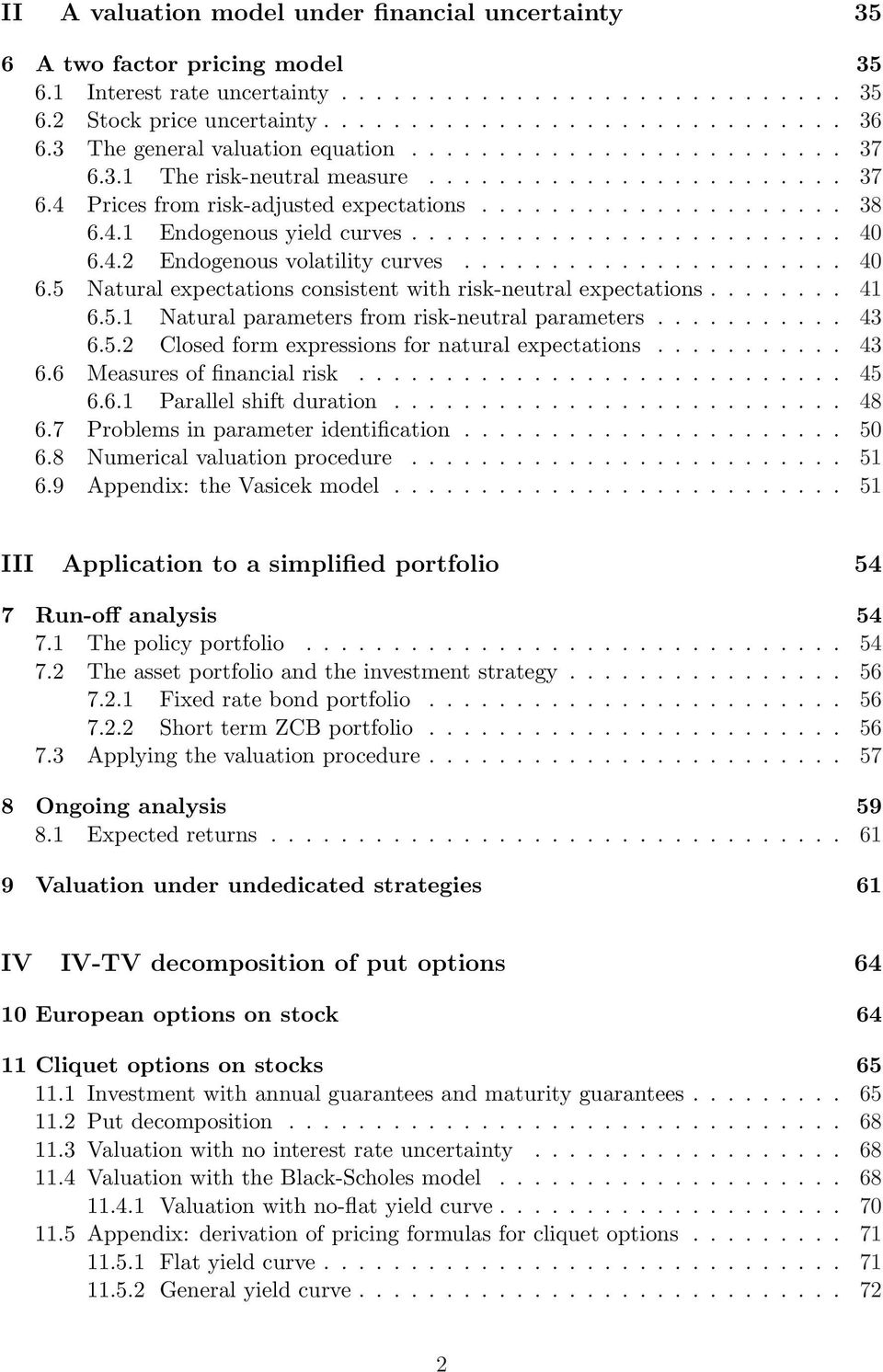
3 II A valuation model under financial uncertainty 35 6 A two factor pricing model Interest rate uncertainty Stock price uncertainty The general valuation equation The risk-neutral measure Prices from risk-adjusted expectations Endogenous yield curves Endogenous volatility curves Natural expectations consistent with risk-neutral expectations Natural parameters from risk-neutral parameters Closed form expressions for natural expectations Measures of financial risk Parallel shift duration Problems in parameter identification Numerical valuation procedure Appendix: the Vasicek model III Application to a simplified portfolio 54 7 Run-off analysis The policy portfolio The asset portfolio and the investment strategy Fixed rate bond portfolio Short term ZCB portfolio Applying the valuation procedure Ongoing analysis Expected returns Valuation under undedicated strategies 61 IV IV-TV decomposition of put options European options on stock Cliquet options on stocks Investment with annual guarantees and maturity guarantees Put decomposition Valuation with no interest rate uncertainty Valuation with the Black-Scholes model Valuation with no-flat yield curve Appendix: derivation of pricing formulas for cliquet options Flat yield curve General yield curve
4 12 Options embedded in profit-sharing policies Fixed rate bond portfolio Short term ZCB portfolio 76 V Reporting on the application to the RAS Group portfolios General description Relevant details Relevant contractual details of policies Basic structure of the valuation model Specification of the valuation model Defining the investment strategy The computing procedure Details on the Monte Carlo simulations Intrinsic value of embedded options Different levels of VBIF Risk capital and cost of capital Derivation of discount rate margins Run-off analysis and ongoing analysis

5 List of Tables 1 Components of the embedded value The effect of UGL on VBIF (D0 s = R 0 = 100) Discount rates margins Term structure of interest rates on December 31, Run-off valuation - Fixed rate bond investment strategy Run-off valuation - Short term ZCB strategy Ongoing valuation - Fixed rate bond investment strategy Put prices for alternative investment strategies

6 List of Figures 1 The e(i) function The functions e B (I) and e P (I) The functions e G (I) and e C (I) Risk-neutral density functions of r(t ) as of Dec 31, Risk-neutral density functions of S(T ) with constant interest rate The term structure of riskless interest rates as of December 31, The term structure of ZCB volatilities as of December 31, Natural and risk-neutral density function for r(10) (Dec 31, 2004; γ = 0.025) 44 9 Natural and risk-neutral density function for r(10) (Dec 31, 2004; γ = 0.055) Term structures of current and expected interest rates (Dec 31, 2004; γ = 0.025) Term structures of current and expected interest rates (Dec 31, 2004; γ = 0.055) Yield curves for future dates as expected on December 31, 2004 (γ = 0.025) Yield curves for future dates as expected on December 31, 2004 (γ = 0.055) Yield curves with shifted values of r(0) in the CIR model Uniformly shifted CIR yield curve Term structures of interest rates corresponding to two different sets of parameters Term structures of volatilities corresponding to two different sets of parameters Expected cash flow stream of premiums and benefits and expected reserve Cash flow stream generated by the asset portfolio Expected paths of fund returns under run-off and ongoing assumptions Confidence intervals of the expected fund returns (run-off assumption) European put prices and corresponding intrinsic values IV/P ratios for different maturities European put prices and corresponding intrinsic values IV/P ratios for different volatilities Cliquet put prices and corresponding intrinsic values IV/P ratios for different values of T Cliquet put prices and corresponding intrinsic values IV/P ratios for different values of σ Put price and IV with fixed rate bond portfolio Put price and IV with short term ZCB portfolio IV/P ratios for alternative investment strategies

7 Summary This technical report illustrates the basic principles for a fair valuation system in life insurance. The report is particularly concerned with the market consistent derivation of the Value of Business In Force (VBIF) for portfolios of profit-sharing policies, properly allowing for the cost of the embedded options and guarantees, according to the European Embedded Value Principles (EEVP) stated by the CFO Forum ([1], [2]). Some relevant issues concerning the practical utilization of the system and the consistent interpretation of the results are illustrated by numerical examples. Particular attention has been paid to the harmonization with the results provided by more traditional valuation methods. The report is concluded by a description of some relevant details concerning the application of the valuation system to the life portfolios of the RAS Group. Results The value of business in force (VBIF), the value of the minimum guaranteed return options (the put component of VBIF), the time value of the puts, the expected returns of the segregated funds and other quantities useful for controlling price and risk of the asset-liability portfolios are derived. Theoretical and practical issues are discussed concerning the theory of valuation, the market consistent pricing, the finance of insurance. The valuation procedure The outstanding portfolios are analysed in the framework of the asset-liabilty valuation under uncertainty. The valuation of the financial components of future profits, as well as of the embedded options, is performed using a stochastic pricing model based on the no-arbitrage principle. The model is calibrated on market data, in order to capture the current interest rate levels, the interest rate volatilities, the stock price volatilities and correlations. In the valuation procedure closed form pricing expressions as well as Monte Carlo simulations are used. The accounting rules defining the segregated fund returns are allowed for. Financial uncertainty is analysed by modelling interest rate risk for each relevant currency, stock price risk, credit risk. Technical uncertainty is measured taking into account mortality/longevity risk, surrender risk, expenses inflation risk. Harmonization Using the valuation system a logical connection can be created between the traditional approach based on a single best estimate scenario and the stochastic valuation model, specified under both the risk-neutral and the real world probabilities. Financial and technical risks, as well as the cost of the embedded options, are measured in terms of value (risk premiums and/or additional costs) and in terms of risk discount spread (discount rate margins). Issues of practical relevance Numerical illustration of embedded value components In section 1.5 a numerical illustration of the components of the embedded value is proposed. The effect of the initial unrealized gains and losses on the VBIF are discussed considering the changes in the fair value of the net liabilities (the stochastic reserve). The effect on the embedded options is illustrated by splitting the stochastic reserve in the liability value net of the cost of minimum guarantees and in the cost of the guarantees (the put component of the reserve). 6
![embedded options and guarantees, according to the European Embedded Value Principles (EEVP) stated by the CFO Forum ([1], [2]).](/docs-images/40/707156/images/page_7.jpg "Some relevant issues concerning the practical utilization of the system and the consistent interpretation of the results are illustrated by numerical examples.")
8 Intrinsic value and time value of embedded options In section the intrinsic value and the time value of the embedded put options is defined, in line with the indications of the CFO Forum. Discount rate margins In section 3.3 the discounted certainty equivalent (DCE) approach and risk-adjusted discounting (RAD) approach are harmonized in order to define the risk premium and the adjustment for the embedded option in terms of discount rate margins. Three kinds of margin are defined: 1 margin for financial risk; 2 margin for the time value of embedded option; 3 margin for technical risks (mortality risk, surrender risk, inflation expenses risk). In 3.4 a further decomposition of the margin for financial risk is proposed. In 3.5 a numerical example is provided in order to give the intuition on the extended decomposition. Market expectations should be handled with care The segregated fund returns can be of a very different nature. Some basic examples are considered in section 4 using an elementary approach. As illustrated in sections 4.3 and 4.4 the assumptions on natural ( real world ) market expectations should be handled with care when consistency with market-based risk-neutral probabilities is required. Section 4.4 in particular is concerned with the case of stochastic returns on the bond market. The discussion contained there, as well as the numerical example provided in subsection 4.4.1, illustrate how the risk-neutral probabilities should be correctly interpreted when interest rate risk is involved. Economic consistency of the CIR model The trade-off between economic consistency and mathematical tractability of a valuation model is an important issue, particularly referring to interest rate models. In section 6.1 the CIR model is considered also by this point of view. A numerical example on possible inconsistencies introduced by the Vasicek model is given in section 6.9. Efficiency in model identification In section 6.7 it is shown how the CIR model can be calibrated on market data in order to correctly price both linear products (e.g. zero-coupon bonds) and non-linear contracts, as the options embedded in life insurance policies. By estimating the risk-neutral parameters on both the swap rates and a set of quoted prices of interest rate caps and floors, the endogenous yield curve and the current volatility structure can be identified. The cost of the embedded options depends on the investment strategy A very relevant feature of the financial options embedded in life insurance policies is the strong dependence of the price on the investment strategy chosen by the fund manager. The accounting rules defining the fund return enable the insurer to further control the cost of these guarantees. This subject is tackled in Part III, where the pricing procedure is applied to a specified policy portfolio using typical accounting rules. Numerical results are derived under different asset allocation assumptions and under alternative investment strategies. Interest rate sensitivities are also computed. Both a run-off analysis and an ongoing analysis is performed. Many of these results are summarized in tables 5, 6 and 7. Intrinsic value and time value decomposition of put options In Part IV the price decomposition of the embedded put options in intrinsic value and time value is specifically examined. The problem is first studied in the Black-Scholes framework, considering both maturity guarantees (section 10) and the cliquet options contained in annual guarantees (section 11). The behaviour of the intrinsic value as a percentage of the total cost of the put is illustrated for different values of the volatility and for different maturities. When 7

9 the options actually embedded in life insurance policies are considered under realistic investment strategies, the intrinsic value can have a counterintuitive behaviour. This topics is illustrated in section 12. 8

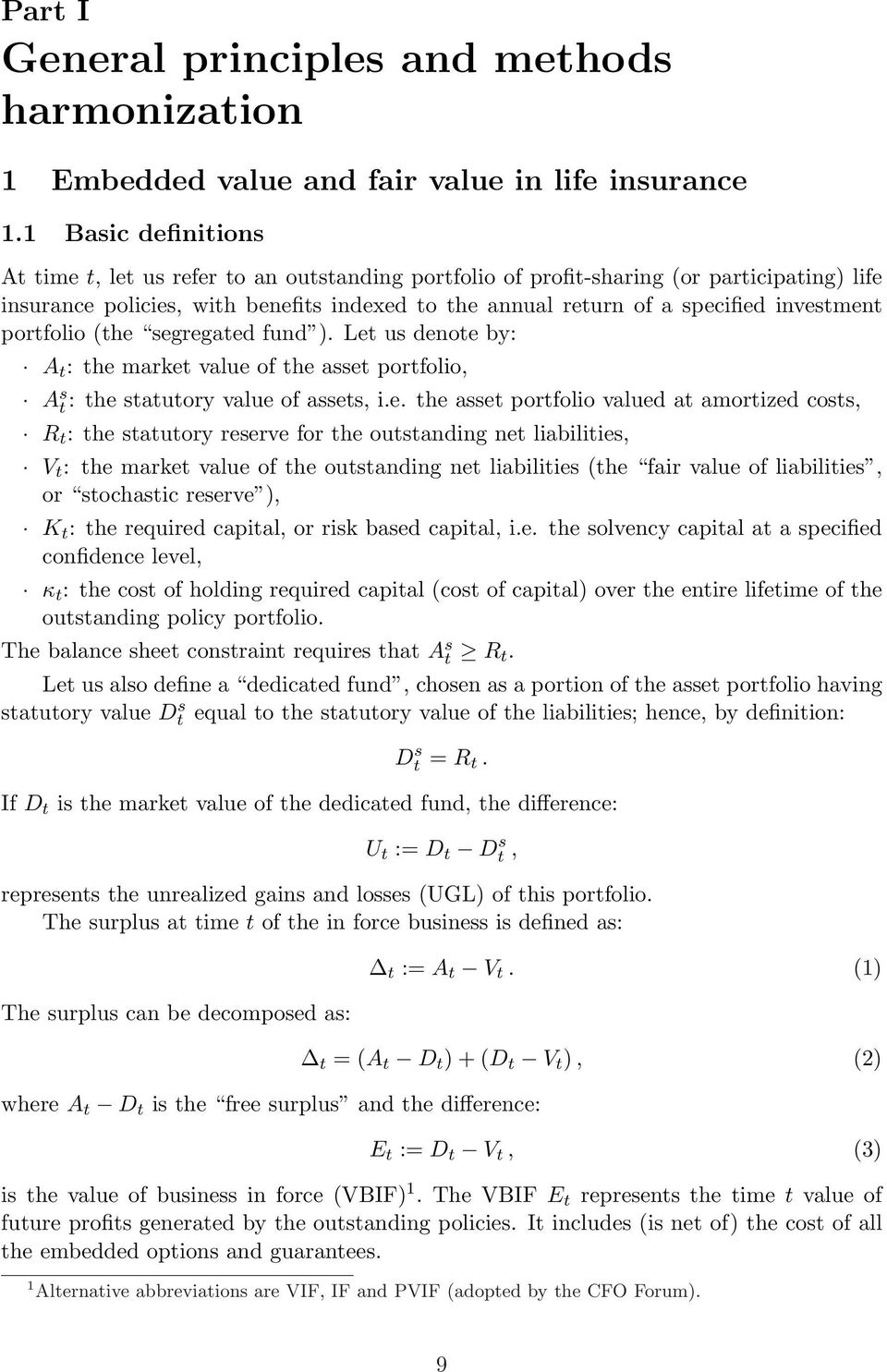
10 Part I General principles and methods harmonization 1 Embedded value and fair value in life insurance 1.1 Basic definitions At time t, let us refer to an outstanding portfolio of profit-sharing (or participating) life insurance policies, with benefits indexed to the annual return of a specified investment portfolio (the segregated fund ). Let us denote by: A t : the market value of the asset portfolio, A s t: the statutory value of assets, i.e. the asset portfolio valued at amortized costs, R t : the statutory reserve for the outstanding net liabilities, V t : the market value of the outstanding net liabilities (the fair value of liabilities, or stochastic reserve ), K t : the required capital, or risk based capital, i.e. the solvency capital at a specified confidence level, κ t : the cost of holding required capital (cost of capital) over the entire lifetime of the outstanding policy portfolio. The balance sheet constraint requires that A s t R t. Let us also define a dedicated fund, chosen as a portion of the asset portfolio having statutory value D s t equal to the statutory value of the liabilities; hence, by definition: D s t = R t. If D t is the market value of the dedicated fund, the difference: U t := D t D s t, represents the unrealized gains and losses (UGL) of this portfolio. The surplus at time t of the in force business is defined as: The surplus can be decomposed as: where A t D t is the free surplus and the difference: t := A t V t. (1) t = (A t D t ) + (D t V t ), (2) E t := D t V t, (3) is the value of business in force (VBIF) 1. The VBIF E t represents the time t value of future profits generated by the outstanding policies. It includes (is net of) the cost of all the embedded options and guarantees. 1 Alternative abbreviations are VIF, IF and PVIF (adopted by the CFO Forum). 9
11 Under the European Embedded Value Principles proposed by the CFO Forum ([1], [2]) the embedded value EV t at time t (gross of costs and taxes) is defined as the sum of the free surplus, the VBIF and the required capital net of the cost of capital. Supposing that K t is not invested in the reference fund A t, we can formally assume: EV t := (A t D t ) + E t + (K t κ t ). (4) Of course if part of the required capital is invested in the fund it should be deducted from K t in order to avoid double counting. The more relevant problem is to provide a methodology for determining the VBIF E t (or the stochastic reserve V t ) which: can be considered market-consistent, provides a correct valuation of financial options and guarantees, also considering the effects of accounting rules defining the segregated fund returns, allows valuations across different portfolios and companies to be compared. 1.2 Fair value and VBIF The VBIF definition (3) is based on the assumption of market-consistency for the valuation V t. In a perfect financial market the fair value V t of the liabilities represents the price of the equivalent portfolio, that is of the dynamic portfolio of traded securities which replicates all the outstanding liabilities. Hence the rationale of definition (3) is apparent. The amount D t is the capital required at time t to the insurer in order to cover the outstanding policies, while V t is the investment actually needed to meet the corresponding liabilities. The difference E t = D t V t, which usually should be positive, is not immediately available to the insurer, but will be progressively delivered in the future as profits emerging during the life of the policies; however the present value of these profits, by the arbitrage principle, must be equal to E t. The definition of VBIF via the fair value V t can be referred to as the stochastic reserve approach (see [11]). This point of view is logically equivalent to the direct method for the derivation of fair value considered by the International Accounting Standard Board ([3], ch. 3, par. 3.32, 3.33). 1.3 Embedded options and investment strategies Under the usual profit-sharing rules, in each year the insurer earns a fraction of the fund return but must also guarantee a minimum return level to the policyholder. These minimum guarantees can be assimilated to a kind of put options held by the insured; the value of future profits to the insurer must be derived taking into account the cost of the options embedded into the policies. Of course the fund return which represents the underlying of the embedded options depends both on the market evolution and on the investment strategy of the fund. Since the insurer has some degree of discretion in choosing this strategy, he can partially control the time t price of the options. Of course the invested strategy must be explicitly declared at time t and any change in the investment rules will require a corresponding repricing of the options. 10
12 The accounting rules usually adopted to define the fund return give further opportunities to the insurer for controlling the price of the puts. For example, financial assets classified as held-to-maturity can provide a component of the fund return virtually constant over periods of few years, thus substantially reducing the volatility of the underlying and in turn the cost of the options. A further reduction effect of the put prices can be obtained if there are positive unrealized gains corresponding to default-free fixed rate bonds with high nominal yield, provided that the fund manager will not be forced to sell them by liquidity problems. In summary, under suitable conditions the accounting rules can allow the insurer to produce an intertemporal smoothing and in some cases a kind of market insulation of the reference fund return. In order to realize these effects not only the composition, but also the dimension of the fund at time t can be relevant. 1.4 The dedicated fund Since the cost of the embedded options depends on the investment strategy and since the possible strategies are conditional to the current structure of the investment fund, the components in definition (4) are not independent between each other. In particular, the stochastic reserve V t and the VBIF E t are sensitive to the current composition (and possibly also to the dimension) of the fund on which the reference return is defined. A possible choice is to define the dedicated fund D t as a portfolio having the same composition of the total portfolio A t, and then assuming D t as the reference fund; this can be done by simply rescaling all the notional values of the assets in the total portfolio by the factor R t /A s t 2. Similar arguments can be applied to the UGL of the dedicated portfolio. The VBIF can be represented as: E t = (D t D s t ) + (R t V t ) = U t + (R t V t ) ; however this is only a formal decomposition, since V t is in turn a function of U t also (for details see section 5). 1.5 Numerical illustrations At time zero let us consider a policy portfolio with statutory reserve R 0 = 100 and a corresponding asset portfolio with market value A 0 = 112. Assume that the dedicated fund has market price D 0 = 105 (and statutory value D0 s = 100 by definition); then the value of UGL is U 0 = = 5. If the stochastic reserve is V 0 = 90 the resulting VBIF is E 0 = = 15. For the required capital and for the corresponding cost of capital assume K 0 = 6 and κ 0 = 1, respectively. If K 0 is not invested in the fund A the embedded value is given by: EV 0 = ( ) + (105 90) + (6 1) = = 27. These embedded value components are reported in table 1. 2 If A t > R t, under accounting rules a put minimizing strategy applied to the total asset portfolio would produce a cost of the options not greater than that of an equivalent strategy applied to the dedicated portfolio. Thus this definition of D t can be considered conservative with respect to the computation of VBIF. 11

13 Statutory reserve (R 0 ) 100 Market value of total assets (A 0 ) 112 Market value of dedicated assets (D 0 ) 105 Statutory value dedicated of assets (D0 s) 100 Initial UGL (U 0 = D 0 D0 s) 5 Required capital (K 0 ) 6 Cost of required capital (κ 0 ) 1 Stochastic reserve (V 0 ) 90 VBIF (E 0 = D 0 V 0 ) 15 Embedded value (EV 0 ) 27 Table 1: Components of the embedded value In order to illustrate how the UGL can modify the VBIF via the stochastic reserve let us consider a policy portfolio with statutory reserve R 0 = 100 and assume first that there are not UGL, posing D 0 = D0 s = 100. In the first three rows of table 2 the case is considered of a liability portfolio composed only of: i) non participating policies (first row), ii) profit-sharing policies crediting to the policyholder the 80% of the annual return, with a low of minimum guaranteed return, iii) profit-sharing policies crediting the 80% of the annual return, with a high level of minimum guarantees (third row). In the second three rows of the table the same policy portfolios are considered, assuming now that D 0 = 105, thus supposing positive UGL at the level U 0 = 5. For the cases of participating policies the values of the stochastic reserve V 0 are typical figures produced by a conservative investment strategy which takes advantage of the UGL. The effect on the embedded options is illustrated by splitting the stochastic reserve in the liability value net of the cost of minimum guarantees (the base value B 0 ) and in the cost of the guarantees (the put value P 0 ). Of course the stochastic reserve is given by V 0 = B 0 + P 0 and the VBIF is then given by E 0 = D 0 B 0 P 0. As will be shown in section 5, for the non participating policies the UGL can be completely recovered by the insurer under a suitable strategy. By and large, for profit sharing policies about the 80% of the UGL contributes to the base value, leaving the remaining 20% as an additional profit for the insurer. However the UGL can also contribute to reduce the put price, thus incrementing further the VBIF. 2 Valuation of annual profits The usual method for measuring VBIF is an annual profits approach. Instead of deriving the market value V t of the liabilities and then subtracting it from the value of the dedicated fund, this method is aimed at providing a market-consistent valuation of the annual sequence of future profits generated by the policy portfolio. It can be easily proven (see [9], p. 94) that under the no-arbitrage assumption in perfect markets the annual profits 12

14 Policy portfolio D 0 B 0 P 0 V 0 E 0 Non participating Participating 80%, low guarantees Participating 80%, high guarantees Non participating Participating 80%, low guarantees Participating 80%, high guarantees Table 2: The effect of UGL on VBIF (D s 0 = R 0 = 100) approach and the stochastic reserve approach are equivalent, provided that both methods are applied in a market based framework. 2.1 The representation of the annual profits Let t = 0 and assume that the in-force policies produce benefits for N years. Let us denote by e τ the random variable representing the profits earned by the insurer at the end of the year τ (τ = 1, 2,..., N), referred to a unit level of the statutory reserve at the beginning of the year. To simplify the exposition, we assume that the profits credited to the policyholder at the end of year τ (by an increase of the sum insured) are given by: d τ := max{β I τ, i}, (5) where β is the participation coefficient, I τ is the rate of return of the reference fund in year τ and i the minimum guaranteed rate (typically the technical interest rate). The parameters i and β are fixed at time zero; the return I τ is known at the date τ. Correspondingly, e τ is given by: e τ = I τ d τ = I τ max{β I τ, i} = min{i τ i, (1 β) I τ }. (6) The form of the function e = f(i) is illustrated in figure The base component and the put component Using the general property: min{x, y} = x [x y] +, x, y R, (7) the earnings at time τ can be expressed as: e τ = (1 β) I τ [ ] + i β I τ, (8) that is: where: e τ = e B τ e P τ, (9) e B τ := (1 β) I τ, (10) 13

15 e 0 i I i (1 β) I i i/β I min { I i, (1 β) I } Figure 1: The e(i) function is the base component of profits and: e P τ := [ i β I τ ] +, (11) is the put component. The form of the functions e B = f B (I) and e P = f P (I) is illustrated in figure 2. The base component is conceptually similar to the management fees in mutual funds without minimum return guarantees. It should be noted however that in mutual funds management fees are typically computed as a per cent of the net asset value. In profitsharing policies the management fees would be determined as a portion of the realized return; hence they could also take negative values. Expression (8) corresponds to the fundamental decomposition: profits = retained profits/losses costs of minimum guarantees. It is important to observe that e B τ is a linear function of I τ while e P τ is non-linear. Hence the earnings in year τ: e τ = f(i τ ), (12) can be interpreted as the payoff of a derivative security written on I, where f is a non linear function of the underlying Excess-return component and call component By relation (7) the annual profits can also be expressed as: e τ = (I τ i) [ β I τ i ] +, (13) 3 Under a more realistic profit-sharing mechanism the statutory reserve R τ at the beginning of the year τ depends on the past returns of the segregated fund. Since e τ is expressed in units of R τ, the payoff e τ is actually path-dependent. 14

16 e i (1 β) I [ i β I] + 0 i i/β I Figure 2: The functions e B (I) and e P (I) that is as: where: e τ = e G τ e C τ, (14) e G τ := I τ i, (15) is the excess-return component of profits 4 and: e C τ := [ β I τ i ] +, (16) is the call component. The excess return component could be also referred to as nonparticipating component, since it is equal to the profits earned on an analogous nonprofit-sharing policy. The call component then represents the cost of the participating mechanism. Relation (13) corresponds to the alternative decomposition: profits = profits from non-participating participation costs. Obviously, also this decomposition expresses the non linear function e = f(i τ ) as the sum of a linear component e G = f G (I τ ) and of a non linear component e C = f C (I τ ). The form of the functions e G (I τ ) and e C (I τ ) is reported in figure Fund returns and market returns For a given asset-liability portfolio and for a specified investment strategy, the randomness of the fund returns I τ is determined by the uncertainty of the market returns. In a 4 The payoff e G τ is the fund return in excess of the minimum guaranteed return. The complement of e G τ, that is d G τ := I τ e G τ = i is the guaranteed component of the fund return credited to the policyholder. 15

17 e 0 i I i [β I i ] + i i/β I Figure 3: The functions e G (I) and e C (I) simplified setting, let us denote by j τ the market return in the time period [τ 1, τ]. We can pose: I τ = g(j τ ), (17) where g is a deterministic function depending, via the accounting rules, both on the structure of the asset-liability portfolio and on the particular investment strategy chosen by the fund manager. In general g is a non linear function, specified by a complicated set of computational rules. Using (17), the complete representation of the annual earnings is: e τ = (1 β) g(j τ ) [ i β g(j τ ) ] +. (18) Sources of uncertainty for future profits The uncertainty affecting future profits e τ can be divided in two main classes. Financial risk. Denotes the financial market uncertainty affecting the future return I τ. In life insurance the most relevant types of financial risk are the interest rate risk and the stock price risk. Credit risk can also be of concern if a relevant part of the segregated fund is invested in corporate bonds. If inflation linked bonds or policies are present in the outstanding portfolios also the inflation risk should be considered. Technical risk. This kind of uncertainty, often referred to also as actuarial uncertainty, is connected with all the events influencing the duration of the policies. Typical risk drivers are mortality/longevity risk and surrender risk. This risk class should include also the uncertainty on future expenses concerning the outstanding portfolio. We shall assume here that the main two classes of uncertainty can be considered separately. A formal definition of the independence between financial and technical risk and a discussion of this assumption can be found in [11]. 16

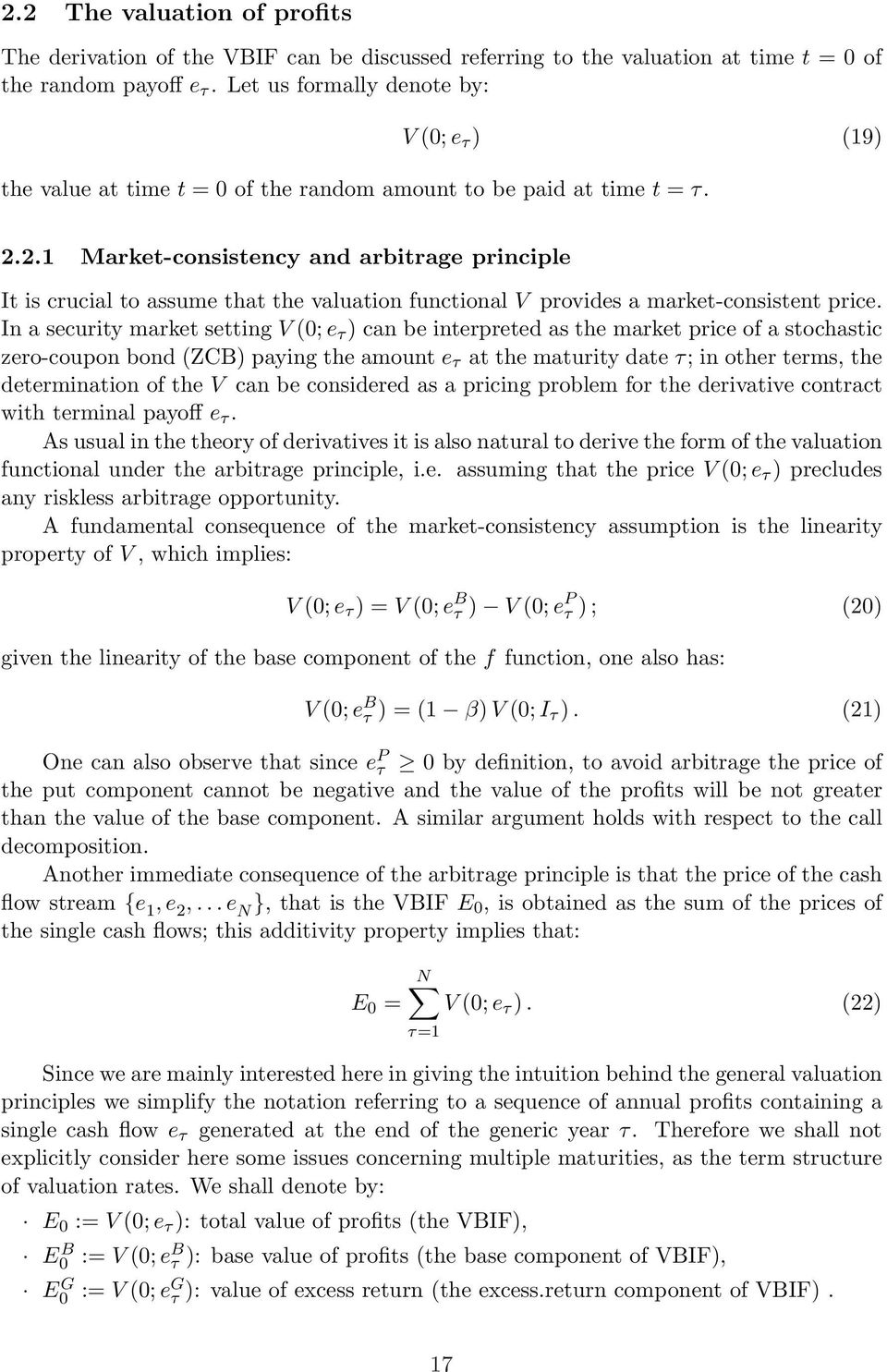
18 2.2 The valuation of profits The derivation of the VBIF can be discussed referring to the valuation at time t = 0 of the random payoff e τ. Let us formally denote by: V (0; e τ ) (19) the value at time t = 0 of the random amount to be paid at time t = τ Market-consistency and arbitrage principle It is crucial to assume that the valuation functional V provides a market-consistent price. In a security market setting V (0; e τ ) can be interpreted as the market price of a stochastic zero-coupon bond (ZCB) paying the amount e τ at the maturity date τ; in other terms, the determination of the V can be considered as a pricing problem for the derivative contract with terminal payoff e τ. As usual in the theory of derivatives it is also natural to derive the form of the valuation functional under the arbitrage principle, i.e. assuming that the price V (0; e τ ) precludes any riskless arbitrage opportunity. A fundamental consequence of the market-consistency assumption is the linearity property of V, which implies: V (0; e τ ) = V (0; e B τ ) V (0; e P τ ) ; (20) given the linearity of the base component of the f function, one also has: V (0; e B τ ) = (1 β) V (0; I τ ). (21) One can also observe that since e P τ 0 by definition, to avoid arbitrage the price of the put component cannot be negative and the value of the profits will be not greater than the value of the base component. A similar argument holds with respect to the call decomposition. Another immediate consequence of the arbitrage principle is that the price of the cash flow stream {e 1, e 2,... e N }, that is the VBIF E 0, is obtained as the sum of the prices of the single cash flows; this additivity property implies that: E 0 = N V (0; e τ ). (22) τ=1 Since we are mainly interested here in giving the intuition behind the general valuation principles we simplify the notation referring to a sequence of annual profits containing a single cash flow e τ generated at the end of the generic year τ. Therefore we shall not explicitly consider here some issues concerning multiple maturities, as the term structure of valuation rates. We shall denote by: E 0 := V (0; e τ ): total value of profits (the VBIF), E B 0 := V (0; eb τ ): base value of profits (the base component of VBIF), E G 0 := V (0; eg τ ): value of excess return (the excess.return component of VBIF). 17
19 Using these values the price of the embedded options can be derived by difference; we have: P 0 := E B 0 E 0: the put value, C 0 := E G 0 E 0: the call value No-arbitrage valuation methods The previous properties of the valuation functional directly follow from a fundamental result in the arbitrage theory providing a representation of the price V as an expectation operator. Real world expectations Under the no-arbitrage assumption the price operator V can be represented as: V (0; e τ ) = E N (ϕ τ e τ ), (23) where ϕ τ is the state-price deflator and E N is the expectation taken with respect the natural probability N (the so-called real world probability). Under the complete market assumption the deflator ϕ τ is unique (see e.g. [13]). Risk-neutral expectations Alternatively, the following representation holds: V (0; e τ ) = E Q (ξ τ e τ ), (24) where ξ τ is the risk-free deflator (or stochastic discount factor ) and E Q is the expectation under the risk-neutral (or risk-adjusted ) probability Q. By a theoretic point of view expression (23) and (24) should be equivalent; hence we should have: E Q( ξ τ Y τ ) = E N ( ϕ τ Y τ ). In practical applications, if an efficient market for the derivative e τ exists the probability measure Q can be derived by estimating a suitable stochastic model on quoted prices. The natural probability N provides the expectations prevailing on the market a the valuation date. If an assessment of this probability measure is required, it should be obtained consistently with the estimated measure Q, i.e. consistently with the observed prices. If a reference market does not exist, usually the natural probability approach is preferred; the choice of the measure N is suggested by subjective views and the measure Q, when required, should be obtained as a suitable transformation Stochastic and deterministic discount factors The arbitrage methods are stochastic methods in a proper sense. We can refer to the representations (23) and (24) as the language of the stochastic discount factors, since the present value of the random payoff is obtained by deflating e τ under each sample path from t = 0 to t = τ (i.e. under each state of nature) and then taking the appropriate 18

20 expectation. In particular, it can be shown that in a continuous time setting, the stochastic discount factor under the risk-neutral representation (24) has the form: ξ τ = e τ 0 r(z) dz, (25) where r(z) denotes the instantaneous risk-free interest rate. The traditional deterministic discount factor from t = 0 to t = τ can be immediately derived under the no-arbitrage approach by considering the security paying with certainty the amount C τ at time τ. Since C τ is deterministic, the representation (24) gives: V (0; C τ ) = E Q (ξ τ ) Cτ, (26) or: where: V (0; C τ ) = v τ C τ, (27) v τ := V (0; 1) = E Q (ξ τ ), (28) is the price of the unit ZCB maturing at time t = τ. This ZCB is assumed to be not defaultable and in this sense v τ is referred to as the risk-free, or deterministic discount factor for the maturity τ Methods with discounted expectations ( stochastic methods ) The traditional valuation methods in corporate finance and the methods currently used for deriving VBIF in life insurance are based on discounting expected cash flows. Therefore it is important to reconcile these methods with the stochastic deflator approaches. If the payoff e τ is independent of interest rates the deflators are random variables independent of e τ (under the corresponding probability measures) and the expectation of the deflated payoff can be expressed as the product of two expectations. 5 We shall denote by i τ the interest rate at time t = 0 for the maturity t = τ expressed on annual basis, and by r τ := log(1 + i τ ) the corresponding continuously compounded rate. Hence: v τ = (1 + i τ ) τ = e r τ τ. The notation i F τ will be used to indicate the forward rate made at time t = 0 for the period [τ 1, τ]. A more general notation would be obtained by denoting by v(t, s) the time t spot price of the unit risk-free ZCB maturing at time s t, and by v(t, T, s) the forward price of the same ZCB made at time t and to be paid at time T [t, s]. Correspondingly i(t, s) denotes the interest rate on annual basis made at time t for the period [t, s] and i(t, T, s) is the forward interest rate made at time t for the period [T, s]. The correspondence with the simplified notation is given by: v τ := v(0, τ), i τ := i(0, τ), i F τ := i(0, τ 1, τ). The one-year interest rate in year τ is given by j τ := i(τ 1, τ); the instantaneous interest rate r(t) is defined as: log v(t, s) r(t) := lim. s t s t 19

21 DCE method If the deflator ξ τ and the payoff e τ are independent under the Q measure, the risk-neutral representation (24) simplifies as: V (0; e τ ) = v τ E Q (e τ ). (29) The valuation method based on this expression can be referred to as Discounted-Certainty- Equivalent (DCE) method, since the risk-neutral expectation E Q (e τ ) can be consistently interpreted as the certainty equivalent due at time t = τ of the random cash flow e τ. Obviously the discount factor v τ can be expressed in terms of discount rate: v τ := e r τ τ, (30) where r τ represents the (annual, continuously compounded) risk-free rate at time t = 0 for the maturity τ. RAD method If the deflator ϕ τ and the payoff e τ are independent under the natural measure N then the representation (23) assumes the form: V (0; e τ ) = v τ E N (e τ ), (31) where: v τ := E N (ϕ τ ), (32) represents risk-adjusted discount factor from 0 to τ. This valuation approach is the usual one in capital budgeting applications; we shall refer to this method as Risk-Adjusted- Discounting (RAD). Of course, also the discount factor v τ can be expressed in the form: v τ := e µ τ τ, (33) where µ τ denote the risk-adjusted discount rate from 0 to τ. In the practical applications, the valuations obtained under the RAD approach can be considered market-consistent if E N( e τ ) can be interpreted as a market expectation and if the discount rate µτ includes the appropriate risk premium (the risk margins ). Remark. The discount rate µ τ is the risk-adjusted rate appropriate for the payoff e τ. If the value of the base component and the value of the put component would be derived separately two properly readjusted discount rates should be used, since the following representations should hold: V (0; e B τ ) = e µb τ τ E N( e B ) τ, V (0; e P τ ) = e µp τ τ E N( e P ) τ, (34) where µ B τ and µ P τ are the discount rate adjusted for the riskiness of e B τ and e P τ, respectively. Moreover, since in general the riskiness of e τ is also depending on the length τ of the time horizon, the rate µ τ also should depend on τ. Therefore in order to price a complete cash flow stream {e 1, e 2,..., e N } an entire term structure of risk-adjusted discount rates will be required. 20
22 These arguments show the greater conceptual efficiency of the DCE valuation based on the risk-neutral probability. With the RAD approach the means of the real world probability distributions are derived as a first step and the determination of the risk premiums that also are influenced by the payoff distributions is deferred to the discounting phase. Under the risk-neutral distribution method the risk premiums are contextually derived in the phase of mean calculation Discounted expectations under interest rate risk In the usual VBIF calculations the independence assumption does not hold since typically the segregated funds are largely invested in bonds; under interest rate uncertainty the payoffs expressing future profits are random variables depending on the deflators through the interest rates. Therefore the expressions of the value as discounted expectations, in the sense of (29) and (31), in general are not consistent with the arbitrage principle. However also for the price of interest rate sensitive payoffs an expression as discounted expectation consistent with the arbitrage principle can be derived. This can be done by using the unit ZCB with maturity τ as a numeraire 6 ; it can be shown that this is equivalent to properly changing the probability measure. Forward risk-neutral expectations Under the no-arbitrage assumption the price operator V can be represented as: V (0; e τ ) = v τ E F τ (e τ ), (35) where E F τ (e τ ) is the expectation taken with respect to probability measure F τ, the so called forward risk-neutral measure. Expression (35) provides a DCE valuation method theoretically correct also for payoffs dependent on interest rates. Of course if the payoff is not interest rate sensitive the forward risk-neutral is the same as the risk-neutral expectation Scenario methods ( deterministic methods ) In a general setting the methods with discounted expectations are in any case stochastic, in the sense that the valuation is derived by computing summary statistics of the annual profits over a large number of sample paths, or scenario (in principle, one for each state of nature). Following a simplified approach, the value at time t = 0 of e τ is usually derived as: Ê N 0 := v τ f [ E N (I τ ) ], (36) that is discounting (under the risk-adjusted rate) the value of the profit function corresponding to the real world expectation of the fund return. Moreover in typical applications the expectation E N (I τ ) is obtained by a synthetic approach, that is by a subjective assessment of a single best estimate scenario, without explicitly computing the mean of a 6 Using the notation of footnote (5), the money amount representing the payoff e τ is expressed in units of price v(t, t+τ). 21
23 specified probability distribution. By this point of view the valuation method (36) can be considered a deterministic, or single scenario RAD method. Given the linearity property of the expectation operator, the crucial point of this approach is the linearity of the f function. If f is linear then f [ E N (I τ ) ] = E N[ f(i τ ) ] ; hence the scenario method is equivalent to the stochastic RAD approach (and, under independence, to the no-arbitrage approach). However if f is non-linear the scenario methods contain inconsistencies. In particular they can systematically fail in correctly pricing the embedded option, which represents the non-linear component of the profit function f. Intrinsic value of embedded options Following the indications of the CFO Forum (see [1], [2]) one can define the intrinsic value of e P τ (i.e. the intrinsic value of the embedded put option) as: IV 0 := vτ f P [ E N (I τ ) ] = vτ [ i β E N (I τ ) ] +. (37) Consequently one can define the time value of e P τ as: TV 0 := V (0; e P τ ) IV 0 = vτ {E N( [ ] ) + i β Iτ [ i β E N (I τ ) ] } +. (38) By the concavity of the function f P, the Jensen inequality holds: therefore one has: f P [ E N (I τ ) ] E N[ f P (I τ ) ] ; 0 IV 0 V (0; e P τ ), and the time value defined by (38) provides the component of the option cost which is not captured by the deterministic valuation. In the sequel we shall use similar quantities defined in the forward risk-neutral framework; the intrinsic value will be given by: and the time value will be obtained as: IV 0 := v τ f P [ E Fτ (I τ ) ], (39) TV 0 := v τ E F τ [ f P (I τ ) ] v τ f P [ E F τ (I τ ) ]. (40) Remark. In classical books on derivatives the intrinsic value of an option is defined referring to the current price of the underlying, which in the present situation would be given by the value I 0 of the fund return in the year just ended. The intrinsic value would then be given by: IV 0 := [ i β I 0 ] +, (41) and the time value would be: TV 0 := V (0; e P τ ) [ i β I 0 ] +. (42) With those definitions the time value would actually be the amount of the option price that would be lost if the option were hold to expiration and the underlying security price remained unchanged (see [15] p.15). 22
24 3 Harmonization with the traditional approach In order to allow the stochastic valuation method to become a viable approach to measuring VBIF in the professional practice it is of primary importance to achieve some degree of conceptual harmonization with the traditional approach The traditional approach The traditional method for deriving VBIF can be classified as a RAD method under single scenario. Let us denote by: ê N τ := f [ E N (I τ ) ], (43) the profit function evaluated for a real world expectation of the fund return (the best estimate of expected future profits). Then the traditional estimation of VBIF can be formally represented as: E T 0 := v T τ ê N τ, (44) where vτ T is a discount factor which is supposed to take correctly into account the total risk affecting I τ (both financial and technical) as well as the time value of the embedded option not captured by the single scenario approach. If one assumes that these adjustments correspond to the appropriate corrections then E0 T provides the market-consistent assessment of VBIF by definition. This position is typically motivated in the framework of a share price driven approach, where the future profits generated by the different lines of business considered as an aggregate cash flow, are assumed to have equivalent value to similar market-traded insurance cash flows. In this setting the appropriate risk-adjusted discount rate is derived at an aggregate level by the prices observed on the stock market using a CAPM based approach. Some of the arguments underpinning this method are questionable and it can be argued that more reliable results could be provided by an analytical approach based on rigorous arbitrage methods and on the risk evaluation of individual cash flows. However it is reasonable at least to presume that a comparison with an alternative no-arbitrage stochastic approach would provide additional insight into the traditional valuation. 3.2 A stochastic DCE approach In order to allow this comparison let us consider a DCE approach expressed as: V (0; e τ ) := v τ e τ, (45) where as usual v τ is the market riskless discount factor and e τ represents the certainty equivalent of the random amount e τ fixed at time t = 0 on the market. If e τ would be exposed only to financial risk the certainty equivalent would be given by the forward risk-neutral expectation: e τ = E Fτ (e τ ), (46) where the F τ measure could be derived by calibrating an appropriate stochastic pricing model on the observed market prices. However, in order to take into account also the technical uncertainty a further transformation of the natural expectation would be needed 7 The authors are indebted to Geoffrey Jones, Alberto Minali and Deborah Pellati for useful discussions and insightful ideas concerning the harmonization issue. 23
25 Adjustment for technical risks The crucial point is that an efficient market for technical risks is usually not available and proper adjustments for the corresponding risk premiums cannot be objectively derived by observing the market 8. To overcome this difficulty one can define the certainty equivalent as: e τ = E Fτ (e τ ) l τ, (47) where F τ is the forward risk-neutral measure relating only to the financial uncertainty and l τ is a positive risk loading which adjusts the expectation for the technical uncertainty. Of course l τ cannot be fully derived by market data and will contain some degree of subjective assessments. The risk loading methods is widely used to derive premiums in P&C insurance. Different criteria for defining l τ correspond to different premium calculation principles (see e.g. [14]); for example, the standard deviation principle is obtained by choosing l τ as proportional to the standard deviations computed on the natural probability distribution of e τ. In recent years market regulators and rating agencies have been increasingly using risk measures for the business activity based on required solvency capital, or risk capital. Even if the risk capital calculations performed by a firm are determined by natural, therefore subjective probability assessments, usually the methodology and the assumptions underlying the valuation are publicly illustrated and discussed. Then it would be reasonable to consider the risk capital for the sources of technical uncertainty as a proper risk measure and then to assume the corresponding cost of capital as a proxy of the market-consistent risk loading. One could then assume: l τ = κ A τ, (48) where κ A τ is an estimate of the cost of capital in the year τ for all the risk capital required for the actuarial risk drivers 9. With this choice, the market-consistent VBIF provided by the DCE approach is given by: Let us denote by: E 0 = v τ [ E F τ (e τ ) κ A τ ]. (49) E F 0 := v τ E Fτ (e τ ), (50) the financial VBIF, that is the VBIF unadjusted for the technical risks; let also denote by: κ A 0 := v τ κ A τ, (51) the cost at time t = 0 of the capital required for the year τ, which represents the value of the technical risk loading. Then one also has: E 0 = E F 0 κ A 0. (52) 8 This problem is of major importance in the fair valuation of liabilities in property and casualty insurance (see e.g. [4]). 9 If Kτ A is an estimate of the technical risk capital required at the beginning of the year τ, one could pose: κ A τ := K A τ [h τ i(0, τ 1, τ)], where h τ is the estimated shareholders return required in year τ and i(0, τ 1, τ) is the corresponding forward rate implied in the current term structure of default-free rates. An interesting issue is if Kτ A should be diversified across different technical risks and across all the other risk drivers globally affecting the firm. 24
26 Let us also define the value: Ê F 0 := v τ f [ E F τ (I τ ) ], (53) representing the value of profits under a deterministic forward risk-neutral scenario. Since the function f P is convex, the function f = f B f P is concave thus the Jensen inequality implies: Ê F 0 E F 0. By the linearity of the base component, the equality E F τ [ f B (I τ ) ] = f B[ E F τ (I τ ) ] holds. Then by the definition (39) of intrinsic value one has: Ê F 0 E F 0 = v τ E Fτ [ f P (I τ ) ] v τ f P [ E Fτ (I τ ) ] = P 0 IV 0, that is, using the definition (40): Ê F 0 = E F 0 + TV 0. (54) Hence ÊF 0 provides the financial VBIF gross of the time value. 3.3 Identifying discount rate margins Under a DCE approach the different components of the risk premium and of the adjustment for the embedded option are specified as decrements of the cash flow. However it is often preferred to express these components in terms of margins on the discount rate, thus implicitly referring to a RAD approach. This kind of description can be obtained comparing the valuations provided by the stochastic DCE method just illustrated with the natural expectations ê N τ used in the traditional deterministic approach (44). 1) Margin for financial risk (different from the time value of embedded options). Consider the equation: v (1) τ ê N τ = ÊF 0 ; (55) the solution v τ (1) is the discount factor that under the traditional RAD method would provide a valuation of profits taking into account only the financial risks and the intrinsic value of the put option. The corresponding margin can be obtained by comparing v τ (1) with the riskless discount factor v τ ; for example, a yield spread can be defined as: r (1) := 1 τ log v τ. v τ (1) The spread r (1) is often referred to as a risk margin, although it also includes an adjustment for the put intrinsic value Of course in our simplified setting with a single cash flow êτ N equation (55) has the trivial solution v τ (1) = ÊF 0 /êτ N. When a usual cash-flow stream is considered we should express the discount factor as v τ (1) := e r(1)τ, and the discount rate r (1) should then be obtained as an internal rate of return, i.e. as the solution of: v τ f E Fτ (I τ ) = e r(1)τ êτ N. τ τ Obviously conditions should be checked ensuring that this solution exists and is unique. 25
27 2) Margin for the time value of embedded options. The solution of: v (2) τ ê N τ = E F 0 ; (56) is the discount factor v τ (2) that provides the traditional valuation which correctly accounts for the financial risks and for the total cost of the put option. A yield spread for the time value of the embedded option can be obtained by: r (2) := 1 τ v(1) τ log. v τ (2) In a proper sense, this spread does not includes risk margins but only an adjustment for the option cost not captured by r (1). 3) Margin for the technical risk. The discount factor which satisfies: v (3) τ ê N τ = E 0, (57) is the RAD factor providing the VBIF allowing for the cost of the options and for all the risks affecting the profits. The yield spread defined as: r (3) := 1 τ v(2) τ log, v τ (3) provides the risk margin for the technical risks. Of course if the risk loading κ A 0 is split by risk drivers (e.g. is decomposed in cost for mortality risk, cost for surrender risk and cost for inflation expenses risk) a corresponding decomposition of r (3) is immediately obtained. In the traditional method one can similarly define a total risk margin as the yield spread: r T := 1 τ log v τ. vτ T Obviously, if E0 T = E 0, that is if the traditional approach and the arbitrage approach provide the same valuation, one should also have vτ T = v τ (3). Therefore one immediately obtains the following decomposition of the traditional risk margin: r T = r (1) + r (2) + r (3). Remark. It should be noted that in particular situations it can happen that the forward risk-neutral expectation of the fund return is greater than the corresponding real world expectation. For example, if the reference fund is fully invested in variable rate government bonds the return I τ is well approximated by the future one-year spot rate j τ and E Fτ (I τ ) is simply given by the forward rate i F τ. In the expectation theory of the interest rates (see e.g. [5]) the difference: π τ := i F τ E N (j τ ) provides the term premium prevailing on the market for the maturity τ. As it is wellknown, in typical market situations the prevailing term premiums are positive, which in our example implies the inequality E F τ (I τ ) > E N (I τ ). In this case the relation (55) requires v τ (1) < v τ and therefore a negative value of the risk margin r (1). 26
28 3.4 A further decomposition of discount rate margins The base component of VBIF has been defined as: E B 0 = v τ E F ( τ e B ) τ. By expression (53), the base value of the profit is given by ÊF 0 of the put: E0 B = ÊF 0 + IV 0, gross of the intrinsic value Let us define: Ê B 0 := (1 + i 1 ) τ E ( Fτ e B ) τ. The quantity ÊB 0 is the present value of the certainty equivalent of the base component of profits, discounted with the short term (1-year) riskless rate i τ. By the definition of base value one also has: Ê0 B = (1 + i 1 ) τ E0 B = e (rτ r 1) τ E0 B, v τ where r τ := (log v τ )/τ is the yield-to-maturity corresponding to v τ (of course r 1 = log(1 + i 1 ) ). Since the spread r τ r 1 captures the slope of the yield curve with respect to the short term rate r 1, then ÊB 0 can be interpreted as the base value of the profit e τ before that the term premium required by the market for the delay τ 1 has been deducted (see sections 4.4 and for basic principles and illustrations). Assuming that r 1 r τ, the following inequalities hold: Ê0 B = e (rτ r 1) τ E0 B E0 B ÊF 0 = E0 B IV 0 E0 F = ÊB 0 IV 0 TV 0 = E0 B P 0 E 0 = E0 F κ A 0. The last three levels of these inequalities have been just used in section 3.3. The values Ê0 B and EB 0 provide two additional levels of DCE values which can be used for obtaining a further decomposition of the discount margin for financial risk derived there. 3.5 A numerical illustration Let be τ = 10 and assume the following levels of the current default-free yield-to-maturity: r 1 = 0.02, r 10 = The corresponding rates are i 1 = 3.75% and i 10 = 3.83% and the discount factors are: v 1 = e 0.02 = , v 10 = e ( ) = Assume further the following values: 27
29 VBIF gross of technical risks (E0 F ): 1000 Cost of technical risk capitals (κ A 0 ): 150 Intrinsic value of the put (IV 0 ): 72 Time value of the put (TV 0 ): 134 Expected profit (ê10 N ): 1799 One obtains: VBIF net of technical risks (E 0 = E0 F κa 0 ): 850 Price of the put (P 0 = IV 0 + TV 0 ): 206 Base value (E0 B = EF 0 + P 0): 1206 Ê0 F = EB 0 IV 0: 1134 Ê0 B = e10 (r 10 r 1 ) E0 B: 1473 The discount rates corresponding to the different VBIF level are derived as : for ÊB 0 : log(êb 0 /ê N τ )/τ = log(1473/1799)/10 = for E B 0 : log(eb 0 /ê N τ )/τ = log(1206/1799)/10 = for ÊF 0 : log(êf 0 /ê N τ )/τ = log(1134/1799)/10 = for E F 0 : log(ef 0 /ê N τ )/τ = log(1000/1799)/10 = for E 0 : log(e 0 /ê N τ )/τ = log(850/1799)/10 = The corresponding discount rate margins are reported in table 3. margin (bps) Term premium (10/1 years) 200 Intrinsic value 61 Time value 126 Technical risks 163 Total adjustment 550 (1-year risk-free yield: 2%) Table 3: Discount rates margins It should be noted that in this example the level ê10 N flow has been chosen in order that: = 1799 for the expected cash e r 1 τ ê N τ = ÊB 0 ; hence the first discount rate is equal to 0.02 by assumption and the present value of ê N 10 discounted with the risk-adjusted yield is equal to the VBIF E 0. 4 Basic examples 4.1 Deterministic default-free returns As a first example of a simplified segregated fund let us consider a frozen portfolio composed until the year τ of a single not-defaultable coupon bond. Under the accounting rules the return I τ of this elementary fund is given by: I τ := c τ, 28
30 where c τ is a deterministic value given by the coupon rate of the bond adjusted for the ratio between the face value and the historical cost. For this deterministic return the valuation problem is trivial. All the expectations are equal to the deterministic value: E N (I τ ) = E Q (I τ ) = E Fτ (I τ ) = c τ, and all the valuation methods reduce to: [ ] + V (0; e τ ) = v τ f(c τ ) = v τ (1 β) c τ v τ i β cτ. The risk-adjusted discount factors are equal to the risk-free factor. 4.2 Defaultable returns If the bond held in the segregated fund is exposed to default risk the coupon rate is uncertain; hence the fund return I τ = c τ is a random variable. Assume that the default event is independent of the interest rates. Then under the risk-neutral representation the factorisation property holds: V (0; e τ ) = E Q [ξ τ f(c τ )] = v τ E Q [f(c τ )], since v τ := E Q [exp( τ 0 r(z) dz)] only depends on the interest rate r(t). Of course the risk-neutral probabilities are the same as the forward risk-neutral probabilities. The base value of the profits is given by: V (0; e B τ ) = v τ E Q (e B τ ) = v τ (1 β) E Q (c τ ). If the price V (0; c τ ) can be observed on the bond market one can derive the corresponding credit-adjusted discount factor as: v d τ := V (0; c τ ) c τ ; then the risk-neutral expectation of c τ can be estimated by the relation: E Q (c τ ) = vd τ v τ c τ, which is obtained imposing the equality v d τ c τ = v τ E Q (c τ ). In a simplified model the risk-neutral expectation of c τ can be expressed as: E Q (c τ ) = c τ (1 p Q ), where p Q is the default probability of the bonds under the risk-neutral measure. Then p Q can be estimated as p Q = 1 v d τ /v τ. The value of put component of the profits is: V (0; e P τ ) = v τ E Q (e P τ ) = v τ E Q ( [ i β cτ ] + ) ; the explicit computation of this value is more complex and requires an appropriate option pricing model. 29
31 Under the natural measure in general the independence assumption is not sufficient to produce the factorisation: V (0; e τ ) = E N [ϕ τ f(c τ )] = E N [ϕ τ ] E N [f(c τ )]. This property holds only under proper conditions on the form of the state-price deflator ϕ τ which in general is not only dependent on the interest rates. 4.3 Stock market returns Assume that the dedicated fund is fully invested in non-dividend-paying stocks. In a Black- Scholes type framework, we suppose that the term structure of riskless interest rates is deterministic and flat at a level r and that the market value of the fund is represented by the price S(t) of a stock portfolio which follows a geometric Brownian motion with dynamics: ds(t) = µ S(t) dt + σ S(t) dz(t), where Z(t) is a standard Brownian motion and µ and σ are constant parameters. Therefore the natural probability measure is given by a lognormal distribution with instantaneous parameters µ and σ. It is assumed that µ > r. Assume also that the fund return is defined as the market return: I τ := S(τ) S(τ 1) 1. Since r(t) r, the risk-free discount factor is simply given by: Moreover, since: v τ = E Q ( e τ 0 r(z) dz) = e r τ. E N [S(τ)] = S(0) e µ τ, and by the independency of the ratios S(τ)/S(τ 1), one obtains: E N (I τ ) = e µ 1. The risk-neutral probability measure is given by a lognormal distribution with instantaneous parameters r and σ; since the interest rates are deterministic the Q measure is equal to the forward risk-neutral measure F τ. Then one has: E Q (I τ ) = E Fτ (I τ ) = e r 1 = i, where i is the riskless interest rate: as it is usually said, under the risk-neutral world the future stock returns are obtained projecting at the risk-free rate. The linear component of the profits can be is easily valued. Under the (forward) risk-neutral approach the base value of the profits is simply given by: For the put value one obtains: V (0; e B τ ) = v τ E Q (e B τ ) = e r τ (1 β) ( e r 1 ). ( V (0; e P τ ) = v τ E Q (e P τ ) = e r τ E Q [ ] ) + i β Iτ ; 30
32 this put price can be easily expressed by a Black-Scholes-type formula. Under the natural probabilities one has, recalling (34): V (0; e B τ ) = v B τ E N (e B τ ) = e µb τ τ (1 β) ( e µ 1 ), and: ( V (0; e P τ ) = vτ P E N (e P τ ) = e µp τ τ E N [ ] ) + i β Iτ, where v B τ and v P τ are the risk-adjusted valuation factors appropriate for discounting e B τ and e P τ, respectively; µ B τ and µ P τ are the corresponding risk-adjusted rates. Both the base value and the put value must be equal under the two approaches; hence one has: v B τ E N (e B τ ) = v τ E Q (e B τ ), v P τ E N (e P τ ) = v τ E Q (e P τ ). By the first equality one immediately derives the relation: µ B τ = r + 1 τ log eµ 1 e r 1. Since we assumed µ > r, the risk margin µ B τ r required for the RAD valuation of the linear component e B is positive; however this margin is a decreasing function of the maturity τ. 4.4 Return of floating rate bonds Let us suppose that the dedicated fund is fully invested in not-defaultable floating rate bonds, with annual coupons indexed to the one-year default-free rate. Then the fund return in year τ can be expressed as: I τ := j τ, where j τ is the interest rate prevailing at time τ 1 on the market for risk-free debts maturing at time τ. It can be shown that the forward risk-neutral measure F τ is such that: E F τ (I τ ) = v τ 1 1 = i F τ v τ where i F τ is the current forward rate for the period [τ 1, τ]. So the forward risk-neutral expectation of I τ is simply given by forward rate. For the base value one immediately obtains: or, using only discount factors: Under the natural measure one has: V (0; e B τ ) = v τ (1 β) E F τ (I τ ) = v τ (1 β) i F τ, V (0; e B τ ) = v τ (1 β) E F τ (I τ ) = (1 β) (v τ 1 v τ ). V (0; e B τ ) = v B τ (1 β) E N (j τ ). 31
33 The consistency between natural and risk-neutral valuation requires that: v B τ = v τ E F τ (I τ ) E N (I τ ) = v τ i F τ E N (j τ ) ; hence the risk-adjusted discount factor vτ B is lower than the risk-free discount factor v τ if and only if the real world expectation of the future spot rate j τ is greater that the corresponding forward rate i F τ implied in the current term structure. Recalling that π τ := i F τ E N (j τ ) is the term premium required by the market for the maturity τ, then vτ B < v τ if and only π τ < Numerical illustration Let be τ = 5 and consider the random profit generated by a fund with return I τ = j τ. Assume a participation coefficient β = 80% and suppose, for the sake of convenience, that the statutory reserve at the beginning of the fifth year is R 4 = 500. Therefore the base component of the profit is given by: e B 5 = R 4 (1 β) j 5 = j 5 = 100 j 5. Assume the following levels of the current default-free spot rates: The riskless discount factors are: i 4 = 3%, i 5 = 3.20%. v 4 = = , v 5 = = , and the forward rate from t = 4 to t = 5 is: i F 5 = = 4.004%. This is also the value of the forward risk-neutral expectation E F 5 (j 5 ) of the future spot rate j 5 prevailing on the market in t = 4 for the maturity t = 5. The base value of the 5-year profit is given by: V (0; e B 5 ) = v 5 E F 5 (100 j 5 ) = = 3.421, If the natural expectation of j 5 is greater than the forward rate, say E N (j 5 ) = 4.5%, then: corresponding to a discount rate: v5 B i F = v 5 E N = (j 5 ) = , i B 5 := ( 1/v5 B ) 1/5 1 = /5 1 = 5.64%. Thus the expected cash flow E N (100 j 5 ) = 4.5 should be discounted at the 5.64% rate for 5 years in order to obtain a present value equal to V (0; e B 5 ) =
34 For an expected rate lower than j 5, for example if E N (j 5 ) = 3.5%, one has: v B 5 = = , which implies i B 5 = 0.46%. The discount rate i B 5 can also result to be negative. If EN (j 5 ) = 3% one obtains v5 B = and ib 5 = 2.59%. Comments In the first case the certainty equivalent of the random payoff 100 j 5, which is given by 4.004, is lower than the expected value 4.5. For this reason the expected cash flow must be discounted at the rate 5.64%, with a spread of about 244 bps over the 3.20% market discount rate. However, if we suppose that the expected rate represents the market expectation, this is an unusual situation, since an expected rate greater than the forward rate implies a negative risk premium. To illustrate this crucial concept it is important to realize that the risk actually involved in the 5-year investment: i) is not generated by the uncertainty of the payoff, but ii) is measured by the alternative investment opportunities which can go lost having locked up the capital for 5 years. Referring to the first point, the uncertainty of e B 5 does not involve risk per se since the random payoff j 5 can be replicated at time zero buying a 4-year unit ZCB and selling-short a 5-year unit ZCB. Since the 4-year investment will provide with certainty the amount 1 after four years, the investment of this proceed for the successive year will provide at t = 5 the payoff 1 + j 5 (unknown at time zero, but known at time t = 4). After the liability 1 due at time t = 5 has been paid, the net proceed of the strategy will be exactly j Hence in t = 0 the price V 0 of e B 5 must be equal to v 4 v 5 to avoid arbitrage; moreover the certainty equivalent of e B 5 must be equal to V 0/v 5 since the arbitrage principle requires that the price in t = 0 of the certainty amount V 0 /v 5 due in t = 5 is given by v 5 (V 0 /v 5 ). While the effect of the uncertainty of the payoff e B 5 is neutralized by the observation of the market prices v 4 and v 5, these prices do include risk premiums instead, since they are determined by the risk aversion and by the preferences on the time allocation of consumption prevailing on the market. This is equivalent to say that the ZCB with payoff e B 5 is risky not because of the uncertainty of the payoff, but because of the length of the time horizon. In typical situations liquidity preference is prevailing on the markets, which implies that the opportunity cost for a 4-year investment is positive, and lower than for a 5-year investment. The term premiums which are better understood as term premiums are correctly measured by the difference between the certain return i F 5 for the period [4, 5] which an investor could lock-in investing his capital at time zero, and the expectation of the random return j 5 which he would realize waiting four years to invest over the same period. Under the liquidity preference assumption these term premiums are positive and increasing with maturity For details on this theorem and for an illustration of its implications see [12]. 12 The liquidity preference hypothesis was proposed by J.R. Hicks in As it is well-known the modern versions of the theory of the interest rates are based on the preferred habitat hypothesis, introduced by F. Modigliani and R. Sutch in This assumption states that in general the term premiums are not specified either in sign or in monotonicity. In general the term structure of market term premiums can change with time; hence these hypotheses play only the role of general principles, leaving room to a 33
35 5 Appendix: the effects of UGL on the VBIF The effects of the UGL U 0 := D 0 D0 s at time t = 0 on the value of profits can be illustrated by comparing the values obtained referring to an asset portfolio with positive UGL with the corresponding values referred to a portfolio having similar composition but with U 0 = 0. We shall indicate by the superscript the values obtained for the case U 0 > Effects on the excess-return component Passing from the portfolio without UGL to the portfolio with positive UGL, the value U 0 is completely transferred on the excess-return component E G 0 : Ẽ G 0 = E G 0 + U 0. This result indicates that in the case of not profit-sharing policies the UGL can be immediately realized by the insurer by trading activity, since the possible effects on the fund return do not increase the value of the liabilities. This corresponds to the property that for not profit-sharing policies the stochastic reserve V 0 is independent of the underlying. 5.2 Effects on the base component The UGL are transferred to the base value of profits (i.e. to the VBIF gross of the cost of the put) proportionally to fraction of the fund return retained by the insurer. Denoting by β the average of the participation coefficient on the outstanding policy portfolio and by α := 1 β the corresponding retention coefficient, then one has: Ẽ B 0 = E B 0 + α U Effects on the value of the options It can be shown that the following relation holds: C 0 C 0 = P 0 P 0 + β U 0. Thus the UGL increase the value of the put option if and only if the corresponding increase in the call value is greater that the fraction β U 0 of the UGL earned by the insurer. One can also write: P 0 = 1 + C 0 (C 0 + β U 0 ). P 0 P 0 The following relation also holds: U 0 = (Ẽ0 E 0 ) + ( C 0 C 0 ) ; that is the UGL (and therefore the increase in the E G value) are divided among the increment Ẽ0 E 0 of the VBIF and the increment C 0 C 0 of the call value. variety of estimation problems. The preferred habitat assumption does not rule out the liquidity preference hypothesis, which is most frequently supported by the empirical evidence. 34
36 Part II A valuation model under financial uncertainty 6 A two factor pricing model Typically the reference funds backing life insurance liabilities contain both bonds and stocks (at least); thus in order to model properly the yearly returns I τ which determine the readjustment of the contractual benefits we have to model both interest rate and stock market risk. Remark. As a general consistency rule, assets and liabilities must be valued under the same market model; thus the valuation model must have at least as many risk factors as are required to price the asset portfolio. Of course, additional factors are needed if the liabilities are also linked to some exogenous market index; for example, if the policy also provides some kind of inflation protection of benefits, the valuation model for the liabilities must include an additional source of uncertainty for the real interest rate risk, independently of inflation linked bonds are held in the reference fund. In many applications we adopt a two-factor diffusion model obtained by joining a one-factor Cox-Ingersoll-Ross (CIR) model for the interest rate risk and a Black-Scholes (BS) model for the stock market risk; the two sources of uncertainty are correlated Interest rate uncertainty The single source of uncertainty is the instantaneous short rate r(t), that follows a diffusion process described by the stochastic differential equation 14 : dr = f r (r, t) dt + g r (r, t) dz r, (58) where Z r is a standard Brownian motion. In the CIR model the drift function is chosen as: f r (r, t) := α (γ r), α, γ > 0, and the diffusion function is defined by: g r (r, t) := ρ r, ρ > 0. Thus it is assumed a mean-reverting drift, with long term rate γ and speed of adjustment α, and a square root diffusion, with volatility parameter ρ. As it is well-known, this mean-reverting square-root process implies a non-central chi-squared transition density for r(t). At time zero, the mean of the distribution of r(t) is given by: E N [r(t)] = γ + [r(0) γ] e α t, (59) 13 For liabilities providing also inflation protection a three-factor model, obtained by properly extending the CIR component in order to include both real and nominal interest rates (see [17], [18]), is employed. 14 To simplify the notations we omit here some time dependencies. Hence we shall simply write r, Z r, S and Z S to indicate the stochastic processes r(t), Z r (t), S(t) and Z S (t). 35
37 and the variance is: Var N [r(t)] = ρ2 2 α ( 1 e α t ) [ 2 r(t) e α t + γ ( 1 e α t)]. (60) Remark. The Vasicek model (and its usual extensions) is more simple than the CIR model and is widely used for pricing interest rate derivatives. Since this model assumes a normal transition distribution, it assigns positive probability to negative values of the spot rate; for long maturities this can have relevant effects, producing discount factors greater than one. Therefore the Vasicek model appears inadequate to life insurance applications. The CIR model seems to offer a good trade-off between economic consistency and mathematical tractability. For a numerical illustration see the appendix 6.9. In the CIR model the preferences prevailing on the market (the market price of interest rate risk) are specified by the function: r h r (r, t) := π ρ, π R. Under the CIR approach which is a general equilibrium approach it is shown that this form of the preference function avoids riskless arbitrage. 6.2 Stock price uncertainty Also for the stock market we assume a single source of uncertainty, expressed by a nondividend-paying stock index S(t); the diffusion process for the stock index is given by the stochastic differential equation: ds = f S (S, t) dt + g S (S, t) dz S, (61) where Z S is a standard Brownian motion with the property: Cov N [dz r, dz S ] = η dt, η R. Since we assume a BS-type model, we specify f S and g S as: and: f S (S, t) := µ S, µ R, g S (S, t) := σ S, σ > 0, thus assuming that S is a geometric Brownian motion, with instantaneous expected return µ and volatility σ, which implies a lognormal transition density for S. At time zero the mean and the variance of the random variable S(t) are given by: ( ) E N [S(t)] = S(0) e µ t, Var N [S(t)] = S 2 (0) e 2 µ t e σ2 t 1. To prevent arbitrage, the market price of risk for the stock market has the classical form: h S (S, t) := µ r ; (62) σ thus no additional parameter is needed in order to specify the preferences in this case In the usual formulations of the BS model no assumption on the risk premiums is made at this stage, since relation (62) will be obtained as a consequence of the hedging argument which leads to the valuation equation. 36
38 6.3 The general valuation equation By the Markov property of the diffusion processes, the time t price: V (t; Y T ), of any security with payoff Y T due at time T is a function of the state variables; that is: V (t) = V (r, S, t), 0 t T. (63) Under the usual perfect market conditions the no-arbitrage principle, via the hedging argument, leads to the general valuation equation: 1 2 (gr ) 2 2 V r (gs ) 2 2 V S 2 + η gr g S 2 V r S + (f r + g r h r ) V r + (f S g S h S ) V S + V t = r V. This equation must be solved under the appropriate boundary conditions, including the terminal condition: V (T ) = Y T. (65) The risk-neutral measure By our choice of the functions f r, g r, f S and g S and of the correlation between the two sources of uncertainty, the parameter vector related to the natural measure N (i.e. the parameters specifying the bivariate real world probability distribution of the state variables r and S) is given by: p = {α, γ, ρ, µ, σ, η}, (66) while the parameter vector for the risk premiums is simply r = {π}. By inspection of the valuation equation (64) one observes that the coefficients of the first order derivatives with respect to r and S are not expressed by the real world drift functions f r and f S, but are given by the modified functions: (64) f r := f r + h r g r = α(γ r) + π r = αγ (α π) r, (67) and: f S := f S h S g S = r S. (68) These are the risk adjusted drifts 16 which determine the form of the risk-neutral measure Q. It is convenient to express the risk adjusted drift f r as: ( ) α f r = (α π) α π γ r, that is: f r = α ( γ r), (69) 16 The valuation equation (64) can be easily recognized as the backward Kolmogoroff equation for the bivariate diffusion {r(t), S(t)} with drifts f r and f S, with diffusion coefficients g r and g r, correlation η and killing rate function r(t) (see [16], pp ). 37
39 where: α := α π, γ := α α π γ. (70) Hence also under the risk-neutral measure the drift of r can be formally represented as a mean-reverting drift. It should be noted however that α and γ are not necessarily positive. With this notation the Q measure is specified by the risk adjusted parameter vector: by: p = { α, γ, ρ, σ, η}. (71) Any solution of the valuation equation will be a function of this set of parameters and any calibration of the model to the observed prices will be performed by optimally choosing these parameters. The estimation of the effective mean reverting parameters for r and the instantaneous expected return for S is not needed for pricing purposes, since their value has no effect on the prices. An example of a risk-neutral probability distribution can be given by calibrating the CIR component of the pricing model. We considered a cross section of swap rates and interest rate caps/floors quoted on the Euribor market at December 31, The current value of r(t) and the vector p of the risk-neutral parameters (on annual basis) are as follows: r(0) = , α = , γ = , ρ = (72) In figure 4 the corresponding probability density functions p of the random variable r(t ) are illustrated for values of T ranging from 1 year to 20 years. A similar representation for the risk neutral distribution of the stock price component of the model is more difficult, since under the Q measure the drift function of the stock price process is a stochastic process itself, different from S. Only for illustration purposes, let us suppose here that r(t) is deterministic at the constant level r (which also implies η = 0). Then the random variable S(T ) is lognormal also under the risk-neutral measure, with mean and standard deviation: E Q [S(T )] = S(0) e r T, Std Q [S(T )] = S(0) e r T e σ2 T 1. In figure 5 the lognormal density functions p of the random variable S(T ) for T up to 20 years are illustrated, assuming S(0) = 100, r = 0.04 and σ = Prices from risk-adjusted expectations As it is well-known, the no-arbitrage assumption requires the existence of an equivalent martingale measure Q such that the discounted price process : V (t) e t 0 r(z) dz, 0 t T, is a martingale with respect to Q. Under this martingale property the solution of the valuation equation under condition (65) has the integral expression: ] V (t; Y T ) = E Q t [e T t r(z) dz Y T, (73) also known as Feynman-Kac representation. For t = 0 and referring to the random profit at the end of year τ this gives the VBIF expression : V (0; e τ ) = E Q( ξ τ e τ ), 38
40 Figure 4: Risk-neutral density functions of r(t ) as of Dec 31, 2004 Figure 5: Risk-neutral density functions of S(T ) with constant interest rate 39
41 where: ξ τ := e τ 0 r(z) dz Endogenous yield curves The term structure of the interest rates i τ prevailing on the market at time t = 0 can be immediately derived by the prices v τ of the unit ZCBs maturing at time t = τ, using the relation: ( ) 1 1 τ i τ := 1, τ = 1, 2,.... v τ The form of the yield curve can be endogenously derived by the CIR component of the valuation model solving the valuation equation under the terminal condition: V (τ; Y τ ) = 1. The solution V (0; Y τ ) = v τ has the following closed form expression: v τ = A(τ) e r(0) B(τ), (74) where A(τ) and B(τ) are deterministic function of the time-to-maturity τ (see [6]). Alternative measures of return are immediately derived. For example the continuously compounded version of i τ, the so-called yield-to-maturity r τ, is obtained as: r τ = log(1 + i τ ) = log v τ τ Given the exponential form (74) of the discount factor, the yield-to-maturity is a linear ( affine ) function of the r(t) process:. log A(τ) r τ = + r(0) B(τ) ; (75) τ τ for this reason it usually said that the CIR model belongs to the class of the affine term structure models. The 1-year forward rate i F τ for the period [τ 1, τ] can be directly derived by the corresponding forward price vτ F := v τ /v τ 1 as: i F τ = 1 v F τ In table 4 the term structure of the ZCB prices v τ, of the spot interest rates i τ and of the implied one-year forward rates i F τ corresponding to the set of parameters (72) estimated on December 31, 2004 is reported. In figure 6 the corresponding spot and forward yield curves are illustrated Endogenous volatility curves It can be shown that under the CIR component of the model the variance of the instantaneous percentage change of the unit ZCB price v τ is given by: ( ) ( ) 2 dvτ Var t = ρ 2 vτ r ; v τ v τ r 1. 40
42 τ v τ i τ (%) i F τ (%) Table 4: Term structure of interest rates on December 31, 2004 by expression (74) one derives v τ / r = v τ B τ ; therefore one obtains: σ τ := Var t ( dvτ v τ ) = ρ r B(τ), (76) which provides the term structure of the ZCB volatility. The volatility curve of ZCBs corresponding to the parameter estimate on December 31, 2004 is illustrated in figure Natural expectations consistent with risk-neutral expectations Since market prices are determined by the natural expectations distorted by preferences, prevailing risk premiums and natural expectations cannot be derived separately from direct cross-sectional observation of the market. If the risk-neutral parameters of the valuation model have been estimated on current market data, some exogenous information must be added in order to specify the natural probabilities underlying the model; of course some insight could be obtained from the analysis of historical time series. Even though this 41
43 Figure 6: The term structure of riskless interest rates as of December 31, 2004 Figure 7: The term structure of ZCB volatilities as of December 31, 2004 enlarged specification involves some degree of subjectivity, attention should be paid to the consistency with the estimated risk-neutral probabilities. 42
44 6.5.1 Natural parameters from risk-neutral parameters In the CIR model a simple and intuitive way for including a subjective view in the riskneutral setting is to specify the level of the long-run instantaneous interest rate γ. With this information the mean reversion coefficient α and the term-premium coefficient π are immediately derived from (70) as: α = α γ γ, π = α α. (77) The valuation model is then completely specified under the natural probability measure. For example, if one assumes γ = 0.025, at the valuation date December 31, 2004 one obtains: α = = , π = = These set of parameters provide a chi-squared distribution for r(t ) different from the riskneutral distributions illustrated in figure 4. In figure 8 the natural and the risk-neutral probability density p(r) corresponding to the parameter set (72) and (78), respectively, are illustrated for T = 10 years. From (59) and (60) the mean and the standard deviation of the natural distribution are: E N [r(10)] = , Std N [r(10)] = For the risk-neutral distribution one obtains: E Q [r(10)] = , Std Q [r(10)] = For illustration, one could suppose a much more high expectation of an interest rates rise, setting γ = Then one has: (78) α = = , π = = (79) The natural and the risk-neutral probability density of r(10) corresponding to the parameter set (72) and (79), respectively, are illustrated in figure 9. The first two moments of the new real world distribution are: E N [r(10)] = , Std N [r(10)] = Closed form expressions for natural expectations In the CIR model useful closed form expression for the natural expectation of futures prices and rates can be derived. For example, denoting by v(t, T + τ) the price at time t = T of the τ-year unit ZCB, one has, recalling expression (74): E N [v(t, T + τ)] = A(τ) E N [e r(t ) B(τ) ]. 43
45 Figure 8: Natural and risk-neutral density function for r(10) (Dec 31, 2004; γ = 0.025) Figure 9: Natural and risk-neutral density function for r(10) (Dec 31, 2004; γ = 0.055) 44
46 Denoting by: mgf T (z) := E N [e r(t ) z ]. the moment generating function at time t = 0 of the random variable r(t ), the expected price is given by: E N [v(t, T + τ)] = A(τ) mgf T [B(τ)]. The explicit expression of the m.g.f. for the non-central chi-squared distribution can be found in [7] (pp ). The expected future spot rates can be derived consequently; for example, the expected 1-year interest rate at time t = τ 1 (for τ = 2, 3,... ) is given by: [ ] E N (j τ ) = E N 1 1 = A(1) E N [e r(τ) B(1) ] 1 = A(1) mgf v(τ 1, τ) τ [ B(1)] 1. In figure 10 the term structure of the expected 1-year spot rates j τ on December 31, 2004 is illustrated, assuming γ = 0.025, thus using the natural parameters specified by (78). The current term structures of spot and 1-year forward rates given in figure 6 is also reported for a comparison. The differences π τ := i F τ E N (j τ ) provide the term premiums corresponding to the choice γ = The term structures corresponding to the assumption γ = 0.055, i.e. produces by the natural parameters specified by (79), are reported in figure 11. If γ = actually express the expectation prevailing on the market on the valuation date, the term-premiums are negative (which is consistent with the negative value of the parameter π). The form of the entire yield curve at the future date T can be given by r(t, T + τ), which denotes the yield fixed at time T for ZCB maturing in τ years fromt. Given the linear relation (75) between yield-to-maturity and r the expectation of r(t, T + τ) has the straightforward expression: E N log A(τ) [r(t, T + τ)] = + E N [r(t )] B(τ). (80) τ τ where the expectation E N [r(t )] is given by (59). The expected yield curves for future dates from 1 year to 20 years corresponding to the assumption γ = are reported in figure 12. The current yield curve is also reported with dotted line. The expected term structures display a slightly increasing trend and approach asymptotically the boundary curve corresponding to the long term expectations. The expected yield curves reported in figure 13 refer to the assumption γ = This implies now a long term yield curve having a negative slope. 6.6 Measures of financial risk Since the price V (t) is a function of the state variables r and S, it is natural to express the risk inherent to these sources of uncertainty as a sensitivity measure. For the interest rate risk it is usual to define: Ω r (Y T ) := V V r ; (81) 45
47 Figure 10: Term structures of current and expected interest rates (Dec 31, 2004; γ = 0.025) Figure 11: Term structures of current and expected interest rates (Dec 31, 2004; γ = 0.055) 46
48 Figure 12: Yield curves for future dates as expected on December 31, 2004 (γ = 0.025) Figure 13: Yield curves for future dates as expected on December 31, 2004 (γ = 0.055) 47
49 for the particular case of the deterministic unit ZCB we define: ω T := v T v T r = B(T ). (82) The stochastic duration is defined as the maturity of the deterministic ZCB with the same risk of Y T ; hence is obtained by: B 1( Ω r (Y T ) ), (83) where B 1 ( ) denotes the inverse function of B(T ) (which is well defined, since B(T ) is a continuous, monotonic increasing function). Remark. Because of the mean reversion effect the function ω T is bounded; hence for high values of Ω r, that is for contracts with strong interest rate risk, the stochastic duration could also not exist. Of course this is not a problem for controlling interest rate risk since one can directly use the sensitivity Ω r as a measure of risk. In typical life insurance applications the stochastic duration usually is well defined and is typically shorter than the maturity T of the policy. Remark. Usually it turns out that the interest rate sensitivity (and the stochastic duration) of a participating policy is considerably lower than the sensitivity of a corresponding non participating policy. This self-immunization property is essentially similar to the analogous property displayed by floating rate notes, having interest rate sensitivity similar to short term bonds, despite their mid/long maturity (see [12], pp ). This is an important result since it suggests that the traditional duration mismatching between assets and liabilities in life insurance can be strongly reduced (in terms of sensitivity) for portfolios of participating policies. Values of the stochastic duration for an outstanding policy portfolio, as well as applications to asset-liability management are reported in [9], p. 86, pp The sensitivity of price to stock market risk has a similar definition: Ω S (Y T ) := V V S ; (84) the derivative with respect to S is well-known as the Delta of the contract: Delta := V S. (85) Of course, for Y T = 1 one has Ω S = 0 since v T is independent of S Parallel shift duration In the applications the price sensitivities are often computed referring to finite, instead of infinitesimal changes of the state variables. As concerning the sensitivity with respect to r it should be noted that in the CIR model as well as in any mean reverting interest rate model a given shift r of the instantaneous interest rate r produces a non-uniform shift of the yield curve, since the long term interest rate is independent of r. This is consistent 48
50 Figure 14: Yield curves with shifted values of r(0) in the CIR model Figure 15: Uniformly shifted CIR yield curve 49
51 with the shape of the volatility function σ τ : even though the volatility increases with the maturity τ, there is an upper boundary that can not be reached, since the interest rate for very long maturities tends to be deterministic. In figure 14 different yield-to-maturity curves r τ obtained by shifted values of r(0) are illustrated. In the current practice financial analysts usually measure price sensitivities referring to (positive) parallel shifts of the yield curve. Even if these interest rate changes are inconsistent with the mean reversion assumption, they can be forced by re-calibrating the parameters of the model on a shifted version of the original term structure. If α, γ and ρ are the risk-neutral parameters calibrated on the current market data and if r τ are the corresponding yield-to-maturities provided by the model, one can use the shifted yields r τ + r as a new cross-section of virtual data and then derive the new set of parameters α +, γ + and ρ +. If V is the original price and if V + is the model price provided by this new set of risk-neutral parameters (and by the shifted value r(0) + r of the instantaneous interest rate), the ratio (V + V )/(V r) is the (numerical approximation of the) sensitivity of V with respect to a parallel shift of the yield curve 17. Though this approach solves the problem, the calibration procedure of the model on the shifted term structure could be somewhat expensive and could produce also an uncontrolled shift of the term structure volatility (see section 6.7 on this point). By considering the detailed expression of (74) it can be shown that a satisfactory set of shifted parameters can be simply obtained by the following relations: r(0) + = r(0) + r, α + = α, γ + = γ + r ρ 2 / α α ρ 2 α, (86) ρ + = ρ. These parameters provides an approximation of the exact term structure of shifted yieldto-maturities r τ + r. It can be shown however that the approximation error is typically small (whit respect to parameter calibration errors). Moreover the transformation (86) does not produce any change in the volatility parameter of the CIR model. An example of a parallel shift of the CIR yield curve provided by the transformation (86) with r = 0.01 is given in figure 15. The corresponding parameters are: r(0) = 0.02, α = , γ = , ρ = 0.12 ; r(0) + = 0.03, α + = , γ = , ρ = Problems in parameter identification The parameters α, γ and ρ of the CIR component of the valuation model can be estimated by calibration on the market of the interest rate sensitive securities. Data typically used for the estimation are given by the current cross section of swap rates quoted on the Euribor market. Since under the CIR model the swap rates can be expressed in closed form using the explicit formula (74) for v τ, the calibration can be obtained by simple 17 A more demanding procedure consists in considering both a positive shift r + = r > 0 and a negative shift r = r, thus obtaining two shifted prices V + and V. A more accurate approximation of the sensitivity is then provided by the ratio (V + V )/(2V r). 50
52 nonlinear regression procedures, i.e. minimizing the sum of squared error Σ 2 between the model price and the observed prices. It should be note however that under the CIR model it can happen that different sets of parameters are found having very similar levels of Σ 2 but different values for the volatility parameter ρ. As an example, let us consider the following sets of estimated risk-neutral parameters: p 1 : r(0) = , α = , γ = , ρ = ; p 2 : r(0) = , α = , γ = , ρ = As shown in figure 16, the yield curves corresponding to the two sets of parameters can be considered equivalent for typical life insurance applications. However the volatility structures illustrated in figure 17 are quite different. While the use of these different parameter sets produces similar prices for linear products (that is for products which can be expressed as static portfolio of unit ZCBs), different volatility curves can produce important discrepancies in the valuation of contracts with non linear payoff, as the options embedded in life insurance liabilities. This difficulty can be overcame extending the set of market data to include prices of interest rate options in the estimation procedure. In the following examples we shall use CIR parameters calibrated on both the swap rates and a set of quoted prices for interest rate caps and floors, that can be easily done given that explicit formulae for the price of these derivatives are available using the CIR model. The method usually produces parameters estimates which explain fairly well the observed option prices while maintaining a good fitting with the observed yield curve. The remaining parameters σ and η have in some sense a more strategic nature and can be exogenously specified. Usually we assume for σ the same value of the historical volatility of the stock component of the reference fund; of course also implied volatilies could be used. For the correlation coefficient η we adopt figures derived by classical econometric studies on the Italian market (a slightly negative value is usually assumed); however for typical values of the other parameters the value of η seems to have a weak influence on the valuation of typical life insurance portfolios. 6.8 Numerical valuation procedure Given the complexity of the profit-sharing rule, the valuation of profits V (0; e τ ) must be usually derived by the valuation equation using numerical methods. A very flexible method is given by computing the risk-neutral expectation E Q (ξ τ e τ ) using Monte Carlo simulations for the bivariate process {r(t), S(t)}. Properly incrementing the starting values r(0) and S(0) of the Monte Carlo recursions we also obtain numerical derivatives of the price, which provide the relevant financial risk measures. 6.9 Appendix: the Vasicek model In the original version of the Vasicek model the instantaneous interest rate r(t) is a meanreverting diffusion process with constant diffusion function; the dynamics of r(t) is then given by: dr = α (γ r) dt + ρ dz. (87) 51
53 Figure 16: Term structures of interest rates corresponding to two different sets of parameters Figure 17: Term structures of volatilities corresponding to two different sets of parameters 52
54 Under this assumption, at time t = 0 the random variable r(t) has a normal probability distribution, with mean: E N [r(t)] = γ + [r(0) γ] e α t, and standard deviation: Std N [r(t)] = ρ 2 2 α (1 e 2 α t ). For illustration, assume the following values for the parameter of this process: For t = 10 years one obtains: r(0) = 0.04, α = 0.1, γ = 0.01, ρ = E N [r(10)] = ( ) e 1 = 0.021, and: 0.04 Std N 2 [r(10)] = 0.4 (1 e 2 ) = = Denoting by ε a standard normal random variable, one has: r(10) = Std N [r(10)] ε + E N [r(10)] = ε Then the probability of a negative value of r(10) is given by: ( P[r(10) < 0] = P ε < ) = N( ) = 40% Also for the Vasicek model a closed form expression for the unit ZCB price v τ can be derived if the form of the preference function h r (r, t) is specified. However the high probability of a negative value of r(t) can produce an unsatisfactory behaviour of the term structure model for long maturities. For example, for the previous values of the natural parameters and posing h r (r, t) = 0, one obtains a decreasing yield curve assuming negative values for maturities longer that 16 years. For τ = 16 one has: v 16 = , i 16 = 0.079% ; for τ = 17: v 17 = , i 17 = 0.14%. 53
55 Part III Application to a simplified portfolio The implications of the general valuation principles introduced in the Part II can be illustrated referring to a simplified asset-liability portfolio. 7 Run-off analysis 7.1 The policy portfolio We consider a policy portfolio composed of profit-sharing endowment contracts, both with single premium and with constant annual premiums. Let us denote by n the term of the policies at the issuance and by a the current time-from-issue; we assume that n and a are measured in integer number of years. The policies can be classified in three layers with different values of n and a. The policies of the first layer are the oldest; they have a technical interest rate i = 4% and a participation coefficient β = 80%. The contracts of the second layer have a technical rate i = 3% but a higher participation coefficient β = 85%. Third layer s policies are the most recent with i = 2.5% and β = 85% 18. For the three layers a minimum return h retained by the insurance company is assumed at the 1% level 19. The cash flow streams of expected premiums and benefits (net of readjustments) are reported in figure 18. Premiums are expected to be paid for 16 years, while benefits are due up to 28 years. In the same figure the value of the expected technical reserve R t (net of readjustments) is also illustrated; the initial value of the reserve is R 0 = All the policies are assumed to be written on a life aged x = 40 years for an initial sum insured C 0 = 100. Each layer contains 1 single premium policy with n = 30 and annual premium policies with n ranging from 10 to 30 years, with step 2 years. For each value of n, the time-from-issue in each layer is chosen as follows: first layer single premium policy: a = 10; annual premium policies: a = 7, 8, 9; second layer single premium policy: a = 5; annual premium policies: a = 5, 6; third layer single premium policy: a = 2; annual premium policies: a = 3, 4. Hence the policy portfolio is composed of 45 policies (19 in the first layer, 13 in the second and in the third layer). The mortality tables used for the first order valuation were the Italian 1981 tables (SIM81) for the first layer and the 1992 tables (SIM92) for the second and third layer. 19 For single premium policies the general form of the readjustment rate of the sum insured C τ, that is the relative increment ρ τ := C τ /C τ 1 1, is given by: ρ τ := max min{β I τ, I τ h} i, δ 1 + i where δ 0 is a minimum guaranteed spread over the technical rate i and h 0 is a minimum return retained by the insurer. In both layers we set δ = 0 and h = 1%. For policies with constant annual premium the readjustment rule has to be partially applied since only the excess return on the investment of the saving premium can be credited to the insured. Usually the approximated rule depending on then ratio τ/n is applied: C τ = C τ 1 (1 + ρ τ ) C 0 (τ/n) ρ τ. 54
56 Figure 18: Expected cash flow stream of premiums and benefits and expected reserve Figure 19: Cash flow stream generated by the asset portfolio 55
57 7.2 The asset portfolio and the investment strategy In order to illustrate how the cost of the embedded options depends on the investment strategy of the reference fund we consider two different sets of assumptions on the current asset allocation of the fund backing the policy portfolio and on the investment strategy chosen by the fund manager Fixed rate bond portfolio As a first example we assume that at time t = 0 the dedicated fund is totally composed by fixed rate government bonds with time-to-maturity ranging from 2 years to 25 years. The coupons of each bond are set equal to the current swap rate on the corresponding time-to-maturity. We also assume for simplicity that the at time zero the statutory value D s 0 of the fund is equal to the market value D 0; hence the initial UGL are zero 20. In figure 19 the cash flow stream of coupons and notional generated by the outstanding asset portfolio is illustrated on an annual grid. For this portfolio a conservative investment strategy is assumed. Benefits are paid using earned premiums whenever it is possible. All bonds are held until maturity unless they are sold to pay benefits or to realize profits. The profit at time τ is defined as the difference, when positive, between the statutory value D s τ of the fund and the statutory reserve R τ. This profit is immediately earned by the insurer and is realized by selling at the current market value the shortest maturity bonds held in the investment portfolio. All reinvestments (of coupons, notional matured and premiums in excess) are made rollingover one-year ZCBs at market price. If D s τ < R τ the fund is refinanced buying one-year ZCBs at market price; the corresponding refinancing cost is computed as a negative profit. Under this kind of frozen strategy, in the first years the fund return defined by the usual accounting rules is essentially a weighted average of the nominal yields of the bonds held in the portfolio. Hence by the par-yield assumption the fund return is an average of the spot rates at time zero. When time passes the fixed rate component of the fund decreases since the coupons and the notionals are reinvested in one-year ZCBs. Therefore the fund return becomes progressively closer to the current one-year market return Short term ZCB portfolio As an alternative example of asset management we considered a short term investment strategy. Also in this case the benefits are paid with the earned premiums if possible. As concerning the asset portfolio we set again D 0 = D0 s = but we assumed now that the segregated fund at time zero is totally invested in one-year ZCBs and that all the reinvestments are made in bonds of this kind. The annual profits are immediately realized by selling ZCBs at market value and the fund is refinanced when required buying one-year ZCBs at market price, the corresponding cost providing a negative profit. 20 Since the nominal yield of each bond is equal to the corresponding par-yield, all bonds quote at par at time zero. Given that D 0 = D s 0 the value of the asset portfolio is equal to , since D s 0 = R 0 by definition. The time-to-maturity considered were: 2, 3, 5, 6, 7, 8, 9, 10, 20, 25 years and the notionals were chosen in order that the price of each bond as a per cent of the total portfolio value would be respectively: 5, 5, 10, 10, 10, 10, 10, 10, 10,
58 Under this short term roll-over strategy the fund returns are given by the one-year return prevailing on the market in each year. In typical situations this short term interest rate will be lower than the interest rates on longer maturities. Moreover, the forward risk-neutral expectations of the future one-year spot rates used for deriving the intrinsic value IV 0 are given by the one-year forward rates at time t = 0. The crucial point is that under this liquid strategy the fund manager cannot take advantage of the accounting rule for reducing the volatility of the returns. In the first years the returns given by the short term strategy will be quite different (more volatile and with a lower value, on the average) from the corresponding returns provided by the frozen strategy on the fixed-rate portfolio. Given that the freezing effect of the returns provided by the fixed-rate strategy decreases whit time, the two strategies tend to be similar on the long run. It should be pointed out that in efficient bond markets the short term strategy is equivalent to a strategy based on a portfolio of variable rate government bonds. Hence the liquid strategy can be also denoted as a variable rate bond strategy Applying the valuation procedure The analysis of the asset-liability portfolio under the two sets of investment assumptions was performed using the single-factor Cox-Ingersoll-Ross model calibrated on market data as of December 31, The risk neutral parameters are the same used in the examples of Part II and specified in expression (72): r(0) = , α = , γ = , ρ = They were estimated on a cross section of swap rates and interest rate caps/floors quoted on the Euribor market at the valuation date. The form of the risk-neutral probability distributions implied by these parameters is shown in figure 4. The resulting term structure of spot interest rates an the implied term structure of one-year forward rates are reported in table 4 and illustrated in figure 6. The corresponding volatility curve is shown in figure 7. The investment strategy assumed for the dedicated fund was translated in algorithmic form and then implemented in a Monte Carlo procedure. In the simulation 1000 sample paths of instantaneous interest rate r(t) were generated under the risk-neutral measure, the length of each paths being equal to the largest maturity of the cash flow present in the portfolio (29 years). Market values and statutory values were computed at each step and the rules governing the investment strategy were applied all along the paths. The corresponding streams of profits/costs were discounted with the path-specific riskfree discount factor and the market prices were derived by computing the average of the present values over all the sample paths. In the valuation procedure the VBIF E 0 and the base value E0 B of the VBIF were derived and the price P 0 of the embedded put option was obtained as the difference E0 B E 0. As usual, the intrinsic value IV 0 of the option is defined discounting with the risk-free rates the future profits generated by the forward risk-neutral market rates. Therefore IV 0 was obtained by a single run of the Monte Carlo procedure on the sample path corresponding to the current CIR forward rate curve. 21 In actual markets a variable rate bond and the corresponding short term roll-over strategy could be not perfect substitutes because of liquidity problems. In these cases a liquidity premium is often added to the variable coupons in the form of a deterministic spread. 57
59 In table 5 the results of the valuation under the fixed rate bond investment strategy are reported. The analogous results assuming the short term roll-over strategy are reported in table 6. The valuation has been performed also assuming a set of risk-neutral CIR parameters implying a positive shift of the yield curve of 100 bps but preserving a similar shape of the volatility curve (see section 6.6.1). The shifted values and the corresponding percentage changes are reported in the last two columns of tables 5 and 6. In both cases classical figures of Macaulay duration computed on the expected cash-flow streams of assets and liabilities are added. shifted (%) Statutory reserve (R 0 ) 1.971, ,63 Market value of assets (D 0 ) 1.971, ,63 Statutory value of assets (D0 s ) 1.971, ,63 Initial UGL (D 0 D0 s ) 0,00 0,00 VBIF (E 0 ) 115,29 130,42 13,12 VBIF/Reserve (%) 5,85 6,61 Stochastic reserve (V 0 = R 0 E 0 ) 1.856, ,21-0,82 Base value of profits (E0 B ) 211,51 206,00-2,61 Price of put option (P 0 = E0 B E 0) 96,23 75,58-21,46 Put price/reserve(%) 4,88 3,83 Non-participating value (E0 G ) 166,28 203,08 22,13 Price of call option (C 0 = E0 G E 0) 50,99 72,67 Call price/reserve (%) 2,59 3,69 Unadjusted CE (Ê0 = E 0 + TV 0 ) 122,18 135,84 Intrinsic value of the put (IV 0 ) 89,34 70,17 Time value of the put (TV 0 ) 6,89 5,42 Value of expected premiums 1.402, ,73-4,53 Macaulay duration of expected premiums 4,66 Value of expected liabilities 3.207, ,31-8,15 Macaulay duration of expected liabilities 8,57 Value of expected net liabilities 1.805, ,58-10,96 Macaulay duration of expected net liabilities 11,61 Macaulay duration of assets 8,69 Table 5: Run-off valuation - Fixed rate bond investment strategy The strong reduction in the price of the embedded option under the frozen strategy is remarkable. While the base value is roughly independent of the investment strategy, the put option is equal to 4.88% of the initial reserve R 0 under the conservative strategy and rises to 7.83% of R 0 under the liquid strategy. As expected, under the frozen strategy the stochastic reserve is roughly insensitive to interest rate changes; it decreases of about 0.82% after the positive shift. The base value displays a higher (negative) sensitivity ( 2.61%) and the put price has a strong (negative) sensitivity ( 21.46%). This implies a positive sensitivity of the VBIF, which increases of 13.12%. 58
60 shifted (%) Statutory reserve (R 0 ) 1.971, ,63 Market value of assets (D 0 ) 1.971, ,63 Statutory value of assets (D0 s ) 1.971, ,63 Initial UGL (D 0 D0 s ) 0,00 0,00 VBIF (E 0 ) 67,42 183,67 172,43 VBIF/Reserve (%) 3,42 9,32 Stochastic reserve (V 0 = R 0 E 0 ) 1.904, ,96-6,15 Base value of profits (E0 B ) 221,78 248,99 12,27 Price of put option (P 0 = E0 B E 0) 154,37 55, Put price/reserve(%) 7,83 3,31 Non-paricipatin value (E0 G ) 165,21 203,08 22,92 Price of call option (C 0 = E0 G E 0) 97,79 179,09 Call price/reserve (%) 4,96 9,08 Unadjusted CE (Ê0 = E 0 + TV 0 ) ,45 Intrinsic value of the put (IV 0 ) 120,72 201,13 Time value of the put (TV 0 ) 33,65 24,78 Value of expected premiums 1.402, ,73-4,53 Macaulay duration of expected premiums 4,66 Value of expected liabilities 3.207, ,31-8,15 Macaulay duration of expected liabilities 8,57 Value of expected net liabilities 1.805, ,58-10,96 Macaulay duration of expected net liabilities 11,61 Duration of assets 1,00 Table 6: Run-off valuation - Short term ZCB strategy With the short term strategy the stochastic reserve is more interest rate sensitive, displaying a percentage change of about 6.15%. Since this change of value is obtained under a market-sensitive investment strategy, it could be interesting to make a comparison with sensitivity measures derived as if the cash-flow streams of asset and liabilities were deterministic. Under a deterministic valuation model the sensitivity of V 0 should be essentially similar to the Macaulay duration of the expected net liabilities, which is equal to years, or to their (negative) relative change 10.96%. The lower value of the relative (negative) change of the stochastic reserve obtained by the stochastic model (6.15% ) is a consequence of the indexation of benefits to the market interest rates via the profit-sharing mechanism. The self-immunization effect on the liability stream provided by this cash-flow sensitivity is properly captured in a stochastic framework. 8 Ongoing analysis In general a conservative investment strategy is strongly conditioned by the structure of the expected liabilities. In a run-off analysis of the in-force business the investment strategy takes into account only the stream of premiums and benefits generated by the outstanding policy portfolio. In a put-minimizing strategy the estimated cost of the embedded options could be largely affected by this asset-liability structure. 59
61 In typical situations however the run-off assumptions is not realistic since it is natural to assume that the asset-liability portfolio will be continuously fed by contracts provided by the new business. Thus in order to control the impact of the run-off assumption on the cost of minimum guarantees we also performed an ongoing analysis under some stylised assumptions on the new business. We considered future years τ until the largest maturity of the in-force policy (28 years) and we assumed that in each year new policies will be written by the insurer for a statutory reserve equal to 3% of the current statutory reserve R 0. For simplicity we considered only a single-premium profit-sharing endowment policies with term 10 years and participation coefficient β = 85%. The technical interest rate which also provided the minimum guaranteed return was generated within the stochastic procedure. In each year of each sample path the 5-year swap rate was derived by the current simulated term structure and the technical rate i of the new policy was chosen as the 75% of this market rate. Projected mortality tables were used for computing actuarial expectations. As concerning the investment of future premiums two different simplified assumptions were made. The purchase of a 10-year par-yield coupon bond or the investment in a 1-year roll-over strategy were considered. The ongoing analysis of the business in-force at time t = 0 was made considering the outstanding asset-liability portfolio as-if it was a component of the larger portfolio including the new business. For the composition of the asset portfolio outstanding at time zero the fixed rate bond assumption was maintained, as-well-as the corresponding conservative strategy. The two different hypotheses on the reinvestment of premiums were considered separately, assuming again a holding strategy (and the corresponding effects of the accounting rules) for the 10-year bonds purchased. The valuation of the in-force component was made by difference. In a first run the global asset-liability portfolio (in-force and new business) was analysed; in a second step only the new business portfolio was considered. The as if values of the in-force business were derived as the difference of the results from the first and the second step. The results of the valuation are reported in table 7. The put options embedded in the in-force business evaluated in the ongoing portfolio are slightly higher than in the run-off case. If reinvestment are made in fixed rate bonds the put price rises from 4.88% to 5.37% of the initial statutory reserve of the in-force portfolio. Reinvestments in short term bonds produce an higher value of the put option which equals 5.94% of R 0. Reinv.: 10 years Reinv.: 1 year Statutory reserve (R 0 = D0 s = D 0) 1.971, ,63 Price of put option (P 0 = E0 B E 0) 105,89 117,10 Put price/reserve(%) 5,37 5,94 Price of call option (C 0 = E0 G E 0) 74,72 84,29 Call price/reserve (%) 3,79 4,28 Table 7: Ongoing valuation - Fixed rate bond investment strategy 60
62 8.1 Expected returns It could be interesting to analyse also the expected sample path of the fund returns I τ under real world probabilities. In order to specify natural probabilities some exogenous information must be added to the risk-neutral parameters of the model estimated on the market. As illustrated in Part II, in the CIR model a simple and intuitive way for including a subjective view in the risk-neutral setting is to specify the level of the long-run instantaneous interest rate γ. With this information the mean reversion coefficient α and the term-premium coefficient π are immediately derived and the valuation model is then completely specified under the natural probability measure. As an example, we considered again the valuation date December 31, 2004 and we assumed the value γ = 0.025, just considered in Part II. The implications of this choice can be illustrated computing the expectation at time zero E N 0 (j τ ) of the future 1-year spot rates j τ. The graph of these expected rates was given in figure 10, where the curves of the current spot rates and of the current 1-year forward rates are also reported. If one assumes that the choice γ = actually captures the expectations prevailing on the market at time t = 0, the difference i F τ E N 0 (j τ ) between the forward rates and the corresponding expected short rates provides the corresponding term structure of the market term premiums. Since all the parameters of the pricing model have bee specified, one can derive the real world probability distribution of the future values of fund return by running the Monte Carlo valuation procedure under the natural probability measure. For consistency, the sample paths of the interest rate r(t) are generated using only the dynamical parameters α, γ, ρ but the market prices along each path have to be computed under the risk-neutral measure, that using the risk-neutral parameters (thus including the information on π). In figure 20 the expected paths of the fund return I τ is reported for both the run-off and the ongoing assumption, under the conservative investment strategy. The paths are plotted for 25 years. The solid line represents the expected fund returns for the run-off case. The expected fund returns provided by the ongoing analysis are also illustrated, assuming reinvestment of premiums in 10-year bonds (dashed line) and in 1-year ZCBs (dotted line). The empirical volatility of the fund returns can be measured by the sample standard deviation. In figure 21 the on the run-off are compared with the corresponding expected values plus and minus one standard deviation. 9 Valuation under undedicated strategies The investment strategy in one-year ZCBs provides just an example of undedicated strategy, that is of an investment strategy independent of the expected liability stream. If one is interested in the ongoing analysis it is reasonable to consider the composition of the outstanding asset portfolio not so important in order to determine the investment strategy, since the future asset allocation will be strongly depending on the assumptions made on the future composition of the policy portfolio. On the other hand the assumptions on the newly written policies, as well as on the corresponding investments, are necessarily of a generic and stylised nature, also considering the long time-horizon of the life insurance business. By these arguments it is interesting to derive a valuation of the embedded options assuming undedicated investment strategies of more general type than the short term 61
63 Figure 20: Expected paths of fund returns under run-off and ongoing assumptions Figure 21: Confidence intervals of the expected fund returns (run-off assumption) 62
64 strategy just considered. This approach can also provide a fair profit test methodology for new life insurance products. A detailed illustration of this subject can be found in [11], where a rather general class of undedicated investment strategies is considered. 63
65 Part IV IV-TV decomposition of put options 10 European options on stock At time t let us consider a European put option with exercise time T and strike price K written on a non-dividend-paying stock with price S t. The terminal payoff of the option is given by: P T := max{k S T, 0}. In an arbitrage model with no interest rate risk the put price at time t = 0 can be given by the general expression: P 0 = e r T E Q( max{k S T, 0} ), (88) where r is the market risk-free rate of return and E Q is the conditional expectation under the risk-neutral probability measure Q; in the Black-Scholes model the Q measure is given by a lognormal probability distribution with instantaneous parameters r e σ S. Since S is independent of r (which is deterministic) the risk-neutral measure Q is also the forward risk-neutral measure. In the Black-Scholes model the explicit expression of P 0 is: where: P 0 = K e r T N( d 2 ) S 0 N( d 1 ), d 1 := log(s 0/K) + (r + σ 2 /2) T σ T, d 2 := d 1 σ T. Let us define the intrinsic value of the option as the value obtained interchanging the expectation operator with the max function; that is: IV 0 := e r T max{k E Q (S T ), 0}. (89) Since: E Q (S T ) = S 0 e r T, one obtains: IV 0 = e r T max{k S 0 e r T, 0} = max{k e r T S 0, 0}. Remark. This expression is slightly different from the intrinsic value usually defined in option pricing, where: IV 0 := max{k S 0, 0}. We adopt here expression (89) which seems more in line with CFO Forum definition. By the concavity of the function m(s) := max{k S, 0} the Jensen inequality holds: m [ E Q (S) ] E Q[ m(s) ] ; 64
66 by (88) and (89) one then obtains: 0 IV 0 P 0. The time value of the put at time t = 0 can be defined as the residual component TV(0) of the option; i.e.: TV 0 := P 0 IV 0. Obviously one has 0 TV 0 P 0. In figures 22 and 24 are illustrated the prices of the put and the corresponding intrinsic values as a function of the strike price K for different values of the maturity T (figure 22) and of the volatility σ of the underlying (figure 24). It is useful to express the intrinsic value as a percentage of the put price. The values IV 0 /P 0 corresponding to the figures 22 and 24 are reported in figures 23 and 25. The intrinsic value is zero for values of K less than or equal to the forward price S 0 e rt ; for greater values of the strike IV 0 /P 0 is a monotonically increasing concave function of K and asymptotically approaches the 100% value for K increasing. For K given the intrinsic value is a decreasing function (the time value is an increasing function) of both the option maturity and of the volatility of the underlying. 11 Cliquet options on stocks 11.1 Investment with annual guarantees and maturity guarantees At time t = 0 let us consider a specified portfolio of non-dividend-paying stocks with price S t and the investment of a unit amount into a contract maturing after an integer number T of years and providing the terminal payoff: Y T := T τ=1 { } Sτ max, e r, (90) S τ 1 where r is a minimum guaranteed yield. Clearly this contract provides minimum annual guarantees, in so far as it provides the minimum return r in each year of the investment horizon. Since any fund return in excess of r is locked-in in each year this is often referred to as a contract with cliquet type (or ratchet type) guarantees. Let us consider an analogous investment contract with terminal payoff: { T } Y τ S τ T { } := max, e r ST = max, e r T. (91) S τ 1 S 0 τ=1 T =1 This is usually said a contract with maturity guarantee, since it provides the annual minimum return r only at maturity. Since the following inequality holds: { T T } T max {x n, y n } max x n, y n, n=1 n=1 n=1 65
67 Figure 22: European put prices and corresponding intrinsic values Figure 23: IV/P ratios for different maturities 66
68 Figure 24: European put prices and corresponding intrinsic values Figure 25: IV/P ratios for different volatilities 67
69 one immediately obtains: Y T Y T. Thus the payoff provided by the contract with annual guarantees is not lower than the payoff given by the contract with maturity guarantee. Of course for T = 1 the two contracts are identical, but for T > 1 the strict inequality usually holds. In practical applications the difference between the two payoffs can be very relevant Put decomposition We can define the base component of the contract as the contract obtained by excluding the guarantees, which can be simply done letting r, that is posing e r = 0 in (90). Given that the stocks are limited liability, S t cannot be negative and the payoff of the base contract reduces to: T S τ B T := = S T. S τ 1 S 0 τ=1 It is worth to observe that this payoff is the same that would be provided by the base component defined for the corresponding contract with maturity guarantee (91). The put component is defined as the contact providing the payoff: P T := Y T B T ; since B T Y T the payoff P T is non-negative. Of course this is a cliquet type option which reduces to a usual European put option only for T = 1. For maturity greater than one year this option is path dependent and for typical values of the parameters is usually is much more costly of the corresponding European option Valuation with no interest rate uncertainty In a model with no interest rate uncertainty the price at time t = 0 of the put can be represented as: P 0 = Y 0 B 0 = e r T E Q ( ) 0 YT e r T E Q ( ) 0 BT, (92) where, as usual, r is the risk-free rate and Q is the risk-neutral measure. Also in this case Q is also the forward risk-neutral measure. Since S does not pay dividends, one has: E Q( S T ) = S0 e r T ; hence: B(0) = 1. (93) 11.4 Valuation with the Black-Scholes model In the Black-Scholes model a nice closed form expression for the price Y 0 can be derived. It can be easily shown (see section ) that by the properties of the conditional expectations and of the geometric Brownian motion the price of the contract is given by: [ Y 0 = N ( ) d (1) 1 + e (r r) N ( ) ] T d (1) 2, (94) 68
70 where: Then from (92) and (93) one obtains: d (1) 1 = r r + σ2 /2, d (1) 2 = d (1) 1 σ σ. [ P 0 = N ( ) d (1) 1 + e (r r) N ( ) ] T d (1) 2 1. (95) Also in this case we define the intrinsic value of the put by interchanging the expectation with the max function, then posing: IV 0 := e rt T τ=1 { max E Q 0 ( Sτ S τ 1 ), e r } 1. By the independence of the ratios S τ /S τ 1 one has E Q 0 [S τ /S τ 1 ] = e r. obtains the expression: Therefore one IV 0 = e rt T τ=1 max {e r, e r } 1 = e rt ( max {e r, e r } ) T 1 ; that is: { } IV 0 = max 1, e ( r r) T 1. (96) Also in this case one has the inequalities: 0 IV 0 P 0. Consequently one can define the time value as: TV 0 := P 0 IV 0, which implies also the inequalities 0 TV 0 P 0. In figures 26 and 28 the cliquet put prices and the corresponding intrinsic values are illustrated as a function of the minimum guaranteed return r. The graph of the functions is plotted for different values of T (figure 26) and σ (figure 28). In the figures 27 and 29 the corresponding graphs of IV 0 /P 0 are plotted. Obviously IV 0 /P 0 is zero for values of r lower that the market return r; for greater values of the guaranteed yield the per cent intrinsic value is a monotonically increasing concave function of r and approaches asymptotically the 100% level when r increases. For the same value of the minimum guaranteed rate the intrinsic value is a decreasing function (the time value is an increasing function) of both the maturity of the option and of the volatility of S. However compared to an analogous contract with maturity guarantee, the intrinsic value of the contract with annual guarantees displays a lower sensitivity to the maturity T and an increased sensitivity to the volatility. 69
71 Valuation with no-flat yield curve Without relaxing the assumption of deterministic interest rates, let us now slightly extend the flat yield curve hypothesis by assuming a different interest rate r τ for each maturity t = τ. The sequence {r 1, r 2,..., r T } provides the term structure of interest rates prevailing on the market at time zero. The interest rate r τ represents the (continuously compounded, annual) spot rate on the time interval [0, τ]. It is convenient to refer to the one-year (continuously compounded) forward rates, defined by: r F τ := r τ r τ 1, τ = 2, 3,..., T, and r1 F := r 1. The term structure of spot rates r τ or, equivalently the term structure of the forward rates rτ F can be easily estimated on market data, e.g. on the swap rates quoted on the Euribor market. With these notations the discount factor on the time interval [0, τ] is given by: e r τ T = T e rf τ, and the general representation property of the price provides now: Y 0 = V (0; Y T ) = τ=1 T e rf τ E Q ( ) 0 YT. (97) τ=1 It can be shown (see section ) that expression (94) has now the more general form: where: T [ Y 0 = N ( ) d (τ) 1 + e (rτ F r) ( ) ] N d (τ) 2, τ=1 d (τ) 1 = rf τ r + σ 2 /2, d (τ) 2 = d (τ) 1 σ. σ Therefore the price of the put is: T [ P 0 = N ( ) d (τ) 1 + e (rτ F r) ( ) ] N d (τ) 2 1, (98) τ=1 For the intrinsic value one obtains: T T IV 0 := e rf τ τ=1 τ=1 { max E Q 0 ( Sτ S τ 1 ), e r } 1. The ratios S τ /S τ 1 are independent random variables, with risk-neutral mean E Q 0 [S τ /S τ 1 ] = e rf τ. Therefore one has: T T { IV 0 = e rf τ max e rf τ, e r} T { 1 = e rf τ max e rf τ, e r} 1 ; that is: τ=1 τ=1 IV 0 = T τ=1 τ=1 { max 1, e ( r rf τ ) } 1. (99) 70
72 11.5 Appendix: derivation of pricing formulas for cliquet options Flat yield curve We slightly extend our notation denoting by E Q t (Y T ) the risk-neutral expectation at time t (i.e. conditional to the information set at time t) of the random amount Y T due at time T t. In the BS model the price at time t = 0 of Y T is expressed by: Y 0 = V (0; Y T ) = e r T E Q ( ) 0 YT, (100) where Q is a lognormal probability measure with instantaneous parameters r and σ. Referring to the payoff Y T expressed by (90), by the properties of conditional expectations one has: [ T { } ] Y 0 = e r T E Q Sτ 0 max, e r S τ=1 τ 1 [ T 1 { } ( { }) ] = e r T E Q Sτ 0 max, e r E Q ST T 1 max, e r. S τ 1 S T 1 τ=1 By the no-arbitrage representation property at time T 1 one has: [ { }] ( { }) e r E Q ST T 1 max, e r ST = V T 1; max, e r S T 1 S T 1 This price can be written as: ( { }) ST V T 1; max, e r S T 1 where K T 1 := S T 1 e r where: hence by (101): = 1 S T 1 V ( T 1; max { S T, K T 1 }), is known at time T 1. By the BS formula one gets: V ( T 1; max { S T, K T 1 }) = ST 1 N(d (1) 1 ) + e r K T 1 N(d (1) 2 ) E Q T 1 = S T 1 [ N(d (1) 1 ) + e (r r) N(d (1) 2 )], d (1) 1 = r r + σ2 /2, d (1) 2 = d (1) 1 σ σ. [ { }] ST max, e r = e r [ N(d (1) 1 S ) + e (r r)) N( d (1) 2 )]. T 1 This expectation is independent of S; therefore: Y 0 = e r (T 1) [ N(d (1) 1 ) + e (r r) N( d (1) 2 ) ] E Q 0 As a second step one has: [ ] 2 Y 0 = e r (T 2) N(d (1) 1 ) + e (r r) N( d (1) 2 ) E Q 0 ( T 1 τ=1 ( T 2 τ=1, (101) { } ) Sτ max, e r. S τ 1 { } ) Sτ max, e r. S τ 1 71
73 After T iterations one finally obtains: [ Y 0 = N ( ) d (1) 1 + e (r r) N ( ) ] T d (1) General yield curve τ=1 Y 0 = V (0; Y T ) = τ=1 T e rf τ E Q ( ) 0 YT. (102) τ=1 Referring to the payoff Y T expressed by (90), by the properties of conditional expectations one has: [ T T { } ] Y 0 = e rf τ E Q Sτ 0 max, e r S τ 1 = T e rf τ E Q 0 τ=1 [ T 1 τ=1 { } ( { }) ] Sτ max, e r E Q ST T 1 max, e r. S τ 1 S T 1 By the no-arbitrage representation property at time T 1 one has: [ { }] ( { }) e rf T E Q ST T 1 max, e r ST = V T 1; max, e r, (103) S T 1 S T 1 This price can be written as: ( { }) ST V T 1; max, e r = 1 V ( T 1; max { }) S T, K T 1, S T 1 S T 1 where K T 1 := S T 1 e r is known at time T 1. By the BS formula one gets: where: hence by (101): V ( T 1; max { S T, K T 1 }) = ST 1 N(d (T ) 1 ) + e rf T KT 1 N(d (T ) 2 ) E Q T 1 [ = S T 1 [ N(d (T ) 1 ) + e (rf T r) N(d (T ) 2 ) ], d (T ) 1 = rf T r + σ2 /2, d (T ) 2 = d (T ) 1 σ. σ { }] ST max, e r [ = e rf (T ) T N(d 1 ) + e (r r)) N( d (T ) 2 ) ]. S T 1 This expectation is independent of S; therefore: Y 0 = T 1 τ=1 e rf τ [ ] N(d (T ) 1 ) + e (r r) N( d (T ) 2 ) E Q 0 ( T 1 τ=1 { } ) Sτ max, e r. S τ 1 72
74 As a second step one has: Y 0 = where: T 2 τ=1 E Q 0 e rf τ ( T 2 τ=1 [ ] [ N(d (T ) 1 ) + e (rf T r) N( d (T ) (T 1) 2 ) N(d 1 ) + e (rf T 1 r) N( d { } ) Sτ max, e r, S τ 1 (T 1) d 1 = rf T 1 r + σ2 /2 σ After T iterations one finally obtains: Y 0 = T τ=1 [ ( N d (τ) 1 (T 1), d ) + e (rf τ r) N ( (T 1) 2 = d 1 σ. d (τ) 2 )], (T 1) 2 ) ] where: d (τ) 1 = rf τ r + σ 2 /2, d (τ) 2 = d (τ) 1 σ. σ 12 Options embedded in profit-sharing policies The valuation of the put options embedded in the typical profit-sharing life insurance policies involves more difficult problems given the complex characterization of the underlying. Moreover using any standard term structure model the form of the intrinsic value as a function of the minimum guaranteed rate usually is complicated by the slope of the yield curves. To illustrate these points let us consider at time t = 0 an elementary policy portfolio containing a single premium endowment contract with term 30 years, just written on a life aged 40 years. The participation coefficient is β = 80% and the minimum guaranteed return is set equal to the technical rate i. The initial sum assured is fixed in order to have a statutory reserve R 0 = 100 using standard 1992 Italian mortality tables (SIM92). The price and the intrinsic value of the put option embedded in this simple policy were derived under two alternative sets of assumptions concerning the composition of the outstanding asset portfolio and the corresponding investment strategy. The VBIF E 0 at time t = 0 for the asset-liability portfolio was obtained using a single-factor Cox-Ingersoll-Ross (CIR) model. The investment strategy assumed for the dedicated fund (the segregated fund ) was translated in algorithmic form and then implemented in a Monte Carlo procedure simulated under the risk-neutral measure. The valuation date was December 31, 2003, hence the risk-neutral parameters of the CIR model were specified by a calibration on market prices observed at that date. The cross section of market data was given by swap rates and interest rate caps/floors quoted on the Euribor market. In figure 6 the resulting term structure of spot interest rate an the 73
75 Figure 26: Cliquet put prices and corresponding intrinsic values Figure 27: IV/P ratios for different values of T 74
76 Figure 28: Cliquet put prices and corresponding intrinsic values Figure 29: IV/P ratios for different values of σ 75
77 implied term structure of one-year forward rates is illustrated. In figure 7 the estimated volatility curve for unit ZCBs of different maturities is also given. In the pricing procedure the base value E0 B of the VBIF was also derived and the price P 0 of the embedded put option was obtained as the difference E0 B E 0. As usual, the intrinsic value IV 0 of the option is defined discounting with the risk-free rates the future profits generated by the forward risk-neutral market rates. Therefore IV 0 was obtained by a single run of the Monte Carlo procedure on the sample path corresponding to the current CIR forward rate curve. The valuation of the asset-liability portfolio was performed for different levels of the technical interest rate. The assumptions concerning the asset portfolio and the investment strategy are specified as follows. 13 Fixed rate bond portfolio Fixed rate bond portfolio As a first example we assume that at time t = 0 the dedicated fund is totally composed by fixed rate government bonds with different time-to-maturity ranging from 2 years to 25 years. The coupons of each bond are set equal to the current swap rate on the corresponding time-to-maturity. We also assume for simplicity that the at time zero the statutory value D s 0 of the fund is equal to the market value D 0; hence the initial UGL are zero 22. All bonds are held until maturity unless they are sold to pay benefits or to realize profits. The profit at time τ is defined as the difference, when positive, between the statutory value D s τ of the fund and the statutory reserve R τ. These profit is immediately earned by the insurer and is realized by selling at the current market value the shortest maturity bonds held in the investment portfolio. Reinvestments are made rolling-over one-year ZCBs at market price. If D s τ < R τ the fund is refinanced buying one-year ZCBs at market price; the corresponding refinancing cost is computed as a negative profit. Under this kind of frozen strategy in the first years the fund return defined by usual accounting rules is essentially a weighted average of the nominal yields of the bonds held in the portfolio, hence by the par-yield assumption it is an average of the spot rates at time zero. When time passes the fixed rate component of the fund decreases since the coupons and the face amounts are reinvested in one-year ZCBs. Therefore the fund return becomes progressively closer to the current one-year market return. 14 Short term ZCB portfolio The description of the alternative assumptions on the asset portfolio is straightforward. It is assumed that the segregated fund at time zero is totally invested in one-year ZCBs and that all the reinvestments are made in bonds of this kind. Also in this case we assume that D s 0 = D 0. The annual profits are immediately realized by selling ZCBs at market 22 Since the nominal yield of each bond is equal to the corresponding par-yield, all bonds quote at par. Given that D 0 = D s 0 = R 0 the value of the asset portfolio is 100. The maturities considered were: 2, 3, 5, 6, 7, 8, 9, 10, 25 years and the face values were chosen in order to have the corresponding prices (which also express the portfolio weights as a per cent of the total portfolio value) as follows: 5, 5, 10, 10, 10, 10, 10, 20,
78 value and the fund is refinanced when required buying one-year ZCBs at market price, the corresponding cost providing a negative profit. Under this short term roll-over strategy the fund return are given by the one-year return prevailing on the market in each year. In typical situations this short term interest rate will be lower than the interest rates on longer maturities (and this is certainty the case at the valuation date December 31, 2004). Moreover, the forward risk-neutral expectation of the future one-year rates used for deriving the intrinsic value IV 0 are given by the oneyear forward rates at time t = 0 illustrated in figure 6. The crucial point is that under this strategy the fund manager cannot take advantage of the accounting rule for reducing the volatility of the returns. In the first years the returns given by the short-term strategy will be quite different (more volatile and lower, on the average) from the corresponding returns of the fixed-rate portfolio. Given that the freezing effect of the returns provided by the fixed-rate strategy decreases whit the life of the policy, the two strategy tend to be similar on the long run. The put prices provided by the valuation model under the two strategies for some relevant values of the minimum guaranteed return are compared in table 8. The values of P 0 and IV 0 as functions of the minimum guaranteed rate i are illustrated in figure 30 and 31 for the fixed rate bond strategy (FRB) and for the short-term strategy (1YZCB), respectively. As in the examples of previous sections both P 0 and IV 0 are increasing and concave functions of the strike value i under the two strategies. However the usual concavity property of the percentage value IV 0 /P 0 does not hold in this case 23. This is shown in figure 32 where the ratios IV 0 /P 0 are illustrated, with solid line for the FRB strategy and with dotted line for the 1YZCB strategy. An accurate analysis suggests that the shape of these graphs can be largely explained by considering the slope and the concavity of the yield curve. As concerning the FRB strategy, for example, the IV is zero for values of i lower than 2.9% which is approximately equal to the average coupon yield of the bonds held in the portfolio at time zero. After this level the ratio IV 0 /P 0 is monotonically increasing, displaying hover a change of convexity for values of i around 4%. This effect should be a consequence of shape of forward rate curve (see figure 6) which for maturities greater than 15 years become nearly flat at the level of about 5%, which is equal to 4%/β. The shape of the forward curve is even more important for the 1YZCB strategy. In this case, since the forward risk-neutral expectation of the fund returns are given by the one-year forward rates, it results that the IV is positive starting from the level i = 1.9 which is approximately equal to the 80% of the first forward rate. At these levels of i the put option still has a very low price, hence the ratio IV 0 /P 0 rises very suddenly at a level of about 40%. The put price and the intrinsic value increase roughly proportionally for middle levels of i (say between 2.2% and 3.5%); this corresponds to values of IV 0 /P 0 fluctuating around a nearly flat level. For values of the technical rate greater than 3.5% the ratio IV 0 /P 0 begin to increase again and approximates the graph relative to the FRB strategy. 23 Further analyses at different valuation dates suggest that also the monotonicity property of IV 0 /P 0 under the 1YZCB strategy could go lost. 77
79 Figure 30: Put price and IV with fixed rate bond portfolio Figure 31: Put price and IV with short term ZCB portfolio 78
80 i P 0 P 0 (FRB) (1YZCB) Table 8: Put prices for alternative investment strategies Figure 32: IV/P ratios for alternative investment strategies 79
81 Part V Reporting on the application to the RAS Group portfolios 15 General description The valuation has been performed on December 31, 2004 on the in-force portfolios of profit-sharing life insurance policies of all the Italian companies of the RAS Group. Data at a single-contract level have been used. The technical details of the individual policies in the liability portfolios were considered; the single positions in the asset portfolios were analysed. All that data were provided directly by RAS. The value of business in force (VBIF), the value of the minimum guarantee options (the put component of VBIF), the expected return of the segregated funds, the time value of the puts and other quantities useful for controlling values and risks of the asset-liability portfolios have been computed. The analysis has been performed according to the best practice of the financial and actuarial valuation. A stochastic pricing model based on the no-arbitrage principle has been used. The model was calibrated on market data, in order to capture the current interest rate levels, the interest rate volatilities, the stock price volatilities and correlations. The parameter model estimates used in the valuation procedure have been provided by Alef. In the valuation procedures closed form pricing expressions as well as Monte Carlo simulations have been used. The accounting rules defining the segregated fund returns have been taken into account. Financial uncertainty has been analysed by modelling interest rate risk for each relevant currency, stock price risk, credit risk. Technical uncertainty has been measured taking into account mortality/longevity risk, surrender risk, expenses inflation risk. The results have been harmonized with the traditional actuarial valuation creating a logical connection between the single scenario approach and the stochastic valuation model, specified under both the risk-neutral and the real world probabilities. Financial and technical risks, as well as the cost of the embedded options, have been measured in terms of value (risk premiums and/or additional costs) and in terms of risk discount spread (discount rate margins). 16 Relevant details 16.1 Relevant contractual details of policies The contractual details of the outstanding policies have been accurately analysed. The valuation has been performed considering the individual positions; no approximation by model points has been made. The specific profit-sharing mechanisms have been exactly modelled. For each contract the ratio between the time-to-maturity and the maturity-atissue, which determines the degree of readjustment of the assured benefits has been taken into account. Portfolios denominated in euros, US dollars, Japanese yen and Swiss francs 80
82 have been analysed Basic structure of the valuation model The valuation is based on a two-factor diffusion model obtained by combining a one-factor Cox-Ingersoll-Ross (CIR) model for interest rate risk and the Black-Scholes (BS) model for stock market risk; the two sources of uncertainty are correlated. The CIR model has been chosen to avoid the inconsistency of negative interest rates affecting some other popular models (like the Vasicek model or the Heath-Jarrow-Morton model with constant volatility) when long maturities are involved. Corporate bonds have been treated using an extended version of the CIR model calibrated on the observed credit spreads. A set of different parameters has bee used for each currency Specification of the valuation model For each currency the parameters concerning the interest rate risk model have been estimated on the swap rates and on a set of quoted prices of interest rate caps and floors. For example for what concerns the euro the interest rate swaps for maturity up to 30 years and the interest rate caps/floors quoted on the Euribor market have been used Defining the investment strategy The cost of the embedded options and the expected fund returns are strongly dependent on the choice of the investment strategy of the segregated funds. The details of this strategy, which also includes the effects of the accounting rules defining the fund return, were defined by RAS and have been implemented in algorithmic form. The chosen strategy was rather conservative in nature, trying to classify as long as possible as held-to-maturity the high-coupon bonds contained in the asset portfolios. For the policies denominated in euros and US dollars, given the composition of the outstanding investment portfolios this strategy has implied a relevant reduction of the cost of the embedded options The computing procedure The investment strategy has been implemented into a Monte Carlo simulation procedure. In each iteration a sample path of market returns is simulated having time length equal to the maximum maturity of the cash flows generated by the outstanding asset-liability portfolio. A sequence of annual profits/losses is generated implementing the investment strategy for each sample path; the cash flows are then discounted by the path-specific discount factor. The value of the cash flow stream (the VBIF) is obtained by taking the average of the present values over a large number of simulations. The sample paths of market returns are generated by the two-factor (CIR-BS) stochastic model using the corresponding risk-neutral probability distribution. The parameters of this distribution are specified by the calibration procedure on the market data. Since the cash flows generated under the risk-neutral probability are by definition properly riskadjusted they have been discounted using the riskless discount rate, that is by the discount factor appropriate for deterministic cash flows. The cost of the minimum guarantees (that is the price of the put options embedded in the outstanding portfolio) has been derived by difference. A virtual policy portfolio 81
83 mimicking the actual portfolio but with no minimum guarantees has been defined; then the value of the put options has been obtained as the difference between the VBIF of the virtual portfolio (the base value ) and the VBIF of the actual portfolio Details on the Monte Carlo simulations The number of iterations required in order to obtain sufficiently low estimation errors is strongly dependent on the volatility of the stochastic processes that model the underlying of the policies. The returns of typical segregated funds display low variability, since the equity component, which gives the larger contribution to the volatility, has usually little importance with respect to the bond component. Moreover the accounting rules could allow the fund manager to reduce further the return volatility if conservative investment strategies (frozen strategies) are permitted. Empirical evidence suggests that 1000 iterations are usually sufficient to obtain a good accuracy in VBIF estimation in typical life insurance applications. In some cases 5000 sample paths have been generated in order to control the stability of the simulation results. As concerning the time length of the sample paths the most relevant component of the VBIF is usually given by the profits generated up to years. However, in order to get an accurate valuation also for longer maturity contracts the sample paths have been generated until the contractual term of the outstanding policies. For example for the fund Vitariv of RAS 105-years sample paths were generated, since a package of whole-life policies was in force in the liability portfolio Intrinsic value of embedded options The intrinsic value of the embedded options has been defined and computed by discounting at the riskless rate the option payoff corresponding to the expected fund returns taken under the forward risk-neutral probabilities. This mimics the traditional single-scenario approach in the risk-neutral probability framework. Consequently the time value is defined as the difference between the option price and the intrinsic value Different levels of VBIF Three levels of VBIF useful for a comparison with the traditional deterministic approach have been considered: i) value of profits adjusted for financial risks and allowing for the intrinsic value of the embedded options (VFR); ii) value adjusted for financial risks and allowing for the total cost of the options, i.e. including also the time value of the options (VTV); iii) value adjusted for financial risks, for the cost of the options and for technical risks (VTR), typically mortality/longevity risk, surrender risk and expenses inflation risk. Each of these three levels of VBIF has been derived as Certainty Equivalent provided by the stochastic approach Risk capital and cost of capital Since a risk-adjusted probability for technical risks cannot be directly estimated on the market, the risk premiums required for deriving the third level of VBIF (the VTR) must be 82
84 specified using an alternative approach. Since 2001 the RAS Group has been measuring risk based capitals for all the risk drivers of the insurance business. The risk capital valuation model is consistent with the stochastic model used for the embedded value; hence the risk capital figures computed by RAS for technical risks have been adopted and the corresponding costs of capital have been assumed as a proxy of the technical risk premiums. The technical risk capital considered refer to lapses/surrender, mortality and business risk and were computed at company level and at a 99, 93% confidence level. This information has been used in the risk margin derivation without taking any credit for diversification. The cost of capital has been derived using a 400 bps spread between the shareholders return and the investment return Derivation of discount rate margins By comparing the Certainty Equivalent with the traditional deterministic approach three kinds of discount rate margins corresponding to the three levels of VBIF have ben derived: i) margin for financial risk and for the intrinsic value of the embedded put options(mfr); ii) margin for the time value of the embedded put options (MTV); iii) margin for technical risks (MTR). To obtain the MFR, MTV and MTR margin the real world expectation of future cash flows provided by the traditional approach has been considered and the discount rate providing a present value equal to the corresponding VBIF level (VFR, VTV and VTR, respectively) has been derived. Similar procedures have been applied to the Unit-Linked business and have led to the identification of the corresponding MFR, MTV, MTR Run-off analysis and ongoing analysis A conservative investment strategy is conditioned by the structure of the expected liabilities. In a run-off analysis of the in-force business the investment strategy takes into account only the stream of premiums and benefits generated by the outstanding policy portfolio. The estimated cost of the embedded options could be largely affected by this asset-liability structure. To control the impact of the run-off assumption on the cost of minimum guarantees also an ongoing analysis has been performed. Under some stylised, yet reasonable assumptions on the new business, the investment strategy has been simulated also allowing for the asset-liability cash flow streams generated by the ongoing portfolio. The put options embedded in the in-force business have been evaluated under this strategy. 83
85 References [1] CFO Forum (2004a), European Embedded Value Principles. [2] CFO Forum (2004b), Basis for Conclusions. European Embedded Value Principles. [3] IASB (2001), Draft Statement of Principles on International Accounting Standards. [4] CAS Task Force (2000), White paper on fair valuing property/casualty insurance liabilities. Casualty Actuarial Society. [5] Cox, J.C., Ingersoll, J.E. and Ross, S.A. (1985), A Re-examination of Traditional Hypothesis about the Term Structure of Interest Rates. Journal of Finance 36, 4. [6] Cox, J.C., Ingersoll, J.E. and Ross, S.A. (1985), A Theory of the Term Structure of Interest Rates. Econometrica 53, [7] De Felice, M. and Moriconi, F. (1991), Teoria dell immunizzazione finanziaria. Modelli e strategie, il Mulino, Bologna. [8] De Felice, M. and Moriconi, F. (2002a), Finanza dell assicurazione sulla vita. Principî per l asset-liability management e per la misurazione dell embedded value. Giornale dell Istituto Italiano degli Attuari LXV, pp [9] De Felice, M. and Moriconi, F. (2002b), A Course on Finance of insurance. Groupe Consultatif Actuariel Europeen Summer School 2002, Milano; reprinted on the websites [10] De Felice, M. and Moriconi, F. (2003), Risk Based Capital in P&C Loss Reserving or Stressing the Triangle. Working Paper n. 1, Research Group on Insurance Companies and Pension Funds. Valuation Models and Asset-Liability Management, March. [11] De Felice, M. and Moriconi, F. (2005), Market based tools for managing the life insurance company. Astin Bulletin 35, 1, to appear. [12] De Felice, M., Moriconi, F. and Salvemini, M.T. (1993), Italian treasury credit certificates (CCTs): theory, practice, and quirks. BNL Quarterly Review 185, pp [13] Duffie, D. (1992), Dynamic Asset Pricing Theory. Princeton University Press, Princeton, NJ, USA. [14] Goovaerts, M.J., de Vylder, F. and Haezendock, J. (1984), Insurance Premiums: Theory and Applications. North-Holland, Amsterdam. [15] Jarrow, R.A. and Rudd, A. (1983), Option Pricing. Dow Jones-Irwin, Homewood, Illinois, USA. [16] Karlin, S. and Taylor, H.M. (1981), A Second Course in Stochastic Processes. Academic Press, New York. 84
86 [17] Moriconi, F. (1994), Un modello stocastico bivariato per tassi di interesse nominali e reali. Working Paper n. 16, Research Group on Modelli per la finanza matematica. [18] Moriconi, F. (1995), Analyzing Default-Free Bond Markets by Diffusion Models. In Financial Risk in Insurance (ed. G.Ottaviani), 23-46, Springer, Berlin. 85
87 Guide to Abbreviations Used VBIF Value of Business In Force RAD Risk-Adjusted Discounting DCE Discounted Certainty Equivalent IV Intrinsic Value of the embedded options TV Time Value of the embedded option ZCB Zero-Coupon Bond RN Risk-Neutral probability FRN Forward Risk-Neutral probability RW Real World probability (natural probability) UGL Unrealized Gains and Losses HTM Held-To-Maturity assets AFS Available-For-Sale assets VFR Value of profits adjusted for Financial Risks and for the IV VTV Value of profits adjusted also for the TV VTR Value of profits adjusted also for Technical Risks MFR discount rate Margin for Financial Risk and for IV MTV discount rate Margin also including the TV MTR discount rate Margin also including the cost Technical Risks 86
Pricing Formulae for Financial Options and Guarantees Embedded in Profit Sharing Life Insurance Policies
 Pricing Formulae for Financial Options and Guarantees Embedded in Profit Sharing Life Insurance Policies Gilberto Castellani Università di Roma La Sapienza Franco Moriconi Università di Perugia Massimo
Disclosure of European Embedded Value as of March 31, 2015
 UNOFFICIAL TRANSLATION Although the Company pays close attention to provide English translation of the information disclosed in Japanese, the Japanese original prevails over its English translation in
Embedded Value Report
 Embedded Value Report 2012 ACHMEA EMBEDDED VALUE REPORT 2012 Contents Management summary 3 Introduction 4 Embedded Value Results 5 Value Added by New Business 6 Analysis of Change 7 Sensitivities 9 Impact
IAA PAPER VALUATION OF RISK ADJUSTED CASH FLOWS AND THE SETTING OF DISCOUNT RATES THEORY AND PRACTICE
 Introduction This document refers to sub-issue 11G of the IASC Insurance Issues paper and proposes a method to value risk-adjusted cash flows (refer to the IAA paper INSURANCE LIABILITIES - VALUATION &
Liquidity premiums and contingent liabilities
 Insights Liquidity premiums and contingent liabilities Craig Turnbull [email protected] The liquidity premium the concept that illiquid assets have lower prices than equivalent liquid ones has
Participating Life Insurance Contracts under Risk Based. Solvency Frameworks: How to increase Capital Efficiency.
 Participating Life Insurance Contracts under Risk Based Solvency Frameworks: How to increase Capital Efficiency by Product Design Andreas Reuß Institut für Finanz- und Aktuarwissenschaften Helmholtzstraße
Chapter 3 Fixed Income Securities
 Chapter 3 Fixed Income Securities Road Map Part A Introduction to finance. Part B Valuation of assets, given discount rates. Fixed-income securities. Stocks. Real assets (capital budgeting). Part C Determination
Matching Investment Strategies in General Insurance Is it Worth It? Aim of Presentation. Background 34TH ANNUAL GIRO CONVENTION
 Matching Investment Strategies in General Insurance Is it Worth It? 34TH ANNUAL GIRO CONVENTION CELTIC MANOR RESORT, NEWPORT, WALES Aim of Presentation To answer a key question: What are the benefit of
Market Consistent Embedded Value Principles October 2009. CFO Forum
 CFO Forum Market Consistent Embedded Value Principles October 2009 Contents Introduction. 2 Coverage. 2 MCEV Definitions...3 Free Surplus 3 Required Capital 3 Value of in-force Covered Business 4 Financial
EEV, MCEV, Solvency, IFRS a chance for actuarial mathematics to get to main-stream of insurance value chain
 EEV, MCEV, Solvency, IFRS a chance for actuarial mathematics to get to main-stream of insurance value chain dr Krzysztof Stroiński, dr Renata Onisk, dr Konrad Szuster, mgr Marcin Szczuka 9 June 2008 Presentation
Quantitative Impact Study 1 (QIS1) Summary Report for Belgium. 21 March 2006
 Quantitative Impact Study 1 (QIS1) Summary Report for Belgium 21 March 2006 1 Quantitative Impact Study 1 (QIS1) Summary Report for Belgium INTRODUCTORY REMARKS...4 1. GENERAL OBSERVATIONS...4 1.1. Market
IASB/FASB Meeting Week beginning 11 April 2011. Top down approaches to discount rates
 IASB/FASB Meeting Week beginning 11 April 2011 IASB Agenda reference 5A FASB Agenda Staff Paper reference 63A Contacts Matthias Zeitler [email protected] +44 (0)20 7246 6453 Shayne Kuhaneck [email protected]
GN47: Stochastic Modelling of Economic Risks in Life Insurance
 GN47: Stochastic Modelling of Economic Risks in Life Insurance Classification Recommended Practice MEMBERS ARE REMINDED THAT THEY MUST ALWAYS COMPLY WITH THE PROFESSIONAL CONDUCT STANDARDS (PCS) AND THAT
Market Value of Insurance Contracts with Profit Sharing 1
 Market Value of Insurance Contracts with Profit Sharing 1 Pieter Bouwknegt Nationale-Nederlanden Actuarial Dept PO Box 796 3000 AT Rotterdam The Netherlands Tel: (31)10-513 1326 Fax: (31)10-513 0120 E-mail:
BERMUDA MONETARY AUTHORITY DETERMINATION OF DISCOUNT RATES FOR ECONOMIC BALANCE SHEET FRAMEWORK July 2015
 BERMUDA MONETARY AUTHORITY DETERMINATION OF DISCOUNT RATES FOR ECONOMIC BALANC CE SHEET FRAMEWORK July 2015 Contents I. BACKGROUND... 3 II. DETERMINATION OF DISCOUNT RATES... 4 III. STANDARD APPROACH...
Cost of Capital, Valuation and Strategic Financial Decision Making
 Cost of Capital, Valuation and Strategic Financial Decision Making By Dr. Valerio Poti, - Examiner in Professional 2 Stage Strategic Corporate Finance The financial crisis that hit financial markets in
CEIOPS Preparatory Field Study for Life Insurance Firms. Summary Report
 CEIOPS-FS-08/05 S CEIOPS Preparatory Field Study for Life Insurance Firms Summary Report 1 GENERAL OBSERVATIONS AND CONCLUSIONS 1.1 Introduction CEIOPS has been asked to prepare advice for the European
The Behavior of Bonds and Interest Rates. An Impossible Bond Pricing Model. 780 w Interest Rate Models
 780 w Interest Rate Models The Behavior of Bonds and Interest Rates Before discussing how a bond market-maker would delta-hedge, we first need to specify how bonds behave. Suppose we try to model a zero-coupon
The Binomial Option Pricing Model André Farber
 1 Solvay Business School Université Libre de Bruxelles The Binomial Option Pricing Model André Farber January 2002 Consider a non-dividend paying stock whose price is initially S 0. Divide time into small
Participating Life Insurance Contracts under Risk Based Solvency Frameworks: How to Increase Capital Efficiency by Product Design
 Participating Life Insurance Contracts under Risk Based Solvency Frameworks: How to Increase Capital Efficiency by Product Design Andreas Reuß, Jochen Ruß and Jochen Wieland Abstract Traditional participating
THE INSURANCE BUSINESS (SOLVENCY) RULES 2015
 THE INSURANCE BUSINESS (SOLVENCY) RULES 2015 Table of Contents Part 1 Introduction... 2 Part 2 Capital Adequacy... 4 Part 3 MCR... 7 Part 4 PCR... 10 Part 5 - Internal Model... 23 Part 6 Valuation... 34
TABLE OF CONTENTS. Executive Summary 3. Introduction 5. Purposes of the Joint Research Project 6
 TABLE OF CONTENTS Executive Summary 3 Introduction 5 Purposes of the Joint Research Project 6 Background 7 1. Contract and timeframe illustrated 7 2. Liability measurement bases 9 3. Earnings 10 Consideration
Market-Consistent Valuation of the Sponsor Covenant and its use in Risk-Based Capital Assessment. Craig Turnbull FIA
 Market-Consistent Valuation of the Sponsor Covenant and its use in Risk-Based Capital Assessment Craig Turnbull FIA Background and Research Objectives 2 Background: DB Pensions and Risk + Aggregate deficits
Risk-Neutral Valuation of Participating Life Insurance Contracts
 Risk-Neutral Valuation of Participating Life Insurance Contracts DANIEL BAUER with R. Kiesel, A. Kling, J. Russ, and K. Zaglauer ULM UNIVERSITY RTG 1100 AND INSTITUT FÜR FINANZ- UND AKTUARWISSENSCHAFTEN
LIFE INSURANCE & WEALTH MANAGEMENT PRACTICE COMMITTEE
 Contents 1 SUMMARY 2 2 BACKGROUND 3 3 NATURE OF ASYMMETRIC RISKS 3 4 EXISTING GUIDANCE & LEGISLATION 5 5 VALUATION METHODOLOGIES 8 6 BEST ESTIMATE VALUATIONS 12 7 PARTICIPATING BUSINESS 13 8 CAPITAL CALCULATIONS
Disclosure of Market Consistent Embedded Value as at March 31, 2015
 May 20, 2015 Sompo Japan Nipponkoa Himawari Life Insurance, Inc. Disclosure of Market Consistent Embedded Value as at March 31, 2015 Sompo Japan Nipponkoa Himawari Life Insurance, Inc. ( Himawari Life,
FAIR VALUATION OF THE SURRENDER OPTION EMBEDDED IN A GUARANTEED LIFE INSURANCE PARTICIPATING POLICY. Anna Rita Bacinello
 FAIR VALUATION OF THE SURRENDER OPTION EMBEDDED IN A GUARANTEED LIFE INSURANCE PARTICIPATING POLICY Anna Rita Bacinello Dipartimento di Matematica Applicata alle Scienze Economiche, Statistiche ed Attuariali
Financial Mathematics for Actuaries. Chapter 8 Bond Management
 Financial Mathematics for Actuaries Chapter 8 Bond Management Learning Objectives 1. Macaulay duration and modified duration 2. Duration and interest-rate sensitivity 3. Convexity 4. Some rules for duration
2015 Exam 2 Syllabus Financial Mathematics Exam
 2015 Exam 2 Syllabus Financial Mathematics Exam The syllabus for this exam is defined in the form of learning objectives that set forth, usually in broad terms, what the candidate should be able to do
Market-Consistent Embedded Value (MCEV)
 Market-Consistent Embedded Value (MCEV) SOA Spring Meeting / Session 3 Phoenix, Arizona Hubert Mueller, Principal (860) 843-7079 May 9, 2007 2007 Towers Perrin Agenda Recent Trends with European Embedded
LOS 56.a: Explain steps in the bond valuation process.
 The following is a review of the Analysis of Fixed Income Investments principles designed to address the learning outcome statements set forth by CFA Institute. This topic is also covered in: Introduction
CHAPTER 15: THE TERM STRUCTURE OF INTEREST RATES
 CHAPTER : THE TERM STRUCTURE OF INTEREST RATES CHAPTER : THE TERM STRUCTURE OF INTEREST RATES PROBLEM SETS.. In general, the forward rate can be viewed as the sum of the market s expectation of the future
Principles and models for the Embedded Value calculation
 Principles and models for the Embedded Value calculation Trieste February 2012 AGENDA 2 1. Methodological Aspects: from the Traditional to the Market Consistent Embedded Value 2. CFO Principles: the MCEV
Martingale Pricing Applied to Options, Forwards and Futures
 IEOR E4706: Financial Engineering: Discrete-Time Asset Pricing Fall 2005 c 2005 by Martin Haugh Martingale Pricing Applied to Options, Forwards and Futures We now apply martingale pricing theory to the
FIN-40008 FINANCIAL INSTRUMENTS SPRING 2008
 FIN-40008 FINANCIAL INSTRUMENTS SPRING 2008 Options These notes consider the way put and call options and the underlying can be combined to create hedges, spreads and combinations. We will consider the
Part V: Option Pricing Basics
 erivatives & Risk Management First Week: Part A: Option Fundamentals payoffs market microstructure Next 2 Weeks: Part B: Option Pricing fundamentals: intrinsic vs. time value, put-call parity introduction
FIN 472 Fixed-Income Securities Forward Rates
 FIN 472 Fixed-Income Securities Forward Rates Professor Robert B.H. Hauswald Kogod School of Business, AU Interest-Rate Forwards Review of yield curve analysis Forwards yet another use of yield curve forward
Lecture 2 Bond pricing. Hedging the interest rate risk
 Lecture 2 Bond pricing. Hedging the interest rate risk IMQF, Spring Semester 2011/2012 Module: Derivatives and Fixed Income Securities Course: Fixed Income Securities Lecturer: Miloš Bo ović Lecture outline
Valuation of the Surrender Option in Life Insurance Policies
 Valuation of the Surrender Option in Life Insurance Policies Hansjörg Furrer Market-consistent Actuarial Valuation ETH Zürich, Frühjahrssemester 2010 Valuing Surrender Options Contents A. Motivation and
Guidance for the Development of a Models-Based Solvency Framework for Canadian Life Insurance Companies
 Guidance for the Development of a Models-Based Solvency Framework for Canadian Life Insurance Companies January 2010 Background The MCCSR Advisory Committee was established to develop proposals for a new
Analysis of Deterministic Cash Flows and the Term Structure of Interest Rates
 Analysis of Deterministic Cash Flows and the Term Structure of Interest Rates Cash Flow Financial transactions and investment opportunities are described by cash flows they generate. Cash flow: payment
Option Valuation. Chapter 21
 Option Valuation Chapter 21 Intrinsic and Time Value intrinsic value of in-the-money options = the payoff that could be obtained from the immediate exercise of the option for a call option: stock price
Perspectives September
 Perspectives September 2013 Quantitative Research Option Modeling for Leveraged Finance Part I Bjorn Flesaker Managing Director and Head of Quantitative Research Prudential Fixed Income Juan Suris Vice
INSTITUTE OF ACTUARIES OF INDIA
 INSTITUTE OF ACTUARIES OF INDIA EXAMINATIONS 17 th November 2011 Subject CT5 General Insurance, Life and Health Contingencies Time allowed: Three Hours (10.00 13.00 Hrs) Total Marks: 100 INSTRUCTIONS TO
SWEDBANK FÖRSÄKRING AB. 2015 European Embedded Value
 SWEDBANK FÖRSÄKRING AB 2015 European Embedded Value Content 1 Introduction... 2 2 Overview of results... 2 3 Covered business... 2 4 EEV results... 2 5 Value of new business... 4 6 Analysis of EEV earnings...
Guidelines on the valuation of technical provisions
 EIOPA-BoS-14/166 EN Guidelines on the valuation of technical provisions EIOPA Westhafen Tower, Westhafenplatz 1-60327 Frankfurt Germany - Tel. + 49 69-951119-20; Fax. + 49 69-951119-19; email: [email protected]
Institute of Actuaries of India
 Institute of Actuaries of India GUIDANCE NOTE (GN) 6: Management of participating life insurance business with reference to distribution of surplus Classification: Recommended Practice Compliance: Members
A Primer for Calculating the Swiss Solvency Test Cost of Capital for a Market Value Margin
 A Primer for Calculating the Swiss Solvency Test Cost of Capital for a Market Value Margin 26. April 2006 Philipp Keller Federal Office of Private Insurance [email protected] 1. Introduction
INTERNATIONAL COMPARISON OF INTEREST RATE GUARANTEES IN LIFE INSURANCE
 INTERNATIONAL COMPARISON OF INTEREST RATE GUARANTEES IN LIFE INSURANCE J. DAVID CUMMINS, KRISTIAN R. MILTERSEN, AND SVEIN-ARNE PERSSON Abstract. Interest rate guarantees seem to be included in life insurance
n(n + 1) 2 1 + 2 + + n = 1 r (iii) infinite geometric series: if r < 1 then 1 + 2r + 3r 2 1 e x = 1 + x + x2 3! + for x < 1 ln(1 + x) = x x2 2 + x3 3
 ACTS 4308 FORMULA SUMMARY Section 1: Calculus review and effective rates of interest and discount 1 Some useful finite and infinite series: (i) sum of the first n positive integers: (ii) finite geometric
Financial Mathematics Exam
 2014 Exam 2 Syllabus Financial Mathematics Exam The purpose of the syllabus for this examination is to develop knowledge of the fundamental concepts of financial mathematics and how those concepts are
ACCOUNTING STANDARDS BOARD DECEMBER 2004 FRS 27 27LIFE ASSURANCE STANDARD FINANCIAL REPORTING ACCOUNTING STANDARDS BOARD
 ACCOUNTING STANDARDS BOARD DECEMBER 2004 FRS 27 27LIFE ASSURANCE FINANCIAL REPORTING STANDARD ACCOUNTING STANDARDS BOARD Financial Reporting Standard 27 'Life Assurance' is issued by the Accounting Standards
Exam P - Total 23/23 - 1 -
 Exam P Learning Objectives Schools will meet 80% of the learning objectives on this examination if they can show they meet 18.4 of 23 learning objectives outlined in this table. Schools may NOT count a
VALUATION OF ASSETS AND LIABILITIES FOR SOLVENCY PURPOSES IN LONG TERM INSURANCE DRAFT TECHNICAL SPECIFICATION TS14-01(D)
 VALUATION OF ASSETS AND LIABILITIES FOR SOLVENCY PURPOSES IN LONG TERM INSURANCE DRAFT TECHNICAL SPECIFICATION TS14-01(D) This paper is issued by the Insurance and Pensions Authority ( the IPA ), the regulatory
LIFE INSURANCE CAPITAL FRAMEWORK STANDARD APPROACH
 LIFE INSURANCE CAPITAL FRAMEWORK STANDARD APPROACH Table of Contents Introduction... 2 Process... 2 and Methodology... 3 Core Concepts... 3 Total Asset Requirement... 3 Solvency Buffer... 4 Framework Details...
Life Cycle Asset Allocation A Suitable Approach for Defined Contribution Pension Plans
 Life Cycle Asset Allocation A Suitable Approach for Defined Contribution Pension Plans Challenges for defined contribution plans While Eastern Europe is a prominent example of the importance of defined
Chapter 1: Financial Markets and Financial Derivatives
 Chapter 1: Financial Markets and Financial Derivatives 1.1 Financial Markets Financial markets are markets for financial instruments, in which buyers and sellers find each other and create or exchange
t = 1 2 3 1. Calculate the implied interest rates and graph the term structure of interest rates. t = 1 2 3 X t = 100 100 100 t = 1 2 3
 MØA 155 PROBLEM SET: Summarizing Exercise 1. Present Value [3] You are given the following prices P t today for receiving risk free payments t periods from now. t = 1 2 3 P t = 0.95 0.9 0.85 1. Calculate
Institutional Finance 08: Dynamic Arbitrage to Replicate Non-linear Payoffs. Binomial Option Pricing: Basics (Chapter 10 of McDonald)
 Copyright 2003 Pearson Education, Inc. Slide 08-1 Institutional Finance 08: Dynamic Arbitrage to Replicate Non-linear Payoffs Binomial Option Pricing: Basics (Chapter 10 of McDonald) Originally prepared
Financial Economics and Canadian Life Insurance Valuation
 Report Financial Economics and Canadian Life Insurance Valuation Task Force on Financial Economics September 2006 Document 206103 Ce document est disponible en français 2006 Canadian Institute of Actuaries
CHAPTER 15: THE TERM STRUCTURE OF INTEREST RATES
 Chapter - The Term Structure of Interest Rates CHAPTER : THE TERM STRUCTURE OF INTEREST RATES PROBLEM SETS.. In general, the forward rate can be viewed as the sum of the market s expectation of the future
LIFE INSURANCE AND WEALTH MANAGEMENT PRACTICE COMMITTEE AND GENERAL INSURANCE PRACTICE COMMITTEE
 LIFE INSURANCE AND WEALTH MANAGEMENT PRACTICE COMMITTEE AND GENERAL INSURANCE PRACTICE COMMITTEE Information Note: Discount Rates for APRA Capital Standards Contents 1. Status of Information Note 3 2.
Canadian Life Insurance Company Asset/Liability Management Summary Report as at: 31-Jan-08 interest rates as of: 29-Feb-08 Run: 2-Apr-08 20:07 Book
 Canadian Life Insurance Company Asset/Liability Management Summary Report as at: 31Jan08 interest rates as of: 29Feb08 Run: 2Apr08 20:07 Book Book Present Modified Effective Projected change in net present
Hedging Illiquid FX Options: An Empirical Analysis of Alternative Hedging Strategies
 Hedging Illiquid FX Options: An Empirical Analysis of Alternative Hedging Strategies Drazen Pesjak Supervised by A.A. Tsvetkov 1, D. Posthuma 2 and S.A. Borovkova 3 MSc. Thesis Finance HONOURS TRACK Quantitative
Investment Assumptions Used in the Valuation of Life and Health Insurance Contract Liabilities
 Educational Note Investment Assumptions Used in the Valuation of Life and Health Insurance Contract Liabilities Committee on Life Insurance Financial Reporting September 2014 Document 214099 Ce document
I. Readings and Suggested Practice Problems. II. Risks Associated with Default-Free Bonds
 Prof. Alex Shapiro Lecture Notes 13 Bond Portfolio Management I. Readings and Suggested Practice Problems II. Risks Associated with Default-Free Bonds III. Duration: Details and Examples IV. Immunization
Caput Derivatives: October 30, 2003
 Caput Derivatives: October 30, 2003 Exam + Answers Total time: 2 hours and 30 minutes. Note 1: You are allowed to use books, course notes, and a calculator. Question 1. [20 points] Consider an investor
CEIOPS-DOC-33/09. (former CP 39) October 2009
 CEIOPS-DOC-33/09 CEIOPS Advice for Level 2 Implementing Measures on Solvency II: Technical provisions Article 86 a Actuarial and statistical methodologies to calculate the best estimate (former CP 39)
Measuring Lending Profitability at the Loan Level: An Introduction
 FINANCIAL P E RF O R MA N C E Measuring Lending Profitability at the Loan Level: An Introduction [email protected] 877.827.7101 How much am I making on this deal? has been a fundamental question posed
CAPITAL ALLOCATION FOR INSURANCE COMPANIES WHAT GOOD IS IT? H e l m u t G r ü n d l, Berlin* and H a t o S c h m e i s e r, Berlin*
 CAPITAL ALLOCATION FOR INSURANCE COMPANIES WHAT GOOD IS IT? By H e l m u t G r ü n d l, Berlin* and H a t o S c h m e i s e r, Berlin* SEPTEMBER 23, SECOND DRAFT JEL-KLASSIFICATION: G22, G3, G32 *Institut
Global Financial Management
 Global Financial Management Bond Valuation Copyright 999 by Alon Brav, Campbell R. Harvey, Stephen Gray and Ernst Maug. All rights reserved. No part of this lecture may be reproduced without the permission
State-Price Deflators and Risk-Neutral valuation of life insurance liabilities
 Association of African Young Economists Association des Jeunes Economistes Africains www.aaye.org Issue: 11 / Year: October 2014 State-Price Deflators and Risk-Neutral valuation of life insurance liabilities
Forward Contracts and Forward Rates
 Forward Contracts and Forward Rates Outline and Readings Outline Forward Contracts Forward Prices Forward Rates Information in Forward Rates Reading Veronesi, Chapters 5 and 7 Tuckman, Chapters 2 and 16
How To Become A Life Insurance Agent
 Traditional, investment, and risk management actuaries in the life insurance industry Presentation at California Actuarial Student Conference University of California, Santa Barbara April 4, 2015 Frank
Session IX: Lecturer: Dr. Jose Olmo. Module: Economics of Financial Markets. MSc. Financial Economics
 Session IX: Stock Options: Properties, Mechanics and Valuation Lecturer: Dr. Jose Olmo Module: Economics of Financial Markets MSc. Financial Economics Department of Economics, City University, London Stock
Caps and Floors. John Crosby
 Caps and Floors John Crosby Glasgow University My website is: http://www.john-crosby.co.uk If you spot any typos or errors, please email me. My email address is on my website Lecture given 19th February
ING Insurance Economic Capital Framework
 ING Insurance Economic Capital Framework Thomas C. Wilson Chief Insurance Risk Officer Kent University, September 5, 2007 www.ing.com Objectives of this session ING has been using economic capital internally
Options: Valuation and (No) Arbitrage
 Prof. Alex Shapiro Lecture Notes 15 Options: Valuation and (No) Arbitrage I. Readings and Suggested Practice Problems II. Introduction: Objectives and Notation III. No Arbitrage Pricing Bound IV. The Binomial
Lecture 12: The Black-Scholes Model Steven Skiena. http://www.cs.sunysb.edu/ skiena
 Lecture 12: The Black-Scholes Model Steven Skiena Department of Computer Science State University of New York Stony Brook, NY 11794 4400 http://www.cs.sunysb.edu/ skiena The Black-Scholes-Merton Model
Lecture 4: The Black-Scholes model
 OPTIONS and FUTURES Lecture 4: The Black-Scholes model Philip H. Dybvig Washington University in Saint Louis Black-Scholes option pricing model Lognormal price process Call price Put price Using Black-Scholes
Replicating portfolios revisited
 Prepared by: Alexey Botvinnik Dr. Mario Hoerig Dr. Florian Ketterer Alexander Tazov Florian Wechsung SEPTEMBER 2014 Replicating portfolios revisited TABLE OF CONTENTS 1 STOCHASTIC MODELING AND LIABILITIES
Embedded Value 2014 Report
 Embedded Value 2014 Report Manulife Financial Corporation Page 1 of 13 Background: Consistent with our objective of providing useful information to investors about our Company, and as noted in our 2014
Valuing Stock Options: The Black-Scholes-Merton Model. Chapter 13
 Valuing Stock Options: The Black-Scholes-Merton Model Chapter 13 Fundamentals of Futures and Options Markets, 8th Ed, Ch 13, Copyright John C. Hull 2013 1 The Black-Scholes-Merton Random Walk Assumption
Hedging Variable Annuity Guarantees
 p. 1/4 Hedging Variable Annuity Guarantees Actuarial Society of Hong Kong Hong Kong, July 30 Phelim P Boyle Wilfrid Laurier University Thanks to Yan Liu and Adam Kolkiewicz for useful discussions. p. 2/4
Comparing Life Insurer Longevity Risk Transfer Strategies in a Multi-Period Valuation Framework
 1 / 28 Comparing Life Insurer Longevity Risk Transfer Strategies in a Multi-Period Valuation Framework Craig Blackburn, Katja Hanewald, Annamaria Olivieri and Michael Sherris Australian School of Business
the term structure of interest rates
 Exposure Draft A framework Yield for Curve Extrapolation estimating and long term nominal and interest extrapolating rate target settingv Yield Curve Extrapolation and long term nominal interest rate target
Financial Mathematics for Actuaries. Chapter 1 Interest Accumulation and Time Value of Money
 Financial Mathematics for Actuaries Chapter 1 Interest Accumulation and Time Value of Money 1 Learning Objectives 1. Basic principles in calculation of interest accumulation 2. Simple and compound interest