
GLOBAL STATUS REPORT ON ROAD SAFETY
|
|
|
- Tamsin Fletcher
- 10 years ago
- Views:
Transcription
1 GLOBAL STATUS REPORT ON ROAD SAFETY ISBN World Health Organization Department of Violence & Injury Prevention & Disability (VIP) 2 Avenue Appia Geneva 27 Switzerland [email protected] WHO GLOBAL STATUS REPORT ON ROAD SAFETY TIME FOR ACTION

2 GLOBAL STATUS REPORT ON ROAD SAFETY TIME FOR ACTION
3 WHO Library Cataloguing-in-Publication Data Global status report on road safety: time for action. 1.Accidents, Traffic - statistics and numerical data. 2.Accidents, Traffic - trends. 3.Wounds and injuries - epidemiology. 4.Safety - statistics and numerical data. 5.Data collection. I.World Health Organization. Dept. of Violence and Injury Prevention. ISBN (NLM classification: WA 275) Suggested citation: Global status report on road safety: time for action. Geneva, World Health Organization, 29 ( injury_prevention/road_safety_status/29). World Health Organization 29 All rights reserved. Publications of the World Health Organization can be obtained from WHO Press, World Health Organization, 2 Avenue Appia, 1211 Geneva 27, Switzerland (tel.: ; fax: ; [email protected]). Requests for permission to reproduce or translate WHO publications whether for sale or for noncommercial distribution should be addressed to WHO Press, at the above address (fax: ; [email protected]). The designations employed and the presentation of the material in this publication do not imply the expression of any opinion whatsoever on the part of the World Health Organization concerning the legal status of any country, territory, city or area or of its authorities, or concerning the delimitation of its frontiers or boundaries. Dotted lines on maps represent approximate border lines for which there may not yet be full agreement. The mention of specific companies or of certain manufacturers products does not imply that they are endorsed or recommended by the World Health Organization in preference to others of a similar nature that are not mentioned. Errors and omissions excepted, the names of proprietary products are distinguished by initial capital letters. All reasonable precautions have been taken by the World Health Organization to verify the information contained in this publication. However, the published material is being distributed without warranty of any kind, either expressed or implied. The responsibility for the interpretation and use of the material lies with the reader. In no event shall the World Health Organization be liable for damages arising from its use. Printed in Switzerland. Designed by L IV Com Sàrl. Made possible through funding from Bloomberg Philanthropies.
4 Contents Preface Acknowledgements Executive summary iv v vii 1. Background 1 An international response to road traffic injury prevention 4 2. The need for a global assessment of road safety 7 Methodology 8 3. The state of road safety around the world 11 Road traffic injuries remain a global public health problem 11 the highest burden and road traffic death rates 12 vulnerable road users Conclusions References 41 Country profiles Statistical annex 227 iii
5 Preface The Global status report on road safety reaffirms our understanding of road traffic injuries as a global health The Global status report on road safety land use and urban planning are made. With the Global status report on road safety of data confirms the relevance of this issue to the societal challenges of today. It iv GLOBAL STATUS REPORT ON ROAD SAFETY

6 WHO headquarters in Geneva: WHO African Region: WHO Region of the Americas: WHO Eastern Mediterranean Region: WHO European Region: WHO South-East Asia Region: WHO Western Pacific Region: for the development and publication of this Report. v
7

8 Executive summary Over 1.2 million people die each year on the world s roads, and between 2 and 5 million suffer non-fatal injuries. In most regions of the world this epidemic of road traffic injuries is still increasing. In the past five years most countries have endorsed the recommendations of the World report on road traffic injury prevention which give guidance on how countries can implement a comprehensive approach to improving road safety and reducing the death toll on their roads. To date, however, there has been no global assessment of road safety that indicates the extent to which this approach is being implemented. This Global status report on road safety is the first broad assessment of the status of road safety in 178 countries, using data drawn from a standardized survey conducted in 28. The results provide a benchmark that countries can use to assess their road safety position relative to other countries, while internationally the data presented can collectively be considered as a global baseline against which progress over time can be measured. The Global status report presents a number of key findings: countries have higher road traffic fatality rates (21.5 and 19.5 per 1 population, respectively) than high-income countries (1.3 per 1 ). Over 9% of the world s fatalities on the roads occur in low-income and middle-income countries, which have only 48% of the world s registered vehicles. Over 9% of the world s fatalities on the roads occur in low-income and middle-income countries, which have only 48% of the world s vehicles. vii

9 over the last four to five decades in injury and disability. higher in the poorer economies of the income countries of the Americas among vulnerable road users. The report suggests that not enough is being done to meet the needs of basic criteria for reducing speed in of countries rate the enforcement of their speed limits as effective. Traffic different groups of road users are not effective at reducing road traffic injuries among vulnerable road users can also have other effects on health such as improved respiratory activity. many countries. The development and effective enforcement of legislation is comprehensive in scope. 1 blood alcohol concentration limit the World report helmets should meet a specific national or international standard. belts to be used by passengers in both enforcement agencies are given sufficient human and financial resources to mount sustainable and effective enforcement activities. comprehensive manner necessitates 1 The criteria used to define comprehensive in relation to laws on speed, drink driving, and use of helmets, seat-belts and child restraints are described in the main text. viii GLOBAL STATUS REPORT ON ROAD SAFETY
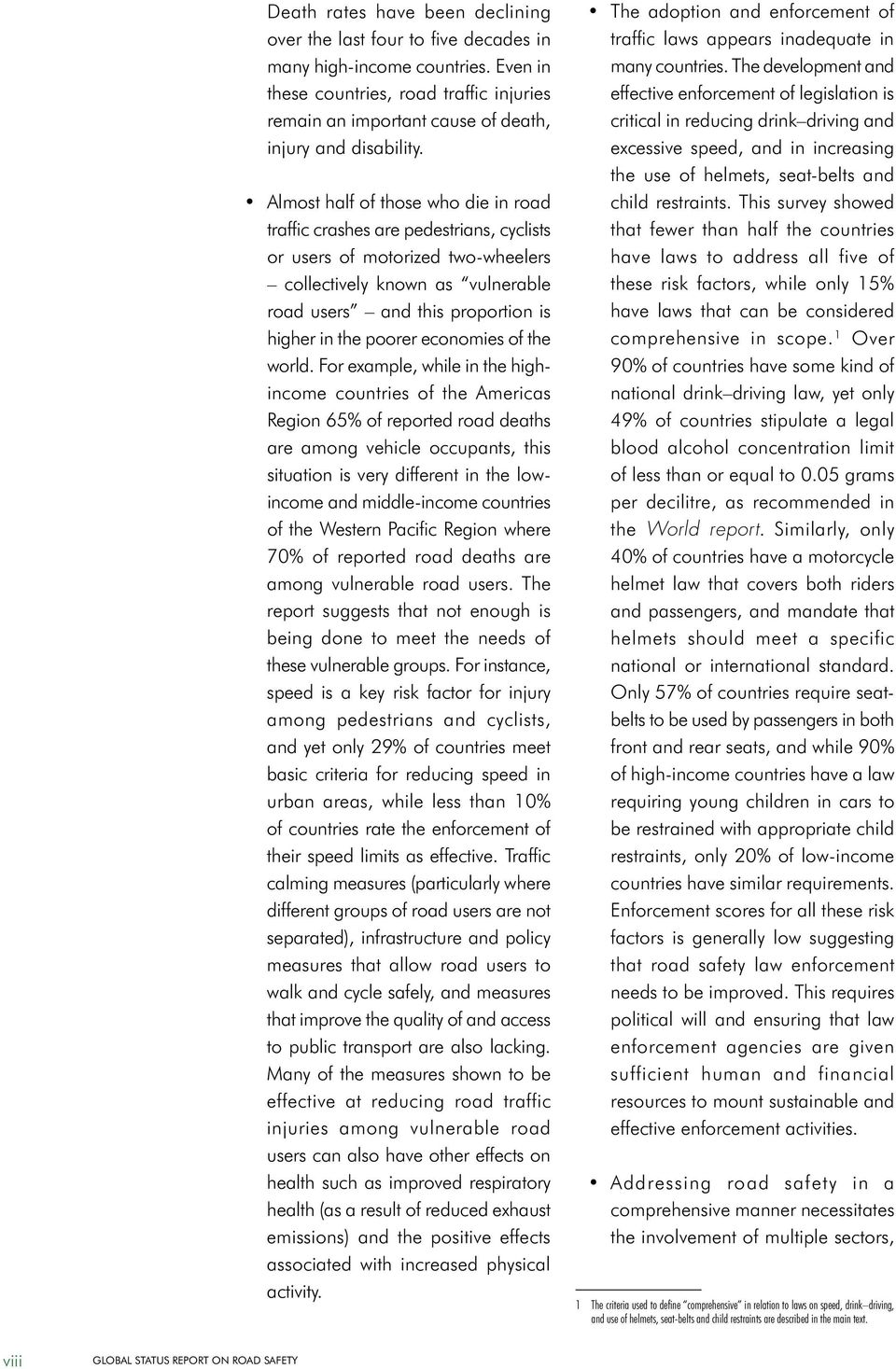
10 police. A coordinated response to the problem includes the development and implementation of a multisectoral strategy on sufficient finances for planned specified timeframe. While many have a national road safety strategy that has funding allocated for its implementation. and coverage of the data that countries collect and report on road traffic injuries. Reliable data are needed by countries to assess the scope of the road traffic injury the effectiveness of intervention traffic fatalities remains a big crash and death are used to define a information on the extent of their road traffic injuries the fifth leading cause of death by Leading causes of death, 24 and 23 compared TOTAL 24 TOTAL 23 RANK LEADING CAUSE % RANK LEADING CAUSE % 1 Ischaemic heart disease Ischaemic heart disease Cerebrovascular disease Cerebrovascular disease Lower respiratory infections 7. 3 Chronic obstructive pulmonary disease 7. 4 Chronic obstructive pulmonary disease Lower respiratory infections Diarrhoeal diseases Road traffic injuries HIV/AIDS Trachea, bronchus, lung cancers Tuberculosis Diabetes mellitus Trachea, bronchus, lung cancers Hypertensive heart disease Road traffic injuries Stomach cancer Prematurity and low birth weight 2. 1 HIV/AIDS Neonatal infections and other Nephritis and nephrosis Diabetes mellitus Self-inflicted injuries Malaria Liver cancer Hypertensive heart disease Colon and rectum cancer Birth asphyxia and birth trauma Oesophagus cancer Self-inflicted injuries Violence Stomach cancer Alzheimer and other dementias Cirrhosis of the liver Cirrhosis of the liver Nephritis and nephrosis Breast cancer Colon and rectum cancers Tuberculosis 1.1 Source: World health statistics 28 ( ix

11 incurred by their health sector or data needed to monitor and evaluate interventions accurately. scientific evidence on the steps necessary years have seen an increase in political international attention and support. Global status report needs to be done. Key recommendations consideration the needs of all road that impact on road safety. To users have been neglected in many countries and should be given decisions are made about road and transport services. road users to be protected through enforcement of speed limits that are appropriate to the type and function of blood alcohol concentration limits the use of appropriate occupant practices that are based on sound evidence of effectiveness. penalties and accompanied by critical factor in reducing road traffic improved and sustained. institutions nominated as responsible for action on road safety are fostering multisectoral collaboration and have the necessary human and financial resources to act effectively. sectors involved in collecting and reporting data on road traffic injuries. collection. This Global status report roads. The international community must also play its part in halting and reversing the current global trend of increasing traffic injuries as an important health and development problem and by intensifying support for prevention. x GLOBAL STATUS REPORT ON ROAD SAFETY
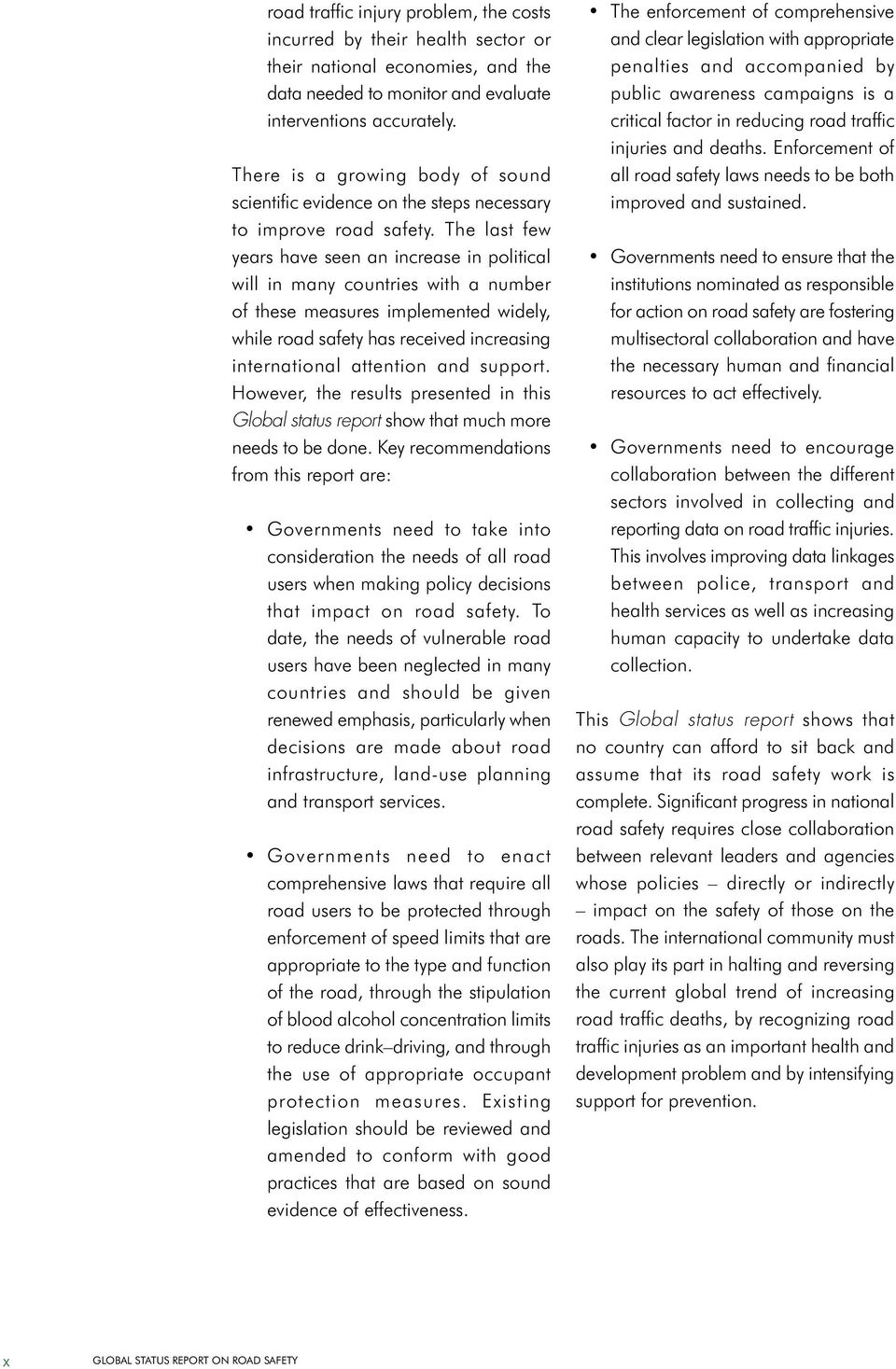
12 1 Road transportation provides benefits both to nations and to individuals by facilitating the movement of goods and people. It enables increased access have direct and indirect positive impacts the increase in road transportation has also placed a considerable burden on a reduction in physical activity. There are from the movement of people and goods and noise. traffic crashes caused over 1.27 million number of motorized vehicles in 1
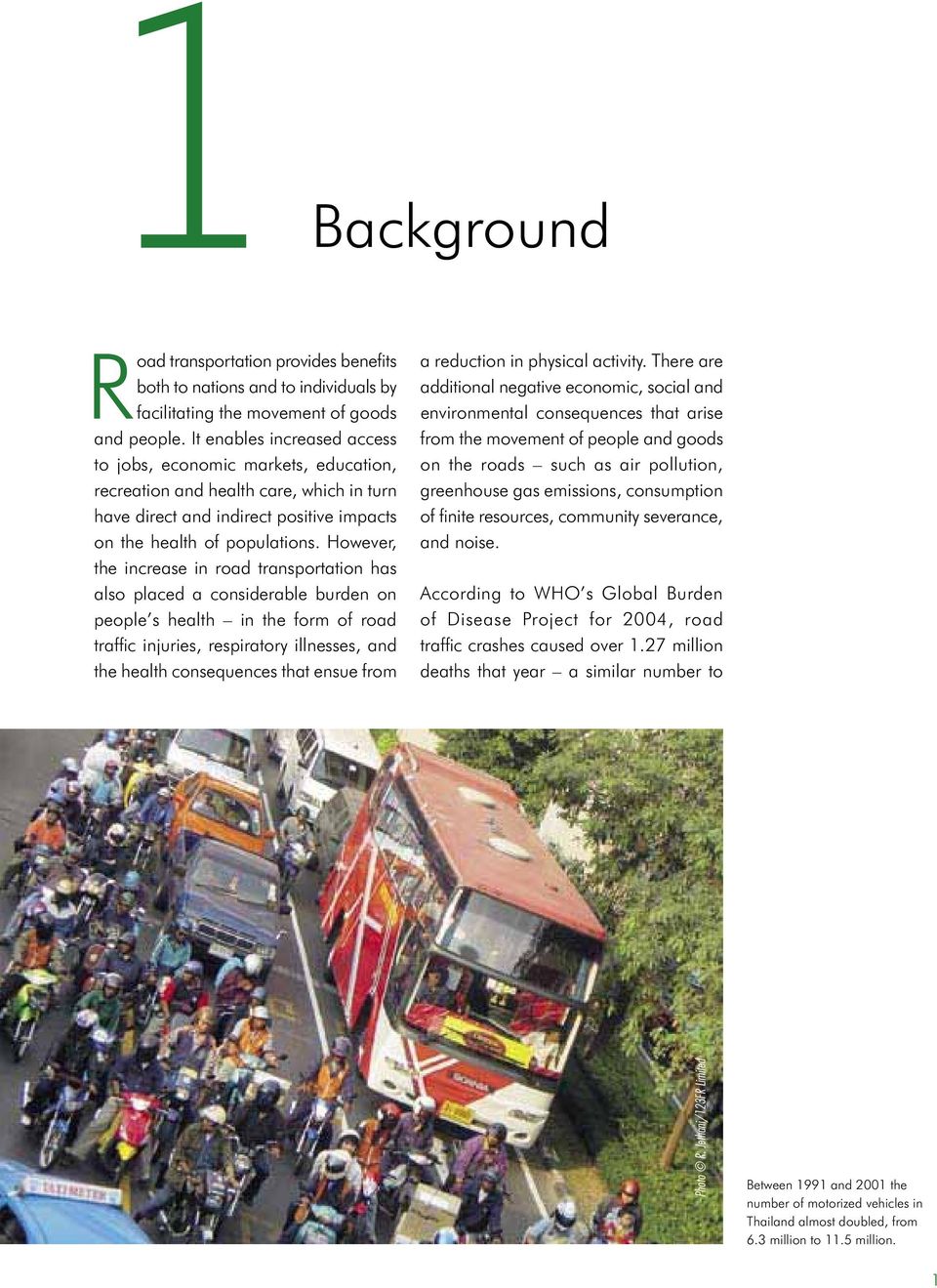
13 those caused by many communicable diseases. Road traffic injuries affect that road traffic injuries are consistently one of the top three causes of death for While road traffic death rates in many the global epidemic of traffic injuries is still increasing. It has been estimated an estimated 2.4 million fatalities per year. injuries are estimated to occur annually injuries are also an important cause of disability in India an estimated 2 million people have a disability that results from a road traffic crash demand for services needed to address disability. The road traffic injury epidemic also has considerable impact on the economies other development needs. The global losses due to road traffic injuries are 1 and than the total amount that these countries receive in development assistance. Persons from poor economic settings are disproportionately affected by road traffic 1 A billion here is used to refer to one thousand million. Road traffic injuries are one of the top three causes of death for people 2 GLOBAL STATUS REPORT ON ROAD SAFETY
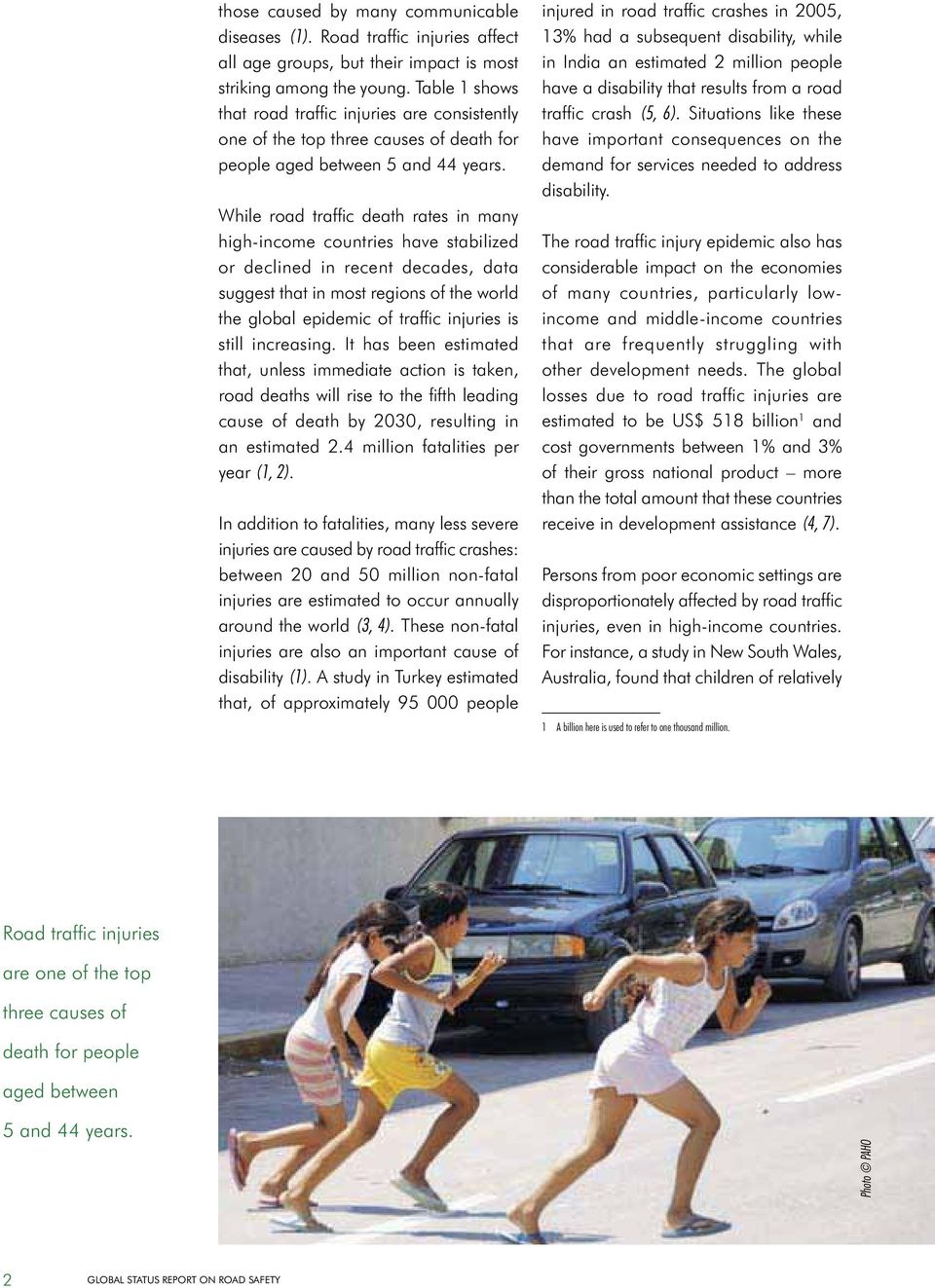
14 Table 1. Leading causes of death by age, world, 24 RANK 4 YRS 5 14 YRS YRS 3 44 YRS YRS 7+ YRS TOTAL 1 Perinatal causes Lower respiratory infections Road traffic injuries HIV/AIDS Ischaemic heart disease Ischaemic heart disease Ischaemic heart disease 2 Lower respiratory infections Road traffic injuries HIV/AIDS Tuberculosis Cerebrovascular disease Cerebrovascular disease Cerebrovascular disease 3 Diarrhoeal diseases Malaria Tuberculosis Road traffic injuries HIV/AIDS Chronic obstructive pulmonary disease Lower respiratory infections 4 Malaria Drownings Violence Ischaemic heart disease Tuberculosis Lower respiratory infections Perinatal causes 5 Measles Meningitis Self-inflicted injuries Self-inflicted injuries Chronic obstructive pulmonary disease Trachea, bronchus, lung cancers Chronic obstructive pulmonary disease 6 Congenital anomalies Diarrhoeal diseases Lower respiratory infections Violence Trachea, bronchus, lung cancers Diabetes mellitus Diarrhoeal diseases 7 HIV/AIDS HIV/AIDS Drownings Lower respiratory infections Cirrhosis of the liver Hypertensive heart disease HIV/AIDS 8 Whooping cough Tuberculosis Fires Cerebrovascular disease Road traffic injuries Stomach cancer Tuberculosis 9 Meningitis Protein energy malnutrition War and conflict Cirrhosis of the liver Lower respiratory infections Colon and rectum cancers Trachea, bronchus, lung cancers 1 Tetanus Fires Maternal haemorrhage Poisonings Diabetes mellitus Nephritis and nephrosis Road traffic injuries 11 Protein energy malnutrition Measles Ischaemic heart disease Maternal haemorrhage Self-inflicted injuries Alzheimer and other dementias Diabetes mellitus 12 Syphilis Leukaemia Poisonings Fires Stomach cancer Tuberculosis Malaria 13 Drownings Congenital anomalies Abortion Nephritis and nephrosis Liver cancer Liver cancer Hypertensive heart disease 14 Road traffic injuries Trypanosomiasis Leukaemia Drownings Breast cancer Oesophagus cancer Self-inflicted injuries 15 Fires Falls Cerebrovascular disease Breast cancer Hypertensive heart disease Cirrhosis of the liver Stomach cancer 16 Tuberculosis Epilepsy Diarrhoeal diseases War and conflict Nephritis and nephrosis Inflammatory heart diseases Cirrhosis of the liver 17 Endocrine disorders Leishmaniasis Falls Falls Oesophagus cancer Breast cancer Nephritis and nephrosis 18 Upper respiratory infections Violence Meningitis Diarrhoeal diseases Colon and rectum cancers Prostate cancer Colon and rectum cancers 19 Iron deficiency anaemia War and conflict Nephritis and nephrosis Liver cancer Poisonings Falls Liver cancer 2 Epilepsy Poisonings Malaria Trachea, bronchus, lung cancers Mouth and oropharynx cancers Road traffic injuries Violence Source: WHO (28), Global Burden of Disease: 24 update. Teenage drivers are at increased

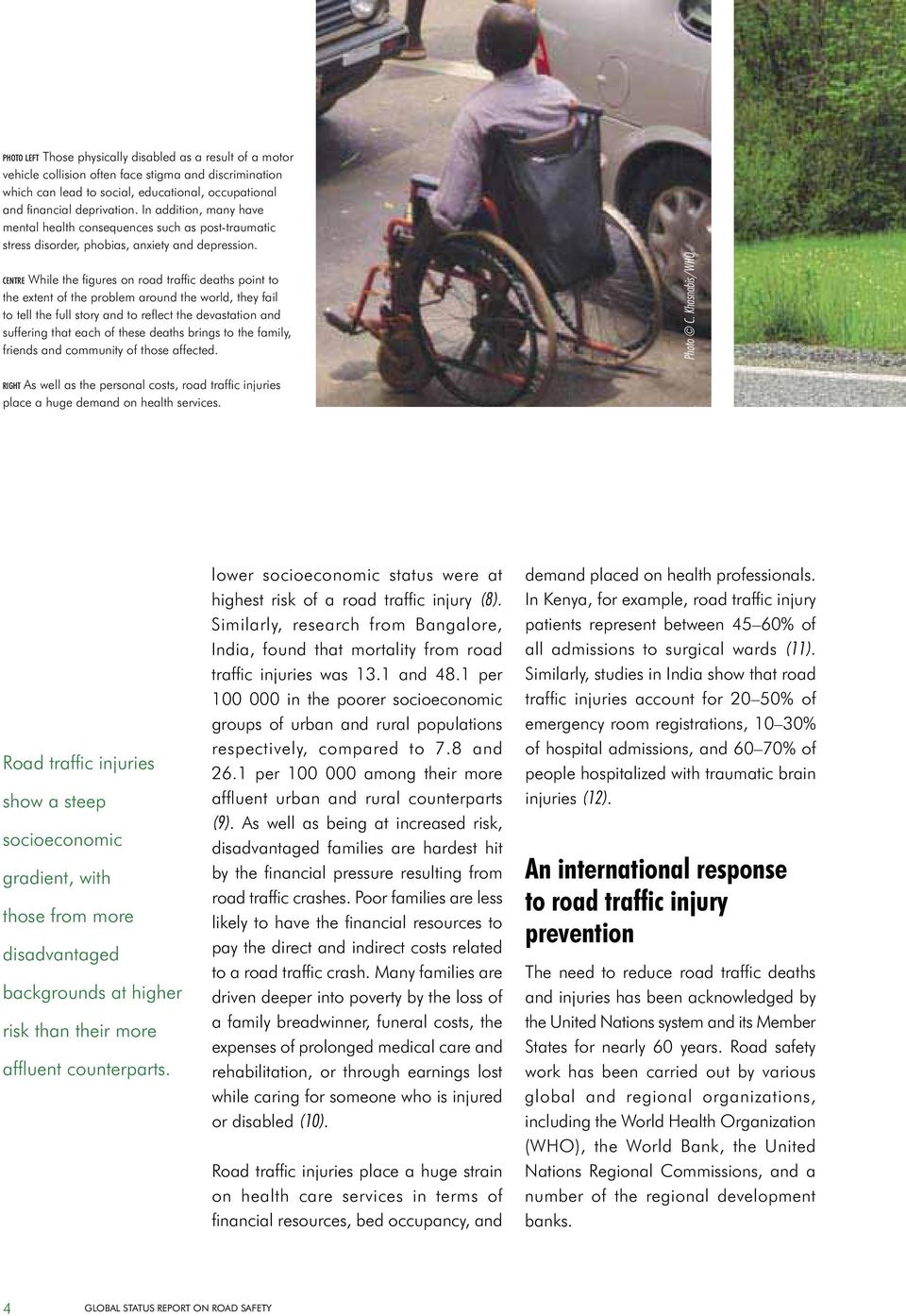
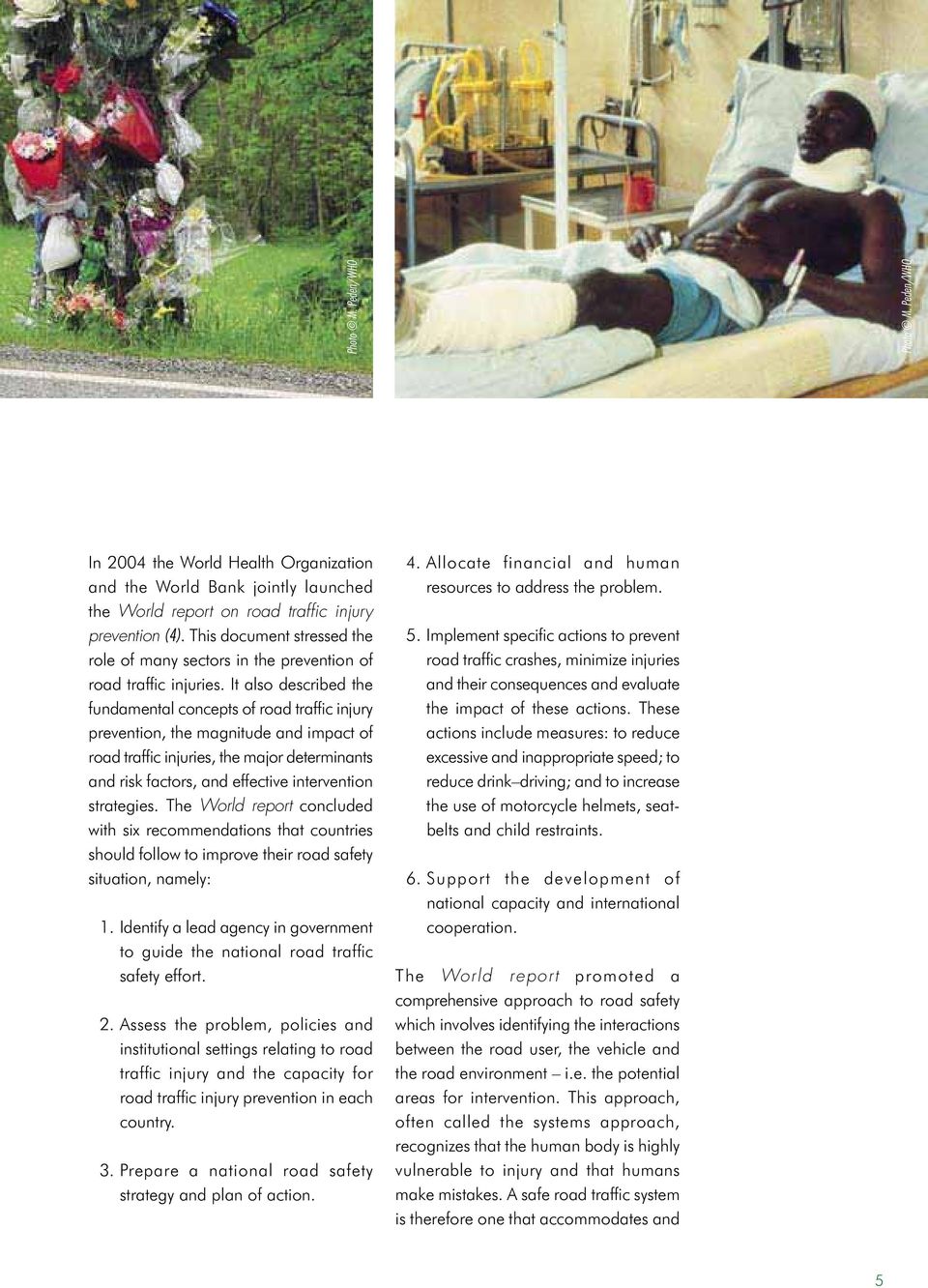
15 PHOTO LEFT Those physically disabled as a result of a motor vehicle collision often face stigma and discrimination CENTRE While the figures on road traffic deaths point to to tell the full story and to reflect the devastation and friends and community of those affected. RIGHT place a huge demand on health services. Road traffic injuries socioeconomic those from more disadvantaged affluent counterparts.. groups of urban and rural populations affluent urban and rural counterparts disadvantaged families are hardest hit by the financial pressure resulting from road traffic crashes. Poor families are less pay the direct and indirect costs related to a road traffic crash. Many families are driven deeper into poverty by the loss of expenses of prolonged medical care and or disabled. Road traffic injuries place a huge strain on health care services in terms of demand placed on health professionals.. injuries. An international response to road traffic injury prevention The need to reduce road traffic deaths number of the regional development 4 GLOBAL STATUS REPORT ON ROAD SAFETY
16 the World report on road traffic injury prevention. This document stressed the role of many sectors in the prevention of road traffic injuries. It also described the fundamental concepts of road traffic injury strategies. The World report concluded 1. Identify a lead agency in government to guide the national road traffic safety effort. institutional settings relating to road traffic injury and the capacity for road traffic injury prevention in each country. strategy and plan of action. 4. Allocate financial and human resources to address the problem. the impact of these actions. These belts and child restraints. national capacity and international cooperation. The World report promoted a comprehensive approach to road safety recognizes that the human body is highly vulnerable to injury and that humans is therefore one that accommodates and
17 compensates for human vulnerability and approach necessitates the involvement and the close collaboration of a number groups. Fundamental to implementing this approach is the collection of accurate data on the magnitude of road traffic that have made the most progress in road safety are those that have adopted this comprehensive approach. the World report World report and endorsed its recommendations. increase the attention paid to road traffic implementation of the recommendations of the World report in particular. 1 This document reports on the progress made in implementing some of the recommendations of the World report. 1 For the full text of these resolutions, see en/index.html. Figure 1. The systems approach to road safety Source: Adapted from reference 13. GLOBAL STATUS REPORT ON ROAD SAFETY

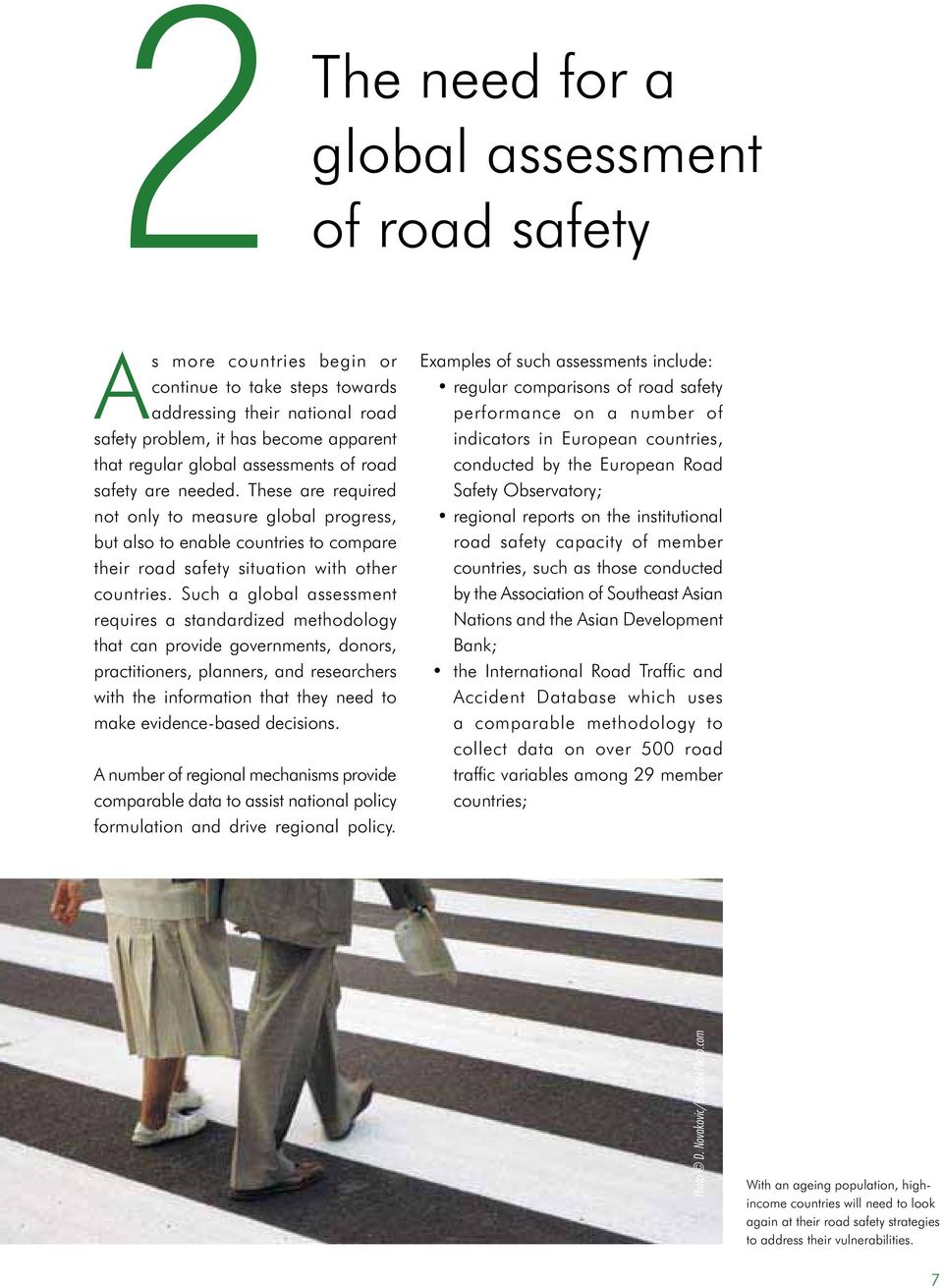
18 2 The need for a global assessment of road safety As more countries begin or addressing their national road that regular global assessments of road but also to enable countries to compare A number of regional mechanisms provide comparable data to assist national policy formulation and drive regional policy. performance on a number of road safety capacity of member a comparable methodology to again at their road safety strategies to address their vulnerabilities. 7
19 such as speed and blood alcohol focus countries. in providing the data needed to advocate for standardized definitions and measures assessment of road safety exists. Previous limited to the analysis of aggregated painted a largely illustrative picture by or have focused on specific aspects of measured regularly. In other areas of health and development such and tuberculosis all have tools and global status of their particular topic on a regular basis. Methodology the Global status report on road safety The specific objectives of the project to assess the status of road safety core set of road safety indicators and priorities for intervention and to stimulate road safety activities at a national level. developed using the recommendations of the World report as a basis for its content. road safety researchers and practitioners of international and regional road 8 GLOBAL STATUS REPORT ON ROAD SAFETY

20 academic institutions. 1 2 institutional settings and policies existence of policies to encourage and public transport and strategies vehicle and infrastructure standards audits of road infrastructure legislation on some of the main enforcement levels relating to each The methodology used for data collection identification in each participating country Figure 2. Methodology 1 national dataset Global Status Report trained and then facilitated a consensus meeting involving a multisectoral group of up to eight road safety experts. The transport and enforcement sectors should be represented among the respondents the involvement of nongovernmental 4 independently and then discuss each of 1 See Acknowledgements section, page v. 2 For the questionnaire and accompanying instruction booklet see injury_prevention/road_safety_status/29 3 This survey reports perceptions of enforcement, as agreed by the group of respondents in the consensus meeting. te that the eight countries that did not hold a consensus meeting did not answer these questions, while some groups of respondents could not come to a consensus on these scores and so left the enforcement questions blank. 4 In the Eastern Mediterranean Region questionnaires were administered during face-to-face interviews. 5 More details on the methodology can be found at road_safety_status/29

21 then sent for government clearance. Most of the data collected through this project are reported in this document. The main text contains an the main variables reported by each participating country using a standard of comparability on some variables affected the ability to analyse and report some of the information received from countries. Table 2. Participation in the survey, by WHO region and income group a WHO REGION NUMBER OF MEMBER STATES AND ASSOCIATE MEMBER STATES COUNTRIES/AREAS PARTICIPATING AFRICAN REGION ( HIC, 11 MIC, 3 LIC) REGION OF THE AMERICAS 36 b (31 Member and Associate Member States, 1 non-member area) 32 (6 HIC, c 26 MIC) SOUTH-EAST ASIA REGION 11 1 ( HIC, 6 MIC, 4 LIC) EASTERN MEDITERRANEAN REGION 21 2 (19 Member States, 1 non-member area) (5 HIC, 12 MIC, 3 LIC d ) 49 EUROPEAN REGION 53 (25 HIC, 21 MIC, 3 LIC) 26 WESTERN PACIFIC REGION 28 e (6 HIC, 15 MIC, 5 LIC) GLOBAL 195 Member and Associate Member States HIC = high-income countries; MIC = middle-income countries; LIC = low-income countries a See Table A.2 in Statistical Annex for information on WHO regions and income level classifications. b Includes one Associate Member State, Puerto Rico. c Includes one non-member area, the British Virgin Islands. d Includes one non-member area, the West Bank and Gaza Strip. e Includes one Associate Member State, Tokelau. 178 (176 Member and Associate Member States, 2 non-member areas) (42 HIC, 91 MIC, 45 LIC) NON-PARTICIPATING MEMBER/ASSOCIATE MEMBER STATES AND % OF REGIONAL POPULATION Algeria, Côte d'ivoire, Equatorial Guinea, Gabon, Guinea (8.8%) Antigua & Barbuda, Dominica, Grenada, Haiti, St. Kitts & Nevis (1.1%) Democratic People's Republic of Korea (1.4%) Djibouti, Somalia (1.7%) Andorra, Denmark, Luxembourg, Monaco (.7%) Niue, Tokelau (< 1%) 19 (accounting for 1.7% of population of the 195 Member and Associate Member States) GLOBAL STATUS REPORT ON ROAD SAFETY
22 3 The state of road safety around the Road traffic injuries remain a global public health problem Road traffic injuries remain an important and national levels. While steps are being rising trend in road traffic deaths is to be halted or reversed. methods has been used by different organizations to estimate the number of estimates that 1.27 million people died as a result of a road traffic collision in that year. The total number of deaths reported in this survey is approximately indicating vast underreporting. When 178 countries included in the study is traffic deaths are among men and that the highest impact is in the economically active age ranges. Figure 3. Population, road traffic deaths a, and registered motorized vehicles, by income group Population Road traffic deaths a Registered vehicles HIC 15.6% HIC 8.5% LIC 9.2% LIC 36.7% MIC 47.8% LIC 41.9% MIC 49.6% MIC 38.7% HIC 52.1% a 3-day definition, modelled data. HIC = high-income countries; MIC = middle-income countries; LIC = low-income countries 11
23 the roads occur in less than half of the Low-income and middle-income countries have the highest burden and road traffic death rates is clearly related to both the population intervention could help significantly to reduce the total number of road traffic deaths at a global level. From a public health perspective and for a more useful measure of the size of a also useful for assessing performance over time and for giving an indication of fatality rates relative to population are 12 GLOBAL STATUS REPORT ON ROAD SAFETY
24 Table 3. Modelled road traffic injury fatality rates (per 1 population), a by WHO region and income group WHO REGION HIGH-INCOME MIDDLE-INCOME LOW-INCOME TOTAL AFRICAN REGION b REGION OF THE AMERICAS c SOUTH-EAST ASIA REGION b EASTERN MEDITERRANEAN REGION EUROPEAN REGION WESTERN PACIFIC REGION GLOBAL a 3-day definition. b high-income countries. c low-income countries. Figure 4. Trends in road traffic fatality rates in selected high-income countries 3 25 Rate per 1 population Year Australia Canada France Japan Sweden United States of America road traffic injury fatality rates well above the average for this income group. For instance, high-income countries in the Eastern Mediterranean Region have a modelled road traffic injury fatality rate of 28.5 per 1 population, which is well above the global average for countries in this broad income group, as shown in Table 3. Similarly, while a number of high-income countries have managed to reduce their road traffic fatality rates in recent decades, in other high-income countries the downward trends in road traffic fatalities that began in the 197s and 198s have started to flatten, suggesting that extra steps are needed to reduce these rates further (see Figure 4). The 1 countries with the lowest modelled road traffic fatality rates are almost all high-income countries, where rates vary between 3.4 and 5.4 deaths per 1 population. While these countries, the Netherlands, Sweden and United Kingdom for instance, may be top performers globally with regard to road safety, they too still have considerable 13
25 and drivers of passengers account for almost half of global road traffic deaths. road traffic injuries are still an important and the successful implementation of a comprehensive approach to the. transport system. Nearly half of those dying on the world s roads are vulnerable road users countries the majority of road users are users do not have a protective shell around them and are therefore more at Vulnerable road users are at additional into consideration during the planning of land use or road construction. In many countries roads are planned and built to insufficient thought is given to the needs that these vulnerable road users face roads. deaths. 1 up the highest reported proportion of regions the proportion of deaths among 1 If users of unsafe public transport are included as vulnerable road users then this figure of 46% is likely to be an underestimate: in this survey data on public transport fatalities was not collected separately from data related to other four-wheeled vehicles. 14 GLOBAL STATUS REPORT ON ROAD SAFETY
26 Box 1: Unsafe public transportation matatus a are almost no restrictions on driver eligibility or on the maintenance of privately operated public transportation vehicles. reduction in safety standards. a Matatus are small-scale public transport service vehicles in Kenya. Figure 5. Reported deaths by type of road user (%), by WHO region and income group a AFRICAN REGION LIC MIC REGION OF THE AMERICAS MIC HIC SOUTH-EAST ASIA REGION LIC MIC EASTERN MEDITERRANEAN REGION LIC MIC HIC EUROPEAN REGION LIC MIC HIC WESTERN PACIFIC REGION LIC MIC HIC % 2% 4% 6% 8% 1% Vulnerable road users Occupants of four-wheeled motorized vehicles Others a See Table A.2 in Statistical Annex for information on WHO regions and income level classifications. HIC = high-income countries; MIC = middle-income countries; LIC = low-income countries
27 PHOTO TOP Poor infrastructure and pedestrians have to share the other modes of transportation. PHOTO BOTTOM Police enforcement and automatic speed enforcement are highly effective measures used to enforce speed limits. vulnerable road users varies considerably. Results of this survey suggest that as motorization increases globally many countries are not giving sufficient attention to the needs of vulnerable groups of road users in their transport policies. Many of the proven interventions being implemented globally such as relevant to car occupants. More research is needed on interventions that address planning and road design should also consideration. both vehicle occupants and vulnerable appropriate speed limits is essential. countries rate their speed enforcement death on the road can also be achieved by reducing the total amount of motorized considerable investment in infrastructure Reducing the volume of traffic on roads being used by vulnerable road users can on the use of private cars. This survey and cycling as an alternative to motorized transport. GLOBAL STATUS REPORT ON ROAD SAFETY
28 Box 2: Land use and transport planning needs of vulnerable road users in planning for land use and transport. Bogota implemented land use and transport measures intended to meet the road users and to improve public excluding cars from the city centre capacity bus system at a cost of measures contributed to reducing the number of road traffic fatalities They also improved access to jobs and created a more liveable urban environment. Sweden s model of road safety is The Vision Zero road safety based on an understanding that the environment needs to be modified tolerance to mechanical forces and Bogota s high-capacity bus system. thus aims to modify the environment as building bicycle and pedestrian are being implemented to separate and protect these road users. Where give pedestrian safety priority over speed. Delhi bus lanes on a major arterial road of the city. The pedestrian lane has consideration has been given to Cable barriers are used in a number of high-income countries and have been shown to be cost effective at reducing head-on collisions on highways. motorcycle or bicycle fatalities in the corridor. Lagos transportation. The public transport system largely consists of minibuses substantially to pollution and road government created an agency the mission to transform the state transport system by facilitating completed and launched in March reliable and safe means of getting around the city. Designed spaces for street vendors in Delhi, India, are part of a new initiative that gives road space to different groups of vulnerable road users. 17
29 countries report their enforcement of speed limits as over 7 on a scale that encourage public transport as an similar neglect in meeting the needs of perhaps surprising given that decreased dependency on the use of private cars can have other positive impacts such as Few countries have comprehensive road safety laws that are well enforced traffic injuries and deaths is critical crash injury outcomes. Comprehensive appropriate penalties and accompanied reducing road traffic injuries and deaths survey suggest that the legislation on to implement planned activities in may result in a piecemeal approach to road safety efforts that is seen in many Speed What is known? An increase in average speed is of a crash occurring and to the.. above. types of collision and different other variables into account. vulnerable road users are particularly. Apart from reducing road traffic average traffic speed can have other positive effects on health outcomes What this survey found Research on effective speed management indicates that the speed limits on urban While there remains a fairly high fatality road safety records have adopted this authority to reduce these national speed 18 GLOBAL STATUS REPORT ON ROAD SAFETY
30 Box 3: A coordinated approach to road safety The World report on road traffic injury prevention World report also recommends that each country should prepare a multisectoral national road safety allocated to ensure implementation of relevant activities. difficulty that they had during the consensus meetings in identifying the lead agency for road safety in their country. countries have urban speed limits authorities to reduce them further.
31 Figure 6. Proportion of countries by urban speed limit range in 174 countries 71 9 km/h (6%) 51 7 km/h (29%) >9 km/h (2%) <5 km/h (62%) reducing road traffic injuries can be made and implemented at the subnational level the results of this survey the criteria used for assessing urban speed management speed limits on urban roads are set The results suggest that urban speed management is poor in many countries. local authorities to reduce national speed of participating countries meet both reduce the national speed limits. Figure that in most countries additional efforts to reduce urban speed limits are still needed. the enforcement of their national speed WHAT CAN BE DONE 4 Countries need to set speed limits that reflect the function of individual roads. In doing so, they should consider the types of vehicles using the road, the nature and purpose of the road, roadside activities, provision of facilities for vulnerable road users, and the frequency of use by pedestrians and cyclists. Increased priority should be given to vulnerable road users, notably in urban areas, where speed limits should not exceed 5 km/h. 4 Local authorities need to be given the authority, resources and political support to implement measures to reduce speed limits to levels that may be lower than national limits where vulnerable road users are particularly at risk. 4 Programmes put into place to address speeding need to foster a public awareness and understanding of the effects of speeding and the reasons for enforcing speed limits. GLOBAL STATUS REPORT ON ROAD SAFETY
32 Drinking and driving What is known? result. increases significantly above a blood. in the number of crashes involving young people.. What this survey found participating countries report having World report do not have BAC limits or have limits that World report advised that BAC limits for this group and most of these countries are in the Figure 7. Blood alcohol concentration limits (g/dl) by country/area.5 >.5 Laws at subnational level limit stipulated law data 21
33 PHOTO LEFT Alcometers are part of the Mexican CENTRE injuries but do not prevent a crash from occurring. involving motorcyclists from occurring. RIGHT campaigns and extensive helmet distribution. alcohol concentration report that they use one or both of these over 7. WHAT CAN BE DONE 4 All countries should have a drink driving law and should strictly enforce it. 4 s should be based on blood alcohol concentration, or the equivalent breath alcohol content limits, which should be.5 g/dl or below. 4 All countries should set limits of.2 g/dl or below for young/novice drivers. Use of motorcycle helmets What is known? Wearing a motorcycle helmet.. The effectiveness of motorcycle helmets in reducing head injuries meet a recognized safety standard is important to ensure that helmets can effectively reduce the impact of a collision to the head in the event of a crash. What this survey found participating in this global survey incomplete in many of these countries. 22 GLOBAL STATUS REPORT ON ROAD SAFETY
34 religious headgear. This survey found of engine type 1 and have a comprehensive helmets to meet a specific standard. 1 Some of these have exceptions, such as exempting those for medical reasons or for religious reasons. Figure 8. s and helmet standards by country/area Has a law and standard Has a law but no/unknown standards Laws at subnational level law data
35 are in place is also difficult to ascertain both the reliability and the generalizability WHAT CAN BE DONE 4 All countries should have mandatory laws on helmet use on motorized two- and three-wheelers. 4 These laws should cover all riders who are legally allowed to ride on motorized twoor three-wheelers, all engine types and all road types. 4 Countries need to enact laws requiring helmets to meet a national or international standard. 4 Countries need to establish systems to collect data on rates of helmet-wearing. Seat-belt use What is known?.. What this survey found in the global survey reporting national or income countries and belts to be used in cars 24 GLOBAL STATUS REPORT ON ROAD SAFETY
36 and an enforcement rating of greater The ability to ascertain the effectiveness of countries reported having no data income countries. Although the survey countries that manufacture or assemble and rear seats. WHAT CAN BE DONE 4 Vehicle manufacturers and assemblers should be required to fit seat-belts in both front and rear seats of all vehicles, irrespective of the end market. 4 s must be improved to cover all occupants. 4 Enforcement efforts must be strengthened in many countries and must be equally applied to the occupants of both front and rear-seats in cars. 4 Countries need to establish systems to collect data on rates of seat-belt use. 4 Enforcement efforts must be backed by intensive mass-media education programmes that highlight the risk of injury when not wearing a seat-belt and increase the perceived likelihood of being detected and penalized. Figure 9. s by country/area National law applies to all car occupants Law at subnational level law or law does not apply to all car occupants data
37 Use of child restraints What is known? and death in the event of a collision. developmental stage in mind. They reduces the chance of a severe injury occurring. restraints reduce deaths among. their enforcement lead to an increase in the use of child restraints. What this survey found The global survey found that just under report any legislation at all on the use of this figure hides considerable variation the results of the survey suggest that on the use of child restraints report enforcement as being above 7 on a of all participating countries have a child and rate its enforcement as indicates that the prohibitive cost of child restraints in many countries is also an important factor that affects usage. child restraints for young children in vehicles. GLOBAL STATUS REPORT ON ROAD SAFETY
38 Figure 1. Child restraint legislation by country/area National child restraint laws Laws at subnational level law data WHAT CAN BE DONE 4 Child restraint laws need to be enacted and enforced. These laws should specify the type of restraint, the child s age for which each restraint is appropriate, and the seating position. 4 Mechanisms should be established to improve access to affordable child restraints. 4 Countries need to establish systems to collect data on rates of child restraint use. 4 Programmes to increase use of child restraints need to address social norms and encourage a culture of safety. The public needs to be aware of the safety benefits of using child restraints. Legislation: summary to be done. Although all countries reported national or subnational legislation related to countries have national or subnational still incomplete in its coverage in many road users to be protected by means of appropriate occupant restraints and to respect alcohol and speed limits that loopholes are avoided that could exempt 27
39 of appropriate measures and penalties organizations and other civil society groups can play an important role in generating public and political support for campaigns that both highlight the safety and also increase the perception of of the penalties for not respecting them Few countries have reliable data on road traffic injuries to developing a systems approach to road safety. A comprehensive assessment of the magnitude of road traffic injuries should consider not only mortality but also of interventions. provide essential information to governments in targeting their interventions and in evaluating the effectiveness of their current national road safety programmes. These include the proportion of road traffic deaths that plus data on monitoring and evaluation indicators such as rates of helmet Data on fatalities a standardized definition of a road traffic range of definitions for a road traffic death. These definitions use different time and include or exclude different types of road users. The same definitions are also country. The current recommended definition of a road traffic fatality for harmonization of surveillance purposes is any person killed immediately or dying within 3 days as a result of a road traffic injury accident increase in surveillance efforts. indicate that this goal remains largely unattained. The time periods used in range from died at the scene of the from a road traffic crash regardless of the time that has elapsed. At the global level 28 GLOBAL STATUS REPORT ON ROAD SAFETY
40 definitional issues can be overcome harmonization and comparison purposes same definition. for many years as another important competing priorities and availability of resources. Figure 11. Time period used to define a road traffic fatality by country/ area and income group Other Within 1 year Within 3 days Within 7 days Within 24 hours On the scene Number of countries HIC MIC LIC HIC = high-income countries; MIC = middle-income countries; LIC = low-income countries be used to obtain a minimum injuries.
41 The extent of underreporting is also countries these types of crashes are and employed and extrapolated. health care facilities. in data collected by the police and transport sectors compared to health. countries used health data as a source reported data on road traffic fatalities on the basis of police records only. All the above complexities limit a number of mechanisms have been developed to try to address some of the data more comparable. In this global difference globally. Figure 12. Proportion of countries using different data sources for road traffic fatalities data (2%) Health (7%) Other (15%) Statistics (9%) Police (5%) Linked to health/ other sector (7%) Transport (11%) GLOBAL STATUS REPORT ON ROAD SAFETY
42 Table 4. Road traffic deaths by WHO region using reported and modelled data REPORTED a MODELLED a RATE PER 1 RATE PER 1 WHO REGION n POPULATION n POPULATION AFRICAN REGION REGION OF THE AMERICAS SOUTH-EAST ASIA REGION EASTERN MEDITERRANEAN REGION EUROPEAN REGION WESTERN PACIFIC REGION GLOBAL a Adjusted for 3-day definition. WHAT CAN BE DONE 4 Encourage the use of the 3-day definition of road traffic fatality for harmonization across data sources. 4 Improve data linkages between police, transport and health sectors. 4 Increase human capacity to undertake data collection, analysis and interpretation. 4 Improve the use of ICD 1 coding in vital registration to adequately reflect road traffic deaths. 1 The International Classification of Diseases (ICD) is used to classify diseases and other health problems recorded on many types of records, including death certificates and health records. The most recent (1th) revision of the ICD codes came into use in 1994 but some countries still use previous versions. Data on non-fatal injuries it provides a complete picture of the hospital admissions and rehabilitation. up a sophisticated injury information type of casualty register or repeated are probably even more complex than those relating to data on deaths. Reliable assessment of the severity of employ hospital staff to code injuries databases. of severity of an injury is recorded by the police at the site of the crash. This results in less reliable categorization of others have longer admission times.
43 PHOTO LEFT Training police in Addis Ababa on data government to improve estimates of road traffic injury fatalities. CENTRE RIGHT in France. The majority of countries do not have robust data on injuries. so the category of serious can range seen in an accident and emergency room applied to the global total of 1.27 million enough to be seen in an emergency room. This supports previous estimates million. WHAT CAN BE DONE 4 The data collected by the health sector need to be improved. This is particularly true with regard to data on non-fatal injuries. This can take the form of discharge data using ICD coding, injury surveillance systems or, where this is not feasible, intermittent surveys or casualty registers which collect only minimum data. 4 There is a need for standard definitions of levels of severity of non-fatal injuries to allow them to be accurately recorded and collated. The definitions should be simple enough to be administered by both health and non-health personnel. 4 Countries should be encouraged to link all data sources on road traffic injuries in order to help address underreporting. GLOBAL STATUS REPORT ON ROAD SAFETY
44 Box 4: Pre-hospital care traffic injuries by strengthening trauma care services across the spectrum save the lives of many injured persons. private ambulance companies cannot be accessed unless one has medical Where no pre-hospital trauma care system exists, trained community members can provide first aid. countries.
45 Data on economic costs Considerable economic and social costs caused by road traffic crashes. The survey countries have conducted a study on Most surveys are not national but based on a sample and are usually conducted in a teaching generalizability. most common method used to assess costs. While this type of costing is important indirect costs that need to be included if the true cost to society is to be calculated. studies are important for internal regard to comparisons in terms of the the different currencies used and the country level is extremely important crashes on all the sectors involved and for convincing politicians to invest in to countries. WHAT CAN BE DONE 4 Countries should be encouraged to conduct national studies on the costs of road traffic crashes as well as on the cost-effectiveness of interventions they put into place. 4 Where possible, costing should include both direct and indirect costs. Table 5. Countries with one or more studies on the economic cost of road traffic crashes by WHO region DEATHS AND INJURIES DEATHS ONLY INJURIES ONLY OTHER TYPES OF STUDIES COUNTRIES REPORTING AT LEAST 1 STUDY WHO REGION n n n n n AFRICAN REGION REGION OF THE AMERICAS SOUTH-EAST ASIA REGION EASTERN MEDITERRANEAN REGION EUROPEAN REGION WESTERN PACIFIC REGION ALL GLOBAL STATUS REPORT ON ROAD SAFETY
46 Data on monitoring and evaluation recently adopted targets although these have yet to be reflected at country level. Targets are not the only method of monitoring or evaluating progress. Pages of proven interventions that are critical to improving road safety. These include and child restraints. While some countries have put into systems to collect data on monitoring or evaluating the success of these measures at a national level. Table 6. Countries with targets included in their road safety strategies by WHO region and income level WHO REGION LOW-INCOME MIDDLE-INCOME HIGH-INCOME TOTAL AFRICAN REGION a REGION OF THE AMERICAS b SOUTH-EAST ASIA REGION a EASTERN MEDITERRANEAN REGION EUROPEAN REGION WESTERN PACIFIC REGION GLOBAL a high-income countries. b low-income countries. Figure 13. Levels of motorcycle helmet wearing in 6 countries a 59% % of countries 17% 3% 22% % motorcycle helmet wearing (range) 24% 25 49% 5 74% 75 1% their generalizability. methodologies used are similar to those a In 51 countries this estimate was based on an observational study, the source of which is noted in the country profiles. In 9 countries the estimated wearing rate is the opinion of the consensus group. Figure 14. s in 95 countries a 21% 18% % of countries 4% 7% 14% % seat-belt wearing (range) <3% 3 49% 5 69% 7 89% >9% a In 86 countries this estimate was based on an observational study, the source of which is noted in the country profiles. In 9 countries the estimated seat-belt wearing rate is the opinion of the consensus group.
47 cent of countries reported having no data The proportion of deaths related to alcohol reported in this study varies from countries have any data on the proportion of road traffic deaths attributable to only have data from more sophisticated the basis of the information. Figure 15. Proportion of alcohol-related fatal crashes in 93 countries a 15% % alcohol-relatedness 11% (range) 3% <5% 28% 5 9% 11% % of countries 15% 17% 1 19% 2 29% 3 39% 4 49% >5% a In 9 countries this estimate was based on official data, the source of which is noted in the country profiles. In 3 countries the proportion given is the opinion of the consensus group. WHAT CAN BE DONE 4 Countries need to step up efforts to collect robust data on a number of intermediate indicators that relate to road traffic injury prevention and that can be used for monitoring and evaluation research. These include: rates of helmet use; rates of seat-belt use; the proportion of drivers with blood alcohol concentration over the legal limit; rates of child restraint use. 4 While high-income countries often use sophisticated survey methodology, basic helmet and seat-belt wearing surveys are relatively simple and cheap to conduct. Surveys are essential for comprehensive monitoring to take place. 4 These data are pivotal to making policy decisions based on evidence, and to evaluating measures that are put in place. 4 The health sector should play an important role in research related to risk factors. GLOBAL STATUS REPORT ON ROAD SAFETY
48 4 Conclusions Strengths and weaknesses of this survey global assessment of road safety. It brings population. It brings road safety into line their progress over time compared to that of other countries. increase the accuracy and completeness
49 Coordinators reported that the consensus practitioners from different sectors had met to discuss road safety. As a result of and are already being used to facilitate regional collaboration. reporting data from different years data in some countries came from the factors are enacted at national measures are often carried out at the subnational or local level. a number of potential biases. In perception of enforcement of the legislation on Key messages and recommendations This survey covered the magnitude of road of enforcement of legislation at a country level. The main findings are summarized approximately half of all road traffic countries in Asia. their scope. perceived to be suboptimal in many countries. insufficiently developed or resourced in many countries to be effective. report the existence of a national of countries report government endorsement of the strategy that has both precise targets and sufficient success of a strategy. GLOBAL STATUS REPORT ON ROAD SAFETY
50 data that countries collect and report indicator in terms of assessing monitoring and evaluation indicators consideration the needs of all road that impact on road safety. To users have been neglected in many countries and should be given decisions are made about road planning and transport services. road users by setting speed limits that are appropriate to the type and blood alcohol concentration limits practices that are based on sound evidence of effectiveness. the use of appropriate measures and penalties for infringement. 4. Countries need to encourage collaboration among different sectors involved in collecting and reporting road traffic injury data. This involves institutions that have been nominated on road safety have the necessary human and financial resources to act effectively. The evidence suggests that the development and endorsement for implementation are important road safety goals. The results of this survey can be used as a tool to inform policy decisions in alongside implementation and evaluation of the good practice manuals developed Collaboration. The results can also be used to leverage political support and resources for safer road transportation for Decade of Action
51 on Road Safety such a decade could be an important opportunity to further catalyse action. The results of this Global status report and the gaps it has identified should during the Ministerial Conference on activities envisaged in the context of the Decade of Action. An increasing body of research level commitment has been evidenced by various international resolutions and community must continue to recognize road traffic injuries as an important health and development issue and intensify support for their prevention. GLOBAL STATUS REPORT ON ROAD SAFETY
52 References 1. The Global Burden of Disease: 24 update 2. World health statistics 28 The Global Burden of Disease 2 project: aims, methods and data sources World report on road traffic injury prevention Road traffic accidents and disability: A cross-section study from Turkey. Disability and Rehabilitation Road traffic injury prevention in India Estimating global road fatalities Child Care Health and Development The involvement and impact of road crashes on the poor: Bangladesh and India case studies Guidelines for estimating the cost of road crashes in developing countries Injury Prevention and Safety Control The National Medical Journal of India Road safety Partnership program. Shared responsibility Accident Analysis & Prevention Accident Analysis & Prevention 178. Urban transport, environment and equity: The case for developing countries World Policy and Practice East African Medical Journal 41
53 Injury Prevention Planners Tabloid Urban transport development: a complex issue Sub-Saharan Africa Transport Policy Program SSATP Newsletter no 6 Traffic safety dimension and the power model to describe the effect on speed safety Speed, speed limits and accidents 27. Transport Research Centre. Speed management report Ajonopeudet ja jalankulkijan turvallisuus [Driving speeds and pedestrian safety] The effect of 2 mph traffic speed zones on road casualties in London, Proceedings of the 16th International Conference on Alcohol, Drugs and Traffic Safety, Montreal, 4 9 August 22 Proceedings of the 16th International Conference on Alcohol, Drugs and Traffic Safety, Montreal, 4 9 August 22 American Journal of Preventive Medicine American Journal of Preventive Medicine Traffic Injury Prevention The Cochrane Database of Systematic Reviews American Journal of Public Health Injury Prevention Helmets: a road safety manual for decision-makers and practitioners The handbook of road safety measures Seat-belts and child restraints: increasing use and optimising performance 42 GLOBAL STATUS REPORT ON ROAD SAFETY
54 41. Motor vehicle occupant protection facts 26 Injury Prevention Seat-belts and child restraints: a road safety manual for decision-makers and practitioners American Journal of Preventive Medicine Glossary of transport statistics IRTAD special report. Underreporting of road traffic casualties Journal of the Royal Statistical Society The Abbreviated Injury Scale: 199 revision The Journal of Trauma International statistical classification of diseases and related health problems, tenth revision Injury surveillance guidelines
55
56 Country profi les
57
58 Background The country profiles in this section present a selection of information about road safety as reported by each of the Methodological variations Global status report on road safety for Terminology and interpretation follow-up questions depending on their Road classifications according to the definitions used in the country concerned. effectiveness of enforcement of various elements of reach consensus on an enforcement score. These scores are therefore subjective and should be seen only the intensity of the enforcement may vary at different times. Blood alcohol concentration (BAC) limits refer to the maximum amount of alcohol that is legally acceptable 47
59 rates of helmet wearing and/or seat-belt use footnotes. motorcycle helmet law vehicle standards data collection process. Presentation of data Country profiles contain data reported been used. In the charts presenting data on deaths by road user category The standard colour coding of the pie charts Cyclists Pedestrians Trend graphs provided many decades of trend data. Where the primary source of information Information about the number of vehicles in the country includes only registered vehicles respondents noted that a substantial proportion of the vehicle fleet may not be registered. 48 GLOBAL STATUS REPORT ON ROAD SAFETY
60 AFGHANISTAN Population: Income group: Low Gross national income per capita: $319 in national budget Reported road traffic fatalities (27) c Reported non-fatal road traffic injuries (27) d c Police data, defi ned as died within 1 year of the crash. d Police data. 5 km/h 1. g/dl b. g/dl b 1 NOT AVAILABLE a Enforcement score represents consensus based on professional opinion of respondents, on a b Alcohol consumption prohibited by law. car manufacturers NOT AVAILABLE total (28) Motorcars Motorized 2- and 3-wheelers Minibuses, vans, etc. (seating <2) Trucks Buses 59% 12% 2% 1% 8% Data not available. Data not required/not applicable. 49 Data cleared by the Ministry of Public Health.
61 ALBANIA Population: Income group: Middle Gross national income per capita: $3 29 Interministerial Committee of Road Safety in national budget Reported road traffic fatalities (27) 384 d (77% males, 23% females) Reported non-fatal road traffic injuries (27) e d Police data, defined as died at the crash scene. e Police data. 4 km/h 9.5 g/dl.5 g/dl 5% b 8 3% Front c a Enforcement score represents consensus based on professional opinion of respondents, on a b 27, Internal Affairs Ministry (Directory of Road Police). c 1996, Citizen Society of Road Safety, data from pilot cities. car manufacturers Deaths per 1 population Pedestrians (4%) Cyclists (6%) Year Source: Ministry of Internal Affairs (Road Police Directory) and Ministry of Transport (General Directory of Road Transport) total (27) Motorcars Motorized 2- and 3-wheelers Minibuses, vans, etc. (seating <2) Trucks Buses Drivers 4-wheelers (24%) Passengers 4-wheelers (22%) Riders motorized 2- or 3-wheelers (9%) Source: 26, Ministry of Transport 68% 7% 8% 12% 5% Data not available. Data not required/not applicable. 5 Data cleared by the Ministry of Health.
62 ANGOLA Population: Income group: Middle Gross national income per capita: $2 56 in national budget a t formally endorsed by government. National Directorate of Road Traffic a Reported road traffic fatalities (27) c Reported non-fatal road traffic injuries c Transport data, defi ned as died at the crash scene. Enforcement b Enforcement b Enforcement b Enforcement b Enforcement b b Enforcement score represents consensus based on professional opinion of respondents, on a car manufacturers km/h Number of road traffic deaths NOT AVAILABLE Year Source: National Directorate of Road Traffi c Data not available. Data not required/not applicable total (27) Registered vehicle types: data not available Data cleared by the Ministry of Health.
63 ARGENTINA Population: Income group: Middle Gross national income per capita: $6 5 in national budget National Road Safety Agency 4 6 km/h.5 g/dl.5 g/dl 13% b 48% b, c a Enforcement score represents consensus based on professional opinion of respondents, on a b 25, Argentina National Risk Factor survey. c Front seats only. Car manufacturers required to adhere to standards on Fuel consumption Seat-belt installation for all seats (subnational) Reported road traffic fatalities (26) 4 63 d (75% males, 25% females) Reported non-fatal road traffic injuries (27) e (deaths and injuries) d Health data, defined as died at the scene of the crash. National Registry of Transit Records (RENAT) reported deaths in 27. e Health data. Unspecified (23%) Pedestrians (19%) Number of road traffic deaths Cyclists (6%) Occupants 3- and 4-wheelers (42%) Riders motorized 2-wheelers (1%) Source: Ministry of Health Argentina, Year Source: The Health Statistics and Information Office, the Department of Policies, Regulation, and Institutes at the National Ministry of Health, Argentina Data not available. Data not required/not applicable total (27) Registered vehicle types: data not available Data cleared by the Ministry of Health.
64 ARMENIA Population: Income group: Middle Gross national income per capita: $2 64 Road Police of the Police of the Republic of Armenia in national budget Reported road traffic fatalities (27) 371 c (75% males, 25% females) Reported non-fatal road traffic injuries (27) 2 72 d c Police data, no specified time period. d Police data. 6 km/h 5.8 g/dl.8 g/dl 6% b 5 a Enforcement score represents consensus based on professional opinion of respondents, on a b 27, Road Police of the Police of the Republic of Armenia. car manufacturers Pedestrians (39%) Number of road traffic deaths Cyclists (<1%) Drivers 4-wheelers (34%) Source: 27, Road Police of the Police of the Republic of Armenia Passengers 4-wheelers (26%) Year Source: Road Police of the Police of the Republic of Armenia total (27) Motorcars Buses Other 79% 7% 15% Data not available. Data not required/not applicable. 53 Data cleared by the Ministry of Health.
65 AUSTRALIA a a Questionnaire completed by National Data Coordinator (no consensus meeting). Population: Income group: High Gross national income per capita: $35 96 Department of Infrastructure, Transport, Regional Development and Local Government in national budget Enforcement b (subnationally) Reported road traffic fatalities (27) i (73% males, 27% females) Reported non-fatal road traffic injuries (25 26) j (deaths and injuries) i Transport data, defined as died within 3 days of the crash. j Health and Transport data, hospitalized cases only. Enforcement b Enforcement b Enforcement b Enforcement b (subnational).5 g/dl c..2 g/dl d 3% e (subnational) f f (subnational) g 97% Front, 92% Rear h (subnational) Cyclists (3%) Riders motorized 2- or 3-wheelers (15%) Pedestrians (13%) Passengers 4-wheelers (21%) Drivers 4-wheelers (49%) Source: 27, Department of Infrastructure, Transport, Regional Development and Local Government: Monthly Road Death Series b Enforcement score represents consensus based on professional opinion of respondents, on a c national limit, but all states and territories have a consistent BAC limit of.5 for general population. d For young provisional drivers, all states and territories have a zero BAC requirement, with exception of one territory with a BAC limit of.2 g/dl. e , Transport data. f national law, but all states and territories require motorcycle helmets for all riders and compliance with a helmet standard. g national law, but all states and territories require the use of seat-belts by all vehicle occupants. h 26, Transport data, national survey. Car manufacturers required to adhere to standards on Fuel consumption Seat-belt installation for all seats Deaths per 1 population Year total (27) Motorcars Motorized 2- and 3-wheelers Minibuses, vans, etc. (seating <2) Trucks Buses Source: 28, Department of Infrastructure, Transport, Regional Development and Local Government 78% 4% 15% 3% <1% Data not available. Data not required/not applicable. 54 Data cleared by the Department of Infrastructure, Transport, Regional Development and Local Government.
66 AUSTRIA Population: Income group: High Gross national income per capita: $42 7 in national budget Austrian Road Safety Council 5 km/h 7.5 g/dl.1 g/dl 8% b c 95% d 89% Front, 49% Rear d a Enforcement score represents consensus based on professional opinion of respondents, on a b 27, Statistics Austria. c Some exceptions. d 27, Austrian Road Safety Board survey. Car manufacturers required to adhere to standards on Fuel consumption Seat-belt installation for all seats Number of road traffic deaths Reported road traffic fatalities (27) 691 e (77% males, 23% females) Reported non-fatal road traffic injuries (27) f (deaths and injuries) e Statistics Austria, defined as died within 3 days of the crash. f Statistics Austria. Pedestrians (16%) Cyclists (5%) Riders motorized 2- or 3-wheelers (17%) Passengers 4-wheelers (14%) Other (3%) total (27) Motorcars Motorized 2- and 3-wheelers Trucks Buses Other Drivers 4-wheelers (45%) Source: 27, Ministry of Internal Affairs & Statistics Austria Year Source: Ministry of Internal Affairs and Statistics Austria 73% 11% 14% <1% 2% Data cleared by the Federal Ministry of Health, Family and Youth.
67 AZERBAIJAN Population: Income group: Middle Gross national income per capita: $2 55 in national budget State Road Police Reported road traffic fatalities (27) 1 17 c (78% males, 22% females) Reported non-fatal road traffic injuries (27) d c Police data, defined as died within 7 days of the crash. d Police data. 6 km/h 9. g/dl. g/dl 3% b 9 9 a Enforcement score represents consensus based on professional opinion of respondents, on a b 27, State Road Police. Car manufacturers required to adhere to standards on Fuel consumption Seat-belt installation for all seats 9 9 Number of road traffic deaths Pedestrians (38%) Cyclists (1%) Riders motorized 2- or 3-wheelers (1%) total (27) Motorcars Motorized 2- and 3-wheelers Minibuses, vans, etc. (seating <2) Trucks Buses n-motorized vehicles Other Drivers 4-wheelers (28%) Source: 27, Head Department of State Road Police Year Passengers 4-wheelers (31%) Source: Azerbaijan Republic. Trend Data on Road Traffic Accidents in % <1% 2% 16% 4% <1% 1% Data not available. 56 Data cleared by the Ministry of Health.
68 BAHAMAS Population: Income group: High Gross national income per capita: $18 57 in national budget Road Traffic Department Reported road traffic fatalities (27) 5 d (9% males, 1% females) Reported non-fatal road traffic injuries (25) e d Police data, defined as died within 1 year and 1 day. e Health data. 48 km/h 5.8 g/dl.8 g/dl 5% b 1 15% c a Enforcement score represents consensus based on professional opinion of respondents, on a b 27, from hospital reports. c Estimation by consensus group. car manufacturers 3 3 Number of road traffic deaths Cyclists (22%) Riders motorized 2- or 3-wheelers (14%) Passengers 4-wheelers (22%) Year Drivers 4-wheelers (42%) Source: Country questionnaire 27 Source: Ministry of Health Data not available total (27) Registered vehicle types: data not available Data cleared by the Ministry of Transport.
69 BAHRAIN Population: Income group: High Gross national income per capita: $2 61 in national budget Random breath testing and/or police checkpoints General Directorate of Traffic Multiple 5 km/h. g/dl b. g/dl b 8% c 22% d a Enforcement score represents consensus based on professional opinion of respondents, on a b Alcohol consumption prohibited by law. c 27, General Directorate of Traffic. d 28, Ministry of Works. car manufacturers Reported road traffic fatalities (27) 91 e (91% males, 9% females) Reported non-fatal road traffic injuries (27) f (deaths only) e Police data, defined as any death caused directly by road traffic injury, regardless of time period. f General Directorate of Traffic data. Pedestrians (29%) Cyclists (7%) Riders motorized 2- or 3-wheelers (5%) total (28) Motorcars Motorized 2- and 3-wheelers Minibuses, vans, etc. (seating <2) Trucks Buses Other Drivers 4-wheelers (39%) Source: 27, General Directorate of Traffic Deaths per 1 population Passengers 4-wheelers (2%) Year Source: 27, General Directorate of Traffic 81% 1% 13% <1% 2% 3% 27 Data not available. Data not required/not applicable. 58 Data cleared by the Ministry of Health.
70 BANGLADESH Population: Income group: Low Gross national income per capita: $47 in national budget 1 National Road Safety Council a Enforcement score represents consensus based on professional opinion of respondents, on a b Alcohol consumption prohibited by law. car manufacturers 3 25 km/h ne b ne b Number of road traffic deaths Reported road traffic fatalities (26) 3 16 c (89% males, 11% females) Reported non-fatal road traffic injuries (23) 43 d (deaths and injuries) c Police data, defined as died at the crash scene. Respondents concerned this figure greatly underestimates the true number of deaths, citing example of Bangladesh Health and Injury Survey 23, which estimated the annual number of deaths to be d 23, Bangladesh Health and Injury Survey. Other (9%) Drivers 4-wheelers (4%) Passengers 4-wheelers (22%) Riders motorized 2- or 3-wheelers (8%) Cyclists (3%) Pedestrians (54%) Source: National Road Traffic Accident Report 26, Bangladesh Road Transport Authority Year Source: National Road Safety Action Plan 28 21, National Road Safety Council total (27) Motorcars Motorized 2- and 3-wheelers Minibuses, vans, etc. (seating <2) Trucks Buses Other 15% 62% 1% 6% 3% 4% Data not available. Data not required/not applicable. 59 Data cleared by the Directorate General of Health Service.
71 BARBADOS Population: Income group: Middle Gross national income per capita: $11 29 in national budget Multiple Reported road traffic fatalities (27) 38 c (62% males, 37% females) Reported non-fatal road traffic injuries (27) d c Police data, defi ned as died within 1 year of the crash. d Actual data collected by Royal Barbados Police Force. 6 km/h 5 ne b ne b a Enforcement score represents consensus based on professional opinion of respondents, on a b Drink driving not defined by BAC limit. car manufacturers 2 Pedestrians (18%) Riders motorized 2- or 3-wheelers (8%) NOT AVAILABLE total (27) Motorcars Motorized 2- and 3-wheelers Minibuses, vans, etc. (seating <2) Trucks Buses Other Drivers 4-wheelers (24%) Passengers 4-wheelers (5%) Source: 27, Royal Barbados Police Force 82% 2% 8% 4% <1% 4% Data not available. Data not required/not applicable. 6 Data cleared by the Ministry of Health, National Insurance and Social Security.
72 BELARUS Population: Income group: Middle Gross national income per capita: $4 22 Standing Committee by Council of Ministers of Republic of Belarus, Ensuring Road Safety in national budget 6 km/h 6.5 g/dl.5 g/dl 13% b a Enforcement score represents consensus based on professional opinion of respondents, on a b 27, Ministry of Home Affairs. Car manufacturers required to adhere to standards on Fuel consumption Seat-belt installation for all seats 6 Reported road traffic fatalities (27) c (74% males, 26% females) Reported non-fatal road traffic injuries (27) d (deaths and injuries) c Ministry of Home Affairs, defined as died within 3 days of the crash. d Ministry of Home Affairs data. Pedestrians (4%) Cyclists (9%) Drivers 4-wheelers (24%) Riders motorized 2- or 3-wheelers (4%) Source: 27, Ministry of Home Affairs Deaths per 1 population Passengers 4-wheelers (23%) Year Source: Ministry of Internal Affairs of the Republic of Belarus total (27) Motorcars Motorized 2- and 3-wheelers Trucks Buses 74% 12% 12% 1% Data not available. 61 Data cleared by the Ministry of Health.
73 BELGIUM Population: Income group: High Gross national income per capita: $4 71 Interministerial Committee for Road Safety in national budget 5 km/h 5.5 g/dl.5 g/dl b 8 79% Front, 46% Rear c 3 a Enforcement score represents consensus based on professional opinion of respondents, on a b Some exceptions. c Belgian Road Safety Institute: 27 observational study (front seats), 26 self-report survey (rear seats). Car manufacturers required to adhere to standards on Fuel consumption Seat-belt installation for all seats 3 6 Reported road traffic fatalities (27) 1 67 d (8% males, 2% females) Reported non-fatal road traffic injuries (27) e d Statistics Belgium, defined as died within 3 days of the crash. e Statistics Belgium estimate. Pedestrians (1%) Cyclists (8%) Riders motorized 2- or 3-wheelers (15%) Deaths per 1 population Other (5%) Unspecified (6%) total (27) Motorcars Motorized 2- and 3-wheelers Buses Trucks Other Occupants 4-wheelers (56%) Source: 27, Statistics Belgium Year Source: Country questionnaire 79% 6% <1%% 1% 4% Data not available. 62 Data cleared by the General Directorate for Mobility and Road Safety.
74 BELIZE Population: Income group: Middle Gross national income per capita: $3 8 in national budget National Road Safety Committee Reported road traffic fatalities (26) 68 c (75% males, 25% females) Reported non-fatal road traffic injuries (26) 652 d c Health data, defined as died within 1 year of the crash. Police data reported 47 deaths in 26. d Belize Institute of Statistics. 4 km/h.8 g/dl.8 g/dl b a Enforcement score represents consensus based on professional opinion of respondents, on a b Some exceptions. car manufacturers Pedestrians (23%) Cyclists (13%) Number of road traffic deaths Drivers (13%) Passengers (51%) Source: Belize Institute of Statistics Year 27 Source: Ministry of Health, Epidemiology Unit Data not available. Data not required/not applicable total (27) Registered vehicle types: data not available Data cleared by the Ministry of Health.
75 BENIN Population: Income group: Low Gross national income per capita: $57 in national budget National Centre for Road Safety Multiple Reported road traffic fatalities (27) 65 b Reported non-fatal road traffic injuries (27) c b Transport data, defined as died within 7 days of the crash. c Transport data. a 5 km/h ne ne (subnational) Enforcement score represents consensus based on professional opinion of respondents, on a car manufacturers Pedestrians (25%) Cyclists (3%) Riders motorized 2- or 3-wheelers (37%) Number of road traffic deaths total (27) Motorcars Motorized 2- and 3-wheelers Minibuses, vans, etc. (seating <2) Trucks Buses Other Drivers 4-wheelers (11%) Source: 27, Centre National de Sécurité Routière Passengers 4-wheelers (24%) Year Source: National Road Safety Centre Database 67% 7% 11% 5% <1% 1% Data not available. Data not required/not applicable. 64 Data cleared by the Ministry of Health.
76 BHUTAN Population: Income group: Middle Gross national income per capita: $1 77 in national budget Road Safety and Transport Authority Reported road traffic fatalities (26 27) 111 c (93% males, 7% females) Reported non-fatal road traffic injuries (26 27) 724 d c Police data for 12-month time period, defined as died within 3 days of the crash. d Police data for 12-month time period. a Enforcement score represents consensus based on professional opinion of respondents, on a car manufacturers b For free ambulance transport to hospital km/h.8 g/dl.8 g/dl 9 b NOT AVAILABLE NOT AVAILABLE total (27) Motorcars Motorized 2- and 3-wheelers Minibuses, vans, etc. (seating <2) Trucks Buses Other 55% 21% 2% 13% <1% 9% Data not available. Data not required/not applicable. 65 Data cleared by the Ministry of Health.
77 BOLIVIA (Plurinational State of) Population: Income group: Middle Gross national income per capita: $1 26 Inter-institutional Road Safety Council in national budget 4 km/h ne b ne b consensus c a Enforcement score represents consensus based on professional opinion of respondents, on a b Drink driving not defined by BAC limit. c consensus, but group agreed that enforcement is lax. car manufacturers 3 4 Reported road traffic fatalities (27) 1 73 d Reported non-fatal road traffic injuries (27) e d National Police data, defined as died at the crash scene. e National Police data. Pedestrians (35%) Cyclists (1%) Other (1%) Riders motorized 2- or 3-wheelers (4%) Number of road traffic deaths total (27) Motorcars Motorized 2- and 3-wheelers Minibuses, vans, etc. (seating <2) Trucks Buses n-motorized vehicles Other Drivers 4-wheelers (1%) Passengers 4-wheelers (49%) Source: 27, National Police data Year 27 Source: National Police, National Statistics Institute 25% 5% 56% 11% 1% 2% Data not available. Data not required/not applicable. 66 Data cleared by the Ministry of Health and Sports and the Bolivian National Police.
78 BOSNIA AND HERZEGOVINA Population: Income group: Middle Gross national income per capita: $3 79 Ministry of Communication and Transport of Bosnia and Herzegovina in national budget a a Formally approved in the Federation of Bosnia and Herzegovina only (not in the Republic of Srpska). Enforcement b Enforcement b Enforcement b Enforcement b Enforcement b 6 km/h 6.3 g/dl. g/dl 7% c b Enforcement score represents consensus based on professional opinion of respondents, on a c 27, Ministry of Internal Affairs of the Republic of Srpska (data for Republic of Srpska only). 5 Reported road traffic fatalities (27) 428 e Reported non-fatal road traffic injuries (27) f e f Institute for Statistics of the Federation of Bosnia and Herzegovina (defi ned as died at the crash scene), and Ministry of Internal Affairs of the Republic of Srpska (defi ned as died within 3 days of the crash). Data from multiple sources. Pedestrians (24%) Cyclists (6%) Riders motorized 2- or 3-wheelers (5%) Other (5%) Drivers 4-wheelers (38%) Passengers 4-wheelers (23%) Source: 27, Ministry of Internal Affairs of the Republic of Srpska. Data for Republic of Srpska only Car manufacturers required to adhere to standards on d Fuel consumption Seat-belt installation for all seats NOT AVAILABLE d Data for the Federation of Bosnia and Herzegovina only total (27) Motorcars Motorized 2- and 3-wheelers Trucks Buses Other 85% 1% 9% 1% 5% Data not available. 67 Data cleared by the Ministry of Civil Affairs.
79 BOTSWANA Population: Income group: Middle Gross national income per capita: $5 84 in national budget Department of Road Transport and Safety Multiple 6 km/h 8.8 g/dl.8 g/dl 1% b % c 7 a Enforcement score represents consensus based on professional opinion of respondents, on a b 27, National Road Traffic Crash Database, based on occasional, non-comprehensive surveys. c 27, National Road Traffic Crash Database, rate among drivers and rear-seat passengers involved in a crash. car manufacturers (subnational) Deaths per 1 population Reported road traffic fatalities (27) 497 d (72% males, 28% females) Reported non-fatal road traffic injuries (27) e d Transport data, defined as died within 1 year of the crash. e Transport data. Pedestrians (26%) Cyclists (2%) Riders motorized 2- or 3-wheelers (1%) total (27) Motorcars Motorized 2- and 3-wheelers Minibuses, vans, etc. (seating <2) Trucks Buses Other Drivers 4-wheelers (23%) Source: 27, National Road Traffic Crash Database Passengers 4-wheelers (48%) Year Source: National Road Traffic Crash Database 39% 1% 44% 5% <1% 1% Data not available. Data not required/not applicable. 68 Data cleared by the Ministry of Health.
80 BRAZIL Population: Income group: Middle Gross national income per capita: $5 91 National Traffic Department (DENATRAN) in national budget Multiple 6 8 km/h 6.2 g/dl.2 g/dl 6 88% Front, 11% Rear 7 6% b 6 a Enforcement score represents consensus based on professional opinion of respondents, on a b Data from Society of Orthopedics and Traumatology. Car manufacturers required to adhere to standards on Fuel consumption Seat-belt installation for all seats 4 Reported road traffic fatalities (26) c (82% males, 18% females) Deaths per 1 population Reported non-fatal road traffic injuries (26) d (deaths and injuries) c Health data (Mortality Information System), defined as died anytime after the crash. d State Traffic Departments, National Traffic Department, Ministry of Cities data. Other (37%) Pedestrians (28%) Drivers 4-wheelers (5%) Source: 26, Ministry of Health Mortality Information System total (27) Motorcars Motorized 2- and 3-wheelers Minibuses, vans, etc. (seating <2) Trucks Buses n-motorized vehicles Other Passengers 4-wheelers (5%) Year Riders motorized 2- or 3-wheelers (2%) Cyclists (5%) Source: Ministry of Health Mortality Information System 61% 22% <1% 1% 4% 1% 2% 26 Data not available. Data not required/not applicable. 69 Data cleared by the Ministry of Health.
81 BRITISH VIRGIN ISLANDS a a n WHO member-area. Population: 23 Income group: High Gross national income per capita: $ in national budget (subnational) Reported road traffic fatalities (27) 6 d (67% males, 33% females) Reported non-fatal road traffic injuries (27) 132 e d Police data, defined as died within 1 year and 1 day of the crash. e Police records. Enforcement b Enforcement b Enforcement b Enforcement b Enforcement b km/h 6.8 g/dl.8 g/dl 4% c 8% c b Enforcement score represents consensus based on professional opinion of respondents, on a c 27, Police observational data. Car manufacturers required to adhere to standards on Fuel consumption Seat-belt installation for all seats 7 Passengers 4-wheelers (5%) Riders motorized 2- or 3-wheelers (17%) Drivers 4-wheelers (33%) Source: 27, Police department Number of road traffic deaths Year Source: Royal Virgin Islands Police Force Data not available. Data not required/not applicable total (27) Registered vehicle types: data not available Data cleared by the Ministry of Health and Social Development.
82 BRUNEI DARUSSALAM Population: Income group: High Gross national income per capita: $3 58 Brunei Darussalam Road Safety Council in national budget Multiple Reported road traffic fatalities (27) 54 c (8% males, 2% females) Reported non-fatal road traffic injuries (27) 556 d (deaths and injuries) c Police data, defined as died within 3 days of the crash. d Police data. 8 km/h 7.8 g/dl.8 g/dl 3.7% b 6 98% b 7% Front b 7 a Enforcement score represents consensus based on professional opinion of respondents, on a b 27, Police data. car manufacturers 4 9 Number of road traffic deaths Pedestrians (9%) Cyclists (2%) Riders motorized 2- or 3-wheelers (11%) Passengers 4-wheelers (3%) Other (2%) Year total (27) Motorcars Motorized 2- and 3-wheelers Minibuses, vans, etc. (seating <2) Trucks Buses n-motorized vehicles Other Drivers 4-wheelers (46%) Source: Department of Investigations and Traffic Control, Royal Brunei Police Force 27 Source: Department of Investigations and Traffic Control, Royal Brunei Police Force 83% 4% 4% 1% <1% <1% 7% Data not available. Data not required/not applicable. 71 Data cleared by the Ministry of Communications.
83 BULGARIA Population: Income group: Middle Gross national income per capita: $4 59 State-Public Consultative Commission on the Problems of Road Safety in national budget Reported road traffic fatalities (27) 1 6 c (73% males, 27% females) Reported non-fatal road traffic injuries (27) d c Police data, defined as died within 3 days of the crash. d Police data. 5 km/h.5 g/dl.5 g/dl 5% b a Enforcement score represents consensus based on professional opinion of respondents, on a b 27, Traffic Police Department, Ministry of Interior. car manufacturers (subnational) Pedestrians (26%) Cyclists (4%) Number of road traffic deaths Unspecified (2%) Other (2%) Occupants 4-wheelers (65%) Source: 27, Traffic Police Department, Ministry of Interior Year Source: Traffic Police Department, Ministry of Interior total (27) Motorcars Motorized 2- and 3-wheelers Trucks Buses Other 75% 3% 1% 1% 1% Data not available. 72 Data cleared by the Ministry of Health.
84 BURKINA FASO Population: Income group: Low Gross national income per capita: $43 in national budget National Office of Road Safety Reported road traffic fatalities (27) 619 c (84% males, 16% females) Reported non-fatal road traffic injuries (27) d (deaths and injuries) c Police and Health data, defi ned as died at the crash scene. d Police data. 3 5 km/h Other (13%) 1 ne b ne b Occupants 4-wheelers (53%) 1 Pedestrians (34%) Source: Gendarmerie Nationale a Enforcement score represents consensus based on professional opinion of respondents, on a b Drink driving not defined by BAC limit. car manufacturers NOT AVAILABLE total (27) Motorcars Motorized 2- and 3-wheelers Minibuses, vans, etc. (seating <2) Trucks Other 3% 31% 18% 9% 12% Data not available. Data not required/not applicable. 73 Data cleared by the Ministry of Health.
85 BURUNDI Population: Income group: Low Gross national income per capita: $11 in national budget Reported road traffic fatalities (26) 65 d Reported non-fatal road traffic injuries (26) e d Health data, defi ned as died anytime after the crash. e Health data. 1 6 km/h 5.1 g/dl.1 g/dl 7% b (subnational) 95% Front, % Rear c a Enforcement score represents consensus based on professional opinion of respondents, on a b 25, Police Spéciale de Roulage et de la Sécurité Routière. c Source and methodology not specified. car manufacturers 5 8 NOT AVAILABLE NOT AVAILABLE total (1998 June 28) Motorcars Motorized 2- and 3-wheelers Minibuses, vans, etc. (seating <2) Trucks n-motorized vehicles 26% 19% 31% 5% 19% Data not available. Data not required/not applicable. 74 Data cleared by the Ministry of Public Health and AIDS Control.
86 CAMBODIA Population: Income group: Low Gross national income per capita: $54 in national budget a t formally endorsed by government. National Road Safety Committee a Reported road traffic fatalities (27) f (79% males, 2% females) Reported non-fatal road traffic injuries (27) g (deaths and injuries) f Data from multiple sectors, defined as died within 7 days of the crash. g Data from multiple sectors. Enforcement b Enforcement b 1 4 km/h.5 g/dl.5 g/dl c c Other (4%) Pedestrians (13%) Cyclists (5%) Drivers 4-wheelers (4%) Passengers 4-wheelers (11%) Enforcement b Enforcement b Enforcement b b Enforcement score represents consensus based on professional opinion of respondents, on a c Regulations are in place, but not yet enforced. d 26, Ministry of Health observational study in Phnom Penh. e Estimation by consensus group. car manufacturers % d % e Number of road traffic deaths Source: 27, Road Traffic Accident Victims Information System (RTAVIS) Year total (27) Motorcars Motorized 2- and 3-wheelers Minibuses, vans, etc. (seating <2) Buses Trucks Riders motorized 2- or 3-wheelers (63%) Source: , Ministry of Interior/Traffic Police; 26 27, Road Traffic Accident Victims Information System (RTAVIS) 9% 84% 4% <1% 2% Data not available. Data not required/not applicable. 75 Data cleared by the Ministry of Health.
87 CAMEROON Population: Income group: Middle Gross national income per capita: $1 5 in national budget Ministry of Transport Reported road traffic fatalities (27) 99 b Reported non-fatal road traffic injuries (27) c (deaths and injuries) b Police data, defined as died within 7 days of the crash. c Police data. a Enforcement score represents consensus based on professional opinion of respondents, on a car manufacturers km/h.8 g/dl.8 g/dl Cyclists (18%) Pedestrians (1%) total (25) Motorcars Motorized 2- and 3-wheelers Minibuses, vans, etc. (seating <2) Trucks Buses n-motorized vehicles Drivers 4-wheelers (15%) Riders motorized 2- or 3-wheelers (17%) Passengers 4-wheelers (4%) Number of road traffic deaths Source: Consensus group estimate, based on 21 data Year d d Data for 22 not provided. Source: Ministry of Transport 56% 21% 9% 8% 5% 1% Data not available. Data not required/not applicable. 76 Data cleared by the Ministry of Transport.
88 CANADA Population: Income group: High Gross national income per capita: $39 42 Road Safety Directorate, Transport Canada a in national budget a With support and collaboration by the Canadian Council of Motor Transport Administrators and its members. Enforcement b Enforcement b Enforcement b Enforcement b Enforcement b (subnationally) up to 7 km/h.8 g/dl..4 g/dl 3% c 4 (subnational) d d 99% e (subnational) f 93% Front, 87% Rear g (subnational) b Enforcement score represents consensus based on professional opinion of respondents, on a c 26, Coroners data compiled by Traffic Injury Research Foundation. d national law, but all provinces and territories require motorcycle helmets for all riders and compliance with a national helmet standard. e 26, Transport Canada s National Traffic Collision Data file, rate among drivers and passengers involved in crashes occurring on public roads. f national law, but all provinces and territories require the use of seat-belts by all vehicle occupants. g 26, Transport Canada, Average for Rural and Urban Roads Surveys. Car manufacturers required to adhere to standards on Fuel consumption Seat-belt installation for all seats (subnational) (subnational) Reported road traffic fatalities (26) h (68% males, 32% females) Reported non-fatal road traffic injuries (26) i (deaths and injuries) h Police data, defined as died within 3 days of the crash. i Police data. Riders motorized 2- or 3-wheelers (7%) Deaths per 1 population Cyclists (3%) Pedestrians (13%) Passengers 4-wheelers (22%) Other (1%) 2 65 total (26) Motorcars Motorized 2- and 3-wheelers Minibuses, vans, etc. (seating <2) Trucks Buses Drivers 4-wheelers (54%) Source: Police-reported records of traffic collisions that occurred on public roads during Year Source: Vital Statistics compiled by Ministry of Health, Labor and Source: Country questionnaire 52% 3% 43% 3% <1% Data not required/not applicable. 77 Data cleared by the Public Health Agency of Canada.
89 CAPE VERDE Population: Income group: Middle Gross national income per capita: $2 43 in national budget General Directorate of Road Transport Reported road traffic fatalities (27) 49 d (7% males, 3% females) Reported non-fatal road traffic injuries (27) 899 e d Police data, defi ned as died within 3 days of the crash. e Police data. a Enforcement score represents consensus based on professional opinion of respondents, on a b Exceptions include children and the armed forces. c Estimation by consensus group km/h 7.8 g/dl.8 g/dl b 9% c 9 8% c 8 NOT AVAILABLE YEAR NUMBER OF DEATHS Source: Direçao Geral dos Transportes Rodoviários car manufacturers total (27) Motorcars Motorized 2- and 3-wheelers Minibuses, vans, etc. (seating <2) Trucks Buses 66% 8% 2% 5% 1% Data not available. Data not required/not applicable. 78 Data cleared by the Ministry of Internal Administration.
90 CENTRAL AFRICAN REPUBLIC Population: Income group: Low Gross national income per capita: $38 Directorate of Transport and Road Safety in national budget a t formally endorsed by government. a Reported road traffic fatalities (27) 583 d (7% males, 3% females) Reported non-fatal road traffic injuries (27) 225 e d Police data, defi ned as died within 1 year of the crash, from capital (Bangui) only. e Transport data based on police reports. Enforcement b Enforcement b Enforcement b Enforcement b Enforcement b km/h.8 g/dl.8 g/dl c (subnational) NOT AVAILABLE b Enforcement score represents consensus based on professional opinion of respondents, on a c Some exceptions. car manufacturers NOT AVAILABLE total (27) Motorcars Motorized 2- and 3-wheelers Minibuses, vans, etc. (seating <2) Trucks 21% 77% <1% <1% Data not available. Data not required/not applicable. 79 Data cleared by the Ministry of Health, Population and HIV/AIDS and the Ministry of Transport and Civil Aviation.
91 CHAD Population: Income group: Low Gross national income per capita: $54 in national budget a t formally endorsed by government. National Commission on Road Safety a Reported road traffic fatalities (27) 84 d (7% males, 3% females) Reported non-fatal road traffic injuries (27) e d Transport and Police data, defi ned as died within 1 year of the crash. e Directorate General for Surface Transport. Enforcement b Enforcement b Enforcement b Enforcement b Enforcement b 5 km/h.8 g/dl.8 g/dl 51% d 1% Front, <1% Rear c b Enforcement score represents consensus based on professional opinion of respondents, on a c Estimation by consensus group. car manufacturers NOT AVAILABLE NOT AVAILABLE total (26) Motorcars Motorized 2- and 3-wheelers Minibuses, vans, etc. (seating <2) Trucks n-motorized vehicles 16% 52% 2% 9% 3% Data not available. Data not required/not applicable. 8 Data cleared by the Ministry of Public Health.
92 CHILE Population: Income group: Middle Gross national income per capita: $8 35 National Traffic Safety Commission (CONASET) in national budget 6 km/h 5.5 g/dl.5 g/dl 21% b 1% c 5% Front, 42% Rear d 5 a Enforcement score represents consensus based on professional opinion of respondents, on a b National Police of Chile data for 27. c National Traffic Safety Commission (CONASET) data for 25 for greater Santiago only. d National Traffic Safety Commission (CONASET) data for 27 conducted in multiple cities. car manufacturers Reported road traffic fatalities (26) 2 28 e (79% males, 21% females) Reported non-fatal road traffic injuries (27) 5 1 f (deaths and injuries) e Health data, defined as died within 1 year and 1 day of the crash. f Police data. Other (27%) Pedestrians (4%) Deaths per 1 population total (27) Motorcars Motorized 2- and 3-wheelers Minibuses, vans, etc. (seating <2) Trucks Buses n-motorized vehicles Other Drivers 4-wheelers (12%) Passengers 4-wheelers (13%) Riders motorized 2- or 3-wheelers (3%) Cyclists (6%) Source: 26, National Institute of Statistics/Ministry of Health/Civil Registry Year 23 Source: National Institute of Statistics/Ministry of Health/Civil Registry 61% 2% 28% 5% 2% 2% <1% 25 Data cleared by the Ministry of Health.
93 CHINA Population: Income group: Middle Gross national income per capita: $2 36 Inter-Ministerial Convention on Road Traffic Safety in national budget 3-5 km/h 8.2 g/dl.2 g/dl 4% b 8 16% c consensus 5% d consensus Reported road traffic fatalities (26) e (76% males, 24% females) Reported non-fatal road traffic injuries (26) f (deaths and injuries) e Police data, defined as died within 7 days of the crash. f Police data. Pedestrians (26%) Cyclists (9%) Other (14%) Drivers passenger vehicles (5%) Passengers of cars (17%) Riders motorbikes (28%) Source: Traffic Management Bureau of the Ministry of Public Security a Enforcement score represents consensus based on professional opinion of respondents, on a b 26, Police data. c Zhang J, Zhuo J, Chen NA. Study of motorcycle helmet use in Guangxi. Chinese Journal of Disease Control & Prevention, 24, 8(6): d 25 26, Study in Guangzhou City and Nanning City. Car manufacturers required to adhere to standards on Fuel consumption Seat-belt installation for all seats consensus Deaths per 1 population Year Source: Traffic Management Bureau of the Ministry of Public Security Data not available. Data not required/not applicable total (26) Registered vehicle types: data not available Data cleared by the Ministry of Health.
94 COLOMBIA Population: Income group: Middle Gross national income per capita: $3 25 in national budget Random breath testing and/or police checkpoints Ministry of Transportation km/h.4 g/dl.4 g/dl 3% b 97% c 82% c a Enforcement score represents consensus based on professional opinion of respondents, on a b 27, Ministry of Transportation (SIAT-RNAT). c Road Prevention Fund. Use of helmets that meet a regulatory standard: 7%. Car manufacturers required to adhere to standards on Fuel consumption Seat-belt installation for all seats Reported road traffic fatalities (21) 5 49 d (8% males, 2% females) Reported non-fatal road traffic injuries (27) e (deaths and injuries) d National Institute of Legal Medicine and Forensic Sciences, defined as died within 3 days of the crash. e National Institute of Legal Medicine and Forensic Sciences. Pedestrians (34%) Deaths per 1 population Cyclists (8%) Other (5%) total (27) Motorcars Motorized 2- and 3-wheelers Minibuses, vans, etc. (seating <2) Trucks Buses n-motorized vehicles Other Drivers 4-wheelers (6%) Passengers 4-wheelers (11%) Riders motorized 2- or 3-wheelers (36%) Source: 27, National Institute of Legal Medicine and Forensic Sciences Year Source: Ministry of Transportation, National Institute of Legal Medicine and Forensic Sciences, Road Prevention Fund 36% 39% 17% 4% 3% <1% <1% 27 Data not available. 83 Data cleared by the Ministry of Social Protection.
95 COMOROS Population: Income group: Low Gross national income per capita: $68 in national budget Directorate for Road Safety, Circulation and Regulation Reported road traffic fatalities (27) 12 d (7% males, 3% females) Reported non-fatal road traffic injuries (27) 12 e d Military Police data, defi ned as died within 24 hours of the crash. e Military Police data. 3 3 km/h Pedestrians (17%) 4. g/dl b. g/dl b 4% c Riders motorized 2- or 3-wheelers (8%) Drivers 4-wheelers (17%) Passengers 4-wheelers (58%) Source: 27, Gendarmerie a Enforcement score represents consensus based on professional opinion of respondents, on a b Alcohol consumption prohibited by law. c 27, National Military Police. car manufacturers NOT AVAILABLE total (27) Motorcars Motorized 2- and 3-wheelers Minibuses, vans, etc. (seating <2) Trucks 86% 6% 5% 3% Data not available. Data not required/not applicable. 84 Data cleared by the Ministry of Health, Solidarity and Gender Equality.
96 CONGO Population: Income group: Middle Gross national income per capita: $1 54 in national budget Directorate General for Land Transport Reported road traffic fatalities (27) 214 b (8% males, 2% females) Reported non-fatal road traffic injuries (27) 2 56 c b Police data, defi ned as died within 1 year of the crash. c Police data km/h 4.8 g/dl.8 g/dl NOT AVAILABLE 3 a Enforcement score represents consensus based on professional opinion of respondents, on a car manufacturers NOT AVAILABLE 1 total (27) Motorcars Motorized 2- and 3-wheelers Minibuses, vans, etc. (seating <2) Trucks Buses Other 56% 3% 31% 5% <1% 4% Data not available. Data not required/not applicable. 85 Data cleared by the Ministry of Health, Social Affairs and Family and the Ministry of Security and Public Order.
97 COOK ISLANDS Population: Income group: Middle Gross national income per capita: $13 98 in national budget Police Department Reported road traffic fatalities (27) 5 b (8% males, 2% females) Reported non-fatal road traffic injuries (27) 382 c b Health data (Rarotonga only), defined as died at the crash scene. c Police and health data km/h.4 g/dl.4 g/dl Pedestrians (4%) Riders motorized 2- or 3-wheelers (6%) Source: 27, Ministry of Health Annual Statistical Bulletin a Enforcement score represents consensus based on professional opinion of respondents, on a car manufacturers Number of road traffic deaths Year Source: Country questionnaire, Rarotonga only Data not available. Data not required/not applicable total (26 27) Registered vehicle types: data not available Data cleared by the Ministry of Health.
98 COSTA RICA Population: Income group: Middle Gross national income per capita: $5 56 in national budget Council on Road Safety (COSEVI) Reported road traffic fatalities (27) 71 c (82% males, 18% females) Reported non-fatal road traffic injuries (27) d c Judicial Branch data, defined as died within 1 year of the crash. d National Institute of Insurance. 4 km/h 6.5 g/dl.5 g/dl % b 7 6 a Enforcement score represents consensus based on professional opinion of respondents, on a b National survey conducted in 24. car manufacturers Pedestrians (33%) Cyclists (9%) Riders motorized 2- or 3-wheelers (2%) Deaths per 1 population Drivers 4-wheelers (2%) Passengers 4-wheelers (18%) Source: 27, Judicial Branch Year e e Data for 21 not provided. Source: Council on Road Safety (COSEVI). National Institute for Statistics and Census (Vital Statistics) Data not available total (27) Registered vehicle types: data not available Data cleared by the Ministry of Public Works and Transport.
99 CROATIA Population: Income group: Middle Gross national income per capita: $1 46 in national budget Reported road traffic fatalities (27) 619 d Reported non-fatal road traffic injuries (27) e d Police data, defined as died within 3 days of the crash. e Police data. 5 km/h 6.5 g/dl. g/dl 3% b % c 7 a Enforcement score represents consensus based on professional opinion of respondents, on a b 27, Ministry of Interior. c 24, Ministry of Interior. car manufacturers 5 Pedestrians (2%) Cyclists (5%) Riders motorized 2- or 3-wheelers (19%) Number of road traffic deaths Other (7%) Drivers 4-wheelers (29%) Passengers 4-wheelers (21%) Source: 27, Ministry of Interior Year Source: Ministry of Interior total (27) Motorcars Motorized 2- and 3-wheelers Trucks Buses Other 77% 8% 9% <1% 6% Data not available. 88 Data cleared by the National Institute of Public Health.
100 CUBA Population: Income group: Middle Gross national income per capita: $4 571 National Highway and Transportation Commission in national budget Multiple 5 km/h 5 ne b ne b 3% c 95% d 8 7% Front e 8 a Enforcement score represents consensus based on professional opinion of respondents, on a b Drink driving not defined by BAC limit. c 27, Forensic Medicine Institute, Ministry of Public Health. d 27, National Transportation Directorate, Ministry of Internal Affairs. e 27, National Transportation Directorate, Ministry of Internal Affairs, only applies to cars with seatbelts or those manufactured after 21. car manufacturers 4 Reported road traffic fatalities (27) 994 f (79% males, 21% females) Reported non-fatal road traffic injuries (27) 7 57 g (deaths and injuries) f Health data, defined as died within 1 year of the crash. g National Transportation Directorate data. Deaths per 1 population Other (8%) Bus passengers (3%) Pedestrians (33%) Unspecified (12%) Year total (28) Motorcars Motorized 2- and 3-wheelers Minibuses, vans, etc. (seating <2) Trucks Buses Other Occupants 4-wheelers (18%) Riders motorized 2- or 3-wheelers (12%) Cyclists (14%) Source: 27, Ministry of Health 36% 33% 13% 13% 3% 2% 27 Source: National Statistics Directorate, Ministry of Public Health, Data not required/not applicable. 89 Data cleared by the Ministry of Public Health.
101 CYPRUS Population: Income group: High Gross national income per capita: $24 94 in national budget Road Safety Council 5 km/h 6.5 g/dl.5 g/dl 18% b 6 c 68% Drivers d 5 81% Front, 9% Rear e a Enforcement score represents consensus based on professional opinion of respondents, on a b 27, Police records. c Some exceptions. d 27, Police in cooperation with the Government Statistical Service, 56% passengers. e 27, Police records, national observational study. car manufacturers Reported road traffic fatalities (27) 89 f (84% males, 16% females) Reported non-fatal road traffic injuries (27) g (deaths only) f Police data, defined as died within 3 days of the crash. g Police data. Pedestrians (18%) Cyclists (3%) Riders motorized 2- or 3-wheelers (28%) Number of road traffic deaths total (27) Motorcars Motorized 2- and 3-wheelers Minibuses, vans, etc. (seating <2) Trucks Buses Other Drivers 4-wheelers (37%) Passengers 4-wheelers (14%) Source: 27, Police records Year Source: Country questionnaire 69% 7% 18% 2% 1% 4% Data cleared by the Ministry of Health.
102 CZECH REPUBLIC Population: Income group: High Gross national income per capita: $14 45 in national budget Ministry of Transport 5 km/h 5. g/dl. g/dl 3% b 97% Drivers c 9% Front, 8% Rear d 7 a Enforcement score represents consensus based on professional opinion of respondents, on a b 27, Czech Police. c 27, Czech Police, 85% for passengers. d 26, Transport Research Centre. Car manufacturers required to adhere to standards on Fuel consumption Seat-belt installation for all seats (subnational) 91 Deaths per 1 population Reported road traffic fatalities (27) e (77% males, 23% females) Reported non-fatal road traffic injuries (27) 23 6 f (deaths and injuries) e Police data, defined as died within 3 days of the crash. f Police data. Pedestrians (19%) Cyclists (1%) Riders motorized 2- or 3-wheelers (11%) Other (1%) total (26) Motorcars Motorized 2- and 3-wheelers Trucks Buses Other Drivers 4-wheelers (41%) Passengers 4-wheelers (18%) Source: 27, Police Presidium of the Czech Republic, Directorate of Traffic Branch Year Source: Country questionnaire 75% 15% 9% <1% 1% Data cleared by the Ministry of Health.
103 DEMOCRATIC REPUBLIC OF THE CONGO Population: Income group: Low Gross national income per capita: $14 in national budget National Road Safety Committee 6 km/h 5.5 g/dl.5 g/dl 5 7 8% Front, 4% Rear b 7 a Enforcement score represents consensus based on professional opinion of respondents, on a b 27, estimated based on fines given out by the Road Traffic Police. Reported road traffic fatalities (27) 281 c (61% males, 31% females) Reported non-fatal road traffic injuries (27) d c Police data, defi ned as died at the crash scene, Kinshasa only. d Police and health data, Kinshasa only. Pedestrians (59%) Other (1%) Drivers 4-wheelers (5%) Passengers 4-wheelers (35%) Source: 27, Road Traffi c Police, National Road Safety Committee car manufacturers NOT AVAILABLE Data not available. Data not required/not applicable total (27) Registered vehicle types: data not available Data cleared by the Ministry of Health.
104 DOMINICAN REPUBLIC Population: Income group: Middle Gross national income per capita: $3 55 in national budget Reported road traffic fatalities (27) d (83% males, 17% females) Reported non-fatal road traffic injuries (27) e d National Police and General Ground Travel Bureau data, defined as died at the crash scene. e Police data km/h Pedestrians (5%) 2 ne b ne b Riders motorized 2- or 3-wheelers (8%) Drivers 4-wheelers (42%) 2 Passengers 4-wheelers (45%) 55 6% Front c 6 a Enforcement score represents consensus based on professional opinion of respondents, on a b Drink driving not defined by BAC limit. c 26, General Ground Travel Bureau, study involving drivers and front-seat passengers only. car manufacturers total (27) Motorcars Motorized 2- and 3-wheelers Minibuses, vans, etc. (seating <2) Trucks Buses Other Source: 27, General Ground Travel Bureau YEAR DEATHS Source: Country questionnaire 28% 44% 8% 16% 2% <1% Data not available. Data not required/not applicable. 93 Data cleared by the Ministry of Public Health and Social Assistance.
105 ECUADOR Population: Income group: Middle Gross national income per capita: $3 8 The National Commission of Ground Transit and Transportation in national budget 5 km/h.8 g/dl.8 g/dl 9% b 5 3% Front, 1% Rear b 3 a Enforcement score represents consensus based on professional opinion of respondents, on a b 27, National Directorate of Ground Transit and Transportation. Car manufacturers required to adhere to standards on Fuel consumption Seat-belt installation for all seats 2 3 Number of road traffic deaths Reported road traffic fatalities (26) 1 81 c (74% males, 26% females) Reported non-fatal road traffic injuries (25) d (deaths and injuries) c National Institute of Statistics and Census data, defined as died within 24 hours of the crash. d National Institute of Statistics and Census data. Other (42%) total (26) Motorcars Motorized 2- and 3-wheelers Minibuses, vans, etc. (seating <2) Trucks Buses Other Occupants 4-wheelers (14%) Riders motorized 2- or 3-wheelers (1%) Cyclists (<1%) Pedestrians (43%) Source: 26, National Institute of Statistics and Census Year e e data supplied for 22. Source: National Directorate of Transit, Department of Archives and Statistics; Guayas Transit Commission 38% 9% 43% 8% 1% <1% Data not available. Data not required/not applicable. 94 Data cleared by the Ministry of Public Health.
106 EGYPT Population: Income group: Middle Gross national income per capita: $1 58 in national budget National Council for Road Safety 6 km/h 7 ne b ne b 7% Passengers c 6 7% Drivers c 7 a Enforcement score represents consensus based on professional opinion of respondents, on a b Drink driving not defined by BAC limit. c 23, Ministry of Interior. Car manufacturers required to adhere to standards on Fuel consumption Seat-belt installation for all seats 4 Reported road traffic fatalities (27) d (7% males, 3% females) Reported non-fatal road traffic injuries (27) 154 e d Health data, defi ned as died at the crash scene. e 27, Health data. Other (3%) Pedestrians (2%) Cyclists (2%) 4 3 total (28) Motorcars Motorized 2- and 3-wheelers Trucks Buses Other Occupants 4-wheelers (48%) Riders motorized 2- or 3-wheelers (<1%) Source: 25, National Information Center for Health & Population NOT AVAILABLE 6% 19% 18% 2% 1% Data not available. Data not required/not applicable. 95 Data cleared by the Ministry of Health and Population.
107 EL SALVADOR Population: Income group: Middle Gross national income per capita: $2 85 in national budget Deputy Ministry of Transportation Reported road traffic fatalities (27) c (78% males, 22% females) Reported non-fatal road traffic injuries (27) d (deaths and injuries) c Forensic Medicine, Police and Health data, defined as died anytime after the crash. d Health data. 5 km/h.5 g/dl.5 g/dl 4% b 5 7 a Enforcement score represents consensus based on professional opinion of respondents, on a b 27, Assistant Director s Office of Ground Transportation, National Civil Police. car manufacturers 4 6 Deaths per 1 population Pedestrians (63%) Other (4%) Year Source: Data for 197 to 1998, General Bureau of Statistics and Census. Data for 1999 to 27, Forensic Statistics Section of the Institute of Forensic Medicine total (27) Motorcars Motorized 2- and 3-wheelers Minibuses, vans, etc. (seating <2) Trucks Buses Other Drivers 4-wheelers (9%) Passsengers 4-wheelers (18%) Riders motorized 2- or 3-wheelers (2%) Cyclists (4%) 28, Institute of Forensic Medicine, compared with data of the National Civil Police and the Ministry of Public Health and Social Welfare % 7% 38% 7% 1% 2% Data not available. Data not required/not applicable. 96 Data cleared by the Ministry of Public Health and Social Assistance.
108 ERITREA Population: Income group: Low Gross national income per capita: $23 Ministry of Transport and Communication in national budget 6 km/h 7.5 g/dl.5 g/dl 1.2% b 6 c 9 9 a Enforcement score represents consensus based on professional opinion of respondents, on a b 27, Traffic Police archive. c Some exceptions. car manufacturers 2 (subnational) Number of road traffic deaths Reported road traffic fatalities (27) 84 d (76% males, 24% females) Reported non-fatal road traffic injuries (27) e (deaths and injuries) d Police data, defi ned as died within 1 year of the crash. e Police data. NOT AVAILABLE Year total (27) Motorcars Motorized 2- and 3-wheelers Minibuses, vans, etc. (seating <2) Trucks Buses Other Source: Land and Transport Department 51% 5% 21% 16% 3% 5% Data not available. Data not required/not applicable. 97 Data cleared by the Ministry of Health.
109 ESTONIA Population: Income group: High Gross national income per capita: $13 2 The Road Safety Committee of the Government of the Republic of Estonia in national budget 5 km/h 6.2 g/dl.2 g/dl 48% b 8 9 9% Front, 68% Rear c a Enforcement score represents consensus based on professional opinion of respondents, on a b 27, Estonian National Road Administration. c 27, Traffic Behaviour Monitoring. car manufacturers 7 8 Reported road traffic fatalities (27) 196 d (75% males, 25% females) Reported non-fatal road traffic injuries (27) 3 27 e (deaths and injuries) d Estonian National Road Administration data, defined as died within 3 days of the crash. e Estonian National Road Administration data. Pedestrians (19%) Cyclists (9%) Riders motorized 2- or 3-wheelers (6%) Deaths per 1 population Passengers 4-wheelers (27%) total (28) Motorcars Motorized 2- and 3-wheelers Trucks Buses Other Drivers 4-wheelers (39%) Source: 27, Estonian National Road Administration Year Source: Estonian National Road Administration 74% 2% 11% 1% 12% Data not available. 98 Data cleared by the Ministry of Social Affairs.
110 ETHIOPIA Population: Income group: Low Gross national income per capita: $22 in national budget National Road Safety Committee Reported road traffic fatalities (26) d (78% males, 22% females) Reported non-fatal road traffic injuries (27) e (deaths and injuries) d Police data, defined as died within 1 year of the crash. e Police data adjusted by comparing with health data km/h ne b ne b 1% c (subnational) 6% c (subnational) 2% c Pedestrians (55%) Other (1%) Cyclists (<1%) Drivers 4-wheelers (6%) Passengers 4-wheelers (37%) Riders motorized 2- or 3-wheelers (1%) Source: 27, Federal Police Commission Annual Report a Enforcement score represents consensus based on professional opinion of respondents, on a b Drink driving not defined by BAC limit. c 27, Consensus group estimate. car manufacturers Deaths per 1 population Year Source: Country questionnaire total (27) Motorcars Motorized 2- and 3-wheelers Minibuses, vans, etc. (seating <2) Trucks Buses 29% 3% 34% 27% 7% Data not available. Data not required/not applicable. 99 Data cleared by the Ministry of Health and the Ministry of Transport and Communications.
111 FIJI Population: Income group: Middle Gross national income per capita: $3 8 in national budget Reported road traffic fatalities (27) 59 e (78% males, 22% females) Reported non-fatal road traffic injuries (27) 663 f (deaths and injuries) e Police data, defined as died within 3 days of the crash. f Police data. 5 5 km/h 7.8 g/dl. g/dl 27% b 7 9% c % Front, 7% Rear d a Enforcement score represents consensus based on professional opinion of respondents, on a b 26, Fiji Police. c Estimation by consensus group. d 27, Fiji Police. car manufacturers Pedestrians (25%) Passengers 4-wheelers (49%) Number of road traffic deaths Drivers 4-wheelers (26%) Source: 27, Fiji Police Year Source: Fiji Police total (28) Registered vehicle types: data not available Data cleared by the Ministry of Health, Women and Social Welfare.
112 FINLAND Population: Income group: High Gross national income per capita: $44 4 Ministry of Transport and Communications of Finland in national budget 5 km/h 7.5 g/dl.5 g/dl 24% b 8 c 95% Drivers d 89% Front, 8% Rear d 7 a Enforcement score represents consensus based on professional opinion of respondents, on a b Road Traffic Accidents 27, Statistics Finland and Central Organization for Traffic Safety in Finland. c Some exceptions. d Estimation by consensus group. e 27, Central Organization for Traffic Safety in Finland, data for rear-seat passengers apply to urban areas only. Car manufacturers required to adhere to standards on Fuel consumption Seat-belt installation for all seats Deaths per 1 population Reported road traffic fatalities (27) 38 f (73% males, 27% females) Reported non-fatal road traffic injuries (27) g (deaths and injuries) f Road Traffic Accidents 27, Statistics Finland and Central Organization for Traffic Safety in Finland, defined as died within 3 days of the crash. g Road Traffic Accidents 27, Statistics Finland and Central Organization for Traffic Safety in Finland. Pedestrians (13%) Cyclists (6%) Riders motorized 2- or 3-wheelers (11%) Passengers 4-wheelers (18%) Other (1%) total (27) Motorcars Motorized 2- and 3-wheelers Trucks Buses Other Drivers 4-wheelers (52%) Source: Road Traffic Accidents 27, Statistics Finland and Central Organization for Traffic Safety in Finland Year Source: Road Traffic Accidents 27, Statistics Finland and Central Organization for Traffic Safety in Finland 61% 8% 2% <1% 29% Data cleared by the Ministry of Social Affairs and Health.
113 FRANCE Population: Income group: High Gross national income per capita: $38 5 Interministerial Road Safety Task Force in national budget 5 km/h 7.5 g/dl.5 g/dl 27% b c 95% d 7 98% Front, 83% Rear b a Enforcement score represents consensus based on professional opinion of respondents, on a b 26, Observatoire national interministériel de sécurité routière (ONISR). c Some exceptions. d 26, ONISR, Observational study, data apply to motorcyclists (99% for moped riders). Car manufacturers required to adhere to standards on Fuel consumption Seat-belt installation for all seats (subnational) Deaths per 1 population Reported road traffic fatalities (27) 4 62 e (76% males, 24% females) Reported non-fatal road traffic injuries (27) 77 7 f (deaths and injuries) e Observatoire national interministériel de sécurité routière (ONISR) data, defined as died within 3 days of the crash. f Observatoire national interministériel de sécurité routière (ONISR) data Pedestrians (12%) Cyclists (3%) Riders motorized 2- or 3-wheelers (25%) Other (1%) Year Source: Observatoire national interministériel de sécurité routière total (26 28) Motorcars Motorized 2- and 3-wheelers Minibuses, vans, etc. (seating <2) Trucks Buses Other Drivers 4-wheelers (43%) Passengers 4-wheelers (16%) Source: 27, Observatoire national interministériel de sécurité routière (ONISR) % 6% 14% 1% <1% 1% Data cleared by the Interministerial Road Safety Task Force.
114 GAMBIA Population: Income group: Low Gross national income per capita: $32 in national budget National Roads Authority Reported road traffic fatalities (27) 56 c (74% males, 26% females) Reported non-fatal road traffic injuries (27) 387 d c Police and health data, defi ned as died within 1 year of the crash. d Actual data from the Gambia Police Force and Royal Victoria Teaching Hospital. 3 5 km/h 4 4 ne b ne b NOT AVAILABLE 4 a Enforcement score represents consensus based on professional opinion of respondents, on a b Drink driving not defined by BAC limit. car manufacturers NOT AVAILABLE total (27) Motorcars Minibuses, vans, etc. (seating <2) Trucks Buses Other 61% 12% 6% 7% 14% Data not available. Data not required/not applicable. 13 Data cleared by the Department of State for Works, Construction and Infrastructure.
115 GEORGIA Population: Income group: Middle Gross national income per capita: $2 12 in national budget Transport Commission Reported road traffic fatalities (27) 737 c (78% males, 22% females) Reported non-fatal road traffic injuries (27) d c Ministry of Internal Affairs data, defined as died within 2 days of the crash. d Ministry of Internal Affairs data. 6 km/h 8.2 g/dl.2 g/dl 37% b a Enforcement score represents consensus based on professional opinion of respondents, on a b 27, Ministry of Internal Affairs of Georgia. car manufacturers 9 (subnational) Number of road traffic deaths Unspecified (72%) Cyclists (<1%) Pedestrians (28%) Source: 27, Ministry of Internal Affairs of Georgia Year Source: Ministry of Internal Affairs of Georgia total (28) Motorcars Motorized 2- and 3-wheelers Trucks Buses 83% <1% 1% 7% Data not available. Data cleared by the Ministry of Labour, Health and Social Affairs. 14
116 GERMANY a a Questionnaire completed by the Federal Highway Research Institute BASt (no consensus meeting). Population: Income group: High Gross national income per capita: $38 86 Federal Ministry for Traffic, Building and Housing in national budget Enforcement b 5 km/h Reported road traffic fatalities (27) e (73% males, 27% females) Reported non-fatal road traffic injuries (27) f (deaths and injuries) e Federal Statistics Office data, defined as died within 3 days of the crash. f Federal Statistics Office data. Other (1%) Enforcement b Enforcement b Enforcement b.5 g/dl. g/dl 12% c 97% Drivers, 96% Passengers d 95 96% Front, 88% Rear d Pedestrians (14%) Cyclists (1%) Riders motorized 2- or 3-wheelers (18%) Passengers 4-wheelers (15%) Drivers 4-wheelers (43%) Source: 26, Federal Statistics Office Enforcement b b Enforcement score represents professional opinion of BASt, on a scale of to 1 where is not effective and 1 is highly effective. c 26, Federal Statistics Office. d 27, Federal Highway Research Institute. Car manufacturers required to adhere to standards on Fuel consumption Seat-belt installation for all seats Deaths per 1 population Year total (27) Motorcars Motorized 2- and 3-wheelers Trucks Buses Other Source: Federal Statistics Office 84% 7% 8% <1% 1% Data not available. 15 Data cleared by the Federal Highway Research Institute BASt.
117 GHANA Population: Income group: Low Gross national income per capita: $59 in national budget National Road Safety Commission Reported road traffic fatalities (26) b (73% males, 27% females) Reported non-fatal road traffic injuries (26) c (deaths and injuries) b National Road Safety Commission data (based on police reports), defined as died within 3 days of the crash. c National Road Safety Commission data (based on police reports). a 5 km/h.8 g/dl. g/dl Enforcement score represents consensus based on professional opinion of respondents, on a car manufacturers Pedestrians (42%) Deaths per 1 population Other (2%) Cyclists (4%) total (27) Motorcars Motorized 2- and 3-wheelers Minibuses, vans, etc. (seating <2) Trucks Buses Other Drivers 4-wheelers (11%) Passengers 4-wheelers (35%) Riders motorized 2- or 3-wheelers (5%) Source: National Road Safety Commission, Road Traffic Accident Statistics Year Source: Building and Road Research Institute 53% 16% 8% 9% 13% 1% Data not available. 16 Data cleared by the Ministry of Health and the Ministry of Transportation.
118 GREECE Population: Income group: High Gross national income per capita: $29 63 in national budget 5 km/h 6.5 g/dl.2 g/dl 7.2% b 7 c 58% Drivers, 32% Passengers d 75% Front, 42% Rear d 6 a Enforcement score represents consensus based on professional opinion of respondents, on a b 26, Road Traffic Police and Port Police Authorities, drivers involved in fatal crashes. c Some exceptions. d 26, Road Traffic Police and Port Police Authorities, includes only people involved in reported road traffic crashes. car manufacturers 7 7 Reported road traffic fatalities (26) e (82% males, 18% females) Reported non-fatal road traffic injuries (26) f e National Statistical Service data, defined as died within 3 days of the crash. f Police data. Pedestrians (16%) Cyclists (1%) Riders motorized 2- or 3-wheelers (3%) Number of road traffic deaths Other (2%) total (26) Motorcars Motorized 2- and 3-wheelers Trucks Buses Other Drivers 4-wheelers (35%) Passengers 4-wheelers (15%) Source: 26, National Statistical Service Year Source: National Statistical Service 65% 17% 17% <1% 1% Data not available. Data not required/not applicable. 17 Data cleared by the Ministry of Health and Social Solidarity.
119 GUATEMALA Population: Income group: Middle Gross national income per capita: $2 35 Ministry of the Interior, Department of Transit of the National Civil Police in national budget (subnational) Reported road traffic fatalities (24) 581 b (74% males, 25% females) Reported non-fatal road traffic injuries (24) c b National Statistical Institute data (mainly from police records), defined as died at the crash scene. c National Statistical Institute data (mainly from police records). a 1 9 km/h (subnational) Enforcement score represents consensus based on professional opinion of respondents, on a car manufacturers (subnational) Pedestrians (23%) Drivers (28%) Number of road traffic deaths total (28) Motorcars Motorized 2- and 3-wheelers Minibuses, vans, etc. (seating <2) Trucks Buses n-motorized vehicles Other Unspecified Passengers and unspecified (49%) Source: 24, National Civil Police, Institute of National Statistics Year % 24% 11% 7% 5% <1% 23% 2% 26 Source: Vital Statistics Data not available. Data not required/not applicable. 18 Data cleared by the Ministry of Public Health and Social Assistance.
120 GUINEA-BISSAU Population: Income group: Low Gross national income per capita: $2 in national budget Reported road traffic fatalities (27) 117 c Reported non-fatal road traffic injuries (27) c Police data, defi ned as died at the crash scene. 4 6 km/h 3 ne b ne b NOT AVAILABLE a Enforcement score represents consensus based on professional opinion of respondents, on a b Drink driving not defined by BAC limit. car manufacturers NOT AVAILABLE total (28) Motorcars Motorized 2- and 3-wheelers Trucks Buses 73% 9% 17% <1% Data not available. Data not required/not applicable. 19 Data cleared by the Ministry of Public Health.
121 GUYANA Population: Income group: Middle Gross national income per capita: $1 3 in national budget Ministry of Home Affairs Reported road traffic fatalities (27) 27 c (74% males, 25% females) Reported non-fatal road traffic injuries (26) d (deaths and injuries) c Police data, defined as death resulting from injuries due to a road accident event (time period not specified). d Ministry of Home Affairs data km/h.8 g/dl.8 g/dl Pedestrians (3%) Other (3%) Drivers 4-wheelers (1%) Passsengers 4-wheelers (25%) b 7 a Enforcement score represents consensus based on professional opinion of respondents, on a b Some exceptions. car manufacturers 5 Number of road traffic deaths Cyclists (16%) Riders motorized 2- or 3-wheelers (16%) Source: 27, Guyana Police Force Traffic Headquarters Year Source: Traffic Headquarters total (28) Motorcars Motorized 2- and 3-wheelers Minibuses, vans, etc. (seating <2) Trucks Other 35% 29% 15% 7% 14% Data not available. Data not required/not applicable. 11 Data cleared by the Ministry of Health.
122 HONDURAS Population: Income group: Middle Gross national income per capita: $1 6 in national budget National Road Safety Council Multiple 4 km/h.7 g/dl.7 g/dl 8% b 6% Drivers, 4% Passengers c 5 8% Front, 1% Rear d 7 a Enforcement score represents consensus based on professional opinion of respondents, on a b 27, National Transit Bureau, proportion of fatal crashes due to alcohol. c 27, National Transit Bureau/Ministry of Security. d 27, National Transit Bureau. car manufacturers 3 4 Reported road traffic fatalities (27) 974 e (8% males, 2% females) Reported non-fatal road traffic injuries (27) f (deaths and injuries) e National Transit Bureau data, defined as died within 24 hours of the crash. f Ministry of Security and Ministry of Health data. Cyclists (5%) Pedestrians (9%) Riders motorized 2- or 3-wheelers (5%) Number of road traffic deaths Other (9%) total (27) Motorcars Motorized 2- and 3-wheelers Minibuses, vans, etc. (seating <2) Trucks Buses n-motorized vehicles Other Source: 27, National Transit Bureau/Ministry of Security Year Drivers 4-wheelers (21%) Passsengers 4-wheelers (51%) 62% 12% 11% 1% 4% 1% <1% 27 Source: Forensic Medicine Bureau/Public Ministry Data not available. Data not required/not applicable. 111 Data cleared by the Ministry of State Health.
123 HUNGARY Population: Income group: High Gross national income per capita: $11 57 Interministerial Committee for Road Safety in national budget 5 km/h. g/dl. g/dl 12% b 5 95% c 71% Front, 4% Rear d 4 a Enforcement score represents consensus based on professional opinion of respondents, on a b 26, Central Statistical Office. c Estimation by consensus group, drivers and passengers. d 27, Observational study. Car manufacturers required to adhere to standards on Fuel consumption Seat-belt installation for all seats (subnational) 112 Reported road traffic fatalities (27) e (74% males, 25% females) Reported non-fatal road traffic injuries (27) f (deaths only) e Police data, defined as died within 3 days of the crash. f Police data. Pedestrians (23%) Cyclists (12%) Riders motorized 2- or 3-wheelers (1%) Deaths per 1 population Other (1%) total (27) Motorcars Motorized 2- and 3-wheelers Trucks Buses Other Drivers 4-wheelers (34%) Passengers 4-wheelers (21%) Source: 27, Traffic Accidents 26 Yearbook Year Source: Country questionnaire 83% 4% 12% 1% 1% Data cleared by the Ministry of Health.
124 ICELAND Population: 31 6 Income group: High Gross national income per capita: $54 1 in national budget The Road Traffic Directorate 5 km/h 7.5 g/dl.5 g/dl 2% b 7 95% c 8 88% Front, 68% Rear d a Enforcement score represents consensus based on professional opinion of respondents, on a b 27, The Road Traffic Directorate. c Estimation by consensus group, drivers and passengers. d 27, National telephone survey conducted by Capacent Gallup. car manufacturers 8 8 (subnational) (subnational) 113 Reported road traffic fatalities (26) 3 e (67% males, 33% females) Reported non-fatal road traffic injuries (26) 2 92 f (deaths and injuries) e Statistics Iceland Mortality Coding Register data, defined as died within 3 days of the crash. f Icelandic Accident Register data. Riders motorized 2- or 3-wheelers (5%) Passengers 4-wheelers (32%) Deaths per 1 population Pedestrians (1%) Source: The Road Traffic Directorate yearly report Year total (27) Motorcars Motorized 2- and 3-wheelers Minibuses, vans, etc. (seating <2) Trucks Buses Other Drivers 4-wheelers (53%) Source: Road Traffic Directorate 71% 5% 7% 3% <1% 14% Data cleared by the Ministry of Health.
125 INDIA Population: Income group: Low Gross national income per capita: $95 in national budget a t formally endorsed by government. Department of Road Transport and Highways a Reported road traffic fatalities (26) d (84% males, 16% females) Reported non-fatal road traffic injuries (26) e (deaths and injuries) d Police data, defined as died within 3 days of the crash. e Police data. Enforcement b (subnationally) Unspecified (11%) Passenger cars and taxis (15%) Enforcement b Enforcement b Enforcement b Enforcement b b Enforcement score represents consensus based on professional opinion of respondents, on a c Some exceptions. Car manufacturers required to adhere to standards on Fuel consumption Seat-belt installation for all seats g/dl.3 g/dl c Number of road traffic deaths Other (29%) Pedestrians (13%) total (24) Trucks and Lorries Light motor vehicles (goods and passengers) Buses Two wheelers Cars, jeeps and taxis Tractors and trailers Other Year Riders motorized 2- or 3-wheelers (27%) Cyclists (4%) Source: Road Accidents in India 26. Ministry of Shipping, Road Transport and Highways Source: National Crime Records Bureau 3% 5% 1% 71% 13% 6% 1% Data not available. Data not required/not applicable. 114 Data cleared by the Ministry of Health and Family Welfare.
126 INDONESIA Population: Income group: Middle Gross national income per capita: $1 65 in national budget National Cabinet Reported road traffic fatalities (27) e (73% males, 23% females) Multiple Reported non-fatal road traffic injuries (27) 66 4 f (deaths only) e Police data, defined as died within 3 days of the crash. f Police data. 3 7 km/h Pedestrians (15%) Other (4%) Drivers 4-wheelers (3%) Passengers 4-wheelers (4%) a Enforcement score represents consensus based on professional opinion of respondents, on a b Some exceptions. c 27, National rate estimated from study of helmet wearing in 31 cities in 1 provinces. d 25, Jakarta survey. Car manufacturers required to adhere to standards on Fuel consumption Seat-belt installation for all seats b 93% c 7 85% d 7 Cyclists (13%) Number of road traffic deaths Riders motorized 2- or 3-wheelers (61%) Source: 28, National Police. Based on data collected in 3 provinces, deaths at the crash scene only Year Source: National Police total (27) Motorcars Motorized 2- and 3-wheelers Trucks Buses 15% 73% 8% 4% Data not available. Data not required/not applicable. 115 Data cleared by the Ministry of Health.
127 IRAN (Islamic Republic of) Population: Income group: Middle Gross national income per capita: $3 47 Headquarter for Transportation and Fuel Management in national budget 1 Multiple 5 km/h 6. g/dl b. g/dl b 13 15% c % d 8 a Enforcement score represents consensus based on professional opinion of respondents, on a b Alcohol consumption prohibited by law. c 28, Traffic Police, 2 25% drivers, 3 4% passengers. d 27, Traffic Police. Reported road traffic fatalities (27 28 Iranian Calendar) e (8% males, 2% females) Reported non-fatal road traffic injuries (27 28 Iranian Calendar) f (deaths and injuries) e Forensic Medicine data, defi ned as died within 3 days of the crash. f Health data. Pedestrians (33%) Unspecified (11%) Riders motorized 2- or 3-wheelers (11%) Drivers 4-wheelers (16%) Passengers 4-wheelers (29%) Source: 1998, Forensic Medicine Organization Car manufacturers required to adhere to standards on Fuel consumption Seat-belt installation for all seats NOT AVAILABLE 17 total (28) Motorcars Motorized 2- and 3-wheelers Minibuses, vans, etc. (seating <2) Trucks Buses Other 48% 37% <1% 5% <1% 9% Data not available. Data not required/not applicable. 116 Data cleared by the Ministry of Health and Medical Education.
128 IRAQ Population: Income group: Middle Gross national income per capita: $1 646 in national budget a Supreme Council Road Safety (subnational) 1 km/h 5.8 g/dl.8 g/dl 5 Enforcement score represents consensus based on professional opinion of respondents, on a car manufacturers 8 Reported road traffic fatalities (25) b (83% males, 17% females) Deaths per 1 population Reported non-fatal road traffic injuries (25) c b Central Organization for Statistics and Information Technology and Police Statistics, defi ned as died within 7 days of the crash, excludes Kurdistan region. c Central Organization for Statistics and Information Technology and Police Statistics, excludes Kurdistan region. NOT AVAILABLE Year 25 Source: Central Organization for Statistics and Information Technology, data since 199 exclude Kurdistan region total (26) Motorcars Minibuses, vans, etc. (seating <2) Trucks Buses 35% 53% 7% 5% Data not available. Data not required/not applicable. 117 Data cleared by the Ministry of Health.
129 IRELAND Population: Income group: High Gross national income per capita: $48 14 in national budget Road Safety Authority 5 km/h consensus Reported road traffic fatalities (26) 365 d (72% males, 27% females) Reported non-fatal road traffic injuries (26) e (deaths and injuries) d Road Safety Authority data, defined as died within 3 days of the crash. e Road Safety Authority data. Other (8%).8 g/dl.8 g/dl 37% b consensus consensus 86% Front, 63% Rear c consensus Pedestrians (2%) Cyclists (3%) Riders motorized 2- or 3-wheelers (8%) Drivers 4-wheelers (4%) Passengers 4-wheelers (22%) Source: Road Safety Authority, Road Collision Facts Ireland 26 consensus a Enforcement score represents consensus based on professional opinion of respondents, on a b Based on Bedford D, McKeown N, Vellinga A, Howell F (26) Alcohol in fatal road crashes in Ireland in 23 Population Health Directorate, Health Service Executive. c 26, Road Safety Authority Seat Belt Wearing Survey. car manufacturers Number of road traffic deaths Year Source: Road Safety Authority, Road Collision Facts Ireland total (26) Motorcars Motorized 2- and 3-wheelers Minibuses, vans, etc. (seating <2) Trucks Buses Other 76% 2% 16% 2% <1% 4% Data not available. 118 Data cleared by the Department of Transport.
130 ISRAEL Population: Income group: High Gross national income per capita: $21 9 in national budget National Road Safety Authority Reported road traffic fatalities (27) 398 e (75% males, 25% females) Reported non-fatal road traffic injuries (27) 2 79 f (deaths and injuries) e Police data, defined as died within 3 days of the crash. f Police data. 5 km/h.5 g/dl.5 g/dl 8% b 95% c 94% Drivers, 88% Front passengers, 45% Rear d a Enforcement score represents consensus based on professional opinion of respondents, on a b 27, Israeli Police. c 26, Observational study conducted by the National Road Safety Authority, drivers and passengers. d 27, Observational study conducted by the National Road Safety Authority. car manufacturers (subnational) 119 Pedestrians (32%) Cyclists (2%) Riders motorized 2- or 3-wheelers (9%) Number of road traffic deaths total (27) Motorcars Motorized 2- and 3-wheelers Minibuses, vans, etc. (seating <2) Trucks Buses Other Drivers 4-wheelers (31%) Passengers 4-wheelers (27%) Source: Central Bureau of Statistics, Israeli Police Year Source: Central Bureau of Statistics, Israeli Police 78% 4% 14% 2% 1% 1% Data cleared by the Ministry of Health.
131 ITALY Population: Income group: High Gross national income per capita: $33 54 in national budget General Directorate for Road Safety 5 km/h 7.5 g/dl.5 g/dl consensus 7 b 6% c 7 65% Front, 1% Rear c 7 a Enforcement score represents consensus based on professional opinion of respondents, on a b Some exceptions. c 27, SISTEMA ULISSE Monitoraggio Nazionale sull uso dei dispositivi di sicurezza. Car manufacturers required to adhere to standards on Fuel consumption Seat-belt installation for all seats 7 Reported road traffic fatalities (26) d (77% males, 23% females) Reported non-fatal road traffic injuries (26) e (deaths and injuries) d ISTAT (National Statistics Office) and ACI (Automobile Club d Italia) data, defined as died within 3 days of the crash. e ISTAT and ACI data. Pedestrians (13%) Cyclists (6%) Riders motorized 2- or 3-wheelers (26%) Number of road traffic deaths Other (6%) Drivers 4-wheelers (32%) Passengers 4-wheelers (17%) Source: ISTAT (National Statistics Office) and ACI (Automobile Club d Italia) Year Source: ISTAT (National Statistics Office) and ACI (Automobile Club d Italia) total (28) Motorcars Motorized 2- and 3-wheelers Trucks Buses 83% 13% 3% <1% 12 Data cleared by the Ministry of Health.
132 JAMAICA Population: Income group: Middle Gross national income per capita: $3 71 in national budget National Road Safety Council 5 km/h.8 g/dl.8 g/dl 7% Drivers, 6% Passengers b 3 69% Drivers, 62% Passengers b 5 a Enforcement score represents consensus based on professional opinion of respondents, on a b 2, Healthy Lifestyle Survey. Car manufacturers required to adhere to standards on Fuel consumption Seat-belt installation for all seats Reported road traffic fatalities (27) 35 c (8% males, 2% females) Reported non-fatal road traffic injuries (27) d c Police data, defined as died within 3 days of the crash. c Health data. Pedestrians (31%) Cyclists (8%) Riders motorized 2- or 3-wheelers (9%) Deaths per 1 population Drivers 4-wheelers (23%) Passsengers 4-wheelers (29%) Source: 27, Police Traffic Headquarters, Jamaica Constabulary Force Year 27 Source: Jamaica Constabulary Force Data not available. Data not required/not applicable total (27) Registered vehicle types: data not available Data cleared by the Ministry of Health.
133 JAPAN Population: Income group: High Gross national income per capita: $37 67 in national budget Enforcement b Enforcement b Enforcement b Enforcement b Enforcement b Central Traffic Safety Policy Council a consensus.3 g/dl.3 g/dl 8% c consensus consensus 95% 99% Drivers d consensus consensus a Different system of road classification used. b Enforcement score represents consensus based on professional opinion of respondents, on a c 27, Police data. d 27, National Police Agency/Japan Automobile Foundation. Car manufacturers required to adhere to standards on Fuel consumption Seat-belt installation for all seats e Some irregular or informal safety checks are conducted. e e consensus Reported road traffic fatalities (27) f (68% males, 32% females) Reported non-fatal road traffic injuries (27) g (deaths and injuries) f Police data, defined as died within 3 days of the crash. Vital statistics data (26): deaths, defined using International Classification of Diseases (ICD) codes. g Police data. Pedestrians (32%) Cyclists (13%) Deaths per 1 population Drivers 4-wheelers (28%) Passengers 4-wheelers (9%) Riders motorized 2- or 3-wheelers (18%) Source: 26, Police data Year Source: Vital Statistics compiled by Ministry of Health, Labor and Welfare total (26 h & 28 i ) Motorcars Motorized 2- and 3-wheelers Trucks Buses Other 63% 14% 18% <1% 5% h Ministry of Internal Affairs and Communications (data on motor-driven cycles and small-sized special motor vehicles). i Ministry of Land, Infrastructure, Transport and Tourism. Data not available. Data not required/not applicable. 122 Data cleared by the Ministry of Health, Labour and Welfare.
134 JORDAN Population: Income group: Middle Gross national income per capita: $2 85 in national budget a t formally endorsed by government. Road Safety Council a Reported road traffic fatalities (27) 992 d (8% males, 2% females) Reported non-fatal road traffic injuries (27) e (deaths and injuries) d Public Security Directorate/Jordan Traffic Institute data, defined as died within 3 days of the crash. e Public Security Directorate/Jordan Traffic Institute data. Enforcement b Enforcement b Enforcement b Enforcement b Enforcement b 5 8 km/h 6.8 g/dl.8 g/dl 65% Drivers, 1% Front passengers c b Enforcement score represents consensus based on professional opinion of respondents, on a c 26, Jordan Traffic Institute. car manufacturers Pedestrians (25%) Riders motorized 2- or 3-wheelers (<1%) Deaths per 1 population total (27) Motorcars Motorized 2- and 3-wheelers Minibuses, vans, etc. (seating <2) Trucks Buses Other Drivers 4-wheelers (36%) Passengers 4-wheelers (39%) Source: Country questionnaire Year Source: Country questionnaire 65% <1% 12% 18% 2% 3% Data not available. Data not required/not applicable. 123 Data cleared by the Ministry of Health.
135 KAZAKHSTAN a a Questionnaire completed by National Data Coordinator (no consensus meeting). Population: Income group: Middle Gross national income per capita: $5 6 in national budget Road Police Department 6 km/h 5 ne b ne b 3% c 7 7 a Enforcement score represents professional opinion of NDC, on a scale of to 1 where is not effective and 1 is highly effective. b Drink driving not defined by BAC limit. c 27, Ministry of Internal Affairs. car manufacturers 5 1 Reported road traffic fatalities (27) d (78% males, 22% females) Reported non-fatal road traffic injuries (27) e d Ministry of Internal Affairs, Health Ministry and Statistics Agency, defi ned as died within 7 days of the crash. e Health data. Unspecified (84%) NOT AVAILABLE Pedestrians (16%) Source: 27, Ministry of Internal Affairs total (28) Motorcars Motorized 2- and 3-wheelers Trucks Buses n-motorized vehicles 79% 2% 13% 3% 4% Data not available. 124 Data cleared by the Ministry of Health and the Traumotology and Orthopedics Scientifi c Research Institute.
136 KENYA Population: Income group: Low Gross national income per capita: $68 in national budget Ministry of Transport Reported road traffic fatalities (27) c (72% males, 28% females) Reported non-fatal road traffic injuries (27) d c Police data, defined as died at the crash scene. d Police data. 5 km/h ne b ne b a Enforcement score represents consensus based on professional opinion of respondents, on a b Drink driving not defined by BAC limit. Car manufacturers required to adhere to standards on Fuel consumption Seat-belt installation for all seats Pedestrians (47%) Number of road traffic deaths Cyclists (9%) total (27) Motorcars Motorized 2- and 3-wheelers Minibuses, vans, etc. (seating <2) Trucks Buses Other Drivers 4-wheelers (9%) Passengers 4-wheelers (33%) Riders motorized 2- or 3-wheelers (1%) Source: 27, Traffic Police Year Source: Kenya Traffic Police Department 56% 18% 11% 1% 2% 3% Data not available. Data not required/not applicable. 125 Data cleared by the Ministry of Public Health and Sanitation.
137 KIRIBATI Population: Income group: Middle Gross national income per capita: $1 17 in national budget Kiribati Police Service Reported road traffic fatalities (27) 7 c (84% males, 16% females) d Reported non-fatal road traffic injuries c Police data, defined as died within 7 days of the crash. d , health data. 2 4 km/h 6.8 g/dl.8 g/dl 3% b Pedestrians (6%) Riders motorized 2- or 3-wheelers (44%) Drivers 4-wheelers (38%) Passengers 4-wheelers (13%) a Enforcement score represents consensus based on professional opinion of respondents, on a b 23 28, Kiribati Police Service. car manufacturers 1 Source: 27, Emergency Accident Record Book, Ministry of Health and Medical Services Number of road traffic deaths Year 27 Source: Kiribati Police Service, data for South Tarawa, Betio and referral cases from other islands 16 total (28) Motorcars Motorized 2- and 3-wheelers Minibuses, vans, etc. (seating <2) Trucks Buses 6% 13% 22% 5% 1% Data not available. Data not required/not applicable. 126 Data cleared by the Ministry of Health and Medical Services.
138 KUWAIT Population: Income group: High Gross national income per capita: $4 114 in national budget Reported road traffic fatalities (26) 482 c (62% males, 38% females) Reported non-fatal road traffic injuries (27) d c Health data, defi ned as died within 3 days of the crash. d Health data. 45 km/h 6 3. g/dl b. g/dl b 9 NOT AVAILABLE 3 a Enforcement score represents consensus based on professional opinion of respondents, on a b Alcohol consumption prohibited by law. car manufacturers NOT AVAILABLE total (27) Motorcars Motorized 2- and 3-wheelers Minibuses, vans, etc. (seating <2) Trucks Buses Other 55% <1% 35% 7% 2% <1% Data not available. Data not required/not applicable. 127 Data cleared by the Ministry of Health.
139 KYRGYZSTAN Population: Income group: Low Gross national income per capita: $59 Commission of Traffic Accident Prevention to the Government of the Kyrgyz Republic in national budget Multiple Reported road traffic fatalities (27) c Reported non-fatal road traffic injuries (27) d c Health and Ministry of Internal Affairs data, defined as died within 1 year of the crash. d Health and Ministry of Internal Affairs data. Enforcement b km/h 7 ne b ne b 7 Pedestrians (43%) Cyclists (1%) Other (1%) Drivers (23%) Passengers (32%) Source: 27, Central Administration of Road Safety to the Ministry of Internal Affairs of the Kyrgyz Republic and the Republican Medical Information Center to the Ministry of Public Health of the Kyrgyz Republic a Enforcement score represents consensus based on professional opinion of respondents, on a b Drink driving not defined by BAC limit. car manufacturers YEAR NUMBER OF DEATHS Data not available. Data not required/not applicable total (27) Registered vehicle types: data not available Data cleared by the Ministry of Health and the Executive Director of Road Safety Under the Kyrgyz Government.
140 LAO PEOPLE S DEMOCRATIC REPUBLIC Population: Income group: Low Gross national income per capita: $58 Ministry of Public Works and Transport in national budget 4 km/h 5.8 g/dl.8 g/dl 48% b c 77% Drivers, 87% Passengers d e a Enforcement score represents consensus based on professional opinion of respondents, on a b 2 27, Police data. c Some exceptions. d 27, Handicap International Belgium, survey conducted in Vientiane. e Law not yet enforced. car manufacturers 3 6 Reported road traffic fatalities (27) 68 f Reported non-fatal road traffic injuries (27) g (deaths and injuries) f Police data, defi ned as died within 7 days of the crash. g Police data. NOT AVAILABLE Number of road traffic deaths Year total (27) Motorcars Motorized 2- and 3-wheelers Minibuses, vans, etc. (seating <2) Trucks Buses Other 2 2% 79% 14% 3% 1% 2% 22 Source: Ministry of Communication, Transport, Post and Construction Data not available. Data not required/not applicable. 129 Data cleared by the Ministry of Public Health.
141 LATVIA Population: Income group: Middle Gross national income per capita: $9 93 in national budget Road Traffic Safety Council 5 km/h 7.5 g/dl.2 g/dl 21% b 7 93% c 6 77% Front, 32% Rear d a Enforcement score represents consensus based on professional opinion of respondents, on a b 26, Statistics of road accidents in Latvia, Road Traffic Safety Directorate. c 26, research by Road Traffic Research, LTD. Drivers and passengers of motorcycles in Riga and Riga region. d 26, Observational studies by Road Traffic Research, LTD and Data Serviss, LTD. car manufacturers 6 7 (subnational) (subnational) 13 Reported road traffic fatalities (26) 47 e (76% males, 24% females) Reported non-fatal road traffic injuries (26) 5 44 f (deaths and injuries) e Road Safety Directorate data, defined as died within 3 days of the crash. f Road Safety Directorate data. Pedestrians (37%) Cyclists (8%) Riders motorized 2- or 3-wheelers (4%) Deaths per 1 population Source: 26, Road Safety Directorate, Statistics of Road Traffic Accidents in Latvia Year total (26) Motorcars Motorized 2- and 3-wheelers Trucks Buses Other Drivers 4-wheelers (31%) Passengers 4-wheelers (19%) Source: Road Safety Directorate 77% 4% 11% 1% 7% Data cleared by the Ministry of Health.
142 LEBANON Population: Income group: Middle Gross national income per capita: $5 77 in national budget Reported road traffic fatalities (27) 497 d (8% males, 2% females) a t formally endorsed by government. a Reported non-fatal road traffic injuries (27) e (deaths and injuries) d Internal Security Forces data, defi ned as died within 7 days of the crash. e Internal Security Forces data. Enforcement b 4 1 km/h Enforcement b 1 Enforcement b 2.5 g/dl.5 g/dl NOT AVAILABLE Enforcement b 4 15% c Enforcement b b Enforcement score represents consensus based on professional opinion of respondents, on a c 27, Internal Security Forces. car manufacturers NOT AVAILABLE Data not available. Data not required/not applicable f total (27) Registered vehicle types: data not available f Estimation by consensus group. Data cleared by the Ministry of Public Health.
143 LESOTHO Population: Income group: Middle Gross national income per capita: $1 in national budget a t formally endorsed by government. Road Safety Department a Reported road traffic fatalities (27) 42 c (52% males, 15% females) Reported non-fatal road traffic injuries (27) d (deaths only) c Road Safety Department data, defined as died within 3 days of the crash. d Police data. Enforcement b Enforcement b Enforcement b Enforcement b Enforcement b b 5 km/h 5.1 g/dl.1 g/dl 5 6 Enforcement score represents consensus based on professional opinion of respondents, on a car manufacturers 5 Unspecified (49%) Number of road traffic deaths Drivers 4-wheelers (4%) Passengers 4-wheelers (13%) Riders motorized 2- or 3-wheelers (<1%) Pedestrians (34%) Source: Lesotho Road Accident Statistical Report 27, Road Safety Department Year Source: Lesotho Road Accident Statistical Report 27, Road Safety Department Data not available. Data not required/not applicable. 132 Data not available Data cleared by the Ministry of Health and Social Welfare.
144 LIBERIA Population: Income group: Low Gross national income per capita: $15 in national budget Reported road traffic fatalities Reported non-fatal road traffic injuries 2 4 km/h g/dl.5 g/dl b NOT AVAILABLE 5 b a Enforcement score represents consensus based on professional opinion of respondents, on a b laws but national regulations enforced by Liberia National Police. car manufacturers NOT AVAILABLE total (27) Motorcars Motorized 2- and 3-wheelers Minibuses, vans, etc. (seating <2) Trucks Buses Other 67% 3% 18% 7% 5% <1% Data not available. Data not required/not applicable. 133 Data cleared by the Ministry of Health and Social Welfare.
145 LIBYAN ARAB JAMAHIRIYA (the) Population: Income group: Middle Gross national income per capita: $9 1 in national budget 5 km/h. g/dl b. g/dl b 2% c 5 7 5% c a Enforcement score represents consensus based on professional opinion of respondents, on a b Alcohol consumption prohibited by law. c 27, General Traffic Department. car manufacturers 3 4 (subnational) Reported road traffic fatalities (27) d (65% males, 35% females) Reported non-fatal road traffic injuries (27) 6 85 e (deaths and injuries) d General Traffic Department data, defined as died within 3 days of the crash. e General Traffic Department data. Unspecified (2%) Pedestrians (15%) Cyclists (5%) Number of road traffic deaths total (27) Motorcars Motorized 2- and 3-wheelers Minibuses, vans, etc. (seating <2) Trucks Buses Drivers 4-wheelers (32%) Passengers 4-wheelers (28%) Source: 28, General Traffic Department Year Source: General Traffic Department 76% 2% 12% 5% 5% Data not available. Data not required/not applicable. 134 Data cleared by the Ministry of Health and Environment.
146 LITHUANIA Population: Income group: Middle Gross national income per capita: $9 92 in national budget State Traffic Safety Commission Reported road traffic fatalities (26) 759 c (72% males, 26% females) Reported non-fatal road traffic injuries (26) d (deaths and injuries) c Police data, defined as died within 3 days of the crash. d Police data. 5 km/h 6.4 g/dl.2 g/dl 12% b 6 a Enforcement score represents consensus based on professional opinion of respondents, on a b 26, Police Department (Ministry of Interior). car manufacturers (subnational) Pedestrians (32%) Cyclists (7%) Riders motorized 2- or 3-wheelers (5%) Deaths per 1 population Other (3%) Drivers 4-wheelers (28%) Passengers 4-wheelers (26%) Source: 26, Police Department (Ministry of Interior) Year Source: Police Department (Ministry of Interior) total (26) Motorcars Motorized 2- and 3-wheelers Trucks Buses Other 89% 1% 8% 1% 1% Data not available. 135 Data cleared by the Ministry of Health.
147 MADAGASCAR Population: Income group: Low Gross national income per capita: $32 in national budget Reported road traffic fatalities (26) 55 b Reported non-fatal road traffic injuries (26) 5 19 c (deaths and injuries) b Police data, defi ned as died within 7 days of the crash. c Police data. 5 km/h a.8 g/dl.8 g/dl 5 6 Enforcement score represents consensus based on professional opinion of respondents, on a car manufacturers 6 NOT AVAILABLE NOT AVAILABLE total (26) Motorcars Minibuses, vans, etc. (seating <2) Trucks Buses 52% 23% 16% 9% Data not available. Data not required/not applicable. 136 Data cleared by the Ministry of Health.
148 MALAWI Population: Income group: Low Gross national income per capita: $25 in national budget National Road Safety Council Reported road traffic fatalities (27) 839 c (8% males, 2% females) Reported non-fatal road traffic injuries (27) 2 13 d c Malawi Traffi c Police and Road Safety Council data, defined as died within 3 days of the crash. d Malawi Traffi c Police & Road Safety Council data. 5 km/h 5.8 g/dl.8 g/dl 7 45% b 6 a Enforcement score represents consensus based on professional opinion of respondents, on a b Data source not available. 4 Pedestrians (45%) Other (<1%) Cyclists (18%) Drivers 4-wheelers (8%) Passengers 4-wheelers (28%) Riders motorized 2- or 3-wheelers (1%) Source: 27, National Road Council/ Malawi Traffi c Police car manufacturers NOT AVAILABLE 13 total (27) Motorcars Motorized 2- and 3-wheelers Minibuses, vans, etc. (seating <2) Trucks Buses 41% 8% 3% 16% 5% Data not available. Data not required/not applicable. 137 Data cleared by the Ministry of Health.
149 MALAYSIA Population: Income group: Middle Gross national income per capita: $6 54 in national budget Cabinet Committee on Road Safety 5 km/h 6.8 g/dl.8 g/dl 6 b 9% Drivers, 7% Passengers c 7% Front d 6 a Enforcement score represents consensus based on professional opinion of respondents, on a b Some exceptions. c 27, Malaysian Institute on Road Safety Research. d 23, International Association of Traffic and Safety Sciences Research Vol (published 24). Car manufacturers required to adhere to standards on Fuel consumption Seat-belt installation for all seats 6 Reported road traffic fatalities (27) e (84% males, 16% females) Reported non-fatal road traffic injuries (27) f (deaths and injuries) e Police data, defined as died within 3 days of the crash. f Police data. Pedestrians (1%) Cyclists (3%) Other (6%) total (27) Motorcars Motorized 2- and 3-wheelers Trucks Other Drivers 4-wheelers (13%) Passengers 4-wheelers (1%) Source: 27, Royal Malaysian Police Deaths per 1 population Year Riders motorized 2- or 3-wheelers (58%) Source: Road Safety Department Malaysia 45% 47% 5% 3% Data not available. Data not required/not applicable. 138 Data cleared by the Ministry of Transport.
150 MALDIVES Population: Income group: Middle Gross national income per capita: $3 2 Road Traffic Police of Maldives Police Service in national budget Reported road traffic fatalities (27) 8 b (88% males, 12% females) Reported non-fatal road traffic injuries b Police data, defi ned as died at the scene of the crash. 3 km/h 5 Cyclists (25%) Riders motorized 2- or 3-wheelers (75%) Source: 27, Maldives Police Service a Enforcement score represents consensus based on professional opinion of respondents, on a car manufacturers NOT AVAILABLE total (27) Motorcars Motorized 2- and 3-wheelers Minibuses, vans, etc. (seating <2) Trucks Other 8% 79% 7% 1% 5% Data not available. Data not required/not applicable. 139 Data cleared by the Ministry of Health.
151 MALI Population: Income group: Low Gross national income per capita: $5 National Directorate for Land, Sea and River Transport in national budget Reported road traffic fatalities (27) 659 c Reported non-fatal road traffic injuries (deaths and injuries) c Police and Health data, defi ned as died within 7 days of the crash. 5 km/h ne b ne b a Enforcement score represents consensus based on professional opinion of respondents, on a b Drink driving not defined by BAC limit. car manufacturers Number of road traffic deaths NOT AVAILABLE Year d d Data for 22 not provided Source: Direction de la Régulation de la Circulation et des Transports Urbains du District de Bamako, data for Bamako district only total (27) Motorcars Motorized 2- and 3-wheelers Minibuses, vans, etc. (seating <2) Trucks Other 52% 6% 9% 7% 26% Data not available. 14 Data cleared by the Ministry of Equipment and Transport.
152 MALTA Population: Income group: High Gross national income per capita: $ in national budget Malta Transport Authority Multiple 5 km/h 5.8 g/dl.8 g/dl 9 96% Front, 21% Rear b a Enforcement score represents consensus based on professional opinion of respondents, on a b 26, Malta Transport Authority survey. Car manufacturers required to adhere to standards on Fuel consumption Seat-belt installation for all seats Reported road traffic fatalities (27) 14 c (79% males, 21% females) Reported non-fatal road traffic injuries (27) d c Police data (defined as died within 3 days of the crash) and Health data (using ICD-1 codes). d Police data. Pedestrians (36%) Riders motorized 2- or 3-wheelers (29%) Number of road traffic deaths total (27) Motorcars Motorized 2- and 3-wheelers Minibuses, vans, etc. (seating <2) Trucks Buses Other Drivers 4-wheelers (29%) Source: 27, Malta Police, published by the National Statistics Office Year Passengers 4-wheelers (7%) Source: Country questionnaire 76% 6% <1% 17% <1% 1% Data not available. Data not required/not applicable. 141 Data cleared by the Parliamentary Secretary for Health.
153 MARSHALL ISLANDS Population: Income group: Middle Gross national income per capita: $3 7 in national budget a t formally endorsed by government. Department of Public Safety a Reported road traffic fatalities (27) 1 f (male) Reported non-fatal road traffic injuries (27) 35 g f Police data, defi ned as died within 24 hours of the crash. g Police data. Enforcement b Enforcement b Enforcement b Enforcement b 4 km/h 5 ne c ne c 7% d 6 e 95% d 7 5% Front, % Rear d YEAR DEATHS 27 1 driver of 4-wheeled vehicle Enforcement b b Enforcement score represents consensus based on professional opinion of respondents, on a c Drink driving not defined by BAC limit. d Police estimate for average year. e Some exceptions. NOT AVAILABLE car manufacturers total (26) Motorcars Motorized 2- and 3-wheelers Minibuses, vans, etc. (seating <2) Trucks Buses Other 63% 1% 27% 4% 2% 3% Data not required/not applicable. 142 Data cleared by the Ministry of Health.
154 MAURITANIA Population: Income group: Low Gross national income per capita: $84 in national budget Department of Road Safety Reported road traffic fatalities (27) 22 d Reported non-fatal road traffic injuries (27) e d Police data, defi ned as died at the crash scene. e Police data supplemented with a study (not referenced). 8 km/h. g/dl b. g/dl b 5 5% Drivers c 4 a Enforcement score represents consensus based on professional opinion of respondents, on a b Alcohol consumption prohibited by law. c Estimation by consensus group. car manufacturers NOT AVAILABLE 25 Number of road traffic deaths Year Source: Direction des Transports et de la sécurité routière Data not available. Data not required/not applicable total (27) Registered vehicle types: data not available Data cleared by the Ministry of Health and Social Affairs.
155 MAURITIUS Population: Income group: Middle Gross national income per capita: $5 45 Traffic Management and Road Safety Unit in national budget a t formally endorsed by government. Enforcement b Enforcement b Enforcement b Enforcement b Enforcement b a 4 8 km/h.5 g/dl.5 g/dl 24% c % Front, 1% Rear d b Enforcement score represents consensus based on professional opinion of respondents, on a c 27, Forensic Science Laboratory. d 24, Survey conducted by the Traffic Management and Road Safety Unit. car manufacturers 4 8 Deaths per 1 population Reported road traffic fatalities (27) 14 e (86% males, 14% females) Reported non-fatal road traffic injuries (27) f (deaths and injuries) e Central Statistics Office data, defined as died within 3 days of the crash. f Central Statistics Office data. Pedestrians (29%) Cyclists (9%) Year total (27) Motorcars Motorized 2- and 3-wheelers Minibuses, vans, etc. (seating <2) Trucks Buses n-motorized vehicles Other Drivers 4-wheelers (11%) Passengers 4-wheelers (14%) Riders motorized 2- or 3-wheelers (36%) Source: 27, Traffic Management and Road Safety Unit and the Police Road Safety Unit Source: Road Transport and Road Traffic Accident Statistics, 27 43% 43% 7% 5% 1% <1% <1% Data not available. Data not required/not applicable. 144 Data cleared by the Ministry of Health and Quality of Life.
156 MEXICO Population: Income group: Middle Gross national income per capita: $8 34 National Council of Injury Prevention (CONAPRA) in national budget 4 8 km/h a Enforcement score represents consensus based on professional opinion of respondents, on a b BAC limits are set at the subnational level (.8 g/dl in the Federal District and most cities). Car manufacturers required to adhere to standards on Fuel consumption Seat-belt installation for all seats b b (subnational) (subnational) Number of road traffic deaths Reported road traffic fatalities (26) 17 3 c (78% males, 22% females) Reported non-fatal road traffic injuries (26) d c National Institute of Statistics Geography and Information data, defined as died at the crash scene. d Health data. Pedestrians (21%) Cyclists (4%) Riders motorized 2- or 3-wheelers (6%) Other (1%) Year Occupants 4-wheelers (68%) Source: 26, National Institute of Statistics Geography and Information Source: Vital Statistics total (26) Motorcars Motorized 2- and 3-wheelers Trucks Buses 66% 3% 3% 1% Data not available. Data not required/not applicable. 145 Data cleared by the Ministry of Health.
157 MICRONESIA (Federated States of) Population: Income group: Middle Gross national income per capita: $2 47 in national budget (subnational) Reported road traffic fatalities (27) 1 2 d Reported non-fatal road traffic injuries 5 e d Police data, defi ned as died within 24 hours of the crash. e Police, estimate for an average year. (subnationally) (subnational) 9% b (subnational) 1% b 1% c Police estimate that 1% of road traffic deaths are pedestrians, 3% are drivers of motorcars, and 6% are passengers in motorcars. Source: Country questionnaire a Enforcement score represents consensus based on professional opinion of respondents, on a b 27, Police and Transport data. c Police estimate for average year. car manufacturers NOT AVAILABLE total (27) Motorcars Motorized 2- and 3-wheelers Minibuses, vans, etc. (seating <2) Trucks Buses Other 42% <1% 48% 3% 4% 3% Data not required/not applicable. 146 Data cleared by the Department of Health and Social Affairs.
158 MONGOLIA Population: Income group: Middle Gross national income per capita: $1 29 in national budget National Committee of Road Safety Reported road traffic fatalities (27) 562 d (84% males, 16% females) Reported non-fatal road traffic injuries (27) 932 e d Health data, time period not specified in definition. e Police data. 6 km/h.5 g/dl.5 g/dl 4% b 6 7 8% Drivers c a Enforcement score represents consensus based on professional opinion of respondents, on a b 27 Police data, proportion of road traffic deaths involving drunk drivers. c 28, Police estimate, 1 2% front-seat passengers, 5 1% rear-seat passengers. car manufacturers Pedestrians (18%) Riders motorized 2- or 3-wheelers (17%) Deaths per 1 population Year Cyclists (<1%) total (27) Motorcars Motorized 2- and 3-wheelers Minibuses, vans, etc. (seating <2) Trucks Buses n-motorized vehicles Occupants 4-wheelers (65%) Source: 27, National Center for Health Development, Ministry of Health Source: National Center for Health Development, Ministry of Health 68% 1% 2% 21% 8% <1% Data not available. Data not required/not applicable. 147 Data cleared by the Ministry of Health.
159 MONTENEGRO Population: Income group: Middle Gross national income per capita: $5 18 in national budget Reported road traffic fatalities (27) 122 b (82% males, 18% females) Reported non-fatal road traffic injuries (27) c b Police data, defined as died within 3 days of the crash. c Police data. a 5 km/h 6.5 g/dl.5 g/dl 6 6 Enforcement score represents consensus based on professional opinion of respondents, on a car manufacturers 6 Riders motorized 2- or 3-wheelers (4%) Number of road traffic deaths Pedestrians (2%) Passengers 4-wheelers (27%) Year total (27) Motorcars Motorized 2- and 3-wheelers Minibuses, vans, etc. (seating <2) Trucks Buses Other Drivers 4-wheelers (48%) Source: 27, Police Directorate, Department for Road Safety Surveillance and Control 27 Source: Police Directorate, Department for Road Safety Surveillance and Control 9% 2% <1% 6% <1% 2% Data not available. Data not required/not applicable. 148 Data cleared by the Ministry of Health, Labour and Social Welfare.
160 MOROCCO Population: Income group: Middle Gross national income per capita: $2 25 Interministerial Committee of Road Safety in national budget 6 km/h 5 b 3% c 67% Drivers d 4 75% Front, 19% Rear d a Enforcement score represents consensus based on professional opinion of respondents, on a b Alcohol consumption is prohibited. c 27, National Road Administration, Ministry of Equipment and Transport. d 27, National Committee of Prevention from Traffic Accidents, urban areas only. Car manufacturers required to adhere to standards on Fuel consumption Seat-belt installation for all seats 8 Reported road traffic fatalities (27) e (81% males, 18% females) Reported non-fatal road traffic injuries (27) f e Transport data, defined as died within 3 days of the crash. f Transport data. Pedestrians (28%) Cyclists (7%) Other (3%) Riders motorized 2- or 3-wheelers (16%) Deaths per 1 population total (27) Motorcars Motorized 2- and 3-wheelers Trucks Buses Other Drivers 4-wheelers (16%) Passengers 4-wheelers (3%) Source: 27, National Road Administration Year Source: National Road Administration, and National Statistic Administration 72% 1% 23% 1% 3% Data not required/not applicable. 149 Data cleared by the Ministry of Health.
161 MOZAMBIQUE Population: Income group: Low Gross national income per capita: $32 in national budget National Institute of Traffic Reported road traffic fatalities (27) 1 52 b (74% males, 26% females) Reported non-fatal road traffic injuries (27) 7 65 c b Police data, defined as died within 24 hours of the crash. c Police data. 6 km/h 9.6 g/dl.6 g/dl 7 7 Pedestrians (68%) Drivers 4-wheelers (18%) Passengers 4-wheelers (14%) Source: 27, Ministry of Interior a Enforcement score represents consensus based on professional opinion of respondents, on a car manufacturers Number of road traffic deaths Year Source: Ministry of Interior total (27) Motorcars Motorized 2- and 3-wheelers Trucks Other 6% 15% 22% 3% Data not available. Data not required/not applicable. 15 Data cleared by the Ministry of Health.
162 MYANMAR Population: Income group: Low Gross national income per capita: $281 Traffic Rules Enforcement Supervisory Committee in national budget 4 km/h 5.7 g/dl.7 g/dl 5 b 6% c 6 a Enforcement score represents consensus based on professional opinion of respondents, on a b Some exceptions. c 27, Road Transport Administration Department. Car manufacturers required to adhere to standards on Fuel consumption Seat-belt installation for all seats Reported road traffic fatalities (27) d (75% males, 25% females) Reported non-fatal road traffic injuries (27) e (deaths and injuries) d Police, Transport and Health data, defined as died within 3 days of the crash. e Police and Transport data. Pedestrians (3%) Cyclists (12%) Other (2%) Riders motorized 2- or 3-wheelers (1%) Number of road traffic deaths total (28) Motorcars Motorized 2- and 3-wheelers Minibuses, vans, etc. (seating <2) Trucks Buses Other Drivers 4-wheelers (14%) Passengers 4-wheelers (33%) Source: 27, Road Traffic Administration Department Year Source: Country questionnaire 26% 65% 2% 3% 2% 2% Data not available. Data not required/not applicable. 151 Data cleared by the Ministry of Health.
163 NAMIBIA Population: Income group: Middle Gross national income per capita: $3 36 in national budget National Road Safety Council Reported road traffic fatalities (27) 368 c Reported non-fatal road traffic injuries (27) d c Police data, defi ned as died within 3 days of the crash. d Health data. 6 km/h.8 g/dl.8 g/dl % Front, 1% Rear b 6 a Enforcement score represents consensus based on professional opinion of respondents, on a b 27, study on seat belt compliance by Global Road Safety Partnership (GRSP Namibia). Car manufacturers required to adhere to standards on Fuel consumption Seat-belt installation for all seats 2 4 Deaths per 1 population NOT AVAILABLE Year Source: National Road Safety Council, Road Collision Statistical Report total (28) Motorcars Motorized 2- and 3-wheelers Minibuses, vans, etc. (seating <2) Trucks Buses Other 45% 2% 43% 6% 1% 2% Data not available. Data not required/not applicable. 152 Data cleared by the Ministry of Health and Social Services and the Ministry of Works and Transport.
164 NAURU Population: Income group: Middle Gross national income per capita: $7 842 in national budget Nauru Police Force Multiple Reported road traffic fatalities (27) 1 b (male) Reported non-fatal road traffic injuries (27) 9 c b Police and Health data, defi ned as died within 24 hours of the crash. c Police and Health data. 4 km/h.5 g/dl.5 g/dl NOT AVAILABLE a Enforcement score represents consensus based on professional opinion of respondents, on a car manufacturers NOT AVAILABLE Data not available Data not available. Data not required/not applicable. 153 Data cleared by the Ministry of Health.
165 NEPAL Population: Income group: Low Gross national income per capita: $34 Ministry of Physical Planning and Works, Department of Road in national budget a t formally endorsed by government. a Reported road traffic fatalities (27) 962 e (8% males, 2% females) Reported non-fatal road traffic injuries (27) f (deaths and injuries) e Police data, defi ned as died within 35 days of the crash. f Police data. Enforcement b Enforcement b Enforcement b Enforcement b Enforcement b 4 km/h 5 ne c ne c d 6 9 b Enforcement score represents consensus based on professional opinion of respondents, on a c Drink driving not defined by BAC limit. d data on deaths, but proportion of annual road traffic crashes caused by alcohol estimated at 11%. car manufacturers 4 Deaths per 1 population NOT AVAILABLE Year g total (27) Motorcars, jeeps, vans Motorized 2- and 3-wheelers Minibuses, pick-ups, mirobuses Trucks, cranes Buses Other g Data collected by fi nancial year Source: Country questionnaire 14% 69% 2% 5% 3% 7% Data not available. Data not required/not applicable. 154 Data cleared by the Ministry of Health and Population.
166 NETHERLANDS Population: Income group: High Gross national income per capita: $45 82 Ministry of Transport, Public Works and Water Management Directorate-General Passenger Transport, Road Safety Division in national budget 5 km/h consensus Reported road traffic fatalities (27) 791 f (73% males, 27% females) Reported non-fatal road traffic injuries (26) g (deaths and injuries) f Defined as died within 3 days of the crash, Road Safety in the Netherlands. Key Figures 28. g Transport data. Hospitalized cases. Pedestrians (12%) Drivers 4-wheelers (32%).5 g/dl.2 g/dl 25% b consensus Cyclists (24%) c c 92% Drivers, 72% Passengers d consensus 94% Front, 73% Rear e consensus Riders motorized 2- or 3-wheelers (18%) Passengers 4-wheelers (14%) Source: 27, SWOV Institute for Road Safety Research and Statistics Netherlands consensus a Enforcement score represents consensus based on professional opinion of respondents, on a b Case-control study in Tilburg police district. c Some exceptions. d Applies to mopeds only. e 26 data, Road Safety in the Netherlands. Key Figures 28. car manufacturers 155 Deaths per 1 population Year total (27) Motorcars Motorized 2- and 3-wheelers Trucks Buses Other Source: Statistics Netherlands/Ministry of Transport, 27 82% 6% 2% <1% 1% Data cleared by the SWOV Institute for Road Safety Research; Ministry of Health, Welfare and Sport; Bureau of Traffic Law Enforcement; Ministry of Transport, Water Management and Public Works.
167 NEW ZEALAND Population: Income group: High Gross national income per capita: $28 78 in national budget Ministry of Transport Reported road traffic fatalities (27) 423 d (67% males, 33% females) Reported non-fatal road traffic injuries (27) e (deaths and injuries) d Transport data, defined as died within 3 days of the crash. e Transport data. 5 km/h 7.8 g/dl.3 g/dl 31% b 6 c 9 95% Front, 87% Rear b a Enforcement score represents consensus based on professional opinion of respondents, on a b 27, Transport data. c Some exceptions. car manufacturers 8 9 Pedestrians (1%) Riders motorized 2- or 3-wheelers (9%) Deaths per 1 population Cyclists (2%) Passengers 4-wheelers (28%) Other (3%) Drivers 4-wheelers (48%) Source: 27, Ministry of Transport Year Source: Country questionnaire total (27) Motorcars Motorized 2- and 3-wheelers Buses Trucks 82% 3% 1% 15% Data not available. 156 Data cleared by the National Road Safety Management Group.
168 NICARAGUA Population: Income group: Middle Gross national income per capita: $98 National Police, Special Traffic Safety Unit in national budget 45 km/h.5 g/dl.5 g/dl 12% b a Enforcement score represents consensus based on professional opinion of respondents, on a b National Police, year not specified. car manufacturers Deaths per 1 population Reported road traffic fatalities (27) 522 c (78% males, 22% females) d Reported non-fatal road traffic injuries (27) e c Police data, definition not specified. d 26 Police data. e Police and Health data. Pedestrians (35%) Cyclists (8%) Year total (27) Motorcars Motorized 2- and 3-wheelers Minibuses, vans, etc. (seating <2) Trucks Buses Other Drivers 4-wheelers (44%) Riders motorized 2- or 3-wheelers (13%) Source: National Police, Statistical Yearbook 27 31% 16% 39% 8% 2% 4% 27 Source: National Police Data not available. 157 Data cleared by the Ministry of Health.
169 NIGER Population: Income group: Low Gross national income per capita: $28 in national budget National Road Safety Commission Multiple Reported road traffic fatalities (27) 528 d (72% males, 28% females) Reported non-fatal road traffic injuries (27) 9 94 e (deaths and injuries) d Police data, defined as died within 7 days of the crash. e Police data from urban areas. 5 km/h ne b ne b 1% c a Enforcement score represents consensus based on professional opinion of respondents, on a b Drink driving not defined by BAC limit. c 27, Ministry of Transport. car manufacturers Pedestrians (33%) Number of road traffic deaths Drivers (2%) Passengers (47%) Source: 27, Ministry of Transport Year Source: Country questionnaire total (25) Motorcars Minibuses, vans, etc. (seating <2) Trucks Buses Other 76% 15% 1% 3% 4% Data not available. Data not required/not applicable. 158 Data cleared by the Ministry of Transport and Civil Aviation.
170 NIGERIA Population: Income group: Low Gross national income per capita: $93 in national budget Federal Road Safety Commission Multiple 5 km/h.5 g/dl.5 g/dl <1% b c <5% b 7% Front b 6 a Enforcement score represents consensus based on professional opinion of respondents, on a b Source not specified. c Some exceptions. Car manufacturers required to adhere to standards on Fuel consumption Seat-belt installation for all seats Number of road traffic deaths Reported road traffic fatalities (26) d (66% males, 33% females) Reported non-fatal road traffic injuries (27) e (deaths and injuries) d Federal Road Safety Commission data, defined as died within 1 year of the crash. e Federal Road Safety Commission data. NOT AVAILABLE Year 21 Source: Country questionnaire 7 6 total (27) Motorized 4-wheelers Motorized 2-wheelers Trucks 6 4 <1% Data not available. Data not required/not applicable. 159 Data cleared by the Federal Ministry of Health.
171 NORWAY Population: Income group: High Gross national income per capita: $76 45 Ministry of Transport and Communications in national budget 5 km/h 6.2 g/dl.2 g/dl 2 3% b 1% Drivers and passengers b 93% Front, 85% Rear b a Enforcement score represents consensus based on professional opinion of respondents, on a b 27, rwegian Public Roads Administration. Car manufacturers required to adhere to standards on Fuel consumption Seat-belt installation for all seats Reported road traffic fatalities (27) 233 c (7% males, 3% females) Reported non-fatal road traffic injuries (27) d (deaths and injuries) c Statistics rway data, defined as died within 3 days of the crash. d Statistics rway data. Pedestrians (1%) Cyclists (3%) Riders motorized 2- or 3-wheelers (17%) Passengers 4-wheelers (2%) Deaths per 1 population Other (3%) Drivers 4-wheelers (47%) Source: 27, Statistics rway Year Source: Statistics rway total (27) Motorcars Minibuses, vans, etc. (seating <2) Trucks Buses 8% 16% 3% 1% 16 Data cleared by the Ministry of Health and Care Services.
172 OMAN Population: Income group: Middle Gross national income per capita: $ in national budget Reported road traffic fatalities (27) 798 c (84% males, 16% females) Reported non-fatal road traffic injuries (27) d c Police data, defi ned as died within 3 days of the crash. d Police data. 12 km/h 6.8 g/dl.8 g/dl 7 95% Front, 1% Rear b a Enforcement score represents consensus based on professional opinion of respondents, on a b Estimation by consensus group, based on 4% of traffic offences relating to seat-belts. car manufacturers 4 9 Number of road traffic deaths NOT AVAILABLE Year Source: Directorate General of Traffi c Services of the Royal Oman Police total (27) Motorcars Motorized 2- and 3-wheelers Minibuses, vans, etc. (seating <2) Trucks Buses Other 72% 1% 12% 6% 4% 6% Data not available. Data not required/not applicable. 161 Data cleared by the Ministry of Health.
173 PAKISTAN Population: Income group: Low Gross national income per capita: $87 in national budget National Road Safety Secretariat Multiple 7 km/h. g/dl b. g/dl b Reported road traffic fatalities (27) c Reported non-fatal road traffic injuries (27) d c Police data, defi ned as died at the crash scene or anytime after the crash. d Police data. NOT AVAILABLE a Enforcement score represents consensus based on professional opinion of respondents, on a b Alcohol consumption prohibited by law. Car manufacturers required to adhere to standards on Fuel consumption Seat-belt installation for all seats NOT AVAILABLE total (26) Motorcars Motorized 2- and 3-wheelers Minibuses, vans, etc. (seating <2) Trucks Buses Unspecified 27% 51% 11% 4% 5% 2% Data not available. Data not required/not applicable. 162 Data cleared by the Ministry of Health.
174 PALAU Population: Income group: Middle Gross national income per capita: $8 21 in national budget Patrol Division, Ministry of Justice Reported road traffic fatalities (27) 3 d (1% males) Reported non-fatal road traffic injuries (26) 91 e d Justice data, defi ned as died from injuries or complications resulting from a crash. e Health data. 5 4 km/h 4.1 g/dl. g/dl 1% b Pedestrians (1) Drivers 4-wheelers (1) c 8 Passengers 4-wheelers (1) Source: 27, Ministry of Justice a Enforcement score represents consensus based on professional opinion of respondents, on a b 27, Country questionnaire. c Some exceptions. car manufacturers NOT AVAILABLE 5 53 total (27) Motorcars Motorized 2- and 3-wheelers Minibuses, vans, etc. (seating <2) Trucks 33% 14% 24% 29% Data not available. Data not required/not applicable. 163 Data cleared by the Ministry of Health.
175 PANAMA Population: Income group: Middle Gross national income per capita: $5 51 Traffic and Ground Transport Authority in national budget a 8 km/h 7.1 g/dl.1 g/dl Enforcement score represents consensus based on professional opinion of respondents, on a car manufacturers 3 Reported road traffic fatalities (27) 425 b (82% males, 18% females) c Reported non-fatal road traffic injuries (25) d b Comptroller General of the Republic data, defined as died within 3 days of the crash. c 25, Comptroller General of the Republic data. d Comptroller General of the Republic data. Pedestrians (46%) Deaths per 1 population Cyclists (4%) Other (<1%) total (27) Motorcars Motorized 2- and 3-wheelers Minibuses, vans, etc. (seating <2) Trucks Buses n-motorized vehicles Other Drivers 4-wheelers (25%) Riders motorized 2- or 3-wheelers (1%) Passengers 4-wheelers (24%) Source: 25, Comptroller General of the Republic Year Source: Comptroller General of the Republic 65% 3% 17% 9% 3% 3% <1% Data not available. 164 Data cleared by the Ministry of Health.
176 PAPUA NEW GUINEA Population: Income group: Low Gross national income per capita: $85 in national budget National Road Safety Council (subnational) Reported road traffic fatalities (27) 237 d Reported non-fatal road traffic injuries (27) 1 21 e d Police data, defined as died within 24 hours of the crash. e Police data. 1 6 km/h Pedestrians (39%) Drivers 4-wheelers (11%) 5 ne b ne b 66% c 7 a Enforcement score represents consensus based on professional opinion of respondents, on a b Drink driving not defined by BAC limit. c 1988, Traffic police. car manufacturers 6 Number of road traffic deaths Cyclists (1%) total (27) Motorcars Motorized 2- and 3-wheelers Minibuses, vans, etc. (seating <2) Trucks Buses Other Passengers 4-wheelers (49%) Source: 27, Motor Vehicle Insurance LTD Year Source: Traffic Directorate, Royal Papua New Guinea Constabulary 64% 2% 1% 18% 11% 4% Data not available. Data not required/not applicable. 165 Data cleared by the Department of Health and Social Affairs.
177 PARAGUAY Population: Income group: Middle Gross national income per capita: $1 67 in national budget Reported road traffic fatalities (27) 845 c (83% males, 17% females) Reported non-fatal road traffic injuries (27) d c Police data, time period not specified in definition. d Health data. 3 5 km/h (subnational) (subnational) Other (35%) Pedestrians (37%) Drivers 4-wheelers (2%) Passsengers 4-wheelers (1%) Riders motorized 2- or 3-wheelers (24%) Cyclists (1%) 31% Front b 5 a Enforcement score represents consensus based on professional opinion of respondents, on a b 27, Journal of the Paraguayan Touring and Automobile Club.. 13/27, Asunción only. car manufacturers (subnational) Deaths per 1 population Year total (27) Motorcars Motorized 2- and 3-wheelers Minibuses, vans, etc. (seating <2) Trucks Buses Unspecified Source: 26, Database of the Vital Statistics Subsystem, Ministry of Public Health and Social Welfare 25 38% 19% 28% 8% 2% 5% 26 Source: Ministry of Public Health and Social Welfare; National Police (Statistics Department) Data not available. Data not required/not applicable. 166 Data cleared by the Ministry of Public Health and Social Welfare.
178 PERU Population: Income group: Middle Gross national income per capita: $3 45 in national budget National Council for Road Safety Reported road traffic fatalities (27) 3 51 d (78% males, 22% females) Reported non-fatal road traffic injuries (27) e (deaths and injuries) d Police data, defined as died within 3 days of the crash. e Police data. 6 km/h.5 g/dl.5 g/dl 11% b 85% Front, 25% Rear c a Enforcement score represents consensus based on professional opinion of respondents, on a b 27, National Police. c 27, National Council for Road Safety. car manufacturers (subnational) Number of road traffic deaths Pedestrians (78%) Other (1%) Year Drivers 4-wheelers (8%) Passengers 4-wheelers (1%) Cyclists (3%) Source: 27, Institute of Legal Medicine Source: National Police total (27) Motorcars Minibuses, vans, etc. (seating <2) Trucks Buses 64% 23% 1% 3% Data not available. Data not required/not applicable. 167 Data cleared by the Ministry of Health.
179 PHILIPPINES Population: Income group: Middle Gross national income per capita: $1 62 Department of Transportation and Communication in national budget 3 4 km/h (subnational) 34% b Reported road traffic fatalities (26) c Reported non-fatal road traffic injuries (26) 5 87 d (deaths and injuries) c Transport data, national roads only, defi ned as died within 3 days of the crash. d Transport data, national roads only. ROAD TRAFFIC DEATHS IN METRO MANILA, Deaths total Drivers (of mechanically propelled vehicle or pedal cycle) Passengers (of mechanically propelled vehicle) Pedestrians 37% 12% 51% Source: 26, Metro Manila Accident Reporting and Analysis System 3 52% Drivers b a Enforcement score represents consensus based on professional opinion of respondents, on a b 2, Health data, survey. Car manufacturers required to adhere to standards on Fuel consumption Seat-belt installation for all seats (subnational) NOT AVAILABLE total (27) Motorcars Motorized 2- and 3-wheelers Minibus, van, etc. (seating <2) Trucks Buses Other 17% 48% 29% 5% 1% <1% Data not available. Data not required/not applicable. 168 Data cleared by the Department of Health; the Department of Transport and Communications; and the Metropolitan Manila Development Authority.
180 POLAND Population: Income group: Middle Gross national income per capita: $9 84 in national budget The National Road Safety Council 5 km/h 5.2 g/dl.2 g/dl 14% b 7 c 8 74% Front, 45% Rear d 6 a Enforcement score represents consensus based on professional opinion of respondents, on a b 27, Police. BAC is measured in all fatal and injury crashes. c Some exceptions. d 26, National Road Safety Council observational study. Car manufacturers required to adhere to standards on Fuel consumption Seat-belt installation for all seats 7 (subnational) Reported road traffic fatalities (27) e (76% males, 24% females) Reported non-fatal road traffic injuries (27) f (deaths and injuries) e Police data, defined as died within 3 days of the crash. f Police data. Cyclists (9%) Deaths per 1 population Pedestrians (35%) Riders motorized 2- or 3-wheelers (5%) total (26) Motorcars Motorized 2- and 3-wheelers Trucks Buses Other Drivers 4-wheelers (3%) Passengers 4-wheelers (21%) Source: 27, Police, Motor Transport Institute Year Source: Country questionnaire 75% 4% 13% 1% 7% Data not available. 169 Data cleared by the Ministry of Infrastructure.
181 PORTUGAL Population: Income group: High Gross national income per capita: $18 95 in national budget National Authority for Road Safety 8 5 km/h.5 g/dl.5 g/dl 31% b 86% Front, 28% Rear c a Enforcement score represents consensus based on professional opinion of respondents, on a b 27, National Institute of Legal Medicine. c 24, Prevenção Rodoviária Portuguesa, urban roads (25 PRP data estimate 93% and 64% on motorways). Car manufacturers required to adhere to standards on Fuel consumption Seat-belt installation for all seats (subnational) Reported road traffic fatalities (27) 854 d (81% males, 19% females) Reported non-fatal road traffic injuries (27) e d National Authority for Road Safety data, defined as died at the crash scene or on the way to health services. e National Authority for Road Safety data. Pedestrians (16%) Cyclists (4%) Riders motorized 2- or 3-wheelers (22%) Deaths per 1 population Other (4%) total (26) Motorcars Motorized 2- and 3-wheelers Trucks Buses Drivers 4-wheelers (35%) Passengers 4-wheelers (19%) Source: 27, National Authority for Road Safety Year Source: The National Statistics Institute (INE) 88% 9% 2% <1% Data not available. 17 Data cleared by the Ministry of Health.
182 PUERTO RICO a,b a Associate WHO Member State. b Questionnaire completed by National Data Coordinator (no consensus meeting). Population: Income group: High Gross national income per capita: $14 72 Department of Transportation and Public Works in national budget Multiple Reported road traffic fatalities (27) 452 f (81% males, 19% females) Reported non-fatal road traffic injuries g (July 27 July 28) (deaths and injuries) f Police data, defined as died within 3 days of the crash. g Automobile Accident Compensation Administration data. Enforcement c Enforcement c Enforcement c Enforcement c 4 km/h.8 g/dl. g/dl 42% d 93% e Pedestrians (32%) Cyclists (2%) Other (1%) Riders motorized 2- or 3-wheelers (17%) Drivers 4-wheelers (34%) Passengers 4-wheelers (14%) Source: 27 Annual Report, Traffic Department, Puerto Rico Police Enforcement c c Enforcement score represents consensus based on professional opinion of respondents, on a d 27, US DOT/NHTSA Fatality Analysis Reporting System (FARS). e 26, US Department of Transportation/National Highway Traffic Safety Administration. car manufacturers Deaths per 1 population Year 27 Source: Institute of Forensic Science of Puerto Rico; Age-adjusted death rates per 1 population, Puerto Rico 2 Census population total (July 26 July 27) Motorcars Motorized 2- and 3-wheelers Trucks Buses Other 9% 4% 2% <1% 3% Data not available. Data not required/not applicable. 171 Data cleared by the Department of Health.
183 QATAR Population: Income group: High Gross national income per capita: $66 63 in national budget 1 km/h 7. g/dl. g/dl 6 9% b 5% Front c 7 a Enforcement score represents consensus based on professional opinion of respondents, on a b 27, Traffic and Patrols Department. c 28, Traffic and Patrols Department study. car manufacturers 5 Deaths per 1 population Reported road traffic fatalities (27) 199 d (93% males, 7% females) Reported non-fatal road traffic injuries (27) 1 53 e (deaths and injuries) d Hamad Medical Corporation and Police data, defined as died within 3 days of the crash. e Hamad Medical Corporation data. Cyclists and pedestrians (27%) Riders motorized 2- or 3-wheelers (4%) Passengers 4-wheelers (25%) Drivers 4-wheelers (44%) Source: 27, Traffic and Patrols Department Year Source: Traffic and Patrols Department Data not available. Data not required/not applicable total (27) Registered vehicle types: data not available Data cleared by the Ministry of Health.
184 REPUBLIC OF KOREA Population: Income group: High Gross national income per capita: $19 69 Ministry of Land, Transport and Maritime Affairs in national budget c 6 km/h 7.5 g/dl.5 g/dl 16% b 7 85% c 7 77% Front d 8 a Enforcement score represents consensus based on professional opinion of respondents, on a b 27, Traffic Accidents in Korea 27, Road Traffic Authority. c 27, National Police Agency. Observational study in 33 cities, drivers and passengers. d 25, Korea National Health and Nutrition Examination Survey. Car manufacturers required to adhere to standards on Fuel consumption Seat-belt installation for all seats Reported road traffic fatalities (27) e (73% males, 27% females) Reported non-fatal road traffic injuries (27) f (deaths and injuries) e Transport data, defined as died within 3 days of the crash. f Transport data. Pedestrians (37%) Cyclists (5%) Source: Road Traffic Accidents in Korea 27, Road Traffic Authority total (27) Motorcars Motorized 2- and 3-wheelers Minibuses, vans, etc. (seating <2) Trucks Buses Drivers 4-wheelers (26%) Passengers 4-wheelers (11%) Riders motorized 2- or 3-wheelers (21%) Deaths per 1 population Year Source: Road Traffic Authority 66% 1% 6% 17% <1% Data cleared by the Ministry for Health, Welfare and Family Affairs.
185 REPUBLIC OF MOLDOVA Population: Income group: Middle Gross national income per capita: $1 26 in national budget National Traffic Safety Board 6 km/h consensus Reported road traffic fatalities (27) 589 c (74% males, 26% females) Reported non-fatal road traffic injuries (27) d c National Bureau for Statistics (compiles Police and Health data), defined as died within 1 year of the crash. d National Bureau for Statistics data. Other (2%).5 g/dl.5 g/dl 17% b consensus a Enforcement score represents consensus based on professional opinion of respondents, on a b 27, Traffic police database (traffic deaths with alcohol detected / number of road traffic deaths per year). car manufacturers 1 2 Pedestrians (34%) Cyclists (2%) Riders motorized 2- or 3-wheelers (4%) Deaths per 1 population total (27) Motorcars Motorized 2- and 3-wheelers Minibuses, vans, etc. (seating <2) Trucks Buses Drivers 4-wheelers (25%) Source: 27, Traffic Police database Year Passengers 4-wheelers (33%) Source: Country questionnaire 74% 6% 3% 16% 1% Data not available. Data not required/not applicable. 174 Data cleared by the Ministry of Health.
186 ROMANIA Population: Income group: Middle Gross national income per capita: $6 15 The Interministerial Council for Road Safety in national budget a t formally endorsed by government. Enforcement b Enforcement b Enforcement b Enforcement b Enforcement b a 5 km/h 5. g/dl. g/dl 2% c 8 9% Drivers, 65% Passengers d 8% Front, 2% Rear c 5 b Enforcement score represents consensus based on professional opinion of respondents, on a c 27, National Road Traffic Police Directorate. d 27/28, Unofficial Road Traffic Police estimation for motorcycle riders. Car manufacturers required to adhere to standards on Fuel consumption Seat-belt installation for all seats 3 6 Reported road traffic fatalities (27) e (86% males, 14% females) Reported non-fatal road traffic injuries (27) f (deaths and injuries) e Police data, defined as died within 3 days of the crash. f Police data. Cyclists (7%) Riders motorized 2- or 3-wheelers (8%) Passsengers 4-wheelers (23%) Number of road traffic deaths Pedestrians (11%) total (28) Motorcars Motorized 2- and 3-wheelers Minibuses, vans, etc. (seating <2) Trucks Buses n-motorized vehicles Other Drivers 4-wheelers (52%) Source: 27, National Road Traffic Police Directorate Year 27 Source: National Road Traffic Police Directorate 79% 1% 11% 3% <1% 4% 2% Data not required/not applicable. 175 Data cleared by the Ministry of Health.
187 RUSSIAN FEDERATION Population: Income group: Middle Gross national income per capita: $7 56 The Commission of the Government of Russian Federation for Road Safety in national budget 6 km/h 6.3 g/dl.3 g/dl 1% b 6 consensus 6 a Enforcement score represents consensus based on professional opinion of respondents, on a b 27, The Road Safety Department of the Ministry of Internal Affairs. Car manufacturers required to adhere to standards on Fuel consumption Seat-belt installation for all seats 33% Front b Number of road traffic deaths Reported road traffic fatalities (27) c (74% males, 26% females) Reported non-fatal road traffic injuries (27) d (deaths and injuries) c Ministry of Internal Affairs data, defined as died within 7 days of the crash. d Ministry of Internal Affairs data. Pedestrians (36%) Source: 27, The Road Safety Department of the Ministry of Internal Affairs total (27) Motorcars Motorized 2- and 3-wheelers Trucks Buses Other Drivers 4-wheelers (34%) Riders motorized 2- or 3-wheelers (2%) Passsengers 4-wheelers (28%) Year Source: The Road Safety Department of the Ministry of Internal Affairs 72% 8% 13% 2% 5% Data cleared by the Ministry of Internal Affairs.
188 RWANDA Population: Income group: Low Gross national income per capita: $32 in national budget National Road Safety Commission Reported road traffic fatalities (27) 38 d Reported non-fatal road traffic injuries (27) e d Police data, defined as died within 3 days of the crash. e Police data. 3 4 km/h 9.8 g/dl.8 g/dl 8 b Other (1%) Pedestrians (4%) Drivers 4-wheelers (4%) Passengers 4-wheelers (12%) Riders motorized 2- or 3-wheelers (16%) Cyclists (18%) 8% c 9 a Enforcement score represents consensus based on professional opinion of respondents, on a b law, but a police directive requires helmet use by all drivers and passengers of motorized 2-wheeled vehicles. c Estimation by consensus group. car manufacturers Number of road traffic deaths Year 61 total (28) Motorcars Motorized 2- and 3-wheelers Minibuses, vans, etc. (seating <2) Trucks Buses Other Source: Traffic Police Source: Service de Sécurité Routière 35% 37% 22% 4% 1% 1% Data not available. Data not required/not applicable. 177 Data cleared by the Ministry of Infrastructure.
189 SAINT LUCIA Population: Income group: Middle Gross national income per capita: $5 349 in national budget Road Transport Board Reported road traffic fatalities (27) 3 b (83% males, 17% females) Reported non-fatal road traffic injuries (26) 59 c (deaths and injuries) b Traffi c Department (Police), defi ned as died within 1 year of the crash. c Traffi c Police km/h.8 g/dl.8 g/dl 7 8 Pedestrians (11%) Passengers 4-wheelers (39%) Drivers 4-wheelers (5%) Source: Royal Saint Lucia Police Force a Enforcement score represents consensus based on professional opinion of respondents, on a car manufacturers NOT AVAILABLE 49 7 total (27) Motorcars Motorized 2- and 3-wheelers Minibuses, vans, etc. (seating <2) Trucks Buses Other 6% 2% 13% 23% <1% 2% Data not available. Data not required/not applicable. 178 Data cleared by the Ministry of Health, Wellness, Human Services, Family Affairs, National Mobilization and Gender Relations.
190 SAINT VINCENT & THE GRENADINES a a Questionnaire completed by National Data Coordinator (no consensus meeting). Population: Income group: Middle Gross national income per capita: $4 21 in national budget Ministry of National Security Reported road traffic fatalities (27) 9 e (86% males, 14% females) Reported non-fatal road traffic injuries (27) 168 f e Health data, defined as died within 1 year of the crash. f Police Force, Traffic Department, Health Planning Unit, Statistical Unit. Enforcement b Enforcement b Enforcement b Enforcement b Enforcement b 32 km/h ne c ne c 9 9% d b Enforcement score based on professional opinion of respondents, on a scale of to 1 where is not effective and 1 is highly effective. c Drink driving not defined by BAC limit. d Estimated by respondents. car manufacturers Pedestrians (33%) Cyclists (22%) Number of road traffic deaths total (28) Motorcars Motorized 2- and 3-wheelers Minibuses, vans, etc. (seating <2) Trucks Buses Other Drivers 4-wheelers (11%) Passengers 4-wheelers (33%) Source: 27, Police Force, Traffic Department Year 27 Source: Traffic Department, Police Headquarters 38% 5% 44% 9% <1% 3% Data not available. Data not required/not applicable. 179 Data cleared by the Ministry of Health and the Environment.
191 SAMOA Population: Income group: Middle Gross national income per capita: $2 43 in national budget Land Transport Authority Reported road traffic fatalities (average year) 2 c (76% males, 24% females, 24 27) Reported non-fatal road traffic injuries (26 27) 178 d c Accident Compensation Corporation data, definition unknown. d Health data. 1 4 km/h 6 a Enforcement score represents consensus based on professional opinion of respondents, on a b 24-27, Accident Compensation Corporation. car manufacturers % b NOT AVAILABLE 35 Number of road traffic deaths Year Source: Accident Compensation Corporation Data not available. Data not required/not applicable total (28) Registered vehicle types: data not available Data cleared by the Ministry of Health.
192 SAN MARINO Population: Income group: High Gross national income per capita: $41 44 in national budget Multiple Reported road traffic fatalities (27) 1 b Reported non-fatal road traffic injuries (27) 431 c b Health data, defi ned as died within 3 days of the crash. c Health data. a 5 km/h 5.5 g/dl.5 g/dl Enforcement score represents consensus based on professional opinion of respondents, on a 6 Pedestrians (2%) Riders motorized 2- or 3-wheelers (2%) Drivers 4-wheelers (6%) Source: (5 deaths), Emergency Service car manufacturers NOT AVAILABLE total (27) Motorcars Motorized 2- and 3-wheelers Trucks Buses Other 66% 22% 7% <1% 5% Data not available. Data not required/not applicable. 181 Data cleared by the Secretariat of State for Health and Social Security.
193 SAO TOME AND PRINCIPE Population: Income group: Low Gross national income per capita: $87 in national budget Department of Land Transport Reported road traffic fatalities (27) 2 d (8% males, 2% females) Reported non-fatal road traffic injuries (27) 48 e d Police data, defi ned as died within 3 days of the crash. e Police and Health data km/h b NOT AVAILABLE <1% c a Enforcement score represents consensus based on professional opinion of respondents, on a b Law entered into force July 1, 28, therefore enforcement could not be assessed at the time of the consensus meeting. c Estimation by consensus group. car manufacturers Number of road traffic deaths Year total (27) Motorcars Motorized 2- and 3-wheelers Minibuses, vans, etc. (seating <2) Trucks Other 25% 66% 2% 1% 6% 27 Source: Ministério da Defesa e Ordem Interna Data not available. Data not required/not applicable. 182 Data cleared by the Ministry of Health.
194 SAUDI ARABIA Population: Income group: High Gross national income per capita: $15 44 in national budget High Council for Traffic Multiple Reported road traffic fatalities (27) b (86% males, 14% females) Reported non-fatal road traffic injuries (27) c (deaths and injuries) b Police data, defi ned as died within 3 days of the crash. c Police data. a 8 km/h 5. g/dl. g/dl 7 Enforcement score represents consensus based on professional opinion of respondents, on a Car manufacturers required to adhere to standards on Fuel consumption Seat-belt installation for all seats NOT AVAILABLE YEAR NUMBER OF DEATHS Data not available. Data not required/not applicable total (27) Registered vehicle types: data not available Data cleared by the Ministry of Health.
195 SENEGAL Population: Income group: Low Gross national income per capita: $82 in national budget Directorate of Land Transport Reported road traffic fatalities (27) 32 b Reported non-fatal road traffic injuries (deaths and injuries) b Directorate of Land Transport data, defined as died within 7 days of the crash. a 5 km/h Enforcement score represents consensus based on professional opinion of respondents, on a car manufacturers Pedestrians (35%) Number of road traffic deaths total (28) Motorcars Motorized 2- and 3-wheelers Minibuses, vans, etc. (seating <2) Trucks Buses Other Drivers (19%) Passengers (46%) Source: 27, Directorate of Land Transport Year 67% 4% 12% 6% 5% 6% 27 Source: Country questionnaire Data not available. Data not required/not applicable. 184 Data cleared by the Ministry of Health and Preventive Medicine.
196 SERBIA Population: Income group: Middle Gross national income per capita: $4 73 in national budget Multiple 6 km/h.5 g/dl.5 g/dl 6% b 7 5 6% Front, 4 5% Rear c 4 (subnational) a Enforcement score represents consensus based on professional opinion of respondents, on a b 27, Statistics of the Serbian Ministry of the Interior. c 26, Pilot research of the Academy for Crime Prevention and Police Affairs, observational study. Car manufacturers required to adhere to standards on Fuel consumption Seat-belt installation for all seats 3 4 Reported road traffic fatalities (27) 962 d (78% males, 22% females) Reported non-fatal road traffic injuries (27) e d Police data, defined as died within 3 days of the crash. e Police data. Pedestrians (25%) Cyclists (9%) Riders motorized 2- or 3-wheelers (6%) Number of road traffic deaths Other (1%) total (27) Motorcars Motorized 2- and 3-wheelers Minibuses, vans, etc. (seating <2) Trucks Buses Other Drivers 4-wheelers (37%) Passengers 4-wheelers (22%) Source: 27, Statistics of the Serbian Ministry of the Interior Year Source: Statistics of the Serbian Ministry of the Interior (data from 1999 to 27 exclude Kosovo) 68% 1% 1% 8% <1% 22% Data not available. Data not required/not applicable. 185 Data cleared by the Ministry of Health and the Ministry of Infrastructure.
197 SEYCHELLES Population: Income group: Middle Gross national income per capita: $8 96 in national budget Land Transport Division Reported road traffic fatalities (27) 14 c (69% males, 31% females) Reported non-fatal road traffic injuries (26) 37 d (deaths and injuries) c Police and Health data, defi ned as died within 3 days of the crash. d Police and Transport data. 3 4 km/h Drivers 4-wheelers (36%) 3.8 g/dl.8 g/dl 8% b Pedestrians (28%) Cyclists (7%) 95% b 9 65% b 8 Passsengers 4-wheelers (29%) Source: 27, Seychelles Police Department and Ministry of Health a Enforcement score represents consensus based on professional opinion of respondents, on a b 27, Police. car manufacturers NOT AVAILABLE total (27) Motorcars Motorized 2- and 3-wheelers Minibuses, vans, etc. (seating <2) Trucks Buses 59% 1% 29% 1% 1% Data not required/not applicable. 186 Data cleared by the Ministry of Health and Social Development and the Ministry of Environment, Natural Resources and Transport.
198 SIERRA LEONE Population: Income group: Low Gross national income per capita: $26 Sierra Leone Road Transport Authority in national budget Reported road traffic fatalities (27) 71 d (65% males, 35% females) Reported non-fatal road traffic injuries (27) 298 e d Police data, defi ned as died within 1 year and 1 day of the crash. e Police data. 7 km/h 6 Drivers 4-wheelers (5%).8 g/dl.8 g/dl b 6 a Enforcement score represents consensus based on professional opinion of respondents, on a b provision in law for child riders. c Occupants over the age of 18 years. car manufacturers c Pedestrians (15%) Riders motorized 2- or 3-wheelers (2%) NOT AVAILABLE Source: 27, Sierra Leone Police Annual Statistical Analysis total (27) Motorcars Motorized 2- and 3-wheelers Minibuses, vans, etc. (seating <2) Trucks Buses Other Passsengers 4-wheelers (6%) 42% 21% 32% 4% 1% 1% Data not available. Data not required/not applicable. 187 Data cleared by the Ministry of Transport and Aviation.
199 SINGAPORE a a Questionnaire completed by National Data Coordinator (no consensus meeting). Population: Income group: High Gross national income per capita: $32 47 in national budget Land Transport Authority/Traffic Police Reported road traffic fatalities (27) 214 f (8% males, 2% females) Reported non-fatal road traffic injuries (27) g (deaths and injuries) f Police data, defined as died within 3 days of the crash. g Police data. Enforcement b Enforcement b Enforcement b Enforcement b Enforcement b 4 7 km/h 8 b Enforcement score represents professional opinion of NDC, on a scale of to 1 where is not effective and 1 is highly effective. c 27, Police data. d With some exceptions. e Source not specified. car manufacturers.8 g/dl.8 g/dl 7% c 8 7 d 56% e 9 5% e 8 (subnational) Pedestrians (27%) Cyclists (1%) Deaths per 1 population Drivers 4-wheelers (11%) Source: 27, Traffic Police Department Passengers 4-wheelers (4%) Riders motorized 2- or 3-wheelers (48%) Year Source: Monthly Digest of Statistics Singapore, May total (27) Motorcars Motorized 2- and 3-wheelers Buses Other 61% 17% 2% 21% 188 Data cleared by the Land Transport Authority.
200 SLOVAKIA Population: Income group: High Gross national income per capita: $11 73 in national budget Road Safety Council Reported road traffic fatalities (27) 627 c (76% males, 24% females) Reported non-fatal road traffic injuries (27) d (deaths and injuries) c Police data, defined as died within 24 hours of the crash. d Police data. 6 km/h 7. g/dl. g/dl 4% b 8 8 a Enforcement score represents consensus based on professional opinion of respondents, on a b 27, Vehicle Register in the Slovak Republic, Ministry of Interior (SR). Car manufacturers required to adhere to standards on Fuel consumption Seat-belt installation for all seats 9 9 Pedestrians (34%) Cyclists (8%) Riders motorized 2- or 3-wheelers (8%) Number of road traffic deaths Source: 27, Statistical-evidence system of road traffic accidents, Ministry of Interior (SR) Year total (27) Motorcars Motorized 2- and 3-wheelers Minibuses, vans, etc. (seating <2) Trucks Buses Other Drivers 4-wheelers (32%) Passsengers 4-wheelers (17%) 26 72% 3% 1% 11% <1% 12% 27 Source: Statistical-evidence system of road traffic accidents, Ministry of Interior (SR) Data not available. 189 Data cleared by the Ministry of Health.
201 SLOVENIA Population: Income group: High Gross national income per capita: $2 96 Interministerial Working Group on Road Traffic Safety in national budget 5 km/h 7.5 g/dl. g/dl 38% b % Front, 5% Rear c 7 a Enforcement score represents consensus based on professional opinion of respondents, on a b 27, Ministry of Interior, Police. c 27, Ministry of Transport, Slovenian Roads Agency, observational study. Car manufacturers required to adhere to standards on Fuel consumption Seat-belt installation for all seats 6 Reported road traffic fatalities (27) 293 d (79% males, 21% females) Reported non-fatal road traffic injuries (27) e d Police data, defined as died within 3 days of the crash. e Police data. Cyclists (6%) Drivers motorized 2- or 3-wheelers (18%) Passsengers (22%) Deaths per 1 population Other (<1%) Pedestrians (11%) total (27) Motorcars Motorized 2- and 3-wheelers Trucks Buses Other Drivers 4-wheelers (43%) Source: 28, Ministry of Interior, Police Year Source: Statistical Office of the Republic of Slovenia 79% 6% 6% <1% 9% Data not available. 19 Data cleared by the Ministry of Health.
202 SOLOMON ISLANDS Population: Income group: Low Gross national income per capita: $73 Police Traffic Division in national budget 6 km/h 5 ne b ne b 55% c 1% d a Enforcement score represents consensus based on professional opinion of respondents, on a b Drink driving not defined by BAC limit. c Traffic Police estimate. d Year and source not specified. car manufacturers 3 3 Reported road traffic fatalities (27) 19 e (74% males, 26% females) Reported non-fatal road traffic injuries (27) 66 f e Police data, defi ned as died at the crash scene or during (hospital) admission. f Data for Honiara only, source not specifi ed. NOT AVAILABLE NOT AVAILABLE 1 total (28) Registered vehicle types: data not available Data not available. Data not required/not applicable. 191 Data cleared by the Ministry of Health.
203 SOUTH AFRICA Population: Income group: Middle Gross national income per capita: $5 76 Road Traffic Management Corporation in national budget 6 km/h.5 g/dl.5 g/dl 6% b c 95% Drivers, 9% Passengers d 5% Front, 8% Rear e 2 a Enforcement score represents consensus based on professional opinion of respondents, on a b 26, Department of Transport. c BMW C1 motorcycle exempt due to design. d 28, Road Traffic Management Corporation. e 27, Road Traffic Management Corporation, observational study. Car manufacturers required to adhere to standards on Fuel consumption Seat-belt installation for all seats Reported road traffic fatalities (27) f (76% males, 24% females) Reported non-fatal road traffic injuries (27) g (deaths and injuries) f Road Traffic Management Corporation data, defined as died within 7 days of the crash. g Road Traffic Management Corporation and Medical Research Council data. Pedestrians (39%) Cyclists (2%) Riders motorized 2- or 3-wheelers (2%) total (28) Motorcars Motorized 2- and 3-wheelers Minibuses, vans, etc. (seating <2) Trucks Buses Other Drivers 4-wheelers (25%) Passsengers 4-wheelers (32%) Source: 27, Road Traffic Management Corporation Deaths per 1 population Year Source: Department of Transport 63% 4% 26% 4% <1% 3% Data cleared by the Ministry of Health.
204 SPAIN Population: Income group: High Gross national income per capita: $29 45 in national budget General Directorate of Traffic 5 km/h 8.5 g/dl.3 g/dl 7 b 98% Drivers, 92% Passengers c 89% Front, 69% Rear c 7 a Enforcement score represents consensus based on professional opinion of respondents, on a b Some exceptions. c 27, General Directorate of Traffic, observational study. Car manufacturers required to adhere to standards on Fuel consumption Seat-belt installation for all seats 8 8 (subnational) Reported road traffic fatalities (26) 4 14 d (78% males, 22% females) Reported non-fatal road traffic injuries (26) e (deaths and injuries) d General Directorate of Traffic estimate, defined as died within 3 days of the crash. e General Directorate of Traffic data. Pedestrians (15%) Cyclists (2%) Riders motorized 2- or 3-wheelers (19%) Passengers 4-wheelers (2%) Number of road traffic deaths Other (1%) total (26) Motorcars Motorized 2- and 3-wheelers Minibuses, vans, etc. (seating <2) Trucks Buses Other Drivers 4-wheelers (42%) Source: 26, General Directorate of Traffic database Year % 14% 7% 9% <1% 2% 25 Source: General Directorate of Traffic database Data not available. Data not required/not applicable. 193 Data cleared by the Ministry of Health and Consumer Affairs.
205 SRI LANKA Population: Income group: Middle Gross national income per capita: $1 54 in national budget a t formally endorsed by government. National Council for Road Safety a Reported road traffic fatalities (27) d (82% males, 18% females) Reported non-fatal road traffic injuries (26) e (deaths and injuries) d Police data, defined as died within 3 days of the crash. e Police data. Enforcement b Enforcement b Enforcement b Enforcement b Enforcement b b Enforcement score represents consensus based on professional opinion of respondents, on a c With some exceptions. car manufacturers 5 5 km/h.8 g/dl.8 g/dl 6 c 7 Pedestrians (33%) Passengers (26%) Number of road traffic deaths total (27) Motorcars Motorized 2- and 3-wheelers Minibuses, vans, etc. (seating <2) Trucks Buses Other Drivers and riders (41%) Source: Traffic Police, Year 26 Source: Traffic Police 12% 63% 6% 8% 3% 8% Data not available. Data not required/not applicable. 194 Data cleared by the Ministry of Healthcare and Nutrition.
206 SUDAN Population: Income group: Middle Gross national income per capita: $96 in national budget (subnational) 5 km/h 7. g/dl b. g/dl b Reported road traffic fatalities (27) c (76% males, 24% females) Reported non-fatal road traffic injuries (27) d (deaths and injuries) c Police data, defi ned as doctor report states that death was due to the crash. Data exclude South Sudan states. d Police data, exclude South Sudan states. Other (56%) Occupants 4-wheelers (31%) Pedestrians (13%) a Enforcement score represents consensus based on professional opinion of respondents, on a b Alcohol consumption prohibited by law. Car manufacturers required to adhere to standards on Fuel consumption Seat-belt installation for all seats NOT AVAILABLE 1 2 total (27) Motorcars Motorized 2- and 3-wheelers Minibuses, vans, etc. (seating <2) Trucks Buses Other 64% 3% 13% 12% 1% 7% Data not available. Data not required/not applicable. 195 Data cleared by the Federal Ministry of Health.
207 SURINAME Population: Income group: Middle Gross national income per capita: $4 73 in national budget Reported road traffic fatalities (27) 9 c (75% males, 25% females) Reported non-fatal road traffic injuries c Ministry of Justice and Police and Department of Health data, defined as died anytime after the crash. 4 km/h 5.5 g/dl.5 g/dl 9% b 7 7% Front, 3% Rear b a Enforcement score represents consensus based on professional opinion of respondents, on a b 27, Observational studies conducted by Ministry of Justice and Police. car manufacturers Pedestrians (22%) Cyclists (3%) Riders motorized 2- or 3-wheelers (31%) Deaths per 1 population Drivers 4-wheelers (23%) Passengers 4-wheelers (2%) Source: 27, Ministry of Justice and Police (The Department of Traffic Information Education and Statistics) Year Source: Ministry of Justice and Police (The Department of Traffic Information Education and Statistics) total (26) Motorcars Motorized 2- and 3-wheelers Minibuses, vans, etc. (seating <2) Buses 54% 27% 17% 2% Data not available. Data not required/not applicable. 196 Data cleared by the Ministry of Health and the Ministry of Justice and Police.
208 SWAZILAND Population: Income group: Middle Gross national income per capita: $2 58 in national budget Swaziland Road Safety Council Reported road traffic fatalities (27) 235 c (72% males, 28% females) Reported non-fatal road traffic injuries (27) d (deaths and injuries) c Police data, defined as died within 1 year of the crash. d Police data. 6 km/h 6.5 g/dl.5 g/dl 3% b 6 8% b 7 a Enforcement score represents consensus based on professional opinion of respondents, on a b 27, Royal Swaziland Police. car manufacturers 5 Number of road traffic deaths Pedestrians (35%) Cyclists (2%) Riders motorized 2- or 3-wheelers (2%) Year total (27) Motorcars Motorized 2- and 3-wheelers Minibuses, vans, etc. (seating <2) Trucks Buses n-motorized vehicles Unspecified 25 Drivers 4-wheelers (2%) Passsengers 4-wheelers (42%) Source: 27, Royal Swaziland Police Source: 27, Royal Swaziland Police 45% 3% 3% 6% 7% 4% 5% Data not available. Data not required/not applicable. 197 Data cleared by the Ministry of Health and Social Welfare.
209 SWEDEN Population: Income group: High Gross national income per capita: $46 6 in national budget Swedish Road Administration 5 km/h 5.2 g/dl.2 g/dl 2% b 6 c 95% d 96% Front, 9% Rear e 3 a Enforcement score represents consensus based on professional opinion of respondents, on a b 26, Estimate based on autopsies of drivers killed in crashes. c Some exceptions. d 27, Estimate provided by consensus group. e 26, Swedish Road and Transport Research Institute observational studies. Car manufacturers required to adhere to standards on Fuel consumption Seat-belt installation for all seats Deaths per 1 population Reported road traffic fatalities (27) 471 f (75% males, 25% females) Reported non-fatal road traffic injuries (26) g (deaths and injuries) f Transport data, defined as died within 3 days of the crash. g Police data. Pedestrians (12%) Cyclists (6%) Riders motorized 2- or 3-wheelers (16%) Passengers 4-wheelers (18%) Other (1%) Year 5 5 total (27) Motorcars Motorized 2- and 3-wheelers Trucks Buses Other Drivers 4-wheelers (47%) Source: Swedish Institute for Transport and Communication Analyses, Road Traffic Injuries 26 (Vägtrafikskador 26) 77% 8% 9% <1% 6% 27 Source: Swedish Institute for Transport and Communication Analyses, Road Traffic Injuries 27 (Vägtrafikskador 27) Data cleared by the Swedish Road Administration.
210 SWITZERLAND Population: Income group: High Gross national income per capita: $59 88 in national budget a t formally endorsed by government. Federal Roads Agency a Reported road traffic fatalities (26) 37 g (76% males, 24% females) Reported non-fatal road traffic injuries (26) h (deaths and injuries) g Police data, defined as died within 3 days of the crash. h Swiss Council for Accident Prevention data. Enforcement b Enforcement b Enforcement b Enforcement b Enforcement b 5 km/h.5 g/dl.5 g/dl 16% c d 1% e 86% Front, 61% Rear f b Enforcement score represents consensus based on professional opinion of respondents, on a c 27, Swiss Council for Accident Prevention. d Some exceptions. e 26, Sinus-Report 27 der bfu, motorcycle drivers. f 26, Swiss Council for Accident Prevention. car manufacturers (subnational) Number of road traffic deaths Pedestrians (21%) Cyclists (9%) Riders motorized 2- or 3-wheelers (22%) total (27) Motorcars Motorized 2- and 3-wheelers Trucks Buses Other Year Occupants 4-wheelers (48%) Source: 26, Swiss Council for Accident Prevention 72% 14% 1% 1% 3% 26 Source: Unfallgeschehen in der Schweiz, bfu-statistik 27 Data not required/not applicable. 199 Data cleared by the Federal Office of Public Health.
211 SYRIAN ARAB REPUBLIC Population: Income group: Middle Gross national income per capita: $1 76 in national budget National Committee for Road Safety Multiple Reported road traffic fatalities (27) c Reported non-fatal road traffic injuries (27) d (deaths and injuries) c Police data, defi ned as died at the crash scene or in hospital. d Police data km/h g/dl.5 g/dl 8 NOT AVAILABLE 81% Front b a Enforcement score represents consensus based on professional opinion of respondents, on a b 27, Syrian Society for Road Accident Prevention. Car manufacturers required to adhere to standards on Fuel consumption Seat-belt installation for all seats 9 Deaths per 1 population Year Source: Country questionnaire total (27) Motorcars Motorized 2- and 3-wheelers Minibuses, vans, etc. (seating <2) Trucks Buses n-motorized vehicles 55% 9% 25% 7% 3% 1% Data not available. Data not required/not applicable. 2 Data cleared by the Ministry of Health.
212 TAJIKISTAN Population: Income group: Low Gross national income per capita: $46 Department of the State Automobile Inspection (Ministry of Internal Affairs) in national budget Multiple 6 km/h 8.3 g/dl.3 g/dl 5% b 6 a Enforcement score represents consensus based on professional opinion of respondents, on a b 27, Department of the State Automobile Inspection of the Ministry of Internal Affairs of the Republic of Tajikistan. car manufacturers (subnational) Number of road traffic deaths Reported road traffic fatalities (27) 464 c (78% males, 22% females) Reported non-fatal road traffic injuries (27) 2 48 d c Department of the State Automobile Inspection of the Ministry of Internal Affairs data, defined as died within 3 days of the crash. d Department of the State Automobile Inspection of the Ministry of Internal Affairs data. Pedestrians (44%) Cyclists (6%) Other (1%) Year total (27) Motorcars Motorized 2- and 3-wheelers Minibuses, vans, etc. (seating <2) Trucks Buses Drivers 4-wheelers (18%) Riders motorized 2- or 3-wheelers (1%) 25 Passengers 4-wheelers (3%) Source: Department of the State Automobile Inspection of the Ministry of Internal Affairs of Republic of Tajikistan 26 72% 4% 7% 15% 2% 27 Source: Department of the State Automobile Inspection of the Ministry of Internal Affairs of Republic of Tajikistan Data not available. Data not required/not applicable. 21 Data cleared by the Ministry of Public Health.
213 THAILAND Population: Income group: Middle Gross national income per capita: $3 4 in national budget Road Safety Operation Center km/h.5 g/dl.5 g/dl 4% b Reported road traffic fatalities (27) f (78% males, 22% females) Reported non-fatal road traffic injuries (26) g (deaths and injuries) f Police data, defined as died at the crash scene. g Health data. Pedestrians (8%) Cyclists (3%) Drivers 4-wheelers (4%) Passengers 4-wheelers (7%) 4 c 27% d Riders motorized 2- or 3-wheelers (7%) 56% Front, 3% Rear e 5 a Enforcement score represents consensus based on professional opinion of respondents, on a b 27, Based on sentinel surveillance. Deaths in hospital only, does not include deaths at the crash scene. c Some exceptions. d 25, Behavioural Risk Factor Surveillance System. e 25, Behavioural Risk Factor Surveillance System (data for front-seat occupants); 25, Asian Institute of Technology (data for rear-seat occupants). Car manufacturers required to adhere to standards on Fuel consumption Seat-belt installation for all seats (subnational) Deaths per 1 population Source: 27, Injury Surveillance (sentinel sites), Bureau of Epidemiology, Ministry of Public Health Year total (27) Motorcars Motorized 2- and 3-wheelers Minibuses, vans, etc. (seating <2) Trucks Buses Other Source: Police Information System Center, Royal Thai Police 14% 63% 19% 3% <1% 1% Data not required/not applicable. 22 Data cleared by the Ministry of Public Health.
214 THE FORMER YUGOSLAV REPUBLIC OF MACEDONIA Population: Income group: Middle Gross national income per capita: $3 46 Republic s Council for Road Traffic Safety in national budget 6 km/h.5 g/dl. g/dl 5% b 6 2% c 16% d 6 a Enforcement score represents consensus based on professional opinion of respondents, on a b 27, Ministry of Interior- Sector for Analysis, Research and Documentation. c 27, Ministry of Interior- Sector for Information Technology, data relate to motorcycle riders involved in a crash. d 22, PhD thesis by F. Tozija, survey of injured drivers and passengers treated in hospital. car manufacturers 2 4 Reported road traffic fatalities (26) 14 e (83% males, 17% females) Reported non-fatal road traffic injuries (27) f (deaths and injuries) e State Statistical Office data, defined as died within 3 days of the crash. f Police data. Pedestrians (34%) Deaths per 1 population Cyclists (4%) Other (1%) total (27) Motorcars Motorized 2- and 3-wheelers Trucks Buses Other Drivers 4-wheelers (29%) Passengers 4-wheelers (12%) Riders motorized 2- or 3-wheelers (11%) Source: 26, State Statistical Office Year Source: State Statistical Office 86% 2% 8% 1% 3% Data not required/not applicable. 23 Data cleared by the Ministry of Health.
215 TIMOR-LESTE Population: Income group: Middle Gross national income per capita: $1 51 in national budget National Directorate of Land Transport Multiple Reported road traffic fatalities (27) 46 d Reported non-fatal road traffic injuries (27) e d Police data, defi ned as died as a result of injuries sustained in crash. e Health data. 5 5 km/h.5 g/dl.5 g/dl 7% Drivers, 3% Passengers b 5 1% Front, <1% Rear c a Enforcement score represents consensus based on professional opinion of respondents, on a b 7% drivers, 3% passengers, consensus group estimate, 27. c Consensus group estimate, 27. car manufacturers NOT AVAILABLE NOT AVAILABLE total (28) Motorcars Motorized 2- and 3-wheelers Minibuses, vans, etc. (seating <2) Buses Trucks 6% 72% 14% <1% 8% Data not available. Data not required/not applicable. 24 Data cleared by the Ministry of Health.
216 TOGO Population: Income group: Low Gross national income per capita: $36 in national budget Reported road traffic fatalities (27) 472 e Reported non-fatal road traffic injuries (27) f e Police data, defi ned as died at the crash scene. f Police data. 4 4 km/h 2 b 1% c NOT AVAILABLE % d a Enforcement score represents consensus based on professional opinion of respondents, on a b law, but there is a regulation that is enforced. c 1998, Road Safety Togo. d Estimation by consensus group. car manufacturers NOT AVAILABLE total (27) Motorcars Motorized 2- and 3-wheelers Minibuses, vans, etc. (seating <2) Trucks Buses Other 22% 71% 4% <1% <1% 2% Data not available. Data not required/not applicable. 25 Data cleared by the Ministry of Health and the Togolese Road Safety Organization.
217 TONGA Population: Income group: Middle Gross national income per capita: $2 32 in national budget Traffic Department, Ministry of Police Reported road traffic fatalities (27) 8 e (75% males, 25% females) Reported non-fatal road traffic injuries e Police data, defined as died within 1 year and one day of the crash. 4 km/h 7 Pedestrians (44%) Drivers 4-wheelers (31%) 5 7 ne b ne b 25% c Cyclists (6%) Passengers 4-wheelers (19%) Source: 26 27, Ministry of Police <1% d a Enforcement score represents consensus based on professional opinion of respondents, on a b Drink driving not defined by BAC limit. c 27 Police data. d 23, Ministry of Health and World Health Organization observational study. car manufacturers Number of road traffic deaths Year Source: Report by Dr G. Anthony Ryan: WHO STC to Tonga, total (27) Motorcars Motorized 2- and 3-wheelers Minibuses, vans, etc. (seating <2) Trucks Buses Other 36% 1% 57% <1% <1% 5% Data not available. Data not required/not applicable. 26 Data cleared by the Ministry of Health.
218 TRINIDAD AND TOBAGO Population: Income group: High Gross national income per capita: $14 1 in national budget Multiple Reported road traffic fatalities (27) 214 b (77% males, 23% females) Reported non-fatal road traffic injuries (27) c b Traffic and Highway Patrol Branch, Trinidad and Tobago Police Service, defined as died within 1 year of the crash. c Traffic and Highway Patrol Branch, Trinidad and Tobago Police Service. a 5 km/h.8 g/dl.8 g/dl Enforcement score represents consensus based on professional opinion of respondents, on a car manufacturers Pedestrians (32%) Cyclists (4%) Riders motorized 2- or 3-wheelers (2%) Number of road traffic deaths Drivers 4-wheelers (34%) Passengers 4-wheelers (28%) Source: 27, Traffic and Highway Patrol Branch, Trinidad and Tobago Police Service Year 27 Source: Traffic and Highway, Patrol Branch Data not available. Data not required/not applicable total (27) Registered vehicle types: data not available Data cleared by the Ministry of Health.
219 TUNISIA Population: Income group: Middle Gross national income per capita: $3 2 National Observatory for Information, Training, Documentation and Study on Road Safety in national budget Reported road traffic fatalities (27) c (82% males, 18% females) Reported non-fatal road traffic injuries (27) d (deaths and injuries) c Police data, defined as died within 3 days of the crash. d Lead Agency and Police data. 5 km/h 5.5 g/dl.5 g/dl 1% b a Enforcement score represents consensus based on professional opinion of respondents, on a b 27, Ministry of Interior and Local Development. car manufacturers Pedestrians (32%) Cyclists (3%) Riders motorized 2- or 3-wheelers (14%) Deaths per 1 population total (27) Motorcars Motorized 2- and 3-wheelers Minibuses, vans, etc. (seating <2) Trucks Buses n-motorized vehicles Other Drivers 4-wheelers (23%) Passsengers 4-wheelers (28%) Source: 27, Ministry of Interior and Local Development Year 62% 1% 24% 4% 1% 8% 1% 27 Source: Statitiscs of Road Accidents, Ministry of Interior and Local Development Data not available. Data not required/not applicable. 28 Data cleared by the Ministry of Public Health.
220 TURKEY Population: Income group: Middle Gross national income per capita: $8 2 in national budget Board of Road Traffic Safety Multiple 5 km/h 8.5 g/dl.5 g/dl 2% b 12% Drivers b 5 7% c 8 7 a Enforcement score represents consensus based on professional opinion of respondents, on a b 25 27, Security Directorate. c 27, Security Directorate, intercity (rural) roads only. For urban roads, 2%. Car manufacturers required to adhere to standards on Fuel consumption Seat-belt installation for all seats (subnational) 9 Deaths per 1 population Reported road traffic fatalities (26) d (77% males, 23% females) Reported non-fatal road traffic injuries (27) e (deaths and injuries) d Turkish Statistical Institute data, defined as died at the crash scene. e Turkish Statistical Institute data. Pedestrians (19%) Cyclists (2%) Other (16%) Riders motorized 2- or 3-wheelers (8%) Year total (28) Motorcars Motorized 2- and 3-wheelers Minibuses, vans, etc. (seating <2) Trucks Buses n-motorized vehicles Other Drivers 4-wheelers (24%) Passengers 4-wheelers (31%) Source: 26, Security General Directorate 5% 15% 18% 6% 2% 1% 9% 25 Source: Turkish Statistical Institute, Traffic Accident Statistics (Road) 27 Data not required/not applicable. 29 Data cleared by the Ministry of Health.
221 TURKMENISTAN Population: Income group: Middle Gross national income per capita: $1 234 in national budget Multiple 6 km/h 9.5 g/dl.5 g/dl 7% b 8 7 a Enforcement score represents consensus based on professional opinion of respondents, on a b 28, Department of Road Police Supervision of the Ministry of Internal Affairs. 1 Reported road traffic fatalities (26) 65 c Reported non-fatal road traffic injuries (26) 1 66 d c Data of the Department of Police Road Supervision of the Ministry of Internal Affairs, defi ned as died within 7 days of the crash. d Data of the Department of Police Road Supervision of the Ministry of Internal Affairs. Other (66%) Cyclists (5%) Pedestrians (29%) Source: Department of Police Road Supervision of the Ministry of Internal Affairs car manufacturers NOT AVAILABLE total (28) Motorcars Motorized 2- and 3-wheelers Trucks Buses 62% 18% 16% 4% Data not available. Data not required/not applicable. 21 Data cleared by the Ministry of Foreign Affairs.
222 TUVALU Population: 1 53 Income group: Middle Gross national income per capita: $2 441 in national budget Reported road traffic fatalities (23 26) 1 per year d (all males) Reported non-fatal road traffic injuries per yeare 12 d Health data, defined as died within 24 hours of the crash. e Police estimate. 64 km/h 6 6 ne b ne b % c % c 2 YEAR DEATHS 1 pedestrian 1 pedestrian 1 pedestrian 1 pedestrian Source: Princess Margaret Hospital, Ministry of Health a Enforcement score represents consensus based on professional opinion of respondents, on a b Drink driving not defined by BAC limit. c 2 27, Police data. Number of road traffic deaths 1 car manufacturers Data not available. Data not required/not applicable Year Source: Country questionnaire 96 total (25 28) Motorcars Motorized 2- and 3-wheelers Minibuses, vans, etc. (seating <2) Trucks Buses n-motorized vehicles 7% 66% 5% 4% 1% 17% Data cleared by the Ministry of Health.
223 UGANDA Population: Income group: Low Gross national income per capita: $34 in national budget a National Road Safety Council Multiple 5 km/h.8 g/dl.8 g/dl (subnational) Enforcement score represents consensus based on professional opinion of respondents, on a car manufacturers Reported road traffic fatalities (26 27) b (78% males, 22% females) Reported non-fatal road traffic injuries (26 27) c (deaths and injuries) b Police data, defined as died within 3 days of the crash. Data collected by financial year. c Police data, collected by financial year. Pedestrians (35%) Number of road traffic deaths Cyclists (1%) Drivers 4-wheelers (4%) Passengers 4-wheelers (43%) Riders motorized 2- or 3-wheelers (7%) Source: (financial year), Uganda Police Year d d Methodology for data collection changed in 26 Source: Uganda Police Data not available. Data not required/not applicable total (27) Registered vehicle types: data not available Data cleared by the Ministry of Works and Transport.
224 UKRAINE a a Questionnaire completed by National Data Coordinator (no consensus meeting). Population: Income group: Middle Gross national income per capita: $2 55 in national budget Enforcement b Ministry of Public Health Multiple 6 km/h Reported road traffic fatalities (27) c (76% males, 24% females) Reported non-fatal road traffic injuries (27) d c Health data, defined as died within 3 days of the crash. d Data source not specified. Enforcement b. g/dl. g/dl Pedestrians (56%) Drivers/passengers motorized vehicles (44%) Enforcement b Enforcement b Source: State Medical Statistics Centre Enforcement b b Enforcement score represents professional opinion of NDC, on a scale of to 1 where is not effective and 1 is highly effective. Car manufacturers required to adhere to standards on Fuel consumption Seat-belt installation for all seats (subnational) Number of road traffic deaths Year Source: State Medical Statistics Centre Data not available. Data not required/not applicable. 213 Data not available Data were not cleared by the government of the Ukraine in time for publication of this report.
225 UNITED ARAB EMIRATES Population: Income group: High Gross national income per capita: $41 82 Ministry of Interior and National Transport Authority in national budget Reported road traffic fatalities (27) 1 56 c (87% males, 13% females) Reported non-fatal road traffic injuries (27) d (deaths only) c Police data, defined as died within 3 days of the crash. d Police data. 6 km/h 7.1 g/dl.1 g/dl 8 8 a Enforcement score represents consensus based on professional opinion of respondents, on a b 26, Abu Dhabi National Campaign for seat-belt use. car manufacturers Pedestrians (28%) Riders motorized 2- or 3-wheelers (2%) Passsengers 4-wheelers (29%) total (27) Motorcars Motorized 2- and 3-wheelers Minibuses, vans, etc. (seating <2) Trucks Buses Other Drivers 4-wheelers (41%) Source: 27, Ministry of Interior 61% Front b 7 Number of road traffic deaths Year % 1% 2% 7% 2% 3% 26 Source: Ministry of Interior Data not available. Data not required/not applicable. 214 Data cleared by the Ministry of Health.
226 UNITED KINGDOM Population: Income group: High Gross national income per capita: $42 74 in national budget 48 km/h consensus.8 g/dl.8 g/dl 17% b consensus c 98% d consensus Reported road traffic fatalities (26) f (76% males, 24% females) Reported non-fatal road traffic injuries (26) g (deaths and injuries) f Police data, defined as died within 3 days of the crash. g Police data. Pedestrians (21%) Cyclists (4%) Riders motorized 2- or 3-wheelers (19%) Other (1%) Drivers 4-wheelers (36%) Passengers 4-wheelers (19%) 91% Front, 84 9% Rear e consensus consensus Source: Road Casualties Great Britain: 26 Annual Report Road Traffic Collision Statistics (rthern Ireland) Annual Report 26 a Enforcement score represents consensus based on professional opinion of respondents, on a b Road Casualties Great Britain: 26 Annual Report. c Some exceptions. d 26 Estimation by Department for Transport. e 26 27, Department for Transport, observational studies. Car manufacturers required to adhere to standards on Fuel consumption Seat-belt installation for all seats Number of road traffic deaths Year total (26) Motorcars Motorized 2- and 3-wheelers Minibuses, vans, etc. (seating <2) Trucks Buses Other % 4% 9% 1% 1% 2% 26 Source: Road Casualties Great Britain: 26 Annual Report Road Traffic Collision Statistics (rthern Ireland) Annual Report 26 Data not required/not applicable. 215 Data cleared by the Department for Transport.
227 UNITED REPUBLIC OF TANZANIA Population: Income group: Low Gross national income per capita: $4 National Road Safety Council of Tanzania in national budget a t formally endorsed by government. a Reported road traffic fatalities (27) e (78% males, 22% females) Reported non-fatal road traffic injuries (27) f (deaths and injuries) e Police data, defined as died within 3 days of the crash. f Police data. Enforcement b Enforcement b Enforcement b Enforcement b Enforcement b 4 5 km/h.8 g/dl.8 g/dl 2% c 3% Front, 5% Rear c 3 b Enforcement score represents consensus based on professional opinion of respondents, on a c 27, Tanzania Police. d Estimation by consensus group. car manufacturers 2 3 Pedestrians (37%) Number of road traffic deaths Cyclists (17%) total (27) Motorcars Motorized 2- and 3-wheelers Minibuses, vans, etc. (seating <2) Trucks Buses Other Drivers 4-wheelers (6%) Passengers 4-wheelers (33%) Riders motorized 2- or 3-wheelers (7%) Source: 27, Tanzania Police Year 14% 9% 57% 7% 4% 9% 25 Source: Surface and Marine Transport Regulatory Authority Data not available. Data not required/not applicable. 216 Data cleared by the Ministry of Health and Social Welfare.
228 UNITED STATES OF AMERICA Population: Income group: High Gross national income per capita: $46 4 National Highway Traffic Safety Administration (US DOT/NHTSA) in national budget (subnationally) (subnational).8 g/dl b..2 g/dl c 32% d (subnational) 58% e (subnational) 82% Front, 76% Rear e (subnational) a Enforcement score represents consensus based on professional opinion of respondents, on a b national BAC limit, but all states and the District of Colombia have a BAC limit of.8 for general population. c national BAC limit, but all states and the District of Colombia specify BAC limits of.2 or less for young/novice drivers. d 26, US DOT/NHTSA study. e 27, US DOT/NHTSA National Occupant Protection Use Survey. Car manufacturers required to adhere to standards on Fuel consumption Seat-belt installation for all seats Reported road traffic fatalities (26) f (7% males, 3% females) Reported non-fatal road traffic injuries (26) g (deaths and injuries) f US DOT/NHTSA Fatality Analysis Reporting System, defined as died within 3 days of the crash. g Health data. Cyclists (2%) Riders motorized 2- or 3-wheelers (11%) Pedestrians (11%) Passengers 4-wheelers (21%) Deaths per 1 population Other (4%) Source: 26, US DOT/NHTSA Fatality Analysis Reporting System Year total (26) Motorcars Motorized 2- and 3-wheelers Minibuses, vans, etc. (seating <2) Trucks Buses Drivers 4-wheelers (51%) Source: US DOT/NHTSA Fatality Analysis Reporting System 54% 3% 39% 4% <1% 26 Data not required/not applicable. 217 Data cleared by the Department of Health and Human Services and the Department of Transport s National Highway Traffic Safety Administration.
229 URUGUAY Population: Income group: Middle Gross national income per capita: $6 38 National Road Safety Agency (UNASEV) in national budget a t formally endorsed by government. Enforcement b Enforcement b 1 Enforcement b Enforcement b Enforcement b a km/h.8 g/dl.8 g/dl 38% c 5% d b Enforcement score represents consensus based on professional opinion of respondents, on a c 26, Faculty of Humanities Technical Forensics Institute. d Study by Advanced Trauma Life Support Course in Uruguay. Car manufacturers required to adhere to standards on Fuel consumption Seat-belt installation for all seats Number of road traffic deaths Reported road traffic fatalities (26) 427 e (78% males, 22% females) Reported non-fatal road traffic injuries (27) f (deaths and injuries) e Police data, defi ned as died within 3 days of the crash. f Police and Health data. NOT AVAILABLE Year total (27) Motorcars Motorized 2- and 3-wheelers Minibuses, vans, etc. (seating <2) Trucks 26 Source: National Highway Administration Directorate, based on information from Departmental Police Headquarters 48% 44% 1% 7% Data not available. Data not required/not applicable. 218 Data cleared by the Ministry of Public Health.
230 UZBEKISTAN a a Questionnaire completed by National Data Coordinator (no consensus meeting). Population: Income group: Low Gross national income per capita: $73 in national budget The State Motor-Vehicle Inspectorate, Ministry of Internal Affairs Reported road traffic fatalities (26) 2 34 c Reported non-fatal road traffic injuries c Ministry of Internal Affairs data, defi ned as died at the crash scene. Enforcement b Enforcement b Enforcement b Enforcement b 7 km/h 7 ne ne 9 9 Enforcement b b Enforcement score represents professional opinion of NDC, on a scale of to 1 where is not effective and 1 is highly effective. 1 NOT AVAILABLE 2 5 Car manufacturers required to adhere to standards on Fuel consumption Seat-belt installation for all seats Number of road traffi c deaths Year Source: Ministry of Internal Affairs Data not available Data not available. Data not required/not applicable. 219 Data cleared by the Ministry of Health.
231 VANUATU Population: Income group: Middle Gross national income per capita: $1 84 in national budget Reported road traffic fatalities (27) 8 c Multiple Reported non-fatal road traffic injuries (25) 52 d c Police data, defi ned as died within 1 year of the crash. d Health data km/h 6 ne b ne b 8 NOT AVAILABLE 1 a Enforcement score represents consensus based on professional opinion of respondents, on a b Drink driving not defined by BAC limit. car manufacturers NOT AVAILABLE Data not available. Data not required/not applicable total (28) Registered vehicle types: data not available Data cleared by the Ministry of Health.
232 VENEZUELA (Bolivarian Republic of) Population: Income group: Middle Gross national income per capita: $7 32 People s Ministry of Infrastructure (MINFRA) in national budget Multiple 4 km/h.8 g/dl.8 g/dl 7 55% b 6 6 a Enforcement score represents consensus based on professional opinion of respondents, on a b 27, People s Ministry of Infrastructure (MINFRA). Car manufacturers required to adhere to standards on Fuel consumption Seat-belt installation for all seats 4 5 Reported road traffic fatalities (26) c (79% males, 21% females) Reported non-fatal road traffic injuries (27) d c Health data, defined as died within 1 year of the crash. d People s Ministry of Infrastructure. Pedestrians (25%) Passengers 4-wheelers (1%) Deaths per 1 population Other (1%) Drivers 4-wheelers (73%) Source: 27, People s Ministry of Infrastructure Year Source: People s Ministry of Health total (27) Motorcars Minibuses, vans, etc. (seating <2) Trucks Buses 73% 7% 19% 1% Data not available. Data not required/not applicable. 221 Data cleared by the Ministry of People s Power for Health and Social Welfare.
233 VIET NAM Population: Income group: Low Gross national income per capita: $79 in national budget a t formally endorsed by government. Enforcement b Enforcement b Enforcement b Enforcement b Enforcement b National Traffic Safety Committee a 5 km/h 6 b Enforcement score represents consensus based on professional opinion of respondents, on a c 21, Forensic Medicine data. d 28, National Traffic Safety Committee estimate. Car manufacturers required to adhere to standards on Fuel consumption Seat-belt installation for all seats g/dl.8 g/dl 34% c 85% d 7 Number of road traffic deaths Reported road traffic fatalities (27) 12 8 e (79% males, 21% females) Reported non-fatal road traffic injuries (27) f (deaths and injuries) e Police data, defi ned as died within 24 hours of the crash. f Police data. Health data reports non-fatal road traffic injuries in 27. NOT AVAILABLE Year Source: 27, National Traffi c Safety Committee total (27) Motorcars Motorized 2- and 3-wheelers 5% 95% Data not available. Data not required/not applicable. 222 Data cleared by the Ministry of Health.
234 WEST BANK AND GAZA STRIP a a n WHO member-area. Population: 4 18 Income group: Middle Gross national income per capita: $1 422 in national budget (subnational) Reported road traffic fatalities (26) 188 d (76% males, 23% females) e Reported non-fatal road traffic injuries (26) f d Police data, defi ned as died within 3 days of the crash. e Health data 27. f Central Bureau of Statistics, Government of Palestine. Enforcement b Enforcement b 1 Enforcement b Enforcement b Enforcement b 5 km/h.5 g/dl.5 g/dl c b Enforcement score represents consensus based on professional opinion of respondents, on a c Some exceptions. car manufacturers Number of road traffic deaths NOT AVAILABLE Year total (28) Motorcars Motorized 2- and 3-wheelers Minibuses, vans, etc. (seating <2) Trucks Buses n-motorized vehicles Other 25 76% <1% 6% 15% 1% <1% 1% 26 Source: General Commissariat of the Palestinian Police, data for remaining West Bank and Gaza Strip Data not available. Data not required/not applicable. 223 Data cleared by the Ministry of Health.
235 YEMEN Population: Income group: Low Gross national income per capita: $87 The National Committee for Road Safety in national budget Multiple Reported road traffic fatalities (27) c (86% males, 14% females) Reported non-fatal road traffic injuries (27) d c Police data, defi ned as died within 7 days of the crash. d Police data. 3. g/dl b. g/dl b NOT AVAILABLE a Enforcement score represents consensus based on professional opinion of respondents, on a b Alcohol consumption prohibited by law. car manufacturers Deaths per 1 population Year Source: Country questionnaire Data not available. Data not required/not applicable total (27) Registered vehicle types: data not available Data cleared by the Ministry of Public Health and Population.
236 ZAMBIA Population: Income group: Low Gross national income per capita: $8 in national budget Road Transport and Safety Agency Reported road traffic fatalities (27) d Reported non-fatal road traffic injuries (27) e d Police data, defined as died within 24 hours of the crash. e Police data. 1 5 km/h 5.8 g/dl.8 g/dl 5% b 1% c a Enforcement score represents consensus based on professional opinion of respondents, on a b 27, Zambia Police Service and Road Transport and Safety Agency. c 27, Zambia Road Transport and Safety Agency. car manufacturers 5 1 Number of road traffic deaths Pedestrians (5%) Cyclists (11%) Year total (27) Motorcars Motorized 2- and 3-wheelers Minibuses, vans, etc. (seating <2) Trucks Buses Other Drivers 4-wheelers (11%) 1997 Passsengers 4-wheelers (25%) Riders motorized 2- or 3-wheelers (4%) Source: 27, Zambia Police Service 22 59% 3% 21% 13% 2% 2% 27 Source: Zambia Police Service Data not available. Data not required/not applicable. 225 Data cleared by the Ministry of Health.
237 ZIMBABWE Population: Income group: Low Gross national income per capita: $131 in national budget Traffic Safety Council of Zimbabwe Multiple Reported road traffic fatalities (26) 1 37 c (71% males, 29% females) Reported non-fatal road traffic injuries (26) d c Police data, defined as died within 24 hours of the crash. d Police and Health data. 3 6 km/h 8.8 g/dl.8 g/dl <1% b Pedestrians (26%) Other (5%) Occupants any motorized vehicle (63%) 9 8 Cyclists (5%) Riders motorized 2- or 3-wheelers (1%) 2 5 Source: 26, Zimbabwe Police a Enforcement score represents consensus based on professional opinion of respondents, on a b 26, Zimbabwe Republic Police. Car manufacturers required to adhere to standards on Fuel consumption Seat-belt installation for all seats Number of road traffic deaths Year total (27) Motorcars Motorized 2- and 3-wheelers Minibuses, vans, etc. (seating <2) Trucks Buses Other % 7% 5% 7% 1% 2% 26 Source: Zimbabwe Police General Headquarters, Planning and Development Statistics Bureau Data not available. Data not required/not applicable. 226 Data cleared by the Ministry of Health and Child Welfare.
238 Statistical annex 1. Explanatory notes A.1 A.2 A.3 A.4 A.5 A.6 A.7 A.8
239
240 Explanatory notes Background World report on road traffic injury prevention Data processing Reporting of country-level data
241 Types of data utilized Reported data. Adjusted data A.2. GLOBAL STATUS REPORT ON ROAD SAFETY
242 Table 1. ECMT standardized 3-day road crash fatality adjustment factors 3-DAY TOTAL ADJUSTMENT FACTOR ON THE SCENE/1 DAY 77% DAYS 87% DAYS 92% DAYS 93% DAYS 1% DAYS 13%.97 Modelled data Developing a model Completeness of data Group 1 Group 2 231
243 Table 2. Countries/areas in Group 1 COUNTRY/AREA Argentina Australia Austria Bahamas Bahrain Barbados Belarus Belgium Belize Bosnia and Herzegovina Brazil Brunei Darussalam Bulgaria Canada Chile Colombia Costa Rica Croatia Cuba Cyprus Czech Republic Estonia Fiji Finland France Georgia Germany Greece Hungary Iceland Ireland Israel Italy Japan Kazakhstan Kuwait Kyrgyzstan Latvia Lithuania Malaysia Malta Mauritius Mexico Montenegro Netherlands New Zealand rway INCOME LEVEL MIC HIC HIC HIC HIC MIC MIC HIC MIC MIC MIC HIC MIC HIC MIC MIC MIC MIC MIC HIC HIC HIC MIC HIC HIC MIC HIC HIC HIC HIC HIC HIC HIC HIC MIC HIC LIC MIC MIC MIC HIC MIC MIC MIC HIC HIC HIC COUNTRY/AREA Panama Poland Portugal Qatar Republic of Korea Republic of Moldova Romania Russian Federation Saint Lucia Saint Vincent and the Grenadines Serbia Singapore Slovakia Slovenia South Africa Spain Sweden Switzerland Thailand The former Yugoslav Republic of Macedonia Tonga Trinidad and Tobago Ukraine United Kingdom United States of America Uruguay Uzbekistan Venezuela (Bolivarian Republic of) LIC = low-income countries MIC = middle-income countries HIC = high-income countries INCOME LEVEL MIC MIC HIC HIC HIC MIC MIC MIC MIC MIC MIC HIC HIC HIC MIC HIC HIC HIC MIC MIC MIC HIC MIC HIC HIC MIC LIC MIC Table 3. Countries/areas with population size less than 1 COUNTRY/AREA British Virgin Islands a Cook Islands Kiribati Marshall Islands Nauru Palau San Marino Seychelles Tuvalu a n-member area. MIC = middle-income countries HIC = high-income countries INCOME LEVEL HIC HIC MIC MIC MIC MIC HIC MIC MIC 232 GLOBAL STATUS REPORT ON ROAD SAFETY
244 Variables used in the model Table 4. Independent variables used in modelling process VARIABLE SOURCE OF INFORMATION COMMENTS Income (GNI) World Bank Income level World Bank Grouping used: low, middle, lower middle, upper middle, high. Designation based on 2 24 World Bank data, corresponding to year of income level used Population Estimated figures from UN Population Division Vehicle density: Number of cars per population Road density: Total road per land area Number of vehicles: This GSRRS survey Population: World Bank 2 26 World Road Statistics, International Road Federation, 28 Total road/land km 2 Corresponding or latest year data Existence of national helmet law This GSRRS survey WHO questionnaire National policies that encourage walking This GSRRS survey WHO questionnaire and/or cycling National policies that support investment This GSRRS survey WHO questionnaire in public transport National speed limits on urban roads This GSRRS survey WHO questionnaire National speed limits on rural roads This GSRRS survey WHO questionnaire Alcohol consumption World Health Statistics, 28 Alcohol consumption among adults aged >15 years for 23 Strength of health system World Health Statistics, 28 Hospital beds (per 1 population) GSRRS = Global Status Report on Road Safety GNI = Gross National Income per capita Estimation method j j j j j j j j j Yj= f (Rj, Mj, Ij, Ej). j 233
245 Figure 1. Framework for determinants of road traffic mortality transport j 234 GLOBAL STATUS REPORT ON ROAD SAFETY
246 References World report on road traffic injury prevention 2. STATA Data analysis and statistical software 3. World population prospects: the 26 Revision. Highlights 4. World development indicators 5. GNI per capita 27: Atlas method and PPP Estimating global road fatalities 7. Global Burden of Disease, 24 update Bulletin of the World Health Organization World road statistics 28 World health statistics 28 Regression analysis of count data 235
247 Table A.1: National data coordinators by country/area and WHO region COUNTRY/AREA WHO REGION NAME OF NATIONAL COORDINATOR(S) Afghanistan Eastern Mediterranean Qarizadah, Wassima Albania Europe Bozo, Maksim Angola Africa Chicola, Felix Argentina Americas Abriata, Graciela Armenia Europe Avetisyan, Lilit Australia Western Pacific Goldsworthy, John Austria Europe Kisser, Rupert Azerbaijan Europe Talishinskiy, Rustam Bahamas (the) Americas Rolle, Garlon Bahrain Eastern Mediterranean Obeid, Amjad Bangladesh South-East Asia Rahman, AKM Fazlur Barbados Americas Taylor, Denise Carter Belarus Europe Pikirenia, Ivan Belgium Europe Meerkens, Anne Belize Americas Andrewin, Aisha Benin Africa Imorou Karimou, Yacoubou Bhutan South-East Asia Karma, Doma Bolivia (Plurinational State of) Americas Angulo Martinez, Augusto Bosnia and Herzegovina Europe Kovacevic, Jasminka; Seranic, Alen Botswana Africa Mmutle, Marvin Golekoamang Brazil Americas Alves da Silva, Marta Maria British Virgin Islands a Americas George, Ivy Brunei Darussalam Western Pacific Saidon, Rozaly Bulgaria Europe Kovacheva, Irina Burkina Faso Africa Cisse, Ahmad Nassourou Burundi Africa Nzeyimana, Claire Cambodia Western Pacific Raingsey, Prak Piseth Cameroon Africa Missimikim, Martial Canada Americas Jonah, Brian Cape Verde Africa Santos, Antonio Central African Republic (the) Africa Gondamovo, Paul Chad Africa Gocké, Mahamat Chile Americas Rajs, Danuta China Western Pacific Duan, Leilei Colombia Americas Gaitán Rodríguez, Yazmín Comoros (the) Africa Yahaia, Mohamed Congo (the) Africa Kouni-Okogna, Jean Roger Cook Islands Western Pacific Herman, Josephine Costa Rica Americas Guzmán Duarte, Teresita Croatia Europe Brkic Biloš, Ivana Cuba Americas Valdés Lazo, Francisco Cyprus Europe Antoniades, Costas; Kalakouta, Olga Czech Republic (the) Europe Benesova, Veronika Democratic Republic of the Congo (the) Africa Musafiri, Masuga Dominican Republic Americas Pérez, Simon Luis Ecuador Americas Naranjo, Sara Egypt Eastern Mediterranean Saad, Rania 236 GLOBAL STATUS REPORT ON ROAD SAFETY
248 COUNTRY/AREA WHO REGION NAME OF NATIONAL COORDINATOR(S) El Salvador Americas Morán de García, Silvia Eritrea Africa Abraham Tesfamichael, Ghirmay Estonia Europe Kedars, Ursel Ethiopia Africa Asrat, Abebe Fiji Western Pacific Tuiketei, Timaima Finland Europe Jääskeläinen, Petri France Europe Laumon, Bernard Gambia (the) Africa Camara, Abdoulie Georgia Europe Kheladze, Kakha Germany Europe Schleh, Rosemarie b Ghana Africa Afukaar, Francis Greece Europe Efthymiadis, Dimitrios Guatemala Americas Morales Sandoval, Salvador Guinea-Bissau Africa Vera Cruz De Oliveira, Golda Sayonara Guyana Americas Anderson, Lucy Honduras Americas Cerrato Cruz, Orlin Javier Hungary Europe Bényi, Mária Iceland Europe Thorsteinsdóttir, Rósa India South-East Asia Kumar, Ashok Indonesia South-East Asia Yusharmen Iran (Islamic Republic of) Eastern Mediterranean Moghisi, Alireza Iraq Eastern Mediterranean Khalil, Sundus Shoki Ireland Europe Hayes, Declan Israel Europe Peleg, Kobi; Levi, Sarit Italy Europe Lecce, Maria Giuseppina Jamaica Americas Grant, Andriene Japan Western Pacific Nakahara, Shinji Jordan Eastern Mediterranean Mujahed, Jamil Kazakhstan Europe Batpenov, Nurlan Kenya Africa Githinji, Wilfred Mwai Kiribati Western Pacific Rubeiariki, Mweritonga Kuwait Eastern Mediterranean Al-Otaibi, Hamed Kyrgyzstan Europe Toimatov, Samatbek Lao People's Democratic Republic (the) Western Pacific Phoutsavath, Phisith Latvia Europe Feldmane, Jana Lebanon Eastern Mediterranean Akl, Ziad Lesotho Africa Rangoako, Thabiso Liberia Africa Kekula, Joseph Libyan Arab Jamahiriya (the) Eastern Mediterranean Jabeal, Ibrahim Ali Lithuania Europe Meižiene, Ramune Madagascar Africa Rasamilalao, Désiré Malawi Africa Chirwa, James Mathewes Malaysia Western Pacific Ramly, Rosnah Maldives South-East Asia Naaz, Aishath Mali Africa Sylla, Assa Malta Europe Calleja, Neville; Galea, Audrey Marshall Islands (the) Western Pacific Edwards, Russell 237
249 (Table A.1 continued) COUNTRY/AREA WHO REGION NAME OF NATIONAL COORDINATOR(S) Mauritania Africa Traoré, Abdallah Mohamed Khairou Mauritius Africa Jewon, Mahmad Saeed Mexico Americas Rosas Osuna, Rodrigo Micronesia (Federated States of) Western Pacific Skilling, Vita Mongolia Western Pacific Sakhiya, Ariuntuya Montenegro Europe Stojanovic, Svetlana Morocco Eastern Mediterranean Boulaajoul, Benaceur Mozambique Africa Sithoe, Paulo Jorge Myanmar South-East Asia Lwin, Thit Namibia Africa Shigwedha, Laina Nauru Western Pacific Dowiyogo, David Nepal South-East Asia Baral, Prabha Netherlands (the) Europe Vis, Martijn New Zealand Western Pacific Brown, Jennifer Nicaragua Americas Torres Araica, Francisca Niger (the) Africa Bagoudou, Chekarao Nigeria Africa Labinjo, Mariam rway Europe Linhave, Jakob; Vind, Signe Oman Eastern Mediterranean Al-Wahaibi, Salim Pakistan Eastern Mediterranean Khan, Shahzad Ali Palau Western Pacific Aguon, Ismael Panama Americas Castañedas, Enrique Papua New Guinea Western Pacific Kanguma, Peri Paraguay Americas Maldonado de González Cabello, Mercedes Peru Americas Loayza, Manuel Philippines (the) Western Pacific Magturo, Theodora Cecile Poland Europe Król, Barbara Portugal Europe Amann, Gregória Paixão von Puerto Rico c Americas Lopez Charneco, Magdalena Qatar Eastern Mediterranean Almusleh, Abdulwahab Republic of Korea (the) Western Pacific Kim, Young-Taek Republic of Moldova (the) Europe Gornea, Filip Romania Europe Arafat, Raed Russian Federation (the) Europe Kipor, Gennady Rwanda Africa Rurangirwa, Dominique Saint Lucia Americas Jaime, Alina Saint Vincent and the Grenadines Americas Duncan, Roger Samoa Western Pacific Vasa, Ponifasio San Marino Europe Gualtieri, Andrea Sao Tome and Principe Africa Lima, Antonio Saudi Arabia Eastern Mediterranean Al Enizy, Faisal Senegal Africa Coulibaly, Siaka Serbia Europe Paunovic, Milena Seychelles Africa André, Patrick Sierra Leone Africa Yansaneh, Ahmed Singapore Western Pacific Ho, Seng Tim; Lee, Alvin Slovakia Europe Smrek, Martin Slovenia Europe Košir, Matej Solomon Islands Western Pacific Ogaoga, Divinol South Africa Africa Mosako, Magdeline 238 GLOBAL STATUS REPORT ON ROAD SAFETY
250 COUNTRY/AREA WHO REGION NAME OF NATIONAL COORDINATOR(S) Spain Europe Lizarbe, Vicenta Sri Lanka South-East Asia Jayatillaka, Jayalath Pushpakumara Sudan (the) Eastern Mediterranean Idries, Amjad Suriname Americas Forster, Allan Swaziland Africa Maphanga, Muzi Sweden Europe Lekander, Thomas Switzerland Europe Graz, Bertrand Syrian Arab Republic (the) Eastern Mediterranean Hamdan, Ahmad Tajikistan Europe Razzakov, Abduvali Thailand South-East Asia Siriphanich, Tairjing The former Yugoslav Republic of Macedonia Europe Tozija, Fimka Timor-Leste South-East Asia Ximenes, Rafael dos Santos Togo Africa Fatonzoun, Innocent Mawutoe Tonga Western Pacific Akau'ola, Siale Trinidad and Tobago Americas Ruiz, Carla Tunisia Eastern Mediterranean Somrani, Naoufel; Frigui, Afif Turkey Europe Inan, Huseyin Fazil Turkmenistan Europe Ovezklichev, Begklich Tuvalu Western Pacific Kaitu, Kakee Pese Uganda Africa Kwamusi, Paul Ukraine Europe Fedenko, Irina United Arab Emirates (the) Eastern Mediterranean Altair, Yousef United Kingdom (the) Europe Bellis, Mark; Hughes, Sara United Republic of Tanzania (the) Africa Mang'enya, Rosa United States of America (the) Americas Dellinger, Ann Uruguay Americas Borba, rberto Uzbekistan Europe Azizov, Mirhakim; Kasimova, Gulnora Vanuatu Western Pacific Taura, Ben Venezuela (Bolivarian Republic of) Americas Hernández, Fedor Viet Nam Western Pacific Nguyen, Thi Hong Tu West Bank and Gaza Strip a Eastern Mediterranean Naji, Basem Yemen Eastern Mediterranean Alraiby, Jamila Zambia Africa Mwali, Mutaba Zimbabwe Africa Magirigide, Nyasha a n member-area. b Questionnaire completed by the Federal Highway Research Institute (BASt). c Associate WHO Member State.
251 Table A.2: Vehicles, road traffic deaths and proportion of road users by country/area GENERAL INFORMATION VEHICLES Population GNI per capita b for Number of COUNTRY/AREA numbers a for in US dollars Income level c registered vehicles Afghanistan f Low Albania Middle Angola Middle Argentina Middle Armenia Middle Australia High Austria High Azerbaijan Middle Bahamas (the) f High Bahrain f High Bangladesh Low Barbados f Middle Belarus Middle Belgium High Belize Middle Benin Low Bhutan Middle Bolivia (Plurinational State of) Middle Bosnia and Herzegovina Middle Botswana Middle Brazil Middle British Virgin Islands h 23 f f High Brunei Darussalam f High Bulgaria Middle Burkina Faso Low Burundi Low Cambodia Low Cameroon Middle Canada High 2 65 Cape Verde Middle Central African Republic (the) Low Chad Low Chile Middle China Middle Colombia Middle Comoros (the) Low Congo (the) Middle 1 Cook Islands f Middle Costa Rica Middle Croatia Middle Cuba f Middle Cyprus High Czech Republic (the) High GLOBAL STATUS REPORT ON ROAD SAFETY
252 Reported number of traffic deaths d ROAD TRAFFIC DEATHS ROAD USER DEATHS (%) Modelled number of road traffic deaths e Estimated road traffic death rate per 1 population e Drivers/ passengers of 4-wheeled vehicles Drivers/ passengers of motorized 2- or 3-wheelers Cyclists Pedestrians Other or unspecified users 9% Confidence Point estimate interval g j
253 (Table A.2 continued) GENERAL INFORMATION VEHICLES Population GNI per capita b for Number of COUNTRY/AREA numbers a for in US dollars Income level c registered vehicles Democratic Republic of the Congo (the) Low Dominican Republic Middle Ecuador Middle Egypt Middle 4 3 El Salvador Middle Eritrea Low Estonia High Ethiopia Low Fiji Middle Finland High France High Gambia (the) Low Georgia Middle Germany High Ghana Low Greece High Guatemala f Middle Guinea-Bissau Low Guyana Middle Honduras Middle Hungary High Iceland High India Low Indonesia Middle Iran (Islamic Republic of) Middle 17 Iraq f Middle Ireland High Israel High Italy High Jamaica Middle 32 Japan High Jordan Middle Kazakhstan Middle Kenya Low Kiribati Middle 16 Kuwait f High Kyrgyzstan Low Lao People's Democratic Republic (the) Low Latvia Middle Lebanon Middle 1 4 Lesotho Middle Liberia Low Libyan Arab Jamahiriya (the) Middle Lithuania Middle Madagascar Low Malawi Low 13 Malaysia Middle GLOBAL STATUS REPORT ON ROAD SAFETY
254 Reported number of traffic deaths d ROAD TRAFFIC DEATHS ROAD USER DEATHS (%) Modelled number of road traffic deaths e Estimated road traffic death rate per 1 population e Drivers/ passengers of 4-wheeled vehicles Drivers/ passengers of motorized 2- or 3-wheelers Cyclists Pedestrians Other or unspecified users 9% Confidence Point estimate interval g g
255 (Table A.2 continued) GENERAL INFORMATION VEHICLES Population GNI per capita b for Number of COUNTRY/AREA numbers a for in US dollars Income level c registered vehicles Maldives Middle Mali Low Malta f High Marshall Islands (the) Middle Mauritania Low 35 Mauritius Middle Mexico Middle Micronesia (Federated States of) Middle Mongolia Middle Montenegro Middle Morocco Middle Mozambique Low Myanmar f Low Namibia Middle Nauru f Middle Nepal Low Netherlands (the) High New Zealand High Nicaragua Middle Niger (the) Low Nigeria Low 7 6 rway High Oman f Middle Pakistan Low Palau Middle 5 53 Panama Middle Papua New Guinea Low Paraguay Middle Peru Middle Philippines (the) Middle Poland Middle Portugal High Puerto Rico j f High Qatar f High Republic of Korea (the) High Republic of Moldova (the) Middle Romania Middle Russian Federation (the) Middle Rwanda Low 61 Saint Lucia f Middle 49 7 Saint Vincent and the Grenadines Middle Samoa Middle San Marino f High Sao Tome and Principe Low Saudi Arabia High Senegal Low Serbia Middle GLOBAL STATUS REPORT ON ROAD SAFETY
256 Reported number of traffic deaths d ROAD TRAFFIC DEATHS ROAD USER DEATHS (%) Modelled number of road traffic deaths e Estimated road traffic death rate per 1 population e Drivers/ passengers of 4-wheeled vehicles Drivers/ passengers of motorized 2- or 3-wheelers Cyclists Pedestrians Other or unspecified users 9% Confidence Point estimate interval g g k g
257 (Table A.2 continued) GENERAL INFORMATION VEHICLES Population GNI per capita b for Number of COUNTRY/AREA numbers a for in US dollars Income level c registered vehicles Seychelles Middle Sierra Leone Low Singapore High Slovakia High Slovenia High Solomon Islands Low 1 South Africa Middle Spain High Sri Lanka Middle Sudan (the) Middle 1 2 Suriname Middle Swaziland Middle Sweden High 5 5 Switzerland High Syrian Arab Republic (the) Middle Tajikistan Low Thailand Middle The former Yugoslav Republic of Macedonia Middle Timor-Leste Middle Togo Low Tonga Middle Trinidad and Tobago High Tunisia Middle Turkey Middle Turkmenistan f Middle Tuvalu f Middle 96 Uganda Low Ukraine Middle United Arab Emirates (the) f High United Kingdom (the) High United Republic of Tanzania (the) Low United States of America (the) High Uruguay Middle 952 Uzbekistan Low Vanuatu Middle Venezuela (Bolivarian Republic of) Middle Viet Nam Low West Bank and Gaza Strip h 4 18 f f Middle Yemen Low Zambia Low Zimbabwe f Low a Population Division of the Department of Economic and Social Affairs of the United Nations Secretariat (27).. New York: United Nations. b Gross National Income (GNI) per capita is the dollar value of a country s final income in a year divided by its population using Atlas methodology. Data from World Development Indicators database, World Bank, revised 17 October 28. c World Development Indicators database: Low-income is $935 or less, middle-income is $936 to $11 455, high-income is $ or more. d Adjusted for 3-day definition of a road traffic death. e Modelled using negative binomial regression. Data from countries with complete vital registration and countries with a population of less than 1 were not included in the model (see explanatory notes on page 231). f 27 data not available. Latest available used from g Passengers and drivers of any motorized vehicle; includes category "unspecified". h n-member area. i For capital city only. j Associate WHO Member State. k Cyclists and pedestrians. Data not available. 246 GLOBAL STATUS REPORT ON ROAD SAFETY
258 Reported number of traffic deaths d ROAD TRAFFIC DEATHS ROAD USER DEATHS (%) Modelled number of road traffic deaths e Estimated road traffic death rate per 1 population e Drivers/ passengers of 4-wheeled vehicles Drivers/ passengers of motorized 2- or 3-wheelers Cyclists Pedestrians Other or unspecified users 9% Confidence Point estimate interval g g
259 Table A.3: Drinking and driving laws, enforcement and road traffic deaths attributed to alcohol by country/area HOW DRINK DRIVING IS DEFINED COUNTRY/AREA NATIONAL DRINK DRIVING LAW Blood alcohol concentration (BAC) Physician certificate Breath content Afghanistan a Albania Angola Argentina Armenia Australia Subnational b Austria Azerbaijan Bahamas (the) Bahrain a Bangladesh a Barbados c Belarus Belgium Belize Benin c Bhutan Bolivia (Plurinational State of) c Bosnia and Herzegovina Botswana Brazil British Virgin Islands d Brunei Darussalam Bulgaria Burkina Faso c Burundi Cambodia Cameroon Canada Cape Verde Central African Republic (the) Chad Chile China Colombia Comoros (the) a Congo (the) Cook Islands Costa Rica Croatia Cuba c Cyprus Czech Republic (the) Democratic Republic of the Congo (the) 248 GLOBAL STATUS REPORT ON ROAD SAFETY
260 RANDOM BREATH TESTING OR POLICE CHECK POINTS USED FOR ENFORCEMENT EFFECTIVENESS OF OVERALL ENFORCEMENT (RESPONDENT CONSENSUS) (SCALE 1) For the general population (g/dl) NATIONAL MAXIMUM LEGAL BAC LEVELS For young or novice drivers (g/dl) For professional or commercial drivers (g/dl) PROPORTION OF ROAD TRAFFIC DEATHS THAT ARE ATTRIBUTABLE TO ALCOHOL (%)
261 (Table A.3 continued) HOW DRINK DRIVING IS DEFINED COUNTRY/AREA NATIONAL DRINK DRIVING LAW Blood alcohol concentration (BAC) Physician certificate Breath content Dominican Republic c Ecuador Egypt c El Salvador Eritrea Estonia Ethiopia c Fiji Finland France Gambia (the) c Georgia Germany Ghana Greece Guatemala Subnational Guinea-Bissau c Guyana Honduras Hungary Iceland India Indonesia Iran (Islamic Republic of) a Iraq Ireland Israel Italy Jamaica Japan Jordan Kazakhstan c Kenya c Kiribati Kuwait a Kyrgyzstan c Lao People's Democratic Republic (the) Latvia Lebanon Lesotho Liberia Libyan Arab Jamahiriya (the) a Lithuania Madagascar Malawi Malaysia Maldives GLOBAL STATUS REPORT ON ROAD SAFETY
262 RANDOM BREATH TESTING OR POLICE CHECK POINTS USED FOR ENFORCEMENT EFFECTIVENESS OF OVERALL ENFORCEMENT (RESPONDENT CONSENSUS) (SCALE 1) For the general population (g/dl) NATIONAL MAXIMUM LEGAL BAC LEVELS For young or novice drivers (g/dl) For professional or commercial drivers (g/dl) PROPORTION OF ROAD TRAFFIC DEATHS THAT ARE ATTRIBUTABLE TO ALCOHOL (%) Subnational Subnational Subnational consensus consensus consensus
263 (Table A.3 continued) HOW DRINK DRIVING IS DEFINED COUNTRY/AREA NATIONAL DRINK DRIVING LAW Blood alcohol concentration (BAC) Physician certificate Breath content Mali c Malta Marshall Islands (the) c Mauritania a Mauritius Mexico Micronesia (Federated States of) Subnational Mongolia Montenegro Morocco a Mozambique Myanmar Namibia Nauru Nepal c Netherlands (the) New Zealand Nicaragua Niger (the) c Nigeria rway Oman Pakistan a Palau Panama Papua New Guinea Paraguay Subnational Peru Philippines (the) Poland Portugal Puerto Rico f Qatar Republic of Korea (the) Republic of Moldova (the) Romania Russian Federation (the) Rwanda Saint Lucia Saint Vincent and the Grenadines c Samoa San Marino Sao Tome and Principe Saudi Arabia Senegal Serbia Seychelles 252 GLOBAL STATUS REPORT ON ROAD SAFETY
264 RANDOM BREATH TESTING OR POLICE CHECK POINTS USED FOR ENFORCEMENT EFFECTIVENESS OF OVERALL ENFORCEMENT (RESPONDENT CONSENSUS) (SCALE 1) For the general population (g/dl) NATIONAL MAXIMUM LEGAL BAC LEVELS For young or novice drivers (g/dl) For professional or commercial drivers (g/dl) PROPORTION OF ROAD TRAFFIC DEATHS THAT ARE ATTRIBUTABLE TO ALCOHOL (%) Subnational Subnational Subnational Subnational Subnational Subnational consensus < e Subnational Subnational Subnational
265 (Table A.3 continued) HOW DRINK DRIVING IS DEFINED COUNTRY/AREA NATIONAL DRINK DRIVING LAW Blood alcohol concentration (BAC) Physician certificate Breath content Sierra Leone Singapore Slovakia Slovenia Solomon Islands c South Africa Spain Sri Lanka Sudan (the) a Suriname Swaziland Sweden Switzerland Syrian Arab Republic (the) Tajikistan Thailand The former Yugoslav Republic of Macedonia Timor-Leste Togo Tonga c Trinidad and Tobago Tunisia Turkey Turkmenistan Tuvalu c Uganda Ukraine United Arab Emirates (the) United Kingdom (the) United Republic of Tanzania (the) United States of America (the) Subnational b Uruguay Uzbekistan Vanuatu c Venezuela (Bolivarian Republic of) Viet Nam West Bank and Gaza Strip d Yemen a Zambia Zimbabwe a Alcohol is prohibited. b Laws set subnationally, but they all have the same limits. c t defined by BAC or no standardized definition. d n-member area. e Refers to only 3 deaths. f Associate WHO Member State. Data not available. Data not applicable. 254 GLOBAL STATUS REPORT ON ROAD SAFETY
266 RANDOM BREATH TESTING OR POLICE CHECK POINTS USED FOR ENFORCEMENT EFFECTIVENESS OF OVERALL ENFORCEMENT (RESPONDENT CONSENSUS) (SCALE 1) For the general population (g/dl) NATIONAL MAXIMUM LEGAL BAC LEVELS For young or novice drivers (g/dl) For professional or commercial drivers (g/dl) PROPORTION OF ROAD TRAFFIC DEATHS THAT ARE ATTRIBUTABLE TO ALCOHOL (%) consensus
267 Table A.4: Seat-belt and child restraint laws, enforcement and wearing rates by country/area SEAT-BELTS There is a national The law applies to all Enforcement is applied to COUNTRY/AREA seat-belt law occupants the following occupants Afghanistan Albania All occupants Angola Argentina All occupants Armenia All occupants Australia Subnational All occupants Austria All occupants Azerbaijan All occupants Bahamas (the) All occupants Bahrain Front seat occupants only Bangladesh Barbados All occupants Belarus Belgium All occupants Belize Front seat occupants only Benin Subnational Bhutan All occupants Bolivia (Plurinational State of) Bosnia and Herzegovina All occupants Botswana Front seat occupants only Brazil All occupants British Virgin Islands a All occupants Brunei Darussalam Front seat occupants only Bulgaria All occupants Burkina Faso Burundi Subnational Cambodia Cameroon Front seat occupants only Canada Subnational All occupants Cape Verde Front seat occupants only Central African Republic (the) Front seat occupants only Chad All occupants Chile All occupants China All occupants Colombia All occupants Comoros (the) Congo (the) Front seat occupants only Cook Islands Costa Rica All occupants Croatia All occupants Cuba Front seat occupants only Cyprus All occupants Czech Republic (the) All occupants Democratic Republic of the Congo (the) Front seat occupants only 256 GLOBAL STATUS REPORT ON ROAD SAFETY
268 SEAT-BELTS CHILD RESTRAINTS Effectiveness of seat-belt law enforcement (Respondent consensus) (Scale 1) Effectiveness of child restraint law enforcement (Respondent consensus) (Scale 1) There is a national child National seat-belt wearing rate restraint law 9 3% front seats % % front seats, 92% rear seats Subnational 7 89% front seats, 49% rear seats % % drivers, 46% rear seats % drivers, 79% rear seats 6 88% front seats, 11% rear seats 4 7 8% 5 7 7% front seats % front seats, % rear seats 1 % % front seats, 87% rear seats Subnational 8 8 8% 6 3 Subnational 1 1% front seats, <1% rear seats 5 5% front seats, 42% rear seats 4 consensus 5% b 7 82% % % 5 8 7% front seats 7 81% front seats, 9% rear seats 3 8 9% front seats, 8% rear seats 7 7 8% front seats, 4% rear seats 257
269 (Table A.4 continued) SEAT-BELTS There is a national The law applies to all Enforcement is applied to COUNTRY/AREA seat-belt law occupants the following occupants Dominican Republic Driver only Ecuador Front seat occupants only Egypt Front seat occupants only El Salvador Driver only Eritrea All occupants Estonia All occupants Ethiopia Subnational Fiji All occupants Finland All occupants France All occupants Gambia (the) All occupants Georgia Front seat occupants only Germany All occupants Ghana All occupants Greece All occupants Guatemala Front seat occupants only Guinea-Bissau Guyana Front seat occupants only Honduras Front seat occupants only Hungary All occupants Iceland All occupants India Front seat occupants only Indonesia Front seat occupants only Iran (Islamic Republic of) Front seat occupants only Iraq Front seat occupants only Ireland All occupants Israel All occupants Italy All occupants Jamaica All occupants Japan All occupants Jordan Front seat occupants only Kazakhstan Driver only Kenya Kiribati Driver only Kuwait Front seat occupants only Kyrgyzstan Front seat occupants only Lao People's Democratic Republic (the) t yet enforced Latvia All occupants Lebanon Front seat occupants only Lesotho Front seat occupants only Liberia d Front seat occupants only Libyan Arab Jamahiriya (the) All occupants Lithuania All occupants Madagascar Front seat occupants only Malawi Front seat occupants only Malaysia Front seat occupants only Maldives 258 GLOBAL STATUS REPORT ON ROAD SAFETY
270 SEAT-BELTS CHILD RESTRAINTS Effectiveness of seat-belt law enforcement (Respondent consensus) (Scale 1) National seat-belt wearing rate There is a national child restraint law Effectiveness of child restraint law enforcement (Respondent consensus) (Scale 1) 6 55% 6% front seats 3 3% front seats, 1% rear seats 7 7% driver only % front seats, 68% rear seats 8 2% 9 95% front seats, 7% rear seats % front seats, 8% rear seats % front seats, 83% rear seats % 96% front seats, 88% rear seats % front seats, 42% rear seats % front seats, 1% rear seats 4 71% front seats, 4% rear seats % front seats, 68% rear seats % c 8 75% 8% 8 consensus 86% front seats, 63% rear seats consensus 8 88% 94% front seats, 45% rear seats % front seats, 1% rear seats % drivers, 62% front passengers 4 consensus 91% 96% front seats, 9% 14% rear seats consensus 5 65% drivers, 1% front passenger % front seats, 32% rear seats % % % 6 7%
271 (Table A.4 continued) SEAT-BELTS There is a national The law applies to all Enforcement is applied to COUNTRY/AREA seat-belt law occupants the following occupants Mali All occupants Malta All occupants Marshall Islands (the) Mauritania All occupants Mauritius Front seat occupants only Mexico All occupants Micronesia (Federated States of) Mongolia Front seat occupants only Montenegro All occupants Morocco Driver only Mozambique Front seat occupants only Myanmar Namibia All occupants Nauru Nepal Front seat occupants only Netherlands (the) All occupants New Zealand All occupants Nicaragua Front seat occupants only Niger (the) Nigeria Front seat occupants only rway All occupants Oman Front seat occupants only Pakistan Driver only Palau Panama All occupants Papua New Guinea All occupants Paraguay Front seat occupants only Peru All occupants Philippines (the) All occupants Poland All occupants Portugal All occupants Puerto Rico g All occupants Qatar Front seat occupants only Republic of Korea (the) Front seat occupants only Republic of Moldova (the) All occupants Romania All occupants Russian Federation (the) All occupants Rwanda All occupants Saint Lucia Front seat occupants only Saint Vincent and the Grenadines Front seat occupants only Samoa Front seat occupants only San Marino All occupants Sao Tome and Principe Saudi Arabia All occupants Senegal Front seat occupants only Serbia Front seat occupants only Seychelles Front seat occupants only GLOBAL STATUS REPORT ON ROAD SAFETY
272 SEAT-BELTS CHILD RESTRAINTS Effectiveness of seat-belt law enforcement (Respondent consensus) (Scale 1) National seat-belt wearing rate There is a national child restraint law Effectiveness of child restraint law enforcement (Respondent consensus) (Scale 1) % front seats, 21% rear seats 6 5% front seats, % rear seats % front seats, 1% rear seats 5 1 1% front seats, % rear seats 7 7% 8% drviers % front seats, 19% rear seats 6 55% front seats, 1% rear seats 2 4 consensus 94% front seats, 73% rear seats consensus 9 95% front seats, 87% rear seats % front seats 6 93% front seats, 85% rear seats % front seats, 1% rear seats % front passengers e 7 85% front seats, 25% rear seats 3 52% drivers only 7 74% front seats, 45% rear seats % f front seats, 28% f rear seats 8 93% consensus 7 5% front seats 8 77% front seats 2 consensus 5 8% front seats, 2% rear seats % front seats 8 9 8% 7 9 9% <1% % 6% front seats, 4% 5% rear seats Subnational 8 65% 261
273 (Table A.4 continued) SEAT-BELTS There is a national The law applies to all Enforcement is applied to COUNTRY/AREA seat-belt law occupants the following occupants Sierra Leone h All occupants h Singapore All occupants Slovakia All occupants Slovenia All occupants Solomon Islands South Africa Driver only Spain All occupants Sri Lanka Sudan (the) Front seat occupants only Suriname All occupants Swaziland All occupants Sweden All occupants Switzerland All occupants Syrian Arab Republic (the) Front seat occupants only Tajikistan All occupants Thailand Front seat occupants only The former Yugoslav Republic of Macedonia Front seat occupants only Timor-Leste All occupants Togo Tonga Trinidad and Tobago Front seat occupants only Tunisia Front seat occupants only Turkey All occupants Turkmenistan Front seat occupants only Tuvalu Uganda All occupants Ukraine Front seat occupants only United Arab Emirates (the) Front seat occupants only United Kingdom (the) All occupants United Republic of Tanzania (the) Driver only United States of America (the) Subnational Uruguay All occupants Uzbekistan All occupants Vanuatu Venezuela (Bolivarian Republic of) Driver only Viet Nam Front seat occupants only West Bank and Gaza Strip a All occupants Yemen Zambia Front seat occupants only Zimbabwe Front seat occupants only a n-member area. b Guangzhou and Nanning cities only. c Jakarta only. d law but national regulations apply. e Asunción only. f On urban roads only. g Associate WHO Member State. h Over the age of 18 years. Data not available. Data not applicable. 262 GLOBAL STATUS REPORT ON ROAD SAFETY
274 SEAT-BELTS CHILD RESTRAINTS Effectiveness of seat-belt law enforcement (Respondent consensus) (Scale 1) National seat-belt wearing rate There is a national child restraint law Effectiveness of child restraint law enforcement (Respondent consensus) (Scale 1) % % front seats, 51% rear seats 6 2 5% front seats, 8% rear seats % front seats, 69% rear seats % front seats, 3% rear seats % front seats, 9% rear seats % front seats, 61% rear seats % front seats % front seats, 3% rear seats 6 16% 5% 1% front seats, 1% rear seats % <1% % 7 7 % 2 Subnational 7 61% front seats consensus 91% front seats, 84% 9% rear seats consensus 3 3% front seats, 5% rear seats 82% front seats, 76% rear seats Subnational
275 Table A.5: Speed laws and enforcement by country/area SPEED MAXIMUM SPEED EFFECTIVENESS OF SPEED LIMITS LIMITS ARE OVERALL ENFORCEMENT ARE SET AT MODIFIABLE LEGISLATION On urban On rural (RESPONDENT A NATIONAL AT A LOCAL DIFFERS BY roads roads CONSENSUS) COUNTRY/AREA LEVEL LEVEL VEHICLE TYPE (km/h) (km/h) (SCALE 1) Afghanistan Albania Angola Argentina Armenia Australia Subnational 5 1 Subnational Austria Azerbaijan Bahamas (the) Bahrain Bangladesh 25 4 Barbados Belarus 6 6 Belgium Belize 4 1 Benin 5 2 Bhutan Bolivia (Plurinational State of) Bosnia and Herzegovina 6 6 Botswana Brazil British Virgin Islands a Brunei Darussalam Bulgaria Burkina Faso 5 3 Burundi Cambodia Cameroon Canada Subnational Cape Verde Central African Republic (the) Chad Chile China Colombia Comoros (the) Congo (the) Cook Islands Costa Rica Croatia Cuba Cyprus Czech Republic (the) Democratic Republic of the Congo (the) GLOBAL STATUS REPORT ON ROAD SAFETY
276 SPEED MAXIMUM SPEED EFFECTIVENESS OF SPEED LIMITS LIMITS ARE OVERALL ENFORCEMENT ARE SET AT MODIFIABLE LEGISLATION On urban On rural (RESPONDENT A NATIONAL AT A LOCAL DIFFERS BY roads roads CONSENSUS) COUNTRY/AREA LEVEL LEVEL VEHICLE TYPE (km/h) (km/h) (SCALE 1) Dominican Republic Ecuador Egypt El Salvador 5 4 Eritrea Estonia Ethiopia Fiji Finland France Gambia (the) Georgia Germany 5 1 Ghana Greece Guatemala Guinea-Bissau Guyana Honduras 4 3 Hungary Iceland India Subnational 4 Indonesia Iran (Islamic Republic of) Iraq 1 5 Ireland 5 8 consensus Israel Italy Jamaica 5 3 Japan b b consensus Jordan Kazakhstan Kenya Kiribati Kuwait Kyrgyzstan Lao People's Democratic Republic (the) Latvia Lebanon Lesotho Liberia Libyan Arab Jamahiriya (the) Lithuania Madagascar 5 265
277 (Table A.5 continued) SPEED MAXIMUM SPEED EFFECTIVENESS OF SPEED LIMITS LIMITS ARE OVERALL ENFORCEMENT ARE SET AT MODIFIABLE LEGISLATION On urban On rural (RESPONDENT A NATIONAL AT A LOCAL DIFFERS BY roads roads CONSENSUS) COUNTRY/AREA LEVEL LEVEL VEHICLE TYPE (km/h) (km/h) (SCALE 1) Malawi Malaysia Maldives Mali 5 4 Malta Marshall Islands (the) Mauritania Mauritius Mexico Micronesia (Federated States of) Subnational Mongolia Montenegro Morocco Mozambique Myanmar Namibia Nauru 4 4 Nepal 4 5 Netherlands (the) 5 8 consensus New Zealand Nicaragua Niger (the) Nigeria rway Oman Pakistan 7 4 Palau Panama 8 7 Papua New Guinea Paraguay Peru Philippines (the) Poland Portugal Puerto Rico c 4 73 Qatar Republic of Korea (the) Republic of Moldova (the) 6 6 consensus Romania Russian Federation (the) Rwanda Saint Lucia Saint Vincent and the Grenadines Samoa San Marino Sao Tome and Principe Saudi Arabia GLOBAL STATUS REPORT ON ROAD SAFETY
278 SPEED MAXIMUM SPEED EFFECTIVENESS OF SPEED LIMITS LIMITS ARE OVERALL ENFORCEMENT ARE SET AT MODIFIABLE LEGISLATION On urban On rural (RESPONDENT A NATIONAL AT A LOCAL DIFFERS BY roads roads CONSENSUS) COUNTRY/AREA LEVEL LEVEL VEHICLE TYPE (km/h) (km/h) (SCALE 1) Senegal Serbia Seychelles Sierra Leone Singapore Slovakia Slovenia Solomon Islands 6 5 South Africa Spain Sri Lanka Sudan (the) 5 7 Suriname Swaziland Sweden Switzerland Syrian Arab Republic (the) Tajikistan Thailand The former Yugoslav Republic of Macedonia Timor-Leste 5 9 Togo Tonga Trinidad and Tobago Tunisia Turkey Turkmenistan Tuvalu 64 6 Uganda Ukraine 6 4 United Arab Emirates (the) United Kingdom (the) 5 1 consensus United Republic of Tanzania (the) 5 3 United States of America (the) Subnational Uruguay Uzbekistan Vanuatu Venezuela (Bolivarian Republic of) 4 4 Viet Nam West Bank and Gaza Strip a Yemen 3 Zambia Zimbabwe a n-member area. b Different road classification used. c Associate WHO Member State. Data not available. Data not applicable. 267
279 Table A.6: Helmet laws, enforcement and wearing rates by country/area COUNTRY/AREA THERE IS A NATIONAL HELMET LAW THE LAW APPLIES TO THE FOLLOWING ROAD USERS Drivers Adult passengers Child passengers Afghanistan Albania Angola Argentina Armenia Australia Subnational Austria Azerbaijan Bahamas (the) Bahrain Bangladesh Barbados Belarus Belgium Belize Benin Bhutan Bolivia (Plurinational State of) a Bosnia and Herzegovina Botswana Brazil British Virgin Islands b Brunei Darussalam Bulgaria Burkina Faso Burundi Cambodia Cameroon Canada Subnational Cape Verde Central African Republic (the) Chad Chile China Colombia Comoros (the) Congo (the) Cook Islands Costa Rica Croatia Cuba Cyprus Czech Republic (the) Democratic Republic of the Congo (the) 268 GLOBAL STATUS REPORT ON ROAD SAFETY
280 There are exceptions to the helmet law EXCEPTIONS TO LAW The helmet law applies to all road types The helmet law applies to all engine types EFFECTIVENESS OF OVERALL ENFORCEMENT (RESPONDENT CONSENSUS) (SCALE 1) THERE ARE HELMET STANDARDS ESTIMATED NATIONAL HELMET WEARING RATE (%) consensus c d consensus 16 e a 9 97 f 7
281 (Table A.6 continued) THE LAW APPLIES TO THE FOLLOWING ROAD USERS COUNTRY/AREA THERE IS A NATIONAL HELMET LAW Drivers Adult passengers Child passengers Dominican Republic Ecuador Egypt El Salvador Eritrea Estonia Ethiopia Subnational Fiji Finland France Gambia (the) Georgia Germany Ghana Greece Guatemala Guinea-Bissau Guyana Honduras Hungary Iceland India Indonesia Iran (Islamic Republic of) Iraq Ireland Israel Italy Jamaica Japan Jordan Kazakhstan Kenya Kiribati Kuwait Kyrgyzstan Lao People's Democratic Republic (the) Latvia Lebanon Lesotho Liberia i Libyan Arab Jamahiriya (the) Lithuania Madagascar Malawi Malaysia Maldives GLOBAL STATUS REPORT ON ROAD SAFETY
282 There are exceptions to the helmet law EXCEPTIONS TO LAW The helmet law applies to all road types The helmet law applies to all engine types EFFECTIVENESS OF OVERALL ENFORCEMENT (RESPONDENT CONSENSUS) (SCALE 1) THERE ARE HELMET STANDARDS ESTIMATED NATIONAL HELMET WEARING RATE (%) % f f f g consensus f consensus f 6 93 h f 271
283 (Table A.6 continued) THE LAW APPLIES TO THE FOLLOWING ROAD USERS COUNTRY/AREA THERE IS A NATIONAL HELMET LAW Drivers Adult passengers Child passengers Mali Malta Marshall Islands (the) Mauritania Mauritius Mexico Micronesia (Federated States of) Subnational Mongolia Montenegro Morocco Mozambique Myanmar Namibia Nauru Nepal Netherlands (the) New Zealand Nicaragua Niger (the) Nigeria rway Oman Pakistan Palau Panama Papua New Guinea Paraguay Subnational Peru Philippines (the) Subnational Poland Portugal Puerto Rico j Qatar Republic of Korea (the) Republic of Moldova (the) Romania Russian Federation (the) Rwanda Saint Lucia Saint Vincent and the Grenadines Samoa San Marino Sao Tome and Principe Saudi Arabia Senegal Serbia Seychelles 272 GLOBAL STATUS REPORT ON ROAD SAFETY
284 There are exceptions to the helmet law EXCEPTIONS TO LAW The helmet law applies to all road types The helmet law applies to all engine types EFFECTIVENESS OF OVERALL ENFORCEMENT (RESPONDENT CONSENSUS) (SCALE 1) THERE ARE HELMET STANDARDS ESTIMATED NATIONAL HELMET WEARING RATE (%) f f consensus 92 f < f 6 consensus
285 (Table A.6 continued) THE LAW APPLIES TO THE FOLLOWING ROAD USERS COUNTRY/AREA THERE IS A NATIONAL HELMET LAW Drivers Adult passengers Child passengers Sierra Leone Singapore Slovakia Slovenia Solomon Islands South Africa Spain Sri Lanka Sudan (the) Suriname Swaziland Sweden Switzerland Syrian Arab Republic (the) Tajikistan Thailand The former Yugoslav Republic of Macedonia Timor-Leste Togo i Tonga Trinidad and Tobago Tunisia Turkey Turkmenistan Tuvalu Uganda Ukraine United Arab Emirates (the) United Kingdom (the) United Republic of Tanzania (the) United States of America (the) Subnational Uruguay Uzbekistan Vanuatu Venezuela (Bolivarian Republic of) Viet Nam West Bank and Gaza Strip b Yemen Zambia Zimbabwe a Law lax or not enforced. b n-member area. c Phnom Penh only. d Metropolitan area only. e Guangxi province only. f Drivers only. g Survey conducted in 1 provinces and 31 cities. h Riga only. i law, but regulations enforced. j Associate WHO Member State. k Montevideo only. Data not available. Data not applicable. 274 GLOBAL STATUS REPORT ON ROAD SAFETY
286 There are exceptions to the helmet law EXCEPTIONS TO LAW The helmet law applies to all road types The helmet law applies to all engine types EFFECTIVENESS OF OVERALL ENFORCEMENT (RESPONDENT CONSENSUS) (SCALE 1) THERE ARE HELMET STANDARDS ESTIMATED NATIONAL HELMET WEARING RATE (%) f 8 98 f f 5 7 f f consensus k
287 Table A.7: Road safety management, strategies and policies by country/area LEAD AGENCY STRATEGIES The strategy includes measurable national targets A lead The lead There is a national agency is agency is road safety COUNTRY/AREA present status funded strategy Afghanistan Governmental Albania Interministerial Angola Governmental a Argentina Governmental Armenia Other Australia Governmental Austria Governmental Azerbaijan Governmental Bahamas (the) Governmental Bahrain Governmental Multiple strategies Bangladesh Interministerial Barbados Multiple strategies Belarus Interministerial Belgium Interministerial Belize Interministerial Benin Governmental Multiple strategies Bhutan Governmental Bolivia (Plurinational State of) Interministerial Bosnia and Herzegovina Governmental Botswana Governmental Multiple strategies Brazil Governmental Multiple strategies British Virgin Islands b Subnational Brunei Darussalam Governmental Multiple strategies Bulgaria Interministerial Burkina Faso Governmental Burundi Cambodia Interministerial a Cameroon Governmental Canada Governmental Cape Verde Governmental Central African Republic (the) Governmental a Chad Interministerial a Chile Interministerial China Interministerial Colombia Governmental Comoros (the) Governmental Congo (the) Governmental Cook Islands Governmental Costa Rica Governmental Croatia Interministerial Cuba Interministerial Multiple strategies Cyprus Interministerial Czech Republic (the) Governmental The strategy is funded 276 GLOBAL STATUS REPORT ON ROAD SAFETY
288 There are national policies to promote walking and cycling POLICIES AUDITS DRIVING TESTS There are national policies to promote investment in public transportation Formal audits on new roads Regular audits on existing roads Written Practical Medical VEHICLE INSURANCE REQUIRED Subnational Subnational Subnational Subnational Subnational consensus Subnational 277
289 (Table A.7 continued) LEAD AGENCY STRATEGIES The strategy includes measurable national targets A lead The lead There is a national agency is agency is road safety COUNTRY/AREA present status funded strategy Democratic Republic of the Congo (the) Governmental Dominican Republic Ecuador Governmental Egypt Interministerial El Salvador Governmental Eritrea Governmental Estonia Interministerial Ethiopia Governmental Fiji Interministerial Finland Governmental France Interministerial Gambia (the) Other Georgia Other Germany Ghana Governmental Greece Guatemala Governmental Subnational Guinea-Bissau Guyana Other Honduras Interministerial Multiple strategies Hungary Interministerial Iceland Governmental India Governmental a Indonesia Other Multiple strategies Iran (Islamic Republic of) Other Multiple strategies Iraq Governmental Subnational Ireland Other Israel Other Italy Governmental Jamaica Other Japan Governmental Jordan Interministerial a Kazakhstan Governmental Kenya Governmental Kiribati Governmental Kuwait Kyrgyzstan Interministerial Multiple strategies Lao People's Democratic Republic (the) Governmental Latvia Interministerial Lebanon a Lesotho Governmental a Liberia Libyan Arab Jamahiriya (the) Lithuania Interministerial Madagascar Malawi Governmental The strategy is funded 278 GLOBAL STATUS REPORT ON ROAD SAFETY
290 There are national policies to promote walking and cycling POLICIES AUDITS DRIVING TESTS There are national policies to promote investment in public transportation Formal audits on new roads Regular audits on existing roads Written Practical Medical VEHICLE INSURANCE REQUIRED Subnational Subnational Subnational Subnational Subnational Subnational Subnational Subnational consensus Subnational Subnational Subnational Subnational
291 (Table A.7 continued) LEAD AGENCY STRATEGIES The strategy includes measurable national targets A lead The lead There is a national agency is agency is road safety COUNTRY/AREA present status funded strategy Malaysia Interministerial Maldives Governmental Mali Governmental Malta Governmental Multiple strategies Marshall Islands (the) Governmental a Mauritania Governmental Mauritius Governmental a Mexico Interministerial Micronesia (Federated States of) Subnational Mongolia Other Montenegro Morocco Interministerial Mozambique Governmental Myanmar Interministerial Namibia Governmental Nauru Multiple strategies Nepal Governmental a Netherlands (the) Governmental New Zealand Governmental Nicaragua Governmental Niger (the) Interministerial Multiple strategies Nigeria Other Multiple strategies rway Governmental Oman Interministerial Pakistan Governmental Multiple strategies Palau Governmental Panama Governmental Papua New Guinea Governmental Subnational Paraguay Peru Governmental Philippines (the) Governmental Poland Governmental Portugal Governmental Puerto Rico d Governmental Multiple strategies Qatar Republic of Korea (the) Governmental Republic of Moldova (the) Interministerial Romania Interministerial a Russian Federation (the) Interministerial Rwanda Interministerial Saint Lucia Governmental Saint Vincent and the Grenadines Governmental Samoa Interministerial San Marino Interministerial Multiple strategies Sao Tome and Principe Governmental Saudi Arabia Interministerial Multiple strategies The strategy is funded GLOBAL STATUS REPORT ON ROAD SAFETY
292 There are national policies to promote walking and cycling POLICIES AUDITS DRIVING TESTS There are national policies to promote investment in public transportation Formal audits on new roads Regular audits on existing roads Written Practical Medical VEHICLE INSURANCE REQUIRED Subnational Subnational c Subnational Subnational Subnational Subnational Subnational 281
293 (Table A.7 continued) LEAD AGENCY STRATEGIES The strategy includes measurable national targets A lead The lead There is a national agency is agency is road safety COUNTRY/AREA present status funded strategy Senegal Governmental Serbia Multiple strategies Seychelles Governmental Sierra Leone Other Singapore Interministerial Slovakia Governmental Slovenia Interministerial Solomon Islands Governmental South Africa Other Spain Governmental Sri Lanka Governmental a Sudan (the) Subnational Suriname Swaziland Governmental Sweden Governmental Switzerland Governmental a Syrian Arab Republic (the) Interministerial Multiple strategies Tajikistan Governmental Multiple strategies Thailand Interministerial The former Yugoslav Republic of Macedonia Other Timor-Leste Governmental Multiple strategies Togo Tonga Governmental Trinidad and Tobago Multiple strategies Tunisia Governmental Turkey Interministerial Multiple strategies Turkmenistan Multiple strategies Tuvalu Uganda Governmental Multiple strategies Ukraine Governmental Multiple strategies United Arab Emirates (the) Governmental United Kingdom (the) United Republic of Tanzania (the) Interministerial a United States of America (the) Governmental Uruguay Other a Uzbekistan Governmental Vanuatu Multiple strategies Venezuela (Bolivarian Republic of) Governmental Multiple strategies Viet Nam Governmental a West Bank and Gaza Strip b Subnational Yemen Interministerial Multiple strategies Zambia Other Zimbabwe Governmental Multiple strategies a t formally endorsed by government. b n-member area. c Required in some States. d Associate WHO Member State. Data not available. Data not applicable. The strategy is funded 282 GLOBAL STATUS REPORT ON ROAD SAFETY
294 There are national policies to promote walking and cycling POLICIES AUDITS DRIVING TESTS There are national policies to promote investment in public transportation Formal audits on new roads Regular audits on existing roads Written Practical Medical VEHICLE INSURANCE REQUIRED Subnational Subnational Subnational Subnational Subnational Subnational Subnational c 283
295 Table A.8: Pre-hospital care systems by country/area UNIVERSAL ACCESS TELEPHONE NUMBER COUNTRY/AREA FORMAL PRE-HOSPITAL CARE SYSTEM National Regional TELEPHONE NUMBER(S) Afghanistan Albania Angola Argentina Armenia 13 Australia Austria 144 Azerbaijan 13 Bahamas (the) Bahrain 999 Bangladesh Barbados 511 Belarus 13 Belgium 1 Belize 911 Benin Bhutan a 112 Bolivia (Plurinational State of) 11 Bosnia and Herzegovina 124 Botswana 997 Brazil 192 British Virgin Islands b 911 Brunei Darussalam Bulgaria 15 Burkina Faso 18 Burundi Cambodia 119 Cameroon 19, 119 Canada 911 Cape Verde Central African Republic (the) Chad Chile 131 China 12 Colombia Comoros (the) Congo (the) Cook Islands Costa Rica 911 Croatia 112 Cuba 16 Cyprus 199, 112 Czech Republic (the) 112, 155 Democratic Republic of the Congo (the) Dominican Republic GLOBAL STATUS REPORT ON ROAD SAFETY
296 UNIVERSAL ACCESS TELEPHONE NUMBER COUNTRY/AREA FORMAL PRE-HOSPITAL CARE SYSTEM National Regional TELEPHONE NUMBER(S) Ecuador Egypt 123 El Salvador Eritrea Estonia 112 Ethiopia Fiji Finland 112 France 112 Gambia (the) 116 Georgia 3 Germany 112 Ghana 193 Greece 166 Guatemala Guinea-Bissau 118 Guyana 913 Honduras Hungary 112 Iceland 112 India 12 Indonesia 118 Iran (Islamic Republic of) 115 Iraq 122 Ireland 999,112 Israel 11 Italy 118 Jamaica Japan 119 Jordan 199 Kazakhstan 3 Kenya Kiribati 281 Kuwait 777 Kyrgyzstan 13 Lao People's Democratic Republic (the) Latvia 112 Lebanon Lesotho Liberia Libyan Arab Jamahiriya (the) 151,191,193 Lithuania 112 Madagascar Malawi Malaysia
297 (Table A.8 continued) UNIVERSAL ACCESS TELEPHONE NUMBER COUNTRY/AREA FORMAL PRE-HOSPITAL CARE SYSTEM National Regional TELEPHONE NUMBER(S) Maldives Mali 18, 112 Malta 112 Marshall Islands (the) Mauritania Mauritius 114 Mexico 66 Micronesia (Federated States of) Mongolia 13 Montenegro 124 Morocco 115 Mozambique Myanmar 155 Namibia , 1111 Nauru Nepal Netherlands (the) 112 New Zealand 111 Nicaragua 128, 115 Niger (the) 18, 17 Nigeria rway 113 Oman 9999 Pakistan 15 Palau 911 Panama Papua New Guinea 111 Paraguay 2626, 911, 132 Peru Philippines (the) Poland 112 Portugal 112 Puerto Rico c 911 Qatar 999 Republic of Korea (the) 119 Republic of Moldova (the) 93 Romania 112 Russian Federation (the) 3 Rwanda Saint Lucia 911 Saint Vincent and the Grenadines Samoa 996, 995 San Marino 118 Sao Tome and Principe Saudi Arabia 997 Senegal 1515, 1516, 1517, 1518 Serbia GLOBAL STATUS REPORT ON ROAD SAFETY
298 UNIVERSAL ACCESS TELEPHONE NUMBER COUNTRY/AREA FORMAL PRE-HOSPITAL CARE SYSTEM National Regional TELEPHONE NUMBER(S) Seychelles Sierra Leone Singapore 995 Slovakia 112 Slovenia 112 Solomon Islands South Africa 1177, 112 Spain 112 Sri Lanka d 11 Sudan (the) Suriname 113 Swaziland 933 Sweden 112 Switzerland 144 Syrian Arab Republic (the) 11 Tajikistan 3 Thailand 1669 The former Yugoslav Republic of Macedonia 194 Timor-Leste 11 Togo 17, 18 Tonga Trinidad and Tobago 811 Tunisia 198 Turkey 112 Turkmenistan 3 Tuvalu 911 Uganda Ukraine 3 United Arab Emirates (the) 999 United Kingdom (the) 999 United Republic of Tanzania (the) United States of America (the) 911 Uruguay Uzbekistan 3 Vanuatu 112 Venezuela (Bolivarian Republic of) 171 Viet Nam 115 West Bank and Gaza Strip b 11 Yemen 195 Zambia 991 Zimbabwe 991 a Free ambulance service only. b n-member area. c Associate WHO Member State. d Some areas have a pre-hospital care system. Data not available. Data not applicable. 287
299
300
301
INCREASING MOTORCYCLE HELMET USE
 INCREASING MOTORCYCLE HELMET USE Head injuries among motorcyclists are a growing concern Rapid growth in the use of motorized twowheeled vehicles in many countries has been accompanied by increases in
Part 4 Burden of disease: DALYs
 Part Burden of disease:. Broad cause composition 0 5. The age distribution of burden of disease 6. Leading causes of burden of disease 7. The disease and injury burden for women 6 8. The growing burden
Health, history and hard choices: Funding dilemmas in a fast-changing world
 Health, history and hard choices: Funding dilemmas in a fast-changing world Thomson Prentice Global Health Histories Health and Philanthropy: Leveraging change University of Indiana, August 2006 An embarrassment
The Burgeoning Public Health Crisis: Demand Analysis and Market Opportunity for Advanced Trauma Systems in the Developing World
 The Burgeoning Public Health Crisis: Demand Analysis and Market Opportunity for Advanced Trauma Systems in the Developing World Globally, the causes of mortality will experience significant shifts over
Global Plan. Decade of Action for Road Safety 2011 2020
 Global Plan for the Decade of Action for Road Safety 2011 2020 1 I call on Member States, international agencies, civil society organizations, businesses and community leaders to ensure that the Decade
DEFINING DISEASE TYPES I, II AND III
 Background document provided by the WHO Secretariat 14 November 2012 DEFINING DISEASE TYPES I, II AND III The CEWG was tasked with framing its analysis around disease Types that were first introduced by
The Global Economic Cost of Cancer
 The Global Economic Cost of Cancer About the Global Economic Cost of Cancer Report Cancer is taking an enormous human toll around the world and is a growing threat in low- to middle-income countries.
Road fatalities in 2012. Road fatality: person killed in a traffic crash or deceased because of an injury within 30 days after the crash.
 Norway Source: IRTAD, Public Roads Administration Inhabitants Vehicles/1 000 inhabitants Road fatalities in 2012 Fatalities /100 000 inhabitants in 2012 5.0 million 703 145 2.9 1. Road safety data collection
Introduction to Accident Investigation
 Introduction to ( VS Accident Analysis) 30 June 2006 PROF. YORDPHOL TANABORIBOON He is one of few people who did thankless jobs for which he gets no credit Not many things we can do for the society, so
CHAPTER 5. Conclusions and recommendations
 CHAPTER 5 Conclusions and recommendations CHAPTER 5. CONCLUSIONS AND RECOMMENDATIONS 157 Road traffic crashes occur on all continents, in every country of the world. Every year they take the lives of
Road crash and road crash injury data for setting and monitoring targets
 Road crash and road crash injury data for setting and monitoring targets UNECE Seminar on Improving Global Road Safety Bishkek 1-3 December, Gayle Di Pietro, Global Road Safety Partnership GRSP Mission
Road fatalities in 2012
 Cambodia Source: IRTAD, National Road Safety Committee Inhabitants Vehicles/1 000 inhabitants Road fatalities in 2012 Fatalities /100 000 inhabitants in 2012 14.7 million 148 1 966 13.4 Cambodia joined
How To Study The Effects Of Road Traf C On A Person'S Health
 ORIGINAL ARTICLE JUMMEC 2008:11(1) ROAD TRAFFIC INJURIES AMONG PATIENTS WHO ATTENDED THE ACCIDENT AND EMERGENCY UNIT OF THE UNIVERSITY OF MALAYA MEDICAL CENTRE, KUALA LUMPUR Moe H Department of Social
The Alarming Facts of Road Accidents in India
 The Alarming Facts of Road Accidents in India! BMW Z3 Honda Accord On behalf of Indian Orthopaedic Association Prepared by Dr S Rajasekaran, President-Indian Orthopaedic Association ([email protected])
1. The consultation seeks views on the vision, targets and measures for improving road safety in Great Britain for the period beyond 2010.
 Executive Summary 1. The consultation seeks views on the vision, targets and measures for improving road safety in Great Britain for the period beyond 2010. 2. We have made good progress in reducing road
MISSOURI TRAFFIC SAFETY COMPENDIUM
 2010 MISSOURI TRAFFIC SAFETY COMPENDIUM MISSOURI STATE HIGHWAY PATROL STATISTICAL ANALYSIS CENTER 1510 East Elm Jefferson City, Missouri 65101 (573) 751-9000 CONTENTS PAGE EXECUTIVE SUMMARY INTRODUCTION...1
Part 3 Disease incidence, prevalence and disability
 Part 3 Disease incidence, prevalence and disability 9. How many people become sick each year? 28 10. Cancer incidence by site and region 29 11. How many people are sick at any given time? 31 12. Prevalence
Shutterstock TACstock
 Shutterstock TACstock 10 Introduction Since 2000, the IDF Diabetes Atlas has detailed the extent of diabetes and this seventh edition shows how it is impacting every country, every age group and every
Northwest Region Division of Transportation Bureau of Indian Affairs
 Northwest Region Division of Transportation Bureau of Indian Affairs Cinco D. Cronemeyer 911 NE 11 th Avenue Portland, OR 97232-4169 (503) 872-2872 [email protected] Strategic Highway Safety Plan
Drinking and Driving: Global Status
 Drinking and Driving: Global Status Ward Vanlaar, Ph.D. Vice President Research Traffic Injury Research Foundation Bogotá, Colombia November 19th, 2013 1 One million dollar question How is Colombia doing
Measuring road crash injury severity in Western Australia using ICISS methodology
 Measuring road crash injury severity in Western Australia using ICISS methodology A Chapman Data Analyst, Data Linkage Branch, Public Health Intelligence, Public Health Division, Department of Health,
SAFETY PROCESS. Martin Small
 SAFETY PROCESS Martin Small With a broad transport policy background including extensive work in the maritime sector, Martin Small has been working in road safety for five years, in a variety of roles
Strategic targets board as a management tool for Spanish road safety
 Road safety data: collection and analysis for target setting and monitoring performances and progress Strategic targets board as a management tool for Spanish road safety Pilar Zori Bertolin Spain Spanish
FOREWORD. Member States in 2014 places patients and communities at the heart of the response. Here is an introduction to the End TB Strategy.
 FOREWORD We stand at a crossroads as the United Nations move from the 2015 Millennium Development Goals (MDGs) to the Sustainable Development Goals (SDGs) for 2030. Integral to this transition, the world
Car occupants intoxication and non-use of safety belts
 TØI report 499/2000 Authors: Fridulv Sagberg, Terje Assum Oslo 2000, 63 pages Norwegian language Summary: In-depth road accident investigations Aggregated results from 96 fatal accidents in Mälardalen,
Reported Road Accident Statistics
 Reported Road Accident Statistics Standard Note: SN/SG/2198 Last updated: 24 October 2013 Author: Matthew Keep & Tom Rutherford Social and General Statistics Section This Note provides a range of data
Magnitude, Risk Factors and
 Motorcycle Injuries in East Africa: Magnitude, Risk Factors and Prevention RTIRN Regional Workshop, Accra, Ghana, December 2, 2009 P f Wil Od Prof. Wilson Odero Maseno University, Kenya Introduction Outline
THE GLOBAL BURDEN OF DISEASE 2004 UPDATE
 THE GLOBAL BURDEN OF DISEASE 2004 UPDATE THE GLOBAL BURDEN OF DISEASE 2004 UPDATE World Health Organization WHO Library Cataloguing-in-Publication Data The global burden of disease: 2004 update. 1.Cost
THE TOP TEN CAUSES OF DEATH
 FACT SHEET THE TOP TEN CAUSES OF DEATH THE TEN LEADING CAUSES OF DEATH BY BROAD INCOME GROUP 2002 High-income countries Deaths in millions % of deaths Coronary heart 1.34 17.1 Stroke and other s 0.77 9.8
Community Motor Vehicle Collision Priority Setting Toolkit Part One
 Community Motor Vehicle Collision Priority Setting Toolkit Part One Table of Contents Introduction! 3 How to use this resource! 3 The Issue of Injury! 4 General information! 4 Motor Vehicle Collisions!
EUROPEAN FACTS AND GLOBAL STATUS REPORT ON ROAD SAFETY 2013
 EUROPEAN FACTS AND GLOBAL STATUS REPORT ON ROAD SAFETY 2013 1 EUROPEAN FACTS AND GLOBAL STATUS REPORT ON ROAD SAFETY 2013 Francesco Mitis and Dinesh Sethi Abstract This fact sheet presents the status of
Overview of Road Safety in Africa & AfDB ssupport. Girma Berhanu BEZABEH (Dr.-Ing.) Transport Engineer African Development Bank
 Overview of Road Safety in Africa & AfDB ssupport Girma Berhanu BEZABEH (Dr.-Ing.) Transport Engineer African Development Bank I. Road Safety in Africa II. Progresses & Challenges III. AfDB s Road Safety
road safety issues 2001 road toll for the WBOP/Tauranga Police area JULY 2002 Regional crash causes 1997 2001 Major road safety issues:
 WESTERN BAY OF PLENTY/TAURANGA POLICE AREA road safety issues JULY 22 The Land Transport Safety Authority (LTSA) has prepared this Road Safety Issues Report. It is based on reported crash data and trends
Road Traffic Injuries in Kenya: A Survey of Motorcycle Drivers (V. 1.0, 13 June 2014)
 Fact Sheet Road Traffic Injuries in Kenya: A Survey of Motorcycle Drivers (V. 1.0, 13 June 2014) Summary & Background The World Health Organization estimates that over 1.2 million people die from road
Road fatalities in 2012. Road fatality: any person killed immediately or dying within 30 days as a result of a road crash.
 Korea, KoRoad Inhabitants Vehicles/1 000 inhabitants Road fatalities in 2012 Fatalities /100 000 inhabitants in 2012 48.9 million 438 5 392 10.8 1. Road safety data collection Definitions: Road fatality:
The spectrum of motorcycle research in Maryland
 The spectrum of motorcycle research in Maryland Cynthia Burch MPH, Timothy Kerns MS National Study Center for Trauma & EMS, University of Maryland School of Medicine Abstract Motorcycle riders experience
The Injury Alberta Report, 2011
 The Injury Alberta Report, 2011 By 2015 480 Lives Saved 30% Fewer Injury Hospital Admissions $700 Million in Healthcare Costs Saved Injury Alberta is an initiative led by graduate students with the School
50 years THE GAP REPORT 2014
 THE GAP REPORT 2014 People aged 50 years and older The ageing of the world s population is one of the most significant demographic trends of this era, and there are a growing number of people aged 50 and
ROAD SAFETY AND POVERTY DYNAMICS IN BANGLADESH. Mohiuzzaman Quazi Senior Transport Engineer World Bank, Dhaka
 ROAD SAFETY AND POVERTY DYNAMICS IN BANGLADESH Mohiuzzaman Quazi Senior Transport Engineer World Bank, Dhaka The Problem Worldwide: Road crashes will move up to third place in the world league table for
SENATE STAFF ANALYSIS AND ECONOMIC IMPACT STATEMENT. This bill substantially amends the following section of the Florida Statutes: 316.211.
 SENATE STAFF ANALYSIS AND ECONOMIC IMPACT STATEMENT (This document is based only on the provisions contained in the legislation as of the latest date listed below.) BILL: SB 126 SPONSOR: SUBJECT: Senator
Unsafe abortion incidence and mortality
 Information sheet Information sheet Unsafe abortion incidence and mortality Global and regional levels in 08 and trends during 990 08 Unsafe abortion is defined by the World Health Organization (WHO) as
BACKGROUND. National. Cell Phone Use and Text Messaging
 BACKGROUND National Developing public policies and legislation is an important component of injury and violence prevention. Implementing and enforcing regulations and laws can help reduce injuries, reduce
Year Fatalities Injuries
 MOTORCYCLES, 2013 MAY 2014 ISSUE 14-C02 HIGHLIGHTS In 2013, the 113 Indiana fatal collisions involving motorcycles resulted in 118 fatalities. The 118 fatalities involved 81 motorcycle operators, 23 moped
DETERMINATION OF ECONOMIC LOSSES DUE TO ROAD CRASHES IN THAILAND
 DETERMINATION OF ECONOMIC LOSSES DUE TO ROAD CRASHES IN THAILAND Paramet LUATHEP Research Associate Asian Institute of Technology PO Box 4, Klong Luang, Pathumthani 12120 THAILAND Fax: +66-2-524-5509 E-mail:
Traffic Collision Statistics Report
 Traffic Collision Statistics Report 2012 EXECUTIVE SUMMARY Executive Summary 2012 Traffic Collision Statistics Report Executive Summary Motor vehicle collisions resulting in a fatality, injury or property
Motorcycle Safety & Laws. Stewart Milner Chief Judge, City of Arlington
 Motorcycle Safety & Laws Stewart Milner Chief Judge, City of Arlington 1 1. Safety What percentage of Riders involved in fatal Motorcycle crashes are over 40 years old? A. 25% B. 10% C. 33% D. 47% 2 2.
Traffic Safety Facts. Children. 2003 Data. Motor vehicle crashes are the leading cause of death for children from 2 to 14 years old.
 Traffic Safety Facts 2003 Data DOT HS 809 762 Children Motor vehicle crashes are the leading cause of death for children from 2 to 14 years old. In 2003, there were more than 60 million children under
Cycle safety. Monograph 17. Cycle safety: a national perspective. Cycle helmets
 Monograph 17 Cycle safety ISSN: 1444-3503 ISBN: 1 877071 85 4 Cycle safety: a national perspective Cycling is an important form of transport and recreation for many Australians. It is accessible to a wide
Traffic Safety Facts. Laws. Motorcycle Helmet Use Laws. Inside This Issue. Key Facts. April 2004
 Traffic Safety Facts Laws April 2004 Motorcycle Helmet Use Laws Motorcycle helmets provide the best protection from head injury for motorcyclists involved in traffic crashes. The passage of helmet use
Progress in Reducing Road-Related Deaths and Injuries in Irish Children J Donnelly 1, Y Bimpeh 2, F Trace 3, A Waters 1, AJ Nicholson 1
 Progress in Reducing Road-Related Deaths and Injuries in Irish Children J Donnelly 1, Y Bimpeh 2, F Trace 3, A Waters 1, AJ Nicholson 1 1 RCSI Department, Children s University Hospital, Temple St, Dublin
Deaths/injuries in motor vehicle crashes per million hours spent travelling, July 2008 June 2012 (All ages) Mode of travel
 Cyclists CRASH STATISTICS FOR THE YEAR ENDED 31 DECEMBER 212 Prepared by the Ministry of Transport CRASH FACTSHEET November 213 Cyclists have a number of risk factors that do not affect car drivers. The
The number of fatalities fell even further last year to below 6,000 for the first time in 54 years since 1953.
 1 Long-term trends The number of fatalities fell even further last year to below 6,000 for the first time in 54 years since 1953. Number of road traffic accidents, fatalities, and injuries Notes: 1. Source:
Guide for Documenting and Sharing Best Practices. in Health Programmes
 Guide for Documenting and Sharing Best Practices in Health Programmes Guide for Documenting and Sharing Best Practices in Health Programmes WORLD HEALTH ORGANIZATION Regional Office for Africa Brazzaville
SENATE STAFF ANALYSIS AND ECONOMIC IMPACT STATEMENT
 SENATE STAFF ANALYSIS AND ECONOMIC IMPACT STATEMENT (This document is based only on the provisions contained in the legislation as of the latest date listed below.) BILL: CS/SB 958 SPONSOR: SUBJECT: Banking
Welsh Fire and Rescue Services Road Safety Strategy 2015-2020
 All Wales Call Challenge Welsh Fire and Rescue Services Road Safety Strategy 2015-2020 GWASANAETH TÂN AC ACHUB Canolbarth a Gorllewin Cymru Mid and West Wales FIRE AND RESCUE SERVICE 2 Contents Executive
The total number of traffic collisions in Saskatchewan is up 5% from 51,733 in 2008 to 54,229 in 2009.
 2009 Summary The total number of traffic collisions in Saskatchewan is up 5% from 51,733 in 2008 to 54,229 in 2009. The number of fatal collisions decreased 2% over the past year from 132 in 2008 to 129
How To Know If A Motorcyclist Is Safe
 Motorcyclists CRASH FACTSHEET November 2013 CRASH STATISTICS FOR THE YEAR ENDED 31 DECEMBER 2012 Prepared by the Ministry of Transport In 2012, 50 motorcyclists 1 died and a further 1,138 were injured
Relative risk of fatal crash by blood alcohol level. 0 10 20 30 40 50 60 70 80 90 100 110 120 130 140 150 BAC (mg/100ml)
 Alcohol/drugs CRASH FACTSHEET November 2013 CRASH STATISTICS FOR THE YEAR ENDED 31 DECEMBER 2012 Prepared by the Ministry of Transport In 2012 driver alcohol/drugs were a contributing factor 1 in 82 fatal
Transport accident fatalities: Australia compared with other OECD countries, 1980-1999 Cross-modal safety comparisons
 MORTALITY AND MORBIDITY IN AUSTRALIA DUE TO TRANSPORT ACCIDENTS (a report produced and published by the Australian Transport Safety Bureau, Canberra, 2004) INTRODUCTION The purpose of this publication
Legislative Council Panel on Transport. Cycling Safety and Use of Safety Equipment for Cyclists
 LC Paper No. CB(1)1130/10-11(05) For Discussion 28 January 2011 Legislative Council Panel on Transport Cycling Safety and Use of Safety Equipment for Cyclists Purpose This paper briefs members on Government
A GUIDE FOR PEOPLE INJURED IN A MOTOR VEHICLE ACCIDENT
 A GUIDE FOR PEOPLE INJURED IN A MOTOR VEHICLE ACCIDENT CONTENTS General information 02 Early payment of expenses 03 The Accident Notification Form (ANF) 03 Who can make a claim Other driver or owner at
road safety issues 2001 road toll for the Bay of Plenty Police district JULY 2002 Regional crash causes 1997 2001 Major road safety issues:
 BAY OF PLENTY POLICE DISTRICT road safety issues JULY 22 The Land Transport Safety Authority (LTSA) has prepared this Road Safety Issues Report. It is based on reported crash data and trends for the 1997
SUMMARY OF THE IMPACT ASSESSMENT
 EN EN EN COMMISSION OF THE EUROPEAN COMMUNITIES Brussels, SEC(2008) 350/2 COMMISSION STAFF WORKING DOCUMENT accompanying the Proposal for a DIRECTIVE OF THE EUROPEAN PARLIAMENT AND OF THE COUNCIL facilitating
Program Descriptions:
 Program Descriptions: Alcohol Education Alcohol education programs include underage drinking prevention and diverse community outreach. Underage drinking is America s number one youth drug problem, killing
How To Understand The Safety Of A Motorcycle
 Disclaimer All reasonable endeavours are made to ensure the accuracy of the information in this report. However, the information is provided without warranties of any kind including accuracy, completeness,
Children and road safety: a guide for parents
 Child Safety Week Report Children and road safety: a guide for parents What are the facts? The number of children aged up to 19 years who are killed or seriously injured each year on Britain's roads has
Speeding. Probability of death at different impact speeds
 Speeding CRASH FACTSHEET 2012 CRASH STATISTICS FOR THE YEAR ENDED 31 DECEMBER 2011 Prepared by the Ministry of Transport In this fact sheet speeding is defined as driving too fast for the conditions. The
WHO Global Plan of Action on Workers Health (2008-2017): Baseline for Implementation
 WHO Global Plan of Action on Workers Health (2008-2017): Baseline for Implementation Global Country Survey 2008/2009 Executive Summary and Survey Findings WHO Global Plan of Action on Workers Health (2008-2017):
Strengthening of palliative care as a component of integrated treatment throughout the life course
 EXECUTIVE BOARD EB134/28 134th session 20 December 2013 Provisional agenda item 9.4 Strengthening of palliative care as a component of integrated treatment throughout the life course Report by the Secretariat
the Ministry of Transport is attributed as the source of the material
 Disclaimer All reasonable endeavours are made to ensure the accuracy of the information in this report. However, the information is provided without warranties of any kind including accuracy, completeness,
the Ministry of Transport is attributed as the source of the material
 Disclaimer All reasonable endeavours are made to ensure the accuracy of the information in this report. However, the information is provided without warranties of any kind including accuracy, completeness,
Deploying Road Safety In Europe A New Approach for managing Road Safety
 ASECAP TOLL ROADS: A SAFE JOURNEY IN EUROPE Athens, 1 March 2011 Deploying Road Safety In Europe A New Approach for managing Road Safety By Dimitrios Tsamboulas Professor National Technical University
The Importance of Understanding External Cause of Injury Codes
 The Importance of Understanding External Cause of Injury Codes This presentation is designed to: Define external cause of injury codes Inform and Educate health care providers, policymakers, and the public
SIXTY-SEVENTH WORLD HEALTH ASSEMBLY. Agenda item 12.3 24 May 2014. Hepatitis
 SIXTY-SEVENTH WORLD HEALTH ASSEMBLY WHA67.6 Agenda item 12.3 24 May 2014 Hepatitis The Sixty-seventh World Health Assembly, Having considered the report on hepatitis; 1 Reaffirming resolution WHA63.18,
LEGISLATIVE COUNCIL PANEL ON TRANSPORT. Measures to Combat Drink Driving and the Use of Hand-held Mobile Phone While Driving
 LC Paper No. CB(1)932/05-06(11) For discussion 24 February 2006 LEGISLATIVE COUNCIL PANEL ON TRANSPORT Measures to Combat Drink Driving and the Use of Hand-held Mobile Phone While Driving Purpose This
UNAIDS 2013 AIDS by the numbers
 UNAIDS 2013 AIDS by the numbers 33 % decrease in new HIV infections since 2001 29 % decrease in AIDS-related deaths (adults and children) since 2005 52 % decrease in new HIV infections in children since
Leading the worldwide movement to improve road safety
 2010 2012 Leading the worldwide movement to improve road safety Photo Credit R. Thom, EMBARQ A Commitment to Road Safety Bloomberg Philanthropies is committed to creating healthier, safer lives across
East Ayrshire Council Road Safety Plan
 East Ayrshire Council Road Safety Plan Foreword Road crashes are not inevitable - the deaths and injuries which occur each year need not happen. However, in order to reduce these incidents a major effort
Adelaide Statement on Health in All Policies moving towards a shared governance for health and well-being
 Taking account of health means more effective government More effective government means improved health Report from the International Meeting on Health in All Policies, Adelaide 2010 The Adelaide Statement
CANADIAN ROAD SAFETY YOUTH CONFERENCE ENFORCEMENT. Police Constable Mike Taylor # 8855 Toronto Police Service
 CANADIAN ROAD SAFETY YOUTH CONFERENCE ENFORCEMENT Police Constable Mike Taylor # 8855 Toronto Police Service Traffic Services Mission Statement To deliver effective and efficient traffic policing services
the Ministry of Transport is attributed as the source of the material
 Disclaimer All reasonable endeavours are made to ensure the accuracy of the information in this report. However, the information is provided without warranties of any kind including accuracy, completeness,
ALCOHOL AND DRUGS IN ROAD CRASHES IN SOUTH AUSTRALIA
 Relative Risk FACT SHEET ALCOHOL AND DRUGS IN ROAD CRASHES IN SOUTH AUSTRALIA August 2014 Alcohol remains the most important drug in terms of its contribution to crash involvement. Alcohol impairs skill
Road Safety Authority Provisional Review of Road Crashes 2013
 A review of 2013 fatal collision statistics December 31 st 2013 The following report summarises the main trends that have emerged in 2013. This has been prepared by the Road Safety Authority following
Policy Brief. Tackling Harmful Alcohol Use Economics and Public Health Policy. Directorate for Employment, Labour and Social Affairs.
 Policy Brief Tackling Harmful Alcohol Use Economics and Public Health Policy May 2015 Directorate for Employment, Labour and Social Affairs OECD s new flagship report examines the economic and public health
REPORTED ROAD CRASHES
 REPORTED ROAD CRASHES IN WESTERN AUSTRALIA 2012 www.ors.wa.gov.au REPORTED ROAD CRASHES IN WESTERN AUSTRALIA 2012 Road Safety Council of Western Australia Document Retrieval Information Date Pages ISSN
The Health and Well-being of the Aboriginal Population in British Columbia
 The Health and Well-being of the Aboriginal Population in British Columbia Interim Update February 27 Table of Contents Terminology...1 Health Status of Aboriginal People in BC... 2 Challenges in Vital
Globally 12% of all deaths among adults aged 30 years and over were attributed to tobacco.
 SUMMARY Proportion of all deaths attributable to tobacco (%) WHO Region Men Women All adults African 5 1 3 Americas 17 15 16 Eastern Mediterannean 12 2 7 European 25 7 16 South East Asian 14 5 10 Western
disabilities THE GAP REPORT 2014
 THE GAP REPORT 2014 People with disabilities There are more than one billion people living with a physical, sensory, intellectual or mental health disability in the world four out of five live in low-